CN101914099A - Conjugates of Covalently Attached Oligonucleotides and Minor Groove Binders - Google Patents
Conjugates of Covalently Attached Oligonucleotides and Minor Groove Binders Download PDFInfo
- Publication number
- CN101914099A CN101914099A CN2009101732576A CN200910173257A CN101914099A CN 101914099 A CN101914099 A CN 101914099A CN 2009101732576 A CN2009101732576 A CN 2009101732576A CN 200910173257 A CN200910173257 A CN 200910173257A CN 101914099 A CN101914099 A CN 101914099A
- Authority
- CN
- China
- Prior art keywords
- odn
- group
- base
- oligonucleotide
- ditch
- Prior art date
- Legal status (The legal status is an assumption and is not a legal conclusion. Google has not performed a legal analysis and makes no representation as to the accuracy of the status listed.)
- Pending
Links
- 108091034117 Oligonucleotide Proteins 0.000 title abstract description 85
- 239000011230 binding agent Substances 0.000 title abstract 3
- JLCPHMBAVCMARE-UHFFFAOYSA-N [3-[[3-[[3-[[3-[[3-[[3-[[3-[[3-[[3-[[3-[[3-[[5-(2-amino-6-oxo-1H-purin-9-yl)-3-[[3-[[3-[[3-[[3-[[3-[[5-(2-amino-6-oxo-1H-purin-9-yl)-3-[[5-(2-amino-6-oxo-1H-purin-9-yl)-3-hydroxyoxolan-2-yl]methoxy-hydroxyphosphoryl]oxyoxolan-2-yl]methoxy-hydroxyphosphoryl]oxy-5-(5-methyl-2,4-dioxopyrimidin-1-yl)oxolan-2-yl]methoxy-hydroxyphosphoryl]oxy-5-(6-aminopurin-9-yl)oxolan-2-yl]methoxy-hydroxyphosphoryl]oxy-5-(6-aminopurin-9-yl)oxolan-2-yl]methoxy-hydroxyphosphoryl]oxy-5-(6-aminopurin-9-yl)oxolan-2-yl]methoxy-hydroxyphosphoryl]oxy-5-(6-aminopurin-9-yl)oxolan-2-yl]methoxy-hydroxyphosphoryl]oxyoxolan-2-yl]methoxy-hydroxyphosphoryl]oxy-5-(5-methyl-2,4-dioxopyrimidin-1-yl)oxolan-2-yl]methoxy-hydroxyphosphoryl]oxy-5-(4-amino-2-oxopyrimidin-1-yl)oxolan-2-yl]methoxy-hydroxyphosphoryl]oxy-5-(5-methyl-2,4-dioxopyrimidin-1-yl)oxolan-2-yl]methoxy-hydroxyphosphoryl]oxy-5-(5-methyl-2,4-dioxopyrimidin-1-yl)oxolan-2-yl]methoxy-hydroxyphosphoryl]oxy-5-(6-aminopurin-9-yl)oxolan-2-yl]methoxy-hydroxyphosphoryl]oxy-5-(6-aminopurin-9-yl)oxolan-2-yl]methoxy-hydroxyphosphoryl]oxy-5-(4-amino-2-oxopyrimidin-1-yl)oxolan-2-yl]methoxy-hydroxyphosphoryl]oxy-5-(4-amino-2-oxopyrimidin-1-yl)oxolan-2-yl]methoxy-hydroxyphosphoryl]oxy-5-(4-amino-2-oxopyrimidin-1-yl)oxolan-2-yl]methoxy-hydroxyphosphoryl]oxy-5-(6-aminopurin-9-yl)oxolan-2-yl]methoxy-hydroxyphosphoryl]oxy-5-(4-amino-2-oxopyrimidin-1-yl)oxolan-2-yl]methyl [5-(6-aminopurin-9-yl)-2-(hydroxymethyl)oxolan-3-yl] hydrogen phosphate Polymers Cc1cn(C2CC(OP(O)(=O)OCC3OC(CC3OP(O)(=O)OCC3OC(CC3O)n3cnc4c3nc(N)[nH]c4=O)n3cnc4c3nc(N)[nH]c4=O)C(COP(O)(=O)OC3CC(OC3COP(O)(=O)OC3CC(OC3COP(O)(=O)OC3CC(OC3COP(O)(=O)OC3CC(OC3COP(O)(=O)OC3CC(OC3COP(O)(=O)OC3CC(OC3COP(O)(=O)OC3CC(OC3COP(O)(=O)OC3CC(OC3COP(O)(=O)OC3CC(OC3COP(O)(=O)OC3CC(OC3COP(O)(=O)OC3CC(OC3COP(O)(=O)OC3CC(OC3COP(O)(=O)OC3CC(OC3COP(O)(=O)OC3CC(OC3COP(O)(=O)OC3CC(OC3COP(O)(=O)OC3CC(OC3COP(O)(=O)OC3CC(OC3CO)n3cnc4c(N)ncnc34)n3ccc(N)nc3=O)n3cnc4c(N)ncnc34)n3ccc(N)nc3=O)n3ccc(N)nc3=O)n3ccc(N)nc3=O)n3cnc4c(N)ncnc34)n3cnc4c(N)ncnc34)n3cc(C)c(=O)[nH]c3=O)n3cc(C)c(=O)[nH]c3=O)n3ccc(N)nc3=O)n3cc(C)c(=O)[nH]c3=O)n3cnc4c3nc(N)[nH]c4=O)n3cnc4c(N)ncnc34)n3cnc4c(N)ncnc34)n3cnc4c(N)ncnc34)n3cnc4c(N)ncnc34)O2)c(=O)[nH]c1=O JLCPHMBAVCMARE-UHFFFAOYSA-N 0.000 title description 4
- -1 2,3,5,6-tetrafluoro phenoxy group Chemical group 0.000 claims description 103
- 150000001875 compounds Chemical class 0.000 claims description 45
- 239000007787 solid Substances 0.000 claims description 16
- 125000006297 carbonyl amino group Chemical group [H]N([*:2])C([*:1])=O 0.000 claims description 13
- 229910052739 hydrogen Inorganic materials 0.000 claims description 2
- 125000000999 tert-butyl group Chemical group [H]C([H])([H])C(*)(C([H])([H])[H])C([H])([H])[H] 0.000 claims 5
- 125000002221 trityl group Chemical group [H]C1=C([H])C([H])=C([H])C([H])=C1C([*])(C1=C(C(=C(C(=C1[H])[H])[H])[H])[H])C1=C([H])C([H])=C([H])C([H])=C1[H] 0.000 claims 2
- 230000027455 binding Effects 0.000 abstract description 60
- 108020004414 DNA Proteins 0.000 abstract description 47
- 230000000295 complement effect Effects 0.000 abstract description 26
- 102000053602 DNA Human genes 0.000 abstract description 23
- 108091032973 (ribonucleotides)n+m Proteins 0.000 abstract description 16
- 108020004682 Single-Stranded DNA Proteins 0.000 abstract description 4
- 239000002585 base Substances 0.000 description 136
- 229940046166 oligodeoxynucleotide Drugs 0.000 description 86
- ZMXDDKWLCZADIW-UHFFFAOYSA-N N,N-Dimethylformamide Chemical compound CN(C)C=O ZMXDDKWLCZADIW-UHFFFAOYSA-N 0.000 description 72
- ZMANZCXQSJIPKH-UHFFFAOYSA-N Triethylamine Chemical compound CCN(CC)CC ZMANZCXQSJIPKH-UHFFFAOYSA-N 0.000 description 62
- 238000006243 chemical reaction Methods 0.000 description 57
- 239000000243 solution Substances 0.000 description 47
- 238000000034 method Methods 0.000 description 44
- CSCPPACGZOOCGX-UHFFFAOYSA-N Acetone Chemical compound CC(C)=O CSCPPACGZOOCGX-UHFFFAOYSA-N 0.000 description 40
- 239000000460 chlorine Substances 0.000 description 39
- RTZKZFJDLAIYFH-UHFFFAOYSA-N Diethyl ether Chemical compound CCOCC RTZKZFJDLAIYFH-UHFFFAOYSA-N 0.000 description 32
- YMWUJEATGCHHMB-UHFFFAOYSA-N Dichloromethane Chemical compound ClCCl YMWUJEATGCHHMB-UHFFFAOYSA-N 0.000 description 31
- DTQVDTLACAAQTR-UHFFFAOYSA-N Trifluoroacetic acid Chemical compound OC(=O)C(F)(F)F DTQVDTLACAAQTR-UHFFFAOYSA-N 0.000 description 31
- 239000002773 nucleotide Substances 0.000 description 29
- 125000003729 nucleotide group Chemical group 0.000 description 29
- 239000000203 mixture Substances 0.000 description 28
- 125000002924 primary amino group Chemical group [H]N([H])* 0.000 description 28
- OKKJLVBELUTLKV-UHFFFAOYSA-N Methanol Chemical compound OC OKKJLVBELUTLKV-UHFFFAOYSA-N 0.000 description 27
- 230000004927 fusion Effects 0.000 description 27
- XEKOWRVHYACXOJ-UHFFFAOYSA-N Ethyl acetate Chemical compound CCOC(C)=O XEKOWRVHYACXOJ-UHFFFAOYSA-N 0.000 description 24
- 238000004132 cross linking Methods 0.000 description 24
- 125000004429 atom Chemical group 0.000 description 23
- 125000004432 carbon atom Chemical group C* 0.000 description 23
- IAZDPXIOMUYVGZ-UHFFFAOYSA-N Dimethylsulphoxide Chemical compound CS(C)=O IAZDPXIOMUYVGZ-UHFFFAOYSA-N 0.000 description 21
- 238000001291 vacuum drying Methods 0.000 description 21
- 238000002474 experimental method Methods 0.000 description 19
- 102000040430 polynucleotide Human genes 0.000 description 19
- 108091033319 polynucleotide Proteins 0.000 description 19
- 239000002157 polynucleotide Substances 0.000 description 19
- 238000005406 washing Methods 0.000 description 19
- JUJWROOIHBZHMG-UHFFFAOYSA-N Pyridine Chemical compound C1=CC=NC=C1 JUJWROOIHBZHMG-UHFFFAOYSA-N 0.000 description 18
- OPTASPLRGRRNAP-UHFFFAOYSA-N cytosine Chemical compound NC=1C=CNC(=O)N=1 OPTASPLRGRRNAP-UHFFFAOYSA-N 0.000 description 17
- 102000039446 nucleic acids Human genes 0.000 description 17
- 108020004707 nucleic acids Proteins 0.000 description 17
- 150000007523 nucleic acids Chemical class 0.000 description 17
- 239000000047 product Substances 0.000 description 17
- XLYOFNOQVPJJNP-UHFFFAOYSA-N water Substances O XLYOFNOQVPJJNP-UHFFFAOYSA-N 0.000 description 17
- 229910052799 carbon Inorganic materials 0.000 description 16
- 239000003795 chemical substances by application Substances 0.000 description 16
- 238000009396 hybridization Methods 0.000 description 16
- UGFAIRIUMAVXCW-UHFFFAOYSA-N Carbon monoxide Chemical compound [O+]#[C-] UGFAIRIUMAVXCW-UHFFFAOYSA-N 0.000 description 15
- 239000002253 acid Substances 0.000 description 15
- 238000001035 drying Methods 0.000 description 15
- 239000011541 reaction mixture Substances 0.000 description 15
- 239000000523 sample Substances 0.000 description 15
- 238000005160 1H NMR spectroscopy Methods 0.000 description 14
- 125000000524 functional group Chemical group 0.000 description 14
- UYTPUPDQBNUYGX-UHFFFAOYSA-N guanine Chemical compound O=C1NC(N)=NC2=C1N=CN2 UYTPUPDQBNUYGX-UHFFFAOYSA-N 0.000 description 14
- VLKZOEOYAKHREP-UHFFFAOYSA-N n-Hexane Chemical compound CCCCCC VLKZOEOYAKHREP-UHFFFAOYSA-N 0.000 description 14
- 108090000765 processed proteins & peptides Proteins 0.000 description 14
- 239000011734 sodium Substances 0.000 description 14
- 238000003756 stirring Methods 0.000 description 14
- NQPDZGIKBAWPEJ-UHFFFAOYSA-N valeric acid Chemical compound CCCCC(O)=O NQPDZGIKBAWPEJ-UHFFFAOYSA-N 0.000 description 14
- KDCGOANMDULRCW-UHFFFAOYSA-N 7H-purine Chemical compound N1=CNC2=NC=NC2=C1 KDCGOANMDULRCW-UHFFFAOYSA-N 0.000 description 13
- 108090000623 proteins and genes Proteins 0.000 description 13
- WEVYAHXRMPXWCK-UHFFFAOYSA-N Acetonitrile Chemical compound CC#N WEVYAHXRMPXWCK-UHFFFAOYSA-N 0.000 description 12
- 150000003014 phosphoric acid esters Chemical group 0.000 description 12
- 239000000126 substance Substances 0.000 description 12
- 230000000694 effects Effects 0.000 description 11
- 125000000623 heterocyclic group Chemical group 0.000 description 11
- 229910052760 oxygen Inorganic materials 0.000 description 11
- CGIHPACLZJDCBQ-UHFFFAOYSA-N acibenzolar Chemical compound SC(=O)C1=CC=CC2=C1SN=N2 CGIHPACLZJDCBQ-UHFFFAOYSA-N 0.000 description 10
- 125000003118 aryl group Chemical group 0.000 description 10
- 230000004048 modification Effects 0.000 description 10
- 238000012986 modification Methods 0.000 description 10
- 238000002360 preparation method Methods 0.000 description 10
- IPDOBVFESNNYEE-UHFFFAOYSA-N 1h-indole-7-carboxylic acid Chemical compound OC(=O)C1=CC=CC2=C1NC=C2 IPDOBVFESNNYEE-UHFFFAOYSA-N 0.000 description 9
- 229910013684 LiClO 4 Inorganic materials 0.000 description 9
- 238000005481 NMR spectroscopy Methods 0.000 description 9
- CZPWVGJYEJSRLH-UHFFFAOYSA-N Pyrimidine Chemical compound C1=CN=CN=C1 CZPWVGJYEJSRLH-UHFFFAOYSA-N 0.000 description 9
- RWRDLPDLKQPQOW-UHFFFAOYSA-N Pyrrolidine Chemical compound C1CCNC1 RWRDLPDLKQPQOW-UHFFFAOYSA-N 0.000 description 9
- 125000000217 alkyl group Chemical group 0.000 description 9
- 125000003277 amino group Chemical group 0.000 description 9
- 230000015572 biosynthetic process Effects 0.000 description 9
- JCKYGMPEJWAADB-UHFFFAOYSA-N chlorambucil Chemical group OC(=O)CCCC1=CC=C(N(CCCl)CCCl)C=C1 JCKYGMPEJWAADB-UHFFFAOYSA-N 0.000 description 9
- 238000004440 column chromatography Methods 0.000 description 9
- 238000000605 extraction Methods 0.000 description 9
- UMJSCPRVCHMLSP-UHFFFAOYSA-N pyridine Natural products COC1=CC=CN=C1 UMJSCPRVCHMLSP-UHFFFAOYSA-N 0.000 description 9
- 238000011160 research Methods 0.000 description 9
- MUEOQEUSJMFYHV-UHFFFAOYSA-N 4-amino-1-methylpyrrole-2-carboxylic acid Chemical class CN1C=C(N)C=C1C(O)=O MUEOQEUSJMFYHV-UHFFFAOYSA-N 0.000 description 8
- QGZKDVFQNNGYKY-UHFFFAOYSA-N Ammonia Chemical compound N QGZKDVFQNNGYKY-UHFFFAOYSA-N 0.000 description 8
- XKRFYHLGVUSROY-UHFFFAOYSA-N Argon Chemical compound [Ar] XKRFYHLGVUSROY-UHFFFAOYSA-N 0.000 description 8
- HEDRZPFGACZZDS-UHFFFAOYSA-N Chloroform Chemical compound ClC(Cl)Cl HEDRZPFGACZZDS-UHFFFAOYSA-N 0.000 description 8
- LFQSCWFLJHTTHZ-UHFFFAOYSA-N Ethanol Chemical compound CCO LFQSCWFLJHTTHZ-UHFFFAOYSA-N 0.000 description 8
- 241000589970 Spirochaetales Species 0.000 description 8
- LUFPJJNWMYZRQE-UHFFFAOYSA-N benzylsulfanylmethylbenzene Chemical compound C=1C=CC=CC=1CSCC1=CC=CC=C1 LUFPJJNWMYZRQE-UHFFFAOYSA-N 0.000 description 8
- 229910052801 chlorine Inorganic materials 0.000 description 8
- 239000003480 eluent Substances 0.000 description 8
- FUZZWVXGSFPDMH-UHFFFAOYSA-N hexanoic acid Chemical compound CCCCCC(O)=O FUZZWVXGSFPDMH-UHFFFAOYSA-N 0.000 description 8
- 239000002777 nucleoside Substances 0.000 description 8
- 125000003835 nucleoside group Chemical group 0.000 description 8
- 239000012044 organic layer Substances 0.000 description 8
- 238000001556 precipitation Methods 0.000 description 8
- 125000006239 protecting group Chemical group 0.000 description 8
- 238000012360 testing method Methods 0.000 description 8
- 108010038807 Oligopeptides Proteins 0.000 description 7
- 102000015636 Oligopeptides Human genes 0.000 description 7
- VYPSYNLAJGMNEJ-UHFFFAOYSA-N Silicium dioxide Chemical compound O=[Si]=O VYPSYNLAJGMNEJ-UHFFFAOYSA-N 0.000 description 7
- 238000004458 analytical method Methods 0.000 description 7
- 210000004027 cell Anatomy 0.000 description 7
- 239000012141 concentrate Substances 0.000 description 7
- 125000004494 ethyl ester group Chemical group 0.000 description 7
- 239000001301 oxygen Substances 0.000 description 7
- 125000006853 reporter group Chemical group 0.000 description 7
- 239000000741 silica gel Substances 0.000 description 7
- 229910002027 silica gel Inorganic materials 0.000 description 7
- 229960001866 silicon dioxide Drugs 0.000 description 7
- FAPWRFPIFSIZLT-UHFFFAOYSA-M Sodium chloride Chemical compound [Na+].[Cl-] FAPWRFPIFSIZLT-UHFFFAOYSA-M 0.000 description 6
- 230000000692 anti-sense effect Effects 0.000 description 6
- 229910052794 bromium Inorganic materials 0.000 description 6
- 125000003178 carboxy group Chemical group [H]OC(*)=O 0.000 description 6
- 239000003153 chemical reaction reagent Substances 0.000 description 6
- 229960004630 chlorambucil Drugs 0.000 description 6
- FDGQSTZJBFJUBT-UHFFFAOYSA-N hypoxanthine Chemical compound O=C1NC=NC2=C1NC=N2 FDGQSTZJBFJUBT-UHFFFAOYSA-N 0.000 description 6
- 239000000725 suspension Substances 0.000 description 6
- 229940005605 valeric acid Drugs 0.000 description 6
- 102000040650 (ribonucleotides)n+m Human genes 0.000 description 5
- MCTWTZJPVLRJOU-UHFFFAOYSA-N 1-methyl-1H-imidazole Chemical compound CN1C=CN=C1 MCTWTZJPVLRJOU-UHFFFAOYSA-N 0.000 description 5
- 108010016626 Dipeptides Proteins 0.000 description 5
- 108010091086 Recombinases Proteins 0.000 description 5
- 102000018120 Recombinases Human genes 0.000 description 5
- IQFYYKKMVGJFEH-XLPZGREQSA-N Thymidine Chemical compound O=C1NC(=O)C(C)=CN1[C@@H]1O[C@H](CO)[C@@H](O)C1 IQFYYKKMVGJFEH-XLPZGREQSA-N 0.000 description 5
- YXFVVABEGXRONW-UHFFFAOYSA-N Toluene Chemical compound CC1=CC=CC=C1 YXFVVABEGXRONW-UHFFFAOYSA-N 0.000 description 5
- 229940104302 cytosine Drugs 0.000 description 5
- 150000002148 esters Chemical class 0.000 description 5
- 239000011521 glass Substances 0.000 description 5
- 125000005842 heteroatom Chemical group 0.000 description 5
- 125000002887 hydroxy group Chemical group [H]O* 0.000 description 5
- 229910052740 iodine Inorganic materials 0.000 description 5
- 150000004702 methyl esters Chemical class 0.000 description 5
- 125000002496 methyl group Chemical group [H]C([H])([H])* 0.000 description 5
- 125000001997 phenyl group Chemical group [H]C1=C([H])C([H])=C(*)C([H])=C1[H] 0.000 description 5
- QFLWZFQWSBQYPS-AWRAUJHKSA-N (3S)-3-[[(2S)-2-[[(2S)-2-[5-[(3aS,6aR)-2-oxo-1,3,3a,4,6,6a-hexahydrothieno[3,4-d]imidazol-4-yl]pentanoylamino]-3-methylbutanoyl]amino]-3-(4-hydroxyphenyl)propanoyl]amino]-4-[1-bis(4-chlorophenoxy)phosphorylbutylamino]-4-oxobutanoic acid Chemical compound CCCC(NC(=O)[C@H](CC(O)=O)NC(=O)[C@H](Cc1ccc(O)cc1)NC(=O)[C@@H](NC(=O)CCCCC1SC[C@@H]2NC(=O)N[C@H]12)C(C)C)P(=O)(Oc1ccc(Cl)cc1)Oc1ccc(Cl)cc1 QFLWZFQWSBQYPS-AWRAUJHKSA-N 0.000 description 4
- KHWCHTKSEGGWEX-RRKCRQDMSA-N 2'-deoxyadenosine 5'-monophosphate Chemical compound C1=NC=2C(N)=NC=NC=2N1[C@H]1C[C@H](O)[C@@H](COP(O)(O)=O)O1 KHWCHTKSEGGWEX-RRKCRQDMSA-N 0.000 description 4
- UXFQFBNBSPQBJW-UHFFFAOYSA-N 2-amino-2-methylpropane-1,3-diol Chemical compound OCC(N)(C)CO UXFQFBNBSPQBJW-UHFFFAOYSA-N 0.000 description 4
- TWCMVXMQHSVIOJ-UHFFFAOYSA-N Aglycone of yadanzioside D Natural products COC(=O)C12OCC34C(CC5C(=CC(O)C(O)C5(C)C3C(O)C1O)C)OC(=O)C(OC(=O)C)C24 TWCMVXMQHSVIOJ-UHFFFAOYSA-N 0.000 description 4
- PLMKQQMDOMTZGG-UHFFFAOYSA-N Astrantiagenin E-methylester Natural products CC12CCC(O)C(C)(CO)C1CCC1(C)C2CC=C2C3CC(C)(C)CCC3(C(=O)OC)CCC21C PLMKQQMDOMTZGG-UHFFFAOYSA-N 0.000 description 4
- 108020004635 Complementary DNA Proteins 0.000 description 4
- QOSSAOTZNIDXMA-UHFFFAOYSA-N Dicylcohexylcarbodiimide Chemical compound C1CCCCC1N=C=NC1CCCCC1 QOSSAOTZNIDXMA-UHFFFAOYSA-N 0.000 description 4
- 108091028043 Nucleic acid sequence Proteins 0.000 description 4
- PYMYPHUHKUWMLA-LMVFSUKVSA-N Ribose Natural products OC[C@@H](O)[C@@H](O)[C@@H](O)C=O PYMYPHUHKUWMLA-LMVFSUKVSA-N 0.000 description 4
- 150000007513 acids Chemical class 0.000 description 4
- HMFHBZSHGGEWLO-UHFFFAOYSA-N alpha-D-Furanose-Ribose Natural products OCC1OC(O)C(O)C1O HMFHBZSHGGEWLO-UHFFFAOYSA-N 0.000 description 4
- 229940024606 amino acid Drugs 0.000 description 4
- 235000001014 amino acid Nutrition 0.000 description 4
- 150000001413 amino acids Chemical class 0.000 description 4
- 125000004103 aminoalkyl group Chemical group 0.000 description 4
- 229910021529 ammonia Inorganic materials 0.000 description 4
- 238000013459 approach Methods 0.000 description 4
- 229910052786 argon Inorganic materials 0.000 description 4
- 125000001743 benzylic group Chemical group 0.000 description 4
- UCMIRNVEIXFBKS-UHFFFAOYSA-N beta-alanine Chemical compound NCCC(O)=O UCMIRNVEIXFBKS-UHFFFAOYSA-N 0.000 description 4
- 125000002915 carbonyl group Chemical group [*:2]C([*:1])=O 0.000 description 4
- 230000008878 coupling Effects 0.000 description 4
- 238000010168 coupling process Methods 0.000 description 4
- 238000005859 coupling reaction Methods 0.000 description 4
- 238000005516 engineering process Methods 0.000 description 4
- 238000001704 evaporation Methods 0.000 description 4
- 230000008020 evaporation Effects 0.000 description 4
- 229910052731 fluorine Inorganic materials 0.000 description 4
- 238000001502 gel electrophoresis Methods 0.000 description 4
- 229910052736 halogen Inorganic materials 0.000 description 4
- PFOARMALXZGCHY-UHFFFAOYSA-N homoegonol Natural products C1=C(OC)C(OC)=CC=C1C1=CC2=CC(CCCO)=CC(OC)=C2O1 PFOARMALXZGCHY-UHFFFAOYSA-N 0.000 description 4
- 230000005764 inhibitory process Effects 0.000 description 4
- 239000000138 intercalating agent Substances 0.000 description 4
- HAWPXGHAZFHHAD-UHFFFAOYSA-N mechlorethamine Chemical compound ClCCN(C)CCCl HAWPXGHAZFHHAD-UHFFFAOYSA-N 0.000 description 4
- 229940087004 mustargen Drugs 0.000 description 4
- 238000006384 oligomerization reaction Methods 0.000 description 4
- 230000008569 process Effects 0.000 description 4
- 102000004196 processed proteins & peptides Human genes 0.000 description 4
- 229910052717 sulfur Inorganic materials 0.000 description 4
- 125000003088 (fluoren-9-ylmethoxy)carbonyl group Chemical group 0.000 description 3
- AXINVSXSGNSVLV-UHFFFAOYSA-N 1h-pyrazol-4-amine Chemical compound NC=1C=NNC=1 AXINVSXSGNSVLV-UHFFFAOYSA-N 0.000 description 3
- MXHRCPNRJAMMIM-SHYZEUOFSA-N 2'-deoxyuridine Chemical compound C1[C@H](O)[C@@H](CO)O[C@H]1N1C(=O)NC(=O)C=C1 MXHRCPNRJAMMIM-SHYZEUOFSA-N 0.000 description 3
- SYEVWAVDQJTJMV-UHFFFAOYSA-N 6-carbamoyl-7,8-dihydro-3h-pyrrolo[3,2-e]indole-2-carboxylic acid Chemical compound NC(=O)N1CCC2=C1C=CC1=C2C=C(C(O)=O)N1 SYEVWAVDQJTJMV-UHFFFAOYSA-N 0.000 description 3
- HMFHBZSHGGEWLO-SOOFDHNKSA-N D-ribofuranose Chemical compound OC[C@H]1OC(O)[C@H](O)[C@@H]1O HMFHBZSHGGEWLO-SOOFDHNKSA-N 0.000 description 3
- UGQMRVRMYYASKQ-UHFFFAOYSA-N Hypoxanthine nucleoside Natural products OC1C(O)C(CO)OC1N1C(NC=NC2=O)=C2N=C1 UGQMRVRMYYASKQ-UHFFFAOYSA-N 0.000 description 3
- JGFZNNIVVJXRND-UHFFFAOYSA-N N,N-Diisopropylethylamine (DIPEA) Chemical compound CCN(C(C)C)C(C)C JGFZNNIVVJXRND-UHFFFAOYSA-N 0.000 description 3
- 125000003342 alkenyl group Chemical group 0.000 description 3
- 229940100198 alkylating agent Drugs 0.000 description 3
- 239000002168 alkylating agent Substances 0.000 description 3
- GETQZCLCWQTVFV-UHFFFAOYSA-N anhydrous trimethylamine Natural products CN(C)C GETQZCLCWQTVFV-UHFFFAOYSA-N 0.000 description 3
- 239000007864 aqueous solution Substances 0.000 description 3
- 238000010804 cDNA synthesis Methods 0.000 description 3
- RLGQACBPNDBWTB-UHFFFAOYSA-N cetyltrimethylammonium ion Chemical class CCCCCCCCCCCCCCCC[N+](C)(C)C RLGQACBPNDBWTB-UHFFFAOYSA-N 0.000 description 3
- 239000002299 complementary DNA Substances 0.000 description 3
- 239000013078 crystal Substances 0.000 description 3
- MXHRCPNRJAMMIM-UHFFFAOYSA-N desoxyuridine Natural products C1C(O)C(CO)OC1N1C(=O)NC(=O)C=C1 MXHRCPNRJAMMIM-UHFFFAOYSA-N 0.000 description 3
- 238000003745 diagnosis Methods 0.000 description 3
- 125000003147 glycosyl group Chemical group 0.000 description 3
- 238000011534 incubation Methods 0.000 description 3
- 239000007788 liquid Substances 0.000 description 3
- 239000000463 material Substances 0.000 description 3
- 210000003205 muscle Anatomy 0.000 description 3
- 238000002515 oligonucleotide synthesis Methods 0.000 description 3
- DNIAPMSPPWPWGF-UHFFFAOYSA-N propylene glycol Substances CC(O)CO DNIAPMSPPWPWGF-UHFFFAOYSA-N 0.000 description 3
- 239000011780 sodium chloride Substances 0.000 description 3
- 238000001228 spectrum Methods 0.000 description 3
- RINCXYDBBGOEEQ-UHFFFAOYSA-N succinic anhydride Chemical compound O=C1CCC(=O)O1 RINCXYDBBGOEEQ-UHFFFAOYSA-N 0.000 description 3
- 238000003786 synthesis reaction Methods 0.000 description 3
- 230000002194 synthesizing effect Effects 0.000 description 3
- 238000010189 synthetic method Methods 0.000 description 3
- 238000002211 ultraviolet spectrum Methods 0.000 description 3
- GHYOCDFICYLMRF-UTIIJYGPSA-N (2S,3R)-N-[(2S)-3-(cyclopenten-1-yl)-1-[(2R)-2-methyloxiran-2-yl]-1-oxopropan-2-yl]-3-hydroxy-3-(4-methoxyphenyl)-2-[[(2S)-2-[(2-morpholin-4-ylacetyl)amino]propanoyl]amino]propanamide Chemical compound C1(=CCCC1)C[C@@H](C(=O)[C@@]1(OC1)C)NC([C@H]([C@@H](C1=CC=C(C=C1)OC)O)NC([C@H](C)NC(CN1CCOCC1)=O)=O)=O GHYOCDFICYLMRF-UTIIJYGPSA-N 0.000 description 2
- 125000001340 2-chloroethyl group Chemical group [H]C([H])(Cl)C([H])([H])* 0.000 description 2
- 125000002103 4,4'-dimethoxytriphenylmethyl group Chemical group [H]C1=C([H])C([H])=C(C([H])=C1[H])C(*)(C1=C([H])C([H])=C(OC([H])([H])[H])C([H])=C1[H])C1=C([H])C([H])=C(OC([H])([H])[H])C([H])=C1[H] 0.000 description 2
- VHYFNPMBLIVWCW-UHFFFAOYSA-N 4-Dimethylaminopyridine Chemical compound CN(C)C1=CC=NC=C1 VHYFNPMBLIVWCW-UHFFFAOYSA-N 0.000 description 2
- XSQLSBQNMAQBSL-IVZWLZJFSA-N 5-(3-aminopropyl)-1-[(2r,4s,5r)-4-hydroxy-5-(hydroxymethyl)oxolan-2-yl]pyrimidine-2,4-dione Chemical compound O=C1NC(=O)C(CCCN)=CN1[C@@H]1O[C@H](CO)[C@@H](O)C1 XSQLSBQNMAQBSL-IVZWLZJFSA-N 0.000 description 2
- ZLAQATDNGLKIEV-UHFFFAOYSA-N 5-methyl-2-sulfanylidene-1h-pyrimidin-4-one Chemical compound CC1=CNC(=S)NC1=O ZLAQATDNGLKIEV-UHFFFAOYSA-N 0.000 description 2
- MSSXOMSJDRHRMC-UHFFFAOYSA-N 9H-purine-2,6-diamine Chemical compound NC1=NC(N)=C2NC=NC2=N1 MSSXOMSJDRHRMC-UHFFFAOYSA-N 0.000 description 2
- WFDIJRYMOXRFFG-UHFFFAOYSA-N Acetic anhydride Chemical compound CC(=O)OC(C)=O WFDIJRYMOXRFFG-UHFFFAOYSA-N 0.000 description 2
- KLSJWNVTNUYHDU-UHFFFAOYSA-N Amitrole Chemical compound NC1=NC=NN1 KLSJWNVTNUYHDU-UHFFFAOYSA-N 0.000 description 2
- IJGRMHOSHXDMSA-UHFFFAOYSA-N Atomic nitrogen Chemical compound N#N IJGRMHOSHXDMSA-UHFFFAOYSA-N 0.000 description 2
- DKPFZGUDAPQIHT-UHFFFAOYSA-N Butyl acetate Natural products CCCCOC(C)=O DKPFZGUDAPQIHT-UHFFFAOYSA-N 0.000 description 2
- OJRUSAPKCPIVBY-KQYNXXCUSA-N C1=NC2=C(N=C(N=C2N1[C@H]3[C@@H]([C@@H]([C@H](O3)COP(=O)(CP(=O)(O)O)O)O)O)I)N Chemical compound C1=NC2=C(N=C(N=C2N1[C@H]3[C@@H]([C@@H]([C@H](O3)COP(=O)(CP(=O)(O)O)O)O)O)I)N OJRUSAPKCPIVBY-KQYNXXCUSA-N 0.000 description 2
- ZAMOUSCENKQFHK-UHFFFAOYSA-N Chlorine atom Chemical compound [Cl] ZAMOUSCENKQFHK-UHFFFAOYSA-N 0.000 description 2
- 108020004394 Complementary RNA Proteins 0.000 description 2
- 108090000790 Enzymes Proteins 0.000 description 2
- 102000004190 Enzymes Human genes 0.000 description 2
- NBWNZNGHHQHSCH-UHFFFAOYSA-N O-[amino(hexoxy)phosphanyl]hydroxylamine Chemical compound P(ON)(OCCCCCC)N NBWNZNGHHQHSCH-UHFFFAOYSA-N 0.000 description 2
- 229910019142 PO4 Inorganic materials 0.000 description 2
- KDLHZDBZIXYQEI-UHFFFAOYSA-N Palladium Chemical compound [Pd] KDLHZDBZIXYQEI-UHFFFAOYSA-N 0.000 description 2
- ISWSIDIOOBJBQZ-UHFFFAOYSA-N Phenol Chemical compound OC1=CC=CC=C1 ISWSIDIOOBJBQZ-UHFFFAOYSA-N 0.000 description 2
- NQRYJNQNLNOLGT-UHFFFAOYSA-N Piperidine Chemical compound C1CCNCC1 NQRYJNQNLNOLGT-UHFFFAOYSA-N 0.000 description 2
- 229910005965 SO 2 Inorganic materials 0.000 description 2
- 241000218636 Thuja Species 0.000 description 2
- DRTQHJPVMGBUCF-XVFCMESISA-N Uridine Chemical class O[C@@H]1[C@H](O)[C@@H](CO)O[C@H]1N1C(=O)NC(=O)C=C1 DRTQHJPVMGBUCF-XVFCMESISA-N 0.000 description 2
- 230000004913 activation Effects 0.000 description 2
- 235000004279 alanine Nutrition 0.000 description 2
- 125000003545 alkoxy group Chemical group 0.000 description 2
- 125000003282 alkyl amino group Chemical group 0.000 description 2
- 125000000304 alkynyl group Chemical group 0.000 description 2
- HSFWRNGVRCDJHI-UHFFFAOYSA-N alpha-acetylene Natural products C#C HSFWRNGVRCDJHI-UHFFFAOYSA-N 0.000 description 2
- 150000003863 ammonium salts Chemical class 0.000 description 2
- 230000003321 amplification Effects 0.000 description 2
- 210000003719 b-lymphocyte Anatomy 0.000 description 2
- 229940000635 beta-alanine Drugs 0.000 description 2
- 230000001588 bifunctional effect Effects 0.000 description 2
- 229940043232 butyl acetate Drugs 0.000 description 2
- 238000006555 catalytic reaction Methods 0.000 description 2
- OGEBRHQLRGFBNV-RZDIXWSQSA-N chembl2036808 Chemical compound C12=NC(NCCCC)=NC=C2C(C=2C=CC(F)=CC=2)=NN1C[C@H]1CC[C@H](N)CC1 OGEBRHQLRGFBNV-RZDIXWSQSA-N 0.000 description 2
- 239000003184 complementary RNA Substances 0.000 description 2
- 229940125797 compound 12 Drugs 0.000 description 2
- 229940125758 compound 15 Drugs 0.000 description 2
- 229940125898 compound 5 Drugs 0.000 description 2
- 238000009833 condensation Methods 0.000 description 2
- 230000005494 condensation Effects 0.000 description 2
- 239000012043 crude product Substances 0.000 description 2
- GYOZYWVXFNDGLU-XLPZGREQSA-N dTMP Chemical compound O=C1NC(=O)C(C)=CN1[C@@H]1O[C@H](COP(O)(O)=O)[C@@H](O)C1 GYOZYWVXFNDGLU-XLPZGREQSA-N 0.000 description 2
- 238000013016 damping Methods 0.000 description 2
- 230000006837 decompression Effects 0.000 description 2
- KHWCHTKSEGGWEX-UHFFFAOYSA-N deoxyadenylic acid Natural products C1=NC=2C(N)=NC=NC=2N1C1CC(O)C(COP(O)(O)=O)O1 KHWCHTKSEGGWEX-UHFFFAOYSA-N 0.000 description 2
- 238000011161 development Methods 0.000 description 2
- JXTHNDFMNIQAHM-UHFFFAOYSA-N dichloroacetic acid Chemical compound OC(=O)C(Cl)Cl JXTHNDFMNIQAHM-UHFFFAOYSA-N 0.000 description 2
- 238000001914 filtration Methods 0.000 description 2
- 239000012530 fluid Substances 0.000 description 2
- 239000006260 foam Substances 0.000 description 2
- 239000007789 gas Substances 0.000 description 2
- 239000000499 gel Substances 0.000 description 2
- 238000007429 general method Methods 0.000 description 2
- 229960002989 glutamic acid Drugs 0.000 description 2
- 230000013595 glycosylation Effects 0.000 description 2
- 238000006206 glycosylation reaction Methods 0.000 description 2
- 238000004128 high performance liquid chromatography Methods 0.000 description 2
- 238000009413 insulation Methods 0.000 description 2
- 230000002427 irreversible effect Effects 0.000 description 2
- 238000002844 melting Methods 0.000 description 2
- 230000008018 melting Effects 0.000 description 2
- ZBQZZJJPSVLHJP-UHFFFAOYSA-N methyl 1,2,3,6-tetrahydropyrrolo[2,3-e]indole-7-carboxylate Chemical compound C1=C2NC(C(=O)OC)=CC2=C2NCCC2=C1 ZBQZZJJPSVLHJP-UHFFFAOYSA-N 0.000 description 2
- 238000002156 mixing Methods 0.000 description 2
- 239000000178 monomer Substances 0.000 description 2
- GVOISEJVFFIGQE-YCZSINBZSA-N n-[(1r,2s,5r)-5-[methyl(propan-2-yl)amino]-2-[(3s)-2-oxo-3-[[6-(trifluoromethyl)quinazolin-4-yl]amino]pyrrolidin-1-yl]cyclohexyl]acetamide Chemical compound CC(=O)N[C@@H]1C[C@H](N(C)C(C)C)CC[C@@H]1N1C(=O)[C@@H](NC=2C3=CC(=CC=C3N=CN=2)C(F)(F)F)CC1 GVOISEJVFFIGQE-YCZSINBZSA-N 0.000 description 2
- UPBAOYRENQEPJO-UHFFFAOYSA-N n-[5-[[5-[(3-amino-3-iminopropyl)carbamoyl]-1-methylpyrrol-3-yl]carbamoyl]-1-methylpyrrol-3-yl]-4-formamido-1-methylpyrrole-2-carboxamide Chemical compound CN1C=C(NC=O)C=C1C(=O)NC1=CN(C)C(C(=O)NC2=CN(C)C(C(=O)NCCC(N)=N)=C2)=C1 UPBAOYRENQEPJO-UHFFFAOYSA-N 0.000 description 2
- 229910052757 nitrogen Inorganic materials 0.000 description 2
- 238000003199 nucleic acid amplification method Methods 0.000 description 2
- 230000000269 nucleophilic effect Effects 0.000 description 2
- 125000000913 palmityl group Chemical group [H]C([*])([H])C([H])([H])C([H])([H])C([H])([H])C([H])([H])C([H])([H])C([H])([H])C([H])([H])C([H])([H])C([H])([H])C([H])([H])C([H])([H])C([H])([H])C([H])([H])C([H])([H])C([H])([H])[H] 0.000 description 2
- NBIIXXVUZAFLBC-UHFFFAOYSA-K phosphate Chemical compound [O-]P([O-])([O-])=O NBIIXXVUZAFLBC-UHFFFAOYSA-K 0.000 description 2
- 239000010452 phosphate Substances 0.000 description 2
- 150000003016 phosphoric acids Chemical class 0.000 description 2
- 150000003053 piperidines Chemical class 0.000 description 2
- 239000013612 plasmid Substances 0.000 description 2
- 239000002244 precipitate Substances 0.000 description 2
- 238000012545 processing Methods 0.000 description 2
- 239000002718 pyrimidine nucleoside Substances 0.000 description 2
- ZCOSUVZGFDGWFV-UHFFFAOYSA-N pyrrolo[2,3-e]indole Chemical compound C1=CC2=NC=CC2=C2N=CC=C21 ZCOSUVZGFDGWFV-UHFFFAOYSA-N 0.000 description 2
- 150000003254 radicals Chemical class 0.000 description 2
- 239000002994 raw material Substances 0.000 description 2
- 238000012163 sequencing technique Methods 0.000 description 2
- 238000010898 silica gel chromatography Methods 0.000 description 2
- 239000002904 solvent Substances 0.000 description 2
- 108010042747 stallimycin Proteins 0.000 description 2
- UCSJYZPVAKXKNQ-HZYVHMACSA-N streptomycin Chemical compound CN[C@H]1[C@H](O)[C@@H](O)[C@H](CO)O[C@H]1O[C@@H]1[C@](C=O)(O)[C@H](C)O[C@H]1O[C@@H]1[C@@H](NC(N)=N)[C@H](O)[C@@H](NC(N)=N)[C@H](O)[C@H]1O UCSJYZPVAKXKNQ-HZYVHMACSA-N 0.000 description 2
- 125000005931 tert-butyloxycarbonyl group Chemical group [H]C([H])([H])C(OC(*)=O)(C([H])([H])[H])C([H])([H])[H] 0.000 description 2
- RIOQSEWOXXDEQQ-UHFFFAOYSA-N triphenylphosphine Chemical compound C1=CC=CC=C1P(C=1C=CC=CC=1)C1=CC=CC=C1 RIOQSEWOXXDEQQ-UHFFFAOYSA-N 0.000 description 2
- 230000004304 visual acuity Effects 0.000 description 2
- HBENZIXOGRCSQN-VQWWACLZSA-N (1S,2S,6R,14R,15R,16R)-5-(cyclopropylmethyl)-16-[(2S)-2-hydroxy-3,3-dimethylpentan-2-yl]-15-methoxy-13-oxa-5-azahexacyclo[13.2.2.12,8.01,6.02,14.012,20]icosa-8(20),9,11-trien-11-ol Chemical compound N1([C@@H]2CC=3C4=C(C(=CC=3)O)O[C@H]3[C@@]5(OC)CC[C@@]2([C@@]43CC1)C[C@@H]5[C@](C)(O)C(C)(C)CC)CC1CC1 HBENZIXOGRCSQN-VQWWACLZSA-N 0.000 description 1
- SZUVGFMDDVSKSI-WIFOCOSTSA-N (1s,2s,3s,5r)-1-(carboxymethyl)-3,5-bis[(4-phenoxyphenyl)methyl-propylcarbamoyl]cyclopentane-1,2-dicarboxylic acid Chemical compound O=C([C@@H]1[C@@H]([C@](CC(O)=O)([C@H](C(=O)N(CCC)CC=2C=CC(OC=3C=CC=CC=3)=CC=2)C1)C(O)=O)C(O)=O)N(CCC)CC(C=C1)=CC=C1OC1=CC=CC=C1 SZUVGFMDDVSKSI-WIFOCOSTSA-N 0.000 description 1
- DWNBOPVKNPVNQG-LURJTMIESA-N (2s)-4-hydroxy-2-(propylamino)butanoic acid Chemical compound CCCN[C@H](C(O)=O)CCO DWNBOPVKNPVNQG-LURJTMIESA-N 0.000 description 1
- ONBQEOIKXPHGMB-VBSBHUPXSA-N 1-[2-[(2s,3r,4s,5r)-3,4-dihydroxy-5-(hydroxymethyl)oxolan-2-yl]oxy-4,6-dihydroxyphenyl]-3-(4-hydroxyphenyl)propan-1-one Chemical compound O[C@@H]1[C@H](O)[C@@H](CO)O[C@H]1OC1=CC(O)=CC(O)=C1C(=O)CCC1=CC=C(O)C=C1 ONBQEOIKXPHGMB-VBSBHUPXSA-N 0.000 description 1
- UNILWMWFPHPYOR-KXEYIPSPSA-M 1-[6-[2-[3-[3-[3-[2-[2-[3-[[2-[2-[[(2r)-1-[[2-[[(2r)-1-[3-[2-[2-[3-[[2-(2-amino-2-oxoethoxy)acetyl]amino]propoxy]ethoxy]ethoxy]propylamino]-3-hydroxy-1-oxopropan-2-yl]amino]-2-oxoethyl]amino]-3-[(2r)-2,3-di(hexadecanoyloxy)propyl]sulfanyl-1-oxopropan-2-yl Chemical compound O=C1C(SCCC(=O)NCCCOCCOCCOCCCNC(=O)COCC(=O)N[C@@H](CSC[C@@H](COC(=O)CCCCCCCCCCCCCCC)OC(=O)CCCCCCCCCCCCCCC)C(=O)NCC(=O)N[C@H](CO)C(=O)NCCCOCCOCCOCCCNC(=O)COCC(N)=O)CC(=O)N1CCNC(=O)CCCCCN\1C2=CC=C(S([O-])(=O)=O)C=C2CC/1=C/C=C/C=C/C1=[N+](CC)C2=CC=C(S([O-])(=O)=O)C=C2C1 UNILWMWFPHPYOR-KXEYIPSPSA-M 0.000 description 1
- UHDGCWIWMRVCDJ-UHFFFAOYSA-N 1-beta-D-Xylofuranosyl-NH-Cytosine Natural products O=C1N=C(N)C=CN1C1C(O)C(O)C(CO)O1 UHDGCWIWMRVCDJ-UHFFFAOYSA-N 0.000 description 1
- PXFBZOLANLWPMH-UHFFFAOYSA-N 16-Epiaffinine Natural products C1C(C2=CC=CC=C2N2)=C2C(=O)CC2C(=CC)CN(C)C1C2CO PXFBZOLANLWPMH-UHFFFAOYSA-N 0.000 description 1
- QUKPALAWEPMWOS-UHFFFAOYSA-N 1h-pyrazolo[3,4-d]pyrimidine Chemical compound C1=NC=C2C=NNC2=N1 QUKPALAWEPMWOS-UHFFFAOYSA-N 0.000 description 1
- WAUGGYPDCQZJKK-UHFFFAOYSA-N 1h-pyrrol-3-amine Chemical class NC=1C=CNC=1 WAUGGYPDCQZJKK-UHFFFAOYSA-N 0.000 description 1
- YPKLEABUZYKRSP-UHFFFAOYSA-N 2-(2-phenylethenyl)benzenecarboximidamide Chemical compound NC(=N)C1=CC=CC=C1C=CC1=CC=CC=C1 YPKLEABUZYKRSP-UHFFFAOYSA-N 0.000 description 1
- MXZROAOUCUVNHX-UHFFFAOYSA-N 2-Aminopropanol Chemical class CCC(N)O MXZROAOUCUVNHX-UHFFFAOYSA-N 0.000 description 1
- XNCSCQSQSGDGES-UHFFFAOYSA-N 2-[2-[bis(carboxymethyl)amino]propyl-(carboxymethyl)amino]acetic acid Chemical compound OC(=O)CN(CC(O)=O)C(C)CN(CC(O)=O)CC(O)=O XNCSCQSQSGDGES-UHFFFAOYSA-N 0.000 description 1
- JKMHFZQWWAIEOD-UHFFFAOYSA-N 2-[4-(2-hydroxyethyl)piperazin-1-yl]ethanesulfonic acid Chemical compound OCC[NH+]1CCN(CCS([O-])(=O)=O)CC1 JKMHFZQWWAIEOD-UHFFFAOYSA-N 0.000 description 1
- QLVGHFBUSGYCCG-UHFFFAOYSA-N 2-amino-n-(1-cyano-2-phenylethyl)acetamide Chemical compound NCC(=O)NC(C#N)CC1=CC=CC=C1 QLVGHFBUSGYCCG-UHFFFAOYSA-N 0.000 description 1
- KZMAWJRXKGLWGS-UHFFFAOYSA-N 2-chloro-n-[4-(4-methoxyphenyl)-1,3-thiazol-2-yl]-n-(3-methoxypropyl)acetamide Chemical compound S1C(N(C(=O)CCl)CCCOC)=NC(C=2C=CC(OC)=CC=2)=C1 KZMAWJRXKGLWGS-UHFFFAOYSA-N 0.000 description 1
- 125000000189 2-deoxyribosyl group Chemical group C1(C[C@H](O)[C@H](O1)CO)* 0.000 description 1
- KQIGMPWTAHJUMN-UHFFFAOYSA-N 3-aminopropane-1,2-diol Chemical compound NCC(O)CO KQIGMPWTAHJUMN-UHFFFAOYSA-N 0.000 description 1
- MTQKQHPGIPKOEJ-UHFFFAOYSA-N 3-hydroxypropane-1-sulfonamide Chemical class NS(=O)(=O)CCCO MTQKQHPGIPKOEJ-UHFFFAOYSA-N 0.000 description 1
- FWBHETKCLVMNFS-UHFFFAOYSA-N 4',6-Diamino-2-phenylindol Chemical compound C1=CC(C(=N)N)=CC=C1C1=CC2=CC=C(C(N)=N)C=C2N1 FWBHETKCLVMNFS-UHFFFAOYSA-N 0.000 description 1
- QUHGSDZVAPFNLV-UHFFFAOYSA-N 4-[(5-acetamidofuran-2-carbonyl)amino]-n-[3-(dimethylamino)propyl]-1-propylpyrrole-2-carboxamide Chemical compound C1=C(C(=O)NCCCN(C)C)N(CCC)C=C1NC(=O)C1=CC=C(NC(C)=O)O1 QUHGSDZVAPFNLV-UHFFFAOYSA-N 0.000 description 1
- OBKXEAXTFZPCHS-UHFFFAOYSA-N 4-phenylbutyric acid Chemical compound OC(=O)CCCC1=CC=CC=C1 OBKXEAXTFZPCHS-UHFFFAOYSA-N 0.000 description 1
- KDOPAZIWBAHVJB-UHFFFAOYSA-N 5h-pyrrolo[3,2-d]pyrimidine Chemical group C1=NC=C2NC=CC2=N1 KDOPAZIWBAHVJB-UHFFFAOYSA-N 0.000 description 1
- LPYGXQLRFJTBFA-UHFFFAOYSA-N 6-[(2-methylpropan-2-yl)oxycarbonyl]-7,8-dihydro-3h-pyrrolo[3,2-e]indole-2-carboxylic acid Chemical compound CC(C)(C)OC(=O)N1CCC2=C1C=CC1=C2C=C(C(O)=O)N1 LPYGXQLRFJTBFA-UHFFFAOYSA-N 0.000 description 1
- BZUZJVLPAKJIBP-UHFFFAOYSA-N 6-amino-1,2-dihydropyrazolo[3,4-d]pyrimidin-4-one Chemical compound O=C1N=C(N)N=C2NNC=C21 BZUZJVLPAKJIBP-UHFFFAOYSA-N 0.000 description 1
- OTZXDVJBXLALBX-UHFFFAOYSA-N 6-amino-3H-pyrrolo[3,4-d]pyrimidin-4-one Chemical compound NN1C=C2N=CN=C(C2=C1)O OTZXDVJBXLALBX-UHFFFAOYSA-N 0.000 description 1
- QTBSBXVTEAMEQO-UHFFFAOYSA-M Acetate Chemical compound CC([O-])=O QTBSBXVTEAMEQO-UHFFFAOYSA-M 0.000 description 1
- OKTJSMMVPCPJKN-UHFFFAOYSA-N Carbon Chemical compound [C] OKTJSMMVPCPJKN-UHFFFAOYSA-N 0.000 description 1
- RURLVUZRUFHCJO-UHFFFAOYSA-N Chromomycin A3 Natural products COC(C1Cc2cc3cc(OC4CC(OC(=O)C)C(OC5CC(O)C(OC)C(C)O5)C(C)O4)c(C)c(O)c3c(O)c2C(=O)C1OC6CC(OC7CC(C)(O)C(OC(=O)C)C(C)O7)C(O)C(C)O6)C(=O)C(O)C(C)O RURLVUZRUFHCJO-UHFFFAOYSA-N 0.000 description 1
- CYSWUSAYJNCAKA-FYJFLYSWSA-N ClC1=C(C=CC=2N=C(SC=21)OCC)OC1=CC=C(C=N1)/C=C/[C@H](C)NC(C)=O Chemical compound ClC1=C(C=CC=2N=C(SC=21)OCC)OC1=CC=C(C=N1)/C=C/[C@H](C)NC(C)=O CYSWUSAYJNCAKA-FYJFLYSWSA-N 0.000 description 1
- UHDGCWIWMRVCDJ-PSQAKQOGSA-N Cytidine Natural products O=C1N=C(N)C=CN1[C@@H]1[C@@H](O)[C@@H](O)[C@H](CO)O1 UHDGCWIWMRVCDJ-PSQAKQOGSA-N 0.000 description 1
- 238000001712 DNA sequencing Methods 0.000 description 1
- KCXVZYZYPLLWCC-UHFFFAOYSA-N EDTA Chemical compound OC(=O)CN(CC(O)=O)CCN(CC(O)=O)CC(O)=O KCXVZYZYPLLWCC-UHFFFAOYSA-N 0.000 description 1
- 108010067770 Endopeptidase K Proteins 0.000 description 1
- VGGSQFUCUMXWEO-UHFFFAOYSA-N Ethene Chemical compound C=C VGGSQFUCUMXWEO-UHFFFAOYSA-N 0.000 description 1
- 239000005977 Ethylene Substances 0.000 description 1
- 238000007096 Glaser coupling reaction Methods 0.000 description 1
- 239000007995 HEPES buffer Substances 0.000 description 1
- 108010062347 HLA-DQ Antigens Proteins 0.000 description 1
- 108091027305 Heteroduplex Proteins 0.000 description 1
- DGAQECJNVWCQMB-PUAWFVPOSA-M Ilexoside XXIX Chemical compound C[C@@H]1CC[C@@]2(CC[C@@]3(C(=CC[C@H]4[C@]3(CC[C@@H]5[C@@]4(CC[C@@H](C5(C)C)OS(=O)(=O)[O-])C)C)[C@@H]2[C@]1(C)O)C)C(=O)O[C@H]6[C@@H]([C@H]([C@@H]([C@H](O6)CO)O)O)O.[Na+] DGAQECJNVWCQMB-PUAWFVPOSA-M 0.000 description 1
- HOKDBMAJZXIPGC-UHFFFAOYSA-N Mequitazine Chemical compound C12=CC=CC=C2SC2=CC=CC=C2N1CC1C(CC2)CCN2C1 HOKDBMAJZXIPGC-UHFFFAOYSA-N 0.000 description 1
- LRHPLDYGYMQRHN-UHFFFAOYSA-N N-Butanol Chemical class CCCCO LRHPLDYGYMQRHN-UHFFFAOYSA-N 0.000 description 1
- XFMWRAGIIHPQDC-UHFFFAOYSA-N NC1(N(C=CC1)C)C(=O)O Chemical group NC1(N(C=CC1)C)C(=O)O XFMWRAGIIHPQDC-UHFFFAOYSA-N 0.000 description 1
- 108010042309 Netropsin Proteins 0.000 description 1
- 108020004711 Nucleic Acid Probes Proteins 0.000 description 1
- 229930182555 Penicillin Natural products 0.000 description 1
- JGSARLDLIJGVTE-MBNYWOFBSA-N Penicillin G Chemical compound N([C@H]1[C@H]2SC([C@@H](N2C1=O)C(O)=O)(C)C)C(=O)CC1=CC=CC=C1 JGSARLDLIJGVTE-MBNYWOFBSA-N 0.000 description 1
- 235000014676 Phragmites communis Nutrition 0.000 description 1
- 108091034057 RNA (poly(A)) Proteins 0.000 description 1
- 239000012980 RPMI-1640 medium Substances 0.000 description 1
- NPXOKRUENSOPAO-UHFFFAOYSA-N Raney nickel Chemical compound [Al].[Ni] NPXOKRUENSOPAO-UHFFFAOYSA-N 0.000 description 1
- VMHLLURERBWHNL-UHFFFAOYSA-M Sodium acetate Chemical compound [Na+].CC([O-])=O VMHLLURERBWHNL-UHFFFAOYSA-M 0.000 description 1
- NINIDFKCEFEMDL-UHFFFAOYSA-N Sulfur Chemical compound [S] NINIDFKCEFEMDL-UHFFFAOYSA-N 0.000 description 1
- 239000005864 Sulphur Substances 0.000 description 1
- RYYWUUFWQRZTIU-UHFFFAOYSA-N Thiophosphoric acid Chemical group OP(O)(S)=O RYYWUUFWQRZTIU-UHFFFAOYSA-N 0.000 description 1
- 241000287433 Turdus Species 0.000 description 1
- 238000010521 absorption reaction Methods 0.000 description 1
- 238000004847 absorption spectroscopy Methods 0.000 description 1
- 230000002378 acidificating effect Effects 0.000 description 1
- 230000003213 activating effect Effects 0.000 description 1
- 150000008431 aliphatic amides Chemical class 0.000 description 1
- 239000003513 alkali Substances 0.000 description 1
- 150000003973 alkyl amines Chemical class 0.000 description 1
- 230000002152 alkylating effect Effects 0.000 description 1
- 230000029936 alkylation Effects 0.000 description 1
- 238000005804 alkylation reaction Methods 0.000 description 1
- 125000001118 alkylidene group Chemical group 0.000 description 1
- SRVFFFJZQVENJC-IHRRRGAJSA-N aloxistatin Chemical compound CCOC(=O)[C@H]1O[C@@H]1C(=O)N[C@@H](CC(C)C)C(=O)NCCC(C)C SRVFFFJZQVENJC-IHRRRGAJSA-N 0.000 description 1
- 229910000147 aluminium phosphate Inorganic materials 0.000 description 1
- 150000001414 amino alcohols Chemical class 0.000 description 1
- BJTREPOXTTXGQZ-UHFFFAOYSA-N aminophosphonous acid azane Chemical compound N.NP(O)O BJTREPOXTTXGQZ-UHFFFAOYSA-N 0.000 description 1
- SWLVFNYSXGMGBS-UHFFFAOYSA-N ammonium bromide Chemical compound [NH4+].[Br-] SWLVFNYSXGMGBS-UHFFFAOYSA-N 0.000 description 1
- 150000004982 aromatic amines Chemical class 0.000 description 1
- QVGXLLKOCUKJST-UHFFFAOYSA-N atomic oxygen Chemical compound [O] QVGXLLKOCUKJST-UHFFFAOYSA-N 0.000 description 1
- DRTQHJPVMGBUCF-PSQAKQOGSA-N beta-L-uridine Natural products O[C@H]1[C@@H](O)[C@H](CO)O[C@@H]1N1C(=O)NC(=O)C=C1 DRTQHJPVMGBUCF-PSQAKQOGSA-N 0.000 description 1
- 125000006367 bivalent amino carbonyl group Chemical group [H]N([*:1])C([*:2])=O 0.000 description 1
- OSVHLUXLWQLPIY-KBAYOESNSA-N butyl 2-[(6aR,9R,10aR)-1-hydroxy-9-(hydroxymethyl)-6,6-dimethyl-6a,7,8,9,10,10a-hexahydrobenzo[c]chromen-3-yl]-2-methylpropanoate Chemical compound C(CCC)OC(C(C)(C)C1=CC(=C2[C@H]3[C@H](C(OC2=C1)(C)C)CC[C@H](C3)CO)O)=O OSVHLUXLWQLPIY-KBAYOESNSA-N 0.000 description 1
- 125000002837 carbocyclic group Chemical group 0.000 description 1
- 229910002091 carbon monoxide Inorganic materials 0.000 description 1
- 150000001732 carboxylic acid derivatives Chemical class 0.000 description 1
- 238000004113 cell culture Methods 0.000 description 1
- 238000005119 centrifugation Methods 0.000 description 1
- 230000008859 change Effects 0.000 description 1
- 238000001311 chemical methods and process Methods 0.000 description 1
- 238000007385 chemical modification Methods 0.000 description 1
- 239000007795 chemical reaction product Substances 0.000 description 1
- HIRGQGZZYOYRGV-UHFFFAOYSA-N chloroform;pentane Chemical compound ClC(Cl)Cl.CCCCC HIRGQGZZYOYRGV-UHFFFAOYSA-N 0.000 description 1
- 238000004587 chromatography analysis Methods 0.000 description 1
- ZYVSOIYQKUDENJ-WKSBCEQHSA-N chromomycin A3 Chemical compound O([C@@H]1C[C@@H](O[C@H](C)[C@@H]1OC(C)=O)OC=1C=C2C=C3C[C@H]([C@@H](C(=O)C3=C(O)C2=C(O)C=1C)O[C@@H]1O[C@H](C)[C@@H](O)[C@H](O[C@@H]2O[C@H](C)[C@@H](O)[C@H](O[C@@H]3O[C@@H](C)[C@H](OC(C)=O)[C@@](C)(O)C3)C2)C1)[C@H](OC)C(=O)[C@@H](O)[C@@H](C)O)[C@@H]1C[C@@H](O)[C@@H](OC)[C@@H](C)O1 ZYVSOIYQKUDENJ-WKSBCEQHSA-N 0.000 description 1
- 229940126543 compound 14 Drugs 0.000 description 1
- 229940126142 compound 16 Drugs 0.000 description 1
- 229940125796 compound 3d Drugs 0.000 description 1
- 125000000392 cycloalkenyl group Chemical group 0.000 description 1
- 125000000753 cycloalkyl group Chemical group 0.000 description 1
- 230000009849 deactivation Effects 0.000 description 1
- 238000000151 deposition Methods 0.000 description 1
- 238000009795 derivation Methods 0.000 description 1
- 238000013461 design Methods 0.000 description 1
- 238000001514 detection method Methods 0.000 description 1
- 238000002405 diagnostic procedure Methods 0.000 description 1
- 229910000071 diazene Inorganic materials 0.000 description 1
- 229960005215 dichloroacetic acid Drugs 0.000 description 1
- 230000029087 digestion Effects 0.000 description 1
- MCWXGJITAZMZEV-UHFFFAOYSA-N dimethoate Chemical class CNC(=O)CSP(=S)(OC)OC MCWXGJITAZMZEV-UHFFFAOYSA-N 0.000 description 1
- FDPIMTJIUBPUKL-UHFFFAOYSA-N dimethylacetone Natural products CCC(=O)CC FDPIMTJIUBPUKL-UHFFFAOYSA-N 0.000 description 1
- OKQSSSVVBOUMNZ-UHFFFAOYSA-N diminazene diaceturate Chemical compound CC(=O)NCC(O)=O.CC(=O)NCC(O)=O.C1=CC(C(=N)N)=CC=C1NN=NC1=CC=C(C(N)=N)C=C1 OKQSSSVVBOUMNZ-UHFFFAOYSA-N 0.000 description 1
- 201000010099 disease Diseases 0.000 description 1
- 208000037265 diseases, disorders, signs and symptoms Diseases 0.000 description 1
- 238000004821 distillation Methods 0.000 description 1
- 239000003814 drug Substances 0.000 description 1
- ZMMJGEGLRURXTF-UHFFFAOYSA-N ethidium bromide Chemical compound [Br-].C12=CC(N)=CC=C2C2=CC=C(N)C=C2[N+](CC)=C1C1=CC=CC=C1 ZMMJGEGLRURXTF-UHFFFAOYSA-N 0.000 description 1
- 229960005542 ethidium bromide Drugs 0.000 description 1
- OAYLNYINCPYISS-UHFFFAOYSA-N ethyl acetate;hexane Chemical compound CCCCCC.CCOC(C)=O OAYLNYINCPYISS-UHFFFAOYSA-N 0.000 description 1
- 238000011156 evaluation Methods 0.000 description 1
- 239000000706 filtrate Substances 0.000 description 1
- 239000011737 fluorine Substances 0.000 description 1
- 150000002243 furanoses Chemical group 0.000 description 1
- 238000001415 gene therapy Methods 0.000 description 1
- 125000004395 glucoside group Chemical group 0.000 description 1
- 150000002367 halogens Chemical class 0.000 description 1
- 150000002391 heterocyclic compounds Chemical group 0.000 description 1
- 239000001257 hydrogen Substances 0.000 description 1
- 230000007062 hydrolysis Effects 0.000 description 1
- 238000006460 hydrolysis reaction Methods 0.000 description 1
- NPZTUJOABDZTLV-UHFFFAOYSA-N hydroxybenzotriazole Substances O=C1C=CC=C2NNN=C12 NPZTUJOABDZTLV-UHFFFAOYSA-N 0.000 description 1
- 150000002475 indoles Chemical class 0.000 description 1
- 239000003112 inhibitor Substances 0.000 description 1
- 125000001449 isopropyl group Chemical group [H]C([H])([H])C([H])(*)C([H])([H])[H] 0.000 description 1
- 230000002045 lasting effect Effects 0.000 description 1
- 238000002386 leaching Methods 0.000 description 1
- 108700009084 lexitropsin Proteins 0.000 description 1
- 238000004811 liquid chromatography Methods 0.000 description 1
- 238000012423 maintenance Methods 0.000 description 1
- 230000014759 maintenance of location Effects 0.000 description 1
- 230000001404 mediated effect Effects 0.000 description 1
- 239000002609 medium Substances 0.000 description 1
- LCGLNKUTAGEVQW-UHFFFAOYSA-N methyl monoether Natural products COC LCGLNKUTAGEVQW-UHFFFAOYSA-N 0.000 description 1
- YACKEPLHDIMKIO-UHFFFAOYSA-N methylphosphonic acid Chemical compound CP(O)(O)=O YACKEPLHDIMKIO-UHFFFAOYSA-N 0.000 description 1
- CFCUWKMKBJTWLW-BKHRDMLASA-N mithramycin Chemical compound O([C@@H]1C[C@@H](O[C@H](C)[C@H]1O)OC=1C=C2C=C3C[C@H]([C@@H](C(=O)C3=C(O)C2=C(O)C=1C)O[C@@H]1O[C@H](C)[C@@H](O)[C@H](O[C@@H]2O[C@H](C)[C@H](O)[C@H](O[C@@H]3O[C@H](C)[C@@H](O)[C@@](C)(O)C3)C2)C1)[C@H](OC)C(=O)[C@@H](O)[C@@H](C)O)[C@H]1C[C@@H](O)[C@H](O)[C@@H](C)O1 CFCUWKMKBJTWLW-BKHRDMLASA-N 0.000 description 1
- 230000037230 mobility Effects 0.000 description 1
- 239000003607 modifier Substances 0.000 description 1
- APNPVBXEWGCCLU-QNRZBPGKSA-N mycomycin Chemical compound OC(=O)C\C=C\C=C/C=C=CC#CC#C APNPVBXEWGCCLU-QNRZBPGKSA-N 0.000 description 1
- PSHKMPUSSFXUIA-UHFFFAOYSA-N n,n-dimethylpyridin-2-amine Chemical compound CN(C)C1=CC=CC=N1 PSHKMPUSSFXUIA-UHFFFAOYSA-N 0.000 description 1
- QAPTWHXHEYAIKG-RCOXNQKVSA-N n-[(1r,2s,5r)-5-(tert-butylamino)-2-[(3s)-2-oxo-3-[[6-(trifluoromethyl)quinazolin-4-yl]amino]pyrrolidin-1-yl]cyclohexyl]acetamide Chemical compound CC(=O)N[C@@H]1C[C@H](NC(C)(C)C)CC[C@@H]1N1C(=O)[C@@H](NC=2C3=CC(=CC=C3N=CN=2)C(F)(F)F)CC1 QAPTWHXHEYAIKG-RCOXNQKVSA-N 0.000 description 1
- 125000000740 n-pentyl group Chemical group [H]C([H])([H])C([H])([H])C([H])([H])C([H])([H])C([H])([H])* 0.000 description 1
- 229930014626 natural product Natural products 0.000 description 1
- IDBIFFKSXLYUOT-UHFFFAOYSA-N netropsin Chemical compound C1=C(C(=O)NCCC(N)=N)N(C)C=C1NC(=O)C1=CC(NC(=O)CN=C(N)N)=CN1C IDBIFFKSXLYUOT-UHFFFAOYSA-N 0.000 description 1
- 230000007935 neutral effect Effects 0.000 description 1
- 230000009871 nonspecific binding Effects 0.000 description 1
- 239000002853 nucleic acid probe Substances 0.000 description 1
- 235000015097 nutrients Nutrition 0.000 description 1
- 239000002751 oligonucleotide probe Substances 0.000 description 1
- CZDBNBLGZNWKMC-MWQNXGTOSA-N olivomycin Chemical compound O([C@@H]1C[C@@H](O[C@H](C)[C@@H]1O)OC=1C=C2C=C3C[C@H]([C@@H](C(=O)C3=C(O)C2=C(O)C=1)O[C@H]1O[C@@H](C)[C@H](O)[C@@H](OC2O[C@@H](C)[C@H](O)[C@@H](O)C2)C1)[C@H](OC)C(=O)[C@@H](O)[C@@H](C)O)[C@H]1C[C@H](O)[C@H](OC)[C@H](C)O1 CZDBNBLGZNWKMC-MWQNXGTOSA-N 0.000 description 1
- 239000012074 organic phase Substances 0.000 description 1
- 239000003960 organic solvent Substances 0.000 description 1
- 229910052763 palladium Inorganic materials 0.000 description 1
- 229940049954 penicillin Drugs 0.000 description 1
- XDRYMKDFEDOLFX-UHFFFAOYSA-N pentamidine Chemical compound C1=CC(C(=N)N)=CC=C1OCCCCCOC1=CC=C(C(N)=N)C=C1 XDRYMKDFEDOLFX-UHFFFAOYSA-N 0.000 description 1
- 229960004448 pentamidine Drugs 0.000 description 1
- 150000004713 phosphodiesters Chemical class 0.000 description 1
- 150000008300 phosphoramidites Chemical class 0.000 description 1
- NBIIXXVUZAFLBC-UHFFFAOYSA-N phosphoric acid Substances OP(O)(O)=O NBIIXXVUZAFLBC-UHFFFAOYSA-N 0.000 description 1
- 229910052698 phosphorus Inorganic materials 0.000 description 1
- 239000011574 phosphorus Substances 0.000 description 1
- 125000005544 phthalimido group Chemical group 0.000 description 1
- 239000004033 plastic Substances 0.000 description 1
- 229920003023 plastic Polymers 0.000 description 1
- 229960003171 plicamycin Drugs 0.000 description 1
- 229920001467 poly(styrenesulfonates) Polymers 0.000 description 1
- 238000006116 polymerization reaction Methods 0.000 description 1
- 229920001184 polypeptide Polymers 0.000 description 1
- 230000003389 potentiating effect Effects 0.000 description 1
- 239000002243 precursor Substances 0.000 description 1
- 150000003141 primary amines Chemical group 0.000 description 1
- 230000002035 prolonged effect Effects 0.000 description 1
- BDERNNFJNOPAEC-UHFFFAOYSA-N propan-1-ol Chemical compound CCCO BDERNNFJNOPAEC-UHFFFAOYSA-N 0.000 description 1
- 125000001436 propyl group Chemical group [H]C([*])([H])C([H])([H])C([H])([H])[H] 0.000 description 1
- 238000000425 proton nuclear magnetic resonance spectrum Methods 0.000 description 1
- 238000000746 purification Methods 0.000 description 1
- 150000003212 purines Chemical class 0.000 description 1
- 229940083082 pyrimidine derivative acting on arteriolar smooth muscle Drugs 0.000 description 1
- 150000003230 pyrimidines Chemical class 0.000 description 1
- 125000000714 pyrimidinyl group Chemical group 0.000 description 1
- 150000003233 pyrroles Chemical class 0.000 description 1
- 125000000168 pyrrolyl group Chemical group 0.000 description 1
- 238000007348 radical reaction Methods 0.000 description 1
- 238000001953 recrystallisation Methods 0.000 description 1
- 230000009467 reduction Effects 0.000 description 1
- 230000010076 replication Effects 0.000 description 1
- 238000004366 reverse phase liquid chromatography Methods 0.000 description 1
- 238000004007 reversed phase HPLC Methods 0.000 description 1
- 230000000630 rising effect Effects 0.000 description 1
- 150000003839 salts Chemical class 0.000 description 1
- 238000007127 saponification reaction Methods 0.000 description 1
- 229920006395 saturated elastomer Polymers 0.000 description 1
- 238000004062 sedimentation Methods 0.000 description 1
- 210000002966 serum Anatomy 0.000 description 1
- 239000012679 serum free medium Substances 0.000 description 1
- RAGFPHFDFVNLCG-INYQBOQCSA-N sibiromycin Chemical compound O[C@@H]1[C@@](O)(C)[C@@H](NC)[C@H](C)O[C@H]1OC(C(=C1O)C)=CC(C2=O)=C1N[C@H](O)[C@H]1N2C=C(\C=C\C)C1 RAGFPHFDFVNLCG-INYQBOQCSA-N 0.000 description 1
- RAGFPHFDFVNLCG-UHFFFAOYSA-N sibiromycin Natural products OC1C(O)(C)C(NC)C(C)OC1OC(C(=C1O)C)=CC(C2=O)=C1NC(O)C1N2C=C(C=CC)C1 RAGFPHFDFVNLCG-UHFFFAOYSA-N 0.000 description 1
- 229910052708 sodium Inorganic materials 0.000 description 1
- 239000001632 sodium acetate Substances 0.000 description 1
- 235000017281 sodium acetate Nutrition 0.000 description 1
- 239000007790 solid phase Substances 0.000 description 1
- 238000002798 spectrophotometry method Methods 0.000 description 1
- 238000004611 spectroscopical analysis Methods 0.000 description 1
- 230000002269 spontaneous effect Effects 0.000 description 1
- 230000006641 stabilisation Effects 0.000 description 1
- 238000011105 stabilization Methods 0.000 description 1
- 229960005322 streptomycin Drugs 0.000 description 1
- 238000006467 substitution reaction Methods 0.000 description 1
- CZDYPVPMEAXLPK-UHFFFAOYSA-N tetramethylsilane Chemical compound C[Si](C)(C)C CZDYPVPMEAXLPK-UHFFFAOYSA-N 0.000 description 1
- WROMPOXWARCANT-UHFFFAOYSA-N tfa trifluoroacetic acid Chemical compound OC(=O)C(F)(F)F.OC(=O)C(F)(F)F WROMPOXWARCANT-UHFFFAOYSA-N 0.000 description 1
- 230000001225 therapeutic effect Effects 0.000 description 1
- 238000004809 thin layer chromatography Methods 0.000 description 1
- 210000001541 thymus gland Anatomy 0.000 description 1
- 230000007704 transition Effects 0.000 description 1
- 125000004044 trifluoroacetyl group Chemical group FC(C(=O)*)(F)F 0.000 description 1
- DRTQHJPVMGBUCF-UHFFFAOYSA-N uracil arabinoside Natural products OC1C(O)C(CO)OC1N1C(=O)NC(=O)C=C1 DRTQHJPVMGBUCF-UHFFFAOYSA-N 0.000 description 1
- 229940045145 uridine Drugs 0.000 description 1
- 229940070710 valerate Drugs 0.000 description 1
- 239000011782 vitamin Substances 0.000 description 1
- 235000013343 vitamin Nutrition 0.000 description 1
- 229930003231 vitamin Natural products 0.000 description 1
- 229940088594 vitamin Drugs 0.000 description 1
- 150000003722 vitamin derivatives Chemical class 0.000 description 1
Images

Classifications
-
- C—CHEMISTRY; METALLURGY
- C07—ORGANIC CHEMISTRY
- C07H—SUGARS; DERIVATIVES THEREOF; NUCLEOSIDES; NUCLEOTIDES; NUCLEIC ACIDS
- C07H21/00—Compounds containing two or more mononucleotide units having separate phosphate or polyphosphate groups linked by saccharide radicals of nucleoside groups, e.g. nucleic acids
-
- C—CHEMISTRY; METALLURGY
- C07—ORGANIC CHEMISTRY
- C07D—HETEROCYCLIC COMPOUNDS
- C07D207/00—Heterocyclic compounds containing five-membered rings not condensed with other rings, with one nitrogen atom as the only ring hetero atom
- C07D207/02—Heterocyclic compounds containing five-membered rings not condensed with other rings, with one nitrogen atom as the only ring hetero atom with only hydrogen or carbon atoms directly attached to the ring nitrogen atom
- C07D207/30—Heterocyclic compounds containing five-membered rings not condensed with other rings, with one nitrogen atom as the only ring hetero atom with only hydrogen or carbon atoms directly attached to the ring nitrogen atom having two double bonds between ring members or between ring members and non-ring members
- C07D207/34—Heterocyclic compounds containing five-membered rings not condensed with other rings, with one nitrogen atom as the only ring hetero atom with only hydrogen or carbon atoms directly attached to the ring nitrogen atom having two double bonds between ring members or between ring members and non-ring members with hetero atoms or with carbon atoms having three bonds to hetero atoms with at the most one bond to halogen, e.g. ester or nitrile radicals, directly attached to ring carbon atoms
-
- C—CHEMISTRY; METALLURGY
- C07—ORGANIC CHEMISTRY
- C07D—HETEROCYCLIC COMPOUNDS
- C07D403/00—Heterocyclic compounds containing two or more hetero rings, having nitrogen atoms as the only ring hetero atoms, not provided for by group C07D401/00
- C07D403/02—Heterocyclic compounds containing two or more hetero rings, having nitrogen atoms as the only ring hetero atoms, not provided for by group C07D401/00 containing two hetero rings
- C07D403/12—Heterocyclic compounds containing two or more hetero rings, having nitrogen atoms as the only ring hetero atoms, not provided for by group C07D401/00 containing two hetero rings linked by a chain containing hetero atoms as chain links
-
- C—CHEMISTRY; METALLURGY
- C07—ORGANIC CHEMISTRY
- C07D—HETEROCYCLIC COMPOUNDS
- C07D487/00—Heterocyclic compounds containing nitrogen atoms as the only ring hetero atoms in the condensed system, not provided for by groups C07D451/00 - C07D477/00
- C07D487/02—Heterocyclic compounds containing nitrogen atoms as the only ring hetero atoms in the condensed system, not provided for by groups C07D451/00 - C07D477/00 in which the condensed system contains two hetero rings
- C07D487/04—Ortho-condensed systems
-
- C—CHEMISTRY; METALLURGY
- C07—ORGANIC CHEMISTRY
- C07H—SUGARS; DERIVATIVES THEREOF; NUCLEOSIDES; NUCLEOTIDES; NUCLEIC ACIDS
- C07H19/00—Compounds containing a hetero ring sharing one ring hetero atom with a saccharide radical; Nucleosides; Mononucleotides; Anhydro-derivatives thereof
- C07H19/02—Compounds containing a hetero ring sharing one ring hetero atom with a saccharide radical; Nucleosides; Mononucleotides; Anhydro-derivatives thereof sharing nitrogen
- C07H19/04—Heterocyclic radicals containing only nitrogen atoms as ring hetero atom
- C07H19/06—Pyrimidine radicals
- C07H19/073—Pyrimidine radicals with 2-deoxyribosyl as the saccharide radical
-
- C—CHEMISTRY; METALLURGY
- C07—ORGANIC CHEMISTRY
- C07H—SUGARS; DERIVATIVES THEREOF; NUCLEOSIDES; NUCLEOTIDES; NUCLEIC ACIDS
- C07H19/00—Compounds containing a hetero ring sharing one ring hetero atom with a saccharide radical; Nucleosides; Mononucleotides; Anhydro-derivatives thereof
- C07H19/02—Compounds containing a hetero ring sharing one ring hetero atom with a saccharide radical; Nucleosides; Mononucleotides; Anhydro-derivatives thereof sharing nitrogen
- C07H19/04—Heterocyclic radicals containing only nitrogen atoms as ring hetero atom
- C07H19/16—Purine radicals
- C07H19/173—Purine radicals with 2-deoxyribosyl as the saccharide radical
-
- C—CHEMISTRY; METALLURGY
- C07—ORGANIC CHEMISTRY
- C07H—SUGARS; DERIVATIVES THEREOF; NUCLEOSIDES; NUCLEOTIDES; NUCLEIC ACIDS
- C07H19/00—Compounds containing a hetero ring sharing one ring hetero atom with a saccharide radical; Nucleosides; Mononucleotides; Anhydro-derivatives thereof
- C07H19/02—Compounds containing a hetero ring sharing one ring hetero atom with a saccharide radical; Nucleosides; Mononucleotides; Anhydro-derivatives thereof sharing nitrogen
- C07H19/04—Heterocyclic radicals containing only nitrogen atoms as ring hetero atom
- C07H19/23—Heterocyclic radicals containing two or more heterocyclic rings condensed among themselves or condensed with a common carbocyclic ring system, not provided for in groups C07H19/14 - C07H19/22
-
- C—CHEMISTRY; METALLURGY
- C07—ORGANIC CHEMISTRY
- C07H—SUGARS; DERIVATIVES THEREOF; NUCLEOSIDES; NUCLEOTIDES; NUCLEIC ACIDS
- C07H21/00—Compounds containing two or more mononucleotide units having separate phosphate or polyphosphate groups linked by saccharide radicals of nucleoside groups, e.g. nucleic acids
- C07H21/04—Compounds containing two or more mononucleotide units having separate phosphate or polyphosphate groups linked by saccharide radicals of nucleoside groups, e.g. nucleic acids with deoxyribosyl as saccharide radical
-
- C—CHEMISTRY; METALLURGY
- C12—BIOCHEMISTRY; BEER; SPIRITS; WINE; VINEGAR; MICROBIOLOGY; ENZYMOLOGY; MUTATION OR GENETIC ENGINEERING
- C12Q—MEASURING OR TESTING PROCESSES INVOLVING ENZYMES, NUCLEIC ACIDS OR MICROORGANISMS; COMPOSITIONS OR TEST PAPERS THEREFOR; PROCESSES OF PREPARING SUCH COMPOSITIONS; CONDITION-RESPONSIVE CONTROL IN MICROBIOLOGICAL OR ENZYMOLOGICAL PROCESSES
- C12Q1/00—Measuring or testing processes involving enzymes, nucleic acids or microorganisms; Compositions therefor; Processes of preparing such compositions
- C12Q1/68—Measuring or testing processes involving enzymes, nucleic acids or microorganisms; Compositions therefor; Processes of preparing such compositions involving nucleic acids
- C12Q1/6813—Hybridisation assays
Landscapes
- Chemical & Material Sciences (AREA)
- Organic Chemistry (AREA)
- Life Sciences & Earth Sciences (AREA)
- Health & Medical Sciences (AREA)
- Molecular Biology (AREA)
- Biochemistry (AREA)
- Engineering & Computer Science (AREA)
- Genetics & Genomics (AREA)
- General Health & Medical Sciences (AREA)
- Biotechnology (AREA)
- Zoology (AREA)
- Wood Science & Technology (AREA)
- Proteomics, Peptides & Aminoacids (AREA)
- General Engineering & Computer Science (AREA)
- Biophysics (AREA)
- Immunology (AREA)
- Bioinformatics & Cheminformatics (AREA)
- Microbiology (AREA)
- Physics & Mathematics (AREA)
- Analytical Chemistry (AREA)
- Pharmaceuticals Containing Other Organic And Inorganic Compounds (AREA)
- Saccharide Compounds (AREA)
- Measuring Or Testing Involving Enzymes Or Micro-Organisms (AREA)
- Immobilizing And Processing Of Enzymes And Microorganisms (AREA)
- Medicines That Contain Protein Lipid Enzymes And Other Medicines (AREA)
Abstract
小沟结合剂与寡核苷酸通过共价键结合,寡核苷酸的碱基序列与单链或双链DNA、RNA或杂合体的靶序列互补。共价结合的寡核苷酸-小沟结合剂共轭物能增强与互补链靶序列的结合力。The minor groove binder is combined with the oligonucleotide through a covalent bond, and the base sequence of the oligonucleotide is complementary to the target sequence of single-stranded or double-stranded DNA, RNA or hybrid. Covalently attached oligonucleotide-minor groove binder conjugates enhance binding to target sequences on the complementary strand.
Description
1. invention field
The present invention relates to new oligonucleotide derivative.Specifically, the present invention relates to the covalently bound oligonucleotide derivative of one or more minor groove binding and oligonucleotide.This oligonucleotide-minor groove binding conjugate (claiming ODN-MGB later on) has stronger hybridization ability, and is also stronger with the bonding force of the complementary sequence of strand or double-strandednucleic acid.Therefore can be used as sequence-specific probe, and as antisense nucleic acid and inverted defined gene (anti-gene) medicine.
2. the summary of prior art
With the ditch of double-stranded DNA be known by non covalent bond bonded minor groove binding in this area.Can also know with non covalent bond bonded intercalator with double-stranded DNA or RNA.These intercalators generally belong to the plane aromatics, their embed the purine of (placing oneself in the midst of) double-stranded DNA or RNA and pyrimidine bases between.U.S. Pat 4835263 has been described a kind of and has been embedded basic covalently bound oligonucleotide.This oligonucleotide that embeds base that carries can be used as hybridization probe.
The present invention's general introduction
The present invention relates to oligonucleotide and combine the covalently bound binding substances of base with ditch.This binding substances comprise have a plurality of nucleotide units, the oligonucleotide of one 3 ' end, one 5 ' end and combine base with the covalently bound ditch of at least one described Nucleotide.Minor groove binding generally by one contain the chain that is no more than 15 atoms promptly connect the base combine with oligonucleotide.Ditch is that molecular weight is the daltonian molecular radical of about 150-2000 in conjunction with base, is connected with non-embedded mode with the ditch of double-stranded DNA, RNA or heterozygote, and its association constant is greater than 10
3M
-1
On the other hand, the invention still further relates to the synthetic method of some covalently bound oligonucleotide-minor groove binding binding substances, and this binding substances is as the mode of nucleic acid probe and be the mode of relevant analysis and diagnosis and therapeutic purpose (as antisense nucleic acid and inverted defined gene) usefulness.
Brief description of the drawings
That shown in Figure 1 is ODN or the 3 '-ODN-CDPI that modifies
3The result of the slit engram hybridization analysis of conjugates and M13mp19 (+) chain DNA.Underscore Nucleotide is represented and plasmid target sequence mistake paired base.
Detailed description of the present invention
Total embodiment
The notable feature of the new binding substances of the present invention is minor groove binding and oligonucleotide covalent attachment, and the preface part of present patent application has pointed out that minor groove binding is the interior molecule of ditch that is combined in double-stranded DNA.But, can not represent the chemical structure of all known minor groove binding with general general formula because the structural changes of this compounds is big.Can meniscate three-dimensional structure generally all be arranged with DNA ditch bonded compound.Most of minor groove binding of the prior art all preferentially is rich in the district with the A-T of Type B double-stranded DNA and combines.The group of minor groove binding or oligonucleotide of the present invention more precisely-minor groove binding conjugates also preferentially is rich in the district with the A-T of double-stranded DNA certainly and combines (oligonucleotide of the present invention-minor groove binding conjugates is also referred to as ODN-MGB when depositing hereinafter).Yet preferential and C-G (cytosine(Cyt) and guanine) is rich in district's bonded and in theory also may exists.Therefore containing so preferential and C-G is rich in and distinguishes the ODN-MBG that the bonded ditch combines base and also belong to category of the present invention.Existing minor groove binding preferentially combines with the A-T district, may be interpreted as exist between the 2-bit amino of guanine (G) and some the known minor groove binding sterically hindered.From detailed description hereinafter, can obviously find out, after guanine in ODN-MBG of the present invention (G) is replaced by hypoxanthine, not above-mentioned disadvantageous sterically hindered not existed, the bonding force of ODN-MGB and complementary strand may strengthen.
Generally speaking, minor groove binding well known in the prior art does not generally combine with the double-stranded heterozygote of double-stranded RNA or DNA and RNA.Yet ODN-MGB of the present invention but can combine with single stranded RNA, and above-mentioned character is another interesting new aspect of the present invention.
According to the present invention, can be some natural products such as T-1384, distamycin and lexitropsin, Plicamycin, chromomycin A3, Olivomycine, ammonia mycomycin, sibiromycin and relevant microbiotic and synthesis of derivatives with the existing minor groove binding of ODN covalent attachment formation ODN-MGB conjugates.Other pairs quaternary heterocyclic compound, diaryl amidine such as pentamidine, stilbene amidine and berenil, cc-1065 and the pyrrolo-indole that has and indoles polypeptide, Hoechst 33258,4 '-6-diamidino-2-phenylindone (DAPI) and many oligopeptides that is made of natural amino acid or synthesizing amino acid also are minor groove binding.The structure of following compounds is as follows:


With regard to the object of the invention, if a molecular energy combines with the ditch of double-stranded DNA, association constant therebetween is 10
3M
-1Or higher, then this compound is exactly a minor groove binding.This combination can detect by existing spectroscopic analysis such as UV spectrum (U.V.), NMR (Nuclear Magnetic Resonance) spectrum (nmr), also can utilize gel electrophoresis.UV spectrum absorption peak when having minor groove binding to connect moves, and utilize " Ao Fohesai " (NOSEY) NMR (Nuclear Magnetic Resonance) spectrum of effect all be to realize the useful technology of this purpose.Gel electrophoresis then detects minor groove binding and double-stranded DNA or its segmental combination, because this combination makes the mobility of double-stranded DNA that variation take place.
Embed molecule or intercalator and be easy to differentiate with minor groove binding, intercalator is plane aromatic series (preferred many rings) molecule, and minor groove binding (MGB) then is the molecule of crescent or similar geometry.The two also can be by " Ao Fohesai " in the NMR (Nuclear Magnetic Resonance) spectrum (nmr) (NOSEY) the effect difference that experimentizes in addition.
As mentioned above, with regard to the object of the invention, if a molecule is equal to or greater than 10 with the association constant that the ditch of double-stranded DNA combines
3M
-1, then this molecule is exactly a minor groove binding.Yet some minor groove binding combines with the high affine position of double-stranded DNA, and association constant can be up to 10
7-10
9M
-1
According to the present invention, the modified ditch that then becomes in essence of minor groove binding is in conjunction with base, is connected with suitable covalent structure or atomchain, and minor groove binding links to each other with oligonucleotide (ODN) by described covalent structure or atomchain.This in some sense atomchain can be used as and be considered to sometimes the part of minor groove binding, because this connection does not influence the ditch bonding properties of ODN-MGB molecule.Yet, be more suitable for description of the invention from conceptive minor groove binding and group that it and ODN is covalently bound are differentiated.This is called " ditch is in conjunction with base " hereinafter by the minor groove binding group that forms of deriving.Connect ditch and then be called " being connected base " with the covalent structure (being no more than 15 atoms) of ODN in conjunction with base.Here describe the oligonucleotide part of ODN-MGB conjugates of the present invention earlier, and then describe the preferred embodiment of ditch according to the present invention in detail in conjunction with base.
In broad terms, the oligonucleotide of ODN-MGB conjugates of the present invention contains 3-100 the nucleotide unit of having an appointment.According to the present invention, these nucleotide units that can form ODN comprise the analogue of the natural and chemical modification object of the main heterocyclic base (U, C, T, A, G) that exists in the natural acid, these bases and these bases such as hypoxanthine, 2-aminoadenine, 2-sulfo-uridylic, 2-thio-thymine, 5-N
4Vinylidene cytosine(Cyt), 4-amino-pyrazol also [3,4-
d] pyrimidine and 6-amino-4-hydroxy-[3,4-
d] pyrimidine.5-N
4Vinylidene cytosine(Cyt), 4-amino-pyrazol also [3,4-
d] pyrimidine and 6-amino-4-hydroxy [3,4-
d] each self-structure of 2-deoxynucleoside of pyrimidine is as follows:
2-deoxidation 5-N
4-vinylidene cytidine 2-deoxidation 4-amino-pyrazol is [3,4-d] pyrimidine nucleoside also
2-deoxidation 6-amino-4-hydroxy pyrazoles-[3,4-d] pyrimidine nucleoside
R=2-deoxidation-β-D-furyl glycosyl
In addition, the nucleotide unit that mixes among the ODN in the ODN-MGB conjugates of the present invention can have crosslinking functionality (alkylating agent), and it is by connecting arm and one or more base covalent attachment.The ODN-MGB conjugates that is combined with linking agent because of this class has constituted the important class in the preferred embodiment of the invention, below will be described in more detail these structures hereinafter.
Glycosyl among the ODN-MGB of the present invention or glucosides part can be ribodesose, ribose, 2-fluorine ribose, 2-O-alkyl or alkenyl ribose, and wherein said alkyl can have 1-6 carbon atom, and alkenyl can have 2-6 carbon atom.In natural nucleotide and modifier as herein described and its analogue, ribodesose and ribose partly form the furanose ring, glycosidic link is a beta configuration, and purine bases link to each other with the sugar ring respectively by the 1-position by 1-position and pyrazolopyrimidine by 9-position, pyrimidine.According to the present invention, few thymus nucleic acid is preferred, so 2-deoxyribosyl is preferred sugar.The nucleotide unit of ODN interconnects by the phosphoric acid ester skeleton, and this point is that those skilled in the art are known.Except can comprising the natural phosphodiester key, can comprise that in addition thiophosphatephosphorothioate or methylphosphonate connect among the ODN of ODN-MGB conjugates of the present invention.
The oligonucleotide of ODN-MGB conjugates of the present invention partly also can contain with 3 of oligonucleotide '-end or 5 '-end " terminal group " than small molecular weight that link to each other.Terminal group should be combined base with ditch in the context of this article and be distinguished, ditch in conjunction with base preferred too with 3 of ODN '-end or 5 '-hold or both are connected.Like this, terminal group if present, then with do not have the end of ditch and link to each other in conjunction with the oligonucleotide of base.For example, terminal molecule can be phosphoric acid salt, phosphoric acid ester, alkyl, aminoalkyl group or lipophilic group.
About the nucleotide unit among the ODN of ODN-MGB of the present invention, phosphoric acid ester skeleton and terminal may changing, please remember hereinafter.The main application of ODN-MGB conjugates of the present invention is that the ODN in this conjugates can combine with the complementary sequence of single stranded DNA, RNA, double-stranded DNA and DNA-RNA heterozygote, ditch mixes in " the double-stranded spirochete " of new formation in conjunction with base, then strengthen the bonding force of this " double-stranded spirochete " thus, just increased the double-stranded spirochetal temperature of fusion (having increased association constant) of new formation.In addition, the ODN-MGB conjugates that the present invention preferably has " linking agent " also makes ODN-MGB and complementary DNA or RNA chain covalent attachment for good and all, forms permanent bonding scheme.According to mentioned above, those skilled in the art understand easily, and the restriction of the primary structure of the each several part of the ODN in the ODN-MGB conjugates of the present invention only is that ODN part and any special target sequence form the ability of complementary strand; And with regard to itself, a large amount of structural modification known in the art might be present in these structures.And in general, the method for preparing the ODN oligonucleotide partly of various heterocyclic bases, nucleosides, Nucleotide and formation ODN-MGB conjugates of the present invention is set up, and is familiar with by this area.N
4, N
4-ethylidene-5-methyl deoxidation cytosine(Cyt) and nucleosides, Nucleotide or the oligonucleotide that contains this base can synthesize (Webb, T.R. by the instruction of document; Matteucci, M.D. nucleic acids research (Nucleic Acids Res.), 1986,14,7661-7674, Webb, T.R.; Mattencci, M.D. JACS (J.Am.Chem.Soc.), 1986,108:2764).4-amino-pyrazol also [3,4-d] pyrimidine, 6-amino-4-hydroxy pyrazolo [3,4-d] pyrimidine and nucleosides, Nucleotide and the oligonucleotide that contains this base then can synthesize (Kazimierczuk et al.J.Am.Chem.Soc., 1984 by relevant teach literature, 106,6379-6382).For the ODN for preparing specific known array so that and target complement sequence, can carry out the synthetic of oligonucleotide by the technology status of this area, hereinafter will be described preferable methods.It is in 08/090,408 the application (this application has been authorized to and has openly taken paid) that preferable methods is described on July 12nd, 1993 application, application number.Be incorporated herein the description of this 08/090,408 application for referencial use.
So-called " connecting base " is the oligonucleotide part of covalency binding conjugates combines base with ditch a kind of group.Preferably, this connection base is by containing the structure that the chain that is no more than 15 atoms connects.According to the present invention, ditch in conjunction with base also preferred with 3 of oligonucleotide ' or 5 '-hold covalent attachment.Yet, with the Nucleotide in mid-way, especially link to each other with the base of the Nucleotide in mid-way and also belong to scope of the present invention.Generally speaking, connecting base is the bifunctional molecule derivative, so that functional group such as amino can link to each other with for example ODN 5 '-end phosphoric acid ester, another functional group such as carbonyl (CO) can link to each other with the amino of ditch in conjunction with base.In addition, connecting base can be beta-alkamine derivative also, and hydroxyl for example can be linked to each other with ODN3 ' end phosphoric acid ester, amino then link to each other with the carbonyl of ditch in conjunction with base.The another program that connects base comprises the amino alcohol (being connected by ester bond and 3 ' end phosphoric acid ester) that links to each other with amino acid, and described amino acid then joins by the carbonyl of peptide bond and minor groove binding.Like this, connecting basic preferred version is the structure with following general formula :-HN (CH
2)
mCO, O (CH
2)
mCO and (CH
2)
mCH (OH) (CH
2)
mNHCO (CH
2)
mNH, wherein the m value should satisfy and makes ditch be no more than about 15 atoms in conjunction with being separated by between base and the ODN.The preferred structure that connects base is-O (CH
2)
6NH ,-OCH
2CH (OH) CH
2NHCOCH
2CH
2NH and-HN (CH
2)
5CO.As top pointed out, connect base and also can be considered to the part of ditch in conjunction with base, under the sort of situation, can think that minor groove binding directly links to each other with ODN.
Ditch points out in conjunction with above being limited in substantially of based structures, and it is still difficultly defined by specific chemical structure.Ditch in conjunction with on the base except have can with ditch bonded molecular structure, also other functional group can be arranged, as long as these functional groups do not disturb the binding ability of ditch.For example, can make reporter group combine basic covalent attachment with ditch, described reporter group can make minor groove binding be easy to be detected by color, UV spectrum or other visible physics or chemical property.The example of this reporter group is diimide benzene functional group, and it passes through-HN (CH in the example of preferred embodiment
2)
mCOO (CH
2)
mS (CH
2)
m-bridge links to each other with the carbonyl of ditch in conjunction with base.In addition, ditch also can be regarded the part of ditch in conjunction with basic body as in conjunction with reporter group or other group that base band has.
Preferred ODN-MGB conjugates can define its structure with hereinafter listed structural formula 1, and this definition comprises that preferred ditch according to the present invention in conjunction with base, equally also can comprise part or all of connection base and other auxiliary group reporter group as discussed above.

Here X is O or S;
Q is the integer between 3 to 100;
R
8Be H, OH, have alkoxyl group, an O-C of 1-6 carbon atom
2-C
6Alkenyl or F;
B is an aglycone, is selected from the natural heterocyclic base that is present in the nucleic acid and hypoxanthine, 2-aminoadenine, 2-sulfo-uridylic, 2-thio-thymine, 5-N
4-vinylidene cytosine(Cyt), 4-amino-pyrroles be [3,4-d] pyrimidine, 6-amino-4-hydroxy pyrrolo-[3,4-d] pyrimidine also;
W
1Be H, PO (OH)
2Or its salt, or with described oligonucleotide 3 '-or 5 '-ditch that end links to each other is in conjunction with base, this W
1Comprise by being no more than 15 atom covalences and connect the be connected base of ditch in conjunction with base and oligonucleotide;
W
2Be do not have or the ditch that links to each other with an aglycone B in conjunction with base, this W
2Comprise ditch in conjunction with the covalently bound connection base to described aglycone B of base, perhaps W
2Be the crosslinking functionality that contains connecting arm, this connecting arm links described crosslinking functionality and described aglycone covalency.
Wherein ditch in conjunction with base be molecular weight be 150-2000 dalton, combine with the ditch of double-stranded DNA, RNA or heterozygote with non-embedded mode, its association constant is greater than about 10
3Molecular radical, condition is described W
1And W
2At least one is that ditch is in conjunction with base;
Including the ditch that connects base has in conjunction with base and is selected from (a) and (b), (c), (d) or general formula (e):
R
1-(HN-Y
1-CO)
n-R
2
(a)
Y wherein
1Expression contains the five-ring of two two keys and 0-3 heteroatoms (being selected from N, S, O), NH links to each other respectively with two carbon atoms that encircle with CO, these two carbon atoms are separated by an atom, and this atom is not substituted or is only replaced by H, and remaining atom on the ring can be by 1,2 or 3 R
3Base replaces arbitrarily;
R
1-(R
6N-Y
2-CO)
n-R
2
(b)
Y wherein
2Be the fused rings that hexa-atomic aromatic nucleus and the five-ring that contains two keys are condensed into, this fused rings contains 0-3 heteroatoms (described heteroatoms is selected from nitrogen, sulphur, oxygen), R
6N and CO link to each other with carbon atom on two different rings of fused rings respectively, and these two carbon atoms are counted CO and NR from a common bridgehead atom
6Between on one side of fused rings two non-end of the bridge annular atomses are arranged and three non-end of the bridge annular atomses are arranged at the other side, described fused rings two non-end of the bridge annular atomses on one side can be by R
7Replace arbitrarily, three non-end of the bridge annular atomses of the other side can be by R
3Replace arbitrarily;
R
1-(CO-Y
3-NH)
n-R
2
(c)
Y wherein
3Be to contain 0-3 the heteroatomic hexa-atomic aromatic nucleus of N, CO and NH link to each other with relative two carbon atoms that are in 1,4 on the ring respectively, and two carbon atoms that six-ring is connected with CO or NH are divided into both sides, Yi Bian not two annular atomses that link to each other with CO or NH group by R
3Replace arbitrarily, two annular atomses that the other side does not link to each other with CO or NH group are by R
7Replace arbitrarily;
R
1-(NH-Y
4-NH-CO-Y
4-CO)
p-R
2
(d)
Y wherein
4Be to contain 0-3 the heteroatomic 6 yuan of aromatic nucleus of N, NH, CO respectively with ring on relative two carbon atoms that are in 1,4 link to each other, this six-ring is connected with CO or NH on encircling two carbon atoms are divided into both sides, Yi Bian two annular atomses that link to each other with CO or NH can be by R
3Replace arbitrarily, two annular atomses that the other side does not link to each other with CO or NH group can be by R
7Replace arbitrarily;
R
1-(Y
5)
n-R
2
(e)
Y wherein
5Be hexa-atomic aromatic nucleus and the pentacyclic fused rings that contains two keys, this fused rings has 0-3 heteroatoms, and described heteroatoms is selected from N, S, O, R
1And R
2Link to each other with ring carbon atom on the different rings of fused rings respectively, they are counted from the common bridgehead atom all is second annular atoms, at R
1And R
2Between one side of this fused rings have two non-end of the bridge annular atomses three non-end of the bridge annular atomses then to be arranged at the other side, described fused rings two non-end of the bridge annular atomses on one side can be by R
7Replace arbitrarily, three non-end of the bridge annular atomses of the other side can be by R
3Replace arbitrarily;
Here R
1, R
2Be H, F, Cl, Br, I, NH independently
2, NHR
4, N (R
4)
2, N (R
4)
3 +, OH ,-O-,-S-, OR
4, SH, SR
4, COR
4, CONHR
4, CON (R
4)
2, R
4, H
2N (CH
2)
mCO, CONH
2, CONHR
4, H
2N (CH
2)
mCOO (CH
2)
mS (CH
2)
mC
6H
4NNC
6H
4,-HN (CH
2)
mCO ,-CONH-,-CONR
4,-HN (CH
2)
mCOO (CH
2)
mS (CH
2)
mC
6H
4NNC
6H
4With-(CH
2)
mCH (OH) (CH
2)
mNHCO (CH
2)
mNH-, perhaps R
1And R
2In have under the group and to exist;
R
3For being selected from the group of following groups: F, Cl, Br, I, NH
2, NHR
4, N (R
4)
2, N (R
4)
3 +, OH, OR
4, SH, SR
4, COR
4, CONHR
4, CON (R
4)
2And R
4, perhaps R
3Be to form and Y
1Encircle into the group of 3,4,5 or 6 yuan of rings of fused rings;
R
4Be the alkyl or cycloalkyl that contains 1-20 carbon atom, contain 1-20 carbon atom and 1-3 two keys alkenyl or cycloalkenyl group, contain the isocyclic aryl that is no more than 25 carbon atoms, contain the heterocyclic aryl that is no more than 25 carbon atoms, the carbocyclic ring that contains no more than 25 carbon atoms or heterocycle aralkyl, wherein R
4Can be by 1,2 or 3 F, Cl, Br, I, NH
2, NHR
5, N (R
5)
2, N (R
5)
3 +, OH, OR
5, SH, SR
5, COR
5, CONHR
5, CON (R
5)
2Or R
5Group replaces arbitrarily;
R
5Be alkyl with 1-6 carbon atom,
R
6Be H, have the alkyl of 1-5 carbon atom, perhaps a R
6And R
74,5 or 6 yuan of rings of common formation, arbitrarily-O-,-S-,-NH-,-NCH
3-or the N-low alkyl group be the part of above-mentioned ring;
R
7Be F, CH
3-or-CH
2CH
3-CH
2-or-CH
2CH
2-;
M is the integer between the 1-10
N is the integer between the 1-10, and
P is the integer between the 1-5.
The more preferred ODN-MGB conjugates of the present invention is those conjugatess that ditch wherein is defined as follows in conjunction with base:
(1) ditch is represented by top general formula (a) in conjunction with base, and its pentacyclic structure is:

(2) by general formula (a) expression, pentacyclic structure wherein is ditch in conjunction with base:
(3) ditch is represented by general formula (b) in conjunction with base, and wherein the structure of fused rings is:

The embodiment that contains crosslinking group
The preferred class ODN-MGB conjugates of the present invention also comprises one or more " crosslinking groups ", at the ODN-MGB conjugates with after complementary DNA, RNA or its pulsating target sequence combine, described crosslinking group promptly carries out irreversible reaction with target sequence, forms covalent linkage.This covalent attachment with target sequence can be analyzed, diagnose as hybridization probe, also can be used for therepic use (being used as antisense nucleic acid, antisense group) with using.Ditch has strengthened non-covalent bonding force initial between ODN-MGB conjugates and target sequence in conjunction with the covalent attachment of base and ODN, thereby helps the covalent attachment of passing through crosslinking group subsequently.With regard to the crosslinking group in being incorporated into this class ODN-MGB conjugates, should consider following situation.
The a certain position covalent attachment of crosslinking group of the present invention and ODN-MGB conjugates.Its length and stereochemical orientation should meet such requirement, and promptly after ODN-MGB conjugates and target sequence hybridization, this crosslinking group should arrive the suitable reaction site in target DNA or the RNA.With regard to definition, crosslinking group (agent) has the active group reactive activity group with target DNA or RNA sequence.This crosslinking group (agent) can with one or more heterocyclic bases of ODN-MGB conjugates, with the glycosyl of glycosyl or modification, the phosphate-based or phosphoric acid ester covalent attachment of modifying.Crosslinking group also can link to each other in conjunction with base with ditch, only otherwise influence the binding ability of it and ditch.Preferably crosslinking group (agent) links to each other with a heterocyclic base.
Briefly, linking agent is from conceptive two groups or the part of being divided into, i.e. reactive behavior base and arm (A), described reactive behavior base generally be and preferably close electric leaving group (L), and described arm is connected to leaving group on the site separately on the ODN-MGB.These leaving groups for example can be selected from Cl, Br, I, SO
2R ' " or S
+R ' " R " ", wherein R ' ", R " " is (C mutually irrelevantly
1-C
6) alkyl or aryl, perhaps R ' " or R " " forms C together
1-6The alkylene bridge.Be the best wherein with Cl, Br, I.In these groups, the halogen ethanoyl is as-COCH
2I and difunctionality " mustargen " are as-N-[(CH
2)
2-Cl]
2Be preferred.Each leaving group can change to some extent owing to its ability of leaving away (difference).According to the inwardness of each leaving group and reactive behavior select in each case will with leaving group to obtain the specificity of required irreversible fixation probe.
Though point out above, " arm/(or connecting arm) A is considered to an entity from conceptive, even the covalently bound entity of ODN-MGB and leaving group makes leaving group keep the distance and the three-dimensional position of expectation with respect to ODN-MGB.Actual upper arm A can build in synthetic schemes, wherein ditch in conjunction with base with before ODN-MGB or ODN are connected, bifunctional molecule (for example is connected in 3 of ODN ' or 5 '-end, links to each other with heterocyclic base by the C-C key by the phosphoric acid ester bond with ODN-MGB conjugates or ODN covalent attachment by its first functional group, or the heterocyclic base that replaces by C-N key and amino links to each other), and pass through its second functional group (as-NH
2) be connected with alkyl bridge (alkyl bridge, alkylaryl bridge or aryl bridge etc.), and carry leaving group on these bridges.
The general general formula of crosslinking group is-A-L or A-L
2, L is a leaving group defined above, A is and the covalently bound part of ODN-MGB.Arm A this should reactionless activity (have only by leaving group and just show reactive behavior) under the condition of ODN-MGB and target sequence hybridization, and should make the required three-dimensional position and the distance of N-7 position maintenance of guanine (G) in the reaction site of leaving group and hope such as the target sequence.Usually the length of A is worked as with the n-alkyl chain appearance that 2-20 carbon atom arranged approximately.
The comparatively concrete exemplary general formula of the preferred crosslinking group of one class is:
-(CH
2)
q-Y-(CH
2)
m-L,
Wherein L is leaving group (definition as above), m and q are 0-8 (comprising 0 and 8) independently of one another, and Y is defined as " sense connect base " for for the purpose of clear the description, this sense connect base should with is connected ditch and distinguishes in conjunction with base and oligonucleotide (ODN) " being connected base " and come, although " the sense connection is basic " of connection crosslinking group described herein also can be used to make ditch to link to each other in conjunction with any end of base and ODN or with the Nucleotide in the mid-way of ODN." sense connect base " is two functional groups to be arranged as-HN
2With OH or COOH and OH or COOH and NH
2Group, they can connect (CH
2)
q(CH
2)
mCheng Qiao.Terminal alkynyl (HC ≡ C-) base also is the appropriate functional group of Y because it can with some heterocycle coupling, as mentioned below.
Exemplary and the comparatively concrete general formula of other of the preferred crosslinking group of one class is:
-(CH
2)
q-NH-CO-(CH
2)
m-(X)
n-N (R
1)-(CH
2)
p-L and-(CH
2)
Q '-O-(CH
2)
Q "-NH-CO-(CH
2)
m-(X)
n-N (R
1)-(CH
2)
p-L
Described definition when the definition of q, m, L is here above described crosslinking group together.Q ' is 3-7 (comprising 3 and 7), q, and " be 1-7 (comprising 1 and 7), X is phenyl or the simple phenyl that replaces (as the phenyl of Cl, Br, low alkyl group or lower alkoxy replacement), and n is 0 or 1, and p is the integer of 1-6, R
1Be H, low alkyl group or (CH
2)
p-L.P is preferably 2.One of skill in the art is clear-N (R
1)-(CH
2)
2What-L described is the structure of mustargen, and the latter is a class potential alkylating agent.In the ODN-MGB conjugates, those linking agents wherein contain-N (R
1)-(CH
2)
2The functional group that-L is such be particularly preferred, wherein L is a halogen, is preferably Cl; More preferably linking agent wherein contains N-[(CH
2)
2-L]
2Those of (difunctionality mustargen) such group.The part-structure of linking agent preferably contains group:
-CO-(CH
2)
3-C
6H
4-N[(CH
2)
2Cl]
2
In an optimum embodiment, the crosslinking group of mentioning just now links to each other with the tail that 5 of ODN ' and 3 '-end has N-n-hexyl amino, and structure is as follows:
R
1-O-(CH
2)
6-NH-CO-(CH
2)
3-C
6H
4-N-[(CH
2)
2Cl]
2
Wherein 5 of R ' expression ODN ' or 3 '-end is phosphate-based.Another end or intermediary Nucleotide combine in conjunction with base with ditch.
According to other preferred embodiment of the present invention, crosslinking group and heterocyclic base as with the ODN-MGB conjugates in the uridylic covalent attachment of 2-IUDR acid.This combination can be undertaken by amino, also can make " arm-leaving group combination " (A-L) with the 5-amino-2 of ODN '-deoxyuridylic acid links to each other.In another preferred embodiment, " A-L " links to each other with the 5-position of 2 of ODN '-deoxyuridylic acid by C-C.Generally speaking, 5-replace 2 '-deoxyuridine can be by people's such as improved Robins method (Can.J.Chem, 60:554 (1982); J.Org.Chem.48:1854 (1983) synthesizes.According to this improved method, under palladium catalysis, the 1-alkynes of replacement and 5-iodo-2 '-the deoxyuridine linked reaction obtains the Glaser coupling product.This acetylene deoxyuridine analogue gets saturated compound with for example Raney Ni reduction, makes the latter be converted into the reagent that is used for automatic dna synthesizer then.Can according to this method and 5-sulphur-2 '-other reagent that deoxyuridine carries out linked reaction is HC ≡ C CH
2OCH
2CH
2N (CO)
2C
6H
4(phthalimido oxyethyl group propine-1) and HC ≡ C CH
2OCH
2CH
2NHCOCF
3(trifluoroacetamido oxyethyl group propine-1).
Among this these embodiment, will introduce ODN, and only behind the phenyl-diformyl base or protecting group such as trifluoroacetyl group removed separately, the alkanisation part of linking agent be combined with terminal amino group by above-mentioned route synthetic nucleosides.Wherein the example of other Nucleotide of linking to each other with heterocyclic base of linking agent be 2 '-deoxidation-4-amino-pyrazol [3,4-d] pyrimidine derivatives also.These compounds can be according to the method preparation of disclosed PCT application WO:90/03370 (April 5 nineteen ninety is open).
When the structure of the ODN that the present invention is modified is carried out general discussion, find with ball-rod model and high resolution computer graphics to 5 of the 7-position that studies show that purine of double-stranded DNA and pyrimidine '-position is positioned on the spirochetal major groove of double-strandednucleic acid Type B.The side substitution of comparatively large vol can be used in these positions, and does not influence the hybridization character of base.These side chains can be introduced or by the direct complete synthesis of heterocyclic base and then carry out glycosylation and introduce by deoxythymidine (dThd) or deoxythymidine (dCyd) derivation.The nucleosides of these modifications can be converted into automatic dna synthesizer and be incorporated into suitable activatory Nucleotide in the few nucleic acid.Pyrazolo [3,4-d] pyrimidine is the VITAMIN B4 analogue, and crosslinked arm links to each other with its 3-position (the 7-position that is equivalent to purine).
This crosslinked side chain (arm=A) enough length should be arranged, make its can be from the 7-of purine or 8-position, the N-7 position reaction of passing major groove and purine (being preferably guanine) of the 3-position of the 5-position of the 5-position of pyrimidine, pyrrolopyrimidine or pyrazolopyrimidine, this purine is positioned at and contains this top of being modified the base pair of analogue (at 3 of oligomer ' end).In this two strands complex body, when base and another base pairing, this crosslinked side chain (arm=A) make functional group leave this paired base.As top pointed, in a broad sense, the length of arm A should be worked as with the n-alkyl chain appearance that contains 2-20 carbon.Preferably arm A is alkylidene group, the alkenyl that contains 2-12 carbon atom and 1 or 2 ethylene linkage that contains the 1-12 carbon atom, the alkynyl that contains 2-12 carbon atom and 1 or 2 acetylene bond, and perhaps it is terminal with nucleophilic group such as O, S, the amino group that replaces or protected its derivative (for example trifluoroacetamido, phthalimido, CONR ', NR ' CO, SO
2NR ' (R '=H or C here
1-6Alkyl) group of Qu Daiing).These functional groups comprise aliphatic amide or aromatic amine) show nucleophilicity and can link to each other with following these groups:
-(CH
2)
m-L and
-CO-(CH
2)
m-(X)
n-N(R
1)-(CH
2)
p-L
As indicated above, these groups are parts of exemplary crosslinked functional group.
Be connected with crosslinking group (A-L) or its suitable precursor as-(CH
2)
q-NH
2Or-(CH
2)
q-Y, wherein Y is with nucleophilic group such as NH
2Be end) nucleosides or Nucleotide synthetic after, the further synthetic of the oligonucleotide of modification of the present invention can carry out according to the existing method in this area.Therefore, be synthetic oligonucleotide, on nucleosides or Nucleotide, introduce protecting group and make these compound activatings to be used for the synthetic of oligonucleotide.To the conversion of protected, activated form nucleosides (acid) can with reference to relevant 2 '-several pieces of summaries of deoxynucleoside (see Sonveaux, bioorganic chemistry (Bioorganic Chemistry) 14:274-325 (1986); Jones, the approach (" Oligonucleotide Synthesis, aPractical Approach ") of synthetic-a kind of reality of oligonucleotide, M.J.Gait, editor, IRL publishes, 23-34 page or leaf (1984)).
The method of the active nuclei thuja acid being introduced oligonucleotide is synthetic similar to DNA and RNA's, is about to correct Nucleotide and progressively connects into a nucleotide sequence complementary nucleotide chain with target DNA or RNA.The introducing of Nucleotide can be adopted enzyme process or chemical synthesis.Nucleotide modification can be become that it is corresponding 5 '-O-dimethoxytrityl-3 '-(N, the N-di-isopropyl) phosphoramidite cyanogen ethyl ester derivative mixes the synthetic oligonucleotide by the method in (Oligonucleotide Synthesis:APractical Approach) literary composition again.Then, N-protecting group and other protecting group are separated with ordinary method known in the art with ammonia respectively and are sloughed.
In a preferred embodiment, the active nuclei thuja acid can be directly used in automatic dna synthesizer according to the using method and the working specification of the synthesizer that uses.The phosphoramidite of employing standard economy or H-phosphoric acid ester synthetic chemistry method, this oligonucleotide can prepare on synthesizer.
At oligonucleotide synthetic and remove any protecting group after, can with contain leaving group such as halogen ethanoyl or-CO-(CH
2)
m-(X)
n-N (R
1)-(CH
2)
p-L (CO-(CH preferably
2)
3-C
6H
4-N[CH
2CH
2Cl]
2) group is added to terminal amino group alkyl or similar end ((CH
2)
q-Y) on.
(its general formula is-(CH if linking agent (A-L) is by alkylamino for example
2)
q-L, wherein Y is terminal with amino) with 3 of oligonucleotide ' end or 5 '-hold to link to each other, should synthesize the oligonucleotide that has the aminoalkyl group end earlier in this case, and then with alkanisation base halogen acyl group as mentioned above or-CO-(CH
2)
m-(X)
n-N (R
1)-(CH
2)
p-L introduces wherein, carries out the synthetic of oligonucleotide.
The structure of preferred exemplary ODN-MGB conjugates is as follows, and this conjugates has the linking agent that links to each other with one of nucleotide base:
5′-GGTTATTTTTGAAGATACGAATTTC
UCCAGA
GACACAGCAGGATTTGTCA-C
DPI
3
Wherein symbol " U " (the 26th Nucleotide in this 50 polynucleotide) is represented 5-(3-aminopropyl)-2 '-deoxyuridine, and this uridine has the Chlorambucil residue that links to each other with amino.Symbol " CDPI
3" represent that ditch is in conjunction with base (association reaction route 1 is described in hereinafter).By adopt 5 '-O-trityl-5-trifluoroacetamido propyl group-2 '-deoxyuridine-3 '-(N, N-di-isopropyl-cyanoethyl-phosphoramidite, according to Gibson, K.J. and Benkovic, S.J. method is introduced (Gibson in the oligonucleotide with 5-(3-aminopropyl)-2 '-deoxyuridine, K.J. , ﹠amp; Benkovic, S.J. nucleic acids research (Nucleic AcidRes.) 1987,15:6455).ODN and Chlorambucil residue and ditch are in conjunction with the experimental section that is described in being connected of base hereinafter.
Ditch is synthetic in conjunction with base and ODN-MGB conjugates
At present, most preferred ditch of the present invention is from 1 in conjunction with base, the oligopeptides of 2-dihydro-3H-pyrrolo-[3,2-e] indole-7-carboxylic acid and 4-amino-N-methylpyrrole-2-carboxylic acid derivatives.These oligopeptides are synthetic peptides, and they have respectively by the repeating unit shown in structural formula 2 and the structural formula 4, and wherein polymerization degree m value is preferably 3-5.To the peptide shown in the structural formula 2, the m value is the best with 5; To the peptide shown in the structural formula 4, the m value is best with 3.Reaction scheme 1 is that a tripeptides (abbreviates CDPI as
3) synthetic route, this peptide is modified or not modified can directly to link to each other with ODN, obtains preferred ODN-MGB conjugates of the present invention.
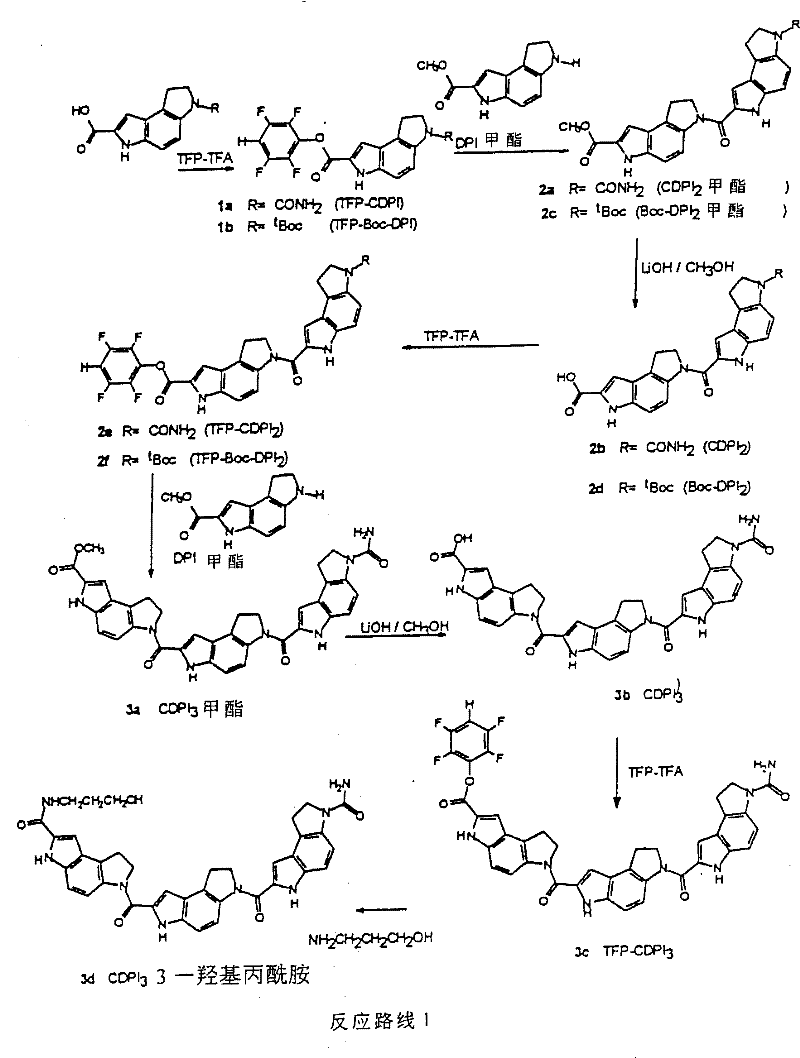
In reaction scheme 1; starting raw material is a 3-formamyl-1; 2-dihydro-3H-pyrrolo-[3,2-e] indole-7-carboxylic acid or 3-tertbutyloxycarbonyl-1,2-dihydro-3H-pyrrolo-[3; 2-e] indole-7-carboxylic acid; they can be by relevant chemical literature method (D.L.Boger, R.S.Coleman and B.J.Invergo, organic chemistry magazine (J.Org.Che-m.); 1987,52:1521-1530) preparation.Starting raw material is handled with trifluoroacetic acid tetrafluoro phenyl ester (TFP-TFA), changes into active ester.In compound 1a, R is CONH
20In 1b, R be tertbutyloxycarbonyl (
tBoc).Tertbutyloxycarbonyl (
tBoc) be the usable acid known remove be used to protect amino protecting group.Make Acibenzolar 1a and 1b and 1 of gained, and 2-dihydro-3H-pyrroles indole-7-carboxylic acid methyl esters (also can be synthetic according to document, referring to D.L.Boger, R.S.Coleman and B.J.Invergo, J.Org.Chem., 1987,52:1521-1530) reaction gets dipeptides 2a and 2c.Remove methyl in the carboxyl functional group to obtain the dipeptides of free carboxy with alkaline purification again.This dipeptides activates to such an extent that Acibenzolar (is worked as R=CONH with polytetrafluoroethylene phenol once more
2, TFP-CDPI
2The time be 2e; Work as R=
tBoc, TFP-
tBoc-CDPI
2The time be 2f), after TFP-TFA activation, this dipeptide active ester can combine with ODN and form the ODN-MGB conjugates, it is synthetic sees tripeptides.The Acibenzolar of this dipeptides also can with another molecule 1, the reaction of 2-dihydro-3H-pyrrolo-indole-7-carboxylate methyl ester obtains tripeptides (its carboxyl is protected by methyl esters) 3a (3-carbamyl-1,2-dihydro-3H-pyrrolo-[3,2-e] indole-7-carboxylic acid's methyl esters tripeptides).Described methyl is removed with basic hydrolysis, the tripeptides 3b that makes gained through polytetrafluoroethylene phenol activate activatory tetrafluoro phenyl ester 3c (3-carbamyl-1,2-dihydro-3H-pyrrolo-[3,2-e] indole-7-carboxylic acid-2,3,5,6-tetrafluoro phenyl ester tripolymer, TFP-CDDI
3).By repeating above-mentioned steps, activatory tetrafluoro phenyl ester 3c can be used to further make peptide elongation, promptly by with 1,2-dihydro-3H-pyrrolo-indole-7-carboxylate methyl ester reaction, make the methyl esters saponification of gained, and react with TFP-TFA more if desired, obtained mixing the activation tetrafluoro phenyl ester of the peptide of 4 CDPI.Therefore, be readily appreciated that, can further repeat these steps, until obtaining containing the monomeric oligopeptides of required number CDPI.In preferred embodiment as herein described, the tetrafluoro phenyl Acibenzolar of tripeptides 3c is used for getting the ODN-MGB conjugates with the ODN coupling, perhaps synthesize the ODN-MGB conjugate on the CPG that suitably modifies (glass in control aperture) solid phase carrier, this process association reaction route 4 and 5 is described in hereinafter.Reaction scheme 1 shows that its final step is the tetrafluoro phenyl Acibenzolar (TFP-CDPI from tripeptides 3c
3) step of preparation hydroxypropyl sulfonamide derivatives.The hydroxyl propanamine derivatives 3d of tripeptides 3d (3-formamyl-1,2-dihydro-3H-pyrrolo-[3,2-e] indoles-7-carbonyl-1-amido-3-propyl alcohol tripolymer, CDPI
3-3-hydroxyl propylamine) can be used to combine and obtain ODN-MGB of the present invention with ODN.Yet, this tripeptides 3d can be used as also that the free minor groove binding describes hereinafter some in conjunction with in the research with comparing.


Reaction scheme 2 discloses the synthetic route of another preferred minor groove binding (peptide), and monomer wherein is 4-amino-N-methylpyrrole-2-carboxylic acid residues, and this peptide contains reporter group/contain phenylazo-.Like this, at N, the N-dicyclohexylcarbodiimide exists down, the 6-[(tert.-butoxy) formamido group] caproic acid and 2-[4-(phenylazo-)-dibenzylsulfide] ethanol condensed compound 11 (5-[(tert.-butoxy) formamido group that obtains] valeric acid 2-[4-(phenylazo-) dibenzylsulfide) ethyl ester).With trifluoroacetic acid (TFA) with the protecting group in the compound 11
tBoc sloughs, the compound that free amine group is arranged of gained be subjected to
tThe Acibenzolar reaction of the 4-amino-N-methylpyrrole-2-carboxylic acid of Boc protection.Described Acibenzolar compound (1,2,3-benzotriazole-1-base 1-methyl-4-(tert.-butoxy) formamido group-pyrroles-2-carboxylicesters) can be by 1-methyl-4-[(tert.-butoxy) formamido group] pyrroles-2-carboxylic acid makes, the latter can be according to literature method (L.Grehn, V.Ragnarsson, J.Org.Chem., 1981,46,3492-3497) obtain.The compound 12 that reaction obtains (5-[1-methyl-4-(tert.-butoxy) formamido group] pyrroles-2-formamido group] valeric acid 2-[4-(phenylazo-) dibenzylsulfide] ethyl ester) contain a 2-amino-N-methylpyrrole carboxylic acid residues, be connected with the reporter group that contains phenylazo-on this residue.After removing protecting group tBoc with trifluoroacetic acid, with a part or polymolecular 1-methyl-4-tert.-butoxy formamido group-pyrroles-2-carboxylic acid 1,2,3-benzotriazole-1-ester carries out linked reaction, until the oligomeric peptide that obtains containing required number residue again.The compound that has n monomer residue and 1 free amine group like this in the reaction scheme 2 shown in Figure 16 a.16a can be subjected to
tAcibenzolar (as 1,2, the basic Acibenzolar of the 3-benzotriazole-1) reaction of the 6-aminocaprolc acid of Boc protection, obtain as in the reaction scheme 2 with the oligopeptides shown in the 16b.Can under acidic conditions, remove among the 16b
tBoc protecting group, and can be with the derivative of the tool free amine group of gained, by prior synthesizing method and 3 of ODN '-phosphorus or 5 '-phosphoric acid links to each other.In addition, this derivative of tool free amine group also can by difunctionality connect base (as indicated above) and 3 of oligonucleotide ' or 5 '-hydroxyl links to each other.

3 '-or 5 '-end amino is that terminal oligonucleotide can be synthetic by ordinary method; For example amino hexyl is connected with any end of ODN by the amino hexyl phosphoramidite of commercially available N-methoxyl group trityl.In addition, be that terminal ODN can be that the disclosed method of 08/090,408 (approved mandate and publication fee are paid) is synthetic according to the application number of application on July 12nd, 1993 also with amino.The content of the specification sheets of this patent application is incorporated herein for referencial use.According to this synthetic route, will be that terminal ODN is converted into hexadecyl front three ammonium salt with amino, so that it dissolves in organic solvent, make itself and the condensation of tetrafluoro phenylester activatory minor groove binding again, reacting best is solvent with DMSO.

Reaction scheme 4 is disclosed be with 5 '-amino is the oligonucleotide of end and the Acibenzolar link coupled other method of minor groove binding.Example among this figure is from 3-formamyl-1, the tetrafluoro phenyl ester (TFP-CDPI of 2-dihydro-3H-pyrrolo-[3,2-e] indole-7-carboxylic acid's residue deutero-tripeptides
3), but should be understood that this also is applicable to other minor groove binding in conjunction with the disclosed General Principle of this reaction scheme.In the method, ODN still links to each other with the CPG carrier, and at its N-terminal free amine group is arranged.Can obtain by the amino hexyl phosphoramidite of N-methoxyl group trityl above-mentioned, after this phosphamide coupling, the methoxyl group trityl of sloughing wherein is the ODN of end with amino upward to obtain being combined in CPG.In addition, this compound that is connected with CPG also can be by patent application No.08/090 mentioned above, 408 and the disclosed method of document quoted synthetic.Sum up in passing, progressively synthetic and CPG carrier link coupled ODN, this ODN has terminal amino group, and this amino is protected with 9-fluorenyl methoxy carbonyl (Fmoc).When required oligonucleotide is synthetic finish after, slough Fmoc, at this moment ODN still links to each other with the CPG carrier.According to reaction scheme 4 of the present invention, make to have free amine group to be combined in that CPG goes up with amino be terminal ODN and Acibenzolar (TFP-CDPI
3, 3c) or similarly minor groove binding Acibenzolar condensation.After this by ordinary method (through ammonia treatment commonly used), the ODN-MGB conjugates is taken off from the CPG carrier.

aReagent: (a) TFD-TFA, triethylamine, CH
2Cl
2(b) 3-amino-1,2-propylene glycol, CH
2Cl
2(c) DMTrCl, pyridine; (d) succinyl oxide, N-Methylimidazole, CH
2Cl
2, TFP-TFA; (e) alkylamine CPG, pyridine; (f) piperidines, DMF; (g) TFP-CDPI
3(3c in the reaction scheme 1), DMF
Reaction scheme 5
Shown in the reaction scheme 5 is another preferred method of synthetic ODN-MGB conjugates of the present invention.Specifically, this method is earlier link molecule to be linked to each other with the CPG carrier, and then the activatory minor groove binding is linked to each other with link molecule, with automatic ODN synthesizer, is carrier with the CPG of the modification addressed just now, progressively synthesizes the oligonucleotide of required sequence.Only behind the ODN part of having finished required sequence synthetic, just take off the ODN-MGB conjugates from the CPG carrier.The link molecule here is a trifunctional, and each functional group has different reactive behavioies, and one links to each other with the CPG carrier, and another combines radical reaction with the activatory ditch, and the 3rd then is used for the synthetic of ODN.About this synthetic method and the more generally detailed description that can be used for the trifunctional link molecule in this method see application number is in 08/090,408 the application, but this application does not relate to minor groove binding.In the synthetic method shown in the reaction scheme 5, with β-alanyl-3-amino-1, the 2-propylene glycol is as the trifunctional link molecule, with TFP-CDPI
3Be the activatory minor groove binding.
According to reaction scheme 5, the Beta-alanine of Fmoc protection and trifluoroacetic acid tetrafluoro phenyl ester (TFP-TFA) reaction are to obtain 3-[N-(9-fluorenyl methoxy carbonyl) like this] alanine 2,3,5,6-tetrafluoro phenyl ester (4).Acibenzolar 4 and 3-amino-1, the reaction of 2-propylene glycol obtains 1-[3-[N-(9-fluorenyl methoxy carbonyl) amino]-1-oxygen propyl group] amino-(R, S)-2, ammediol (5).After this, the primary hydroxyl of compound 5 is protected with dimethoxytrityl, obtains 1-[3-[N-(9-fluorenyl methoxy carbonyl) amino]-1-oxygen propyl group] amino-(R, S)-2-[[two (p-methoxy-phenyl) phenyl methoxyl group] methyl] 2-ethanol (6).The secondary hydroxyl of compound 6 and succinyl oxide reaction, after this carboxyl in the gained compound is converted into Acibenzolar 1-[3-[N-(9-fluorenyl methoxy carbonyl) amino]-1-oxygen propyl group] amino-(R, S)-and 2-[[two (p-methoxy-phenyl) phenyl methoxyl group] methyl]-2-ethyl succinic acid 2,3,5,6-tetrafluoro phenyl ester (7).Make compound 7 link to each other with long-chain aminoalkyl group-CPG (LCAA-CPG or alkylamino CPG) (latter can buy and is existing description the in 08/090,408 the patent application at application number from commercially available) then." the modified CPG " that obtain is shown in the reaction scheme 5 with compound 8.Slough protecting group Fmoc with neutral alkali (being dissolved in the piperidines in the dimethyl formamide) and obtain modified CPG (9), this compound 9 contains the free primary amine groups as the part of linking agent.Next step makes the activatory minor groove binding (be TFP-CDPI here
3, compound 3c) with the reaction of the primary amino of compound 9, the CPG that must modify (10), the latter contain ditch in conjunction with base with the primary hydroxyl that is connected base of dimethoxytrityl protection.In following step (though these reactions steps are not shown in reaction scheme 5), dimethoxytrityl is removed, and the synthetic of ODN undertaken by the method for now thinking this area ordinary method with automatic DNA synthesizer DNA.Behind synthetic the finishing, the ODN-MGB conjugates is taken off from the CPG carrier with ammonia.At this moment connect 3-amino-1, the bond rupture of the secondary hydroxyl of 2-propylene glycol and CPG carrier.
Biological test and discussion of results
The ODN-MGB conjugates can combine with single stranded DNA.They also can combine with double-stranded DNA under the recombinase effect, and can also combine with the crossbred of single stranded RNA and DNA and RNA in some cases.But this combination when complementary or complementary basically, just takes place by the Watson-Crick rule in the target sequence that has only ODN and target DNA or RNA.After satisfying this condition, ODN-MGB conjugates and combining of target sequence obviously are better than no MGB combining of the same ODN of bonded and target sequence with it.Biological test below these are available confirms that these make ODN-MGB conjugates of the present invention can be used as the analysis and the diagnosis hybridization probe of target DNA or RNA sequence, also can be used as antisense nucleic acid and Antisense gene therapy agent.
Table 1
(dAP)
8+ (dTp)
8The data of double-stranded spirochetal temperature of fusion (Tm)
a, 3 ' end of table double center chain breechblock oligonucleotide is connected with intercalator or oligomerization (1-methyl-2-carboxyl-4-amino) pyrroles's residue.
The a parameter is the mean value of at least three experiments.Double-stranded spirochete is at 0.2M NaCl, 0.1m MEDTA, 0.01M (± 0.1 ℃) Na
2HPO
4, melt in the damping fluid of pH7.0, (dTP)
8(dAP)
8Concentration be 2.5 * 10
-5M.
Difference (the Δ T of b modification and the double-stranded spirochetal temperature of fusion of unmodified
m)
The concentration of c distamycin is 2.5 * 10
-5M
3 ' phosphoric acid ester of d ODN is connected method reference 12 by the Beta-alanine joint with the 8-of ethidium bromide is amino.

Table 1 has been listed the temperature of fusion of the formed mixture of several complementary oligonucleotides, described oligonucleotide is connected with ditch in conjunction with base, the latter derives from 4-amino-N-methylpyrrole-2-carboxylic acid residues, and this ditch is represented with the following structural formula X of table 1 particularly in conjunction with base.It may be noted that X also comprises from 6-aminocaprolc acid deutero-connection base.Herein the oligonucleotide of Shi Yonging be eight poly-2 '-deoxyadenylic acid and 8-be poly-2 '-deoxythymidylic acid.Ditch in conjunction with base (X) and oligonucleotide 3 '-the phosphoric acid ester end links to each other, 5 of these ODN ' hold no phosphoric acid ester.About this point, it should be noted that the oligonucleotide in this table (comprising other table) is abridged by the customary way of this area.Group Y represent by " β-third amino " connect base and 3 '-ethidium bromide part that phosphide links to each other.Y representative embeds base, as combine the contrast of base relatively the time with ditch.M represents to be present in the number of the 4-amino-N-methyl-pyrroles-2-carboxylic acid residues among each ODN-MGB in the table.
As known in the field, the double-stranded spirochetal temperature of fusion of oligonucleotide or polynucleotide (Tm) is defined as 50% oligonucleotide or polynucleotide from the temperature of its double-stranded spirochete (WatsonCrick hydrogen bond type) when dissociating.Temperature of fusion is high more to mean that then double-stranded spirochete is more stable.In addition, the Tm of also known oligonucleotide and polynucleotide also depends on the concentration of oligonucleotide in surveying temperature of fusion solution, the concentration height, and the temperature of fusion that then records is also high.In these tables listed Tm be in table or the pointed condition of experimental section under measure.Δ Tm represents the double-stranded spirochetal temperature of fusion of modifying and does not combine basic bonded (dAp) with ditch
8(dTp)
8The difference of the temperature of fusion of mixture.
As can be found from Table 1, covalently bound ditch has significantly increased the stability (temperature of fusion Tm rising) of double-stranded complex body in conjunction with base, here ditch in conjunction with base (X) with (dTp)
8Or (dAp)
8Oligonucleotide links to each other.In this case, when ditch was 5 peptides in conjunction with base, degree of stability reached maximum (temperature of fusion is the highest).In comparison test, when embed basic Y with (dAp)
8Oligonucleotide in conjunction with the time, then degree of stability is relatively much smaller.In this test, even when the basic Y of embedding was connected simultaneously with two chains of oligomer, the increase of temperature of fusion was also little in conjunction with base than the ditch that is connected with 5 4-amino-N-methylpyrrole-2-carboxylic acid residues.
Table 2
By 16 poly-or eight poly-thymidylic acids and oligomerization (1-methyl-2-carboxyl-4-amino) spirochetal temperature of fusion (T of the formed two strands of pyrrole derivative that has the oligomerization deoxyadenylic acid
m) data, this temperature is at 0.2M NaCl, 0.01M Na
2HPO
4, measure among the 0.1MEDTA (pH7.0).Identical in the definition of X and the table 1.


The mode and the table 1 of table 2 public information are similar.In the test that these statistical tables and reports are led, make to have ditch in conjunction with poly-thymidylic acid of the 16-of base (representing with X) and poly deoxyadenylic acid formation mixture with the X in the table 1.In contrast, to its 3 '-16 poly-thymidylic acids (dTp) that the phosphoric acid ester end links to each other with 6-aminocaprolc acid
16Also test.In addition, also to 8 poly-thymidylic acids (dTp)
8And combine the formed conjugates of base with ditch and test with different lengths peptide chain.In these experiments, the minor groove binding that links to each other with ODN has also significantly increased the stability of ODN-MGB and the formed mixture of complementary dna chain.When ditch was 5 in conjunction with the number of 4-amino-N-methylpyrrole-2-carboxylic acid residues in the base, then mixture was the most stable.On the contrary, 16 gather the propylhomoserin caproic acid tail on the ODN, in fact can not increase the stability of mixture.
Table 3
By poly (Tp)
8Or poly (rA) is connected with part CDPI with end
1-3Or BocDPI
1-2(Tp)
8The spirochetal temperature of fusion of formed two strands
a

Data in a bracket are that this derivative that has joint L2 records.
B does not observe melting transition.

L1=-O(CH
2)
6NH- L2=-OCH
2CH(OH)CH
2NHCOCH
2CH
2NH-
Table 3 is disclosed to be temperature of fusion (Tm) and temperature of fusion difference (Δ Tm), and oligonucleotide is eight poly-thymidylic acids here, and have a ditch in conjunction with base and its 5 '-phosphoric acid ester or 3 '-phosphoric acid ester end link to each other (as shown in table 3).Ditch is represented with X in conjunction with base herein, and Y is based on 1, the oligopeptides of 2-dihydro-3H-pyrrolo-[3,2-e] indole-7-carboxylic acid (CDPI or Boc DPI) residue, and its structure sees Table 3.These ditch connection peptides (base) are by connecting base " L
1Or L
2" link to each other L with ODN
1And L
2Structure see Table below.This ODN-MGB conjugates and the equal polynucleotide of complementary or homopolymerization deoxynucleotide are carried out incubation.To containing the ODN-MGB conjugates of poly-thymidylic acid, use polyadenylic acid or the combination with it of poly-deoxyadenylic acid like this.The variation of temperature of fusion (Δ Tm) is that the temperature of fusion of mixture has the basic L of connection with respect to the associated end at ODN
1Or L
2But do not contain the difference of ditch in conjunction with the temperature of fusion of the corresponding ODN of base.As can be found from Table 3, these ODN-MGB mixtures demonstrate the mixture that has complementary homopolymerization deoxynucleotide once more remarkable stability.And in these experiments, when ditch had 3 CDPI units in conjunction with base, the mixture of formation was the most stable.Amazingly be even when ODN-MGB and can complementary with it bonded equal polynucleotide insulation, the stabilization of mixture take place also.This being taken aback is because prior art generally believes that free ditch binding molecule does not combine event with DNA RNA hybrid.
L1=-O(CH
2)
6NH- L2=-OCH
2CH(OH)CH
2NHCOCH
2CH
2NH-
Table 4 is disclosed to be to form double-stranded spirochetal result of study between two complementary, the eight aggressiveness derivatives (CpApTpCpCpGpCpT and ApGpCpGpGpApTpG).Each eight aggressiveness is all modified (as the table shows) to check corresponding oligodeoxynucleotide and the hybridization that the oligodeoxynucleotide of phosphorothioate backbone is arranged.This ODN still has based on 1, the tripeptides (ditch is in conjunction with basic X) of 2-dihydro-3H-pyrroles [3,2-e] indole-7-carboxylic acids (CDPI) residue, and this X is L by structure
1Or L
2Connection base and 3 of ODN '-or 5 '-end (as shown in the figure) link to each other (X, L
1, L
2Structure with in the table 3).In order to contrast, also measured ODN wherein only be connected the double-stranded spirochetal temperature of fusion of basic bonded, from table, can find that ditch is obviously stablized double-stranded spirochete in conjunction with the existence of base, and as every equal covalency of chain when being connected with ditch in conjunction with base, then double-stranded spirochete is more stable.
Table 5
Have 3 '-the spirochetal T of heteroduplex of the oligopeptides residue of oligomerization pyrrolo-indole methane amide
m
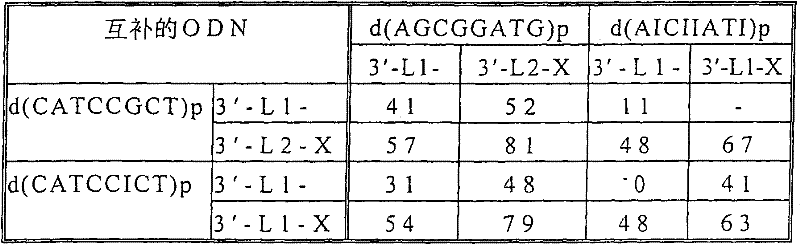

L
1=-O(CH
2)
5NH- L
2=-OCH
2CH(OH)CH
2NHCOCH
2CH
2NH-
The temperature of fusion that is obtained when table 5 is disclosed to be complementary or complementary ODN carries out incubation and checks double-stranded spirochete to form substantially.Ditch in conjunction with basic X be connected basic L
1And L
2All be shown in this table, and they all with table 3, table 4 in identical.As expectation, if there is not ditch to exist in conjunction with base, when the guanine in the ODN chain (G) is replaced by xanthoglobulin (I), double-stranded spirochetal combination very weak (Tm is about 0 ℃).Yet, when with the G in the I replacement oligonucleotide, a covalently bound ditch then makes the stability (Tm) of crossbred increase to about 50 ℃ in conjunction with the existence of basic X, and two ditches that exist with the direction that is parallel to each other then make stability (Tm) increase to about 63 ℃ in conjunction with base.And for containing the identical chain of guanine, a ditch makes Tm increase by 15 ℃ in conjunction with base, and two then increase nearly 45 ℃.Known to this case contriver, it is to have no precedent in the prior art that the temperature of fusion of eight polynucleotides reaches 81 ℃.
Primer prolongs experiment
ODN part in the ODN-MGB conjugates can prolong experiment with target sequence by primer by Watson-Crick rule bonded sequence-specific and confirm.In this experiment, under the effect of T7DNA polysaccharase, primer from 5 of template '-end begins to prolong.To press Watson-Crick complementary 16 polynucleotides-minor groove binding conjugates, T7DNA polysaccharase and long single stranded DNA template temperature with the target sequence of template strand.When ditch in conjunction with 5 of base and above-mentioned 16 poly-ODN '-when end links to each other, can find that then the primer prolongation ends at the combining site of ODN-MGB and template, described minor groove binding is the tripeptides of pyrrolo-indole, and is as shown in table 5.But when 16 polynucleotides and target sequence had a base mismatch, primer prolonged then not interrupted.When ditch in conjunction with 3 of base and 16 poly-ODN '-when end links to each other, also do not influence the primer prolongation.In addition, during with enzyme and template incubation, primer prolongs also unaffected in sequence-specific 16 polynucleotides, free minor groove binding (compound 3d is not with the ODN covalent attachment).These experiments show: the sequence-specific of ODN-MGB is important for forming stable crossbred, ditch in conjunction with base also not merely only as the stablizer (anchor) of described ODN and another chain non-specific binding.The ODN-MGB conjugates suppress ability that primer prolongs show this ODN-MGB conjugates can be used as the PCR terminator and be used for diagnosis (see nucleic acids research (Nucleic Acid Research), 1993,21:5332-5336).
The slit engram cross experiment
ODN-MGB conjugates of the present invention can be used as hybridization probe.Experiment confirm below this is available uses in the experiment
32The ODN-MGB conjugates of P mark is made diagnostic probe.Do not combine the covalently bound with it same ODN of base relatively with there being ditch, the intensity of this conjugates and complementary strand hybridization is big, efficient height, specificity height.The slit engram cross experiment is the dna probe diagnostic test of a widespread use.These character of ODN-MGB conjugates have been improved the performance of this analysis.
Specifically, its experiment working method of experiment as herein described is followed the working method of standard, as press the described method of Protoc als for Nucleic Acid Blotting and hybridization (1988, Amersham, United Kingdom) and carry out.The oligonucleotide (ODN) that tried that is labeled with the immobilization plasmid hybridization is carried out quantitatively hybridization temperature being drawn with count per minute.Experimental evaluation four with the poly-oligonucleotide probes of M13mp 19DNA (phage DNA) complementary 16.Two probes wherein and phage DNA a part are complementary fully; One contains 3 ' covalently bound CDPI
3And another is not modified.Second pair of probe also matches with the same position of M13mp19DNA, but a wrong paired base (underscore base among Fig. 1) is respectively arranged.Equally, an ODN contains 3 ' end bonded CDPI
3, and another is not modified.
The result of slit hybridization research as shown in Figure 1.With unmodified but identical 16 polynucleotides of sequence relatively, contain CDPI
3The crossbred temperature of fusion that forms of probe be 50 ℃, do not contain CDPI
3Then only be 33 ℃.This higher temperature of fusion makes the gain in yield of complete paired crossbred more than 1 times.When in the probe during wrong paired base, then the stability of corresponding crossbred reduces.CDPI
3The probe of modifying shows high sequence resolving power between 37-50 ℃.And, under these hybridization conditions, there is not evidence to show CDPI
3Combine with the already present in advance double stranded region of target M13mp 19DNA, this means that non-completely to hold anisogamy be non-existent to these conjugatess.
The sequence-specific alkylating of gene in people's cell of cultivating
ODN-MGB conjugates of the present invention (go back covalency on this conjugates and be connected with alkylating agent) can be used as " inverted defined gene " reagent, if the target complement sequence just in ODN-MGB conjugates and the target gene just can suppress the expression of non-required gene (Disease-causing gene).In this case, MGB can improve the bonding force (in the presence of recombinase) of ODN and double-stranded DNA (gene), and the alkanisation base then makes ODN-MGB conjugates and target sequence form lasting covalent attachment.
In replication experiment, 50 polynucleotides above-mentioned (are modified and 3 ' end and CDPI through mustargen base (Chlorambucil)
3In conjunction with) expection position in sequence-specific ground and the target gene is crosslinked, this target gene (HLA DQ β 1 0302 allelotrope) is present in the people BSM cell alive (a kind of people B-lymphocyte series).The ODN-MGB conjugates is added in the BSM cell suspending liquid, and this conjugates ultimate density is 1-50 μ M.3.5 after hour, extract genomic dna and handle, so that any alkylation position produces breach with hot Pyrrolidine.By LM-PCR (polymerase-mediated connection chain reaction) amplification, this technology of LM-PCR is to can be used to the technology that detection of broken incident, resolving power reach a base in the downstream of 0302 allelotrope target region.Product through the sequencing gel electrophoretic analysis show the ODN of modification combined with target site and alkanisation together.And there is not CDPI
3Similar ODN very little to the alkanisation efficient of target DNA.
In the superincumbent experiment, the ODN-MGB conjugates may be to carry out in the presence of nuclear recombinase to identification and the combination of homoduplex DNA.In similar experiment and using, in other viable cell, the endogenous recombinase can catalysis ODN-CDPI
3Conjugates combines with sequence-specific target between double stranded genomic dna.When these ODN had the linking agent that is attached thereto, they can the alkanisation target DNA.Under the recombinase effect, by stablizing formed D-ring, CDPI
3Promote crosslinking reaction.Crosslinked is the potent inhibitor of expression of target gene.Therefore, crosslinked ODN-CDPI
3Conjugates can be used as inverted defined gene reagent.
Specific embodiment and experimental section
Materials and methods
Reaction to air and water sensitive is all carried out under the pressure-fired of argon gas.Anhydrous solvent available from Aldrich company (Milwaukee, WI).Sudden strain of a muscle formula column chromatography uses silica gel (230-400 order).Fusing point is not calibrated and adopt Mel-Temp fusing point instrument to measure.(Boundbrook NJ) finishes by quantitative technique company in ultimate analysis.Uv-visible absorption spectroscopy in the 200-400nm scope UV-2100 (Shimadzu) or Lambda2 (Perkin Elmer) spectrophotometer record.Proton nmr spectra (
1H NMR) measures down at 20 ℃ with Bruker WP-200 type spectrograph or Varian XL-200 type spectrophotometer; Chemical shift is that interior mark is measured with tetramethylsilane under the ppm downfield.
3-carbamyl-1,2-dihydro-3H-pyrrolo-[3,2-e] indole-7-carboxylic acid 2,3,5,6-tetrafluoro phenyl ester (1a).With 3-carbamyl-1,2-dihydro-3H-pyrrolo-[3,2-e] indole-7-carboxylic acid (1.4g, 6.1mmol, D.L.Boger, R.S.Coleman, B.J.Invergo, J.Org.Chem., 1987,52:1521-1530) and triethylamine (1.4ml 10mmol) is dissolved in the 15ml dry DMF.In this solution, drip trifluoroacetic acid 2,3,5,6-tetrafluoro phenyl ester (2.6g, 10mmol, H.B.Gamper, M.W.Reed, T.Cox, J.S.Virosco, A.D.Adams, A.A.Gall, J.K.Scholler and R.B.Meyer, Jr., Nucleic Acids Res., 1993,21 (1): 145-150).Finish, after 1 hour, decompression (0.2mm vacuum) concentrated reaction mixture.Residue adds the 50ml ether with anhydrous methylene chloride 2ml development, and mixture spends the night 0 ℃ of placement, filter collecting precipitation with the sintered glass funnel, precipitate with 50% ether/methylene dichloride (10ml), ether (50ml) washs successively, vacuum-drying gets yellow solid 1.8g (75%);
1H NMR (Me
2SO-
d 6, 200MHz, ppm) 12.32 (s, 1H, NH), 8.13 (d, 1H, J=9Hz, C4-H), 8.01 (m, 1H, C
6F
4H), 7.41 (s, 1H, C8-H), 7.26 (d, 1H, J=9Hz, C5-H), 6.17 (s, 2H, CONH
2), 3.99 (t, 2H, J=9Hz, NCH
2CH
2), 3.30 (t, 2H, J=9Hz, NCH
2CH
2) .C
18H
11N
3O
3F
4* 2H
2The theoretical value of O: C, 50.3; H, 3.52; N, 9.7. measured value: C, 50.81; H, 3.60; N, 9.95.
3-tert-butoxycarbonyl-1,2-dihydro-3H-pyrrolo-[3,2-e] indole-7- carboxylic acid 2,3,5,6-tetrafluoro phenyl ester (1b).With 3-tert-butoxycarbonyl-1,2-dihydro-3H-pyrrolo-[3,2-e] indole-7-carboxylic acid (1.0g, 3.7mmol, D.L.Boger, R.S.Coleman and B.J.Invergo, J.Org.Chem., 1987,52:1521-1530) and triethylamine (1.5ml 10mmol) is dissolved in the 10ml anhydrous methylene chloride.In this solution, drip trifluoroacetic acid 2,3,5, and 6-tetrafluoro phenyl ester (2.6g, 10mmol).Reacted 4 hours, and removed CH then under reduced pressure
2Cl
2, residue gets yellow crystals (1b) 1.25g (75%) through dodging formula column chromatography (4 * 20cm, normal hexane-ethyl acetate 1: 2):
1H NMR (Me
2SO-
d 6, 200MHz, and ppm) 12.39 (d, 1H, J=1.4Hz, NH), 8.02 (m, 1H, C
6F
4H), 7.9 (br s, 1H, C4-H), 7.45 (d, 1H, J=1.4Hz, C8-H), 7.33 (d, 1H, J=9Hz, C5-H), 4.02 (t, 2H, J=9Hz, NCH
2CH
2), 3.26 (t, 2H, J=9Hz, NCH
2CH
2), 1.51 (s, 9H, C (CH
3)
3) .C
22H
18N
2O
4F
4Theoretical value: C, 58.67; H, 4.03; N, 6.22.Found:C, 58.45; H, 4.09; N, 6.13.
3-formamyl-1,2-dihydro-3H-pyrrolo-[3,2-e] indole-7-carboxylic acid's dimer methyl esters (2a).1,2-dihydro-3H-pyrrolo-indole-7-carboxylate methyl ester (0.6g, 1.5mmol), compound 1a (0.45g, 2.25mmol) and triethylamine (0.2ml 1.4mmol) is dissolved among the 10ml DMF.Make this solution in room temperature reaction 24 hours, then 0 ℃ of reaction 12 hours.Filter to collect the insoluble solids of gained, and wash with DMF (10ml), ether (20ml), vacuum-drying get light yellow solid 2a (0.61g, 91%) (
1H NMR (Me
2SO-
d 6, 200MHz, ppm) 12.00 (d, 1H, J=1.8Hz, NH '), 11.54 (s, 1H, NH), 8.28 (d, 1H, J=9Hz, C4 '-H), 7.97 (d, 1H, J=9Hz, C4-H), 7.33 (d, 1H, J=9z, C5 '-H), 7.22 (d, 1H, J=9z, C5-H), 7.13 (d, 1H, J=1.4Hz, C8 '-H), 6.94 (d, 1H, J=1.1Hz, C8-H), 6.01 (s, 2H, CONH
2), 4.62 (t, 2H, J=8Hz, (NH
2CH
2) '), 3.98 (t, 2H, J=8Hz, NCH
2CH
2), 3.88 (s, 3H, CH
3), 3.41 (t, 2H, J=8Hz, (NCH
2CH
2) '), 3.29 (t, 2H, NCH
2CH
2, fog because of water makes it part) and .C
24H
21N
5O
5* 1H
2The theoretical value of O * 1DMF: C, 58.69; H, 5.84; N, 15.21.
Found:C,58.93;H,5.76;N,15.82.
3-tert-butoxycarbonyl-1,2-dihydro-3H-pyrrolo-[3,2-e] indole-7-carboxylic acid's dimer methyl esters (2c).With 1,2-dihydro-3H-pyrroles indole-7-carboxylic acid methyl esters (0.5g, 2.5mmol), compound 1b (1.0g, 2.2mmol) and triethylamine be dissolved in the anhydrous dimethyl formamide (DMF).Make this solution room temperature reaction 10 hours, 0 ℃ of reaction 12 hours.Filter the insoluble solids of collecting gained, wash it with DMF (5ml), ether (40ml).Vacuum-drying gets linen solid 2c 0.81g (74%).
1H NMR (Me
2SO-
d 6, 200MHz, ppm) 12.01 (s, 1H, NH '), 11.64 (s, 1H, NH), 8.28 (d, 1H, J=9Hz, C4 '-H), 7.8 (br s, 1H, C4-H), 7.32 (apparentt, 2H, C5 '-H+C5-H), 7.13 (d, 1H, J=1.1Hz, C8 '-H), 6.98 (d, 1H, J=1.1Hz, C8-H), 4.62 (t, 2H, J=8Hz, (NH
2CH
2) '), 4.02 (t, 2H, J=8Hz, NCH
2CH
2), 3.88 (s, 3H, CH
3), 3.41 (t, 2H, J=8Hz, (NCH
2CH
2) '), 3.25 (t, 2H, NCH
2CH
2), 1.52 (s, 9H, C (CH
3)) .C
28H
28N
4O
5Theoretical value: C, 67.19; H, 5.64; N, the 11.19. measured value: 66.72, H, 5.69; N, 11.31.
3-carbamyl-1,2-dihydro-3H-pyrrolo-[3,2-e] indole-7-carboxylic acid's dimer 2,3,5,6-tetrafluoro phenyl ester (2e).With compound 2b (1.2g, 2.8mmol, D.L.Boge-r, R.S.Coleman and B.J.Invergo, J.Org.Chem., 1987,52:1521-1530) add in the 15ml anhydrous dimethyl formamide (DMF), suspension liquid.(2.0g, 10mmol) to this suspension liquid, (1.4ml 10mmol), stirred 3 hours reaction mixture then to add triethylamine to drip trifluoroacetic acid tetrafluoro phenyl ester.Reduce pressure with rotatory evaporator) (0.2mm vacuum) concentrated reaction mixture.The residue of gained is developed with the 20ml anhydrous methylene chloride.The product of gained is used methylene dichloride (10ml), ether (20ml) washing after filtration successively.Vacuum-drying gets yellow solid 2e 1.5g (93%): (
1HNMR (Me
2SO-
d 6, 200MHz, ppm) 12.51 (d, 1H, J=1.8Hz, NH '), 11.58 (s, 1H, NH), 8.39 (d, 1H, J=8.9Hz, C4 '-H), 8.04 (m, 1H, C
6F
4H), 7.98 (d, 1H, J=8.8Hz, C4-H), 7.58 (s, 1H, C8 '), 7.42 (d, 1H, J=9Hz, C5 '-H), 7.22 (d, 1H, J=9Hz, C5-H), 6.98 (s, 1H, C8-H), 6.11 (s, 2H, CONH
2), 4.66 (t, 2H, J=7.8Hz, (NCH
2CH
2) '), 3.94 (t, 2H, J=9.1Hz, NCH
2CH
2), 3.47 (t, 2H, J=8Hz, (NCH
2CH
2) '), 3.29 (t, 2H, J=9.1Hz, NCH
2CH
2).
C
29H
19N
5O
4F
4* 1.5H
2The theoretical value of O: C, 57.62; H, 3.67; N, 11.59. measured value: C, 57.18; H, 3.31; N, 11.54.
3-tert-butoxycarbonyl-1,2-dihydro-3H-pyrrolo-[3,2-e] indole-7-carboxylic acid's dimer 2,3,5,6-tetrafluoro phenyl ester (2f).With compound 2d (0.25g, 0.5mmol, D.C.Boger, R.S.Coleman and B.J.Invergo, J.Org.Chem., 1987,52:1521-1530) and triethylamine (0.5ml 3.5mmol) adds in the mixture of 8ml anhydrous methylene chloride and 2ml dimethyl formamide, suspension.In this suspension, drip trifluoroacetic acid 2,3,5, and 6-tetrafluoro phenyl ester (0.75g, 2.9mmol).Mixture was stirred 20 hours, and the gained clear solution concentrates in a vacuum, and resistates is dropped in the 40ml 1M sodium acetate (pH 7.5).Centrifugal to throw out, and water (2 * 40ml), 10% methanol 2 * 40ml), ether (40ml), normal hexane (40ml) washing successively.Last vacuum-drying gets light yellow solid 2f0.2g (91%).(
1H NMR (Me
2SO-
d 6, 200MHz, ppm) 12.51 (s, 1H, NH '), 11.66 (s, 1H, NH), 8.37 (d, 1H, J=8.8Hz, C4 '-H), 8.03 (m, 1H, C
6F
4H), 7.8 (brs, 1H, C4-H), 7.58 (s, 1H, C8 '-H), 7.40 (d, 1H, J=9.1Hz, C5 '-H), 7.27 (d, 1H, J=8.6Hz, C5-H), 7.1 (s, 1H, C8-H), 4.65 (t, 2H, J=8Hz, (NCH
2CH
2) '), 4.02 (t, 2H, J=9Hz, NCH
2CH
2), 3.46 (t, 2H, J=8Hz, (NCH
2CH
2) '), 3.25 (t, 2H, J=8.9Hz, NCH
2CH
2), 1.51 (s, 9H, C (CH
3)
3) .C
33H
26N
4O
5F
4* 0.5H
2The theoretical value of O: C, 61.59; H, 4.23; N, 8.71. measured value: C, 61.73; H, 4.12; N, 8.61.
3-formamyl-1,2-dihydro-3H-pyrrolo-[3,2-e] indole-7-carboxylic acid's tripolymer methyl esters (3a).With 1,2-dihydro-3H-pyrrolo-indole-7-carboxylate methyl ester (1.0g, 5mmol), compound 2e (1.2g, 2.1mmol) and triethylamine (0.1ml mmol) is dissolved in the 15ml dry DMF.Make this solution in room temperature reaction 24 hours, 0 ℃ of reaction 12 hours.Filter the insoluble solids of collecting gained, and use DMF (10ml), CH successively
2Cl
2(20ml) and ether (20ml) wash it.Vacuum-drying gets light yellow solid 3a1.1g (83%).
(
1H NMR (Me
2SO-
d 6, 200MHz, ppm) 12.02 (s, 1H, NH "), 11.75 (s, 1H, NH '); 11.56 (s, 1H, NH), 8.28 (apparent t, 2H, J=8.3Hz, C4-H "+C4 '-H), 7.98 (d, 1H, J=9.4Hz, C4-H), 7.98 (d, 1H, J=9Hz, C4-H), 7.39-7.33 (2d, 2H, C5 " H+C5 '-H), 7.23 (d, 1H, J=8.7Hz, C5-H); 7.14 (d, 1H, J=1.6Hz, C8 " H), 7.10 (d, 1H, J=1Hz, C8 '-H), 6.97 (s, 1H, C8-H), 6.11 (s, 2H, CONH
2), 4.65 (t, 4H, (NCH
2CH
2) "+(NCH
2CH
2) '), 3.98 (t, 2H, J=8.7Hz, NCH
2CH
2), 3.88 (s, 3H, CH
3), 3.48-3.25 (m, 6H, (NCH
2CH
2) "+(NCH
2CH
2The NCH of) '+
2CH
2, fog because of water makes it part) and .C
35H
29N
7O
5* 4.5H
2The theoretical value of O: C,
59.32; H, 5.0; N, 13.03. measured value: C, 58.9; N, 5.06; N, 13.77.
3-formamyl-1,2-dihydro-3H-pyrrolo-[3,2-e] indole-7-carboxylic acid's tripolymer 2,3,5,6-tetrafluoro phenyl ester (3c).(1.1g is 1.8mmol) at the anhydrous MDF of 15ml and triethylamine (1.4ml, 10mmol) the middle suspension that forms for compound 3b.In this suspension, drip trifluoroacetic acid 2,3,5, and 6-tetrafluoro phenyl ester (2.6g, 10mmol).Mixture to gained stirred 3 hours.Mixture decompression (0.2mm vacuum) concentrates.Develop the residue of gained with the mixture of anhydrous methylene chloride (20ml) and methyl alcohol (2ml).Filter the product of collecting gained, use CH
2Cl
2(20ml), ether (20ml) washs it.Vacuum-drying gets yellow-green colour solid 3c 1.3g (95%).
(
1H NMR (Me
2SO-
d 6, 200MHz, ppm) 12.54 (d, 1H, J=1Hz, NH "), 11.79 (s, 1H, NH '), 11.56 (s, 1H, NH), 8.41 (d, 1H, J=9.3Hz, C4-H "), 8.27 (d, 1H, J=9.4Hz, C4 '-H), 8.03 (m, 1H, C
6F
4H), 7.98 (d, 1H, J=9Hz, C4-H), 7.56 (s, 1H, C8 " H), 7.45-7.35 (m, 2H, C5 " H+C5 '-H), 7.23 (d, 1H, J=9.2Hz, C5-H), 7.13 (s, 1H, C8 '-H), 6.97 (s, 1H, C8-H), 6.11 (s, 2H, CONH
2), 4.65 (m, 4H, (NCH
2CH
2) "+(NCH
2CH
2) '), 3.98 (t, 2H, J=8.7Hz, NCH
2CH
2), 3.45 (m, 4H, (NCH
2CH
2) "+(NCH
2CH
2) '), 3.25 (t, 2H, J=8.7Hz, NCH
2CH
2) .C
40H
27N
7O
5F
4* 2H
2The theoretical value of O: C, 61.59; H, 4.23; N, 8.71. measured value: C, 61.73; H, 4.12; N, 8.61.
[3-formamyl-1,2-dihydro-3H-pyrrolo-[3,2-e] indoles-7-carbonyl]-1-amido-3-propyl alcohol tripolymer (3d).To 3-amino-1-propyl alcohol (70 μ 1,1.4mmol), compound 3c (75mg, 0.1mmol) and triethylamine (0.1ml, mmol) solution that is dissolved in 2.5ml dry DMF gained was stirring at room 10 hours.The insoluble solids of gained is crossed the leaching collection, and uses DMF (2ml) CH successively
2Cl
2(10ml) and ether (20ml) washing.Vacuum-drying gets light yellow solid 3d (55mg, 89%).
(
1H NMR (Me
2SO-
d 6, 200MHz, ppm) 11.76 (s, 1H, NH "), 11.65 (s, 1H; NH '), 11.57 (s, 1H, NH), 8.47 (m, 1H, C4-H); 8.24 (m, 1H, C4-H), 7.99 (d, 1H, J=8.4Hz, C4-H); 7.40-7.32 (2d, 2H, C5 " H+C5 '-H), 7.23 (d, 1H, J=8.9Hz, C5-H), 7.12 (s, 1H, C8 " H), 7.10 (s, 1H, C8 '-H); 6.99 (s, 1H, C8-H), 6.12 (s, 3H, CONH
2+ NHCO), 4.66 (t, 4H, (NCH
2CH
2) "+(NCH
2CH
2) '), 3.98 (t, 2H, J=8.7Hz, NCH
2CH
2), 3.51-3.25 (m, 10H, (NCH
2CH
2) "+(NCH
2CH
2The NCH of) '+
2CH
2+ NHC
H 2+ C
H 2OH fogs because of water makes it part), 1.70 (p, 2H, J=6.6Hz, CH
2CH
2C
H 2).
3-[N-(9-fluorenylmethyloxycarbonyl)] alanine 2,3,5,6-tetrafluoro phenyl ester (4).The Fmoc-L-Ala (2.0g, 6.4mmol) and triethylamine (1.0ml is 7mmol) with 20ml anhydrous CH
2Cl
2Dissolving.In gained solution, drip trifluoroacetic acid 2,3,5, and 6-tetrafluoro phenyl ester (1.7g, 6.5mmol).After 1 hour, remove CH with rotatory evaporator
2Cl
2, resistates dissolves again with 30ml ethyl acetate/normal hexane (1: 1).With dodging the crude product 4 that formula column chromatography (4 * 20cm, hexane/ethyl acetate, 3: 1) obtains white solid.This crude product hexane/ethyl acetate recrystallization gets white crystal 4 (2.3g, 78%).
1H NMR (CDCl
3, 200MHz, ppm) 7.73 (d, 2H, J=7.1Hz, fragrant protons), 7.75 (d, 2H, J=7.7Hz, fragrant protons), 7.24-7.42 (m, 4H, fragrant proton), 7.01 (m, 1H, C
6F
4H), 5.21 (br s, 1H ,-CONH-), 4.38 (d, 2H, J=7.1Hz ,-CH
2OCO-), 4.20 (m, 1H, benzylic protons), 3.58 (m, 2H, NCH
2), 2.93 (t, 2H, J=5.4Hz ,-CH
2CO-).
C
24H
17NO
4F
4Theoretical value: C, 62.75; H, 3.73; N, 3.05.
Measured value: C, 62.52; H, 3.59; N, 3.01.
1-[3-[N-(9-fluorenyl methoxy carbonyl) amino]-1-oxygen propyl group] amino-[R, S]-2, ammediol (5).3-amino-1,2-propylene glycol (0.6g) is used the 10ml dissolve with methanol, stirs this solution.(2.0g 4.35mmol) is dissolved in anhydrous CH to add compound 4 in the solution that this stirred
2Cl
2(20ml) solution of gained.After 10 minutes, add acetate (3ml), evaporation concentration is to doing.Resistates filters the solid of collecting gained, and washes with water with the development of 100ml water.Under reduced pressure dewater with the toluene coevaporation.With the washing of 50ml ethyl acetate, then vacuum-drying is spent the night, and gets white crystal 5 (1.65g, 99%) then.
1H NMR (CDCl
3+ MeOD-
D4, 200MHz, ppm, Me
4Si) 7.77 (d, 2H, J=7.7Hz, aromatic protons), 7.61 (d, 2H, J=7.3Hz, fragrant proton protons), 7.45-7.29 (m, 4H, aromatic protons), 4.35 (d, 2H, J=7.1Hz ,-CH
2OCO-), 4.22 (m, 1H, benzylic protons), 3.72 (-CH-is from NHCH for m, 1H
2C
HOHCH
2OH), 3.52-3.27 (m, 6H, OCONHC
H 2+ C
H 2CHOHC
H 2OH), 2.44 (t, 2H, J=6.6Hz ,-CH
2CO-); C
21H
24N
2O
5Theoretical value: C, 5.61; H, 6.29; N, 7.29%. measured value: C, 65.43; H, 6.28; N, 7.21.
1-[3-[N-(9-fluorenyl methoxy carbonyl) amino]-1-oxygen propyl group] amino-[R, S]-2-[[two (p-methoxy-phenyl) phenyl methoxyl group] methyl-2-ethanol (6).(1.6g 4.2mmol) is dissolved in the 30ml anhydrous pyridine, stirs the solution of gained with compound 5.In the solution of above-mentioned stirring, add 4,4 '-dimethylamino trityl group chlorine (DMTrCl) (1.6g, 4.7mmol).Stir under argon shield after 3 hours, reaction mixture is evaporated to dried, remaining pyridine and methylbenzene azeotropic are removed.Resistates 100ml CH
2Cl
2The dissolving, and water (2 * 100ml) washing, with Na
2SO
4Drying is evaporated to dried.Make eluent with ethyl acetate, (resistates of 4 * 20cm) purifying gained gets colourless foam 6 (1.9g, 66%) with sudden strain of a muscle formula column chromatography.
1H NMR (CDCl
3, 200MHz, ppm, Me
4Si) 7.72 (d, 2H, J=7.2Hz, fragrant protons), 7.56 (d, 2H, J=7Hz, aromatic protons), 7.40-7.20 (m, 13H, fragrant proton protons), 6.80 (d, 4H, J=9Hz, the DMTr proton), 5.76 (brs, 1H, NH), 5.42 (br s, 1H, NH), 4.35 (d, 2H, J=6.6Hz ,-CH
2OCO-), 4.17 (m, 1H, benzylic protons), 3.83 (m, 1H ,-CH-from NHCH
2C
HOHCH
2OH), 3.75 (s, 6H, OCH
3), 3.60-3.30 (m, 4H, OCONHC
H 2+ C
H 2CHOHCH
2OH), 3.13 (d, 2H, J=5.4Hz, CH
2ODMTr), 2.30 (t, 2H, J=5.4Hz ,-CH
2CO-); C
42H
42N
2O
7Theoretical value: C, 73.45; H, 6.16; N, 4.08. measured value: C, 65.43; H, 6.28; N, 7.21.
1-[3-[N-(9-fluorenyl methoxy carbonyl) amino]-1-oxygen propyl group] amino-[R, S]-2-[[two (p-methoxy-phenyl) phenyl methoxyl group] methyl]-2- ethyl succinic acid 2,3,5,6-tetrafluoro phenyl ester (7).With compound 6 (1.2g, 1.75mmol), triethylamine (0.2g, 2mmol), 1-Methylimidazole (20 μ l) is dissolved in the anhydrous CH of 10ml
2Cl
2In, in this solution, add succinyl oxide (0.2g, 2mmol).Stirred this solution 20 hours.In this solution, add triethylamine (60 μ l), then add trifluoroacetic acid 2,3,5, and 6-tetrafluoro phenyl ester (0.6g, 2.2mmol).After 1 hour, under reduced pressure remove CH with rotatory evaporator
2Cl
2, residue dissolves with 15ml ethyl acetate/hexane (1: 2) then.Sudden strain of a muscle formula column chromatography ((4 * 20cm), n-hexane/ethyl acetate (2: 1) is made eluent)) purifying gets light yellow foam 1b (1.2g, 73%).
1H NMR (CDCl
3, 300MHz, ppm, Me
4Si) 7.71 (d, 2H, J=7.2Hz, fragrant protons), 7.54 (d, 2H, J=7Hz, fragrant protons), 7.40-7.20 (m, 13H, fragrant proton), 7.00 (m, 1H, C
6F
4H), 6.78 (d, 4H, J=7Hz, DMTr protons), 5.71 (NH), 5.42 (NH), 5.15 (-CH-is from NHCH for m, 1H for br s, 1H for br s, 1H
2C
HOHCH
2OH), 4.31 (d, 2H, J=6.2Hz ,-CH
2OCO-), 4.16 (d, 5.5Hz, 1H, benzylic protons), 3.74 (s, 6H, OCH
3), 3.60-3.30 (m, 4H, OCONHC
H 2+ C
H 2CHOHCH
2OH), 3.20 (br s, 2H, CH
2ODMTr), 2.98 (br s, 2H, COCH
2CH
2CO), 2.72 (br s, 2H, COCH
2CH
2CO), 2.20 (br s, 2H ,-CH
2CO-); C
42H
42N
2O
7Theoretical value: C, 66.80; H, 4.96; N, 3.00. measured value: C, 66.18; H, 4.98; N, 2.86.
The preparation of CPG derivative (8).With 5.0g long-chain aminoalkyl group-CPG (LCAA-CPG), 0.5ml 1-Methylimidazole and the mixture of 0.45g (0.5mmol) compound 7 that is dissolved in the 20ml anhydrous pyridine at 100ml flask mesoscale eddies, after 3 hours, described CPG filters with the sintered glass funnel, and successively with each the 100ml washing of DMF, acetone and ether.The mixture process of the 1-Methylimidazole of 20ml pyridine, 2ml diacetyl oxide and 2ml is used in described CPG vacuum-drying again.Behind the vortex 30 minutes, wash described CPG with pyridine, methyl alcohol, ether successively, then vacuum-drying it.According to literature method (T.Atkinson and M.Smith.in M.Gait (ed.), Oligo-nucleotide Synt-hesis, A Practical Approach, IRLPress, 1984, Oxford, UK pp.35-81), finds that its year, capacity was 28 μ mol/g.
The preparation of CPG derivative (9).3.0g CPG derivative (8) handles twice, each 5 minutes with 20% piperidine solution (20ml) that is dissolved in the dry DMF.This CPG is successively with dimethyl formamide, methyl alcohol and each 100ml washing of ether, then vacuum-drying it.
The preparation of CPG derivative (10).With compound 9, the 7.5ml triethylamine of 2.5g and the mixture that is dissolved in 0.38g (0.5mmol) the compound 3c among the anhydrous DMSO of 7.5ml at 50ml flask (track mixing tank, 150 funnel rpm) mesoscale eddies.After 2 days, CPG filters with the sintered glass funnel, and washs with each 100ml of DMSO, acetone and ether, and the CPG of vacuum-drying gained uses the mixture process of 10ml pyridine, 1ml diacetyl oxide and 1ml 1-Methylimidazole again.Behind the vortex 30 minutes, the CPG derivative washs with DMSO, pyridine, methyl alcohol and ether, vacuum-drying then.
The 5-[(tert.-butoxy) formamido group] amyl group carboxylic acid 2-[4-(phenylazo-) dibenzylsulfide] ethyl ester (11).The 6-[(tert.-butoxy) formamido group] caproic acid (4.16g, 18mmol) is by the drying with dry DMF coevaporation (70 ℃).Residue dissolve again with dry DMF (25ml), adds down 2-[4-(phenylazo-)-dibenzylsulfide at 0 ℃]-ethanol (4.08g, 15mmol), N, N '-dicyclohexylcarbodiimide (3.71g, 18mmol), the 4-Dimethylamino pyridine (1.83g, 15mmol).Stir 2 hours, 20 ℃ stirrings after 12 hours at 0 ℃, reaction mixture is by extremely doing with the butylacetate component distillation.Add ethyl acetate (150ml) again.Gained solution use successively 0.7M HCl (1 * 30ml), 5%NaHCO
3And H
2O (2 * 50ml) extractions.Organic layer is with Na
2SO
4Drying, and adopt rotatory evaporator to concentrate.Get compound 11 (6.91g, 89%) with 20ml ether washing and filtering.
1H?NMR(CDCl
3,200MHz,ppm):7.91(m,4H),7.52(m,5H),4.48(t,2H),4.34(s,2H),3.20(t,2H),3.08(m,2H),2.35(t,2H),1.64-1.2(m,7H),1.41(s,9H).
1-methyl-4-(tert.-butoxy) formamido group-pyrroles-2- carboxylic acid 1,2,3-benzotriazole-1-ester.With N, N '-dicyclohexylcarbodiimide (1.1g 5.3mmol) adds 1-methyl-4-[(tert.-butoxy) formamido group] pyrroles-2-carboxylic acid (1.2g, 5.2mmol) and I-hydroxybenzotriazole (0.63g is in mixture 4.7mmol).Stir after 1 hour, this mixture filters with the sintered glass funnel, separates the N that separates out, N '-dicyclohexylcarbodiimide.Filtrate is evaporated to dried, residue is dissolved in the mixture of chloroform-pentane (1: 1) again.Sample on the gained solution to silicagel column, is merged and to contain the fraction of pure products, and it is evaporated to dried, 1.45g be the purpose product of white solid, productive rate is 80%.
mp=138-138.5℃;
1H?NMR(CDCl
3,200MHz)8.04(d,1H),7.49-7.40(m,4H),7.09(d,1H),3.87(s,3H),1.50(s,9H).
5-[1-methyl-4-(tert.-butoxy) formamido group] pyrroles-2-formamido group] valeric acid 2-[4-(phenylazo-) dibenzylsulfide] ethyl ester (12).Under 0 ℃, trifluoroacetic acid (5ml) added compound 11 (0.73g, 1.5mmol) in.After 20 minutes, make reaction mixture and chloroform coevaporation in 0 ℃ of stirring to dried.Residue is dissolved in the anhydrous methylene chloride (15ml), adds 1-methyl-4-(tert.-butoxy) formamido group-pyrroles-2- carboxylic acid 1,2 then, 3-benzotriazole-1-ester (0.59g, 1.65mmol) and anhydrous triethylamine (0.23g, 2.3mmol).After 15 minutes, add the 100ml chloroform in stirring at room.Reaction mixture 5%NaHCO
3(2 * 20ml), H
2O (2 * 20ml) extractions.Organic phase is with Na
2SO
4Drying, and concentrated with rotatory evaporator.(use CHCl through silica gel column chromatography
3Make eluent) must 12 (0.88g, 91.8%).
1H?NMR(CDCl
3,200MHz,ppm):7.88(m,4H),7.46(m,5H),6.74(s,1H),6.38(s,1H),6.26(s,1H),5.87(t,1H),4.18(t,2H,J=6Hz),3.82(s,3H),3.79(s,2H),3.3(m,2H),2.63(t,2H,J=6Hz),2.30(t,2H,J=6Hz),1.64-1.2(m,6H),1.46(s,9H).
5-[1-methyl-4-[1-methyl-4-(tert.-butoxy) formamido group pyrroles-2-formamido group] pyrroles-2-formamido group] valeric acid 2-[4-(phenylazo-) dibenzylsulfide] ethyl ester (13).(2.43g 4mmol) uses CH to compound 12
2Cl
2(8ml) dissolving makes this solution under 0 ℃, handles with trifluoroacetic acid (4ml).Gained solution was placed in flask 1 hour in room temperature, made it K then at 30ml 30%
2CO
3The aqueous solution and 30ml CH
2Cl
2Between distribute.Collect lower floor.Water CH
2Cl
2(2 * 20ml) extractions merge organic layer.Water is (after 1 * 20ml) washing, with Na
2SO
4Drying, and concentrate.Residue is dissolved in CH
2Cl
2(10ml), add 1-methyl-4-(tert.-butoxy) formamido group pyrroles-2-carboxylic acid 1,2,3-benzotriazole-1-ester (1.43g, 4mmol) and anhydrous triethylamine (0.8g, 8mmol).After the stirring at room 30 minutes, add the 100ml chloroform.This reaction mixture 5%NaHCO
3(2 * 20ml), H
2O (2 * 20ml) extractions.Organic layer is with Na
2SO
4Drying, and concentrated with rotatory evaporator.Silica gel (100g) column chromatography is (with CHCl
3Make eluent) after 13 (1.95g, 66.8%).
1H?NMR(CDCl
3,200MHz,ppm):7.87(m,4H),7.46(m,5H),7.04(d,1H,J=1.5Hz),6.77(br?s,1H),6.52(br?s,1H),6.50(d,1H,J=1.5Hz),6.31(br?s,1H),5.95(t,1H),4.19(t,2H,J=6Hz),3.85(s,6H),3.78(s,2H),3.32(m,2H),2.64(t,2H,J=6Hz),2.31(t,2H,J=6Hz),1.64-1.2(m,6H),1.48(s,9H).
5-[1-methyl-4-[1-methyl-4-[1-methyl-4-(tert.-butoxy) formamido group pyrroles-2-formamido group] pyrroles-2-formamido group] pyrroles-2-formamido group] valeric acid 2-[4-(phenylazo-) dibenzylsulfide] ethyl ester (14).(1.90g 2.6mmol) is dissolved in anhydrous CH to compound 13
2Cl
2(6ml) solution of gained is handled with the 3ml trifluoroacetic acid down at 0 ℃.The solution of gained was placed 1 hour in room temperature in flask, made it at 30%K then
2CO
3(30ml) and CH
2Cl
2Distribute (30ml).Collect lower floor, (2 * 20ml) extractions merge (1 * 20ml) washing of organic layer and water to water with methylene dichloride.Then with Na
2SO
4Drying, and evaporation drying.Residue is dissolved in CH
2Cl
2(2.5ml), add 1-methyl-4-(tert.-butoxy) formamido group pyrroles-2-carboxylic acid 1,2,3-benzotriazole-1-ester (1.4g, 3.9mmol), anhydrous triethylamine (0.8g, 8mmol).After the stirring at room 1 hour, add CHCl
3100ml.Reaction mixture 5%NaHCO
3(2 * 20ml), H
2O (2 * 20ml) extractions.Organic layer is with Na
2SO
4Drying, and on rotatory evaporator, concentrate.Get 14 (1.56g, 70.5%) with silica gel (100g) column chromatography (chloroformic solution with 0~1.5% methyl alcohol is made eluent).
1H?NMR(CDCl
3,200MHz,ppm):7.87(m,4H),7.68(br?s,1H),7.60(br?s,1H),7.46(m,5H),7.08(br?s,2H),6.78(br?s,1H),6.56(d,1H,J=1.5Hz),6.60(br?s,1H),6.55(d,1H,J=1.5Hz),6.03(t,1H),4.18(t,2H,J=6Hz),3.86(m,9H),3.78(s,2H),3.32(m,2H),2.63(t,2H,J=6Hz),2.30(t,2H,J=6Hz),1.64-1.2(m,6H),?1.48(s,9H).
2-[4-(phenylazo-) dibenzylsulfide] ethyl-5-[1-methyl-4-[1-methyl-4-[1-methyl-4-[1-methyl-4-(tert.-butoxy) formamido group pyrroles 2-formamido group] pyrroles-2-formamido group] pyrroles-2-formamido group] pyrroles-2-formamido group] valerate (15).(0.32g 0.32mmol) is dissolved in the anhydrous CH of 5ml to compound 14
2Cl
2The solution of gained is handled with the 2.5ml trifluoroacetic acid in 0 ℃.The solution of gained was placed 1 hour in room temperature in flask, made it at 30%K then
2CO
3(30ml) and CH
2Cl
2Distribute (30ml).Collect lower floor, (2 * 20ml) extractions merge (1 * 20ml) washing of organic layer and water to water with methylene dichloride.Then with Na
2SO
4Drying, and evaporation drying.Residue is dissolved in CH
2Cl
2(1ml), add 1-methyl-4-(tert.-butoxy) formamido group pyrroles-2-carboxylic acid 1,2,3-benzotriazole-1-ester (0.11g, 0.32mmol), anhydrous triethylamine (0.06g, 0.03mmol).After the stirring at room 1.5 hours, add CHCl
3100ml.Reaction mixture 5%NaHCO
3(2 * 20ml), H
2O (2 * 20ml) extractions.Organic layer is with Na
2SO
4Drying, and on rotatory evaporator, concentrate.Get 0.25g compound 15 (80%) with silica gel (100g) column chromatography (chloroformic solution with 0~1.5% methyl alcohol is made eluent).
1H?NMR(CDCl
3,200MHz,ppm):8.17(br?s,1H),7.98(br?s,),7.96(br?s,),1H?7.85(m,4H),7.44(m,5H),7.09(brs,2H),7.02(s,1H),6.78(br?s,1H),6.74(br?s,1H),6.66(s,1H),6.58(s,3H),6.29(t,1H),4.18(t,2H,J=6Hz),3.78(m,14H),3.28(m,2H),2.60(t,2H,J=6Hz),2.26(t,2H,J=6Hz),1.64-1.2(m,6H),1.48(s,9H).
5-[1-methyl-4-[1-methyl-4-[1-methyl-4-[1-methyl-4-[1-methyl-4-(tert.-butoxy) formamido group pyrroles-2-formamido group] pyrroles-2-formamido group] pyrroles-2-formamido group] pyrroles-2-formamido group] pyrroles-2-formamido group] valeric acid 2-[4-(phenylazo-) dibenzylsulfide] ethyl ester (16).(0.65g 0.67mmol) is dissolved in anhydrous CH to compound 15
2Cl
2(10ml) solution of gained is handled with the 5ml trifluoroacetic acid down at 0 ℃.The yellow solution of gained was placed 1 hour in room temperature in flask, made it at 30%K then
2CO
3(30ml) and CH
2Cl
2Distribute (30ml).Collect lower floor, (2 * 20ml) extractions merge (1 * 20ml) washing of organic layer and water to water with methylene dichloride.Then with Na
2SO
4Drying, and evaporation drying.Residue is dissolved in CH
2Cl
2(1ml), add 1-methyl-4-(tert.-butoxy) formamido group pyrroles-2-carboxylic acid 1,2,3-benzotriazole-1-ester (0.24g, 0.67mmol), anhydrous triethylamine (0.13g, 0.67mmol).After the stirring at room 3 hours, reaction mixture and butylacetate coevaporation are to doing.Resistates is dissolved in the CHCl of 3m l2.5%DMF
3In the solution.Get 0.67g compound 16 (45%) with silica gel (100g) column chromatography (chloroformic solution with 0~2.5% methyl alcohol is made eluent).
4 '-[two (2-chloroethyl) amino] phenylbutyric acid-2,3,5,6-tetrafluoro phenyl ester ( Chlorambucil 2,3,5,6-tetrafluoro phenyl ester).To Chlorambucil 0.25g (0.82mmol) (Fluka A.G. provides), trifluoroacetic acid 2,3,5,6-tetrafluoro phenyl ester 0.3g (1.1mmol) is dissolved in the anhydrous CH of 5ml
2Cl
2Add the 0.2ml anhydrous triethylamine in the solution of gained.Under argon atmospher, in room temperature reaction mixture was stirred 0.5 hour, and evaporate it.Residual oil silica gel column chromatography, eluent are normal hexane/chloroform (2: 1), get buttery ester 0.28g (75%).Silica gel thin-layer chromatography (CHCl
3), retention value (Rf) is 0.6; IR (CHCl
3) be 3010,1780,1613,1521,1485cm
-1
Being connected of the primary amino of Chlorambucil base and oligonucleotide
The preparation of oligonucleotide cetyltrimethyl ammonium salt: 100 μ l oligonucleotide (the 50-500 μ g) aqueous solution (being generally triethylamine salt) is expelled to Dowex 50wx8 (hexadecyl TMA (TriMethylAmine) type) post surface (post is by 50% aqueous ethanolic solution prewashing), with 50% this post of aqueous ethanolic solution wash-out (0.1ml/min).The fraction that contains oligonucleotide was used speedvac dry 2 hours, and was directly used in following reaction.
With the ethanolic soln (50 μ l) and 0.08M 4 '-[two (2-chloroethyl) amino] benzenebutanoic acid 2,3,5 of oligonucleotide hexadecyl front three ammonium salt (50-100 μ g), acetonitrile solution of 6-tetrafluoro phenyl ester (50 μ l) and 3 μ l diisopropylethylamine mix.After the room temperature jolting 3 hours, product 2%LiClO
4Acetone soln (1.5ml) precipitation.Product 2%LiClO
4 Acetone soln redeposition 3 times from water.Last oligonucleotide Chlorambucil derivative reversed phase chromatography purifying, productive rate is about 50-80%.The fraction that contains product concentrates with butanols.Make and separate the oligonucleotide Chlorambucil derivative obtain at LiClO
4Acetone soln in precipitate.Use washing with acetone, dry under the vacuum that oil pump produces.All relate to the operation of active oligonucleotide will carry out as much as possible soon, collect the chromatography component certainly after, product is placed bath solution.
Synthesizing of oligonucleotide
All oligonucleotide are all used the suitable CPG carrier of 1 μ mol, prepare on the ABB394 synthesizer, and experimental implementation is undertaken by the experiment guide that apparatus manufacturer provides.The standard reagent of the amino phosphorous acid ester coupling of-cyanoethyl chemical method is bought from Glen Research.5 '-amino hexyl modifies by N-MMT-hexanol amine phosphoramidite joint (available from Glen Research) and introduces.3 '-then with the introducing of CPG carrier, method is seen former description in amino hexyl modification.(C.R.Petrie,Reed,A.D.Adams,R.B.Meyer,Jr.;Bioconjugate?Chemistry,1992,3,85-87)。
The preparation of conjugates (reaction scheme 3)
Nucleotide oligonucleotide cetyltrimethyl ammonium salt (30-50nmol to amino hexyl modification, Jost, J.-P., Jiricny, J., and Saluz, H.Quantitative Precipitation ofShort Oligonucleotides with 10w Concentrations ofCetyltrimethyl ammonium bromide.Nucleic Acids Res.1989,17:2143) with 1.5 μ l N, the N-diisopropylethylamine is dissolved in the solution of the anhydrous DMSO of 40 μ l, adds 4mM TFP ester (1a, 1b, 2e, 2f or 3c) solution (40 μ l).Reaction mixture was room temperature insulation 12 hours.By adding 2%LiClO
4Acetone soln (1.5ml) is precipitated out the oligonucleotide related substances.Precipitation washing with acetone, vacuum-drying.Precipitation heavily is dissolved in the aqueous solution (60 μ l) of 50%DMF, and presses aforesaid operations with 2% LiClO
4The acetone soln redeposition.Repeat twice of this operation.At 50mM LiClO
4Exist down, adopt the acetonitrile solution gradient of 20-75%, with HPLC (4.6 * 250mm, C-18, Dynamax-300A, Rainin) residue of purifying gained.Contain the fraction speedvac vacuum-drying of pure products.Residue is dissolved in 60-80 μ l H again
2Among the O, use 2%LiClO again
4Acetone soln (1.5ml) precipitation.(after 2 * 1.5ml), vacuum-drying is dissolved in 100 μ l H with product with washing with acetone
2Among the O, the productive rate of end product is 20-50%.
Improve one's methods (T.S.Godovikova, V.F.Za-rytova, T.V.Maltzeva with Godovikova etc., L.M.Khalimskaya, Bioorgan.Khim., 1989,15:1246-1259) the synthetic oligonucleotide conjugates that has 4-amino-N-methylpyrrole-2-carboxylic acid residues.Make to contain 3 '-the oligonucleotide cetyltrimethyl ammonium salt (50-100nmol) of phosphoric acid ester, triphenyl phosphine (10mg), 2,2 '-bipyridyl disulfide (10mg), N, N-Dimethylamino pyridine (10mg) and a kind of compound that is selected from compound 11-16 are dissolved in the 100 μ l dry DMF, and gained solution was room temperature reaction 20 minutes.The oligonucleotides material is by adding 2%LiClO
4Acetone soln and being precipitated out.Precipitation washing with acetone, vacuum-drying.At 50mM LiClO
4Exist down, adopt 20-75% acetonitrile solution gradient, with the residue of HPLC purifying gained.Contain the fraction speedvac vacuum-drying of pure products.Residue is dissolved in 60-80 μ l H again
2Among the O, and use 2%LiClO
4Acetone soln (1.5ml) precipitation.With acetone (2 * 1.5ml) washing after, vacuum-drying.At last, residue is dissolved in 100 μ l H
2Among the O, ultimate yield is 30-50%.
The preparation of conjugates (reaction scheme 4)
Contain 5 '-the CPG-oligonucleotide derivative of amino hexyl obtains from 1 μ mol scale compound experiment.Dichloromethane solution with 2% dichloro acetic acid is handled it, to remove protecting group 9-fluorenyl methoxy carbonyl (Fmoc) from amino, with the acetonitrile washing, uses the argon gas stream drying then.The CPG-oligonucleotide is changed in the 1.5ml plastic test tube, add the anhydrous DMSO solution (100 μ l) of 50mM tetrafluoro phenyl ester again.Tube shaken 24 hours, use then DMSO (3 * 1.5ml), acetone (2 * 1.5ml) washing, vacuum-drying again.The condition of employing standard, CPG carrier-oligonucleotide is handled so that oligonucleotide goes protection with strong aqua.The reaction mixture of gained adopts reversed-phase HPLC mentioned above to separate, and general productive rate is about 50%.
Thermally denature research
The optics melting curve that has the oligonucleotide complex of 4-amino-N-methylpyrrole-2-carboxylic acid residues is at 200nM NaCl, 10nM Na
2HPO
4, in 0.1MM EDTA (pH 7.0) solution, detect with the UV-detector of Milichrom liquid chromatography, record in the thermal control groove that designs aiming at this purpose.Image data also press people's such as S.G.Lokhov literature method usefulness Computer Processing (S.G.Lokhov, M.A.Podyminogin, D.S.Sergeev, V.N.Silnikov, I.V.Kutyavin, G.V.Shishkin, V.F.Zarytova, Bioconjugate Chem.1992,3:414).
Have 1, the oligonucleotide complex of 2-dihydro-3H-pyrrolo-[3,2-e] indole-7-carboxylic acids (CDPI) residue is at 140mM KCl, 10mM MgCl
2, melt in 20mMHEPES-HCl (pH 7.2) solution, obtain temperature of fusion with Lambda2 (Perkin Elmer) spectrophotometric determination that has the automatic many ponds of PTP-6 temperature control program.The temperature of fusion of mixture (Tm) is determined by the maximum value that obtains.
Primer prolongs reaction
Primer prolong reaction by the method for descriptions such as Lee carry out (Biochemistry, 1994,33:6024-6030), the final concn of template, primer and protected oligonucleotide is respectively 5 * 10
-10M, 4 * 10
-8M and 10
-9M.Prolong 15 minutes at 45 ℃ of primers, with reference to the document of Lee etc., product gel electrophoresis analysis.
As do not have any protected oligonucleotide existence, and primer prolongs reaction and produces the high-molecular weight product, and this product is shown as the band that can not differentiate on sequencing gel.All can observe repeatedly in all reaction mixtures corresponding to the weak band that suspends site or spontaneous termination incident.Do not stop primer to prolong with 16 poly-and 32 polynucleotides of the complete complementary unmodified of target.3 ' end is connected with CDPI
3, with eight poly-and equally also unrestraint activity of 16 polynucleotides of target complement sequence.Have only with target sequence complementation and 5 fully ' end and be connected with CDPI
316 polynucleotides can suppress the prolongation of primer under the effect of T7DNA polysaccharase.Corresponding 5 ' end is connected with CDPI
3Eight polynucleotides only produce the inhibition product of trace.Control oligonucleotide confirms: the inhibition that primer prolongs needs complementary oligonucleotide and covalently bound with it MGB.There is wrong pairing base and a 5 ' end to be connected with CDPI
3Two 16 polynucleotides and complementary ODN-MGB conjugates fully relatively, it is much lower that it suppresses activity.Add 16 polynucleotides of unmodified and the free CDPI of equimolar amount simultaneously
3, not influencing primer and prolong, this outstanding MGB and ODN covalent attachment of showing prolongs significant to its inhibition primer.When with the complete complementary of target sequence 16 poly-oligonucleotide 5 ' when being connected with acridyl rather than MGB, then observe the inhibition loss of activity.
The crosslinked experiment of cell cultures
The 815-864 position Nucleotide complementation (Proc.Natl.Acad.Sci of ODN-MGB conjugates and DQ β 1 allelotrope template strand, USA (1983), 80:7313-7317), people BSM B cell used herein is that it is expressed in the also energy composition ground that isozygotys to this equipotential gene.Before adding ODN, the BSM cell is cultured to density in the 25ml flask be 4.5 * 10
6Cell/ml substratum.For each processing, to be suspended in again behind the cell centrifugation in the 2ml nutrient solution in the substratum of serum-free, described substratum contains 50 polynucleotides (concentration is 0,1,10 or 50 μ M) that are connected with Chlorambucil, and (in two parts of serum of same concentration, 3 of a ODN ' holds and CDPI
3Link to each other, another part then not with CDPI
3Link to each other).Each sample is at 37 ℃ and 5%CO
2In, cultivated 3.5 hours with 48-hole titer plate.Then cell is gone in the 0.5ml Eppendorf centrifuge tube, with 2000rpm centrifugal 5 minutes, wash secondary with 500 μ l phosphoric acid salt (PBS) damping fluids, in 37 ℃ with Proteinase K/SDS deproteinated a whole night.After phenol/chlorine extracting and the RnaseA digestion, DNA handled 30 minutes with the 1M Pyrrolidine at 90 ℃.Pyrrolidine is removed by ethanol sedimentation, LM-PCR by the method for Lee etc. carry out (Biochemistry, 1994,33:6024-6030).The DNA sequencing gel analysis of amplification, with specific any scarce the splitting of observation sequence, described scarce splitting may be by the ODN that contains Chlorambucil the alkanisation of target DNA to be produced.The result shows that the Nucleotide fracture occurs near the crosslinking group of ODN in the target; In addition, contain CDPI
350 polynucleotides strong 10 times at the same ODN that does not have MGB aspect sequence-specific ground alkanisation 0302 allelotrope.
Prepare the RPMI 1640 (Gibco BRLCat.No.11875-036) that perfect medium (serum free medium does not contain HI-FCS): 500ml contains L-L-glutamic acid (2mM) by following each component
50ml HI-FCS (Gibco BRL Cat.No.26140,55 ℃ hot deactivation 30 minutes)
50ml 100 * penicillin/streptomycin (Gibco BRL Cat.No.15070-022)
5ml 200mM L-L-glutamic acid (Gibco BRL Cat.No 25030-024)
5ml 100 * Sodium.alpha.-ketopropionate (11mg/ml; Make from Gibco BRL Cat.No.11840-030)
5ml?1M?HEPES,pH?7.3(Gibco?BRL?Cat?No.15630-023)
Sequence table
(1) total data:
(i) applicant: Microprobe Corporation, BothellWA 98021
(ii) Fa Ming exercise question: the conjugates of covalently bound oligonucleotide and minor groove binding
(iii) sequence number: 2
(iv) mailing address:
(A) addressee: Klin ﹠amp; Szekeres
(B) street: 4199 Campus Drive, Suite 700
(C) city: Irving
(D) state: California
(E) country: the U.S.
(F) postcode: 92715
(v) computer-reader form:
(A) tool types: floppy disk
(B) computer: IBM PC compatible
(C) operating system: PC-DOS/MS-DOS
(D) software: Patent In Releas e#1.0, #1.25 version
(vi) current application materials:
(A) application number: the U.S. 08/415,370
(B) submit the date: April 3 nineteen ninety-five
(C) feature:
(viii) proxy/agency's data:
(A) name: Szekeres, Fabor L.
(B) registration number: 28,675
(C) file number: 491-09-pa8
(ix) telecommunication data:
(A) phone: 714-854-5502
(B) fax: 714-854-5502
(2) data of SEQ ID NO:1:
(i) sequence signature:
(A) length: 50 base pairs
(B) type: nucleic acid
(C) chain: strand
(D) topology: linearity
(xi) sequence description: SEQ ID NO:1
GGTTATTTTT?GAAGATACGA?ATTTCUCCAG?AGACACAGCA?GGATTTGTCA 50
(2) data of SEQ ID NO:2:
(i) sequence signature:
(A) length: 16 base pairs
(B) type: nucleic acid
(C) chain: strand
(D) topology: linearity
(ii) molecule type: DNA (genome)
(xi) sequence description: SEQ ID NO:2
T?T?T?T?T?T?T?T?T?T?T?T?T?T?T?T
Claims (17)
1. compound with following general formula:
Wherein
R is CONH
2Or t-butyl oxygen-carbonyl, and R
1Be 2,3,5,6-tetrafluoro phenoxy group.
2. according to the compound of claim 1, wherein R is CONH
2
3. according to the compound of claim 1, wherein R is t-butyl oxygen-carbonyl.
4. compound with following general formula:

Wherein
R is CONH
2Or t-butyl oxygen-carbonyl, and R
1Be 2,3,5,6-tetrafluoro phenoxy group.
5. according to the compound of claim 4, wherein R is CONH
2
6. according to the compound of claim 4, wherein R is t-butyl oxygen-carbonyl.
7. compound with following general formula:

Wherein
R
1Be 2,3,5,6-tetrafluoro phenoxy group.
8. compound with following general formula:

Wherein
CPG represents a kind of solid support, and
Tr represents the trityl of trityl or replacement.
9. compound according to Claim 8, wherein Tr represents the trimethoxy trityl.
10. compound with following general formula:

Wherein
N is the integer between the 1-5;
R
1Be H, t-butyl oxygen carbonyl or tBoc-NH (CH
2)
6CO, wherein tBoc represents t-butyl oxygen carbonyl.
11. according to the compound of claim 10, wherein n=1.
12. according to the compound of claim 10, wherein n=5.
13. according to the compound of claim 10, wherein R
1It is t-butyl oxygen-carbonyl.
14. according to the compound of claim 10, wherein R
1Be H.
15. according to the compound of claim 10, wherein R
1Be t-Boc-NH (CH
2)
6CO-.
16. according to the compound of claim 12, wherein R
1Be H.
17. according to the compound of claim 12, wherein R
1Be tBoc-NH (CH
2)
6CO.
Applications Claiming Priority (2)
| Application Number | Priority Date | Filing Date | Title |
|---|---|---|---|
| US08/415,370 US5801155A (en) | 1995-04-03 | 1995-04-03 | Covalently linked oligonucleotide minor grove binder conjugates |
| US08/415,370 | 1995-04-03 |
Related Parent Applications (1)
| Application Number | Title | Priority Date | Filing Date |
|---|---|---|---|
| CN96194421.8A Division CN1187363C (en) | 1995-04-03 | 1996-04-03 | Conjugates of Covalently Attached Oligonucleotides and Minor Groove Binders |
Publications (1)
| Publication Number | Publication Date |
|---|---|
| CN101914099A true CN101914099A (en) | 2010-12-15 |
Family
ID=23645421
Family Applications (3)
| Application Number | Title | Priority Date | Filing Date |
|---|---|---|---|
| CN200410055897.4A Pending CN1644585A (en) | 1995-04-03 | 1996-04-03 | Covalently linked oligonucleotide minor grove binder conjugates |
| CN2009101732576A Pending CN101914099A (en) | 1995-04-03 | 1996-04-03 | Conjugates of Covalently Attached Oligonucleotides and Minor Groove Binders |
| CN96194421.8A Expired - Lifetime CN1187363C (en) | 1995-04-03 | 1996-04-03 | Conjugates of Covalently Attached Oligonucleotides and Minor Groove Binders |
Family Applications Before (1)
| Application Number | Title | Priority Date | Filing Date |
|---|---|---|---|
| CN200410055897.4A Pending CN1644585A (en) | 1995-04-03 | 1996-04-03 | Covalently linked oligonucleotide minor grove binder conjugates |
Family Applications After (1)
| Application Number | Title | Priority Date | Filing Date |
|---|---|---|---|
| CN96194421.8A Expired - Lifetime CN1187363C (en) | 1995-04-03 | 1996-04-03 | Conjugates of Covalently Attached Oligonucleotides and Minor Groove Binders |
Country Status (12)
| Country | Link |
|---|---|
| US (6) | US5801155A (en) |
| EP (1) | EP0819133B1 (en) |
| JP (1) | JP4948690B2 (en) |
| CN (3) | CN1644585A (en) |
| AT (1) | ATE382627T1 (en) |
| AU (1) | AU716108B2 (en) |
| CA (1) | CA2223678C (en) |
| DE (1) | DE69637389T2 (en) |
| DK (1) | DK0819133T3 (en) |
| ES (1) | ES2300106T3 (en) |
| PT (1) | PT819133E (en) |
| WO (1) | WO1996032496A2 (en) |
Cited By (1)
| Publication number | Priority date | Publication date | Assignee | Title |
|---|---|---|---|---|
| CN114672482A (en) * | 2022-05-31 | 2022-06-28 | 上海百力格生物技术有限公司 | Nucleic acid probe preparation method |
Families Citing this family (274)
| Publication number | Priority date | Publication date | Assignee | Title |
|---|---|---|---|---|
| US6339066B1 (en) | 1990-01-11 | 2002-01-15 | Isis Pharmaceuticals, Inc. | Antisense oligonucleotides which have phosphorothioate linkages of high chiral purity and which modulate βI, βII, γ, δ, Ε, ζ and η isoforms of human protein kinase C |
| US6537973B1 (en) | 1992-03-16 | 2003-03-25 | Isis Pharmaceuticals, Inc. | Oligonucleotide inhibition of protein kinase C |
| US5985558A (en) | 1997-04-14 | 1999-11-16 | Isis Pharmaceuticals Inc. | Antisense oligonucleotide compositions and methods for the inibition of c-Jun and c-Fos |
| US6312894B1 (en) | 1995-04-03 | 2001-11-06 | Epoch Pharmaceuticals, Inc. | Hybridization and mismatch discrimination using oligonucleotides conjugated to minor groove binders |
| US5801155A (en) * | 1995-04-03 | 1998-09-01 | Epoch Pharmaceuticals, Inc. | Covalently linked oligonucleotide minor grove binder conjugates |
| EP0968186A1 (en) | 1996-02-26 | 2000-01-05 | California Institute Of Technology | Improved polyamides for binding in the minor groove of double stranded dna |
| US6090947A (en) | 1996-02-26 | 2000-07-18 | California Institute Of Technology | Method for the synthesis of pyrrole and imidazole carboxamides on a solid support |
| US6555692B1 (en) | 1996-02-26 | 2003-04-29 | California Institute Of Technology | Preparation and use of bifunctional molecules having DNA sequence binding specificity |
| US6143901A (en) * | 1996-07-31 | 2000-11-07 | Genesoft, Inc. | Complex formation between dsDNA and pyrrole imidazole polyamides |
| US6635417B1 (en) * | 1996-07-31 | 2003-10-21 | California Institute Of Technology | Complex formation between DSDNA and oligomer of cyclic heterocycles |
| US6506906B1 (en) | 1996-02-26 | 2003-01-14 | California Institute Of Technology | Preparation and use of bifunctional molecules having DNA sequence binding specificity |
| CA2281843A1 (en) | 1996-02-26 | 1998-10-15 | California Institute Of Technology | Stereochemical control of the dna binding affinity, sequence specificity, and orientation-preference of chiral hairpin polyamides in the minor groove |
| CN1260006A (en) | 1996-02-26 | 2000-07-12 | 加利福尼亚州技术学院 | Complex formation between double-stranded DNA and heterocyclic oligomers |
| US5898031A (en) | 1996-06-06 | 1999-04-27 | Isis Pharmaceuticals, Inc. | Oligoribonucleotides for cleaving RNA |
| US9096636B2 (en) | 1996-06-06 | 2015-08-04 | Isis Pharmaceuticals, Inc. | Chimeric oligomeric compounds and their use in gene modulation |
| US20040266706A1 (en) * | 2002-11-05 | 2004-12-30 | Muthiah Manoharan | Cross-linked oligomeric compounds and their use in gene modulation |
| US7812149B2 (en) | 1996-06-06 | 2010-10-12 | Isis Pharmaceuticals, Inc. | 2′-Fluoro substituted oligomeric compounds and compositions for use in gene modulations |
| AU749953B2 (en) * | 1996-08-01 | 2002-07-04 | California Institute Of Technology | Inhibition of gene transcription by polyamide DNA-binding ligands |
| US6143877A (en) * | 1997-04-30 | 2000-11-07 | Epoch Pharmaceuticals, Inc. | Oligonucleotides including pyrazolo[3,4-D]pyrimidine bases, bound in double stranded nucleic acids |
| US6312925B1 (en) | 1997-05-08 | 2001-11-06 | Epoch Pharmaceuticals, Inc. | Methods and compositions to facilitate D-loop formation by oligonucleotides |
| US6262252B1 (en) * | 1997-05-19 | 2001-07-17 | Mirus, Inc. | Single-step method for labeling nucleic acids with mustard or aziridine labeling reagents |
| CA2294988C (en) | 1997-07-01 | 2015-11-24 | Isis Pharmaceuticals Inc. | Compositions and methods for the delivery of oligonucleotides via the alimentary canal |
| US6133246A (en) * | 1997-08-13 | 2000-10-17 | Isis Pharmaceuticals Inc. | Antisense oligonucleotide compositions and methods for the modulation of JNK proteins |
| US5877309A (en) * | 1997-08-13 | 1999-03-02 | Isis Pharmaceuticals, Inc. | Antisense oligonucleotides against JNK |
| US6809193B2 (en) | 1997-08-13 | 2004-10-26 | Isis Pharmaceuticals, Inc. | Antisense oligonucleotide compositions and methods for the modulation of JNK proteins |
| US6518017B1 (en) * | 1997-10-02 | 2003-02-11 | Oasis Biosciences Incorporated | Combinatorial antisense library |
| US20030165888A1 (en) * | 2001-07-18 | 2003-09-04 | Brown Bob D. | Oligonucleotide probes and primers comprising universal bases for diagnostic purposes |
| US20060167239A1 (en) * | 1997-12-02 | 2006-07-27 | Slattum Paul M | Compounds and processes for single-pot attachment of a label to siRNA |
| US6949367B1 (en) | 1998-04-03 | 2005-09-27 | Epoch Pharmaceuticals, Inc. | Modified oligonucleotides for mismatch discrimination |
| US6683173B2 (en) * | 1998-04-03 | 2004-01-27 | Epoch Biosciences, Inc. | Tm leveling methods |
| US7715989B2 (en) * | 1998-04-03 | 2010-05-11 | Elitech Holding B.V. | Systems and methods for predicting oligonucleotide melting temperature (TmS) |
| US6127121A (en) * | 1998-04-03 | 2000-10-03 | Epoch Pharmaceuticals, Inc. | Oligonucleotides containing pyrazolo[3,4-D]pyrimidines for hybridization and mismatch discrimination |
| US7045610B2 (en) * | 1998-04-03 | 2006-05-16 | Epoch Biosciences, Inc. | Modified oligonucleotides for mismatch discrimination |
| US6072046A (en) * | 1998-08-26 | 2000-06-06 | Epoch Pharmaceuticals, Inc. | Diaziridinyl-aryl and bis-[di(chloroethyl)amino]-aryl oligonucleotide conjugates and reagents for making the same |
| US6432642B1 (en) * | 1999-01-15 | 2002-08-13 | Pe Corporation (Ny) | Binary probe and clamp composition and methods for a target hybridization detection |
| US6410231B1 (en) * | 1999-02-26 | 2002-06-25 | Incyte Genomics, Inc. | SNP detection |
| CA2365984A1 (en) * | 1999-04-08 | 2000-10-19 | Oasis Biosciences, Inc. | Antisense oligonucleotides comprising universal and/or degenerate bases |
| US6339147B1 (en) | 1999-07-29 | 2002-01-15 | Epoch Biosciences, Inc. | Attachment of oligonucleotides to solid supports through Schiff base type linkages for capture and detection of nucleic acids |
| US6660845B1 (en) * | 1999-11-23 | 2003-12-09 | Epoch Biosciences, Inc. | Non-aggregating, non-quenching oligomers comprising nucleotide analogues; methods of synthesis and use thereof |
| US7205105B2 (en) * | 1999-12-08 | 2007-04-17 | Epoch Biosciences, Inc. | Real-time linear detection probes: sensitive 5′-minor groove binder-containing probes for PCR analysis |
| US20040081959A9 (en) * | 1999-12-08 | 2004-04-29 | Epoch Biosciences, Inc. | Fluorescent quenching detection reagents and methods |
| US6727356B1 (en) * | 1999-12-08 | 2004-04-27 | Epoch Pharmaceuticals, Inc. | Fluorescent quenching detection reagents and methods |
| WO2001064958A2 (en) | 2000-03-01 | 2001-09-07 | Epoch Bioscienecs, Inc. | Modified oligonucleotides for mismatch discrimination |
| EP1944310A3 (en) | 2000-03-01 | 2008-08-06 | Epoch Biosciences, Inc. | Modified oligonucleotides for mismatch discrimination |
| US7078536B2 (en) * | 2001-03-14 | 2006-07-18 | Genesoft Pharmaceuticals, Inc. | Charged compounds comprising a nucleic acid binding moiety and uses therefor |
| US6555693B2 (en) | 2000-03-16 | 2003-04-29 | Genesoft, Inc. | Charged compounds comprising a nucleic acid binding moiety and uses therefor |
| JP2004507226A (en) * | 2000-05-30 | 2004-03-11 | ピーイー コーポレイション (エヌワイ) | Method for detecting a target nucleic acid using a combination of ligation and amplification |
| US6887664B2 (en) | 2000-06-06 | 2005-05-03 | Applera Corporation | Asynchronous primed PCR |
| WO2002012263A1 (en) * | 2000-08-03 | 2002-02-14 | Roche Diagnostics Gmbh | Nucleic acid binding compounds containing pyrazolo[3,4-d]pyrimidine analogues of purin-2,6-diamine and their uses |
| US6358679B1 (en) * | 2000-08-24 | 2002-03-19 | Pe Corporation (Ny) | Methods for external controls for nucleic acid amplification |
| CA2468425A1 (en) | 2001-03-08 | 2003-09-19 | Applera Corporation | Reagents for oligonucleotide cleavage and deprotection |
| US6774082B2 (en) * | 2001-05-11 | 2004-08-10 | Ibc Advanced Technologies, Inc. | Compositions for separating heterocyclic aromatic amine bases, nucleosides, nucleotides, and nucleotide sequences |
| US20020177157A1 (en) * | 2001-05-24 | 2002-11-28 | Yuling Luo | Pairs of nucleic acid probes with interactive signaling moieties and nucleic acid probes with enhanced hybridization efficiency and specificity |
| CA2450628A1 (en) * | 2001-06-13 | 2002-12-19 | Genesoft Pharmaceuticals, Inc. | Benzothiophene compounds having antiinfective activity |
| US6972339B2 (en) | 2001-09-07 | 2005-12-06 | Epoch Biosciences, Inc. | Compounds and methods for fluorescent labeling |
| US8569516B2 (en) | 2001-09-07 | 2013-10-29 | Elitech Holding B.V. | Compounds and methods for fluorescent labeling |
| US6744502B2 (en) * | 2001-09-28 | 2004-06-01 | Pe Corporation (Ny) | Shaped illumination geometry and intensity using a diffractive optical element |
| US6818420B2 (en) | 2002-02-27 | 2004-11-16 | Biosource International, Inc. | Methods of using FET labeled oligonucleotides that include a 3′-5′ exonuclease resistant quencher domain and compositions for practicing the same |
| US7582739B2 (en) * | 2002-03-11 | 2009-09-01 | Epoch Biosciences, Inc. | Negatively charged minor groove binders |
| US7498349B2 (en) | 2002-08-02 | 2009-03-03 | Genesoft Pharmaceuticals, Inc. | Biaryl compounds having anti-infective activity |
| US7153658B2 (en) * | 2002-09-19 | 2006-12-26 | Applera Corporation | Methods and compositions for detecting targets |
| US7803536B2 (en) * | 2002-09-20 | 2010-09-28 | Integrated Dna Technologies, Inc. | Methods of detecting fluorescence with anthraquinone quencher dyes |
| US20040235005A1 (en) * | 2002-10-23 | 2004-11-25 | Ernest Friedlander | Methods and composition for detecting targets |
| US7265129B2 (en) * | 2002-10-25 | 2007-09-04 | Genesoft Pharmaceuticals, Inc. | Anti-infective biaryl compounds |
| AU2003290598A1 (en) | 2002-11-05 | 2004-06-03 | Isis Pharmaceuticals, Inc. | Modified oligonucleotides for use in rna interference |
| US20060167271A1 (en) * | 2002-11-14 | 2006-07-27 | Mark Ginsberg | Purified compounds that inhibit intracellular alphax4/paxillin binding |
| EP1579005A4 (en) * | 2002-11-15 | 2007-07-25 | Sangamo Biosciences Inc | Methods and compositions for analysis of regulatory sequences |
| US7129214B2 (en) | 2002-12-10 | 2006-10-31 | Oscient Pharmaceuticals Corporation | Antibacterial compounds having a (pyrrole carboxamide)-(benzamide)-(imidazole carboxamide) motif |
| US20050239089A1 (en) * | 2003-06-06 | 2005-10-27 | Johnson Martin D | Mobility cassettes |
| US7348146B2 (en) * | 2003-10-02 | 2008-03-25 | Epoch Biosciences, Inc. | Single nucleotide polymorphism analysis of highly polymorphic target sequences |
| US7381818B2 (en) * | 2003-10-28 | 2008-06-03 | Epoch Biosciences, Inc. | Fluorescent probes containing 5′-minor groove binder, fluorophore and quenching moieties and methods of use thereof |
| US7439341B2 (en) | 2003-11-14 | 2008-10-21 | Integrated Dna Technologies, Inc. | Fluorescence quenching azo dyes, their methods of preparation and use |
| EP1689764B1 (en) * | 2003-11-19 | 2013-01-02 | AlleLogic Biosciences Corporation | Oligonucleotides labeled with a plurality of fluorophores |
| US8569474B2 (en) | 2004-03-09 | 2013-10-29 | Isis Pharmaceuticals, Inc. | Double stranded constructs comprising one or more short strands hybridized to a longer strand |
| GB0406015D0 (en) * | 2004-03-17 | 2004-04-21 | Dynal Biotech Asa | Improvements in magnetic polymer particles |
| US7445898B2 (en) * | 2004-04-01 | 2008-11-04 | Bio-Rad Laboratories, Inc. | Quantitative amplification with a labeled probe and 3′ to 5′ exonuclease activity |
| US8044184B2 (en) * | 2004-04-26 | 2011-10-25 | Wako Pure Chemical Industries, Ltd. | Probe and primer for tubercle bacillus detection, and method of detecting human tubercle bacillus therewith |
| EP1771563A2 (en) * | 2004-05-28 | 2007-04-11 | Ambion, Inc. | METHODS AND COMPOSITIONS INVOLVING MicroRNA |
| US8394947B2 (en) | 2004-06-03 | 2013-03-12 | Isis Pharmaceuticals, Inc. | Positionally modified siRNA constructs |
| US20070054276A1 (en) * | 2004-08-12 | 2007-03-08 | Sampson Jeffrey R | Polynucleotide analysis and methods of using nanopores |
| JP2008509675A (en) | 2004-08-13 | 2008-04-03 | エポック バイオサイエシズ インコーポレーティッド | Amplification method |
| US7884086B2 (en) | 2004-09-08 | 2011-02-08 | Isis Pharmaceuticals, Inc. | Conjugates for use in hepatocyte free uptake assays |
| EP1791982B1 (en) | 2004-09-21 | 2011-01-05 | Life Technologies Corporation | TWO-COLOR REAL-TIME/END-POINT QUANTITATION OF MICRORNAS (MIRNAs) |
| US20060078894A1 (en) * | 2004-10-12 | 2006-04-13 | Winkler Matthew M | Methods and compositions for analyzing nucleic acids |
| ES2503739T3 (en) | 2004-11-12 | 2014-10-07 | Asuragen, Inc. | Procedures and compositions involving miRNA and miRNA inhibitor molecules |
| JP2008527979A (en) * | 2005-01-12 | 2008-07-31 | アプレラ コーポレイション | Compositions, methods and kits for selective amplification of nucleic acids |
| JP2008535518A (en) | 2005-04-14 | 2008-09-04 | アプレラ コーポレイション | 3 'modified oligonucleotides containing pseudoisocytosine nucleobase derivatives and their application as primers or probes |
| EP2623597B1 (en) | 2005-05-13 | 2014-10-01 | Wako Pure Chemical Industries, Ltd. | Primer and probe for use in detection of Mycobacterium kansasii and method for detection of Mycobacterium kansasii using the same |
| EP1907560B1 (en) * | 2005-05-20 | 2013-01-23 | Integrated DNA Technologies, Inc. | Compounds and methods for labeling oligonucleotides |
| WO2006135765A1 (en) * | 2005-06-09 | 2006-12-21 | Epoch Biosciences, Inc. | Improved primer-based amplification methods |
| US20070087360A1 (en) * | 2005-06-20 | 2007-04-19 | Boyd Victoria L | Methods and compositions for detecting nucleotides |
| US20070212704A1 (en) | 2005-10-03 | 2007-09-13 | Applera Corporation | Compositions, methods, and kits for amplifying nucleic acids |
| WO2007105673A1 (en) | 2006-03-13 | 2007-09-20 | Wako Pure Chemical Industries, Ltd. | Method for detection of mutant gene |
| US20080166712A1 (en) * | 2006-04-10 | 2008-07-10 | Ryusuke Murayama | Gene detection method |
| CN101432426B (en) | 2006-05-02 | 2012-09-19 | 和光纯药工业株式会社 | Primer and probe for detection of mycobacterium intracellulare, and method for detection of mycobacterium intracellulare by using the primer and probe |
| EP2029726A4 (en) * | 2006-06-09 | 2010-07-28 | Univ Miami | EVALUATION OF CELL COMPOSITION AND FRACTIONAL VIABILITY AND USES THEREOF |
| WO2008002920A2 (en) * | 2006-06-26 | 2008-01-03 | Epoch Biosciences, Inc. | Methods for generating target nucleic acid sequences |
| US8012685B2 (en) | 2006-08-01 | 2011-09-06 | Applied Biosystems, Llc | Detection of analytes and nucleic acids |
| WO2008017081A1 (en) | 2006-08-04 | 2008-02-07 | Isis Pharmaceuticals, Inc. | Compositions and methods for the modulation of jnk proteins |
| GB0619325D0 (en) * | 2006-09-30 | 2006-11-08 | Univ Strathclyde | New compounds |
| US7902345B2 (en) | 2006-12-05 | 2011-03-08 | Sequenom, Inc. | Detection and quantification of biomolecules using mass spectrometry |
| US20080131878A1 (en) * | 2006-12-05 | 2008-06-05 | Asuragen, Inc. | Compositions and Methods for the Detection of Small RNA |
| US8133701B2 (en) * | 2006-12-05 | 2012-03-13 | Sequenom, Inc. | Detection and quantification of biomolecules using mass spectrometry |
| CA2671194A1 (en) * | 2006-12-08 | 2008-06-19 | Asuragen, Inc. | Mir-20 regulated genes and pathways as targets for therapeutic intervention |
| CN103397024B (en) | 2006-12-18 | 2015-11-25 | 和光纯药工业株式会社 | Mycobacterium avium detection primer and probe and use their to detect the method for mycobacterium avium |
| US9938641B2 (en) * | 2006-12-18 | 2018-04-10 | Fluidigm Corporation | Selection of aptamers based on geometry |
| AU2008251381B2 (en) | 2007-05-11 | 2014-10-30 | The Johns Hopkins University | Biomarkers for melanoma |
| US8143006B2 (en) * | 2007-08-03 | 2012-03-27 | Igor Kutyavin | Accelerated cascade amplification (ACA) of nucleic acids comprising strand and sequence specific DNA nicking |
| US8071338B2 (en) * | 2007-08-08 | 2011-12-06 | Roche Molecular Systems, Inc. | Suppression of amplification using an oligonucleotide and a polymerase significantly lacking 5′-3′ nuclease activity |
| EP2195452B1 (en) | 2007-08-29 | 2012-03-14 | Sequenom, Inc. | Methods and compositions for universal size-specific polymerase chain reaction |
| US8361714B2 (en) | 2007-09-14 | 2013-01-29 | Asuragen, Inc. | Micrornas differentially expressed in cervical cancer and uses thereof |
| WO2009045536A2 (en) * | 2007-10-05 | 2009-04-09 | The University Of North Carolina At Chapel Hill | Receptor targeted oligonucleotides |
| US20090186015A1 (en) * | 2007-10-18 | 2009-07-23 | Latham Gary J | Micrornas differentially expressed in lung diseases and uses thereof |
| US8071562B2 (en) | 2007-12-01 | 2011-12-06 | Mirna Therapeutics, Inc. | MiR-124 regulated genes and pathways as targets for therapeutic intervention |
| JPWO2009099037A1 (en) | 2008-02-08 | 2011-05-26 | 和光純薬工業株式会社 | Primer and probe for detection of Chlamydophila caviae, and detection method of Chlamydophila caviae using the same |
| WO2009124150A2 (en) | 2008-04-01 | 2009-10-08 | Biosearch Technologies, Inc. | Stabilized nucleic acid dark quencher-fluorophore probes |
| US20090258928A1 (en) * | 2008-04-08 | 2009-10-15 | Asuragen, Inc. | Methods and compositions for diagnosing and modulating human papillomavirus (hpv) |
| EP2274425A2 (en) | 2008-04-11 | 2011-01-19 | Alnylam Pharmaceuticals Inc. | Site-specific delivery of nucleic acids by combining targeting ligands with endosomolytic components |
| EP2285960B1 (en) | 2008-05-08 | 2015-07-08 | Asuragen, INC. | Compositions and methods related to mir-184 modulation of neovascularization or angiogenesis |
| CN102046788B (en) | 2008-05-28 | 2013-07-10 | 和光纯药工业株式会社 | Primer and probe for detecting mycobacterium intracellulare, and method for detecting mycobacterium intracellulare using same |
| US8097412B2 (en) * | 2008-07-12 | 2012-01-17 | Biodiagnostics, Inc. | DNA-based test for detection of annual and intermediate ryegrass |
| US20110171649A1 (en) * | 2008-09-10 | 2011-07-14 | Igor Kutyavin | Detection of nucleic acids by oligonucleotide probes cleaved in presence of endonuclease v |
| EP2350648B8 (en) * | 2008-09-22 | 2017-07-19 | Ventana Medical Systems, Inc. | Selective processing of biological material on a microarray substrate |
| US8962580B2 (en) | 2008-09-23 | 2015-02-24 | Alnylam Pharmaceuticals, Inc. | Chemical modifications of monomers and oligonucleotides with cycloaddition |
| CN111909020A (en) | 2008-11-10 | 2020-11-10 | 阿布特斯生物制药公司 | Lipids and compositions for delivery of therapeutic agents |
| JP2012511927A (en) | 2008-12-17 | 2012-05-31 | ライフ テクノロジーズ コーポレーション | Methods, compositions, and kits for detecting allelic variants |
| CA2753975C (en) | 2009-03-02 | 2017-09-26 | Alnylam Pharmaceuticals, Inc. | Nucleic acid chemical modifications |
| EP2408936A4 (en) * | 2009-03-18 | 2013-01-30 | Sequenom Inc | USE OF THERMOSTABLE ENDONUCLEASES FOR GENERATING REPORTER MOLECULES |
| CN102428190B (en) | 2009-03-27 | 2014-02-26 | 生命技术公司 | Methods, compositions and kits for detecting allelic variants |
| CA2764609C (en) | 2009-06-10 | 2018-10-02 | Alnylam Pharmaceuticals, Inc. | Improved cationic lipid of formula i |
| US9914963B2 (en) | 2009-09-28 | 2018-03-13 | Igor Kutyavin | Methods and compositions for detection of nucleic acids based on stabilized oligonucleotide probe complexes |
| WO2011046972A2 (en) * | 2009-10-12 | 2011-04-21 | Life Technologies Corporation | Compositions and methods for suppressing primer interactions |
| ES2574625T3 (en) * | 2009-11-25 | 2016-06-21 | Elitechgroup B.V. | MiRNA antagonists of conjugated oligonucleotide with minor groove binder (MGB) |
| AU2010328336B2 (en) | 2009-12-07 | 2017-03-02 | Arbutus Biopharma Corporation | Compositions for nucleic acid delivery |
| WO2011075656A1 (en) | 2009-12-18 | 2011-06-23 | The University Of British Columbia | Methods and compositions for delivery of nucleic acids |
| WO2011087707A1 (en) | 2009-12-22 | 2011-07-21 | Elitech Holding B.V. | Hypertheromostable endonuclease iv substrate probe |
| US9198972B2 (en) | 2010-01-28 | 2015-12-01 | Alnylam Pharmaceuticals, Inc. | Monomers and oligonucleotides comprising cycloaddition adduct(s) |
| WO2011094580A2 (en) | 2010-01-28 | 2011-08-04 | Alnylam Pharmaceuticals, Inc. | Chelated copper for use in the preparation of conjugated oligonucleotides |
| EP2557156B1 (en) | 2010-03-23 | 2015-02-11 | Wako Pure Chemical Industries, Ltd. | Primer and probe for detecting chlamydia trachomatis, and method for detecting chlamydia trachomatis using same |
| US9506057B2 (en) | 2010-03-26 | 2016-11-29 | Integrated Dna Technologies, Inc. | Modifications for antisense compounds |
| US8916345B2 (en) | 2010-03-26 | 2014-12-23 | Integrated Dna Technologies, Inc. | Methods for enhancing nucleic acid hybridization |
| US20150231215A1 (en) | 2012-06-22 | 2015-08-20 | Randolph J. Noelle | VISTA Antagonist and Methods of Use |
| US10745467B2 (en) | 2010-03-26 | 2020-08-18 | The Trustees Of Dartmouth College | VISTA-Ig for treatment of autoimmune, allergic and inflammatory disorders |
| EP3153521B1 (en) | 2010-03-26 | 2019-09-04 | Trustees of Dartmouth College | Vista regulatory t cell mediator protein, vista binding agents and use thereof |
| WO2011123621A2 (en) | 2010-04-01 | 2011-10-06 | Alnylam Pharmaceuticals Inc. | 2' and 5' modified monomers and oligonucleotides |
| EP2558596B1 (en) | 2010-04-16 | 2018-03-14 | The Government Of The United States Of America As Reresented By The Secretary Of The Department Of Health & Human Services | Real time pcr assay for detection of bacterial respiratory pathogens |
| WO2011133868A2 (en) | 2010-04-22 | 2011-10-27 | Alnylam Pharmaceuticals, Inc. | Conformationally restricted dinucleotide monomers and oligonucleotides |
| US10913767B2 (en) | 2010-04-22 | 2021-02-09 | Alnylam Pharmaceuticals, Inc. | Oligonucleotides comprising acyclic and abasic nucleosides and analogs |
| US9725479B2 (en) | 2010-04-22 | 2017-08-08 | Ionis Pharmaceuticals, Inc. | 5′-end derivatives |
| GB201007868D0 (en) | 2010-05-11 | 2010-06-23 | Enigma Diagnostics Ltd | Sequence detection assay |
| WO2011143611A2 (en) | 2010-05-14 | 2011-11-17 | Life Technologies Corporation | Karyotyping assay |
| DK2576577T3 (en) | 2010-05-28 | 2015-04-20 | Life Technologies Corp | Synthesis of 2 ', 3'-dideoxynucleosides for automated DNA synthesis and PYROPHOSPHOROLYSIS ACTIVATED POLYMERIZATION |
| BR112012030682B1 (en) | 2010-06-02 | 2021-09-21 | Merck Patent Gmbh | GENETICALLY MODIFIED BACTERIA OF THE SPECIES LISTERIA MONOCYTOGENES, METHOD OF MANUFACTURING THE SAME, AS WELL AS KIT AND METHODS FOR DETECTING AND DETERMINING THE PRESENCE OR AMOUNT OF WILD-TYPE LISTERIA MONOCYTOGENES IN A SAMPLE |
| WO2011163121A1 (en) | 2010-06-21 | 2011-12-29 | Alnylam Pharmaceuticals, Inc. | Multifunctional copolymers for nucleic acid delivery |
| CA2803391C (en) | 2010-06-22 | 2021-11-09 | Neogenix Oncology, Inc. | Npc1 antibodies that bind a muc5ac epitope |
| WO2012016188A2 (en) | 2010-07-30 | 2012-02-02 | Alnylam Pharmaceuticals, Inc. | Methods and compositions for delivery of active agents |
| WO2012016184A2 (en) | 2010-07-30 | 2012-02-02 | Alnylam Pharmaceuticals, Inc. | Methods and compositions for delivery of active agents |
| EP2614149B1 (en) | 2010-09-07 | 2015-04-08 | Integrated Dna Technologies, Inc. | Modifications for antisense compounds |
| CA3182320A1 (en) | 2010-09-23 | 2012-03-29 | Precision Biologics, Inc. | Colon and pancreas cancer peptidomimetics |
| US9304134B2 (en) | 2010-11-23 | 2016-04-05 | Alderbio Holdings Llc | Anti-IL-6 antibodies for the treatment of anemia |
| EP3202760B1 (en) | 2011-01-11 | 2019-08-21 | Alnylam Pharmaceuticals, Inc. | Pegylated lipids and their use for drug delivery |
| EP3733870A3 (en) | 2011-01-14 | 2021-01-27 | Life Technologies Corporation | Methods for identification and quantification of mirnas |
| US20120196294A1 (en) | 2011-01-17 | 2012-08-02 | Life Technologies Corporation | Workflow for detection of ligands using nucleic acids |
| US8969003B2 (en) | 2011-03-23 | 2015-03-03 | Elitech Holding B.V. | Functionalized 3-alkynyl pyrazolopyrimidine analogues as universal bases and methods of use |
| WO2012129547A1 (en) | 2011-03-23 | 2012-09-27 | Elitech Holding B.V. | Functionalized 3-alkynyl pyrazolopyrimidine analogues as universal bases and methods of use |
| WO2012142003A2 (en) | 2011-04-15 | 2012-10-18 | Life Technologies Corporation | Chemical ligation |
| DK2714939T3 (en) | 2011-05-24 | 2015-06-29 | Elitech Holding Bv | DETECTION OF METHICILLIN-RESISTENT STAPHYLOCOCCUS AUREUS |
| CA2837184C (en) | 2011-05-25 | 2021-09-21 | Innate Pharma, S.A. | Anti-kir antibodies for the treatment of inflammatory and autoimmune disorders |
| WO2012170907A2 (en) | 2011-06-08 | 2012-12-13 | Life Technologies Corporation | Polymerization of nucleic acids using proteins having low isoelectric points |
| ES2692894T3 (en) | 2011-06-08 | 2018-12-05 | Life Technologies Corporation | Design and development of new detergents for use in PCR systems |
| US9528987B2 (en) | 2011-06-23 | 2016-12-27 | University Of Washington | Reagent patterning in capillarity-based analyzers and associated systems and methods |
| US9056887B2 (en) | 2011-07-26 | 2015-06-16 | Elitech Holding B.V. | Minor groove binder phosphoramidites and methods of use |
| WO2013040251A2 (en) | 2011-09-13 | 2013-03-21 | Asurgen, Inc. | Methods and compositions involving mir-135b for distinguishing pancreatic cancer from benign pancreatic disease |
| JP6250543B2 (en) | 2011-09-27 | 2017-12-20 | アルニラム・ファーマシューティカルズ・インコーポレーテッド | Dialiphatic substituted PEGylated lipids |
| GB201119903D0 (en) * | 2011-11-17 | 2011-12-28 | Univ Vilnius | Nucleic acid production and sequence analysis |
| US8981318B1 (en) | 2011-12-30 | 2015-03-17 | Gene Capture, Inc. | Multi-dimensional scanner for nano-second time scale signal detection |
| EP2855458B1 (en) | 2012-05-11 | 2018-08-08 | Reset Therapeutics, Inc. | Carbazole-containing sulfonamides as cryptochrome modulators |
| US9394574B2 (en) | 2012-06-12 | 2016-07-19 | The United States Of America As Represented By The Secretary Of The Department Of Health And Human Services | Methods for detecting Legionella nucleic acids in a sample |
| WO2013188839A1 (en) | 2012-06-14 | 2013-12-19 | Life Technologies Corporation | Novel compositions, methods and kits for real time polymerase chain reaction (pcr) |
| US9890215B2 (en) | 2012-06-22 | 2018-02-13 | King's College London | Vista modulators for diagnosis and treatment of cancer |
| CN104619722B (en) | 2012-06-22 | 2022-10-04 | 达特茅斯大学理事会 | Novel VISTA-IG constructs and use of VISTA-IG for treatment of autoimmune, allergic and inflammatory diseases |
| EP2892558B1 (en) | 2012-09-07 | 2019-04-10 | The Trustees Of Dartmouth College | Vista modulators for diagnosis and treatment of cancer |
| MX2015004191A (en) | 2012-10-04 | 2016-04-04 | Univ Leland Stanford Junior | Methods and reagents for detection, quantitation, and serotyping of dengue viruses. |
| WO2014071322A1 (en) | 2012-11-02 | 2014-05-08 | Life Technologies Corporation | Small RNA Capture, Detection and Quantification |
| ES2667333T3 (en) | 2012-12-28 | 2018-05-10 | Precision Biologics, Inc. | Humanized monoclonal antibodies and methods of use for the diagnosis and treatment of colon and pancreas cancer |
| WO2014116756A1 (en) | 2013-01-22 | 2014-07-31 | University Of Washington Through Its Center For Commercialization | Sequential delivery of fluid volumes and associated devices, systems and methods |
| EP2971095B1 (en) | 2013-03-12 | 2019-11-20 | Life Technologies Corporation | Universal reporter-based genotyping methods, reaction mixture and kit |
| WO2014164874A2 (en) | 2013-03-13 | 2014-10-09 | Becton, Dickinson And Company | Methods and compositions for modulation of amplification efficiency |
| EP2971086A1 (en) | 2013-03-14 | 2016-01-20 | ELITechGroup B.V. | Functionalized 3-alkynyl pyrazolopyrimidine analogues as universal bases and methods of use |
| EP2971093B1 (en) | 2013-03-15 | 2018-09-19 | Life Technologies Corporation | Classification and actionability indices for lung cancer |
| EP3708184A1 (en) | 2013-03-27 | 2020-09-16 | The General Hospital Corporation | Methods and agents for treating alzheimer s disease |
| EP2981621B1 (en) | 2013-04-05 | 2019-05-22 | Life Technologies Corporation | Gene fusions |
| WO2014186147A2 (en) | 2013-05-13 | 2014-11-20 | Elitech Holding B.V. | Droplet digital pcr with short minor groove probes |
| CN105722996A (en) | 2013-09-13 | 2016-06-29 | 生命科技公司 | Classification and actionability indices for cancer |
| WO2015061475A2 (en) | 2013-10-22 | 2015-04-30 | THE GOVERNMENT OF THE USA as represented by THE SECRETARY OF THE DEPARTMENT OF HEATLH AND HUMAN SERV | Compositions and methods for detection and discrimination of influenza viruses |
| EP3063129B1 (en) | 2013-10-25 | 2019-04-17 | Life Technologies Corporation | Novel compounds for use in pcr systems and applications thereof |
| US20160257987A1 (en) | 2013-10-30 | 2016-09-08 | Merck Patent Gmbh | Method for isolating microorganisms from a complex sample |
| SI3712174T1 (en) | 2013-12-24 | 2022-06-30 | Janssen Pharmaceutica Nv | VISTA antibodies and particles |
| US11014987B2 (en) | 2013-12-24 | 2021-05-25 | Janssen Pharmaceutics Nv | Anti-vista antibodies and fragments, uses thereof, and methods of identifying same |
| US20170058366A1 (en) | 2014-02-21 | 2017-03-02 | The United States of America, as represented by th e Secretary, Dept. of Health and Human Services | Hiv-2 nucleic acids and methods of detection |
| WO2015149034A2 (en) | 2014-03-27 | 2015-10-01 | Life Technologies Corporation | Gene fusions and gene variants associated with cancer |
| TWI690521B (en) | 2014-04-07 | 2020-04-11 | 美商同步製藥公司 | Carbazole-containing amides, carbamates, and ureas as cryptochrome modulators |
| US20170044631A1 (en) | 2014-04-14 | 2017-02-16 | The Unite States of America, as represented by the Secretary, Dept. of Health and Human Services | Methods for rapid detection and identification of viral nucleic acids |
| JP6997619B2 (en) | 2014-06-11 | 2022-01-17 | キャシー・エイ・グリーン | Use of VISTA agonists and VISTA antagonists for suppression or enhancement of humoral immunity |
| JP2017520239A (en) | 2014-06-11 | 2017-07-27 | マイクロニクス, インコーポレイテッド | Microfluidic cartridge and device with integrated assay control for nucleic acid analysis |
| US9212388B1 (en) | 2014-06-30 | 2015-12-15 | Life Technologies Corporation | Direct quantitative PCR absent minor groove binders |
| WO2016061111A1 (en) | 2014-10-13 | 2016-04-21 | Life Technologies Corporation | Methods, kits & compositions for determining gene copy numbers |
| AU2015357463B2 (en) | 2014-12-05 | 2021-10-07 | Immunext, Inc. | Identification of VSIG8 as the putative vista receptor and its use thereof to produce vista/VSIG8 modulators |
| EP3230467A1 (en) | 2014-12-12 | 2017-10-18 | ELITechGroup B.V. | Methods and compositions for detecting antibiotic resistant bacteria |
| WO2016094607A2 (en) | 2014-12-12 | 2016-06-16 | Elitechgroup B.V. | Methods and compositions for detecting antibiotic resistant bacteria |
| AU2015364508A1 (en) | 2014-12-18 | 2017-07-06 | Alnylam Pharmaceuticals, Inc. | ReversirTM compounds |
| WO2016207717A1 (en) | 2015-06-24 | 2016-12-29 | Janssen Pharmaceutica Nv | Anti-vista antibodies and fragments |
| EP3324980B1 (en) | 2015-07-17 | 2021-11-10 | Alnylam Pharmaceuticals, Inc. | Multi-targeted single entity conjugates |
| CN109069626A (en) | 2016-02-12 | 2018-12-21 | 詹森药业有限公司 | Anti-VISTA(B7H5) antibody |
| EP3442579A4 (en) | 2016-04-15 | 2019-12-18 | Immunext Inc. | ANTI-HUMAN ANTI-VISTA ANTIBODIES AND USES THEREOF |
| US11155885B2 (en) | 2016-05-20 | 2021-10-26 | The United States Of America, As Represented By The Secretary, Department Of Health And Human Services | Real-time reverse transcriptase-polymerase chain reaction assay with modified probe for the diagnosis of rabies viruses and other lyssaviruses |
| CN109477150B (en) | 2016-06-16 | 2023-03-31 | 生命技术公司 | Compositions, methods and kits for detecting microorganisms |
| WO2018005284A1 (en) | 2016-06-27 | 2018-01-04 | The United State Of America, As Represented By The Secretary, Department Of Health And Human Services | Methods and compositions for influenza a virus subtyping |
| CN109689886A (en) | 2016-08-26 | 2019-04-26 | 生命技术公司 | Nucleic acid extraction and amplification controls and methods of use |
| WO2018047148A1 (en) | 2016-09-12 | 2018-03-15 | Novartis Ag | Compounds for the inhibition of mirna |
| EP3592860B1 (en) | 2017-03-08 | 2021-11-03 | Etablissement Français du Sang | Rhd gene allele associated with a weak d phenotype and its uses |
| US10738346B2 (en) | 2017-03-09 | 2020-08-11 | Elitechgroup, Inc. | Nitrodiarylethenes as fluorescence quenchers for nucleic acid probes |
| US10677728B2 (en) | 2017-08-17 | 2020-06-09 | Elitechgroup B.V. | Duplex stabilizing fluorescence quenchers for nucleic acid probes |
| EP3710601A1 (en) | 2017-11-13 | 2020-09-23 | Life Technologies Corporation | Compositions, methods and kits for urinary tract microorganism detection |
| US10689629B1 (en) | 2017-12-06 | 2020-06-23 | Cepheid | Inhibition of nucleic acid polymerases by endonuclease V-cleavable circular oligonucleotide ligands |
| US10724083B1 (en) | 2017-12-06 | 2020-07-28 | Cepheid | Inhibition of nucleic acid polymerases by endonuclease V-cleavable oligonucleotide ligands |
| US10724017B1 (en) | 2017-12-06 | 2020-07-28 | Cepheid | Inhibition of DNA polymerases by uracil-DNA glycosylase-cleavable oligonucleotide ligands |
| MX2020011570A (en) | 2018-05-07 | 2020-11-24 | Alnylam Pharmaceuticals Inc | Extrahepatic delivery. |
| US11155713B2 (en) | 2018-05-29 | 2021-10-26 | Elitechgroup, Inc. | Carborhodamine compounds and methods of preparation thereof |
| US20210324461A1 (en) | 2018-08-16 | 2021-10-21 | Life Technologies Corporation | Reagents, mixtures, kits and methods for amplification of nucleic acids |
| AU2019350765A1 (en) | 2018-09-28 | 2021-05-27 | Alnylam Pharmaceuticals, Inc. | Transthyretin (TTR) iRNA compositions and methods of use thereof for treating or preventing TTR-associated ocular diseases |
| AU2019351824B2 (en) | 2018-10-01 | 2025-08-14 | Gen-Probe Incorporated | Compositions and methods for amplifying or detecting varicella-zoster virus |
| EP3969052A1 (en) | 2019-05-17 | 2022-03-23 | Alnylam Pharmaceuticals Inc. | Oral delivery of oligonucleotides |
| MX2022005008A (en) * | 2019-10-28 | 2022-08-08 | Geron Corp | SALTS OF 3-(AMIDO FATTY ACID)-2-HIDROXY-1-(PROTECTED HYDROXY)-PROPANE SUCCINYLATED SOLID AMORPHA AND METHODS FOR PREPARING THEM. |
| MX2022005007A (en) | 2019-10-28 | 2022-08-08 | Geron Corp | Crystalline solids of 3-palmitoyl-amido-1,2-propanediol and 3-palmitoyl-amido-2-hydroxy-1-dimethoxytriphenylmethylether-pro pane and methods of making and using the same. |
| EP4055165A1 (en) | 2019-11-06 | 2022-09-14 | Alnylam Pharmaceuticals, Inc. | Transthyretin (ttr) irna compositions and methods of use thereof for treating or preventing ttr-associated ocular diseases |
| CA3160329A1 (en) | 2019-11-06 | 2021-05-14 | Alnylam Pharmaceuticals, Inc. | Extrahepatic delivery |
| WO2021168478A1 (en) | 2020-02-18 | 2021-08-26 | Life Technologies Corporation | Compositions, kits and methods for detection of viral sequences |
| WO2021178725A1 (en) | 2020-03-04 | 2021-09-10 | Verve Therapeutics, Inc. | Compositions and methods for targeted rna delivery |
| DE202021100985U1 (en) | 2020-06-26 | 2021-06-18 | Fraunhofer-Gesellschaft zur Förderung der angewandten Forschung eingetragener Verein | A diagnostic assay kit and means to detect coronavirus nucleic acid |
| EP3929310A1 (en) | 2020-06-26 | 2021-12-29 | FRAUNHOFER-GESELLSCHAFT zur Förderung der angewandten Forschung e.V. | Methods and means for corona virus nucleic acid detection |
| US20230257745A1 (en) | 2020-07-10 | 2023-08-17 | Alnylam Pharmaceuticals, Inc. | Circular siRNAs |
| CN116075597A (en) | 2020-07-23 | 2023-05-05 | 生命技术公司 | Energy transfer dye conjugates for use in biological assays |
| US20230304932A1 (en) | 2020-07-23 | 2023-09-28 | Life Technologies Corporation | Compositions, systems and methods for biological analysis involving energy transfer dye conjugates and analytes comprising the same |
| CN116368226A (en) | 2020-09-04 | 2023-06-30 | 维乎医疗有限公司 | Compositions and methods for capping RNA |
| WO2022147223A2 (en) | 2020-12-31 | 2022-07-07 | Alnylam Pharmaceuticals, Inc. | 2'-modified nucleoside based oligonucleotide prodrugs |
| AU2021411579A1 (en) | 2020-12-31 | 2023-07-13 | Alnylam Pharmaceuticals, Inc. | Cyclic-disulfide modified phosphate based oligonucleotide prodrugs |
| EP4278002A2 (en) | 2021-01-18 | 2023-11-22 | Life Technologies Corporation | Compositions, kits and methods for direct amplification from crude biological samples |
| EP4281589A1 (en) | 2021-01-25 | 2023-11-29 | Life Technologies Corporation | Compositions, kits and methods for detection of viral variant sequences |
| EP4314350A1 (en) | 2021-03-23 | 2024-02-07 | Life Technologies Corporation | Compositions, kits, and methods for variant-resistant detection of target viral sequences |
| EP4074839A1 (en) | 2021-04-16 | 2022-10-19 | Biotype GmbH | Optimized oligonucleotide tx probe for a multiplexing analysis of nucleic acids and a multiplexing method |
| WO2023283403A2 (en) | 2021-07-09 | 2023-01-12 | Alnylam Pharmaceuticals, Inc. | Bis-rnai compounds for cns delivery |
| WO2023004400A1 (en) | 2021-07-21 | 2023-01-26 | Life Technologies Corporation | Dibenzoxanthene quenchers, uses, and methods of preparation |
| MX2024000981A (en) | 2021-07-21 | 2024-02-12 | Alnylam Pharmaceuticals Inc | Metabolic disorder-associated target gene irna compositions and methods of use thereof. |
| WO2023014729A1 (en) | 2021-08-02 | 2023-02-09 | Life Technologies Corporation | Compositions, kits, and methods for detection of nucleic acid sequence loads |
| KR20240101590A9 (en) | 2021-10-15 | 2025-12-10 | 알닐람 파마슈티칼스 인코포레이티드 | Extrahepatic delivery IRNA composition and method of using the same |
| CN118414438A (en) | 2021-10-20 | 2024-07-30 | 生命科技公司 | Compositions, kits and methods for quantifying nucleic acid sequences using internal quantitative standards |
| JP2025516680A (en) | 2022-05-13 | 2025-05-30 | アルナイラム ファーマシューティカルズ, インコーポレイテッド | Single-stranded loop oligonucleotide |
| CN119768474A (en) | 2022-06-29 | 2025-04-04 | 生命科技股份有限公司 | Multiple dye compounds |
| EP4547860A1 (en) | 2022-06-29 | 2025-05-07 | Life Technologies Corporation | Systems and methods for analyte detection from multiplexed assays |
| WO2024006999A2 (en) | 2022-06-30 | 2024-01-04 | Alnylam Pharmaceuticals, Inc. | Cyclic-disulfide modified phosphate based oligonucleotide prodrugs |
| WO2024054925A1 (en) | 2022-09-09 | 2024-03-14 | Life Technologies Corporation | Compositions, kits and methods for detection of viral variant sequences |
| JP2025532985A (en) | 2022-09-30 | 2025-10-03 | アルナイラム ファーマシューティカルズ, インコーポレイテッド | Modified double-stranded RNA agents |
| EP4350002A1 (en) | 2022-10-07 | 2024-04-10 | Biotype GmbH | Nachweis von molekularen analyten auf der grundlage massgeschneiderter sondenkonkurrenz |
| WO2024102839A1 (en) | 2022-11-10 | 2024-05-16 | Life Technologies Corporation | Compositions, kits, and methods for detection of viral sequences |
| EP4646495A1 (en) | 2023-01-02 | 2025-11-12 | Life Technologies Corporation | Compositions, kits and methods for detection of viral sequences |
| US20240254568A1 (en) | 2023-01-27 | 2024-08-01 | Life Technologies Corporation | Compositions, kits, and methods for detecting sti pathogen sequences |
| CN120813691A (en) | 2023-02-09 | 2025-10-17 | 阿尔尼拉姆医药品有限公司 | REVERSIR molecules and methods of use thereof |
| WO2024216155A1 (en) | 2023-04-12 | 2024-10-17 | Alnylam Pharmaceuticals, Inc. | Extrahepatic delivery of double-stranded rna agents |
| WO2024238385A2 (en) | 2023-05-12 | 2024-11-21 | Alnylam Pharmaceuticals, Inc. | Single-stranded loop oligonucleotides |
| CN121335987A (en) | 2023-05-12 | 2026-01-13 | 生命科技股份有限公司 | Systems and methods for multiplex polymerase chain reaction processes and data analysis |
| DE102023124346A1 (en) | 2023-09-09 | 2025-03-13 | Biotype Gmbh | Method for the detection of endometrial carcinoma subtype CN high |
| WO2025064660A2 (en) | 2023-09-21 | 2025-03-27 | Alnylam Pharmaceuticals, Inc. | Activin a receptor type 1c (acvr1c) irna compositions and methods of use thereof |
| EP4613876A1 (en) | 2024-03-08 | 2025-09-10 | Pxlence BV | Nucleic acid quantification using universal detection probes |
Family Cites Families (56)
| Publication number | Priority date | Publication date | Assignee | Title |
|---|---|---|---|---|
| US4169888A (en) | 1977-10-17 | 1979-10-02 | The Upjohn Company | Composition of matter and process |
| US4458066A (en) | 1980-02-29 | 1984-07-03 | University Patents, Inc. | Process for preparing polynucleotides |
| US4358535A (en) | 1980-12-08 | 1982-11-09 | Board Of Regents Of The University Of Washington | Specific DNA probes in diagnostic microbiology |
| US4711955A (en) | 1981-04-17 | 1987-12-08 | Yale University | Modified nucleotides and methods of preparing and using same |
| CA1190838A (en) | 1981-07-17 | 1985-07-23 | Cavit Akin | Homogeneous nucleic acid hybridization diagnostics by non-radiative energy transfer |
| US4942227A (en) * | 1982-01-11 | 1990-07-17 | California Institute Of Technology | Bifunctional molecules having a DNA intercalator or DNA groove binder linked to ethylene diamine tetraacetic acid, their preparation and use to cleave DNA |
| FR2540122B1 (en) * | 1983-01-27 | 1985-11-29 | Centre Nat Rech Scient | NOVEL COMPOUNDS COMPRISING A SEQUENCE OF OLIGONUCLEOTIDE LINKED TO AN INTERCALATION AGENT, THEIR SYNTHESIS PROCESS AND THEIR APPLICATION |
| US4665184A (en) * | 1983-10-12 | 1987-05-12 | California Institute Of Technology | Bifunctional molecules having a DNA intercalator or DNA groove binder linked to ethylene diamine tetraacetic acid |
| US4883750A (en) | 1984-12-13 | 1989-11-28 | Applied Biosystems, Inc. | Detection of specific sequences in nucleic acids |
| US4683195A (en) | 1986-01-30 | 1987-07-28 | Cetus Corporation | Process for amplifying, detecting, and/or-cloning nucleic acid sequences |
| US4683202A (en) | 1985-03-28 | 1987-07-28 | Cetus Corporation | Process for amplifying nucleic acid sequences |
| US4868105A (en) | 1985-12-11 | 1989-09-19 | Chiron Corporation | Solution phase nucleic acid sandwich assay |
| US4800159A (en) | 1986-02-07 | 1989-01-24 | Cetus Corporation | Process for amplifying, detecting, and/or cloning nucleic acid sequences |
| US4868103A (en) | 1986-02-19 | 1989-09-19 | Enzo Biochem, Inc. | Analyte detection by means of energy transfer |
| US5202231A (en) | 1987-04-01 | 1993-04-13 | Drmanac Radoje T | Method of sequencing of genomes by hybridization of oligonucleotide probes |
| US5525464A (en) | 1987-04-01 | 1996-06-11 | Hyseq, Inc. | Method of sequencing by hybridization of oligonucleotide probes |
| US6270961B1 (en) | 1987-04-01 | 2001-08-07 | Hyseq, Inc. | Methods and apparatus for DNA sequencing and DNA identification |
| US5124246A (en) | 1987-10-15 | 1992-06-23 | Chiron Corporation | Nucleic acid multimers and amplified nucleic acid hybridization assays using same |
| AU622426B2 (en) | 1987-12-11 | 1992-04-09 | Abbott Laboratories | Assay using template-dependent nucleic acid probe reorganization |
| EP0406309A4 (en) | 1988-03-25 | 1992-08-19 | The University Of Virginia Alumni Patents Foundation | Oligonucleotide n-alkylphosphoramidates |
| CA1341584C (en) | 1988-04-06 | 2008-11-18 | Bruce Wallace | Method of amplifying and detecting nucleic acid sequences |
| US4921788A (en) | 1988-04-12 | 1990-05-01 | The Research Foundation Of State University Of New York | Competitive nucleic acid immunoassay for the detection of analytes |
| US5849482A (en) | 1988-09-28 | 1998-12-15 | Epoch Pharmaceuticals, Inc. | Crosslinking oligonucleotides |
| WO1990003370A1 (en) | 1988-09-28 | 1990-04-05 | Microprobe Corporation | DERIVATIVES OF PYRAZOLO[3,4-d]PYRIMIDINE |
| EP0472648A4 (en) | 1989-05-18 | 1992-09-16 | Microprobe Corporation | Crosslinking oligonucleotides |
| CA2024548C (en) * | 1989-09-05 | 2002-05-28 | David Issachar | Analyte specific chemical sensor |
| EP0942000B1 (en) | 1989-10-24 | 2004-06-23 | Isis Pharmaceuticals, Inc. | 2'-Modified oligonucleotides |
| US5237101A (en) * | 1990-01-26 | 1993-08-17 | The Trustees Of The Univ. Of Penna. | Propargylic and allenic sulfones |
| US5210015A (en) | 1990-08-06 | 1993-05-11 | Hoffman-La Roche Inc. | Homogeneous assay system using the nuclease activity of a nucleic acid polymerase |
| US5512667A (en) | 1990-08-28 | 1996-04-30 | Reed; Michael W. | Trifunctional intermediates for preparing 3'-tailed oligonucleotides |
| US5296350A (en) | 1990-10-31 | 1994-03-22 | The Research Foundation Of State University Of New York | Ion triggered alkylation of biological targets by silyloxy aromatic agents |
| WO1992010588A1 (en) | 1990-12-06 | 1992-06-25 | Affymax Technologies N.V. | Sequencing by hybridization of a target nucleic acid to a matrix of defined oligonucleotides |
| AU2028792A (en) * | 1991-05-17 | 1992-12-30 | Uab Research Foundation | Sequence specific dna binding drugs |
| US5340716A (en) | 1991-06-20 | 1994-08-23 | Snytex (U.S.A.) Inc. | Assay method utilizing photoactivated chemiluminescent label |
| US5419966A (en) * | 1991-06-10 | 1995-05-30 | Microprobe Corporation | Solid support for synthesis of 3'-tailed oligonucleotides |
| EP0661979A4 (en) | 1991-08-21 | 1995-09-13 | Microprobe Corp | Cross-linking oligonucleotides for enzyme-mediated triple strand formation. |
| US5574142A (en) | 1992-12-15 | 1996-11-12 | Microprobe Corporation | Peptide linkers for improved oligonucleotide delivery |
| WO1994017092A1 (en) | 1993-01-26 | 1994-08-04 | Microprobe Corporation | Bifunctional crosslinking oligonucleotides adapted for linking to a desired gene sequence of invading organism or cell |
| US5786138A (en) | 1993-01-29 | 1998-07-28 | Board Of Supervisors Of Louisiana State University And Agricultural And Mechanical College | Hyperstabilizing antisense nucleic acid binding agents |
| US5395849A (en) * | 1993-10-05 | 1995-03-07 | Bristol-Myers Squibb Company | Hybrid antitumor compounds containing a cyclic enediyne and a DNA-binder |
| US5925517A (en) * | 1993-11-12 | 1999-07-20 | The Public Health Research Institute Of The City Of New York, Inc. | Detectably labeled dual conformation oligonucleotide probes, assays and kits |
| US5538848A (en) * | 1994-11-16 | 1996-07-23 | Applied Biosystems Division, Perkin-Elmer Corp. | Method for detecting nucleic acid amplification using self-quenching fluorescence probe |
| US5446137B1 (en) * | 1993-12-09 | 1998-10-06 | Behringwerke Ag | Oligonucleotides containing 4'-substituted nucleotides |
| US5646126A (en) | 1994-02-28 | 1997-07-08 | Epoch Pharmaceuticals | Sterol modified oligonucleotide duplexes having anticancer activity |
| FR2719048B1 (en) * | 1994-04-25 | 1996-07-19 | Pasteur Strasbourg I Universit | Polycationic nucleic bases and oligonucleotides containing them. |
| US5968933A (en) * | 1994-08-26 | 1999-10-19 | Auckland Division Cancer Society Of New Zealand Inc. | DNA-targeted alkylating agents |
| US5556752A (en) | 1994-10-24 | 1996-09-17 | Affymetrix, Inc. | Surface-bound, unimolecular, double-stranded DNA |
| US5801155A (en) * | 1995-04-03 | 1998-09-01 | Epoch Pharmaceuticals, Inc. | Covalently linked oligonucleotide minor grove binder conjugates |
| US6312894B1 (en) * | 1995-04-03 | 2001-11-06 | Epoch Pharmaceuticals, Inc. | Hybridization and mismatch discrimination using oligonucleotides conjugated to minor groove binders |
| DE69610304T2 (en) * | 1995-05-05 | 2001-04-05 | Perkin-Elmer Corp., Foster City | METHODS AND REAGENTS FOR COMBINING A PCR AMPLIFICATION WITH A HYBRIDIZATION ASSAY |
| US5912340A (en) | 1995-10-04 | 1999-06-15 | Epoch Pharmaceuticals, Inc. | Selective binding complementary oligonucleotides |
| US5659022A (en) | 1996-01-05 | 1997-08-19 | Epoch Pharmaceuticals, Inc. | Oligonucleotide-cyclopropapyrroloindole conjugates as sequence specific hybridization and crosslinking agents for nucleic acids |
| WO1998049142A1 (en) | 1997-04-06 | 1998-11-05 | California Institute Of Technology | Dna-binding pyrrole and imidazole polyamide derivatives |
| US5776907A (en) | 1996-05-20 | 1998-07-07 | Texas Biotechnology Corporation | Mitomycin oligonucleotide conjugates |
| US5955590A (en) | 1996-07-15 | 1999-09-21 | Worcester Foundation For Biomedical Research | Conjugates of minor groove DNA binders with antisense oligonucleotides |
| US6080868A (en) * | 1998-01-23 | 2000-06-27 | The Perkin-Elmer Corporation | Nitro-substituted non-fluorescent asymmetric cyanine dye compounds |
-
1995
- 1995-04-03 US US08/415,370 patent/US5801155A/en not_active Expired - Lifetime
-
1996
- 1996-04-03 CN CN200410055897.4A patent/CN1644585A/en active Pending
- 1996-04-03 AU AU53842/96A patent/AU716108B2/en not_active Expired
- 1996-04-03 DE DE69637389T patent/DE69637389T2/en not_active Expired - Lifetime
- 1996-04-03 ES ES96910723T patent/ES2300106T3/en not_active Expired - Lifetime
- 1996-04-03 CN CN2009101732576A patent/CN101914099A/en active Pending
- 1996-04-03 DK DK96910723T patent/DK0819133T3/en active
- 1996-04-03 AT AT96910723T patent/ATE382627T1/en active
- 1996-04-03 WO PCT/US1996/004559 patent/WO1996032496A2/en not_active Ceased
- 1996-04-03 JP JP53105196A patent/JP4948690B2/en not_active Expired - Lifetime
- 1996-04-03 EP EP96910723A patent/EP0819133B1/en not_active Expired - Lifetime
- 1996-04-03 CN CN96194421.8A patent/CN1187363C/en not_active Expired - Lifetime
- 1996-04-03 PT PT96910723T patent/PT819133E/en unknown
- 1996-04-03 CA CA002223678A patent/CA2223678C/en not_active Expired - Lifetime
-
1998
- 1998-08-27 US US09/141,764 patent/US6084102A/en not_active Expired - Lifetime
-
2000
- 2000-02-18 US US09/507,345 patent/US6426408B1/en not_active Expired - Lifetime
- 2000-12-18 US US09/739,928 patent/US6486308B2/en not_active Expired - Lifetime
-
2008
- 2008-07-14 US US12/172,999 patent/US7794945B2/en not_active Expired - Fee Related
-
2010
- 2010-08-31 US US12/847,148 patent/US8465921B2/en not_active Expired - Fee Related
Cited By (2)
| Publication number | Priority date | Publication date | Assignee | Title |
|---|---|---|---|---|
| CN114672482A (en) * | 2022-05-31 | 2022-06-28 | 上海百力格生物技术有限公司 | Nucleic acid probe preparation method |
| CN114672482B (en) * | 2022-05-31 | 2022-08-30 | 上海百力格生物技术有限公司 | Method for preparing nucleic acid probe |
Also Published As
| Publication number | Publication date |
|---|---|
| PT819133E (en) | 2008-04-07 |
| ATE382627T1 (en) | 2008-01-15 |
| DE69637389D1 (en) | 2008-02-14 |
| JPH11504626A (en) | 1999-04-27 |
| DE69637389T2 (en) | 2008-12-18 |
| JP4948690B2 (en) | 2012-06-06 |
| DK0819133T3 (en) | 2008-05-13 |
| US20020052482A1 (en) | 2002-05-02 |
| US6084102A (en) | 2000-07-04 |
| US20090048427A1 (en) | 2009-02-19 |
| EP0819133A2 (en) | 1998-01-21 |
| US6426408B1 (en) | 2002-07-30 |
| CA2223678A1 (en) | 1996-10-17 |
| EP0819133B1 (en) | 2008-01-02 |
| AU5384296A (en) | 1996-10-30 |
| US20110275070A1 (en) | 2011-11-10 |
| CA2223678C (en) | 2009-09-08 |
| WO1996032496A3 (en) | 1996-11-28 |
| ES2300106T3 (en) | 2008-06-01 |
| CN1187363C (en) | 2005-02-02 |
| WO1996032496A2 (en) | 1996-10-17 |
| US6486308B2 (en) | 2002-11-26 |
| CN1186496A (en) | 1998-07-01 |
| US5801155A (en) | 1998-09-01 |
| US7794945B2 (en) | 2010-09-14 |
| AU716108B2 (en) | 2000-02-17 |
| US8465921B2 (en) | 2013-06-18 |
| CN1644585A (en) | 2005-07-27 |
Similar Documents
| Publication | Publication Date | Title |
|---|---|---|
| CN101914099A (en) | Conjugates of Covalently Attached Oligonucleotides and Minor Groove Binders | |
| AU662298B2 (en) | Modified internucleoside linkages | |
| JP5677716B2 (en) | Kits and methods comprising oligonucleotide analogues and use of oligonucleotide analogues | |
| Wang et al. | Site-specific fluorescent labeling of DNA using Staudinger ligation | |
| JP2797047B2 (en) | Method for immobilizing nucleic acid fragments on a solid support by passive immobilization, solid support thus obtained and use thereof | |
| US7173125B2 (en) | Triphosphate oligonucleotide modification reagents and uses thereof | |
| JPS62502357A (en) | Polynucleotide measurement reagents and methods | |
| JP2004325457A (en) | Method of detecting existence or quantity of specimen in sample | |
| US5646261A (en) | 3'-derivatized oligonucleotide analogs with non-nucleotidic groupings, their preparation and use | |
| US6875859B2 (en) | Heterocyclic compounds and their use in the detection of nucleic acids | |
| Abramova et al. | Solid-phase-supported synthesis of morpholinoglycine oligonucleotide mimics | |
| EP1431298B1 (en) | Mannitol and glucitol derivatives | |
| US7560231B2 (en) | Mannitol and glucitol derivatives | |
| EP1431297A1 (en) | Mannitol and glucitol derivatives | |
| Roviello et al. | Synthesis of novel MMT/acyl-protected nucleo alanine monomers for the preparation of DNA/alanyl-PNA chimeras | |
| Lartia et al. | Post-synthetic transamination at position N4 of cytosine in oligonucleotides assembled with routinely used phosphoramidites | |
| WO2025151976A1 (en) | Modified nucleotide for improving strand bias, and preparation method therefor and use thereof | |
| Wiederholt | Synthesis and properties of DNA conjugates | |
| Mueller et al. | gLEN REsEaRch EPigENEtic BasEs REPORt | |
| HK1066222B (en) | Mannitol and glucitol derivatives | |
| HK1234451A1 (en) | Modified cytosine polynucleotide oligomers and methods | |
| HK1234412A1 (en) | Modified thymine polynucleotide oligomers and methods |
Legal Events
| Date | Code | Title | Description |
|---|---|---|---|
| C06 | Publication | ||
| PB01 | Publication | ||
| C10 | Entry into substantive examination | ||
| SE01 | Entry into force of request for substantive examination | ||
| C02 | Deemed withdrawal of patent application after publication (patent law 2001) | ||
| WD01 | Invention patent application deemed withdrawn after publication |
Application publication date: 20101215 |