EP1907560B1 - Compounds and methods for labeling oligonucleotides - Google Patents
Compounds and methods for labeling oligonucleotides Download PDFInfo
- Publication number
- EP1907560B1 EP1907560B1 EP06770717A EP06770717A EP1907560B1 EP 1907560 B1 EP1907560 B1 EP 1907560B1 EP 06770717 A EP06770717 A EP 06770717A EP 06770717 A EP06770717 A EP 06770717A EP 1907560 B1 EP1907560 B1 EP 1907560B1
- Authority
- EP
- European Patent Office
- Prior art keywords
- oligonucleotide
- quencher
- composition
- fluorophore
- fluorescence
- Prior art date
- Legal status (The legal status is an assumption and is not a legal conclusion. Google has not performed a legal analysis and makes no representation as to the accuracy of the status listed.)
- Not-in-force
Links
- 108091034117 Oligonucleotide Proteins 0.000 title claims description 116
- JLCPHMBAVCMARE-UHFFFAOYSA-N [3-[[3-[[3-[[3-[[3-[[3-[[3-[[3-[[3-[[3-[[3-[[5-(2-amino-6-oxo-1H-purin-9-yl)-3-[[3-[[3-[[3-[[3-[[3-[[5-(2-amino-6-oxo-1H-purin-9-yl)-3-[[5-(2-amino-6-oxo-1H-purin-9-yl)-3-hydroxyoxolan-2-yl]methoxy-hydroxyphosphoryl]oxyoxolan-2-yl]methoxy-hydroxyphosphoryl]oxy-5-(5-methyl-2,4-dioxopyrimidin-1-yl)oxolan-2-yl]methoxy-hydroxyphosphoryl]oxy-5-(6-aminopurin-9-yl)oxolan-2-yl]methoxy-hydroxyphosphoryl]oxy-5-(6-aminopurin-9-yl)oxolan-2-yl]methoxy-hydroxyphosphoryl]oxy-5-(6-aminopurin-9-yl)oxolan-2-yl]methoxy-hydroxyphosphoryl]oxy-5-(6-aminopurin-9-yl)oxolan-2-yl]methoxy-hydroxyphosphoryl]oxyoxolan-2-yl]methoxy-hydroxyphosphoryl]oxy-5-(5-methyl-2,4-dioxopyrimidin-1-yl)oxolan-2-yl]methoxy-hydroxyphosphoryl]oxy-5-(4-amino-2-oxopyrimidin-1-yl)oxolan-2-yl]methoxy-hydroxyphosphoryl]oxy-5-(5-methyl-2,4-dioxopyrimidin-1-yl)oxolan-2-yl]methoxy-hydroxyphosphoryl]oxy-5-(5-methyl-2,4-dioxopyrimidin-1-yl)oxolan-2-yl]methoxy-hydroxyphosphoryl]oxy-5-(6-aminopurin-9-yl)oxolan-2-yl]methoxy-hydroxyphosphoryl]oxy-5-(6-aminopurin-9-yl)oxolan-2-yl]methoxy-hydroxyphosphoryl]oxy-5-(4-amino-2-oxopyrimidin-1-yl)oxolan-2-yl]methoxy-hydroxyphosphoryl]oxy-5-(4-amino-2-oxopyrimidin-1-yl)oxolan-2-yl]methoxy-hydroxyphosphoryl]oxy-5-(4-amino-2-oxopyrimidin-1-yl)oxolan-2-yl]methoxy-hydroxyphosphoryl]oxy-5-(6-aminopurin-9-yl)oxolan-2-yl]methoxy-hydroxyphosphoryl]oxy-5-(4-amino-2-oxopyrimidin-1-yl)oxolan-2-yl]methyl [5-(6-aminopurin-9-yl)-2-(hydroxymethyl)oxolan-3-yl] hydrogen phosphate Polymers Cc1cn(C2CC(OP(O)(=O)OCC3OC(CC3OP(O)(=O)OCC3OC(CC3O)n3cnc4c3nc(N)[nH]c4=O)n3cnc4c3nc(N)[nH]c4=O)C(COP(O)(=O)OC3CC(OC3COP(O)(=O)OC3CC(OC3COP(O)(=O)OC3CC(OC3COP(O)(=O)OC3CC(OC3COP(O)(=O)OC3CC(OC3COP(O)(=O)OC3CC(OC3COP(O)(=O)OC3CC(OC3COP(O)(=O)OC3CC(OC3COP(O)(=O)OC3CC(OC3COP(O)(=O)OC3CC(OC3COP(O)(=O)OC3CC(OC3COP(O)(=O)OC3CC(OC3COP(O)(=O)OC3CC(OC3COP(O)(=O)OC3CC(OC3COP(O)(=O)OC3CC(OC3COP(O)(=O)OC3CC(OC3COP(O)(=O)OC3CC(OC3CO)n3cnc4c(N)ncnc34)n3ccc(N)nc3=O)n3cnc4c(N)ncnc34)n3ccc(N)nc3=O)n3ccc(N)nc3=O)n3ccc(N)nc3=O)n3cnc4c(N)ncnc34)n3cnc4c(N)ncnc34)n3cc(C)c(=O)[nH]c3=O)n3cc(C)c(=O)[nH]c3=O)n3ccc(N)nc3=O)n3cc(C)c(=O)[nH]c3=O)n3cnc4c3nc(N)[nH]c4=O)n3cnc4c(N)ncnc34)n3cnc4c(N)ncnc34)n3cnc4c(N)ncnc34)n3cnc4c(N)ncnc34)O2)c(=O)[nH]c1=O JLCPHMBAVCMARE-UHFFFAOYSA-N 0.000 title claims description 46
- 238000000034 method Methods 0.000 title claims description 31
- 150000001875 compounds Chemical class 0.000 title claims description 25
- 238000002372 labelling Methods 0.000 title description 3
- 239000000203 mixture Substances 0.000 claims description 28
- 239000002773 nucleotide Substances 0.000 claims description 18
- 125000003729 nucleotide group Chemical group 0.000 claims description 17
- 239000007787 solid Substances 0.000 claims description 16
- GNBHRKFJIUUOQI-UHFFFAOYSA-N fluorescein Chemical group O1C(=O)C2=CC=CC=C2C21C1=CC=C(O)C=C1OC1=CC(O)=CC=C21 GNBHRKFJIUUOQI-UHFFFAOYSA-N 0.000 claims description 11
- 238000009396 hybridization Methods 0.000 claims description 7
- ISAKRJDGNUQOIC-UHFFFAOYSA-N Uracil Chemical compound O=C1C=CNC(=O)N1 ISAKRJDGNUQOIC-UHFFFAOYSA-N 0.000 claims description 6
- 239000002777 nucleoside Substances 0.000 claims description 6
- 239000000376 reactant Substances 0.000 claims description 6
- OPTASPLRGRRNAP-UHFFFAOYSA-N cytosine Chemical compound NC=1C=CNC(=O)N=1 OPTASPLRGRRNAP-UHFFFAOYSA-N 0.000 claims description 5
- 239000012038 nucleophile Substances 0.000 claims description 5
- 125000000217 alkyl group Chemical group 0.000 claims description 4
- 230000008859 change Effects 0.000 claims description 4
- UYTPUPDQBNUYGX-UHFFFAOYSA-N guanine Chemical compound O=C1NC(N)=NC2=C1N=CN2 UYTPUPDQBNUYGX-UHFFFAOYSA-N 0.000 claims description 4
- 125000001424 substituent group Chemical group 0.000 claims description 4
- RWQNBRDOKXIBIV-UHFFFAOYSA-N thymine Chemical compound CC1=CNC(=O)NC1=O RWQNBRDOKXIBIV-UHFFFAOYSA-N 0.000 claims description 4
- 150000003833 nucleoside derivatives Chemical class 0.000 claims description 3
- 150000002923 oximes Chemical class 0.000 claims description 3
- 229940035893 uracil Drugs 0.000 claims description 3
- 229930024421 Adenine Natural products 0.000 claims description 2
- GFFGJBXGBJISGV-UHFFFAOYSA-N Adenine Chemical compound NC1=NC=NC2=C1N=CN2 GFFGJBXGBJISGV-UHFFFAOYSA-N 0.000 claims description 2
- 229960000643 adenine Drugs 0.000 claims description 2
- 229940104302 cytosine Drugs 0.000 claims description 2
- 229940113082 thymine Drugs 0.000 claims description 2
- 125000006239 protecting group Chemical group 0.000 claims 2
- 229940126062 Compound A Drugs 0.000 claims 1
- NLDMNSXOCDLTTB-UHFFFAOYSA-N Heterophylliin A Natural products O1C2COC(=O)C3=CC(O)=C(O)C(O)=C3C3=C(O)C(O)=C(O)C=C3C(=O)OC2C(OC(=O)C=2C=C(O)C(O)=C(O)C=2)C(O)C1OC(=O)C1=CC(O)=C(O)C(O)=C1 NLDMNSXOCDLTTB-UHFFFAOYSA-N 0.000 claims 1
- 239000000523 sample Substances 0.000 description 60
- XEKOWRVHYACXOJ-UHFFFAOYSA-N Ethyl acetate Chemical compound CCOC(C)=O XEKOWRVHYACXOJ-UHFFFAOYSA-N 0.000 description 41
- 230000015572 biosynthetic process Effects 0.000 description 29
- -1 ketone phosphoramidite Chemical class 0.000 description 29
- 238000003786 synthesis reaction Methods 0.000 description 28
- 125000002344 aminooxy group Chemical group [H]N([H])O[*] 0.000 description 25
- 238000003556 assay Methods 0.000 description 22
- 235000019439 ethyl acetate Nutrition 0.000 description 20
- WEVYAHXRMPXWCK-UHFFFAOYSA-N Acetonitrile Chemical compound CC#N WEVYAHXRMPXWCK-UHFFFAOYSA-N 0.000 description 19
- 238000006243 chemical reaction Methods 0.000 description 19
- ZMANZCXQSJIPKH-UHFFFAOYSA-N Triethylamine Chemical compound CCN(CC)CC ZMANZCXQSJIPKH-UHFFFAOYSA-N 0.000 description 18
- YMWUJEATGCHHMB-UHFFFAOYSA-N Dichloromethane Chemical compound ClCCl YMWUJEATGCHHMB-UHFFFAOYSA-N 0.000 description 17
- 238000010791 quenching Methods 0.000 description 17
- 238000003753 real-time PCR Methods 0.000 description 17
- 230000003321 amplification Effects 0.000 description 15
- 239000000975 dye Substances 0.000 description 15
- 238000003199 nucleic acid amplification method Methods 0.000 description 15
- 230000000171 quenching effect Effects 0.000 description 15
- 238000003752 polymerase chain reaction Methods 0.000 description 14
- 239000002585 base Substances 0.000 description 13
- 239000005289 controlled pore glass Substances 0.000 description 13
- PEDCQBHIVMGVHV-UHFFFAOYSA-N Glycerine Chemical compound OCC(O)CO PEDCQBHIVMGVHV-UHFFFAOYSA-N 0.000 description 12
- OKKJLVBELUTLKV-UHFFFAOYSA-N Methanol Chemical compound OC OKKJLVBELUTLKV-UHFFFAOYSA-N 0.000 description 12
- 108020005187 Oligonucleotide Probes Proteins 0.000 description 12
- 150000007523 nucleic acids Chemical class 0.000 description 12
- 239000002751 oligonucleotide probe Substances 0.000 description 12
- LFQSCWFLJHTTHZ-UHFFFAOYSA-N Ethanol Chemical compound CCO LFQSCWFLJHTTHZ-UHFFFAOYSA-N 0.000 description 11
- 150000008300 phosphoramidites Chemical class 0.000 description 11
- 239000000047 product Substances 0.000 description 11
- 108020004414 DNA Proteins 0.000 description 9
- 108010083644 Ribonucleases Proteins 0.000 description 9
- 102000006382 Ribonucleases Human genes 0.000 description 9
- UIIMBOGNXHQVGW-UHFFFAOYSA-M Sodium bicarbonate Chemical compound [Na+].OC([O-])=O UIIMBOGNXHQVGW-UHFFFAOYSA-M 0.000 description 9
- 108020004707 nucleic acids Proteins 0.000 description 9
- 102000039446 nucleic acids Human genes 0.000 description 9
- 239000000243 solution Substances 0.000 description 9
- IAZDPXIOMUYVGZ-WFGJKAKNSA-N Dimethyl sulfoxide Chemical compound [2H]C([2H])([2H])S(=O)C([2H])([2H])[2H] IAZDPXIOMUYVGZ-WFGJKAKNSA-N 0.000 description 8
- HEDRZPFGACZZDS-MICDWDOJSA-N Trichloro(2H)methane Chemical compound [2H]C(Cl)(Cl)Cl HEDRZPFGACZZDS-MICDWDOJSA-N 0.000 description 8
- 238000001514 detection method Methods 0.000 description 8
- 238000002866 fluorescence resonance energy transfer Methods 0.000 description 8
- 239000013615 primer Substances 0.000 description 8
- 239000011541 reaction mixture Substances 0.000 description 8
- 238000005160 1H NMR spectroscopy Methods 0.000 description 7
- 239000003153 chemical reaction reagent Substances 0.000 description 7
- TWRXJAOTZQYOKJ-UHFFFAOYSA-L Magnesium chloride Chemical compound [Mg+2].[Cl-].[Cl-] TWRXJAOTZQYOKJ-UHFFFAOYSA-L 0.000 description 6
- 238000012986 modification Methods 0.000 description 6
- 230000004048 modification Effects 0.000 description 6
- VLKZOEOYAKHREP-UHFFFAOYSA-N n-Hexane Chemical class CCCCCC VLKZOEOYAKHREP-UHFFFAOYSA-N 0.000 description 6
- 238000002515 oligonucleotide synthesis Methods 0.000 description 6
- 238000000746 purification Methods 0.000 description 6
- 239000000758 substrate Substances 0.000 description 6
- BZTDTCNHAFUJOG-UHFFFAOYSA-N 6-carboxyfluorescein Chemical compound C12=CC=C(O)C=C2OC2=CC(O)=CC=C2C11OC(=O)C2=CC=C(C(=O)O)C=C21 BZTDTCNHAFUJOG-UHFFFAOYSA-N 0.000 description 5
- FUIAOWXKQFZZDT-UHFFFAOYSA-N 9h-fluoren-9-ylmethyl n-[3-(2,3-dihydroxypropoxy)propyl]carbamate Chemical compound C1=CC=C2C(COC(=O)NCCCOCC(O)CO)C3=CC=CC=C3C2=C1 FUIAOWXKQFZZDT-UHFFFAOYSA-N 0.000 description 5
- WFDIJRYMOXRFFG-UHFFFAOYSA-N Acetic anhydride Chemical compound CC(=O)OC(C)=O WFDIJRYMOXRFFG-UHFFFAOYSA-N 0.000 description 5
- 238000000862 absorption spectrum Methods 0.000 description 5
- 230000027455 binding Effects 0.000 description 5
- 230000006870 function Effects 0.000 description 5
- 238000005259 measurement Methods 0.000 description 5
- 239000003921 oil Substances 0.000 description 5
- 235000019198 oils Nutrition 0.000 description 5
- YBJHBAHKTGYVGT-ZKWXMUAHSA-N (+)-Biotin Chemical compound N1C(=O)N[C@@H]2[C@H](CCCCC(=O)O)SC[C@@H]21 YBJHBAHKTGYVGT-ZKWXMUAHSA-N 0.000 description 4
- ZJHGNPDXZOXDEZ-UHFFFAOYSA-N (2,3,4,5,6-pentafluorophenyl) 5-oxohexanoate Chemical compound CC(=O)CCCC(=O)OC1=C(F)C(F)=C(F)C(F)=C1F ZJHGNPDXZOXDEZ-UHFFFAOYSA-N 0.000 description 4
- QCPFFGGFHNZBEP-UHFFFAOYSA-N 4,5,6,7-tetrachloro-3',6'-dihydroxyspiro[2-benzofuran-3,9'-xanthene]-1-one Chemical compound O1C(=O)C(C(=C(Cl)C(Cl)=C2Cl)Cl)=C2C21C1=CC=C(O)C=C1OC1=CC(O)=CC=C21 QCPFFGGFHNZBEP-UHFFFAOYSA-N 0.000 description 4
- FWMNVWWHGCHHJJ-SKKKGAJSSA-N 4-amino-1-[(2r)-6-amino-2-[[(2r)-2-[[(2r)-2-[[(2r)-2-amino-3-phenylpropanoyl]amino]-3-phenylpropanoyl]amino]-4-methylpentanoyl]amino]hexanoyl]piperidine-4-carboxylic acid Chemical compound C([C@H](C(=O)N[C@H](CC(C)C)C(=O)N[C@H](CCCCN)C(=O)N1CCC(N)(CC1)C(O)=O)NC(=O)[C@H](N)CC=1C=CC=CC=1)C1=CC=CC=C1 FWMNVWWHGCHHJJ-SKKKGAJSSA-N 0.000 description 4
- JGFZNNIVVJXRND-UHFFFAOYSA-N N,N-Diisopropylethylamine (DIPEA) Chemical compound CCN(C(C)C)C(C)C JGFZNNIVVJXRND-UHFFFAOYSA-N 0.000 description 4
- 238000012408 PCR amplification Methods 0.000 description 4
- PMZURENOXWZQFD-UHFFFAOYSA-L Sodium Sulfate Chemical compound [Na+].[Na+].[O-]S([O-])(=O)=O PMZURENOXWZQFD-UHFFFAOYSA-L 0.000 description 4
- 238000002835 absorbance Methods 0.000 description 4
- 239000012267 brine Substances 0.000 description 4
- 238000003776 cleavage reaction Methods 0.000 description 4
- 230000000694 effects Effects 0.000 description 4
- 239000007850 fluorescent dye Substances 0.000 description 4
- 238000010348 incorporation Methods 0.000 description 4
- 150000002576 ketones Chemical class 0.000 description 4
- 230000007017 scission Effects 0.000 description 4
- 238000010898 silica gel chromatography Methods 0.000 description 4
- 229910052938 sodium sulfate Inorganic materials 0.000 description 4
- HPALAKNZSZLMCH-UHFFFAOYSA-M sodium;chloride;hydrate Chemical compound O.[Na+].[Cl-] HPALAKNZSZLMCH-UHFFFAOYSA-M 0.000 description 4
- 239000002904 solvent Substances 0.000 description 4
- 238000003756 stirring Methods 0.000 description 4
- 238000010189 synthetic method Methods 0.000 description 4
- HIXDQWDOVZUNNA-UHFFFAOYSA-N 2-(3,4-dimethoxyphenyl)-5-hydroxy-7-methoxychromen-4-one Chemical compound C=1C(OC)=CC(O)=C(C(C=2)=O)C=1OC=2C1=CC=C(OC)C(OC)=C1 HIXDQWDOVZUNNA-UHFFFAOYSA-N 0.000 description 3
- 108010014303 DNA-directed DNA polymerase Proteins 0.000 description 3
- 102000016928 DNA-directed DNA polymerase Human genes 0.000 description 3
- 239000007832 Na2SO4 Substances 0.000 description 3
- 108091028043 Nucleic acid sequence Proteins 0.000 description 3
- 238000011529 RT qPCR Methods 0.000 description 3
- VYPSYNLAJGMNEJ-UHFFFAOYSA-N Silicium dioxide Chemical compound O=[Si]=O VYPSYNLAJGMNEJ-UHFFFAOYSA-N 0.000 description 3
- HEMHJVSKTPXQMS-UHFFFAOYSA-M Sodium hydroxide Chemical compound [OH-].[Na+] HEMHJVSKTPXQMS-UHFFFAOYSA-M 0.000 description 3
- DZBUGLKDJFMEHC-UHFFFAOYSA-N acridine Chemical compound C1=CC=CC2=CC3=CC=CC=C3N=C21 DZBUGLKDJFMEHC-UHFFFAOYSA-N 0.000 description 3
- 230000021615 conjugation Effects 0.000 description 3
- 230000009977 dual effect Effects 0.000 description 3
- 125000002887 hydroxy group Chemical group [H]O* 0.000 description 3
- 238000011068 loading method Methods 0.000 description 3
- 229910001629 magnesium chloride Inorganic materials 0.000 description 3
- 239000000463 material Substances 0.000 description 3
- 230000035945 sensitivity Effects 0.000 description 3
- 229910000030 sodium bicarbonate Inorganic materials 0.000 description 3
- RNVYQYLELCKWAN-UHFFFAOYSA-N solketal Chemical compound CC1(C)OCC(CO)O1 RNVYQYLELCKWAN-UHFFFAOYSA-N 0.000 description 3
- 238000006467 substitution reaction Methods 0.000 description 3
- 238000012360 testing method Methods 0.000 description 3
- WGTODYJZXSJIAG-UHFFFAOYSA-N tetramethylrhodamine chloride Chemical compound [Cl-].C=12C=CC(N(C)C)=CC2=[O+]C2=CC(N(C)C)=CC=C2C=1C1=CC=CC=C1C(O)=O WGTODYJZXSJIAG-UHFFFAOYSA-N 0.000 description 3
- MPLHNVLQVRSVEE-UHFFFAOYSA-N texas red Chemical compound [O-]S(=O)(=O)C1=CC(S(Cl)(=O)=O)=CC=C1C(C1=CC=2CCCN3CCCC(C=23)=C1O1)=C2C1=C(CCC1)C3=[N+]1CCCC3=C2 MPLHNVLQVRSVEE-UHFFFAOYSA-N 0.000 description 3
- XLYOFNOQVPJJNP-UHFFFAOYSA-N water Substances O XLYOFNOQVPJJNP-UHFFFAOYSA-N 0.000 description 3
- 108091093088 Amplicon Proteins 0.000 description 2
- 239000003155 DNA primer Substances 0.000 description 2
- 108060002716 Exonuclease Proteins 0.000 description 2
- SIKJAQJRHWYJAI-UHFFFAOYSA-N Indole Chemical compound C1=CC=C2NC=CC2=C1 SIKJAQJRHWYJAI-UHFFFAOYSA-N 0.000 description 2
- UFWIBTONFRDIAS-UHFFFAOYSA-N Naphthalene Chemical compound C1=CC=CC2=CC=CC=C21 UFWIBTONFRDIAS-UHFFFAOYSA-N 0.000 description 2
- 101710163270 Nuclease Proteins 0.000 description 2
- JUJWROOIHBZHMG-UHFFFAOYSA-N Pyridine Chemical compound C1=CC=NC=C1 JUJWROOIHBZHMG-UHFFFAOYSA-N 0.000 description 2
- 239000007983 Tris buffer Substances 0.000 description 2
- 239000012190 activator Substances 0.000 description 2
- 125000003282 alkyl amino group Chemical group 0.000 description 2
- 238000004458 analytical method Methods 0.000 description 2
- MWPLVEDNUUSJAV-UHFFFAOYSA-N anthracene Chemical compound C1=CC=CC2=CC3=CC=CC=C3C=C21 MWPLVEDNUUSJAV-UHFFFAOYSA-N 0.000 description 2
- 239000012300 argon atmosphere Substances 0.000 description 2
- IOJUPLGTWVMSFF-UHFFFAOYSA-N benzothiazole Chemical compound C1=CC=C2SC=NC2=C1 IOJUPLGTWVMSFF-UHFFFAOYSA-N 0.000 description 2
- 229960002685 biotin Drugs 0.000 description 2
- 235000020958 biotin Nutrition 0.000 description 2
- 239000011616 biotin Substances 0.000 description 2
- 239000000872 buffer Substances 0.000 description 2
- 230000015556 catabolic process Effects 0.000 description 2
- 239000012043 crude product Substances 0.000 description 2
- 230000001351 cycling effect Effects 0.000 description 2
- 238000006731 degradation reaction Methods 0.000 description 2
- JXTHNDFMNIQAHM-UHFFFAOYSA-N dichloroacetic acid Chemical compound OC(=O)C(Cl)Cl JXTHNDFMNIQAHM-UHFFFAOYSA-N 0.000 description 2
- FAMRKDQNMBBFBR-BQYQJAHWSA-N diethyl azodicarboxylate Substances CCOC(=O)\N=N\C(=O)OCC FAMRKDQNMBBFBR-BQYQJAHWSA-N 0.000 description 2
- 230000003292 diminished effect Effects 0.000 description 2
- 238000000295 emission spectrum Methods 0.000 description 2
- RTZKZFJDLAIYFH-UHFFFAOYSA-N ether Substances CCOCC RTZKZFJDLAIYFH-UHFFFAOYSA-N 0.000 description 2
- VYXSBFYARXAAKO-UHFFFAOYSA-N ethyl 2-[3-(ethylamino)-6-ethylimino-2,7-dimethylxanthen-9-yl]benzoate;hydron;chloride Chemical compound [Cl-].C1=2C=C(C)C(NCC)=CC=2OC2=CC(=[NH+]CC)C(C)=CC2=C1C1=CC=CC=C1C(=O)OCC VYXSBFYARXAAKO-UHFFFAOYSA-N 0.000 description 2
- FAMRKDQNMBBFBR-UHFFFAOYSA-N ethyl n-ethoxycarbonyliminocarbamate Chemical compound CCOC(=O)N=NC(=O)OCC FAMRKDQNMBBFBR-UHFFFAOYSA-N 0.000 description 2
- 102000013165 exonuclease Human genes 0.000 description 2
- 238000003818 flash chromatography Methods 0.000 description 2
- 239000011521 glass Substances 0.000 description 2
- 238000004128 high performance liquid chromatography Methods 0.000 description 2
- 238000001727 in vivo Methods 0.000 description 2
- 230000007246 mechanism Effects 0.000 description 2
- 125000000956 methoxy group Chemical group [H]C([H])([H])O* 0.000 description 2
- 239000012044 organic layer Substances 0.000 description 2
- 239000012074 organic phase Substances 0.000 description 2
- 125000004043 oxo group Chemical group O=* 0.000 description 2
- 239000003208 petroleum Substances 0.000 description 2
- 239000013612 plasmid Substances 0.000 description 2
- 229920000642 polymer Polymers 0.000 description 2
- 125000002924 primary amino group Chemical group [H]N([H])* 0.000 description 2
- 230000008569 process Effects 0.000 description 2
- 102000004196 processed proteins & peptides Human genes 0.000 description 2
- 108090000765 processed proteins & peptides Proteins 0.000 description 2
- 108090000623 proteins and genes Proteins 0.000 description 2
- 102000004169 proteins and genes Human genes 0.000 description 2
- BBEAQIROQSPTKN-UHFFFAOYSA-N pyrene Chemical compound C1=CC=C2C=CC3=CC=CC4=CC=C1C2=C43 BBEAQIROQSPTKN-UHFFFAOYSA-N 0.000 description 2
- 238000011160 research Methods 0.000 description 2
- 230000002441 reversible effect Effects 0.000 description 2
- 239000001022 rhodamine dye Substances 0.000 description 2
- 125000002652 ribonucleotide group Chemical group 0.000 description 2
- 239000000741 silica gel Substances 0.000 description 2
- 229910002027 silica gel Inorganic materials 0.000 description 2
- 125000006850 spacer group Chemical group 0.000 description 2
- 239000007858 starting material Substances 0.000 description 2
- 235000021286 stilbenes Nutrition 0.000 description 2
- RIOQSEWOXXDEQQ-UHFFFAOYSA-N triphenylphosphine Chemical compound C1=CC=CC=C1P(C=1C=CC=CC=1)C1=CC=CC=C1 RIOQSEWOXXDEQQ-UHFFFAOYSA-N 0.000 description 2
- LENZDBCJOHFCAS-UHFFFAOYSA-N tris Chemical compound OCC(N)(CO)CO LENZDBCJOHFCAS-UHFFFAOYSA-N 0.000 description 2
- VCQURUZYYSOUHP-UHFFFAOYSA-N (2,3,4,5,6-pentafluorophenyl) 2,2,2-trifluoroacetate Chemical compound FC1=C(F)C(F)=C(OC(=O)C(F)(F)F)C(F)=C1F VCQURUZYYSOUHP-UHFFFAOYSA-N 0.000 description 1
- WMSUFWLPZLCIHP-UHFFFAOYSA-N (2,5-dioxopyrrolidin-1-yl) 9h-fluoren-9-ylmethyl carbonate Chemical compound C12=CC=CC=C2C2=CC=CC=C2C1COC(=O)ON1C(=O)CCC1=O WMSUFWLPZLCIHP-UHFFFAOYSA-N 0.000 description 1
- 125000004169 (C1-C6) alkyl group Chemical group 0.000 description 1
- 108091032973 (ribonucleotides)n+m Proteins 0.000 description 1
- BCMCBBGGLRIHSE-UHFFFAOYSA-N 1,3-benzoxazole Chemical class C1=CC=C2OC=NC2=C1 BCMCBBGGLRIHSE-UHFFFAOYSA-N 0.000 description 1
- BGGCPIFVRJFAKF-UHFFFAOYSA-N 1-[4-(1,3-benzoxazol-2-yl)phenyl]pyrrole-2,5-dione Chemical compound O=C1C=CC(=O)N1C1=CC=C(C=2OC3=CC=CC=C3N=2)C=C1 BGGCPIFVRJFAKF-UHFFFAOYSA-N 0.000 description 1
- JBWYRBLDOOOJEU-UHFFFAOYSA-N 1-[chloro-(4-methoxyphenyl)-phenylmethyl]-4-methoxybenzene Chemical compound C1=CC(OC)=CC=C1C(Cl)(C=1C=CC(OC)=CC=1)C1=CC=CC=C1 JBWYRBLDOOOJEU-UHFFFAOYSA-N 0.000 description 1
- RUFPHBVGCFYCNW-UHFFFAOYSA-N 1-naphthylamine Chemical compound C1=CC=C2C(N)=CC=CC2=C1 RUFPHBVGCFYCNW-UHFFFAOYSA-N 0.000 description 1
- HIYWOHBEPVGIQN-UHFFFAOYSA-N 1h-benzo[g]indole Chemical compound C1=CC=CC2=C(NC=C3)C3=CC=C21 HIYWOHBEPVGIQN-UHFFFAOYSA-N 0.000 description 1
- LAXVMANLDGWYJP-UHFFFAOYSA-N 2-amino-5-(2-aminoethyl)naphthalene-1-sulfonic acid Chemical compound NC1=CC=C2C(CCN)=CC=CC2=C1S(O)(=O)=O LAXVMANLDGWYJP-UHFFFAOYSA-N 0.000 description 1
- CFMZSMGAMPBRBE-UHFFFAOYSA-N 2-hydroxyisoindole-1,3-dione Chemical compound C1=CC=C2C(=O)N(O)C(=O)C2=C1 CFMZSMGAMPBRBE-UHFFFAOYSA-N 0.000 description 1
- GOLORTLGFDVFDW-UHFFFAOYSA-N 3-(1h-benzimidazol-2-yl)-7-(diethylamino)chromen-2-one Chemical compound C1=CC=C2NC(C3=CC4=CC=C(C=C4OC3=O)N(CC)CC)=NC2=C1 GOLORTLGFDVFDW-UHFFFAOYSA-N 0.000 description 1
- RKVHNYJPIXOHRW-UHFFFAOYSA-N 3-bis[di(propan-2-yl)amino]phosphanyloxypropanenitrile Chemical compound CC(C)N(C(C)C)P(N(C(C)C)C(C)C)OCCC#N RKVHNYJPIXOHRW-UHFFFAOYSA-N 0.000 description 1
- 238000004679 31P NMR spectroscopy Methods 0.000 description 1
- SJQRQOKXQKVJGJ-UHFFFAOYSA-N 5-(2-aminoethylamino)naphthalene-1-sulfonic acid Chemical compound C1=CC=C2C(NCCN)=CC=CC2=C1S(O)(=O)=O SJQRQOKXQKVJGJ-UHFFFAOYSA-N 0.000 description 1
- GONFBOIJNUKKST-UHFFFAOYSA-N 5-ethylsulfanyl-2h-tetrazole Chemical compound CCSC=1N=NNN=1 GONFBOIJNUKKST-UHFFFAOYSA-N 0.000 description 1
- MGTZCLMLSSAXLD-UHFFFAOYSA-N 5-oxohexanoic acid Chemical compound CC(=O)CCCC(O)=O MGTZCLMLSSAXLD-UHFFFAOYSA-N 0.000 description 1
- VTRBOZNMGVDGHY-UHFFFAOYSA-N 6-(4-methylanilino)naphthalene-2-sulfonic acid Chemical compound C1=CC(C)=CC=C1NC1=CC=C(C=C(C=C2)S(O)(=O)=O)C2=C1 VTRBOZNMGVDGHY-UHFFFAOYSA-N 0.000 description 1
- WQZIDRAQTRIQDX-UHFFFAOYSA-N 6-carboxy-x-rhodamine Chemical compound OC(=O)C1=CC=C(C([O-])=O)C=C1C(C1=CC=2CCCN3CCCC(C=23)=C1O1)=C2C1=C(CCC1)C3=[N+]1CCCC3=C2 WQZIDRAQTRIQDX-UHFFFAOYSA-N 0.000 description 1
- UKLNSYRWDXRTER-UHFFFAOYSA-N 7-isocyanato-3-phenylchromen-2-one Chemical compound O=C1OC2=CC(N=C=O)=CC=C2C=C1C1=CC=CC=C1 UKLNSYRWDXRTER-UHFFFAOYSA-N 0.000 description 1
- FWEOQOXTVHGIFQ-UHFFFAOYSA-N 8-anilinonaphthalene-1-sulfonic acid Chemical compound C=12C(S(=O)(=O)O)=CC=CC2=CC=CC=1NC1=CC=CC=C1 FWEOQOXTVHGIFQ-UHFFFAOYSA-N 0.000 description 1
- NLSUMBWPPJUVST-UHFFFAOYSA-N 9-isothiocyanatoacridine Chemical compound C1=CC=C2C(N=C=S)=C(C=CC=C3)C3=NC2=C1 NLSUMBWPPJUVST-UHFFFAOYSA-N 0.000 description 1
- NLXLAEXVIDQMFP-UHFFFAOYSA-N Ammonium chloride Substances [NH4+].[Cl-] NLXLAEXVIDQMFP-UHFFFAOYSA-N 0.000 description 1
- VHUUQVKOLVNVRT-UHFFFAOYSA-N Ammonium hydroxide Chemical compound [NH4+].[OH-] VHUUQVKOLVNVRT-UHFFFAOYSA-N 0.000 description 1
- 108010027344 Basic Helix-Loop-Helix Transcription Factors Proteins 0.000 description 1
- UXVMQQNJUSDDNG-UHFFFAOYSA-L Calcium chloride Chemical compound [Cl-].[Cl-].[Ca+2] UXVMQQNJUSDDNG-UHFFFAOYSA-L 0.000 description 1
- 230000006820 DNA synthesis Effects 0.000 description 1
- 230000004568 DNA-binding Effects 0.000 description 1
- KCXVZYZYPLLWCC-UHFFFAOYSA-N EDTA Chemical compound OC(=O)CN(CC(O)=O)CCN(CC(O)=O)CC(O)=O KCXVZYZYPLLWCC-UHFFFAOYSA-N 0.000 description 1
- 102000004190 Enzymes Human genes 0.000 description 1
- 108090000790 Enzymes Proteins 0.000 description 1
- NYHBQMYGNKIUIF-UUOKFMHZSA-N Guanosine Chemical group C1=NC=2C(=O)NC(N)=NC=2N1[C@@H]1O[C@H](CO)[C@@H](O)[C@H]1O NYHBQMYGNKIUIF-UUOKFMHZSA-N 0.000 description 1
- KFZMGEQAYNKOFK-UHFFFAOYSA-N Isopropanol Chemical compound CC(C)O KFZMGEQAYNKOFK-UHFFFAOYSA-N 0.000 description 1
- 108010059724 Micrococcal Nuclease Proteins 0.000 description 1
- 238000006751 Mitsunobu reaction Methods 0.000 description 1
- KWYHDKDOAIKMQN-UHFFFAOYSA-N N,N,N',N'-tetramethylethylenediamine Chemical compound CN(C)CCN(C)C KWYHDKDOAIKMQN-UHFFFAOYSA-N 0.000 description 1
- 235000019502 Orange oil Nutrition 0.000 description 1
- ZCQWOFVYLHDMMC-UHFFFAOYSA-N Oxazole Chemical compound C1=COC=N1 ZCQWOFVYLHDMMC-UHFFFAOYSA-N 0.000 description 1
- 229910019142 PO4 Inorganic materials 0.000 description 1
- 108010022181 Phosphopyruvate Hydratase Proteins 0.000 description 1
- 239000004793 Polystyrene Substances 0.000 description 1
- 239000002262 Schiff base Substances 0.000 description 1
- PJANXHGTPQOBST-VAWYXSNFSA-N Stilbene Natural products C=1C=CC=CC=1/C=C/C1=CC=CC=C1 PJANXHGTPQOBST-VAWYXSNFSA-N 0.000 description 1
- 108010006785 Taq Polymerase Proteins 0.000 description 1
- FZWLAAWBMGSTSO-UHFFFAOYSA-N Thiazole Chemical compound C1=CSC=N1 FZWLAAWBMGSTSO-UHFFFAOYSA-N 0.000 description 1
- 239000007984 Tris EDTA buffer Substances 0.000 description 1
- DRTQHJPVMGBUCF-XVFCMESISA-N Uridine Chemical group O[C@@H]1[C@H](O)[C@@H](CO)O[C@H]1N1C(=O)NC(=O)C=C1 DRTQHJPVMGBUCF-XVFCMESISA-N 0.000 description 1
- YQVISGXICTVSDQ-UHFFFAOYSA-O [c-]1nn[nH]n1.CC(C)[NH2+]C(C)C Chemical compound [c-]1nn[nH]n1.CC(C)[NH2+]C(C)C YQVISGXICTVSDQ-UHFFFAOYSA-O 0.000 description 1
- 238000009825 accumulation Methods 0.000 description 1
- 239000002253 acid Substances 0.000 description 1
- DPKHZNPWBDQZCN-UHFFFAOYSA-N acridine orange free base Chemical compound C1=CC(N(C)C)=CC2=NC3=CC(N(C)C)=CC=C3C=C21 DPKHZNPWBDQZCN-UHFFFAOYSA-N 0.000 description 1
- 150000001251 acridines Chemical class 0.000 description 1
- OIRDTQYFTABQOQ-KQYNXXCUSA-N adenosine group Chemical group [C@@H]1([C@H](O)[C@H](O)[C@@H](CO)O1)N1C=NC=2C(N)=NC=NC12 OIRDTQYFTABQOQ-KQYNXXCUSA-N 0.000 description 1
- 150000001299 aldehydes Chemical class 0.000 description 1
- 125000003545 alkoxy group Chemical group 0.000 description 1
- 125000004414 alkyl thio group Chemical group 0.000 description 1
- 125000003277 amino group Chemical group 0.000 description 1
- 235000011114 ammonium hydroxide Nutrition 0.000 description 1
- RWZYAGGXGHYGMB-UHFFFAOYSA-N anthranilic acid Chemical compound NC1=CC=CC=C1C(O)=O RWZYAGGXGHYGMB-UHFFFAOYSA-N 0.000 description 1
- 238000013459 approach Methods 0.000 description 1
- 150000001491 aromatic compounds Chemical class 0.000 description 1
- 238000002820 assay format Methods 0.000 description 1
- 239000011324 bead Substances 0.000 description 1
- 230000008901 benefit Effects 0.000 description 1
- ZYGHJZDHTFUPRJ-UHFFFAOYSA-N benzo-alpha-pyrone Natural products C1=CC=C2OC(=O)C=CC2=C1 ZYGHJZDHTFUPRJ-UHFFFAOYSA-N 0.000 description 1
- 239000001110 calcium chloride Substances 0.000 description 1
- 229910001628 calcium chloride Inorganic materials 0.000 description 1
- 239000000298 carbocyanine Substances 0.000 description 1
- 230000001413 cellular effect Effects 0.000 description 1
- 239000007795 chemical reaction product Substances 0.000 description 1
- 239000012230 colorless oil Substances 0.000 description 1
- 230000000295 complement effect Effects 0.000 description 1
- 235000001671 coumarin Nutrition 0.000 description 1
- 150000004775 coumarins Chemical class 0.000 description 1
- 238000005859 coupling reaction Methods 0.000 description 1
- 239000013058 crude material Substances 0.000 description 1
- 238000001212 derivatisation Methods 0.000 description 1
- 238000013461 design Methods 0.000 description 1
- 238000011161 development Methods 0.000 description 1
- 125000004663 dialkyl amino group Chemical group 0.000 description 1
- 229960005215 dichloroacetic acid Drugs 0.000 description 1
- 230000008034 disappearance Effects 0.000 description 1
- 238000001035 drying Methods 0.000 description 1
- 239000012039 electrophile Substances 0.000 description 1
- 238000000132 electrospray ionisation Methods 0.000 description 1
- 239000000839 emulsion Substances 0.000 description 1
- 238000005516 engineering process Methods 0.000 description 1
- 238000001952 enzyme assay Methods 0.000 description 1
- 150000002148 esters Chemical class 0.000 description 1
- 230000002349 favourable effect Effects 0.000 description 1
- GVEPBJHOBDJJJI-UHFFFAOYSA-N fluoranthrene Natural products C1=CC(C2=CC=CC=C22)=C3C2=CC=CC3=C1 GVEPBJHOBDJJJI-UHFFFAOYSA-N 0.000 description 1
- 239000006260 foam Substances 0.000 description 1
- 229910052736 halogen Inorganic materials 0.000 description 1
- 150000002367 halogens Chemical class 0.000 description 1
- 150000002390 heteroarenes Chemical class 0.000 description 1
- 230000001744 histochemical effect Effects 0.000 description 1
- 230000007062 hydrolysis Effects 0.000 description 1
- 238000006460 hydrolysis reaction Methods 0.000 description 1
- 238000007901 in situ hybridization Methods 0.000 description 1
- 238000000338 in vitro Methods 0.000 description 1
- 238000011534 incubation Methods 0.000 description 1
- PZOUSPYUWWUPPK-UHFFFAOYSA-N indole Natural products CC1=CC=CC2=C1C=CN2 PZOUSPYUWWUPPK-UHFFFAOYSA-N 0.000 description 1
- RKJUIXBNRJVNHR-UHFFFAOYSA-N indolenine Natural products C1=CC=C2CC=NC2=C1 RKJUIXBNRJVNHR-UHFFFAOYSA-N 0.000 description 1
- 230000003993 interaction Effects 0.000 description 1
- 239000000543 intermediate Substances 0.000 description 1
- 238000004811 liquid chromatography Methods 0.000 description 1
- 229920002521 macromolecule Polymers 0.000 description 1
- 238000004949 mass spectrometry Methods 0.000 description 1
- 230000037230 mobility Effects 0.000 description 1
- 239000003607 modifier Substances 0.000 description 1
- 125000005184 naphthylamino group Chemical group C1(=CC=CC2=CC=CC=C12)N* 0.000 description 1
- 239000013642 negative control Substances 0.000 description 1
- 230000000269 nucleophilic effect Effects 0.000 description 1
- 125000003835 nucleoside group Chemical class 0.000 description 1
- 230000003287 optical effect Effects 0.000 description 1
- 239000010502 orange oil Substances 0.000 description 1
- 238000010647 peptide synthesis reaction Methods 0.000 description 1
- 239000010452 phosphate Substances 0.000 description 1
- XKJCHHZQLQNZHY-UHFFFAOYSA-N phthalimide Chemical compound C1=CC=C2C(=O)NC(=O)C2=C1 XKJCHHZQLQNZHY-UHFFFAOYSA-N 0.000 description 1
- QWYZFXLSWMXLDM-UHFFFAOYSA-M pinacyanol iodide Chemical compound [I-].C1=CC2=CC=CC=C2N(CC)C1=CC=CC1=CC=C(C=CC=C2)C2=[N+]1CC QWYZFXLSWMXLDM-UHFFFAOYSA-M 0.000 description 1
- 229920002223 polystyrene Polymers 0.000 description 1
- 239000013641 positive control Substances 0.000 description 1
- 238000002360 preparation method Methods 0.000 description 1
- 239000002987 primer (paints) Substances 0.000 description 1
- 238000010926 purge Methods 0.000 description 1
- 150000003220 pyrenes Chemical class 0.000 description 1
- UMJSCPRVCHMLSP-UHFFFAOYSA-N pyridine Natural products COC1=CC=CN=C1 UMJSCPRVCHMLSP-UHFFFAOYSA-N 0.000 description 1
- 239000010453 quartz Substances 0.000 description 1
- 230000000717 retained effect Effects 0.000 description 1
- PYWVYCXTNDRMGF-UHFFFAOYSA-N rhodamine B Chemical compound [Cl-].C=12C=CC(=[N+](CC)CC)C=C2OC2=CC(N(CC)CC)=CC=C2C=1C1=CC=CC=C1C(O)=O PYWVYCXTNDRMGF-UHFFFAOYSA-N 0.000 description 1
- 229920002477 rna polymer Polymers 0.000 description 1
- YGSDEFSMJLZEOE-UHFFFAOYSA-M salicylate Chemical compound OC1=CC=CC=C1C([O-])=O YGSDEFSMJLZEOE-UHFFFAOYSA-M 0.000 description 1
- 229960001860 salicylate Drugs 0.000 description 1
- 150000003839 salts Chemical class 0.000 description 1
- 229920006395 saturated elastomer Polymers 0.000 description 1
- 238000000926 separation method Methods 0.000 description 1
- 229910000033 sodium borohydride Inorganic materials 0.000 description 1
- 239000012279 sodium borohydride Substances 0.000 description 1
- 235000011152 sodium sulphate Nutrition 0.000 description 1
- 238000000527 sonication Methods 0.000 description 1
- 241000894007 species Species 0.000 description 1
- 230000003595 spectral effect Effects 0.000 description 1
- 238000001228 spectrum Methods 0.000 description 1
- 238000010561 standard procedure Methods 0.000 description 1
- PJANXHGTPQOBST-UHFFFAOYSA-N stilbene Chemical compound C=1C=CC=CC=1C=CC1=CC=CC=C1 PJANXHGTPQOBST-UHFFFAOYSA-N 0.000 description 1
- 150000001629 stilbenes Chemical class 0.000 description 1
- 239000011550 stock solution Substances 0.000 description 1
- 239000000126 substance Substances 0.000 description 1
- 125000000472 sulfonyl group Chemical group *S(*)(=O)=O 0.000 description 1
- 239000000725 suspension Substances 0.000 description 1
- 238000005382 thermal cycling Methods 0.000 description 1
- 150000003573 thiols Chemical class 0.000 description 1
- ANRHNWWPFJCPAZ-UHFFFAOYSA-M thionine Chemical compound [Cl-].C1=CC(N)=CC2=[S+]C3=CC(N)=CC=C3N=C21 ANRHNWWPFJCPAZ-UHFFFAOYSA-M 0.000 description 1
- 125000002221 trityl group Chemical group [H]C1=C([H])C([H])=C([H])C([H])=C1C([*])(C1=C(C(=C(C(=C1[H])[H])[H])[H])[H])C1=C([H])C([H])=C([H])C([H])=C1[H] 0.000 description 1
- 238000005292 vacuum distillation Methods 0.000 description 1
- 238000001291 vacuum drying Methods 0.000 description 1
- 239000001018 xanthene dye Substances 0.000 description 1
- 150000003732 xanthenes Chemical class 0.000 description 1
- 125000001834 xanthenyl group Chemical group C1=CC=CC=2OC3=CC=CC=C3C(C12)* 0.000 description 1
Images


Classifications
-
- C—CHEMISTRY; METALLURGY
- C07—ORGANIC CHEMISTRY
- C07H—SUGARS; DERIVATIVES THEREOF; NUCLEOSIDES; NUCLEOTIDES; NUCLEIC ACIDS
- C07H21/00—Compounds containing two or more mononucleotide units having separate phosphate or polyphosphate groups linked by saccharide radicals of nucleoside groups, e.g. nucleic acids
- C07H21/04—Compounds containing two or more mononucleotide units having separate phosphate or polyphosphate groups linked by saccharide radicals of nucleoside groups, e.g. nucleic acids with deoxyribosyl as saccharide radical
-
- C—CHEMISTRY; METALLURGY
- C07—ORGANIC CHEMISTRY
- C07C—ACYCLIC OR CARBOCYCLIC COMPOUNDS
- C07C245/00—Compounds containing chains of at least two nitrogen atoms with at least one nitrogen-to-nitrogen multiple bond
- C07C245/02—Azo compounds, i.e. compounds having the free valencies of —N=N— groups attached to different atoms, e.g. diazohydroxides
- C07C245/06—Azo compounds, i.e. compounds having the free valencies of —N=N— groups attached to different atoms, e.g. diazohydroxides with nitrogen atoms of azo groups bound to carbon atoms of six-membered aromatic rings
- C07C245/10—Azo compounds, i.e. compounds having the free valencies of —N=N— groups attached to different atoms, e.g. diazohydroxides with nitrogen atoms of azo groups bound to carbon atoms of six-membered aromatic rings with nitrogen atoms of azo groups bound to carbon atoms of six-membered aromatic rings being part of condensed ring systems
-
- C—CHEMISTRY; METALLURGY
- C12—BIOCHEMISTRY; BEER; SPIRITS; WINE; VINEGAR; MICROBIOLOGY; ENZYMOLOGY; MUTATION OR GENETIC ENGINEERING
- C12Q—MEASURING OR TESTING PROCESSES INVOLVING ENZYMES, NUCLEIC ACIDS OR MICROORGANISMS; COMPOSITIONS OR TEST PAPERS THEREFOR; PROCESSES OF PREPARING SUCH COMPOSITIONS; CONDITION-RESPONSIVE CONTROL IN MICROBIOLOGICAL OR ENZYMOLOGICAL PROCESSES
- C12Q1/00—Measuring or testing processes involving enzymes, nucleic acids or microorganisms; Compositions therefor; Processes of preparing such compositions
- C12Q1/68—Measuring or testing processes involving enzymes, nucleic acids or microorganisms; Compositions therefor; Processes of preparing such compositions involving nucleic acids
- C12Q1/6813—Hybridisation assays
- C12Q1/6816—Hybridisation assays characterised by the detection means
- C12Q1/6818—Hybridisation assays characterised by the detection means involving interaction of two or more labels, e.g. resonant energy transfer
Definitions
- This invention pertains to compounds and methods for labeling oligonucleotides.
- the invention also provides kits that contain at least one of the disclosed compounds.
- Oligonucleotides are often modified or labeled with reporter moieties such as quenchers, fluorophores, biotin, etc. These labeled oligonucleotides can provide information regarding binding and other biological phenomena, the structure of DNA, the association of macromolecules, and the size and mobility of protein and DNA complexes.
- attachment chemistries are currently used for modifying oligonucleotides.
- primary amino groups are widely used to attach modifiers, reporter moieties or labels to an oligonucleotide.
- they can be used to attach an oligonucleotide to a solid surface.
- Stable Schiff base linkers have been used for the synthesis of labeled oligonucleotides. ( Dey & Sheppard (2001) Org. Lett. Vol. 3, 25:3983-3986 ). The methods have been limited to the post-synthetic attachment of labels, and the proposed methods have not been commercially viable alternatives to standard synthesis approaches. Previously described post-synthetic methods permit the incorporation of only a single type of reporter moiety or multiple copies of the same reporter moiety into an oligonucleotide.
- Labeled oligonucleotides have a wide variety of useful applications. For example, light quenching processes that rely on the interaction of a fluorophore and quencher as their spatial relationship changes can be used in convenient processes for detecting and/or identifying oligonucleotides and other biological phenomena.
- the change in fluorescence of a fluorophore or quencher can be monitored as two oligonucleotides (one containing a fluorophore and one containing a quencher) hybridize to each other. The hybridization can be detected without intervening purification steps that separate unhybridized from hybridized oligonucleotides.
- quencher groups are commonly placed at the end of a probe sequence while the fluorophore is placed at the opposite end, solely for ease of synthesis.
- dual-labeled probes are more effective when the labels are placed closer to each other.
- FRET fluorescent resonance energy transfer
- a fluorophore and a fluorescent quencher must be within a suitable distance for the quencher to absorb energy from the donor.
- the quencher known as BHQ-1 which absorbs light in the wavelength range of about 520-550 nm, can quench the fluorescent light emitted from the fluorophore, fluorescein, which fluoresces maximally at about 520 nm.
- the quencher BHQ-3 which absorbs light in the wavelength range of about 650-700 nm would be almost completely ineffective at quenching the fluorescence of fluorescein through FRET but would be quite effective at quenching the fluorescence of the fluorophore known as Cy5 which fluoresces at about 670 nm.
- Oligonucleotides labeled with fluorophores and quenchers can also be used to monitor the kinetics of PCR amplification.
- a PCR reaction is performed using oligonucleotides designed to hybridize to the 3' side ("downstream") of an amplification primer so that the 5'-3' exonuclease activity of a polymerase digests the 5' end of the probe, cleaving off one of the dyes.
- the fluorescence intensity of the sample increases and can be monitored as the probe is digested during the course of amplification.
- Similar oligonucleotide compositions may be used in other molecular/cellular biology and diagnostic assays, such as end-point PCR, in situ hybridizations , in vivo DNA and RNA species detection, single nucleotide polymorphism (SNPs) analysis, enzyme assays, and in vivo and in vitro whole cell assays.
- end-point PCR in situ hybridizations
- in vivo DNA and RNA species detection in vivo DNA and RNA species detection
- single nucleotide polymorphism (SNPs) analysis enzyme assays
- enzyme assays enzyme assays
- Boturyn D et al., Tetrahedron, 53(15), 5485-5492 , discloses the following three fluorescent probes: for the detection of Abasic Sites in DNA. Ito T, et al, JACS, 126 (47), 15552-15559 , discloses the following two compounds: as fluorescent probes.
- the invention provides a method for linking a reporter moiety to an oligonucleotide comprising reacting a reporter moiety having an oxime forming nucleophile substituent with an oxo substituted reactant coupled to a solid support to form an oxime bond between the reporter moiety and the reactant.
- the reporter moiety is as defined in claim 1.
- This invention further provides a novel azo quenchers as defined in claim 2.
- this invention provides an oligonucleotide labeled with the novel quencher as well as a method of detecting hybridization of oligonucleotides using the labeled oligonucleotide.
- the invention further provides compositions comprising labeled oligonucleotides and solid supports.
- the invention also provides kits comprising at least one composition of the present invention.
- FIG. 1 shows the synthesis of a compound of Formula (I).
- FIG. 2 shows the synthesis of a ketone phosphoramidite.
- FIG. 3 shows the synthesis of aminooxy conjugated controlled pore glass supports.
- FIG. 4 shows the introduction of the aminooxy group into a reporter moiety that is stable to basic conditions.
- FIG. 5 shows the introduction of the aminooxy group into a base labile reporter moiety.
- FIG. 6 shows real-time PCR data for Probe SEQ ID NO: 1 in a multicomponent view.
- Fluorescein data plot is positioned as the first curve in the upper graph and represents signal from the probe.
- Rox data plot is positioned as the second (flat) curve in the upper plot and represents detection control. Temperature trace during thermal cycling is plotted in the lower graph.
- FIG. 7 shows real-time PCR data for Probe SEQ ID NO: 1 as amplification traces. Reactions were done using input target amounts of 5 x 10 6 molecules, 5 x 10 4 molecules, and 5 x 10 2 molecules which are shown left to right. All target concentrations were run in triplicate.
- FIG. 8 shows real-time PCR amplification traces for Probe SEQ ID NO: 2. Reactions were done using input target amounts of 5 x 10 6 molecules, 5x10 4 molecules, and 5 x 10 2 molecules which are shown left to right. All target concentrations were run in triplicate:
- FIG. 9 shows real-time PCR amplification traces for Probe SEQ ID NO: 3. Reactions were done using input target amounts of 5 x10 6 molecules, 5 x 10 4 molecules, and 5 x 10 2 molecules which are shown left to right. All target concentrations were run in triplicate.
- FIG. 10 shows real-time PCR amplification traces for Probe SEQ ID NO: 4. Reactions were done using input target amounts of 5 x 10 6 molecules, 5 x 10 4 molecules, and 5 x 10 2 molecules which are shown left to right. All target concentrations were run in triplicate.
- FIG. 11 shows real-time PCR amplification traces for Probe SEQ ID NOS: 1-4. Traces for each probe using 5 x 10 6 input target molecules are shown. All target concentrations were run in triplicate.
- FIG. 12 shows real-time PCR amplification traces for probe SEQ ID NOS: 11-14. Traces for each probe using 5 x 10 6 input target molecules are shown. All target concentrations were run in triplicate.
- FIG. 13 shows the absorbance spectrum of an oligonucleotide of SEQ ID NO: 15.
- the invention provides a novel method of labeling oligonucleotides with reporter moieties during synthesis of the oligonucleotide.
- the method comprises forming an O-substituted oxime ("oxime") bond between the reporter moiety having a nucleophile capable of forming an oxime bond with an oxo group (also referred to as a nucleophile containing reporter moiety) and an oxo-substituted reactant.
- the oxime bond is completely orthogonal to reactions during phosphoramidite oligonucleotide synthetic cycle and can be used as a universal method for introduction of multiple modifications into an oligonucleotide.
- the oxime bond may be used to introduce almost any modification into an oligonucleotide during synthesis or prior to synthesis by modification of the solid support. The bond is unexpectedly stable, and remains intact during thermocycling.
- the oxo-substituted reactant can be an oxo-substituted oligonucleotide which is linked to a solid support, an oxo-substituted nucleotide, an oxo-substituted nucleoside, an oxo-substituted nucleoside phosphoramidite, or a composition of Formula (II): wherein R is H or alkyl, PG is a hydroxyl protecting group, such as those commonly used in oligonucleotide synthesis, e.g.
- the alkyl is selected from a C 1-6 alkyl group, which is substituted or unsubstituted, branched or unbranched, and saturated or unsaturated.
- Suitable substituents include, but are not limited to, alkoxy, hydroxyl, cyano, amino, alkylamino, dialkylamino, halogen, alkylthio, and thiol.
- the oxo-substituted nucleotide and oxo-substituted nucleoside can be attached to a solid support..
- oxo-substituted oligonucleotides, oxo-substituted nucleotides, oxo-substituted nucleosides, and oxo-substituted nucleoside phosphoramidites for use in the present invention include those containing the traditional nucleobases, such as adenine, guanine, cytosine, uracil and thymine; and those containing modified nucleobases.
- solid support refers to any support that is compatible with oligonucleotide synthesis.
- the following are suitable: glass, controlled pore glass, polymeric materials, polystyrene beads, coated glass, and the like.
- the method permits incorporation of an oxo-substituted nucleotide into an oligonucleotide followed by reaction with a reporter moiety having a nucleophilic substituent capable of forming an oxime bond with the oxo group.
- the reporter moiety can be added immediately after the oxo-substituted nucleotide is added to the oligonucleotide or the reporter moiety can be added after additional nucleotides or oxo-substituted nucleotides have been added to the oligonucleotide.
- the novel method permits internal incorporation of a reporter moiety into an oligonucleotide as a reporter moiety substituted nucleotide which is incorporated into the oligonucleotide using standard phosphoramidite chemistry.
- the nucleophile containing reporter moiety can be reacted with an oxo-substituted reactant.
- the resulting composition, a reporter moiety substituted reactant is then used to derivatize a solid support, as in Example 3, and the derivatized support can serve as the foundation for oligonucleotide synthesis by standard methods.
- Example 3 demonstrates the attachment of an azo quencher compound to controlled pore glass, the method is more generally applicable to the attachment of a reporter moiety to any solid support that contains free reactive electrophile groups, including ketones and aldehydes.
- the solid support bound reporter moiety can be used conveniently in conjunction with automated oligonucleotide synthesizers to directly incorporate the reporter moiety into oligonucleotides during their synthesis.
- the invention also provides a novel azo compound that is useful as a fluorescence quencher as defined in claim 2.
- the invention also is directed to oligonucleotide compositions containing dye pairs, which include the disclosed quencher compound and a fluorophore that fluoresces on exposure to light of the appropriate wavelength.
- Suitable fluorophores in the dye pair are those that emit fluorescence that can be quenched by the quencher of the dye pair.
- the dye pair can be attached to a single compound, such as an oligonucleotide.
- the fluorophore and the quencher can be on different compounds.
- the fluorophore is an aromatic or heteroaromatic compound and can be a pyrene, anthracene, naphthalene, acridine, stilbene, indole, benzindole, oxazole, thiazole, benzothiazole, cyanine, carbocyanine, salicylate, anthranilate, coumarin, fluorescein, rhodamine or other like compound.
- Suitable fluorophores include xanthene dyes, such as fluorescein or rhodamine dyes, including 6-carboxyfluorescein (FAM), 2'7'-dimethoxy-4'5'-dichloro-6-carboxyfluorescein (JOE), tetrachlorofluorescein (TET), 6-carboxyrhodamine (R6G), N,N,N;N'-tetramethyl-6-carboxyrhodamine (TAMRA), 6-carboxy-X-rhodamine (ROX).
- Suitable fluorophores also include the naphthylamine dyes that have an amino group in the alpha or beta position.
- naphthylamino compounds include 1-dimethylaminonaphthyl-5-sulfonate, 1-anilino-8-naphthalene sulfonate and 2-p-toluidinyl-6-naphthalene sulfonate, 5-(2'-aminoethyl)aminonaphthalene-1-sulfonic acid (EDANS).
- EDANS 5-(2'-aminoethyl)aminonaphthalene-1-sulfonic acid
- fluorophores include coumarins, such as 3-phenyl-7-isocyanatocoumarin; acridines, such as 9-isothiocyanatoacridine and acridine orange; N-(p-(2-benzoxazolyl)phenyl)maleimide; cyanines, such as indodicarbocyanine 3 (Cy3) 3-(-carboxy-pentyl)-3'-ethyl-5,5'-dimethyloxacarbocyanine (CyA); 1H,5H,11H,15H-Xantheno[2,3,4-i :5,6,7-i'j']diquinolizin- 18-ium, 9-[2(or 4)-[[[6-[2,5-dioxo-1-pyrrolidinyl)oxy]-6-oxohexyl]amino]sulfonyl]-4(or 2)-sulfophenyl]-2,3,6,7,
- Fluorophore Emission Max 6-Carboxyfluorescein (6-FAM) 520 nm Tetrachlorofluorescein (TET) 536 nm Hexachlorofluorescein (HEX) 556 nm Cy3 570 nm Tetramethylrhodamine (TAMRA) 580 nm Cy3.5 596 nm Carboxy-x-rhodamine (ROX) 605 nm Texas Red 610 run
- the quencher of the invention is capable of absorbing the fluorescent energy in the range of about 500 to about 620 nm and therefore can be used to quench the fluorescence of fluorescein through Texas Red.
- fluorophores are available and can be used depending on the circumstances.
- substituents can be attached to xanthene rings for bonding with various reagents, such as for bonding to oligonucleotides.
- fluorescein and rhodamine dyes appropriate linking methodologies for attachment to oligonucleotides have also been described. See, for example, Khanna et al. U.S. Patent 4,439,356 ; Marshall (1975) Histochemical J., 7:299-303 ; Menchen et al., U.S. Patent 5,188,934 ; Menchen et al., European Patent Application No. 87310256.0 ; and Bergot et al., International Application PCT/U590/05565 .
- the dye pair when the dye pair is in a configuration in which fluorophore is effectively quenched by the quencher dye, its fluorescence is reduced by at least a factor of 80%, and more preferably by 90%, 95%, or 98%, when compared to its fluorescence in the absence of quenching.
- High levels of quenching allow for the preparation of oligonucleotide probes having a high signal to noise ratio which is defined as the amount of signal present when the composition is in its maximal unquenched state (signal) versus its maximally quenched state (noise).
- Probes having a high signal to noise ratio are desirable for the development of highly sensitive assays.
- signal to noise ratios relative fluorescence is measured in a configuration where the quencher and fluorophore are within the Förster distance and the fluorophore is maximally quenched (background fluorescence or "noise") and compared with the fluorescence measured when fluorophore and quencher are separated in the absence of quenching ("signal").
- the signal to noise ratio of a dye pair of the invention will generally be at least about 2:1 but generally is higher. Signal to noise ratios are generally affected by the fluorophore-quencher pair, the quality of the synthesis, and the oligonucleotide sequence.
- Oligonucleotide probes that include a dye pair can be used to detect target oligonucleotides.
- the individual components of a dye pair can be on opposing, hybridizable, self-complementary segments of a single oligonucleotide such that when the oligonucleotide hybridizes to itself in the absence of exogenous sequences, FRET occurs.
- the oligonucleotide probe is constructed in such a way that the internal hybridizing is disrupted and fluorescence can be observed when the oligonucleotide probe hybridizes to a complementary target oligonucleotide:
- Such an oligonucleotide probe can be used to rapidly detect target oligonucleotides having sequences that bind to the oligonucleotide probe.
- a composition comprises two biomolecules, such as oligonucleotides, with a fluorophore attached to one of the biomolecules and a quencher attached to the other.
- Oligonucleotide probes lacking self-complementarity can also be utilized in a similar manner.
- a quencher and fluorophore can be placed on an oligonucleotide that lacks the self-hybridizing property such that the random-coil conformation of the oligonucleotide keeps the fluorophore and quencher within a suitable distance for fluorescence quenching.
- Such oligonucleotides can be designed so that when they hybridize to desired target oligonucleotides the fluorophore and quencher are further apart and fluorescence can be observed.
- two oligonucleotide probes can be designed such that they can hybridize adjacent to each other on a contiguous length of a target oligonucleotide.
- the two probes can be designed such that when they are hybridized to the target oligonucleotide, a quencher on one of the oligonucleotide probes is within a sufficient proximity to a fluorophore on the other oligonucleotide probe for FRET to occur.
- Binding of the oligonucleotide probes to the target oligonucleotide can be followed as a decrease in the fluorescence of the fluorophore.
- a set of oligonucleotides that hybridize to each other can be configured such that a quencher and a fluorophore are positioned within the Förster distance on opposing oligonucleotides. Incubation of such an oligonucleotide duplex with another oligonucleotide that competes for binding of one or both of the oligonucleotides would cause a net separation of the oligonucleotide duplex leading to an increase in the fluorescent signal of the fluorophore. To favor binding to the polymer strands, one of the oligonucleotides could be longer or mismatches could be incorporated within the oligonucleotide duplex.
- assay formats can easily be extended to multi-reporter systems that have mixtures of oligonucleotides in which each oligonucleotide has a fluorophore with a distinct spectrally resolvable emission spectrum.
- the binding of individual oligonucleotides can then be detected by determining the fluorescent wavelengths that are emitted from a sample.
- Such multi-reporter systems can be used to analyze multiple hybridization events in a single assay.
- Oligonucleotides can also be configured with the disclosed quenchers such that they can be used to monitor the progress of PCR reactions without manipulating the PCR reaction mixture (i.e., in a closed tube format).
- the assay utilizes an oligonucleotide that is labeled with a fluorophore and a quencher in a configuration such that fluorescence is substantially quenched.
- the oligonucleotide is designed to have sufficient complementarity to a region of the amplified oligonucleotide so that it will specifically hybridize to the amplified product.
- the hybridized oligonucleotide is degraded by the exonuclease activity of Taq polymerase in the subsequent round of DNA synthesis.
- the oligonucleotide is designed such that as the oligomer is degraded, one of the members of the dye pair is released and fluorescence from the fluorophore can be observed. An increase in fluorescence intensity of the sample indicates the accumulation of amplified product.
- Ribonucleic acid polymers can also be configured with fluorophores and quenchers and used to detect RNase.
- a dye pair can be positioned on opposite sides of an RNase cleavage site in an RNase substrate such that the fluorescence of the fluorophore is quenched.
- Suitable substrates include oligonucleotides that have a single-stranded region that can be cleaved and that have at least one internucleotide linkage immediately 3' to an adenosine residue, at least one internucleotide linkage immediately 3' to a cytosine residue, at least one internucleotide linkage immediately 3' to a guanosine residue and at least one internucleotide linkage next to a uridine residue and optionally can lack a deoxyribonuclease-cleavable internucleotide linkage.
- the substrate can be incubated with a test sample for a time sufficient for cleavage of the substrate by a ribonuclease enzyme, if present in the sample.
- the substrate can be a single-stranded oligonucleotide containing at least one ribonucleotide residue at an internal position.
- the fluorescence of the fluorophore whose emission was quenched by the quencher, becomes detectable. The appearance of fluorescence indicates that a ribonuclease cleavage event has occurred, and, therefore, the sample contains ribonuclease activity.
- This test can be adapted to quantitate the level of ribonuclease activity by incubating the substrate with control samples containing known amounts of ribonuclease, measuring the signal that is obtained after a suitable length of time, and comparing the signals with the signal obtained in the test sample.
- kits that comprise a labeled oligonucleotide or an azo quencher of the present invention.
- the kit can also contain instructions for use. Such kits can be useful for practicing the described methods or to provide materials for synthesis of the compositions as described. Additional components can be included in the kit depending on the needs of a particular method. For example, where the kit is directed to measuring the progress of PCR reactions, it can include a DNA polymerase. Where a kit is intended for the practice of the RNase detection assays, RNase-free water could be included. Kits can also contain negative and/or positive controls and buffers.
- N-Fmoc-3-aminopropyl solketal (10) 3-Aminopropyl solketal ( 9 ) was synthesized starting from commercially available solketal (7) according to the procedure of Misiura et al ( Misiura, K., Durrant, I., Evans, M.R., Gait, M.J. (1990) Nucleic Acids Research, v. 18, No. 15, pp. 4345-4354 , which is incorporated herein by reference). ( 9 ) was used crude without vacuum distillation for the next step. The crude product ( 9 ) (12.85 g; 68 mmol) was dissolved in dry CH 3 CN (100 mL) with stirring.
- the product ( 10 ) was isolated by flash chromatography on a silica gel column (5x20 cm) loading from EtOAc:CH 2 Cl 2 :petroleum ether (PE) (15:15:70) and eluting with EtOAc:CH 2 Cl 2 :PE (1:1:2).
- the isolated product ( 10 ) had R f of 0.4 by TLC in EtOAc:CH 2 Cl 2 :PE (1:1:1). Yield: 20.95 g of oil.
- Pentafluorophenyl 5-oxohexanoate ( 14 ): 5-Oxohexanoic acid (2.6 g; 20 mmol) was dissolved in CH 2 Cl 2 (50 mL). N, N-Diisopropylethylamine (10.4 mL, 60 mmol) was added followed by pentafluorophenyl trifluoroacetate (3.61 mL; 21 mmol). The reaction mixture was kept at room temperature for 1 hour and evaporated. The residue was resuspended in EtOAc:Hexanes (1:1) and loaded on a silica gel column (5x20 cm) equilibrated and developed with the same mixture.
- the CPG ( 18 ) was then treated with a solution of appropriate phosphoramidite (phosphoramidite ( 17a ) which was synthesized according to published procedure: Dey, S. Shepard, T. (2001) Org Lett, v.3, pp. 3983-3986 ) which is incorporated herein by reference; (250 ⁇ mol) in 10 mL of anhydrous CH3CN mixed with 10 mL of "activator" at room temperature for 30 minutes under Ar purge. The reagents were removed by vacuum suction and replaced with a fresh portion. The coupling reaction was repeated; modified CPG was filtered off and washed with CH 3 CN (5x30 mL).
- the solid support was treated with 0.1 M I 2 in THF/Py/H 2 O (3x30 mL; 5 minutes each treatment), and washed with CH 3 CN (5x30 mL). Unreacted hydroxyls were capped by treating with Ac 2 O:MeIm:Py (10:10:80) (3x30 mL; 5 minutes each treatment).
- the derivatized CPG ( 19a ) was washed with CH 3 CN (5x30 mL), CH 2 Cl 2 (3x30 mL), and dried in vacuum overnight. DMT-loading was usually above 30 ⁇ mol/g.
- S:N signal to noise ratio
- Oligonucleotide Synthesis The following oligonucleotides were synthesized using standard phosphoramidite chemistry and the aminooxy quencher reagents described in Example 3, supra. Oligonucleotides were purified by HPLC. Dual-labeled oligonucleotides were made with the novel aminooxy (1-nitro-4-naphthylazo)- N,N -diethanolaniline quencher ( 6 ) of the invention at the 3'-end of the probe with the fluorescein reporter group placed at the 5'end (6-FAM, single isomer 6-carboxyfluorescein, Glen Research, Sterling, VA).
- FAM-oxime conjugate has to be acetylated with acetic anhydride capping reagent prior following phosphoramidite cycle.
- Electrospray-ionization liquid chromatography mass spectroscopy (ESI-LCMS) of each oligonucleotide probe was performed using an Oligo HTCS system (Novatia, Princeton, NJ), which consisted of ThermoFinnigan TSQ7000, Xcalibur data system, ProMass data processing software and Paradigm MS4TM HPLC (Michrom BioResources, Auburn, CA). Protocols recommended by manufacturers were followed. Experimental molar masses for all compounds were within 0.02% of expected molar mass, confirming the identity of the compounds synthesized.
- Probe oligonucleotides were evaluated for quenching efficiency in a pre- and post-nuclease degradation assay.
- Probe oligonucleotides (SEQ ID NOS: 1-4) were individually resuspended at 100 nM concentration in HPLC-grade water. From this stock solution, 2 ml of 100 nM probe solution was prepared with STNR Buffer, comprising 10 mM Tris pH 8.3, 50 mM KCl, 5 mM MgCl 2 , 1 mM CaCl 2 , which was split into two identical 1 mL fractions. One fraction was retained without enzyme treatment as background control.
- the second fraction was subjected to nuclease degradation as follows. Micrococcal nuclease, 15 units (Roche, 15U/ul), was added to the oligonucleotide solution and incubated at 37°C for 1 hour. Relative fluorescence intensity for each sample was measured with a PTI QuantaMaster Model C-60 cuvette-based spectrofluorometer (Photon Technology International, Monmouth Jct., NJ). The fluorescence measurement of the solution containing intact probe constituted the "background” or "noise” component of the assay. The fluorescence measurement of the solution containing degraded probe (nuclease treated) constituted the "signal" component of the assay. Signal to noise ratios (S:N) were calculated.
- the novel aminooxy attached quenchers (6) are capable of quenching a fluorescein with similar efficiency as a commonly employed commercially available quencher group.
- Fluorescence-quenched probes can be employed to detect a target nucleic acid sequence. Commonly, such detection is linked to an amplification step, such as the polymerase chain reaction (PCR).
- PCR polymerase chain reaction
- Oligonucleotide primers were synthesized using standard phosphoramidite chemistry, desalted, and employed without additional purification. Probe oligonucleotides employed are the same compounds studied in Example 4 supra, SEQ ID NOS: 1-4. Primers employed are:
- the target nucleic acid is SEQ ID NO: 7, a 150 base pair (bp) amplicon derived from the human bHLH protein PTF1A gene (Genbank # NM_178161), cloned into the pCRII-TOPO vector (Invitrogen, Carlsbad, CA), and is hereafter referred to as the "p48-gene target”.
- PCR amplification was done using the thermostable DNA polymerase Immolase TM (Bioline, Randolph, MA), 800 uM dNTPs, and 3 mM MgCl 2 . Reactions were carried out in a 25 ⁇ L volume and comprised 200 nM each of the amplification primers and fluorescent quenched probe, 500, 50,000 and 5,000,000 copies of target DNA. Cycling conditions were 50° C for 2 min, 95° C for 10 min, then 40 cycles of 2-step PCR with 95° C for 15 sec and 60° C for 1 min. PCR and fluorescence measurements were done using an ABI PrismTM 7700 Sequence Detector (Applied Biosystems Inc., Foster City, CA). All data points were performed in triplicate.
- the cycle threshold (Ct) value is defined as the cycle at which a statistically significant increase in fluorescence is detected above background. A lower Ct value is indicative of a higher concentration of target DNA.
- the assays were performed using an identical amount of input target DNA (5 x 10 2 -5x10 4 -5x10 6 copies of the PTF1a p48-gene target plasmid). Relative fluorescence levels collected during PCR for each probe were graphically plotted against cycle number and are shown in FIGS. 1-5 .
- FIG. 6 The multicomponent view of a 40-cycle real-time PCR reaction using probe SEQ ID NO: 1, which incorporates the aminooxy (1-nitro-4-naphthylazo)-N,N-diethanolaniline quencher (6) attached post-synthetically (IBAOket), is shown in FIG. 6 .
- the fluorescence baseline remained flat until cycle 18, when product first reached detectable levels as a result of PCR amplification.
- the oxime bond was stable in the employed reaction conditions and no elevation of baseline background fluorescence was observed. The oxime bond is therefore suitable for use in these reaction conditions, which are similar to conditions commonly employed in many molecular biology applications.
- Amplification traces for probe SEQ ID NO: 1, which incorporates the aminooxy (1-nitro-4-naphthylazo)- N,N -diethanolaniline quencher ( 6 ) attached post-synthetically (IBAOket), are shown in FIG. 6 .
- the results showed good clustering of triplicate reactions and clearly distinguished between different input concentrations of the target nucleic acid.
- the results showed good clustering of triplicate reactions and clearly distinguished between different input concentrations of the target nucleic acid.
- Amplification traces for probe SEQ ID NO: 3, which incorporates the aminooxy (1-nitro-4-naphthylazo)- N,N -diethanolaniline quencher attached during synthesis as a CPG conjugate via direct linkage to the 3'-end of the oligonucleotide (IBAOC7), are shown in FIG. 8 .
- the results showed good clustering of triplicate reactions and clearly distinguished between different input concentrations of the target nucleic acid.
- Amplification traces for probe SEQ ID NO: 4, which incorporates commercial Eclipse Quencher attached during synthesis as a CPG conjugate via direct linkage to the 3'-end of the oligonucleotide (Eclipse), are shown in FIG. 9 .
- the results showed good clustering of triplicate reactions and clearly distinguished between different input concentrations of the target nucleic acid.
- Table 4 summarizes the real-time PCR results and demonstrates that all oligonucleotides provided similar Ct values regardless of method of quencher attachment and functioned with similar performance in this application.
- Table 4. Relative Ct Values for Probes SEQ ID NOS: 1-4 in Real Time PCR Assay. Probe Ave. Ct Target 5 x 10 6 Ave. Ct Target 5 x 10 4 Ave. Ct Target 5 x 10 2 SEQ ID NO: 1 17.9 25.3 31.4 SEQ ID NO: 2 17.1 24.5 30.5 SEQ ID NO: 3 17.2 24.3 30.8 SEQ ID NO: 4 16.9 24.0 30.1
- probe compositions comprising the new aminooxy (1-nitro-4-naphthylazo)-N,N-diethanolaniline quencher (6)of the invention performed well in a quantitative real-time PCR assay and were functionally interchangeable with probes that contain other quencher moieties.
- Quencher groups are commonly placed at the end of a probe sequence for ease of synthesis.
- the new aminooxy quencher permits internal incorporation of quencher as a base modified aminooxy quencher-dU moiety.
- This example demonstrates that use of fluorescent probes modified with internal aminooxy-quenchers function better in a real-time PCR assay than standard end-quenched probes.
- Dual-labeled oligonucleotides with internal modifications were made using ketone-dU phosphoramidite (synthesized according to published procedure: Dey & Shepard, (2001) Org. Lett., v.3, pp. 3983-3986 , which is incorporated by reference herein) followed by interconjugation with 300 ⁇ L of 10 mM solution (per 1 ⁇ mole of the oligonucleotide on the solid supprt) of the aminooxy-quencher reagent (6) in ethanol at the time of synthesis. After 2 hours, excess aminooxy-quencher was removed, the solid support was washed with 1 mL of acetonitrile and the oligonucleotide was extended using standard phosphoramidite chemistry.
- Oligonucleotide primers were synthesized using standard phosphoramidite chemistry, desalted, and were used in the assay without additional purification. Primer and probe oligonucleotides employed are shown below. Probes with internal quencher modifications had a C3 spacer group placed at the 3'-end in place of the quencher group to block extension during PCR. Oligonucleotides were synthesized as described above.
- SEQ ID NOS: 8 and 9 Internal aminooxy-quencher-dU is notated by (iIBAOdU).
- SEQ ID NO: 11 represents a traditional probe with 3'-terminal quencher placement.
- SEQ ID NO: 12 has an internal aminooxy-quencher-dU substitution for an internal dT base at position 9 from the 5'-end.
- SEQ ID NO: 13 has an internal aminooxy-quencher-dU substitution for an internal dC base at position 10 from the 5'-end, which results in a favorable U:G base pairing event upon hybridization.
- SEQ ID NO: 14 has an internal aminooxy-quencher-dU substitution for an internal dA base at position 13 from the 5'-end, which results in an unfavorable U:T base pairing event upon hybridization.
- the aminooxy-quencher-dU base is compound ( 20a_ .
- the target nucleic acid is SEQ ID NO: 10, a 162 base pair (bp) amplicon derived from the human Enolase gene (Genbank # NM_001428), cloned into the pCRII-TOPO vector (Invitrogen, Carlsbad, CA), and is hereafter referred to as the "hEnolase-gene target”.
- PCR amplification was performed using the thermostable DNA polymerase Immolase TM (Bioline, Randolph, MA), 800 uM dNTPs, and 3 mM MgCl 2 . Reactions were carried out in a 25 ⁇ L volume and comprised 200 nM each of the amplification primers and fluorescent quenched probe, 500, 50,000 and 5,000,000 copies of target DNA. Cycling conditions were 50° C for 2 min, 95° C for 10 min, then 40 cycles of 2-step PCR with 95° C for 15 sec and 65° C for 1 min. PCR and fluorescence measurements were done using an ABI PrismTM 7700 Sequence Detector (Applied Biosystems Inc., Foster City, CA). All data points were performed in triplicate.
- the cycle threshold (Ct) value is defined as the cycle at which a statistically significant increase in fluorescence is detected above background. A lower Ct value is indicative of a higher concentration of target DNA.
- the assays were performed using an identical amount of input target DNA (5 x 10 2 -5x10 4 -5x10 6 copies of the hEnolase-gene target plasmid). Relative fluorescence levels collected during PCR for each probe were graphically plotted against cycle number. The real-time PCR results for all 4 probes are plotted together for a single target concentration, 5 x 10 6 and are shown in FIG. 12 .
- the absolute change in fluorescence ( ⁇ Rf) varied noticeably between probes.
- probes had similar quality and the differences in fluorescence relates to different potency of quenching that varies with quencher placement.
- Actual sensitivity to quantitative detection of the input target nucleic acid varied between probes and is quantified in Table 6 below. Table 6.
- Relative Ct Values for Probes SEQ ID NOS: 10-13 in Real Time PCR Assay. Probe Ave. Ct Target 5 x 10 6 Ave. Ct Target 5 x 10 4 Ave. Ct Target 5 x 10 2 SEQ ID NO: 11 19.8 26.5 33.3 SEQ ID NO: 12 18.6 25.4 32.2 SEQ ID NO: 13 19.1 25.8 32.6 SEQ ID NO: 14 19.1 25.7 32.6
- Probe compositions comprising the new aminooxy (1-nitro-4-naphthylazo)-N,N-diethanolaniline quencher ( 6 ) placed internally on a dU base show superior properties in a real-time PCR assay compared with standard 3'-quencher probes. Detection limits were improved by ⁇ 1 Ct value, which corresponds to about double detection sensitivity.
- This example shows an absorbance spectrum of an oligonucleotide modified at its 5'terminus to contain the azoquencher ( 6 ).
- the oligonucleotide was made using standard automated phosphoramidite nucleotide synthetic methods where the last addition cycle was carried out with the molecule ( 6 ).
- the composition of the oligonucleotide is shown below.
- the oligonucleotide was suspended in HPLC-grade water at 400 nM concentration.
- Optical absorbance was measured in 10 mM Tris pH 8.0, 1 mM EDTA (TE buffer) with a sub-micro quartz cuvette with 1-cm path length in a Hewlett Packard Model 8453 spectrophotometer (Hewlett Packard, Palo Alto, CA). Absorbance density was recorded from 220 nm to 700 nm and is shown in FIG. 13 .
- the absorbance spectrum was broad, ranging from 420 to 620 nm, with peak absorbance at 531 nm. This absorbance range overlaps with the fluorescence emission of a wide variety of fluorophores commonly used in molecular biology applications. For FRET based quenching mechanisms, this spectrum is positioned to offer maximum quenching capacity for dyes in the spectral range of fluorescein.
- the aminooxy group is introduced to a reporter moiety via the Mitsunobu reaction between alcohol ( 21 ) and N -ydroxyphthalimide followed by phthalimide hydrolysis. (Scheme 4 in FIG. 4 ).
- This method can be used for derivatization of fluorophores, quenchers, biotin, peptides and other reporter moieties stable to basic conditions.
Landscapes
- Chemical & Material Sciences (AREA)
- Organic Chemistry (AREA)
- Biochemistry (AREA)
- Health & Medical Sciences (AREA)
- Molecular Biology (AREA)
- Life Sciences & Earth Sciences (AREA)
- Engineering & Computer Science (AREA)
- Biotechnology (AREA)
- General Health & Medical Sciences (AREA)
- Genetics & Genomics (AREA)
- Measuring Or Testing Involving Enzymes Or Micro-Organisms (AREA)
- Saccharide Compounds (AREA)
- Organic Low-Molecular-Weight Compounds And Preparation Thereof (AREA)
Description
- The present application claims the priority benefit of
U.S. Application Serial No. 60/683,278, filed May 20, 2005 - This invention pertains to compounds and methods for labeling oligonucleotides. The invention also provides kits that contain at least one of the disclosed compounds.
- Oligonucleotides are often modified or labeled with reporter moieties such as quenchers, fluorophores, biotin, etc. These labeled oligonucleotides can provide information regarding binding and other biological phenomena, the structure of DNA, the association of macromolecules, and the size and mobility of protein and DNA complexes.
- Several attachment chemistries are currently used for modifying oligonucleotides. For example, primary amino groups are widely used to attach modifiers, reporter moieties or labels to an oligonucleotide. In addition, they can be used to attach an oligonucleotide to a solid surface.
- Stable Schiff base linkers have been used for the synthesis of labeled oligonucleotides. (Dey & Sheppard (2001) Org. Lett. Vol. 3, 25:3983-3986 ). The methods have been limited to the post-synthetic attachment of labels, and the proposed methods have not been commercially viable alternatives to standard synthesis approaches. Previously described post-synthetic methods permit the incorporation of only a single type of reporter moiety or multiple copies of the same reporter moiety into an oligonucleotide.
- Labeled oligonucleotides have a wide variety of useful applications. For example, light quenching processes that rely on the interaction of a fluorophore and quencher as their spatial relationship changes can be used in convenient processes for detecting and/or identifying oligonucleotides and other biological phenomena. In one such method, the change in fluorescence of a fluorophore or quencher can be monitored as two oligonucleotides (one containing a fluorophore and one containing a quencher) hybridize to each other. The hybridization can be detected without intervening purification steps that separate unhybridized from hybridized oligonucleotides. Currently, quencher groups are commonly placed at the end of a probe sequence while the fluorophore is placed at the opposite end, solely for ease of synthesis. However, in some applications, such as real-time PCR, dual-labeled probes are more effective when the labels are placed closer to each other.
- Perhaps the most common mechanism of fluorescent quenching is fluorescent resonance energy transfer ("FRET"). For FRET to occur, a fluorophore and a fluorescent quencher must be within a suitable distance for the quencher to absorb energy from the donor. In addition, there must be overlap between the emission spectrum of the fluorescent donor and the absorbance spectrum of the quencher. This requirement complicates the design of probes that utilize FRET because not all potential quencher/fluorophore pairs can be used. For example, the quencher known as BHQ-1, which absorbs light in the wavelength range of about 520-550 nm, can quench the fluorescent light emitted from the fluorophore, fluorescein, which fluoresces maximally at about 520 nm. In contrast, the quencher BHQ-3, which absorbs light in the wavelength range of about 650-700 nm would be almost completely ineffective at quenching the fluorescence of fluorescein through FRET but would be quite effective at quenching the fluorescence of the fluorophore known as Cy5 which fluoresces at about 670 nm.
- Oligonucleotides labeled with fluorophores and quenchers can also be used to monitor the kinetics of PCR amplification. For example, a PCR reaction is performed using oligonucleotides designed to hybridize to the 3' side ("downstream") of an amplification primer so that the 5'-3' exonuclease activity of a polymerase digests the 5' end of the probe, cleaving off one of the dyes. The fluorescence intensity of the sample increases and can be monitored as the probe is digested during the course of amplification.
- Similar oligonucleotide compositions may be used in other molecular/cellular biology and diagnostic assays, such as end-point PCR, in situ hybridizations, in vivo DNA and RNA species detection, single nucleotide polymorphism (SNPs) analysis, enzyme assays, and in vivo and in vitro whole cell assays.
- Boturyn D, et al., Tetrahedron, 53(15), 5485-5492, discloses the following three fluorescent probes:

Ito T, et al, JACS, 126 (47), 15552-15559, discloses the following two compounds:
- The invention provides a method for linking a reporter moiety to an oligonucleotide comprising reacting a reporter moiety having an oxime forming nucleophile substituent with an oxo substituted reactant coupled to a solid support to form an oxime bond between the reporter moiety and the reactant. The reporter moiety is as defined in
claim 1. - This invention further provides a novel azo quenchers as defined in
claim 2. - In addition, this invention provides an oligonucleotide labeled with the novel quencher as well as a method of detecting hybridization of oligonucleotides using the labeled oligonucleotide.
The invention further provides compositions comprising labeled oligonucleotides and solid supports. The invention also provides kits comprising at least one composition of the present invention. -
FIG. 1 shows the synthesis of a compound of Formula (I). -
FIG. 2 shows the synthesis of a ketone phosphoramidite. -
FIG. 3 shows the synthesis of aminooxy conjugated controlled pore glass supports. -
FIG. 4 shows the introduction of the aminooxy group into a reporter moiety that is stable to basic conditions. -
FIG. 5 shows the introduction of the aminooxy group into a base labile reporter moiety. -
FIG. 6 shows real-time PCR data for Probe SEQ ID NO: 1 in a multicomponent view. Fluorescein data plot is positioned as the first curve in the upper graph and represents signal from the probe. Rox data plot is positioned as the second (flat) curve in the upper plot and represents detection control. Temperature trace during thermal cycling is plotted in the lower graph. -
FIG. 7 shows real-time PCR data for Probe SEQ ID NO: 1 as amplification traces. Reactions were done using input target amounts of 5 x 10⁶ molecules, 5 x 10⁴ molecules, and 5 x 10² molecules which are shown left to right. All target concentrations were run in triplicate. -
FIG. 8 shows real-time PCR amplification traces for Probe SEQ ID NO: 2. Reactions were done using input target amounts of 5 x 10⁶ molecules, 5x10⁴ molecules, and 5 x 10² molecules which are shown left to right. All target concentrations were run in triplicate: -
FIG. 9 shows real-time PCR amplification traces for Probe SEQ ID NO: 3. Reactions were done using input target amounts of 5 x10⁶ molecules, 5 x 10⁴ molecules, and 5 x 10² molecules which are shown left to right. All target concentrations were run in triplicate. -
FIG. 10 shows real-time PCR amplification traces for Probe SEQ ID NO: 4. Reactions were done using input target amounts of 5 x 10⁶ molecules, 5 x 10⁴ molecules, and 5 x 10² molecules which are shown left to right. All target concentrations were run in triplicate. -
FIG. 11 shows real-time PCR amplification traces for Probe SEQ ID NOS: 1-4. Traces for each probe using 5 x 10⁶ input target molecules are shown. All target concentrations were run in triplicate. -
FIG. 12 shows real-time PCR amplification traces for probe SEQ ID NOS: 11-14. Traces for each probe using 5 x 10⁶ input target molecules are shown. All target concentrations were run in triplicate. -
FIG. 13 shows the absorbance spectrum of an oligonucleotide of SEQ ID NO: 15. - The invention provides a novel method of labeling oligonucleotides with reporter moieties during synthesis of the oligonucleotide. The method comprises forming an O-substituted oxime ("oxime") bond between the reporter moiety having a nucleophile capable of forming an oxime bond with an oxo group (also referred to as a nucleophile containing reporter moiety) and an oxo-substituted reactant. The oxime bond is completely orthogonal to reactions during phosphoramidite oligonucleotide synthetic cycle and can be used as a universal method for introduction of multiple modifications into an oligonucleotide. The oxime bond may be used to introduce almost any modification into an oligonucleotide during synthesis or prior to synthesis by modification of the solid support. The bond is unexpectedly stable, and remains intact during thermocycling.
- The oxo-substituted reactant can be an oxo-substituted oligonucleotide which is linked to a solid support, an oxo-substituted nucleotide, an oxo-substituted nucleoside, an oxo-substituted nucleoside phosphoramidite, or a composition of Formula (II):

FIG. 3 . Suitably, the alkyl is selected from a C1-6 alkyl group, which is substituted or unsubstituted, branched or unbranched, and saturated or unsaturated. Suitable substituents include, but are not limited to, alkoxy, hydroxyl, cyano, amino, alkylamino, dialkylamino, halogen, alkylthio, and thiol. The oxo-substituted nucleotide and oxo-substituted nucleoside can be attached to a solid support.. - The oxo-substituted oligonucleotides, oxo-substituted nucleotides, oxo-substituted nucleosides, and oxo-substituted nucleoside phosphoramidites for use in the present invention include those containing the traditional nucleobases, such as adenine, guanine, cytosine, uracil and thymine; and those containing modified nucleobases.
- The term "solid support" refers to any support that is compatible with oligonucleotide synthesis. For example, the following are suitable: glass, controlled pore glass, polymeric materials, polystyrene beads, coated glass, and the like.
- In another embodiment, the method permits incorporation of an oxo-substituted nucleotide into an oligonucleotide followed by reaction with a reporter moiety having a nucleophilic substituent capable of forming an oxime bond with the oxo group. The reporter moiety can be added immediately after the oxo-substituted nucleotide is added to the oligonucleotide or the reporter moiety can be added after additional nucleotides or oxo-substituted nucleotides have been added to the oligonucleotide. In another suitable embodiment, the novel method permits internal incorporation of a reporter moiety into an oligonucleotide as a reporter moiety substituted nucleotide which is incorporated into the oligonucleotide using standard phosphoramidite chemistry.
- In another embodiment, the nucleophile containing reporter moiety can be reacted with an oxo-substituted reactant. The resulting composition, a reporter moiety substituted reactant, is then used to derivatize a solid support, as in Example 3, and the derivatized support can serve as the foundation for oligonucleotide synthesis by standard methods. Although Example 3 demonstrates the attachment of an azo quencher compound to controlled pore glass, the method is more generally applicable to the attachment of a reporter moiety to any solid support that contains free reactive electrophile groups, including ketones and aldehydes. The solid support bound reporter moiety can be used conveniently in conjunction with automated oligonucleotide synthesizers to directly incorporate the reporter moiety into oligonucleotides during their synthesis.
- The invention also provides a novel azo compound that is useful as a fluorescence quencher as defined in
claim 2. - The invention also is directed to oligonucleotide compositions containing dye pairs, which include the disclosed quencher compound and a fluorophore that fluoresces on exposure to light of the appropriate wavelength. Suitable fluorophores in the dye pair are those that emit fluorescence that can be quenched by the quencher of the dye pair. In certain embodiments, the dye pair can be attached to a single compound, such as an oligonucleotide. In other embodiments, the fluorophore and the quencher can be on different compounds.
- A wide variety of reactive fluorophores are known in the literature and can be used with a corresponding quencher. Typically, the fluorophore is an aromatic or heteroaromatic compound and can be a pyrene, anthracene, naphthalene, acridine, stilbene, indole, benzindole, oxazole, thiazole, benzothiazole, cyanine, carbocyanine, salicylate, anthranilate, coumarin, fluorescein, rhodamine or other like compound. Suitable fluorophores include xanthene dyes, such as fluorescein or rhodamine dyes, including 6-carboxyfluorescein (FAM), 2'7'-dimethoxy-4'5'-dichloro-6-carboxyfluorescein (JOE), tetrachlorofluorescein (TET), 6-carboxyrhodamine (R6G), N,N,N;N'-tetramethyl-6-carboxyrhodamine (TAMRA), 6-carboxy-X-rhodamine (ROX). Suitable fluorophores also include the naphthylamine dyes that have an amino group in the alpha or beta position. For example, naphthylamino compounds include 1-dimethylaminonaphthyl-5-sulfonate, 1-anilino-8-naphthalene sulfonate and 2-p-toluidinyl-6-naphthalene sulfonate, 5-(2'-aminoethyl)aminonaphthalene-1-sulfonic acid (EDANS). Other fluorophores include coumarins, such as 3-phenyl-7-isocyanatocoumarin; acridines, such as 9-isothiocyanatoacridine and acridine orange; N-(p-(2-benzoxazolyl)phenyl)maleimide; cyanines, such as indodicarbocyanine 3 (Cy3) 3-(-carboxy-pentyl)-3'-ethyl-5,5'-dimethyloxacarbocyanine (CyA); 1H,5H,11H,15H-Xantheno[2,3,4-i :5,6,7-i'j']diquinolizin- 18-ium, 9-[2(or 4)-[[[6-[2,5-dioxo-1-pyrrolidinyl)oxy]-6-oxohexyl]amino]sulfonyl]-4(or 2)-sulfophenyl]-2,3,6,7,12,13,16,17-octahydro-inner salt (TR or Texas Red); BODIPY™ dyes; benzoxaazoles; stilbenes; pyrenes; and the like. The fluorescent emission of certain fluorophores is provided below.
Fluorophore Emission Max 6-Carboxyfluorescein (6-FAM) 520 nm Tetrachlorofluorescein (TET) 536 nm Hexachlorofluorescein (HEX) 556 nm Cy3 570 nm Tetramethylrhodamine (TAMRA) 580 nm Cy3.5 596 nm Carboxy-x-rhodamine (ROX) 605 nm Texas Red 610 run - The quencher of the invention is capable of absorbing the fluorescent energy in the range of about 500 to about 620 nm and therefore can be used to quench the fluorescence of fluorescein through Texas Red.
- Many suitable forms of fluorophores are available and can be used depending on the circumstances. With xanthene compounds, substituents can be attached to xanthene rings for bonding with various reagents, such as for bonding to oligonucleotides. For fluorescein and rhodamine dyes, appropriate linking methodologies for attachment to oligonucleotides have also been described. See, for example,
Khanna et al. U.S. Patent 4,439,356 ; Marshall (1975) Histochemical J., 7:299-303 ;Menchen et al., U.S. Patent 5,188,934 ; Menchen et al., European Patent Application No.87310256.0 Bergot et al., International Application PCT/U590/05565 - Suitably, when the dye pair is in a configuration in which fluorophore is effectively quenched by the quencher dye, its fluorescence is reduced by at least a factor of 80%, and more preferably by 90%, 95%, or 98%, when compared to its fluorescence in the absence of quenching. High levels of quenching allow for the preparation of oligonucleotide probes having a high signal to noise ratio which is defined as the amount of signal present when the composition is in its maximal unquenched state (signal) versus its maximally quenched state (noise).
- Probes having a high signal to noise ratio are desirable for the development of highly sensitive assays. To measure signal to noise ratios relative fluorescence is measured in a configuration where the quencher and fluorophore are within the Förster distance and the fluorophore is maximally quenched (background fluorescence or "noise") and compared with the fluorescence measured when fluorophore and quencher are separated in the absence of quenching ("signal"). The signal to noise ratio of a dye pair of the invention will generally be at least about 2:1 but generally is higher. Signal to noise ratios are generally affected by the fluorophore-quencher pair, the quality of the synthesis, and the oligonucleotide sequence.
- Oligonucleotide probes that include a dye pair can be used to detect target oligonucleotides. In one method, the individual components of a dye pair can be on opposing, hybridizable, self-complementary segments of a single oligonucleotide such that when the oligonucleotide hybridizes to itself in the absence of exogenous sequences, FRET occurs. The oligonucleotide probe is constructed in such a way that the internal hybridizing is disrupted and fluorescence can be observed when the oligonucleotide probe hybridizes to a complementary target oligonucleotide: Such an oligonucleotide probe can be used to rapidly detect target oligonucleotides having sequences that bind to the oligonucleotide probe. In another embodiment, a composition comprises two biomolecules, such as oligonucleotides, with a fluorophore attached to one of the biomolecules and a quencher attached to the other.
- Oligonucleotide probes lacking self-complementarity can also be utilized in a similar manner. For example, a quencher and fluorophore can be placed on an oligonucleotide that lacks the self-hybridizing property such that the random-coil conformation of the oligonucleotide keeps the fluorophore and quencher within a suitable distance for fluorescence quenching. Such oligonucleotides can be designed so that when they hybridize to desired target oligonucleotides the fluorophore and quencher are further apart and fluorescence can be observed.
- Other DNA binding formats are also possible. For example, two oligonucleotide probes can be designed such that they can hybridize adjacent to each other on a contiguous length of a target oligonucleotide. The two probes can be designed such that when they are hybridized to the target oligonucleotide, a quencher on one of the oligonucleotide probes is within a sufficient proximity to a fluorophore on the other oligonucleotide probe for FRET to occur. Binding of the oligonucleotide probes to the target oligonucleotide can be followed as a decrease in the fluorescence of the fluorophore.
- Alternatively, a set of oligonucleotides that hybridize to each other can be configured such that a quencher and a fluorophore are positioned within the Förster distance on opposing oligonucleotides. Incubation of such an oligonucleotide duplex with another oligonucleotide that competes for binding of one or both of the oligonucleotides would cause a net separation of the oligonucleotide duplex leading to an increase in the fluorescent signal of the fluorophore. To favor binding to the polymer strands, one of the oligonucleotides could be longer or mismatches could be incorporated within the oligonucleotide duplex.
- These assay formats can easily be extended to multi-reporter systems that have mixtures of oligonucleotides in which each oligonucleotide has a fluorophore with a distinct spectrally resolvable emission spectrum. The binding of individual oligonucleotides can then be detected by determining the fluorescent wavelengths that are emitted from a sample. Such multi-reporter systems can be used to analyze multiple hybridization events in a single assay.
- Oligonucleotides can also be configured with the disclosed quenchers such that they can be used to monitor the progress of PCR reactions without manipulating the PCR reaction mixture (i.e., in a closed tube format). The assay utilizes an oligonucleotide that is labeled with a fluorophore and a quencher in a configuration such that fluorescence is substantially quenched. The oligonucleotide is designed to have sufficient complementarity to a region of the amplified oligonucleotide so that it will specifically hybridize to the amplified product. The hybridized oligonucleotide is degraded by the exonuclease activity of Taq polymerase in the subsequent round of DNA synthesis. The oligonucleotide is designed such that as the oligomer is degraded, one of the members of the dye pair is released and fluorescence from the fluorophore can be observed. An increase in fluorescence intensity of the sample indicates the accumulation of amplified product.
- Ribonucleic acid polymers can also be configured with fluorophores and quenchers and used to detect RNase. For example, a dye pair can be positioned on opposite sides of an RNase cleavage site in an RNase substrate such that the fluorescence of the fluorophore is quenched. Suitable substrates include oligonucleotides that have a single-stranded region that can be cleaved and that have at least one internucleotide linkage immediately 3' to an adenosine residue, at least one internucleotide linkage immediately 3' to a cytosine residue, at least one internucleotide linkage immediately 3' to a guanosine residue and at least one internucleotide linkage next to a uridine residue and optionally can lack a deoxyribonuclease-cleavable internucleotide linkage. To conduct the assay, the substrate can be incubated with a test sample for a time sufficient for cleavage of the substrate by a ribonuclease enzyme, if present in the sample. The substrate can be a single-stranded oligonucleotide containing at least one ribonucleotide residue at an internal position. Upon cleavage of the internal ribonucleotide residue, the fluorescence of the fluorophore, whose emission was quenched by the quencher, becomes detectable. The appearance of fluorescence indicates that a ribonuclease cleavage event has occurred, and, therefore, the sample contains ribonuclease activity. This test can be adapted to quantitate the level of ribonuclease activity by incubating the substrate with control samples containing known amounts of ribonuclease, measuring the signal that is obtained after a suitable length of time, and comparing the signals with the signal obtained in the test sample.
- The invention also provides kits that comprise a labeled oligonucleotide or an azo quencher of the present invention. The kit can also contain instructions for use. Such kits can be useful for practicing the described methods or to provide materials for synthesis of the compositions as described. Additional components can be included in the kit depending on the needs of a particular method. For example, where the kit is directed to measuring the progress of PCR reactions, it can include a DNA polymerase. Where a kit is intended for the practice of the RNase detection assays, RNase-free water could be included. Kits can also contain negative and/or positive controls and buffers.
- The following examples further illustrate the invention but, of course, should not be construed as in any way limiting its scope. In particular the following examples demonstrate synthetic methods for obtaining the compounds of the invention. Starting materials useful for preparing the compounds of the invention and intermediates thereof, are commercially available or can be prepared from commercially available materials using known synthetic methods and reagents. All oligonucleotide sequences are written from the 5'-terminus on the left to the 3'-terminus on the right.
-

- Synthesis was performed as shown in
Scheme 1 inFIG. 1 . To the solution of 0.36 g (0.1 mmol) alcohol (4), 0.17 g (0.1 mmol) N-hydroxy-phthalimide, and 0.27 g (0.1 mmol) of triphenylphosphine in 10 mL of THF was added 0.18 mL (0.1 mmol) of diethylazodicarboxylate (DEAD). After overnight stirring the reaction mixture was concentrated under diminished pressure. Flash chromatography with 1:4 EtOAc/hexanes provided 150 mg of (5). TLC: Rf 0.75 (EtOAc/hexanes - 60/40). 1H NMR (CDCl3) δ 9.04 (d, J=8.4 Hz, 1H), 8.68 (d, J=8.4Hz, 1H), 8.34 (d, J=8.4 Hz, 1H), 8.03 (d, J=8 Hz, 2H), 7.7-7.9 (m, 7H), 6.85 (d, J=8 Hz, 2H), 4.46 (t, J=7.5 Hz, 2H), 3.92 (t, J=7.5 Hz 2H), 3.72 (q, J=8 Hz, 2H), 1.34 (t, J=8 Hz 3H). - The solution of 10 mg (5) in 2 mL of concentrated ammonia solution in ethanol was incubated overnight at 55 °C. The solvent was removed under diminished pressure to provide (6) that was used further without purification.
-
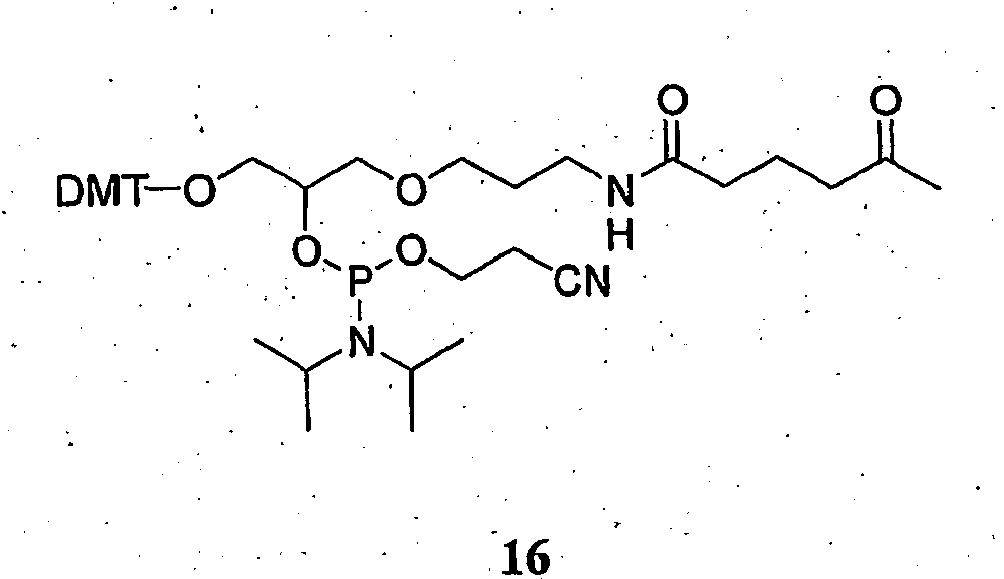
- Synthesis was performed as shown in
Scheme 2 ofFIG. 2 . - N-Fmoc-3-aminopropyl solketal (10): 3-Aminopropyl solketal (9) was synthesized starting from commercially available solketal (7) according to the procedure of Misiura et al (Misiura, K., Durrant, I., Evans, M.R., Gait, M.J. (1990) Nucleic Acids Research, v. 18, No. 15, pp. 4345-4354, which is incorporated herein by reference). (9) was used crude without vacuum distillation for the next step. The crude product (9) (12.85 g; 68 mmol) was dissolved in dry CH3CN (100 mL) with stirring. NaHCO3 (4.2 g; 50 mmol) was added followed by Fmoc-OSu (16.9 g; 50 mmol). The reaction mixture was stirred at room temperature overnight. The solvent was evaporated and the oily residue was partitioned between EtOAc (500 mL) and 5% NaHCO3 (150 mL). The organic layer was separated and washed with 5% NaHCO3 (2x150 mL), brine (150 mL), and dried over anhydrous. Na2SO4. The product (10) was isolated by flash chromatography on a silica gel column (5x20 cm) loading from EtOAc:CH2Cl2:petroleum ether (PE) (15:15:70) and eluting with EtOAc:CH2Cl2:PE (1:1:2). The isolated product (10) had Rf of 0.4 by TLC in EtOAc:CH2Cl2:PE (1:1:1). Yield: 20.95 g of oil. 1H NMR (CDCl3) δ 1.35 (s, 3H), 1.45 (s, 3H), 1.81 (m, 2H), 3.34 (q, 2H), 3.47-3.60 (m, 4H), 3.75 (dd, 1H), 4.07 (dd, 1H), 4.22-4.32 (m, 2H), 4.42 (d, 2H), 5.29 (br.t, 1H), 7.33 (dt, 2H), 7.42 (t, 2H), 7.62 (d, 2H). 7.78 (d, 2H).
- 1-O-(N-Fmoc 3-aminopropyl)glycerol (11): Crude compound (10) (5 g; 12.1 mmol) was dissolved in THF (15 mL) and treated with 2M HCl (5 mL). The resulting emulsion was shaken at room temperature with occasional sonication until it became homogeneous. It was then left at room temperature for additional hour. The reaction mixture was concentrated in vacuum, and the resulting oil was co-evaporated with absolute EtOH (3x20 mL). The reaction product (Rf of ∼0.3 in EtOAc:CH2Cl2:MeOH (10:10:1)) was isolated by silica gel chromatography (5x20 cm) using a gradient 0-5% MeOH in EtOAc:CH2Cl2 (1:1). Fractions containing pure product were pooled and concentrated to give oily residue, which crystallized upon vacuum drying. Yield: 2.64 g of a white solid (11). 1H NMR (DMSO-d6) δ 1.63 (m, 2H), 3.05 (q, 2H), 3.25-3.41 (m, 6H), 3.53-3.60 (m, 1H), 4.21 (t, 1H), 4.30 (d, 2H), 4.47 (t, 1H), 4.60 (d, 1H), 7.27 (t, 1H), 7.33 (dt, 2H), 7.42 (t, 2H), 7.69 (d, 2H), 7.89 (d, 2H).
- 1-O-DMT-3-O-(N-Fmoc-3-aminopropyl)glycerol (12): 1-O-(N-Fmoc-3-aminopropyl) glycerol (11) (2.64 g; 7.1 mmol) was dissolved in dry pyridine (50 mL) and treated with DMT-Cl (2.65 g; 7.8 mmol). The reaction mixture was stirred at room temperature overnight and quenched with MeOH (5 mL). It was then concentrated to oil under reduced pressure. The residue was dissolved in EtOAc (∼300 mL) and extracted with saturated NaHCO3 (3x100 mL) followed by brine (100 mL). The organic phase was separated, dried over anhydrous Na2SO4 and concentrated to oil. The product (12) was isolated by silica gel chromatography using a gradient 33-66% EtOAc in petroleum ether ("PE"). Yield: 4.03 g (84%) of white foam (12). TLC showed one spot at Rf -0.6 in EtOAc:PE (2:1). 1H NMR (CDCl3) δ 1.68-1.80 (m, 2H), 2.57 (br d, 1H), 3.17-3.34 (m, 4H), 3.43-3.61, (m, 4H), 3.79 (s, 6H), 3.93-4.00 (m, 1H), 4.22 (t, 1H), 4.41 (d, 2H), 5.20 (br t, 1H), 6.82-6.86 (m, 4H), 7.21-7.46 (m, 13H), 7.61 (d, 2H), 7.77 (d, 2H).
- 1-O-DMT-3-O-(3-aminopropyl)glycerol (13): Compound (12) (3.82 g; 5.67 mmol) was dissolved in i-PrOH (100 mL) and sodium borohydride (4 g) was added in portions with stirring. The suspension was heated at 70°C for 2 hours. TLC analysis in EtOAc:TEA (99:1) revealed the disappearance of the starting material (Rf ∼0.75) and formation of deprotected product at the start. The reaction was carefully quenched with 10% sodium hydroxide (32 mL), transferred into a separatory funnel and partitioned with 300 mL of ethyl acetate. The organic phase was separated, washed with saturated NaHCO3 (3x100 mL) followed by brine (100 mL), and dried over sodium sulfate. It was then concentrated in vacuum to give oily residue, which was co-evaporated with dry acetonitrile (50 mL). This crude material (13) was used in the next step without further purification.
- Pentafluorophenyl 5-oxohexanoate (14): 5-Oxohexanoic acid (2.6 g; 20 mmol) was dissolved in CH2Cl2 (50 mL). N, N-Diisopropylethylamine (10.4 mL, 60 mmol) was added followed by pentafluorophenyl trifluoroacetate (3.61 mL; 21 mmol). The reaction mixture was kept at room temperature for 1 hour and evaporated. The residue was resuspended in EtOAc:Hexanes (1:1) and loaded on a silica gel column (5x20 cm) equilibrated and developed with the same mixture. Fractions containing the product (14) (Rf∼0.7) were pooled and concentrated to give 4.7 g (79%) of yellowish oil after drying in vacuum. 1H NMR (CDCl3) δ 2.05 (m, 2H), 2.18 (s, 3H), 2.61 (t, 2H), 2.74 (t, 2H).
- 1-O-DMT-3-O-(N-(5-oxohexanoyl)-3-aminopropyl)glycerol (15): The crude product (13) was dissolved in dry CH3CN (50 mL) and treated with N,N-diisopropylethylamine (2.6 mL, 15 mmol) and (14) (1.68 g, 5.67 mmol). The mixture was allowed to react at room temperature for 2 hours. The reaction mixture was evaporated in vacuum and the residue was reconstituted in EtOAc (50 mL). The product was isolated by silica gel chromatography (4x25 cm) loading from 1% triethylamine (TEA) in EtOAc and eluting with MeOH:EtOAc:TEA (5:95:1). Fractions containing a single component (Rf 0.35) were pooled and concentrated in vacuum to yield the title compound (15) (2.70 g, 85%) as slightly orange oil. 1H NMR (DMSO-d6) δ 1.60 (m, 2H), 1.66 (m, 2H), 2.03 (t, 2H), 2.05 (s, 3H), 2.40 (t, 2H), 2.94 (d, 2H), 3.04 (q, 2H), 3.35-3.46 (m, 4H), 3.72-3.79 (m, 7H; OCH3 singlet at 3.74), 4.84 (d, 1H), 6.88 (d, 4H), 7.19-7.42 (m, 9H), 7.72 (t, 1H).
- 1-O-DMT-3-O-(N-(5-oxohexanoyl)-3-aminopropyl)glycerol 2-O-(N,N-diisopropyl-(2-cyanoethyl)phosphoramidite) (16): Alcohol (15) (1.35 g, 2.4 mmol) and diisopropylammonium tetrazolide (206 mg, 1.2 mmol) were dissolved in anhydrous CH3CN (30 mL) under argon atmosphere. 2-Cyanoethyl N,N,N',N'-tetraisopropylphosphoramidite (0.953 mL, 3.0 mmol) was added with stirring at room temperature, and the reaction mixture was stirred overnight. The solvent was evaporated, the residue was reconstituted in EtOAc (200 mL) and washed with saturated NaHCO3 (3x50 mL) followed with brine (50 mL). The organic layer was dried over anhydrous Na2SO4 and the solvent evaporated under reduced pressure. The oily residue was purified by silica gel chromatography eluting with EtOAc:TEA (95:5). Fractions containing pure product (16), which moves as a double spot on TLC (Rf∼0.55; EtOAc:TEA (95:5)), were pooled and concentrated in vacuum to give 1.74 g of colorless oil (16). 1H NMR (DMSO-d6) δ 1.01-1.17 (m, 12H), 1.56 (m, 2H), 1.66 (m, 2H), 2.02 (m, 2H), 2.05 (s, 3H), 2.39 (m, 2H), 2.65 (t, 1H), 2.77 (t, 1H), 2.97-3.16 (m, 4H), 3.36-3.81 (m, 15H; OCH3 singlets at 3.73 and 3.74), 6.88 (m, 4H), 7.19-7.44 (m, 9H), 7.69 (t, 1H). 31P NMR (DMSO-d6) δ 148.19 and 148.64.
-
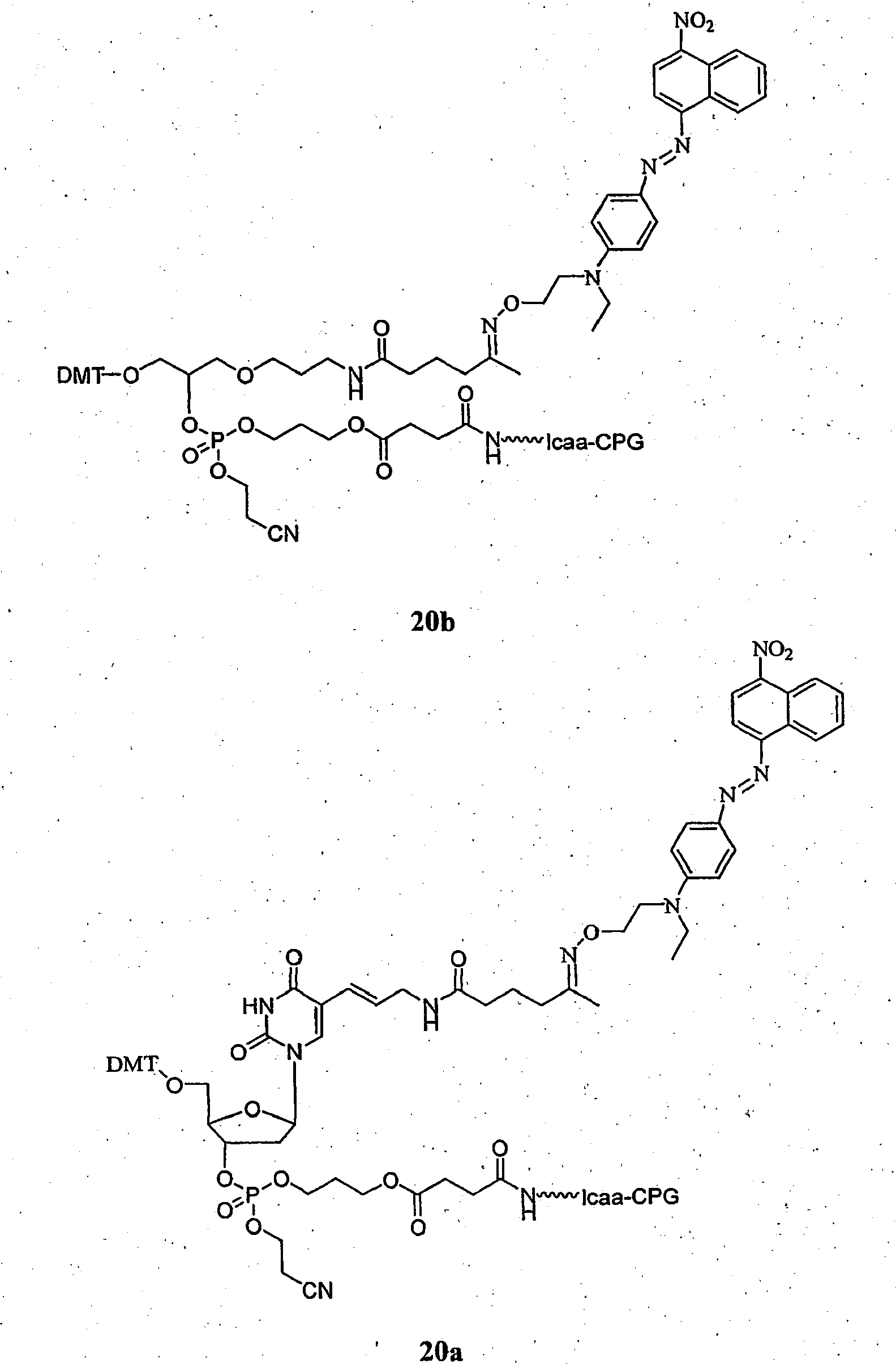
- Synthesis was performed as shown in
Scheme 3 inFIG. 3 . - Synthesis of ketone substituted controlled pore glass (CPG) supports: Spacer C3 CPG (2 g; 44 µmol/g) was placed in a 50 mL peptide synthesis reactor and detritylated by treating with several portions (30 mL) of 3% dichloroacetic acid in dichloromethane (until all the color was washed off the support). It was then washed with CH3CN (5x50 mL; least two times with anhydrous CH3CN) and "activator" (30 mL; 0.45 M 5-ethylthio-1H-tetrazole in anhydrous. CH3CN) under argon atmosphere. The CPG (18) was then treated with a solution of appropriate phosphoramidite (phosphoramidite (17a) which was synthesized according to published procedure: Dey, S. Shepard, T. (2001) Org Lett, v.3, pp. 3983-3986) which is incorporated herein by reference; (250 µmol) in 10 mL of anhydrous CH3CN mixed with 10 mL of "activator" at room temperature for 30 minutes under Ar purge. The reagents were removed by vacuum suction and replaced with a fresh portion. The coupling reaction was repeated; modified CPG was filtered off and washed with CH3CN (5x30 mL). The solid support was treated with 0.1 M I2 in THF/Py/H2O (3x30 mL; 5 minutes each treatment), and washed with CH3CN (5x30 mL). Unreacted hydroxyls were capped by treating with Ac2O:MeIm:Py (10:10:80) (3x30 mL; 5 minutes each treatment). The derivatized CPG (19a) was washed with CH3CN (5x30 mL), CH2Cl2 (3x30 mL), and dried in vacuum overnight. DMT-loading was usually above 30 µmol/g.
- Attachment of the quencher to ketone substituted support: To the solution of 10 mg quencher (6) was added 0.1 g ketone substituted support (19a) and incubated overnight at room temperature. The resulting support (20a) was filtered and washed with three 1 ml portions of acetonitrile and then used in oligonucleotide synthesis.
- This example demonstrates the signal to noise ratio (S:N) ratio of oligonucleotides containing both fluorescein and the azo quencher as prepared in Examples 1 through 3. Fluorescence-quenched probes are employed in a variety of applications in molecular biology. One method to assess if a given fluorophore and a quencher function well together is by measurement of a signal to noise ratio (S:N), where relative fluorescence is measured in the native configuration (background fluorescence or "noise") and compared with fluorescence measured when fluorophore and quencher are separated ("signal").
- Oligonucleotide Synthesis. The following oligonucleotides were synthesized using standard phosphoramidite chemistry and the aminooxy quencher reagents described in Example 3, supra. Oligonucleotides were purified by HPLC. Dual-labeled oligonucleotides were made with the novel aminooxy (1-nitro-4-naphthylazo)-N,N-diethanolaniline quencher (6) of the invention at the 3'-end of the probe with the fluorescein reporter group placed at the 5'end (6-FAM, single isomer 6-carboxyfluorescein, Glen Research, Sterling, VA). The same sequence was made using different methods of quencher attachment, including conjugation of the aminooxy quencher (6) post-synthetically (IBAOket), conjugation of the aminooxy quencher (6)-dU-CPG at the time of synthesis (IBAOdU, Formula V, supra), and conjugation of the aminooxy quencher (6)-ketone-CPG at the time of synthesis (IABAOC7, Formula (IV), supra). For comparison purposes, an oligonucleotide was made that incorporates a commercially available quenching group, Eclipse Quencher™-CPG (Epoch Biosciences, Bothell, WA). The Eclipse Quencher probe does not contain an aminooxy nucleophile. In order to make 3'- or internal FAM modification using ketone phosphoramidite (SEQ ID NO: 5), FAM-oxime conjugate has to be acetylated with acetic anhydride capping reagent prior following phosphoramidite cycle.
- Electrospray-ionization liquid chromatography mass spectroscopy (ESI-LCMS) of each oligonucleotide probe was performed using an Oligo HTCS system (Novatia, Princeton, NJ), which consisted of ThermoFinnigan TSQ7000, Xcalibur data system, ProMass data processing software and Paradigm MS4™ HPLC (Michrom BioResources, Auburn, CA). Protocols recommended by manufacturers were followed. Experimental molar masses for all compounds were within 0.02% of expected molar mass, confirming the identity of the compounds synthesized.
Table 2 Probe Sequence SEQ ID NO: 1 FAM-CCAGCGACCCTGATTATGGCCTCCCT-IBAOket SEQ ID NO: 2 FAM-CCAGCGACCCTGATTATGGCCTCCCT-IBAOdU SEQ ID NO: 3 FAM-CCAGCGACCCTGATTATGGCCTCCCT-IBAOC7 SEQ ID NO: 4 FAM-CCAGCGACCCTGATTATGGCCTCCCT-Eclipse - As representative of the final structure obtained using reagents outlined in Example 3 in oligonucleotide synthesis, the chemical linkage between aminooxy quencher and the 3'-end of oligonucleotide SEQ ID NO: 3 is shown below (Formula (VII)).

- Signal to Noise (S:N) Assay of Fluorescence-Quenched Linear Probes: Oligonucleotides were evaluated for quenching efficiency in a pre- and post-nuclease degradation assay. Probe oligonucleotides (SEQ ID NOS: 1-4) were individually resuspended at 100 nM concentration in HPLC-grade water. From this stock solution, 2 ml of 100 nM probe solution was prepared with STNR Buffer, comprising 10 mM Tris pH 8.3, 50 mM KCl, 5 mM MgCl2, 1 mM CaCl2, which was split into two identical 1 mL fractions. One fraction was retained without enzyme treatment as background control. The second fraction was subjected to nuclease degradation as follows. Micrococcal nuclease, 15 units (Roche, 15U/ul), was added to the oligonucleotide solution and incubated at 37°C for 1 hour. Relative fluorescence intensity for each sample was measured with a PTI QuantaMaster Model C-60 cuvette-based spectrofluorometer (Photon Technology International, Monmouth Jct., NJ). The fluorescence measurement of the solution containing intact probe constituted the "background" or "noise" component of the assay. The fluorescence measurement of the solution containing degraded probe (nuclease treated) constituted the "signal" component of the assay. Signal to noise ratios (S:N) were calculated.
Table 3: Signal to Noise ratios for Fluorescence-Quenched Linear Oligonucleotides. Probe ID Dye/Quencher 5'—3' RFU Background RFU Signal S:N Ratio SEQ ID NO: 1 FAM-IBAOket 9.35E+05 7.25E+06 8 SEQ ID NO:2 FAM-IBAOdU 6.32E+05 9.13E+06 14 SEQ ID NO: 3 FAM-IBAOC7 4.85E+05 8.06E+06 17 SEQ ID NO:4 FAM-Eclipse 8.99E+05 1.19E+07 15 RFU = relative fluorescence units - As shown in Table 3, the novel aminooxy attached quenchers (6) are capable of quenching a fluorescein with similar efficiency as a commonly employed commercially available quencher group.
- Fluorescence-quenched probes can be employed to detect a target nucleic acid sequence. Commonly, such detection is linked to an amplification step, such as the polymerase chain reaction (PCR). This example demonstrates that use of fluorescent probes modified with aminooxy quenchers function in a relevant application, a real-time PCR assay.
- Oligonucleotide primers were synthesized using standard phosphoramidite chemistry, desalted, and employed without additional purification. Probe oligonucleotides employed are the same compounds studied in Example 4 supra, SEQ ID NOS: 1-4. Primers employed are:
- Forward Primer: HP48 For
AGAAGGTCATCATCTGCCATCG SEQ ID NO: 5 - Reverse Primer: HP48 Rev
TCCAGACTTTGGCTGTTCGGAT SEQ ID NO: 6 - The target nucleic acid is SEQ ID NO: 7, a 150 base pair (bp) amplicon derived from the human bHLH protein PTF1A gene (Genbank # NM_178161), cloned into the pCRII-TOPO vector (Invitrogen, Carlsbad, CA), and is hereafter referred to as the "p48-gene target".
- Target Nucleic Acid Sequence:

- PCR amplification was done using the thermostable DNA polymerase Immolase™ (Bioline, Randolph, MA), 800 uM dNTPs, and 3 mM MgCl2. Reactions were carried out in a 25 µL volume and comprised 200 nM each of the amplification primers and fluorescent quenched probe, 500, 50,000 and 5,000,000 copies of target DNA. Cycling conditions were 50° C for 2 min, 95° C for 10 min, then 40 cycles of 2-step PCR with 95° C for 15 sec and 60° C for 1 min. PCR and fluorescence measurements were done using an ABI Prism™ 7700 Sequence Detector (Applied Biosystems Inc., Foster City, CA). All data points were performed in triplicate. The cycle threshold (Ct) value is defined as the cycle at which a statistically significant increase in fluorescence is detected above background. A lower Ct value is indicative of a higher concentration of target DNA. The assays were performed using an identical amount of input target DNA (5 x 10²-5x10⁴-5x10⁶ copies of the PTF1a p48-gene target plasmid). Relative fluorescence levels collected during PCR for each probe were graphically plotted against cycle number and are shown in
FIGS. 1-5 . - The multicomponent view of a 40-cycle real-time PCR reaction using probe SEQ ID NO: 1, which incorporates the aminooxy (1-nitro-4-naphthylazo)-N,N-diethanolaniline quencher (6) attached post-synthetically (IBAOket), is shown in
FIG. 6 . The fluorescence baseline remained flat untilcycle 18, when product first reached detectable levels as a result of PCR amplification. The oxime bond was stable in the employed reaction conditions and no elevation of baseline background fluorescence was observed. The oxime bond is therefore suitable for use in these reaction conditions, which are similar to conditions commonly employed in many molecular biology applications. - Amplification traces for probe SEQ ID NO: 1, which incorporates the aminooxy (1-nitro-4-naphthylazo)-N,N-diethanolaniline quencher (6) attached post-synthetically (IBAOket), are shown in
FIG. 6 . The results showed good clustering of triplicate reactions and clearly distinguished between different input concentrations of the target nucleic acid. - Amplification traces for probe SEQ ID NO: 2, which incorporates the aminooxy (1-nitro-4-naphthylazo)-N,N-diethanolaniline quencher (6) attached during synthesis as a CPG conjugate via a dU base linkage (IBAOdU), is shown in
FIG. 7 . The results showed good clustering of triplicate reactions and clearly distinguished between different input concentrations of the target nucleic acid. - Amplification traces for probe SEQ ID NO: 3, which incorporates the aminooxy (1-nitro-4-naphthylazo)-N,N-diethanolaniline quencher attached during synthesis as a CPG conjugate via direct linkage to the 3'-end of the oligonucleotide (IBAOC7), are shown in
FIG. 8 . The results showed good clustering of triplicate reactions and clearly distinguished between different input concentrations of the target nucleic acid. - Amplification traces for probe SEQ ID NO: 4, which incorporates commercial Eclipse Quencher attached during synthesis as a CPG conjugate via direct linkage to the 3'-end of the oligonucleotide (Eclipse), are shown in
FIG. 9 . The results showed good clustering of triplicate reactions and clearly distinguished between different input concentrations of the target nucleic acid. - The real-time PCR results for all 4 probes were plotted together for a single target concentration, 5 x 10⁶ and are shown in
FIG. 10 . The absolute change in fluorescence (ΔRf) varied between probes. This typically results from variable quality of purification at the time of synthesis. Actual sensitivity to quantitative detection of the input target nucleic acid was nearly identical between probes and quenchers employed. - Table 4 summarizes the real-time PCR results and demonstrates that all oligonucleotides provided similar Ct values regardless of method of quencher attachment and functioned with similar performance in this application.
Table 4. Relative Ct Values for Probes SEQ ID NOS: 1-4 in Real Time PCR Assay. Probe Ave. Ct Target 5 x 10⁶ Ave. Ct Target 5 x 10⁴ Ave. Ct Target 5 x 10² SEQ ID NO: 1 17.9 25.3 31.4 SEQ ID NO: 2 17.1 24.5 30.5 SEQ ID NO: 3 17.2 24.3 30.8 SEQ ID NO: 4 16.9 24.0 30.1 - As shown in Table 4, probe compositions comprising the new aminooxy (1-nitro-4-naphthylazo)-N,N-diethanolaniline quencher (6)of the invention performed well in a quantitative real-time PCR assay and were functionally interchangeable with probes that contain other quencher moieties.
- Quencher groups are commonly placed at the end of a probe sequence for ease of synthesis. The new aminooxy quencher permits internal incorporation of quencher as a base modified aminooxy quencher-dU moiety. This example demonstrates that use of fluorescent probes modified with internal aminooxy-quenchers function better in a real-time PCR assay than standard end-quenched probes.
- Dual-labeled oligonucleotides with internal modifications (SEQ ID NOS: 12-14) were made using ketone-dU phosphoramidite (synthesized according to published procedure: Dey & Shepard, (2001) Org. Lett., v.3, pp. 3983-3986, which is incorporated by reference herein) followed by interconjugation with 300 µL of 10 mM solution (per 1 µmole of the oligonucleotide on the solid supprt) of the aminooxy-quencher reagent (6) in ethanol at the time of synthesis. After 2 hours, excess aminooxy-quencher was removed, the solid support was washed with 1 mL of acetonitrile and the oligonucleotide was extended using standard phosphoramidite chemistry.
- Oligonucleotide primers were synthesized using standard phosphoramidite chemistry, desalted, and were used in the assay without additional purification. Primer and probe oligonucleotides employed are shown below. Probes with internal quencher modifications had a C3 spacer group placed at the 3'-end in place of the quencher group to block extension during PCR. Oligonucleotides were synthesized as described above.
Table 5 Sequence SEQ ID NO: 5' FAM-ATGGCGGTTCTCATGCTGGCAAC-IBAOC7 3' SEQ ID NO: 11 5' FAM-ATGGCGGT(iIBAOdU)CTCATGCTGGCAAC-C3sp 3' SEQ ID NO: 12 5' FAM-ATGGCGGTT(iIBAOdU)TCATGCTGGCAAC-C3sp 3' SEQ ID NO: 13 5' FAM-ATGGCGGTTCTC(iIBAOdU)TGCTGGCAAC-C3sp 3' SEQ ID NO: 14 5' AACTCTGAAGTCATCCTGCCAGTC 3' SEQ ID NO: 8 5' CTTCAGGTTGTGGTAAACCTCTGC 3' SEQ ID NO: 9 - The forward and reverse primers are shown in SEQ ID NOS: 8 and 9. Internal aminooxy-quencher-dU is notated by (iIBAOdU). SEQ ID NO: 11 represents a traditional probe with 3'-terminal quencher placement. SEQ ID NO: 12 has an internal aminooxy-quencher-dU substitution for an internal dT base at position 9 from the 5'-end. SEQ ID NO: 13 has an internal aminooxy-quencher-dU substitution for an internal dC base at
position 10 from the 5'-end, which results in a favorable U:G base pairing event upon hybridization. SEQ ID NO: 14 has an internal aminooxy-quencher-dU substitution for an internal dA base atposition 13 from the 5'-end, which results in an unfavorable U:T base pairing event upon hybridization. The aminooxy-quencher-dU base is compound (20a_. - The target nucleic acid is SEQ ID NO: 10, a 162 base pair (bp) amplicon derived from the human Enolase gene (Genbank # NM_001428), cloned into the pCRII-TOPO vector (Invitrogen, Carlsbad, CA), and is hereafter referred to as the "hEnolase-gene target".
- Target Nucleic Acid Sequence:

- PCR amplification was performed using the thermostable DNA polymerase Immolase™ (Bioline, Randolph, MA), 800 uM dNTPs, and 3 mM MgCl2. Reactions were carried out in a 25 µL volume and comprised 200 nM each of the amplification primers and fluorescent quenched probe, 500, 50,000 and 5,000,000 copies of target DNA. Cycling conditions were 50° C for 2 min, 95° C for 10 min, then 40 cycles of 2-step PCR with 95° C for 15 sec and 65° C for 1 min. PCR and fluorescence measurements were done using an ABI Prism™ 7700 Sequence Detector (Applied Biosystems Inc., Foster City, CA). All data points were performed in triplicate. The cycle threshold (Ct) value is defined as the cycle at which a statistically significant increase in fluorescence is detected above background. A lower Ct value is indicative of a higher concentration of target DNA. The assays were performed using an identical amount of input target DNA (5 x 10²-5x10⁴-5x10⁶ copies of the hEnolase-gene target plasmid). Relative fluorescence levels collected during PCR for each probe were graphically plotted against cycle number. The real-time PCR results for all 4 probes are plotted together for a single target concentration, 5 x 10⁶ and are shown in
FIG. 12 . The absolute change in fluorescence (ΔRf) varied noticeably between probes. In this case, probes had similar quality and the differences in fluorescence relates to different potency of quenching that varies with quencher placement. Actual sensitivity to quantitative detection of the input target nucleic acid varied between probes and is quantified in Table 6 below.Table 6. Relative Ct Values for Probes SEQ ID NOS: 10-13 in Real Time PCR Assay. Probe Ave. Ct Target 5 x 10⁶ Ave. Ct Target 5 x 10⁴ Ave. Ct Target 5 x 10² SEQ ID NO: 11 19.8 26.5 33.3 SEQ ID NO: 12 18.6 25.4 32.2 SEQ ID NO: 13 19.1 25.8 32.6 SEQ ID NO: 14 19.1 25.7 32.6 - Probe compositions comprising the new aminooxy (1-nitro-4-naphthylazo)-N,N-diethanolaniline quencher (6) placed internally on a dU base show superior properties in a real-time PCR assay compared with standard 3'-quencher probes. Detection limits were improved by ∼1 Ct value, which corresponds to about double detection sensitivity.
- This example shows an absorbance spectrum of an oligonucleotide modified at its 5'terminus to contain the azoquencher (6). The oligonucleotide was made using standard automated phosphoramidite nucleotide synthetic methods where the last addition cycle was carried out with the molecule (6). The composition of the oligonucleotide is shown below.
- SEQ ID NO: 15 (Azo-Quencher)-CAGAGTACCTGA
- Once synthesized, the oligonucleotide was suspended in HPLC-grade water at 400 nM concentration. Optical absorbance was measured in 10 mM Tris pH 8.0, 1 mM EDTA (TE buffer) with a sub-micro quartz cuvette with 1-cm path length in a Hewlett Packard Model 8453 spectrophotometer (Hewlett Packard, Palo Alto, CA). Absorbance density was recorded from 220 nm to 700 nm and is shown in
FIG. 13 . - As shown in
FIG. 13 , the absorbance spectrum was broad, ranging from 420 to 620 nm, with peak absorbance at 531 nm. This absorbance range overlaps with the fluorescence emission of a wide variety of fluorophores commonly used in molecular biology applications. For FRET based quenching mechanisms, this spectrum is positioned to offer maximum quenching capacity for dyes in the spectral range of fluorescein. - The aminooxy group is introduced to a reporter moiety via the Mitsunobu reaction between alcohol (21) and N-ydroxyphthalimide followed by phthalimide hydrolysis. (
Scheme 4 inFIG. 4 ). - This method can be used for derivatization of fluorophores, quenchers, biotin, peptides and other reporter moieties stable to basic conditions.
- In case of base labile molecules, such as some peptides, proteins, reporter moieties having alkylamino function, the aminooxy group is introduced by reaction with corresponding NHS ester (28), followed by removal of acid liable MMT group. (
Scheme 5 inFIG. 5 ). - The use of the terms "a" and "an" and "the" and similar references in the context of describing the invention (especially in the context of the following claims) are to be construed to cover both the singular and the plural, unless otherwise indicated herein or clearly contradicted by context. The terms "comprising," "having," "including," and "containing" are to be construed as open-ended terms (i.e., meaning "including, but not limited to,") unless otherwise noted. Recitation of ranges of values herein are merely intended to serve as a shorthand method of referring individually to each separate value falling within the range, unless otherwise indicated herein, and each separate value is incorporated into the specification as if it were individually recited herein. All methods described herein can be performed in any suitable order unless otherwise indicated herein or otherwise clearly contradicted by context. The use of any and all examples, or exemplary language (e.g., "such as") provided herein, is intended merely to better illuminate the invention and does not pose a limitation on the scope of the invention unless otherwise claimed. No language in the specification should be construed as indicating any non-claimed element as essential to the practice of the invention.
Claims (18)
- A method for linking a reporter moiety to an oligonucleotide comprising reacting a reporter moiety having an oxime forming nucleophile substituent with an oxo substituted reactant coupled to a solid support to form an oxime bond between the reporter moiety and the reactant, wherein the reporter moiety is

- A compound

- A composition comprising a labeled oligonucleotide comprising a compound according to claim 2 linked to a nucleotide of the labeled oligonucleotide through an oxime bond.
- The composition of claim 3, wherein the oligonucleotide is linked to a solid support at its 3' end.
- The composition of claim 3, wherein the reporter moiety is linked to a 3' end of the oligonucleotide.
- The composition of claim 3, wherein the reporter moiety is linked to a 5' end of the oligonucleotide.
- The composition of claim 3, wherein the reporter moiety is linked to an internal nucleotide.
- A composition comprising a dye pair comprising a fluorophore and a compound of claim 2 linked to an oligonucleotide through an oxime bond; and wherein the fluorophore is attached to the same oligonucleotide or to a different oligonucleotide.
- The composition of claim 8, wherein the fluorophore is fluorescein.
- A composition, comprising:
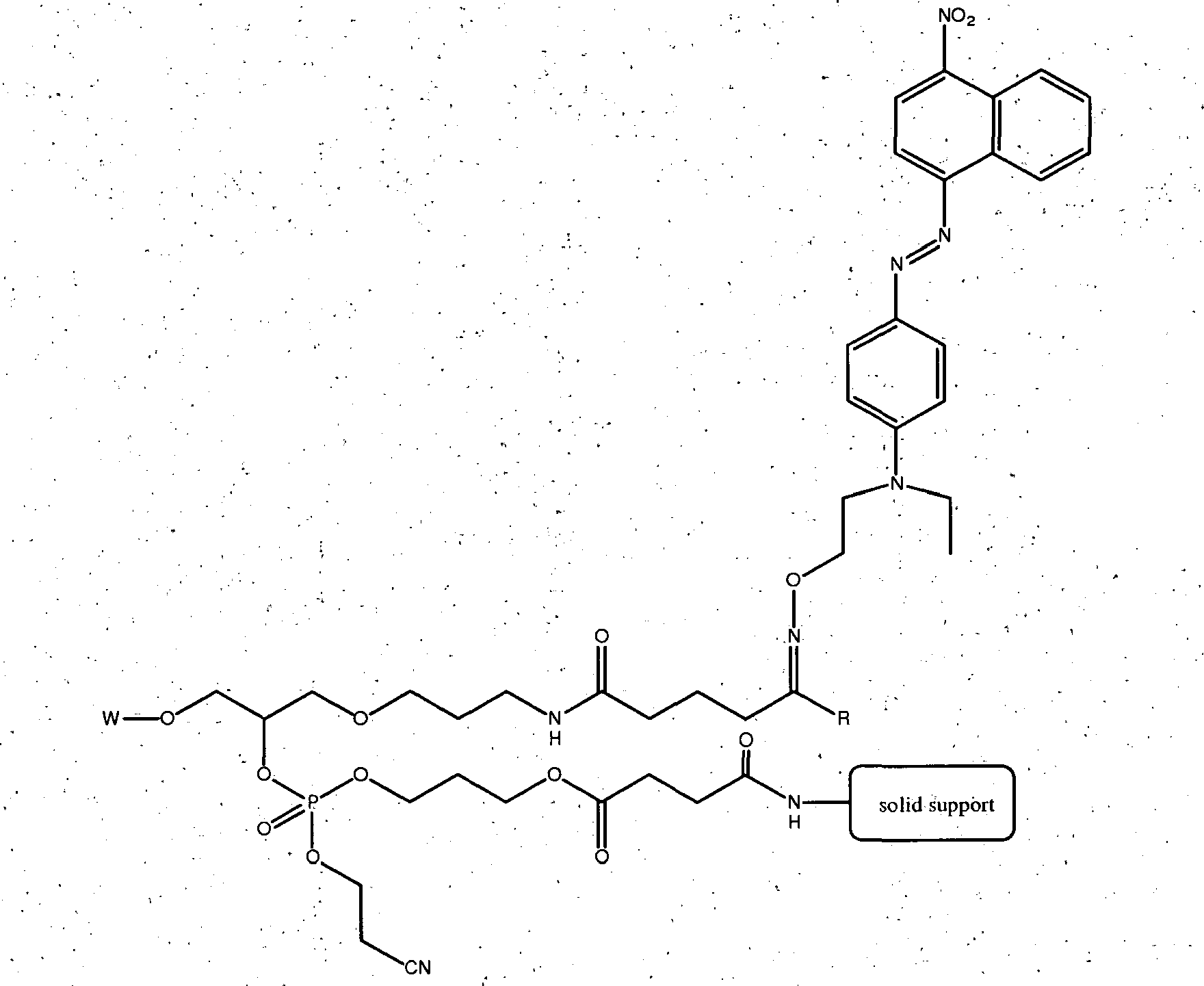
- A composition comprising:

- The composition of claim 11, wherein the nucleobase is selected from the group consisting of adenine, guanine, cytosine, uracil and thymine.
- The composition of claim 12, wherein the nucleobase is uracil.
- A method for detecting the hybridization of oligonucleotides comprising:a) incubating a first oligonucleotide with a second oligonucleotide, the second oligonucleotide comprising a quencher compound of claim 2 linked to a nucleotide through an oxime bond, wherein at least one of the two oligonucleotides comprises a fluorophore with fluorescence that can be quenched by the quencher compound of claim 2, and wherein hybridization of the first and second nucleotides alters the spatial relationship of the fluorophore and the quencher compound of claim 2 resulting in a change in fluorescence; andb) measuring the fluorescence of incubated nucleotides.
- The method of claim 14, wherein the fluorophore and the quencher compound are both linked to the second oligonucleotide.
- The method of claim 14, further comprising releasing one of the fluorophore and the quencher compounds from the hybridized structure.
- A kit comprising the composition of claim 3.
- The kit of claim 17, further comprising instructions for the use of the composition:
Applications Claiming Priority (2)
| Application Number | Priority Date | Filing Date | Title |
|---|---|---|---|
| US68327805P | 2005-05-20 | 2005-05-20 | |
| PCT/US2006/019552 WO2006127507A2 (en) | 2005-05-20 | 2006-05-22 | Compounds and methods for labeling oligonucleotides |
Publications (3)
| Publication Number | Publication Date |
|---|---|
| EP1907560A2 EP1907560A2 (en) | 2008-04-09 |
| EP1907560A4 EP1907560A4 (en) | 2011-04-13 |
| EP1907560B1 true EP1907560B1 (en) | 2013-01-23 |
Family
ID=37452651
Family Applications (1)
| Application Number | Title | Priority Date | Filing Date |
|---|---|---|---|
| EP06770717A Not-in-force EP1907560B1 (en) | 2005-05-20 | 2006-05-22 | Compounds and methods for labeling oligonucleotides |
Country Status (6)
| Country | Link |
|---|---|
| US (6) | US7476735B2 (en) |
| EP (1) | EP1907560B1 (en) |
| JP (1) | JP2008545659A (en) |
| AU (1) | AU2006251637B2 (en) |
| CA (1) | CA2601554A1 (en) |
| WO (1) | WO2006127507A2 (en) |
Cited By (1)
| Publication number | Priority date | Publication date | Assignee | Title |
|---|---|---|---|---|
| US9540515B2 (en) | 2003-11-14 | 2017-01-10 | Integrated Dna Technologies, Inc. | Fluorescence quenching azo dyes, their methods of preparation and use |
Families Citing this family (33)
| Publication number | Priority date | Publication date | Assignee | Title |
|---|---|---|---|---|
| US7019129B1 (en) * | 2000-05-09 | 2006-03-28 | Biosearch Technologies, Inc. | Dark quenchers for donor-acceptor energy transfer |
| US7803536B2 (en) * | 2002-09-20 | 2010-09-28 | Integrated Dna Technologies, Inc. | Methods of detecting fluorescence with anthraquinone quencher dyes |
| EP1907560B1 (en) | 2005-05-20 | 2013-01-23 | Integrated DNA Technologies, Inc. | Compounds and methods for labeling oligonucleotides |
| GB0601302D0 (en) * | 2006-01-23 | 2006-03-01 | Semikhodskii Andrei | Diagnostic methods and apparatus |
| WO2007106907A2 (en) * | 2006-03-15 | 2007-09-20 | Integrated Dna Technologies, Inc. | Nucleic acid monomers with 2'-chemical moieties |
| AU2007225038B2 (en) | 2006-03-15 | 2013-08-29 | Revvity Health Sciences, Inc. | Integrated nucleic acid assays |
| US8759508B2 (en) | 2007-05-18 | 2014-06-24 | Ge Healthcare Dharmacon, Inc. | Chromophoric silyl protecting groups and their use in the chemical synthesis of oligonucleotides |
| JP5432154B2 (en) | 2007-09-28 | 2014-03-05 | スリーエム イノベイティブ プロパティズ カンパニー | Double oligonucleotide method for nucleic acid detection |
| EP2085434A1 (en) * | 2008-01-11 | 2009-08-05 | Universita' Degli Studi di Firenze | Disperse dyes soluble in water |
| WO2009124150A2 (en) * | 2008-04-01 | 2009-10-08 | Biosearch Technologies, Inc. | Stabilized nucleic acid dark quencher-fluorophore probes |
| US9155471B2 (en) | 2009-05-27 | 2015-10-13 | Lumicell, Inc'. | Methods and systems for spatially identifying abnormal cells |
| KR101851117B1 (en) | 2010-01-29 | 2018-04-23 | 마이크로닉스 인코포레이티드. | Sample-to-answer microfluidic cartridge |
| US8916345B2 (en) | 2010-03-26 | 2014-12-23 | Integrated Dna Technologies, Inc. | Methods for enhancing nucleic acid hybridization |
| US9506057B2 (en) | 2010-03-26 | 2016-11-29 | Integrated Dna Technologies, Inc. | Modifications for antisense compounds |
| EP2614149B1 (en) | 2010-09-07 | 2015-04-08 | Integrated Dna Technologies, Inc. | Modifications for antisense compounds |
| US9314304B2 (en) | 2010-12-08 | 2016-04-19 | Lumicell, Inc. | Methods and system for image guided cell ablation with microscopic resolution |
| EP2751567B1 (en) * | 2011-09-01 | 2019-05-08 | University of Iowa Research Foundation | Oligonucleotide-based probes for detection of bacterial nucleases |
| EP2881385A4 (en) * | 2012-08-02 | 2016-06-29 | Bioneer Corp | NOVEL AZO COMPOUND, USE THEREOF AND PREPARATION METHOD THEREOF |
| WO2014030066A2 (en) | 2012-08-22 | 2014-02-27 | Bernitz Mats Nilsson | Methods for identifying nucleic acid sequences |
| US20150346097A1 (en) | 2012-12-21 | 2015-12-03 | Micronics, Inc. | Portable fluorescence detection system and microassay cartridge |
| WO2014100743A2 (en) | 2012-12-21 | 2014-06-26 | Micronics, Inc. | Low elasticity films for microfluidic use |
| KR102102123B1 (en) | 2012-12-21 | 2020-04-20 | 퍼킨엘머 헬스 사이언시즈, 아이엔씨. | Fluidic circuits and related manufacturing methods |
| EP2959000B1 (en) * | 2013-02-25 | 2018-08-15 | Integrated DNA Technologies Inc. | Naphthyl-azo modifications for antisense compounds |
| EP4449997A3 (en) * | 2013-03-14 | 2025-01-15 | Lumicell, Inc. | Medical imaging device and methods of use |
| AU2014262710B2 (en) | 2013-05-07 | 2019-09-12 | Revvity Health Sciences, Inc. | Methods for preparation of nucleic acid-containing samples using clay minerals and alkaline solutions |
| EP2994543B1 (en) | 2013-05-07 | 2018-08-15 | Micronics, Inc. | Device for preparation and analysis of nucleic acids |
| EP2994750B1 (en) | 2013-05-07 | 2020-08-12 | PerkinElmer Health Sciences, Inc. | Microfluidic devices and methods for performing serum separation and blood cross-matching |
| CA2939124C (en) | 2014-02-07 | 2023-08-29 | University Of Iowa Research Foundation | Oligonucleotide-based probes and methods for detection of microbes |
| US9957393B2 (en) | 2015-03-30 | 2018-05-01 | Enzo Biochem, Inc. | Monoazo dyes with cyclic amine as fluorescence quenchers |
| MY181693A (en) | 2015-04-15 | 2021-01-01 | Biosearch Tech Inc | Dual quencher probes |
| WO2019067711A1 (en) | 2017-09-29 | 2019-04-04 | University Of Iowa Research Foundation | Digital nuclease detection compositions and methods |
| CN116096884A (en) | 2020-04-22 | 2023-05-09 | 哈佛大学校长及研究员协会 | Isothermal methods, compositions, kits and systems for detecting nucleic acids |
| WO2023086970A2 (en) | 2021-11-12 | 2023-05-19 | Arna Genomics Us Incorporated | Methods and compositions for analyzing nucleic acids and nucleases in a body fluid as indicators of disease |
Family Cites Families (107)
| Publication number | Priority date | Publication date | Assignee | Title |
|---|---|---|---|---|
| US2264303A (en) | 1940-03-27 | 1941-12-02 | Eastman Kodak Co | Azo compounds and material colored therewith |
| US3407189A (en) | 1956-07-25 | 1968-10-22 | Sandoz Ltd | Water-insoluble monoazo dyestuffs |
| US3218309A (en) * | 1961-08-14 | 1965-11-16 | Parke Davis & Co | Azo compounds |
| GB1394368A (en) | 1972-12-14 | 1975-05-14 | Ici Ltd | Disperse azo dyestuffs |
| US3970617A (en) | 1974-03-07 | 1976-07-20 | E. I. Du Pont De Nemours And Company | Navy-blue nitrophenylazonaphthylamino dyes |
| GB1533121A (en) | 1975-08-04 | 1978-11-22 | Ici Ltd | Disperse nitro disazo dyestuffs |
| DE2546535A1 (en) | 1975-10-17 | 1977-04-28 | Bayer Ag | AZO DYES |
| US4358535A (en) | 1980-12-08 | 1982-11-09 | Board Of Regents Of The University Of Washington | Specific DNA probes in diagnostic microbiology |
| US4439356A (en) | 1981-03-03 | 1984-03-27 | Syva Company | Unsymmetrical fluorescein derivatives |
| US4711955A (en) | 1981-04-17 | 1987-12-08 | Yale University | Modified nucleotides and methods of preparing and using same |
| CA1190838A (en) | 1981-07-17 | 1985-07-23 | Cavit Akin | Homogeneous nucleic acid hybridization diagnostics by non-radiative energy transfer |
| CA1180647A (en) | 1981-07-17 | 1985-01-08 | Cavit Akin | Light-emitting polynucleotide hybridization diagnostic method |
| CA1185177A (en) | 1981-07-17 | 1985-04-09 | Larry E. Morrison | Non-radiative energy transfer immunochemical technique |
| CA1223222A (en) | 1984-02-22 | 1987-06-23 | Nanibhushan Dattagupta | Immobilized nucleic acid-containing probes |
| US4683194A (en) | 1984-05-29 | 1987-07-28 | Cetus Corporation | Method for detection of polymorphic restriction sites and nucleic acid sequences |
| US4820630A (en) | 1984-11-23 | 1989-04-11 | Digene Diagnostics, Incorporated | Assay for nucleic acid sequences, particularly genetic lesions, using interactive labels |
| US4883750A (en) | 1984-12-13 | 1989-11-28 | Applied Biosystems, Inc. | Detection of specific sequences in nucleic acids |
| US4683195A (en) | 1986-01-30 | 1987-07-28 | Cetus Corporation | Process for amplifying, detecting, and/or-cloning nucleic acid sequences |
| US4683202A (en) | 1985-03-28 | 1987-07-28 | Cetus Corporation | Process for amplifying nucleic acid sequences |
| DE3526565A1 (en) | 1985-07-25 | 1987-02-05 | Boehringer Mannheim Gmbh | RESORUFIN DERIVATIVES, METHOD FOR THE PRODUCTION THEREOF AND THEIR USE IN FLUORESCENT IMMUNOASSAYS |
| US5011769A (en) | 1985-12-05 | 1991-04-30 | Meiogenics U.S. Limited Partnership | Methods for detecting nucleic acid sequences |
| US4868105A (en) | 1985-12-11 | 1989-09-19 | Chiron Corporation | Solution phase nucleic acid sandwich assay |
| US4996143A (en) | 1985-12-23 | 1991-02-26 | Syngene, Inc. | Fluorescent stokes shift probes for polynucleotide hybridization |
| US4868103A (en) | 1986-02-19 | 1989-09-19 | Enzo Biochem, Inc. | Analyte detection by means of energy transfer |
| GB8612087D0 (en) | 1986-05-19 | 1986-06-25 | Ici Plc | Hybridisation probes |
| US4889818A (en) | 1986-08-22 | 1989-12-26 | Cetus Corporation | Purified thermostable enzyme |
| JP2527340B2 (en) | 1986-12-15 | 1996-08-21 | アプライド バイオシステムズ インコーポレイテッド | 5- and 6-succinimidyl carboxylate isomers of rhodamine dyes |
| US6270961B1 (en) | 1987-04-01 | 2001-08-07 | Hyseq, Inc. | Methods and apparatus for DNA sequencing and DNA identification |
| US5202231A (en) | 1987-04-01 | 1993-04-13 | Drmanac Radoje T | Method of sequencing of genomes by hybridization of oligonucleotide probes |
| US5525464A (en) | 1987-04-01 | 1996-06-11 | Hyseq, Inc. | Method of sequencing by hybridization of oligonucleotide probes |
| US5585481A (en) | 1987-09-21 | 1996-12-17 | Gen-Probe Incorporated | Linking reagents for nucleotide probes |
| US4914210A (en) | 1987-10-02 | 1990-04-03 | Cetus Corporation | Oligonucleotide functionalizing reagents |
| US5124246A (en) | 1987-10-15 | 1992-06-23 | Chiron Corporation | Nucleic acid multimers and amplified nucleic acid hybridization assays using same |
| AU622426B2 (en) | 1987-12-11 | 1992-04-09 | Abbott Laboratories | Assay using template-dependent nucleic acid probe reorganization |
| DE68911648T2 (en) | 1988-03-24 | 1994-06-23 | Univ Iowa Res Found | CATALYTIC HYBRIDIZING SYSTEMS FOR DETECTING NUCLEIC ACID SEQUENCES BASED ON THEIR ACTIVITY AS COFACTORS IN CATALYTIC REACTIONS IN WHICH A COMPLEMENTARY, MARKED NUCLEIC ACID SAMPLE IS SPLIT. |
| EP0436547B1 (en) | 1988-05-10 | 1994-11-30 | E.I. Du Pont De Nemours And Company | Process for rapid nucleic acid detection |
| AU629845B2 (en) | 1988-08-30 | 1992-10-15 | Abbott Laboratories | Detection and amplification of target nucleic acid sequences |
| US5824796A (en) | 1988-09-28 | 1998-10-20 | Epoch Pharmaceuticals, Inc. | Cross-linking oligonucleotides |
| US5849482A (en) | 1988-09-28 | 1998-12-15 | Epoch Pharmaceuticals, Inc. | Crosslinking oligonucleotides |
| US5118801A (en) | 1988-09-30 | 1992-06-02 | The Public Health Research Institute | Nucleic acid process containing improved molecular switch |
| US5272259A (en) | 1988-12-23 | 1993-12-21 | Bayer Aktiengesellschaft | Stilbene dyestuffs and light-polarizing films or sheets containing stilbene |
| EP0472648A4 (en) | 1989-05-18 | 1992-09-16 | Microprobe Corporation | Crosslinking oligonucleotides |
| DE3916595A1 (en) | 1989-05-22 | 1990-11-29 | Boehringer Mannheim Gmbh | METHOD FOR NON-RADIOACTIVE MEASURING OF NUCLEIC ACID SYNTHESIS IN EUKARYONTIC CELLS |
| US5108892A (en) | 1989-08-03 | 1992-04-28 | Promega Corporation | Method of using a taq dna polymerase without 5'-3'-exonuclease activity |
| US5451463A (en) | 1989-08-28 | 1995-09-19 | Clontech Laboratories, Inc. | Non-nucleoside 1,3-diol reagents for labeling synthetic oligonucleotides |
| US5366860A (en) | 1989-09-29 | 1994-11-22 | Applied Biosystems, Inc. | Spectrally resolvable rhodamine dyes for nucleic acid sequence determination |
| US5188934A (en) | 1989-11-14 | 1993-02-23 | Applied Biosystems, Inc. | 4,7-dichlorofluorescein dyes as molecular probes |
| KR950013953B1 (en) | 1990-01-26 | 1995-11-18 | 애보트 래보라토리즈 | Method of amplifying target nucleic acids applicable to ligase chain reactions |
| US5214136A (en) * | 1990-02-20 | 1993-05-25 | Gilead Sciences, Inc. | Anthraquinone-derivatives oligonucleotides |
| DK0455905T3 (en) | 1990-05-11 | 1998-12-07 | Microprobe Corp | Dipsticks for nucleic acid hybridization assays and method for covalent immobilization of oligonucleotides |
| US5210015A (en) | 1990-08-06 | 1993-05-11 | Hoffman-La Roche Inc. | Homogeneous assay system using the nuclease activity of a nucleic acid polymerase |
| US5512667A (en) | 1990-08-28 | 1996-04-30 | Reed; Michael W. | Trifunctional intermediates for preparing 3'-tailed oligonucleotides |
| WO1992010588A1 (en) | 1990-12-06 | 1992-06-25 | Affymax Technologies N.V. | Sequencing by hybridization of a target nucleic acid to a matrix of defined oligonucleotides |
| EP0528512A1 (en) | 1991-08-20 | 1993-02-24 | Pioneer Electronic Corporation | Recording medium |
| US5565322A (en) | 1991-11-07 | 1996-10-15 | Nanogen, Inc. | Hybridization of polynucleotides conjugated with chromophores and fluorophores to generate donor-to donor energy transfer system |
| TW393513B (en) | 1991-11-26 | 2000-06-11 | Isis Pharmaceuticals Inc | Enhanced triple-helix and double-helix formation with oligomers containing modified pyrimidines |
| US5502177A (en) | 1993-09-17 | 1996-03-26 | Gilead Sciences, Inc. | Pyrimidine derivatives for labeled binding partners |
| US5538848A (en) | 1994-11-16 | 1996-07-23 | Applied Biosystems Division, Perkin-Elmer Corp. | Method for detecting nucleic acid amplification using self-quenching fluorescence probe |
| US5556752A (en) | 1994-10-24 | 1996-09-17 | Affymetrix, Inc. | Surface-bound, unimolecular, double-stranded DNA |
| DE19509038A1 (en) | 1995-03-14 | 1996-09-19 | Boehringer Mannheim Gmbh | C-nucleoside derivatives and their use in the detection of nucleic acids |
| US5801155A (en) | 1995-04-03 | 1998-09-01 | Epoch Pharmaceuticals, Inc. | Covalently linked oligonucleotide minor grove binder conjugates |
| US6312894B1 (en) | 1995-04-03 | 2001-11-06 | Epoch Pharmaceuticals, Inc. | Hybridization and mismatch discrimination using oligonucleotides conjugated to minor groove binders |
| DE69610304T2 (en) | 1995-05-05 | 2001-04-05 | Perkin-Elmer Corp., Foster City | METHODS AND REAGENTS FOR COMBINING A PCR AMPLIFICATION WITH A HYBRIDIZATION ASSAY |
| US6531589B1 (en) | 1995-06-01 | 2003-03-11 | Hybridon, Inc. | Base protecting groups and synthons for oligonucleotide synthesis |
| WO1996040662A2 (en) * | 1995-06-07 | 1996-12-19 | Cellpro, Incorporated | Aminooxy-containing linker compounds and their application in conjugates |
| US6147205A (en) * | 1995-12-15 | 2000-11-14 | Affymetrix, Inc. | Photocleavable protecting groups and methods for their use |
| US20010018514A1 (en) | 1998-07-31 | 2001-08-30 | Mcgall Glenn H. | Nucleic acid labeling compounds |
| GB9602265D0 (en) | 1996-02-05 | 1996-04-03 | Amersham Int Plc | Benzophenoxazine dyes |
| AU713667B2 (en) | 1996-04-12 | 1999-12-09 | Phri Properties, Inc. | Detection probes, kits and assays |
| US6582921B2 (en) | 1996-07-29 | 2003-06-24 | Nanosphere, Inc. | Nanoparticles having oligonucleotides attached thereto and uses thereof |
| US6576752B1 (en) * | 1997-02-14 | 2003-06-10 | Isis Pharmaceuticals, Inc. | Aminooxy functionalized oligomers |
| US6117973A (en) * | 1997-02-24 | 2000-09-12 | Georgia Tech Research Corp. | PNA monomers with electron donor or acceptor |
| US5846726A (en) | 1997-05-13 | 1998-12-08 | Becton, Dickinson And Company | Detection of nucleic acids by fluorescence quenching |
| US6465175B2 (en) | 1997-09-04 | 2002-10-15 | Bayer Corporation | Oligonucleotide probes bearing quenchable fluorescent labels, and methods of use thereof |
| NZ503765A (en) | 1997-09-12 | 2002-04-26 | Exiqon As | Bi-cyclic and tri-cyclic nucleotide analogues |
| US6485901B1 (en) | 1997-10-27 | 2002-11-26 | Boston Probes, Inc. | Methods, kits and compositions pertaining to linear beacons |
| US6007992A (en) | 1997-11-10 | 1999-12-28 | Gilead Sciences, Inc. | Pyrimidine derivatives for labeled binding partners |
| US6028183A (en) | 1997-11-07 | 2000-02-22 | Gilead Sciences, Inc. | Pyrimidine derivatives and oligonucleotides containing same |
| AU758463B2 (en) * | 1998-02-04 | 2003-03-20 | Applied Biosystems, Llc | Determination of a genotype of an amplification product at multiple allelic sites |
| DE19811618C1 (en) * | 1998-03-17 | 2000-08-31 | Andreas Jenne | DNA encoding ribozyme and an oligonucleotide substrate-containing composition and method for measuring transcription rates |
| US5952202A (en) | 1998-03-26 | 1999-09-14 | The Perkin Elmer Corporation | Methods using exogenous, internal controls and analogue blocks during nucleic acid amplification |
| US6127121A (en) | 1998-04-03 | 2000-10-03 | Epoch Pharmaceuticals, Inc. | Oligonucleotides containing pyrazolo[3,4-D]pyrimidines for hybridization and mismatch discrimination |
| US6117986A (en) | 1998-06-10 | 2000-09-12 | Intergen Company, L.P. | Pyrimidines linked to a quencher |
| ATE277065T1 (en) | 1999-01-05 | 2004-10-15 | Bio Merieux | FUNCTIONALIZED COMPOUND, OPTIONALLY LABELED POLYNUCLEOTIDES AND METHOD FOR DETECTING A TARGET NUCLEIC ACID |
| US6255476B1 (en) * | 1999-02-22 | 2001-07-03 | Pe Corporation (Ny) | Methods and compositions for synthesis of labelled oligonucleotides and analogs on solid-supports |
| ATE233795T1 (en) | 1999-04-23 | 2003-03-15 | Molecular Probes Inc | XANTHENE DYES AND THEIR APPLICATION AS LUMINESCENCE-CANCELING COMPOUNDS |
| US6151241A (en) | 1999-05-19 | 2000-11-21 | Symetrix Corporation | Ferroelectric memory with disturb protection |
| US6531591B1 (en) * | 1999-07-07 | 2003-03-11 | Exiqon A/S | Synthesis of stable quinone and photoreactive ketone phosphoramidite reagents for solid phase synthesis of photoreactive-oligomer conjugates |
| US6339147B1 (en) | 1999-07-29 | 2002-01-15 | Epoch Biosciences, Inc. | Attachment of oligonucleotides to solid supports through Schiff base type linkages for capture and detection of nucleic acids |
| US6114518A (en) | 1999-09-30 | 2000-09-05 | Becton, Dickinson And Company | Synthesis and use of labelled phosphoramidite compositions |
| US20040081959A9 (en) * | 1999-12-08 | 2004-04-29 | Epoch Biosciences, Inc. | Fluorescent quenching detection reagents and methods |
| US6727356B1 (en) | 1999-12-08 | 2004-04-27 | Epoch Pharmaceuticals, Inc. | Fluorescent quenching detection reagents and methods |
| JP2004501869A (en) | 2000-03-22 | 2004-01-22 | ソルリンク・インコーポレイテッド | Hydrazine-based and carbonyl-based bifunctional crosslinkers |
| US6686461B1 (en) | 2000-03-22 | 2004-02-03 | Solulink Bioscience, Inc. | Triphosphate oligonucleotide modification reagents and uses thereof |
| US6465644B1 (en) | 2000-05-02 | 2002-10-15 | Applera Corporation | Sulfonated [8,9] benzophenoxazine dyes and the use of their labelled conjugates |
| US7019129B1 (en) * | 2000-05-09 | 2006-03-28 | Biosearch Technologies, Inc. | Dark quenchers for donor-acceptor energy transfer |
| US6323337B1 (en) | 2000-05-12 | 2001-11-27 | Molecular Probes, Inc. | Quenching oligonucleotides |
| US6448407B1 (en) | 2000-11-01 | 2002-09-10 | Pe Corporation (Ny) | Atropisomers of asymmetric xanthene fluorescent dyes and methods of DNA sequencing and fragment analysis |
| CA2441279A1 (en) * | 2001-03-16 | 2002-09-26 | Qtl Biosystems, Llc | Fluorescent polymer superquenching-based bioassays |
| US20030082547A1 (en) * | 2001-08-27 | 2003-05-01 | Ewing Gregory J. | Non-fluorescent quencher compounds and biomolecular assays |
| US7803536B2 (en) * | 2002-09-20 | 2010-09-28 | Integrated Dna Technologies, Inc. | Methods of detecting fluorescence with anthraquinone quencher dyes |
| US20040180343A1 (en) | 2003-03-12 | 2004-09-16 | Weber Georg F. | Compositions and methods for detecting nucleic acids |
| DE602004016503D1 (en) | 2003-06-17 | 2008-10-23 | Medical Res Council | METHOD FOR TESTING THE LKB1 PHOSPHORYLING ACTIVITY |
| US7439341B2 (en) * | 2003-11-14 | 2008-10-21 | Integrated Dna Technologies, Inc. | Fluorescence quenching azo dyes, their methods of preparation and use |
| EP1907560B1 (en) * | 2005-05-20 | 2013-01-23 | Integrated DNA Technologies, Inc. | Compounds and methods for labeling oligonucleotides |
| WO2007106907A2 (en) * | 2006-03-15 | 2007-09-20 | Integrated Dna Technologies, Inc. | Nucleic acid monomers with 2'-chemical moieties |
| US8916345B2 (en) | 2010-03-26 | 2014-12-23 | Integrated Dna Technologies, Inc. | Methods for enhancing nucleic acid hybridization |
-
2006
- 2006-05-22 EP EP06770717A patent/EP1907560B1/en not_active Not-in-force
- 2006-05-22 AU AU2006251637A patent/AU2006251637B2/en not_active Ceased
- 2006-05-22 JP JP2008512555A patent/JP2008545659A/en active Pending
- 2006-05-22 WO PCT/US2006/019552 patent/WO2006127507A2/en not_active Ceased
- 2006-05-22 CA CA002601554A patent/CA2601554A1/en not_active Abandoned
- 2006-05-22 US US11/438,606 patent/US7476735B2/en active Active
-
2009
- 2009-01-12 US US12/352,125 patent/US7605243B2/en not_active Expired - Fee Related
- 2009-08-04 US US12/535,220 patent/US7645872B2/en not_active Expired - Fee Related
- 2009-11-23 US US12/623,811 patent/US7803936B2/en active Active
-
2010
- 2010-08-10 US US12/853,741 patent/US8030460B2/en not_active Expired - Fee Related
-
2011
- 2011-09-02 US US13/224,571 patent/US8258276B2/en not_active Expired - Fee Related
Cited By (1)
| Publication number | Priority date | Publication date | Assignee | Title |
|---|---|---|---|---|
| US9540515B2 (en) | 2003-11-14 | 2017-01-10 | Integrated Dna Technologies, Inc. | Fluorescence quenching azo dyes, their methods of preparation and use |
Also Published As
| Publication number | Publication date |
|---|---|
| US20060263816A1 (en) | 2006-11-23 |
| US20100076181A1 (en) | 2010-03-25 |
| EP1907560A4 (en) | 2011-04-13 |
| US8258276B2 (en) | 2012-09-04 |
| JP2008545659A (en) | 2008-12-18 |
| WO2006127507A3 (en) | 2007-04-05 |
| US7476735B2 (en) | 2009-01-13 |
| US20110319606A1 (en) | 2011-12-29 |
| US20090118482A1 (en) | 2009-05-07 |
| US7645872B2 (en) | 2010-01-12 |
| WO2006127507A2 (en) | 2006-11-30 |
| US8030460B2 (en) | 2011-10-04 |
| AU2006251637A1 (en) | 2006-11-30 |
| AU2006251637B2 (en) | 2012-06-14 |
| EP1907560A2 (en) | 2008-04-09 |
| US20090299041A1 (en) | 2009-12-03 |
| US20100298554A1 (en) | 2010-11-25 |
| US7803936B2 (en) | 2010-09-28 |
| US7605243B2 (en) | 2009-10-20 |
| CA2601554A1 (en) | 2006-11-30 |
Similar Documents
| Publication | Publication Date | Title |
|---|---|---|
| EP1907560B1 (en) | Compounds and methods for labeling oligonucleotides | |
| US9540515B2 (en) | Fluorescence quenching azo dyes, their methods of preparation and use | |
| US8114979B2 (en) | Di-alpha amino anthraquinone compositions | |
| US20070218490A1 (en) | Nucleic acid monomers with 2'-chemical moieties | |
| EP2397464B1 (en) | Synthesis of novel azo-dyes and their use in oligonucleotide synthesis | |
| US8530634B2 (en) | Method of oligonucleotide labeling using cycloaddition reaction |
Legal Events
| Date | Code | Title | Description |
|---|---|---|---|
| PUAI | Public reference made under article 153(3) epc to a published international application that has entered the european phase |
Free format text: ORIGINAL CODE: 0009012 |
|
| 17P | Request for examination filed |
Effective date: 20071219 |
|
| AK | Designated contracting states |
Kind code of ref document: A2 Designated state(s): AT BE BG CH CY CZ DE DK EE ES FI FR GB GR HU IE IS IT LI LT LU LV MC NL PL PT RO SE SI SK TR |
|
| RIN1 | Information on inventor provided before grant (corrected) |
Inventor name: YONG, YAWFUI Inventor name: PODYMINOGIN, MIKHAIL Inventor name: WALDER, JOSEPH, A. Inventor name: LAIKHTER, ANDREI Inventor name: BEHLKE, MARK |
|
| DAX | Request for extension of the european patent (deleted) | ||
| RIC1 | Information provided on ipc code assigned before grant |
Ipc: C07H 19/00 20060101ALI20110301BHEP Ipc: C07C 1/00 20060101ALI20110301BHEP Ipc: C12P 19/34 20060101AFI20080128BHEP Ipc: C07H 21/00 20060101ALI20110301BHEP |
|
| A4 | Supplementary search report drawn up and despatched |
Effective date: 20110311 |
|
| REG | Reference to a national code |
Ref country code: DE Ref legal event code: R079 Ref document number: 602006034367 Country of ref document: DE Free format text: PREVIOUS MAIN CLASS: C12P0019340000 Ipc: C07C0245100000 |
|
| GRAP | Despatch of communication of intention to grant a patent |
Free format text: ORIGINAL CODE: EPIDOSNIGR1 |
|
| RIC1 | Information provided on ipc code assigned before grant |
Ipc: C07H 21/04 20060101ALI20120730BHEP Ipc: C12P 19/34 20060101ALI20120730BHEP Ipc: C07C 245/10 20060101AFI20120730BHEP |
|
| GRAS | Grant fee paid |
Free format text: ORIGINAL CODE: EPIDOSNIGR3 |
|
| GRAA | (expected) grant |
Free format text: ORIGINAL CODE: 0009210 |
|
| AK | Designated contracting states |
Kind code of ref document: B1 Designated state(s): AT BE BG CH CY CZ DE DK EE ES FI FR GB GR HU IE IS IT LI LT LU LV MC NL PL PT RO SE SI SK TR |
|
| REG | Reference to a national code |
Ref country code: GB Ref legal event code: FG4D |
|
| REG | Reference to a national code |
Ref country code: CH Ref legal event code: EP |
|
| REG | Reference to a national code |
Ref country code: AT Ref legal event code: REF Ref document number: 594883 Country of ref document: AT Kind code of ref document: T Effective date: 20130215 Ref country code: CH Ref legal event code: EP |
|
| REG | Reference to a national code |
Ref country code: IE Ref legal event code: FG4D |
|
| REG | Reference to a national code |
Ref country code: DE Ref legal event code: R096 Ref document number: 602006034367 Country of ref document: DE Effective date: 20130321 |
|
| REG | Reference to a national code |
Ref country code: AT Ref legal event code: MK05 Ref document number: 594883 Country of ref document: AT Kind code of ref document: T Effective date: 20130123 |
|
| REG | Reference to a national code |
Ref country code: LT Ref legal event code: MG4D |
|
| REG | Reference to a national code |
Ref country code: NL Ref legal event code: VDEP Effective date: 20130123 |
|
| PG25 | Lapsed in a contracting state [announced via postgrant information from national office to epo] |
Ref country code: IS Free format text: LAPSE BECAUSE OF FAILURE TO SUBMIT A TRANSLATION OF THE DESCRIPTION OR TO PAY THE FEE WITHIN THE PRESCRIBED TIME-LIMIT Effective date: 20130523 Ref country code: SE Free format text: LAPSE BECAUSE OF FAILURE TO SUBMIT A TRANSLATION OF THE DESCRIPTION OR TO PAY THE FEE WITHIN THE PRESCRIBED TIME-LIMIT Effective date: 20130123 Ref country code: BG Free format text: LAPSE BECAUSE OF FAILURE TO SUBMIT A TRANSLATION OF THE DESCRIPTION OR TO PAY THE FEE WITHIN THE PRESCRIBED TIME-LIMIT Effective date: 20130423 Ref country code: AT Free format text: LAPSE BECAUSE OF FAILURE TO SUBMIT A TRANSLATION OF THE DESCRIPTION OR TO PAY THE FEE WITHIN THE PRESCRIBED TIME-LIMIT Effective date: 20130123 Ref country code: ES Free format text: LAPSE BECAUSE OF FAILURE TO SUBMIT A TRANSLATION OF THE DESCRIPTION OR TO PAY THE FEE WITHIN THE PRESCRIBED TIME-LIMIT Effective date: 20130504 Ref country code: LT Free format text: LAPSE BECAUSE OF FAILURE TO SUBMIT A TRANSLATION OF THE DESCRIPTION OR TO PAY THE FEE WITHIN THE PRESCRIBED TIME-LIMIT Effective date: 20130123 |
|
| PG25 | Lapsed in a contracting state [announced via postgrant information from national office to epo] |
Ref country code: SI Free format text: LAPSE BECAUSE OF FAILURE TO SUBMIT A TRANSLATION OF THE DESCRIPTION OR TO PAY THE FEE WITHIN THE PRESCRIBED TIME-LIMIT Effective date: 20130123 Ref country code: FI Free format text: LAPSE BECAUSE OF FAILURE TO SUBMIT A TRANSLATION OF THE DESCRIPTION OR TO PAY THE FEE WITHIN THE PRESCRIBED TIME-LIMIT Effective date: 20130123 Ref country code: GR Free format text: LAPSE BECAUSE OF FAILURE TO SUBMIT A TRANSLATION OF THE DESCRIPTION OR TO PAY THE FEE WITHIN THE PRESCRIBED TIME-LIMIT Effective date: 20130424 Ref country code: PL Free format text: LAPSE BECAUSE OF FAILURE TO SUBMIT A TRANSLATION OF THE DESCRIPTION OR TO PAY THE FEE WITHIN THE PRESCRIBED TIME-LIMIT Effective date: 20130123 Ref country code: LV Free format text: LAPSE BECAUSE OF FAILURE TO SUBMIT A TRANSLATION OF THE DESCRIPTION OR TO PAY THE FEE WITHIN THE PRESCRIBED TIME-LIMIT Effective date: 20130123 Ref country code: NL Free format text: LAPSE BECAUSE OF FAILURE TO SUBMIT A TRANSLATION OF THE DESCRIPTION OR TO PAY THE FEE WITHIN THE PRESCRIBED TIME-LIMIT Effective date: 20130123 Ref country code: PT Free format text: LAPSE BECAUSE OF FAILURE TO SUBMIT A TRANSLATION OF THE DESCRIPTION OR TO PAY THE FEE WITHIN THE PRESCRIBED TIME-LIMIT Effective date: 20130523 |
|
| PG25 | Lapsed in a contracting state [announced via postgrant information from national office to epo] |
Ref country code: SK Free format text: LAPSE BECAUSE OF FAILURE TO SUBMIT A TRANSLATION OF THE DESCRIPTION OR TO PAY THE FEE WITHIN THE PRESCRIBED TIME-LIMIT Effective date: 20130123 Ref country code: EE Free format text: LAPSE BECAUSE OF FAILURE TO SUBMIT A TRANSLATION OF THE DESCRIPTION OR TO PAY THE FEE WITHIN THE PRESCRIBED TIME-LIMIT Effective date: 20130123 Ref country code: RO Free format text: LAPSE BECAUSE OF FAILURE TO SUBMIT A TRANSLATION OF THE DESCRIPTION OR TO PAY THE FEE WITHIN THE PRESCRIBED TIME-LIMIT Effective date: 20130123 Ref country code: CZ Free format text: LAPSE BECAUSE OF FAILURE TO SUBMIT A TRANSLATION OF THE DESCRIPTION OR TO PAY THE FEE WITHIN THE PRESCRIBED TIME-LIMIT Effective date: 20130123 Ref country code: DK Free format text: LAPSE BECAUSE OF FAILURE TO SUBMIT A TRANSLATION OF THE DESCRIPTION OR TO PAY THE FEE WITHIN THE PRESCRIBED TIME-LIMIT Effective date: 20130123 |
|
| PG25 | Lapsed in a contracting state [announced via postgrant information from national office to epo] |
Ref country code: CY Free format text: LAPSE BECAUSE OF FAILURE TO SUBMIT A TRANSLATION OF THE DESCRIPTION OR TO PAY THE FEE WITHIN THE PRESCRIBED TIME-LIMIT Effective date: 20130123 |
|
| PLBE | No opposition filed within time limit |
Free format text: ORIGINAL CODE: 0009261 |
|
| STAA | Information on the status of an ep patent application or granted ep patent |
Free format text: STATUS: NO OPPOSITION FILED WITHIN TIME LIMIT |
|
| PG25 | Lapsed in a contracting state [announced via postgrant information from national office to epo] |
Ref country code: IT Free format text: LAPSE BECAUSE OF FAILURE TO SUBMIT A TRANSLATION OF THE DESCRIPTION OR TO PAY THE FEE WITHIN THE PRESCRIBED TIME-LIMIT Effective date: 20130123 Ref country code: MC Free format text: LAPSE BECAUSE OF FAILURE TO SUBMIT A TRANSLATION OF THE DESCRIPTION OR TO PAY THE FEE WITHIN THE PRESCRIBED TIME-LIMIT Effective date: 20130123 |
|
| REG | Reference to a national code |
Ref country code: CH Ref legal event code: PL |
|
| 26N | No opposition filed |
Effective date: 20131024 |
|
| GBPC | Gb: european patent ceased through non-payment of renewal fee |
Effective date: 20130522 |
|
| PG25 | Lapsed in a contracting state [announced via postgrant information from national office to epo] |
Ref country code: LI Free format text: LAPSE BECAUSE OF NON-PAYMENT OF DUE FEES Effective date: 20130531 Ref country code: CH Free format text: LAPSE BECAUSE OF NON-PAYMENT OF DUE FEES Effective date: 20130531 Ref country code: DE Free format text: LAPSE BECAUSE OF NON-PAYMENT OF DUE FEES Effective date: 20131203 |
|
| REG | Reference to a national code |
Ref country code: DE Ref legal event code: R097 Ref document number: 602006034367 Country of ref document: DE Effective date: 20131024 |
|
| REG | Reference to a national code |
Ref country code: IE Ref legal event code: MM4A |
|
| REG | Reference to a national code |
Ref country code: DE Ref legal event code: R119 Ref document number: 602006034367 Country of ref document: DE Effective date: 20131203 |
|
| REG | Reference to a national code |
Ref country code: FR Ref legal event code: ST Effective date: 20140131 |
|
| PG25 | Lapsed in a contracting state [announced via postgrant information from national office to epo] |
Ref country code: IE Free format text: LAPSE BECAUSE OF NON-PAYMENT OF DUE FEES Effective date: 20130522 Ref country code: GB Free format text: LAPSE BECAUSE OF NON-PAYMENT OF DUE FEES Effective date: 20130522 |
|
| PG25 | Lapsed in a contracting state [announced via postgrant information from national office to epo] |
Ref country code: FR Free format text: LAPSE BECAUSE OF NON-PAYMENT OF DUE FEES Effective date: 20130531 |
|
| PG25 | Lapsed in a contracting state [announced via postgrant information from national office to epo] |
Ref country code: TR Free format text: LAPSE BECAUSE OF FAILURE TO SUBMIT A TRANSLATION OF THE DESCRIPTION OR TO PAY THE FEE WITHIN THE PRESCRIBED TIME-LIMIT Effective date: 20130123 |
|
| PG25 | Lapsed in a contracting state [announced via postgrant information from national office to epo] |
Ref country code: HU Free format text: LAPSE BECAUSE OF FAILURE TO SUBMIT A TRANSLATION OF THE DESCRIPTION OR TO PAY THE FEE WITHIN THE PRESCRIBED TIME-LIMIT; INVALID AB INITIO Effective date: 20060522 Ref country code: LU Free format text: LAPSE BECAUSE OF NON-PAYMENT OF DUE FEES Effective date: 20130522 |
|
| PGFP | Annual fee paid to national office [announced via postgrant information from national office to epo] |
Ref country code: BE Payment date: 20200416 Year of fee payment: 15 |
|
| REG | Reference to a national code |
Ref country code: BE Ref legal event code: MM Effective date: 20210531 |
|
| PG25 | Lapsed in a contracting state [announced via postgrant information from national office to epo] |
Ref country code: BE Free format text: LAPSE BECAUSE OF NON-PAYMENT OF DUE FEES Effective date: 20210531 |
|
| P01 | Opt-out of the competence of the unified patent court (upc) registered |
Effective date: 20230526 |