CN101460178A - Stabilized immune modulatory RNA (SIMRA) compounds for TLR7 and TLR8 - Google Patents
Stabilized immune modulatory RNA (SIMRA) compounds for TLR7 and TLR8 Download PDFInfo
- Publication number
- CN101460178A CN101460178A CNA2007800210864A CN200780021086A CN101460178A CN 101460178 A CN101460178 A CN 101460178A CN A2007800210864 A CNA2007800210864 A CN A2007800210864A CN 200780021086 A CN200780021086 A CN 200780021086A CN 101460178 A CN101460178 A CN 101460178A
- Authority
- CN
- China
- Prior art keywords
- simra
- chemical compound
- joint
- agonist
- rna
- Prior art date
- Legal status (The legal status is an assumption and is not a legal conclusion. Google has not performed a legal analysis and makes no representation as to the accuracy of the status listed.)
- Granted
Links
Images


Classifications
-
- A—HUMAN NECESSITIES
- A61—MEDICAL OR VETERINARY SCIENCE; HYGIENE
- A61K—PREPARATIONS FOR MEDICAL, DENTAL OR TOILETRY PURPOSES
- A61K39/00—Medicinal preparations containing antigens or antibodies
- A61K39/39—Medicinal preparations containing antigens or antibodies characterised by the immunostimulating additives, e.g. chemical adjuvants
-
- C—CHEMISTRY; METALLURGY
- C07—ORGANIC CHEMISTRY
- C07K—PEPTIDES
- C07K14/00—Peptides having more than 20 amino acids; Gastrins; Somatostatins; Melanotropins; Derivatives thereof
- C07K14/435—Peptides having more than 20 amino acids; Gastrins; Somatostatins; Melanotropins; Derivatives thereof from animals; from humans
- C07K14/665—Peptides having more than 20 amino acids; Gastrins; Somatostatins; Melanotropins; Derivatives thereof from animals; from humans derived from pro-opiomelanocortin, pro-enkephalin or pro-dynorphin
-
- A—HUMAN NECESSITIES
- A61—MEDICAL OR VETERINARY SCIENCE; HYGIENE
- A61K—PREPARATIONS FOR MEDICAL, DENTAL OR TOILETRY PURPOSES
- A61K31/00—Medicinal preparations containing organic active ingredients
- A61K31/70—Carbohydrates; Sugars; Derivatives thereof
- A61K31/7088—Compounds having three or more nucleosides or nucleotides
-
- A—HUMAN NECESSITIES
- A61—MEDICAL OR VETERINARY SCIENCE; HYGIENE
- A61K—PREPARATIONS FOR MEDICAL, DENTAL OR TOILETRY PURPOSES
- A61K31/00—Medicinal preparations containing organic active ingredients
- A61K31/70—Carbohydrates; Sugars; Derivatives thereof
- A61K31/7088—Compounds having three or more nucleosides or nucleotides
- A61K31/713—Double-stranded nucleic acids or oligonucleotides
-
- A—HUMAN NECESSITIES
- A61—MEDICAL OR VETERINARY SCIENCE; HYGIENE
- A61K—PREPARATIONS FOR MEDICAL, DENTAL OR TOILETRY PURPOSES
- A61K39/00—Medicinal preparations containing antigens or antibodies
- A61K39/0005—Vertebrate antigens
-
- A—HUMAN NECESSITIES
- A61—MEDICAL OR VETERINARY SCIENCE; HYGIENE
- A61K—PREPARATIONS FOR MEDICAL, DENTAL OR TOILETRY PURPOSES
- A61K39/00—Medicinal preparations containing antigens or antibodies
- A61K39/395—Antibodies; Immunoglobulins; Immune serum, e.g. antilymphocytic serum
-
- A—HUMAN NECESSITIES
- A61—MEDICAL OR VETERINARY SCIENCE; HYGIENE
- A61K—PREPARATIONS FOR MEDICAL, DENTAL OR TOILETRY PURPOSES
- A61K39/00—Medicinal preparations containing antigens or antibodies
- A61K39/395—Antibodies; Immunoglobulins; Immune serum, e.g. antilymphocytic serum
- A61K39/39533—Antibodies; Immunoglobulins; Immune serum, e.g. antilymphocytic serum against materials from animals
- A61K39/3955—Antibodies; Immunoglobulins; Immune serum, e.g. antilymphocytic serum against materials from animals against proteinaceous materials, e.g. enzymes, hormones, lymphokines
-
- A—HUMAN NECESSITIES
- A61—MEDICAL OR VETERINARY SCIENCE; HYGIENE
- A61P—SPECIFIC THERAPEUTIC ACTIVITY OF CHEMICAL COMPOUNDS OR MEDICINAL PREPARATIONS
- A61P11/00—Drugs for disorders of the respiratory system
-
- A—HUMAN NECESSITIES
- A61—MEDICAL OR VETERINARY SCIENCE; HYGIENE
- A61P—SPECIFIC THERAPEUTIC ACTIVITY OF CHEMICAL COMPOUNDS OR MEDICINAL PREPARATIONS
- A61P11/00—Drugs for disorders of the respiratory system
- A61P11/06—Antiasthmatics
-
- A—HUMAN NECESSITIES
- A61—MEDICAL OR VETERINARY SCIENCE; HYGIENE
- A61P—SPECIFIC THERAPEUTIC ACTIVITY OF CHEMICAL COMPOUNDS OR MEDICINAL PREPARATIONS
- A61P17/00—Drugs for dermatological disorders
-
- A—HUMAN NECESSITIES
- A61—MEDICAL OR VETERINARY SCIENCE; HYGIENE
- A61P—SPECIFIC THERAPEUTIC ACTIVITY OF CHEMICAL COMPOUNDS OR MEDICINAL PREPARATIONS
- A61P29/00—Non-central analgesic, antipyretic or antiinflammatory agents, e.g. antirheumatic agents; Non-steroidal antiinflammatory drugs [NSAID]
-
- A—HUMAN NECESSITIES
- A61—MEDICAL OR VETERINARY SCIENCE; HYGIENE
- A61P—SPECIFIC THERAPEUTIC ACTIVITY OF CHEMICAL COMPOUNDS OR MEDICINAL PREPARATIONS
- A61P31/00—Antiinfectives, i.e. antibiotics, antiseptics, chemotherapeutics
-
- A—HUMAN NECESSITIES
- A61—MEDICAL OR VETERINARY SCIENCE; HYGIENE
- A61P—SPECIFIC THERAPEUTIC ACTIVITY OF CHEMICAL COMPOUNDS OR MEDICINAL PREPARATIONS
- A61P31/00—Antiinfectives, i.e. antibiotics, antiseptics, chemotherapeutics
- A61P31/04—Antibacterial agents
-
- A—HUMAN NECESSITIES
- A61—MEDICAL OR VETERINARY SCIENCE; HYGIENE
- A61P—SPECIFIC THERAPEUTIC ACTIVITY OF CHEMICAL COMPOUNDS OR MEDICINAL PREPARATIONS
- A61P31/00—Antiinfectives, i.e. antibiotics, antiseptics, chemotherapeutics
- A61P31/12—Antivirals
-
- A—HUMAN NECESSITIES
- A61—MEDICAL OR VETERINARY SCIENCE; HYGIENE
- A61P—SPECIFIC THERAPEUTIC ACTIVITY OF CHEMICAL COMPOUNDS OR MEDICINAL PREPARATIONS
- A61P33/00—Antiparasitic agents
-
- A—HUMAN NECESSITIES
- A61—MEDICAL OR VETERINARY SCIENCE; HYGIENE
- A61P—SPECIFIC THERAPEUTIC ACTIVITY OF CHEMICAL COMPOUNDS OR MEDICINAL PREPARATIONS
- A61P35/00—Antineoplastic agents
-
- A—HUMAN NECESSITIES
- A61—MEDICAL OR VETERINARY SCIENCE; HYGIENE
- A61P—SPECIFIC THERAPEUTIC ACTIVITY OF CHEMICAL COMPOUNDS OR MEDICINAL PREPARATIONS
- A61P37/00—Drugs for immunological or allergic disorders
- A61P37/02—Immunomodulators
-
- A—HUMAN NECESSITIES
- A61—MEDICAL OR VETERINARY SCIENCE; HYGIENE
- A61P—SPECIFIC THERAPEUTIC ACTIVITY OF CHEMICAL COMPOUNDS OR MEDICINAL PREPARATIONS
- A61P37/00—Drugs for immunological or allergic disorders
- A61P37/02—Immunomodulators
- A61P37/04—Immunostimulants
-
- A—HUMAN NECESSITIES
- A61—MEDICAL OR VETERINARY SCIENCE; HYGIENE
- A61P—SPECIFIC THERAPEUTIC ACTIVITY OF CHEMICAL COMPOUNDS OR MEDICINAL PREPARATIONS
- A61P37/00—Drugs for immunological or allergic disorders
- A61P37/02—Immunomodulators
- A61P37/06—Immunosuppressants, e.g. drugs for graft rejection
-
- A—HUMAN NECESSITIES
- A61—MEDICAL OR VETERINARY SCIENCE; HYGIENE
- A61P—SPECIFIC THERAPEUTIC ACTIVITY OF CHEMICAL COMPOUNDS OR MEDICINAL PREPARATIONS
- A61P37/00—Drugs for immunological or allergic disorders
- A61P37/08—Antiallergic agents
-
- A—HUMAN NECESSITIES
- A61—MEDICAL OR VETERINARY SCIENCE; HYGIENE
- A61P—SPECIFIC THERAPEUTIC ACTIVITY OF CHEMICAL COMPOUNDS OR MEDICINAL PREPARATIONS
- A61P43/00—Drugs for specific purposes, not provided for in groups A61P1/00-A61P41/00
-
- C—CHEMISTRY; METALLURGY
- C12—BIOCHEMISTRY; BEER; SPIRITS; WINE; VINEGAR; MICROBIOLOGY; ENZYMOLOGY; MUTATION OR GENETIC ENGINEERING
- C12N—MICROORGANISMS OR ENZYMES; COMPOSITIONS THEREOF; PROPAGATING, PRESERVING, OR MAINTAINING MICROORGANISMS; MUTATION OR GENETIC ENGINEERING; CULTURE MEDIA
- C12N15/00—Mutation or genetic engineering; DNA or RNA concerning genetic engineering, vectors, e.g. plasmids, or their isolation, preparation or purification; Use of hosts therefor
- C12N15/09—Recombinant DNA-technology
- C12N15/11—DNA or RNA fragments; Modified forms thereof; Non-coding nucleic acids having a biological activity
- C12N15/117—Nucleic acids having immunomodulatory properties, e.g. containing CpG-motifs
-
- C—CHEMISTRY; METALLURGY
- C12—BIOCHEMISTRY; BEER; SPIRITS; WINE; VINEGAR; MICROBIOLOGY; ENZYMOLOGY; MUTATION OR GENETIC ENGINEERING
- C12N—MICROORGANISMS OR ENZYMES; COMPOSITIONS THEREOF; PROPAGATING, PRESERVING, OR MAINTAINING MICROORGANISMS; MUTATION OR GENETIC ENGINEERING; CULTURE MEDIA
- C12N2310/00—Structure or type of the nucleic acid
- C12N2310/10—Type of nucleic acid
- C12N2310/17—Immunomodulatory nucleic acids
-
- C—CHEMISTRY; METALLURGY
- C12—BIOCHEMISTRY; BEER; SPIRITS; WINE; VINEGAR; MICROBIOLOGY; ENZYMOLOGY; MUTATION OR GENETIC ENGINEERING
- C12N—MICROORGANISMS OR ENZYMES; COMPOSITIONS THEREOF; PROPAGATING, PRESERVING, OR MAINTAINING MICROORGANISMS; MUTATION OR GENETIC ENGINEERING; CULTURE MEDIA
- C12N2310/00—Structure or type of the nucleic acid
- C12N2310/30—Chemical structure
- C12N2310/31—Chemical structure of the backbone
- C12N2310/315—Phosphorothioates
-
- C—CHEMISTRY; METALLURGY
- C12—BIOCHEMISTRY; BEER; SPIRITS; WINE; VINEGAR; MICROBIOLOGY; ENZYMOLOGY; MUTATION OR GENETIC ENGINEERING
- C12N—MICROORGANISMS OR ENZYMES; COMPOSITIONS THEREOF; PROPAGATING, PRESERVING, OR MAINTAINING MICROORGANISMS; MUTATION OR GENETIC ENGINEERING; CULTURE MEDIA
- C12N2310/00—Structure or type of the nucleic acid
- C12N2310/30—Chemical structure
- C12N2310/31—Chemical structure of the backbone
- C12N2310/318—Chemical structure of the backbone where the PO2 is completely replaced, e.g. MMI or formacetal
-
- C—CHEMISTRY; METALLURGY
- C12—BIOCHEMISTRY; BEER; SPIRITS; WINE; VINEGAR; MICROBIOLOGY; ENZYMOLOGY; MUTATION OR GENETIC ENGINEERING
- C12N—MICROORGANISMS OR ENZYMES; COMPOSITIONS THEREOF; PROPAGATING, PRESERVING, OR MAINTAINING MICROORGANISMS; MUTATION OR GENETIC ENGINEERING; CULTURE MEDIA
- C12N2310/00—Structure or type of the nucleic acid
- C12N2310/30—Chemical structure
- C12N2310/31—Chemical structure of the backbone
- C12N2310/318—Chemical structure of the backbone where the PO2 is completely replaced, e.g. MMI or formacetal
- C12N2310/3183—Diol linkers, e.g. glycols or propanediols
-
- C—CHEMISTRY; METALLURGY
- C12—BIOCHEMISTRY; BEER; SPIRITS; WINE; VINEGAR; MICROBIOLOGY; ENZYMOLOGY; MUTATION OR GENETIC ENGINEERING
- C12N—MICROORGANISMS OR ENZYMES; COMPOSITIONS THEREOF; PROPAGATING, PRESERVING, OR MAINTAINING MICROORGANISMS; MUTATION OR GENETIC ENGINEERING; CULTURE MEDIA
- C12N2310/00—Structure or type of the nucleic acid
- C12N2310/30—Chemical structure
- C12N2310/32—Chemical structure of the sugar
- C12N2310/321—2'-O-R Modification
-
- C—CHEMISTRY; METALLURGY
- C12—BIOCHEMISTRY; BEER; SPIRITS; WINE; VINEGAR; MICROBIOLOGY; ENZYMOLOGY; MUTATION OR GENETIC ENGINEERING
- C12N—MICROORGANISMS OR ENZYMES; COMPOSITIONS THEREOF; PROPAGATING, PRESERVING, OR MAINTAINING MICROORGANISMS; MUTATION OR GENETIC ENGINEERING; CULTURE MEDIA
- C12N2310/00—Structure or type of the nucleic acid
- C12N2310/30—Chemical structure
- C12N2310/33—Chemical structure of the base
-
- C—CHEMISTRY; METALLURGY
- C12—BIOCHEMISTRY; BEER; SPIRITS; WINE; VINEGAR; MICROBIOLOGY; ENZYMOLOGY; MUTATION OR GENETIC ENGINEERING
- C12N—MICROORGANISMS OR ENZYMES; COMPOSITIONS THEREOF; PROPAGATING, PRESERVING, OR MAINTAINING MICROORGANISMS; MUTATION OR GENETIC ENGINEERING; CULTURE MEDIA
- C12N2310/00—Structure or type of the nucleic acid
- C12N2310/30—Chemical structure
- C12N2310/33—Chemical structure of the base
- C12N2310/331—Universal or degenerate base
-
- C—CHEMISTRY; METALLURGY
- C12—BIOCHEMISTRY; BEER; SPIRITS; WINE; VINEGAR; MICROBIOLOGY; ENZYMOLOGY; MUTATION OR GENETIC ENGINEERING
- C12N—MICROORGANISMS OR ENZYMES; COMPOSITIONS THEREOF; PROPAGATING, PRESERVING, OR MAINTAINING MICROORGANISMS; MUTATION OR GENETIC ENGINEERING; CULTURE MEDIA
- C12N2310/00—Structure or type of the nucleic acid
- C12N2310/30—Chemical structure
- C12N2310/33—Chemical structure of the base
- C12N2310/336—Modified G
Landscapes
- Health & Medical Sciences (AREA)
- Life Sciences & Earth Sciences (AREA)
- Chemical & Material Sciences (AREA)
- Medicinal Chemistry (AREA)
- General Health & Medical Sciences (AREA)
- Veterinary Medicine (AREA)
- Public Health (AREA)
- Animal Behavior & Ethology (AREA)
- Pharmacology & Pharmacy (AREA)
- Organic Chemistry (AREA)
- Engineering & Computer Science (AREA)
- Immunology (AREA)
- Bioinformatics & Cheminformatics (AREA)
- Chemical Kinetics & Catalysis (AREA)
- General Chemical & Material Sciences (AREA)
- Nuclear Medicine, Radiotherapy & Molecular Imaging (AREA)
- Genetics & Genomics (AREA)
- Molecular Biology (AREA)
- Epidemiology (AREA)
- Microbiology (AREA)
- Biomedical Technology (AREA)
- Biochemistry (AREA)
- Zoology (AREA)
- Mycology (AREA)
- Biotechnology (AREA)
- General Engineering & Computer Science (AREA)
- Wood Science & Technology (AREA)
- Pulmonology (AREA)
- Biophysics (AREA)
- Oncology (AREA)
- Communicable Diseases (AREA)
- Physics & Mathematics (AREA)
- Plant Pathology (AREA)
- Proteomics, Peptides & Aminoacids (AREA)
- Gastroenterology & Hepatology (AREA)
- Endocrinology (AREA)
- Toxicology (AREA)
- Pain & Pain Management (AREA)
- Virology (AREA)
- Transplantation (AREA)
Abstract
The invention relates to the therapeutic use of stabilized oligoribonucleotides as immune modulatory agents for immune therapy applications. Specifically, the invention provides RNA based oligoribonucleotides with improved nuclease and RNase stability and that have immune modulatory activity through TLR7 and/or TLR8.
Description
Background of invention
Invention field
The present invention relates generally to use immunology and the immunization therapy application of oligomerization ribonucleotide as immunomodulator, more specifically, the present invention relates to the immunomodulating RNA compositions of stabilisation and uses their method.These compositionss and method can effectively be regulated the immunne response by TOLL sample receptor 8 (TLR8), TLR7 and TLR8 and TLR7 (TLR7).
The association area general introduction
According to the subgroup difference of the cell that relates in replying, immunne response comprises congenital and adaptability is replied.For example, classical cell-mediated function, auxiliary (Th) cell of T that for example relates in delayed hypersensitivity and cytotoxic T lymphocyte (CTL) activation is the Th1 cell; And the Th cell that serves as the accessory cell of B cell activation is the Th2 cell.The type of immunne response is subjected to the cytokine of generation and the influence of chemotactic factor in response to the antigen contact.Cytokine provides a kind of means by the balance that influences t helper cell 1 (Th1) and t helper cell 2 (Th2) for the control immunne response, and the balance of Th1 and Th2 directly influences the type of immune response of generation.If this balance, will comprise the activatory cell-mediated immune responses of cytotoxic T lymphocyte (CTL) towards the Th1 of greater number cell.When this balance during towards the Th2 of greater number cell, will take place body fluid or antibody mediated immunity reply.Each such immunne response all can cause a different set of cytokine to be come out by Th1 and Th2 emiocytosis.The cytokine of Th1 and Th2 emiocytosis different may be due to the different biological function of these two kinds of subgroups.
The Th1 cell participates in congenital reply of health to antigen (for example viral infection, intracellular pathogen and tumor cell).For antigenic replying at first can be that IL-12 secretes the Th1 cell activation that comes out and follow with it from antigen-presenting cell (for example activatory macrophage and dendritic cell).The result of Th1 cell activation is the activation of some cytokine of secretion (IL-2 for example, IFN-γ and other cytokines) and the antigenic specificity CTL that follows with it.Known Th2 cellular response activates in antibacterial, parasite, antibody and allergen, and may be by some cytokine of secretion (IL-3 for example, IL-4, IL-5, IL-6, IL-9, IL-10, IL-13 and other cytokines) and chemotactic factor mediate the adaptive immune response (for example generation of IgE and eosinophilic granulocyte's activation) of health.Secretion of some cytokine may cause B cell proliferation and antibody to produce among this.In addition, some cytokine may stimulate or suppress the release (for example IL-10 suppresses Th1 emiocytosis IFN-γ and dendritic cell secretion IL-12) of other cytokines among this.Finally, the balance of Th1 and Th2 cell and can how to reply disease to the immune system of health in response to the release of the selected stimulated cells factor and chemotactic factor and play an important role.For example, IFN-α may suppress hepatitis C, and MIP-1 α and MIP-1 β (being called CCL3 and CCL4 respectively) may suppress the HIV-1 infection.The optimum balance of Th1/Th2 immunne response can provide the chance of utilizing the immune system treatment and preventing multiple disease.
In mammal, can induce the Th1 immunne response by the synthetic DNA of for example introducing antibacterial or containing non-methylated CpG dinucleotide, this immunne response is that specific oligonucleotide sequence (for example non-methylated CpG) is the result who passs the receptor on the certain immune cells, and described receptor is called pattern recognition receptor (PRRs).Some are Toll-sample receptors (TLRs) among these PRR certain.
Toll sample receptor (TLRs) has been replied related closely with the innate immunity of response infected by microbes.In vertebrates, known family's identification pathogen associated molecule pattern that comprises the ten kinds of proteic Toll-of being called sample receptors (TLRs).Among these ten kinds of albumen, known TLR3,7,8 and 9 is positioned in the intracellular endosome, and identification nucleic acid (DNA and RNA) and micromolecule are as nucleoside and nucleic acid metabolism thing.Known TLR3 and TLR9 discern nucleic acid such as dsRNA and the non-methylated CpG dinucleotide that is present in viral DNA and DNA of bacteria and the synthetic DNA respectively.DNA of bacteria activated immune system and anti-tumor activity (people such as Tokunaga T, J.Natl.Cancer Inst. (1984) 72:955-962 have been shown; Shimada S, et al., Jpn.H cancer Res, 1986,77,808-816; People such as YamamotoS, Jpn.J.Cancer Res., 1986,79,866-73; Messina, people such as J, J.Immunolo. (1991) 147:1759-1764).Other research that use contains the antisense oligonucleotide of CpG dinucleotide shown stimulated immunne response (people such as Zhao Q, Biochem.Pharmacol.1996,26,173-82).The follow-up TLR9 identification that studies show that is present in the non-methylated CpG motif (Hemmi H waits the people, Nature. (2000) 408:740-5) in DNA of bacteria and the synthetic DNA.To other of the thiophosphate oligonucleotide that contains CpG modify also can influence they by TLR9 as the ability of immune response modifier performance function (referring to, people such as Zhao for example, Biochem.Pharmacol. (1996) 51:173-182; People such as Zhao, Biochem Pharmacol. (1996) 52:1537-1544; People such as Zhao, Antisense Nucleic Acid Drug Dev. (1997) 7:495-502; People such as Zhao, Bioorg.Med.Chem.Lett. (1999) 9:3453-3458; People such as Zhao, Bioorg.Med.Chem.Lett. (2000) 10:1051-1054; People such as Yu, Bioorg.Med.Chem.Lett. (2000) 10:2585-2588; People such as Yu, Bioorg.Med.Chem.Lett. (2001) 11:2263-2267; With people such as Kandimalla, Bioorg.Med.Chem. (2001) 9:807-813).In addition, multiple synthetic motif and new structure have been identified by structure-activity relationship research based on DNA, completely different (the Kandimalla ER that their inductive specific immune response spectrums (profile) and non-methylated CpG dinucleotide produce, Deng the people, Proc Natl Acad Sci USA. (2005) 102:6925-30.Kandimalla ER, Deng the people, Proc NatlAcad Sci U S A. (2003) 100:14303-8.Cong YP, Deng the people, Biochem Biophys ResCommun. (2003) 310:1133-9.Kandimalla ER, Deng the people, Biochem Biophys ResCommun. (2003) 306:948-53.Kandimalla ER, Deng the people, Nucleic Acids Res. (2003) 31:2393-400.Yu D, Deng the people, Bioorg Med Chem. (2003) 11:459-64.Bhagat L, Deng the people, Biochem Biophys Res Commun. (2003) 300:853-61.Yu D, Deng the people, NucleicAcids Res. (2002) 30:4460-9.Yu D, Deng the people, J Med Chem. (2002) 45:4540-8.YuD, Deng the people, Biochem Biophys Res Commun. (2002) 297:83-90.Kandimalla ER, Deng the people, Bioconjug Chem. (2002) 13:966-74.Yu D, people such as K, Nucleic Acids Res. (2002) 30:1613-9.Yu D, Deng the people, Bioorg Med Chem. (2001) 9:2803-8.Yu D, Deng the people, Bioorg Med Chem Lett. (2001) 11:2263-7.Kandimalla ER, Deng the people, BioorgMed Chem. (2001) 9:807-13.Yu D, Deng the people, Bioorg Med Chem Lett. (2000) 10:2585-8, Putta MR waits the people, Nucleic Acids Res. (2006) 34:3231-8).Yet the native ligand of TLR7 and TLR8 is still unknown as of late.
Proved TLR7 and 8 viral single stranded RNA of identification and synthesizing single-stranded RNA, and micromolecule, comprise multiple nucleoside.(Diebold, S.S., Deng the people, Science v:303,1529-1531 (2004)) people (Science such as .Diebold, v303:1529-1531 (2004)) prove that IFN-α requires the endosome identification of influenza virus gene group RNA and the signal conduction by TLR7 and MyD88 for replying of influenza virus, they have identified that also ssRNA is a kind of TLR7 part.SsRNA is by TLR8 rather than TLR7 identification in human body, and (Lund JM waits the people, and Proc NatlAcad Sci U S is Apr 13 A.2004 yet Mus TLR7 can discern ssRNA; 101 (15): 5598-603; Heil F waits the people, Science.2004; 303:1526-9; People such as Diebold SS, Science.2004; 30:1529-31; People such as Triantafilou K, Eur J Immunol.2005 Aug; 35 (8): 2416-23).Some synthetic compound: imidazoles quino ketone (imidazoquinolones) imiquimod (imiquimod) (R-837) and Lei Ximote (resiquimod) be part (people such as Hemmi H, (2002) Nat Immunol3:196-200 of TLR7 and TLR8 (R-848); People such as Jurk M, (2002) Nat Immunol 3:499).In addition, some guanosine analogue, for example 7-denitrogenation-G, 7-thia-8-oxo G (TOG) and 7-pi-allyl-8-oxo-G (loxoribine (loxoribine)), be proved to be people such as when high concentration, can activating TLR7[Lee J, Proc Natl AcadSci USA.2003,100:6646-51].Yet, known these micromolecule, imiquimod for example, also by other receptors play a role (Schon MP waits the people, J.Invest Dermatol., 2006,126,1338-47).
Lack any known specificity ssRNA motif for TLR7 and TLR8 identification, and zest ssRNA molecule has potential wider scope, these 2 are hinting that TLR7 and TLR8 can discern from RNA body and virus.Proved that recently working as some is rich in oligomerization ribonucleotide and the N-[1-(2 of GU, 3-two oily acyloxy) propyl group]-N, N, N trimethyl ammonium sulfovinate (DOTAP) or other lipid agent compound tenses, has immunostimulating, and by TLR7 and TLR8 play a role (people such as Heil, Science, 303:1526-1529 (2004); People such as Lipford, WO03/086280; People such as Wagner, WO98/32462).Yet it is a lot of year that the RNA molecule has been used, and for example as ribozyme and siRNA, and is used as the RNA that ribozyme and siRNA use and comprises GU and nucleotide.In addition, many this class RNA molecules have been proved to be when lipid exists to stimulate by TLR and have caused immunne response [people such as Kariko, Immunity (2005) 23:165-75; People such as Ma Z, Biochem BiophysRes Commun., (2005) 330,755-9].Yet the unstability of these RNA molecules has hindered the progress of using and use these molecules in a lot of fields (for example prevent and treat human diseases).
The oligonucleotide and the oligodeoxynucleotide that comprise ribose or deoxyribose have been widely used in multiple field, include, but are not limited to that diagnosis and detection, PCR cause, the Antisense Suppression of gene expression, siRNA, fit, ribozyme and based on Toll-sample receptor (Toll-like receptors, immunotherapeutic agent TLRs).Recently, many publications have been showed the purposes of oligodeoxynucleotide as immunomodulator, and in the immunization therapy of multiple disease such as allergy, asthma, autoimmune, cancer and infectious disease is used, use them separately or with they purposes as adjuvant.
Be likely that the RNA oligonucleotide is discerned by TLR7 and/or TLR8 because the difference on DNA and the RNA structure conformation makes the DNA oligonucleotide be discerned by TLR9.Yet the difference of the chemistry of DNA and RNA also makes the chemical stability of DNA and enzyme stability more much higher than RNA.
RNA is by ubiquitous extracellular ribonuclease (RNases) degraded fast, and this has guaranteed that few (if any) arrives antigen-presenting cell from body ssRNA.Exonuclease mainly is 3 '-nuclease digestion to the degraded of nucleic acid, is effect by 5 '-exonuclease than the degraded of small scale.Except exonuclease digestion, RNA can also be degraded by the endonuclease activity of ribonuclease.Up to the present, need be compound so that nuclease stability to be provided based on the molecule of RNA with lipid.
Yet, though ribonuclease provides a kind of function of key for the prevention autoimmune response, they are also given to being used for any synthetic ssRNA molecule that immunotherapy designs and have caused a substantial problem, because their synthetic and natural ssRNA of degraded fast.In order to overcome this obstacle; people have attempted ssRNA is encapsulated into liposome; with poly-Ethylenimine with its compression (condense); or with itself and for example N-[1-(2; 3-two oily acyloxy) propyl group]-N; N, the molecule of N trimethyl ammonium sulfovinate (DOTAP) is mutually compound not to be degraded with protection ssRNA molecule.Yet these protective measures are just to second-hand's measure that still unsettled ssRNA applied, and these protective measures render a service for (in vivo) in the body of ssRNA (natural or synthetic) and the influence of immunoregulatory activity it be unclear that.
Therefore, how to keep exposed RNA, make it continue to be identified as the part of TLR7 and/or TLR8, the stability of improving it simultaneously makes it can become useful in vivo molecule, remains a difficult problem.Consider from ideal angle, can deal with this difficult problem by designing stable molecule own based on RNA, these molecules can be as novel immunotherapeutic agent, these therapeutic agents will have the relevant purposes of many clinical practices, strengthen the effect of vaccine when for example using jointly, perhaps when causing or enhance immunity is replied when useful, treat and/or prevent disease, for example the disease that causes of cancer, autoimmune disorder, airway inflammation, inflammatory disease, infectious disease, skin disorder, allergy, asthma or pathogen.
The invention summary
Aspect first, the invention provides immune regulative RNA (" the SIMRA ") chemical compound (hereinafter will further define them) of the new stabilisation of a class and they and inducing and/or the purposes of enhance immunity aspect replying, thereby satisfied aforesaid demand.These new chemical entitieses according to the present invention provide induces and/or chemical compound that enhance immunity is replied, and these chemical compounds are induce immune response and significantly more difficult degraded significantly more effectively.The method according to this invention can be modified the cytokine spectrum of the SIMRA generation that is used for the immunization therapy application.
In a kind of embodiment aspect first, the invention provides a kind of SIMRA chemical compound as the TLR8 agonist.
In the another kind of embodiment aspect first, the invention provides a kind of SIMRA chemical compound as TLR8 and TLR7 agonist.
In the further embodiment aspect first, the invention provides a kind of SIMRA chemical compound as the TLR7 agonist.
In the further embodiment aspect first, the invention provides a kind of SIMRA chemical compound as adjuvant.
Aspect second, the invention provides pharmaceutical composition.These compositionss comprise disclosed any one compositions and pharmaceutically suitable carrier in first three aspect of the present invention.
Aspect the 3rd, the invention provides the method that is used for producing immunne response vertebrates, described method comprise to vertebrates use pharmacy effective dose according to SIMRA chemical compound of the present invention.
Aspect the 4th, the invention provides to be used for the treatment of and suffer from possibility and benefit from and induce or the disease that enhance immunity is replied or the vertebrate method of disease, described disease or disease be the disease that causes of cancer, autoimmune disorder, airway inflammation, inflammatory disease, infectious disease, skin disorder, allergy, asthma or pathogen for example.This method comprise to the patient who suffers from this class disease or disease use pharmacy effective dose according to SIMRA chemical compound of the present invention.
Aspect the 5th, the invention provides and be used for preventing vertebrates to benefit from and induce or the disease that enhance immunity is replied or the method for disease, described disease or disease be the disease that causes of cancer, autoimmune disorder, airway inflammation, inflammatory disease, infectious disease, skin disorder, allergy, asthma or pathogen for example.This method comprise commute suffer from the vertebrates of this class disease or disease use pharmacy effective dose according to SIMRA chemical compound of the present invention.
Aspect the 6th, the invention provides the method that is used to separate the cell (for example immunocyte, PBMC) that can produce cytokine or chemotactic factor, under the standard cell lines condition of culture, cultivate these cells, ex vivo (ex vivo) is handled these cells with SIMRA makes isolated cells produce or excretory cytokine or the increase of chemotactic factor level, and uses or use these cells with prevention or treatment disease for the patient who needs the treatment of cytokine or chemotactic factor.
The accompanying drawing summary
Fig. 1 is used for the linear synthetic synthetic schemes of SIMRA chemical compound of the present invention.DMTr=4,4 '-dimethoxytrityl; The CE=cyanoethyl.
Fig. 2 is used for the parallel synthetic synthetic schemes of SIMRA chemical compound of the present invention.DMTr=4,4 '-dimethoxytrityl; The CE=cyanoethyl.
Fig. 3 has described linear synthetic one group of typical alkyl (alkyl) joint that is applicable to SIMRA chemical compound of the present invention.
Fig. 4 has described the parallel synthetic one group of typical micromolecule joint that is applicable to SIMRA chemical compound of the present invention.
Fig. 5 A has shown that a kind of natural phosphodiester RNA20-mer was degraded fully within 10 minutes in 1% human serum.Fig. 5 B shows that the RNA that the phosphorothioate backbone of same sequence modifies is relatively stable under similarity condition, has about 50% complete oligomer to exist when finishing in 10 minutes.Fig. 5 C shows that the RNA that modifies by two phosphorothioate backbones of 3 ' attached (3 ' attachment) is more stable, have after 10 minutes about 78% or more global RNA retain, demonstrate the enhanced stability of this molecule antagonism nuclease degradation.Fig. 5 D shows and to compare with the RNA that does not have 5 ' joint or 5 ' medicated cap, and attached 5 ' end connector or add medicated cap and increased a little the stability of the RNA that the phosphorothioate backbone of 3 '-3 ' client link modifies demonstrates main degraded from 3 ' end generation.Fig. 5 E shows the stability of the immunomodulatory compounds that other phosphorothioate backbone of the present invention is modified.
Fig. 6 described subcutaneous administration SIMRA chemical compound of the present invention after 2 hours, and by the level of IL-12 in the C57BL/6 mice serum of ELISA mensuration, it shows the secretion that SIMRA chemical compound (for example SEQ IDNO 11) can be induced IL-12 in vivo.
After Fig. 7 had described mice used the SIMRA chemical compound of the present invention of 100mg/kg dosage, the cytokine spectrum in its serum showed the generation that SIMRA chemical compound (for example SEQ ID NO 11) can the inducing cell factor after using in vivo.
Fig. 8 A and 8B have described with the cytokine of the human PBMC after the SIMRA compound treatment of the present invention/chemotactic factor spectrum, show the secretion of SIMRA chemical compound (for example Seq.ID 11) energy inducing cell factor in the human PBMC.
Fig. 9 has described in the mice of having injected tumor cell, uses serum il-12 concentration that SIMRA chemical compound of the present invention was measured by ELISA after 4 hours, shows the increase of IL-12 amount behind the SIMRA chemical compound that the animal that has tumor is used.
Figure 10 has described and has used behind the SIMRA chemical compound of the present invention the quantity of tumor nodule in the mouse tumor model, show use in vivo after, the SIMRA chemical compound can reduce the quantity of tumor nodule.
Figure 11 A to 11D has described cytokine/chemotactic factor spectrum of the human PBMC that crosses with SIMRA compound treatment of the present invention and pDC.Figure 11 A to 11D shows with loxoribine or 7-denitrogenation-G and compares that the SIMRA chemical compound has produced more robust, the more clear cytokine of easily distinguishing/chemotactic factor spectrum.Figure 11 A to 11D further shows for SIMRA chemical compound skeleton, joint and/or the modification that adds medicated cap and can cause SIMRA to produce unique and the clear cytokine of easily distinguishing/chemotactic factor spectrum.
Figure 12 has described and has used the SIMRA chemical compound after 24 hours, and the variation of machin hematology spectrum shows that the SIMRA chemical compound can induce the effect at selected immunocyte.
Figure 13 A and 13B have described and have used the SIMRA chemical compound after 24 hours, with the concentration of cytokine/chemotactic factor in the machin blood plasma of ELISA measurement, demonstrating SIMRA chemical compound (for example SEQID NO 11 and 30) can influence cytokine/chemotactic factor spectrum in vivo.
Figure 14 described dosed administration after 24 hours, compared with 0 hour, the variation of machin T regulating cell number, total T cell number, mononuclear cell number, NK cell number and the B cell number of being measured by flow cytometry shows that the SIMRA chemical compound can effectively regulate immunne response in vivo.More specifically, these data show that the SIMRA chemical compound can induce the effect of generation at selected immunocyte.
Figure 15 has described dosed administration and has compared with 0 hour after 24 hours, by the variation of activation sign CD69 on the machin immunocyte of flow cytometry measurement.Figure 15 shows that the SIMRA chemical compound can effectively activate different immunocyte groups in vivo.More specifically, these data show that the SIMRA chemical compound can induce the effect of generation at selected immunocyte.
Preferred implementation describes in detail
The present invention relates to the oligomerization ribonucleotide and be used for the therapeutic use that immunization therapy is used as immunomodulator.Particularly, the invention provides body internal stability with improvement and regulate the oligonucleotide based on RNA (SIMRA chemical compound) of immunne response by independent TLR7, TLR7 and TLR8 or independent TLR8.By initiating multiple inborn and acquired immunne response mechanism, for example by with stable TLR7 and/or TLR8 agonist or SIMRA compound activating dendritic cell and other antigen-presenting cell, therefore the cytokine that produces is composed the generation that can cause destroyed and antigen-specific antibodies of pathogen, infected cells or tumor cell and CTL to reply.This paper incorporates them into this paper by carrying stating by carrying the full content of stating granted patent, patent application and the list of references incorporating this paper into and quote as writing exactly particularly and individually.This paper incorporates them into this paper by carrying stating by carrying the full content of stating granted patent, patent application and the list of references incorporating this paper into and quote as writing exactly particularly and individually.Under the inconsistent situation of any instruction of any document of quoting herein and this description, this description should preferentially be used for purpose of the present invention.
The invention provides the method that strengthens the immunne response that the SIMRA chemical compound causes, described SIMRA chemical compound is used for immunization therapy and uses, for example, but be not limited to, in the mankind of adult and germling and the treatment of cancer, autoimmune disorder, asthma, respiratory system allergy, food anaphylaxis and antibacterial, parasite and viral infection in veterinary's application.Therefore, the present invention also provides the SIMRA chemical compound that immunization therapy is had the immunomodulating effect of optimum level, and the method for preparing and use these chemical compounds.In addition, SIMRA chemical compound of the present invention can be used as adjuvant do not reduce the immunomodulating effect of the prevention of this SIMRA chemical compound and treatment disease with can be used for treating described disease or disease reagent and combines.
Definition
Term " 2 '-replace ribonucleotide " or " 2 '-replace galactoside " usually comprise such ribonucleotide or arabinose nucleoside, wherein the hydroxyl of 2 of the pentose module ' position be substituted and produce 2 '-replace or 2 '-ribonucleotide that O-replaces.In some embodiments; these replacements are with the lower aliphatic alkyl (hydrocarbyl), the halogen atom that comprise the saturated or undersaturated carbon atom of 1-6; perhaps replace with aryl (aryl) with 6-10 carbon atom; wherein this aliphatic hydrocarbyl (hydrocarbyl) or aryl (aryl) can be unsubstituted; perhaps can replace, for example with halogen, hydroxyl, trifluoromethyl, cyano group, nitro, acyl group, acyloxy, alkoxyl, carboxyl, alkoxy carbonyl group or amino the replacement.2 '-O-replace ribonucleotide or 2 '-example of O-replacements-galactoside include but not limited to 2 '-amino, 2 '-fluoro, 2 '-pi-allyl, 2 '-O-alkyl (2 '-O-alkyl), 2 '-propargyl ribonucleotide or arabinose nucleoside, 2 '-O-methylribonucleotide or 2 '-O-methyl galactoside and 2 '-O-methoxyethoxy ribonucleotide or 2 '-O-methoxyethoxy galactoside.
When being used to refer to direction, term " 3 " ' usually refer to certain zone or position on polynucleotide or the oligonucleotide, it is in 3 ' one side (towards 3 ' position of sugar) of another zone on same polynucleotide or the oligonucleotide or position.
When being used to refer to direction, term " 5 " ' usually refer to certain zone or position on polynucleotide or the oligonucleotide, it is in 5 ' one side (towards 5 ' position of sugar) of another zone on same polynucleotide or the oligonucleotide or position.
Term " approximately " represents that usually exact figure is not crucial.Therefore, the number of ribonucleotide residue is not crucial in the oligomerization ribonucleotide, the oligomerization ribonucleotide of few 1 or 2 ribonucleotide residue, perhaps many 1 equivalents that are considered each above-mentioned embodiment to the oligomerization ribonucleotide of several ribonucleotide residues.
Term " adjuvant " usually refers to such material, when it for example is added in immunogenicity such as vaccine or the antigen reagent, can improve or strengthen receptor host immunne response to described reagent behind this mixture of contact.
Term " airway inflammation " usually includes, but not limited to the expiration road inflammation that caused by infectious allergen, comprises asthma.
Term " allergen " or " allergen " usually refer to the antigenic portions of a kind of antigen or molecule (being generally protein), and it can cause allergic response when the contact experimenter.In typical case, for example, show that by vesicle and flushing test or any methods known in the art the experimenter has allergia to allergen.Even have only the sub-fraction experimenter to show allergia (for example IgE) immunne response behind the contact molecule, this molecule still is considered to allergen.
Term " allergy " usually includes, but not limited to food allergy (food anaphylaxis), respiratory system allergy and skin allergic reaction (skin allergy).
Term " antigen " usually refers to by the material of antibody or identification of T cell antigen receptor and selective binding.Antigen may be including, but not limited to peptide, protein, nucleoside, nucleotide and their combination.Antigen may be natural or synthetic, and induces generally speaking at this antigenic antigen-specific immune responses.
Term " autoimmune disorder " refers generally to the disease that " self " antigen suffers immune system attack.
3 ' or 5 ' end of sealing 3 ' or 5 ' degraded or " medicated cap " or " adding medicated cap " expression oligomerization ribonucleotide attaches to another molecule (for example joint or other non-RNA nucleotide) with abundant inhibition nuclease degradation (for example 3 ' exonuclease degraded).
Term " carrier " generally comprises any excipient, diluent, filler, salt, buffer agent, stabilizing agent, solubilizing agent, oil, lipid, the vesicle that comprises lipid, microsphere, liposomes enclose or other material that is used for pharmaceutical preparation well known in the art.The character that should be appreciated that carrier, excipient or diluent will depend on the route of administration at concrete application.The preparation that comprises the pharmaceutically useful preparation of these materials is described in, for example, and Remington ' s Pharmaceutical Sciences, 18th Edition, ed.A.Gennaro, Mack Publishing Co., Easton, PA, 1990.
Term " is used jointly " and is referred generally to fully closely use at least two kinds of different materials in time to regulate immunne response.Preferably, use finger jointly and use at least two kinds of different materials simultaneously.
The general expression of term " complementary " has the ability with nucleic acid hybridization.This hybridization is the result of hydrogen bonding (preferably forming Watson-Crick or Hoogsteen base pairing) between the complementary strand normally, though the hydrogen bonding of other form and base stacking also can cause hybridization.
Term " effective dose " or " q.s " refer generally to be enough to produce desirable biology effect, for example useful result's amount.Therefore, " effective dose " or " q.s " will depend on the situation that it is applied.An effective dose can be used one or more times.
Term " immune regulative oligomerization ribonucleotide " refers generally to when the oligomerization ribonucleotide that can induce or suppress immunne response when for example vertebratess such as Fish, birds or mammal are used.
Term " with ... in conjunction with " or " with ... combination " be illustrated in generally speaking in the process of the same disease for the treatment of same patient, comprise with random order and use the SIMRA chemical compound does not reduce the immunoregulation effect of described SIMRA chemical compound with being useful on treatment disease or disease reagent, comprise and use simultaneously and use with several seconds to several days interval.This combined therapy also can comprise uses the SIMRA chemical compound more than once, and/or uses described reagent independently more than once.May use described SIMRA chemical compound and described reagent by identical or different approach.
Term " individuality " or " experimenter " refer generally to for example human mammal.Mammal generally comprises but is not limited to the mankind, non-human primates, rat, mice, cat, Canis familiaris L., horse, cattle (cattle), milch cow (cows), pig, sheep and rabbit.
Term " linear synthetic " is meant that from an end of immune regulative oligomerization ribonucleotide linear advancement is synthetic to the other end.Linear synthetic the permission at the monomeric unit that mixes identical or different (with regard to length, base composition and/or the chemical modification of mixing) in the immune regulative oligomerization ribonucleotide.
Term " nucleoside of modification " is meant the heterocyclic base that comprises modification, the sugared module of modification or the nucleoside of their combination generally speaking.In some embodiments, the nucleoside of modification is non-natural pyrimidine or a purine nucleosides as described herein.For the present invention, the nucleoside of modification, pyrimidine or purine analogue or non-natural pyrimidine or purine are used interchangeably, and refer to comprise the nucleoside of non-natural base and/or non-natural sugar module.For the present invention, if a base is not guanine, cytosine, adenine or uracil, this base is considered to non-natural so.In some embodiments, the nucleoside of modifying is 2 '-replace ribonucleotide, arabinose nucleoside or 2 '-deoxidation-2 '-replacement-galactoside, they can be substituted onto the activity of not disturbing TLR7 or TLR8 on the selected location of oligomerization ribonucleotide with enhanced stability.
Term " adjusting " (modulation) or " stimulation " (stimulation) refer generally to for example reply and increase or reply the variation of difference in nature, this variation can cause or increase and occur in response to what answer.
Term " joint " refer generally to can by sugar, base or skeleton covalently or non-covalently bonding and attached (attach) in the operational blocks which partition system of oligomerization ribonucleotide.Joint can be used for attached two or more nucleoside or can attach to 5 ' and/or 3 ' terminal nucleotide of oligomerization ribonucleotide.Joint both can be that the non-nucleotide joint also can be the nucleotide joint.
Term " non-nucleotide joint " refers generally to the chemical module except that nucleic acid connects, and it can attach to the oligomerization ribonucleotide by bonding covalently or non-covalently.Preferably, this length of said joint to about 200 dusts, and can be forward or reverse from about 2 dusts.
Term " nucleotide connection " (nuleotide linkage) refers generally between the adjacent nucleoside sugar (for example 3 '-3 ' by these two nucleoside, 2 '-3 ', 2 '-5 ', 3 '-5 ') chemistry that connects them connects, and forms (for example di-phosphate ester, thiophosphate or phosphorodithioate) by phosphate ester, non-phosphate ester, charged or neutral group.
Term " palindromic sequence " is represented that generally self is complementary or is oppositely repeated (just one section sequence of ABCDEE ' D ' C ' B ' A ' for example, wherein A and A ', B and B ' or the like are the bases that can form common Watson-Crick base pair).In vivo, this sequence may form intramolecularly or intermolecular duplex structure.
Term " peptide " refers generally to have to be enough to influence the length of biological response (for example antibody produces or cytokine activity) and the polypeptide of composition, and no matter whether this peptide is hapten.Term " peptide " may comprise the aminoacid (being/denying natural or non-natural generation) of modification, and such modification includes but not limited to phosphorylation, glycosylation, Pegylation (pegylation), lipidization and methylates.
Term " PBMC " refers to PERIPHERAL BLOOD MONONUCLEAR CELL generally speaking.
Term " physiologically acceptable " refers generally to not disturb the effectiveness of SIMRA chemical compound, and with the biosystem material of cell, cell culture, tissue or biocompatible for example.Preferably, biosystem is the biology of living, for example vertebrates.
Term " SIMRA " refers generally to be identified as by TLR7 and/or TLR8 the immune regulative RNA chemical compound of the stabilisation of part; wherein chemical compound can comprise single stranded RNA (ssRNA) and/or double-stranded RNA (dsRNA); and in order to modification of its 3 ' end of protection (stablize) (for example degrade by sealing 3 ' or be that 3 ' end adds medicated cap or holds by connecting 3 ' of two or more oligomerization ribonucleotides), condition is that SIMRA stablizes more than the oligomerization ribonucleotide of unmodified in vivo and thereby influences its immunoregulation capability.SIMRA can comprise the oligomerization ribonucleotide of modification.The SIMRA chemical compound also can comprise and is used to protect the modification (for example by 5 ' degraded or 5 ' hold add medicated cap) of 5 ' end with further raising oligomerization ribonucleotide absolute acid stability.SIMRA can be linear or ramose, and its amplifying nucleic acid is the ribonucleotide polymer that is connected by for example di-phosphate ester, thiophosphate or other connections.SIMRA can have a purine (adenine (A) or guanine (G) or their derivant (for example 7-denitrogenation-G and ara-G)) or pyrimidine (cytosine (C) or uracil (U), or their derivant) base and form with the ribose residue that its covalency connects, or their derivant is formed.
Term " treatment " refers to the method for the useful or desired effects of a kind of and its acquisition generally speaking, and these effects may comprise the mitigation symptom, postpones or improves progression of disease.
Term " viral disease " refers to have the disease of virus as the cause of disease generally speaking, includes but not limited to hepatitis B, hepatitis C, influenza, acquired immune deficiency syndrome (AIDS) (AIDS) and herpes zoster.
Aspect first, the invention provides the SIMRA chemical compound.Current inventor finds to modify immune regulative oligomerization ribonucleotide influences its immunoregulation capability surprisingly with the 3 ' end (for example add medicated cap or connect 3 ' of two or more oligomerization ribonucleotides by sealing 3 ' degraded, 3 ' end and hold) of protecting it.In addition, determined that this protection has improved the stability of oligomerization ribonucleotide surprisingly, thereby no longer needed in conjunction with lipid or other salvos.Further, sealing 5 ' degraded or 5 ' end add the stability that medicated cap can further improve the oligomerization ribonucleotide.
The present invention has shown with New type of S IMRA compound activating TLR8 and induce immune response (for example variation of cytokine spectrum).In addition, in this human TLR8 reactivity RNA (human TLR8activating RNA), mix some chemical modification and can also activate TLR7, thereby cause the variation that immunne response and cytokine/chemotactic factor are composed.Therefore, the present inventor finds surprisingly, by use modified chemical constitution as the part of immune regulative oligomerization ribonucleotide (comprise base, the modification of modification sugar, skeleton, joint, connect and/or add medicated cap), can regulate associated cytokine/chemotactic factor spectrum by activation TLR8 and/or TLR7.
In one embodiment, the invention provides a kind of immune regulative compound, it comprises at least two oligonucleotide based on RNA, these oligonucleotide they 3 ' end place or nucleoside between connection place or functionalized nuclear base place or sugar place be connected with the non-nucleotide joint.Described invention embodiment can have at least one accessible 5 ' end.Determined that this structure need not in conjunction with lipid or other protections for the SIMRA chemical compound provides further stability (for example suppressing exonuclease activity).5 ' the end modified mode of SIMRA can not stop the SIMRA chemical compound to regulate immunne response by TLR7 and/or TLR8.
Another embodiment of this aspect of the present invention comprises at least two oligomerization ribonucleotides, and wherein the structure of immunomodulatory compounds includes but not limited to Formula I in the table 1-X institute structure detailed.
Table 1: oligomerization ribonucleotide Formula I-X

The length of territory A, B, C and D can be independently about 2 to about 35 ribonucleotides, be from about 2 to 20 or in some embodiments from about 2 to 12 or from about 2 to 11 or from about 2 to 8 ribonucleotides.Territory A, B, C and D can be 5 '-3 ' or 2 '-5 ' RNA independently, and they can have or not have self complementary territory, with the ribonucleotide acid sequence or the joint of poly-(homo) or different poly-(hetero)." n " can be to unconfined numeral from 1.
" X " is the joint that adds medicated cap to territory A, B, C and/or D, and it can pass through 3 ' or 5 ' connection, phosphate group, non-RNA nucleotide or non-nucleotide joint and connect.Wherein the non-nucleotide joint can be aliphatic, fragrance, aryl, cyclic, chirality, achiral, peptide, carbohydrate, lipid, fatty acid, list-, three-or six Polyethylene Glycol or heterocycle module, or their combination.
In further embodiment, the invention provides the SIMRA chemical compounds that comprise at least two oligomerization ribonucleotides that connect by the non-nucleotide joint, wherein the sequence of immune regulative oligomerization ribonucleotide can be at least in part self complementation.As approving with those skilled in the art, the complementary series of oligomerization ribonucleotide allows the intermolecular hydrogen bonding bonding, thereby gives oligomerization ribonucleotide secondary structure.Thereby other oligomerization ribonucleotide can combine and produce chain or the polymer of being made up of oligomerization ribonucleotide according to the present invention.
Similarly consider to be applicable to the intermolecular base pairing between the immune regulative oligomerization ribonucleotide of Different Alkali basic sequence.Therefore, when numerous immune regulative oligomerization ribonucleotides used together, these numerous immunomodulating oligomerization ribonucleotides were passable, but do not need, and comprising at least can the complementary sequence of part.In one embodiment, comprise the immune regulative oligomerization ribonucleotide with first sequence and immune regulative oligomerization ribonucleotide in described numerous immune regulative oligomerization ribonucleotide, wherein first and second sequences at least percent, 50 complementations with second sequence.For example can form 4,5,6,7 or 8 G-C between the five ten at least percent complementary 8-mer, A-U and/or G-U wobble base are right.This base pair can but must not comprise the base that is positioned at the arbitrary end of complementary immunomodulating oligomerization ribonucleotide.Complementary degree can depend on the comparison between the immunomodulating oligomerization ribonucleotide, and this comparison can comprise or not comprise that single or multiple nucleoside give prominence to (overhang).In other embodiments, complementary degree is at least 60%, at least 70%, at least 80%, at least 90% or even 100%.
As approving with those skilled in the art, the immunomodulatory compounds of being described can allow the intermolecular hydrogen bonding bonding because of the complementarity in territory and have secondary structure.In addition, can expect from Formula I to X, the oligonucleotide based on RNA of more multi-joint knot (linked RNA-based oligonucleotides) can the combination by intermolecular hydrogen bond, thereby produce chain or polymer, wherein can mix the oligonucleotide based on RNA of the connection of arbitrary number.
In another embodiment, the invention provides a kind of immunomodulatory compounds, it comprises at least two oligonucleotide based on RNA, described oligonucleotide connects at their 3 ' or 5 ' end place, or by connecting between nucleoside or functionalized nuclear base or sugar is connected in the non-nucleotide joint, and its center tap (for example medicated cap) attaches at least one 5 ' end.Determined that this structure provides further stability (for example suppressing exonuclease activity) for the SIMRA chemical compound.5 ' the end of SIMRA can not modified by this way, to such an extent as to stop the SIMRA chemical compound to regulate immunne response by TLR7 and/or TLR8.
In some embodiments, the oligomerization ribonucleotide have independently of one another about 2 to about 35 ribonucleotide residues.Therefore in some embodiments the oligomerization ribonucleotide can to grow by oneself be 2,3,4,5,6,7,8,9,10,11,12,13,14,15,16,17,18,19,20,21,22,23,24,25,26,27,28,29,30,31,32,33,34 or 35 ribonucleotides.Preferably, the oligomerization ribonucleotide be from about 4 to about 30 ribonucleotide residues, more preferably from about 4 to about 20 ribonucleotide residues, perhaps from about 4 to about 11 ribonucleotide residues.In some embodiments, immune regulative oligomerization ribonucleotide comprises and has from about 1 to about 18, or from about 1 to about 11, or from about 5 oligomerization ribonucleotides to about 14 ribonucleotide residues.In some embodiments, one or more in the described oligomerization ribonucleotide have 11 nucleotide.In the linguistic context of immune regulative oligomerization ribonucleotide, preferred embodiment have from about 1 to about 35 ribonucleotides, preferably from about 5 to about 26 nucleotide, more preferably from about 13 to about 26 ribonucleotides.Preferably, immune regulative oligomerization ribonucleotide comprises between at least one di-phosphate ester, thiophosphate or phosphorodithioate ribonucleotide and connects.
In preferred embodiment, each ribonucleotide unit comprise heterocyclic base and furan pentose base (pentofuranosyl), trehalose, arabinose, 2 '-deoxidation-2 '-replace arabinose, 2 '-O-replaces arabinose or hexose glycosyl group.The ribonucleotide residue can be by any coupling each other in connecting between multiple known ribonucleotide.Connection includes but not limited between these ribonucleotide, connects between di-phosphate ester, thiophosphate, phosphorodithioate, phosphonate ester (alkylphosphonate), alkyl thio-phosphonate (alkylphosphonothioate), phosphotriester, phosphoramidate, siloxanes, carbonic ester, alkoxy carbonyl group (carboalkoxy), acetyl aminate (acetamidate), carbamate, morpholino, borano, thioether, bridging phosphoramidate, bridging methene phosphonate ester, bridging thiophosphate and sulfone nucleoside.Puting together among the chemical formula XI below of site that ribonucleotide is possible shows that B wherein represents heterocyclic base.
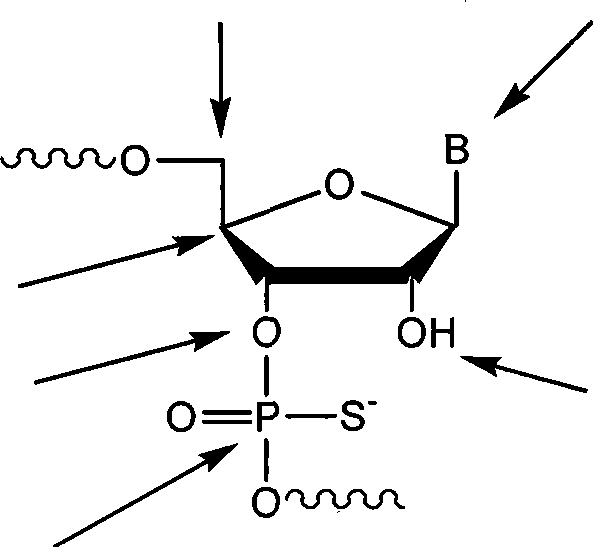
SIMRA chemical compound of the present invention can comprise the ribonucleotide of spontaneous ribonucleotide, modification or their mixture.
In the present invention, novel SIMRA chemical compound is discerned by human TLR8, and mixes some chemical modification they are discerned by TLR7 and cause immunne response in this human TLR8 activation RNA.Described chemical modification includes but not limited to guanine analog, 7-denitrogenation-G for example, ara-G, 6-sulfo--G, inosine, different-G (Iso-G), loxoribine (loxoribine), TOG (7-sulfo--8-oxo)-G, 8-bromo-G, 8-hydroxyl-G, amino formycin (aminoformycin) B of 5-, oxo formycin (Oxoformycin), 7-methyl-G, 9-is right-chlorphenyl-8-azepine-G, and 9-phenyl-G, 9-hexyl guanine, 7-denitrogenation-9-benzyl-G, 6-chloro-7-deazaguanine, 6-methoxyl group-7-deazaguanine, 8-azepine-7-denitrogenation-G (PPG), 2-(dimethylamino) guanosine, 7-methyl-6-sulfo-guanosine, 8-benzyloxy guanosine, 9-denitrogenation guanosine and 1-(B-D-ribofuranosyl)-2-oxo-7-denitrogenation-8-methyl purine.Chemical modification also includes but not limited to the adenine analog, 9-benzyl-8-hydroxyl-2-(2-methoxy ethoxy) adenine for example, 2-amino-N2-O-, methyladenosine, 8-azepine-7-denitrogenation-A, 7-denitrogenation-A, vidarabine (Vidarabine), 2-amino adenosine, N1-methyladenosine, 8-azepine adenosine and 5-iodo tubercidin (Iodotubercidin).Chemical modification also includes but not limited to the cytosine analog.Chemical modification also includes but not limited to for example uracil analogues of 4-sulfo--U.
" immune regulative oligomerization ribonucleotide " according to the present invention is the SIMRA chemical compound, it comprises at least two oligomerization ribonucleotides, described oligomerization ribonucleotide is held or 2 ' end place in their 3 ' by non-nucleotide or nucleotide joint, perhaps functionalized ribose place, perhaps functionalized nuclear base place is connected.Hereinafter listed the example of several joints.Non-covalent connection includes, but not limited to electrostatic interaction, hydrophobic interaction, pi accumulation interaction and hydrogen bonding.
In other embodiment, described non-nucleotide joint is the organic module with the functional group that allows to attach to described oligomerization ribonucleotide.Described attached preferably by stable covalency connection.As non-limiting instance, joint can attach to any suitable location on the nucleotide.Some preferred embodiment in, joint attaches to 3 '-hydroxyl.In this class embodiment, joint preferably comprises oh group, this oh group preferably by based on for example di-phosphate ester, thiophosphate, phosphorodithioate, methyl phosphonate etc. based on the connection of phosphate ester or non-connection (non-phosphate-based linkage) based on phosphate ester attach to 3 '-hydroxyl.
In some embodiments, the non-nucleotide joint is micromolecule, macromole or biomolecule, includes, but not limited to polypeptide, antibody, lipid, antigen, allergen and oligosaccharide.In some other embodiments, the non-nucleotide joint is a micromolecule.For the present invention, micromolecule be molecular weight less than 1, organic module of 000Da.In some embodiments, micromolecular molecular weight is less than 750Da.
In some embodiments, micromolecule is aliphatic hydrocarbon or aromatic hydrocarbons, described aliphatic hydrocarbon or aromatic hydrocarbons is one or more functional groups randomly, described functional group includes but not limited to hydroxyl, amino, mercaptan, thioether, ether, amide, thioamides, ester, urea and thiourea, described functional group or be arranged in the straight chain that connects the oligomerization ribonucleotide, perhaps thereon attached.Micromolecule can be a ring-type or acyclic.The example of micromolecule joint includes, but not limited to aminoacid, carbohydrate, cyclodextrin, diamantane (obsolete), cholesterol, hapten and antibiotic.Yet for describing the purpose of non-nucleotide joint, term " micromolecule " is intended to not comprise nucleoside.
In some embodiments, the non-nucleotide joint is alkyl (alkyl) joint or amino joint.Alkyl (alkyl) joint can be branch branching or branchiess, and is cyclic or acyclic, replacement or unsubstituted, saturated or unsaturated, chirality, achiral or racemic mixture.Alkyl (alkyl) joint can have from about 2 to about 18 carbon atoms.In some embodiments, described alkyl (alkyl) joint have from about 3 to about 9 carbon atoms.Some alkyl (alkyl) joint comprises one or more functional groups, and described functional group is including, but not limited to hydroxyl, amino, mercaptan, thioether, ether, amide, thioamides, ester, urea and thioether.Described alkyl (alkyl) joint is including, but not limited to 1 propanol, 1,2 propylene glycol, 1,3 propylene glycol, 1,2,3 glycerol, triethylene glycol, six ethylene glycol, Polyethylene Glycol joint (for example [O-CH2-CH2-]
n(n=1-9)), methyl joint, ethyl joint, propyl group joint, butyl joint or hexyl joint.In some embodiments, described alkyl (alkyl) joint can comprise peptide or aminoacid.
In some embodiments, the non-nucleotide joint can be including, but not limited to the listed joint of table 2.
Table 2: typicality non-nucleotide joint

Glycerol (1,2, the 3-glycerol) 1,1,1-three (methylol) Nitrocarbol.


1,2,4- butantriol 1,1,1-three (methylol) propane


2-(methylol)-1, ammediol 1,2,6-hexanetriol


2-(methylol) 1,4-butanediol 3-methyl isophthalic acid, 3,5-penta triol


1,3,5- penta triol 1,2,3-triol in heptan


1,1,1-three (methylol) ethane 2-amino-2-(methylol)-1, ammediol
N-[three (methylol) methyl] acrylamide
Table 2: continuous


Suitable-1,3,5-phloroglucitol 1,3-two (hydroxyl-oxethyl)-2-hydroxyl-propane


Suitable-1,3,5-three (methylol) cyclohexane extraction 1,3-two (hydroxyl propoxyl group)-2-hydroxyl-propane

1,3,5-trihydroxy-benzene 2-deoxy-D-ribose

3,5-two (methylol) phenol 1,2,4-trihydroxy-benzene

1,3,5-three (methylol) benzene D-galactose acetal (D-Galactoal)
Table 2: continuous
1,6-dehydration-β-D-glucose 4,6- nitro 1,2,3,-thrihydroxy-benzene

1,3,5-three (2-ethoxy)-cyanuric acid

Gallic acid
3,5, the 7-trihydroxyflavone
Table 2: continuous



1, ammediol 2,4-pentanediol

1,2-propylene glycol 1,6-hexanediol


1,4-butanediol 1,2-hexanediol


1,3 butylene glycol 1, the 5-hexanediol


2,3-butanediol 2,5-hexanediol

1, the 4-butanediol
Table 2: continuous


1, the 12-dodecanediol

Three Polyethylene Glycol

Four Polyethylene Glycol
Six Polyethylene Glycol
In some embodiments, the micromolecule joint is suc as formula HO-(CH
2)
o-CH (OH)-(CH
2)
pGlycerol shown in the-OH or glycerol homologue, wherein o and p are from 1 to about 6, from 1 to about 4 or from 1 to about 3 integer independently.In some other embodiments, the micromolecule joint is 1, the derivant of 3-diaminourea-2-hydroxy propane.In this analog derivative some have chemical formula HO-(CH
2)
m-C (O) NH-CH
2-CH (OH)-CH
2-NHC (O)-(CH
2)
m-OH, wherein m is the integer between 0 to about 10,0 to about 6,2 to about 6 or 2 to about 4.
Non-nucleotide joints more of the present invention are allowed and are surpassed two attached as the described oligomerization ribonucleotide of table 1.For example, micromolecule joint glycerol has 3 and can supply the attached hydroxyl of oligomerization ribonucleotide covalency.Therefore, immune regulative oligomerization ribonucleotides more of the present invention comprise and surpass two oligomerization ribonucleotides (territory C or the like for example, other territory comprises the oligomerization ribonucleotide that above defines for territory A, B, C and D), they are connected with the non-nucleotide joint at its 3 ' end.
In the further embodiment in this aspect of the present invention, SIMRA can comprise three or more oligomerization ribonucleotides, and described oligomerization ribonucleotide is at their 3 ' or 5 ' end place or by connecting between nucleoside or being connected with the joint shown in two or more tables 1 by functionalized nuclear base or sugar.Oligomerization ribonucleotide in this respect of the present invention can have identical or different sequence.Joint in this respect of the present invention can be identical or different.
Utilize automatization's synthesizer and phosphoramidite method (shown in the sketch map of Fig. 1 and 2, further describing in an embodiment), can synthesize immune regulative oligomerization ribonucleotide of the present invention easily.In some embodiments, by the synthetic immune regulative oligomerization ribonucleotide (referring to Fig. 1) of linear synthetic method.
Another kind of selective synthesis mode is " parallel synthetic ", wherein synthesizes and outwards carries out (referring to Fig. 2) from central joint module.The joint that is attached on the solid support can be used for parallel synthesizing, and as United States Patent (USP) 5,912,332 is described.In addition, can use general solid support (for example controllable bore diameter glass of attached phosphate ester).
The parallel synthetic of immune regulative oligomerization ribonucleotide has several advantages with respect to linearity is synthetic: (1) parallel synthetic allow mix identical monomeric unit; (2) with linear synthetic different, all monomeric units all are synthetic simultaneously, thus the number of synthesis step and the synthetic time that needs with synthesize the identical of a monomeric unit; (3) minimizing of synthesis step increases the purity of final immune regulative oligonucleotide product and output.
When or end of synthesis that parallel synthetic rules carry out synthetic,, can utilize dense ammonia solution easily or immune regulative oligomerization ribonucleotide be carried out deprotection according to phosphoramidite supplier's recommendation if mixed modified nucleoside according to linearity.Can preferably utilize reversed-phase HPLC purification, detritylation, desalination and dialysis to product immune regulative oligomerization ribonucleotide.
Table 3a shows that they are nonrestrictive and typical according to the immune regulative oligomerization ribonucleotide based on RNA of the present invention.
Table 3a: stabilisation is based on the immune regulative oligomerization ribonucleotide example series of RNA
| SIMRA# (SEQ ID NO.) | Sequence and modification |
| 1 | 5’-UGCUGCUUCUG-X-GUCUUCGUCGU-5’ |
| 2 | 5’-CUGUGCUUCUC-X-CUCUUCGUGUC-5’ |
| 3 | 5’-UCUGUGCUUCU-X-UCUUCGUGUCU-5’ |
| 4 | 5’-UICAAICUUIC-X-CIUUCIAACIU-5’ |
| 5 | 5′-GUGUGUGUGUG-X-GUGUGUGUGUG-5′ |
| 6 | 5’-UGCUGCUU-X-UUCGUCGU-5’ |
| 7 | 5′-UGCUGCUUCUGUGU-X-UGUGUCUUCGUCGU-5′ |
| 8 | 5′-UGCUGCUUCUGUGUCUG-X-GUCUGUGUCUUCGUCGU-5′ |
| 9 | 5′-U 1GCU 1GCU 1U 1CU 1G-X-GU 1CU 1U 1CGU 1CGU 1-5′ |
| 10 | 5′-T 1GCT 1GCT 1T 1CT 1G-X-GT 1CT 1T 1CGT 1CGT 1-5′ |
| 11 | 5’-UG 1CUG 1CUUCUG 1-X-G 1UCUUCG 1UCG 1U-5’ |
| 12 | 5′-G 1UCCUUCAACU-X-UCAACUUCCUG 1-5′ |
| 13 | 5′-GUCCUUCAACU-X-UCAACUUCCUG-5′ |
| 14 | 5’-UG 1CUG 1CUUCUG 1-X-G 1UCUUCG 1UCG 1U-5’ |
| 15 | 5′-G 1UCCUUCAACU-X-UCAACUUCCUG 1-5′ |
| 16 | 5′-OUCCUUCAACU-X-UCAACUUCCUO-5′ |
| 17 | 5’-UOCUOCUUCUO-X-OUCUUCOUCOU-5’ |
| 18 | 5’-UICUICUUCUI-X-IUCUUCIUCIU-5’ |
| 19 | 5′-IUCCUUCAACU-X-UCAACUUCCUI-5′ |
| 20 | 5’-X 2 UGCUGCUUCUG-X-GUCUUCGUC GUX 2-5’ |
| 21 | 5’-X 2UGCUGCUUCUG-X-GUCUUCGUCGUX 2-5’ |
| 22 | 5’- UGCUGCUUCUG-X-GUCUUCGUC GU-5’ |
| 23 | 5’-UGCUGCU UCUG-X-GUC UUCGUCGU-5’ |
| 24 | 5’-UGCUGCUU CUG-X-GU CUUCGUCGU-5’ |
| 25 | 5’-UGCUGCUACUG-X-GUCAUCGUCGU-5’ |
| 26 | 5’-UGCUGCUUGUG-X-GUGUUCGUCGU-5’ |
| 27 | 5’-UGCUGCUGCUG-X-GUCGUCGUCGU-5’ |
| 28 | 5’-UGCUGCUUAUG-X-GUAUUCGUCGU-5’ |
| 29 | 5’-UG 1CUG 1CUUG 1UG 1-X-G 1UG 1UUCG 1UCG 1U-5’ |
| 30 | 5’-X 2UGCUGCUUGUG-X-GUGUUCGUCGUX 2-5 |
| 31 | 5’-UGCUGCUUCUG-X 1-GUCUUCGUCGU-5’ |
| 32 | 5’-X 7UGCUGCUUGUG-X-GUGUUCGUCGUX 7-5’ |
| 33 | 5′-UGUUGUGUGAC-X-CAGUGUGUUGU-5′ |
| 34 | 5′-CUGGCGGCCUU-X-UUCCGGCGGUC-5′ |
| 35 | 5’-X 3UG 1CUG 1CUUGUG 1-X-G 1UGUUCG 1UCG 1UX 3-5’ |
| 36 | 5’-UGCUGCUUG 2UG-X-GUG 2UUCGUCGU-5’ |
| 37 | 5’-G 2GCUGCUUGUG-X-GUGUUCGUCGG 2-5’ |
| 38 | 5′-UGCUGCCUUUG-X-GUUUCCGUCGU-5′ |
| 39 | 5′-GUCCUUGCUUG-X-GUUCGUUCCUG-5′ |
| 40 | 5′-GUCCUUUGCUG-X-GUCGUUUCCUG-5′ |
| 41 | 5’-X 3UGCUGCUGCUG-X-GUCGUCGUCGUX 3-5’ |
| 42 | 5’-XUGCUGCUUGUG-X-GUGUUCGUCGUX-5’ |
| 43 | 5’-X 7UGCUGCUGCUG-X-GUCGUCGUCGUX 7-5’ |
| 44 | 5′-UUGCCCUUGCC-X-CCGUUCCCGUU-5′ |
| 45 | 5′-UUGCUGUUGCU-X-UCGUUGUCGUU-5′ |
| 46 | 5′-CUUUGGUGUGU-X-UGUGUGGUUUC-5′ |
| 47 | 5′-UUGGUUGUUUG-X-GUUUGUUGGUU-5′ |
| 48 | 5′-CUUUGGUGUGU-X-UGUGUGGUUUC-5′ |
| 49 | 5′-X 3UUGGUUGUUUG-X-GUUUGUUGGUUX 3-5′ |
| 50 | 5′-X 3GUCCUUGCUUG-X-GUUCGUUCCUGX 3-5′ |
| 51 | 5’-PUGCUGCUUGUG-X-GUGUUCGUCGUP-5’ |
| 52 | 5’-X 4UGCUGCUUGUG-X-GUGUUCGUCGUX 4-5’ |
| 53 | 5’-X 5UGCUGCUUGUG-X-GUGUUCGUCGUX 5-5’ |
| 54 | 5’-X 6UGCUGCUUGUG-X-GUGUUCGUCGUX 6-5’ |
| 55 | 5’-UG 1CUG 1CUUCUG 1-X 1-G 1UCUUCG 1UCG 1U-5’ |
| 56 | 5’-X 3UGCUGCUUGUG-X 1-GUGUUCGUCGUX 3-5’ |
| 57 | 5′-UG 3CUGCUUCUG-X-GUCUUCGUCG 3U-5′ |
| 58 | 5′-UGG 4UGCUUCUG-X-GUCUUCGUG 4GU-5′ |
| 59 | 5’-UUG 1G 1UUG 1UUUG 1-X-G 1UUUG 1UUG 1G 1UU-5’ |
| 60 | 5’-UG 1CUG 1CCUUUG 1-X-G 1UUUCCG 1UCG 1U-5’ |
| 61 | 5′-G 1UCCUUG 1CUUG 1-X-G 1UUCG 1UUCCUG 1-5′ |
| 62 | 5′-G 1UCCUUUG 1CUG 1-X-G 1UCG 1UUUCCUG 1-5′ |
| 63 | 5’-UG 1CUG 1CUUCUG 1-X 8-G 1UCUUCG 1UCG 1U-5’ |
| 64 | 5′-CUG 1-X-G 1UC-5’ |
| 65 | 5′-UUG 1CUG 1UUG 1CU-X-UCG 1UUG 1UCG 1UU-5′ |
| 66 | 5′-UG 1CCUUG 1AACU-X-UCAAG 1UUCCG 1U-5′ |
| 67 | 5′-UUCUG 1CUUCUG 1-X-G 1UCUUCG 1UCUU-5′ |
| 68 | 5′-UUCUG 1CUUCUG 1-X 5-G 1UCUUCG 1UCUU-5′ |
| 69 | 5′-G 1UCCUUCUCUG 1-X-G 1UCUCUUCCUG 1-5′ |
| 70 | 5′-UG 1UURUG 1UG 1AC-X-CAG 1URUG 1UUG 1U-5′ |
| 71 | 5′-X 2UUGGUUGUUUG-X-GUUUGUUGGUUX 2-5′ |
| 72 | 5′-X 2GUCCUUGCUUG-X-GUUCGUUCCUGX 2-5′ |
| 73 | 5′-X 6UUGGUUGUUUG-X-GUUUGUUGGUUX 6-5′ |
| 74 | 5′-X 6GUCCUUGCUUG-X-GUUCGUUCCUGX 6-5′ |
| 75 | 5’-X 2UGCUGCUUGUG-X 8-GUGUUCGUCGUX 2-5’ |
| 76 | 5′-UGCUGCUUCUGGACAUGUCCAG-3′ |
| 77 | 5′-UGCUGCUUCUGUGAUAUCACAG-3′ |
| 78 | 5′-UGCUGCUUCUGAAUUAAUUCAG-3′ |
| 79 | 5′-UGCUGCUUCUGGACUAGUCCAG-3′ |
| 80 | 5’-UGCUGCUUcugugauaucacag-3′ |
| 81 | 5′-AGUUGAAGGACUGCUGCUUCUG-3′ |
| 82 | 5′-GUCCUUCAACUCAGAAGCAGCA-3′ |
| 83 | 5′-AGUUGAAGGACX 2UGCUGCUUCUG-3′ |
| 84 | 5′-GUCCUUCAACUX 2CAGAAGCAGCA-3′ |
| 85 | 5’-CCCIIICCCX 2CCCIIICCC-3′ |
| 86 | 5’-AGAAGCUUCUG-X-GUCUUCGAAGA-5’ |
| 87 | 5’-UGAAGCUUCUG-X-GUCUUCGAAGU-5’ |
| 88 | 5′-X 6UUGGUUGUUUG-X-GUUUGUUGGUUX 6-5′ |
| 89 | 5′-X 6GUCCUUGCUUG-X-GUUCGUUCCUGX 6-5′ |
| 90 | 5′-UCUGAAUUCAG-X-GACUUAAGUCU-5′ |
| 91 | 5′-GUUUGCACAAC-X-CAACACGUUUG-5′ |
| 92 | 5′-GCACACUUGUU-X-UUGUUCACACG-5′ |
| 93 | 5′-CACUGUUGAGA-X-AGAGUUGUCAC-5′ |
| 94 | 5′-CACUGUUGACA-X-ACAGUUGUCAC-5′ |
| 95 | 5′-AACUGUUGACC-X-CCAGUUGUCAA-5′ |
| 96 | 5′-CAACGACCUGU-X-UGUCCAGCAAC-5′ |
| 97 | 5′-AGCACAACUGU-X-UGUCAACACGA-5′ |
| 98 | 5’-UGCUGAGUGUU-X-UUGUGAGUCGU-5’ |
| 99 | 5’-AGUGUUUUCUG-X-GUCUUUUGUGA-5’ |
| 100 | 5’-UGCUGCUUCUGX 2UGCUGCUUCUG-3’ |
| 101 | 5’-UGCUGCUUCUGX 2UGCUGAGUGUU-3’ |
| 102 | 5’-AGUGUUUUCUGX 2UGCUGCUUCUG-3’ |
| 103 | 5’-CAACGAACCCU-X-UCCCAAGCAAC-5’ |
| 104 | 5’-G 1UCCUUG 1CUUG 1-X 8-G 1UUCG 1UUCCUG 1-5’ |
| 105 | 5’-G 1UCCUUG 1CUUG 1-X-G 1UUCG 1UUCCUG 1-5’ |
| 106 | 5’-UUCUG 1CUUCUG 1-X 8-G 1UCUUCG 1UCUU-5’ |
| 107 | 5’-UUCUG 1CUUCUG 1-X-G 1UCUUCG 1UCUU-5’ |
| 108 | 5’-X 2UUCUG 1CUUCUG 1-X-G 1UCUUCG 1UCUUX 2-5’ |
| 109 | 5’-X 2G 1UCCUUG 1CUUG 1-X-G 1UUCG 1UUCCUG 1X 2-5’ |
| 110 | 5’-UG 1CUG 1CCUUUG 1-X-G 1UUUCCG 1UCG 1U-5’ |
| 111 | 5’-UG 1CUG 1CCUUUG 1-X 9-G 1UUUCCG 1UCG 1U-5’ |
| 112 | 5’-G 1UCCUUUG 1CUG 1-X-G 1UCG 1UUUCCUG 1-5’ |
| 113 | 5’-G 1UCCUUUG 1CUG 1-X 9-G 1UCG 1UUUCCUG 1-5’ |
| 114 | 5’-X 6UGCUGCUUGUG-X-GUGUUCGUCGUX 6-5’ |
| 115 | 5’-X 5GCUGCCUUUG-X 9-GUUUCCGUCGUX 5-5’ |
| 116 | 5′-UGCUGCUUGUG) 2-X-CCGUUGACAG-3′ |
| 117 | 5′-UGCUGCUUGUG) 2-X-ACACGCGUGU-3′ |
| 118 | 5′-CCCIIICCCII-X-IICCCIIICCC-5′ |
| 119 | 5′-TTTTTTTTTTTTTTT-X-(G 1UCUUCG 1UCG 1U) 2-5′ |
| 120 | 3′-TTTTTTTTTTTTTTT-X-(G 1UCUUCG 1UCG 1U) 2-5′ |
| 121 | 5′-U 1U 1U 1U 1U 1U 1U 1U 1U 1U 1U 1U 1U 1U 1U 1-X-(G 1UCUUCG 1UCG 1U) 2-5′ |
| 122 | 5’-CCIICCIICCC-X-CCCIICCIICC-5’ |
| 123 | 5’-CCIICCIICCX 2CCIICCIICC-3’ |
The I=inosine; U
1=dU; T
1=ribose T; G
1=7-denitrogenation-G; G2=ara-G; G
3=6-sulfo--G; G
4=1-(β-D-ribofuranosyl)-2-oxo-7-denitrogenation-8-methyl purine; The O=loxoribine; X=glycerol; X
1=1,3,5-penta triol; X
2=X
3=C3 joint or propylene glycol; X
4=three (ethylene glycol); X
5=1,5 pentanediols; X
6=2 '-deoxidation-no base (abasic); X
7The amino joint of=C3; X
8=suitable, suitable-phloroglucitol; X
9=suitable, anti--phloroglucitol;
Underscore=2 '-O-Me-ribonucleotide; The P=thiophosphate; Lower case=phosphodiester backbone.
Table 3b shows the secondary structure that oligomerization ribonucleotides more according to the present invention may form, and they are nonrestrictive and typical.
The structure example that some SIMRA chemical compounds of table 3b. may form

Aspect second, the invention provides the pharmaceutical preparation that comprises SIMRA chemical compound of the present invention and physiologically acceptable carrier.
Aspect the 3rd, the invention provides the method for the immunne response that in vertebrates, produces TLR7 and/or TLR8 mediation, this method comprises uses SIMRA chemical compound of the present invention to vertebrates.In some embodiments, described vertebrates is a mammal.In preferred embodiment, the immunostimulating vertebrates of needs is used described SIMRA chemical compound.
Aspect the 4th, the invention provides the method that therapeutic treatment suffers from the patient of disease or disease, this method comprises uses SIMRA chemical compound of the present invention to the patient.In different embodiments, disease to be treated or disease are the diseases that cancer, autoimmune disorder, infectious disease, airway inflammation, inflammatory disease, allergy, asthma or pathogen cause.Pathogen comprises antibacterial, parasite, fungus, virus, viroid and Protein virus.
Aspect the 5th, the invention provides the method that is used for prevent disease or disease, these methods comprise uses SIMRA chemical compound of the present invention to the patient.In numerous embodiments, the disease that prevent or disease are the diseases that cancer, autoimmune disorder, airway inflammation, inflammatory disease, allergy, asthma or pathogen cause.Pathogen comprises antibacterial, parasite, fungus, virus, viroid and Protein virus.
Aspect the 6th, the invention provides prevention or sanatory method, these methods comprise that separation can produce the cell of cytokine or chemotactic factor, regulate cell, B cell, PBMC, pDC and lymphocyte including, but not limited to immunocyte, T; Under the standard cell lines condition of culture, cultivate above-mentioned cell, handle above-mentioned cell so that separated cell produces or the level of excretory cytokine and chemotactic factor increases and the patient who needs cytokine or chemotactic factor to prevent or to handle disease is used or use the processing cell at external use SIMRA.This respect of the present invention will produce activating immune cell according to standard adoptive cellular immunotherapy technology.
In some embodiments of this respect of the present invention, the cell that can produce cytokine or chemotactic factor may separate from the experimenter who suffers from or do not suffer from disease or disease.Above-mentioned separation can comprise to be identified and selects, and can use the cell separation program of standard, comprises those illustrated in following specific embodiment programs.Above-mentioned isolated cell uses the standard cell lines condition of culture to be cultivated secundum legem cell culture program, and said procedure and condition can comprise cultivation program and condition of culture illustrated in the following specific embodiment.At this embodiment of the present invention on the other hand, isolated cell will be cultivated under the situation that at least a SIMRA exists, and the amount of SIMRA and the time of cultivation are enough to induce, increase or improve the generation and/or the secretion (than the non-existent situation of described one or more SIMRA) of cytokine and/or chemotactic factor.The above-mentioned time can be from the some minutes to the some hrs, by some days.Above-mentioned plays effectiveness after the cell that separates and SIMRA handles can or be applied to another patient after donor is used again, and the generation and/or the secretion of cytokine and/or chemotactic factor induced, increases or improved to wherein above-mentioned donor or another needs of patients.For example, to using once more of the donor of suffering from the disease that cancer, autoimmune disorder, airway inflammation, inflammatory disease, infectious disease, allergy, asthma or pathogen cause or using to another patient of suffering from the disease that cancer, autoimmune disorder, airway inflammation, inflammatory disease, infectious disease, allergy, asthma or pathogen cause.Above-mentioned using or use can use the several different methods that comprises conduit or injection or any other valid approach to finish.This aspect of the present invention can also be applied to have patient's (for example being subjected to the patient of human immune deficiency virus infection or the patient of bone marrow transplantation) of patient limited or incomplete immunne response ability or immunocompromised host.
In any method of the present invention, the SIMRA chemical compound can be by being useful on treatment or preventing described disease or disease and do not reduce that other reagent of immunoregulation effect of described SIMRA chemical compound is co-administered to produce direct immunoregulation effect separately and/or with any, thereby work in a different manner.In any method of the present invention, the reagent or the condition that are useful on treatment or prevent disease or disease comprise, but be not limited to, vaccine, antigen, antibody, preferred monoclonal antibody, cytotoxic agent, allergen, antibiotic, siRNA, antisense oligonucleotide, TLR agonist (for example agonist of TLR9 and/or TLR3), chemotherapeutics (traditional chemotherapy and modern targeted therapies), target therapeutic agent, activatory cell, peptide, albumen, gene therapy vector, peptide vaccine, protein vaccine, dna vaccination, adjuvant, and costimulatory molecules (cytokine for example, chemotactic factor, protein ligands, trans-activating factor, peptide and the peptide that comprises modified amino acid), perhaps their combination.For example, in treatment for cancer, expection can be co-administered with SIMRA chemical compound and one or more chemotherapy compounds, target therapeutic agent and/or monoclonal antibody.Perhaps, described reagent can comprise the dna vector of coding for antigens or allergen.Perhaps, can SIMRA chemical compound and other adjuvants is co-administered to improve specificity or to the amplitude of the immunne response of SIMRA chemical compound.
In any method of the present invention, use SIMRA chemical compound or SIMRA chemical compound and any other reagent is co-administered separately, can be by any suitable way, include but not limited in non-digestive tract, mucosal drug delivery, oral, Sublingual, percutaneous, part, suction, intranasal, aerosol, ophthalmic, the trachea, internal rectum, vagina, by particle gun, transdermal patches or adopt eye drop or collutory form.Can use known program, so that effectively amount and time period are carried out using of SIMRA chemical compound to the symptom that reduces disease or surrogate markers thing.For example, can be to alleviate or reduce symptom to treating the effective SIMRA chemical compound of certain disease and/or disease amount, or postpone or improve the necessary amount of tumor, cancer or antibacterial, virus or fungal infection.The effective dose that uses as vaccine adjuvant can be to strengthening the experimenter to vaccine or the useful amount of antigenic immunne response.Using under the background of metering needle to the compositions (a composition that modulates an immune response to aco-adminstered antigen) of the antigenic immunne response used jointly, SIMRA chemical compound and antigenic effective dose are the amounts that enough reaches than the conditioning desired effect of the immunne response of using this antigen separately and being obtained.For any concrete application, effective dose can change according to the disease of being treated or disease, the concrete oligonucleotide of being used, experimenter's physique or the order of severity of disease or condition.Those of ordinary skills can rule of thumb determine the effective dose of concrete oligonucleotide and not need to carry out undue experimentation.
When systemic administration, the therapeutic combination of preferably using sufficient dosage is so that the blood levels of SIMRA chemical compound reaches from about 0.0001 micromoles per liter (micromolar) to about 10 micromoles per liter.For local application, also may be effectively than this much lower concentration, and much higher concentration also may tolerate.The accumulated dose of SIMRA chemical compound was preferably from each patient of about 0.001mg every day to the every kg body weight of about 200mg every day.May need simultaneously or continuously to one or more therapeutic combinations of the present invention of individual administering therapeutic effective dose as the single therapy paragraph.
The SIMRA chemical compound can randomly be connected in one or more allergens and/or antigen (self or external), immunogenic protein, for example keyhole limpet hemocyanin (KLH), b subunit of cholera toxin or other immunogenic carrier albumen arbitrarily.SIMRA can also be co-administered with other chemical compounds (as adjuvant), described chemical compound includes but not limited to, TLR agonist (as the agonist of TLR2 and the agonist of TLR9), incomplete Freund, KLH, single phosphinylidyne lipoid A (MPL), Alumen and saponin, comprise QS-21 and imiquimod, or their combination.
The method of this respect of the present invention can be used for immune scale-model investigation.These methods also can be used for the prevention or the treatment of people or Animal diseases.For example, these methods can be used for the application of department of pediatrics usefulness and live vaccine.
The following examples are intended to further specify specific preferred implementation of the present invention, rather than intention limits scope of the present invention.
Embodiment
Synthesizing of immune regulative oligomerization ribonucleotide
On the DNA/RNA automatic synthesizer, use phosphoramidite chemical method chemosynthesis immune regulative oligomerization ribonucleotide.(except that U) 2 '-O-TBDMS RNA monomer of TAC radical protection: A, G, C and U, available from Sigma-Aldrich.7-denitrogenation-G, inosine and loxoribine monomer are available from ChemGenesCorporation.0.25M 5-ethylmercapto group-1H-tetrazolium, anhydrous CapA of PAC-and Cap B are available from Glen Research.Be dissolved in 3% trichloroacetic acid (TCA) of dichloromethane (DCM) and 5% 3H-1,2-benzo two mercaptan-3-ketone-1,1-dioxide (Beaucage reagent) are configuration voluntarily all.
The synthetic rules of immune regulative oligomerization ribonucleotide secundum legem RNA are synthetic with the scale of 1-2 μ M.
The deprotection of shearing and base
Shear immune regulative oligomerization ribonucleotide down from solid phase carrier, solution further is heated to 65 ℃ to remove exocyclic amine protecting group group.Solution after treatment is bone dry in centrifuge concentrator (Speedvac).
The anion-exchange purification
Immune regulative oligomerization ribonucleotide is by the anion-exchange purification.
Chromatographic column: Dionex DNAPac 100 posts (22 X 250)
The chromatographic column heater: ChromTech TL-105 high performance liquid chromatography chromatographic column heater, temperature is made as 80 ℃.
Buffer A: 20mM Tris-HCl, pH 7.0,20% acetonitriles
Buffer B: 3.0M NaCl, 20mM Tris-HCl, pH 7.0,20% acetonitriles
Flow velocity: 10ml/min
Gradient:
0-2min:0%B
2-11min:0%B to 35%B
11-41min:35%B to 90%B
41-45min:100%B
The immune regulative oligomerization ribonucleotide injection of solution of not purifying is gone into high performance liquid chromatography.Carry out above-mentioned gradient and collect fraction.All fraction that contain expectation product more than 90% are mixed, then solution is concentrated into almost dry state in Rotary Evaporators (Rotovap).Adding not, the water of qiagen rnase enzyme makes that final volume is 10ml.
The desalination of C-18 reverse-phase chromatography
CC-18 Sep-Pak chromatographic column available from Waters is at first used 10 milliliters acetonitrile treatment, handles with the 0.5M sodium acetate of 10ml then.Sample on the immune regulative oligomerization ribonucleotide acid solution of 10ml is arrived chromatographic column.Desalt with the washing of 15ml then.Use the 50% acetonitrile solution eluting immune regulative oligomerization ribonucleotide of 1ml at last.
Solution was placed centrifuge concentrator 30 minutes.Rest solution is by 0.2 μ m membrane filtration, and lyophilizing is to dry then.Then the solid that obtains is dissolved in again the concentration of water to expection.
Preserve final solution under 0 ℃ the condition being lower than.
Capillary electrophoresis
Instrument: Beckman 5010
Capillary tube: 62 centimetres of ssDNA capillary tubies
Sample is prepared: with the SIMRA compound dissolution of 0.2OD in the water of the not qiagen rnase enzyme of 200ul.
Injection: 5 seconds of electronic injection under 5KV voltage
Deposition condition: at 30 ℃, following 50 minutes of the condition of 14KV
The ion exchange efficient liquid phase chromatographic analysis
Chromatographic column: Dionex DNAPac guard post (22X250)
The chromatographic column heater: ChromTech TL-105 high performance liquid chromatography chromatographic column heater, temperature is made as 80 ℃.
Buffer A: 100mM Tris-HCl, pH 8.0,20% acetonitriles
Buffer B: 2.0M LiCl, 100mM Tris-HCl, pH 8.0,20% acetonitriles
Flow velocity: 2ml/min
Gradient:
0-2min:0%B
2-10min:0%B to 100%B
10-15min:100%B
Polyacrylamide gel electrophoresis is analyzed
With about 5 hours of electrophoresis in the polyacrylamide gel of sample to 20% on the immune regulative oligomerization ribonucleotide of 0.3OD and under 4 watts firm power.Gel is observed under short UV light.
People's cell culture rules
People PMBC separates
(Histopaque-1077 Sigma) separates PERIPHERAL BLOOD MONONUCLEAR CELL (PMBC) from the healthy volunteer's of fresh collection blood (CBR Laboratories, Boston, Massachusetts) to utilize the ficoll density.
People pDC separates
(Histopaque-1077 Sigma) separates PERIPHERAL BLOOD MONONUCLEAR CELL (PMBC) from the healthy volunteer's of fresh collection blood (CBR Laboratories, Boston, Massachusetts) to utilize the ficoll density.Select from PERIPHERAL BLOOD MONONUCLEAR CELL separate pDC according to the explanation of manufacturer by the positive with BDCA4 cell separation test kit (Milenyi Biotec).
The enzyme-linked immunosorbent assay of cytokine (ELISA)
With the human PBMC with 5 X 10
6Cell/ml is seeded in the 48 hole flat boards.With people pDC with 1 X 10
6Cell/ml is seeded in the 96 hole culture plates.In cell culture, add and be dissolved in DPBS (pH 7.4; Mediatech) SIMRA to final concentration be 100.0 μ g/ml.Then cell was hatched 24 hours at 37 ℃, collect supernatant and be used for polynary LUMINEX (LUMINEX MULTIPLEX) or elisa assay.Experiment is carried out the repetition in the same form 3 holes.Level by IFN-α, IL-6 or TNF-α in the sandwich ELISA analysis supernatant.Required reagent comprises cytokine antibodies and standard substance, all available from PharMingen.
Carrying out polynary LUMINEX with BIOSOURCE HUMAN MULTIPLEX cytokine analysis test kit on Luminex 100 instruments analyzes.(Sacramento, analyze by the StarStation software that CA) provides with AppliedCytometry Systems for the gained data.
Analyze the rules of the HEK293 cell of expressing TLR
(Invivogen, San Diego CA) cultivate at 5% CO with HEK293/ people TLR7 or HEK293/ people TLR8 cell
2In the 48 hole flat boards in the incubator, wherein every hole contains the DMEM that 250 μ l are added with 10% heat-inactivated FBS.
Reporter gene transforms
250 μ l/ holes have replenished and have cultivated stably express mouse TLR 9 or human TLR3 among the DMEM of 10% hot deactivation FBS on 48 orifice plates, (CA), cell is cultivated in 5% CO2 gas incubator for Invivogen, San Diego for 7 or 8 HEK293 cell.When 80% converges, in culture medium, there are 4 μ l/ml lipofection reagent (Lipofectamine) (Invitrogen, Carlsbad, CA) under the condition, use the SEAP (the human embryos alkaline phosphatase of secreted form) of 400ng/ml to report (Invitrogen) transient transfection of plasmid (pNifty2-Seap) culture.In the culture medium that does not contain serum, dilute plasmid DNA and lipofection reagent respectively, and room temperature incubation 5 minutes.After the incubation, the DNA of mixed diluting and lipofection reagent, again with mixture room temperature incubation 20 minutes.The 25 μ l DNA/ lipofection reagent mixtures that will contain 100ng plasmid DNA and 1 μ l lipofection reagent are added into each hole of cell culture flat board, continue to cultivate 4 hours.
IMO handles
After the transfection, culture medium replaces with fresh culture medium, SIMRA is added culture and continues cultivated 18 hours.SIMRA handle last, from each is handled, get 30 μ l culture supernatants and carry out SEAP according to the rules (Invivogen) of manufacturer and analyze.
SEAP analyzes
Briefly, with culture supernatant and the yellow that the common incubation of phosphoric acid nitro phenyl ester substrate is also produced in the 405nm measurement with microplate reader.Data show is that the multiple that the NF-kB activity is compared with the PBS contrast increases.(people such as Putta MR, Nucleic Acids Res., 2006,34:3231-8).
Express that the active multiple of NF-kB changes in the HEK293 cell of human TLR8
Sequence number sequence
14.3 μ M
1 5’-UGCUGCUUCUG-X-GUCUUCGUCGU-5’ 3.1
11 5’-UG
1CUG
1CUUCUG
1-X-G
1UCUUCG
1UCG
1U-5’ 4.8
12 5′-G
1UCCUUCAACU-X-UCAACUUCCUG
1-5′ 2.6
13 5′-GUCCUUCAACU-X-UCAACUUCCUG-5′ 4.3
Express that the active multiple of NF-kB changes in the HEK293 cell of human TLR8
Sequence number sequence
14.3 and 28.6 μ M
1 5’-UGCUGCUUCUG-X-GUCUUCGUCGU-5’ 2.7 8
20 5’-X
2 UGCUGCUUCUG-X-GUCUUCGUC
GUX
2-5’ 3.12 8.5
21 5’-X
2UGCUGCUUCUG-X-GUCUUCGUCGUX
2-5’ 8.1 14.7
22 5’-
UGCUGCUUCUG-X-GUCUUCGUC
GU-5’ 0.6 1
R848 8.5
Express that the active multiple of NF-kB changes in the HEK293 cell of human TLR8
Sequence number sequence
14.3 and 28.6 μ M
1 5’-UGCUGCUUCUG-X-GUCUUCGUCGU-5’ 9.2 64.5
23 5’-UGCUGCU
UCUG-X-GUC
UUCGUCGU-5’ 1 4.1
24 5’-UGCUGCUU
CUG-X-GU
CUUCGUCGU-5’ 6.7 33.6
25 5’-UGCUGCUACUG-X-GUCAUCGUCGU-5’ 7.6 32.9
26 5’-UGCUGCUUGUG-X-GUGUUCGUCGU-5’ 1.9 15.63
Express that the active multiple of NF-kB changes in the HEK293 cell of human TLR8
Sequence number sequence
14.3 and 28.6 μ M
1 5’-UGCUGCUUCUG-X-GUCUUCGUCGU-5’ 4.13 14.5
21 5’-X
2UGCUGCUUCUG-X-GUCUUCGUCGUX
2-5’8.6 22.9
24 5’-UGCUGCUU
CUG-X-GU
CUUCGUCGU-5’ 12.7 27.3
26 5’-UGCUGCUUGUG-X-GUGUUCGUCGU-5’ 4.8 19
27 5’-UGCUGCUGCUG-X-GUCGUCGUCGU-5’ 2.8 12.4
28 5’-UGCUGCUUAUG-X-GUAUUCGUCGU-5’ 2.2 5
30 5’-X
2UGCUGCUU
GUG-X-GU
GUUCGUCGUX
2-5’17.9 27.9
R848 12.5
Express that the active multiple of NF-kB changes in the HEK293 cell of human TLR8
Sequence number sequence
14.3 μ M
1 5’-UGCUGCUUCUG-X-GUCUUCGUCGU-5’ 3.1
11 5’-UG
1CUG
1CUUCUG
1-X-G
1UCUUCG
1UCG
1U-5’ 4.8
12 5′-G
1UCCUUCAACU-X-UCAACUUCCUG
1-5′ 2.6
13 5′-GUCCUUCAACU-X-UCAACUUCCUG-5′ 4.3
Express that the active multiple of NF-kB changes in the HEK293 cell of human TLR8
Sequence number sequence 14.3 μ M
31 5’-UGCUGCUUCUG-X
1-GUCUUCGUCGU-5’ 4.2
32 5’-X
7UGCUGCUUGUG-X-GUGUUCGUCGUX
7-5’ 4.5
33 5′-UGUUGUGUGAC-X-CAGUGUGUUGU-5′ 7.0
34 5′-CUGGCGGCCUU-X-UUCCGGCGGUC-5′ 5.85
35 5’-X
3UG
1CUG
1CUUGUG
1-X-G
1UGUUCG
1UCG
1UX
3-5’ 9.2
36 5’-UGCUGCUUG
2UG-X-GUG
2UUCGUCGU-5’ 4.74
37 5’-G
2GCUGCUUGUG-X-GUGUUCGUCGG
2-5’ 4.4
38 5′-UGCUGCCUUUG-X-GUUUCCGUCGU-5′ 7.5
39 5′-GUCCUUGCUUG-X-GUUCGUUCCUG-5′ 8.7
40 5′-GUCCUUUGCUG-X-GUCGUUUCCUG-5′ 8.1
Express that the active multiple of NF-kB changes in the HEK293 cell of human TLR8
Sequence number sequence 21.5 μ M
41 5’-X3UGCUGCUGCUG-X-GUCGUCGUCGUX
3-5’ 13.7
42 5’-XUGCUGCUUGUG-X-GUGUUCGUCGUX-5’ 16.0
43 5’-X
7UGCUGCUGCUG-X-GUCGUCGUCGUX
7-5’ 15.2
44 5′-UUGCCCUUGCC-X-CCGUUCCCGUU-5′ 10.5
45 5′-UUGCUGUUGCU-X-UCGUUGUCGUU-5′ 12.9
46 5′-CUUUGGUGUGU-X-UGUGUGGUUUC-5′ 5.1
47 5′-UUGGUUGUUUG-X-GUUUGUUGGUU-5′ 17.4
48 5′-CUUUGGUGUGU-X-UGUGUGGUUUC-5′ 5.1
55 5’-UG
1CUG
1CUUCUG
1-X
1-G
1UCUUCG
1UCG
1U-5’ 2.96
56 5’-X
3UGCUGCUUGUG-X
1-GUGUUCGUCGUX
3-5’ 9.14
Express that the active multiple of NF-kB changes in the HEK293 cell of human TLR8
Sequence number sequence 14.3 μ M
57 5′-UG
3CUGCUUCUG-X-GUCUUCGUCG
3U-5′ 9.16
58 5′-UGG
4UGCUUCUG-X-GUCUUCGUG
4GU-5′ 2.29
Express that the active multiple of NF-kB changes in the HEK293 cell of human TLR8
Sequence number sequence 14.3 μ M
86 5’-AGAAGCUUCUG-X-GUCUUCGAAGA-5’ 1.42
87 5’-UGAAGCUUCUG-X-GUCUUCGAAGU-5’ 1.54
Express that the active multiple of NF-kB changes in the HEK293 cell of human TLR8
Sequence number sequence
21.5 μ M
PBS 1.0
90 5′-UCUGAAUUCAG-X-GACUUAAGUCU-5′ 9.7
92 5′-GCACACUUGUU-X-UUGUUCACACG-5′ 6.1
93 5′-CACUGUUGAGA-X-AGAGUUGUCAC-5′ 7.0
95 5′-AACUGUUGACC-X-CCAGUUGUCAA-5′ 8.1
96 5′-CAACGACCUGU-X-UGUCCAGCAAC-5′ 4.8
104 5’-G
1UCCUUG
1CUUG
1-X
8-G
1UUCG
1UUCCUG
1-5’ 2.8
105 5’-G
1UCCUUG
1CUUG
1-X-G
1UUCG
1UUCCUG
1-5’ 3.6
106 5’-UUCUG
1CUUCUG
1-X
8-G
1UCUUCG
1UCUU-5’ 3.8
107 5’-UUCUG
1CUUCUG
1-X-G
1UCUUCG
1UCUU-5’ 4.5
108 5’-X
2UUCUG
1CUUCUG
1-X-G
1UCUUCG
1UCUUX
2-5’ 3.6
109 5’-X
2G
1UCCUUG
1CUUG
1-X-G
1UUCG
1UUCCUG
1X
2-5’ 8.8
110 5’-UG
1CUG
1CCUUUG
1-X-G
1UUUCCG
1UCG
1U-5’ 2.6
111 5’-UG
1CUG
1CCUUUG
1-X
9-G
1UUUCCG
1UCG
1U-5’ 2.5
112 5’-G
1UCCUUUG
1CUG
1-X-G
1UCG
1UUUCCUG
1-5’ 3.1
113 5’-G
1UCCUUUG
1CUG
1-X
9-G
1UCG
1UUUCCUG
1-5’ 2.5
114 5’-X
6UGCUGCUUGUG-X-GUGUUCGUCGUX
6-5’ 10.7
115 5’-X
5GCUGCCUUUG-X
9-GUUUCCGUCGUX
5-5’ 6.1
116 (5′-UGCUGCUUGUG)
2-X-CCGUUGACAG-3′ 10.6
117 (5′-UGCUGCUUGUG)
2-X-ACACGCGUGU-3′ 6.3
118 5′-CCCIIICCCII-X-IICCCIIICCC-5′ 1.3
Express that the active multiple of NF-kB changes in the HEK293 cell of human TLR7
Sequence number sequence
14.3 μ M
1 5’-UGCUGCUUCUG-X-GUCUUCGUCGU-5’ 1.1
11 5’-UG
1CUG
1CUUCUG
1-X-G
1UCUUCG
1UCG
1U-5’ 9.3
12 5′-G
1UCCUUCAACU-X-UCAACUUCCUG
1-5′ 11.5
13 5′-GUCCUUCAACU-X-UCAACUUCCUG-5′ 1.8
Loxoribine (465 μ M) 7.26
R848 11.5
Express that the active multiple of NF-kB changes in the HEK293 cell of human TLR7
Sequence number sequence 14.3 μ M
59 5’-UUG
1G
1UUG
1UUUG
1-X-G
1UUUG
1UUG
1G
1UU-5’ 2.311
60 5’-UG
1CUG
1CCUUUG
1-X-G
1UUUCCG
1UCG
1U-5’ 3.160
61 5′-G
1UCCUUG
1CUUG
1-X-G
1UUCG
1UUCCUG
1-5′ 2.603
62 5′-G
1UCCUUUG
1CUG
1-X-G
1UCG
1UUUCCUG
1-5′ 2.274
63 5’-UG
1CUG
1CUUCUG
1-X
8-G
1UCUUCG
1UCG
1U-5’ 2.887
64 5′-CUG
1-X-G
1UC-5’ 2.104
65 5′-UUG
1CUG
1UUG
1CU-X-UCG
1UUG
1UCG
1UU-5′ 1.454
66 5′-UG
1CCUUG
1AACU-X-UCAAG
1UUCCG
1U-5′ 1.411
67 5′-UUCUG
1CUUCUG
1-X-G
1UCUUCG
1UCUU-5′ 2.330
69 5′-G
1UCCUUCUCUG
1-X-G
1UCUCUUCCUG
1-5′ 2.377
With the IFN-α (pg/ml) in the definite human PBMC mensuration of ELISA
Sequence number sequence 21.5 μ M
61 5′-G
1UCCUUG
1CUUG
1-X-G
1UUCG
1UUCCUG
1-5′ 1092.2
62 5′-G
1UCCUUUG
1CUG
1-X-G
1UCG
1UUUCCUG
1-5′ 491.4
63 5’-UG
1CUG
1CUUCUG
1-X
8-G
1UCUUCG
1UCG
1U-5’ 1803.8
65 5′-UUG
1CUG
1UUG
1CU-X-UCG
1UUG
1UCG
1UU-5′ 1046.9
66 5′-UG
1CCUUG
1AACU-X-UCAAG
1UUCCG
1U-5′ 455.3
67 5′-UUCUG
1CUUCUG
1-X-G
1UCUUCG
1UCUU-5′ 1275.4
68 5′-UUCUG
1CUUCUG
1-X
5-G
1UCUUCG
1UCUU-5′ 466.3
69 5′-G
1UCCUUCUCUG
1-X-G
1UCUCUUCCUG
1-5′ 618.1
70 5′-UG
1UURUG
1UG
1AC-X-CAG
1URUG
1UUG
1U-5′ 1125.9
With the IFN-α (pg/ml) in the definite human PBMC mensuration of ELISA
Sequence number sequence 7.15 μ M
60 5’-UG
1CUG
1CCUUUG
1-X-G
1UUUCCG
1UCG
1U-5’ 907
With the IFN-α (pg/ml) in the definite human PBMC analysis of polynary Luninex
Sequence number sequence 7.15 μ M
PBS 46.4
63 5’-UG
1CUG
1CUUCUG
1-X
8-G
1UCUUCG
1UCG
1U-5’ 101.7
67 5′-UUCUG
1CUUCUG
1-X-G
1UCUUCG
1UCUU-5′ 133.6
68 5′-UUCUG
1CUUCUG
1-X
5-G
1UCUUCG
1UCUU-5′ 79.1
With the IFN-α (pg/ml) in the definite human PBMC mensuration of polynary Luninex
Sequence number sequence
14.3 μ M
90 5′-UCUGAAUUCAG-X-GACUUAAGUCU-5′ 4381
92 5′-GCACACUUGUU-X-UUGUUCACACG-5′ 4160
93 5′-CACUGUUGAGA-X-AGAGUUGUCAC-5′ 1117
95 5′-AACUGUUGACC-X-CCAGUUGUCAA-5′ 158
96 5′-CAACGACCUGU-X-UGUCCAGCAAC-5′ 41
116 (5′-UGCUGCUUGUG)
2-X-CCGUUGACAG-3′ 1042
117 (5′-UGCUGCUUGUG)
2-X-ACACGCGUGU-3′ 2394
118 5′-CCCIIICCCII-X-IICCCIIICCC-5′ 9
With the IFN-α (pg/ml) in the human PBMC analysis of polynary Luninex mensuration
Sequence number sequence
7.2 μ M
104 5’-G
1UCCUUG
1CUUG
1-X
8-G
1UUCG
1UUCCUG
1-5’ 459
105 5’-G
1UCCUUG
1CUUG
1-X-G
1UUCG
1UUCCUG
1-5’ 898
106 5’-UUCUG
1CUUCUG
1-X
8-G
1UCUUCG
1UCUU-5’ 394
107 5’-UUCUG
1CUUCUG
1-X-G
1UCUUCG
1UCUU-5’ 478
108 5’-X
2UUCUG
1CUUCUG
1-X-G
1UCUUCG
1UCUUX
2-5’ 694
109 5’-X
2G
1UCCUUG
1CUUG
1-X-G
1UUCG
1UUCCUG
1X
2-5’ 1326
110 5’-UG
1CUG
1CCUUUG
1-X-G
1UUUCCG
1UCG
1U-5’ 153
111 5’-UG
1CUG
1CCUUUG
1-X
9-G
1UUUCCG
1UCG
1U-5’ 1130
112 5’-G
1UCCUUUG
1CUG
1-X-G
1UCG
1UUUCCUG
1-5’ 889
113 5’-G
1UCCUUUG
1CUG
1-X
9-G
1UCG
1UUUCCUG
1-5’ 773
114 5’-X
6UGCUGCUUGUG-X-GUGUUCGUCGUX
6-5’ 65
115 5’-X
5GCUGCCUUUG-X
9-GUUUCCGUCGUX
5-5’ 1106
With the IFN-α (pg/ml) in the definite human pDC analysis of polynary Luninex
Sequence number sequence
7.2 μ M
104 5’-G
1UCCUUG
1CUUG
1-X
8-G
1UUCG
1UUCCUG
1-5’ 9486
105 5’-G
1UCCUUG
1CUUG
1-X-G
1UUCG
1UUCCUG
1-5’ 7992
106 5’-UUCUG
1CUUCUG
1-X
8-G
1UCUUCG
1UCUU-5’ 12305
107 5’-UUCUG
1CUUCUG
1-X-G
1UCUUCG
1UCUU-5’ 10144
108 5’-X
2UUCUG
1CUUCUG
1-X-G
1UCUUCG
1UCUUX
2-5’ 12572
109 5’-X
2G
1UCCUUG
1CUUG
1-X-G
1UUCG
1UUCCUG
1X
2-5’ 10584
110 5’-UG
1CUG
1CCUUUG
1-X-G
1UUUCCG
1UCG
1U-5’ 15426
111 5’-UG
1CUG
1CCUUUG
1-X
9-G
1UUUCCG
1UCG
1U-5’ 13035
112 5’-G
1UCCUUUG
1CUG
1-X-G
1UCG
1UUUCCUG
1-5’ 8815
113 5’-G
1UCCUUUG
1CUG
1-X
9-G
1UCG
1UUUCCUG
1-5’ 11210
114 5’-X
6UGCUGCUUGUG-X-GUGUUCGUCGUX
6-5’ 141
115 5’-X
5GCUGCCUUUG-X
9-GUUUCCGUCGUX
5-5’ 6480
With the IL-10 level (pg/ml) in the definite human PBMC mensuration of polynary Luninex
Sequence number sequence 7.15 μ M
PBS 57.2
63 5’-UG
1CUG
1CUUCUG
1-X
8-G
1UCUUCG
1UCG
1U-5’ 2502.4
67 5′-UUCUG
1CUUCUG
1-X-G
1UCUUCG
1UCUU-5′ 2895.2
68 5′-UUCUG
1CUUCUG
1-X
5-G
1UCUUCG
1UCUU-5′ 2603.1
With the IL-10 level (pg/ml) in the definite human PBMC mensuration of polynary Luninex
Sequence number sequence
14.3 μ M
90 5′-UCUGAAUUCAG-X-GACUUAAGUCU-5′ 7713
92 5′-GCACACUUGUU-X-UUGUUCACACG-5′ 6780
93 5′-CACUGUUGAGA-X-AGAGUUGUCAC-5′ 5457
95 5′-AACUGUUGACC-X-CCAGUUGUCAA-5′ 7152
96 5′-CAACGACCUGU-X-UGUCCAGCAAC-5′ 8675
116 (5′-UGCUGCUUGUG)
2-X-CCGUUGACAG-3′ 1230
117 (5′-UGCUGCUUGUG)
2-X-ACACGCGUGU-3′ 2378
118 5′-CCCIIICCCII-X-IICCCIIICCC-5′ 6324
With the IL-10 level (pg/ml) in the definite human PBMC mensuration of polynary Luninex
Sequence number sequence
7.2 μ M
104 5’-G
1UCCUUG
1CUUG
1-X
8-G
1UUCG
1UUCCUG
1-5’ 184
105 5’-G
1UCCUUG
1CUUG
1-X-G
1UUCG
1UUCCUG
1-5’ 242
106 5’-UUCUG
1CUUCUG
1-X
8-G
1UCUUCG
1UCUU-5’ 126
107 5’-UUCUG
1CUUCUG
1-X-G
1UCUUCG
1UCUU-5’ 88
108 5’-X
2UUCUG
1CUUCUG
1-X-G
1UCUUCG
1UCUUX
2-5’ 169
109 5’-X
2G
1UCCUUG
1CUUG
1-X-G
1UUCG
1UUCCUG
1X
2-5’ 285
110 5’-UG
1CUG
1CCUUUG
1-X-G
1UUUCCG
1UCG
1U-5’ 392
111 5’-UG
1CUG
1CCUUUG
1-X
9-G
1UUUCCG
1UCG
1U-5’ 189
112 5’-G
1UCCUUUG
1CUG
1-X-G
1UCG
1UUUCCUG
1-5’ 270
113 5’-G
1UCCUUUG
1CUG
1-X
9-G
1UCG
1UUUCCUG
1-5’ 183
114 5’-X
6UGCUGCUUGUG-X-GUGUUCGUCGUX
6-5’ 417
115 5’-X
5GCUGCCUUUG-X
9-GUUUCCGUCGUX
5-5’ 331
With the IL-12 level (pg/ml) in the definite human PBMC analysis of polynary Luninex
Sequence number sequence
14.3 μ M
Culture medium 39
90 5′-UCUGAAUUCAG-X-GACUUAAGUCU-5′ 6551
92 5′-GCACACUUGUU-X-UUGUUCACACG-5′ 4305
93 5′-CACUGUUGAGA-X-AGAGUUGUCAC-5′ 7915
95 5′-AACUGUUGACC-X-CCAGUUGUCAA-5′ 6440
96 5′-CAACGACCUGU-X-UGUCCAGCAAC-5′ 4701
116 (5′-UGCUGCUUGUG)
2-X-CCGUUGACAG-3′ 8065
117 (5′-UGCUGCUUGUG)
2-X-ACACGCGUGU-3′ 10226
118 5′-CCCIIICCCII-X-IICCCIIICCC-5′ 1944
With the IL-12 level (pg/ml) in the definite human PBMC analysis of polynary Luninex
Sequence number sequence
7.2 μ M
Culture medium 25
104 5’-G
1UCCUUG
1CUUG
1-X
8-G
1UUCG
1UUCCUG
1-5’ 1410
105 5’-G
1UCCUUG
1CUUG
1-X-G
1UUCG
1UUCCUG
1-5’ 1405
106 5’-UUCUG
1CUUCUG
1-X
8-G
1UCUUCG
1UCUU-5’ 750
107 5’-UUCUG
1CUUCUG
1-X-G
1UCUUCG
1UCUU-5’ 671
108 5’-X
2UUCUG
1CUUCUG
1-X-G
1UCUUCG
1UCUUX
2-5’ 875
109 5’-X
2G
1UCCUUG
1CUUG
1-X-G
1UUCG
1UUCCUG
1X
2-5’ 2749
110 5’-UG
1CUG
1CCUUUG
1-X-G
1UUUCCG
1UCG
1U-5’ 2742
111 5’-UG
1CUG
1CCUUUG
1-X
9-G
1UUUCCG
1UCG
1U-5’ 1110
112 5’-G
1UCCUUUG
1CUG
1-X-G
1UCG
1UUUCCUG
1-5’ 1428
113 5’-G
1UCCUUUG
1CUG
1-X
9-G
1UCG
1UUUCCUG
1-5’ 1126
114 5’-X
6UGCUGCUUGUG-X-GUGUUCGUCGUX
6-5’ 3034
115 5’-X
5GCUGCCUUUG-X
9-GUUUCCGUCGUX
5-5’ 2055
With the IP-10 level (pg/ml) in the definite human PBMC mensuration of polynary Luninex
Sequence number sequence
7.15 μ M
63 5’-UG
1CUG
1CUUCUG
1-X
8-G
1UCUUCG
1UCG
1U-5’ 132.3
67 5′-UUCUG
1CUUCUG
1-X-G
1UCUUCG
1UCUU-5′ 122.7
68 5′-UUCUG
1CUUCUG
1-X
5-G
1UCUUCG
1UCUU-5′ 13.9
With the IP-10 level (pg/ml) in the definite human PBMC mensuration of polynary Luninex
Sequence number sequence
14.3 μ M
Culture medium 28
90 5′-UCUGAAUUCAG-X-GACUUAAGUCU-5′ 398
92 5′-GCACACUUGUU-X-UUGUUCACACG-5′ 358
93 5′-CACUGUUGAGA-X-AGAGUUGUCAC-5′ 679
95 5′-AACUGUUGACC-X-CCAGUUGUCAA-5′ 613
96 5′-CAACGACCUGU-X-UGUCCAGCAAC-5′ 318
116 (5′-UGCUGCUUGUG)
2-X-CCGUUGACAG-3′ 263
117 (5′-UGCUGCUUGUG)
2-X-ACACGCGUGU-3′ 245
118 5′-CCCIIICCCII-X-IICCCIIICCC-5′ 140
With the IP-10 level (pg/ml) in the definite human PBMC mensuration of polynary Luninex
Sequence number sequence
7.2 μ M
Culture medium 28
104 5’-G
1UCCUUG
1CUUG
1-X
8-G
1UUCG
1UUCCUG
1-5’ 835
105 5’-G
1UCCUUG
1CUUG
1-X-G
1UUCG
1UUCCUG
1-5’ 847
106 5’-UUCUG
1CUUCUG
1-X
8-G
1UCUUCG
1UCUU-5’ 587
107 5’-UUCUG
1CUUCUG
1-X-G
1UCUUCG
1UCUU-5’ 661
108 5’-X
2UUCUG
1CUUCUG
1-X-G
1UCUUCG
1UCUUX
2-5’ 696
109 5’-X
2G
1UCCUUG
1CUUG
1-X-G
1UUCG
1UUCCUG
1X
2-5’ 943
110 5’-UG
1CUG
1CCUUUG
1-X-G
1UUUCCG
1UCG
1U-5’ 927
111 5’-UG
1CUG
1CCUUUG
1-X
9-G
1UUUCCG
1UCG
1U-5’ 796
112 5’-G
1UCCUUUG
1CUG
1-X-G
1UCG
1UUUCCUG
1-5’ 827
113 5’-G
1UCCUUUG
1CUG
1-X
9-G
1UCG
1UUUCCUG
1-5’ 815
114 5’-X
6UGCUGCUUGUG-X-GUGUUCGUCGUX
6-5’ 659
115 5’-X
5GCUGCCUUUG-X
9-GUUUCCGUCGUX
5-5’ 890
With the IP-10 level (pg/ml) in the definite human pDC mensuration of polynary Luninex
Sequence number sequence
7.2 μ M
Culture medium 28
104 5’-G
1UCCUUG
1CUUG
1-X
8-G
1UUCG
1UUCCUG
1-5’ 166
105 5’-G
1UCCUUG
1CUUG
1-X-G
1UUCG
1UUCCUG
1-5’ 257
106 5’-UUCUG
1CUUCUG
1-X
8-G
1UCUUCG
1UCUU-5’ 128
107 5’-UUCUG
1CUUCUG
1-X-G
1UCUUCG
1UCUU-5’ 180
108 5’-X
2UUCUG
1CUUCUG
1-X-G
1UCUUCG
1UCUUX
2-5’ 138
109 5’-X
2G
1UCCUUG
1CUUG
1-X-G
1UUCG
1UUCCUG
1X
2-5’ 348
110 5’-UG
1CUG
1CCUUUG
1-X-G
1UUUCCG
1UCG
1U-5’ 416
111 5’-UG
1CUG
1CCUUUG
1-X
9-G
1UUUCCG
1UCG
1U-5’ 144
112 5’-G
1UCCUUUG
1CUG
1-X-G
1UCG
1UUUCCUG
1-5’ 230
113 5’-G
1UCCUUUG
1CUG
1-X
9-G
1UCG
1UUUCCUG
1-5’ 171
114 5’-X
6UGCUGCUUGUG-X-GUGUUCGUCGUX
6-5’ 89
115 5’-X
5GCUGCCUUUG-X
9-GUUUCCGUCGUX
5-5’ 126
With the IL-8 level (pg/ml) in the definite human PBMC mensuration of polynary Luninex
Sequence number sequence
14.3 μ M
Culture medium 273
90 5′-UCUGAAUUCAG-X-GACUUAAGUCU-5′ 4078
92 5′-GCACACUUGUU-X-UUGUUCACACG-5′ 13018
95 5′-AACUGUUGACC-X-CCAGUUGUCAA-5′ 5898
96 5′-CAACGACCUGU-X-UGUCCAGCAAC-5′ 6386
116 (5′-UGCUGCUUGUG)
2-X-CCGUUGACAG-3′ 8506
117 (5′-UGCUGCUUGUG)
2-X-ACACGCGUGU-3′ 5776
118 5′-CCCIIICCCII-X-IICCCIIICCC-5′ 4494
With the IL-8 level (pg/ml) in the definite human PBMC mensuration of polynary Luninex
Sequence number sequence
7.2 μ M
Culture medium 1982
104 5’-G
1UCCUUG
1CUUG
1-X
8-G
1UUCG
1UUCCUG
1-5’ 46124
105 5’-G
1UCCUUG
1CUUG
1-X-G
1UUCG
1UUCCUG
1-5’ 88695
106 5’-UUCUG
1CUUCUG
1-X
8-G
1UCUUCG
1UCUU-5’ 113574
107 5’-UUCUG
1CUUCUG
1-X-G
1UCUUCG
1UCUU-5’ 33359
108 5’-X
2UUCUG
1CUUCUG
1-X-G
1UCUUCG
1UCUUX
2-5’ 155855
109 5’-X
2G
1UCCUUG
1CUUG
1-X-G
1UUCG
1UUCCUG
1X
2-5’ 90944
110 5’-UG
1CUG
1CCUUUG
1-X-G
1UUUCCG
1UCG
1U-5’ 106354
111 5’-UG
1CUG
1CCUUUG
1-X
9-G
1UUUCCG
1UCG
1U-5’ 129362
112 5’-G
1UCCUUUG
1CUG
1-X-G
1UCG
1UUUCCUG
1-5’ 1397924
113 5’-G
1UCCUUUG
1CUG
1-X
9-G
1UCG
1UUUCCUG
1-5’ 71610
114 5’-X
6UGCUGCUUGUG-X-GUGUUCGUCGUX
6-5’ 208436
115 5’-X
5GCUGCCUUUG-X
9-GUUUCCGUCGUX
5-5’ 103725
With the MCP-1 level (pg/ml) in the definite human PBMC mensuration of polynary Luninex
Sequence number sequence
14.3 μ M
90 5′-UCUGAAUUCAG-X-GACUUAAGUCU-5′ 3010
92 5′-GCACACUUGUU-X-UUGUUCACACG-5′ 3533
93 5′-CACUGUUGAGA-X-AGAGUUGUCAC-5′ 3188
95 5′-AACUGUUGACC-X-CCAGUUGUCAA-5′ 2770
96 5′-CAACGACCUGU-X-UGUCCAGCAAC-5′ 3589
116 (5′-UGCUGCUUGUG)
2-X-CCGUUGACAG-3′ 521
117 (5′-UGCUGCUUGUG)
2-X-ACACGCGUGU-3′ 997
118 5′-CCCIIICCCII-X-IICCCIIICCC-5′ 2308
With the MCP-1 level (pg/ml) in the definite human PBMC mensuration of polynary Luninex
Sequence number sequence
7.2 μ M
Culture medium 79
104 5’-G
1UCCUUG
1CUUG
1-X
8-G
1UUCG
1UUCCUG
1-5’ 192086
105 5’-G
1UCCUUG
1CUUG
1-X-G
1UUCG
1UUCCUG
1-5’ 361681
106 5’-UUCUG
1CUUCUG
1-X
8-G
1UCUUCG
1UCUU-5’ 160970
107 5’-UUCUG
1CUUCUG
1-X-G
1UCUUCG
1UCUU-5’ 139299
108 5’-X
2UUCUG
1CUUCUG
1-X-G
1UCUUCG
1UCUUX
2-5’ 294514
109 5’-X
2G
1UCCUUG
1CUUG
1-X-G
1UUCG
1UUCCUG
1X
2-5’ 109354
110 5’-UG
1CUG
1CCUUUG
1-X-G
1UUUCCG
1UCG
1U-5’ 218045
111 5’-UG
1CUG
1CCUUUG
1-X
9-G
1UUUCCG
1UCG
1U-5’ 183109
112 5’-G
1UCCUUUG
1CUG
1-X-G
1UCG
1UUUCCUG
1-5’ 278467
113 5’-G
1UCCUUUG
1CUG
1-X
9-G
1UCG
1UUUCCUG
1-5’ 210977
114 5’-X
6UGCUGCUUGUG-X-GUGUUCGUCGUX
6-5’ 149298
115 5’-X
5GCUGCCUUUG-X
9-GUUUCCGUCGUX
5-5’ 112087
With the MCP-1 alpha levels (pg/ml) in the definite human PBMC mensuration of polynary Luninex
Sequence number sequence
14.3 μ M
Culture medium 21
90 5′-UCUGAAUUCAG-X-GACUUAAGUCU-5′ 19586
92 5′-GCACACUUGUU-X-UUGUUCACACG-5′ 5037
93 5′-CACUGUUGAGA-X-AGAGUUGUCAC-5′ 16677
95 5′-AACUGUUGACC-X-CCAGUUGUCAA-5′ 3575
96 5′-CAACGACCUGU-X-UGUCCAGCAAC-5′ 566
116 (5′-UGCUGCUUGUG)
2-X-CCGUUGACAG-3′ 24329
117 (5′-UGCUGCUUGUG)
2-X-ACACGCGUGU-3′ 39964
118 5′-CCCIIICCCII-X-IICCCIIICCC-5′ 25
With the MCP-1 alpha levels (pg/ml) in the definite human PBMC analysis of polynary Luninex
Sequence number sequence
7.2 μ M
104 5’-G
1UCCUUG
1CUUG
1-X
8-G
1UUCG
1UUCCUG
1-5’ 8103
105 5’-G
1UCCUUG
1CUUG
1-X-G
1UUCG
1UUCCUG
1-5’ 11628
106 5’-UUCUG
1CUUCUG
1-X
8-G
1UCUUCG
1UCUU-5’ 4511
107 5’-UUCUG
1CUUCUG
1-X-G
1UCUUCG
1UCUU-5’ 3858
108 5’-X
2UUCUG
1CUUCUG
1-X-G
1UCUUCG
1UCUUX
2-5’ 6507
109 5’-X
2G
1UCCUUG
1CUUG
1-X-G
1UUCG
1UUCCUG
1X
2-5’ 17164
110 5’-UG
1CUG
1CCUUUG
1-X-G
1UUUCCG
1UCG
1U-5’ 15559
111 5’-UG
1CUG
1CCUUUG
1-X
9-G
1UUUCCG
1UCG
1U-5’ 7714
112 5’-G
1UCCUUUG
1CUG
1-X-G
1UCG
1UUUCCUG
1-5’ 11119
113 5’-G
1UCCUUUG
1CUG
1-X
9-G
1UCG
1UUUCCUG
1-5’ 9111
114 5’-X
6UGCUGCUUGUG-X-GUGUUCGUCGUX
6-5’ 20355
115 5’-X
5GCUGCCUUUG-X
9-GUUUCCGUCGUX
5-5’ 16284
With the MCP-1 β level (pg/ml) in the definite human PBMC mensuration of polynary Luninex
Sequence number sequence
14.3 μ M
Culture medium 175
90 5′-UCUGAAUUCAG-X-GACUUAAGUCU-5′ 42262
92 5′-GCACACUUGUU-X-UUGUUCACACG-5′ 42685
93 5′-CACUGUUGAGA-X-AGAGUUGUCAC-5′ 39680
95 5′-AACUGUUGACC-X-CCAGUUGUCAA-5′ 48949
96 5′-CAACGACCUGU-X-UGUCCAGCAAC-5′ 47724
116 (5′-UGCUGCUUGUG)
2-X-CCGUUGACAG-3′ 38198
117 (5′-UGCUGCUUGUG)
2-X-ACACGCGUGU-3′ 44528
118 5′-CCCIIICCCII-X-IICCCIIICCC-5′ 49838
With the MCP-1 β level (pg/ml) in the definite human PBMC mensuration of polynary Luninex
Sequence number sequence
7.2 μ M
104 5’-G
1UCCUUG
1CUUG
1-X
8-G
1UUCG
1UUCCUG
1-5’ 18921
105 5’-G
1UCCUUG
1CUUG
1-X-G
1UUCG
1UUCCUG
1-5’ 30590
106 5’-UUCUG
1CUUCUG
1-X
8-G
1UCUUCG
1UCUU-5’ 13947
107 5’-UUCUG
1CUUCUG
1-X-G
1UCUUCG
1UCUU-5’ 12919
108 5’-X
2UUCUG
1CUUCUG
1-X-G
1UCUUCG
1UCUUX
2-5’ 14264
109 5’-X
2G
1UCCUUG
1CUUG
1-X-G
1UUCG
1UUCCUG
1X
2-5’ 35365
110 5’-UG
1CUG
1CCUUUG
1-X-G
1UUUCCG
1UCG
1U-5’ 38605
111 5’-UG
1CUG
1CCUUUG
1-X9-G
1UUUCCG
1UCG
1U-5’ 11093
112 5’-G
1UCCUUUG
1CUG
1-X-G
1UCG
1UUUCCUG
1-5’ 24994
113 5’-G
1UCCUUUG
1CUG
1-X9-G
1UCG
1UUUCCUG
1-5’ 17191
114 5’-X
6UGCUGCUUGUG-X-GUGUUCGUCGUX
6-5’ 18002
115 5’-X
5GCUGCCUUUG-X
9-GUUUCCGUCGUX
5-5’ 24605


In the mouse model based on the vivo antitumor activity of the oligonucleotide of RNA
BALB/c mouse is divided into the group that comprises three mices.CT26.CL25 cell (4 x 10 that vein (i.v) injection is cultivated
5Individual cell/mice).Then mice subcutaneous (s.c.) is used according to oligonucleotide based on RNA of the present invention (SIMRA chemical compound) or contrast, dosage is 50mg/kg.First dose use 4 hours after, take out serum in the mice body and determine the IL-12 level by ELISA.The result shows at Fig. 9.Mice was further accepted subcutaneous administration in 24 hours, 72 hours and 144 hours behind intravenous administration CT26.CL25 cell.Put to death mice and collected lungs at the 14th day.Figure 10 is presented at the tumor nodule quantity of finding in the lungs.
Among the non-human primate based on immunne response in the body of the oligonucleotide of RNA
Machin is divided into 3 groups, 4 every group (2 of saline groups).Then machin subcutaneous (s.c.) is used according to oligonucleotide based on RNA of the present invention (SIMRA chemical compound) or contrast, dosage is 5mg/kg.Other dosage (for example 1mg/kg) also may produce the effect of wanting.Using the back was taken out serum in 8,16 and 24 hours and determined cytokine and chemotactic factor in the immunne response from machin level and variation.The result shows in Figure 12-15.
Equivalent
Although for the purpose that is aware and understand, foregoing invention has been carried out detailed description to a certain degree, but should understand the various variations that do not break away from the present invention and appended claims essential scope making aspect form and the details by reading this paper those skilled in the art.
Claims (25)
1. the agonist of a TLR8, TLR7 and TLR8 or TLR7 wherein comprises immune regulative RNA (SIMRA) chemical compound of stabilisation.
2. according to the agonist of claim 1, wherein said SIMRA comprises at least two oligonucleotide based on RNA, and attached or 5 ' attached or their combination connects described oligonucleotide by 3 '.
3. according to the agonist of claim 2, wherein the oligonucleotide based on RNA directly interconnects at their 3 ' end or 5 ' end.
4. according to the agonist of claim 2, wherein 3 ' end or the 5 ' end based on the oligonucleotide of RNA is connected with the non-nucleotide joint.
5. according to the agonist of claim 4, non-nucleotide joint wherein is alkyl (alkyl) joint or amino joint, alkyl joint wherein or amino joint can be randomly branch branching or branchiess, cyclic or acyclic, that replace or unsubstituted, saturated or unsaturated, chirality, achiral or racemic mixture.
6. according to the agonist of claim 5, alkyl joint wherein can have about 2 to about 18 carbon atoms.
7. according to the agonist of claim 5, alkyl joint wherein can have about 3 to about 9 carbon atoms.
8. according to the agonist of claim 5, alkyl joint wherein is selected from chemical compound 1,2, the 3-glycerol, glycerol, 1,2, the 4-butantriol, 2-methylol-1, ammediol, 1,1,1-three (methylol) ethane, 2-amino-2-(methylol) 1, ammediol, three (methylol) Nitrocarbol., 1,1,1-three (methylol) propane, 1,2, the 6-hexanetriol, 1,3, the 5-hexanetriol, 1,3,5-penta triol, the 3-methyl isophthalic acid, 3,5-penta triol, 1,2,3-triol in heptan, 2-(methylol) 1, the 4-butanediol, 1,3-two (methylol) phenol, 1,3,5-three (methylol) benzene, 1,3-two (hydroxyl-oxethyl)-2-hydroxyl-propane, 1,3-two (hydroxyl propoxyl group)-2-hydroxyl-propane, D-galactal, 1,3,5-three (2-ethoxy) cyanuric acid or 1,3,5-three (4-hydroxyphenyl) benzene.
9. according to the agonist of claim 1, wherein at least one oligomerization ribonucleotide based on RNA comprises the oligomerization ribonucleotide of modification.
10. according to the agonist of claim 9, wherein the oligomerization ribonucleotide of Xiu Shiing comprises 7-denitrogenation-G, ara-G, 6-sulfo--G, inosine, different-G, loxoribine, TOG (7-sulfo--8-oxygen)-G, 8-bromo-G, 8-hydroxyl-G, the amino formycin B of 5-, the oxo formycin, 7-methyl-G, 9-is right-chlorphenyl-8-azepine-G, 9-phenyl-G, 9-hexyl guanine, 7-denitrogenation-9-benzyl-G, 6-chloro-7-deazaguanine, 6-methoxyl group-7-deazaguanine, 8-azepine-7-denitrogenation-G (PPG), 2-(dimethylamino) guanosine, 7-methyl-6-sulfenyl guanosine, 8-benzyloxy guanosine, 9-denitrogenation guanosine, 9-benzyl-8-hydroxyl-2-(2-methoxy ethoxy) adenine, 2-amino-N2-O-, methyladenosine, 8-azepine-7-denitrogenation-A, 7-denitrogenation-A, vidarabine, the amino adenosine of 2-, the N1-methyladenosine, 8-azepine adenosine, 5-iodo tubercidin, 1-(B-D-ribofuranosyl)-2-oxo-7-denitrogenation-8-methyl purine and 4-sulfo--U, or their combination.
11. according to agonist any among the claim 1-10, wherein said chemical compound based on RNA further comprises 5 ' medicated cap.
12. according to the agonist of claim 11, wherein said 5 ' medicated cap is the non-nucleotide joint.
13. a pharmaceutical composition, it comprises according to agonist any among the claim 1-10 and pharmaceutically suitable carrier.
14. a method that is used for producing immunne response, described method vertebrates comprise to vertebrates use medicinal effective dose according to each SIMRA chemical compound among the claim 1-10.
15. being used for the treatment of a property processing suffers from the vertebrate method of the disease that cancer, autoimmune disorder, airway inflammation, inflammatory disease, infectious disease, skin disorder, allergy, asthma or pathogen cause, described method comprises the SIMRA chemical compound of the patient being used medicinal effective dose, and this chemical compound is according to each chemical compound among the claim 1-10.
16., further comprise and use one or more chemotherapy compounds according to the method for claim 15.
17., further comprise and use target therapeutic agent according to the method for claim 15.
18., further comprise administration of antibodies according to the method for claim 15.
19., further comprise and use dna vaccination according to the method for claim 15.
20., further comprise and use vaccine according to the method for claim 15.
21., further comprise administration of antigens according to the method for claim 15.
22. a method that is used for preventing the disease that vertebrates cancer, autoimmune disorder, airway inflammation, inflammatory disease, infectious disease, skin disorder, allergy, asthma or pathogen cause, described method comprise to vertebrates use medicinal effective dose according to each compound S IMRA chemical compound among the claim 1-10.
23., further comprise and use one or more chemotherapy compounds according to the method for claim 22.
24., further comprise and use target therapeutic agent according to the method for claim 22.
25., further comprise administration of antibodies according to the method for claim 22.
Applications Claiming Priority (7)
| Application Number | Priority Date | Filing Date | Title |
|---|---|---|---|
| US79046606P | 2006-04-07 | 2006-04-07 | |
| US60/790,466 | 2006-04-07 | ||
| US82783506P | 2006-10-02 | 2006-10-02 | |
| US60/827,835 | 2006-10-02 | ||
| US86392606P | 2006-11-01 | 2006-11-01 | |
| US60/863,926 | 2006-11-01 | ||
| PCT/US2007/008739 WO2007117686A2 (en) | 2006-04-07 | 2007-04-06 | Stabilized immune modulatory rna (simra) compounds for tlr7 and tlr8 |
Publications (2)
| Publication Number | Publication Date |
|---|---|
| CN101460178A true CN101460178A (en) | 2009-06-17 |
| CN101460178B CN101460178B (en) | 2016-12-07 |
Family
ID=38581687
Family Applications (1)
| Application Number | Title | Priority Date | Filing Date |
|---|---|---|---|
| CN200780021086.4A Expired - Fee Related CN101460178B (en) | 2006-04-07 | 2007-04-06 | Immune regulative RNA (SIMRA) compound for the stabilisation of TLR7 and TLR8 |
Country Status (10)
| Country | Link |
|---|---|
| US (3) | US8106173B2 (en) |
| EP (1) | EP2021008B1 (en) |
| JP (2) | JP5761911B2 (en) |
| KR (2) | KR20120115412A (en) |
| CN (1) | CN101460178B (en) |
| AU (1) | AU2007235231B2 (en) |
| CA (1) | CA2648585C (en) |
| ES (1) | ES2564303T3 (en) |
| MX (1) | MX2008012993A (en) |
| WO (1) | WO2007117686A2 (en) |
Cited By (3)
| Publication number | Priority date | Publication date | Assignee | Title |
|---|---|---|---|---|
| CN107206104A (en) * | 2015-11-13 | 2017-09-26 | 擎新(厦门)生物科技有限公司 | Use of compounds based on microRNA miR-574-5p as immunomodulators and their compositions |
| CN110168090A (en) * | 2016-12-27 | 2019-08-23 | 国立大学法人东京大学 | mRNA functionalization methods |
| CN115916978A (en) * | 2020-05-19 | 2023-04-04 | 哈德森医学研究所 | Oligonucleotides |
Families Citing this family (147)
| Publication number | Priority date | Publication date | Assignee | Title |
|---|---|---|---|---|
| CA2528597C (en) * | 2003-06-11 | 2014-08-05 | Hybridon, Inc. | Stabilized immunomodulatory oligonucleotides |
| CA2532926A1 (en) * | 2003-07-15 | 2005-02-03 | Hybridon, Inc. | Combined use of immunostimulatory oligonucleotides and cytokines or radiation |
| EP1663316A2 (en) * | 2003-09-25 | 2006-06-07 | Coley Pharmaceutical Group, Inc. | Nucleic acid lipophilic conjugates |
| DK1794174T3 (en) | 2004-09-01 | 2012-07-09 | Dynavax Tech Corp | PROCEDURES AND COMPOSITIONS FOR INHIBITING CURRENT IMMUNE RESPONSES AND AUTO-IMMUNITY |
| EP3342415B1 (en) | 2006-08-08 | 2022-01-26 | Rheinische Friedrich-Wilhelms-Universität Bonn | Structure and use of 5' phosphate oligonucleotides |
| EP2178567A4 (en) * | 2007-07-09 | 2010-11-03 | Idera Pharmaceuticals Inc | Stabilized immune modulatory rna (simra) compounds |
| JP5749492B2 (en) | 2007-10-26 | 2015-07-15 | ダイナバックス テクノロジーズ コーポレイション | Methods and compositions for inhibiting immune responses and autoimmunity |
| AU2008326187B2 (en) * | 2007-11-06 | 2014-12-04 | Adiutide Pharmaceuticals Gmbh | Immune stimulatory oligoribonucleotide analogs containing modified oligophosphate moieties |
| JP5689413B2 (en) | 2008-05-21 | 2015-03-25 | ライニッシュ フリードリッヒ−ウィルヘルムズ−ユニバーシタット ボン | 5 'triphosphate oligonucleotide having blunt ends and uses thereof |
| CN102361981A (en) | 2009-02-10 | 2012-02-22 | 艾德拉药物股份有限公司 | Synthetic RNA-based agonists of TLR7 |
| KR101141544B1 (en) | 2009-03-13 | 2012-05-03 | 한국과학기술원 | Multi-conjugate of siRNA and preparing method thereof |
| CA2756412C (en) | 2009-03-25 | 2019-02-26 | The Board Of Regents Of The University Of Texas System | Compositions for stimulation of mammalian innate immune resistance to pathogens |
| CN104673795A (en) * | 2009-08-27 | 2015-06-03 | 艾德拉药物股份有限公司 | Compositions for inhibiting gene expression and uses thereof |
| EP2582398B1 (en) | 2010-06-16 | 2016-04-13 | Dynavax Technologies Corporation | Methods of treatment using tlr7 and/or tlr9 inhibitors |
| WO2012027017A2 (en) * | 2010-06-25 | 2012-03-01 | Idera Pharmaceuticals, Inc. | Novel agonists of toll-like receptor 3 and methods of their use |
| US8877722B2 (en) | 2011-03-25 | 2014-11-04 | Idera Pharmaceuticals, Inc. | Compositions for inhibiting gene expression and uses thereof |
| EP2508530A1 (en) | 2011-03-28 | 2012-10-10 | Rheinische Friedrich-Wilhelms-Universität Bonn | Purification of triphosphorylated oligonucleotides using capture tags |
| US9844592B2 (en) | 2011-07-18 | 2017-12-19 | Icahn School Of Medicine At Mount Sinai | Bacterial RNAs as vaccine adjuvants |
| LT3366775T (en) | 2011-11-18 | 2022-08-10 | Alnylam Pharmaceuticals, Inc. | Modified rnai agents |
| RU2678807C2 (en) | 2011-11-18 | 2019-02-01 | Элнилэм Фармасьютикалз, Инк. | Rnai agents, compositions and methods for use thereof for treating transthyretin (ttr) associated diseases |
| DK2812434T3 (en) * | 2012-02-09 | 2018-07-16 | Bavarian Nordic As | AGONISTS AND ANTAGONISTS OF TOLL-LIKE RECEPTOR-13 (TLR-13) |
| EP2880162B1 (en) | 2012-08-03 | 2017-07-05 | Alnylam Pharmaceuticals, Inc. | Modified rnai agents |
| EP2712870A1 (en) | 2012-09-27 | 2014-04-02 | Rheinische Friedrich-Wilhelms-Universität Bonn | Novel RIG-I ligands and methods for producing them |
| US9228184B2 (en) | 2012-09-29 | 2016-01-05 | Dynavax Technologies Corporation | Human toll-like receptor inhibitors and methods of use thereof |
| US9868955B2 (en) | 2012-09-29 | 2018-01-16 | Dynavax Technologies Corporation | Human toll-like receptor inhibitors and methods of use thereof |
| SMT201800039T1 (en) | 2012-12-05 | 2018-03-08 | Alnylam Pharmaceuticals Inc | Pcsk9 irna compositions and methods of use thereof |
| WO2014110081A1 (en) * | 2013-01-08 | 2014-07-17 | Idera Pharmaceuticals, Inc. | Immune regulatory oligonucleotide (iro) compounds to modulate toll-like receptor based immune response |
| CN120574828A (en) | 2013-03-14 | 2025-09-02 | 阿尔尼拉姆医药品有限公司 | Complement component C5 iRNA compositions and methods of use thereof |
| PL2999785T3 (en) | 2013-05-22 | 2018-09-28 | Alnylam Pharmaceuticals, Inc. | Serpina1 irna compositions and methods of use thereof |
| SG10202103166XA (en) | 2013-05-22 | 2021-04-29 | Alnylam Pharmaceuticals Inc | Tmprss6 irna compositions and methods of use thereof |
| TW201610151A (en) | 2013-09-23 | 2016-03-16 | 阿尼拉製藥公司 | Methods for treating or preventing transthyretin (TTR) associated diseases |
| SG11201604692UA (en) | 2013-12-12 | 2016-07-28 | Alnylam Pharmaceuticals Inc | Complement component irna compositions and methods of use thereof |
| WO2015106128A2 (en) | 2014-01-09 | 2015-07-16 | Alnylam Pharmaceuticals, Inc. | MODIFIED RNAi AGENTS |
| CN106103718B (en) | 2014-02-11 | 2021-04-02 | 阿尔尼拉姆医药品有限公司 | Hexokinase (KHK) iRNA compositions and methods of use |
| TW201607559A (en) | 2014-05-12 | 2016-03-01 | 阿尼拉製藥公司 | Methods and compositions for treating a SERPINC1-associated disorder |
| WO2015179724A1 (en) | 2014-05-22 | 2015-11-26 | Alnylam Pharmaceuticals, Inc. | Angiotensinogen (agt) irna compositions and methods of use thereof |
| IL316808A (en) | 2014-08-20 | 2025-01-01 | Alnylam Pharmaceuticals Inc | Modified double-stranded rna agents and uses thereof |
| US10286065B2 (en) | 2014-09-19 | 2019-05-14 | Board Of Regents, The University Of Texas System | Compositions and methods for treating viral infections through stimulated innate immunity in combination with antiviral compounds |
| JOP20200115A1 (en) | 2014-10-10 | 2017-06-16 | Alnylam Pharmaceuticals Inc | Compositions And Methods For Inhibition Of HAO1 (Hydroxyacid Oxidase 1 (Glycolate Oxidase)) Gene Expression |
| JOP20200092A1 (en) | 2014-11-10 | 2017-06-16 | Alnylam Pharmaceuticals Inc | HEPATITIS B VIRUS (HBV) iRNA COMPOSITIONS AND METHODS OF USE THEREOF |
| JP2017535552A (en) | 2014-11-17 | 2017-11-30 | アルナイラム ファーマシューティカルズ, インコーポレイテッドAlnylam Pharmaceuticals, Inc. | Apolipoprotein C3 (APOC3) iRNA composition and methods of use thereof |
| AU2015364508A1 (en) | 2014-12-18 | 2017-07-06 | Alnylam Pharmaceuticals, Inc. | ReversirTM compounds |
| JP2018510621A (en) | 2015-02-13 | 2018-04-19 | アルナイラム ファーマシューティカルズ, インコーポレイテッドAlnylam Pharmaceuticals, Inc. | Patatin-like phospholipase domain-containing 3 (PNPLA3) iRNA compositions and methods of use thereof |
| WO2016201301A1 (en) | 2015-06-12 | 2016-12-15 | Alnylam Pharmaceuticals, Inc. | Complement component c5 irna compositions and methods of use thereof |
| IL316159A (en) | 2015-06-15 | 2024-12-01 | Mpeg La Llc | Oligonucleotides with a defined number of polymers and methods of their preparation |
| DE102015008536A1 (en) | 2015-07-02 | 2017-01-05 | Rheinische Friedrich-Wilhelms-Universität Bonn | Discontinuous oligonucleotide ligands |
| WO2017011286A1 (en) | 2015-07-10 | 2017-01-19 | Alnylam Pharmaceuticals, Inc. | Insulin-like growth factor binding protein, acid labile subunit (igfals) and insulin-like growth factor 1 (igf-1) irna compositions and methods of use thereof |
| AU2016315584B2 (en) | 2015-09-02 | 2022-07-14 | Alnylam Pharmaceuticals, Inc. | Programmed cell death 1 ligand 1 (PD-L1) iRNA compositions and methods of use thereof |
| TWI836281B (en) | 2015-12-07 | 2024-03-21 | 美商健贊公司 | Methods and compositions for treating a serpinc1-associated disorder |
| WO2017136399A1 (en) * | 2016-02-02 | 2017-08-10 | Idera Pharmaceuticals, Inc. | POTENTIATION OF mmRNA THERAPEUTICS |
| WO2017214518A1 (en) | 2016-06-10 | 2017-12-14 | Alnylam Pharmaceuticals, Inc. | COMPLETMENT COMPONENT C5 iRNA COMPOSTIONS AND METHODS OF USE THEREOF FOR TREATING PAROXYSMAL NOCTURNAL HEMOGLOBINURIA (PNH) |
| CN106119357B (en) * | 2016-06-29 | 2019-09-10 | 北京泱深生物信息技术有限公司 | Application of the TNS11 in preparation diagnosis and treatment carcinoma of endometrium product |
| TWI788312B (en) | 2016-11-23 | 2023-01-01 | 美商阿尼拉製藥公司 | SERPINA1 iRNA COMPOSITIONS AND METHODS OF USE THEREOF |
| KR20190098181A (en) | 2016-12-16 | 2019-08-21 | 알닐람 파마슈티칼스 인코포레이티드 | How to Treat or Prevent TTR-Related Diseases Using Transthyretin (TTR) iRNA Compositions |
| SG11201906728TA (en) | 2017-02-06 | 2019-08-27 | Mpeg La Llc | Multimeric oligonucleotides having decreased kidney clearance |
| JP2020530442A (en) | 2017-07-10 | 2020-10-22 | ジェンザイム・コーポレーション | Methods and Compositions for Treating Bleeding Events in Subjects with Hemophilia |
| JP7277432B2 (en) | 2017-07-13 | 2023-05-19 | アルナイラム ファーマシューティカルズ, インコーポレイテッド | Lactate dehydrogenase A (LDHA) iRNA compositions and methods of use thereof |
| EP3710587A1 (en) | 2017-11-16 | 2020-09-23 | Alnylam Pharmaceuticals, Inc. | Kisspeptin 1 (kiss1) irna compositions and methods of use thereof |
| WO2019100039A1 (en) | 2017-11-20 | 2019-05-23 | Alnylam Pharmaceuticals, Inc. | Serum amyloid p component (apcs) irna compositions and methods of use thereof |
| EA202091520A1 (en) | 2017-12-18 | 2020-10-05 | Элнилэм Фармасьютикалз, Инк. | IRNA-BASED COMPOSITIONS AGAINST BOXING-1 HIGH MOBILE GROUP (HMGB1) AND THEIR APPLICATION |
| MX2020011570A (en) | 2018-05-07 | 2020-11-24 | Alnylam Pharmaceuticals Inc | Extrahepatic delivery. |
| TWI851574B (en) | 2018-05-14 | 2024-08-11 | 美商阿尼拉製藥公司 | ANGIOTENSINOGEN (AGT) iRNA COMPOSITIONS AND METHODS OF USE THEREOF |
| WO2020060986A1 (en) | 2018-09-18 | 2020-03-26 | Alnylam Pharmaceuticals, Inc. | Ketohexokinase (khk) irna compositions and methods of use thereof |
| AU2019350765A1 (en) | 2018-09-28 | 2021-05-27 | Alnylam Pharmaceuticals, Inc. | Transthyretin (TTR) iRNA compositions and methods of use thereof for treating or preventing TTR-associated ocular diseases |
| EP3969052A1 (en) | 2019-05-17 | 2022-03-23 | Alnylam Pharmaceuticals Inc. | Oral delivery of oligonucleotides |
| EP4007812A1 (en) | 2019-08-01 | 2022-06-08 | Alnylam Pharmaceuticals, Inc. | Serpin family f member 2 (serpinf2) irna compositions and methods of use thereof |
| WO2021022108A2 (en) | 2019-08-01 | 2021-02-04 | Alnylam Pharmaceuticals, Inc. | CARBOXYPEPTIDASE B2 (CPB2) iRNA COMPOSITIONS AND METHODS OF USE THEREOF |
| WO2021030522A1 (en) | 2019-08-13 | 2021-02-18 | Alnylam Pharmaceuticals, Inc. | SMALL RIBOSOMAL PROTEIN SUBUNIT 25 (RPS25) iRNA AGENT COMPOSITIONS AND METHODS OF USE THEREOF |
| EP4038189A1 (en) | 2019-10-04 | 2022-08-10 | Alnylam Pharmaceuticals, Inc. | Compositions and methods for silencing ugt1a1 gene expression |
| WO2021076828A1 (en) | 2019-10-18 | 2021-04-22 | Alnylam Pharmaceuticals, Inc. | Solute carrier family member irna compositions and methods of use thereof |
| AU2020369515A1 (en) | 2019-10-22 | 2022-04-21 | Alnylam Pharmaceuticals, Inc. | Complement component C3 iRNA compositions and methods of use thereof |
| AR120341A1 (en) | 2019-11-01 | 2022-02-09 | Alnylam Pharmaceuticals Inc | COMPOSITIONS OF RNAi AGENTS AGAINST HUNTINGTINE (HTT) AND THEIR METHODS OF USE |
| WO2021087325A1 (en) | 2019-11-01 | 2021-05-06 | Alnylam Pharmaceuticals, Inc. | Compositions and methods for silencing dnajb1-prkaca fusion gene expression |
| CA3160329A1 (en) | 2019-11-06 | 2021-05-14 | Alnylam Pharmaceuticals, Inc. | Extrahepatic delivery |
| EP4055165A1 (en) | 2019-11-06 | 2022-09-14 | Alnylam Pharmaceuticals, Inc. | Transthyretin (ttr) irna compositions and methods of use thereof for treating or preventing ttr-associated ocular diseases |
| WO2021096763A1 (en) | 2019-11-13 | 2021-05-20 | Alnylam Pharmaceuticals, Inc. | Methods and compositions for treating an angiotensinogen- (agt-) associated disorder |
| US20230056569A1 (en) | 2019-11-22 | 2023-02-23 | Alnylam Pharmaceuticals, Inc. | Ataxin3 (atxn3) rnai agent compositions and methods of use thereof |
| TWI897902B (en) | 2019-12-13 | 2025-09-21 | 美商阿尼拉製藥公司 | HUMAN CHROMOSOME 9 OPEN READING FRAME 72 (C9ORF72) iRNA AGENT COMPOSITIONS AND METHODS OF USE THEREOF |
| TW202138559A (en) | 2019-12-16 | 2021-10-16 | 美商阿尼拉製藥公司 | Patatin-like phospholipase domain containing 3 (pnpla3) irna compositions and methods of use thereof |
| WO2021154941A1 (en) | 2020-01-31 | 2021-08-05 | Alnylam Pharmaceuticals, Inc. | Complement component c5 irna compositions for use in the treatment of amyotrophic lateral sclerosis (als) |
| IL295445A (en) | 2020-02-10 | 2022-10-01 | Alnylam Pharmaceuticals Inc | Compositions and methods for silencing vegf-a expression |
| KR20220143106A (en) | 2020-02-18 | 2022-10-24 | 알닐람 파마슈티칼스 인코포레이티드 | Apolipoprotein C3 (APOC3) iRNA composition and method of use thereof |
| WO2021178607A1 (en) | 2020-03-05 | 2021-09-10 | Alnylam Pharmaceuticals, Inc. | Complement component c3 irna compositions and methods of use thereof for treating or preventing complement component c3-associated diseases |
| IL296109A (en) | 2020-03-06 | 2022-11-01 | Alnylam Pharmaceuticals Inc | Ketohexokinase (khk) IRNA compositions and methods of using them |
| WO2021188611A1 (en) | 2020-03-18 | 2021-09-23 | Alnylam Pharmaceuticals, Inc. | Compositions and methods for treating subjects having a heterozygous alanine-glyoxylate aminotransferase gene (agxt) variant |
| JP2023519274A (en) | 2020-03-26 | 2023-05-10 | アルナイラム ファーマシューティカルズ, インコーポレイテッド | CORONAVIRUS iRNA COMPOSITIONS AND METHODS OF USE THEREOF |
| WO2021202443A2 (en) | 2020-03-30 | 2021-10-07 | Alnylam Pharmaceucticals, Inc. | Compositions and methods for silencing dnajc15 gene expression |
| EP4127134A4 (en) | 2020-04-01 | 2024-07-31 | Alnylam Pharmaceuticals, Inc. | IRNA DRUG COMPOSITIONS CONTAINING ALPHA-2A ADRENERGEN RECEPTOR (ADRA2A) AND METHODS OF USE THEREOF |
| EP4133078A1 (en) | 2020-04-06 | 2023-02-15 | Alnylam Pharmaceuticals, Inc. | Compositions and methods for silencing myoc expression |
| KR20230008078A (en) | 2020-04-07 | 2023-01-13 | 알닐람 파마슈티칼스 인코포레이티드 | Compositions and methods for silencing SCN9A expression |
| EP4133077A1 (en) | 2020-04-07 | 2023-02-15 | Alnylam Pharmaceuticals, Inc. | Transmembrane serine protease 2 (tmprss2) irna compositions and methods of use thereof |
| EP4133076A1 (en) | 2020-04-07 | 2023-02-15 | Alnylam Pharmaceuticals, Inc. | Angiotensin-converting enzyme 2 (ace2) irna compositions and methods of use thereof |
| BR112022021813A2 (en) | 2020-04-27 | 2023-01-17 | Alnylam Pharmaceuticals Inc | APOLIPOPROTEIN AND (APOE) IRNA AGENT COMPOSITIONS AND METHODS OF USE THEREOF |
| WO2021222549A1 (en) | 2020-04-30 | 2021-11-04 | Alnylam Pharmaceuticals, Inc. | Complement factor b (cfb) irna compositions and methods of use thereof |
| WO2021237097A1 (en) | 2020-05-21 | 2021-11-25 | Alnylam Pharmaceuticals, Inc. | Compositions and methods for inhibiting marc1 gene expression |
| EP3919076A1 (en) | 2020-06-02 | 2021-12-08 | Max-Planck-Gesellschaft zur Förderung der Wissenschaften e.V. | Synthetic oligosaccharide vaccines against streptococcus pneumoniae with microparticle adjuvant formulations |
| CN116075592A (en) | 2020-06-09 | 2023-05-05 | 阿尔尼拉姆医药品有限公司 | SIRNA compositions and methods for silencing GPAM (mitochondrial glycerol-3-phosphate acyltransferase 1) expression |
| EP4162050A1 (en) | 2020-06-09 | 2023-04-12 | Alnylam Pharmaceuticals, Inc. | Rnai compositions and methods of use thereof for delivery by inhalation |
| AU2021292296A1 (en) | 2020-06-18 | 2023-01-19 | Alnylam Pharmaceuticals, Inc. | Xanthine dehydrogenase (XDH) iRNA compositions and methods of use thereof |
| US20230257745A1 (en) | 2020-07-10 | 2023-08-17 | Alnylam Pharmaceuticals, Inc. | Circular siRNAs |
| WO2022066847A1 (en) | 2020-09-24 | 2022-03-31 | Alnylam Pharmaceuticals, Inc. | Dipeptidyl peptidase 4 (dpp4) irna compositions and methods of use thereof |
| EP4225917A1 (en) | 2020-10-05 | 2023-08-16 | Alnylam Pharmaceuticals, Inc. | G protein-coupled receptor 75 (gpr75) irna compositions and methods of use thereof |
| CA3198823A1 (en) | 2020-10-21 | 2022-04-28 | Alnylam Pharmaceuticals, Inc. | Methods and compositions for treating primary hyperoxaluria |
| WO2022087329A1 (en) | 2020-10-23 | 2022-04-28 | Alnylam Pharmaceuticals, Inc. | Mucin 5b (muc5b) irna compositions and methods of use thereof |
| IL302709A (en) | 2020-11-13 | 2023-07-01 | Alnylam Pharmaceuticals Inc | COAGULATION FACTOR V (F5) iRNA COMPOSITIONS AND METHODS OF USE THEREOF |
| AU2021393417A1 (en) | 2020-12-01 | 2023-06-29 | Alnylam Pharmaceuticals, Inc. | Methods and compositions for inhibition of hao1 (hydroxyacid oxidase 1 (glycolate oxidase)) gene expression |
| EP4259795A1 (en) | 2020-12-08 | 2023-10-18 | Alnylam Pharmaceuticals, Inc. | Coagulation factor x (f10) irna compositions and methods of use thereof |
| WO2022147223A2 (en) | 2020-12-31 | 2022-07-07 | Alnylam Pharmaceuticals, Inc. | 2'-modified nucleoside based oligonucleotide prodrugs |
| AU2021411579A1 (en) | 2020-12-31 | 2023-07-13 | Alnylam Pharmaceuticals, Inc. | Cyclic-disulfide modified phosphate based oligonucleotide prodrugs |
| WO2022150260A1 (en) | 2021-01-05 | 2022-07-14 | Alnylam Pharmaceuticals, Inc. | COMPLEMENT COMPONENT 9 (C9) iRNA COMPOSITIONS AND METHODS OF USE THEREOF |
| TW202305131A (en) | 2021-02-12 | 2023-02-01 | 美商艾拉倫製藥股份有限公司 | SUPEROXIDE DISMUTASE 1 (SOD1) iRNA COMPOSITIONS AND METHODS OF USE THEREOF FOR TREATING OR PREVENTING SUPEROXIDE DISMUTASE 1- (SOD1-) ASSOCIATED NEURODEGENERATIVE DISEASES |
| JP2024509783A (en) | 2021-02-25 | 2024-03-05 | アルナイラム ファーマシューティカルズ, インコーポレイテッド | Prion protein (PRNP) IRNA compositions and methods of use thereof |
| EP4298218A1 (en) | 2021-02-26 | 2024-01-03 | Alnylam Pharmaceuticals, Inc. | Ketohexokinase (khk) irna compositions and methods of use thereof |
| IL305442A (en) | 2021-03-04 | 2023-10-01 | Alnylam Pharmaceuticals Inc | Angiopoietin-like3 (angptl3) irna compositions and method of use thereof |
| WO2022192519A1 (en) | 2021-03-12 | 2022-09-15 | Alnylam Pharmaceuticals, Inc. | Glycogen synthase kinase 3 alpha (gsk3a) irna compositions and methods of use thereof |
| EP4314296A2 (en) | 2021-03-29 | 2024-02-07 | Alnylam Pharmaceuticals, Inc. | Huntingtin (htt) irna agent compositions and methods of use thereof |
| WO2022212153A1 (en) | 2021-04-01 | 2022-10-06 | Alnylam Pharmaceuticals, Inc. | Proline dehydrogenase 2 (prodh2) irna compositions and methods of use thereof |
| CA3216106A1 (en) | 2021-04-26 | 2022-11-03 | Alnylam Pharmaceuticals, Inc. | Transmembrane protease, serine 6 (tmprss6) irna compositions and methods of use thereof |
| EP4330396A1 (en) | 2021-04-29 | 2024-03-06 | Alnylam Pharmaceuticals, Inc. | Signal transducer and activator of transcription factor 6 (stat6) irna compositions and methods of use thereof |
| WO2022245583A1 (en) | 2021-05-18 | 2022-11-24 | Alnylam Pharmaceuticals, Inc. | Sodium-glucose cotransporter-2 (sglt2) irna compositions and methods of use thereof |
| EP4347823A1 (en) | 2021-06-02 | 2024-04-10 | Alnylam Pharmaceuticals, Inc. | Patatin-like phospholipase domain containing 3 (pnpla3) irna compositions and methods of use thereof |
| EP4347822A2 (en) | 2021-06-04 | 2024-04-10 | Alnylam Pharmaceuticals, Inc. | Human chromosome 9 open reading frame 72 (c9orf72) irna agent compositions and methods of use thereof |
| EP4351541A2 (en) | 2021-06-08 | 2024-04-17 | Alnylam Pharmaceuticals, Inc. | Compositions and methods for treating or preventing stargardt's disease and/or retinal binding protein 4 (rbp4)-associated disorders |
| EP4363580A1 (en) | 2021-06-30 | 2024-05-08 | Alnylam Pharmaceuticals, Inc. | Methods and compositions for treating an angiotensinogen- (agt-) associated disorder |
| WO2023283403A2 (en) | 2021-07-09 | 2023-01-12 | Alnylam Pharmaceuticals, Inc. | Bis-rnai compounds for cns delivery |
| WO2023003805A1 (en) | 2021-07-19 | 2023-01-26 | Alnylam Pharmaceuticals, Inc. | Methods and compositions for treating subjects having or at risk of developing a non-primary hyperoxaluria disease or disorder |
| MX2024000981A (en) | 2021-07-21 | 2024-02-12 | Alnylam Pharmaceuticals Inc | Metabolic disorder-associated target gene irna compositions and methods of use thereof. |
| AU2022316139A1 (en) | 2021-07-23 | 2024-01-18 | Alnylam Pharmaceuticals, Inc. | Beta-catenin (ctnnb1) irna compositions and methods of use thereof |
| JP2024529437A (en) | 2021-07-29 | 2024-08-06 | アルナイラム ファーマシューティカルズ, インコーポレイテッド | 3-hydroxy-3-methylglutaric-coa reductase (hmgcr) iRNA compositions and methods of use thereof |
| CN117795074A (en) | 2021-08-03 | 2024-03-29 | 阿尔尼拉姆医药品有限公司 | Transthyretin (TTR) iRNA compositions and methods of use |
| PE20241132A1 (en) | 2021-08-04 | 2024-05-24 | Alnylam Pharmaceuticals Inc | ARNI COMPOSITIONS AND METHODS TO SILENCE ANGIOTENSINOGEN (AGT) |
| JP2024534766A (en) | 2021-08-13 | 2024-09-26 | アルナイラム ファーマシューティカルズ, インコーポレイテッド | Factor XII (F12) iRNA Compositions and Methods of Use Thereof |
| EP4395790A2 (en) | 2021-08-31 | 2024-07-10 | Alnylam Pharmaceuticals, Inc. | Cell death-inducing dffa-like effector b (cideb) irna compositions and methods of use thereof |
| WO2023044370A2 (en) | 2021-09-17 | 2023-03-23 | Alnylam Pharmaceuticals, Inc. | Irna compositions and methods for silencing complement component 3 (c3) |
| CA3232420A1 (en) | 2021-09-20 | 2023-03-23 | Alnylam Pharmaceuticals, Inc. | Inhibin subunit beta e (inhbe) modulator compositions and methods of use thereof |
| MX2024003519A (en) | 2021-09-24 | 2024-04-01 | Alnylam Pharmaceuticals Inc | Microtubule associated protein tau (mapt) irna agent compositions and methods of use thereof. |
| KR20240101590A9 (en) | 2021-10-15 | 2025-12-10 | 알닐람 파마슈티칼스 인코포레이티드 | Extrahepatic delivery IRNA composition and method of using the same |
| WO2023076450A2 (en) | 2021-10-29 | 2023-05-04 | Alnylam Pharmaceuticals, Inc. | HUNTINGTIN (HTT) iRNA AGENT COMPOSITIONS AND METHODS OF USE THEREOF |
| EP4423273A1 (en) | 2021-10-29 | 2024-09-04 | Alnylam Pharmaceuticals, Inc. | Complement factor b (cfb) irna compositions and methods of use thereof |
| EP4469575A2 (en) | 2022-01-24 | 2024-12-04 | Alnylam Pharmaceuticals, Inc. | Heparin sulfate biosynthesis pathway enzyme irna agent compositions and methods of use thereof |
| WO2024006999A2 (en) | 2022-06-30 | 2024-01-04 | Alnylam Pharmaceuticals, Inc. | Cyclic-disulfide modified phosphate based oligonucleotide prodrugs |
| JP2025532593A (en) | 2022-09-15 | 2025-10-01 | リジェネロン・ファーマシューティカルズ・インコーポレイテッド | 17B-hydroxysteroid dehydrogenase type 13 (HSD17B13) IRNA compositions and methods of use thereof |
| JP2025532985A (en) | 2022-09-30 | 2025-10-03 | アルナイラム ファーマシューティカルズ, インコーポレイテッド | Modified double-stranded RNA agents |
| WO2024216155A1 (en) | 2023-04-12 | 2024-10-17 | Alnylam Pharmaceuticals, Inc. | Extrahepatic delivery of double-stranded rna agents |
| WO2025034422A1 (en) | 2023-08-04 | 2025-02-13 | Alnylam Pharmaceuticals, Inc. | Methods and compositions for treating ctnnb1-associated disorders |
| WO2025064660A2 (en) | 2023-09-21 | 2025-03-27 | Alnylam Pharmaceuticals, Inc. | Activin a receptor type 1c (acvr1c) irna compositions and methods of use thereof |
| WO2025076031A2 (en) | 2023-10-03 | 2025-04-10 | Alnylam Pharmaceuticals, Inc. | Peritoneal macrophages comprising a nanoparticle encapsulating a nucleic acid molecule and methods of use thereof |
Citations (2)
| Publication number | Priority date | Publication date | Assignee | Title |
|---|---|---|---|---|
| US20050054665A1 (en) * | 2003-09-05 | 2005-03-10 | 3M Innovative Properties Company | Treatment for CD5+ B cell lymphoma |
| US20050256073A1 (en) * | 2004-02-19 | 2005-11-17 | Coley Pharmaceutical Group, Inc. | Immunostimulatory viral RNA oligonucleotides |
Family Cites Families (12)
| Publication number | Priority date | Publication date | Assignee | Title |
|---|---|---|---|---|
| US5912332A (en) | 1996-07-26 | 1999-06-15 | Hybridon, Inc. | Affinity-based purification of oligonucleotides using soluble multimeric oligonucleotides |
| EP0855184A1 (en) | 1997-01-23 | 1998-07-29 | Grayson B. Dr. Lipford | Pharmaceutical composition comprising a polynucleotide and an antigen especially for vaccination |
| US20030130186A1 (en) * | 2001-07-20 | 2003-07-10 | Chandra Vargeese | Conjugates and compositions for cellular delivery |
| EP3231445A1 (en) * | 2001-05-18 | 2017-10-18 | Sirna Therapeutics, Inc. | Conjugates and compositions for cellular delivery |
| KR100985457B1 (en) * | 2001-06-21 | 2010-10-06 | 다이나박스 테크놀로지 코퍼레이션 | Chimeric immunomodulatory compounds and methods of using them |
| US7276489B2 (en) * | 2002-10-24 | 2007-10-02 | Idera Pharmaceuticals, Inc. | Modulation of immunostimulatory properties of oligonucleotide-based compounds by optimal presentation of 5′ ends |
| ES2734652T3 (en) * | 2002-04-04 | 2019-12-11 | Zoetis Belgium S A | Immunostimulatory oligonucleotides containing G and U |
| KR101123489B1 (en) * | 2003-01-16 | 2012-03-28 | 이데라 파마슈티칼즈, 인코포레이티드 | Modulation of immunostimulatory properties of oligonucleotide-based compounds by utilizing modified immunostimulatory dinucleotides |
| CA2528597C (en) * | 2003-06-11 | 2014-08-05 | Hybridon, Inc. | Stabilized immunomodulatory oligonucleotides |
| EP1699814A4 (en) * | 2003-12-08 | 2009-01-14 | Hybridon Inc | Modulation of immunostimulatory properties by small oligonucleotide-based compounds |
| WO2006116458A2 (en) * | 2005-04-26 | 2006-11-02 | Coley Pharmaceutical Gmbh | Modified oligoribonucleotide analogs with enhances immunostimulatory activity |
| KR20080072934A (en) * | 2005-11-25 | 2008-08-07 | 콜리 파마슈티칼 게엠베하 | Immunostimulatory oligoribonucleotides |
-
2007
- 2007-04-06 ES ES07755117.4T patent/ES2564303T3/en active Active
- 2007-04-06 CA CA2648585A patent/CA2648585C/en active Active
- 2007-04-06 WO PCT/US2007/008739 patent/WO2007117686A2/en not_active Ceased
- 2007-04-06 EP EP07755117.4A patent/EP2021008B1/en not_active Not-in-force
- 2007-04-06 CN CN200780021086.4A patent/CN101460178B/en not_active Expired - Fee Related
- 2007-04-06 US US11/697,422 patent/US8106173B2/en not_active Expired - Fee Related
- 2007-04-06 KR KR1020127022521A patent/KR20120115412A/en not_active Ceased
- 2007-04-06 KR KR1020087027357A patent/KR101221589B1/en not_active Expired - Fee Related
- 2007-04-06 AU AU2007235231A patent/AU2007235231B2/en not_active Ceased
- 2007-04-06 JP JP2009504348A patent/JP5761911B2/en not_active Expired - Fee Related
- 2007-04-06 MX MX2008012993A patent/MX2008012993A/en active IP Right Grant
-
2012
- 2012-01-19 US US13/353,905 patent/US8759310B2/en active Active
-
2013
- 2013-08-01 JP JP2013160852A patent/JP5669897B2/en not_active Expired - Fee Related
-
2014
- 2014-05-22 US US14/284,938 patent/US9243050B2/en not_active Expired - Fee Related
Patent Citations (2)
| Publication number | Priority date | Publication date | Assignee | Title |
|---|---|---|---|---|
| US20050054665A1 (en) * | 2003-09-05 | 2005-03-10 | 3M Innovative Properties Company | Treatment for CD5+ B cell lymphoma |
| US20050256073A1 (en) * | 2004-02-19 | 2005-11-17 | Coley Pharmaceutical Group, Inc. | Immunostimulatory viral RNA oligonucleotides |
Non-Patent Citations (1)
| Title |
|---|
| 无: "《爱沙托立宾(一种TLR7受体激动剂)可减少慢性丙型肝炎感染者血浆中病毒浓度》", 《世界核心医学期刊》 * |
Cited By (3)
| Publication number | Priority date | Publication date | Assignee | Title |
|---|---|---|---|---|
| CN107206104A (en) * | 2015-11-13 | 2017-09-26 | 擎新(厦门)生物科技有限公司 | Use of compounds based on microRNA miR-574-5p as immunomodulators and their compositions |
| CN110168090A (en) * | 2016-12-27 | 2019-08-23 | 国立大学法人东京大学 | mRNA functionalization methods |
| CN115916978A (en) * | 2020-05-19 | 2023-04-04 | 哈德森医学研究所 | Oligonucleotides |
Also Published As
| Publication number | Publication date |
|---|---|
| JP2014031373A (en) | 2014-02-20 |
| JP5761911B2 (en) | 2015-08-12 |
| EP2021008A2 (en) | 2009-02-11 |
| US20130202584A1 (en) | 2013-08-08 |
| AU2007235231B2 (en) | 2012-04-12 |
| US8759310B2 (en) | 2014-06-24 |
| US8106173B2 (en) | 2012-01-31 |
| MX2008012993A (en) | 2008-12-18 |
| AU2007235231A1 (en) | 2007-10-18 |
| KR101221589B1 (en) | 2013-01-15 |
| ES2564303T3 (en) | 2016-03-21 |
| EP2021008B1 (en) | 2015-12-02 |
| US9243050B2 (en) | 2016-01-26 |
| US20080171712A1 (en) | 2008-07-17 |
| WO2007117686A2 (en) | 2007-10-18 |
| JP5669897B2 (en) | 2015-02-18 |
| KR20120115412A (en) | 2012-10-17 |
| CN101460178B (en) | 2016-12-07 |
| CA2648585A1 (en) | 2007-10-18 |
| US20140308300A1 (en) | 2014-10-16 |
| HK1127727A1 (en) | 2009-10-02 |
| KR20090029187A (en) | 2009-03-20 |
| JP2009533348A (en) | 2009-09-17 |
| WO2007117686A3 (en) | 2008-06-26 |
| CA2648585C (en) | 2017-07-25 |
| EP2021008A4 (en) | 2010-10-13 |
Similar Documents
| Publication | Publication Date | Title |
|---|---|---|
| CN101460178A (en) | Stabilized immune modulatory RNA (SIMRA) compounds for TLR7 and TLR8 | |
| CN102921003B (en) | Stabilized immune modulatory RNA (SIMRA) compounds | |
| CN102361981A (en) | Synthetic RNA-based agonists of TLR7 | |
| CN101287742A (en) | Immunomodulatory oligonucleotide (IRO) compounds for modulating Toll-like receptors based on variant response | |
| KR20100066512A (en) | Toll like receptor modulators | |
| JP6076899B2 (en) | Novel agonist of TOLL-like receptor 3 and method of use thereof | |
| HK1127727B (en) | Stabilized immune modulatory rna (simra) compounds for tlr7 and tlr8 | |
| HK1159165A (en) | Stabilized immune modulatory rna (simra) compounds | |
| HK1159165B (en) | Stabilized immune modulatory rna (simra) compounds |
Legal Events
| Date | Code | Title | Description |
|---|---|---|---|
| C06 | Publication | ||
| PB01 | Publication | ||
| C10 | Entry into substantive examination | ||
| SE01 | Entry into force of request for substantive examination | ||
| C14 | Grant of patent or utility model | ||
| GR01 | Patent grant | ||
| CF01 | Termination of patent right due to non-payment of annual fee |
Granted publication date: 20161207 |
|
| CF01 | Termination of patent right due to non-payment of annual fee |