EP2508530A1 - Purification of triphosphorylated oligonucleotides using capture tags - Google Patents
Purification of triphosphorylated oligonucleotides using capture tags Download PDFInfo
- Publication number
- EP2508530A1 EP2508530A1 EP11160032A EP11160032A EP2508530A1 EP 2508530 A1 EP2508530 A1 EP 2508530A1 EP 11160032 A EP11160032 A EP 11160032A EP 11160032 A EP11160032 A EP 11160032A EP 2508530 A1 EP2508530 A1 EP 2508530A1
- Authority
- EP
- European Patent Office
- Prior art keywords
- oligonucleotide
- formula
- alkyl
- capture tag
- capture
- Prior art date
- Legal status (The legal status is an assumption and is not a legal conclusion. Google has not performed a legal analysis and makes no representation as to the accuracy of the status listed.)
- Ceased
Links
- 238000000746 purification Methods 0.000 title abstract description 19
- JLCPHMBAVCMARE-UHFFFAOYSA-N [3-[[3-[[3-[[3-[[3-[[3-[[3-[[3-[[3-[[3-[[3-[[5-(2-amino-6-oxo-1H-purin-9-yl)-3-[[3-[[3-[[3-[[3-[[3-[[5-(2-amino-6-oxo-1H-purin-9-yl)-3-[[5-(2-amino-6-oxo-1H-purin-9-yl)-3-hydroxyoxolan-2-yl]methoxy-hydroxyphosphoryl]oxyoxolan-2-yl]methoxy-hydroxyphosphoryl]oxy-5-(5-methyl-2,4-dioxopyrimidin-1-yl)oxolan-2-yl]methoxy-hydroxyphosphoryl]oxy-5-(6-aminopurin-9-yl)oxolan-2-yl]methoxy-hydroxyphosphoryl]oxy-5-(6-aminopurin-9-yl)oxolan-2-yl]methoxy-hydroxyphosphoryl]oxy-5-(6-aminopurin-9-yl)oxolan-2-yl]methoxy-hydroxyphosphoryl]oxy-5-(6-aminopurin-9-yl)oxolan-2-yl]methoxy-hydroxyphosphoryl]oxyoxolan-2-yl]methoxy-hydroxyphosphoryl]oxy-5-(5-methyl-2,4-dioxopyrimidin-1-yl)oxolan-2-yl]methoxy-hydroxyphosphoryl]oxy-5-(4-amino-2-oxopyrimidin-1-yl)oxolan-2-yl]methoxy-hydroxyphosphoryl]oxy-5-(5-methyl-2,4-dioxopyrimidin-1-yl)oxolan-2-yl]methoxy-hydroxyphosphoryl]oxy-5-(5-methyl-2,4-dioxopyrimidin-1-yl)oxolan-2-yl]methoxy-hydroxyphosphoryl]oxy-5-(6-aminopurin-9-yl)oxolan-2-yl]methoxy-hydroxyphosphoryl]oxy-5-(6-aminopurin-9-yl)oxolan-2-yl]methoxy-hydroxyphosphoryl]oxy-5-(4-amino-2-oxopyrimidin-1-yl)oxolan-2-yl]methoxy-hydroxyphosphoryl]oxy-5-(4-amino-2-oxopyrimidin-1-yl)oxolan-2-yl]methoxy-hydroxyphosphoryl]oxy-5-(4-amino-2-oxopyrimidin-1-yl)oxolan-2-yl]methoxy-hydroxyphosphoryl]oxy-5-(6-aminopurin-9-yl)oxolan-2-yl]methoxy-hydroxyphosphoryl]oxy-5-(4-amino-2-oxopyrimidin-1-yl)oxolan-2-yl]methyl [5-(6-aminopurin-9-yl)-2-(hydroxymethyl)oxolan-3-yl] hydrogen phosphate Chemical class Cc1cn(C2CC(OP(O)(=O)OCC3OC(CC3OP(O)(=O)OCC3OC(CC3O)n3cnc4c3nc(N)[nH]c4=O)n3cnc4c3nc(N)[nH]c4=O)C(COP(O)(=O)OC3CC(OC3COP(O)(=O)OC3CC(OC3COP(O)(=O)OC3CC(OC3COP(O)(=O)OC3CC(OC3COP(O)(=O)OC3CC(OC3COP(O)(=O)OC3CC(OC3COP(O)(=O)OC3CC(OC3COP(O)(=O)OC3CC(OC3COP(O)(=O)OC3CC(OC3COP(O)(=O)OC3CC(OC3COP(O)(=O)OC3CC(OC3COP(O)(=O)OC3CC(OC3COP(O)(=O)OC3CC(OC3COP(O)(=O)OC3CC(OC3COP(O)(=O)OC3CC(OC3COP(O)(=O)OC3CC(OC3COP(O)(=O)OC3CC(OC3CO)n3cnc4c(N)ncnc34)n3ccc(N)nc3=O)n3cnc4c(N)ncnc34)n3ccc(N)nc3=O)n3ccc(N)nc3=O)n3ccc(N)nc3=O)n3cnc4c(N)ncnc34)n3cnc4c(N)ncnc34)n3cc(C)c(=O)[nH]c3=O)n3cc(C)c(=O)[nH]c3=O)n3ccc(N)nc3=O)n3cc(C)c(=O)[nH]c3=O)n3cnc4c3nc(N)[nH]c4=O)n3cnc4c(N)ncnc34)n3cnc4c(N)ncnc34)n3cnc4c(N)ncnc34)n3cnc4c(N)ncnc34)O2)c(=O)[nH]c1=O JLCPHMBAVCMARE-UHFFFAOYSA-N 0.000 title abstract description 13
- 238000000034 method Methods 0.000 claims abstract description 37
- 108091034117 Oligonucleotide Proteins 0.000 claims description 73
- 239000003153 chemical reaction reagent Substances 0.000 claims description 24
- 229910052760 oxygen Inorganic materials 0.000 claims description 22
- 229910052717 sulfur Inorganic materials 0.000 claims description 18
- 150000001875 compounds Chemical class 0.000 claims description 13
- 125000003729 nucleotide group Chemical group 0.000 claims description 13
- 239000007795 chemical reaction product Substances 0.000 claims description 11
- 125000002264 triphosphate group Chemical group [H]OP(=O)(O[H])OP(=O)(O[H])OP(=O)(O[H])O* 0.000 claims description 11
- 239000003795 chemical substances by application Substances 0.000 claims description 10
- 238000000926 separation method Methods 0.000 claims description 10
- 125000004122 cyclic group Chemical group 0.000 claims description 9
- 239000002773 nucleotide Substances 0.000 claims description 9
- 125000006686 (C1-C24) alkyl group Chemical group 0.000 claims description 6
- 102100037435 Antiviral innate immune response receptor RIG-I Human genes 0.000 claims description 5
- 101710127675 Antiviral innate immune response receptor RIG-I Proteins 0.000 claims description 5
- 150000002632 lipids Chemical class 0.000 claims description 5
- 239000000463 material Substances 0.000 claims description 5
- 125000004169 (C1-C6) alkyl group Chemical group 0.000 claims description 4
- 125000000882 C2-C6 alkenyl group Chemical group 0.000 claims description 4
- 125000003601 C2-C6 alkynyl group Chemical group 0.000 claims description 4
- 235000001014 amino acid Nutrition 0.000 claims description 4
- 150000001413 amino acids Chemical class 0.000 claims description 4
- 230000002209 hydrophobic effect Effects 0.000 claims description 4
- 239000007800 oxidant agent Substances 0.000 claims description 4
- 230000008685 targeting Effects 0.000 claims description 4
- 108091028664 Ribonucleotide Proteins 0.000 claims description 3
- 125000002252 acyl group Chemical group 0.000 claims description 3
- 125000004433 nitrogen atom Chemical group N* 0.000 claims description 3
- 239000002336 ribonucleotide Substances 0.000 claims description 3
- 125000002652 ribonucleotide group Chemical class 0.000 claims description 3
- 229910052711 selenium Inorganic materials 0.000 claims description 3
- 239000012190 activator Substances 0.000 claims description 2
- 150000001768 cations Chemical class 0.000 claims description 2
- 102000004196 processed proteins & peptides Human genes 0.000 claims description 2
- 108090000765 processed proteins & peptides Proteins 0.000 claims description 2
- 230000015572 biosynthetic process Effects 0.000 abstract description 15
- 238000003786 synthesis reaction Methods 0.000 abstract description 15
- WEVYAHXRMPXWCK-UHFFFAOYSA-N Acetonitrile Chemical compound CC#N WEVYAHXRMPXWCK-UHFFFAOYSA-N 0.000 description 25
- JUJWROOIHBZHMG-UHFFFAOYSA-N Pyridine Chemical compound C1=CC=NC=C1 JUJWROOIHBZHMG-UHFFFAOYSA-N 0.000 description 16
- 238000006243 chemical reaction Methods 0.000 description 16
- 108091032973 (ribonucleotides)n+m Proteins 0.000 description 14
- -1 fluoromethylene Chemical group 0.000 description 14
- 239000001226 triphosphate Substances 0.000 description 13
- OKKJLVBELUTLKV-UHFFFAOYSA-N Methanol Chemical compound OC OKKJLVBELUTLKV-UHFFFAOYSA-N 0.000 description 12
- 239000007790 solid phase Substances 0.000 description 12
- RYHBNJHYFVUHQT-UHFFFAOYSA-N 1,4-Dioxane Chemical compound C1COCCO1 RYHBNJHYFVUHQT-UHFFFAOYSA-N 0.000 description 10
- LFQSCWFLJHTTHZ-UHFFFAOYSA-N Ethanol Chemical compound CCO LFQSCWFLJHTTHZ-UHFFFAOYSA-N 0.000 description 10
- XPPKVPWEQAFLFU-UHFFFAOYSA-N diphosphoric acid Chemical compound OP(O)(=O)OP(O)(O)=O XPPKVPWEQAFLFU-UHFFFAOYSA-N 0.000 description 10
- BVOITXUNGDUXRW-UHFFFAOYSA-N 2-chloro-1,3,2-benzodioxaphosphinin-4-one Chemical compound C1=CC=C2OP(Cl)OC(=O)C2=C1 BVOITXUNGDUXRW-UHFFFAOYSA-N 0.000 description 9
- 235000011180 diphosphates Nutrition 0.000 description 8
- 239000002777 nucleoside Substances 0.000 description 8
- UMJSCPRVCHMLSP-UHFFFAOYSA-N pyridine Natural products COC1=CC=CN=C1 UMJSCPRVCHMLSP-UHFFFAOYSA-N 0.000 description 8
- 241000894007 species Species 0.000 description 8
- HWCKGOZZJDHMNC-UHFFFAOYSA-M tetraethylammonium bromide Chemical compound [Br-].CC[N+](CC)(CC)CC HWCKGOZZJDHMNC-UHFFFAOYSA-M 0.000 description 8
- MHZGKXUYDGKKIU-UHFFFAOYSA-N Decylamine Chemical compound CCCCCCCCCCN MHZGKXUYDGKKIU-UHFFFAOYSA-N 0.000 description 7
- 239000000047 product Substances 0.000 description 7
- 235000011178 triphosphate Nutrition 0.000 description 7
- UNXRWKVEANCORM-UHFFFAOYSA-N triphosphoric acid Chemical compound OP(O)(=O)OP(O)(=O)OP(O)(O)=O UNXRWKVEANCORM-UHFFFAOYSA-N 0.000 description 7
- XKRFYHLGVUSROY-UHFFFAOYSA-N Argon Chemical compound [Ar] XKRFYHLGVUSROY-UHFFFAOYSA-N 0.000 description 6
- 230000000295 complement effect Effects 0.000 description 6
- 230000004048 modification Effects 0.000 description 6
- 238000012986 modification Methods 0.000 description 6
- XLYOFNOQVPJJNP-UHFFFAOYSA-N water Chemical compound O XLYOFNOQVPJJNP-UHFFFAOYSA-N 0.000 description 6
- LYCAIKOWRPUZTN-UHFFFAOYSA-N Ethylene glycol Chemical group OCCO LYCAIKOWRPUZTN-UHFFFAOYSA-N 0.000 description 5
- 229910052799 carbon Inorganic materials 0.000 description 5
- 238000003776 cleavage reaction Methods 0.000 description 5
- 238000010511 deprotection reaction Methods 0.000 description 5
- 238000004128 high performance liquid chromatography Methods 0.000 description 5
- 125000006239 protecting group Chemical group 0.000 description 5
- 238000004007 reversed phase HPLC Methods 0.000 description 5
- 230000007017 scission Effects 0.000 description 5
- 238000001228 spectrum Methods 0.000 description 5
- YBJHBAHKTGYVGT-ZKWXMUAHSA-N (+)-Biotin Chemical compound N1C(=O)N[C@@H]2[C@H](CCCCC(=O)O)SC[C@@H]21 YBJHBAHKTGYVGT-ZKWXMUAHSA-N 0.000 description 4
- 101001068640 Nicotiana tabacum Basic form of pathogenesis-related protein 1 Proteins 0.000 description 4
- 125000000217 alkyl group Chemical group 0.000 description 4
- DIOQZVSQGTUSAI-UHFFFAOYSA-N decane Chemical compound CCCCCCCCCC DIOQZVSQGTUSAI-UHFFFAOYSA-N 0.000 description 4
- 125000005843 halogen group Chemical group 0.000 description 4
- 125000005647 linker group Chemical group 0.000 description 4
- 125000000325 methylidene group Chemical group [H]C([H])=* 0.000 description 4
- 150000003833 nucleoside derivatives Chemical class 0.000 description 4
- 239000011541 reaction mixture Substances 0.000 description 4
- FPGGTKZVZWFYPV-UHFFFAOYSA-M tetrabutylammonium fluoride Chemical compound [F-].CCCC[N+](CCCC)(CCCC)CCCC FPGGTKZVZWFYPV-UHFFFAOYSA-M 0.000 description 4
- IMFACGCPASFAPR-UHFFFAOYSA-N tributylamine Chemical class CCCCN(CCCC)CCCC IMFACGCPASFAPR-UHFFFAOYSA-N 0.000 description 4
- YMWUJEATGCHHMB-UHFFFAOYSA-N Dichloromethane Chemical compound ClCCl YMWUJEATGCHHMB-UHFFFAOYSA-N 0.000 description 3
- NYHBQMYGNKIUIF-UUOKFMHZSA-N Guanosine Chemical compound C1=NC=2C(=O)NC(N)=NC=2N1[C@@H]1O[C@H](CO)[C@@H](O)[C@H]1O NYHBQMYGNKIUIF-UUOKFMHZSA-N 0.000 description 3
- 229910052786 argon Inorganic materials 0.000 description 3
- 239000011521 glass Substances 0.000 description 3
- 125000005842 heteroatom Chemical group 0.000 description 3
- 230000007062 hydrolysis Effects 0.000 description 3
- 238000006460 hydrolysis reaction Methods 0.000 description 3
- 238000002360 preparation method Methods 0.000 description 3
- 238000011084 recovery Methods 0.000 description 3
- 239000002342 ribonucleoside Substances 0.000 description 3
- CIHOLLKRGTVIJN-UHFFFAOYSA-N tert‐butyl hydroperoxide Chemical compound CC(C)(C)OO CIHOLLKRGTVIJN-UHFFFAOYSA-N 0.000 description 3
- 238000005406 washing Methods 0.000 description 3
- 108091027075 5S-rRNA precursor Proteins 0.000 description 2
- PEHVGBZKEYRQSX-UHFFFAOYSA-N 7-deaza-adenine Chemical compound NC1=NC=NC2=C1C=CN2 PEHVGBZKEYRQSX-UHFFFAOYSA-N 0.000 description 2
- QGZKDVFQNNGYKY-UHFFFAOYSA-N Ammonia Chemical compound N QGZKDVFQNNGYKY-UHFFFAOYSA-N 0.000 description 2
- HMFHBZSHGGEWLO-SOOFDHNKSA-N D-ribofuranose Chemical compound OC[C@H]1OC(O)[C@H](O)[C@@H]1O HMFHBZSHGGEWLO-SOOFDHNKSA-N 0.000 description 2
- VGGSQFUCUMXWEO-UHFFFAOYSA-N Ethene Chemical compound C=C VGGSQFUCUMXWEO-UHFFFAOYSA-N 0.000 description 2
- 239000005977 Ethylene Substances 0.000 description 2
- BAVYZALUXZFZLV-UHFFFAOYSA-N Methylamine Chemical compound NC BAVYZALUXZFZLV-UHFFFAOYSA-N 0.000 description 2
- 108060004795 Methyltransferase Proteins 0.000 description 2
- PYMYPHUHKUWMLA-LMVFSUKVSA-N Ribose Natural products OC[C@@H](O)[C@@H](O)[C@@H](O)C=O PYMYPHUHKUWMLA-LMVFSUKVSA-N 0.000 description 2
- FAPWRFPIFSIZLT-UHFFFAOYSA-M Sodium chloride Chemical compound [Na+].[Cl-] FAPWRFPIFSIZLT-UHFFFAOYSA-M 0.000 description 2
- 108010090804 Streptavidin Proteins 0.000 description 2
- 125000000304 alkynyl group Chemical group 0.000 description 2
- HMFHBZSHGGEWLO-UHFFFAOYSA-N alpha-D-Furanose-Ribose Natural products OCC1OC(O)C(O)C1O HMFHBZSHGGEWLO-UHFFFAOYSA-N 0.000 description 2
- 125000003277 amino group Chemical group 0.000 description 2
- 239000002585 base Substances 0.000 description 2
- 229960002685 biotin Drugs 0.000 description 2
- 235000020958 biotin Nutrition 0.000 description 2
- 239000011616 biotin Substances 0.000 description 2
- 230000015556 catabolic process Effects 0.000 description 2
- 150000005829 chemical entities Chemical class 0.000 description 2
- HVYWMOMLDIMFJA-DPAQBDIFSA-N cholesterol group Chemical group [C@@H]1(CC[C@H]2[C@@H]3CC=C4C[C@@H](O)CC[C@]4(C)[C@H]3CC[C@]12C)[C@H](C)CCCC(C)C HVYWMOMLDIMFJA-DPAQBDIFSA-N 0.000 description 2
- 125000002704 decyl group Chemical group [H]C([H])([H])C([H])([H])C([H])([H])C([H])([H])C([H])([H])C([H])([H])C([H])([H])C([H])([H])C([H])([H])C([H])([H])* 0.000 description 2
- 238000006731 degradation reaction Methods 0.000 description 2
- 238000004191 hydrophobic interaction chromatography Methods 0.000 description 2
- WGCNASOHLSPBMP-UHFFFAOYSA-N hydroxyacetaldehyde Natural products OCC=O WGCNASOHLSPBMP-UHFFFAOYSA-N 0.000 description 2
- FDGQSTZJBFJUBT-UHFFFAOYSA-N hypoxanthine Chemical compound O=C1NC=NC2=C1NC=N2 FDGQSTZJBFJUBT-UHFFFAOYSA-N 0.000 description 2
- 125000001841 imino group Chemical group [H]N=* 0.000 description 2
- 239000003446 ligand Substances 0.000 description 2
- 230000014759 maintenance of location Effects 0.000 description 2
- 238000002156 mixing Methods 0.000 description 2
- 150000004712 monophosphates Chemical class 0.000 description 2
- 229940127073 nucleoside analogue Drugs 0.000 description 2
- 125000003835 nucleoside group Chemical group 0.000 description 2
- 150000002978 peroxides Chemical class 0.000 description 2
- 150000004713 phosphodiesters Chemical class 0.000 description 2
- 238000001556 precipitation Methods 0.000 description 2
- YPFDHNVEDLHUCE-UHFFFAOYSA-N propane-1,3-diol Chemical compound OCCCO YPFDHNVEDLHUCE-UHFFFAOYSA-N 0.000 description 2
- 230000035484 reaction time Effects 0.000 description 2
- 239000011347 resin Substances 0.000 description 2
- 229920005989 resin Polymers 0.000 description 2
- 238000004366 reverse phase liquid chromatography Methods 0.000 description 2
- 239000002904 solvent Substances 0.000 description 2
- 125000004079 stearyl group Chemical group [H]C([*])([H])C([H])([H])C([H])([H])C([H])([H])C([H])([H])C([H])([H])C([H])([H])C([H])([H])C([H])([H])C([H])([H])C([H])([H])C([H])([H])C([H])([H])C([H])([H])C([H])([H])C([H])([H])C([H])([H])C([H])([H])[H] 0.000 description 2
- 239000008223 sterile water Substances 0.000 description 2
- RYYWUUFWQRZTIU-UHFFFAOYSA-K thiophosphate Chemical compound [O-]P([O-])([O-])=S RYYWUUFWQRZTIU-UHFFFAOYSA-K 0.000 description 2
- YMXHPSHLTSZXKH-RVBZMBCESA-N (2,5-dioxopyrrolidin-1-yl) 5-[(3as,4s,6ar)-2-oxo-1,3,3a,4,6,6a-hexahydrothieno[3,4-d]imidazol-4-yl]pentanoate Chemical compound C([C@H]1[C@H]2NC(=O)N[C@H]2CS1)CCCC(=O)ON1C(=O)CCC1=O YMXHPSHLTSZXKH-RVBZMBCESA-N 0.000 description 1
- AUTOLBMXDDTRRT-JGVFFNPUSA-N (4R,5S)-dethiobiotin Chemical compound C[C@@H]1NC(=O)N[C@@H]1CCCCCC(O)=O AUTOLBMXDDTRRT-JGVFFNPUSA-N 0.000 description 1
- 102000040650 (ribonucleotides)n+m Human genes 0.000 description 1
- PQVPFGQVJOWUIK-UHFFFAOYSA-N 2-[3-[3-(2-hydroxyethoxy)propyldisulfanyl]propoxy]ethanol Chemical compound OCCOCCCSSCCCOCCO PQVPFGQVJOWUIK-UHFFFAOYSA-N 0.000 description 1
- CRYCZDRIXVHNQB-UHFFFAOYSA-N 2-amino-8-bromo-3,7-dihydropurin-6-one Chemical compound N1C(N)=NC(=O)C2=C1N=C(Br)N2 CRYCZDRIXVHNQB-UHFFFAOYSA-N 0.000 description 1
- VDBAMVKTDUCLPZ-UHFFFAOYSA-N 2-chloro-4h-1,3,2$l^{5}-benzodioxaphosphinine 2-oxide Chemical compound C1=CC=C2OP(Cl)(=O)OCC2=C1 VDBAMVKTDUCLPZ-UHFFFAOYSA-N 0.000 description 1
- 125000001731 2-cyanoethyl group Chemical group [H]C([H])(*)C([H])([H])C#N 0.000 description 1
- 125000006321 2-propynyl amino group Chemical group [H]C#CC([H])([H])N([H])* 0.000 description 1
- FRIBMENBGGCKPD-UHFFFAOYSA-N 3-(2,3-dimethoxyphenyl)prop-2-enal Chemical compound COC1=CC=CC(C=CC=O)=C1OC FRIBMENBGGCKPD-UHFFFAOYSA-N 0.000 description 1
- WPQLFQWYPPALOX-UHFFFAOYSA-N 5-(2-aminopropyl)-1h-pyrimidine-2,4-dione Chemical compound CC(N)CC1=CNC(=O)NC1=O WPQLFQWYPPALOX-UHFFFAOYSA-N 0.000 description 1
- LQLQRFGHAALLLE-UHFFFAOYSA-N 5-bromouracil Chemical compound BrC1=CNC(=O)NC1=O LQLQRFGHAALLLE-UHFFFAOYSA-N 0.000 description 1
- OZFPSOBLQZPIAV-UHFFFAOYSA-N 5-nitro-1h-indole Chemical compound [O-][N+](=O)C1=CC=C2NC=CC2=C1 OZFPSOBLQZPIAV-UHFFFAOYSA-N 0.000 description 1
- CKOMXBHMKXXTNW-UHFFFAOYSA-N 6-methyladenine Chemical compound CNC1=NC=NC2=C1N=CN2 CKOMXBHMKXXTNW-UHFFFAOYSA-N 0.000 description 1
- LOSIULRWFAEMFL-UHFFFAOYSA-N 7-deazaguanine Chemical compound O=C1NC(N)=NC2=C1CC=N2 LOSIULRWFAEMFL-UHFFFAOYSA-N 0.000 description 1
- MSSXOMSJDRHRMC-UHFFFAOYSA-N 9H-purine-2,6-diamine Chemical compound NC1=NC(N)=C2NC=NC2=N1 MSSXOMSJDRHRMC-UHFFFAOYSA-N 0.000 description 1
- QGZKDVFQNNGYKY-UHFFFAOYSA-O Ammonium Chemical compound [NH4+] QGZKDVFQNNGYKY-UHFFFAOYSA-O 0.000 description 1
- 108090001008 Avidin Proteins 0.000 description 1
- VMQMZMRVKUZKQL-UHFFFAOYSA-N Cu+ Chemical group [Cu+] VMQMZMRVKUZKQL-UHFFFAOYSA-N 0.000 description 1
- UGQMRVRMYYASKQ-UHFFFAOYSA-N Hypoxanthine nucleoside Natural products OC1C(O)C(CO)OC1N1C(NC=NC2=O)=C2N=C1 UGQMRVRMYYASKQ-UHFFFAOYSA-N 0.000 description 1
- BVIAOQMSVZHOJM-UHFFFAOYSA-N N(6),N(6)-dimethyladenine Chemical compound CN(C)C1=NC=NC2=C1N=CN2 BVIAOQMSVZHOJM-UHFFFAOYSA-N 0.000 description 1
- JGFZNNIVVJXRND-UHFFFAOYSA-N N,N-diisopropylethylamine Substances CCN(C(C)C)C(C)C JGFZNNIVVJXRND-UHFFFAOYSA-N 0.000 description 1
- 229910019142 PO4 Inorganic materials 0.000 description 1
- 102000015731 Peptide Hormones Human genes 0.000 description 1
- 108010038988 Peptide Hormones Proteins 0.000 description 1
- 229940044606 RIG-I agonist Drugs 0.000 description 1
- 108020004459 Small interfering RNA Proteins 0.000 description 1
- ZAKOWWREFLAJOT-ADUHFSDSSA-N [2,5,7,8-tetramethyl-2-[(4R,8R)-4,8,12-trimethyltridecyl]-3,4-dihydrochromen-6-yl] acetate Chemical group CC(=O)OC1=C(C)C(C)=C2OC(CCC[C@H](C)CCC[C@H](C)CCCC(C)C)(C)CCC2=C1C ZAKOWWREFLAJOT-ADUHFSDSSA-N 0.000 description 1
- 125000002777 acetyl group Chemical group [H]C([H])([H])C(*)=O 0.000 description 1
- 238000005903 acid hydrolysis reaction Methods 0.000 description 1
- 230000002378 acidificating effect Effects 0.000 description 1
- GFFGJBXGBJISGV-UHFFFAOYSA-N adenyl group Chemical group N1=CN=C2N=CNC2=C1N GFFGJBXGBJISGV-UHFFFAOYSA-N 0.000 description 1
- 238000001042 affinity chromatography Methods 0.000 description 1
- 229910052783 alkali metal Inorganic materials 0.000 description 1
- 125000003342 alkenyl group Chemical group 0.000 description 1
- 125000002947 alkylene group Chemical group 0.000 description 1
- 150000001412 amines Chemical class 0.000 description 1
- 229910021529 ammonia Inorganic materials 0.000 description 1
- 230000000840 anti-viral effect Effects 0.000 description 1
- 239000000427 antigen Substances 0.000 description 1
- 102000036639 antigens Human genes 0.000 description 1
- 108091007433 antigens Proteins 0.000 description 1
- PYMYPHUHKUWMLA-WDCZJNDASA-N arabinose Chemical compound OC[C@@H](O)[C@@H](O)[C@H](O)C=O PYMYPHUHKUWMLA-WDCZJNDASA-N 0.000 description 1
- PYMYPHUHKUWMLA-UHFFFAOYSA-N arabinose Natural products OCC(O)C(O)C(O)C=O PYMYPHUHKUWMLA-UHFFFAOYSA-N 0.000 description 1
- 239000012300 argon atmosphere Substances 0.000 description 1
- 150000001540 azides Chemical class 0.000 description 1
- 125000000852 azido group Chemical group *N=[N+]=[N-] 0.000 description 1
- 125000003236 benzoyl group Chemical group [H]C1=C([H])C([H])=C(C([H])=C1[H])C(*)=O 0.000 description 1
- 125000001797 benzyl group Chemical group [H]C1=C([H])C([H])=C(C([H])=C1[H])C([H])([H])* 0.000 description 1
- SRBFZHDQGSBBOR-UHFFFAOYSA-N beta-D-Pyranose-Lyxose Natural products OC1COC(O)C(O)C1O SRBFZHDQGSBBOR-UHFFFAOYSA-N 0.000 description 1
- 230000002457 bidirectional effect Effects 0.000 description 1
- 150000001615 biotins Chemical class 0.000 description 1
- 239000006227 byproduct Substances 0.000 description 1
- 150000001767 cationic compounds Chemical class 0.000 description 1
- 230000001413 cellular effect Effects 0.000 description 1
- 238000005119 centrifugation Methods 0.000 description 1
- 238000013375 chromatographic separation Methods 0.000 description 1
- 238000012650 click reaction Methods 0.000 description 1
- 239000012141 concentrate Substances 0.000 description 1
- 238000001816 cooling Methods 0.000 description 1
- 230000008878 coupling Effects 0.000 description 1
- 238000010168 coupling process Methods 0.000 description 1
- 238000005859 coupling reaction Methods 0.000 description 1
- 239000013058 crude material Substances 0.000 description 1
- 238000006352 cycloaddition reaction Methods 0.000 description 1
- ZPWOOKQUDFIEIX-UHFFFAOYSA-N cyclooctyne Chemical class C1CCCC#CCC1 ZPWOOKQUDFIEIX-UHFFFAOYSA-N 0.000 description 1
- 239000005549 deoxyribonucleoside Substances 0.000 description 1
- 239000005547 deoxyribonucleotide Substances 0.000 description 1
- 125000002637 deoxyribonucleotide group Chemical class 0.000 description 1
- 238000011033 desalting Methods 0.000 description 1
- LTVOKYUPTHZZQH-UHFFFAOYSA-N difluoromethane Chemical group F[C]F LTVOKYUPTHZZQH-UHFFFAOYSA-N 0.000 description 1
- 150000002009 diols Chemical class 0.000 description 1
- NAGJZTKCGNOGPW-UHFFFAOYSA-K dioxido-sulfanylidene-sulfido-$l^{5}-phosphane Chemical compound [O-]P([O-])([S-])=S NAGJZTKCGNOGPW-UHFFFAOYSA-K 0.000 description 1
- 239000001177 diphosphate Substances 0.000 description 1
- XPPKVPWEQAFLFU-UHFFFAOYSA-J diphosphate(4-) Chemical class [O-]P([O-])(=O)OP([O-])([O-])=O XPPKVPWEQAFLFU-UHFFFAOYSA-J 0.000 description 1
- VHJLVAABSRFDPM-QWWZWVQMSA-N dithiothreitol Chemical compound SC[C@@H](O)[C@H](O)CS VHJLVAABSRFDPM-QWWZWVQMSA-N 0.000 description 1
- GHLKSLMMWAKNBM-UHFFFAOYSA-N dodecane-1,12-diol Chemical compound OCCCCCCCCCCCCO GHLKSLMMWAKNBM-UHFFFAOYSA-N 0.000 description 1
- 230000009977 dual effect Effects 0.000 description 1
- 230000008030 elimination Effects 0.000 description 1
- 238000003379 elimination reaction Methods 0.000 description 1
- 239000003480 eluent Substances 0.000 description 1
- 238000005516 engineering process Methods 0.000 description 1
- 150000002148 esters Chemical class 0.000 description 1
- 238000001914 filtration Methods 0.000 description 1
- 238000011010 flushing procedure Methods 0.000 description 1
- UYTPUPDQBNUYGX-UHFFFAOYSA-N guanine Chemical class O=C1NC(N)=NC2=C1N=CN2 UYTPUPDQBNUYGX-UHFFFAOYSA-N 0.000 description 1
- 125000001072 heteroaryl group Chemical group 0.000 description 1
- 239000012456 homogeneous solution Substances 0.000 description 1
- AFQIYTIJXGTIEY-UHFFFAOYSA-N hydrogen carbonate;triethylazanium Chemical compound OC(O)=O.CCN(CC)CC AFQIYTIJXGTIEY-UHFFFAOYSA-N 0.000 description 1
- 125000002887 hydroxy group Chemical group [H]O* 0.000 description 1
- 210000000987 immune system Anatomy 0.000 description 1
- 230000036039 immunity Effects 0.000 description 1
- 239000012535 impurity Substances 0.000 description 1
- 230000003993 interaction Effects 0.000 description 1
- 238000004255 ion exchange chromatography Methods 0.000 description 1
- 230000002427 irreversible effect Effects 0.000 description 1
- 238000004519 manufacturing process Methods 0.000 description 1
- 238000001869 matrix assisted laser desorption--ionisation mass spectrum Methods 0.000 description 1
- 238000001840 matrix-assisted laser desorption--ionisation time-of-flight mass spectrometry Methods 0.000 description 1
- YACKEPLHDIMKIO-UHFFFAOYSA-N methylphosphonic acid Chemical compound CP(O)(O)=O YACKEPLHDIMKIO-UHFFFAOYSA-N 0.000 description 1
- 239000000203 mixture Substances 0.000 description 1
- ISRXMEYARGEVIU-UHFFFAOYSA-N n-methyl-n-propan-2-ylpropan-2-amine Chemical compound CC(C)N(C)C(C)C ISRXMEYARGEVIU-UHFFFAOYSA-N 0.000 description 1
- 238000001821 nucleic acid purification Methods 0.000 description 1
- 229920001542 oligosaccharide Polymers 0.000 description 1
- 150000002482 oligosaccharides Chemical class 0.000 description 1
- 150000002892 organic cations Chemical class 0.000 description 1
- SJGALSBBFTYSBA-UHFFFAOYSA-N oxaziridine Chemical compound C1NO1 SJGALSBBFTYSBA-UHFFFAOYSA-N 0.000 description 1
- 230000001590 oxidative effect Effects 0.000 description 1
- 125000004430 oxygen atom Chemical group O* 0.000 description 1
- 150000002972 pentoses Chemical class 0.000 description 1
- 125000005010 perfluoroalkyl group Chemical group 0.000 description 1
- 239000008177 pharmaceutical agent Substances 0.000 description 1
- 230000000144 pharmacologic effect Effects 0.000 description 1
- 239000012071 phase Substances 0.000 description 1
- 125000001997 phenyl group Chemical group [H]C1=C([H])C([H])=C(*)C([H])=C1[H] 0.000 description 1
- NBIIXXVUZAFLBC-UHFFFAOYSA-K phosphate Chemical compound [O-]P([O-])([O-])=O NBIIXXVUZAFLBC-UHFFFAOYSA-K 0.000 description 1
- 239000010452 phosphate Substances 0.000 description 1
- PTMHPRAIXMAOOB-UHFFFAOYSA-L phosphoramidate Chemical compound NP([O-])([O-])=O PTMHPRAIXMAOOB-UHFFFAOYSA-L 0.000 description 1
- 229910052698 phosphorus Inorganic materials 0.000 description 1
- 239000011574 phosphorus Substances 0.000 description 1
- 238000006366 phosphorylation reaction Methods 0.000 description 1
- 238000002264 polyacrylamide gel electrophoresis Methods 0.000 description 1
- 230000003389 potentiating effect Effects 0.000 description 1
- 239000002244 precipitate Substances 0.000 description 1
- 238000010791 quenching Methods 0.000 description 1
- 230000002441 reversible effect Effects 0.000 description 1
- IXGZXXBJSZISOO-UHFFFAOYSA-N s-(2-phenylacetyl)sulfanyl 2-phenylethanethioate Chemical compound C=1C=CC=CC=1CC(=O)SSC(=O)CC1=CC=CC=C1 IXGZXXBJSZISOO-UHFFFAOYSA-N 0.000 description 1
- 150000003839 salts Chemical class 0.000 description 1
- 230000035945 sensitivity Effects 0.000 description 1
- 229910052709 silver Inorganic materials 0.000 description 1
- 239000004332 silver Substances 0.000 description 1
- 239000011780 sodium chloride Substances 0.000 description 1
- 239000007787 solid Substances 0.000 description 1
- 238000010532 solid phase synthesis reaction Methods 0.000 description 1
- 238000010561 standard procedure Methods 0.000 description 1
- 230000004936 stimulating effect Effects 0.000 description 1
- 239000000126 substance Substances 0.000 description 1
- 125000001424 substituent group Chemical group 0.000 description 1
- 125000001981 tert-butyldimethylsilyl group Chemical group [H]C([H])([H])[Si]([H])(C([H])([H])[H])[*]C(C([H])([H])[H])(C([H])([H])[H])C([H])([H])[H] 0.000 description 1
- VOVUARRWDCVURC-UHFFFAOYSA-N thiirane Chemical compound C1CS1 VOVUARRWDCVURC-UHFFFAOYSA-N 0.000 description 1
- 125000003396 thiol group Chemical group [H]S* 0.000 description 1
- 150000003573 thiols Chemical class 0.000 description 1
- 231100000041 toxicology testing Toxicity 0.000 description 1
- 239000011782 vitamin Substances 0.000 description 1
- 235000013343 vitamin Nutrition 0.000 description 1
- 229940088594 vitamin Drugs 0.000 description 1
- 229930003231 vitamin Natural products 0.000 description 1
- 239000002699 waste material Substances 0.000 description 1
Images


Classifications
-
- C—CHEMISTRY; METALLURGY
- C12—BIOCHEMISTRY; BEER; SPIRITS; WINE; VINEGAR; MICROBIOLOGY; ENZYMOLOGY; MUTATION OR GENETIC ENGINEERING
- C12N—MICROORGANISMS OR ENZYMES; COMPOSITIONS THEREOF; PROPAGATING, PRESERVING, OR MAINTAINING MICROORGANISMS; MUTATION OR GENETIC ENGINEERING; CULTURE MEDIA
- C12N15/00—Mutation or genetic engineering; DNA or RNA concerning genetic engineering, vectors, e.g. plasmids, or their isolation, preparation or purification; Use of hosts therefor
- C12N15/09—Recombinant DNA-technology
- C12N15/11—DNA or RNA fragments; Modified forms thereof; Non-coding nucleic acids having a biological activity
- C12N15/113—Non-coding nucleic acids modulating the expression of genes, e.g. antisense oligonucleotides; Antisense DNA or RNA; Triplex- forming oligonucleotides; Catalytic nucleic acids, e.g. ribozymes; Nucleic acids used in co-suppression or gene silencing
-
- C—CHEMISTRY; METALLURGY
- C07—ORGANIC CHEMISTRY
- C07H—SUGARS; DERIVATIVES THEREOF; NUCLEOSIDES; NUCLEOTIDES; NUCLEIC ACIDS
- C07H1/00—Processes for the preparation of sugar derivatives
- C07H1/02—Phosphorylation
- C07H1/04—Introducing polyphosphoric acid radicals
-
- C—CHEMISTRY; METALLURGY
- C07—ORGANIC CHEMISTRY
- C07H—SUGARS; DERIVATIVES THEREOF; NUCLEOSIDES; NUCLEOTIDES; NUCLEIC ACIDS
- C07H21/00—Compounds containing two or more mononucleotide units having separate phosphate or polyphosphate groups linked by saccharide radicals of nucleoside groups, e.g. nucleic acids
-
- C—CHEMISTRY; METALLURGY
- C07—ORGANIC CHEMISTRY
- C07H—SUGARS; DERIVATIVES THEREOF; NUCLEOSIDES; NUCLEOTIDES; NUCLEIC ACIDS
- C07H21/00—Compounds containing two or more mononucleotide units having separate phosphate or polyphosphate groups linked by saccharide radicals of nucleoside groups, e.g. nucleic acids
- C07H21/02—Compounds containing two or more mononucleotide units having separate phosphate or polyphosphate groups linked by saccharide radicals of nucleoside groups, e.g. nucleic acids with ribosyl as saccharide radical
-
- C—CHEMISTRY; METALLURGY
- C07—ORGANIC CHEMISTRY
- C07H—SUGARS; DERIVATIVES THEREOF; NUCLEOSIDES; NUCLEOTIDES; NUCLEIC ACIDS
- C07H1/00—Processes for the preparation of sugar derivatives
- C07H1/02—Phosphorylation
-
- C—CHEMISTRY; METALLURGY
- C12—BIOCHEMISTRY; BEER; SPIRITS; WINE; VINEGAR; MICROBIOLOGY; ENZYMOLOGY; MUTATION OR GENETIC ENGINEERING
- C12N—MICROORGANISMS OR ENZYMES; COMPOSITIONS THEREOF; PROPAGATING, PRESERVING, OR MAINTAINING MICROORGANISMS; MUTATION OR GENETIC ENGINEERING; CULTURE MEDIA
- C12N2330/00—Production
- C12N2330/30—Production chemically synthesised
Definitions
- the present invention relates to a method of preparing triphosphate-modified oligonucleotides using a capture tag.
- the method allows the synthesis and purification of triphosphate-modified oligonucleotides in high yield and purity suitable for pharmaceutical applications.
- WO96/40159 describes a method for producing capped RNA or RNA analogue molecules, wherein an RNA or RNA analogue oligonucleotide is reacted with a phosphitylating agent such as 2-chloro-4H-1,3,2-benzodioxaphosphorin-4-one or a ring-substituted derivative thereof. The resulting intermediate is reacted with a phosphate or pyrophosphate or salt thereof, oxidized or hydrolyzed. The di- or triphosphorylated RNA or RNA analogue is capped by reacting with an activated m 7 G tri-, di- or monophosphate or analogue.
- a phosphitylating agent such as 2-chloro-4H-1,3,2-benzodioxaphosphorin-4-one or a ring-substituted derivative thereof.
- the resulting intermediate is reacted with a phosphate or pyrophosphate or salt thereof,
- WO 2009/060281 describes immune stimulatory oligoribonucleotide analogues containing modified oligophosphate moieties and methods for the preparation of such compounds.
- This method includes the synthesis of the oligonucleotide on a solid support, reacting a nucleotide at a 5'-end of the oligonucleotide with a phosphitylating agent such as 2-chloro-4H-1,3,2-benzodioxaphosphorin-4-one in a suitable solvent and in the presence of a base, reacting the phosphitylated oligonucleotide with a pyrophosphate or pyrophosphate analogue, oxidizing the oligonucleotide with an oxidizing agent and deprotecting the oligonucleotide to give a triphosphate- or triphosphate analogue-modified oligonucleotide.
- a phosphitylating agent such
- Polyacrylamide gel-electrophoresis as employed in WO 96/40159 is applicable only for small scale separations.
- the resolution power of ion exchange chromatography for 5'-mono-, di-, triphosphorylated products of longer oligoribonucleotides is limited.
- the required denaturing conditions make separation a tedious task (Sproat, 1999; Zlatev, 2010; WO 2009/060281 ), moreover, products are usually contaminated with n-1, n-2 sequences and their mono- and diphosphates resulting in insufficient purity.
- these purification methods are suboptimal for pharmacological applications.
- the 5'-O-cyclotriphosphate intermediate of a solid-phase bound fully protected oligonucleotide can be ring opened with a capture tag, e.g. decylamine to give a linear P ⁇ tagged species that is stable to the deprotection of the RNA.
- a capture tag e.g. decylamine
- the nature of the tag is such as to impart a specific retention of the capture tagged triphosphate species on a capture tag specific reagent, enabling easy separation from the impurities that do not contain the tag.
- the tag can be subsequently removed if desired.
- the method can be extended to encompass analogues of the triphosphate moietity, e.g. analogues containing for instance ⁇ , ⁇ -methylene, fluoromethylene, difluoromethylene and imino groups replacing an oxygen atom.
- Advantages of the capture tagging method are simple purification and improved recovery of the desired species, e.g. at room temperature by RP-HPLC or affinity chromatography, optionally followed by cleavage of the capture tag under suitable conditions.
- the present invention describes the synthesis and purification of oligonucleotide triphosphates, including analogues thereof that contain capture tags.
- the most widely employed method for the HPLC purification of standard 5'-OH oligonucelotides is reversed phase chromatography of trityl-ON oligonucleotides.
- the method described in this invention offers a practical solution with similar efficacy for 5'-triphosphorylated oligonucleotides.
- a subject-matter of the present invention is a method of preparing an oligonucleotide of formula (I), wherein V 1 , V 3 and V 5 are independently in each case selected from O, S and Se; V 2 , V 4 and V 6 are independently in each case selected from OH, OR 1 , SH, SR 1 , F, NH 2 , NHR 1 , N(R 1 ) 2 and BH 3 - M + , W 1 is O or S, W 2 is O, S, NH or NR 2 , W 3 is O, S, NH, NR 2 , CH 2 , CHHal or C(Hal) 2 , R 1 , R 2 and R 3 are selected from C 1-6 alkyl, C 2-6 alkenyl, C 2-6 alkynyl, C 2-6 acyl or a cyclic group, each optionally substituted, or wherein two R 1 may form a ring together with an N-atom bound thereto, M + is a cation
- the method further comprises the step (d) removing the capture tag to obtain an oligonucleotide of formula (IV), wherein V 1 , V 3 , V 5 , V 2 , V 4 , V 6 , W 1 , W 2 , W 3 and ON are as described above.
- This step is carried out under conditions which do not cause degradation of the triphosphate moiety, e.g. as described in detail below.
- the capture tag is not or not completely removed.
- the tagged oligonucleotide as such may have utility, e.g. utility as pharmaceutical agent.
- oligonucleotide in the context of the present application encompasses compounds comprising a plurality, e.g. at least 4 nucleotide or nucleotide analogue building blocks.
- the oligonucleotide comprises 6-100, e.g. 20-40 building blocks.
- the nucleotide or nucleotide analogue building blocks may comprise nucleoside or nucleoside analogue subunits connected by inter-subunit linkages.
- the nucleoside subunits include deoxyribonucleoside subunits, ribonucleoside subunits and/or analogues thereof, particularly sugar- and/or nucleobase-modified nucleoside analogues.
- the oligonucleotides may comprise non-nucleotidic building blocks and/or further terminal and/or side-chain modifications.
- the 2'-OH of a ribonucleoside subunit is replaced by a group selected from OR, R, halo, SH, SR, NH 2 , NHR, NR 2 or CN, wherein R is C 1-6 alkyl, C 2-6 alkenyl or C 2-6 alkynyl and halo is F, Cl, Br or I.
- the ribose may be substituted, e.g. by another sugar, for example a pentose such as arabinose. This sugar modification may be combined with 2'-OH modifications as described above, such as in 2'-fluoroarabinonucleoside subunits.
- sugar-modified subunits include locked nucleosides (LNA) or 2',3'-seco-nucleosides (UNA).
- LNA locked nucleosides
- UNA 2',3'-seco-nucleosides
- a non-standard nucleobase is used instead of a standard nucleobase.
- non-standard nucleobases are uracils or cytosines modified at the 5-position, e.g. 5-(2-amino)propyl uracil or 5-bromouracil; hypoxanthine; 2,6-diaminopurine; adenines or guanines modified at the 8-position, e.g.
- nucleobase analogues may be selected from universal nucleobase analogues such as 5-nitroindole.
- the inter-subunit linkage between subunits may be a phosphodiester linkage or a modified linkage, e.g. a phosphorothioate, phosphorodithioate, methylphosphonate, phosphoramidate, boranophosphate, or another modified linkage known to a skilled person in the art.
- the oligonucleotide may be selected from deoxyribonucleotides, ribonucleotides and oligonucleotide analogues.
- Analogues of desoxyribonucleotides or ribonucleotides may comprise at least one desoxyribonucleoside or ribonucleoside subunit and at least one modified nucleosidic subunit and/or at least one modified inter-subunit linkage, e.g. as described above.
- Oligonucleotide analogues may also consist in their entirety of modified nucleosidic subunits.
- the oligonucleotide may be a single-stranded molecule or a double-stranded molecule.
- Double-stranded oligonucleotides may comprise completely or partially complementary strands.
- Double-stranded molecules may be blunt-ended or comprise at least one overhang, e.g. a 5'- or 3'-overhang. Overhangs, if present, are preferably located at the distal end of the molecule (with regard to the triphosphate/triphosphate analogue group).
- Double-stranded oligonucleotides may also comprise a hairpin-structure, wherein the duplex is closed by a loop at the distal end thereof (with regard to the triphosphate/triphosphate analogue group).
- the loop may comprise nucleotide and/or non-nucleotide building blocks, for example diol-based building blocks such as ethylene glycol moieties, e.g. tri(ethylene)glycol or hexa(ethylene)glycol; propane-1,3-diol; dodecane-1,12-diol; or 3,12-dioxa-7,8-dithiatetradecane-1,14-diol.
- diol-based building blocks such as ethylene glycol moieties, e.g. tri(ethylene)glycol or hexa(ethylene)glycol; propane-1,3-diol; dodecane-1,12-diol; or 3,12-dioxa-7,8-dithiatetradecane-1,14-diol.
- double-stranded molecules are blunt-ended, particularly at the proximal end thereof (with regard to the triphosphate/triphosphate analogue group).
- the oligonucleotide may comprise further terminal and/or side-chain modifications, e.g. cell specific targeting entities covalently attached thereto.
- Those entities may promote cellular or cell-specific uptake and include, for example lipids, vitamins, hormones, peptides, oligosaccharides and analogues thereof.
- Targeting entities may e.g. be attached to modified nucleobases or non-nucleotidic building blocks by methods known to the skilled person.
- the oligonucleotide of formula (I) or (IV) comprises a triphosphate/triphosphate analogue group.
- V 1 , V 3 and V 5 are independently selected from O, S and Se.
- V 1 , V 3 and V 5 are O.
- V 2 , V 4 and V 6 are in each case independently selected from OH, OR 1 , SH, SR 1 , F, NH 2 , NHR 1 , N(R 1 ) 2 and BH 3 - M + .
- V 2 , V 4 and V 6 are OH.
- R 1 may be C 1-6 alkyl, C 2-6 alkenyl, C 2-6 alkynyl, C 2-6 acyl or a cyclic group, e.g. a C 3-8 cyclo(hetero)alkyl group, a C 3-8 cyclo(hetero)alkenyl group, phenyl or C 5-6 heteroaryl group, wherein heteroatoms are selected from N, O and S.
- two R 1 may form a ring, e.g. a 5- or 6-membered ring together with an N-atom bound thereto.
- R 1 may also comprise substituents such as halo, e.g.
- M + may be an inorganic or organic cation, e.g. an alkali metal cation or an ammonium or amine cation.
- W 1 may be O or S.
- W 1 is O.
- W 2 may be O, S, NH or NR 2 .
- W 2 is O.
- W 3 may be O, S, NH, NR 2 , CH 2 , CHHal or C(Hal) 2 -Preferably, W 3 is O, CH 2 or CF 2 .
- R 2 may be selected from groups as described for R 1 above. Hal may be F, Cl, Br or I.
- the triphosphate/triphosphate analogue group is preferably attached to a terminus of the oligonucleotide.
- the group is attached to the 5'-terminus of the oligonucleotide, particularly to the 5'-OH-group of the 5'-terminal sugar thereof.
- Step (a) of the method of the invention comprises the reaction of cyclic P(V)-P(V)-P(III) species of formula (IIa) with an oxidizing agent.
- the compound of formula (IIa) may be obtained according to standard methods as described by Ludwig et al, 1989, supra and Gaur et al., 1992, supra, namely by reacting the 5'-terminal OH-group of an oligonucleotide with a trifunctional phosphitylating agent, e.g. 2-chloro-4H-1,3,2-benzodioxaphosphorin-4-one under suitable conditions, e.g.
- pyrophosphate pyridine or diisopropylmethylamine
- suitable solvent such as dioxane or dichloromethane
- W 3 a modified pyrophosphate
- W 3 is different from O, e.g. CH 2 , CCl 2 , NH or CF 2
- a tri-n-butylammonium salt of the pyrophosphate or modified pyrophosphate in DMF is used.
- the resulting cyclic P(III)-P(V) intermediate (IIa) is then oxidized under anhydrous conditions, e.g.
- a peroxide such as t-butyl hydroperoxide, cumene hydroperoxide, (10-camphorsulfonyl)oxaziridine).
- a peroxide such as t-butyl hydroperoxide, cumene hydroperoxide, (10-camphorsulfonyl)oxaziridine.
- Reaction step (a) may take place with an oligonucleotide in solution or with an oligonucleotide bound to a solid phase, e.g. an organic resin or glass, such as CPG.
- the oligonucleotide may further comprise protecting groups, e.g. sugar- or nucleobase protecting groups that are well known to the skilled person.
- protecting groups are 2-cyanoethyl for the internucleoside phosphodiester or phosphorothioate, tert-butyldimethylsilyl, triisopropylsilyloxymethyl or bis(acetoxyethoxy)methyl for the ribose 2'-hydroxyl group, 4-t-butylphenoxyacetyl or phenoxyacetyl, acetyl, isobutyryl, benzoyl for the exocyclic amino groups of the nucleobases. More preferably, step (a) is carried out with a solid-phase bound oligonucleotide.
- step (b) of the method of the invention compound (IIb) is reacted with a capture tag agent of formula (III) Z - Y - XH wherein X is a group selected from NH, NR 3 , O or S. R 3 is defined as described above for R 1 .
- X is NH or S.
- the capture tag is functionally defined below by a series of plausible Examples.
- a general rule may be:
- Reaction step (b) may take place with an oligonucleotide in solution or with an oligonucleotide bound to a solid phase, e.g. an organic resin or glass.
- the oligonucleotide may further comprise protecting groups as described above. More preferably, step (b) is carried out with a solid phase-bound oligonucleotide.
- the capture tag Z is a moiety capable of non-covalently or covalently interacting with a capture reagent under conditions which allow separation for compounds comprising the capture tag, e.g. the oligonucleotide (I) from other species, which do not contain the capture tag.
- the capture reagent is an immobilized reagent or a reagent capable of being immobilized.
- Suitable capture tags are for instance long-chain, e.g. C 8-24 , preferably C 13-24 aliphatic alkyl residues such as decyl or octadecyl or other lipidic/lipophilic residues such as e.g. cholesteryl or tocopheryl.
- the tagged triphosphate entity can be captured and purified on a solid phase by standard reversed phase chromatography, e.g. RP-HPLC, or by hydrophobic interaction chromatography (HIC).
- the capture tag may also be a perfluoroalkyl entity, e.g.
- the capture tag may be a first partner of a non-covalent high-affinity binding pair, such as biotin, or a biotin analogue such as desthiobiotin, a hapten or an antigen, which has a high affinity (e.g. binding constant of 10 -6 I/mol or less) with the capture reagent, which is a second complementary partner of the high-affinity binding pair, e.g. a streptavidin, an avidin or an antibody.
- a first partner of a non-covalent high-affinity binding pair such as biotin, or a biotin analogue such as desthiobiotin, a hapten or an antigen, which has a high affinity (e.g. binding constant of 10 -6 I/mol or less) with the capture reagent, which is a second complementary partner of the high-affinity binding pair, e.g. a streptavidin, an avidin or an antibody.
- the capture tag may be a first partner of a covalent binding pair, which may form a covalent bond with the capture reagent, which is a second complementary partner of the covalent binding pair, wherein the covalent bond may be a reversible or an irreversible bond.
- the capture tag component Z may be a reactive chemical entity such as an azide or alkynyl group enabling covalent reaction with a capture reagent that contains a complementary reactive group, e.g.
- the capture tag component may be a chemical entity which contains an additional nucleophylic group, for instance a second amino group in an NH 2 -Y-XH type reagent.
- an additional nucleophylic group for instance a second amino group in an NH 2 -Y-XH type reagent.
- suitable electrophylic Z reagent as cholesterolchloroformiate or biotin N hydroxy succinimide active esters may then be used to introduce the tagging group while the oligonucleotiode is attached to the solid phase, thus significantly extending the scope of the tagging reaction.
- Y may optionally contain a disulfide bond to enable recovery of the modified triphosphorylated oligonucleotide with a free sulfhydryl moiety connected via part of the linker through X to the ⁇ -phosphorus.
- the oligonucleotide may carry a second capture tag at a different position, e.g. at the 3'-terminus.
- the first and the second capture tags are preferably selected as to allow purification by two orthogonal methods to enable recovery of extremely high purity material.
- the first capture tag may be a lipophilic group, which interacts with a suitable chromatographic support and the second capture tag may be biotin, which interacts with streptavidin.
- the second capture tag may be conveniently introduced by performing the synthesis using a modified CPG (controlled glass support) for oligoribonucleotide synthesis.
- Step (c) of the method of the present invention comprises contacting the reaction product of step (b), with a capture reagent capable of interacting with the capture tag Z under conditions which allow separation of the capture tag containing oligonucleotide (I) from other species contained in the reaction product.
- a capture reagent capable of interacting with the capture tag Z under conditions which allow separation of the capture tag containing oligonucleotide (I) from other species contained in the reaction product.
- the solid phase bound oligonucleotide (I) is cleaved from the solid phase and deprotected, i.e. the protection groups are partially or completely removed.
- the capture reagent is preferably immobilized on a suitable support, e.g. a chromatographic support.
- the reaction products from step (b) are cleaved from a solid phase and deprotected, if necessary, and subjected to a separation procedure, preferably a chromatographic separation procedure based on the interaction of the capture tag Z with the capture reagent.
- a separation procedure preferably a chromatographic separation procedure based on the interaction of the capture tag Z with the capture reagent.
- the purity of the oligonucleotide (I) which is generally in the range of 25-70% for the crude material depending upon the length and complexity of the sequence, may be increased to 90%, 91%, 92%, 93%, 94%, 95% or more.
- the present invention provides a way to obtain a high purity ppp-RNA as would be required for human clinical trials.
- the capture tag and the capture reagent capable of interacting therewith are preferably selected from (i) a hydrophobic or fluorinated group and a chromatographic material with affinity for hydrophobic or fluorinated groups, e.g. a reversed phase material or a fluorous affinity support; (ii) a first partner of a non-covalent high-affinity binding pair and a second complementary partner of a non-covalent high-affinity binding pair, (iii) a first partner of a covalent binding pair and a second complementary partner of a covalent binding pair, where the first and second partner form covalent bonds.
- a hydrophobic or fluorinated group and a chromatographic material with affinity for hydrophobic or fluorinated groups e.g. a reversed phase material or a fluorous affinity support
- a first partner of a non-covalent high-affinity binding pair and a second complementary partner of a non-covalent high-affinity binding pair e.g. a reversed
- capture tag Z may be cleaved from the triphosphate-modified oligonucleotide in a further step (d) resulting in an untagged oligonucleotide (IV).
- Step (d) has to be compatible with stability requirements of the triphosphate end product and with stability requirements of the interribonucleotide bond. It may comprise cleavage by mildly acidic conditions when X is NH, cleavage with silver ions when X is S, cleavage by a thiol such as dithiothreitol leading to elimination of thiirane when Y-X-P contains -S-S-CH 2 -CH 2 -O-P.
- the capture tag set remains completely or partially on the triphosphate-modified oligonucleotide, particularly when the tagged oligonucleotide is suitable for pharmaceutical applications.
- the triphosphate/triphosphate analogue modified oligonucleotides produced according to the present invention are particularly suitable for pharmaceutical applications due to their high purity.
- the oligonucleotide (I) or (IV) is an activator of RIG-1 helicase.
- RIG-1 activators are disclosed in Schlee et al., 2009, supra, the content of which is herein incorporated by reference.
- Still another subject-matter of the invention is the use of a kit for preparing an oligonucleotide of formula (I) wherein V 1 , V 3 , V 5 , V 2 , V 4 , V 6 , W 1 , W 2 , W 3 , X, Y, Z and ON are defined as above, wherein the kit comprises (a) a capture tag agent of formula (III) Z-Y-XH (III) wherein X, Z and Y are defined as above, and (b) a capture reagent capable of interacting with the capture tag.
- Still another subject-matter of the invention is a modified oligonucelotide of formula (I) wherein X is NH, O, R-O-[P(V 1 )V 2 -W 1 ] n or R-O-P(V 3 )V 4 -W 2 -P-(V 1 )V 2 -W 1 , n is 1-12, preferably 1 or 2, Y is a bond, Z is C 13 -C 24 alkyl, Q or QNHC 2 -C 24 alkyl, Q is selected from H, aminoacids, aminoacid analogues, C 1 -C 24 alkyl, preferably C 12 -C 24 alkyl, peptides and lipids, R is C 1 -C 24 alkyl, C 2 -C 24 alkenyl, C 2 -C 24 alkynyl and lipids, R is C 1 -C 24 alkyl, C 2 -C 24 alkenyl, C 2 -C 24 alky
- a modified oligonucleotide of formula (I) has X being NH.
- This embodiment preferably has Z being Q or Z being QNHC 2 -C 24 alkyl, wherein in a particularly preferred embodiment C 2 -C 24 alkyl is C 2 alkyl and/or Q is H.
- Particularly preferred embodiments of the identified oligonucleotide according to the invention are shown in Fig. 8 .
- a 5'-triphosphate modified oligonucleotide was also synthesized and purified using an octadecyl or a cholesteryl capture tag.
Landscapes
- Chemical & Material Sciences (AREA)
- Health & Medical Sciences (AREA)
- Life Sciences & Earth Sciences (AREA)
- Organic Chemistry (AREA)
- Molecular Biology (AREA)
- Biochemistry (AREA)
- Engineering & Computer Science (AREA)
- Genetics & Genomics (AREA)
- Biotechnology (AREA)
- General Health & Medical Sciences (AREA)
- Biomedical Technology (AREA)
- General Engineering & Computer Science (AREA)
- Bioinformatics & Cheminformatics (AREA)
- Wood Science & Technology (AREA)
- Zoology (AREA)
- Physics & Mathematics (AREA)
- Biophysics (AREA)
- Plant Pathology (AREA)
- Microbiology (AREA)
- Saccharide Compounds (AREA)
- Pharmaceuticals Containing Other Organic And Inorganic Compounds (AREA)
- Solid-Sorbent Or Filter-Aiding Compositions (AREA)
- Preparation Of Compounds By Using Micro-Organisms (AREA)
Abstract
The present invention relates to a method of preparing triphosphate-modified oligonucleotides using a capture tag. The method allows the synthesis and purification of triphosphate-modified oligonucleotides in high yield and purity suitable for pharmaceutical applications.
Description
- The present invention relates to a method of preparing triphosphate-modified oligonucleotides using a capture tag. The method allows the synthesis and purification of triphosphate-modified oligonucleotides in high yield and purity suitable for pharmaceutical applications.
- Schlee et al., Immunity, 2009, 31, 25-34 describe blunt-ended double stranded RNAs carrying a 5'-O-triphosphate moiety on one of the strands that act as potent stimulators of the immune system by binding the RIG-I helicase. Thus, there is a need to provide a simple and efficient method for preparing triphosphate-modified oligonucleotides in high purity, suitable for pharmaceutical applications.
- The coupling of triphosphate groups or analogues thereof to the 5'-OH group of nucleosidic compounds is well known in the art. Ludwig J. et al., J. Org. Chem., 1989, 54, 631-635 disclose a solution triphosphorylation method for preparing 5'-O-triphosphates of nucleosides and analogues using 2-chloro-4H-1,3,2-benzodioxaphosphorin-4-one as the phosphitylating agent. Gaur R.K. et al.,1992, Tetrahedron Letters, 33, 3301-3304 describe the use of said method on solid-phase for the synthesis of 2'-O-methylribonucleoside 5'-O-triphosphates and their Pα-thio analogues.
US-Patent 6,900,308 B2 discloses the solid-phase synthesis of modified nucleoside 5'-O-triphosphates as potential antiviral compounds andUS-Patents 7,285,658 ,7,598,230 and7,807,653 disclose triphosphate analogues of nucleosides with modifications in the sugar, nucleobase and in the triphosphate entity.WO96/40159 -
WO 2009/060281 describes immune stimulatory oligoribonucleotide analogues containing modified oligophosphate moieties and methods for the preparation of such compounds. This method includes the synthesis of the oligonucleotide on a solid support, reacting a nucleotide at a 5'-end of the oligonucleotide with a phosphitylating agent such as 2-chloro-4H-1,3,2-benzodioxaphosphorin-4-one in a suitable solvent and in the presence of a base, reacting the phosphitylated oligonucleotide with a pyrophosphate or pyrophosphate analogue, oxidizing the oligonucleotide with an oxidizing agent and deprotecting the oligonucleotide to give a triphosphate- or triphosphate analogue-modified oligonucleotide. - Polyacrylamide gel-electrophoresis as employed in
WO 96/40159 WO 2009/060281 ), moreover, products are usually contaminated with n-1, n-2 sequences and their mono- and diphosphates resulting in insufficient purity. Given the sensitivity for precise terminal structures of the RIG-I ligands, these purification methods are suboptimal for pharmacological applications. - Dual targeting strategies (siRNA and RIG ligand) require general sequence independent purification methods.
- It is highly desirable to produce 5'-O-triphosphorylated oligonucleotides and their analogues in large scale for potential clinical use, and a convenient preparation method would be highly desirable. In the present application it is shown that the 5'-O-cyclotriphosphate intermediate of a solid-phase bound fully protected oligonucleotide (see
Figure 1 ) can be ring opened with a capture tag, e.g. decylamine to give a linear Pγ tagged species that is stable to the deprotection of the RNA. The nature of the tag is such as to impart a specific retention of the capture tagged triphosphate species on a capture tag specific reagent, enabling easy separation from the impurities that do not contain the tag. The tag can be subsequently removed if desired. The method can be extended to encompass analogues of the triphosphate moietity, e.g. analogues containing for instance β,γ-methylene, fluoromethylene, difluoromethylene and imino groups replacing an oxygen atom. - Advantages of the capture tagging method are simple purification and improved recovery of the desired species, e.g. at room temperature by RP-HPLC or affinity chromatography, optionally followed by cleavage of the capture tag under suitable conditions.
- The present invention describes the synthesis and purification of oligonucleotide triphosphates, including analogues thereof that contain capture tags. The most widely employed method for the HPLC purification of standard 5'-OH oligonucelotides is reversed phase chromatography of trityl-ON oligonucleotides.
- The method described in this invention offers a practical solution with similar efficacy for 5'-triphosphorylated oligonucleotides.
- Thus, a subject-matter of the present invention is a method of preparing an oligonucleotide of formula (I),

- (a) reacting a compound of formula (IIa)
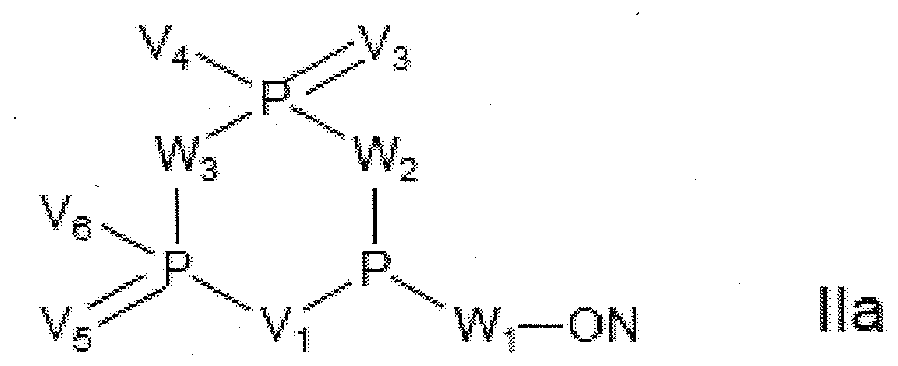

- (b) reacting the oxidized compound with a capture tag agent of formula (III),
Z-Y-XH (III)
wherein X, Z, and Y are as described above to obtain a reaction product comprising the oligonucleotide of formula (I), and - (c) contacting the reaction product of step (b) with a reagent capable of interacting with the capture tag under conditions which allow separation of the oligonucleotide (I) from other species contained in said reaction product.
- Optionally, the method further comprises the step (d) removing the capture tag to obtain an oligonucleotide of formula (IV),

- In further embodiments, the capture tag is not or not completely removed. In these embodiments, the tagged oligonucleotide as such may have utility, e.g. utility as pharmaceutical agent.
- The term "oligonucleotide" in the context of the present application encompasses compounds comprising a plurality, e.g. at least 4 nucleotide or nucleotide analogue building blocks. Preferably, the oligonucleotide comprises 6-100, e.g. 20-40 building blocks. The nucleotide or nucleotide analogue building blocks may comprise nucleoside or nucleoside analogue subunits connected by inter-subunit linkages. The nucleoside subunits include deoxyribonucleoside subunits, ribonucleoside subunits and/or analogues thereof, particularly sugar- and/or nucleobase-modified nucleoside analogues. Further, the oligonucleotides may comprise non-nucleotidic building blocks and/or further terminal and/or side-chain modifications.
- In preferred sugar-modified subunits the 2'-OH of a ribonucleoside subunit is replaced by a group selected from OR, R, halo, SH, SR, NH2, NHR, NR2 or CN, wherein R is C1-6 alkyl, C2-6 alkenyl or C2-6 alkynyl and halo is F, Cl, Br or I. In further preferred sugar-modified subunits, the ribose may be substituted, e.g. by another sugar, for example a pentose such as arabinose. This sugar modification may be combined with 2'-OH modifications as described above, such as in 2'-fluoroarabinonucleoside subunits. Still further preferred sugar-modified subunits include locked nucleosides (LNA) or 2',3'-seco-nucleosides (UNA). In preferred nucleobase-modified nucleosidic building blocks, a non-standard, e.g. non-naturally occurring nucleobase, is used instead of a standard nucleobase. Examples of non-standard nucleobases are uracils or cytosines modified at the 5-position, e.g. 5-(2-amino)propyl uracil or 5-bromouracil; hypoxanthine; 2,6-diaminopurine; adenines or guanines modified at the 8-position, e.g. 8-bromoguanine; deazanucleosides, e.g. 7-deazaguanine or 7-deazaadenine; or O- and N-alkylated nucleobases, e.g. N6-methyladenine, or N6,N6-dimethyladenine. Further suitable nucleobase analogues may be selected from universal nucleobase analogues such as 5-nitroindole.
- The inter-subunit linkage between subunits may be a phosphodiester linkage or a modified linkage, e.g. a phosphorothioate, phosphorodithioate, methylphosphonate, phosphoramidate, boranophosphate, or another modified linkage known to a skilled person in the art.
- The oligonucleotide may be selected from deoxyribonucleotides, ribonucleotides and oligonucleotide analogues. Analogues of desoxyribonucleotides or ribonucleotides may comprise at least one desoxyribonucleoside or ribonucleoside subunit and at least one modified nucleosidic subunit and/or at least one modified inter-subunit linkage, e.g. as described above. Oligonucleotide analogues may also consist in their entirety of modified nucleosidic subunits.
- The oligonucleotide may be a single-stranded molecule or a double-stranded molecule. Double-stranded oligonucleotides may comprise completely or partially complementary strands. Double-stranded molecules may be blunt-ended or comprise at least one overhang, e.g. a 5'- or 3'-overhang. Overhangs, if present, are preferably located at the distal end of the molecule (with regard to the triphosphate/triphosphate analogue group). Double-stranded oligonucleotides may also comprise a hairpin-structure, wherein the duplex is closed by a loop at the distal end thereof (with regard to the triphosphate/triphosphate analogue group). The loop may comprise nucleotide and/or non-nucleotide building blocks, for example diol-based building blocks such as ethylene glycol moieties, e.g. tri(ethylene)glycol or hexa(ethylene)glycol; propane-1,3-diol; dodecane-1,12-diol; or 3,12-dioxa-7,8-dithiatetradecane-1,14-diol.
- In a preferred embodiment, double-stranded molecules are blunt-ended, particularly at the proximal end thereof (with regard to the triphosphate/triphosphate analogue group).
- The oligonucleotide may comprise further terminal and/or side-chain modifications, e.g. cell specific targeting entities covalently attached thereto. Those entities may promote cellular or cell-specific uptake and include, for example lipids, vitamins, hormones, peptides, oligosaccharides and analogues thereof. Targeting entities may e.g. be attached to modified nucleobases or non-nucleotidic building blocks by methods known to the skilled person.
- The oligonucleotide of formula (I) or (IV) comprises a triphosphate/triphosphate analogue group. In this group, V1, V3 and V5 are independently selected from O, S and Se. Preferably, V1, V3 and V5 are O. V2, V4 and V6 are in each case independently selected from OH, OR1, SH, SR1, F, NH2, NHR1, N(R1)2 and BH3 -M+. Preferably, V2, V4 and V6 are OH. R1 may be C1-6 alkyl, C2-6 alkenyl, C2-6 alkynyl, C2-6 acyl or a cyclic group, e.g. a C3-8 cyclo(hetero)alkyl group, a C3-8 cyclo(hetero)alkenyl group, phenyl or C5-6 heteroaryl group, wherein heteroatoms are selected from N, O and S. Further, two R1 may form a ring, e.g. a 5- or 6-membered ring together with an N-atom bound thereto. R1 may also comprise substituents such as halo, e.g. F, Cl, Br or I, O(halo)C1-2 alkyl and - in the case of cyclic groups - (halo)C1-2 alkyl. M+ may be an inorganic or organic cation, e.g. an alkali metal cation or an ammonium or amine cation.
- W1 may be O or S. Preferably, W1 is O. W2 may be O, S, NH or NR2. Preferably, W2 is O. W3 may be O, S, NH, NR2, CH2, CHHal or C(Hal)2-Preferably, W3 is O, CH2 or CF2. R2 may be selected from groups as described for R1 above. Hal may be F, Cl, Br or I.
- The triphosphate/triphosphate analogue group is preferably attached to a terminus of the oligonucleotide. Preferably, the group is attached to the 5'-terminus of the oligonucleotide, particularly to the 5'-OH-group of the 5'-terminal sugar thereof.
- Step (a) of the method of the invention comprises the reaction of cyclic P(V)-P(V)-P(III) species of formula (IIa) with an oxidizing agent. The compound of formula (IIa) may be obtained according to standard methods as described by Ludwig et al, 1989, supra and Gaur et al., 1992, supra, namely by reacting the 5'-terminal OH-group of an oligonucleotide with a trifunctional phosphitylating agent, e.g. 2-chloro-4H-1,3,2-benzodioxaphosphorin-4-one under suitable conditions, e.g. in the presence of base (pyridine or diisopropylmethylamine) in a suitable solvent such as dioxane or dichloromethane, and subsequent reaction with pyrophosphate (W3=O) or a modified pyrophosphate (W3 is different from O, e.g. CH2, CCl2, NH or CF2). Preferably, a tri-n-butylammonium salt of the pyrophosphate or modified pyrophosphate in DMF is used. The resulting cyclic P(III)-P(V) intermediate (IIa) is then oxidized under anhydrous conditions, e.g. with a peroxide, such as t-butyl hydroperoxide, cumene hydroperoxide, (10-camphorsulfonyl)oxaziridine). Alternatively, phenylacetyldisulfide (V2=S), or borane-diisopropylethylamine complex (V2=BH3) can also be employed respectively, to give the corresponding cyclic 5'-triphosphate/triphosphate analogue of formula (IIb). Reference in this context is also made to
WO 96/40159 WO 2009/060281 , the contents of which are herein incorporated by reference. - Reaction step (a) may take place with an oligonucleotide in solution or with an oligonucleotide bound to a solid phase, e.g. an organic resin or glass, such as CPG. The oligonucleotide may further comprise protecting groups, e.g. sugar- or nucleobase protecting groups that are well known to the skilled person. Preferred examples of protecting groups are 2-cyanoethyl for the internucleoside phosphodiester or phosphorothioate, tert-butyldimethylsilyl, triisopropylsilyloxymethyl or bis(acetoxyethoxy)methyl for the ribose 2'-hydroxyl group, 4-t-butylphenoxyacetyl or phenoxyacetyl, acetyl, isobutyryl, benzoyl for the exocyclic amino groups of the nucleobases. More preferably, step (a) is carried out with a solid-phase bound oligonucleotide.
- According to step (b) of the method of the invention, compound (IIb) is reacted with a capture tag agent of formula (III)

wherein X is a group selected from NH, NR3, O or S. R3 is defined as described above for R1. Preferably, X is NH or S. - The capture tag is functionally defined below by a series of plausible Examples. A general rule may be:
- Z has to allow a convenient purification, and it should be removable under conditions which are compatible with pppRNA stability requirements.
- Y represents a chemical bond or a linker, e.g. an alkylene or aralkylene linker, optionally comprising heteroatoms or heteroatom-containing groups, such as O, S, NH, C=O or C=S, and/or optionally comprising C=C or C≡C bonds.
- Reaction step (b) may take place with an oligonucleotide in solution or with an oligonucleotide bound to a solid phase, e.g. an organic resin or glass. The oligonucleotide may further comprise protecting groups as described above. More preferably, step (b) is carried out with a solid phase-bound oligonucleotide.
- The capture tag Z according to the present invention is a moiety capable of non-covalently or covalently interacting with a capture reagent under conditions which allow separation for compounds comprising the capture tag, e.g. the oligonucleotide (I) from other species, which do not contain the capture tag. Preferably, the capture reagent is an immobilized reagent or a reagent capable of being immobilized.
- Suitable capture tags are for instance long-chain, e.g. C8-24, preferably C13-24 aliphatic alkyl residues such as decyl or octadecyl or other lipidic/lipophilic residues such as e.g. cholesteryl or tocopheryl. In this case, the tagged triphosphate entity can be captured and purified on a solid phase by standard reversed phase chromatography, e.g. RP-HPLC, or by hydrophobic interaction chromatography (HIC). The capture tag may also be a perfluoroalkyl entity, e.g. a 4-(1H,1H,2H,2H-perfluorodecyl)benzyl or a 3-(perfluorooctyl)propyl residue for specific capture of the modified oligo-triphosphate on a Fluorous Affinity support such as is commercially available from Fluorous Technologies, Inc.
- In another embodiment, the capture tag may be a first partner of a non-covalent high-affinity binding pair, such as biotin, or a biotin analogue such as desthiobiotin, a hapten or an antigen, which has a high affinity (e.g. binding constant of 10-6 I/mol or less) with the capture reagent, which is a second complementary partner of the high-affinity binding pair, e.g. a streptavidin, an avidin or an antibody.
- In yet another embodiment, the capture tag may be a first partner of a covalent binding pair, which may form a covalent bond with the capture reagent, which is a second complementary partner of the covalent binding pair, wherein the covalent bond may be a reversible or an irreversible bond. In this embodiment, the capture tag component Z may be a reactive chemical entity such as an azide or alkynyl group enabling covalent reaction with a capture reagent that contains a complementary reactive group, e.g. an alkynyl or azido moiety, respectively, in the case of the Husigen 3+2 cycloaddition reaction (the so-called "click-reaction" that is Cu(I) catalyzed or a variant thereof that proceeds without Cu(I) ions via release of severe ring strain in e.g. cyclooctyne derivatives). A specific example for Z-Y-X in such a case would be propargylamino.
- In another embodiment, the capture tag component may be a chemical entity which contains an additional nucleophylic group, for instance a second amino group in an NH2-Y-XH type reagent. A wide range of suitable electrophylic Z reagent as cholesterolchloroformiate or biotin N hydroxy succinimide active esters may then be used to introduce the tagging group while the oligonucleotiode is attached to the solid phase, thus significantly extending the scope of the tagging reaction.
- Moreover, Y may optionally contain a disulfide bond to enable recovery of the modified triphosphorylated oligonucleotide with a free sulfhydryl moiety connected via part of the linker through X to the γ-phosphorus.
- In a further embodiment of the present invention, the oligonucleotide may carry a second capture tag at a different position, e.g. at the 3'-terminus. The first and the second capture tags are preferably selected as to allow purification by two orthogonal methods to enable recovery of extremely high purity material. For example the first capture tag may be a lipophilic group, which interacts with a suitable chromatographic support and the second capture tag may be biotin, which interacts with streptavidin.
- The second capture tag may be conveniently introduced by performing the synthesis using a modified CPG (controlled glass support) for oligoribonucleotide synthesis.
- Step (c) of the method of the present invention comprises contacting the reaction product of step (b), with a capture reagent capable of interacting with the capture tag Z under conditions which allow separation of the capture tag containing oligonucleotide (I) from other species contained in the reaction product. Before step (c), the solid phase bound oligonucleotide (I) is cleaved from the solid phase and deprotected, i.e. the protection groups are partially or completely removed. The capture reagent is preferably immobilized on a suitable support, e.g. a chromatographic support. In order to provide separation of capture tag containing oligonucleotide (I) from non-capture tag-containing species, the reaction products from step (b) are cleaved from a solid phase and deprotected, if necessary, and subjected to a separation procedure, preferably a chromatographic separation procedure based on the interaction of the capture tag Z with the capture reagent. During the separation step, the purity of the oligonucleotide (I), which is generally in the range of 25-70% for the crude material depending upon the length and complexity of the sequence, may be increased to 90%, 91%, 92%, 93%, 94%, 95% or more. For toxicity studies a purity of > 85% is desirable, whereas in late stage clinical trials the purity should be in the range of at least 90-95%. Thus, the present invention provides a way to obtain a high purity ppp-RNA as would be required for human clinical trials.
- In step (c), the capture tag and the capture reagent capable of interacting therewith are preferably selected from (i) a hydrophobic or fluorinated group and a chromatographic material with affinity for hydrophobic or fluorinated groups, e.g. a reversed phase material or a fluorous affinity support; (ii) a first partner of a non-covalent high-affinity binding pair and a second complementary partner of a non-covalent high-affinity binding pair, (iii) a first partner of a covalent binding pair and a second complementary partner of a covalent binding pair, where the first and second partner form covalent bonds.
- After the purification step (c), capture tag Z may be cleaved from the triphosphate-modified oligonucleotide in a further step (d) resulting in an untagged oligonucleotide (IV).
- Step (d) has to be compatible with stability requirements of the triphosphate end product and with stability requirements of the interribonucleotide bond. It may comprise cleavage by mildly acidic conditions when X is NH, cleavage with silver ions when X is S, cleavage by a thiol such as dithiothreitol leading to elimination of thiirane when Y-X-P contains -S-S-CH2-CH2-O-P.
- In further embodiments, the capture tag set remains completely or partially on the triphosphate-modified oligonucleotide, particularly when the tagged oligonucleotide is suitable for pharmaceutical applications. In these embodiments, the reagent Z-Y-XH has to be selected from a subgroup of Z-residues, which are functionally compatible with the structural requirements of the RIG-I sensor. For instance, the Z=decyl-octadecyl, Y=link XH=NH combination is known to fulfill these requirements.
- The triphosphate/triphosphate analogue modified oligonucleotides produced according to the present invention are particularly suitable for pharmaceutical applications due to their high purity. In an especially preferred embodiment, the oligonucleotide (I) or (IV) is an activator of RIG-1 helicase. Specific examples of suitable RIG-1 activators are disclosed in Schlee et al., 2009, supra, the content of which is herein incorporated by reference.
- Still another subject-matter of the invention is the use of a kit for preparing an oligonucleotide of formula (I)
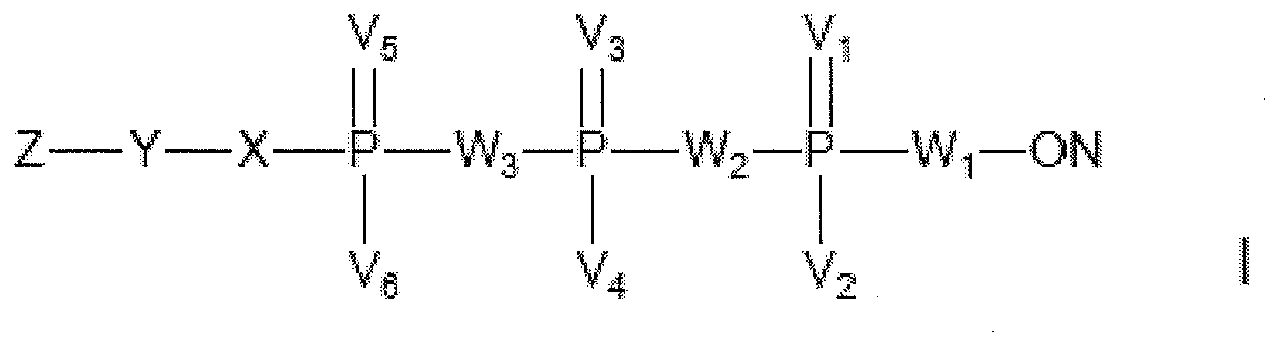
wherein the kit comprises (a) a capture tag agent of formula (III) Z-Y-XH (III)
wherein X, Z and Y are defined as above, and
(b) a capture reagent capable of interacting with the capture tag. - Still another subject-matter of the invention is a modified oligonucelotide of formula (I)
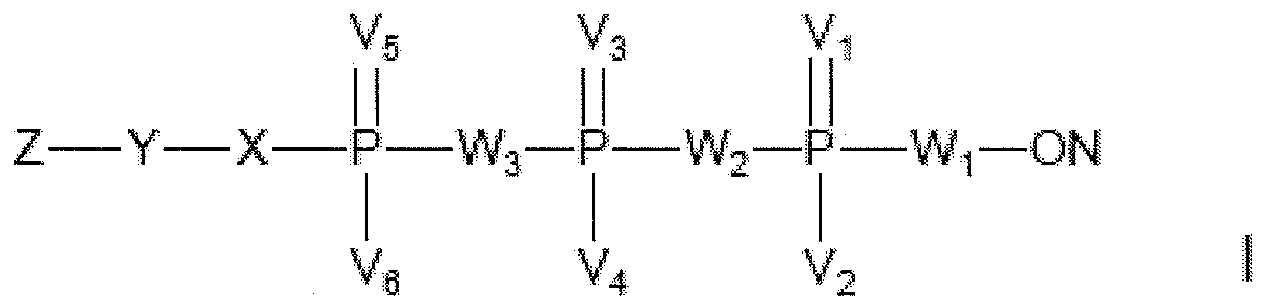
X is NH, O, R-O-[P(V1)V2-W1]n or R-O-P(V3)V4-W2-P-(V1)V2-W1,
n is 1-12, preferably 1 or 2,
Y is a bond,
Z is C13-C24 alkyl, Q or QNHC2-C24 alkyl,
Q is selected from H, aminoacids, aminoacid analogues, C1-C24 alkyl, preferably C12-C24 alkyl, peptides and lipids,
R is C1-C24 alkyl, C2-C24 alkenyl, C2-C24 alkynyl and lipids,
R is C1-C24 alkyl, C2-C24 alkenyl, C2-C24 alkynyl, C2-C24 acyl or a cyclic group, and optionally substituted,
and V1, V2, V3, V4, V5, V6, W1, W2, W3 and ON are defined as in any one of claims 1-11, wherein V1, V2, V3, V4, V5, V6, W1, W2 and W3 are preferably O. - According to a preferred embodiment of the present invention a modified oligonucleotide of formula (I) has X being NH. This embodiment preferably has Z being Q or Z being QNHC2-C24 alkyl, wherein in a particularly preferred embodiment C2-C24 alkyl is C2 alkyl and/or Q is H. Particularly preferred embodiments of the identified oligonucleotide according to the invention are shown in
Fig. 8 . - Further, the present invention shall be explained in more detail by the following Figures and Examples.
-
Fig 1 shows a schematic overview of the method of the invention using decyl residue as capture tag Z -
Fig 2 shows RP-HPLC purification of pppRNA via n-decyl-NH-pppRNA intermediate- (A) crude reaction mixture containing 65 % n-decyl-NH-pppRNA (peak at 14 min);
- (B) isolated n-decyl-NH-pppRNA;
- (C) pppRNA; the pH=3.8 60 min hydrolysis product from B
Column: Hamilton PRP-1 4.1 x 250 mm, 10 µm
Gradient: 1-100 % B in 18 min, A= 0.05 M TEAB ; B= 80% Methanol 0.05 M
TEAB -
Fig 3 shows MALDI-TOF spectra corresponding to HPLC traces A, B and C inFig 2 respectively.- (A) spectrum recorded from the crude reaction mixture after desalting showing the presence of n-decyl-NH-ppp RNA (24d), pppRNA (24c), 5'-H-phosphonate RNA(24b) and 5'-OH -RNA(24a) and shorter synthesis failure sequences indicated as peaks 12-23 ;
- (B) spectrum recorded from HPLC isolated n-decyl-NHpppRNA (B),
- (C) spectrum of pure pppRNA as obtained from the direct EtOH precipitation of the pH= 3.8 hydrolysis product of n-decyl-NH-pppRNA
-
Fig 4 shows a reaction scheme explaining the generation ofside products 24 a-c -
Fig 5 shows the time course for the conversion of n-decyl-NH-pppRNA to pppRNA via acidic hydrolysis of the phosphoramidate bond. -
Fig 6 shows typical MALDI spectra of 21-mer, 24-mer, 27-mer pppRNA products as obtained after capture tag removal and EtOH precipitation as Na+ salt. The correct mass peak is observed at m/z 6911.6 (A), m/z 7828 (B), m/z 8808.1 (C) and the peaks at m/z 3462 (A), m/z 3918 (B), 4408 (C) are due to the doubly charged pppRNA, respectively. Similar quality spectra have been obtained in more than 50 examples with a variety of sequences containing nucleoside analogs and 3' modifications in the 15-42-mer range. -
Fig 7A shows a semipreparative scale reversed phase HPLC purification of a 1 µmol scale reaction of decyl-NHpppRNA 21 mer on a 7 mm Hamilton PRP-1 column
Column: Hamilton PRP-1 7 x 250 mm, 10 µm Flow rate 3 mL/min.
Gradient: 1-80 % B in 50 min, A= 0.1 M TEAB ; B= 80% Methanol 0.1 M
TEAB -
Fig. 7B and Fig. 7C show semipreparative scale reversed phase HPLC purifications, in particular showing how the inventive method is able to deal with sub-optimal synthesis and/or 5'-phosphorylation conditions. -
Fig. 8 shows especially preferred modified oligonucleotides of formula (I). - An overview of the reaction scheme described in Example 1 is shown in
Fig. 1 . - Step 1: Dissolve 203 mg (1 mmol) of 2-chloro-4H-1,3,2-benzodioxaphosphorin-4-one in 1 mL of dry dioxane in a 10 mL septum vial under argon.
- Step 2: Dry the synthesis column containing the fully protected RNA that has been detitrylated and thoroughly washed with acetonitrile, in vacuum for 12 h. Wash the column contents thoroughly by repeatedly drawing in and expelling 2 mL of anhydrous dioxane/pyridine solution, 3:1 (v/v) in an argon atmosphere.
- Step 3: Add into a vial first 2 mL of pyridine/dioxane, 3:1 v/v followed by 100 µL of 1 M 2-chloro-4H-1,3,2-benzodioxaphosphorin-4-one solution in dry dioxane to give a 50 mM solution of the phosphitylating reagent, e.g. 2-chloro-4H-1,3,2-benzodioxaphosphorin-2-one, in dioxane/pyridine, 3:1 (v/v). Homogenize the solution by gently shaking. Start the reaction by drawing the 2-chloro-4H-1,3,2-benzodioxaphosphorin-4-one solution through the synthesis column from the vial.
During the reaction, repeatedly draw in and expel the 2-chloro-4H-1,3,2-benzodioxaphosphorin-4-one containing solution from the synthesis column, in order to allow thorough contact and good mixing with the solid phase supported RNA. A 30 min reaction time usually gives near quantitative reaction of the free 5'-OH group of the support bound oligomer in the 20-40 nt range. - Step 4: After a 30 min reaction time expel the dioxane/pyridine solution containing the excess phosphitylating agent into a waste container, fill a new syringe with a vortexed mixture of 1 mL of 0.5 M (Bu3NH)2 pyrophosphate in dry DMF and 238 µL (1 mmol) of dry Bu3N to give a 0.5 M (Bu3N)4 pyrophosphate solution. Push this solution through the column thereby replacing the dioxane/pyridine solution. The large excess of the pyrophosphate ensures a quantitative conversion of the intermediate to the P(III)-P(V) cyclic anhydride IIa.
- Step 5: Wash the column with 3 mL of CH3CN to remove the DMF and excess PPi, and to fill the column reactor with dry CH3CN.
- Step 6: Dissolve 300 µL of t-BuOOH (5.5 M solution in decane, Sigma-Aldrich) in 2 mL of anhydrous CH3CN to give an approximately 0.7 M homogeneous solution. Contact the synthesis support with this solution for 15 min in order to obtain the oxidized P(V) cyclic anhydride IIb.
- Step 7: Wash the column with 3 mL of dry CH3CN to remove the excess peroxide and fill it with dry CH3CN.
- Step 8: Dissolve 300 µL of dry decylamine in 1 mL of dry CH3CN under argon and bring the solution in contact with the support in the column. Move the decylamine solution through the support. The contact time of the CPG with the amine solution should be 3 min.
- Step 9: Wash the column thoroughly with 9 mL acetonitrile, then dry the column contents by flushing argon through it.
- Step 10- First stage of the deprotection:
Pass 1 mL of deprotection solution (40% aq. methylamine/conc. aq. ammonia 1:1 v/v. AMA reagent) through the support for 2-3 times. After a contact of 30 min transfer the solution into a new vial. Wash the support with same volume of AMA deprotection solution and combine the washings. Heat the combined solution and washings for 10 min at 65°C. After cooling on ice, concentrate the solution to a volume of 300-500 µL, then evaporate to dryness. - Step 11 - Removal of the 2'-O-TBDMS protecting groups: Dry the residue by addition and coevaporation of 300 µL of dry EtOH, add 1 mL of dry 1 M TBAF (tetra-n-butylammonium fluoride) in THF, seal tightly and put on a shaker for 16 h. Quench the reaction with 1 mL of sterile aqueous 1 M TEAB (triethylammonium bicarbonate), and desalt it on a NAP™-25 (Nucleic Acid Purification) column using sterile water as eluent. Filtration through a sterile 2 µm filter may be necessary at this step. Combine and evaporate the UV-absorbing fractions to a volume of 150 µL, add 100 mL of 1 M TEAB pH8 and store the solution frozen at -20°C until the HPLC purification can be performed. The decyl-NHpppRNA product is stable at -20°C for weeks at pH 7-8.
- Step 12 - HPLC purification: The reaction product from an 1 µmol scale reaction mixture from step 11 was loaded into a 7x25 mm PRP-1 column (Hamilton). Purification was performed using a linear gradient buffer B from 0 to 80% in 50 min at a flow rate of 3 mL/min. Buffer A is 100 mM TEAB and buffer B is 100 mM TEAB in methanol/water 8:2 v/v. A typical example of a 27-mer purification is shown in
Figure 7A .
Fractions 5 and 6 are collected, evaporated on a rotary evaporator and desalted by several coevaporations with dry methanol, The residue (approx. 200-250 nmol of decyl-NHpppRNA) was dissolved in water and transferred into a screw cap Eppendorf vial. - Step 13 - Removal of the decylamine tag: 100 nmol of decyl-NHpppRNA was dissolved in 400 µL of pH 3.8 deprotection buffer in a 2 mL Eppendorf tube, and the sealed tube was heated at 60°C for 70 min. These conditions result in quantitative cleavage of the phosphoramidate bond with no degradation of the triphosphate moiety. Then the reaction mixture was cooled on ice and 25 µL of sterile 5 M NaCl solution and 1.2 mL of absolute EtOH were added. After thorough mixing the solution was kept at -20°C overnight to precipitate the pppRNA. The precipitate was collected by centrifugation, washed with cold ethanol, dried on a SpeedVac, then dissolved in 500 mL of sterile water and stored frozen at -20°C.
- In analogous manner, a 5'-triphosphate modified oligonucleotide was also synthesized and purified using an octadecyl or a cholesteryl capture tag.
| 1 µmol scale synthesis column containing support bound detitrylated RNA | |||
| ←→ bidirectional movements of reagents, | |||
| → unidirectional washing step |
| | Reagent | Time | ||
| 1 | 3 mL dioxane/pyridine, 3:1 v/v | wash | → | |
| 2 | 50 mM 2-chloro-4H-1,3,2-benzodioxaphosphorin-4-one in 2 mL of dioxane/pyridine, 3:1 v/ | 30 min | ←→ | |
| 3 | mL of 0 5 M (Bu2NH)2PP1 in DMF plus 238 µL of Bu3N | 10 min | ←→ | |
| 4 | 3 mL of dry acetonitrile | wash | → | |
| 5 | 300 µL of t-BuOOH (5.5 M in decane) in 2 mL of CH3CN | 15 min | ←→ | |
| 6 | 3 mL of dry acetonitrile | Wash | → | |
| 7 | 300 µL of n-decylamine in 1 mL of dry acetonitrile (1.1 M decylamine) | 3min | ←→ | |
| 8 | 10 mL of acetonitrile | wash | → |
Claims (15)
- A method of preparing an oligonucleotide of formula (I),
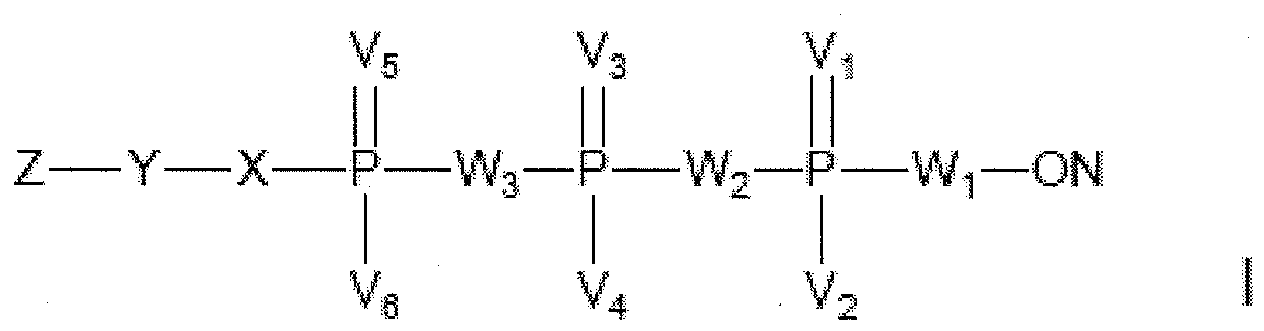
V2, V4 and V6 are independently in each case selected from OH, OR1, SH, SR1, F, NH2, NHR1, N(R1)2 and BH3 -M+,
W1 is O or S,
W2 is O, S, NH or NR2,
W3 is O, S, NH, NR2, CH2, CHHal or C(Hal)2,
R1, R2 and R3 are selected from C1-6 alkyl, C2-6 alkenyl, C2-6 alkynyl, C2-6 acyl or a cyclic group, each optionally substituted,
or wherein two R1 may form a ring together with an N-atom bound thereto, M+ is a cation,
X is NH, NR3, O or S,
Z represents a capture tag,
Y represents a bond or a linker connecting the capture tag to X, and ON represents an oligonucleotide comprising at least 4 nucleotide or nucleotide analogue building blocks,
comprising the steps:(a) reacting a compound of formula (IIa)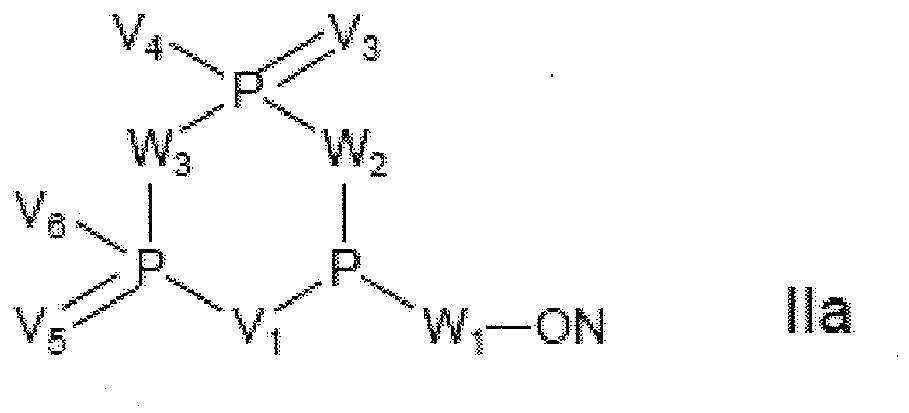
with an oxidizing agent to obtain a compound of formula (IIb) (b) reacting a compound of formula (IIb) with a capture tag agent of formula (III),
Z-Y-XH (III)
wherein X, Z, and Y are as defined above to obtain a reaction product comprising the oligonucleotide of formula (I), and(c) contacting the reaction product of step (b) with a capture reagent capable of interacting with the capture tag, wherein the contacting takes place under conditions which allow separation of the oligonucleotide (I) from other species contained in said reaction product. - The method of claim 1, wherein the capture tag and the capture reagent capable of interacting therewith are selected from:(i) a hydrophobic or fluorinated group and a chromatographic material with affinity for hydrophobic or fluorinated groups, e.g. a reversed phase material or a fluorous affinity support;(ii) a first partner of a non-covalent binding pair and a second partner of a non-covalent binding pair, and(iii) a first partner of a covalent binding pair and a second parter of a covalent binding pair, where the first and second partner form covalent bonds.
- The method of claim 1 or 2,
wherein the triphosphate/triphosphate analogue group is attached to the 5'-terminus of the oligonucleotide, particularly to the 5'-OH-group of the 5'-terminal sugar thereof. - The method of any one of claims 1-3, further comprising the step:
(d) removing the capture tag to obtain an oligonucleotide of formula (IV):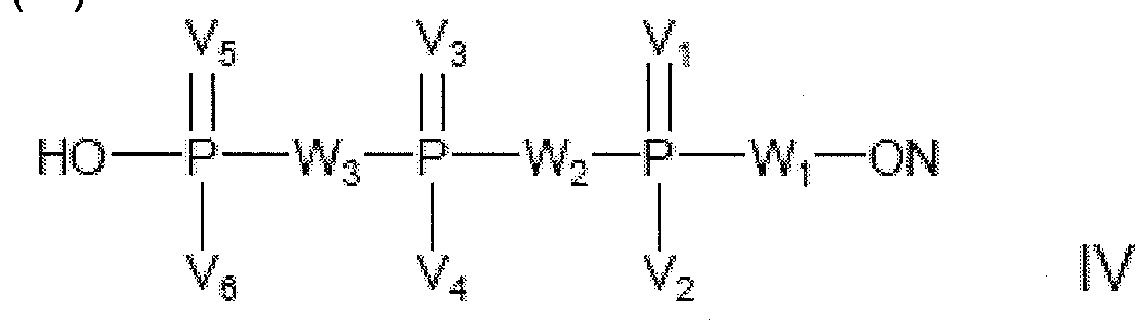
- The method of any one of claims 1-4, wherein the oligonucleotide is selected from desoxyribonucleotides, ribonucleotides and oligonucleotide analogues.
- The method of any one of claims 1-5, wherein the oligonucleotide is single-stranded.
- The method of any one of claims 1-5, wherein the oligonucleotide is double-stranded.
- The method of claim 7, wherein the oligonucleotide is double-stranded and the duplex is closed by a loop at the distal end thereof, wherein the loop comprises nucleotide and/or non-nucleotide building blocks.
- The method of claim 7 or 8, wherein the oligonucleotide is double-stranded and the duplex is blunt-ended at the proximal end thereof.
- The method of any one of claims 1-9, wherein the oligonucleotide comprises a cell-specific targeting entity covalently attached thereto.
- The method of any one of claims 1-10, wherein the oligonucleotide (I) or (IV) is an activator of the RIG-1.
- Use of a kit for preparing an oligonucleotide of formula (I)
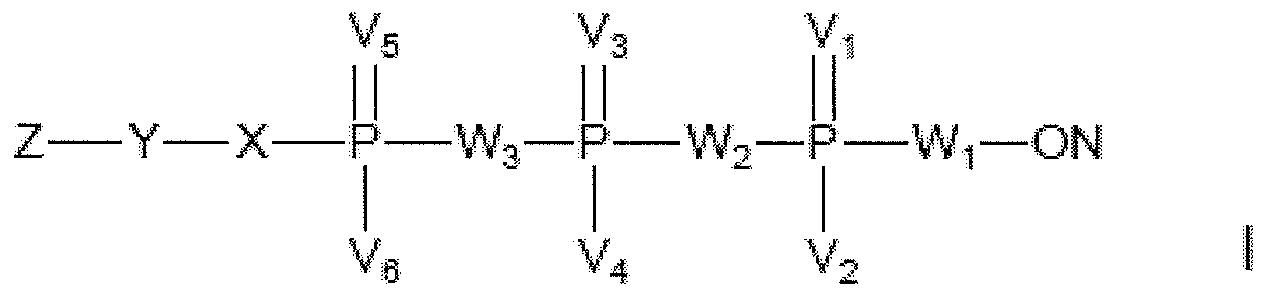
wherein the kit comprises:(a) a capture tag agent of formula (III)
Z-Y-XH (III)
wherein X, Z and Y are defined as in any one of claims 1-11, and(b) a capture reagent capable of interacting with the capture tag. - A modified oligonucleotide of formula (I)

X is NH, O, R-O-[P(V1)V2-W1]n or R-O-P(V3)V4-W2-P-(V1)V2-W1,
n is 1-12, preferably 1 or 2,
Y is a bond,
Z is C13-C24 alkyl, Q or QNHC2-C24 alkyl,
Q is selected from H, aminoacids, aminoacid analogues, C1-C24 alkyl, preferably C12-C24 alkyl, peptides and lipids,
R is C1-C24 alkyl, C2-C24 alkenyl, C2-C24 alkynyl and lipids,
R is C1-C24 alkyl, C2-C24 alkenyl, C2-C24 alkynyl, C2-C24 acyl or a cyclic group, and optionally substituted,
and V1, V2, V3, V4, V5, V6, W1, W2, W3 and ON are defined as in any one of claims 1-11, wherein V1, V2, V3, V4, V5, V6, W1, W2 and W3 are preferably O. - The modified oligonucleotide of claim 13,
wherein
X is NH or O, and
Z is C13-C24 alkyl, Q or QNHC2-C24 alkyl. - The modified oligonucleotide of claim 13,
wherein
X is R-O-[P(V1)V2W1]n,
n is 1 or 2, and
V1, V2 and W1 are O.
Priority Applications (24)
| Application Number | Priority Date | Filing Date | Title |
|---|---|---|---|
| EP11160032A EP2508530A1 (en) | 2011-03-28 | 2011-03-28 | Purification of triphosphorylated oligonucleotides using capture tags |
| DK12710950.2T DK2691410T3 (en) | 2011-03-28 | 2012-03-28 | PURIFICATION OF TRIPHOSPHORIATED OLIGON NUCLEOTIDES WITH USE OF Catching TAGs |
| AU2012234296A AU2012234296B2 (en) | 2011-03-28 | 2012-03-28 | Purification of triphosphorylated oligonucleotides using capture tags |
| HUE12710950A HUE033843T2 (en) | 2011-03-28 | 2012-03-28 | Purification of triphosphorylated oligonucleotides using affinity markers |
| CA2830980A CA2830980C (en) | 2011-03-28 | 2012-03-28 | Purification of triphosphorylated oligonucleotides using capture tags |
| EP12710950.2A EP2691410B1 (en) | 2011-03-28 | 2012-03-28 | Purification of triphosphorylated oligonucleotides using capture tags |
| CN201280015575.XA CN103492405B (en) | 2011-03-28 | 2012-03-28 | Purification of triphosphorylated oligonucleotides using capture tags |
| HRP20170577TT HRP20170577T1 (en) | 2011-03-28 | 2012-03-28 | Purification of triphosphorylated oligonucleotides using capture tags |
| PL12710950T PL2691410T3 (en) | 2011-03-28 | 2012-03-28 | Purification of triphosphorylated oligonucleotides using capture tags |
| RS20170383A RS55912B1 (en) | 2011-03-28 | 2012-03-28 | PURIFICATION OF TRIPHOSPHORILIZED OLIGONUCLEOTIDS USING EARNING MARKERS |
| PCT/EP2012/055520 WO2012130886A1 (en) | 2011-03-28 | 2012-03-28 | Purification of triphosphorylated oligonucleotides using capture tags |
| ES12710950.2T ES2623002T3 (en) | 2011-03-28 | 2012-03-28 | Purification of triphosphorylated oligonucleotides using capture markers |
| SI201230928A SI2691410T1 (en) | 2011-03-28 | 2012-03-28 | Purification of triphosphorylated oligonucleotides using capture tags |
| US14/007,752 US9399658B2 (en) | 2011-03-28 | 2012-03-28 | Purification of triphosphorylated oligonucleotides using capture tags |
| JP2014501597A JP5981985B2 (en) | 2011-03-28 | 2012-03-28 | Purification of triphosphorylated oligonucleotides using capture tags |
| PT127109502T PT2691410T (en) | 2011-03-28 | 2012-03-28 | Purification of triphosphorylated oligonucleotides using capture tags |
| EP17161309.4A EP3199538B1 (en) | 2011-03-28 | 2012-03-28 | Purification of triphosphorylated oligonucleotides using capture tags and modified triphosphorylated oligonucleotides as activators of rig-1 helicase |
| SM20170211T SMT201700211T1 (en) | 2011-03-28 | 2012-03-28 | Purification of triphosphorylated oligonucleotides using capture tags |
| LTEP12710950.2T LT2691410T (en) | 2011-03-28 | 2012-03-28 | Purification of triphosphorylated oligonucleotides using capture tags |
| CN201611239988.2A CN106699829A (en) | 2011-03-28 | 2012-03-28 | Purification of triphosphorylated oligonucleotides using capture tags |
| US15/178,881 US9896689B2 (en) | 2011-03-28 | 2016-06-10 | Purification of triphosphorylated oligonucleotides using capture tags |
| JP2016149059A JP6373908B2 (en) | 2011-03-28 | 2016-07-28 | Purification of triphosphorylated oligonucleotides using capture tags |
| CY20171100440T CY1118867T1 (en) | 2011-03-28 | 2017-04-13 | Purification of triphosphorylated oligonucleotides by the use of capture labels |
| AU2017206181A AU2017206181A1 (en) | 2011-03-28 | 2017-07-18 | Purification of triphosphorylated oligonucleotides using capture tags |
Applications Claiming Priority (1)
| Application Number | Priority Date | Filing Date | Title |
|---|---|---|---|
| EP11160032A EP2508530A1 (en) | 2011-03-28 | 2011-03-28 | Purification of triphosphorylated oligonucleotides using capture tags |
Publications (1)
| Publication Number | Publication Date |
|---|---|
| EP2508530A1 true EP2508530A1 (en) | 2012-10-10 |
Family
ID=44453820
Family Applications (3)
| Application Number | Title | Priority Date | Filing Date |
|---|---|---|---|
| EP11160032A Ceased EP2508530A1 (en) | 2011-03-28 | 2011-03-28 | Purification of triphosphorylated oligonucleotides using capture tags |
| EP12710950.2A Active EP2691410B1 (en) | 2011-03-28 | 2012-03-28 | Purification of triphosphorylated oligonucleotides using capture tags |
| EP17161309.4A Active EP3199538B1 (en) | 2011-03-28 | 2012-03-28 | Purification of triphosphorylated oligonucleotides using capture tags and modified triphosphorylated oligonucleotides as activators of rig-1 helicase |
Family Applications After (2)
| Application Number | Title | Priority Date | Filing Date |
|---|---|---|---|
| EP12710950.2A Active EP2691410B1 (en) | 2011-03-28 | 2012-03-28 | Purification of triphosphorylated oligonucleotides using capture tags |
| EP17161309.4A Active EP3199538B1 (en) | 2011-03-28 | 2012-03-28 | Purification of triphosphorylated oligonucleotides using capture tags and modified triphosphorylated oligonucleotides as activators of rig-1 helicase |
Country Status (18)
| Country | Link |
|---|---|
| US (2) | US9399658B2 (en) |
| EP (3) | EP2508530A1 (en) |
| JP (2) | JP5981985B2 (en) |
| CN (2) | CN106699829A (en) |
| AU (2) | AU2012234296B2 (en) |
| CA (1) | CA2830980C (en) |
| CY (1) | CY1118867T1 (en) |
| DK (1) | DK2691410T3 (en) |
| ES (1) | ES2623002T3 (en) |
| HR (1) | HRP20170577T1 (en) |
| HU (1) | HUE033843T2 (en) |
| LT (1) | LT2691410T (en) |
| PL (1) | PL2691410T3 (en) |
| PT (1) | PT2691410T (en) |
| RS (1) | RS55912B1 (en) |
| SI (1) | SI2691410T1 (en) |
| SM (1) | SMT201700211T1 (en) |
| WO (1) | WO2012130886A1 (en) |
Cited By (5)
| Publication number | Priority date | Publication date | Assignee | Title |
|---|---|---|---|---|
| EP2712870A1 (en) * | 2012-09-27 | 2014-04-02 | Rheinische Friedrich-Wilhelms-Universität Bonn | Novel RIG-I ligands and methods for producing them |
| US9381208B2 (en) | 2006-08-08 | 2016-07-05 | Rheinische Friedrich-Wilhelms-Universität | Structure and use of 5′ phosphate oligonucleotides |
| US9399658B2 (en) | 2011-03-28 | 2016-07-26 | Rheinische Friedrich-Wilhelms-Universität Bonn | Purification of triphosphorylated oligonucleotides using capture tags |
| US9738680B2 (en) | 2008-05-21 | 2017-08-22 | Rheinische Friedrich-Wilhelms-Universität Bonn | 5′ triphosphate oligonucleotide with blunt end and uses thereof |
| WO2019036029A1 (en) * | 2017-08-18 | 2019-02-21 | Agilent Technologies, Inc. | Orthoester compositions for affinity purification of oligonucleotides |
Families Citing this family (9)
| Publication number | Priority date | Publication date | Assignee | Title |
|---|---|---|---|---|
| US10947543B2 (en) * | 2013-03-13 | 2021-03-16 | Yale University | Interferon production using short RNA duplexes |
| DE102015008536A1 (en) | 2015-07-02 | 2017-01-05 | Rheinische Friedrich-Wilhelms-Universität Bonn | Discontinuous oligonucleotide ligands |
| US10793901B2 (en) * | 2016-12-28 | 2020-10-06 | Roche Molecular Systems, Inc. | Reversibly protected nucleotide reagents with high thermal stability |
| WO2018172546A1 (en) | 2017-03-24 | 2018-09-27 | Rigontec Gmbh | Method for designing rig-i ligands |
| CN119286871A (en) | 2018-04-19 | 2025-01-10 | 查美特制药公司 | Synthetic RIG-I-like receptor agonists |
| EP3810151B1 (en) | 2018-06-20 | 2025-08-06 | Yale University | Rig-i agonists and treatments using same |
| WO2020260547A1 (en) | 2019-06-27 | 2020-12-30 | Rigontec Gmbh | Design method for optimized rig-i ligands |
| US11786545B2 (en) | 2020-12-09 | 2023-10-17 | Yale University | Compositions and methods for treating SARS-CoV-2 infection |
| US11649457B2 (en) | 2020-12-09 | 2023-05-16 | Yale University | Methods for treating SARS-CoV-2 infection |
Citations (5)
| Publication number | Priority date | Publication date | Assignee | Title |
|---|---|---|---|---|
| WO1996040159A1 (en) | 1995-06-07 | 1996-12-19 | Merck & Co., Inc. | Capped synthetic rna, analogs, and aptamers |
| US6900308B2 (en) | 2001-07-16 | 2005-05-31 | Isis Pharmaceuticals, Inc. | α-modified nucleoside triphosphates |
| US7285658B2 (en) | 2002-02-28 | 2007-10-23 | Biota, Inc. | Nucleotide mimics and their prodrugs |
| WO2009060281A2 (en) | 2007-11-06 | 2009-05-14 | Coley Pharmaceutical Gmbh | Immune stimulatory oligoribonucleotide analogs containing modified oligophosphate moieties |
| WO2011028218A1 (en) * | 2009-09-02 | 2011-03-10 | Alnylam Pharmaceuticals, Inc. | Process for triphosphate oligonucleotide synthesis |
Family Cites Families (206)
| Publication number | Priority date | Publication date | Assignee | Title |
|---|---|---|---|---|
| US3534017A (en) | 1967-03-14 | 1970-10-13 | Kyowa Hakko Kogyo Kk | Process for the preparation of nucleoside-5'-diphosphates and triphosphates and mono- and oligo-nucleotidyl-nucleoside-5'-diphosphates and triphosphates |
| US4210746A (en) | 1978-08-10 | 1980-07-01 | National Research Development Corporation | Nucleotide inhibitor of protein synthesis |
| US4285605A (en) | 1979-07-02 | 1981-08-25 | International Business Machines Corporation | Escapement mechanism and backspace mechanism for a moving paper carriage typewriter having dual pitch capability |
| FR2471785A1 (en) | 1979-12-21 | 1981-06-26 | Fabre Sa Pierre | RIBOSOMAL RNA-BASED IMMUNOSTIMULANT PREPARATIONS AND PROCESS FOR THE PREPARATION OF RNA |
| DE3023787A1 (en) | 1980-06-25 | 1982-01-21 | Studiengesellschaft Kohle mbH, 4330 Mülheim | METHOD FOR INCREASING THE INCORPORATION AND EXPRESSION OF GENETIC MATERIAL IN THE CORE OF INTACT CELLS BY LIPOSOME |
| EP0081099A3 (en) | 1981-12-04 | 1983-08-10 | Sloan-Kettering Institute For Cancer Research | Capped oligonucleotide anti-viral agents |
| US4522811A (en) | 1982-07-08 | 1985-06-11 | Syntex (U.S.A.) Inc. | Serial injection of muramyldipeptides and liposomes enhances the anti-infective activity of muramyldipeptides |
| US5194428A (en) | 1986-05-23 | 1993-03-16 | Worcester Foundation For Experimental Biology | Inhibition of influenza virus replication by oligonucleotide phosphorothioates |
| US5264423A (en) | 1987-03-25 | 1993-11-23 | The United States Of America As Represented By The Department Of Health And Human Services | Inhibitors for replication of retroviruses and for the expression of oncogene products |
| AU636573B2 (en) | 1988-02-26 | 1993-05-06 | Worcester Foundation For Biomedical Research, Inc. | Inhibition of htlv-iii by exogenous oligonucleotides |
| EP0339842B1 (en) | 1988-04-27 | 1996-11-06 | Isis Pharmaceuticals, Inc. | Novel oligoribonucleotide derivatives and application thereof to antiviral agents |
| JP2976436B2 (en) | 1988-04-27 | 1999-11-10 | 味の素株式会社 | Novel oligoribonucleotide derivatives and use as antiviral agents |
| DE3907562A1 (en) | 1989-03-09 | 1990-09-13 | Bayer Ag | ANTISENSE OLIGONUCLEOTIDS FOR INHIBITING THE TRANSACTIVATOR TARGET SEQUENCE (TAR) AND THE SYNTHESIS OF THE TRANSACTIVATOR PROTEIN (TAT) FROM HIV-1 AND THE USE THEREOF |
| EP0472648A4 (en) | 1989-05-18 | 1992-09-16 | Microprobe Corporation | Crosslinking oligonucleotides |
| US5134066A (en) | 1989-08-29 | 1992-07-28 | Monsanto Company | Improved probes using nucleosides containing 3-dezauracil analogs |
| WO1991006309A1 (en) | 1989-11-03 | 1991-05-16 | Vanderbilt University | Method of in vivo delivery of functioning foreign genes |
| US5149797A (en) | 1990-02-15 | 1992-09-22 | The Worcester Foundation For Experimental Biology | Method of site-specific alteration of rna and production of encoded polypeptides |
| HUT62658A (en) | 1990-03-21 | 1993-05-28 | Isis Pharmaceuticals Inc | Reagent and process for modifying expression of gene by imitating rna |
| US5292875A (en) | 1990-04-20 | 1994-03-08 | Lynx Therapeutics, Inc. | Method of synthesizing sulfurized oligonucleotide analogs |
| US5166195A (en) | 1990-05-11 | 1992-11-24 | Isis Pharmaceuticals, Inc. | Antisense inhibitors of the human immunodeficiency virus phosphorothioate oligonucleotides |
| IL99069A (en) | 1990-08-09 | 1998-08-16 | Genta Inc | Psoralen conjugated methylphosphonate oligonucleotides |
| BR9106747A (en) | 1990-08-14 | 1993-07-20 | Isis Pharmaceuticals Inc | OLIGONUCLEOTIDEO OR OLIGONUCLEOTIDE ANALOG AND PROCESS FOR TREATING AN ANIMAL SUSPECTED TO BE INFECTED BY INFLUENZA VIRUS |
| US5271941A (en) | 1990-11-02 | 1993-12-21 | Cho Chung Yoon S | Antisense oligonucleotides of human regulatory subunit RI.sub.α of cAMP-dependent protein kinases |
| DE4110085A1 (en) | 1991-03-27 | 1992-10-01 | Boehringer Ingelheim Int | New 2'O-alkyl-oligo-ribonucleotide(s) with 8-35 nucleotide units - useful as anti-sense oligo-nucleotide(s), primers and probes |
| AU661490B2 (en) | 1991-03-27 | 1995-07-27 | Research Corporation Technologies, Inc. | Single-stranded circular oligonucleotides |
| US5646267A (en) | 1991-08-05 | 1997-07-08 | Polish Academy Of Sciences | Method of making oligonucleotides and oligonucleotide analogs using phospholanes and enantiomerically resolved phospholane analogues |
| US6369209B1 (en) | 1999-05-03 | 2002-04-09 | Isis Pharmaceuticals, Inc. | Oligonucleotides having A-DNA form and B-DNA form conformational geometry |
| US7119184B2 (en) | 1991-08-12 | 2006-10-10 | Isis Pharmaceuticals, Inc. | Oligonucleotides having A-DNA form and B-DNA form conformational geometry |
| JP2693643B2 (en) | 1991-10-15 | 1997-12-24 | アイシス・ファーマシューティカルス・インコーポレーテッド | Oligonucleotide with chiral phosphorus bond |
| NZ244820A (en) | 1991-10-25 | 1994-01-26 | Isis Pharmaceuticals Inc | Oligonucleotide inhibitor of epstein-barr virus. |
| US5644048A (en) | 1992-01-10 | 1997-07-01 | Isis Pharmaceuticals, Inc. | Process for preparing phosphorothioate oligonucleotides |
| EP0642589A4 (en) | 1992-05-11 | 1997-05-21 | Ribozyme Pharm Inc | Method and reagent for inhibiting viral replication. |
| US5606049A (en) | 1992-06-03 | 1997-02-25 | Genta Incorporated | Method of preparing 2'-O-methyl cytidine monomers useful in oligomer synthesis |
| US5652355A (en) | 1992-07-23 | 1997-07-29 | Worcester Foundation For Experimental Biology | Hybrid oligonucleotide phosphorothioates |
| US6346614B1 (en) | 1992-07-23 | 2002-02-12 | Hybridon, Inc. | Hybrid oligonucleotide phosphorothioates |
| ATE256143T1 (en) | 1992-07-23 | 2003-12-15 | Isis Pharmaceuticals Inc | 2'-0-ALKYL NUCLEOSIDES AND PHOSPHORAMIDITES, METHOD FOR THEIR PRODUCTION AND USES THEREOF |
| TW244371B (en) | 1992-07-23 | 1995-04-01 | Tri Clover Inc | |
| IL108206A0 (en) | 1993-01-06 | 1994-04-12 | Univ Johns Hopkins | Oligomers having improved stability at acid ph |
| ATE138384T1 (en) | 1993-01-25 | 1996-06-15 | Hybridon Inc | OLIONUCLEOTIDE ALKYLPHOSPHONATE AND PHOSPHONOTHIOATE |
| AU6632094A (en) | 1993-04-19 | 1994-11-08 | Gilead Sciences, Inc. | Enhanced triple-helix and double-helix formation with oligomers containing modified purines |
| FR2705099B1 (en) | 1993-05-12 | 1995-08-04 | Centre Nat Rech Scient | Phosphorothioate triester oligonucleotides and process for their preparation. |
| EP0781332A2 (en) | 1993-07-19 | 1997-07-02 | Gen-Probe Incorporated | Enhancement of oligonucleotide inhibition of protein production, cell proliferation, and/or multiplication of infectious disease pathogens |
| JPH0799976A (en) | 1993-09-30 | 1995-04-18 | Takeda Chem Ind Ltd | Modified oligonucleotide |
| US5801235A (en) | 1994-05-25 | 1998-09-01 | Hybridon, Inc. | Oligonucleotides with anti-cytomegalovirus activity |
| AU2591495A (en) | 1994-05-27 | 1995-12-21 | Hybridon, Inc. | Use of oligonucleotide phosphorothioate for depleting complement and for reducing blood pressure |
| US5866699A (en) | 1994-07-18 | 1999-02-02 | Hybridon, Inc. | Oligonucleotides with anti-MDR-1 gene activity |
| EP0779893B1 (en) | 1994-09-07 | 2001-06-27 | Hybridon, Inc. | Oligonucleotide prodrugs |
| US5591721A (en) | 1994-10-25 | 1997-01-07 | Hybridon, Inc. | Method of down-regulating gene expression |
| JPH08154687A (en) | 1994-12-12 | 1996-06-18 | Yamanouchi Pharmaceut Co Ltd | Anti-sense oligonucleotide and antiviral agent |
| AU4412096A (en) | 1994-12-13 | 1996-07-03 | Ribozyme Pharmaceuticals, Inc. | Method and reagent for treatment of arthritic conditions, induction of graft tolerance and reversal of immune responses |
| CA2208528A1 (en) | 1994-12-22 | 1996-06-27 | Hybridon, Inc. | Synthesis of stereospecific oligonucleotide phosphorothioates |
| GB9511720D0 (en) | 1995-06-09 | 1995-08-02 | Isis Innovation | Oligonucleotide phosphorylation method and products |
| US20040234999A1 (en) | 1996-04-02 | 2004-11-25 | Farrar Gwenyth Jane | Genetic suppression and replacement |
| EP1626086A2 (en) | 1998-04-20 | 2006-02-15 | Ribozyme Pharmaceuticals, Inc. | Double-stranded nucleic acid molecules with novel chemical compositions capable of modulating gene expression |
| WO1999055857A2 (en) | 1998-04-29 | 1999-11-04 | Ribozyme Pharmaceuticals, Inc. | Nucleoside triphosphates and their incorporation into ribozymes |
| EP1493818A3 (en) | 1998-04-29 | 2006-02-15 | Ribozyme Pharmaceuticals, Inc. | Nucleoside triphosphates and their incorporation into ribozymes |
| US6344323B1 (en) | 1998-09-16 | 2002-02-05 | Vitagenix, Inc. | Compositions and methods for inhibiting cox-2 expression and treating cox-2 associated disorders by using cox-2 antisense oligonucleotides |
| CA2403243A1 (en) | 1999-08-31 | 2001-03-08 | Ribozyme Pharmaceuticals, Inc. | Nucleic acid based modulators of gene expression |
| CA2386019C (en) | 1999-09-27 | 2011-06-21 | Coley Pharmaceutical Group, Inc. | Methods related to immunostimulatory nucleic acid-induced interferon |
| US20020028784A1 (en) | 2000-03-10 | 2002-03-07 | Nest Gary Van | Methods of preventing and treating viral infections using immunomodulatory polynucleotide sequences |
| DE10013600A1 (en) | 2000-03-18 | 2002-01-10 | Aventis Res & Tech Gmbh & Co | Reactive monomers for oligonucleotide and polynucleotide synthesis, modified oligonucleotides and polynucleotides and a process for their preparation |
| US6686461B1 (en) | 2000-03-22 | 2004-02-03 | Solulink Bioscience, Inc. | Triphosphate oligonucleotide modification reagents and uses thereof |
| EP1247815A3 (en) | 2001-03-25 | 2003-01-29 | Exiqon A/S | Modified oligonucleotides and uses thereof |
| WO2003012052A2 (en) | 2001-07-30 | 2003-02-13 | The Government Of The United States Of America As Represented By The Secretary Of The Department Of Health And Human Services | Specific inhibition of gene expression by small double stranded rnas |
| FR2832154B1 (en) | 2001-11-09 | 2007-03-16 | Centre Nat Rech Scient | OLIGONUCLEOTIDES INHIBITORS AND THEIR USE FOR SPECIFICALLY REPRESSING A GENE |
| US20030203868A1 (en) | 2002-02-06 | 2003-10-30 | Bushman Frederic D. | Inhibition of pathogen replication by RNA interference |
| AU2003207340A1 (en) | 2002-02-28 | 2003-09-09 | Astrazeneca Ab | 3-cyclyl-5-(nitrogen-containing 5-membered ring) methyl-oxazolidinone derivatives and their use as antibacterial agents |
| EP1485403A4 (en) | 2002-03-15 | 2007-08-08 | Multicell Immunotherapeutics I | COMPOSITIONS AND METHODS FOR INITIATING OR IMPROVING T-CELL RESPONSES LIMITED BY THE MAJOR CLAY I OR II HISTOCOMPATIBILITY COMPLEX AND ANTIBODY USING IMMUNOMODULATORY NON-CODING RNA PATTERNS |
| ES2734652T3 (en) | 2002-04-04 | 2019-12-11 | Zoetis Belgium S A | Immunostimulatory oligonucleotides containing G and U |
| WO2003087368A2 (en) | 2002-04-18 | 2003-10-23 | Lynkeus Bio Tech Gmbh | Means and methods for the specific modulation of target genes in the cns and the eye and methods for their identification |
| EP1505152A1 (en) | 2002-04-26 | 2005-02-09 | National Institute of Advanced Industrial Science and Technology | EXPRESSION SYSTEMS FOR STEM LOOP RNA MOLECULE HAVING RNAi EFFECT |
| CA2388049A1 (en) | 2002-05-30 | 2003-11-30 | Immunotech S.A. | Immunostimulatory oligonucleotides and uses thereof |
| WO2004015062A2 (en) | 2002-08-12 | 2004-02-19 | New England Biolabs, Inc. | Methods and compositions relating to gene silencing |
| CA2501065A1 (en) | 2002-09-04 | 2004-03-18 | Johnson & Johnson Research Pty Ltd | Methods using dsdna to mediate rna interference (rnai) |
| WO2004024064A2 (en) | 2002-09-11 | 2004-03-25 | Genentech, Inc. | Compositions and methods for the diagnosis and treatment of tumor |
| US7250496B2 (en) | 2002-11-14 | 2007-07-31 | Rosetta Genomics Ltd. | Bioinformatically detectable group of novel regulatory genes and uses thereof |
| EP2305813A3 (en) | 2002-11-14 | 2012-03-28 | Dharmacon, Inc. | Fuctional and hyperfunctional sirna |
| US7696334B1 (en) | 2002-12-05 | 2010-04-13 | Rosetta Genomics, Ltd. | Bioinformatically detectable human herpesvirus 5 regulatory gene |
| US20130130231A1 (en) | 2002-11-26 | 2013-05-23 | Isaac Bentwich | Bioinformatically detectable group of novel viral regulatory genes and uses thereof |
| US7217807B2 (en) | 2002-11-26 | 2007-05-15 | Rosetta Genomics Ltd | Bioinformatically detectable group of novel HIV regulatory genes and uses thereof |
| EP1581812B1 (en) | 2003-01-06 | 2008-07-16 | Wyeth | Compositions and methods for diagnosing and treating colon cancers |
| WO2004074441A2 (en) | 2003-02-19 | 2004-09-02 | Government Of The United States Of America Represented By The Secretary Department Of Health And Human Services | Amplification or overexpression of mll septin-like fusion (msf) and septin9 and methods related thereto |
| CN1176937C (en) | 2003-02-21 | 2004-11-24 | 复旦大学附属中山医院 | A kind of double-stranded RNA and its application |
| US20040261149A1 (en) | 2003-02-24 | 2004-12-23 | Fauquet Claude M. | siRNA-mediated inhibition of gene expression in plant cells |
| US7381410B2 (en) | 2003-03-12 | 2008-06-03 | Vasgene Therapeutics, Inc. | Polypeptide compounds for inhibiting angiogenesis and tumor growth |
| EP1605961A4 (en) | 2003-03-12 | 2009-11-11 | Vasgene Therapeutics Inc | Polypeptide compounds for inhibiting angiogenesis and tumor growth |
| US8653252B2 (en) | 2003-03-21 | 2014-02-18 | Santaris Pharma A/S | Short interfering RNA (siRNA) analogues |
| US20040220130A1 (en) | 2003-03-24 | 2004-11-04 | Robbins Paul D. | Compact synthetic expression vector comprising double-stranded DNA molecules and methods of use thereof |
| US8969543B2 (en) | 2003-04-03 | 2015-03-03 | Bioneer Corporation | SiRNA-hydrophilic polymer conjugates for intracellular delivery of siRNA and method thereof |
| US20050042641A1 (en) | 2003-05-27 | 2005-02-24 | Cold Spring Harbor Laboratory | In vivo high throughput selection of RNAi probes |
| JP2006526394A (en) | 2003-06-03 | 2006-11-24 | ベニテック オーストラリア リミテッド | Double-stranded nucleic acid |
| US20060166914A1 (en) | 2003-06-06 | 2006-07-27 | Dainippon Sumitomo Pharma Co., Ltd | Method of nucleic acid infusion |
| CA2528597C (en) | 2003-06-11 | 2014-08-05 | Hybridon, Inc. | Stabilized immunomodulatory oligonucleotides |
| FR2857013B1 (en) | 2003-07-02 | 2005-09-30 | Commissariat Energie Atomique | SMALL INTERFERING RNA SPECIFIC OF ALPHA, ALPHA PRIME AND BETA SUBUNITS OF PROTEIN KINASE CK2 AND THEIR APPLICATIONS |
| US7655402B2 (en) | 2004-02-06 | 2010-02-02 | Wyeth Llc | Diagnoses and therapeutics for cancer |
| US20050182005A1 (en) | 2004-02-13 | 2005-08-18 | Tuschl Thomas H. | Anti-microRNA oligonucleotide molecules |
| US20070265220A1 (en) | 2004-03-15 | 2007-11-15 | City Of Hope | Methods and compositions for the specific inhibition of gene expression by double-stranded RNA |
| AU2005222965B8 (en) | 2004-03-15 | 2010-07-01 | City Of Hope | Methods and compositions for the specific inhibition of gene expression by double-stranded RNA |
| MXPA06012605A (en) | 2004-05-04 | 2006-12-15 | Nastech Pharm Co | Compositions and methods for enhancing delivery of nucleic acids into cells and for modifying expression of target genes in cells. |
| US20060035815A1 (en) | 2004-05-04 | 2006-02-16 | Nastech Pharmaceutical Company Inc. | Pharmaceutical compositions for delivery of ribonucleic acid to a cell |
| EP1745131A2 (en) | 2004-05-12 | 2007-01-24 | Max-Planck-Gesellschaft zur Förderung der Wissenschaften e.V. | METHOD TO INDUCE RNAi IN PROKARYOTIC ORGANISMS |
| JPWO2006016574A1 (en) | 2004-08-12 | 2008-05-01 | 国立大学法人 熊本大学 | Antitumor agent using RNAi |
| ATE505540T1 (en) | 2004-11-16 | 2011-04-15 | Qiagen Gmbh | GENE SILENCING THROUGH HYBRID SENS-DNA AND ANTISENS-RNA CONSTRUCTS, COUPLED TO A PEPTIDE FOR FACILITATED UPtake INTO CELLS |
| JP4981681B2 (en) | 2004-12-09 | 2012-07-25 | アルナイラム ファーマシューティカルズ, インコーポレイテッド | Composition and method for inducing immune response in mammals and method for avoiding immune response to oligonucleotide agents such as short interfering RNA |
| AU2006203892B2 (en) | 2005-01-07 | 2011-03-24 | State Of Oregon Acting By And Through The State Board Of Higher Education On Behalf Of Oregon State University | Method to trigger RNA interference |
| WO2006078646A2 (en) | 2005-01-18 | 2006-07-27 | Caltagirone Gaetano T | A class of supramolecular drug molecules and methods of identification and use thereof |
| US20060178334A1 (en) | 2005-02-04 | 2006-08-10 | City Of Hope | Double-stranded and single-stranded RNA molecules with 5 ' triphosphates and their use for inducing interferon |
| EP1857119B1 (en) | 2005-02-07 | 2011-11-23 | Takeda Pharmaceutical Company Limited | Screening for a compound promoting binding between fbl2 and amyloid precursor protein or its c-terminal fragments alpha and beta |
| JP4645234B2 (en) | 2005-03-03 | 2011-03-09 | 和光純薬工業株式会社 | Cross-linking agent, cross-linking method using the same, gene expression regulation method and gene function investigation method |
| TWI335352B (en) | 2005-03-31 | 2011-01-01 | Calando Pharmaceuticals Inc | Inhibitors of ribonucleotide reductase subunit 2 and uses thereof |
| US7893244B2 (en) | 2005-04-12 | 2011-02-22 | Intradigm Corporation | Composition and methods of RNAi therapeutics for treatment of cancer and other neovascularization diseases |
| EP1877065A4 (en) | 2005-04-12 | 2010-12-22 | Intradigm Corp | COMPOSITION OF INTERFERENT RNA THERAPEUTIC AGENTS (RNAi) AND METHODS FOR TREATING CANCER AND OTHER NEOVASCULARIZATION DISEASES |
| US20070066521A1 (en) | 2005-04-13 | 2007-03-22 | Fauquet Claude M | Short RNA-binding proteins |
| WO2006119643A1 (en) | 2005-05-12 | 2006-11-16 | Replicor Inc. | Anti-ocular angiogenesis molecules and their uses |
| WO2006122409A1 (en) | 2005-05-16 | 2006-11-23 | Replicor Inc. | Antimicrobial molecules and their uses |
| EP1888749B1 (en) | 2005-06-01 | 2014-10-15 | Polyplus Transfection | Oligonucleotides for rna interference and biological applications thereof |
| WO2006130949A1 (en) | 2005-06-08 | 2006-12-14 | Replicor Inc. | Anti amyloid-related disease molecules and their uses |
| AU2006267841B2 (en) | 2005-07-07 | 2011-12-15 | Yissum Research Development Company Of The Hebrew University Of Jerusalem | Nucleic acid agents for downregulating H19, and methods of using same |
| KR100883471B1 (en) | 2005-08-17 | 2009-02-16 | (주)바이오니아 | Conjugate between siRNA and hydrophilic polymer for intracellular delivery of siRNA and its preparation method |
| AU2006287481A1 (en) | 2005-09-08 | 2007-03-15 | Mdrna, Inc. | Pharmaceutical compositions for delivery of ribonucleic acid to a cell |
| EP1764108A1 (en) | 2005-09-14 | 2007-03-21 | Gunther Hartmann | Compositions comprising immunostimulatory RNA oligonucleotides and methods for producing said RNA oligonucleotides |
| EP1924284A1 (en) | 2005-09-14 | 2008-05-28 | Hartmann, Gunther | Compositions comprising immunostimulatory rna oligonucleotides and methods for producing said rna oligonucleotides |
| EP1764107A1 (en) | 2005-09-14 | 2007-03-21 | Gunther Hartmann | Compositions comprising immunostimulatory RNA oligonucleotides and methods for producing said RNA oligonucleotides |
| WO2007038788A2 (en) | 2005-09-29 | 2007-04-05 | The Cleveland Clinic Foundation | Small interfering rnas as non-specific drugs |
| CN101346393B (en) | 2005-11-02 | 2015-07-22 | 普洛体维生物治疗公司 | Modified siRNA molecules and uses thereof |
| WO2007086990A2 (en) | 2005-11-17 | 2007-08-02 | Board Of Regents, The University Of Texas System | Modulation of gene expression by oligomers targeted to chromosomal dna |
| PT1969125E (en) | 2005-12-12 | 2012-08-16 | Univ North Carolina | Micrornas that regulate muscle cell proliferation and differentiation |
| EP1973574B1 (en) | 2005-12-30 | 2014-04-02 | Institut Gustave Roussy | Use of inhibitors of scinderin and/or of ephrin-a1 for treating tumors |
| EP2004141A2 (en) | 2006-03-17 | 2008-12-24 | Novosom AG | An efficient method for loading amphoteric liposomes with nucleic acid active substances |
| ES2564303T3 (en) | 2006-04-07 | 2016-03-21 | Idera Pharmaceuticals, Inc. | Stabilized Immunomodulatory RNA Compounds (SIMRA) for TLR7 and TLR8 |
| US20080091005A1 (en) | 2006-07-20 | 2008-04-17 | Visigen Biotechnologies, Inc. | Modified nucleotides, methods for making and using same |
| EP1920775B1 (en) | 2006-10-10 | 2012-12-19 | Gunther Prof. Dr. Hartmann | 5'Triphosphate oligonucleotide induces anti-viral response |
| EP3342415B1 (en) | 2006-08-08 | 2022-01-26 | Rheinische Friedrich-Wilhelms-Universität Bonn | Structure and use of 5' phosphate oligonucleotides |
| US20100035974A1 (en) | 2006-10-04 | 2010-02-11 | Centre National De La Recherche Scientifique (Cnrs | Compositions comprising a sirna and lipidic 4,5-disubstituted 2-deoxystreptamine ring aminoglycoside derivatives and uses thereof |
| WO2008045576A2 (en) | 2006-10-12 | 2008-04-17 | Yijia Liu | Compositions and methods of rnai therapeutics for treatment of cancer and other neovascularization diseases |
| CN101190944A (en) | 2006-12-01 | 2008-06-04 | 北京诺赛基因组研究中心有限公司 | New Human Cytokines and Their Uses |
| WO2008080091A2 (en) | 2006-12-21 | 2008-07-03 | Vical Incorporated | Activation of rig-i pathway |
| AU2006351974A1 (en) | 2006-12-21 | 2008-06-26 | Intradigm Corporation | Inhibitory polynucleotide compositions and methods for treating cancer |
| US7858772B2 (en) | 2006-12-22 | 2010-12-28 | Roche Molecular Systems, Inc. | Compounds and methods for synthesis and purification of oligonucleotides |
| EP2111449B1 (en) | 2007-01-16 | 2012-03-07 | Yissum Research Development Company of the Hebrew University of Jerusalem | H19 silencing nucleic acid agents for treating rheumatoid arthritis |
| US9249423B2 (en) | 2007-02-02 | 2016-02-02 | Yale University | Method of de-differentiating and re-differentiating somatic cells using RNA |
| WO2008099396A1 (en) | 2007-02-15 | 2008-08-21 | Yissum Research Development Company Of The Hebrew University Of Jerusalem | Use of h19-silencing nucleic acid agents for treating restenosis |
| JPWO2008102728A1 (en) | 2007-02-19 | 2010-05-27 | 国立大学法人京都大学 | Conductive substrate for nucleic acid introduction and nucleic acid introduction method |
| MY173854A (en) | 2007-03-13 | 2020-02-25 | Malaysian Palm Oil Board | Expression regulatory elements |
| US20090226525A1 (en) | 2007-04-09 | 2009-09-10 | Chimeros Inc. | Self-assembling nanoparticle drug delivery system |
| CN101088565A (en) | 2007-04-17 | 2007-12-19 | 华东师范大学 | Uses of miRNA-34a |
| CN101289486B (en) * | 2007-04-18 | 2012-05-30 | 上海吉凯基因化学技术有限公司 | Process for synthesizing RNA monomer |
| WO2008134593A1 (en) | 2007-04-25 | 2008-11-06 | President And Fellows Of Harvard College | Molecular circuits |
| KR20150036814A (en) | 2007-05-01 | 2015-04-07 | 산타리스 팔마 에이/에스 | Splice switching oligomers for tnf superfamily receptors and their use in treatment of disease |
| WO2008153733A2 (en) | 2007-05-29 | 2008-12-18 | Nature Technology Corporation | Vectors and methods for genetic immunization |
| JP2010535248A (en) | 2007-07-31 | 2010-11-18 | ザ ジョンズ ホプキンス ユニバーシティー | Polypeptide-nucleic acid complex for immunological prevention or immunotherapy of neoplastic disorders or infections |
| US8367815B2 (en) | 2007-08-28 | 2013-02-05 | California Institute Of Technology | Modular polynucleotides for ligand-controlled regulatory systems |
| WO2009038707A2 (en) | 2007-09-17 | 2009-03-26 | Ludwig Institute For Cancer Research , Ltd. | Cancer-testis gene silencing agents and uses thereof |
| EP2573112A1 (en) | 2007-10-11 | 2013-03-27 | The Hospital For Sick Children | Modulation of sirpa - cd47 interaction for increasing human hematopoietic stem cell engraftment and compounds therefor |
| EP2209895A2 (en) | 2007-10-12 | 2010-07-28 | Intradigm Corporation | Therapeutic sirna molecules for reducing vegfr1 expression in vitro and in vivo |
| DE102007052114B4 (en) | 2007-10-30 | 2011-01-05 | T2Cure Gmbh | Method for modulating the function, growth or differentiation of a cell |
| CA2704560A1 (en) | 2007-11-05 | 2009-05-14 | Baltic Technology Development, Ltd. | Use of oligonucleotides with modified bases in hybridization of nucleic acids |
| DK2217062T3 (en) | 2007-11-06 | 2015-08-24 | Sirnaomics Inc | MULTI-TARGET READY RNAi therapeutics TO ARFRI WOUND HEALING OF SKIN |
| US8575121B2 (en) | 2007-11-12 | 2013-11-05 | The United States of America as represented by the Secetary of the Department of Health and Human Services | Therapeutic applications of p53 isoforms in regenerative medicine, aging and cancer |
| ATE554186T1 (en) | 2007-11-29 | 2012-05-15 | Molecular Health Gmbh | EPH-B4 SPECIFIC SIRNA FOR REDUCING EPO-INDUCED TUMOR CELL GROWTH DURING ANEMIA TREATMENT IN CANCER PATIENTS, TISSUE PROTECTION ERYTHROPOIETIN RECEPTOR (NEPOR) AND METHOD OF USE THEREOF |
| US8357501B2 (en) | 2007-11-29 | 2013-01-22 | Molecular Health Gmbh | Tissue protective erythropoietin receptor (NEPOR) and methods of use |
| GB0725321D0 (en) | 2007-12-31 | 2008-02-06 | Syntaxin Ltd | Delivery vehicles |
| JP5689413B2 (en) | 2008-05-21 | 2015-03-25 | ライニッシュ フリードリッヒ−ウィルヘルムズ−ユニバーシタット ボン | 5 'triphosphate oligonucleotide having blunt ends and uses thereof |
| EP2123757B1 (en) | 2008-05-21 | 2012-10-31 | Hartmann, Gunther, Prof. Dr. | 5` triphosphate oligonucleotide with blunt end and uses thereof |
| CA2635187A1 (en) | 2008-06-05 | 2009-12-05 | The Royal Institution For The Advancement Of Learning/Mcgill University | Oligonucleotide duplexes and uses thereof |
| US20110152352A1 (en) | 2008-06-10 | 2011-06-23 | Tufts University | Smad proteins control drosha-mediated mirna maturation |
| CN101632833B (en) | 2008-07-25 | 2013-11-06 | 上海市计划生育科学研究所 | Prostatic cancer related gene and application thereof |
| US20120107272A1 (en) | 2008-09-02 | 2012-05-03 | Alnylam Pharmaceuticals, Inc. | Synthetic methods and derivatives of triphosphate oligonucleotides |
| WO2010042749A2 (en) | 2008-10-08 | 2010-04-15 | Chimeros Inc. | Chimeric therapeutics, compositions, and methods for using same |
| WO2010042742A2 (en) | 2008-10-08 | 2010-04-15 | Chimeros Inc. | Chimeric therapeutics, compositions, and methods for using same |
| WO2010042751A2 (en) | 2008-10-08 | 2010-04-15 | Chimeros Inc. | Chimeric therapeutics, compositions, and methods for using same |
| WO2010042755A2 (en) | 2008-10-08 | 2010-04-15 | Chimeros Inc. | Chimeric therapeutics, compositions, and methods for using same |
| WO2010047216A1 (en) | 2008-10-23 | 2010-04-29 | 国立大学法人 東京大学 | METHOD FOR INHIBITING FUNCTION OF micro-RNA |
| WO2010062502A1 (en) | 2008-11-03 | 2010-06-03 | University Of Utah Research Foundation | Carriers for the delivery of nucleic acids to cells and methods of use thereof |
| EP2401405A4 (en) | 2009-02-26 | 2013-10-16 | Univ Ohio State Res Found | MICROARN IN NON-SMOKERS AND METHODS AND RELATED MATERIALS |
| US8987222B2 (en) | 2009-04-08 | 2015-03-24 | University Of Massachusetts | Single nucleotide polymorphism (SNP) targeting therapies for the treatment of huntington'S disease |
| WO2010120874A2 (en) | 2009-04-14 | 2010-10-21 | Chimeros, Inc. | Chimeric therapeutics, compositions, and methods for using same |
| US20100323018A1 (en) | 2009-06-17 | 2010-12-23 | Massachusetts Institute Of Technology | Branched DNA/RNA monomers and uses thereof |
| ATE554749T1 (en) | 2009-07-09 | 2012-05-15 | Marina Biotech Inc | IMITATION OF LIPOPROTEIN STRUCTURES |
| US9238811B2 (en) | 2009-07-14 | 2016-01-19 | Northeastern University | siRNA phospholipid conjugate |
| EP2456869A4 (en) | 2009-07-23 | 2013-11-27 | Trustees Of The University Of Princeton | INHIBITORS OF MTOR KINASE AS ANTI-VIRAL AGENTS |
| EP2327783A1 (en) | 2009-11-27 | 2011-06-01 | Universitätsklinikum Freiburg | Pharmaceutical composition comprising miRNA-100 and its use in the modulation of blood vessel growth |
| DE202009015670U1 (en) | 2009-11-30 | 2011-04-14 | Mcairlaid's Vliesstoffe Gmbh & Co. Kg | Absorbent body for application to wounds |
| US20110247091A1 (en) | 2010-03-26 | 2011-10-06 | The Governors Of The University Of Alberta | Transgenic Cells and Chickens Expressing RIG-I |
| WO2011133559A2 (en) | 2010-04-19 | 2011-10-27 | University Of Georgia Research Foundation, Inc. | Alpha tubulin acetyltransferase |
| US9642873B2 (en) | 2010-05-04 | 2017-05-09 | Sirnaomics, Inc. | Combinations of TGFβ and COX-2 inhibitors and methods for their therapeutic application |
| EP2385120A1 (en) | 2010-05-04 | 2011-11-09 | Justus-Liebig- Universitat Giessen | Use of anti-miRNA antisense oligonucleotides for the treatment of pulmonary hypertension |
| CN101974529B (en) | 2010-09-21 | 2013-04-03 | 南京大学(苏州)高新技术研究院 | TGF-beta specific siRNA containing free triphosphoric acid group and application thereof |
| WO2012056440A1 (en) | 2010-10-28 | 2012-05-03 | Nanodoc Ltd. | COMPOSITIONS AND METHODS FOR ACTIVATING EXPRESSION BY A SPECIFIC ENDOGENOUS miRNA |
| WO2012056441A1 (en) | 2010-10-28 | 2012-05-03 | Nanodoc Ltd. | Compositions and methods for specific cleavage of exogenous rna in a cell |
| CN102475892A (en) | 2010-11-22 | 2012-05-30 | 大连创达技术交易市场有限公司 | Application of anti-sense miRNA (Ribonucleic Acid)-210 to preparation of anti-cancer drug |
| EP3695850B1 (en) | 2010-12-30 | 2025-05-21 | Samyang Holdings Corporation | Pharmaceutical compositions comprising a negatively charged drug and a cationic lipid |
| US8461224B2 (en) | 2011-03-04 | 2013-06-11 | National Health Research Institutes | Single monomer derived linear-like copolymer comprising polyethylenimine and poly(ethylene glycol) for nucleic acid delivery |
| WO2012125987A2 (en) | 2011-03-17 | 2012-09-20 | Massachusetts Institute Of Technology | Delivery system |
| EP2508530A1 (en) | 2011-03-28 | 2012-10-10 | Rheinische Friedrich-Wilhelms-Universität Bonn | Purification of triphosphorylated oligonucleotides using capture tags |
| WO2013003887A1 (en) | 2011-07-04 | 2013-01-10 | Commonwealth Scientific And Industrial Research Organisation | Nucleic acid complex |
| EP2551354A1 (en) | 2011-07-25 | 2013-01-30 | Universität Heidelberg | Functionalization of RNA oligonucleotides |
| US20130189367A1 (en) | 2011-07-29 | 2013-07-25 | University Of Washington Through Its Center For Commercialization | Nanovectors for targeted gene silencing and cytotoxic effect in cancer cells |
| WO2013020986A1 (en) | 2011-08-08 | 2013-02-14 | Universität Regensburg | Polyanion nanocomplexes for therapeutic applications |
| EP2765982A1 (en) | 2011-10-11 | 2014-08-20 | Hans Kosak | Dimethyl sulfoxide as solvent for nucleic acids |
| EP2765983A1 (en) | 2011-10-11 | 2014-08-20 | Hans Kosak | Composition for introducing nucleic acids into cells |
| JP6093775B2 (en) | 2011-11-17 | 2017-03-08 | ザ ユナイテッド ステイツ オブ アメリカ, アズ リプレゼンテッド バイ ザ セクレタリー, デパートメント オブ ヘルス アンド ヒューマン サービシーズ | R / DNA chimera nanoparticles (NP) for automatic recognition therapy |
| WO2013153082A1 (en) | 2012-04-10 | 2013-10-17 | INSERM (Institut National de la Santé et de la Recherche Médicale) | Methods for the treatment of nonalcoholic steatohepatitis |
| US20130302252A1 (en) | 2012-05-11 | 2013-11-14 | University Of Washington Through Its Center For Commercialization | Polyarginine-coated magnetic nanovector and methods of use thereof |
| EP2712870A1 (en) | 2012-09-27 | 2014-04-02 | Rheinische Friedrich-Wilhelms-Universität Bonn | Novel RIG-I ligands and methods for producing them |
| US20140287023A1 (en) | 2013-02-11 | 2014-09-25 | Mcgill University | 5'-triphosphate oligoribonucleotides |
-
2011
- 2011-03-28 EP EP11160032A patent/EP2508530A1/en not_active Ceased
-
2012
- 2012-03-28 SM SM20170211T patent/SMT201700211T1/en unknown
- 2012-03-28 HU HUE12710950A patent/HUE033843T2/en unknown
- 2012-03-28 CN CN201611239988.2A patent/CN106699829A/en active Pending
- 2012-03-28 SI SI201230928A patent/SI2691410T1/en unknown
- 2012-03-28 AU AU2012234296A patent/AU2012234296B2/en active Active
- 2012-03-28 HR HRP20170577TT patent/HRP20170577T1/en unknown
- 2012-03-28 DK DK12710950.2T patent/DK2691410T3/en active
- 2012-03-28 LT LTEP12710950.2T patent/LT2691410T/en unknown
- 2012-03-28 PT PT127109502T patent/PT2691410T/en unknown
- 2012-03-28 PL PL12710950T patent/PL2691410T3/en unknown
- 2012-03-28 CN CN201280015575.XA patent/CN103492405B/en active Active
- 2012-03-28 CA CA2830980A patent/CA2830980C/en active Active
- 2012-03-28 EP EP12710950.2A patent/EP2691410B1/en active Active
- 2012-03-28 ES ES12710950.2T patent/ES2623002T3/en active Active
- 2012-03-28 RS RS20170383A patent/RS55912B1/en unknown
- 2012-03-28 US US14/007,752 patent/US9399658B2/en active Active
- 2012-03-28 EP EP17161309.4A patent/EP3199538B1/en active Active
- 2012-03-28 JP JP2014501597A patent/JP5981985B2/en active Active
- 2012-03-28 WO PCT/EP2012/055520 patent/WO2012130886A1/en not_active Ceased
-
2016
- 2016-06-10 US US15/178,881 patent/US9896689B2/en active Active
- 2016-07-28 JP JP2016149059A patent/JP6373908B2/en active Active
-
2017
- 2017-04-13 CY CY20171100440T patent/CY1118867T1/en unknown
- 2017-07-18 AU AU2017206181A patent/AU2017206181A1/en not_active Abandoned
Patent Citations (7)
| Publication number | Priority date | Publication date | Assignee | Title |
|---|---|---|---|---|
| WO1996040159A1 (en) | 1995-06-07 | 1996-12-19 | Merck & Co., Inc. | Capped synthetic rna, analogs, and aptamers |
| US6900308B2 (en) | 2001-07-16 | 2005-05-31 | Isis Pharmaceuticals, Inc. | α-modified nucleoside triphosphates |
| US7285658B2 (en) | 2002-02-28 | 2007-10-23 | Biota, Inc. | Nucleotide mimics and their prodrugs |
| US7598230B2 (en) | 2002-02-28 | 2009-10-06 | Biota Scientific Management Pty Ltd | Nucleotide mimics and their prodrugs |
| US7807653B2 (en) | 2002-02-28 | 2010-10-05 | Biota Scientific Management Pty Ltd | Nucleotide mimics and their prodrugs |
| WO2009060281A2 (en) | 2007-11-06 | 2009-05-14 | Coley Pharmaceutical Gmbh | Immune stimulatory oligoribonucleotide analogs containing modified oligophosphate moieties |
| WO2011028218A1 (en) * | 2009-09-02 | 2011-03-10 | Alnylam Pharmaceuticals, Inc. | Process for triphosphate oligonucleotide synthesis |
Non-Patent Citations (5)
| Title |
|---|
| IVAN ZLATEV ET AL: "Efficient Solid-Phase Chemical Synthesis of 5'-Triphosphates of DNA, RNA, and their Analogues", ORGANIC LETTERS, vol. 12, no. 10, 21 May 2010 (2010-05-21), pages 2190 - 2193, XP055005331, ISSN: 1523-7060, DOI: 10.1021/ol1004214 * |
| LEBEDEV A V ET AL: "PREPARATION OF OLIGODEOXYNUCLEOTIDE 5'-TRIPHOSPHATES USING SOLID SUPPORT APPROACH", NUCLEOSIDES, NUCLEOTIDES AND NUCLEIC ACIDS, TAYLOR & FRANCIS, PHILADELPHIA, PA, vol. 20, no. 4-7, 1 January 2001 (2001-01-01), pages 1403 - 1409, XP009081703, ISSN: 1525-7770, DOI: 10.1081/NCN-100002565 * |
| LUDWIG ET AL., J. ORG. CHEM., vol. 54, 1989, pages 631 - 635 |
| R.K. ET AL., TETRAHEDRON LETTERS, vol. 33, 1992, pages 3301 - 3304 |
| SCHLEE ET AL., IMMUNITY, vol. 31, 2009, pages 25 - 34 |
Cited By (22)
| Publication number | Priority date | Publication date | Assignee | Title |
|---|---|---|---|---|
| US10238682B2 (en) | 2006-08-08 | 2019-03-26 | Rheinische Friedrich-Wilhelms-Universität Bonn | Structure and use of 5′ phosphate oligonucleotides |
| US9381208B2 (en) | 2006-08-08 | 2016-07-05 | Rheinische Friedrich-Wilhelms-Universität | Structure and use of 5′ phosphate oligonucleotides |
| US9738680B2 (en) | 2008-05-21 | 2017-08-22 | Rheinische Friedrich-Wilhelms-Universität Bonn | 5′ triphosphate oligonucleotide with blunt end and uses thereof |
| US10196638B2 (en) | 2008-05-21 | 2019-02-05 | Rheinische Friedrich-Wilhelms-Universität Bonn | 5′ triphosphate oligonucleotide with blunt end and uses thereof |
| US10036021B2 (en) | 2008-05-21 | 2018-07-31 | Rheinische Friedrich-Wilhelms-Universität Bonn | 5′ triphosphate oligonucleotide with blunt end and uses thereof |
| US9896689B2 (en) | 2011-03-28 | 2018-02-20 | Rheinische Friedrich-Wilhelms-Universität Bonn | Purification of triphosphorylated oligonucleotides using capture tags |
| US9399658B2 (en) | 2011-03-28 | 2016-07-26 | Rheinische Friedrich-Wilhelms-Universität Bonn | Purification of triphosphorylated oligonucleotides using capture tags |
| CN104703996A (en) * | 2012-09-27 | 2015-06-10 | 波恩莱茵弗里德里希·威廉大学 | Novel RIG-I ligands and methods for their production |
| EA034605B1 (en) * | 2012-09-27 | 2020-02-25 | Райнише Фридрих-Вильхельмс-Универзитет Бонн | Novel rig-i ligands and methods for producing them |
| CN104703996B (en) * | 2012-09-27 | 2018-01-12 | 波恩莱茵弗里德里希·威廉大学 | Novel RIG‑I ligands and methods for their production |
| EP2712870A1 (en) * | 2012-09-27 | 2014-04-02 | Rheinische Friedrich-Wilhelms-Universität Bonn | Novel RIG-I ligands and methods for producing them |
| EP2963050A1 (en) * | 2012-09-27 | 2016-01-06 | Rheinische Friedrich-Wilhelms-Universität Bonn | Novel rig-i ligands and methods for producing them |
| US10059943B2 (en) | 2012-09-27 | 2018-08-28 | Rheinische Friedrich-Wilhelms-Universität Bonn | RIG-I ligands and methods for producing them |
| EA028707B1 (en) * | 2012-09-27 | 2017-12-29 | Райнише Фридрих-Вильхельмс-Универзитет Бонн | Novel rig-i ligands and methods for producing them |
| US11142763B2 (en) | 2012-09-27 | 2021-10-12 | Rheinische Friedrich-Wilhelms-Universität Bonn | RIG-I ligands and methods for producing them |
| US10072262B2 (en) | 2012-09-27 | 2018-09-11 | Rheinische Friedrich-Wilhelms-Universität Bonn | RIG-I ligands and methods for producing them |
| WO2014049079A1 (en) * | 2012-09-27 | 2014-04-03 | Rheinische Friedrich-Wilhelms-Universität Bonn | Novel rig-i ligands and methods for producing them |
| CN106279300A (en) * | 2012-09-27 | 2017-01-04 | 波恩莱茵弗里德里希·威廉大学 | RIG I part and production method thereof |
| CN106279300B (en) * | 2012-09-27 | 2020-07-10 | 波恩莱茵弗里德里希·威廉大学 | RIG-I ligand and production method thereof |
| WO2019036029A1 (en) * | 2017-08-18 | 2019-02-21 | Agilent Technologies, Inc. | Orthoester compositions for affinity purification of oligonucleotides |
| US11299483B2 (en) | 2017-08-18 | 2022-04-12 | Agilent Technologies, Inc. | Orthoester compositions for affinity purification of oligonucleotides |
| US11548876B2 (en) | 2017-08-18 | 2023-01-10 | Agilent Technologies, Inc. | Orthoester compositions for affinity purification of oligonucleotides |
Also Published As
| Publication number | Publication date |
|---|---|
| PL2691410T3 (en) | 2017-07-31 |
| HRP20170577T1 (en) | 2017-08-11 |
| CN106699829A (en) | 2017-05-24 |
| RS55912B1 (en) | 2017-09-29 |
| AU2017206181A1 (en) | 2017-08-03 |
| SMT201700211T1 (en) | 2017-05-08 |
| HUE033843T2 (en) | 2018-01-29 |
| CY1118867T1 (en) | 2018-01-10 |
| CA2830980C (en) | 2021-04-20 |
| US20170145410A2 (en) | 2017-05-25 |
| JP6373908B2 (en) | 2018-08-15 |
| EP2691410B1 (en) | 2017-03-22 |
| EP3199538A1 (en) | 2017-08-02 |
| WO2012130886A1 (en) | 2012-10-04 |
| SI2691410T1 (en) | 2017-05-31 |
| DK2691410T3 (en) | 2017-05-01 |
| US20140024819A1 (en) | 2014-01-23 |
| CN103492405B (en) | 2017-02-15 |
| CA2830980A1 (en) | 2012-10-04 |
| JP2014514920A (en) | 2014-06-26 |
| EP3199538B1 (en) | 2020-05-27 |
| LT2691410T (en) | 2017-04-25 |
| US9399658B2 (en) | 2016-07-26 |
| EP2691410A1 (en) | 2014-02-05 |
| AU2012234296A1 (en) | 2013-10-10 |
| JP2017008071A (en) | 2017-01-12 |
| ES2623002T3 (en) | 2017-07-10 |
| AU2012234296B2 (en) | 2017-05-11 |
| PT2691410T (en) | 2017-05-02 |
| US20160298116A1 (en) | 2016-10-13 |
| US9896689B2 (en) | 2018-02-20 |
| JP5981985B2 (en) | 2016-08-31 |
| CN103492405A (en) | 2014-01-01 |
Similar Documents
| Publication | Publication Date | Title |
|---|---|---|
| EP2691410B1 (en) | Purification of triphosphorylated oligonucleotides using capture tags | |
| KR102182479B1 (en) | Novel RIG-I ligands and methods for producing them | |
| CN103068834B (en) | Phosphoramidites for reverse RNA synthesis | |
| HK1242327B (en) | Purification of triphosphorylated oligonucleotides using capture tags and modified triphosphorylated oligonucleotides as activators of rig-1 helicase | |
| HK1242327A1 (en) | Purification of triphosphorylated oligonucleotides using capture tags and modified triphosphorylated oligonucleotides as activators of rig-1 helicase | |
| WO2014022839A1 (en) | Exocylic nitrogen atom protected nucloside and method for producing and using the same | |
| HK1209128B (en) | Novel rig-i ligands and methods for producing them |
Legal Events
| Date | Code | Title | Description |
|---|---|---|---|
| PUAI | Public reference made under article 153(3) epc to a published international application that has entered the european phase |
Free format text: ORIGINAL CODE: 0009012 |
|
| AK | Designated contracting states |
Kind code of ref document: A1 Designated state(s): AL AT BE BG CH CY CZ DE DK EE ES FI FR GB GR HR HU IE IS IT LI LT LU LV MC MK MT NL NO PL PT RO RS SE SI SK SM TR |
|
| AX | Request for extension of the european patent |
Extension state: BA ME |
|
| STAA | Information on the status of an ep patent application or granted ep patent |
Free format text: STATUS: THE APPLICATION HAS BEEN REFUSED |
|
| 18R | Application refused |
Effective date: 20130224 |