CN101258175A - Hydrophilic crosslinked polymers - Google Patents
Hydrophilic crosslinked polymers Download PDFInfo
- Publication number
- CN101258175A CN101258175A CNA2006800285993A CN200680028599A CN101258175A CN 101258175 A CN101258175 A CN 101258175A CN A2006800285993 A CNA2006800285993 A CN A2006800285993A CN 200680028599 A CN200680028599 A CN 200680028599A CN 101258175 A CN101258175 A CN 101258175A
- Authority
- CN
- China
- Prior art keywords
- alkyl
- aryl
- group
- polymkeric substance
- methylene radical
- Prior art date
- Legal status (The legal status is an assumption and is not a legal conclusion. Google has not performed a legal analysis and makes no representation as to the accuracy of the status listed.)
- Granted
Links
Images


Classifications
-
- C—CHEMISTRY; METALLURGY
- C08—ORGANIC MACROMOLECULAR COMPOUNDS; THEIR PREPARATION OR CHEMICAL WORKING-UP; COMPOSITIONS BASED THEREON
- C08F—MACROMOLECULAR COMPOUNDS OBTAINED BY REACTIONS ONLY INVOLVING CARBON-TO-CARBON UNSATURATED BONDS
- C08F216/00—Copolymers of compounds having one or more unsaturated aliphatic radicals, each having only one carbon-to-carbon double bond, and at least one being terminated by an alcohol, ether, aldehydo, ketonic, acetal or ketal radical
- C08F216/12—Copolymers of compounds having one or more unsaturated aliphatic radicals, each having only one carbon-to-carbon double bond, and at least one being terminated by an alcohol, ether, aldehydo, ketonic, acetal or ketal radical by an ether radical
- C08F216/14—Monomers containing only one unsaturated aliphatic radical
- C08F216/1416—Monomers containing oxygen in addition to the ether oxygen, e.g. allyl glycidyl ether
-
- B—PERFORMING OPERATIONS; TRANSPORTING
- B01—PHYSICAL OR CHEMICAL PROCESSES OR APPARATUS IN GENERAL
- B01J—CHEMICAL OR PHYSICAL PROCESSES, e.g. CATALYSIS OR COLLOID CHEMISTRY; THEIR RELEVANT APPARATUS
- B01J20/00—Solid sorbent compositions or filter aid compositions; Sorbents for chromatography; Processes for preparing, regenerating or reactivating thereof
- B01J20/22—Solid sorbent compositions or filter aid compositions; Sorbents for chromatography; Processes for preparing, regenerating or reactivating thereof comprising organic material
- B01J20/26—Synthetic macromolecular compounds
-
- B—PERFORMING OPERATIONS; TRANSPORTING
- B01—PHYSICAL OR CHEMICAL PROCESSES OR APPARATUS IN GENERAL
- B01J—CHEMICAL OR PHYSICAL PROCESSES, e.g. CATALYSIS OR COLLOID CHEMISTRY; THEIR RELEVANT APPARATUS
- B01J20/00—Solid sorbent compositions or filter aid compositions; Sorbents for chromatography; Processes for preparing, regenerating or reactivating thereof
- B01J20/22—Solid sorbent compositions or filter aid compositions; Sorbents for chromatography; Processes for preparing, regenerating or reactivating thereof comprising organic material
- B01J20/26—Synthetic macromolecular compounds
- B01J20/261—Synthetic macromolecular compounds obtained by reactions only involving carbon to carbon unsaturated bonds
-
- B—PERFORMING OPERATIONS; TRANSPORTING
- B01—PHYSICAL OR CHEMICAL PROCESSES OR APPARATUS IN GENERAL
- B01J—CHEMICAL OR PHYSICAL PROCESSES, e.g. CATALYSIS OR COLLOID CHEMISTRY; THEIR RELEVANT APPARATUS
- B01J20/00—Solid sorbent compositions or filter aid compositions; Sorbents for chromatography; Processes for preparing, regenerating or reactivating thereof
- B01J20/22—Solid sorbent compositions or filter aid compositions; Sorbents for chromatography; Processes for preparing, regenerating or reactivating thereof comprising organic material
- B01J20/26—Synthetic macromolecular compounds
- B01J20/265—Synthetic macromolecular compounds modified or post-treated polymers
-
- B—PERFORMING OPERATIONS; TRANSPORTING
- B01—PHYSICAL OR CHEMICAL PROCESSES OR APPARATUS IN GENERAL
- B01J—CHEMICAL OR PHYSICAL PROCESSES, e.g. CATALYSIS OR COLLOID CHEMISTRY; THEIR RELEVANT APPARATUS
- B01J20/00—Solid sorbent compositions or filter aid compositions; Sorbents for chromatography; Processes for preparing, regenerating or reactivating thereof
- B01J20/22—Solid sorbent compositions or filter aid compositions; Sorbents for chromatography; Processes for preparing, regenerating or reactivating thereof comprising organic material
- B01J20/26—Synthetic macromolecular compounds
- B01J20/265—Synthetic macromolecular compounds modified or post-treated polymers
- B01J20/267—Cross-linked polymers
-
- B—PERFORMING OPERATIONS; TRANSPORTING
- B01—PHYSICAL OR CHEMICAL PROCESSES OR APPARATUS IN GENERAL
- B01J—CHEMICAL OR PHYSICAL PROCESSES, e.g. CATALYSIS OR COLLOID CHEMISTRY; THEIR RELEVANT APPARATUS
- B01J20/00—Solid sorbent compositions or filter aid compositions; Sorbents for chromatography; Processes for preparing, regenerating or reactivating thereof
- B01J20/281—Sorbents specially adapted for preparative, analytical or investigative chromatography
- B01J20/282—Porous sorbents
- B01J20/285—Porous sorbents based on polymers
-
- C—CHEMISTRY; METALLURGY
- C08—ORGANIC MACROMOLECULAR COMPOUNDS; THEIR PREPARATION OR CHEMICAL WORKING-UP; COMPOSITIONS BASED THEREON
- C08F—MACROMOLECULAR COMPOUNDS OBTAINED BY REACTIONS ONLY INVOLVING CARBON-TO-CARBON UNSATURATED BONDS
- C08F216/00—Copolymers of compounds having one or more unsaturated aliphatic radicals, each having only one carbon-to-carbon double bond, and at least one being terminated by an alcohol, ether, aldehydo, ketonic, acetal or ketal radical
- C08F216/12—Copolymers of compounds having one or more unsaturated aliphatic radicals, each having only one carbon-to-carbon double bond, and at least one being terminated by an alcohol, ether, aldehydo, ketonic, acetal or ketal radical by an ether radical
- C08F216/14—Monomers containing only one unsaturated aliphatic radical
-
- C—CHEMISTRY; METALLURGY
- C08—ORGANIC MACROMOLECULAR COMPOUNDS; THEIR PREPARATION OR CHEMICAL WORKING-UP; COMPOSITIONS BASED THEREON
- C08F—MACROMOLECULAR COMPOUNDS OBTAINED BY REACTIONS ONLY INVOLVING CARBON-TO-CARBON UNSATURATED BONDS
- C08F261/00—Macromolecular compounds obtained by polymerising monomers on to polymers of oxygen-containing monomers as defined in group C08F16/00
- C08F261/06—Macromolecular compounds obtained by polymerising monomers on to polymers of oxygen-containing monomers as defined in group C08F16/00 on to polymers of unsaturated ethers
-
- C—CHEMISTRY; METALLURGY
- C08—ORGANIC MACROMOLECULAR COMPOUNDS; THEIR PREPARATION OR CHEMICAL WORKING-UP; COMPOSITIONS BASED THEREON
- C08F—MACROMOLECULAR COMPOUNDS OBTAINED BY REACTIONS ONLY INVOLVING CARBON-TO-CARBON UNSATURATED BONDS
- C08F222/00—Copolymers of compounds having one or more unsaturated aliphatic radicals, each having only one carbon-to-carbon double bond, and at least one being terminated by a carboxyl radical and containing at least one other carboxyl radical in the molecule; Salts, anhydrides, esters, amides, imides, or nitriles thereof
- C08F222/36—Amides or imides
- C08F222/38—Amides
- C08F222/385—Monomers containing two or more (meth)acrylamide groups, e.g. N,N'-methylenebisacrylamide
-
- Y—GENERAL TAGGING OF NEW TECHNOLOGICAL DEVELOPMENTS; GENERAL TAGGING OF CROSS-SECTIONAL TECHNOLOGIES SPANNING OVER SEVERAL SECTIONS OF THE IPC; TECHNICAL SUBJECTS COVERED BY FORMER USPC CROSS-REFERENCE ART COLLECTIONS [XRACs] AND DIGESTS
- Y10—TECHNICAL SUBJECTS COVERED BY FORMER USPC
- Y10T—TECHNICAL SUBJECTS COVERED BY FORMER US CLASSIFICATION
- Y10T428/00—Stock material or miscellaneous articles
- Y10T428/29—Coated or structually defined flake, particle, cell, strand, strand portion, rod, filament, macroscopic fiber or mass thereof
- Y10T428/2982—Particulate matter [e.g., sphere, flake, etc.]
Landscapes
- Chemical & Material Sciences (AREA)
- Chemical Kinetics & Catalysis (AREA)
- Organic Chemistry (AREA)
- Analytical Chemistry (AREA)
- Health & Medical Sciences (AREA)
- Medicinal Chemistry (AREA)
- Polymers & Plastics (AREA)
- Addition Polymer Or Copolymer, Post-Treatments, Or Chemical Modifications (AREA)
- Treatment Of Liquids With Adsorbents In General (AREA)
- Solid-Sorbent Or Filter-Aiding Compositions (AREA)
- Graft Or Block Polymers (AREA)
- Cosmetics (AREA)
Abstract
Description
本发明涉及亲水交联聚合物,优选多孔颗粒形式的,还涉及其制备方法和用途。本发明的聚合物是由成链亲水乙烯基醚和交联N,N′-二乙烯基化合物、优选杂环N,N′-二乙烯基化合物的聚合而制备的。The present invention relates to hydrophilic crosslinked polymers, preferably in the form of porous particles, and also to processes for their preparation and use. The polymers of the present invention are prepared by the polymerization of chained hydrophilic vinyl ethers and crosslinked N,N'-divinyl compounds, preferably heterocyclic N,N'-divinyl compounds.
亲水、交联、聚合载体材料往往用于诸如色谱法、固相合成或催化领域中。特别,对于用于色谱法中的载体材料来说,这种类型的聚合物应当具有以下性能:Hydrophilic, crosslinked, polymeric support materials are often used in fields such as chromatography, solid phase synthesis or catalysis. In particular, for support materials used in chromatography, polymers of this type should have the following properties:
-材料应当是足够亲水的,特别地,在生物色谱法中的应用是可行的- The material should be sufficiently hydrophilic, in particular, to be feasible for use in biochromatography
-对于材料来说,如果需要的话,应当能够借助于分离效应物来改性,以便它们的分离性能可以与特定的分离问题相配- For materials, it should be possible to modify by means of separation effectors, if necessary, so that their separation properties can be matched to the specific separation problem
-聚合物对于水解而言必须是足够稳定的- The polymer must be sufficiently stable for hydrolysis
-特别对于高压液相色谱领域的应用来说,材料必须具有足够的压力/流动稳定性- Especially for applications in the field of HPLC, the material must have sufficient pressure/flow stability
-材料应当具有足够的孔径大小-Material should have sufficient pore size
另外,应当能够尽可能以简单且可复制的方式制备这种类型的聚合物。Furthermore, it should be possible to prepare polymers of this type in as simple and reproducible a manner as possible.
WO 03/104294公开了聚乙烯醚,特别用于固相合成。所公开的聚合物通常显示出非常强的溶胀性能。WO 03/104294 discloses polyvinyl ethers, especially for solid phase synthesis. The disclosed polymers generally exhibit very strong swelling properties.
DE 37 14 276和DE 3344912公开了基于乙酸乙烯酯的交联聚合物。为了制备亲水聚合物,乙酸酯基团必须随后进行皂化。DE 37 14 276 and DE 3344912 disclose crosslinked polymers based on vinyl acetate. To prepare hydrophilic polymers, the acetate groups must be subsequently saponified.
WO 9513861公开了用于分离目的的聚乙烯醚,其是通过阳离子聚合而制备的。所述的阳离子聚合必须与复杂的保护基团化学过程相结合来进行。WO 9513861 discloses polyvinyl ethers for separation purposes, which are prepared by cationic polymerization. The cationic polymerization has to be carried out in combination with complex protecting group chemistry.
EP 0 266 503公开了交联聚合物,其是由含环氧基团的单体,通过悬浮聚合而制备的。所得的含环氧基团的聚合物于是可以用于生物活性物质的固定。
EP 0 482 339公开了基于烯丙基单体的共聚物。特别地,基于EP 0482 339的共聚物包含1,2-二羟基-3-烯丙氧基丙烷和N,N′-亚甲基双丙烯酰胺,其以商品名
本发明的目的因此是提供一种亲水聚合载体材料,其关于多孔性、亲水性、水解稳定性和压力/流动稳定性来说满足了以上要求,并且另外在制备上简单。It was therefore an object of the present invention to provide a hydrophilic polymeric carrier material which fulfills the above requirements with regard to porosity, hydrophilicity, hydrolytic stability and pressure/flow stability and which is additionally simple to prepare.
已经发现,使用交联、优选杂环N,N′-二乙烯基化合物进行亲水取代烷基乙烯基醚的共聚能够制备具有良好性能的亲水聚合物,特别是对生物色谱法而言。该聚合物优选通过悬浮聚合来制备。It has been found that the copolymerization of hydrophilic substituted alkyl vinyl ethers using crosslinked, preferably heterocyclic N,N'-divinyl compounds, enables the preparation of hydrophilic polymers with good properties, especially for biochromatography. The polymers are preferably prepared by suspension polymerization.
本发明因此涉及一种基于共聚物的亲水交联聚合物,所述共聚物至少包含The present invention therefore relates to a hydrophilic crosslinked polymer based on a copolymer comprising at least
a)至少一种通式I的亲水取代烷基乙烯基醚a) at least one hydrophilic substituted alkyl vinyl ether of general formula I

其中R1、R2、R3彼此独立地可以是H或C1-C6烷基,优选地H或者-CH3,Wherein R1, R2, R3 independently of each other can be H or C 1 -C 6 alkyl, preferably H or -CH 3 ,
和R4是具有至少一个羟基的基团and R4 is a group having at least one hydroxyl group
和and
b)b)
至少一种交联剂,其符合通式II和/或III和/或IV,其中At least one crosslinking agent according to the general formula II and/or III and/or IV, wherein
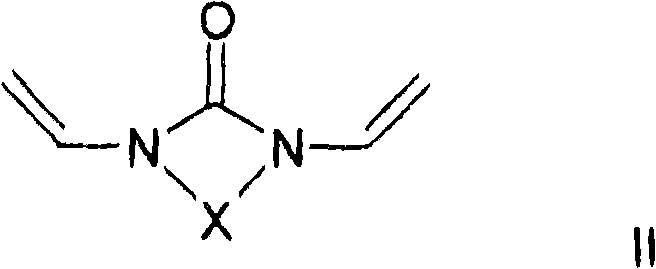
其中,X是二价烷基,其具有2-5个碳原子,优选地2或3个碳原子,其中一个或多个亚甲基,其是不相邻的并且其不位于N的直接相邻部分,可以被O、C=O、S、S=O、SO2、NH、NOH或者N替代,并且亚甲基的一个或多个H原子可以彼此相互独立被羟基、C1-C6-烷基、卤素、NH2、C5-C10-芳基、NH-(C1-C8)-烷基、N-(C1-C8)-烷基2、C1-C6-烷氧基或者C1-C6-烷基-OH取代,和wherein X is a divalent alkyl group having 2-5 carbon atoms, preferably 2 or 3 carbon atoms, with one or more methylene groups, which are non-adjacent and which are not located in the immediate phase of N Ortho moiety, can be replaced by O, C=O, S, S=O, SO 2 , NH, NOH or N, and one or more H atoms of the methylene group can be independently replaced by hydroxyl, C 1 -C 6 -Alkyl, halogen, NH 2 , C 5 -C 10 -aryl, NH-(C 1 -C 8 ) -alkyl, N-(C 1 -C 8 )-alkyl2, C 1 -C 6 -alkoxy or C 1 -C 6 -alkyl-OH substitution, and
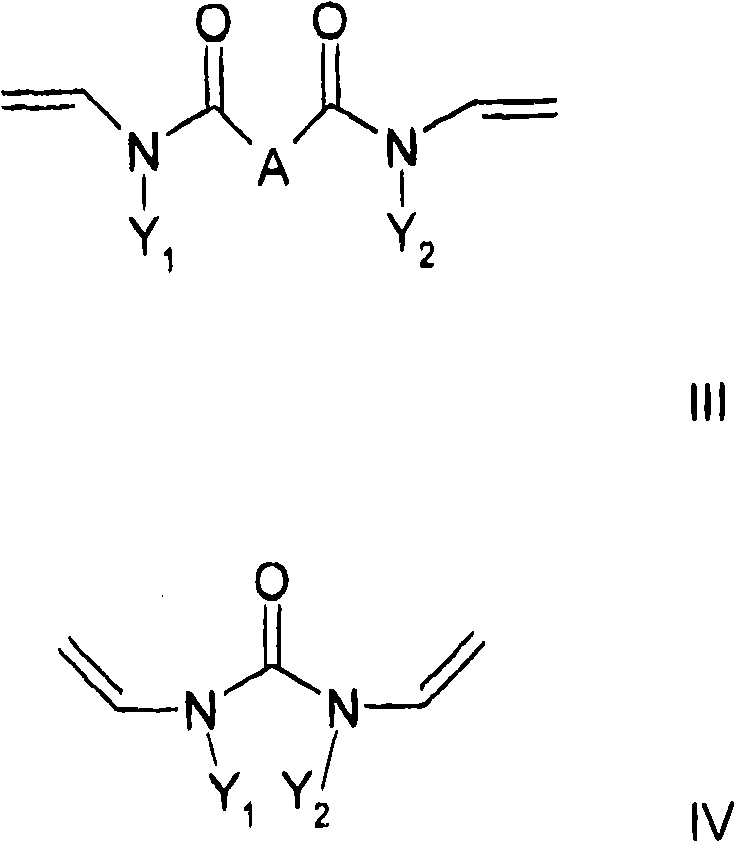
其中通式III和IV中的Y1和Y2彼此相互独立地是,wherein Y and Y in the general formulas III and IV are independently of each other,
C1-C10烷基或者环烷基,其中一个或多个非相邻的亚甲基或者不位于N的直接相邻部分的亚甲基可以被O、C=O、S、S=O、SO2、NH、NOH或者N替代并且亚甲基的一个或多个H可以彼此独立地被羟基、C1-C6-烷基、卤素、NH2、C5-C10-芳基、NH(C1-C8)烷基、N(C1-C8)烷基2、C1-C6-烷氧基或者C1-C6-烷基-OH取代,C 1 -C 10 Alkyl or cycloalkyl, wherein one or more non-adjacent methylene groups or methylene groups not located in the immediate adjacent part of N can be replaced by O, C=O, S, S=O , SO 2 , NH, NOH or N and one or more H of the methylene group can be replaced independently of each other by hydroxyl, C 1 -C 6 -alkyl, halogen, NH 2 , C 5 -C 10 -aryl, NH(C 1 -C 8 )alkyl, N(C 1 -C 8 ) alkyl2 , C 1 -C 6 -alkoxy or C 1 -C 6 -alkyl-OH substituted,
或者C6-C18芳基,其中芳基体系中的一个或多个H可以彼此独立地被羟基、C1-C6-烷基、卤素、NH2、NH(C1-C8)烷基、N(C1-C8)烷基2、C1-C6-烷氧基或者C1-C6-烷基-OH取代,和Or C 6 -C 18 aryl, where one or more H in the aryl system can be replaced independently of each other by hydroxyl, C 1 -C 6 -alkyl, halogen, NH 2 , NH(C 1 -C 8 )alkane radical, N(C 1 -C 8 ) alkyl2 , C 1 -C 6 -alkoxy or C 1 -C 6 -alkyl-OH substitution, and
A是二价烷基,其具有2-5个碳原子,优选2或3个碳原子,其中一个或多个非相邻的亚甲基或者不位于N的直接相邻部分的亚甲基可以被O、C=O、S、S=O、SO2、NH、NOH或者N替代,并且亚甲基的一个或多个H可以彼此独立地被羟基、C1-C6-烷基、卤素、NH2、C5-C10-芳基、NH(C1-C8)烷基、N(C1-C8)烷基2、C1-C6-烷氧基或者C1-C6-烷基-OH取代。A is a divalent alkyl group having 2-5 carbon atoms, preferably 2 or 3 carbon atoms, wherein one or more non-adjacent methylene groups or methylene groups not located in the immediate adjacent part of N may be is replaced by O, C=O, S, S=O, SO 2 , NH, NOH or N, and one or more Hs of the methylene group may independently of each other be hydroxy, C 1 -C 6 -alkyl, halogen , NH 2 , C 5 -C 10 -aryl, NH(C 1 -C 8 )alkyl, N(C 1 -C 8 ) alkyl2 , C 1 -C 6 -alkoxy or C 1 -C 6 -Alkyl-OH substitution.
通式I中的R4通常是烷基、脂环族基团或者芳基,其带有至少一个羟基。R4 in the general formula I is usually an alkyl group, an alicyclic group or an aryl group, which bears at least one hydroxyl group.
在优选实施方案中,通式I中的R4是In a preferred embodiment, R4 in general formula I is
直链或者支链的C1-C10烷基,其中一个或多个非相邻的亚甲基可以被O、C=O、S、S=O、SO2、NH、NOH、N替代和/或其中一个或多个H原子可以彼此独立地被C1-C6-烷基、C5-C10-芳基、卤素、NH2、NH(C1-C8)烷基、N(C1-C8)烷基2、C1-C6-烷氧基或者C1-C6-烷基-OH取代并且其中至少一个OH基团存在于C1-C10烷基上或者存在于取代基上,Linear or branched C 1 -C 10 alkyl, wherein one or more non-adjacent methylene groups may be replaced by O, C=O, S, S=O, SO 2 , NH, NOH, N and /or wherein one or more H atoms can be replaced independently of each other by C 1 -C 6 -alkyl, C 5 -C 10 -aryl, halogen, NH 2 , NH(C 1 -C 8 )alkyl, N( C 1 -C 8 ) alkyl 2 , C 1 -C 6 -alkoxy or C 1 -C 6 -alkyl-OH substituted and in which at least one OH group is present on C 1 -C 10 alkyl or present on the substituent,
或者脂环族基团,其通常具有5-10个碳原子,其中一个或多个非相邻的亚甲基可以被O、C=O、S、S=O、SO2、NH、NOH、N替代和/或其中脂环族基团的一个或多个H原子可以彼此独立地被C1-C6-烷基、C5-C10-芳基、卤素、NH2、NH(C1-C8)烷基、N(C1-C8)烷基2、C1-C6-烷氧基或者C1-C6-烷基-OH取代,其中至少一个OH基团存在于脂环族环上或者存在于侧链或取代基上,或者Or a cycloaliphatic group, which usually has 5-10 carbon atoms, wherein one or more non-adjacent methylene groups can be replaced by O, C=O, S, S=O, SO 2 , NH, NOH, N substituted and/or wherein one or more H atoms of the cycloaliphatic group can independently of one another be replaced by C 1 -C 6 -alkyl, C 5 -C 10 -aryl, halogen, NH 2 , NH(C 1 -C 8 )alkyl, N(C 1 -C 8 ) alkyl2 , C 1 -C 6 -alkoxy or C 1 -C 6 -alkyl-OH substituted, wherein at least one OH group is present in the lipid Cyclocyclic rings or present on side chains or substituents, or
C6-C18芳基,其中芳基中的一个或多个H原子可以彼此独立地被羟基、C1-C6-烷基、C5-C10-芳基、卤素、NH2、NH(C1-C8)烷基、N(C1-C8)烷基2、C1-C6-烷氧基或者C1-C6-烷基-OH取代,其中至少一个OH基团存在于芳基上或者存在于侧链或取代基上,或者C 6 -C 18 aryl, wherein one or more H atoms in the aryl can be replaced independently of each other by hydroxyl, C 1 -C 6 -alkyl, C 5 -C 10 -aryl, halogen, NH 2 , NH (C 1 -C 8 )alkyl, N(C 1 -C 8 ) alkyl2 , C 1 -C 6 -alkoxy or C 1 -C 6 -alkyl-OH substituted with at least one OH group present on an aryl group or on a side chain or substituent, or
C5-C18杂芳基,其中杂芳基中的一个或多个H原子可以彼此独立地被羟基、C1-C6-烷基、C5-C10-芳基、卤素、NH2、NH(C1-C8)烷基、N(C1-C8)烷基2、C1-C6-烷氧基或者C1-C6-烷基-OH取代,其中至少一个OH基团存在于杂芳基上或者存在于侧链或取代基上。C 5 -C 18 heteroaryl, wherein one or more H atoms in the heteroaryl can be replaced independently of each other by hydroxyl, C 1 -C 6 -alkyl, C 5 -C 10 -aryl, halogen, NH 2 , NH(C 1 -C 8 )alkyl, N(C 1 -C 8 ) alkyl2 , C 1 -C 6 -alkoxy or C 1 -C 6 -alkyl-OH substituted, wherein at least one OH The group is present on a heteroaryl or on a side chain or substituent.
在特别优选的实施方案中,通式I中的R4是In a particularly preferred embodiment, R4 in formula I is
直链或者支链的C1-C10烷基,其中一个或多个非相邻的亚甲基可以被O、S、SO2或NH替代和/或其中一个或多个H原子可以彼此独立地被C1-C6-烷基、C5-C10-芳基、C1-C6-烷氧基或C1-C6-烷基-OH取代,并且其中至少一个OH基团存在于C1-C10烷基上或者存在于取代基上,Straight-chain or branched C 1 -C 10 alkyl, wherein one or more non-adjacent methylene groups may be replaced by O, S, SO 2 or NH and/or wherein one or more H atoms may be independent of each other substituted by C 1 -C 6 -alkyl, C 5 -C 10 -aryl, C 1 -C 6 -alkoxy or C 1 -C 6 -alkyl-OH, and in which at least one OH group is present on C 1 -C 10 alkyl or present on a substituent,
或者脂环族基团,其通常具有5-10个碳原子,其中一个或多个非相邻的亚甲基可以被O、S、SO2或NH替代和/或其中脂环族基团的一个或多个H原子可以彼此独立地被C1-C6-烷基、C5-C10-芳基、C1-C6-烷氧基或C1-C6-烷基-OH取代,其中至少一个OH基团存在于脂环族环上或者存在于侧链或取代基上,或者Or a cycloaliphatic group, which usually has 5-10 carbon atoms, wherein one or more non-adjacent methylene groups can be replaced by O, S, SO 2 or NH and/or wherein the cycloaliphatic group One or more H atoms may be substituted independently of each other by C 1 -C 6 -alkyl, C 5 -C 10 -aryl, C 1 -C 6 -alkoxy or C 1 -C 6 -alkyl-OH , wherein at least one OH group is present on the alicyclic ring or on a side chain or substituent, or
C6-C14芳基,其中芳基中的一个或多个H原子可以彼此独立地被羟基、C1-C6-烷基、C5-C10-芳基、C1-C6-烷氧基或C1-C6-烷基-OH取代,其中至少一个OH基团存在于芳基上或者存在于侧链或取代基上,或者C 6 -C 14 aryl, wherein one or more H atoms in the aryl can be replaced independently of each other by hydroxyl, C 1 -C 6 -alkyl, C 5 -C 10 -aryl, C 1 -C 6 - Alkoxy or C 1 -C 6 -alkyl-OH substitution, wherein at least one OH group is present on the aryl or on a side chain or substituent, or
C6-C14杂芳基,其中至少一个N原子作为杂原子存在,并且其中杂芳基中的一个或多个H原子可以彼此独立地被羟基、C1-C6-烷基、C5-C10-芳基、C1-C6-烷氧基或C1-C6-烷基-OH取代,其中至少一个OH基团存在于杂芳基上或者存在于侧链或取代基上。C 6 -C 14 heteroaryl, in which at least one N atom is present as a heteroatom and in which one or more H atoms in the heteroaryl can be replaced independently of one another by hydroxyl, C 1 -C 6 -alkyl, C 5 -C 10 -aryl, C 1 -C 6 -alkoxy or C 1 -C 6 -alkyl-OH substitution, where at least one OH group is present on the heteroaryl or on a side chain or substituent .
在优选实施方案中,所用的亲水取代烷基乙烯基醚是通式I的化合物,其中R4是带有羟基的基团。In a preferred embodiment, the hydrophilic substituted alkyl vinyl ethers used are compounds of the general formula I, in which R4 is a hydroxyl group.
在特别优选的实施方案中,所用的亲水取代烷基乙烯基醚是1,2-乙二醇单乙烯基醚、1,3-丙二醇单乙烯基醚、1,4-丁二醇单乙烯基醚、1,5-戊二醇单乙烯基醚、1,6-己二醇单乙烯基醚或二甘醇单乙烯基醚并且所用的脂环族乙烯基醚是环己烷二甲醇单乙烯基醚。In a particularly preferred embodiment, the hydrophilic substituted alkyl vinyl ethers used are 1,2-ethanediol monovinyl ether, 1,3-propanediol monovinyl ether, 1,4-butanediol monovinyl ether, 1,5-pentanediol monovinyl ether, 1,6-hexanediol monovinyl ether or diethylene glycol monovinyl ether and the cycloaliphatic vinyl ether used is cyclohexanedimethanol monovinyl ether Vinyl ether.
在进一步优选的实施方案中,所用的交联剂是二乙烯基亚乙基脲(1,3-二乙烯基咪唑啉-2-酮)或二乙烯基亚丙基脲(1,3-二乙烯基四氢嘧啶-2-酮)。In a further preferred embodiment, the crosslinking agent used is divinylethyleneurea (1,3-divinylimidazolin-2-one) or divinylpropyleneurea (1,3-di vinyltetrahydropyrimidin-2-one).
在另一优选的实施方案中,聚合物是多孔的,孔径大小为2-200nm。In another preferred embodiment, the polymer is porous with a pore size of 2-200 nm.
在另一实施方案中,聚合物是颗粒形式的,直径为3-300μm。In another embodiment, the polymer is in particulate form, with a diameter of 3-300 μm.
在另一实施方案中,聚合物已经借助于分离效应物而衍生。In another embodiment, the polymer has been derivatized by means of isolating effectors.
在优选实施方案中,聚合物已经借助于通过接枝聚合而附着于该聚合物的结构而衍生。In a preferred embodiment, the polymer has been derivatized by means of structures attached to the polymer by graft polymerization.
在优选实施方案中,聚合物已经借助于通过用铈(IV)催化的接枝聚合而附着于该聚合物的结构而衍生。In a preferred embodiment, the polymer has been derivatized by means of structures attached to the polymer by graft polymerization catalyzed with cerium(IV).
在特别优选的实施方案中,该结构是已经由两个或更多个不同的单体制造的共聚物。In a particularly preferred embodiment, the structure is a copolymer which has been produced from two or more different monomers.
本发明还涉及一种制备聚合物的方法,其特征在于共聚合通式I的至少一种亲水取代烷基乙烯基醚和至少一种交联剂,所述交联剂符合通式II和/或III和/或IV,其中The invention also relates to a process for the preparation of polymers, characterized in that at least one hydrophilic substituted alkyl vinyl ether of the general formula I is copolymerized with at least one crosslinking agent according to the general formula II and /or III and/or IV, where
其中R1、R2、R3彼此独立地可以是H或C1-C6烷基,优选地H或者-CH3,Wherein R1, R2, R3 independently of each other can be H or C 1 -C 6 alkyl, preferably H or -CH 3 ,
和R4是具有至少一个羟基的基团and R4 is a group having at least one hydroxyl group
和and

其中,X是二价烷基,其具有2-5个碳原子,优选地2或3个碳原子,其中一个或多个亚甲基,其是不相邻的并且其不位于N的直接相邻部分,可以被O、C=O、S、S=O、SO2、NH、NOH或者N替代,并且亚甲基的一个或多个H原子可以彼此相互独立被羟基、C1-C6-烷基、卤素、NH2、C5-C10-芳基、NH-C1-C8-烷基、N-C1-C8-烷基2、C1-C6-烷氧基或C1-C6-烷基-OH取代,和wherein X is a divalent alkyl group having 2-5 carbon atoms, preferably 2 or 3 carbon atoms, with one or more methylene groups, which are non-adjacent and which are not located in the immediate phase of N Ortho moiety, can be replaced by O, C=O, S, S=O, SO 2 , NH, NOH or N, and one or more H atoms of the methylene group can be independently replaced by hydroxyl, C 1 -C 6 -alkyl, halogen, NH 2 , C 5 -C 10 -aryl, NH-C 1 -C 8 -alkyl, NC 1 -C 8 -alkyl2 , C 1 -C 6 -alkoxy or C 1 -C 6 -alkyl-OH substituted, and
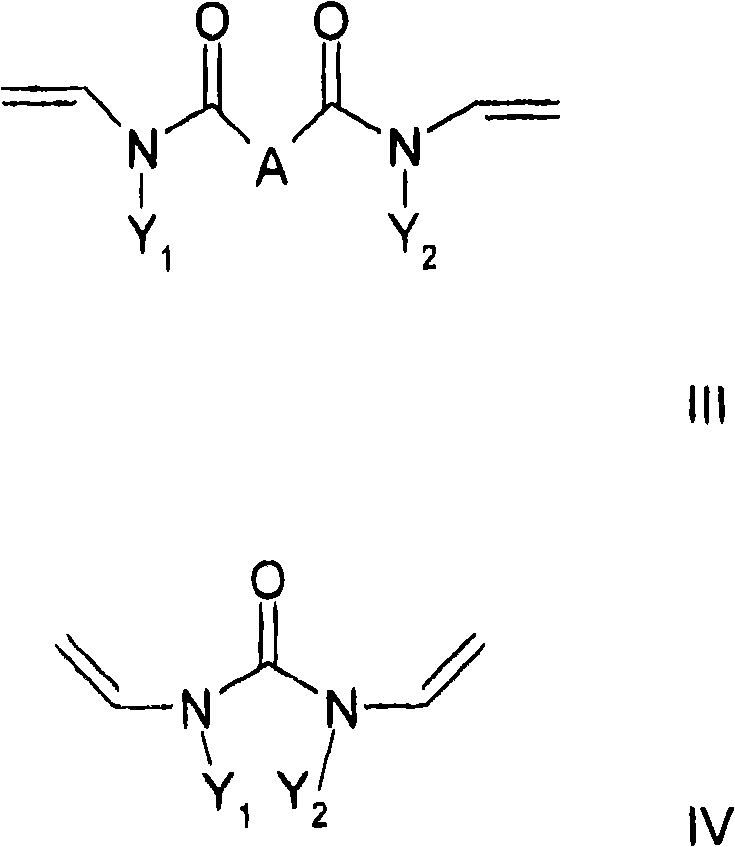
其中通式III和IV中的Y1和Y2彼此相互独立地是,wherein Y and Y in the general formulas III and IV are independently of each other,
C1-C10烷基或者环烷基,其中一个或多个非相邻的亚甲基或者不位于N的直接相邻部分的亚甲基可以被O、C=O、S、S=O、SO2、NH、NOH或者N替代,并且亚甲基的一个或多个H可以彼此独立地被羟基、C1-C6-烷基、卤素、NH2、C5-C10-芳基、NH(C1-C8)烷基、N(C1-C8)烷基2、C1-C6-烷氧基或者C1-C6-烷基-OH取代,C 1 -C 10 Alkyl or cycloalkyl, wherein one or more non-adjacent methylene groups or methylene groups not located in the immediate adjacent part of N can be replaced by O, C=O, S, S=O , SO 2 , NH, NOH or N, and one or more H's of the methylene group can be replaced independently of each other by hydroxyl, C 1 -C 6 -alkyl, halogen, NH 2 , C 5 -C 10 -aryl , NH(C 1 -C 8 )alkyl, N(C 1 -C 8 ) alkyl2 , C 1 -C 6 -alkoxy or C 1 -C 6 -alkyl-OH substituted,
或者C6-C18芳基,其中芳基体系中的一个或多个H可以彼此独立地被羟基、C1-C6-烷基、卤素、NH2、NH(C1-C8)烷基、N(C1-C8)烷基2、C1-C6-烷氧基或者C1-C6-烷基-OH取代,和Or C 6 -C 18 aryl, where one or more H in the aryl system can be replaced independently of each other by hydroxyl, C 1 -C 6 -alkyl, halogen, NH 2 , NH(C 1 -C 8 )alkane radical, N(C 1 -C 8 ) alkyl2 , C 1 -C 6 -alkoxy or C 1 -C 6 -alkyl-OH substitution, and
A是二价烷基,其具有2-5个碳原子,优选2或3个碳原子,其中一个或多个非相邻的亚甲基或者不位于N的直接相邻部分的亚甲基可以被O、C=O、S、S=O、SO2、NH、NOH或者N替代,并且亚甲基的一个或多个H可以彼此独立地被羟基、C1-C6-烷基、卤素、NH2、C5-C10-芳基、NH(C1-C8)烷基、N(C1-C8)烷基2、C1-C6-烷氧基或者C1-C6-烷基-OH取代。A is a divalent alkyl group having 2-5 carbon atoms, preferably 2 or 3 carbon atoms, wherein one or more non-adjacent methylene groups or methylene groups not located in the immediate adjacent part of N may be is replaced by O, C=O, S, S=O, SO 2 , NH, NOH or N, and one or more Hs of the methylene group may independently of each other be hydroxy, C 1 -C 6 -alkyl, halogen , NH 2 , C 5 -C 10 -aryl, NH(C 1 -C 8 )alkyl, N(C 1 -C 8 ) alkyl2 , C 1 -C 6 -alkoxy or C 1 -C 6 -Alkyl-OH substitution.
在优选实施方案中,通式I中的R4是In a preferred embodiment, R4 in general formula I is
直链或者支链的C1-C10烷基,其中一个或多个非相邻的亚甲基可以被O、C=O、S、S=O、SO2、NH、NOH、N替代和/或其中一个或多个H原子可以彼此独立地被C1-C6-烷基、C5-C10-芳基、卤素、NH2、NH(C1-C8)烷基、N(C1-C8)烷基2、C1-C6-烷氧基或者C1-C6-烷基-OH取代并且其中至少一个OH基团存在于C1-C10烷基上或者存在于取代基上,Linear or branched C 1 -C 10 alkyl, wherein one or more non-adjacent methylene groups may be replaced by O, C=O, S, S=O, SO 2 , NH, NOH, N and /or wherein one or more H atoms can be replaced independently of each other by C 1 -C 6 -alkyl, C 5 -C 10 -aryl, halogen, NH 2 , NH(C 1 -C 8 )alkyl, N( C 1 -C 8 ) alkyl 2 , C 1 -C 6 -alkoxy or C 1 -C 6 -alkyl-OH substituted and in which at least one OH group is present on C 1 -C 10 alkyl or present on the substituent,
或者脂环族基团,其通常具有5-10个碳原子,其中一个或多个非相邻的亚甲基可以被O、C=O、S、S=O、SO2、NH、NOH、N替代和/或其中脂环族基团的一个或多个H原子可以彼此独立地被C1-C6-烷基、C5-C10-芳基、卤素、NH2、NH(C1-C8)烷基、N(C1-C8)烷基2、C1-C6-烷氧基或者C1-C6-烷基-OH取代,其中至少一个OH基团存在于脂环族环上或者存在于侧链或取代基上,或者Or a cycloaliphatic group, which usually has 5-10 carbon atoms, wherein one or more non-adjacent methylene groups can be replaced by O, C=O, S, S=O, SO 2 , NH, NOH, N substituted and/or wherein one or more H atoms of the cycloaliphatic group can independently of one another be replaced by C 1 -C 6 -alkyl, C 5 -C 10 -aryl, halogen, NH 2 , NH(C 1 -C 8 )alkyl, N(C 1 -C 8 ) alkyl2 , C 1 -C 6 -alkoxy or C 1 -C 6 -alkyl-OH substituted, wherein at least one OH group is present in the lipid Cyclocyclic rings or present on side chains or substituents, or
C6-C18芳基,其中芳基中的一个或多个H原子可以彼此独立地被羟基、C1-C6-烷基、C5-C10-芳基、卤素、NH2、NH(C1-C8)烷基、N(C1-C8)烷基2、C1-C6-烷氧基或者C1-C6-烷基-OH取代,其中至少一个OH基团存在于芳基上或者存在于侧链或取代基上,或者C 6 -C 18 aryl, wherein one or more H atoms in the aryl can be replaced independently of each other by hydroxyl, C 1 -C 6 -alkyl, C 5 -C 10 -aryl, halogen, NH 2 , NH (C 1 -C 8 )alkyl, N(C 1 -C 8 ) alkyl2 , C 1 -C 6 -alkoxy or C 1 -C 6 -alkyl-OH substituted with at least one OH group present on an aryl group or on a side chain or substituent, or
C5-C18杂芳基,其中杂芳基中的一个或多个H原子可以彼此独立地被羟基、C1-C6-烷基、C5-C10-芳基、卤素、NH2、NH(C1-C8)烷基、N(C1-C8)烷基2、C1-C6-烷氧基或者C1-C6-烷基-OH取代,其中至少一个OH基团存在于杂芳基上或者存在于侧链或取代基上。C 5 -C 18 heteroaryl, wherein one or more H atoms in the heteroaryl can be replaced independently of each other by hydroxyl, C 1 -C 6 -alkyl, C 5 -C 10 -aryl, halogen, NH 2 , NH(C 1 -C 8 )alkyl, N(C 1 -C 8 ) alkyl2 , C 1 -C 6 -alkoxy or C 1 -C 6 -alkyl-OH substituted, wherein at least one OH The group is present on a heteroaryl or on a side chain or substituent.
在优选实施方案中,进行自由基悬浮聚合。In a preferred embodiment, free-radical suspension polymerization is carried out.
在特别优选的实施方案中,在至少一种悬浮稳定剂和任选的其它添加剂,优选地无机盐和界面-活性化合物,的存在下,在作为悬浮介质的水中进行自由基悬浮聚合。In a particularly preferred embodiment, the free-radical suspension polymerization is carried out in water as suspension medium in the presence of at least one suspension stabilizer and optionally further additives, preferably inorganic salts and interfacially-active compounds.
在一种实施方案中,聚合期间的温度是40-100℃。In one embodiment, the temperature during polymerization is 40-100°C.
在优选实施方案中,以10∶90-80∶20的重量比使用亲水取代烷基乙烯基醚和交联剂。In a preferred embodiment, the hydrophilic substituted alkyl vinyl ether and crosslinker are used in a weight ratio of 10:90 to 80:20.
在优选实施方案中,在添加一种或多种致孔剂(porogen)的情况下进行聚合。In a preferred embodiment, the polymerization is carried out with the addition of one or more porogens.
本发明还涉及包含作为吸附剂或载体材料的本发明的聚合物的色谱柱、毛细管、柱、搅拌式反应器或反应器。The invention also relates to chromatography columns, capillaries, columns, stirred reactors or reactors comprising the polymers of the invention as adsorbent or support material.
本发明还涉及本发明的亲水交联聚合物作为色谱法中的吸附剂、作为固定生物或催化活性物质的载体材料或者作为固相合成的载体材料的用途。The invention also relates to the use of the hydrophilic crosslinked polymers according to the invention as adsorbents in chromatography, as support materials for the immobilization of biologically or catalytically active substances or as support materials for solid-phase synthesis.
本发明还涉及可通过本发明的方法获得的聚合物。The invention also relates to the polymers obtainable by the process of the invention.
其它组合和优选的实施方案公开在专利权利要求中。Other combinations and preferred embodiments are disclosed in the patent claims.
图1显示了在蛋白质应用方面本发明的聚合物的保持性能。进一步的细节在实施例2中给出。Figure 1 shows the retention properties of the polymers of the invention in protein applications. Further details are given in Example 2.
图2显示了具有不同分子量的葡聚糖的实验测定的分配系数Kd。进一步的细节在实施例3中给出。Figure 2 shows the experimentally determined partition coefficients Kd of dextran with different molecular weights. Further details are given in Example 3.
图3显示了本发明的聚合物在稀释的氢氧化钠溶液中的储存稳定性。进一步的细节在实施例4中给出。Figure 3 shows the storage stability of the polymers of the invention in dilute sodium hydroxide solution. Further details are given in Example 4.
图4显示了在具有阳离子分离效应物的本发明的聚合物上分离蛋白质混合物。进一步的细节在实施例5中给出。Figure 4 shows the separation of protein mixtures on polymers of the invention with cationic separation effectors. Further details are given in Example 5.
图5显示了在色谱柱中的本发明的聚合物的压力/流动性能。Figure 5 shows the pressure/flow behavior of the polymers of the invention in a chromatographic column.
根据本发明,术语“脂环族基团”表示一种饱和烃基团,其中全部或者至少一些烃单元是环状结构的组成部分。According to the invention, the term "cycloaliphatic group" denotes a saturated hydrocarbon group in which all or at least some of the hydrocarbon units are part of a cyclic structure.
根据本发明,N(C1-C8)烷基2表示被至少两个烷基取代的氮。此处的两个烷基可以彼此独立地具有直链或者支链形式的1-8个碳原子。According to the invention, N(C 1 -C 8 ) alkyl2 denotes nitrogen substituted by at least two alkyl groups. The two alkyl groups here may independently of each other have 1 to 8 carbon atoms in the form of straight or branched chains.
根据本发明,杂芳基是至少部分的芳基,其与芳基的区别在于一个或多个非相邻的碳原子已经被N、S或O替代。本领域技术人员很清楚的是,由于价态的原因,杂原子可以任选地被例如H、C1-C6-烷基或C1-C6-烷基-OH取代。According to the invention, heteroaryl is at least partly aryl which differs from aryl in that one or more non-adjacent carbon atoms have been replaced by N, S or O. It is clear to a person skilled in the art that, due to valence reasons, heteroatoms may optionally be substituted eg by H, C 1 -C 6 -alkyl or C 1 -C 6 -alkyl-OH.
本发明的聚合物是一种亲水交联聚合物,基于至少包含如下的共聚物:The polymer of the present invention is a hydrophilic cross-linked polymer based on a copolymer comprising at least:
a)至少一种通式I的亲水取代烷基乙烯基醚a) at least one hydrophilic substituted alkyl vinyl ether of general formula I

其中,基团R1、R2、R3和R4具有以上含义,和wherein the groups R1, R2, R3 and R4 have the above meanings, and
b)b)
至少一种交联剂,其符合通式II和/或III和/或IVAt least one crosslinking agent according to the general formula II and/or III and/or IV
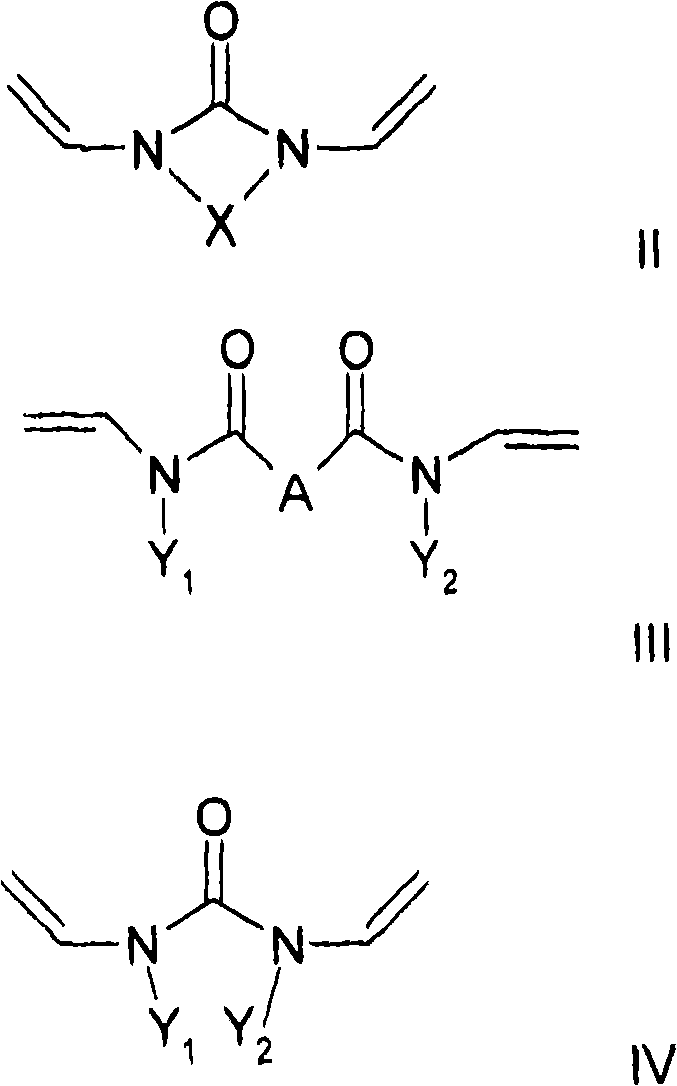
其中,取代基X、A、Y1和Y2具有以上含义。Wherein, the substituents X, A, Y1 and Y2 have the above meanings.
这意味该聚合物是由通式I的亲水取代烷基乙烯基醚中的至少一种化合物和通式II和/或III和/或IV的交联剂中的至少一种化合物的共聚而形成的。优选地,仅仅使用通式I的亲水取代烷基乙烯基醚中的一种化合物和通式II、III或IV的交联剂中的一种化合物。然而,还可以使用通式I的亲水取代烷基乙烯基醚中的一种或多种化合物和/或通式II和/或III和/或IV的交联剂的一种或多种化合物。此外,共聚合到聚合物主链中的其它可聚合的化合物可以被添加到聚合混合物中。这些一般是具有至少一个可聚合的双键的化合物。优选地,仅仅使用通式I的亲水取代烷基乙烯基醚中的一种化合物和通式II、III或IV的交联剂中的一种化合物。This means that the polymer is formed by the copolymerization of at least one compound of the hydrophilic substituted alkyl vinyl ether of the general formula I and at least one compound of the crosslinking agent of the general formula II and/or III and/or IV Forming. Preferably, only one compound of the hydrophilic-substituted alkyl vinyl ethers of the general formula I and one compound of the crosslinkers of the general formula II, III or IV are used. However, it is also possible to use one or more compounds of the hydrophilically substituted alkyl vinyl ethers of the general formula I and/or one or more compounds of the crosslinkers of the general formulas II and/or III and/or IV . In addition, other polymerizable compounds that copolymerize into the polymer backbone can be added to the polymerization mixture. These are generally compounds having at least one polymerizable double bond. Preferably, only one compound of the hydrophilic-substituted alkyl vinyl ethers of the general formula I and one compound of the crosslinkers of the general formula II, III or IV are used.
在优选实施方案中,所用的亲水取代烷基乙烯基醚是通式I的化合物,其中R4是带有羟基的基团。In a preferred embodiment, the hydrophilic substituted alkyl vinyl ethers used are compounds of the general formula I, in which R4 is a hydroxyl group.
在优选实施方案中,所用的亲水取代烷基乙烯基醚是1,2-乙二醇单乙烯基醚、1,3-丙二醇单乙烯基醚、1,4-丁二醇单乙烯基醚、1,5-戊二醇单乙烯基醚、1,6-己二醇单乙烯基醚或二甘醇单乙烯基醚,以及所用的脂环族乙烯基醚是环己烷二甲醇单乙烯基醚,特别优选地1,4-丁二醇单乙烯基醚、1,5-戊二醇单乙烯基醚、二甘醇单乙烯基醚或环己烷二甲醇单乙烯基醚。In a preferred embodiment, the hydrophilic substituted alkyl vinyl ethers used are 1,2-ethylene glycol monovinyl ether, 1,3-propylene glycol monovinyl ether, 1,4-butanediol monovinyl ether , 1,5-pentanediol monovinyl ether, 1,6-hexanediol monovinyl ether or diethylene glycol monovinyl ether, and the alicyclic vinyl ether used is
所用的交联剂优选是通式II的化合物。优选使用二乙烯基亚丙基脲(1,3-二乙烯基-四氢嘧啶-2-酮)或者特别优选地二乙烯基亚乙基脲(1,3-二乙烯基咪唑啉-2-酮)。The crosslinkers used are preferably compounds of the general formula II. Preference is given to using divinylpropyleneurea (1,3-divinyl-tetrahydropyrimidin-2-one) or particularly preferably divinylethyleneurea (1,3-divinylimidazoline-2- ketone).
亲水取代烷基乙烯基醚相对于聚合物的重量的比例通常为1wt%-90wt%或烷基乙烯基醚的最大重量比,后者相应于摩尔比2∶1,以双官能交联剂为基准,如果烷基乙烯基醚没有均聚的话。亲水取代烷基乙烯基醚的比例优选为10-80wt%,特别优选35-60wt%。因此,交联剂的比例为10-99wt%,优选20-90wt%,特别优选40-65wt%。The proportion of hydrophilic substituted alkyl vinyl ethers relative to the weight of the polymer is generally 1 wt% - 90 wt% or the maximum weight ratio of alkyl vinyl ethers, the latter corresponding to a molar ratio of 2:1, with bifunctional crosslinking agents As a basis, if the alkyl vinyl ether is not homopolymerized. The proportion of the hydrophilic substituted alkyl vinyl ether is preferably 10-80 wt%, particularly preferably 35-60 wt%. Therefore, the proportion of crosslinking agent is 10-99 wt%, preferably 20-90 wt%, particularly preferably 40-65 wt%.
不饱和化合物的共聚的工艺工程设计为本领域技术人员所知。为此目的,进行自由基聚合。优选进行源于自由基的悬浮聚合,亦称成珠聚合。其中进行这种类型的聚合的方式的描述例如在以下文献中给出:EP1179732A2(概述,第4页第18-26行,和第5页第3行至第6页第9行,和特别地,实施例1)或者EP 0006199 B1(概述,第3页第19行至第4页第13行,和特别地,实施例1)。取决于单体的溶解性能,在不溶于水的或者微溶于水的单体(亦称油)的情况下,在特别简单的程序中进行水包油悬浮聚合(正相聚合)。在水溶性单体情况下,相反,将后者溶解在水中并且进行悬浮和在与水不混溶的或者仅与水微溶混的有机溶剂中聚合(反相聚合)。Process engineering for the copolymerization of unsaturated compounds is known to those skilled in the art. For this purpose, free-radical polymerization is carried out. Preference is given to carrying out suspension polymerizations originating from free radicals, also known as bead polymerizations. A description of the manner in which this type of polymerization is carried out is given, for example, in EP1179732A2 (overview, page 4, lines 18-26, and page 5, line 3 to page 6, line 9, and in particular , Example 1) or EP 0006199 B1 (overview, page 3, line 19 to page 4, line 13, and in particular, Example 1). Depending on the solubility properties of the monomers, the oil-in-water suspension polymerization (normal phase polymerization) is carried out in a particularly simple procedure in the case of water-insoluble or slightly water-soluble monomers (also called oils). In the case of water-soluble monomers, the latter are, by contrast, dissolved in water and subjected to suspension and polymerization in water-immiscible or only slightly water-miscible organic solvents (reverse phase polymerization).
已经发现,特别是在使用二乙烯基亚乙基脲或者二乙烯基亚丙基脲与优选的亲水取代烷基乙烯基醚如1,4-丁二醇单乙烯基醚、1,5-戊二醇单乙烯基醚、二甘醇单乙烯基醚或环己烷二甲醇单乙烯基醚结合的情况下,可以进行(正相)悬浮聚合。这提供了本发明的聚合物的非常简单的制备方法的优点,因为在单一反应步骤中获得了亲水聚合物,而无需执行复杂的反相悬浮聚合。根据本发明所用的亲水取代烷基乙烯基醚的其它主要优点在于不必进行随后的水解步骤以便制备亲水聚合物。反而,使用含羟基的乙烯基醚作为原材料导致含羟基的聚合物的直接形成。It has been found that especially when using divinyl ethylene urea or divinyl propylene urea with preferred hydrophilic substituted alkyl vinyl ethers such as 1,4-butanediol monovinyl ether, 1,5- In the case of combinations of pentanediol monovinyl ether, diethylene glycol monovinyl ether or cyclohexanedimethanol monovinyl ether, (normal phase) suspension polymerization is possible. This offers the advantage of a very simple method of preparation of the polymers of the invention, since the hydrophilic polymer is obtained in a single reaction step without the need to perform complex inverse suspension polymerizations. Another major advantage of the hydrophilically substituted alkyl vinyl ethers used according to the invention is that no subsequent hydrolysis step is necessary in order to produce hydrophilic polymers. Instead, the use of hydroxyl-containing vinyl ethers as starting materials leads to the direct formation of hydroxyl-containing polymers.
以已知的方式进行悬浮聚合。The suspension polymerization is carried out in a known manner.
用于正相悬浮聚合的悬浮介质一般是水。The suspension medium used for normal phase suspension polymerization is generally water.
如已知的,一种或多种稳定剂和/或一种或多种界面-活性化合物可以被添加到悬浮介质中。As known, one or more stabilizers and/or one or more interface-active compounds may be added to the suspension medium.
可使用的稳定剂是许多水溶性的高分子化合物或者还有细碎的无机化合物。Stabilizers that can be used are numerous water-soluble polymeric compounds or also finely divided inorganic compounds.
高分子稳定剂的实例是聚乙烯吡咯烷酮、聚丙烯酸酯、聚羧酸酯、聚丙烯酰胺、聚乙烯醇、羟烷基纤维素、甲基纤维素或者聚乙二醇。优选使用聚乙烯醇。Examples of polymeric stabilizers are polyvinylpyrrolidone, polyacrylates, polycarboxylates, polyacrylamides, polyvinyl alcohols, hydroxyalkylcelluloses, methylcelluloses or polyethylene glycols. Preference is given to using polyvinyl alcohol.
可用作稳定剂的无机化合物例如是磷酸钙或者氢氧化镁。Inorganic compounds which can be used as stabilizers are, for example, calcium phosphate or magnesium hydroxide.
盐、离子液体或者缓冲物质,例如Na2HPO4和NaH2PO4,可以另外被添加到水相中。Salts, ionic liquids or buffer substances, such as Na 2 HPO 4 and NaH 2 PO 4 , can additionally be added to the aqueous phase.
合适的界面-活性化合物是,特别地,阴离子和非离子型表面活性剂,如长链醇的乙氧基化物、乙氧基化单、二和三烷基苯酚、C12-C18烷基磺酸或芳基磺酸的碱金属和铵盐。Suitable interface-active compounds are, in particular, anionic and nonionic surfactants, such as ethoxylates of long-chain alcohols, ethoxylated mono-, di- and tri-alkylphenols, C 12 -C 18 alkyl Alkali metal and ammonium salts of sulfonic or arylsulfonic acids.
为进行本发明的聚合,将有机相亦称油相悬浮在水相中。在聚合开始和进行以后,聚合物通常可以被滤出或者以其它方式从反应混合物中去除。溶剂或其它添加剂的残余物可以通过用合适的溶剂洗涤或者例如通过蒸汽蒸馏来除去。To carry out the polymerization according to the invention, the organic phase, also called the oily phase, is suspended in the aqueous phase. After the polymerization has started and proceeded, the polymer can generally be filtered off or otherwise removed from the reaction mixture. Residues of solvents or other additives can be removed by washing with suitable solvents or, for example, by steam distillation.
在一种实施方案中,除单体外,油相包括惰性溶剂(致孔剂)以便设定期望的孔径大小。In one embodiment, the oil phase includes, in addition to monomers, an inert solvent (porogen) in order to set the desired pore size.
合适的有机溶剂(致孔剂)是,例如,脂肪族烃(C6-C18),如,例如,己烷、十二烷或汽油混合物,脂环族化合物,如环己烷,芳香族烃,如甲苯、乙苯或二甲苯,或者醇,如脂族C4-C12-醇,例如庚醇、十二烷醇、环己醇,各种分子量的聚乙二醇或聚丙二醇,或者脂族羧酸的酯,如乙酸丁酯或丙酸丙酯,或者芳族羧酸的酯,如苯甲酸丙酯,或者酯,如丁基乙二醇乙酸酯或甘油三乙酸酯,或者醚,如二正丁醚、二正戊醚、二苯醚、乙二醇一苯醚和乙二醇二乙醚。Suitable organic solvents (porogens) are, for example, aliphatic hydrocarbons (C 6 -C 18 ), such as, for example, hexane, dodecane or gasoline mixtures, cycloaliphatic compounds, such as cyclohexane, aromatic Hydrocarbons, such as toluene, ethylbenzene or xylene, or alcohols, such as aliphatic C4 - C12 -alcohols, for example heptanol, dodecanol, cyclohexanol, polyethylene glycols or polypropylene glycols of various molecular weights, Or esters of aliphatic carboxylic acids, such as butyl acetate or propyl propionate, or esters of aromatic carboxylic acids, such as propyl benzoate, or esters, such as butyl glycol acetate or triacetin , or ethers such as di-n-butyl ether, di-n-pentyl ether, diphenyl ether, ethylene glycol monophenyl ether, and ethylene glycol diethyl ether.
可以单独地或者以两种或更多种溶剂的混合物的形式使用这些溶剂。它们可以作为聚合物的溶胀剂或者沉淀剂并且这样影响了孔隙率。These solvents may be used alone or in the form of a mixture of two or more solvents. They can act as swelling or precipitating agents for the polymer and thus affect the porosity.
本发明的聚合物的溶胀剂的实例是低级醇、脂族酯或芳香族烃如甲苯。Examples of swelling agents for the polymers of the present invention are lower alcohols, aliphatic esters or aromatic hydrocarbons such as toluene.
沉淀剂的实例是脂肪族烃,如十二烷或汽油混合物。聚合物的孔隙率可以通过溶剂的类型和数量以及聚合物的交联度来固定。Examples of precipitating agents are aliphatic hydrocarbons such as dodecane or gasoline mixtures. The porosity of the polymer can be fixed by the type and amount of solvent and the degree of crosslinking of the polymer.
此外,作为自由基的一种或多种引发剂一般被添加到有机相中。In addition, one or more initiators are generally added to the organic phase as free radicals.
自由基引发剂的实例是有机过氧化物,如二叔丁基过氧化物、二苯甲酰过氧化物、双(o-甲基苯酰)过氧化物、叔丁基过氧化氢、氢过氧化枯烯、过氧化二碳酸二异丙酯、过氧化环己酮,或者脂族偶氮化合物,如α,α′-偶氮二异丁腈、偶氮二氰基戊酸、1,1′-偶氮环己烷-1,1′-二腈或偶氮二甲酰胺(azodicarboxamide)。优选α,α′-偶氮二异丁腈。Examples of free radical initiators are organic peroxides such as di-tert-butyl peroxide, dibenzoyl peroxide, bis(o-methylbenzoyl) peroxide, tert-butyl hydroperoxide, hydrogen Cumene peroxide, diisopropyl peroxydicarbonate, cyclohexanone peroxide, or aliphatic azo compounds, such as α,α'-azobisisobutyronitrile, azodicyanovaleric acid, 1, 1'-Azocyclohexane-1,1'-dinitrile or azodicarboxamide. Preference is given to α,α'-azobisisobutyronitrile.
可以借助于辐射例如紫外辐射而活化的引发剂还可以用于本发明作为自由基引发剂。Initiators which can be activated by means of radiation, for example UV radiation, can also be used in the present invention as free-radical initiators.
在悬浮聚合的相比一般可以在体积比为1∶20(油相-水相)至2∶1之间变化,优选的是该比值为1∶5-1∶1,特别优选的是1∶3-1∶1。In suspension polymerization, the ratio can generally vary from 1:20 (oil phase-water phase) to 2:1 by volume, preferably the ratio is 1:5-1:1, particularly preferably 1: 3-1:1.
有机溶剂与单体的比值通常为1∶20-4∶1,优选地为1∶5-3∶1,特别优选地为1∶1-2.5∶1。The ratio of organic solvent to monomer is generally 1:20-4:1, preferably 1:5-3:1, particularly preferably 1:1-2.5:1.
引发剂的浓度,基于单体的数量,一般为0.01wt%-10wt%,优选地0.1wt%-7wt%,特别优选地为0.2wt%-7wt%。The concentration of the initiator, based on the amount of monomers, is generally 0.01 wt%-10 wt%, preferably 0.1 wt%-7 wt%, particularly preferably 0.2 wt%-7 wt%.
稳定剂的浓度,基于悬浮介质(通常为水)的数量,为0.01wt%-7wt%,通常为0.02wt%-5wt%,特别优选地为0.05wt%-2.5wt%。The concentration of the stabilizer, based on the amount of the suspension medium (usually water), is 0.01wt%-7wt%, usually 0.02wt%-5wt%, particularly preferably 0.05wt%-2.5wt%.
然后通过强烈搅拌使两相混合来进行悬浮聚合。另外,混合物的温度通常维持在20-100℃,优选地40-100℃,达1-20小时。混合物一般在0.5-5小时内在40-100℃加热,随后再在70-100℃后聚合数小时。应当在全部时间对混合物进行搅拌。这些温度数据涉及其中水用作悬浮介质的体系。在使用其它极性溶剂而不是水的时候,其它的温度范围可能是可行的或者合适的,这取决于溶剂的沸点。Suspension polymerization is then carried out by mixing the two phases by vigorous stirring. In addition, the temperature of the mixture is generally maintained at 20-100°C, preferably 40-100°C, for 1-20 hours. The mixture is generally heated at 40-100°C for 0.5-5 hours, followed by postpolymerization at 70-100°C for several hours. The mixture should be stirred at all times. These temperature data relate to systems in which water is used as the suspending medium. When other polar solvents are used instead of water, other temperature ranges may be feasible or appropriate, depending on the boiling point of the solvent.
通常有利的是在保护性气体气氛中进行本发明的聚合。It is generally advantageous to carry out the inventive polymerisations in a protective gas atmosphere.
最后,通常将混合物冷却至室温,除去有机溶剂,如果它们在聚合期间添加的话,并且在水、含水缓冲液或水与有机溶剂如乙醇的混合物中存储产物。Finally, the mixture is usually cooled to room temperature, the organic solvents are removed, if they were added during the polymerization, and the product is stored in water, an aqueous buffer or a mixture of water and an organic solvent such as ethanol.
如果必要的话,通过筛分或者另一种类型的分类法,可以使聚合物到达期望的粒度分布。The polymer can be brought to the desired particle size distribution, if necessary, by sieving or another type of classification.
如果进行反相悬浮聚合或者乳液聚合而不是正相悬浮聚合的话,本领域技术人员知道如何改变反应溶液的组成。Those skilled in the art know how to change the composition of the reaction solution if reverse phase suspension polymerization or emulsion polymerization is carried out instead of normal phase suspension polymerization.
本发明的聚合可以同样地连续进行。本文中颗粒生产特别优选地使用静态混合器、特别地微混合器或者履带(caterpillar)混合器来进行。在这些混合器中,借助利用流动能量,通过流动管理,例如通过分离和再结合、扭转、变形和扩张,待混合的两种组分的空间分布受到了影响,使得在组分之间形成了用于扩散交换的大的界面,并且由于高剪切力可以实现特别均一的粒度分布。不同的混合器和它们的结构是已知的。例如,这种类型的体系描述于EP 1177243中。The polymerization of the present invention can likewise be carried out continuously. The granulate production here is particularly preferably carried out using static mixers, in particular micromixers or caterpillar mixers. In these mixers, the spatial distribution of the two components to be mixed is influenced by flow management, for example by separation and recombination, twisting, deformation and expansion, by exploiting the energy of the flow, so that a Large interfaces for diffusion exchange and a particularly uniform particle size distribution can be achieved due to high shear forces. Different mixers and their structures are known. Systems of this type are described, for example, in EP 1177243.
为进行该反应,例如,水相连续地以所限定的体积流量流过微混合器。油相随后通过第二入口,同样以所限定的精确设置的体积流量来进料。两个体积流量的比值可以处于宽的范围内,并且取决于期望的粒度、性质和粒度的分布,水相和油相的粘度(这取决于反应温度),以及反应动力学和最终混合物中的致孔剂的必需的比值,以便获得合适的孔结构。水相和油相间的体积流量比值优选为1∶10-100∶1,特别地,2∶1-20∶1。从静态混合器流出的悬浮液优选在连续操作的反应器中进行聚合。To carry out the reaction, for example, the aqueous phase flows continuously through a micromixer with a defined volume flow. The oil phase is then fed through a second inlet, likewise with a defined precisely set volume flow. The ratio of the two volume flows can lie within wide ranges and depends on the desired particle size, properties and distribution of particle sizes, the viscosity of the aqueous and oil phases (which depends on the reaction temperature), as well as the reaction kinetics and the final mixture. The necessary ratio of porogens in order to obtain a suitable pore structure. The volume flow ratio between the water phase and the oil phase is preferably 1:10-100:1, in particular 2:1-20:1. The suspension exiting the static mixer is preferably polymerized in a continuously operated reactor.
同样可以颠倒上述程序。例如,对于聚合特别亲水的单体来说,后者通过水相来供给。在微混合器的辅助下,有关合成珠状聚合物的进一步的细节在EP 1177243中给出。The above procedure can also be reversed. For example, for the polymerization of particularly hydrophilic monomers, the latter are supplied via the aqueous phase. Further details on the synthesis of bead polymers with the aid of micromixers are given in EP 1177243.
此外,本领域技术人员知道所得聚合物的粒度如何可以受到影响,尤其是通过悬浮稳定剂和界面-活性化合物的性质和添加数量以及搅拌强度。通常,3μm-500μm、优选3μm-300μm的粒径可以通过悬浮聚合来制得,这取决于搅拌器的类型和转速。颗粒可以具有不规则的形状或者可以优选地是球状的。Furthermore, the person skilled in the art knows how the particle size of the resulting polymer can be influenced, inter alia, by the nature and amount of addition of suspension stabilizers and interfacially-active compounds and the intensity of stirring. Generally, particle sizes ranging from 3 μm to 500 μm, preferably from 3 μm to 300 μm, can be obtained by suspension polymerization, depending on the type and rotational speed of the stirrer. The particles may be of irregular shape or may preferably be spherical.
如果本发明的聚合物通过乳液聚合来制备的话,例如,可以制得20nm-3000nm、优选100-500nm的粒径。If the polymers of the invention are prepared by emulsion polymerization, for example, particle sizes of 20 nm to 3000 nm, preferably 100 to 500 nm, can be obtained.
本发明的聚合物还可以以膜、纤维、中空纤维、涂层的形式或者以整体铸型的形式来制备或者存在。整体铸型是立体物体,例如圆柱形式的。The polymers according to the invention can also be produced or present in the form of membranes, fibers, hollow fibers, coatings or in the form of monolithic moulds. A monolithic mold is a three-dimensional object, for example in the form of a cylinder.
本发明的聚合物可以同样地用作复合材料,即,例如,作为涂层,例如无机颗粒的涂层,或者模子,或者与例如无机成分混合。其实例是本发明的聚合物的颗粒,其可以通过可磁化的颗粒或者可磁化的芯的共聚而自身磁化。The polymers according to the invention can likewise be used as composite materials, ie, for example, as a coating, for example of inorganic particles, or as a mold, or mixed with, for example, inorganic components. Examples thereof are particles of the polymers of the invention, which can be magnetized themselves by copolymerization of magnetizable particles or magnetizable cores.
本发明的聚合物优选地是无孔颗粒的形式或者特别优选地是多孔颗粒的形式。取决于所使用的成孔(porogenic)溶剂的类型和数量,孔径大小通常可以为2-300nm。根据本发明,孔径大小是指孔隙半径。优选地,孔径大小或孔隙半径为2-200nm。特别地,如果本发明的聚合物是整体铸型的形式,它们的孔径大小还可以高达1000nm。The polymers of the invention are preferably in the form of non-porous particles or particularly preferably porous particles. Depending on the type and amount of porogenic solvent used, the pore size can typically range from 2-300 nm. According to the invention, the pore size refers to the pore radius. Preferably, the pore size or pore radius is 2-200 nm. In particular, if the polymers according to the invention are in the form of monoliths, their pore sizes can also be as high as 1000 nm.
在本发明材料中的孔隙分布可以是单峰的、双峰的或者寡峰的,优选地是单峰的或双峰的。The pore distribution in the material of the invention may be unimodal, bimodal or oligomodal, preferably unimodal or bimodal.
孔径大小优选通过尺寸排阻色谱法(SEC)来测量。在这方面,测量实例在实施例3和图2中给出。Pore size is preferably measured by size exclusion chromatography (SEC). In this regard, measurement examples are given in Example 3 and FIG. 2 .
本发明的亲水交联聚合物特别适合在色谱法中作为吸附剂,作为用于固定生物和/或催化活性物质的载体材料或者用于固相合成例如生物聚合物如核酸或肽或者用于组合化学的载体材料。The hydrophilic crosslinked polymers according to the invention are particularly suitable as adsorbents in chromatography, as support materials for the immobilization of biologically and/or catalytically active substances or for solid-phase synthesis such as biopolymers such as nucleic acids or peptides or for Carrier materials for combinatorial chemistry.
本发明的材料的特征在于良好的水解稳定性,特别地在碱性介质中,以及良好的压力/流动稳定性。此外,它们的高亲水性使得它们特别适于生物色谱方法。所述实例包含这些性能的另外的试验数据。The materials of the invention are characterized by good hydrolytic stability, especially in alkaline media, and good pressure/flow stability. Furthermore, their high hydrophilicity makes them particularly suitable for biochromatographic methods. The Examples contain additional experimental data for these properties.
本发明的聚合物特别适合作为吸附剂。为此目的,它们以已知的方式引入到色谱柱或毛细管中。本发明的聚合物可以同样包装在用于色谱或其它用途的柱中。本发明因此还涉及色谱柱、毛细管或柱,其包含作为吸附剂或载体材料的本发明的聚合物。The polymers of the invention are particularly suitable as adsorbents. For this purpose, they are introduced into chromatography columns or capillaries in a known manner. The polymers of the invention may likewise be packaged in columns for chromatography or other uses. The present invention therefore also relates to chromatography columns, capillaries or columns comprising the polymers according to the invention as adsorbent or support material.
本发明的聚合物可以以其天然形式使用,即,没有进一步的衍生步骤,例如,这取决于孔隙度设置(porosity set),用于尺寸排阻色谱法(SEC)或减少溶液的含盐量,如果这种溶液包含靶分子的话,所述靶分子的分子量与所述盐的分子量差别很大,或者(本发明的聚合物可以)具有由一个或多个衍生步骤所造成的其它或另外的官能度。特别地,它们可以借助分离效应物来衍生。这些分离效应物可以是离子性的或中性的或者具有对一个或多个靶分子的优选的亲合性或者选择性。The polymers of the invention can be used in their native form, i.e. without further derivatization steps, e.g. depending on the porosity set, for size exclusion chromatography (SEC) or to reduce the salt content of the solution , if such a solution contains a target molecule whose molecular weight differs substantially from that of the salt, or (the polymers of the invention may) have other or additional functionality. In particular, they can be derivatized by means of isolating effectors. These separation effectors may be ionic or neutral or have a preferred affinity or selectivity for one or more target molecules.
分离效应物的共价结合通常通过聚合物上存在的官能团而实现,所述官能团例如是羟基,例如形成酯或优选醚官能,直接地或者通过连接基团或间隔基团。在另一优选的实施方案中,通过接枝聚合,如,例如,铈(IV)-催化的接枝聚合,实现连接到基层材料,形成至基层材料的C-C连接。The covalent attachment of separation effectors is generally achieved via functional groups present on the polymer, such as hydroxyl groups, for example forming ester or preferably ether functions, directly or via linking or spacer groups. In another preferred embodiment, the connection to the base material is achieved by graft polymerization, such as, for example, cerium(IV)-catalyzed graft polymerization, forming a C-C connection to the base material.
分离效应物为色谱领域的技术人员所知。分离效应物是取代物,其可以早在基层材料的合成期间或者随后引入到载体材料,并且影响载体材料的表面性能。特别地,借助分离效应物的载体材料的目标衍生产生了具有某些色谱性能的载体材料。特别地,分离效应物可以具有以下端基团:Separation of effectors is known to those skilled in the art of chromatography. Separation effectors are substituents which can be introduced into the support material as early as during the synthesis of the base material or subsequently and which influence the surface properties of the support material. In particular, targeted derivatization of the support material by means of the separation of effectors results in support materials having certain chromatographic properties. In particular, separation effectors may have the following end groups:
a)离子性或可离子化基团,例如a) Ionic or ionizable groups, such as
-NR7R8或-N+R7R8R9,-NR 7 R 8 or -N + R 7 R 8 R 9 ,
其中in
R7和R8,彼此独立地,R 7 and R 8 , independently of each other,
H、具有1-5个碳原子的烷基H, an alkyl group having 1-5 carbon atoms
和and
R9具有1-5个碳原子的烷基 R9 has an alkyl group of 1-5 carbon atoms
前提是,如果X=-N+R7R8R9,R7和R8不能是H,The premise is that if X=-N + R 7 R 8 R 9 , R 7 and R 8 cannot be H,
-胍鎓(guanidinium)-Guanidinium
-SO3 - -SO 3 -
-羧酸-carboxylic acid
b)疏水基团,例如-OR10或-NHR10,其中R10表示C1-C20-烷基、C6-C25-芳基、C7-C25-烷基芳基或C7-C25-芳基烷基,并且其中这些基团还可已经通过腈或C1-C5-烷氧基而衍生,并且其中,另外,一个或多个非相邻的CH2基团可以被NH或O替代,另外,一个或多个CH基团可以被N替代;b) Hydrophobic groups such as -OR 10 or -NHR 10 , where R 10 represents C 1 -C 20 -alkyl, C 6 -C 25 -aryl, C 7 -C 25 -alkylaryl or C 7 -C 25 -arylalkyl, and wherein these groups may also have been derivatized by nitrile or C 1 -C 5 -alkoxy, and wherein, in addition, one or more non-adjacent CH 2 groups may replaced by NH or O, in addition, one or more CH groups may be replaced by N;
c)金属螯合基团;c) metal chelating groups;
d)亲硫性基团;d) Thiophilic groups;
e)手性基团。e) Chiral groups.
f)生物分子,如蛋白质(例如抗体、蛋白A)、肽、氨基酸、核酸、糖、生物素等。f) Biomolecules such as proteins (eg antibodies, protein A), peptides, amino acids, nucleic acids, sugars, biotin, etc.
g)有机基团,其具有对于某些靶分子的提高的亲合性或选择性(例如,单或双三嗪型分离效应物,根据WO 9710887和WO 04/052870)。g) Organic groups with increased affinity or selectivity for certain target molecules (eg mono- or bis-triazine type separation effectors according to WO 9710887 and WO 04/052870).
亲硫基团例如公开在EP 0 165 912中。Thiophilic groups are disclosed, for example, in
如果首先预期提供具有通用连接基团的聚合物,例如对于引入环氧基团来说,其可以与缩水甘油基化合物如丁二醇二缩水甘油醚反应。If it is first desired to provide polymers with universal linking groups, for example for the introduction of epoxy groups, this can be reacted with glycidyl compounds such as butanediol diglycidyl ether.
此外,通过与触手状结构的接枝聚合,可以提供作为基层材料的本发明的聚合物,其又可以携带相应的分离效应物或者借助于所述触手状结构来官能化。该接枝优选根据EP 0 337 144来进行。所产生的链通过单体单元连接到基层材料。为此,将本发明的基层材料悬浮在单体溶液、优选水溶液中。聚合物材料的接枝在排除氧的常规氧化还原聚合过程中进行。所用的聚合催化剂是铈(IV)离子,因为这种催化剂在基层材料的表面上形成自由基位点,由此引发单体的接枝聚合。Furthermore, by graft polymerization with tentacle-like structures, polymers according to the invention can be provided as substrate materials, which in turn can carry corresponding separation effectors or be functionalized by means of said tentacle-like structures. The grafting is preferably carried out according to
通过包括铈盐的终止反应来终止聚合。为此,(平均)链长度可以受基层材料、引发剂和单体的浓缩比的影响。此外,可以使用均一的单体或者此外不同的单体的混合物;在后一情况中,形成了接枝共聚物。Polymerization was terminated by a termination reaction involving a cerium salt. To this end, the (average) chain length can be influenced by the base material, the initiator and the concentration ratio of the monomers. Furthermore, it is possible to use homogeneous monomers or also mixtures of different monomers; in the latter case, graft copolymers are formed.
用于制备接枝聚合物的合适的单体是符合通式V或VI的单体。Suitable monomers for the preparation of the graft polymers are monomers according to the general formula V or VI.
CR*R**=CR11-Y (通式V)CR * R ** =CR 11 -Y (general formula V)
(通式VI) (Formula VI)
这些单体是(甲基)丙烯酸(Y=-COOH)、(甲基)丙烯酸衍生物,其中These monomers are (meth)acrylic acid (Y=-COOH), derivatives of (meth)acrylic acid, where
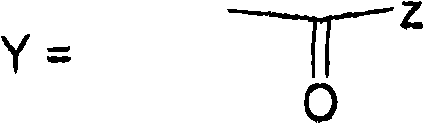
烯丙胺(Y=-CH2NH2,-CH2NR12R13)、(甲基)丙烯腈(Y=-CN)、丙烯醛(Y=-CHO)、乙烯基羧酸酯(Y=-OCOCHR15R16)或者通式VI的亚乙烯基碳酸酯。Allylamine (Y=-CH 2 NH 2 , -CH 2 NR 12 R 13 ), (meth)acrylonitrile (Y=-CN), acrolein (Y=-CHO), vinyl carboxylate (Y= -OCOCHR 15 R 16 ) or vinylene carbonates of general formula VI.
所有这些单体是可聚合的物质,其包含可逆结合基团,其可以借助于自由基在水溶液中聚合并且其可以是中性的、酸性的或碱性的。All these monomers are polymerizable substances which contain reversibly binding groups, which can be polymerized in aqueous solution by means of free radicals and which can be neutral, acidic or basic.
如果所用的单体是通式VI的亚乙烯基碳酸酯或者通式V的乙烯基羧酸酯CR*R**=CR11-OCOCHR15R16,所获得的产物随后优选被转化为含羟基的分离材料。这种转化成羟基段是通过本身已知的适度碱性或酸性的皂化来实现的。例如,可以在室温下使用K2CO3甲醇溶液进行反应,例如Y.Tezuka等在Macromol.Chem.186,685-694(1985)中所描述的。If the monomers used are vinylene carbonates of the formula VI or vinyl carboxylates of the formula V CR * R ** = CR 11 -OCOCHR 15 R 16 , the products obtained are then preferably converted into hydroxyl-containing separation material. This conversion into hydroxyl moieties is achieved by mildly basic or acidic saponification known per se. For example, the reaction can be carried out at room temperature using K2CO3 methanolic solution as described by Y. Tezuka et al. in Macromol. Chem. 186, 685-694 (1985).
在通式V和VI中,R11优选地表示H,即,丙烯酸衍生物是优选的。In the general formulas V and VI, R 11 preferably represents H, ie, acrylic acid derivatives are preferred.
通式V中的Y优选地表示Y in general formula V preferably represents

-COCHR15R16或-CH2NH2,次优选-COCHR 15 R 16 or -CH 2 NH 2 , less preferred
-CN或-CHO。-CN or -CHO.
R15和R16,彼此独立地,表示H或具有最多5个碳原子的烷基。基团R15和R16中的至少一个优选是H。以下基团是特别优选的:乙酰氧基、丙酰氧基、丁酰氧基、戊酰氧基和己酰氧基。R 15 and R 16 , independently of each other, represent H or an alkyl group having up to 5 carbon atoms. At least one of the groups R15 and R16 is preferably H. The following groups are particularly preferred: acetoxy, propionyloxy, butyryloxy, valeryloxy and hexanoyloxy.
通式V中的Z表示-OR14、-OH或-NR12R13,优选-NR12R13。Z in the general formula V represents -OR 14 , -OH or -NR 12 R 13 , preferably -NR 12 R 13 .
本文中优选这样的化合物,其中Z表示-NR12R13,并且基团R12和R13之一是H。Preference is given herein to compounds in which Z represents -NR 12 R 13 and one of the radicals R 12 and R 13 is H.
基团R12和/或R13优选表示烷基、苯基、苯基烷基或烷基苯基,其中烷基和/或苯基可以被烷氧基、氰基、氨基、单或二烷基氨基、三烷基铵、羧基、磺酰基、乙酰氧基或乙酰氨基单或多取代,优选单或二取代,特别优选单取代。The radicals R 12 and/or R 13 preferably represent alkyl, phenyl, phenylalkyl or alkylphenyl, wherein the alkyl and/or phenyl can be replaced by alkoxy, cyano, amino, mono- or dialkyl Amino, trialkylammonium, carboxyl, sulfonyl, acetoxy or acetamido are mono- or polysubstituted, preferably mono- or disubstituted, particularly preferably monosubstituted.
基团R12和/或R13优选表示烷基、烷氧基烷基、氰基烷基、氨基烷基、单或二烷基氨基烷基、三烷基铵烷基、羧基烷基或磺酰基烷基,在烷基中具有最多10个碳原子、优选最多6个碳原子、特别优选最多4个碳原子,其可以是直链或支链的。R12和/或R13因此优选表示甲基、乙基、丙基、丁基、戊基、己基、甲氧基甲基、乙氧基甲基、2-甲氧基乙基、2-,3-或4-氧杂戊基、2-,3-,4-或5-氧杂己基、2-,3-,4-,5-或6-氧杂庚基、异丙基、2-丁基、异丁基、2-甲基丁基、异戊基、2-甲基戊基、3-甲基戊基、2-氧杂-3-甲基丁基、3-氧杂-4-甲基丁基、2-甲基-3-氧杂戊基、2-甲基-3-氧杂己基,此外还表示庚基、辛基、壬基或癸基。The radicals R and /or R preferably represent alkyl, alkoxyalkyl, cyanoalkyl, aminoalkyl, mono- or dialkylaminoalkyl, trialkylammoniumalkyl, carboxyalkyl or sulfo Acylalkyl, having up to 10 carbon atoms, preferably up to 6 carbon atoms, particularly preferably up to 4 carbon atoms in the alkyl group, may be straight-chain or branched. R 12 and/or R 13 therefore preferably represent methyl, ethyl, propyl, butyl, pentyl, hexyl, methoxymethyl, ethoxymethyl, 2-methoxyethyl, 2-, 3- or 4-oxapentyl, 2-, 3-, 4- or 5-oxahexyl, 2-, 3-, 4-, 5- or 6-oxaheptyl, isopropyl, 2- Butyl, isobutyl, 2-methylbutyl, isopentyl, 2-methylpentyl, 3-methylpentyl, 2-oxa-3-methylbutyl, 3-oxa-4 - methylbutyl, 2-methyl-3-oxapentyl, 2-methyl-3-oxahexyl, in addition also heptyl, octyl, nonyl or decyl.
此外还优选的是被氰基、羧基或磺酰基取代的烷基。因此,R12和/或R13优选表示氰基甲基、氰基乙基、氰基丙基、氰基丁基、氰基戊基、氰基己基、2-氰基丙基、2-氰基丁基、羧基甲基、羧基乙基、羧基丙基、羧基异丙基、羧基丁基、羧基戊基、羧基己基、羧基-2-甲基丙基、羧基2-甲基丁基、磺酰基甲基、磺酰基乙基、磺酰基丙基、磺酰基丁基、磺酰基戊基、磺酰基己基、磺酰基-2-甲基丙基、磺酰基-2-甲基丁基、磺酰基-3-甲基丁基、磺酰基-2-甲基戊基、磺酰基-3-甲基己基或磺酰基-2-乙基戊基。Also preferred are alkyl groups substituted by cyano, carboxy or sulfonyl groups. R12 and/or R13 therefore preferably represent cyanomethyl, cyanoethyl, cyanopropyl, cyanobutyl, cyanopentyl, cyanohexyl, 2-cyanopropyl, 2-cyano butyl, carboxymethyl, carboxyethyl, carboxypropyl, carboxyisopropyl, carboxybutyl, carboxypentyl, carboxyhexyl, carboxy-2-methylpropyl, carboxy-2-methylbutyl, sulfo Acylmethyl, sulfonylethyl, sulfonylpropyl, sulfonylbutyl, sulfonylpentyl, sulfonylhexyl, sulfonyl-2-methylpropyl, sulfonyl-2-methylbutyl, sulfonyl -3-methylbutyl, sulfonyl-2-methylpentyl, sulfonyl-3-methylhexyl or sulfonyl-2-ethylpentyl.
烷基此外优选被氨基、单或二烷基氨基或三烷基铵基团单取代。在本文中,烷基可以是相同的或不同的,并且具有最多10个、优选最多6个碳原子、特别优选最多4个碳原子,因此优选表示二甲氨基乙基、二乙氨基乙基、甲氨基乙基、甲氨基丙基、二甲氨基丙基、乙氨基乙基、丙氨基乙基、丙氨基丙基、二丙氨基乙基、二丙氨基丁基、二乙氨基乙基、三甲基铵乙基、三甲基铵丙基、三甲基铵丁基、三乙基铵乙基、三乙基铵丙基、三乙基铵乙基、氨基乙基、氨基丙基、氨基丁基或氨基戊基。所有这些烷基和被取代的烷基同样优选作为苯基上的取代基。Alkyl groups are furthermore preferably monosubstituted by amino, mono- or dialkylamino or trialkylammonium groups. In this context, the alkyl groups can be identical or different and have at most 10, preferably at most 6, particularly preferably at most 4 carbon atoms, and thus preferably denote dimethylaminoethyl, diethylaminoethyl, Methylaminoethyl, methylaminopropyl, dimethylaminopropyl, ethylaminoethyl, propylaminoethyl, propylaminopropyl, dipropylaminoethyl, dipropylaminobutyl, diethylaminoethyl, three Methylammoniumethyl, Trimethylammoniumpropyl, Trimethylammoniumbutyl, Triethylammoniumethyl, Triethylammoniumpropyl, Triethylammoniumethyl, Aminoethyl, Aminopropyl, Amino butyl or aminopentyl. All such alkyl and substituted alkyl groups are likewise preferred as substituents on phenyl.
对于R12和/或R13还优选的是如下结构的砜硫醚-(CH2)n-SO2-(CH2)-S-(CH2)nOH,其中n=2、3、4、5或6,优选2、3或4。Also preferred for R 12 and/or R 13 are sulfone sulfides of the structure -(CH 2 )n-SO 2 -(CH 2 )-S-(CH 2 )nOH, where n=2, 3, 4, 5 or 6, preferably 2, 3 or 4.
R12和/或R13优选还具有苯基的含义,其优选被氰基、氰基烷基、氨基、氨基烷基、单或二烷基氨基、烷基、烷氧基、烷氧基烷基、单或二烷基氨基烷基、三烷基铵或三烷基铵烷基、羧基、羧基烷基、磺酰基或磺酰基烷基单取代。这些取代基的优选含义相应于优选的烷基和被取代的烷基,如上所述。苯基上的取代基优选在对位。R and /or R preferably also have the meaning of phenyl, which is preferably replaced by cyano, cyanoalkyl, amino, aminoalkyl, mono- or dialkylamino, alkyl, alkoxy, alkoxyalkane radical, mono- or dialkylaminoalkyl, trialkylammonium or trialkylammoniumalkyl, carboxy, carboxyalkyl, sulfonyl or sulfonylalkyl monosubstituted. The preferred meanings of these substituents correspond to the preferred alkyl and substituted alkyl groups, as described above. The substituent on the phenyl group is preferably in the para position.
对乙酰基苯基、对氨基苯基或对乙酰氨基苯基同样是R12和/或R13的优选含义。p-Acetylphenyl, p-aminophenyl or p-acetamidophenyl are likewise preferred meanings for R 12 and/or R 13 .
对于R12和/或R13来说,还优选的是烷基苯基或苯基烷基,其中为烷基、被取代的烷基或被取代的苯基所指出的优选含义将同样适用。Preference is also given to R12 and/or R13 to alkylphenyl or phenylalkyl, where the preferences indicated for alkyl, substituted alkyl or substituted phenyl apply equally.
因此,以下被取代的苯基,例如,被认为是特别优选的:4-氰基苯基、4-烷基苯基、4-(N,N-二甲氨基)苯基、4-(N,N--二烷基氨基乙基)苯基、4-乙氧基苯基、4-乙氧基乙基苯基、4-三烷基铵苯基、4-羧基苯基、4-磺酰基苯基、苯基乙基、4-(N-乙氨基)苯基丙基或4-氰基苯基乙基。Thus, the following substituted phenyl groups, for example, are considered particularly preferred: 4-cyanophenyl, 4-alkylphenyl, 4-(N,N-dimethylamino)phenyl, 4-(N , N--dialkylaminoethyl) phenyl, 4-ethoxyphenyl, 4-ethoxyethylphenyl, 4-trialkylammoniumphenyl, 4-carboxyphenyl, 4-sulfonyl Acylphenyl, phenylethyl, 4-(N-ethylamino)phenylpropyl or 4-cyanophenylethyl.
此外,通式V的优选的单体是其中R12和/或R13表示环状或二环基团的那些,所述环状或二环基团可以是芳族的或饱和的,具有5-10个碳原子,其中一个或多个CH或CH2基团已经被N或NH,N或NH和S,或N或NH和O替代。Furthermore, preferred monomers of general formula V are those in which R 12 and/or R 13 represent a cyclic or bicyclic group, which may be aromatic or saturated, with 5 - 10 carbon atoms in which one or more CH or CH2 groups have been replaced by N or NH, N or NH and S, or N or NH and O.
R12和/或R13因此优选还表示吡啶基团、咪唑基团、吲哚基团,此外优选吡咯、嘧啶、吡嗪、喹啉或异喹啉基团。R 12 and/or R 13 therefore preferably also represent a pyridine group, an imidazole group, an indole group, furthermore preferably a pyrrole, pyrimidine, pyrazine, quinoline or isoquinoline group.
R12和/或R13还可例如表示噻唑、噻二唑、吗啉、三嗪、哌嗪、苯并噻唑、嘌呤、吡唑、三唑、吡咯烷或异噁唑基团。R 12 and/or R 13 can also represent, for example, a thiazole, thiadiazole, morpholine, triazine, piperazine, benzothiazole, purine, pyrazole, triazole, pyrrolidine or isoxazole group.
本文中特别优选的是芳族杂环基。Particularly preferred herein are aromatic heterocyclic groups.
基团R12和R13,为了获得合适的交换剂,必须彼此相互匹配,使得两个基团包含酸性或碱性基团或者基团之一是中性的。相应地,本领域技术人员在分配基团方面是没有困难的,因此在组合合适的R12和R13基团方面(这取决于期望的离子交换剂的功能和任务)是没有困难的。The groups R 12 and R 13 , in order to obtain a suitable exchanger, must be matched to each other such that both groups contain acidic or basic groups or one of the groups is neutral. Correspondingly, the person skilled in the art has no difficulty in assigning groups and thus in combining suitable R12 and R13 groups (depending on the desired function and task of the ion exchanger).
两个基团R12和R13之一优选是中性基团。One of the two radicals R 12 and R 13 is preferably a neutral radical.
R14优选表示烷基、烷氧基烷基、氰基烷基、羧基烷基或磺酰基烷基,在烷基中具有最多10个碳原子、优选最多6个碳原子、特别优选最多4个碳原子,其可以是直链或支链的。R14因此优选表示甲基、乙基、丙基、丁基、戊基、己基、甲氧基甲基、乙氧基甲基、2-甲氧基乙基、2-,3-或4-氧杂戊基、异丙基、2-丁基、异丁基、2-甲基丁基、异戊基、2-甲基戊基、3-甲基戊基、2-氧杂-3-甲基丁基、3-氧杂-4-甲基丁基、2-甲基-3-氧杂戊基或2-甲基-3-氧杂己基。 R preferably represents alkyl, alkoxyalkyl, cyanoalkyl, carboxyalkyl or sulfonylalkyl, having up to 10 carbon atoms, preferably up to 6 carbon atoms, particularly preferably up to 4 carbon atoms in the alkyl group Carbon atoms, which may be straight or branched. R therefore preferably represents methyl, ethyl, propyl, butyl, pentyl, hexyl, methoxymethyl, ethoxymethyl, 2-methoxyethyl, 2-, 3- or 4- Oxapentyl, isopropyl, 2-butyl, isobutyl, 2-methylbutyl, isopentyl, 2-methylpentyl, 3-methylpentyl, 2-oxa-3- Methylbutyl, 3-oxa-4-methylbutyl, 2-methyl-3-oxapentyl or 2-methyl-3-oxahexyl.
此外还优选的是被氰基、羧基或磺酰基取代的烷基。因此,R14优选表示氰基甲基、氰基乙基、氰基丙基、氰基丁基、氰基戊基、氰基己基、2-氰基丙基、2-氰基丁基、羧基甲基、羧基乙基、羧基丙基、羧基异丙基、羧基丁基、羧基戊基、羧基己基、羧基-2-甲基丙基、羧基2-甲基丁基、磺酰基甲基、磺酰基乙基、磺酰基丙基、磺酰基丁基、磺酰基戊基、磺酰基己基、磺酰基-2-甲基丙基、磺酰基-2-甲基丁基、磺酰基-3-甲基丁基、磺酰基-2-甲基戊基、磺酰基-3-甲基己基或磺酰基-2-乙基戊基。Also preferred are alkyl groups substituted by cyano, carboxy or sulfonyl groups. R14 therefore preferably represents cyanomethyl, cyanoethyl, cyanopropyl, cyanobutyl, cyanopentyl, cyanohexyl, 2-cyanopropyl, 2-cyanobutyl, carboxy Methyl, carboxyethyl, carboxypropyl, carboxyisopropyl, carboxybutyl, carboxypentyl, carboxyhexyl, carboxy-2-methylpropyl, carboxy2-methylbutyl, sulfonylmethyl, sulfonyl Acylethyl, sulfonylpropyl, sulfonylbutyl, sulfonylpentyl, sulfonylhexyl, sulfonyl-2-methylpropyl, sulfonyl-2-methylbutyl, sulfonyl-3-methyl Butyl, sulfonyl-2-methylpentyl, sulfonyl-3-methylhexyl or sulfonyl-2-ethylpentyl.
所有这些烷基和被取代的烷基同样优选作为苯基上的取代基。All such alkyl and substituted alkyl groups are likewise preferred as substituents on phenyl.
R14优选还具有苯基的含义,其优选被氰基、氰基烷基、烷基、烷氧基、烷氧基烷基、羧基、羧基烷基、磺酰基或磺酰基烷基单取代。这些取代基的优选含义相应于优选的烷基和被取代的烷基,如上所述。苯基上的取代基优选在对位。R 14 preferably also has the meaning of phenyl, which is preferably monosubstituted by cyano, cyanoalkyl, alkyl, alkoxy, alkoxyalkyl, carboxy, carboxyalkyl, sulfonyl or sulfonylalkyl. The preferred meanings of these substituents correspond to the preferred alkyl and substituted alkyl groups, as described above. The substituent on the phenyl group is preferably in the para position.
通式V的单体中的R*和R**优选表示H。R * and R ** in the monomers of general formula V preferably represent H.
通式VI中的R*和R11优选表示H。R * and R 11 in general formula VI preferably represent H.
具有2-100个、优选5-60个、特别地10-30个单体单元的链一般接枝到基层材料上。Chains having 2-100, preferably 5-60, especially 10-30 monomer units are generally grafted onto the base material.
如上所述,存在着其中仅仅一种类型的分离效应物存在于基础基质中的吸附剂(“单模式”吸附剂)和其中在吸附剂中存在至少两种不同类型的分离效应物的共聚物或“混合模式”吸附剂。“单模式”吸附剂根据分离效应物和溶质间的一种类型的相互作用来分离溶解物质(溶质)。当使用混合模式吸附剂时,溶解物质(溶质)的分离基于分离效应物和溶质间的不同类型的相互作用。这种类型的色谱法被称为混合模式色谱。As mentioned above, there are adsorbents in which only one type of separation effector is present in the base matrix ("monomodal" adsorbents) and copolymers in which at least two different types of separation effectors are present in the adsorbent or "mixed-mode" adsorbents. "Single-mode" adsorbents separate dissolved substances (solutes) based on one type of interaction between the separation effector and the solute. When using mixed-mode sorbents, the separation of dissolved substances (solutes) is based on different types of interactions between separation effectors and solutes. This type of chromatography is known as mixed-mode chromatography.
在最简单的情况下,例如,利用基础基质的疏水性以便通过引入离子分离效应物来提供适于混合模式色谱的吸附剂。通过基础基质与两种不同反应物的反应,其中例如反应物之一将疏水基团引入基础基质而另一反应物将离子基团引入基础基质,使得混合模式吸附剂也是可使用的。两种程序的缺点在于不同类型的分离效应物之间的空间关系不确定。In the simplest case, for example, the hydrophobicity of the base matrix is exploited to provide a sorbent suitable for mixed-mode chromatography by introducing ion-separating effectors. Mixed mode sorbents are also usable by the reaction of the base matrix with two different reactants, where for example one of the reactants introduces hydrophobic groups into the base matrix and the other introduces ionic groups into the base matrix. A disadvantage of both procedures is that the spatial relationship between different types of isolated effectors is uncertain.
这种缺点在混合模式吸附剂的情况下被避免了,其中在配位体中结合了不同的分离效应物。这种配位体结合到基础基质。This disadvantage is avoided in the case of mixed-mode adsorbents, where different separation effectors are incorporated in the ligand. This ligand binds to the base matrix.
上述两种类型的混合模式吸附剂描述于L.W.McLaughlin(1989)的综述文章(Chem.Rev.89,309-319)中。例如,可以由氯丙基-取代的载体材料,通过将氯衍生物转化为溴衍生物,随后与苄基二甲胺反应:配位体通过C3链被结合到基础基质,来制备其不同的分离效应物结合在单一配位体中的混合模式吸附剂。这之后是二甲基-取代的铵基团,亲油苄基结合于此。通过氨丙基-取代的载体材料与对二乙氨基苯甲酸反应可获得配位体中的疏水性和离子型分离效应物的反向配置:在这种配位体中,叔氨基在基础基质的远侧取向,而在前者情况中,疏水苯甲基排列在远侧。The above two types of mixed mode adsorbents are described in the review article by LW McLaughlin (1989) (Chem. Rev. 89, 309-319). For example, chloropropyl-substituted support materials can be prepared by converting chlorine derivatives to bromine derivatives, followed by reaction with benzyldimethylamine: the ligand is bound to the base matrix through the C chain , and its different Mixed-mode sorbents with separation effectors bound in a single ligand. This is followed by a dimethyl-substituted ammonium group, where the lipophilic benzyl group is bound. The reverse configuration of the hydrophobic and ionic separation effectors in the ligand can be obtained by reacting an aminopropyl-substituted support material with p-diethylaminobenzoic acid: In this ligand, the tertiary amino group is in the base matrix , while in the former case, the hydrophobic benzyl group is arranged distally.
具有两个分离效应物的这种配位体的其它实施方案公开在以下文件中:WO 96/09116、WO 97/29825、WO 00/69872和WO 01/38228。专利申请EP 04028798.9公开了更多的络合配位体,其各自具有多于1个的分离效应物,和阴离子交换基团,其氮的形式是多环结构的氮杂衍生物,例如奎宁环(quininuclidine)体系。其实例是:Other embodiments of such ligands with two separate effectors are disclosed in the following documents: WO 96/09116, WO 97/29825, WO 00/69872 and WO 01/38228. Patent application EP 04028798.9 discloses further complexing ligands, each with more than 1 separation effector, and anion-exchange groups whose nitrogen forms are aza derivatives of polycyclic structure, such as quinine Ring (quininuclidine) system. Examples are:
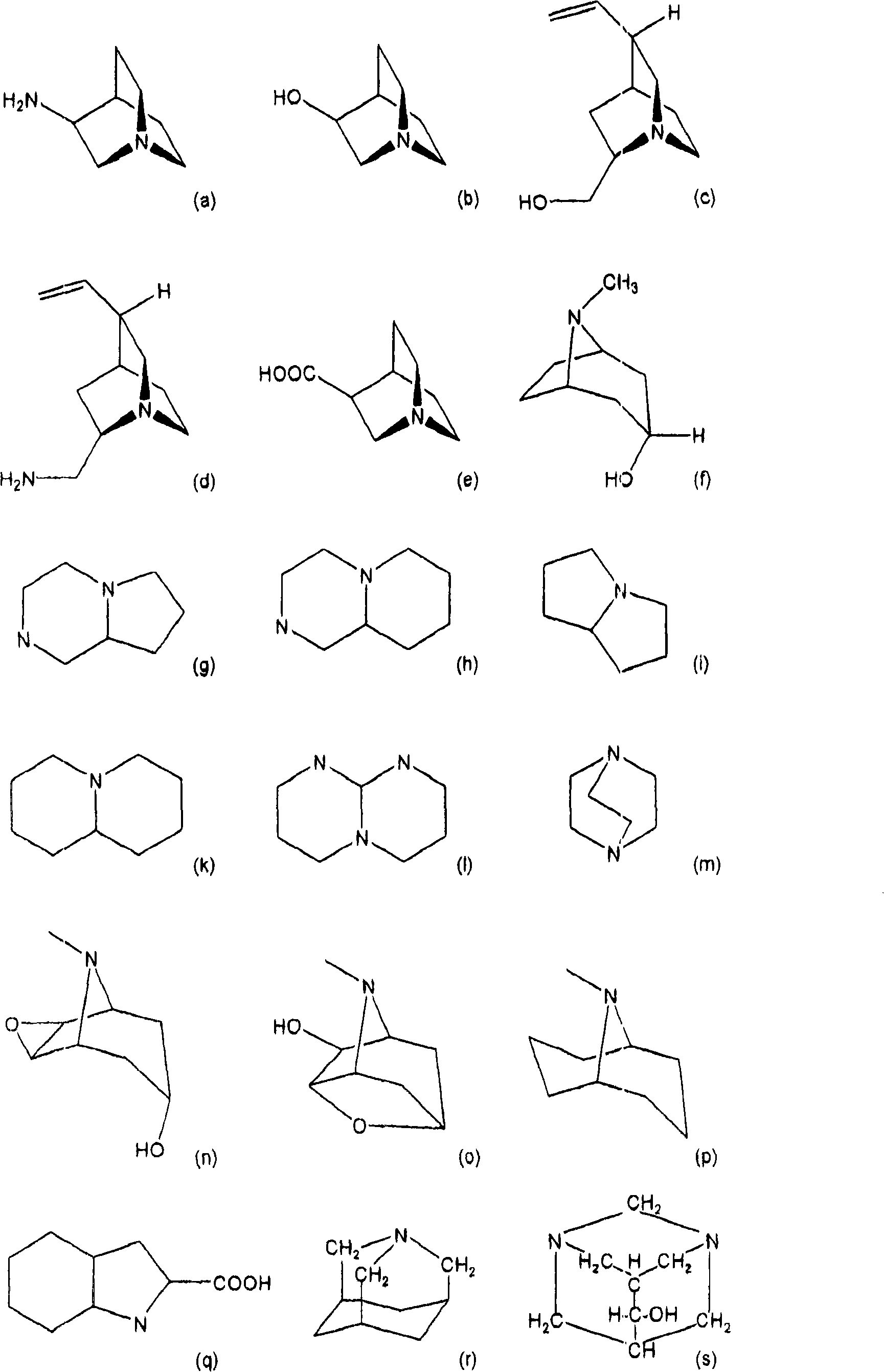
天然聚合物或具有分离效应物的本发明的聚合物的可能应用可以包括,例如,Possible applications of natural polymers or polymers of the invention with separation effectors may include, for example,
-选择性、部分选择性或无选择性结合或吸附一种或多种目标组分以便从基质将其除去- Selectively, partially selectively or nonselectively bind or adsorb one or more target components for removal from the matrix
-选择性、部分选择性或无选择性结合或吸附一种或多种次要组分以便从基质将该次要组分除去- selectively, partially selectively or non-selectively bind or adsorb one or more secondary components so as to remove the secondary components from the matrix
-通过尺寸排阻色谱法,仅仅根据分子大小而不结合或吸附一种或多种组分来分离物质混合物,- separation of substance mixtures by size exclusion chromatography solely on the basis of molecular size without binding or adsorption of one or more components,
-从天然源中分离、富集和/或消耗生物聚合物- Isolation, enrichment and/or depletion of biopolymers from natural sources
-从重组体源中分离、富集和/或消耗生物聚合物- Isolation, enrichment and/or depletion of biopolymers from recombinant sources
-从无限增殖化细胞系和其培养上层清液或者从植物、特别地转基因植物分离、富集和/或消耗生物聚合物- Isolation, enrichment and/or depletion of biopolymers from immortalized cell lines and their culture supernatants or from plants, in particular transgenic plants
-从B-细胞系和其衍生物、淋巴细胞和杂交瘤细胞系和其培养上层清液中分离、富集和/或消耗生物聚合物- Isolation, enrichment and/or depletion of biopolymers from B-cell lines and their derivatives, lymphocyte and hybridoma cell lines and their culture supernatants
-蛋白质和肽的分离、富集和/或消耗- Isolation, enrichment and/or depletion of proteins and peptides
-酶的分离、富集和/或消耗- Isolation, enrichment and/or depletion of enzymes
-单克隆和多克隆的抗体和天然存在或重组体抗体片段的分离、富集和/或消耗- Isolation, enrichment and/or depletion of monoclonal and polyclonal antibodies and naturally occurring or recombinant antibody fragments
-磷酸化肽/蛋白质和核酸的分离、富集和/或消耗- Isolation, enrichment and/or depletion of phosphorylated peptides/proteins and nucleic acids
-食品添加剂的分离、富集和/或消耗- Separation, enrichment and/or consumption of food additives
-单和多糖的分离、富集和/或消耗- Isolation, enrichment and/or depletion of mono and polysaccharides
-糖基化蛋白质的分离、富集和/或消耗- Isolation, enrichment and/or depletion of glycosylated proteins
-单链或双链DNA的分离、富集和/或消耗- Isolation, enrichment and/or depletion of single- or double-stranded DNA
-质粒DNA的分离、富集和/或消耗- Isolation, enrichment and/or depletion of plasmid DNA
-RNA的分离、富集和/或消耗- Isolation, enrichment and/or depletion of RNA
-病毒的分离、富集和/或消耗- Isolation, enrichment and/or depletion of virus
-寄主细胞蛋白质的分离、富集和/或消耗- Isolation, enrichment and/or depletion of host cell proteins
-寡和多核苷酸的分离、富集和/或消耗- Isolation, enrichment and/or depletion of oligo and polynucleotides
-脂质体的分离、富集和/或消耗- Isolation, enrichment and/or depletion of liposomes
-血液和牛奶产品的分离、富集和/或消耗- Separation, enrichment and/or consumption of blood and milk products
-低分子量活性药物成分(APIs)的分离、富集和/或消耗- Isolation, enrichment and/or depletion of low molecular weight active pharmaceutical ingredients (APIs)
-从API药物载体(例如API/脂质体加合物或API/纳米颗粒加合物)除去API- Removal of API from API drug carriers (e.g. API/liposome adducts or API/nanoparticle adducts)
-对映异构物的分离、富集和/或消耗- Separation, enrichment and/or depletion of enantiomers
取决于分离效应物的类型,本发明的聚合物的用途例如相应于亲和色谱法、离子交换色谱法、疏水性相互作用色谱法、尺寸排阻色谱法、手性色谱法或混合模式色谱法或液-液分配色谱法。Depending on the type of separation effector, the use of the polymers according to the invention corresponds, for example, to affinity chromatography, ion exchange chromatography, hydrophobic interaction chromatography, size exclusion chromatography, chiral chromatography or mixed mode chromatography Or liquid-liquid partition chromatography.
本发明的聚合物,以其天然形式或者具有与应用相应的分离效应物,可被用于已知的其中使用吸附剂的色谱理论方法中。这些方法原则上可以被分成间歇方法和连续方法。间歇方法的实例例如在下述文献中提到:″Preparative Chromatography″(Ed.H.Schmidt-Traub,Wiley-VCHVerlag Weinheim,2005,ISBN 3-527-30643-9,183-189页)。进一步的实例尤其是快速色谱法、膨胀床色谱法。此外,本发明的聚合物,以其天然形式或者具有与应用相应的分离效应物,可被用于连续方法,如,例如,模拟移动床色谱法。连续方法的进一步的实例描述在下述文献中:″Preparative Chromatography″(Ed.H.Schmidt-Traub,Wiley-VCH VerlagWeinheim,2005,ISBN 3-527-30643-9,190-204页)。The polymers according to the invention, in their natural form or with separation effectors corresponding to the application, can be used in known chromatographic methods in which adsorbents are used. These processes can in principle be divided into batch processes and continuous processes. Examples of batch processes are mentioned, for example, in "Preparative Chromatography" (Ed. H. Schmidt-Traub, Wiley-VCH Verlag Weinheim, 2005, ISBN 3-527-30643-9, pages 183-189). Further examples are especially flash chromatography, expanded bed chromatography. Furthermore, the polymers according to the invention, in their native form or with separation effectors corresponding to the application, can be used in continuous processes such as, for example, simulated moving bed chromatography. Further examples of continuous methods are described in the following literature: "Preparative Chromatography" (Ed. H. Schmidt-Traub, Wiley-VCH Verlag Weinheim, 2005, ISBN 3-527-30643-9, pages 190-204).
连续方法和间歇方法都可以进行,这取决于目的,等度的(isocratically)或者还是使用梯度技术。本领域技术人员知道本发明的吸附剂,天然的或者具有分离效应物的,将如何在所述方法之一中为所期望的目的而进行使用。Both continuous and batch methods can be carried out, depending on the purpose, isocratically or again using gradient techniques. A person skilled in the art knows how the inventive adsorbents, natural or having separation effectors, are to be used for the desired purpose in one of the methods described.
本发明的聚合物还可以用于薄层色谱法。The polymers of the invention can also be used in thin layer chromatography.
即使没有更进一步的说明,也认为本领域技术人员将能以最宽的范围利用上述描述。优选的实施方案和实施例因此应当仅仅被认为是描述性的公开内容,其决不以任何方式对本发明进行限制。Even without further elaboration, it is believed that one skilled in the art can utilize the above description to the broadest extent. The preferred embodiments and examples should therefore only be considered as a descriptive disclosure which in no way restricts the invention.
上述和下述的全部申请、专利和出版物的全部公开内容,特别是相应的申请EP 05 016 846.7(申请日为03.08.2005)都被结合到本申请中作为参考。The entire disclosure content of all applications, patents and publications mentioned above and below, in particular the corresponding application EP 05 016 846.7 (filing date 03.08.2005) is incorporated into this application by reference.
实施例Example
1.由丁二醇单乙烯基醚和二乙烯基亚乙基脲制备共聚物1. Preparation of copolymers from butanediol monovinyl ether and divinyl ethylene urea
将1050ml的去离子水(DI水)装入双壁反应器中,在其中溶解0.32g的磷酸三丁酯、4.2g的硫酸钠、0.01g的月桂基磺酸钠和2.1g的聚乙烯醇作为稳定剂。有机相,由96.25g的丁二醇单乙烯基醚、78.45g的二乙烯基亚乙基脲、175g的十二烷醇和4.2g的α,α′-偶氮二异丁腈组成,在组分混合和溶解之后,在搅拌下在室温下被添加到水相中。强力搅拌悬浮液,并且随后升温至70℃,同时用氮气冲洗。约2小时后,在80℃继续聚合4小时。冷却至室温后,滤出聚合物,通过蒸汽蒸馏除去致孔剂,将产物在20%乙醇溶液中存储。1050 ml of deionized water (DI water) was charged into a double-walled reactor, and 0.32 g of tributyl phosphate, 4.2 g of sodium sulfate, 0.01 g of sodium lauryl sulfonate, and 2.1 g of polyvinyl alcohol were dissolved therein as a stabilizer. The organic phase consists of 96.25g of butanediol monovinyl ether, 78.45g of divinylethylene urea, 175g of dodecanol and 4.2g of α,α'-azobisisobutyronitrile, in the group After mixing and dissolution, the fractions were added to the aqueous phase with stirring at room temperature. The suspension was stirred vigorously and then warmed to 70°C while flushing with nitrogen. After about 2 hours, the polymerization was continued at 80° C. for 4 hours. After cooling to room temperature, the polymer was filtered off, the porogen was removed by steam distillation, and the product was stored in 20% ethanol solution.
基于干重,获得130g的聚合物。平均粒度是80μm。Based on dry weight, 130 g of polymer were obtained. The average particle size is 80 μm.
多孔结构的表征:Characterization of Porous Structure:
比表面积(BET):322m2/gSpecific surface area (BET): 322m 2 /g
反应产物的溶胀体积是4.3ml/g。The swelling volume of the reaction product was 4.3 ml/g.
2.测定蛋白质的保留行为(非特异性结合)2. Determination of protein retention behavior (non-specific binding)
使用随盐浓度而变的蛋白质的保留行为的测定来研究未改性的载体材料的蛋白结合性能。因为蛋白质仅仅非特异性地结合到未改性的载体材料,那么如果背景结合尽可能少的出现,将是有利的。The determination of the retention behavior of proteins as a function of salt concentration was used to investigate the protein binding properties of unmodified support materials. Since proteins only bind non-specifically to unmodified support materials, it is advantageous if as little background binding as possible occurs.
与含1,2-二羟基-3-烯丙氧基丙烷和亚甲基双丙烯酰胺的未改性的共聚物(其是市售可得的,商品名
3.本发明的聚合物的尺寸排阻色谱3. Size Exclusion Chromatography of Polymers of the Invention
本发明的聚合物的直观多孔结构例如在图2中通过各种分子量的葡聚糖的实验测定的分配系数Kd所显示,所述分子量由葡聚糖的粘度半径表示。The intuitive porous structure of the polymers of the invention is shown for example in Figure 2 by the experimentally determined partition coefficients Kd of dextran of various molecular weights, represented by the viscosity radius of the dextran.
4.碱稳定性研究4. Alkali stability research
按实施例1制备的本发明的材料在室温下存储在0.5M NaOH(体积比NaOH∶聚合物凝胶=4∶1)中。The material according to the invention prepared according to Example 1 was stored at room temperature in 0.5M NaOH (volume ratio NaOH:polymer gel=4:1).
在一段时间后,在分离作为标记化合物的各种茁霉多糖(pullulane)(PSS,Mainz,Germany)中,比照其保留行为来测试聚合物的分离性能。The separation performance of the polymers was tested against their retention behavior in the separation of various pullulanes (PSS, Mainz, Germany) as marker compounds after a period of time.
洗脱液:100mM NaCl,20mM NaH2PO4,pH 7.2Eluent: 100mM NaCl, 20mM NaH 2 PO 4 , pH 7.2
柱:300×10mm,流速:0.8mL/min,折光率检测器。Column: 300×10mm, flow rate: 0.8mL/min, refractive index detector.
图3显示了结果。清楚表明在稀释氢氧化钠溶液中的存储对分配系数绝对没有作用。Figure 3 shows the results. It is clearly shown that storage in dilute sodium hydroxide solution has absolutely no effect on the partition coefficient.
5.)蛋白质混合物的分离5.) Separation of protein mixtures
本发明的聚合物,在本实施例中由65wt%的丁二醇单乙烯基醚和35wt%的二乙烯基亚乙基脲的共聚物组成,形式是球状的多孔颗粒,平均粒径为107μm,其借助于铈(IV)-引发的2-丙烯酰胺基-2-甲基-1-丙磺酸的接枝聚合而具有阳离子型分离效应物,这相应于WO 03/031062中的制备实施例A2在第10页所描述的程序。基于1g的干物质,获得了1195μmol的在这种聚合物中官能SO3基团的密度。所制备的离子交换剂材料(批次:BDM SO3 DZ38)被引入SuperformanceTM玻璃柱,GoetecLabortechnik(吸附剂床的深度为40mm,直径10mm),并且用由20mMNaH2PO4(pH 6.0)组成的缓冲液平衡。将500μl的在20mM NaH2PO4中的5mg/mL的糜蛋白酶原A、5mg/mL的溶菌酶和5mg/mL的细胞色素C的溶液施加到柱。在施加后,在12柱体积的过程期间经线性梯度进行洗脱直至100%的20mM NaH2PO4,1M NaCl(pH=6.0)的溶液。本发明的聚合物的洗脱性能导致分离了混合物中的单种蛋白质。图4显示了相关的色谱。The polymer of the present invention, in this example, consists of a copolymer of 65% by weight butanediol monovinyl ether and 35% by weight of divinyl ethylene urea, in the form of spherical porous particles with an average particle size of 107 μm , which has cationic separation effectors by means of cerium(IV)-initiated graft polymerization of 2-acrylamido-2-methyl-1-propanesulfonic acid, which corresponds to the preparative implementation in WO 03/031062 Example A2 The procedure described on
6.)压力/流动性能6.) Pressure/flow properties
由65wt%的丁二醇单乙烯基醚和35wt%的二乙烯基亚乙基脲组成的以其天然形式的本发明的聚合物(批次:BDM PS02/E)被引入SuperformanceTM玻璃柱,Goetec Labortechnik,其直径为50mm。吸附剂床的深度是20厘米。球状多孔聚合物的平均粒径是107μm。测量该柱压差随100mM NaCl,20mM NaH2PO4(pH 6.0)溶液的流速的变化情况。即使在非常高的1400cm/h的流速下,压差也小于3巴。图5显示了压力/流量测量的相关的图形表示。The polymer of the invention in its native form (batch: BDM PS02/E) consisting of 65 wt% of butanediol monovinyl ether and 35 wt% of divinylethylene urea was introduced into a Superformance ™ glass column, Goetec Labortechnik, which has a diameter of 50 mm. The depth of the adsorbent bed is 20 cm. The average particle diameter of the spherical porous polymer was 107 μm. The variation of the column pressure difference with the flow rate of 100mM NaCl, 20mM NaH 2 PO 4 (pH 6.0) solution was measured. Even at a very high flow rate of 1400 cm/h, the differential pressure is less than 3 bar. Figure 5 shows a related graphical representation of pressure/flow measurements.
Claims (20)
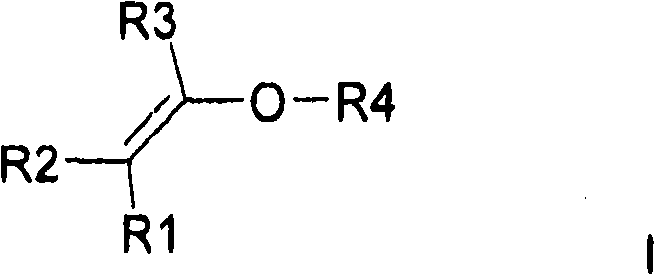
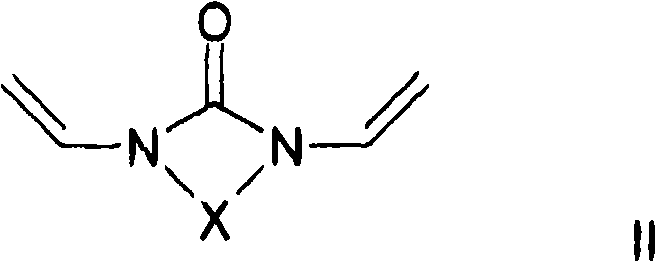

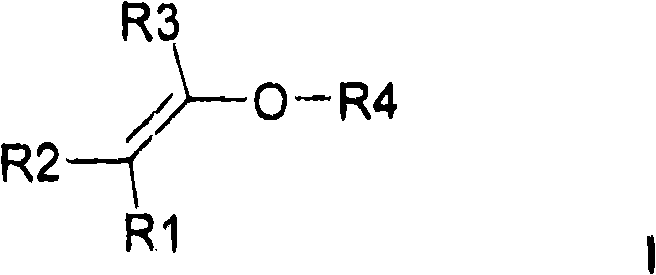


Applications Claiming Priority (5)
| Application Number | Priority Date | Filing Date | Title |
|---|---|---|---|
| EP05016846.7 | 2005-08-03 | ||
| EP05016846A EP1754534A1 (en) | 2005-08-03 | 2005-08-03 | Crosslinked hydrophile polymer |
| EPPCT/EP2006/005296 | 2006-06-02 | ||
| EPPCT/EP2006/005296 | 2006-06-02 | ||
| PCT/EP2006/005484 WO2007014591A1 (en) | 2005-08-03 | 2006-06-08 | Hydrophilic crosslinked polymer |
Related Child Applications (1)
| Application Number | Title | Priority Date | Filing Date |
|---|---|---|---|
| CN201110266314.2A Division CN102417557B (en) | 2005-08-03 | 2006-06-08 | Hydrophilic crosslinked polymer |
Publications (2)
| Publication Number | Publication Date |
|---|---|
| CN101258175A true CN101258175A (en) | 2008-09-03 |
| CN101258175B CN101258175B (en) | 2011-11-16 |
Family
ID=37110325
Family Applications (2)
| Application Number | Title | Priority Date | Filing Date |
|---|---|---|---|
| CN2006800285993A Active CN101258175B (en) | 2005-08-03 | 2006-06-08 | Hydrophilic cross-linked polymer |
| CN201110266314.2A Active CN102417557B (en) | 2005-08-03 | 2006-06-08 | Hydrophilic crosslinked polymer |
Family Applications After (1)
| Application Number | Title | Priority Date | Filing Date |
|---|---|---|---|
| CN201110266314.2A Active CN102417557B (en) | 2005-08-03 | 2006-06-08 | Hydrophilic crosslinked polymer |
Country Status (8)
| Country | Link |
|---|---|
| US (3) | US7951885B2 (en) |
| EP (1) | EP1910433B1 (en) |
| JP (1) | JP5475284B2 (en) |
| KR (1) | KR101289911B1 (en) |
| CN (2) | CN101258175B (en) |
| CA (1) | CA2617645C (en) |
| ES (1) | ES2528426T3 (en) |
| WO (1) | WO2007014591A1 (en) |
Cited By (1)
| Publication number | Priority date | Publication date | Assignee | Title |
|---|---|---|---|---|
| CN110505914A (en) * | 2017-02-09 | 2019-11-26 | 嬴晟运营私人有限公司 | Polymeric beads and its application |
Families Citing this family (35)
| Publication number | Priority date | Publication date | Assignee | Title |
|---|---|---|---|---|
| US7951885B2 (en) * | 2005-08-03 | 2011-05-31 | Merck Patent Gmbh | Hydrophilic crosslinked polymer |
| AU2007272494B2 (en) | 2006-07-14 | 2011-07-28 | Wisconsin Alumni Research Foundation | Adsorptive membranes for trapping viruses |
| US20090294362A1 (en) * | 2008-05-30 | 2009-12-03 | Persson Jonas Par | Stationary phase for hydrophilic interaction chromatography |
| JP5631869B2 (en) * | 2008-05-30 | 2014-11-26 | メルク パテント ゲゼルシャフト ミット ベシュレンクテル ハフツングMerck Patent Gesellschaft mit beschraenkter Haftung | Graft polymerization initiated by Ce (IV) on a polymer containing no hydroxyl group |
| US8592555B2 (en) | 2008-08-11 | 2013-11-26 | Emd Millipore Corporation | Immunoglobulin-binding proteins with improved specificity |
| SG162687A1 (en) * | 2008-12-24 | 2010-07-29 | Millipore Corp | Caustic stable chromatography ligands |
| SG10201604554WA (en) | 2011-06-08 | 2016-07-28 | Emd Millipore Corp | Chromatography matrices including novel staphylococcus aureus protein a based ligands |
| JP5936184B2 (en) | 2012-02-14 | 2016-06-15 | 国立大学法人福井大学 | Process for producing homopolymer or random copolymer of hydroxyl group-containing vinyl ether |
| US10189891B2 (en) * | 2012-03-28 | 2019-01-29 | Ge Healthcare Bioprocess R&D Ab | Affinity chromatography matrix |
| EP2656892A1 (en) | 2012-04-23 | 2013-10-30 | Merck Patent GmbH | Chromatography method |
| JP6220496B2 (en) * | 2012-05-14 | 2017-10-25 | Jsr株式会社 | Method for producing polymer particle, polymer particle, packing material for chromatography column, and chromatography column |
| US9334353B2 (en) | 2012-05-14 | 2016-05-10 | Jsr Corporation | Method for producing polymer particles, polymer particles, filler for chromatography column, and chromatography column |
| MY195756A (en) | 2012-09-17 | 2023-02-09 | Grace W R & Co | Functionalized Particulate Support Material and Methods of Making and Using the Same |
| WO2014058570A1 (en) | 2012-09-17 | 2014-04-17 | Alltech Associates, Inc. | Chromatography media and devices |
| KR101880565B1 (en) | 2013-09-04 | 2018-07-23 | 이엠디 밀리포어 코포레이션 | Methods of cleaning a protein a based affinity chromatography coloumn |
| WO2015088677A1 (en) | 2013-12-12 | 2015-06-18 | Emd Millipore Corporation | Protein separations using an acrylamide containing filter |
| JP6853670B2 (en) | 2014-01-16 | 2021-04-07 | ダブリュー・アール・グレース・アンド・カンパニー−コーンW R Grace & Co−Conn | Affinity Chromatography Medium and Chromatography Devices |
| US11389783B2 (en) | 2014-05-02 | 2022-07-19 | W.R. Grace & Co.-Conn. | Functionalized support material and methods of making and using functionalized support material |
| ES2920381T3 (en) * | 2014-08-15 | 2022-08-03 | Merck Patent Gmbh | Purification of immunoglobulins from plasma |
| US11566082B2 (en) | 2014-11-17 | 2023-01-31 | Cytiva Bioprocess R&D Ab | Mutated immunoglobulin-binding polypeptides |
| JP2018517559A (en) | 2015-06-05 | 2018-07-05 | ダブリュー・アール・グレース・アンド・カンパニー−コーンW R Grace & Co−Conn | Adsorbing bioprocess clarifier and method for producing and using the same |
| US10889615B2 (en) | 2016-05-11 | 2021-01-12 | Cytiva Bioprocess R&D Ab | Mutated immunoglobulin-binding polypeptides |
| EP3455243B1 (en) | 2016-05-11 | 2021-03-24 | Cytiva BioProcess R&D AB | Separation matrix |
| US10703774B2 (en) | 2016-09-30 | 2020-07-07 | Ge Healthcare Bioprocess R&D Ab | Separation method |
| US10730908B2 (en) | 2016-05-11 | 2020-08-04 | Ge Healthcare Bioprocess R&D Ab | Separation method |
| JP7031934B2 (en) | 2016-05-11 | 2022-03-08 | サイティバ・バイオプロセス・アールアンドディ・アクチボラグ | Separation matrix |
| US11708390B2 (en) * | 2016-05-11 | 2023-07-25 | Cytiva Bioprocess R&D Ab | Method of storing a separation matrix |
| US12448411B2 (en) | 2016-09-30 | 2025-10-21 | Cytiva Bioprocess R&D Ab | Separation method |
| TWI799441B (en) | 2017-08-23 | 2023-04-21 | 日商Jsr股份有限公司 | Chromatography carrier, ligand-immobilized carrier, chromatography column, purification method of target substance, and production method of chromatography carrier |
| CN117920163A (en) | 2018-11-06 | 2024-04-26 | Jsr株式会社 | Method for producing organic sulfur compound |
| JP7590400B2 (en) * | 2019-07-03 | 2024-11-26 | メルク パテント ゲゼルシャフト ミット ベシュレンクテル ハフツング | Purification of antibody drug conjugates |
| JP7700092B2 (en) | 2019-07-03 | 2025-06-30 | メルク パテント ゲゼルシャフト ミット ベシュレンクテル ハフツング | Glycoform purification |
| WO2025027058A1 (en) | 2023-08-01 | 2025-02-06 | Merck Patent Gmbh | Polishing for aav particles using anion exchange chromatography with improved elution system |
| WO2025027059A1 (en) | 2023-08-02 | 2025-02-06 | Merck Patent Gmbh | Method for purification of plasmid dna |
| WO2025257280A1 (en) | 2024-06-14 | 2025-12-18 | Merck Patent Gmbh | Method for purification of rna |
Family Cites Families (23)
| Publication number | Priority date | Publication date | Assignee | Title |
|---|---|---|---|---|
| JPS54160300A (en) | 1978-06-08 | 1979-12-18 | Toyo Soda Mfg Co Ltd | Hydrophilic separating carrier and making method thereof |
| DE3344912A1 (en) | 1983-12-13 | 1985-06-20 | Hoechst Ag, 6230 Frankfurt | CROSSLINKED POLYMERISATES, METHOD FOR THE PRODUCTION THEREOF AND THEIR USE |
| JPH0648267B2 (en) * | 1984-07-26 | 1994-06-22 | 日本エクスラン工業株式会社 | Method for producing gel for liquid chromatography |
| DE3543348A1 (en) * | 1985-12-07 | 1987-06-11 | Bayer Ag | PEARL-SHAPED CROSS-NETWORKED MIXED POLYMERS WITH EPOXY AND BASIC AMINO GROUPS, METHOD FOR THE PRODUCTION THEREOF AND THEIR USE |
| DE3629176A1 (en) * | 1986-08-28 | 1988-03-17 | Hoechst Ag | CROSSLINKED POLYMERISATES WITH CARBONATE TER GROUPS AND METHOD FOR THE PRODUCTION THEREOF |
| DE3629177A1 (en) * | 1986-08-28 | 1988-03-17 | Hoechst Ag | CROSSLINKED POLYMERISATES AND METHOD FOR THE PRODUCTION THEREOF |
| DE3714276C2 (en) | 1987-04-29 | 2002-09-19 | Celanese Ventures Gmbh | Hydrophilic, crosslinked polymers, processes for their preparation and their use |
| DE3811042A1 (en) | 1988-03-31 | 1989-10-19 | Merck Patent Gmbh | ION EXCHANGER |
| DE9013137U1 (en) | 1990-09-15 | 1992-01-23 | Röhm GmbH, 6100 Darmstadt | Highly cross-linked, pearl-shaped, activatable, hydrophilic carrier material |
| TW198064B (en) * | 1990-12-24 | 1993-01-11 | Hoechst Ag | |
| DE4130428A1 (en) * | 1991-09-13 | 1993-03-18 | Basf Ag | COPOLYMERISATES OF HYDROXYALKYLVINYL ETHERS AND THE USE OF HOMO- AND COPOLYMERISES OF HYDROXYALKYLVINYL ETHERS IN WASHING AND CLEANING AGENTS |
| JPH0769686A (en) * | 1993-08-31 | 1995-03-14 | Dainippon Ink & Chem Inc | UV curable resin composition for coating optical fiber |
| SE9303790D0 (en) | 1993-11-17 | 1993-11-17 | Pharmacia Lkb Biotech | A method for separation and synthetic polymers that can be used as separation media in the method |
| US5652348A (en) | 1994-09-23 | 1997-07-29 | Massey University | Chromatographic resins and methods for using same |
| SE9600590D0 (en) | 1996-02-19 | 1996-02-19 | Pharmacia Biotech Ab | Methods for chromatographic separation of peptides and nucleic acid and new high-affinity ion exchange matrix |
| DE19920794A1 (en) | 1999-05-06 | 2000-11-09 | Merck Patent Gmbh | Process for the preparation of bead polymers |
| US6310199B1 (en) | 1999-05-14 | 2001-10-30 | Promega Corporation | pH dependent ion exchange matrix and method of use in the isolation of nucleic acids |
| SE9904197D0 (en) | 1999-11-22 | 1999-11-22 | Amersham Pharm Biotech Ab | An method for anion exchange adsorption on matrices carrying mixed mode ligands |
| EP1179732B2 (en) | 2000-08-11 | 2012-02-29 | Rohm And Haas Company | Polymeric adsorbent and method of preparation |
| ATE376007T1 (en) | 2002-06-05 | 2007-11-15 | Imp College Innovations Ltd | POLYVINYL ETHER |
| EP1693108A1 (en) | 2004-12-04 | 2006-08-23 | MERCK PATENT GmbH | Mixed-modal anion-exchange type separation material |
| US7951885B2 (en) * | 2005-08-03 | 2011-05-31 | Merck Patent Gmbh | Hydrophilic crosslinked polymer |
| DE102005051963A1 (en) | 2005-10-29 | 2007-05-03 | Werner & Pfleiderer Industrielle Backtechnik Gmbh | Pressing device for a plant for the production of biscuit sticks |
-
2006
- 2006-06-08 US US11/997,613 patent/US7951885B2/en active Active
- 2006-06-08 CA CA2617645A patent/CA2617645C/en active Active
- 2006-06-08 EP EP06754224.1A patent/EP1910433B1/en active Active
- 2006-06-08 CN CN2006800285993A patent/CN101258175B/en active Active
- 2006-06-08 CN CN201110266314.2A patent/CN102417557B/en active Active
- 2006-06-08 ES ES06754224.1T patent/ES2528426T3/en active Active
- 2006-06-08 WO PCT/EP2006/005484 patent/WO2007014591A1/en not_active Ceased
- 2006-06-08 KR KR1020087005296A patent/KR101289911B1/en active Active
- 2006-06-08 JP JP2008524371A patent/JP5475284B2/en active Active
-
2010
- 2010-11-17 US US12/947,900 patent/US8765897B2/en active Active
-
2014
- 2014-02-05 US US14/173,218 patent/US20140155565A1/en not_active Abandoned
Cited By (1)
| Publication number | Priority date | Publication date | Assignee | Title |
|---|---|---|---|---|
| CN110505914A (en) * | 2017-02-09 | 2019-11-26 | 嬴晟运营私人有限公司 | Polymeric beads and its application |
Also Published As
| Publication number | Publication date |
|---|---|
| ES2528426T3 (en) | 2015-02-09 |
| CN102417557B (en) | 2015-03-11 |
| EP1910433A1 (en) | 2008-04-16 |
| CA2617645C (en) | 2014-09-09 |
| CN102417557A (en) | 2012-04-18 |
| US20140155565A1 (en) | 2014-06-05 |
| CA2617645A1 (en) | 2007-02-08 |
| JP2009503203A (en) | 2009-01-29 |
| CN101258175B (en) | 2011-11-16 |
| KR101289911B1 (en) | 2013-07-26 |
| US8765897B2 (en) | 2014-07-01 |
| US7951885B2 (en) | 2011-05-31 |
| US20110091727A1 (en) | 2011-04-21 |
| KR20080039472A (en) | 2008-05-07 |
| JP5475284B2 (en) | 2014-04-16 |
| US20080210615A1 (en) | 2008-09-04 |
| EP1910433B1 (en) | 2014-11-05 |
| WO2007014591A1 (en) | 2007-02-08 |
Similar Documents
| Publication | Publication Date | Title |
|---|---|---|
| CN102417557B (en) | Hydrophilic crosslinked polymer | |
| CA2737404C (en) | Temperature-responsive polymer particles in protein separation | |
| US20200406231A1 (en) | Method of separating biomolecules using hydrophobically-derivatized supports | |
| KR101354473B1 (en) | Process for making improved chromatography media and method of use | |
| CA2096224C (en) | Macroporous polymeric particles as biocompatible supports | |
| Wikberg et al. | Grafting of silica with sulfobetaine polymers via aqueous reversible addition fragmentation chain transfer polymerization and its use as a stationary phase in HILIC | |
| CA2726015C (en) | Ce(iv)-initiated graft polymerisation on polymers containing no hydroxyl groups | |
| EP1507808A1 (en) | Macroporous cross-linked polymer particles | |
| JPH0236351A (en) | Production of column packing material for liquid chromatography | |
| EP1754534A1 (en) | Crosslinked hydrophile polymer |
Legal Events
| Date | Code | Title | Description |
|---|---|---|---|
| C06 | Publication | ||
| PB01 | Publication | ||
| C10 | Entry into substantive examination | ||
| SE01 | Entry into force of request for substantive examination | ||
| C14 | Grant of patent or utility model | ||
| GR01 | Patent grant |