JP6220496B2 - Method for producing polymer particle, polymer particle, packing material for chromatography column, and chromatography column - Google Patents
Method for producing polymer particle, polymer particle, packing material for chromatography column, and chromatography column Download PDFInfo
- Publication number
- JP6220496B2 JP6220496B2 JP2012110451A JP2012110451A JP6220496B2 JP 6220496 B2 JP6220496 B2 JP 6220496B2 JP 2012110451 A JP2012110451 A JP 2012110451A JP 2012110451 A JP2012110451 A JP 2012110451A JP 6220496 B2 JP6220496 B2 JP 6220496B2
- Authority
- JP
- Japan
- Prior art keywords
- mpa
- monomer
- organic solvent
- solubility parameter
- polymer particles
- Prior art date
- Legal status (The legal status is an assumption and is not a legal conclusion. Google has not performed a legal analysis and makes no representation as to the accuracy of the status listed.)
- Active
Links
Landscapes
- Polymerisation Methods In General (AREA)
- Addition Polymer Or Copolymer, Post-Treatments, Or Chemical Modifications (AREA)
Description
本発明はポリマー粒子の製造方法、該製造方法により製造されたポリマー粒子、該粒子を用いたクロマトグラフィーカラム用充填剤、及びクロマトグラフィーカラムに関する。 The present invention relates to a method for producing polymer particles, polymer particles produced by the production method, a packing material for a chromatography column using the particles, and a chromatography column.
従来、クロマトグラフィー用担体として、ポリ(メタ)アクリルエステル類、ポリ(メタ)アクリルアミド類等の合成ポリマーや、多糖類等の天然ポリマーの粒子が用いられている。このうち合成ポリマーの粒子は、保護基等で疎水化処理したモノマーを重合させる方法や、順相懸濁重合(O/W型)および逆相懸濁重合(W/O型)のいずれかの方法で製造される。
疎水化処理した場合には重合後に親水性基に変換する二次処理を行わなければならず、逆相懸濁重合は、多量の有機溶媒を必要とし、粒子調製の工程が複雑であるという問題があるものの、アクリルアミドモノマーは一般に有機溶媒への溶解性が低いため、これを用いた順相懸濁重合はこれまで行われておらず、アクリルアミドモノマーを用いたポリアクリルアミド粒子の調製には、一般的に、保護基等で疎水化処理したモノマーを重合する方法、或いは逆相懸濁により重合する方法が採用されている(特許文献1〜3)。
Conventionally, synthetic polymers such as poly (meth) acrylic esters and poly (meth) acrylamides and particles of natural polymers such as polysaccharides have been used as chromatographic carriers. Among these, the synthetic polymer particles are either a method of polymerizing a monomer hydrophobized with a protecting group or the like, or normal phase suspension polymerization (O / W type) or reverse phase suspension polymerization (W / O type). Manufactured by the method.
In the case of hydrophobization treatment, a secondary treatment for converting to a hydrophilic group must be performed after the polymerization, and the reverse phase suspension polymerization requires a large amount of an organic solvent, and the particle preparation process is complicated. However, since acrylamide monomers are generally poorly soluble in organic solvents, normal phase suspension polymerization using them has not been performed so far, and preparation of polyacrylamide particles using acrylamide monomers is not common. In particular, a method of polymerizing a monomer hydrophobized with a protecting group or the like, or a method of polymerizing by reverse phase suspension is employed (Patent Documents 1 to 3).
本発明が解決しようとする課題は、アクリルアミドモノマーから順相懸濁重合法によりポリマー粒子を製造する方法、該製造方法により製造されたポリマー粒子、該粒子を用いたクロマトグラフィーカラム用充填剤、及びクロマトグラフィーカラムを提供することにある。 Problems to be solved by the present invention include a method for producing polymer particles from an acrylamide monomer by a normal phase suspension polymerization method, a polymer particle produced by the production method, a packing for a chromatography column using the particles, and It is to provide a chromatography column.
そこで、本発明者らは、鋭意検討した結果、N置換アクリルアミド基を複数有する多官能モノマーを含有するモノマー組成物を水系媒体中に分散させ、前記モノマー組成物を重合させることにより、アクリルアミドモノマーから順相懸濁重合法によりポリマー粒子を製造できることを見出し、本発明を完成した。 Therefore, as a result of intensive studies, the present inventors have dispersed a monomer composition containing a polyfunctional monomer having a plurality of N-substituted acrylamide groups in an aqueous medium, and polymerized the monomer composition, so that the acrylamide monomer can be polymerized. The present inventors have found that polymer particles can be produced by a normal phase suspension polymerization method.
すなわち、本発明は、N置換アクリルアミド基を複数有する多官能モノマーを含有するモノマー組成物を水系媒体中に分散させる工程と、前記分散させたモノマー組成物を重合させる工程とを含むことを特徴とするポリマー粒子の製造方法を提供するものである。 That is, the present invention includes a step of dispersing a monomer composition containing a polyfunctional monomer having a plurality of N-substituted acrylamide groups in an aqueous medium, and a step of polymerizing the dispersed monomer composition. The present invention provides a method for producing polymer particles.
また、本発明は、上記製造方法により製造されたポリマー粒子を提供するものである。
更に、本発明は、上記ポリマー粒子を担体とするクロマトグラフィーカラム用充填剤を提供するものである。
更に、本発明は、上記ポリマー粒子にリガンドを固定化したアフィニティクロマトグラフィー用充填剤を提供するものである。
更に、本発明は、上記充填剤が充填されているクロマトグラフィーカラムを提供するものである。
Moreover, this invention provides the polymer particle manufactured by the said manufacturing method.
Furthermore, the present invention provides a packing material for a chromatography column using the polymer particles as a carrier.
Furthermore, the present invention provides a packing material for affinity chromatography in which a ligand is immobilized on the polymer particles.
Furthermore, this invention provides the chromatography column with which the said filler is packed.
本発明によれば、アクリルアミドモノマーから順相懸濁重合法によりポリマー粒子を製造できる。 According to the present invention, polymer particles can be produced from an acrylamide monomer by a normal phase suspension polymerization method.
本発明のポリマー粒子の製造方法は、N置換アクリルアミド基を複数有する多官能モノマーを含有するモノマー組成物(重合性組成物ともいう)を水系媒体中に分散させ、前記モノマー組成物を重合させる工程を含むことを特徴とするものである。上記モノマー組成物は、モノマーを含有する組成物を意味する。 The method for producing polymer particles of the present invention comprises a step of dispersing a monomer composition (also referred to as a polymerizable composition) containing a polyfunctional monomer having a plurality of N-substituted acrylamide groups in an aqueous medium and polymerizing the monomer composition. It is characterized by including. The said monomer composition means the composition containing a monomer.
本発明で用いる多官能モノマーは、N置換アクリルアミド基を複数有するものである。多官能モノマーが有するN置換アクリルアミド基としては、ゲル付着の少ないポリマー粒子を得る観点から、炭素数1〜3のアルキル基が窒素原子に置換しているアクリルアミド基が好ましい。
また、N置換アクリルアミド基の個数としては、ゲル付着の少ないポリマー粒子を得る観点から、一分子あたり2〜6個が好ましく、2〜4個がより好ましく、2個が特に好ましい。
The polyfunctional monomer used in the present invention has a plurality of N-substituted acrylamide groups. As the N-substituted acrylamide group possessed by the polyfunctional monomer, an acrylamide group in which an alkyl group having 1 to 3 carbon atoms is substituted with a nitrogen atom is preferable from the viewpoint of obtaining polymer particles with less gel adhesion.
Further, the number of N-substituted acrylamide groups is preferably 2 to 6, more preferably 2 to 4, and particularly preferably 2 from the viewpoint of obtaining polymer particles with less gel adhesion.
上記多官能モノマーの好適な具体例としては、下記式(1)で表されるものが挙げられる。斯様な多官能モノマーを用いることにより、順相懸濁重合法によりポリマー粒子を効率よく得ることができる。 Preferable specific examples of the polyfunctional monomer include those represented by the following formula (1). By using such a polyfunctional monomer, polymer particles can be efficiently obtained by a normal phase suspension polymerization method.
〔式(1)中、R1は炭素数2〜8のアルキレン基を示し、R2及びR3は炭素数1〜3のアルキル基を示し、R2及びR3が一緒になって隣接する窒素原子及びR1と共に複素環を形成していてもよい。但し、R1、R2及びR3の炭素数の合計は5以上である。〕 [In the formula (1), R 1 represents an alkylene group having 2 to 8 carbon atoms, R 2 and R 3 represent an alkyl group having 1 to 3 carbon atoms, and R 2 and R 3 are adjacent together. A heterocycle may be formed together with the nitrogen atom and R 1 . However, the total number of carbon atoms of R 1 , R 2 and R 3 is 5 or more. ]
ここで、R1で示される炭素数2〜8のアルキレン基は直鎖状でも分岐状でもよく、例えばエタン−1,1−ジイル基、エタン−1,2−ジイル基、プロパン−1,1−ジイル基、プロパン−1,2−ジイル基、プロパン−1,3−ジイル基、プロパン−2,2−ジイル基、ブタン−1,2−ジイル基、ブタン−1,3−ジイル基、ブタン−1,4−ジイル基、ペンタン−1,4−ジイル基、ペンタン−1,5−ジイル基、ヘキサン−1,5−ジイル基、ヘキサン−1,6−ジイル基、ヘプタン−1,7−ジイル基、オクタン−1,8−ジイル基等が挙げられる。アルキレン基の炭素数は好ましくは3〜8であり、より好ましくは3〜6である。 Here, the alkylene group having 2 to 8 carbon atoms represented by R 1 may be linear or branched. For example, ethane-1,1-diyl group, ethane-1,2-diyl group, propane-1,1 -Diyl group, propane-1,2-diyl group, propane-1,3-diyl group, propane-2,2-diyl group, butane-1,2-diyl group, butane-1,3-diyl group, butane -1,4-diyl group, pentane-1,4-diyl group, pentane-1,5-diyl group, hexane-1,5-diyl group, hexane-1,6-diyl group, heptane-1,7- A diyl group, an octane-1,8-diyl group, etc. are mentioned. Carbon number of an alkylene group becomes like this. Preferably it is 3-8, More preferably, it is 3-6.
R2及びR3で示される炭素数1〜3のアルキル基としては、メチル基又はエチル基が好ましく、R2及びR3が共にメチル基又はエチル基であるのがより好ましく、エチル基であるのが更に好ましい。 The alkyl group having 1 to 3 carbon atoms represented by R 2 and R 3, preferably a methyl group or an ethyl group, more preferably R 2 and R 3 are both methyl or ethyl, is ethyl group Is more preferable.
また、R2及びR3は一緒になって隣接する窒素原子及びR1と共に複素環を形成していてもよい。斯かる複素環基としては、2−メチルピペラジン−1,4−ジイル基、2−エチルピペラジン−1,4−ジイル基、2,5−ジメチルピペラジン−1,4−ジイル基、2,5−ジエチルピペラジン−1,4−ジイル基、1,4−パーヒドロジアゼピン−1,4−ジイル基、6−メチル−1,4−パーヒドロジアゼピン−1,4−ジイル基、6−エチル−1,4−パーヒドロジアゼピン−1,4−ジイル基等が挙げられる。 R 2 and R 3 together may form a heterocyclic ring with the adjacent nitrogen atom and R 1 . Such heterocyclic groups include 2-methylpiperazine-1,4-diyl group, 2-ethylpiperazine-1,4-diyl group, 2,5-dimethylpiperazine-1,4-diyl group, 2,5- Diethylpiperazine-1,4-diyl group, 1,4-perhydrodiazepine-1,4-diyl group, 6-methyl-1,4-perhydrodiazepine-1,4-diyl group, 6-ethyl- Examples include 1,4-perhydrodiazepine-1,4-diyl group.
また、R1、R2及びR3の炭素数の合計は5以上であるが、順相懸濁重合法によりポリマー粒子を効率よく得る観点から、好ましくは5〜15であり、より好ましくは5〜12であり、更に好ましくは6〜10であり、特に好ましくは7〜9である。 The total number of carbon atoms of R 1 , R 2 and R 3 is 5 or more, but is preferably 5 to 15 and more preferably 5 from the viewpoint of efficiently obtaining polymer particles by the normal phase suspension polymerization method. It is -12, More preferably, it is 6-10, Most preferably, it is 7-9.
また、本発明で用いる多官能モノマーの好適な具体例としては、N,N’−ジエチル−1,3−ビス(アクリルアミド)プロパン(DEAAP)〔溶解度パラメータ:22.6(MPa)1/2〕、N,N’−ジエチル−1,6−ビス(アクリルアミド)ヘキサン(DEAAH)〔21.7(MPa)1/2〕、1,4−ビス(アクリロイル)ピペラジン(BAP)〔23.6(MPa)1/2〕、N,N’−ジエチル−1,4−ビス(アクリルアミド)ブタン〔22.3(MPa)1/2〕、N,N’−ジエチル−1,5−ビス(アクリルアミド)ペンタン〔22.0(MPa)1/2〕、N,N’−ジメチル−1,3−ビス(アクリルアミド)プロパン〔23.4(MPa)1/2〕、N,N’−ジメチル−1,6−ビス(アクリルアミド)ヘキサン〔22.3(MPa)1/2〕、N,N’−ジメチル−1,4−ビス(アクリルアミド)ブタン〔23.0(MPa)1/2〕、N,N’−ジメチル−1,5−ビス(アクリルアミド)ペンタン〔22.6(MPa)1/2〕等が挙げられ、単独で又は2種以上を混合して用いることができる。 Moreover, as a suitable specific example of the polyfunctional monomer used in the present invention, N, N′-diethyl-1,3-bis (acrylamide) propane (DEAAP) [solubility parameter: 22.6 (MPa) 1/2 ] N, N′-diethyl-1,6-bis (acrylamide) hexane (DEAAH) [21.7 (MPa) 1/2 ], 1,4-bis (acryloyl) piperazine (BAP) [23.6 (MPa) ) 1/2 ], N, N′-diethyl-1,4-bis (acrylamide) butane [22.3 (MPa) 1/2 ], N, N′-diethyl-1,5-bis (acrylamide) pentane [22.0 (MPa) 1/2 ], N, N′-dimethyl-1,3-bis (acrylamide) propane [23.4 (MPa) 1/2 ], N, N′-dimethyl-1,6 -Bis (acrylamide) hexane [22.3 ( Pa) 1/2], N, N'-dimethyl-1,4-bis (acrylamide) butane [23.0 (MPa) 1/2], N, N'-dimethyl-1,5-bis (acrylamide) Pentane [22.6 (MPa) 1/2 ] and the like can be mentioned, and these can be used alone or in admixture of two or more.
ここで、本明細書において溶解度パラメータはfedors法で算出されるSP値を意味し、化合物の溶解度パラメータδは次式で求められる。 Here, in this specification, the solubility parameter means the SP value calculated by the fedors method, and the solubility parameter δ of the compound is obtained by the following equation.
δ=(ΔE/ΔV)1/2(MPa)1/2 δ = (ΔE / ΔV) 1/2 (MPa) 1/2
(式中、ΔEは蒸発エネルギー(J/mol)を示し、ΔVは25℃におけるモル体積(cm3/mol)を示す。) (In the formula, ΔE represents the evaporation energy (J / mol), and ΔV represents the molar volume (cm 3 / mol) at 25 ° C.)
また、上記多官能モノマーの溶解度パラメータδとしては、ゲル付着の少ないポリマー粒子を得る観点から、10.0(MPa)1/2以上30.0(MPa)1/2以下が好ましく、15.0(MPa)1/2以上25.0(MPa)1/2以下がより好ましく、17.5(MPa)1/2以上24.0(MPa)1/2未満が更に好ましく、20.0(MPa)1/2以上23.5(MPa)1/2以下が更に好ましく、21.0(MPa)1/2以上23.0(MPa)1/2以下が更に好ましい。 The solubility parameter δ of the polyfunctional monomer is preferably 10.0 (MPa) 1/2 or more and 30.0 (MPa) 1/2 or less from the viewpoint of obtaining polymer particles with little gel adhesion. (MPa) 1/2 or more and 25.0 (MPa) 1/2 or less are more preferable, 17.5 (MPa) 1/2 or more and less than 24.0 (MPa) 1/2 are more preferable, and 20.0 (MPa) ) 1/2 or more and 23.5 (MPa) 1/2 or less are more preferable, and 21.0 (MPa) 1/2 or more and 23.0 (MPa) 1/2 or less are more preferable.
また、上記多官能モノマーの使用量は、ポリマー粒子の力学的強度、特にクロマトカラム粒子として使用した場合の圧力性能の観点から、モノマー総量に対し、20〜99質量%が好ましく、50〜90質量%がより好ましい。 In addition, the amount of the polyfunctional monomer used is preferably 20 to 99% by mass, and preferably 50 to 90% by mass with respect to the total amount of monomers, from the viewpoint of mechanical strength of the polymer particles, particularly pressure performance when used as chromatographic column particles. % Is more preferable.
また、本発明で用いるモノマー組成物は、上記N置換アクリルアミド基を複数有する多官能モノマーと共重合可能な他のモノマーを含んでいてもよい。斯かる他のモノマーとしては、非架橋性(単官能)モノマー、架橋性(多官能)モノマーのいずれも使用することができ、これらを併用してもよい。該他のモノマーの溶解度パラメータδは、ゲル付着の少ないポリマー粒子を得る観点から、好ましくは10.0(MPa)1/2以上29.0(MPa)1/2以下であり、より好ましくは15.0(MPa)1/2以上27.5(MPa)1/2以下であり、更に好ましくは16.5(MPa)1/2以上26.0(MPa)1/2以下であり、更に好ましくは17.5(MPa)1/2以上24.0(MPa)1/2以下である。 In addition, the monomer composition used in the present invention may contain another monomer copolymerizable with the polyfunctional monomer having a plurality of N-substituted acrylamide groups. As such other monomer, any of a non-crosslinkable (monofunctional) monomer and a crosslinkable (polyfunctional) monomer can be used, and these may be used in combination. The solubility parameter δ of the other monomer is preferably 10.0 (MPa) 1/2 or more and 29.0 (MPa) 1/2 or less, more preferably 15 from the viewpoint of obtaining polymer particles with less gel adhesion. 0.0 (MPa) 1/2 or more and 27.5 (MPa) 1/2 or less, more preferably 16.5 (MPa) 1/2 or more and 26.0 (MPa) 1/2 or less, more preferably Is 17.5 (MPa) 1/2 or more and 24.0 (MPa) 1/2 or less.
上記非架橋性モノマーとしては、(メタ)アクリルアミド系モノマー、スチレン系モノマー、N−ビニルアミド系モノマー、ビニルケトン系モノマー、アクリロニトリル系モノマーが好ましい。 As the non-crosslinkable monomer, (meth) acrylamide monomers, styrene monomers, N-vinylamide monomers, vinyl ketone monomers, and acrylonitrile monomers are preferable.
上記(メタ)アクリルアミド系モノマーとしては、ジメチルアクリルアミド(DMAAM)〔23.9(MPa)1/2〕、ジエチルアクリルアミド(DEAAM)〔20.7(MPa)1/2〕、プロピルアクリルアミド〔22.0(MPa)1/2〕、イソプロピルアクリルアミド〔21.6(MPa)1/2〕、アクリロイルモルホリン〔28.0(MPa)1/2〕、アクリロイルピロリジン〔27.9(MPa)1/2〕、アクリロイルピペリジン〔25.8(MPa)1/2〕等が挙げられる。 Examples of the (meth) acrylamide monomer include dimethylacrylamide (DMAAM) [23.9 (MPa) 1/2 ], diethylacrylamide (DEAAM) [20.7 (MPa) 1/2 ], and propylacrylamide [22.0. (MPa) 1/2 ], isopropylacrylamide [21.6 (MPa) 1/2 ], acryloylmorpholine [28.0 (MPa) 1/2 ], acryloylpyrrolidine [27.9 (MPa) 1/2 ], And acryloylpiperidine [25.8 (MPa) 1/2 ].
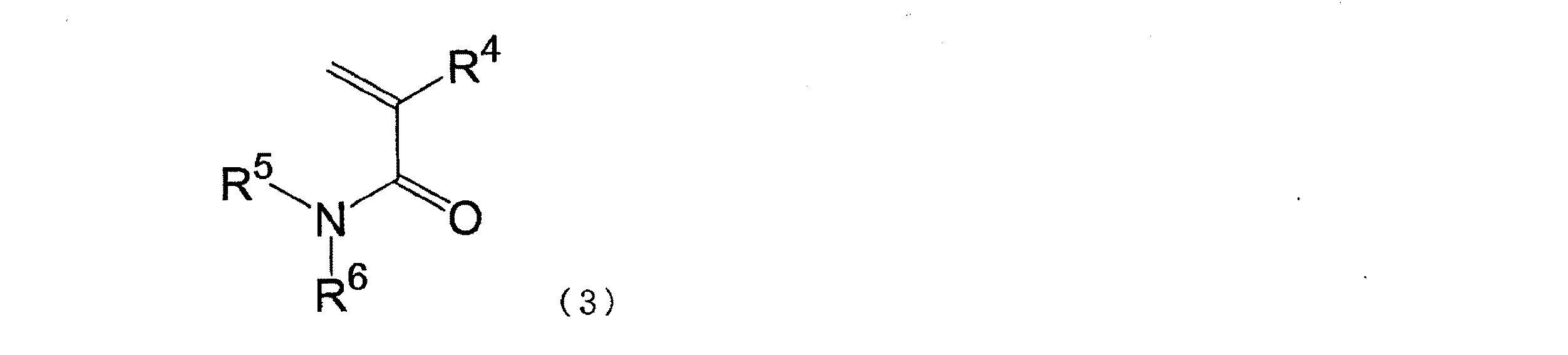
上記(メタ)アクリルアミド系モノマーの中でも、下記式(3)で表されるものが好ましい。 Among the above (meth) acrylamide monomers, those represented by the following formula (3) are preferable.
〔式(3)中、R4は水素原子又はメチル基を示し、R5及びR6はそれぞれ独立して水素原子又は炭素数1〜4のアルキル基を示す。〕 [In formula (3), R 4 represents a hydrogen atom or a methyl group, a hydrogen atom or an alkyl group having 1 to 4 carbon atoms R 5 and R 6 independently. ]
上記R4としては水素原子が好ましい。また、R5及びR6としては炭素数1〜4のアルキル基が好ましい。該アルキル基としては、メチル基、エチル基、プロピル基、イソプロピル基等が挙げられる。アルキル基の炭素数は好ましくは1又は2である。 R 4 is preferably a hydrogen atom. R 5 and R 6 are preferably an alkyl group having 1 to 4 carbon atoms. Examples of the alkyl group include a methyl group, an ethyl group, a propyl group, and an isopropyl group. The number of carbon atoms of the alkyl group is preferably 1 or 2.
また、上記スチレン系モノマーとしては、スチレン〔18.9(MPa)1/2〕、α−メチルスチレン〔18.8(MPa)1/2〕、ハロゲン化スチレン〔20.0−21.8(MPa)1/2〕(フルオロスチレン〔20.0(MPa)1/2〕、クロロスチレン〔21.0(MPa)1/2〕、ブロモスチレン〔21.2(MPa)1/2〕、ヨードスチレン〔21.8(MPa)1/2〕)、4−メトキシスチレン〔19.2(MPa)1/2〕、4−エトキシスチレン〔19.0(MPa)1/2〕、1,2−ジヒドロキシ−3−(4−ビニルベンジルオキシ)プロパン〔28.0(MPa)1/2〕等が挙げられる。
また、上記N−ビニルアミド系モノマーとしては、N−ビニルホルムアミド〔26.1(MPa)1/2〕、N−ビニルアセトアミド〔23.5(MPa)1/2〕、N−ビニルプロパミド〔22.6(MPa)1/2〕、N−ビニルブタミド〔22.0(MPa)1/2〕、N−メチル−N−ビニルホルムアミド〔21.7(MPa)1/2〕、N−メチル−N−ビニルアセトアミド〔19.5(MPa)1/2〕、N−メチル−N−ビニルプロパミド〔19.3(MPa)1/2〕、N−メチル−N−ビニルブタミド〔19.1(MPa)1/2〕、N−エチル−N−ビニルホルムアミド〔21.1(MPa)1/2〕、N−エチル−N−ビニルアセトアミド〔19.3(MPa)1/2〕、N−エチル−N−ビニルプロパミド〔19.1(MPa)1/2〕、N−エチル−N−ビニルブタミド〔18.9(MPa)1/2〕、N−プロピル−N−ビニルホルムアミド〔20.7(MPa)1/2〕、N−プロピル−N−ビニルアセトアミド〔19.1(MPa)1/2〕、N−プロピル−N−ビニルプロパミド〔18.9(MPa)1/2〕、N−プロピル−N−ビニルブタミド〔18.8(MPa)1/2〕、N−イソプロピル−N−ビニルホルムアミド〔20.3(MPa)1/2〕、N−イソプロピル−N−ビニルアセトアミド〔18.8(MPa)1/2〕、N−イソプロピル−N−ビニルプロパミド〔18.7(MPa)1/2〕、N−イソプロピル−N−ビニルブタミド〔18.6(MPa)1/2〕等が挙げられる。
Examples of the styrene monomer include styrene [18.9 (MPa) 1/2 ], α-methylstyrene [18.8 (MPa) 1/2 ], halogenated styrene [20.0-21.8 ( MPa) 1/2 ] (fluorostyrene [20.0 (MPa) 1/2 ], chlorostyrene [21.0 (MPa) 1/2 ], bromostyrene [21.2 (MPa) 1/2 ], iodine Styrene [21.8 (MPa) 1/2 ]), 4-methoxystyrene [19.2 (MPa) 1/2 ], 4-ethoxystyrene [19.0 (MPa) 1/2 ], 1,2- And dihydroxy-3- (4-vinylbenzyloxy) propane [28.0 (MPa) 1/2 ].
Examples of the N-vinylamide monomer include N-vinylformamide [26.1 (MPa) 1/2 ], N-vinylacetamide [23.5 (MPa) 1/2 ], and N-vinylpropamide [22. .6 (MPa) 1/2 ], N-vinylbutamide [22.0 (MPa) 1/2 ], N-methyl-N-vinylformamide [21.7 (MPa) 1/2 ], N-methyl-N -Vinylacetamide [19.5 (MPa) 1/2 ], N-methyl-N-vinylpropamide [19.3 (MPa) 1/2 ], N-methyl-N-vinylbutamide [19.1 (MPa) 1/2 ], N-ethyl-N-vinylformamide [21.1 (MPa) 1/2 ], N-ethyl-N-vinylacetamide [19.3 (MPa) 1/2 ], N-ethyl-N -Vinylpropamide [19.1 (MPa) 1/2 ], N-eth Ru-N-vinylbutamide [18.9 (MPa) 1/2 ], N-propyl-N-vinylformamide [20.7 (MPa) 1/2 ], N-propyl-N-vinylacetamide [19.1 ( MPa) 1/2 ], N-propyl-N-vinylpropamide [18.9 (MPa) 1/2 ], N-propyl-N-vinylbutamide [18.8 (MPa) 1/2 ], N-isopropyl -N-vinylformamide [20.3 (MPa) 1/2 ], N-isopropyl-N-vinylacetamide [18.8 (MPa) 1/2 ], N-isopropyl-N-vinylpropamide [18.7] (MPa) 1/2 ], N-isopropyl-N-vinylbutamide [18.6 (MPa) 1/2 ] and the like.
また、上記ビニルケトン系モノマーとしては、アクロレイン〔21.6(MPa)1/2〕、メチルビニルケトン〔17.7(MPa)1/2〕、エチルビニルケトン〔17.7(MPa)1/2〕、プロピルビニルケトン〔17.7(MPa)1/2〕、イソプロピルビニルケトン〔17.2(MPa)1/2〕、メタクリロレイン〔21.0(MPa)1/2〕、イソプロペニルメチルケトン〔17.8(MPa)1/2〕、イソプロペニルエチルケトン〔17.7(MPa)1/2〕、イソプロペニルプロピルケトン〔17.7(MPa)1/2〕、イソプロペニルイソプロピルケトン〔17.3(MPa)1/2〕等が挙げられる。 Examples of the vinyl ketone monomer include acrolein [21.6 (MPa) 1/2 ], methyl vinyl ketone [17.7 (MPa) 1/2 ], and ethyl vinyl ketone [17.7 (MPa) 1/2]. ], Propyl vinyl ketone [17.7 (MPa) 1/2 ], isopropyl vinyl ketone [17.2 (MPa) 1/2 ], methacrylolein [21.0 (MPa) 1/2 ], isopropenyl methyl ketone [17.8 (MPa) 1/2 ], isopropenyl ethyl ketone [17.7 (MPa) 1/2 ], isopropenyl propyl ketone [17.7 (MPa) 1/2 ], isopropenyl isopropyl ketone [17 .3 (MPa) 1/2 ] and the like.
また、上記アクリロニトリル系モノマーとしては、アクリロニトリル〔22.7(MPa)1/2〕、メタクリロニトリル〔22.0(MPa)1/2〕等が挙げられる。
これら非架橋性モノマーの中でも、耐アルカリ性を向上させる場合には、(メタ)アクリルアミド系モノマーが好ましい。
Examples of the acrylonitrile-based monomer include acrylonitrile [22.7 (MPa) 1/2 ], methacrylonitrile [22.0 (MPa) 1/2 ], and the like.
Among these non-crosslinkable monomers, (meth) acrylamide monomers are preferable when improving alkali resistance.
また、上記架橋性モノマーとしては、二官能モノマーが好ましく、エポキシ基含有不飽和モノマーがより好ましい。例えば、グリシジルメタクリレート(GMA)〔19.5(MPa)1/2〕、3,4−エポキシシクロヘキシルメチルメタクリレート(M100)〔18.5(MPa)1/2〕、(4−ビニルベンジル)グリシジルエーテル(VBGE)〔19.9(MPa)1/2〕、グリシジルアクリレート〔19.7(MPa)1/2〕、アリルグリシジルエーテル〔16.9(MPa)1/2〕等が挙げられる。二官能モノマーとして、ヒドロキシエチルアクリルアミド〔28.3(MPa)1/2〕、ヒドロキシプロピルアクリルアミド〔28.1(MPa)1/2〕などの水酸基含有不飽和モノマー;ダイアセトンアクリルアミド〔21.9(MPa)1/2〕、2−アセトアセトキシエチルメタクリレート〔21.1(MPa)1/2〕などのカルボニル基含有不飽和モノマー;メタクリル酸〔22.0(MPa)1/2〕、4−ビニル安息香酸〔23.6(MPa)1/2〕などのカルボン酸基含有不飽和モノマー;ジビニルベンゼン〔19.0(MPa)1/2〕などの架橋性不飽和モノマーも使用することができる。 Moreover, as said crosslinkable monomer, a bifunctional monomer is preferable and an epoxy group containing unsaturated monomer is more preferable. For example, glycidyl methacrylate (GMA) [19.5 (MPa) 1/2 ], 3,4-epoxycyclohexylmethyl methacrylate (M100) [18.5 (MPa) 1/2 ], (4-vinylbenzyl) glycidyl ether (VBGE) [19.9 (MPa) 1/2 ], glycidyl acrylate [19.7 (MPa) 1/2 ], allyl glycidyl ether [16.9 (MPa) 1/2 ] and the like. As bifunctional monomers, hydroxyl-containing unsaturated monomers such as hydroxyethyl acrylamide [28.3 (MPa) 1/2 ], hydroxypropyl acrylamide [28.1 (MPa) 1/2 ]; diacetone acrylamide [21.9 ( MPa) 1/2 ], 2-acetoacetoxyethyl methacrylate [21.1 (MPa) 1/2 ] and other carbonyl group-containing unsaturated monomers; methacrylic acid [22.0 (MPa) 1/2 ], 4-vinyl Carboxylic acid group-containing unsaturated monomers such as benzoic acid [23.6 (MPa) 1/2 ]; crosslinkable unsaturated monomers such as divinylbenzene [19.0 (MPa) 1/2 ] can also be used.
なお、粒子のアルカリ耐性を向上させる場合には、上述のような多官能モノマーと共重合可能な他のモノマーの中でも、カルボン酸エステル結合を有さないものが好ましい。 In addition, when improving the alkali tolerance of particle | grains, the thing which does not have a carboxylic ester bond is preferable among the other monomers copolymerizable with the above polyfunctional monomers.
また、モノマーの組み合わせとしては、上記N置換アクリルアミド基を複数有する多官能モノマーと上記非架橋性モノマーと上記架橋性モノマーとの組み合わせが好ましい。中でも、上記N置換アクリルアミド基を複数有する多官能モノマーと(メタ)アクリルアミド系モノマーとエポキシ基含有不飽和モノマーとの組み合わせ、上記N置換アクリルアミド基を複数有する多官能モノマーとN−ビニルアミド系モノマーとエポキシ基含有不飽和モノマーとの組み合わせ、上記N置換アクリルアミド基を複数有する多官能モノマーとビニルケトン系モノマーとエポキシ基含有不飽和モノマーとの組み合わせが好ましく、上記N置換アクリルアミド基を複数有する多官能モノマーと(メタ)アクリルアミド系モノマーとエポキシ基含有不飽和モノマーとの組み合わせがより好ましい。
また、斯様に非架橋性モノマーと架橋性モノマーを併用する場合、非架橋性モノマーの使用量は、上記N置換アクリルアミド基を複数有する多官能モノマー100質量部に対し、1〜80質量部が好ましく、1.5〜50質量部がより好ましく、10〜40質量部が更に好ましい。
一方、架橋性モノマーの使用量は、上記N置換アクリルアミド基を複数有する多官能モノマー100質量部に対し、1〜80質量部が好ましく、5〜25質量部がより好ましく、5〜20質量部が更に好ましい。
The combination of the monomers is preferably a combination of the polyfunctional monomer having a plurality of N-substituted acrylamide groups, the non-crosslinkable monomer, and the crosslinkable monomer. Above all, a combination of a polyfunctional monomer having a plurality of N-substituted acrylamide groups, a (meth) acrylamide monomer and an epoxy group-containing unsaturated monomer, a polyfunctional monomer having a plurality of N-substituted acrylamide groups, an N-vinylamide monomer and an epoxy. A combination of a group-containing unsaturated monomer, a combination of a polyfunctional monomer having a plurality of N-substituted acrylamide groups, a vinyl ketone monomer and an epoxy group-containing unsaturated monomer, and a polyfunctional monomer having a plurality of N-substituted acrylamide groups; A combination of a (meth) acrylamide monomer and an epoxy group-containing unsaturated monomer is more preferred.
Moreover, when using a non-crosslinkable monomer and a crosslinkable monomer together, the usage-amount of a noncrosslinkable monomer is 1-80 mass parts with respect to 100 mass parts of polyfunctional monomers which have two or more said N substituted acrylamide groups. Preferably, 1.5-50 mass parts is more preferable, and 10-40 mass parts is still more preferable.
On the other hand, the use amount of the crosslinkable monomer is preferably 1 to 80 parts by mass, more preferably 5 to 25 parts by mass, and 5 to 20 parts by mass with respect to 100 parts by mass of the polyfunctional monomer having a plurality of N-substituted acrylamide groups. Further preferred.
また、上記モノマー組成物としては、有機溶媒を含むものが好ましい。有機溶媒は、上記N置換アクリルアミド基を複数有する多官能モノマーを溶解するものを1種以上含むものであればよいが、多孔化剤として作用する有機溶媒を使用することにより、多孔質のポリマー粒子を製造できる。 Moreover, as said monomer composition, what contains the organic solvent is preferable. Any organic solvent may be used as long as it contains at least one polyfunctional monomer having a plurality of N-substituted acrylamide groups. By using an organic solvent that acts as a porous agent, porous polymer particles can be used. Can be manufactured.
斯様な有機溶媒としては、ヘキサン〔溶解度パラメータ:15.0(MPa)1/2〕、ヘプタン〔15.2(MPa)1/2〕、オクタン〔15.5(MPa)1/2〕、ノナン〔15.6(MPa)1/2〕、デカン〔15.8(MPa)1/2〕、ウンデカン〔15.9(MPa)1/2〕等の脂肪族炭化水素類;シクロヘキサン〔8.1(MPa)1/2〕、シクロペンタン〔8.1(MPa)1/2〕等の脂環式炭化水素類;ベンゼン〔21.2(MPa)1/2〕、トルエン〔18.2(MPa)1/2〕、キシレン〔18.6(MPa)1/2〕、ナフタレン〔21.2(MPa)1/2〕、エチルベンゼン〔18.5(MPa)1/2〕等の芳香族炭化水素類;四塩化炭素〔24.9(MPa)1/2〕、テトラクロロエタン〔23.8(MPa)1/2〕等のハロゲン化炭化水素類;1−ブタノール〔23.2(MPa)1/2〕、1−ペンタノール〔22.4(MPa)1/2〕、1−ヘキサノール〔21.9(MPa)1/2〕、1−ヘプタノール〔21.4(MPa)1/2〕、1−オクタノール〔20.0(MPa)1/2〕、4−メチル−2−ペンタノール〔18.9(MPa)1/2〕、2−エチル−1−ヘキサノール〔18.8(MPa)1/2〕等の脂肪族アルコール類;シクロヘキサノール〔34.4(MPa)1/2〕等の脂環式アルコール類;2−フェニルエチルアルコール〔22.5(MPa)1/2〕、ベンジルアルコール〔23.3(MPa)1/2〕等の芳香族アルコール類;ジエチルケトン〔17.2(MPa)1/2〕、メチルイソブチルケトン〔16.9(MPa)1/2〕、ジイソブチルケトン〔16.8(MPa)1/2〕、アセトフェノン〔20.9(MPa)1/2〕、2−オクタノン〔17.4(MPa)1/2〕、シクロヘキサノン〔20.1(MPa)1/2〕等のケトン類;ジブチルエーテル〔15.6(MPa)1/2〕、ジイソブチルエーテル〔15.2(MPa)1/2〕、アニソール〔19.2(MPa)1/2〕、エトキシベンゼン〔19.0(MPa)1/2〕等のエーテル類;酢酸ブチル〔17.6(MPa)1/2〕、酢酸イソペンチル〔17.4(MPa)1/2〕、酢酸−3−メトキシブチル〔19.4(MPa)1/2〕、マロン酸ジエチル〔19.5(MPa)1/2〕等のエステル類の他、非架橋性ビニルモノマーのホモポリマー等の線状重合物が挙げられる。これら有機溶媒は単独で又は2種以上を混合して用いることができる。
これらの中でも、順相懸濁重合法によりポリマー粒子を効率よく得る観点から、ケトン類、芳香族アルコール類、脂環式炭化水素類が好ましい。
Such organic solvents include hexane [solubility parameter: 15.0 (MPa) 1/2 ], heptane [15.2 (MPa) 1/2 ], octane [15.5 (MPa) 1/2 ], Aliphatic hydrocarbons such as nonane [15.6 (MPa) 1/2 ], decane [15.8 (MPa) 1/2 ], undecane [15.9 (MPa) 1/2 ]; cyclohexane [8. Alicyclic hydrocarbons such as 1 (MPa) 1/2 ] and cyclopentane [8.1 (MPa) 1/2 ]; benzene [21.2 (MPa) 1/2 ], toluene [18.2 ( MPa) 1/2 ], xylene [18.6 (MPa) 1/2 ], naphthalene [21.2 (MPa) 1/2 ], ethylbenzene [18.5 (MPa) 1/2 ], etc. hydrogen like; carbon tetrachloride [24.9 (MPa) 1/2], halogen such as tetrachloroethane [23.8 (MPa) 1/2] Hydrocarbons; 1-butanol [23.2 (MPa) 1/2], 1-pentanol [22.4 (MPa) 1/2], 1-hexanol [21.9 (MPa) 1/2] 1-heptanol [21.4 (MPa) 1/2 ], 1-octanol [20.0 (MPa) 1/2 ], 4-methyl-2-pentanol [18.9 (MPa) 1/2 ] Aliphatic alcohols such as 2-ethyl-1-hexanol [18.8 (MPa) 1/2 ]; alicyclic alcohols such as cyclohexanol [34.4 (MPa) 1/2 ]; 2-phenyl Aromatic alcohols such as ethyl alcohol [22.5 (MPa) 1/2 ] and benzyl alcohol [23.3 (MPa) 1/2 ]; diethyl ketone [17.2 (MPa) 1/2 ], methyl isobutyl ketone [16.9 (MPa) 1/2], diisobutyl ketone [1 .8 (MPa) 1/2], acetophenone [20.9 (MPa) 1/2], 2-octanone [17.4 (MPa) 1/2], cyclohexanone [20.1 (MPa) 1/2] Ketones such as: dibutyl ether [15.6 (MPa) 1/2 ], diisobutyl ether [15.2 (MPa) 1/2 ], anisole [19.2 (MPa) 1/2 ], ethoxybenzene [19 Ethers such as 0.0 (MPa) 1/2 ]; butyl acetate [17.6 (MPa) 1/2 ], isopentyl acetate [17.4 (MPa) 1/2 ], 3-methoxybutyl acetate [19 .4 (MPa) 1/2 ], esters such as diethyl malonate [19.5 (MPa) 1/2 ], and linear polymers such as homopolymers of non-crosslinkable vinyl monomers. These organic solvents can be used alone or in admixture of two or more.
Among these, ketones, aromatic alcohols, and alicyclic hydrocarbons are preferable from the viewpoint of efficiently obtaining polymer particles by a normal phase suspension polymerization method.
また、有機溶媒としては、ゲル付着の少ないポリマー粒子を得る観点から、溶解パラメータδが15(MPa)1/2以上である有機溶媒を1種以上含むものが好ましく、17(MPa)1/2以上である有機溶媒を1種以上含むものがより好ましく、17〜30(MPa)1/2である有機溶媒を1種以上含むものがより好ましい。また、上記と同様にゲル付着の少ないポリマー粒子を得る観点から、溶解度パラメータδが19(MPa)1/2以上である有機溶媒と溶解度パラメータδが19(MPa)1/2未満である有機溶媒との混液が好ましく、溶解度パラメータδが17〜19(MPa)1/2以上である有機溶媒と溶解度パラメータδが20〜30(MPa)1/2未満である有機溶媒との混液がより好ましい。 The organic solvent is preferably one containing at least one organic solvent having a solubility parameter δ of 15 (MPa) 1/2 or more from the viewpoint of obtaining polymer particles with little gel adhesion, and 17 (MPa) 1/2. What contains 1 or more types of the organic solvent which is the above is more preferable, and what contains 1 or more types of the organic solvent which is 17-30 (MPa) 1/2 is more preferable. Further, from the viewpoint of obtaining polymer particles with little gel adhesion as described above, an organic solvent having a solubility parameter δ of 19 (MPa) 1/2 or more and an organic solvent having a solubility parameter δ of less than 19 (MPa) 1/2 A mixed liquid of an organic solvent having a solubility parameter δ of 17 to 19 (MPa) 1/2 or more and an organic solvent having a solubility parameter δ of less than 20 to 30 (MPa) 1/2 is more preferable.
上記有機溶媒の溶解度パラメータδ(混液の場合は後述するδmix)としては、15〜30(MPa)1/2が好ましく、17〜30(MPa)1/2がより好ましく、17〜26(MPa)1/2が更に好ましく、17〜22(MPa)1/2が更に好ましい。
また、N置換アクリルアミド基を複数有する多官能モノマーの溶解度パラメータδと有機溶媒の溶解度パラメータδ(混液の場合は後述するδmix)との差の絶対値の上限としては、ゲル付着の少ない多孔質ポリマー粒子を得る観点から、5.8(MPa)1/2以下がより好ましく、5.2(MPa)1/2未満が更に好ましく、4.9(MPa)1/2未満が更に好ましく、4.5(MPa)1/2以下が特に好ましい。一方、その下限としては、多孔質粒子を得る観点から、1.7(MPa)1/2以上が好ましく、2.5(MPa)1/2以上がより好ましい。
The solubility parameter of the organic solvent [delta] ([delta] mix to be described later in the case of mixture), 15~30 (MPa) 1/2 is preferable, 17~30 (MPa) 1/2, more preferably, 17 to 26 (MPa ) 1/2 is more preferable, and 17 to 22 (MPa) 1/2 is more preferable.
In addition, the upper limit of the absolute value of the difference between the solubility parameter δ of a polyfunctional monomer having a plurality of N-substituted acrylamide groups and the solubility parameter δ of an organic solvent (δ mix described later in the case of a mixed solution) is a porous material with little gel adhesion From the viewpoint of obtaining polymer particles, 5.8 (MPa) 1/2 or less is more preferable, less than 5.2 (MPa) 1/2 is more preferable, and less than 4.9 (MPa) 1/2 is more preferable. .5 (MPa) 1/2 or less is particularly preferable. On the other hand, the lower limit thereof is preferably 1.7 (MPa) 1/2 or more, more preferably 2.5 (MPa) 1/2 or more, from the viewpoint of obtaining porous particles.
上記有機溶媒の溶解度パラメータは、多官能モノマーと同様にして算出できるが、有機溶媒が2種以上で構成される混液である場合、その溶解度パラメータδmixは次式で求められる。 The solubility parameter of the organic solvent can be calculated in the same manner as in the polyfunctional monomer. However, when the organic solvent is a mixed liquid composed of two or more kinds, the solubility parameter δ mix is obtained by the following equation.
δmix=(Σδi 2φi)1/2(MPa)1/2 δ mix = (Σδ i 2 φ i ) 1/2 (MPa) 1/2
(式中、δiは混液を構成する各有機溶媒の溶解度パラメータを示し、φiはその有機溶媒の体積分率を示す。なお、φiは溶媒の体積には加成性があるものとして算出し、溶媒の総体積=各溶媒の体積の和の関係が成立するものとして計算した。) (Wherein, [delta] i represents the solubility parameter of each organic solvent constituting the mixture, phi i denotes the volume fraction of the organic solvent. In addition, phi i is as the volume of solvent that is soluble additive The calculation was performed assuming that the total volume of the solvent = the sum of the volumes of the respective solvents was established.)
有機溶媒を使用する場合、その使用量は、モノマー総量100質量部に対して、通常、50〜1000質量部程度であり、好ましくは100〜600質量部であり、より好ましくは150〜400質量部である。 When an organic solvent is used, the amount used is usually about 50 to 1000 parts by weight, preferably 100 to 600 parts by weight, and more preferably 150 to 400 parts by weight with respect to 100 parts by weight of the total amount of monomers. It is.
また、本発明の製造方法は、上記モノマー組成物を水系媒体中に分散させるものである。
水系媒体としては、水を含んでいれば特に限定されないが、例えば、水溶性高分子水溶液等が挙げられる。水溶性高分子としては、例えばヒドロキシエチルセルロース、ポリビニルアルコール、カルボキシメチルセルロース、デンプン、ゼラチン等が挙げられる。
水系媒体の使用量は、モノマー組成物総量100質量部に対して、通常、100〜10000質量部程度であり、好ましくは500〜6000質量部であり、より好ましくは500〜3000質量部である。
Moreover, the manufacturing method of this invention disperse | distributes the said monomer composition in an aqueous medium.
The aqueous medium is not particularly limited as long as it contains water, and examples thereof include a water-soluble polymer aqueous solution. Examples of the water-soluble polymer include hydroxyethyl cellulose, polyvinyl alcohol, carboxymethyl cellulose, starch, gelatin and the like.
The usage-amount of an aqueous medium is about 100-10000 mass parts normally with respect to 100 mass parts of monomer composition total amount, Preferably it is 500-6000 mass parts, More preferably, it is 500-3000 mass parts.
また、水系媒体の分散媒として水を用いる場合、例えば、炭酸カルシウム、硫酸ナトリウム、亜硝酸ナトリウム、燐酸カルシウム、塩化ナトリウム等の分散安定剤を使用してもよい。分散安定剤の使用量は、水100質量部に対して、通常、0.1〜5質量部程度である。 Moreover, when using water as a dispersion medium of an aqueous medium, you may use dispersion stabilizers, such as a calcium carbonate, sodium sulfate, sodium nitrite, a calcium phosphate, sodium chloride, for example. The usage-amount of a dispersion stabilizer is about 0.1-5 mass parts normally with respect to 100 mass parts of water.
また、本発明の製造方法は、上記で分散させたモノマー組成物を重合させるものである。「モノマー組成物を重合させる」とは、モノマー組成物に含まれるモノマーを重合させることを意味する。斯かる重合は通常、重合開始剤存在下で行われる。 Moreover, the manufacturing method of this invention superposes | polymerizes the monomer composition disperse | distributed above. “Polymerize the monomer composition” means that the monomer contained in the monomer composition is polymerized. Such polymerization is usually performed in the presence of a polymerization initiator.
上記重合開始剤としてはラジカル重合開始剤が好ましい。ラジカル重合開始剤としては、例えば、アゾ系開始剤、過酸化物系開始剤、レドックス系開始剤等が挙げられ、具体的には、アゾビスイソブチロニトリル、アゾビスイソ酪酸メチル、アゾビス−2,4−ジメチルバレロニトリル、酸化ベンゾイル、過酸化ジ−tert−ブチル、過酸化ベンゾイル−ジメチルアニリン等が挙げられる。重合開始剤の使用量は、通常、モノマー総量100質量部に対して0.1〜5質量部程度である。 The polymerization initiator is preferably a radical polymerization initiator. Examples of radical polymerization initiators include azo initiators, peroxide initiators, redox initiators, and the like. Specifically, azobisisobutyronitrile, methyl azobisisobutyrate, azobis-2, Examples include 4-dimethylvaleronitrile, benzoyl oxide, di-tert-butyl peroxide, benzoyl peroxide-dimethylaniline, and the like. The usage-amount of a polymerization initiator is about 0.1-5 mass parts normally with respect to 100 mass parts of monomer total amounts.
また、反応系内には、アルキル硫酸エステル塩、アルキルアリール硫酸エステル塩、アルキルリン酸エステル塩、脂肪酸塩などのアニオン性界面活性剤を始め、各種界面活性剤を乳化剤として添加することもできる。
また、tert−ブチルピロカテコール、ベンゾキノン、ピクリン酸、ハイドロキノン、塩化銅又は塩化第二鉄等の重合禁止剤、ドデシルメルカプタン等の重合補助剤を添加することも可能である。
In addition, an anionic surfactant such as an alkyl sulfate ester salt, an alkylaryl sulfate ester salt, an alkyl phosphate ester salt, and a fatty acid salt as well as various surfactants can be added as an emulsifier in the reaction system.
It is also possible to add a polymerization inhibitor such as tert-butylpyrocatechol, benzoquinone, picric acid, hydroquinone, copper chloride or ferric chloride, and a polymerization aid such as dodecyl mercaptan.
また、重合温度は重合開始剤に応じて決定すればよい。好ましい重合温度は、10時間半減期温度+20℃を中心に、上下20℃以内が好ましく、さらに好ましくは上下10℃以内である。例えば、アゾビスイソブチロニトリルを重合開始剤として用いた場合には、10時間半減期が約60℃であるため、80℃を中心とし上下20℃以内の60〜100℃が好ましく、70〜90℃がさらに好ましい。なお、加熱する場合、重合開始剤は加熱前に添加してもよく、加熱後に添加してもよい。 The polymerization temperature may be determined according to the polymerization initiator. A preferable polymerization temperature is preferably within 20 ° C in the upper and lower directions, more preferably within 10 ° C in the upper and lower directions around the 10-hour half-life temperature + 20 ° C. For example, when azobisisobutyronitrile is used as the polymerization initiator, the 10-hour half-life is about 60 ° C., and therefore, it is preferably 60 to 100 ° C. within 20 ° C. around 80 ° C. 90 ° C. is more preferable. In addition, when heating, a polymerization initiator may be added before a heating and may be added after a heating.
また、重合時間は通常2〜20時間、好ましくは3〜10時間である。
なお、上記重合させることにより生成したポリマー粒子は、必要に応じて多孔化剤や未反応モノマーを蒸留、抽出、洗浄等により除去することで得ることができる。
The polymerization time is usually 2 to 20 hours, preferably 3 to 10 hours.
In addition, the polymer particle produced | generated by making it superpose | polymerize can be obtained by removing a porous agent and an unreacted monomer by distillation, extraction, washing | cleaning, etc. as needed.
そして、本発明によれば、アクリルアミドモノマーから順相懸濁重合法によりポリマー粒子を製造できる。すなわち、本発明の製造方法によれば、逆相懸濁重合により重合した場合と比べて、アクリルアミドモノマーから誘導されるポリマー粒子の粒径やポアサイズを容易に調整できる。
また、斯かる製造方法により製造された多孔質ポリマー粒子は、親水性が高く、生体高分子などの非特異的吸着が生じにくいため、クロマトグラフィー用担体として有用である。
特に、本発明のポリマー粒子は、抗原又は抗体等の一次プローブとしてのタンパク(例えば、プロテインA等のイムノグロブリン結合タンパク質)を結合させたタンパク結合粒子として極めて有用である。
According to the present invention, polymer particles can be produced from an acrylamide monomer by a normal phase suspension polymerization method. That is, according to the production method of the present invention, the particle size and pore size of the polymer particles derived from the acrylamide monomer can be easily adjusted as compared with the case of polymerization by reverse phase suspension polymerization.
In addition, the porous polymer particles produced by such a production method have high hydrophilicity and are difficult to cause nonspecific adsorption of biopolymers and the like, and thus are useful as a carrier for chromatography.
In particular, the polymer particle of the present invention is extremely useful as a protein-binding particle to which a protein (for example, an immunoglobulin-binding protein such as protein A) as a primary probe such as an antigen or an antibody is bound.
本発明のクロマトグラフィーカラム用充填剤は、上記ポリマー粒子を担体とするものである。斯かる充填剤はアフィニティクロマトグラフィーへの使用に適する。斯様な充填剤としては、上記ポリマー粒子にリガンドを固定化したものが挙げられる。リガンドとしては、標的物に対して適度なアフィニティーを有するものであれば、その種類は特に限定されないが、例えば、プロテインA、プロテインG、アビジン等のタンパク質;インシュリン等のペプチド;モノクローナル抗体等の抗体;酵素;ホルモン;DNA;RNA;ヘパリン、ルイスX、ガングリオシド等の糖質;イミノジ酢酸、合成色素、2−アミノフェニル硼素酸、4−アミノベンズアミジン、グルタチオン、ビオチンやその誘導体のような低分子化合物を用いることができる。上記に例示したリガンドはその全体を用いてもよいが、リコンビナント、酵素処理等によって得られるそのフラグメントや融合体を用いてもよい。また、人工的に合成されたペプチドやペプチド誘導体であってもよい。イムノグロブリンの分離または精製に好適なリガンドとしては、例えばプロテインAおよびプロテインGであり、さらに好ましくはプロテインAのイムノグロブリン結合ドメインである。
また、本発明のクロマトグラフィーカラムは上記充填剤が充填されているものである。該カラムはアフィニティクロマトグラフィーへの使用に適する。
The packing material for a chromatography column of the present invention uses the polymer particles as a carrier. Such fillers are suitable for use in affinity chromatography. Examples of such a filler include those in which a ligand is immobilized on the polymer particles. The type of the ligand is not particularly limited as long as it has an appropriate affinity for the target. For example, proteins such as protein A, protein G, and avidin; peptides such as insulin; antibodies such as monoclonal antibodies Enzyme; hormone; DNA; RNA; carbohydrates such as heparin, Lewis X, ganglioside; iminodiacetic acid, synthetic dye, 2-aminophenylboric acid, 4-aminobenzamidine, glutathione, biotin and derivatives thereof Compounds can be used. Although the ligand illustrated above may use the whole, the fragment and fusion obtained by a recombinant, an enzyme treatment, etc. may be used. Further, it may be an artificially synthesized peptide or peptide derivative. Suitable ligands for the separation or purification of immunoglobulins are, for example, protein A and protein G, and more preferably the immunoglobulin binding domain of protein A.
Moreover, the chromatography column of the present invention is filled with the above-mentioned packing material. The column is suitable for use in affinity chromatography.
以下、実施例を挙げて本発明を詳細に説明するが、本発明はこれら実施例に限定されるものではない。 EXAMPLES Hereinafter, although an Example is given and this invention is demonstrated in detail, this invention is not limited to these Examples.
実施例における各分析条件は以下に示すとおりである。
<平均粒径、変動係数>
平均粒径(体積平均粒径)および変動係数は、固形分濃度が2.5%程度となるように水で希釈した検体について、シスメックス社製フロー式粒子像分析装置(型番 FPIA−3000)を用いてトータルカウント500個にセットして求めた。
<比表面積>
比表面積は、tert−ブチルアルコール溶媒中で真空乾燥して得られた検体について、島津製作所社製オートポアIV9520を用いて、細孔径範囲で10〜5000nmを測定範囲とする条件により測定した。
Each analysis condition in the examples is as follows.
<Average particle size, coefficient of variation>
The average particle size (volume average particle size) and coefficient of variation were measured using a flow type particle image analyzer (model number FPIA-3000) manufactured by Sysmex Corporation for a sample diluted with water so that the solid content concentration was about 2.5%. It was determined by setting the total count to 500.
<Specific surface area>
The specific surface area was measured on a sample obtained by vacuum drying in a tert-butyl alcohol solvent, using an autopore IV9520 manufactured by Shimadzu Corporation under conditions in which the pore diameter range was 10 to 5000 nm.
実施例1
(4−ビニルベンジル)グリシジルエーテル(東レファインケミカル社製)0.9g、N,N−ジメチルアクリルアミド(興人社製)0.9g、N,N−ジエチルアクリルアミド(興人社製)0.9g及びN,N’−ジエチル−1,3−ビス(アクリルアミド)プロパン(JSR社製)6.1gを、2−オクタノン(東洋合成工業社製)とアセトフェノン(井上香料製造所社製)の7:3混合液(質量比)18.1gに溶解させ、有機モノマー溶液を調製した。
一方、ポリビニルアルコール(クラレ社製:PVA−217)2.5g、ドデシル硫酸ナトリウム(花王社製:エマール10G)0.2g、硫酸ナトリウム(和光純薬工業社製)2.5g及び亜硝酸ナトリウム(和光純薬工業社製)1.2gを純水245gに添加し、攪拌して水溶液を調製した。この水溶液を500mLセパラブルフラスコ内に投入し、温度計、攪拌翼及び冷却管を装着して、温水バスにセットし、窒素雰囲気下360rpmで攪拌を開始した。次いで、セパラブルフラスコに上記有機モノマー溶液を添加し、温水バスにより加熱し、液温が85℃になったところで2,2’−アゾビスイソブチロニトリル(和光純薬工業社製)0.1gを添加し、3.5時間攪拌を行った。反応物を冷却した後、500mLポリプロピレン製ビンに移しポリマー粒子を沈降させ、デカンテーションにより上澄み液を捨て、残ったポリマー粒子を水とエタノールで洗浄した。
得られたポリマー粒子は、平均粒径46μm、変動係数15%、比表面積94m2/gの多孔質粒子であった。
Example 1
0.9 g of (4-vinylbenzyl) glycidyl ether (manufactured by Toray Fine Chemical), 0.9 g of N, N-dimethylacrylamide (manufactured by Kojin), 0.9 g of N, N-diethylacrylamide (manufactured by Kojin) 6.1 g of N, N′-diethyl-1,3-bis (acrylamide) propane (manufactured by JSR), 7: 3 of 2-octanone (manufactured by Toyo Gosei Co., Ltd.) and acetophenone (manufactured by Inoue Fragrance Co., Ltd.) An organic monomer solution was prepared by dissolving in 18.1 g of a mixed solution (mass ratio).
Meanwhile, 2.5 g of polyvinyl alcohol (manufactured by Kuraray: PVA-217), 0.2 g of sodium dodecyl sulfate (manufactured by Kao Corporation: Emar 10G), 2.5 g of sodium sulfate (manufactured by Wako Pure Chemical Industries, Ltd.) and sodium nitrite ( 1.2 g of Wako Pure Chemical Industries, Ltd.) was added to 245 g of pure water and stirred to prepare an aqueous solution. This aqueous solution was put into a 500 mL separable flask, a thermometer, a stirring blade and a cooling tube were attached, set in a hot water bath, and stirring was started at 360 rpm in a nitrogen atmosphere. Next, the above organic monomer solution was added to a separable flask and heated with a hot water bath. When the liquid temperature reached 85 ° C., 2,2′-azobisisobutyronitrile (manufactured by Wako Pure Chemical Industries, Ltd.) 0. 1 g was added and stirred for 3.5 hours. After the reaction product was cooled, it was transferred to a 500 mL polypropylene bottle, the polymer particles were allowed to settle, the supernatant was discarded by decantation, and the remaining polymer particles were washed with water and ethanol.
The obtained polymer particles were porous particles having an average particle size of 46 μm, a coefficient of variation of 15%, and a specific surface area of 94 m 2 / g.
実施例2
N,N’−ジエチル−1,3−ビス(アクリルアミド)プロパンの代わりにN,N’−ジエチル−1,6−ビス(アクリルアミド)ヘキサン(JSR社製)を使用し、2−オクタノンとアセトフェノンの混合液の代わりに2−オクタノンを使用し、攪拌速度を280rpmに変更した以外は、実施例1と同様にしてポリマー粒子を製造した。
得られたポリマー粒子は、平均粒径39μm、変動係数14%、比表面積62m2/gの多孔質粒子であった。
Example 2
Instead of N, N′-diethyl-1,3-bis (acrylamide) propane, N, N′-diethyl-1,6-bis (acrylamide) hexane (manufactured by JSR) was used, and 2-octanone and acetophenone Polymer particles were produced in the same manner as in Example 1 except that 2-octanone was used instead of the mixed solution and the stirring speed was changed to 280 rpm.
The obtained polymer particles were porous particles having an average particle size of 39 μm, a coefficient of variation of 14%, and a specific surface area of 62 m 2 / g.
実施例3
(4−ビニルベンジル)グリシジルエーテルの代わりに3,4−エポキシシクロヘキシルメチルメタクリレート(ダイセル製:サイクロマーM100)を使用し、2−オクタノンとアセトフェノンの混合液の質量比を7:3から6:4に変更し、上記ポリビニルアルコール、ドデシル硫酸ナトリウム、硫酸ナトリウム及び亜硝酸ナトリウムに加えて更にポリビニルアルコール(クラレ社製:PVA−405)0.5gを用いて水溶液を調製し、有機モノマー溶液を添加する温度を室温から85℃に変更し、攪拌速度を375rpmに変更した以外は、実施例1と同様にしてポリマー粒子を製造した。
得られたポリマー粒子は、平均粒径52μm、変動係数15%、比表面積94m2/gの多孔質粒子であった。
Example 3
Instead of (4-vinylbenzyl) glycidyl ether, 3,4-epoxycyclohexylmethyl methacrylate (manufactured by Daicel: Cyclomer M100) was used, and the mass ratio of 2-octanone and acetophenone mixture was changed from 7: 3 to 6: 4. In addition to the polyvinyl alcohol, sodium dodecyl sulfate, sodium sulfate and sodium nitrite, an aqueous solution is prepared using 0.5 g of polyvinyl alcohol (Kuraray Co., Ltd .: PVA-405), and an organic monomer solution is added. Polymer particles were produced in the same manner as in Example 1 except that the temperature was changed from room temperature to 85 ° C. and the stirring speed was changed to 375 rpm.
The obtained polymer particles were porous particles having an average particle size of 52 μm, a coefficient of variation of 15%, and a specific surface area of 94 m 2 / g.
実施例4
3,4−エポキシシクロヘキシルメチルメタクリレートの代わりにグリシジルメタクリレート(三菱レーヨン社製)0.4gを使用し、N,N−ジメチルアクリルアミドの使用量を1.1gに変更し、N,N−ジエチルアクリルアミドの使用量を1.1gに変更し、2−オクタノンとアセトフェノンの混合液の質量比を6:4から4:6に変更し、攪拌速度を345rpmに変更した以外は、実施例3と同様にしてポリマー粒子を製造した。
得られたポリマー粒子は、平均粒径56μm、変動係数12%、比表面積97m2/gの多孔質粒子であった。
Example 4
Instead of 3,4-epoxycyclohexylmethyl methacrylate, 0.4 g of glycidyl methacrylate (manufactured by Mitsubishi Rayon Co., Ltd.) was used, and the amount of N, N-dimethylacrylamide was changed to 1.1 g. The same procedure as in Example 3 except that the amount used was changed to 1.1 g, the mass ratio of the mixed liquid of 2-octanone and acetophenone was changed from 6: 4 to 4: 6, and the stirring speed was changed to 345 rpm. Polymer particles were produced.
The obtained polymer particles were porous particles having an average particle size of 56 μm, a coefficient of variation of 12%, and a specific surface area of 97 m 2 / g.
実施例5
モノマーを、(4−ビニルベンジル)グリシジルエーテル0.9g、N,N−ジメチルアクリルアミド1.8g、及びN,N’−ジエチル−1,3−ビス(アクリルアミド)プロパン6.1gに変更し、2−オクタノンとアセトフェノンの混合液の代わりにアセトフェノンを使用し、ポリビニルアルコールの使用量を0.5gに変更し、ドデシル硫酸ナトリウムと硫酸ナトリウムの使用量をそれぞれ0.1gに変更し、攪拌速度を330rpmに変更した以外は、実施例1と同様にしてポリマー粒子を製造した。
得られたポリマー粒子は、平均粒径103μm、変動係数39%、比表面積21.3m2/gの多孔質粒子であった。
Example 5
The monomer was changed to 0.9 g of (4-vinylbenzyl) glycidyl ether, 1.8 g of N, N-dimethylacrylamide, and 6.1 g of N, N′-diethyl-1,3-bis (acrylamide) propane. -Use acetophenone instead of the mixed solution of octanone and acetophenone, change the amount of polyvinyl alcohol used to 0.5 g, change the amount of sodium dodecyl sulfate and sodium sulfate to 0.1 g each, and stirrer speed to 330 rpm Polymer particles were produced in the same manner as in Example 1 except for changing to.
The obtained polymer particles were porous particles having an average particle size of 103 μm, a coefficient of variation of 39%, and a specific surface area of 21.3 m 2 / g.
実施例6
(4−ビニルベンジル)グリシジルエーテル0.6g、N,N−ジエチルアクリルアミド1.3g及び1,4−ビス(アクリロイル)ピペラジン(Bio−Rad社製)4.4gをアセトフェノン26.0gに溶解させ、有機モノマー溶液を調製した。
一方、ポリビニルアルコール1.5g、ドデシル硫酸ナトリウム0.1g、硫酸ナトリウム2.6g及び亜硝酸ナトリウム1.3gを純水263gに添加し、攪拌して水溶液を調製した。
上記有機モノマー溶液と水溶液を用いたこと、および攪拌速度を450rpmに変更したこと以外は、実施例1と同様にしてポリマー粒子を製造した。
得られたポリマー粒子は、平均粒径55μm、変動係数26%、比表面積100m2/gであった。
Example 6
0.6 g of (4-vinylbenzyl) glycidyl ether, 1.3 g of N, N-diethylacrylamide and 4.4 g of 1,4-bis (acryloyl) piperazine (manufactured by Bio-Rad) were dissolved in 26.0 g of acetophenone, An organic monomer solution was prepared.
On the other hand, 1.5 g of polyvinyl alcohol, 0.1 g of sodium dodecyl sulfate, 2.6 g of sodium sulfate and 1.3 g of sodium nitrite were added to 263 g of pure water and stirred to prepare an aqueous solution.
Polymer particles were produced in the same manner as in Example 1, except that the organic monomer solution and the aqueous solution were used, and the stirring speed was changed to 450 rpm.
The polymer particles obtained had an average particle size of 55 μm, a coefficient of variation of 26%, and a specific surface area of 100 m 2 / g.
実施例7
N,N−ジメチルアクリルアミドの代わりにN,N−ジエチルアクリルアミドを使用し、アセトフェノンの代わりに2−オクタノン(東洋合成工業社製)とアセトフェノン(井上香料製造所社製)の8:2混合液(質量比)を使用した以外は、実施例5と同様にしてポリマー粒子を製造した。
得られたポリマー粒子は、平均粒径70μm、変動係数38%、比表面積100m2/gであった。
Example 7
N, N-dimethylacrylamide is used instead of N, N-dimethylacrylamide, and 8: 2 mixed solution of 2-octanone (manufactured by Toyo Gosei Co., Ltd.) and acetophenone (manufactured by Inoue Fragrance Co., Ltd.) instead of acetophenone ( Polymer particles were produced in the same manner as in Example 5 except that (mass ratio) was used.
The obtained polymer particles had an average particle size of 70 μm, a coefficient of variation of 38%, and a specific surface area of 100 m 2 / g.
実施例8
2−オクタノンとアセトフェノンの混合液の代わりに2−オクタノンを使用した以外は、実施例7と同様にしてポリマー粒子を製造した。
得られたポリマー粒子は、平均粒径76μm、変動係数48%、比表面積27.5m2/gであった。
Example 8
Polymer particles were produced in the same manner as in Example 7, except that 2-octanone was used instead of the mixed liquid of 2-octanone and acetophenone.
The polymer particles obtained had an average particle size of 76 μm, a coefficient of variation of 48%, and a specific surface area of 27.5 m 2 / g.
実施例9
2−オクタノンの代わりにジイソブチルケトンを使用した以外は、実施例8と同様にしてポリマー粒子を製造した。
得られたポリマー粒子は、平均粒径90μm、変動係数35%、比表面積36.3m2/gであった。
Example 9
Polymer particles were produced in the same manner as in Example 8, except that diisobutyl ketone was used instead of 2-octanone.
The obtained polymer particles had an average particle size of 90 μm, a coefficient of variation of 35%, and a specific surface area of 36.3 m 2 / g.
実施例10
2−オクタノンの代わりに酢酸イソペンチルを使用した以外は、実施例8と同様にしてポリマー粒子を製造した。
得られたポリマー粒子は、平均粒径79.0μm、変動係数42%、比表面積25.3m2/gであった。
Example 10
Polymer particles were produced in the same manner as in Example 8 except that isopentyl acetate was used instead of 2-octanone.
The obtained polymer particles had an average particle size of 79.0 μm, a coefficient of variation of 42%, and a specific surface area of 25.3 m 2 / g.
実施例11
2−オクタノンの代わりにジイソブチルケトンを使用した以外は、実施例2と同様にしてポリマー粒子を製造した。
得られたポリマー粒子は、平均粒径70.3μm、変動係数29.1%、比表面積8.5m2/gであった。
Example 11
Polymer particles were produced in the same manner as in Example 2 except that diisobutyl ketone was used instead of 2-octanone.
The obtained polymer particles had an average particle size of 70.3 μm, a coefficient of variation of 29.1%, and a specific surface area of 8.5 m 2 / g.
試験例1
実施例1〜11で得られたポリマー粒子の表面をSEMで観察し、以下の基準に従い評価した。なお、表中の「絶対値」とは、多官能モノマーの溶解度パラメータと有機溶媒の溶解度パラメータとの差の絶対値を意味する。
Test example 1
The surfaces of the polymer particles obtained in Examples 1 to 11 were observed with an SEM and evaluated according to the following criteria. The “absolute value” in the table means the absolute value of the difference between the solubility parameter of the polyfunctional monomer and the solubility parameter of the organic solvent.
(ポリマー粒子評価基準)
◎:ゲルの付着がほとんどみられず、且つ多孔質である。
○:ゲルの付着はほとんどみられないものの、細孔がほとんど確認できない。
△:ゲルの付着がみられる。
(Evaluation criteria for polymer particles)
(Double-circle): The adhesion of gel is hardly seen and it is porous.
○: Almost no adhesion of gel, but almost no pores.
Δ: Gel adhesion is observed.
比較例
N,N’−ジエチル−1,3−ビス(アクリルアミド)プロパンの代わりにN,N’−ジメチル−ビス(アクリルアミド)エタン(JSR社製)を使用し、2−オクタノンとアセトフェノンの混合液の質量比を7:3から5:5に変更した以外は、実施例1と同様にして有機モノマー溶液を調製した。
次いで、実施例1と同様にして調製した水溶液を500mLセパラブルフラスコ内に投入し、温度計、攪拌翼及び冷却管を装着して、温水バスにセットし、窒素雰囲気下300rpmで攪拌を開始し、これに上記有機モノマー溶液を添加し、温水バスにより加熱し、液温が85℃になったところで2,2’−アゾビスイソブチロニトリル(和光純薬工業社製)0.1gを添加した。
その結果、N,N’−ジメチル−ビス(アクリルアミド)エタンが水溶液に分散せずに溶解し、順相懸濁重合をすることができなかった。
Comparative Example Instead of N, N′-diethyl-1,3-bis (acrylamide) propane, N, N′-dimethyl-bis (acrylamide) ethane (manufactured by JSR) was used, and a mixed liquid of 2-octanone and acetophenone. The organic monomer solution was prepared in the same manner as in Example 1 except that the mass ratio was changed from 7: 3 to 5: 5.
Next, the aqueous solution prepared in the same manner as in Example 1 was put into a 500 mL separable flask, a thermometer, a stirring blade and a cooling pipe were attached, set in a hot water bath, and stirring was started at 300 rpm in a nitrogen atmosphere. Then, the above organic monomer solution was added thereto, heated with a hot water bath, and when the liquid temperature reached 85 ° C., 0.1 g of 2,2′-azobisisobutyronitrile (manufactured by Wako Pure Chemical Industries, Ltd.) was added. did.
As a result, N, N′-dimethyl-bis (acrylamide) ethane was dissolved without being dispersed in the aqueous solution, and normal phase suspension polymerization could not be performed.
Claims (15)
前記分散させたモノマー組成物を順相懸濁重合させる工程と、を含むことを特徴とする
ポリマー粒子の製造方法。 It has 2 to 6 N-substituted acrylamide groups in which an alkyl group having 1 to 3 carbon atoms is substituted with a nitrogen atom, and the solubility parameter is 20.0 (MPa) 1/2 or more and 24.0 (MPa) 1/2 the polyfunctional monomer is less than, the polyfunctional monomer contains an organic solvent at least one of dissolving, the absolute value of the difference between the solubility parameter of the solubility parameter and the organic solvent of the polyfunctional monomer is 5.8 ( the MPa) 1/2 or less der Ru monomer composition, a step of dispersing in an aqueous medium,
And a step of subjecting the dispersed monomer composition to normal phase suspension polymerization. A method for producing polymer particles.
前記分散させたモノマー組成物を順相懸濁重合させる工程と、を含むことを特徴とする
ポリマー粒子の製造方法。
And a step of subjecting the dispersed monomer composition to normal phase suspension polymerization. A method for producing polymer particles.
Priority Applications (3)
| Application Number | Priority Date | Filing Date | Title |
|---|---|---|---|
| JP2012110451A JP6220496B2 (en) | 2012-05-14 | 2012-05-14 | Method for producing polymer particle, polymer particle, packing material for chromatography column, and chromatography column |
| US14/400,698 US9334353B2 (en) | 2012-05-14 | 2013-05-10 | Method for producing polymer particles, polymer particles, filler for chromatography column, and chromatography column |
| PCT/JP2013/063176 WO2013172266A1 (en) | 2012-05-14 | 2013-05-10 | Method for producing polymer particles, polymer particles, filler for chromatography column, and chromatography column |
Applications Claiming Priority (1)
| Application Number | Priority Date | Filing Date | Title |
|---|---|---|---|
| JP2012110451A JP6220496B2 (en) | 2012-05-14 | 2012-05-14 | Method for producing polymer particle, polymer particle, packing material for chromatography column, and chromatography column |
Publications (2)
| Publication Number | Publication Date |
|---|---|
| JP2013237740A JP2013237740A (en) | 2013-11-28 |
| JP6220496B2 true JP6220496B2 (en) | 2017-10-25 |
Family
ID=49763054
Family Applications (1)
| Application Number | Title | Priority Date | Filing Date |
|---|---|---|---|
| JP2012110451A Active JP6220496B2 (en) | 2012-05-14 | 2012-05-14 | Method for producing polymer particle, polymer particle, packing material for chromatography column, and chromatography column |
Country Status (1)
| Country | Link |
|---|---|
| JP (1) | JP6220496B2 (en) |
Family Cites Families (6)
| Publication number | Priority date | Publication date | Assignee | Title |
|---|---|---|---|---|
| JP2743072B2 (en) * | 1988-10-06 | 1998-04-22 | 忠一 平山 | Packing material for liquid chromatography |
| JPH02221300A (en) * | 1989-02-23 | 1990-09-04 | Sumitomo Chem Co Ltd | Immuno affinity matrix |
| US6423666B1 (en) * | 1999-10-05 | 2002-07-23 | Bio-Rad Laboratories, Inc. | Large-pore chromatographic beads prepared by suspension polymerization |
| JP5034158B2 (en) * | 2004-10-14 | 2012-09-26 | 東ソー株式会社 | Cross-linked (meth) acrylamide particles, process for producing the same, and use thereof |
| DE102005019600A1 (en) * | 2005-04-27 | 2006-11-09 | Ivoclar Vivadent Ag | Surface modified fillers |
| US7951885B2 (en) * | 2005-08-03 | 2011-05-31 | Merck Patent Gmbh | Hydrophilic crosslinked polymer |
-
2012
- 2012-05-14 JP JP2012110451A patent/JP6220496B2/en active Active
Also Published As
| Publication number | Publication date |
|---|---|
| JP2013237740A (en) | 2013-11-28 |
Similar Documents
| Publication | Publication Date | Title |
|---|---|---|
| CN106459141B (en) | Carriers for Affinity Chromatography | |
| CN1935851B (en) | Swellable particles | |
| JP6617169B2 (en) | Solid phase carrier, method for producing solid phase carrier, carrier for affinity purification, method for producing packing material for affinity chromatography, packing material for affinity chromatography, chromatography column and purification method | |
| JP6778382B2 (en) | Separator | |
| WO2013172266A1 (en) | Method for producing polymer particles, polymer particles, filler for chromatography column, and chromatography column | |
| JP6922892B2 (en) | A separating material, a column provided with the separating material, and a method for manufacturing the separating material. | |
| WO2015119255A1 (en) | Solid-phase support, method for producing solid-phase support, support for affinity purification, filler, chromatography column and purification method | |
| Hao et al. | Preparation of poly (vinyltetrazole) chain-grafted poly (glycidymethacrylate-co-ethylenedimethacrylate) beads by surface-initiated atom transfer radical polymerization for the use in weak cation exchange and hydrophilic interaction chromatography | |
| CN104945557B (en) | A kind of macroporous resin microspheres and its preparation method and application | |
| WO1997036950A1 (en) | Alkylated porous resin, process for production thereof, and use thereof | |
| US12161993B2 (en) | Chromatography carrier, ligand-immobilizing carrier, chromatography column, target substance purification method, and chromatography carrier production method | |
| CN103551130A (en) | Liquid chromatography stationary phase of high molecular matrix as well as preparation method and application thereof | |
| JP6220496B2 (en) | Method for producing polymer particle, polymer particle, packing material for chromatography column, and chromatography column | |
| JP2016011835A (en) | Liquid chromatography packing, liquid chromatography column and liquid chromatography apparatus | |
| JP2013238446A (en) | Polymer particle | |
| WO2022202466A1 (en) | Method for producing chromatographic carrier, method for producing chromatography column, and chromatographic carrier | |
| JP6627514B2 (en) | Separation material, column, and method for producing separation material | |
| JP7543746B2 (en) | Cation exchange resin and method for producing the same | |
| CN104603160A (en) | Mixed salt suspension polymerization and resins and catalysts prepared therefrom | |
| JP6729041B2 (en) | Separation material and column | |
| WO2025169969A1 (en) | Substrate for filler, method for producing substrate for filler, filler, and method for producing protein | |
| JP6610266B2 (en) | Separation material and column | |
| JP6676975B2 (en) | Separation materials and columns | |
| JP2014077138A (en) | Organic porous material, and method for producing the same | |
| JP2020011212A (en) | Separation material, column, and manufacturing method of separation material |
Legal Events
| Date | Code | Title | Description |
|---|---|---|---|
| A621 | Written request for application examination |
Free format text: JAPANESE INTERMEDIATE CODE: A621 Effective date: 20150109 |
|
| A131 | Notification of reasons for refusal |
Free format text: JAPANESE INTERMEDIATE CODE: A131 Effective date: 20150811 |
|
| A521 | Request for written amendment filed |
Free format text: JAPANESE INTERMEDIATE CODE: A523 Effective date: 20151001 |
|
| A131 | Notification of reasons for refusal |
Free format text: JAPANESE INTERMEDIATE CODE: A131 Effective date: 20151215 |
|
| A02 | Decision of refusal |
Free format text: JAPANESE INTERMEDIATE CODE: A02 Effective date: 20160315 |
|
| A521 | Request for written amendment filed |
Free format text: JAPANESE INTERMEDIATE CODE: A523 Effective date: 20160606 |
|
| A911 | Transfer to examiner for re-examination before appeal (zenchi) |
Free format text: JAPANESE INTERMEDIATE CODE: A911 Effective date: 20160613 |
|
| A912 | Re-examination (zenchi) completed and case transferred to appeal board |
Free format text: JAPANESE INTERMEDIATE CODE: A912 Effective date: 20160624 |
|
| A521 | Request for written amendment filed |
Free format text: JAPANESE INTERMEDIATE CODE: A523 Effective date: 20170804 |
|
| A61 | First payment of annual fees (during grant procedure) |
Free format text: JAPANESE INTERMEDIATE CODE: A61 Effective date: 20171002 |
|
| R150 | Certificate of patent or registration of utility model |
Ref document number: 6220496 Country of ref document: JP Free format text: JAPANESE INTERMEDIATE CODE: R150 |
|
| R250 | Receipt of annual fees |
Free format text: JAPANESE INTERMEDIATE CODE: R250 |
|
| R250 | Receipt of annual fees |
Free format text: JAPANESE INTERMEDIATE CODE: R250 |
|
| R250 | Receipt of annual fees |
Free format text: JAPANESE INTERMEDIATE CODE: R250 |
|
| R250 | Receipt of annual fees |
Free format text: JAPANESE INTERMEDIATE CODE: R250 |
|
| R250 | Receipt of annual fees |
Free format text: JAPANESE INTERMEDIATE CODE: R250 |