BR102020013216A2 - PROCESS FOR OBTAINING ANTIGEN PRESENTING VESICLES (AVA) THAT MAKES IT POSSIBLE TO COUPLE ONE OR MORE ANTIGENS - Google Patents
PROCESS FOR OBTAINING ANTIGEN PRESENTING VESICLES (AVA) THAT MAKES IT POSSIBLE TO COUPLE ONE OR MORE ANTIGENS Download PDFInfo
- Publication number
- BR102020013216A2 BR102020013216A2 BR102020013216-4A BR102020013216A BR102020013216A2 BR 102020013216 A2 BR102020013216 A2 BR 102020013216A2 BR 102020013216 A BR102020013216 A BR 102020013216A BR 102020013216 A2 BR102020013216 A2 BR 102020013216A2
- Authority
- BR
- Brazil
- Prior art keywords
- antigen
- protein
- affinity molecule
- molecule
- process according
- Prior art date
Links
Images


Classifications
-
- A—HUMAN NECESSITIES
- A61—MEDICAL OR VETERINARY SCIENCE; HYGIENE
- A61K—PREPARATIONS FOR MEDICAL, DENTAL OR TOILETRY PURPOSES
- A61K47/00—Medicinal preparations characterised by the non-active ingredients used, e.g. carriers or inert additives; Targeting or modifying agents chemically bound to the active ingredient
- A61K47/50—Medicinal preparations characterised by the non-active ingredients used, e.g. carriers or inert additives; Targeting or modifying agents chemically bound to the active ingredient the non-active ingredient being chemically bound to the active ingredient, e.g. polymer-drug conjugates
- A61K47/51—Medicinal preparations characterised by the non-active ingredients used, e.g. carriers or inert additives; Targeting or modifying agents chemically bound to the active ingredient the non-active ingredient being chemically bound to the active ingredient, e.g. polymer-drug conjugates the non-active ingredient being a modifying agent
- A61K47/54—Medicinal preparations characterised by the non-active ingredients used, e.g. carriers or inert additives; Targeting or modifying agents chemically bound to the active ingredient the non-active ingredient being chemically bound to the active ingredient, e.g. polymer-drug conjugates the non-active ingredient being a modifying agent the modifying agent being an organic compound
- A61K47/555—Medicinal preparations characterised by the non-active ingredients used, e.g. carriers or inert additives; Targeting or modifying agents chemically bound to the active ingredient the non-active ingredient being chemically bound to the active ingredient, e.g. polymer-drug conjugates the non-active ingredient being a modifying agent the modifying agent being an organic compound pre-targeting systems involving an organic compound, other than a peptide, protein or antibody, for targeting specific cells
- A61K47/557—Medicinal preparations characterised by the non-active ingredients used, e.g. carriers or inert additives; Targeting or modifying agents chemically bound to the active ingredient the non-active ingredient being chemically bound to the active ingredient, e.g. polymer-drug conjugates the non-active ingredient being a modifying agent the modifying agent being an organic compound pre-targeting systems involving an organic compound, other than a peptide, protein or antibody, for targeting specific cells the modifying agent being biotin
-
- A—HUMAN NECESSITIES
- A61—MEDICAL OR VETERINARY SCIENCE; HYGIENE
- A61K—PREPARATIONS FOR MEDICAL, DENTAL OR TOILETRY PURPOSES
- A61K39/00—Medicinal preparations containing antigens or antibodies
- A61K39/0003—Invertebrate antigens
-
- A—HUMAN NECESSITIES
- A61—MEDICAL OR VETERINARY SCIENCE; HYGIENE
- A61K—PREPARATIONS FOR MEDICAL, DENTAL OR TOILETRY PURPOSES
- A61K39/00—Medicinal preparations containing antigens or antibodies
- A61K39/02—Bacterial antigens
- A61K39/095—Neisseria
-
- C—CHEMISTRY; METALLURGY
- C07—ORGANIC CHEMISTRY
- C07K—PEPTIDES
- C07K14/00—Peptides having more than 20 amino acids; Gastrins; Somatostatins; Melanotropins; Derivatives thereof
- C07K14/195—Peptides having more than 20 amino acids; Gastrins; Somatostatins; Melanotropins; Derivatives thereof from bacteria
- C07K14/21—Peptides having more than 20 amino acids; Gastrins; Somatostatins; Melanotropins; Derivatives thereof from bacteria from Pseudomonadaceae (F)
-
- C—CHEMISTRY; METALLURGY
- C12—BIOCHEMISTRY; BEER; SPIRITS; WINE; VINEGAR; MICROBIOLOGY; ENZYMOLOGY; MUTATION OR GENETIC ENGINEERING
- C12N—MICROORGANISMS OR ENZYMES; COMPOSITIONS THEREOF; PROPAGATING, PRESERVING, OR MAINTAINING MICROORGANISMS; MUTATION OR GENETIC ENGINEERING; CULTURE MEDIA
- C12N1/00—Microorganisms, e.g. protozoa; Compositions thereof; Processes of propagating, maintaining or preserving microorganisms or compositions thereof; Processes of preparing or isolating a composition containing a microorganism; Culture media therefor
- C12N1/20—Bacteria; Culture media therefor
-
- C—CHEMISTRY; METALLURGY
- C12—BIOCHEMISTRY; BEER; SPIRITS; WINE; VINEGAR; MICROBIOLOGY; ENZYMOLOGY; MUTATION OR GENETIC ENGINEERING
- C12N—MICROORGANISMS OR ENZYMES; COMPOSITIONS THEREOF; PROPAGATING, PRESERVING, OR MAINTAINING MICROORGANISMS; MUTATION OR GENETIC ENGINEERING; CULTURE MEDIA
- C12N15/00—Mutation or genetic engineering; DNA or RNA concerning genetic engineering, vectors, e.g. plasmids, or their isolation, preparation or purification; Use of hosts therefor
- C12N15/09—Recombinant DNA-technology
- C12N15/11—DNA or RNA fragments; Modified forms thereof; Non-coding nucleic acids having a biological activity
- C12N15/62—DNA sequences coding for fusion proteins
-
- A—HUMAN NECESSITIES
- A61—MEDICAL OR VETERINARY SCIENCE; HYGIENE
- A61K—PREPARATIONS FOR MEDICAL, DENTAL OR TOILETRY PURPOSES
- A61K39/00—Medicinal preparations containing antigens or antibodies
- A61K2039/51—Medicinal preparations containing antigens or antibodies comprising whole cells, viruses or DNA/RNA
- A61K2039/52—Bacterial cells; Fungal cells; Protozoal cells
- A61K2039/523—Bacterial cells; Fungal cells; Protozoal cells expressing foreign proteins
-
- A—HUMAN NECESSITIES
- A61—MEDICAL OR VETERINARY SCIENCE; HYGIENE
- A61K—PREPARATIONS FOR MEDICAL, DENTAL OR TOILETRY PURPOSES
- A61K39/00—Medicinal preparations containing antigens or antibodies
- A61K2039/555—Medicinal preparations containing antigens or antibodies characterised by a specific combination antigen/adjuvant
- A61K2039/55505—Inorganic adjuvants
-
- A—HUMAN NECESSITIES
- A61—MEDICAL OR VETERINARY SCIENCE; HYGIENE
- A61K—PREPARATIONS FOR MEDICAL, DENTAL OR TOILETRY PURPOSES
- A61K39/00—Medicinal preparations containing antigens or antibodies
- A61K2039/57—Medicinal preparations containing antigens or antibodies characterised by the type of response, e.g. Th1, Th2
- A61K2039/572—Medicinal preparations containing antigens or antibodies characterised by the type of response, e.g. Th1, Th2 cytotoxic response
-
- C—CHEMISTRY; METALLURGY
- C07—ORGANIC CHEMISTRY
- C07K—PEPTIDES
- C07K2319/00—Fusion polypeptide
- C07K2319/55—Fusion polypeptide containing a fusion with a toxin, e.g. diphteria toxin
-
- C—CHEMISTRY; METALLURGY
- C12—BIOCHEMISTRY; BEER; SPIRITS; WINE; VINEGAR; MICROBIOLOGY; ENZYMOLOGY; MUTATION OR GENETIC ENGINEERING
- C12R—INDEXING SCHEME ASSOCIATED WITH SUBCLASSES C12C - C12Q, RELATING TO MICROORGANISMS
- C12R2001/00—Microorganisms ; Processes using microorganisms
- C12R2001/01—Bacteria or Actinomycetales ; using bacteria or Actinomycetales
- C12R2001/36—Neisseria
Landscapes
- Health & Medical Sciences (AREA)
- Life Sciences & Earth Sciences (AREA)
- Chemical & Material Sciences (AREA)
- Genetics & Genomics (AREA)
- Engineering & Computer Science (AREA)
- Organic Chemistry (AREA)
- General Health & Medical Sciences (AREA)
- Bioinformatics & Cheminformatics (AREA)
- Medicinal Chemistry (AREA)
- Molecular Biology (AREA)
- Biomedical Technology (AREA)
- Wood Science & Technology (AREA)
- Biotechnology (AREA)
- Zoology (AREA)
- Microbiology (AREA)
- Biochemistry (AREA)
- General Engineering & Computer Science (AREA)
- Veterinary Medicine (AREA)
- Public Health (AREA)
- Animal Behavior & Ethology (AREA)
- Epidemiology (AREA)
- Pharmacology & Pharmacy (AREA)
- Immunology (AREA)
- Biophysics (AREA)
- Mycology (AREA)
- Plant Pathology (AREA)
- Physics & Mathematics (AREA)
- Proteomics, Peptides & Aminoacids (AREA)
- Gastroenterology & Hepatology (AREA)
- Tropical Medicine & Parasitology (AREA)
- Virology (AREA)
- Peptides Or Proteins (AREA)
- Medicines Containing Antibodies Or Antigens For Use As Internal Diagnostic Agents (AREA)
Abstract
processo de obtenção de vesículas apresentadoras de antígenos (vaa) que possibilita o acoplamento de um ou mais antígenos. a presente invenção se refere a um processo de obtenção de vesículas apresentadoras de antígenos (vaa) que possibilita o acoplamento de um ou mais antígenos, em que a referida vaa compreende (i) uma vesícula de membrana externa de bactérias gram-negativas (vme); (ii) pelo menos uma proteína ou peptídeo antigênico; e (iii) pelo menos um par de moléculas com afinidades complementares compreendendo uma primeira molécula de afinidade que se associa à vesícula, e uma molécula de afinidade complementar que se associa à proteína ou peptídeo. assim, o processo de obtenção de vaa da presente invenção é essencial para alcançar uma forma de apresentação que consiste em uma vesícula que possibilita anexar uma ou mais proteínas, ou uma pluralidade de diferentes antígenos de proteínas ou peptídeos. nesse sentido, o referido processo compreende as seguintes etapas: (a) conjugar a primeira molécula de afinidade à vesícula (vme); (b) obter o(s) antígeno(s) proteicos ou peptídeos em fusão com a molécula de afinidade complementar; e (c) acoplar a proteína de fusão obtida na etapa b com o produto obtido na etapa a.process of obtaining antigen-presenting vesicles (aa) that enables the coupling of one or more antigens. the present invention relates to a process for obtaining antigen-presenting vesicles (vaa) that enables the coupling of one or more antigens, wherein said vaa comprises (i) an outer membrane vesicle of gram-negative bacteria (vme) ; (ii) at least one antigenic protein or peptide; and (iii) at least one pair of molecules with complementary affinities comprising a first affinity molecule that associates with the vesicle, and a complementary affinity molecule that associates with the protein or peptide. thus, the process for obtaining vaa of the present invention is essential to achieve a presentation form that consists of a vesicle that makes it possible to attach one or more proteins, or a plurality of different protein or peptide antigens. accordingly, said process comprises the following steps: (a) conjugating the first vesicle affinity molecule (vme); (b) obtaining the protein antigen(s) or peptides in fusion with the complementary affinity molecule; and (c) coupling the fusion protein obtained in step b with the product obtained in step a.
Description
[0001] A presente invenção se insere no campo de aplicação de preparações para finalidades médicas, mais especificamente, na área de preparações medicinais contendo antígenos ou anticorpos, uma vez que se refere a um processo de obtenção de vesículas apresentadoras de antígenos (VAA) que possibilita o acoplamento de um ou mais antígenos para o preparo de composições imunogênicas, tais como vacinas, e compostos imunoterapêuticos.[0001] The present invention is part of the field of application of preparations for medical purposes, more specifically, in the area of medicinal preparations containing antigens or antibodies, since it refers to a process for obtaining antigen-presenting vesicles (AAV) that enables the coupling of one or more antigens for the preparation of immunogenic compositions, such as vaccines, and immunotherapeutic compounds.
[0002] As vesículas de membrana externa (VME) são estruturas produzidas por bactérias Gram-negativas. Essas estruturas esféricas são formadas a partir da própria membrana externa das bactérias Gram-negativas e seu periplasma. As VME associam-se a proteínas solúveis e insolúveis, e desempenham diversas funções biológicas.[0002] Outer membrane vesicles (OMV) are structures produced by Gram-negative bacteria. These spherical structures are formed from the outer membrane of Gram-negative bacteria and their periplasm. VMEs associate with soluble and insoluble proteins, and perform several biological functions.
[0003] Essas vesículas podem funcionar como potente adjuvante em vacinas, dada a presença de lipopolissacarídeos (LPS) e proteínas na sua superfície, e também como um importante carreador.[0003] These vesicles can function as a potent adjuvant in vaccines, given the presence of lipopolysaccharides (LPS) and proteins on their surface, and also as an important carrier.
[0004] Sabendo disso, a presente invenção propõe um processo de obtenção de vesículas apresentadoras de antígenos (VAA) que compreende uma quantidade imunologicamente efetiva de pelo menos uma VME, uma quantidade imunologicamente efetiva de pelo menos uma proteína ou peptídeo antigênico, e pelo menos um par de moléculas com afinidades complementares (por exemplo, uma biotina ou um derivado e uma proteína com afinidade à biotina), obtendo assim uma vesícula apresentadora de antígenos (VAA) que possibilita o acoplamento de um ou mais antígenos para o preparo de composições imunogênicas, tais como vacinas, e compostos imunoterapêuticos.[0004] Knowing this, the present invention proposes a process for obtaining antigen-presenting vesicles (AAV) that comprises an immunologically effective amount of at least one VME, an immunologically effective amount of at least one antigenic protein or peptide, and at least a pair of molecules with complementary affinities (for example, a biotin or a derivative and a protein with an affinity for biotin), thus obtaining an antigen-presenting vesicle (AAV) that allows the coupling of one or more antigens for the preparation of immunogenic compositions , such as vaccines, and immunotherapeutic compounds.
[0005] Todavia, há um problema técnico no estado da técnica referente à tecnologia de conjugação típica, a qual envolve um tratamento rigoroso de proteínas que pode resultar em diversas dificuldades, tais como o fato de potencializar o risco de desnaturação e de outras modificações do antígeno proteico ou peptídico e o fato de ocorrer modificações/danos desnecessários da estrutura principal das vesículas.[0005] However, there is a technical problem in the state of the art regarding the typical conjugation technology, which involves a rigorous treatment of proteins that can result in several difficulties, such as the fact of potentiating the risk of denaturation and other modifications of the protein or peptide antigen and the fact that unnecessary modification/damage of the vesicle backbone occurs.
[0006] De modo a resolver o problema técnico existente, a presente invenção propõe um processo que, inesperadamente evita o risco de desnaturação e de outras modificações do antígeno, proporcionando assim uma vantagem substancial por preservar a antigenicidade das proteínas incluídas.[0006] In order to solve the existing technical problem, the present invention proposes a process that unexpectedly avoids the risk of denaturation and other modifications of the antigen, thus providing a substantial advantage by preserving the antigenicity of the included proteins.
[0007] Da mesma forma, o processo da presente invenção evita modificações/danos desnecessários da estrutura principal das vesículas porque não há interjeição química pesada: a biotinilação pode ser controlada para reagir com grupos funcionais específicos da vesícula. Esse controle pode ser feito mediante a escolha do reagente de conjugação bem como da biotina ou derivados a ser empregada. Em uma concretização, o EDAC, molécula ativadora, reage com os grupos carboxílicos, ativando os mesmos e os deixando disponíveis para conjugação com os grupos amina do derivado de biotina. Como o único componente conjugado diretamente as VMEs é a biotina, não são necessárias outras metodologias de conjugação em paralelo, visto que os antígenos sempre possuirão afinidade a biotina.[0007] Likewise, the process of the present invention avoids unnecessary modification/damage of the vesicle backbone because there is no heavy chemical interjection: biotinylation can be controlled to react with specific vesicle functional groups. This control can be done by choosing the conjugation reagent as well as the biotin or derivatives to be used. In one embodiment, the EDAC, activating molecule, reacts with the carboxylic groups, activating them and making them available for conjugation with the amine groups of the biotin derivative. As the only component directly conjugated to VMEs is biotin, other conjugation methodologies are not necessary in parallel, since the antigens will always have an affinity for biotin.
[0008] O estado da técnica descreve processos de obtenção de composições imunoterapêuticas que possibilitam o acoplamento de um ou mais antígenos.[0008] The state of the art describes processes for obtaining immunotherapeutic compositions that enable the coupling of one or more antigens.
[0009] O pedido de patente brasileiro n° BR 11 2013 028887 6, publicado em 22 de agosto de 2017, em nome de CHILDREN’S MEDICAL CENTER CORPORATION, intitulado: "COMPOSIÇÃO IMUNOGÊNICA APRESENTANDO MÚLTIPLOS ANTÍGENOS, E MÉTODOS E USOS DOS MESMOS" descreve uma composição imunogênica compreendendo uma quantidade imunologicamente efetiva de pelo menos um polissacarídeo antigênico, uma quantidade imunologicamente efetiva de pelo menos um antígeno peptídico ou polipeptídico, e pelo menos um par de moléculas de afinidade complementar, seus usos e um kit. Diferentemente, a presente invenção revela um processo de obtenção de uma vesícula apresentadora de antígenos (VAA) que possibilita o acoplamento de um ou mais antígenos para o preparo de composições imunogênicas, tais como vacinas, e compostos imunoterapêuticos através da biotinilação de VMEs e que não utiliza polissacarídeos antigênicos como no documento BR 11 2013 028887 6. É importante ressaltar que este documento não revela o uso de VMEs, tal como proposto pela presente invenção.[0009] Brazilian patent application No. BR 11 2013 028887 6, published on August 22, 2017, in the name of CHILDREN'S MEDICAL CENTER CORPORATION, entitled: "IMMUNOGENIC COMPOSITION PRESENTING MULTIPLE ANTIGENS, AND METHODS AND USES THEREOF" describes a immunogenic composition comprising an immunologically effective amount of at least one antigenic polysaccharide, an immunologically effective amount of at least one peptide or polypeptide antigen, and at least a pair of complementary affinity molecules, uses thereof, and a kit. Differently, the present invention discloses a process of obtaining an antigen presenting vesicle (AAV) that allows the coupling of one or more antigens for the preparation of immunogenic compositions, such as vaccines, and immunotherapeutic compounds through the biotinylation of VMEs and that do not uses antigenic polysaccharides as in document BR 11 2013 028887 6. It is important to note that this document does not disclose the use of VMEs, as proposed by the present invention.
[0010] Portanto, nenhum documento do estado da técnica descreve ou sugere um processo de obtenção de uma vesícula apresentadora de antígenos (VAA) composto por uma vesícula de membrana externa de bactérias gram-negativas (VME) que possibilita o acoplamento de um ou mais antígenos para o preparo de composições imunogênicas, tais como vacinas, e compostos imunoterapêuticos.[0010] Therefore, no prior art document describes or suggests a process for obtaining an antigen-presenting vesicle (AAV) composed of an outer membrane vesicle of gram-negative bacteria (VME) that enables the coupling of one or more antigens for the preparation of immunogenic compositions, such as vaccines, and immunotherapeutic compounds.
[0011] A presente invenção propiciará vantagens significativas no campo de preparações medicinais contendo antígenos ou anticorpos.[0011] The present invention will provide significant advantages in the field of medicinal preparations containing antigens or antibodies.
[0012] Em um primeiro aspecto, a presente invenção se refere a um processo de obtenção de vesículas apresentadoras de antígenos (VAA) que possibilita o acoplamento de um ou mais antígenos, em que a referida VAA compreende (i) uma vesícula de membrana externa de bactérias gram-negativas (VME); (ii) pelo menos uma proteína ou peptídeo antigênico; e (iii) pelo menos um par de moléculas com afinidades complementares compreendendo uma primeira molécula de afinidade que se associa à vesícula, e uma molécula de afinidade complementar que se associa à proteína ou peptídeo.[0012] In a first aspect, the present invention relates to a process for obtaining antigen-presenting vesicles (AAV) that enables the coupling of one or more antigens, wherein said AAV comprises (i) an outer membrane vesicle from gram-negative bacteria (VME); (ii) at least one antigenic protein or peptide; and (iii) at least one pair of complementary affinity molecules comprising a first vesicle-associating affinity molecule, and a complementary protein or peptide-associating affinity molecule.
[0013] Assim, o processo de obtenção de VAA da presente invenção é essencial para alcançar uma forma de apresentação que consiste em uma vesícula que possibilita anexar uma ou mais proteínas, ou uma pluralidade de diferentes antígenos de proteínas ou peptídeos.[0013] Thus, the process of obtaining AAV of the present invention is essential to achieve a presentation form that consists of a vesicle that makes it possible to attach one or more proteins, or a plurality of different protein or peptide antigens.
[0014] Nesse sentido, o referido processo compreende as seguintes etapas:
- a) Conjugar a primeira molécula de afinidade (biotina ou um derivado) à vesícula (VME), opcionalmente, com auxílio de uma molécula ativadora;
- b) Fusionar geneticamente a molécula de afinidade complementar (avidina ou um derivado como rizavidina) aos antígenos proteicos ou peptídeos; e
- c) Acoplar a proteína de fusão obtida na etapa "b" com o produto obtido na etapa "a".
- a) Conjugate the first affinity molecule (biotin or a derivative) to the vesicle (VME), optionally with the aid of an activator molecule;
- b) Genetically fuse the complementary affinity molecule (avidin or a derivative such as rizavidin) to protein or peptide antigens; and
- c) Coupling the fusion protein obtained in step "b" with the product obtained in step "a".
[0015] A estrutura e operação da presente invenção, juntamente com vantagens adicionais da mesma podem ser mais bem entendidos mediante referência às imagens em anexo e a seguinte descrição.[0015] The structure and operation of the present invention, along with additional advantages thereof, can be better understood by referring to the attached images and the following description.
[0016] A Figura 1 representa uma imagem ilustrativa de um esquema representativo da montagem do complexo VAA com o antígeno recombinante (rAg).[0016] Figure 1 represents an illustrative image of a representative scheme of the assembly of the AAV complex with the recombinant antigen (rAg).
[0017] As Figuras 2A-B representam graficamente a purificação do Complexo VAA-rAg, neste caso o rAg é a proteína de Schistosoma mansoni, rSmTSP-2, em que (A) é a análise das frações da cromatografia em gel filtração do complexo VAA-rSmTSP-2 em espectrofotômetro, e (B) é o Western blot das frações que compõe o Pico A, revelado com anticorpo anti-rSmTSP-2.[0017] Figures 2A-B graphically represent the purification of the VAA-rAg Complex, in this case the rAg is the Schistosoma mansoni protein, rSmTSP-2, in which (A) is the analysis of the fractions of the gel filtration chromatography of the complex VAA-rSmTSP-2 in a spectrophotometer, and (B) is the Western blot of the fractions that make up Peak A, revealed with anti-rSmTSP-2 antibody.
[0018] As Figuras 3A-D representam a caracterização biofísica do complexo VAA-rSmTSP-2, em que (A) é uma imagem de microscopia eletrônica de transmissão (TEM) das VMEs isoladas de Neisseria lactamica; (B) é uma imagem de TEM das VMEs detoxificadas; (C) é uma imagem de TEM do complexo VAA-rSmTSP-2, em que as barras de tamanho no canto direito são indicadas em cada imagem; e (D) são as curvas de distribuição de tamanho das VMEs isoladas de N. lactamica, VMEs detoxificadas e complexo VAA-rSmTSP-2.[0018] Figures 3A-D represent the biophysical characterization of the VAA-rSmTSP-2 complex, where (A) is a transmission electron microscopy (TEM) image of the VMEs isolated from Neisseria lactamica; (B) is a TEM image of the detoxified VMEs; (C) is a TEM image of the VAA-rSmTSP-2 complex, where the size bars in the right corner are indicated in each image; and (D) are the size distribution curves of VMEs isolated from N. lactamica, detoxified VMEs and VAA-rSmTSP-2 complex.
[0019] A Figura 4 representa graficamente a produção de citocinas no sobrenadante de esplenócitos estimulados após 2 ou 3 doses de VAA-rSmTSP-2.[0019] Figure 4 graphically represents the production of cytokines in the supernatant of stimulated splenocytes after 2 or 3 doses of VAA-rSmTSP-2.
[0020] A Figura 5 representa graficamente a produção de citocinas pelas células T-CD4+ e T-CD8+ de camundongos imunizados com VAA-rTSP-2.[0020] Figure 5 graphically represents the production of cytokines by T-CD4+ and T-CD8+ cells from mice immunized with AAV-rTSP-2.
[0021] As Figuras 6A-B representam graficamente a resposta humoral de IgG contra a proteína rSmTSP-2 em camundongos imunizados com rSmTSP-2 ou VAA-rSmTSP-2, em que (A) representa a dosagem de anticorpos IgG anti-rSmTSP-2 em camundongos imunizados, e (B) são os isotipos IgG1 e IgG2c nos grupos imunizados com rSmTSP-2 ou VAA-rSmTSP-2.[0021] Figures 6A-B graphically represent the humoral IgG response against the rSmTSP-2 protein in mice immunized with rSmTSP-2 or VAA-rSmTSP-2, where (A) represents the dosage of anti-rSmTSP-2 IgG antibodies. 2 in immunized mice, and (B) are the IgG1 and IgG2c isotypes in the groups immunized with rSmTSP-2 or AAV-rSmTSP-2.
[0022] Embora a presente invenção possa ser suscetível a diferentes concretizações, os desenhos e a seguinte discussão detalhada mostram uma concretização preferida com o entendimento de que a presente concretização deve ser considerada uma exemplificação dos princípios da invenção e não pretende limitar a presente invenção ao que foi ilustrado e descrito neste relatório.[0022] While the present invention may be susceptible to different embodiments, the drawings and the following detailed discussion show a preferred embodiment with the understanding that the present embodiment is to be considered an exemplification of the principles of the invention and is not intended to limit the present invention to the which has been illustrated and described in this report.
[0023] A presente invenção se refere a um processo de obtenção de vesículas apresentadoras de antígenos (VAA) que possibilita o acoplamento de um ou mais antígenos, em que a referida VAA compreende:
- uma vesícula de membrana externa de bactérias gram-negativas (VME), em uma concretização preferencial, é utilizada VME derivada de N. lactamica;
- pelo menos uma proteína ou peptídeo antigênico; e
- pelo menos um par de moléculas com afinidades complementares compreendendo:
- (i) uma primeira molécula de afinidade que se associa à vesícula (tal como uma biotina ou derivado de biotina); e
- (ii) uma molécula de afinidade complementar que se associa à proteína ou peptídeo (tal como avidina ou um derivado).
- an outer membrane vesicle of gram-negative bacteria (VME), in a preferred embodiment, VME derived from N. lactamica is used;
- at least one antigenic protein or peptide; and
- at least one pair of molecules with complementary affinities comprising:
- (i) a first vesicle-associating affinity molecule (such as a biotin or biotin derivative); and
- (ii) a complementary affinity molecule that associates with the protein or peptide (such as avidin or a derivative).
[0024] Assim, as moléculas de afinidade complementares servem como um link indireto entre a vesícula e a proteína ou peptídeo antigênico.[0024] Thus, the complementary affinity molecules serve as an indirect link between the vesicle and the antigenic protein or peptide.
[0025] O processo de obtenção da VAA da presente invenção é essencial para alcançar uma forma de apresentação que consiste em uma vesícula que possibilita anexar uma ou mais proteínas, ou uma pluralidade de diferentes antígenos de proteínas ou peptídeos.[0025] The process of obtaining the AAV of the present invention is essential to achieve a presentation form that consists of a vesicle that makes it possible to attach one or more proteins, or a plurality of different antigens of proteins or peptides.
[0026] Nesse sentido, o referido processo compreende as seguintes etapas:
- a) Conjugar a primeira molécula de afinidade (biotina ou derivado) à vesícula (VME), opcionalmente com auxílio de uma molécula ativadora;
- b) Obter o(s) antígeno(s) proteicos ou peptídeos em fusão com a molécula de afinidade complementar; e
- c) Acoplar a proteína de fusão obtida na etapa "b" com o produto obtido na etapa "a".
- a) Conjugate the first affinity molecule (biotin or derivative) to the vesicle (VME), optionally with the aid of an activator molecule;
- b) Obtaining the protein antigen(s) or peptides in fusion with the complementary affinity molecule; and
- c) Coupling the fusion protein obtained in step "b" with the product obtained in step "a".
[0027] Na etapa "a", a reação de conjugação das VMEs com a primeira molécula de afinidade é realizada em solução adequada com adição de 3% sacarose, no qual é adicionado VMEs na proporção de 1:1 até 1:10 (massa/massa) em relação à primeira molécula de afinidade, e opcionalmente 0,05 - 0,2 M de molécula ativadora.[0027] In step "a", the conjugation reaction of the VMEs with the first affinity molecule is carried out in a suitable solution with the addition of 3% sucrose, in which VMEs are added in a proportion of 1:1 to 1:10 (mass /mass) relative to the first affinity molecule, and optionally 0.05 - 0.2 M activator molecule.
[0028] A solução adequada utilizada depende do tipo de conjugação empregada. As soluções adequadas incluem, mas não estão limitados a solução salina tamponada com fosfato sem Ca2+ / Mg2+ (PBS) ou solução salina normal (NaCl 150 mM em água), todos com adição de 3% sacarose para estabilização das membranas das VMEs. Ainda, diversos tampões podem ser utilizados na referida solução adequada, todavia, esses tampões devem conter a faixa ideal de pH e não possuir agente interferente para conjugação, tais como EDTA ou glicina.[0028] The appropriate solution used depends on the type of conjugation used. Suitable solutions include, but are not limited to, phosphate buffered saline without Ca2+ / Mg2+ (PBS) or normal saline (150 mM NaCl in water), all with the addition of 3% sucrose for stabilization of VME membranes. Still, several buffers can be used in the said suitable solution, however, these buffers must contain the ideal pH range and not have an interfering agent for conjugation, such as EDTA or glycine.
[0029] Essa mistura é então mantida a temperatura de 4 a 25 °C por 4 a 18 horas. A mistura então segue para diálise contra a solução adequada utilizada anteriormente para eliminar o excedente da primeira molécula de afinidade não ligada. As soluções mais utilizadas para tal eliminação incluem, mas não estão limitados a solução salina tamponada com fosfato sem Ca2+ / Mg2+ (PBS), solução salina normal (NaCl 150 mM em água) e tampão Tris.[0029] This mixture is then kept at a temperature of 4 to 25 °C for 4 to 18 hours. The mixture then proceeds to dialysis against the suitable solution previously used to eliminate the excess of the first unbound affinity molecule. Commonly used solutions for such elimination include, but are not limited to, phosphate buffered saline without Ca2+ / Mg2+ (PBS), normal saline (150 mM NaCl in water) and Tris buffer.
[0030] Na etapa "a", as referidas VMEs são advindas de bactérias selecionadas do grupo que consiste em N. meningitidis serogrupo B ou N. lactamica. Preferencialmente, as VMEs são advindas de N. lactâmica N.285/03.[0030] In step "a", said VMEs come from bacteria selected from the group consisting of N. meningitidis serogroup B or N. lactamica. Preferably, the VMEs are derived from N. lactamica N.285/03.
[0031] Ainda na etapa "a", a referida primeira molécula de afinidade é selecionada do grupo que consiste em biotina, um derivado de biotina ou um imitador de biotina, por exemplo, mas não limitado a amina-PEG3-biotina ((+)-biotinil-3-6,9-trioxaundecanodiamina) ou um derivado ou fragmento funcional do mesmo, preferencialmente amina-PEG3-biotina ((+)-biotinil-3-6,9-trioxaundecanodiamina), mais preferencialmente biotina.[0031] Still in step "a", said first affinity molecule is selected from the group consisting of biotin, a biotin derivative or a biotin mimic, for example, but not limited to amine-PEG3-biotin ((+ )-biotinyl-3-6,9-trioxaundecanedanediamine) or a derivative or functional fragment thereof, preferably amine-PEG3-biotin ((+)-biotinyl-3-6,9-trioxaundecanedanediamine), more preferably biotin.
[0032] Ainda na etapa "a", a referida molécula ativadora é selecionada do grupo que consiste em agentes de acoplamento representativos que incluem compostos orgânicos, tais como tioésteres, carbodiimidas, ésteres de succinimida, dissocianatos, glutaraldeídos, diazobenzenos e hexametileno diaminas.[0032] Still in step "a", said activating molecule is selected from the group consisting of representative coupling agents that include organic compounds such as thioesters, carbodiimides, succinimide esters, dissocyanates, glutaraldehydes, diazobenzenes and hexamethylene diamines.
[0033] Conforme anteriormente exposto, é válido ressaltar que o uso de uma molécula ativadora é opcional, em que seu uso depende da primeira molécula de afinidade utilizada. Por exemplo, caso seja utilizado uma biotina modificada como primeira molécula de afinidade, uma molécula ativadora, tal como o EDAC (1-Etil-cloridrato de 3-[3-dimetilaminopropil] carbodiimida) é necessária. Todavia, caso seja utilizado outra biotina, tal como a NHS-Biotina, a reação se daria com os grupamentos-NH2 da própria VME, não sendo necessário o uso de uma molécula ativadora.[0033] As previously exposed, it is worth noting that the use of an activator molecule is optional, in which its use depends on the first affinity molecule used. For example, if a modified biotin is used as the first affinity molecule, an activator molecule such as EDAC (3-[3-Dimethylaminopropyl]carbodiimide 1-ethyl hydrochloride) is required. However, if another biotin is used, such as NHS-Biotin, the reaction would occur with the NH2-groups of the VME itself, without the need to use an activator molecule.
[0034] Nesse sentido, alternativamente, em outras concretizações, a primeira molécula de ligação por afinidade pode conter grupos funcionais que se ligam diretamente à VME, sem o auxílio de moléculas ativadoras.[0034] In this sense, alternatively, in other embodiments, the first affinity binding molecule may contain functional groups that bind directly to the VME, without the aid of activating molecules.
[0035] Em outra concretização, a referida molécula ativadora é utilizada para ligar covalentemente a primeira molécula de ligação de afinidade à vesícula (VME).[0035] In another embodiment, said activator molecule is used to covalently bind the first vesicle affinity binding molecule (VME).
[0036] Assim, a primeira molécula de afinidade pode ser ligada aos grupos funcionais carboxil, hidroxil, amino, fenoxil, hemiacetal ou mercapto da VME, dependendo da química de conjugação selecionada.[0036] Thus, the first affinity molecule can be linked to the carboxyl, hydroxyl, amino, phenoxyl, hemiacetal or mercapto functional groups of the VME, depending on the conjugation chemistry selected.
[0037] Na etapa "b" é obtida uma proteína de fusão compreendendo o antígeno proteico ou peptídeo fusionado à molécula de afinidade complementar.[0037] In step "b" a fusion protein is obtained comprising the protein antigen or peptide fused to the complementary affinity molecule.
[0038] Para tal, a molécula de afinidade complementar é fusionada geneticamente aos antígenos proteicos ou peptídeos através da construção recombinante unindo o gene da molécula de afinidade complementar ao gene do antígeno ou peptídeo de interesse. Técnicas de biologia molecular como uso de reação em cadeia da polimerase convencional (PCR) ou síntese gênica podem ser usadas para construir uma sequência quimérica que codifica uma proteína de fusão.[0038] For this, the complementary affinity molecule is genetically fused to the protein antigens or peptides through recombinant construction joining the gene of the complementary affinity molecule to the gene of the antigen or peptide of interest. Molecular biology techniques such as using conventional polymerase chain reaction (PCR) or gene synthesis can be used to construct a chimeric sequence that encodes a fusion protein.
[0039] O referido antígeno proteico ou peptídeo são selecionados do grupo que consiste em qualquer antígeno que provoque uma resposta imune em um organismo, incluindo, entre outros, peptídeos ou proteínas imunogênicas, toxinas, toxóides, suas subunidades ou combinações dos mesmos (por exemplo, toxina da cólera, toxóide tetânico).[0039] Said protein antigen or peptide are selected from the group consisting of any antigen that provokes an immune response in an organism, including but not limited to immunogenic peptides or proteins, toxins, toxoids, their subunits or combinations thereof (e.g. , cholera toxin, tetanus toxoid).
[0040] Adicionalmente, o antígeno, que é fundido à molécula de afinidade complementar, é selecionado do grupo que consiste em qualquer antígeno associado a uma doença infecciosa ou câncer ou doença imunológica. Em algumas concretizações, o antígeno pode ser um componente expresso por qualquer um de uma variedade de agentes infecciosos, incluindo vírus, bactéria, fungo ou parasita.[0040] Additionally, the antigen, which is fused to the complementary affinity molecule, is selected from the group consisting of any antigen associated with an infectious disease or cancer or immunological disease. In some embodiments, the antigen may be a component expressed by any of a variety of infectious agents, including a virus, bacterium, fungus, or parasite.
[0041] Em algumas concretizações, o antígeno é derivado (por exemplo, obtido) de um organismo patogênico. Em algumas concretizações, o antígeno é um câncer ou antígeno tumoral, por exemplo, um antígeno derivado de um tumor ou célula cancerígena.[0041] In some embodiments, the antigen is derived (eg, obtained) from a pathogenic organism. In some embodiments, the antigen is a cancer or tumor antigen, for example, an antigen derived from a tumor or cancer cell.
[0042] Em algumas concretizações, um antígeno derivado de um organismo patogênico é um antígeno associado a uma doença infecciosa; pode ser derivado de qualquer um de uma variedade de agentes infecciosos, incluindo vírus, bactéria, fungo ou parasita.[0042] In some embodiments, an antigen derived from a pathogenic organism is an antigen associated with an infectious disease; it can be derived from any of a variety of infectious agents, including viruses, bacteria, fungi, or parasites.
[0043] Um antígeno alvo para uso no processo aqui descrito pode ser expresso por meios recombinantes e pode opcionalmente incluir uma cauda de afinidade ou epítopo para facilitar a purificação, cujos métodos são bem conhecidos no estado da técnica. A síntese química de um oligopeptídeo, livre ou conjugado com proteínas transportadoras, pode ser usada para obter o antígeno da invenção. Os oligopeptídeos são considerados um tipo de polipeptídeo.[0043] A target antigen for use in the process described herein may be expressed by recombinant means and may optionally include an affinity tag or epitope to facilitate purification, methods of which are well known in the art. Chemical synthesis of an oligopeptide, free or conjugated to carrier proteins, can be used to obtain the antigen of the invention. Oligopeptides are considered a type of polypeptide.
[0044] O antígeno pode ser expresso como uma fusão com uma molécula de afinidade complementar, por exemplo, mas não se limitando a rizavidina ou um derivado ou fragmento funcional do mesmo. Alternativamente, também é possível preparar o antígeno alvo e depois conjugá-lo com uma molécula de afinidade complementar, por exemplo, mas não se limitando a rizavidina ou um seu derivado ou fragmento funcional.[0044] The antigen may be expressed as a fusion with a complementary affinity molecule, for example, but not limited to rizavidin or a derivative or functional fragment thereof. Alternatively, it is also possible to prepare the target antigen and then conjugate it to a complementary affinity molecule, for example, but not limited to, rizavidin or a derivative or functional fragment thereof.
[0045] Um antígeno pode ser obtido por meios recombinantes ou síntese química de polipeptídeo, bem como antígeno obtido de fontes ou extratos naturais, pode ser purificado por meio das características físicas e químicas do antígeno a partir de técnicas conhecidas no estado da técnica, como, por exemplo, por fracionamento ou cromatografia.[0045] An antigen can be obtained by recombinant means or chemical synthesis of polypeptide, as well as antigen obtained from natural sources or extracts, can be purified through the physical and chemical characteristics of the antigen using techniques known in the state of the art, such as , for example, by fractionation or chromatography.
[0046] Em algumas concretizações, um antígeno pode ser solubilizado em água, em soluções ou em um tampão. Os tampões adequados incluem, mas não estão limitados a solução salina tamponada com fosfato sem Ca2+ / Mg2+ (PBS), solução salina normal (NaCl 150 mM em água) e tampão Tris. O antígeno não solúvel em tampão neutro pode ser solubilizado em ácido acético 10 mM e depois diluído até o volume desejado com um tampão neutro, como PBS. No caso do antígeno solúvel apenas no pH ácido, o acetato-PBS no pH ácido pode ser usado como diluente após a solubilização em ácido acético diluído. O glicerol pode ser um solvente não aquoso adequado para usar no processo aqui descrito.[0046] In some embodiments, an antigen may be solubilized in water, in solutions, or in a buffer. Suitable buffers include, but are not limited to, phosphate buffered saline without
[0047] Os antígenos recombinantes podem ser sintetizados e purificados por métodos de purificação de proteínas usando sistemas de expressão bacteriana, sistemas de expressão de leveduras, sistema de expressão de baculovírus/célula de inseto, sistemas de expressão de células de mamíferos ou sistemas de plantas ou animais transgênicos, como são conhecidos por técnico versados no assunto.[0047] Recombinant antigens can be synthesized and purified by protein purification methods using bacterial expression systems, yeast expression systems, baculovirus/insect cell expression system, mammalian cell expression systems, or plant systems or transgenic animals, as they are known to technicians versed in the subject.
[0048] As proteínas de fusão podem ser sintetizadas e purificadas por métodos proteicos e moleculares que são bem conhecidos por técnicos versados no assunto. São utilizados métodos de biologia molecular e sistemas de expressão de proteínas heterólogas recombinantes. Por exemplo, uma proteína de fusão recombinante pode ser expressa em células de hospedeiros como bactérias, mamíferos, insetos, leveduras ou plantas; ou em plantas transgênicas ou hospedeiros de animais.[0048] Fusion proteins can be synthesized and purified by proteinaceous and molecular methods that are well known to those skilled in the art. Molecular biology methods and heterologous recombinant protein expression systems are used. For example, a recombinant fusion protein can be expressed in cells of hosts such as bacteria, mammals, insects, yeast or plants; or in transgenic plant or animal hosts.
[0049] Em uma concretização, na etapa "b", um polinucleotídeo isolado codifica uma proteína de fusão. Técnicas de clonagem de reação em cadeia da polimerase convencional (PCR) podem ser usadas para construir uma sequência quimérica que contém o gene ou fragmento gênico que codifica a proteína de ligação de biotina, uma sequência de ligação ("linker") e o gene que codifica o antígeno, que em conjunto codifica uma proteína de fusão, a qual consiste na junção de duas proteínas, como aqui descrito. É importante ressaltar que a proteína de fusão é a construção genética que une duas proteínas que naturalmente possuem códigos genéticos individuais que codificam para proteínas específicas que serão produzidas separadamente, mas que quando fusionadas, passam a ter um código genético que codifica para a produção dessas duas proteínas em conjunto e ligadas.[0049] In one embodiment, in step "b", an isolated polynucleotide encodes a fusion protein. Conventional polymerase chain reaction (PCR) cloning techniques can be used to construct a chimeric sequence that contains the gene or gene fragment encoding the biotin binding protein, a linker sequence, and the gene that encodes the biotin binding protein. encodes the antigen, which together encodes a fusion protein, which consists of the joining of two proteins, as described herein. It is important to emphasize that the fusion protein is the genetic construct that unites two proteins that naturally have individual genetic codes that code for specific proteins that will be produced separately, but when fused, they have a genetic code that codes for the production of these two proteins. proteins together and linked.
[0050] Uma sequência de codificação pode ser clonada em um vetor de clonagem de uso geral, tais como, mas não limitados a vetores pUC19, pBR322, pBLUESCRIPT® (Stratagene, Inc.) ou pCR TOPO® (Invitrogen). Proteínas não fusionadas contém apenas um gene na sua construção, ou seja, um único código genético, uma sequência exclusiva e que codifica para uma única proteína.[0050] A coding sequence can be cloned into a general purpose cloning vector such as, but not limited to, pUC19, pBR322, pBLUESCRIPT® (Stratagene, Inc.) or pCR TOPO® (Invitrogen) vectors. Unfused proteins contain only one gene in their construction, that is, a single genetic code, a unique sequence that encodes a single protein.
[0051] Em algumas concretizações, na etapa "b", onde o antígeno é fundido com uma molécula de afinidade complementar, a sequência de sinal pode estar localizada na porção N terminal da molécula de afinidade complementar.[0051] In some embodiments, in step "b", where the antigen is fused to a complementary affinity molecule, the signal sequence may be located in the N-terminal portion of the complementary affinity molecule.
[0052] Por exemplo, se um antígeno é fundido com uma molécula do tipo avidina, a sequência sinal pode ser localizada na porção N terminal da molécula de afinidade complementar. Em algumas concretizações, a sequência sinal é clivada da molécula de afinidade complementar antes que a molécula de afinidade complementar se associe à primeira molécula de afinidade.[0052] For example, if an antigen is fused to an avidin-like molecule, the signal sequence may be located at the N-terminal portion of the complementary affinity molecule. In some embodiments, the signal sequence is cleaved from the complementary affinity molecule before the complementary affinity molecule associates with the first affinity molecule.
[0053] Ainda na etapa "b", a molécula de afinidade complementar é selecionada do grupo que consiste em avidina, rizavidina, estreptavidina ou variantes, derivados ou porções funcionais dos mesmos.[0053] Still in step "b", the complementary affinity molecule is selected from the group consisting of avidin, rizavidin, streptavidin or variants, derivatives or functional portions thereof.
[0054] Em algumas concretizações, a molécula de afinidade complementar é um polipeptídeo relacionado à avidina. Em concretizações específicas, a molécula de afinidade complementar é a rizavidina, tal como a rizavidina recombinante. Em particular, a rizavidina recombinante é modificada para que possa ser expressa em E. coli com alto rendimento. O rendimento típico é > 30 mg por litro de cultura de E. coli. A rizavidina tem uma homologia de sequência mais baixa que a avidina de ovo (22,4% de identidade de sequência e 35,0% de similaridade) em comparação com outras proteínas do tipo avidina. O uso da rizavidina modificada reduz o risco da VAA induzir uma reação alérgica relacionada ao ovo em um indivíduo. Além disso, o anticorpo contra a rizavidina modificada recombinante não apresenta reatividade cruzada aparente à avidina do ovo (e vice-versa).[0054] In some embodiments, the complementary affinity molecule is an avidin-related polypeptide. In specific embodiments, the complementary affinity molecule is rizavidin, such as recombinant rizavidin. In particular, recombinant rizavidin is modified so that it can be expressed in E. coli in high yield. Typical yield is > 30 mg per liter of E. coli culture. Rhizavidin has a lower sequence homology than egg avidin (22.4% sequence identity and 35.0% similarity) compared to other avidin-like proteins. The use of modified rizavidin reduces the risk of AAV inducing an egg-related allergic reaction in an individual. Furthermore, the antibody against recombinant modified rizavidin shows no apparent cross-reactivity to egg avidin (and vice versa).
[0055] Na etapa "c" é realizado o acoplamento das VMEs biotiniladas obtidas na etapa "a" com as proteínas de fusão obtidas na etapa anterior.[0055] In step "c" the biotinylated VMEs obtained in step "a" are coupled with the fusion proteins obtained in the previous step.
[0056] Para realizar o acoplamento das VMEs biotiniladas com as proteínas de fusão, o produto conjugado VME-primeira molécula de afinidade é misturado com as proteínas de fusão obtidas na etapa "b" na proporção de 1:1 (massa/massa). Essa incubação acontece a temperatura que varia de 4 a 25 °C por 4 a 18 horas. Após a incubação, a mistura é centrifugada a 3000 a 14000 rpm por 3 a 30 minutos para remover os agregados insolúveis. O sobrenadante é então purificado.[0056] To carry out the coupling of the biotinylated VMEs with the fusion proteins, the conjugated product VME-first affinity molecule is mixed with the fusion proteins obtained in step "b" in a ratio of 1:1 (mass/mass). This incubation takes place at a temperature ranging from 4 to 25 °C for 4 to 18 hours. After incubation, the mixture is centrifuged at 3000 to 14000 rpm for 3 to 30 minutes to remove insoluble aggregates. The supernatant is then purified.
[0057] A ultrafiltração pode ser usada para purificação do produto VAA obtido na etapa "c" através de membranas de diferentes tamanhos de poros (por exemplo, membranas AMICON® ou MILLIPORE®). A mistura contendo as VAAs é ultrafiltrada através de uma membrana com tamanho de poro menor do que o tamanho da VAA. O retido da ultrafiltração conterá as VAAs, as quais podem então serem submetidas a cromatografia.[0057] Ultrafiltration can be used for purification of the VAA product obtained in step "c" through membranes of different pore sizes (eg AMICON® or MILLIPORE® membranes). The mixture containing the AAVs is ultrafiltered through a membrane with a pore size smaller than the AAV size. The ultrafiltration retentate will contain the AAVs, which can then be chromatographed.
[0058] O produto VAA obtido na etapa "c" também pode ser separado de outras proteínas com base em seu tamanho, carga superficial, hidrofobicidade e afinidade para ligantes. Em algumas concretizações, uma combinação de etapas de purificação compreendendo, por exemplo: (a) cromatografia de troca iônica, (b) cromatografia de afinidade, (c) cromatografia de interação hidrofóbica e (d) cromatografia de exclusão de tamanho pode ser usada para purificar as VAA obtidas.[0058] The VAA product obtained in step "c" can also be separated from other proteins based on their size, surface charge, hydrophobicity and affinity for ligands. In some embodiments, a combination of purification steps comprising, for example: (a) ion exchange chromatography, (b) affinity chromatography, (c) hydrophobic interaction chromatography, and (d) size exclusion chromatography can be used to purify the obtained AAVs.
[0059] Todos estes métodos são bem conhecidos no estado da técnica. Será evidente para um técnico versado no assunto que as técnicas cromatográficas podem ser executadas em qualquer escala e utilizando equipamentos de muitos fabricantes diferentes.[0059] All these methods are well known in the state of the art. It will be apparent to one skilled in the art that chromatographic techniques can be performed at any scale and using equipment from many different manufacturers.
[0060] Portanto, de forma surpreendente, o processo aqui descrito permite a obtenção de uma vesícula apresentadora de antígenos (VAA) composto por uma vesícula de membrana externa de bactérias gram-negativas (VME) que possibilita o acoplamento de um ou mais antígenos para o preparo de composições imunogênicas, tais como vacinas, e compostos imunoterapêuticos.[0060] Therefore, surprisingly, the process described here allows obtaining an antigen-presenting vesicle (AAV) composed of an outer membrane vesicle of gram-negative bacteria (VME) that allows the coupling of one or more antigens to the preparation of immunogenic compositions, such as vaccines, and immunotherapeutic compounds.
[0061] Deve ser entendido que esta invenção não está limitada à metodologia, protocolos e reagentes específicos, etc. utilizados no processo aqui descrito e, como tal, podem variar. A terminologia usada neste documento tem o objetivo de descrever apenas concretizações particulares, e não se destina a limitar o escopo da presente invenção, que é definida apenas pelas reivindicações.[0061] It should be understood that this invention is not limited to specific methodology, protocols and reagents, etc. used in the process described herein and, as such, may vary. The terminology used in this document is intended to describe particular embodiments only, and is not intended to limit the scope of the present invention, which is defined by the claims alone.
[0062] Todos os termos técnicos e científicos aqui utilizados têm o mesmo significado que é comumente entendido por um técnico versado no assunto ao qual esta invenção pertence.[0062] All technical and scientific terms used herein have the same meaning as is commonly understood by one skilled in the art in the subject to which this invention pertains.
[0063] O termo "vesícula apresentadora de antígenos (VAA)" aqui utilizado é definido como uma plataforma que permite entregar o antígeno para ativação eficiente do sistema imunológico.[0063] The term "antigen-presenting vesicle (AAV)" used here is defined as a platform that allows the delivery of antigen for efficient activation of the immune system.
[0064] O termo "composição imunogênica" aqui utilizado é definido como uma composição capaz de provocar uma resposta imune, tal como um anticorpo ou resposta imune celular, quando administrada a um indivíduo. As composições imunogênicas da presente invenção podem ou não ser imunoprotetoras ou terapêuticas. Quando as composições imunogênicas da presente invenção previnem, melhoram, amenizam ou eliminam doenças do sujeito, então a composição imunogênica pode opcionalmente ser referida como uma vacina. Como aqui utilizado, no entanto, o termo composições imunogênicas não se destina a ser limitado a vacinas.[0064] The term "immunogenic composition" used herein is defined as a composition capable of eliciting an immune response, such as an antibody or cellular immune response, when administered to a subject. The immunogenic compositions of the present invention may or may not be immunoprotective or therapeutic. When the immunogenic compositions of the present invention prevent, ameliorate, ameliorate or eliminate diseases of the subject, then the immunogenic composition may optionally be referred to as a vaccine. As used herein, however, the term immunogenic compositions is not intended to be limited to vaccines.
[0065] Como usado aqui, o termo "antígeno" se refere a qualquer substância que induza uma resposta imune direcionada contra a substância. Em algumas modalidades, um antígeno é um peptídeo ou polipeptídio e, em outras modalidades, pode ser qualquer substância química ou fração, por exemplo, um carboidrato, que provoca uma resposta imune direcionada contra a substância.[0065] As used herein, the term "antigen" refers to any substance that induces an immune response directed against the substance. In some embodiments, an antigen is a peptide or polypeptide, and in other embodiments, it can be any chemical substance or fraction, for example, a carbohydrate, that elicits an immune response directed against the substance.
[0066] O termo "associados" ou "acoplados", como aqui utilizado, se referem à ligação de duas ou mais moléculas por ligações não covalentes. Em algumas concretizações, onde a ligação de duas ou mais moléculas ocorre por uma ligação não covalente, as duas ou mais moléculas podem formar um complexo.[0066] The term "associated" or "coupled", as used herein, refers to the linking of two or more molecules by non-covalent bonds. In some embodiments, where the binding of two or more molecules occurs by a non-covalent bond, the two or more molecules may form a complex.
[0067] O termo "complexo", como usado aqui, se refere a uma coleção de duas ou mais moléculas, conectadas espacialmente por outros meios que não uma interação covalente,· por exemplo, eles podem ser conectados por interações eletrostáticas, ligações de hidrogênio ou por interações hidrofóbicas (ou seja, forças de van der Waals).[0067] The term "complex", as used here, refers to a collection of two or more molecules, connected spatially by means other than covalent interaction, e.g. they may be connected by electrostatic interactions, hydrogen bonds or by hydrophobic interactions (ie, van der Waals forces).
[0068] O termo "reação de conjugação" ou "conjugação", conforme aqui utilizado, se refere a uma ligação covalente formada entre uma cadeia polimérica e uma segunda molécula. O termo "molécula ativadora" se refere a um componente que é uma molécula intermediária para favorecer a ligação covalente de um polímero ou VME, com uma outra molécula, por exemplo, a primeira molécula de afinidade (biotina ou um derivado).[0068] The term "conjugation reaction" or "conjugation" as used herein refers to a covalent bond formed between a polymer chain and a second molecule. The term "activating molecule" refers to a component that is an intermediate molecule to favor covalent binding of a polymer, or VME, with another molecule, for example, the first affinity molecule (biotin or a derivative).
[0069] Como usado aqui, o termo "fusionado" ou "fusionar" significa que pelo menos uma proteína ou peptídeo está fisicamente associado a uma segunda proteína ou peptídeo. Em algumas concretizações, a fusão é tipicamente uma ligação covalente. A ligação covalente pode abranger a ligação como uma proteína de fusão ou ligação quimicamente acoplada, por exemplo, através de uma ligação dissulfeto formada entre dois resíduos de cisteína.[0069] As used herein, the term "fused" or "fused" means that at least one protein or peptide is physically associated with a second protein or peptide. In some embodiments, the fusion is typically a covalent bond. Covalent bonding can encompass bonding as a fusion protein or chemically coupled bond, for example, through a disulfide bond formed between two cysteine residues.
[0070] Como usado aqui, o termo "proteína de fusão" significa uma proteína criada pela união de duas ou mais sequências polipeptídicas. As proteínas de fusão abrangidas nesta invenção incluem produtos de tradução de uma construção de gene quimérico que une as sequências de DNA que codificam um ou mais antígenos, ou fragmentos ou mutantes dos mesmos, com a sequência de DNA que codifica um segundo polipeptídeo para formar uma única estrutura de leitura aberta. Em outras palavras, uma "proteína de fusão" é uma proteína recombinante de duas ou mais proteínas que são unidas por uma ligação peptídica ou através de vários peptídeos. Em uma concretização preferencial, a segunda proteína à qual os antígenos são fundidos é uma molécula de afinidade complementar que é capaz de interagir com uma primeira molécula de afinidade do par de afinidade complementar.[0070] As used herein, the term "fusion protein" means a protein created by the joining of two or more polypeptide sequences. Fusion proteins encompassed by this invention include translation products of a chimeric gene construct that joins DNA sequences encoding one or more antigens, or fragments or mutants thereof, with DNA sequence encoding a second polypeptide to form a single open reading frame. In other words, a "fusion protein" is a recombinant protein of two or more proteins that are joined by a peptide bond or through several peptides. In a preferred embodiment, the second protein to which the antigens are fused is a complementary affinity molecule that is capable of interacting with a first affinity molecule of the complementary affinity pair.
[0071] Os termos "polipeptídeo" e "proteína" podem ser usados alternadamente para se referir a um polímero de resíduos de aminoácidos ligados por ligações peptídicas e, para os fins da invenção reivindicada, têm um comprimento mínimo típico de pelo menos 25 aminoácidos. O termo "polipeptídeo" e "proteína" podem abranger uma proteína multimérica, por exemplo, uma proteína contendo mais de um domínio ou subunidade. O termo "peptídeo", conforme aqui utilizado, se refere a uma sequência de aminoácidos ligados através de ligações peptídicas contendo menos de 25 aminoácidos, por exemplo, entre cerca de 4 aminoácidos e 25 aminoácidos de comprimento. Proteínas e peptídeos podem ser compostos de aminoácidos dispostos linearmente ligados por ligações peptídicas, sejam produzidos biologicamente, de forma recombinante ou sintética e compostos de aminoácidos de ocorrência natural ou não natural, estão incluídos nesta definição. As proteínas de comprimento total e seus fragmentos maiores que 25 aminoácidos são englobados pela definição de proteína. Os termos também incluem polipeptídeos que possuem modificações pós-traducionais (por exemplo, clivagem de peptídeos de sinal) e pós-tradução do polipeptídeo, como, por exemplo, formação de ligações dissulfeto, glicosilação, acetilação, fosforilação, lipidação, clivagem proteolítica (por exemplo, clivagem por metaloproteases) e similares. Além disso, como usado aqui, um "polipeptídeo" se refere a uma proteína que inclui modificações, como deleções, adições e substituições (geralmente de natureza conservadora, como seria conhecido por uma pessoa na arte) na sequência nativa, desde que a proteína mantém a atividade desejada. Essas modificações podem ser deliberadas, como através da mutagênese direcionada ao local, ou podem ser acidentais.[0071] The terms "polypeptide" and "protein" may be used interchangeably to refer to a polymer of amino acid residues linked by peptide bonds and, for the purposes of the claimed invention, have a typical minimum length of at least 25 amino acids. The term "polypeptide" and "protein" may encompass a multimeric protein, for example a protein containing more than one domain or subunit. The term "peptide", as used herein, refers to a sequence of amino acids linked through peptide bonds containing less than 25 amino acids, for example, between about 4 amino acids and 25 amino acids in length. Proteins and peptides can be composed of linearly arranged amino acids linked by peptide bonds, whether produced biologically, recombinantly or synthetically, and compounds of naturally occurring or non-naturally occurring amino acids are included in this definition. Full-length proteins and their fragments longer than 25 amino acids are encompassed by the definition of protein. The terms also include polypeptides that have post-translational (e.g., signal peptide cleavage) and post-translational modifications of the polypeptide, such as, for example, disulfide bond formation, glycosylation, acetylation, phosphorylation, lipidation, proteolytic cleavage (e.g., example, cleavage by metalloproteases) and the like. Also, as used herein, a "polypeptide" refers to a protein that includes modifications, such as deletions, additions, and substitutions (generally conservative in nature, as a person in the art would know) in the native sequence, as long as the protein maintains the desired activity. These modifications may be deliberate, such as through site-directed mutagenesis, or they may be accidental.
[0072] O termo "fragmento funcional", conforme usado no contexto de uma "porção funcional de um antígeno", se refere a uma porção do antígeno ou polipeptídeo do antígeno que medeia o mesmo efeito que a porção completa do antígeno, por exemplo, provoca uma a resposta imune em um indivíduo ou medeia uma associação com outra molécula, por exemplo, compreende pelo menos um epítopo.[0072] The term "functional fragment", as used in the context of a "functional portion of an antigen", refers to a portion of the antigen or polypeptide of the antigen that mediates the same effect as the complete portion of the antigen, e.g. provokes an immune response in an individual or mediates an association with another molecule, e.g. comprises at least one epitope.
[0073] O termo "citocina", conforme usado aqui, se refere a uma molécula liberada a partir de uma célula imune em resposta à estimulação com um antígeno. Exemplos de tais citocinas incluem, mas não estão limitados a: GM-CSF; IL-1 α; IL-1β; IL-2; IL-3; IL-4; IL-5; IL-6; IL-7; IL-8; IL-10; IL-12; IL-17A, IL-17F ou outros membros da família IL-17, IL-22, IL-23, IFN-α; IFN- α; IFN-γ; MIP-1a; MIP-Ιβ; TGF-β; TNF-α ou TNF-ββ. O termo "citocina" não inclui anticorpos.[0073] The term "cytokine", as used herein, refers to a molecule released from an immune cell in response to stimulation with an antigen. Examples of such cytokines include, but are not limited to: GM-CSF; IL-1 α; IL-1β; IL-2; IL-3; IL-4; IL-5; IL-6; IL-7; IL-8; IL-10; IL-12; IL-17A, IL-17F or other members of the IL-17, IL-22, IL-23, IFN-α family; IFN-α; IFN-γ; MIP-1a; MIP-Ιβ; TGF-β; TNF-α or TNF-ββ. The term "cytokine" does not include antibodies.
[0074] Como usado aqui, o termo "patógeno" se refere a um organismo ou molécula que causa uma doença ou distúrbio em um indivíduo. Por exemplo, patógenos incluem, entre outros, vírus, fungos, bactérias, parasitas e outros organismos ou moléculas infecciosas, bem como organismos macroscópicos taxonomicamente relacionados nas categorias algas, fungos, leveduras, protozoários ou similares.[0074] As used herein, the term "pathogen" refers to an organism or molecule that causes a disease or disorder in an individual. For example, pathogens include, but are not limited to, viruses, fungi, bacteria, parasites, and other infectious organisms or molecules, as well as taxonomically related macroscopic organisms in the categories algae, fungi, yeast, protozoa, or the like.
[0075] O termo "nativo" ou "nativa" se refere à sequência polinucleotídica normal de ocorrência natural que codifica uma proteína, ou uma porção dela, ou sequência proteica, ou porção dela, respectivamente, como normalmente existe in vivo.[0075] The term "native" or "native" refers to the naturally occurring normal polynucleotide sequence that encodes a protein, or a portion thereof, or protein sequence, or portion thereof, respectively, as it normally exists in vivo.
[0076] O termo "mutante" se refere a um organismo ou célula com qualquer alteração em seu material genético, em particular uma alteração (ou seja, deleção, substituição, adição ou alteração) relativa a uma sequência polinucleotídica do tipo selvagem ou qualquer alteração relativa a uma natureza selvagem tipo de proteína. O termo "variante" pode ser usado de forma intercambiável com "mutante". Embora se assume frequentemente que uma alteração no material genético resulte em uma alteração da função da proteína, os termos "mutante" e "variante" se referem a uma alteração na sequência de uma proteína do tipo selvagem, independentemente de essa alteração alterar a função da proteína (por exemplo, aumenta, diminui, confere uma nova função) ou se essa alteração não afeta a função da proteína (por exemplo, a mutação ou variação é silenciosa).[0076] The term "mutant" refers to an organism or cell with any change in its genetic material, in particular an alteration (i.e. deletion, substitution, addition or alteration) relative to a wild-type polynucleotide sequence or any alteration relating to a wild type of protein. The term "variant" can be used interchangeably with "mutant". Although it is often assumed that a change in genetic material results in a change in protein function, the terms "mutant" and "variant" refer to a change in the sequence of a wild-type protein, regardless of whether that change changes the function of the protein. protein (eg, increases, decreases, confers new function) or whether this change does not affect the protein's function (eg, the mutation or variation is silent).
[0077] Como usado aqui, o termo "heterólogo" se refere a sequências de ácidos nucleicos, proteínas ou polipeptídeos e significa que essas moléculas não estão ocorrendo naturalmente nessa célula. Por exemplo, a sequência de ácido nucleico que codifica para uma proteína de antígeno de fusão aqui descrito que é inserida em uma célula, por exemplo, no contexto de um vetor de expressão de proteína, é uma sequência heteróloga de ácido nucleico.[0077] As used herein, the term "heterologous" refers to sequences of nucleic acids, proteins or polypeptides and means that these molecules are not naturally occurring in that cell. For example, the nucleic acid sequence encoding a fusion antigen protein described herein that is inserted into a cell, for example, in the context of a protein expression vector, is a heterologous nucleic acid sequence.
[0078] O termo "recombinante", quando usado para descrever uma molécula de ácido nucleico, significa um polinucleotídeo de origem genômica, cDNA, viral, semissintética e / ou sintética, que, em virtude de sua origem ou manipulação, não está associado a toda ou a uma porção das sequências polinucleotídicas às quais está associado na natureza. O termo recombinante como usado em relação a um peptídeo, polipeptídeo, proteína ou proteína de fusão recombinante, significa um polipeptídeo produzido por expressão de um polinucleotídeo recombinante. O termo recombinante, conforme utilizado em relação a uma célula hospedeira, significa uma célula hospedeira na qual um polinucleotídeo recombinante foi introduzido. Recombinante também é usado aqui para se referir, com referência ao material (por exemplo, uma célula, um ácido nucleico, uma proteína ou um vetor) que o material foi modificado pela introdução de um material heterólogo.[0078] The term "recombinant", when used to describe a nucleic acid molecule, means a polynucleotide of genomic, cDNA, viral, semi-synthetic and/or synthetic origin, which, by virtue of its origin or manipulation, is not associated with all or a portion of the polynucleotide sequences with which it is associated in nature. The term recombinant as used in connection with a recombinant peptide, polypeptide, protein or fusion protein, means a polypeptide produced by expression of a recombinant polynucleotide. The term recombinant, as used in connection with a host cell, means a host cell into which a recombinant polynucleotide has been introduced. Recombinant is also used herein to refer, with reference to material (e.g., a cell, a nucleic acid, a protein, or a vector) that the material has been modified by the introduction of a heterologous material.
[0079] O termo "célula hospedeira" se refere a qualquer célula que possa receber o vetor de expressão da proteína de fusão e expressar a proteína recombinante. A célula hospedeira pode ser células de bactérias, mamíferos, insetos, leveduras ou plantas; ou em plantas transgênicas ou hospedeiros de animais.[0079] The term "host cell" refers to any cell that can receive the fusion protein expression vector and express the recombinant protein. The host cell may be bacterial, mammalian, insect, yeast or plant cells; or in transgenic plant or animal hosts.
[0080] A cepa de N. lactâmica utilizada foi a N.285/03. Amostras mantidas em criotubos a -80 °C foram descongelados a 36 °C e a suspensão bacteriana foi utilizada para inocular tubos contendo ágar Müller-Hinton. Esses tubos foram mantidos inclinados a 36°C, em atmosfera de CO2 por 24 h. Após esse primeiro cultivo de ativação das células, o tapete celular formado sobre o ágar foi ressuspendido em 3 mL do meio MC2LAA-YE (cloreto de sódio 5,8g/L; cloreto de amônio 0,40g/L; cloreto de potássio 0,186g/L; cloreto de cálcio di-hidratado 0,037g/L; citrato de sódio 0,647g/L; sulfato de magnésio heptahidratado 0,616g/L; sulfato de manganês hidratado 0,001g/L; ácido L-glutâmico 2,36g/L; L-arginina.HCl 0,21g/L; glicina 0,302 g/L; L-serina 0,042g/L; L-cisteína.HCl.H2O 0,022g/L; glicerol 5mL/L; lactato de sódio 15,02 g/L; fosfato de sódio bibásico 1,062g/L; fosfato de potássio monobásico 0,171g/L; extrato de levedura ultrafiltrado 2g/L).[0080] The N. lactamica strain used was N.285/03. Samples kept in cryovials at -80°C were thawed at 36°C and the bacterial suspension was used to inoculate tubes containing Müller-Hinton agar. These tubes were kept inclined at 36°C, in a CO2 atmosphere for 24 h. After this first cell activation culture, the cell mat formed on the agar was resuspended in 3 mL of MC2LAA-YE medium (5.8g/L sodium chloride; 0.40g/L ammonium chloride; 0.186g potassium chloride /L, calcium chloride dihydrate 0.037g/L, sodium citrate 0.647g/L, magnesium sulfate heptahydrate 0.616g/L, manganese sulfate hydrate 0.001g/L, L-glutamic acid 2.36g/L; L-arginine.HCl 0.21g/L; glycine 0.302g/L; L-serine 0.042g/L; L-cysteine.HCl.H2O 0.022g/L; glycerol 5mL/L; sodium lactate 15.02g/L L; dibasic sodium phosphate 1.062g/L; monobasic potassium phosphate 0.171g/L; ultrafiltered yeast extract 2g/L).
[0081] Esses 3 mL foram expandidos para 100 mL do mesmo meio, alocados em Tunair Flask full baffled de 300 mL, e colocados em agitador rotativo 200-250 rpm a 36°C por 12 h. Essa cultura foi utilizada para inocular 1 L de meio MC2LAA-YE em frasco Tunair de 1 L, que foi incubado em agitador rotativo 200-250 rpm a 36°C. O volume do inóculo foi calculado para que a DO540nm inicial do experimento fosse aproximadamente 0,15. A DO540nm foi acompanhada durante o experimento para identificação do fim da fase estacionária e então encerramento do cultivo. A cultura foi centrifugada a 10.000 rpm, a 10°C, por 45 min e o sobrenadante foi recuperado e suplementado com azida sódica na concentração final de 0,02% para evitar contaminação.[0081] These 3 mL were expanded to 100 mL of the same medium, placed in a 300 mL Tunair Flask full baffled, and placed on a rotary shaker 200-250 rpm at 36°C for 12 h. This culture was used to inoculate 1 L of MC2LAA-YE medium in a 1 L Tunair flask, which was incubated on a rotary shaker 200-250 rpm at 36°C. The inoculum volume was calculated so that the initial OD540nm of the experiment was approximately 0.15. The OD540nm was monitored during the experiment to identify the end of the stationary phase and then the end of the culture. The culture was centrifuged at 10,000 rpm at 10°C for 45 min and the supernatant was recovered and supplemented with sodium azide at a final concentration of 0.02% to avoid contamination.
[0082] O sobrenadante foi filtrado em membrana de PES com poro de 0,45 μΜ e ultracentrifugado a 30.000 rpm, 10°C, por 3 h. O precipitado foi ressuspendido em 50 mL de PBS + 3% sacarose. Esses 50 mL foram então misturados com 50 mL de 100 mM Tris, 2mM EDTA, 1% DOC (deoxicolato de sódio), pH 8,5, e essa mistura foi mantida em temperatura ambiente por 15 minutos para que houvesse a detoxificação das VMEs e seguiram para ultrafiltração tangencial realizada com membrana de 100 kDa de cut off no equipamento LabScale (Labscale TFF System - Merck Millipore). No mesmo equipamento foram realizadas de 6-10 lavagens com PBS + 3% sacarose para eliminar o DOC. Por fim, foi determinada a concentração das vesículas pelo método colorimétrico de Bradford.[0082] The supernatant was filtered through a PES membrane with a pore size of 0.45 μΜ and ultracentrifuged at 30,000 rpm, 10°C, for 3 h. The precipitate was resuspended in 50 ml PBS + 3% sucrose. These 50 mL were then mixed with 50 mL of 100 mM Tris, 2 mM EDTA, 1% DOC (sodium deoxycholate), pH 8.5, and this mixture was kept at room temperature for 15 minutes to detoxify the VMEs and followed by tangential ultrafiltration performed with a 100 kDa cut off membrane in the LabScale equipment (Labscale TFF System - Merck Millipore). In the same equipment, 6-10 washes were performed with PBS + 3% sucrose to eliminate DOC. Finally, the concentration of the vesicles was determined by the colorimetric method of Bradford.
[0083] Uma alíquota das VMEs foi fixada em tampão de cacodilato de sódio e glutaraldeído para realização de microscopia eletrônica e avaliação da integridade das mesmas.[0083] An aliquot of the VMEs was fixed in sodium cacodylate and glutaraldehyde buffer for electron microscopy and assessment of their integrity.
[0084] A conjugação das VMEs com biotina foi realizada em tampão PBS, 150 mM NaCl, 3% sacarose, no qual foi adicionado 5 mg de OMV, 10 mg de biotina ((+)-biotinil-3-6,9-trioxaundecanodiamina) e 0,1 M de EDAC (cloreto de N-(3-Dimetilaminopropil)-N'-etilcarbodiimida - Sigma- Aldrich). Essa mistura foi mantida a 4°C por 18 h. A mistura então seguiu para diálise contra PBS + 3% sacarose, para eliminar o excedente de biotina não ligada. A concentração de VME-biotina foi determinada pelo método de Bradford.[0084] The conjugation of the VMEs with biotin was performed in PBS buffer, 150 mM NaCl, 3% sucrose, to which 5 mg of OMV, 10 mg of biotin (+)-biotinyl-3-6,9-trioxaundecanedanediamine was added. ) and 0.1 M EDAC (N-(3-Dimethylaminopropyl)-N'-ethylcarbodiimide chloride - Sigma-Aldrich). This mixture was kept at 4°C for 18 h. The mixture was then dialyzed against PBS + 3% sucrose to eliminate excess unbound biotin. The concentration of VME-biotin was determined by the Bradford method.
[0085] Para construir uma proteína de fusão entre a proteína de ligação à biotina (por exemplo, avidina ou rizavidina, Rv) e o antígeno (por exemplo, qualquer proteína ou peptídeo antigênico ou a proteína de Schistosoma mansoni, SmTSP-2), foi construído a partir de um gene de fusão contendo o gene da rizavidina e o gene do antígeno de interesse (SmTSP-2) separados por uma sequência de DNA que codifica uma região ligante flexível, inserida diretamente na extremidade 3' do gene da proteína de ligação à biotina (rizavidina), para ajudar a estabilizar a proteína de fusão. Os genes que codificam os antígenos candidatos (comprimento total ou fragmento) foram amplificados a partir do DNA genômico dos patógenos por procedimentos rotineiros de PCR, ou sintetizados, inseridos após a região de ligação e o gene em fusão inserido no vetor de expressão em E. coli.[0085] To construct a fusion protein between the biotin binding protein (e.g. avidin or rizavidin, Rv) and the antigen (e.g. any antigenic protein or peptide or the Schistosoma mansoni protein, SmTSP-2), was constructed from a fusion gene containing the rizavidin gene and the antigen gene of interest (SmTSP-2) separated by a DNA sequence that encodes a flexible linker region, inserted directly into the 3' end of the protein gene. binding to biotin (rhizavidin), to help stabilize the fusion protein. The genes encoding the candidate antigens (full-length or fragment) were either amplified from the genomic DNA of the pathogens by routine PCR procedures, or synthesized, inserted after the binding region and the fusion gene inserted into the expression vector in E. coli.
[0086] Para expressão da proteína, os plasmídeos contendo construções alvo foram transformados em E. coli, cepa BL21 (DE3), utilizando o procedimento padrão de choque térmico. Uma única colônia foi escolhida da placa (ou um estoque de glicerol foi usado posteriormente) e inoculada em 30 ml de meio Terrific broth (TB) contendo Ampicilina (Amp+) para uma cultura noturna a 37 °C. No dia 2, 5 ml da cultura inicial foram inoculados em 50 mL de meio TB / Amp+ e crescidos por 3-4 h á 37 °C. Esses 50 mL da cultura nova foram usados como pré-inóculo e, portanto, foram inoculados em 1 litro de meio TB / Amp+, incubado sob agitação a 37°C até atingir DO 600 = 3. Após o resfriamento do meio até 23 °C, foi adicionada uma concentração final de 0,6 mM de IPTG às culturas para uma indução durante a noite.[0086] For protein expression, plasmids containing target constructs were transformed into E. coli, strain BL21 (DE3), using standard heat shock procedure. A single colony was picked from the plate (or a glycerol stock was used later) and inoculated into 30 ml of Terrific broth (TB) medium containing Ampicillin (Amp+) for overnight culture at 37 °C. On
[0087] Após o cultivo, as bactérias foram centrifugadas (4000 rpm, 10 min a 4°C) e ressuspendidas em tampão de lise (150 mM Tris-HCl pH 7,5; 500 mM NaCl; 1 mM PMSF), para realização da lise mecânica em um homogeneizador com alta pressão (GEA Lab Homogenizer Panda PLUS 1000). Após a lise, a suspensão foi centrifugada por 50 min a 12.000 rpm para separação da fração solúvel e insolúvel. As proteínas solúveis seguiram direto para purificação. As proteínas insolúveis foram solubilizadas com tampão 150 mM Tris-HCl pH 7,5; 500 mM NaCl; 1 mM PMSF; 8M urea. As proteínas foram purificadas em coluna HisTrap HP Sepharose de 5 mL (GE Healthcare), seguindo as instruções do fabricante, usando o equipamento Ãkta Prime Plus (Amersham Pharmacia).[0087] After cultivation, the bacteria were centrifuged (4000 rpm, 10 min at 4°C) and resuspended in lysis buffer (150 mM Tris-HCl pH 7.5; 500 mM NaCl; 1 mM PMSF) to perform of mechanical lysis in a high pressure homogenizer (GEA Lab Homogenizer Panda PLUS 1000). After lysis, the suspension was centrifuged for 50 min at 12,000 rpm to separate the soluble and insoluble fractions. Soluble proteins went straight to purification. Insoluble proteins were solubilized with 150 mM Tris-HCl pH 7.5 buffer; 500 mM NaCl; 1 mM PMSF; 8M urea. Proteins were purified on a 5 mL HisTrap HP Sepharose column (GE Healthcare), following the manufacturer's instructions, using the Akta Prime Plus equipment (Amersham Pharmacia).
[0088] As proteínas recombinantes foram detoxificadas para remoção de lipopolissacarídeos (LPS) advindos de E. coli através do método de lavagens com Triton X-114. Cada 1 mL de proteína foi misturado com 10 μL de Triton X-114, agitado fortemente e incubado a 37°C por 15 min para separação das fases. Após a incubação, as amostras foram centrifugadas a 12.000 rpm por 30 segundos e a fase superior foi recuperada. Essa lavagem se repetiu três vezes para garantir a eliminação do LPS. Após esta etapa a proteína foi quantificada pelo método colorimétrico de Bradford.[0088] The recombinant proteins were detoxified to remove lipopolysaccharides (LPS) from E. coli using the Triton X-114 washing method. Each 1 mL of protein was mixed with 10 μL of Triton X-114, shaken vigorously and incubated at 37°C for 15 min for phase separation. After incubation, samples were centrifuged at 12,000 rpm for 30 seconds and the upper phase was recovered. This washing was repeated three times to ensure the elimination of LPS. After this step, the protein was quantified by the Bradford colorimetric method.
[0089] Para realizar o acoplamento das VMEs biotiniladas com as proteínas de fusão, as VME-biotina foram misturadas com rRvAg na proporção de 1:1 (massa/massa). Essa incubação ocorreu a 4°C por 18 h. Após a incubação, a mistura foi centrifugada a 13.200 rpm por 3 min para remover os agregados insolúveis. O sobrenadante foi aplicado à cromatografia de filtração em gel, utilizando a coluna sepharose-200, com PBS, tampão Tris ou solução salina como a solução em execução. As frações de pico contendo grande complexo de peso molecular foram coletadas e concentradas. O conteúdo de proteínas e a proporção de diferentes antígenos no complexo VAA-rAg foram testados por SDS-PAGE com coloração com azul de Coomassie, e a proporção proteína / VME foi determinada por Western blot utilizando uma curva padrão com o antígeno e anticorpos específicos.[0089] To carry out the coupling of the biotinylated VMEs with the fusion proteins, the VME-biotin were mixed with rRvAg in a ratio of 1:1 (mass/mass). This incubation took place at 4°C for 18 h. After incubation, the mixture was centrifuged at 13,200 rpm for 3 min to remove insoluble aggregates. The supernatant was applied to gel filtration chromatography using the sepharose-200 column, with PBS, Tris buffer or saline as the running solution. Peak fractions containing large molecular weight complex were collected and concentrated. Protein content and the proportion of different antigens in the AAV-rAg complex were tested by SDS-PAGE with Coomassie blue staining, and the protein/VME ratio was determined by Western blot using a standard curve with the antigen and specific antibodies.
[0090] A Figura 1 apresenta o esquema representativo da montagem do complexo VAA-rAg, em que (A) é uma representação do cassete de expressão contendo os genes dos antígenos (ag) fusionados ao gene da rizavidina (rv). Uma sequência sinal de secreção (ss) está presente na região N terminal de rv, e após o gene do antígeno tem uma cauda de histidina e uma representação da expressão em E. coli das proteínas fusionadas à Rv; (B) se refere à biotinilação das VMEs; e (C) é uma representação esquemática da produção dos complexos multimoleculares VAA-rAg.[0090] Figure 1 shows the representative scheme of the assembly of the VAA-rAg complex, in which (A) is a representation of the expression cassette containing the antigen genes (ag) fused to the rizavidin gene (rv). A secretion signal sequence (ss) is present in the N-terminal region of rv, and after the antigen gene it has a histidine tag and a representation of the expression in E. coli of proteins fused to Rv; (B) refers to the biotinylation of VMEs; and (C) is a schematic representation of the production of multimolecular VAA-rAg complexes.
[0091] As Figuras 2A-B representam graficamente a purificação do complexo VAA-rSmTSP-2, em que a Figura 2A se refere à análise das frações da cromatografia em gel filtração do complexo VAA-rSmTSP-2 em espectrofotômetro, leitura a absorbância 280nm. Ainda na Figura 2A, o pico A se refere ao complexo purificado e o pico B se refere à proteína não ligada às VMEs, em que os picos dos calibradores se encontram em azul e a absorbância das frações das amostras durante a purificação se encontra em laranja.[0091] Figures 2A-B graphically represent the purification of the VAA-rSmTSP-2 complex, in which Figure 2A refers to the analysis of the fractions of the gel chromatography filtration of the VAA-rSmTSP-2 complex in a spectrophotometer, reading the absorbance at 280nm . Still in Figure 2A, peak A refers to the purified complex and peak B refers to the protein not bound to the VMEs, where the calibrator peaks are in blue and the absorbance of the sample fractions during the purification is in orange .
[0092] Já a Figura 2B se refere ao Western blot das frações que compõe o Pico A, revelado com anticorpo anti- rSmTSP-2.[0092] Figure 2B refers to the Western blot of the fractions that make up Peak A, revealed with anti-rSmTSP-2 antibody.
[0093] As Figuras 3A-D ilustram a caracterização biofísica do complexo VAA-rSmTSP-2, em que (A) é uma imagem de microscopia eletrônica de transmissão (TEM) das VMEs isoladas de N. lactamica; (B) é uma imagem de TEM das VMEs detoxificadas; (C) é uma imagem de TEM do complexo VAA-rSmTSP-2, em que as barras de tamanho no canto direito são indicadas em cada imagem; e (D) são as curvas de distribuição de tamanho das VMEs isoladas de N. lactamica, VMEs detoxificadas e complexo VAA-rSmTSP-2.[0093] Figures 3A-D illustrate the biophysical characterization of the VAA-rSmTSP-2 complex, where (A) is a transmission electron microscopy (TEM) image of VMEs isolated from N. lactamica; (B) is a TEM image of the detoxified VMEs; (C) is a TEM image of the VAA-rSmTSP-2 complex, where the size bars in the right corner are indicated in each image; and (D) are the size distribution curves of VMEs isolated from N. lactamica, detoxified VMEs and VAA-rSmTSP-2 complex.
[0094] Camundongos C57B1/6 fêmeas, obtidos do biotério central do Instituto Butantan, foram mantidos no biotério de experimentação animal do Laboratório de Desenvolvimento de Vacinas segundo as normas da Comissão de Ética no Uso de Animais do Instituto Butantan (CEUA/IB) sob o protocolo CEUA 3314160715.[0094] C57B1/6 female mice, obtained from the central vivarium of the Instituto Butantan, were kept in the animal experimentation vivarium of the Vaccine Development Laboratory according to the norms of the Committee on Ethics in the Use of Animals of the Instituto Butantan (CEUA/IB) under the CUS protocol 3314160715.
[0095] As vacinas foram formuladas com solução salina estéril, com os compostos abaixo listados na Tabela 1. O adjuvante usado nessa formulação foi o hidróxido de alumínio (Alum), na proporção (1:10) massa/massa.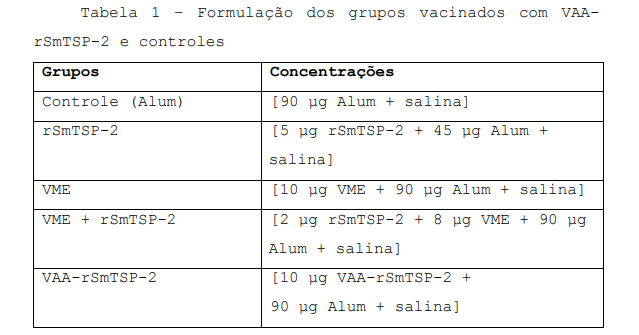
[0096] Os ensaios de imunização seguiram o esquema de 3 doses aplicadas com intervalo de 15 dias entre elas. O soro desses animais foi coletado antes de cada imunização e também 15 dias após a última dose. Assim foi possível avaliar a produção de anticorpos entre cada dose. Os soros dos animais de mesmo grupo foram analisados individualmente por ELISA para verificar a titulação de IgG total e a concentração de IgG1 e IgG2c, específicos para a proteína rSmTSP-2.[0096] The immunization trials followed the schedule of 3 doses applied with an interval of 15 days between them. Serum from these animals was collected before each immunization and 15 days after the last dose. Thus, it was possible to evaluate the production of antibodies between each dose. Sera from animals from the same group were analyzed individually by ELISA to verify the titer of total IgG and the concentration of IgG1 and IgG2c, specific for the rSmTSP-2 protein.
[0097] Esplenócitos dos camundongos imunizados foram isolados e estimulados "in vitro" com a proteína recombinante rSmTSP-2 ou os respectivos controles. Os sobrenadantes foram coletados e a produção de citocinas inflamatórias avaliada por Cytometric Bead Array (CBA - kit inflamatório BD biosciences - US), ambos seguindo as recomendações do fabricante.[0097] Splenocytes from immunized mice were isolated and stimulated "in vitro" with the recombinant protein rSmTSP-2 or the respective controls. The supernatants were collected and the production of inflammatory cytokines was evaluated by Cytometric Bead Array (CBA - BD biosciences inflammatory kit - US), both following the manufacturer's recommendations.
[0098] A Tabela 2 apresenta a caracterização por Zetasizer das VMEs e do complexo VAA-rSmTSP-2 obtidos.
[0099] A Figura 4 representa graficamente a produção de citocinas no sobrenadante de esplenócitos estimulados após 2 ou 3 doses de VAA-rSmTSP-2. Esplenócitos isolados do baço de camundongos imunizados com a VAA-rSmTSP-2 foram estimulados por 24 h com 10 μg da proteína rSmTSP-2. A produção das citocinas foi analisada por CBA nos sobrenadantes coletados. As análises estatísticas foram realizadas por "One-way ANOVA", em que P-value *, 0,01; **, 0,001; ***, 0,0001 são valores em relação ao grupo salina, ou entre os diferentes grupos; e ns significa sem diferença estatística.[0099] Figure 4 graphically represents the production of cytokines in the supernatant of stimulated splenocytes after 2 or 3 doses of VAA-rSmTSP-2. Splenocytes isolated from the spleen of mice immunized with AAV-rSmTSP-2 were stimulated for 24 h with 10 μg of the rSmTSP-2 protein. The production of cytokines was analyzed by CBA in the collected supernatants. Statistical analyzes were performed by "One-way ANOVA", where P-value *, 0.01; **, 0.001; ***, 0.0001 are values in relation to the saline group, or between different groups; and ns means no statistical difference.
[0100] A Figura 5 representa graficamente a produção de citocinas pelas células T-CD4+ e T-CD8+ de camundongos imunizados com VAA-rTSP-2. Esplenócitos isolados do baço dos camundongos imunizados após 3 doses de VAA-rSmTSP-2 foram estimulados por 6 h com 10 μg da proteína rSmTSP-2 e marcados com anti-CD3, e CD4 ou CD8 para imunofenotipagem e com anti-TNF-α, IFN-γ, IL-4 ou IL-2 para detecção da produção dessas citocinas intracelularmente por FACS. As análises estatísticas foram realizadas por "One-way ANOVA", em que P-value *, 0,01; **, 0,001; ***, 0,0001 são valores em relação ao grupo salina, ou entre os diferentes grupos; e ns significa sem diferença estatística.[0100] Figure 5 graphically represents the production of cytokines by T-CD4+ and T-CD8+ cells from mice immunized with AAV-rTSP-2. Splenocytes isolated from the spleen of mice immunized after 3 doses of VAA-rSmTSP-2 were stimulated for 6 h with 10 μg of rSmTSP-2 protein and stained with anti-CD3, CD4 or CD8 for immunophenotyping and with anti-TNF-α, IFN-γ, IL-4 or IL-2 for detection of the production of these cytokines intracellularly by FACS. Statistical analyzes were performed by "One-way ANOVA", where P-value *, 0.01; **, 0.001; ***, 0.0001 are values in relation to the saline group, or between different groups; and ns means no statistical difference.
[0101] As Figuras 6A-B representam graficamente a resposta humoral de IgG contra a proteína rSmTSP-2 em camundongos imunizados com rSmTSP-2 ou VAA-rSmTSP-2. A Figura 6A se refere a dosagem de anticorpos IgG anti-rSmTSP-2 em camundongos imunizados com: Alum (Salina + Hidróxido de Alumínio), rSmTSP-2 [5 μg], VME [8 μg], VME [8 μ] + rSmTSP-2 [2μg] (Mix) e VAA- rSmTSP-2 [10 μg]). As análises estatísticas foram realizadas pelo modelo "Two-way ANOVA", em que o *** P-value é <0.001. A Figura 6B se refere a isotipos IgG1 e IgG2c nos grupos imunizados com rSmTSP-2 ou VAA-rSmTSP-2.[0101] Figures 6A-B graphically represent the humoral IgG response against the rSmTSP-2 protein in mice immunized with rSmTSP-2 or AAV-rSmTSP-2. Figure 6A refers to the dosage of anti-rSmTSP-2 IgG antibodies in mice immunized with: Alum (Saline + Aluminum Hydroxide), rSmTSP-2 [5 μg], VME [8 μg], VME [8 μ] + rSmTSP -2 [2μg] (Mix) and VAA- rSmTSP-2 [10 μg]). Statistical analyzes were performed using the "Two-way ANOVA" model, in which the ***P-value is <0.001. Figure 6B refers to IgG1 and IgG2c isotypes in the groups immunized with rSmTSP-2 or AAV-rSmTSP-2.
[0102] Portanto, a presente invenção propõe uma preparação fácil e altamente flexível de uma vesícula apresentadora de antígenos (VAA) baseada em afinidade. A VAA obtida é altamente específico e estável, podendo permanecer no frio por meses e reter sua potência. Adicionalmente, o surpreendente processo da presente invenção é simples o suficiente para garantir alta reprodutibilidade, uma vez que são necessárias apenas algumas etapas, o que reduz o risco de variação de lote para lote, com grande vantagem industrial.[0102] Therefore, the present invention proposes an easy and highly flexible preparation of an affinity-based antigen presenting vesicle (AAV). The obtained VAA is highly specific and stable, being able to remain in the cold for months and retain its potency. Additionally, the surprising process of the present invention is simple enough to guarantee high reproducibility, since only a few steps are required, which reduces the risk of batch-to-batch variation, with great industrial advantage.
[0103] Assim, as concretizações apresentadas na presente invenção não limitam a totalidade das possibilidades, será entendido que várias omissões, substituições e alterações podem ser feitas por um técnico versado no assunto, sem se afastar do espírito e escopo da presente invenção.[0103] Thus, the embodiments presented in the present invention do not limit the totality of possibilities, it will be understood that various omissions, substitutions and alterations can be made by a skilled person, without departing from the spirit and scope of the present invention.
[0104] É expressamente previsto que todas as combinações dos elementos que desempenham a mesma função substancialmente da mesma forma para alcançar os mesmos resultados estão dentro do escopo da invenção. Substituições de elementos de uma concretização descrita para outra são também totalmente pretendidos e contemplados.[0104] It is expressly provided that all combinations of elements that perform the same function in substantially the same way to achieve the same results are within the scope of the invention. Element substitutions from one described embodiment to another are also fully intended and contemplated.
[0105] Também é preciso entender que os desenhos não estão necessariamente em escala, mas que eles são apenas de natureza conceitual.[0105] It is also necessary to understand that the drawings are not necessarily to scale, but that they are only conceptual in nature.
[0106] Os técnicos versados no assunto irão valorizar os conhecimentos aqui apresentados e poderão reproduzir a invenção nas concretizações apresentadas e em outras variantes, abrangidas no escopo das reivindicações.[0106] Those skilled in the subject will appreciate the knowledge presented herein and may reproduce the invention in the embodiments presented and in other variants, within the scope of the claims.
Claims (15)
a) Conjugar a primeira molécula de afinidade à vesícula (VME);
b) Obter a molécula de afinidade complementar em fusão com um ou mais antígenos proteicos ou peptídeos; e
c) Acoplar a proteína de fusão obtida na etapa "b" com o produto obtido na etapa "a", em que a VAA obtida compreende:
- uma vesícula de membrana externa de bactérias gram-negativas (VME);
- pelo menos uma proteína ou peptídeo antigênico; e
- pelo menos um par de moléculas com afinidades complementares compreendendo:
- (i) uma primeira molécula de afinidade que se liga à vesícula; e
- (ii) uma molécula de afinidade complementar que é fusionada à proteína ou peptídeo.
a) Conjugate the first vesicle affinity molecule (VME);
b) Obtaining the complementary affinity molecule in fusion with one or more protein or peptide antigens; and
c) Coupling the fusion protein obtained in step "b" with the product obtained in step "a", wherein the AAV obtained comprises:
- an outer membrane vesicle of gram-negative bacteria (VME);
- at least one antigenic protein or peptide; and
- at least one pair of molecules with complementary affinities comprising:
- (i) a first vesicle-binding affinity molecule; and
- (ii) a complementary affinity molecule that is fused to the protein or peptide.
Priority Applications (5)
| Application Number | Priority Date | Filing Date | Title |
|---|---|---|---|
| BR102020013216-4A BR102020013216A2 (en) | 2020-06-26 | 2020-06-26 | PROCESS FOR OBTAINING ANTIGEN PRESENTING VESICLES (AVA) THAT MAKES IT POSSIBLE TO COUPLE ONE OR MORE ANTIGENS |
| EP21758042.2A EP4173634A1 (en) | 2020-06-26 | 2021-06-28 | Process for obtaining antigen-presenting vesicles (apv) that enables the coupling of one or more antigens |
| PCT/BR2021/050284 WO2021258180A1 (en) | 2020-06-26 | 2021-06-28 | Process for obtaining antigen-presenting vesicles (apv) that enables the coupling of one or more antigens |
| CN202180059301.XA CN116194566A (en) | 2020-06-26 | 2021-06-28 | Method for obtaining antigen-presenting vesicles (APVs) capable of coupling one or more antigens |
| US18/003,258 US20230256105A1 (en) | 2020-06-26 | 2021-06-28 | Process for obtaining antigen-presenting vesicles (apv) that enables the coupling of one or more antigens |
Applications Claiming Priority (1)
| Application Number | Priority Date | Filing Date | Title |
|---|---|---|---|
| BR102020013216-4A BR102020013216A2 (en) | 2020-06-26 | 2020-06-26 | PROCESS FOR OBTAINING ANTIGEN PRESENTING VESICLES (AVA) THAT MAKES IT POSSIBLE TO COUPLE ONE OR MORE ANTIGENS |
Publications (1)
| Publication Number | Publication Date |
|---|---|
| BR102020013216A2 true BR102020013216A2 (en) | 2022-03-08 |
Family
ID=77411504
Family Applications (1)
| Application Number | Title | Priority Date | Filing Date |
|---|---|---|---|
| BR102020013216-4A BR102020013216A2 (en) | 2020-06-26 | 2020-06-26 | PROCESS FOR OBTAINING ANTIGEN PRESENTING VESICLES (AVA) THAT MAKES IT POSSIBLE TO COUPLE ONE OR MORE ANTIGENS |
Country Status (5)
| Country | Link |
|---|---|
| US (1) | US20230256105A1 (en) |
| EP (1) | EP4173634A1 (en) |
| CN (1) | CN116194566A (en) |
| BR (1) | BR102020013216A2 (en) |
| WO (1) | WO2021258180A1 (en) |
Families Citing this family (2)
| Publication number | Priority date | Publication date | Assignee | Title |
|---|---|---|---|---|
| US20230083394A1 (en) * | 2021-08-25 | 2023-03-16 | Cornell University | Methods and compositions for docking biotinylated antigens on the exterior of bacterial outer membrane vesicles |
| CN119331108A (en) * | 2024-10-25 | 2025-01-21 | 扬州大学 | Preparation method and application of Escherichia coli biomimetic vesicles presenting H9 subtype avian influenza virus HA1 protein |
Family Cites Families (9)
| Publication number | Priority date | Publication date | Assignee | Title |
|---|---|---|---|---|
| GB0130123D0 (en) * | 2001-12-17 | 2002-02-06 | Microbiological Res Agency | Outer membrane vesicle vaccine and its preparation |
| CU23377A1 (en) * | 2003-11-04 | 2009-05-28 | Ct De Ingenieria Genetica Y Biotecnologia | METHOD FOR THE INCORPORATION OF ANTIGENS IN EXTERNAL MEMBRANE VESICULES OF BACTERIA AND RESULTING FORMULATIONS |
| EP2274011A4 (en) * | 2008-04-17 | 2013-04-24 | Banyan Biomarkers Inc | An antibody bound synthetic vesicle containing active agent molecules |
| JP2013521770A (en) * | 2010-03-10 | 2013-06-13 | グラクソスミスクライン バイオロジカルズ ソシエテ アノニム | Vaccine composition |
| GB201015132D0 (en) * | 2010-09-10 | 2010-10-27 | Univ Bristol | Vaccine composition |
| EP2706991B1 (en) * | 2011-05-11 | 2021-03-24 | Children's Medical Center Corporation | Multiple antigen presenting immunogenic composition, and methods and uses thereof |
| MX2019006105A (en) * | 2016-11-25 | 2019-08-21 | Glaxosmithkline Biologicals Sa | nOMV-ANTIGEN CONJUGATES AND USE THEREOF. |
| CN110730670A (en) * | 2017-03-28 | 2020-01-24 | 儿童医疗中心有限公司 | Multi-antigen presentation system (MAPS) -based staphylococcus aureus vaccines, immunogenic compositions, and uses thereof |
| JP2019017341A (en) * | 2017-07-20 | 2019-02-07 | 国立研究開発法人国立がん研究センター | Labeled vesicle and production method thereof |
-
2020
- 2020-06-26 BR BR102020013216-4A patent/BR102020013216A2/en active Search and Examination
-
2021
- 2021-06-28 EP EP21758042.2A patent/EP4173634A1/en active Pending
- 2021-06-28 US US18/003,258 patent/US20230256105A1/en active Pending
- 2021-06-28 WO PCT/BR2021/050284 patent/WO2021258180A1/en not_active Ceased
- 2021-06-28 CN CN202180059301.XA patent/CN116194566A/en active Pending
Also Published As
| Publication number | Publication date |
|---|---|
| WO2021258180A1 (en) | 2021-12-30 |
| CN116194566A (en) | 2023-05-30 |
| EP4173634A1 (en) | 2023-05-03 |
| US20230256105A1 (en) | 2023-08-17 |
Similar Documents
| Publication | Publication Date | Title |
|---|---|---|
| JP4180590B2 (en) | Immune adjuvant protein from Klebsiella pneumoniae | |
| JP5756750B2 (en) | Novel immunoadjuvant compounds based on flagellin and uses thereof | |
| CN102711794B (en) | Dps fusion proteins for vaccines and diagnostics | |
| CN1062605C (en) | Escherichia coli vaccine | |
| CN101557821B (en) | Conjugates of plasmodium falciparum surface proteins as malaria vaccines | |
| JP2022513562A (en) | Purified capsular polysaccharide of Streptococcus pneumoniae | |
| US6585973B1 (en) | Method for preparing solid phase conjugated vaccine | |
| WO2021258180A1 (en) | Process for obtaining antigen-presenting vesicles (apv) that enables the coupling of one or more antigens | |
| JP2022513452A (en) | Virus-like particles of CMV modified by fusion | |
| CN104755619A (en) | Vaccine for preventing porcine edema disease | |
| EP1906995A2 (en) | Adjuvation through cross- structure | |
| JPH10509325A (en) | An immunogen that stimulates mucosal immunity | |
| KR101973079B1 (en) | Antigen chimera, antigen combination, vaccine, method of preparing same, and kit thereof | |
| Chuekwon et al. | N-terminus of flagellin enhances vaccine efficacy against Actinobacillus pleuropneumoniae | |
| JP7531141B2 (en) | Pneumococcal surface protein | |
| Li et al. | Mutagenesis and immunological evaluation of group A streptococcal C5a peptidase as an antigen for vaccine development and as a carrier protein for glycoconjugate vaccine design | |
| JP2003506315A (en) | Use of OmpA Enteric Bacterial Protein Associated with ELAGIGILTV Peptide for Treating Melanoma | |
| RU2341534C2 (en) | Anti-obesity immunogenic hybrid polypeptide and based vaccine composition | |
| CN112512552A (en) | Self-assembling peptide scaffold | |
| Saiki et al. | Induction of humoral responses specific for paraneoplastic cerebellar degeneration-associated antigen by whole recombinant yeast immunization | |
| JP2009029825A (en) | antigen | |
| He et al. | Immunogenic comparison for two different recombinant chimeric peptides (CP12 and CP22) containing one or two copies of three linear B cell epitopes from β-hCG subunit | |
| Montaner et al. | Ganglioside GM1-binding peptides as adjuvants of antigens inoculated by the intranasal route | |
| US20030186848A1 (en) | Recombinant iron uptake proteins | |
| RU2818278C2 (en) | Pneumococcal surface proteins |
Legal Events
| Date | Code | Title | Description |
|---|---|---|---|
| B03A | Publication of a patent application or of a certificate of addition of invention [chapter 3.1 patent gazette] | ||
| B06A | Patent application procedure suspended [chapter 6.1 patent gazette] |