AU2015281187B2 - Pesticidal compositions - Google Patents
Pesticidal compositions Download PDFInfo
- Publication number
- AU2015281187B2 AU2015281187B2 AU2015281187A AU2015281187A AU2015281187B2 AU 2015281187 B2 AU2015281187 B2 AU 2015281187B2 AU 2015281187 A AU2015281187 A AU 2015281187A AU 2015281187 A AU2015281187 A AU 2015281187A AU 2015281187 B2 AU2015281187 B2 AU 2015281187B2
- Authority
- AU
- Australia
- Prior art keywords
- compound
- enantiomer
- phenyl
- component
- chlorophenoxy
- Prior art date
- Legal status (The legal status is an assumption and is not a legal conclusion. Google has not performed a legal analysis and makes no representation as to the accuracy of the status listed.)
- Active
Links
- IYGJSAHUCBRNBR-UHFFFAOYSA-N CC(C[n]1ncnc1)(c(c(Cl)c1)ccc1Oc(cc1)ccc1Cl)O Chemical compound CC(C[n]1ncnc1)(c(c(Cl)c1)ccc1Oc(cc1)ccc1Cl)O IYGJSAHUCBRNBR-UHFFFAOYSA-N 0.000 description 1
- GSSLIXUCWSWMKG-UHFFFAOYSA-N CCC(C[n]1ncnc1)(c(c(Cl)c1)ccc1Oc(cc1)ccc1Cl)O Chemical compound CCC(C[n]1ncnc1)(c(c(Cl)c1)ccc1Oc(cc1)ccc1Cl)O GSSLIXUCWSWMKG-UHFFFAOYSA-N 0.000 description 1
Classifications
-
- A—HUMAN NECESSITIES
- A01—AGRICULTURE; FORESTRY; ANIMAL HUSBANDRY; HUNTING; TRAPPING; FISHING
- A01N—PRESERVATION OF BODIES OF HUMANS OR ANIMALS OR PLANTS OR PARTS THEREOF; BIOCIDES, e.g. AS DISINFECTANTS, AS PESTICIDES OR AS HERBICIDES; PEST REPELLANTS OR ATTRACTANTS; PLANT GROWTH REGULATORS
- A01N43/00—Biocides, pest repellants or attractants, or plant growth regulators containing heterocyclic compounds
- A01N43/64—Biocides, pest repellants or attractants, or plant growth regulators containing heterocyclic compounds having rings with three nitrogen atoms as the only ring hetero atoms
- A01N43/647—Triazoles; Hydrogenated triazoles
- A01N43/653—1,2,4-Triazoles; Hydrogenated 1,2,4-triazoles
-
- A—HUMAN NECESSITIES
- A01—AGRICULTURE; FORESTRY; ANIMAL HUSBANDRY; HUNTING; TRAPPING; FISHING
- A01N—PRESERVATION OF BODIES OF HUMANS OR ANIMALS OR PLANTS OR PARTS THEREOF; BIOCIDES, e.g. AS DISINFECTANTS, AS PESTICIDES OR AS HERBICIDES; PEST REPELLANTS OR ATTRACTANTS; PLANT GROWTH REGULATORS
- A01N25/00—Biocides, pest repellants or attractants, or plant growth regulators, characterised by their forms, or by their non-active ingredients or by their methods of application, e.g. seed treatment or sequential application; Substances for reducing the noxious effect of the active ingredients to organisms other than pests
-
- A—HUMAN NECESSITIES
- A01—AGRICULTURE; FORESTRY; ANIMAL HUSBANDRY; HUNTING; TRAPPING; FISHING
- A01N—PRESERVATION OF BODIES OF HUMANS OR ANIMALS OR PLANTS OR PARTS THEREOF; BIOCIDES, e.g. AS DISINFECTANTS, AS PESTICIDES OR AS HERBICIDES; PEST REPELLANTS OR ATTRACTANTS; PLANT GROWTH REGULATORS
- A01N25/00—Biocides, pest repellants or attractants, or plant growth regulators, characterised by their forms, or by their non-active ingredients or by their methods of application, e.g. seed treatment or sequential application; Substances for reducing the noxious effect of the active ingredients to organisms other than pests
- A01N25/08—Biocides, pest repellants or attractants, or plant growth regulators, characterised by their forms, or by their non-active ingredients or by their methods of application, e.g. seed treatment or sequential application; Substances for reducing the noxious effect of the active ingredients to organisms other than pests containing solids as carriers or diluents
-
- A—HUMAN NECESSITIES
- A01—AGRICULTURE; FORESTRY; ANIMAL HUSBANDRY; HUNTING; TRAPPING; FISHING
- A01N—PRESERVATION OF BODIES OF HUMANS OR ANIMALS OR PLANTS OR PARTS THEREOF; BIOCIDES, e.g. AS DISINFECTANTS, AS PESTICIDES OR AS HERBICIDES; PEST REPELLANTS OR ATTRACTANTS; PLANT GROWTH REGULATORS
- A01N43/00—Biocides, pest repellants or attractants, or plant growth regulators containing heterocyclic compounds
- A01N43/34—Biocides, pest repellants or attractants, or plant growth regulators containing heterocyclic compounds having rings with one nitrogen atom as the only ring hetero atom
- A01N43/40—Biocides, pest repellants or attractants, or plant growth regulators containing heterocyclic compounds having rings with one nitrogen atom as the only ring hetero atom six-membered rings
-
- A—HUMAN NECESSITIES
- A01—AGRICULTURE; FORESTRY; ANIMAL HUSBANDRY; HUNTING; TRAPPING; FISHING
- A01N—PRESERVATION OF BODIES OF HUMANS OR ANIMALS OR PLANTS OR PARTS THEREOF; BIOCIDES, e.g. AS DISINFECTANTS, AS PESTICIDES OR AS HERBICIDES; PEST REPELLANTS OR ATTRACTANTS; PLANT GROWTH REGULATORS
- A01N43/00—Biocides, pest repellants or attractants, or plant growth regulators containing heterocyclic compounds
- A01N43/72—Biocides, pest repellants or attractants, or plant growth regulators containing heterocyclic compounds having rings with nitrogen atoms and oxygen or sulfur atoms as ring hetero atoms
- A01N43/80—Biocides, pest repellants or attractants, or plant growth regulators containing heterocyclic compounds having rings with nitrogen atoms and oxygen or sulfur atoms as ring hetero atoms five-membered rings with one nitrogen atom and either one oxygen atom or one sulfur atom in positions 1,2
-
- A—HUMAN NECESSITIES
- A01—AGRICULTURE; FORESTRY; ANIMAL HUSBANDRY; HUNTING; TRAPPING; FISHING
- A01N—PRESERVATION OF BODIES OF HUMANS OR ANIMALS OR PLANTS OR PARTS THEREOF; BIOCIDES, e.g. AS DISINFECTANTS, AS PESTICIDES OR AS HERBICIDES; PEST REPELLANTS OR ATTRACTANTS; PLANT GROWTH REGULATORS
- A01N43/00—Biocides, pest repellants or attractants, or plant growth regulators containing heterocyclic compounds
- A01N43/90—Biocides, pest repellants or attractants, or plant growth regulators containing heterocyclic compounds having two or more relevant hetero rings, condensed among themselves or with a common carbocyclic ring system
-
- A—HUMAN NECESSITIES
- A01—AGRICULTURE; FORESTRY; ANIMAL HUSBANDRY; HUNTING; TRAPPING; FISHING
- A01N—PRESERVATION OF BODIES OF HUMANS OR ANIMALS OR PLANTS OR PARTS THEREOF; BIOCIDES, e.g. AS DISINFECTANTS, AS PESTICIDES OR AS HERBICIDES; PEST REPELLANTS OR ATTRACTANTS; PLANT GROWTH REGULATORS
- A01N47/00—Biocides, pest repellants or attractants, or plant growth regulators containing organic compounds containing a carbon atom not being member of a ring and having no bond to a carbon or hydrogen atom, e.g. derivatives of carbonic acid
- A01N47/08—Biocides, pest repellants or attractants, or plant growth regulators containing organic compounds containing a carbon atom not being member of a ring and having no bond to a carbon or hydrogen atom, e.g. derivatives of carbonic acid the carbon atom having one or more single bonds to nitrogen atoms
- A01N47/10—Carbamic acid derivatives, i.e. containing the group —O—CO—N<; Thio analogues thereof
- A01N47/22—O-Aryl or S-Aryl esters thereof
-
- A—HUMAN NECESSITIES
- A01—AGRICULTURE; FORESTRY; ANIMAL HUSBANDRY; HUNTING; TRAPPING; FISHING
- A01N—PRESERVATION OF BODIES OF HUMANS OR ANIMALS OR PLANTS OR PARTS THEREOF; BIOCIDES, e.g. AS DISINFECTANTS, AS PESTICIDES OR AS HERBICIDES; PEST REPELLANTS OR ATTRACTANTS; PLANT GROWTH REGULATORS
- A01N47/00—Biocides, pest repellants or attractants, or plant growth regulators containing organic compounds containing a carbon atom not being member of a ring and having no bond to a carbon or hydrogen atom, e.g. derivatives of carbonic acid
- A01N47/08—Biocides, pest repellants or attractants, or plant growth regulators containing organic compounds containing a carbon atom not being member of a ring and having no bond to a carbon or hydrogen atom, e.g. derivatives of carbonic acid the carbon atom having one or more single bonds to nitrogen atoms
- A01N47/10—Carbamic acid derivatives, i.e. containing the group —O—CO—N<; Thio analogues thereof
- A01N47/24—Carbamic acid derivatives, i.e. containing the group —O—CO—N<; Thio analogues thereof containing the groups, or; Thio analogues thereof
-
- A—HUMAN NECESSITIES
- A01—AGRICULTURE; FORESTRY; ANIMAL HUSBANDRY; HUNTING; TRAPPING; FISHING
- A01N—PRESERVATION OF BODIES OF HUMANS OR ANIMALS OR PLANTS OR PARTS THEREOF; BIOCIDES, e.g. AS DISINFECTANTS, AS PESTICIDES OR AS HERBICIDES; PEST REPELLANTS OR ATTRACTANTS; PLANT GROWTH REGULATORS
- A01N47/00—Biocides, pest repellants or attractants, or plant growth regulators containing organic compounds containing a carbon atom not being member of a ring and having no bond to a carbon or hydrogen atom, e.g. derivatives of carbonic acid
- A01N47/40—Biocides, pest repellants or attractants, or plant growth regulators containing organic compounds containing a carbon atom not being member of a ring and having no bond to a carbon or hydrogen atom, e.g. derivatives of carbonic acid the carbon atom having a double or triple bond to nitrogen, e.g. cyanates, cyanamides
-
- A—HUMAN NECESSITIES
- A01—AGRICULTURE; FORESTRY; ANIMAL HUSBANDRY; HUNTING; TRAPPING; FISHING
- A01N—PRESERVATION OF BODIES OF HUMANS OR ANIMALS OR PLANTS OR PARTS THEREOF; BIOCIDES, e.g. AS DISINFECTANTS, AS PESTICIDES OR AS HERBICIDES; PEST REPELLANTS OR ATTRACTANTS; PLANT GROWTH REGULATORS
- A01N53/00—Biocides, pest repellants or attractants, or plant growth regulators containing cyclopropane carboxylic acids or derivatives thereof
Landscapes
- Life Sciences & Earth Sciences (AREA)
- Health & Medical Sciences (AREA)
- General Health & Medical Sciences (AREA)
- Dentistry (AREA)
- Plant Pathology (AREA)
- Engineering & Computer Science (AREA)
- Pest Control & Pesticides (AREA)
- Agronomy & Crop Science (AREA)
- Wood Science & Technology (AREA)
- Zoology (AREA)
- Environmental Sciences (AREA)
- Toxicology (AREA)
- Agricultural Chemicals And Associated Chemicals (AREA)
- Pharmaceuticals Containing Other Organic And Inorganic Compounds (AREA)
- Plural Heterocyclic Compounds (AREA)
Abstract
The present invention relates to compositions comprising a specified triazole compound (I-1 to I-31) as component I and one of oxathiapiprolin, triadimenol, sulfoxaflor, methiocarb, cypermethrin, thiodicarb, triflumezopyrim (Mesoionic), flupyradifurone as component II. It also relates to the use of the compositions for combating phytopathogenic fungi, to a method for combating phytopathogenic fungi as well as to plant propagation material coated with the compositions.
Description
The present invention relates to compositions comprising a specified triazole compound (1-1 to 1-31) as component I and one of oxathiapiprolin, triadimenol, sulfoxaflor, methiocarb, cypermethrin, thiodicarb, triflumezopyrim (Mesoionic), flupyradifurone as component II. It also relates to the use of the compositions for combating phytopathogenic fungi, to a method for combating phytopathogenic fungi as well as to plant propagation material coated with the compositions.
WO 2015/197393
PCT/EP2015/063269
Pesticidal compositions
Description
The present invention relates to compositions comprising, 1) as component I a compound selected from:
| compound 1-1 | 2-[2-chloro-4-(4-chlorophenoxy)phenyl]-1 -(1,2,4-tri azol-1 -yl)pent-3-yn-2-ol; |
| compound I-2 yl)ethanol; | 1 -[2-chloro-4-(4-chlorophenoxy)phenyl]-1 -cyclopropyl-2-(1,2,4-triazol-1 - |
| compound I-3 yl)propan-2-ol; | 2-[4-(4-chlorophenoxy)-2-(trifluoromethyl)phenyl]-1 -(1,2,4-triazol-1 - |
compound I-4 1 -[4-(4-chlorophenoxy)-2-(trifluoromethyl)phenyl]-1 -cyclopropyl-2-(1,2,4triazol-1-yl)ethanol;
| compound I-5 1-yl)butan-2-ol; | 2-[4-(4-chlorophenoxy)-2-(trifluoromethyl)phenyl]-3-methyl-1-(1,2,4-triazol- |
| compound I-6 triazole; | 1-[2-[2-chloro-4-(4-chlorophenoxy)phenyl]-2-methoxy-pent-3-ynyl]-1,2,4- |
| compound I-7 2-ol; | 2-[4-(4-chlorophenoxy)-2-(trifluoromethyl)phenyl]-1 -(1,2,4-triazol-1 -yl)butan |
| compound I-8 1,2,4-triazole; | 1-[2-[2-chloro-4-(4-chlorophenoxy)phenyl]-2-cyclopropyl-2-methoxy-ethyl]- |
| compound I-9 1,2,4-triazole; | 1-[2-[4-(4-chlorophenoxy)-2-(trifluoromethyl)phenyl]-2-methoxy-propyl]- |
| compound 1-10 yl)butan-2-ol, | 2-[2-chloro-4-(4-chlorophenoxy)phenyl]-3,3-dimethyl-1 -(1,2,4-triazol-1 - |
compound 1-11 1-[2-[4-(4-chlorophenoxy)-2-(trifluoromethyl)phenyl]-2-cyclopropyl-2methoxy-ethyl]-1,2,4-triazole;
| compound 1-12 1,2,4-triazole; | 1-[2-[2-chloro-4-(4-chlorophenoxy)phenyl]-2-methoxy-3,3-dimethyl-butyl]- |
| compound 1-13 triazole; | 1-[2-[4-(4-chlorophenoxy)-2-(trifluoromethyl)phenyl]-2-methoxy-butyl] 1,2,4- |
| compound 1-14 3-yn-2-ol; | 2-[4-(4-chlorophenoxy)-2-(trifluoromethyl)phenyl]-1 -(1,2,4-triazol-1 -yl)pent- |
| compound 1-15 | 1-[2-[4-(4-chlorophenoxy)-2-(trifluoromethyl)phenyl]-2-methoxy- |
pent-3-ynyl]-1,2,4-triazole;
compound 1-16 2-[4-(4-chlorophenoxy)-2-(trifluoromethyl)phenyl]-1 -(1,2,4-triazol-1 -yl) but-3 yn-2-ol;
2015281187 20 Aug 2018 compound 1-17 compound 1-18 compound 1-19 yl)butan-2-ol;
compound I-20 triazole; compound 1-21 compound I-22 triazole;
compound I-23 yl)propan-2-ol;
2-[2-chloro-4-(4-chlorophenoxy)phenyl]-1-(1,2,4-triazol-1-yl)propan-2-ol; 2-[2-chloro-4-(4-fluorophenoxy)phenyl]-1-(1,2,4-triazol-1-yl)propan-2-ol; 2-[2-chloro-4-(4-chlorophenoxy)phenyl]-3-methyl-1-(1,2,4-triazol-11-[2-[2-chloro-4-(4-chlorophenoxy)phenyl]-2-methoxy-propyl]-1,2,41-[2-[2-chloro-4-(4-chlorophenoxy)phenyl]-2-methoxy-butyl]-1,2,4-riazole;
1-[2-[2-chloro-4-(4-chlorophenoxy)phenyl]-2-methoxy-pentyl]-1,2,42-[2-chloro-4-(4-chlorophenoxy)phenyl]-1,1,1-trifluoro-3-(1,2,4-triazol-1 compound I-24 2-[2-chloro-4-(4-chlorophenoxy)phenyl]-3-fluoro-1-(1,2,4-triazol-1yl)butan-2-ol hydrochloride;
compound I-25 5 ol;
compound I-26 yl)propan-2-ol;
compound I-27 yl)propan-2-ol;
Ό compound I-28 yl)pentan-2-ol;
compound I-29 yl)propan-2-ol;
compound I-30 25 and
2-[2-chloro-4-(4-chlorophenoxy)phenyl]-1-(1,2,4-triazol-1-yl)pent-4-yn-22-[2-chloro-4-(4-chlorophenoxy)phenyl]-1-methoxy-3-(1,2,4-triazol-12-[2-chloro-4-(4-fluorophenoxy)phenyl]-1-methoxy-3-(1,2,4-triazol-12-[4-(4-chlorophenoxy)-2-(trifluoromethyl)phenyl]-1-(1,2,4-triazol-1and2-[4-(4-fluorophenoxy)-2-(trifluoromethyl)phenyl]-1-(1,2,4-triazol-12-[2-chloro-4-(4-chlorophenoxy)phenyl]-1-(1,2,4-triazol-1-yl)butan-2-ol;
compound 1-31
2-[2-chloro-4-(4-chlorophenoxy)phenyl]-1-(1,2,4-triazol-1-yl)pentan-2-ol;
and
2) as component II a compound selected from the group of oxathiapiprolin (11-1); triadimenol (II-2); sulfoxaflor (II-3); methiocarb (II-4); cypermethrin (II-5);
thiodicarb (II-6); triflumezopyrim (mesoionic) (II-7) and flupyradifurone (II-8).
In particular, the present invention relates to compositions comprising,
1) as component I:
compound I-3 2-[4-(4-chlorophenoxy)-2-(trifluoromethyl)phenyl]-1-(1,2,4-triazol-1-yl)propan-2-ol;
and
2) as component II:
2015281187 20 Aug 2018 triflumezopyrim (mesoionic) (11-7).
The invention furthermore relates to the use of the inventive compositions as pesticides in particular for controlling phytopathogenic fungi as detained herein and preparations or compositions comprising them. The invention furthermore also relates to seed comprising the 5 compositions. The invention furthermore also relates to methods for controlling pests, in particular phytopathogenic fungi as detained herein, wherein the fungi or the materials, plants, the soil or seed to be protected from fungal attack are treated with an effective amount of a compositions according to the invention. The invention furthermore also relates to processes for preparing the compositions according to the invention.
With a view to reducing the application rates and broadening the activity spectrum of the known compounds, it was an aim of the present invention to provide compositions which, at a reduced total amount of active compounds applied, show improved activity against important pests, in particular phythopathogenic fungi, in particular for certain indications. It was a further aim to provide for compositions that are useful for the control of specific pathogens in specific important crops that are often susceptible to the attack of pathogens.
Accordingly we have found the compositions and uses defined at the outset and in the following description.
The compounds I (component I) can be obtained by various routes in analogy to prior art processes known (cf. J.Agric. Food Chem. (2009) 57, 4854-4860; EP 0 275 955 A1; DE 40 03
Ό 180 A1; EP 0 113 640 A2; EP 0 126 430 A2). Furthermore, compounds I (component I), its preparation and use in crop protection are described in WO 2013/007767 (PCT/EP2012/063626), WO 2013/024076 (PCT/EP2012/065835), WO 2013/024075 (PCT/EP2012/065834), ), WO 2013/024077 (PCT/EP2012/065836), WO 2013/024081 (PCT/EP2012/065848), WO 2013/024080 (PCT/EP2012/065847), WO 2013/024083 ;5 (PCT/EP2012/065852) WO 2013/010862 (PCT/EP2012/063526), WO 2013/010894 (PCT/EP2012/063635), WO 2013/010885 (PCT/EP2012/063620), WO 2013/024082 (PCT/EP2012/065850), which also disclose certain compositions with other active compounds. Owing to the basic character of their nitrogen atoms, the component I, i.e in particular compound 1-1, I-2, I-3, I-4, I-5, I-6, I-7, I-8, I-9, 1-10, 1-11, 1-12, 1-13, 1-14, 1-15, 1-16, 1-17, 1-18, I30 19, I-20, 1-21, I-22, I-23, I-24, I-25, I-26, I-27, I-28, I-29, I-30 and 1-31 or any group of compounds I detained above, is capable of forming salts or adducts with inorganic or organic acids or with metal ions, in particular salts with inorganic acids.
1-1: 2-[2-chloro-4-(4-chlorophenoxy)phenyl]-1-(1,2,4-triazol-1-yl)pent-3-yn-2-ol
WO 2015/197393
PCT/EP2015/063269

1-2: 1 -[2-chloro-4-(4-chlorophenoxy)phenyl]-1 -cyclopropyl-2-(1,2,4-triazol-1 -yl)ethanol
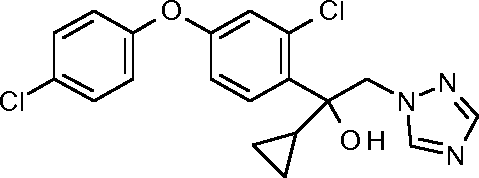
I-3: 2-[4-(4-chlorophenoxy)-2-(trifluoromethyl)phenyl]-1 -(1,2,4-triazol-1 -yl)propan-2-ol

I-4: 1 -[4-(4-chlorophenoxy)-2-(trifluoromethyl)phenyl]-1 -cyclopropyl-2-(1,2,4-triazol-1 yl)ethanol

I-5: 2-[4-(4-chlorophenoxy)-2-(trifluoromethyl)phenyl]-3-methyl-1 -(1,2,4-triazol-1 -yl)butan-210 ol
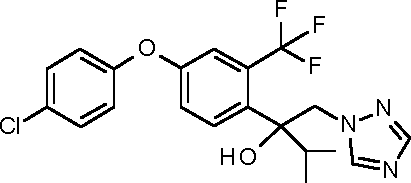
I-6: 1 -[2-[2-chloro-4-(4-chlorophenoxy)phenyl]-2-methoxy-pent-3-ynyl]-1,2,4-triazole
Cl
Cl N X
H3C—OMeL;N'
I-7: 2-[4-(4-chlorophenoxy)-2-(trifluoromethyl)phenyl]-1-(1,2,4-triazol-1-yl)butan-2-ol

I-8: 1 -[2-[2-chloro-4-(4-chlorophenoxy)phenyl]-2-cyclopropyl-2-methoxy-ethyl]-1,2,4-triazole
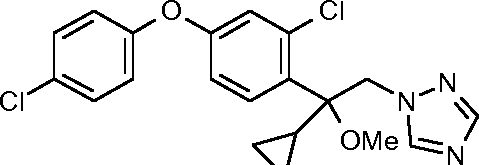
I-9: 1 -[2-[4-(4-chlorophenoxy)-2-(trifluoromethyl)phenyl]-2-methoxy-propyl]-1,2,4-triazole cr

WO 2015/197393
PCT/EP2015/063269
1-10: 2-[2-chloro-4-(4-chlorophenoxy)phenyl]-3,3-dimethyl-1 -(1,2,4-triazol-1 -yl)butan-2-ol

1-11: 1 -[2-[4-(4-chlorophenoxy)-2-(trifluoromethyl)phenyl]-2-cyclopropyl-2-methoxy-ethyl]1,2,4-triazole

1-12: 2-[2-trifluoromethyl-4-(4-chlorophenoxy)phenyl]-1 -methoxy-3-(1,2,4-triazol-1 -yl)propan 2-ol

1-13: 1-[2-[4-(4-chlorophenoxy)-2-(trifluoromethyl)phenyl]-2-methoxy-butyl]1,2,4-triazole

1-14: 2-[4-(4-chlorophenoxy)-2-(trifluoromethyl)phenyl]-1 -(1,2,4-triazol-1 -yl)pent-3-yn-2-ol
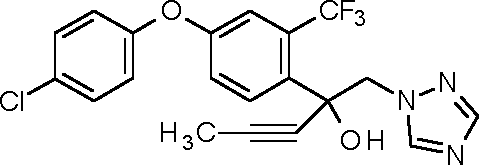
1-15: 1 -[2-[4-(4-chlorophenoxy)-2-(trifluoromethyl)phenyl]-2-methoxy-pent-3-ynyl]-1,2,4triazole

1-16: 2-[4-(4-chlorophenoxy)-2-(trifluoromethyl)phenyl]-1 -(1,2,4-triazol-1 -yl)but-3-yn-2-ol

1-17 2-[2-chloro-4-(4-chlorophenoxy)phenyl]-1 -(1,2,4-tri azol-1 -yl)propan-2-ol:

1-18 2-[2-chloro-4-(4-fluorophenoxy)phenyl]-1 -(1,2,4-tri azol-1 -yl)propan-2-ol:
WO 2015/197393
PCT/EP2015/063269
1-19 2-[2-chloro-4-(4-chlorophenoxy)phenyl]-3-methyl-1 -(1,2,4-triazol-1 -yl)butan-2-ol:
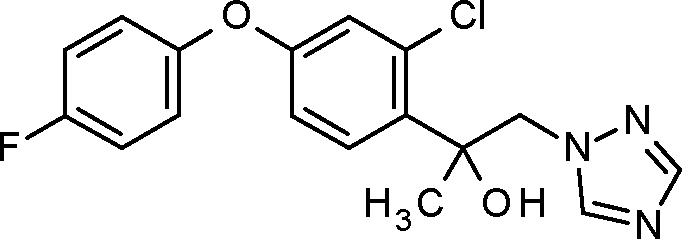
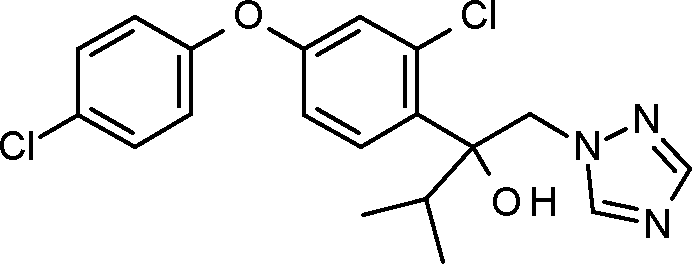
I-20 1 -[2-[2-chloro-4-(4-chlorophenoxy)phenyl]-2-methoxy-propyl]-1,2,4-triazole:

1-21 1-[2-[2-chloro-4-(4-chlorophenoxy)phenyl]-2-methoxy-butyl]-1,2,4-triazole:

I-22 1 -[2-[2-chloro-4-(4-chlorophenoxy)phenyl]-2-methoxy-pentyl]-1,2,4-triazole:

I-23 2-[2-chloro-4-(4-chlorophenoxy)phenyl]-1,1,1 -trifIuoro-3-( 1,2,4-triazol-1 -yl)propan-2-ol
Cl

I-24 2-[2-chloro-4-(4-chlorophenoxy)phenyl]-3-fluoro-1 -(1,2,4-triazol-1 -yl)butan-2-ol hydrochloride:
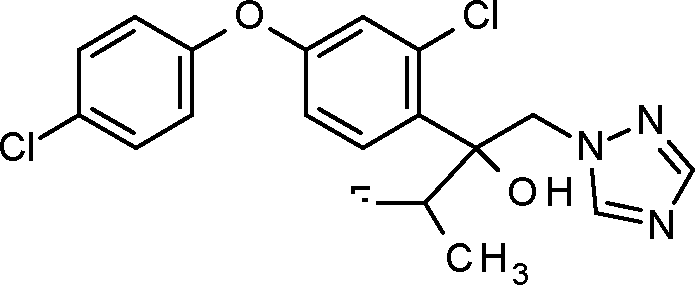
F
WO 2015/197393
PCT/EP2015/063269
1-25 2-[2-chloro-4-(4-chlorophenoxy)phenyl]-1 -(1,2,4-triazol-1 -yl)pent-4-yn-2-ol:

I-26 2-[2-chloro-4-(4-chlorophenoxy)phenyl]-1 -methoxy-3-(1,2,4-triazol-1 -yl)propan-2-ol:
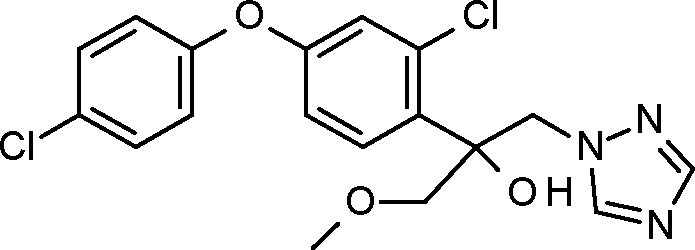
I-27 2-[2-chloro-4-(4-fluorophenoxy)phenyl]-1-methoxy-3-(1,2,4-triazol-1-yl)propan-2-ol:

I-28 2-[4-(4-chlorophenoxy)-2-(trifluoromethyl)phenyl]-1 -(1,2,4-triazol-1 -yl)pentan-2-ol:

I-29 2-[4-(4-fluorophenoxy)-2-(trifluoromethyl)phenyl]-1-(1,2,4-triazol-1-yl)propan-2-ol:

I-30 2-[2-chloro-4-(4-chlorophenoxy)phenyl]-1 -(1,2,4-tri azol-1 -yl)butan-2-ol:

and
1-31 2-[2-chloro-4-(4-chlorophenoxy)phenyl]-1-(1,2,4-triazol-1-yl)pentan-2-ol:
WO 2015/197393
PCT/EP2015/063269

Examples of inorganic acids are hydrohalic acids, such as hydrogen fluoride, hydrogen chloride, hydrogen bromide and hydrogen iodide, carbonic acid, sulfuric acid, phosphoric acid and nitric acid.
Suitable organic acids are, for example, formic acid and alkanoic acids, such as acetic acid, trifluoroacetic acid, trichloroacetic acid and propionic acid, and also glycolic acid, thiocyanic acid, lactic acid, succinic acid, citric acid, benzoic acid and other ary I carboxylic acids, cinnamic acid, oxalic acid, alkylsulfonic acids (sulfonic acids having straight-chain or branched alkyl radicals of 1 to 20 carbon atoms), arylsulfonic acids or aryldisulfonic acids (aromatic radicals, such as phenyl and naphthyl, which carry one or two sulfonic acid groups), alkylphosphonic acids (phosphonic acids having straight-chain or branched alkyl radicals with 1 to 20 carbon atoms), arylphosphonic acids or aryldiphosphonic acids (aromatic radicals, such as phenyl and naphthyl, which carry one or two phosphoric acid radicals), where the alkyl or aryl radicals may carry further substituents, for example ptoluenesulfonic acid, salicylic acid, p-aminosalicylic acid, 2-phenoxybenzoic acid, 2acetoxybenzoic acid etc. Suitable metal ions are in particular the ions ofthe elements ofthe second main group, in particular calcium and magnesium, ofthe third and fourth main group, in particular aluminum, tin and lead, and also of the elements of transition groups one to eight, in particular chromium, manganese, iron, cobalt, nickel, copper, zinc, and others. Particular preference is given to the metal ions of the elements of transition groups of the fourth period. The metals can be present in the various valencies that they can assume.
Components I comprise chiral centers and they are generally obtained in the form of racemates. The R- and S-enantiomers of the compounds according to the invention can be separated and isolated in pure form with methods known by the skilled person, e.g. by using chiral HPLC. Suitable for use as antimicrobial agents are both the enantiomers and compositions thereof. This applies correspondingly to the compositions. Furthermore, components I can be present in different crystal modifications, which may differ in biological activity.
In particular, in each case, a racemic composition is present. Furthermore, any other proportions ofthe (R)-enantiomer and the (S)-enantiomer may be present according to the present invention. This applies to every composition detained herein.
According to one embodiment ofthe present invention, component I is compound 1-1. Compound 1-1 may be present as racemic composition ofthe (R)-enantiomer and (S)enantiomer, but the (R)-enantiomer and the (S)-enantiomer may also be present in any other proportion, for example the pure enantiomer (R) or the pure enantiomer (S) of 1-1.
According to one specific embodiment, the compound 1-1 is provided and used as (R)enantiomer with an enantiomeric excess (e.e.) of at least 40%, for example, at least 50%,
WO 2015/197393
PCT/EP2015/063269
60%, 70% or 80%, preferably at least 90%, more preferably at least 95%, yet more preferably at least 98% and most preferably at least 99%.
According to a further specific embodiment, the compound 1-1 is provided and used as (S)enantiomer with an enantiomeric excess (e.e.) of at least 40%, for example, at least 50%, 60%, 70% or 80%, preferably at least 90%, more preferably at least 95%, yet more preferably at least 98% and most preferably at least 99%.
Compound (R)-l-1: (R) -2-[2-chloro-4-(4-chlorophenoxy)phenyl]-1-(1,2,4-triazol-1-yl)pent-3yn-2-ol; Compound (S)-l-1: (S) -2-[2-chloro-4-(4-chlorophenoxy)phenyl]-1-(1,2,4-triazol-1yl)pent-3-yn-2-ol.According to a further embodiment of the present invention, component I is compound I-2. Compound I-2 may be present as racemic composition of the (R)-enantiomer and (S)-enantiomer, but the (R)-enantiomer and the (S)-enantiomer may also be present in any other proportion, for example the pure enantiomer (R) or the pure enantiomer (S) of I-2.
According to one specific embodiment, the compound I-2 is provided and used as (R)enantiomer with an enantiomeric excess (e.e.) of at least 40%, for example, at least 50%, 60%, 70% or 80%, preferably at least 90%, more preferably at least 95%, yet more preferably at least 98% and most preferably at least 99%.
According to a further specific embodiment, the compound I-2 is provided and used as (S)enantiomer with an enantiomeric excess (e.e.) of at least 40%, for example, at least 50%, 60%, 70% or 80%, preferably at least 90%, more preferably at least 95%, yet more preferably at least 98% and most preferably at least 99%.
Compound (R)-l-2: (R)-1 -[2-chloro-4-(4-chlorophenoxy)phenyl]-1 -cyclopropyl-2-(1,2,4-triazol1-yl)ethanol; compound (S)-l-2: (S)-1-[2-chloro-4-(4-chlorophenoxy)phenyl]-1-cyclopropyl-2 (1,2,4-triazol-1-yl)ethanol.
According to still a further embodiment of the present invention, component I is compound ΙΟ. Compound I-3 may be present as racemic composition of the (R)-enantiomer and (S)enantiomer, but the (R)-enantiomer and the (S)-enantiomer may also be present in any other proportion, for example the pure enantiomer (R) or the pure enantiomer (S) of I-3.
According to one specific embodiment, the compound I-3 is provided and used as (R)enantiomer with an enantiomeric excess (e.e.) of at least 40%, for example, at least 50%, 60%, 70% or 80%, preferably at least 90%, more preferably at least 95%, yet more preferably at least 98% and most preferably at least 99%.
According to a further specific embodiment, the compound I-3 is provided and used as (S)enantiomer with an enantiomeric excess (e.e.) of at least 40%, for example, at least 50%, 60%, 70% or 80%, preferably at least 90%, more preferably at least 95%, yet more preferably at least 98% and most preferably at least 99%.
Compound (R)-l-3: (R)-2-[4-(4-chlorophenoxy)-2-(trifluoromethyl)phenyl]-1 -(1,2,4-triazol-1 yl)propan-2-ol; compound (S)-l-3: (S)-2-[4-(4-chlorophenoxy)-2-(trifluoromethyl)phenyl]-1(1,2,4-tri azol-1 -yl)propan-2-ol.
WO 2015/197393
PCT/EP2015/063269
According to still a further embodiment of the present invention, component I is compound I4. Compound I-4 may be present as racemic composition ofthe (R)-enantiomer and (S)enantiomer, but the (R)-enantiomer and the (S)-enantiomer may also be present in any other proportion, for example the pure enantiomer (R) or the pure enantiomer (S) of I-4.
According to one specific embodiment, the compound I-4 is provided and used as (R)enantiomer with an enantiomeric excess (e.e.) of at least 40%, for example, at least 50%, 60%, 70% or 80%, preferably at least 90%, more preferably at least 95%, yet more preferably at least 98% and most preferably at least 99%.
According to a further specific embodiment, the compound I-4 is provided and used as (S)enantiomer with an enantiomeric excess (e.e.) of at least 40%, for example, at least 50%, 60%, 70% or 80%, preferably at least 90%, more preferably at least 95%, yet more preferably at least 98% and most preferably at least 99%.
Compound (R)-l-4: (R)-1 -[4-(4-chlorophenoxy)-2-(trifluoromethyl)phenyl]-1 -cyclopropyl-2 (1,2,4-triazol-1-yl)ethanol; compound (S)-l-4: (S)-1-[4-(4-chlorophenoxy)-2(trifluoromethyl)phenyl]-1 -cyclopropyl-2-(1,2,4-triazol-1 -yl)ethanol.
According to still a further embodiment of the present invention, component I is compound I5. Compound I-5 may be present as racemic composition ofthe (R)-enantiomer and (S)enantiomer, but the (R)-enantiomer and the (S)-enantiomer may also be present in any other proportion, for example the pure enantiomer (R) or the pure enantiomer (S) of I-5.
According to one specific embodiment, the compound I-5 is provided and used as (R)enantiomer with an enantiomeric excess (e.e.) of at least 40%, for example, at least 50%, 60%, 70% or 80%, preferably at least 90%, more preferably at least 95%, yet more preferably at least 98% and most preferably at least 99%.
According to a further specific embodiment, the compound I-5 is provided and used as (S)enantiomer with an enantiomeric excess (e.e.) of at least 40%, for example, at least 50%, 60%, 70% or 80%, preferably at least 90%, more preferably at least 95%, yet more preferably at least 98% and most preferably at least 99%.
Compound (R)-l-5: (R)-2-[4-(4-chlorophenoxy)-2-(trifluoromethyl)phenyl]-3-methyl-1 -(1,2,4triazol-1-yl)butan-2-ol; compound (S)-l-5: (S)-2-[4-(4-chlorophenoxy)-2(trifluoromethyl)phenyl]-3-methyl-1-(1,2,4-triazol-1-yl)butan-2-ol.
According to still a further embodiment ofthe present invention, component I is compound I6. Compound I-6 may be present as racemic composition ofthe (R)-enantiomer and (S)enantiomer, but the (R)-enantiomer and the (S)-enantiomer may also be present in any other proportion, for example the pure enantiomer (R) or the pure enantiomer (S) of I-6.
According to one specific embodiment, the compound I-6 is provided and used as (R)enantiomer with an enantomeric excess (e.e.) of at least 40%, for example, at least 50%, 60%, 70% or 80%, preferably at least 90%, more preferably at least 95%, yet more preferably at least 98% and most preferably at least 99%.
WO 2015/197393
PCT/EP2015/063269
According to a further specific embodiment, the compound I-6 is provided and used as (S)enantiomer with an enantiomeric excess (e.e.) of at least 40%, for example, at least 50%, 60%, 70% or 80%, preferably at least 90%, more preferably at least 95%, yet more preferably at least 98% and most preferably at least 99%.
Compound (S)-l-6: (S)-1 -[2-[2-chloro-4-(4-chlorophenoxy)phenyl]-2-methoxy-pent-3-ynyl]1,2,4-triazole; compound (R)-l-6: (R)-1-[2-[2-chloro-4-(4-chlorophenoxy)phenyl]-2-methoxypent-3-ynyl]-1,2,4-triazole.
According to still a further embodiment of the present invention, component I is compound I7. Compound I-7 may be present as racemic composition of the (R)-enantiomer and (S)enantiomer, but the (R)-enantiomer and the (S)-enantiomer may also be present in any other proportion, for example the pure enantiomer (R) or the pure enantiomer (S) of I-7.
According to one specific embodiment, the compound I-7 is provided and used as (R)enantiomer with an enantiomeric excess (e.e.) of at least 40%, for example, at least 50%, 60%, 70% or 80%, preferably at least 90%, more preferably at least 95%, yet more preferably at least 98% and most preferably at least 99%.
According to a further specific embodiment, the compound I-7 is provided and used as (S)enantiomer with an enantiomeric excess (e.e.) of at least 40%, for example, at least 50%, 60%, 70% or 80%, preferably at least 90%, more preferably at least 95%, yet more preferably at least 98% and most preferably at least 99%.
compound (S)-l-7: (S)-2-[4-(4-chlorophenoxy)-2-(trifluoromethyl)phenyl]-1-(1,2,4-triazol-1yl)butan-2-ol; compound (R)-l-7: (R)-2-[4-(4-chlorophenoxy)-2-(trifluoromethyl)phenyl]-1(1,2,4-triazol-1-yl)butan-2-ol.
According to still a further embodiment of the present invention, component I is compound I8. Compound I-8 may be present as racemic composition of the (R)-enantiomer and (S)enantiomer, but the (R)-enantiomer and the (S)-enantiomer may also be present in any other proportion, for example the pure enantiomer (R) or the pure enantiomer (S) of I-8.
According to one specific embodiment, the compound I-8 is provided and used as (R)enantiomer with an enantiomeric excess (e.e.) of at least 40%, for example, at least 50%, 60%, 70% or 80%, preferably at least 90%, more preferably at least 95%, yet more preferably at least 98% and most preferably at least 99%.
According to a further specific embodiment, the compound I-8 is provided and used as (S)enantiomer with an enantiomeric excess (e.e.) of at least 40%, for example, at least 50%, 60%, 70% or 80%, preferably at least 90%, more preferably at least 95%, yet more preferably at least 98% and most preferably at least 99%.
Compound (S)-l-8: (S)-1 -[2-[2-chloro-4-(4-chlorophenoxy)phenyl]-2-cyclopropyl-2-methoxyethyl]-1,2,4-triazole; Compound (R)-l-8: (R)-1-[2-[2-chloro-4-(4-chlorophenoxy)phenyl]-2cyclopropyl-2-methoxy-ethyl]-1,2,4-triazole.
According to still a further embodiment of the present invention, component I is compound I9. Compound I-9 may be present as racemic composition of the (R)-enantiomer and (S)WO 2015/197393
PCT/EP2015/063269 enantiomer, but the (R)-enantiomer and the (S)-enantiomer may also be present in any other proportion, for example the pure enantiomer (R) or the pure enantiomer (S) of I-9.
According to one specific embodiment, the compound i-9 is provided and used as (R)enantiomer with an enantiomeric excess (e.e.) of at least 40%, for example, at least 50%, 60%, 70% or 80%, preferably at least 90%, more preferably at least 95%, yet more preferably at least 98% and most preferably at least 99%.
According to a further specific embodiment, the compound i-9 is provided and used as (S)enantiomer with an enantiomeric excess (e.e.) of at least 40%, for example, at least 50%, 60%, 70% or 80%, preferably at least 90%, more preferably at least 95%, yet more preferably at least 98% and most preferably at least 99%.
Compound (S)-l-9: (S)-1 -[2-[4-(4-chlorophenoxy)-2-(trifluoromethyl)phenyl]-2-methoxypropyl]-1,2,4-triazole; compound (R)-l-9: (R)-1-[2-[4-(4-chlorophenoxy)-2(trifluoromethyl)phenyl]-2-methoxy-propyl]-1,2,4-triazole.
According to still a further embodiment of the present invention, component I is compound ΙΙΟ. Compound 1-10 may be present as racemic composition of the (R)-enantiomer and (S)enantiomer, but the (R)-enantiomer and the (S)-enantiomer may also be present in any other proportion, for example the pure enantiomer (R) or the pure enantiomer (S) of 1-10.
According to one specific embodiment, the compound 1-10 is provided and used as (R)enantiomer with an enantiomeric excess (e.e.) of at least 40%, for example, at least 50%, 60%, 70% or 80%, preferably at least 90%, more preferably at least 95%, yet more preferably at least 98% and most preferably at least 99%.
According to a further specific embodiment, the compound 1-10 is provided and used as (S)enantiomer with an enantiomeric excess (e.e.) of at least 40%, for example, at least 50%, 60%, 70% or 80%, preferably at least 90%, more preferably at least 95%, yet more preferably at least 98% and most preferably at least 99%.
Compound (S)-l-10: (S)-2-[2-chloro-4-(4-chlorophenoxy)phenyl]-3,3-dimethyl-1 -(1,2,4-triazol1-yl)butan-2-ol; compound (R)-l-10: (R)-2-[2-chloro-4-(4-chlorophenoxy)phenyl]-3,3-dimethyl1 -(1,2,4-triazol-1 -yl)butan-2-ol.
According to still a further embodiment of the present invention, component I is compound I11. Compound 1-11 may be present as racemic composition of the (R)-enantiomer and (S)enantiomer, but the (R)-enantiomer and the (S)-enantiomer may also be present in any other proportion, for example the pure enantiomer (R) or the pure enantiomer (S) of 1-11.
According to one specific embodiment, the compound 1-11 is provided and used as (R)enantiomer with an enantiomeric excess (e.e.) of at least 40%, for example, at least 50%, 60%, 70% or 80%, preferably at least 90%, more preferably at least 95%, yet more preferably at least 98% and most preferably at least 99%.
According to a further specific embodiment, the compound 1-11 is provided and used as (S)enantiomer with an enantiomeric excess (e.e.) of at least 40%, for example, at least 50%,
WO 2015/197393
PCT/EP2015/063269
60%, 70% or 80%, preferably at least 90%, more preferably at least 95%, yet more preferably at least 98% and most preferably at least 99%.
Compound (S)-l-11: (S)-1-[2-[4-(4-chlorophenoxy)-2-(trifluoromethyl)phenyl]-2-cyclopropyl-2methoxy-ethyl]-1,2,4-triazole; compound (R)-l-11: (R)-1-[2-[4-(4-chlorophenoxy)-2(trifluoromethyl)phenyl]-2-cyclopropyl-2-methoxy-ethyl]-1,2,4-triazole.
According to still a further embodiment of the present invention, component I is compound I12. Compound 1-12 may be present as racemic composition of the (R)-enantiomer and (S)enantiomer, but the (R)-enantiomer and the (S)-enantiomer may also be present in any other proportion, for example the pure enantiomer (R) or the pure enantiomer (S) of 1-12.
According to one specific embodiment, the compound 1-12 is provided and used as (R)enantiomer with an enantiomeric excess (e.e.) of at least 40%, for example, at least 50%, 60%, 70% or 80%, preferably at least 90%, more preferably at least 95%, yet more preferably at least 98% and most preferably at least 99%.
According to a further specific embodiment, the compound 1-12 is provided and used as (S)enantiomer with an enantiomeric excess (e.e.) of at least 40%, for example, at least 50%, 60%, 70% or 80%, preferably at least 90%, more preferably at least 95%, yet more preferably at least 98% and most preferably at least 99%.
Compound (S)-l-12: (S)-2-[2-trifluoromethyl-4-(4-chlorophenoxy)phenyl]-1-methoxy-3-(1,2,4triazol-1-yl)propan-2-ol; compound (R)-l-12: (R)-2-[2-trifluoromethyl-4-(4chlorophenoxy)phenyl]-1 -methoxy-3-(1,2,4-tri azol-1 -yl)propan-2-ol.
According to still a further embodiment of the present invention, component I is compound I13. Compound 1-13 may be present as racemic composition of the (R)-enantiomer and (S)enantiomer, but the (R)-enantiomer and the (S)-enantiomer may also be present in any other proportion, for example the pure enantiomer (R) or the pure enantiomer (S) of 1-13.
According to one specific embodiment, the compound 1-13 is provided and used as (R)enantiomer with an enantiomeric excess (e.e.) of at least 40%, for example, at least 50%, 60%, 70% or 80%, preferably at least 90%, more preferably at least 95%, yet more preferably at least 98% and most preferably at least 99%.
According to a further specific embodiment, the compound 1-13 is provided and used as (S)enantiomer with an enantiomeric excess (e.e.) of at least 40%, for example, at least 50%, 60%, 70% or 80%, preferably at least 90%, more preferably at least 95%, yet more preferably at least 98% and most preferably at least 99%.
Compound (S)-l-13: (S)-1 -[2-[4-(4-chlorophenoxy)-2-(trifluoromethyl)phenyl]-2-methoxybutyl]1,2,4-triazole; Compound (R)-l-13: (R)-1-[2-[4-(4-chlorophenoxy)-2(trifluoromethyl)phenyl]-2-methoxy-butyl]1,2,4-triazole.
According to still a further embodiment of the present invention, component I is compound I14. Compound 1-14 may be present as racemic composition of the (R)-enantiomer and (S)enantiomer, but the (R)-enantiomer and the (S)-enantiomer may also be present in any other proportion, for example the pure enantiomer (R) or the pure enantiomer (S) of 1-14.
WO 2015/197393
PCT/EP2015/063269
According to one specific embodiment, the compound 1-14 is provided and used as (R)enantiomer with an enantiomeric excess (e.e.) of at least 40%, for example, at least 50%, 60%, 70% or 80%, preferably at least 90%, more preferably at least 95%, yet more preferably at least 98% and most preferably at least 99%.
According to a further specific embodiment, the compound 1-14 is provided and used as (S)enantiomer with an enantiomeric excess (e.e.) of at least 40%, for example, at least 50%, 60%, 70% or 80%, preferably at least 90%, more preferably at least 95%, yet more preferably at least 98% and most preferably at least 99%.
Compound (S)-l-14: (S)-2-[4-(4-chlorophenoxy)-2-(trifluoromethyl)phenyl]-1-(1,2,4-triazol-1yl)pent-3-yn-2-ol; compound (R)-l-14: (R)-2-[4-(4-chlorophenoxy)-2-(trifluoromethyl)phenyl]1 -(1,2,4-triazol-1 -yl)pent-3-yn-2-ol.
According to still a further embodiment of the present invention, component I is compound I15. Compound 1-15 may be present as racemic composition of the (R)-enantiomer and (S)enantiomer, but the (R)-enantiomer and the (S)-enantiomer may also be present in any other proportion, for example the pure enantiomer (R) or the pure enantiomer (S) of 1-15.
According to one specific embodiment, the compound 1-15 is provided and used as (R)enantiomer with an enantiomeric excess (e.e.) of at least 40%, for example, at least 50%, 60%, 70% or 80%, preferably at least 90%, more preferably at least 95%, yet more preferably at least 98% and most preferably at least 99%.
According to a further specific embodiment, the compound 1-15 is provided and used as (S)enantiomer with an enantiomeric excess (e.e.) of at least 40%, for example, at least 50%, 60%, 70% or 80%, preferably at least 90%, more preferably at least 95%, yet more preferably at least 98% and most preferably at least 99%.
Compound (S)-l-15: (S)-1 -[2-[4-(4-chlorophenoxy)-2-(trifluoromethyl)phenyl]-2-methoxy-pent3-ynyl]-1,2,4-triazole; Compound (R)-l-15: (R)-1-[2-[4-(4-chlorophenoxy)-2(trifluoromethyl)phenyl]-2-methoxy-pent-3-ynyl]-1,2,4-triazole.
According to still a further embodiment of the present invention, component I is compound I16. Compound 1-16 may be present as racemic composition of the (R)-enantiomer and (S)enantiomer, but the (R)-enantiomer and the (S)-enantiomer may also be present in any other proportion, for example the pure enantiomer (R) or the pure enantiomer (S) of 1-16.
According to one specific embodiment, the compound 1-16 is provided and used as (R)enantiomer with an enantiomeric excess (e.e.) of at least 40%, for example, at least 50%, 60%, 70% or 80%, preferably at least 90%, more preferably at least 95%, yet more preferably at least 98% and most preferably at least 99%.
According to a further specific embodiment, the compound 1-16 is provided and used as (S)enantiomer with an enantiomeric excess (e.e.) of at least 40%, for example, at least 50%, 60%, 70% or 80%, preferably at least 90%, more preferably at least 95%, yet more preferably at least 98% and most preferably at least 99%.
WO 2015/197393
PCT/EP2015/063269
Compound (S)-l-16: (S)-2-[4-(4-chlorophenoxy)-2-(trifluoromethyl)phenyl]-1 -(1,2,4-triazol-1 yl)but-3-yn-2-ol; compound (R)-l-16: (R)-2-[4-(4-chlorophenoxy)-2-(trifluoromethyl)phenyl]-1(1,2,4-triazol-1 -yl)but-3-yn-2-ol.
According to one embodiment ofthe present invention, component I is compound 1-17. Compound 1-17 may be present as racemic composition ofthe (R)-enantiomer and (S)enantiomer, but the (R)-enantiomer and the (S)-enantiomer may also be present in any other proportion, for example the pure enantiomer (R) or the pure enantiomer (S) of 1-17.
According to one specific embodiment, the compound 1-17 is provided and used as (R)enantiomer with an enantiomeric excess (e.e.) of at least 40%, for example, at least 50%, 60%, 70% or 80%, preferably at least 90%, more preferably at least 95%, yet more preferably at least 98% and most preferably at least 99%.
According to a further specific embodiment, the compound 1-17 is provided and used as (S)enantiomer with an enantiomeric excess (e.e.) of at least 40%, for example, at least 50%, 60%, 70% or 80%, preferably at least 90%, more preferably at least 95%, yet more preferably at least 98% and most preferably at least 99%.
Compound (R)-l-17: (R)-12-[2-chloro-4-(4-chlorophenoxy)phenyl]-1 -(1,2,4-triazol-1 yl)propan-2-ol; compound (S)-l-4: (S)-12-[2-chloro-4-(4-chlorophenoxy)phenyl]-1-(1,2,4tri azol-1 -yl)propan-2-ol.
According to a further embodiment of the present invention, component I is compound 1-18. Compound 1-18 may be present as racemic composition ofthe (R)-enantiomer and (S)enantiomer, but the (R)-enantiomer and the (S)-enantiomer may also be present in any other proportion, for example the pure enantiomer (R) or the pure enantiomer (S) of 1-18.
According to one specific embodiment, the compound 1-18 is provided and used as (R)enantiomer with an enantiomeric excess (e.e.) of at least 40%, for example, at least 50%, 60%, 70% or 80%, preferably at least 90%, more preferably at least 95%, yet more preferably at least 98% and most preferably at least 99%.
According to a further specific embodiment, the compound 1-18 is provided and used as (S)enantiomer with an enantiomeric excess (e.e.) of at least 40%, for example, at least 50%, 60%, 70% or 80%, preferably at least 90%, more preferably at least 95%, yet more preferably at least 98% and most preferably at least 99%.
Compound (S)-l-18: (S)-2-[2-chloro-4-(4-fluorophenoxy)phenyl]-1 -(1,2,4-triazol-1 -yl)propan2-ol; Compound (R)-l-18: (R)-2-[2-chloro-4-(4-fluorophenoxy)phenyl]-1-(1,2,4-triazol-1yl)propan-2-ol.
According to still a further embodiment ofthe present invention, component I is compound I19. Compound 1-19 may be present as racemic composition of the (R)-enantiomer and (S)enantiomer, but the (R)-enantiomer and the (S)-enantiomer may also be present in any other proportion, for example the pure enantiomer (R) or the pure enantiomer (S) of 1-19.
According to one specific embodiment, the compound 1-19 is provided and used as (R)enantiomer with an enantiomeric excess (e.e.) of at least 40%, for example, at least 50%,
WO 2015/197393
PCT/EP2015/063269
60%, 70% or 80%, preferably at least 90%, more preferably at least 95%, yet more preferably at least 98% and most preferably at least 99%.
According to a further specific embodiment, the compound 1-19 is provided and used as (S)enantiomer with an enantiomeric excess (e.e.) of at least 40%, for example, at least 50%, 60%, 70% or 80%, preferably at least 90%, more preferably at least 95%, yet more preferably at least 98% and most preferably at least 99%.
Compounds (S)-l-19: (S)-2-[2-chloro-4-(4-chlorophenoxy)phenyl]-3-methyl-1 -(1,2,4-triazol-1 yl)butan-2-ol; Compounds (R)-l-19: (R)-2-[2-chloro-4-(4-chlorophenoxy)phenyl]-3-methyl-1(1,2,4-triazol-1-yl)butan-2-ol.
According to still a further embodiment of the present invention, component I is compound I20. Compound I-20 may be present as racemic composition ofthe (R)-enantiomer and (S)enantiomer, but the (R)-enantiomer and the (S)-enantiomer may also be present in any other proportion, for example the pure enantiomer (R) or the pure enantiomer (S) of i-20.
According to one specific embodiment, the compound I-20 is provided and used as (R)enantiomer with an enantiomeric excess (e.e.) of at least 40%, for example, at least 50%, 60%, 70% or 80%, preferably at least 90%, more preferably at least 95%, yet more preferably at least 98% and most preferably at least 99%.
According to a further specific embodiment, the compound I-20 is provided and used as (S)enantiomer with an enantiomeric excess (e.e.) of at least 40%, for example, at least 50%, 60%, 70% or 80%, preferably at least 90%, more preferably at least 95%, yet more preferably at least 98% and most preferably at least 99%.
Compound (S)-l-20: (S)-1-[2-[2-chloro-4-(4-chlorophenoxy)phenyl]-2-methoxy-propyl]-1,2,4triazole; Compound (R)-l-20: (R)-1-[2-[2-chloro-4-(4-chlorophenoxy)phenyl]-2-methoxypropyl]-1,2,4-triazole.
According to still a further embodiment of the present invention, component I is compound I21. Compound 1-21 may be present as racemic composition of the (R)-enantiomer and (S)enantiomer, but the (R)-enantiomer and the (S)-enantiomer may also be present in any other proportion, for example the pure enantiomer (R) or the pure enantiomer (S) of 1-21.
According to one specific embodiment, the compound 1-21 is provided and used as (R)enantiomer with an enantiomeric excess (e.e.) of at least 40%, for example, at least 50%, 60%, 70% or 80%, preferably at least 90%, more preferably at least 95%, yet more preferably at least 98% and most preferably at least 99%.
According to a further specific embodiment, the compound 1-21 is provided and used as (S)enantiomer with an enantiomeric excess (e.e.) of at least 40%, for example, at least 50%, 60%, 70% or 80%, preferably at least 90%, more preferably at least 95%, yet more preferably at least 98% and most preferably at least 99%.
Compound (S)-l-21: (S)-1-[2-[2-chloro-4-(4-chlorophenoxy)phenyl]-2-methoxy-butyl]-1,2,4triazole; Compound (R)-l-21: (R)-1-[2-[2-chloro-4-(4-chlorophenoxy)phenyl]-2-methoxy-butyl]1,2,4-triazole.
WO 2015/197393
PCT/EP2015/063269
According to still a further embodiment ofthe present invention, component I is compound I22. Compound I-22 may be present as racemic composition ofthe (R)-enantiomer and (S)enantiomer, but the (R)-enantiomer and the (S)-enantiomer may also be present in any other proportion, for example the pure enantiomer (R) or the pure enantiomer (S) of I-22.
According to one specific embodiment, the compound I-22 is provided and used as (R)enantiomer with an enantomeric excess (e.e.) of at least 40%, for example, at least 50%, 60%, 70% or 80%, preferably at least 90%, more preferably at least 95%, yet more preferably at least 98% and most preferably at least 99%.
According to a further specific embodiment, the compound I-22 is provided and used as (S)enantiomer with an enantiomeric excess (e.e.) of at least 40%, for example, at least 50%, 60%, 70% or 80%, preferably at least 90%, more preferably at least 95%, yet more preferably at least 98% and most preferably at least 99%.
Compound (S)-l-22: (S)-1-[2-[2-chloro-4-(4-chlorophenoxy)phenyl]-2-methoxy-pentyl]-1,2,4triazole; Compound (R)-l-22: (R)-1-[2-[2-chloro-4-(4-chlorophenoxy)phenyl]-2-methoxypentyl]-1,2,4-triazole.
According to still a further embodiment of the present invention, component I is compound I23. Compound I-23 may be present as racemic composition ofthe (R)-enantiomer and (S)enantiomer, but the (R)-enantiomer and the (S)-enantiomer may also be present in any other proportion, for example the pure enantiomer (R) or the pure enantiomer (S) of I-23.
According to one specific embodiment, the compound I-23 is provided and used as (R)enantiomer with an enantiomeric excess (e.e.) of at least 40%, for example, at least 50%, 60%, 70% or 80%, preferably at least 90%, more preferably at least 95%, yet more preferably at least 98% and most preferably at least 99%.
According to a further specific embodiment, the compound I-23 is provided and used as (S)enantiomer with an enantiomeric excess (e.e.) of at least 40%, for example, at least 50%, 60%, 70% or 80%, preferably at least 90%, more preferably at least 95%, yet more preferably at least 98% and most preferably at least 99%.
Compound (S)-l-23: (S)-2-[2-chloro-4-(4-chlorophenoxy)phenyl]-1,1,1 -trifluoro-3-(1,2,4triazol-1-yl)propan-2-ol; Compound (R)-l-23: (R)-2-[2-chloro-4-(4-chlorophenoxy)phenyl]1,1,1-trifluoro-3-(1,2,4-triazol-1-yl)propan-2-ol.
According to still a further embodiment of the present invention, component I is compound I24. Compound I-24 may be present as racemic composition ofthe (R)-enantiomer and (S)enantiomer, but the (R)-enantiomer and the (S)-enantiomer may also be present in any other proportion, for example the pure enantiomer (R) or the pure enantiomer (S) of I-24.
According to one specific embodiment, the compound I-24 is provided and used as (R)enantiomer with an enantiomeric excess (e.e.) of at least 40%, for example, at least 50%, 60%, 70% or 80%, preferably at least 90%, more preferably at least 95%, yet more preferably at least 98% and most preferably at least 99%.
WO 2015/197393
PCT/EP2015/063269
According to a further specific embodiment, the compound I-24 is provided and used as (S)enantiomer with an enantiomeric excess (e.e.) of at least 40%, for example, at least 50%, 60%, 70% or 80%, preferably at least 90%, more preferably at least 95%, yet more preferably at least 98% and most preferably at least 99%.
Compound (S)-l-24: (S)-2-[2-chloro-4-(4-chlorophenoxy)phenyl]-3-fluoro-1 -(1,2,4-triazol-1 yl)butan-2-ol hydrochloride; Compound (R)-l-24: (R)-2-[2-chloro-4-(4-chlorophenoxy)phenyl]3-fluoro-1-(1,2,4-triazol-1-yl)butan-2-ol hydrochloride.
According to still a further embodiment of the present invention, component I is compound I25. Compound I-25 may be present as racemic composition of the (R)-enantiomer and (S)enantiomer, but the (R)-enantiomer and the (S)-enantiomer may also be present in any other proportion, for example the pure enantiomer (R) or the pure enantiomer (S) of I-25.
According to one specific embodiment, the compound I-25 is provided and used as (R)enantiomer with an enantiomeric excess (e.e.) of at least 40%, for example, at least 50%, 60%, 70% or 80%, preferably at least 90%, more preferably at least 95%, yet more preferably at least 98% and most preferably at least 99%.
According to a further specific embodiment, the compound I-25 is provided and used as (S)enantiomer with an enantiomeric excess (e.e.) of at least 40%, for example, at least 50%, 60%, 70% or 80%, preferably at least 90%, more preferably at least 95%, yet more preferably at least 98% and most preferably at least 99%.
Compound (S)-l-25: (S)-2-[2-chloro-4-(4-chlorophenoxy)phenyl]-1-(1,2,4-triazol-1-yl)pent-4yn-2-ol; Compound (R)-l-25: (R)-2-[2-chloro-4-(4-chlorophenoxy)phenyl]-1-(1,2,4-triazol-1yl)pent-4-yn-2-ol.
According to still a further embodiment of the present invention, component I is compound I26. Compound I-26 may be present as racemic composition of the (R)-enantiomer and (S)enantiomer, but the (R)-enantiomer and the (S)-enantiomer may also be present in any other proportion, for example the pure enantiomer (R) or the pure enantiomer (S) of I-26.
According to one specific embodiment, the compound I-26 is provided and used as (R)enantiomer with an enantiomeric excess (e.e.) of at least 40%, for example, at least 50%, 60%, 70% or 80%, preferably at least 90%, more preferably at least 95%, yet more preferably at least 98% and most preferably at least 99%.
According to a further specific embodiment, the compound I-26 is provided and used as (S)enantiomer with an enantiomeric excess (e.e.) of at least 40%, for example, at least 50%, 60%, 70% or 80%, preferably at least 90%, more preferably at least 95%, yet more preferably at least 98% and most preferably at least 99%.
Compound (S)-l-26: (S)-2-[2-chloro-4-(4-chlorophenoxy)phenyl]-1-methoxy-3-(1,2,4-triazol-1 yl)propan-2-ol; Compound (R)-l-26: (R)-2-[2-chloro-4-(4-chlorophenoxy)phenyl]-1 -methoxy-Sil ,2,4-tri azol-1 -yl)propan-2-ol.
According to still a further embodiment of the present invention, component I is compound I27. Compound I-27 may be present as racemic composition of the (R)-enantiomer and (S)WO 2015/197393
PCT/EP2015/063269 enantiomer, but the (R)-enantiomer and the (S)-enantiomer may also be present in any other proportion, for example the pure enantiomer (R) or the pure enantiomer (S) of I-27.
According to one specific embodiment, the compound I-27 is provided and used as (R)enantiomer with an enantiomeric excess (e.e.) of at least 40%, for example, at least 50%, 60%, 70% or 80%, preferably at least 90%, more preferably at least 95%, yet more preferably at least 98% and most preferably at least 99%.
According to a further specific embodiment, the compound I-27 is provided and used as (S)enantiomer with an enantiomeric excess (e.e.) of at least 40%, for example, at least 50%, 60%, 70% or 80%, preferably at least 90%, more preferably at least 95%, yet more preferably at least 98% and most preferably at least 99%.
Compound (S)-l-27: (S)-2-[2-chloro-4-(4-fluorophenoxy)phenyl]-1-methoxy-3-(1,2,4-triazol-1yl)propan-2-ol; Compound (R)-l-27: (R)-2-[2-chloro-4-(4-fluorophenoxy)phenyl]-1 -methoxy-Sil ,2,4-tri azol-1 -yl)propan-2-ol.
According to still a further embodiment ofthe present invention, component I is compound I28. Compound I-28 may be present as racemic composition ofthe (R)-enantiomer and (S)enantiomer, but the (R)-enantiomer and the (S)-enantiomer may also be present in any other proportion, for example the pure enantiomer (R) or the pure enantiomer (S) of I-28.
According to one specific embodiment, the compound I-28 is provided and used as (R)enantiomer with an enantiomeric excess (e.e.) of at least 40%, for example, at least 50%, 60%, 70% or 80%, preferably at least 90%, more preferably at least 95%, yet more preferably at least 98% and most preferably at least 99%.
According to a further specific embodiment, the compound I-28 is provided and used as (S)enantiomer with an enantiomeric excess (e.e.) of at least 40%, for example, at least 50%, 60%, 70% or 80%, preferably at least 90%, more preferably at least 95%, yet more preferably at least 98% and most preferably at least 99%.
Compound (S)-l-28: (S)-2-[4-(4-chlorophenoxy)-2-(trifluoromethyl)phenyl]-1 -(1,2,4-triazol-1 yl)pentan-2-ol; Compound (R)-l-28: (R)-2-[4-(4-chlorophenoxy)-2-(trifluoromethyl)phenyl]-1(1,2,4-tri azol-1 -yl)pentan-2-ol.
According to still a further embodiment of the present invention, component I is compound I29. Compound I-29 may be present as racemic composition ofthe (R)-enantiomer and (S)enantiomer, but the (R)-enantiomer and the (S)-enantiomer may also be present in any other proportion, for example the pure enantiomer (R) or the pure enantiomer (S) of I-29.
According to one specific embodiment, the compound I-29 is provided and used as (R)enantiomer with an enantiomeric excess (e.e.) of at least 40%, for example, at least 50%, 60%, 70% or 80%, preferably at least 90%, more preferably at least 95%, yet more preferably at least 98% and most preferably at least 99%.
According to a further specific embodiment, the compound I-29 is provided and used as (S)enantiomer with an enantiomeric excess (e.e.) of at least 40%, for example, at least 50%,
WO 2015/197393
PCT/EP2015/063269
60%, 70% or 80%, preferably at least 90%, more preferably at least 95%, yet more preferably at least 98% and most preferably at least 99%.
Compound (S)-l-29: (S)-2-[4-(4-fluorophenoxy)-2-(trifluoromethyl)phenyl]-1 -(1,2,4-triazol-1 yl)propan-2-ol; Compound (R)-l-29: (R)-2-[4-(4-fluorophenoxy)-2-(trifluoromethyl)phenyl]-1(1,2,4-tri azol-1 -yl)propan-2-ol.
According to still a further embodiment of the present invention, component I is compound I30. Compound I-30 may be present as racemic composition of the (R)-enantiomer and (S)enantiomer, but the (R)-enantiomer and the (S)-enantiomer may also be present in any other proportion, for example the pure enantiomer (R) or the pure enantiomer (S) of I-30.
According to one specific embodiment, the compound I-30 is provided and used as (R)enantiomer with an enantiomeric excess (e.e.) of at least 40%, for example, at least 50%, 60%, 70% or 80%, preferably at least 90%, more preferably at least 95%, yet more preferably at least 98% and most preferably at least 99%.
According to a further specific embodiment, the compound I-30 is provided and used as (S)enantiomer with an enantiomeric excess (e.e.) of at least 40%, for example, at least 50%, 60%, 70% or 80%, preferably at least 90%, more preferably at least 95%, yet more preferably at least 98% and most preferably at least 99%.
Compound (S)-l-30: (S)-2-[2-chloro-4-(4-chlorophenoxy)phenyl]-1-(1,2,4-triazol-1-yl)butan-2ol; Compound (R)-l-30: (R)-2-[2-chloro-4-(4-chlorophenoxy)phenyl]-1-(1,2,4-triazol-1yl)butan-2-ol.
According to still a further embodiment of the present invention, component I is compound I31. Compound 1-31 may be present as racemic composition of the (R)-enantiomer and (S)enantiomer, but the (R)-enantiomer and the (S)-enantiomer may also be present in any other proportion, for example the pure enantiomer (R) or the pure enantiomer (S) of 1-31.
According to one specific embodiment, the compound 1-31 is provided and used as (R)enantiomer with an enantiomeric excess (e.e.) of at least 40%, for example, at least 50%, 60%, 70% or 80%, preferably at least 90%, more preferably at least 95%, yet more preferably at least 98% and most preferably at least 99%.
According to a further specific embodiment, the compound 1-31 is provided and used as (S)enantiomer with an enantiomeric excess (e.e.) of at least 40%, for example, at least 50%, 60%, 70% or 80%, preferably at least 90%, more preferably at least 95%, yet more preferably at least 98% and most preferably at least 99%.
Compound (S)-l-31: (S)-2-[2-chloro-4-(4-chlorophenoxy)phenyl]-1-(1,2,4-triazol-1-yl)pentan2-ol; Compound (R)-l-31: (R)-2-[2-chloro-4-(4-chlorophenoxy)phenyl]-1-(1,2,4-triazol-1yl)pentan-2-ol.
According to one further embodiment of the present invention, component I is selected from compounds 1-1, I-2, I-3, I-4, I-5, I-6, I-7, I-8, I-9, 1-11, 1-13, 1-14, 1-15 and 1-16. According to a more particular embodiment of the present invention, component I is selected from compounds 1-1, i-2, I-6 and i-8. According to another more particular embodiment of the
WO 2015/197393
PCT/EP2015/063269 present invention, component I is selected from compounds I-3, I-4, I-5, I-7, I-9, 1-11, 1-13, I14, 1-15 and 1-16.
According to still a further embodiment of the present invention, component I is selected from compounds 1-1, I-2, i-3, i-4 and i-5, more specifically selected from 1-1, i-3, i-4 and i-5. According to still a further embodiment of the present invention, component I is selected from compounds i-3, i-4 and i-5.
The preparation of component II and their action against harmful fungi are known (cf.: http://www.alanwood.net/pesticides/) and they are generally commercially available. Commercially available active compounds can be found, for example, in The Pesticide Manual, 14th Edition, British Crop Protection Council (2006) and other publications.
oxathiapiprolin (11-1): 1-(4-{4-[(5/?S)-5-(2,6-difluorophenyl)-4,5-dihydro-1,2-oxazol-3-yl]-1,3thi azol-2-yl}-1 -piperidyl)-2-[5-methyl-3-(trifluoromethyl)-1 /-/-pyrazol-1 -yl]ethanone triadimenol (Ii-2): (1 RS,2/?S;1 /?S,2S/?)-1-(4-chlorophenoxy)-3,3-dimethyl-1-(1 /-/-1,2,4-triazol1-yl)butan-2-ol sulfoxaflor (Ii-3): [methyl(oxo){1-[6-(trifluoromethyl)-3-pyridyl]ethyl}-A6sulfanylidene]cyanamide methiocarb (Ii-4): 4-methylthio-3,5-xylyl methylcarbamate cypermethrin (il-5): (/?S)-a-cyano-3-phenoxybenzyl (1 RS,3RS;1 RS,3SR)-3-(2,2dichlorovinyl)-2,2-dimethylcyclopropanecarboxylate or (/?S)-a-cyano-3-phenoxybenzyl (1RS)c/s-f/'ans-3-(2,2-dichlorovinyl)-2,2-dimethylcyclopropanecarboxylate thiodicarb (II-6): (3£Z,12£Z)-3,7,9,13-tetramethyl-5,11-dioxa-2,8,14-trithia-4,7,9,12tetraazapentadeca-3,12-diene-6,10-dione triflumezopyrim (mesoionic) (Ii-7): 3,4-dihydro-2,4-dioxo-1-(pyrimidin-5-ylmethyl)-3-(a,a,atrifluoro-m-tolyl)-2/-/-pyrido[1,2-a]pyrimidin-1 -ium-3-ide flupyradifurone (II-8): 4-[(6-chloro-3-pyridylmethyl)(2,2-difluoroethyl)amino]furan-2(5/-/)-one
In a further embodiment, component II is selected the group of oxathiapiprolin (11-1); triadimenol (Ii-2); sulfoxaflor (Ii-3); methiocarb (Ii-4); thiodicarb (Ii-6); triflumezopyrim (Mesoionic) (Ii-7) and flupyradifurone (Ii-8).
In one embodiment, component II is selected from the group of oxathiapiprolin (11-1); triadimenol (Ii-2); sulfoxaflor (Ii-3); methiocarb (Ii-4) and triflumezopyrim (Mesoionic) (il-7).
In the following, the inventive compositions and their preferred uses are further described. In each case, according to the present invention, the use of the composition for controlling a particular pest, in particular phytopathogenic fungus is also meant to encompass the respective method for controlling the particular pest, in particular phytopathogenic fungi, wherein the fungi or the materials, plants, the soil or seed to be protected from attack are treated with an effective amount of a composition as defined herein.
According to a specific embodiment of the invention, only two active compounds as defined are present in the inventive compositions (herein also called “binary compositions”). The
WO 2015/197393
PCT/EP2015/063269 composition may, of course, contain any kind of additive or the like as detained below in order to provide a formulation suitable for use in agriculture.
The weight ratio of component I to component II depends from the properties of the active substances used and is usually in the range of from 1:1000 to 1000:1, more particularly 1:500 to 500:1. The weight ratio of component I to component II may preferably be in the range of from 1:100 to 100:1, frequently in the range of from 1:50 to 50:1, preferably in the range of from 1:20 to 20:1, particularly preferably in the range of from 1:10 to 10:1, in particular in the range of from 1:3 to 3:1. It may also be preferable for the weight ratio to be in the range of from 1:2 to 2:1.
According to still further embodiments of the two-component compositions according to the invention, the weight ratio of component I to component II usually is in the range of from 1:1 to 1:100, regularly in the range of from 1:1 to 1:50, preferably in the range of from 1:1 to 1:20, more preferably in the range of from 1:1 to 1:10, even more preferably in the range of from 1:1 to 1:4 and in particular in the range of from 1:1 to 1:2.
According to one embodiment, two-component compositions according to the invention may preferably have weight ratios of compound I versus compound II in the range of from 1000:1 to 1:1, often in the range of from 100:1 to 1:1, regularly in the range of from 50:1 to 1:1, preferably in the range of from 20:1 to 1:1, more preferably in the range of from 10:1 to 1:1, even more preferably in the range of from 4:1 to 1:1 and in particular in the range of from 2:1 to 1:1.
The specific compositions of the invention are compiled in Table B1, wherein each row corresponds to one embodiment of the compositions according to the invention, i.e. one specific individualized composition. According to one specific aspect, these are binary compositions which each only contain these two components as active compounds. Furthermore, also every combination of the compositions individualized in this table represent embodiments of the present invention.
Table B1: Two-component compositions B1-1 to B1-248 comprising one component I and a component II, in particular binary compositions containing the respective component I and II as only active ingredients:
I = component I selected from compounds 1-1 to 1-31
II = oxathiapiprolin (11-1); triadimenol (II-2); sulfoxaflor (II-3); methiocarb (II-4); cypermethrin (II-5); thiodicarb (il-6); triflumezopyrim (mesoionic) (II-7) and flupyradifurone (II-8).
| compo- sition | I | II |
| B1-1 | 1-1 | 11-1 |
| B1-2 | i-2 | 11-1 |
| B1-3 | i-3 | 11-1 |
| B1-4 | i-4 | 11-1 |
| B1-5 | i-5 | 11-1 |
| B1-6 | I-6 | 11-1 |
| compo- sition | I | II |
| B1-7 | i-7 | 11-1 |
| B1-8 | i-8 | 11-1 |
| B1-9 | I-9 | 11-1 |
| B1-10 | 1-10 | 11-1 |
| B1-11 | 1-11 | 11-1 |
| B1-12 | 1-12 | 11-1 |
| compo- sition | I | II |
| B1-13 | 1-13 | 11-1 |
| B1-14 | 1-14 | 11-1 |
| B1-15 | 1-15 | 11-1 |
| B1-16 | 1-16 | 11-1 |
| B1-17 | 1-17 | 11-1 |
| B1-18 | 1-18 | 11-1 |
WO 2015/197393
PCT/EP2015/063269
| compo- sition | I | II |
| B1-19 | 1-19 | 11-1 |
| B1-20 | I-20 | 11-1 |
| B1-21 | 1-21 | 11-1 |
| B1-22 | I-22 | 11-1 |
| B1-23 | I-23 | 11-1 |
| B1-24 | I-24 | 11-1 |
| B1-25 | I-25 | 11-1 |
| B1-26 | I-26 | 11-1 |
| B1-27 | I-27 | 11-1 |
| B1-28 | I-28 | 11-1 |
| B1-29 | I-29 | 11-1 |
| B1-30 | I-30 | 11-1 |
| B1-31 | 1-31 | 11-1 |
| B1-32 | 1-1 | il-2 |
| B1-33 | I-2 | il-2 |
| B1-34 | I-3 | il-2 |
| B1-35 | I-4 | il-2 |
| B1-36 | I-5 | il-2 |
| B1-37 | I-6 | il-2 |
| B1-38 | I-7 | il-2 |
| B1-39 | I-8 | il-2 |
| B1-40 | I-9 | il-2 |
| B1-41 | 1-10 | il-2 |
| B1-42 | 1-11 | il-2 |
| B1-43 | 1-12 | il-2 |
| B1-44 | 1-13 | il-2 |
| B1-45 | 1-14 | il-2 |
| B1-46 | 1-15 | il-2 |
| B1-47 | 1-16 | il-2 |
| B1-48 | 1-17 | il-2 |
| B1-49 | 1-18 | il-2 |
| B1-50 | 1-19 | il-2 |
| B1-51 | i-20 | il-2 |
| B1-52 | 1-21 | il-2 |
| B1-53 | i-22 | il-2 |
| B1-54 | i-23 | il-2 |
| B1-55 | i-24 | il-2 |
| B1-56 | i-25 | il-2 |
| B1-57 | i-26 | il-2 |
| B1-58 | i-27 | il-2 |
| compo- sition | I | II |
| B1-59 | i-28 | il-2 |
| B1-60 | i-29 | il-2 |
| B1-61 | i-30 | il-2 |
| B1-62 | 1-31 | il-2 |
| B1-63 | 1-1 | il-3 |
| B1-64 | i-2 | il-3 |
| B1-65 | i-3 | il-3 |
| B1-66 | i-4 | il-3 |
| B1-67 | i-5 | il-3 |
| B1-68 | i-6 | il-3 |
| B1-69 | i-7 | il-3 |
| B1-70 | i-8 | il-3 |
| B1-71 | i-9 | il-3 |
| B1-72 | 1-10 | il-3 |
| B1-73 | 1-11 | il-3 |
| B1-74 | 1-12 | il-3 |
| B1-75 | 1-13 | il-3 |
| B1-76 | 1-14 | il-3 |
| B1-77 | 1-15 | il-3 |
| B1-78 | 1-16 | il-3 |
| B1-79 | 1-17 | il-3 |
| B1-80 | 1-18 | il-3 |
| B1-81 | 1-19 | il-3 |
| B1-82 | i-20 | il-3 |
| B1-83 | 1-21 | il-3 |
| B1-84 | i-22 | il-3 |
| B1-85 | i-23 | il-3 |
| B1-86 | i-24 | il-3 |
| B1-87 | i-25 | il-3 |
| B1-88 | i-26 | il-3 |
| B1-89 | i-27 | il-3 |
| B1-90 | i-28 | il-3 |
| B1-91 | i-29 | il-3 |
| B1-92 | i-30 | il-3 |
| B1-93 | 1-31 | il-3 |
| B1-94 | 1-1 | il-4 |
| B1-95 | i-2 | il-4 |
| B1-96 | i-3 | il-4 |
| B1-97 | i-4 | il-4 |
| B1-98 | i-5 | il-4 |
| compo- sition | I | II |
| B1-99 | i-6 | il-4 |
| B1-100 | i-7 | il-4 |
| B1-101 | i-8 | il-4 |
| B1-102 | i-9 | il-4 |
| B1-103 | 1-10 | il-4 |
| B1-104 | 1-11 | il-4 |
| B1-105 | 1-12 | il-4 |
| B1-106 | 1-13 | il-4 |
| B1-107 | 1-14 | il-4 |
| B1-108 | 1-15 | il-4 |
| B1-109 | 1-16 | il-4 |
| B1-110 | 1-17 | il-4 |
| B1-111 | 1-18 | il-4 |
| B1-112 | 1-19 | il-4 |
| B1-113 | i-20 | il-4 |
| B1-114 | 1-21 | il-4 |
| B1-115 | i-22 | il-4 |
| B1-116 | i-23 | il-4 |
| B1-117 | i-24 | il-4 |
| B1-118 | i-25 | il-4 |
| B1-119 | i-26 | il-4 |
| B1-120 | i-27 | il-4 |
| B1-121 | i-28 | il-4 |
| B1-122 | i-29 | il-4 |
| B1-123 | i-30 | il-4 |
| B1-124 | 1-31 | il-4 |
| B1-125 | 1-1 | il-5 |
| B1-126 | i-2 | il-5 |
| B1-127 | i-3 | il-5 |
| B1-128 | i-4 | il-5 |
| B1-129 | i-5 | il-5 |
| B1-130 | i-6 | il-5 |
| B1-131 | i-7 | il-5 |
| B1-132 | i-8 | il-5 |
| B1-133 | i-9 | il-5 |
| B1-134 | 1-10 | il-5 |
| B1-135 | 1-11 | il-5 |
| B1-136 | 1-12 | il-5 |
| B1-137 | 1-13 | il-5 |
| B1-138 | 1-14 | il-5 |
WO 2015/197393
PCT/EP2015/063269
| compo- sition | I | II |
| B1-139 | 1-15 | I i-5 |
| B1-140 | 1-16 | I i-5 |
| B1-141 | 1-17 | I i-5 |
| B1-142 | 1-18 | I i-5 |
| B1-143 | 1-19 | I i-5 |
| B1-144 | I-20 | I i-5 |
| B1-145 | 1-21 | I i-5 |
| B1-146 | I-22 | I i-5 |
| B1-147 | I-23 | I i-5 |
| B1-148 | I-24 | I i-5 |
| B1-149 | I-25 | I i-5 |
| B1-150 | I-26 | I i-5 |
| B1-151 | I-27 | I i-5 |
| B1-152 | I-28 | I i-5 |
| B1-153 | I-29 | I i-5 |
| B1-154 | I-30 | I i-5 |
| B1-155 | 1-31 | I i-5 |
| B1-156 | 1-1 | il-6 |
| B1-157 | I-2 | il-6 |
| B1-158 | I-3 | il-6 |
| B1-159 | I-4 | il-6 |
| B1-160 | I-5 | il-6 |
| B1-161 | I-6 | il-6 |
| B1-162 | I-7 | il-6 |
| B1-163 | I-8 | il-6 |
| B1-164 | I-9 | il-6 |
| B1-165 | 1-10 | il-6 |
| B1-166 | 1-11 | il-6 |
| B1-167 | 1-12 | il-6 |
| B1-168 | 1-13 | il-6 |
| B1-169 | 1-14 | il-6 |
| B1-170 | 1-15 | il-6 |
| B1-171 | 1-16 | il-6 |
| B1-172 | 1-17 | il-6 |
| B1-173 | 1-18 | il-6 |
| B1-174 | 1-19 | il-6 |
| B1-175 | i-20 | il-6 |
| compo- sition | I | II |
| B1-176 | 1-21 | il-6 |
| B1-177 | i-22 | il-6 |
| B1-178 | i-23 | il-6 |
| B1-179 | i-24 | il-6 |
| B1-180 | i-25 | il-6 |
| B1-181 | i-26 | il-6 |
| B1-182 | i-27 | il-6 |
| B1-183 | i-28 | il-6 |
| B1-184 | i-29 | il-6 |
| B1-185 | i-30 | il-6 |
| B1-186 | 1-31 | il-6 |
| B1-187 | 1-1 | il-7 |
| B1-188 | i-2 | il-7 |
| B1-189 | i-3 | il-7 |
| B1-190 | i-4 | il-7 |
| B1-191 | i-5 | il-7 |
| B1-192 | i-6 | il-7 |
| B1-193 | i-7 | il-7 |
| B1-194 | i-8 | il-7 |
| B1-195 | i-9 | il-7 |
| B1-196 | 1-10 | il-7 |
| B1-197 | 1-11 | il-7 |
| B1-198 | 1-12 | il-7 |
| B1-199 | 1-13 | il-7 |
| B1-200 | 1-14 | il-7 |
| B1-201 | 1-15 | il-7 |
| B1-202 | 1-16 | il-7 |
| B1-203 | 1-17 | il-7 |
| B1-204 | 1-18 | il-7 |
| B1-205 | 1-19 | il-7 |
| B1-206 | i-20 | il-7 |
| B1-207 | 1-21 | il-7 |
| B1-208 | i-22 | il-7 |
| B1-209 | i-23 | il-7 |
| B1-210 | i-24 | il-7 |
| B1-211 | i-25 | il-7 |
| B1-212 | i-26 | il-7 |
| compo- sition | I | II |
| B1-213 | i-27 | il-7 |
| B1-214 | i-28 | il-7 |
| B1-215 | i-29 | il-7 |
| B1-216 | i-30 | il-7 |
| B1-217 | 1-31 | il-7 |
| B1-218 | 1-1 | il-8 |
| B1-219 | i-2 | il-8 |
| B1-220 | i-3 | il-8 |
| B1-221 | i-4 | il-8 |
| B1-222 | i-5 | il-8 |
| B1-223 | i-6 | il-8 |
| B1-224 | i-7 | il-8 |
| B1-225 | i-8 | il-8 |
| B1-226 | i-9 | il-8 |
| B1-227 | 1-10 | il-8 |
| B1-228 | 1-11 | il-8 |
| B1-229 | 1-12 | il-8 |
| B1-230 | 1-13 | il-8 |
| B1-231 | 1-14 | il-8 |
| B1-232 | 1-15 | il-8 |
| B1-233 | 1-16 | il-8 |
| B1-234 | 1-17 | il-8 |
| B1-235 | 1-18 | il-8 |
| B1-236 | 1-19 | il-8 |
| B1-237 | i-20 | il-8 |
| B1-238 | 1-21 | il-8 |
| B1-239 | i-22 | il-8 |
| B1-240 | i-23 | il-8 |
| B1-241 | i-24 | il-8 |
| B1-242 | i-25 | il-8 |
| B1-243 | i-26 | il-8 |
| B1-244 | i-27 | il-8 |
| B1-245 | i-28 | il-8 |
| B1-246 | i-29 | il-8 |
| B1-247 | i-30 | il-8 |
| B1-248 | 1-31 | il-8 |
The weight ratio of component I to component II in the compositions B1-1 to B1-248 depends
WO 2015/197393
PCT/EP2015/063269 from the properties ofthe active substances used and is usually in the range of from 1:1000 to 1000:1, more particularly 1:500 to 500:1. The weight ratio of component I to component II in the compositions B1-1 to B1-248 may preferably be in the range of from 1:100 to 100:1, frequently in the range of from 1:50 to 50:1, preferably in the range of from 1:20 to 20:1, particularly preferably in the range of from 1:10 to 10:1, in particular in the range of from 1:3 to 3:1. It may also be preferable for the weight ratio to be in the range of from 1:2 to 2:1.
According to still further embodiments ofthe compositions B1-1 to B1-248 according to the invention, the weight ratio of component I to component II usually is in the range of from 1:1 to 1:100, regularly in the range of from 1:1 to 1:50, preferably in the range of from 1:1 to 1:20, more preferably in the range of from 1:1 to 1:10, even more preferably in the range of from 1:1 to 1:4 and in particular in the range of from 1:1 to 1:2.
According to one further embodiment, the compositions B1-1 to B1-248 according to the invention may preferably have weight ratios of component I versus compound II in the range of from 1000:1 to 1:1, often in the range of from 100:1 to 1:1, regularly in the range of from 50:1 to 1:1, preferably in the range of from 20:1 to 1:1, more preferably in the range of from 10:1 to 1:1, even more preferably in the range of from 4:1 to 1:1 and in particular in the range of from 2:1 to 1:1.
One embodiment of the invention relates to any one of compositions B1 -1 to B1 -248 wherein the weight ratio of component I to component II is from 1000:1 to 1:1000.
One further embodiment of the invention relates to any one of compositions B1-1 to B1-248 wherein the weight ratio of component I to component II is from 500:1 to 1:500.
One further embodiment of the invention relates to any one of compositions B1 -1 to B1 -248 wherein the weight ratio of component I to component II is from 100:1 to 1:100.
One further embodiment of the invention relates to any one of compositions B1-1 to B1-248 wherein the weight ratio of component I to component II is from 1:100 to 100:1.
One further embodiment of the invention relates to any one of compositions B1-1 to B1-248 wherein the weight ratio of component I to component II is from 1:50 to 50:1.
One further embodiment of the invention relates to any one of compositions B1 -1 to B1 -248 wherein the weight ratio of component I to component II is from 1:20 to 20:1.
One further embodiment of the invention relates to any one of compositions B1-1 to B1-248 wherein the weight ratio of component I to component II is from 1:10 to 10:1.
One further embodiment of the invention relates to any one of compositions B1-1 to B1-248 wherein the weight ratio of component I to component II is from 1:3 to 3:1.
One further embodiment of the invention relates to any one of compositions B1-1 to B1-248 wherein the weight ratio of component I to component II is from 1:2 to 2:1.
One further embodiment of the invention relates to any one of compositions B1-1 to B1-248 wherein the weight ratio of component I to component II is from 1000:1 to 1:1.
One further embodiment of the invention relates to any one of compositions B1-1 to B1-248 wherein the weight ratio of component I to component II is from 100:1 to 1:1.
WO 2015/197393
PCT/EP2015/063269
One further embodiment of the invention relates to any one of compositions B1-1 to B1-248 wherein the weight ratio of component I to component II is from 50:1 to 1:1.
One further embodiment of the invention relates to any one of compositions B1-1 to B1-248 wherein the weight ratio of component I to component II is from 20:1 to 1:1.
One further embodiment of the invention relates to any one of compositions B1-1 to B1-248 wherein the weight ratio of component I to component II is from 10:1 to 1:1.
One further embodiment of the invention relates to any one of compositions B1 -1 to B1 -248 wherein the weight ratio of component I to component II is from 4:1 to 1:1.
One further embodiment of the invention relates to any one of compositions B1-1 to B1-248 wherein the weight ratio of component I to component II is from 2:1 to 1:1.
One further embodiment of the invention relates to any one of compositions B1-1 to B1-248 wherein the weight ratio of component I to component II is from 1:1 to 1000.
One further embodiment of the invention relates to any one of compositions B1-1 to B1-248 wherein the weight ratio of component I to component II is from 1:1 to 1:100.
One further embodiment of the invention relates to any one of compositions B1-1 to B1-248 wherein the weight ratio of component I to component II is from 1:1 to 1:50.
One further embodiment of the invention relates to any one of compositions B1-1 to B1-248 wherein the weight ratio of component I to component II is from 1:1 to 1:20.
One further embodiment of the invention relates to any one of compositions B1-1 to B1-248 wherein the weight ratio of component I to component II is from 1:1 to 1:10.
One further embodiment of the invention relates to any one of compositions B1-1 to B1-248 wherein the weight ratio of component I to component II is from 1:1 to 1:4.
One further embodiment of the invention relates to any one of compositions B1-1 to B1-248 wherein the weight ratio of component I to component II is from 1:1 to 1:2.
As detailed above, the components I contain chirality centers and may, therefore, be present as racemic mixtures, as pure enantiomers or in the two enantiomers of one component I may be present in any ratio (S):(R).
According to particular embodiments of the invention, the respective component I is present as (S) enantiomer. According to particular embodiments ofthe invention, the respective component I is present as (R) enantiomer. According to one specific aspect, these are binary compositions which each only contain these two components as active compounds.
The compositions according to the invention are suitable as fungicides. They are distinguished by an outstanding effectiveness against a broad spectrum of phytopathogenic fungi, including soil-borne fungi, which derive especially from the classes of the Plasmodiophoromycetes, Peronosporomycetes (syn. Oomycetes), Chytridiomycetes, Zygomycetes, Ascomycetes, Basidiomycetes and Deuteromycetes (syn. Fungi imperfecti). Some are systemically effective and they can be used in crop protection as foliar fungicides, fungicides for seed dressing and soil fungicides. Moreover, they are suitable for controlling
WO 2015/197393
PCT/EP2015/063269 harmful fungi, which inter alia occur in wood or roots of plants.
The compositions according to the invention are particularly important in the control of a multitude of phytopathogenic fungi on various cultivated plants, such as cereals, e. g. wheat, rye, barley, triticale, oats or rice; beet, e. g. sugar beet or fodder beet; fruits, such as pomes, stone fruits or soft fruits, e. g. apples, pears, plums, peaches, almonds, cherries, strawberries, raspberries, blackberries or gooseberries; leguminous plants, such as lentils, peas, alfalfa or soybeans; oil plants, such as rape, mustard, olives, sunflowers, coconut, cocoa beans, castor oil plants, oil palms, ground nuts or soybeans; cucurbits, such as squashes, cucumber or melons; fiber plants, such as cotton, flax, hemp or jute; citrus fruit, such as oranges, lemons, grapefruits or mandarins; vegetables, such as spinach, lettuce, asparagus, cabbages, carrots, onions, tomatoes, potatoes, cucurbits or paprika; lauraceous plants, such as avocados, cinnamon or camphor; energy and raw material plants, such as corn, soybean, rape, sugar cane or oil palm; corn; tobacco; nuts; coffee; tea; bananas; vines (table grapes and grape juice grape vines); hop; turf; natural rubber plants or ornamental and forestry plants, such as flowers, shrubs, broad-leaved trees or evergreens, e. g. conifers; and on the plant propagation material, such as seeds, and the crop material of these plants.
Preferably the inventive compositions are used for controlling a multitude of fungi on field crops, such as potatoes sugar beets, tobacco, wheat, rye, barley, oats, rice, corn, cotton, soybeans, rape, legumes, sunflowers, coffee or sugar cane; fruits; vines; ornamentals; or vegetables, such as cucumbers, tomatoes, beans or squashes.
The term plant propagation material is to be understood to denote all the generative parts of the plant such as seeds and vegetative plant material such as cuttings and tubers (e. g. potatoes), which can be used for the multiplication of the plant. This includes seeds, roots, fruits, tubers, bulbs, rhizomes, shoots, sprouts and other parts of plants, including seedlings and young plants, which are to be transplanted after germination or after emergence from soil. These young plants may also be protected before transplantation by a total or partial treatment by immersion or pouring.
Preferably, treatment of plant propagation materials with the inventive combination of pesticides I and pesticides II and compositions thereof, respectively, is used for controlling a multitude of fungi on cereals, such as wheat, rye, barley and oats; rice, corn, cotton and soybeans.
The term cultivated plants is to be understood as including plants which have been modified by breeding, mutagenesis or genetic engineering including but not limiting to agricultural biotech products on the market or in development (cf. http://cera-gmc.org/, see GM crop database therein). Genetically modified plants are plants, which genetic material has been so modified by the use of recombinant DNA techniques that under natural circumstances cannot readily be obtained by cross breeding, mutations or natural recombination. Typically, one or more genes have been integrated into the genetic material of a genetically modified plant in order to improve certain properties of the plant. Such genetic modifications also include but are not limited to targeted post-translational modification of protein(s), oligo- or polypeptides e. g. by glycosylation or polymer additions such as prenylated, acetylated or farnesylated moieties or PEG moieties.
WO 2015/197393
PCT/EP2015/063269
Plants that have been modified by breeding, mutagenesis or genetic engineering, e. g. have been rendered tolerant to applications of specific classes of herbicides, such as hydroxyphenylpyruvate dioxygenase (HPPD) inhibitors; acetolactate synthase (ALS) inhibitors, such as sulfonyl ureas (see e. g. US 6,222,100, WO 01/82685, WO 00/26390,
WO 97/41218, WO 98/02526, WO 98/02527, WO 04/106529, WO 05/20673, WO 03/14357, WO 03/13225, WO 03/14356, WO 04/16073) or imidazolinones (see e. g. US 6,222,100,
WO 01/82685, WO 00/026390, WO 97/41218, WO 98/002526, WO 98/02527,
WO 04/106529, WO 05/20673, WO 03/014357, WO 03/13225, WO 03/14356,
WO 04/16073); enolpyruvylshikimate-3-phosphate synthase (EPSPS) inhibitors, such as glyphosate (see e. g. WO 92/00377); glutamine synthetase (GS) inhibitors, such as glufosinate (see e. g. EP-A 242 236, EP-A 242 246) or oxynil herbicides (see e. g.
US 5,559,024) as a result of conventional methods of breeding or genetic engineering. Several cultivated plants have been rendered tolerant to herbicides by conventional methods of breeding (mutagenesis), e. g. Clearfield® summer rape (Canola, BASF SE, Germany) being tolerant to imidazolinones, e. g. imazamox. Genetic engineering methods have been used to render cultivated plants such as soybean, cotton, corn, beets and rape, tolerant to herbicides such as glyphosate and glufosinate, some of which are commercially available under the trade names RoundupReady® (glyphosate-tolerant, Monsanto, U.S.A.) and LibertyLink® (glufosinate-tolerant, Bayer CropScience, Germany).
Furthermore, plants are also covered that are by the use of recombinant DNA techniques capable to synthesize one or more insecticidal proteins, especially those known from the bacterial genus Bacillus, particularly from Bacillus thuringiensis, such as δ-endotoxins, e. g. CrylA(b), CrylA(c), CrylF, CrylF(a2), CryllA(b), CrylllA, CrylllB(bl) orCry9c; vegetative insecticidal proteins (VIP), e. g. VIP1, VIP2, VIP3 orVIP3A; insecticidal proteins of bacteria colonizing nematodes, e. g. Photorhabdus spp. or Xenorhabdussgg.; toxins produced by animals, such as scorpion toxins, arachnid toxins, wasp toxins, or other insect-specific neurotoxins; toxins produced by fungi, such Streptomycetes toxins, plant lectins, such as pea or barley lectins; agglutinins; proteinase inhibitors, such as trypsin inhibitors, serine protease inhibitors, patatin, cystatin or papain inhibitors; ribosome-inactivating proteins (RIP), such as ricin, maize-RIP, abrin, luffin, saporin or bryodin; steroid metabolism enzymes, such as 3hydroxysteroid oxidase, ecdysteroid-IDP-glycosyl-transferase, cholesterol oxidases, ecdysone inhibitors or HMG-CoA-reductase; ion channel blockers, such as blockers of sodium or calcium channels; juvenile hormone esterase; diuretic hormone receptors (helicokinin receptors); stilbene synthase, bibenzyl synthase, chitinases or glucanases. In the context of the present invention these insecticidal proteins or toxins are to be understood expressly also as pre-toxins, hybrid proteins, truncated or otherwise modified proteins.
Hybrid proteins are characterized by a new combination of protein domains, (see, e. g.
WO 02/015701). Further examples of such toxins or genetically modified plants capable of synthesizing such toxins are disclosed, e. g., in EP-A 374 753, WO 93/007278,
WO 95/34656, EP-A 427 529, EP-A 451 878, WO 03/18810 und WO 03/52073. The methods for producing such genetically modified plants are generally known to the person skilled in the art and are described, e. g. in the publications mentioned above. These insecticidal proteins contained in the genetically modified plants impart to the plants producing these proteins tolerance to harmful pests from all taxonomic groups of arthropods,
WO 2015/197393
PCT/EP2015/063269 especially to beetles (Coeloptera), two-winged insects (Diptera), and moths (Lepidoptera) and to nematodes (Nematoda). Genetically modified plants capable to synthesize one or more insecticidal proteins are, e. g., described in the publications mentioned above, and some of which are commercially available such as YieldGard® (corn cultivars producing the CrylAb toxin), YieldGard® Plus (corn cultivars producing CrylAb and Cry3Bb1 toxins), Starlink® (corn cultivars producing the Cry9c toxin), Herculex® RW (corn cultivars producing Cry34Ab1, Cry35Ab1 and the enzyme Phosphinothricin-/V-Acetyltransferase [PAT]); NuCOTN® 33B (cotton cultivars producing the CrylAc toxin), Bollgard® I (cotton cultivars producing the CrylAc toxin), Bollgard® II (cotton cultivars producing CrylAc and Cry2Ab2 toxins); VIPCOT® (cotton cultivars producing a VIP-toxin); NewLeaf® (potato cultivars producing the Cry3A toxin); Bt-Xtra®, NatureGard®, KnockOut®, BiteGard®, Protecta®, Bt11 (e. g. Agrisure® CB) and Bt176 from Syngenta Seeds SAS, France, (corn cultivars producing the CrylAb toxin and PAT enyzme), MIR604 from Syngenta Seeds SAS, France (corn cultivars producing a modified version of the Cry3A toxin, c.f. WO 03/018810), MON 863 from Monsanto Europe SA., Belgium (corn cultivars producing the Cry3Bb1 toxin), IPC 531 from Monsanto Europe S.A., Belgium (cotton cultivars producing a modified version of the CrylAc toxin) and 1507 from Pioneer Overseas Corporation, Belgium (corn cultivars producing the Cry1 F toxin and PAT enzyme).
Furthermore, plants are also covered that are by the use of recombinant DNA techniques capable to synthesize one or more proteins to increase the resistance or tolerance of those plants to bacterial, viral or fungal pathogens. Examples of such proteins are the so-called “pathogenesis-related proteins” (PR proteins, see, e. g. EP-A 392 225), plant disease resistance genes (e. g. potato cultivars, which express resistance genes acting against Phytophthora infestans derived from the mexican wild potato Solanum bulbocastanum) or T4-lysozym (e. g. potato cultivars capable of synthesizing these proteins with increased resistance against bacteria such as Erwinia amylvora). The methods for producing such genetically modified plants are generally known to the person skilled in the art and are described, e. g. in the publications mentioned above.
Furthermore, plants are also covered that are by the use of recombinant DNA techniques capable to synthesize one or more proteins to increase the productivity (e. g. bio mass production, grain yield, starch content, oil content or protein content), tolerance to drought, salinity or other growth-limiting environmental factors or tolerance to pests and fungal, bacterial or viral pathogens of those plants.
Furthermore, plants are also covered that contain by the use of recombinant DNA techniques a modified amount of substances of content or new substances of content, specifically to improve human or animal nutrition, e. g. oil crops that produce health-promoting long-chain omega-3 fatty acids or unsaturated omega-9 fatty acids (e. g. Nexera® rape, DOW Agro Sciences, Canada).
Furthermore, plants are also covered that contain by the use of recombinant DNA techniques a modified amount of substances of content or new substances of content, specifically to improve raw material production, e. g. potatoes that produce increased amounts of amylopectin (e. g. Amflora® potato, BASF SE, Germany).
WO 2015/197393
PCT/EP2015/063269
The inventive compositions are particularly suitable for controlling the following plant diseases:
Albugo spp. (white rust) on ornamentals, vegetables (e. g. A. Candida) and sunflowers (e. g. A. tragopogonis); Alternaria spp. (Alternaria leaf spot) on vegetables, rape (A. brassicola or brassicae), sugar beets (A. tenuis), fruits, rice, soybeans, potatoes (e. g. A. solani or A. alternata), tomatoes (e. g. A. solani or A. alternata) and wheat; Aphanomyces spp. on sugar beets and vegetables; Ascochyta spp. on cereals and vegetables, e. g. A. tritici (anthracnose) on wheat and A. hordeioo barley; Bipolaris and Drechslera spp. (teleomorph: Cochliobolus spp.) on corn (e. g. D. maydis), cereals (e. g. B. sorokiniana'. spot blotch), rice (e. g. B. oryzae) and turfs; Blumeria (formerly Erysiphe) graminis (powdery mildew) on cereals (e. g. on wheat or barley); Botrytis cinerea (teleomorph: Botryotinia fuckeliana'. grey mold) on fruits and berries (e. g. strawberries), vegetables (e. g. lettuce, carrots, celery and cabbages), rape, flowers, vines, forestry plants and wheat; Bremia lactucae (downy mildew) on lettuce;
Ceratocystis (syn. Ophiostoma) spp. (rot or wilt) on broad-leaved trees and evergreens, e. g. C. ulmi (Dutch elm disease) on elms; Cercospora spp. (Cercospora leaf spots) on corn, rice, sugar beets (e. g. C. beticola), sugar cane, vegetables, coffee, soybeans (e. g. C. sojina or C. kikuchii) and rice; Cladosporium spp. on tomatoes (e. g. C. fulvuirr. leaf mold) and cereals, e. g. C. herbarum (black ear) on wheat; Claviceps purpurea (ergot) on cereals; Cochliobolus (anamorph: Helminthosporium of Bipolaris) spp. (leaf spots) on corn (C. carbonum), cereals (e. g. C. sativus, anamorph: B. sorokiniana) and rice (e. g. C. miyabeanus, anamorph: H. oryzae)', Colletotrichum (teleomorph: Glomerella) spp. (anthracnose) on cotton (e. g. C. gossypii), corn (e. g. C. graminicola), soft fruits, potatoes (e. g. C. coccodes'. black dot), beans (e. g. C. lindemuthianum) and soybeans (e. g. C. truncatum or C. gloeosporioides)', Corticium spp., e. g. C. sasakii (sheath blight) on rice; Corynespora cassiicola (leaf spots) on soybeans and ornamentals; Cycloconium spp., e. g. C. oleaginum on olive trees; Cylindrocarpon spp. (e. g. fruit tree canker or young vine decline, teleomorph: Nectria or Neonectria spp.) on fruit trees, vines (e. g. C. liriodendri, teleomorph: Neonectria liriodendri'. Black Foot Disease) and ornamentals; Dematophora (teleomorph: Rosellinia) necatrix (root and stem rot) on soybeans; Diaporthe spp., e. g. D. phaseolorum (damping off) on soybeans; Drechslera (syn. Helminthosporium, teleomorph: Pyrenophora) spp. on corn, cereals, such as barley (e. g. D. teres, net blotch) and wheat (e. g. D. tritici-repentis'. tan spot), rice and turf; Esca (dieback, apoplexy) on vines, caused by Formitiporia (syn. Phellinus) punctata, F. mediterranea, Phaeomoniella chlamydospora (earlier Phaeoacremonium chlamydosporum), Phaeoacremonium aleophilum and/or Botryosphaeria obtusa', Elsinoe spp. on pome fruits (E pyri), soft fruits (E. veneta'. anthracnose) and vines (E. ampelina'. anthracnose); Entyloma oryzae (leaf smut) on rice; Epicoccum spp. (black mold) on wheat; Erysiphe spp. (powdery mildew) on sugar beets (E. betae), vegetables (e. g. E. pisi), such as cucurbits (e. g. E. cichoracearum), cabbages, rape (e. g. E. cruciferarum); Eutypa lata (Eutypa canker or dieback, anamorph: Cytosporina lata, syn. Libertella blepharis) on fruit trees, vines and ornamental woods; Exserohilum (syn. Helminthosporium) spp. on corn (e. g. E. turcicum)', Fusarium (teleomorph: Gibberella) spp. (wilt, root or stem rot) on various plants, such as F. graminearum or F. culmorum (root rot, scab or head blight) on cereals (e. g. wheat or barley),
WO 2015/197393
PCT/EP2015/063269
F. oxysporum on tomatoes, F. solani (f. sp. glycines now syn. F. virguliforme) and F. tucumaniae and F. brasiliense each causing sudden death syndrome on soybeans, and F. verticillioides on corn; Gaeumannomyces graminis (take-all) on cereals (e. g. wheat or barley) and corn; Gibberella spp. on cereals (e. g. G. zeae) and rice (e. g. G. fujikuroi: Bakanae disease); Glomerella cingulata on vines, pome fruits and other plants and G. gossypiion cotton; Grainstaining complex on rice; Guignardia bidwellii (black rot) on vines; Gymnosporangium spp. on rosaceous plants and junipers, e. g. G. sabinae (rust) on pears; Helminthosporium spp. (syn. Drechslera, teleomorph: Cochliobolus) on corn, cereals and rice; Hemileia spp., e. g. H. vastatrix (coffee leaf rust) on coffee; Isariopsis clavispora (syn. Cladosporium vitis) on vines; Macrophomina phaseolina (syn. phaseoli) (root and stem rot) on soybeans and cotton; Microdochium (syn. Fusarium) nivale (pink snow mold) on cereals (e. g. wheat or barley); Microsphaera diffusa (powdery mildew) on soybeans; Monilinia spp., e. g. M. laxa, M. fructicola and M. fructigena (bloom and twig blight, brown rot) on stone fruits and other rosaceous plants; Mycosphaerella spp. on cereals, bananas, soft fruits and ground nuts, such as e. g. M. graminicola (anamorph: Septoria tritici, Septoria blotch) on wheat or M. fijiensis (black Sigatoka disease) on bananas; Peronospora spp. (downy mildew) on cabbage (e. g. P. brassicae), rape (e. g. P. parasitica), onions (e. g. P. destructor), tobacco (P. tabacina) and soybeans (e. g. P. manshurica); Phakopsora pachyrhizi and P. meibomiae (soybean rust) on soybeans; Phialophora spp. e. g. on vines (e. g. P. tracheiphila and P. tetraspora) and soybeans (e. g. P. gregata: stem rot); Phoma lingam (root and stem rot) on rape and cabbage and P. betae (root rot, leaf spot and damping-off) on sugar beets; Phomopsis spp. on sunflowers, vines (e. g. P. viticola: can and leaf spot) and soybeans (e. g. stem rot: P. phaseoli, teleomorph: Diaporthe phaseolorum); Physoderma maydis (brown spots) on corn; Phytophthora spp. (wilt, root, leaf, fruit and stem root) on various plants, such as paprika and cucurbits (e. g. P. capsici), soybeans (e. g. P. megasperma, syn. P. sojae), potatoes and tomatoes (e. g. P. infestans: late blight) and broad-leaved trees (e. g. P. ramorum: sudden oak death); Plasmodiophora brassicae (club root) on cabbage, rape, radish and other plants; Plasmopara spp., e. g. P. viticola (grapevine downy mildew) on vines and P. halstedii on sunflowers; Podosphaera spp. (powdery mildew) on rosaceous plants, hop, pome and soft fruits, e. g. P. leucotricha on apples; Polymyxa spp., e. g. on cereals, such as barley and wheat (P. graminis) and sugar beets (P. betae) and thereby transmitted viral diseases; Pseudocercosporella herpotrichoides (eyespot, teleomorph: Tapesia yallundae) on cereals, e. g. wheat or barley; Pseudoperonospora (downy mildew) on various plants, e. g. P. cubensis on cucurbits or P. humilion hop; Pseudopezicula tracheiphila (red fire disease or .rotbrenner’, anamorph: Phialophora) on vines; Puccinia spp. (rusts) on various plants, e. g. P. triticina (brown or leaf rust), P. striiformis (stripe or yellow rust), P. hordei (dwarf rust), P. graminis (stem or black rust) or P. recondita (brown or leaf rust) on cereals, such as e. g. wheat, barley or rye, and asparagus (e. g. P. asparagi); Pyrenophora (anamorph: Drechslera) tritici-repentis (tan spot) on wheat or P. teres (net blotch) on barley; Pyricularia spp., e. g. P. oryzae (teleomorph: Magnaporthe grisea, rice blast) on rice and P. grisea on turf and cereals; Pythium spp. (damping-off) on turf, rice, corn, wheat, cotton, rape, sunflowers, soybeans, sugar beets, vegetables and various other plants (e. g. P. ultimum or P. aphanidermatum); Ramularia spp., e. g. R. co Ilo-cygni (Ramularia leaf spots,
Physiological leaf spots) on barley and R. beticola on sugar beets; Rhizoctonia spp. on
WO 2015/197393
PCT/EP2015/063269 cotton, rice, potatoes, turf, corn, rape, potatoes, sugar beets, vegetables and various other plants, e. g. R. solani (root and stem rot) on soybeans, R. solani (sheath blight) on rice or R. cerealis (Rhizoctonia spring blight) on wheat or barley; Rhizopus stolonifer (black mold, soft rot) on strawberries, carrots, cabbage, vines and tomatoes; Rhynchosporium secalis (scald) on barley, rye and triticale; Sarocladium oryzae and S. attenuatum (sheath rot) on rice; Sclerotinia spp. (stem rot or white mold) on vegetables and field crops, such as rape, sunflowers (e. g. S. sclerotiorum) and soybeans (e. g. S. rolfsiior S. sclerotiorum)', Septoria spp. on various plants, e. g. S. glycines (brown spot) on soybeans, S. tritici (Septoria blotch) on wheat and S. (syn. Stagonospora) nodorum (Stagonospora blotch) on cereals; Uncinula (syn. Erysiphe) necator (powdery mildew, anamorph: Oidium tucked) on vines; Setospaeria spp. (leaf blight) on corn (e. g. S. turcicum, syn. Helminthosporium turcicum) and turf; Sphacelotheca spp. (smut) on corn, (e. g. S. reiliana'. head smut), sorghum und sugar cane; Sphaerotheca fuliginea (powdery mildew) on cucurbits; Spongospora subterranea (powdery scab) on potatoes and thereby transmitted viral diseases; Stagonospora spp. on cereals, e. g. S. nodorum (Stagonospora blotch, teleomorph: Leptosphaeria [syn. Phaeosphaeria] nodorum) on wheat; Synchytrium endobioticum on potatoes (potato wart disease); Taphrina spp., e. g. T. deformans (leaf curl disease) on peaches and T. pruni (p\um pocket) on plums; Thielaviopsis spp. (black root rot) on tobacco, pome fruits, vegetables, soybeans and cotton, e. g. T. basicola (syn. Chalara elegans)', Tilletia spp. (common bunt or stinking smut) on cereals, such as e. g. T. tritici (syn. T. caries, wheat bunt) and T. controversa (dwarf bunt) on wheat; Typhula incarnata (grey snow mold) on barley or wheat; Urocystis spp., e. g. U. occulta (stem smut) on rye; Uromyces spp. (rust) on vegetables, such as beans (e. g. U. appendiculatus, syn. U. phaseoli) and sugar beets (e. g. U. betae); Ustilago spp. (loose smut) on cereals (e. g. U. nuda and U. avaenae), corn (e. g. U. maydis'. corn smut) and sugar cane; Venturia spp. (scab) on apples (e. g. V. inaequalis) and pears; and Verticillium spp. (wilt) on various plants, such as fruits and ornamentals, vines, soft fruits, vegetables and field crops, e. g. V. dahliae on strawberries, rape, potatoes and tomatoes.
In particular, compositions ofthe present invention are effective against plant pathogens in speciality crops such as vine, fruits, hop, vegetables and tabacco - see above list.
The inventive compositions are also suitable for controlling harmful fungi in the protection of stored products or harvest and in the protection of materials. The term protection of materials is to be understood to denote the protection of technical and non-living materials, such as adhesives, glues, wood, paper and paperboard, textiles, leather, paint dispersions, plastics, colling lubricants, fiber or fabrics, against the infestation and destruction by harmful microorganisms, such as fungi and bacteria. As to the protection of wood and other materials, the particular attention is paid to the following harmful fungi: Ascomycetes such as Ophiostoma spp., Ceratocystis spp., Aureobasidium pullulans, Sclerophoma spp., Chaetomium spp., Humicola spp., Petriella spp., Trichurus spp.; Basidiomycetes such as Coniophora spp., Coriolus spp., Gloeophyllum spp., Lentinus spp., Pleurotus spp., Poria spp., Serpula spp. and Tyromyces spp., Deuteromycetes such as Aspergillus spp., Cladosporium spp., Penicillium spp., Trichoderma spp., Altemaria spp., Paecilomyces spp. and Zygomycetes such as Mucor spp., and in addition in the protection of stored products
WO 2015/197393
PCT/EP2015/063269 and harvest the following yeast fungi are worthy of note: Candida spp. and Saccharomyces cerevisae.
The method of treatment according to the invention can also be used in the field of protecting stored products or harvest against attack of fungi and microorganisms. According to the present invention, the term stored products is understood to denote natural substances of plant or animal origin and their processed forms, which have been taken from the natural life cycle and for which long-term protection is desired. Stored products of crop plant origin, such as plants or parts thereof, for example stalks, leafs, tubers, seeds, fruits or grains, can be protected in the freshly harvested state or in processed form, such as pre-dried, moistened, comminuted, ground, pressed or roasted, which process is also known as post-harvest treatment. Also falling under the definition of stored products is timber, whether in the form of crude timber, such as construction timber, electricity pylons and barriers, or in the form of finished articles, such as furniture or objects made from wood. Stored products of animal origin are hides, leather, furs, hairs and the like. The combinations according the present invention can prevent disadvantageous effects such as decay, discoloration or mold. Preferably stored products is understood to denote natural substances of plant origin and their processed forms, more preferably fruits and their processed forms, such as pomes, stone fruits, soft fruits and citrus fruits and their processed forms.
Plant propagation materials may be treated with the compositions ofthe invention prophylactically either at or before planting or transplanting.
The invention also relates to agrochemical compositions comprising an auxiliary and at least one compound I and at least one pesticide II according to the invention.
An agrochemical composition comprises a fungicidally effective amount of a compound I and a pesticide II. The term effective amount denotes an amount of the composition or of the compounds I, which is sufficient for controlling harmful fungi on cultivated plants or in the protection of materials and which does not result in a substantial damage to the treated plants. Such an amount can vary in a broad range and is dependent on various factors, such as the fungal species to be controlled, the treated cultivated plant or material, the climatic conditions and the specific compound I used.
The compounds I and pesticides II, their N-oxides and salts can be converted into customary types of agrochemical compositions, e. g. solutions, emulsions, suspensions, dusts, powders, pastes, granules, pressings, capsules, and mixtures thereof. Examples for composition types are suspensions (e. g. SC, OD, FS), emulsifiable concentrates (e. g. EC), emulsions (e. g. EW, EO, ES, ME), capsules (e. g. CS, ZC), pastes, pastilles, wettable powders or dusts (e. g. WP, SP, WS, DP, DS), pressings (e. g. BR, TB, DT), granules (e. g. WG, SG, GR, FG, GG, MG), insecticidal articles (e. g. LN), as well as gel formulations for the treatment of plant propagation materials such as seeds (e. g. GF). These and further compositions types are defined in the “Catalogue of pesticide formulation types and international coding system”, Technical Monograph No. 2, 6th Ed. May 2008, CropLife International.
The compositions are prepared in a known manner, such as described by Mollet and Grubemann, Formulation technology, Wiley VCH, Weinheim, 2001; or Knowles, New
WO 2015/197393
PCT/EP2015/063269 developments in crop protection product formulation, Agrow Reports DS243, T&F Informa,
London, 2005.
Suitable auxiliaries are solvents, liquid carriers, solid carriers or fillers, surfactants, dispersants, emulsifiers, wetters, adjuvants, solubilizers, penetration enhancers, protective colloids, adhesion agents, thickeners, humectants, repellents, attractants, feeding stimulants, compatibilizers, bactericides, anti-freezing agents, anti-foaming agents, colorants, tackifiers and binders.
Suitable solvents and liquid carriers are water and organic solvents, such as mineral oil fractions of medium to high boiling point, e. g. kerosene, diesel oil; oils of vegetable or animal origin; aliphatic, cyclic and aromatic hydrocarbons, e. g. toluene, paraffin, tetrahydronaphthalene, alkylated naphthalenes; alcohols, e. g. ethanol, propanol, butanol, benzyl alcohol, cyclohexanol; glycols; DMSO; ketones, e. g. cyclohexanone; esters, e. g. lactates, carbonates, fatty acid esters, gamma-butyrolactone; fatty acids; phosphonates; amines; amides, e. g. N-methylpyrrolidone, fatty acid dimethylamides; and mixtures thereof.
Suitable solid carriers or fillers are mineral earths, e. g. silicates, silica gels, talc, kaolins, limestone, lime, chalk, clays, dolomite, diatomaceous earth, bentonite, calcium sulfate, magnesium sulfate, magnesium oxide; polysaccharides, e. g. cellulose, starch; fertilizers, e. g. ammonium sulfate, ammonium phosphate, ammonium nitrate, ureas; products of vegetable origin, e. g. cereal meal, tree bark meal, wood meal, nutshell meal, and mixtures thereof.
Suitable surfactants are surface-active compounds, such as anionic, cationic, nonionic and amphoteric surfactants, block polymers, polyelectrolytes, and mixtures thereof. Such surfactants can be used as emulsifier, dispersant, solubilizer, wetter, penetration enhancer, protective colloid, or adjuvant. Examples of surfactants are listed in McCutcheon’s, Vol.1: Emulsifiers & Detergents, McCutcheon’s Directories, Glen Rock, USA, 2008 (International Ed. or North American Ed.).
Suitable anionic surfactants are alkali, alkaline earth or ammonium salts of sulfonates, sulfates, phosphates, carboxylates, and mixtures thereof. Examples of sulfonates are alkylarylsulfonates, diphenylsulfonates, alpha-olefin sulfonates, lignin sulfonates, sulfonates of fatty acids and oils, sulfonates of ethoxylated alkylphenols, sulfonates of alkoxylated arylphenols, sulfonates of condensed naphthalenes, sulfonates of dodecyl- and tridecylbenzenes, sulfonates of naphthalenes and alkylnaphthalenes, sulfosuccinates or sulfosuccinamates. Examples of sulfates are sulfates of fatty acids and oils, of ethoxylated alkylphenols, of alcohols, of ethoxylated alcohols, or of fatty acid esters. Examples of phosphates are phosphate esters. Examples of carboxylates are alkyl carboxylates, and carboxylated alcohol or alkylphenol ethoxylates.
Suitable nonionic surfactants are alkoxylates, N-subsituted fatty acid amides, amine oxides, esters, sugar-based surfactants, polymeric surfactants, and mixtures thereof. Examples of alkoxylates are compounds such as alcohols, alkylphenols, amines, amides, arylphenols, fatty acids or fatty acid esters which have been alkoxylated with 1 to 50 equivalents. Ethylene oxide and/or propylene oxide may be employed for the alkoxylation, preferably ethylene oxide. Examples of N-subsititued fatty acid amides are fatty acid glucamides or fatty acid
WO 2015/197393
PCT/EP2015/063269 alkanolamides. Examples of esters are fatty acid esters, glycerol esters or monoglycerides.
Examples of sugar-based surfactants are sorbitans, ethoxylated sorbitans, sucrose and glucose esters or alkylpolyglucosides. Examples of polymeric surfactants are home- or copolymers of vinylpyrrolidone, vinylalcohols, or vinylacetate.
Suitable cationic surfactants are quaternary surfactants, for example quaternary ammonium compounds with one or two hydrophobic groups, or salts of long-chain primary amines. Suitable amphoteric surfactants are alkylbetains and imidazolines. Suitable block polymers are block polymers of the A-B or A-B-A type comprising blocks of polyethylene oxide and polypropylene oxide, or of the A-B-C type comprising alkanol, polyethylene oxide and polypropylene oxide. Suitable polyelectrolytes are polyacids or polybases. Examples of polyacids are alkali salts of polyacrylic acid or polyacid comb polymers. Examples of polybases are polyvinyl amines or polyethylene amines.
Suitable adjuvants are compounds, which have a negligible or even no pesticidal activity themselves, and which improve the biological performance of the compound I on the target. Examples are surfactants, mineral or vegetable oils, and other auxiliaries. Further examples are listed by Knowles, Adjuvants and additives, Agrow Reports DS256, T&F Informa UK, 2006, chapter 5.
Suitable thickeners are polysaccharides (e. g. xanthan gum, carboxymethyl cellulose), inorganic clays (organically modified or unmodified), polycarboxylates, and silicates.
Suitable bactericides are bronopol and isothiazolinone derivatives such as alkylisothiazolinones and benzisothiazolinones.
Suitable anti-freezing agents are ethylene glycol, propylene glycol, urea and glycerin.
Suitable anti-foaming agents are silicones, long chain alcohols, and salts of fatty acids.
Suitable colorants (e. g. in red, blue, or green) are pigments of low water solubility and watersoluble dyes. Examples are inorganic colorants (e. g. iron oxide, titan oxide, iron hexacyanoferrate) and organic colorants (e. g. alizarin-, azo- and phthalocyanine colorants).
Suitable tackifiers or binders are polyvinyl pyrrolidones, polyvinyl acetates, polyvinyl alcohols, polyacrylates, biological or synthetic waxes, and cellulose ethers.
Examples for composition types and their preparation are (wherein active substances denote at least one compound I and one compound II):
i) Water-soluble concentrates (SL, LS)
10-60 wt% active substances and 5-15 wt% wetting agent (e. g. alcohol alkoxylates) are dissolved in water and/or in a water-soluble solvent (e. g. alcohols) ad 100 wt%. The active substance dissolves upon dilution with water.
ii) Dispersible concentrates (DC)
5-25 wt% active substances and 1-10 wt% dispersant (e. g. polyvinyl pyrrolidone) are dissolved in organic solvent (e. g. cyclohexanone) ad 100 wt%. Dilution with water gives a dispersion.
iii) Emulsifiable concentrates (EC)
WO 2015/197393
PCT/EP2015/063269
15-70 wt% active substances and 5-10 wt% emulsifiers (e. g. calcium dodecylbenzenesulfonate and castor oil ethoxylate) are dissolved in water-insoluble organic solvent (e.
g. aromatic hydrocarbon) ad 100 wt%. Dilution with water gives an emulsion.
iv) Emulsions (EW, EO, ES)
5-40 wt% active substances and 1-10 wt% emulsifiers (e. g. calcium dodecylbenzenesulfonate and castor oil ethoxylate) are dissolved in 20-40 wt% water-insoluble organic solvent (e. g. aromatic hydrocarbon). This mixture is introduced into water ad 100 wt% by means of an emulsifying machine and made into a homogeneous emulsion. Dilution with water gives an emulsion.
v) Suspensions (SC, OD, FS)
In an agitated ball mill, 20-60 wt% active substances are comminuted with addition of 2-10 wt% dispersants and wetting agents (e. g. sodium lignosulfonate and alcohol ethoxylate), 0.1-2 wt% thickener (e. g. xanthan gum) and ad water ad 100 wt% to give a fine active substance suspension. Dilution with water gives a stable suspension of the active substance. For FS type composition up to 40 wt% binder (e. g. polyvinyl alcohol) is added.
vi) Water-dispersible granules and water-soluble granules (WG, SG)
50-80 wt% active substances are ground finely with addition of dispersants and wetting agents (e. g. sodium lignosulfonate and alcohol ethoxylate) ad 100 wt% and prepared as water-dispersible or water-soluble granules by means of technical appliances (e. g. extrusion, spray tower, fluidized bed). Dilution with water gives a stable dispersion or solution of the active substance.
vii) Water-dispersible powders and water-soluble powders (WP, SP, WS)
50-80 wt% active substances are ground in a rotor-stator mill with addition of 1-5 wt% dispersants (e. g. sodium lignosulfonate), 1-3 wt% wetting agents (e. g. alcohol ethoxylate) and solid carrier (e. g. silica gel) ad 100 wt%. Dilution with water gives a stable dispersion or solution of the active substance.
viii) Gel (GW, GF)
In an agitated ball mill, 5-25 wt% active substances are comminuted with addition of 3-10 wt% dispersants (e. g. sodium lignosulfonate), 1-5 wt% thickener (e. g. carboxymethyl cellulose) and water ad 100 wt% to give a fine suspension of the active substance. Dilution with water gives a stable suspension of the active substance.
iv) Microemulsion (ME)
5-20 wt% active substances are added to 5-30 wt% organic solvent blend (e. g. fatty acid dimethylamide and cyclohexanone), 10-25 wt% surfactant blend (e. g. alcohol ethoxylate and arylphenol ethoxylate), and water ad 100 wt%. This mixture is stirred for 1 h to produce spontaneously a thermodynamically stable microemulsion.
iv) Microcapsules (CS)
An oil phase comprising 5-50 wt% active substances, 0-40 wt% water insoluble organic solvent (e. g. aromatic hydrocarbon), 2-15 wt% acrylic monomers (e. g. methylmethacrylate,
WO 2015/197393
PCT/EP2015/063269 methacrylic acid and a di- or triacrylate) are dispersed into an aqueous solution of a protective colloid (e. g. polyvinyl alcohol). Radical polymerization initiated by a radical initiator results in the formation of poly(meth)acrylate microcapsules. Alternatively, an oil phase comprising 5-50 wt% of a compound I according to the invention, 0-40 wt% water insoluble organic solvent (e. g. aromatic hydrocarbon), and an isocyanate monomer (e. g. diphenylmethene-4,4’-diisocyanatae) are dispersed into an aqueous solution of a protective colloid (e. g. polyvinyl alcohol). The addition of a polyamine (e. g. hexamethylenediamine) results in the formation of polyurea microcapsules. The monomers amount to 1-10 wt%. The wt% relate to the total CS composition.
ix) Dustable powders (DP, DS)
1-10 wt% active substances are ground finely and mixed intimately with solid carrier (e. g. finely divided kaolin) ad 100 wt%.
x) Granules (GR, FG)
0.5-30 wt% active substances are ground finely and associated with solid carrier (e. g. silicate) ad 100 wt%. Granulation is achieved by extrusion, spray-drying or fluidized bed.
xi) Ultra-low volume liquids (UL)
1-50 wt% active substances are dissolved in organic solvent (e. g. aromatic hydrocarbon) ad 100 wt%.
The compositions types i) to xi) may optionally comprise further auxiliaries, such as 0.1-1 wt% bactericides, 5-15 wt% anti-freezing agents, 0.1-1 wt% anti-foaming agents, and 0.1-1 wt% colorants.
The agrochemical compositions generally comprise between 0.01 and 95%, preferably between 0.1 and 90%, and in particular between 0.5 and 75%, by weight of active substances. The active substances are employed in a purity of from 90% to 100%, preferably from 95% to 100% (according to NMR spectrum).
For the purposes of treatment of plant propagation materials, particularly seeds, solutions for seed treatment (LS), Suspoemulsions (SE), flowable concentrates (FS), powders for dry treatment (DS), water-dispersible powders for slurry treatment (WS), water-soluble powders (SS), emulsions (ES), emulsifiable concentrates (EC), and gels (GF) are usually employed. The compositions in question give, after two-to-tenfold dilution, active substance concentrations of from 0.01 to 60% by weight, preferably from 0.1 to 40%, in the ready-touse preparations. Application can be carried out before or during sowing. Methods for applying or treating compound I and compound II and compositions thereof, respectively, onto plant propagation material, especially seeds include dressing, coating, pelleting, dusting, and soaking as well as in-furrow application methods. Preferably, compound I and pesticide II or the compositions thereof, respectively, are applied on to the plant propagation material by a method such that germination is not induced, e. g. by seed dressing, pelleting, coating and dusting.
When employed in plant protection, the amounts of active substances applied are, depending on the kind of effect desired, from 0.001 to 2 kg per ha, preferably from 0.005 to 2
WO 2015/197393
PCT/EP2015/063269 kg per ha, more preferably from 0.05 to 0.9 kg per ha, in particular from 0.1 to 0.75 kg per ha.
In treatment of plant propagation materials such as seeds, e. g. by dusting, coating or drenching seed, amounts of active substance of from 0.1 to 1000 g, preferably from 1 to 1000 g, more preferably from 1 to 100 g and most preferably from 5 to 100 g, per 100 kilogram of plant propagation material (preferably seed) are generally required.
When used in the protection of materials or stored products, the amount of active substance applied depends on the kind of application area and on the desired effect. Amounts customarily applied in the protection of materials are 0.001 g to 2 kg, preferably 0.005 g to 1 kg, of active substance per cubic meter of treated material.
Various types of oils, wetters, adjuvants, fertilizer, or micronutrients, and further pesticides (e. g. herbicides, insecticides, fungicides, growth regulators, safeners) may be added to the active substances or the compositions comprising them as premix or, if appropriate not until immediately prior to use (tank mix). These agents can be admixed with the compositions according to the invention in a weight ratio of 1:100 to 100:1, preferably 1:10 to 10:1.
The user applies the composition according to the invention usually from a predosage device, a knapsack sprayer, a spray tank, a spray plane, or an irrigation system. Usually, the agrochemical composition is made up with water, buffer, and/or further auxiliaries to the desired application concentration and the ready-to-use spray liquor or the agrochemical composition according to the invention is thus obtained. Usually, 20 to 2000 liters, preferably 50 to 400 liters, of the ready-to-use spray liquor are applied per hectare of agricultural useful area.
In the compositions, the compound ratios are advantageously chosen so as to produce a synergistic effect.
The term synergistic effect is understood to refer in particular to that defined by Colby's formula (Colby, S. R., Calculating synergistic and antagonistic responses of herbicide combinations, Weeds, 15, pp. 20-22, 1967).
The term synergistic effect is also understood to refer to that defined by application of the Tammes method, (Tammes, P. M. L., Isoboles, a graphic representation of synergism in pesticides, Netherl. J. Plant Pathol. 70, 1964).
The active compounds, separately or jointly, are prepared as a stock solution comprising 25 mg of active compound which is made up to 10 ml using a mixture of acetone and/or DMSO and the emulsifier Uniperol® EL (wetting agent having an emulsifying and dispersing action based on ethoxylated alkylphenols) in a ratio by volume of solvent/emulsifier of 99:1. The mixture is then made up to 100 ml with water. This stock solution is diluted with the solvent/emulsifier/water mixture described to give the concentration of active compound stated below.
The visually determined percentages of infected leaf areas are converted into efficacies in % ofthe untreated control.
The efficacy (E) is calculated as follows using Abbot's formula:
E = (1 -α/β) 100
WO 2015/197393
PCT/EP2015/063269 a corresponds to the fungicidal infection of the treated plants in % and β corresponds to the fungicidal infection of the untreated (control) plants in %
An efficacy of 0 means that the infection level of the treated plants corresponds to that of the untreated control plants; an efficacy of 100 means that the treated plants were not infected.
The expected efficacies of active compound combinations were determined using Colby's formula (Colby, S.R. Calculating synergistic and antagonistic responses of herbicide combinations, Weeds, ((5, pp. 20-22, 1967) and compared with the observed efficacies. Colby's formula: E = x + y - x »y/100
E expected efficacy, expressed in % of the untreated control, when using the mixture of the active compounds A and B at the concentrations a and b x efficacy, expressed in % of the untreated control, when using the active compound A at the concentration a y efficacy, expressed in % of the untreated control, when using the active compound B at the concentration b.
The fungicidal action of the compositions according to the invention can be shown by the tests described below.
Microtest
The active compounds were formulated separately as a stock solution having a concentration of 10000 ppm in dimethyl sulfoxide. The product sulfoxaflor was used as a commercial finished formulation and diluted with water to the stated concentration of the active compound.
M1 Activity against the late blight pathogen Phytophthora infestans in the microtiter test (Phytin)
The stock solutions were mixed according to the ratio, pipetted onto a micro titer plate (MTP) and diluted with water to the stated concentrations. A spore suspension of Phytophtora infestans containing a pea juice-based aqueous nutrient medium or DDC medium was then added. The plates were placed in a water vapor-saturated chamber at a temperature of 18°C. Using an absorption photometer, the MTPs were measured at 405 nm 7 days after the inoculation.
M2 Activity against the grey mold Botrytis cinerea in the microtiterplate test (Botrci)
The stock solutions were mixed according to the ratio, pipetted onto a micro titer plate (MTP) and diluted with water to the stated concentrations. A spore suspension of Botrci cinerea in an aqueous biomalt or yeast-bactopeptone-sodiumacetate solution was then added. The plates were placed in a water vapor-saturated chamber at a temperature of 18°C. Using an absorption photometer, the MTPs were measured at 405 nm 7 days after the inoculation.
M3 Activity against rice blast Pyricularia oryzae in the microtiterplate test (Pyrior)
The stock solutions were mixed according to the ratio, pipetted onto a micro titer plate (MTP) and diluted with water to the stated concentrations. A spore suspension of Pyricularia oryzae
WO 2015/197393
PCT/EP2015/063269 in an aqueous biomalt or yeast-bactopeptone-glycerine solution was then added. The plates were placed in a water vapor-saturated chamber at a temperature of 18°C. Using an absorption photometer, the MTPs were measured at 405 nm 7 days after the inoculation.
M4 Activity against leaf blotch on wheat caused by Septoria tritici (Septtr)
The stock solutions were mixed according to the ratio, pipetted onto a micro titer plate (MTP) and diluted with water to the stated concentrations. A spore suspension of Septoria tritici in an aqueous biomalt or yeast-bactopeptone-glycerine solution was then added. The plates were placed in a water vapor-saturated chamber at a temperature of 18°C. Using an absorption photometer, the MTPs were measured at 405 nm 7 days after the inoculation.
M5 Activity against early blight caused by Alternaria solani (Alteso)
The stock solutions were mixed according to the ratio, pipetted onto a micro titer plate (MTP) and diluted with water to the stated concentrations. A spore suspension of Alternaria solani in an aqueous biomalt or yeast-bactopeptone-glycerine solution was then added. The plates were placed in a water vapor-saturated chamber at a temperature of 18°C. Using an absorption photometer, the MTPs were measured at 405 nm 7 days after the inoculation.
M6 Activity against wheat leaf spots caused by Leptosphaeria nodorum (Leptno)
The stock solutions were mixed according to the ratio, pipetted onto a micro titer plate (MTP) and diluted with water to the stated concentrations. A spore suspension of Leptosphaeria nodorum in an aqueous biomalt or yeast-bactopeptone-glycerine solution was then added. The plates were placed in a water vapor-saturated chamber at a temperature of 18°C. Using an absorption photometer, the MTPs were measured at 405 nm 7 days after the inoculation.
The measured parameters were compared to the growth of the active compound-free control variant (100%) and the fungus-free and active compound-free blank value to determine the relative growth in % of the pathogens in the respective active compounds.
These percentages were converted into efficacies.
An efficacy of 0 means that the growth level of the pathogens corresponds to that of the untreated control; an efficacy of 100 means that the pathogens were not growing.
The expected efficacies of active compound mixtures were determined using Colby's formula [R.S. Colby, “Calculating synergistic and antagonistic responses of herbicide combinations, Weeds 15, 20-22 (1967)] and compared with the observed efficacies.
Results:
M1 Phytin
| Active compound / active mixture | Concentration (PPm) | Mixture | Observed efficacy | Calculated efficacy according to Colby (%) | Synergism (%) |
| I-3* | 0.063 | - | 12 |
WO 2015/197393
PCT/EP2015/063269
| Active compound / active mixture | Concentration (PPm) | Mixture | Observed efficacy | Calculated efficacy according to Colby (%) | Synergism (%) |
| Methiocarb (II-4) | 63 | - | 51 | ||
| I-3* | 0.063 | 1 :1000 | 75 | 57 | 18 |
| Methiocarb (II-4) | 63 |
M2 Botrci
| Active compound / active mixture | Concentration (PPm) | Mixture | Observed efficacy | Calculated efficacy according to Colby (%) | Synergism (%) |
| I-3* | 0.063 | - | 42 | ||
| Oxathiapiprolin | 63 | - | 23 | ||
| (11-1) | 16 | - | 4 | ||
| Triadimenol | |||||
| (II-2) | 4 | - | 39 | ||
| I-3* | 0.063 | 1 : 250 | 68 | 44 | 24 |
| Oxathiapiprolin | |||||
| (11-1) | 16 | ||||
| I-3* | 0.063 | 1 :1000 | 73 | 55 | 18 |
| Oxathiapiprolin | |||||
| (11-1) | 63 | ||||
| I-3* | 0.063 | 1 : 63 | 91 | 65 | 26 |
| Triadimenol | |||||
| (II-2) | 4 |
M3 Pyrior
WO 2015/197393
PCT/EP2015/063269
| Active compound / active mixture | Concentration (PPm) | Mixture | Observed efficacy | Calculated efficacy according to Colby (%) | Synergism (%) |
| 1-3* | 0.25 | - | 10 | ||
| Methiocarb | |||||
| (11-4) | 63 | - | 36 | ||
| 1-3* | 0.25 | 1 : 250 | 100 | 43 | 57 |
| Methiocarb | |||||
| (11-4) | 63 |
M4 Septtr
| Active compound / active mixture | Concentration (PPm) | Mixture | Observed efficacy | Calculated efficacy according to Colby (%) | Synergism (%) |
| I-3* | 0.00025 | - | 28 | ||
| Methiocarb | |||||
| (il-4) | 0.063 | - | 6 | ||
| i-3* | 0.00025 | 1 : 250 | 60 | 32 | 28 |
| Methiocarb | |||||
| (il-4) | 0.063 |
M5 Alteso
| Active compound / active mixture | Concentration (PPm) | Mixture | Observed efficacy | Calculated efficacy according to Colby (%) | Synergism (%) |
| i-3* | 0.001 | - | 9 | ||
| Triflumezopyrim (il-7) | 0.25 | - | 36 | ||
| i-3* Triflumezopyrim | 0.001 0.25 | 1 : 250 | 33 | 15 | 18 |
WO 2015/197393
PCT/EP2015/063269
| Active compound / active mixture | Concentration (PPm) | Mixture | Observed efficacy | Calculated efficacy according to Colby (%) | Synergism (%) |
| (II-7) |
M6 Leptno
| Active compound / active mixture | Concentration (PPm) | Mixture | Observed efficacy | Calculated efficacy according to Colby (%) | Synergism (%) |
| I-3* | 0.016 | - | 35 | ||
| Sulfoxaflor | |||||
| (II-3) | 16 | - | 0 | ||
| I-3* | 0.016 | 1 :1000 | 78 | 35 | 43 |
| Sulfoxaflor | |||||
| (II-3) | 16 |
1-3: 2-[4-(4-chlorophenoxy)-2-(trifluoromethyl)phenyl]-1 -(1,2,4-triazol-1 -yl)propan-2-ol
2015281187 20 Aug 2018
Claims (7)
1) as component I:
compound I-3 2-[4-(4-chlorophenoxy)-2-(trifluoromethyl)phenyl]-1-(1,2,4-triazol1-yl)propan-2-ol;
and
1. Compositions comprising,
2. The compositions of claim 1, wherein the compound I and the component II are present in a synergistically effective amount.
2) as component II: triflumezopyrim (Mesoionic) (11-7).
3. The compositions of claim 1 or 2, wherein component I and component II are present in a total weight ratio of from 100:1 to 1:100.
4. The compositions of any one of claims 1 to 3, further comprising an agrochemical auxiliary.
5. A use of a composition as defined in any one of claims 1 to 4 for combating phytopathogenic fungi.
6. A method for combating phytopathogenic fungi, comprising treating the fungi or the materials, plants, the soil or seeds to be protected against fungal attack with an effective amount of a composition as defined in any one of claims 1 to 4.
7. Plant propagation material, coated with the components I and II of the compositions as defined in any one of claims 1 to 4, in an amount of from 0.1 to 10 kg active substances per 100 kg of seed.
BASF AGRO B.V.
WATERMARK INTELLECTUAL PROPERTY PTY LTD
P42472AU00
Applications Claiming Priority (3)
| Application Number | Priority Date | Filing Date | Title |
|---|---|---|---|
| EP14173980.5 | 2014-06-25 | ||
| EP14173980 | 2014-06-25 | ||
| PCT/EP2015/063269 WO2015197393A1 (en) | 2014-06-25 | 2015-06-15 | Pesticidal compositions |
Publications (2)
| Publication Number | Publication Date |
|---|---|
| AU2015281187A1 AU2015281187A1 (en) | 2017-01-12 |
| AU2015281187B2 true AU2015281187B2 (en) | 2018-10-04 |
Family
ID=50980249
Family Applications (1)
| Application Number | Title | Priority Date | Filing Date |
|---|---|---|---|
| AU2015281187A Active AU2015281187B2 (en) | 2014-06-25 | 2015-06-15 | Pesticidal compositions |
Country Status (9)
| Country | Link |
|---|---|
| US (2) | US10212934B2 (en) |
| EP (3) | EP3160229A1 (en) |
| CN (1) | CN106793776A (en) |
| AU (1) | AU2015281187B2 (en) |
| BR (1) | BR112016030116B1 (en) |
| CA (1) | CA2951177C (en) |
| EA (3) | EA201892682A1 (en) |
| UA (1) | UA119672C2 (en) |
| WO (1) | WO2015197393A1 (en) |
Families Citing this family (18)
| Publication number | Priority date | Publication date | Assignee | Title |
|---|---|---|---|---|
| EP2934147B1 (en) | 2012-12-20 | 2019-11-27 | BASF Agro B.V. | Compositions comprising a triazole compound |
| WO2014108286A1 (en) | 2013-01-09 | 2014-07-17 | Basf Se | Process for the preparation of substituted oxiranes and triazoles |
| CA2916777A1 (en) | 2013-07-08 | 2015-01-15 | BASF Agro B.V. | Compositions comprising a triazole compound and a biopesticide |
| WO2015113860A1 (en) | 2014-01-30 | 2015-08-06 | Basf Se | Asymmetric formales and acetales as adjuvants for crop protection |
| ES2879326T3 (en) | 2014-03-12 | 2021-11-22 | Basf Se | Alcohol alkoxylate carbonates as adjuvants for crop protection |
| EA031264B1 (en) | 2014-07-14 | 2018-12-28 | Басф Се | Pesticidal compositions |
| EP3214937B1 (en) | 2014-11-07 | 2024-07-03 | Basf Se | Pesticidal mixtures |
| WO2016079043A1 (en) * | 2014-11-18 | 2016-05-26 | BASF Agro B.V. | Pesticidal compositions comprising a triazole compound |
| EP3255990B1 (en) | 2015-02-11 | 2020-06-24 | Basf Se | Pesticidal mixture comprising a pyrazole compound, an insecticide and a fungicide |
| UY36964A (en) | 2015-10-27 | 2017-05-31 | Bayer Cropscience Ag | COMBINATIONS OF ACTIVE PRINCIPLES THAT INCLUDE A DERIVATIVE OF (UNCLE) CARBOXAMIDE AND A FUNGUITED COMPOUND |
| EP3205209A1 (en) | 2016-02-09 | 2017-08-16 | Basf Se | Mixtures and compositions comprising paenibacillus strains or metabolites thereof and other biopesticides |
| UA125210C2 (en) | 2016-03-16 | 2022-02-02 | Басф Се | APPLICATION OF TETRAZOLINONS TO CONTROL RESISTANT PHYTOPATHOGENIC MUSHROOMS ON CEREALS |
| US11425909B2 (en) | 2016-03-16 | 2022-08-30 | Basf Se | Use of tetrazolinones for combating resistant phytopathogenic fungi on fruits |
| US11241012B2 (en) | 2016-03-16 | 2022-02-08 | Basf Se | Use of tetrazolinones for combating resistant phytopathogenic fungi on soybean |
| WO2017207368A1 (en) * | 2016-06-02 | 2017-12-07 | BASF Agro B.V. | Fungicidal compositions |
| CN111202079A (en) * | 2020-03-06 | 2020-05-29 | 江苏丘陵地区镇江农业科学研究所 | Pesticide composition containing trifluoro-benzene pyrimidine, preparation method and application |
| US11147617B1 (en) * | 2020-12-18 | 2021-10-19 | Pfix, Inc. | Multi-use endocardial ablation catheter |
| CN119707841A (en) * | 2024-12-24 | 2025-03-28 | 华东理工大学 | A class of fluorine-containing nitrogen heterocyclic compounds and their bactericidal use |
Citations (3)
| Publication number | Priority date | Publication date | Assignee | Title |
|---|---|---|---|---|
| WO2013007767A1 (en) * | 2011-07-13 | 2013-01-17 | Basf Se | Fungicidal substituted 2-[2-halogenalkyl-4-(phenoxy)-phenyl]-1-[1,2,4]triazol-1-yl-ethanol compounds |
| WO2013024083A1 (en) * | 2011-08-15 | 2013-02-21 | Basf Se | Fungicidal substituted 1-{2-[2-halo-4-(4-halogen-phenoxy)-phenyl]-2-alkoxy-2-alkynyl/alkenyl-ethyl}-1h-[1,2,4]triazole compounds |
| WO2013024080A1 (en) * | 2011-08-15 | 2013-02-21 | Basf Se | Fungicidal substituted 1-{2-[2-halo-4-(4-halogen-phenoxy)-phenyl ]-2-alkoxy-2-cyclyl-ethyl}-1h [1,2,4]triazole compounds |
Family Cites Families (103)
| Publication number | Priority date | Publication date | Assignee | Title |
|---|---|---|---|---|
| DE2325878A1 (en) | 1973-05-22 | 1974-12-12 | Kalk Chemische Fabrik Gmbh | Trifluoromethyl-phenyl aryl ethers - useful as heat-transfer fluids, lubricant fluids, dielectrics, and intermediates for pharmaceuticals |
| GB1543964A (en) | 1976-04-08 | 1979-04-11 | Ici Ltd | Method of antagonising herbicides on soyabean and cotton |
| DE2725314A1 (en) | 1977-06-04 | 1978-12-14 | Bayer Ag | 1- (2-PHENYLAETHYL) TRIAZOLIUM SALTS, METHOD FOR THE PRODUCTION THEREOF AND THEIR USE AS FUNGICIDES |
| CH647513A5 (en) | 1979-11-13 | 1985-01-31 | Sandoz Ag | TRIAZOLE DERIVATIVES, THEIR PRODUCTION AND USE. |
| JPS5764632A (en) | 1980-10-09 | 1982-04-19 | Mitsui Toatsu Chem Inc | Novel 2-arylethyl ether derivative and thioether derivative, their production and insecticide and acaricide |
| DE3140276A1 (en) | 1981-10-10 | 1983-04-28 | Bayer Ag, 5090 Leverkusen | PHENOXYPHENYL-AZOLYLMETHYL-KETONE AND CARBINOLS, METHOD FOR THE PRODUCTION THEREOF AND THEIR USE AS FUNGICIDES AND AS INTERMEDIATE PRODUCTS |
| PH19709A (en) | 1982-11-23 | 1986-06-16 | Ciba Geigy Ag | Microbicidal 1-carbonyl-1-phenoxyphenyl-2-azolylethanol derivatives |
| BG48681A3 (en) | 1982-12-14 | 1991-04-15 | Ciba - Geigy Ag | FUNGICIDE |
| ATE66676T1 (en) | 1983-05-19 | 1991-09-15 | Ciba Geigy Ag | PROCESS FOR THE MANUFACTURE OF 1TRIAZOLYLETHYLETHER DERIVATIVES, AS WELL AS MICROBICIDES CONTAINING NEW 1-TRIAZOLYL-PHENOXYPHENYLETHYLETHER DERIVATIVES AS ACTIVE SUBSTANCES AND THEIR USE. |
| US5304732A (en) | 1984-03-06 | 1994-04-19 | Mgi Pharma, Inc. | Herbicide resistance in plants |
| BR8600161A (en) | 1985-01-18 | 1986-09-23 | Plant Genetic Systems Nv | CHEMICAL GENE, HYBRID, INTERMEDIATE PLASMIDIO VECTORS, PROCESS TO CONTROL INSECTS IN AGRICULTURE OR HORTICULTURE, INSECTICIDE COMPOSITION, PROCESS TO TRANSFORM PLANT CELLS TO EXPRESS A PLANTINIDE TOXIN, PRODUCED BY CULTURES, UNITED BY BACILLA |
| ATE57390T1 (en) | 1986-03-11 | 1990-10-15 | Plant Genetic Systems Nv | PLANT CELLS OBTAINED BY GENOLOGICAL TECHNOLOGY AND RESISTANT TO GLUTAMINE SYNTHETASE INHIBITORS. |
| DE3801233A1 (en) | 1987-01-21 | 1988-08-04 | Ciba Geigy Ag | Microbicide |
| EP0275955B1 (en) | 1987-01-21 | 1990-07-04 | Ciba-Geigy Ag | Microbicidal composition |
| DE3733755A1 (en) | 1987-10-06 | 1989-04-20 | Bayer Ag | Process for the preparation of 2-(4-chlorophenylethyl)-2-tert-butyloxirane |
| FR2629098B1 (en) | 1988-03-23 | 1990-08-10 | Rhone Poulenc Agrochimie | CHEMICAL GENE OF HERBICIDE RESISTANCE |
| EP0354182B1 (en) | 1988-08-04 | 1993-01-20 | Ciba-Geigy Ag | Microbicidal agents |
| EP0354183B1 (en) | 1988-08-04 | 1993-01-20 | Ciba-Geigy Ag | Microbicidal agents |
| EP0374753A3 (en) | 1988-12-19 | 1991-05-29 | American Cyanamid Company | Insecticidal toxines, genes coding therefor, antibodies binding them, transgenic plant cells and plants expressing these toxines |
| ES2199931T3 (en) | 1989-03-24 | 2004-03-01 | Syngenta Participations Ag | TRANSGENIC PLANTS RESISTANT TO DISEASES. |
| US4940720A (en) | 1989-08-02 | 1990-07-10 | Ciba-Geigy Corporation | Microbicidal compositions |
| ES2074547T3 (en) | 1989-11-07 | 1995-09-16 | Pioneer Hi Bred Int | LARVICID LECTINES, AND INDUCED RESISTANCE OF PLANTS TO INSECTS. |
| DE4003180A1 (en) | 1990-02-03 | 1991-08-08 | Bayer Ag | Halo-allyl-azolyl derivs. - are microbicide(s) for protecting plants and materials from fungal and bacterial attack |
| WO1992000377A1 (en) | 1990-06-25 | 1992-01-09 | Monsanto Company | Glyphosate tolerant plants |
| DE4025204A1 (en) | 1990-08-09 | 1992-02-13 | Bayer Ag | HALOGENALKYL-AZOLYL DERIVATIVES |
| EP0470466A3 (en) | 1990-08-09 | 1992-07-29 | Bayer Ag | Halogenalkyl-azolyl derivatives |
| UA48104C2 (en) | 1991-10-04 | 2002-08-15 | Новартіс Аг | Dna fragment including sequence that codes an insecticide protein with optimization for corn, dna fragment providing directed preferable for the stem core expression of the structural gene of the plant related to it, dna fragment providing specific for the pollen expression of related to it structural gene in the plant, recombinant dna molecule, method for obtaining a coding sequence of the insecticide protein optimized for corn, method of corn plants protection at least against one pest insect |
| US5530195A (en) | 1994-06-10 | 1996-06-25 | Ciba-Geigy Corporation | Bacillus thuringiensis gene encoding a toxin active against insects |
| DE19521487A1 (en) | 1995-06-13 | 1996-12-19 | Bayer Ag | Mercapto-triazolyl-dioxacycloalkanes |
| US5773704A (en) | 1996-04-29 | 1998-06-30 | Board Of Supervisors Of Louisiana State University And Agricultural And Mechanical College | Herbicide resistant rice |
| US5773702A (en) | 1996-07-17 | 1998-06-30 | Board Of Trustees Operating Michigan State University | Imidazolinone herbicide resistant sugar beet plants |
| AU3596697A (en) | 1996-07-17 | 1998-02-09 | Michigan State University | Imidazolinone herbicide resistant sugar beet plants |
| US6348643B1 (en) | 1998-10-29 | 2002-02-19 | American Cyanamid Company | DNA sequences encoding the arabidopsis acetohydroxy-acid synthase small subunit and methods of use |
| MX233208B (en) | 2000-04-28 | 2005-12-20 | Basf Ag | Use of the maize x112 mutant ahas 2 gene and imidazolinone herbicides for selection of transgenic monocots, maize, rice and wheat plants resistant to the imidazolinone herbicides. |
| CN100353846C (en) | 2000-08-25 | 2007-12-12 | 辛根塔参与股份公司 | New insecticidal toxins from Bacillus thuringiensis insecticidal crystal proteins |
| AR035858A1 (en) | 2001-04-23 | 2004-07-21 | Bayer Corp | CHROME DERIVATIVES 2,6-SUBSTITUTES, PHARMACEUTICAL COMPOSITIONS, USE OF SUCH DERIVATIVES FOR THE MANUFACTURE OF USEFUL MEDICINES AS BETA-3 ADRENORRECEPTING AGONISTS |
| ES2417012T3 (en) | 2001-08-09 | 2013-08-05 | Northwest Plant Breeding Co. | Wheat plants that exhibit increased resistance to imidazolinone herbicides |
| RU2337532C2 (en) | 2001-08-09 | 2008-11-10 | Юниверсити Оф Саскачеван | Wheat plants with higher resistance to imidazolinone herbicides |
| US7897845B2 (en) | 2001-08-09 | 2011-03-01 | University Of Saskatchewan | Wheat plants having increased resistance to imidazolinone herbicides |
| US7230167B2 (en) | 2001-08-31 | 2007-06-12 | Syngenta Participations Ag | Modified Cry3A toxins and nucleic acid sequences coding therefor |
| US6963012B2 (en) | 2001-09-27 | 2005-11-08 | Kyorin Pharmaceutical Co., Ltd. | Diaryl ether derivative, addition salt thereof, and immunosuppressant |
| WO2003052073A2 (en) | 2001-12-17 | 2003-06-26 | Syngenta Participations Ag | Novel corn event |
| US20030166476A1 (en) | 2002-01-31 | 2003-09-04 | Winemiller Mark D. | Lubricating oil compositions with improved friction properties |
| EP1551218B1 (en) | 2002-07-10 | 2017-05-17 | The Department of Agriculture, Western Australia | Wheat plants having increased resistance to imidazolinone herbicides |
| MXPA05012733A (en) | 2003-05-28 | 2006-05-17 | Basf Ag | Wheat plants having increased tolerance to imidazolinone herbicides. |
| ES2743420T3 (en) | 2003-08-29 | 2020-02-19 | Instituto Nac De Tecnologia Agropecuaria | Rice plants that have increased tolerance against imidazolinone herbicides |
| EP1761498A1 (en) | 2004-06-18 | 2007-03-14 | Basf Aktiengesellschaft | 1-methyl-3-difluoromethyl-pyrazol-4-carbonic acid-(ortho-phenyl)-anilides, and use thereof as a fungicide |
| ATE458722T1 (en) | 2004-06-18 | 2010-03-15 | Basf Se | 1-METHYL-3-TRIFLUORMETHYL-PYRAZOLE-4-CARBONIC ACID (ORTHO-PHENYL) ANILIDES AND THEIR USE AS A FUNGICIDE |
| GB0418048D0 (en) | 2004-08-12 | 2004-09-15 | Syngenta Participations Ag | Method for protecting useful plants or plant propagation material |
| WO2006087373A1 (en) | 2005-02-17 | 2006-08-24 | F. Hoffmann-La Roche Ag | Use of nt-proanp/nt-probnp ratio for diagnosing cardiac dysfunctions |
| EP1871766A4 (en) | 2005-03-30 | 2010-07-21 | Dae Woong Pharma | Antifungal triazole derivatives |
| MX2007013893A (en) | 2005-05-07 | 2008-01-28 | Bayer Cropscience Sa | Pesticidal substituted phenylethers. |
| SI1763998T1 (en) | 2005-09-16 | 2007-10-31 | Syngenta Participations Ag | Fungicidal compositions |
| EP1991054A4 (en) | 2005-11-10 | 2012-04-25 | Univ Minnesota | SYSTEMIC PACKAGING COMPOSITION |
| DE102006015467A1 (en) * | 2006-03-31 | 2007-10-04 | Bayer Cropscience Ag | New cyclic enamine ketone derivatives useful for controlling pests, especially insects |
| KR20080062876A (en) | 2006-12-29 | 2008-07-03 | 주식회사 대웅제약 | Novel Antifungal Triazole Derivatives |
| CN101225074A (en) | 2007-01-18 | 2008-07-23 | 青岛科技大学 | Synthesis and fungicidal activity of a class of triazole compounds containing aryl ethers |
| TWI428091B (en) | 2007-10-23 | 2014-03-01 | Du Pont | Fungicide mixture |
| WO2009143051A1 (en) | 2008-05-19 | 2009-11-26 | Osi Pharmaceuticals, Inc. | Substituted imidazopyr-and imidazotri-azines |
| UA104887C2 (en) * | 2009-03-25 | 2014-03-25 | Баєр Кропсаєнс Аг | Synergic combinations of active ingredients |
| TWI508962B (en) | 2009-04-22 | 2015-11-21 | Du Pont | Solid forms of an azocyclic amide |
| AU2010261822A1 (en) | 2009-06-18 | 2012-01-19 | Basf Se | Triazole compounds carrying a sulfur substituent |
| EP2536697B1 (en) | 2010-02-12 | 2016-10-19 | Daewoong Pharmaceutical Co., Ltd | Novel antifungal triazole derivatives |
| CN104788557A (en) | 2010-09-15 | 2015-07-22 | 诺沃—诺迪斯克有限公司 | Factor VIII variants having a decreased cellular uptake |
| JP2013537203A (en) | 2010-09-20 | 2013-09-30 | グラクソ グループ リミテッド | Tricyclic compounds, production methods, and uses thereof |
| CA2819572A1 (en) * | 2010-12-27 | 2012-07-05 | Sumitomo Chemical Company, Limited | Arthropod pest control composition and method for controlling arthropod pests |
| TWI528899B (en) | 2010-12-29 | 2016-04-11 | 杜邦股份有限公司 | Mesoionic pesticides |
| EP2731438B1 (en) | 2011-07-15 | 2015-04-08 | Basf Se | Fungicidal alkyl-substituted 2-[2-chloro-4-(4-chloro-phenoxy)-phenyl]-1-[1,2,4]triazol-1-yl-ethanol compounds |
| US9137996B2 (en) | 2011-07-15 | 2015-09-22 | Basf Se | Fungicidal alkyl- and aryl-substituted 2[-2-chloro-4-(dihalo-phenoxy)-phenyl]-1-[1,2,4]triazol-1-yl-ethanol compounds |
| JP2014520833A (en) | 2011-07-15 | 2014-08-25 | ビーエーエスエフ ソシエタス・ヨーロピア | Bactericidal phenylalkyl-substituted 2- [2-chloro-4- (4-chloro-phenoxy) -phenyl] -1- [1,2,4] triazol-1-yl-ethanol compounds |
| US20140187423A1 (en) | 2011-08-15 | 2014-07-03 | Basf Se | Fungicidal substituted 1--1H-[1,2,4]triazole compounds |
| EA201400234A1 (en) | 2011-08-15 | 2014-07-30 | Басф Се | FUNGICIDAL SUBSTITUTED 1- {2- [2-HALOGEN-4 (4-HALOGENPHENOXY) PHENYL] -2-ALKINYLOXYETHYL} -1H- [1,2,4] TRIAOLE COMPOUNDS |
| US20140162876A1 (en) | 2011-08-15 | 2014-06-12 | Basf Se | Fungicidal substituted 1--1H-[1,2,4]triazole compounds |
| EP2559688A1 (en) | 2011-08-15 | 2013-02-20 | Basf Se | Fungicidal substituted 1-{2-[2-halo-4-(4-halogen-phenoxy)-phenyl]-2-butoxy-ethyl}-1h [1,2,4]triazole compounds |
| EP2744794B1 (en) | 2011-08-15 | 2015-12-30 | Basf Se | Fungicidal substituted 1-{2-cyclyloxy-2-[2-halo-4-(4-halogen-phenoxy)-phenyl]-ethyl}-1h-[1,2,4]triazole compounds |
| EP2744791B1 (en) | 2011-08-15 | 2015-10-28 | Basf Se | Fungicidal substituted 1-{2-[2-halo-4-(4-halogen-phenoxy)-phenyl]-2-alkoxy-3-methyl-butyl}-1h-[1,2,4]triazole compounds |
| US9483544B2 (en) | 2012-05-25 | 2016-11-01 | Crimson Hexagon, Inc. | Systems and methods for calculating category proportions |
| CN104768377A (en) | 2012-10-01 | 2015-07-08 | 巴斯夫欧洲公司 | Pesticidally active mixtures comprising anthranilamide compounds |
| WO2014079728A1 (en) | 2012-11-22 | 2014-05-30 | Basf Se | Pesticidal mixtures |
| WO2014079841A1 (en) | 2012-11-22 | 2014-05-30 | Basf Se | Pesticidal mixtures |
| WO2014079771A1 (en) | 2012-11-22 | 2014-05-30 | Basf Se | Pesticidal mixtures |
| WO2014079766A1 (en) | 2012-11-22 | 2014-05-30 | Basf Se | Pesticidal mixtures |
| WO2014079724A1 (en) * | 2012-11-22 | 2014-05-30 | Basf Se | Pesticidal mixtures |
| CN104902756B (en) | 2012-11-22 | 2018-11-27 | 巴斯夫公司 | Pesticide combination |
| WO2014079804A1 (en) | 2012-11-22 | 2014-05-30 | Basf Se | Pesticidal mixtures |
| WO2014079772A1 (en) | 2012-11-22 | 2014-05-30 | Basf Se | Pesticidal mixtures |
| WO2014079774A1 (en) | 2012-11-22 | 2014-05-30 | Basf Se | Pesticidal mixtures |
| CA2889775A1 (en) | 2012-11-22 | 2014-05-30 | Basf Corporation | Pesticidal mixtures |
| WO2014079770A1 (en) | 2012-11-22 | 2014-05-30 | Basf Se | Pesticidal mixtures |
| AU2013349928B2 (en) | 2012-11-22 | 2017-04-13 | Basf Corporation | Pesticidal mixtures |
| BR112015011777B1 (en) | 2012-11-22 | 2019-09-24 | Basf Corporation | SYNERGIC MIXTURE, KIT FOR PREPARING USEFUL PESTICIDE COMPOSITION, PESTICIDE COMPOSITION AND METHOD FOR PROTECTING PLANT PROPAGATION MATERIAL |
| WO2014079752A1 (en) | 2012-11-23 | 2014-05-30 | Basf Se | Pesticidal mixtures |
| WO2014079754A1 (en) | 2012-11-23 | 2014-05-30 | Basf Se | Pesticidal mixtures |
| WO2014079730A1 (en) | 2012-11-23 | 2014-05-30 | Basf Se | Pesticidal mixtures |
| WO2014079769A1 (en) | 2012-11-23 | 2014-05-30 | Basf Se | Pesticidal mixtures |
| WO2014079813A1 (en) | 2012-11-23 | 2014-05-30 | Basf Se | Pesticidal mixtures |
| EP2934147B1 (en) | 2012-12-20 | 2019-11-27 | BASF Agro B.V. | Compositions comprising a triazole compound |
| BR112015007183A2 (en) | 2012-12-20 | 2017-07-04 | Basf Se | compositions, use of a composition, method for combating fungi and seed |
| CA2916777A1 (en) | 2013-07-08 | 2015-01-15 | BASF Agro B.V. | Compositions comprising a triazole compound and a biopesticide |
| EP2835052A1 (en) * | 2013-08-07 | 2015-02-11 | Basf Se | Fungicidal mixtures comprising pyrimidine fungicides |
| WO2015113860A1 (en) | 2014-01-30 | 2015-08-06 | Basf Se | Asymmetric formales and acetales as adjuvants for crop protection |
| ES2879326T3 (en) | 2014-03-12 | 2021-11-22 | Basf Se | Alcohol alkoxylate carbonates as adjuvants for crop protection |
| WO2015169711A1 (en) | 2014-05-06 | 2015-11-12 | Basf Se | Composition comprising a pesticide and a hydroxyalkyl polyoxylene glycol ether |
-
2015
- 2015-06-15 EA EA201892682A patent/EA201892682A1/en unknown
- 2015-06-15 EP EP15728026.4A patent/EP3160229A1/en not_active Withdrawn
- 2015-06-15 CN CN201580033485.7A patent/CN106793776A/en active Pending
- 2015-06-15 EA EA201892678A patent/EA036537B1/en not_active IP Right Cessation
- 2015-06-15 BR BR112016030116-1A patent/BR112016030116B1/en active IP Right Grant
- 2015-06-15 EP EP17178393.9A patent/EP3269245B1/en active Active
- 2015-06-15 EA EA201790064A patent/EA032078B1/en not_active IP Right Cessation
- 2015-06-15 WO PCT/EP2015/063269 patent/WO2015197393A1/en not_active Ceased
- 2015-06-15 CA CA2951177A patent/CA2951177C/en active Active
- 2015-06-15 US US15/319,963 patent/US10212934B2/en active Active
- 2015-06-15 UA UAA201700550A patent/UA119672C2/en unknown
- 2015-06-15 AU AU2015281187A patent/AU2015281187B2/en active Active
- 2015-06-15 EP EP17178321.0A patent/EP3272217A1/en not_active Withdrawn
-
2019
- 2019-01-11 US US16/245,469 patent/US20190142007A1/en not_active Abandoned
Patent Citations (3)
| Publication number | Priority date | Publication date | Assignee | Title |
|---|---|---|---|---|
| WO2013007767A1 (en) * | 2011-07-13 | 2013-01-17 | Basf Se | Fungicidal substituted 2-[2-halogenalkyl-4-(phenoxy)-phenyl]-1-[1,2,4]triazol-1-yl-ethanol compounds |
| WO2013024083A1 (en) * | 2011-08-15 | 2013-02-21 | Basf Se | Fungicidal substituted 1-{2-[2-halo-4-(4-halogen-phenoxy)-phenyl]-2-alkoxy-2-alkynyl/alkenyl-ethyl}-1h-[1,2,4]triazole compounds |
| WO2013024080A1 (en) * | 2011-08-15 | 2013-02-21 | Basf Se | Fungicidal substituted 1-{2-[2-halo-4-(4-halogen-phenoxy)-phenyl ]-2-alkoxy-2-cyclyl-ethyl}-1h [1,2,4]triazole compounds |
Also Published As
| Publication number | Publication date |
|---|---|
| US20190142007A1 (en) | 2019-05-16 |
| EP3269245B1 (en) | 2023-08-16 |
| EP3272217A1 (en) | 2018-01-24 |
| CA2951177C (en) | 2023-07-04 |
| EA201892682A1 (en) | 2019-04-30 |
| AU2015281187A1 (en) | 2017-01-12 |
| UA119672C2 (en) | 2019-07-25 |
| EP3269245A1 (en) | 2018-01-17 |
| WO2015197393A1 (en) | 2015-12-30 |
| CN106793776A (en) | 2017-05-31 |
| US10212934B2 (en) | 2019-02-26 |
| EA032078B1 (en) | 2019-04-30 |
| EA201892678A1 (en) | 2019-04-30 |
| BR112016030116A2 (en) | 2017-08-22 |
| CA2951177A1 (en) | 2015-12-30 |
| EP3160229A1 (en) | 2017-05-03 |
| EA036537B1 (en) | 2020-11-20 |
| BR112016030116B1 (en) | 2021-07-06 |
| EA201790064A1 (en) | 2017-07-31 |
| US20170127676A1 (en) | 2017-05-11 |
Similar Documents
| Publication | Publication Date | Title |
|---|---|---|
| AU2015281187B2 (en) | Pesticidal compositions | |
| US10206403B2 (en) | Pesticidal compositions | |
| US11477984B2 (en) | Fungicidal mixtures of mefentrifluconazole | |
| WO2016174042A1 (en) | Pesticidal compositions | |
| EP3214937B1 (en) | Pesticidal mixtures | |
| EP3915379A1 (en) | Pesticidal mixtures | |
| WO2017144231A1 (en) | Fungicidal mixtures comprising fluxapyroxad | |
| US20190246640A1 (en) | Fungicidal mixtures comprising a carboxamide | |
| US20240016150A1 (en) | Mixtures containing metarylpicoxamid | |
| WO2017207368A1 (en) | Fungicidal compositions | |
| EP3412150A1 (en) | Mixtures of meptyldinocap with sdhi fungicides | |
| EP3643175A1 (en) | Ternary pesticidal mixtures containing metyltetraprole and fenpropimorph | |
| US20190208783A1 (en) | Fungicidal Mixtures Comprising a Formamidine | |
| EP3533333A1 (en) | Fungicidal mixtures comprising pydiflumetofen | |
| EP3533331A1 (en) | Fungicidal mixtures comprising pydiflumetofen | |
| US11998010B2 (en) | Pesticidal mixtures | |
| WO2022128554A1 (en) | Mixtures containing n-methoxy-n-[[4-[5-(trifluoromethyl)-1,2,4-oxadiazol-3-yl]phenyl]methyl]cyclopropanecarboxamide | |
| EP3536150A1 (en) | Fungicidal mixtures comprising fluxapyroxad | |
| EP3530116A1 (en) | Fungicidal mixtures comprising xemium | |
| EP3530118A1 (en) | Fungicidal mixtures | |
| EP3539384A1 (en) | 3-components mixtures comprising fluxapyroxad | |
| EP3427587A1 (en) | Pesticidal mixtures |
Legal Events
| Date | Code | Title | Description |
|---|---|---|---|
| FGA | Letters patent sealed or granted (standard patent) |