WO2025069042A1 - Compositions and methods for dyeing and/or lightening keratin fibres - Google Patents
Compositions and methods for dyeing and/or lightening keratin fibres Download PDFInfo
- Publication number
- WO2025069042A1 WO2025069042A1 PCT/IN2024/051261 IN2024051261W WO2025069042A1 WO 2025069042 A1 WO2025069042 A1 WO 2025069042A1 IN 2024051261 W IN2024051261 W IN 2024051261W WO 2025069042 A1 WO2025069042 A1 WO 2025069042A1
- Authority
- WO
- WIPO (PCT)
- Prior art keywords
- oil
- composition
- weight
- total weight
- acid
- Prior art date
- Legal status (The legal status is an assumption and is not a legal conclusion. Google has not performed a legal analysis and makes no representation as to the accuracy of the status listed.)
- Pending
Links
Classifications
-
- A—HUMAN NECESSITIES
- A61—MEDICAL OR VETERINARY SCIENCE; HYGIENE
- A61K—PREPARATIONS FOR MEDICAL, DENTAL OR TOILETRY PURPOSES
- A61K8/00—Cosmetics or similar toiletry preparations
- A61K8/18—Cosmetics or similar toiletry preparations characterised by the composition
- A61K8/30—Cosmetics or similar toiletry preparations characterised by the composition containing organic compounds
- A61K8/33—Cosmetics or similar toiletry preparations characterised by the composition containing organic compounds containing oxygen
- A61K8/34—Alcohols
- A61K8/342—Alcohols having more than seven atoms in an unbroken chain
-
- A—HUMAN NECESSITIES
- A61—MEDICAL OR VETERINARY SCIENCE; HYGIENE
- A61K—PREPARATIONS FOR MEDICAL, DENTAL OR TOILETRY PURPOSES
- A61K8/00—Cosmetics or similar toiletry preparations
- A61K8/18—Cosmetics or similar toiletry preparations characterised by the composition
- A61K8/30—Cosmetics or similar toiletry preparations characterised by the composition containing organic compounds
- A61K8/33—Cosmetics or similar toiletry preparations characterised by the composition containing organic compounds containing oxygen
- A61K8/36—Carboxylic acids; Salts or anhydrides thereof
- A61K8/361—Carboxylic acids having more than seven carbon atoms in an unbroken chain; Salts or anhydrides thereof
-
- A—HUMAN NECESSITIES
- A61—MEDICAL OR VETERINARY SCIENCE; HYGIENE
- A61K—PREPARATIONS FOR MEDICAL, DENTAL OR TOILETRY PURPOSES
- A61K8/00—Cosmetics or similar toiletry preparations
- A61K8/18—Cosmetics or similar toiletry preparations characterised by the composition
- A61K8/72—Cosmetics or similar toiletry preparations characterised by the composition containing organic macromolecular compounds
- A61K8/73—Polysaccharides
- A61K8/737—Galactomannans, e.g. guar; Derivatives thereof
-
- A—HUMAN NECESSITIES
- A61—MEDICAL OR VETERINARY SCIENCE; HYGIENE
- A61K—PREPARATIONS FOR MEDICAL, DENTAL OR TOILETRY PURPOSES
- A61K8/00—Cosmetics or similar toiletry preparations
- A61K8/18—Cosmetics or similar toiletry preparations characterised by the composition
- A61K8/92—Oils, fats or waxes; Derivatives thereof, e.g. hydrogenation products thereof
- A61K8/922—Oils, fats or waxes; Derivatives thereof, e.g. hydrogenation products thereof of vegetable origin
-
- A—HUMAN NECESSITIES
- A61—MEDICAL OR VETERINARY SCIENCE; HYGIENE
- A61Q—SPECIFIC USE OF COSMETICS OR SIMILAR TOILETRY PREPARATIONS
- A61Q5/00—Preparations for care of the hair
- A61Q5/10—Preparations for permanently dyeing the hair
Definitions
- the present disclosure relates, in general, to cosmetic products, and particularly, to cosmetic compositions for hair.
- the present disclosure relates to compositions and methods for the dyeing and/or lightening keratin fibres.
- oxidation dye precursors generally referred to as oxidation bases and couplers.
- dye precursors are colourless or weakly coloured compounds.
- the method of oxidation dyeing involves applying, to keratin fibres, oxidation bases, or a mixture of oxidation bases and couplers, with an oxidizing agent, which is added at the time of use.
- this method is implemented at an alkaline pH, and produces a dyeing and, at the same time, a lightening of the fibre, by the decolourization of the melanin pigment in hair. In this manner, the colourants develop into the cortex of hair and a uniform colour development is achieved.
- a composition comprising at least 3% by weight of at least one vegetable oil, relative to a total weight of the composition; at least one fatty acid different from the vegetable oil; at least 10% by weight of at least one solid fatty compound different from the vegetable oil and fatty acid, relative to a total weight of the composition; at least one cationic polysaccharide; and at least one oxidative dye and/or at least one alkaline agent.
- a method of dyeing/lightening keratin fibres comprising applying a composition comprising at least 3% by weight of at least one vegetable oil, relative to a total weight of the composition; at least one fatty acid different from the vegetable oil; at least 10% by weight of at least one solid fatty compound different from the vegetable oil and fatty acid, relative to a total weight of the composition; at least one cationic polysaccharide; and at least one oxidative dye and/or at least one alkaline agent, on said keratin fibres.
- a composition comprising at least 3% by weight of at least one vegetable oil, relative to a total weight of the composition; at least one fatty acid different from the vegetable oil; at least 10% by weight of at least one solid fatty compound different from the vegetable oil and fatty acid, relative to a total weight of the composition; at least one cationic polysaccharide; and at least one oxidative dye and/or at least one alkaline agent for dyeing/lightening keratin fibres, such as hair.
- the term “INCI” is an abbreviation of International Nomenclature of Cosmetic Ingredients, which is a system of names provided by the International Nomenclature Committee of the Personal Care Products Council to describe personal care ingredients.
- CTFA Cosmetic Toiletry and Fragrance Association which publishes the International Cosmetic Ingredient Dictionary and Handbook as a reference for cosmetic ingredients.
- a weight percentage range of about 3 % to 20 % should be interpreted to include not only the explicitly recited limits of about 3% to about 20%, but also to include subranges, such as 3% to 15%, 4% to 12% and so forth, as well as individual amounts, including fractional amounts, within the specified ranges, such as 3.5 %, 6% and 15.25 %, for example.
- Embodiments herein provide a composition wherein the composition is used for dyeingdightening keratin fibres, such as hair.
- the composition has good working qualities such as, ease of emulsifying and rinsing, good dyeing performances such as colour uptake, intense colour, chromatic colour, uniform colour, long-lasting colour, good lightening, and bleaching effect, and also good conditioning properties.
- the combination of at least 3% by weight of at least one vegetable oil, relative to a total weight of the composition; at least one fatty acid different from the vegetable oil; at least 10% by weight of at least one solid fatty compound different from the vegetable oil and fatty acid; at least one cationic polysaccharide; and at least one oxidative dye and/or at least one alkaline agent, in the composition function synergistically to provide improved cosmeticity, chromaticity, and lightening/bleaching effects while ensuring the nourishment of hair due to the presence of vegetable oil.
- Embodiments herein also provide a method for applying the composition for dyeing/lightening keratin fibres, such as hair.
- Embodiments herein provide a composition comprising at least 3% by weight of at least one vegetable oil, relative to a total weight of the composition; at least one fatty acid different from the vegetable oil; at least 10% by weight of at least one solid fatty compound different from the vegetable oil and fatty acid, relative to a total weight of the composition; at least one cationic polysaccharide; and at least one oxidative dye and/or at least one alkaline agent.
- the composition is an environmentally friendly composition and demonstrates good tinctorial performances such as colour uptake, intense colour, chromatic colour, uniform colour, long lasting colour, good lightening/bleaching effect, good conditioning properties while also having good working qualities.
- the composition incorporates a high percentage of vegetable oil(s) which enables good lightening and nourishing, conditioning effect, and smoothening of hair without leaving a feel perceived to be greasy, in combination with the other components, as described herein.
- Embodiments of the composition include at least one vegetable oil.
- vegetable oil includes triglyceride oils of plant origin.
- the vegetable oil(s), according to the present invention, that may be used, is(are) selected sesame oil, soybean oil, coffee oil, safflower oil, borage oil, sunflower oil, olive oil, apricot kernel oil, camellia oil, bambara pea oil, avocado oil, mango oil, rice bran oil, cottonseed oil, rose oil, kiwi seed oil, sea buckthorn pulp oil, blueberry seed oil, poppy seed oil, orange pip oil, sweet almond oil, palm oil, coconut oil, vemonia oil, marjoram oil, baobab oil, rapeseed oil, ximenia oil, pracaxi oil, jojoba oil, shea butter oil, or combinations thereof.
- vegetable oil(s), according to embodiments herein, is(are) selected from avocado oil, jojoba oil, soybean oil, sunflower oil, coconut oil, rapeseed oil, or combinations thereof, more preferably is sunflower oil.
- the total amount of the vegetable oil(s), in a particular embodiment, is(are) in a weight range of 3% to 20%, preferably 3% to 15% by weight, more preferably 4% to 12% by weight, and better 4% to 10% by weight, still better 5% to 8% by weight relative to the total weight of the composition.
- Embodiments of the composition include at least one fatty acid different from the vegetable oil(s).
- fatty acid includes a long-chain carboxylic acid comprising at least 6 carbon atoms, in particular from 6 to 40 carbon atoms, and preferably from 8 to 30 carbon atoms.
- the fatty acids according to the present invention more preferably comprise from 10 to 30 carbon atoms, and better from 12 to 22 carbon atoms. They may optionally be hydroxylated.
- the fatty acid(s), according to the present invention, that may be used, is(are) selected from at least one carboxylic acid group and a linear or branched, saturated or unsaturated, in particular unsaturated, alkyl chain comprising from 6 to 40 carbon atoms, preferably from 8 to 30 carbon atoms.
- the fatty acid(s), that may be used is(are) selected from at least one carboxylic acid group and a linear or branched, saturated or unsaturated, in particular unsaturated, alkyl chain comprising from 8 to 30 carbon atoms, more preferably from 10 to 30 carbon atoms, and better from 12 to 22 carbon atoms.
- the fatty acid(s), according to the present invention, that may be used is(are) selected from at least one carboxylic acid comprising 10 to 30 carbon atoms, and preferably from a carboxylic acid comprising 12 to 22 carbon atoms.
- the fatty acids are selected from compounds having the structure R’-C(O)OH in which R’ represents a linear or branched, saturated or unsaturated alkyl group comprising from 6 to 40 carbon atoms, preferably from 8 to 30 carbon atoms, preferentially from 12 to 22 carbon atoms, better still from 14 to 22 carbon atoms.
- fatty acids refers to free fatty acids, for instance the fatty acids according to the invention that are not esterified.
- the fatty acids may be selected from solid fatty acids, liquid fatty acids, or combinations thereof.
- solid fatty acid includes a fatty acid with a melting point of greater than 25°C, preferably greater than or equal to 28°C, more preferably greater than or equal to 30°C at atmospheric pressure (1.013xl0 5 Pa).
- the solid fatty acids are selected from myristic acid, palmitic acid, arachidic acid, stearic acid, lauric acid, behenic acid, 12- hydroxystearic acid, or combinations thereof, preferably from myristic acid, palmitic acid, stearic acid, or combinations thereof.
- liquid fatty acid includes a fatty acid with a melting point of less than or equal to 25°C, preferably less than or equal to 20°C at atmospheric pressure (1.013xl0 5 Pa).
- the liquid fatty acids may be selected from oleic acid, linoleic acid, arachidonic acid, isostearic acid, isopalmitic acid, or combinations thereof.
- the fatty acid(s) present in the composition is(are) selected from lauric acid, oleic acid, linoleic acid, linolenic acid, undecylenic acid, isocetylic acid, isostearic acid, myristic acid, palmitic acid, stearic acid and, and combinations thereof, preferably chosen from myristic acid, palmitic acid, stearic acid, or combinations thereof.
- the fatty acid(s) present in the composition is(are) selected from solid fatty acid(s).
- the fatty acid(s) different from the vegetable oil is(are) selected from lauric acid, myristic acid, stearic acid, palmitic acid, or combinations thereof.
- the total amount of the fatty acid(s) wherein the fatty acid is different from vegetable oils in a particular embodiment, is in a weight range of 0.1% to 15%, preferably in a weight range of 0.2% to 10%, more preferably from 0.4% to 5% by weight, and better from 0.5% to 3% by weight, relative to the total weight of the composition.
- the total amount of the fatty acid(s) selected from solid fatty acids wherein the fatty acid is different from vegetable oils is in a weight range of 0.1% to 15%, preferably in a weight range of 0.2% to 10%, more preferably from 0.4% to 5% by weight, and better from 0.5 %to 3% by weight, relative to the total weight of the composition.
- Embodiments of the composition include at least one solid fatty compound different vegetable oils and fatty acids.
- solid fatty compound includes one or more fatty substances with a melting point of greater than 25°C, preferably greater than or equal to 28°C, more preferentially greater than or equal to 30°C at atmospheric pressure (1.013xl0 5 Pa).
- the solid fatty compound(s), according to the present invention preferably have a viscosity of greater than 2 Pa.s, measured at 25°C and at a shear rate of 1 s’ 1 .
- the solid fatty compounds are neither (poly)oxyalkylenated nor (poly)glycerolated.
- the solid fatty compounds are non-silicone compounds.
- the solid fatty compound(s), according to the present invention is(are) preferably selected from solid fatty alcohols, solid esters of fatty alcohols, waxes, ceramides, or combinations thereof.
- fatty alcohol includes a long-chain aliphatic alcohol comprising from 6 to 40 carbon atoms, preferably from 8 to 40 carbon atoms, and comprising at least one hydroxyl group OH. These fatty alcohols are neither oxyalkylenated nor glycerolated.
- the solid fatty alcohols may be saturated or unsaturated, and linear or branched, and include from 8 to 40 carbon atoms, preferably from 10 to 30 carbon atoms, and more preferably from 12 to 30 carbon atoms.
- the solid fatty alcohols have the structure R-OH with R denoting a linear alkyl group, optionally substituted with one or more hydroxyl groups, comprising from 8 to 40, preferably from 10 to 30 carbon atoms, more preferably from 12 to 30, or better from 12 to 24 atoms, and better still from 14 to 22 carbon atoms.
- the solid fatty alcohols that may be used are selected from saturated, and linear or branched, preferably linear and saturated, (mono)alcohols including from 8 to 40 carbon atoms, more preferably from 10 to 30, or even from 12 to 24 atoms, and better still from 14 to 22 carbon atoms.
- the solid fatty alcohols that may be used may be selected, alone or as a mixture, from:
- the solid fatty alcohols are selected from cetyl alcohol, stearyl alcohol, behenyl alcohol, myristyl alcohol, arachidyl alcohol, or combinations thereof, such as, cetylstearyl alcohol or cetearyl alcohol.
- the solid fatty alcohol is selected from cetyl alcohol, stearyl alcohol, or combinations thereof, such as cetylstearyl alcohol.
- the solid esters of a fatty acid and/or of a fatty alcohol, according to the present invention, that may be used are preferably selected from esters resulting from a C9-C30 carboxylic fatty acid and/or from a C9-C30 fatty alcohol.
- these solid fatty esters are esters of a linear or branched, saturated carboxylic acid including at least 9 carbon atoms, preferably from 10 to 30 carbon atoms and more particularly from 12 to 24 carbon atoms, and of a linear or branched, saturated monoalcohol, including at least 9 carbon atoms, preferably from 10 to 30 carbon atoms, and more preferably from 12 to 24 carbon atoms.
- the saturated carboxylic acids may be optionally hydroxylated and are preferably monocarboxylic acids.
- esters of C4-C22 dicarboxylic or tricarboxylic acids and of C1-C22 alcohols and esters of mono-, di- or tricarboxylic acids and of C2-C26 di-, tri-, tetra- or pentahydroxylated alcohols may also be used.
- the solid fatty esters may be selected from octyldodecyl behenate, isocetyl behenate, cetyl lactate, stearyl octanoate, octyl octanoate, cetyl octanoate, decyl oleate, hexyl stearate, octyl stearate, myristyl stearate, cetyl stearate, stearyl stearate, octyl pelargonate, cetyl myristate, myristyl myristate, stearyl myristate, diethyl sebacate, diisopropyl sebacate, diisopropyl adipate, di-n-propyl adipate, dioctyl adipate, dioctyl maleate, octyl palmitate,
- the solid esters of a fatty acid and/or of a fatty alcohol are selected from C9-C26 alkyl palmitates, notably myristyl palmitate, cetyl palmitate or stearyl palmitate; C9-C26 alkyl myristates, such as, cetyl myristate, stearyl myristate and myristyl myristate; C9-C26 alkyl stearates, in particular myristyl stearate, cetyl stearate and stearyl stearate; or combinations thereof.
- C9-C26 alkyl palmitates notably myristyl palmitate, cetyl palmitate or stearyl palmitate
- C9-C26 alkyl myristates such as, cetyl myristate, stearyl myristate and myristyl myristate
- C9-C26 alkyl stearates in particular myristyl stearate, cety
- the solid esters of a fatty acid and/or of a fatty alcohol are selected from myristyl stearate, myristyl palmitate, or combinations thereof.
- the waxes that are suitable for use, according to the present invention may be selected from waxes of animal, plant or mineral origin, nonsilicone synthetic waxes, or combinations thereof.
- wax includes a lipophilic compound, which is solid at 25°C and atmospheric pressure, with a reversible solid/liquid change of state, having a melting point greater than about 40°C, which may range up to 200°C, and having in the solid state anisotropic crystal organization.
- the size of the wax crystals is such that the crystals diffract and/or scatter light, giving the composition that comprises them a more or less opaque cloudy appearance.
- the waxes may be selected from hydrocarbon-based waxes, for instance, beeswax or modified beeswaxes (cerabellina), lanolin wax and lanolin derivatives, spermaceti, cocoa butter, cork fibre or sugarcane waxes, olive tree wax, rice bran wax, carnauba wax, candelilla wax, ouricury wax, esparto grass wax, berry wax, shellac wax, Japan wax (sumac wax), absolute waxes of flowers, montan wax, orange wax, lemon wax, microcrystalline waxes, paraffins, petroleum jelly, lignite and ozokerite, polyethylene waxes, the waxes obtained by Fischer-Tropsch synthesis and waxy copolymers, and also esters thereof.
- hydrocarbon-based waxes for instance, beeswax or modified beeswaxes (cerabellina), lanolin wax and lanolin derivatives, spermaceti, cocoa butter, cork fibre or sugarcan
- waxes can be obtained by catalytic hydrogenation of animal or plant oils containing linear or branched Cs to C32 fatty chains.
- isomerized jojoba oil such as, the trans-isomerized partially hydrogenated jojoba oil, notably the product manufactured or sold by the company Desert Whale under the commercial reference Iso-Jojoba-50®, hydrogenated sunflower oil, hydrogenated castor oil, hydrogenated coconut oil, hydrogenated lanolin oil and bis( 1,1,1 - trimethylolpropane) tetrastearate, notably the product sold under the name Hest 2T- 4S® by the company Heterene.
- the waxes obtained by hydrogenation of castor oil esterified with cetyl alcohol such as those sold under the names Phytowax Castor 16L64® and 22L73® by the company Sophim, may also be used.
- a wax that may also be used is a C20 to C40 alkyl (hydroxystearyloxy)stearate (the alkyl group comprising from 20 to 40 carbon atoms), alone or as a mixture.
- Such a wax is notably sold under the names “Kester Wax K 82 P®”, “Hydroxypolyester K 82 P®” and “Kester Wax K 80 P®” by the company Koster Keunen.
- microwaxes it is also possible to use microwaxes, mention may be made notably of carnauba microwaxes, such as the product sold under the name MicroCare 350® by the company Micro Powders, synthetic-wax microwaxes, such as the product sold under the name MicroEase 114S® by the company Micro Powders, microwaxes constituted of a mixture of carnauba wax and polyethylene wax, such as the products sold under the names Micro Care 300® and 310® by the company Micro Powders, microwaxes constituted of a mixture of carnauba wax and of synthetic wax, such as the product sold under the name Micro Care 325® by the company Micro Powders, polyethylene microwaxes, such as the products sold under the names Micropoly 200®, 220®, 220L® and 250S® by the company Micro Powders, and polytetrafluoroethylene microwaxes, such as the products sold under the names Microslip 519® and 519 L® by the company Micro Powders.
- the waxes that are preferably selected, in a further embodiment, include mineral waxes, for instance, paraffin, petroleum jelly, lignite or ozokerite wax, plant waxes, for instance, cocoa butter or cork fibre or sugar cane waxes, olive tree wax, rice bran wax, hydrogenated jojoba wax, ouricury wax, carnauba wax, candelilla wax, esparto grass wax, or absolute waxes of flowers, such as, essential wax of blackcurrant flower sold by the company Bertin (France); waxes of animal origin, for instance beeswaxes or modified beeswaxes (cerabellina), spermaceti, lanolin wax and lanolin derivatives; microcrystalline waxes; and combinations thereof.
- mineral waxes for instance, paraffin, petroleum jelly, lignite or ozokerite wax
- plant waxes for instance, cocoa butter or cork fibre or sugar cane waxes, olive tree wax, rice bran wax, hydrogenated jojoba
- the ceramides, or ceramide analogues, according to the present invention, such as glycoceramides, which may be used include ceramides of classes I, II, III and V according to the Dawning classification.
- the ceramides or analogues thereof that may be used preferably correspond to the following formula: in which:
- - Ri denotes a linear or branched, saturated or unsaturated alkyl group, derived from C14-C30 fatty acids, possibly being substituted with a hydroxyl group in the alpha position, or a hydroxyl group in the omega position esterified with a saturated or unsaturated C16-C30 fatty acid;
- R2 denotes a hydrogen atom, a (glycosyl)n group, a (galactosyl)m group or a sulfogalactosyl group, in which n is an integer ranging from 1 to 4; and m is an integer ranging from 1 to 8;
- R3 denotes a C15-C26 hydrocarbon-based group, which is saturated or unsaturated in the alpha position, this group possibly being substituted with one or more C1-C14 alkyl groups; it is understood that, in the case of natural ceramides or glycoceramides, R3 may also denote a C15-C26 alpha-hydroxyalkyl group, the hydroxyl group optionally being esterified with a C16-C30 alpha-hydroxy acid.
- Ri denotes a saturated or unsaturated alkyl group derived from C14-C30 fatty acids
- R2 denotes a galactosyl or sulfogalactosyl group
- the ceramides that are selected are the compounds for which Ri denotes a saturated or unsaturated alkyl derived from Ci6- C22 fatty acids; R2 denotes a hydrogen atom and R3 denotes a saturated or unsaturated linear C15 group.
- Ri denotes a saturated or unsaturated alkyl radical derived from C12-C22 fatty acids
- R2 denotes a galactosyl or sulfogalactosyl radical
- the solid fatty compound (s), according to embodiments herein, is(are) selected from solid fatty alcohols, more preferably selected from cetyl alcohol, stearyl alcohol, behenyl alcohol, myristyl alcohol, arachidyl alcohol, lignoceryl alcohol, ceryl alcohol, montanyl alcohol, myricyl alcohol, or combinations thereof.
- the solid fatty compound in some embodiments, is cetearyl alcohol.
- the total amount of the solid fatty compound(s) different from vegetable oils and fatty acids in a particular embodiment, is(are) in a weight range of 10% to 30 %, and preferably in a weight range of 12% to 20%, more preferably in a weight range of 15% to 20%, relative to the total weight of the composition.
- the total amount of the solid fatty compound(s) selected from solid fatty alcohol(s) in a particular embodiment is in a weight range of 10% to 30 %, and preferably in a weight range of 12% to 20%, more preferably in a weight range of 15% to 20%, relative to the total weight of the composition.
- Embodiments of the composition include at least one cationic polysaccharide.
- cationic polysaccharide includes any polysaccharide comprising cationic groups and/or groups that can be ionized to cationic groups, and not comprising anionic groups and/or groups that can be ionized to anionic groups.
- the cationic polysaccharide(s), according to the present invention, that may be used, is(are) selected from cationic cellulose derivatives, cationic galactomannan gums, or combinations thereof.
- cationic cellulose derivatives comprising quaternary ammonium groups, cationic cellulose copolymers or cellulose derivatives grafted with a water-soluble quaternary ammonium monomer, cationic galactomannan gums, or combinations thereof.
- the cellulose derivatives comprising quaternary ammonium groups are especially described in French patent 1 492 597, and mention may be made of the polymers sold under the name UCARE POLYMER “JR” (JR 400 LT, JR 125 and JR 30M) or “LR” (LR 400 or LR 30M) by the company Dow chemical. These polymers are also defined in the CTFA dictionary as quaternary ammoniums of hydroxy ethylcellulose that have reacted with an epoxide substituted with a trimethylammonium group. The polyquatemium-10 is, for example, one of these polymers.
- Cationic cellulose copolymers or cellulose derivatives grafted with a water-soluble quaternary ammonium monomer are described especially in US patent 4 131 576, and mention may be made of hydroxyalkylcelluloses, for instance hydroxymethyl-, hydroxyethyl- or hydroxypropylcelluloses grafted, in particular, with a methacryloyl ethyl trimethylammonium, methacrylamidopropyl trimethylammonium or dimethyldiallylammonium salt.
- the commercial products corresponding to this definition are more particularly the products sold under the names CELQUAT L 200 and CELQUAT H 100 by the company National Starch.
- cationic galactomannan gums are described more particularly in US patents 3 589 578 and 4 031 307, and mention may be made of guar gums comprising cationic trialkylammonium groups, preferably Ci-Ce trialkylammonium groups. Use is made, for example, of guar gums modified with a 2,3-epoxypropyltrimethylammonium salt (for example, chloride). Such products are especially sold under the names JAGUAR C13 S, JAGUAR C 15, JAGUAR C 17 or JAGUAR C162 by the company Rhodia.
- the cationic polysaccharide(s), according to embodiments herein, is(are) selected from cationic cellulose derivatives comprising quaternary ammonium groups, cationic galactomannan gums comprising cationic trialkylammonium groups, or combinations thereof.
- the cationic polysaccharide(s), in some embodiments, is(are) selected from cationic galactomannan gums comprising cationic trialkylammonium groups, and better from guar gums comprising cationic trialkylammonium groups.
- the cationic polysaccharides are selected from cationic galactomannan gums comprising cationic trialkylammonium groups, and better from guar gums comprising cationic trialkylammonium groups. More preferably, the cationic polysaccharides are selected from polymers with INCI names, such as guar hydroxypropyltrimonium chloride, hydroxypropyl guar hydroxypropyltrimonium chloride, or their mixtures, better is guar hydroxypropyltrimonium chloride.
- the total amount of the cationic polysaccharide(s), in a particular embodiment, is(are) in a weight range of 0.01% to 8% by weight, preferably from 0.05% to 5% by weight, more preferably from 0.1% to 4%, and better from 0.2% to 3% by weight, relative to the total weight of the composition.
- the cationic polysaccharide(s) is(are) selected from cationic galactomannan gums comprising cationic trialkylammonium groups and is(are) in a total weight range of 0.01% to 8% by weight, preferably from 0.05% to 5% by weight, more preferably from 0.1% to 4%, and better from 0.2% to 3% by weight, relative to the total weight of the composition.
- the cationic polysaccharide(s) is(are) selected from guar gums comprising cationic trialkylammonium groups and is(are) in a total weight range of 0.01% to 8% by weight, preferably from 0.05% to 5% by weight, more preferably from 0.1% to 4%, and better from 0.2% to 3% by weight, relative to the total weight of the composition.
- Embodiments of the composition may include at least one oxidative dye.
- the composition according to the present invention comprises one or more oxidative dyes.
- the oxidative dye includes at least one oxidation base and/or at least one oxidation coupler.
- the composition according to the present invention comprises one or more oxidation bases in combination with one or more couplers.
- Oxidation bases are generally colourless or weakly coloured compounds which when mixed with oxidizing compounds give rise to coloured compounds or dye. Further, the colour shades obtained with such oxidation bases can be varied by combining them with oxidation couplers or colour modifiers.
- the oxidation base(s), according to the present invention, that may be used, is(are) selected from a group consisting of para-phenylenediamines, bis(phenyl)alkylenediamines , para- aminophenols , ortho-aminophenols , heterocyclic bases, and their addition salts thereof.
- the addition salts of the oxidation bases are preferably selected from the addition salts with an acid, such as, the hydrochlorides, hydrobromides, sulfates, citrates, succinates, tartrates, lactates, tosylates, benzenesulfonates, methanesulfonates, phosphates and acetates, and the addition salts with a base such as, sodium hydroxide, potassium hydroxide, aqueous ammonia, amines, or alkanolamines.
- an acid such as, the hydrochlorides, hydrobromides, sulfates, citrates, succinates, tartrates, lactates, tosylates, benzenesulfonates, methanesulfonates, phosphates and acetates
- a base such as, sodium hydroxide, potassium hydroxide, aqueous ammonia, amines, or alkanolamines.
- para-phenylenediamines that may be used are selected from para-phenylenediamine, para-tolylenediamine, 2-chloro-para-phenylenediamine,
- the para-phenylenediamines are selected from para-phenylenediamine, para-tolylenediamine, 2-isopropyl-para- phenylenediamine, 2- 0-hydroxyethyl-para-pheny lenediamine, 2-y -hydroxy ethyl- para-phenylenediamine, 2-methoxymethyl -para-phenylenediamine, 2-0- hydroxyethyloxy-para-phenylenediamine, 2,6-dimethyl-para-phenylenediamine, 2,6-diethyl-para-phenylenediamine, 2,3-dimethyl-para-phenylenediamine, N,N- bis(P-hydroxyethyl)-para-phenylenediamine, 2-chloro-para-phenylenediamine, 2- P-acetylaminoethyloxy-para-phenylenediamine, or, preferably, the addition salts thereof with an
- the bis(phenyl)alkylenediamines that may be used are selected from N,N’ -bis(P-hydroxyethyl)-N,N’ -bis (4’ -aminophenyl)- 1 ,3-diaminopropanol, N,N’ - bis-(P-hydroxyethyl)-N,N’-bis(4’-aminophenyl)ethylenediamine, N,N’-bis(4- aminophenyl)tetramethylenediamine, N,N’ -bis(P-hydroxyethyl)-N,N’ -bis(4- aminophenyl)tetramethylenediamine, N,N’-bis(4- methylaminophenyl)tetramethylenediamine, N,N’-bis(ethyl)-N,N’-bis(4 ’-aminos’ -methylphenyl)ethylenediamine, l,8-bis(2,5-di
- the para-aminophenols may be selected from, para-aminophenol, 4- amino-3 -methylphenol, 4-amino-3-fluorophenol, 4-amino-3-chlorophenol, 4- amino-3-hydroxymethylphenol, 4-amino-2-methylphenol, 4-amino-2- hydroxymethylphenol, 4-amino-2-methoxymethylphenol, 4-amino-2- aminomethylphenol, 4-amino-2-(P-hydroxyethylaminomethyl)phenol and 4- amino-2-fluorophenol, or the addition salts thereof with an acid.
- the addition salt is salt of sulphurous acid or sodium metabisulphite salt.
- the ortho-aminophenols that may be used are selected from, for example, 2-aminophenol, 2-amino-5-methylphenol, 2-amino-6-methylphenol and 5-acetamido-2-aminophenol, or the addition salts thereof.
- heterocyclic bases that may be used are selected from pyridine derivatives, pyrimidine derivatives and pyrazole derivatives.
- pyridine derivatives may be selected from the compounds as described, for example, in patents GB 1 026 978 and/or GB 1 153 196, including 2,5-diaminopyridine, 2-(4-methoxyphenyl)amino-3- aminopyridine, 3,4-diaminopyridine, or the addition salts thereof.
- the pyridine derivatives may further be selected from 3-aminopyrazolo[l,5-a]pyridine oxidation bases, or addition salts thereof described, for example, in patent application FR 2 801 308.
- Examples of such bases include pyrazolo[l,5-a]pyrid-3-ylamine, 2-acetylaminopyrazolo[l,5- a]pyrid-3 -ylamine, 2-morpholin-4-ylpyrazolo [ 1 ,5-a]pyrid-3 -ylamine, 3 - aminopyrazolo[ 1 ,5-a]pyridine-2-carboxylic acid, 2-methoxypyrazolo[ 1 ,5-a]pyrid- 3-ylamine, (3-aminopyrazolo[l,5-a]pyrid-7-yl)methanol, 2-(3-aminopyrazolo[l,5- a]pyrid-5-yl)ethanol, 2-(3-aminopyrazolo[l,5-a]pyrid-7-yl)ethanol, (3- aminopyrazolo[l,5-a]pyrid-2-yl)methanol, 3,6-diaminopyra
- the pyrimidine derivatives may be selected from the compounds described, for example, in the patents DE 2359399; JP 88- 169571; JP 05-63124; EP 0770375 or patent application WO 96/15765, including
- the pyrazole derivatives may be selected from, for example, the compounds described in the patents DE 3843892, DE 4133957 or patent applications WO 94/08969, WO 94/08970, FR-A-2 733 749 or DE 195 43 988, including for example 4,5-diamino-l-methylpyrazole, 4,5- diamino-l-(P-hydroxyethyl)pyrazole, 3,4-diaminopyrazole, 4,5-diamino-l-(4’- chlorobenzyl)pyrazole, 4,5-diamino-l,3-dimethylpyrazole, 4,5-diamino-3-methyl- 1-phenylpyrazole, 4,5-diamino-l-methyl-3-phenylpyrazole, 4-amino-l,3- dimethyl-5-hydrazinopyrazole, l-benzyl-4,5-diamino
- the pyrazole derivatives that may be used also include diamino-N,N-dihydropyrazolo pyrazolones and especially those described in patent application FRA 2886136, such as the following compounds and the addition salts thereof: 2,3-diamino-6,7-dihydro-lH,5H-pyrazolo[l,2- a]pyrazol-l-one, 2-amino-3-ethylamino-6,7-dihydro-lH,5H-pyrazolo[l,2- a]pyrazol-l-one, 2-amino-3-isopropylamino-6,7-dihydro-lH,5H-pyrazolo[l,2- a]pyrazol-l-one, 2-amino-3-(pyrrolidin-l-yl)-6,7-dihydro-lH,5H-pyrazolo[l,2- a]pyrazol-l-l
- the heterocyclic base may be selected from 4,5-diamino-l-(P-hydroxyethyl)pyrazole, 2,3-diamino-6,7-dihydro-lH,5H- pyrazolo[ 1 ,2-a]pyrazol- 1 -one, 2-(3 -aminopyrazolof 1 ,5-a]pyridin-2-yl)oxy ethanol, or their salts thereof.
- the oxidation bases are selected from paraphenylenediamines, bis(phenyl)alkylenediamines, para-aminophenols, orthoaminophenols, heterocyclic bases, the corresponding addition salts, or combinations thereof, preferably from 2-methoxymethyl-para-phenylenediamine, 2-P-hydroxyethyl-para-phenylenediamine, 2-y-hydroxypropyl-para- phenylenediamine, their addition salts thereof, or combinations thereof.
- the oxidation coupler(s), according to the present invention, that may be used, is(are) selected from a group consisting of meta-phenylenediamines, meta-aminophenols, meta-diphenols, naphthalene-based couplers, heterocyclic couplers, and their addition salts.
- the oxidation couplers may be selected from 1,3 -dihydroxybenzene, l,3-dihydroxy-2-methylbenzene, 4-chloro-l,3- dihydroxybenzene, 1 -hydroxy-3 -aminobenzene, 1 -methyl-2-hydroxy-4-P- hydroxy ethylaminobenzene, 4-amino-2-hydroxytoluene, 5-amino-6-chloro-2- m ethylphenol, 2, 4-diamino-l-(P-hydroxy ethyloxy )benzene, 2-amino-4-(P- hydroxy ethylamino)- 1 -methoxybenzene, 1 ,3 -diaminobenzene, 1 ,3 -bis(2,4- diaminophenoxy)propane, 3 -ureidoaniline, 3 -ureido- 1 -dimethylaminobenzene
- the oxidation couplers may be selected from 1,3 -dihydroxybenzene, 1, 3 -dihydroxy-2-m ethylbenzene, 4-chloro-l,3- dihydroxybenzene, 1 -hydroxy-3 -aminobenzene, 1 -methyl-2-hydroxy-4-0- hydroxy ethylaminobenzene, 4-amino-2-hydroxytoluene, 5-amino-6-chloro-2- m ethylphenol, 2, 4-diamino-l-(0-hydroxy ethyloxy )benzene, a-naphthol, 6- hydroxyindole, 2-amino-3 -hydroxypyridine, 6-hydroxybenzomorpholine, 3- amino-6-methoxy -2-methylaminopyri dine, 2-amino-4-hydroxy ethylaminoanisole, hydroxyethyl-3,4-methylenedioxyaniline, 2-amino-5
- the oxidation couplers are further selected from 3 -amino-6-m ethoxy -2-methylaminopyri dine, 6-hydroxybenzomorpholine,
- the addition salts of the oxidation couplers are selected from addition salts with an acid, such as, hydrochlorides, hydrobromides, sulfates, citrates, succinates, tartrates, lactates, tosylates, benzenesulfonates, phosphates and acetates, and the addition salts with a base such as, sodium hydroxide, potassium hydroxide, aqueous ammonia, amines or alkanolamines.
- an acid such as, hydrochlorides, hydrobromides, sulfates, citrates, succinates, tartrates, lactates, tosylates, benzenesulfonates, phosphates and acetates
- a base such as, sodium hydroxide, potassium hydroxide, aqueous ammonia, amines or alkanolamines.
- the oxidation couplers are selected from 6- hydroxybenzomorpholine, 2, 4-diamino-l-(P-hydroxy ethyloxy )benzene, 2-amino- 3 -hydroxypyridine, 5-amino-6-chloro-2-methylphenol, l-methyl-2-hydroxy-4-P- hydroxy ethylaminobenzene, 2-amino-4-hydroxy ethylaminoanisole, hydroxy ethyl- 3, 4-methylenedi oxyaniline, 2-amino-5-ethylphenol, 1 -hydroxy-3 -aminobenzene, the addition salts thereof, the salts thereof, solvates of the salts thereof, or combinations thereof.
- the oxidation couplers are selected from 6- hydroxybenzomorpholine, hydroxyethyl-3, 4-methylenedi oxyaniline, 2-amino-5- ethylphenol, their addition salts, or combinations thereof.
- composition according to embodiments herein is, in some embodiments, free of oxidation couplers chosen from resorcinol, 2- methylresorcinol, 4-chlororesorcinol, or the addition salts thereof.
- the total amount of the oxidation base(s), in a particular embodiment, is(are) in a weight range of 0.0001% to 10%, relative to the total weight of the composition.
- the total amount of the oxidation coupler(s), in a particular embodiment, is(are) in a weight range of 0.0001% to 10%, relative to the total weight of the composition.
- the oxidation base(s) and coupler(s) may be in suitable amounts such that the total amount of oxidative dye, according to embodiments herein, is in a weight range of 0.0002% to 20%, relative to the total weight of the composition.
- Embodiments of the composition may include at least one alkaline agent.
- the composition according to the invention comprises at least one alkaline agent.
- the alkaline agent(s) that may be used is(are) selected from at least one mineral, organic, or hybrid alkaline agent or combinations thereof.
- the mineral alkaline agents are selected from ammonium hydroxide, alkali metal carbonates or bicarbonates such as sodium (hydrogen)carbonate and potassium (hydrogen)carbonate, alkali metal or alkaline- earth metal silicates or metasilicates such as sodium metasilicate, or combinations thereof.
- the organic alkaline agents are selected from alkanolamines, amino acids, organic amines other than alkanolamines, oxyethylenated and/or oxypropylenated ethylenediamines, 1,3 -diaminopropane, spermine, spermidine, or combinations thereof.
- alkanolamine means an organic amine comprising a primary, secondary, or tertiary amine function, and one or more linear or branched Ci-Cs alkyl groups bearing one or more hydroxyl radicals.
- organic amines selected from alkanolamines such as, monoalkanolamines, dialkanolamines or trialkanolamines comprising one to three identical or different Ci-Cio hydroxyalkyl radicals are in particular suitable for performing the present invention.
- the alkanolamine(s) are selected from monoethanolamine (MEA), diethanolamine, triethanolamine, monoisopropanolamine, diisopropanolamine, N,N-dimethylethanolamine, 2- amino-2-methyl- 1 -propanol, triisopropanolamine, 2-amino-2-methyl- 1,3- propanediol, 3 -amino- 1 ,2-propanediol, 3 -dimethylamino- 1 ,2-propanediol, tris(hydroxymethyl)aminomethane, or combinations thereof.
- MEA monoethanolamine
- diethanolamine triethanolamine
- monoisopropanolamine diisopropanolamine
- N,N-dimethylethanolamine 2- amino-2-methyl- 1 -propanol
- 2- amino-2-methyl- 1 -propanol triisopropanolamine
- 2-amino-2-methyl- 1,3- propanediol 3 -a
- the alkaline agent(s), according to the present invention is(are) selected from alkanolamines, ammonium hydroxide, metal carbonates, metal bicarbonates, alkali metal silicates, alkaline-earth metal silicates, alkali metal metasilicates, alkaline-earth metal metasilicates, or combinations thereof.
- the alkaline agent(s) according to embodiments herein is(are) selected from alkanolamines and ammonium hydroxide. More preferably, the alkaline agent is selected from alkanolamines, better is, monoethanolamine.
- the total amount of the alkaline agent(s), in a particular embodiment, is(are) in a weight range of 0.1% to 40% by weight, preferably 1% to 30% by weight, more preferably from 2% to 25% by weight, and better from 4% to 20% by weight, relative to the total weight of the composition.
- the alkaline agent(s) is(are) selected from alkanolamines, ammonium hydroxide, or their combinations and is(are) in a total weight range of 0.1% to 40% by weight, preferably 1% to 30% by weight, more preferably from 2% to 25% by weight, and better from 4% to 20% by weight, relative to the total weight of the composition.
- the alkaline agent(s) selected from alkanolamines is(are) in a total weight range of 0.1% to 40% by weight, preferably 1% to 30% by weight, more preferably from 2% to 25% by weight, and better from 4% to 20% by weight, relative to the total weight of the composition.
- the composition according to the present invention includes at least one oxidizing agent.
- the composition of the invention is a ready to use composition comprising at least one oxidizing agent.
- the oxidizing agent(s), according to the present invention may be selected from, hydrogen peroxide, urea peroxide, alkali metal bromates or ferricyanides, peroxygenated salts, such as, persulfates, perborates, peracids and/or precursors thereof, or percarbonates of alkali metals or alkaline-earth metals.
- the oxidizing agent is hydrogen peroxide.
- the total amount of the oxidizing agent(s), in a particular embodiment, is in a weight range of 0.1% to 40%, and preferably in a weight range of 0.5% to 20%, relative to the total weight of the composition.
- the composition according to the invention is free of oxidizing agent.
- the composition is preferably mixed with a composition comprising at least one oxidizing agent immediately before use.
- composition according to the invention is free of oxidizing agent
- Embodiments of the composition may optionally comprise at least one additive, different from the compounds of the present invention.
- the additives are selected from mineral thickening agents, non-ionic, anionic, cationic and amphoteric surfactants, polymers, chelating agents, sequestrants, solvents, antidandruff agents, anti-seborrhoeic agents, agents for preventing hair loss and/or for promoting hair regrowth, vitamins and provitamins including panthenol, sunscreens, mineral or organic pigments, plasticizers, solubilizers, opacifiers or pearlescent agents, antioxidants, hydroxy acids, fragrances, and preservatives.
- mineral thickening agents non-ionic, anionic, cationic and amphoteric surfactants
- polymers chelating agents, sequestrants, solvents, antidandruff agents, anti-seborrhoeic agents, agents for preventing hair loss and/or for promoting hair regrowth
- vitamins and provitamins including panthenol, sunscreens, mineral or organic pigments, plasticizers, solubilizers,
- the total amount of each of the additive(s), in a particular embodiment, is in a weight range of 0.01% and 20%, relative to the total weight of the composition.
- Embodiments of the composition also include at least one solvent.
- the solvents of the composition, according to the present invention may comprise water and/or one or more organic solvents.
- the organic solvents are selected from linear or branched and preferably saturated monoalcohols or diols, comprising 2 to 10 carbon atoms, such as, ethanol, isopropanol, hexylene glycol (2-methyl-2,4-pentanediol), neopentyl glycol and 3-methyl-l,5-pentanediol, butylene glycol, dipropylene glycol and propylene glycol; aromatic alcohols such as benzyl alcohol or phenylethyl alcohol; polyols containing more than two hydroxyl functions, such as, glycerol; polyol ethers, for instance ethylene glycol monomethyl, monoethyl or monobutyl ether, propylene glycol or ethers thereof, for instance propylene glycol monomethyl ether; and also diethylene glycol alkyl ethers, especially C1-C4 alkyl ethers, for instance diethylene glycol monoe
- the organic solvent(s), when present, is( are) in a weight range of 0.1% to 20%, preferably in a weight range of 0.4% to 10%, relative to the total weight of the composition.
- the composition according to the present invention is preferably aqueous.
- the total amount of water in the composition is in a weight range of 30% to 99%, preferably in a weight range of 40% to 95% by weight, and more preferably 50% to 90% by weight, relative to the total weight of the composition.
- Embodiments provided herein also include a kit comprising a composition (A) as described in the embodiments herein above comprising at least 3% by weight of at least one vegetable oil, relative to a total weight of the composition; at least one fatty acid different from the vegetable oil; at least 10% by weight of at least one solid fatty compound different from the fatty acid and vegetable oil, relative to a total weight of the composition; at least one cationic polysaccharide; and at least one oxidative dye and/or at least one alkaline agent, and a composition (B) comprising at least one oxidizing agent.
- a composition (A) as described in the embodiments herein above comprising at least 3% by weight of at least one vegetable oil, relative to a total weight of the composition; at least one fatty acid different from the vegetable oil; at least 10% by weight of at least one solid fatty compound different from the fatty acid and vegetable oil, relative to a total weight of the composition; at least one cationic polysaccharide; and at least one oxidative dye
- compositions (A) and (B) are intended to be mixed together at the time of use to obtain a ready to use composition which is then applied to keratin fibres for dyeing and/or lightening of keratin fibres.
- the pH of the ready-to-use composition is between 8 and 11, preferably between 9.0 and 10.5.
- compositions (A) and (B) may be present in separate sachets or containers or in a single dual compartment sachet, optionally accompanied with suitable one or more applicators which may be identical or different, such as fine brushes, coarse brushes or sponges.
- suitable one or more applicators which may be identical or different, such as fine brushes, coarse brushes or sponges.
- the kit mentioned above may also be equipped with a means for dispensing the desired mixture onto the hair, for instance the devices described in patent FR 2586913.
- the composition of the present invention may be manufactured using known methods that are generally used in the cosmetics or dermatological field.
- the method for preparation of the composition comprises blending at least 3% by weight of at least one vegetable oil; at least one fatty acid different from the vegetable oil; at least 10% of at least one solid fatty compound different from the fatty acid and vegetable oil; at least one cationic polysaccharide; and at least one oxidative dye and/or at least one alkaline agent, with a suitable solvent, and optionally one or more additives to obtain the composition.
- Embodiments herein further include a method of dyeing/lightening keratin fibres.
- the method comprises applying the composition, according to the present invention, on said fibres and allowing the composition to stand for a pause time preferably in a range of 5 to 45 minutes to dye said keratin fibres.
- the composition is allowed to stand for a pause time in a range of 5 to 15 minutes.
- Embodiments herein also include methods for manufacturing the composition (A) and composition (B) of the kit provided herein.
- the method of preparation of the composition (A) is according to the method described herein above comprising blending at least 3% by weight of at least one vegetable oil; at least one fatty acid different from the vegetable oil; at least 10% of at least one solid fatty compound different from the fatty acid and vegetable oil; at least one cationic polysaccharide; and at least one oxidative dye and/or at least one alkaline agent, with a suitable solvent, and optionally the additive to obtain the composition (A).
- the method of preparation of the composition (B) comprises blending oxidizing agent with a suitable solvent and optionally, comprising the additive to obtain the composition (B).
- composition according to the invention is mixed with an oxidizing composition comprising preferably hydrogen peroxide immediately before use.
- the temperature during the method is conventionally between room temperature (from 15°C to 25°C) and 80°C and preferably between room temperature and 60°C.
- Embodiments herein include use of the composition of the present invention.
- composition may be used for dyeing and/or lightening keratin fibres, particularly hair.
- the composition may be used for the purpose of colour change, colour lightening/bleaching of hair and/or coverage of greying hair.
- composition may be used on natural hair and/or artificial hair, including hair extensions.
- the composition may be used at different temperatures, including conventionally at room temperature (between 15°C to 25°C) and 80°C and preferably between room temperature and 60°C.
- the composition may be optionally accompanied with one or more suitable applicators which may be identical or different, such as, fine brushes, coarse brushes or sponges for application to keratin fibres, such as hair.
- suitable applicators such as, fine brushes, coarse brushes or sponges for application to keratin fibres, such as hair.
- Composition A for dyeing/lightening keratin fibres was prepared using 6 wt% vegetable oil (i.e) sunflower oil; polyol viz. 5 wt% of propylene glycol; cationic polysaccharide viz. 0.5 wt% guar hydroxypropyltrimonium chloride; non-ionic associative polymer viz. 0.05 wt% of cetyl hydroxyethylcellulose; 0.24 wt% of tetrasodium glutamate diacetate; , surfactants viz.
- vegetable oil i.e
- sunflower oil i.e
- polyol viz. 5 wt% of propylene glycol
- cationic polysaccharide viz. 0.5 wt% guar hydroxypropyltrimonium chloride
- non-ionic associative polymer viz. 0.05 wt% of cetyl hydroxyethylcellulose
- Comparative composition B was prepared similarly as composition A, except in composition B the amount of vegetable oil was reduced to 1%.
- Comparative composition C was also prepared similarly as composition A except that it was prepared without vegetable oil.
- compositions A, B, and Care provided in Table 1 below, expressed in % by weight.
- the oxidizing composition D was prepared from the ingredients of which the contents are indicated in Table 2 below, expressed in % by weight:
- Protocol The color modification, i.e., the lightening/bleaching ability of the compositions were tested in vitro on non-treated samples of Indian black virgin /non treated hair.
- Each of the composition A, and the comparative composition B were mixed independently with the oxidizing composition D in a weight ratio l: lto obtain mixtures land 2, respectively.
- each of the mixtures 1 and 2 were applied on the hair swatches and left for a pause time of 35 minutes. The hair swatches were then rinsed to remove the mixtures and were oven dried. [0180] The colour or lightening of the hair swatches was measured using a spectrocolorimeter (such as the CM-2600D Spectrocolorimeter) with integrating sphere and D65 lighting. The colour was detected in the CIELAB 1976 colorimetric space using 3 cartesian colorimetric coordinates L*(lightness), a* (red-green axis) and b* (blue-yellow axis). Colour can also be expressed in this space with components that are more descriptive in terms of visual perception, with the C* and h polar coordinates which express saturation and hue angle.
- a spectrocolorimeter such as the CM-2600D Spectrocolorimeter
- the colour difference, AE which expresses the perceived difference between two colours, can be calculated from colorimetric coordinates L*, a* and b*.
- Protocol The conditioning effect is tested in vitro on non-treated samples of Indian human hair. Each of the mixtures 1 and 2 as prepared in Example 2, were applied on the hair swatches and left for a pause time of 35 minutes. The hair swatches were then rinsed to remove the mixtures and oven dried.
- Protocol The colouration and working qualities, including ease of mixing and application, consistency, ease of emulsifying, and ease of rinsing, were tested on consumer participants/volunteers. 8 participants with mid-length to long hair, with average to high quantity and with 0% to 20% grey hair were selected. Prior to the application of the compositions, a full head shampoo of the participants’ hair was done, and the hair was blast dried thereafter. Each of the composition A, and the comparative composition C were mixed independently with the oxidizing composition D in a weight ratio of 1:1.
- composition A+D composition A+D
- composition C+D composition C+D
- Mixture 1 comprising composition A, was also preferred by the participants for its ease of emulsifying and rinsing out of hair, as compared to mixture 3.
- mixture 1 was preferred by the participants for its good working qualities and colouration, i.e., lightening/bleaching effect.
- the composition of the present invention achieves improved colour modification in terms of lightening/ bleaching while also providing good working qualities such as ease of emulsifying and rinsing out of hair.
- the composition also demonstrates good nourishment, and conditioning of hair contributing to the smoothness and supple feel of hair. This is, in part, achieved because of the incorporation of an appropriate amount of the vegetable oil in the composition of the present invention which also results in an ecofriendly composition with reduced reliance on artificial ingredients.
Landscapes
- Health & Medical Sciences (AREA)
- Life Sciences & Earth Sciences (AREA)
- Animal Behavior & Ethology (AREA)
- General Health & Medical Sciences (AREA)
- Public Health (AREA)
- Veterinary Medicine (AREA)
- Birds (AREA)
- Epidemiology (AREA)
- Emergency Medicine (AREA)
- Chemical & Material Sciences (AREA)
- Oil, Petroleum & Natural Gas (AREA)
- Cosmetics (AREA)
Abstract
The present disclosure provides a composition comprising at least 3% by weight of at least one vegetable oil, relative to a total weight of the composition; at least one 5 fatty acid different from the vegetable oil; at least 10% by weight of at least one solid fatty compound different from the vegetable oil and fatty acid, relative to a total weight of the composition; at least one cationic polysaccharide; and at least one oxidative dye and/or at least one alkaline agent The composition demonstrates good lightening and bleaching effect while ensuring the nourishment and 10 conditioning of hair. Also provided is a method for applying said composition for dyeing and/or lightening keratin fibres, such as hair.
Description
COMPOSITIONS AND METHODS FOR DYEING AND/OR LIGHTENING KERATIN FIBRES
FIELD OF INVENTION
[0001] The present disclosure relates, in general, to cosmetic products, and particularly, to cosmetic compositions for hair. In particular, the present disclosure relates to compositions and methods for the dyeing and/or lightening keratin fibres.
5 BACKGROUND OF INVENTION
[0002] The dyeing of keratin fibres, particularly human hair, is a well- known practice, and commonly involves the use of coloring compositions, which comprise oxidation dye precursors, generally referred to as oxidation bases and couplers. These dye precursors are colourless or weakly coloured compounds.
10 When combined with an oxidizing agent, they give rise, by a process of oxidative condensation, to coloured compounds.
[0003] Typically, the method of oxidation dyeing involves applying, to keratin fibres, oxidation bases, or a mixture of oxidation bases and couplers, with an oxidizing agent, which is added at the time of use.
15 [0004] Generally, this method is implemented at an alkaline pH, and produces a dyeing and, at the same time, a lightening of the fibre, by the decolourization of the melanin pigment in hair. In this manner, the colourants develop into the cortex of hair and a uniform colour development is achieved.
[0005] The formulation of environmentally friendly cosmetic products,
20 which are designed and developed considering environmental issues, is becoming a major goal in an effort to meet global challenges.
[0006] It is therefore essential to propose more sustainable compositions, preparation processes and ingredients to address these environmental concerns. In this context, it is important to develop new cosmetic compositions with a better
25 carbon footprint, particularly by promoting the use of renewable raw materials and/or materials with a good index of naturalness and/or materials of natural origin and, more particularly, materials of plant origin while reducing the use of compounds of petrochemical origin.
[0007] Thus, there is a need for dyeing/lightening products that have good working qualities in addition to good performance notably in terms of lightening level, colour uptake and conditioning of hair, that are also environmentally friendly.
SUMMARY OF THE INVENTION
[0008] In an aspect of the present disclosure, there is provided a composition comprising at least 3% by weight of at least one vegetable oil, relative to a total weight of the composition; at least one fatty acid different from the vegetable oil; at least 10% by weight of at least one solid fatty compound different from the vegetable oil and fatty acid, relative to a total weight of the composition; at least one cationic polysaccharide; and at least one oxidative dye and/or at least one alkaline agent.
[0009] In another aspect of the present disclosure, there is provided a method of dyeing/lightening keratin fibres comprising applying a composition comprising at least 3% by weight of at least one vegetable oil, relative to a total weight of the composition; at least one fatty acid different from the vegetable oil; at least 10% by weight of at least one solid fatty compound different from the vegetable oil and fatty acid, relative to a total weight of the composition; at least one cationic polysaccharide; and at least one oxidative dye and/or at least one alkaline agent, on said keratin fibres.
[0010] In a further aspect of the present disclosure, there is provided a use of a composition comprising at least 3% by weight of at least one vegetable oil, relative to a total weight of the composition; at least one fatty acid different from the vegetable oil; at least 10% by weight of at least one solid fatty compound different from the vegetable oil and fatty acid, relative to a total weight of the composition; at least one cationic polysaccharide; and at least one oxidative dye and/or at least one alkaline agent for dyeing/lightening keratin fibres, such as hair. [0011] These and other features, aspects, and advantages of the present subject matter will be better understood with reference to the following description and appended claims. This summary is provided to introduce a selection of concepts in a simplified form. This summary is not intended to identify key features or
essential features of the claimed subject matter, nor is it intended to be used to limit the scope of the claimed subject matter.
DESCRIPTION OF THE INVENTION
[0012] Those skilled in the art will be aware that the present disclosure is subject to variations and modifications other than those specifically described. It is to be understood that the present disclosure includes all such variations and modifications. The disclosure also includes all such steps, features, compositions, and compounds referred to or indicated in this specification, individually or collectively, and any and all combinations of any or more of such steps or features. Definitions
[0013] For convenience, before further description of the present disclosure, certain terms employed in the specification, and examples are delineated here. These definitions should be read in the light of the remainder of the disclosure and understood as by a person of skill in the art. The terms used herein have the meanings recognized and known to those of skill in the art, however, for convenience and completeness, particular terms and their meanings are set forth below.
[0014] The articles “a”, “an” and “the” are used to refer to one or to more than one (i.e., to at least one) of the grammatical object of the article.
[0015] The terms “comprise” and “comprising” are used in the inclusive, open sense, meaning that additional elements may be included. It is not intended to be construed as “consists of only”.
[0016] The term "at least one" is used to mean one or more and thus includes individual components as well as mixtures/combinations.
[0017] Throughout this specification, unless the context requires otherwise the word “comprise”, and variations such as, “comprises” and “comprising”, will be understood to imply the inclusion of a stated element or step or group of element or steps but not the exclusion of any other element or step or group of element or steps.
[0018] The term “including” is used to mean “including but not limited to”. “Including” and “including but not limited to” are used interchangeably.
[0019] The term “INCI” is an abbreviation of International Nomenclature of Cosmetic Ingredients, which is a system of names provided by the International Nomenclature Committee of the Personal Care Products Council to describe personal care ingredients.
[0020] The term “CTFA” is an abbreviation of Cosmetic Toiletry and Fragrance Association which publishes the International Cosmetic Ingredient Dictionary and Handbook as a reference for cosmetic ingredients.
[0021] All percentages, parts and ratios are based upon the total weight of the compositions of the present disclosure unless otherwise indicated. Ratios, concentrations, amounts, and other numerical data may be presented herein in a range format. It is to be understood that such range format is used merely for convenience and brevity and should be interpreted flexibly to include not only the numerical values explicitly recited as the limits of the range, but also to include all the individual numerical values or sub-ranges encompassed within that range as if each numerical value and sub-range is explicitly recited. For example, a weight percentage range of about 3 % to 20 %, should be interpreted to include not only the explicitly recited limits of about 3% to about 20%, but also to include subranges, such as 3% to 15%, 4% to 12% and so forth, as well as individual amounts, including fractional amounts, within the specified ranges, such as 3.5 %, 6% and 15.25 %, for example.
[0022] Unless defined otherwise, all technical and scientific terms used herein have the same meaning as commonly understood by one of ordinary skill in the art to which this disclosure belongs. Although any methods and materials similar or equivalent to those described herein can be used in the practice or testing of the disclosure, the preferred methods and materials are now described. All publications mentioned herein are incorporated herein by reference.
[0023] The present disclosure is not to be limited in scope by the specific embodiments described herein, which are intended for the purposes of
exemplification only. Functionally equivalent products, compositions, and methods are clearly within the scope of the disclosure, as described herein.
[0024] Embodiments herein provide a composition wherein the composition is used for dyeingdightening keratin fibres, such as hair. The composition has good working qualities such as, ease of emulsifying and rinsing, good dyeing performances such as colour uptake, intense colour, chromatic colour, uniform colour, long-lasting colour, good lightening, and bleaching effect, and also good conditioning properties. In particular, the combination of at least 3% by weight of at least one vegetable oil, relative to a total weight of the composition; at least one fatty acid different from the vegetable oil; at least 10% by weight of at least one solid fatty compound different from the vegetable oil and fatty acid; at least one cationic polysaccharide; and at least one oxidative dye and/or at least one alkaline agent, in the composition, function synergistically to provide improved cosmeticity, chromaticity, and lightening/bleaching effects while ensuring the nourishment of hair due to the presence of vegetable oil.
[0025] Embodiments herein also provide a method for applying the composition for dyeing/lightening keratin fibres, such as hair.
Composition
[0026] Embodiments herein provide a composition comprising at least 3% by weight of at least one vegetable oil, relative to a total weight of the composition; at least one fatty acid different from the vegetable oil; at least 10% by weight of at least one solid fatty compound different from the vegetable oil and fatty acid, relative to a total weight of the composition; at least one cationic polysaccharide; and at least one oxidative dye and/or at least one alkaline agent.
[0027] The composition, according to embodiments herein, is an environmentally friendly composition and demonstrates good tinctorial performances such as colour uptake, intense colour, chromatic colour, uniform colour, long lasting colour, good lightening/bleaching effect, good conditioning properties while also having good working qualities.
[0028] In particular, the composition incorporates a high percentage of vegetable oil(s) which enables good lightening and nourishing, conditioning effect, and smoothening of hair without leaving a feel perceived to be greasy, in combination with the other components, as described herein.
Vegetable oil
[0029] Embodiments of the composition include at least one vegetable oil.
[0030] The term "vegetable oil" includes triglyceride oils of plant origin.
[0031] The vegetable oil(s), according to the present invention, that may be used, is(are) selected sesame oil, soybean oil, coffee oil, safflower oil, borage oil, sunflower oil, olive oil, apricot kernel oil, camellia oil, bambara pea oil, avocado oil, mango oil, rice bran oil, cottonseed oil, rose oil, kiwi seed oil, sea buckthorn pulp oil, blueberry seed oil, poppy seed oil, orange pip oil, sweet almond oil, palm oil, coconut oil, vemonia oil, marjoram oil, baobab oil, rapeseed oil, ximenia oil, pracaxi oil, jojoba oil, shea butter oil, or combinations thereof.
[0032] Preferably, vegetable oil(s), according to embodiments herein, is(are) selected from avocado oil, jojoba oil, soybean oil, sunflower oil, coconut oil, rapeseed oil, or combinations thereof, more preferably is sunflower oil.
[0033] The total amount of the vegetable oil(s), in a particular embodiment, is(are) in a weight range of 3% to 20%, preferably 3% to 15% by weight, more preferably 4% to 12% by weight, and better 4% to 10% by weight, still better 5% to 8% by weight relative to the total weight of the composition.
Fatty acid different from the vegetable oils
[0034] Embodiments of the composition include at least one fatty acid different from the vegetable oil(s).
[0035] The term “fatty acid” includes a long-chain carboxylic acid comprising at least 6 carbon atoms, in particular from 6 to 40 carbon atoms, and preferably from 8 to 30 carbon atoms. The fatty acids according to the present
invention more preferably comprise from 10 to 30 carbon atoms, and better from 12 to 22 carbon atoms. They may optionally be hydroxylated.
[0036] The fatty acid(s), according to the present invention, that may be used, is(are) selected from at least one carboxylic acid group and a linear or branched, saturated or unsaturated, in particular unsaturated, alkyl chain comprising from 6 to 40 carbon atoms, preferably from 8 to 30 carbon atoms.
[0037] In some embodiments, the fatty acid(s), that may be used, is(are) selected from at least one carboxylic acid group and a linear or branched, saturated or unsaturated, in particular unsaturated, alkyl chain comprising from 8 to 30 carbon atoms, more preferably from 10 to 30 carbon atoms, and better from 12 to 22 carbon atoms.
[0038] Preferably, the fatty acid(s), according to the present invention, that may be used, is(are) selected from at least one carboxylic acid comprising 10 to 30 carbon atoms, and preferably from a carboxylic acid comprising 12 to 22 carbon atoms.
[0039] In some embodiments, the fatty acids are selected from compounds having the structure R’-C(O)OH in which R’ represents a linear or branched, saturated or unsaturated alkyl group comprising from 6 to 40 carbon atoms, preferably from 8 to 30 carbon atoms, preferentially from 12 to 22 carbon atoms, better still from 14 to 22 carbon atoms.
[0040] For the purpose of the present invention, the term “fatty acids” refers to free fatty acids, for instance the fatty acids according to the invention that are not esterified.
[0041] In an embodiment, the fatty acids may be selected from solid fatty acids, liquid fatty acids, or combinations thereof.
[0042] The term “solid fatty acid” includes a fatty acid with a melting point of greater than 25°C, preferably greater than or equal to 28°C, more preferably greater than or equal to 30°C at atmospheric pressure (1.013xl05 Pa).
[0043] In an embodiment, the solid fatty acids are selected from myristic acid, palmitic acid, arachidic acid, stearic acid, lauric acid, behenic acid, 12- hydroxystearic acid, or combinations thereof, preferably from myristic acid, palmitic acid, stearic acid, or combinations thereof.
[0044] For the purposes of the present invention, the term “liquid fatty acid” includes a fatty acid with a melting point of less than or equal to 25°C, preferably less than or equal to 20°C at atmospheric pressure (1.013xl05 Pa).
[0045] The liquid fatty acids may be selected from oleic acid, linoleic acid, arachidonic acid, isostearic acid, isopalmitic acid, or combinations thereof.
[0046] In some embodiments, the fatty acid(s) present in the composition is(are) selected from lauric acid, oleic acid, linoleic acid, linolenic acid, undecylenic acid, isocetylic acid, isostearic acid, myristic acid, palmitic acid, stearic acid and, and combinations thereof, preferably chosen from myristic acid, palmitic acid, stearic acid, or combinations thereof.
[0047] In some embodiments, the fatty acid(s) present in the composition is(are) selected from solid fatty acid(s).
[0048] The fatty acid(s) different from the vegetable oil, according to embodiments herein, is(are) selected from lauric acid, myristic acid, stearic acid, palmitic acid, or combinations thereof.
[0049] Preferably, the fatty acid(s), in some embodiments, is(are) selected from, is selected from myristic acid, stearic acid, palmitic acid, or combinations thereof.
[0050] The total amount of the fatty acid(s) wherein the fatty acid is different from vegetable oils, in a particular embodiment, is in a weight range of 0.1% to 15%, preferably in a weight range of 0.2% to 10%, more preferably from 0.4% to 5% by weight, and better from 0.5% to 3% by weight, relative to the total weight of the composition.
[0051] Preferably, the total amount of the fatty acid(s) selected from solid fatty acids wherein the fatty acid is different from vegetable oils, in a particular
embodiment, is in a weight range of 0.1% to 15%, preferably in a weight range of 0.2% to 10%, more preferably from 0.4% to 5% by weight, and better from 0.5 %to 3% by weight, relative to the total weight of the composition.
Solid fatty compound
[0052] Embodiments of the composition include at least one solid fatty compound different vegetable oils and fatty acids.
[0053] The term ‘solid fatty compound’ includes one or more fatty substances with a melting point of greater than 25°C, preferably greater than or equal to 28°C, more preferentially greater than or equal to 30°C at atmospheric pressure (1.013xl05 Pa).
[0054] The solid fatty compound(s), according to the present invention, preferably have a viscosity of greater than 2 Pa.s, measured at 25°C and at a shear rate of 1 s’1.
[0055] The solid fatty compounds, according to embodiments herein, are neither (poly)oxyalkylenated nor (poly)glycerolated. In some embodiments, the solid fatty compounds are non-silicone compounds.
[0056] The solid fatty compound(s), according to the present invention, is(are) preferably selected from solid fatty alcohols, solid esters of fatty alcohols, waxes, ceramides, or combinations thereof.
[0057] The term “fatty alcohol” includes a long-chain aliphatic alcohol comprising from 6 to 40 carbon atoms, preferably from 8 to 40 carbon atoms, and comprising at least one hydroxyl group OH. These fatty alcohols are neither oxyalkylenated nor glycerolated.
[0058] The solid fatty alcohols, according to the present invention, that may be used may be saturated or unsaturated, and linear or branched, and include from 8 to 40 carbon atoms, preferably from 10 to 30 carbon atoms, and more preferably from 12 to 30 carbon atoms. Preferably, the solid fatty alcohols have the structure R-OH with R denoting a linear alkyl group, optionally substituted with one or more hydroxyl groups, comprising from 8 to 40, preferably from 10 to 30 carbon atoms,
more preferably from 12 to 30, or better from 12 to 24 atoms, and better still from 14 to 22 carbon atoms.
[0059] In some embodiments, the solid fatty alcohols that may be used are selected from saturated, and linear or branched, preferably linear and saturated, (mono)alcohols including from 8 to 40 carbon atoms, more preferably from 10 to 30, or even from 12 to 24 atoms, and better still from 14 to 22 carbon atoms.
[0060] In various embodiments, the solid fatty alcohols that may be used may be selected, alone or as a mixture, from:
- myristyl alcohol (or 1 -tetradecanol);
- cetyl alcohol (or 1 -hexadecanol);
- stearyl alcohol (or 1 -octadecanol);
- arachidyl alcohol (or 1-eicosanol);
- behenyl alcohol (or 1 -docosanol);
- lignoceryl alcohol (or 1 -tetracos anol);
- ceryl alcohol (or 1-hexacosanol);
- montanyl alcohol (or 1-octacosanol); and
- myricyl alcohol (or 1-triacontanol).
[0061] The solid fatty alcohols, in a further embodiment, are selected from cetyl alcohol, stearyl alcohol, behenyl alcohol, myristyl alcohol, arachidyl alcohol, or combinations thereof, such as, cetylstearyl alcohol or cetearyl alcohol. Preferably, the solid fatty alcohol is selected from cetyl alcohol, stearyl alcohol, or combinations thereof, such as cetylstearyl alcohol.
[0062] The solid esters of a fatty acid and/or of a fatty alcohol, according to the present invention, that may be used are preferably selected from esters resulting from a C9-C30 carboxylic fatty acid and/or from a C9-C30 fatty alcohol.
[0063] In some embodiments, these solid fatty esters are esters of a linear or branched, saturated carboxylic acid including at least 9 carbon atoms, preferably
from 10 to 30 carbon atoms and more particularly from 12 to 24 carbon atoms, and of a linear or branched, saturated monoalcohol, including at least 9 carbon atoms, preferably from 10 to 30 carbon atoms, and more preferably from 12 to 24 carbon atoms. The saturated carboxylic acids may be optionally hydroxylated and are preferably monocarboxylic acids.
[0064] In various embodiments, esters of C4-C22 dicarboxylic or tricarboxylic acids and of C1-C22 alcohols and esters of mono-, di- or tricarboxylic acids and of C2-C26 di-, tri-, tetra- or pentahydroxylated alcohols may also be used.
[0065] The solid fatty esters, in a further embodiment, may be selected from octyldodecyl behenate, isocetyl behenate, cetyl lactate, stearyl octanoate, octyl octanoate, cetyl octanoate, decyl oleate, hexyl stearate, octyl stearate, myristyl stearate, cetyl stearate, stearyl stearate, octyl pelargonate, cetyl myristate, myristyl myristate, stearyl myristate, diethyl sebacate, diisopropyl sebacate, diisopropyl adipate, di-n-propyl adipate, dioctyl adipate, dioctyl maleate, octyl palmitate, myristyl palmitate, cetyl palmitate, stearyl palmitate, or combinations thereof.
[0066] The solid esters of a fatty acid and/or of a fatty alcohol, in some embodiments, are selected from C9-C26 alkyl palmitates, notably myristyl palmitate, cetyl palmitate or stearyl palmitate; C9-C26 alkyl myristates, such as, cetyl myristate, stearyl myristate and myristyl myristate; C9-C26 alkyl stearates, in particular myristyl stearate, cetyl stearate and stearyl stearate; or combinations thereof.
[0067] In a particular embodiment, the solid esters of a fatty acid and/or of a fatty alcohol, are selected from myristyl stearate, myristyl palmitate, or combinations thereof.
[0068] The waxes that are suitable for use, according to the present invention, may be selected from waxes of animal, plant or mineral origin, nonsilicone synthetic waxes, or combinations thereof.
[0069] The term “wax” includes a lipophilic compound, which is solid at 25°C and atmospheric pressure, with a reversible solid/liquid change of state,
having a melting point greater than about 40°C, which may range up to 200°C, and having in the solid state anisotropic crystal organization. In general, the size of the wax crystals is such that the crystals diffract and/or scatter light, giving the composition that comprises them a more or less opaque cloudy appearance. By bringing the wax to its melting point, it is possible to make it miscible with oils and to form a microscopically homogeneous mixture, but on returning the temperature of the mixture to ambient temperature, recrystallization of the wax, which is microscopically and macroscopically detectable (opalescence), is obtained.
[0070] In some embodiments, the waxes may be selected from hydrocarbon-based waxes, for instance, beeswax or modified beeswaxes (cerabellina), lanolin wax and lanolin derivatives, spermaceti, cocoa butter, cork fibre or sugarcane waxes, olive tree wax, rice bran wax, carnauba wax, candelilla wax, ouricury wax, esparto grass wax, berry wax, shellac wax, Japan wax (sumac wax), absolute waxes of flowers, montan wax, orange wax, lemon wax, microcrystalline waxes, paraffins, petroleum jelly, lignite and ozokerite, polyethylene waxes, the waxes obtained by Fischer-Tropsch synthesis and waxy copolymers, and also esters thereof.
[0071] Mention may also be made of C2 to Ceo microcrystalline waxes.
[0072] In various embodiments, waxes can be obtained by catalytic hydrogenation of animal or plant oils containing linear or branched Cs to C32 fatty chains. Among these waxes, mention may notably be made of isomerized jojoba oil such as, the trans-isomerized partially hydrogenated jojoba oil, notably the product manufactured or sold by the company Desert Whale under the commercial reference Iso-Jojoba-50®, hydrogenated sunflower oil, hydrogenated castor oil, hydrogenated coconut oil, hydrogenated lanolin oil and bis( 1,1,1 - trimethylolpropane) tetrastearate, notably the product sold under the name Hest 2T- 4S® by the company Heterene.
[0073] The waxes obtained by hydrogenation of castor oil esterified with cetyl alcohol, such as those sold under the names Phytowax Castor 16L64® and 22L73® by the company Sophim, may also be used.
[0074] A wax that may also be used, in various embodiments, is a C20 to C40 alkyl (hydroxystearyloxy)stearate (the alkyl group comprising from 20 to 40 carbon atoms), alone or as a mixture. Such a wax is notably sold under the names “Kester Wax K 82 P®”, “Hydroxypolyester K 82 P®” and “Kester Wax K 80 P®” by the company Koster Keunen.
[0075] In some embodiments, it is also possible to use microwaxes, mention may be made notably of carnauba microwaxes, such as the product sold under the name MicroCare 350® by the company Micro Powders, synthetic-wax microwaxes, such as the product sold under the name MicroEase 114S® by the company Micro Powders, microwaxes constituted of a mixture of carnauba wax and polyethylene wax, such as the products sold under the names Micro Care 300® and 310® by the company Micro Powders, microwaxes constituted of a mixture of carnauba wax and of synthetic wax, such as the product sold under the name Micro Care 325® by the company Micro Powders, polyethylene microwaxes, such as the products sold under the names Micropoly 200®, 220®, 220L® and 250S® by the company Micro Powders, and polytetrafluoroethylene microwaxes, such as the products sold under the names Microslip 519® and 519 L® by the company Micro Powders.
[0076] The waxes that are preferably selected, in a further embodiment, include mineral waxes, for instance, paraffin, petroleum jelly, lignite or ozokerite wax, plant waxes, for instance, cocoa butter or cork fibre or sugar cane waxes, olive tree wax, rice bran wax, hydrogenated jojoba wax, ouricury wax, carnauba wax, candelilla wax, esparto grass wax, or absolute waxes of flowers, such as, essential wax of blackcurrant flower sold by the company Bertin (France); waxes of animal origin, for instance beeswaxes or modified beeswaxes (cerabellina), spermaceti, lanolin wax and lanolin derivatives; microcrystalline waxes; and combinations thereof.
[0077] The ceramides, or ceramide analogues, according to the present invention, such as glycoceramides, which may be used include ceramides of classes I, II, III and V according to the Dawning classification.
[0078] The ceramides or analogues thereof that may be used preferably correspond to the following formula:
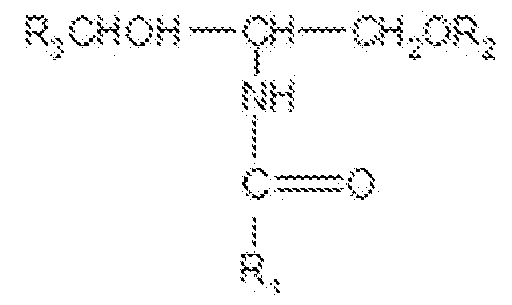 in which:
- Ri denotes a linear or branched, saturated or unsaturated alkyl group, derived from C14-C30 fatty acids, possibly being substituted with a hydroxyl group in the alpha position, or a hydroxyl group in the omega position esterified with a saturated or unsaturated C16-C30 fatty acid;
- R2 denotes a hydrogen atom, a (glycosyl)n group, a (galactosyl)m group or a sulfogalactosyl group, in which n is an integer ranging from 1 to 4; and m is an integer ranging from 1 to 8;
- R3 denotes a C15-C26 hydrocarbon-based group, which is saturated or unsaturated in the alpha position, this group possibly being substituted with one or more C1-C14 alkyl groups; it is understood that, in the case of natural ceramides or glycoceramides, R3 may also denote a C15-C26 alpha-hydroxyalkyl group, the hydroxyl group optionally being esterified with a C16-C30 alpha-hydroxy acid.
[0079] Preferably, use is made of ceramides for which Ri denotes a saturated or unsaturated alkyl group derived from C14-C30 fatty acids; R2 denotes a galactosyl or sulfogalactosyl group; and R3 denotes a -CH=CH-(CH2)i2-CH3 group.
[0080] In some embodiments, the ceramides that are selected are the compounds for which Ri denotes a saturated or unsaturated alkyl derived from Ci6- C22 fatty acids; R2 denotes a hydrogen atom and R3 denotes a saturated or unsaturated linear C15 group.
[0081] In various embodiments, use may also be made of the compounds for which Ri denotes a saturated or unsaturated alkyl radical derived from C12-C22 fatty acids; R2 denotes a galactosyl or sulfogalactosyl radical and R3 denotes a
saturated or unsaturated C12-C22 hydrocarbon-based radical and preferably a - CH=CH-(CH2)i2-CH3 group.
[0082] Mention may also be made, in various embodiments, of 2-N- linoleoylaminooctadecane- 1 ,3 -diol ; 2-N-oleoylaminooctadecane- 1 ,3 -diol ; 2-N- palmitoylaminooctadecane- 1,3 -diol; 2-N-stearoylaminooctadecane-l,3-diol; 2-N- behenoylaminooctadecane-l,3-diol; 2-N-[2-hydroxypalmitoyl]aminooctadecane- 1,3-diol; 2-N-stearoylaminooctadecane-l,3,4 triol and in particular N- stearoylphyto sphingosine; 2-N-palmitoylaminohexadecane- 1 ,3-diol, N- linoleoyldihydro sphingosine, N-oleoyldihydrosphingosine, N- palmitoyldihydrosphingosine, N-stearoyldihydrosphingosine, and N- behenoyldihydrosphingosine, N-docosanoyl-N-methyl-D-glucamine, cetylic acid N-(2-hydroxyethyl)-N-(3-cetyloxy-2-hydroxypropyl)amide and bis(N- hydroxyethyl-N-cetyl)malonamide; and combinations thereof. In some embodiments, N-oleoyldihydrosphingosine will preferably be used.
[0083] Preferably, the solid fatty compound (s), according to embodiments herein, is(are) selected from solid fatty alcohols, more preferably selected from cetyl alcohol, stearyl alcohol, behenyl alcohol, myristyl alcohol, arachidyl alcohol, lignoceryl alcohol, ceryl alcohol, montanyl alcohol, myricyl alcohol, or combinations thereof.
[0084] More preferably, the solid fatty compound, in some embodiments, is cetearyl alcohol.
[0085] The total amount of the solid fatty compound(s) different from vegetable oils and fatty acids, in a particular embodiment, is(are) in a weight range of 10% to 30 %, and preferably in a weight range of 12% to 20%, more preferably in a weight range of 15% to 20%, relative to the total weight of the composition.
[0086] Preferably, the total amount of the solid fatty compound(s) selected from solid fatty alcohol(s) in a particular embodiment, is in a weight range of 10% to 30 %, and preferably in a weight range of 12% to 20%, more preferably in a weight range of 15% to 20%, relative to the total weight of the composition.
Cationic polysaccharide
[0087] Embodiments of the composition include at least one cationic polysaccharide.
[0088] The term “cationic polysaccharide” includes any polysaccharide comprising cationic groups and/or groups that can be ionized to cationic groups, and not comprising anionic groups and/or groups that can be ionized to anionic groups.
[0089] The cationic polysaccharide(s), according to the present invention, that may be used, is(are) selected from cationic cellulose derivatives, cationic galactomannan gums, or combinations thereof.
[0090] Mention may be made particularly of cationic cellulose derivatives comprising quaternary ammonium groups, cationic cellulose copolymers or cellulose derivatives grafted with a water-soluble quaternary ammonium monomer, cationic galactomannan gums, or combinations thereof.
[0091] The cellulose derivatives comprising quaternary ammonium groups are especially described in French patent 1 492 597, and mention may be made of the polymers sold under the name UCARE POLYMER “JR” (JR 400 LT, JR 125 and JR 30M) or “LR” (LR 400 or LR 30M) by the company Dow chemical. These polymers are also defined in the CTFA dictionary as quaternary ammoniums of hydroxy ethylcellulose that have reacted with an epoxide substituted with a trimethylammonium group. The polyquatemium-10 is, for example, one of these polymers.
[0092] Cationic cellulose copolymers or cellulose derivatives grafted with a water-soluble quaternary ammonium monomer are described especially in US patent 4 131 576, and mention may be made of hydroxyalkylcelluloses, for instance hydroxymethyl-, hydroxyethyl- or hydroxypropylcelluloses grafted, in particular, with a methacryloyl ethyl trimethylammonium, methacrylamidopropyl trimethylammonium or dimethyldiallylammonium salt. The commercial products
corresponding to this definition are more particularly the products sold under the names CELQUAT L 200 and CELQUAT H 100 by the company National Starch.
[0093] The cationic galactomannan gums are described more particularly in US patents 3 589 578 and 4 031 307, and mention may be made of guar gums comprising cationic trialkylammonium groups, preferably Ci-Ce trialkylammonium groups. Use is made, for example, of guar gums modified with a 2,3-epoxypropyltrimethylammonium salt (for example, chloride). Such products are especially sold under the names JAGUAR C13 S, JAGUAR C 15, JAGUAR C 17 or JAGUAR C162 by the company Rhodia.
[0094] Preferably, the cationic polysaccharide(s), according to embodiments herein, is(are) selected from cationic cellulose derivatives comprising quaternary ammonium groups, cationic galactomannan gums comprising cationic trialkylammonium groups, or combinations thereof.
[0095] More preferably, the cationic polysaccharide(s), in some embodiments, is(are) selected from cationic galactomannan gums comprising cationic trialkylammonium groups, and better from guar gums comprising cationic trialkylammonium groups.
[0096] Preferably, the cationic polysaccharides are selected from cationic galactomannan gums comprising cationic trialkylammonium groups, and better from guar gums comprising cationic trialkylammonium groups. More preferably, the cationic polysaccharides are selected from polymers with INCI names, such as guar hydroxypropyltrimonium chloride, hydroxypropyl guar hydroxypropyltrimonium chloride, or their mixtures, better is guar hydroxypropyltrimonium chloride.
[0097] The total amount of the cationic polysaccharide(s), in a particular embodiment, is(are) in a weight range of 0.01% to 8% by weight, preferably from 0.05% to 5% by weight, more preferably from 0.1% to 4%, and better from 0.2% to 3% by weight, relative to the total weight of the composition.
[0098] Preferably, the cationic polysaccharide(s) is(are) selected from cationic galactomannan gums comprising cationic trialkylammonium groups and is(are) in a total weight range of 0.01% to 8% by weight, preferably from 0.05% to 5% by weight, more preferably from 0.1% to 4%, and better from 0.2% to 3% by weight, relative to the total weight of the composition.
[0099] More preferably, the cationic polysaccharide(s) is(are) selected from guar gums comprising cationic trialkylammonium groups and is(are) in a total weight range of 0.01% to 8% by weight, preferably from 0.05% to 5% by weight, more preferably from 0.1% to 4%, and better from 0.2% to 3% by weight, relative to the total weight of the composition.
Oxidative dye
[0100] Embodiments of the composition may include at least one oxidative dye.
[0101] Preferably, the composition according to the present invention comprises one or more oxidative dyes.
[0102] The oxidative dye, according to the present invention, includes at least one oxidation base and/or at least one oxidation coupler. Preferably, the composition according to the present invention comprises one or more oxidation bases in combination with one or more couplers.
[0103] Oxidation bases are generally colourless or weakly coloured compounds which when mixed with oxidizing compounds give rise to coloured compounds or dye. Further, the colour shades obtained with such oxidation bases can be varied by combining them with oxidation couplers or colour modifiers.
[0104] The oxidation base(s), according to the present invention, that may be used, is(are) selected from a group consisting of para-phenylenediamines, bis(phenyl)alkylenediamines , para- aminophenols , ortho-aminophenols , heterocyclic bases, and their addition salts thereof.
[0105] The addition salts of the oxidation bases are preferably selected from the addition salts with an acid, such as, the hydrochlorides, hydrobromides, sulfates, citrates, succinates, tartrates, lactates, tosylates, benzenesulfonates, methanesulfonates, phosphates and acetates, and the addition salts with a base such as, sodium hydroxide, potassium hydroxide, aqueous ammonia, amines, or alkanolamines.
[0106] The para-phenylenediamines that may be used are selected from para-phenylenediamine, para-tolylenediamine, 2-chloro-para-phenylenediamine,
2,3-dimethyl-para-phenylenediamine, 2,6-dimethyl-para-phenylenediamine, 2,6- diethyl-para-phenylenediamine, 2,5-dimethyl-para-phenylenediamine, N,N- dimethyl-para-phenylenediamine, N,N -diethyl-para-phenylenediamine, N,N- dipropyl-para-phenylenediamine, 4-amino-N,N-diethyl-3-methylaniline, N,N- bis(0-hydroxyethyl)-para-phenylenediamine, 4-N,N-bis(0-hydroxyethyl)amino-2- methylaniline, 4-N,N-bis(0-hydroxyethyl)amino-2-chloroaniline, 2-0- hydroxyethyl-para-pheny lenediamine, 2-y-hydroxypropyl-para-phenylenediamine, 2-methoxymethyl-para-phenylenediamine, 2-fluoro-para-phenylenediamine, 2- isopropyl-para-phenylenediamine, N-(0-hydroxypropyl)-para-phenylenediamine, 2-hydroxymethyl-para-phenylenediamine, N,N-dimethyl-3-methyl-para- phenylenediamine, N,N-(ethyl-0-hydroxyethyl)-para- phenylenediamine, N-(0,y- dihydroxypropyl)-para-phenylenediamine, N-(4’ -aminophenyl)-para- pheny lenediamine, N -phenyl-para-pheny lenediamine, 2- 0-hydroxyethyloxy-para- phenylenediamine, 2-0-acetylaminoethyloxy -para-phenylenediamine, N-(0- methoxyethyl)-para-phenylenediamine, 2-thienyl-para-phenylenediamine, 4- aminophenylpyrrolidine, 3 -hydroxy- 1 -(4 ’ -aminophenyl)pyrrolidine, 2-0- hydroxyethylamino-5-aminotoluene, and/or the addition salts thereof with an acid.
[0107] In some embodiments, the para-phenylenediamines are selected from para-phenylenediamine, para-tolylenediamine, 2-isopropyl-para- phenylenediamine, 2- 0-hydroxyethyl-para-pheny lenediamine, 2-y -hydroxy ethyl- para-phenylenediamine, 2-methoxymethyl -para-phenylenediamine, 2-0- hydroxyethyloxy-para-phenylenediamine, 2,6-dimethyl-para-phenylenediamine,
2,6-diethyl-para-phenylenediamine, 2,3-dimethyl-para-phenylenediamine, N,N- bis(P-hydroxyethyl)-para-phenylenediamine, 2-chloro-para-phenylenediamine, 2- P-acetylaminoethyloxy-para-phenylenediamine, or, preferably, the addition salts thereof with an acid, or combinations thereof.
[0108] The bis(phenyl)alkylenediamines that may be used are selected from N,N’ -bis(P-hydroxyethyl)-N,N’ -bis (4’ -aminophenyl)- 1 ,3-diaminopropanol, N,N’ - bis-(P-hydroxyethyl)-N,N’-bis(4’-aminophenyl)ethylenediamine, N,N’-bis(4- aminophenyl)tetramethylenediamine, N,N’ -bis(P-hydroxyethyl)-N,N’ -bis(4- aminophenyl)tetramethylenediamine, N,N’-bis(4- methylaminophenyl)tetramethylenediamine, N,N’-bis(ethyl)-N,N’-bis(4 ’-aminos’ -methylphenyl)ethylenediamine, l,8-bis(2,5-diaminophenoxy)-3,6-dioxaoctane, or their addition salts thereof.
[0109] The para-aminophenols may be selected from, para-aminophenol, 4- amino-3 -methylphenol, 4-amino-3-fluorophenol, 4-amino-3-chlorophenol, 4- amino-3-hydroxymethylphenol, 4-amino-2-methylphenol, 4-amino-2- hydroxymethylphenol, 4-amino-2-methoxymethylphenol, 4-amino-2- aminomethylphenol, 4-amino-2-(P-hydroxyethylaminomethyl)phenol and 4- amino-2-fluorophenol, or the addition salts thereof with an acid. In an example, the addition salt is salt of sulphurous acid or sodium metabisulphite salt.
[0110] The ortho-aminophenols that may be used are selected from, for example, 2-aminophenol, 2-amino-5-methylphenol, 2-amino-6-methylphenol and 5-acetamido-2-aminophenol, or the addition salts thereof.
[0111] The heterocyclic bases that may be used are selected from pyridine derivatives, pyrimidine derivatives and pyrazole derivatives.
[0112] In some embodiments, pyridine derivatives may be selected from the compounds as described, for example, in patents GB 1 026 978 and/or GB 1 153 196, including 2,5-diaminopyridine, 2-(4-methoxyphenyl)amino-3- aminopyridine, 3,4-diaminopyridine, or the addition salts thereof.
[0113] In various embodiments, the pyridine derivatives may further be selected from 3-aminopyrazolo[l,5-a]pyridine oxidation bases, or addition salts thereof described, for example, in patent application FR 2 801 308. Examples of such bases include pyrazolo[l,5-a]pyrid-3-ylamine, 2-acetylaminopyrazolo[l,5- a]pyrid-3 -ylamine, 2-morpholin-4-ylpyrazolo [ 1 ,5-a]pyrid-3 -ylamine, 3 - aminopyrazolo[ 1 ,5-a]pyridine-2-carboxylic acid, 2-methoxypyrazolo[ 1 ,5-a]pyrid- 3-ylamine, (3-aminopyrazolo[l,5-a]pyrid-7-yl)methanol, 2-(3-aminopyrazolo[l,5- a]pyrid-5-yl)ethanol, 2-(3-aminopyrazolo[l,5-a]pyrid-7-yl)ethanol, (3- aminopyrazolo[l,5-a]pyrid-2-yl)methanol, 3,6-diaminopyrazolo[l,5-a]pyridine, 3 ,4-diaminopyrazolo [1,5 -a]pyridine, pyrazolo [ 1 ,5-a]pyridine-3 ,7 -diamine, 7 - morpholin-4-ylpyrazolo[l,5-a]pyrid-3-ylamine, pyrazolo[l,5-a]pyridine-3,5- diamine, 5-morpholin-4-ylpyrazolo[l,5-a]pyrid-3-ylamine, 2-[(3- aminopyrazolo[l,5-a]pyrid-5-yl)(2-hydroxyethyl)amino]ethanol, 2-[(3- aminopyrazolo[l,5-a]pyrid-7-yl)(2-hydroxyethyl)amino]ethanol, 3- aminopyrazolo [ 1 ,5 - a] pyridin-5 -ol, 3 - aminopyrazolo [ 1 , 5 - a] pyridin-4 -ol, 3 - aminopyrazolo[l,5-a]pyridin-6-ol and 3-aminopyrazolo[l,5-a]pyridin-7-ol, 2-(3- amino-pyrazolo[l,5-a]pyridin-2-yl)oxyethanol, or the addition salts thereof.
[0114] In some embodiments, the pyrimidine derivatives may be selected from the compounds described, for example, in the patents DE 2359399; JP 88- 169571; JP 05-63124; EP 0770375 or patent application WO 96/15765, including
2.4.5.6-tetraaminopyrimidine, 4-hydroxy-2,5,6-triaminopyrimidine, 2-hydroxy-
4.5.6-triaminopyrimidine, 2,4-dihydroxy-5,6-diaminopyrimidine, 2,5,6- triaminopyrimidine, or their addition salts and their tautomeric forms, when a tautomeric equilibrium exists.
[0115] The pyrazole derivatives, in some embodiments, may be selected from, for example, the compounds described in the patents DE 3843892, DE 4133957 or patent applications WO 94/08969, WO 94/08970, FR-A-2 733 749 or DE 195 43 988, including for example 4,5-diamino-l-methylpyrazole, 4,5- diamino-l-(P-hydroxyethyl)pyrazole, 3,4-diaminopyrazole, 4,5-diamino-l-(4’- chlorobenzyl)pyrazole, 4,5-diamino-l,3-dimethylpyrazole, 4,5-diamino-3-methyl-
1-phenylpyrazole, 4,5-diamino-l-methyl-3-phenylpyrazole, 4-amino-l,3- dimethyl-5-hydrazinopyrazole, l-benzyl-4,5-diamino-3-methylpyrazole, 4,5- diamino-3-tert-butyl-l-methylpyrazole, 4,5-diamino-l-tert-butyl-3-methyl- pyrazole, 4,5-diamino-l-(P-hydroxyethyl)-3-methylpyrazole, 4,5-diamino-l-ethyl- 3-methylpyrazole, 4,5-diamino-l-ethyl-3-(4’-methoxyphenyl)pyrazole, 4,5- diamino-l-ethyl-3 -hydro xymethylpyrazole, 4,5-diamino-3-hydroxymethyl-l- methylpyrazole, 4,5-diamino-3-hydroxymethyl- 1-isopropylpyrazole, 4,5-diamino- 3 -methyl- 1-isopropylpyrazole, 4-amino-5-(2’-aminoethyl)amino-l,3- dimethylpyrazole, 3,4,5-triaminopyrazole, l-methyl-3,4,5-triaminopyrazole, 3,5- diamino-l-methyl-4-methylaminopyrazole, 3,5-diamino-4-(P-hydroxyethyl)- amino-l-methylpyrazole, or their addition salts. 4,5-diamino-l-(P-methoxyethyl)- pyrazole may also be used.
[0116] In various embodiments, mention may be preferably made to 4,5- diaminopyrazole and even more preferably of 4,5-diamino-l-(P- hydroxyethyl)pyrazole, or its salts thereof.
[0117] In a further embodiment, the pyrazole derivatives that may be used, also include diamino-N,N-dihydropyrazolo pyrazolones and especially those described in patent application FRA 2886136, such as the following compounds and the addition salts thereof: 2,3-diamino-6,7-dihydro-lH,5H-pyrazolo[l,2- a]pyrazol-l-one, 2-amino-3-ethylamino-6,7-dihydro-lH,5H-pyrazolo[l,2- a]pyrazol-l-one, 2-amino-3-isopropylamino-6,7-dihydro-lH,5H-pyrazolo[l,2- a]pyrazol-l-one, 2-amino-3-(pyrrolidin-l-yl)-6,7-dihydro-lH,5H-pyrazolo[l,2- a]pyrazol-l-one, 4,5-diamino-l,2-dimethyl-l,2-dihydropyrazol-3-one, 4,5- diamino- 1 ,2-diethyl- 1 ,2-dihydropyrazol-3-one, 4,5-diamino- 1 ,2-di-(2- hydroxyethyl)-l,2-dihydropyrazol-3-one, 2-amino-3-(2-hydroxyethyl)amino-6,7- dihydro-lH,5H-pyrazolo[l,2-a]pyrazol-l-one, 2-amino-3-dimethylamino-6,7- dihydro-lH,5H-pyrazolo[l,2-a]pyrazol-l-one, 2,3-diamino-5,6,7,8-tetrahydro- lH,6H-pyridazino[l,2-a]pyrazol-l-one, 4-amino-l,2-diethyl-5-(pyrrolidin-l-yl)- l,2-dihydropyrazol-3-one, 4-amino-5-(3-dimethylaminopyrrolidin-l-yl)-l,2- diethyl-l,2-dihydropyrazol-3-one, 2,3-diamino-6-hydroxy-6,7-dihydro-lH,5H-
pyrazolo[ 1 ,2-a]pyrazol- 1 -one, 2,3-diamino-6,7 -dihydro- lH,5H-pyrazolo[ 1 ,2- a]pyrazol-l-one and/or, preferably, a salt thereof, or combinations thereof. Mention may be preferably made to 2,3-diamino-6,7-dihydro-lH,5H-pyrazolo[l,2- a]pyrazol-l-one, or its salts thereof.
[0118] In some embodiments, the heterocyclic base may be selected from 4,5-diamino-l-(P-hydroxyethyl)pyrazole, 2,3-diamino-6,7-dihydro-lH,5H- pyrazolo[ 1 ,2-a]pyrazol- 1 -one, 2-(3 -aminopyrazolof 1 ,5-a]pyridin-2-yl)oxy ethanol, or their salts thereof.
[0119] In various embodiments, the oxidation bases are selected from paraphenylenediamines, bis(phenyl)alkylenediamines, para-aminophenols, orthoaminophenols, heterocyclic bases, the corresponding addition salts, or combinations thereof, preferably from 2-methoxymethyl-para-phenylenediamine, 2-P-hydroxyethyl-para-phenylenediamine, 2-y-hydroxypropyl-para- phenylenediamine, their addition salts thereof, or combinations thereof.
[0120] The oxidation coupler(s), according to the present invention, that may be used, is(are) selected from a group consisting of meta-phenylenediamines, meta-aminophenols, meta-diphenols, naphthalene-based couplers, heterocyclic couplers, and their addition salts.
[0121] In some embodiments, the oxidation couplers may be selected from 1,3 -dihydroxybenzene, l,3-dihydroxy-2-methylbenzene, 4-chloro-l,3- dihydroxybenzene, 1 -hydroxy-3 -aminobenzene, 1 -methyl-2-hydroxy-4-P- hydroxy ethylaminobenzene, 4-amino-2-hydroxytoluene, 5-amino-6-chloro-2- m ethylphenol, 2, 4-diamino-l-(P-hydroxy ethyloxy )benzene, 2-amino-4-(P- hydroxy ethylamino)- 1 -methoxybenzene, 1 ,3 -diaminobenzene, 1 ,3 -bis(2,4- diaminophenoxy)propane, 3 -ureidoaniline, 3 -ureido- 1 -dimethylaminobenzene, sesamol, l-P-hydroxyethylamino-3,4-m ethylenedi oxybenzene, a-naphthol, 2- m ethyl- 1 -naphthol, 6-hydroxyindole, 4-hydroxyindole, 4-hydroxy-N- methylindole, 5-methoxy-6-hydroxyindole, 2-amino-3 -hydroxypyridine, 6- hydroxybenzomorpholine, 2-amino-4-hydroxy ethylaminoanisole, 3-amino-6-
methoxy -2-methylaminopyri dine, 3,5-diamino-2,6-dimethoxypyridine, l-N-( - hydroxyethyl)amino-3,4-methylenedioxybenzene, 2,6-bis(0- hydroxyethylamino)toluene, 6-hydroxyindoline, 2,6-dihydroxy-4-methylpyridine, 2-chl oro-3, 5-diaminopyri dine, 2-chloro-3,5-diamino-6-methoxypyridine, 2- chl oro-3, 5-diamino-6-methylpyri dine, l-H-3-methylpyrazol-5-one, l-phenyl-3- methylpyrazol-5-one, 4-(3,5-diaminopyridin-2-yl)-l -(2 -hydroxy ethyl)-l - methylpiperazin-l-ium chloride, 2,6-dimethylpyrazolo[l,5-b]-l,2,4-triazole, 2,4,6- trimethoxyaniline hydrochloride, 2,6-dimethyl[3,2-c]-l,2,4-triazole, 6- methylpyrazolo[l,5-a]benzimidazole and 2,6-diaminopyrazine, the addition salts thereof with an acid, or combinations thereof.
[0122] In various embodiments, the oxidation couplers may be selected from 1,3 -dihydroxybenzene, 1, 3 -dihydroxy-2-m ethylbenzene, 4-chloro-l,3- dihydroxybenzene, 1 -hydroxy-3 -aminobenzene, 1 -methyl-2-hydroxy-4-0- hydroxy ethylaminobenzene, 4-amino-2-hydroxytoluene, 5-amino-6-chloro-2- m ethylphenol, 2, 4-diamino-l-(0-hydroxy ethyloxy )benzene, a-naphthol, 6- hydroxyindole, 2-amino-3 -hydroxypyridine, 6-hydroxybenzomorpholine, 3- amino-6-methoxy -2-methylaminopyri dine, 2-amino-4-hydroxy ethylaminoanisole, hydroxyethyl-3,4-methylenedioxyaniline, 2-amino-5-ethylphenol, their addition salts, or combinations thereof.
[0123] The oxidation couplers, in some embodiments, are further selected from 3 -amino-6-m ethoxy -2-methylaminopyri dine, 6-hydroxybenzomorpholine,
2.4-diamino-l-(0-hydroxy ethyloxy )benzene, 2-amino-3 -hydroxypyridine, 5- amino-6-chloro-2-methylphenol, 1 -methyl-2-hydroxy-4-0- hydroxy ethylaminobenzene, 2-amino-4-hydroxy ethylaminoanisole, hydroxy ethyl-
3.4-methylenedi oxyaniline, 2-amino-5-ethylphenol, 1 -hydroxy-3 -aminobenzene, their addition salts, or combinations thereof.
[0124] In general, the addition salts of the oxidation couplers, according to the present invention, are selected from addition salts with an acid, such as, hydrochlorides, hydrobromides, sulfates, citrates, succinates, tartrates, lactates, tosylates, benzenesulfonates, phosphates and acetates, and the addition salts with a
base such as, sodium hydroxide, potassium hydroxide, aqueous ammonia, amines or alkanolamines.
[0125] In various embodiments, the oxidation couplers are selected from 6- hydroxybenzomorpholine, 2, 4-diamino-l-(P-hydroxy ethyloxy )benzene, 2-amino- 3 -hydroxypyridine, 5-amino-6-chloro-2-methylphenol, l-methyl-2-hydroxy-4-P- hydroxy ethylaminobenzene, 2-amino-4-hydroxy ethylaminoanisole, hydroxy ethyl- 3, 4-methylenedi oxyaniline, 2-amino-5-ethylphenol, 1 -hydroxy-3 -aminobenzene, the addition salts thereof, the salts thereof, solvates of the salts thereof, or combinations thereof.
[0126] Preferably, the oxidation couplers are selected from 6- hydroxybenzomorpholine, hydroxyethyl-3, 4-methylenedi oxyaniline, 2-amino-5- ethylphenol, their addition salts, or combinations thereof.
[0127] The composition according to embodiments herein, is, in some embodiments, free of oxidation couplers chosen from resorcinol, 2- methylresorcinol, 4-chlororesorcinol, or the addition salts thereof.
[0128] The total amount of the oxidation base(s), in a particular embodiment, is(are) in a weight range of 0.0001% to 10%, relative to the total weight of the composition.
[0129] The total amount of the oxidation coupler(s), in a particular embodiment, is(are) in a weight range of 0.0001% to 10%, relative to the total weight of the composition.
[0130] The oxidation base(s) and coupler(s) may be in suitable amounts such that the total amount of oxidative dye, according to embodiments herein, is in a weight range of 0.0002% to 20%, relative to the total weight of the composition.
Alkaline agent
[0131] Embodiments of the composition may include at least one alkaline agent. Preferably, the composition according to the invention comprises at least one alkaline agent.
[0132] The alkaline agent(s) that may be used is(are) selected from at least one mineral, organic, or hybrid alkaline agent or combinations thereof.
[0133] The mineral alkaline agents are selected from ammonium hydroxide, alkali metal carbonates or bicarbonates such as sodium (hydrogen)carbonate and potassium (hydrogen)carbonate, alkali metal or alkaline- earth metal silicates or metasilicates such as sodium metasilicate, or combinations thereof.
[0134] The organic alkaline agents are selected from alkanolamines, amino acids, organic amines other than alkanolamines, oxyethylenated and/or oxypropylenated ethylenediamines, 1,3 -diaminopropane, spermine, spermidine, or combinations thereof.
[0135] The term “alkanolamine” means an organic amine comprising a primary, secondary, or tertiary amine function, and one or more linear or branched Ci-Cs alkyl groups bearing one or more hydroxyl radicals.
[0136] In some embodiments, organic amines selected from alkanolamines such as, monoalkanolamines, dialkanolamines or trialkanolamines comprising one to three identical or different Ci-Cio hydroxyalkyl radicals are in particular suitable for performing the present invention.
[0137] In particular, in some embodiments, the alkanolamine(s) are selected from monoethanolamine (MEA), diethanolamine, triethanolamine, monoisopropanolamine, diisopropanolamine, N,N-dimethylethanolamine, 2- amino-2-methyl- 1 -propanol, triisopropanolamine, 2-amino-2-methyl- 1,3- propanediol, 3 -amino- 1 ,2-propanediol, 3 -dimethylamino- 1 ,2-propanediol, tris(hydroxymethyl)aminomethane, or combinations thereof.
[0138] The alkaline agent(s), according to the present invention, is(are) selected from alkanolamines, ammonium hydroxide, metal carbonates, metal bicarbonates, alkali metal silicates, alkaline-earth metal silicates, alkali metal metasilicates, alkaline-earth metal metasilicates, or combinations thereof.
[0139] Preferably, the alkaline agent(s) according to embodiments herein, is(are) selected from alkanolamines and ammonium hydroxide. More preferably, the alkaline agent is selected from alkanolamines, better is, monoethanolamine.
[0140] The total amount of the alkaline agent(s), in a particular embodiment, is(are) in a weight range of 0.1% to 40% by weight, preferably 1% to 30% by weight, more preferably from 2% to 25% by weight, and better from 4% to 20% by weight, relative to the total weight of the composition.
[0141] Preferably, the alkaline agent(s) is(are) selected from alkanolamines, ammonium hydroxide, or their combinations and is(are) in a total weight range of 0.1% to 40% by weight, preferably 1% to 30% by weight, more preferably from 2% to 25% by weight, and better from 4% to 20% by weight, relative to the total weight of the composition.
[0142] Preferably, the alkaline agent(s) selected from alkanolamines is(are) in a total weight range of 0.1% to 40% by weight, preferably 1% to 30% by weight, more preferably from 2% to 25% by weight, and better from 4% to 20% by weight, relative to the total weight of the composition.
Oxidizing agent
[0143] In an embodiment, the composition according to the present invention includes at least one oxidizing agent.
[0144] According to this embodiment, the composition of the invention is a ready to use composition comprising at least one oxidizing agent.
[0145] The oxidizing agent(s), according to the present invention, may be selected from, hydrogen peroxide, urea peroxide, alkali metal bromates or ferricyanides, peroxygenated salts, such as, persulfates, perborates, peracids and/or precursors thereof, or percarbonates of alkali metals or alkaline-earth metals.
[0146] In an embodiment, the oxidizing agent is hydrogen peroxide.
[0147] The total amount of the oxidizing agent(s), in a particular embodiment, is in a weight range of 0.1% to 40%, and preferably in a weight range of 0.5% to 20%, relative to the total weight of the composition.
[0148] In another embodiment, the composition according to the invention is free of oxidizing agent. According to this embodiment, the composition is preferably mixed with a composition comprising at least one oxidizing agent immediately before use.
[0149] Preferably, the composition according to the invention is free of oxidizing agent
Additives
[0150] Embodiments of the composition may optionally comprise at least one additive, different from the compounds of the present invention.
[0151] The additives, according the present invention, that may be used are selected from mineral thickening agents, non-ionic, anionic, cationic and amphoteric surfactants, polymers, chelating agents, sequestrants, solvents, antidandruff agents, anti-seborrhoeic agents, agents for preventing hair loss and/or for promoting hair regrowth, vitamins and provitamins including panthenol, sunscreens, mineral or organic pigments, plasticizers, solubilizers, opacifiers or pearlescent agents, antioxidants, hydroxy acids, fragrances, and preservatives.
[0152] Of course, those skilled in the art will take care to choose the optional additional compound(s) so that the advantageous properties intrinsically associated with the composition according to the present invention are not, or not substantially, detrimentally affected by the envisioned addition(s).
[0153] The total amount of each of the additive(s), in a particular embodiment, is in a weight range of 0.01% and 20%, relative to the total weight of the composition.
[0154] Embodiments of the composition also include at least one solvent.
[0155] The solvents of the composition, according to the present invention, may comprise water and/or one or more organic solvents.
[0156] In an embodiment, the organic solvents are selected from linear or branched and preferably saturated monoalcohols or diols, comprising 2 to 10 carbon atoms, such as, ethanol, isopropanol, hexylene glycol (2-methyl-2,4-pentanediol), neopentyl glycol and 3-methyl-l,5-pentanediol, butylene glycol, dipropylene glycol and propylene glycol; aromatic alcohols such as benzyl alcohol or phenylethyl alcohol; polyols containing more than two hydroxyl functions, such as, glycerol; polyol ethers, for instance ethylene glycol monomethyl, monoethyl or monobutyl ether, propylene glycol or ethers thereof, for instance propylene glycol monomethyl ether; and also diethylene glycol alkyl ethers, especially C1-C4 alkyl ethers, for instance diethylene glycol monoethyl ether or monobutyl ether, alone or as a combination.
[0157] In some embodiments, the organic solvent(s), when present, is( are) in a weight range of 0.1% to 20%, preferably in a weight range of 0.4% to 10%, relative to the total weight of the composition.
[0158] In various embodiments, the composition according to the present invention is preferably aqueous. The total amount of water in the composition, according to embodiments herein, is in a weight range of 30% to 99%, preferably in a weight range of 40% to 95% by weight, and more preferably 50% to 90% by weight, relative to the total weight of the composition.
Kit
[0159] Embodiments provided herein also include a kit comprising a composition (A) as described in the embodiments herein above comprising at least 3% by weight of at least one vegetable oil, relative to a total weight of the composition; at least one fatty acid different from the vegetable oil; at least 10% by weight of at least one solid fatty compound different from the fatty acid and vegetable oil, relative to a total weight of the composition; at least one cationic polysaccharide; and at least one oxidative dye and/or at least one alkaline agent, and a composition (B)
comprising at least one oxidizing agent. The compositions (A) and (B) are intended to be mixed together at the time of use to obtain a ready to use composition which is then applied to keratin fibres for dyeing and/or lightening of keratin fibres. Preferably, the pH of the ready-to-use composition is between 8 and 11, preferably between 9.0 and 10.5.
[0160] The compositions (A) and (B) may be present in separate sachets or containers or in a single dual compartment sachet, optionally accompanied with suitable one or more applicators which may be identical or different, such as fine brushes, coarse brushes or sponges. The kit mentioned above may also be equipped with a means for dispensing the desired mixture onto the hair, for instance the devices described in patent FR 2586913.
Method
[0161] The composition of the present invention may be manufactured using known methods that are generally used in the cosmetics or dermatological field. Typically, the method for preparation of the composition comprises blending at least 3% by weight of at least one vegetable oil; at least one fatty acid different from the vegetable oil; at least 10% of at least one solid fatty compound different from the fatty acid and vegetable oil; at least one cationic polysaccharide; and at least one oxidative dye and/or at least one alkaline agent, with a suitable solvent, and optionally one or more additives to obtain the composition.
[0162] Embodiments herein further include a method of dyeing/lightening keratin fibres. The method comprises applying the composition, according to the present invention, on said fibres and allowing the composition to stand for a pause time preferably in a range of 5 to 45 minutes to dye said keratin fibres. In some embodiments, the composition is allowed to stand for a pause time in a range of 5 to 15 minutes.
[0163] Embodiments herein also include methods for manufacturing the composition (A) and composition (B) of the kit provided herein. In an embodiment, the method of preparation of the composition (A) is according to the method
described herein above comprising blending at least 3% by weight of at least one vegetable oil; at least one fatty acid different from the vegetable oil; at least 10% of at least one solid fatty compound different from the fatty acid and vegetable oil; at least one cationic polysaccharide; and at least one oxidative dye and/or at least one alkaline agent, with a suitable solvent, and optionally the additive to obtain the composition (A). The method of preparation of the composition (B) comprises blending oxidizing agent with a suitable solvent and optionally, comprising the additive to obtain the composition (B).
[0164] In an embodiment, the composition according to the invention is mixed with an oxidizing composition comprising preferably hydrogen peroxide immediately before use.
[0165] The temperature during the method is conventionally between room temperature (from 15°C to 25°C) and 80°C and preferably between room temperature and 60°C.
Use
[0166] Embodiments herein include use of the composition of the present invention.
[0167] The composition, according to embodiments herein, may be used for dyeing and/or lightening keratin fibres, particularly hair. The composition may be used for the purpose of colour change, colour lightening/bleaching of hair and/or coverage of greying hair.
[0168] The composition may be used on natural hair and/or artificial hair, including hair extensions.
[0169] The composition may be used at different temperatures, including conventionally at room temperature (between 15°C to 25°C) and 80°C and preferably between room temperature and 60°C.
[0170] In some embodiments, the composition may be optionally accompanied with one or more suitable applicators which may be identical or
different, such as, fine brushes, coarse brushes or sponges for application to keratin fibres, such as hair.
[0171] Although the subject matter has been described in considerable detail with reference to certain examples and implementations thereof, it is understood that other implementations are possible and included within the scope of the present invention.
Examples
[0172] The disclosure will now be illustrated with working examples, which is intended to illustrate the working of disclosure and not intended to take restrictively to imply any limitations on the scope of the present disclosure. Unless defined otherwise, all technical and scientific terms used herein have the same meaning as commonly understood to one of ordinary skill in the art to which this disclosure belongs. Although methods and materials similar or equivalent to those described herein can be used in the practice of the disclosed methods and compositions, the exemplary methods, devices, and materials are described herein. It is to be understood that this disclosure is not limited to particular methods, and experimental conditions described, as such methods and conditions may apply.
Example 1
Composition for lightening keratin fibers
[0173] Composition A (according to the invention) for dyeing/lightening keratin fibres was prepared using 6 wt% vegetable oil (i.e) sunflower oil; polyol viz. 5 wt% of propylene glycol; cationic polysaccharide viz. 0.5 wt% guar hydroxypropyltrimonium chloride; non-ionic associative polymer viz. 0.05 wt% of cetyl hydroxyethylcellulose; 0.24 wt% of tetrasodium glutamate diacetate; , surfactants viz. 1.50 wt% of laureth-12, 3 wt% of laureth-4, 1.50 wt% of oleth-20 and 2.40 wt%, of polysorbate 21; solid fatty compounds viz. 17 wt% of cetearyl alcohol; alkaline agent viz. 7.83 wt% of ethanolamine; fatty acids viz. 0.32 wt% of stearic acid, 0.02 wt% of myristic acid and 0.26 wt% of palmitic acid; 0.25 wt% of ascorbic acid; 0.75 wt% of sodium metabisulfite; and water (up to 100 wt%).
[0174] The vegetable oil (sunflower seed oil) used in the composition, according to embodiments herein, was commercially procured from Europe ADM Speciality Oil and Fats (Societe Industrielle des Oleagineux).
[0175] Comparative composition B was prepared similarly as composition A, except in composition B the amount of vegetable oil was reduced to 1%. Comparative composition C was also prepared similarly as composition A except that it was prepared without vegetable oil.
[0176] The ingredients used to prepare compositions A, B, and Care provided in Table 1 below, expressed in % by weight.
Table 1


[0177] The oxidizing composition D was prepared from the ingredients of which the contents are indicated in Table 2 below, expressed in % by weight:
Table 2
 Example 2:
Evaluation of color modification
[0178] Protocol: The color modification, i.e., the lightening/bleaching ability of the compositions were tested in vitro on non-treated samples of Indian black virgin /non treated hair. Each of the composition A, and the comparative composition B were mixed independently with the oxidizing composition D in a weight ratio l: lto obtain mixtures land 2, respectively.
[0179] Each of the mixtures 1 and 2 were applied on the hair swatches and left for a pause time of 35 minutes. The hair swatches were then rinsed to remove the mixtures and were oven dried. [0180] The colour or lightening of the hair swatches was measured using a spectrocolorimeter (such as the CM-2600D Spectrocolorimeter) with integrating
sphere and D65 lighting. The colour was detected in the CIELAB 1976 colorimetric space using 3 cartesian colorimetric coordinates L*(lightness), a* (red-green axis) and b* (blue-yellow axis). Colour can also be expressed in this space with components that are more descriptive in terms of visual perception, with the C* and h polar coordinates which express saturation and hue angle.
[0181] The colour difference, AE, which expresses the perceived difference between two colours, can be calculated from colorimetric coordinates L*, a* and b*.
[0182] It is calculated as follows:

[0183] By calculating the colour difference between hair swatches before and after the hair colour product was applied, the increase in hair swatch colouration/lightening and therefore its colouring/lightening performance was characterised. Therefore, the greater the colour difference, AE, between hair swatches before and after the hair colour product is applied, the better the colouring/lightening performance. Calculating the colour difference between two coloured/lightened hair swatches reveals whether or not any colour differences between them could be perceived visually.
[0184] Results: The results of the colouration test are provided in Table 3. The largest difference in colouration/lightening was seen for mixture 1 comprising the composition A, which had a AE value of 8.54. Mixture 2 comprising comparative composition B showed minimal difference in colouration/lightening and had almost the same AE values at 6.44, respectively. The composition A that comprised 6% vegetable oil clearly enabled lightening ability, while the comparative composition with very minimal (1%) amount of oil was not able to have the same effect. Clearly, the higher amount of vegetable oil in composition A functions synergistically with the ingredients as shown in Table 1, and provides improved lightening.
Table 3

Example 3:
Evaluation of conditioning effect
[0185] Protocol: The conditioning effect is tested in vitro on non-treated samples of Indian human hair. Each of the mixtures 1 and 2 as prepared in Example 2, were applied on the hair swatches and left for a pause time of 35 minutes. The hair swatches were then rinsed to remove the mixtures and oven dried.
[0186] The conditioning effect was evaluated by an expert panel (8 evaluators).
[0187] Results: The conditioning effect was rated as the highest for mixture 1 comprising composition A, while for mixture 2 comprising composition B, the conditioning effect was rated with negligible improvement in sensory feel, i.e., smoothness and softness. Mixture 1 resulted in a soft-feel, suppleness and smoothness in the hair swatches, along with a lustre. The hair swatches were also easy to comb. It was observed that the composition A comprising 6% vegetable oil was able to condition hair effectively, while the comparative composition with very minimal (1%) amount of oil did not impart the same conditioning effect.
Example 4:
Consumer evaluation of colouration and working qualities
[0188] Protocol: The colouration and working qualities, including ease of mixing and application, consistency, ease of emulsifying, and ease of rinsing, were tested on consumer participants/volunteers. 8 participants with mid-length to long hair, with average to high quantity and with 0% to 20% grey hair were selected. Prior to the application of the compositions, a full head shampoo of the participants’
hair was done, and the hair was blast dried thereafter. Each of the composition A, and the comparative composition C were mixed independently with the oxidizing composition D in a weight ratio of 1:1.
[0189] Each of the mixtures 1 (composition A+D) and 3 (composition C+D) were applied on the participants’ hair, left for a pause time of 35 minutes, and was then rinsed with water to remove the mixtures, and the hair was blast dried.
[0190] The consumers assessed the time taken for mixing the compositions, how quickly the compositions emulsified, the number of strokes of a brush and time taken to uniformly apply the composition on hair, the amount of time taken to rinse out the mixtures. They also evaluated the colour modification of the treated hair after the dry step.
Results:
[0191] Lightening: Overall, mixture 1 comprising the composition A had a better lightening/bleaching effect and lustre for each of the participants. Lightening/bleaching effect was lower in Mixture 3 for each participant.
[0192] Mixture 1 comprising composition A, was also preferred by the participants for its ease of emulsifying and rinsing out of hair, as compared to mixture 3.
[0193] Overall, mixture 1 was preferred by the participants for its good working qualities and colouration, i.e., lightening/bleaching effect.
ADVANTAGES OF THE PRESENT DISCLOSURE
[0194] The composition of the present invention achieves improved colour modification in terms of lightening/ bleaching while also providing good working qualities such as ease of emulsifying and rinsing out of hair. The composition also demonstrates good nourishment, and conditioning of hair contributing to the smoothness and supple feel of hair. This is, in part, achieved because of the incorporation of an appropriate amount of the vegetable oil in the composition of
the present invention which also results in an ecofriendly composition with reduced reliance on artificial ingredients.
Claims
1. A composition comprising: at least 3% by weight of at least one vegetable oil, relative to a total weight of the composition; at least one fatty acid different from the vegetable oil; at least 10% by weight of at least one solid fatty compound different from the vegetable oil and fatty acid, relative to a total weight of the composition; at least one cationic polysaccharide; and at least one oxidative dye and/or at least one alkaline agent.
2. The composition as claimed in claim 1, wherein the vegetable oil is selected from sunflower oil, sesame oil, soybean oil, coffee oil, safflower oil, borage oil, olive oil, apricot kernel oil, camellia oil, bambara pea oil, avocado oil, mango oil, rice bran oil, cottonseed oil, rose oil, kiwi seed oil, seabuckthorn pulp oil, blueberry seed oil, poppy seed oil, orange pip oil, sweet almond oil, palm oil, coconut oil, vemonia oil, maijoram oil, baobab oil, rapeseed oil, ximenia oil, pracaxi oil,jojoba oil, shea butter oil, or combinations thereof, preferably avocado oil, jojoba oil, soybean oil, sunflower oil, coconut oil, rapeseed oil, or combinations thereof, more preferably sunflower oil.
3. The composition as claimed in any one of the preceding claims, wherein the vegetable oil(s) is(are) in a total weight range of 3% to 20%, preferably from 3% to 15% by weight, more preferably from 4% to 12% by weight, better from 4% to 10% by weight, and still better from 5% to 8% by weight, relative to the total weight of the composition.
4. The composition as claimed in any one of the preceding claims, wherein the fatty acid(s) different from the vegetable oil is(are) selected from at least one carboxylic acid comprising 6 to 40 carbon atoms, and preferably from the carboxylic acid comprising 10 to 30 carbon atoms.
5. The composition as claimed in any one of the preceding claims, wherein the fatty acid(s) different from the vegetable oil is(are) selected from lauric acid, myristic acid, stearic acid, palmitic acid, or combinations thereof, and preferably from myristic acid, stearic acid, palmitic acid, or combinations thereof.
6. The composition as claimed in any one of the preceding claims, wherein the fatty acid(s) different from vegetable oil is(are) in a total weight range of 0.1% to 15%, preferably from 0.2% to 10% by weight, more preferably from 0.4% to 5% by weight, and better from 0.5% to 3% by weight, relative to the total weight of the composition.
7. The composition as claimed in any one of the preceding claims, wherein the solid fatty compound different from the vegetable oil and fatty acid is selected from solid fatty alcohols, solid esters of fatty alcohols, waxes, ceramides, or combinations thereof, preferably solid fatty alcohols, more preferably selected from cetyl alcohol, stearyl alcohol, behenyl alcohol, myristyl alcohol, arachidyl alcohol, lignoceryl alcohol, ceryl alcohol, montanyl alcohol, myricyl alcohol, or combinations thereof, and better is cetearyl alcohol.
8. The composition as claimed in any one of the preceding claims, wherein the solid fatty compound(s) different from the vegetable oil and fatty acids is(are) in a total weight range of 10% to 30 %, preferably from 12% to 20% by weight, and more preferably from 15% to 20% by weight, relative to the total weight of the composition.
9. The composition as claimed in any one of the preceding claims, wherein the cationic polysaccharide is selected from cationic cellulose derivatives, cationic galactomannan gums, or combinations thereof, preferably from cationic cellulose derivatives comprising quaternary ammonium groups, cationic galactomannan gums comprising cationic trialkylammonium groups, or combinations thereof, more preferably from cationic galactomannan gums comprising cationic
trialkylammonium groups, and better from guar gums comprising cationic trialkylammonium groups
10. The composition as claimed in any one of the preceding claims, wherein the cationic polysaccharide(s) is(are) in a total weight range of 0.01% to 8%, preferably from 0.05% to 5% by weight, more preferably from 0.1% to 4%, and better from 0.2% to 3% by weight, relative to the total weight of the composition.
11. The composition as claimed in in any one of the preceding claims, wherein the oxidative dye comprises at least one oxidation base and/or at least one oxidation coupler: the oxidation base is selected from a group consisting of paraphenylenediamines, bis(phenyl)alkylenediamines, para-aminophenols, orthoaminophenols, heterocyclic bases, and their addition salts; and the oxidation coupler is selected from a group consisting of metaphenylenediamines, meta-aminophenol, meta-diphenols, naphthalene-based couplers, heterocyclic couplers, and their addition salts, the amount of each of which is in a weight range of 0.0001% to 10%, relative to the total weight of the composition.
12. The composition as claimed in in any one of the preceding claims, wherein the alkaline agent is selected from alkanolamines, ammonium hydroxide, metal carbonates, metal bicarbonates, alkali metal silicates, alkaline-earth metal silicates, alkali metal metasilicates, alkaline-earth metal metasilicates, or combinations thereof, preferably from alkanolamines, ammonium hydroxide or combinations thereof, more preferably from alkanolamines, and better is monoethanolamine.
13. The composition as claimed in any one of the preceding claims, wherein the alkaline agent(s) is(are) in a total weight range of 0. 1 % to 40%, preferably from 1 % to 30% by weight, more preferably from 2% to 25% by weight, and better from 4% to 20% by weight, relative to the total weight of the composition.
14. The composition as claimed in any one of the preceding claims, wherein the composition further comprises at least one oxidizing agent.
15. The composition as claimed in claim 14, wherein the oxidizing agent is in a weight range of 0.1% to 40%, and preferably in a weight range of 0.5% to 20%, relative to the total weight of the composition.
16. A method of dyeing/lightening keratin fibres comprising applying the composition as claimed in claims 1 to 15 on said keratin fibres.
17. Use of the composition as claimed in claims 1 to 15 for dyeing/lightening keratin fibres, such as hair.
Applications Claiming Priority (4)
| Application Number | Priority Date | Filing Date | Title |
|---|---|---|---|
| IN202321065318 | 2023-09-28 | ||
| IN202321065318 | 2023-09-28 | ||
| FRFR2312543 | 2023-11-16 | ||
| FR2312543A FR3155427B3 (en) | 2023-11-16 | 2023-11-16 | Compositions and processes for dyeing and/or lightening keratinous fibers |
Publications (1)
| Publication Number | Publication Date |
|---|---|
| WO2025069042A1 true WO2025069042A1 (en) | 2025-04-03 |
Family
ID=92108549
Family Applications (1)
| Application Number | Title | Priority Date | Filing Date |
|---|---|---|---|
| PCT/IN2024/051261 Pending WO2025069042A1 (en) | 2023-09-28 | 2024-07-16 | Compositions and methods for dyeing and/or lightening keratin fibres |
Country Status (1)
| Country | Link |
|---|---|
| WO (1) | WO2025069042A1 (en) |
Citations (24)
| Publication number | Priority date | Publication date | Assignee | Title |
|---|---|---|---|---|
| GB1026978A (en) | 1962-03-30 | 1966-04-20 | Schwarzkopf Verwaltung G M B H | Method of dyeing hair |
| FR1492597A (en) | 1965-09-14 | 1967-08-18 | Union Carbide Corp | New cellulose ethers containing quaternary nitrogen |
| GB1153196A (en) | 1965-07-07 | 1969-05-29 | Schwarzkopf Verwaltung G M B H | Method of Dyeing Hair |
| US3589578A (en) | 1968-01-20 | 1971-06-29 | Monforts Fa A | Tension-relieving device for stretchable sheet material |
| DE2359399A1 (en) | 1973-11-29 | 1975-06-12 | Henkel & Cie Gmbh | Tetraaminopyrimidines as developers in oxidation hair dyes - esp. used with meta aminophenol couplers for blue shading dyes |
| US4031307A (en) | 1976-05-03 | 1977-06-21 | Celanese Corporation | Cationic polygalactomannan compositions |
| US4131576A (en) | 1977-12-15 | 1978-12-26 | National Starch And Chemical Corporation | Process for the preparation of graft copolymers of a water soluble monomer and polysaccharide employing a two-phase reaction system |
| FR2586913A1 (en) | 1985-09-10 | 1987-03-13 | Oreal | PROCESS FOR FORMING IN IN SITU A COMPOSITION CONSISTING OF TWO PARTS CONDITIONED SEPARATELY AND DISPENSING ASSEMBLY FOR IMPLEMENTING SAID METHOD |
| DE3843892A1 (en) | 1988-12-24 | 1990-06-28 | Wella Ag | OXIDATION HAIR AGENTS CONTAINING DIAMINOPYRAZOL DERIVATIVES AND NEW DIAMINOPYRAZOLE DERIVATIVES |
| JPH0563124A (en) | 1991-09-03 | 1993-03-12 | Mitsubishi Electric Corp | Hybrid integrated circuit device |
| DE4133957A1 (en) | 1991-10-14 | 1993-04-15 | Wella Ag | HAIR DYE CONTAINING AMINOPYRAZOLE DERIVATIVES AND NEW PYRAZOLE DERIVATIVES |
| WO1994008969A1 (en) | 1992-10-16 | 1994-04-28 | Wella Aktiengesellschaft | Process for producing 4,5-diamino pyrazole derivatives, their use for colouring hair and novel pyrazole derivatives |
| WO1994008970A1 (en) | 1992-10-16 | 1994-04-28 | Wella Aktiengesellschaft | Oxidation hair dye containing 4,5-diaminopyrazole derivatives and novel 4,5-diaminopyrazole derivatives and process for their production |
| WO1996015765A1 (en) | 1994-11-17 | 1996-05-30 | Henkel Kommanditgesellschaft Auf Aktien | Oxidation dyes |
| FR2733749A1 (en) | 1995-05-05 | 1996-11-08 | Oreal | COMPOSITIONS FOR DYEING KERATINIC FIBERS CONTAINING DIAMINO PYRAZOLES, DYEING PROCESS, NOVEL DIAMINO PYRAZOLES, AND PREPARATION METHOD THEREOF |
| EP0770375A1 (en) | 1995-10-21 | 1997-05-02 | GOLDWELL GmbH | Hair dyeing composition |
| DE19543988A1 (en) | 1995-11-25 | 1997-05-28 | Wella Ag | Oxidative hair dye composition |
| FR2801308A1 (en) | 1999-11-19 | 2001-05-25 | Oreal | KERATIN FIBER DYEING COMPOSITIONS CONTAINING 3-AMINO PYRAZOLO- [1, (- a] -PYRIDINES, DYEING PROCESS, NOVEL 3-AMINO PYRAZOLO- [1,5-a] -PYRIDINES |
| EP0943315B1 (en) * | 1998-03-05 | 2006-09-27 | P&G-Clairol, Inc. | Alkaline hair conditioning compositions containing cationic guar |
| FR2886136A1 (en) | 2005-05-31 | 2006-12-01 | Oreal | COMPOSITION FOR DYING KERATIN FIBERS COMPRISING AT LEAST ONE DIAMINO-N, N-DIHYDRO-PYRAZOLONE DERIVATIVE AND A CATIONIC OXIDATION DYE |
| JP2013169571A (en) | 2012-02-21 | 2013-09-02 | Nippon Steel & Sumitomo Metal Corp | Method of manufacturing forged steel roll |
| WO2021083902A1 (en) * | 2019-10-28 | 2021-05-06 | L'oreal | Alkaline composition comprising at least three different alkaline agents for the treatment of keratin fibres, methods and uses |
| EP4011355A1 (en) * | 2017-12-29 | 2022-06-15 | L'oreal | Compositions for altering the color of hair |
| FR3124712A1 (en) * | 2021-06-30 | 2023-01-06 | L'oreal | Cosmetic composition comprising N,N-dicarboxymethyl glutamic acid, at least one oxyethylenated ester of C8-C30 fatty acid and sorbitan, at least one fatty substance, at least one alkaline agent and/or one coloring agent |
-
2024
- 2024-07-16 WO PCT/IN2024/051261 patent/WO2025069042A1/en active Pending
Patent Citations (24)
| Publication number | Priority date | Publication date | Assignee | Title |
|---|---|---|---|---|
| GB1026978A (en) | 1962-03-30 | 1966-04-20 | Schwarzkopf Verwaltung G M B H | Method of dyeing hair |
| GB1153196A (en) | 1965-07-07 | 1969-05-29 | Schwarzkopf Verwaltung G M B H | Method of Dyeing Hair |
| FR1492597A (en) | 1965-09-14 | 1967-08-18 | Union Carbide Corp | New cellulose ethers containing quaternary nitrogen |
| US3589578A (en) | 1968-01-20 | 1971-06-29 | Monforts Fa A | Tension-relieving device for stretchable sheet material |
| DE2359399A1 (en) | 1973-11-29 | 1975-06-12 | Henkel & Cie Gmbh | Tetraaminopyrimidines as developers in oxidation hair dyes - esp. used with meta aminophenol couplers for blue shading dyes |
| US4031307A (en) | 1976-05-03 | 1977-06-21 | Celanese Corporation | Cationic polygalactomannan compositions |
| US4131576A (en) | 1977-12-15 | 1978-12-26 | National Starch And Chemical Corporation | Process for the preparation of graft copolymers of a water soluble monomer and polysaccharide employing a two-phase reaction system |
| FR2586913A1 (en) | 1985-09-10 | 1987-03-13 | Oreal | PROCESS FOR FORMING IN IN SITU A COMPOSITION CONSISTING OF TWO PARTS CONDITIONED SEPARATELY AND DISPENSING ASSEMBLY FOR IMPLEMENTING SAID METHOD |
| DE3843892A1 (en) | 1988-12-24 | 1990-06-28 | Wella Ag | OXIDATION HAIR AGENTS CONTAINING DIAMINOPYRAZOL DERIVATIVES AND NEW DIAMINOPYRAZOLE DERIVATIVES |
| JPH0563124A (en) | 1991-09-03 | 1993-03-12 | Mitsubishi Electric Corp | Hybrid integrated circuit device |
| DE4133957A1 (en) | 1991-10-14 | 1993-04-15 | Wella Ag | HAIR DYE CONTAINING AMINOPYRAZOLE DERIVATIVES AND NEW PYRAZOLE DERIVATIVES |
| WO1994008970A1 (en) | 1992-10-16 | 1994-04-28 | Wella Aktiengesellschaft | Oxidation hair dye containing 4,5-diaminopyrazole derivatives and novel 4,5-diaminopyrazole derivatives and process for their production |
| WO1994008969A1 (en) | 1992-10-16 | 1994-04-28 | Wella Aktiengesellschaft | Process for producing 4,5-diamino pyrazole derivatives, their use for colouring hair and novel pyrazole derivatives |
| WO1996015765A1 (en) | 1994-11-17 | 1996-05-30 | Henkel Kommanditgesellschaft Auf Aktien | Oxidation dyes |
| FR2733749A1 (en) | 1995-05-05 | 1996-11-08 | Oreal | COMPOSITIONS FOR DYEING KERATINIC FIBERS CONTAINING DIAMINO PYRAZOLES, DYEING PROCESS, NOVEL DIAMINO PYRAZOLES, AND PREPARATION METHOD THEREOF |
| EP0770375A1 (en) | 1995-10-21 | 1997-05-02 | GOLDWELL GmbH | Hair dyeing composition |
| DE19543988A1 (en) | 1995-11-25 | 1997-05-28 | Wella Ag | Oxidative hair dye composition |
| EP0943315B1 (en) * | 1998-03-05 | 2006-09-27 | P&G-Clairol, Inc. | Alkaline hair conditioning compositions containing cationic guar |
| FR2801308A1 (en) | 1999-11-19 | 2001-05-25 | Oreal | KERATIN FIBER DYEING COMPOSITIONS CONTAINING 3-AMINO PYRAZOLO- [1, (- a] -PYRIDINES, DYEING PROCESS, NOVEL 3-AMINO PYRAZOLO- [1,5-a] -PYRIDINES |
| FR2886136A1 (en) | 2005-05-31 | 2006-12-01 | Oreal | COMPOSITION FOR DYING KERATIN FIBERS COMPRISING AT LEAST ONE DIAMINO-N, N-DIHYDRO-PYRAZOLONE DERIVATIVE AND A CATIONIC OXIDATION DYE |
| JP2013169571A (en) | 2012-02-21 | 2013-09-02 | Nippon Steel & Sumitomo Metal Corp | Method of manufacturing forged steel roll |
| EP4011355A1 (en) * | 2017-12-29 | 2022-06-15 | L'oreal | Compositions for altering the color of hair |
| WO2021083902A1 (en) * | 2019-10-28 | 2021-05-06 | L'oreal | Alkaline composition comprising at least three different alkaline agents for the treatment of keratin fibres, methods and uses |
| FR3124712A1 (en) * | 2021-06-30 | 2023-01-06 | L'oreal | Cosmetic composition comprising N,N-dicarboxymethyl glutamic acid, at least one oxyethylenated ester of C8-C30 fatty acid and sorbitan, at least one fatty substance, at least one alkaline agent and/or one coloring agent |
Non-Patent Citations (1)
| Title |
|---|
| "Cream Color Hair Colour", GNPD, MINTEL, 1 December 2003 (2003-12-01), XP002762640 * |
Similar Documents
| Publication | Publication Date | Title |
|---|---|---|
| WO2015139883A1 (en) | Composition for altering the color of keratin fibers | |
| EP4362893A1 (en) | Cosmetic composition comprising at least one alkyl (poly)glycoside, n,n-dicarboxymethylglutamic acid, propane-1,3-diol, at least one fatty substance other than fatty acids, at least one dye | |
| FR3130152A1 (en) | Composition comprising two particular oxidation coloring precursors and a phosphoric surfactant. | |
| FR3130150A1 (en) | Composition comprising a particular oxidation coloring precursor and a particular amino silicone | |
| EP4262726A1 (en) | Process for dyeing keratin fibres with a composition comprising a particular oxidation dye precursor, a particular carboxylic acid and a chemical oxidizing agent | |
| EP4362894A1 (en) | Composition comprising n,n-dicarboxymethylglutamic acid, at least one fatty alcohol, at least one fatty acid, at least one polyol, at least one alkaline agent and optionally at least one dye | |
| US12409124B2 (en) | Composition comprising a particular oxidation dye precursor and a particular carboxylic acid | |
| WO2025069042A1 (en) | Compositions and methods for dyeing and/or lightening keratin fibres | |
| EP4362896A1 (en) | Composition comprising n,n-dicarboxymethylglutamic acid, 1,3-propanediol, at least one nonionic surfactant, at least one alkaline agent and/or at least one dye | |
| WO2022129377A1 (en) | Composition comprising the combination of two particular oxidation dye precursors and a particular carboxylic acid | |
| WO2022129379A1 (en) | Composition comprising two particular oxidation dye precursors, and a particular carboxylic acid | |
| FR3130142A1 (en) | Composition comprising two particular oxidation coloring precursors and a particular amino silicone | |
| WO2022129384A1 (en) | Composition comprising the combination of at least one fatty substance, a particular carboxylic acid and an oxidation dye and/or an alkaline agent | |
| WO2025126227A1 (en) | A composition for dyeing /lightening of keratin fibres, and methods thereof | |
| WO2025126228A1 (en) | A composition for dyeing /lightening of keratin fibres | |
| WO2025069043A1 (en) | Sustainable compositions and methods for dyeing and/or lightening keratin fibres | |
| FR3155427A3 (en) | COMPOSITIONS AND METHODS FOR DYEING AND/OR LIGHTENING KERATINOUS FIBERS | |
| WO2025003366A1 (en) | Composition comprising a particular coupler ammonium bicarbonate and fatty acid | |
| WO2025003345A1 (en) | Composition comprising a particular base ammonium bicarbonate and fatty acid | |
| WO2025003368A1 (en) | Composition comprising a particular polycarboxylic acid or a salt thereof, a (bi)carbonate in a particular content, an additional alkaline agent, a fatty substance and a dye | |
| FR3150439A1 (en) | Composition comprising a wax, a (bi)carbonate, a fatty acid, a fatty substance and a colorant. | |
| WO2025003347A1 (en) | Composition comprising hyaluronic acid and/or a derivative thereof, an anionic surfactant, an alkaline agent, a dye, a solid fatty alcohol and a liquid fatty alcohol | |
| WO2024261770A1 (en) | Product containing a dye composition comprising a fatty acid, a non-ionic surfactant, a non- associative polymer | |
| WO2025168477A1 (en) | Composition comprising an oxidation dye, an alkaline agent, a chemical oxidizing agent, an anionic acrylic polymer, a fatty acid, a nonionic surfactant and a fatty substance | |
| WO2024241332A1 (en) | Product containing a dye composition comprising a fatty acid, a non-ionic surfactant, a non-associative polymer, at least 10% by weight of one or more fatty substances, a polyol, a specific dye precursor and an oxidizing composition |
Legal Events
| Date | Code | Title | Description |
|---|---|---|---|
| 121 | Ep: the epo has been informed by wipo that ep was designated in this application |
Ref document number: 24748714 Country of ref document: EP Kind code of ref document: A1 |