ANTI-IL-13 MULTISPECIFIC ANTIBODY CONSTRUCTS AND USES THEREOF CROSS-REFERENCE TO RELATED APPLICATIONS [0001] This application claims the benefit of, and priority to U.S. Provisional Application No.63/578,946, filed August 25, 2023, the content of which is incorporated herein by reference in its entirety. REFERENCE TO AN ELECTRONIC SEQUENCE LISTING [0002] The content of the electronic sequence listing (253272000140seqlist.xml; Size: 239,418 bytes; and Date of Creation: August 19, 2024) is herein incorporated by reference in its entirety. FIELD OF THE INVENTION [0003] The present invention relates to multispecific constructs that specifically bind to IL-13 and a second target (e.g., TSLP). Further provided herein are isolated anti-IL-13 antibody constructs, pharmaceutical compositions comprising the multispecific constructs, methods of treating inflammatory diseases using the multispecific constructs, and kits comprising the multispecific constructs. BACKGROUND OF THE INVENTION [0004] Many abnormal cells and tissues as well as many diseases display unique antigens that can be leveraged for immune cell-mediated clearance, including inflammatory diseases such as autoimmune disorders or asthma. These inflammatory diseases can each display one or more different target antigens or one or more different epitopes of the same target antigen. For example, some antigens are over-expressed, mutagenized, or selectively mutagenized in inflamed tissues. Therefore, antibodies targeting specific antigens present in diseases with systemic or localized inflammation can be used as therapeutics. [0005] Interleukin (IL)-13 is a pleiotropic cytokine frequently associated with asthma and atopic dermatitis. IL-13 binds to a high-affinity heteromeric complex composed of interleukin 13 receptor-α1 (IL-13Rα1) and interleukin 4 receptor-α (IL-4Rα). IL-13 also binds to interleukin 13 receptor-α2 (IL-13Rα2), however IL-13Rα2 has been identified as a decoy receptor engaging separate signaling cascades than IL-13Rα1. IL-13 is secreted predominantly by T helper type 2 cells (Th2 cells) and by type 2 innate lymphoid cells (ILC2). ILC2s produce IL-5 and IL-13 during allergic inflammation and bridge the innate and adaptive immune responses. ILC2 activity promotes T-helper 2 cell (Th2) response, and the
concurrent actions of ILC2 cells and Th2 cells also is associated with inflammatory diseases such as allergies and autoimmune disorders. [0006] Recent results from clinical trials of anti-IL-13 antibodies, including the failure of tralokinumab (Adbry
TM; see, e.g., Brightling et al. Lancet Respir Med.2015, 3(9):692-701) and the mixed results of lebrikizumab (see, e.g., Hanania et al. Lancet Respir Med.2016, 4(10):781-796) for the treatment of severe asthma are demonstrative that other anti-IL-13 antibodies are needed for treating IL-13-associated diseases, in particular inflammatory diseases. In particular, the premature termination of the ACOUSTICS clinical trial for lebrikizumab due to adverse events in 73% of patients (see Szefler et al. Clin Transl Allergy 2022, 12(7):212176) is further indicative of a clear need for safer as well as more potent therapeutic options. BRIEF SUMMARY OF THE INVENTION [0007] The present invention provides multispecific constructs that specifically bind to IL-13 and a second target (e.g., TSLP), pharmaceutical compositions comprising the multispecific constructs, and methods of treating inflammatory diseases using the multispecific constructs thereof. Further provided are isolated anti-IL-13 antibody constructs. [0008] In one aspect of the present invention, there is provided a multispecific construct comprising: (1) a first antibody moiety that specifically binds to interleukin-13 (IL-13), and (2) a second antibody moiety that specifically binds to a second antigen. In some embodiments, the second antigen is a protein produced by an immune cell. In some embodiments, the second antigen is thymic stromal lymphopoietin (TSLP). [0009] In some embodiments according to any of the multispecific constructs described above, the first antibody moiety comprises a heavy chain variable region (VH1) and a light chain variable region (VL1), wherein: the VH1 comprises (i) a CDR-H1 comprising an amino acid sequence of SEQ ID NO:66, or a variant thereof comprising up to 3 amino acid variations, (ii) a CDR-H2 comprising an amino acid sequence of SEQ ID NO:67, or a variant thereof comprising up to 3 amino acid variations, and (iii) a CDR-H3 comprising an amino acid sequence of SEQ ID NO:68, or a variant thereof comprising up to 3 amino acid variations, and the VL1 comprises (i) a CDR-L1 comprising an amino acid sequence of SEQ ID NO:70, or a variant thereof comprising up to 3 amino acid variations, (ii) a CDR-L2 comprising an amino acid sequence of SEQ ID NO:71, or a variant thereof comprising up to 3 amino acid variations, and (iii) a CDR-L3 comprising an amino acid sequence of SEQ ID NO:72, or a variant thereof comprising up to 3 amino acid variations. In some embodiments,
the VH1 comprises an amino acid sequence of SEQ ID NO:65, or a variant thereof having at least about 80% sequence identity with SEQ ID NO:65, and the VL1 comprises an amino acid sequence of SEQ ID NO:69, or a variant thereof having at least about 80% sequence identity with SEQ ID NO:69. In some embodiments, the VH1 comprises (i) a CDR-H1 comprising an amino acid sequence of SEQ ID NO:66, (ii) a CDR-H2 comprising an amino acid sequence of SEQ ID NO:67, and (iii) a CDR-H3 comprising an amino acid sequence of SEQ ID NO:68, and the VL1 comprises (i) a CDR-L1 comprising an amino acid sequence of SEQ ID NO:70, (ii) a CDR-L2 comprising an amino acid sequence of SEQ ID NO:71, and (iii) a CDR-L3 comprising an amino acid sequence of SEQ ID NO:72. In some embodiments, the VH1 comprises an amino acid sequence of SEQ ID NO:65, and the VL1 comprises an amino acid sequence of SEQ ID NO:69. [0010] In some embodiments according to any of the multispecific constructs described above, the first antibody moiety is selected from the group consisting of: a full-length antibody, a Fab, a Fab’, a F(ab’)
2, an sdAb, and an scFv. [0011] In some embodiments according to any of the multispecific constructs described above, the first antibody moiety is an scFv (“anti-IL-13 scFv”). In some embodiments, the anti-IL-13 scFv comprises the amino acid sequence of SEQ ID NO:108. [0012] In some embodiments according to any of the multispecific constructs described above, the first antibody moiety is a Fab (“anti-IL-13 Fab”). In some embodiments, the anti- IL-13 Fab comprises a first polypeptide comprising the amino acid sequence of SEQ ID NO:124, and a second polypeptide comprising the amino acid sequence of SEQ ID NO:102 or 197. [0013] In some embodiments according to any of the multispecific constructs described above, the first antibody moiety is a full-length antibody (“anti-IL-13 full-length antibody”). In some embodiments, the anti-IL-13 full-length antibody comprises an Fc domain derived from a human IgG (e.g., human IgG1, human IgG2, or human IgG4). In some embodiments, the Fc domain is derived from human IgG1, wherein: i) a first subunit and a second subunit of the Fc domain each comprises the amino acid sequence of any one of SEQ ID NOs:76-79; ii) a first subunit of the Fc domain comprises the amino acid sequence of SEQ ID NO:80, and a second subunit of the Fc domain comprises the amino acid sequence of SEQ ID NO:81; iii) a first subunit of the Fc domain comprises the amino acid sequence of SEQ ID NO:81, and a second subunit of the Fc domain comprises the amino acid sequence of SEQ ID NO:80; iv) a first subunit of the Fc domain comprises the amino acid sequence of SEQ ID NO:95, and a second subunit of the Fc domain comprises the amino acid sequence of SEQ ID NO:96; or v)
a first subunit of the Fc domain comprises the amino acid sequence of SEQ ID NO:96, and a second subunit of the Fc domain comprises the amino acid sequence of SEQ ID NO:95. In some embodiments, the anti-IL-13 full-length antibody comprises: i) two heavy chains each comprising the amino acid sequence of SEQ ID NO:125, and two light chains each comprising the amino acid sequence of SEQ ID NO:102 or 197; ii) two heavy chains each comprising the amino acid sequence of SEQ ID NO:101, and two light chains each comprising the amino acid sequence of SEQ ID NO:102 or 197; iii) two heavy chains each comprising the amino acid sequence of SEQ ID NO:123, and two light chains each comprising the amino acid sequence of SEQ ID NO:121 or 206; iv) two heavy chains each comprising the amino acid sequence of SEQ ID NO:209, and two light chains each comprising the amino acid sequence of SEQ ID NO:122 or 207; v) two heavy chains each comprising the amino acid sequence of SEQ ID NO:210, and two light chains each comprising the amino acid sequence of SEQ ID NO:122 or 207; vi) two heavy chains each comprising the amino acid sequence of SEQ ID NO:211, and two light chains each comprising the amino acid sequence of SEQ ID NO:121 or 206; vii) two heavy chains each comprising the amino acid sequence of SEQ ID NO:212, and two light chains each comprising the amino acid sequence of SEQ ID NO:120 or 208; viii) two heavy chains each comprising the amino acid sequence of SEQ ID NO:213, and two light chains each comprising the amino acid sequence of SEQ ID NO:120 or 208; ix) two heavy chains each comprising the amino acid sequence of SEQ ID NO:225, and two light chains each comprising the amino acid sequence of SEQ ID NO:102 or 197; or x) a first heavy chain comprising the amino acid sequence of SEQ ID NO:130, a second heavy chain comprising the amino acid sequence of SEQ ID NO:131, and two light chains each comprising the amino acid sequence of SEQ ID NO:102 or 197. [0014] In some embodiments according to any of the multispecific constructs described above, the second antigen is TSLP, wherein the second antibody moiety comprises a heavy chain variable region (VH2) and a light chain variable region (VL2), wherein: (a) the VH2 comprises (i) a CDR-H1 comprising an amino acid sequence of SEQ ID NO:2; (ii) a CDR- H2 comprising an amino acid sequence of SEQ ID NO:3; and (iii) a CDR-H3 comprising an amino acid sequence of SEQ ID NO:4; and the VL2 comprises (i) a CDR-L1 comprising an amino acid sequence of SEQ ID NO:6; (ii) a CDR-L2 comprising an amino acid sequence of SEQ ID NO:7; and (iii) a CDR-L3 comprising an amino acid sequence of SEQ ID NO:8; (b) the VH2 comprises (i) a CDR-H1 comprising an amino acid sequence of SEQ ID NO:12; (ii) a CDR-H2 comprising an amino acid sequence of SEQ ID NO:13; and (iii) a CDR-H3
comprising an amino acid sequence of SEQ ID NO:4; and the VL2 comprises (i) a CDR-L1 comprising an amino acid sequence of SEQ ID NO:6; (ii) a CDR-L2 comprising an amino acid sequence of SEQ ID NO:7; and (iii) a CDR-L3 comprising an amino acid sequence of SEQ ID NO:8; (c) the VH2 comprises (i) a CDR-H1 comprising an amino acid sequence of SEQ ID NO:20; (ii) a CDR-H2 comprising an amino acid sequence of SEQ ID NO:21; and (iii) a CDR-H3 comprising an amino acid sequence of SEQ ID NO:22; and the VL2 comprises (i) a CDR-L1 comprising an amino acid sequence of SEQ ID NO:24; (ii) a CDR- L2 comprising an amino acid sequence of SEQ ID NO:25; and (iii) a CDR-L3 comprising an amino acid sequence of SEQ ID NO:26; (d) the VH2 comprises (i) a CDR-H1 comprising an amino acid sequence of SEQ ID NO:28; (ii) a CDR-H2 comprising an amino acid sequence of SEQ ID NO:29; and (iii) a CDR-H3 comprising an amino acid sequence of SEQ ID NO:30; and the VL2 comprises (i) a CDR-L1 comprising an amino acid sequence of SEQ ID NO:32; (ii) a CDR-L2 comprising an amino acid sequence of SEQ ID NO:33; and (iii) a CDR-L3 comprising an amino acid sequence of SEQ ID NO:34; (e) the VH2 comprises (i) a CDR-H1 comprising an amino acid sequence of SEQ ID NO:36; (ii) a CDR-H2 comprising an amino acid sequence of SEQ ID NO:37; and (iii) a CDR-H3 comprising an amino acid sequence of SEQ ID NO:38; and the VL2 comprises (i) a CDR-L1 comprising an amino acid sequence of SEQ ID NO:40; (ii) a CDR-L2 comprising an amino acid sequence of SEQ ID NO:41; and (iii) a CDR-L3 comprising an amino acid sequence of SEQ ID NO:42; or (f) the VH2 comprises (i) a CDR-H1 comprising an amino acid sequence of SEQ ID NO:44; (ii) a CDR-H2 comprising an amino acid sequence of SEQ ID NO:45; and (iii) a CDR-H3 comprising an amino acid sequence of SEQ ID NO:46; and the VL2 comprises (i) a CDR-L1 comprising an amino acid sequence of SEQ ID NO:48; (ii) a CDR-L2 comprising an amino acid sequence of SEQ ID NO:49; and (iii) a CDR-L3 comprising an amino acid sequence of SEQ ID NO:50. In some embodiments, (a) the VH2 comprises an amino acid sequence of SEQ ID NO:1, or an amino acid sequence having at least about 80% sequence identity with SEQ ID NO:1, and the VL2 comprises an amino acid sequence of SEQ ID NO:5, or an amino acid sequence having at least about 80% sequence identity with SEQ ID NO:5; (b) the VH2 comprises an amino acid sequence of SEQ ID NO:9, or an amino acid sequence having at least about 80% sequence identity with SEQ ID NO:9, and the VL2 comprises an amino acid sequence of SEQ ID NO:10, or an amino acid sequence having at least about 80% sequence identity with SEQ ID NO:10; (c) the VH2 comprises an amino acid sequence of SEQ ID NO:11, or an amino acid sequence having at least about 80% sequence identity with SEQ ID NO:11, and the VL2 comprises an amino acid sequence of SEQ ID NO:15, or an amino acid
sequence having at least about 80% sequence identity with SEQ ID NO:15; (d) the VH2 comprises an amino acid sequence of SEQ ID NO:19, or an amino acid sequence having at least about 80% sequence identity with SEQ ID NO:19, and the VL2 comprises an amino acid sequence of SEQ ID NO:23, or an amino acid sequence having at least about 80% sequence identity with SEQ ID NO:23; (e) the VH2 comprises an amino acid sequence of SEQ ID NO:27, or an amino acid sequence having at least about 80% sequence identity with SEQ ID NO:27, and the VL2 comprises an amino acid sequence of SEQ ID NO:31, or an amino acid sequence having at least about 80% sequence identity with SEQ ID NO:31; (f) the VH2 comprises an amino acid sequence of SEQ ID NO:35, or an amino acid sequence having at least about 80% sequence identity with SEQ ID NO:35, and the VL2 comprises an amino acid sequence of SEQ ID NO:39, or an amino acid sequence having at least about 80% sequence identity with SEQ ID NO:39; (g) the VH2 comprises an amino acid sequence of SEQ ID NO:43, or an amino acid sequence having at least about 80% sequence identity with SEQ ID NO:43, and the VL2 comprises an amino acid sequence of SEQ ID NO:47, or an amino acid sequence having at least about 80% sequence identity with SEQ ID NO:47; (h) the VH2 comprises an amino acid sequence of SEQ ID NO:63, or an amino acid sequence having at least about 80% sequence identity with SEQ ID NO:63, and the VL2 comprises an amino acid sequence of SEQ ID NO:53, or an amino acid sequence having at least about 80% sequence identity with SEQ ID NO:53; (i) the VH2 comprises an amino acid sequence of SEQ ID NO:63, or an amino acid sequence having at least about 80% sequence identity with SEQ ID NO:63, and the VL2 comprises an amino acid sequence of SEQ ID NO:54, or an amino acid sequence having at least about 80% sequence identity with SEQ ID NO:54; (j) the VH2 comprises an amino acid sequence of SEQ ID NO:56, or an amino acid sequence having at least about 80% sequence identity with SEQ ID NO:56, and the VL2 comprises an amino acid sequence of SEQ ID NO:52, or an amino acid sequence having at least about 80% sequence identity with SEQ ID NO:52; (k) the VH2 comprises an amino acid sequence of SEQ ID NO:55, or an amino acid sequence having at least about 80% sequence identity with SEQ ID NO:55, and the VL2 comprises an amino acid sequence of SEQ ID NO:51, or an amino acid sequence having at least about 80% sequence identity with SEQ ID NO:51; (l) the VH2 comprises an amino acid sequence of SEQ ID NO:56, or an amino acid sequence having at least about 80% sequence identity with SEQ ID NO:56, and the VL2 comprises an amino acid sequence of SEQ ID NO:51, or an amino acid sequence having at least about 80% sequence identity with SEQ ID NO:51; (m) the VH2 comprises an amino acid sequence of SEQ ID NO:63, or an amino acid sequence having at least about 80% sequence identity with
SEQ ID NO:63, and the VL2 comprises an amino acid sequence of SEQ ID NO:51, or an amino acid sequence having at least about 80% sequence identity with SEQ ID NO:51; (n) the VH2 comprises an amino acid sequence of SEQ ID NO:64, or an amino acid sequence having at least about 80% sequence identity with SEQ ID NO:64, and the VL2 comprises an amino acid sequence of SEQ ID NO:51, or an amino acid sequence having at least about 80% sequence identity with SEQ ID NO:51; (o) the VH2 comprises an amino acid sequence of SEQ ID NO:55, or an amino acid sequence having at least about 80% sequence identity with SEQ ID NO:55, and the VL2 comprises an amino acid sequence of SEQ ID NO:52, or an amino acid sequence having at least about 80% sequence identity with SEQ ID NO:52; (p) the VH2 comprises an amino acid sequence of SEQ ID NO:58, or an amino acid sequence having at least about 80% sequence identity with SEQ ID NO:58, and the VL2 comprises an amino acid sequence of SEQ ID NO:52, or an amino acid sequence having at least about 80% sequence identity with SEQ ID NO:52; (q) the VH2 comprises an amino acid sequence of SEQ ID NO:60, or an amino acid sequence having at least about 80% sequence identity with SEQ ID NO:60, and the VL2 comprises an amino acid sequence of SEQ ID NO:52, or an amino acid sequence having at least about 80% sequence identity with SEQ ID NO:52; (r) the VH2 comprises an amino acid sequence of SEQ ID NO:64, or an amino acid sequence having at least about 80% sequence identity with SEQ ID NO:64, and the VL2 comprises an amino acid sequence of SEQ ID NO:52, or an amino acid sequence having at least about 80% sequence identity with SEQ ID NO:52; (s) the VH2 comprises an amino acid sequence of SEQ ID NO:55, or an amino acid sequence having at least about 80% sequence identity with SEQ ID NO:55, and the VL2 comprises an amino acid sequence of SEQ ID NO:53, or an amino acid sequence having at least about 80% sequence identity with SEQ ID NO:53; (t) the VH2 comprises an amino acid sequence of SEQ ID NO:57, or an amino acid sequence having at least about 80% sequence identity with SEQ ID NO:57, and the VL2 comprises an amino acid sequence of SEQ ID NO:53, or an amino acid sequence having at least about 80% sequence identity with SEQ ID NO:53; (u) the VH2 comprises an amino acid sequence of SEQ ID NO:58, or an amino acid sequence having at least about 80% sequence identity with SEQ ID NO:58, and the VL2 comprises an amino acid sequence of SEQ ID NO:53, or an amino acid sequence having at least about 80% sequence identity with SEQ ID NO:53; (v) the VH2 comprises an amino acid sequence of SEQ ID NO:62, or an amino acid sequence having at least about 80% sequence identity with SEQ ID NO:62, and the VL2 comprises an amino acid sequence of SEQ ID NO:53, or an amino acid sequence having at least about 80% sequence identity with SEQ ID NO:53; (w) the VH2 comprises an amino acid sequence of
SEQ ID NO:64, or an amino acid sequence having at least about 80% sequence identity with SEQ ID NO:64, and the VL2 comprises an amino acid sequence of SEQ ID NO:53, or an amino acid sequence having at least about 80% sequence identity with SEQ ID NO:53; (x) the VH2 comprises an amino acid sequence of SEQ ID NO:55, or an amino acid sequence having at least about 80% sequence identity with SEQ ID NO:55, and the VL2 comprises an amino acid sequence of SEQ ID NO:54, or an amino acid sequence having at least about 80% sequence identity with SEQ ID NO:54 (y) the VH2 comprises an amino acid sequence of SEQ ID NO:61, or an amino acid sequence having at least about 80% sequence identity with SEQ ID NO:61, and the VL2 comprises an amino acid sequence of SEQ ID NO:54, or an amino acid sequence having at least about 80% sequence identity with SEQ ID NO:54; (z) the VH2 comprises an amino acid sequence of SEQ ID NO:62, or an amino acid sequence having at least about 80% sequence identity with SEQ ID NO:62, and the VL2 comprises an amino acid sequence of SEQ ID NO:54, or an amino acid sequence having at least about 80% sequence identity with SEQ ID NO:54; (aa) the VH2 comprises an amino acid sequence of SEQ ID NO:64, or an amino acid sequence having at least about 80% sequence identity with SEQ ID NO:64, and the VL2 comprises an amino acid sequence of SEQ ID NO:54, or an amino acid sequence having at least about 80% sequence identity with SEQ ID NO:54; (bb) the VH2 comprises an amino acid sequence of SEQ ID NO:63, or an amino acid sequence having at least about 80% sequence identity with SEQ ID NO:63, and the VL2 comprises an amino acid sequence of SEQ ID NO:52, or an amino acid sequence having at least about 80% sequence identity with SEQ ID NO:52; (cc) the VH2 comprises an amino acid sequence of SEQ ID NO:188, or an amino acid sequence having at least about 80% sequence identity with SEQ ID NO:188, and the VL2 comprises an amino acid sequence of SEQ ID NO:189, or an amino acid sequence having at least about 80% sequence identity with SEQ ID NO:189; (dd) the VH2 comprises an amino acid sequence of SEQ ID NO:188, or an amino acid sequence having at least about 80% sequence identity with SEQ ID NO:188, and the VL2 comprises an amino acid sequence of SEQ ID NO:190, or an amino acid sequence having at least about 80% sequence identity with SEQ ID NO:190; or (ee) the VH2 comprises an amino acid sequence of SEQ ID NO:228, or an amino acid sequence having at least about 80% sequence identity with SEQ ID NO:228, and the VL2 comprises an amino acid sequence of SEQ ID NO:190, or an amino acid sequence having at least about 80% sequence identity with SEQ ID NO:190.
[0015] In some embodiments according to any of the multispecific constructs described above, the second antibody moiety is selected from the group consisting of: a full-length antibody, a Fab, a Fab’, a F(ab’)
2, an sdAb, and an scFv. [0016] In some embodiments according to any of the multispecific constructs described above, the second antibody moiety is a full-length antibody. In some embodiments, the full- length antibody comprises an Fc domain derived from a human IgG (e.g., human IgG1, human IgG2, or human IgG4). In some embodiments, the Fc domain is derived from human IgG1, wherein: i) a first subunit and a second subunit of the Fc domain each comprises the amino acid sequence of any one of SEQ ID NOs:76-79; ii) a first subunit of the Fc domain comprises the amino acid sequence of SEQ ID NO:80, and a second subunit of the Fc domain comprises the amino acid sequence of SEQ ID NO:81; or iii) a first subunit of the Fc domain comprises the amino acid sequence of SEQ ID NO: 81, and a second subunit of the Fc domain comprises the amino acid sequence of SEQ ID NO: 80. In some embodiments, the full-length antibody is an anti-TSLP full-length antibody comprising: i) two heavy chains each comprising the amino acid sequence of SEQ ID NO:104, and two light chains each comprising the amino acid sequence of SEQ ID NO:103; ii) two heavy chains each comprising the amino acid sequence of SEQ ID NO:105, and two light chains each comprising the amino acid sequence of SEQ ID NO:103; or iii) a first heavy chain comprising the amino acid sequence of SEQ ID NO:136, a second heavy chain comprising the amino acid sequence of SEQ ID NO:137, and two light chains each comprising the amino acid sequence of SEQ ID NO:103. [0017] In some embodiments according to any of the multispecific constructs described above, the second antibody moiety is an scFv. In some embodiments, the second antibody moiety is an anti-TSLP scFv comprising the amino acid sequence of any one of SEQ ID NOs:106, 107, 218, 219, 226, 227, and 229. [0018] In some embodiments according to any of the multispecific constructs described above, the second antibody moiety is a Fab. In some embodiments, the second antibody moiety is an anti-TSLP Fab, wherein the anti-TSLP Fab comprises a first polypeptide comprising the amino acid sequence of SEQ ID NO:109, and a second polypeptide comprising the amino acid sequence of SEQ ID NO:103. [0019] In some embodiments according to any of the multispecific constructs described above, the first antibody moiety comprises a heavy chain (H1) and a light chain (L1), wherein the H1 comprises a VH1 and an H1-CH1, wherein the L1 comprises a VL1 and an L1-CL, and wherein: (i) the H1 comprises substitution at positions 170, 183, and 185 (EU
numbering), and the L1 comprises a substitution at position 135 (EU numbering); and/or (ii) the H1 comprises substitutions at positions 126 and 220 (EU numbering), and the L1 comprises substitutions at positions 124 and 214 (EU numbering). In some embodiments, the H1 comprises substitutions at F170, S183, and V185 (EU numbering), and the L1 comprises a substitution at L135 (EU numbering). In some embodiments, the F170 substitution is F170I or F170V, the S183 substitution is S183L or S183I, and the V185 substitution is V185L. In some embodiments, the L135 substitution is L135F. In some embodiments, (a) the H1 comprises F170I, S183L, and V185L substitutions (EU numbering), and the L1 comprises an L135F substitution (EU numbering); or (b) the H1 comprises F170V, S183I, and V185L substitutions (EU numbering), and the L1 comprises an L135F substitution (EU numbering). In some embodiments, the L1 is derived from a lambda light chain. In some embodiments, the lambda light chain comprises the amino acid sequence of SEQ ID NO:74 or 75. In some embodiments, the H1 comprises substitutions at F126 and C220 (EU numbering), and the L1 comprises substitutions at E124 and C214 (EU numbering). In some embodiments, the H1 comprises F126C and C220S substitutions (EU numbering), and the L1 comprises E124C and C214S substitutions (EU numbering). In some embodiments, the L1 is derived from a kappa light chain. In some embodiments, the kappa light chain comprises the amino acid sequence of SEQ ID NO:73. In some embodiments, the H1 comprises substitutions at F126 and C220 (EU numbering), and the L1 comprises substitutions at Q124 and C214 (EU numbering). In some embodiments, the H1 comprises F126C and C220S substitutions (EU numbering), and the L1 comprises Q124C and C214S substitutions (EU numbering). In some embodiments, (i) the H1 comprises F126C, F170I, S183L, V185L, and C220S substitutions, and the L1 comprises E124C, L135F, and C214S substitutions; (ii) the H1 comprises F126C, F170V, S183I, V185L, and C220S substitutions, and the L1 comprises E124C, L135F, and C214S substitutions; (iii) the H1 comprises F126C, F170I, S183L, V185L, and C220S substitutions, and the L1 comprises Q124C, L135F, and C214S substitutions; or (iv) the H1 comprises F126C, F170V, S183I, V185L, and C220S substitutions, and the L1 comprises Q124C, L135F, and C214S substitutions; wherein the position is according to EU numbering. [0020] In some embodiments according to any of the multispecific constructs described above, the multispecific constructs further comprise an Fc domain, wherein the Fc domain comprises a first subunit and a second subunit. In some embodiments, the Fc domain is derived from an IgG selected from the group consisting of IgG1, IgG2, IgG3, and IgG4. In some embodiments, the Fc domain is derived from IgG1. In some embodiments, each subunit of the Fc domain comprises L234A and L235A substitutions (EU numbering). In some
embodiments, each subunit of the Fc domain comprises the amino acid sequence of SEQ ID NO:77. In some embodiments, the Fc domain comprises M428L and N434S substitutions (EU numbering). In some embodiments, each subunit of the Fc domain comprises the amino acid sequence of SEQ ID NO:78. In some embodiments, the Fc domain comprises M252Y, S254T, and T256E substitutions (EU numbering). In some embodiments, each subunit of the Fc domain comprises the amino acid sequence of SEQ ID NO:79. In some embodiments, (i) the first subunit of the Fc domain comprises T366S, L368A, and Y407V substitutions (EU numbering), and the second subunit of the Fc domain comprises a T366W substitution (EU numbering); or (ii) the second subunit of the Fc domain comprises T366S, L368A, and Y407V substitutions (EU numbering), and the first subunit of the Fc domain comprises a T366W substitution (EU numbering). In some embodiments, (i) the first subunit of the Fc domain comprises the amino acid sequence of SEQ ID NO:80, and the second subunit of the Fc domain comprises the amino acid sequence of SEQ ID NO:81; (ii) the first subunit of the Fc domain comprises the amino acid sequence of SEQ ID NO:81, and the second subunit of the Fc domain comprises the amino acid sequence of SEQ ID NO:80; (iii) the first subunit of the Fc domain comprises the amino acid sequence of SEQ ID NO:95, and the second subunit of the Fc domain comprises the amino acid sequence of SEQ ID NO:96; or (iv) the first subunit of the Fc domain comprises the amino acid sequence of SEQ ID NO:96, and the second subunit of the Fc domain comprises the amino acid sequence of SEQ ID NO:95. [0021] In some embodiments according to any of the multispecific constructs described above, the multispecific construct is a heterodimeric bispecific antibody comprising: i) a first light chain (L1) comprising VL1 and L1-CL; ii) a first heavy chain (H1) comprising VH1, H1-CH1, and a first subunit of an Fc domain; iii) a second heavy chain (H2) comprising VH2, H2-CH1, and a second subunit of the Fc domain; and iv) a second light chain (L2) comprising VL2 and L2-CL; and wherein H1 and L1 form the anti-IL-13 antibody moiety, and H2 and L2 form the second antibody moiety. In some embodiments, the Fc domain is derived from human IgG1. In some embodiments, the L1-CL is derived from a human lambda light chain. In some embodiments, (a) the H1 comprises F170I, S183L, and V185L substitutions, and the L1 comprises an L135F substitution; (b) the H1 comprises F170V, S183I, and V185L substitutions, and the L1 comprises an L135F substitution; (c) the H1 comprises F126C, F170I, S183L, V185L, and C220S substitutions, and the L1 comprises E124C, L135F, and C214S substitutions; (d) the H1 comprises F126C, F170V, S183I, V185L, and C220S substitutions, and the L1 comprises E124C, L135F, and C214S substitutions; or (e) the H1 comprises F126C and C220S substitutions, and the L1 comprises
E124C and C214S substitutions; and wherein the amino acid position is according to EU numbering. In some embodiments, (a) the H1 comprises F170I, S183L, V185L, T366S, L368A, and Y407V substitutions, the L1 comprises an L135F substitution, and the H2 comprises a T366W substitution; (b) the H1 comprises F170I, S183L, V185L, and T366W substitutions, the L1 comprises an L135F substitution, and the H2 comprises T366S, L368A, and Y407V substitutions; (c) the H1 comprises F170V, S183I, V185L, T366S, L368A, and Y407V substitutions, the L1 comprises an L135F substitution, and the H2 comprises a T366W substitution; (d) the H1 comprises F170V, S183I, V185L, and T366W substitutions, the L1 comprises an L135F substitution, and the H2 comprises T366S, L368A, and Y407V substitutions; (e) the H1 comprises F126C, F170I, S183L, V185L, C220S, T366S, L368A, and Y407V substitutions, the L1 comprises E124C, L135F, and C214S substitutions, and the H2 comprises a T366W substitution; (f) the H1 comprises F126C, F170I, S183L, V185L, C220S, and T366W substitutions, the L1 comprises E124C, L135F, and C214S substitutions, and the H2 comprises T366S, L368A, and Y407V substitutions; (g) the H1 comprises F126C, F170V, S183I, V185L, C220S, T366S, L368A, and Y407V substitutions, the L1 comprises E124C, L135F, and C214S substitutions, and the H2 comprises a T366W substitution; (h) the H1 comprises F126C, F170V, S183I, V185L, C220S, and T366W substitutions, the L1 comprises E124C, L135F, and C214S substitutions, and the H2 comprises T366S, L368A, and Y407V substitutions; (i) the H1 comprises F126C, C220S, T366S, L368A, and Y407V substitutions, the L1 comprises E124C and C214S substitutions, and the H2 comprises a T366W substitution; or (j) the H1 comprises F126C, C220S, and T366W substitutions, the L1 comprises E124C and C214S substitutions, and the H2 comprises T366S, L368A, and Y407V substitutions; and wherein the amino acid position is according to EU numbering. In some embodiments, (a) the H1 comprises F170I, S183L, V185L, L234A, L235A, T366S, L368A, Y407V, M428L, and N434S substitutions, the L1 comprises an L135F substitution, and the H2 comprises L234A, L235A, T366W, M428L, and N434S substitutions; (b) the H1 comprises F170I, S183L, V185L, L234A, L235A, T366W, M428L, and N434S substitutions, the L1 comprises an L135F substitution, and the H2 comprises L234A, L235A, T366S, L368A, Y407V, M428L, and N434S substitutions; (c) the H1 comprises F170V, S183I, V185L, L234A, L235A, T366S, L368A, Y407V, M428L, and N434S substitutions, the L1 comprises an L135F substitution, and the H2 comprises L234A, L235A, T366W, M428L, and N434S substitutions; (d) the H1 comprises F170V, S183I, V185L, L234A, L235A, T366W, M428L, and N434S substitutions, the L1 comprises an L135F substitution, and the H2 comprises L234A, L235A, T366S, L368A, Y407V, M428L, and N434S substitutions; (e)
the H1 comprises F126C, F170I, S183L, V185L, C220S, L234A, L235A, T366S, L368A, Y407V, M428L, and N434S substitutions, the L1 comprises E124C, L135F, and C214S substitutions, and the H2 comprises L234A, L235A, T366W, M428L, and N434S substitutions; (f) the H1 comprises F126C, F170I, S183L, V185L, C220S, L234A, L235A, T366W, M428L, and N434S substitutions, the L1 comprises E124C, L135F, and C214S substitutions, and the H2 comprises L234A, L235A, T366S, L368A, Y407V, M428L, and N434S substitutions; (g) the H1 comprises F126C, F170V, S183I, V185L, C220S, L234A, L235A, T366S, L368A, Y407V, M428L, and N434S substitutions, the L1 comprises E124C, L135F, and C214S substitutions, and the H2 comprises L234A, L235A, T366W, M428L, and N434S substitutions; (h) the H1 comprises F126C, F170V, S183I, V185L, C220S, L234A, L235A, T366W, M428L, and N434S substitutions, the L1 comprises E124C, L135F, and C214S substitutions, and the H2 comprises L234A, L235A, T366S, L368A, Y407V, M428L, and N434S substitutions; (i) the H1 comprises F126C, C220S, L234A, L235A, T366S, L368A, Y407V, M428L, and N434S substitutions, the L1 comprises E124C and C214S substitutions, and the H2 comprises L234A, L235A, T366W, M428L, and N434S substitutions; or (j) the H1 comprises F126C, C220S, L234A, L235A, T366W, M428L, and N434S substitutions, the L1 comprises E124C and C214S substitutions, and the H2 comprises L234A, L235A, T366S, L368A, Y407V, M428L, and N434S substitutions; and wherein the amino acid position is according to EU numbering. In some embodiments, (a) the H1 comprises an amino acid sequence of SEQ ID NO:87, the L1 comprises an amino acid sequence of SEQ ID NO:173 or 202, and the H2 comprises an amino acid sequence of SEQ ID NO:85; (b) the H1 comprises an amino acid sequence of SEQ ID NO:88, the L1 comprises an amino acid sequence of SEQ ID NO:173 or 202, and the H2 comprises an amino acid sequence of SEQ ID NO:86; (c) the H1 comprises an amino acid sequence of SEQ ID NO:89, the L1 comprises an amino acid sequence of SEQ ID NO:173 or 202, and the H2 comprises an amino acid sequence of SEQ ID NO:85; (d) the H1 comprises an amino acid sequence of SEQ ID NO:90, the L1 comprises an amino acid sequence of SEQ ID NO:173 or 202, and the H2 comprises an amino acid sequence of SEQ ID NO:86; (e) the H1 comprises an amino acid sequence of SEQ ID NO:91, the L1 comprises an amino acid sequence of SEQ ID NO:174 or 203, and the H2 comprises an amino acid sequence of SEQ ID NO:85; (f) the H1 comprises an amino acid sequence of SEQ ID NO:92, the L1 comprises an amino acid sequence of SEQ ID NO:174 or 203, and the H2 comprises an amino acid sequence of SEQ ID NO:86; (g) the H1 comprises an amino acid sequence of SEQ ID NO:93, the L1 comprises an amino acid sequence of SEQ ID NO:174 or 203, and the H2 comprises an
amino acid sequence of SEQ ID NO:85; (h) the H1 comprises an amino acid sequence of SEQ ID NO:94, the L1 comprises an amino acid sequence of SEQ ID NO:174 or 203, and the H2 comprises an amino acid sequence of SEQ ID NO:86; (i) the H1 comprises an amino acid sequence of SEQ ID NO:198, the L1 comprises an amino acid sequence of SEQ ID NO:204 or 205, and the H2 comprises an amino acid sequence of SEQ ID NO:85; or (j) the H1 comprises an amino acid sequence of SEQ ID NO:199, the L1 comprises an amino acid sequence of SEQ ID NO:204 or 205, and the H2 comprises an amino acid sequence of SEQ ID NO:86. In some embodiments, the L2-CL is derived from a human kappa light chain. In some embodiments, the second antigen is TSLP. In some embodiments, (a) the H1 comprises the amino acid sequence of SEQ ID NO:139, the L1 comprises the amino acid sequence of SEQ ID NO:122 or 207, the H2 comprises the amino acid sequence of SEQ ID NO:136, and the L2 comprises the amino acid sequence of SEQ ID NO:103; (b) the H1 comprises the amino acid sequence of SEQ ID NO:138, the L1 comprises the amino acid sequence of SEQ ID NO:122 or 207, the H2 comprises the amino acid sequence of SEQ ID NO:137, and the L2 comprises the amino acid sequence of SEQ ID NO:103; (c) the H1 comprises the amino acid sequence of SEQ ID NO:141, the L1 comprises the amino acid sequence of SEQ ID NO:122 or 207, the H2 comprises the amino acid sequence of SEQ ID NO:136, and the L2 comprises the amino acid sequence of SEQ ID NO:103; (d) the H1 comprises the amino acid sequence of SEQ ID NO:140, the L1 comprises the amino acid sequence of SEQ ID NO:122 or 207, the H2 comprises the amino acid sequence of SEQ ID NO:137, and the L2 comprises the amino acid sequence of SEQ ID NO:103; (e) the H1 comprises the amino acid sequence of SEQ ID NO:126, the L1 comprises the amino acid sequence of SEQ ID NO:120 or 208, the H2 comprises the amino acid sequence of SEQ ID NO:136, and the L2 comprises the amino acid sequence of SEQ ID NO:103; (f) the H1 comprises the amino acid sequence of SEQ ID NO:127, the L1 comprises the amino acid sequence of SEQ ID NO:120 or 208, the H2 comprises the amino acid sequence of SEQ ID NO:137, and the L2 comprises the amino acid sequence of SEQ ID NO:103; (g) the H1 comprises the amino acid sequence of SEQ ID NO:128, the L1 comprises the amino acid sequence of SEQ ID NO:120 or 208, the H2 comprises the amino acid sequence of SEQ ID NO:136, and the L2 comprises the amino acid sequence of SEQ ID NO:103; (h) the H1 comprises the amino acid sequence of SEQ ID NO:129, the L1 comprises the amino acid sequence of SEQ ID NO:120 or 208, the H2 comprises the amino acid sequence of SEQ ID NO:137, and the L2 comprises the amino acid sequence of SEQ ID NO:103; (i) the H1 comprises the amino acid sequence of SEQ ID NO:200, the L1 comprises the amino acid sequence of SEQ ID NO:121 or 206, the H2
comprises the amino acid sequence of SEQ ID NO:136, and the L2 comprises the amino acid sequence of SEQ ID NO:103; or (j) the H1 comprises the amino acid sequence of SEQ ID NO:201, the L1 comprises the amino acid sequence of SEQ ID NO:121 or 206, the H2 comprises the amino acid sequence of SEQ ID NO:137, and the L2 comprises the amino acid sequence of SEQ ID NO:103. In some embodiments, the Fc domain is derived from human IgG1. In some embodiments, the L2-CL is derived from a human lambda light chain. In some embodiments, (a) the H2 comprises F170I, S183L, and V185L substitutions, and the L2 comprises an L135F substitution; (b) the H2 comprises F170V, S183I, and V185L substitutions, and the L2 comprises an L135F substitution; (c) the H2 comprises F126C, F170I, S183L, V185L, and C220S substitutions, and the L2 comprises E124C, L135F, and C214S substitutions; (d) the H2 comprises F126C, F170V, S183I, V185L, and C220S substitutions, and the L2 comprises E124C, L135F, and C214S substitutions; or (e) the H2 comprises F126C and C220S substitutions, and the L2 comprises E124C and C214S substitutions; and wherein the amino acid position is according to EU numbering. In some embodiments, (a) the H2 comprises F170I, S183L, V185L, T366S, L368A, and Y407V substitutions, the L2 comprises an L135F substitution, and the H1 comprises a T366W substitution; (b) the H2 comprises F170I, S183L, V185L, and T366W substitutions, the L2 comprises an L135F substitution, and the H1 comprises T366S, L368A, and Y407V substitutions; (c) the H2 comprises F170V, S183I, V185L, T366S, L368A, and Y407V substitutions, the L2 comprises an L135F substitution, and the H1 comprises a T366W substitution; (d) the H2 comprises F170V, S183I, V185L, and T366W substitutions, the L2 comprises an L135F substitution, and the H1 comprises T366S, L368A, and Y407V substitutions; (e) the H2 comprises F126C, F170I, S183L, V185L, C220S, T366S, L368A, and Y407V substitutions, the L2 comprises E124C, L135F, and C214S substitutions, and the H1 comprises a T366W substitution; (f) the H2 comprises F126C, F170I, S183L, V185L, C220S, and T366W substitutions, the L2 comprises E124C, L135F, and C214S substitutions, and the H1 comprises T366S, L368A, and Y407V substitutions; (g) the H2 comprises F126C, F170V, S183I, V185L, C220S, T366S, L368A, and Y407V substitutions, the L2 comprises E124C, L135F, and C214S substitutions, and the H1 comprises a T366W substitution; (h) the H2 comprises F126C, F170V, S183I, V185L, C220S, and T366W substitutions, the L2 comprises E124C, L135F, and C214S substitutions, and the H1 comprises T366S, L368A, and Y407V substitutions; (i) the H2 comprises F126C, C220S, T366S, L368A, and Y407V substitutions, the L2 comprises E124C and C214S substitutions, and the H1 comprises a T366W substitution; or (j) the H2 comprises F126C, C220S, and T366W substitutions, the
L2 comprises E124C and C214S substitutions, and the H1 comprises T366S, L368A, and Y407V substitutions; and wherein the amino acid position is according to EU numbering. In some embodiments, (a) the H2 comprises F170I, S183L, V185L, L234A, L235A, T366S, L368A, Y407V, M428L, and N434S substitutions, the L2 comprises an L135F substitution, and the H1 comprises L234A, L235A, T366W, M428L, and N434S substitutions; (b) the H2 comprises F170I, S183L, V185L, L234A, L235A, T366W, M428L, and N434S substitutions, the L2 comprises an L135F substitution, and the H1 comprises L234A, L235A, T366S, L368A, Y407V, M428L, and N434S substitutions; (c) the H2 comprises F170V, S183I, V185L, L234A, L235A, T366S, L368A, Y407V, M428L, and N434S substitutions, the L2 comprises an L135F substitution, and the H1 comprises L234A, L235A, T366W, M428L, and N434S substitutions; (d) the H2 comprises F170V, S183I, V185L, L234A, L235A, T366W, M428L, and N434S substitutions, the L2 comprises an L135F substitution, and the H1 comprises L234A, L235A, T366S, L368A, Y407V, M428L, and N434S substitutions; (e) the H2 comprises F126C, F170I, S183L, V185L, C220S, L234A, L235A, T366S, L368A, Y407V, M428L, and N434S substitutions, the L2 comprises E124C, L135F, and C214S substitutions, and the H1 comprises L234A, L235A, T366W, M428L, and N434S substitutions; (f) the H2 comprises F126C, F170I, S183L, V185L, C220S, L234A, L235A, T366W, M428L, and N434S substitutions, the L2 comprises E124C, L135F, and C214S substitutions, and the H1 comprises L234A, L235A, T366S, L368A, Y407V, M428L, and N434S substitutions; (g) the H2 comprises F126C, F170V, S183I, V185L, C220S, L234A, L235A, T366S, L368A, Y407V, M428L, and N434S substitutions, the L2 comprises E124C, L135F, and C214S substitutions, and the H1 comprises L234A, L235A, T366W, M428L, and N434S substitutions; (h) the H2 comprises F126C, F170V, S183I, V185L, C220S, L234A, L235A, T366W, M428L, and N434S substitutions, the L2 comprises E124C, L135F, and C214S substitutions, and the H1 comprises L234A, L235A, T366S, L368A, Y407V, M428L, and N434S substitutions; (i) the H2 comprises F126C, C220S, L234A, L235A, T366S, L368A, Y407V, M428L, and N434S substitutions, the L2 comprises E124C and C214S substitutions, and the H1 comprises L234A, L235A, T366W, M428L, and N434S substitutions; or (j) the H2 comprises F126C, C220S, L234A, L235A, T366W, M428L, and N434S substitutions, the L2 comprises E124C and C214S substitutions, and the H1 comprises L234A, L235A, T366S, L368A, Y407V, M428L, and N434S substitutions; and wherein the amino acid position is according to EU numbering. In some embodiments, (a) the H2 comprises an amino acid sequence of SEQ ID NO:87, the L2 comprises an amino acid sequence of SEQ ID NO:173 or 202, and the H1 comprises an amino acid sequence of SEQ
ID NO:85; (b) the H2 comprises an amino acid sequence of SEQ ID NO:88, the L2 comprises an amino acid sequence of SEQ ID NO:173 or 202, and the H1 comprises an amino acid sequence of SEQ ID NO:86; (c) the H2 comprises an amino acid sequence of SEQ ID NO:89, the L2 comprises an amino acid sequence of SEQ ID NO:173 or 202, and the H1 comprises an amino acid sequence of SEQ ID NO:85; (d) the H2 comprises an amino acid sequence of SEQ ID NO:90, the L2 comprises an amino acid sequence of SEQ ID NO:173 or 202, and the H1 comprises an amino acid sequence of SEQ ID NO:86; (e) the H2 comprises an amino acid sequence of SEQ ID NO:91, the L2 comprises an amino acid sequence of SEQ ID NO:174 or 203, and the H1 comprises an amino acid sequence of SEQ ID NO:85; (f) the H2 comprises an amino acid sequence of SEQ ID NO:92, the L2 comprises an amino acid sequence of SEQ ID NO:174 or 203, and the H1 comprises an amino acid sequence of SEQ ID NO:86; (g) the H2 comprises an amino acid sequence of SEQ ID NO:93, the L2 comprises an amino acid sequence of SEQ ID NO:174 or 203, and the H1 comprises an amino acid sequence of SEQ ID NO:85; (h) the H2 comprises an amino acid sequence of SEQ ID NO:94, the L2 comprises an amino acid sequence of SEQ ID NO:174 or 203, and the H1 comprises an amino acid sequence of SEQ ID NO:86; (i) the H2 comprises an amino acid sequence of SEQ ID NO:198, the L2 comprises an amino acid sequence of SEQ ID NO:204 or 205, and the H1 comprises an amino acid sequence of SEQ ID NO:85; or (j) the H2 comprises an amino acid sequence of SEQ ID NO:199, the L2 comprises an amino acid sequence of SEQ ID NO:204 or 205, and the H1 comprises an amino acid sequence of SEQ ID NO:86. In some embodiments, the L1-CL is derived from a human kappa light chain. In some embodiments, the second antigen is TSLP. [0022] In some embodiments according to any of the multispecific constructs described above, the first antibody moiety that specifically binds to IL-13 and the second antibody moiety that specifically binds to the second target antigen are fused to each other via a linker. In some embodiments, the linker comprises an amino acid sequence of any one of GG and SEQ ID NOs:98-99. [0023] In some embodiments according to any of the multispecific constructs described above, the first antibody moiety is an scFv (“anti-IL-13 scFv”), wherein the second antibody moiety is a full-length antibody that specifically binds to the second target antigen, and wherein the anti-IL-13 scFv is fused to the C-terminus of one of the heavy chains of the second antibody moiety to form a fusion polypeptide. [0024] In some embodiments according to any of the multispecific constructs described above, the multispecific construct comprises two anti-IL-13 antibody moieties that are scFvs
(“anti-IL-13 scFv1” and “anti-IL-13 scFv2”), and the second antibody moiety is a full-length antibody specifically binding the second target antigen; and wherein anti-IL-13 scFv1 is fused to the C-terminus of a first heavy chain of the second antibody moiety to form a first fusion polypeptide, and anti-IL-13 scFv2 is fused to the C-terminus of a second heavy chain of the second antibody moiety to form a second fusion polypeptide. In some embodiments, the second target antigen is TSLP (i.e., the second antibody moiety is an “anti-TSLP full- length antibody”). In some embodiments, the anti-TSLP full-length antibody comprises two light chains each comprising the amino acid sequence of SEQ ID NO:103 and two heavy chains each comprising the amino acid sequence of SEQ ID NO:105, and wherein the first fusion polypeptide and the second fusion polypeptide each comprises the amino acid sequence of SEQ ID NO:113. [0025] In some embodiments according to any of the multispecific constructs described above, the multispecific construct comprises two anti-IL-13 antibody moieties that are scFvs (“anti-IL-13 scFv1” and “anti-IL-13 scFv2”), two second antibody moieties that are Fabs (“Fab1” and “Fab2”) specifically binding the second target antigen, and an Fc domain; wherein the multispecific construct comprises: i) a first polypeptide comprising from N’ to C’: VL1-(L1-CL); ii) a second polypeptide comprising from N’ to C’: VH1-(H1-CH1)- optional linker-anti-IL-13 scFv1-optional linker-a first subunit of the Fc domain; iii) a third polypeptide comprising from N’ to C’: VH2-(H2-CH1)-optional linker-anti-IL-13 scFv2- optional linker-a second subunit of the Fc domain; and iv) a fourth polypeptide comprising from N’ to C’: VL2-(L2-CL); and wherein VL1-(L1-CL) and VH1-(H1-CH1) form Fab1, and VH2-(H2-CH1) and VL2-(L2-CL) form Fab2. In some embodiments, the second target antigen is TSLP. In some embodiments, the first polypeptide and the fourth polypeptide each comprises the amino acid sequence of SEQ ID NO:103, and the second polypeptide and the third polypeptide each comprises the amino acid sequence of SEQ ID NO:110. [0026] In some embodiments according to any of the multispecific constructs described above, the first antibody moiety is a full-length antibody (“anti-IL-13 full-length antibody”), wherein the second antibody moiety is an scFv that specifically binds to the second target antigen, and wherein the scFv is fused to the C-terminus of one of the heavy chains of the anti-IL-13 full-length antibody to form a fusion polypeptide. [0027] In some embodiments according to any of the multispecific constructs described above, the multispecific construct comprises the first antibody moiety that is an anti-IL-13 full-length antibody, and two second antibody moieties that are scFvs (“scFv1” and “scFv2”) specifically binding the second target antigen; and wherein scFv1 is fused to the C-terminus
of a first heavy chain of the anti-IL-13 full-length antibody to form a first fusion polypeptide, and scFv2 is fused to the C-terminus of a second heavy chain of the anti-IL-13 full-length antibody to form a second fusion polypeptide. In some embodiments, the second target antigen is TSLP. In some embodiments, the anti-IL-13 full-length antibody comprises two heavy chains each comprising the amino acid sequence of SEQ ID NO:125 and two light chains each comprising the amino acid sequence of SEQ ID NO:102 or 197, and wherein the first fusion polypeptide and the second fusion polypeptide each comprises the amino acid sequence of SEQ ID NO:111. In some embodiments, the anti-IL-13 full-length antibody comprises two heavy chains each comprising the amino acid sequence of SEQ ID NO:225 and two light chains each comprising the amino acid sequence of SEQ ID NO:102 or 197, and wherein the first fusion polypeptide and the second fusion polypeptide each comprises the amino acid sequence of any one of SEQ ID NOs:220-223. [0028] In some embodiments according to any of the multispecific constructs described above, the multispecific construct comprises two anti-IL-13 antibody moieties that are Fabs (“anti-IL-13 Fab1” and “anti-IL-13 Fab2”), two second antibody moieties that are scFvs (“scFv1” and “scFv2”) that specifically bind a second target antigen, and an Fc domain; wherein the multispecific construct comprises: i) a first polypeptide comprising from N’ to C’: VL1-(L1-CL); ii) a second polypeptide comprising from N’ to C’: VH1-(H1-CH1)- optional linker-scFv1-optional linker-a first subunit of the Fc domain; iii) a third polypeptide comprising from N’ to C’: VH2-(H2-CH1)-optional linker-scFv2-optional linker-a second subunit of the Fc domain; and iv) a fourth polypeptide comprising from N’ to C’: VL2-(L2- CL); and wherein VH1-(H1-CH1) and VL1-(L1-CL) form anti-IL-13 Fab1, and VH2-(H2- CH1) and VL2-(L2-CL) form anti-IL-13 Fab2. In some embodiments, the second target antigen is TSLP. In some embodiments, the first polypeptide and the fourth polypeptide each comprises the amino acid sequence of SEQ ID NO:102 or 197, and the second polypeptide and the third polypeptide each comprises the amino acid sequence of SEQ ID NO:112. [0029] In some embodiments according to any of the multispecific constructs described above, the multispecific comprises two anti-IL-13 antibody moieties that are Fabs (“anti-IL- 13 Fab1” and “anti-IL-13 Fab2”), and a second antibody moiety that is a full-length antibody that specifically binds to a second target antigen; wherein the multispecific construct comprises: i) a first polypeptide comprising: a first light chain of the second antibody moiety; ii) a second polypeptide comprising from N’ to C’: a first heavy chain of the second antibody moiety-optional linker-VH1-(H1-CH1); iii) a third polypeptide comprising from N’ to C’: a second heavy chain of the second antibody moiety-optional linker-VH2-(H2-CH1); iv) a
fourth polypeptide comprising: a second light chain of the second antibody moiety; v) a fifth polypeptide comprising from N’ to C’: VL1-(L1-CL); and vi) a sixth polypeptide comprising from N’ to C’: VL2-(L2-CL); and wherein VL1-(L1-CL) and VH1-(H1-CH1) form anti-IL- 13 Fab1, and VL2-(L2-CL) and VH2-(H2-CH1) form anti-IL-13 Fab2. In some embodiments, the anti-IL-13 Fab1 comprises an H1 comprising the VH1-(H1-CH1), and an L1 comprising the VL1-(L1-CL); wherein the anti-IL-13 Fab2 comprises an H2 comprising the VH2-(H2-CH1), and an L2 comprising the VL2-(L2-CL); and wherein: (a) H1 and H2 each comprises F170I, S183L, and V185L substitutions, and L1 and L2 each comprises an L135F substitution; (b) H1 and H2 each comprises F170V, S183I, and V185L substitutions, and L1 and L2 each comprises an L135F substitution; (c) H1 and H2 each comprises F126C, F170I, S183L, V185L, and C220S substitutions, and L1 and L2 each comprises E124C, L135F, and C214S substitutions; (d) H1 and H2 each comprises F126C, F170V, S183I, V185L, and C220S substitutions, and L1 and L2 each comprises E124C, L135F, and C214S substitutions; or (e) H1 and H2 each comprises F126C and C220S substitutions, and L1 and L2 each comprises E124C and C214S substitutions; and wherein the amino acid position is according to EU numbering. In some embodiments, the second target antigen is TSLP (i.e., the second antibody moiety is an “anti-TSLP full-length antibody”). In some embodiments, the anti-TSLP full-length antibody comprises two heavy chains each comprising the amino acid sequence of SEQ ID NO:105, and two light chains each comprising the amino acid sequence of SEQ ID NO:103. [0030] In some embodiments according to any of the multispecific constructs described above, the multispecific construct comprises an anti-IL-13 antibody moiety that is a full- length antibody (“anti-IL-13 full-length antibody”), and two second antibody moieties that are Fabs (“Fab1” and “Fab2”) that specifically bind to a second target antigen; wherein the multispecific construct comprises: i) a first polypeptide comprising: a first light chain (L1) of the anti-IL-13 full-length antibody; ii) a second polypeptide comprising from N’ to C’: a first heavy chain (H1) of the anti-IL-13 full-length antibody-optional linker-VH3-(H3-CH1); iii) a third polypeptide comprising from N’ to C’: a second heavy chain (H2) of the anti-IL-13 full- length antibody-optional linker-VH4-(H4-CH1); iv) a fourth polypeptide comprising: a second light chain (L2) of the anti-IL-13 full-length antibody; v) a fifth polypeptide comprising from N’ to C’: VL3-(L3-CL); and vi) a sixth polypeptide comprising from N’ to C’: VL4-(L4-CL); and wherein VH3-(H3-CH1) and VL3-(L3-CL) form Fab1, and VH4-(H4- CH1) and VL4-(L4-CL) form Fab2. In some embodiments, (a) H1 and H2 each comprises F170I, S183L, and V185L substitutions, and L1 and L2 each comprises an L135F
substitution; (b) H1 and H2 each comprises F170V, S183I, and V185L substitutions, and L1 and L2 each comprises an L135F substitution; (c) H1 and H2 each comprises F126C, F170I, S183L, V185L, and C220S substitutions, and L1 and L2 each comprises E124C, L135F, and C214S substitutions; (d) H1 and H2 each comprises F126C, F170V, S183I, V185L, and C220S substitutions, and L1 and L2 each comprises E124C, L135F, and C214S substitutions; or (e) H1 and H2 each comprises F126C and C220S substitutions, and L1 and L2 each comprises E124C and C214S substitutions; and wherein the amino acid position is according to EU numbering. In some embodiments, the anti-IL-13 full-length antibody comprises: i) two heavy chains each comprising the amino acid sequence of SEQ ID NO:125, and two light chains each comprising the amino acid sequence of SEQ ID NO:102 or 197; ii) two heavy chains each comprising the amino acid sequence of SEQ ID NO:209, and two light chains each comprising the amino acid sequence of SEQ ID NO:122 or 207; iii) two heavy chains each comprising the amino acid sequence of SEQ ID NO:210, and two light chains each comprising the amino acid sequence of SEQ ID NO:122 or 207; iv) two heavy chains each comprising the amino acid sequence of SEQ ID NO:211, and two light chains each comprising the amino acid sequence of SEQ ID NO:121 or 206; v) two heavy chains each comprising the amino acid sequence of SEQ ID NO:212, and two light chains each comprising the amino acid sequence of SEQ ID NO:120 or 208; vi) two heavy chains each comprising the amino acid sequence of SEQ ID NO:213, and two light chains each comprising the amino acid sequence of SEQ ID NO:120 or 208; vii) two heavy chains each comprising the amino acid sequence of SEQ ID NO:225, and two light chains each comprising the amino acid sequence of SEQ ID NO:102 or 197; viii) two heavy chains each comprising the amino acid sequence of SEQ ID NO:101, and two light chains each comprising the amino acid sequence of SEQ ID NO:102 or 197; or ix) two heavy chains each comprising the amino acid sequence of SEQ ID NO:123, and two light chains each comprising the amino acid sequence of SEQ ID NO:121 or 206. In some embodiments, the second target antigen is TSLP (i.e., the two second antibody moieties are “anti-TSLP Fab1” and “anti-TSLP Fab2”). In some embodiments, the anti-TSLP Fab1 and the anti-TSLP Fab2 each comprises a first polypeptide comprising the amino acid sequence of SEQ ID NO:109, and a second polypeptide comprising the amino acid sequence of SEQ ID NO:103. [0031] In some embodiments according to any of the multispecific constructs described above, the multispecific construct comprises two anti-IL-13 antibody moieties that are Fabs (“anti-IL-13 Fab1” and “anti-IL-13 Fab2”), and the second antibody moiety that is a full- length antibody specifically binding to a second target antigen; wherein the multispecific
construct comprises: i) a first polypeptide comprising from N’ to C’: VL1-(L1-CL); ii) a second polypeptide comprising from N’ to C’: VH1-(H1-CH1)-optional linker-a first heavy chain of the second antibody moiety; iii) a third polypeptide comprising from N’ to C’: VH2- (H2-CH1)-optional linker-a second heavy chain of the second antibody moiety; iv) a fourth polypeptide comprising from N’ to C’: VL2-(L2-CL); v) a fifth polypeptide comprising: a first light chain of the second antibody moiety; and vi) a sixth polypeptide comprising: a second light chain of the second antibody moiety; and wherein VL1-(L1-CL) and VH1-(H1- CH1) form anti-IL-13 Fab1, and VH2-(H2-CH1) and VL2-(L2-CL) form anti-IL-13 Fab2. In some embodiments, the anti-IL-13 Fab1 comprises an H1 comprising the VH1-(H1-CH1), and an L1 comprising the VL1-(L1-CL); wherein the anti-IL-13 Fab2 comprises an H2 comprising the VH2-(H2-CH1), and an L2 comprising the VL2-(L2-CL); and wherein: (a) H1 and H2 each comprises F170I, S183L, and V185L substitutions, and L1 and L2 each comprises an L135F substitution; (b) H1 and H2 each comprises F170V, S183I, and V185L substitutions, and L1 and L2 each comprises an L135F substitution; (c) H1 and H2 each comprises F126C, F170I, S183L, V185L, and C220S substitutions, and L1 and L2 each comprises E124C, L135F, and C214S substitutions; (d) H1 and H2 each comprises F126C, F170V, S183I, V185L, and C220S substitutions, and L1 and L2 each comprises E124C, L135F, and C214S substitutions; or (e) H1 and H2 each comprises F126C and C220S substitutions, and L1 and L2 each comprises E124C and C214S substitutions; and wherein the amino acid position is according to EU numbering. In some embodiments, the second target antigen is TSLP (i.e., the second antibody moiety is an “anti-TSLP full-length antibody”). In some embodiments, the anti-TSLP full-length antibody comprises two heavy chains each comprising the amino acid sequence of SEQ ID NO:105, and two light chains each comprising the amino acid sequence of SEQ ID NO:103. [0032] In some embodiments according to any of the multispecific constructs described above, the multispecific construct comprises the first antibody moiety that is an anti-IL-13 full-length antibody, and two second antibody moieties that are Fabs (“Fab1” and “Fab2”) that specifically bind to a second target antigen; wherein the multispecific construct comprises: i) a first polypeptide comprising from N’ to C’: VL3-(L3-CL); ii) a second polypeptide comprising from N’ to C’: VH3-(H3-CH1)-optional linker-a first heavy chain (H1) of the anti-IL-13 full-length antibody; iii) a third polypeptide comprising from N’ to C’: VH4-(H4-CH1)-optional linker-a second heavy chain (H2) of the anti-IL-13 full-length antibody; iv) a fourth polypeptide comprising from N’ to C’: VL4-(L4-CL); v) a fifth polypeptide comprising: a first light chain (L1) of the anti-IL-13 full-length antibody; and vi)
a sixth polypeptide comprising: a second light chain (L2) of the anti-IL-13 full-length antibody; and wherein VL3-(L3-CL) and VH3-(H3-CH1) form Fab1, and VH4-(H4-CH1) and VL4-(L4-CL) form Fab2. In some embodiments, (a) H1 and H2 each comprises F170I, S183L, and V185L substitutions, and L1 and L2 each comprises an L135F substitution; (b) H1 and H2 each comprises F170V, S183I, and V185L substitutions, and L1 and L2 each comprises an L135F substitution; (c) H1 and H2 each comprises F126C, F170I, S183L, V185L, and C220S substitutions, and L1 and L2 each comprises E124C, L135F, and C214S substitutions; (d) H1 and H2 each comprises F126C, F170V, S183I, V185L, and C220S substitutions, and L1 and L2 each comprises E124C, L135F, and C214S substitutions; or (e) H1 and H2 each comprises F126C and C220S substitutions, and L1 and L2 each comprises E124C and C214S substitutions; and wherein the amino acid position is according to EU numbering. In some embodiments, the anti-IL-13 full-length antibody comprises: i) two heavy chains each comprising the amino acid sequence of SEQ ID NO:125, and two light chains each comprising the amino acid sequence of SEQ ID NO:102 or 197; ii) two heavy chains each comprising the amino acid sequence of SEQ ID NO:209, and two light chains each comprising the amino acid sequence of SEQ ID NO:122 or 207; iii) two heavy chains each comprising the amino acid sequence of SEQ ID NO:210, and two light chains each comprising the amino acid sequence of SEQ ID NO:122 or 207; iv) two heavy chains each comprising the amino acid sequence of SEQ ID NO:211, and two light chains each comprising the amino acid sequence of SEQ ID NO:121 or 206; v) two heavy chains each comprising the amino acid sequence of SEQ ID NO:212, and two light chains each comprising the amino acid sequence of SEQ ID NO:120 or 208; vi) two heavy chains each comprising the amino acid sequence of SEQ ID NO:213, and two light chains each comprising the amino acid sequence of SEQ ID NO:120 or 208; vii) two heavy chains each comprising the amino acid sequence of SEQ ID NO:225, and two light chains each comprising the amino acid sequence of SEQ ID NO:102 or 197; viii) two heavy chains each comprising the amino acid sequence of SEQ ID NO:101, and two light chains each comprising the amino acid sequence of SEQ ID NO:102 or 197; or ix) two heavy chains each comprising the amino acid sequence of SEQ ID NO:123, and two light chains each comprising the amino acid sequence of SEQ ID NO:121 or 206. In some embodiments, the second target antigen is TSLP (i.e., the two second antibody moieties are “anti-TSLP Fab1” and “anti-TSLP Fab2”). In some embodiments, the anti-TSLP Fab1 and the anti-TSLP Fab2 each comprises a first polypeptide comprising the amino acid sequence of SEQ ID NO:109, and a second polypeptide comprising the amino acid sequence of SEQ ID NO:103.
[0033] Also provided are pharmaceutical compositions comprising any of the multispecific constructs described herein, and optionally a pharmaceutically acceptable carrier. [0034] Also provided are isolated nucleic acids encoding any of the multispecific constructs described herein, vectors comprising such nucleic acids, and host cells comprising such nucleic acids or vectors. [0035] Also provided are methods of treating an inflammatory disease in an individual, comprising administering to the individual an effective amount of any of the multispecific constructs described herein, or any of the pharmaceutical compositions described herein. In some embodiments, the inflammatory disease is asthma, atopic dermatitis, or chronic obstructive pulmonary disease (COPD). In some embodiments, the individual is a human. [0036] Also provided are of producing any of the multispecific constructs described herein, comprising i) culturing a host cell comprising any of the isolated nucleic acids or the vectors described above, or any of the host cells described above under a condition suitable for the expression of the multispecific construct; and ii) obtaining the expressed multispecific construct. [0037] The present invention in another aspect provides isolated antibody constructs (anti-IL- 13 antibody construct) comprising an antibody moiety that specifically binds IL-13 (“anti-IL- 13 antibody moiety”), wherein the anti-IL-13 antibody moiety comprises a heavy chain variable region (VH) and a light chain variable region (VL), and wherein: (1) the VH comprises (i) a CDR-H1 comprising an amino acid sequence of SEQ ID NO:66; (ii) a CDR- H2 comprising an amino acid sequence of SEQ ID NO:67; and (iii) a CDR-H3 comprising an amino acid sequence of SEQ ID NO:68; and the VL comprises (i) a CDR-L1 comprising an amino acid sequence of SEQ ID NO:70; (ii) a CDR-L2 comprising an amino acid sequence of SEQ ID NO:71; and (iii) a CDR-L3 comprising an amino acid sequence of SEQ ID NO:72. [0038] In some embodiments according to any of the anti-IL-13 antibody constructs described above, (1) the VH comprises an amino acid sequence of SEQ ID NO:65, or a variant thereof having at least about 80% sequence identity with SEQ ID NO:65, and the VL comprises an amino acid sequence of SEQ ID NO:69, or a variant thereof having at least about 80% sequence identity with SEQ ID NO:69. In some embodiments, the VH comprises an amino acid sequence of SEQ ID NO:65, and the VL comprises an amino acid sequence of SEQ ID NO:69.
[0039] In some embodiments according to any of the anti-IL-13 antibody constructs described above, the anti-IL-13 antibody moiety is selected from the group consisting of a full-length antibody, a Fab, a Fab’, a F(ab’)2, a diabody, and an scFv. [0040] In some embodiments according to any of the anti-IL-13 antibody constructs described above, the anti-IL-13 antibody moiety is an scFv (“anti-IL-13 scFv”). In some embodiments, the anti-IL-13 scFv comprises the amino acid sequence of SEQ ID NO:108. [0041] In some embodiments according to any of the anti-IL-13 antibody constructs described above, the anti-IL-13 antibody moiety is a Fab (“anti-IL-13 Fab”). In some embodiments, the anti-IL-13 Fab comprises a first polypeptide comprising the amino acid sequence of SEQ ID NO:124, and a second polypeptide comprising the amino acid sequence of SEQ ID NO:102 or 197. [0042] In some embodiments according to any of the anti-IL-13 antibody constructs described above, the anti-IL-13 antibody moiety is a full-length antibody (“anti-IL-13 full- length antibody”). In some embodiments, the anti-IL-13 full-length antibody comprises: i) two heavy chains each comprising the amino acid sequence of SEQ ID NO:125, and two light chains each comprising the amino acid sequence of SEQ ID NO:102 or 197; ii) two heavy chains each comprising the amino acid sequence of SEQ ID NO:101, and two light chains each comprising the amino acid sequence of SEQ ID NO:102 or 197; iii) two heavy chains each comprising the amino acid sequence of SEQ ID NO:123, and two light chains each comprising the amino acid sequence of SEQ ID NO:121 or 206; iv) two heavy chains each comprising the amino acid sequence of SEQ ID NO:209, and two light chains each comprising the amino acid sequence of SEQ ID NO:122 or 207; v) two heavy chains each comprising the amino acid sequence of SEQ ID NO:210, and two light chains each comprising the amino acid sequence of SEQ ID NO:122 or 207; vi) two heavy chains each comprising the amino acid sequence of SEQ ID NO:211, and two light chains each comprising the amino acid sequence of SEQ ID NO:121 or 206; vii) two heavy chains each comprising the amino acid sequence of SEQ ID NO:212, and two light chains each comprising the amino acid sequence of SEQ ID NO:120 or 208; viii) two heavy chains each comprising the amino acid sequence of SEQ ID NO:213, and two light chains each comprising the amino acid sequence of SEQ ID NO:120 or 208; ix) two heavy chains each comprising the amino acid sequence of SEQ ID NO:225, and two light chains each comprising the amino acid sequence of SEQ ID NO:102 or 197; or x) a first heavy chain comprising the amino acid sequence of SEQ ID NO:130, a second heavy chain comprising
the amino acid sequence of SEQ ID NO:131, and two light chains each comprising the amino acid sequence of SEQ ID NO:102 or 197. [0043] In some embodiments according to any of the anti-IL-13 antibody constructs described above, the isolated anti-IL-13 antibody construct is monospecific. In some embodiments, the isolated anti-IL-13 antibody construct is multispecific. [0044] In some embodiments according to any of the anti-IL-13 antibody constructs described above, the isolated anti-IL-13 antibody construct further comprises a second antibody moiety that specifically binds to a second antigen. In some embodiments, the anti- IL-13 antibody moiety and the second antibody moiety are fused to each other via a linker. In some embodiments, the linker comprises an amino acid sequence of any one of GG and SEQ ID NOs:98-99. [0045] Also provided are pharmaceutical compositions comprising any of the isolated anti- IL-13 antibody constructs described above, and optionally a pharmaceutically acceptable carrier. [0046] Also provided are isolated nucleic acids encoding any of any of the isolated anti-IL- 13 antibody constructs described above, vectors comprising such nucleic acids, and host cells comprising such nucleic acids or vectors. [0047] Also provided are methods of treating an inflammatory disease in an individual, comprising administering to the individual an effective amount of any of the isolated anti-IL- 13 antibody constructs described above, or any of the pharmaceutical compositions described above. In some embodiments, the inflammatory disease is asthma, atopic dermatitis, or COPD. In some embodiments, the individual is a human. [0048] Also provided are methods of producing any of the isolated anti-IL-13 antibody constructs described above, comprising: i) culturing a host cell comprising any of the isolated nucleic acids or the vectors described above, or any of the host cells described above under a condition suitable for the expression of the anti-IL-13 antibody construct; and ii) obtaining the expressed anti-IL-13 antibody construct. [0049] These and other aspects and advantages of the present invention will become apparent from the subsequent detailed description and the appended claims. It is to be understood that one, some, or all of the properties of the various embodiments described herein may be combined to form other embodiments of the present invention. [0050] The disclosures of all publications, patents, patent applications and published patent applications referred to herein are hereby incorporated herein by reference in their entirety.
BRIEF DESCRIPTION OF THE DRAWINGS [0051] FIG.1 shows the percent inhibition of TSLP signaling via the TSLP receptor complex expressed on the STAT5-HEK293 reporter cell when treated with exemplary anti- TSLP antibodies. [0052] FIG.2 shows 51B2 and a US-FDA approved reference anti-TSLP Ab binding to overlapping but different epitopes on TSLP in an ELISA competition experiment. Ab, antibody; OD, optical density. [0053] FIGs.3A-3B show 51B2 complete inhibition of TSLP-induced CCL17 secretion from PBMCs (FIG.3A) or isolated dendritic cells (FIG.3B) compared to a US-FDA approved reference anti-TSLP Ab. [0054] FIG.4 shows the resulting IC
50 (nM) and IC
90 (nM) values for each generated humanized 51B2 antibody compared to the parental Ch51B2 antibody in human and cynomolgus monkey (“cyno”) TSLP inhibition assays using TSLP receptor complex- transfected HEK293 reporter cells. Humanized anti-TSLP antibodies bound by a box indicate the anti-TSLP antibodies selected for further analysis. [0055] FIG.5A shows the percent inhibition of TSLP signaling via the TSLP receptor complex expressed on the STAT5-HEK293 reporter cell when treated with select humanized anti-TSLP antibodies (hz51B2 L2H2, hz51B2 L2H9, and hz51B2 L3H9). Ch51B2 parental chimeric antibody served as control. [0056] FIG.5B shows equilibrium binding analysis of hz51B2 L3H9 binding to human TSLP in solutions. [0057] FIGs.6A-6B show the anti-IL-13 antibody 73P1 enhanced neutralizing activity for cynomolgus monkey (“cyno”) IL-13 while maintaining the neutralizing activity for human IL-13 inhibition in the HEK-Blue 293 IL-13 reporter assay wherein secreted embryonic alkaline phosphatase (SEAP) is produced upon IL-13 signaling activation. FIG.6A shows Reference anti-IL-13 antibody #0 and anti-IL-13 antibody 73P1 neutralizing activity against human IL-13 using the IL-13 reporter assay across multiple concentrations and provides the IC
50 for both anti-IL-13 antibodies. FIG.6B shows Reference anti-IL-13 antibody #0 and anti-IL-13 antibody 73P1 neutralizing activity against cyno IL-13 using the IL-13 reporter assay across multiple concentrations and further provides the IC
50 for both anti-IL-13 antibodies. Conc., concentration; OD, optical density. [0058] FIGs.7A-7B show the comparison of neutralizing activities of anti-IL-13 antibody 73P1 and two US-FDA or EMA approved anti-IL-13 antibodies, Reference anti-IL-13
Antibody #1 and Reference anti-IL-13 Antibody #2 (“Ref. Ab. #1” and “Ref. Ab. #2”) as positive controls, using the HEK-Blue 293 IL-13 reporter assay, wherein secreted embryonic alkaline phosphatase (SEAP) is produced upon IL-13 signaling activation using wildtype (“WT”) IL-13 or IL-13 R110Q (a disease-associated variant of IL-13) as the stimuli. FIG. 7A shows the neutralizing activities of anti-IL-13 antibody 73P1 and Ref. anti-IL-13 Abs. #1 and #2 against wildtype human IL-13. FIG.7B shows the neutralizing activities of anti-IL-13 antibody 73P1 and Ref. anti-IL-13 Abs. #1 and #2 against the disease-associated human IL- 13 variant, R110Q, which displays increased IL-13 activity. IC
50 values are provided. [0059] FIGs.8A-8D show schematic overviews of one set of exemplary bispecific anti- TSLP×IL-13 antibody constructs based on scFv fusions and insertions. [0060] FIGs.9A-9B demonstrate the inhibitory activities from the TSLP×IL13 bispecific antibodies depicted in FIGs.8A-8D for TSLP and for IL-13. FIG.9A shows the percent inhibition of TSLP signaling through the TSLPR/IL-7Rα receptor complex expressed on the STAT5-HEK-293 reporter cell when treated with one of the bispecific antibodies. Luciferase production by the reporter cell acted as a readout for the TSLP binding activity. FIG.9B shows the percent inhibition of IL-13 signaling through the IL-13Rα1/IL-4Rα receptor complex expressed on the HEK-293 reporter cell when treated with one of the bispecific antibodies. SEAP production and secretion by the reporter cell acted as a readout for the IL- 13 binding activity. IC
90 values for each antibody according to the antigen were calculated based on the antibody dose-dependent binding inhibition curve. Data were analyzed and presented using GraphPad. Ab, antibody; Conc., concentration. [0061] FIG.10 shows the in vivo stabilities of the TSLP×IL-13 bispecific antibodies depicted in FIGs.8A-8D represented by in vivo antibody concentration after intravenous injection into C57Bl/6 mice over time for both the anti-TSLP antigen binding moiety and the anti-IL-13 antigen binding moiety of each of the bispecific antibodies. Two animals were tested per antibody per dilution (n=2/group). [0062] FIGs.11A-11D show schematic overviews of one set of exemplary bispecific TSLP×IL-13 antibodies based on Fab fusions (Format PX128-I1 to PX128-I4, respectively). [0063] FIGs.12A-12B demonstrate the inhibitory activities of the TSLP×IL-13 bispecific antibodies of Formats PX128-I1to PX128-I4 depicted in FIGs.11A-11D, and PX128-R2 depicted in FIG.13, for TSLP (FIG.12A) and for IL-13 (FIG.12B). FIG.12A shows the percent inhibition of TSLP signaling via the TSLP receptor complex expressed on the STAT5-HEK-293 reporter cell when treated with one of the bispecific antibodies. FIG.12B shows the percent inhibition of IL-13 signaling via the IL-13 receptor complex expressed on
the HEK-293 reporter cell when treated with one of the bispecific antibodies. Anti-IL-13 reference antibodies #2, #3, and #4 were included as positive controls. IC
90 values for each antibody according to the antigen were calculated based on the antibody dose-dependent binding inhibition curve. Data were analyzed and presented using GraphPad. Ab, antibody; Conc., concentration. [0064] FIG.13 provides a schematic overview of a PX128-R2 heterodimeric bispecific antibody, wherein a first arm includes an anti-TSLP Fab fragment, and a second arm includes an anti-IL-13 Fab fragment. The Fc domain includes the knob-in-hole mutation. The CH1 and CL domains of the anti-IL-13 Fab fragment also include R2 mutations, which include mutations F126C and C220S in the heavy chain and mutations E124C and C214S in the light chain of the anti-IL-13 arm (all EU numbering). [0065] FIG.14 provides a schematic overview of PX128-JT heterodimeric bispecific antibodies, wherein a first arm includes an anti-TSLP Fab fragment, and a second arm includes an anti-IL-13 Fab fragment. The Fc domain includes the knob-in-hole mutation. The CH1 and CL domains of the anti-IL-13 Fab fragment also include either the JT11 or the JT7 mutations. The JT11 mutations include F170V, S183I, and V185L in the HC and L135F in the LC of the anti-IL-13 arm (all EU numbering). The JT7 mutations include F170I, S183L, and V185L in the HC and L135F in the LC of the anti-IL-13 arm (all EU numbering). [0066] FIG.15 provides a schematic overview of PX128-JT/R2 heterodimeric bispecific antibodies, wherein a first arm includes an anti-TSLP Fab fragment, and a second arm includes an anti-IL-13 Fab fragment. The Fc domain includes the knob-in-hole mutation. The heavy chain and light chain of the anti-IL-13 arm also include R2 mutations and either JT11 or JT7 mutations (HC: JT11/R2 – HC: F126C, F170V, S183I, V185L, and C220S, or JT7/R2 – HC: F126C, F170I, S183L, V185L, and C220S; LC: E124C, L135F, and C214S). [0067] FIG.16 shows the in vivo stabilities of PX128-JT7 and PX128-JT11 heterodimeric bispecific antibodies (depicted in FIG.14) represented by in vivo antibody concentration over time after intravenous injection into C57Bl/6 mice for both the anti-TSLP antigen binding moiety and the anti-IL-13 antigen binding moiety. Two animals were tested per antibody per concentration (n=2/group). [0068] FIGs.17A-17B demonstrate the inhibitory activities of the heterodimeric bispecific antibodies depicted in FIGs.13-15 for TSLP (FIG.17A) and for IL-13 (FIG.17B). FIG. 17A shows the percent inhibition of TSLP signaling via the TSLP receptor complex expressed on the STAT5-HEK-293 reporter cell when treated with one of the heterodimeric bispecific antibodies. FIG.17B shows the percent inhibition of IL-13 signaling via the IL-13
receptor complex expressed on the HEK-293-SEAP reporter cell when treated with one of the heterodimeric bispecific antibodies. IC
90 values for each antibody according to the antigen were calculated based on the antibody dose-dependent binding inhibition curve. Data were analyzed and presented using GraphPad. Ab, antibody; Conc., concentration. [0069] FIGs.18A-18C show the level of CCL17 production in PBMCs treated with TSLP only (FIG.18A), IL-13 only (FIG.18B), or TSLP and IL-13 (FIG.18C), resulting from dose escalation of PX128-JT7 and PX128-JT11 heterodimeric bispecific antibodies depicted in FIG.14, as measured by ELISA assay. FIG.18A shows the CCL17 production due to treatment with 0.5 ng/ml TSLP alone. Ref. anti-IL-13 Ab. #2, Ref. TSLP×IL-13 Ab. #3, Ref. TSLP×IL-13×HSA Ab. #4, and Ref. anti-TSLP Ab. #5 were included as controls. Treatment of the cells with TSLP only (FIG.18A), IL-13 only (FIG.18B), or TSLP and IL-13 (FIG. 18C), and treatment with no antibody was included as a negative control. [0070] FIG.19 shows the half-life in vivo stability of an exemplary PX128-JT11 heterodimeric bispecific antibody (depicted in FIG.14) represented by in vivo antibody concentration over time after intravenous bolus injection or subcutaneous injection into cynomolgus monkeys. Ref. TSLP×IL-13×HSA Ab. #4 was included as a control. Two animals were tested per antibody per concentration (n=2/group). DETAILED DESCRIPTION OF THE INVENTION [0071] The present invention provides a multispecific construct (such as a bispecific construct) comprising an anti-IL-13 antibody moiety that specifically binds to IL-13 and a second antibody moiety that specifically binds to a second target antigen (e.g., TSLP). In some embodiments, the multispecific construct comprises one anti-IL-13 antibody moiety. In some embodiments, the multispecific construct comprises two or more anti-IL-13 antibody moieties. In some embodiments, the multispecific construct comprises one antibody moiety specifically binding to a second target antigen or target epitope. In some embodiments, the multispecific construct comprises two or more antibody moieties specifically binding to one or more other target antigens or target epitopes. In some embodiments, the second antigen is a protein produced by an immune cell. In some embodiments, the second antigen is TSLP. The present invention in another aspect also provides novel anti-IL-13 antibody constructs. [0072] After extensive investigation, inventors of the present application discovered that the multispecific constructs (e.g., anti-IL-13 multispecific constructs) described herein have several unexpected advantages compared to other multispecific proteins. First, the multispecific constructs described herein display stronger binding to IL-13 and improved
potency compared to currently available anti-IL-13 antibodies or multispecific constructs thereof. Second, the multispecific constructs (e.g., anti-IL-13 multispecific constructs) have cross-reactivity to both human and cynomolgus monkey IL-13, which can facilitate extrapolation of the results of toxicity and efficacy studies from cynomolgus monkeys to human clinical studies. Third, certain multispecific constructs described herein were shown to be surprisingly stable in vivo, (e.g., both upon administration to mice and to cynomolgus monkeys) making them particularly suitable to be formulated in high concentrations. Fourth, the in vivo half-life of certain multispecific constructs described herein was shown to be much longer than other control multispecific antibodies (e.g., the half-life is at least about any of 1.5-fold, 2-fold, 4-fold, 5-fold, or more, of the half-life of a control multispecific antibody). [0073] Also provided are pharmaceutical compositions and kits comprising any of the multispecific constructs or anti-IL-13 antibody constructs described herein, and methods of use thereof for treating inflammatory diseases, such as asthma, atopic dermatitis, or COPD. I. Definitions [0074] As used herein, the term “treatment” refers to clinical intervention designed to alter the natural course of the individual or cell being treated during the course of clinical pathology. Desirable effects of treatment include decreasing the rate of disease progression, ameliorating or palliating the disease state, and remission or improved prognosis. For example, an individual is successfully “treated” if one or more symptoms associated with inflammatory diseases are mitigated or eliminated, including, but not limited to, reducing local or systemic inflammation, decreasing symptoms resulting from the disease, increasing the quality of life of those suffering from the disease, decreasing the dose of other medications required to treat the disease, etc. [0075] As used herein, an “effective amount” refers to an amount of an agent or drug effective to treat a disease or disorder in a subject (such as an individual, e.g., a human). In the case of inflammatory disease, the effective amount of the agent may reduce the number of active immune cells; reduce the amount of pro-inflammatory cytokines; inhibit (i.e., slow to some extent and preferably stop) inflammatory immune cell activity locally and/or systemically; and/or relieve to some extent one or more of the symptoms associated with the inflammatory disease. As is understood in the clinical context, an effective amount of a drug, compound, or pharmaceutical composition may or may not be achieved in conjunction with another drug, compound, or pharmaceutical composition. Thus, an “effective amount” may
be considered in the context of administering one or more therapeutic agents, and a single agent may be considered to be given in an effective amount if, in conjunction with one or more other agents, a desirable result may be or is achieved. [0076] As used herein, an “individual” or a “subject” refers to a mammal, including, but not limited to, human, bovine, horse, feline, canine, rodent, or primate. In some embodiments, the individual is a human. [0077] The term “antibody” is used in the broadest sense and specifically covers monoclonal antibodies (including full-length monoclonal antibodies), multispecific antibodies (e.g., bispecific antibodies), and antibody fragments as long as they exhibit the desired biological activity or function. As used herein, the terms “immunoglobulin” (Ig) and “antibody” are used interchangeably. [0078] The term “full-length antibody” is used herein to refer to an antibody in its substantially intact form, not antibody fragments as defined below. The term particularly refers to an antibody with heavy chains that contain an Fc region. Full-length antibodies are usually heterotetrameric glycoproteins of about 150,000 Daltons, composed of two identical light (L) chains and two identical heavy (H) chains. [0079] The term “constant domain” refers to the portion of an immunoglobulin molecule having a more conserved amino acid sequence relative to the other portion of the immunoglobulin, the variable domain, which contains the antigen binding site. The constant domain contains the C
H1, C
H2 and C
H3 domains (collectively, CH) of the heavy chain and the C
HL (or CL) domain of the light chain. [0080] The “variable region” or “variable domain” of an antibody refers to the amino- terminal domains of the heavy or light chain of the antibody. The variable domain of the heavy chain may be referred to as “VH.” The variable domain of the light chain may be referred to as “VL.” These domains are generally the most variable parts of an antibody and contain the antigen-binding sites. [0081] The term “variable” refers to the fact that certain portions of the variable domains differ extensively in sequence among antibodies and are used in the binding and specificity of each particular antibody for its particular antigen. However, the variability is not evenly distributed throughout the variable domains of antibodies. It is concentrated in three segments called hypervariable regions (HVRs, also referred to as CDRs) both in the light-chain and the heavy-chain variable domains. The more highly conserved portions of variable domains are called the framework regions (FR). The variable domains of native heavy and light chains each comprise four FRs, largely adopting a beta-sheet configuration, connected by three
HVRs, which form loops connecting, and in some cases forming part of, the beta-sheet structure. The HVRs in each chain are held together in close proximity by the FRs and, with the HVRs from the other chain, contribute to the formation of the antigen-binding site of antibodies (see Kabat et al., Sequences of Proteins of Immunological Interest, Fifth Edition, National Institute of Health, Bethesda, Md. (1991)). The constant domains are not involved directly in the binding of an antibody to an antigen, but exhibit various effector functions, such as participation of the antibody in antibody-dependent cellular toxicity. The residues of the constant domains are described herein based on EU numbering. [0082] As used herein, the term “CDR” or “complementarity determining region” is intended to mean the non-contiguous antigen combining sites found within the variable region of both heavy and light chain polypeptides. These particular regions have been described by Kabat et al., J. Biol. Chem.252:6609-6616 (1977); Kabat et al., U.S. Dept. of Health and Human Services, “Sequences of proteins of immunological interest” (1991); Chothia et al., J. Mol. Biol.196:901-917 (1987); Al-Lazikani B. et al., J. Mol. Biol., 273: 927-948 (1997); MacCallum et al., J. Mol. Biol.262:732-745 (1996); Abhinandan and Martin, Mol. Immunol., 45: 3832-3839 (2008); Lefranc M.P. et al., Dev. Comp. Immunol., 27: 55-77 (2003); and Honegger and Plückthun, J. Mol. Biol., 309:657-670 (2001), where the definitions include overlapping or subsets of amino acid residues when compared against each other. Nevertheless, application of either definition to refer to a CDR of an antibody or grafted antibodies or variants thereof is intended to be within the scope of the term as defined and used herein. The amino acid residues which encompass the CDRs as defined by each of the above cited references are set forth below in Table A as a comparison. CDR prediction algorithms and interfaces are known in the art, including, for example, Abhinandan and Martin, Mol. Immunol., 45: 3832-3839 (2008); Ehrenmann F. et al., Nucleic Acids Res., 38: D301-D307 (2010); and Adolf-Bryfogle J. et al., Nucleic Acids Res., 43: D432-D438 (2015). The contents of the references cited in this paragraph are incorporated herein by reference in their entireties for use in the present application and for possible inclusion in one or more claims herein. The amino acid residues of the CDRs provided herein are described herein based on Kabat.
Table A. CDR Definitions

1Residue numbering follows the nomenclature of Kabat et al., supra 2Residue numbering follows the nomenclature of Chothia et al., supra 3Residue numbering follows the nomenclature of MacCallum et al., supra 4Residue numbering follows the nomenclature of Lefranc et al., supra 5Residue numbering follows the nomenclature of Honegger and Plückthun, supra [0083] The “light chains” of antibodies (immunoglobulins) derived from any mammalian species can be assigned to one of two clearly distinct types, called kappa (“κ”) and lambda (“λ”), based on the amino acid sequences of their constant domains. [0084] The term IgG “isotype” or “subclass” as used herein is meant any of the subclasses of immunoglobulins defined by the chemical and antigenic characteristics of their constant regions. [0085] Depending on the amino acid sequences of the constant domains of their heavy chains, antibodies (immunoglobulins) can be assigned to different classes. There are five major classes of immunoglobulins: IgA, IgD, IgE, IgG, and IgM, and several of these may be further divided into subclasses (isotypes), e.g., IgG1, IgG2, IgG3, IgG4, IgA1, and IgA2. The heavy chain constant domains that correspond to the different classes of immunoglobulins are called α, δ, ɛ, γ, and µ, respectively. The subunit structures and three-dimensional configurations of different classes of immunoglobulins are well known and described generally in, for example, Abbas et al. Cellular and Mol. Immunology, 4
th ed. (W.B. Saunders, Co., 2000). An antibody may be part of a larger fusion molecule, formed by covalent or non-covalent association of the antibody with one or more other proteins or peptides. [0086] “Antibody fragments” comprise a portion of an intact antibody, preferably comprising the antigen binding region thereof. In some embodiments, the antibody fragment described herein is an antigen binding fragment. Examples of antibody fragments or antigen binding fragments include Fab, Fab’, F(ab’)
2, and Fv fragments (such as single-chain variable fragment, scFv); diabodies; linear antibodies; single-chain antibody molecules; and multispecific antibodies formed from antibody fragments.
[0087] Papain digestion of antibodies produces two identical antigen-binding fragments, called “Fab” fragments, each with a single antigen-binding site, and a residual “Fc” fragment, whose name reflects its ability to crystallize readily. Pepsin treatment yields a F(ab’)
2 fragment that has two antigen-combining sites and is still capable of cross-linking antigen. [0088] “Fv” is the minimum antibody fragment which contains a complete antigen-binding site. In one embodiment, a two-chain Fv species consists of a dimer of one heavy- and one light-chain variable domain in tight, non-covalent association. In a single-chain Fv (scFv) species, one heavy- and one light-chain variable domain can be covalently linked by a flexible peptide linker such that the light and heavy chains can associate in a “dimeric” structure analogous to that in a two-chain Fv species. It is in this configuration that the three HVRs of each variable domain interact to define an antigen-binding site on the surface of the VH-VL dimer. Collectively, the six HVRs confer antigen-binding specificity to the antibody. However, even a single variable domain (or half of an Fv comprising only three HVRs specific for an antigen) has the ability to recognize and bind antigen, although at a lower affinity than the entire binding site. [0089] The Fab fragment has two polypeptide chains, containing the heavy- and light-chain variable domains (VH, VL), and also containing the constant domain of the light chain (CL) and the first constant domain (C
H1) of the heavy chain. Fab’ fragments differ from Fab fragments by the addition of a few residues at the carboxy terminus of the heavy chain C
H1 domain including one or more cysteines from the antibody hinge region. Fab’-SH is the designation herein for Fab’ in which the cysteine residue(s) of the constant domains bear a free thiol group. F(ab’)
2 antibody fragments originally were produced as pairs of Fab’ fragments which have hinge cysteines between them. Other chemical couplings of antibody fragments are also known. [0090] “Single-chain Fv” or “scFv” antibody fragments comprise the VH and VL domains of antibody, wherein these domains are present in a single polypeptide chain. Generally, the scFv polypeptide further comprises a polypeptide linker between the VH and VL domains, which enables the scFv to form the desired structure for antigen binding. For a review of scFv, see, e.g., Pluckthün, The Pharmacology of Monoclonal Antibodies. Springer Berlin Heidelberg, 1994.269-315. [0091] The “Fc” fragment comprises the carboxy-terminal portions of both heavy chains held together by di-sulfides. The effector functions of antibodies are determined by sequences in the Fc region, which is also the region recognized by Fc receptors (FcR) found on certain types of cells.
[0092] The term “monoclonal antibody” as used herein refers to an antibody obtained from a population of substantially homogeneous antibodies, e.g., the individual antibodies comprising the population are identical except for possible mutations, e.g., naturally occurring mutations, that may be present in minor amounts. Thus, the modifier “monoclonal” indicates the character of the antibody as not being a mixture of discrete antibodies. In some embodiments, such a monoclonal antibody typically includes an antibody comprising a polypeptide sequence that binds a target, wherein the target-binding polypeptide sequence was obtained by a process that includes the selection of a single target binding polypeptide sequence from a plurality of polypeptide sequences. For example, the selection process can be the selection of a unique clone from a plurality of clones, such as a pool of hybridoma clones, phage clones, or recombinant DNA clones. It should be understood that a selected target binding sequence can be further altered, for example, to improve affinity for the target, to humanize the target binding sequence, to improve its production in cell culture, to reduce its immunogenicity in vivo, to create a multispecific antibody, etc., and that an antibody comprising the altered target binding sequence is also a monoclonal antibody of this invention. In contrast to polyclonal antibody preparations, which typically include different antibodies directed against different determinants (epitopes), each monoclonal antibody of a monoclonal antibody preparation is directed against a single determinant on an antigen. In addition to their specificity, monoclonal antibody preparations are advantageous in that they are typically uncontaminated by other immunoglobulins. [0093] The modifier “monoclonal” indicates the character of the antibody as being obtained from a substantially homogeneous population of antibodies and is not to be construed as requiring production of the antibody by any particular method. For example, the monoclonal antibodies to be used in accordance with the invention may be made by a variety of techniques, including, for example, the hybridoma method (e.g., Kohler and Milstein, Nature 256:495-97 (1975); Hongo et al., Hybridoma 14 (3): 253-260 (1995), Harlow et al., Antibodies: A Laboratory Manual, (Cold Spring Harbor Laboratory Press, 2
nd ed.1988); Hammerling et al., Monoclonal Antibodies and T-Cell Hybridomas 563-681 (Elsevier, N.Y., 1981)), recombinant DNA methods (see, e.g., U.S. Pat. No.4,816,567), phage-display technologies (see, e.g., Clackson et al., Nature 352: 624-628 (1991); Marks et al., J. Mol. Biol.222: 581-597 (1992); Sidhu et al., J. Mol. Biol.338(2): 299-310 (2004); Lee et al., J. Mol. Biol.340(5): 1073-1093 (2004); Fellouse, Proc. Natl. Acad. Sci. USA 101(34): 12467- 12472 (2004); and Lee et al., J. Immunol. Methods 284(1-2): 119-132 (2004)), and technologies for producing human or human-like antibodies in animals that have parts or all
of the human immunoglobulin loci or genes encoding human immunoglobulin sequences (see, e.g., WO 1998/24893; WO 1996/34096; WO 1996/33735; WO 1991/10741; Jakobovits et al., Proc. Natl. Acad. Sci. USA 90: 2551 (1993); Jakobovits et al., Nature 362: 255-258 (1993); Bruggemann et al., Year in Immunol.7:33 (1993); U.S. Pat. Nos.5,545,807; 5,545,806; 5,569,825; 5,625,126; 5,633,425; and 5,661,016; Marks et al., Bio/Technology 10: 779-783 (1992); Lonberg et al., Nature 368: 856-859 (1994); Morrison, Nature 368: 812- 813 (1994); Fishwild et al., Nature Biotechnol.14: 845-851 (1996); Neuberger, Nature Biotechnol.14: 826 (1996); and Lonberg and Huszar, Intern. Rev. Immunol.13: 65-93 (1995)). [0094] The monoclonal antibodies herein specifically include “chimeric” antibodies in which a portion of the heavy and/or light chain is identical with or homologous to corresponding sequences in antibodies derived from a particular species or belonging to a particular antibody class or subclass, while the remainder of the chain(s) is identical with or homologous to corresponding sequences in antibodies derived from another species or belonging to another antibody class or subclass, as well as fragments of such antibodies, so long as they exhibit the desired biological activity (see, e.g., U.S. Pat. No.4,816,567; and Morrison et al., Proc. Natl. Acad. Sci. USA 81:6851-6855 (1984)). Chimeric antibodies include PRIMATIZED® antibodies wherein the antigen-binding region of the antibody is derived from an antibody produced by, e.g., immunizing macaque monkeys with the antigen of interest. [0095] “Humanized” forms of non-human (e.g., murine) antibodies are chimeric antibodies that contain minimal sequence derived from non-human immunoglobulin. In one embodiment, a humanized antibody is a human immunoglobulin (recipient antibody) in which residues from an HVR of the recipient are replaced by residues from an HVR of a non- human species (donor antibody) such as mouse, rat, rabbit, or nonhuman primate having the desired specificity, affinity, and/or capacity. In some instances, FR residues of the human immunoglobulin are replaced by corresponding non-human residues. Furthermore, humanized antibodies may comprise residues that are not found in the recipient antibody or in the donor antibody. These modifications may be made to further refine antibody performance. In general, a humanized antibody will comprise substantially all of at least one, and typically two, variable domains, in which all or substantially all of the hypervariable loops correspond to those of a non-human immunoglobulin, and all or substantially all of the FRs are those of a human immunoglobulin sequence. The humanized antibody optionally will also comprise at least a portion of an immunoglobulin constant region (Fc), typically that of a
human immunoglobulin. For further details, see, e.g., Jones et al., Nature 321:522-525 (1986); Riechmann et al., Nature 332:323-329 (1988); and Presta, Curr. Op. Struct. Biol. 2:593-596 (1992). See also, e.g.,

and Hamilton, Ann. Allergy, Asthma & Immunol. 1:105-115 (1998); Harris, Biochem. Soc. Transactions 23:1035-1038 (1995); Hurle and Gross, Curr. Op. Biotech.5:428-433 (1994); and U.S. Pat. Nos.6,982,321 and 7,087,409. [0096] A “human antibody” is one which possesses an amino acid sequence which corresponds to that of an antibody produced by a human and/or has been made using any of the techniques for making human antibodies as disclosed herein. This definition of a human antibody specifically excludes a humanized antibody comprising non-human antigen-binding residues. Human antibodies can be produced using various techniques known in the art, including phage-display libraries. Hoogenboom and Winter, J. Mol. Biol.227:381 (1991); Marks et al., J. Mol. Biol.222:581 (1991). Also available for the preparation of human monoclonal antibodies are methods described in Cole et al., Monoclonal Antibodies and Cancer Therapy, Alan R. Liss, 77 (1985); Boerner et al., J. Immunol.147(1):86-95 (1991). See also van Dijk and van de Winkel, Curr. Opin. Pharmacol.5: 368-74 (2001). Human antibodies can be prepared by administering the antigen to a transgenic animal that has been modified to produce such antibodies in response to antigenic challenge, but whose endogenous loci have been disabled, e.g., immunized xenomice (see, e.g., U.S. Pat. Nos. 6,075,181 and 6,150,584 regarding XENOMOUSE
TM technology). See also, for example, Li et al., Proc. Natl. Acad. Sci. USA 103:3557-3562 (2006) regarding human antibodies generated via a human B-cell hybridoma technology. [0097] The term “hypervariable region,” “HVR,” or “HV,” when used herein refers to the regions of an antibody variable domain which are hypervariable in sequence and/or form structurally defined loops. Generally, antibodies comprise six HVRs; three in the VH (H1, H2, H3), and three in the VL (L1, L2, L3). In native antibodies, H3 and L3 display the most diversity of the six HVRs, and H3 in particular is believed to play a unique role in conferring fine specificity to antibodies. See, e.g., Xu et al., Immunity 13:37-45 (2000); Johnson and Wu, in Methods in Molecular Biology 248:1-25 (Lo, ed., Human Press, Totowa, N.J., 2003). Indeed, naturally occurring camelid antibodies consisting of a heavy chain only are functional and stable in the absence of light chain. See, e.g., Hamers-Casterman et al., Nature 363:446- 448 (1993); Sheriff et al., Nature Struct. Biol.3:733-736 (1996). HVR is also referred to as “CDR” or “complementarity determining region”. [0098] The structures and locations of immunoglobulin variable regions may be determined by reference to Kabat, E. A. et al., Sequences of Proteins of Immunological Interest.4
th
Edition. US Department of Health and Human Services.1987, and updates thereof, now available on the Internet (immuno.bme.nwu.edu). [0099] “Framework” or “FR” residues are those variable domain residues other than the HVR residues as herein defined. [0100] The term “covalently linked” as used herein, refers to a direct linkage through one or more chemical bonds or an indirect linkage through one or more linkers. Any suitable chemical bond can be used to create a direct linkage, including but not limited to, a covalent bond such as a peptide bond and a disulfide bond, or a non-covalent bond such as a hydrogen bond, a hydrophobic bond, an ionic bond, or a van der Waals bond. [0101] “Covalent bond” as used herein refers to a stable bond between two atoms sharing one or more electrons. Examples of covalent bonds include, but are not limited to, peptide bonds and disulfide bonds. As used herein, “peptide bond” refers to a covalent bond formed between a carboxyl group of an amino acid and an amine group of an adjacent amino acid. A “disulfide bond” as used herein refers to a covalent bond formed between two sulfur atoms, such as a combination of a heavy chain fragment C
H1 and a light chain fragment CL by one or more disulfide bonds. One or more disulfide bonds may be formed between the two fragments by linking the thiol groups in the two fragments. In some embodiments, one or more disulfide bonds can be formed between one or more cysteines of the heavy chain fragment and the light chain fragment, respectively. Disulfide bonds can be formed by oxidation of two thiol groups. In some embodiments, the covalent linkage is directly linked by a covalent bond. In some embodiments, the covalent linkage is directly linked by a peptide bond or a disulfide bond. [0102] As used herein, the term “binds,” “specifically binds to,” or is “specific for” refers to measurable and reproducible interactions such as binding between a target and an antibody, which is determinative of the presence of the target in the presence of a heterogeneous population of molecules including biological molecules. For example, an antibody that binds to or specifically binds to a target (which can be an epitope) is an antibody that binds this target with greater affinity, avidity, more readily, and/or with greater duration than it binds to other targets. In one embodiment, the extent of binding of an antibody to an unrelated target is less than about 10% of the binding of the antibody to the target as measured, e.g., by a radioimmunoassay (RIA). In some embodiments, an antibody that specifically binds to a target has a dissociation constant (K
d) of ≤ 1μM, ≤ 100 nM, ≤ 10 nM, ≤ 1 nM, or ≤ 0.1 nM.
In some embodiments, an antibody specifically binds to an epitope on a protein that is conserved among the protein from different species. In another embodiment, specific binding can include, but does not require, exclusive binding. [0103] As used herein, “Percent (%) amino acid sequence identity” and “homology” with respect to a peptide, polypeptide, or antibody sequence are defined as the percentage of amino acid residues in a candidate sequence that are identical with the amino acid residues in the specific peptide or polypeptide sequence, after aligning the sequences and introducing gaps, if necessary, to achieve the maximum percent sequence identity, and not considering any conservative substitutions as part of the sequence identity. Alignment for purposes of determining percent amino acid sequence identity can be achieved in various ways that are within the skill in the art, for instance, using publicly available computer software such as BLAST, BLAST-2, ALIGN, or MEGALIGN
TM (DNASTAR) software. Those skilled in the art can determine appropriate parameters for measuring alignment, including any algorithms needed to achieve maximal alignment over the full length of the sequences being compared. [0104] An amino acid substitution may include but is not limited to the replacement of one amino acid in a polypeptide with another amino acid. Exemplary substitutions are shown in Table B. Amino acid substitutions may be introduced into an antibody of interest and the products screened for a desired activity, e.g., retained/improved antigen binding, decreased immunogenicity, or improved ADCC or CDC. Table B. Exemplary amino acid substitutions.

[0105] Amino acids may be grouped according to common side-chain properties: (1) hydrophobic: Norleucine, Met, Ala, Val, Leu, Ile; (2) neutral hydrophilic: Cys, Ser, Thr, Asn, Gln; (3) acidic: Asp, Glu; (4) basic: His, Lys, Arg; (5) residues that influence chain orientation: Gly, Pro; and (6) aromatic: Trp, Tyr, Phe. Non-conservative substitutions will entail exchanging a member of one of these classes for another class. [0106] The term “multispecific” as used in conjunction with an antibody or antigen binding protein refers to an antibody or antigen binding protein having polyepitopic specificity (i.e., is capable of specifically binding to two, three, or more, different epitopes on one biological molecule or is capable of specifically binding to epitopes on two, three, or more, different biological molecules). Unless otherwise indicated, the order in which the antigens bound by a multispecific antibody are listed in a multispecific antibody name is arbitrary. [0107] The term “bispecific” as used in conjunction with an antibody or antigen binding protein refers to an antibody or antigen binding protein capable of specifically binding to two different epitopes on one biological molecule, or capable of specifically binding to epitopes on two different biological molecules. Unless otherwise indicated, the order in which the antigens bound by a bispecific antibody are listed in a bispecific antibody name is arbitrary. [0108] The “knob-in-hole” strategy (see, e.g., PCT Intl. Publ. No. WO 2006/028936) has its plain and ordinary meaning as read in light of the specification and refers to a strategy that may be used to generate full-length bispecific antibodies. Briefly, selected amino acids forming the interface of the C
H3 domains in human IgG can be mutated at positions affecting C
H3 domain interactions to promote heterodimer formation. An amino acid with a small side chain (hole) is introduced into a heavy chain of an antibody specifically binding a first antigen and an amino acid with a large side chain (knob) is introduced into a heavy chain of an antibody specifically binding a second antigen. After co-expression of the two antibodies, a heterodimer is formed as a result of the preferential interaction of the heavy chain with a “hole” with the heavy chain with a “knob”. [0109] The term “vector,” as used herein, refers to a nucleic acid molecule capable of propagating another nucleic acid to which it is linked. The term includes the vector as a self- replicating nucleic acid structure as well as the vector incorporated into the genome of a host cell into which it has been introduced. Certain vectors are capable of directing the expression of nucleic acids to which they are operatively linked. Such vectors are referred to herein as “expression vectors.” [0110] It is understood that embodiments of the invention described herein include “consisting of” and/or “consisting essentially of” embodiments.
[0111] Reference to “about” a value or parameter herein includes (and describes) variations that are directed to that value or parameter per se. For example, description referring to “about X” includes description of “X”. [0112] The terms “about” and “approximately” mean within 20%, within 15%, within 10%, within 9%, within 8%, within 7%, within 6%, within 5%, within 4%, within 3%, within 2%, within 1%, or less of a given value or range. [0113] As used herein, reference to “not” a value or parameter generally means and describes “other than” a value or parameter. For example, the method is not used to treat an inflammatory disease of type X means the method is used to treat inflammatory diseases of types other than X. [0114] The term “about X-Y” used herein has the same meaning as “about X to about Y.” [0115] As used herein and in the appended claims, the singular forms “a,” “or,” and “the” include plural referents unless the context clearly dictates otherwise. II. Multispecific Anti-IL-13 Antibody Constructs [0116] In some embodiments, there is provided a a multispecific construct or an isolated anti- IL-13 antibody construct comprising: i) a first antibody moiety that specifically binds to interleukin-13 (IL-13; “anti-IL-13 antibody moiety”, e.g., any of the anti-IL-13 antibody moieties described herein), and ii) a second antibody moiety that specifically binds to a second target antigen. In some embodiments, the second target antigen is IL-13 (e.g., same epitope or different epitope from that bound by the first antibody moiety). In some embodiments, the second target antigen is not IL-13. In some embodiments, the second target antigen is TSLP. In some embodiments, the multispecific construct or isolated anti-IL-13 antibody construct described herein comprises one or more (e.g., 1, 2, 3, 4, 5, or more, such as 1 or 2) anti-IL-13 antibody moieties (e.g., scFv, Fab, or full-length antibody). In some embodiments, the multispecific construct comprises a first and a second anti-IL-13 antibody moiety (e.g., a first and a second anti-IL-13 Fab, or a first and a second anti-IL-13 scFv), optionally a third antibody moiety (e.g., Fab, scFv) specifically binding to a third target antigen, and optionally a fourth antibody moiety specifically binding to a fourth target antigen. In some embodiments, the multispecific construct comprises: a first anti-IL-13 antibody moiety, a second antibody moiety specifically binding to a second target antigen, and a third antibody moiety specifically binding to a third target antigen. In some embodiments, the first anti-IL-13 antibody moiety and the second anti-IL-13 antibody moiety have the same amino acid sequence. In some embodiments, the first anti-IL-13 antibody
moiety and the second anti-IL-13 antibody moiety have different amino acid sequences. In some embodiments, the first anti-IL-13 antibody moiety and the second anti-IL-13 antibody moiety bind to the same IL-13 epitope. In some embodiments, the first anti-IL-13 antibody moiety and the second anti-IL-13 antibody moiety bind to different IL-13 epitopes. In some embodiments, the third antibody moiety and the fourth antibody moiety have the same amino acid sequence. In some embodiments, the third antibody moiety and the fourth antibody moiety have different amino acid sequences. In some embodiments, the third antibody moiety and the fourth antibody moiety bind to the same target epitope. In some embodiments, the third antibody moiety and the fourth antibody moiety bind to different target epitopes. [0117] In some embodiments, there is provided a multispecific construct or an isolated anti- IL-13 antibody construct comprising: i) a first antibody means for specifically binding to IL- 13, and ii) a second antibody means for specifically binding to a second target antigen. In some embodiments, there is provided a multispecific construct or an isolated anti-IL-13 antibody construct comprising: i) a first antibody means for specifically binding to IL-13, and ii) a second antibody means for specifically binding to TSLP. In some embodiments, there is provided a multispecific construct or an isolated anti-IL-13 antibody construct comprising: i) a first antibody means for specifically binding to IL-13, and ii) a second antibody moiety that specifically binds to a second target antigen (such as any of the second antibody moieties described herein). In some embodiments, there is provided a multispecific construct or an isolated anti-IL-13 antibody construct comprising: i) a first antibody means for specifically binding to IL-13, and ii) a second antibody moiety that specifically binds to TSLP (such as any of the anti-TSLP moeities described herein). In some embodiments, there is provided a multispecific construct or an isolated anti-IL-13 antibody construct comprising: i) a first antibody moiety that specifically binds to IL-13 (such as any of the anti-IL-13 antibody moieties described herein), and ii) a second antibody means for specifically binding to TSLP. The anti-IL-13 antibody moieties described herein can have one or more of the following advantageous properties, including, for example, 1) high binding affinity to IL-13; 2) binding to IL-13/IL-13Rα1 complex; 3) blocking recruitment of IL-4Rα to IL-13Rα1 to prevent formation of the IL-13Rα1/IL-4Rα complex; and 4) inhibiting IL-13 signaling through the IL-13Rα1/IL-4Rα complex. The anti-TSLP antibody moieties described herein can have one or more of the following advantageous properties, including, for example, 1) high binding affinity to TSLP; 2) blocking TSLP/TSLPR interaction; and 3) inhibiting TSLP signaling through the TSLPR/IL-7Rα complex.
[0118] In some embodiments, the multispecific constructs described herein have an increased (e.g., increasing at least about any of 1.5, 2, 3, 4, 5, 6, 7, 8, 9, 10, or more times) in vivo half- life compared to the anti-IL-13 antibody moiety (e.g., Fab, scFv, full-length antibody) alone. In some embodiments, the multispecific constructs described herein have an increased (e.g., increasing at least about any of 1.5, 2, 3, 4, 5, 6, 7, 8, 9, 10, or more times) in vivo half-life compared to the second antibody moiety specifically recognizing the second antigen (e.g., TSLP) alone. [0119] In some embodiments, there is provided a multispecific construct comprising: a first antibody moiety that is an anti-IL-13 scFv (e.g., any of the anti-IL-13 scFvs described herein) and a second antibody moiety that is a full-length antibody that specifically binds to a second target antigen (e.g., TSLP), wherein the anti-IL-13 scFv is fused to the C-terminus of one of the heavy chains of the second antibody moiety to form a fusion polypeptide. In some embodiments, there is provided a multispecific construct comprising: two anti-IL-13 antibody moieties that are scFvs (“anti-IL-13 scFv1” and “anti-IL-13 scFv2”, e.g., any of the anti-IL- 13 scFvs described herein), and a second antibody moiety that is a full-length antibody specifically binding to a second target antigen (e.g., TSLP), wherein anti-IL-13 scFv1 is fused to the C-terminus of a first heavy chain of the second antibody moiety to form a first fusion polypeptide, and anti-IL-13 scFv2 is fused to the C-terminus of a second heavy chain of the second antibody moiety to form a second fusion polypeptide. In some embodiments, the Fc domain of the full-length antibody comprises a first subunit and a second subunit. In some embodiments, the Fc domain is derived from an IgG selected from the group consisting of IgG1, IgG2, IgG3, and IgG4, e.g., human IgG1. In some embodiments, each subunit of the Fc domain comprises L234A and L235A substitutions (EU numbering). In some embodiments, each subunit of the Fc domain comprises M428L and N434S substitutions (EU numbering). In some embodiments, each subunit of the Fc domain comprises M252Y, S254T, and T256E substitutions (EU numbering). In some embodiments, (i) the first subunit of the Fc domain comprises T366S, L368A, and Y407V substitutions (EU numbering), and the second subunit of the Fc domain comprises a T366W substitution (EU numbering); or (ii) the second subunit of the Fc domain comprises T366S, L368A, and Y407V substitutions (EU numbering), and the first subunit of the Fc domain comprises a T366W substitution (EU numbering). [0120] In some embodiments, there is provided a multispecific construct comprising: two anti-IL-13 antibody moieties that are scFvs (“anti-IL-13 scFv1” and “anti-IL-13 scFv2”, e.g., any of the anti-IL-13 scFvs described herein), two second antibody moieties that are Fabs
(“Fab1” and “Fab2”) specifically binding to a second target antigen (e.g., TSLP), and an Fc domain; wherein the multispecific construct comprises: i) a first polypeptide comprising from N’ to C’: VL1-(L1-CL); ii) a second polypeptide comprising from N’ to C’: VH1-(H1-CH1)- optional linker-anti-IL-13 scFv1-optional linker-a first subunit of the Fc domain; iii) a third polypeptide comprising from N’ to C’: VH2-(H2-CH1)-optional linker-anti-IL-13 scFv2- optional linker-a second subunit of the Fc domain; and iv) a fourth polypeptide comprising from N’ to C’: VL2-(L2-CL); and wherein VL1-(L1-CL) and VH1-(H1-CH1) form Fab1, and VH2-(H2-CH1) and VL2-(L2-CL) form Fab2. In some embodiments, the Fc domain comprises a first subunit and a second subunit. In some embodiments, the Fc domain is derived from an IgG selected from the group consisting of IgG1, IgG2, IgG3, and IgG4, e.g., human IgG1. In some embodiments, each subunit of the Fc domain comprises L234A and L235A substitutions (EU numbering). In some embodiments, each subunit of the Fc domain comprises M428L and N434S substitutions (EU numbering). In some embodiments, each subunit of the Fc domain comprises M252Y, S254T, and T256E substitutions (EU numbering). In some embodiments, (i) the first subunit of the Fc domain comprises T366S, L368A, and Y407V substitutions (EU numbering), and the second subunit of the Fc domain comprises a T366W substitution (EU numbering); or (ii) the second subunit of the Fc domain comprises T366S, L368A, and Y407V substitutions (EU numbering), and the first subunit of the Fc domain comprises a T366W substitution (EU numbering). [0121] In some embodiments, there is provided a multispecific construct comprising: a first antibody moiety that is an anti-IL-13 full-length antibody (e.g., any of the anti-IL-13 full- length antibodies described herein), and a second antibody moiety that is an scFv that specifically binds to a second target antigen (e.g., TSLP), wherein the scFv moiety is fused to the C-terminus of one of the heavy chains of the anti-IL-13 full-length antibody to form a fusion polypeptide. In some embodiments, there is provided a multispecific construct comprising: a first antibody moiety that is an anti-IL-13 full-length antibody (e.g., any of the anti-IL-13 full-length antibodies described herein), and two second antibody moieties that are scFvs (“scFv1” and “scFv2”) specifically binding to a second target antigen (e.g., TSLP), wherein scFv1 is fused to the C-terminus of a first heavy chain of the anti-IL-13 full-length antibody to form a first fusion polypeptide, and scFv2 is fused to the C-terminus of a second heavy chain of the anti-IL-13 full-length antibody to form a second fusion polypeptide. In some embodiments, the Fc domain of the anti-IL-13 full-length antibody is derived from an IgG selected from the group consisting of IgG1, IgG2, IgG3, and IgG4, e.g., human IgG1. In some embodiments, each subunit of the Fc domain comprises L234A and L235A
substitutions (EU numbering). In some embodiments, each subunit of the Fc domain comprises M428L and N434S substitutions (EU numbering). In some embodiments, each subunit of the Fc domain comprises M252Y, S254T, and T256E substitutions (EU numbering). In some embodiments, (i) the first subunit of the Fc domain comprises T366S, L368A, and Y407V substitutions (EU numbering), and the second subunit of the Fc domain comprises a T366W substitution (EU numbering); or (ii) the second subunit of the Fc domain comprises T366S, L368A, and Y407V substitutions (EU numbering), and the first subunit of the Fc domain comprises a T366W substitution (EU numbering). [0122] In some embodiments, there is provided a multispecific construct comprising: two anti-IL-13 antibody moieties that are Fabs (“anti-IL-13 Fab1” and “anti-IL-13 Fab2”, e.g., any of the anti-IL-13 Fabs described herein), two second antibody moieties that are scFvs (“scFv1” and “scFv2”) specifically binding to a second target antigen (e.g., TSLP), and an Fc domain; wherein the multispecific construct comprises: i) a first polypeptide comprising from N’ to C’: VL1-(L1-CL); ii) a second polypeptide comprising from N’ to C’: VH1-(H1-CH1)- optional linker-scFv1-optional linker-a first subunit of the Fc domain; iii) a third polypeptide comprising from N’ to C’: VH2-(H2-CH1)-optional linker-scFv2-optional linker-a second subunit of the Fc domain; and iv) a fourth polypeptide comprising from N’ to C’: VL2-(L2- CL); and wherein VH1-(H1-CH1) and VL1-(L1-CL) form anti-IL-13 Fab1, and VH2-(H2- CH1) and VL2-(L2-CL) form anti-IL-13 Fab2. In some embodiments, the Fc domain comprises a first subunit and a second subunit. In some embodiments, the Fc domain is derived from an IgG selected from the group consisting of IgG1, IgG2, IgG3, and IgG4, e.g., human IgG1. In some embodiments, each subunit of the Fc domain comprises L234A and L235A substitutions (EU numbering). In some embodiments, each subunit of the Fc domain comprises M428L and N434S substitutions (EU numbering). In some embodiments, each subunit of the Fc domain comprises M252Y, S254T, and T256E substitutions (EU numbering). In some embodiments, (i) the first subunit of the Fc domain comprises T366S, L368A, and Y407V substitutions (EU numbering), and the second subunit of the Fc domain comprises a T366W substitution (EU numbering); or (ii) the second subunit of the Fc domain comprises T366S, L368A, and Y407V substitutions (EU numbering), and the first subunit of the Fc domain comprises a T366W substitution (EU numbering). [0123] In some embodiments, there is provided a multispecific construct comprising: two anti-IL-13 antibody moieties that are Fabs (“anti-IL-13 Fab1” and “anti-IL-13 Fab2”, e.g., any of the anti-IL-13 Fabs described herein), and a second antibody moiety that is a full- length antibody specifically binding to a second target antigen (e.g., TSLP), wherein the
multispecific construct comprises: i) a first polypeptide comprising: a first light chain of the second antibody moiety; ii) a second polypeptide comprising from N’ to C’: a first heavy chain of the second antibody moiety-optional linker-VH1-(H1-CH1); iii) a third polypeptide comprising from N’ to C’: a second heavy chain of the second antibody moiety-optional linker-VH2-(H2-CH1); iv) a fourth polypeptide comprising: a second light chain of the second antibody moiety; v) a fifth polypeptide comprising from N’ to C’: VL1-(L1-CL); and vi) a sixth polypeptide comprising from N’ to C’: VL2-(L2-CL); and wherein VL1-(L1-CL) and VH1-(H1-CH1) form anti-IL-13 Fab1, and VL2-(L2-CL) and VH2-(H2-CH1) form anti- IL-13 Fab2. In some embodiments, the anti-IL-13 Fab1 comprises an H1 comprising the VH1-(H1-CH1), and an L1 comprising the VL1-(L1-CL); wherein the anti-IL-13 Fab2 comprises an H2 comprising the VH2-(H2-CH1), and an L2 comprising the VL2-(L2-CL); wherein: (a) H1 and H2 each comprises F170I, S183L, and V185L substitutions, and L1 and L2 each comprises an L135F substitution; (b) H1 and H2 each comprises F170V, S183I, and V185L substitutions, and L1 and L2 each comprises an L135F substitution; (c) H1 and H2 each comprises F126C, F170I, S183L, V185L, and C220S substitutions, and L1 and L2 each comprises E124C (or Q124C), L135F, and C214S substitutions; (d) H1 and H2 each comprises F126C, F170V, S183I, V185L, and C220S substitutions, and L1 and L2 each comprises E124C (or Q124C), L135F, and C214S substitutions; or (e) H1 and H2 each comprises F126C and C220S substitutions, and L1 and L2 each comprises E124C (or Q124C) and C214S substitutions; and wherein the amino acid position is according to EU numbering. In some embodiments, the full-length antibody comprises an Fc domain, wherein the Fc domain comprises a first subunit and a second subunit. In some embodiments, the Fc domain is derived from an IgG selected from the group consisting of IgG1, IgG2, IgG3, and IgG4, e.g., human IgG1. In some embodiments, each subunit of the Fc domain comprises L234A and L235A substitutions (EU numbering). In some embodiments, each subunit of the Fc domain comprises M428L and N434S substitutions (EU numbering). In some embodiments, each subunit of the Fc domain comprises M252Y, S254T, and T256E substitutions (EU numbering). In some embodiments, (i) the first subunit of the Fc domain comprises T366S, L368A, and Y407V substitutions (EU numbering), and the second subunit of the Fc domain comprises a T366W substitution (EU numbering); or (ii) the second subunit of the Fc domain comprises T366S, L368A, and Y407V substitutions (EU numbering), and the first subunit of the Fc domain comprises a T366W substitution (EU numbering).In some embodiments, the light chain of the full-length antibody is derived from a kappa light chain.
[0124] In some embodiments, there is provided a multispecific construct comprising: a first anti-IL-13 antibody moiety that is a full-length antibody (“anti-IL-13 full-length antibody”; e.g., any of the anti-IL-13 full-length antibodies described herein), and two second antibody moieties that are Fabs (“Fab1” and “Fab2”) specifically binding to a second target antigen (e.g., TSLP); wherein the multispecific construct comprises: i) a first polypeptide comprising: a first light chain (L1) of the anti-IL-13 full-length antibody; ii) a second polypeptide comprising from N’ to C’: a first heavy chain (H1) of the anti-IL-13 full-length antibody- optional linker-VH3-(H3-CH1); iii) a third polypeptide comprising from N’ to C’: a second heavy chain (H2) of the anti-IL-13 full-length antibody-optional linker-VH4-(H4-CH1); iv) a fourth polypeptide comprising: a second light chain (L2) of the anti-IL-13 full-length antibody; v) a fifth polypeptide comprising from N’ to C’: VL3-(L3-CL); and vi) a sixth polypeptide comprising from N’ to C’: VL4-(L4-CL); and wherein VL3-(L3-CL) and VH3- (H3-CH1) form Fab1, and VH4-(H4-CH1) and VL4-(L4-CL) form Fab2. In some embodiments, (a) H1 and H2 each comprises F170I, S183L, and V185L substitutions, and L1 and L2 each comprises an L135F substitution; (b) H1 and H2 each comprises F170V, S183I, and V185L substitutions, and L1 and L2 each comprises an L135F substitution; (c) H1 and H2 each comprises F126C, F170I, S183L, V185L, and C220S substitutions, and L1 and L2 each comprises E124C (or Q124C), L135F, and C214S substitutions; (d) H1 and H2 each comprises F126C, F170V, S183I, V185L, and C220S substitutions, and L1 and L2 each comprises E124C (or Q124C), L135F, and C214S substitutions; or (e) H1 and H2 each comprises F126C and C220S substitutions, and L1 and L2 each comprises E124C (or Q124C) and C214S substitutions; and wherein the amino acid position is according to EU numbering. In some embodiments, the anti-IL-13 full-length antibody comprises an Fc domain, wherein the Fc domain comprises a first subunit and a second subunit. In some embodiments, the Fc domain is derived from an IgG selected from the group consisting of IgG1, IgG2, IgG3, and IgG4, e.g., human IgG1. In some embodiments, each subunit of the Fc domain comprises L234A and L235A substitutions (EU numbering). In some embodiments, each subunit of the Fc domain comprises M428L and N434S substitutions (EU numbering). In some embodiments, each subunit of the Fc domain comprises M252Y, S254T, and T256E substitutions (EU numbering). In some embodiments, (i) the first subunit of the Fc domain comprises T366S, L368A, and Y407V substitutions (EU numbering), and the second subunit of the Fc domain comprises a T366W substitution (EU numbering); or (ii) the second subunit of the Fc domain comprises T366S, L368A, and Y407V substitutions (EU numbering), and
the first subunit of the Fc domain comprises a T366W substitution (EU numbering). In some embodiments, L3-CL and L4-CL are derived from a kappa light chain. [0125] In some embodiments, there is provided a multispecific construct comprising: two anti-IL-13 antibody moieties that are Fabs (“anti-IL-13 Fab1” and “anti-IL-13 Fab2”, e.g., any of the anti-IL-13 Fabs described herein), and a second antibody moiety that is a full- length antibody specifically binding to a second target antigen (e.g., TSLP); wherein the multispecific construct comprises: i) a first polypeptide comprising from N’ to C’: VL1-(L1- CL); ii) a second polypeptide comprising from N’ to C’: VH1-(H1-CH1)-optional linker-a first heavy chain of the second antibody moiety; iii) a third polypeptide comprising from N’ to C’: VH2-(H2-CH1)-optional linker-a second heavy chain of the second antibody moiety; iv) a fourth polypeptide comprising from N’ to C’: VL2-(L2-CL); v) a fifth polypeptide comprising: a first light chain of the second antibody moiety; and vi) a sixth polypeptide comprising: a second light chain of the second antibody moiety; and wherein VL1-(L1-CL) and VH1-(H1-CH1) form anti-IL-13 Fab1, and VH2-(H2-CH1) and VL2-(L2-CL) form anti- IL-13 Fab2. In some embodiments, the anti-IL-13 Fab1 comprises an H1 comprising the VH1-(H1-CH1), and an L1 comprising the VL1-(L1-CL); wherein the anti-IL-13 Fab2 comprises an H2 comprising the VH2-(H2-CH1), and an L2 comprising the VL2-(L2-CL); wherein: (a) H1 and H2 each comprises F170I, S183L, and V185L substitutions, and L1 and L2 each comprises an L135F substitution; (b) H1 and H2 each comprises F170V, S183I, and V185L substitutions, and L1 and L2 each comprises an L135F substitution; (c) H1 and H2 each comprises F126C, F170I, S183L, V185L, and C220S substitutions, and L1 and L2 each comprises E124C (or Q124C), L135F, and C214S substitutions; (d) H1 and H2 each comprises F126C, F170V, S183I, V185L, and C220S substitutions, and L1 and L2 each comprises E124C (or Q124C), L135F, and C214S substitutions; or (e) H1 and H2 each comprises F126C and C220S substitutions, and L1 and L2 each comprises E124C (or Q124C) and C214S substitutions; and wherein the amino acid position is according to EU numbering. In some embodiments, the full-length antibody comprises an Fc domain, wherein the Fc domain comprises a first subunit and a second subunit. In some embodiments, the Fc domain is derived from an IgG selected from the group consisting of IgG1, IgG2, IgG3, and IgG4, e.g., human IgG1. In some embodiments, each subunit of the Fc domain comprises L234A and L235A substitutions (EU numbering). In some embodiments, each subunit of the Fc domain comprises M428L and N434S substitutions (EU numbering). In some embodiments, each subunit of the Fc domain comprises M252Y, S254T, and T256E substitutions (EU numbering). In some embodiments, (i) the first subunit of the Fc domain
comprises T366S, L368A, and Y407V substitutions (EU numbering), and the second subunit of the Fc domain comprises a T366W substitution (EU numbering); or (ii) the second subunit of the Fc domain comprises T366S, L368A, and Y407V substitutions (EU numbering), and the first subunit of the Fc domain comprises a T366W substitution (EU numbering). In some embodiments, the light chain of the full-length antibody is derived from a kappa light chain. [0126] In some embodiments, there is provided a multispecific construct comprising: a first antibody moiety that is an IL-13 full-length antibody (e.g., any of the anti-IL-13 full-length antibodies described herein), and two second antibody moieties that are Fabs (“Fab1” and “Fab2”) specifically binding to a second target antigen (e.g., TSLP); wherein the multispecific construct comprises: i) a first polypeptide comprising from N’ to C’: VL3-(L3- CL); ii) a second polypeptide comprising from N’ to C’: VH3-(H3-CH1)-optional linker-a first heavy chain (H1) of the anti-IL-13 full-length antibody; iii) a third polypeptide comprising from N’ to C’: VH4-(H4-CH1)-optional linker-a second heavy chain (H2) of the anti-IL-13 full-length antibody; iv) a fourth polypeptide comprising from N’ to C’: VL4-(L4- CL); v) a fifth polypeptide comprising from N’ to C’: a first light chain (L1) of the anti-IL-13 full-length antibody; and vi) a sixth polypeptide comprising from N’ to C’: a second light chain (L2) of the anti-IL-13 full-length antibody; and wherein VL3-(L3-CL) and VH3-(H3- CH1) form Fab1 and VH4-(H4-CH1) and VL4-(L4-CL) form Fab2. In some embodiments, (a) H1 and H2 each comprises F170I, S183L, and V185L substitutions, and L1 and L2 each comprises an L135F substitution; (b) H1 and H2 each comprises F170V, S183I, and V185L substitutions, and L1 and L2 each comprises an L135F substitution; (c) H1 and H2 each comprises F126C, F170I, S183L, V185L, and C220S substitutions, and L1 and L2 each comprises E124C (or Q124C), L135F, and C214S substitutions; (d) H1 and H2 each comprises F126C, F170V, S183I, V185L, and C220S substitutions, and L1 and L2 each comprises E124C (or Q124C), L135F, and C214S substitutions; or (e) H1 and H2 each comprises F126C and C220S substitutions, and L1 and L2 each comprises E124C (or Q124C) and C214S substitutions; and wherein the amino acid position is according to EU numbering. In some embodiments, the IL-13 full-length antibody comprises an Fc domain, wherein the Fc domain comprises a first subunit and a second subunit. In some embodiments, the Fc domain is derived from an IgG selected from the group consisting of IgG1, IgG2, IgG3, and IgG4, e.g., human IgG1. In some embodiments, each subunit of the Fc domain comprises L234A and L235A substitutions (EU numbering). In some embodiments, each subunit of the Fc domain comprises M428L and N434S substitutions (EU numbering). In some embodiments, each subunit of the Fc domain comprises M252Y, S254T, and T256E
substitutions (EU numbering). In some embodiments, (i) the first subunit of the Fc domain comprises T366S, L368A, and Y407V substitutions (EU numbering), and the second subunit of the Fc domain comprises a T366W substitution (EU numbering); or (ii) the second subunit of the Fc domain comprises T366S, L368A, and Y407V substitutions (EU numbering), and the first subunit of the Fc domain comprises a T366W substitution (EU numbering).In some embodiments, L3-CL and L4-CL are derived from a kappa light chain. [0127] In some embodiments, there is provided a multispecific construct, wherein the multispecific construct is a heterodimeric bispecific antibody comprising: i) a first light chain (L1) comprising VL1 and L1-CL; ii) a first heavy chain (H1) comprising VH1 and H1-CH1, and a first subunit of an Fc domain; iii) a second heavy chain (H2) comprising VH2 and H2- CH1, and a second subunit of the Fc domain; and iv) a second light chain (L2) comprising VL2 and L2-CL; wherein H1 and L1 form an anti-IL-13 antibody moiety (e.g., any of the anti-IL-13 antibody moieties described herein), and H2 and L2 form a second antibody moiety specifically binding to a second target antigen (e.g., TSLP). In some embodiments, (i) the H1 comprises substitutions at positions 170, 183, and 185 (EU numbering), and the L1 comprises a substitution at position 135 (EU numbering); and/or (ii) the H1 comprises substitutions at positions 126 and 220 (EU numbering), and the L1 comprises substitutions at positions 124 and 214 (EU numbering). In some embodiments, the H1 comprises substitutions at positions F170, S183, and V185 (EU numbering), and the L1 comprises a substitution at position L135 (EU numbering). In some embodiments, the H1 comprises F170I, S183L, and V185L substitutions (EU numbering), and the L1 comprises an L135F substitution (EU numbering). In some embodiments, the H1 comprises F170V, S183I, and V185L substitutions (EU numbering), and the L1 comprises an L135F substitution (EU numbering). In some embodiments, the L1 is derived from a lambda light chain (e.g., a lambda light chain comprising the amino acid sequence of SEQ ID NO:74 or 75). In some embodiments, the H1 comprises substitutions at positions F126 and C220 (EU numbering), and the L1 comprises substitutions at positions E124 and C214 (EU numbering). In some embodiments, the H1 comprises F126C and C220S substitutions (EU numbering), and the L1 comprises E124C and C214S substitutions (EU numbering). In some embodiments, L2 is derived from a kappa light chain. In some embodiments, the L1 is derived from a kappa light chain (e.g., a kappa light chain comprising the amino acid sequence of SEQ ID NO:73). In some embodiments, the H1 comprises substitutions at positions F126 and C220 (EU numbering), and the L1 comprises substitutions at positions Q124 and C214 (EU numbering). In some embodiments, the H1 comprises F126C and C220S substitutions (EU numbering),
and the L1 comprises Q124C and C214S substitutions (EU numbering). In some embodiments, L2 is derived from a lambda light chain. In some embodiments, the H1 comprises substitutions at 126, 170, 183, 185, and 220 positions, and the L1 comprises substitutions at 124, 135, and 214 positions, wherein the position is according to EU numbering. In some embodiments, (i) the H1 comprises substitutions at F126, F170, S183, V185, and C220 positions, and the L1 comprises substitutions at E124, L135, and C214 positions; or (ii) the H1 comprises substitutions at F126, F170, S183, V185, and C220 positions, and the L1 comprises substitutions at Q124, L135, and C214 positions; wherein the position is according to EU numbering. In some embodiments, (i) the H1 comprises F126C, F170I, S183L, V185L, and C220S substitutions, and the L1 comprises E124C, L135F, and C214S substitutions; (ii) the H1 comprises F126C, F170V, S183I, V185L, and C220S substitutions, and the L1 comprises E124C, L135F, and C214S substitutions; (iii) the H1 comprises F126C, F170I, S183L, V185L, and C220S substitutions, and the L1 comprises Q124C, L135F, and C214S substitutions; or (iv) the H1 comprises F126C, F170V, S183I, V185L, and C220S substitutions, and the L1 comprises Q124C, L135F, and C214S substitutions; and wherein the position is according to EU numbering. In some embodiments, the Fc domain is derived from an IgG selected from the group consisting of IgG1, IgG2, IgG3, and IgG4, e.g., human IgG1. In some embodiments, each subunit of the Fc domain comprises L234A and L235A substitutions (EU numbering). In some embodiments, each subunit of the Fc domain comprises M428L and N434S substitutions (EU numbering). In some embodiments, each subunit of the Fc domain comprises M252Y, S254T, and T256E substitutions (EU numbering). In some embodiments, (i) the first subunit of the Fc domain comprises T366S, L368A, and Y407V substitutions (EU numbering), and the second subunit of the Fc domain comprises a T366W substitution (EU numbering); or (ii) the second subunit of the Fc domain comprises T366S, L368A, and Y407V substitutions (EU numbering), and the first subunit of the Fc domain comprises a T366W substitution (EU numbering). In some embodiments, the mutations in H1 and L1 described herein can be on H2 and L2 instead. [0128] In some embodiments, there is provided a multispecific construct, wherein the multispecific construct is a heterodimeric bispecific antibody comprising: i) a first light chain (L1) comprising VL1 and L1-CL; ii) a first heavy chain (H1) comprising VH1 and H1-CH1, and a first subunit of an Fc domain; iii) a second heavy chain (H2) comprising VH2 and H2- CH1, and a second subunit of the Fc domain; and iv) a second light chain (L2) comprising VL2 and L2-CL; wherein H1 and L1 form an anti-IL-13 antibody moiety (e.g., any of the anti-IL-13 antibody moieties described herein), and H2 and L2 form a second antibody
moiety specifically binding to a second target antigen (e.g., TSLP); and wherein the H1 comprises substitutions at positions 170, 183, and 185 (EU numbering), and the L1 comprises a substitution at position 135 (EU numbering). In some embodiments, there is provided a multispecific construct, wherein the multispecific construct is a heterodimeric bispecific antibody comprising: i) a first light chain (L1) comprising VL1 and L1-CL; ii) a first heavy chain (H1) comprising VH1 and H1-CH1, and a first subunit of an Fc domain; iii) a second heavy chain (H2) comprising VH2 and H2-CH1, and a second subunit of the Fc domain; and iv) a second light chain (L2) comprising VL2 and L2-CL; wherein H1 and L1 form an anti- IL-13 antibody moiety (e.g., any of the anti-IL-13 antibody moieties described herein), and H2 and L2 form a second antibody moiety specifically binding to a second target antigen (e.g., TSLP); and wherein the H1 comprises F170I, S183L, and V185L substitutions (EU numbering), and the L1 comprises an L135F substitution (EU numbering). In some embodiments, there is provided a multispecific construct, wherein the multispecific construct is a heterodimeric bispecific antibody comprising: i) a first light chain (L1) comprising VL1 and L1-CL; ii) a first heavy chain (H1) comprising VH1 and H1-CH1, and a first subunit of an Fc domain; iii) a second heavy chain (H2) comprising VH2 and H2-CH1, and a second subunit of the Fc domain; and iv) a second light chain (L2) comprising VL2 and L2-CL; wherein H1 and L1 form an anti-IL-13 antibody moiety (e.g., any of the anti-IL-13 antibody moieties described herein), and H2 and L2 form a second antibody moiety specifically binding to a second target antigen (e.g., TSLP); and wherein the H1 comprises F170V, S183I, and V185L substitutions (EU numbering), and the L1 comprises an L135F substitution (EU numbering). In some embodiments, the Fc domain is derived from an IgG selected from the group consisting of IgG1, IgG2, IgG3, and IgG4, e.g., human IgG1. In some embodiments, each subunit of the Fc domain comprises L234A and L235A substitutions (EU numbering). In some embodiments, each subunit of the Fc domain comprises M428L and N434S substitutions (EU numbering). In some embodiments, each subunit of the Fc domain comprises M252Y, S254T, and T256E substitutions (EU numbering). In some embodiments, (i) the first subunit of the Fc domain comprises T366S, L368A, and Y407V substitutions (EU numbering), and the second subunit of the Fc domain comprises a T366W substitution (EU numbering); or (ii) the second subunit of the Fc domain comprises T366S, L368A, and Y407V substitutions (EU numbering), and the first subunit of the Fc domain comprises a T366W substitution (EU numbering). In some embodiments, (a) the H1 comprises F170I, S183L, V185L, T366S, L368A, and Y407V substitutions, the L1 comprises an L135F substitution, and the H2 comprises a T366W substitution; (b) the H1 comprises F170I,
S183L, V185L, and T366W substitutions, the L1 comprises an L135F substitution, and the H2 comprises T366S, L368A, and Y407V substitutions; (c) the H1 comprises F170V, S183I, V185L, T366S, L368A, and Y407V substitutions, the L1 comprises an L135F substitution, and the H2 comprises a T366W substitution; or (d) the H1 comprises F170V, S183I, V185L, and T366W substitutions, the L1 comprises an L135F substitution, and the H2 comprises T366S, L368A, and Y407V substitutions; and wherein the amino acid position is according to EU numbering. In some embodiments, L1 is derived from a lambda light chain, and L2 is derived from a kappa light chain. In some embodiments, L2 is derived from a lambda light chain, and L1 is derived from a kappa light chain. [0129] In some embodiments, there is provided a multispecific construct, wherein the multispecific construct is a heterodimeric bispecific antibody comprising: i) a first light chain (L1) comprising VL1 and L1-CL; ii) a first heavy chain (H1) comprising VH1 and H1-CH1, and a first subunit of an Fc domain; iii) a second heavy chain (H2) comprising VH2 and H2- CH1, and a second subunit of the Fc domain; and iv) a second light chain (L2) comprising VL2 and L2-CL; wherein H1 and L1 form an anti-IL-13 antibody moiety (e.g., any of the anti-IL-13 antibody moieties described herein), and H2 and L2 form a second antibody moiety specifically binding to a second target antigen (e.g., TSLP); and wherein the H1 comprises substitutions at positions 126 and 220 (EU numbering), and the L1 comprises substitutions at positions 124 and 214 (EU numbering). In some embodiments, there is provided a multispecific construct, wherein the multispecific construct is a heterodimeric bispecific antibody comprising: i) a first light chain (L1) comprising VL1 and L1-CL; ii) a first heavy chain (H1) comprising VH1 and H1-CH1, and a first subunit of an Fc domain; iii) a second heavy chain (H2) comprising VH2 and H2-CH1, and a second subunit of the Fc domain; and iv) a second light chain (L2) comprising VL2 and L2-CL; wherein H1 and L1 form an anti-IL-13 antibody moiety (e.g., any of the anti-IL-13 antibody moieties described herein), and H2 and L2 form a second antibody moiety specifically binding a second target antigen (e.g., TSLP); and wherein the H1 comprises F126C and C220S substitutions (EU numbering), and the L1 comprises E124C and C214S substitutions (EU numbering). In some embodiments, the L2 is derived from a kappa light chain. In some embodiments, there is provided a multispecific construct, wherein the multispecific construct is a heterodimeric bispecific antibody comprising: i) a first light chain (L1) comprising VL1 and L1-CL; ii) a first heavy chain (H1) comprising VH1 and H1-CH1, and a first subunit of an Fc domain; iii) a second heavy chain (H2) comprising VH2 and H2-CH1, and a second subunit of the Fc domain; and iv) a second light chain (L2) comprising VL2 and L2-CL; wherein H1 and L1
form an anti-IL-13 antibody moiety (e.g., any of the anti-IL-13 antibody moieties described herein), and H2 and L2 form a second antibody moiety specifically binding a second target antigen (e.g., TSLP); and wherein the H1 comprises F126C and C220S substitutions (EU numbering), and the L1 comprises Q124C and C214S substitutions (EU numbering). In some embodiments, the L2 is derived from a lambda light chain. In some embodiments, the Fc domain is derived from an IgG selected from the group consisting of IgG1, IgG2, IgG3, and IgG4, e.g., human IgG1. In some embodiments, each subunit of the Fc domain comprises L234A and L235A substitutions (EU numbering). In some embodiments, each subunit of the Fc domain comprises M428L and N434S substitutions (EU numbering). In some embodiments, each subunit of the Fc domain comprises M252Y, S254T, and T256E substitutions (EU numbering). In some embodiments, (i) the first subunit of the Fc domain comprises T366S, L368A, and Y407V substitutions (EU numbering), and the second subunit of the Fc domain comprises a T366W substitution (EU numbering); or (ii) the second subunit of the Fc domain comprises T366S, L368A, and Y407V substitutions (EU numbering), and the first subunit of the Fc domain comprises a T366W substitution (EU numbering). In some embodiments, (a) the H1 comprises F126C, C220S, T366S, L368A, and Y407V substitutions, the L1 comprises E124C and C214S substitutions, and the H2 comprises a T366W substitution; (b) the H1 comprises F126C, C220S, and T366W substitutions, the L1 comprises E124C and C214S substitutions, and the H2 comprises T366S, L368A, and Y407V substitutions; (c) the H1 comprises F126C, C220S, T366S, L368A, and Y407V substitutions, the L1 comprises Q124C and C214S substitutions, and the H2 comprises a T366W substitution; or (d) the H1 comprises F126C, C220S, and T366W substitutions, the L1 comprises Q124C and C214S substitutions, and the H2 comprises T366S, L368A, and Y407V substitutions; and wherein the amino acid position is according to EU numbering. [0130] In some embodiments, there is provided a multispecific construct, wherein the multispecific construct is a heterodimeric bispecific antibody comprising: i) a first light chain (L1) comprising VL1 and L1-CL; ii) a first heavy chain (H1) comprising VH1 and H1-CH1, and a first subunit of an Fc domain; iii) a second heavy chain (H2) comprising VH2 and H2- CH1, and a second subunit of the Fc domain; and iv) a second light chain (L2) comprising VL2 and L2-CL; wherein H1 and L1 form an anti-IL-13 antibody moiety (e.g., any of the anti-IL-13 antibody moieties described herein), and H2 and L2 form a second antibody moiety specifically binding a second target antigen (e.g., TSLP); and wherein the H1 comprises substitutions at positions 126, 170, 183, 185, and 220 (EU numbering), and the L1 comprises substitutions at positions 124, 135, and 214 (EU numbering). In some
embodiments, the L1 is derived from a lambda light chain. In some embodiments, there is provided a multispecific construct, wherein the multispecific construct is a heterodimeric bispecific antibody comprising: i) a first light chain (L1) comprising VL1 and L1-CL; ii) a first heavy chain (H1) comprising VH1 and H1-CH1, and a first subunit of an Fc domain; iii) a second heavy chain (H2) comprising VH2 and H2-CH1, and a second subunit of the Fc domain; and iv) a second light chain (L2) comprising VL2 and L2-CL; wherein H1 and L1 form an anti-IL-13 antibody moiety (e.g., any of the anti-IL-13 antibody moieties described herein), and H2 and L2 form a second antibody moiety specifically binding a second target antigen (e.g., TSLP); and wherein the H1 comprises F126C, F170I, S183L, V185L, and C220S substitutions (EU numbering), and the L1 comprises E124C, L135F, and C214S substitutions (EU numbering). In some embodiments, there is provided a multispecific construct, wherein the multispecific construct is a heterodimeric bispecific antibody comprising: i) a first light chain (L1) comprising VL1 and L1-CL; ii) a first heavy chain (H1) comprising VH1 and H1-CH1, and a first subunit of an Fc domain; iii) a second heavy chain (H2) comprising VH2 and H2-CH1, and a second subunit of the Fc domain; and iv) a second light chain (L2) comprising VL2 and L2-CL; wherein H1 and L1 form an anti-IL-13 antibody moiety (e.g., any of the anti-IL-13 antibody moieties described herein), and H2 and L2 form a second antibody moiety specifically binding a second target antigen (e.g., TSLP); and wherein the H1 comprises F126C, F170V, S183I, V185L, and C220S substitutions (EU numbering), and the L1 comprises E124C, L135F, and C214S substitutions (EU numbering). In some embodiments, the L2 is derived from a kappa light chain. In some embodiments, the L1 is derived from a kappa light chain. In some embodiments, there is provided a multispecific construct, wherein the multispecific construct is a heterodimeric bispecific antibody comprising: i) a first light chain (L1) comprising VL1 and L1-CL; ii) a first heavy chain (H1) comprising VH1 and H1-CH1, and a first subunit of an Fc domain; iii) a second heavy chain (H2) comprising VH2 and H2-CH1, and a second subunit of the Fc domain; and iv) a second light chain (L2) comprising VL2 and L2-CL; wherein H1 and L1 form an anti- IL-13 antibody moiety (e.g., any of the anti-IL-13 antibody moieties described herein), and H2 and L2 form a second antibody moiety specifically binding a second target antigen (e.g., TSLP); and wherein the H1 comprises F126C, F170I, S183L, V185L, and C220S substitutions (EU numbering), and the L1 comprises Q124C, L135F, and C214S substitutions (EU numbering). In some embodiments, there is provided a multispecific construct, wherein the multispecific construct is a heterodimeric bispecific antibody comprising: i) a first light chain (L1) comprising VL1 and L1-CL; ii) a first heavy chain (H1) comprising VH1 and H1-
CH1, and a first subunit of an Fc domain; iii) a second heavy chain (H2) comprising VH2 and H2-CH1, and a second subunit of the Fc domain; and iv) a second light chain (L2) comprising VL2 and L2-CL; wherein H1 and L1 form an anti-IL-13 antibody moiety (e.g., any of the anti-IL-13 antibody moieties described herein), and H2 and L2 form a second antibody moiety specifically binding a second target antigen (e.g., TSLP); and wherein the H1 comprises F126C, F170V, S183I, V185L, and C220S substitutions (EU numbering), and the L1 comprises Q124C, L135F, and C214S substitutions (EU numbering). In some embodiments, the L2 is derived from a lambda light chain. In some embodiments, the Fc domain is derived from an IgG selected from the group consisting of IgG1, IgG2, IgG3, and IgG4, e.g., human IgG1. In some embodiments, each subunit of the Fc domain comprises L234A and L235A substitutions (EU numbering). In some embodiments, each subunit of the Fc domain comprises M428L and N434S substitutions (EU numbering). In some embodiments, each subunit of the Fc domain comprises M252Y, S254T, and T256E substitutions (EU numbering). In some embodiments, (i) the first subunit of the Fc domain comprises T366S, L368A, and Y407V substitutions (EU numbering), and the second subunit of the Fc domain comprises a T366W substitution (EU numbering); or (ii) the second subunit of the Fc domain comprises T366S, L368A, and Y407V substitutions (EU numbering), and the first subunit of the Fc domain comprises a T366W substitution (EU numbering). In some embodiments, (a) the H1 comprises F126C, F170I, S183L, V185L, C220S, T366S, L368A, and Y407V substitutions, the L1 comprises E124C (or Q124C), L135F, and C214S substitutions, and the H2 comprises a T366W substitution; (b) the H1 comprises F126C, F170I, S183L, V185L, C220S, and T366W substitutions, the L1 comprises E124C (or Q124C), L135F, and C214S substitutions, and the H2 comprises T366S, L368A, and Y407V substitutions; (c) the H1 comprises F126C, F170V, S183I, V185L, C220S, T366S, L368A, and Y407V substitutions, the L1 comprises E124C (or Q124C), L135F, and C214S substitutions, and the H2 comprises a T366W substitution; or (d) the H1 comprises F126C, F170V, S183I, V185L, C220S, and T366W substitutions, the L1 comprises E124C (or Q124C), L135F, and C214S substitutions, and the H2 comprises T366S, L368A, and Y407V substitutions; and wherein the amino acid position is according to EU numbering. [0131] In some embodiments, there is provided a multispecific construct comprising a heterodimeric bispecific antibody comprising: i) a first light chain (L1) comprising VL1 and L1-CL; ii) a first heavy chain (H1) comprising VH1 and H1-CH1, and a first subunit of an Fc domain; iii) a second heavy chain (H2) comprising VH2 and H2-CH1, and a second subunit of the Fc domain; and iv) a second light chain (L2) comprising VL2 and L2-CL; wherein H1
and L1 form the anti-IL-13 antibody moiety (e.g., any of the anti-IL-13 antibody moieties described herein), and H2 and L2 form the second antibody moiety specifically bindinga second target antigen (e.g., TSLP); wherein the H2 comprises substitutions at positions 170, 183, and 185 (EU numbering), and the L2 comprises a substitution at position 135 (EU numbering). In some embodiments, the H2 comprises substitutions at positions F170, S183, and V185 (EU numbering), and the L2 comprises a substitution at position L135 (EU numbering). In some embodiments, the H2 comprises F170I, S183L, and V185L substitutions (EU numbering), and the L2 comprises an L135F substitution (EU numbering). In some embodiments, the L2 is derived from a lambda light chain. In some embodiments, the L2 is derived from a kappa light chain. In some embodiments, the Fc domain is derived from an IgG selected from the group consisting of IgG1, IgG2, IgG3, and IgG4, e.g., human IgG1. In some embodiments, each subunit of the Fc domain comprises L234A and L235A substitutions (EU numbering). In some embodiments, each subunit of the Fc domain comprises M428L and N434S substitutions (EU numbering). In some embodiments, each subunit of the Fc domain comprises M252Y, S254T, and T256E substitutions (EU numbering). In some embodiments, (i) the first subunit of the Fc domain comprises T366S, L368A, and Y407V substitutions (EU numbering), and the second subunit of the Fc domain comprises a T366W substitution (EU numbering); or (ii) the second subunit of the Fc domain comprises T366S, L368A, and Y407V substitutions (EU numbering), and the first subunit of the Fc domain comprises a T366W substitution (EU numbering). [0132] In some embodiments, there is provided a multispecific construct comprising a heterodimeric bispecific antibody comprisingi) a first light chain (L1) comprising VL1 and L1-CL; ii) a first heavy chain (H1) comprising VH1 and H1-CH1, and a first subunit of an Fc domain; iii) a second heavy chain (H2) comprising VH2 and H2-CH1, and a second subunit of the Fc domain; and iv) a second light chain (L2) comprising VL2 and L2-CL; wherein H1 and L1 form the anti-IL-13 antibody moiety (e.g., any of the anti-IL-13 antibody moieties described herein), and H2 and L2 form the second antibody moiety specifically binding a second target antigen (e.g., TSLP); wherein the H2 comprises substitutions at positions 170, 183, and 185 (EU numbering), and the L2 comprises a substitution at position 135 (EU numbering). In some embodiments, the H2 comprises substitutions at positions F170, S183, and V185 (EU numbering), and the L2 comprises a substitution at position L135 (EU numbering). In some embodiments, the H2 comprises F170V, S183I, and V185L substitutions (EU numbering), and the L2 comprises an L135F substitution (EU numbering). In some embodiments, the L2 is derived from a lambda light chain. In some embodiments,
the L2 is derived from a kappa light chain. In some embodiments, the Fc domain is derived from an IgG selected from the group consisting of IgG1, IgG2, IgG3, and IgG4, e.g., human IgG1. In some embodiments, each subunit of the Fc domain comprises L234A and L235A substitutions (EU numbering). In some embodiments, each subunit of the Fc domain comprises M428L and N434S substitutions (EU numbering). In some embodiments, each subunit of the Fc domain comprises M252Y, S254T, and T256E substitutions (EU numbering). In some embodiments, (i) the first subunit of the Fc domain comprises T366S, L368A, and Y407V substitutions (EU numbering), and the second subunit of the Fc domain comprises a T366W substitution (EU numbering); or (ii) the second subunit of the Fc domain comprises T366S, L368A, and Y407V substitutions (EU numbering), and the first subunit of the Fc domain comprises a T366W substitution (EU numbering). [0133] In some embodiments, there is provided a multispecific construct comprising a heterodimeric bispecific antibody comprising: i) a first light chain (L1) comprising VL1 and L1-CL; ii) a first heavy chain (H1) comprising VH1 and H1-CH1, and a first subunit of an Fc domain; iii) a second heavy chain (H2) comprising VH2 and H2-CH1, and a second subunit of the Fc domain; and iv) a second light chain (L2) comprising VL2 and L2-CL; wherein H1 and L1 form the anti-IL-13 antibody moiety (e.g., any of the anti-IL-13 antibody moieties described herein), and H2 and L2 form the second antibody moiety specifically binding a second target antigen (e.g., TSLP); wherein the H2 comprises substitutions at positions 126 and 220 (EU numbering), and the L2 comprises substitutions at positions 124 and 214 (EU numbering). In some embodiments, the L2 is derived from a lambda light chain. In some embodiments, the H2 comprises substitutions at positions F126 and C220 (EU numbering), and the L2 comprises substitutions at positions E124 and C214 (EU numbering). In some embodiments, the H2 comprises F126C and C220S substitutions (EU numbering), and the L2 comprises E124C and C214S substitutions (EU numbering). In some embodiments, the L2 is derived from a kappa light chain. In some embodiments, the H2 comprises substitutions at positions F126 and C220 (EU numbering), and the L2 comprises substitutions at positions Q124 and C214 (EU numbering). In some embodiments, the H2 comprises F126C and C220S substitutions (EU numbering), and the L2 comprises Q124C and C214S substitutions (EU numbering). In some embodiments, the Fc domain is derived from an IgG selected from the group consisting of IgG1, IgG2, IgG3, and IgG4, e.g., human IgG1. In some embodiments, each subunit of the Fc domain comprises L234A and L235A substitutions (EU numbering). In some embodiments, each subunit of the Fc domain comprises M428L and N434S substitutions (EU numbering). In some embodiments, each subunit of the Fc domain
comprises M252Y, S254T, and T256E substitutions (EU numbering). In some embodiments, (i) the first subunit of the Fc domain comprises T366S, L368A, and Y407V substitutions (EU numbering), and the second subunit of the Fc domain comprises a T366W substitution (EU numbering); or (ii) the second subunit of the Fc domain comprises T366S, L368A, and Y407V substitutions (EU numbering), and the first subunit of the Fc domain comprises a T366W substitution (EU numbering). [0134] In some embodiments, there is provided a multispecific construct comprising a heterodimeric bispecific antibody comprising: i) a first light chain (L1) comprising VL1 and L1-CL; ii) a first heavy chain (H1) comprising VH1 and H1-CH1, and a first subunit of an Fc domain; iii) a second heavy chain (H2) comprising VH2 and H2-CH1, and a second subunit of the Fc domain; and iv) a second light chain (L2) comprising VL2 and L2-CL; wherein H1 and L1 form the anti-IL-13 antibody moiety (e.g., any of the anti-IL-13 antibody moieties described herein), and H2 and L2 form the second antibody moiety specifically binding a second target antigen (e.g., TSLP); wherein the H2 comprises substitutions at positions 126, 170, 183, 185, and 220 (EU numbering), and the L2 comprises substitutions at positions 124, 135, and 214 (EU numbering). In some embodiments, the L2 is derived from a lambda light chain. In some embodiments, the H2 comprises substitutions at positions F126, F170, S183, V185, and C220 (EU numbering), and the L2 comprises substitutions at positions E124, L135, and C214 (EU numbering). In some embodiments, the H2 comprises F126C, F170I, S183L, V185L, and C220S substitutions (EU numbering), and the L2 comprises E124C, L135F, and C214S substitutions (EU numbering). In some embodiments, the L2 is derived from a kappa light chain. In some embodiments, the H2 comprises substitutions at positions F126, F170, S183, V185, and C220 (EU numbering), and the L2 comprises substitutions at positions Q124, L135, and C214 (EU numbering). In some embodiments, the H2 comprises F126C, F170I, S183L, V185L, and C220S substitutions (EU numbering), and the L2 comprises Q124C, L135F, and C214S substitutions (EU numbering). In some embodiments, the Fc domain is derived from an IgG selected from the group consisting of IgG1, IgG2, IgG3, and IgG4, e.g., human IgG1. In some embodiments, each subunit of the Fc domain comprises L234A and L235A substitutions (EU numbering). In some embodiments, each subunit of the Fc domain comprises M428L and N434S substitutions (EU numbering). In some embodiments, each subunit of the Fc domain comprises M252Y, S254T, and T256E substitutions (EU numbering). In some embodiments, (i) the first subunit of the Fc domain comprises T366S, L368A, and Y407V substitutions (EU numbering), and the second subunit of the Fc domain comprises a T366W substitution (EU numbering); or (ii) the second subunit
of the Fc domain comprises T366S, L368A, and Y407V substitutions (EU numbering), and the first subunit of the Fc domain comprises a T366W substitution (EU numbering). [0135] In some embodiments, there is provided a multispecific construct comprising a heterodimeric bispecific antibody comprising: i) a first light chain (L1) comprising VL1 and L1-CL; ii) a first heavy chain (H1) comprising VH1 and H1-CH1, and a first subunit of an Fc domain; iii) a second heavy chain (H2) comprising VH2 and H2-CH1, and a second subunit of the Fc domain; and iv) a second light chain (L2) comprising VL2 and L2-CL; wherein H1 and L1 form the anti-IL-13 antibody moiety (e.g., any of the anti-IL-13 antibody moieties described herein), and H2 and L2 form the second antibody moiety specifically binding a second target antigen (e.g., TSLP); wherein the H2 comprises substitutions at positions 126, 170, 183, 185, and 220 (EU numbering), and the L2 comprises substitutions at positions 124, 135, and 214 (EU numbering). In some embodiments, the L2 is derived from a lambda light chain. In some embodiments, the H2 comprises substitutions at positions F126, F170, S183, V185, and C220 (EU numbering), and the L2 comprises substitutions at positions E124, L135, and C214 (EU numbering). In some embodiments, the H2 comprises F126C, F170V, S183I, V185L, and C220S substitutions (EU numbering), and the L2 comprises E124C, L135F, and C214S substitutions (EU numbering). In some embodiments, the L2 is derived from a kappa light chain. In some embodiments, the H2 comprises substitutions at positions F126, F170, S183, V185, and C220 (EU numbering), and the L2 comprises substitutions at positions Q124, L135, and C214 (EU numbering). In some embodiments, the H2 comprises F126C, F170V, S183I, V185L, and C220S substitutions (EU numbering), and the L2 comprises Q124C, L135F, and C214S substitutions (EU numbering). In some embodiments, the Fc domain is derived from an IgG selected from the group consisting of IgG1, IgG2, IgG3, and IgG4, e.g., human IgG1. In some embodiments, each subunit of the Fc domain comprises L234A and L235A substitutions (EU numbering). In some embodiments, each subunit of the Fc domain comprises M428L and N434S substitutions (EU numbering). In some embodiments, each subunit of the Fc domain comprises M252Y, S254T, and T256E substitutions (EU numbering). In some embodiments, (i) the first subunit of the Fc domain comprises T366S, L368A, and Y407V substitutions (EU numbering), and the second subunit of the Fc domain comprises a T366W substitution (EU numbering); or (ii) the second subunit of the Fc domain comprises T366S, L368A, and Y407V substitutions (EU numbering), and the first subunit of the Fc domain comprises a T366W substitution (EU numbering). [0136] In some embodiments, there is provided a multispecific construct comprising: two anti-IL13 antibody moieties that are scFvs (“anti-IL-13 scFv1” and “anti-IL-13 scFv2”, e.g.,
any of the anti-IL-13 scFvs described herein), and a second antibody moiety that is a full- length antibody specifically binding to a second target antigen (e.g., TSLP); wherein anti-IL- 13 scFv1 is fused to the C-terminus of a first heavy chain of the second antibody moiety to form a first fusion polypeptide, and anti-IL-13 scFv2 is fused to the C-terminus of a second heavy chain of the second antibody moiety to form a second fusion polypeptide; and wherein the anti-IL-13 scFv1 and the anti-IL-13 scFv2 each comprises: (i) a CDR-H1 comprising an amino acid sequence of SEQ ID NO:66; (ii) a CDR-H2 comprising an amino acid sequence of SEQ ID NO:67; (iii) a CDR-H3 comprising an amino acid sequence of SEQ ID NO:68; (iv) a CDR-L1 comprising an amino acid sequence of SEQ ID NO:70; (v) a CDR-L2 comprising an amino acid sequence of SEQ ID NO:71; and (vi) a CDR-L3 comprising an amino acid sequence of SEQ ID NO:72. In some embodiments, the anti-IL-13 scFv1 and the anti-IL-13 scFv2 each comprises: a VH comprising an amino acid sequence of SEQ ID NO:65, and a VL comprising an amino acid sequence of SEQ ID NO:69. [0137] In some embodiments, there is provided a multispecific construct comprising: two anti-IL-13 antibody moieties that are scFvs (“anti-IL-13 scFv1” and “anti-IL-13 scFv2”, e.g., any of the anti-IL-13 scFvs described herein), two second antibody moieties that are Fabs (“Fab1” and “Fab2”) specifically binding to a second target antigen (e.g., TSLP), and an Fc domain; wherein the multispecific construct comprises: i) a first polypeptide comprising from N’ to C’: VL1-(L1-CL); ii) a second polypeptide comprising from N’ to C’: VH1-(H1-CH1)- optional linker-anti-IL-13 scFv1-optional linker-a first subunit of the Fc domain; iii) a third polypeptide comprising from N’ to C’: VH2-(H2-CH1)-optional linker-anti-IL-13 scFv2- optional linker-a second subunit of the Fc domain; and iv) a fourth polypeptide comprising from N’ to C’: VL2-(L2-CL); wherein VL1-(L1-CL) and VH1-(H1-CH1) form Fab1, and VH2-(H2-CH1) and VL2-(L2-CL) form Fab2; and wherein the anti-IL-13 scFv1 and the anti- IL-13 scFv2 each comprises: (i) a CDR-H1 comprising an amino acid sequence of SEQ ID NO:66; (ii) a CDR-H2 comprising an amino acid sequence of SEQ ID NO:67; (iii) a CDR- H3 comprising an amino acid sequence of SEQ ID NO:68; (iv) a CDR-L1 comprising an amino acid sequence of SEQ ID NO:70; (v) a CDR-L2 comprising an amino acid sequence of SEQ ID NO:71; and (vi) a CDR-L3 comprising an amino acid sequence of SEQ ID NO:72. In some embodiments, the anti-IL-13 scFv1 and the anti-IL-13 scFv2 each comprises: a VH comprising an amino acid sequence of SEQ ID NO:65, and a VL comprising an amino acid sequence of SEQ ID NO:69. [0138] In some embodiments, there is provided a multispecific construct comprising: a first antibody moiety that is an anti-IL-13 full-length antibody (e.g., any of the anti-IL-13 full-
length antibodies described herein), and two second antibody moieties that are scFvs (“scFv1” and “scFv2”) specifically binding to a second target antigen (e.g., TSLP); wherein scFv1 is fused to the C-terminus of a first heavy chain of the anti-IL-13 full-length antibody to form a first fusion polypeptide, and scFv2 is fused to the C-terminus of a second heavy chain of the anti-IL-13 full-length antibody to form a second fusion polypeptide; and wherein the anti-IL-13 full-length antibody comprises: (i) a CDR-H1 comprising an amino acid sequence of SEQ ID NO:66; (ii) a CDR-H2 comprising an amino acid sequence of SEQ ID NO:67; (iii) a CDR-H3 comprising an amino acid sequence of SEQ ID NO:68; (iv) a CDR- L1 comprising an amino acid sequence of SEQ ID NO:70; (v) a CDR-L2 comprising an amino acid sequence of SEQ ID NO:71; and (vi) a CDR-L3 comprising an amino acid sequence of SEQ ID NO:72. In some embodiments, the anti-IL-13 full-length antibody comprises: a VH comprising an amino acid sequence of SEQ ID NO:65, and a VL comprising an amino acid sequence of SEQ ID NO:69. In some embodiments, the anti-IL-13 full-length antibody comprises two heavy chains each comprising the amino acid sequence of SEQ ID NO:125 and two light chains each comprising the amino acid sequence of SEQ ID NO:102 or 197. In some embodiments, the anti-IL-13 full-length antibody comprises two heavy chains each comprising the amino acid sequence of SEQ ID NO:225, and two light chains each comprising the amino acid sequence of SEQ ID NO:102 or 197. [0139] In some embodiments, there is provided a multispecific construct comprising: two anti-IL-13 antibody moieties that are Fabs (“anti-IL-13 Fab1” and “anti-IL-13 Fab2”, e.g., any of the anti-IL-13 Fabs described herein), two second antibody moieties that are scFvs (“scFv1” and “scFv2”) specifically binding to a second target antigen (e.g., TSLP), and an Fc domain; wherein the multispecific construct comprises: i) a first polypeptide comprising from N’ to C’: VL1-(L1-CL); ii) a second polypeptide comprising from N’ to C’: VH1-(H1-CH1)- optional linker-scFv1-optional linker-a first subunit of the Fc domain; iii) a third polypeptide comprising from N’ to C’: VH2-(H2-CH1)-optional linker-scFv2-optional linker-a second subunit of the Fc domain; and iv) a fourth polypeptide comprising from N’ to C’: VL2-(L2- CL); wherein VH1-(H1-CH1) and VL1-(L1-CL) form anti-IL-13 Fab1, and VH2-(H2-CH1) and VL2-(L2-CL) form anti-IL-13 Fab2; and wherein the anti-IL-13 Fab1 and the anti-IL-13 Fab2 each comprises: (i) a CDR-H1 comprising an amino acid sequence of SEQ ID NO:66; (ii) a CDR-H2 comprising an amino acid sequence of SEQ ID NO:67; (iii) a CDR-H3 comprising an amino acid sequence of SEQ ID NO:68; (iv) a CDR-L1 comprising an amino acid sequence of SEQ ID NO:70; (v) a CDR-L2 comprising an amino acid sequence of SEQ ID NO:71; and (vi) a CDR-L3 comprising an amino acid sequence of SEQ ID NO:72. In
some embodiments, the anti-IL-13 Fab1 and the anti-IL-13 Fab2 each comprises: a VH comprising an amino acid sequence of SEQ ID NO:65, and a VL comprising an amino acid sequence of SEQ ID NO:69. [0140] In some embodiments, there is provided a multispecific construct comprising: two anti-IL-13 antibody moieties that are Fabs (“anti-IL-13 Fab1” and “anti-IL-13 Fab2”, e.g., any of the anti-IL-13 Fabs described herein), and a second antibody moiety that is a full- length antibody specifically binding to a second target antigen (e.g., TSLP); wherein the multispecific construct comprises: i) a first polypeptide comprising: a first light chain of the second antibody moiety; ii) a second polypeptide comprising from N’ to C’: a first heavy chain of the second antibody moiety-optional linker-VH1-(H1-CH1); iii) a third polypeptide comprising from N’ to C’: a second heavy chain of the second antibody moiety-optional linker-VH2-(H2-CH1); iv) a fourth polypeptide comprising: a second light chain of the second antibody moiety; v) a fifth polypeptide comprising from N’ to C’: VL1-(L1-CL); and vi) a sixth polypeptide comprising from N’ to C’: VL2-(L2-CL); wherein VL1-(L1-CL) and VH1-(H1-CH1) form anti-IL-13 Fab1, and VL2-(L2-CL) and VH2-(H2-CH1) form anti-IL- 13 Fab2; and wherein the anti-IL-13 Fab1 and the anti- IL-13 Fab2 each comprises: (i) a CDR-H1 comprising an amino acid sequence of SEQ ID NO:66; (ii) a CDR-H2 comprising an amino acid sequence of SEQ ID NO:67; (iii) a CDR-H3 comprising an amino acid sequence of SEQ ID NO:68; (iv) a CDR-L1 comprising an amino acid sequence of SEQ ID NO:70; (v) a CDR-L2 comprising an amino acid sequence of SEQ ID NO:71; and (vi) a CDR-L3 comprising an amino acid sequence of SEQ ID NO:72. In some embodiments, the anti-IL-13 Fab1 and the anti-IL-13 Fab2 each comprises: a VH comprising the amino acid sequence of SEQ ID NO:65, and a VL comprising the amino acid sequence of SEQ ID NO:69. In some embodiments, the anti-IL-13 Fab1 comprises an H1 comprising the VH1- (H1-CH1), and an L1 comprising the VL1-(L1-CL); wherein the anti-IL-13 Fab2 comprises an H2 comprising the VH2-(H2-CH1), and an L2 comprising the VL2-(L2-CL); and wherein: (a) H1 and H2 each comprises F170I, S183L, and V185L substitutions, and L1 and L2 each comprises an L135F substitution; (b) H1 and H2 each comprises F170V, S183I, and V185L substitutions, and L1 and L2 each comprises an L135F substitution; (c) H1 and H2 each comprises F126C, F170I, S183L, V185L, and C220S substitutions, and L1 and L2 each comprises E124C (or Q124C), L135F, and C214S substitutions; (d) H1 and H2 each comprises F126C, F170V, S183I, V185L, and C220S substitutions, and L1 and L2 each comprises E124C (or Q124C), L135F, and C214S substitutions; or e) H1 and H2 each comprises F126C and C220S substitutions, and L1 and L2 each comprises E124C (or
Q124C) and C214S substitutions; and wherein the amino acid position is according to EU numbering. In some embodiments, the light chain of the full-length antibody is derived from a kappa light chain. [0141] In some embodiments, there is provided a multispecific construct comprising: a first antibody moiety that is an anti-IL-13 full-length antibody (e.g., any of the anti-IL-13 full- length antibodies described herein), and two second antibody moieties that are Fabs (“Fab1” and “Fab2”) specifically binding to a second target antigen (e.g., TSLP); wherein the multispecific construct comprises: i) a first polypeptide comprising: a first light chain (L1) of the anti-IL-13 full-length antibody; ii) a second polypeptide comprising from N’ to C’: a first heavy chain (H1) of the anti-IL-13 full-length antibody-optional linker-VH3-(H3-CH1); iii) a third polypeptide comprising from N’ to C’: a second heavy chain (H2) of the anti-IL-13 full- length antibody-optional linker-VH4-(H4-CH1); iv) a fourth polypeptide comprising: a second light chain (L2) of the anti-IL-13 full-length antibody; v) a fifth polypeptide comprising from N’ to C’: VL3-(L3-CL); and vi) a sixth polypeptide comprising from N’ to C’: VL4-(L4-CL); wherein VL3-(L3-CL) and VH3-(H3-CH1) form Fab1, and VH4-(H4- CH1) and VL4-(L4-CL) form Fab2; and wherein the anti-IL-13 full-length antibody comprises: (i) a CDR-H1 comprising an amino acid sequence of SEQ ID NO:66; (ii) a CDR- H2 comprising an amino acid sequence of SEQ ID NO:67; (iii) a CDR-H3 comprising an amino acid sequence of SEQ ID NO:68; (iv) a CDR-L1 comprising an amino acid sequence of SEQ ID NO:70; (v) a CDR-L2 comprising an amino acid sequence of SEQ ID NO:71; and (vi) a CDR-L3 comprising an amino acid sequence of SEQ ID NO:72. In some embodiments, the anti-IL-13 full-length antibody comprises: a VH comprising the amino acid sequence of SEQ ID NO:65, and a VL comprising the amino acid sequence of SEQ ID NO:69. In some embodiments, (a) H1 and H2 each comprises F170I, S183L, and V185L substitutions, and L1 and L2 each comprises an L135F substitution; (b) H1 and H2 each comprises F170V, S183I, and V185L substitutions, and L1 and L2 each comprises an L135F substitution; (c) H1 and H2 each comprises F126C, F170I, S183L, V185L, and C220S substitutions, and L1 and L2 each comprises E124C (or Q124C), L135F, and C214S substitutions; (d) H1 and H2 each comprises F126C, F170V, S183I, V185L, and C220S substitutions, and L1 and L2 each comprises E124C (or Q124C), L135F, and C214S substitutions; or e) H1 and H2 each comprises F126C and C220S substitutions, and L1 and L2 each comprises E124C (or Q124C) and C214S substitutions; and wherein the amino acid position is according to EU numbering. In some embodiments, the anti-IL-13 full-length antibody comprises: i) two heavy chains each comprising the amino acid sequence of SEQ ID NO:125, and two light
chains each comprising the amino acid sequence of SEQ ID NO:102 or 197; ii) two heavy chains each comprising the amino acid sequence of SEQ ID NO:209, and two light chains each comprising the amino acid sequence of SEQ ID NO:122 or 207; iii) two heavy chains each comprising the amino acid sequence of SEQ ID NO:210, and two light chains each comprising the amino acid sequence of SEQ ID NO:122 or 207; iv) two heavy chains each comprising the amino acid sequence of SEQ ID NO:211, and two light chains each comprising the amino acid sequence of SEQ ID NO:121 or 206; v) two heavy chains each comprising the amino acid sequence of SEQ ID NO:212, and two light chains each comprising the amino acid sequence of SEQ ID NO:120 or 208; vi) two heavy chains each comprising the amino acid sequence of SEQ ID NO:213, and two light chains each comprising the amino acid sequence of SEQ ID NO:120 or 208; vii) two heavy chains each comprising the amino acid sequence of SEQ ID NO:225, and two light chains each comprising the amino acid sequence of SEQ ID NO:102 or 197; viii) two heavy chains each comprising the amino acid sequence of SEQ ID NO:101, and two light chains each comprising the amino acid sequence of SEQ ID NO:102 or 197; or ix) two heavy chains each comprising the amino acid sequence of SEQ ID NO:123, and two light chains each comprising the amino acid sequence of SEQ ID NO:121 or 206. In some embodiments, L3- CL and L4-CL are derived from a kappa light chain. [0142] In some embodiments, there is provided a multispecific construct comprising: two anti-IL-13 antibody moieties that are Fabs (“anti-IL-13 Fab1” and “anti-IL-13 Fab2”, e.g., any of the anti-IL-13 Fabs described herein), and a second antibody moiety that is a full- length antibody specifically binding to a second target antigen (e.g., TSLP); wherein the multispecific construct comprises: i) a first polypeptide comprising from N’ to C’: VL1-(L1- CL); ii) a second polypeptide comprising from N’ to C’: VH1-(H1-CH1)-optional linker-a first heavy chain of the second antibody moiety; iii) a third polypeptide comprising from N’ to C’: VH2-(H2-CH1)-optional linker-a second heavy chain of the second antibody moiety; iv) a fourth polypeptide comprising from N’ to C’: VL2-(L2-CL); v) a fifth polypeptide comprising: a first light chain of the second antibody moiety; and vi) a sixth polypeptide comprising: a second light chain of the second antibody moiety; wherein VL1-(L1-CL) and VH1-(H1-CH1) form anti-IL-13 Fab1, and VH2-(H2-CH1) and VL2-(L2-CL) form anti-IL- 13 Fab2; and wherein the anti-IL-13 Fab1 and the anti-IL-13 Fab2 each comprises: (i) a CDR-H1 comprising an amino acid sequence of SEQ ID NO:66; (ii) a CDR-H2 comprising an amino acid sequence of SEQ ID NO:67; (iii) a CDR-H3 comprising an amino acid sequence of SEQ ID NO:68; (iv) a CDR-L1 comprising an amino acid sequence of SEQ ID
NO:70; (v) a CDR-L2 comprising an amino acid sequence of SEQ ID NO:71; and (vi) a CDR-L3 comprising an amino acid sequence of SEQ ID NO:72. In some embodiments, the anti-IL-13 Fab1 and the anti-IL-13 Fab2 each comprises: a VH comprising the amino acid sequence of SEQ ID NO:65, and a VL comprising the amino acid sequence of SEQ ID NO:69. In some embodiments, the anti-IL-13 Fab1 comprises an H1 comprising the VH1- (H1-CH1), and an L1 comprising the VL1-(L1-CL); wherein the anti-IL-13 Fab2 comprises an H2 comprising the VH2-(H2-CH1), and an L2 comprising the VL2-(L2-CL); wherein: (a) H1 and H2 each comprises F170I, S183L, and V185L substitutions, and L1 and L2 each comprises an L135F substitution; (b) H1 and H2 each comprises F170V, S183I, and V185L substitutions, and L1 and L2 each comprises an L135F substitution; (c) H1 and H2 each comprises F126C, F170I, S183L, V185L, and C220S substitutions, and L1 and L2 each comprises E124C (or Q124C), L135F, and C214S substitutions; (d) H1 and H2 each comprises F126C, F170V, S183I, V185L, and C220S substitutions, and L1 and L2 each comprises E124C (or Q124C), L135F, and C214S substitutions; or e) H1 and H2 each comprises F126C and C220S substitutions, and L1 and L2 each comprises E124C (or Q124C) and C214S substitutions; and wherein the amino acid position is according to EU numbering. In some embodiments, the light chain of the full-length antibody is derived from a kappa light chain. [0143] In some embodiments, there is provided a multispecific construct comprising: a first antibody moiety that is an anti-IL-13 full-length antibody (e.g., any of the anti-IL-13 full- length antibodies described herein), and two second antibody moieties that are Fabs (“Fab1” and “Fab2”) specifically binding to a second target antigen (e.g., TSLP); wherein the multispecific construct comprises: i) a first polypeptide comprising from N’ to C’: VL3-(L3- CL); ii) a second polypeptide comprising from N’ to C’: VH3-(H3-CH1)-optional linker-a first heavy chain (H1) of the anti-IL-13 full-length antibody; iii) a third polypeptide comprising from N’ to C’: VH4-(H4-CH1)-optional linker-a second heavy chain (H2) of the anti-IL-13 full-length antibody; iv) a fourth polypeptide comprising from N’ to C’: VL4-(L4- CL); v) a fifth polypeptide comprising from N’ to C’: a first light chain (L1) of the anti-IL-13 full-length antibody; and vi) a sixth polypeptide comprising from N’ to C’: a second light chain (L2) of the anti-IL-13 full-length antibody; wherein VL3-(L3-CL) and VH3-(H3-CH1) form Fab1 and VH4-(H4-CH1) and VL4-(L4-CL) form Fab2; and wherein the anti-IL-13 full-length antibody comprises: (i) a CDR-H1 comprising an amino acid sequence of SEQ ID NO:66; (ii) a CDR-H2 comprising an amino acid sequence of SEQ ID NO:67; (iii) a CDR- H3 comprising an amino acid sequence of SEQ ID NO:68; (iv) a CDR-L1 comprising an
amino acid sequence of SEQ ID NO:70; (v) a CDR-L2 comprising an amino acid sequence of SEQ ID NO:71; and (vi) a CDR-L3 comprising an amino acid sequence of SEQ ID NO:72. In some embodiments, the anti-IL-13 full-length antibody comprises: a VH comprising the amino acid sequence of SEQ ID NO:65, and a VL comprising the amino acid sequence of SEQ ID NO:69. In some embodiments, (a) H1 and H2 each comprises F170I, S183L, and V185L substitutions, and L1 and L2 each comprises an L135F substitution; (b) H1 and H2 each comprises F170V, S183I, and V185L substitutions, and L1 and L2 each comprises an L135F substitution; (c) H1 and H2 each comprises F126C, F170I, S183L, V185L, and C220S substitutions, and L1 and L2 each comprises E124C (or Q124C), L135F, and C214S substitutions; (d) H1 and H2 each comprises F126C, F170V, S183I, V185L, and C220S substitutions, and L1 and L2 each comprises E124C (or Q124C), L135F, and C214S substitutions; or e) H1 and H2 each comprises F126C and C220S substitutions, and L1 and L2 each comprises E124C (or Q124C) and C214S substitutions; and wherein the amino acid position is according to EU numbering. In some embodiments, the anti-IL-13 full-length antibody comprises: i) two heavy chains each comprising the amino acid sequence of SEQ ID NO:125, and two light chains each comprising the amino acid sequence of SEQ ID NO:102 or 197; ii) two heavy chains each comprising the amino acid sequence of SEQ ID NO:209, and two light chains each comprising the amino acid sequence of SEQ ID NO:122 or 207; iii) two heavy chains each comprising the amino acid sequence of SEQ ID NO:210, and two light chains each comprising the amino acid sequence of SEQ ID NO:122 or 207; iv) two heavy chains each comprising the amino acid sequence of SEQ ID NO:211, and two light chains each comprising the amino acid sequence of SEQ ID NO:121 or 206; v) two heavy chains each comprising the amino acid sequence of SEQ ID NO:212, and two light chains each comprising the amino acid sequence of SEQ ID NO:120 or 208; vi) two heavy chains each comprising the amino acid sequence of SEQ ID NO:213, and two light chains each comprising the amino acid sequence of SEQ ID NO:120 or 208; vii) two heavy chains each comprising the amino acid sequence of SEQ ID NO:225, and two light chains each comprising the amino acid sequence of SEQ ID NO:102 or 197; viii) two heavy chains each comprising the amino acid sequence of SEQ ID NO:101, and two light chains each comprising the amino acid sequence of SEQ ID NO:102 or 197; or ix) two heavy chains each comprising the amino acid sequence of SEQ ID NO:123, and two light chains each comprising the amino acid sequence of SEQ ID NO:121 or 206. In some embodiments, L3- CL and L4-CL are derived from a kappa light chain.
[0144] In some embodiments, there is provided a multispecific construct comprising a heterodimeric bispecific antibody comprising: i) a first light chain (L1) comprising VL1 and L1-CL; ii) a first heavy chain (H1) comprising VH1 and H1-CH1, and a first subunit of an Fc domain; iii) a second heavy chain (H2) comprising VH2 and H2-CH1, and a second subunit of the Fc domain; and iv) a second light chain (L2) comprising VL2 and L2-CL; wherein H1 and L1 form the anti-IL-13 antibody moiety (e.g., any of the anti-IL-13 antibody moieties described herein), and H2 and L2 form the second antibody moiety specifically binding a second target antigen (e.g., TSLP); wherein the VH1 comprises (i) a CDR-H1 comprising an amino acid sequence of SEQ ID NO:66; (ii) a CDR-H2 comprising an amino acid sequence of SEQ ID NO:67; (iii) a CDR-H3 comprising an amino acid sequence of SEQ ID NO:68; and wherein the VL1 comprises (i) a CDR-L1 comprising an amino acid sequence of SEQ ID NO:70; (ii) a CDR-L2 comprising an amino acid sequence of SEQ ID NO:71; and (iii) a CDR-L3 comprising an amino acid sequence of SEQ ID NO:72; and wherein the H1 comprises substitutions at positions 170, 183, and 185 (EU numbering), and the L1 comprises a substitution at position 135 (EU numbering). In some embodiments, the VH1 comprises the amino acid sequence of SEQ ID NO:65, or a variant thereof having at least about 80% (such as at least about any of 85%, 90%, 95%, 96%, 97%, 98%, 99%, or more) sequence identity to SEQ ID NO:65, and the VL1 comprises the amino acid sequence of SEQ ID NO:69, or a variant thereof having at least about 80% (such as at least about any of 85%, 90%, 95%, 96%, 97%, 98%, 99%, or more) sequence identity to SEQ ID NO:69. In some embodiments, the VH1 comprises the amino acid sequence of SEQ ID NO:65, and the VL1 comprises the amino acid sequence of SEQ ID NO:69. In some embodiments, the H1 comprises substitutions at positions F170, S183, and V185 (EU numbering), and the L1 comprises a substitution at position L135 (EU numbering). In some embodiments, the H1 comprises F170I, S183L, and V185L substitutions (EU numbering), and the L1 comprises an L135F substitution (EU numbering). In some embodiments, the L1 is derived from a lambda light chain. In some embodiments, the L1 is derived from a kappa light chain. In some embodiments, the Fc domain is derived from an IgG selected from the group consisting of IgG1, IgG2, IgG3, and IgG4, e.g., human IgG1. In some embodiments, each subunit of the Fc domain comprises: (i) L234A and L235A substitutions (EU numbering); (ii) M428L and N434S substitutions (EU numbering; and/or (iii) M252Y, S254T, and T256E substitutions (EU numbering). In some embodiments, (i) the first subunit of the Fc domain comprises T366S, L368A, and Y407V substitutions (EU numbering), and the second subunit of the Fc domain comprises a T366W substitution (EU numbering); or (ii) the second subunit of the Fc
domain comprises T366S, L368A, and Y407V substitutions (EU numbering), and the first subunit of the Fc domain comprises a T366W substitution (EU numbering). In some embodiments, the H1 comprises the amino acid sequence of SEQ ID NO:138 or 139, or a variant thereof having at least about 80% (such as at least about any of 85%, 90%, 95%, 96%, 97%, 98%, 99%, or more) sequence identity to SEQ ID NO:138 or 139, and the L1 comprises the amino acid sequence of SEQ ID NO:122 or 207, or a variant thereof having at least about 80% (such as at least about any of 85%, 90%, 95%, 96%, 97%, 98%, 99%, or more) sequence identity to SEQ ID NO:122 or 207. In some embodiments, the H1 comprises the amino acid sequence of SEQ ID NO:138 or 139, and the L1 comprises the amino acid sequence of SEQ ID NO:122 or 207. [0145] In some embodiments, there is provided a multispecific construct comprising a heterodimeric bispecific antibody comprising: i) a first light chain (L1) comprising VL1 and L1-CL; ii) a first heavy chain (H1) comprising VH1 and H1-CH1, and a first subunit of an Fc domain; iii) a second heavy chain (H2) comprising VH2 and H2-CH1, and a second subunit of the Fc domain; and iv) a second light chain (L2) comprising VL2 and L2-CL; wherein H1 and L1 form the anti-IL-13 antibody moiety (e.g., any of the anti-IL-13 antibody moieties described herein), and H2 and L2 form the second antibody moiety specifically binding a second target antigen (e.g., TSLP); wherein the VH1 comprises (i) a CDR-H1 comprising an amino acid sequence of SEQ ID NO:66; (ii) a CDR-H2 comprising an amino acid sequence of SEQ ID NO:67; (iii) a CDR-H3 comprising an amino acid sequence of SEQ ID NO:68; and wherein the VL1 comprises (i) a CDR-L1 comprising an amino acid sequence of SEQ ID NO:70; (ii) a CDR-L2 comprising an amino acid sequence of SEQ ID NO:71; and (iii) a CDR-L3 comprising an amino acid sequence of SEQ ID NO:72; and wherein the H1 comprises substitutions at positions 170, 183, and 185 (EU numbering), and the L1 comprises a substitution at position 135 (EU numbering). In some embodiments, the VH1 comprises the amino acid sequence of SEQ ID NO:65, or a variant thereof having at least about 80% (such as at least about any of 85%, 90%, 95%, 96%, 97%, 98%, 99%, or more) sequence identity to SEQ ID NO:65, and the VL1 comprises the amino acid sequence of SEQ ID NO:69, or a variant thereof having at least about 80% (such as at least about any of 85%, 90%, 95%, 96%, 97%, 98%, 99%, or more) sequence identity to SEQ ID NO:69. In some embodiments, the VH1 comprises the amino acid sequence of SEQ ID NO:65, and the VL1 comprises the amino acid sequence of SEQ ID NO:69. In some embodiments, the H1 comprises substitutions at positions F170, S183, and V185 (EU numbering), and the L1 comprises a substitution at position L135 (EU numbering). In some embodiments, the H1 comprises
F170V, S183I, and V185L substitutions (EU numbering), and the L1 comprises an L135F substitution (EU numbering). In some embodiments, the L1 is derived from a lambda light chain. In some embodiments, the L1 is derived from a kappa light chain. In some embodiments, the Fc domain is derived from an IgG selected from the group consisting of IgG1, IgG2, IgG3, and IgG4, e.g., human IgG1. In some embodiments, each subunit of the Fc domain comprises: (i) L234A and L235A substitutions (EU numbering); (ii) M428L and N434S substitutions (EU numbering; and/or (iii) M252Y, S254T, and T256E substitutions (EU numbering). In some embodiments, (i) the first subunit of the Fc domain comprises T366S, L368A, and Y407V substitutions (EU numbering), and the second subunit of the Fc domain comprises a T366W substitution (EU numbering); or (ii) the second subunit of the Fc domain comprises T366S, L368A, and Y407V substitutions (EU numbering), and the first subunit of the Fc domain comprises a T366W substitution (EU numbering). In some embodiments, the H1 comprises the amino acid sequence of SEQ ID NO:140 or 141, or a variant thereof having at least about 80% (such as at least about any of 85%, 90%, 95%, 96%, 97%, 98%, 99%, or more) sequence identity to SEQ ID NO:140 or 141, and the L1 comprises the amino acid sequence of SEQ ID NO:122 or 207, or a variant thereof having at least about 80% (such as at least about any of 85%, 90%, 95%, 96%, 97%, 98%, 99%, or more) sequence identity to SEQ ID NO:122 or 207. In some embodiments, the H1 comprises the amino acid sequence of SEQ ID NO:140 or 141, and the L1 comprises the amino acid sequence of SEQ ID NO:122 or 207. [0146] In some embodiments, there is provided a multispecific construct comprising a heterodimeric bispecific antibody comprisingi) a first light chain (L1) comprising VL1 and L1-CL; ii) a first heavy chain (H1) comprising VH1 and H1-CH1, and a first subunit of an Fc domain; iii) a second heavy chain (H2) comprising VH2 and H2-CH1, and a second subunit of the Fc domain; and iv) a second light chain (L2) comprising VL2 and L2-CL; wherein H1 and L1 form the anti-IL-13 antibody moiety (e.g., any of the anti-IL-13 antibody moieties described herein), and H2 and L2 form the second antibody moiety specifically binding a second target antigen (e.g., TSLP); wherein the VH1 comprises (i) a CDR-H1 comprising an amino acid sequence of SEQ ID NO:66; (ii) a CDR-H2 comprising an amino acid sequence of SEQ ID NO:67; (iii) a CDR-H3 comprising an amino acid sequence of SEQ ID NO:68; and wherein the VL1 comprises (i) a CDR-L1 comprising an amino acid sequence of SEQ ID NO:70; (ii) a CDR-L2 comprising an amino acid sequence of SEQ ID NO:71; and (iii) a CDR-L3 comprising an amino acid sequence of SEQ ID NO:72; and wherein the H1 comprises substitutions at positions 126 and 220 (EU numbering), and the L1 comprises
substitutions at positions 124 and 214 (EU numbering). In some embodiments, the VH1 comprises the amino acid sequence of SEQ ID NO:65, or a variant thereof having at least about 80% (such as at least about any of 85%, 90%, 95%, 96%, 97%, 98%, 99%, or more) sequence identity to SEQ ID NO:65, and the VL1 comprises the amino acid sequence of SEQ ID NO:69, or a variant thereof having at least about 80% (such as at least about any of 85%, 90%, 95%, 96%, 97%, 98%, 99%, or more) sequence identity to SEQ ID NO:69. In some embodiments, the VH1 comprises the amino acid sequence of SEQ ID NO:65, and the VL1 comprises the amino acid sequence of SEQ ID NO:69. In some embodiments, the L1 is derived from a lambda light chain. In some embodiments, the H1 comprises substitutions at positions F126 and C220 (EU numbering), and the L1 comprises substitutions at positions E124 and C214 (EU numbering). In some embodiments, the H1 comprises F126C and C220S substitutions (EU numbering), and the L1 comprises E124C and C214S substitutions (EU numbering). In some embodiments, the L1 is derived from a kappa light chain. In some embodiments, the H1 comprises substitutions at positions F126 and C220 (EU numbering), and the L1 comprises substitutions at positions Q124 and C214 (EU numbering). In some embodiments, the H1 comprises F126C and C220S substitutions (EU numbering), and the L1 comprises Q124C and C214S substitutions (EU numbering). In some embodiments, the Fc domain is derived from an IgG selected from the group consisting of IgG1, IgG2, IgG3, and IgG4, e.g., human IgG1. In some embodiments, each subunit of the Fc domain comprises: (i) L234A and L235A substitutions (EU numbering); (ii) M428L and N434S substitutions (EU numbering; and/or (iii) M252Y, S254T, and T256E substitutions (EU numbering). In some embodiments, (i) the first subunit of the Fc domain comprises T366S, L368A, and Y407V substitutions (EU numbering), and the second subunit of the Fc domain comprises a T366W substitution (EU numbering); or (ii) the second subunit of the Fc domain comprises T366S, L368A, and Y407V substitutions (EU numbering), and the first subunit of the Fc domain comprises a T366W substitution (EU numbering). In some embodiments, the H1 comprises the amino acid sequence of SEQ ID NO:200 or 201, or a variant thereof having at least about 80% (such as at least about any of 85%, 90%, 95%, 96%, 97%, 98%, 99%, or more) sequence identity to SEQ ID NO:200 or 201, and the L1 comprises the amino acid sequence of SEQ ID NO:121 or 206, or a variant thereof having at least about 80% (such as at least about any of 85%, 90%, 95%, 96%, 97%, 98%, 99%, or more) sequence identity to SEQ ID NO:121 or 206. In some embodiments, the H1 comprises the amino acid sequence of SEQ ID NO:200 or 201, and the L1 comprises the amino acid sequence of SEQ ID NO:121 or 206.
[0147] In some embodiments, there is provided a multispecific construct comprising a heterodimeric bispecific antibody comprising: i) a first light chain (L1) comprising VL1 and L1-CL; ii) a first heavy chain (H1) comprising VH1 and H1-CH1, and a first subunit of an Fc domain; iii) a second heavy chain (H2) comprising VH2 and H2-CH1, and a second subunit of the Fc domain; and iv) a second light chain (L2) comprising VL2 and L2-CL; wherein H1 and L1 form the anti-IL-13 antibody moiety (e.g., any of the anti-IL-13 antibody moieties described herein), and H2 and L2 form the second antibody moiety specifically binding a second target antigen (e.g., TSLP); wherein the VH1 comprises (i) a CDR-H1 comprising an amino acid sequence of SEQ ID NO:66; (ii) a CDR-H2 comprising an amino acid sequence of SEQ ID NO:67; (iii) a CDR-H3 comprising an amino acid sequence of SEQ ID NO:68; and wherein the VL1 comprises (i) a CDR-L1 comprising an amino acid sequence of SEQ ID NO:70; (ii) a CDR-L2 comprising an amino acid sequence of SEQ ID NO:71; and (iii) a CDR-L3 comprising an amino acid sequence of SEQ ID NO:72; and wherein the H1 comprises substitutions at positions 126, 170, 183, 185, and 220 (EU numbering), and the L1 comprises substitutions at positions 124, 135, and 214 (EU numbering). In some embodiments, the VH1 comprises the amino acid sequence of SEQ ID NO:65, or a variant thereof having at least about 80% (such as at least about any of 85%, 90%, 95%, 96%, 97%, 98%, 99%, or more) sequence identity to SEQ ID NO:65, and the VL1 comprises the amino acid sequence of SEQ ID NO:69, or a variant thereof having at least about 80% (such as at least about any of 85%, 90%, 95%, 96%, 97%, 98%, 99%, or more) sequence identity to SEQ ID NO:69. In some embodiments, the VH1 comprises the amino acid sequence of SEQ ID NO:65, and the VL1 comprises the amino acid sequence of SEQ ID NO:69. In some embodiments, the L1 is derived from a lambda light chain. In some embodiments, the H1 comprises substitutions at positions F126, F170, S183, V185, and C220 (EU numbering), and the L1 comprises substitutions at positions E124, L135, and C214 (EU numbering). In some embodiments, the H1 comprises F126C, F170I, S183L, V185L, and C220S substitutions (EU numbering), and the L1 comprises E124C, L135F, and C214S substitutions (EU numbering. In some embodiments, the L1 is derived from a kappa light chain. In some embodiments, the H1 comprises substitutions at positions F126, F170, S183, V185, and C220 (EU numbering), and the L1 comprises substitutions at positions Q124, L135, and C214 (EU numbering). In some embodiments, the H1 comprises F126C, F170I, S183L, V185L, and C220S substitutions (EU numbering), and the L1 comprises Q124C, L135F, and C214S substitutions (EU numbering). In some embodiments, the Fc domain is derived from an IgG selected from the group consisting of IgG1, IgG2, IgG3, and IgG4, e.g., human IgG1. In some
embodiments, each subunit of the Fc domain comprises: (i) L234A and L235A substitutions (EU numbering); (ii) M428L and N434S substitutions (EU numbering; and/or (iii) M252Y, S254T, and T256E substitutions (EU numbering). In some embodiments, (i) the first subunit of the Fc domain comprises T366S, L368A, and Y407V substitutions (EU numbering), and the second subunit of the Fc domain comprises a T366W substitution (EU numbering); or (ii) the second subunit of the Fc domain comprises T366S, L368A, and Y407V substitutions (EU numbering), and the first subunit of the Fc domain comprises a T366W substitution (EU numbering). In some embodiments, the H1 comprises the amino acid sequence of SEQ ID NO:126 or 127, or a variant thereof having at least about 80% (such as at least about any of 85%, 90%, 95%, 96%, 97%, 98%, 99%, or more) sequence identity to SEQ ID NO:126 or 127, and the L1 comprises the amino acid sequence of SEQ ID NO:120 or 208, or a variant thereof having at least about 80% (such as at least about any of 85%, 90%, 95%, 96%, 97%, 98%, 99%, or more) sequence identity to SEQ ID NO:120 or 208. In some embodiments, the H1 comprises the amino acid sequence of SEQ ID NO:126 or 127, and the L1 comprises the amino acid sequence of SEQ ID NO:120 or 208. [0148] In some embodiments, there is provided a multispecific construct comprising a heterodimeric bispecific antibody comprisingi) a first light chain (L1) comprising VL1 and L1-CL; ii) a first heavy chain (H1) comprising VH1 and H1-CH1, and a first subunit of an Fc domain; iii) a second heavy chain (H2) comprising VH2 and H2-CH1, and a second subunit of the Fc domain; and iv) a second light chain (L2) comprising VL2 and L2-CL; wherein H1 and L1 form the anti-IL-13 antibody moiety (e.g., any of the anti-IL-13 antibody moieties described herein), and H2 and L2 form the second antibody moiety specifically binding a second target antigen (e.g., TSLP); wherein the VH1 comprises (i) a CDR-H1 comprising an amino acid sequence of SEQ ID NO:66; (ii) a CDR-H2 comprising an amino acid sequence of SEQ ID NO:67; (iii) a CDR-H3 comprising an amino acid sequence of SEQ ID NO:68; and wherein the VL1 comprises (i) a CDR-L1 comprising an amino acid sequence of SEQ ID NO:70; (ii) a CDR-L2 comprising an amino acid sequence of SEQ ID NO:71; and (iii) a CDR-L3 comprising an amino acid sequence of SEQ ID NO:72; and wherein the H1 comprises substitutions at positions 234, 235, 428, 434, 126, 170, 183, 185, and 220 (EU numbering), and the L1 comprises substitutions at positions 124, 135, and 214 (EU numbering). In some embodiments, the VH1 comprises the amino acid sequence of SEQ ID NO:65, or a variant thereof having at least about 80% (such as at least about any of 85%, 90%, 95%, 96%, 97%, 98%, 99%, or more) sequence identity to SEQ ID NO:65, and the VL1 comprises the amino acid sequence of SEQ ID NO:69, or a variant thereof having at
least about 80% (such as at least about any of 85%, 90%, 95%, 96%, 97%, 98%, 99%, or more) sequence identity to SEQ ID NO:69. In some embodiments, the VH1 comprises the amino acid sequence of SEQ ID NO:65, and the VL1 comprises the amino acid sequence of SEQ ID NO:69. In some embodiments, the L1 is derived from a lambda light chain. In some embodiments, the H1 comprises substitutions at positions F126, F170, S183, V185, and C220 (EU numbering), and the L1 comprises substitutions at positions E124, L135, and C214 (EU numbering). In some embodiments, the H1 comprises F126C, F170V, S183I, V185L, and C220S substitutions (EU numbering), and the L1 comprises E124C, L135F, and C214S substitutions (EU numbering. In some embodiments, the L1 is derived from a kappa light chain. In some embodiments, the H1 comprises substitutions at positions F126, F170, S183, V185, and C220 (EU numbering), and the L1 comprises substitutions at positions Q124, L135, and C214 (EU numbering). In some embodiments, the H1 comprises F126C, F170V, S183I, V185L, and C220S substitutions (EU numbering), and the L1 comprises Q124C, L135F, and C214S substitutions (EU numbering). In some embodiments, the Fc domain is derived from an IgG selected from the group consisting of IgG1, IgG2, IgG3, and IgG4, e.g., human IgG1. In some embodiments, each subunit of the Fc domain comprises: (i) L234A and L235A substitutions (EU numbering); (ii) M428L and N434S substitutions (EU numbering; and/or (iii) M252Y, S254T, and T256E substitutions (EU numbering). In some embodiments, (i) the first subunit of the Fc domain comprises T366S, L368A, and Y407V substitutions (EU numbering), and the second subunit of the Fc domain comprises a T366W substitution (EU numbering); or (ii) the second subunit of the Fc domain comprises T366S, L368A, and Y407V substitutions (EU numbering), and the first subunit of the Fc domain comprises a T366W substitution (EU numbering). In some embodiments, the H1 comprises the amino acid sequence of SEQ ID NO:128 or 129, or a variant thereof having at least about 80% (such as at least about any of 85%, 90%, 95%, 96%, 97%, 98%, 99%, or more) sequence identity to SEQ ID NO:128 or 129, and the L1 comprises the amino acid sequence of SEQ ID NO:120 or 208, or a variant thereof having at least about 80% (such as at least about any of 85%, 90%, 95%, 96%, 97%, 98%, 99%, or more) sequence identity to SEQ ID NO:120 or 208. In some embodiments, the H1 comprises the amino acid sequence of SEQ ID NO:128 or 129, and the L1 comprises the amino acid sequence of SEQ ID NO:120 or 208. [0149] In some embodiments, there is provided a multispecific construct comprising a heterodimeric bispecific antibody comprising: i) a first light chain (L1) comprising VL1 and L1-CL; ii) a first heavy chain (H1) comprising VH1 and H1-CH1, and a first subunit of an Fc domain; iii) a second heavy chain (H2) comprising VH2 and H2-CH1, and a second subunit
of the Fc domain; and iv) a second light chain (L2) comprising VL2 and L2-CL; wherein H1 and L1 form the anti-IL-13 antibody moiety (e.g., any of the anti-IL-13 antibody moieties described herein), and H2 and L2 form the second antibody moiety specifically binding a second target antigen (e.g., TSLP); wherein the VH1 comprises (i) a CDR-H1 comprising an amino acid sequence of SEQ ID NO:66; (ii) a CDR-H2 comprising an amino acid sequence of SEQ ID NO:67; (iii) a CDR-H3 comprising an amino acid sequence of SEQ ID NO:68; and wherein the VL1 comprises (i) a CDR-L1 comprising an amino acid sequence of SEQ ID NO:70; (ii) a CDR-L2 comprising an amino acid sequence of SEQ ID NO:71; and (iii) a CDR-L3 comprising an amino acid sequence of SEQ ID NO:72; and wherein the H2 comprises substitutions at positions 170, 183, and 185 (EU numbering), and the L2 comprises substitutions at position 135 (EU numbering). In some embodiments, the VH1 comprises the amino acid sequence of SEQ ID NO:65, or a variant thereof having at least about 80% (such as at least about any of 85%, 90%, 95%, 96%, 97%, 98%, 99%, or more) sequence identity to SEQ ID NO:65, and the VL1 comprises the amino acid sequence of SEQ ID NO:69, or a variant thereof having at least about 80% (such as at least about any of 85%, 90%, 95%, 96%, 97%, 98%, 99%, or more) sequence identity to SEQ ID NO:69. In some embodiments, VH1 comprises the amino acid sequence of SEQ ID NO:65, and the VL1 comprises the amino acid sequence of SEQ ID NO:69. In some embodiments, the H2 comprises substitutions at positions F170, S183, and V185 (EU numbering), and the L2 comprises a substitution at position L135 (EU numbering). In some embodiments, the H2 comprises F170I, S183L, and V185L substitutions (EU numbering), and the L2 comprises an L135F substitution (EU numbering). In some embodiments, the L2 is derived from a lambda light chain. In some embodiments, the L2 is derived from a kappa light chain. In some embodiments, the Fc domain is derived from an IgG selected from the group consisting of IgG1, IgG2, IgG3, and IgG4, e.g., human IgG1. In some embodiments, each subunit of the Fc domain comprises: (i) L234A and L235A substitutions (EU numbering); (ii) M428L and N434S substitutions (EU numbering; and/or (iii) M252Y, S254T, and T256E substitutions (EU numbering). In some embodiments, (i) the first subunit of the Fc domain comprises T366S, L368A, and Y407V substitutions (EU numbering), and the second subunit of the Fc domain comprises a T366W substitution (EU numbering); or (ii) the second subunit of the Fc domain comprises T366S, L368A, and Y407V substitutions (EU numbering), and the first subunit of the Fc domain comprises a T366W substitution (EU numbering). [0150] In some embodiments, there is provided a multispecific construct comprising a heterodimeric bispecific antibody comprising: i) a first light chain (L1) comprising VL1 and
L1-CL; ii) a first heavy chain (H1) comprising VH1 and H1-CH1, and a first subunit of an Fc domain; iii) a second heavy chain (H2) comprising VH2 and H2-CH1, and a second subunit of the Fc domain; and iv) a second light chain (L2) comprising VL2 and L2-CL; wherein H1 and L1 form the anti-IL-13 antibody moiety (e.g., any of the anti-IL-13 antibody moieties described herein), and H2 and L2 form the second antibody moiety specifically binding a second target antigen (e.g., TSLP); wherein the VH1 comprises (i) a CDR-H1 comprising an amino acid sequence of SEQ ID NO:66; (ii) a CDR-H2 comprising an amino acid sequence of SEQ ID NO:67; (iii) a CDR-H3 comprising an amino acid sequence of SEQ ID NO:68; and wherein the VL1 comprises (i) a CDR-L1 comprising an amino acid sequence of SEQ ID NO:70; (ii) a CDR-L2 comprising an amino acid sequence of SEQ ID NO:71; and (iii) a CDR-L3 comprising an amino acid sequence of SEQ ID NO:72; and wherein the H2 comprises substitutions at positions 170, 183, and 185 (EU numbering), and the L2 comprises a substitution at position 135 (EU numbering). In some embodiments, the VH1 comprises the amino acid sequence of SEQ ID NO:65, or a variant thereof having at least about 80% (such as at least about any of 85%, 90%, 95%, 96%, 97%, 98%, 99%, or more) sequence identity to SEQ ID NO:65, and the VL1 comprises the amino acid sequence of SEQ ID NO:69, or a variant thereof having at least about 80% (such as at least about any of 85%, 90%, 95%, 96%, 97%, 98%, 99%, or more) sequence identity to SEQ ID NO:69. In some embodiments, the VH1 comprises the amino acid sequence of SEQ ID NO:65, and the VL1 comprises the amino acid sequence of SEQ ID NO:69. In some embodiments, the H2 comprises substitutions at positions F170, S183, and V185 (EU numbering), and the L2 comprises a substitution at position L135 (EU numbering). In some embodiments, the H2 comprises F170V, S183I, and V185L substitutions (EU numbering), and the L2 comprises an L135F substitution (EU numbering). In some embodiments, the L2 is derived from a lambda light chain. In some embodiments, the L2 is derived from a kappa light chain. In some embodiments, the Fc domain is derived from an IgG selected from the group consisting of IgG1, IgG2, IgG3, and IgG4, e.g., human IgG1. In some embodiments, each subunit of the Fc domain comprises: (i) L234A and L235A substitutions (EU numbering); (ii) M428L and N434S substitutions (EU numbering; and/or (iii) M252Y, S254T, and T256E substitutions (EU numbering). In some embodiments, (i) the first subunit of the Fc domain comprises T366S, L368A, and Y407V substitutions (EU numbering), and the second subunit of the Fc domain comprises a T366W substitution (EU numbering); or (ii) the second subunit of the Fc domain comprises T366S, L368A, and Y407V substitutions (EU numbering), and the first subunit of the Fc domain comprises a T366W substitution (EU numbering).
[0151] In some embodiments, there is provided a multispecific construct comprising a heterodimeric bispecific antibody comprising: i) a first light chain (L1) comprising VL1 and L1-CL; ii) a first heavy chain (H1) comprising VH1 and H1-CH1, and a first subunit of an Fc domain; iii) a second heavy chain (H2) comprising VH2 and H2-CH1, and a second subunit of the Fc domain; and iv) a second light chain (L2) comprising VL2 and L2-CL; wherein H1 and L1 form the anti-IL-13 antibody moiety (e.g., any of the anti-IL-13 antibody moieties described herein), and H2 and L2 form the second antibody moiety specifically binding a second target antigen (e.g., TSLP); wherein the VH1 comprises (i) a CDR-H1 comprising an amino acid sequence of SEQ ID NO:66; (ii) a CDR-H2 comprising an amino acid sequence of SEQ ID NO:67; (iii) a CDR-H3 comprising an amino acid sequence of SEQ ID NO:68; and wherein the VL1 comprises (i) a CDR-L1 comprising an amino acid sequence of SEQ ID NO:70; (ii) a CDR-L2 comprising an amino acid sequence of SEQ ID NO:71; and (iii) a CDR-L3 comprising an amino acid sequence of SEQ ID NO:72; and wherein the H2 comprises substitutions at positions 126 and 220 (EU numbering), and the L2 comprises substitutions at positions 124 and 214 (EU numbering). In some embodiments, the VH1 comprises the amino acid sequence of SEQ ID NO:65, or a variant thereof having at least about 80% (such as at least about any of 85%, 90%, 95%, 96%, 97%, 98%, 99%, or more) sequence identity to SEQ ID NO:65, and the VL1 comprises the amino acid sequence of SEQ ID NO:69, or a variant thereof having at least about 80% (such as at least about any of 85%, 90%, 95%, 96%, 97%, 98%, 99%, or more) sequence identity to SEQ ID NO:69. In some embodiments, the VH1 comprises the amino acid sequence of SEQ ID NO:65, and the VL1 comprises the amino acid sequence of SEQ ID NO:69. In some embodiments, the L2 is derived from a lambda light chain. In some embodiments, the H2 comprises substitutions at positions F126 and C220 (EU numbering), and the L2 comprises substitutions at positions E124 and C214 (EU numbering). In some embodiments, the H2 comprises F126C and C220S substitutions (EU numbering), and the L2 comprises E124C and C214S substitutions (EU numbering). In some embodiments, the L2 is derived from a kappa light chain. In some embodiments, the H2 comprises substitutions at positions F126 and C220 (EU numbering), and the L2 comprises substitutions at positions Q124 and C214 (EU numbering). In some embodiments, the H2 comprises F126C and C220S substitutions (EU numbering), and the L2 comprises Q124C and C214S substitutions (EU numbering). In some embodiments, the Fc domain is derived from an IgG selected from the group consisting of IgG1, IgG2, IgG3, and IgG4, e.g., human IgG1. In some embodiments, each subunit of the Fc domain comprises: (i) L234A and L235A substitutions (EU numbering); (ii) M428L and N434S substitutions (EU
numbering; and/or (iii) M252Y, S254T, and T256E substitutions (EU numbering). In some embodiments, (i) the first subunit of the Fc domain comprises T366S, L368A, and Y407V substitutions (EU numbering), and the second subunit of the Fc domain comprises a T366W substitution (EU numbering); or (ii) the second subunit of the Fc domain comprises T366S, L368A, and Y407V substitutions (EU numbering), and the first subunit of the Fc domain comprises a T366W substitution (EU numbering). [0152] In some embodiments, there is provided a multispecific construct comprising a heterodimeric bispecific antibody comprisingi) a first light chain (L1) comprising VL1 and L1-CL; ii) a first heavy chain (H1) comprising VH1 and H1-CH1, and a first subunit of an Fc domain; iii) a second heavy chain (H2) comprising VH2 and H2-CH1, and a second subunit of the Fc domain; and iv) a second light chain (L2) comprising VL2 and L2-CL; wherein H1 and L1 form the anti-IL-13 antibody moiety (e.g., any of the anti-IL-13 antibody moieties described herein), and H2 and L2 form the second antibody moiety specifically binding a second target antigen (e.g., TSLP); wherein the VH1 comprises (i) a CDR-H1 comprising an amino acid sequence of SEQ ID NO:66; (ii) a CDR-H2 comprising an amino acid sequence of SEQ ID NO:67; (iii) a CDR-H3 comprising an amino acid sequence of SEQ ID NO:68; and wherein the VL1 comprises (i) a CDR-L1 comprising an amino acid sequence of SEQ ID NO:70; (ii) a CDR-L2 comprising an amino acid sequence of SEQ ID NO:71; and (iii) a CDR-L3 comprising an amino acid sequence of SEQ ID NO:72; and wherein the H2 comprises substitutions at positions 126, 170, 183, 185, and 220 (EU numbering), and the L2 comprises substitutions at positions 124, 135, and 214 (EU numbering). In some embodiments, the VH1 comprises the amino acid sequence of SEQ ID NO:65, or a variant thereof having at least about 80% (such as at least about any of 85%, 90%, 95%, 96%, 97%, 98%, 99%, or more) sequence identity to SEQ ID NO:65, and the VL1 comprises the amino acid sequence of SEQ ID NO:69, or a variant thereof having at least about 80% (such as at least about any of 85%, 90%, 95%, 96%, 97%, 98%, 99%, or more) sequence identity to SEQ ID NO:69. In some embodiments, the VH1 comprises the amino acid sequence of SEQ ID NO:65, and the VL1 comprises the amino acid sequence of SEQ ID NO:69. In some embodiments, the L2 is derived from a lambda light chain. In some embodiments, the H2 comprises substitutions at positions F126, F170, S183, V185, and C220 (EU numbering), and the L2 comprises substitutions at positions E124, L135, and C214 (EU numbering). In some embodiments, the H2 comprises F126C, F170I, S183L, V185L, and C220S substitutions (EU numbering), and the L2 comprises E124C, L135F, and C214S substitutions (EU numbering. In some embodiments, the L2 is derived from a kappa light chain. In some embodiments, the
H2 comprises substitutions at positions F126, F170, S183, V185, and C220 (EU numbering), and the L2 comprises substitutions at positions Q124, L135, and C214 (EU numbering). In some embodiments, the H2 comprises F126C, F170I, S183L, V185L, and C220S substitutions (EU numbering), and the L2 comprises Q124C, L135F, and C214S substitutions (EU numbering). In some embodiments, the Fc domain is derived from an IgG selected from the group consisting of IgG1, IgG2, IgG3, and IgG4, e.g., human IgG1. In some embodiments, each subunit of the Fc domain comprises: (i) L234A and L235A substitutions (EU numbering); (ii) M428L and N434S substitutions (EU numbering; and/or (iii) M252Y, S254T, and T256E substitutions (EU numbering). In some embodiments, (i) the first subunit of the Fc domain comprises T366S, L368A, and Y407V substitutions (EU numbering), and the second subunit of the Fc domain comprises a T366W substitution (EU numbering); or (ii) the second subunit of the Fc domain comprises T366S, L368A, and Y407V substitutions (EU numbering), and the first subunit of the Fc domain comprises a T366W substitution (EU numbering). [0153] In some embodiments, there is provided a multispecific construct comprising a heterodimeric bispecific antibody comprising: i) a first light chain (L1) comprising VL1 and L1-CL; ii) a first heavy chain (H1) comprising VH1 and H1-CH1, and a first subunit of an Fc domain; iii) a second heavy chain (H2) comprising VH2 and H2-CH1, and a second subunit of the Fc domain; and iv) a second light chain (L2) comprising VL2 and L2-CL; wherein H1 and L1 form the anti-IL-13 antibody moiety (e.g., any of the anti-IL-13 antibody moieties described herein), and H2 and L2 form the second antibody moiety specifically binding a second target antigen (e.g., TSLP); wherein the VH1 comprises (i) a CDR-H1 comprising an amino acid sequence of SEQ ID NO:66; (ii) a CDR-H2 comprising an amino acid sequence of SEQ ID NO:67; (iii) a CDR-H3 comprising an amino acid sequence of SEQ ID NO:68; and wherein the VL1 comprises (i) a CDR-L1 comprising an amino acid sequence of SEQ ID NO:70; (ii) a CDR-L2 comprising an amino acid sequence of SEQ ID NO:71; and (iii) a CDR-L3 comprising an amino acid sequence of SEQ ID NO:72; and wherein the H2 comprises substitutions at positions 126, 170, 183, 185, and 220 (EU numbering), and the L2 comprises substitutions at positions 124, 135, and 214 (EU numbering). In some embodiments, the VH1 comprises the amino acid sequence of SEQ ID NO:65, or a variant thereof having at least about 80% (such as at least about any of 85%, 90%, 95%, 96%, 97%, 98%, 99%, or more) sequence identity to SEQ ID NO:65, and the VL1 comprises the amino acid sequence of SEQ ID NO:69, or a variant thereof having at least about 80% (such as at least about any of 85%, 90%, 95%, 96%, 97%, 98%, 99%, or more) sequence identity to SEQ
ID NO:69. In some embodiments, the VH1 comprises the amino acid sequence of SEQ ID NO:65, and the VL1 comprises the amino acid sequence of SEQ ID NO:69. In some embodiments, the L2 is derived from a lambda light chain. In some embodiments, the H2 comprises substitutions at positions F126, F170, S183, V185, and C220 (EU numbering), and the L2 comprises substitutions at positions E124, L135, and C214 (EU numbering). In some embodiments, the H2 comprises F126C, F170V, S183I, V185L, and C220S substitutions (EU numbering), and the L2 comprises E124C, L135F, and C214S substitutions (EU numbering. In some embodiments, the L2 is derived from a kappa light chain. In some embodiments, the H2 comprises substitutions at positions F126, F170, S183, V185, and C220 (EU numbering), and the L2 comprises substitutions at positions Q124, L135, and C214 (EU numbering). In some embodiments, the H2 comprises F126C, F170V, S183I, V185L, and C220S substitutions (EU numbering), and the L2 comprises Q124C, L135F, and C214S substitutions (EU numbering). In some embodiments, the Fc domain is derived from an IgG selected from the group consisting of IgG1, IgG2, IgG3, and IgG4, e.g., human IgG1. In some embodiments, each subunit of the Fc domain comprises: (i) L234A and L235A substitutions (EU numbering); (ii) M428L and N434S substitutions (EU numbering; and/or (iii) M252Y, S254T, and T256E substitutions (EU numbering). In some embodiments, (i) the first subunit of the Fc domain comprises T366S, L368A, and Y407V substitutions (EU numbering), and the second subunit of the Fc domain comprises a T366W substitution (EU numbering); or (ii) the second subunit of the Fc domain comprises T366S, L368A, and Y407V substitutions (EU numbering), and the first subunit of the Fc domain comprises a T366W substitution (EU numbering). [0154] In some embodiments, there is provided a multispecific construct comprising: two first antibody moieties that are anti-IL-13 scFvs (“anti-IL-13 scFv1” and “anti-IL-13 scFv2”), and a second antibody moiety that is a full-length antibody specifically binding to TSLP (“anti-TSLP full-length antibody”), wherein anti-IL-13 scFv1 is fused to the C-terminus of a first heavy chain of the anti-TSLP full-length antibody via an optional linker to form a first fusion polypeptide, and anti-IL-13 scFv2 is fused to the C-terminus of a second heavy chain of the anti-TSLP full-length antibody via an optional linker to form a second fusion polypeptide; wherein the anti-IL-13 scFv1 and the anti-IL-13 scFv2 each comprises: (i) a CDR-H1 comprising an amino acid sequence of SEQ ID NO:66; (ii) a CDR-H2 comprising an amino acid sequence of SEQ ID NO:67; (iii) a CDR-H3 comprising an amino acid sequence of SEQ ID NO:68; (iv) a CDR-L1 comprising an amino acid sequence of SEQ ID NO:70; (v) a CDR-L2 comprising an amino acid sequence of SEQ ID NO:71; and (vi) a
CDR-L3 comprising an amino acid sequence of SEQ ID NO:72; and wherein the anti-TSLP full-length antibody comprises: (i) a CDR-H1 comprising an amino acid sequence of SEQ ID NO:20; (ii) a CDR-H2 comprising an amino acid sequence of SEQ ID NO:21; (iii) a CDR- H3 comprising an amino acid sequence of SEQ ID NO:22; (iv) a CDR-L1 comprising an amino acid sequence of SEQ ID NO:24; (v) a CDR-L2 comprising an amino acid sequence of SEQ ID NO:25; and (vi) a CDR-L3 comprising an amino acid sequence of SEQ ID NO:26. In some embodiments, the anti-IL-13 scFv1 and the anti-IL-13 scFv2 each comprises a VH comprising an amino acid sequence of SEQ ID NO:65, and a VL comprising an amino acid sequence of SEQ ID NO:69. In some embodiments, the anti-TSLP full-length antibody comprises: (a) a VH comprising an amino acid sequence of SEQ ID NO:63, and a VL comprising an amino acid sequence of SEQ ID NO:53; (b) a VH comprising an amino acid sequence of SEQ ID NO:63, and a VL comprising an amino acid sequence of SEQ ID NO:54; (c) a VH comprising an amino acid sequence of SEQ ID NO:188, and a VL comprising an amino acid sequence of SEQ ID NO:189; (d) a VH comprising an amino acid sequence of SEQ ID NO:188, and a VL comprising an amino acid sequence of SEQ ID NO:190; or (e) a VH comprising an amino acid sequence of SEQ ID NO:228, and a VL comprising an amino acid sequence of SEQ ID NO:190. In some embodiments, the anti-IL- 13 scFv1 and the anti-IL-13 scFv2 each comprises the amino acid sequence of SEQ ID NO:108. In some embodiments, the anti-TSLP full-length antibody comprises: i) a heavy chain comprising the amino acid sequence of SEQ ID NO:104, and a light chain comprising the amino acid sequence of SEQ ID NO:103; or ii) a heavy chain comprising the amino acid sequence of SEQ ID NO:105, and a light chain comprising the amino acid sequence of SEQ ID NO:103. In some embodiments, the linker comprises an amino acid sequence of any one of GG and SEQ ID NOs:98-99. In some embodiments, the anti-TSLP full-length antibody comprises two light chains each comprising the amino acid sequence of SEQ ID NO:103 and two heavy chains each comprising the amino acid sequence of SEQ ID NO:105, and the first fusion polypeptide and the second fusion polypeptide each comprises the amino acid sequence of SEQ ID NO:113. [0155] In some embodiments, there is provided a multispecific construct comprising: two anti-IL-13 antibody moieties that are scFvs (“anti-IL-13 scFv1” and “anti-IL-13 scFv2”), two second antibody moieties that are Fabs that specifically binds to TSLP (“anti-TSLP Fab1” and “anti-TSLP Fab2”), and an Fc domain; wherein the multispecific construct comprises: i) a first polypeptide comprising from N’ to C’: VL1-(L1-CL); ii) a second polypeptide comprising from N’ to C’: VH1-(H1-CH1)-optional linker-anti-IL-13 scFv1-optional linker-a
first subunit of the Fc domain; iii) a third polypeptide comprising from N’ to C’: VH2-(H2- CH1)-optional linker-anti-IL-13 scFv2-optional linker-a second subunit of the Fc domain; and iv) a fourth polypeptide comprising from N’ to C’: VL2-(L2-CL); wherein VL1-(L1-CL) and VH1-(H1-CH1) form anti-TSLP Fab1, and VH2-(H2-CH1) and VL2-(L2-CL) form anti- TSLP Fab2; wherein the anti-IL-13 scFv1 and the anti-IL-13 scFv2 each comprises: (i) a CDR-H1 comprising an amino acid sequence of SEQ ID NO:66; (ii) a CDR-H2 comprising an amino acid sequence of SEQ ID NO:67; (iii) a CDR-H3 comprising an amino acid sequence of SEQ ID NO:68; (iv) a CDR-L1 comprising an amino acid sequence of SEQ ID NO:70; (v) a CDR-L2 comprising an amino acid sequence of SEQ ID NO:71; and (vi) a CDR-L3 comprising an amino acid sequence of SEQ ID NO:72; and wherein the anti-TSLP Fab1 and the anti-TSLP Fab2 each comprises: (i) a CDR-H1 comprising an amino acid sequence of SEQ ID NO:20; (ii) a CDR-H2 comprising an amino acid sequence of SEQ ID NO:21; (iii) a CDR-H3 comprising an amino acid sequence of SEQ ID NO:22; (iv) a CDR- L1 comprising an amino acid sequence of SEQ ID NO:24; (v) a CDR-L2 comprising an amino acid sequence of SEQ ID NO:25; and (vi) a CDR-L3 comprising an amino acid sequence of SEQ ID NO:26. In some embodiments, the anti-IL-13 scFv1 and the anti-IL-13 scFv2 each comprises a VH comprising an amino acid sequence of SEQ ID NO:65, and a VL comprising an amino acid sequence of SEQ ID NO:69. In some embodiments, the anti-TSLP Fab1 and the anti-TSLP Fab2 each comprises: (a) a VH comprising an amino acid sequence of SEQ ID NO:63, and a VL comprising an amino acid sequence of SEQ ID NO:53; (b) a VH comprising an amino acid sequence of SEQ ID NO:63, and a VL comprising an amino acid sequence of SEQ ID NO:54; (c) a VH comprising an amino acid sequence of SEQ ID NO:188, and a VL comprising an amino acid sequence of SEQ ID NO:189; (d) a VH comprising an amino acid sequence of SEQ ID NO:188, and a VL comprising an amino acid sequence of SEQ ID NO:190; or (e) a VH comprising an amino acid sequence of SEQ ID NO:228, and a VL comprising an amino acid sequence of SEQ ID NO:190. In some embodiments, the anti-IL-13 scFv1 and the anti-IL-13 scFv2 each comprises the amino acid sequence of SEQ ID NO:108. In some embodiments, the anti-TSLP Fab1 and the anti-TSLP Fab2 each comprises a first polypeptide comprising the amino acid sequence of SEQ ID NO:109, and a second polypeptide comprising the amino acid sequence of SEQ ID NO:103. In some embodiments, the linker comprises an amino acid sequence independently selected from any one of GG and SEQ ID NOs:98-99. In some embodiments, the first polypeptide and the fourth polypeptide each comprises the amino acid sequence of SEQ ID NO:103, and the
second polypeptide and the third polypeptide each comprises the amino acid sequence of SEQ ID NO:110. [0156] In some embodiments, there is provided a multispecific construct comprising: a first antibody moiety that is an anti-IL-13 full-length antibody, and two second antibody moieties that are scFvs specifically binding to TSLP (“anti-TSLP scFv1” and “anti-TSLP scFv2”); wherein anti-TSLP scFv1 is fused to the C-terminus of a first heavy chain of the anti-IL-13 full-length antibody via an optional linker to form a first fusion polypeptide, and anti-TSLP scFv2 is fused to the C-terminus of a second heavy chain of the anti-IL-13 full-length antibody via an optional linker to form a second fusion polypeptide; wherein the anti-IL-13 full-length antibody comprises: (i) a CDR-H1 comprising an amino acid sequence of SEQ ID NO:66; (ii) a CDR-H2 comprising an amino acid sequence of SEQ ID NO:67; (iii) a CDR- H3 comprising an amino acid sequence of SEQ ID NO:68; (iv) a CDR-L1 comprising an amino acid sequence of SEQ ID NO:70; (v) a CDR-L2 comprising an amino acid sequence of SEQ ID NO:71; and (vi) a CDR-L3 comprising an amino acid sequence of SEQ ID NO:72; and wherein the anti-TSLP scFv1 and the anti-TSLP scFv2 each comprises: (i) a CDR-H1 comprising an amino acid sequence of SEQ ID NO:20; (ii) a CDR-H2 comprising an amino acid sequence of SEQ ID NO:21; (iii) a CDR-H3 comprising an amino acid sequence of SEQ ID NO:22; (iv) a CDR-L1 comprising an amino acid sequence of SEQ ID NO:24; (v) a CDR- L2 comprising an amino acid sequence of SEQ ID NO:25; and (vi) a CDR-L3 comprising an amino acid sequence of SEQ ID NO:26. In some embodiments, anti-IL-13 full-length antibody comprises a VH comprising an amino acid sequence of SEQ ID NO:65, and a VL comprising an amino acid sequence of SEQ ID NO:69. In some embodiments, the anti-TSLP scFv1 and the anti-TSLP scFv2 each comprises: (a) a VH comprising an amino acid sequence of SEQ ID NO:63, and a VL comprising an amino acid sequence of SEQ ID NO:53; (b) a VH comprising an amino acid sequence of SEQ ID NO:63, and a VL comprising an amino acid sequence of SEQ ID NO:54; (c) a VH comprising an amino acid sequence of SEQ ID NO:188, and a VL comprising an amino acid sequence of SEQ ID NO:189; (d) a VH comprising an amino acid sequence of SEQ ID NO:188, and a VL comprising an amino acid sequence of SEQ ID NO:190; or (e) a VH comprising an amino acid sequence of SEQ ID NO:228, and a VL comprising an amino acid sequence of SEQ ID NO:190. In some embodiments, the anti-IL-13 full-length antibody comprises two heavy chains each comprising the amino acid sequence of SEQ ID NO:125, and two light chains each comprising the amino acid sequence of SEQ ID NO:102 or 197. In some embodiments, the anti-IL-13 full-length antibody comprises two heavy chains each comprising the amino acid
sequence of SEQ ID NO:225, and two light chains each comprising the amino acid sequence of SEQ ID NO:102 or 197. In some embodiments, the anti-TSLP scFv1 and the anti-TSLP scFv2 each comprises the amino acid sequence of any one of SEQ ID NOs:106, 107, 218, 219, 226, 227, and 229. In some embodiments, the linker comprises an amino acid sequence of any one of GG and SEQ ID NOs:98-99. In some embodiments, the anti-IL-13 full-length antibody comprises two heavy chains each comprising the amino acid sequence of SEQ ID NO:125 and two light chains each comprising the amino acid sequence of SEQ ID NO:102 or 197, wherein the first fusion polypeptide and the second fusion polypeptide each comprises the amino acid sequence of SEQ ID NO:111. In some embodiments, the anti-IL-13 full- length antibody comprises two heavy chains each comprising the amino acid sequence of SEQ ID NO:225 and two light chains each comprising the amino acid sequence of SEQ ID NO:102 or 197, and wherein the first fusion polypeptide and the second fusion polypeptide each comprises the amino acid sequence of any one of SEQ ID NOs:220-223. [0157] In some embodiments, there is provided a multispecific construct comprising: two anti-IL-13 Fabs (“anti-IL-13 Fab1” and “anti-IL-13 Fab2”), two second antibody moieties that are scFvs specifically binding to TSLP (“anti-TSLP scFv1” and “anti-TSLP scFv2”), and an Fc domain; wherein the multispecific construct comprises: i) a first polypeptide comprising from N’ to C’: VL1-(L1-CL); ii) a second polypeptide comprising from N’ to C’: VH1-(H1-CH1)-optional linker-anti-TSLP scFv1-optional linker-first subunit of the Fc domain; iii) a third polypeptide comprising from N’ to C’: VH2-(H2-CH1)-optional linker- anti-TSLP scFv2-optional linker-second subunit of the Fc domain; and iv) a fourth polypeptide comprising from N’ to C’: VL2-(L2-CL); wherein VH1-(H1-CH1) and VL1-(L1- CL) form anti-IL-13 Fab1, and VH2-(H2-CH1) and VL2-(L2-CL) form anti-IL-13 Fab2; wherein the anti-IL-13 Fab1 and the anti-IL-13 Fab2 each comprises: (i) a CDR-H1 comprising an amino acid sequence of SEQ ID NO:66; (ii) a CDR-H2 comprising an amino acid sequence of SEQ ID NO:67; (iii) a CDR-H3 comprising an amino acid sequence of SEQ ID NO:68; (iv) a CDR-L1 comprising an amino acid sequence of SEQ ID NO:70; (v) a CDR- L2 comprising an amino acid sequence of SEQ ID NO:71; and (vi) a CDR-L3 comprising an amino acid sequence of SEQ ID NO:72; and wherein the anti-TSLP scFv1 and the anti-TSLP scFv2 each comprises: (i) a CDR-H1 comprising an amino acid sequence of SEQ ID NO:20; (ii) a CDR-H2 comprising an amino acid sequence of SEQ ID NO:21; (iii) a CDR-H3 comprising an amino acid sequence of SEQ ID NO:22; (iv) a CDR-L1 comprising an amino acid sequence of SEQ ID NO:24; (v) a CDR-L2 comprising an amino acid sequence of SEQ ID NO:25; and (vi) a CDR-L3 comprising an amino acid sequence of SEQ ID NO:26. In
some embodiments, the anti-IL-13 Fab1 and the anti-IL-13 Fab2 each comprises a VH comprising an amino acid sequence of SEQ ID NO:65, and a VL comprising an amino acid sequence of SEQ ID NO:69. In some embodiments, the anti-TSLP scFv1 and the anti-TSLP scFv2 each comprises: (a) a VH comprising an amino acid sequence of SEQ ID NO:63, and a VL comprising an amino acid sequence of SEQ ID NO:53; (b) a VH comprising an amino acid sequence of SEQ ID NO:63, and a VL comprising an amino acid sequence of SEQ ID NO:54; (c) a VH comprising an amino acid sequence of SEQ ID NO:188, and a VL comprising an amino acid sequence of SEQ ID NO:189; (d) a VH comprising an amino acid sequence of SEQ ID NO:188, and a VL comprising an amino acid sequence of SEQ ID NO:190; or (e) a VH comprising an amino acid sequence of SEQ ID NO:228, and a VL comprising an amino acid sequence of SEQ ID NO:190. In some embodiments, the anti-IL- 13 Fab1 and the anti-IL-13 Fab2 each comprises a first polypeptide comprising the amino acid sequence of SEQ ID NO:124, and a second polypeptide comprising the amino acid sequence of SEQ ID NO:102 or 197. In some embodiments, the anti-TSLP scFv1 and the anti-TSLP scFv2 each comprises the amino acid sequence of any one of SEQ ID NOs:106, 107, 218, 219, 226, 227, and 229. In some embodiments, the linker comprises an amino acid sequence independently selected from any one of GG and SEQ ID NOs:98-99. In some embodiments, the first polypeptide and the fourth polypeptide each comprises the amino acid sequence of SEQ ID NO:102 or 197, and the second polypeptide and the third polypeptide each comprises the amino acid sequence of SEQ ID NO:112. [0158] In some embodiments, there is provided a multispecific construct comprising: two anti-IL-13 antibody moieties that are Fabs (“anti-IL-13 Fab1” and “anti-IL-13 Fab2”), and a second antibody moiety that is a full-length antibody specifically binding to TSLP (“anti- TSLP full-length antibody”); wherein the multispecific construct comprises: i) a first polypeptide comprising: a first light chain of the anti-TSLP full-length antibody; ii) a second polypeptide comprising from N’ to C’: a first heavy chain of the anti-TSLP full-length antibody-optional linker-VH1-(H1-CH1); iii) a third polypeptide comprising from N’ to C’: a second heavy chain of the anti-TSLP full-length antibody-optional linker-VH2-(H2-CH1); iv) a fourth polypeptide comprising: a second light chain of the anti-TSLP full-length antibody; v) a fifth polypeptide comprising from N’ to C’: VL1-(L1-CL); and vi) a sixth polypeptide comprising from N’ to C’: VL2-(L2-CL); wherein VL1-(L1-CL) and VH1-(H1-CH1) form anti-IL-13 Fab1, and VL2-(L2-CL) and VH2-(H2-CH1) form anti-IL-13 Fab2; wherein the anti-IL-13 Fab1 and the anti-IL-13 Fab2 each comprises: (i) a CDR-H1 comprising an amino acid sequence of SEQ ID NO:66; (ii) a CDR-H2 comprising an amino acid sequence of SEQ
ID NO:67; (iii) a CDR-H3 comprising an amino acid sequence of SEQ ID NO:68; (iv) a CDR-L1 comprising an amino acid sequence of SEQ ID NO:70; (v) a CDR-L2 comprising an amino acid sequence of SEQ ID NO:71; and (vi) a CDR-L3 comprising an amino acid sequence of SEQ ID NO:72; and wherein the anti-TSLP full-length antibody comprises: (i) a CDR-H1 comprising an amino acid sequence of SEQ ID NO:20; (ii) a CDR-H2 comprising an amino acid sequence of SEQ ID NO:21; (iii) a CDR-H3 comprising an amino acid sequence of SEQ ID NO:22; (iv) a CDR-L1 comprising an amino acid sequence of SEQ ID NO:24; (v) a CDR-L2 comprising an amino acid sequence of SEQ ID NO:25; and (vi) a CDR-L3 comprising an amino acid sequence of SEQ ID NO:26. In some embodiments, the anti-IL-13 Fab1 and the anti-IL-13 Fab2 each comprises a VH comprising an amino acid sequence of SEQ ID NO:65, and a VL comprising an amino acid sequence of SEQ ID NO:69. In some embodiments, the anti-TSLP full-length antibody comprises: (a) a VH comprising an amino acid sequence of SEQ ID NO:63, and a VL comprising an amino acid sequence of SEQ ID NO:53; (b) a VH comprising an amino acid sequence of SEQ ID NO:63, and a VL comprising an amino acid sequence of SEQ ID NO:54; (c) a VH comprising an amino acid sequence of SEQ ID NO:188, and a VL comprising an amino acid sequence of SEQ ID NO:189; (d) a VH comprising an amino acid sequence of SEQ ID NO:188, and a VL comprising an amino acid sequence of SEQ ID NO:190; or (e) a VH comprising an amino acid sequence of SEQ ID NO:228, and a VL comprising an amino acid sequence of SEQ ID NO:190. In some embodiments, the anti-IL-13 Fab1 comprises an H1 comprising the VH1- (H1-CH1), and an L1 comprising the VL1-(L1-CL); wherein the anti-IL-13 Fab2 comprises an H2 comprising the VH2-(H2-CH1), and an L2 comprising the VL2-(L2-CL); and wherein: (a) H1 and H2 each comprises F170I, S183L, and V185L substitutions, and L1 and L2 each comprises an L135F substitution; (b) H1 and H2 each comprises F170V, S183I, and V185L substitutions, and L1 and L2 each comprises an L135F substitution; (c) H1 and H2 each comprises F126C, F170I, S183L, V185L, and C220S substitutions, and L1 and L2 each comprises E124C (or Q124C), L135F, and C214S substitutions; (d) H1 and H2 each comprises F126C, F170V, S183I, V185L, and C220S substitutions, and L1 and L2 each comprises E124C (or Q124C), L135F, and C214S substitutions; or e) H1 and H2 each comprises F126C and C220S substitutions, and L1 and L2 each comprises E124C (or Q124C) and C214S substitutions; and wherein the amino acid position is according to EU numbering. In some embodiments, the light chains of the anti-TSLP full-length antibody are derived from kappa light chain. In some embodiments, the anti-TSLP full-length antibody comprises i) two heavy chains each comprising the amino acid sequence of SEQ ID NO:104,
and a light chain comprising the amino acid sequence of SEQ ID NO:103; or ii) a heavy chain comprising the amino acid sequence of SEQ ID NO:105, and a light chain comprising the amino acid sequence of SEQ ID NO:103. In some embodiments, the linker comprises an amino acid sequence independently selected from any one of GG and SEQ ID NOs:98-99. [0159] In some embodiments, there is provided a multispecific construct comprising: an anti- IL-13 antibody moiety that is a full-length antibody (“anti-IL-13 full-length antibody”), and two second antibody moieties that are Fabs specifically binding to TSLP (“anti-TSLP Fab1” and “anti-TSLP Fab2”); wherein the multispecific construct comprises: i) a first polypeptide comprising: a first light chain (L1) of the anti-IL-13 full-length antibody; ii) a second polypeptide comprising from N’ to C’: a first heavy chain (H1) of the anti-IL-13 full-length antibody-optional linker-VH3-(H3-CH1); iii) a third polypeptide comprising from N’ to C’: a second heavy chain (H2) of the anti-IL-13 full-length antibody-optional linker-VH4-(H4- CH1); iv) a fourth polypeptide comprising: a second light chain (L2) of the anti-IL-13 full- length antibody; v) a fifth polypeptide comprising from N’ to C’: VL3-(L3-CL); and vi) a sixth polypeptide comprising from N’ to C’: VL4-(L4-CL); wherein VL3-(L3-CL) and VH3- (H3-CH1) form anti-TSLP Fab1, and VH4-(H4-CH1) and VL4-(L4-CL) form anti-TSLP Fab2; wherein the anti-IL-13 full length antibody comprises: (i) a CDR-H1 comprising an amino acid sequence of SEQ ID NO:66; (ii) a CDR-H2 comprising an amino acid sequence of SEQ ID NO:67; (iii) a CDR-H3 comprising an amino acid sequence of SEQ ID NO:68; (iv) a CDR-L1 comprising an amino acid sequence of SEQ ID NO:70; (v) a CDR-L2 comprising an amino acid sequence of SEQ ID NO:71; and (vi) a CDR-L3 comprising an amino acid sequence of SEQ ID NO:72; and wherein the anti-TSLP Fab1 and the anti-TSLP Fab2 each comprises: (i) a CDR-H1 comprising an amino acid sequence of SEQ ID NO:20; (ii) a CDR-H2 comprising an amino acid sequence of SEQ ID NO:21; (iii) a CDR-H3 comprising an amino acid sequence of SEQ ID NO:22; (iv) a CDR-L1 comprising an amino acid sequence of SEQ ID NO:24; (v) a CDR-L2 comprising an amino acid sequence of SEQ ID NO:25; and (vi) a CDR-L3 comprising an amino acid sequence of SEQ ID NO:26. In some embodiments, the anti-IL-13 full length antibody comprises a VH comprising an amino acid sequence of SEQ ID NO:65, and a VL comprising an amino acid sequence of SEQ ID NO:69. In some embodiments, the anti-TSLP Fab1 and the anti-TSLP Fab2 each comprises: (a) a VH comprising an amino acid sequence of SEQ ID NO:63, and a VL comprising an amino acid sequence of SEQ ID NO:53; (b) a VH comprising an amino acid sequence of SEQ ID NO:63, and a VL comprising an amino acid sequence of SEQ ID NO:54; (c) a VH comprising an amino acid sequence of SEQ ID NO:188, and a VL comprising an amino acid
sequence of SEQ ID NO:189; (d) a VH comprising an amino acid sequence of SEQ ID NO:188, and a VL comprising an amino acid sequence of SEQ ID NO:190; or (e) a VH comprising an amino acid sequence of SEQ ID NO:228, and a VL comprising an amino acid sequence of SEQ ID NO:190. In some embodiments, (a) H1 and H2 each comprises F170I, S183L, and V185L substitutions, and L1 and L2 each comprises an L135F substitution; (b) H1 and H2 each comprises F170V, S183I, and V185L substitutions, and L1 and L2 each comprises an L135F substitution; (c) H1 and H2 each comprises F126C, F170I, S183L, V185L, and C220S substitutions, and L1 and L2 each comprises E124C (or Q124C), L135F, and C214S substitutions; (d) H1 and H2 each comprises F126C, F170V, S183I, V185L, and C220S substitutions, and L1 and L2 each comprises E124C (or Q124C), L135F, and C214S substitutions; or e) H1 and H2 each comprises F126C and C220S substitutions, and L1 and L2 each comprises E124C (or Q124C) and C214S substitutions; and wherein the amino acid position is according to EU numbering. In some embodiments, the anti-IL-13 full-length antibody comprises: i) two heavy chains each comprising the amino acid sequence of SEQ ID NO:125, and two light chains each comprising the amino acid sequence of SEQ ID NO:102 or 197; ii) two heavy chains each comprising the amino acid sequence of SEQ ID NO:209, and two light chains each comprising the amino acid sequence of SEQ ID NO:122 or 207; iii) two heavy chains each comprising the amino acid sequence of SEQ ID NO:210, and two light chains each comprising the amino acid sequence of SEQ ID NO:122 or 207; iv) two heavy chains each comprising the amino acid sequence of SEQ ID NO:211, and two light chains each comprising the amino acid sequence of SEQ ID NO:121 or 206; v) two heavy chains each comprising the amino acid sequence of SEQ ID NO:212, and two light chains each comprising the amino acid sequence of SEQ ID NO:120 or 208; vi) two heavy chains each comprising the amino acid sequence of SEQ ID NO:213, and two light chains each comprising the amino acid sequence of SEQ ID NO:120 or 208; vii) two heavy chains each comprising the amino acid sequence of SEQ ID NO:225, and two light chains each comprising the amino acid sequence of SEQ ID NO:102 or 197; viii) two heavy chains each comprising the amino acid sequence of SEQ ID NO:101, and two light chains each comprising the amino acid sequence of SEQ ID NO:102 or 197; or ix) two heavy chains each comprising the amino acid sequence of SEQ ID NO:123, and two light chains each comprising the amino acid sequence of SEQ ID NO:121 or 206. In some embodiments, L3- CL and L4-CL are derived from a kappa light chain. In some embodiments, the anti-TSLP Fab1 and the anti-TSLP Fab2 each comprises a first polypeptide comprising the amino acid sequence of SEQ ID NO:109, and a second polypeptide comprising the amino acid sequence
of SEQ ID NO:103. In some embodiments, the linker comprises an amino acid sequence independently selected from any one of GG and SEQ ID NOs:98-99. [0160] In some embodiments, there is provided a multispecific construct comprising: two anti-IL-13 antibody moieties that are Fabs (“anti-IL-13 Fab1” and “anti-IL-13 Fab2”), and a second antibody moiety that is a full-length antibody specifically binding to TSLP (“anti- TSLP full-length antibody”); wherein the multispecific construct comprises: i) a first polypeptide comprising from N’ to C’: VL1-(L1-CL); ii) a second polypeptide comprising from N’ to C’: VH1-(H1-CH1)-optional linker-a first heavy chain of the anti-TSLP full- length antibody; iii) a third polypeptide comprising from N’ to C’: VH2-(H2-CH1)-optional linker-a second heavy chain of the anti-TSLP full-length antibody; iv) a fourth polypeptide comprising from N’ to C’: VL2-(L2-CL); v) a fifth polypeptide comprising: a first light chain of the anti-TSLP full-length antibody; and vi) a sixth polypeptide comprising: a second light chain of the anti-TSLP full-length antibody; wherein VL1-(L1-CL) and VH1-(H1-CH1) form anti-IL-13 Fab1, and VH2-(H2-CH1) and VL2-(L2-CL) form anti-IL-13 Fab2; wherein the anti-IL-13 Fab1 and the anti-IL-13 Fab2 each comprises: (i) a CDR-H1 comprising an amino acid sequence of SEQ ID NO:66; (ii) a CDR-H2 comprising an amino acid sequence of SEQ ID NO:67; (iii) a CDR-H3 comprising an amino acid sequence of SEQ ID NO:68; (iv) a CDR-L1 comprising an amino acid sequence of SEQ ID NO:70; (v) a CDR-L2 comprising an amino acid sequence of SEQ ID NO:71; and (vi) a CDR-L3 comprising an amino acid sequence of SEQ ID NO:72; and wherein the anti-TSLP full-length antibody comprises: (i) a CDR-H1 comprising an amino acid sequence of SEQ ID NO:20; (ii) a CDR-H2 comprising an amino acid sequence of SEQ ID NO:21; and (iii) a CDR-H3 comprising an amino acid sequence of SEQ ID NO:22; (iv) a CDR-L1 comprising an amino acid sequence of SEQ ID NO:24; (v) a CDR-L2 comprising an amino acid sequence of SEQ ID NO:25; and (vi) a CDR-L3 comprising an amino acid sequence of SEQ ID NO:26. In some embodiments, the anti-IL-13 Fab1 and the anti-IL-13 Fab2 each comprises a VH comprising an amino acid sequence of SEQ ID NO:65, and a VL comprising an amino acid sequence of SEQ ID NO:69. In some embodiments, the anti-TSLP full-length antibody comprises: (a) a VH comprising an amino acid sequence of SEQ ID NO:63, and a VL comprising an amino acid sequence of SEQ ID NO:53; (b) a VH comprising an amino acid sequence of SEQ ID NO:63, and a VL comprising an amino acid sequence of SEQ ID NO:54; (c) a VH comprising an amino acid sequence of SEQ ID NO:188, and a VL comprising an amino acid sequence of SEQ ID NO:189; (d) a VH comprising an amino acid sequence of SEQ ID NO:188, and a VL comprising an amino acid sequence of SEQ ID NO:190; or (e) a VH comprising an amino
acid sequence of SEQ ID NO:228, and a VL comprising an amino acid sequence of SEQ ID NO:190. In some embodiments, the anti-IL-13 Fab1 comprises an H1 comprising the VH1- (H1-CH1), and an L1 comprising the VL1-(L1-CL); wherein the anti-IL-13 Fab2 comprises an H2 comprising the VH2-(H2-CH1), and an L2 comprising the VL2-(L2-CL); and wherein: (a) H1 and H2 each comprises F170I, S183L, and V185L substitutions, and L1 and L2 each comprises an L135F substitution; (b) H1 and H2 each comprises F170V, S183I, and V185L substitutions, and L1 and L2 each comprises an L135F substitution; (c) H1 and H2 each comprises F126C, F170I, S183L, V185L, and C220S substitutions, and L1 and L2 each comprises E124C (or Q124C), L135F, and C214S substitutions; (d) H1 and H2 each comprises F126C, F170V, S183I, V185L, and C220S substitutions, and L1 and L2 each comprises E124C (or Q124C), L135F, and C214S substitutions; or e) H1 and H2 each comprises F126C and C220S substitutions, and L1 and L2 each comprises E124C (or Q124C) and C214S substitutions; and wherein the amino acid position is according to EU numbering. In some embodiments, the light chains of the anti-TSLP full-length antibody are derived from a kappa light chain. In some embodiments, the anti-TSLP full-length antibody comprises i) two heavy chains each comprising the amino acid sequence of SEQ ID NO:104, and two light chains each comprising the amino acid sequence of SEQ ID NO:103; or ii) two heavy chains each comprising the amino acid sequence of SEQ ID NO:105, and two light chains each comprising the amino acid sequence of SEQ ID NO:103. In some embodiments, the linker comprises an amino acid sequence independently selected from any one of GG and SEQ ID NOs:98-99. [0161] In some embodiments, there is provided a multispecific construct comprising: a first antibody moiety that is an anti-IL-13 full-length antibody, and two second antibody moieties that are Fabs specifically binding to TSLP (“anti-TSLP Fab1” and “anti-TSLP Fab2”); wherein the multispecific construct comprises: i) a first polypeptide comprising from N’ to C’: VL3-(L3-CL); ii) a second polypeptide comprising from N’ to C’: VH3-(H3-CH1)- optional linker-a first heavy chain (H1) of the anti-IL-13 full-length antibody; iii) a third polypeptide comprising from N’ to C’: VH4-(H4-CH1)-optional linker-a second heavy chain (H2) of the anti-IL-13 full-length antibody; iv) a fourth polypeptide comprising from N’ to C’: VL4-(L4-CL); v) a fifth polypeptide comprising from N’ to C’: a first light chain (L1) of the anti-IL-13 full-length antibody; and vi) a sixth polypeptide comprising from N’ to C’: a second light chain (L2) of the anti-IL-13 full-length antibody; wherein VL3-(L3-CL) and VH3-(H3-CH1) form anti-TSLP Fab1, and VH4-(H4-CH1) and VL4-(L4-CL) form anti- TSLP Fab2; wherein the anti-IL-13 full-length antibody comprises: (i) a CDR-H1 comprising
an amino acid sequence of SEQ ID NO:66; (ii) a CDR-H2 comprising an amino acid sequence of SEQ ID NO:67; (iii) a CDR-H3 comprising an amino acid sequence of SEQ ID NO:68; (iv) a CDR-L1 comprising an amino acid sequence of SEQ ID NO:70; (v) a CDR-L2 comprising an amino acid sequence of SEQ ID NO:71; and (vi) a CDR-L3 comprising an amino acid sequence of SEQ ID NO:72; and wherein the anti-TSLP Fab1 and the anti-TSLP Fab2 each comprises: (i) a CDR-H1 comprising an amino acid sequence of SEQ ID NO:20; (ii) a CDR-H2 comprising an amino acid sequence of SEQ ID NO:21; (iii) a CDR-H3 comprising an amino acid sequence of SEQ ID NO:22; (iv) a CDR-L1 comprising an amino acid sequence of SEQ ID NO:24; (v) a CDR-L2 comprising an amino acid sequence of SEQ ID NO:25; and (vi) a CDR-L3 comprising an amino acid sequence of SEQ ID NO:26. In some embodiments, the anti-IL-13 full-length antibody comprises a VH comprising an amino acid sequence of SEQ ID NO:65, and a VL comprising an amino acid sequence of SEQ ID NO:69. In some embodiments, the anti-TSLP Fab1 and the anti-TSLP Fab2 each comprises: (a) a VH comprising an amino acid sequence of SEQ ID NO:63, and a VL comprising an amino acid sequence of SEQ ID NO:53; (b) a VH comprising an amino acid sequence of SEQ ID NO:63, and a VL comprising an amino acid sequence of SEQ ID NO:54; (c) a VH comprising an amino acid sequence of SEQ ID NO:188, and a VL comprising an amino acid sequence of SEQ ID NO:189; (d) a VH comprising an amino acid sequence of SEQ ID NO:188, and a VL comprising an amino acid sequence of SEQ ID NO:190; or (e) a VH comprising an amino acid sequence of SEQ ID NO:228, and a VL comprising an amino acid sequence of SEQ ID NO:190. In some embodiments, (a) H1 and H2 each comprises F170I, S183L, and V185L substitutions, and L1 and L2 each comprises an L135F substitution; (b) H1 and H2 each comprises F170V, S183I, and V185L substitutions, and L1 and L2 each comprises an L135F substitution; (c) H1 and H2 each comprises F126C, F170I, S183L, V185L, and C220S substitutions, and L1 and L2 each comprises E124C (or Q124C), L135F, and C214S substitutions; (d) H1 and H2 each comprises F126C, F170V, S183I, V185L, and C220S substitutions, and L1 and L2 each comprises E124C (or Q124C), L135F, and C214S substitutions; or e) H1 and H2 each comprises F126C and C220S substitutions, and L1 and L2 each comprises E124C (or Q124C) and C214S substitutions; and wherein the amino acid position is according to EU numbering. In some embodiments, the anti-IL-13 full-length antibody comprises: i) two heavy chains each comprising the amino acid sequence of SEQ ID NO:125, and two light chains each comprising the amino acid sequence of SEQ ID NO:102 or 197; ii) two heavy chains each comprising the amino acid sequence of SEQ ID NO:209, and two light chains each comprising the amino acid sequence of SEQ ID NO:122 or 207; iii)
two heavy chains each comprising the amino acid sequence of SEQ ID NO:210, and two light chains each comprising the amino acid sequence of SEQ ID NO:122 or 207; iv) two heavy chains each comprising the amino acid sequence of SEQ ID NO:211, and two light chains each comprising the amino acid sequence of SEQ ID NO:121 or 206; v) two heavy chains each comprising the amino acid sequence of SEQ ID NO:212, and two light chains each comprising the amino acid sequence of SEQ ID NO:120 or 208; vi) two heavy chains each comprising the amino acid sequence of SEQ ID NO:213, and two light chains each comprising the amino acid sequence of SEQ ID NO:120 or 208; vii) two heavy chains each comprising the amino acid sequence of SEQ ID NO:225, and two light chains each comprising the amino acid sequence of SEQ ID NO:102 or 197; viii) two heavy chains each comprising the amino acid sequence of SEQ ID NO:101, and two light chains each comprising the amino acid sequence of SEQ ID NO:102 or 197; or ix) two heavy chains each comprising the amino acid sequence of SEQ ID NO:123, and two light chains each comprising the amino acid sequence of SEQ ID NO:121 or 206. In some embodiments, L3- CL and L4-CL are derived from a kappa light chain. In some embodiments, the anti-TSLP Fab1 and the anti-TSLP Fab2 each comprises a first polypeptide comprising the amino acid sequence of SEQ ID NO:109, and a second polypeptide comprising the amino acid sequence of SEQ ID NO:103. In some embodiments, the linker comprises an amino acid sequence independently selected from any one of GG and SEQ ID NOs:98-99. [0162] In some embodiments, there is provided a multispecific construct comprising a heterodimeric bispecific antibody comprising: i) a first light chain (L1) comprising VL1 and L1-CL; ii) a first heavy chain (H1) comprising VH1 and H1-CH1, and a first subunit of an Fc domain; iii) a second heavy chain (H2) comprising VH2 and H2-CH1, and a second subunit of the Fc domain; and iv) a second light chain (L2) comprising VL2 and L2-CL; wherein H1 and L1 form the anti-IL-13 antibody moiety (e.g., any of the anti-IL-13 antibody moieties described herein), and H2 and L2 form the second antibody moiety specifically binding to TSLP (“anti-TSLP antibody moiety”); wherein the VH1 comprises (i) a CDR-H1 comprising an amino acid sequence of SEQ ID NO:66; (ii) a CDR-H2 comprising an amino acid sequence of SEQ ID NO:67; (iii) a CDR-H3 comprising an amino acid sequence of SEQ ID NO:68; and wherein the VL1 comprises (i) a CDR-L1 comprising an amino acid sequence of SEQ ID NO:70; (ii) a CDR-L2 comprising an amino acid sequence of SEQ ID NO:71; and (iii) a CDR-L3 comprising an amino acid sequence of SEQ ID NO:72; wherein the anti-TSLP antibody moiety comprises: a VH2 comprising (i) a CDR-H1 comprising an amino acid sequence of SEQ ID NO:20; (ii) a CDR-H2 comprising an amino acid sequence of SEQ ID
NO:21; and (iii) a CDR-H3 comprising an amino acid sequence of SEQ ID NO:22, and a VL2 comprising (i) a CDR-L1 comprising an amino acid sequence of SEQ ID NO:24; (ii) a CDR-L2 comprising an amino acid sequence of SEQ ID NO:25; and (iii) a CDR-L3 comprising an amino acid sequence of SEQ ID NO:26; and wherein the H1 comprises substitutions at positions 170, 183, and 185 (EU numbering), and the L1 comprises a substitution at position 135 (EU numbering). In some embodiments, the VH1 comprises the amino acid sequence of SEQ ID NO:65, or a variant thereof having at least about 80% (such as at least about any of 85%, 90%, 95%, 96%, 97%, 98%, 99%, or more) sequence identity to SEQ ID NO:65, and the VL1 comprises the amino acid sequence of SEQ ID NO:69, or a variant thereof having at least about 80% (such as at least about any of 85%, 90%, 95%, 96%, 97%, 98%, 99%, or more) sequence identity to SEQ ID NO:69. In some embodiments, the VH1 comprises the amino acid sequence of SEQ ID NO:65, and the VL1 comprises the amino acid sequence of SEQ ID NO:69. In some embodiments, the anti-TSLP antibody moiety comprises: (a) a VH2 comprising the amino acid sequence of SEQ ID NO:63, and a VL2 comprising the amino acid sequence of SEQ ID NO:53; (b) a VH2 comprising the amino acid sequence of SEQ ID NO:63, and a VL2 comprising the amino acid sequence of SEQ ID NO:54; (c) a VH2 comprising the amino acid sequence of SEQ ID NO:188, and a VL2 comprising the amino acid sequence of SEQ ID NO:189; (d) a VH2 comprising the amino acid sequence of SEQ ID NO:188, and a VL2 comprising the amino acid sequence of SEQ ID NO:190; or (e) a VH2 comprising the amino acid sequence of SEQ ID NO:228, and a VL2 comprising the amino acid sequence of SEQ ID NO:190. In some embodiments, the H1 comprises substitutions at positions F170, S183, and V185 (EU numbering), and the L1 comprises a substitution at position L135 (EU numbering). In some embodiments, the H1 comprises F170I, S183L, and V185L substitutions (EU numbering), and the L1 comprises an L135F substitution (EU numbering). In some embodiments, the L1 is derived from a lambda light chain. In some embodiments, the L1 is derived from a kappa light chain. In some embodiments, the anti-IL-13 antibody moiety comprises a first polypeptide comprising the amino acid sequence of SEQ ID NO:124, or a variant thereof having at least about 80% (such as at least about any of 85%, 90%, 95%, 96%, 97%, 98%, 99%, or more) sequence identity to SEQ ID NO:124, and a second polypeptide comprising the amino acid sequence of SEQ ID NO:102 or 197, or a variant thereof having at least about 80% (such as at least about any of 85%, 90%, 95%, 96%, 97%, 98%, 99%, or more) sequence identity to the amino acid sequence of SEQ ID NO:102 or 197. In some embodiments, the anti-TSLP antibody moiety comprises a first polypeptide comprising the amino acid sequence of SEQ ID NO:109, or a
variant thereof having at least about 80% (such as at least about any of 85%, 90%, 95%, 96%, 97%, 98%, 99%, or more) sequence identity to SEQ ID NO:109, and a second polypeptide comprising the amino acid sequence of SEQ ID NO:103, or a variant thereof having at least about 80% (such as at least about any of 85%, 90%, 95%, 96%, 97%, 98%, 99%, or more) sequence identity to SEQ ID NO:103. In some embodiments, the Fc domain is derived from an IgG selected from the group consisting of IgG1, IgG2, IgG3, and IgG4, e.g., human IgG1. In some embodiments, each subunit of the Fc domain comprises: (i) L234A and L235A substitutions (EU numbering); (ii) M428L and N434S substitutions (EU numbering; and/or (iii) M252Y, S254T, and T256E substitutions (EU numbering). In some embodiments, (i) the first subunit of the Fc domain comprises T366S, L368A, and Y407V substitutions (EU numbering), and the second subunit of the Fc domain comprises a T366W substitution (EU numbering); or (ii) the second subunit of the Fc domain comprises T366S, L368A, and Y407V substitutions (EU numbering), and the first subunit of the Fc domain comprises a T366W substitution (EU numbering). In some embodiments, (i) the H1 comprises the amino acid sequence of SEQ ID NO:139, or a variant thereof having at least about 80% (such as at least about any of 85%, 90%, 95%, 96%, 97%, 98%, 99%, or more) sequence identity to SEQ ID NO:139, the L1 comprises the amino acid sequence of SEQ ID NO:122 or 207, or a variant thereof having at least about 80% (such as at least about any of 85%, 90%, 95%, 96%, 97%, 98%, 99%, or more) sequence identity to SEQ ID NO:122 or 207, the H2 comprises the amino acid sequence of SEQ ID NO:136, or a variant thereof having at least about 80% (such as at least about any of 85%, 90%, 95%, 96%, 97%, 98%, 99%, or more) sequence identity to SEQ ID NO:136, and the L2 comprises the amino acid sequence of SEQ ID NO:103, or a variant thereof having at least about 80% (such as at least about any of 85%, 90%, 95%, 96%, 97%, 98%, 99%, or more) sequence identity to SEQ ID NO:103; or (ii) the H1 comprises the amino acid sequence of SEQ ID NO:138, or a variant thereof having at least about 80% (such as at least about any of 85%, 90%, 95%, 96%, 97%, 98%, 99%, or more) sequence identity to SEQ ID NO:138, the L1 comprises the amino acid sequence of SEQ ID NO:122 or 207, or a variant thereof having at least about 80% (such as at least about any of 85%, 90%, 95%, 96%, 97%, 98%, 99%, or more) sequence identity to SEQ ID NO:122 or 207, the H2 comprises the amino acid sequence of SEQ ID NO:137, or a variant thereof having at least about 80% (such as at least about any of 85%, 90%, 95%, 96%, 97%, 98%, 99%, or more) sequence identity to SEQ ID NO:137, and the L2 comprises the amino acid sequence of SEQ ID NO:103, or a variant thereof having at least about 80% (such as at least about any of 85%, 90%, 95%, 96%, 97%, 98%, 99%, or more) sequence identity to SEQ ID NO:103. In some embodiments, (i)
the H1 comprises the amino acid sequence of SEQ ID NO:139, the L1 comprises the amino acid sequence of SEQ ID NO:122 or 207, the H2 comprises the amino acid sequence of SEQ ID NO:136, and the L2 comprises the amino acid sequence of SEQ ID NO:103; or (ii) the H1 comprises the amino acid sequence of SEQ ID NO:138, the L1 comprises the amino acid sequence of SEQ ID NO:122 or 207, the H2 comprises the amino acid sequence of SEQ ID NO:137, and the L2 comprises the amino acid sequence of SEQ ID NO:103. [0163] In some embodiments, there is provided a multispecific construct comprising a heterodimeric bispecific antibody comprising: i) a first light chain (L1) comprising VL1 and L1-CL; ii) a first heavy chain (H1) comprising VH1 and H1-CH1, and a first subunit of an Fc domain; iii) a second heavy chain (H2) comprising VH2 and H2-CH1, and a second subunit of the Fc domain; and iv) a second light chain (L2) comprising VL2 and L2-CL; wherein H1 and L1 form the anti-IL-13 antibody moiety, and H2 and L2 form the second antibody moiety specifically binding to TSLP (“anti-TSLP antibody moiety”); wherein the VH1 comprises (i) a CDR-H1 comprising an amino acid sequence of SEQ ID NO:66; (ii) a CDR-H2 comprising an amino acid sequence of SEQ ID NO:67; (iii) a CDR-H3 comprising an amino acid sequence of SEQ ID NO:68; and wherein the VL1 comprises (i) a CDR-L1 comprising an amino acid sequence of SEQ ID NO:70; (ii) a CDR-L2 comprising an amino acid sequence of SEQ ID NO:71; and (iii) a CDR-L3 comprising an amino acid sequence of SEQ ID NO:72; wherein the anti-TSLP antibody moiety comprises: a VH2 comprising (i) a CDR-H1 comprising an amino acid sequence of SEQ ID NO:20; (ii) a CDR-H2 comprising an amino acid sequence of SEQ ID NO:21; and (iii) a CDR-H3 comprising an amino acid sequence of SEQ ID NO:22, and a VL2 comprising (i) a CDR-L1 comprising an amino acid sequence of SEQ ID NO:24; (ii) a CDR-L2 comprising an amino acid sequence of SEQ ID NO:25; and (iii) a CDR-L3 comprising an amino acid sequence of SEQ ID NO:26; and wherein the H1 comprises substitutions at positions 170, 183, and 185 (EU numbering), and the L1 comprises a substitution at position 135 (EU numbering). In some embodiments, the VH1 comprises the amino acid sequence of SEQ ID NO:65, or a variant thereof having at least about 80% (such as at least about any of 85%, 90%, 95%, 96%, 97%, 98%, 99%, or more) sequence identity to SEQ ID NO:65, and the VL1 comprises the amino acid sequence of SEQ ID NO:69, or a variant thereof having at least about 80% (such as at least about any of 85%, 90%, 95%, 96%, 97%, 98%, 99%, or more) sequence identity to SEQ ID NO:69. In some embodiments, the VH1 comprises the amino acid sequence of SEQ ID NO:65, and the VL1 comprises the amino acid sequence of SEQ ID NO:69. In some embodiments, the anti-TSLP antibody moiety comprises: (a) a VH2 comprising the amino acid sequence of SEQ ID NO:63, and a
VL2 comprising the amino acid sequence of SEQ ID NO:53; (b) a VH2 comprising the amino acid sequence of SEQ ID NO:63, and a VL2 comprising the amino acid sequence of SEQ ID NO:54; (c) a VH2 comprising the amino acid sequence of SEQ ID NO:188, and a VL2 comprising the amino acid sequence of SEQ ID NO:189; (d) a VH2 comprising the amino acid sequence of SEQ ID NO:188, and a VL2 comprising the amino acid sequence of SEQ ID NO:190; or (e) a VH2 comprising the amino acid sequence of SEQ ID NO:228, and a VL2 comprising the amino acid sequence of SEQ ID NO:190. In some embodiments, the H1 comprises substitutions at positions F170, S183, and V185 (EU numbering), and the L1 comprises a substitution at position L135 (EU numbering). In some embodiments, the H1 comprises F170V, S183I, and V185L substitutions (EU numbering), and the L1 comprises an L135F substitution (EU numbering). In some embodiments, the L1 is derived from a lambda light chain. In some embodiments, the L1 is derived from a kappa light chain. In some embodiments, the anti-IL-13 antibody moiety comprises a first polypeptide comprising the amino acid sequence of SEQ ID NO:124, or a variant thereof having at least about 80% (such as at least about any of 85%, 90%, 95%, 96%, 97%, 98%, 99%, or more) sequence identity to SEQ ID NO:124, and a second polypeptide comprising the amino acid sequence of SEQ ID NO:102 or 197, or a variant thereof having at least about 80% (such as at least about any of 85%, 90%, 95%, 96%, 97%, 98%, 99%, or more) sequence identity to the amino acid sequence of SEQ ID NO:102 or 197. In some embodiments, the anti-TSLP antibody moiety comprises a first polypeptide comprising the amino acid sequence of SEQ ID NO:109, or a variant thereof having at least about 80% (such as at least about any of 85%, 90%, 95%, 96%, 97%, 98%, 99%, or more) sequence identity to SEQ ID NO:109, and a second polypeptide comprising the amino acid sequence of SEQ ID NO:103, or a variant thereof having at least about 80% (such as at least about any of 85%, 90%, 95%, 96%, 97%, 98%, 99%, or more) sequence identity to SEQ ID NO:103. In some embodiments, the Fc domain is derived from an IgG selected from the group consisting of IgG1, IgG2, IgG3, and IgG4, e.g., human IgG1. In some embodiments, each subunit of the Fc domain comprises: (i) L234A and L235A substitutions (EU numbering); (ii) M428L and N434S substitutions (EU numbering; and/or (iii) M252Y, S254T, and T256E substitutions (EU numbering). In some embodiments, (i) the first subunit of the Fc domain comprises T366S, L368A, and Y407V substitutions (EU numbering), and the second subunit of the Fc domain comprises a T366W substitution (EU numbering); or (ii) the second subunit of the Fc domain comprises T366S, L368A, and Y407V substitutions (EU numbering), and the first subunit of the Fc domain comprises a T366W substitution (EU numbering). In some embodiments, (i) the H1 comprises the amino
acid sequence of SEQ ID NO:141, or a variant thereof having at least about 80% (such as at least about any of 85%, 90%, 95%, 96%, 97%, 98%, 99%, or more) sequence identity to SEQ ID NO:141, the L1 comprises the amino acid sequence of SEQ ID NO:122 or 207, or a variant thereof having at least about 80% (such as at least about any of 85%, 90%, 95%, 96%, 97%, 98%, 99%, or more) sequence identity to SEQ ID NO:122 or 207, the H2 comprises the amino acid sequence of SEQ ID NO:136, or a variant thereof having at least about 80% (such as at least about any of 85%, 90%, 95%, 96%, 97%, 98%, 99%, or more) sequence identity to SEQ ID NO:136, and the L2 comprises the amino acid sequence of SEQ ID NO:103, or a variant thereof having at least about 80% (such as at least about any of 85%, 90%, 95%, 96%, 97%, 98%, 99%, or more) sequence identity to SEQ ID NO:103; or (ii) the H1 comprises the amino acid sequence of SEQ ID NO:140, or a variant thereof having at least about 80% (such as at least about any of 85%, 90%, 95%, 96%, 97%, 98%, 99%, or more) sequence identity to SEQ ID NO:140, the L1 comprises the amino acid sequence of SEQ ID NO:122 or 207, or a variant thereof having at least about 80% (such as at least about any of 85%, 90%, 95%, 96%, 97%, 98%, 99%, or more) sequence identity to SEQ ID NO:122 or 207, the H2 comprises the amino acid sequence of SEQ ID NO:137, or a variant thereof having at least about 80% (such as at least about any of 85%, 90%, 95%, 96%, 97%, 98%, 99%, or more) sequence identity to SEQ ID NO:137, and the L2 comprises the amino acid sequence of SEQ ID NO:103, or a variant thereof having at least about 80% (such as at least about any of 85%, 90%, 95%, 96%, 97%, 98%, 99%, or more) sequence identity to SEQ ID NO:103. In some embodiments, (i) the H1 comprises the amino acid sequence of SEQ ID NO:141, the L1 comprises the amino acid sequence of SEQ ID NO:122 or 207, the H2 comprises the amino acid sequence of SEQ ID NO:136, and the L2 comprises the amino acid sequence of SEQ ID NO:103; or (ii) the H1 comprises the amino acid sequence of SEQ ID NO:140, the L1 comprises the amino acid sequence of SEQ ID NO:122 or 207, the H2 comprises the amino acid sequence of SEQ ID NO:137, and the L2 comprises the amino acid sequence of SEQ ID NO:103. [0164] In some embodiments, there is provided a multispecific construct comprising a heterodimeric bispecific antibody comprising: i) a first light chain (L1) comprising VL1 and L1-CL; ii) a first heavy chain (H1) comprising VH1 and H1-CH1, and a first subunit of an Fc domain; iii) a second heavy chain (H2) comprising VH2 and H2-CH1, and a second subunit of the Fc domain; and iv) a second light chain (L2) comprising VL2 and L2-CL; wherein H1 and L1 form the anti-IL-13 antibody moiety, and H2 and L2 form the second antibody moiety specifically binding to TSLP (“anti-TSLP antibody moiety”); wherein the VH1 comprises (i) a CDR-H1 comprising an amino acid sequence of SEQ ID NO:66; (ii) a CDR-H2 comprising
an amino acid sequence of SEQ ID NO:67; (iii) a CDR-H3 comprising an amino acid sequence of SEQ ID NO:68; and wherein the VL1 comprises (i) a CDR-L1 comprising an amino acid sequence of SEQ ID NO:70; (ii) a CDR-L2 comprising an amino acid sequence of SEQ ID NO:71; and (iii) a CDR-L3 comprising an amino acid sequence of SEQ ID NO:72; wherein the anti-TSLP antibody moiety comprises: a VH2 comprising (i) a CDR-H1 comprising an amino acid sequence of SEQ ID NO:20; (ii) a CDR-H2 comprising an amino acid sequence of SEQ ID NO:21; and (iii) a CDR-H3 comprising an amino acid sequence of SEQ ID NO:22, and a VL2 comprising (i) a CDR-L1 comprising an amino acid sequence of SEQ ID NO:24; (ii) a CDR-L2 comprising an amino acid sequence of SEQ ID NO:25; and (iii) a CDR-L3 comprising an amino acid sequence of SEQ ID NO:26; and wherein the H1 comprises substitutions at positions 126 and 220 (EU numbering), and the L1 comprises substitutions at positions 124 and 214 (EU numbering). In some embodiments, the VH1 comprises the amino acid sequence of SEQ ID NO:65, or a variant thereof having at least about 80% (such as at least about any of 85%, 90%, 95%, 96%, 97%, 98%, 99%, or more) sequence identity to SEQ ID NO:65, and the VL1 comprises the amino acid sequence of SEQ ID NO:69, or a variant thereof having at least about 80% (such as at least about any of 85%, 90%, 95%, 96%, 97%, 98%, 99%, or more) sequence identity to SEQ ID NO:69. In some embodiments, the VH1 comprises the amino acid sequence of SEQ ID NO:65, and the VL1 comprises the amino acid sequence of SEQ ID NO:69. In some embodiments, the anti-TSLP antibody moiety comprises: (a) a VH2 comprising the amino acid sequence of SEQ ID NO:63, and a VL2 comprising the amino acid sequence of SEQ ID NO:53; (b) a VH2 comprising the amino acid sequence of SEQ ID NO:63, and a VL2 comprising the amino acid sequence of SEQ ID NO:54; (c) a VH2 comprising the amino acid sequence of SEQ ID NO:188, and a VL2 comprising the amino acid sequence of SEQ ID NO:189; (d) a VH2 comprising the amino acid sequence of SEQ ID NO:188, and a VL2 comprising the amino acid sequence of SEQ ID NO:190; or (e) a VH2 comprising the amino acid sequence of SEQ ID NO:228, and a VL2 comprising the amino acid sequence of SEQ ID NO:190. In some embodiments, the L1 is derived from a lambda light chain. In some embodiments, the H1 comprises substitutions at positions F126 and C220 (EU numbering), and the L1 comprises substitutions at positions E124 and C214 (EU numbering). In some embodiments, the H1 comprises F126C and C220S substitutions (EU numbering), and the L1 comprises E124C and C214S substitutions (EU numbering). In some embodiments, the L1 is derived from a kappa light chain. In some embodiments, the H1 comprises substitutions at positions F126 and C220 (EU numbering), and the L1 comprises substitutions at positions Q124 and C214
(EU numbering). In some embodiments, the H1 comprises F126C and C220S substitutions (EU numbering), and the L1 comprises Q124C and C214S substitutions (EU numbering). In some embodiments, the anti-IL-13 antibody moiety comprises a first polypeptide comprising the amino acid sequence of SEQ ID NO:124, or a variant thereof having at least about 80% (such as at least about any of 85%, 90%, 95%, 96%, 97%, 98%, 99%, or more) sequence identity to SEQ ID NO:124, and a second polypeptide comprising the amino acid sequence of SEQ ID NO:102 or 197, or a variant thereof having at least about 80% (such as at least about any of 85%, 90%, 95%, 96%, 97%, 98%, 99%, or more) sequence identity to the amino acid sequence of SEQ ID NO:102 or 197. In some embodiments, the anti-TSLP antibody moiety comprises a first polypeptide comprising the amino acid sequence of SEQ ID NO:109, or a variant thereof having at least about 80% (such as at least about any of 85%, 90%, 95%, 96%, 97%, 98%, 99%, or more) sequence identity to SEQ ID NO:109, and a second polypeptide comprising the amino acid sequence of SEQ ID NO:103, or a variant thereof having at least about 80% (such as at least about any of 85%, 90%, 95%, 96%, 97%, 98%, 99%, or more) sequence identity to SEQ ID NO:103. In some embodiments, the Fc domain is derived from an IgG selected from the group consisting of IgG1, IgG2, IgG3, and IgG4, e.g., human IgG1. In some embodiments, each subunit of the Fc domain comprises: (i) L234A and L235A substitutions (EU numbering); (ii) M428L and N434S substitutions (EU numbering; and/or (iii) M252Y, S254T, and T256E substitutions (EU numbering). In some embodiments, (i) the first subunit of the Fc domain comprises T366S, L368A, and Y407V substitutions (EU numbering), and the second subunit of the Fc domain comprises a T366W substitution (EU numbering); or (ii) the second subunit of the Fc domain comprises T366S, L368A, and Y407V substitutions (EU numbering), and the first subunit of the Fc domain comprises a T366W substitution (EU numbering). In some embodiments, (i) the H1 comprises the amino acid sequence of SEQ ID NO:200, or a variant thereof having at least about 80% (such as at least about any of 85%, 90%, 95%, 96%, 97%, 98%, 99%, or more) sequence identity to SEQ ID NO:200, the L1 comprises the amino acid sequence of SEQ ID NO:121 or 206, or a variant thereof having at least about 80% (such as at least about any of 85%, 90%, 95%, 96%, 97%, 98%, 99%, or more) sequence identity to SEQ ID NO:121 or 206, the H2 comprises the amino acid sequence of SEQ ID NO:136, or a variant thereof having at least about 80% (such as at least about any of 85%, 90%, 95%, 96%, 97%, 98%, 99%, or more) sequence identity to SEQ ID NO:136, and the L2 comprises the amino acid sequence of SEQ ID NO:103, or a variant thereof having at least about 80% (such as at least about any of 85%, 90%, 95%, 96%, 97%, 98%, 99%, or more) sequence identity to SEQ ID NO:103; or (ii) the H1 comprises the
amino acid sequence of SEQ ID NO:201, or a variant thereof having at least about 80% (such as at least about any of 85%, 90%, 95%, 96%, 97%, 98%, 99%, or more) sequence identity to SEQ ID NO:201, the L1 comprises the amino acid sequence of SEQ ID NO:121 or 206, or a variant thereof having at least about 80% (such as at least about any of 85%, 90%, 95%, 96%, 97%, 98%, 99%, or more) sequence identity to SEQ ID NO:121 or 206, the H2 comprises the amino acid sequence of SEQ ID NO:137, or a variant thereof having at least about 80% (such as at least about any of 85%, 90%, 95%, 96%, 97%, 98%, 99%, or more) sequence identity to SEQ ID NO:137, and the L2 comprises the amino acid sequence of SEQ ID NO:103, or a variant thereof having at least about 80% (such as at least about any of 85%, 90%, 95%, 96%, 97%, 98%, 99%, or more) sequence identity to SEQ ID NO:103. In some embodiments, (i) the H1 comprises the amino acid sequence of SEQ ID NO:200, the L1 comprises the amino acid sequence of SEQ ID NO:121 or 206, the H2 comprises the amino acid sequence of SEQ ID NO:136, and the L2 comprises the amino acid sequence of SEQ ID NO:103; or (ii) the H1 comprises the amino acid sequence of SEQ ID NO:201, the L1 comprises the amino acid sequence of SEQ ID NO:121 or 206, the H2 comprises the amino acid sequence of SEQ ID NO:137, and the L2 comprises the amino acid sequence of SEQ ID NO:103. [0165] In some embodiments, there is provided a multispecific construct comprising a heterodimeric bispecific antibody comprising: i) a first light chain (L1) comprising VL1 and L1-CL; ii) a first heavy chain (H1) comprising VH1 and H1-CH1, and a first subunit of an Fc domain; iii) a second heavy chain (H2) comprising VH2 and H2-CH1, and a second subunit of the Fc domain; and iv) a second light chain (L2) comprising VL2 and L2-CL; wherein H1 and L1 form the anti-IL-13 antibody moiety, and H2 and L2 form the second antibody moiety specifically binding to TSLP (“anti-TSLP antibody moiety”); wherein the VH1 comprises (i) a CDR-H1 comprising an amino acid sequence of SEQ ID NO:66; (ii) a CDR-H2 comprising an amino acid sequence of SEQ ID NO:67; (iii) a CDR-H3 comprising an amino acid sequence of SEQ ID NO:68; and wherein the VL1 comprises (i) a CDR-L1 comprising an amino acid sequence of SEQ ID NO:70; (ii) a CDR-L2 comprising an amino acid sequence of SEQ ID NO:71; and (iii) a CDR-L3 comprising an amino acid sequence of SEQ ID NO:72; wherein the anti-TSLP antibody moiety comprises: a VH2 comprising (i) a CDR-H1 comprising an amino acid sequence of SEQ ID NO:20; (ii) a CDR-H2 comprising an amino acid sequence of SEQ ID NO:21; and (iii) a CDR-H3 comprising an amino acid sequence of SEQ ID NO:22, and a VL2 comprising (i) a CDR-L1 comprising an amino acid sequence of SEQ ID NO:24; (ii) a CDR-L2 comprising an amino acid sequence of SEQ ID NO:25; and (iii) a CDR-L3 comprising an amino acid sequence of SEQ ID NO:26; and wherein the H1
comprises substitutions at positions 126, 170, 183, 185, and 220 (EU numbering); and the L1 comprises substitutions at positions 124, 135, and 214 (EU numbering). In some embodiments, the VH1 comprises the amino acid sequence of SEQ ID NO:65, or a variant thereof having at least about 80% (such as at least about any of 85%, 90%, 95%, 96%, 97%, 98%, 99%, or more) sequence identity to SEQ ID NO:65, and the VL1 comprises the amino acid sequence of SEQ ID NO:69, or a variant thereof having at least about 80% (such as at least about any of 85%, 90%, 95%, 96%, 97%, 98%, 99%, or more) sequence identity to SEQ ID NO:69. In some embodiments, the VH1 comprises the amino acid sequence of SEQ ID NO:65, and the VL1 comprises the amino acid sequence of SEQ ID NO:69. In some embodiments, the anti-TSLP antibody moiety comprises: (a) a VH2 comprising the amino acid sequence of SEQ ID NO:63, and a VL2 comprising the amino acid sequence of SEQ ID NO:53; (b) a VH2 comprising the amino acid sequence of SEQ ID NO:63, and a VL2 comprising the amino acid sequence of SEQ ID NO:54; (c) a VH2 comprising the amino acid sequence of SEQ ID NO:188, and a VL2 comprising the amino acid sequence of SEQ ID NO:189; (d) a VH2 comprising the amino acid sequence of SEQ ID NO:188, and a VL2 comprising the amino acid sequence of SEQ ID NO:190; or (e) a VH2 comprising the amino acid sequence of SEQ ID NO:228, and a VL2 comprising the amino acid sequence of SEQ ID NO:190. In some embodiments, the L1 is derived from a lambda light chain. In some embodiments, the H1 comprises substitutions at positions F126, F170, S183, V185, and C220 (EU numbering), and the L1 comprises substitutions at positions E124, L135, and C214 (EU numbering). In some embodiments, the H1 comprises F126C, F170I, S183L, V185L, and C220S substitutions (EU numbering), and the L1 comprises E124C, L135F, and C214S substitutions (EU numbering. In some embodiments, the L1 is derived from a kappa light chain. In some embodiments, the H1 comprises substitutions at positions F126, F170, S183, V185, and C220 (EU numbering), and the L1 comprises substitutions at positions Q124, L135, and C214 (EU numbering). In some embodiments, the H1 comprises F126C, F170I, S183L, V185L, and C220S substitutions (EU numbering), and the L1 comprises Q124C, L135F, and C214S substitutions (EU numbering). In some embodiments, the anti-IL-13 antibody moiety comprises a first polypeptide comprising the amino acid sequence of SEQ ID NO:124, or a variant thereof having at least about 80% (such as at least about any of 85%, 90%, 95%, 96%, 97%, 98%, 99%, or more) sequence identity to SEQ ID NO:124, and a second polypeptide comprising the amino acid sequence of SEQ ID NO:102 or 197, or a variant thereof having at least about 80% (such as at least about any of 85%, 90%, 95%, 96%, 97%, 98%, 99%, or more) sequence identity to the amino acid of SEQ ID NO:102 or 197. In
some embodiments, the anti-TSLP antibody moiety comprises a first polypeptide comprising the amino acid sequence of SEQ ID NO:109, or a variant thereof having at least about 80% (such as at least about any of 85%, 90%, 95%, 96%, 97%, 98%, 99%, or more) sequence identity to SEQ ID NO:109, and a second polypeptide comprising the amino acid sequence of SEQ ID NO:103, or a variant thereof having at least about 80% (such as at least about any of 85%, 90%, 95%, 96%, 97%, 98%, 99%, or more) sequence identity to SEQ ID NO:103. In some embodiments, the Fc domain is derived from an IgG selected from the group consisting of IgG1, IgG2, IgG3, and IgG4, e.g., human IgG1. In some embodiments, each subunit of the Fc domain comprises: (i) L234A and L235A substitutions (EU numbering); (ii) M428L and N434S substitutions (EU numbering; and/or (iii) M252Y, S254T, and T256E substitutions (EU numbering). In some embodiments, (i) the first subunit of the Fc domain comprises T366S, L368A, and Y407V substitutions (EU numbering), and the second subunit of the Fc domain comprises a T366W substitution (EU numbering); or (ii) the second subunit of the Fc domain comprises T366S, L368A, and Y407V substitutions (EU numbering), and the first subunit of the Fc domain comprises a T366W substitution (EU numbering). In some embodiments, (i) the H1 comprises the amino acid sequence of SEQ ID NO:126, or a variant thereof having at least about 80% (such as at least about any of 85%, 90%, 95%, 96%, 97%, 98%, 99%, or more) sequence identity to SEQ ID NO:126, the L1 comprises the amino acid sequence of SEQ ID NO:120 or 208, or a variant thereof having at least about 80% (such as at least about any of 85%, 90%, 95%, 96%, 97%, 98%, 99%, or more) sequence identity to SEQ ID NO:120 or 208, the H2 comprises the amino acid sequence of SEQ ID NO:136, or a variant thereof having at least about 80% (such as at least about any of 85%, 90%, 95%, 96%, 97%, 98%, 99%, or more) sequence identity to SEQ ID NO:136, and the L2 comprises the amino acid sequence of SEQ ID NO:103, or a variant thereof having at least about 80% (such as at least about any of 85%, 90%, 95%, 96%, 97%, 98%, 99%, or more) sequence identity to SEQ ID NO:103; or (ii) the H1 comprises the amino acid sequence of SEQ ID NO:127, or a variant thereof having at least about 80% (such as at least about any of 85%, 90%, 95%, 96%, 97%, 98%, 99%, or more) sequence identity to SEQ ID NO:127, the L1 comprises the amino acid sequence of SEQ ID NO:120 or 208, or a variant thereof having at least about 80% (such as at least about any of 85%, 90%, 95%, 96%, 97%, 98%, 99%, or more) sequence identity to SEQ ID NO:120 or 208, the H2 comprises the amino acid sequence of SEQ ID NO:137, or a variant thereof having at least about 80% (such as at least about any of 85%, 90%, 95%, 96%, 97%, 98%, 99%, or more) sequence identity to SEQ ID NO:137, and the L2 comprises the amino acid sequence of SEQ ID NO:103, or a variant thereof having at least about 80% (such
as at least about any of 85%, 90%, 95%, 96%, 97%, 98%, 99%, or more) sequence identity to SEQ ID NO:103. In some embodiments, (i) the H1 comprises the amino acid sequence of SEQ ID NO:126, the L1 comprises the amino acid sequence of SEQ ID NO:120 or 208, the H2 comprises the amino acid sequence of SEQ ID NO:136, and the L2 comprises the amino acid sequence of SEQ ID NO:103; or (ii) the H1 comprises the amino acid sequence of SEQ ID NO:127, the L1 comprises the amino acid sequence of SEQ ID NO:120 or 208, the H2 comprises the amino acid sequence of SEQ ID NO:137, and the L2 comprises the amino acid sequence of SEQ ID NO:103. [0166] In some embodiments, there is provided a multispecific construct comprising a heterodimeric bispecific antibody comprising: i) a first light chain (L1) comprising VL1 and L1-CL; ii) a first heavy chain (H1) comprising VH1 and H1-CH1, and a first subunit of an Fc domain; iii) a second heavy chain (H2) comprising VH2 and H2-CH1, and a second subunit of the Fc domain; and iv) a second light chain (L2) comprising VL2 and L2-CL; wherein H1 and L1 form the anti-IL-13 antibody moiety, and H2 and L2 form the second antibody moiety specifically binding to TSLP (“anti-TSLP antibody moiety”); wherein the VH1 comprises (i) a CDR-H1 comprising an amino acid sequence of SEQ ID NO:66; (ii) a CDR-H2 comprising an amino acid sequence of SEQ ID NO:67; (iii) a CDR-H3 comprising an amino acid sequence of SEQ ID NO:68; and wherein the VL1 comprises (i) a CDR-L1 comprising an amino acid sequence of SEQ ID NO:70; (ii) a CDR-L2 comprising an amino acid sequence of SEQ ID NO:71; and (iii) a CDR-L3 comprising an amino acid sequence of SEQ ID NO:72; wherein the anti-TSLP antibody moiety comprises: a VH2 comprising (i) a CDR-H1 comprising an amino acid sequence of SEQ ID NO:20; (ii) a CDR-H2 comprising an amino acid sequence of SEQ ID NO:21; and (iii) a CDR-H3 comprising an amino acid sequence of SEQ ID NO:22, and a VL2 comprising (i) a CDR-L1 comprising an amino acid sequence of SEQ ID NO:24; (ii) a CDR-L2 comprising an amino acid sequence of SEQ ID NO:25; and (iii) a CDR-L3 comprising an amino acid sequence of SEQ ID NO:26; and wherein the H1 comprises substitutions at positions 126, 170, 183, 185, and 220 (EU numbering), and the L1 comprises substitutions at positions 124, 135, and 214 (EU numbering). In some embodiments, the VH1 comprises the amino acid sequence of SEQ ID NO:65, or a variant thereof having at least about 80% (such as at least about any of 85%, 90%, 95%, 96%, 97%, 98%, 99%, or more) sequence identity to SEQ ID NO:65, and the VL1 comprises the amino acid sequence of SEQ ID NO:69, or a variant thereof having at least about 80% (such as at least about any of 85%, 90%, 95%, 96%, 97%, 98%, 99%, or more) sequence identity to SEQ ID NO:69. In some embodiments, the VH1 comprises the amino acid sequence of SEQ ID
NO:65, and the VL1 comprises an amino acid sequence of SEQ ID NO:69. In some embodiments, the anti-TSLP antibody moiety comprises: (a) a VH2 comprising the amino acid sequence of SEQ ID NO:63, and a VL2 comprising the amino acid sequence of SEQ ID NO:53; (b) a VH2 comprising the amino acid sequence of SEQ ID NO:63, and a VL2 comprising the amino acid sequence of SEQ ID NO:54; (c) a VH2 comprising the amino acid sequence of SEQ ID NO:188, and a VL2 comprising the amino acid sequence of SEQ ID NO:189; (d) a VH2 comprising the amino acid sequence of SEQ ID NO:188, and a VL2 comprising the amino acid sequence of SEQ ID NO:190; or (e) a VH2 comprising the amino acid sequence of SEQ ID NO:228, and a VL2 comprising the amino acid sequence of SEQ ID NO:190. In some embodiments, the L1 is derived from a lambda light chain. In some embodiments, the H1 comprises substitutions at positions F126, F170, S183, V185, and C220 (EU numbering), and the L1 comprises substitutions at positions E124, L135, and C214 (EU numbering). In some embodiments, the H1 comprises F126C, F170V, S183I, V185L, and C220S substitutions (EU numbering), and the L1 comprises E124C, L135F, and C214S substitutions (EU numbering. In some embodiments, the L1 is derived from a kappa light chain. In some embodiments, the H1 comprises substitutions at positions F126, F170, S183, V185, and C220 (EU numbering), and the L1 comprises substitutions at positions Q124, L135, and C214 (EU numbering). In some embodiments, the H1 comprises F126C, F170V, S183I, V185L, and C220S substitutions (EU numbering), and the L1 comprises Q124C, L135F, and C214S substitutions (EU numbering). In some embodiments, the anti-IL-13 antibody moiety comprises a first polypeptide comprising the amino acid sequence of SEQ ID NO:124, or a variant thereof having at least about 80% (such as at least about any of 85%, 90%, 95%, 96%, 97%, 98%, 99%, or more) sequence identity to SEQ ID NO:124, and a second polypeptide comprising the amino acid sequence of SEQ ID NO:102 or 197, or a variant thereof having at least about 80% (such as at least about any of 85%, 90%, 95%, 96%, 97%, 98%, 99%, or more) sequence identity to the amino acid sequence of SEQ ID NO:102 or 197. In some embodiments, the anti-TSLP antibody moiety comprises a first polypeptide comprising the amino acid sequence of SEQ ID NO:109, or a variant thereof having at least about 80% (such as at least about any of 85%, 90%, 95%, 96%, 97%, 98%, 99%, or more) sequence identity to SEQ ID NO:109, and a second polypeptide comprising the amino acid sequence of SEQ ID NO:103, or a variant thereof having at least about 80% (such as at least about any of 85%, 90%, 95%, 96%, 97%, 98%, 99%, or more) sequence identity to SEQ ID NO:103. In some embodiments, the Fc domain is derived from an IgG selected from the group consisting of IgG1, IgG2, IgG3, and IgG4, e.g., human IgG1. In some embodiments,
each subunit of the Fc domain comprises: (i) L234A and L235A substitutions (EU numbering); (ii) M428L and N434S substitutions (EU numbering; and/or (iii) M252Y, S254T, and T256E substitutions (EU numbering). In some embodiments, (i) the first subunit of the Fc domain comprises T366S, L368A, and Y407V substitutions (EU numbering), and the second subunit of the Fc domain comprises a T366W substitution (EU numbering); or (ii) the second subunit of the Fc domain comprises T366S, L368A, and Y407V substitutions (EU numbering), and the first subunit of the Fc domain comprises a T366W substitution (EU numbering). In some embodiments, (i) the H1 comprises the amino acid sequence of SEQ ID NO:128, or a variant thereof having at least about 80% (such as at least about any of 85%, 90%, 95%, 96%, 97%, 98%, 99%, or more) sequence identity to SEQ ID NO:128, the L1 comprises the amino acid sequence of SEQ ID NO:120 or 208, or a variant thereof having at least about 80% (such as at least about any of 85%, 90%, 95%, 96%, 97%, 98%, 99%, or more) sequence identity to SEQ ID NO:120 or 208, the H2 comprises the amino acid sequence of SEQ ID NO:136, or a variant thereof having at least about 80% (such as at least about any of 85%, 90%, 95%, 96%, 97%, 98%, 99%, or more) sequence identity to SEQ ID NO:136, and the L2 comprises the amino acid sequence of SEQ ID NO:103, or a variant thereof having at least about 80% (such as at least about any of 85%, 90%, 95%, 96%, 97%, 98%, 99%, or more) sequence identity to SEQ ID NO:103; or (ii) the H1 comprises the amino acid sequence of SEQ ID NO:129, or a variant thereof having at least about 80% (such as at least about any of 85%, 90%, 95%, 96%, 97%, 98%, 99%, or more) sequence identity to SEQ ID NO:129, the L1 comprises the amino acid sequence of SEQ ID NO:120 or 208, or a variant thereof having at least about 80% (such as at least about any of 85%, 90%, 95%, 96%, 97%, 98%, 99%, or more) sequence identity to SEQ ID NO:120 or 208, the H2 comprises the amino acid sequence of SEQ ID NO:137, or a variant thereof having at least about 80% (such as at least about any of 85%, 90%, 95%, 96%, 97%, 98%, 99%, or more) sequence identity to SEQ ID NO:137, and the L2 comprises the amino acid sequence of SEQ ID NO:103, or a variant thereof having at least about 80% (such as at least about any of 85%, 90%, 95%, 96%, 97%, 98%, 99%, or more) sequence identity to SEQ ID NO:103. In some embodiments, (i) the H1 comprises the amino acid sequence of SEQ ID NO:128, the L1 comprises the amino acid sequence of SEQ ID NO:120 or 208, the H2 comprises the amino acid sequence of SEQ ID NO:136, and the L2 comprises the amino acid sequence of SEQ ID NO:103; or (ii) the H1 comprises the amino acid sequence of SEQ ID NO:129, the L1 comprises the amino acid sequence of SEQ ID NO:120 or 208, the H2 comprises the amino acid sequence of SEQ ID NO:137, and the L2 comprises the amino acid sequence of SEQ ID NO:103.
[0167] In some embodiments, there is provided a multispecific construct comprising a heterodimeric bispecific antibody comprising: i) a first light chain (L1) comprising VL1 and L1-CL; ii) a first heavy chain (H1) comprising VH1 and H1-CH1, and a first subunit of an Fc domain; iii) a second heavy chain (H2) comprising VH2 and H2-CH1, and a second subunit of the Fc domain; and iv) a second light chain (L2) comprising VL2 and L2-CL; wherein H1 and L1 form the anti-IL-13 antibody moiety, and H2 and L2 form the second antibody moiety specifically binding to TSLP (“anti-TSLP antibody moiety”); wherein the VH1 comprises (i) a CDR-H1 comprising an amino acid sequence of SEQ ID NO:66; (ii) a CDR-H2 comprising an amino acid sequence of SEQ ID NO:67; (iii) a CDR-H3 comprising an amino acid sequence of SEQ ID NO:68; and wherein the VL1 comprises (i) a CDR-L1 comprising an amino acid sequence of SEQ ID NO:70; (ii) a CDR-L2 comprising an amino acid sequence of SEQ ID NO:71; and (iii) a CDR-L3 comprising an amino acid sequence of SEQ ID NO:72; wherein the anti-TSLP antibody moiety comprises: a VH2 comprising (i) a CDR-H1 comprising an amino acid sequence of SEQ ID NO:20; (ii) a CDR-H2 comprising an amino acid sequence of SEQ ID NO:21; and (iii) a CDR-H3 comprising an amino acid sequence of SEQ ID NO:22, and a VL2 comprising (i) a CDR-L1 comprising an amino acid sequence of SEQ ID NO:24; (ii) a CDR-L2 comprising an amino acid sequence of SEQ ID NO:25; and (iii) a CDR-L3 comprising an amino acid sequence of SEQ ID NO:26; and wherein the H2 comprises substitutions at positions 170, 183, and 185 (EU numbering), and the L2 comprises a substitution at position 135 (EU numbering). In some embodiments, the VH1 comprises the amino acid sequence of SEQ ID NO:65, or a variant thereof having at least about 80% (such as at least about any of 85%, 90%, 95%, 96%, 97%, 98%, 99%, or more) sequence identity to SEQ ID NO:65, and the VL1 comprises the amino acid sequence of SEQ ID NO:69, or a variant thereof having at least about 80% (such as at least about any of 85%, 90%, 95%, 96%, 97%, 98%, 99%, or more) sequence identity to SEQ ID NO:69. In some embodiments, the VH1 comprises the amino acid sequence of SEQ ID NO:65, and the VL1 comprises the amino acid sequence of SEQ ID NO:69. In some embodiments, the anti-TSLP antibody moiety comprises: (a) a VH2 comprising the amino acid sequence of SEQ ID NO:63, and a VL2 comprising the amino acid sequence of SEQ ID NO:53; (b) a VH2 comprising the amino acid sequence of SEQ ID NO:63, and a VL2 comprising the amino acid sequence of SEQ ID NO:54; (c) a VH2 comprising the amino acid sequence of SEQ ID NO:188, and a VL2 comprising the amino acid sequence of SEQ ID NO:189; (d) a VH2 comprising the amino acid sequence of SEQ ID NO:188, and a VL2 comprising the amino acid sequence of SEQ ID NO:190; or (e) a VH2 comprising the amino acid sequence of SEQ ID NO:228, and
a VL2 comprising the amino acid sequence of SEQ ID NO:190. In some embodiments, the H2 comprises substitutions at positions F170, S183, and V185 (EU numbering), and the L2 comprises a substitution at position L135 (EU numbering). In some embodiments, the H2 comprises F170I, S183L, and V185L substitutions (EU numbering), and the L2 comprises an L135F substitution (EU numbering). In some embodiments, the L2 is derived from a lambda light chain. In some embodiments, the L2 is derived from a kappa light chain. In some embodiments, the anti-IL-13 antibody moiety comprises a first polypeptide comprising the amino acid sequence of SEQ ID NO:124, or a variant thereof having at least about 80% (such as at least about any of 85%, 90%, 95%, 96%, 97%, 98%, 99%, or more) sequence identity to SEQ ID NO:124, and a second polypeptide comprising the amino acid sequence of SEQ ID NOs:102 or 197, or a variant thereof having at least about 80% (such as at least about any of 85%, 90%, 95%, 96%, 97%, 98%, 99%, or more) sequence identity to the amino acid sequence selected from the group consisting of SEQ ID NOs:102 or 197. In some embodiments, the anti-TSLP antibody moiety comprises a first polypeptide comprising the amino acid sequence of SEQ ID NO:109, or a variant thereof having at least about 80% (such as at least about any of 85%, 90%, 95%, 96%, 97%, 98%, 99%, or more) sequence identity to SEQ ID NO:109, and a second polypeptide comprising the amino acid sequence of SEQ ID NO:103, or a variant thereof having at least about 80% (such as at least about any of 85%, 90%, 95%, 96%, 97%, 98%, 99%, or more) sequence identity to SEQ ID NO:103. In some embodiments, the Fc domain is derived from an IgG selected from the group consisting of IgG1, IgG2, IgG3, and IgG4, e.g., human IgG1. In some embodiments, each subunit of the Fc domain comprises: (i) L234A and L235A substitutions (EU numbering); (ii) M428L and N434S substitutions (EU numbering; and/or (iii) M252Y, S254T, and T256E substitutions (EU numbering). In some embodiments, (i) the first subunit of the Fc domain comprises T366S, L368A, and Y407V substitutions (EU numbering), and the second subunit of the Fc domain comprises a T366W substitution (EU numbering); or (ii) the second subunit of the Fc domain comprises T366S, L368A, and Y407V substitutions (EU numbering), and the first subunit of the Fc domain comprises a T366W substitution (EU numbering). [0168] In some embodiments, there is provided a multispecific construct comprising a heterodimeric bispecific antibody comprising: i) a first light chain (L1) comprising VL1 and L1-CL; ii) a first heavy chain (H1) comprising VH1 and H1-CH1, and a first subunit of an Fc domain; iii) a second heavy chain (H2) comprising VH2 and H2-CH1, and a second subunit of the Fc domain; and iv) a second light chain (L2) comprising VL2 and L2-CL; wherein H1 and L1 form the anti-IL-13 antibody moiety, and H2 and L2 form the second antibody moiety
specifically binding to TSLP (“anti-TSLP antibody moiety”); wherein the VH1 comprises (i) a CDR-H1 comprising an amino acid sequence of SEQ ID NO:66; (ii) a CDR-H2 comprising an amino acid sequence of SEQ ID NO:67; (iii) a CDR-H3 comprising an amino acid sequence of SEQ ID NO:68; and wherein the VL1 comprises (i) a CDR-L1 comprising an amino acid sequence of SEQ ID NO:70; (ii) a CDR-L2 comprising an amino acid sequence of SEQ ID NO:71; and (iii) a CDR-L3 comprising an amino acid sequence of SEQ ID NO:72; wherein the anti-TSLP antibody moiety comprises: a VH2 comprising (i) a CDR-H1 comprising an amino acid sequence of SEQ ID NO:20; (ii) a CDR-H2 comprising an amino acid sequence of SEQ ID NO:21; and (iii) a CDR-H3 comprising an amino acid sequence of SEQ ID NO:22, and a VL2 comprising (i) a CDR-L1 comprising an amino acid sequence of SEQ ID NO:24; (ii) a CDR-L2 comprising an amino acid sequence of SEQ ID NO:25; and (iii) a CDR-L3 comprising an amino acid sequence of SEQ ID NO:26; and wherein the H2 comprises substitutions at positions 170, 183, and 185 (EU numbering), and the L2 comprises a substitution at position 135 (EU numbering). In some embodiments, the VH1 comprises the amino acid sequence of SEQ ID NO:65, or a variant thereof having at least about 80% (such as at least about any of 85%, 90%, 95%, 96%, 97%, 98%, 99%, or more) sequence identity to SEQ ID NO:65, and the VL1 comprises the amino acid sequence of SEQ ID NO:69, or a variant thereof having at least about 80% (such as at least about any of 85%, 90%, 95%, 96%, 97%, 98%, 99%, or more) sequence identity to SEQ ID NO:69. In some embodiments, the VH1 comprises the amino acid sequence of SEQ ID NO:65, and the VL1 comprises the amino acid sequence of SEQ ID NO:69. In some embodiments, the anti-TSLP antibody moiety comprises: (a) a VH2 comprising the amino acid sequence of SEQ ID NO:63, and a VL2 comprising the amino acid sequence of SEQ ID NO:53; (b) a VH2 comprising the amino acid sequence of SEQ ID NO:63, and a VL2 comprising the amino acid sequence of SEQ ID NO:54; (c) a VH2 comprising the amino acid sequence of SEQ ID NO:188, and a VL2 comprising the amino acid sequence of SEQ ID NO:189; (d) a VH2 comprising the amino acid sequence of SEQ ID NO:188, and a VL2 comprising the amino acid sequence of SEQ ID NO:190; or (e) a VH2 comprising the amino acid sequence of SEQ ID NO:228, and a VL2 comprising the amino acid sequence of SEQ ID NO:190. In some embodiments, the H2 comprises substitutions at positions F170, S183, and V185 (EU numbering), and the L2 comprises a substitution at position L135 (EU numbering). In some embodiments, the H2 comprises F170V, S183I, and V185L substitutions (EU numbering), and the L2 comprises an L135F substitution (EU numbering). In some embodiments, the L2 is derived from a lambda light chain. In some embodiments, the L2 is derived from a kappa light chain. In some
embodiments, the anti-IL-13 antibody moiety comprises a first polypeptide comprising the amino acid sequence of SEQ ID NO:124, or a variant thereof having at least about 80% (such as at least about any of 85%, 90%, 95%, 96%, 97%, 98%, 99%, or more) sequence identity to SEQ ID NO:124, and a second polypeptide comprising the amino acid sequence of SEQ ID NO:or 197, or a variant thereof having at least about 80% (such as at least about any of 85%, 90%, 95%, 96%, 97%, 98%, 99%, or more) sequence identity to the amino acid sequence of SEQ ID NO:102 or 197. In some embodiments, the anti-TSLP antibody moiety comprises a first polypeptide comprising the amino acid sequence of SEQ ID NO:109, or a variant thereof having at least about 80% (such as at least about any of 85%, 90%, 95%, 96%, 97%, 98%, 99%, or more) sequence identity to SEQ ID NO:109, and a second polypeptide comprising the amino acid sequence of SEQ ID NO:103, or a variant thereof having at least about 80% (such as at least about any of 85%, 90%, 95%, 96%, 97%, 98%, 99%, or more) sequence identity to SEQ ID NO:103. In some embodiments, the Fc domain is derived from an IgG selected from the group consisting of IgG1, IgG2, IgG3, and IgG4, e.g., human IgG1. In some embodiments, each subunit of the Fc domain comprises: (i) L234A and L235A substitutions (EU numbering); (ii) M428L and N434S substitutions (EU numbering; and/or (iii) M252Y, S254T, and T256E substitutions (EU numbering). In some embodiments, (i) the first subunit of the Fc domain comprises T366S, L368A, and Y407V substitutions (EU numbering), and the second subunit of the Fc domain comprises a T366W substitution (EU numbering); or (ii) the second subunit of the Fc domain comprises T366S, L368A, and Y407V substitutions (EU numbering), and the first subunit of the Fc domain comprises a T366W substitution (EU numbering). [0169] In some embodiments, there is provided a multispecific construct comprising a heterodimeric bispecific antibody comprising: i) a first light chain (L1) comprising VL1 and L1-CL; ii) a first heavy chain (H1) comprising VH1 and H1-CH1, and a first subunit of an Fc domain; iii) a second heavy chain (H2) comprising VH2 and H2-CH1, and a second subunit of the Fc domain; and iv) a second light chain (L2) comprising VL2 and L2-CL; wherein H1 and L1 form the anti-IL-13 antibody moiety, and H2 and L2 form the second antibody moiety specifically binding to TSLP (“anti-TSLP antibody moiety”); wherein the VH1 comprises (i) a CDR-H1 comprising an amino acid sequence of SEQ ID NO:66; (ii) a CDR-H2 comprising an amino acid sequence of SEQ ID NO:67; (iii) a CDR-H3 comprising an amino acid sequence of SEQ ID NO:68; and wherein the VL1 comprises (i) a CDR-L1 comprising an amino acid sequence of SEQ ID NO:70; (ii) a CDR-L2 comprising an amino acid sequence of SEQ ID NO:71; and (iii) a CDR-L3 comprising an amino acid sequence of SEQ ID
NO:72; wherein the anti-TSLP antibody moiety comprises: a VH2 comprising (i) a CDR-H1 comprising an amino acid sequence of SEQ ID NO:20; (ii) a CDR-H2 comprising an amino acid sequence of SEQ ID NO:21; and (iii) a CDR-H3 comprising an amino acid sequence of SEQ ID NO:22, and a VL2 comprising (i) a CDR-L1 comprising an amino acid sequence of SEQ ID NO:24; (ii) a CDR-L2 comprising an amino acid sequence of SEQ ID NO:25; and (iii) a CDR-L3 comprising an amino acid sequence of SEQ ID NO:26; and wherein the H2 comprises a substitution at positions 126 and 220 (EU numbering), and the L2 comprises a substitution at positions 124 and 214 (EU numbering). In some embodiments, the VH1 comprises the amino acid sequence of SEQ ID NO:65, or a variant thereof having at least about 80% (such as at least about any of 85%, 90%, 95%, 96%, 97%, 98%, 99%, or more) sequence identity to SEQ ID NO:65, and the VL1 comprises the amino acid sequence of SEQ ID NO:69, or a variant thereof having at least about 80% (such as at least about any of 85%, 90%, 95%, 96%, 97%, 98%, 99%, or more) sequence identity to SEQ ID NO:69. In some embodiments, the VH1 comprises the amino acid sequence of SEQ ID NO:65, and the VL1 comprises the amino acid sequence of SEQ ID NO:69. In some embodiments, the anti-TSLP antibody moiety comprises: (a) a VH2 comprising the amino acid sequence of SEQ ID NO:63, and a VL2 comprising the amino acid sequence of SEQ ID NO:53; (b) a VH2 comprising the amino acid sequence of SEQ ID NO:63, and a VL2 comprising the amino acid sequence of SEQ ID NO:54; (c) a VH2 comprising the amino acid sequence of SEQ ID NO:188, and a VL2 comprising the amino acid sequence of SEQ ID NO:189; (d) a VH2 comprising the amino acid sequence of SEQ ID NO:188, and a VL2 comprising the amino acid sequence of SEQ ID NO:190; or (e) a VH2 comprising the amino acid sequence of SEQ ID NO:228, and a VL2 comprising the amino acid sequence of SEQ ID NO:190. In some embodiments, the L2 is derived from a lambda light chain. In some embodiments, the H2 comprises substitutions at positions F126 and C220 (EU numbering), and the L2 comprises substitutions at positions E124 and C214 (EU numbering). In some embodiments, the H2 comprises F126C and C220S substitutions (EU numbering), and the L2 comprises E124C and C214S substitutions (EU numbering). In some embodiments, the L2 is derived from a kappa light chain. In some embodiments, the H2 comprises substitutions at positions F126 and C220 (EU numbering), and the L2 comprises substitutions at positions Q124 and C214 (EU numbering). In some embodiments, the H2 comprises F126C and C220S substitutions (EU numbering), and the L2 comprises Q124C and C214S substitutions (EU numbering). In some embodiments, the anti-IL-13 antibody moiety comprises a first polypeptide comprising the amino acid sequence of SEQ ID NO:124, or a variant thereof having at least about 80%
(such as at least about any of 85%, 90%, 95%, 96%, 97%, 98%, 99%, or more) sequence identity to SEQ ID NO:124, and a second polypeptide comprising the amino acid sequence of SEQ ID NO:102 or 197, or a variant thereof having at least about 80% (such as at least about any of 85%, 90%, 95%, 96%, 97%, 98%, 99%, or more) sequence identity to the amino acid sequence of SEQ ID NO:102 or 197. In some embodiments, the anti-TSLP antibody moiety comprises a first polypeptide comprising the amino acid sequence of SEQ ID NO:109, or a variant thereof having at least about 80% (such as at least about any of 85%, 90%, 95%, 96%, 97%, 98%, 99%, or more) sequence identity to SEQ ID NO:109, and a second polypeptide comprising the amino acid sequence of SEQ ID NO:103, or a variant thereof having at least about 80% (such as at least about any of 85%, 90%, 95%, 96%, 97%, 98%, 99%, or more) sequence identity to SEQ ID NO:103. In some embodiments, the Fc domain is derived from an IgG selected from the group consisting of IgG1, IgG2, IgG3, and IgG4, e.g., human IgG1. In some embodiments, each subunit of the Fc domain comprises: (i) L234A and L235A substitutions (EU numbering); (ii) M428L and N434S substitutions (EU numbering; and/or (iii) M252Y, S254T, and T256E substitutions (EU numbering). In some embodiments, (i) the first subunit of the Fc domain comprises T366S, L368A, and Y407V substitutions (EU numbering), and the second subunit of the Fc domain comprises a T366W substitution (EU numbering); or (ii) the second subunit of the Fc domain comprises T366S, L368A, and Y407V substitutions (EU numbering), and the first subunit of the Fc domain comprises a T366W substitution (EU numbering). [0170] In some embodiments, there is provided a multispecific construct comprising a heterodimeric bispecific antibody comprising: i) a first light chain (L1) comprising VL1 and L1-CL; ii) a first heavy chain (H1) comprising VH1 and H1-CH1, and a first subunit of an Fc domain; iii) a second heavy chain (H2) comprising VH2 and H2-CH1, and a second subunit of the Fc domain; and iv) a second light chain (L2) comprising VL2 and L2-CL; wherein H1 and L1 form the anti-IL-13 antibody moiety, and H2 and L2 form the second antibody moiety specifically binding to TSLP (“anti-TSLP antibody moiety”); wherein the VH1 comprises (i) a CDR-H1 comprising an amino acid sequence of SEQ ID NO:66; (ii) a CDR-H2 comprising an amino acid sequence of SEQ ID NO:67; (iii) a CDR-H3 comprising an amino acid sequence of SEQ ID NO:68; and wherein the VL1 comprises (i) a CDR-L1 comprising an amino acid sequence of SEQ ID NO:70; (ii) a CDR-L2 comprising an amino acid sequence of SEQ ID NO:71; and (iii) a CDR-L3 comprising an amino acid sequence of SEQ ID NO:72; wherein the anti-TSLP antibody moiety comprises: a VH2 comprising (i) a CDR-H1 comprising an amino acid sequence of SEQ ID NO:20; (ii) a CDR-H2 comprising an amino
acid sequence of SEQ ID NO:21; and (iii) a CDR-H3 comprising an amino acid sequence of SEQ ID NO:22, and a VL2 comprising (i) a CDR-L1 comprising an amino acid sequence of SEQ ID NO:24; (ii) a CDR-L2 comprising an amino acid sequence of SEQ ID NO:25; and (iii) a CDR-L3 comprising an amino acid sequence of SEQ ID NO:26; and wherein the H2 comprises substitutions at positions 126, 170, 183, 185, and 220 (EU numbering); and the L2 comprises substitutions at positions 124, 135, and 214 (EU numbering). In some embodiments, the VH1 comprises the amino acid sequence of SEQ ID NO:65, or a variant thereof having at least about 80% (such as at least about any of 85%, 90%, 95%, 96%, 97%, 98%, 99%, or more) sequence identity to SEQ ID NO:65, and the VL1 comprises the amino acid sequence of SEQ ID NO:69, or a variant thereof having at least about 80% (such as at least about any of 85%, 90%, 95%, 96%, 97%, 98%, 99%, or more) sequence identity to SEQ ID NO:69. In some embodiments, the VH1 comprises the amino acid sequence of SEQ ID NO:65, and the VL1 comprises the amino acid sequence of SEQ ID NO:69. In some embodiments, the anti-TSLP antibody moiety comprises: (a) a VH2 comprising the amino acid sequence of SEQ ID NO:63, and a VL2 comprising the amino acid sequence of SEQ ID NO:53; (b) a VH2 comprising the amino acid sequence of SEQ ID NO:63, and a VL2 comprising the amino acid sequence of SEQ ID NO:54; (c) a VH2 comprising the amino acid sequence of SEQ ID NO:188, and a VL2 comprising the amino acid sequence of SEQ ID NO:189; (d) a VH2 comprising the amino acid sequence of SEQ ID NO:188, and a VL2 comprising the amino acid sequence of SEQ ID NO:190; or (e) a VH2 comprising the amino acid sequence of SEQ ID NO:228, and a VL2 comprising the amino acid sequence of SEQ ID NO:190. In some embodiments, the L2 is derived from a lambda light chain. In some embodiments, the H2 comprises substitutions at positions F126, F170, S183, V185, and C220 (EU numbering), and the L2 comprises substitutions at positions E124, L135, and C214 (EU numbering). In some embodiments, the H2 comprises F126C, F170I, S183L, V185L, and C220S substitutions (EU numbering), and the L2 comprises E124C, L135F, and C214S substitutions (EU numbering. In some embodiments, the L2 is derived from a kappa light chain. In some embodiments, the H2 comprises substitutions at positions F126, F170, S183, V185, and C220 (EU numbering), and the L2 comprises substitutions at positions Q124, L135, and C214 (EU numbering). In some embodiments, the H2 comprises F126C, F170I, S183L, V185L, and C220S substitutions (EU numbering), and the L2 comprises Q124C, L135F, and C214S substitutions (EU numbering). In some embodiments, the anti-IL-13 antibody moiety comprises a first polypeptide comprising the amino acid sequence of SEQ ID NO:124, or a variant thereof having at least about 80% (such as at least about any of 85%,
90%, 95%, 96%, 97%, 98%, 99%, or more) sequence identity to SEQ ID NO:124, and a second polypeptide comprising the amino acid sequence of SEQ ID NOs:102 or 197, or a variant thereof having at least about 80% (such as at least about any of 85%, 90%, 95%, 96%, 97%, 98%, 99%, or more) sequence identity to the amino acid sequence of SEQ ID NO:102 or 197. In some embodiments, the anti-TSLP antibody moiety comprises a first polypeptide comprising the amino acid sequence of SEQ ID NO:109, or a variant thereof having at least about 80% (such as at least about any of 85%, 90%, 95%, 96%, 97%, 98%, 99%, or more) sequence identity to SEQ ID NO:109, and a second polypeptide comprising the amino acid sequence of SEQ ID NO:103, or a variant thereof having at least about 80% (such as at least about any of 85%, 90%, 95%, 96%, 97%, 98%, 99%, or more) sequence identity to SEQ ID NO:103. In some embodiments, the Fc domain is derived from an IgG selected from the group consisting of IgG1, IgG2, IgG3, and IgG4, e.g., human IgG1. In some embodiments, each subunit of the Fc domain comprises: (i) L234A and L235A substitutions (EU numbering); (ii) M428L and N434S substitutions (EU numbering; and/or (iii) M252Y, S254T, and T256E substitutions (EU numbering). In some embodiments, (i) the first subunit of the Fc domain comprises T366S, L368A, and Y407V substitutions (EU numbering), and the second subunit of the Fc domain comprises a T366W substitution (EU numbering); or (ii) the second subunit of the Fc domain comprises T366S, L368A, and Y407V substitutions (EU numbering), and the first subunit of the Fc domain comprises a T366W substitution (EU numbering). [0171] In some embodiments, there is provided a multispecific construct comprising a heterodimeric bispecific antibody comprising: i) a first light chain (L1) comprising VL1 and L1-CL; ii) a first heavy chain (H1) comprising VH1 and H1-CH1, and a first subunit of an Fc domain; iii) a second heavy chain (H2) comprising VH2 and H2-CH1, and a second subunit of the Fc domain; and iv) a second light chain (L2) comprising VL2 and L2-CL; wherein H1 and L1 form the anti-IL-13 antibody moiety, and H2 and L2 form the second antibody moiety specifically binding to TSLP (“anti-TSLP antibody moiety”); wherein the VH1 comprises (i) a CDR-H1 comprising an amino acid sequence of SEQ ID NO:66; (ii) a CDR-H2 comprising an amino acid sequence of SEQ ID NO:67; (iii) a CDR-H3 comprising an amino acid sequence of SEQ ID NO:68; and wherein the VL1 comprises (i) a CDR-L1 comprising an amino acid sequence of SEQ ID NO:70; (ii) a CDR-L2 comprising an amino acid sequence of SEQ ID NO:71; and (iii) a CDR-L3 comprising an amino acid sequence of SEQ ID NO:72; wherein the anti-TSLP antibody moiety comprises: a VH2 comprising (i) a CDR-H1 comprising an amino acid sequence of SEQ ID NO:20; (ii) a CDR-H2 comprising an amino
acid sequence of SEQ ID NO:21; and (iii) a CDR-H3 comprising an amino acid sequence of SEQ ID NO:22, and a VL2 comprising (i) a CDR-L1 comprising an amino acid sequence of SEQ ID NO:24; (ii) a CDR-L2 comprising an amino acid sequence of SEQ ID NO:25; and (iii) a CDR-L3 comprising an amino acid sequence of SEQ ID NO:26; and wherein the H2 comprises substitutions at positions 126, 170, 183, 185, and 220 (EU numbering), and the L2 comprises substitutions at positions 124, 135, and 214 (EU numbering). In some embodiments, the VH1 comprises the amino acid sequence of SEQ ID NO:65, or a variant thereof having at least about 80% (such as at least about any of 85%, 90%, 95%, 96%, 97%, 98%, 99%, or more) sequence identity to SEQ ID NO:65, and the VL1 comprises the amino acid sequence of SEQ ID NO:69, or a variant thereof having at least about 80% (such as at least about any of 85%, 90%, 95%, 96%, 97%, 98%, 99%, or more) sequence identity to SEQ ID NO:69. In some embodiments, the VH1 comprises the amino acid sequence of SEQ ID NO:65, and the VL1 comprises the amino acid sequence of SEQ ID NO:69. In some embodiments, the anti-TSLP antibody moiety comprises: (a) a VH2 comprising the amino acid sequence of SEQ ID NO:63, and a VL2 comprising the amino acid sequence of SEQ ID NO:53; (b) a VH2 comprising the amino acid sequence of SEQ ID NO:63, and a VL2 comprising the amino acid sequence of SEQ ID NO:54; (c) a VH2 comprising the amino acid sequence of SEQ ID NO:188, and a VL2 comprising the amino acid sequence of SEQ ID NO:189; (d) a VH2 comprising the amino acid sequence of SEQ ID NO:188, and a VL2 comprising the amino acid sequence of SEQ ID NO:190; or (e) a VH2 comprising the amino acid sequence of SEQ ID NO:228, and a VL2 comprising the amino acid sequence of SEQ ID NO:190. In some embodiments, the L2 is derived from a lambda light chain. In some embodiments, the H2 comprises substitutions at positions F126, F170, S183, V185, and C220 (EU numbering), and the L2 comprises substitutions at positions E124, L135, and C214 (EU numbering). In some embodiments, the H2 comprises F126C, F170V, S183I, V185L, and C220S substitutions (EU numbering), and the L2 comprises E124C, L135F, and C214S substitutions (EU numbering. In some embodiments, the L2 is derived from a kappa light chain. In some embodiments, the H2 comprises substitutions at positions F126, F170, S183, V185, and C220 (EU numbering), and the L2 comprises substitutions at positions Q124, L135, and C214 (EU numbering). In some embodiments, the H2 comprises F126C, F170V, S183I, V185L, and C220S substitutions (EU numbering), and the L2 comprises Q124C, L135F, and C214S substitutions (EU numbering). In some embodiments, the anti-IL-13 antibody moiety comprises a first polypeptide comprising the amino acid sequence of SEQ ID NO:124, or a variant thereof having at least about 80% (such as at least about any of 85%,
90%, 95%, 96%, 97%, 98%, 99%, or more) sequence identity to SEQ ID NO:124, and a second polypeptide comprising the amino acid sequence of SEQ ID NO:102 or 197, or a variant thereof having at least about 80% (such as at least about any of 85%, 90%, 95%, 96%, 97%, 98%, 99%, or more) sequence identity to the amino acid sequence of SEQ ID NO:102 or 197. In some embodiments, the anti-TSLP antibody moiety comprises a first polypeptide comprising the amino acid sequence of SEQ ID NO:109, or a variant thereof having at least about 80% (such as at least about any of 85%, 90%, 95%, 96%, 97%, 98%, 99%, or more) sequence identity to SEQ ID NO:109, and a second polypeptide comprising the amino acid sequence of SEQ ID NO:103, or a variant thereof having at least about 80% (such as at least about any of 85%, 90%, 95%, 96%, 97%, 98%, 99%, or more) sequence identity to SEQ ID NO:103. In some embodiments, the Fc domain is derived from an IgG selected from the group consisting of IgG1, IgG2, IgG3, and IgG4, e.g., human IgG1. In some embodiments, each subunit of the Fc domain comprises: (i) L234A and L235A substitutions (EU numbering); (ii) M428L and N434S substitutions (EU numbering; and/or (iii) M252Y, S254T, and T256E substitutions (EU numbering). In some embodiments, (i) the first subunit of the Fc domain comprises T366S, L368A, and Y407V substitutions (EU numbering), and the second subunit of the Fc domain comprises a T366W substitution (EU numbering); or (ii) the second subunit of the Fc domain comprises T366S, L368A, and Y407V substitutions (EU numbering), and the first subunit of the Fc domain comprises a T366W substitution (EU numbering). [0172] In some embodiments, there is provided a multispecific construct comprising: two anti-IL-13 antibody moieties that are scFvs (“anti-IL-13 scFv1” and “anti-IL-13 scFv2”), and a second antibody moiety that is a full-length antibody specifically binding to TSLP (“anti- TSLP full-length antibody”); wherein anti-IL-13 scFv1 is fused to the C-terminus of a first heavy chain of the anti-TSLP full-length antibody via a linker to form a first fusion polypeptide, and anti-IL-13 scFv2 is fused to the C-terminus of a second heavy chain of the anti-TSLP full-length antibody via a linker to form a second fusion polypeptide; wherein the anti-TSLP full-length antibody comprises two light chains each comprising the amino acid sequence of SEQ ID NO:103 and two heavy chains each comprising the amino acid sequence of SEQ ID NO:105, and wherein the first fusion polypeptide and the second fusion polypeptide each comprises the amino acid sequence of SEQ ID NO:113. [0173] In some embodiments, there is provided a multispecific construct comprising: two anti-IL-13 antibody moieties that are scFvs (“anti-IL-13 scFv1” and “anti-IL-13 scFv2”), two second antibody moieties that are Fabs specifically binding to TSLP (“anti-TSLP Fab1” and
“anti-TSLP Fab2”), and an Fc domain; wherein the multispecific construct comprises: i) a first polypeptide comprising from N’ to C’: VL1-(L1-CL); ii) a second polypeptide comprising from N’ to C’: VH1-(H1-CH1)-linker-anti-IL-13 scFv1-linker-a first subunit of the Fc domain; iii) a third polypeptide comprising from N’ to C’: VH2-(H2-CH1)-linker-anti- IL-13 scFv2-linker-a second subunit of the Fc domain; and iv) a fourth polypeptide comprising from N’ to C’: VL2-(L2-CL); wherein VL1-(L1-CL) and VH1-(H1-CH1) form anti-TSLP Fab1, and VH2-(H2-CH1) and VL2-(L2-CL) form anti-TSLP Fab2; and wherein the first polypeptide and the fourth polypeptide each comprises the amino acid sequence of SEQ ID NO:103, and the second polypeptide and the third polypeptide each comprises the amino acid sequence of SEQ ID NO:110. [0174] In some embodiments, there is provided a multispecific construct comprising: a first antibody moiety that is an anti-IL-13 full-length antibody, and two second antibody moieties that are scFvs specifically binding to TSLP (“anti-TSLP scFv1” and “anti-TSLP scFv2”); wherein anti-TSLP scFv1 is fused to the C-terminus of a first heavy chain of the anti-IL-13 full-length antibody via a linker to form a first fusion polypeptide, and anti-TSLP scFv2 is fused to the C-terminus of a second heavy chain of the anti-IL-13 full-length antibody via a linker to form a second fusion polypeptide; (i) wherein the anti-IL-13 full-length antibody comprises two heavy chains each comprising the amino acid sequence of SEQ ID NO:125 and two light chains each comprising the amino acid sequence of SEQ ID NO:102 or 197, and wherein the first fusion polypeptide and the second fusion polypeptide each comprises the amino acid sequence of SEQ ID NO:111; or (ii) wherein the anti-IL-13 full-length antibody comprises two heavy chains each comprising the amino acid sequence of SEQ ID NO:225 and two light chains each comprising the amino acid sequence of SEQ ID NO:102 or 197, and wherein the first fusion polypeptide and the second fusion polypeptide each comprises the amino acid sequence of any one of SEQ ID NOs:220-223. [0175] In some embodiments, there is provided a multispecific construct comprising: two anti-IL-13 antibody moieties that are Fabs (“anti-IL-13 Fab1” and “anti-IL-13 Fab2”), two second antibody moieties that are scFvs specifically binding to TSLP (“anti-TSLP scFv1” and “anti-TSLP scFv2”), and an Fc domain; wherein the multispecific construct comprises: i) a first polypeptide comprising from N’ to C’: VL1-(L1-CL); ii) a second polypeptide comprising from N’ to C’: VH1-(H1-CH1)-linker-anti-TSLP scFv1-linker-a first subunit of the Fc domain; iii) a third polypeptide comprising from N’ to C’: VH2-(H2-CH1)-linker-anti- TSLP scFv2-linker-a second subunit of the Fc domain; and iv) a fourth polypeptide comprising from N’ to C’: VL2-(L2-CL); wherein VH1-(H1-CH1) and VL1-(L1-CL) form
anti-IL-13 Fab1, and VH2-(H2-CH1) and VL2-(L2-CL) form anti-IL-13 Fab2; and wherein the first polypeptide and the fourth polypeptide each comprises the amino acid sequence of SEQ ID NO:102 or 197, and the second polypeptide and the third polypeptide each comprises the amino acid sequence of SEQ ID NO:112. [0176] In some embodiments, there is provided a multispecific construct comprising a heterodimeric bispecific antibody comprising: i) a first light chain (L1) comprising VL1 and L1-CL; ii) a first heavy chain (H1) comprising VH1 and H1-CH1, and a first subunit of an Fc domain; iii) a second heavy chain (H2) comprising VH2 and H2-CH1, and a second subunit of the Fc domain; and iv) a second light chain (L2) comprising VL2 and L2-CL; wherein H1 and L1 form the anti-IL-13 antibody, and H2 and L2 form the second antibody moiety specifically binding to TSLP (“anti-TSLP antibody moiety”); wherein the H1 comprises F170I, S183L, V185L, L234A, L235A, M428L, and N434S substitutions (EU numbering), and the L1 comprises an L135F substitution (EU numbering). In some embodiments, (i) the H1 further comprises a T366W substitution (EU numbering), and the H2 comprises T366S, L368A, Y407V substitutions (EU numbering); or (ii) the H1 further comprises T366S, L368A, Y407V substitutions (EU numbering), and the H2 comprises a T366W substitution (EU numbering). In some embodiments, (i) the H1 comprises the amino acid sequence of SEQ ID NO:139, the L1 comprises the amino acid sequence of SEQ ID NO:122 or 207, the H2 comprises the amino acid sequence of SEQ ID NO:136, and the L2 comprises the amino acid sequence of SEQ ID NO:103, or (ii) the H1 comprises the amino acid sequence of SEQ ID NO:138, the L1 comprises the amino acid sequence of SEQ ID NO:122 or 207, the H2 comprises the amino acid sequence of SEQ ID NO:137, and the L2 comprises the amino acid sequence of SEQ ID NO:103. [0177] In some embodiments, there is provided a multispecific construct comprising a heterodimeric bispecific antibody comprisingi) a first light chain (L1) comprising VL1 and L1-CL; ii) a first heavy chain (H1) comprising VH1 and H1-CH1, and a first subunit of an Fc domain; iii) a second heavy chain (H2) comprising VH2 and H2-CH1, and a second subunit of the Fc domain; and iv) a second light chain (L2) comprising VL2 and L2-CL; wherein H1 and L1 form the anti-IL-13 antibody moiety, and H2 and L2 form the second antibody moiety specifically binding to TSLP (“anti-TSLP antibody moiety”); wherein the H1 comprises F170V, S183I, L234A, L235A, M428L N434S, and V185L substitutions (EU numbering), and the L1 comprises an L135F substitution (EU numbering). In some embodiments, (i) the H1 further comprises a T366W substitution (EU numbering), and the H2 comprises T366S, L368A, Y407V substitutions (EU numbering); or (ii) the H1 further comprises T366S,
L368A, Y407V substitutions (EU numbering), and the H2 comprises a T366W substitution (EU numbering). In some embodiments, (i) the H1 comprises the amino acid sequence of SEQ ID NO:141, the L1 comprises the amino acid sequence of SEQ ID NO:122 or 207, the H2 comprises the amino acid sequence of SEQ ID NO:136, and the L2 comprises the amino acid sequence of SEQ ID NO:103, or (ii) the H1 comprises the amino acid sequence of SEQ ID NO:140, the L1 comprises the amino acid sequence of SEQ ID NO:122 or 207, the H2 comprises the amino acid sequence of SEQ ID NO:137, and the L2 comprises the amino acid sequence of SEQ ID NO:103. [0178] In some embodiments, there is provided a multispecific construct comprising a heterodimeric bispecific antibody comprising: i) a first light chain (L1) comprising VL1 and L1-CL; ii) a first heavy chain (H1) comprising VH1 and H1-CH1, and a first subunit of an Fc domain; iii) a second heavy chain (H2) comprising VH2 and H2-CH1, and a second subunit of the Fc domain; and iv) a second light chain (L2) comprising VL2 and L2-CL; wherein H1 and L1 form the anti-IL-13 antibody moiety, and H2 and L2 form the second antibody moiety specifically binding to TSLP (“anti-TSLP antibody moiety”); wherein the H1 comprises F126C, F170I, S183L, V185L, C220S, L234A, L235A, M428L and N434S substitutions (EU numbering); and the L1 comprises E124C or Q124C, L135F, and C214S substitutions (EU numbering). In some embodiments, (i) the H1 further comprises a T366W substitution (EU numbering), and the H2 comprises T366S, L368A, Y407V substitutions (EU numbering); or (ii) the H1 further comprises T366S, L368A, Y407V substitutions (EU numbering), and the H2 comprises a T366W substitution (EU numbering). In some embodiments, (i) the H1 comprises the amino acid sequence of SEQ ID NO:126, the L1 comprises the amino acid sequence of SEQ ID NO:120 or 208, the H2 comprises the amino acid sequence of SEQ ID NO:136, and the L2 comprises the amino acid sequence of SEQ ID NO:103, or (ii) the H1 comprises the amino acid sequence of SEQ ID NO:127, the L1 comprises the amino acid sequence of SEQ ID NO:120 or 208, the H2 comprises the amino acid sequence of SEQ ID NO:137, and the L2 comprises the amino acid sequence of SEQ ID NO:103. [0179] In some embodiments, there is provided a multispecific construct comprising a heterodimeric bispecific antibody comprising: i) a first light chain (L1) comprising VL1 and L1-CL; ii) a first heavy chain (H1) comprising VH1 and H1-CH1, and a first subunit of an Fc domain; iii) a second heavy chain (H2) comprising VH2 and H2-CH1, and a second subunit of the Fc domain; and iv) a second light chain (L2) comprising VL2 and L2-CL; wherein H1 and L1 form the anti-IL-13 antibody moiety, and H2 and L2 form the second antibody moiety specifically binding to TSLP (“anti-TSLP antibody moiety”); wherein the H1 comprises
F126C, F170V, S183I, C220S, L234A, L235A, M428L N434S, and V185L substitutions (EU numbering), and the L1 comprises E124C or Q124C, L135F, and C214S substitutions (EU numbering). In some embodiments, (i) the H1 further comprises a T366W substitution (EU numbering), and the H2 comprises T366S, L368A, Y407V substitutions (EU numbering); or (ii) the H1 further comprises T366S, L368A, Y407V substitutions (EU numbering), and the H2 comprises a T366W substitution (EU numbering). In some embodiments, (i) the H1 comprises the amino acid sequence of SEQ ID NO:128, the L1 comprises the amino acid sequence of SEQ ID NO:120 or 208, the H2 comprises the amino acid sequence of SEQ ID NO:136, and the L2 comprises the amino acid sequence of SEQ ID NO:103, or (ii) the H1 comprises the amino acid sequence of SEQ ID NO:129, the L1 comprises the amino acid sequence of SEQ ID NO:120 or 208, the H2 comprises the amino acid sequence of SEQ ID NO:137, and the L2 comprises the amino acid sequence of SEQ ID NO:103. [0180] The invention further provides fusion proteins comprising any of the multispecific constructs described herein, multispecific construct conjugates (e.g., small molecule drug conjugates), or isolated cells expressing any of the multispecific constructs described herein. In some embodiments, the N-terminus and/or C-terminus of the one or more polypeptides of any of the multispecific constructs described herein may comprise a histidine tag (HIS-tag) for protein purification. Anti-IL-13 antibody moiety [0181] IL-13 is a cytokine that is produced by different T-cell subsets and dendritic cells. IL- 13 is involved in Th2 inflammation and has been identified as a possible therapeutic target in the treatment of asthma. IL-13 can be used as a biomarker for specific inflammatory disease (e.g., allergy or autoimmune disease) development, prognostic indicator, and immunotherapeutic target for antigen-expressing inflammatory diseases. [0182] Any of the anti-IL-13 antibody moieties described herein can be used as a first, second, third, fourth, or more antibody moiety in any of the isolated anti-IL-13 antibody constructs (e.g., multispecific constructs) described herein. [0183] In some embodiments, there is provided a multispecific construct (e.g., monospecific, multispecific, monovalent, or multivalent) comprising any of the anti-IL-13 antibody moieties described herein. In some embodiments, the multispecific construct consists essentially of (or consists of) an anti-IL-13 antibody moiety (e.g., anti-IL-13 full-length antibody, anti-IL-13 Fab, anti-IL-13 scFv), e.g., any of the anti-IL-13 antibody moieties
described herein. Hence in some embodiments, there is also provided an isolated anti-IL-13 antibody moiety, such as any of the anti-IL-13 antibody moieties described herein. [0184] In some embodiments, the isolated anti-IL-13 antibody construct is monospecific. In some embodiments, the isolated anti-IL-13 antibody construct is multispecific (e.g., bispecific), herein used interchagebly with “multispecific anti-IL-13 antibody construct,” “multispecific antibody construct,” or “multispecific construct.” In some embodiments, the isolated anti-IL-13 antibody construct is monovalent. In some embodiments, the isolated anti- IL-13 antibody construct is multivalent. In some embodiments, the isolated anti-IL-13 antibody construct is multivalent and monospecific. In some embodiments, the isolated anti- IL-13 antibody construct is multivalent and multispecific. [0185] In some embodiments, the isolated anti-IL-13 antibody construct is selected from the group consisting of: a multispecific antibody construct (e.g., bispecific antibody construct), an antibody-detection tag conjugate, an immunocytokine, and a tandem bivalent antibody. [0186] The invention further provides fusion proteins comprising any of the anti-IL-13 antibody constructs (e.g., multispecific constructs) or anti-IL-13 antibody moieties described herein, and conjugates (e.g., detection tag conjugates) of any of the multispecific constructs, anti-IL-13 antibody constructs, or anti-IL-13 antibody moieties described herein. [0187] In some embodiments, the anti-IL-13 antibody moiety specifically binds to a target epitope of an IL-13 molecule. IL-13 antigens may be from various animal species, including human, non-human primate, mouse, rat, rabbit, or other non-human mammals. In some embodiments, the IL-13 molecule is human IL-13. In some embodiments, the IL-13 molecule is mouse IL-13. In some embodiments, the IL-13 molecule is cynomolgus monkey IL-13. In some embodiments, the IL-13 molecule is wild-type. In some embodiments, the IL-13 molecule is a mutant (e.g., comprises one or more insertions, deletions, and/or amino acid substitutions compared to a wild-type IL-13 sequence from the same species). In some embodiments, the IL-13 molecule comprises an R110Q mutation. R110Q is a naturally occurring IL-13 polymorphism that is strongly associated with increased total serum IgE levels and asthma. In some embodiments, the anti-IL-13 antibody moiety cross-reacts with a human IL-13 and a cynomolgus monkey IL-13. In some embodiments, the anti-IL-13 antibody moiety binds to both wild-type human IL-13 and human IL-13 comprising an R110Q mutation. [0188] In some embodiments, the anti-IL-13 antibody moiety prevents IL-13 interaction with IL-13Rα1. In some embodiments, the anti-IL-13 antibody moiety prevents IL-13 interaction with IL-13Rα2 (IL-13 decoy receptor). In some embodiments, the anti-IL-13 antibody moiety
prevents IL-13 interaction with both IL-13Rα1 and IL-13Rα2 (blocking both IL-13 signaling and endogenous IL-13 regulation), herein also referred to as “Class I anti-IL-13 antibody.” In some embodiments, the anti-IL-13 antibody moiety blocks the formation of IL-13/IL-13Rα1 complex with IL-4Rα (hence blocking signaling) or neutralizes IL-13 activity on IL-13Rα1 and IL-4Rα, herein also referred to as “Class II anti-IL-13 antibody.” In some embodiments, the anti-IL-13 antibody moiety described herein (e.g., 73P1) is a Class II anti-IL-13 antibody. [0189] The multispecific construct described herein comprises one or more (e.g., 1, 2, 3, 4, 5, or more, such as 1 or 2) anti-IL-13 antibody moieties (e.g., full-length antibody, scFv, Fab) that specifically bind to IL-13. In some embodiments, the multispecific construct comprises two or more anti-IL-13 antibody moieties (e.g., scFvs, e.g., Fabs). [0190] In some embodiments, the multispecific constructs described herein have an increased (e.g., increasing at least about any of 1.5, 2, 3, 4, 5, 6, 7, 8, 9, 10, or more times) in vivo half- life compared to the anti-IL-13 antibody moiety (e.g., Fab, scFv) alone. [0191] In some embodiments, the anti-IL-13 antibody moiety (e.g., full-length, sdAb, scFv, or Fab) binds to an IL-13 antigen with a K
d ≤ 1 μM, such as ≤100 nM, preferably ≤10 nM, more preferably ≤1 nM. For example, the K
d value of the anti-IL-13 antibody moiety is between about 1 nM and about 1 pM. In some embodiments, the anti-IL-13 antibody moiety binds to a human IL-13 and/or a monkey (e.g., cynomolgus) IL-13 with a K
d of from about 1×10
-11 M to about 1×10
-7 M (e.g., from about 1×10
-11 M to about 1×10
-10 M, from about 1×10
-11 M to about 1×10
-9 M, from about 1×10
-11 M to about 1×10
-8 M, from about 1×10
-10 M to about 1×10
-9 M, from about 1×10
-10 M to about 1×10
-8 M, from about 1×10
-10 M to about 1×10
-7 M, from about 1×10
-9 M to about 1×10
-7 M, from about 1×10
-9 M to about 1×10
-8 M, or from about 1×10
-8 M to about 1×10
-7 M). [0192] The anti-IL-13 antibody moieties described herein can be of any format and derived from any suitable anti-IL-13 antibodies or antigen-binding fragments thereof. For example, the anti-IL-13 antibody moiety can be selected from a full-length antibody, an scFv, a VH, a VL, an scFv-scFv, an Fv, a Fab, a Fab’, a (Fab’)
2, a minibody, a diabody, a domain antibody variant (dAb), a single domain antibody (sdAb), a camelid antibody (VHH), a fibronectin 3 domain variant, an ankyrin repeat variant, and other antigen-specific binding domains derived from other protein scaffolds. In some embodiments, the anti-IL-13 antibody moiety is a Fab. In some embodiments, the anti-IL-13 antibody moiety is an scFv. In some embodiments, the anti-IL-13 antibody moiety is humanized. In some embodiments, the anti-IL-13 antibody moiety is chimeric. In some embodiments, the anti-IL-13 antibody moiety is derived from a monoclonal antibody of mouse, rat, monkey, or rabbit. In some embodiments, the anti-IL-13
antibody moiety is derived from any anti-IL-13 monoclonal antibodies known in the art. In some embodiments, the anti-IL-13 antibody moiety is derived from a fully human antibody, for example, developed using phage-display, yeast-display, or transgenic mice bearing human Ig genes. In some embodiments, the anti-IL-13 antibody moiety is a monospecific antibody, a multispecific antibody, a monovalent antibody, or a multivalent (e.g., bivalent) antibody. [0193] In some embodiments, the anti-IL-13 antibody moiety specifically binds to both human and non-human primates (such as cynomolgus monkey) IL-13. In some embodiments, the anti-IL-13 antibody moiety only binds to human IL-13. Exemplary anti-IL-13 antibodies and antigen binding fragments thereof include, but are not limited to, Adbry™ (tralokinumab-ldrm), lebrikizumab, and those disclosed in: US20220177565; US 9,394,361; US 7,585,500; US 8,221,752; US 7,915,388; US 8,399,630; US 8,323,646; US 7,910,708; US 7,807,788; US 7,615,213; US 7,501,121; US20070048785; US 7,674,459; US 11,434,286; US 8,318,160; US 9,067,994; US 10,597,447; US 7,829,090; US 7,910,708; US 11,136,387; US 7,947,273; US 9,120,870; US 11,344,621; WO2022157773; US20210087284; WO2005062967; WO2015127405; US 8,388,965; and US 8,691,233, the content of each of which is specifically incorporated herein by reference. Multispecific constructs or isolated anti-IL-13 antibody constructs employing such anti-IL-13 antibody moieties with cross-reactivity to monkey IL-13 may facilitate toxicity studies in non-human primates, which can provide more relevant safety assessments for human clinical trial candidates, without having to perform toxicity studies in chimpanzees or using surrogate molecules. In some embodiments, the anti-IL-13 antibody moiety binds to human IL-13 stronger (such as at least about any of 1.5-, 2-, 5-, 10-, 20-, 50-, 100-, 1000-fold, or more) than non-human (e.g., cynomolgus monkey) IL-13. [0194] The anti-IL-13 antibody moiety may fully or partially modulate, block, inhibit, reduce, antagonize, neutralize or interfere with the functional activity of IL-13. When the functional activity of IL-13 is reduced by at least about 95% (such as at least about any of 96%, 97%, 98%, 99%, or 100%) in the presence of an anti-IL-13 antibody moiety compared to when not bound by an anti-IL-13 antibody moiety, the anti-IL-13 antibody moiety is considered capable of fully modulating, blocking, inhibiting, reducing, antagonizing, neutralizing or interfering with the functional activity of IL-13. When the functional activity of IL-13 is reduced by at least about 50% (such as at least about any of 55%, 60%, 70%, 75%, 80%, 85%, or 90%) in the presence of an anti-IL-13 antibody moiety compared to when not bound by anti-IL-13 antibody moiety, the anti-IL-13 antibody moiety is considered capable of significantly modulating, blocking, inhibiting, reducing, antagonizing, neutralizing
or interfering with the functional activity of IL-13. When the functional activity of the target antigen is reduced by less than about 50% (such as reduced by less than about any of 10%, 15%, 20%, 25%, 30%, 35%, or 40%, or 45%) in the presence of an anti-IL-13 antibody moiety compared to when not bound by an anti-IL-13 antibody moiety, the anti-IL-13 antibody moiety is considered capable of partially modulating, blocking, inhibiting, reducing, antagonizing, neutralizing, or interfering with the functional activity of IL-13. [0195] In some embodiments, the anti-IL-13 antibody moiety comprises one or more variations in the sequence. In some embodiments, the amino acid variations (e.g., substitutions) in the variant sequences do not substantially reduce (e.g., reducing at most about any of 50%, 40%, 30%, 20%, 10%, 5%, 1%, or less) the ability of the anti-IL-13 antibody moiety to bind to IL-13. Also contemplated are modifications that substantially improve (e.g., improving at least about any of 1.2-, 1.5-, 2-, 5-, 10-, 20-, 50-fold, or more) the binding affinity of the anti-IL-13 antibody moiety to IL-13 or other properties, such as specificity, immunogenicity, and/or cross-reactivity with IL-13 epitope variants. [0196] In some embodiments, the anti-IL-13 antibody moiety is an scFv (also referred herein as “anti-IL-13 scFv”). In some embodiments, the anti-IL-13 scFv comprises from N-terminus to C-terminus: VH-optional linker-VL, or VL-optional linker-VH. Any linker in the “Linkers” subsection below can be used for linking VH and VL of the anti-IL-13 scFv. [0197] In some embodiments, the anti-IL-13 antibody moiety is a Fab fragment (also referred herein as “anti-IL-13 Fab” or “anti-IL-13 Fab fragment”), comprising a first polypeptide comprising a VH and a CH1, and a second polypeptide comprising a VL and a CL. In some embodiments, the configuration of the variable and constant regions within the anti-IL-13 Fab fragment may be different from what is found in a native anti-IL-13 Fab fragment. For example, in some embodiments, the anti-IL-13 Fab fragment comprises a first polypeptide comprising a VH and a CL, and a second polypeptide comprising a VL and a CH1 (see, for example, Shaefer et al. (2011), PNAS, 108:111870-92, the content of which is incorporated herein by reference in its entirety). [0198] In some embodiments, the CH1 and VH heterodimerize with the VL and CL in the anti-IL-13 Fab and are covalently linked by a disulfide bond between the heavy and light chain constant regions. In some embodiments, the anti-IL-13 Fab fragment has the basic structure NH
2-VL-CL-S-S-CH1-VH-NH
2. In some embodiments, the CH1 and the CL of the anti-IL-13 Fab fragment are connected by one or more disulfide bonds. In some embodiments, the number of disulfide bonds between CH1 and CL of the anti-IL-13 Fab fragment is at least one, such as 2, 3, 4, 5, or more. In some embodiments, cysteine residues
are engineered in the anti-IL-13 Fab fragment (such as in the CH1 and CL regions) to introduce disulfide bonds. [0199] In some embodiments, the anti-IL-13 Fab fragment does not comprise a disulfide bond at the C-terminus. For example, the heavy and light chains of the anti-IL-13 Fab fragment may be engineered in such a way so as to stably interact without the need for disulfide bonds. For example, the heavy and light chains may be engineered in such a way so as to stably interact without the need for disulfide bonds. In some embodiments, the heavy chain or light chain can be engineered to remove a cysteine residue, and wherein the heavy and light chains still stably interact and function as a Fab. In some embodiments, mutations are made to facilitate stable interactions between the heavy and light chains. For example, a “knob-in-hole” engineering strategy can be used to facilitate dimerization between the heavy and light chains of a Fab (see e.g., 1996 Protein Engineering, 9:617 - 621). Also contemplated for use herein are variant Fab fragments designed for a particular purpose, for example, amino acid changes in the constant domains of CH1 and/or CL, and removal of a disulfide bond or addition of tags for purification, etc. These mutations are described in more detail in the “Constant and Fc Domains” subsection below. [0200] In some embodiments, the CH1 and the CL of the anti-IL-13 Fab fragment are connected by about 2 disulfide bonds. In some embodiments, the anti-IL-13 Fab fragment comprises a human immunoglobulin CH1, e.g., comprising the amino acid sequence of any one of SEQ ID NOs:158-162. In some embodiments, the anti-IL-13 Fab fragment comprises a human lambda light chain constant region, e.g., comprising the amino acid sequence of SEQ ID NO:74 or 75. In some embodiments, the anti-IL-13 Fab fragment comprises a human kappa light chain constant region, e.g., comprising the amino acid sequence of SEQ ID NO:73. [0201] In some embodiments, the anti-IL-13 antibody moiety (e.g., scFv or Fab) specifically recognizes IL-13. In some embodiments, the anti-IL-13 antibody moiety comprises a VH comprising one, two, or three CDRs selected from any one of SEQ ID NOs:65, 151, 153, 155, and 157, and/or a VL comprising one, two, or three CDRs selected from any one of SEQ ID NOs:69, 114, 118, 147, 149, and 191-196. In some embodiments, the anti-IL-13 antibody moiety comprises a VH comprising three CDRs selected from any one of SEQ ID NOs:65, 151, 153, 155, and 157, and/or a VL comprising three CDRs selected from any one of SEQ ID NOs:69, 114, 118, 147, 149, and 191-196. In some embodiments, the anti-IL-13 antibody moiety comprises: a VH comprising one, two, or three CDRs selected from any of SEQ ID
NOs:66-68, 150, 152, 154, and 156, and/or a VL comprising one, two, or three CDRs selected from any of SEQ ID NOs:70-72, 115, 119, 146, 148, and 191-196. [0202] In some embodiments, the anti-IL-13 antibody moiety comprises a CDR-H1 comprising an amino acid sequence of SEQ ID NO:66, or a variant thereof comprising up to about 3 (e.g., 1, 2, or 3) amino acid variations (e.g., insertion(s), deletion(s), and/or substitution(s), such as conservative substitution(s)), a CDR-H2 comprising an amino acid sequence of SEQ ID NO:67, or a variant thereof comprising up to about 3 (e.g., 1, 2, or 3) amino acid variations (e.g., insertion(s), deletion(s), and/or substitution(s), such as conservative substitution(s)), a CDR-H3 comprising an amino acid sequence of SEQ ID NO:68, or a variant thereof comprising up to about 3 (e.g., 1, 2, or 3) amino acid variations (e.g., insertion(s), deletion(s), and/or substitution(s), such as conservative substitution(s)), a CDR-L1 comprising an amino acid sequence of SEQ ID NO:70, or a variant thereof comprising up to about 3 (e.g., 1, 2, or 3) amino acid variations (e.g., insertion(s), deletion(s), and/or substitution(s), such as conservative substitution(s)), a CDR-L2 comprising an amino acid sequence of SEQ ID NO:71, or a variant thereof comprising up to about 3 (e.g., 1, 2, or 3) amino acid variations (e.g., insertion(s), deletion(s), and/or substitution(s), such as conservative substitution(s)), and a CDR-L3 comprising an amino acid sequence of SEQ ID NO:72, or a variant thereof comprising up to about 3 (e.g., 1, 2, or 3) amino acid variations (e.g., insertion(s), deletion(s), and/or substitution(s), such as conservative substitution(s)). In some embodiments, the anti-IL-13 antibody moiety comprises a CDR-H1 comprising an amino acid sequence of SEQ ID NO:66, a CDR-H2 comprising an amino acid sequence of SEQ ID NO:67, a CDR-H3 comprising an amino acid sequence of SEQ ID NO:68, a CDR- L1 comprising an amino acid sequence of SEQ ID NO:70, a CDR-L2 comprising an amino acid sequence of SEQ ID NO:71, and a CDR-L3 comprising an amino acid sequence of SEQ ID NO:72. In some embodiments, the anti- IL-13 antibody moiety comprises a VH comprising the amino acid sequence of SEQ ID NO:65, or a variant thereof having at least about 80% (such as at least about any of 85%, 90%, 95%, 96%, 97%, 98%, 99% or more) sequence identity to the amino acid sequence of SEQ ID NO:65, and a VL comprising the amino acid sequence of SEQ ID NO:69, or a variant thereof having at least about 80% (such as at least about any of 85%, 90%, 95%, 96%, 97%, 98%, 99% or more) sequence identity to the amino acid sequence of SEQ ID NO:69. In some embodiments, the anti- IL-13 antibody moiety comprises a VH comprising the amino acid sequence of SEQ ID NO:65, and a VL comprising the amino acid sequence of SEQ ID NO:69.
[0203] In some embodiments, the anti-IL-13 antibody moiety comprises a CDR-H1 comprising an amino acid sequence of SEQ ID NO:66, or a variant thereof comprising up to about 3 (e.g., 1, 2, or 3) amino acid variations (e.g., insertion(s), deletion(s), and/or substitution(s), such as conservative substitution(s)), a CDR-H2 comprising an amino acid sequence of SEQ ID NO:67, or a variant thereof comprising up to about 3 (e.g., 1, 2, or 3) amino acid variations (e.g., insertion(s), deletion(s), and/or substitution(s), such as conservative substitution(s)), a CDR-H3 comprising an amino acid sequence of SEQ ID NO:68, or a variant thereof comprising up to about 3 (e.g., 1, 2, or 3) amino acid variations (e.g., insertion(s), deletion(s), and/or substitution(s), such as conservative substitution(s)), a CDR-L1 comprising an amino acid sequence of SEQ ID NO:115, or a variant thereof comprising up to about 3 (e.g., 1, 2, or 3) amino acid variations (e.g., insertion(s), deletion(s), and/or substitution(s), such as conservative substitution(s)), a CDR-L2 comprising an amino acid sequence of SEQ ID NO:71, or a variant thereof comprising up to about 3 (e.g., 1, 2, or 3) amino acid variations (e.g., insertion(s), deletion(s), and/or substitution(s), such as conservative substitution(s)), and a CDR-L3 comprising an amino acid sequence of SEQ ID NO:72, or a variant thereof comprising up to about 3 (e.g., 1, 2, or 3) amino acid variations (e.g., insertion(s), deletion(s), and/or substitution(s), such as conservative substitution(s)). In some embodiments, the anti-IL-13 antibody moiety comprises a CDR-H1 comprising an amino acid sequence of SEQ ID NO:66, a CDR-H2 comprising an amino acid sequence of SEQ ID NO:67, a CDR-H3 comprising an amino acid sequence of SEQ ID NO:68, a CDR- L1 comprising an amino acid sequence of SEQ ID NO:115, a CDR-L2 comprising an amino acid sequence of SEQ ID NO:71, and a CDR-L3 comprising an amino acid sequence of SEQ ID NO:72. In some embodiments, the anti- IL-13 antibody moiety comprises a VH comprising the amino acid sequence of SEQ ID NO:65, or a variant thereof having at least about 80% (such as at least about any of 85%, 90%, 95%, 96%, 97%, 98%, 99% or more) sequence identity to the amino acid sequence of SEQ ID NO:65, and a VL comprising the amino acid sequence of SEQ ID NO:114, or a variant thereof having at least about 80% (such as at least about any of 85%, 90%, 95%, 96%, 97%, 98%, 99% or more) sequence identity to the amino acid sequence of SEQ ID NO:114. In some embodiments, the anti- IL-13 antibody moiety comprises a VH comprising the amino acid sequence of SEQ ID NO:65, and a VL comprising the amino acid sequence of SEQ ID NO:114. [0204] In some embodiments, the anti-IL-13 antibody moiety comprises a CDR-H1 comprising an amino acid sequence of SEQ ID NO:66, or a variant thereof comprising up to about 3 (e.g., 1, 2, or 3) amino acid variations (e.g., insertion(s), deletion(s), and/or
substitution(s), such as conservative substitution(s)), a CDR-H2 comprising an amino acid sequence of SEQ ID NO:67, or a variant thereof comprising up to about 3 (e.g., 1, 2, or 3) amino acid variations (e.g., insertion(s), deletion(s), and/or substitution(s), such as conservative substitution(s)), a CDR-H3 comprising an amino acid sequence of SEQ ID NO:68, or a variant thereof comprising up to about 3 (e.g., 1, 2, or 3) amino acid variations (e.g., insertion(s), deletion(s), and/or substitution(s), such as conservative substitution(s)), a CDR-L1 comprising an amino acid sequence of SEQ ID NO:119, or a variant thereof comprising up to about 3 (e.g., 1, 2, or 3) amino acid variations (e.g., insertion(s), deletion(s), and/or substitution(s), such as conservative substitution(s)), a CDR-L2 comprising an amino acid sequence of SEQ ID NO:71, or a variant thereof comprising up to about 3 (e.g., 1, 2, or 3) amino acid variations (e.g., insertion(s), deletion(s), and/or substitution(s), such as conservative substitution(s)), and a CDR-L3 comprising an amino acid sequence of SEQ ID NO:72, or a variant thereof comprising up to about 3 (e.g., 1, 2, or 3) amino acid variations (e.g., insertion(s), deletion(s), and/or substitution(s), such as conservative substitution(s)). In some embodiments, the anti-IL-13 antibody moiety comprises a CDR-H1 comprising an amino acid sequence of SEQ ID NO:66, a CDR-H2 comprising an amino acid sequence of SEQ ID NO:67, a CDR-H3 comprising an amino acid sequence of SEQ ID NO:68, a CDR- L1 comprising an amino acid sequence of SEQ ID NO:119, a CDR-L2 comprising an amino acid sequence of SEQ ID NO:71, and a CDR-L3 comprising an amino acid sequence of SEQ ID NO:72. In some embodiments, the anti- IL-13 antibody moiety comprises a VH comprising the amino acid sequence of SEQ ID NO:65, or a variant thereof having at least about 80% (such as at least about any of 85%, 90%, 95%, 96%, 97%, 98%, 99% or more) sequence identity to the amino acid sequence of SEQ ID NO:65, and a VL comprising the amino acid sequence of SEQ ID NO:118, or a variant thereof having at least about 80% (such as at least about any of 85%, 90%, 95%, 96%, 97%, 98%, 99% or more) sequence identity to the amino acid sequence of SEQ ID NO:118. In some embodiments, the anti- IL-13 antibody moiety comprises a VH comprising the amino acid sequence of SEQ ID NO:65, and a VL comprising the amino acid sequence of SEQ ID NO:118. [0205] In some embodiments, the anti-IL-13 antibody moiety comprises a CDR-H1 comprising an amino acid sequence of SEQ ID NO:66, or a variant thereof comprising up to about 3 (e.g., 1, 2, or 3) amino acid variations (e.g., insertion(s), deletion(s), and/or substitution(s), such as conservative substitution(s)), a CDR-H2 comprising an amino acid sequence of SEQ ID NO:67, or a variant thereof comprising up to about 3 (e.g., 1, 2, or 3) amino acid variations (e.g., insertion(s), deletion(s), and/or substitution(s), such as
conservative substitution(s)), a CDR-H3 comprising an amino acid sequence of SEQ ID NO:68, or a variant thereof comprising up to about 3 (e.g., 1, 2, or 3) amino acid variations (e.g., insertion(s), deletion(s), and/or substitution(s), such as conservative substitution(s)), a CDR-L1 comprising an amino acid sequence of SEQ ID NO:146, or a variant thereof comprising up to about 3 (e.g., 1, 2, or 3) amino acid variations (e.g., insertion(s), deletion(s), and/or substitution(s), such as conservative substitution(s)), a CDR-L2 comprising an amino acid sequence of SEQ ID NO:71, or a variant thereof comprising up to about 3 (e.g., 1, 2, or 3) amino acid variations (e.g., insertion(s), deletion(s), and/or substitution(s), such as conservative substitution(s)), and a CDR-L3 comprising an amino acid sequence of SEQ ID NO:72, or a variant thereof comprising up to about 3 (e.g., 1, 2, or 3) amino acid variations (e.g., insertion(s), deletion(s), and/or substitution(s), such as conservative substitution(s)). In some embodiments, the anti-IL-13 antibody moiety comprises a CDR-H1 comprising an amino acid sequence of SEQ ID NO:66, a CDR-H2 comprising an amino acid sequence of SEQ ID NO:67, a CDR-H3 comprising an amino acid sequence of SEQ ID NO:68, , a CDR- L1 comprising an amino acid sequence of SEQ ID NO:146, a CDR-L2 comprising an amino acid sequence of SEQ ID NO:71, and a CDR-L3 comprising an amino acid sequence of SEQ ID NO:72. In some embodiments, the anti- IL-13 antibody moiety comprises a VH comprising the amino acid sequence of SEQ ID NO:65, or a variant thereof having at least about 80% (such as at least about any of 85%, 90%, 95%, 96%, 97%, 98%, 99% or more) sequence identity to the amino acid sequence of SEQ ID NO:65, and a VL comprising the amino acid sequence of SEQ ID NO:147, or a variant thereof having at least about 80% (such as at least about any of 85%, 90%, 95%, 96%, 97%, 98%, 99% or more) sequence identity to the amino acid sequence of SEQ ID NO:147. In some embodiments, the anti- IL-13 antibody moiety comprises a VH comprising the amino acid sequence of SEQ ID NO:65, and a VL comprising the amino acid sequence of SEQ ID NO:147. [0206] In some embodiments, the anti-IL-13 antibody moiety comprises a CDR-H1 comprising an amino acid sequence of SEQ ID NO:66, or a variant thereof comprising up to about 3 (e.g., 1, 2, or 3) amino acid variations (e.g., insertion(s), deletion(s), and/or substitution(s), such as conservative substitution(s)), a CDR-H2 comprising an amino acid sequence of SEQ ID NO:67, or a variant thereof comprising up to about 3 (e.g., 1, 2, or 3) amino acid variations (e.g., insertion(s), deletion(s), and/or substitution(s), such as conservative substitution(s)), a CDR-H3 comprising an amino acid sequence of SEQ ID NO:68, or a variant thereof comprising up to about 3 (e.g., 1, 2, or 3) amino acid variations (e.g., insertion(s), deletion(s), and/or substitution(s), such as conservative substitution(s)), a
CDR-L1 comprising an amino acid sequence of SEQ ID NO:148, or a variant thereof comprising up to about 3 (e.g., 1, 2, or 3) amino acid variations (e.g., insertion(s), deletion(s), and/or substitution(s), such as conservative substitution(s)), a CDR-L2 comprising an amino acid sequence of SEQ ID NO:71, or a variant thereof comprising up to about 3 (e.g., 1, 2, or 3) amino acid variations (e.g., insertion(s), deletion(s), and/or substitution(s), such as conservative substitution(s)), and a CDR-L3 comprising an amino acid sequence of SEQ ID NO:72, or a variant thereof comprising up to about 3 (e.g., 1, 2, or 3) amino acid variations (e.g., insertion(s), deletion(s), and/or substitution(s), such as conservative substitution(s)). In some embodiments, the anti-IL-13 antibody moiety comprises a CDR-H1 comprising an amino acid sequence of SEQ ID NO:66, a CDR-H2 comprising an amino acid sequence of SEQ ID NO:67, a CDR-H3 comprising an amino acid sequence of SEQ ID NO:68, a CDR- L1 comprising an amino acid sequence of SEQ ID NO:148, a CDR-L2 comprising an amino acid sequence of SEQ ID NO:71, such as conservative substitution(s)), and a CDR-L3 comprising an amino acid sequence of SEQ ID NO:72. In some embodiments, the anti- IL-13 antibody moiety comprises a VH comprising the amino acid sequence of SEQ ID NO:65, or a variant thereof having at least about 80% (such as at least about any of 85%, 90%, 95%, 96%, 97%, 98%, 99% or more) sequence identity to the amino acid sequence of SEQ ID NO:65, and a VL comprising the amino acid sequence of SEQ ID NO:149, or a variant thereof having at least about 80% (such as at least about any of 85%, 90%, 95%, 96%, 97%, 98%, 99% or more) sequence identity to the amino acid sequence of SEQ ID NO:149. In some embodiments, the anti- IL-13 antibody moiety comprises a VH comprising the amino acid sequence of SEQ ID NO:65, and a VL comprising the amino acid sequence of SEQ ID NO:149. [0207] In some embodiments, the anti-IL-13 antibody moiety comprises a CDR-H1 comprising an amino acid sequence of SEQ ID NO:150, or a variant thereof comprising up to about 3 (e.g., 1, 2, or 3) amino acid variations (e.g., insertion(s), deletion(s), and/or substitution(s), such as conservative substitution(s)), a CDR-H2 comprising an amino acid sequence of SEQ ID NO:67, or a variant thereof comprising up to about 3 (e.g., 1, 2, or 3) amino acid variations (e.g., insertion(s), deletion(s), and/or substitution(s), such as conservative substitution(s)), a CDR-H3 comprising an amino acid sequence of SEQ ID NO:68, or a variant thereof comprising up to about 3 (e.g., 1, 2, or 3) amino acid variations (e.g., insertion(s), deletion(s), and/or substitution(s), such as conservative substitution(s)), a CDR-L1 comprising an amino acid sequence of SEQ ID NO:115, or a variant thereof comprising up to about 3 (e.g., 1, 2, or 3) amino acid variations (e.g., insertion(s), deletion(s),
and/or substitution(s), such as conservative substitution(s)), a CDR-L2 comprising an amino acid sequence of SEQ ID NO:71, or a variant thereof comprising up to about 3 (e.g., 1, 2, or 3) amino acid variations (e.g., insertion(s), deletion(s), and/or substitution(s), such as conservative substitution(s)), and a CDR-L3 comprising an amino acid sequence of SEQ ID NO:72, or a variant thereof comprising up to about 3 (e.g., 1, 2, or 3) amino acid variations (e.g., insertion(s), deletion(s), and/or substitution(s), such as conservative substitution(s)). In some embodiments, the anti-IL-13 antibody moiety comprises a CDR-H1 comprising an amino acid sequence of SEQ ID NO:150, a CDR-H2 comprising an amino acid sequence of SEQ ID NO:67, a CDR-H3 comprising an amino acid sequence of SEQ ID NO:68, a CDR- L1 comprising an amino acid sequence of SEQ ID NO:115, a CDR-L2 comprising an amino acid sequence of SEQ ID NO:71, and a CDR-L3 comprising an amino acid sequence of SEQ ID NO:72. In some embodiments, the anti- IL-13 antibody moiety comprises a VH comprising the amino acid sequence of SEQ ID NO:151, or a variant thereof having at least about 80% (such as at least about any of 85%, 90%, 95%, 96%, 97%, 98%, 99% or more) sequence identity to the amino acid sequence of SEQ ID NO:151, and a VL comprising the amino acid sequence of SEQ ID NO:118, or a variant thereof having at least about 80% (such as at least about any of 85%, 90%, 95%, 96%, 97%, 98%, 99% or more) sequence identity to the amino acid sequence of SEQ ID NO:114. In some embodiments, the anti- IL-13 antibody moiety comprises a VH comprising the amino acid sequence of SEQ ID NO:151, and a VL comprising the amino acid sequence of SEQ ID NO:114. [0208] In some embodiments, the anti-IL-13 antibody moiety comprises a CDR-H1 comprising an amino acid sequence of SEQ ID NO:152, or a variant thereof comprising up to about 3 (e.g., 1, 2, or 3) amino acid variations (e.g., insertion(s), deletion(s), and/or substitution(s), such as conservative substitution(s)), a CDR-H2 comprising an amino acid sequence of SEQ ID NO:67, or a variant thereof comprising up to about 3 (e.g., 1, 2, or 3) amino acid variations (e.g., insertion(s), deletion(s), and/or substitution(s), such as conservative substitution(s)), a CDR-H3 comprising an amino acid sequence of SEQ ID NO:68, or a variant thereof comprising up to about 3 (e.g., 1, 2, or 3) amino acid variations (e.g., insertion(s), deletion(s), and/or substitution(s), such as conservative substitution(s)), a CDR-L1 comprising an amino acid sequence of SEQ ID NO:115, or a variant thereof comprising up to about 3 (e.g., 1, 2, or 3) amino acid variations (e.g., insertion(s), deletion(s), and/or substitution(s), such as conservative substitution(s)), a CDR-L2 comprising an amino acid sequence of SEQ ID NO:71, or a variant thereof comprising up to about 3 (e.g., 1, 2, or 3) amino acid variations (e.g., insertion(s), deletion(s), and/or substitution(s), such as
conservative substitution(s)), and a CDR-L3 comprising an amino acid sequence of SEQ ID NO:72, or a variant thereof comprising up to about 3 (e.g., 1, 2, or 3) amino acid variations (e.g., insertion(s), deletion(s), and/or substitution(s), such as conservative substitution(s)). In some embodiments, the anti-IL-13 antibody moiety comprises a CDR-H1 comprising an amino acid sequence of SEQ ID NO:152, a CDR-H2 comprising an amino acid sequence of SEQ ID NO:67, a CDR-H3 comprising an amino acid sequence of SEQ ID NO:68, a CDR- L1 comprising an amino acid sequence of SEQ ID NO:115, a CDR-L2 comprising an amino acid sequence of SEQ ID NO:71, and a CDR-L3 comprising an amino acid sequence of SEQ ID NO:72. In some embodiments, the anti- IL-13 antibody moiety comprises a VH comprising the amino acid sequence of SEQ ID NO:153, or a variant thereof having at least about 80% (such as at least about any of 85%, 90%, 95%, 96%, 97%, 98%, 99% or more) sequence identity to the amino acid sequence of SEQ ID NO:153, and a VL comprising the amino acid sequence of SEQ ID NO:114, or a variant thereof having at least about 80% (such as at least about any of 85%, 90%, 95%, 96%, 97%, 98%, 99% or more) sequence identity to the amino acid sequence of SEQ ID NO:114. In some embodiments, the anti- IL-13 antibody moiety comprises a VH comprising the amino acid sequence of SEQ ID NO:153, and a VL comprising the amino acid sequence of SEQ ID NO:114. [0209] In some embodiments, the anti-IL-13 antibody moiety comprises a CDR-H1 comprising an amino acid sequence of SEQ ID NO:154, or a variant thereof comprising up to about 3 (e.g., 1, 2, or 3) amino acid variations (e.g., insertion(s), deletion(s), and/or substitution(s), such as conservative substitution(s)), a CDR-H2 comprising an amino acid sequence of SEQ ID NO:67, or a variant thereof comprising up to about 3 (e.g., 1, 2, or 3) amino acid variations (e.g., insertion(s), deletion(s), and/or substitution(s), such as conservative substitution(s)), a CDR-H3 comprising an amino acid sequence of SEQ ID NO:68, or a variant thereof comprising up to about 3 (e.g., 1, 2, or 3) amino acid variations (e.g., insertion(s), deletion(s), and/or substitution(s), such as conservative substitution(s)), a CDR-L1 comprising an amino acid sequence of SEQ ID NO:115, or a variant thereof comprising up to about 3 (e.g., 1, 2, or 3) amino acid variations (e.g., insertion(s), deletion(s), and/or substitution(s), such as conservative substitution(s)), a CDR-L2 comprising an amino acid sequence of SEQ ID NO:71, or a variant thereof comprising up to about 3 (e.g., 1, 2, or 3) amino acid variations (e.g., insertion(s), deletion(s), and/or substitution(s), such as conservative substitution(s)), and a CDR-L3 comprising an amino acid sequence of SEQ ID NO:72, or a variant thereof comprising up to about 3 (e.g., 1, 2, or 3) amino acid variations (e.g., insertion(s), deletion(s), and/or substitution(s), such as conservative substitution(s)). In
some embodiments, the anti-IL-13 antibody moiety comprises a CDR-H1 comprising an amino acid sequence of SEQ ID NO:154, a CDR-H2 comprising an amino acid sequence of SEQ ID NO:67, a CDR-H3 comprising an amino acid sequence of SEQ ID NO:68, a CDR- L1 comprising an amino acid sequence of SEQ ID NO:115, a CDR-L2 comprising an amino acid sequence of SEQ ID NO:71, and a CDR-L3 comprising an amino acid sequence of SEQ ID NO:72. In some embodiments, the anti- IL-13 antibody moiety comprises a VH comprising the amino acid sequence of SEQ ID NO:155, or a variant thereof having at least about 80% (such as at least about any of 85%, 90%, 96%, 97%, 98%, 99% or more) sequence identity to the amino acid sequence of SEQ ID NO:155, and a VL comprising the amino acid sequence of SEQ ID NO:114, or a variant thereof having at least about 80% (such as at least about any of 85%, 90%, 95%, 96%, 97%, 98%, 99% or more) sequence identity to the amino acid sequence of SEQ ID NO:114. In some embodiments, the anti- IL-13 antibody moiety comprises a VH comprising the amino acid sequence of SEQ ID NO:155, and a VL comprising the amino acid sequence of SEQ ID NO:114. [0210] In some embodiments, the anti-IL-13 antibody moiety comprises a CDR-H1 comprising an amino acid sequence of SEQ ID NO:156, or a variant thereof comprising up to about 3 (e.g., 1, 2, or 3) amino acid variations (e.g., insertion(s), deletion(s), and/or substitution(s), such as conservative substitution(s)), a CDR-H2 comprising an amino acid sequence of SEQ ID NO:67, or a variant thereof comprising up to about 3 (e.g., 1, 2, or 3) amino acid variations (e.g., insertion(s), deletion(s), and/or substitution(s), such as conservative substitution(s)), a CDR-H3 comprising an amino acid sequence of SEQ ID NO:68, or a variant thereof comprising up to about 3 (e.g., 1, 2, or 3) amino acid variations (e.g., insertion(s), deletion(s), and/or substitution(s), such as conservative substitution(s)), a CDR-L1 comprising an amino acid sequence of SEQ ID NO:115, or a variant thereof comprising up to about 3 (e.g., 1, 2, or 3) amino acid variations (e.g., insertion(s), deletion(s), and/or substitution(s), such as conservative substitution(s)), a CDR-L2 comprising an amino acid sequence of SEQ ID NO:71, or a variant thereof comprising up to about 3 (e.g., 1, 2, or 3) amino acid variations (e.g., insertion(s), deletion(s), and/or substitution(s), such as conservative substitution(s)), and a CDR-L3 comprising an amino acid sequence of SEQ ID NO:72, or a variant thereof comprising up to about 3 (e.g., 1, 2, or 3) amino acid variations (e.g., insertion(s), deletion(s), and/or substitution(s), such as conservative substitution(s)). In some embodiments, the anti-IL-13 antibody moiety comprises a CDR-H1 comprising an amino acid sequence of SEQ ID NO:156, a CDR-H2 comprising an amino acid sequence of SEQ ID NO:67, a CDR-H3 comprising an amino acid sequence of SEQ ID NO:68, a CDR-
L1 comprising an amino acid sequence of SEQ ID NO:115, a CDR-L2 comprising an amino acid sequence of SEQ ID NO:71, and a CDR-L3 comprising an amino acid sequence of SEQ ID NO:72. In some embodiments, the anti- IL-13 antibody moiety comprises a VH comprising the amino acid sequence of SEQ ID NO:157, or a variant thereof having at least about 80% (such as at least about any of 85%, 90%, 95%, 96%, 97%, 98%, 99% or more) sequence identity to the amino acid sequence of SEQ ID NO:157, and a VL comprising the amino acid sequence of SEQ ID NO:114, or a variant thereof having at least about 80% (such as at least about any of 85%, 90%, 95%, 96%, 97%, 98%, 99% or more) sequence identity to the amino acid sequence of SEQ ID NO:114. In some embodiments, the anti- IL-13 antibody moiety comprises a VH comprising the amino acid sequence of SEQ ID NO:157, and a VL comprising the amino acid sequence of SEQ ID NO:114. [0211] In some embodiments, the anti-IL-13 antibody moiety comprises a CDR-H1 comprising an amino acid sequence of SEQ ID NO:66, or a variant thereof comprising up to about 3 (e.g., 1, 2, or 3) amino acid variations (e.g., insertion(s), deletion(s), and/or substitution(s), such as conservative substitution(s)), a CDR-H2 comprising an amino acid sequence of SEQ ID NO:67, or a variant thereof comprising up to about 3 (e.g., 1, 2, or 3) amino acid variations (e.g., insertion(s), deletion(s), and/or substitution(s), such as conservative substitution(s)), a CDR-H3 comprising an amino acid sequence of SEQ ID NO:68, or a variant thereof comprising up to about 3 (e.g., 1, 2, or 3) amino acid variations (e.g., insertion(s), deletion(s), and/or substitution(s), such as conservative substitution(s)), a CDR-L1 comprising an amino acid sequence of SEQ ID NO:182, or a variant thereof comprising up to about 3 (e.g., 1, 2, or 3) amino acid variations (e.g., insertion(s), deletion(s), and/or substitution(s), such as conservative substitution(s)), a CDR-L2 comprising an amino acid sequence of SEQ ID NO:71, or a variant thereof comprising up to about 3 (e.g., 1, 2, or 3) amino acid variations (e.g., insertion(s), deletion(s), and/or substitution(s), such as conservative substitution(s)), and a CDR-L3 comprising an amino acid sequence of SEQ ID NO:72, or a variant thereof comprising up to about 3 (e.g., 1, 2, or 3) amino acid variations (e.g., insertion(s), deletion(s), and/or substitution(s), such as conservative substitution(s)). In some embodiments, the anti-IL-13 antibody moiety comprises a CDR-H1 comprising an amino acid sequence of SEQ ID NO:66, a CDR-H2 comprising an amino acid sequence of SEQ ID NO:67, a CDR-H3 comprising an amino acid sequence of SEQ ID NO:68, a CDR- L1 comprising an amino acid sequence of SEQ ID NO:182, a CDR-L2 comprising an amino acid sequence of SEQ ID NO:71, and a CDR-L3 comprising an amino acid sequence of SEQ ID NO:72. In some embodiments, the anti- IL-13 antibody moiety comprises a VH
comprising the amino acid sequence of SEQ ID NO:65, or a variant thereof having at least about 80% (such as at least about any of 85%, 90%, 95%, 96%, 97%, 98%, 99% or more) sequence identity to the amino acid sequence of SEQ ID NO:65, and a VL comprising the amino acid sequence of SEQ ID NO:191, or a variant thereof having at least about 80% (such as at least about any of 85%, 90%, 95%, 96%, 97%, 98%, 99% or more) sequence identity to the amino acid sequence of SEQ ID NO:191. In some embodiments, the anti- IL-13 antibody moiety comprises a VH comprising the amino acid sequence of SEQ ID NO:65, and a VL comprising the amino acid sequence of SEQ ID NO:191. [0212] In some embodiments, the anti-IL-13 antibody moiety comprises a CDR-H1 comprising an amino acid sequence of SEQ ID NO:66, or a variant thereof comprising up to about 3 (e.g., 1, 2, or 3) amino acid variations (e.g., insertion(s), deletion(s), and/or substitution(s), such as conservative substitution(s)), a CDR-H2 comprising an amino acid sequence of SEQ ID NO:67, or a variant thereof comprising up to about 3 (e.g., 1, 2, or 3) amino acid variations (e.g., insertion(s), deletion(s), and/or substitution(s), such as conservative substitution(s)), a CDR-H3 comprising an amino acid sequence of SEQ ID NO:68, or a variant thereof comprising up to about 3 (e.g., 1, 2, or 3) amino acid variations (e.g., insertion(s), deletion(s), and/or substitution(s), such as conservative substitution(s)), a CDR-L1 comprising an amino acid sequence of SEQ ID NO:183, or a variant thereof comprising up to about 3 (e.g., 1, 2, or 3) amino acid variations (e.g., insertion(s), deletion(s), and/or substitution(s), such as conservative substitution(s)), a CDR-L2 comprising an amino acid sequence of SEQ ID NO:71, or a variant thereof comprising up to about 3 (e.g., 1, 2, or 3) amino acid variations (e.g., insertion(s), deletion(s), and/or substitution(s), such as conservative substitution(s)), and a CDR-L3 comprising an amino acid sequence of SEQ ID NO:72, or a variant thereof comprising up to about 3 (e.g., 1, 2, or 3) amino acid variations (e.g., insertion(s), deletion(s), and/or substitution(s), such as conservative substitution(s)). In some embodiments, the anti-IL-13 antibody moiety comprises a CDR-H1 comprising an amino acid sequence of SEQ ID NO:66, a CDR-H2 comprising an amino acid sequence of SEQ ID NO:67, a CDR-H3 comprising an amino acid sequence of SEQ ID NO:68, a CDR- L1 comprising an amino acid sequence of SEQ ID NO:183, a CDR-L2 comprising an amino acid sequence of SEQ ID NO:71, and a CDR-L3 comprising an amino acid sequence of SEQ ID NO:72. In some embodiments, the anti- IL-13 antibody moiety comprises a VH comprising the amino acid sequence of SEQ ID NO:65, or a variant thereof having at least about 80% (such as at least about any of 85%, 90%, 95%, 96%, 97%, 98%, 99% or more) sequence identity to the amino acid sequence of SEQ ID NO:65, and a VL comprising the
amino acid sequence of SEQ ID NO:192, or a variant thereof having at least about 80% (such as at least about any of 85%, 90%, 95%, 96%, 97%, 98%, 99% or more) sequence identity to the amino acid sequence of SEQ ID NO:192. In some embodiments, the anti- IL-13 antibody moiety comprises a VH comprising the amino acid sequence of SEQ ID NO:65, and a VL comprising the amino acid sequence of SEQ ID NO:192. [0213] In some embodiments, the anti-IL-13 antibody moiety comprises a CDR-H1 comprising an amino acid sequence of SEQ ID NO:66, or a variant thereof comprising up to about 3 (e.g., 1, 2, or 3) amino acid variations (e.g., insertion(s), deletion(s), and/or substitution(s), such as conservative substitution(s)), a CDR-H2 comprising an amino acid sequence of SEQ ID NO:67, or a variant thereof comprising up to about 3 (e.g., 1, 2, or 3) amino acid variations (e.g., insertion(s), deletion(s), and/or substitution(s), such as conservative substitution(s)), a CDR-H3 comprising an amino acid sequence of SEQ ID NO:68, or a variant thereof comprising up to about 3 (e.g., 1, 2, or 3) amino acid variations (e.g., insertion(s), deletion(s), and/or substitution(s), such as conservative substitution(s)), a CDR-L1 comprising an amino acid sequence of SEQ ID NO:184, or a variant thereof comprising up to about 3 (e.g., 1, 2, or 3) amino acid variations (e.g., insertion(s), deletion(s), and/or substitution(s), such as conservative substitution(s)), a CDR-L2 comprising an amino acid sequence of SEQ ID NO:71, or a variant thereof comprising up to about 3 (e.g., 1, 2, or 3) amino acid variations (e.g., insertion(s), deletion(s), and/or substitution(s), such as conservative substitution(s)), and a CDR-L3 comprising an amino acid sequence of SEQ ID NO:72, or a variant thereof comprising up to about 3 (e.g., 1, 2, or 3) amino acid variations (e.g., insertion(s), deletion(s), and/or substitution(s), such as conservative substitution(s)). In some embodiments, the anti-IL-13 antibody moiety comprises a CDR-H1 comprising an amino acid sequence of SEQ ID NO:66, a CDR-H2 comprising an amino acid sequence of SEQ ID NO:67, a CDR-H3 comprising an amino acid sequence of SEQ ID NO:68, a CDR- L1 comprising an amino acid sequence of SEQ ID NO:184, a CDR-L2 comprising an amino acid sequence of SEQ ID NO:71, and a CDR-L3 comprising an amino acid sequence of SEQ ID NO:72. In some embodiments, the anti- IL-13 antibody moiety comprises a VH comprising the amino acid sequence of SEQ ID NO:65, or a variant thereof having at least about 80% (such as at least about any of 85%, 90%, 95%, 96%, 97%, 98%, 99% or more) sequence identity to the amino acid sequence of SEQ ID NO:65, and a VL comprising the amino acid sequence of SEQ ID NO:193, or a variant thereof having at least about 80% (such as at least about any of 85%, 90%, 95%, 96%, 97%, 98%, 99% or more) sequence identity to the amino acid sequence of SEQ ID NO:193. In some embodiments, the anti- IL-13 antibody
moiety comprises a VH comprising the amino acid sequence of SEQ ID NO:65, and a VL comprising the amino acid sequence of SEQ ID NO:193. [0214] In some embodiments, the anti-IL-13 antibody moiety comprises a CDR-H1 comprising an amino acid sequence of SEQ ID NO:66, or a variant thereof comprising up to about 3 (e.g., 1, 2, or 3) amino acid variations (e.g., insertion(s), deletion(s), and/or substitution(s), such as conservative substitution(s)), a CDR-H2 comprising an amino acid sequence of SEQ ID NO:67, or a variant thereof comprising up to about 3 (e.g., 1, 2, or 3) amino acid variations (e.g., insertion(s), deletion(s), and/or substitution(s), such as conservative substitution(s)), a CDR-H3 comprising an amino acid sequence of SEQ ID NO:68, or a variant thereof comprising up to about 3 (e.g., 1, 2, or 3) amino acid variations (e.g., insertion(s), deletion(s), and/or substitution(s), such as conservative substitution(s)), a CDR-L1 comprising an amino acid sequence of SEQ ID NO:185, or a variant thereof comprising up to about 3 (e.g., 1, 2, or 3) amino acid variations (e.g., insertion(s), deletion(s), and/or substitution(s), such as conservative substitution(s)), a CDR-L2 comprising an amino acid sequence of SEQ ID NO:71, or a variant thereof comprising up to about 3 (e.g., 1, 2, or 3) amino acid variations (e.g., insertion(s), deletion(s), and/or substitution(s), such as conservative substitution(s)), and a CDR-L3 comprising an amino acid sequence of SEQ ID NO:72, or a variant thereof comprising up to about 3 (e.g., 1, 2, or 3) amino acid variations (e.g., insertion(s), deletion(s), and/or substitution(s), such as conservative substitution(s)). In some embodiments, the anti-IL-13 antibody moiety comprises a CDR-H1 comprising an amino acid sequence of SEQ ID NO:66, a CDR-H2 comprising an amino acid sequence of SEQ ID NO:67, a CDR-H3 comprising an amino acid sequence of SEQ ID NO:68, a CDR- L1 comprising an amino acid sequence of SEQ ID NO:185, a CDR-L2 comprising an amino acid sequence of SEQ ID NO:71, and a CDR-L3 comprising an amino acid sequence of SEQ ID NO:72. In some embodiments, the anti- IL-13 antibody moiety comprises a VH comprising the amino acid sequence of SEQ ID NO:65, or a variant thereof having at least about 80% (such as at least about any of 85%, 90%, 95%, 96%, 97%, 98%, 99% or more) sequence identity to the amino acid sequence of SEQ ID NO:65, and a VL comprising the amino acid sequence of SEQ ID NO:194, or a variant thereof having at least about 80% (such as at least about any of 85%, 90%, 95%, 96%, 97%, 98%, 99% or more) sequence identity to the amino acid sequence of SEQ ID NO:194. In some embodiments, the anti- IL-13 antibody moiety comprises a VH comprising the amino acid sequence of SEQ ID NO:65, and a VL comprising the amino acid sequence of SEQ ID NO:194.
[0215] In some embodiments, the anti-IL-13 antibody moiety comprises a CDR-H1 comprising an amino acid sequence of SEQ ID NO:66, or a variant thereof comprising up to about 3 (e.g., 1, 2, or 3) amino acid variations (e.g., insertion(s), deletion(s), and/or substitution(s), such as conservative substitution(s)), a CDR-H2 comprising an amino acid sequence of SEQ ID NO:67, or a variant thereof comprising up to about 3 (e.g., 1, 2, or 3) amino acid variations (e.g., insertion(s), deletion(s), and/or substitution(s), such as conservative substitution(s)), a CDR-H3 comprising an amino acid sequence of SEQ ID NO:68, or a variant thereof comprising up to about 3 (e.g., 1, 2, or 3) amino acid variations (e.g., insertion(s), deletion(s), and/or substitution(s), such as conservative substitution(s)), a CDR-L1 comprising an amino acid sequence of SEQ ID NO:186, or a variant thereof comprising up to about 3 (e.g., 1, 2, or 3) amino acid variations (e.g., insertion(s), deletion(s), and/or substitution(s), such as conservative substitution(s)), a CDR-L2 comprising an amino acid sequence of SEQ ID NO:71, or a variant thereof comprising up to about 3 (e.g., 1, 2, or 3) amino acid variations (e.g., insertion(s), deletion(s), and/or substitution(s), such as conservative substitution(s)), and a CDR-L3 comprising an amino acid sequence of SEQ ID NO:72, or a variant thereof comprising up to about 3 (e.g., 1, 2, or 3) amino acid variations (e.g., insertion(s), deletion(s), and/or substitution(s), such as conservative substitution(s)). In some embodiments, the anti-IL-13 antibody moiety comprises a CDR-H1 comprising an amino acid sequence of SEQ ID NO:66, a CDR-H2 comprising an amino acid sequence of SEQ ID NO:67, a CDR-H3 comprising an amino acid sequence of SEQ ID NO:68, a CDR- L1 comprising an amino acid sequence of SEQ ID NO:186, a CDR-L2 comprising an amino acid sequence of SEQ ID NO:71, and a CDR-L3 comprising an amino acid sequence of SEQ ID NO:72. In some embodiments, the anti- IL-13 antibody moiety comprises a VH comprising the amino acid sequence of SEQ ID NO:65, or a variant thereof having at least about 80% (such as at least about any of 85%, 90%, 95%, 96%, 97%, 98%, 99% or more) sequence identity to the amino acid sequence of SEQ ID NO:65, and a VL comprising the amino acid sequence of SEQ ID NO:195, or a variant thereof having at least about 80% (such as at least about any of 85%, 90%, 95%, 96%, 97%, 98%, 99% or more) sequence identity to the amino acid sequence of SEQ ID NO:195. In some embodiments, the anti- IL-13 antibody moiety comprises a VH comprising the amino acid sequence of SEQ ID NO:65, and a VL comprising the amino acid sequence of SEQ ID NO:195. [0216] In some embodiments, the anti-IL-13 antibody moiety comprises a CDR-H1 comprising an amino acid sequence of SEQ ID NO:66, or a variant thereof comprising up to about 3 (e.g., 1, 2, or 3) amino acid variations (e.g., insertion(s), deletion(s), and/or
substitution(s), such as conservative substitution(s)), a CDR-H2 comprising an amino acid sequence of SEQ ID NO:67, or a variant thereof comprising up to about 3 (e.g., 1, 2, or 3) amino acid variations (e.g., insertion(s), deletion(s), and/or substitution(s), such as conservative substitution(s)), a CDR-H3 comprising an amino acid sequence of SEQ ID NO:68, or a variant thereof comprising up to about 3 (e.g., 1, 2, or 3) amino acid variations (e.g., insertion(s), deletion(s), and/or substitution(s), such as conservative substitution(s)), a CDR-L1 comprising an amino acid sequence of SEQ ID NO:187, or a variant thereof comprising up to about 3 (e.g., 1, 2, or 3) amino acid variations (e.g., insertion(s), deletion(s), and/or substitution(s), such as conservative substitution(s)), a CDR-L2 comprising an amino acid sequence of SEQ ID NO:71, or a variant thereof comprising up to about 3 (e.g., 1, 2, or 3) amino acid variations (e.g., insertion(s), deletion(s), and/or substitution(s), such as conservative substitution(s)), and a CDR-L3 comprising an amino acid sequence of SEQ ID NO:72, or a variant thereof comprising up to about 3 (e.g., 1, 2, or 3) amino acid variations (e.g., insertion(s), deletion(s), and/or substitution(s), such as conservative substitution(s)). In some embodiments, the anti-IL-13 antibody moiety comprises a CDR-H1 comprising an amino acid sequence of SEQ ID NO:66, a CDR-H2 comprising an amino acid sequence of SEQ ID NO:67, a CDR-H3 comprising an amino acid sequence of SEQ ID NO:68, a CDR- L1 comprising an amino acid sequence of SEQ ID NO:187, a CDR-L2 comprising an amino acid sequence of SEQ ID NO:71, and a CDR-L3 comprising an amino acid sequence of SEQ ID NO:72. In some embodiments, the anti- IL-13 antibody moiety comprises a VH comprising the amino acid sequence of SEQ ID NO:65, or a variant thereof having at least about 80% (such as at least about any of 85%, 90%, 95%, 96%, 97%, 98%, 99% or more) sequence identity to the amino acid sequence of SEQ ID NO:65, and a VL comprising the amino acid sequence of SEQ ID NO:196, or a variant thereof having at least about 80% (such as at least about any of 85%, 90%, 95%, 96%, 97%, 98%, 99% or more) sequence identity to the amino acid sequence of SEQ ID NO:196. In some embodiments, the anti- IL-13 antibody moiety comprises a VH comprising the amino acid sequence of SEQ ID NO:65, and a VL comprising the amino acid sequence of SEQ ID NO:196. [0217] In some embodiments, the anti-IL-13 antibody moiety comprises a VH comprising one, two or three CDRs from SEQ ID NO:65, and/or a VL comprising one, two or three CDRs from SEQ ID NO:69. In some embodiments, the anti-IL-13 antibody moiety comprises a VH comprising three CDRs from SEQ ID NO:65, and/or a VL comprising three CDRs from SEQ ID NO:69. In some embodiments, the anti-IL-13 antibody moiety comprises: a VH comprising one, two, or three CDRs selected from any of SEQ ID NOs:66-68, and/or a VL
comprising one, two, or three CDRs selected from any of SEQ ID NOs:70-72. In some embodiments, the anti-IL-13 antibody moiety comprises a VH comprising the amino acid sequence of SEQ ID NO:65, and/or a VL comprising the amino acid sequence of SEQ ID NO:69. In some embodiments, the anti-IL-13 antibody moiety comprises a VH comprising the amino acid sequence of SEQ ID NO:65, and a VL comprising the amino acid sequence of SEQ ID NO:69. [0218] In some embodiments, the anti-IL-13 antibody moiety competes for binding (for example, competing for binding by at least about any of 50%, 55%, 60%, 70%, 80%, 90%, 95%, 96%, 97%, 98%, 99% or more) to IL-13 against a reference anti-IL-13 antibody comprising (a) a reference VH comprising an amino acid sequence of SEQ ID NO:65, and a reference VL comprising an amino acid sequence of SEQ ID NO:69; (b) a reference VH comprising an amino acid sequence of SEQ ID NO:65, and a reference VL comprising an amino acid sequence of SEQ ID NO:114; (c) a reference VH comprising an amino acid sequence of SEQ ID NO:65, and a reference VL comprising an amino acid sequence of SEQ ID NO:118; (d) a reference VH comprising an amino acid sequence of SEQ ID NO:65, and a reference VL comprising an amino acid sequence of SEQ ID NO:147; (e) a reference VH comprising an amino acid sequence of SEQ ID NO:65, and a reference VL comprising an amino acid sequence of SEQ ID NO:149; (f) a reference VH comprising an amino acid sequence of SEQ ID NO:151, and a reference VL comprising an amino acid sequence of SEQ ID NO:114; (g) a reference VH comprising an amino acid sequence of SEQ ID NO:153, and a reference VL comprising an amino acid sequence of SEQ ID NO:114; (h) a reference VH comprising an amino acid sequence of SEQ ID NO:155, and a reference VL comprising an amino acid sequence of SEQ ID NO:114; (i) a reference VH comprising an amino acid sequence of SEQ ID NO:157, and a reference VL comprising an amino acid sequence of SEQ ID NO:114; (j) a reference VH comprising an amino acid sequence of SEQ ID NO:65, and a reference VL comprising an amino acid sequence of SEQ ID NO:191; (k) a reference VH comprising an amino acid sequence of SEQ ID NO:65, and a reference VL comprising an amino acid sequence of SEQ ID NO:192; (l) a reference VH comprising an amino acid sequence of SEQ ID NO:65, and a reference VL comprising an amino acid sequence of SEQ ID NO:193; (m) a reference VH comprising an amino acid sequence of SEQ ID NO:65, and a reference VL comprising an amino acid sequence of SEQ ID NO:194; (n) a reference VH comprising an amino acid sequence of SEQ ID NO:65, and a reference VL comprising an amino acid sequence of SEQ ID NO:195; or (o) a reference VH comprising an amino acid sequence of SEQ ID NO:65, and a reference VL comprising an amino acid sequence of SEQ
ID NO:196. In some embodiments, there is provided an anti-IL-13 antibody moiety comprising a VH and a VL, wherein: (a) the VH comprises CDR-H1, CDR-H2, and CDR-H3 sequences of a reference VH comprising an amino acid sequence of SEQ ID NO:65, and the VL comprises CDR-L1, CDR-L2, and CDR-L3 sequences of a reference VL comprising an amino acid sequence of SEQ ID NO:69; (b) the VH comprises CDR-H1, CDR-H2, and CDR- H3 sequences of a reference VH comprising an amino acid sequence of SEQ ID NO:65, and the VL comprises CDR-L1, CDR-L2, and CDR-L3 sequences of a reference VL comprising an amino acid sequence of SEQ ID NO:114; (c) the VH comprises CDR-H1, CDR-H2, and CDR-H3 sequences of a reference VH comprising an amino acid sequence of SEQ ID NO:65, and the VL comprises CDR-L1, CDR-L2, and CDR-L3 sequences of a reference VL comprising an amino acid sequence of SEQ ID NO:118; (d) the VH comprises CDR-H1, CDR-H2, and CDR-H3 sequences of a reference VH comprising an amino acid sequence of SEQ ID NO:65, and the VL comprises CDR-L1, CDR-L2, and CDR-L3 sequences of a reference VL comprising an amino acid sequence of SEQ ID NO:147; (e) the VH comprises CDR-H1, CDR-H2, and CDR-H3 sequences of a reference VH comprising an amino acid sequence of SEQ ID NO:65, and the VL comprises CDR-L1, CDR-L2, and CDR-L3 sequences of a reference VL comprising an amino acid sequence of SEQ ID NO:149; (f) the VH comprises CDR-H1, CDR-H2, and CDR-H3 sequences of a reference VH comprising an amino acid sequence of SEQ ID NO:151, and the VL comprises CDR-L1, CDR-L2, and CDR-L3 sequences of a reference VL comprising an amino acid sequence of SEQ ID NO:114; (g) the VH comprises CDR-H1, CDR-H2, and CDR-H3 sequences of a reference VH comprising an amino acid sequence of SEQ ID NO:153, and the VL comprises CDR-L1, CDR-L2, and CDR-L3 sequences of a reference VL comprising an amino acid sequence of SEQ ID NO:114; (h) the VH comprises CDR-H1, CDR-H2, and CDR-H3 sequences of a reference VH comprising an amino acid sequence of SEQ ID NO:155, and the VL comprises CDR-L1, CDR-L2, and CDR-L3 sequences of a reference VL comprising an amino acid sequence of SEQ ID NO:114; (i) the VH comprises CDR-H1, CDR-H2, and CDR-H3 sequences of a reference VH comprising an amino acid sequence of SEQ ID NO:157, and the VL comprises CDR-L1, CDR-L2, and CDR-L3 sequences of a reference VL comprising an amino acid sequence of SEQ ID NO:114; (j) the VH comprises CDR-H1, CDR-H2, and CDR-H3 sequences of a reference VH comprising an amino acid sequence of SEQ ID NO:65, and the VL comprises CDR-L1, CDR-L2, and CDR-L3 sequences of a reference VL comprising an amino acid sequence of SEQ ID NO:191; (k) the VH comprises CDR-H1, CDR-H2, and CDR-H3 sequences of a reference VH comprising an amino acid sequence of
SEQ ID NO:65, and the VL comprises CDR-L1, CDR-L2, and CDR-L3 sequences of a reference VL comprising an amino acid sequence of SEQ ID NO:192; (l) the VH comprises CDR-H1, CDR-H2, and CDR-H3 sequences of a reference VH comprising an amino acid sequence of SEQ ID NO:65, and the VL comprises CDR-L1, CDR-L2, and CDR-L3 sequences of a reference VL comprising an amino acid sequence of SEQ ID NO:193; (m) the VH comprises CDR-H1, CDR-H2, and CDR-H3 sequences of a reference VH comprising an amino acid sequence of SEQ ID NO:65, and the VL comprises CDR-L1, CDR-L2, and CDR- L3 sequences of a reference VL comprising an amino acid sequence of SEQ ID NO:194; (n) the VH comprises CDR-H1, CDR-H2, and CDR-H3 sequences of a reference VH comprising an amino acid sequence of SEQ ID NO:65, and the VL comprises CDR-L1, CDR-L2, and CDR-L3 sequences of a reference VL comprising an amino acid sequence of SEQ ID NO:195; or (o) the VH comprises CDR-H1, CDR-H2, and CDR-H3 sequences of a reference VH comprising an amino acid sequence of SEQ ID NO:65, and the VL comprises CDR-L1, CDR-L2, and CDR-L3 sequences of a reference VL comprising an amino acid sequence of SEQ ID NO:196. [0219] In some embodiments, the anti-IL-13 antibody moiety is an scFv (“anti-IL-13 scFv”). In some embodiments, the anti-IL-13 scFv comprises a VH and a VL fused to each other via an optional linker. In some embodiments, the optional linker comprises an amino acid sequence selected from the group consisting of GG and SEQ ID NOs:14, 16-18, 97-99, 163- 172, and 224, such as any of GG and SEQ ID NOs:98, 99, and 224. In some embodiments, the anti-IL-13 scFv comprises the amino acid sequence of SEQ ID NO:108, or a variant thereof having at least about 80% (such as at least about any one of 85%, 90%, 95%, 99%, or more) sequence identity to the amino acid sequence of SEQ ID NO:108. In some embodiments, the anti- IL-13 scFv comprises the amino acid sequence of SEQ ID NO:108. [0220] In some embodiments, the anti-IL-13 antibody moiety is a Fab fragment (“anti-IL-13 Fab”). In some embodiments, the anti-IL-13 Fab fragment comprises a first polypeptide comprising the amino acid sequence of SEQ ID NO:124, or a variant thereof having at least about 80% (such as at least about any one of 85%, 90%, 95%, 99%, or more) sequence identity to the amino acid sequence of SEQ ID NO:124; and a second polypeptide comprising the amino acid sequence of SEQ ID NO:102 or 197, or a variant thereof having at least about 80% (such as at least about any one of 85%, 90%, 95%, 99%, or more) sequence identity to the amino acid sequence of SEQ ID NO:102 or 197. In some embodiments, the anti-IL-13 Fab fragment comprises a first polypeptide comprising the amino acid sequence of SEQ ID
NO:124, and a second polypeptide comprising the amino acid sequence of SEQ ID NO:102 or 197. [0221] In some embodiments, the anti-IL-13 antibody moiety is a full-length antibody (“anti- IL-13 full-length antibody”). In some embodiments, the anti-IL-13 full-length antibody comprises a human kappa CL or a human lambda CL, such as a CL comprising the amino acid sequence of any one of SEQ ID NOs:73-75. In some embodiments, the anti-IL-13 full- length antibody comprises an Fc domain derived from human IgG1, IgG2, IgG3, or IgG4, such as human IgG1. Any Fc domains described in the “Fc domains” subsection below can be used herein. In some embodiments, the Fc domain comprises: i) L234A+L235A (“LALA”) mutations, ii) M252Y+S254T+T256E (“YTE”) mutations, and/or iii) M428L+N434S (“LS”) mutations, according to EU numbering. In some embodiments, the Fc domain further comprises knob-in-hole mutation, such as T366W “knob” mutation in one Fc subunit, and T366S+L368A+Y407V “hole” mutations in another Fc subunit. In some embodiments, the anti-IL-13 full-length antibody comprises: i) a first subunit and/or a second subunit of the Fc domain that each comprises the amino acid sequence of any one of SEQ ID NOs:76-79 or fragments thereof lacking the peptide sequence of SEQ ID NO:215; ii) a first subunit of the Fc domain comprises the amino acid sequence of SEQ ID NO:80 or a fragment thereof lacking the peptide sequence of SEQ ID NO:215, and a second subunit of the Fc domain comprises the amino acid sequence of SEQ ID NO:81 or a fragment thereof lacking the peptide sequence of SEQ ID NO:215; iii) a first subunit of the Fc domain comprises the amino acid sequence of SEQ ID NO:81 or a fragment thereof lacking the peptide sequence of SEQ ID NO:215, and a second subunit of the Fc domain comprises the amino acid sequence of SEQ ID NO:80 or a fragment thereof lacking the peptide sequence of SEQ ID NO:215; iv) a first subunit of the Fc domain comprises the amino acid sequence of SEQ ID NO:95 or a fragment thereof lacking the peptide sequence of SEQ ID NO:215, and a second subunit of the Fc domain comprises the amino acid sequence of SEQ ID NO:96 or a fragment thereof lacking the peptide sequence of SEQ ID NO:215; or v) a first subunit of the Fc domain comprises the amino acid sequence of SEQ ID NO:96 or a fragment thereof lacking the peptide sequence of SEQ ID NO:215, and a second subunit of the Fc domain comprises the amino acid sequence of SEQ ID NO:95 or a fragment thereof lacking the peptide sequence of SEQ ID NO:215. In some embodiments, the anti-IL-13 full-length antibody comprises: i) two heavy chains each comprising the amino acid sequence of SEQ ID NO:125, and two light chains each comprising the amino acid sequence of SEQ ID NO:102 or 197; ii) two heavy chains each comprising the amino acid sequence of SEQ ID NO:101, and two light chains
each comprising the amino acid sequence of SEQ ID NO:102 or 197; iii) two heavy chains each comprising the amino acid sequence of SEQ ID NO:123, and two light chains each comprising the amino acid sequence of SEQ ID NO:121 or 206; iv) two heavy chains each comprising the amino acid sequence of SEQ ID NO:209, and two light chains each comprising the amino acid sequence of SEQ ID NO:122 or 207; v) two heavy chains each comprising the amino acid sequence of SEQ ID NO:210, and two light chains each comprising the amino acid sequence of SEQ ID NO:122 or 207; vi) two heavy chains each comprising the amino acid sequence of SEQ ID NO:211, and two light chains each comprising the amino acid sequence of SEQ ID NO:121 or 206; vii) two heavy chains each comprising the amino acid sequence of SEQ ID NO:212, and two light chains each comprising the amino acid sequence of SEQ ID NO:120 or 208; viii) two heavy chains each comprising the amino acid sequence of SEQ ID NO:213, and two light chains each comprising the amino acid sequence of SEQ ID NO:120 or 208; ix) two heavy chains each comprising the amino acid sequence of SEQ ID NO:225, and two light chains each comprising the amino acid sequence of SEQ ID NO:102 or 197; or x) a first heavy chain comprising the amino acid sequence of SEQ ID NO:130, a second heavy chain comprising the amino acid sequence of SEQ ID NO:131, and two light chains each comprising the amino acid sequence of SEQ ID NO:102 or 197. [0222] In some embodiments, the N-terminus of the one or more polypeptides of any of the isolated anti-IL-13 antibody constructs described herein is additionally fused with a signal peptide for better expression. [0223] In some embodiments, the N-terminus and/or C-terminus of the one or more polypeptides of any of the isolated anti-IL-13 antibody constructs described herein may comprise a histidine tag (HIS-tag) for protein purification. For example, the C-terminus of one or more polypeptides of an anti-IL-13 full-length antibody may further comprise a histidine tag. Additional antibody moieties [0224] Any of the antibody moieties that specifically bind to a second, third, or fourth antigen as described herein can be used as a second, third, or fourth antibody moiety in any of the multispecific constructs described herein. In some embodiments, the second, third, or fourth antigen is selected from the group consisting of TSLP, IL-17A, IL-17F, TNF-α, and IFN-γ.
Anti-TSLP antibody moiety [0225] Any of the anti-TSLP antibody moieties described herein can be used as a second, third, or fourth antibody moiety in any of the multispecific constructs described herein. [0226] TSLP is a cytokine that is produced by gut and lung epithelial cells, skin keratinocytes, and dendritic cells, although it can be produced also by (e.g.) airway smooth muscle cells, mast cells, monocytes, macrophages, granulocytes, synovial fibroblasts, etc. TSLP is involved in Th2 inflammation and has been identified as a possible therapeutic target in the treatment of asthma. This exemplary antigen can be used as a biomarker for specific inflammatory disease (e.g., allergy or autoimmune disease) development, prognostic indicator, and immunotherapeutic target for antigen-expressing inflammatory diseases. [0227] The multispecific construct (such as bispecific construct) described herein can comprise one or more (e.g., 1, 2, 3, 4, 5, or more, such as 1 or 2) anti-TSLP antibody moieties (e.g., full-length antibody, scFv, Fab) that specifically bind to TSLP. In some embodiments, the multispecific construct comprises two or more anti-TSLP antibody moieties (e.g., scFvs, e.g., Fabs). [0228] TSLP antigens may be from various animal species, including human, primate, mouse, rat, rabbit, or other mammals. In some embodiments, the TSLP molecule is human TSLP. In some embodiments, the TSLP molecule is mouse TSLP. In some embodiments, the TSLP molecule is cynomolgus monkey TSLP. In some embodiments, the TSLP molecule is wild-type. In some embodiments, the TSLP molecule is a mutant (e.g., comprises one or more insertions, deletions, and/or amino acid substitutions compared to a wild-type TSLP sequence from the same species). [0229] In some embodiments, the anti-TSLP antibody moiety binds to a TSLP antigen with a K
d ≤ 1 μM, such as ≤100 nM, preferably ≤10 nM, more preferably ≤1 nM. For example, the K
d value of the anti-TSLP antibody moiety is between about 1 nM and about 1 pM. In some embodiments, the anti-TSLP antibody moiety binds to a human TSLP antigen and/or a monkey (e.g., cynomolgus) TSLP antigen with a K
d of from about 1×10
-11 M to about 1×10
-7 M (e.g., from about 1×10
-11 M to about 1×10
-10 M, from about 1×10
-11 M to about 1×10
-9 M, from about 1×10
-11 M to about 1×10
-8 M, from about 1×10
-10 M to about 1×10
-9 M, from about 1×10
-10 M to about 1×10
-8 M, from about 1×10
-10 M to about 1×10
-7 M, from about 1×10
-9 M to about 1×10
-7 M, from about 1×10
-9 M to about 1×10
-8 M, or from about 1×10
-8 M to about 1×10
-7 M).
[0230] The anti-TSLP antibody moieties described herein can be of any format and derived from any suitable anti-TSLP antibodies or antigen-binding fragments thereof. For example, the anti-TSLP antibody moiety can be selected from a full-length antibody, an scFv, a VH, a VL, an scFv-scFv, an Fv, a Fab, a Fab’, a (Fab’)
2, a minibody, a diabody, a domain antibody variant (dAb), a single domain antibody (sdAb), a camelid antibody (VHH), a fibronectin 3 domain variant, an ankyrin repeat variant, and other antigen-specific binding domains derived from other protein scaffolds. In some embodiments, the anti-TSLP antibody moiety is a Fab. In some embodiments, the anti-TSLP antibody moiety is an scFv. In some embodiments, the anti-TSLP antibody moiety is humanized. In some embodiments, the anti-TSLP antibody moiety is chimeric. In some embodiments, the anti-TSLP antibody moiety is derived from a monoclonal antibody of mouse, rat, monkey, or rabbit. In some embodiments, the anti-TSLP antibody moiety is derived from any anti-TSLP monoclonal antibodies known in the art. In some embodiments, the anti-TSLP antibody moiety is derived from a fully human antibody, for example, developed using phage-display, yeast-display, or transgenic mice bearing human Ig genes. In some embodiments, the anti-TSLP antibody moiety is a monospecific antibody, a multispecific antibody, a monovalent antibody, or a multivalent (e.g., bivalent) antibody. [0231] In some embodiments, the anti-TSLP antibody moiety specifically binds to both human and non-human primate (such as cynomolgus monkey) TSLP. In some embodiments, the anti-TSLP antibody moiety only binds to human TSLP. Exemplary anti-TSLP antibodies and antigen binding fragments thereof include, but are not limited to, TEZSPIRE™ (tezepelumab-ekko) and those disclosed in: WO2023098491; US20220289833; WO2021104053; US20230029835; US20180327489; US20220340654; US20230201120; US 7,982,016; WO2022166739; US20110305705; US20120190829; US20130023647; WO2022157773; WO2022254428; WO2016142426; WO2007096149; US 9,346,870; US 8,512,705; US 10,828,365; WO2017042701; US20220177565; and US 10,745,473, the content of each of which is specifically incorporated herein by reference. Multispecific constructs (such as any multispecific constructs described herein) comprising such anti-TSLP antibody moieties with cross-reactivity to monkey TSLP may facilitate toxicity studies in non-human primates, which can provide more relevant safety assessments for human clinical trial candidates, without having to perform toxicity studies in chimpanzees or using surrogate molecules. In some embodiments, the anti-TSLP antibody moiety binds to human TSLP stronger (such as at least about any of 1.5-, 2-, 5-, 10-, 20-, 50-, 100-, 1000-fold, or more) than non-human (e.g., cynomolgus monkey) TSLP.
[0232] The anti-TSLP antibody moiety may fully or partially modulate, block, inhibit, reduce, antagonize, neutralize, or interfere with the functional activity of TSLP. When the functional activity of TSLP is reduced by at least about 95% (such as at least about any of 96%, 97%, 98%, 99%, or 100%) in the presence of an anti-TSLP antibody moiety compared to when not bound by an anti-TSLP antibody moiety, the anti-TSLP antibody moiety is considered capable of fully modulating, blocking, inhibiting, reducing, antagonizing, neutralizing or interfering with the functional activity of TSLP. When the functional activity of TSLP is reduced by at least about 50% (such as at least about any of 55%, 60%, 70%, 75%, 80%, 85%, or 90%) in the presence of an anti-TSLP antibody moiety compared to when not bound by anti-TSLP antibody moiety, the anti-TSLP antibody moiety is considered capable of significantly modulating, blocking, inhibiting, reducing, antagonizing, neutralizing or interfering with the functional activity of TSLP. When the functional activity of the target antigen is reduced by less than about 50% (such as reduced by less than about any of 10%, 15%, 20%, 25%, 30%, 35%, or 40%, or 45%) in the presence of an anti-TSLP antibody moiety compared to when not bound by an anti-TSLP antibody moiety, the anti-TSLP antibody moiety is considered capable of partially modulating, blocking, inhibiting, reducing, antagonizing, neutralizing, or interfering with the functional activity of TSLP. [0233] In some embodiments, the anti-TSLP antibody moiety comprises one or more variations in the sequence. In some embodiments, the amino acid variations (e.g., substitutions) in the variant sequences do not substantially reduce (e.g., reducing at most about any of 50%, 40%, 30%, 20%, 10%, 5%, 1%, or less) the ability of the anti-TSLP antibody moiety to bind to TSLP. Also contemplated are modifications that substantially improve (e.g., improving at least about any of 1.2-, 1.5-, 2-, 5-, 10-, 20-, 50-fold, or more) the binding affinity of the anti-TSLP antibody moiety to TSLP or other properties, such as specificity, immunogenicity, and/or cross-reactivity with TSLP epitope variants. [0234] In some embodiments, the anti-TSLP antibody moiety is an scFv (also referred herein as “anti-TSLP scFv”). In some embodiments, the anti-TSLP scFv comprises from N-terminus to C-terminus: VH-optional linker-VL, or VL-optional linker-VH. Any linker in the “Linkers” subsection below can be used for linking VH and VL of the anti-TSLP scFv. [0235] In some embodiments, the anti-TSLP antibody moiety is a Fab fragment (also referred herein as “anti-TSLP Fab fragment” or “anti-TSLP Fab”), comprising a first polypeptide comprising a VH and a CH1, and a second polypeptide comprising a VL and a CL. In some embodiments, the configuration of the variable and constant regions within the anti-TSLP Fab fragment may be different from what is found in a native anti-TSLP Fab fragment. For
example, in some embodiments, the anti-TSLP Fab fragment comprises a first polypeptide comprising a VH and a CL, and a second polypeptide comprising a VL and a CH1 (see, for example, Shaefer et al. (2011), PNAS, 108:111870-92, the content of which is incorporated herein by reference in its entirety). [0236] In some embodiments, the CH1 and VH heterodimerize with the VL and CL in the anti-TSLP Fab and are covalently linked by a disulfide bond between the heavy and light chain constant regions. In some embodiments, the anti-TSLP Fab fragment has the basic structure NH
2-VL-CL-S-S-CH1-VH-NH
2. In some embodiments, the CH1 and the CL of the anti-TSLP Fab fragment are connected by one or more disulfide bonds. In some embodiments, the number of disulfide bonds between CH1 and CL of the anti-TSLP Fab fragment is at least one, such as 2, 3, 4, 5, or more. In some embodiments, cysteine residues are engineered in the anti-TSLP Fab fragment (such as in the CH1 and CL regions) to introduce disulfide bonds. [0237] In some embodiments, the anti-TSLP Fab fragment does not comprise a disulfide bond at the C-terminus. For example, the heavy and light chains of the anti-TSLP Fab fragment may be engineered in such a way so as to stably interact without the need for disulfide bonds. For example, the heavy and light chains may be engineered in such a way so as to stably interact without the need for disulfide bonds. In some embodiments, the heavy chain or light chain can be engineered to remove a cysteine residue, and wherein the heavy and light chains still stably interact and function as a Fab. In some embodiments, mutations are made to facilitate stable interactions between the heavy and light chains. For example, a “knob-in-hole” engineering strategy can be used to facilitate dimerization between the heavy and light chains of a Fab (see e.g., 1996 Protein Engineering, 9:617 – 621). Also contemplated for use herein are variant Fab fragments designed for a particular purpose, for example, amino acid changes in the constant domains of CH1 and/or CL, and removal of a disulfide bond or addition of tags for purification, etc. These mutations are described in more detail in the “Constant and Fc Domains” subsection below. [0238] In some embodiments, the CH1 and the CL of the anti-TSLP Fab fragment are connected by about 2 disulfide bonds. In some embodiments, the anti-TSLP Fab fragment comprises a human immunoglobulin CH1, e.g., comprising the amino acid sequence of any one of SEQ ID NOs:158-162. In some embodiments, the anti-TSLP Fab fragment comprises a human lambda light chain constant region, e.g., comprising the amino acid sequence of SEQ ID NO:74 or 75. In some embodiments, the anti-TSLP Fab fragment comprises a human
kappa light chain constant region, e.g., comprising the amino acid sequence of SEQ ID NO:73. [0239] In some embodiments, the anti-TSLP antibody moiety comprises a heavy chain variable region (VH) and a light chain variable region (VL), wherein the VH comprises (i) a CDR-H1 comprising an amino acid sequence of SEQ ID NO:2, or a variant thereof comprising up to about 3 (e.g., 1, 2, or 3) amino acid variations (e.g., insertion(s), deletion(s), and/or substitution(s), such as conservative substitution(s)); (ii) a CDR-H2 comprising an amino acid sequence of SEQ ID NO:3, or a variant thereof comprising up to about 3 (e.g., 1, 2, or 3) amino acid variations (e.g., insertion(s), deletion(s), and/or substitution(s), such as conservative substitution(s)); and (iii) a CDR-H3 comprising an amino acid sequence of SEQ ID NO:4, or a variant thereof comprising up to about 3 (e.g., 1, 2, or 3) amino acid variations (e.g., insertion(s), deletion(s), and/or substitution(s), such as conservative substitution(s)); and the VL comprises (i) a CDR-L1 comprising an amino acid sequence of SEQ ID NO:6, or a variant thereof comprising up to about 3 (e.g., 1, 2, or 3) amino acid variations (e.g., insertion(s), deletion(s), and/or substitution(s), such as conservative substitution(s)); (ii) a CDR-L2 comprising an amino acid sequence of SEQ ID NO:7, or a variant thereof comprising up to about 3 (e.g., 1, 2, or 3) amino acid variations (e.g., insertion(s), deletion(s), and/or substitution(s), such as conservative substitution(s)); and (iii) a CDR-L3 comprising an amino acid sequence of SEQ ID NO:8, or a variant thereof comprising up to about 3 (e.g., 1, 2, or 3) amino acid variations (e.g., insertion(s), deletion(s), and/or substitution(s), such as conservative substitution(s)). In some embodiments, the VH comprises (i) a CDR-H1 comprising an amino acid sequence of SEQ ID NO:2; (ii) a CDR-H2 comprising an amino acid sequence of SEQ ID NO:3; and (iii) a CDR-H3 comprising an amino acid sequence of SEQ ID NO:4; and the VL comprises (i) a CDR-L1 comprising an amino acid sequence of SEQ ID NO:6; (ii) a CDR-L2 comprising an amino acid sequence of SEQ ID NO:7; and (iii) a CDR-L3 comprising an amino acid sequence of SEQ ID NO:8. In some embodiments, the anti-TSLP antibody moiety comprises (a) a VH comprising an amino acid sequence having at least about 80% (such as at least about any of 85%, 90%, 95%, 96%, 97%, 98%, 99%, or more) sequence identity with SEQ ID NO:1, and a VL comprising an amino acid sequence having at least about 80% (such as at least about any of 85%, 90%, 95%, 96%, 97%, 98%, 99%, or more) sequence identity with SEQ ID NO:5; or (b) a VH comprising an amino acid sequence having at least about 80% (such as at least about any of, 85%, 90%, 95%, 96%, 97%, 98%, 99% or more) sequence identity with SEQ ID NO:9, and a VL comprising an amino acid sequence having at least about 80% (such as at least about any of 85%, 90%,
95%, 96%, 97%, 98%, 99% or more) sequence identity with SEQ ID NO:10. In some embodiments, the anti-TSLP antibody moiety comprises: (a) a VH comprising an amino acid sequence of SEQ ID NO:1, and a VL comprising an amino acid sequence of SEQ ID NO:5; or (b) a VH comprising an amino acid sequence of SEQ ID NO:9, and a VL comprising an amino acid sequence of SEQ ID NO:10. [0240] In some embodiments, the anti-TSLP antibody moiety comprises a heavy chain variable region (VH) and a light chain variable region (VL), wherein the VH comprises (i) a CDR-H1 comprising an amino acid sequence of SEQ ID NO:12, or a variant thereof comprising up to about 3 (e.g., 1, 2, or 3) amino acid variations (e.g., insertion(s), deletion(s), and/or substitution(s), such as conservative substitution(s)); (ii) a CDR-H2 comprising an amino acid sequence of SEQ ID NO:13, or a variant thereof comprising up to about 3 (e.g., 1, 2, or 3) amino acid variations (e.g., insertion(s), deletion(s), and/or substitution(s), such as conservative substitution(s)); and (iii) a CDR-H3 comprising an amino acid sequence of SEQ ID NO:4, or a variant thereof comprising up to about 3 (e.g., 1, 2, or 3) amino acid variations (e.g., insertion(s), deletion(s), and/or substitution(s), such as conservative substitution(s)); and the VL comprises (i) a CDR-L1 comprising an amino acid sequence of SEQ ID NO:6, or a variant thereof comprising up to about 3 (e.g., 1, 2, or 3) amino acid variations (e.g., insertion(s), deletion(s), and/or substitution(s), such as conservative substitution(s)); (ii) a CDR-L2 comprising an amino acid sequence of SEQ ID NO:7, or a variant thereof comprising up to about 3 (e.g., 1, 2, or 3) amino acid variations (e.g., insertion(s), deletion(s), and/or substitution(s), such as conservative substitution(s)); and (iii) a CDR-L3 comprising an amino acid sequence of SEQ ID NO:8, or a variant thereof comprising up to about 3 (e.g., 1, 2, or 3) amino acid variations (e.g., insertion(s), deletion(s), and/or substitution(s), such as conservative substitution(s)). In some embodiments, the VH comprises (i) a CDR-H1 comprising an amino acid sequence of SEQ ID NO:12; (ii) a CDR-H2 comprising an amino acid sequence of SEQ ID NO:13; and (iii) a CDR-H3 comprising an amino acid sequence of SEQ ID NO:4; and the VL comprises (i) a CDR-L1 comprising an amino acid sequence of SEQ ID NO:6; (ii) a CDR-L2 comprising an amino acid sequence of SEQ ID NO:7; and (iii) a CDR-L3 comprising an amino acid sequence of SEQ ID NO:8. In some embodiments, the anti-TSLP antibody moiety comprises a VH comprising an amino acid sequence having at least about 80% (such as at least about any of 85%, 90%, 95%, 96%, 97%, 98%, 99%, or more) sequence identity with SEQ ID NO:11, and a VL comprising an amino acid sequence having at least about 80% (such as at least about any of 85%, 90%, 95%, 96%, 97%, 98%, 99%, or more) sequence identity with SEQ ID NO:15. In some embodiments, the anti-TSLP
antibody moiety comprises a VH comprising an amino acid sequence of SEQ ID NO:11, and a VL comprising an amino acid sequence of SEQ ID NO:15. [0241] In some embodiments, the anti-TSLP antibody moiety comprises a heavy chain variable region (VH) and a light chain variable region (VL), wherein the VH comprises (i) a CDR-H1 comprising an amino acid sequence of SEQ ID NO:28, or a variant thereof comprising up to about 3 (e.g., 1, 2, or 3) amino acid variations (e.g., insertion(s), deletion(s), and/or substitution(s), such as conservative substitution(s)); (ii) a CDR-H2 comprising an amino acid sequence of SEQ ID NO:29, or a variant thereof comprising up to about 3 (e.g., 1, 2, or 3) amino acid variations (e.g., insertion(s), deletion(s), and/or substitution(s), such as conservative substitution(s)); and (iii) a CDR-H3 comprising an amino acid sequence of SEQ ID NO:30, or a variant thereof comprising up to about 3 (e.g., 1, 2, or 3) amino acid variations (e.g., insertion(s), deletion(s), and/or substitution(s), such as conservative substitution(s)); and the VL comprises (i) a CDR-L1 comprising an amino acid sequence of SEQ ID NO:32, or a variant thereof comprising up to about 3 (e.g., 1, 2, or 3) amino acid variations (e.g., insertion(s), deletion(s), and/or substitution(s), such as conservative substitution(s)); (ii) a CDR-L2 comprising an amino acid sequence of SEQ ID NO:33, or a variant thereof comprising up to about 3 (e.g., 1, 2, or 3) amino acid variations (e.g., insertion(s), deletion(s), and/or substitution(s), such as conservative substitution(s)); and (iii) a CDR-L3 comprising an amino acid sequence of SEQ ID NO:34, or a variant thereof comprising up to about 3 (e.g., 1, 2, or 3) amino acid variations (e.g., insertion(s), deletion(s), and/or substitution(s), such as conservative substitution(s)). In some embodiments, the VH comprises (i) a CDR-H1 comprising an amino acid sequence of SEQ ID NO:28; (ii) a CDR- H2 comprising an amino acid sequence of SEQ ID NO:29; and (iii) a CDR-H3 comprising an amino acid sequence of SEQ ID NO:30; and the VL comprises (i) a CDR-L1 comprising an amino acid sequence of SEQ ID NO:32; (ii) a CDR-L2 comprising an amino acid sequence of SEQ ID NO:33; and (iii) a CDR-L3 comprising an amino acid sequence of SEQ ID NO:34. In some embodiments, the anti-TSLP antibody moiety comprises a VH comprising an amino acid sequence having at least about 80% (such as at least about any of 85%, 90%, 95%, 96%, 97%, 98%, 99% or more) sequence identity with SEQ ID NO:27, and a VL comprising an amino acid sequence having at least about 80% (such as at least about any of 85%, 90%, 95%, 96%, 97%, 98%, 99% or more) sequence identity with SEQ ID NO:31. In some embodiments, the anti-TSLP antibody moiety comprises a VH comprising an amino acid sequence of SEQ ID NO:27, and a VL comprising an amino acid sequence of SEQ ID NO:31.
[0242] In some embodiments, the anti-TSLP antibody moiety comprises a heavy chain variable region (VH) and a light chain variable region (VL), wherein the VH comprises (i) a CDR-H1 comprising an amino acid sequence of SEQ ID NO:36, or a variant thereof comprising up to about 3 (e.g., 1, 2, or 3) amino acid variations (e.g., insertion(s), deletion(s), and/or substitution(s), such as conservative substitution(s)); (ii) a CDR-H2 comprising an amino acid sequence of SEQ ID NO:37, or a variant thereof comprising up to about 3 (e.g., 1, 2, or 3) amino acid variations (e.g., insertion(s), deletion(s), and/or substitution(s), such as conservative substitution(s)); and (iii) a CDR-H3 comprising an amino acid sequence of SEQ ID NO:38, or a variant thereof comprising up to about 3 (e.g., 1, 2, or 3) amino acid variations (e.g., insertion(s), deletion(s), and/or substitution(s), such as conservative substitution(s)); and the VL comprises (i) a CDR-L1 comprising an amino acid sequence of SEQ ID NO:40, or a variant thereof comprising up to about 3 (e.g., 1, 2, or 3) amino acid variations (e.g., insertion(s), deletion(s), and/or substitution(s), such as conservative substitution(s)); (ii) a CDR-L2 comprising an amino acid sequence of SEQ ID NO:41, or a variant thereof comprising up to about 3 (e.g., 1, 2, or 3) amino acid variations (e.g., insertion(s), deletion(s), and/or substitution(s), such as conservative substitution(s)); and (iii) a CDR-L3 comprising an amino acid sequence of SEQ ID NO:42, or a variant thereof comprising up to about 3 (e.g., 1, 2, or 3) amino acid variations (e.g., insertion(s), deletion(s), and/or substitution(s), such as conservative substitution(s)). In some embodiments, the VH comprises (i) a CDR-H1 comprising an amino acid sequence of SEQ ID NO:36; (ii) a CDR- H2 comprising an amino acid sequence of SEQ ID NO:37; and (iii) a CDR-H3 comprising an amino acid sequence of SEQ ID NO:38; and the VL comprises (i) a CDR-L1 comprising an amino acid sequence of SEQ ID NO:40; (ii) a CDR-L2 comprising an amino acid sequence of SEQ ID NO:41; and (iii) a CDR-L3 comprising an amino acid sequence of SEQ ID NO:42. In some embodiments, the anti-TSLP antibody moiety comprises a VH comprising an amino acid sequence having at least about 80% (such as at least about any of 85%, 90%, 95%, 96%, 97%, 98%, 99% or more) sequence identity with SEQ ID NO:35, and a VL comprising an amino acid sequence having at least about 80% (such as at least about any of 85%, 90%, 95%, 96%, 97%, 98%, 99% or more) sequence identity with SEQ ID NO:39. In some embodiments, the anti-TSLP antibody moiety comprises a VH comprising an amino acid sequence of SEQ ID NO:35, and a VL comprising an amino acid sequence of SEQ ID NO:39. [0243] In some embodiments, the anti-TSLP antibody moiety comprises a heavy chain variable region (VH) and a light chain variable region (VL), wherein the VH comprises (i) a
CDR-H1 comprising an amino acid sequence of SEQ ID NO:44, or a variant thereof comprising up to about 3 (e.g., 1, 2, or 3) amino acid variations (e.g., insertion(s), deletion(s), and/or substitution(s), such as conservative substitution(s)); (ii) a CDR-H2 comprising an amino acid sequence of SEQ ID NO:45, or a variant thereof comprising up to about 3 (e.g., 1, 2, or 3) amino acid variations (e.g., insertion(s), deletion(s), and/or substitution(s), such as conservative substitution(s)); and (iii) a CDR-H3 comprising an amino acid sequence of SEQ ID NO:46, or a variant thereof comprising up to about 3 (e.g., 1, 2, or 3) amino acid variations (e.g., insertion(s), deletion(s), and/or substitution(s), such as conservative substitution(s)); and the VL comprises (i) a CDR-L1 comprising an amino acid sequence of SEQ ID NO:48, or a variant thereof comprising up to about 3 (e.g., 1, 2, or 3) amino acid variations (e.g., insertion(s), deletion(s), and/or substitution(s), such as conservative substitution(s)); (ii) a CDR-L2 comprising an amino acid sequence of SEQ ID NO:49, or a variant thereof comprising up to about 3 (e.g., 1, 2, or 3) amino acid variations (e.g., insertion(s), deletion(s), and/or substitution(s), such as conservative substitution(s)); and (iii) a CDR-L3 comprising an amino acid sequence of SEQ ID NO:50, or a variant thereof comprising up to about 3 (e.g., 1, 2, or 3) amino acid variations (e.g., insertion(s), deletion(s), and/or substitution(s), such as conservative substitution(s)). In some embodiments, the VH comprises (i) a CDR-H1 comprising an amino acid sequence of SEQ ID NO:44; (ii) a CDR- H2 comprising an amino acid sequence of SEQ ID NO:45; and (iii) a CDR-H3 comprising an amino acid sequence of SEQ ID NO:46; and the VL comprises (i) a CDR-L1 comprising an amino acid sequence of SEQ ID NO:48; (ii) a CDR-L2 comprising an amino acid sequence of SEQ ID NO:49; and (iii) a CDR-L3 comprising an amino acid sequence of SEQ ID NO:50. In some embodiments, the anti-TSLP antibody moiety comprises a VH comprising an amino acid sequence having at least about 80% (such as at least about any of 85%, 90%, 95%, 96%, 97%, 98%, 99% or more) sequence identity with SEQ ID NO:43, and a VL comprising an amino acid sequence having at least about 80% (such as at least about any of 85%, 90%, 95%, 96%, 97%, 98%, 99% or more) sequence identity with SEQ ID NO:47. In some embodiments, the anti-TSLP antibody moiety comprises a VH comprising an amino acid sequence of SEQ ID NO:43, and a VL comprising an amino acid sequence of SEQ ID NO:47. [0244] In some embodiments, the anti-TSLP antibody moiety comprises a heavy chain variable region (VH) and a light chain variable region (VL), wherein the VH comprises (i) a CDR-H1 comprising an amino acid sequence of SEQ ID NO:20, or a variant thereof comprising up to about 3 (e.g., 1, 2, or 3) amino acid variations (e.g., insertion(s), deletion(s),
and/or substitution(s), such as conservative substitution(s)); (ii) a CDR-H2 comprising an amino acid sequence of SEQ ID NO:21, or a variant thereof comprising up to about 3 (e.g., 1, 2, or 3) amino acid variations (e.g., insertion(s), deletion(s), and/or substitution(s), such as conservative substitution(s)); and (iii) a CDR-H3 comprising an amino acid sequence of SEQ ID NO:22, or a variant thereof comprising up to about 3 (e.g., 1, 2, or 3) amino acid variations (e.g., insertion(s), deletion(s), and/or substitution(s), such as conservative substitution(s)); and the VL comprises (i) a CDR-L1 comprising an amino acid sequence of SEQ ID NO:24, or a variant thereof comprising up to about 3 (e.g., 1, 2, or 3) amino acid variations (e.g., insertion(s), deletion(s), and/or substitution(s), such as conservative substitution(s)); (ii) a CDR-L2 comprising an amino acid sequence of SEQ ID NO:25, or a variant thereof comprising up to about 3 (e.g., 1, 2, or 3) amino acid variations (e.g., insertion(s), deletion(s), and/or substitution(s), such as conservative substitution(s)); and (iii) a CDR-L3 comprising an amino acid sequence of SEQ ID NO:26, or a variant thereof comprising up to about 3 (e.g., 1, 2, or 3) amino acid variations (e.g., insertion(s), deletion(s), and/or substitution(s), such as conservative substitution(s)). In some embodiments, the VH comprises (i) a CDR-H1 comprising an amino acid sequence of SEQ ID NO:20; (ii) a CDR- H2 comprising an amino acid sequence of SEQ ID NO:21; and (iii) a CDR-H3 comprising an amino acid sequence of SEQ ID NO:22; and the VL comprises (i) a CDR-L1 comprising an amino acid sequence of SEQ ID NO:24; (ii) a CDR-L2 comprising an amino acid sequence of SEQ ID NO:25; and (iii) a CDR-L3 comprising an amino acid sequence of SEQ ID NO:26. In some embodiments, the anti-TSLP antibody moiety comprises (a) a VH comprising an amino acid sequence having at least about 80% (such as at least about any of 85%, 90%, 95%, 96%, 97%, 98%, 99% or more) sequence identity with SEQ ID NO:19, and a VL comprising an amino acid sequence having at least about 80% (such as at least about any of 85%, 90%, 95%, 96%, 97%, 98%, 99% or more) sequence identity with SEQ ID NO:23; (b) a VH comprising an amino acid sequence having at least about 80% (such as at least about any of 85%, 90%, 95%, 96%, 97%, 98%, 99% or more) sequence identity with SEQ ID NO:63, and a VL comprising an amino acid sequence having at least about 80% (such as at least about any of 85%, 90%, 95%, 96%, 97%, 98%, 99% or more) sequence identity with SEQ ID NO:53; (c) a VH comprising an amino acid sequence having at least about 80% (such as at least about any of 85%, 90%, 95%, 96%, 97%, 98%, 99% or more) sequence identity with SEQ ID NO:63, and a VL comprising an amino acid sequence having at least about 80% (such as at least about any of 85%, 90%, 95%, 96%, 97%, 98%, 99% or more) sequence identity with SEQ ID NO:54; (d) a VH comprising an amino acid sequence
having at least about 80% (such as at least about any of 85%, 90%, 95%, 96%, 97%, 98%, 99% or more) sequence identity with SEQ ID NO:56, and a VL comprising an amino acid sequence having at least about 80% (such as at least about any of 85%, 90%, 95%, 96%, 97%, 98%, 99% or more) sequence identity with SEQ ID NO:52; (e) a VH comprising an amino acid sequence having at least about 80% (such as at least about any of 85%, 90%, 95%, 96%, 97%, 98%, 99% or more) sequence identity with SEQ ID NO:55, and a VL comprising an amino acid sequence having at least about 80% (such as at least about any of 85%, 90%, 95%, 96%, 97%, 98%, 99% or more) sequence identity with SEQ ID NO:51; (f) a VH comprising an amino acid sequence having at least about 80% (such as at least about any of 85%, 90%, 95%, 96%, 97%, 98%, 99% or more) sequence identity with SEQ ID NO:56, and a VL comprising an amino acid sequence having at least about 80% (such as at least about any of 85%, 90%, 95%, 96%, 97%, 98%, 99% or more) sequence identity with SEQ ID NO:51; (g) a VH comprising an amino acid sequence having at least about 80% (such as at least about any of 85%, 90%, 95%, 96%, 97%, 98%, 99% or more) sequence identity with SEQ ID NO:63, and a VL comprising an amino acid sequence having at least about 80% (such as at least about any of 85%, 90%, 95%, 96%, 97%, 98%, 99% or more) sequence identity with SEQ ID NO:51; (h) a VH comprising an amino acid sequence having at least about 80% (such as at least about any of 85%, 90%, 95%, 96%, 97%, 98%, 99% or more) sequence identity with SEQ ID NO:64, and a VL comprising an amino acid sequence having at least about 80% (such as at least about any of 85%, 90%, 95%, 96%, 97%, 98%, 99% or more) sequence identity with SEQ ID NO:51; (i) a VH comprising an amino acid sequence having at least about 80% (such as at least about any of 85%, 90%, 95%, 96%, 97%, 98%, 99% or more) sequence identity with SEQ ID NO:55, and a VL comprising an amino acid sequence having at least about 80% (such as at least about any of 85%, 90%, 95%, 96%, 97%, 98%, 99% or more) sequence identity with SEQ ID NO:52; (j) a VH comprising an amino acid sequence having at least about 80% (such as at least about any of 85%, 90%, 95%, 96%, 97%, 98%, 99% or more) sequence identity with SEQ ID NO:58, and a VL comprising an amino acid sequence having at least about 80% (such as at least about any of 85%, 90%, 95%, 96%, 97%, 98%, 99% or more) sequence identity with SEQ ID NO:52; (k) a VH comprising an amino acid sequence having at least about 80% (such as at least about any of 85%, 90%, 95%, 96%, 97%, 98%, 99% or more) sequence identity with SEQ ID NO:60, and a VL comprising an amino acid sequence having at least about 80% (such as at least about any of 85%, 90%, 95%, 96%, 97%, 98%, 99% or more) sequence identity with SEQ ID NO:52; (l) a VH comprising an amino acid sequence having at least about 80% (such as at
least about any of 85%, 90%, 95%, 96%, 97%, 98%, 99% or more) sequence identity with SEQ ID NO:64, and a VL comprising an amino acid sequence having at least about 80% (such as at least about any of 85%, 90%, 95%, 96%, 97%, 98%, 99% or more) sequence identity with SEQ ID NO:52; (m) a VH comprising an amino acid sequence having at least about 80% (such as at least about any of 85%, 90%, 95%, 96%, 97%, 98%, 99% or more) sequence identity with SEQ ID NO:55, and a VL comprising an amino acid sequence having at least about 80% (such as at least about any of 85%, 90%, 95%, 96%, 97%, 98%, 99% or more) sequence identity with SEQ ID NO:53; (n) a VH comprising an amino acid sequence having at least about 80% (such as at least about any of 85%, 90%, 95%, 96%, 97%, 98%, 99% or more) sequence identity with SEQ ID NO:57, and a VL comprising an amino acid sequence having at least about 80% (such as at least about any of 85%, 90%, 95%, 96%, 97%, 98%, 99% or more) sequence identity with SEQ ID NO:53; (o) a VH comprising an amino acid sequence having at least about 80% (such as at least about any of 85%, 90%, 95%, 96%, 97%, 98%, 99% or more) sequence identity with SEQ ID NO:58, and a VL comprising an amino acid sequence having at least about 80% (such as at least about any of 85%, 90%, 95%, 96%, 97%, 98%, 99% or more) sequence identity with SEQ ID NO:53; (p) a VH comprising an amino acid sequence having at least about 80% (such as at least about any of 85%, 90%, 95%, 96%, 97%, 98%, 99% or more) sequence identity with SEQ ID NO:62, and a VL comprising an amino acid sequence having at least about 80% (such as at least about any of 85%, 90%, 95%, 96%, 97%, 98%, 99% or more) sequence identity with SEQ ID NO:53; (q) a VH comprising an amino acid sequence having at least about 80% (such as at least about any of 85%, 90%, 95%, 96%, 97%, 98%, 99% or more) sequence identity with SEQ ID NO:64, and a VL comprising an amino acid sequence having at least about 80% (such as at least about any of 85%, 90%, 95%, 96%, 97%, 98%, 99% or more) sequence identity with SEQ ID NO:53; (r) a VH comprising an amino acid sequence having at least about 80% (such as at least about any of 85%, 90%, 95%, 96%, 97%, 98%, 99% or more) sequence identity with SEQ ID NO:55, and a VL comprising an amino acid sequence having at least about 80% (such as at least about any of 85%, 90%, 95%, 96%, 97%, 98%, 99% or more) sequence identity with SEQ ID NO:54; (s) a VH comprising an amino acid sequence having at least about 80% (such as at least about any of 85%, 90%, 95%, 96%, 97%, 98%, 99% or more) sequence identity with SEQ ID NO:61, and a VL comprising an amino acid sequence having at least about 80% (such as at least about any of 85%, 90%, 95%, 96%, 97%, 98%, 99% or more) sequence identity with SEQ ID NO:54; (t) a VH comprising an amino acid sequence having at least about 80% (such as at least about any of 85%, 90%,
95%, 96%, 97%, 98%, 99% or more) sequence identity with SEQ ID NO:62, and a VL comprising an amino acid sequence having at least about 80% (such as at least about any of 85%, 90%, 95%, 96%, 97%, 98%, 99% or more) sequence identity with SEQ ID NO:54; (u) a VH comprising an amino acid sequence having at least about 80% (such as at least about any of 85%, 90%, 95%, 96%, 97%, 98%, 99% or more) sequence identity with SEQ ID NO:64, and a VL comprising an amino acid sequence having at least about 80% (such as at least about any of 85%, 90%, 95%, 96%, 97%, 98%, 99% or more) sequence identity with SEQ ID NO:54; (v) a VH comprising an amino acid sequence having at least about 80% (such as at least about any of 85%, 90%, 95%, 96%, 97%, 98%, 99% or more) sequence identity with SEQ ID NO:63, and a VL comprising an amino acid sequence having at least about 80% (such as at least about any of 85%, 90%, 95%, 96%, 97%, 98%, 99% or more) sequence identity with SEQ ID NO:52; (w) a VH comprising an amino acid sequence having at least about 80% (such as at least about any of 85%, 90%, 95%, 96%, 97%, 98%, 99% or more) sequence identity with SEQ ID NO:188, and a VL comprising an amino acid sequence having at least about 80% (such as at least about any of 85%, 90%, 95%, 96%, 97%, 98%, 99% or more) sequence identity with SEQ ID NO:189; (x) a VH comprising an amino acid sequence having at least about 80% (such as at least about any of 85%, 90%, 95%, 96%, 97%, 98%, 99% or more) sequence identity with SEQ ID NO:188, and a VL comprising an amino acid sequence having at least about 80% (such as at least about any of 85%, 90%, 95%, 96%, 97%, 98%, 99% or more) sequence identity with SEQ ID NO:190; or (xi) a VH comprising an amino acid sequence having at least about 80% (such as at least about any of 85%, 90%, 95%, 96%, 97%, 98%, 99% or more) sequence identity with SEQ ID NO:228, and a VL comprising an amino acid sequence having at least about 80% (such as at least about any of 85%, 90%, 95%, 96%, 97%, 98%, 99% or more) sequence identity with SEQ ID NO:190. In some embodiments, the anti-TSLP antibody moiety comprises: (a) a VH comprising an amino acid sequence of SEQ ID NO:19, and a VL comprising an amino acid sequence of SEQ ID NO:23; (b) a VH comprising an amino acid sequence of SEQ ID NO:63, and a VL comprising an amino acid sequence of SEQ ID NO:53; (c) a VH comprising an amino acid sequence of SEQ ID NO:63, and a VL comprising an amino acid sequence of SEQ ID NO:54; (d) a VH comprising an amino acid sequence of SEQ ID NO:56, and a VL comprising an amino acid sequence of SEQ ID NO:52; (e) a VH comprising an amino acid sequence of SEQ ID NO:55, and a VL comprising an amino acid sequence of SEQ ID NO:51; (f) a VH comprising an amino acid sequence of SEQ ID NO:56, and a VL comprising an amino acid sequence of SEQ ID NO:51; (g) a VH comprising an amino acid
sequence of SEQ ID NO:63, and a VL comprising an amino acid sequence of SEQ ID NO:51; (h) a VH comprising an amino acid sequence of SEQ ID NO:64, and a VL comprising an amino acid sequence of SEQ ID NO:51; (i) a VH comprising an amino acid sequence of SEQ ID NO:55, and a VL comprising an amino acid sequence of SEQ ID NO:52; (j) a VH comprising an amino acid sequence of SEQ ID NO:58, and a VL comprising an amino acid sequence of SEQ ID NO:52; (k) a VH comprising an amino acid sequence of SEQ ID NO:60, and a VL comprising an amino acid sequence of SEQ ID NO:52; (l) a VH comprising an amino acid sequence of SEQ ID NO:64, and a VL comprising an amino acid sequence of SEQ ID NO:52; (m) a VH comprising an amino acid sequence of SEQ ID NO:55, and a VL comprising an amino acid sequence of SEQ ID NO:53; (n) a VH comprising an amino acid sequence of SEQ ID NO:57, and a VL comprising an amino acid sequence of SEQ ID NO:53; (o) a VH comprising an amino acid sequence of SEQ ID NO:58, and a VL comprising an amino acid sequence of SEQ ID NO:53; (p) a VH comprising an amino acid sequence of SEQ ID NO:62, and a VL comprising an amino acid sequence of SEQ ID NO:53; (q) a VH comprising an amino acid sequence of SEQ ID NO:64, and a VL comprising an amino acid sequence of SEQ ID NO:53; (r) a VH comprising an amino acid sequence of SEQ ID NO:55, and a VL comprising an amino acid sequence of SEQ ID NO:54; (s) a VH comprising an amino acid sequence of SEQ ID NO:61, and a VL comprising an amino acid sequence of SEQ ID NO:54; (t) a VH comprising an amino acid sequence of SEQ ID NO:62, and a VL comprising an amino acid sequence of SEQ ID NO:54; (u) a VH comprising an amino acid sequence of SEQ ID NO:64, and a VL comprising an amino acid sequence of SEQ ID NO:54; (v) a VH comprising an amino acid sequence of SEQ ID NO:63, and a VL comprising an amino acid sequence of SEQ ID NO:52; (w) a VH comprising an amino acid sequence of SEQ ID NO:188, and a VL comprising an amino acid sequence of SEQ ID NO:189; (x) a VH comprising an amino acid sequence of SEQ ID NO:188, and a VL comprising an amino acid sequence of SEQ ID NO:190; or (xi) a VH comprising an amino acid sequence of SEQ ID NO:228, and a VL comprising an amino acid sequence of SEQ ID NO:190. In some embodiments, the VH further comprises a substitution at position 44 and/or the VL further comprises a substitution at position 100. In some embodiments, the VH further comprises a substitution at position G44 or R44 and/or the VL further comprises a substitution at position Q100. In some embodiments, the substitutions are G44C or R44C and/or Q100C. [0245] In some embodiments, the anti-TSLP antibody moiety is a full-length antibody (“anti- TSLP full-length antibody”). In some embodiments, the anti-TSLP full-length antibody
comprises a human kappa CL or a human lambda CL, such as a CL comprising the amino acid sequence of any one of SEQ ID NOs:73-75. In some embodiments, the anti-TSLP full- length antibody comprises an Fc domain derived from human IgG1, IgG2, IgG3, or IgG4, such as human IgG1. Any Fc domains described in the “Fc domains” subsection below can be used herein. In some embodiments, the Fc domain comprises: i) L234A+L235A (“LALA”) mutations, ii) M252Y+S254T+T256E (“YTE”) mutations, and/or iii) M428L+N434S (“LS”) mutations, according to EU numbering. In some embodiments, the Fc domain further comprises knob-in-hole mutation, such as T366W “knob” mutation in one Fc subunit, and T366S+L368A+Y407V “hole” mutations in another Fc subunit. In some embodiments, i) a first subunit and a second subunit of the Fc domain each comprises the amino acid sequence of any one of SEQ ID NOs:76-79 or fragments thereof lacking the peptide sequence of SEQ ID NO:215; ii) a first subunit of the Fc domain comprises the amino acid sequence of SEQ ID NO:80 or a fragment thereof lacking the peptide sequence of SEQ ID NO:215, and a second subunit of the Fc domain comprises the amino acid sequence of SEQ ID NO:81 or a fragment thereof lacking the peptide sequence of SEQ ID NO:215; or iii) a first subunit of the Fc domain comprises the amino acid sequence of SEQ ID NO:81 or a fragment thereof lacking the peptide sequence of SEQ ID NO:215, and a second subunit of the Fc domain comprises the amino acid sequence of SEQ ID NO:80 or a fragment thereof lacking the peptide sequence of SEQ ID NO:215. In some embodiments, the first subunit and the second subunit of the Fc domain each comprises the amino acid sequence of SEQ ID NO: 77 or 79 or fragments thereof lacking the peptide sequence of SEQ ID NO:215. In some embodiments, the anti-TSLP full-length antibody comprises: i) two heavy chains each comprising the amino acid sequence of SEQ ID NO:104, or a variant thereof having at least about 80% (such as at least about any one of 85%, 90%, 95%, 99%, or more) sequence identity to the amino acid sequence of SEQ ID NO:104, and two light chains each comprising the amino acid sequence of SEQ ID NO:103, or a variant thereof having at least about 80% (such as at least about any one of 85%, 90%, 95%, 99%, or more) sequence identity to the amino acid sequence of SEQ ID NO:103; ii) two heavy chains each comprising the amino acid sequence of SEQ ID NO:105, or a variant thereof having at least about 80% (such as at least about any one of 85%, 90%, 95%, 99%, or more) sequence identity to the amino acid sequence of SEQ ID NO:105, and two light chains each comprising the amino acid sequence of SEQ ID NO:103, or a variant thereof having at least about 80% (such as at least about any one of 85%, 90%, 95%, 99%, or more) sequence identity to the amino acid sequence of SEQ ID NO:103; or iii) a first heavy chain comprising the amino acid sequence of SEQ ID
NO:136 or a variant thereof having at least about 80% (such as at least about any one of 85%, 90%, 95%, 99%, or more) sequence identity to the amino acid sequence of SEQ ID NO:136, a second heavy chain comprising the amino acid sequence of SEQ ID NO:137 or a variant thereof having at least about 80% (such as at least about any one of 85%, 90%, 95%, 99%, or more) sequence identity to the amino acid sequence of SEQ ID NO:137, and two light chains each comprising the amino acid sequence of SEQ ID NO:103 or a variant thereof having at least about 80% (such as at least about any one of 85%, 90%, 95%, 99%, or more) sequence identity to the amino acid sequence of SEQ ID NO:103. In some embodiments, the anti-TSLP full-length antibody comprises: i) two heavy chains comprising the amino acid sequence of SEQ ID NO:104, and two light chains comprising the amino acid sequence of SEQ ID NO:103; ii) two heavy chains comprising the amino acid sequence of SEQ ID NO:105, and two light chains comprising the amino acid sequence of SEQ ID NO:103; or iii) a first heavy chain comprising the amino acid sequence of SEQ ID NO:136, a second heavy chain comprising the amino acid sequence of SEQ ID NO:137, and two light chains each comprising the amino acid sequence of SEQ ID NO:103. [0246] In some embodiments, the anti-TSLP antibody moiety is an scFv (“anti-TSLP scFv”). In some embodiments, the anti-TSLP scFv comprises a VH and a VL fused to each other via an optional linker. In some embodiments, the optional linker comprises an amino acid sequence selected from the group consisting of any one of GG and SEQ ID NOs:14, 16-18, 97-99, 163-172, and 224, such as any one of GG and SEQ ID NOs:98, 99, and 224. In some embodiments, the anti-TSLP antibody moiety comprises: a VH further comprising a substitution at position 44; and/or a VL further comprising a substitution at position 100. In some embodiments, the VH further comprises a substitution at position G44 or R44 and/or the VL further comprises a substitution at position Q100. In some embodiments, the substitutions are G44C or R44C and/or Q100C. In some embodiments, the anti-TSLP scFv comprises the amino acid sequence of any one of SEQ ID NOs:106, 107, 218, 219, 226, 227, and 229, or a variant thereof having at least about 80% (such as at least about any one of 85%, 90%, 95%, 99%, or more) sequence identity to the amino acid sequence of any one of SEQ ID NOs:106, 107, 218, 219, 226, 227, and 229. In some embodiments, the anti-TSLP scFv comprises the amino acid sequence of any one of SEQ ID NOs:106, 107, 218, 219, 226, 227, and 229. [0247] In some embodiments, the anti-TSLP antibody moiety is a Fab fragment (“anti-TSLP Fab”). In some embodiments, the anti-TSLP Fab fragment comprises a first polypeptide comprising the amino acid sequence of SEQ ID NO:109, or a variant thereof having at least
about 80% (such as at least about any one of 85%, 90%, 95%, 99%, or more) sequence identity to the amino acid sequence of SEQ ID NO:109; and a second polypeptide comprising the amino acid sequence of SEQ ID NO:103, or a variant thereof having at least about 80% (such as at least about any one of 85%, 90%, 95%, 99%, or more) sequence identity to the amino acid sequence of SEQ ID NO:103. In some embodiments, the anti-TSLP Fab fragment comprises a first polypeptide comprising the amino acid sequence of SEQ ID NO:109, and a second polypeptide comprising the amino acid sequence of SEQ ID NO:103. Anti-IL-17A antibody moiety [0248] Any of the anti-IL-17A antibody moieties described herein can be used as a second, third, or fourth antibody moiety in any of the multispecific constructs described herein. [0249] IL-17A (also called IL-17) is a cytokine that is produced by T helper 17 (Th17) cells, although it can be produced also by (e.g.) CD8+ T cells, natural killer T cells, lymphoid tissue inducer cells, innate lymphoid cells, γδ T cells, and epithelial cells. IL-17A is involved in Th17 inflammation (such as host defense and autoimmune function) and has been identified as a possible therapeutic target in the treatment of multiple autoimmune disorders, e.g., rheumatoid arthritis, multiple sclerosis, inflammatory bowel disease (IBD), psoriasis, psoriatic arthritis, and ankylosing spondylitis. This exemplary antigen can be used as a biomarker for specific inflammatory disease (e.g., allergy or autoimmune disease) development, prognostic indicator, and immunotherapeutic target for antigen-expressing inflammatory diseases. [0250] In some embodiments, the anti-IL-17A antibody moiety specifically binds to both human and non-human primates (such as cynomolgus monkey) IL-17A. In some embodiments, the anti-IL-17A antibody moiety only binds to human IL-17A. Exemplary anti-IL-17A antibodies and antigen binding fragments thereof include, but are not limited to, COSENTYX® (secukinumab), Taltz® (ixekizumab), Bimzelx® (bimekizumab), and those disclosed in: WO2019154420; WO2013150043; WO2014161570A1; WO2023035272A1; WO2006013107; WO2014144280; WO2009082624; WO2008047134; WO2009130459; US 8,865,166; US 9,481,736; US 9,193,788; and US 9,655,964, the content of each of which is specifically incorporated herein by reference. Anti-IL-17F antibody moiety [0251] Any of the anti-IL-17F antibody moieties described herein can be used as a second, third, or fourth antibody moiety in any of the multispecific constructs described herein.
[0252] IL-17F is a cytokine that is produced by T helper 17 (Th17) cells, although it can be produced also by (e.g.) CD8+ T cells, natural killer T cells, lymphoid tissue inducer cells, innate lymphoid cells, γδ T cells, and eipthelianl cells. IL-17F often is co-expressed with IL- 17A and signals through the same receptors as IL-17A (i.e., IL-17RA and IL-17RC). The target cells of IL-17F are epithelial cells, fibroblasts, keratinocytes, synoviocytes, and endothelial cells. IL-17F is involved in inflammation, e.g., in mediating host defense and autoimmune function, and has been identified as a possible therapeutic target in the treatment of asthma or colitis. This exemplary antigen can be used as a biomarker for specific inflammatory disease (e.g., allergy or autoimmune disease) development, prognostic indicator, and immunotherapeutic target for antigen-expressing inflammatory diseases. [0253] In some embodiments, the anti-IL-17F antibody moiety specifically binds to both human and non-human primates (such as cynomolgus monkey) IL-17F. In some embodiments, the anti-IL-17F antibody moiety only binds to human IL-17F. Exemplary anti- IL-17F antibodies and antigen binding fragments thereof include, but are not limited to, Bimzelx® (bimekizumab) and those disclosed in: US 10,829,552; WO2023035272A1; US 9,481,736; WO2009082624; WO2009130459; WO2008047134; and US 9,475,873, the content of each of which is specifically incorporated herein by reference. Anti-TNF-α antibody moiety [0254] Any of the anti-TNF-α antibody moieties described herein can be used as a second, third, or fourth antibody moiety in any of the multispecific constructs described herein. [0255] TNF-α is a pleiotropic pro-inflammatory cytokine that is produced by activated macrophages, T-lymphocytes, and natural killer cells, although it can be produced also by (e.g.) B cells, muscle cells, fibroblasts, keratinocytes, osteoclasts, cardiac cells, endothelial cells, etc. TNF-α is involved in cell proliferation, differentiation, apoptosis, modulation of immune responses, and induction of inflammation. Elevated TNF-α levels are associated with numerous autoimmune and inflammatory diseases, e.g., psoriasis and inflammatory bowel disease (IBD). This exemplary antigen can be used as a biomarker for specific inflammatory disease (e.g., allergy or autoimmune disease) development, prognostic indicator, and immunotherapeutic target for antigen-expressing inflammatory diseases. [0256] In some embodiments, the anti-TNF-α antibody moiety specifically binds to both human and non-human primates (such as cynomolgus monkey) TNF-α. In some embodiments, the anti-TNF-α antibody moiety only binds to human TNF-α. Exemplary anti- TNF-α antibodies and antigen binding fragments thereof include, but are not limited to,
REMICADE™ (infliximab), ENBREL™ (etanercept), HUMIRA™ (adalimumab), CIMZIA® (certolizumab pegol), SIMPONI® (golimumab), and those disclosed in: US20190309057; WO2011127141; WO2002012502; US 10,233,238; US 5,656,272; US 6,090,382; US 6,593,458; US 6,498,237; US 6,451,983; US 6,448,380; WO2010121140; US 8,063,182; US 9,655,964; WO1991003553; WO2001094585; US 9,828,424; US 9,481,736; WO2007024705; and WO2012131053, the content of each of which is specifically incorporated herein by reference. Anti-IFN-γ antibody moiety [0257] Any of the anti-IFN-γ antibody moieties described herein can be used as a second, third, or fourth antibody moiety in any of the multispecific constructs described herein. [0258] IFN-γ is a cytokine that is produced primarily by activated T cells and natural killer (NK) cells, and can promote macrophage activation, mediate antiviral and antibacterial immunity, enhance antigen presentation, orchestrate activation of the innate immune system, coordinate lymphocyte–endothelium interaction, regulate Th1/Th2 balance, and control cellular proliferation and apoptosis. IFN-γ promotes inflammatory response through activation of the JAK-STAT pathway, and it is the primary inducer of MHC-II production. IFN-γ has been identified as a possible therapeutic target in the treatment of autoimmune diseases, such as psoriasis, chronic GI tract inflammation, and arthritis, and in cancer. This exemplary antigen can be used as a biomarker for specific inflammatory disease (e.g., allergy or autoimmune disease) development, prognostic indicator, and immunotherapeutic target for antigen-expressing inflammatory diseases. [0259] In some embodiments, the anti-IFN-γ antibody moiety specifically binds to both human and non-human primates (such as cynomolgus monkey) IFN-γ. In some embodiments, the anti-IFN-γ antibody moiety only binds to human IFN-γ. Exemplary anti-IFN-γ antibodies and antigen binding fragments thereof include, but are not limited to, those disclosed in: US 7,700,098; US 7,335,743; US 6,350,860; WO2013078378; WO1994014467; EP0966300; US 4,897,264; EP 240,975; EP 416,652; EP 393,502; EP 369,413; Billiau, A., Immunol. Today 9, 37-40 (1988); Hereman, H. et al., J. Exp. Med.171, 1853-1859 (1990); Landolfo, S. et al., Science 229, 176-179 (1985); Didlake, R.H. et al., Transplantation 45, 222-223 (1988), Jacob, C.O. et al., J. Exp. Med.166, 789-803 (1987); and Yong, V.W. et al., Natl. Acad. Sci. USA 88, 7016-7020 (1991), the content of each of which is specifically incorporated herein by reference.
Constant and Fc Domains [0260] Further described herein are constant (e.g., CH1, CL) domains and FC domains (e.g., each of two Fc subunits) and variants thereof that may be included in any of the multispecific constructs or isolated anti-IL-13 antibody constructs described. i. Constant domains [0261] Constant domains are generally viewed as responsible for mediating effector functions such as opsonization and complement activation after the binding of variable domains to a target antigen. The constant domain of the heavy chain is termed the “CH1”, and the constant domain of the light chain is termed the “CL”. Functionally, the CH1 domain confers effector properties such as complement binding, half-life length, interactions with FcRs, and the class, or isotype, of the Ig. In both humans and mice, there are four IgG, or γ- chain isotypes that are important for the identification and clearance of many peptide and polysaccharide antigens. Described herein are mutations to the CH1 and/or CL domain that may improve the structural integrity and/or function of the multispecific constructs described herein. In some embodiments, the anti-IL-13 antibody moiety comprises the mutations to the CH1 and/or CL domain as described herein. In other embodiments, the second antibody moiety (e.g., anti-TSLP antibody moiety) comprises the mutations to the CH1 and/or CL domain as described herein. In other embodiments, the second antibody moiety (e.g., anti- TSLP antibody moiety) and the anti-IL-13 antibody moiety each comprises the mutations to the CH1 and/or CL domain as described herein. [0262] In some embodiments, any of the multispecific constructs described herein comprises a first heavy chain (HC1 or H1), a second heavy chain (HC2 or H2), a first light chain (LC1 or L1), and second (LC2 or L2) light chain, wherein each HC1 and HC2 comprises a heavy chain variable domain (VH) and a first heavy chain constant domain (CH1) of a human IgG, and each LC1 and LC2 comprises a light chain variable domain (VL) and a light chain constant domain (CL) of a human IgG. In some embodiments, the H1 comprises a substitution at one or more positions selected from the group consisting of 126, 170, 183, 185, and 220 (EU Numbering), and the L1 comprises a substitution at one or more positions selected from the group consisting of 124, 135, and 214 (EU numbering). In some embodiments, the H1 does not include any substitution selected from the group consisting of: L128F, A141M, A141T, A141I, F170M, F170Y, F170S, F170A, S181I, S181T, S181M, S183A, S183V, and V185A (EU numbering), and the L1 does not include any substitution selected from the group consisting of: F116A, F118V, S131T, S131D, V133A, V133I,
L135Y, L135V, S162A, S162M, T164S, S174A, S176M, S176A, S176T, S176F, T178L, T178V, and T178I (EU Numbering). In some embodiments, the multispecific construct is a human IgG. In some embodiments, the multispecific construct is a human IgG1, IgG2, IgG3, or IgG4, antibody. In some embodiments, the multispecific construct is a chimeric antibody. In some embodiments, the multispecific construct is a humanized antibody. In some embodiments, the multispecific construct is a chimeric or humanized IgG1, IgG2, IgG3, or IgG4 antibody. In some embodiments, the H1 comprises substitutions at position F170, S183, and V185 (EU numbering), and the L1 comprises a substitution at position L135 (EU numbering). In some embodiments, the H1 substitution at position F170 (EU numbering) is F170V or F170I. In some embodiments, the H1 substitution at position S183 (EU numbering) is S183L or S183I. In some embodiments, the H1 substitution at position V185 (EU numbering) is V185L. In some embodiments, the L1 substitution at position L135 (EU numbering) is L135F. In some embodiments, the L1 is derived from a lambda light chain. In some embodiments, the H1 comprises substitutions at positions F126 and C220 (EU numbering), and the L1 comprises substitutions at positions E124 and C214 (EU numbering). In some embodiments, the L1 is derived from a kappa light chain. In some embodiments, the H1 comprises substitutions at positions F126 and C220 (EU numbering), and the L1 comprises substitutions at positions Q124 and C214 (EU numbering). In some embodiments, the H1 substitution at position F126 (EU Numbering) is F126C. In some embodiments, the H1 substitution at position C220 (EU Numbering) is C220S. In some embodiments, the L1 substitution at position E124 (EU Numbering) is E124C. In some embodiments, the L1 substitution at position Q124 (EU Numbering) is Q124C. In some embodiments, the L1 substitution at position C214 (EU Numbering) is C214S. In some embodiments, the H1 comprises one or more substitutions selected from the group consisting of F126C, F170I, S183L, V185L, and C220S (EU numbering), and the L1 comprises one or more substitutions selected from the group consisting of Q124C or E124C, L135F, and C214S (EU numbering). Any of the substitutions described above for the H1 and the L1 may be present on the H2 and the L2 instead. In some embodiments, the H1 and the L1 comprise any of the above mentioned substitutions, and the H2 and the L2 further comprise any of the substitutions described above for the H1 and the L1 (can be the same or different). [0263] In some embodiments, there is provided a multispecific construct described herein comprising a first antibody moiety comprising a first heavy chain (H1) comprising VH1 and H1-CH1 and a first subunit of an Fc domain, and a first light chain (L1) comprising VL1 and L1-CL, wherein the H1 comprises substitutions at positions 170, 183, and 185 (EU
numbering), and the L1 comprises a substitution at position 135 (EU numbering). In some embodiments, the H1 comprises substitutions at F170, S183, and V185 (EU numbering), and the L1 comprises a substitution at L135 (EU numbering). In some embodiments, the F170 substitution is F170I, the S183 substitution is S183L, and the V185 substitution is V185L. In some embodiments, the first antibody moiety comprises an H1 comprising F170I, S183L, and V185L substitutions (EU numbering), and an L1 comprising an L135F substitution (EU numbering). In some embodiments, the L1 is derived from a lambda light chain. In some embodiments, the L1 is derived from a kappa light chain. [0264] In some embodiments, there is provided a multispecific construct described herein comprising a first antibody moiety comprising a first heavy chain (H1) comprising VH1 and H1-CH1 and a first subunit of an Fc domain, and a first light chain (L1) comprising VL1 and L1-CL, wherein the H1 comprises substitutions at positions 170, 183, and 185 (EU numbering), and the L1 comprises a substitution at position 135 (EU numbering). In some embodiments, the H1 comprises substitutions at F170, S183, and V185 (EU numbering), and the L1 comprises a substitution at L135 (EU numbering). In some embodiments, the F170 substitution is F170V, the S183 substitution is S183I, and the V185 substitution is V185L. In some embodiments, the first antibody moiety comprises an H1 comprising F170V, S183I, and V185L substitutions (EU numbering), and an L1 comprising an L135F substitution (EU numbering). In some embodiments, the L1 is derived from a lambda light chain. In some embodiments, the L1 is derived from a kappa light chain. [0265] In some embodiments, there is provided a multispecific construct described herein comprising a first antibody moiety comprising a first heavy chain (H1) comprising VH1 and H1-CH1 and a first subunit of an Fc domain, and a first light chain (L1) comprising VL1 and L1-CL, wherein the H1 comprises substitutions at positions 126 and 220 (EU numbering), and the L1 comprises substitutions at positions 124 and 214 (EU numbering). In some embodiments, the L1 is derived from a lambda light chain. In some embodiments, the H1 comprises substitutions at positions F126 and C220 (EU numbering), and the L1 comprises substitutions at positions E124 and C214 (EU numbering). In some embodiments, the H1 comprises F126C and C220S substitutions (EU numbering), and the L1 comprises E124C and C214S substitutions (EU numbering). In some embodiments, the L1 is derived from a kappa light chain. In some embodiments, the H1 comprises substitutions at positions F126 and C220 (EU numbering), and the L1 comprises substitutions at positions Q124 and C214 (EU numbering). In some embodiments, the H1 comprises F126C and C220S substitutions (EU numbering), and the L1 comprises Q124C and C214S substitutions (EU numbering).
[0266] In some embodiments, there is provided a multispecific construct described herein comprising a first antibody moiety comprising a first heavy chain (H1) comprising VH1 and H1-CH1 and a first subunit of an Fc domain, and a first light chain (L1) comprising VL1 and L1-CL, wherein: the H1 comprises substitutions at positions 126, 170, 183, 185, and 220 (EU numbering), and the L1 comprises substitutions at positions 124, 135, and 214 (EU numbering). In some embodiments, the L1 is derived from a lambda light chain. In some embodiments, the H1 comprises substitutions at positions F126, F170, S183, V185, and C220 (EU numbering), and the L1 comprises substitutions at positions E124, L135, and C214 (EU numbering). In some embodiments, the H1 comprises F126C, F170I, S183L, V185L, and C220S substitutions (EU numbering), and the L1 comprises E124C, L135F, and C214S substitutions (EU numbering). In some embodiments, the L1 is derived from a kappa light chain. In some embodiments, the H1 comprises substitutions at positions F126, F170, S183, V185, and C220 (EU numbering), and the L1 comprises substitutions at positions Q124, L135, and C214 (EU numbering). In some embodiments, the H1 comprises F126C, F170I, S183L, V185L, and C220S substitutions (EU numbering), and the L1 comprises Q124C, L135F, and C214S substitutions (EU numbering). [0267] In some embodiments, there is provided a multispecific construct described herein comprising a first antibody moiety comprising a first heavy chain (H1) comprising VH1 and H1-CH1 and a first subunit of an Fc domain, and a first light chain (L1) comprising VL1 and L1-CL, wherein: the H1 comprises substitutions at positions 126, 170, 183, 185, and 220 (EU numbering), and the L1 comprises substitutions at positions 124, 135, and 214 (EU numbering). In some embodiments, the L1 is derived from a lambda light chain. In some embodiments, the H1 comprises substitutions at positions F126, F170, S183, V185, and C220 (EU numbering), and the L1 comprises substitutions at positions E124, L135, and C214 (EU numbering). In some embodiments, the H1 comprises F126C, F170V, S183I, V185L, and C220S substitutions (EU numbering), and the L1 comprises E124C, L135F, and C214S substitutions (EU numbering). In some embodiments, the L1 is derived from a kappa light chain. In some embodiments, the H1 comprises substitutions at positions F126, F170, S183, V185, and C220 (EU numbering), and the L1 comprises substitutions at positions Q124, L135, and C214 (EU numbering). In some embodiments, the H1 comprises F126C, F170V, S183I, V185L, and C220S substitutions (EU numbering), and the L1 comprises Q124C, L135F, and C214S substitutions (EU numbering).
ii. Fc domains [0268] The Fc (Fragment, crystallizable) domain is the tail region of an antibody that interacts with cell surface receptors called Fc receptors and some proteins of the complement system. The Fc-mediated effector functions of antibodies include antibody-dependent cellular cytotoxicity (ADCC), antibody-dependent cellular phagocytosis (ADCP), and complement- dependent cytotoxicity (CDC). This property is key for antibodies to activate the immune system. This domain is composed of two or three constant domains attached to the CH domain on each of two heavy chains, depending on the class of the antibody. Mutations in the CH3 subunits of the Fc domain on both heavy chains, termed “knob-in-hole” mutations, can further improve heterodimerization when assembling two antibody polypeptides. For example, the CH3 domain of the Fc domain on a first heavy chain can comprise the “knob” mutation (e.g., T366W), when the following “hole” substitutions are introduced at positions 366, 368, and 407: T366S, L368A, and Y407V in the CH3 domain of the Fc domain on a second heavy chain. The location of the knob vs. hole mutations can be switched, e.g., the knob mutation can be on the second heavy chain, and the hole mutations can be on the first heavy chain. Additional Fc domain mutations, such as the LALA mutations (e.g., L234A and L235A substitutions in the CH2 domain of the Fc domain), can be introduced to reduce FcγR activation and Fc-mediated toxicity that could induce side effects such as cytokine release syndrome in individuals being administered the antibody. Furthermore, Fc domain mutations, such as the LS mutations (e.g., M428L and N434S substitutions in the CH3 domain of the Fc domain), can be introduced to extend antibody half-life without impacting potency. FcRn affinity-enhancing Fc mutant can also be used herein, such as the M252Y/S254T/T256E (YTE) mutation which, when incorporated into the Fc domain, is able to extend serum half-life. Accordingly, the described mutations can be used singly or in combination for improved antibody function and reduced toxicity to the patient. In some embodiments, the Fc domain comprises the LALA mutations. In some embodiments, the Fc domain comprises the LS or YTE mutations. In some embodiments, the Fc domain comprises the LALA mutations and the LS mutations. In some embodiments, the Fc domain comprises the LALA mutations and the YTE mutations. In some embodiments, i) a first subunit and a second subunit of the Fc domain each comprises the amino acid sequence of any one of SEQ ID Nos:76-79 or fragments thereof lacking the peptide sequence of SEQ ID NO:215; ii) a first subunit of the Fc domain comprises the amino acid sequence of SEQ ID NO: 80 or a fragment thereof lacking the peptide sequence of SEQ ID NO:215, and a second subunit of
the Fc domain comprises the amino acid sequence of SEQ ID NO: 81 or a fragment thereof lacking the peptide sequence of SEQ ID NO:215; iii) a first subunit of the Fc domain comprises the amino acid sequence of SEQ ID NO: 81 or a fragment thereof lacking the peptide sequence of SEQ ID NO:215, and a second subunit of the Fc domain comprises the amino acid sequence of SEQ ID NO: 80 or a fragment thereof lacking the peptide sequence of SEQ ID NO:215; iv) the first subunit of the Fc domain comprises the amino acid sequence of SEQ ID NO:95 or a fragment thereof lacking the peptide sequence of SEQ ID NO:215, and the second subunit of the Fc domain comprises the amino acid sequence of SEQ ID NO:96 or a fragment thereof lacking the peptide sequence of SEQ ID NO:215; or v) the first subunit of the Fc domain comprises the amino acid sequence of SEQ ID NO:96 or a fragment thereof lacking the peptide sequence of SEQ ID NO:215, and the second subunit of the Fc domain comprises the amino acid sequence of SEQ ID NO:95 or a fragment thereof lacking the peptide sequence of SEQ ID NO:215. [0269] In some embodiments, there is provided a multispecific construct described herein comprising a first antibody moiety comprising a first heavy chain (H1) comprising VH1 and H1-CH1 and a first subunit of an Fc domain, and a first light chain (L1) comprising VL1 and L1-CL, wherein: the H1 comprises substitutions at positions 234, 235, 170, 183, and 185 (EU numbering), and the L1 comprises a substitution at position 135 (EU numbering). In some embodiments, the H1 comprises substitutions at positions L234, L235, F170, S183, and V185 (EU numbering), and the L1 comprises a substitution at L135 (EU numbering). In some embodiments, the H1 comprises L234A, L235A, F170I, S183L, and V185L substitutions (EU numbering), and the L1 comprises an L135F substitution (EU numbering). In some embodiments, the L1 is derived from a lambda light chain. In some embodiments, the L1 is derived from a kappa light chain. In some embodiments, the multispecific construct described herein further comprises a second antibody moiety comprising a second heavy chain (H2) comprising VH2 and H2-CH1 and a second subunit of an Fc domain, and a second light chain (L2) comprising VL2 and L2-CL; wherein (i) the H1 further comprises a T366W substitution (EU numbering), and the H2 comprises T366S, L368A, Y407V substitutions (EU numbering); or (ii) the H1 further comprises T366S, L368A, and Y407V substitutions (EU numbering), and the H2 comprises a T366W substitution (EU numbering). In some embodiments, the L2 is derived from a kappa light chain. In some embodiments, the L2 is derived from a lambda light chain. In some embodiments, the Fc domain is derived from IgG1 (e.g., human IgG1).
[0270] In some embodiments, there is provided a multispecific construct described herein comprising a first antibody moiety comprising a first heavy chain (H1) comprising VH1 and H1-CH1 and a first subunit of an Fc domain, and a first light chain (L1) comprising VL1 and L1-CL, wherein: the H1 comprises substitutions at positions 234, 235, 170, 183, and 185 (EU numbering), and the L1 comprises a substitution at position 135 (EU numbering). In some embodiments, the H1 comprises substitutions at positions L234, L235, F170, S183, and V185 (EU numbering), and the L1 comprises a substitution at position L135 (EU numbering). In some embodiments, the H1 comprises L234A, L235A, F170V, S183I, and V185L substitutions (EU numbering), and the L1 comprises an L135F substitution (EU numbering). In some embodiments, the L1 is derived from a lambda light chain. In some embodiments, the L1 is derived from a kappa light chain. In some embodiments, the multispecific construct described herein further comprises a second antibody moiety comprising a second heavy chain (H2) comprising VH2 and H2-CH1 and a second subunit of an Fc domain, and a second light chain (L2) comprising VL2 and L2-CL; wherein (i) the H1 further comprises a T366W substitution (EU numbering), and the H2 comprises T366S, L368A, and Y407V substitutions (EU numbering); or (ii) the H1 further comprises T366S, L368A, and Y407V substitutions (EU numbering), and the H2 comprises a T366W substitution (EU numbering). In some embodiments, the L2 is derived from a kappa light chain. In some embodiments, the L2 is derived from a lambda light chain. In some embodiments, the Fc domain is derived from IgG1 (e.g., human IgG1). [0271] In some embodiments, there is provided a multispecific construct described herein comprising a first antibody moiety comprising a first heavy chain (H1) comprising VH1 and H1-CH1 and a first subunit of an Fc domain, and a first light chain (L1) comprising VL1 and L1-CL, wherein: the H1 comprises substitutions at positions 234, 235, 126, and 220 (EU numbering), and the L1 comprises substitutions at positions 124 and 214 (EU numbering). In some embodiments, the L1 is derived from a lambda light chain. In some embodiments, the H1 comprising substitutions at positions L234, L235, F126, and C220 (EU numbering), and the L1 comprising substitutions at positions E124 and C214 (EU numbering). In some embodiments, the H1 comprises L234A, L235A, F126C, and C220S substitutions (EU numbering), and the L1 comprises E124C and C214S substitutions (EU numbering). In some embodiments, the L1 is derived from a kappa light chain. In some embodiments, the H1 comprising substitutions at positions L234, L235, F126, and C220 (EU numbering), and the L1 comprising substitutions at positions Q124 and C214 (EU numbering). In some embodiments, the H1 comprises L234A, L235A, F126C, and C220S substitutions (EU
numbering), and the L1 comprises Q124C and C214S substitutions (EU numbering). In some embodiments, the multispecific construct described herein further comprises a second antibody moiety comprising a second heavy chain (H2) comprising VH2 and H2-CH1 and a second subunit of an Fc domain, and a second light chain (L2) comprising VL2 and L2-CL; wherein (i) the H1 further comprises a T366W substitution (EU numbering), and the H2 comprises T366S, L368A, and Y407V substitutions (EU numbering);or (ii) the H1 further comprises T366S, L368A, and Y407V substitutions (EU numbering), and the H2 comprises a T366W substitution (EU numbering). In some embodiments, the L2 is derived from a kappa light chain. In some embodiments, the L2 is derived from a lambda light chain. In some embodiments, the Fc domain is derived from IgG1 (e.g., human IgG1). [0272] In some embodiments, there is provided a multispecific construct described herein comprising a first antibody moiety comprising a first heavy chain (H1) comprising VH1 and H1-CH1 and a first subunit of an Fc domain, and a first light chain (L1) comprising VL1 and L1-CL, wherein: the H1 comprises substitutions at positions 234, 235, 126, 170, 183, 185, and 220 (EU numbering); and the L1 comprises substitutions at positions 124, 135, and 214 (EU numbering). In some embodiments, the L1 is derived from a lambda light chain. In some embodiments, the H1 comprises substitutions at positions L234, L235, F126, F170, S183, V185, and C220 (EU numbering), and the L1 comprises substitutions at positions E124, L135, and C214 (EU numbering). In some embodiments, the H1 comprises L234A, L235A, F126C, F170I, S183L, V185L, and C220S substitutions (EU numbering), and the L1 comprises E124C or Q124C, L135F, and C214S substitutions (EU numbering). In some embodiments, the L1 is derived from a kappa light chain. In some embodiments, the H1 comprises substitutions at positions L234, L235, F126, F170, S183, V185, and C220 (EU numbering), and the L1 comprises substitutions at positions Q124, L135, and C214 (EU numbering). In some embodiments, the H1 comprises L234A, L235A, F126C, F170I, S183L, V185L, and C220S substitutions (EU numbering), and the L1 comprises Q124C, L135F, and C214S substitutions (EU numbering). In some embodiments, the multispecific construct described herein further comprises a second antibody moiety comprising a second heavy chain (H2) comprising VH2 and H2-CH1 and a second subunit of an Fc domain, and a second light chain (L2) comprising VL2 and L2-CL; wherein (i) the H1 further comprises a T366W substitution (EU numbering), and the H2 comprises T366S, L368A, and Y407V substitutions (EU numbering); or (ii) the H1 further comprises T366S, L368A, and Y407V substitutions (EU numbering), and the H2 comprises a T366W substitution (EU numbering). In some embodiments, the L2 is derived from a kappa light chain. In some embodiments, the
L2 is derived from a lambda light chain. In some embodiments, the Fc domain is derived from IgG1 (e.g., human IgG1). [0273] In some embodiments, there is provided a multispecific construct described herein comprising a first antibody moiety comprising a first heavy chain (H1) comprising VH1 and H1-CH1 and a first subunit of an Fc domain, and a first light chain (L1) comprising VL1 and L1-CL, wherein: the H1 comprises substitutions at positions 234, 235, 126, 170, 183, 220, and 185 (EU numbering), and the L1 comprises substitutions at positions 124, 135, and 214 (EU numbering). In some embodiments, the L1 is derived from a lambda light chain. In some embodiments, the H1 comprises substitutions at positions L234, L235, F126, F170, S183, C220, and V185 (EU numbering), and the L1 comprises substitutions at positions E124, L135, and C214 (EU numbering). In some embodiments, the H1 comprises L234A, L235A, F126C, F170V, S183I, V185L, and C220S substitutions (EU numbering), and the L1 comprises E124C, L135F, and C214S substitutions (EU numbering). In some embodiments, the L1 is derived from a kappa light chain. In some embodiments, the H1 comprises substitutions at positions L234, L235, F126, F170, S183, C220, and V185 (EU numbering), and the L1 comprises substitutions at positions Q124, L135, and C214 (EU numbering). In some embodiments, the H1 comprises L234A, L235A, F126C, F170V, S183I, V185L, and C220S substitutions (EU numbering), and the L1 comprises Q124C, L135F, and C214S substitutions (EU numbering). In some embodiments, the multispecific construct described herein further comprises a second antibody moiety comprising a second heavy chain (H2) comprising VH2 and H2-CH1 and a second subunit of an Fc domain, and a second light chain (L2) comprising VL2 and L2-CL; wherein (i) the H1 further comprises a T366W substitution (EU numbering), and the H2 comprises T366S, L368A, and Y407V substitutions (EU numbering); or (ii) the H1 further comprises T366S, L368A, and Y407V substitutions (EU numbering), and the H2 comprises a T366W substitution (EU numbering). In some embodiments, the L2 is derived from a kappa light chain. In some embodiments, the L2 is derived from a lambda light chain. In some embodiments, the Fc domain is derived from IgG1 (e.g., human IgG1). [0274] In some embodiments, there is provided a multispecific construct described herein comprising a first antibody moiety comprising a first heavy chain (H1) comprising VH1 and H1-CH1 and a first subunit of an Fc domain, and a first light chain (L1) comprising VL1 and L1-CL, wherein: the H1 comprises substitutions at positions 428, 434, 170, 183, and 185 (EU numbering), and the L1 comprises a substitution at position 135 (EU numbering). In some embodiments, the H1 comprises substitutions at positions M428, N434, F170, S183, and
V185 (EU numbering), and the L1 comprises a substitution at position L135 (EU numbering). In some embodiments, the H1 comprises M428L, N434S, F170I, S183L, and V185L substitutions (EU numbering), and the L1 comprises an L135F substitution (EU numbering). In some embodiments, the L1 is derived from a lambda light. In some embodiments, the L1 is derived from a kappa light chain. In some embodiments, the multispecific construct described herein further comprises a second antibody moiety comprising a second heavy chain (H2) comprising VH2 and H2-CH1 and a second subunit of an Fc domain, and a second light chain (L2) comprising VL2 and L2-CL; wherein (i) the H1 further comprises a T366W substitution (EU numbering), and the H2 comprises T366S, L368A, and Y407V substitutions (EU numbering); or (ii) the H1 further comprises T366S, L368A, and Y407V substitutions (EU numbering), and the H2 comprises a T366W substitution (EU numbering). In some embodiments, the L2 is derived from a kappa light chain. In some embodiments, the L2 is derived from a lambda light chain. In some embodiments, the Fc domain is derived from IgG1 (e.g., human IgG1). [0275] In some embodiments, there is provided a multispecific construct described herein comprising a first antibody moiety comprising a first heavy chain (H1) comprising VH1 and H1-CH1 and a first subunit of an Fc domain, and a first light chain (L1) comprising VL1 and L1-CL, wherein: the H1 comprises substitutions at positions 428, 434, 170, 183, and 185 (EU numbering), and the L1 comprises a substitution at position 135 (EU numbering). In some embodiments, the H1 comprises substitutions at positions M428, N434, F170, S183, and V185 (EU numbering), and the L1 comprises a substitution at position L135 (EU numbering). In some embodiments, the H1 comprises M428L, N434S, F170V, S183I, and V185L substitutions (EU numbering), and the L1 comprises an L135F substitution (EU numbering). In some embodiments, the L1 is derived from a lambda light chain. In some embodiments, the L1 is derived from a kappa light chain. In some embodiments, the multispecific construct described herein further comprises a second antibody moiety comprising a second heavy chain (H2) comprising VH2 and H2-CH1 and a second subunit of an Fc domain, and a second light chain (L2) comprising VL2 and L2-CL; wherein (i) the H1 further comprises a T366W substitution (EU numbering), and the H2 comprises T366S, L368A, and Y407V substitutions (EU numbering); or (ii) the H1 further comprises T366S, L368A, and Y407V substitutions (EU numbering), and the H2 comprises a T366W substitution (EU numbering). In some embodiments, the L2 is derived from a kappa light chain. In some embodiments, the L2 is derived from a lambda light chain. In some embodiments, the Fc domain is derived from IgG1 (e.g., human IgG1).
[0276] In some embodiments, there is provided a multispecific construct described herein comprising a first antibody moiety comprising a first heavy chain (H1) comprising VH1 and H1-CH1 and a first subunit of an Fc domain, and a first light chain (L1) comprising VL1 and L1-CL, wherein: the H1 comprises substitutions at positions 428, 434, 126, and 220 (EU numbering), and the L1 comprises substitutions at positions 124 and 214 (EU numbering). In some embodiments, the L1 is derived from a lambda light chain. In some embodiments, the H1 comprising substitutions at positions M428, N434, F126, and C220 (EU numbering), and the L1 comprising substitutions at positions E124 and C214 (EU numbering). In some embodiments, the H1 comprises M428L, N434S, F126C, and C220S substitutions (EU numbering), and the L1 comprises E124C and C214S substitutions (EU numbering). In some embodiments, the L1 is derived from a kappa light chain. In some embodiments, the H1 comprising substitutions at positions M428, N434, F126, and C220 (EU numbering), and the L1 comprising substitutions at positions Q124 and C214 (EU numbering). In some embodiments, the H1 comprises M428L, N434S, F126C, and C220S substitutions (EU numbering), and the L1 comprises Q124C and C214S substitutions (EU numbering). In some embodiments, the multispecific construct described herein further comprises a second antibody moiety comprising a second heavy chain (H2) comprising VH2 and H2-CH1 and a second subunit of an Fc domain, and a second light chain (L2) comprising VL2 and L2-CL; wherein (i) the H1 further comprises a T366W substitution (EU numbering), and the H2 comprises T366S, L368A, and Y407V substitutions (EU numbering); or (ii) the H1 further comprises T366S, L368A, and Y407V substitutions (EU numbering), and the H2 comprises a T366W substitution (EU numbering). In some embodiments, the L2 is derived from a kappa light chain. In some embodiments, the L2 is derived from a lambda light chain. In some embodiments, the Fc domain is derived from IgG1 (e.g., human IgG1). [0277] In some embodiments, there is provided a multispecific construct described herein comprising a first antibody moiety comprising a first heavy chain (H1) comprising VH1 and H1-CH1 and a first subunit of an Fc domain, and a first light chain (L1) comprising VL1 and L1-CL, wherein: the H1 comprises substitutions at positions 428, 434, 126, 170, 183, 185, and 220 (EU numbering); and the L1 comprises substitutions at positions 124, 135, and 214 (EU numbering). In some embodiments, the L1 is derived from a lambda light chain. In some embodiments, the H1 comprises substitutions at positions M428, N434, F126, F170, S183, V185, and C220 (EU numbering), and the L1 comprises substitutions at positions E124, L135, and C214 (EU numbering). In some embodiments, the H1 comprises M428L, N434S, F126C, F170I, S183L, V185L, and C220S substitutions (EU numbering), and the L1
comprises E124C, L135F, and C214S substitutions (EU numbering). In some embodiments, the L1 is derived from a kappa light chain. In some embodiments, the H1 comprises substitutions at positions M428, N434, F126, F170, S183, V185, and C220 (EU numbering), and the L1 comprises substitutions at positions Q124, L135, and C214 (EU numbering). In some embodiments, the H1 comprises M428L, N434S, F126C, F170I, S183L, V185L, and C220S substitutions (EU numbering), and the L1 comprises Q124C, L135F, and C214S substitutions (EU numbering). In some embodiments, the multispecific construct described herein further comprises a second antibody moiety comprising a second heavy chain (H2) comprising VH2 and H2-CH1 and a second subunit of an Fc domain, and a second light chain (L2) comprising VL2 and L2-CL; wherein (i) the H1 further comprises a T366W substitution (EU numbering), and the H2 comprises T366S, L368A, and Y407V substitutions (EU numbering); or (ii) the H1 further comprises T366S, L368A, and Y407V substitutions (EU numbering), and the H2 comprises a T366W substitution (EU numbering). In some embodiments, the L2 is derived from a kappa light chain. In some embodiments, the L2 is derived from a lambda light chain. In some embodiments, the Fc domain is derived from IgG1 (e.g., human IgG1). [0278] In some embodiments, there is provided a multispecific construct described herein comprising a first antibody moiety comprising a first heavy chain (H1) comprising VH1 and H1-CH1 and a first subunit of an Fc domain, and a first light chain (L1) comprising VL1 and L1-CL, wherein: the H1 comprises substitutions at positions 428, 434, 126, 170, 183, 220, and 185 (EU numbering), and the L1 comprises substitutions at position 124, 135, and 214 (EU numbering). In some embodiments, the L1 is derived from a lambda light chain. In some embodiments, the H1 comprises substitutions at positions M428, N434, F126, F170, S183, C220, and V185 (EU numbering), and the L1 comprises substitutions at positions E124, L135, and C214 (EU numbering). In some embodiments, the H1 comprises M428L, N434S, F126C, F170V, S183I, V185L, and C220S substitutions (EU numbering), and the L1 comprises E124C, L135F, and C214S substitutions (EU numbering). In some embodiments, the L1 is derived from a kappa light chain. In some embodiments, the H1 comprises substitutions at positions M428, N434, F126, F170, S183, C220, and V185 (EU numbering), and the L1 comprises substitutions at positions Q124, L135, and C214 (EU numbering). In some embodiments, the H1 comprises M428L, N434S, F126C, F170V, S183I, V185L, and C220S substitutions (EU numbering), and the L1 comprises Q124C, L135F, and C214S substitutions (EU numbering). In some embodiments, the multispecific construct described herein further comprises a second antibody moiety comprising a second heavy chain (H2)
comprising VH2 and H2-CH1 and a second subunit of an Fc domain, and a second light chain (L2) comprising VL2 and L2-CL; wherein (i) the H1 further comprises a T366W substitution (EU numbering), and the H2 comprises T366S, L368A, and Y407V substitutions (EU numbering); or (ii) the H1 further comprises T366S, L368A, and Y407V substitutions (EU numbering), and the H2 comprises a T366W substitution (EU numbering). In some embodiments, the L2 is derived from a kappa light chain. In some embodiments, the L2 is derived from a lambda light chain. In some embodiments, the Fc domain is derived from IgG1 (e.g., human IgG1). [0279] In some embodiments, there is provided a multispecific construct described herein comprising a first antibody moiety comprising a first heavy chain (H1) comprising VH1 and H1-CH1 and a first subunit of an Fc domain, and a first light chain (L1) comprising VL1 and L1-CL, wherein: the H1 comprises substitutions at positions 252, 254, 256, 170, 183, and 185 (EU numbering); and the L1 comprises a substitution at position 135 (EU numbering). In some embodiments, the H1 comprises substitutions at positions M252, S254, T256, F170, S183, and V185 (EU numbering), and the L1 comprises a substitution at position L135 (EU numbering). In some embodiments, the H1 comprises M252Y, S254T, T256E, F170I, S183L, and V185L substitutions (EU numbering), and the L1 comprises an L135F substitution (EU numbering). In some embodiments, the L1 is derived from a lambda light chain. In some embodiments, the L1 is derived from a kappa light chain. In some embodiments, the multispecific construct described herein further comprises a second antibody moiety comprising a a second heavy chain (H2) comprising VH2 and H2-CH1 and a second subunit of an Fc domain, and a second light chain (L2) comprising VL2 and L2-CL; wherein (i) the H1 further comprises a T366W substitution (EU numbering), and the H2 comprises T366S, L368A, and Y407V substitutions (EU numbering); or (ii) the H1 further comprises T366S, L368A, and Y407V substitutions (EU numbering), and the H2 comprises a T366W substitution (EU numbering). In some embodiments, the L2 is derived from a kappa light chain. In some embodiments, the L2 is derived from a lambda light chain. In some embodiments, the Fc domain is derived from IgG1 (e.g., human IgG1). [0280] In some embodiments, there is provided a multispecific construct described herein comprising a first antibody moiety comprising a first heavy chain (H1) comprising VH1 and H1-CH1 and a first subunit of an Fc domain, and a first light chain (L1) comprising VL1 and L1-CL, wherein: the H1 comprises substitutions at positions 252, 254, 256, 170, 183, and 185 (EU numbering), and the L1 comprises a substitution at position 135 (EU numbering). In some embodiments, the H1 comprises substitutions at positions M252, S254, T256, F170,
S183, and V185 (EU numbering), and the L1 comprises a substitution at position L135 (EU numbering). In some embodiments, the H1 comprises M252Y, S254T, T256E, F170V, S183I, and V185L substitutions (EU numbering), and the L1 comprises an L135F substitution (EU numbering). In some embodiments, the L1 is derived from a lambda light chain. In some embodiments, the L1 is derived from a kappa light chain. In some embodiments, the multispecific construct described herein further comprises a second antibody moiety comprising a second heavy chain (H2) comprising VH2 and H2-CH1 and a second subunit of an Fc domain, and a second light chain (L2) comprising VL2 and L2-CL; wherein (i) the H1 further comprises a T366W substitution (EU numbering), and the H2 comprises T366S, L368A, and Y407V substitutions (EU numbering); or (ii) the H1 further comprises T366S, L368A, and Y407V substitutions (EU numbering), and the H2 comprises a T366W substitution (EU numbering). In some embodiments, the L2 is derived from a kappa light chain. In some embodiments, the L2 is derived from a lambda light chain. In some embodiments, the Fc domain is derived from IgG1 (e.g., human IgG1). [0281] In some embodiments, there is provided a multispecific construct described herein comprising a first antibody moiety comprising a first heavy chain (H1) comprising VH1 and H1-CH1 and a first subunit of an Fc domain, and a first light chain (L1) comprising VL1 and L1-CL, wherein: the H1 comprises substitutions at positions 252, 254, 256, 126, and 220 (EU numbering), and the L1 comprises substitutions at positions 124 and 214 (EU numbering). In some embodiments, the L1 is derived from a lambda light chain. In some embodiments, the H1 comprising substitutions at positions M252, S254, T256, F126, and C220 (EU numbering), and the L1 comprising substitutions at positions E124 and C214 (EU numbering). In some embodiments, the H1 comprises M252Y, S254T, T256E, F126C and C220S substitutions (EU numbering), and the L1 comprises E124C and C214S substitutions (EU numbering). In some embodiments, the L1 is derived from a kappa light chain. In some embodiments, the H1 comprising substitutions at positions M252, S254, T256, F126, and C220 (EU numbering), and the L1 comprising substitutions at positions Q124 and C214 (EU numbering). In some embodiments, the H1 comprises M252Y, S254T, T256E, F126C and C220S substitutions (EU numbering), and the L1 comprises Q124C and C214S substitutions (EU numbering). In some embodiments, the multispecific construct described herein further comprises a second antibody moiety comprising a second heavy chain (H2) comprising VH2 and H2-CH1 and a second subunit of an Fc domain, and a second light chain (L2) comprising VL2 and L2-CL; wherein (i) the H1 further comprises a T366W substitution (EU numbering), and the H2 comprises T366S, L368A, and Y407V substitutions (EU
numbering); or (ii) the H1 further comprises T366S, L368A, and Y407V substitutions (EU numbering), and the H2 comprises a T366W substitution (EU numbering). In some embodiments, the L2 is derived from a kappa light chain. In some embodiments, the L2 is derived from a lambda light chain. In some embodiments, the Fc domain is derived from IgG1 (e.g., human IgG1). [0282] In some embodiments, there is provided a multispecific construct described herein comprising a first antibody moiety comprising a first heavy chain (H1) comprising VH1 and H1-CH1 and a first subunit of an Fc domain, and a first light chain (L1) comprising VL1 and L1-CL, wherein: the H1 comprises substitutions at positions 252, 254, 256, 126, 170, 183, 185, and 220 (EU numbering); and the L1 comprises substitutions at positions 124, 135, and 214 (EU numbering). In some embodiments, the L1 is derived from a lambda light chain. In some embodiments, the H1 comprises substitutions at positions M252, S254, T256, F126, F170, S183, V185, and C220 (EU numbering), and the L1 comprises substitutions at positions E124, L135, and C214 (EU numbering). In some embodiments, the H1 comprises M252Y, S254T, T256E, F126C, F170I, S183L, V185L, and C220S substitutions (EU numbering), and the L1 comprises E124C, L135F, and C214S substitutions (EU numbering). In some embodiments, the L1 is derived from a kappa light chain. In some embodiments, the H1 comprises substitutions at positions M252, S254, T256, F126, F170, S183, V185, and C220 (EU numbering), and the L1 comprises substitutions at positions Q124, L135, and C214 (EU numbering). In some embodiments, the H1 comprises M252Y, S254T, T256E, F126C, F170I, S183L, V185L, and C220S substitutions (EU numbering), and the L1 comprises Q124C, L135F, and C214S substitutions (EU numbering). In some embodiments, the multispecific construct described herein further comprises a second antibody moiety comprising a second heavy chain (H2) comprising VH2 and H2-CH1 and a second subunit of an Fc domain, and a second light chain (L2) comprising VL2 and L2-CL; wherein (i) the H1 further comprises a T366W substitution (EU numbering), and the H2 comprises T366S, L368A, and Y407V substitutions (EU numbering); or (ii) the H1 further comprises T366S, L368A, and Y407V substitutions (EU numbering), and the H2 comprises a T366W substitution (EU numbering). In some embodiments, the L2 is derived from a kappa light chain. In some embodiments, the L2 is derived from a lambda light chain. In some embodiments, the Fc domain is derived from IgG1 (e.g., human IgG1). [0283] In some embodiments, there is provided a multispecific construct described herein comprising a first antibody moiety comprising a first heavy chain (H1) comprising VH1 and H1-CH1 and a first subunit of an Fc domain, and a first light chain (L1) comprising VL1 and
L1-CL, wherein: the H1 comprises substitutions at positions 252, 254, 256, 126, 170, 183, 220, and 185 (EU numbering), and the L1 comprises substitutions at positions 124, 135, and 214 (EU numbering). In some embodiments, the L1 is derived from a lambda light chain. In some embodiments, the H1 comprises substitutions at positions M252, S254, T256, F126, F170, S183, C220, and V185 (EU numbering), and the L1 comprises substitutions at positions E124, L135, and C214 (EU numbering). In some embodiments, the H1 comprises M252Y, S254T, T256E, F126C, F170V, S183I, V185L, and C220S substitutions (EU numbering), and the L1 comprises E124C, L135F, and C214S substitutions (EU numbering). In some embodiments, the L1 is derived from a kappa light chain. In some embodiments, the H1 comprises substitutions at positions M252, S254, T256, F126, F170, S183, C220, and V185 (EU numbering), and the L1 comprises substitutions at positions Q124, L135, and C214 (EU numbering). In some embodiments, the H1 comprises M252Y, S254T, T256E, F126C, F170V, S183I, V185L, and C220S substitutions (EU numbering), and the L1 comprises Q124C, L135F, and C214S substitutions (EU numbering). In some embodiments, the multispecific construct described herein further comprises a second antibody moiety comprising a second heavy chain (H2) comprising VH2 and H2-CH1 and a second subunit of an Fc domain, and a second light chain (L2) comprising VL2 and L2-CL; wherein (i) the H1 further comprises a T366W substitution (EU numbering), and the H2 comprises T366S, L368A, and Y407V substitutions (EU numbering); or (Ii) the H1 further comprises T366S, L368A, and Y407V substitutions (EU numbering), and the H2 comprises a T366W substitution (EU numbering). In some embodiments, the L2 is derived from a kappa light chain. In some embodiments, the L2 is derived from a lambda light chain. In some embodiments, the Fc domain is derived from IgG1 (e.g., human IgG1). [0284] In some embodiments, there is provided a multispecific construct described herein comprising a first antibody moiety comprising a first heavy chain (H1) comprising VH1 and H1-CH1 and a first subunit of an Fc domain, and a first light chain (L1) comprising VL1 and L1-CL, wherein: the H1 comprises substitutions at positions 234, 235, 428, 434, 170, 183, and 185 (EU numbering), and the L1 comprises a substitution at position 135 (EU numbering). In some embodiments, the H1 comprises substitutions at positions L234, L235, M428, N434, F170, S183, and V185 (EU numbering), and the L1 comprises a substitution at position L135 (EU numbering). In some embodiments, the H1 comprises L234A, L235A, M428L, N434S, F170I, S183L, and V185L substitutions (EU numbering), and the L1 comprises an L135F substitution (EU numbering). In some embodiments, the L1 is derived from a kappa light chain. In some embodiments, the multispecific construct described herein
further comprises a second antibody moiety comprising a second heavy chain (H2) comprising VH2 and H2-CH1 and a second subunit of an Fc domain, and a second light chain (L2) comprising VL2 and L2-CL; wherein (i) the H1 further comprises a T366W substitution (EU numbering), and the H2 comprises T366S, L368A, and Y407V substitutions (EU numbering); or (ii) the H1 further comprises T366S, L368A, and Y407V substitutions (EU numbering), and the H2 comprises a T366W substitution (EU numbering). In some embodiments, the L2 is derived from a kappa light chain. In some embodiments, the L2 is derived from a lambda light chain. In some embodiments, the Fc domain is derived from IgG1 (e.g., human IgG1). [0285] In some embodiments, there is provided a multispecific construct described herein comprising a first antibody moiety comprising a first heavy chain (H1) comprising VH1 and H1-CH1 and a first subunit of an Fc domain, and a first light chain (L1) comprising VL1 and L1-CL, wherein: the H1 comprises substitutions at positions 234, 235, 428, 434, 170, 183, and 185 (EU numbering), and the L1 comprises a substitution at position 135 (EU numbering). In some embodiments, the H1 comprises substitutions at positions L234, L235, M428, N434, F170, S183, and V185 (EU numbering), and the L1 comprises a substitution at position L135 (EU numbering). In some embodiments, the H1 comprises L234A, L235A, M428L, N434S, F170V, S183I, and V185L substitutions (EU numbering), and the L1 comprises an L135F substitution (EU numbering). In some embodiments, the L1 is derived from a lambda light chain. In some embodiments, the L1 is derived from a kappa light chain. In some embodiments, the multispecific construct described herein further comprises a second antibody moiety comprising a second heavy chain (H2) comprising VH2 and H2-CH1 and a second subunit of an Fc domain, and a second light chain (L2) comprising VL2 and L2- CL; wherein (i) the H1 further comprises a T366W substitution (EU numbering), and the H2 comprises T366S, L368A, and Y407V substitutions (EU numbering); or (ii) the H1 further comprises T366S, L368A, and Y407V substitutions (EU numbering), and the H2 comprises a T366W substitution (EU numbering). In some embodiments, the L2 is derived from a kappa light chain. In some embodiments, the L2 is derived from a lambda light chain. In some embodiments, the Fc domain is derived from IgG1 (e.g., human IgG1). [0286] In some embodiments, there is provided a multispecific construct described herein comprising a first antibody moiety comprising a first heavy chain (H1) comprising VH1 and H1-CH1 and a first subunit of an Fc domain, and a first light chain (L1) comprising VL1 and L1-CL, wherein: the H1 comprises substitutions at positions 234, 235, 428, 434, 126, and 220 (EU numbering), and the L1 comprises substitutions at positions 124 and 214 (EU
numbering). In some embodiments, the L1 is derived from a lambda light chain. In some embodiments, the H1 comprises substitutions at positions L234, L235, M428, N434, F126, and C220 (EU numbering), and the L1 comprises substitutions at positions E124 and C214 (EU numbering). In some embodiments, the H1 comprises L234A, L235A, M428L, N434S, F126C, and C220S substitutions (EU numbering), and the L1 comprises E124C and C214S substitutions (EU numbering). In some embodiments, the L1 is derived from a kappa light chain. In some embodiments, the H1 comprises substitutions at positions L234, L235, M428, N434, F126, and C220 (EU numbering), and the L1 comprises substitutions at positions Q124 and at C214 (EU numbering). In some embodiments, the H1 comprises L234A, L235A, M428L, N434S, F126C, and C220S substitutions (EU numbering), and the L1 comprises Q124C and C214S substitutions (EU numbering). In some embodiments, the multispecific construct described herein further comprises a second antibody moiety comprising a second heavy chain (H2) comprising VH2 and H2-CH1 and a second subunit of an Fc domain, and a second light chain (L2) comprising VL2 and L2-CL; wherein (i) the H1 further comprises a T366W substitution (EU numbering), and the H2 comprises T366S, L368A, and Y407V substitutions (EU numbering); or (ii) the H1 further comprises T366S, L368A, and Y407V substitutions (EU numbering), and the H2 comprises a T366W substitution (EU numbering). In some embodiments, the L2 is derived from a kappa light chain. In some embodiments, the L2 is derived from a lambda light chain. In some embodiments, the Fc domain is derived from IgG1 (e.g., human IgG1). [0287] In some embodiments, there is provided a multispecific construct described herein comprising a first antibody moiety comprising a first heavy chain (H1) comprising VH1 and H1-CH1 and a first subunit of an Fc domain, and a first light chain (L1) comprising VL1 and L1-CL, wherein: the H1 comprises substitutions at positions 234, 235, 428, 434, 126, 170, 183, 185, and 220 (EU numbering); and the L1 comprises substitutions at position 124, 135, and 214 (EU numbering). In some embodiments, the L1 is derived from a lambda light chain. In some embodiments, the H1 comprises substitutions at positions L234, L235, M428, N434, F126, F170, S183, V185, and C220 (EU numbering), and the L1 comprises substitutions at positions E124, L135, and C214 (EU numbering). In some embodiments, the H1 comprises L234A, L235A, M428L, N434S, F126C, F170I, S183L, V185L, and C220S substitutions (EU numbering), and the L1 comprises E124C, L135F, and C214S substitutions (EU numbering). In some embodiments, the L1 is derived from a kappa light chain. In some embodiments, the H1 comprises substitutions at positions L234, L235, M428, N434, F126, F170, S183, V185, and C220 (EU numbering), and the L1 comprises substitutions at
positions Q124, L135, and C214 (EU numbering). In some embodiments, the H1 comprises L234A, L235A, M428L, N434S, F126C, F170I, S183L, V185L, and C220S substitutions (EU numbering), and the L1 comprises Q124C, L135F, and C214S substitutions (EU numbering). In some embodiments, the multispecific construct described herein further comprises a second antibody moiety comprising a second heavy chain (H2) comprising VH2 and H2-CH1 and a second subunit of an Fc domain, and a second light chain (L2) comprising VL2 and L2-CL; wherein (i) the H1 further comprises a T366W substitution (EU numbering), and the H2 comprises T366S, L368A, and Y407V substitutions (EU numbering); or (ii) the H1 further comprises T366S, L368A, and Y407V substitutions (EU numbering), and the H2 comprises a T366W substitution (EU numbering). In some embodiments, the L2 is derived from a kappa light chain. In some embodiments, the L2 is derived from a lambda light chain. In some embodiments, the Fc domain is derived from IgG1 (e.g., human IgG1). [0288] In some embodiments, there is provided a multispecific construct described herein comprising a first antibody moiety comprising a first heavy chain (H1) comprising VH1 and H1-CH1 and a first subunit of an Fc domain, and a first light chain (L1) comprising VL1 and L1-CL, wherein: the H1 comprises substitutions at positions 234, 235, 428, 434, 126, 170, 183, 220, and 185 (EU numbering), and the L1 comprises substitutions at positions 124, 135, and 214 (EU numbering). In some embodiments, the L1 is derived from a lambda light chain. In some embodiments, the H1 comprises substitutions at positions L234, L235, M428, N434, F126, F170, S183, V185, and C220 (EU numbering), and the L1 comprises substitutions at positions E124, L135, and C214 (EU numbering). In some embodiments, the H1 comprises L234A, L235A, M428L, N434S, F126C, F170V, S183I, V185L, and C220S substitutions (EU numbering), and the L1 comprises E124C, L135F, and C214S substitutions (EU numbering). In some embodiments, the L1 is derived from a kappa light chain. In some embodiments, the H1 comprises substitutions at positions L234, L235, M428, N434, F126, F170, S183, V185, and C220 (EU numbering), and the L1 comprises substitutions at positions Q124, L135, and C214 (EU numbering). In some embodiments, the H1 comprises L234A, L235A, M428L, N434S, F126C, F170V, S183I, V185L, and C220S substitutions (EU numbering), and the L1 comprises Q124C, L135F, and C214S substitutions (EU numbering). In some embodiments, the multispecific construct described herein further comprises a second antibody moiety comprising a second heavy chain (H2) comprising VH2 and H2-CH1 and a second subunit of an Fc domain, and a second light chain (L2) comprising VL2 and L2-CL; wherein (i) the H1 further comprises a T366W substitution (EU
numbering), and the H2 comprises T366S, L368A, and Y407V substitutions (EU numbering); or (ii) the H1 further comprises T366S, L368A, and Y407V substitutions (EU numbering), and the H2 comprises a T366W substitution (EU numbering). In some embodiments, the L2 is derived from a kappa light chain. In some embodiments, the L2 is derived from a lambda light chain. In some embodiments, the Fc domain is derived from IgG1 (e.g., human IgG1). [0289] In some embodiments, there is provided a multispecific construct described herein comprising a first antibody moiety comprising a first heavy chain (H1) comprising VH1 and H1-CH1 and a first subunit of an Fc domain, and a first light chain (L1) comprising VL1 and L1-CL, wherein: the H1 comprises substitutions at positions 234, 235, 252, 254, 256, 170, 183, and 185 (EU numbering); and the L1 comprises a substitution at position 135 (EU numbering). In some embodiments, the H1 comprises substitutions at positions L234, L235, M252, S254, T256, F170, S183, and V185 (EU numbering), and the L1 comprises a substitution at position L135 (EU numbering). In some embodiments, the H1 comprises L234A, L235A, M252Y, S254T, T256E, F170I, S183L, and V185L substitutions (EU numbering), and the L1 comprises an L135F substitution (EU numbering). In some embodiments, the L1 is derived from a lambda light chain. In some embodiments, the L1 is derived from a kappa light chain. In some embodiments, the multispecific construct described herein further comprises a second antibody moiety comprising a second heavy chain (H2) comprising VH2 and H2-CH1 and a second subunit of an Fc domain, and a decond light chain (L2) comprising VL2 and L2-CL; wherein (i) the H1 further comprises a T366W substitution (EU numbering), and the H2 comprises T366S, L368A, and Y407V substitutions (EU numbering); or (ii) the H1 further comprises T366S, L368A, and Y407V substitutions (EU numbering), and the H2 comprises a T366W substitution (EU numbering). In some embodiments, the L2 is derived from a kappa light chain. In some embodiments, the L2 is derived from a lambda light chain. In some embodiments, the Fc domain is derived from IgG1 (e.g., human IgG1). [0290] In some embodiments, there is provided a multispecific construct described herein comprising a first antibody moiety comprising a first heavy chain (H1) comprising VH1 and H1-CH1 and a first subunit of an Fc domain, and a first light chain (L1) comprising VL1 and L1-CL, wherein: the H1 comprises substitutions at positions 234, 235, 252, 254, 256, 170, 183, and 185 (EU numbering), and the L1 comprises a substitution at position 135 (EU numbering). In some embodiments, the H1 comprises substitutions at positions L234, L235, M252, S254, T256, F170, S183, and V185 (EU numbering), and the L1 comprises a
substitution at position L135 (EU numbering). In some embodiments, the H1 comprises L234A, L235A, M252Y, S254T, T256E, F170V, S183I, and V185L substitutions (EU numbering), and the L1 comprises an L135F substitution (EU numbering). In some embodiments, the L1 is derived from a lambda light chain. In some embodiments, the L1 is derived from a kappa light chain. In some embodiments, the multispecific construct described herein further comprises a second antibody moiety comprising a second heavy chain (H2) comprising VH2 and H2-CH1 and a second subunit of an Fc domain, and a second light chain (L2) comprising VL2 and L2-CL; wherein (i) the H1 further comprises a T366W substitution (EU numbering), and the H2 comprises T366S, L368A, and Y407V substitutions (EU numbering); or (ii) the H1 further comprises T366S, L368A, and Y407V substitutions (EU numbering), and the H2 comprises a T366W substitution (EU numbering). In some embodiments, the L2 is derived from a kappa light chain. In some embodiments, the L2 is derived from a lambda light chain. In some embodiments, the Fc domain is derived from IgG1 (e.g., human IgG1). [0291] In some embodiments, there is provided a multispecific construct described herein comprising a first antibody moiety comprising a first heavy chain (H1) comprising VH1 and H1-CH1 and a first subunit of an Fc domain, and a first light chain (L1) comprising VL1 and L1-CL, wherein: the H1 comprises substitutions at positions 234, 235, 252, 254, 256, 126, and 220 (EU numbering), and the L1 comprises substitutions at positions 124 and 214 (EU numbering). In some embodiments, the L1 is derived from a lambda light chain. In some embodiments, the H1 comprising substitutions at positions L234, L235, M252, S254, T256, F126, and C220 (EU numbering), and the L1 comprising substitutions at positions E124 and C214 (EU numbering). In some embodiments, the H1 comprises L234A, L235A, M252Y, S254T, T256E, F126C, and C220S substitutions (EU numbering), and the L1 comprises E124C and C214S substitutions (EU numbering). In some embodiments, the L1 is derived from a kappa light chain. In some embodiments, the H1 comprising substitutions at positions L234, L235, M252, S254, T256, F126, and C220 (EU numbering), and the L1 comprising substitutions at positions Q124 and at C214 (EU numbering). In some embodiments, the H1 comprises L234A, L235A, M252Y, S254T, T256E, F126C, and C220S substitutions (EU numbering), and the L1 comprises Q124C and C214S substitutions (EU numbering). In some embodiments, the multispecific construct described herein further comprises a second antibody moiety comprising a second heavy chain (H2) comprising VH2 and H2-CH1 and a second subunit of an Fc domain, and a second light chain (L2) comprising VL2 and L2-CL; wherein (i) the H1 further comprises a T366W substitution (EU numbering), and the H2
comprises T366S, L368A, and Y407V substitutions (EU numbering); or (ii) the H1 further comprises T366S, L368A, and Y407V substitutions (EU numbering), and the H2 comprises a T366W substitution (EU numbering). In some embodiments, the L2 is derived from a kappa light chain. In some embodiments, the L2 is derived from a lambda light chain. In some embodiments, the Fc domain is derived from IgG1 (e.g., human IgG1). [0292] In some embodiments, there is provided a multispecific construct described herein comprising a first antibody moiety comprising a first heavy chain (H1) comprising VH1 and H1-CH1 and a first subunit of an Fc domain, and a first light chain (L1) comprising VL1 and L1-CL, wherein: the H1 comprises substitutions at positions 234, 235, 252, 254, 256, 126, 170, 183, 185, and 220 (EU numbering); and the L1 comprises substitutions at positions 124, 135, and 214 (EU numbering). In some embodiments, the L1 is derived from a lambda light chain. In some embodiments, the H1 comprises substitutions at positions L234, L235, M252, S254, T256, F126, F170, S183, V185, and C220 (EU numbering), and the L1 comprises substitutions at positions E124, L135, and C214 (EU numbering). In some embodiments, the H1 comprises L234A, L235A, M252Y, S254T, T256E, F126C, F170I, S183L, V185L, and C220S substitutions (EU numbering), and the L1 comprises E124C, L135F, and C214S substitutions (EU numbering). In some embodiments, the L1 is derived from a kappa light chain. In some embodiments, the H1 comprises substitutions at positions L234, L235, M252, S254, T256, F126, F170, S183, V185, and C220 (EU numbering), and the L1 comprises substitutions at positions Q124, L135, and C214 (EU numbering). In some embodiments, the H1 comprises L234A, L235A, M252Y, S254T, T256E, F126C, F170I, S183L, V185L, and C220S substitutions (EU numbering), and the L1 comprises Q124C, L135F, and C214S substitutions (EU numbering). In some embodiments, the multispecific construct described herein further comprises a second antibody moiety comprising a second heavy chain (H2) comprising VH2 and H2-CH1 and a second subunit of an Fc domain, and a second light chain (L2) comprising VL2 and L2-CL; wherein (i) the H1 further comprises a T366W substitution (EU numbering), and the H2 comprises T366S, L368A, and Y407V substitutions (EU numbering); or (ii) the H1 further comprises T366S, L368A, and Y407V substitutions (EU numbering), and the H2 comprises a T366W substitution (EU numbering). In some embodiments, the L2 is derived from a kappa light chain. In some embodiments, the L2 is derived from a lambda light chain. In some embodiments, the Fc domain is derived from IgG1 (e.g., human IgG1). [0293] In some embodiments, there is provided a multispecific construct described herein comprising a first antibody moiety comprising a first heavy chain (H1) comprising VH1 and
H1-CH1 and a first subunit of an Fc domain, and a first light chain (L1) comprising VL1 and L1-CL, wherein: the H1 comprises substitutions at positions 234, 235, 252, 254, 256, 126, 170, 183, 220, and 185 (EU numbering), and the L1 comprises substitutions at positions 124, 135, and 214 (EU numbering). In some embodiments, the L1 is derived from a lambda light chain. In some embodiments, the H1 comprises substitutions at positions L234, L235, M252, S254, T256, F126, F170, S183, V185, and C220 (EU numbering), and the L1 comprises substitutions at positions E124, L135, and C214 (EU numbering). In some embodiments, the H1 comprises L234A, L235A, M252Y, S254T, T256E, F126C, F170V, S183I, V185L, and C220S substitutions (EU numbering), and the L1 comprises E124C, L135F, and C214S substitutions (EU numbering). In some embodiments, the L1 is derived from a kappa light chain. In some embodiments, the H1 comprises substitutions at positions L234, L235, M252, S254, T256, F126, F170, S183, V185, and C220 (EU numbering), and the L1 comprises substitutions at positions Q124, L135, and C214 (EU numbering). In some embodiments, the H1 comprises L234A, L235A, M252Y, S254T, T256E, F126C, F170V, S183I, V185L, and C220S substitutions (EU numbering), and the L1 comprises Q124C, L135F, and C214S substitutions (EU numbering). In some embodiments, the multispecific construct described herein further comprises a second antibody moiety comprising a second heavy chain (H2) comprising VH2 and H2-CH1 and a second subunit of an Fc domain, and a second light chain (L2) comprising VL2 and L2-CL; wherein (i) the H1 further comprises a T366W substitution (EU numbering), and the H2 comprises T366S, L368A, and Y407V substitutions (EU numbering); or (ii) the H1 further comprises T366S, L368A, and Y407V substitutions (EU numbering), and the H2 comprises a T366W substitution (EU numbering). In some embodiments, the L2 is derived from a kappa light chain. In some embodiments, the L2 is derived from a lambda light chain. In some embodiments, the Fc domain is derived from IgG1 (e.g., human IgG1). [0294] In some embodiments, there is provided a multispecific construct described herein comprising a first antibody moiety comprising a first heavy chain (H1) comprising VH1 and H1-CH1 and a first subunit of an Fc domain, and a first light chain (L1) comprising VL1 and L1-CL, wherein: the H1 comprises substitutions at positions 234, 235, 252, 254, 256, 428, 434, 170, 183, and 185 (EU numbering), and the L1 comprises a substitution at position 135 (EU numbering). In some embodiments, the H1 comprises substitutions at positions L234, L235, M252, S254, T256, M428, N434, F170, S183, and V185 (EU numbering), and the L1 comprises a substitution at position L135 (EU numbering). In some embodiments, the H1 comprises L234A, L235A, M252Y, S254T, T256E, M428L, N434S, F170I, S183L, and
V185L substitutions (EU numbering), and the L1 comprises an L135F substitution (EU numbering). In some embodiments, the L1 is derived from a lambda light chain. In some embodiments, the L1 is derived from a kappa light chain. In some embodiments, the multispecific construct described herein further comprises a second antibody moiety comprising a second heavy chain (H2) comprising VH2 and H2-CH1 and a second subunit of an Fc domain, and a second light chain (L2) comprising VL2 and L2-CL; wherein (i) the H1 further comprises a T366W substitution (EU numbering), and the H2 comprises T366S, L368A, and Y407V substitutions (EU numbering); or (ii) the H1 further comprises T366S, L368A, and Y407V substitutions (EU numbering), and the H2 comprises a T366W substitution (EU numbering). In some embodiments, the L2 is derived from a kappa light chain. In some embodiments, the L2 is derived from a lambda light chain. In some embodiments, the Fc domain is derived from IgG1 (e.g., human IgG1). [0295] In some embodiments, there is provided a multispecific construct described herein comprising a first antibody moiety comprising a first heavy chain (H1) comprising VH1 and H1-CH1 and a first subunit of an Fc domain, and a first light chain (L1) comprising VL1 and L1-CL, wherein: the H1 comprises substitutions at positions 234, 235, 252, 254, 256, 428, 434, 170, 183, and 185 (EU numbering), and the L1 comprises a substitution at position 135 (EU numbering). In some embodiments, the H1 comprises substitutions at positions L234, L235, M252, S254, T256, M428, N434, F170, S183, and V185 (EU numbering), and the L1 comprises a substitution at position L135 (EU numbering). In some embodiments, the H1 comprises L234A, L235A, M252Y, S254T, T256E, M428L, N434S, F170V, S183I, and V185L substitutions (EU numbering), and the L1 comprises an L135F substitution (EU numbering). In some embodiments, the L1 is derived from a lambda light chain. In some embodiments, the L1 is derived from a kappa light chain. In some embodiments, the multispecific construct described herein further comprises a second antibody moiety comprising a second heavy chain (H2) comprising VH2 and H2-CH1 and a second subunit of an Fc domain, and a second light chain (L2) comprising VL2 and L2-CL; wherein (i) the H1 further comprises a T366W substitution (EU numbering), and the H2 comprises T366S, L368A, and Y407V substitutions (EU numbering); or (ii) the H1 further comprises T366S, L368A, and Y407V substitutions (EU numberi)g), and the H2 comprises a T366W substitution (EU numbering). In some embodiments, the L2 is derived from a kappa light chain. In some embodiments, the L2 is derived from a lambda light chain. In some embodiments, the Fc domain is derived from IgG1 (e.g., human IgG1).
[0296] In some embodiments, there is provided a multispecific construct described herein comprising a first antibody moiety comprising a first heavy chain (H1) comprising VH1 and H1-CH1 and a first subunit of an Fc domain, and a first light chain (L1) comprising VL1 and L1-CL, wherein: the H1 comprises substitutions at positions 234, 235, 252, 254, 256, 428, 434, 126, and 220 (EU numbering), and the L1 comprises substitutions at positions 124 and 214 (EU numbering). In some embodiments, the L1 is derived from a lambda light chain. In some embodiments, the H1 comprising substitutions at positions L234, L235, M252, S254, T256, M428, N434, F126, and C220 (EU numbering), and the L1 comprising substitutions at positions E124 and C214 (EU numbering). In some embodiments, the H1 comprises L234A, L235A, M252Y, S254T, T256E, M428L, N434S, F126C, and C220S substitutions (EU numbering), and the L1 comprises E124C and C214S substitutions (EU numbering). In some embodiments, the L1 is derived from a kappa light chain. In some embodiments, the H1 comprising substitutions at positions L234, L235, M252, S254, T256, M428, N434, F126, and C220 (EU numbering), and the L1 comprising substitutions at positions Q124 and C214 (EU numbering). In some embodiments, the H1 comprises L234A, L235A, M252Y, S254T, T256E, M428L, N434S, F126C, and C220S substitutions (EU numbering), and the L1 comprises Q124C and C214S substitutions (EU numbering). In some embodiments, the multispecific construct described herein further comprises a second antibody moiety comprising a second heavy chain (H2) comprising VH2 and H2-CH1 and a second subunit of an Fc domain, and a second light chain (L2) comprising VL2 and L2-CL; (i) the H1 further comprises a T366W substitution (EU numbering), and the H2 comprises T366S, L368A, and Y407V substitutions (EU numbering); or (ii) the H1 further comprises T366S, L368A, and Y407V substitutions (EU numbering), and the H2 comprises a T366W substitution (EU numbering). In some embodiments, the L2 is derived from a kappa light chain. In some embodiments, the L2 is derived from a lambda light chain. In some embodiments, the Fc domain is derived from IgG1 (e.g., human IgG1). [0297] In some embodiments, there is provided a multispecific construct described herein comprising a first antibody moiety comprising a first heavy chain (H1) comprising VH1 and H1-CH1 and a first subunit of an Fc domain, and a first light chain (L1) comprising VL1 and L1-CL, wherein: the H1 comprises substitutions at positions 234, 235, 252, 254, 256, 428, 434, 126, 170, 183, 185, and 220 (EU numbering); and the L1 comprises substitutions at positions 124, 135, and 214 (EU numbering). In some embodiments, the L1 is derived from a lambda light chain. In some embodiments, the H1 comprises substitutions at positions L234, L235, M252, S254, T256, M428, N434, F126, F170, S183, V185, and C220 (EU
numbering), and the L1 comprises substitutions at positions E124, L135, and C214 (EU numbering). In some embodiments, the H1 comprises L234A, L235A, M252Y, S254T, T256E, M428L, N434S, F126C, F170I, S183L, V185L, and C220S substitutions (EU numbering), and the L1 comprises E124C, L135F, and C214S substitutions (EU numbering). In some embodiments, the L1 is derived from a kappa light chain. In some embodiments, the H1 comprises substitutions at positions L234, L235, M252, S254, T256, M428, N434, F126, F170, S183, V185, and C220 (EU numbering), and the L1 comprises substitutions at positions Q124, L135, and C214 (EU numbering). In some embodiments, the H1 comprises L234A, L235A, M252Y, S254T, T256E, M428L, N434S, F126C, F170I, S183L, V185L, and C220S substitutions (EU numbering), and the L1 comprises Q124C, L135F, and C214S substitutions (EU numbering). In some embodiments, the multispecific construct described herein further comprises a second antibody moiety comprising a second heavy chain (H2) comprising VH2 and H2-CH1 and a second subunit of an Fc domain, and a second light chain (L2) comprising VL2 and L2-CL; wherein (i) the H1 further comprises a T366W substitution (EU numbering), and the H2 comprises T366S, L368A, and Y407V substitutions (EU numbering); or (ii) the H1 further comprises T366S, L368A, and Y407V substitutions (EU numbering), and the H2 comprises a T366W substitution (EU numbering). In some embodiments, the L2 is derived from a kappa light chain. In some embodiments, the L2 is derived from a lambda light chain. In some embodiments, the Fc domain is derived from IgG1 (e.g., human IgG1). [0298] In some embodiments, there is provided a multispecific construct described herein comprising a first antibody moiety comprising a first heavy chain (H1) comprising VH1 and H1-CH1 and a first subunit of an Fc domain, and a first light chain (L1) comprising VL1 and L1-CL, wherein: the H1 comprises substitutions at positions 234, 235, 252, 254, 256, 428, 434, 126, 170, 183, 220, and 185 (EU numbering), and the L1 comprises substitutions at positions 124, 135, and 214 (EU numbering). In some embodiments, the L1 is derived from a lambda light chain. In some embodiments, the H1 comprises substitutions at positions L234, L235, M252, S254, T256, M428, N434, F126, F170, S183, V185, and C220 (EU numbering), and the L1 comprises substitutions at positions E124, L135, and C214 (EU numbering). In some embodiments, the H1 comprises L234A, L235A, M252Y, S254T, T256E, M428L, N434S, F126C, F170V, S183I, V185L, and C220S substitutions (EU numbering), and the L1 comprises E124C, L135F, and C214S substitutions (EU numbering). In some embodiments, the L1 is derived from a kappa light chain. In some embodiments, the H1 comprises substitutions at positions L234, L235, M252, S254, T256, M428, N434, F126,
F170, S183, V185, and C220 (EU numbering), and the L1 comprises substitutions at positions Q124, L135, and C214 (EU numbering). In some embodiments, the H1 comprises L234A, L235A, M252Y, S254T, T256E, M428L, N434S, F126C, F170V, S183I, V185L, and C220S substitutions (EU numbering), and the L1 comprises Q124C, L135F, and C214S substitutions (EU numbering). In some embodiments, the multispecific construct described herein further comprises a second antibody moiety comprising a second heavy chain (H2) comprising VH2 and H2-CH1 and a second subunit of an Fc domain, and a second light chain (L2) comprising VL2 and L2-CL; wherein (i) the H1 further comprises a T366W substitution (EU numbering), and the H2 comprises T366S, L368A, and Y407V substitutions (EU numbering); or (ii) the H1 further comprises T366S, L368A, and Y407V substitutions (EU numbering), and the H2 comprises a T366W substitution (EU numbering). In some embodiments, the L2 is derived from a kappa light chain. In some embodiments, the L2 is derived from a lambda light chain. In some embodiments, the Fc domain is derived from IgG1 (e.g., human IgG1). Linkers [0299] The multispecific antibody constructs described herein may comprise a linker (such as a peptide linker) connecting the VH or the VL of any of the Fab or scFv fragments in any of the multispecific antibody constructs described herein. In some embodiments, the linker connects a Fab and a first or a second chain of a full-length antibody. In some embodiments, the linker connects an scFv and a first or a second chain of a full-length antibody. In some embodiments, the linker connects a Fab and an scFv fragment. In some embodiments, the linker connects the VH and the VL of an scFv fragment. In some embodiments, the multispecific construct does not comprise a linker. In some embodiments, the multispecific construct comprises 1 linker. In some embodiments, the multispecific construct comprises 2 or more linkers (e.g., any of 2, 3, 4, or more linkers). In some embodiments, the first linker and the second linker are the same. In some embodiments, the first linker and the second linker are different. [0300] The linkers can be peptide linkers of any length. In some embodiments, the peptide linker is from about 1 to about 10 amino acids long, from about 2 to about 15 amino acids long, from about 3 to about 12 amino acids long, from about 4 to about 10 amino acids long, from about 5 to about 9 amino acids long, from about 6 to about 8 amino acids long, from about 1 to about 20 amino acids long, from about 21 to about 30 amino acids long, from about 1 to about 30 amino acids long, from about 2 to about 20 amino acids long, from about
10 to about 30 amino acids long, from about 2 to about 19 amino acids long, from about 2 to about 18 amino acids long, from about 2 to about 17 amino acids long, from about 2 to about 16 amino acids long, from about 2 to about 10 amino acids long, from about 2 to about 14 amino acids long, from about 2 to about 13 amino acids long, from about 2 to about 12 amino acids long, from about 2 to about 11 amino acids long, from about 2 to about 9 amino acids long, from about 2 to about 8 amino acids long, from about 2 to about 7 amino acids long, from about 2 to about 6 amino acids long, or from about 2 to about 5 amino acids long. In some embodiments, the peptide linker is any of 1, 2, 3, 4, 5, 6, 7, 8, 9, 10, 11, 12, 13, 14, 15, 16, 17, 18, 19, or 20 amino acids long. In some embodiments, the peptide linker is any of 21, 22, 23, 24, 25, 26, 27, 28, 29, or 30 amino acids long. In some embodiments, the peptide linker is about 2 to about 30 amino acids long, such as about 2 to about 15 amino acids long, about 15 amino acids long, or about 6 amino acids long. For example, in some embodiments, the N-terminus of the peptide linker is covalently linked to the C-terminus of the full-length anti-TSLP antibody, and the C terminus of the peptide linker is covalently linked to the N- terminus of the VH or VL of the anti-IL-13 Fab fragment. [0301] A peptide linker can have a naturally occurring sequence or a non-naturally occurring sequence. For example, a sequence derived from the hinge region of a heavy chain only antibody can be used as a linker. See, for example, WO1996/34103. In some embodiments, the peptide linker is a human IgG1 or IgG4 hinge. In some embodiments, the peptide linker is a mutated human IgG1 or IgG4 hinge. In some embodiments, the linker is a flexible linker. Exemplary flexible linkers include glycine polymers (G)n (e.g., GG), glycine-serine polymers (including, for example, (GS)n, (GSGGS)n (SEQ ID NO:14), (GGGS)n (SEQ ID NO:16), or (GGGGS)n (SEQ ID NO:17), where n is an integer of at least one), glycine-alanine polymers, alanine-serine polymers, and other flexible linkers known in the art. Glycine and glycine- serine polymers are relatively unstructured, and therefore may be able to serve as a neutral tether between components. Glycine accesses significantly more phi-psi space than even alanine and is much less restricted than residues with longer side chains (see Scheraga, Rev. Computational Chem.11173-142 (1992)). In some embodiments, the linker comprises amino acid residues selected from the group consisting of glycine, serine, arginine, and alanine. Exemplary flexible linkers include, but are not limited to Gly-Gly, Gly-Gly-Ser-Gly (SEQ ID NO:18), Gly-Gly-Ser-Gly-Gly (SEQ ID NO:163), Gly-Ser-Gly-Ser-Gly (SEQ ID NO:164), Gly-Ser-Gly-Gly-Gly (SEQ ID NO:165), Gly-Gly-Gly-Ser-Gly (SEQ ID NO:166), Gly-Ser- Ser-Ser-Gly (SEQ ID NO:167), Gly-Gly-Ser-Gly-Gly-Ser (SEQ ID NO:168), Ser-Gly-Gly- Gly-Gly-Ser (SEQ ID NO:169), Gly-Arg-Ala-Gly-Gly-Gly-Gly-Ala-Gly-Gly-Gly-Gly (SEQ
ID NO:170), Gly-Arg-Ala-Gly-Gly-Gly (SEQ ID NO:171), GGGGSGGGGSGGGGS (SEQ ID NO:99), GGGGS (SEQ ID NO:172), AGGGGSGGGGSGGGGS (SEQ ID NO:224), and the like. In some embodiments, the linker between (e.g.) the anti-TSLP Fab fragment and the anti-IL-13 scFv fragment is GGGG (SEQ ID NO: 98). In some embodiments, the linker between the VH and the VL of the anti-IL-13 scFv fragment or the anti-TSLP scFv fragment is GGGGSGGGGSGGGGS (SEQ ID NO:99). In some embodiments, the linker connecting the Fc domain and the anti-IL-13 scFv or anti-TSLP scFv is GG or GGGG (SEQ ID NO:98). The ordinarily skilled artisan will recognize that design of a multispecific construct can include linkers that are all or partially flexible, such that the linker can include a flexible linker portion as well as one or more portions that confer less flexible structure to provide a desired multispecific construct structure. [0302] In some embodiments, the linker between the second antibody moiety (e.g., anti- TSLP antibody moiety) and the anti-IL-13 antibody moiety, or the linker within a second antibody moiety (e.g., an anti-TSLP antibody moiety) and/or an anti-IL-13 antibody moiety, is a stable linker (not cleavable by protease, especially MMPs). [0303] In some embodiments, the linker is a cleavable linker. In some embodiments, the linker between the VH or VL of the second antibody moiety (e.g., anti-TSLP antibody moiety) and the anti-IL-13 antibody moiety comprises a protease substrate cleavage sequence, for example, an MMP substrate cleavage sequence. Substrate sequences that can be cleaved by MMPs have been extensively studied. For example, the sequence of PLGLAG (SEQ ID NO:97) can be cleaved by most MMPs. In some embodiments, the protease cleavage site is recognized by MMP-2, MMP-9, or a combination thereof. [0304] In some embodiments, the multispecific construct (such as bispecific construct) comprises a first and a second polypeptide each comprising the structure: N’ – anti-TSLP full-length antibody – L1 – anti-IL-13 VL- L2 – anti-IL-13 VH – C’. In some embodiments, the multispecific construct comprises a first and a second polypeptide each comprising the structure: N’ – anti-TSLP VH1 – (H1-CH1) – L1 – anti-IL-13 VL1 – L2 – anti-IL-13 VH1 – L3 – Fc domain – C’, and a third and fourth polypeptide comprising the structure: N’ – anti- TSLP VL3 – (L3-CL) – C’. In some embodiments, the multispecific construct described herein comprises a first and a second polypeptide comprising the structure: N’ – anti-IL-13 full-length antibody – L1 – anti-TSLP VH – L2 – anti-TSLP VL – C’. In some embodiments, the multispecific construct comprises a first and a second polypeptide each comprising the structure: N’ – anti-IL-13 VH1 – (H1-CH1) – L1 – anti-TSLP VH1 – L2 – anti-TSLP VL1 – L3 – Fc domain – C’, and a third and fourth polypeptide comprising the structure: N’ – anti-
IL-13 VL2 – (L2-CL) – C’. In some embodiments, the multispecific construct comprises a first and a second polypeptide each comprising the structure: N’ – anti-TSLP full-length antibody – L1 – anti-IL-13 VH1 – (H1-CH1) – C’ wherein L1 connects the C’ terminus of the anti-TSLP full-length antibody and the N-terminus of the anti-IL-13 Fab, and a third and fourth polypeptide each comprising the structure: N’ – anti-IL-13 VL1-(L1-CL) – C’. In some embodiments, the multispecific construct comprises a first and a second polypeptide each comprising the structure: N’ – anti-IL-13 full-length antibody – L1 – anti-TSLP VH1 – (H1-CH1) – C’ wherein L1 connects the C’ terminus of the anti-IL-13 full-length antibody and the N-terminus of the anti-TSLP Fab, and a third and fourth polypeptide each comprising the structure: N’ – anti-TSLP VL1 – (L1-CL) – C’. In some embodiments, the multispecific construct comprises a first and second polypeptide each comprising the structure: N’ – anti- IL-13 VH1-(H1-CH1) – L1 – anti-TSLP full-length antibody – C’, and a third and fourth polypeptide each comprising the structure: N’ – anti-IL-13 VL1 – (L1-CL) – C’. In some embodiments, the multispecific construct comprises a first polypeptide comprising the structure: N’ – anti-TSLP VH1 – (H1-CH1) – L1 – anti-TSLP full-length antibody – C’, a second polypeptide comprising the structure: N’ – anti-TSLP VL1 – (L1-CL) – C’, a third polypeptide comprising the structure: N’ – anti-IL-13 VH1 – (H1-CH1) – L1 – anti-IL-13 full-length antibody – C’, and a fourth polypeptide comprising the structure: N’ – anti-IL-13 VL1 – (L1-CL) – C’. In some embodiments, the multispecific construct comprises a first polypeptide comprising the structure: N’ – anti-TSLP VH1 – (H1-CH1) – Fc domain – C’, a second polypeptide comprising the structure: N’ – anti-TSLP VL1 – (L1-CL) – C’, a third polypeptide comprising the structure: N’ – anti-IL-13 VH1 – (H1-CH1) – Fc domain – C’, and a fourth polypeptide comprising the structure: N’ – anti-IL-13 VL1 – (L1-CL) – C’. L1, L2, and L3 are any possible linkers (such as peptide liners) described herein. L1-L3 can be the same or different. III. Methods of preparation [0305] Also provided are methods of making any of the anti-IL-13 antibody constructs and/or the multispecific constructs described herein. [0306] The anti-IL-13 antibody constructs and/or the multispecific constructs described herein each may be prepared by any of the known protein expression and purification methods in the art. DNA sequence encoding the anti-IL-13 antibody constructs and/or the multispecific constructs can be fully synthesized. After obtaining such sequence, it is cloned into a suitable expression vector, then transfected into a suitable host cell. The transfected
host cells are cultured, and the supernatant is harvested and purified to obtain the anti-IL-13 antibody constructs or multispecific constructs described herein. In some embodiments, the host cell is lysed to obtain the expressed multispecific constructs or isolated anti-TSLP antibody constructs. [0307] In some embodiments, the present application provides isolated nucleic acids encoding one or more of the polypeptides of any one of the anti-IL-13 antibody constructs or multispecific constructs described herein. The isolated nucleic acids may be DNA or RNA. [0308] In some embodiments, the isolated nucleic acid is inserted into a vector, such as an expression vector, a viral vector, or a cloning vector. Hence also provided are vectors comprising any of the isolated nucleic acids described herein. For expression of the nucleic acids, the vector may be introduced into a host cell to allow expression of the nucleic acids within the host cell. The expression vectors may contain a variety of elements for controlling expression, including, without limitation, promoter sequences, transcription initiation sequences, enhancer sequences, selectable markers, and signal sequences. These elements may be selected as appropriate by a person of ordinary skill in the art. For example, the promoter sequence(s) may be selected to promote the transcription of the polynucleotide in the vector. Suitable promoter sequences include, without limitation, T7 promoter, T3 promoter, SP6 promoter, beta-actin promoter, EF1a promoter, CMV promoter, and SV40 promoter. Enhancer sequences may be selected to enhance the transcription of the nucleic acids. Selectable markers may be selected to allow selection of the host cells inserted with the vector from those cells lacking the vector, for example, the selectable markers may be genes that confer antibiotic resistance. Signal sequences may be selected to allow the expressed polypeptide to be transported outside of the host cell. [0309] In some embodiments, there is provided an isolated host cell comprising any of the isolated nucleic acids or vectors encoding the polypeptide portion of any of the anti-IL-13 antibody constructs or multispecific constructs described herein. In some embodiments, there is provided an isolated host cell expressing any of the anti-IL-13 antibody constructs or multispecific constructs described herein. In some embodiments, two or more polypeptides of any of the anti-IL-13 antibody constructs (e.g., full-length antibody or Fab fragment) or multispecific constructs described herein are encoded by a single vector. In some embodiments, two or more polypeptides of any of the anti-IL-13 antibody constructs (e.g., full-length antibody or Fab fragment) or multispecific constructs described herein are encoded by two or more vectors. The host cells containing the vector may be useful in expression or cloning of the isolated nucleic acids. Suitable host cells can include, without
limitation, prokaryotic cells, fungal cells, yeast cells, or higher eukaryotic cells such as mammalian cells. The expression of antibodies and antigen-binding fragments in prokaryotic cells such as E. coli is well established in the art. For a review, see for example Pluckthun, A. BioTechnology 9: 545-551 (1991). Expression in eukaryotic cells in culture is also available to those skilled in the art as an option for production of antibodies or antigen-binding fragments thereof, see reviews, for example Ref, M. E. (1993) Curr. Opinion Biotech.4: 573- 576; Trill J. J. et al. (1995) Curr. Opinion Biotech 6: 553-560. Higher eukaryotic cells, in particular those derived from multicellular organisms can be used for expression of glycosylated polypeptides. Suitable higher eukaryotic cells include, without limitation, invertebrate cells and insect cells, and vertebrate cells. In some embodiments, the host cell is E. coli. In some embodiments, the host cell is a Chinese hamster ovary (CHO) cell or an HEK293 cell. [0310] The vector can be introduced to the host cell using any suitable methods known in the art, including, but not limited to, DEAE-dextran mediated delivery, calcium phosphate precipitate method, cationic lipids mediated delivery, liposome mediated transfection, electroporation, microprojectile bombardment, receptor-mediated gene delivery, delivery mediated by polylysine, histone, chitosan, and peptides. Standard methods for transfection and transformation of cells for expression of a vector of interest are well known in the art. In some embodiments, the host cells comprise two or more vectors each encoding a polypeptide of any of the anti-IL-13 antibody constructs or multispecific constructs described herein. The two or more vectors can be introduced into the host cells at a same ratio, or at different ratios. In some embodiments, the host cells comprise a single vector comprising isolated nucleic acids encoding two or more polypeptides of any of the anti-IL-13 antibody constructs or multispecific constructs described herein. The two or more nucleic acids encoding the two or more polypeptides of the multispecific construct or the isolated anti-IL-13 antibody construct can be under the same promoter control, or different promoter controls. For example, two or more nucleic acids under the same promoter control can be connected via an IRES sequence, or a sequence encoding a self-cleaving peptide (e.g., P2A, T2A). [0311] In some embodiments, the present application provides methods of making any of the anti-IL-13 antibody constructs or multispecific constructs described herein, comprising i) culturing an isolated host cell comprising any of the isolated nucleic acids described herein or any of the vectors described herein, or any of the isolated host cells described herein (e.g., a host cell comprising any of the isolated nucleic acids or vectors described herein), under a condition suitable for the expression of the anti-IL-13 antibody constructs or multispecific
constructs, and ii) obtaining the expressed anti-IL-13 antibody constructs or multispecific constructs from said host cell (e.g., from the cell culture, or by lysing the host cell). The isolated host cells are cultured under conditions that allow expression of the isolated nucleic acids inserted in the vectors. Suitable conditions for expression of polynucleotides may include, without limitation, suitable medium, suitable density of host cells in the culture medium, presence of necessary nutrients, presence of supplemental factors, suitable temperatures and humidity, and absence of microorganism contaminants. A person with ordinary skill in the art can select the suitable conditions as appropriate for the purpose of the expression. In some embodiments, the methods of making further comprise purifying any of the obtained anti-IL-13 antibody constructs or multispecific constructs. [0312] In some embodiments, the polypeptides expressed by the host cell can assemble together (e.g., form a polypeptide complex such as a dimer) and produce any of the anti-IL- 13 antibody constructs or multispecific constructs described herein. In some embodiments, the polypeptide complex may be formed inside the host cell. For example, the polypeptide complex may be formed inside the host cell with the aid of relevant enzymes and/or cofactors. In some embodiments, the polypeptide complex may be secreted out of the cell. In some embodiments, individual polypeptides may be secreted out of the host cell then form a polypeptide complex (such as any of the anti-IL-13 antibody constructs or multispecific constructs described herein) outside of the host cell. [0313] In some embodiments, two or more polypeptides of any of the anti-IL-13 antibody constructs or multispecific constructs described herein may be separately expressed and allowed to form (e.g., dimerize) the anti-IL-13 antibody constructs or multispecific constructs under suitable conditions. For example, the first polypeptide and the second polypeptide may be combined in a suitable buffer to allow the first protein monomer and the second protein monomer to dimerize through appropriate interactions such as hydrophobic interactions. In some embodiments, the first polypeptide and the second polypeptide may be combined in a suitable buffer containing an enzyme and/or a cofactor which can promote the dimerization of the first polypeptide and the second polypeptide. In some embodiments, the first polypeptide and the second polypeptide may be combined in a suitable vehicle allowing them to react with each other in the presence of a suitable reagent and/or catalyst. [0314] The expressed polypeptide(s) and/or the polypeptide complex can be collected using any suitable methods. The polypeptide(s) and/or the polypeptide complex can be expressed intracellularly, in the periplasmic space, or secreted outside of the cell into the culture medium. If the polypeptide and/or the polypeptide complex are expressed intracellularly, the
host cells containing the polypeptide and/or the polypeptide complex may be lysed, and the polypeptide and/or the polypeptide complex may be isolated from the lysate by removing the unwanted debris by centrifugation or ultrafiltration. If the polypeptide and/or the polypeptide complex is secreted into periplasmic space of E. coli, the cell paste may be thawed in the presence of agents such as sodium acetate (pH 3.5), EDTA, and phenylmethylsulfonylfluoride (PMSF) for about 30 min, and cell debris can be removed by centrifugation (Carter et al., BioTechnology 10:163-167 (1992)). If the polypeptide and/or the polypeptide complex is secreted into the medium, the supernatant of the cell culture may be collected and concentrated using a commercially available protein concentration filter, for example, an Amincon or Millipore Pellicon ultrafiltration unit. A protease inhibitor and/or an antibiotic may be included in the collection and concentration steps to inhibit protein degradation and/or growth of contaminating microorganisms. [0315] The expressed polypeptide(s) and/or the polypeptide complex can be further purified by a suitable method, such as, without limitation, affinity chromatography, hydroxylapatite chromatography, size exclusion chromatography, gel electrophoresis, dialysis, ion exchange fractionation on an ion-exchange column, ethanol precipitation, reverse phase HPLC, chromatography on silica, chromatography on heparin sepharose, chromatography on an anion or cation exchange resin (such as a polyaspartic acid column), chromatofocusing, SDS- PAGE, and ammonium sulfate precipitation (see, for review, Bonner, P. L., Protein purification, published by Taylor & Francis.2007; Janson, J. C., et al., Protein purification: principles, high resolution methods and applications, published by Wiley-VCH, 1998). [0316] In some embodiments, the polypeptides and/or polypeptide complexes can be purified by affinity chromatography. In some embodiments, protein A chromatography or protein A/G (fusion protein of protein A and protein G) chromatography can be useful for purification of polypeptides and/or polypeptide complexes comprising a component derived from antibody CH2 domain and/or CH3 domain (Lindmark et al., J. Immunol. Meth.62:1-13 (1983)); Zettlit, K. A., Antibody Engineering, Part V, 531-535, 2010). In some embodiments, protein G chromatography can be useful for purification of polypeptides and/or polypeptide complexes comprising IgG γ3 heavy chain (Guss et al., EMBO J.5:15671575 (1986)). In some embodiments, protein L chromatography can be useful for purification of polypeptides and/or polypeptide complexes comprising κ light chain (Sudhir, P., Antigen engineering protocols, Chapter 26, published by Humana Press, 1995; Nilson, B. H. K. et al., J. Biol. Chem., 267, 2234-2239 (1992)). The matrix to which the affinity ligand is attached is most often agarose, but other matrices are available. Mechanically stable matrices such as
controlled pore glass or poly(styrenedivinyl) benzene allow for faster flow rates and shorter processing times than can be achieved with agarose. Where any of the anti-IL-13 antibody constructs comprises an additional CH3 domain, the Bakerbond ABX resin (J. T. Baker, Phillipsburg, N.J.) is useful for purification. IV. Pharmaceutical compositions, unit dosages, articles of manufacture, and kits [0317] Further provided by the present application are pharmaceutical compositions comprising an anti-IL-13 antibody construct or multispecific construct of the present disclosure and optionally a pharmaceutically acceptable carrier. [0318] The anti-IL-13 antibody constructs or multispecific constructs described herein, or pharmaceutical compositions thereof, may be suitable for a variety of modes of administration described herein, including for example systemic or localized administration. In some embodiments, the pharmaceutical composition is formulated for intravenous administration. In some embodiments, the pharmaceutical composition is formulated for subcutaneous injection. [0319] “Carriers” as used herein include pharmaceutically acceptable carriers, excipients, or stabilizers which are nontoxic to the cell or mammal being exposed thereto at the dosages and concentrations employed. Often the physiologically acceptable carrier is an aqueous pH buffered solution. Acceptable carriers, excipients, or stabilizers are nontoxic to recipients at the dosages and concentrations employed, and include buffers such as phosphate, citrate, and other organic acids; antioxidants including ascorbic acid and methionine; preservatives (such as octadecyldimethylbenzyl ammonium chloride; hexamethonium chloride; benzalkonium chloride, benzethonium chloride; phenol, butyl or benzyl alcohol; alkyl parabens such as methyl or propyl paraben; catechol; resorcinol; cyclohexanol; 3-pentanol; and m-cresol); low molecular weight (less than about 10 residues) polypeptides; proteins, such as serum albumin, gelatin, or immunoglobulins; hydrophilic polymers such as polyvinylpyrrolidone; amino acids such as glycine, glutamine, asparagine, histidine, arginine, or lysine; monosaccharides, disaccharides, and other carbohydrates including glucose, mannose, or dextrins; chelating agents such as EDTA; sugars such as sucrose, mannitol, trehalose, or sorbitol; salt-forming counter-ions such as sodium; metal complexes (e.g. Zn-protein complexes); and/or non-ionic surfactants such as TWEEN™, PLURONICS™, or polyethylene glycol (PEG). [0320] In some embodiments, the pharmaceutical composition is formulated to have a pH in the range of about 4.5 to about 9.0, including for example pH ranges of any one of about 5.0 to about 8.0, about 6.5 to about 7.5, about 6.5 to about 7.0, or about 7.0 to about 7.5. In some
embodiments, the pharmaceutical composition can also be made to be isotonic with blood by the addition of a suitable tonicity modifier, such as glycerol. [0321] The pharmaceutical compositions to be used for in vivo administration are generally formulated as sterile, substantially isotonic, and in full compliance with all Good Manufacturing Practice (GMP) regulations of the U.S. Food and Drug Administration. Sterility is readily accomplished by filtration through sterile filtration membranes. In some embodiments, the composition is free of any pathogens. For injection, the pharmaceutical composition can be in the form of liquid solutions, for example in physiologically compatible buffers such as Hank’s solution or Ringer’s solution. In addition, the pharmaceutical composition can be in a solid form and re-dissolved or suspended immediately prior to use. Lyophilized compositions are also included. [0322] In some embodiment, the pharmaceutical composition is formulated in accordance with routine procedures as a pharmaceutical composition adapted for parenteral (e.g., intravenous, intramuscular, or subcutaneous) administration. Typically, compositions for injection are solutions in sterile isotonic aqueous buffer. Where necessary, the composition may also include a solubilizing agent and a local anesthetic such as lidocaine to ease pain at the site of the injection. Generally, the ingredients are supplied either separately or mixed together in unit dosage form, for example, as a dry lyophilized powder or water free concentrate in a hermetically sealed container such as an ampoule or sachette indicating the quantity of active agent. Where the composition is to be administered by infusion, it can be dispensed with an infusion bottle containing sterile pharmaceutical grade water or saline. Where the composition is administered by injection, an ampoule of sterile water for injection or saline can be provided so that the ingredients may be mixed prior to administration. [0323] In some embodiments, the pharmaceutical composition is suitable for administration to a mammal, such as a human. In some embodiments, the pharmaceutical composition is suitable for administration to a rodent (e.g., mice, rats) or non-human primates (e.g., Cynomolgus monkey). In some embodiments, the pharmaceutical composition is contained in a single-use vial, such as a single-use sealed vial. In some embodiments, the pharmaceutical composition is contained in a multi-use vial. In some embodiments, the pharmaceutical composition is contained in bulk in a container. In some embodiments, the pharmaceutical composition is cryopreserved. [0324] Also provided are unit dosage forms of any of the anti-IL-13 antibody constructs or multispecific constructs described herein, or compositions (such as pharmaceutical compositions) thereof. The term “unit dosage form” refers to a physically discrete unit
suitable as unitary dosages for an individual (e.g., human), each unit containing a predetermined quantity of active material calculated to produce the desired therapeutic effect, in association with a suitable pharmaceutical carrier, diluent, or excipient. These unit dosage forms can be stored in a suitable packaging in single or multiple unit dosages and may also be further sterilized and sealed. [0325] The present application further provides articles of manufacture comprising the compositions (such as pharmaceutical compositions) described herein in suitable packaging. Suitable packaging for compositions (such as pharmaceutical compositions) described herein are known in the art, and include, for example, vials (such as sealed vials), vessels, ampoules, bottles, jars, flexible packaging (e.g., sealed Mylar or plastic bags), and the like. These articles of manufacture may further be sterilized and/or sealed. [0326] The present application also provides kits comprising compositions (such as pharmaceutical compositions) described herein and may further comprise instruction(s) on methods of using the composition, such as uses described herein. The kits described herein may further include other materials desirable from a commercial and user standpoint, including other buffers, diluents, filters, needles, syringes, and/or applicators and package inserts with instructions for performing any methods described herein. VI. Methods of treating inflammatory diseases [0327] Also provided are methods of treating an inflammatory disease in an individual (e.g., human), comprising administering (e.g., intravenously or subcutaneously) to the individual an effective amount of any of the the multispecific constructs, isolated anti-IL-13 antibody constructs, or pharmaceutical compositions described herein. In some embodiments, the inflammatory disease is asthma (e.g., severe asthma), atopic dermatitis (e.g., moderate to severe atopic dermatitis), or chronic obstructive pulmonary disease (COPD). In some embodiments, the method further comprises administration of an effective amount of a corticosteroid, either simultaneously or sequentially with the multispecific construct, isolated anti-IL-13 antibody construct, or pharmaceutical composition thereof. [0328] In some embodiments, the inflammatory disease is an IL-13-associated disease. An inflammatory disease associated with IL-13 can be a disease caused by, or associated with, the expression of IL-13, e.g., over-expression compared to a healthy state, or mis-expression at a location different from a healthy state (e.g., on a different cell or tissue). Such inflammatory disease may be further associated with one or more antigens (e.g., TSLP), wherein the inflammatory disease is further caused by, or associated with, the expression of
one or more of these antigens (e.g., TSLP), e.g., over-expression compared to a healthy state, or mis-expression at a location different from a healthy state. [0329] Examples of inflammatory diseases that may be treated by any of the treatment methods described herein include, but are not limited to, atopic dermatitis, asthma, allergic rhinitis, eosinophilic esophagitis, rheumatoid arthritis, psoriasis, chronic obstructive pulmonary disease (COPD), and celiac disease. In some embodiments, the inflammatory disease is an autoimmune disease or autoimmune condition, such as atopic dermatitis, lupus, Sjogren’s syndrome, multiple sclerosis, psoriasis, psoriatic arthritis, rheumatoid arthritis, sarcoidosis, ulcerative colitis, etc. In some embodiments, the inflammatory disease is another disease wherein immune function is implicated (e.g., asthma, endometriosis, fibrosis). In some embodiments, the inflammatory disease is an allergic reaction, such as asthma, allergic rhinitis, eosinophilic esophagitis, etc. In some embodiments, the inflammatory disease is fibrosis inflammatory bowel disease. In some embodiments, the inflammatory disease is asthma or atopic dermatitis, such as any severity of asthma or atopic dermatitis. [0330] In some embodiments, there is provided a method of treating an inflammatory disease (e.g., atopic dermatitis, COPD, or asthma) in an individual (such as a human), comprising administering (e.g., intravenously or subcutaneously) to the individual an effective amount of a multispecific construct (or a pharmaceutical composition thereof) comprising: a first antibody moiety that is an scFv (“anti-IL-13 scFv”) and a second antibody moiety that is a full-length antibody that specifically binds to a second target antigen (e.g., TSLP), wherein the anti-IL-13 scFv is fused to the C-terminus of one of the heavy chains of the second antibody moiety via an optional linker to form a fusion polypeptide. In some embodiments, there is provided a method of treating an inflammatory disease (e.g., atopic dermatitis, COPD, or asthma) in an individual (such as a human), comprising administering (e.g., intravenously or subcutaneously) to the individual an effective amount of a multispecific construct (or a pharmaceutical composition thereof) comprising: two anti-IL-13 antibody moieties that are scFvs (“anti-IL-13 scFv1” and “anti-IL-13 scFv2”), and a second antibody moiety that is a full-length antibody specifically binding to a second target antigen (e.g., TSLP; “anti-TSLP full-length antibody”); wherein anti-IL-13 scFv1 is fused to the C- terminus of a first heavy chain of the second antibody moiety to form a first fusion polypeptide, and anti-IL-13 scFv2 is fused to the C-terminus of a second heavy chain of the second antibody moiety to form a second fusion polypeptide. In some embodiments, the anti- TSLP full-length antibody comprises two light chains each comprising the amino acid sequence of SEQ ID NO:103 and two heavy chains each comprising the amino acid sequence
of SEQ ID NO:105, and the first fusion polypeptide and the second fusion polypeptide each comprises the amino acid sequence of SEQ ID NO:113. [0331] In some embodiments, there is provided a method of treating an inflammatory disease (e.g., atopic dermatitis, COPD, or asthma) in an individual (such as a human), comprising administering (e.g., intravenously or subcutaneously) to the individual an effective amount of a multispecific construct (or a pharmaceutical composition thereof) comprising: two anti-IL- 13 antibody moieties that are scFvs (“anti-IL-13 scFv1” and “anti-IL-13 scFv2”), two second antibody moieties that are Fabs (“Fab1” and “Fab2”) specifically binding to a second target antigen (e.g., TSLP), and an Fc domain; wherein the multispecific construct comprises: i) a first polypeptide comprising from N’ to C’: VL1-(L1-CL); ii) a second polypeptide comprising from N’ to C’: VH1-(H1-CH1)-optional linker-anti-IL-13 scFv1-optional linker-a first subunit of the Fc domain; iii) a third polypeptide comprising from N’ to C’: VH2-(H2- CH1)-optional linker-anti-IL-13 scFv2-optional linker-a second subunit of the Fc domain; and iv) a fourth polypeptide comprising from N’ to C’: VL2-(L2-CL); and wherein VL1-(L1- CL) and VH1-(H1-CH1) form Fab1, and VH2-(H2-CH1) and VL2-(L2-CL) form Fab2. In some embodiments, the multispecific construct comprises a first polypeptide and a fourth polypeptide each comprising the amino acid sequence of SEQ ID NO:103, and a second polypeptide and a third polypeptide each comprising the amino acid sequence of SEQ ID NO:110. [0332] In some embodiments, there is provided a method of treating an inflammatory disease (e.g., atopic dermatitis, COPD, or asthma) in an individual (such as a human), comprising administering (e.g., intravenously or subcutaneously) to the individual an effective amount of a multispecific construct (or a pharmaceutical composition thereof) comprising: a first antibody moiety that is an anti-IL-13 full-length antibody (e.g., any of the anti-IL-13 full- length antibodies described herein), a second antibody moiety that is an scFv specifically binding to a second target antigen (e.g., TSLP), and wherein the scFv moiety is fused to the C-terminus of one of the heavy chains of the anti-IL-13 full-length antibody via an optional linker to form a fusion polypeptide. In some embodiments, there is provided a method of treating an inflammatory disease (e.g., atopic dermatitis, COPD, or asthma) in an individual (such as a human), comprising administering (e.g., intravenously or subcutaneously) to the individual an effective amount of a multispecific construct (or a pharmaceutical composition thereof) comprising: a first antibody moiety that is an anti-IL-13 full-length antibody (e.g., any of the anti-IL-13 full-length antibodies described herein), and two second antibody moieties that are scFvs (“scFv1” and “scFv2”) specifically binding to a second target antigen
(e.g., TSLP); and wherein scFv1 is fused to the C-terminus of a first heavy chain of the anti- IL-13 full-length antibody via an optional linker to form a first fusion polypeptide, and scFv2 is fused to the C-terminus of a second heavy chain of the anti-IL-13 full-length antibody an optional linker to form a second fusion polypeptide. In some embodiments, the anti-IL-13 full-length antibody comprises two heavy chains each comprising the amino acid sequence of SEQ ID NO:125 and two light chains each comprising the amino acid sequence of SEQ ID NO:102, wherein the first fusion polypeptide and the second fusion polypeptide each comprises the amino acid sequence of SEQ ID NO:111. In some embodiments, the anti-IL-13 full-length antibody comprises two heavy chains each comprising the amino acid sequence of SEQ ID NO:225 and two light chains each comprising the amino acid sequence of SEQ ID NO:102 or 197, and wherein the first fusion polypeptide and the second fusion polypeptide each comprises the amino acid sequence of any one of SEQ ID Nos:220-223. [0333] In some embodiments, there is provided a method of treating an inflammatory disease (e.g., atopic dermatitis, COPD, or asthma) in an individual (such as a human), comprising administering (e.g., intravenously or subcutaneously) to the individual an effective amount of a multispecific construct (or a pharmaceutical composition thereof) comprising: two anti-IL- 13 antibody moieties that are Fabs (“anti-IL-13 Fab1” and “anti-IL-13 Fab2”, e.g., any of the anti-IL-13 Fabs described herein), two second antibody moieties that are scFvs (“scFv1” and “scFv2”) specifically binding to a 203econd target antigen (e.g., TSLP), and an Fc domain; wherein the multispecific construct comprises: i) a first polypeptide comprising from N’ to C’: VL1-(L1-CL); ii) a second polypeptide comprising from N’ to C’: VH1-(H1-CH1)- optional linker-scFv1-optional linker-a first subunit of the Fc domain; iii) a third polypeptide comprising from N’ to C’: VH2-(H2-CH1)-optional linker-scFv2-optional linker-a second subunit of the Fc domain; and iv) a fourth polypeptide comprising from N’ to C’: VL2-(L2- CL); and wherein VH1-(H1-CH1) and VL1-(L1-CL) form anti-IL-13 Fab1, and VH2-(H2- CH1) and VL2-(L2-CL) form anti-IL-13 Fab2. In some embodiments, the multispecific construct comprises a first polypeptide and a fourth polypeptide each comprising the amino acid sequence of SEQ ID NO:102 or 197, and a second polypeptide and a third polypeptide each comprising the amino acid sequence of SEQ ID NO:112. [0334] In some embodiments, there is provided a method of treating an inflammatory disease (e.g., atopic dermatitis, COPD, or asthma) in an individual (such as a human), comprising administering (e.g., intravenously or subcutaneously) to the individual an effective amount of a multispecific construct (or a pharmaceutical composition thereof) comprising: two anti-IL- 13 antibody moieties that are Fabs (“anti-IL-13 Fab1” and “anti-IL-13 Fab2”, e.g., any of the
anti-IL-13 Fabs described herein), and a second antibody moiety that is a full-length antibody specifically binding to a second target antigen (e.g., TSLP; “anti-TSLP full-length antibody”); wherein the multispecific construct comprises: i) a first polypeptide comprising: a first light chain of the second antibody moiety; ii) a second polypeptide comprising from N’ to C’: a first heavy chain of the second antibody moiety-optional linker-VH1-(H1-CH1); iii) a third polypeptide comprising from N’ to C’: a second heavy chain of the second antibody moiety-optional linker-VH2-(H2-CH1); and iv) a fourth polypeptide comprising: a second light chain of the second antibody moiety; v) a fifth polypeptide comprising from N’ to C’: VL1-(L1-CL); and vi) a sixth polypeptide comprising from N’ to C’: VL2-(L2-CL); and wherein VL1-(L1-CL) and VH1-(H1-CH1) form anti-IL-13 Fab1, and VL2-(L2-CL) and VH2-(H2-CH1) form anti-IL-13 Fab2. In some embodiments, the anti-IL-13 Fab1 comprises an H1 comprising the VH1-(H1-CH1), and an L1 comprising the VL1-(L1-CL); wherein the anti-IL-13 Fab2 comprises an H2 comprising the VH2-(H2-CH1), and an L2 comprising the VL2-(L2-CL); and wherein: (a) H1 and H2 each comprises F170I, S183L, and V185L substitutions, and L1 and L2 each comprises an L135F substitution; (b) H1 and H2 each comprises F170V, S183I, and V185L substitutions, and L1 and L2 each comprises an L135F substitution; (c) H1 and H2 each comprises F126C, F170I, S183L, V185L, and C220S substitutions, and L1 and L2 each comprises E124C (or Q124C), L135F, and C214S substitutions; (d) H1 and H2 each comprises F126C, F170V, S183I, V185L, and C220S substitutions, and L1 and L2 each comprises E124C (or Q124C), L135F, and C214S substitutions; or e) H1 and H2 each comprises F126C and C220S substitutions, and L1 and L2 each comprises E124C (or Q124C) and C214S substitutions; and wherein the amino acid position is according to EU numbering. In some embodiments, the light chains of the full- length antibody are derived from kappa light chain. [0335] In some embodiments, there is provided a method of treating an inflammatory disease (e.g., atopic dermatitis, COPD, or asthma) in an individual (such as a human), comprising administering (e.g., intravenously or subcutaneously) to the individual an effective amount of a multispecific construct (or a pharmaceutical composition thereof) comprising: an anti-IL-13 antibody moiety that is a full-length antibody (“anti-IL-13 full-length antibody”; e.g., any of the anti-IL-13 full-length antibodies described herein), and two second antibody moieties that are Fabs (“Fab1” and “Fab2”) specifically binding to a second target antigen (e.g., TSLP)); wherein the multispecific construct comprises: i) a first polypeptide comprising: a first light chain (L1) of the anti-IL-13 full-length antibody; ii) a second polypeptide comprising from N’ to C’: a first heavy chain (H1) of the anti-IL-13 full-length antibody-optional linker-VH3-
(H3-CH1); iii) a third polypeptide comprising from N’ to C’: a second heavy chain (H2) of the anti-IL-13 full-length antibody-optional linker-VH4-(H4-CH1); and iv) a fourth polypeptide comprising: a second light chain (L2) of the anti-IL-13 full-length antibody; v) a fifth polypeptide comprising from N’ to C’: VL3-(L3-CL); and vi) a sixth polypeptide comprising from N’ to C’: VL4-(L4-CL); and wherein VL3-(L3-CL) and VH3-(H3-CH1) form Fab1, and VH4-(H4-CH1) and VL4-(L4-CL) form Fab2. In some embodiments, (a) H1 and H2 each comprises F170I, S183L, and V185L substitutions, and L1 and L2 each comprises an L135F substitution; (b) H1 and H2 each comprises F170V, S183I, and V185L substitutions, and L1 and L2 each comprises an L135F substitution; (c) H1 and H2 each comprises F126C, F170I, S183L, V185L, and C220S substitutions, and L1 and L2 each comprises E124C (or Q124C), L135F, and C214S substitutions; (d) H1 and H2 each comprises F126C, F170V, S183I, V185L, and C220S substitutions, and L1 and L2 each comprises E124C (or Q124C), L135F, and C214S substitutions; or e) H1 and H2 each comprises F126C and C220S substitutions, and L1 and L2 each comprises E124C (or Q124C) and C214S substitutions; and wherein the amino acid position is according to EU numbering. In some embodiments, L3-CL and L4-CL are derived from a kappa light chain. [0336] In some embodiments, there is provided a method of treating an inflammatory disease (e.g., atopic dermatitis, COPD, or asthma) in an individual (such as a human), comprising administering (e.g., intravenously or subcutaneously) to the individual an effective amount of a multispecific construct (or a pharmaceutical composition thereof) comprising: two anti-IL- 13 antibody moieties that are Fabs (“anti-IL-13 Fab1” and “anti-IL-13 Fab2”, e.g., any of the anti-IL-13 Fabs described herein), and a second antibody moiety that is a full-length antibody specifically binding to a second target antigen (e.g., TSLP; “anti-TSLP full-length antibody”); wherein the multispecific construct comprises: i) a first polypeptide comprising from N’ to C’: VL1-(L1-CL); ii) a second polypeptide comprising from N’ to C’: VH1-(H1- CH1)-optional linker-a first heavy chain of the second antibody moiety; iii) a third polypeptide comprising from N’ to C’: VH2-(H2-CH1)-optional linker-a second heavy chain of the second antibody moiety; iv) a fourth polypeptide comprising from N’ to C’: VL2-(L2- CL); v) a fifth polypeptide comprising: a first light chain of the second antibody moiety; and vi) a sixth polypeptide comprising: a second light chain of the second antibody moiety; and wherein VL1-(L1-CL) and VH1-(H1-CH1) form anti-IL-13 Fab1, and VH2-(H2-CH1) and VL2-(L2-CL) form anti-IL-13 Fab2. In some embodiments, the anti-IL-13 Fab1 comprises an H1 comprising the VH1-(H1-CH1), and an L1 comprising the VL1-(L1-CL); wherein the anti-IL-13 Fab2 comprises an H2 comprising the VH2-(H2-CH1), and an L2 comprising the
VL2-(L2-CL); and wherein: (a) H1 and H2 each comprises F170I, S183L, and V185L substitutions, and L1 and L2 each comprises an L135F substitution; (b) H1 and H2 each comprises F170V, S183I, and V185L substitutions, and L1 and L2 each comprises an L135F substitution; (c) H1 and H2 each comprises F126C, F170I, S183L, V185L, and C220S substitutions, and L1 and L2 each comprises E124C (or Q124C), L135F, and C214S substitutions; (d) H1 and H2 each comprises F126C, F170V, S183I, V185L, and C220S substitutions, and L1 and L2 each comprises E124C (or Q124C), L135F, and C214S substitutions; or e) H1 and H2 each comprises F126C and C220S substitutions, and L1 and L2 each comprises E124C (or Q124C) and C214S substitutions; and wherein the amino acid position is according to EU numbering. In some embodiments, the light chains of the full- length antibody are derived from kappa light chain. [0337] In some embodiments, there is provided a method of treating an inflammatory disease (e.g., atopic dermatitis, COPD, or asthma) in an individual (such as a human), comprising administering (e.g., intravenously or subcutaneously) to the individual an effective amount of a multispecific construct (or a pharmaceutical composition thereof) comprising: : a first antibody moiety that is an IL-13 full-length antibody (e.g., any of the anti-IL-13 full-length antibodies described herein), and two second antibody moieties that are Fabs (“Fab1” and “Fab2”) specifically binding to a second target antigen (e.g., TSLP); wherein the multispecific construct comprises: i) a first polypeptide comprising from N’ to C’: VL3-(L3- CL); ii) a second polypeptide comprising from N’ to C’: VH3-(H3-CH1)-optional linker-a first heavy chain (H1) of the anti-IL-13 full-length antibody; iii) a third polypeptide comprising from N’ to C’: VH4-(H4-CH1)-optional linker-a second heavy chain (H2) of the anti-IL-13 full-length antibody; iv) a fourth polypeptide comprising from N’ to C’: VL4-(L4- CL); v) a fifth polypeptide comprising from N’ to C’: a first light chain (L1) of the anti-IL-13 full-length antibody; and vi) a sixth polypeptide comprising from N’ to C’: a second light chain (L2) of the anti-IL-13 full-length antibody; and wherein VL3-(L3-CL) and VH3-(H3- CH1) form Fab1 and VH4-(H4-CH1) and VL4-(L4-CL) form Fab2. In some embodiments, (a) H1 and H2 each comprises F170I, S183L, and V185L substitutions, and L1 and L2 each comprises an L135F substitution; (b) H1 and H2 each comprises F170V, S183I, and V185L substitutions, and L1 and L2 each comprises an L135F substitution; (c) H1 and H2 each comprises F126C, F170I, S183L, V185L, and C220S substitutions, and L1 and L2 each comprises E124C (or Q124C), L135F, and C214S substitutions; (d) H1 and H2 each comprises F126C, F170V, S183I, V185L, and C220S substitutions, and L1 and L2 each comprises E124C (or Q124C), L135F, and C214S substitutions; or e) H1 and H2 each
comprises F126C and C220S substitutions, and L1 and L2 each comprises E124C (or Q124C) and C214S substitutions; and wherein the amino acid position is according to EU numbering. In some embodiments, L3-CL and L4-CL are derived from a kappa light chain. [0338] In some embodiments, there is provided a method of treating an inflammatory disease (e.g., atopic dermatitis, COPD, or asthma) in an individual (such as a human), comprising administering (e.g., intravenously or subcutaneously) to the individual an effective amount of a multispecific construct (or a pharmaceutical composition thereof) comprising: heterodimeric bispecific antibody comprising: i) a first light chain (L1) comprising VL1 and L1-CL; ii) a first heavy chain (H1) comprising VH1 and H1-CH1, and a first subunit of an Fc domain; iii) a second heavy chain (H2) comprising VH2 and H2-CH1, and a second subunit of the Fc domain; and iv) a second light chain (L2) comprising VL2 and L2-CL; wherein H1 and L1 form the anti-IL-13 antibody moiety, and H2 and L2 form the second antibody moiety specifically binding to a second target antigen (e.g., TSLP). In some embodiments, the multispecific construct comprises: (i) an H1 comprising the amino acid sequence of SEQ ID NO:139, an L1 comprising the amino acid sequence of SEQ ID NO:122 or 207, an H2 comprising the amino acid sequence of SEQ ID NO:136, and an L2 comprising the amino acid sequence of SEQ ID NO:103; (ii) an H1 comprising the amino acid sequence of SEQ ID NO:138, an L1 comprising the amino acid sequence of SEQ ID NO:122 or 207, an H2 comprising the amino acid sequence of SEQ ID NO:137, and an L2 comprising the amino acid sequence of SEQ ID NO:103; (iii) an H1 comprising the amino acid sequence of SEQ ID NO:141, an L1 comprising the amino acid sequence of SEQ ID NO:122 or 207, an H2 comprising the amino acid sequence of SEQ ID NO:136, and an L2 comprising the amino acid sequence of SEQ ID NO:103; (vi) an H1 comprising the amino acid sequence of SEQ ID NO:140, an L1 comprising the amino acid sequence of SEQ ID NO:122 or 207, an H2 comprising the amino acid sequence of SEQ ID NO:137, and an L2 comprising the amino acid sequence of SEQ ID NO:103; (v) an H1 comprising the amino acid sequence of SEQ ID NO:126, an L1 comprising the amino acid sequence of SEQ ID NO:120 or 208, an H2 comprising the amino acid sequence of SEQ ID NO:136, and an L2 comprising the amino acid sequence of SEQ ID NO:103; (vi) an H1 comprising the amino acid sequence of SEQ ID NO:127, an L1 comprising the amino acid sequence of SEQ ID NO:120 or 208, an H2 comprising the amino acid sequence of SEQ ID NO:137, and an L2 comprising the amino acid sequence of SEQ ID NO:103; (vii) an H1 comprising the amino acid sequence of SEQ ID NO:128, an L1 comprising the amino acid sequence of SEQ ID NO:120 or 208, an H2 comprising the amino acid sequence of SEQ ID NO:136, and an L2 comprising the amino
acid sequence of SEQ ID NO:103; or (viii) an H1 comprising the amino acid sequence of SEQ ID NO:129, an L1 comprising the amino acid sequence of SEQ ID NO:120 or 208, an H2 comprising the amino acid sequence of SEQ ID NO:137, and an L2 comprising the amino acid sequence of SEQ ID NO:103. [0339] In some embodiments, the method of treating an inflammatory disease (e.g., atopic dermatitis, COPD, or asthma) described herein can achieve one or more of the following biological activities: (1) inhibiting (e.g., by at least about any of 10%, 20%, 30%, 40%, 50%, 60%, 70%, 80%, 90%, or 100%) immune cell maturation and/or activation (e.g., B cell, T- helper 2 cell, ILC2, or APC (e.g., dendritic cell)); (2) inhibiting (e.g., by at least about any of 10%, 20%, 30%, 40%, 50%, 60%, 70%, 80%, 90%, or 100%) proliferation of immune cells; (3) reducing (e.g., by at least about any of 10%, 20%, 30%, 40%, 50%, 60%, 70%, 80%, 90%, or 100%) systemic or local inflammation levels; (4) alleviating (e.g., by at least about any of 10%, 20%, 30%, 40%, 50%, 60%, 70%, 80%, 90%, or 100%) one or more symptoms in an individual having the inflammatory disease; (5) reducing (e.g., by at least about any of 10%, 20%, 30%, 40%, 50%, 60%, 70%, 80%, 90%, or 100%) systemic or local pro- inflammatory cytokine levels (e.g., TSLP, IL-13, CCL7, IL-6, IFN-γ, TNF-α); (6) reducing (e.g., by at least about any of 10%, 20%, 30%, 40%, 50%, 60%, 70%, 80%, 90%, or 100%) the presentation, incidence, or burden of inflammatory disease; (7) prolonging duration between inflammatory immune flares, such as prolonging the time after symptoms of the inflammatory disease subside until symptoms reappear in the individual by at least about any of 1, 2, 4, 6, 12, 18, 20, or more hours, 1, 2, 3, 4, 5, 6, 7, or more days, 1, 2, 3, 4, or more weeks, 1, 2, 3, 4, 5, 6, 7, 8, 9, 10, 11, 12, 18, or 24 months, or more; (8) preventing the reappearance of symptoms of the inflammatory disease by at least about any of 1, 2, 4, 6, 12, 18, 20, or more hours, 1, 2, 3, 4, 5, 6, 7, or more days, 1 week, 2 weeks, 3 weeks, 4 weeks, 5 weeks, 6 weeks, 7 weeks, 8 weeks, 9 weeks, 10 weeks, 11 weeks, 12 weeks, 1 month, 2 months, 3 months, 4 months, 5 months, 6 months, 7 months, 8 months, 9 months, 10 months, 11 months, 12 months, or more; and (9) preventing, inhibiting, or reducing (e.g., by at least about any of 10%, 20%, 30%, 40%, 50%, 60%, 70%, 80%, 90%, or 100%) the likelihood of the recurrence of an inflammatory disease. [0340] The methods provided herein may be practiced in a primary therapeutic setting, i.e., wherein the methods being carried out are the primary/definitive therapy. In some embodiments, the method may be carried out before or in conjunction with the primary/definitive therapy. In some embodiments, the method is used to treat an individual (such as a human) who has previously been treated. Any of the methods of treatment
provided herein may be used to treat an individual (such as a human) who has not previously been treated. In some embodiments, the method is used as a first line therapy. In some embodiments, the method is used as a second line therapy. [0341] The methods described herein are suitable for treating a variety of inflammatory diseases. The methods are applicable to inflammatory diseases of all stages, including shortly after onset of symptoms or for an inflammatory disease that is in remission. The methods described herein may be used as a first therapy, second therapy, third therapy, or combination therapy with other types of therapies known in the art, such as anti-inflammatory agents (e.g., corticosteroids), gene therapy, immunotherapy, bone marrow transplantation, stem cell transplantation, targeted therapy, nutritional therapy, or the like. In some embodiments, the inflammatory disease has been unresponsive to prior therapy. [0342] Exemplary routes of administration of any of the multispecific constructs or isolated anti-IL-13 antibody constructs described herein (or pharmaceutical compositions thereof) include, but are not limited to, intravenous, intracavitary, intraarterial, intramuscular, subcutaneous, parenteral, transdermal, or intraperitoneal routes, or for delivery into lymph glands, body spaces, organs, or tissues affected by the inflammatory disease. In some embodiments, the multispecific constructs or isolated anti-IL-13 antibody constructs, or pharmaceutical compositions thereof, are administered intravenously, such as by infusion or bolus injection. In some embodiments, the multispecific constructs or isolated anti-IL-13 antibody constructs, or pharmaceutical compositions thereof, are administered subcutaneously. [0343] In some embodiments, the multispecific constructs or isolated anti-IL-13 antibody constructs described herein (or pharmaceutical compositions thereof) are administered by intravenous infusion at any suitable rate. [0344] The dosing regimen of the multispecific constructs or isolated anti-IL-13 antibody constructs described herein, or pharmaceutical compositions thereof, administered to the individual (such as a human) may vary with the particular composition, the method of administration, and the particular type of inflammatory disease being treated. In some embodiments, the effective amount of the multispecific constructs or isolated anti-IL-13 antibody constructs, or pharmaceutical compositions thereof, is below the level that induces a toxicological effect (i.e., an effect above a clinically acceptable level of toxicity) or is at a level where a potential side effect can be controlled or tolerated when the composition is administered to the individual.
[0345] The effective amount of the multispecific constructs or isolated anti-IL-13 antibody constructs described herein (or pharmaceutical compositions thereof) may be administered (e.g., intravenously or subcutaneously) in a single dose or in multiple doses. For methods that comprise administration of the multispecific constructs or isolated anti-IL-13 antibody constructs (or pharmaceutical compositions thereof) in multiple doses, exemplary dosing frequencies include, but are not limited to, hourly, daily, daily without break, weekly, weekly without break, weekly for two out of three weeks, weekly for three out of four weeks, once every three weeks, once every two weeks, monthly, every six months, yearly, etc. In some embodiments, the multispecific constructs or isolated anti-IL-13 antibody constructs (or pharmaceutical compositions thereof) are administered about once every 2 weeks, once every 3 weeks, once every 4 weeks, once every 6 weeks, or once every 8 weeks. In some embodiments, the multispecific constructs or isolated anti-IL-13 antibody constructs (or pharmaceutical compositions thereof) are administered at least about any of 1×, 2×, 3×, 4×, 5×, 6×, or 7× (i.e., daily) a week. In some embodiments, the intervals between each administration are less than about any of 3 years, 2 years, 1 year, 12 months, 11 months, 10 months, 9 months, 8 months, 7 months, 6 months, 5 months, 4 months, 3 months, 2 months, 1 month, 5 weeks, 4 weeks, 3 weeks, 2 weeks, 1 week, 7 days, 6 days, 5 days, 4 days, 3 days, 2 days, or 1 day. In some embodiments, the intervals between each administration are more than about any of 1 day, 2 days, 3 days, 4 days, 5 days, 6 days, 7 days, 1 week, 2 weeks, 3 weeks, 4 weeks, 5 weeks, 1 month, 2 months, 3 months, 4 months, 5 months, 6 months, 7 months, 8 months, 9 months, 10 months, 11 months, 12 months, 1 year, 2 years, or 3 years. In some embodiments, there is no break in the dosing schedule. [0346] The administration of the multispecific constructs or isolated anti-IL-13 antibody constructs described herein (or pharmaceutical composition thereof) can be extended over an extended period of time, such as from 1 day to about a week, from about a week to about a month, from about a month to about a year, from about a year to about several years. In some embodiments, the multispecific constructs or isolated anti-IL-13 antibody constructs (or pharmaceutical compositions thereof) are administered (e.g., intravenously or subcutaneously) over a period of at least about any of 1 day, 2 days, 3 days, 4 days, 5 days, 6 days, 7 days, 1 week, 2 weeks, 3 weeks, 4 weeks, 5 weeks, 1 month, 2 months, 3 months, 4 months, 5 months, 6 months, 7 months, 8 months, 9 months, 10 months, 11 months, 12 months, 1 year, 2 years, 3 years, 4 years, or more.
EXEMPLARY EMBODIMENTS [0347] Embodiment 1. A multispecific construct comprising: (1) a first antibody moiety that specifically binds to interleukin-13 (IL-13), and (2) a second antibody moiety that specifically binds to a second antigen. [0348] Embodiment 2. The multispecific construct of embodiment 1, wherein the second antigen is a protein produced by an immune cell. [0349] Embodiment 3. The multispecific construct of embodiment 1 or 2, wherein the second antigen is thymic stromal lymphopoietin (TSLP). [0350] Embodiment 4. The multispecific construct of any one of embodiments 1-3, wherein the first antibody moiety comprises a heavy chain variable region (VH1) and a light chain variable region (VL1), wherein the VH1 comprises (i) a CDR-H1 comprising an amino acid sequence of SEQ ID NO:66, or a variant thereof comprising up to 3 amino acid variations, (ii) a CDR-H2 comprising an amino acid sequence of SEQ ID NO:67, or a variant thereof comprising up to 3 amino acid variations, and (iii) a CDR-H3 comprising an amino acid sequence of SEQ ID NO:68, or a variant thereof comprising up to 3 amino acid variations, and the VL1 comprises (i) a CDR-L1 comprising an amino acid sequence of SEQ ID NO:70, or a variant thereof comprising up to 3 amino acid variations, (ii) a CDR-L2 comprising an amino acid sequence of SEQ ID NO:71, or a variant thereof comprising up to 3 amino acid variations, and (iii) a CDR-L3 comprising an amino acid sequence of SEQ ID NO:72, or a variant thereof comprising up to 3 amino acid variations. [0351] Embodiment 5. The multispecific construct of embodiment 4, wherein the VH1 comprises (i) a CDR-H1 comprising an amino acid sequence of SEQ ID NO:66, (ii) a CDR- H2 comprising an amino acid sequence of SEQ ID NO:67, and (iii) a CDR-H3 comprising an amino acid sequence of SEQ ID NO:68, and the VL1 comprises (i) a CDR-L1 comprising an amino acid sequence of SEQ ID NO:70, (ii) a CDR-L2 comprising an amino acid sequence of SEQ ID NO:71, and (iii) a CDR-L3 comprising an amino acid sequence of SEQ ID NO:72. [0352] Embodiment 6. The multispecific construct of embodiment 4 or 5, wherein the VH1 comprises an amino acid sequence of SEQ ID NO:65, or a variant thereof having at least about 80% sequence identity with SEQ ID NO:65, and the VL1 comprises an amino acid sequence of SEQ ID NO:69, or a variant thereof having at least about 80% sequence identity with SEQ ID NO:69.
[0353] Embodiment 7. The multispecific construct of any one of embodiments 4-6, wherein the VH1 comprises an amino acid sequence of SEQ ID NO:65, and the VL1 comprises an amino acid sequence of SEQ ID NO:69. [0354] Embodiment 8. The multispecific construct of any one of embodiments 1-7, wherein the first antibody moiety is selected from the group consisting of: a full-length antibody, a Fab, a Fab’, a F(ab’)2, an sdAb, and an scFv. [0355] Embodiment 9. The multispecific construct of embodiment 8, wherein the first antibody moiety is an scFv (“anti-IL-13 scFv”). [0356] Embodiment 10. The multispecific construct of embodiment 9, wherein the anti- IL-13 scFv comprises the amino acid sequence of SEQ ID NO:108. [0357] Embodiment 11. The multispecific construct of embodiment 8, wherein the first antibody moiety is a Fab (“anti-IL-13 Fab”). [0358] Embodiment 12. The multispecific construct of embodiment 11, wherein the anti-IL-13 Fab comprises a first polypeptide comprising the amino acid sequence of SEQ ID NO:124, and a second polypeptide comprising the amino acid sequence of SEQ ID NO:102 or 197. [0359] Embodiment 13. The multispecific construct of embodiment 8, wherein the first antibody moiety is a full-length antibody (“anti-IL-13 full-length antibody”). [0360] Embodiment 14. The multispecific construct of embodiment 13, wherein the anti-IL-13 full-length antibody comprises an Fc domain derived from human IgG1, IgG2, or IgG4. [0361] Embodiment 15. The multispecific construct of embodiment 14, wherein the Fc domain is derived from human IgG1, and wherein: i) a first subunit and a second subunit of the Fc domain each comprises the amino acid sequence of any one of SEQ ID Nos:76-79; ii) a first subunit of the Fc domain comprises the amino acid sequence of SEQ ID NO:80, and a second subunit of the Fc domain comprises the amino acid sequence of SEQ ID NO:81; iii) a first subunit of the Fc domain comprises the amino acid sequence of SEQ ID NO:81, and a second subunit of the Fc domain comprises the amino acid sequence of SEQ ID NO:80; iv) a first subunit of the Fc domain comprises the amino acid sequence of SEQ ID NO:95, and a second subunit of the Fc domain comprises the amino acid sequence of SEQ ID NO:96; or
v) a first subunit of the Fc domain comprises the amino acid sequence of SEQ ID NO:96, and a second subunit of the Fc domain comprises the amino acid sequence of SEQ ID NO:95. [0362] Embodiment 16. The multispecific construct of any one of embodiments 13-15, wherein the anti-IL-13 full-length antibody comprises: i) two heavy chains each comprising the amino acid sequence of SEQ ID NO:125, and two light chains each comprising the amino acid sequence of SEQ ID NO:102 or 197; ii) two heavy chains each comprising the amino acid sequence of SEQ ID NO:101, and two light chains each comprising the amino acid sequence of SEQ ID NO:102 or 197; iii) two heavy chains each comprising the amino acid sequence of SEQ ID NO:123, and two light chains each comprising the amino acid sequence of SEQ ID NO:121 or 206; iv) two heavy chains each comprising the amino acid sequence of SEQ ID NO:209, and two light chains each comprising the amino acid sequence of SEQ ID NO:122 or 207; v) two heavy chains each comprising the amino acid sequence of SEQ ID NO:210, and two light chains each comprising the amino acid sequence of SEQ ID NO:122 or 207; vi) two heavy chains each comprising the amino acid sequence of SEQ ID NO:211, and two light chains each comprising the amino acid sequence of SEQ ID NO:121 or 206; vii) two heavy chains each comprising the amino acid sequence of SEQ ID NO:212, and two light chains each comprising the amino acid sequence of SEQ ID NO:120 or 208; viii) two heavy chains each comprising the amino acid sequence of SEQ ID NO:213, and two light chains each comprising the amino acid sequence of SEQ ID NO:120 or 208; ix) two heavy chains each comprising the amino acid sequence of SEQ ID NO:225, and two light chains each comprising the amino acid sequence of SEQ ID NO:102 or 197; or x) a first heavy chain comprising the amino acid sequence of SEQ ID NO:130, a second heavy chain comprising the amino acid sequence of SEQ ID NO:131, and two light chains each comprising the amino acid sequence of SEQ ID NO:102 or 197. [0363] Embodiment 17. The multispecific construct of any one of embodiments 3-16, wherein the second antibody moiety comprises a heavy chain variable region (VH2) and a light chain variable region (VL2), wherein: (a) the VH2 comprises (i) a CDR-H1 comprising an amino acid sequence of SEQ ID NO:2; (ii) a CDR-H2 comprising an amino acid sequence of SEQ ID NO:3; and (iii) a CDR- H3 comprising an amino acid sequence of SEQ ID NO:4; and the VL2 comprises (i) a CDR- L1 comprising an amino acid sequence of SEQ ID NO:6; (ii) a CDR-L2 comprising an amino
acid sequence of SEQ ID NO:7; and (iii) a CDR-L3 comprising an amino acid sequence of SEQ ID NO:8; (b) the VH2 comprises (i) a CDR-H1 comprising an amino acid sequence of SEQ ID NO:12; (ii) a CDR-H2 comprising an amino acid sequence of SEQ ID NO:13; and (iii) a CDR-H3 comprising an amino acid sequence of SEQ ID NO:4; and the VL2 comprises (i) a CDR-L1 comprising an amino acid sequence of SEQ ID NO:6; (ii) a CDR-L2 comprising an amino acid sequence of SEQ ID NO:7; and (iii) a CDR-L3 comprising an amino acid sequence of SEQ ID NO:8; (c) the VH2 comprises (i) a CDR-H1 comprising an amino acid sequence of SEQ ID NO:20; (ii) a CDR-H2 comprising an amino acid sequence of SEQ ID NO:21; and (iii) a CDR-H3 comprising an amino acid sequence of SEQ ID NO:22; and the VL2 comprises (i) a CDR-L1 comprising an amino acid sequence of SEQ ID NO:24; (ii) a CDR-L2 comprising an amino acid sequence of SEQ ID NO:25; and (iii) a CDR-L3 comprising an amino acid sequence of SEQ ID NO:26; (d) the VH2 comprises (i) a CDR-H1 comprising an amino acid sequence of SEQ ID NO:28; (ii) a CDR-H2 comprising an amino acid sequence of SEQ ID NO:29; and (iii) a CDR-H3 comprising an amino acid sequence of SEQ ID NO:30; and the VL2 comprises (i) a CDR-L1 comprising an amino acid sequence of SEQ ID NO:32; (ii) a CDR-L2 comprising an amino acid sequence of SEQ ID NO:33; and (iii) a CDR-L3 comprising an amino acid sequence of SEQ ID NO:34; (e) the VH2 comprises (i) a CDR-H1 comprising an amino acid sequence of SEQ ID NO:36; (ii) a CDR-H2 comprising an amino acid sequence of SEQ ID NO:37; and (iii) a CDR-H3 comprising an amino acid sequence of SEQ ID NO:38; and the VL2 comprises (i) a CDR-L1 comprising an amino acid sequence of SEQ ID NO:40; (ii) a CDR-L2 comprising an amino acid sequence of SEQ ID NO:41; and (iii) a CDR-L3 comprising an amino acid sequence of SEQ ID NO:42; or (f) the VH2 comprises (i) a CDR-H1 comprising an amino acid sequence of SEQ ID NO:44; (ii) a CDR-H2 comprising an amino acid sequence of SEQ ID NO:45; and (iii) a CDR-H3 comprising an amino acid sequence of SEQ ID NO:46; and the VL2 comprises (i) a CDR-L1 comprising an amino acid sequence of SEQ ID NO:48; (ii) a CDR-L2 comprising an amino acid sequence of SEQ ID NO:49; and (iii) a CDR-L3 comprising an amino acid sequence of SEQ ID NO:50. [0364] Embodiment 18. The multispecific construct of embodiment 17, wherein:
(a) the VH2 comprises an amino acid sequence of SEQ ID NO:1, or an amino acid sequence having at least about 80% sequence identity with SEQ ID NO:1, and the VL2 comprises an amino acid sequence of SEQ ID NO:5, or an amino acid sequence having at least about 80% sequence identity with SEQ ID NO:5; (b) the VH2 comprises an amino acid sequence of SEQ ID NO:9, or an amino acid sequence having at least about 80% sequence identity with SEQ ID NO:9, and the VL2 comprises an amino acid sequence of SEQ ID NO:10, or an amino acid sequence having at least about 80% sequence identity with SEQ ID NO:10; (c) the VH2 comprises an amino acid sequence of SEQ ID NO:11, or an amino acid sequence having at least about 80% sequence identity with SEQ ID NO:11, and the VL2 comprises an amino acid sequence of SEQ ID NO:15, or an amino acid sequence having at least about 80% sequence identity with SEQ ID NO:15; (d) the VH2 comprises an amino acid sequence of SEQ ID NO:19, or an amino acid sequence having at least about 80% sequence identity with SEQ ID NO:19, and the VL2 comprises an amino acid sequence of SEQ ID NO:23, or an amino acid sequence having at least about 80% sequence identity with SEQ ID NO:23; (e) the VH2 comprises an amino acid sequence of SEQ ID NO:27, or an amino acid sequence having at least about 80% sequence identity with SEQ ID NO:27, and the VL2 comprises an amino acid sequence of SEQ ID NO:31, or an amino acid sequence having at least about 80% sequence identity with SEQ ID NO:31; (f) the VH2 comprises an amino acid sequence of SEQ ID NO:35, or an amino acid sequence having at least about 80% sequence identity with SEQ ID NO:35, and the VL2 comprises an amino acid sequence of SEQ ID NO:39, or an amino acid sequence having at least about 80% sequence identity with SEQ ID NO:39; (g) the VH2 comprises an amino acid sequence of SEQ ID NO:43, or an amino acid sequence having at least about 80% sequence identity with SEQ ID NO:43, and the VL2 comprises an amino acid sequence of SEQ ID NO:47, or an amino acid sequence having at least about 80% sequence identity with SEQ ID NO:47; (h) the VH2 comprises an amino acid sequence of SEQ ID NO:63, or an amino acid sequence having at least about 80% sequence identity with SEQ ID NO:63, and the VL2 comprises an amino acid sequence of SEQ ID NO:53, or an amino acid sequence having at least about 80% sequence identity with SEQ ID NO:53; (i) the VH2 comprises an amino acid sequence of SEQ ID NO:63, or an amino acid sequence having at least about 80% sequence identity with SEQ ID NO:63, and the VL2
comprises an amino acid sequence of SEQ ID NO:54, or an amino acid sequence having at least about 80% sequence identity with SEQ ID NO:54; (j) the VH2 comprises an amino acid sequence of SEQ ID NO:56, or an amino acid sequence having at least about 80% sequence identity with SEQ ID NO:56, and the VL2 comprises an amino acid sequence of SEQ ID NO:52, or an amino acid sequence having at least about 80% sequence identity with SEQ ID NO:52; (k) the VH2 comprises an amino acid sequence of SEQ ID NO:55, or an amino acid sequence having at least about 80% sequence identity with SEQ ID NO:55, and the VL2 comprises an amino acid sequence of SEQ ID NO:51, or an amino acid sequence having at least about 80% sequence identity with SEQ ID NO:51; (l) the VH2 comprises an amino acid sequence of SEQ ID NO:56, or an amino acid sequence having at least about 80% sequence identity with SEQ ID NO:56, and the VL2 comprises an amino acid sequence of SEQ ID NO:51, or an amino acid sequence having at least about 80% sequence identity with SEQ ID NO:51; (m) the VH2 comprises an amino acid sequence of SEQ ID NO:63, or an amino acid sequence having at least about 80% sequence identity with SEQ ID NO:63, and the VL2 comprises an amino acid sequence of SEQ ID NO:51, or an amino acid sequence having at least about 80% sequence identity with SEQ ID NO:51; (n) the VH2 comprises an amino acid sequence of SEQ ID NO:64, or an amino acid sequence having at least about 80% sequence identity with SEQ ID NO:64, and the VL2 comprises an amino acid sequence of SEQ ID NO:51, or an amino acid sequence having at least about 80% sequence identity with SEQ ID NO:51; (o) the VH2 comprises an amino acid sequence of SEQ ID NO:55, or an amino acid sequence having at least about 80% sequence identity with SEQ ID NO:55, and the VL2 comprises an amino acid sequence of SEQ ID NO:52, or an amino acid sequence having at least about 80% sequence identity with SEQ ID NO:52; (p) the VH2 comprises an amino acid sequence of SEQ ID NO:58, or an amino acid sequence having at least about 80% sequence identity with SEQ ID NO:58, and the VL2 comprises an amino acid sequence of SEQ ID NO:52, or an amino acid sequence having at least about 80% sequence identity with SEQ ID NO:52; (q) the VH2 comprises an amino acid sequence of SEQ ID NO:60, or an amino acid sequence having at least about 80% sequence identity with SEQ ID NO:60, and the VL2 comprises an amino acid sequence of SEQ ID NO:52, or an amino acid sequence having at least about 80% sequence identity with SEQ ID NO:52;
(r) the VH2 comprises an amino acid sequence of SEQ ID NO:64, or an amino acid sequence having at least about 80% sequence identity with SEQ ID NO:64, and the VL2 comprises an amino acid sequence of SEQ ID NO:52, or an amino acid sequence having at least about 80% sequence identity with SEQ ID NO:52; (s) the VH2 comprises an amino acid sequence of SEQ ID NO:55, or an amino acid sequence having at least about 80% sequence identity with SEQ ID NO:55, and the VL2 comprises an amino acid sequence of SEQ ID NO:53, or an amino acid sequence having at least about 80% sequence identity with SEQ ID NO:53; (t) the VH2 comprises an amino acid sequence of SEQ ID NO:57, or an amino acid sequence having at least about 80% sequence identity with SEQ ID NO:57, and the VL2 comprises an amino acid sequence of SEQ ID NO:53, or an amino acid sequence having at least about 80% sequence identity with SEQ ID NO:53; (u) the VH2 comprises an amino acid sequence of SEQ ID NO:58, or an amino acid sequence having at least about 80% sequence identity with SEQ ID NO:58, and the VL2 comprises an amino acid sequence of SEQ ID NO:53, or an amino acid sequence having at least about 80% sequence identity with SEQ ID NO:53; (v) the VH2 comprises an amino acid sequence of SEQ ID NO:62, or an amino acid sequence having at least about 80% sequence identity with SEQ ID NO:62, and the VL2 comprises an amino acid sequence of SEQ ID NO:53, or an amino acid sequence having at least about 80% sequence identity with SEQ ID NO:53; (w) the VH2 comprises an amino acid sequence of SEQ ID NO:64, or an amino acid sequence having at least about 80% sequence identity with SEQ ID NO:64, and the VL2 comprises an amino acid sequence of SEQ ID NO:53, or an amino acid sequence having at least about 80% sequence identity with SEQ ID NO:53; (x) the VH2 comprises an amino acid sequence of SEQ ID NO:55, or an amino acid sequence having at least about 80% sequence identity with SEQ ID NO:55, and the VL2 comprises an amino acid sequence of SEQ ID NO:54, or an amino acid sequence having at least about 80% sequence identity with SEQ ID NO:54; (y) the VH2 comprises an amino acid sequence of SEQ ID NO:61, or an amino acid sequence having at least about 80% sequence identity with SEQ ID NO:61, and the VL2 comprises an amino acid sequence of SEQ ID NO:54, or an amino acid sequence having at least about 80% sequence identity with SEQ ID NO:54; (z) the VH2 comprises an amino acid sequence of SEQ ID NO:62, or an amino acid sequence having at least about 80% sequence identity with SEQ ID NO:62, and the VL2
comprises an amino acid sequence of SEQ ID NO:54, or an amino acid sequence having at least about 80% sequence identity with SEQ ID NO:54; (aa) the VH2 comprises an amino acid sequence of SEQ ID NO:64, or an amino acid sequence having at least about 80% sequence identity with SEQ ID NO:64, and the VL2 comprises an amino acid sequence of SEQ ID NO:54, or an amino acid sequence having at least about 80% sequence identity with SEQ ID NO:54; (bb) the VH2 comprises an amino acid sequence of SEQ ID NO:63, or an amino acid sequence having at least about 80% sequence identity with SEQ ID NO:63, and the VL2 comprises an amino acid sequence of SEQ ID NO:52, or an amino acid sequence having at least about 80% sequence identity with SEQ ID NO:52; (cc) the VH2 comprises an amino acid sequence of SEQ ID NO:188, or an amino acid sequence having at least about 80% sequence identity with SEQ ID NO:188, and the VL2 comprises an amino acid sequence of SEQ ID NO:189, or an amino acid sequence having at least about 80% sequence identity with SEQ ID NO:189; (dd) the VH2 comprises an amino acid sequence of SEQ ID NO:188, or an amino acid sequence having at least about 80% sequence identity with SEQ ID NO:188, and the VL2 comprises an amino acid sequence of SEQ ID NO:190, or an amino acid sequence having at least about 80% sequence identity with SEQ ID NO:190; or (ee) the VH2 comprises an amino acid sequence of SEQ ID NO:228, or an amino acid sequence having at least about 80% sequence identity with SEQ ID NO:228, and the VL2 comprises an amino acid sequence of SEQ ID NO:190, or an amino acid sequence having at least about 80% sequence identity with SEQ ID NO:190. [0365] Embodiment 19. The multispecific construct of any one of embodiments 1- 18, wherein the second antibody moiety is selected from the group consisting of: a full-length antibody, a Fab, a Fab’, a F(ab’)
2, an sdAb, and an scFv. [0366] Embodiment 20. The multispecific construct of embodiment 19, wherein the second antibody moiety is a full-length antibody. [0367] Embodiment 21. The multispecific construct of embodiment 20, wherein the full-length antibody comprises an Fc domain derived from human IgG1, IgG2, or IgG4. [0368] Embodiment 22. The multispecific construct of embodiment 21, wherein the Fc domain is derived from human IgG1, and wherein: i) a first subunit and a second subunit of the Fc domain each comprises the amino acid sequence of any one of SEQ ID Nos:76-79;
ii) a first subunit of the Fc domain comprises the amino acid sequence of SEQ ID NO:80, and a second subunit of the Fc domain comprises the amino acid sequence of SEQ ID NO:81; or iii) a first subunit of the Fc domain comprises the amino acid sequence of SEQ ID NO:81, and a second subunit of the Fc domain comprises the amino acid sequence of SEQ ID NO:80. [0369] Embodiment 23. The multispecific construct of any one of embodiments 20-22, wherein the full-length antibody is an anti-TSLP full-length antibody comprising: i) two heavy chains each comprising the amino acid sequence of SEQ ID NO:104, and two light chains each comprising the amino acid sequence of SEQ ID NO:103; ii) two heavy chains each comprising the amino acid sequence of SEQ ID NO:105, and two light chains each comprising the amino acid sequence of SEQ ID NO:103; or iii) a first heavy chain comprising the amino acid sequence of SEQ ID NO:136, a second heavy chain comprising the amino acid sequence of SEQ ID NO:137, and two light chains each comprising the amino acid sequence of SEQ ID NO:103. [0370] Embodiment 24. The multispecific construct of embodiment 19, wherein the second antibody moiety is an scFv. [0371] Embodiment 25. The multispecific construct of embodiment 24, wherein the second antibody moiety is an anti-TSLP scFv comprising the amino acid sequence of any one of SEQ ID Nos:106, 107, 218, 219, 226, 227, and 229. [0372] Embodiment 26. The multispecific construct of embodiment 19, wherein the second antibody moiety is a Fab. [0373] Embodiment 27. The multispecific construct of embodiment 26, wherein the second antibody moiety is an anti-TSLP Fab, wherein the anti-TSLP Fab comprises a first polypeptide comprising the amino acid sequence of SEQ ID NO:109, and a second polypeptide comprising the amino acid sequence of SEQ ID NO:103. [0374] Embodiment 28. The multispecific construct of any one of embodiments 1-7 and 17-27, wherein the first antibody moiety comprises a heavy chain (H1) and a light chain (L1), wherein the H1 comprises a VH1 and an H1-CH1, wherein the L1 comprises a VL1 and an L1-CL, and wherein: (i) the H1 comprises substitutions at positions 170, 183, and 185 (EU numbering), and the L1 comprises a substitution at position 135 (EU numbering); and/or (ii) the H1 comprises substitutions at positions 126 and 220 (EU numbering), and the L1 comprises substitutions at positions 124 and 214 (EU numbering).
[0375] Embodiment 29. The multispecific construct of embodiment 28, wherein the H1 comprises substitutions at position F170, S183, and V185 (EU numbering), and the L1 comprises a substitution at position L135 (EU numbering). [0376] Embodiment 30. The multispecific construct of embodiment 29, wherein the F170 substitution is F170I or F170V, the S183 substitution is S183L or S183I, and the V185 substitution is V185L. [0377] Embodiment 31. The multispecific construct of embodiment 29 or 30, wherein the L135 substitution is L135F. [0378] Embodiment 32. The multispecific construct of any one of embodiments 29-31, wherein: (a) the H1 comprises F170I, S183L, and V185L substitutions (EU numbering), and the L1 comprises an L135F substitution (EU numbering); or (b) the H1 comprises F170V, S183I, and V185L substitutions (EU numbering), and the L1 comprises an L135F substitution (EU numbering). [0379] Embodiment 33. The multispecific construct of any one of embodiments 28-32, wherein the L1 is derived from a lambda light chain. [0380] Embodiment 34. The multispecific construct of embodiment 33, wherein the lambda light chain comprises the amino acid sequence of SEQ ID NO:74 or 75. [0381] Embodiment 35. The multispecific construct of embodiment 33, wherein the H1 comprises substitutions at positions F126 and C220 (EU numbering), and the L1 comprises substitutions at positions E124 and C214 (EU numbering). [0382] Embodiment 36. The multispecific construct of embodiment 35, wherein the H1 comprises F126C and C220S substitutions (EU numbering), and the L1 comprises E124C and C214S substitutions (EU numbering). [0383] Embodiment 37. The multispecific construct of any one of embodiments 28-32, wherein the L1 is derived from a kappa light chain. [0384] Embodiment 38. The multispecific construct of embodiment 37, wherein the kappa light chain comprises the amino acid sequence of SEQ ID NO:73. [0385] Embodiment 39. The multispecific construct of embodiment 37, wherein the H1 comprises substitutions at positions F126 and C220 (EU numbering), and the L1 comprises substitutions at positions Q124 and C214 (EU numbering). [0386] Embodiment 40. The multispecific construct of embodiment 39, wherein the H1 comprises F126C and C220S substitutions (EU numbering), and the L1 comprises Q124C and C214S substitutions (EU numbering).
[0387] Embodiment 41. The multispecific construct of any one of embodiments 28-33, 35-37, 39, and 40, wherein: (i) the H1 comprises F126C, F170I, S183L, V185L, and C220S substitutions, and the L1 comprises E124C, L135F, and C214S substitutions; (ii) the H1 comprises F126C, F170V, S183I, V185L, and C220S substitutions, and the L1 comprises E124C, L135F, and C214S substitutions; (iii) the H1 comprises F126C, F170I, S183L, V185L, and C220S substitutions, and the L1 comprises Q124C, L135F, and C214S substitutions; or (iv) the H1 comprises F126C, F170V, S183I, V185L, and C220S substitutions, and the L1 comprises Q124C, L135F, and C214S substitutions; and wherein the position is according to EU numbering. [0388] Embodiment 42. The multispecific construct of any one of embodiments 1-41, further comprising an Fc domain, wherein the Fc domain comprises a first subunit and a second subunit. [0389] Embodiment 43. The multispecific construct of embodiment 42, wherein the Fc domain is derived from an IgG selected from the group consisting of IgG1, IgG2, IgG3, and IgG4. [0390] Embodiment 44. The multispecific construct of embodiment 43, wherein the Fc domain is derived from IgG1. [0391] Embodiment 45. The multispecific construct of embodiment 44, wherein each subunit of the Fc domain comprises L234A and L235A substitutions (EU numbering). [0392] Embodiment 46. The multispecific construct of embodiment 45, wherein each subunit of the Fc domain comprises the amino acid sequence of SEQ ID NO:77. [0393] Embodiment 47. The multispecific construct of embodiment 44 or 45, wherein the Fc domain comprises M428L and N434S substitutions (EU numbering). [0394] Embodiment 48. The multispecific construct of embodiment 47, wherein each subunit of the Fc domain comprises the amino acid sequence of SEQ ID NO:78. [0395] Embodiment 49. The multispecific construct of any one of embodiments 44, 45, and 47, wherein the Fc domain comprises M252Y, S254T, and T256E substitutions (EU numbering). [0396] Embodiment 50. The multispecific construct of embodiment 49, wherein each subunit of the Fc domain comprises the amino acid sequence of SEQ ID NO:79. [0397] Embodiment 51. The multispecific construct of any one of embodiments 44, 45, 47, and 49, wherein:
(i) the first subunit of the Fc domain comprises T366S, L368A, and Y407V substitutions (EU numbering), and the second subunit of the Fc domain comprises a T366W substitution (EU numbering); or (ii) the second subunit of the Fc domain comprises T366S, L368A, and Y407V substitutions (EU numbering), and the first subunit of the Fc domain comprises a T366W substitution (EU numbering). [0398] Embodiment 52. The multispecific construct of embodiment 51, wherein: (i) the first subunit of the Fc domain comprises the amino acid sequence of SEQ ID NO:80, and the second subunit of the Fc domain comprises the amino acid sequence of SEQ ID NO:81; (ii) the first subunit of the Fc domain comprises the amino acid sequence of SEQ ID NO:81, and the second subunit of the Fc domain comprises the amino acid sequence of SEQ ID NO:80; (iii) the first subunit of the Fc domain comprises the amino acid sequence of SEQ ID NO:95, and the second subunit of the Fc domain comprises the amino acid sequence of SEQ ID NO:96; or (iv) the first subunit of the Fc domain comprises the amino acid sequence of SEQ ID NO:96, and the second subunit of the Fc domain comprises the amino acid sequence of SEQ ID NO:95. [0399] Embodiment 53. The multispecific construct of any one of embodiments 1-7, 17, 18, and 28-52, wherein the multispecific construct is a heterodimeric bispecific antibody comprising: i) a first light chain (L1) comprising VL1 and L1-CL; ii) a first heavy chain (H1) comprising VH1, H1-CH1, and a first subunit of an Fc domain; iii) a second heavy chain (H2) comprising VH2, H2-CH1, and a second subunit of the Fc domain; and iv) a second light chain (L2) comprising VL2 and L2-CL; and wherein H1 and L1 form the anti-IL-13 antibody moiety, and H2 and L2 form the second antibody moiety. [0400] Embodiment 54. The multispecific construct of embodiment 53, wherein the Fc domain is derived from human IgG1, wherein the L1-CL is derived from a human lambda light chain, and wherein:
(a) the H1 comprises F170I, S183L, and V185L substitutions, and the L1 comprises an L135F substitution; (b) the H1 comprises F170V, S183I, and V185L substitutions, and the L1 comprises an L135F substitution; (c) the H1 comprises F126C, F170I, S183L, V185L, and C220S substitutions, and the L1 comprises E124C, L135F, and C214S substitutions; (d) the H1 comprises F126C, F170V, S183I, V185L, and C220S substitutions, and the L1 comprises E124C, L135F, and C214S substitutions; or (e) the H1 comprises F126C and C220S substitutions, and the L1 comprises E124C and C214S substitutions; and wherein the amino acid position is according to EU numbering. [0401] Embodiment 55. The multispecific construct of embodiment 53 or 54, wherein the Fc domain is derived from human IgG1, wherein the L1-CL is derived from a human lambda light chain, and wherein: (a) the H1 comprises F170I, S183L, V185L, T366S, L368A, and Y407V substitutions, the L1 comprises an L135F substitution, and the H2 comprises a T366W substitution; (b) the H1 comprises F170I, S183L, V185L, and T366W substitutions, the L1 comprises an L135F substitution, and the H2 comprises T366S, L368A, and Y407V substitutions; (c) the H1 comprises F170V, S183I, V185L, T366S, L368A, and Y407V substitutions, the L1 comprises an L135F substitution, and the H2 comprises a T366W substitution; (d) the H1 comprises F170V, S183I, V185L, and T366W substitutions, the L1 comprises an L135F substitution, and the H2 comprises T366S, L368A, and Y407V substitutions; (e) the H1 comprises F126C, F170I, S183L, V185L, C220S, T366S, L368A, and Y407V substitutions, the L1 comprises E124C, L135F, and C214S substitutions, and the H2 comprises a T366W substitution; (f) the H1 comprises F126C, F170I, S183L, V185L, C220S, and T366W substitutions, the L1 comprises E124C, L135F, and C214S substitutions, and the H2 comprises T366S, L368A, and Y407V substitutions;
(g) the H1 comprises F126C, F170V, S183I, V185L, C220S, T366S, L368A, and Y407V substitutions, the L1 comprises E124C, L135F, and C214S substitutions, and the H2 comprises a T366W substitution; (h) the H1 comprises F126C, F170V, S183I, V185L, C220S, and T366W substitutions, the L1 comprises E124C, L135F, and C214S substitutions, and the H2 comprises T366S, L368A, and Y407V substitutions; (i) the H1 comprises F126C, C220S, T366S, L368A, and Y407V substitutions, the L1 comprises E124C and C214S substitutions, and the H2 comprises a T366W substitution; or (j) the H1 comprises F126C, C220S, and T366W substitutions, the L1 comprises E124C and C214S substitutions, and the H2 comprises T366S, L368A, and Y407V substitutions; and wherein the amino acid position is according to EU numbering. [0402] Embodiment 56. The multispecific construct of any one of embodiments 53-55, wherein the Fc domain is derived from human IgG1, wherein the L1-CL is derived from a human lambda light chain, and wherein: (a) the H1 comprises F170I, S183L, V185L, L234A, L235A, T366S, L368A, Y407V, M428L, and N434S substitutions, the L1 comprises an L135F substitution, and the H2 comprises L234A, L235A, T366W, M428L, and N434S substitutions; (b) the H1 comprises F170I, S183L, V185L, L234A, L235A, T366W, M428L, and N434S substitutions, the L1 comprises an L135F substitution, and the H2 comprises L234A, L235A, T366S, L368A, Y407V, M428L, and N434S substitutions; (c) the H1 comprises F170V, S183I, V185L, L234A, L235A, T366S, L368A, Y407V, M428L, and N434S substitutions, the L1 comprises an L135F substitution, and the H2 comprises L234A, L235A, T366W, M428L, and N434S substitutions; (d) the H1 comprises F170V, S183I, V185L, L234A, L235A, T366W, M428L, and N434S substitutions, the L1 comprises an L135F substitution, and the H2 comprises L234A, L235A, T366S, L368A, Y407V, M428L, and N434S substitutions; (e) the H1 comprises F126C, F170I, S183L, V185L, C220S, L234A, L235A, T366S, L368A, Y407V, M428L, and N434S substitutions, the L1 comprises E124C, L135F, and C214S substitutions, and the H2 comprises L234A, L235A, T366W, M428L, and N434S substitutions; (f) the H1 comprises F126C, F170I, S183L, V185L, C220S, L234A, L235A, T366W, M428L, and N434S substitutions, the L1 comprises E124C, L135F, and C214S substitutions,
and the H2 comprises L234A, L235A, T366S, L368A, Y407V, M428L, and N434S substitutions; (g) the H1 comprises F126C, F170V, S183I, V185L, C220S, L234A, L235A, T366S, L368A, Y407V, M428L, and N434S substitutions, the L1 comprises E124C, L135F, and C214S substitutions, and the H2 comprises L234A, L235A, T366W, M428L, and N434S substitutions; (h) the H1 comprises F126C, F170V, S183I, V185L, C220S, L234A, L235A, T366W, M428L, and N434S substitutions, the L1 comprises E124C, L135F, and C214S substitutions, and the H2 comprises L234A, L235A, T366S, L368A, Y407V, M428L, and N434S substitutions; (i) the H1 comprises F126C, C220S, L234A, L235A, T366S, L368A, Y407V, M428L, and N434S substitutions, the L1 comprises E124C and C214S substitutions, and the H2 comprises L234A, L235A, T366W, M428L, and N434S substitutions; or (j) the H1 comprises F126C, C220S, L234A, L235A, T366W, M428L, and N434S substitutions, the L1 comprises E124C and C214S substitutions, and the H2 comprises L234A, L235A, T366S, L368A, Y407V, M428L, and N434S substitutions; and wherein the amino acid position is according to EU numbering. [0403] Embodiment 57. The multispecific construct of any one of embodiments 54-56, wherein: (a) the H1 comprises an amino acid sequence of SEQ ID NO:87, the L1 comprises an amino acid sequence of SEQ ID NO:173 or 202, and the H2 comprises an amino acid sequence of SEQ ID NO:85; (b) the H1 comprises an amino acid sequence of SEQ ID NO:88, the L1 comprises an amino acid sequence of SEQ ID NO:173 or 202, and the H2 comprises an amino acid sequence of SEQ ID NO:86; (c) the H1 comprises an amino acid sequence of SEQ ID NO:89, the L1 comprises an amino acid sequence of SEQ ID NO:173 or 202, and the H2 comprises an amino acid sequence of SEQ ID NO:85; (d) the H1 comprises an amino acid sequence of SEQ ID NO:90, the L1 comprises an amino acid sequence of SEQ ID NO:173 or 202, and the H2 comprises an amino acid sequence of SEQ ID NO:86; (e) the H1 comprises an amino acid sequence of SEQ ID NO:91, the L1 comprises an amino acid sequence of SEQ ID NO:174 or 203, and the H2 comprises an amino acid sequence of SEQ ID NO:85;
(f) the H1 comprises an amino acid sequence of SEQ ID NO:92, the L1 comprises an amino acid sequence of SEQ ID NO:174 or 203, and the H2 comprises an amino acid sequence of SEQ ID NO:86; (g) the H1 comprises an amino acid sequence of SEQ ID NO:93, the L1 comprises an amino acid sequence of SEQ ID NO:174 or 203, and the H2 comprises an amino acid sequence of SEQ ID NO:85; (h) the H1 comprises an amino acid sequence of SEQ ID NO:94, the L1 comprises an amino acid sequence of SEQ ID NO:174 or 203, and the H2 comprises an amino acid sequence of SEQ ID NO:86; (i) the H1 comprises an amino acid sequence of SEQ ID NO:198, the L1 comprises an amino acid sequence of SEQ ID NO:204 or 205, and the H2 comprises an amino acid sequence of SEQ ID NO:85; or (j) the H1 comprises an amino acid sequence of SEQ ID NO:199, the L1 comprises an amino acid sequence of SEQ ID NO:204 or 205, and the H2 comprises an amino acid sequence of SEQ ID NO:86. [0404] Embodiment 58. The multispecific construct of any one of embodiments 54-57, wherein the L2-CL is derived from a human kappa light chain. [0405] Embodiment 59. The multispecific construct of any one of embodiments 53-58, wherein the second antigen is TSLP. [0406] Embodiment 60. The multispecific construct of embodiment 59, wherein: (a) the H1 comprises the amino acid sequence of SEQ ID NO:139, the L1 comprises the amino acid sequence of SEQ ID NO:122 or 207, the H2 comprises the amino acid sequence of SEQ ID NO:136, and the L2 comprises the amino acid sequence of SEQ ID NO:103; (b) the H1 comprises the amino acid sequence of SEQ ID NO:138, the L1 comprises the amino acid sequence of SEQ ID NO:122 or 207, the H2 comprises the amino acid sequence of SEQ ID NO:137, and the L2 comprises the amino acid sequence of SEQ ID NO:103; (c) the H1 comprises the amino acid sequence of SEQ ID NO:141, the L1 comprises the amino acid sequence of SEQ ID NO:122 or 207, the H2 comprises the amino acid sequence of SEQ ID NO:136, and the L2 comprises the amino acid sequence of SEQ ID NO:103; (d) the H1 comprises the amino acid sequence of SEQ ID NO:140, the L1 comprises the amino acid sequence of SEQ ID NO:122 or 207, the H2 comprises the amino acid
sequence of SEQ ID NO:137, and the L2 comprises the amino acid sequence of SEQ ID NO:103; (e) the H1 comprises the amino acid sequence of SEQ ID NO:126, the L1 comprises the amino acid sequence of SEQ ID NO:120 or 208, the H2 comprises the amino acid sequence of SEQ ID NO:136, and the L2 comprises the amino acid sequence of SEQ ID NO:103; (f) the H1 comprises the amino acid sequence of SEQ ID NO:127, the L1 comprises the amino acid sequence of SEQ ID NO:120 or 208, the H2 comprises the amino acid sequence of SEQ ID NO:137, and the L2 comprises the amino acid sequence of SEQ ID NO:103; (g) the H1 comprises the amino acid sequence of SEQ ID NO:128, the L1 comprises the amino acid sequence of SEQ ID NO:120 or 208, the H2 comprises the amino acid sequence of SEQ ID NO:136, and the L2 comprises the amino acid sequence of SEQ ID NO:103; (h) the H1 comprises the amino acid sequence of SEQ ID NO:129, the L1 comprises the amino acid sequence of SEQ ID NO:120 or 208, the H2 comprises the amino acid sequence of SEQ ID NO:137, and the L2 comprises the amino acid sequence of SEQ ID NO:103; (i) the H1 comprises the amino acid sequence of SEQ ID NO:200, the L1 comprises the amino acid sequence of SEQ ID NO:121 or 206, the H2 comprises the amino acid sequence of SEQ ID NO:136, and the L2 comprises the amino acid sequence of SEQ ID NO:103; or (j) the H1 comprises the amino acid sequence of SEQ ID NO:201, the L1 comprises the amino acid sequence of SEQ ID NO:121 or 206, the H2 comprises the amino acid sequence of SEQ ID NO:137, and the L2 comprises the amino acid sequence of SEQ ID NO:103. [0407] Embodiment 61. The multispecific construct of embodiment 53, wherein the Fc domain is derived from human IgG1, wherein the L2-CL is derived from a human lambda light chain, and wherein: (a) the H2 comprises F170I, S183L, and V185L substitutions, and the L2 comprises an L135F substitution; (b) the H2 comprises F170V, S183I, and V185L substitutions, and the L2 comprises an L135F substitution;
(c) the H2 comprises F126C, F170I, S183L, V185L, and C220S substitutions, and the L2 comprises E124C, L135F, and C214S substitutions; (d) the H2 comprises F126C, F170V, S183I, V185L, and C220S substitutions, and the L2 comprises E124C, L135F, and C214S substitutions; or (e) the H2 comprises F126C and C220S substitutions, and the L2 comprises E124C and C214S substitutions; and wherein the amino acid position is according to EU numbering. [0408] Embodiment 62. The multispecific construct of embodiment 53 or 61, wherein the Fc domain is derived from human IgG1, wherein the L2-CL is derived from a human lambda light chain, wherein: (a) the H2 comprises F170I, S183L, V185L, T366S, L368A, and Y407V substitutions, the L2 comprises an L135F substitution, and the H1 comprises a T366W substitution; (b) the H2 comprises F170I, S183L, V185L, and T366W substitutions, the L2 comprises an L135F substitution, and the H1 comprises T366S, L368A, and Y407V substitutions; (c) the H2 comprises F170V, S183I, V185L, T366S, L368A, and Y407V substitutions, the L2 comprises an L135F substitution, and the H1 comprises a T366W substitution; (d) the H2 comprises F170V, S183I, V185L, and T366W substitutions, the L2 comprises an L135F substitution, and the H1 comprises T366S, L368A, and Y407V substitutions; (e) the H2 comprises F126C, F170I, S183L, V185L, C220S, T366S, L368A, and Y407V substitutions, the L2 comprises E124C, L135F, and C214S substitutions, and the H1 comprises a T366W substitution; (f) the H2 comprises F126C, F170I, S183L, V185L, C220S, and T366W substitutions, the L2 comprises E124C, L135F, and C214S substitutions, and the H1 comprises T366S, L368A, and Y407V substitutions; (g) the H2 comprises F126C, F170V, S183I, V185L, C220S, T366S, L368A, and Y407V substitutions, the L2 comprises E124C, L135F, and C214S substitutions, and the H1 comprises a T366W substitution; (h) the H2 comprises F126C, F170V, S183I, V185L, C220S, and T366W substitutions, the L2 comprises E124C, L135F, and C214S substitutions, and the H1 comprises T366S, L368A, and Y407V substitutions;
(i) the H2 comprises F126C, C220S, T366S, L368A, and Y407V substitutions, the L2 comprises E124C and C214S substitutions, and the H1 comprises a T366W substitution; or(j) the H2 comprises F126C, C220S, and T366W substitutions, the L2 comprises E124C and C214S substitutions, and the H1 comprises T366S, L368A, and Y407V substitutions; and wherein the amino acid position is according to EU numbering. [0409] Embodiment 63. The multispecific construct of any one of embodiments 53, 61, and 62, wherein the Fc domain is derived from human IgG1, wherein the L2-CL is derived from a human lambda light chain, and wherein: (a) the H2 comprises F170I, S183L, V185L, L234A, L235A, T366S, L368A, Y407V, M428L, and N434S substitutions, the L2 comprises an L135F substitution, and the H1 comprises L234A, L235A, T366W, M428L, and N434S substitutions; (b) the H2 comprises F170I, S183L, V185L, L234A, L235A, T366W, M428L, and N434S substitutions, the L2 comprises an L135F substitution, and the H1 comprises L234A, L235A, T366S, L368A, Y407V, M428L, and N434S substitutions; (c) the H2 comprises F170V, S183I, V185L, L234A, L235A, T366S, L368A, Y407V, M428L, and N434S substitutions, the L2 comprises an L135F substitution, and the H1 comprises L234A, L235A, T366W, M428L, and N434S substitutions; (d) the H2 comprises F170V, S183I, V185L, L234A, L235A, T366W, M428L, and N434S substitutions, the L2 comprises an L135F substitution, and the H1 comprises L234A, L235A, T366S, L368A, Y407V, M428L, and N434S substitutions; (e) the H2 comprises F126C, F170I, S183L, V185L, C220S, L234A, L235A, T366S, L368A, Y407V, M428L, and N434S substitutions, the L2 comprises E124C, L135F, and C214S substitutions, and the H1 comprises L234A, L235A, T366W, M428L, and N434S substitutions; (f) the H2 comprises F126C, F170I, S183L, V185L, C220S, L234A, L235A, T366W, M428L, and N434S substitutions, the L2 comprises E124C, L135F, and C214S substitutions, and the H1 comprises L234A, L235A, T366S, L368A, Y407V, M428L, and N434S substitutions; (g) the H2 comprises F126C, F170V, S183I, V185L, C220S, L234A, L235A, T366S, L368A, Y407V, M428L, and N434S substitutions, the L2 comprises E124C, L135F, and C214S substitutions, and the H1 comprises L234A, L235A, T366W, M428L, and N434S substitutions; (h) the H2 comprises F126C, F170V, S183I, V185L, C220S, L234A, L235A, T366W, M428L, and N434S substitutions, the L2 comprises E124C, L135F, and C214S substitutions,
and the H1 comprises L234A, L235A, T366S, L368A, Y407V, M428L, and N434S substitutions; (i) the H2 comprises F126C, C220S, L234A, L235A, T366S, L368A, Y407V, M428L, and N434S substitutions, the L2 comprises E124C and C214S substitutions, and the H1 comprises L234A, L235A, T366W, M428L, and N434S substitutions; or (j) the H2 comprises F126C, C220S, L234A, L235A, T366W, M428L, and N434S substitutions, the L2 comprises E124C and C214S substitutions, and the H1 comprises L234A, L235A, T366S, L368A, Y407V, M428L, and N434S substitutions; and wherein the amino acid position is according to EU numbering. [0410] Embodiment 64. The multispecific construct of any one of embodiments 61-63, wherein: (a) the H2 comprises an amino acid sequence of SEQ ID NO:87, the L2 comprises an amino acid sequence of SEQ ID NO:173 or 202, and the H1 comprises an amino acid sequence of SEQ ID NO:85; (b) the H2 comprises an amino acid sequence of SEQ ID NO:88, the L2 comprises an amino acid sequence of SEQ ID NO:173 or 202, and the H1 comprises an amino acid sequence of SEQ ID NO:86; (c) the H2 comprises an amino acid sequence of SEQ ID NO:89, the L2 comprises an amino acid sequence of SEQ ID NO:173 or 202, and the H1 comprises an amino acid sequence of SEQ ID NO:85; (d) the H2 comprises an amino acid sequence of SEQ ID NO:90, the L2 comprises an amino acid sequence of SEQ ID NO:173 or 202, and the H1 comprises an amino acid sequence of SEQ ID NO:86; (e) the H2 comprises an amino acid sequence of SEQ ID NO:91, the L2 comprises an amino acid sequence of SEQ ID NO:174 or 203, and the H1 comprises an amino acid sequence of SEQ ID NO:85; (f) the H2 comprises an amino acid sequence of SEQ ID NO:92, the L2 comprises an amino acid sequence of SEQ ID NO:174 or 203, and the H1 comprises an amino acid sequence of SEQ ID NO:86; (g) the H2 comprises an amino acid sequence of SEQ ID NO:93, the L2 comprises an amino acid sequence of SEQ ID NO:174 or 203, and the H1 comprises an amino acid sequence of SEQ ID NO:85;
(h) the H2 comprises an amino acid sequence of SEQ ID NO:94, the L2 comprises an amino acid sequence of SEQ ID NO:174 or 203, and the H1 comprises an amino acid sequence of SEQ ID NO:86; (i) the H2 comprises an amino acid sequence of SEQ ID NO:198, the L2 comprises an amino acid sequence of SEQ ID NO:204 or 205, and the H1 comprises an amino acid sequence of SEQ ID NO:85; or (j) the H2 comprises an amino acid sequence of SEQ ID NO:199, the L2 comprises an amino acid sequence of SEQ ID NO:204 or 205, and the H1 comprises an amino acid sequence of SEQ ID NO:86. [0411] Embodiment 65. The multispecific construct of any one of embodiments 61-64, wherein the L1-CL is derived from a human kappa light chain. [0412] Embodiment 66. The multispecific construct of any one of embodiments 61-65, wherein the second antigen is TSLP. [0413] Embodiment 67. The multispecific construct of any one of embodiments 1-52, wherein the first antibody moiety that specifically binds to IL-13 and the second antibody moiety that specifically binds to the second target antigen are fused to each other via a linker. [0414] Embodiment 68. The multispecific construct of embodiment 67, wherein the linker comprises an amino acid sequence of any one of GG and SEQ ID Nos:98-99. [0415] Embodiment 69. The multispecific construct of any one of embodiments 1-10, 17-23, 67, and 68, wherein the first antibody moiety is an scFv (“anti-IL-13 scFv”), wherein the second antibody moiety is a full-length antibody that specifically binds to the second target antigen, and wherein the anti-IL-13 scFv is fused to the C-terminus of one of the heavy chains of the second antibody moiety to form a fusion polypeptide. [0416] Embodiment 70. The multispecific construct of any one of embodiments 1-10, 17-23, and 67-69, wherein the multispecific construct comprises two anti-IL-13 antibody moieties that are scFvs (“anti-IL-13 scFv1” and “anti-IL-13 scFv2”), and the second antibody moiety is a full-length antibody specifically binding to the second target antigen; and wherein anti-IL-13 scFv1 is fused to the C-terminus of a first heavy chain of the second antibody moiety to form a first fusion polypeptide, and anti-IL-13 scFv2 is fused to the C-terminus of a second heavy chain of the second antibody moiety to form a second fusion polypeptide. [0417] Embodiment 71. The multispecific construct of embodiment 70, wherein the second target antigen is TSLP. [0418] Embodiment 72. The multispecific construct of embodiment 71, wherein the the second antibody moiety is an anti-TSLP full-length antibody comprising two light chains
each comprising the amino acid sequence of SEQ ID NO:103 and two heavy chains each comprising the amino acid sequence of SEQ ID NO:105, and wherein the first fusion polypeptide and the second fusion polypeptide each comprises the amino acid sequence of SEQ ID NO:113. [0419] Embodiment 73. The multispecific construct of any one of embodiments 1-10, 17-19, 26, 27, 67, and 68, wherein the multispecific construct comprises two anti-IL-13 antibody moieties that are scFvs (“anti-IL-13 scFv1” and “anti-IL-13 scFv2”), two second antibody moieties that are Fabs (“Fab1 “and “Fab2”) specifically binding to the second target antigen, and an Fc domain; wherein the multispecific construct comprises: i) a first polypeptide comprising from N’ to C’: VL1-(L1-CL); ii) a second polypeptide comprising from N’ to C’: VH1-(H1-CH1)-optional linker- anti-IL-13 scFv1-optional linker-a first subunit of the Fc domain; iii) a third polypeptide comprising from N’ to C’: VH2-(H2-CH1)-optional linker- anti-IL-13 scFv2-optional linker-a second subunit of the Fc domain; and iv) a fourth polypeptide comprising from N’ to C’: VL2-(L2-CL); and wherein VL1-(L1-CL) and VH1-(H1-CH1) form Fab1, and VH2-(H2-CH1) and VL2- (L2-CL) form Fab2. [0420] Embodiment 74. The multispecific construct of embodiment 73, wherein the second target antigen is TSLP. [0421] Embodiment 75. The multispecific construct of embodiment 74, wherein the first polypeptide and the fourth polypeptide each comprises the amino acid sequence of SEQ ID NO:103, and the second polypeptide and the third polypeptide each comprises the amino acid sequence of SEQ ID NO:110. [0422] Embodiment 76. The multispecific construct of any one of embodiments 1-8, 13- 19, 24, 25, 28-52, 67, and 68, wherein the first antibody moiety is a full-length antibody (“anti-IL-13 full-length antibody”), wherein the second antibody moiety is an scFv that specifically binds to the second target antigen, and wherein the scFv is fused to the C- terminus of one of the heavy chains of the anti-IL-13 full-length antibody to form a fusion polypeptide. [0423] Embodiment 77. The multispecific construct of any one of embodiments 1-8, 13- 19, 24, 25, 28-52, 67, 68, and 76, wherein the multispecific construct comprises the first antibody moiety that is an anti-IL-13 full-length antibody, and two second antibody moieties that are scFvs (“scFv1” and “scFv2”) specifically binding to the second target antigen; and
wherein scFv1 is fused to the C-terminus of a first heavy chain of the anti-IL-13 full-length antibody to form a first fusion polypeptide, and scFv2 is fused to the C-terminus of a second heavy chain of the anti-IL-13 full-length antibody to form a second fusion polypeptide. [0424] Embodiment 78. The multispecific construct of embodiment 77, wherein the second target antigen is TSLP. [0425] Embodiment 79. The multispecific construct of embodiment 78, (i) wherein the anti-IL-13 full-length antibody comprises two heavy chains each comprising the amino acid sequence of SEQ ID NO:125 and two light chains each comprising the amino acid sequence of SEQ ID NO:102 or 197, and wherein the first fusion polypeptide and the second fusion polypeptide each comprises the amino acid sequence of SEQ ID NO:111; or (ii) wherein the anti-IL-13 full-length antibody comprises two heavy chains each comprising the amino acid sequence of SEQ ID NO:225 and two light chains each comprising the amino acid sequence of SEQ ID NO:102 or 197, and wherein the first fusion polypeptide and the second fusion polypeptide each comprises the amino acid sequence of any one of SEQ ID Nos:220-223. [0426] Embodiment 80. The multispecific construct of any one of embodiments 1-8, 11, 12, 17-19, 24, 25, 28-52, 67, and 68, wherein the multispecific construct comprises two anti- IL-13 antibody moieties that are Fabs (“anti-IL-13 Fab1” and “anti-IL-13 Fab2”), two second antibody moieties that are scFvs (“scFv1” and “scFv2”) specifically binding to the second target antigen, and an Fc domain; wherein the multispecific construct comprises: i) a first polypeptide comprising from N’ to C’: VL1-(L1-CL); ii) a second polypeptide comprising from N’ to C’: VH1-(H1-CH1)-optional linker- scFv1-optional linker-a first subunit of the Fc domain; iii) a third polypeptide comprising from N’ to C’: VH2-(H2-CH1)-optional linker- scFv2-optional linker-a second subunit of the Fc domain; and iv) a fourth polypeptide comprising from N’ to C’: VL2-(L2-CL); and wherein VH1-(H1-CH1) and VL1-(L1-CL) form anti-IL-13 Fab1, and VH2-(H2- CH1) and VL2-(L2-CL) form anti-IL-13 Fab2. [0427] Embodiment 81. The multispecific construct of embodiment 80, wherein the second target antigen is TSLP. [0428] Embodiment 82. The multispecific construct of embodiment 81, wherein the first polypeptide and the fourth polypeptide each comprises the amino acid sequence of SEQ ID
NO:102 or 197, and the second polypeptide and the third polypeptide each comprises the amino acid sequence of SEQ ID NO:112. [0429] Embodiment 83. The multispecific construct of any one of embodiments 1-8, 11, 12, 17-23, 28-41, 67, and 68, wherein the multispecific comprises two anti-IL-13 antibody moieties that are Fabs (“anti-IL-13 Fab1” and “anti-IL-13 Fab2”), and the second antibody moiety that is a full-length antibody specifically binding to the second target antigen; wherein the multispecific construct comprises: i) a first polypeptide comprising: a first light chain of the second antibody moiety; ii) a second polypeptide comprising from N’ to C’: a first heavy chain of the second antibody moiety-optional linker-VH1-(H1-CH1); iii) a third polypeptide comprising from N’ to C’: a second heavy chain of the second antibody moiety-optional linker-VH2-(H2-CH1); iv) a fourth polypeptide comprising: a second light chain of the second antibody moiety; v) a fifth polypeptide comprising from N’ to C’: VL1-(L1-CL); and vi) a sixth polypeptide comprising from N’ to C’: VL2-(L2-CL); and wherein VL1-(L1-CL) and VH1-(H1-CH1) form anti-IL-13 Fab1, and VL2-(L2-CL) and VH2-(H2-CH1) form anti-IL-13 Fab2. [0430] Embodiment 84. The multispecific construct of embodiment 83, wherein the anti-IL-13 Fab1 comprises an H1 comprising the VH1-(H1-CH1), and an L1 comprising the VL1-(L1-CL); wherein the anti-IL-13 Fab2 comprises an H2 comprising the VH2-(H2-CH1), and an L2 comprising the VL2-(L2-CL); and wherein: (a) H1 and H2 each comprises F170I, S183L, and V185L substitutions, and L1 and L2 each comprises an L135F substitution; (b) H1 and H2 each comprises F170V, S183I, and V185L substitutions, and L1 and L2 each comprises an L135F substitution; (c) H1 and H2 each comprises F126C, F170I, S183L, V185L, and C220S substitutions, and L1 and L2 each comprises E124C, L135F, and C214S substitutions; (d) H1 and H2 each comprises F126C, F170V, S183I, V185L, and C220S substitutions, and L1 and L2 each comprises E124C, L135F, and C214S substitutions; or (e) H1 and H2 each comprises F126C and C220S substitutions, and L1 and L2 each comprises E124C and C214S substitutions; and wherein the amino acid position is according to EU numbering.
[0431] Embodiment 85. The multispecific construct of embodiment 83 or 84, wherein the second target antigen is TSLP. [0432] Embodiment 86. The multispecific construct of embodiment 85, wherein the second antibody moiety is an anti-TSLP full-length antibody comprising two heavy chains each comprising the amino acid sequence of SEQ ID NO:105, and two light chains each comprising the amino acid sequence of SEQ ID NO:103. [0433] Embodiment 87. The multispecific construct of any one of embodiments 1-8, 13- 19, 26-52, 67, and 68, wherein the multispecific construct comprises an anti-IL-13 antibody moiety that is a full-length antibody (“anti-IL-13 full-length antibody”), and two second antibody moieties that are Fabs (“Fab1” and “Fab2”) specifically binding to the second target antigen; wherein the multispecific construct comprises: i) a first polypeptide comprising: a first light chain (L1) of the anti-IL-13 full-length antibody; ii) a second polypeptide comprising from N’ to C’: a first heavy chain (H1) of the anti-IL-13 full-length antibody-optional linker-VH3-(H3-CH1); iii) a third polypeptide comprising from N’ to C’: a second heavy chain (H2) of the anti-IL-13 full-length antibody-optional linker-VH4-(H4-CH1); iv) a fourth polypeptide comprising: a second light chain (L2) of the anti-IL-13 full- length antibody; v) a fifth polypeptide comprising from N’ to C’: VL3-(L3-CL); and vi) a sixth polypeptide comprising from N’ to C’: VL4-(L4-CL); and wherein VH3-(H3-CH1) and VL3-(L3-CL) form Fab1, and VH4-(H4-CH1) and VL4- (L4-CL) form Fab2. [0434] Embodiment 88. The multispecific construct of embodiment 87, wherein: (a) H1 and H2 each comprises F170I, S183L, and V185L substitutions, and L1 and L2 each comprises an L135F substitution; (b) H1 and H2 each comprises F170V, S183I, and V185L substitutions, and L1 and L2 each comprises an L135F substitution; (c) H1 and H2 each comprises F126C, F170I, S183L, V185L, and C220S substitutions, and L1 and L2 each comprises E124C, L135F, and C214S substitutions; (d) H1 and H2 each comprises F126C, F170V, S183I, V185L, and C220S substitutions, and L1 and L2 each comprises E124C, L135F, and C214S substitutions; or
(e) H1 and H2 each comprises F126C and C220S substitutions, and L1 and L2 each comprises E124C and C214S substitutions; and wherein the amino acid position is according to EU numbering. [0435] Embodiment 89. The multispecific construct of embodiment 87 or 88, wherein the anti-IL-13 full-length antibody comprises: i) two heavy chains each comprising the amino acid sequence of SEQ ID NO:125, and two light chains each comprising the amino acid sequence of SEQ ID NO:102 or 197; ii) two heavy chains each comprising the amino acid sequence of SEQ ID NO:209, and two light chains each comprising the amino acid sequence of SEQ ID NO:122 or 207; iii) two heavy chains each comprising the amino acid sequence of SEQ ID NO:210, and two light chains each comprising the amino acid sequence of SEQ ID NO:122 or 207; iv) two heavy chains each comprising the amino acid sequence of SEQ ID NO:211, and two light chains each comprising the amino acid sequence of SEQ ID NO:121 or 206; v) two heavy chains each comprising the amino acid sequence of SEQ ID NO:212, and two light chains each comprising the amino acid sequence of SEQ ID NO:120 or 208; vi) two heavy chains each comprising the amino acid sequence of SEQ ID NO:213, and two light chains each comprising the amino acid sequence of SEQ ID NO:120 or 208; vii) two heavy chains each comprising the amino acid sequence of SEQ ID NO:225, and two light chains each comprising the amino acid sequence of SEQ ID NO:102 or 197; viii) two heavy chains each comprising the amino acid sequence of SEQ ID NO:101, and two light chains each comprising the amino acid sequence of SEQ ID NO:102 or 197; or ix) two heavy chains each comprising the amino acid sequence of SEQ ID NO:123, and two light chains each comprising the amino acid sequence of SEQ ID NO:121 or 206. [0436] Embodiment 90. The multispecific construct of any one of embodiments 87-89, wherein the second target antigen is TSLP (“anti-TSLP Fab1” and “anti-TSLP Fab2”). [0437] Embodiment 91. The multispecific construct of embodiment 90, wherein the anti-TSLP Fab1 and the anti-TSLP Fab2 each comprises a first polypeptide comprising the amino acid sequence of SEQ ID NO:109, and a second polypeptide comprising the amino acid sequence of SEQ ID NO:103. [0438] Embodiment 92. The multispecific construct of any one of embodiments 1-8, 11, 12, 17-23, 28-41, 67, and 68, wherein the multispecific construct comprises two anti-IL-13 antibody moieties that are Fabs (“anti-IL-13 Fab1” and “anti-IL-13 Fab2”), and the second antibody moiety that is a full-length antibody specifically binding to the second target antigen;
wherein the multispecific construct comprises: i) a first polypeptide comprising from N’ to C’: VL1-(L1-CL); ii) a second polypeptide comprising from N’ to C’: VH1-(H1-CH1)-optional linker-a first heavy chain of the second antibody moiety; iii) a third polypeptide comprising from N’ to C’: VH2-(H2-CH1)-optional linker-a second heavy chain of the second antibody moiety; iv) a fourth polypeptide comprising from N’ to C’: VL2-(L2-CL); v) a fifth polypeptide comprising: a first light chain of the second antibody moiety; and vi) a sixth polypeptide comprising: a second light chain of the second antibody moiety; and wherein VL1-(L1-CL) and VH1-(H1-CH1) form anti-IL-13 Fab1, and VH2-(H2- CH1) and VL2-(L2-CL) form anti-IL-13 Fab2. [0439] Embodiment 93. The multispecific construct of embodiment 92, wherein the anti-IL-13 Fab1 comprises an H1 comprising the VH1-(H1-CH1), and an L1 comprising the VL1-(L1-CL); wherein the anti-IL-13 Fab2 comprises an H2 comprising the VH2-(H2-CH1), and an L2 comprising the VL2-(L2-CL); and wherein: (a) H1 and H2 each comprises F170I, S183L, and V185L substitutions, and L1 and L2 each comprises an L135F substitution; (b) H1 and H2 each comprises F170V, S183I, and V185L substitutions, and L1 and L2 each comprises an L135F substitution; (c) H1 and H2 each comprises F126C, F170I, S183L, V185L, and C220S substitutions, and L1 and L2 each comprises E124C, L135F, and C214S substitutions; (d) H1 and H2 each comprises F126C, F170V, S183I, V185L, and C220S substitutions, and L1 and L2 each comprises E124C, L135F, and C214S substitutions; or (e) H1 and H2 each comprises F126C and C220S substitutions, and L1 and L2 each comprises E124C and C214S substitutions; and wherein the amino acid position is according to EU numbering. [0440] Embodiment 94. The multispecific construct of embodiment 92 or 93, wherein the second target antigen is TSLP. [0441] Embodiment 95. The multispecific construct of embodiment 94, wherein the second antibody moiety is an anti-TSLP full-length antibody comprising two heavy chains each comprising the amino acid sequence of SEQ ID NO:105, and two light chains each comprising the amino acid sequence of SEQ ID NO:103.
[0442] Embodiment 96. The multispecific construct of any one of embodiments 1-8, 13- 19, 26-52, 67, and 68, wherein the multispecific construct comprises the first antibody moiety that is an anti-IL-13 full-length antibody, and two second antibody moieties that are Fabs (“Fab1” and “Fab2”) specifically binding to the second target antigen; wherein the multispecific construct comprises: i) a first polypeptide comprising from N’ to C’: VL3-(L3-CL); ii) a second polypeptide comprising from N’ to C’: VH3-(H3-CH1)-optional linker-a first heavy chain (H1) of the anti-IL-13 full-length antibody; iii) a third polypeptide comprising from N’ to C’: VH4-(H4-CH1)-optional linker-a second heavy chain (H2) of the anti-IL-13 full-length antibody; iv) a fourth polypeptide comprising from N’ to C’: VL4-(L4-CL); v) a fifth polypeptide comprising: a first light chain (L1) of the anti-IL-13 full-length antibody; and vi) a sixth polypeptide comprising: a second light chain (L2) of the anti-IL-13 full- length antibody; and wherein VL3-(L3-CL) and VH3-(H3-CH1) form Fab1, and VH4-(H4-CH1) and VL4- (L4-CL) form Fab2. [0443] Embodiment 97. The multispecific construct of embodiment 96, wherein: (a) H1 and H2 each comprises F170I, S183L, and V185L substitutions, and L1 and L2 each comprises an L135F substitution; (b) H1 and H2 each comprises F170V, S183I, and V185L substitutions, and L1 and L2 each comprises an L135F substitution; (c) H1 and H2 each comprises F126C, F170I, S183L, V185L, and C220S substitutions, and L1 and L2 each comprises E124C, L135F, and C214S substitutions; (d) H1 and H2 each comprises F126C, F170V, S183I, V185L, and C220S substitutions, and L1 and L2 each comprises E124C, L135F, and C214S substitutions; or (e) H1 and H2 each comprises F126C and C220S substitutions, and L1 and L2 each comprises E124C and C214S substitutions; and wherein the amino acid position is according to EU numbering. [0444] Embodiment 98. The multispecific construct of embodiment 96 or 97, wherein the anti-IL-13 full-length antibody comprises: i) two heavy chains each comprising the amino acid sequence of SEQ ID NO:125, and two light chains each comprising the amino acid sequence of SEQ ID NO:102 or 197;
ii) two heavy chains each comprising the amino acid sequence of SEQ ID NO:209, and two light chains each comprising the amino acid sequence of SEQ ID NO:122 or 207; iii) two heavy chains each comprising the amino acid sequence of SEQ ID NO:210, and two light chains each comprising the amino acid sequence of SEQ ID NO:122 or 207; iv) two heavy chains each comprising the amino acid sequence of SEQ ID NO:211, and two light chains each comprising the amino acid sequence of SEQ ID NO:121 or 206; v) two heavy chains each comprising the amino acid sequence of SEQ ID NO:212, and two light chains each comprising the amino acid sequence of SEQ ID NO:120 or 208; vi) two heavy chains each comprising the amino acid sequence of SEQ ID NO:213, and two light chains each comprising the amino acid sequence of SEQ ID NO:120 or 208; vii) two heavy chains each comprising the amino acid sequence of SEQ ID NO:225, and two light chains each comprising the amino acid sequence of SEQ ID NO:102 or 197; viii) two heavy chains each comprising the amino acid sequence of SEQ ID NO:101, and two light chains each comprising the amino acid sequence of SEQ ID NO:102 or 197; or ix) two heavy chains each comprising the amino acid sequence of SEQ ID NO:123, and two light chains each comprising the amino acid sequence of SEQ ID NO:121 or 206. [0445] Embodiment 99. The multispecific construct of any one of embodiments 96-98, wherein the second target antigen is TSLP (“anti-TSLP Fab1” and “anti-TSLP Fab2”). [0446] Embodiment 100. The multispecific construct of embodiment 99, wherein the anti-TSLP Fab1 and the anti-TSLP Fab2 each comprises a first polypeptide comprising the amino acid sequence of SEQ ID NO:109, and a second polypeptide comprising the amino acid sequence of SEQ ID NO:103. [0447] Embodiment 101. A pharmaceutical composition comprising the multispecific construct of any one of embodiments 1-100 and a pharmaceutically acceptable carrier. [0448] Embodiment 102. An isolated nucleic acid encoding the multispecific construct of any one of embodiments 1-100. [0449] Embodiment 103. A vector comprising the isolated nucleic acid of embodiment 102. [0450] Embodiment 104. A host cell comprising the isolated nucleic acid of embodiment 102, or the vector of embodiment 103. [0451] Embodiment 105. A method of treating an inflammatory disease in an individual, comprising administering to the individual an effective amount of the multispecific construct of any one of embodiments 1-100, or the pharmaceutical composition of embodiment 101.
[0452] Embodiment 106. The method of embodiment 105, wherein the inflammatory disease is asthma, atopic dermatitis, or chronic obstructive pulmonary disease (COPD). [0453] Embodiment 107. The method of embodiment 105 or 106, wherein the individual is a human. [0454] Embodiment 108. A method of producing a multispecific construct, comprising: i) culturing a host cell comprising the isolated nucleic acid of embodiment 102 or the vector of embodiment 103, or the host cell of embodiment 104 under a condition suitable for the expression of the multispecific construct; and ii) obtaining the expressed multispecific construct. [0455] Embodiment 109. An isolated antibody construct (“anti-IL-13 antibody construct”) comprising an antibody moiety that specifically binds interleukin-13 (IL-13; “anti-IL-13 antibody moiety”), wherein the anti-IL-13 antibody moiety comprises a heavy chain variable region (VH) and a light chain variable region (VL), and wherein: the VH comprises (i) a CDR-H1 comprising an amino acid sequence of SEQ ID NO:66, or a variant thereof comprising up to 3 amino acids variations; (ii) a CDR-H2 comprising an amino acid sequence of SEQ ID NO:67, or a variant thereof comprising up to 3 amino acids variations; and (iii) a CDR-H3 comprising an amino acid sequence of SEQ ID NO:68, or a variant thereof comprising up to 3 amino acids variations; and the VL comprises (i) a CDR-L1 comprising an amino acid sequence of SEQ ID NO:70, or a variant thereof comprising up to 3 amino acids variations; (ii) a CDR-L2 comprising an amino acid sequence of SEQ ID NO:71, or a variant thereof comprising up to 3 amino acids variations; and (iii) a CDR-L3 comprising an amino acid sequence of SEQ ID NO:72, or a variant thereof comprising up to 3 amino acids variations. [0456] Embodiment 110. The isolated anti-IL-13 antibody construct of embodiment 109, wherein the VH comprises (i) a CDR-H1 comprising an amino acid sequence of SEQ ID NO:66; (ii) a CDR-H2 comprising an amino acid sequence of SEQ ID NO:67; and (iii) a CDR-H3 comprising an amino acid sequence of SEQ ID NO:68; and the VL comprises (i) a CDR-L1 comprising an amino acid sequence of SEQ ID NO:70; (ii) a CDR-L2 comprising an amino acid sequence of SEQ ID NO:71; and (iii) a CDR-L3 comprising an amino acid sequence of SEQ ID NO:72. [0457] Embodiment 111. The isolated anti-IL-13 antibody construct of embodiment 109 or 110, wherein the VH comprises an amino acid sequence of SEQ ID NO:65, or a variant thereof having at least about 80% sequence identity with SEQ ID NO:65, and the VL
comprises an amino acid sequence of SEQ ID NO:69, or a variant thereof having at least about 80% sequence identity with SEQ ID NO:69. [0458] Embodiment 112. The isolated anti-IL-13 antibody construct of any one of embodiments 109-111, wherein the VH comprises an amino acid sequence of SEQ ID NO:65, and the VL comprises an amino acid sequence of SEQ ID NO:69. [0459] Embodiment 113. The isolated anti-IL-13 antibody construct of any one of embodiments 109-112, wherein the anti-IL-13 antibody moiety is selected from group consisting of a full-length antibody, a Fab, a Fab’, a F(ab’)
2, a diabody, and an scFv. [0460] Embodiment 114. The isolated anti-IL-13 antibody construct of embodiment 113, wherein the anti-IL-13 antibody moiety is an scFv (“anti-IL-13 scFv”). [0461] Embodiment 115. The isolated anti-IL-13 antibody construct of embodiment 114, wherein the anti-IL-13 scFv comprises the amino acid sequence of SEQ ID NO:108. [0462] Embodiment 116. The isolated anti-IL-13 antibody construct of embodiment 113, wherein the anti-IL-13 antibody moiety is a Fab (“anti-IL-13 Fab”). [0463] Embodiment 117. The isolated anti-IL-13 antibody construct of embodiment 116, wherein the anti-IL-13 Fab comprises a first polypeptide comprising the amino acid sequence of SEQ ID NO:124, and a second polypeptide comprising the amino acid sequence of SEQ ID NO:102 or 197. [0464] Embodiment 118. The isolated anti-IL-13 antibody construct of embodiment 113, wherein the anti-IL-13 antibody moiety is a full-length antibody (“anti-IL-13 full-length antibody”). [0465] Embodiment 119. The isolated anti-IL-13 antibody construct of embodiment 118, wherein the anti-IL-13 full-length antibody comprises: i) two heavy chains each comprising the amino acid sequence of SEQ ID NO:125, and two light chains each comprising the amino acid sequence of SEQ ID NO:102 or 197; ii) two heavy chains each comprising the amino acid sequence of SEQ ID NO:101, and two light chains each comprising the amino acid sequence of SEQ ID NO:102 or 197; iii) two heavy chains each comprising the amino acid sequence of SEQ ID NO:123, and two light chains each comprising the amino acid sequence of SEQ ID NO:121 or 206; iv) two heavy chains each comprising the amino acid sequence of SEQ ID NO:209, and two light chains each comprising the amino acid sequence of SEQ ID NO:122 or 207; v) two heavy chains each comprising the amino acid sequence of SEQ ID NO:210, and two light chains each comprising the amino acid sequence of SEQ ID NO:122 or 207;
vi) two heavy chains each comprising the amino acid sequence of SEQ ID NO:211, and two light chains each comprising the amino acid sequence of SEQ ID NO:121 or 206; vii) two heavy chains each comprising the amino acid sequence of SEQ ID NO:212, and two light chains each comprising the amino acid sequence of SEQ ID NO:120 or 208; viii) two heavy chains each comprising the amino acid sequence of SEQ ID NO:213, and two light chains each comprising the amino acid sequence of SEQ ID NO:120 or 208; ix) two heavy chains each comprising the amino acid sequence of SEQ ID NO:225, and two light chains each comprising the amino acid sequence of SEQ ID NO:102 or 197; or x) a first heavy chain comprising the amino acid sequence of SEQ ID NO:130, a second heavy chain comprising the amino acid sequence of SEQ ID NO:131, and two light chains each comprising the amino acid sequence of SEQ ID NO:102 or 197. [0466] Embodiment 120. The isolated anti-IL-13 antibody construct of any one of embodiments 109-119, wherein the isolated anti-IL-13 antibody construct is monospecific. [0467] Embodiment 121. The isolated anti-IL-13 antibody construct of any one of embodiments 109-119, wherein the isolated anti-IL-13 antibody construct is multispecific. [0468] Embodiment 122. The isolated anti-IL-13 antibody construct of embodiment 121, wherein the isolated anti-IL-13 antibody construct further comprises a second antibody moiety that specifically binds to a second antigen. [0469] Embodiment 123. The isolated anti-IL-13 antibody construct of embodiment 122, wherein the anti-IL-13 antibody moiety and the second antibody moiety are fused to each other via a linker. [0470] Embodiment 124. The isolated anti-IL-13 antibody construct of embodiment 123, wherein the linker comprises an amino acid sequence of any one of GG and SEQ ID Nos:98- 99. [0471] Embodiment 125. A pharmaceutical composition comprising the isolated anti-IL- 13 antibody construct of any one of embodiments 109-124 and a pharmaceutically acceptable carrier. [0472] Embodiment 126. An isolated nucleic acid encoding the isolated anti-IL-13 antibody construct of any one of embodiments 109-124. [0473] Embodiment 127. A vector comprising the isolated nucleic acid of embodiment 126. [0474] Embodiment 128. A host cell comprising the isolated nucleic acid of embodiment 126, or the vector of embodiment 127.
[0475] Embodiment 129. A method of treating an inflammatory disease in an individual, comprising administering to the individual an effective amount of the isolated anti-IL-13 antibody construct of any one of embodiments 109-124, or the pharmaceutical composition of embodiment 125. [0476] Embodiment 130. The method of embodiment 129, wherein the inflammatory disease is asthma, atopic dermatitis, or COPD. [0477] Embodiment 131. The method of embodiment 129 or 130, wherein the individual is a human. [0478] Embodiment 132. A method of producing an isolated anti-IL-13 antibody construct, comprising: i) culturing a host cell comprising the isolated nucleic acid of embodiment 126 or the vector of embodiment 127, or the host cell of embodiment 128, under a condition suitable for the expression of the anti-IL-13 antibody construct; and ii) obtaining the expressed anti-IL-13 antibody construct. EXAMPLES [0479] The examples below are intended to be purely exemplary of the invention and should therefore not be considered to limit the invention in any way. The following examples and detailed description are offered by way of illustration and not by way of limitation. For the embodiments in which details of the experimental methods are not described, such methods are carried out according to conventional conditions such as those described in Sambrook et al. Molecular Cloning: A Laboratory Manual (New York: Cold Spring Harbor Laboratory Press, 1989), or as suggested by the manufacturers. Example 1. Generation and characterization of exemplary anti-TSLP and anti-IL-13 antibodies. Anti-TSLP antibodies [0480] TSLP signals by binding to the TSLPR chain, and subsequently, the IL-7Rα chain is recruited and a functional TSLP receptor complex is formed. To disrupt this dynamic and inhibit TSLP signaling, anti-TSLP antibodies were generated using human TSLP and cynomolgus monkey (hereafter referred to as “cyno”) TSLP as immunogens. Single cell suspensions of lymphocytes were obtained from the spleens and lymph nodes of immunized mice after the individual animals had been determined to have suitable antibody titers. Lymphocytes were fused with murine myeloma cells by standard methods to generate
hybridomas. Hybridomas that showed binding to human and cyno TSLP were further screened by reporter cell assay for anti-TSLP blocking antibodies. [0481] TSLP reporter cell assay: The TSLP reporter cell assay determined the degree of blockage of TSLP by anti-TSLP antibodies in STAT5-luciferase HEK-293 reporter cells co- expressing TSLPR/IL-7Rα, wherein increased STAT5 signaling induces an increase in luciferase production. Binding of TSLP to the TSLP receptor complex is known to activate the STAT5 signaling pathway. Thus, by measuring luciferase activity to monitor activation of the STAT5 signaling pathway, the degree of TSLP blockage can be determined. The STAT5- luciferase HEK-293 reporter cells with TSLPR/IL-7Rα co-expression were simultaneously incubated with 10 ng/mL human TSLP and the anti-TSLP antibodies described herein with a series of dilutions at 37ºC for 5 hrs. After 5 hrs co-incubation, the bioluminescence signal was measured. FIG.1 shows the inhibition percentage of luciferase (IC
90) results for the reporter cells as analyzed using GraphPad Prism, demonstrating that all exemplary anti-TSLP antibody clones were effective in blocking the binding of free TSLP to TSLP receptor complex. [0482] Recombinant chimeric anti-TSLP monoclonal antibodies (mAbs) comprising human constant domains were constructed based on the selected mouse anti-TSLP mAbs. [0483] Surface plasmon resonance (SPR) measurement of the binding affinities of exemplary hybridoma antibodies targeting TSLP were performed using Biacore. In brief, purified antibodies were captured with an anti-Fc antibody chip (i.e., anti-human Fc for recombinant antibodies with human Fc, and anti-mouse Fc for hybridoma or recombinant mouse antibodies). Antigen was flown over the chip at different concentrations (dilution series at 1:3 starting from 48 nM to 0.2 nM). Captured antigens were disassociated from the chip for 900 to 1200 sec. Sensorgrams were fitted to 1:1 binding model. Results are summarized in Tables 1-3 below. [0484] As can be seen from Tables 1-3, all tested exemplary mouse anti-TSLP mAbs demonstrated very strong binding to both human and cyno TSLP (higher binding towards human TSLP). Further, chimerization did not greatly affect the binding affinity of anti-TSLP antibodies (e.g., compare 51A4 and Ch51A4).
Table 1. Anti-TSLP binding affinity results for purified antibodies from mouse hybridoma.

Table 2. Human TSLP binding affinity results for purified recombinant chimeric antibodies.
Table 3. Cynomolgus monkey TSLP binding affinity results for purified recombinant chimeric antibodies.

[0485] Determination of 51B2 binding epitope and potency compared to reference anti-TSLP antibody: Varying concentrations of 51B2 and a US-FDA approved anti-TSLP reference antibody (“Ref. anti-TSLP Ab #5”) were pre-incubated with biotinylated TSLP for 2 hours before being added onto an ELISA plate pre-coated with Ref. anti-TSLP Ab #5 to assess the cross-competition between Ref. anti-TSLP Ab #5 and 51B2. An inert negative control antibody (Ab) was used as a non-competing Ab.^After brief incubation and washing of the ELISA plates, biotin-TSLP captured on the plate was detected by HRP-streptavidin. The results in FIG.2 show that the inert negative control Ab did not bind to TSLP, and Ref. anti- TSLP Ab #5 completely competed with itself for TSLP binding. FIG.2 demonstrates that 51B2 does not completely compete with and prevent Ref. anti-TSLP Ab #5 from binding to TSLP. These results show that 51B2 has a unique binding epitope different from Ref. anti- TSLP Ab #5. [0486] The potency of 51B2 to inhibit TSLP signaling in primary human cells was tested in human PBMCs and in isolated CD1c+ dendritic cells. In brief, human PBMCs and isolated CD1c+ dendritic cells were seeded in 96-well plates and incubated with either 50 ng/ml or 5 ng/ml TSLP respectively, in the presence of 51B2 or Ref. anti-TSLP Ab #5 at multiple concentrations. Cell culture supernatants were collected either 48 hours (PBMC) or 24 hours (dendritic cells) later and analyzed for the secretion of TSLP-induced CCL17 using a
commercially available ELISA kit as per manufacturer’s protocol. Increased TSLP signaling induces increased levels of secreted CCL17, so the reduction or inhibition of CCL17 secretion by pro-inflammatory cells that express the TSLP receptor when treated with TSLP cytokine acts as a readout for inhibition of TSLP binding to the TSLPR complex. Data were analyzed and presented using GraphPad Prism. As shown in FIG.3A (human PBMCs) and in FIG.3B (CD1c+ dendritic cells), 51B2 displayed greater inhibition of CCL17 both in human PBMCs and in isolated CD1c+ dendritic cells across every tested antibody concentration compared to Ref. anti-TSLP Ab #5. Thus, these results demonstrate that 51B2 is more potent and effective in blocking TSLP signaling in pro-inflammatory immune cells than the US- FDA approved Ref. anti-TSLP Ab #5. [0487] Humanization of 51B2 and humanized 51B2 variants: The parental clone, 51B2, was humanized by grafting the CDRs from the heavy chain (HC) and light chain (LC) onto human HC and LC framework sequences. Briefly, HC and LC CDRs of chimeric 51B2 were grafted onto the closest HC and LC human germlines. Sequences were visually inspected to identify framework residues that are important for CDR binding and structure stability. These framework residues were mutated singly or in combination. See SEQ ID Nos:51-54 for VL sequences and SEQ ID Nos:55-64 for VH sequences. [0488] Humanized 51B2 antibodies were tested for binding affinity using Biacore and ranked by activity (similar as TSLP-reporter assay described above) and expression quality/purification behavior. As shown in Table 4, almost all humanized 51B2 variants retained similar or even exhibited stronger binding affinity to human TSLP, except for L1H2 and L1H9 variants. Based on Biacore binding results (using anti-human Fc capture chip; see Tables 4-5) and activity assay (see FIG.4 and FIG.5A), the humanized 51B2 antibody, hz51B2-L3H9 (i.e., with VL-3 (SEQ ID NO: 53) and VH-9 (SEQ ID NO: 63) pairing), was selected as the final anti-TSLP lead clone. Table 4. Humanized 51B2 variant binding affinities to human TSLP.


Table 5. Binding affinity of the hz51B2-L3H9 anti-TSLP antibody to human and cynomolgus monkey TSLP. Asterisk (*) marks values that reached the limit of Biacore resolution.

[0489] The results summarized in Table 5 demonstrate strong binding of humanized hz51B2 L3H9 antibody both to human TSLP and to cynomolgus monkey TSLP, which is beneficial for extrapolating results from toxicity and efficacy studies in cynomolgus monkeys to human clinical studies for evaluating the anti-TSLP antibodies or constructs comprising thereof (such as any of the multispecific anti-IL-13×TSLP antibody constructs described herein). [0490] The binding of hz51B2 L3H9 to human TSLP was characterized by measuring the concentration of free-TSLP in the equilibrium binding reaction mixture using a BiacoreT200 instrument. Briefly, 1 nM human-TSLP was incubated overnight at room temperature with 3× serial dilutions of hz51B2 L3H9 solutions ranging from 96 nM to 44 pM of Fab arms in a PBS solution containing 0.1 mg/ml BSA and 0.005% polysorbate 20. Unbound TSLP in each binding reaction was measured by injecting binding solutions over the amine-immobilized hz51B2 L3H9 surface. The percentage of free TSLP concentration in each reaction mixture was fitted to a 1:1 equilibrium Ab-Ag binding model using GraphPad, and K
D was derived from the curve fit (FIG.5B). [0491] To summarize, the lead 51B2 antibodies (e.g., hz51B2 Abs, such as hz51B2 L3H9) are tight binders for human TSLP with a K
D of < 10 pM. Without being bound by theory, such property enables the complete neutralization of TSLP-induced CCL17 in the PBMC and dendritic cell assays (see FIGs.3A-3B), compared to the incomplete inhibition of TSLP- induced CCL17 by the US-FDA approved Ref. Ab. #1. Anti-IL-13 antibodies [0492] To engage in IL-13 signaling, the IL-13 cytokine first binds to IL-13Rα1, and then IL- 4Rα is recruited to form a ternary complex. The exemplary IL-13 antibodies described below inhibit IL-13 signaling by binding to IL-13 and blocking the recruitment of IL-4Rα, thereby blocking the formation of the ternary complex. Anti-IL-13 antibodies are described as “Class
I” when they simultaneously act to block the binding of IL-13 both to IL-13Rα1 and to IL- 13Rα2, which is an IL-13 decoy receptor with activation of a separate intracellular signaling cascade. Anti-IL-13 antibodies are described as “Class II” when they block the binding of IL- 13 to IL-4Rα, for example to block formation of the ternary complex. Blocking IL-13 binding to its decoy receptor IL-13Rα2 can increase serum IL-13 levels, which may result in suboptimal efficacy and dosing in a clinical setting. Blocking of IL-13 activities through inhibiting the formation of IL-13/IL-13Rα1/IL-4Rα ternary complex but not to IL- 13Rα2 may demonstrate better clinical results. For example, Reference anti-IL-13 Antibody #2 is a Class II anti-IL-13 Ab, which demonstrated stronger binding affinity and a higher inhibitory potency of IL-13 than Reference anti-IL-13 Antibody #1, a Class I anti-IL-13 Ab. Both Reference anti-IL-13 Antibody #1 and Reference anti-IL-13 Antibody #2 are US-FDA or EMA-approved anti-IL-13 antibodies. [0493] Mutations were generated in CDRs of a reference anti-IL-13 antibody (“Ref. anti-IL- 13 Ab #0”) in order to remove CDR liabilities and enhance the affinity of the reference anti- IL-13 antibody for cyno IL-13. Ref. anti-IL-13 Ab #0 comprises a heavy chain comprising the amino acid sequence of SEQ ID NO:101, and a light chain comprising the amino acid sequence of SEQ ID NO:116. Ref. anti-IL-13 Ab #0 comprises a CDR-H1 of SEQ ID NO:66, a CDR-H2 of SEQ ID NO:67, a CDR-H3 of SEQ ID NO:68, a CDR-L1 of SEQ ID NO:115, a CDR-L2 of SEQ ID NO:71, and a CDR-L3 of SEQ ID NO:72. See US7585500, the content of which is incorporated herein by reference in its entirety. The antibody antigen interface was evaluated, and the positions of LC C34 (Kabat numbering) in CDR-L1 and HC M34 (Kabat numbering) in CDR-H1 were identified as potential sites for mutations. Mutation(s) was either introduced into CDR-L1 only of all 6 CDRs, or into CDR-H1 only of all 6 CDRs. [0494] Evaluation of the initial expression of the light chain mutation at position C34 upon transient expression titer is summarized in Table 6. Data is not shown for expression titer of CDR-H1 variants. The CDR-L1 variants (C34Y, C34M, C34F, and A33S/C34F) and CDR- H1 variants that enhanced expression titer were selected and evaluated for cyno TSLP binding improvement compared to the Ref. anti-IL-13 Ab #0. Binding affinities of Ref. anti- IL-13 Ab #0, CDR-L1 variants, and CDR-H1 variants were analyzed using the Biacore T200. See Tables 7-8 for results.
Table 6. Expression of anti-IL-13 antibody CDR-L1 variants.

Table 7. Binding affinity of anti-IL-13 antibody CDR-L1 variants to cyno IL-13.
Table 8. Binding affinity of anti-IL-13 antibody CDR-H1 variants to cyno IL-13.
[0495] The anti-IL-13 variant with C34Y CDR-L1 mutation displayed enhanced binding to cyno IL-13. This clone also showed very strong binding to human IL-13 similar to Ref. anti- IL-13 Ab #0 (Table 9). This antibody is referred to hereafter as clone “73P1” and used for later analysis.73P1 mAb comprises a heavy chain comprising the amino acid sequence of SEQ ID NO:101, and a light chain comprising the amino acid sequence of SEQ ID NO:102 or 197.
Table 9. Binding characterization of 73P1 for human and cyno IL-13.

[0496] Anti-IL-13 antibody clone 73P1 and Ref. anti-IL-13 Ab #0 were tested for IL-13 neutralization using the HEK-Blue 293 reporter cells that expressed IL-13Rα1 and IL-4Rα. In this assay, when IL-13 binds to IL-13Rα1 and IL-4Rα expressed by HEK-Blue 293 reporter cells, intracellular IL-13 signaling activates the JAK/STAT6 pathway, which in turn leads to the production of secreted embryonic alkaline phosphatase (SEAP). In brief, the HEK-Blue 293 reporter cells were simultaneously incubated with 10 ng/ml human IL-13 (FIG.6A) or 10 ng/ml cynomolgus monkey (“cyno”) IL-13 (FIG.6B) and a series dilution of Ref. anti-IL- 13 Ab #0 and 73P1 at 37ºC overnight. After incubation, SEAP levels were determined using QUANTI-Blue solution and a commercial plate reader. The data were presented using the inhibition percentage of SEAP (FIGs.6A-6B). As shown in FIG.6A, anti-IL-13 antibody clone 73P1 (IC
50=7.4 pM) showed similar neutralization of human IL-13 as Ref. anti-IL-13 Ab #0 (IC
50=7 pM). Surprisingly, 73P1 (IC
50=0.37 nM) showed markedly improved neutralization of cyno IL-13 compared to Ref. anti-IL-13 Ab #0 (IC
50=2.39 nM) in FIG.6B, which can facilitate extrapolation of toxicity and efficacy study results from cynomolgus monkeys to human clinical studies. [0497] Anti-IL-13 antibody clone 73P1, Class I Reference anti-IL-13 antibody (“Ref. Ab.”) #1, and Class II Ref. anti-IL-13 Ab. #2 were tested for IL-13 neutralization using the HEK- Blue 293 reporter cells described above. In brief, the reporter HEK-293 cells were stimulated with human wildtype IL-13 at a concentration of 1.6 nM (FIG.7A) or a disease-associated IL-13 variant, R110Q, which displays increased IL-13 activity, at a concentration of 0.8 nM (FIG.7B). The calculated IC
50 values indicated that 73P1 was more potent than either Ref. anti-IL-13 Ab. #1 or #2 at inhibiting both wildtype and mutant IL-13. Further, as can be seen from FIGs.7A-7B, 73P1 had similar (but better) IL-13 neutralization activity compared to Class II Ref. anti-IL-13 Ab. #2, and much more IL-13 neutralization activity compared to Class I Ref. anti-IL-13 Ab. #1, suggesting that 73P1 may function as a Class II anti-IL-13 antibody, i.e., blocking the formation of IL-13/IL-13Rα complex with IL-4Rα.
Example 2. Characterization of exemplary bispecific antibody constructs targeting TSLP and IL-13. [0498] Exemplary bispecific antibody constructs targeting TSLP and IL-13 were generated utilizing a combination of scFv and Fab or full-length antibody design, as depicted in FIGs. 8A-8D, using hz51B2-L3H9 as the anti-TSLP Fab or full-length antibody moiety or hz51B2- L4H9 for the anti-TSLP scFv moiety, and 73P1 as the anti-IL-13 antibody moiety. FIG.8A depicts the PX128-A design, wherein the bispecific antibody construct comprises a full- length anti-TSLP hz51B2 L3H9 antibody with two anti-IL-1373P1 scFvs each attached to the C-terminus of an anti-TSLP antibody heavy chain. FIG.8B depicts the PX128-B design, wherein the bispecific antibody comprises two fusion pairs each comprising from N-terminus to C-terminus: an anti-TSLP hz51B2-L3H9 Fab, an anti-IL-1373P1 scFv fused to the C- terminus of the CH1 of the anti-TSLP Fab, and a subunit of an Fc domain fused to the C- terminus of the anti-IL-13 scFv. PX128-B can also be viewed as a bispecific antibody construct comprising a full-length anti-TSLP antibody with two anti-IL-13 scFvs each inserted at a subunit of the hinge region of the full-length anti-TSLP antibody. FIG.8C depicts the PX128-C design, wherein the bispecific antibody construct comprises a full- length anti-IL-1373P1 antibody with two anti-TSLP hz51B2-L4H9 scFvs each fused to the C-terminus of an anti-IL-13 antibody heavy chain. FIG.8D depicts the PX128-D design, wherein the bispecific antibody comprises two fusion pairs each comprising from N-terminus to C-terminus: an anti-IL-1373P1 Fab, an anti-TSLP hz51B2-L4H9 scFv fused to the C- terminus of the CH1 of the anti-IL-13 Fab, and a subunit of an Fc domain fused to the C- terminus of the anti-TSLP scFv. PX128-D can also be viewed as a bispecific antibody construct comprising a full-length anti-IL-13 antibody with two anti-TSLP scFvs each inserted at a subunit of the hinge region of the full-length anti-IL-13 antibody. Any of the constructs further can include mutations in the framework region(s), CH1, CL, hinge, and/or Fc domains, for example mutations that extend antibody half-life. [0499] Nucleic acids encoding polypeptide chains of constructs PX128-A, PX128-B, PX128- C, and PX128-D were transfected into HEK-293 cells for production and secretion into the media of polypeptides of the bispecific antibody constructs. Cleared conditioned media was harvested 7 days after transfections to isolate the secreted polypeptides. The bispecific molecules were then captured on Protein A columns for purification. Host-derived impurities were removed by washing the columns with PBS, and bispecific molecules were recovered from the columns by acidic elution. Protein A-purified bispecific molecules were then
neutralized and further purified on a mixed modal chromatography column of ceramic hydroxyapatite (CHT) or Capto MMC ImpRes. [0500] Activity of scFv-based bispecific antibodies against TSLP and IL-13 in reporter cell assays: Human TSLP blockage by the bispecific antibodies was assessed in HEK-293 reporter cells co-expresing TSLPR/IL-7Rα as described in Example 1. Briefly, TSLP reporter HEK-293 cells were simultaneously incubated with 10 ng/mL human TSLP and a series dilution of each of the PX128 bispecific antibodies described above at 37ºC for 5 hr. After 5 hr co-incubation, bioluminescence signal was measured. The data are presented in FIG.9A using inhibition percentage of cytokine-luciferase activities and demonstrate that all exemplary IL-13×TSLP bispecific antibody formats were effective in blocking the TSLP signaling through TSLPR/IL-7Rα receptor complex, with PX128-A showing the highest inhibitory activity (IC
90=6.04 nM) at lower concentrations. PX128-D with anti-TSLP scFv situated between the anti-IL-13 Fab and Fc domain showed relatively lower TSLP inhibitory activity (IC
90=18.1 nM) compared to other bispecific antibodies, likely because of the positionary effect of masking the binding of anti-TSLP scFv to TSLP. [0501] Similarly as described in Example 1, HEK-Blue 293 reporter cells that expressed human IL-13Rα1 and IL-4Rα on the cell surface and stably transfected with SEAP under the control of IL-13 signal pathway were used to study IL-13 neutralization ability of the test antibodies. Briefly, the IL-13 reporter HEK-293 cells were simultaneously incubated with 10 ng/mL human IL-13 and a series dilution of each of the PX128 bispecific antibodies described above at 37ºC overnight. After co-incubation, SEAP signal was measured. The data are presented in FIG.9B using inhibition percentage of SEAP activity, demonstrating that all exemplary PX128 IL-13×TSLP bispecific antibody formats were effective in blocking the IL- 13 signaling through IL-13Rα1/IL-4Rα receptor complex. Example 3: Mouse pharmacokinetics of exemplary bispecific IL-13×TSLP antibody constructs. [0502] The PX128 IL-13×TSLP bispecific antibodies described above were tested to evaluate the mean pharmacokinetic profiles and to validate the in vivo stability of each construct. In brief, C57BL/6 mice were intravenously injected a bispecific antibody at a single dose of 1 mg/kg and grouped according to the administered bispecific antibody. Plasma samples were collected at 5 min, 1 hr, 5hr, 24 hr, and 48 hr time points. The concentrations of the anti-IL-13 and the anti-TSLP antigen binding domains of each antibody
construct were measured using ELISA. Data shown in FIG.10 are representative of the mean for two animals per timepoint for each bispecific antibody. PX128 bispecific antibodies showed promising in vivo stability: the anti-TSLP antigen binding domain concentrations remained relatively unchanged across all tested time points up to 48 hrs, and the anti-IL-13 antigen binding domain concentrations remained relatively unchanged across all tested time points up to 48 hrs in constructs PX128-B, PX128-C, and PX128-D. The PX128-A anti-IL- 13 scFv concentrations dropped over time. Example 4: Exemplary bispecific antibodies targeting TSLP and IL-13: additional configurations. [0503] Four additional configurations of anti-TSLP×anti-IL-13 bispecific antibodies were designed and generated, as shown in FIGs.11A-11D. FIG.11A shows a schematic of the PX128-I1 design configuration, wherein the bispecific antibody comprises two anti-IL-13 73P1 Fabs each fused (through the 73P1 VH) to the C-terminus of an anti-TSLP hz51B2- L3H9 full-length antibody heavy chain. FIG.11B shows a schematic of the PX128-I2 design configuration, wherein the bispecific antibody comprises two anti-TSLP hz51B2-L3H9 Fabs each fused (through the hz51B2-L3H9 VH) to the C-terminus of an anti-IL-1373P1 full- length antibody heavy chain. FIG.11C shows a schematic of the PX128-I3 design configuration, wherein the bispecific antibody comprises two anti-IL-1373P1 Fabs each fused (via the CH1 of 73P1 Fab) to the N-terminus of the VH of an anti-TSLP hz51B2-L3H9 full-length antibody. FIG.11D shows a schematic of the PX128-I4 design configuration, wherein the bispecific antibody comprises two anti-TSLP hz51B2-L3H9 Fabs each fused (via the CH1 of hz51B2-L3H9 Fab) to the N-terminus of the VH of an anti-IL-1373P1 full-length antibody. Any of these constructs further can include mutations in the CH1, CL, and/or Fc domains, for example mutations that extend antibody half-life. [0504] Nucleic acids encoding polypeptide chains of constructs PX128-I1, PX128-I2, PX128-I3, and PX128-I4 were transfected into HEK-293 cells for production and secretion into the media of polypeptides of the bispecific molecules, as described in Example 2 above. [0505] PX128-I1 - PX128-I4 TSLP reporter cell assay: STAT5-luciferase HEK-293 reporter cells with TSLPR/IL-7Rα co-expression were simultaneously incubated with 10 ng/mL human TSLP and one of the bispecific antibodies in a dilution series at 37ºC for 5 hrs. An TSLP×IL-13 heterodimeric bispecific antibody format PX128-R2 (FIG.13) was similarly tested, which comprises an anti-TSLP hz51B2-L3H9 binding domain and contained an alternative disulfide bond in the CH1-CL pair of the anti-IL-1373P1 binding domain. After 5
hr co-incubation, bioluminescence signal was measured. The data presented in FIG.12A show the inhibition percentage of luciferase as a readout for antibody binding to TSLP molecules to prevent TSLP signaling through TSLPR/IL-7Rα receptor complex. These results demonstrate that all exemplary IL-13×TSLP bispecific antibody formats (PX128-I1- PX128-I4, PX128-R2) were effective in blocking TSLP signaling, with PX128-I2 showing the highest TSLP inhibitory activity at lower concentrations. This was quite surprising as the VH domain of the anti-TSLP Fab was fused to Fc in the PX128-I2 format, which could have had spatial inhibitory effect in TSLP binding. [0506] PX128-I1 - PX128-I4 IL-13 reporter cell assay: SEAP HEK-293 reporter cell line co- expressing IL-13Rα1 and IL-4Rα was used to monitor the signaling pathway activity of IL- 13 by measuring SEAP production and subsequent secretion into conditioned media. The HEK-293 reporter cells were simultaneously incubated with 10 ng/mL human IL-13 and a bispecific antibody in a dilution series at 37ºC overnight. TSLP×IL-13 heterodimeric bispecific antibody PX128-R2 (FIG.13) was similarly tested. US-FDA/EMA approved Ref. anti-IL-13 Ab. #2, an IgG-format TSLP×IL-13 bispecific Ref. Ab. #3, and a VHH-format TSLP×IL-13×HSA trispecific Ref. Ab. #4 served as positive controls. After co-incubation, the SEAP signal was measured. The data presented in FIG.12B show the inhibition percentage of SEAP production and secretion as a readout for antibody binding to IL-13 molecules to prevent IL-13 signaling through the IL-13Rα1/IL-4Rα receptor complex. All bispecific antibody constructs (PX128-I1-PX128-I4, PX128-R2) demonstrated strong IL-13 blockage activity, similar to that of the EMA-approved Ref. anti-IL-13 Ab. #2. Further, the IL-13 blockage activity of the tested TSLP×IL-13 bispecific antibody constructs was all stronger than that of Ref. TSLP×IL-13 Ab. #3 and Ref. TSLP×IL-13×HSA Ab. #4. Example 5: Heterodimeric anti-TSLP×anti-IL-13 bispecific antibodies. [0507] Heterodimeric anti-TSLP×anti-IL-13 bispecific antibodies were generated with various CH1, CL, and/or Fc domain mutations. FIG.13 shows a schematic overview of an IgG heterodimeric bispecific molecule “PX128-R2” that contains (1) an anti-TSLP hz51B2- L3H9 Fab fragment linked to an Fc domain that has a hole mutation (T366S, L368A, and Y407V), and (2) an anti-IL-1373P1 Fab fragment that contains light chain (human lambda CL) mutations (E124C (lambda) and C214S) and heavy chain mutations (F126C and C220S) linked to an Fc domain that has a knob mutation (T366W). Each mutation is described using EU numbering. The knob-in-hole mutations can switch arms, i.e., knob on the anti-TSLP arm
Fc, while hole on the anti-IL-13 arm Fc. This heterodimeric bispecific antibody was expressed in HEK-293 cells through transient transfections. IgG molecules secreted into the conditioned media were purified on a Protein A column, and then further purified on a mixed modal chromatography column of ceramic hydroxyapatite (CHT) or Capto MMC ImpRes. • “R2 mutations” (lambda): HC (F126C and C220S) paired to LC (E124C and C214S) • “R2 mutations” (kappa): HC (F126C and C220S) paired to LC (Q124C and C214S) [0508] A second and third heterodimeric anti-TSLP×anti-IL-13 bispecific IgG antibody was generated as shown in FIG.14, wherein the heterodimeric bispecific antibody included (1) an anti-TSLP hz51B2-L3H9 Fab linked to an Fc domain that has a hole mutation (T366S, L368A, and Y407V), and (2) an anti-IL-1373P1 Fab fragment that contains light chain mutation (L135F) and heavy chain mutations (“JT11”: F170V, S183I and V185L; or “JT7”: F170I, S183L and V185L) linked to an Fc domain that has a knob mutation (T366W). Each mutation is described using EU numbering. The knob-in-hole mutations can switch arms, i.e., knob on the anti-TSLP arm Fc, while hole on the anti-IL-13 arm Fc. These heterodimeric bispecific antibodies, “PX128-JT11” and “PX128-JT7”, respectively, were produced and purified as described above. • “JT11 mutations”: HC (F170V, S183I and V185L) paired to LC L135F • “JT7 mutations”: HC (F170I, S183L and V185L) paired to LC L135F [0509] A fourth and fifth heterodimeric anti-TSLP×anti-IL-13 bispecific IgG antibody was generated as shown in FIG.15, wherein the heterodimeric bispecific antibody included (1) an anti-TSLP hz51B2-L3H9 Fab linked to an Fc domain that has a hole mutation (T366S, L368A, and Y407V), and (2) an anti-IL-1373P1 Fab fragment that contains light chain mutations (E124C (lambda), L135F, and C214S) and heavy chain mutations (JT11/R2: F126C, F170V, S183I, V185L, and C220S; or JT7/R2: F126C, F170I, S183L, V185L, and C220S) linked to an Fc domain that has a knob mutation (T366W). Each mutation is described using EU numbering. The knob-in-hole mutations can switch arms, i.e., knob on the anti-TSLP arm Fc, while hole on the anti-IL-13 arm Fc. These heterodimeric bispecific antibodies, “PX128-JT11/R2” and “PX128-JT7/R2”, respectively, were produced and purified as described above. • “JT11/R2 mutations”: HC (F126C, F170V, S183I, V185L, and C220S) paired to LC (E124C, L135F, and C214S) • “JT7/R2 mutations”: HC (F126C, F170I, S183L, V185L, and C220S) paired to LC (E124C, L135F, and C214S)
[0510] PX128-JT11 and PX128-JT7 heterodimeric bispecific antibodies were tested to evaluate the mean pharmacokinetic profiles in vivo and to validate the in vivo stability of each construct. In brief, C57BL/6 mice were intravenously injected with PX128-JT11 or PX128- JT7 at a single dose of 1 mg/kg and grouped according to the administered bispecific antibody. Plasma samples were collected at 0 hr, 24 hr, 48 hr, 72 hr, 96 hr, 120 hrs, 144 hr, and 168 hr time points. The concentrations of the anti-IL-13 and the anti-TSLP antigen binding domains of each bispecific antibody were measured using ELISA. Data shown in FIG.16 are representative of the mean for two animals per timepoint for each bispecific antibody. FIG.16 demonstrates that both PX128-JT11 and PX128-JT7 bispecific antibodies showed promising in vivo stability, as the concentrations of each antigen binding domain remained surprisingly stable up to 168 hrs post-administration with minimal concentration drop-off. This particularly high stability may allow for formulation of the bispecific antibodies at a high concentration (e.g., >100 mg/ml), thereby making them suitable for various forms of administration, for example subcutaneous administration. [0511] Comparison of TSLP blockage by heterodimeric IgG bispecific antibodies with R2, JT7, JT11, JT7/R2, or JT11/R2 mutations: The ability of each heterodimeric IgG bispecific antibody described above in blocking human TSLP in binding to the TSLPR/IL-7Rα complex in HEK-293 reporter cells was tested. The parental CL domain (without mutation) of the anti- IL-13 arm can comprise the sequence of either SEQ ID NO: 74 (“CL lambda L2 wt” format) or 75 (“CL lambda L1 wt” format), which are CL lambda isotypes. “PX128-R2” mutations were generated based on the CL lambda L1 wt format. When the R2 mutations were generated based on the CL lambda L2 wt format, the resulting bispecific antibody was referred as “PX128-R2L2.” The STAT5-luciferase HEK-293 reporter cells with TSLPR/IL- 7Ra co-expression were simultaneously incubated with 10 ng/ml human TSLP and each of the heterodimeric bispecific antibodies in a dilution series at 37ºC for 5 hrs. After 5 hr co- incubation, bioluminescence signal was measured. The data are presented in FIG.17A as the inhibition percentage of luciferase, including the calculated IC
90 value. These results demonstrate that all tested exemplary heterodimeric IL-13×TSLP bispecific antibody formats were effective in blocking the binding of free TSLP to TSLP receptor complex and displayed similar IC
90 profiles, with PX128-R2 and PX128-JT11 showing the highest TSLP inhibitory activity. [0512] Comparison of IL-13 blockage by heterodimeric IgG bispecific antibodies with R2, JT7, JT11, JT7/R2, or JT11/R2 mutations: The ability of each heterodimeric IgG bispecific antibody described above in blocking human IL-13 in binding to the IL-13Rα1/IL-4Rα
receptor complex in HEK-293-SEAP reporter cells was tested. The HEK-293-SEAP reporter cells were simultaneously incubated with 10 ng/mL human IL-13 and each of the heterodimeric bispecific antibodies in a dilution series at 37ºC overnight. After co-incubation, the SEAP signal was measured. The data presented in FIG.17B show the inhibition percentage of SEAP production and secretion as a readout for antibody binding to IL-13 molecules to prevent IL-13 from binding to IL-13Rα1/IL-4Rα receptor complex. These results demonstrate that all tested exemplary heterodimeric IL-13×TSLP bispecific antibody formats were effective in blocking the binding of free IL-13 to the IL-13Rα1/IL-4Rα receptor complex and displayed similar IC
90 profiles. [0513] TSLP Primary Cell Based Assay: Dose inhibition responses of PX128-JT11 and PX128-JT7 heterodimeric bispecific antibodies were tested by assessing the level of TSLP- induced production of CCL17 in human PBMCs. Healthy donor PBMCs were co-cultured with 0.5 ng/mL of recombinant TSLP and PX128-JT11 or PX128-JT7 heterodimeric bispecific antibodies in a dilution series for 36 hrs. Ref. US-FDA approved Ref. anti-TSLP Ab. #5, and an IgG-format TSLP×IL-13 bispecific Ref. Ab. #3 served as controls. CCL17 concentration in freshly collected supernatant was measured by CCL17 ELISA kit. IC
90 values were calculated in Graphpad Prism. FIG.18A shows that both PX128-JT11 and PX128-JT7 showed similar or maybe slightly stronger inhibition of TSLP signaling compared to US-FDA approved Ref. anti-TSLP Ab. #5 and Ref. TSLP×IL-13 Ab. #3. [0514] IL-13 Primary Cell Based Assay: Dose inhibition responses of each of heterodimeric bispecific antibodies PX128-JT11 and PX128-JT7 were tested by assessing the level of IL- 13-induced production of CCL17 in human PBMCs. Healthy donor PBMCs were co-cultured with 5 ng/mL recombinant IL-13 and PX128-JT11 or PX128-JT7 heterodimeric bispecific antibodies in a dilution series for 36 hrs. EMA-approved Ref. anti-IL-13 Ab. #2 and an IgG- format TSLP×IL-13 bispecific Ref. Ab. #3 served as controls. CCL17 concentration in freshly collected supernatant was measured by CCL17 ELISA kit. IC
90 values were calculated in Graphpad Prism. FIG.18B shows that both PX128-JT11 and PX128-JT7 showed similarly strong inhibition (picomolar range) of IL-13 signaling compared to EMA- approved Ref. anti-IL-13 Ab. #2, and Ref. Ab. #3. [0515] TSLP/IL-13 Combo Primary Cell Based Assay: Dose inhibition responses of PX128- JT11 and PX128-JT7 heterodimeric bispecific antibodies were tested by assessing the level of TSLP/IL-13 combined induction of the production of CCL17 in human PBMCs. Healthy donor PBMCs were co-cultured with 0.5 ng/mL TSLP and 5 ng/mL of IL-13, and PX128- JT11 or PX128-JT7 heterodimeric bispecific antibodies in a dilution series for 36 hrs. An
IgG-format TSLP×IL-13 bispecific Ref. Ab. #3, and a combination of EMA-approved Ref. anti-IL-13 Ab. #2 + US-FDA approved Ref. anti-TSLP Ab. #5 served as positive controls. CCL17 concentration in freshly collected supernatant was measured by CCL17 ELISA kit. IC
90 values were calculated in Graphpad Prism. FIG.18C shows that both PX128-JT11 and PX128-JT7 showed similarly strong co-inhibition of IL-13 and TSLP signaling compared to the combination of US-FDA/EMA approved Ref. Abs. #2 and #5 and displayed improved inhibition of IL-13 and TSLP signaling compared to Ref. TSLP×IL-13 Ab. #3. [0516] TSLP×IL-13 BsAb Pharmacokinetics Assay: In vivo half-life of an exemplary PX128- JT11 heterodimeric bispecific antibody was tested by administering via subcutaneous injection or intravenous bolus injection into cynomolgus monkeys (“cyno”) as outlined in Table 10 below. Individual doses were based on the most recent body weights. Ref. TSLP×IL-13×HSA Ab. #4 was used as a control. Table 10. TSLP×IL-13 antibody dosing.

[0517] Blood samples were collected from cynomolgus monkeys that were administered PX128-JT11 or Ref. TSLP×IL-13×HSA Ab. #4 via intravenous bolus injection (i.v.) before dosing (i.e., pre-dose) and at the following time points after dosing: 15 minutes, 1 hr, 2 hrs, 6 hrs, 1 day, 2 days, 3 days, 5 days, 7 days, 10 days, 14 days, 21 days, 28 days, 42 days, 65 days, and 70 days. Blood samples were collected from cynomolgus monkeys that were administered PX128-JT11 via subcutaneous injection (s.c.) before dosing (i.e., pre-dose) and at the following time points after dosing: 15 minutes, 1 hr, 2 hrs, 6 hrs, 1 day, 2 days, 3 days, 4 days, 5 days, 7 days, 10 days, 14 days, 21 days, 28 days, 42 days, 65 days, and 70 days. [0518] Serum was isolated from the blood samples, and then the concentrations of each of the exemplary PX128-JT11 bispecific antibody and Ref. TSLP×IL-13×HSA Ab. #4 were measured using a qualified Mesoscale Discovery (MSD)-based sandwich method. The lower limit of quantitation (LLOQ) was determined as being approximately 4 ng/mL in cynomolgus monkey serum. [0519] Pharmacokinetic (PK) parameters for the exemplary PX128-JT11 TSLP×IL-13 bispecific antibody and for Ref. TSLP×IL-13×HSA Ab. #4 were estimated using noncompartmental analysis (NCA) implemented in Phoenix® 64 WinNonlin® version 8.4
software (Certara, Princeton, NJ, USA). A noncompartmental analysis with the extravascular route of administration was used for individual serum concentration data for the s.c. group. A noncompartmental analysis with the i.v. bolus route of administration was used for individual serum concentration data for i.v. groups. [0520] As shown in FIG.19, after a single dose administered via intravenous bolus injection to cynomolgus monkeys, the in vivo half-life of the exemplary PX128-JT11 was approximately 26 days, whereas the in vivo half-life of Ref. TSLP×IL-13×HSA Ab. #4 was approximately 4.75 days. After single dose subcutaneous injection of the exemplary PX128- JT11, the in vivo half-life was also significantly higher over time than intravenous bolus injection of Ref. TSLP×IL-13×HSA Ab. #4. [0521] Taken together, the results above demonstrate similar or maybe slightly stronger inhibitory activity against TSLP of the exemplary bispecific antibodies compared to the US- FDA approved Ref. anti-TSLP Ab. #5, and similar or improved inhibitory activity against IL- 13 compared to US-FDA/EMA approved Ref. anti-IL-13 Ab. #2, Ref. TSLP×IL-13 Ab. #3, and Ref. TSLP×IL-13×HSA Ab. #4. In particular, the anti-IL-1373P1 clone showed more effective blocking of IL-13 signaling compared to both EMA approved Class II anti-IL-13 Reference Ab. #2 and US-FDA approved Class I anti-IL-13 Reference Ab. #1. Clinical trials of Ref. anti-IL-13 Abs. #1 (Class I) and #2 (Class II) demonstrated that better IL-13 blocking activity was consistent with improved clinical efficacy in inflammatory diseases like atopic dermatitis. Furthermore, the results indicate significantly improved in vivo half-life in non- human primates compared to Ref. TSLP×IL-13×HSA Ab. #4. Together, these results suggest that the exemplary anti-IL-13 antibodies, exemplary anti-TSLP antibodies, and all exemplary bispecific antibodies comprising thereof that are described herein would be clinically effective against inflammatory diseases such as atopic dermatitis, COPD, and asthma, likely demonstrating even better therapeutic efficacy than those currently available. [0522] All references mentioned in the present invention are incorporated herein by reference as if each of those references has been incorporated by reference individually. Although the description referred to particular embodiments, it will be clear to a person skilled in the art that the present invention may be practiced with variation of these specific details. Hence this invention should not be construed as limited to the embodiments set forth herein.
SEQUENCE TABLE


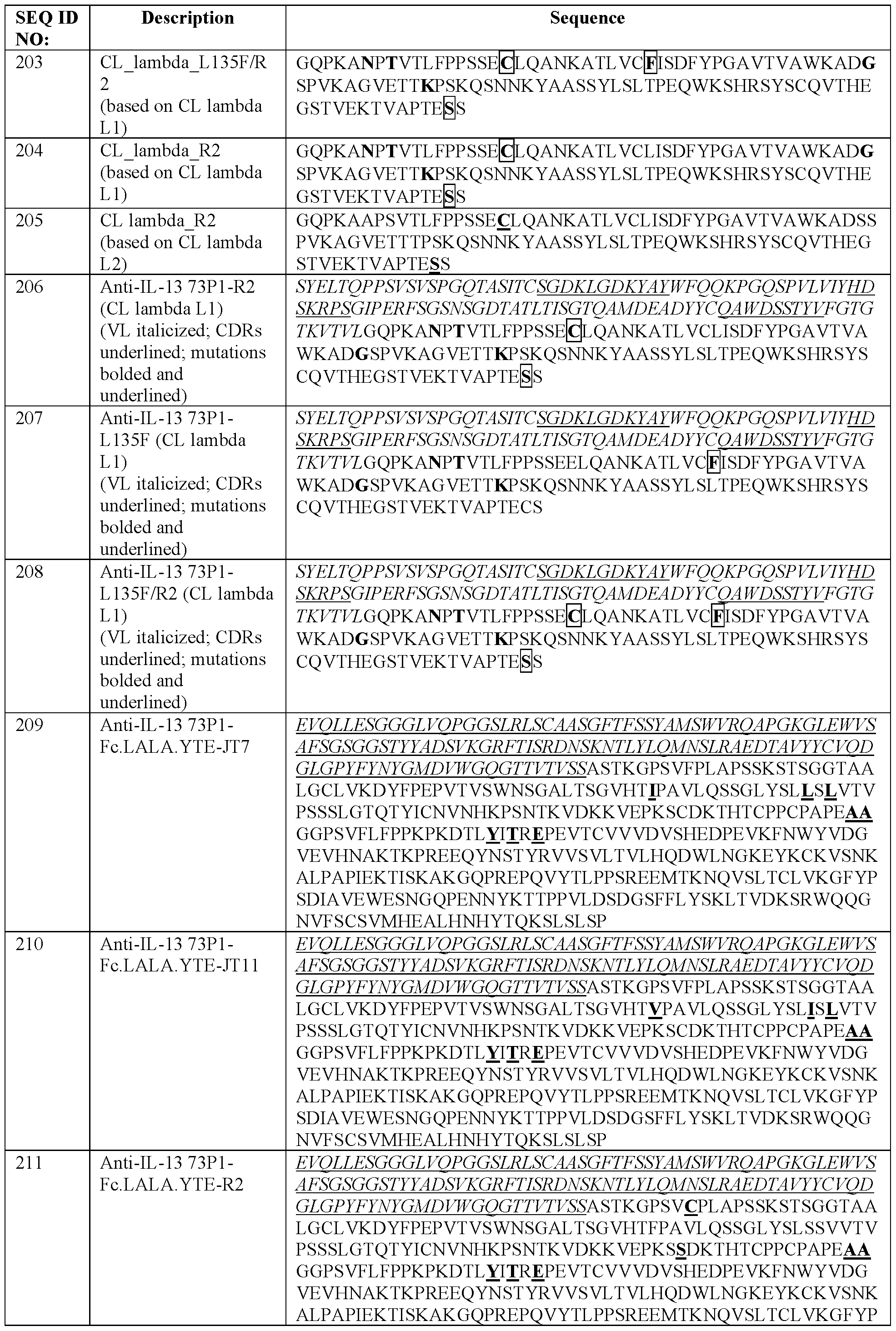


 Table 3. Cynomolgus monkey TSLP binding affinity results for purified recombinant chimeric antibodies.
 Table 8. Binding affinity of anti-IL-13 antibody CDR-H1 variants to cyno IL-13.
 [0495] The anti-IL-13 variant with C34Y CDR-L1 mutation displayed enhanced binding to cyno IL-13. This clone also showed very strong binding to human IL-13 similar to Ref. anti- IL-13 Ab #0 (Table 9). This antibody is referred to hereafter as clone “73P1” and used for later analysis.73P1 mAb comprises a heavy chain comprising the amino acid sequence of SEQ ID NO:101, and a light chain comprising the amino acid sequence of SEQ ID NO:102 or 197.
Table 9. Binding characterization of 73P1 for human and cyno IL-13.
[0495] The anti-IL-13 variant with C34Y CDR-L1 mutation displayed enhanced binding to cyno IL-13. This clone also showed very strong binding to human IL-13 similar to Ref. anti- IL-13 Ab #0 (Table 9). This antibody is referred to hereafter as clone “73P1” and used for later analysis.73P1 mAb comprises a heavy chain comprising the amino acid sequence of SEQ ID NO:101, and a light chain comprising the amino acid sequence of SEQ ID NO:102 or 197.
Table 9. Binding characterization of 73P1 for human and cyno IL-13.