WO2025032555A1 - Bioactive conjugates, preparation method and use thereof - Google Patents
Bioactive conjugates, preparation method and use thereof Download PDFInfo
- Publication number
- WO2025032555A1 WO2025032555A1 PCT/IB2024/057756 IB2024057756W WO2025032555A1 WO 2025032555 A1 WO2025032555 A1 WO 2025032555A1 IB 2024057756 W IB2024057756 W IB 2024057756W WO 2025032555 A1 WO2025032555 A1 WO 2025032555A1
- Authority
- WO
- WIPO (PCT)
- Prior art keywords
- ring
- compound
- formula
- oxy
- mmol
- Prior art date
- Legal status (The legal status is an assumption and is not a legal conclusion. Google has not performed a legal analysis and makes no representation as to the accuracy of the status listed.)
- Pending
Links
Classifications
-
- A—HUMAN NECESSITIES
- A61—MEDICAL OR VETERINARY SCIENCE; HYGIENE
- A61P—SPECIFIC THERAPEUTIC ACTIVITY OF CHEMICAL COMPOUNDS OR MEDICINAL PREPARATIONS
- A61P35/00—Antineoplastic agents
-
- A—HUMAN NECESSITIES
- A61—MEDICAL OR VETERINARY SCIENCE; HYGIENE
- A61K—PREPARATIONS FOR MEDICAL, DENTAL OR TOILETRY PURPOSES
- A61K47/00—Medicinal preparations characterised by the non-active ingredients used, e.g. carriers or inert additives; Targeting or modifying agents chemically bound to the active ingredient
- A61K47/50—Medicinal preparations characterised by the non-active ingredients used, e.g. carriers or inert additives; Targeting or modifying agents chemically bound to the active ingredient the non-active ingredient being chemically bound to the active ingredient, e.g. polymer-drug conjugates
- A61K47/51—Medicinal preparations characterised by the non-active ingredients used, e.g. carriers or inert additives; Targeting or modifying agents chemically bound to the active ingredient the non-active ingredient being chemically bound to the active ingredient, e.g. polymer-drug conjugates the non-active ingredient being a modifying agent
- A61K47/68—Medicinal preparations characterised by the non-active ingredients used, e.g. carriers or inert additives; Targeting or modifying agents chemically bound to the active ingredient the non-active ingredient being chemically bound to the active ingredient, e.g. polymer-drug conjugates the non-active ingredient being a modifying agent the modifying agent being an antibody, an immunoglobulin or a fragment thereof, e.g. an Fc-fragment
- A61K47/6801—Drug-antibody or immunoglobulin conjugates defined by the pharmacologically or therapeutically active agent
- A61K47/6803—Drugs conjugated to an antibody or immunoglobulin, e.g. cisplatin-antibody conjugates
- A61K47/68035—Drugs conjugated to an antibody or immunoglobulin, e.g. cisplatin-antibody conjugates the drug being a pyrrolobenzodiazepine
-
- A—HUMAN NECESSITIES
- A61—MEDICAL OR VETERINARY SCIENCE; HYGIENE
- A61K—PREPARATIONS FOR MEDICAL, DENTAL OR TOILETRY PURPOSES
- A61K47/00—Medicinal preparations characterised by the non-active ingredients used, e.g. carriers or inert additives; Targeting or modifying agents chemically bound to the active ingredient
- A61K47/50—Medicinal preparations characterised by the non-active ingredients used, e.g. carriers or inert additives; Targeting or modifying agents chemically bound to the active ingredient the non-active ingredient being chemically bound to the active ingredient, e.g. polymer-drug conjugates
- A61K47/51—Medicinal preparations characterised by the non-active ingredients used, e.g. carriers or inert additives; Targeting or modifying agents chemically bound to the active ingredient the non-active ingredient being chemically bound to the active ingredient, e.g. polymer-drug conjugates the non-active ingredient being a modifying agent
- A61K47/68—Medicinal preparations characterised by the non-active ingredients used, e.g. carriers or inert additives; Targeting or modifying agents chemically bound to the active ingredient the non-active ingredient being chemically bound to the active ingredient, e.g. polymer-drug conjugates the non-active ingredient being a modifying agent the modifying agent being an antibody, an immunoglobulin or a fragment thereof, e.g. an Fc-fragment
- A61K47/6835—Medicinal preparations characterised by the non-active ingredients used, e.g. carriers or inert additives; Targeting or modifying agents chemically bound to the active ingredient the non-active ingredient being chemically bound to the active ingredient, e.g. polymer-drug conjugates the non-active ingredient being a modifying agent the modifying agent being an antibody, an immunoglobulin or a fragment thereof, e.g. an Fc-fragment the modifying agent being an antibody or an immunoglobulin bearing at least one antigen-binding site
- A61K47/6849—Medicinal preparations characterised by the non-active ingredients used, e.g. carriers or inert additives; Targeting or modifying agents chemically bound to the active ingredient the non-active ingredient being chemically bound to the active ingredient, e.g. polymer-drug conjugates the non-active ingredient being a modifying agent the modifying agent being an antibody, an immunoglobulin or a fragment thereof, e.g. an Fc-fragment the modifying agent being an antibody or an immunoglobulin bearing at least one antigen-binding site the antibody targeting a receptor, a cell surface antigen or a cell surface determinant
-
- A—HUMAN NECESSITIES
- A61—MEDICAL OR VETERINARY SCIENCE; HYGIENE
- A61P—SPECIFIC THERAPEUTIC ACTIVITY OF CHEMICAL COMPOUNDS OR MEDICINAL PREPARATIONS
- A61P29/00—Non-central analgesic, antipyretic or antiinflammatory agents, e.g. antirheumatic agents; Non-steroidal antiinflammatory drugs [NSAID]
-
- C—CHEMISTRY; METALLURGY
- C07—ORGANIC CHEMISTRY
- C07D—HETEROCYCLIC COMPOUNDS
- C07D519/00—Heterocyclic compounds containing more than one system of two or more relevant hetero rings condensed among themselves or condensed with a common carbocyclic ring system not provided for in groups C07D453/00 or C07D455/00
-
- C—CHEMISTRY; METALLURGY
- C07—ORGANIC CHEMISTRY
- C07D—HETEROCYCLIC COMPOUNDS
- C07D471/00—Heterocyclic compounds containing nitrogen atoms as the only ring hetero atoms in the condensed system, at least one ring being a six-membered ring with one nitrogen atom, not provided for by groups C07D451/00 - C07D463/00
- C07D471/02—Heterocyclic compounds containing nitrogen atoms as the only ring hetero atoms in the condensed system, at least one ring being a six-membered ring with one nitrogen atom, not provided for by groups C07D451/00 - C07D463/00 in which the condensed system contains two hetero rings
- C07D471/04—Ortho-condensed systems
-
- C—CHEMISTRY; METALLURGY
- C07—ORGANIC CHEMISTRY
- C07D—HETEROCYCLIC COMPOUNDS
- C07D487/00—Heterocyclic compounds containing nitrogen atoms as the only ring hetero atoms in the condensed system, not provided for by groups C07D451/00 - C07D477/00
- C07D487/02—Heterocyclic compounds containing nitrogen atoms as the only ring hetero atoms in the condensed system, not provided for by groups C07D451/00 - C07D477/00 in which the condensed system contains two hetero rings
- C07D487/04—Ortho-condensed systems
-
- C—CHEMISTRY; METALLURGY
- C07—ORGANIC CHEMISTRY
- C07D—HETEROCYCLIC COMPOUNDS
- C07D487/00—Heterocyclic compounds containing nitrogen atoms as the only ring hetero atoms in the condensed system, not provided for by groups C07D451/00 - C07D477/00
- C07D487/02—Heterocyclic compounds containing nitrogen atoms as the only ring hetero atoms in the condensed system, not provided for by groups C07D451/00 - C07D477/00 in which the condensed system contains two hetero rings
- C07D487/10—Spiro-condensed systems
Definitions
- BIOACTIVE CONJUGATES, PREPARATION METHOD AND USE THEREOF CROSS REFERENCE TO RELATED APPLICATION [0001]
- This application claims priority to International Application No. PCT/CN2023/112181, filed August 10, 2023, the disclosure of which is hereby incorporated by reference in its entirety.
- FIELD [0002]
- the present disclosure relates to antibody drug conjugate platform compounds comprising pyrrolobenzodiazepine (PBD)-based dimers and antibody drug conjugates (ADCs) comprising the platforms and an antibody, or antigen-binding fragment thereof, as well as uses of the ADC platforms and ADCs.
- SEQUENCE LISTING [0003] This application contains a Sequence Listing, which has been submitted electronically in XML format.
- sibanomicin DC-102
- sibiromycin Leber, et al., J. Am. Chem. Soc., 110, 2992-2993 (1988)
- tomamycin Arima, et al., J. Antibiotics, 25, 437-444 (1972)
- PBDs have the following general structure: [0005] PBDs differ in the number, type, and position of substituents, in both their aromatic A rings and pyrrolo C rings, and in the degree of saturation of the C ring.
- B-ring there is an imine (N ⁇ C), a carbinolamine (NH—CH(OH)), or a carbinolamine methyl ether (NH— CH(OMe)) at the N10-C11 position, which is the electrophilic center responsible for alkylating DNA.
- All of the known natural products have an (S)-configuration at the chiral C11a position which provides them with a right-handed twist when viewed from the C ring towards the A ring.
- the PBD dimers are thought to form sequence-selective DNA lesions such as the palindromic 5′-Pu-GATC-Py-3′ interstrand cross-link (Smellie, M., et al., Biochemistry, 42, 8232- 8239 (2003); Martin, C., et al., Biochemistry, 44, 4135-4147) which is thought to be mainly responsible for their biological activity.
- PBD dimer is SG2000 (SJG-136): (Gregson, S., et al., J. Med. Chem., 44, 737-748 (2001); Alley, M. C., et al., Cancer Research, 64, 6700-6706 (2004); Hartley, J. A., et al., Cancer Research, 64, 6693-6699 (2004)). [0007] Due to the manner in which these highly potent compounds act to cross-link DNA, previous PBD dimers have been made symmetrically, i.e., both monomers of the dimer are the same.
- ADCs Antibody-drug conjugates
- ADCs include antibodies operably linked to a biologically active small molecule, also known as a toxin or payload.
- ADCs deliver a potent payload selectively to target-expressing cells, leading to a potential reduction of off-target side effects and/or toxicity and improved therapeutic efficacy.
- the lipophilic nature of many payloads can adversely affect the properties of the ADC to the extent that the payloads are not efficiently delivered to the target cells.
- each of ring A and ring B is, independently, one of formula (IIa), (IIb), (IIc), (IId), (IIe), (IIf), or (IIg): wherein: each ring C is independently a cyclopropyl ring or a cyclobutyl ring; each R 1 is independently H, OH, C 1-4 alkyl, C 1-4 alkoxyl, or -O-(CH 2 CH 2 O) t1 -CH 3; each R 2 is independently H or C 1-4 alkyl; each R 3 and R 4 is, independently, H, NR a1 R b1 , OH, C 1-4 alkyl, C 1-4 alkoxyl, or aryl
- each of ring A and ring B is, independently, one of formula (IIa), (IIb), (IIc), (IId), (IIe), (IIf), or (IIg): wherein: each ring C is independently a cyclopropyl ring or a cyclobutyl ring; each R 1 is independently H, OH, C 1-4 alkyl, C 1-4 alkoxyl, or -O-(CH 2 CH 2 O) t1 -CH 3 ; each R 2 is independently H or C 1-4 alkyl; each R 3 and R 4 is, independently, H, NR a1 R b1 , OH, C 1-4 alkyl, C 1-4 alkoxyl, or aryl; each R a1 and R b1 is,
- Figures 1A and 1B are line graphs showing killing of NOMO-1 (1A) and K562 (1B) cells by the indicated conjugates.
- Figures 2A and 2B are line graphs showing killing of NOMO-1 (2A) and K562 (2B) cells by the indicated conjugates.
- Figures 3A and 3B are line graphs showing killing of NOMO-1 (3A) and K562 (3B) cells by the indicated conjugates.
- Figures 4A and 4B are line graphs showing killing of NOMO-1 (4A) and K562 (4B) cells by the indicated conjugates.
- the conjugates include a ⁇ -glucuronide-based linker comprising a site that can be cleaved by an enzyme having ⁇ -glucuronidase activity
- a ⁇ -glucuronide-based linker comprising a site that can be cleaved by an enzyme having ⁇ -glucuronidase activity
- antibody herein is used in the broadest sense and specifically covers intact monoclonal antibodies, polyclonal antibodies, monospecific antibodies, multispecific antibodies (e.g., bispecific antibodies), and antibody fragments that exhibit the desired biological activity.
- An intact antibody has primarily two regions: a variable region and a constant region.
- the variable region binds to and interacts with a target antigen.
- the variable region includes a complementary determining region (CDR) that recognizes and binds to a specific binding site on a particular antigen.
- CDR complementary determining region
- the constant region may be recognized by and interact with the immune system (see, e.g., Janeway et al., 2001, Immuno. Biology, 5 th Ed., Garland Publishing, New York).
- An antibody can be of any type (e.g., IgG, IgE, IgM, IgD, and IgA), class (e.g., IgG1, IgG2, IgG3, IgG4, IgA1, and IgA2) or subclass.
- the antibody can be derived from any suitable species. In some embodiments, the antibody is of human or murine origin.
- An antibody can be, for example, human, humanized, or chimeric.
- the term “humanized” or “humanized antibody” means forms of antibodies that contain sequences from non-human (e.g., murine) antibodies as well as human antibodies. Such antibodies contain minimal sequence derived from non-human immunoglobulin.
- the humanized antibody will comprise substantially all of at least one, and typically two, variable domains, in which all or substantially all of the hypervariable loops correspond to those of a non-human immunoglobulin and all or substantially all of the FR regions are those of a human immunoglobulin sequence.
- the humanized antibody optionally also will comprise at least a portion of an immunoglobulin constant region (Fc), typically that of a human immunoglobulin.
- Fc immunoglobulin constant region
- the humanized forms of rodent antibodies will generally comprise the same CDR sequences of the parental rodent antibodies, although certain amino acid substitutions can be included to increase affinity, increase stability of the humanized antibody, remove a post-translational modification or for other reasons [0026]
- the term “monoclonal antibody” as used herein refers to an antibody obtained from a population of substantially homogeneous antibodies, i.e., the individual antibodies comprising the population are identical except for possible naturally occurring mutations that may be present in minor amounts. Monoclonal antibodies are highly specific, being directed against a single antigenic site. The modifier “monoclonal” is not to be construed as requiring production of the antibody by any particular method.
- an “intact antibody” is one that comprises an antigen-binding variable region as well as a light chain constant domain (CL) and heavy chain constant domains, CH1, CH 2 , CH3, and CH4, as appropriate for the antibody class.
- the constant domains may be native sequence constant domains (e.g., human native sequence constant domains) or amino acid sequence variant thereof.
- An “antibody fragment” comprises a portion of an intact antibody, comprising the antigen- binding or variable region thereof.
- antibody fragments include Fab, Fab’, F(ab’) 2 , and Fv fragments, diabodies, triabodies, tetrabodies, linear antibodies, single-chain antibody molecules, scFv, scFv-Fc, multispecific antibody fragments formed from antibody fragment(s), a fragment(s) produced by a Fab expression library, or an epitope-binding fragment of any of the above which immunospecifically binds to a target antigen (e.g., a cancer cell antigen, a viral antigen or a microbial antigen).
- a target antigen e.g., a cancer cell antigen, a viral antigen or a microbial antigen.
- An “antigen” is an entity to which an antibody specifically binds.
- the terms “specific binding” and “specifically binds” mean that the antibody or antibody derivative will bind, in a highly selective manner, to its corresponding target antigen and not with the multitude of other antigens.
- the antibody or antibody derivative binds with an affinity of at least about 1 ⁇ 10 -7 M, 10 -8 M, 10 -9 M, 10 -10 M, 10 -11 M, or 10 -12 M and binds to the predetermined antigen with an affinity that is at least two-fold greater than its affinity for binding to a non-specific antigen (e.g., BSA, casein) other than the predetermined antigen or a closely related antigen.
- a non-specific antigen e.g., BSA, casein
- the term “inhibit” or “inhibition of” means to reduce by a measurable amount, or to prevent entirely.
- the term “therapeutically effective amount” refers to an amount of a drug effective to treat a disease or disorder in a mammal. In the case of cancer, the therapeutically effective amount of a drug may reduce the number of cancer cells; reduce the tumor size; inhibit (i.e., slow to some extent or stop) cancer cell infiltration into peripheral organs; inhibit (i.e., slow to some extent or stop) tumor metastasis; inhibit, to some extent, tumor growth; and/or relieve to some extent one or more of the symptoms associated with the cancer.
- the drug may inhibit growth and/or kill existing cancer cells, it may be cytostatic and/or cytotoxic.
- efficacy can, for example, be measured by assessing the time to disease progression (TTP) and/or determining the response rate (RR).
- TTP time to disease progression
- RR response rate
- the term “substantial” or “substantially” refers to a majority, i.e. >50% of a population, of a mixture or a sample, preferably more than 50%, 55%, 60%, 65%, 70%, 75%, 80%, 85%, 90%, 91%, 92%, 93%, 94%, 95%, 96%, 97%, 98%, or 99% of a population.
- intracellularly cleaved and “intracellular cleavage” refer to a metabolic process or reaction inside a cell on a ligand drug conjugate (e.g., an antibody drug conjugate (ADC)), whereby the covalent attachment, e.g., the linker, between the drug moiety (D) and the ligand unit (e.g., an antibody (BA or Ab)) is broken, resulting in the free drug, or another metabolite of the conjugate dissociated from the antibody inside the cell.
- ADC antibody drug conjugate
- cytotoxic activity refers to a cell-killing, a cytostatic or an anti-proliferative effect of a drug-linker-ligand conjugate compound or an intracellular metabolite of a drug-linker- ligand conjugate. Cytotoxic activity may be expressed as the IC50 value, which is the concentration (molar or mass) per unit volume at which half the cells survive.
- cytotoxic agent refers to a substance that inhibits the function of cells and/or causes destruction of cells.
- the term is intended to include radioactive isotopes (e.g., 211At, 131I, 125I, 90Y, 186Re, 188Re, 153Sm, 212Bi, 32P, 60C, and radioactive isotopes of Lu), chemotherapeutic agents, and toxins such as small molecule toxins or enzymatically active toxins of bacterial, fungal, plant, or animal origin, including synthetic analogs and derivatives thereof.
- the terms “cancer” and “cancerous” refer to or describe the physiological condition or disorder in mammals that is typically characterized by unregulated cell growth.
- a “tumor” comprises one or more cancerous cells.
- an “autoimmune disease” herein is a disease or disorder arising from and directed against an individual’s own tissues or proteins.
- a “patient” or “subject” include, but are not limited to, mammals such as a human, rat, mouse, guinea pig, monkey, pig, goat, cow, horse, dog, or cat, and birds or fowl. In an embodiment, the patient is a human.
- beneficial or desired clinical results include, but are not limited to, alleviation of symptoms, diminishment of extent of disease, stabilized (i.e., not worsening) state of disease, delay or slowing of disease progression, amelioration or palliation of the disease state, and remission (whether partial or total), whether detectable or undetectable.
- Treatment can also mean prolonging survival as compared to expected survival if not receiving treatment.
- Those in need of treatment include those already with the condition or disorder as well as those prone to have the condition or disorder.
- the term “treating” includes any or all of inhibiting growth of tumor cells, cancer cells, or of a tumor, inhibiting replication of tumor cells or cancer cells, lessening of overall tumor burden or decreasing the number of cancerous cells, and ameliorating one or more symptoms associated with the disease.
- the term “treating” includes any or all of inhibiting replication of cells associated with an autoimmune disease state including, but not limited to, cells that produce an autoimmune antibody, lessening the autoimmune-antibody burden, and ameliorating one or more symptoms of an autoimmune disease.
- the indefinite articles “a” and “an” and the definite article “the” include the plural as well as single referents, unless the context clearly indicates otherwise.
- the terms “about” and “approximately,” when used in connection with amounts, or weight percentage of ingredients of a composition mean an amount or weight percent that is recognized by one of ordinary skill in the art to provide a pharmacological effect equivalent to that obtained from the specified amount or weight percent.
- the terms “about” and “approximately,” when used in connection with a numeric value or range of values that is provided to characterize a particular solid form e.g., a specific temperature or temperature range, such as, for example, that describes a melting, dehydration, desolvation, or glass transition temperature; a mass change, such as, for example, a mass change as a function of temperature or humidity; a solvent or water content, in terms of, for example, mass or a percentage; or a peak position, such as, for example, in analysis by, for example, IR or Raman spectroscopy or XRPD; indicate that the value or range of values may deviate to an extent deemed reasonable to one of ordinary skill in the art while still
- Techniques for characterizing crystal forms and amorphous solids include, but are not limited to, thermal gravimetric analysis (TGA), differential scanning calorimetry (DSC), X-ray powder diffractometry (XRPD), single-crystal X-ray diffractometry, vibrational spectroscopy, e.g., infrared (IR) and Raman spectroscopy, solid-state and solution nuclear magnetic resonance (NMR) spectroscopy, optical microscopy, hot stage optical microscopy, scanning electron microscopy (SEM), electron crystallography and quantitative analysis, particle size analysis (PSA), surface area analysis, solubility studies, and dissolution studies.
- TGA thermal gravimetric analysis
- DSC differential scanning calorimetry
- XRPD X-ray powder diffractometry
- IR infrared
- Raman spectroscopy solid-state and solution nuclear magnetic resonance (NMR) spectroscopy
- optical microscopy hot stage optical microscopy
- SEM scanning electron microscopy
- the terms “about” and “approximately,” when used in this context, indicate that the numeric value or range of values may vary within 30%, 20%, 15%, 10%, 9%, 8%, 7%, 6%, 5%, 4%, 3%, 2%, 1.5%, 1%, 0.5%, or 0.25% of the recited value or range of values.
- the value of an XRPD peak position may vary by up to ⁇ 0.2o 2 ⁇ while still describing the particular XRPD peak.
- the term “inclusive,” when used in reference to range includes the endpoints of the range. For example, if n is an integer from 0 to 4, n may be any of 0, 1, 2, 3, or 4.
- alkyl group is a saturated, partially saturated, or unsaturated straight chain or branched non-cyclic hydrocarbon having from 1 to 10 carbon atoms, typically from 1 to 8 carbons or, in some embodiments, from 1 to 6, 1 to 4, or 2 to 6 carbon atoms.
- Representative alkyl groups include -methyl, -ethyl, -n-propyl, -n-butyl, -n-pentyl, and n-hexyl; saturated branched alkyls include -isopropyl, -sec-butyl, -isobutyl, -tert-butyl, -isopentyl, 2-methylpentyl, 3-methylpentyl, 4-methylpentyl, 2,3-dimethylbutyl and the like.
- An alkyl group can be substituted or unsubstituted.
- alkyl groups described herein when they are said to be “substituted,” they may be substituted with any substituent or substituents as those found in the compounds and embodiments disclosed herein, as well as halogen (chloro, iodo, bromo, or fluoro); hydroxyl; alkoxy; alkoxyalkyl; amino; alkylamino; carboxy; nitro; cyano; thiol; thioether; imine; imide; amidine; guanidine; enamine; aminocarbonyl; acylamino; phosphonato; phosphine; thiocarbonyl; sulfonyl; sulfone; sulfonamide; ketone; aldehyde; ester; urea; urethane; oxime; hydroxyl amine; alkoxyamine; aralkoxyamine; N-oxide; hydrazine; hydrazide; hydrazone;
- An “alkenyl” group is a straight chain or branched non-cyclic hydrocarbon having from 2 to 10 carbon atoms, typically from 2 to 8 carbon atoms, and including at least one carbon-carbon double bond.
- Representative straight chain and branched (C 2 -C 8 )alkenyls include -vinyl, -allyl, - 1-butenyl, -2-butenyl, -isobutylenyl, -1-pentenyl, -2-pentenyl, -3-methyl-1-butenyl, -2-methyl-2- butenyl, -2,3-dimethyl-2-butenyl, -1-hexenyl, 2-hexenyl, -3-hexenyl, -1-heptenyl, -2-heptenyl, -3- heptenyl, -1-octenyl, -2-octenyl, 3-octenyl and the like.
- a “cycloalkyl” group is a saturated or a partially saturated cyclic alkyl group of from 3 to 10 carbon atoms having a single cyclic ring or multiple condensed or bridged rings which can be optionally substituted with from 1 to 3 alkyl groups.
- the cycloalkyl group has 3 to 8 ring members, whereas in other embodiments the number of ring carbon atoms ranges from 3 to 5, 3 to 6, or 3 to 7.
- Such cycloalkyl groups include, by way of example, single ring structures such as cyclopropyl, cyclobutyl, cyclopentyl, cyclohexyl, cycloheptyl, cyclooctyl, 1- methylcyclopropyl, 2-methylcyclopentyl, 2-methylcyclooctyl, and the like, or multiple or bridged ring structures such as adamantyl and the like.
- Examples of unsaturated cycloalkyl groups include cyclohexenyl, cyclopentenyl, cyclohexadienyl, butadienyl, pentadienyl, and hexadienyl, among others.
- aryl group can be substituted or unsubstituted.
- aryl groups also includes groups containing fused rings, such as fused aromatic-aliphatic ring systems (e.g., indanyl, tetrahydronaphthyl, and the like).
- An “arylene” group is a bivalent aryl group as defined herein.
- a “heteroaryl” group is an aryl ring system having one to four heteroatoms as ring atoms in a heteroaromatic ring system, wherein the remainder of the atoms are carbon atoms.
- Non- limiting examples include, but are not limited to, groups such as pyrrolyl, pyrazolyl, imidazolyl, triazolyl, tetrazolyl, oxazolyl, isoxazolyl, thiazolyl, pyrrolyl, pyridyl, pyridazinyl, pyrimidinyl, pyrazinyl, thiophenyl, benzothiophenyl, furanyl, benzofuranyl (for example, isobenzofuran-1,3- diimine), indolyl, azaindolyl (for example, pyrrolopyridyl or 1H-pyrrolo[2,3-b]pyridyl), indazolyl, benzimidazolyl (for example, 1H-benzo[d]imidazolyl), imidazopyridyl (for example, azabenzimidazolyl, 3H-imidazo[4,5-b]pyr
- a “heteroarylene” group is a bivalent heteroaryl group as defined herein.
- a “heterocyclyl” is an aromatic (also referred to as heteroaryl) or non-aromatic cycloalkyl in which one to four of the ring carbon atoms are independently replaced with a heteroatom from the group consisting of O, S and N.
- heterocyclyl groups include 3 to 10 ring members, whereas other such groups have 3 to 5, 3 to 6, or 3 to 8 ring members.
- Heterocyclyls can also be bonded to other groups at any ring atom (i.e., at any carbon atom or heteroatom of the heterocyclic ring).
- heterocyclyl group can be substituted or unsubstituted.
- Heterocyclyl groups encompass unsaturated, partially saturated, and saturated ring systems, such as, for example, imidazolyl, imidazolinyl, and imidazolidinyl groups.
- the term “heterocyclyl” includes fused ring species, including those comprising fused aromatic and non-aromatic groups, such as, for example, benzotriazolyl, 2,3-dihydrobenzo[l,4]dioxinyl, and benzo[l,3]dioxolyl.
- the term also includes bridged polycyclic ring systems containing a heteroatom such as, but not limited to, quinuclidyl.
- heterocyclyl group examples include, but are not limited to, aziridinyl, azetidinyl, pyrrolidyl, imidazolidinyl, pyrazolidinyl, thiazolidinyl, tetrahydrothiophenyl, tetrahydrofuranyl, dioxolyl, furanyl, thiophenyl, pyrrolyl, pyrrolinyl, imidazolyl, imidazolinyl, pyrazolyl, pyrazolinyl, triazolyl, tetrazolyl, oxazolyl, isoxazolyl, thiazolyl, thiazolinyl, isothiazolyl, thiadiazolyl, oxadiazolyl, piperidyl, piperazinyl, morpholinyl, thiomorpholinyl, tetrahydropyranyl (for example, tetrahydro-2H
- substituted heterocyclyl groups may be mono-substituted or substituted more than once, such as, but not limited to, pyridyl or morpholinyl groups, which are 2-, 3-, 4-, 5-, or 6-substituted, or disubstituted with various substituents such as those listed below
- a “cycloalkylalkyl” group is a radical of the formula -alkyl-cycloalkyl, wherein alkyl and cycloalkyl are defined above.
- Substituted cycloalkylalkyl groups may be substituted at the alkyl, the cycloalkyl, or both the alkyl and the cycloalkyl portions of the group.
- Representative cycloalkylalkyl groups include but are not limited to cyclopentylmethyl, cyclopentylethyl, cyclohexylmethyl, cyclohexylethyl, and cyclohexylpropyl.
- Representative substituted cycloalkylalkyl groups may be mono-substituted or substituted more than once.
- An “aralkyl” group is a radical of the formula -alkyl-aryl, wherein alkyl and aryl are defined above. Substituted aralkyl groups may be substituted at the alkyl, the aryl, or both the alkyl and the aryl portions of the group.
- aralkyl groups include, but are not limited to, benzyl and phenethyl groups and fused (cycloalkylaryl)alkyl groups such as 4-ethyl-indanyl.
- a “heterocyclylalkyl” group is a radical of the formula -alkyl-heterocyclyl, wherein alkyl and heterocyclyl are defined above. Substituted heterocyclylalkyl groups may be substituted at the alkyl, the heterocyclyl, or both the alkyl and the heterocyclyl portions of the group.
- heterocyclylalkyl groups include, but are not limited to, 4-ethyl-morpholinyl, 4- propylmorpholinyl, furan-2-yl methyl, furan-3-yl methyl, pyrdine-3-yl methyl, (tetrahydro-2H- pyran-4-yl)methyl, (tetrahydro-2H-pyran-4-yl)ethyl, tetrahydrofuran-2-yl methyl, tetrahydrofuran-2-yl ethyl, and indol-2-yl propyl.
- a “halogen” is chloro, iodo, bromo, or fluoro.
- a “hydroxyalkyl” group is an alkyl group as described above substituted with one or more hydroxy groups.
- An “alkoxy” group is O(alkyl), wherein alkyl is defined above.
- An “alkoxyalkyl” group is (alkyl)O(alkyl), wherein alkyl is defined above.
- alkynyl refers to a monovalent hydrocarbon radical moiety containing at least two carbon atoms and one or more carbon-carbon triple bonds. Alkynyl is optionally substituted and can be linear, branched, or cyclic.
- Alkynyl includes, but is not limited to, those radicals having 2-20 carbon atoms, i.e., C 2-20 alkynyl; 2-12 carbon atoms, i.e., C 2-12 alkynyl; 2-8 carbon atoms, i.e., C 2-8 alkynyl; 2-6 carbon atoms, i.e., C 2-6 alkynyl; and 2-4 carbon atoms, i.e., C 2-4 alkynyl.
- alkynyl moieties include, but are not limited to ethynyl, propynyl, and butynyl.
- haloalkyl refers to alkyl, as defined above, wherein the alkyl includes at least one substituent selected from a halogen, for example, fluorine (F), chlorine (Cl), bromine (Br), or iodine (I).
- haloalkyl include, but are not limited to, -CF 3 , -CH 2 CF 3 , –CCl 2 F, and –CCl 3 .
- haloalkoxy refers to alkoxy, as defined above, wherein the alkoxy includes at least one substituent selected from a halogen, e.g., F, Cl, Br, or I.
- arylalkyl refers to a monovalent moiety that is a radical of an alkyl compound, wherein the alkyl compound is substituted with an aromatic substituent, i.e., the aromatic compound includes a single bond to an alkyl group and wherein the radical is localized on the alkyl group.
- An arylalkyl group bonds to the illustrated chemical structure via the alkyl group.
- An arylalkyl can be represented by the structure, e.g., B-CH 2 -, B-CH 2 -CH 2 -, B-CH 2 -CH 2 - CH 2 -, B-CH 2 -CH 2 -CH 2 -, B-CH(CH 3 )-CH 2 -CH 2 -, B-CH 2 -CH(CH 3 )-CH 2 -, wherein B is an aromatic moiety, e.g., phenyl.
- Arylalkyl is optionally substituted, i.e., the aryl group and/or the alkyl group, can be substituted as disclosed herein. Examples of arylalkyl include, but are not limited to, benzyl.
- alkylaryl refers to a monovalent moiety that is a radical of an aryl compound, wherein the aryl compound is substituted with an alkyl substituent, i.e., the aryl compound includes a single bond to an alkyl group and wherein the radical is localized on the aryl group.
- An alkylaryl group bonds to the illustrated chemical structure via the aryl group.
- alkylaryl can be represented by the structure, e.g., -B-CH 3 , -B-CH 2 -CH 3 , -B-CH 2 -CH 2 -CH 3 , -B- CH 2 -CH 2 -CH 2 -CH 3 , -B-CH(CH 3 )-CH 2 -CH 3 , -B-CH 2 -CH(CH 3 )-CH 3 , wherein B is an aromatic moiety, e.g., phenyl.
- Alkylaryl is optionally substituted, i.e., the aryl group and/or the alkyl group, can be substituted as disclosed herein. Examples of alkylaryl include, but are not limited to, toluyl.
- aryloxy refers to a monovalent moiety that is a radical of an aromatic compound wherein the ring atoms are carbon atoms and wherein the ring is substituted with an oxygen radical, i.e., the aromatic compound includes a single bond to an oxygen atom and wherein the radical is localized on the oxygen atom, e.g., C 6 H 5 -O-, for phenoxy.
- Aryloxy substituents bond to the compound which they substitute through this oxygen atom. Aryloxy is optionally substituted.
- Aryloxy includes, but is not limited to, those radicals having 6 to 20 ring carbon atoms, i.e., C 6-20 aryloxy; 6 to 15 ring carbon atoms, i.e., C 6-15 aryloxy, and 6 to 10 ring carbon atoms, i.e., C 6-10 aryloxy.
- aryloxy moieties include, but are not limited to phenoxy, naphthoxy, and anthroxy.
- An “amino” group is a radical of the formula NH 2 .
- a “hydroxyl amine” group is a radical of the formula N(R # )OH or NHOH, wherein R # is a substituted or unsubstituted alkyl, cycloalkyl, cycloalkylalkyl, aryl, aralkyl, heterocyclyl or heterocyclylalkyl group as defined herein.
- R # is a substituted or unsubstituted alkyl, cycloalkyl, cycloalkylalkyl, aryl, aralkyl, heterocyclyl or heterocyclylalkyl group as defined herein.
- An “alkoxyamine” group is a radical of the formula -N(R # )O-alkyl or -NHO-alkyl, wherein R # is as defined above.
- An “aralkoxyamine” group is a radical of the formula N(R # )O-aryl or NHOaryl, wherein R # is as defined above.
- An “N-oxide” group is a radical of the formula -N + -O-.
- a “hydrazine” group is a radical of the formula -N(R # )N(R # ) 2 , -NHN(R # ) 2 , -N(R # )NH(R # ) , -N(R # )NH 2 , -NHNH(R # ) 2 , or -NHNH 2 , wherein each R # is independently as defined above.
- An “azide” group is a radical of the formula -N 3 .
- a “cyanate” group is a radical of the formula OCN.
- a “thiocyanate” group is a radical of the formula SCN.
- a “thioether” group is a radical of the formula -S(R # ), wherein R # is as defined above.
- a “sulfonylamino” group is a radical of the formula -NHSO 2 (R # ) or -N(alkyl)SO 2 (R # ), wherein each alkyl and R # are defined above.
- a “phosphine” group is a radical of the formula -P(R # ) 2 , wherein each R # is independently as defined above.
- substituents are those found in the compounds and embodiments disclosed herein, as well as halogen (chloro, iodo, bromo, or fluoro); alkyl; hydroxyl; alkoxy; alkoxyalkyl; amino; alkylamino; carboxy; nitro; cyano; thiol; thioether; imine; imide; amidine; guanidine; enamine; aminocarbonyl; acylamino; phosphonate; phosphine; thiocarbonyl; sulfinyl; sulfone; sulfonamide; ketone; aldehyde; ester; urea; urethane; oxime; hydroxyl amine; alkoxyamine; aralkoxyamine; N- oxide; hydrazine; hydrazide; hydrazone; azide; isocyanate; isothiocyanate; cyanate; thiocyanate; oxygen (chloro,
- the term “pharmaceutically acceptable salt(s)” refers to a salt prepared from a pharmaceutically acceptable non-toxic acid or base including an inorganic acid or base and an organic acid or base.
- the term “solvate” means a compound, or a salt thereof, that further includes a stoichiometric or non-stoichiometric amount of a solvent bound by non-covalent intermolecular forces. In one embodiment, the solvate is a hydrate.
- hydrate means a compound, or a salt thereof, that further includes a stoichiometric or non-stoichiometric amount of water bound by non-covalent intermolecular forces.
- prodrug means a compound derivative that can hydrolyze, oxidize, or otherwise react under biological conditions (in vitro or in vivo) to provide an active compound.
- prodrugs include, but are not limited to, derivatives and metabolites of a compound that include biohydrolyzable moieties such as biohydrolyzable amides, biohydrolyzable esters, biohydrolyzable carbamates, biohydrolyzable carbonates, biohydrolyzable ureides, and biohydrolyzable phosphate analogues.
- biohydrolyzable moieties such as biohydrolyzable amides, biohydrolyzable esters, biohydrolyzable carbamates, biohydrolyzable carbonates, biohydrolyzable ureides, and biohydrolyzable phosphate analogues.
- prodrugs of compounds with carboxyl functional groups are the lower alkyl esters of the carboxylic acid.
- the carboxylate esters may be formed by esterifying any of the carboxylic acid moieties present on the molecule.
- Prodrugs can typically be prepared using well-known methods, such as those described by Burger’s Medicinal Chemistry and Drug Discovery 6 th ed. (Donald J. Abraham ed., 2001, Wiley) and Design and Application of Prodrugs (H. Bundgaard ed., 1985, Harwood Academic Publishers Gmfh).
- the term “stereoisomer” or “stereomerically pure” means one stereoisomer of a compound that is substantially free of other stereoisomers of that compound. For example, a stereomerically pure compound having one chiral center will be substantially free of the opposite enantiomer of the compound.
- a stereomerically pure compound having two chiral centers will be substantially free of other diastereomers of the compound.
- a typical stereomerically pure compound comprises greater than about 80% by weight of one stereoisomer of the compound and less than about 20% by weight of other stereoisomers of the compound, greater than about 90% by weight of one stereoisomer of the compound and less than about 10% by weight of the other stereoisomers of the compound, greater than about 95% by weight of one stereoisomer of the compound and less than about 5% by weight of the other stereoisomers of the compound, or greater than about 97% by weight of one stereoisomer of the compound and less than about 3% by weight of the other stereoisomers of the compound.
- the compounds can have chiral centers and can occur as racemates, individual enantiomers or diastereomers, and mixtures thereof. All such isomeric forms are included within the embodiments disclosed herein, including mixtures thereof. The use of stereomerically pure forms of such compounds, as well as the use of mixtures of those forms, are encompassed by the embodiments disclosed herein. For example, mixtures comprising equal or unequal amounts of the enantiomers of a particular compound may be used in methods and compositions disclosed herein. These isomers may be asymmetrically synthesized or resolved using standard techniques such as chiral columns or chiral resolving agents.
- the compounds can include E and Z isomers, or a mixture thereof, and cis and trans isomers, or a mixture thereof.
- the compounds are isolated as either the cis or trans isomer.
- the compounds are a mixture of the cis and trans isomers.
- “Tautomers” refers to isomeric forms of a compound that are in equilibrium with each other. The concentrations of the isomeric forms will depend on the environment the compound is found in and may be different depending upon, for example, whether the compound is a solid or is in an organic or aqueous solution.
- pyrazoles may exhibit the following isomeric forms, which are referred to as tautomers of each other: [0111] As readily understood by one skilled in the art, a wide variety of functional groups and other structures may exhibit tautomerism and all tautomers of the compounds are within the scope of the present disclosure. [0112] It should also be noted the compounds can contain unnatural proportions of atomic isotopes at one or more of the atoms.
- the compounds may be radiolabeled with radioactive isotopes, such as for example tritium ( 3 H), iodine-125 ( 125 I), sulfur-35 ( 35 S), or carbon- 14 ( 14 C), or may be isotopically enriched, such as with deuterium ( 2 H), carbon-13 ( 13 C), or nitrogen-15 ( 15 N).
- an “isotopologue” is an isotopically enriched compound.
- the term “isotopically enriched” refers to an atom having an isotopic composition other than the natural isotopic composition of that atom.
- “Isotopically enriched” may also refer to a compound containing at least one atom having an isotopic composition other than the natural isotopic composition of that atom.
- isotopic composition refers to the amount of each isotope present for a given atom.
- Radiolabeled and isotopically enriched compounds are useful as therapeutic agents, e.g., cancer and inflammation therapeutic agents, research reagents, e.g., binding assay reagents, and diagnostic agents, e.g., in vivo imaging agents. All isotopic variations of the compounds as described herein, whether radioactive or not, are intended to be encompassed within the scope of the embodiments provided herein.
- isotopologues of the compounds for example, the isotopologues are deuterium, carbon-13, or nitrogen-15 enriched compounds.
- the term “residue” refers to the chemical moiety within a compound that remains after a chemical reaction.
- amino acid residue or “N-alkyl amino acid residue” refers to the product of an amide coupling or peptide coupling of an amino acid or a N-alkyl amino acid to a suitable coupling partner; wherein, for example, a water molecule is expelled after the amide or peptide coupling of the amino acid or the N-alkylamino acid, resulting in the product having the amino acid residue or N-alkyl amino acid residue incorporated therein.
- “sugar” or “sugar group” or “sugar residue” refers to a carbohydrate moiety which may comprise 3-carbon (those) units, 4-carbon (tetrose) units, 5-carbon (pentose) units, 6-carbon (hexose) units, 7-carbon (heptose) units, or combinations thereof, and may be a monosaccharide, a disaccharide, a trisaccharide, a tetrasaccharide, a pentasaccharide, an oligosaccharide, or any other polysaccharide.
- a “sugar” or “sugar group” or “sugar residue” comprises furanoses (e.g., ribofuranose, fructofuranose) or pyranoses (e.g., glucopyranose, galactopyranose), or a combination thereof.
- a “sugar” or “sugar group” or “sugar residue” comprises aldoses or ketoses, or a combination thereof.
- monosaccharides include ribose, deoxyribose, xylose, arabinose, glucose, mannose, galactose, and fructose.
- Non-limiting examples of disaccharides include sucrose, maltose, lactose, lactulose, and trehalose.
- Other “sugars” or “sugar groups” or “sugar residues” include polysaccharides and/or oligosaccharides, including, but not limited to, amylose, amylopectin, glycogen, inulin, and cellulose.
- a “sugar” or “sugar group” or “sugar residue” is an amino-sugar.
- a “sugar” or “sugar group” or “sugar residue” is a glucamine residue (1-amino-1-deoxy-D-glucitol) linked to the rest of molecule via its amino group to form an amide linkage with the rest of the molecule (i.e., a glucamide).
- binding agent refers to any molecule, e.g., antibody, capable of binding with specificity to a given binding partner, e.g., antigen.
- amino acid refers to an organic compound that contains amino (-NH 2 ) and carboxyl (-COOH) functional groups, along with a side chain (R group), which is specific to each amino acid.
- Amino acids may be proteinogenic or non-proteinogenic. By “proteinogenic” is meant that the amino acid is one of the twenty naturally occurring amino acids found in proteins.
- the proteinogenic amino acids include alanine, arginine, asparagine, aspartic acid, cysteine, glutamine, glutamic acid, glycine, histidine, isoleucine, leucine, lysine, methionine, phenylalanine, proline, serine, threonine, tryptophan, tyrosine, and valine.
- non-proteinogenic is meant that either the amino acid is not found naturally in protein or is not directly produced by cellular machinery (e.g., is the product of post-translational modification).
- Non-limiting examples of non-proteinogenic amino acids include gamma-aminobutyric acid (GABA), taurine (2- aminoethanesulfonic acid), theanine (L- ⁇ -glutamylethylamide), hydroxyproline, beta-alanine, ornithine, and citrulline.
- GABA gamma-aminobutyric acid
- taurine (2- aminoethanesulfonic acid
- theanine L- ⁇ -glutamylethylamide
- hydroxyproline beta-alanine
- ornithine citrulline
- peptide in its various grammatical forms, is defined in its broadest sense to refer to a compound of two or more subunit amino acids, amino acid analogs, or other peptidomimetics. The subunits may be linked by peptide bonds or by other bonds, for example, ester, ether, and the like.
- amino acid refers to either natural and/or unnatural, proteinogenic or non-proteinogenic, or synthetic amino acids, including glycine and both the D and L optical isomers, and amino acid analogs and peptidomimetics. If the peptide chain is short, e.g., two, three or more amino acids, it is commonly called an oligopeptide. If the peptide chain is longer, the peptide is typically called a polypeptide or a protein. Full-length proteins, analogs, mutants, and fragments thereof are encompassed by the definition. The terms also include post-expression modifications of the polypeptide, for example, glycosylation, acetylation, phosphorylation, and the like.
- a particular peptide may be obtained as an acidic or basic salt, or in neutral form.
- a peptide may be obtained directly from the source organism or may be recombinantly or synthetically produced.
- the amino acid sequence of an antibody can be numbered using any known numbering schemes, including those described by Kabat et al., (“Kabat” numbering scheme); Al-Lazikani et al., 1997, J. Mol. Biol., 273:927-948 (“Chothia” numbering scheme); MacCallum et al., 1996, J. Mol.
- Biol.262:732-745 (“Contact” numbering scheme); Lefranc et al., Dev. Comp. Immunol., 2003, 27:55-77 (“IMGT” numbering scheme); and Honegge and Pluckthun, J. Mol. Biol., 2001, 309:657-70 (“AHo” numbering scheme).
- IMGT Lefranc et al., Dev. Comp. Immunol., 2003, 27:55-77
- AHo Honegge and Pluckthun, J. Mol. Biol., 2001, 309:657-70
- the numbering scheme used herein is the Kabat numbering scheme. However, selection of a numbering scheme is not intended to imply differences in sequences where they do not exist, and one of skill in the art can readily confirm a sequence position by examining the amino acid sequence of one or more antibodies.
- the “EU numbering scheme” is generally used when referring to a residue in an antibody heavy chain constant region (e.g., as reported in Kabat et al., supra).
- the term “cell-killing activity” refers to the activity that decreases or reduces the cell viability of the tested cell line.
- the platform is a conjugator-linker-payload compound of Formula (I): or a pharmaceutically acceptable salt, tautomer, solvate, stereoisomer, or isotopologue thereof, wherein: each of ring A and ring B is, independently, one of formula (IIa), (IIb), (IIc), (IId), (IIe), (IIf), or (IIg):
- each ring C is independently a cyclopropyl ring or a cyclobutyl ring; each R 1 is independently H, OH, C 1-4 alkyl, C 1-4 alkoxyl, or -O-(CH 2 CH 2 O) t1 -CH 3 ; each R 2 is independently H or C 1-4 alkyl; each R 3 and R 4 is, independently, H, NR a1 R b1 , OH, C 1-4 alkyl, C 1-4 alkoxyl, or aryl; each R a1 and R b1 is, independently, H or C 1-4 alkyl; each R 5 is independently H, C 1-4 alkyl, C 1-4 alkoxyl, or aryl; each m1, n1, and o1 is, independently, 1 or 2; t1 is 1, 2, 3, 4, 5, 6, 7, or 8; * marks the bond where ring A connects to Cleavable1 when s1 is 1 or to -H when s1 is 0, or
- Linker is -(CH 2 ) r or -(CH 2 ) p -X-(CH 2 ) q -; ring A has formula (IIa), (IIb), (IIc), (IId), or (IIg); and ring B has formula (IIa), (IIb), (IId), or (IIg).
- Linker is -(CH 2 ) r -, ring A has formula (IIg), and ring B has formula (IIg).
- Linker is -(CH 2 ) r -, ring A has formula (IId), and ring B has formula (IId). [0126] In some embodiments, Linker is -(CH 2 ) r -, ring A has formula (IIb), and ring B has formula (IIa). [0127] In some embodiments, Linker is -(CH 2 ) r -, ring A has formula (IIa), and ring B has formula (IIb). [0128] In some embodiments, Linker is -(CH 2 ) r -, ring A has formula (IIa), and ring B has formula (IIa).
- Linker is -(CH 2 ) r -, ring A has formula (IIc), and ring B has formula (IIa). [0130] In some embodiments, Linker is -(CH 2 ) p -X-(CH 2 ) q -, ring A has formula (IIa), and ring B has formula (IIa). [0131] In some embodiments, Linker is -(CH 2 ) r -, ring A has formula (IIc), and ring B has formula (IIb). [0132] In some embodiments, r is 3 or 5. [0133] In some embodiments, Linker is -(CH 2 ) r - and r is 5.
- Linker is -(CH 2 ) p -X-(CH 2 ) q -, X is an unsubstituted aryl ring, p is 1, and q is 1. In some embodiments, X is phenylene.
- ring A has formula (IIa)
- m in ring A is 1
- ring B has formula (IIa), (IIb), (IIc), (IId), (IIe), (IIf), or (IIg).
- Linker is –(CH 2 ) r -.
- Linker is –(CH 2 ) p -O-(CH 2 ) q - or –(CH 2 ) p -NH-(CH 2 ) q -.
- each Su is independently or , or a stereoisomer thereof. [0155] In some embodiments, each Su is . [0156] In some embodiments, s1 is 1. [0157] In alternative embodiments, Cleavable1 has formula (VIa), (VIb), (VIc), (VId), (VIe), (VIf), (VIg), (VIh), or (VIi): [0158] In some embodiments, Cleavable1 has formula (VIa). [0159] In some embodiments, Cleavable1 [0160] In some embodiments, s1 is 0.
- ring A when s1 is 0, ring A has formula (IIa’), (IIb’), (IIc’), (IId’), (IIe’), (IIf’), or (IIg’): wherein R 10 is, independently, H, OH, or C 1-4 alkyl, and the other variables (R 1 , R 2 , R 3 , R 4 , R 5 , m1, n1, o1) are as defined above with respect to Aspect 1.
- Cleavable2 has formula (VIIa1), (VIIb1), (VIIc1), (VIId1), (VIIe1), (VIIf1), (VIIa2), (VIIb2), (VIIc2), (VIId2), (VIIe2), (VIIf2), (VIIa3), (VIIb3), (VIIc3), (VIId3), (VIIe3), or (VIIf3):
- s1 is 1 and Cleavable2 has one of the following formulas:
- s1 is 1 and Cleavable2 has formula (VIIa1) or (VIId1). [0164] In some embodiments, Cleavable2 has formula (VIIa1) or (VIId1). [0165] In some embodiments, each R 9 is hydrogen. [0166] In some embodiments, Cleavable2 is [0167] In some embodiments, Spacer is ### -NH-(CH 2 CH 2 O) m2 -CH 2 CH 2 -C( ⁇ O)- or ### -NH-(CH 2 CH 2 O) m2 -CH 2 -C( ⁇ O)-.
- Spacer is ### -NH-(CH 2 CH 2 O) 4 -CH 2 CH 2 -C( ⁇ O)- or ### -NH-(CH 2 CH 2 O) 4 -CH 2 -C( ⁇ O)-.
- Spacer is ### -NH-(CH 2 CH 2 O) 4 -CH 2 CH 2 -C( ⁇ O)-.
- Conjugator has formula (III).
- U2 is arylene.
- U2 is phenylene.
- V2 is a bond.
- the platform is a conjugator-linker-payload compound of Formula (IA): or a pharmaceutically acceptable salt, tautomer, solvate, stereoisomer, or isotopologue thereof, wherein: each of ring A and ring B is, independently, one of formula (IIa), (IIb), (IIc), (IId), (IIe), (IIf), or (IIg): wherein: each ring C is independently a cyclopropyl ring or a cyclobutyl ring; each R 1 is independently H, OH, C 1-4 alkyl, C 1-4 alkoxyl, or -O-(CH 2 CH 2 O) t1 -CH 3 ; each R 2 is independently H or C 1-4 alkyl; each R 3 and R 4 is, independently, H, NR a1 R b1 , OH, C 1-4 alkyl, C 1-4 alkoxyl, or aryl;
- Linker is -(CH 2 ) r or -(CH 2 ) p -X-(CH 2 ) q -, ring A has formula (IIa), (IIb), (IIc), (IId), or (IIg), and ring B has formula (IIa), (IIb), (IId), or (IIg).
- Linker is -(CH 2 ) r -, ring A has formula (IIg), and ring B has formula (IIg).
- Linker is -(CH 2 ) r -, ring A has formula (IId), and ring B has formula (IId). [0211] In some embodiments, Linker is -(CH 2 ) r -, ring A has formula (IIb), and ring B has formula (IIa). [0212] In some embodiments, Linker is -(CH 2 ) r -, ring A has formula (IIa), and ring B has formula (IIb). [0213] In some embodiments, Linker is -(CH 2 ) r -, ring A has formula (IIa), and ring B has formula (IIa).
- Linker is -(CH 2 ) r -, ring A has formula (IIc), and ring B has formula (IIa)
- Linker is -(CH 2 ) p -X-(CH 2 ) q -, ring A has formula (IIa), and ring B has formula (IIa).
- Linker is -(CH 2 ) r -, ring A has formula (IIc), and ring B has formula (IIb).
- r is 3 or 5.
- Linker is -(CH 2 ) r - and r is 5.
- Linker is . [0220] In some embodiments, the sum of p and q is 2. [0221] In some embodiments, Linker is -(CH 2 ) p -X-(CH 2 ) q -, X is an unsubstituted aryl ring, p is 1, and q is 1. In some embodiments, X is phenylene. [0222] In some embodiments, formula (IIa) is (IIa1). [0223] In some embodiments, formula (IId) is (IId1). [0224] In some embodiments, formula (IIg) is (IIg1).
- formula (IIc) is (IIc1), (IIc2), or (IIc3). [0226] In some embodiments, formula (IIc) is (IIc3). [0227] In some embodiments, ring A is , , or . [0228] In some embodiments, ring B is , , , , , , , or .
- ring A has formula (IIa)
- m in ring A is 2
- ring B has formula (IIa), (IIb), (IIc), (IId), (IIe), (IIf), or (IIg).
- each Su is independently , , , or , or a stereoisomer thereof; each m is independently 0 or 1; and indicates a point of attachment to Cleavable1 or Cleavable2.
- each Su is independently or , or a stereoisomer thereof. [0233] In some embodiments, each Su is . [0234] In some embodiments, Cleavable1 is or . [0235] In some embodiments, s1 is 0.
- ring A when s1 is 0, ring A has formula (IIa’), (IIb’), (IIc’), (IId’), (IIe’), (IIf’), or (IIg’): wherein R 10 is, independently, H, OH, or C 1-4 alkyl, and the other variables (R 1 , R 2 , R 3 , R 4 , R 5 , m1, n1, o1) are as defined above with respect to Aspect 2. [0237] In some embodiments, s1 is 1. [0238] In some embodiments, Cleavable1 has formula (VIa).
- Cleavable2 has one of the following formulas: [0240] In some embodiments, Cleavable2 has formula (VIIa1) or (VIId1). [0241] In some embodiments, each R 9 is hydrogen. [0242] In some embodiments, Cleavable2 is or . [0243] In some embodiments, Spacer is ### -NH-(CH 2 CH 2 O) m2 -CH 2 CH 2 -C( ⁇ O)- or # ## -NH-(CH 2 CH 2 O) m2 -CH 2 -C( ⁇ O)-.
- Spacer is ### -NH-(CH 2 CH 2 O)4-CH 2 CH 2 -C( ⁇ O)- or # ## -NH-(CH 2 CH 2 O)4-CH 2 -C( ⁇ O)-.
- Spacer is ### -NH-(CH 2 CH 2 O) 4 -CH 2 CH 2 -C( ⁇ O)-.
- the compound is one of the following:
- ligand-drug conjugates or pharmaceutically acceptable salts or solvates thereof wherein the conjugate comprises a ligand that is conjugated to a compound provided herein via Conjugator or , wherein the conjugate has one of the following formulas: Ligand-[Formula (I)] x or Ligand-[Formula (IA)] x , wherein x is from about 1 to about 12, and wherein Formula (I) is as described above with reference to Aspect 1 and Formula (IA) is as described above with reference to Aspect 2. [0249] In one embodiment, x is from about 1 to about 10. In one embodiment, x is from about 1.5 to about 10.
- x is from about 1.5 to about 8. In one embodiment, x is from about 1.5 to about 6. In one embodiment, x is from about 1.5 to about 4. In one embodiment, x is from about 1.8 to about 4. In one embodiment, x is from about 1.8 to about 2.5. In one embodiment, x is about 2. [0250] In some embodiments, the ligand is a humanized, monoclonal, chimeric, or a human antibody, or an antigen binding fragment thereof. [0251] In some embodiments, the ligand is conjugated to a compound provided herein via the moiety of the compound.
- the conjugate has the following formula wherein Ab is a humanized, monoclonal, chimeric, or human antibody, or an antigen binding fragment thereof, and values for the remaining variables (e.g., Cleavable 1, s1, ring A, Linker, ring B, Cleavable 2, Spacer, RE4, t4) are as described herein.
- the ligand or Ab binds to one or more receptors chosen from B7- H3, cytokeratin 15, PTK7, HER3, HER2, CD7, CD19, CD20, CD22, CD25, CD27, CD30, CD33, CD37, CD38, CD46, CD70, CD71, CD74, CD79b, CD123, CD138, CD142, CD166, CD205, CD228, CCR2, CA6, p-Cadherin, CEA, CEACAM5, C4.4a, DLL3, EGFR, EGFRVIII, ENPP3, EphA2, EphrinA, FLOR1, FGFR2, GCC, cKIT, LIV1, LY6E, MSLN, MUC16, NaPi2b, Nectin4, gpNMB, PSMA, SLITRK6, STEAP1, TROP2, 5T4, SSEA4, GloboH, Gb5, STn, Tn, B7H3, BCMA, MUC1,
- the conjugate is N-(0256]
- Methods of Making the Conjugates are methods of preparing a conjugate by contacting a binding agent (BA) with a conjugator-linker-payload compound (platform) under conditions suitable for forming a bond between the binding agent and the conjugator-linker-payload compound.
- the reaction conditions may be any suitable reaction conditions known in the art.
- the binding agent may be an antibody and the bond may form an antibody-drug conjugate.
- Examples of such reactions are provided in the Examples below.
- methods of making a conjugate including treating or contacting a compound with a binding agent under coupling conditions.
- the compound may include a reactive linker bonded to at least one payload.
- compositions including pharmaceutical compositions, comprising an ADC set forth herein.
- the compositions e.g., pharmaceutical compositions
- the compositions further comprise a pharmaceutically acceptable excipient.
- Pharmaceutical compositions in accordance with the present disclosure can be prepared by mixing an antibody drug conjugate having the desired degree of purity with one or more optional pharmaceutically acceptable carriers (Remington’s Pharmaceutical Sciences 16th edition, Osol, A. Ed. (1980)), in the form of lyophilized formulations or aqueous solutions.
- Pharmaceutically acceptable carriers are generally nontoxic to recipients at the dosages and concentrations employed, and include, but are not limited to, buffers such as phosphate, citrate, and other organic acids; antioxidants including ascorbic acid and methionine; preservatives (such as octadecyl dimethyl benzyl ammonium chloride; hexamethonium chloride; benzalkonium chloride; benzethonium chloride; phenol, butyl or benzyl alcohol; alkyl parabens such as methyl or propyl paraben; catechol; resorcinol; cyclohexanol; 3- pentanol; and m-cresol); low molecular weight (less than about 10 residues) polypeptides; proteins, such as serum albumin, gelatin, or immunoglobulins; hydrophilic polymers such as polyvinylpyrrolidone; amino acids such as glycine, glutamine, asparagine, histidine, arg
- Exemplary pharmaceutically acceptable carriers herein further include interstitial drug dispersion agents such as soluble neutral-active hyaluronidase glycoproteins (sHASEGP), for example, human soluble PH-20 hyaluronidase glycoproteins, such as rHuPH 2 0 (HYLENEX®, Baxter International, Inc.).
- HASEGP soluble neutral-active hyaluronidase glycoproteins
- rHuPH 2 0 HYLENEX®, Baxter International, Inc.
- Certain exemplary sHASEGPs and methods of use, including rHuPH 2 0, are described in US Patent Nos. US 7,871,607 and 2006/0104968.
- a sHASEGP is combined with one or more additional glycosaminoglycanases such as chondroitinases.
- a method of treating a disease or disorder e.g., a proliferative disease, a cancer, a metabolic disease, inflammation, or a neurodegenerative disease
- a subject e.g., patient
- the conjugates disclosed herein can be administered by any suitable means, including parenteral, intrapulmonary, and intranasal, and, if desired for local treatment, intralesional administration.
- Parenteral infusions include intramuscular, intravenous, intraarterial, intraperitoneal, or subcutaneous administration.
- Dosing can be by any suitable route, e.g., by injection, such as intravenous or subcutaneous injection, depending in part on whether the administration is brief or chronic.
- Various dosing schedules including but not limited to, single or multiple administrations over various time-points, bolus administration, and pulse infusion are contemplated herein.
- Conjugates of the disclosure can be formulated, dosed, and administered in a fashion consistent with good medical practice. Factors for consideration in this context include the particular disorder being treated, the particular mammal being treated, the clinical condition of the individual patient, the cause of the disorder, the site of delivery of the agent, the method of administration, the scheduling of administration, and other factors known to medical practitioners.
- Method A Mobile phase A: 0.1% FA in water, B: MeCN; Gradient: 10%B maintain 0.2 min, 10% - 95%B, 5.8 min, 95%B maintain 0.5 min; Flow rate: 0.6 mL/min; Column: ACQUITY UPLC® BEH C181.7 ⁇ m.
- Method B Mobile phase A: 0.1% FA in water, B: MeCN; Gradient: 10%B maintain 0.5 min, 10% - 90%B, 2.5 min, 90%B maintain 0.2 min; Flow rate: 0.6 mL/min; Column: ACQUITY UPLC® BEH C181.7 ⁇ m.
- Method C Mobile phase A: 0.1% FA in water, B: MeCN; Gradient: 10%B maintain 0.2 min, 10% - 90%B, 1.3 min, 90%B maintain 0.3 min; Flow rate: 0.6 mL/min; Column: ACQUITY UPLC® BEH C181.7 ⁇ m.
- Step 1 allyl ((S)-1-(((S)-1-((4-(hydroxymethyl)phenyl)amino)-1-oxopropan-2-yl)amino)- 3-methyl-1-oxobutan-2-yl)carbamate (Int-2b) [0271] EEDQ (4.77 g, 19.3 mmol) was added to the solution of Int-2a (5 g, 18.4 mmol) and (4- aminophenyl)methanol (2.37 g, 19.3 mmol) in 100 mL dry THF. The mixture was stirred at r.t. for 40 h. The mixture was concentrated.
- Step 2 (S)-2-amino-N-((S)-1-((4-(hydroxymethyl)phenyl)amino)-1-oxopropan-2-yl)-3- methylbutanamide (Int-2c)
- Pd(PPh 3 ) 4 (76.6 mg, 0.066 mmol) was added to a solution of Int-2b (500 mg, 1.33 mmol) in CH 2 Cl 2 (10 mL) and pyrrolidine (270.8 ⁇ L, 3.31 mmol) at r.t. under N2. The reaction mixture was allowed to stir for 0.5 h at r.t.
- Step 3 (9H-fluoren-9-yl)methyl ((17S,20S)-21-((4-(hydroxymethyl)phenyl)amino)-17- isopropyl-20-methyl-15,18,21-trioxo-3,6,9,12-tetraoxa-16,19-diazahenicosyl)carbamate (Int-2) [0275] DIEA (326 mg, 2.52 mmol) was added to the solution of Int-2c(370 mg, 1.26 mmol) and HATU (575.8 mg, 1.51 mmol) in 4 mL dry DMF. The mixture was stirred at r.t. for 10 min.
- Step 1 (2S,3R,4S,5S,6S)-2-(2-(1-(9H-fluoren-9-yl)-3-oxo-2,7,10,13,16-pentaoxa-4- azanonadecan-19-amido)-4-(hydroxymethyl)phenoxy)-6-(methoxycarbonyl)tetrahydro-2H-pyran- 3,4,5-triyl triacetate (Int-7) [0277] A mixture of Int-7a (400 mg, 0.88 mmol; purchase from Bide pharm), Int-2d (428 mg, 0.88 mmol; purchase from MCE) and EEDQ (282 mg, 1.14 mmol) in CH 2 Cl 2 (5 mL) was stirred at r.t.
- Step 1 (S)-(3-(hydroxymethyl)-3,4-dihydroisoquinolin-2(1H)-yl)(5-methoxy-2-nitro-4- ((triisopropylsilyl)oxy)phenyl)methanone (Int-9b) [0279] To a mixture of Int-9a (1.0 g, 2.71 mmol), HOPO (452 mg, 4.07 mmol) and CH 2 Cl 2 (15 mL) were added DECI (780 mg, 4.07 mmol). The mixture was stirred at r.t. for 10 min.
- Step 2 (S)-(3-(((tert-butyldimethylsilyl)oxy)methyl)-3,4-dihydroisoquinolin-2(1H)-yl)(5- methoxy-2-nitro-4-((triisopropylsilyl)oxy)phenyl)methanone (Int-9c) [0281] To a solution of Int-9b (1.1 g, 2.14 mmol), imidazole (291 mg, 4.28 mmol) and CH 2 Cl 2 (20 mL) were added dry TBSCl (484 mg, 3.21 mmol). The mixture was stirred at r.t.
- Step 3 (S)-(3-(((tert-butyldimethylsilyl)oxy)methyl)-3,4-dihydroisoquinolin-2(1H)-yl)(4- hydroxy-5-methoxy-2-nitrophenyl)methanone (Int-9d) [0283] To a solution of Int-9c (780 mg, 1.21 mmol), DMF (10 mL) and H 2 O (380 ⁇ L) were added LiOAc (80 mg, 1.21 mmol). The mixture was stirred at 40 oC for 2 h. After the reaction was completed, the mixture was diluted with water (20 mL), extracted with EtOAc (20 mL * 2).
- Step 4 (S)-(3-(((tert-butyldimethylsilyl)oxy)methyl)-3,4-dihydroisoquinolin-2(1H)-yl)(4- ((5-iodopentyl)oxy)-5-methoxy-2-nitrophenyl)methanone (Int-9) [0285] To a solution of Int-9d (594 mg, 1.26 mmol), 1,5-diiodopentane (936 ⁇ L, 6.29 mmol) and DMF (5 mL) were added K 2 CO 3 (523 mg, 3.78 mmol). The mixture stirred at r.t. overnight.
- Step 1 allyl (S)-(2-(6-(((tert-butyldimethylsilyl)oxy)methyl)-5-azaspiro[2.4]heptane-5- carbonyl)-4-methoxy-5-((triisopropylsilyl)oxy)phenyl)carbamate (Int-10b) [0287] To a 0 oC solution of Int-10a (1.0 g, 1.78 mmol, prepared according to the procedures described in CN111164208A) and CH 2 Cl 2 (15 mL) were added pyridine (158 ⁇ L, 1.96 mmol). Then AllocCl (227 ⁇ L, 2.14 mmol) was added to the mixture.
- Step 2 allyl (S)-(2-(6-(((tert-butyldimethylsilyl)oxy)methyl)-5-azaspiro[2.4]heptane-5- carbonyl)-5-hydroxy-4-methoxyphenyl)carbamate (Int-10c) [0289] Compound Int-10c (490 mg, 58.8% yield) was synthesized according to the synthetic procedure of step 3 of example Int-9. MS (ESI) m/z: 491.4 [M+H] + .
- Step 3 allyl (5-((5-(4-((S)-3-(((tert-butyldimethylsilyl)oxy)methyl)-1,2,3,4- tetrahydroisoquinoline-2-carbonyl)-2-methoxy-5-nitrophenoxy)pentyl)oxy)-2-((S)-6-(((tert- butyldimethylsilyl)oxy)methyl)-5-azaspiro[2.4]heptane-5-carbonyl)-4-methoxyphenyl)carbamate (Int-10d) [0291] To a solution of Int-9 (642 mg, 0.961 mmol), Int-10c (471 mg, 0.961 mmol) and DMF (15 mL) were added K 2 CO 3 (398 mg, 2.88 mmol).
- Step 4 allyl (5-((5-(5-amino-4-((S)-3-(((tert-butyldimethylsilyl)oxy)methyl)-1,2,3,4- tetrahydroisoquinoline-2-carbonyl)-2-methoxyphenoxy)pentyl)oxy)-2-((S)-6-(((tert- butyldimethylsilyl)oxy)methyl)-5-azaspiro[2.4]heptane-5-carbonyl)-4-methoxyphenyl)carbamate (Int-10) [0293] A mixed solution of Zn (63 mg, 0.97 mmol), EtOH (2 mL), AcOH (150 ⁇ L) and H 2 O (150 ⁇ L) was stirred at r.t.10 min.
- Step 1 Allyl (S)-(2-(6-(hydroxymethyl)-5-azaspiro[2.4]heptane-5-carbonyl)-4-methoxy-5- ((triisopropylsilyl)oxy)phenyl)carbamate (Int-12a)
- para-Toluenesulfonic acid hydrate (417 mg, 2.19 mmol) was added to a solution of Int 10b (2.36 g, 3.65 mmol) in THF (40 mL) and water (2 mL). The reaction mixture was allowed to stir for 3 h at 22 °C. The mixture was diluted with EtOAc (80 mL), and washed with water and brine.
- Step 2 allyl (S)-7-methoxy-5-oxo-8-((triisopropylsilyl)oxy)-11,11a-dihydro-1H,3H- spiro[benzo[e]pyrrolo[1,2-a][1,4]diazepine-2,1'-cyclopropane]-10(5H)-carboxylate (Int-12b) [0297] DIAD (1.14 mL, 5.75 mmol) was added to a solution of Int-12a (1.53 g, 2.87 mmol) and PPh3 (2.26 g, 8.62 mmol) in THF (30 mL).
- Step 3 allyl (S)-8-hydroxy-7-methoxy-5-oxo-11,11a-dihydro-1H,3H- spiro[benzo[e]pyrrolo[1,2-a][1,4]diazepine-2,1'-cyclopropane]-10(5H)-carboxylate (Int-12) [0299] LiOAc (121 mg, 1.83 mmol) was added to a solution of Int-12b (940 mg, 1.83 mmol) in wet DMF (15 mL, 49/1 DMF/water). The reaction was allowed to proceed for 2 h at 25 °C. The mixture was diluted with EtOAc, washed with H 2 O and brine twice.
- Step 1 allyl (S)-8-((5-(4-((S)-3-(((tert-butyldimethylsilyl)oxy)methyl)-1,2,3,4- tetrahydroisoquinoline-2-carbonyl)-2-methoxy-5-nitrophenoxy)pentyl)oxy)-7-methoxy-5-oxo- 11,11a-dihydro-1H,3H-spiro[benzo[e]pyrrolo[1,2-a][1,4]diazepine-2,1'-cyclopropane]-10(5H)- carboxylate (Int-13b) [0301] Int-12 (450 mg, 1.26 mmol) and K 2 CO 3 (226 mg, 1.63 mmol) were added to a solution of Int-13a (818 mg, 1.32 mmol) in 1 mL DMF.
- Step 2 allyl (S)-8-((5-(5-amino-4-((S)-3-(((tert-butyldimethylsilyl)oxy)methyl)-1,2,3,4- tetrahydroisoquinoline-2-carbonyl)-2-methoxyphenoxy)pentyl)oxy)-7-methoxy-5-oxo-11,11a- dihydro-1H,3H-spiro[benzo[e]pyrrolo[1,2-a][1,4]diazepine-2,1'-cyclopropane]-10(5H)- carboxylate (Int-13) [0303] Zinc powder (2.65 g, 38.3 mmol) was added to a mixture of EtOH (10 mL), water (0.625 mL) and AcOH (0.625 mL) at 0 °C.
- Step 1 allyl (S)-(5-((3-(bromomethyl)benzyl)oxy)-2-(6-(((tert- butyldimethylsilyl)oxy)methyl)-5-azaspiro[2.4]heptane-5-carbonyl)-4-methoxyphenyl)carbamate (Int-17a) [0307] To a mixture of Int-12 (1.20 g, 2.4 mmol) and 1,3-bis(bromomethyl)benzene (3.2 g, 12.2 mmol) in DMF (10 mL) was added K2CO3 (371.8 mg, 2.690 mmol).
- Step 2 tert-butyl (S)-(2-(6-(((tert-butyldimethylsilyl)oxy)methyl)-5-azaspiro[2.4]heptane- 5-carbonyl)-5-hydroxy-4-methoxyphenyl)carbamate Int-17b [0309] A mixture of Int-14b (447 mg, 1.10 mmol) and Boc 2 O (249.1 mg, 1.43 mmol) in CH 2 Cl 2 (5 mL) was stirred at 70 oC for 20 hr.
- Step 3 allyl (5-((3-((5-((tert-butoxycarbonyl)amino)-4-((S)-6-(((tert- butyldimethylsilyl)oxy)methyl)-5-azaspiro[2.4]heptane-5-carbonyl)-2- methoxyphenoxy)methyl)benzyl)oxy)-2-((S)-6-(((tert-butyldimethylsilyl)oxy)methyl)-5- azaspiro[2.4]heptane-5-carbonyl)-4-methoxyphenyl)carbamate (Int-17c) [0312] To a mixture of Int-17b (480 mg, 0.95 mmol) and Int-17a (637 mg, 0.95 mmol) in DMF (10 mL) was added K 2 CO 3 (157 mg.1.14 mmol) was added.
- Step 4 allyl (5-((3-((5-amino-4-((S)-6-(((tert-butyldimethylsilyl)oxy)methyl)-5- azaspiro[2.4]heptane-5-carbonyl)-2-methoxyphenoxy)methyl)benzyl)oxy)-2-((S)-6-(((tert- butyldimethylsilyl)oxy)methyl)-5-azaspiro[2.4]heptane-5-carbonyl)-4-methoxyphenyl)carbamate (Int-17) [0315] To a solution of Int-17c (711 mg, 0.647 mmol) in CH 2 Cl 2 (10 mL) was added TBS-OTf (312 ⁇ L, 359.0 mg, 1.36 mmol) at 0 oC, then stirred at the same temperature for 1 h, followed by addition of 2,6-lutidine (395 ⁇ L, 364 mg, 3.40 mmol).
- Step 1 1-(tert-butyl) 2-methyl (S)-4-methylenepiperidine-1,2-dicarboxylate (Int-18b) [0317] To the solution of MePh 3 PBr (8.26 g, 22.7 mmol) in dry THF (70 mL) was added tBuOK in dry THF (1M, 22.7 mL, 22.7 mmol) under N2 atmosphere at 0 °C, stirred at 0 °C for 1 h. To the reaction solution was added a solution of Int-18a (5.3 g, 20.6 mmol) in dry THF (30 mL) under N 2 atmosphere at 0 °C, stirred for 1 h. Water (50 mL) and sat.
- Step 2 1-benzyl 2-methyl (S)-4-methylenepiperidine-1,2-dicarboxylate (Int-18c) [0320] To the solution of Int-18b (3.7 g, 14.5 mmol) in CH 2 Cl 2 (25 mL) was added 4 M HCl in EtOAc (20 mL) under N 2 atmosphere at 0 °C, stirred at r.t. for 30 min. The solution was concentrated and re-dissolved in CH 2 Cl 2 (100 mL). To the solution were added CbzCl (2.5 mL, 17.4 mmol) and Et3N (4.1 mL, 29.1 mmol) at 0 °C, stirred at r.t. for another 1 h.
- CbzCl 2.5 mL, 17.4 mmol
- Et3N 4.1 mL, 29.1 mmol
- Step 3 6-benzyl 5-methyl (S)-6-azaspiro[2.5]octane-5,6-dicarboxylate (Int-18d) [0323] To the dry CH 2 Cl 2 (70 mL) was added ZnEt 2 (2 M in hexane, 24.7 mL, 49.5 mmol) under N 2 atmosphere at 0 °C, stirred at 0 °C for 10 min. Dry TFA (3.9 mL, 49.5 mmol) was added slowly, stirred at 0 °C for 1 h. Diiodomethane (4.1 mL, 49.5 mmol) was added slowly, stirred at 0 °C for 1 h.
- Step 4 benzyl (S)-5-(hydroxymethyl)-6-azaspiro[2.5]octane-6-carboxylate (Int-18e) [0326] To the solution of Int-18d (2.97 g, 9.79 mmol) in dry THF (50 mL) was added LiBHEt 3 (1 M in THF, 24.5 mL, 24.5 mmol) under N 2 atmosphere at 0 °C, stirred at 0 °C for 2 h. To the solution was added water (2 mL) dropwise, washed with brine (15 mL), extracted with EtOAc (20 mL * 3).
- Step 5 (S)-(6-azaspiro[2.5]octan-5-yl)methanol (Int-18f) [0329] To the solution of Int-18e (2.46 g, 8.95 mmol) in MeOH (40 mL) were added 7 M NH 3 in MeOH (8 mL) and 10% wet Pd/C (246 mg) under N2 atmosphere, stirred under H 2 atmosphere for 3 h. The solution was filtered and concentrated to give Int-18f as a yellow oil (1.3 g, quant.), which was used directly for the next step without further purification. MS (ESI) m/z: 142.1 [M+H] + .
- Step 6 (S)-(4-(benzyloxy)-5-methoxy-2-nitrophenyl)(5-(hydroxymethyl)-6- azaspiro[2.5]octan-6-yl)methanone (Int-18g) [0332] To the solution of 4-(benzyloxy)-5-methoxy-2-nitrobenzoic acid (2.7 g, 8.9 mmol) in CH 2 Cl 2 (50 mL) was added oxalyl chloride (2.3 mL, 26.7 mmol) under N 2 atmosphere at 0 °C, followed by addition of 3 drops of DMF, stirred for 1 h. The turbid solution became clear and no gas eluted.
- Step 7 (S)-(2-amino-4-(benzyloxy)-5-methoxyphenyl)(5-(hydroxymethyl)-6- azaspiro[2.5]octan-6-yl)methanone (Int-18h) [0334] To the solution of Int-18g (500 mg, 1.17 mmol) and imidazole (163 mg, 6.16 mmol) in dry DMF (10 mL) was added TBSCl (216 mg, 1.4 mmol) under N 2 atmosphere at 0 °C, stirred at r.t. for 1 h.
- Step 8 (S)-(2-amino-4-hydroxy-5-methoxyphenyl)(5-(((tert- butyldimethylsilyl)oxy)methyl)-6-azaspiro[2.5]octan-6-yl)methanone (Int-18) [0336] To the solution of Int-18h (440 mg, 0.81 mmol) in MeOH (8 mL) was added 10% Pd/C (44 mg), stirred at H 2 atmosphere for 7 h. The solution was filtered and concentrated to give the title compound Int-18 as a pink solid (342 mg, quant.). MS (ESI) m/z: 421.4 [M+H] + .
- Step 1 (9H-fluoren-9-yl)methyl ((17S,20S)-17-isopropyl-20-methyl-21-((4-((((4- nitrophenoxy)carbonyl)oxy)methyl)phenyl)amino)-15,18,21-trioxo-3,6,9,12-tetraoxa-16,19- diazahenicosyl)carbamate (Int-21) [0339] To a mixture of Int-2 (500 mg, 0.656 mmol), bis(4-nitrophenyl) carbonate (300 mg, 0.981 mmol) and DMF (10 mL) were added DIEA (233 ⁇ L, 1.31 mmol).
- Step 1 methyl 4-(5-(methylthio)-1,2,4-thiadiazol-3-yl)benzoate (Int-23c) [0342] To a solution of compound Int-23a (100 mg, 0.47 mmol) in toluene (4 mL) and H 2 O (1 mL) were added compound Int-23b (109.72 mg, 0.568 mmol), K 2 CO 3 (168 mg, 0.947 mmol) and Pd(dppf)Cl 2 .CH 2 Cl 2 (34.6 mg, 0.047 mmol). The mixture was stirred at 110 oC for 3 h under N2 atmosphere.
- Step 2 4-(5-(methylthio)-1,2,4-thiadiazol-3-yl)benzoic acid (Int-23d) [0344] To a solution of compound Int-23c (54 mg, 0.20 mmol) in MeOH (3 mL) and H 2 O (1 mL) was added LiOH (17 mg, 0.41 mmol). The mixture was stirred at r.t. for 2 h. The mixture was adjusted to pH 7 and purified by prep-HPLC (FA condition) to give compound Int-23d (36 mg, 70.3% yield) as a white solid. MS (ESI) m/z: 253.1 [M+H] + .
- Step 3 4-(5-(methylsulfonyl)-1,2,4-thiadiazol-3-yl)benzoic acid (Int-23) [0346] To a solution of compound Int-23d (35 mg, 0.14 mmol) in CH 2 Cl 2 (3 mL) and THF (3 mL) was added m-CPBA (96 mg, 0.55 mmol). The mixture was stirred at room temperature for 16 h. The mixture was concentrated and purified by prep-HPLC (Method: column:XBridge Prep C18 OBD 5 ⁇ m 19*150 mm; Mobile phase: A-water (0.1% TFA): B-acetonitrile; Flow rate: 20 mL/min).
- Step 1 (9H-fluoren-9-yl)methyl (15-oxo-3,6,9,12-tetraoxa-16-azanonadec-18-yn-1- yl)carbamate (Int-26a) [0351] To a solution of Int-2d (200 mg, 0.41 mmol) in 2 mL DMF was added HATU (312 mg, 0.82 mmol) and DIPEA (224 ⁇ L, 1.23 mmol) at 0°C. The mixture was stirred at 0°C for 10 min. Propargylamine (25 ⁇ L, 0.45 mmol) was added. The mixture was stirred at r.t. for 1 h under a nitrogen atmosphere.
- Step 2 1-amino-N-(prop-2-yn-1-yl)-3,6,9,12-tetraoxapentadecan-15-amide (Int-26) [0353] To a solution of Int-26a (500 mg, 0.95 mmol) in 2 mL DMF was added diethylamine (0.98 mL, 9.5 mmol) at 0°C.
- Step 1 4-((21S,24S)-1-((1R,8S,9s)-bicyclo[6.1.0]non-4-yn-9-yl)-21-isopropyl-24-methyl- 3,19,22-trioxo-2,7,10,13,16-pentaoxa-4,20,23-triazapentacosan-25-amido)benzyl (11S,11aS)-11- hydroxy-7-methoxy-8-((5-(((S)-7-methoxy-2-methyl-5-oxo-5,11a-dihydro-1H- benzo[e]pyrrolo[1,2-a][1,4]diazepin-8-yl)oxy)pentyl)oxy)-2-methyl-5-oxo-11,11a-dihydro-1H- benzo[e]pyrrolo[1,2-a][1,4]diazepine-10(5H)-carboxylate (Ref-2-1
- Ref-2-1a (10 mg, 0.01 mmol) in 0.5 mL DMF was added to the mixture at 0 oC and the reaction was stirred at r.t. for 2 h.
- the mixture was purified by prep-HPLC (Method: column:XBridge Prep C18 OBD 5 ⁇ m 19*150 mm; Mobile phase: A-water (no formic acid): B-acetonitrile; Flow rate: 20 mL/min, the fraction was lyophilized to give Ref-2-1 (2.5 mg, 17.1% yield) as a white solid.
- Step 1 (9H-fluoren-9-yl)methyl tert-butyl (5-((5-(5-((((4-((21S,24S)-1-(9H-fluoren-9-yl)- 21-isopropyl-24-methyl-3,19,22-trioxo-2,7,10,13,16-pentaoxa-4,20,23-triazapentacosan-25- amido)benzyl)oxy)carbonyl)amino)-4-((S)-2-(((tert-butyldimethylsilyl)oxy)methyl)-4- methylenepyrrolidine-1-carbonyl)-2-methoxyphenoxy)pentyl)oxy)-2-((S)-2-(((tert- butyl)-5-((5-(5-((((4-((21S,24S)-1-(9H-fluoren-9-yl)- 21-isopropyl-24-methyl-3,19
- Step 2 tert-butyl (5-((5-(5-((((4-((21S,24S)-1-(9H-fluoren-9-yl)-21-isopropyl-24-methyl- 3,19,22-trioxo-2,7,10,13,16-pentaoxa-4,20,23-triazapentacosan-25- amido)benzyl)oxy)carbonyl)amino)-4-((S)-2-(hydroxymethyl)-4-methylenepyrrolidine-1- carbonyl)-2-methoxyphenoxy)pentyl)oxy)-2-((S)-2-(hydroxymethyl)-4-methylenepyrrolidine-1- carbonyl)-4-methoxyphenyl)carbamate (Ref-2-2b) [0361] para-Toluenesulfonic acid hydrate (40 mg, 0.21 mmol) was added
- Step 3 4-((21S,24S)-1-(9H-fluoren-9-yl)-21-isopropyl-24-methyl-3,19,22-trioxo- 2,7,10,13,16-pentaoxa-4,20,23-triazapentacosan-25-amido)benzyl (11S,11aS)-8-((5-(((11S,11aS)- 10-(tert-butoxycarbonyl)-11-hydroxy-7-methoxy-2-methylene-5-oxo-2,3,5,10,11,11a-hexahydro- 1H-benzo[e]pyrrolo[1,2-a][1,4]diazepin-8-yl)oxy)pentyl)oxy)-11-hydroxy-7-methoxy-2- methylene-5-oxo-2,3,11,11a-tetrahydro-1H-benzo[e]pyrrolo[1,2-a][1,4]diazepine
- Step 4 4-((21S,24S)-1-(9H-fluoren-9-yl)-21-isopropyl-24-methyl-3,19,22-trioxo- 2,7,10,13,16-pentaoxa-4,20,23-triazapentacosan-25-amido)benzyl (11S,11aS)-11-hydroxy-7- methoxy-8-((5-(((S)-7-methoxy-2-methylene-5-oxo-2,3,5,11a-tetrahydro-1H-benzo[e]pyrrolo[1,2- a][1,4]diazepin-8-yl)oxy)pentyl)oxy)-2-methylene-5-oxo-2,3,11,11a-tetrahydro-1H- benzo[e]pyrrolo[1,2-a][1,4]diazepine-10(5H)-carboxylate (Ref-2-2d) [0365] Ref-2-2
- Step 5 4-((17S,20S)-1-amino-17-isopropyl-20-methyl-15,18-dioxo-3,6,9,12-tetraoxa- 16,19-diazahenicosan-21-amido)benzyl (11S,11aS)-11-hydroxy-7-methoxy-8-((5-(((S)-7- methoxy-2-methylene-5-oxo-2,3,5,11a-tetrahydro-1H-benzo[e]pyrrolo[1,2-a][1,4]diazepin-8- yl)oxy)pentyl)oxy)-2-methylene-5-oxo-2,3,11,11a-tetrahydro-1H-benzo[e]pyrrolo[1,2- a][1,4]diazepine-10(5H)-carboxylate (Ref-2-2e) [0367] To a solution of crude Ref-2-2d (18 mg, 0.013 m
- Step 6 4-((21S,24S)-1-((1R,8S,9s)-bicyclo[6.1.0]non-4-yn-9-yl)-21-isopropyl-24-methyl- 3,19,22-trioxo-2,7,10,13,16-pentaoxa-4,20,23-triazapentacosan-25-amido)benzyl (11S,11aS)-11- hydroxy-7-methoxy-8-((5-(((S)-7-methoxy-2-methylene-5-oxo-2,3,5,11a-tetrahydro-1H- benzo[e]pyrrolo[1,2-a][1,4]diazepin-8-yl)oxy)pentyl)oxy)-2-methylene-5-oxo-2,3,11,11a- tetrahydro-1H-benzo[e]pyrrolo[1,2-a][1,4]diazepine-10(5H)
- Step 1 tert-Butyl (5-((5-(5-amino-4-((S)-2-(((tert- butyldimethylsilyl)oxy)methyl)pyrrolidine-1-carbonyl)-2-methoxyphenoxy)pentyl)oxy)-2-((S)-2- (((tert-butyldimethylsilyl)oxy)methyl)pyrrolidine-1-carbonyl)-4-hydroxyphenyl)carbamate (2-1c) [0371] Compound 2-1c (2.66 g, 66.3%) was synthesized according to similar procedures described in WO 2017059289 A1 and Org. Process Res. Dev.2022, 26, 2155 ⁇ 2175.
- Step 2 (2S,3S,4S,5R,6S)-4,5-Diacetoxy-6-(4-((((5-((5-(5-(5-((tert-butoxycarbonyl)amino)-4- ((S)-2-(((tert-butyldimethylsilyl)oxy)methyl)pyrrolidine-1-carbonyl)-2- hydroxyphenoxy)pentyl)oxy)-2-((S)-2-(((tert-butyldimethylsilyl)oxy)methyl)pyrrolidine-1- carbonyl)-4-methoxyphenyl)carbamoyl)oxy)methyl)phenoxy)-2-(methoxycarbonyl)tetrahydro- 2H-pyran-3-carboxylic acid (2-1d) [0373] Compound 2-1d (2.17 g, 67.4%) was synthesized according to the synthetic procedure of
- Step 3 (2S,3R,4S,5S,6S)-2-(4-((((5-((5-(5-Amino-4-((S)-2-(((tert- butyldimethylsilyl)oxy)methyl)pyrrolidine-1-carbonyl)-2-methoxyphenoxy)pentyl)oxy)-2-((S)-2- (((tert-butyldimethylsilyl)oxy)methyl)pyrrolidine-1-carbonyl)-4- methoxyphenyl)carbamoyl)oxy)methyl)phenoxy)-6-(methoxycarbonyl)tetrahydro-2H-pyran- 3,4,5-triyl triacetate (2-1e) [0375] To a solution of 2-1d (0.57 g, 0.41 mmol) in CH 2 Cl 2 (6 mL) were added TBSOTf (162 mg,
- Step 4 (2S,3S,4S,5R,6S)-6-(2-(1-(9H-Fluoren-9-yl)-3-oxo-2,7,10,13,16-pentaoxa-4- azanonadecan-19-amido)-4-((((2-((S)-2-(((tert-butyldimethylsilyl)oxy)methyl)pyrrolidine-1- carbonyl)-5-((5-(4-((S)-2-(((tert-butyldimethylsilyl)oxy)methyl)pyrrolidine-1-carbonyl)-2- methoxy-5-(((4-(((2S,3R,4S,5S,6S)-3,4,5-triacetoxy-6-(methoxycarbonyl)tetrahydro-2H-pyran- 2-yl)oxy)benzyl)oxy)carbonyl)amino)phenoxy)pentyl)oxy)
- reaction mixture was reacted at r.t. for 3 h. After complete reaction, the mixture was diluted with CH 2 Cl 2 (15 mL) and quenched with a mixed solution of sat. Na2S2O3 aq. and sat. NaHCO3 aq. (1 : 1, 15 mL). The aqueous phase was extracted with CH 2 Cl 2 (15 mL * 3).
- Step 7 (2S,3S,4S,5R,6S)-6-(2-(1-(9H-Fluoren-9-yl)-3-oxo-2,7,10,13,16-pentaoxa-4- azanonadecan-19-amido)-4-(((11S,11aS)-8-((5-(((11S,11aS)-10-(((4-(((2S,3R,4S,5S,6S)-6- carboxy-3,4,5-trihydroxytetrahydro-2H-pyran-2-yl)oxy)benzyl)oxy)carbonyl)-11-hydroxy-7- methoxy-5-oxo-2,3,5,10,11,11a-hexahydro-1H-benzo[e]pyrrolo[1,2-a][1,4]diazepin-8- yl)oxy)pentyl)oxy)-11-hydroxy-7-methoxy-5-oxo-2,3,
- Step 8 (2S,3S,4S,5R,6S)-6-(2-(1-Amino-3,6,9,12-tetraoxapentadecan-15-amido)-4- ((((11S,11aS)-8-((5-(((11S,11aS)-10-(((4-(((2S,3R,4S,5S,6S)-6-carboxy-3,4,5- trihydroxytetrahydro-2H-pyran-2-yl)oxy)benzyl)oxy)carbonyl)-11-hydroxy-7-methoxy-5-oxo- 2,3,5,10,11,11a-hexahydro-1H-benzo[e]pyrrolo[1,2-a][1,4]diazepin-8-yl)oxy)pentyl)oxy)-11- hydroxy-7-methoxy-5-oxo-2,3,5,10,11,11a-hexahydro-1H-benzo[e]pyrrolo[1,
- Step 9 (2S,3S,4S,5R,6S)-6-(2-(1-((1R,8S,9s)-bicyclo[6.1.0]non-4-yn-9-yl)-3-oxo- 2,7,10,13,16-pentaoxa-4-azanonadecan-19-amido)-4-(((11S,11aS)-8-((5-(((11S,11aS)-10-(((4- (((2S,3R,4S,5S,6S)-6-carboxy-3,4,5-trihydroxytetrahydro-2H-pyran-2- yl)oxy)benzyl)oxy)carbonyl)-11-hydroxy-7-methoxy-5-oxo-2,3,5,10,11,11a-hexahydro-1H- benzo[e]pyrrolo[1,2-a][1,4]diazepin-8-yl)oxy)pentyl)oxy
- Step 2 (2S,3R,4S,5S,6S)-2-(4-((((5-((5-(5-amino-4-((S)-2-(((tert- butyldimethylsilyl)oxy)methyl)-4-methylenepyrrolidine-1-carbonyl)-2- methoxyphenoxy)pentyl)oxy)-2-((S)-2-(((tert-butyldimethylsilyl)oxy)methyl)-4- methylenepyrrolidine-1-carbonyl)-4-methoxyphenyl)carbamoyl)oxy)methyl)phenoxy)-6- (methoxycarbonyl)tetrahydro-2H-pyran-3,4,5-triyl triacetate (2-2b) [0391] A solution of 2-2a (784 mg, 0.55 mmol) in hexafluoro isopropanol (8 mL) in the sealed tube was heated to 80 oC for 4 days.
- Step 3 (2S,3R,4S,5S,6S)-2-(2-(1-(9H-fluoren-9-yl)-3-oxo-2,7,10,13,16-pentaoxa-4- azanonadecan-19-amido)-4-((((2-((S)-2-(((tert-butyldimethylsilyl)oxy)methyl)-4- methylenepyrrolidine-1-carbonyl)-5-((5-(4-((S)-2-(((tert-butyldimethylsilyl)oxy)methyl)-4- methylenepyrrolidine-1-carbonyl)-2-methoxy-5-(((4-(((2S,3R,4S,5S,6S)-3,4,5-triacetoxy-6- (methoxycarbonyl)tetrahydro-2H-pyran-2- yl)oxy)benzyl)oxy)carbonyl)amino)phen
- Step 7 (2S,3S,4S,5R,6S)-6-(2-(1-((1R,8S,9s)-bicyclo[6.1.0]non-4-yn-9-yl)-3-oxo- 2,7,10,13,16-pentaoxa-4-azanonadecan-19-amido)-4-(((11S,11aS)-8-((5-(((11S,11aS)-10-(((4- (((2S,3R,4S,5S,6S)-6-carboxy-3,4,5-trihydroxytetrahydro-2H-pyran-2- yl)oxy)benzyl)oxy)carbonyl)-11-hydroxy-7-methoxy-2-methylene-5-oxo-2,3,5,10,11,11a- hexahydro-1H-benzo[e]pyrrolo[1,2-a][1,4]diazepin-8-yl)oxy)p
- Step 2 (2S,3R,4S,5S,6S)-2-(4-((((5-((5-(5-amino-4-((S)-6-(((tert- butyldimethylsilyl)oxy)methyl)-5-azaspiro[2.4]heptane-5-carbonyl)-2- methoxyphenoxy)pentyl)oxy)-2-((S)-3-(((tert-butyldimethylsilyl)oxy)methyl)-1,2,3,4- tetrahydroisoquinoline-2-carbonyl)-4-methoxyphenyl)carbamoyl)oxy)methyl)phenoxy)-6- (methoxycarbonyl)tetrahydro-2H-pyran-3,4,5-triyl triacetate (2-4b) [0405] To a solution of 2-4a (140 mg, 0.095 mmol
- Step 3 (2S,3R,4S,5S,6S)-2-(2-(1-(9H-fluoren-9-yl)-3-oxo-2,7,10,13,16-pentaoxa-4- azanonadecan-19-amido)-4-((((5-((5-(4-((S)-3-(((tert-butyldimethylsilyl)oxy)methyl)-1,2,3,4- tetrahydroisoquinoline-2-carbonyl)-2-methoxy-5-(((4-(((2S,3R,4S,5S,6S)-3,4,5-triacetoxy-6- (methoxycarbonyl)tetrahydro-2H-pyran-2- yl)oxy)benzyl)oxy)carbonyl)amino)phenoxy)pentyl)oxy)-2-((S)-6-(((tert- butyldimethylsilyl)
- Step 4 (2S,3R,4S,5S,6S)-2-(4-((((5-((5-(5-amino-4-((S)-6-(((tert- butyldimethylsilyl)oxy)methyl)-5-azaspiro[2.4]heptane-5-carbonyl)-2- methoxyphenoxy)pentyl)oxy)-2-((S)-3-(((tert-butyldimethylsilyl)oxy)methyl)-1,2,3,4- tetrahydroisoquinoline-2-carbonyl)-4-methoxyphenyl)carbamoyl)oxy)methyl)phenoxy)-6- (methoxycarbonyl)tetrahydro-2H-pyran-3,4,5-triyl triacetate (2-4d) [0409] To a mixed solution of 2-4c (210 mg, 0.0900 m
- Step 5 (2S,3R,4S,5S,6S)-2-(2-(1-(9H-fluoren-9-yl)-3-oxo-2,7,10,13,16-pentaoxa-4- azanonadecan-19-amido)-4-(((11S)-11-hydroxy-8-((5-(((6S)-6-hydroxy-2-methoxy-14-oxo-5- (((4-(((2S,3R,4S,5S,6S)-3,4,5-triacetoxy-6-(methoxycarbonyl)tetrahydro-2H-pyran-2- yl)oxy)benzyl)oxy)carbonyl)-5,6,6a,7,12,14-hexahydrobenzo[5,6][1,4]diazepino[1,2- b]isoquinolin-3-yl)oxy)pentyl)oxy)-7-methoxy-5-oxo-5,
- Step 6 (2S,3S,4S,5R,6S)-6-(2-(1-amino-3,6,9,12-tetraoxapentadecan-15-amido)-4- (((11S,11aS)-8-((5-(((6S,6aS)-5-(((4-(((2S,3R,4S,5S,6S)-6-carboxy-3,4,5-trihydroxytetrahydro- 2H-pyran-2-yl)oxy)benzyl)oxy)carbonyl)-6-hydroxy-2-methoxy-14-oxo-5,6,6a,7,12,14- hexahydrobenzo[5,6][1,4]diazepino[1,2-b]isoquinolin-3-yl)oxy)pentyl)oxy)-11-hydroxy-7- methoxy-5-oxo-5,10,11,11a-tetrahydro-1H,3H-spir
- Step 7 (2S,3S,4S,5R,6S)-6-(2-(1-((1R,8S,9s)-bicyclo[6.1.0]non-4-yn-9-yl)-3-oxo- 2,7,10,13,16-pentaoxa-4-azanonadecan-19-amido)-4-(((11S,11aS)-8-((5-(((6S,6aS)-5-(((4- (((2S,3R,4S,5S,6S)-6-carboxy-3,4,5-trihydroxytetrahydro-2H-pyran-2- yl)oxy)benzyl)oxy)carbonyl)-6-hydroxy-2-methoxy-14-oxo-5,6,6a,7,12,14- hexahydrobenzo[5,6][1,4]diazepino[1,2-b]isoquinolin-3-yl)oxy)penty
- Step 2 (2S,3S,4S,5R,6S)-6-(2-(1-amino-3,6,9,12-tetraoxapentadecan-15-amido)-4- (((11S,11aS)-8-((5-(((6S,6aS)-5-(((4-(((2S,3R,4S,5S,6S)-6-carboxy-3,4,5-trihydroxytetrahydro- 2H-pyran-2-yl)oxy)benzyl)oxy)carbonyl)-2,6-dimethoxy-14-oxo-5,6,6a,7,12,14- hexahydrobenzo[5,6][1,4]diazepino[1,2-b]isoquinolin-3-yl)oxy)pentyl)oxy)-7,11-dimethoxy-5- oxo-5,10,11,11a-tetrahydro-1H,3H-s
- Step 3 (2S,3S,4S,5R,6S)-6-(2-(1-((1R,8S,9s)-bicyclo[6.1.0]non-4-yn-9-yl)-3-oxo- 2,7,10,13,16-pentaoxa-4-azanonadecan-19-amido)-4-(((11S,11aS)-8-((5-(((6S,6aS)-5-(((4- (((2S,3R,4S,5S,6S)-6-carboxy-3,4,5-trihydroxytetrahydro-2H-pyran-2- yl)oxy)benzyl)oxy)carbonyl)-2,6-dimethoxy-14-oxo-5,6,6a,7,12,14- hexahydrobenzo[5,6][1,4]diazepino[1,2-b]isoquinolin-3-yl)oxy)penty
- Step 1 (2S,3R,4S,5S,6S)-2-(4-((((5-((5-(5-(5-((allyloxy)carbonyl)amino)-4-((S)-6-(((tert- butyldimethylsilyl)oxy)methyl)-5-azaspiro[2.4]heptane-5-carbonyl)-2- methoxyphenoxy)pentyl)oxy)-2-((S)-3-(((tert-butyldimethylsilyl)oxy)methyl)-1,2,3,4- tetrahydroisoquinoline-2-carbonyl)-4-methoxyphenyl)carbamoyl)oxy)methyl)-2-nitrophenoxy)-6- (methoxycarbonyl)tetrahydro-2H-pyran-3,4,5-triyl triacetate (2-7a) [0423] Compound 2-7a (340 mg, 86.5% yield) was synthesized according to the synthetic procedure
- Step 2 (2S,3R,4S,5S,6S)-2-(4-((((5-((5-(5-amino-4-((S)-6-(((tert- butyldimethylsilyl)oxy)methyl)-5-azaspiro[2.4]heptane-5-carbonyl)-2- methoxyphenoxy)pentyl)oxy)-2-((S)-3-(((tert-butyldimethylsilyl)oxy)methyl)-1,2,3,4- tetrahydroisoquinoline-2-carbonyl)-4-methoxyphenyl)carbamoyl)oxy)methyl)-2-nitrophenoxy)-6- (methoxycarbonyl)tetrahydro-2H-pyran-3,4,5-triyl triacetate (2-7b) [0425] Compound 2-7b (127 mg, 55.0% yield)
- Step 3 (2S,3R,4S,5S,6S)-2-(2-(1-(9H-fluoren-9-yl)-3-oxo-2,7,10,13,16-pentaoxa-4- azanonadecan-19-amido)-4-((((5-((5-(4-((S)-3-(((tert-butyldimethylsilyl)oxy)methyl)-1,2,3,4- tetrahydroisoquinoline-2-carbonyl)-2-methoxy-5-(((3-nitro-4-(((2S,3R,4S,5S,6S)-3,4,5- triacetoxy-6-(methoxycarbonyl)tetrahydro-2H-pyran-2- yl)oxy)benzyl)oxy)carbonyl)amino)phenoxy)pentyl)oxy
- Step 4 (2S,3R,4S,5S,6S)-2-(2-(1-(9H-fluoren-9-yl)-3-oxo-2,7,10,13,16-pentaoxa-4- azanonadecan-19-amido)-4-(((5-((5-(4-((S)-3-(hydroxymethyl)-1,2,3,4-tetrahydroisoquinoline-2- carbonyl)-2-methoxy-5-(((3-nitro-4-(((2S,3R,4S,5S,6S)-3,4,5-triacetoxy-6- (methoxycarbonyl)tetrahydro-2H-pyran-2- yl)oxy)benzyl)oxy)carbonyl)amino)phenoxy)pentyl)oxy)-2-((S)-6-(hydroxymethyl)-5- aza
- Step 7 (2S,3S,4S,5R,6S)-6-(2-(1-((1R,8S,9s)-bicyclo[6.1.0]non-4-yn-9-yl)-3-oxo- 2,7,10,13,16-pentaoxa-4-azanonadecan-19-amido)-4-(((11S,11aS)-8-((5-(((6S,6aS)-5-(((4- (((2S,3R,4S,5S,6S)-6-carboxy-3,4,5-trihydroxytetrahydro-2H-pyran-2-yl)oxy)-3- nitrobenzyl)oxy)carbonyl)-6-hydroxy-2-methoxy-14-oxo-5,6,6a,7,12,14- hexahydrobenzo[5,6][1,4]di
- Step 1 (2S,3R,4S,5S,6S)-2-(2-(1-(9H-fluoren-9-yl)-3-oxo-2,7,10,13,16-pentaoxa-4- azanonadecan-19-amido)-4-(((5-((5-(((S)-10-((allyloxy)carbonyl)-7-methoxy-5-oxo-5,10,11,11a- tetrahydro-1H,3H-spiro[benzo[e]pyrrolo[1,2-a][1,4]diazepine-2,1'-cyclopropan]-8- yl)oxy)pentyl)oxy)-2-((S)-3-(((tert-butyldimethylsilyl)oxy)methyl)-1,2,3,4- tetrahydroisoquinoline
- Step 2 (2S,3R,4S,5S,6S)-2-(2-(1-(9H-fluoren-9-yl)-3-oxo-2,7,10,13,16-pentaoxa-4- azanonadecan-19-amido)-4-(((5-((5-(((S)-10-((allyloxy)carbonyl)-7-methoxy-5-oxo-5,10,11,11a- tetrahydro-1H,3H-spiro[benzo[e]pyrrolo[1,2-a][1,4]diazepine-2,1'-cyclopropan]-8- yl)oxy)pentyl)oxy)-2-((S)-3-(hydroxymethyl)-1,2,3,4-tetrahydroisoquinoline-2-carbonyl)-4- methoxyphenyl)carb
- Step 3 (2S,3R,4S,5S,6S)-2-(2-(1-(9H-fluoren-9-yl)-3-oxo-2,7,10,13,16-pentaoxa-4- azanonadecan-19-amido)-4-((((6S,6aS)-3-((5-(((S)-10-((allyloxy)carbonyl)-7-methoxy-5-oxo- 5,10,11,11a-tetrahydro-1H,3H-spiro[benzo[e]pyrrolo[1,2-a][1,4]diazepine-2,1'-cyclopropan]-8- yl)oxy)pentyl)oxy)-6-hydroxy-2-methoxy-14-oxo-5,6,6a,7,12,14- hexahydrobenzo[5,6][
- Step 4 (2S,3S,4S,5R,6S)-6-(2-(1-(9H-fluoren-9-yl)-3-oxo-2,7,10,13,16-pentaoxa-4- azanonadecan-19-amido)-4-(((6S,6aS)-3-((5-(((S)-10-((allyloxy)carbonyl)-7-methoxy-5-oxo- 5,10,11,11a-tetrahydro-1H,3H-spiro[benzo[e]pyrrolo[1,2-a][1,4]diazepine-2,1'-cyclopropan]-8- yl)oxy)pentyl)oxy)-6-hydroxy-2-methoxy-14-oxo-5,6,6a,7,12,14- hexahydrobenzo[5,6][1,4]diazepino[1,2-b]isoquinoline-5-carbony
- Step 5 (2S,3S,4S,5R,6S)-6-(4-((((6S,6aS)-3-((5-(((S)-10-((allyloxy)carbonyl)-7-methoxy- 5-oxo-5,10,11,11a-tetrahydro-1H,3H-spiro[benzo[e]pyrrolo[1,2-a][1,4]diazepine-2,1'- cyclopropan]-8-yl)oxy)pentyl)oxy)-6-hydroxy-2-methoxy-14-oxo-5,6,6a,7,12,14- hexahydrobenzo[5,6][1,4]diazepino[1,2-b]isoquinoline-5-carbonyl)oxy)methyl)-2-(1-amino- 3,6,9,12-tetraoxapentadecan-15-amido)phenoxy)-3,4,5-trihydroxytetrahydro
- Step 6 (2S,3S,4S,5R,6S)-6-(2-(1-amino-3,6,9,12-tetraoxapentadecan-15-amido)-4- ((((6S,6aS)-6-hydroxy-2-methoxy-3-((5-(((S)-7-methoxy-5-oxo-5,10,11,11a-tetrahydro-1H,3H- spiro[benzo[e]pyrrolo[1,2-a][1,4]diazepine-2,1'-cyclopropan]-8-yl)oxy)pentyl)oxy)-14-oxo- 5,6,6a,7,12,14-hexahydrobenzo[5,6][1,4]diazepino[1,2-b]isoquinoline-5- carbonyl)oxy)methyl)phenoxy)-3,4,5-trihydroxytetrahydro-2H-pyran-2-carboxylic acid (2-8
- Step 7 (2S,3S,4S,5R,6S)-6-(2-(1-((1R,8S,9s)-bicyclo[6.1.0]non-4-yn-9-yl)-3-oxo- 2,7,10,13,16-pentaoxa-4-azanonadecan-19-amido)-4-((((6S,6aS)-6-hydroxy-2-methoxy-3-((5- (((S)-7-methoxy-5-oxo-5,10,11,11a-tetrahydro-1H,3H-spiro[benzo[e]pyrrolo[1,2- a][1,4]diazepine-2,1'-cyclopropan]-8-yl)oxy)pentyl)oxy)-14-oxo-5,6,6a,7,12,14- hexahydrobenzo[5,6][1,4]diazepino[1,2-b]iso
- Step 1 (2S,3R,4S,5S,6S)-2-(2-(1-(9H-fluoren-9-yl)-3-oxo-2,7,10,13,16-pentaoxa-4- azanonadecan-19-amido)-4-(((5-((5-(((S)-5-((allyloxy)carbonyl)-2-methoxy-14-oxo- 5,6,6a,7,12,14-hexahydrobenzo[5,6][1,4]diazepino[1,2-b]isoquinolin-3-yl)oxy)pentyl)oxy)-2-((S)- 6-(((tert-butyldimethylsilyl)oxy)methyl)-5-azaspiro[2.4]heptane-5-carbonyl)-4- methoxyphenyl)carbamoyl)oxy)methyl)phenoxy)-6-(methoxycarbonyl)tetra
- Step 2 (2S,3R,4S,5S,6S)-2-(2-(1-(9H-fluoren-9-yl)-3-oxo-2,7,10,13,16-pentaoxa-4- azanonadecan-19-amido)-4-(((5-((5-(((S)-5-((allyloxy)carbonyl)-2-methoxy-14-oxo- 5,6,6a,7,12,14-hexahydrobenzo[5,6][1,4]diazepino[1,2-b]isoquinolin-3-yl)oxy)pentyl)oxy)-2-((S)- 6-(hydroxymethyl)-5-azaspiro[2.4]heptane-5-carbonyl)-4- methoxyphenyl)carbamoyl)oxy)methyl)phenoxy)-6-(methoxycarbonyl)tetrahydro-2H-pyran- 3,4,5-triyl tria
- Step 3 (2S,3R,4S,5S,6S)-2-(2-(1-(9H-fluoren-9-yl)-3-oxo-2,7,10,13,16-pentaoxa-4- azanonadecan-19-amido)-4-(((11S,11aS)-8-((5-(((S)-5-((allyloxy)carbonyl)-2-methoxy-14-oxo- 5,6,6a,7,12,14-hexahydrobenzo[5,6][1,4]diazepino[1,2-b]isoquinolin-3-yl)oxy)pentyl)oxy)-11- hydroxy-7-methoxy-5-oxo-5,10,11,11a-tetrahydro-1H,3H-spiro[benzo[e]pyrrolo[1,2- a][1,4]diazepine-2,1'-cyclopropane]-10-
- Step 4 (2S,3S,4S,5R,6S)-6-(2-(1-(9H-fluoren-9-yl)-3-oxo-2,7,10,13,16-pentaoxa-4- azanonadecan-19-amido)-4-(((11S,11aS)-8-((5-(((S)-5-((allyloxy)carbonyl)-2-methoxy-14-oxo- 5,6,6a,7,12,14-hexahydrobenzo[5,6][1,4]diazepino[1,2-b]isoquinolin-3-yl)oxy)pentyl)oxy)-11- hydroxy-7-methoxy-5-oxo-5,10,11,11a-tetrahydro-1H,3H-spiro[benzo[e]pyrrolo[1,2- a][1,4]diazepine-2,1'-cyclopropane]-10-
- Step 5 (2S,3S,4S,5R,6S)-6-(4-((((11S,11aS)-8-((5-(((S)-5-((allyloxy)carbonyl)-2- methoxy-14-oxo-5,6,6a,7,12,14-hexahydrobenzo[5,6][1,4]diazepino[1,2-b]isoquinolin-3- yl)oxy)pentyl)oxy)-11-hydroxy-7-methoxy-5-oxo-5,10,11,11a-tetrahydro-1H,3H- spiro[benzo[e]pyrrolo[1,2-a][1,4]diazepine-2,1'-cyclopropane]-10-carbonyl)oxy)methyl)-2-(1- amino-3,6,9,12-tetraoxapentadecan-15-amido)phenoxy)-3,4,5-trihydroxytetrahydro
- reaction solution was warm to r.t. and stirred for 1 h.
- the reaction solution was neutralized with AcOH, and then purified by prep-HPLC (Method: column:XBridge Prep C18 OBD 5 ⁇ m 19*150 mm; Mobile phase: A- water (0.1% formic acid): B-acetonitrile; Flow rate: 20 mL/min) to provide 2-10e as a white solid after lyophilization (25 mg, 58% yield).
- Step 6 (2S,3S,4S,5R,6S)-6-(2-(1-amino-3,6,9,12-tetraoxapentadecan-15-amido)-4- ((((11S,11aS)-11-hydroxy-7-methoxy-8-((5-(((S)-2-methoxy-14-oxo-5,6,6a,7,12,14- hexahydrobenzo[5,6][1,4]diazepino[1,2-b]isoquinolin-3-yl)oxy)pentyl)oxy)-5-oxo-5,10,11,11a- tetrahydro-1H,3H-spiro[benzo[e]pyrrolo[1,2-a][1,4]diazepine-2,1'-cyclopropane]-10- carbonyl)oxy)methyl)phenoxy)-3,4,5-trihydroxytetrahydro-2H-pyran-2-carboxylic
- reaction solution was stirred at 0 °C for 1 h.
- the reaction solution was neutralized with AcOH, and then purified by prep-HPLC (Method: column:XBridge Prep C18 OBD 5 ⁇ m 19*150 mm; Mobile phase: A- water (0.1% formic acid): B-acetonitrile; Flow rate: 20 mL/min) to provide 2-10f as a white solid after lyophilization (15 mg, 80% yield).
- Step 7 (2S,3S,4S,5R,6S)-6-(2-(1-((1R,8S,9s)-bicyclo[6.1.0]non-4-yn-9-yl)-3-oxo- 2,7,10,13,16-pentaoxa-4-azanonadecan-19-amido)-4-((((11S,11aS)-11-hydroxy-7-methoxy-8-((5- (((S)-2-methoxy-14-oxo-5,6,6a,7,12,14-hexahydrobenzo[5,6][1,4]diazepino[1,2-b]isoquinolin-3- yl)oxy)pentyl)oxy)-5-oxo-5,10,11,11a-tetrahydro-1H,3H-spiro[benzo[e]pyrrolo[1,2- a][1,4]diazepine-2,1'-cyclo
- reaction solution was stirred at 0 °C for 0.5 h.
- the reaction solution was neutralized with AcOH, and then purified by prep-HPLC (Method: column:XBridge Prep C18 OBD 5 ⁇ m 19*150 mm; Mobile phase: A- water (0.1% formic acid): B-acetonitrile; Flow rate: 20 mL/min) to provide 2-10 as a white solid after lyophilization (6.3 mg, 36.8% yield).
- Step 1 (S)-7-methoxy-8-((triisopropylsilyl)oxy)-1,10,11,11a-tetrahydro-3H,5H- spiro[benzo[e]pyrrolo[1,2-a][1,4]diazepine-2,1'-cyclopropan]-5-one (2-12a)
- a solution of Int-12b (750 mg, 1.46 mmol) in CH 2 Cl 2 (6 mL) was added pyrrolidine (0.3 mL, 3.65 mmol) and Pd(PPh 3 ) 4 (168.52 mg, 0.15 mmol) at r.t. The mixture was stirred at r.t. under N2 for 30 min.
- Step 2 (S)-8-hydroxy-7-methoxy-1,10,11,11a-tetrahydro-3H,5H- spiro[benzo[e]pyrrolo[1,2-a][1,4]diazepine-2,1'-cyclopropan]-5-one (2-12b)
- LiOAc 133 mg, 2.02 mmol
- Step 3 allyl (S)-2-methoxy-3-((5-(((S)-7-methoxy-5-oxo-5,10,11,11a-tetrahydro-1H,3H- spiro[benzo[e]pyrrolo[1,2-a][1,4]diazepine-2,1'-cyclopropan]-8-yl)oxy)pentyl)oxy)-14-oxo- 6,6a,7,12-tetrahydrobenzo[5,6][1,4]diazepino[1,2-b]isoquinoline-5(14H)-carboxylate (2-12c) [0469] To a solution of 2-12b (90 mg, 0.33 mmol) and Int-15 (195 mg, 0.33 mmol) in DMF (2 mL) was added K 2 CO 3 (91 mg, 0.66 mmol) at r.t.
- Step 4 (2S,3R,4S,5S,6S)-2-(2-(1-(9H-fluoren-9-yl)-3-oxo-2,7,10,13,16-pentaoxa-4- azanonadecan-19-amido)-4-(((S)-8-((5-(((S)-5-((allyloxy)carbonyl)-2-methoxy-14-oxo- 5,6,6a,7,12,14-hexahydrobenzo[5,6][1,4]diazepino[1,2-b]isoquinolin-3-yl)oxy)pentyl)oxy)-7- methoxy-5-oxo-5,10,11,11a-tetrahydro-1H,3H-spiro[benzo[e]pyrrolo[1,2-a][1,4]diazepine-2,1'- cyclopropane]-10-carbonyl)oxy)methyl)phen
- Step 5 (2S,3S,4S,5R,6S)-6-(2-(1-(9H-fluoren-9-yl)-3-oxo-2,7,10,13,16-pentaoxa-4- azanonadecan-19-amido)-4-(((S)-8-((5-(((S)-5-((allyloxy)carbonyl)-2-methoxy-14-oxo- 5,6,6a,7,12,14-hexahydrobenzo[5,6][1,4]diazepino[1,2-b]isoquinolin-3-yl)oxy)pentyl)oxy)-7- methoxy-5-oxo-5,10,11,11a-tetrahydro-1H,3H-spiro[benzo[e]pyrrolo[1,2-a][1,4]diazepine-2,1'- cyclopropane]-10-carbonyl)oxy)methyl)phen
- Step 6 (2S,3S,4S,5R,6S)-6-(4-((((S)-8-((5-(((S)-5-((allyloxy)carbonyl)-2-methoxy-14- oxo-5,6,6a,7,12,14-hexahydrobenzo[5,6][1,4]diazepino[1,2-b]isoquinolin-3-yl)oxy)pentyl)oxy)-7- methoxy-5-oxo-5,10,11,11a-tetrahydro-1H,3H-spiro[benzo[e]pyrrolo[1,2-a][1,4]diazepine-2,1'- cyclopropane]-10-carbonyl)oxy)methyl)-2-(1-amino-3,6,9,12-tetraoxapentadecan-15- amido)phenoxy)-3,4,5-trihydroxytetrahydro-2H-pyran-2-
- reaction mixture was stirred at r.t. for 1 h. LCMS showed the reaction was completed.
- the reaction mixture was acidified with AcOH (0.10 mL) and was purified by prep- HPLC (Method: column:XBridge Prep C18 OBD 5 ⁇ m 19*150 mm; Mobile phase: A- water (0.1% formic acid): B-acetonitrile; Flow rate: 20 mL/min) to give 2-12f (50 mg, 40.3% yield) as a white solid.
- Step 7 (2S,3S,4S,5R,6S)-6-(2-(1-amino-3,6,9,12-tetraoxapentadecan-15-amido)-4-(((S)- 7-methoxy-8-((5-(((S)-2-methoxy-14-oxo-5,6,6a,7,12,14-hexahydrobenzo[5,6][1,4]diazepino[1,2- b]isoquinolin-3-yl)oxy)pentyl)oxy)-5-oxo-5,10,11,11a-tetrahydro-1H,3H- spiro[benzo[e]pyrrolo[1,2-a][1,4]diazepine-2,1'-cyclopropane]-10- carbonyl)oxy)methyl)phenoxy)-3,4,5-trihydroxytetrahydro-2H-pyran-2-carboxylic acid (2-12g) [04
- Step 8 (2S,3S,4S,5R,6S)-6-(2-(1-((1R,8S,9s)-bicyclo[6.1.0]non-4-yn-9-yl)-3-oxo- 2,7,10,13,16-pentaoxa-4-azanonadecan-19-amido)-4-(((S)-7-methoxy-8-((5-(((S)-2-methoxy-14- oxo-5,6,6a,7,12,14-hexahydrobenzo[5,6][1,4]diazepino[1,2-b]isoquinolin-3-yl)oxy)pentyl)oxy)-5- oxo-5,10,11,11a-tetrahydro-1H,3H-spiro[benzo[e]pyrrolo[1,2-a][1,4]diazepine-2,1'- cyclopropane]-10-carbon
- Step 1 (2S,3R,4S,5S,6S)-2-(4-((((5-((3-((5-((allyloxy)carbonyl)amino)-4-((S)-6-(((tert- butyldimethylsilyl)oxy)methyl)-5-azaspiro[2.4]heptane-5-carbonyl)-2- methoxyphenoxy)methyl)benzyl)oxy)-2-((S)-6-(((tert-butyldimethylsilyl)oxy)methyl)-5- azaspiro[2.4]heptane-5-carbonyl)-4-methoxyphenyl)carbamoyl)oxy)methyl)phenoxy)-6- (methoxycarbonyl)tetrahydro-2H-pyran-3,4,5-triyl triacetate (2-14a) [0481] To a mixture of Int-17 (340 mg, 0.34 mmol) and 4 ⁇ molecular sieves, 340 mg,
- Step 3 ((2S,3R,4S,5S,6S)-2-(2-(1-(9H-fluoren-9-yl)-3-oxo-2,7,10,13,16-pentaoxa-4- azanonadecan-19-amido)-4-((((5-((3-((4-((S)-6-(((tert-butyldimethylsilyl)oxy)methyl)-5- azaspiro[2.4]heptane-5-carbonyl)-2-methoxy-5-(((4-(((2S,3R,4S,5S,6S)-3,4,5-triacetoxy-6- (methoxycarbonyl)tetrahydro-2H-pyran-2- yl)oxy)benzyl)oxy)carbonyl)amino)phenoxy)methyl)benzyl)oxy)-2-((S)-6-(((tert- butyldimethylsily
- Step 4 (2S,3R,4S,5S,6S)-2-(2-(1-(9H-fluoren-9-yl)-3-oxo-2,7,10,13,16-pentaoxa-4- azanonadecan-19-amido)-4-(((5-((3-((4-((S)-6-(hydroxymethyl)-5-azaspiro[2.4]heptane-5- carbonyl)-2-methoxy-5-(((4-(((2S,3R,4S,5S,6S)-3,4,5-triacetoxy-6- (methoxycarbonyl)tetrahydro-2H-pyran-2- yl)oxy)benzyl)oxy)carbonyl)amino)phenoxy)methyl)benzyl)oxy)-2-((S)-6-(hydroxymethyl)-5- azaspiro[2.4]heptane-5-carbonyl)-4-methoxyphenyl)
- Step 5 (2S,3R,4S,5S,6S)-2-(2-(1-(9H-fluoren-9-yl)-3-oxo-2,7,10,13,16-pentaoxa-4- azanonadecan-19-amido)-4-((((11S,11aS)-11-hydroxy-8-((3-((((11S,11aS)-11-hydroxy-7- methoxy-5-oxo-10-((4-(((2S,3R,4S,5S,6S)-3,4,5-triacetoxy-6-(methoxycarbonyl)tetrahydro-2H- pyran-2-yl)oxy)benzyl)oxy)carbonyl)-5,10,11,11a-tetrahydro-1H,3H-spiro[benzo[e]pyrrolo[1,2- a][1,4]diazepine-2,1'-cyclopropan]-8-y
- Step 6 (2S,3S,4S,5R,6S)-6-(2-(1-amino-3,6,9,12-tetraoxapentadecan-15-amido)-4- ((((11S,11aS)-8-((3-((((11S,11aS)-10-(((4-(((2S,3R,4S,5S,6S)-6-carboxy-3,4,5- trihydroxytetrahydro-2H-pyran-2-yl)oxy)benzyl)oxy)carbonyl)-11-hydroxy-7-methoxy-5-oxo- 5,10,11,11a-tetrahydro-1H,3H-spiro[benzo[e]pyrrolo[1,2-a][1,4]diazepine-2,1'-cyclopropan]-8- yl)oxy)methyl)benzyl)oxy)-11-hydroxy-7-methoxy-5-oxo-5,10,11,11,11
- Step 7 (2S,3S,4S,5R,6S)-6-(2-(1-((1R,8S,9s)-bicyclo[6.1.0]non-4-yn-9-yl)-3-oxo- 2,7,10,13,16-pentaoxa-4-azanonadecan-19-amido)-4-(((11S,11aS)-8-((3-((((11S,11aS)-10-(((4- (((2S,3R,4S,5S,6S)-6-carboxy-3,4,5-trihydroxytetrahydro-2H-pyran-2- yl)oxy)benzyl)oxy)carbonyl)-11-hydroxy-7-methoxy-5-oxo-5,10,11,11a-tetrahydro-1H,3H- spiro[benzo[e]pyrrolo[1,2-a][1,4]diazepine-2,1'-
- Step 1 Allyl (S)-8-((3-(bromomethyl)benzyl)oxy)-7-methoxy-5-oxo-11,11a-dihydro- 1H,3H-spiro[benzo[e]pyrrolo[1,2-a][1,4]diazepine-2,1'-cyclopropane]-10(5H)-carboxylate (2- 16a) [0495] To a solution of Int-12 (162 mg, 0.45 mmol) and 1,3-bis(bromomethyl)benzene (596 mg, 2.26 mmol) in DMF (1.5 mL) were added K 2 CO 3 (94 mg, 0.68 mmol) at r.t.
- Step 2 Allyl (S)-8-((3-((5-amino-4-((S)-6-(((tert-butyldimethylsilyl)oxy)methyl)-5- azaspiro[2.4]heptane-5-carbonyl)-2-methoxyphenoxy)methyl)benzyl)oxy)-7-methoxy-5-oxo- 11,11a-dihydro-1H,3H-spiro[benzo[e]pyrrolo[1,2-a][1,4]diazepine-2,1'-cyclopropane]-10(5H)- carboxylate (2-16b) [0497] To a solution of Int-14b (243 mg, 0.60 mmol) in DMF (6.5 mL) were added t-BuOK (69 mg, 0.60 mmol) on ice-bath and stirred for 0.5 h.
- Step 3 (2R,3S,4R,5R,6R)-2-(2-(1-(9H-Fluoren-9-yl)-3-oxo-2,7,10,13,16-pentaoxa-4- azanonadecan-19-amido)-4-((((5-((3-((((S)-10-((allyloxy)carbonyl)-7-methoxy-5-oxo- 5,10,11,11a-tetrahydro-1H,3H-spiro[benzo[e]pyrrolo[1,2-a][1,4]diazepine-2,1'-cyclopropan]-8- yl)oxy)methyl)benzyl)oxy)-2-((S)-6-(((tert-butyldimethylsilyl)oxy)methyl)-5- azaspiro[2.4]heptane
- Step 4 (2R,3S,4R,5R,6R)-2-(2-(1-(9H-fluoren-9-yl)-3-oxo-2,7,10,13,16-pentaoxa-4- azanonadecan-19-amido)-4-((((5-((3-((((S)-10-((allyloxy)carbonyl)-7-methoxy-5-oxo- 5,10,11,11a-tetrahydro-1H,3H-spiro[benzo[e]pyrrolo[1,2-a][1,4]diazepine-2,1'-cyclopropan]-8- yl)oxy)methyl)benzyl)oxy)-2-((S)-6-(hydroxymethyl)-5-azaspiro[2.4]heptane-5-carbonyl)-4- methoxyphenyl)carbamo
- Step 7 (2R,3R,4R,5S,6R)-6-(4-((((11S,11aS)-8-((3-((((S)-10-((Allyloxy)carbonyl)-7- methoxy-5-oxo-5,10,11,11a-tetrahydro-1H,3H-spiro[benzo[e]pyrrolo[1,2-a][1,4]diazepine-2,1'- cyclopropan]-8-yl)oxy)methyl)benzyl)oxy)-11-hydroxy-7-methoxy-5-oxo-5,10,11,11a- tetrahydro-1H,3H-spiro[benzo[e]pyrrolo[1,2-a][1,4]diazepine-2,1'-cyclopropane]-10- carbonyl)oxy)methyl)-2-(1-a
- Step 8 (2R,3R,4R,5S,6R)-6-(2-(1-Amino-3,6,9,12-tetraoxapentadecan-15-amido)-4- ((((11S,11aS)-11-hydroxy-7-methoxy-8-((3-((((S)-7-methoxy-5-oxo-5,10,11,11a-tetrahydro- 1H,3H-spiro[benzo[e]pyrrolo[1,2-a][1,4]diazepine-2,1'-cyclopropan]-8- yl)oxy)methyl)benzyl)oxy)-5-oxo-5,10,11,11a-tetrahydro-1H,3H-spiro[benzo[e]pyrrolo[1,2- a][1,4]diazepine-2,1'-cyclo)oxy)methyl)benzyl)oxy)-5-oxo-5,10,11,11a-t
- Step 9 (2R,3R,4R,5S,6R)-6-(2-(1-((1R,8S,9s)-bicyclo[6.1.0]non-4-yn-9-yl)-3-oxo- 2,7,10,13,16-pentaoxa-4-azanonadecan-19-amido)-4-((((11S,11aS)-11-hydroxy-7-methoxy-8-((3- ((((S)-7-methoxy-5-oxo-5,10,11,11a-tetrahydro-1H,3H-spiro[benzo[e]pyrrolo[1,2- a][1,4]diazepine-2,1'-cyclopropan]-8-yl)oxy)methyl)benzyl)oxy)-5-oxo-5,10,11,11a-tetrahydro- 1H,
- Step 1 allyl (S)-8-((5-(5-amino-4-((S)-5-(((tert-butyldimethylsilyl)oxy)methyl)-6- azaspiro[2.5]octane-6-carbonyl)-2-methoxyphenoxy)pentyl)oxy)-7-methoxy-2-(4- methoxyphenyl)-5-oxo-11,11a-dihydro-1H-benzo[e]pyrrolo[1,2-a][1,4]diazepine-10(5H)- carboxylate (2-18a) [0513] To the solution of Int-18 (150 mg, 0.36 mmol) and Int-19 (213 mg, 0.36 mmol) in DMSO (3 mL) was added K 2 CO 3 (100 mg, 0.71 mmol) under N 2 atmosphere, stirred at 80 °C for 20 min
- Step 2 (2S,3R,4S,5S,6S)-2-(2-(1-(9H-fluoren-9-yl)-3-oxo-2,7,10,13,16-pentaoxa-4- azanonadecan-19-amido)-4-(((5-((5-(((S)-10-((allyloxy)carbonyl)-7-methoxy-2-(4- methoxyphenyl)-5-oxo-5,10,11,11a-tetrahydro-1H-benzo[e]pyrrolo[1,2-a][1,4]diazepin-8- yl)oxy)pentyl)oxy)-2-((S)-5-(((tert-butyldimethylsilyl)oxy)methyl)-6-azaspiro[2.5]octane-6- carbonyl)-4-methoxyphenyl)carbamoyl)oxy)methyl)phenoxy)-6-
- Step 3 (2S,3R,4S,5S,6S)-2-(2-(1-(9H-fluoren-9-yl)-3-oxo-2,7,10,13,16-pentaoxa-4- azanonadecan-19-amido)-4-(((5-((5-(((S)-10-((allyloxy)carbonyl)-7-methoxy-2-(4- methoxyphenyl)-5-oxo-5,10,11,11a-tetrahydro-1H-benzo[e]pyrrolo[1,2-a][1,4]diazepin-8- yl)oxy)pentyl)oxy)-2-((S)-5-(hydroxymethyl)-6-azaspiro[2.5]octane-6-carbonyl)-4- methoxyphenyl)carbamoyl)oxy)methyl)
- Step 4 (2S,3R,4S,5S,6S)-2-(2-(1-(9H-fluoren-9-yl)-3-oxo-2,7,10,13,16-pentaoxa-4- azanonadecan-19-amido)-4-(((6S,6aS)-3-((5-(((S)-10-((allyloxy)carbonyl)-7-methoxy-2-(4- methoxyphenyl)-5-oxo-5,10,11,11a-tetrahydro-1H-benzo[e]pyrrolo[1,2-a][1,4]diazepin-8- yl)oxy)pentyl)oxy)-6-hydroxy-2-methoxy-12-oxo-5,6a,7,9,10,12-hexahydro-6H- spiro[benzo[e]pyrido[1,2-a][1,4]diazepine-8,1
- Step 5 (2S,3R,4S,5S,6S)-2-(2-(1-(9H-fluoren-9-yl)-3-oxo-2,7,10,13,16-pentaoxa-4- azanonadecan-19-amido)-4-(((6S,6aS)-3-((5-(((S)-10-((allyloxy)carbonyl)-7-methoxy-2-(4- methoxyphenyl)-5-oxo-5,10,11,11a-tetrahydro-1H-benzo[e]pyrrolo[1,2-a][1,4]diazepin-8- yl)oxy)pentyl)oxy)-2,6-dimethoxy-12-oxo-5,6a,7,9,10,12-hexahydro-6H- spiro[benzo[e]pyrido[1,2-a][1,4]diazepine-8,1
- Step 6 (2S,3R,4S,5S,6S)-2-(2-(1-(9H-fluoren-9-yl)-3-oxo-2,7,10,13,16-pentaoxa-4- azanonadecan-19-amido)-4-(((6S,6aS)-2,6-dimethoxy-3-((5-(((S)-7-methoxy-2-(4- methoxyphenyl)-5-oxo-5,10,11,11a-tetrahydro-1H-benzo[e]pyrrolo[1,2-a][1,4]diazepin-8- yl)oxy)pentyl)oxy)-12-oxo-5,6a,7,9,10,12-hexahydro-6H-spiro[benzo[e]pyrido[1,2- a][1,4]diazepine-8,1'-cyclopropane]-5-carbony
- Step 7 (2S,3S,4S,5R,6S)-6-(2-(1-amino-3,6,9,12-tetraoxapentadecan-15-amido)-4- ((((6S,6aS)-2,6-dimethoxy-3-((5-(((S)-7-methoxy-2-(4-methoxyphenyl)-5-oxo-5,10,11,11a- tetrahydro-1H-benzo[e]pyrrolo[1,2-a][1,4]diazepin-8-yl)oxy)pentyl)oxy)-12-oxo-5,6a,7,9,10,12- hexahydro-6H-spiro[benzo[e]pyrido[1,2-a][1,4]diazepine-8,1'-cyclopropane]-5- carbonyl)oxy)methyl)phenoxy)-3,4,5-trihydroxytetrahydro-2
- Step 8 (2S,3S,4S,5R,6S)-6-(2-(1-((1R,8S,9s)-bicyclo[6.1.0]non-4-yn-9-yl)-3-oxo- 2,7,10,13,16-pentaoxa-4-azanonadecan-19-amido)-4-((((6S,6aS)-2,6-dimethoxy-3-((5-(((S)-7- methoxy-2-(4-methoxyphenyl)-5-oxo-5,10,11,11a-tetrahydro-1H-benzo[e]pyrrolo[1,2- a][1,4]diazepin-8-yl)oxy)pentyl)oxy)-12-oxo-5,6a,7,9,10,12-hexahydro-6H- spiro[benzo[e]pyrido[1,2-a][1,4]dia)
- Step 1 (2S,3R,4S,5S,6S)-2-(2-(1-(9H-fluoren-9-yl)-3-oxo-2,7,10,13,16-pentaoxa-4- azanonadecan-19-amido)-4-((((6S,6aS)-6-hydroxy-2-methoxy-3-((5-(((S)-7-methoxy-5-oxo- 5,10,11,11a-tetrahydro-1H,3H-spiro[benzo[e]pyrrolo[1,2-a][1,4]diazepine-2,1'-cyclopropan]-8- yl)oxy)pentyl)oxy)-14-oxo-5,6,6a,7,12,14-hexahydrobenzo[5,6][1,4]diazepino[1,2- b]isoquinoline-5-carbonyl)oxy)methyl)phenoxy)-6-(
- Step 2 (2S,3R,4S,5S,6S)-2-(2-(1-(9H-fluoren-9-yl)-3-oxo-2,7,10,13,16-pentaoxa-4- azanonadecan-19-amido)-4-((((6S,6aS)-6-hydroxy-2-methoxy-3-((5-(((S)-7-methoxy-5-oxo-10- (((4-(((2S,3R,4S,5S,6S)-3,4,5-triacetoxy-6-(methoxycarbonyl)tetrahydro-2H-pyran-2- yl)oxy)benzyl)oxy)carbonyl)-5,10,11,11a-tetrahydro-1H,3H-spiro[benzo[e]pyrrolo[1,2- a][1,4]diazepine-2,1'-cyclopropan]-8-yl)oxy)
- Step 3 (2S,3S,4S,5R,6S)-6-(2-(1-amino-3,6,9,12-tetraoxapentadecan-15-amido)-4- ((((6S,6aS)-3-((5-(((S)-10-(((4-(((2S,3R,4S,5S,6S)-6-carboxy-3,4,5-trihydroxytetrahydro-2H- pyran-2-yl)oxy)benzyl)oxy)carbonyl)-7-methoxy-5-oxo-5,10,11,11a-tetrahydro-1H,3H- spiro[benzo[e]pyrrolo[1,2-a][1,4]diazepine-2,1'-cyclopropan]-8-yl)oxy)pentyl)oxy)-6-hydroxy-2- methoxy-14-oxo-5,6,6a,7,12,14-hexahydr
- reaction solution was neutralized with AcOH, and then purified by prep-HPLC (Method: column:XBridge Prep C18 OBD 5 ⁇ m 19*150 mm; Mobile phase: A- water (0.1% formic acid): B-acetonitrile; Flow rate: 20 mL/min) to provide 2-20c as a white solid after lyophilization (30 mg, 50% yield).
- Step 4 (2S,3S,4S,5R,6S)-6-(2-(1-((1R,8S,9s)-bicyclo[6.1.0]non-4-yn-9-yl)-3-oxo- 2,7,10,13,16-pentaoxa-4-azanonadecan-19-amido)-4-((((6S,6aS)-3-((5-(((S)-10-(((4- (((2S,3R,4S,5S,6S)-6-carboxy-3,4,5-trihydroxytetrahydro-2H-pyran-2- yl)oxy)benzyl)oxy)carbonyl)-7-methoxy-5-oxo-5,10,11,11a-tetrahydro-1H,3H- spiro[benzo[e]pyrrolo[1,2-a][1,4]diazepine-2,1'-cyclopropan]-8-yl
- reaction solution was stirred at 0 °C for 1 h.
- the reaction solution was neutralized with AcOH, and then purified by prep-HPLC (Method: column:XBridge Prep C18 OBD 5 ⁇ m 19*150 mm; Mobile phase: A- water (0.1% formic acid): B-acetonitrile; Flow rate: 20 mL/min) to provide 2-20 as a white solid after lyophilization (14.7 mg, 42.6% yield).
- Step 1 (2S,3S,4S,5R,6S)-6-(4-((((6S,6aS)-3-((5-(((11S,11aS)-10-(((4-(((2S,3R,4S,5S,6S)- 6-carboxy-3,4,5-trihydroxytetrahydro-2H-pyran-2-yl)oxy)-3-((R)-7-(2,5-dioxo-2,5-dihydro-1H- pyrrol-1-yl)-2,2-dimethyl-4,11-dioxo-3,10,15,18,21,24-hexaoxa-5,12-diazaheptacosan-27- amido)benzyl)oxy)carbonyl)-11-hydroxy-7-methoxy-5-oxo-5,10,11,11a-tetrahydro-1H,3H- spiro[benzo[e]pyrrolo[1,2-a
- Step 2 (2S,3S,4S,5R,6S)-6-(2-((R)-22-amino-21-(2,5-dioxo-2,5-dihydro-1H-pyrrol-1-yl)- 17-oxo-4,7,10,13,18-pentaoxa-16-azadocosanamido)-4-(((11S,11aS)-8-((5-(((6S,6aS)-5-(((4- (((2S,3R,4S,5S,6S)-6-carboxy-3,4,5-trihydroxytetrahydro-2H-pyran-2- yl)oxy)benzyl)oxy)carbonyl)-6-hydroxy-2-methoxy-14-oxo-5,6,6a,7,12,14- hexahydrobenzo[5,6][1,4]diazepino[1,2-b]isoquinolin-3-yl)oxy)p
- Step 1 (2S,3S,4S,5R,6S)-6-(4-((((6S,6aS)-3-((5-(((11S,11aS)-10-(((4-(((2S,3R,4S,5S,6S)- 6-carboxy-3,4,5-trihydroxytetrahydro-2H-pyran-2-yl)oxy)-3-(1-(4-(5-(methylsulfonyl)-1,2,4- thiadiazol-3-yl)phenyl)-1-oxo-5,8,11,14-tetraoxa-2-azaheptadecan-17- amido)benzyl)oxy)carbonyl)-11-hydroxy-7-methoxy-5-oxo-5,10,11,11a-tetrahydro-1H,3H- spiro[benzo[e]pyrrolo[1,2-a][1,4]diazepine-2,1'-
- Step 2 (2S,3S,4S,5R,6S)-6-(4-((((11S,11aS)-11-((2,5,8,11-Tetraoxatridecan-13-yl)oxy)-8- ((5-(((11S,11aS)-11-((2,5,8,11-tetraoxatridecan-13-yl)oxy)-10-(((3-(1-amino-3,6,9,12- tetraoxapentadecan-15-amido)-4-(((2S,3R,4S,5S,6S)-6-carboxy-3,4,5-trihydroxytetrahydro-2H- pyran-2-yl)oxy)benzyl)oxy)carbonyl)-7-methoxy-2-methylene-5-oxo-2,3,5,10,11,11a-hexahydro- 1H-benzo[e]pyrrolo[1,2-a][1,4]dia
- Step 3 (2S,3S,4S,5R,6S)-6-(4-((((11S,11aS)-11-((2,5,8,11-tetraoxatridecan-13-yl)oxy)-8- ((5-(((11S,11aS)-11-((2,5,8,11-tetraoxatridecan-13-yl)oxy)-10-(((3-(1-((1R,8S,9s)- bicyclo[6.1.0]non-4-yn-9-yl)-3-oxo-2,7,10,13,16-pentaoxa-4-azanonadecan-19-amido)-4- (((2S,3R,4S,5S,6S)-6-carboxy-3,4,5-trihydroxytetrahydro-2H-pyran-2- yl)oxy)benzyl)oxy)carbonyl)-7-methoxy-2-methylene-5-oxo-2,
- Step 1 (2S,3S,4S,5R,6S)-6-(4-(((11S,11aS)-8-((5-(((11S,11aS)-10-(((4- (((2S,3R,4S,5S,6S)-6-carboxy-3,4,5-trihydroxytetrahydro-2H-pyran-2-yl)oxy)-3-((R)-7-(2,5- dioxo-2,5-dihydro-1H-pyrrol-1-yl)-2,2-dimethyl-4,11-dioxo-3,10,15,18,21,24-hexaoxa-5,12- diazaheptacosan-27-amido)benzyl)oxy)carbonyl)-11-hydroxy-7-methoxy-2-methylene-5-oxo- 2,3,5,10,11,11a-hexahydro-1H-benzo[e]pyrrolo[1,2-a][1,4
- Step 2 (2S,3S,4S,5R,6S)-6-(2-((R)-22-amino-21-(2,5-dioxo-2,5-dihydro-1H-pyrrol-1-yl)- 17-oxo-4,7,10,13,18-pentaoxa-16-azadocosanamido)-4-((((11S,11aS)-8-((5-(((11S,11aS)-10-(((4- (((2S,3R,4S,5S,6S)-6-carboxy-3,4,5-trihydroxytetrahydro-2H-pyran-2- yl)oxy)benzyl)oxy)carbonyl)-11-hydroxy-7-methoxy-2-methylene-5-oxo-2,3,5,10,11,11a- hexahydro-1H-benzo[e]pyrrolo[1,2-a][1,4]diazepin-8-yl)oxy
- Step 1 (2S,3R,4S,5S,6S)-2-(2-(1-(9H-fluoren-9-yl)-3-oxo-2,7,10,13,16-pentaoxa-4- azanonadecan-19-amido)-4-(((11S,11aS)-8-((5-(((11S,11aS)-7,11-dimethoxy-2-methylene-5- oxo-10-((4-(((2S,3R,4S,5S,6S)-3,4,5-triacetoxy-6-(methoxycarbonyl)tetrahydro-2H-pyran-2- yl)oxy)benzyl)oxy)carbonyl)-2,3,5,10,11,11a-hexahydro-1H-benzo[e]pyrrolo[1,2-a][1,4]diazepin- 8-yl)oxy)pentyl)oxy)-7,11-
- Step 2 (2S,3S,4S,5R,6S)-6-(2-(1-amino-3,6,9,12-tetraoxapentadecan-15-amido)-4- ((((11S,11aS)-8-((5-(((11S,11aS)-10-(((4-(((2S,3R,4S,5S,6S)-6-carboxy-3,4,5- trihydroxytetrahydro-2H-pyran-2-yl)oxy)benzyl)oxy)carbonyl)-7,11-dimethoxy-2-methylene-5- oxo-2,3,5,10,11,11a-hexahydro-1H-benzo[e]pyrrolo[1,2-a][1,4]diazepin-8-yl)oxy)pentyl)oxy)- 7,11-dimethoxy-2-methylene-5-oxo-2,3,5,10,11,11a-hexahydro-1H-benzo
- Step 3 (2S,3S,4S,5R,6S)-6-(2-(1-((1R,8S,9s)-bicyclo[6.1.0]non-4-yn-9-yl)-3-oxo- 2,7,10,13,16-pentaoxa-4-azanonadecan-19-amido)-4-(((11S,11aS)-8-((5-(((11S,11aS)-10-(((4- (((2S,3R,4S,5S,6S)-6-carboxy-3,4,5-trihydroxytetrahydro-2H-pyran-2- yl)oxy)benzyl)oxy)carbonyl)-7,11-dimethoxy-2-methylene-5-oxo-2,3,5,10,11,11a-hexahydro-1H- benzo[e]pyrrolo[1,2-a][1,4]diazepin-8-yl)oxy)pent
- Step 1 (2S,3R,4S,5S,6S)-2-(2-azido-4-((((2-((S)-2-(((tert-butyldimethylsilyl)oxy)methyl)- 4-methylenepyrrolidine-1-carbonyl)-5-((5-(4-((S)-2-(((tert-butyldimethylsilyl)oxy)methyl)-4- methylenepyrrolidine-1-carbonyl)-2-methoxy-5-(((4-(((2S,3R,4S,5S,6S)-3,4,5-triacetoxy-6- (methoxycarbonyl)tetrahydro-2H-pyran-2- yl)oxy)benzyl)oxy)carbonyl)amino)phenoxy)pentyl)oxy)-4- methoxyphenyl)carbamoyl)oxy)methyl)phenoxy)-6-(methoxycarbonyl)tetrahydro-2
- Step 2 (2S,3R,4S,5S,6S)-2-(2-azido-4-((((2-((S)-2-(hydroxymethyl)-4- methylenepyrrolidine-1-carbonyl)-5-((5-(4-((S)-2-(hydroxymethyl)-4-methylenepyrrolidine-1- carbonyl)-2-methoxy-5-((((4-(((2S,3R,4S,5S,6S)-3,4,5-triacetoxy-6- (methoxycarbonyl)tetrahydro-2H-pyran-2- yl)oxy)benzyl)oxy)carbonyl)amino)phenoxy)pentyl)oxy)-4- methoxyphenyl)carbamoyl)oxy)methyl)phenoxy)-6-(methoxycarbonyl)tetrahydro-2H-pyran- 3,4,5-triyl triacetate (2-35b) [0564] Compound 2-35a (135 mg,
- Step 3 (2S,3R,4S,5S,6S)-2-(2-azido-4-((((11S,11aS)-11-hydroxy-8-((5-(((11S,11aS)-11- hydroxy-7-methoxy-2-methylene-5-oxo-10-(((4-(((2S,3R,4S,5S,6S)-3,4,5-triacetoxy-6- (methoxycarbonyl)tetrahydro-2H-pyran-2-yl)oxy)benzyl)oxy)carbonyl)-2,3,5,10,11,11a- hexahydro-1H-benzo[e]pyrrolo[1,2-a][1,4]diazepin-8-yl)oxy)pentyl)oxy)-7-methoxy-2- methylene-5-oxo-2,3,5,10,11,11a-hexahydro-1H-benzo[e]pyrrolo[1,2-a][1,4]di
- Step 4 (2S,3R,4S,5S,6S)-2-(2-(4-(17-amino-3-oxo-6,9,12,15-tetraoxa-2-azaheptadecyl)- 1H-1,2,3-triazol-1-yl)-4-(((11S,11aS)-11-hydroxy-8-((5-(((11S,11aS)-11-hydroxy-7-methoxy-2- methylene-5-oxo-10-((4-(((2S,3R,4S,5S,6S)-3,4,5-triacetoxy-6-(methoxycarbonyl)tetrahydro- 2H-pyran-2-yl)oxy)benzyl)oxy)carbonyl)-2,3,5,10,11,11a-hexahydro-1H-benzo[e]pyrrolo[1,2- a][1,4]diazepin-8-yl)oxy)pentyl
- Step 5 (2S,3S,4S,5R,6S)-6-(2-(4-(17-amino-3-oxo-6,9,12,15-tetraoxa-2-azaheptadecyl)- 1H-1,2,3-triazol-1-yl)-4-(((11S,11aS)-8-((5-(((11S,11aS)-10-(((4-(((2S,3R,4S,5S,6S)-6-carboxy- 3,4,5-trihydroxytetrahydro-2H-pyran-2-yl)oxy)benzyl)oxy)carbonyl)-11-hydroxy-7-methoxy-2- methylene-5-oxo-2,3,5,10,11,11a-hexahydro-1H-benzo[e]pyrrolo[1,2-a][1,4]diazepin-8- yl)oxy)pentyl)oxy)-11-hydroxy-7-methoxy
- Antibody drug conjugate preparation and characterization [0574] DAR2 antibody drug conjugate preparation.
- Anti-CD74 antibody STRO-001 or isotype antibody CB6 (either, “mAb1”) in reaction buffer (with concentration 0.5-25 mg/mL, 50 mM Tris-HCl buffer pH 7.0-8.5) was incubated with 1/2000-1/500 w/w (EndoS2/mAb weight ratio) endoS2 under reaction temperature (0-40 oC) for 1-24 h. 2-40 eq.
- Organic solvent e.g., DMSO, DMF, DMA, PG, acetonitrile, 0-25% v/v
- linker- payload stock 10-25 eq., 10 mM stock in organic solvent
- reaction buffer PBS buffer pH 7.0-8.5
- mAb1-GalNAz 1-20 mg/mL
- storage buffer for example, pH 5.5-6.5 histidine acetate buffer, with optional additive such as sucrose, trehalose, tween 20, 60, 80).
- ADC characterization ADCs were characterized via the following analytical methods. SEC purity of all ADCs were > 95 % purity.
- LCMS analysis was carried out under the following measurement conditions: LC-MS system: Vanquish Flex UHPLC and Orbitrap Exploris 240 Mass Spectrometer Column: MAbPacTM RP, 2.1*50mm, 4 ⁇ m, 1,500 ⁇ , Thermo ScientificTM Column temperature: 80 oC Mobile phase A: 0.1 % formic acid (FA) aqueous solution Mobile phase B: Acetonitrile solution containing 0.1 % formic acid (FA) Gradient program: 25 %B-25 %B (0 min-2 min), 25 %B-50 %B (2 min-18 min), 50 %B- 90 %B (18 min-18.1 min), 90 %B-90 %B (18.1 min-20 min), 90 %B-25 %B (20 min-20.1 min), 25 %B-25 %B (20.1 min-25 min) Injected sample amount: 1 ⁇ g MS parameters: Intact and denatur
- HPLC analysis was carried out under the following measurement conditions: HPLC system: Waters ACQUITY ARC HPLC System Detector: measurement wavelength: 280 nm Column: Tosoh Bioscience 4.6 ⁇ m ID ⁇ 3.5 cm, 2.5 ⁇ m butyl-nonporous resin column Column temperature: 25 oC Mobile phase A: 1.5 M ammonium sulfate, 50 mM phosphate buffer, pH 7.0 Mobile phase B: 50 mM phosphate buffer, 25% (V/V) isopropanol, pH 7.0 Gradient program: 0%B-0%B (0 min-2 min), 0%B-100%B (2 min-15 min), 100%B- 100%B (15 min-16 min), 100%B-0%B (16 min-17 min), 0%B-0%B (17 min-20 min) Injected sample amount: 20 ⁇ g [0579] SEC method to determine ADC purity [0580] HPLC analysis was carried out under the following measurement conditions: HPLC system: Waters H-Class UPLC System Detector: measurement wavelength: 280 nm
- HPLC analysis was carried out under the following measurement conditions: Method 1 HPLC system: Waters ACQUITY ARC HPLC System Detector: measurement wavelength: 280 nm Column: Tosoh Bioscience 4.6 ⁇ m ID ⁇ 3.5 cm, 2.5 ⁇ m butyl-nonporous resin column Column temperature: 25oC Mobile phase A: 1.5 M ammonium sulfate, 50 mM phosphate buffer, pH 7.0 Mobile phase B: 50 mM Phosphate buffer, 25% (V/V) isopropanol, pH 7.0 Gradient program: 0%B-0%B (0 min-2 min), 0%B-100%B (2 min-15 min), 100%B- 100%B (15 min-16 min), 100%B-0%B (16 min-17 min), 0%B-0%B (17 min-20 min) Injected sample amount: 20 ⁇ g Method 2 HPLC system: Waters ACQUITY ARC HPLC System Detector: measurement wavelength: 280 nm Column: MABPac H
- NOMO-1 (purchased from JCRB) is a cell line exhibiting hemo-lymphocytic morphology.
- the base medium is ATCC-formulated RPMI-1640 Medium, Catalog No. ATCC 30-2001.
- fetal bovine serum was added to a final concentration of 10% (Gibco, 10099-141C).
- the cell line was grown in a humidified 5% CO 2 atmosphere at 37 °C, and was regularly tested for the presence of mycoplasma with MycoAlert TM PLUS Mycoplasma Detection Kit (Lonza, LT07-710).
- NOMO-1 is a CD74-positive cell line (Table 3). [0592] K562 (ATCC, CCL-243).
- K562 (purchased from ATCC) is a cell line exhibiting lymphoblast morphology.
- the base medium for K562 is ATCC-formulated Iscove's Modified Dulbecco's Medium, Catalog No.30-2005.
- fetal bovine serum was added to a final concentration of 10% (Gibco, 10099-141C).
- the cell line was grown in a humidified 5% CO 2 atmosphere at 37 °C, and was regularly tested for the presence of mycoplasma with MycoAlert TM PLUS Mycoplasma Detection Kit (Lonza, LT07-710).
- K562 is a CD74-negative cell line (Table 3). Table 3: CD74 expression level [0593] ADC direct killing.
- ADC direct killing was assessed in NOMO-1(CD74 + ) and K562 (CD74-) cancer lines.
- Cells were seeded (NOMO-1 at 6E3/well and K562 at 3E3/well) into 96- well plates (Greiner: 655090), 100 ⁇ l/well (including 100 ⁇ g/ml Fc blocker for NOMO-1 cells), and incubated at 37 °C, 5% CO 2 , for 2 h.
- Fresh growth medium was added containing varying concentrations of ADCs, 50 ⁇ l/well, and incubated at 37 °C, 5% CO 2 , for 6 days.
- the cell viability was detected by Cell Titer-Glo (Promega, G7573), 70 ⁇ l/well.
- ADC direct cellular killing data are presented in Tables 4 to 9 and Figures 1A to 6B.
Landscapes
- Health & Medical Sciences (AREA)
- Chemical & Material Sciences (AREA)
- Organic Chemistry (AREA)
- Life Sciences & Earth Sciences (AREA)
- Engineering & Computer Science (AREA)
- Bioinformatics & Cheminformatics (AREA)
- Animal Behavior & Ethology (AREA)
- Public Health (AREA)
- Pharmacology & Pharmacy (AREA)
- Veterinary Medicine (AREA)
- Medicinal Chemistry (AREA)
- General Health & Medical Sciences (AREA)
- Immunology (AREA)
- Epidemiology (AREA)
- Chemical Kinetics & Catalysis (AREA)
- General Chemical & Material Sciences (AREA)
- Nuclear Medicine, Radiotherapy & Molecular Imaging (AREA)
- Cell Biology (AREA)
- Pain & Pain Management (AREA)
- Rheumatology (AREA)
- Peptides Or Proteins (AREA)
Abstract
Provided herein are compounds comprising pyrrolobenzodiazepine (PBD)-based dimers and conjugates thereof. In some embodiments, a compound is of Formula (I) or a pharmaceutically acceptable salt, tautomer, solvate, stereoisomer, or isotopologue thereof.
Description
BIOACTIVE CONJUGATES, PREPARATION METHOD AND USE THEREOF CROSS REFERENCE TO RELATED APPLICATION [0001] This application claims priority to International Application No. PCT/CN2023/112181, filed August 10, 2023, the disclosure of which is hereby incorporated by reference in its entirety. FIELD [0002] The present disclosure relates to antibody drug conjugate platform compounds comprising pyrrolobenzodiazepine (PBD)-based dimers and antibody drug conjugates (ADCs) comprising the platforms and an antibody, or antigen-binding fragment thereof, as well as uses of the ADC platforms and ADCs. SEQUENCE LISTING [0003] This application contains a Sequence Listing, which has been submitted electronically in XML format. The XML file is entitled “01368-0077-00PCT-ST26.xml,” was created on August 7, 2024, and is 5,839 bytes in size. The Sequence Listing is incorporated herein by reference in its entirety. BACKGROUND [0004] Some pyrrolobenzodiazepines (PBDs) have the ability to recognize and bind to specific sequences of DNA; the preferred sequence is PuGPu. The first PBD antitumor antibiotic, anthramycin, was discovered in 1965 (Leimgruber, et al., J. Am. Chem. Soc., 87, 5793-5795 (1965); Leimgruber, et al., J. Am. Chem. Soc., 87, 5791-5793 (1965)). Since then, a number of naturally occurring PBDs have been reported, and more than ten synthetic routes have been developed for a variety of analogues (Thurston, et al., Chem. Rev.1994, 433-465 (1994)). Family members include abbeymycin (Hochlowski, et al., J. Antibiotics, 40, 145-148 (1987)), chicamycin (Konishi, et al., J. Antibiotics, 37, 200-206 (1984)), DC-81 (Japanese Patent 58-180487; Thurston, et al., Chem. Brit., 26, 767-772 (1990); Bose, et al., Tetrahedron, 48, 751-758 (1992)), mazethramycin (Kuminoto, et al., J. Antibiotics, 33, 665-667 (1980)), neothramycins A and B (Takeuchi, et al., J. Antibiotics, 29, 93-96 (1976)), porothramycin (Tsunakawa, et al., J. Antibiotics, 41, 1366-1373 (1988)), prothracarcin (Shimizu, et al, J. Antibiotics, 29, 2492-2503 (1982); Langley and Thurston, J. Org. Chem., 52, 91-97 (1987)), sibanomicin (DC-102) (Hara, et al., J. Antibiotics, 41, 702-704 (1988); Itoh, et al., J. Antibiotics, 41, 1281-1284 (1988)), sibiromycin (Leber, et al., J. Am. Chem. Soc., 110, 2992-2993 (1988)), and tomamycin (Arima, et al., J. Antibiotics, 25, 437-444 (1972)). PBDs have the following general structure:
 [0005] PBDs differ in the number, type, and position of substituents, in both their aromatic A rings and pyrrolo C rings, and in the degree of saturation of the C ring. In the B-ring there is an imine (N═C), a carbinolamine (NH—CH(OH)), or a carbinolamine methyl ether (NH— CH(OMe)) at the N10-C11 position, which is the electrophilic center responsible for alkylating DNA. All of the known natural products have an (S)-configuration at the chiral C11a position which provides them with a right-handed twist when viewed from the C ring towards the A ring. This gives them the appropriate three-dimensional shape for isohelicity with the minor groove of B-form DNA, leading to a snug fit at the binding site (Kohn, In Antibiotics III. Springer-Verlag, New York, pp.3-11 (1975); Hurley and Needham-VanDevanter, Acc. Chem. Res., 19, 230-237 (1986)). The ability of PBDs to form an adduct in the minor groove enables them to interfere with DNA processing, hence their use as antitumor agents. [0006] The biological activity of these molecules can be potentiated by joining two PBD units together through their C8/C′-hydroxyl functionalities via a flexible alkylene linker (Bose, D. S., et al., J. Am. Chem. Soc., 114, 4939-4941 (1992); Thurston, D. E., et al., J. Org. Chem., 61, 8141- 8147 (1996)). The PBD dimers are thought to form sequence-selective DNA lesions such as the palindromic 5′-Pu-GATC-Py-3′ interstrand cross-link (Smellie, M., et al., Biochemistry, 42, 8232- 8239 (2003); Martin, C., et al., Biochemistry, 44, 4135-4147) which is thought to be mainly responsible for their biological activity. One example of a PBD dimer is SG2000 (SJG-136):
 (Gregson, S., et al., J. Med. Chem., 44, 737-748 (2001); Alley, M. C., et al., Cancer Research, 64, 6700-6706 (2004); Hartley, J. A., et al., Cancer Research, 64, 6693-6699 (2004)). [0007] Due to the manner in which these highly potent compounds act to cross-link DNA, previous PBD dimers have been made symmetrically, i.e., both monomers of the dimer are the same. This synthetic route provides for straightforward synthesis, either by constructing the PBD dimer moiety simultaneously having already formed the dimer linkage, or by reacting already constructed PBD monomer moieties with the dimer linking group. These synthetic approaches have limited the options for preparation of targeted conjugates containing PBDs. [0008] Antibody-drug conjugates (ADCs) include antibodies operably linked to a biologically
active small molecule, also known as a toxin or payload. ADCs deliver a potent payload selectively to target-expressing cells, leading to a potential reduction of off-target side effects and/or toxicity and improved therapeutic efficacy. The lipophilic nature of many payloads can adversely affect the properties of the ADC to the extent that the payloads are not efficiently delivered to the target cells. Low bioavailability of lipophilic payloads can narrow therapeutic windows for ADC treatment. Furthermore, the hydrophobic nature of payloads can present challenges to their conjugation to antibodies, a reaction performed in aqueous conditions. [0009] There is an ongoing need for the development of hydrophilic linkers for protein conjugates, e.g., ADCs, which would allow for improved conjugation of lipophilic payloads, improved modulation of biological targets, improved bioavailability, and improved therapeutic windows. There is an ongoing need for PBD dimers, including lipophilic and/or asymmetrical PBD dimers as payloads in ADCs. BRIEF SUMMARY [0010] Provided herein are antibody drug conjugate platforms and antibody drug conjugates (ADCs). Also provided are uses of the ADC platforms to prepare ADCs. [0011] In some embodiments, provided herein are compounds of Formula (I):
(Gregson, S., et al., J. Med. Chem., 44, 737-748 (2001); Alley, M. C., et al., Cancer Research, 64, 6700-6706 (2004); Hartley, J. A., et al., Cancer Research, 64, 6693-6699 (2004)). [0007] Due to the manner in which these highly potent compounds act to cross-link DNA, previous PBD dimers have been made symmetrically, i.e., both monomers of the dimer are the same. This synthetic route provides for straightforward synthesis, either by constructing the PBD dimer moiety simultaneously having already formed the dimer linkage, or by reacting already constructed PBD monomer moieties with the dimer linking group. These synthetic approaches have limited the options for preparation of targeted conjugates containing PBDs. [0008] Antibody-drug conjugates (ADCs) include antibodies operably linked to a biologically
active small molecule, also known as a toxin or payload. ADCs deliver a potent payload selectively to target-expressing cells, leading to a potential reduction of off-target side effects and/or toxicity and improved therapeutic efficacy. The lipophilic nature of many payloads can adversely affect the properties of the ADC to the extent that the payloads are not efficiently delivered to the target cells. Low bioavailability of lipophilic payloads can narrow therapeutic windows for ADC treatment. Furthermore, the hydrophobic nature of payloads can present challenges to their conjugation to antibodies, a reaction performed in aqueous conditions. [0009] There is an ongoing need for the development of hydrophilic linkers for protein conjugates, e.g., ADCs, which would allow for improved conjugation of lipophilic payloads, improved modulation of biological targets, improved bioavailability, and improved therapeutic windows. There is an ongoing need for PBD dimers, including lipophilic and/or asymmetrical PBD dimers as payloads in ADCs. BRIEF SUMMARY [0010] Provided herein are antibody drug conjugate platforms and antibody drug conjugates (ADCs). Also provided are uses of the ADC platforms to prepare ADCs. [0011] In some embodiments, provided herein are compounds of Formula (I):
 or a pharmaceutically acceptable salt, tautomer, solvate, stereoisomer, or isotopologue thereof, wherein: each of ring A and ring B is, independently, one of formula (IIa), (IIb), (IIc), (IId), (IIe), (IIf), or (IIg):

 wherein: each ring C is independently a cyclopropyl ring or a cyclobutyl ring; each R1 is independently H, OH, C1-4 alkyl, C1-4 alkoxyl, or -O-(CH2CH2O)t1-CH3; each R2 is independently H or C1-4 alkyl; each R3 and R4 is, independently, H, NRa1Rb1, OH, C1-4 alkyl, C1-4 alkoxyl, or aryl; each Ra1 and Rb1 is, independently, H or C1-4 alkyl; each R5 is independently H, C1-4 alkyl, C1-4 alkoxyl, or aryl; each m1, n1, and o1 is, independently, 1 or 2; t1 is 1, 2, 3, 4, 5, 6, 7, or 8; * marks the bond where ring A connects to Cleavable1 when s1 is 1 or to -H when s1 is 0, or where ring B connects to Cleavable2, and ** marks the bond where ring A or ring B connects to Linker; Linker is –(CH2)r-, -(CH2)p-X-(CH2)q-, or -(CH2)p-CH=CH-(CH2)q-; wherein: each r, p, and q, is, independently, 1, 2, 3, 4, 5, 6, 7, or 8; the sum of p and q is 1, 2, 3, 4, 5, 6, 7, or 8; X is NR6, NHC(=O), C(=O)NH, O, SO2, a substituted or unsubstituted aryl ring, substituted or unsubstituted heteroaryl ring, substituted or unsubstituted heterocyclic ring, or substituted or unsubstituted cyclic ring; and R6 is H or C1-4 alkyl; Cleavable1, if present, has formula (VIa) or (VIc): wherein:
 Su is a sugar moiety; each R11 is, independently, hydrogen, halogen, substituted or unsubstituted C1-4 alkyl, -CN, or -NO2; and # marks the bond where Cleavable1 connects to ring A; s1 is 0 or 1; Cleavable2 has formula (VIIa1), (VIIc1), (VIId1), or (VIIf1):
wherein:
Su is a sugar moiety; each R11 is, independently, hydrogen, halogen, substituted or unsubstituted C1-4 alkyl, -CN, or -NO2; and # marks the bond where Cleavable1 connects to ring A; s1 is 0 or 1; Cleavable2 has formula (VIIa1), (VIIc1), (VIId1), or (VIIf1):
wherein:
 Su is a sugar moiety; each R9 is, independently, hydrogen, halogen, substituted or unsubstituted C1-4 alkyl, -CN, or -NO2; #* marks the bond where Cleavable2 connects to ring B; and ## marks the bond where Cleavable2 connects to Spacer; Spacer is a bond, ###-NH-(CH2CH2O)m2-CH2CH2-C(═O)-, ###-NH-(CH2CH2O)m2-CH2- C(═O)-, ###-(CH2)m2-C(═O)-, ###-CH2-C(═O)-NH-(CH2)m2-C(═O)-, ###-(CH2CH2O)m2-CH2CH2- C(═O)-, ###-CH[-(CH2)m2-COOH]-C(═O)-, ###-CH2-C(═O)-NH-(CH2)m2-C(═O)-NH-(CH2)m2- C(═O)-, ###-C(═O)-(CH2)m2-C(═O)-, or ###-NH-(CH2)m2-C(═O)-; wherein: each m2 is, independently, 1, 2, 3, 4, 6, 7, or 8; and ### marks the bond where Spacer connects to Conjugator; and Conjugator has formula (III), (IV), or (V):

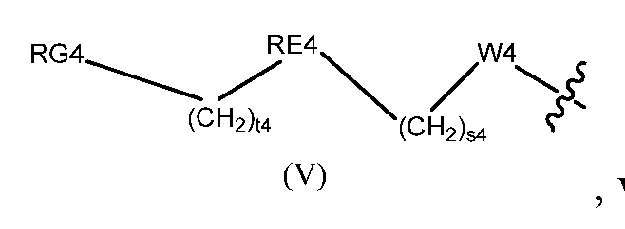 wherein: U2 is a bond, heteroarylene, or arylene; V2 is a bond or -C ≡C-(CH2)n2-; n2 is an integer from 0 to 10 inclusive; W2 is -C(=O)-, -NH- or -O-; RG3 is
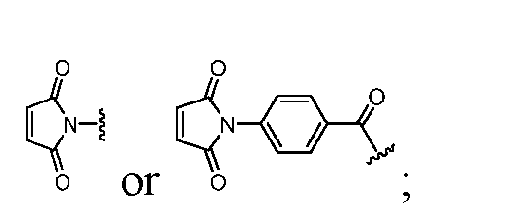 RS3 is -NRa2Rb2; each of Ra2 and Rb2 is, independently, H or substituted or unsubstituted C1-4 alkyl; RE3 is a bond, -O-, -OC(=O)-, -OC(=O)NR7-, -NHC(=O)NR7-, - OS(=O)2NR7-, -NHS(=O)2NR7-, or -OC(=O)NHS(=O)2NR7-;
R7 is H or substituted or unsubstituted C1-4 alkyl; W3 is -C(=O)-, -NH-, or -O-; t3 is 1 or 2; s3 is 0, 1, or 2;
RS3 is -NRa2Rb2; each of Ra2 and Rb2 is, independently, H or substituted or unsubstituted C1-4 alkyl; RE3 is a bond, -O-, -OC(=O)-, -OC(=O)NR7-, -NHC(=O)NR7-, - OS(=O)2NR7-, -NHS(=O)2NR7-, or -OC(=O)NHS(=O)2NR7-;
R7 is H or substituted or unsubstituted C1-4 alkyl; W3 is -C(=O)-, -NH-, or -O-; t3 is 1 or 2; s3 is 0, 1, or 2;

 RE4 is a bond, -O-, -OC(=O)-, -OC(=O)NR8-, -NHC(=O)NR8-, - OS(=O)2NR8-, -NHS(=O)2NR8-, or - OC(=O)NHS(=O)2NR8-; R8 is H or substituted or unsubstituted C1-4 alkyl; W4 is -C(=O)-, -NH-, or -O-; t4 is 1, 2, 3, 4, 5, 6, 7, or 8; and s4 is 0, 1, or 2. [0012] In some embodiments, provided herein are compounds of Formula (IA):
 or a pharmaceutically acceptable salt, tautomer, solvate, stereoisomer, or isotopologue thereof, wherein: each of ring A and ring B is, independently, one of formula (IIa), (IIb), (IIc), (IId), (IIe), (IIf), or (IIg):

 wherein: each ring C is independently a cyclopropyl ring or a cyclobutyl ring; each R1 is independently H, OH, C1-4 alkyl, C1-4 alkoxyl, or -O-(CH2CH2O)t1-CH3; each R2 is independently H or C1-4 alkyl; each R3 and R4 is, independently, H, NRa1Rb1, OH, C1-4 alkyl, C1-4 alkoxyl, or aryl; each Ra1 and Rb1 is, independently, H or C1-4 alkyl; each R5 is independently H, C1-4 alkyl, C1-4 alkoxyl, or aryl; each m1, n1, and o1 is, independently, 1 or 2; t1 is 1, 2, 3, 4, 5, 6, 7, or 8; * marks the bond where ring A connects to Cleavable1 when s1 is 1 or to -H when s1 is 0, or where ring B connects to Cleavable2; and ** marks the bond where ring A or ring B connects to Linker; Linker is –(CH2)r-, -(CH2)p-X-(CH2)q-, or -(CH2)p-CH=CH-(CH2)q-; wherein: each r, p, and q, is, independently, 1, 2, 3, 4, 5, 6, 7, or; the sum of p and q is 1, 2, 3, 4, 5, 6, 7, or; X is NR6, NHC(=O), C(=O)NH, O, SO2, a substituted or unsubstituted aryl ring, substituted or unsubstituted heteroaryl ring, substituted or unsubstituted heterocyclic ring, or substituted or unsubstituted cyclic ring; and R6 is H or C1-4 alkyl; Cleavable1, if present, has the formula
 , wherein: Su is a sugar moiety; each R11 is, independently, hydrogen, halogen, substituted or unsubstituted C1-4 alkyl, -CN, or -NO2; and # marks the bond where Cleavable1 connects to ring A; s1 is 0 or 1; Cleavable2 has formula (VIIa1) or (VIId1):
 wherein: Su is a sugar moiety; each R9 is, independently, hydrogen or C1-4 alkyl; #* marks the bond where Cleavable2 connects to ring B; and ## marks the bond where Cleavable2 connects to Spacer; Spacer is a bond, ###-NH-(CH2CH2O)m2-CH2CH2-C(═O)- or ###-NH-(CH2CH2O)m2-CH2- C(═O)-; wherein: each m2 is, independently, 1, 2, 3, 4, 6, 7, or 8; and ### marks the bond where Spacer connects to -C(=O)-;RE4 is a bond or -O-; and t4 is 1, 2, 3, 4, 5, 6, 7, or 8. BRIEF DESCRIPTION OF FIGURES [0013] Figures 1A and 1B are line graphs showing killing of NOMO-1 (1A) and K562 (1B) cells by the indicated conjugates. [0014] Figures 2A and 2B are line graphs showing killing of NOMO-1 (2A) and K562 (2B) cells by the indicated conjugates. [0015] Figures 3A and 3B are line graphs showing killing of NOMO-1 (3A) and K562 (3B) cells by the indicated conjugates. [0016] Figures 4A and 4B are line graphs showing killing of NOMO-1 (4A) and K562 (4B) cells by the indicated conjugates. [0017] Figures 5A and 5B are line graphs showing killing of NOMO-1 (5A) and K562 (5B) cells by the indicated conjugates. [0018] Figures 6A and 6B are line graphs showing killing of NOMO-1 (6A) and K562 (6B) cells by the indicated conjugates. DETAILED DESCRIPTION [0019] Provided herein are antibody drug conjugate platform compounds comprising pyrrolobenzodiazepine (PBD)-based dimers and antibody drug conjugates (ADCs) comprising the platforms and an antibody, or antigen-binding fragment thereof. The ADCs may be used to treat a disease or disorder, such as cancer, such as by providing a composition comprising an ADC. The conjugates include a β-glucuronide-based linker comprising a site that can be cleaved by an
enzyme having β-glucuronidase activity [0020] Within the present disclosure, it is understood that the disclosure is not limited to particular methods and/or experimental conditions described, as such methods and conditions may vary. It is also to be understood that the terminology used herein is for the purpose of describing particular embodiments only, and is not intended to be limiting, [0021] Although any methods and materials similar or equivalent to those described herein may be used in the practice or testing of the present invention, the preferred methods and materials are now described. All patents, applications, and non-patent publications mentioned in this specification are incorporated herein by reference in their entireties. Definitions [0022] In the present disclosure, the following terms have the following meanings unless indicated otherwise. Unless defined otherwise, all technical and scientific terms used herein have the same meaning as is commonly understood by one of ordinary skill in the art to which this disclosure pertains. In the event that there is a plurality of definitions for a term provided herein, these Definitions prevail unless stated otherwise. [0023] When a trade name is used herein, reference to the trade name also refers to the product formulation, the generic drug, and the active pharmaceutical ingredient(s) of the trade name product, unless otherwise indicated by context. [0024] The term “antibody” herein is used in the broadest sense and specifically covers intact monoclonal antibodies, polyclonal antibodies, monospecific antibodies, multispecific antibodies (e.g., bispecific antibodies), and antibody fragments that exhibit the desired biological activity. An intact antibody has primarily two regions: a variable region and a constant region. The variable region binds to and interacts with a target antigen. The variable region includes a complementary determining region (CDR) that recognizes and binds to a specific binding site on a particular antigen. The constant region may be recognized by and interact with the immune system (see, e.g., Janeway et al., 2001, Immuno. Biology, 5th Ed., Garland Publishing, New York). An antibody can be of any type (e.g., IgG, IgE, IgM, IgD, and IgA), class (e.g., IgG1, IgG2, IgG3, IgG4, IgA1, and IgA2) or subclass. The antibody can be derived from any suitable species. In some embodiments, the antibody is of human or murine origin. An antibody can be, for example, human, humanized, or chimeric. [0025] The term “humanized” or “humanized antibody” means forms of antibodies that contain sequences from non-human (e.g., murine) antibodies as well as human antibodies. Such antibodies contain minimal sequence derived from non-human immunoglobulin. In general, the humanized antibody will comprise substantially all of at least one, and typically two, variable domains, in which all or substantially all of the hypervariable loops correspond to those of a non-human
immunoglobulin and all or substantially all of the FR regions are those of a human immunoglobulin sequence. The humanized antibody optionally also will comprise at least a portion of an immunoglobulin constant region (Fc), typically that of a human immunoglobulin. The prefix “hum,” “hu,” “Hu,” or “h” is added to antibody clone designations when necessary to distinguish humanized antibodies from parental rodent antibodies. The humanized forms of rodent antibodies will generally comprise the same CDR sequences of the parental rodent antibodies, although certain amino acid substitutions can be included to increase affinity, increase stability of the humanized antibody, remove a post-translational modification or for other reasons [0026] The term “monoclonal antibody” as used herein refers to an antibody obtained from a population of substantially homogeneous antibodies, i.e., the individual antibodies comprising the population are identical except for possible naturally occurring mutations that may be present in minor amounts. Monoclonal antibodies are highly specific, being directed against a single antigenic site. The modifier “monoclonal” is not to be construed as requiring production of the antibody by any particular method. [0027] An “intact antibody” is one that comprises an antigen-binding variable region as well as a light chain constant domain (CL) and heavy chain constant domains, CH1, CH2, CH3, and CH4, as appropriate for the antibody class. The constant domains may be native sequence constant domains (e.g., human native sequence constant domains) or amino acid sequence variant thereof. [0028] An “antibody fragment” comprises a portion of an intact antibody, comprising the antigen- binding or variable region thereof. Examples of antibody fragments include Fab, Fab’, F(ab’)2, and Fv fragments, diabodies, triabodies, tetrabodies, linear antibodies, single-chain antibody molecules, scFv, scFv-Fc, multispecific antibody fragments formed from antibody fragment(s), a fragment(s) produced by a Fab expression library, or an epitope-binding fragment of any of the above which immunospecifically binds to a target antigen (e.g., a cancer cell antigen, a viral antigen or a microbial antigen). [0029] An “antigen” is an entity to which an antibody specifically binds. [0030] The terms “specific binding” and “specifically binds” mean that the antibody or antibody derivative will bind, in a highly selective manner, to its corresponding target antigen and not with the multitude of other antigens. Typically, the antibody or antibody derivative binds with an affinity of at least about 1×10⁻⁷ M, 10-8 M, 10-9M, 10-10 M, 10-11 M, or 10-12 M and binds to the predetermined antigen with an affinity that is at least two-fold greater than its affinity for binding to a non-specific antigen (e.g., BSA, casein) other than the predetermined antigen or a closely related antigen. [0031] The term “inhibit” or “inhibition of” means to reduce by a measurable amount, or to prevent entirely.
[0032] The term “therapeutically effective amount” refers to an amount of a drug effective to treat a disease or disorder in a mammal. In the case of cancer, the therapeutically effective amount of a drug may reduce the number of cancer cells; reduce the tumor size; inhibit (i.e., slow to some extent or stop) cancer cell infiltration into peripheral organs; inhibit (i.e., slow to some extent or stop) tumor metastasis; inhibit, to some extent, tumor growth; and/or relieve to some extent one or more of the symptoms associated with the cancer. To the extent the drug may inhibit growth and/or kill existing cancer cells, it may be cytostatic and/or cytotoxic. For cancer therapy, efficacy can, for example, be measured by assessing the time to disease progression (TTP) and/or determining the response rate (RR). [0033] The term “substantial” or “substantially” refers to a majority, i.e. >50% of a population, of a mixture or a sample, preferably more than 50%, 55%, 60%, 65%, 70%, 75%, 80%, 85%, 90%, 91%, 92%, 93%, 94%, 95%, 96%, 97%, 98%, or 99% of a population. [0034] The terms “intracellularly cleaved” and “intracellular cleavage” refer to a metabolic process or reaction inside a cell on a ligand drug conjugate (e.g., an antibody drug conjugate (ADC)), whereby the covalent attachment, e.g., the linker, between the drug moiety (D) and the ligand unit (e.g., an antibody (BA or Ab)) is broken, resulting in the free drug, or another metabolite of the conjugate dissociated from the antibody inside the cell. The cleaved moieties of the drug-linker-ligand conjugate are thus intracellular metabolites. [0035] The term “cytotoxic activity” refers to a cell-killing, a cytostatic or an anti-proliferative effect of a drug-linker-ligand conjugate compound or an intracellular metabolite of a drug-linker- ligand conjugate. Cytotoxic activity may be expressed as the IC50 value, which is the concentration (molar or mass) per unit volume at which half the cells survive. [0036] The term “cytotoxic agent” as used herein refers to a substance that inhibits the function of cells and/or causes destruction of cells. The term is intended to include radioactive isotopes (e.g., 211At, 131I, 125I, 90Y, 186Re, 188Re, 153Sm, 212Bi, 32P, 60C, and radioactive isotopes of Lu), chemotherapeutic agents, and toxins such as small molecule toxins or enzymatically active toxins of bacterial, fungal, plant, or animal origin, including synthetic analogs and derivatives thereof. [0037] The terms “cancer” and “cancerous” refer to or describe the physiological condition or disorder in mammals that is typically characterized by unregulated cell growth. A “tumor” comprises one or more cancerous cells. [0038] An “autoimmune disease” herein is a disease or disorder arising from and directed against an individual’s own tissues or proteins. [0039] Examples of a “patient” or “subject” include, but are not limited to, mammals such as a human, rat, mouse, guinea pig, monkey, pig, goat, cow, horse, dog, or cat, and birds or fowl. In an embodiment, the patient is a human.
[0040] The terms “treat” or “treatment,” unless otherwise indicated by context, refer to therapeutic treatment and prophylactic measures to prevent relapse, wherein the object is to inhibit or slow down (lessen) an undesired physiological change or disorder, such as the development or spread of cancer. For purposes of this disclosure, beneficial or desired clinical results include, but are not limited to, alleviation of symptoms, diminishment of extent of disease, stabilized (i.e., not worsening) state of disease, delay or slowing of disease progression, amelioration or palliation of the disease state, and remission (whether partial or total), whether detectable or undetectable. “Treatment” can also mean prolonging survival as compared to expected survival if not receiving treatment. Those in need of treatment include those already with the condition or disorder as well as those prone to have the condition or disorder. [0041] In the context of cancer, the term “treating” includes any or all of inhibiting growth of tumor cells, cancer cells, or of a tumor, inhibiting replication of tumor cells or cancer cells, lessening of overall tumor burden or decreasing the number of cancerous cells, and ameliorating one or more symptoms associated with the disease. [0042] In the context of an autoimmune disease, the term “treating” includes any or all of inhibiting replication of cells associated with an autoimmune disease state including, but not limited to, cells that produce an autoimmune antibody, lessening the autoimmune-antibody burden, and ameliorating one or more symptoms of an autoimmune disease. [0043] As used herein, and in the specification and the accompanying claims, the indefinite articles “a” and “an” and the definite article “the” include the plural as well as single referents, unless the context clearly indicates otherwise. [0044] As used herein, and unless otherwise specified, the terms “about” and “approximately,” when used in connection with amounts, or weight percentage of ingredients of a composition, mean an amount or weight percent that is recognized by one of ordinary skill in the art to provide a pharmacological effect equivalent to that obtained from the specified amount or weight percent. In certain embodiments, the terms “about” and “approximately,” when used in this context, contemplate an amount or weight percent within 30%, within 20%, within 15%, within 10%, or within 5%, of the specified amount or weight percent. [0045] As used herein, and unless otherwise specified, the terms “about” and “approximately,” when used in connection with a numeric value or range of values that is provided to characterize a particular solid form, e.g., a specific temperature or temperature range, such as, for example, that describes a melting, dehydration, desolvation, or glass transition temperature; a mass change, such as, for example, a mass change as a function of temperature or humidity; a solvent or water content, in terms of, for example, mass or a percentage; or a peak position, such as, for example, in analysis by, for example, IR or Raman spectroscopy or XRPD; indicate that the value or range
of values may deviate to an extent deemed reasonable to one of ordinary skill in the art while still describing the solid form. Techniques for characterizing crystal forms and amorphous solids include, but are not limited to, thermal gravimetric analysis (TGA), differential scanning calorimetry (DSC), X-ray powder diffractometry (XRPD), single-crystal X-ray diffractometry, vibrational spectroscopy, e.g., infrared (IR) and Raman spectroscopy, solid-state and solution nuclear magnetic resonance (NMR) spectroscopy, optical microscopy, hot stage optical microscopy, scanning electron microscopy (SEM), electron crystallography and quantitative analysis, particle size analysis (PSA), surface area analysis, solubility studies, and dissolution studies. In certain embodiments, the terms “about” and “approximately,” when used in this context, indicate that the numeric value or range of values may vary within 30%, 20%, 15%, 10%, 9%, 8%, 7%, 6%, 5%, 4%, 3%, 2%, 1.5%, 1%, 0.5%, or 0.25% of the recited value or range of values. For example, in some embodiments, the value of an XRPD peak position may vary by up to ±0.2º 2θ while still describing the particular XRPD peak. [0046] As used herein, the term “inclusive,” when used in reference to range, includes the endpoints of the range. For example, if n is an integer from 0 to 4, n may be any of 0, 1, 2, 3, or 4. [0047] An “alkyl” group is a saturated, partially saturated, or unsaturated straight chain or branched non-cyclic hydrocarbon having from 1 to 10 carbon atoms, typically from 1 to 8 carbons or, in some embodiments, from 1 to 6, 1 to 4, or 2 to 6 carbon atoms. Representative alkyl groups include -methyl, -ethyl, -n-propyl, -n-butyl, -n-pentyl, and n-hexyl; saturated branched alkyls include -isopropyl, -sec-butyl, -isobutyl, -tert-butyl, -isopentyl, 2-methylpentyl, 3-methylpentyl, 4-methylpentyl, 2,3-dimethylbutyl and the like. Examples of unsaturated alkyl groups include, but are not limited to, vinyl, allyl, CH=CH(CH3), -CH=C(CH3)2, -C(CH3)=CH2, - C(CH3)=CH(CH3), C(CH2CH3)=CH2, C≡CH, -C≡C(CH3), -C≡C(CH2CH3), -CH2C≡CH, - CH2C≡C(CH3), and CH2C≡C(CH2CH3), among others. An alkyl group can be substituted or unsubstituted. In certain embodiments, when the alkyl groups described herein are said to be “substituted,” they may be substituted with any substituent or substituents as those found in the compounds and embodiments disclosed herein, as well as halogen (chloro, iodo, bromo, or fluoro); hydroxyl; alkoxy; alkoxyalkyl; amino; alkylamino; carboxy; nitro; cyano; thiol; thioether; imine; imide; amidine; guanidine; enamine; aminocarbonyl; acylamino; phosphonato; phosphine; thiocarbonyl; sulfonyl; sulfone; sulfonamide; ketone; aldehyde; ester; urea; urethane; oxime; hydroxyl amine; alkoxyamine; aralkoxyamine; N-oxide; hydrazine; hydrazide; hydrazone; azide; isocyanate; isothiocyanate; cyanate; thiocyanate; B(OH)2; or O(alkyl)aminocarbonyl. [0048] An “alkenyl” group is a straight chain or branched non-cyclic hydrocarbon having from 2 to 10 carbon atoms, typically from 2 to 8 carbon atoms, and including at least one carbon-carbon double bond. Representative straight chain and branched (C2-C8)alkenyls include -vinyl, -allyl, -
1-butenyl, -2-butenyl, -isobutylenyl, -1-pentenyl, -2-pentenyl, -3-methyl-1-butenyl, -2-methyl-2- butenyl, -2,3-dimethyl-2-butenyl, -1-hexenyl, 2-hexenyl, -3-hexenyl, -1-heptenyl, -2-heptenyl, -3- heptenyl, -1-octenyl, -2-octenyl, 3-octenyl and the like. The double bond of an alkenyl group can be unconjugated or conjugated to another unsaturated group. An alkenyl group can be unsubstituted or substituted. [0049] A “cycloalkyl” group is a saturated or a partially saturated cyclic alkyl group of from 3 to 10 carbon atoms having a single cyclic ring or multiple condensed or bridged rings which can be optionally substituted with from 1 to 3 alkyl groups. In some embodiments, the cycloalkyl group has 3 to 8 ring members, whereas in other embodiments the number of ring carbon atoms ranges from 3 to 5, 3 to 6, or 3 to 7. Such cycloalkyl groups include, by way of example, single ring structures such as cyclopropyl, cyclobutyl, cyclopentyl, cyclohexyl, cycloheptyl, cyclooctyl, 1- methylcyclopropyl, 2-methylcyclopentyl, 2-methylcyclooctyl, and the like, or multiple or bridged ring structures such as adamantyl and the like. Examples of unsaturated cycloalkyl groups include cyclohexenyl, cyclopentenyl, cyclohexadienyl, butadienyl, pentadienyl, and hexadienyl, among others. A cycloalkyl group can be substituted or unsubstituted. Such substituted cycloalkyl groups include, by way of example, cyclohexanone and the like. [0050] An “aryl” group is an aromatic carbocyclic group of from 6 to 14 carbon atoms having a single ring (e.g., phenyl) or multiple condensed rings (e.g., naphthyl or anthryl). In some embodiments, aryl groups contain 6 to 14 carbons, and in others from 6 to 12 or even 6 to 10 carbon atoms in the ring portions of the groups. Particular aryls include phenyl, biphenyl, naphthyl and the like. An aryl group can be substituted or unsubstituted. The phrase “aryl groups” also includes groups containing fused rings, such as fused aromatic-aliphatic ring systems (e.g., indanyl, tetrahydronaphthyl, and the like). [0051] An “arylene” group is a bivalent aryl group as defined herein. [0052] A “heteroaryl” group is an aryl ring system having one to four heteroatoms as ring atoms in a heteroaromatic ring system, wherein the remainder of the atoms are carbon atoms. In some embodiments, heteroaryl groups contain 5 to 6 ring atoms, and in others from 6 to 9 or 6 to 10 atoms in the ring portions of the groups. Suitable heteroatoms include oxygen, sulfur, and nitrogen. In certain embodiments, the heteroaryl ring system is monocyclic or bicyclic. Non- limiting examples include, but are not limited to, groups such as pyrrolyl, pyrazolyl, imidazolyl, triazolyl, tetrazolyl, oxazolyl, isoxazolyl, thiazolyl, pyrrolyl, pyridyl, pyridazinyl, pyrimidinyl, pyrazinyl, thiophenyl, benzothiophenyl, furanyl, benzofuranyl (for example, isobenzofuran-1,3- diimine), indolyl, azaindolyl (for example, pyrrolopyridyl or 1H-pyrrolo[2,3-b]pyridyl), indazolyl, benzimidazolyl (for example, 1H-benzo[d]imidazolyl), imidazopyridyl (for example, azabenzimidazolyl, 3H-imidazo[4,5-b]pyridyl or 1H-imidazo[4,5-b]pyridyl), pyrazolopyridyl,
triazolopyridyl, benzotriazolyl, benzoxazolyl, benzothiazolyl, benzothiadiazolyl, isoxazolopyridyl, thianaphthalenyl, purinyl, xanthinyl, adeninyl, guaninyl, quinolinyl, isoquinolinyl, tetrahydroquinolinyl, quinoxalinyl, and quinazolinyl groups. [0053] A “heteroarylene” group is a bivalent heteroaryl group as defined herein. [0054] A “heterocyclyl” is an aromatic (also referred to as heteroaryl) or non-aromatic cycloalkyl in which one to four of the ring carbon atoms are independently replaced with a heteroatom from the group consisting of O, S and N. In some embodiments, heterocyclyl groups include 3 to 10 ring members, whereas other such groups have 3 to 5, 3 to 6, or 3 to 8 ring members. Heterocyclyls can also be bonded to other groups at any ring atom (i.e., at any carbon atom or heteroatom of the heterocyclic ring). A heterocyclyl group can be substituted or unsubstituted. Heterocyclyl groups encompass unsaturated, partially saturated, and saturated ring systems, such as, for example, imidazolyl, imidazolinyl, and imidazolidinyl groups. The term “heterocyclyl” includes fused ring species, including those comprising fused aromatic and non-aromatic groups, such as, for example, benzotriazolyl, 2,3-dihydrobenzo[l,4]dioxinyl, and benzo[l,3]dioxolyl. The term also includes bridged polycyclic ring systems containing a heteroatom such as, but not limited to, quinuclidyl. Representative examples of a heterocyclyl group include, but are not limited to, aziridinyl, azetidinyl, pyrrolidyl, imidazolidinyl, pyrazolidinyl, thiazolidinyl, tetrahydrothiophenyl, tetrahydrofuranyl, dioxolyl, furanyl, thiophenyl, pyrrolyl, pyrrolinyl, imidazolyl, imidazolinyl, pyrazolyl, pyrazolinyl, triazolyl, tetrazolyl, oxazolyl, isoxazolyl, thiazolyl, thiazolinyl, isothiazolyl, thiadiazolyl, oxadiazolyl, piperidyl, piperazinyl, morpholinyl, thiomorpholinyl, tetrahydropyranyl (for example, tetrahydro-2H-pyranyl), tetrahydrothiopyranyl, oxathiane, dioxyl, dithianyl, pyranyl, pyridyl, pyrimidinyl, pyridazinyl, pyrazinyl, triazinyl, dihydropyridyl, dihydrodithiinyl, dihydrodithionyl, homopiperazinyl, quinuclidyl, indolyl, indolinyl, isoindolyl, azaindolyl (pyrrolopyridyl), indazolyl, indolizinyl, benzotriazolyl, benzimidazolyl, benzofuranyl, benzothiophenyl, benzthiazolyl, benzoxadiazolyl, benzoxazinyl, benzodithiinyl, benzoxathiinyl, benzothiazinyl, benzoxazolyl, benzothiazolyl, benzothiadiazolyl, benzo[l,3]dioxolyl, pyrazolopyridyl, imidazopyridyl (azabenzimidazolyl; for example, 1H- imidazo[4,5-b]pyridyl, or 1H-imidazo[4,5-b] pyridyl), triazolopyridyl, isoxazolopyridyl, purinyl, xanthinyl, adeninyl, guaninyl, quinolinyl, isoquinolinyl, quinolizinyl, quinoxalinyl, quinazolinyl, cinnolinyl, phthalazinyl, naphthyridinyl, pteridinyl, thianaphthalenyl, dihydrobenzothiazinyl, dihydrobenzofuranyl, dihydroindolyl, dihydrobenzodioxinyl, tetrahydroindolyl, tetrahydroindazolyl, tetrahydrobenzimidazolyl, tetrahydrobenzotriazolyl, tetrahydropyrrolopyridyl, tetrahydropyrazolopyridyl, tetrahydroimidazopyridyl, tetrahydrotriazolopyridyl, and tetrahydroquinolinyl groups. Representative substituted heterocyclyl groups may be mono-substituted or substituted more than once, such as, but not
limited to, pyridyl or morpholinyl groups, which are 2-, 3-, 4-, 5-, or 6-substituted, or disubstituted with various substituents such as those listed belowA “cycloalkylalkyl” group is a radical of the formula -alkyl-cycloalkyl, wherein alkyl and cycloalkyl are defined above. Substituted cycloalkylalkyl groups may be substituted at the alkyl, the cycloalkyl, or both the alkyl and the cycloalkyl portions of the group. Representative cycloalkylalkyl groups include but are not limited to cyclopentylmethyl, cyclopentylethyl, cyclohexylmethyl, cyclohexylethyl, and cyclohexylpropyl. Representative substituted cycloalkylalkyl groups may be mono-substituted or substituted more than once. [0055] An “aralkyl” group is a radical of the formula -alkyl-aryl, wherein alkyl and aryl are defined above. Substituted aralkyl groups may be substituted at the alkyl, the aryl, or both the alkyl and the aryl portions of the group. Representative aralkyl groups include, but are not limited to, benzyl and phenethyl groups and fused (cycloalkylaryl)alkyl groups such as 4-ethyl-indanyl. [0056] A “heterocyclylalkyl” group is a radical of the formula -alkyl-heterocyclyl, wherein alkyl and heterocyclyl are defined above. Substituted heterocyclylalkyl groups may be substituted at the alkyl, the heterocyclyl, or both the alkyl and the heterocyclyl portions of the group. Representative heterocyclylalkyl groups include, but are not limited to, 4-ethyl-morpholinyl, 4- propylmorpholinyl, furan-2-yl methyl, furan-3-yl methyl, pyrdine-3-yl methyl, (tetrahydro-2H- pyran-4-yl)methyl, (tetrahydro-2H-pyran-4-yl)ethyl, tetrahydrofuran-2-yl methyl, tetrahydrofuran-2-yl ethyl, and indol-2-yl propyl. [0057] A “halogen” is chloro, iodo, bromo, or fluoro. [0058] A “hydroxyalkyl” group is an alkyl group as described above substituted with one or more hydroxy groups. [0059] An “alkoxy” group is O(alkyl), wherein alkyl is defined above. [0060] An “alkoxyalkyl” group is (alkyl)O(alkyl), wherein alkyl is defined above. [0061] As used herein, “alkynyl” refers to a monovalent hydrocarbon radical moiety containing at least two carbon atoms and one or more carbon-carbon triple bonds. Alkynyl is optionally substituted and can be linear, branched, or cyclic. Alkynyl includes, but is not limited to, those radicals having 2-20 carbon atoms, i.e., C2-20 alkynyl; 2-12 carbon atoms, i.e., C2-12 alkynyl; 2-8 carbon atoms, i.e., C2-8 alkynyl; 2-6 carbon atoms, i.e., C2-6 alkynyl; and 2-4 carbon atoms, i.e., C2-4 alkynyl. Examples of alkynyl moieties include, but are not limited to ethynyl, propynyl, and butynyl. [0062] As used herein, “haloalkyl” refers to alkyl, as defined above, wherein the alkyl includes at least one substituent selected from a halogen, for example, fluorine (F), chlorine (Cl), bromine (Br), or iodine (I). Examples of haloalkyl include, but are not limited to, -CF3, -CH2CF3, –CCl2F, and –CCl3.
[0063] As used herein, “haloalkoxy” refers to alkoxy, as defined above, wherein the alkoxy includes at least one substituent selected from a halogen, e.g., F, Cl, Br, or I. [0064] As used herein, “arylalkyl” refers to a monovalent moiety that is a radical of an alkyl compound, wherein the alkyl compound is substituted with an aromatic substituent, i.e., the aromatic compound includes a single bond to an alkyl group and wherein the radical is localized on the alkyl group. An arylalkyl group bonds to the illustrated chemical structure via the alkyl group. An arylalkyl can be represented by the structure, e.g., B-CH2-, B-CH2-CH2-, B-CH2-CH2- CH2-, B-CH2-CH2-CH2-CH2-, B-CH(CH3)-CH2-CH2-, B-CH2-CH(CH3)-CH2-, wherein B is an aromatic moiety, e.g., phenyl. Arylalkyl is optionally substituted, i.e., the aryl group and/or the alkyl group, can be substituted as disclosed herein. Examples of arylalkyl include, but are not limited to, benzyl. [0065] As used herein, “alkylaryl” refers to a monovalent moiety that is a radical of an aryl compound, wherein the aryl compound is substituted with an alkyl substituent, i.e., the aryl compound includes a single bond to an alkyl group and wherein the radical is localized on the aryl group. An alkylaryl group bonds to the illustrated chemical structure via the aryl group. An alkylaryl can be represented by the structure, e.g., -B-CH3, -B-CH2-CH3, -B-CH2-CH2-CH3, -B- CH2-CH2-CH2-CH3, -B-CH(CH3)-CH2-CH3, -B-CH2-CH(CH3)-CH3, wherein B is an aromatic moiety, e.g., phenyl. Alkylaryl is optionally substituted, i.e., the aryl group and/or the alkyl group, can be substituted as disclosed herein. Examples of alkylaryl include, but are not limited to, toluyl. [0066] As used herein, “aryloxy” refers to a monovalent moiety that is a radical of an aromatic compound wherein the ring atoms are carbon atoms and wherein the ring is substituted with an oxygen radical, i.e., the aromatic compound includes a single bond to an oxygen atom and wherein the radical is localized on the oxygen atom, e.g., C6H5-O-, for phenoxy. Aryloxy substituents bond to the compound which they substitute through this oxygen atom. Aryloxy is optionally substituted. Aryloxy includes, but is not limited to, those radicals having 6 to 20 ring carbon atoms, i.e., C6-20 aryloxy; 6 to 15 ring carbon atoms, i.e., C6-15 aryloxy, and 6 to 10 ring carbon atoms, i.e., C6-10 aryloxy. Examples of aryloxy moieties include, but are not limited to phenoxy, naphthoxy, and anthroxy. [0067] An “amino” group is a radical of the formula NH2. [0068] A “hydroxyl amine” group is a radical of the formula N(R#)OH or NHOH, wherein R# is a substituted or unsubstituted alkyl, cycloalkyl, cycloalkylalkyl, aryl, aralkyl, heterocyclyl or heterocyclylalkyl group as defined herein. [0069] An “alkoxyamine” group is a radical of the formula -N(R#)O-alkyl or -NHO-alkyl, wherein R# is as defined above.
[0070] An “aralkoxyamine” group is a radical of the formula N(R#)O-aryl or NHOaryl, wherein R# is as defined above. [0071] An “aminocarbonyl” group is a radical of the formula -C(=O)N(R#)2, -C(=O)NH(R#), or C(=O)NH2, wherein each R# is as defined above. [0072] An “acylamino” group is a radical of the formula NHC(=O)(R#) or N(alkyl)C(=O)(R#), wherein each alkyl and R# are independently as defined above. [0073] An “O(alkyl)aminocarbonyl” group is a radical of the formula -O(alkyl)C(=O)N(R#)2, - O(alkyl)C(=O)NH(R#), or -O(alkyl)C(=O)NH2, wherein each R# is independently as defined above. [0074] An “N-oxide” group is a radical of the formula -N+-O-. [0075] A “carboxy” group is a radical of the formula C(=O)OH. [0076] A “ketone” group is a radical of the formula C(=O)(R#), wherein R# is as defined above. [0077] An “aldehyde” group is a radical of the formula -CH(=O). [0078] An “ester” group is a radical of the formula C(=O)O(R#) or OC(=O)(R#), wherein R# is as defined above. [0079] A “urea” group is a radical of the formula -N(alkyl)C(=O)N(R#)2, -N(alkyl)C(=O)NH(R#), -N(alkyl)C(=O)NH2, -NHC(=O)N(R#)2, -NHC(=O)NH(R#), or NHC(=O)NH2 #, wherein each alkyl and R# are independently as defined above. [0080] An “imine” group is a radical of the formula -N=C(R#)2 or -C(R#)=N(R#), wherein each R# is independently as defined above. [0081] An “imide” group is a radical of the formula -C(=O)N(R#)C(=O)(R#) or N((C=O)(R#))2, wherein each R# is independently as defined above. [0082] A “urethane” group is a radical of the formula -OC(=O)N(R#)2, -OC(=O)NH(R#), - N(R#)C(=O)O(R#), or -NHC(=O)O(R#), wherein each R# is independently as defined above. [0083] An “amidine” group is a radical of the formula -C(=N(R#))N(R#)2, -C(=N(R#))NH(R#), - C(=N(R#))NH2, -C(=NH)N(R#)2, -C(=NH)NH(R#), -C(=NH)NH2, -N=C(R#)N(R#)2, - N=C(R#)NH(R#), -N=C(R#)NH2, -N(R#)C(R#)=N(R#), -NHC(R#)=N(R#), -N(R#)C(R#)=NH, or - NHC(R#)=NH, wherein each R# is independently as defined above. [0084] A “guanidine” group is a radical of the formula -N(R#)C(=N(R#))N(R#)2, - NHC(=N(R#))N(R#)2, -N(R#)C(=NH)N(R#)2, -N(R#)C(=N(R#))NH(R#), -N(R#)C(=N(R#))NH2, - NHC(=NH)N(R#)2, -NHC(=N(R#))NH(R#), -NHC(=N(R#))NH2, -NHC(=NH)NH(R#), - NHC(=NH)NH2, -N=C(N(R#)2)2, -N=C(NH(R#))2, or -N=C(NH2)2, wherein each R# is independently as defined above. [0085] An “enamine” group is a radical of the formula -N(R#)C(R#)=C(R#)2, -NHC(R#)=C(R#)2, - C(N(R#)2)=C(R#)2, -C(NH(R#))=C(R#)2, -C(NH2)=C(R#)2, -C(R#)=C(R#)(N(R#)2),
C(R#)=C(R#)(NH(R#)) or -C(R#)=C(R#)(NH2), wherein each R# is independently as defined above. [0086] An “oxime” group is a radical of the formula -C(=NO(R#))(R#), -C(=NOH)(R#), - CH(=NO(R#)), or -CH(=NOH), wherein each R# is independently as defined above. [0087] A “hydrazide” group is a radical of the formula -C(=O)N(R#)N(R#)2, -C(=O)NHN(R#)2, - C(=O)N(R#)NH(R#), -C(=O)N(R#)NH2, -C(=O)NHNH(R#)2, or -C(=O)NHNH2, wherein each R# is independently as defined above. [0088] A “hydrazine” group is a radical of the formula -N(R#)N(R#)2, -NHN(R#)2, -N(R#)NH(R#), -N(R#)NH2, -NHNH(R#)2, or -NHNH2, wherein each R# is independently as defined above. [0089] A “hydrazone” group is a radical of the formula -C(=N-N(R#)2)(R#)2, -C(=NNH(R#))(R#)2, -C(=N-NH2)(R#)2, -N(R#)(N=C(R#)2), or -NH(N=C(R#)2), wherein each R# is independently as defined above. [0090] An “azide” group is a radical of the formula -N3. [0091] An “isocyanate” group is a radical of the formula N=C=O. [0092] An “isothiocyanate” group is a radical of the formula N=C=S. [0093] A “cyanate” group is a radical of the formula OCN. [0094] A “thiocyanate” group is a radical of the formula SCN. [0095] A “thioether” group is a radical of the formula -S(R#), wherein R# is as defined above. [0096] A “thiocarbonyl” group is a radical of the formula -C(=S)(R#), wherein R# is as defined above. [0097] A “sulfinyl” group is a radical of the formula -S(=O)(R#), wherein R# is as defined above. [0098] A “sulfone” group is a radical of the formula -S(=O)2(R#), wherein R# is as defined above. [0099] A “sulfonylamino” group is a radical of the formula -NHSO2(R#) or -N(alkyl)SO2(R#), wherein each alkyl and R# are defined above. [0100] A “sulfonamide” group is a radical of the formula -S(=O)2N(R#)2, or -S(=O)2NH(R#), or - S(=O)2NH2, wherein each R# is independently as defined above. [0101] A “phosphonate” group is a radical of the formula -P(=O)(O(R#))2, -P(=O)(OH)2, - OP(=O)(O(R#))(R#), or -OP(=O)(OH)(R#), wherein each R# is independently as defined above. [0102] A “phosphine” group is a radical of the formula -P(R#)2, wherein each R# is independently as defined above. [0103] When the groups described herein, with the exception of alkyl groups, are said to be “substituted,” they may be substituted with any appropriate substituent or substituents. Illustrative examples of substituents are those found in the compounds and embodiments disclosed herein, as well as halogen (chloro, iodo, bromo, or fluoro); alkyl; hydroxyl; alkoxy; alkoxyalkyl; amino; alkylamino; carboxy; nitro; cyano; thiol; thioether; imine; imide; amidine; guanidine; enamine;
aminocarbonyl; acylamino; phosphonate; phosphine; thiocarbonyl; sulfinyl; sulfone; sulfonamide; ketone; aldehyde; ester; urea; urethane; oxime; hydroxyl amine; alkoxyamine; aralkoxyamine; N- oxide; hydrazine; hydrazide; hydrazone; azide; isocyanate; isothiocyanate; cyanate; thiocyanate; oxygen (═O); B(OH)2, O(alkyl)aminocarbonyl; cycloalkyl, which may be monocyclic or fused or non-fused polycyclic (e.g., cyclopropyl, cyclobutyl, cyclopentyl, or cyclohexyl), or a heterocyclyl, which may be monocyclic or fused or non-fused polycyclic (e.g., pyrrolidyl, piperidyl, piperazinyl, morpholinyl, or thiazinyl); monocyclic or fused or non-fused polycyclic aryl or heteroaryl (e.g., phenyl, naphthyl, pyrrolyl, indolyl, furanyl, thiophenyl, imidazolyl, oxazolyl, isoxazolyl, thiazolyl, triazolyl, tetrazolyl, pyrazolyl, pyridinyl, quinolinyl, isoquinolinyl, acridinyl, pyrazinyl, pyridazinyl, pyrimidinyl, benzimidazolyl, benzothiophenyl, or benzofuranyl) aryloxy; aralkyloxy; heterocyclyloxy; and heterocyclyl alkoxy. [0104] As used herein, the term “pharmaceutically acceptable salt(s)” refers to a salt prepared from a pharmaceutically acceptable non-toxic acid or base including an inorganic acid or base and an organic acid or base. [0105] As used herein and unless otherwise indicated, the term “solvate” means a compound, or a salt thereof, that further includes a stoichiometric or non-stoichiometric amount of a solvent bound by non-covalent intermolecular forces. In one embodiment, the solvate is a hydrate. [0106] As used herein and unless otherwise indicated, the term “hydrate” means a compound, or a salt thereof, that further includes a stoichiometric or non-stoichiometric amount of water bound by non-covalent intermolecular forces. [0107] As used herein and unless otherwise indicated, the term “prodrug” means a compound derivative that can hydrolyze, oxidize, or otherwise react under biological conditions (in vitro or in vivo) to provide an active compound. Examples of prodrugs include, but are not limited to, derivatives and metabolites of a compound that include biohydrolyzable moieties such as biohydrolyzable amides, biohydrolyzable esters, biohydrolyzable carbamates, biohydrolyzable carbonates, biohydrolyzable ureides, and biohydrolyzable phosphate analogues. In certain embodiments, prodrugs of compounds with carboxyl functional groups are the lower alkyl esters of the carboxylic acid. The carboxylate esters may be formed by esterifying any of the carboxylic acid moieties present on the molecule. Prodrugs can typically be prepared using well-known methods, such as those described by Burger’s Medicinal Chemistry and Drug Discovery 6th ed. (Donald J. Abraham ed., 2001, Wiley) and Design and Application of Prodrugs (H. Bundgaard ed., 1985, Harwood Academic Publishers Gmfh). [0108] As used herein and unless otherwise indicated, the term “stereoisomer” or “stereomerically pure” means one stereoisomer of a compound that is substantially free of other stereoisomers of that compound. For example, a stereomerically pure compound having one chiral center will be
substantially free of the opposite enantiomer of the compound. A stereomerically pure compound having two chiral centers will be substantially free of other diastereomers of the compound. A typical stereomerically pure compound comprises greater than about 80% by weight of one stereoisomer of the compound and less than about 20% by weight of other stereoisomers of the compound, greater than about 90% by weight of one stereoisomer of the compound and less than about 10% by weight of the other stereoisomers of the compound, greater than about 95% by weight of one stereoisomer of the compound and less than about 5% by weight of the other stereoisomers of the compound, or greater than about 97% by weight of one stereoisomer of the compound and less than about 3% by weight of the other stereoisomers of the compound. The compounds can have chiral centers and can occur as racemates, individual enantiomers or diastereomers, and mixtures thereof. All such isomeric forms are included within the embodiments disclosed herein, including mixtures thereof. The use of stereomerically pure forms of such compounds, as well as the use of mixtures of those forms, are encompassed by the embodiments disclosed herein. For example, mixtures comprising equal or unequal amounts of the enantiomers of a particular compound may be used in methods and compositions disclosed herein. These isomers may be asymmetrically synthesized or resolved using standard techniques such as chiral columns or chiral resolving agents. See, e.g., Jacques, J., et al., Enantiomers, Racemates and Resolutions (WileyInterscience, New York, 1981); Wilen, S. H., et al., Tetrahedron 33:2725 (1977); Eliel, E. L., Stereochemistry of Carbon Compounds (McGrawHill, NY, 1962); and Wilen, S. H., Tables of Resolving Agents and Optical Resolutions p.268 (E.L. Eliel, Ed., Univ. of Notre Dame Press, Notre Dame, IN, 1972). [0109] It should also be noted that the compounds can include E and Z isomers, or a mixture thereof, and cis and trans isomers, or a mixture thereof. In certain embodiments, the compounds are isolated as either the cis or trans isomer. In other embodiments, the compounds are a mixture of the cis and trans isomers. [0110] “Tautomers” refers to isomeric forms of a compound that are in equilibrium with each other. The concentrations of the isomeric forms will depend on the environment the compound is found in and may be different depending upon, for example, whether the compound is a solid or is in an organic or aqueous solution. For example, in an aqueous solution, pyrazoles may exhibit the following isomeric forms, which are referred to as tautomers of each other:
wherein: Su is a sugar moiety; each R9 is, independently, hydrogen or C1-4 alkyl; #* marks the bond where Cleavable2 connects to ring B; and ## marks the bond where Cleavable2 connects to Spacer; Spacer is a bond, ###-NH-(CH2CH2O)m2-CH2CH2-C(═O)- or ###-NH-(CH2CH2O)m2-CH2- C(═O)-; wherein: each m2 is, independently, 1, 2, 3, 4, 6, 7, or 8; and ### marks the bond where Spacer connects to -C(=O)-;RE4 is a bond or -O-; and t4 is 1, 2, 3, 4, 5, 6, 7, or 8. BRIEF DESCRIPTION OF FIGURES [0013] Figures 1A and 1B are line graphs showing killing of NOMO-1 (1A) and K562 (1B) cells by the indicated conjugates. [0014] Figures 2A and 2B are line graphs showing killing of NOMO-1 (2A) and K562 (2B) cells by the indicated conjugates. [0015] Figures 3A and 3B are line graphs showing killing of NOMO-1 (3A) and K562 (3B) cells by the indicated conjugates. [0016] Figures 4A and 4B are line graphs showing killing of NOMO-1 (4A) and K562 (4B) cells by the indicated conjugates. [0017] Figures 5A and 5B are line graphs showing killing of NOMO-1 (5A) and K562 (5B) cells by the indicated conjugates. [0018] Figures 6A and 6B are line graphs showing killing of NOMO-1 (6A) and K562 (6B) cells by the indicated conjugates. DETAILED DESCRIPTION [0019] Provided herein are antibody drug conjugate platform compounds comprising pyrrolobenzodiazepine (PBD)-based dimers and antibody drug conjugates (ADCs) comprising the platforms and an antibody, or antigen-binding fragment thereof. The ADCs may be used to treat a disease or disorder, such as cancer, such as by providing a composition comprising an ADC. The conjugates include a β-glucuronide-based linker comprising a site that can be cleaved by an
enzyme having β-glucuronidase activity [0020] Within the present disclosure, it is understood that the disclosure is not limited to particular methods and/or experimental conditions described, as such methods and conditions may vary. It is also to be understood that the terminology used herein is for the purpose of describing particular embodiments only, and is not intended to be limiting, [0021] Although any methods and materials similar or equivalent to those described herein may be used in the practice or testing of the present invention, the preferred methods and materials are now described. All patents, applications, and non-patent publications mentioned in this specification are incorporated herein by reference in their entireties. Definitions [0022] In the present disclosure, the following terms have the following meanings unless indicated otherwise. Unless defined otherwise, all technical and scientific terms used herein have the same meaning as is commonly understood by one of ordinary skill in the art to which this disclosure pertains. In the event that there is a plurality of definitions for a term provided herein, these Definitions prevail unless stated otherwise. [0023] When a trade name is used herein, reference to the trade name also refers to the product formulation, the generic drug, and the active pharmaceutical ingredient(s) of the trade name product, unless otherwise indicated by context. [0024] The term “antibody” herein is used in the broadest sense and specifically covers intact monoclonal antibodies, polyclonal antibodies, monospecific antibodies, multispecific antibodies (e.g., bispecific antibodies), and antibody fragments that exhibit the desired biological activity. An intact antibody has primarily two regions: a variable region and a constant region. The variable region binds to and interacts with a target antigen. The variable region includes a complementary determining region (CDR) that recognizes and binds to a specific binding site on a particular antigen. The constant region may be recognized by and interact with the immune system (see, e.g., Janeway et al., 2001, Immuno. Biology, 5th Ed., Garland Publishing, New York). An antibody can be of any type (e.g., IgG, IgE, IgM, IgD, and IgA), class (e.g., IgG1, IgG2, IgG3, IgG4, IgA1, and IgA2) or subclass. The antibody can be derived from any suitable species. In some embodiments, the antibody is of human or murine origin. An antibody can be, for example, human, humanized, or chimeric. [0025] The term “humanized” or “humanized antibody” means forms of antibodies that contain sequences from non-human (e.g., murine) antibodies as well as human antibodies. Such antibodies contain minimal sequence derived from non-human immunoglobulin. In general, the humanized antibody will comprise substantially all of at least one, and typically two, variable domains, in which all or substantially all of the hypervariable loops correspond to those of a non-human
immunoglobulin and all or substantially all of the FR regions are those of a human immunoglobulin sequence. The humanized antibody optionally also will comprise at least a portion of an immunoglobulin constant region (Fc), typically that of a human immunoglobulin. The prefix “hum,” “hu,” “Hu,” or “h” is added to antibody clone designations when necessary to distinguish humanized antibodies from parental rodent antibodies. The humanized forms of rodent antibodies will generally comprise the same CDR sequences of the parental rodent antibodies, although certain amino acid substitutions can be included to increase affinity, increase stability of the humanized antibody, remove a post-translational modification or for other reasons [0026] The term “monoclonal antibody” as used herein refers to an antibody obtained from a population of substantially homogeneous antibodies, i.e., the individual antibodies comprising the population are identical except for possible naturally occurring mutations that may be present in minor amounts. Monoclonal antibodies are highly specific, being directed against a single antigenic site. The modifier “monoclonal” is not to be construed as requiring production of the antibody by any particular method. [0027] An “intact antibody” is one that comprises an antigen-binding variable region as well as a light chain constant domain (CL) and heavy chain constant domains, CH1, CH2, CH3, and CH4, as appropriate for the antibody class. The constant domains may be native sequence constant domains (e.g., human native sequence constant domains) or amino acid sequence variant thereof. [0028] An “antibody fragment” comprises a portion of an intact antibody, comprising the antigen- binding or variable region thereof. Examples of antibody fragments include Fab, Fab’, F(ab’)2, and Fv fragments, diabodies, triabodies, tetrabodies, linear antibodies, single-chain antibody molecules, scFv, scFv-Fc, multispecific antibody fragments formed from antibody fragment(s), a fragment(s) produced by a Fab expression library, or an epitope-binding fragment of any of the above which immunospecifically binds to a target antigen (e.g., a cancer cell antigen, a viral antigen or a microbial antigen). [0029] An “antigen” is an entity to which an antibody specifically binds. [0030] The terms “specific binding” and “specifically binds” mean that the antibody or antibody derivative will bind, in a highly selective manner, to its corresponding target antigen and not with the multitude of other antigens. Typically, the antibody or antibody derivative binds with an affinity of at least about 1×10⁻⁷ M, 10-8 M, 10-9M, 10-10 M, 10-11 M, or 10-12 M and binds to the predetermined antigen with an affinity that is at least two-fold greater than its affinity for binding to a non-specific antigen (e.g., BSA, casein) other than the predetermined antigen or a closely related antigen. [0031] The term “inhibit” or “inhibition of” means to reduce by a measurable amount, or to prevent entirely.
[0032] The term “therapeutically effective amount” refers to an amount of a drug effective to treat a disease or disorder in a mammal. In the case of cancer, the therapeutically effective amount of a drug may reduce the number of cancer cells; reduce the tumor size; inhibit (i.e., slow to some extent or stop) cancer cell infiltration into peripheral organs; inhibit (i.e., slow to some extent or stop) tumor metastasis; inhibit, to some extent, tumor growth; and/or relieve to some extent one or more of the symptoms associated with the cancer. To the extent the drug may inhibit growth and/or kill existing cancer cells, it may be cytostatic and/or cytotoxic. For cancer therapy, efficacy can, for example, be measured by assessing the time to disease progression (TTP) and/or determining the response rate (RR). [0033] The term “substantial” or “substantially” refers to a majority, i.e. >50% of a population, of a mixture or a sample, preferably more than 50%, 55%, 60%, 65%, 70%, 75%, 80%, 85%, 90%, 91%, 92%, 93%, 94%, 95%, 96%, 97%, 98%, or 99% of a population. [0034] The terms “intracellularly cleaved” and “intracellular cleavage” refer to a metabolic process or reaction inside a cell on a ligand drug conjugate (e.g., an antibody drug conjugate (ADC)), whereby the covalent attachment, e.g., the linker, between the drug moiety (D) and the ligand unit (e.g., an antibody (BA or Ab)) is broken, resulting in the free drug, or another metabolite of the conjugate dissociated from the antibody inside the cell. The cleaved moieties of the drug-linker-ligand conjugate are thus intracellular metabolites. [0035] The term “cytotoxic activity” refers to a cell-killing, a cytostatic or an anti-proliferative effect of a drug-linker-ligand conjugate compound or an intracellular metabolite of a drug-linker- ligand conjugate. Cytotoxic activity may be expressed as the IC50 value, which is the concentration (molar or mass) per unit volume at which half the cells survive. [0036] The term “cytotoxic agent” as used herein refers to a substance that inhibits the function of cells and/or causes destruction of cells. The term is intended to include radioactive isotopes (e.g., 211At, 131I, 125I, 90Y, 186Re, 188Re, 153Sm, 212Bi, 32P, 60C, and radioactive isotopes of Lu), chemotherapeutic agents, and toxins such as small molecule toxins or enzymatically active toxins of bacterial, fungal, plant, or animal origin, including synthetic analogs and derivatives thereof. [0037] The terms “cancer” and “cancerous” refer to or describe the physiological condition or disorder in mammals that is typically characterized by unregulated cell growth. A “tumor” comprises one or more cancerous cells. [0038] An “autoimmune disease” herein is a disease or disorder arising from and directed against an individual’s own tissues or proteins. [0039] Examples of a “patient” or “subject” include, but are not limited to, mammals such as a human, rat, mouse, guinea pig, monkey, pig, goat, cow, horse, dog, or cat, and birds or fowl. In an embodiment, the patient is a human.
[0040] The terms “treat” or “treatment,” unless otherwise indicated by context, refer to therapeutic treatment and prophylactic measures to prevent relapse, wherein the object is to inhibit or slow down (lessen) an undesired physiological change or disorder, such as the development or spread of cancer. For purposes of this disclosure, beneficial or desired clinical results include, but are not limited to, alleviation of symptoms, diminishment of extent of disease, stabilized (i.e., not worsening) state of disease, delay or slowing of disease progression, amelioration or palliation of the disease state, and remission (whether partial or total), whether detectable or undetectable. “Treatment” can also mean prolonging survival as compared to expected survival if not receiving treatment. Those in need of treatment include those already with the condition or disorder as well as those prone to have the condition or disorder. [0041] In the context of cancer, the term “treating” includes any or all of inhibiting growth of tumor cells, cancer cells, or of a tumor, inhibiting replication of tumor cells or cancer cells, lessening of overall tumor burden or decreasing the number of cancerous cells, and ameliorating one or more symptoms associated with the disease. [0042] In the context of an autoimmune disease, the term “treating” includes any or all of inhibiting replication of cells associated with an autoimmune disease state including, but not limited to, cells that produce an autoimmune antibody, lessening the autoimmune-antibody burden, and ameliorating one or more symptoms of an autoimmune disease. [0043] As used herein, and in the specification and the accompanying claims, the indefinite articles “a” and “an” and the definite article “the” include the plural as well as single referents, unless the context clearly indicates otherwise. [0044] As used herein, and unless otherwise specified, the terms “about” and “approximately,” when used in connection with amounts, or weight percentage of ingredients of a composition, mean an amount or weight percent that is recognized by one of ordinary skill in the art to provide a pharmacological effect equivalent to that obtained from the specified amount or weight percent. In certain embodiments, the terms “about” and “approximately,” when used in this context, contemplate an amount or weight percent within 30%, within 20%, within 15%, within 10%, or within 5%, of the specified amount or weight percent. [0045] As used herein, and unless otherwise specified, the terms “about” and “approximately,” when used in connection with a numeric value or range of values that is provided to characterize a particular solid form, e.g., a specific temperature or temperature range, such as, for example, that describes a melting, dehydration, desolvation, or glass transition temperature; a mass change, such as, for example, a mass change as a function of temperature or humidity; a solvent or water content, in terms of, for example, mass or a percentage; or a peak position, such as, for example, in analysis by, for example, IR or Raman spectroscopy or XRPD; indicate that the value or range
of values may deviate to an extent deemed reasonable to one of ordinary skill in the art while still describing the solid form. Techniques for characterizing crystal forms and amorphous solids include, but are not limited to, thermal gravimetric analysis (TGA), differential scanning calorimetry (DSC), X-ray powder diffractometry (XRPD), single-crystal X-ray diffractometry, vibrational spectroscopy, e.g., infrared (IR) and Raman spectroscopy, solid-state and solution nuclear magnetic resonance (NMR) spectroscopy, optical microscopy, hot stage optical microscopy, scanning electron microscopy (SEM), electron crystallography and quantitative analysis, particle size analysis (PSA), surface area analysis, solubility studies, and dissolution studies. In certain embodiments, the terms “about” and “approximately,” when used in this context, indicate that the numeric value or range of values may vary within 30%, 20%, 15%, 10%, 9%, 8%, 7%, 6%, 5%, 4%, 3%, 2%, 1.5%, 1%, 0.5%, or 0.25% of the recited value or range of values. For example, in some embodiments, the value of an XRPD peak position may vary by up to ±0.2º 2θ while still describing the particular XRPD peak. [0046] As used herein, the term “inclusive,” when used in reference to range, includes the endpoints of the range. For example, if n is an integer from 0 to 4, n may be any of 0, 1, 2, 3, or 4. [0047] An “alkyl” group is a saturated, partially saturated, or unsaturated straight chain or branched non-cyclic hydrocarbon having from 1 to 10 carbon atoms, typically from 1 to 8 carbons or, in some embodiments, from 1 to 6, 1 to 4, or 2 to 6 carbon atoms. Representative alkyl groups include -methyl, -ethyl, -n-propyl, -n-butyl, -n-pentyl, and n-hexyl; saturated branched alkyls include -isopropyl, -sec-butyl, -isobutyl, -tert-butyl, -isopentyl, 2-methylpentyl, 3-methylpentyl, 4-methylpentyl, 2,3-dimethylbutyl and the like. Examples of unsaturated alkyl groups include, but are not limited to, vinyl, allyl, CH=CH(CH3), -CH=C(CH3)2, -C(CH3)=CH2, - C(CH3)=CH(CH3), C(CH2CH3)=CH2, C≡CH, -C≡C(CH3), -C≡C(CH2CH3), -CH2C≡CH, - CH2C≡C(CH3), and CH2C≡C(CH2CH3), among others. An alkyl group can be substituted or unsubstituted. In certain embodiments, when the alkyl groups described herein are said to be “substituted,” they may be substituted with any substituent or substituents as those found in the compounds and embodiments disclosed herein, as well as halogen (chloro, iodo, bromo, or fluoro); hydroxyl; alkoxy; alkoxyalkyl; amino; alkylamino; carboxy; nitro; cyano; thiol; thioether; imine; imide; amidine; guanidine; enamine; aminocarbonyl; acylamino; phosphonato; phosphine; thiocarbonyl; sulfonyl; sulfone; sulfonamide; ketone; aldehyde; ester; urea; urethane; oxime; hydroxyl amine; alkoxyamine; aralkoxyamine; N-oxide; hydrazine; hydrazide; hydrazone; azide; isocyanate; isothiocyanate; cyanate; thiocyanate; B(OH)2; or O(alkyl)aminocarbonyl. [0048] An “alkenyl” group is a straight chain or branched non-cyclic hydrocarbon having from 2 to 10 carbon atoms, typically from 2 to 8 carbon atoms, and including at least one carbon-carbon double bond. Representative straight chain and branched (C2-C8)alkenyls include -vinyl, -allyl, -
1-butenyl, -2-butenyl, -isobutylenyl, -1-pentenyl, -2-pentenyl, -3-methyl-1-butenyl, -2-methyl-2- butenyl, -2,3-dimethyl-2-butenyl, -1-hexenyl, 2-hexenyl, -3-hexenyl, -1-heptenyl, -2-heptenyl, -3- heptenyl, -1-octenyl, -2-octenyl, 3-octenyl and the like. The double bond of an alkenyl group can be unconjugated or conjugated to another unsaturated group. An alkenyl group can be unsubstituted or substituted. [0049] A “cycloalkyl” group is a saturated or a partially saturated cyclic alkyl group of from 3 to 10 carbon atoms having a single cyclic ring or multiple condensed or bridged rings which can be optionally substituted with from 1 to 3 alkyl groups. In some embodiments, the cycloalkyl group has 3 to 8 ring members, whereas in other embodiments the number of ring carbon atoms ranges from 3 to 5, 3 to 6, or 3 to 7. Such cycloalkyl groups include, by way of example, single ring structures such as cyclopropyl, cyclobutyl, cyclopentyl, cyclohexyl, cycloheptyl, cyclooctyl, 1- methylcyclopropyl, 2-methylcyclopentyl, 2-methylcyclooctyl, and the like, or multiple or bridged ring structures such as adamantyl and the like. Examples of unsaturated cycloalkyl groups include cyclohexenyl, cyclopentenyl, cyclohexadienyl, butadienyl, pentadienyl, and hexadienyl, among others. A cycloalkyl group can be substituted or unsubstituted. Such substituted cycloalkyl groups include, by way of example, cyclohexanone and the like. [0050] An “aryl” group is an aromatic carbocyclic group of from 6 to 14 carbon atoms having a single ring (e.g., phenyl) or multiple condensed rings (e.g., naphthyl or anthryl). In some embodiments, aryl groups contain 6 to 14 carbons, and in others from 6 to 12 or even 6 to 10 carbon atoms in the ring portions of the groups. Particular aryls include phenyl, biphenyl, naphthyl and the like. An aryl group can be substituted or unsubstituted. The phrase “aryl groups” also includes groups containing fused rings, such as fused aromatic-aliphatic ring systems (e.g., indanyl, tetrahydronaphthyl, and the like). [0051] An “arylene” group is a bivalent aryl group as defined herein. [0052] A “heteroaryl” group is an aryl ring system having one to four heteroatoms as ring atoms in a heteroaromatic ring system, wherein the remainder of the atoms are carbon atoms. In some embodiments, heteroaryl groups contain 5 to 6 ring atoms, and in others from 6 to 9 or 6 to 10 atoms in the ring portions of the groups. Suitable heteroatoms include oxygen, sulfur, and nitrogen. In certain embodiments, the heteroaryl ring system is monocyclic or bicyclic. Non- limiting examples include, but are not limited to, groups such as pyrrolyl, pyrazolyl, imidazolyl, triazolyl, tetrazolyl, oxazolyl, isoxazolyl, thiazolyl, pyrrolyl, pyridyl, pyridazinyl, pyrimidinyl, pyrazinyl, thiophenyl, benzothiophenyl, furanyl, benzofuranyl (for example, isobenzofuran-1,3- diimine), indolyl, azaindolyl (for example, pyrrolopyridyl or 1H-pyrrolo[2,3-b]pyridyl), indazolyl, benzimidazolyl (for example, 1H-benzo[d]imidazolyl), imidazopyridyl (for example, azabenzimidazolyl, 3H-imidazo[4,5-b]pyridyl or 1H-imidazo[4,5-b]pyridyl), pyrazolopyridyl,
triazolopyridyl, benzotriazolyl, benzoxazolyl, benzothiazolyl, benzothiadiazolyl, isoxazolopyridyl, thianaphthalenyl, purinyl, xanthinyl, adeninyl, guaninyl, quinolinyl, isoquinolinyl, tetrahydroquinolinyl, quinoxalinyl, and quinazolinyl groups. [0053] A “heteroarylene” group is a bivalent heteroaryl group as defined herein. [0054] A “heterocyclyl” is an aromatic (also referred to as heteroaryl) or non-aromatic cycloalkyl in which one to four of the ring carbon atoms are independently replaced with a heteroatom from the group consisting of O, S and N. In some embodiments, heterocyclyl groups include 3 to 10 ring members, whereas other such groups have 3 to 5, 3 to 6, or 3 to 8 ring members. Heterocyclyls can also be bonded to other groups at any ring atom (i.e., at any carbon atom or heteroatom of the heterocyclic ring). A heterocyclyl group can be substituted or unsubstituted. Heterocyclyl groups encompass unsaturated, partially saturated, and saturated ring systems, such as, for example, imidazolyl, imidazolinyl, and imidazolidinyl groups. The term “heterocyclyl” includes fused ring species, including those comprising fused aromatic and non-aromatic groups, such as, for example, benzotriazolyl, 2,3-dihydrobenzo[l,4]dioxinyl, and benzo[l,3]dioxolyl. The term also includes bridged polycyclic ring systems containing a heteroatom such as, but not limited to, quinuclidyl. Representative examples of a heterocyclyl group include, but are not limited to, aziridinyl, azetidinyl, pyrrolidyl, imidazolidinyl, pyrazolidinyl, thiazolidinyl, tetrahydrothiophenyl, tetrahydrofuranyl, dioxolyl, furanyl, thiophenyl, pyrrolyl, pyrrolinyl, imidazolyl, imidazolinyl, pyrazolyl, pyrazolinyl, triazolyl, tetrazolyl, oxazolyl, isoxazolyl, thiazolyl, thiazolinyl, isothiazolyl, thiadiazolyl, oxadiazolyl, piperidyl, piperazinyl, morpholinyl, thiomorpholinyl, tetrahydropyranyl (for example, tetrahydro-2H-pyranyl), tetrahydrothiopyranyl, oxathiane, dioxyl, dithianyl, pyranyl, pyridyl, pyrimidinyl, pyridazinyl, pyrazinyl, triazinyl, dihydropyridyl, dihydrodithiinyl, dihydrodithionyl, homopiperazinyl, quinuclidyl, indolyl, indolinyl, isoindolyl, azaindolyl (pyrrolopyridyl), indazolyl, indolizinyl, benzotriazolyl, benzimidazolyl, benzofuranyl, benzothiophenyl, benzthiazolyl, benzoxadiazolyl, benzoxazinyl, benzodithiinyl, benzoxathiinyl, benzothiazinyl, benzoxazolyl, benzothiazolyl, benzothiadiazolyl, benzo[l,3]dioxolyl, pyrazolopyridyl, imidazopyridyl (azabenzimidazolyl; for example, 1H- imidazo[4,5-b]pyridyl, or 1H-imidazo[4,5-b] pyridyl), triazolopyridyl, isoxazolopyridyl, purinyl, xanthinyl, adeninyl, guaninyl, quinolinyl, isoquinolinyl, quinolizinyl, quinoxalinyl, quinazolinyl, cinnolinyl, phthalazinyl, naphthyridinyl, pteridinyl, thianaphthalenyl, dihydrobenzothiazinyl, dihydrobenzofuranyl, dihydroindolyl, dihydrobenzodioxinyl, tetrahydroindolyl, tetrahydroindazolyl, tetrahydrobenzimidazolyl, tetrahydrobenzotriazolyl, tetrahydropyrrolopyridyl, tetrahydropyrazolopyridyl, tetrahydroimidazopyridyl, tetrahydrotriazolopyridyl, and tetrahydroquinolinyl groups. Representative substituted heterocyclyl groups may be mono-substituted or substituted more than once, such as, but not
limited to, pyridyl or morpholinyl groups, which are 2-, 3-, 4-, 5-, or 6-substituted, or disubstituted with various substituents such as those listed belowA “cycloalkylalkyl” group is a radical of the formula -alkyl-cycloalkyl, wherein alkyl and cycloalkyl are defined above. Substituted cycloalkylalkyl groups may be substituted at the alkyl, the cycloalkyl, or both the alkyl and the cycloalkyl portions of the group. Representative cycloalkylalkyl groups include but are not limited to cyclopentylmethyl, cyclopentylethyl, cyclohexylmethyl, cyclohexylethyl, and cyclohexylpropyl. Representative substituted cycloalkylalkyl groups may be mono-substituted or substituted more than once. [0055] An “aralkyl” group is a radical of the formula -alkyl-aryl, wherein alkyl and aryl are defined above. Substituted aralkyl groups may be substituted at the alkyl, the aryl, or both the alkyl and the aryl portions of the group. Representative aralkyl groups include, but are not limited to, benzyl and phenethyl groups and fused (cycloalkylaryl)alkyl groups such as 4-ethyl-indanyl. [0056] A “heterocyclylalkyl” group is a radical of the formula -alkyl-heterocyclyl, wherein alkyl and heterocyclyl are defined above. Substituted heterocyclylalkyl groups may be substituted at the alkyl, the heterocyclyl, or both the alkyl and the heterocyclyl portions of the group. Representative heterocyclylalkyl groups include, but are not limited to, 4-ethyl-morpholinyl, 4- propylmorpholinyl, furan-2-yl methyl, furan-3-yl methyl, pyrdine-3-yl methyl, (tetrahydro-2H- pyran-4-yl)methyl, (tetrahydro-2H-pyran-4-yl)ethyl, tetrahydrofuran-2-yl methyl, tetrahydrofuran-2-yl ethyl, and indol-2-yl propyl. [0057] A “halogen” is chloro, iodo, bromo, or fluoro. [0058] A “hydroxyalkyl” group is an alkyl group as described above substituted with one or more hydroxy groups. [0059] An “alkoxy” group is O(alkyl), wherein alkyl is defined above. [0060] An “alkoxyalkyl” group is (alkyl)O(alkyl), wherein alkyl is defined above. [0061] As used herein, “alkynyl” refers to a monovalent hydrocarbon radical moiety containing at least two carbon atoms and one or more carbon-carbon triple bonds. Alkynyl is optionally substituted and can be linear, branched, or cyclic. Alkynyl includes, but is not limited to, those radicals having 2-20 carbon atoms, i.e., C2-20 alkynyl; 2-12 carbon atoms, i.e., C2-12 alkynyl; 2-8 carbon atoms, i.e., C2-8 alkynyl; 2-6 carbon atoms, i.e., C2-6 alkynyl; and 2-4 carbon atoms, i.e., C2-4 alkynyl. Examples of alkynyl moieties include, but are not limited to ethynyl, propynyl, and butynyl. [0062] As used herein, “haloalkyl” refers to alkyl, as defined above, wherein the alkyl includes at least one substituent selected from a halogen, for example, fluorine (F), chlorine (Cl), bromine (Br), or iodine (I). Examples of haloalkyl include, but are not limited to, -CF3, -CH2CF3, –CCl2F, and –CCl3.
[0063] As used herein, “haloalkoxy” refers to alkoxy, as defined above, wherein the alkoxy includes at least one substituent selected from a halogen, e.g., F, Cl, Br, or I. [0064] As used herein, “arylalkyl” refers to a monovalent moiety that is a radical of an alkyl compound, wherein the alkyl compound is substituted with an aromatic substituent, i.e., the aromatic compound includes a single bond to an alkyl group and wherein the radical is localized on the alkyl group. An arylalkyl group bonds to the illustrated chemical structure via the alkyl group. An arylalkyl can be represented by the structure, e.g., B-CH2-, B-CH2-CH2-, B-CH2-CH2- CH2-, B-CH2-CH2-CH2-CH2-, B-CH(CH3)-CH2-CH2-, B-CH2-CH(CH3)-CH2-, wherein B is an aromatic moiety, e.g., phenyl. Arylalkyl is optionally substituted, i.e., the aryl group and/or the alkyl group, can be substituted as disclosed herein. Examples of arylalkyl include, but are not limited to, benzyl. [0065] As used herein, “alkylaryl” refers to a monovalent moiety that is a radical of an aryl compound, wherein the aryl compound is substituted with an alkyl substituent, i.e., the aryl compound includes a single bond to an alkyl group and wherein the radical is localized on the aryl group. An alkylaryl group bonds to the illustrated chemical structure via the aryl group. An alkylaryl can be represented by the structure, e.g., -B-CH3, -B-CH2-CH3, -B-CH2-CH2-CH3, -B- CH2-CH2-CH2-CH3, -B-CH(CH3)-CH2-CH3, -B-CH2-CH(CH3)-CH3, wherein B is an aromatic moiety, e.g., phenyl. Alkylaryl is optionally substituted, i.e., the aryl group and/or the alkyl group, can be substituted as disclosed herein. Examples of alkylaryl include, but are not limited to, toluyl. [0066] As used herein, “aryloxy” refers to a monovalent moiety that is a radical of an aromatic compound wherein the ring atoms are carbon atoms and wherein the ring is substituted with an oxygen radical, i.e., the aromatic compound includes a single bond to an oxygen atom and wherein the radical is localized on the oxygen atom, e.g., C6H5-O-, for phenoxy. Aryloxy substituents bond to the compound which they substitute through this oxygen atom. Aryloxy is optionally substituted. Aryloxy includes, but is not limited to, those radicals having 6 to 20 ring carbon atoms, i.e., C6-20 aryloxy; 6 to 15 ring carbon atoms, i.e., C6-15 aryloxy, and 6 to 10 ring carbon atoms, i.e., C6-10 aryloxy. Examples of aryloxy moieties include, but are not limited to phenoxy, naphthoxy, and anthroxy. [0067] An “amino” group is a radical of the formula NH2. [0068] A “hydroxyl amine” group is a radical of the formula N(R#)OH or NHOH, wherein R# is a substituted or unsubstituted alkyl, cycloalkyl, cycloalkylalkyl, aryl, aralkyl, heterocyclyl or heterocyclylalkyl group as defined herein. [0069] An “alkoxyamine” group is a radical of the formula -N(R#)O-alkyl or -NHO-alkyl, wherein R# is as defined above.
[0070] An “aralkoxyamine” group is a radical of the formula N(R#)O-aryl or NHOaryl, wherein R# is as defined above. [0071] An “aminocarbonyl” group is a radical of the formula -C(=O)N(R#)2, -C(=O)NH(R#), or C(=O)NH2, wherein each R# is as defined above. [0072] An “acylamino” group is a radical of the formula NHC(=O)(R#) or N(alkyl)C(=O)(R#), wherein each alkyl and R# are independently as defined above. [0073] An “O(alkyl)aminocarbonyl” group is a radical of the formula -O(alkyl)C(=O)N(R#)2, - O(alkyl)C(=O)NH(R#), or -O(alkyl)C(=O)NH2, wherein each R# is independently as defined above. [0074] An “N-oxide” group is a radical of the formula -N+-O-. [0075] A “carboxy” group is a radical of the formula C(=O)OH. [0076] A “ketone” group is a radical of the formula C(=O)(R#), wherein R# is as defined above. [0077] An “aldehyde” group is a radical of the formula -CH(=O). [0078] An “ester” group is a radical of the formula C(=O)O(R#) or OC(=O)(R#), wherein R# is as defined above. [0079] A “urea” group is a radical of the formula -N(alkyl)C(=O)N(R#)2, -N(alkyl)C(=O)NH(R#), -N(alkyl)C(=O)NH2, -NHC(=O)N(R#)2, -NHC(=O)NH(R#), or NHC(=O)NH2 #, wherein each alkyl and R# are independently as defined above. [0080] An “imine” group is a radical of the formula -N=C(R#)2 or -C(R#)=N(R#), wherein each R# is independently as defined above. [0081] An “imide” group is a radical of the formula -C(=O)N(R#)C(=O)(R#) or N((C=O)(R#))2, wherein each R# is independently as defined above. [0082] A “urethane” group is a radical of the formula -OC(=O)N(R#)2, -OC(=O)NH(R#), - N(R#)C(=O)O(R#), or -NHC(=O)O(R#), wherein each R# is independently as defined above. [0083] An “amidine” group is a radical of the formula -C(=N(R#))N(R#)2, -C(=N(R#))NH(R#), - C(=N(R#))NH2, -C(=NH)N(R#)2, -C(=NH)NH(R#), -C(=NH)NH2, -N=C(R#)N(R#)2, - N=C(R#)NH(R#), -N=C(R#)NH2, -N(R#)C(R#)=N(R#), -NHC(R#)=N(R#), -N(R#)C(R#)=NH, or - NHC(R#)=NH, wherein each R# is independently as defined above. [0084] A “guanidine” group is a radical of the formula -N(R#)C(=N(R#))N(R#)2, - NHC(=N(R#))N(R#)2, -N(R#)C(=NH)N(R#)2, -N(R#)C(=N(R#))NH(R#), -N(R#)C(=N(R#))NH2, - NHC(=NH)N(R#)2, -NHC(=N(R#))NH(R#), -NHC(=N(R#))NH2, -NHC(=NH)NH(R#), - NHC(=NH)NH2, -N=C(N(R#)2)2, -N=C(NH(R#))2, or -N=C(NH2)2, wherein each R# is independently as defined above. [0085] An “enamine” group is a radical of the formula -N(R#)C(R#)=C(R#)2, -NHC(R#)=C(R#)2, - C(N(R#)2)=C(R#)2, -C(NH(R#))=C(R#)2, -C(NH2)=C(R#)2, -C(R#)=C(R#)(N(R#)2),
C(R#)=C(R#)(NH(R#)) or -C(R#)=C(R#)(NH2), wherein each R# is independently as defined above. [0086] An “oxime” group is a radical of the formula -C(=NO(R#))(R#), -C(=NOH)(R#), - CH(=NO(R#)), or -CH(=NOH), wherein each R# is independently as defined above. [0087] A “hydrazide” group is a radical of the formula -C(=O)N(R#)N(R#)2, -C(=O)NHN(R#)2, - C(=O)N(R#)NH(R#), -C(=O)N(R#)NH2, -C(=O)NHNH(R#)2, or -C(=O)NHNH2, wherein each R# is independently as defined above. [0088] A “hydrazine” group is a radical of the formula -N(R#)N(R#)2, -NHN(R#)2, -N(R#)NH(R#), -N(R#)NH2, -NHNH(R#)2, or -NHNH2, wherein each R# is independently as defined above. [0089] A “hydrazone” group is a radical of the formula -C(=N-N(R#)2)(R#)2, -C(=NNH(R#))(R#)2, -C(=N-NH2)(R#)2, -N(R#)(N=C(R#)2), or -NH(N=C(R#)2), wherein each R# is independently as defined above. [0090] An “azide” group is a radical of the formula -N3. [0091] An “isocyanate” group is a radical of the formula N=C=O. [0092] An “isothiocyanate” group is a radical of the formula N=C=S. [0093] A “cyanate” group is a radical of the formula OCN. [0094] A “thiocyanate” group is a radical of the formula SCN. [0095] A “thioether” group is a radical of the formula -S(R#), wherein R# is as defined above. [0096] A “thiocarbonyl” group is a radical of the formula -C(=S)(R#), wherein R# is as defined above. [0097] A “sulfinyl” group is a radical of the formula -S(=O)(R#), wherein R# is as defined above. [0098] A “sulfone” group is a radical of the formula -S(=O)2(R#), wherein R# is as defined above. [0099] A “sulfonylamino” group is a radical of the formula -NHSO2(R#) or -N(alkyl)SO2(R#), wherein each alkyl and R# are defined above. [0100] A “sulfonamide” group is a radical of the formula -S(=O)2N(R#)2, or -S(=O)2NH(R#), or - S(=O)2NH2, wherein each R# is independently as defined above. [0101] A “phosphonate” group is a radical of the formula -P(=O)(O(R#))2, -P(=O)(OH)2, - OP(=O)(O(R#))(R#), or -OP(=O)(OH)(R#), wherein each R# is independently as defined above. [0102] A “phosphine” group is a radical of the formula -P(R#)2, wherein each R# is independently as defined above. [0103] When the groups described herein, with the exception of alkyl groups, are said to be “substituted,” they may be substituted with any appropriate substituent or substituents. Illustrative examples of substituents are those found in the compounds and embodiments disclosed herein, as well as halogen (chloro, iodo, bromo, or fluoro); alkyl; hydroxyl; alkoxy; alkoxyalkyl; amino; alkylamino; carboxy; nitro; cyano; thiol; thioether; imine; imide; amidine; guanidine; enamine;
aminocarbonyl; acylamino; phosphonate; phosphine; thiocarbonyl; sulfinyl; sulfone; sulfonamide; ketone; aldehyde; ester; urea; urethane; oxime; hydroxyl amine; alkoxyamine; aralkoxyamine; N- oxide; hydrazine; hydrazide; hydrazone; azide; isocyanate; isothiocyanate; cyanate; thiocyanate; oxygen (═O); B(OH)2, O(alkyl)aminocarbonyl; cycloalkyl, which may be monocyclic or fused or non-fused polycyclic (e.g., cyclopropyl, cyclobutyl, cyclopentyl, or cyclohexyl), or a heterocyclyl, which may be monocyclic or fused or non-fused polycyclic (e.g., pyrrolidyl, piperidyl, piperazinyl, morpholinyl, or thiazinyl); monocyclic or fused or non-fused polycyclic aryl or heteroaryl (e.g., phenyl, naphthyl, pyrrolyl, indolyl, furanyl, thiophenyl, imidazolyl, oxazolyl, isoxazolyl, thiazolyl, triazolyl, tetrazolyl, pyrazolyl, pyridinyl, quinolinyl, isoquinolinyl, acridinyl, pyrazinyl, pyridazinyl, pyrimidinyl, benzimidazolyl, benzothiophenyl, or benzofuranyl) aryloxy; aralkyloxy; heterocyclyloxy; and heterocyclyl alkoxy. [0104] As used herein, the term “pharmaceutically acceptable salt(s)” refers to a salt prepared from a pharmaceutically acceptable non-toxic acid or base including an inorganic acid or base and an organic acid or base. [0105] As used herein and unless otherwise indicated, the term “solvate” means a compound, or a salt thereof, that further includes a stoichiometric or non-stoichiometric amount of a solvent bound by non-covalent intermolecular forces. In one embodiment, the solvate is a hydrate. [0106] As used herein and unless otherwise indicated, the term “hydrate” means a compound, or a salt thereof, that further includes a stoichiometric or non-stoichiometric amount of water bound by non-covalent intermolecular forces. [0107] As used herein and unless otherwise indicated, the term “prodrug” means a compound derivative that can hydrolyze, oxidize, or otherwise react under biological conditions (in vitro or in vivo) to provide an active compound. Examples of prodrugs include, but are not limited to, derivatives and metabolites of a compound that include biohydrolyzable moieties such as biohydrolyzable amides, biohydrolyzable esters, biohydrolyzable carbamates, biohydrolyzable carbonates, biohydrolyzable ureides, and biohydrolyzable phosphate analogues. In certain embodiments, prodrugs of compounds with carboxyl functional groups are the lower alkyl esters of the carboxylic acid. The carboxylate esters may be formed by esterifying any of the carboxylic acid moieties present on the molecule. Prodrugs can typically be prepared using well-known methods, such as those described by Burger’s Medicinal Chemistry and Drug Discovery 6th ed. (Donald J. Abraham ed., 2001, Wiley) and Design and Application of Prodrugs (H. Bundgaard ed., 1985, Harwood Academic Publishers Gmfh). [0108] As used herein and unless otherwise indicated, the term “stereoisomer” or “stereomerically pure” means one stereoisomer of a compound that is substantially free of other stereoisomers of that compound. For example, a stereomerically pure compound having one chiral center will be
substantially free of the opposite enantiomer of the compound. A stereomerically pure compound having two chiral centers will be substantially free of other diastereomers of the compound. A typical stereomerically pure compound comprises greater than about 80% by weight of one stereoisomer of the compound and less than about 20% by weight of other stereoisomers of the compound, greater than about 90% by weight of one stereoisomer of the compound and less than about 10% by weight of the other stereoisomers of the compound, greater than about 95% by weight of one stereoisomer of the compound and less than about 5% by weight of the other stereoisomers of the compound, or greater than about 97% by weight of one stereoisomer of the compound and less than about 3% by weight of the other stereoisomers of the compound. The compounds can have chiral centers and can occur as racemates, individual enantiomers or diastereomers, and mixtures thereof. All such isomeric forms are included within the embodiments disclosed herein, including mixtures thereof. The use of stereomerically pure forms of such compounds, as well as the use of mixtures of those forms, are encompassed by the embodiments disclosed herein. For example, mixtures comprising equal or unequal amounts of the enantiomers of a particular compound may be used in methods and compositions disclosed herein. These isomers may be asymmetrically synthesized or resolved using standard techniques such as chiral columns or chiral resolving agents. See, e.g., Jacques, J., et al., Enantiomers, Racemates and Resolutions (WileyInterscience, New York, 1981); Wilen, S. H., et al., Tetrahedron 33:2725 (1977); Eliel, E. L., Stereochemistry of Carbon Compounds (McGrawHill, NY, 1962); and Wilen, S. H., Tables of Resolving Agents and Optical Resolutions p.268 (E.L. Eliel, Ed., Univ. of Notre Dame Press, Notre Dame, IN, 1972). [0109] It should also be noted that the compounds can include E and Z isomers, or a mixture thereof, and cis and trans isomers, or a mixture thereof. In certain embodiments, the compounds are isolated as either the cis or trans isomer. In other embodiments, the compounds are a mixture of the cis and trans isomers. [0110] “Tautomers” refers to isomeric forms of a compound that are in equilibrium with each other. The concentrations of the isomeric forms will depend on the environment the compound is found in and may be different depending upon, for example, whether the compound is a solid or is in an organic or aqueous solution. For example, in an aqueous solution, pyrazoles may exhibit the following isomeric forms, which are referred to as tautomers of each other:
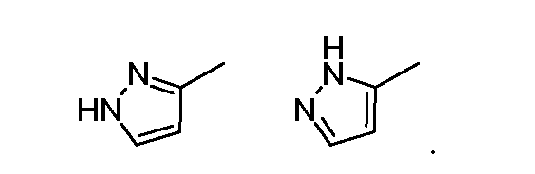 [0111] As readily understood by one skilled in the art, a wide variety of functional groups and other structures may exhibit tautomerism and all tautomers of the compounds are within the scope of the present disclosure.
[0112] It should also be noted the compounds can contain unnatural proportions of atomic isotopes at one or more of the atoms. For example, the compounds may be radiolabeled with radioactive isotopes, such as for example tritium (3H), iodine-125 (125I), sulfur-35 (35S), or carbon- 14 (14C), or may be isotopically enriched, such as with deuterium (2H), carbon-13 (13C), or nitrogen-15 (15N). As used herein, an “isotopologue” is an isotopically enriched compound. The term “isotopically enriched” refers to an atom having an isotopic composition other than the natural isotopic composition of that atom. “Isotopically enriched” may also refer to a compound containing at least one atom having an isotopic composition other than the natural isotopic composition of that atom. The term “isotopic composition” refers to the amount of each isotope present for a given atom. Radiolabeled and isotopically enriched compounds are useful as therapeutic agents, e.g., cancer and inflammation therapeutic agents, research reagents, e.g., binding assay reagents, and diagnostic agents, e.g., in vivo imaging agents. All isotopic variations of the compounds as described herein, whether radioactive or not, are intended to be encompassed within the scope of the embodiments provided herein. In some embodiments, there are provided isotopologues of the compounds, for example, the isotopologues are deuterium, carbon-13, or nitrogen-15 enriched compounds. [0113] It should be noted that if there is a discrepancy between a depicted structure and a name for that structure, the depicted structure is to be accorded more weight. [0114] As used herein, the term “residue” refers to the chemical moiety within a compound that remains after a chemical reaction. For example, the term “amino acid residue” or “N-alkyl amino acid residue” refers to the product of an amide coupling or peptide coupling of an amino acid or a N-alkyl amino acid to a suitable coupling partner; wherein, for example, a water molecule is expelled after the amide or peptide coupling of the amino acid or the N-alkylamino acid, resulting in the product having the amino acid residue or N-alkyl amino acid residue incorporated therein. [0115] As used herein, “sugar” or “sugar group” or “sugar residue” refers to a carbohydrate moiety which may comprise 3-carbon (those) units, 4-carbon (tetrose) units, 5-carbon (pentose) units, 6-carbon (hexose) units, 7-carbon (heptose) units, or combinations thereof, and may be a monosaccharide, a disaccharide, a trisaccharide, a tetrasaccharide, a pentasaccharide, an oligosaccharide, or any other polysaccharide. In some instances, a “sugar” or “sugar group” or “sugar residue” comprises furanoses (e.g., ribofuranose, fructofuranose) or pyranoses (e.g., glucopyranose, galactopyranose), or a combination thereof. In some instances, a “sugar” or “sugar group” or “sugar residue” comprises aldoses or ketoses, or a combination thereof. Non-limiting examples of monosaccharides include ribose, deoxyribose, xylose, arabinose, glucose, mannose, galactose, and fructose. Non-limiting examples of disaccharides include sucrose, maltose, lactose, lactulose, and trehalose. Other “sugars” or “sugar groups” or “sugar residues” include
polysaccharides and/or oligosaccharides, including, but not limited to, amylose, amylopectin, glycogen, inulin, and cellulose. In some instances, a “sugar” or “sugar group” or “sugar residue” is an amino-sugar. In some instances, a “sugar” or “sugar group” or “sugar residue” is a glucamine residue (1-amino-1-deoxy-D-glucitol) linked to the rest of molecule via its amino group to form an amide linkage with the rest of the molecule (i.e., a glucamide). [0116] As used herein, “binding agent” refers to any molecule, e.g., antibody, capable of binding with specificity to a given binding partner, e.g., antigen. [0117] As used herein, the term “amino acid” refers to an organic compound that contains amino (-NH2) and carboxyl (-COOH) functional groups, along with a side chain (R group), which is specific to each amino acid. Amino acids may be proteinogenic or non-proteinogenic. By “proteinogenic” is meant that the amino acid is one of the twenty naturally occurring amino acids found in proteins. The proteinogenic amino acids include alanine, arginine, asparagine, aspartic acid, cysteine, glutamine, glutamic acid, glycine, histidine, isoleucine, leucine, lysine, methionine, phenylalanine, proline, serine, threonine, tryptophan, tyrosine, and valine. By “non-proteinogenic” is meant that either the amino acid is not found naturally in protein or is not directly produced by cellular machinery (e.g., is the product of post-translational modification). Non-limiting examples of non-proteinogenic amino acids include gamma-aminobutyric acid (GABA), taurine (2- aminoethanesulfonic acid), theanine (L-γ-glutamylethylamide), hydroxyproline, beta-alanine, ornithine, and citrulline. [0118] As used herein “peptide,” in its various grammatical forms, is defined in its broadest sense to refer to a compound of two or more subunit amino acids, amino acid analogs, or other peptidomimetics. The subunits may be linked by peptide bonds or by other bonds, for example, ester, ether, and the like. As used herein, the term “amino acid” refers to either natural and/or unnatural, proteinogenic or non-proteinogenic, or synthetic amino acids, including glycine and both the D and L optical isomers, and amino acid analogs and peptidomimetics. If the peptide chain is short, e.g., two, three or more amino acids, it is commonly called an oligopeptide. If the peptide chain is longer, the peptide is typically called a polypeptide or a protein. Full-length proteins, analogs, mutants, and fragments thereof are encompassed by the definition. The terms also include post-expression modifications of the polypeptide, for example, glycosylation, acetylation, phosphorylation, and the like. Furthermore, as ionizable amino and carboxyl groups are present in the molecule, a particular peptide may be obtained as an acidic or basic salt, or in neutral form. A peptide may be obtained directly from the source organism or may be recombinantly or synthetically produced. [0119] The amino acid sequence of an antibody can be numbered using any known numbering schemes, including those described by Kabat et al., (“Kabat” numbering scheme); Al-Lazikani et
al., 1997, J. Mol. Biol., 273:927-948 (“Chothia” numbering scheme); MacCallum et al., 1996, J. Mol. Biol.262:732-745 (“Contact” numbering scheme); Lefranc et al., Dev. Comp. Immunol., 2003, 27:55-77 (“IMGT” numbering scheme); and Honegge and Pluckthun, J. Mol. Biol., 2001, 309:657-70 (“AHo” numbering scheme). Unless otherwise specified, the numbering scheme used herein is the Kabat numbering scheme. However, selection of a numbering scheme is not intended to imply differences in sequences where they do not exist, and one of skill in the art can readily confirm a sequence position by examining the amino acid sequence of one or more antibodies. Unless stated otherwise, the “EU numbering scheme” is generally used when referring to a residue in an antibody heavy chain constant region (e.g., as reported in Kabat et al., supra). [0120] As used herein, the term “cell-killing activity” refers to the activity that decreases or reduces the cell viability of the tested cell line. [0121] In the claims that follow and in the preceding description, except where the context requires otherwise due to express language or necessary implication, the word “comprise” or variations such as “comprises” or “comprising” is used in an inclusive sense, i.e., to specify the presence of the stated features but not to preclude the presence or addition of further features in various embodiments. Aspect 1 [0122] In some embodiments, the platform is a conjugator-linker-payload compound of Formula (I):
[0111] As readily understood by one skilled in the art, a wide variety of functional groups and other structures may exhibit tautomerism and all tautomers of the compounds are within the scope of the present disclosure.
[0112] It should also be noted the compounds can contain unnatural proportions of atomic isotopes at one or more of the atoms. For example, the compounds may be radiolabeled with radioactive isotopes, such as for example tritium (3H), iodine-125 (125I), sulfur-35 (35S), or carbon- 14 (14C), or may be isotopically enriched, such as with deuterium (2H), carbon-13 (13C), or nitrogen-15 (15N). As used herein, an “isotopologue” is an isotopically enriched compound. The term “isotopically enriched” refers to an atom having an isotopic composition other than the natural isotopic composition of that atom. “Isotopically enriched” may also refer to a compound containing at least one atom having an isotopic composition other than the natural isotopic composition of that atom. The term “isotopic composition” refers to the amount of each isotope present for a given atom. Radiolabeled and isotopically enriched compounds are useful as therapeutic agents, e.g., cancer and inflammation therapeutic agents, research reagents, e.g., binding assay reagents, and diagnostic agents, e.g., in vivo imaging agents. All isotopic variations of the compounds as described herein, whether radioactive or not, are intended to be encompassed within the scope of the embodiments provided herein. In some embodiments, there are provided isotopologues of the compounds, for example, the isotopologues are deuterium, carbon-13, or nitrogen-15 enriched compounds. [0113] It should be noted that if there is a discrepancy between a depicted structure and a name for that structure, the depicted structure is to be accorded more weight. [0114] As used herein, the term “residue” refers to the chemical moiety within a compound that remains after a chemical reaction. For example, the term “amino acid residue” or “N-alkyl amino acid residue” refers to the product of an amide coupling or peptide coupling of an amino acid or a N-alkyl amino acid to a suitable coupling partner; wherein, for example, a water molecule is expelled after the amide or peptide coupling of the amino acid or the N-alkylamino acid, resulting in the product having the amino acid residue or N-alkyl amino acid residue incorporated therein. [0115] As used herein, “sugar” or “sugar group” or “sugar residue” refers to a carbohydrate moiety which may comprise 3-carbon (those) units, 4-carbon (tetrose) units, 5-carbon (pentose) units, 6-carbon (hexose) units, 7-carbon (heptose) units, or combinations thereof, and may be a monosaccharide, a disaccharide, a trisaccharide, a tetrasaccharide, a pentasaccharide, an oligosaccharide, or any other polysaccharide. In some instances, a “sugar” or “sugar group” or “sugar residue” comprises furanoses (e.g., ribofuranose, fructofuranose) or pyranoses (e.g., glucopyranose, galactopyranose), or a combination thereof. In some instances, a “sugar” or “sugar group” or “sugar residue” comprises aldoses or ketoses, or a combination thereof. Non-limiting examples of monosaccharides include ribose, deoxyribose, xylose, arabinose, glucose, mannose, galactose, and fructose. Non-limiting examples of disaccharides include sucrose, maltose, lactose, lactulose, and trehalose. Other “sugars” or “sugar groups” or “sugar residues” include
polysaccharides and/or oligosaccharides, including, but not limited to, amylose, amylopectin, glycogen, inulin, and cellulose. In some instances, a “sugar” or “sugar group” or “sugar residue” is an amino-sugar. In some instances, a “sugar” or “sugar group” or “sugar residue” is a glucamine residue (1-amino-1-deoxy-D-glucitol) linked to the rest of molecule via its amino group to form an amide linkage with the rest of the molecule (i.e., a glucamide). [0116] As used herein, “binding agent” refers to any molecule, e.g., antibody, capable of binding with specificity to a given binding partner, e.g., antigen. [0117] As used herein, the term “amino acid” refers to an organic compound that contains amino (-NH2) and carboxyl (-COOH) functional groups, along with a side chain (R group), which is specific to each amino acid. Amino acids may be proteinogenic or non-proteinogenic. By “proteinogenic” is meant that the amino acid is one of the twenty naturally occurring amino acids found in proteins. The proteinogenic amino acids include alanine, arginine, asparagine, aspartic acid, cysteine, glutamine, glutamic acid, glycine, histidine, isoleucine, leucine, lysine, methionine, phenylalanine, proline, serine, threonine, tryptophan, tyrosine, and valine. By “non-proteinogenic” is meant that either the amino acid is not found naturally in protein or is not directly produced by cellular machinery (e.g., is the product of post-translational modification). Non-limiting examples of non-proteinogenic amino acids include gamma-aminobutyric acid (GABA), taurine (2- aminoethanesulfonic acid), theanine (L-γ-glutamylethylamide), hydroxyproline, beta-alanine, ornithine, and citrulline. [0118] As used herein “peptide,” in its various grammatical forms, is defined in its broadest sense to refer to a compound of two or more subunit amino acids, amino acid analogs, or other peptidomimetics. The subunits may be linked by peptide bonds or by other bonds, for example, ester, ether, and the like. As used herein, the term “amino acid” refers to either natural and/or unnatural, proteinogenic or non-proteinogenic, or synthetic amino acids, including glycine and both the D and L optical isomers, and amino acid analogs and peptidomimetics. If the peptide chain is short, e.g., two, three or more amino acids, it is commonly called an oligopeptide. If the peptide chain is longer, the peptide is typically called a polypeptide or a protein. Full-length proteins, analogs, mutants, and fragments thereof are encompassed by the definition. The terms also include post-expression modifications of the polypeptide, for example, glycosylation, acetylation, phosphorylation, and the like. Furthermore, as ionizable amino and carboxyl groups are present in the molecule, a particular peptide may be obtained as an acidic or basic salt, or in neutral form. A peptide may be obtained directly from the source organism or may be recombinantly or synthetically produced. [0119] The amino acid sequence of an antibody can be numbered using any known numbering schemes, including those described by Kabat et al., (“Kabat” numbering scheme); Al-Lazikani et
al., 1997, J. Mol. Biol., 273:927-948 (“Chothia” numbering scheme); MacCallum et al., 1996, J. Mol. Biol.262:732-745 (“Contact” numbering scheme); Lefranc et al., Dev. Comp. Immunol., 2003, 27:55-77 (“IMGT” numbering scheme); and Honegge and Pluckthun, J. Mol. Biol., 2001, 309:657-70 (“AHo” numbering scheme). Unless otherwise specified, the numbering scheme used herein is the Kabat numbering scheme. However, selection of a numbering scheme is not intended to imply differences in sequences where they do not exist, and one of skill in the art can readily confirm a sequence position by examining the amino acid sequence of one or more antibodies. Unless stated otherwise, the “EU numbering scheme” is generally used when referring to a residue in an antibody heavy chain constant region (e.g., as reported in Kabat et al., supra). [0120] As used herein, the term “cell-killing activity” refers to the activity that decreases or reduces the cell viability of the tested cell line. [0121] In the claims that follow and in the preceding description, except where the context requires otherwise due to express language or necessary implication, the word “comprise” or variations such as “comprises” or “comprising” is used in an inclusive sense, i.e., to specify the presence of the stated features but not to preclude the presence or addition of further features in various embodiments. Aspect 1 [0122] In some embodiments, the platform is a conjugator-linker-payload compound of Formula (I):
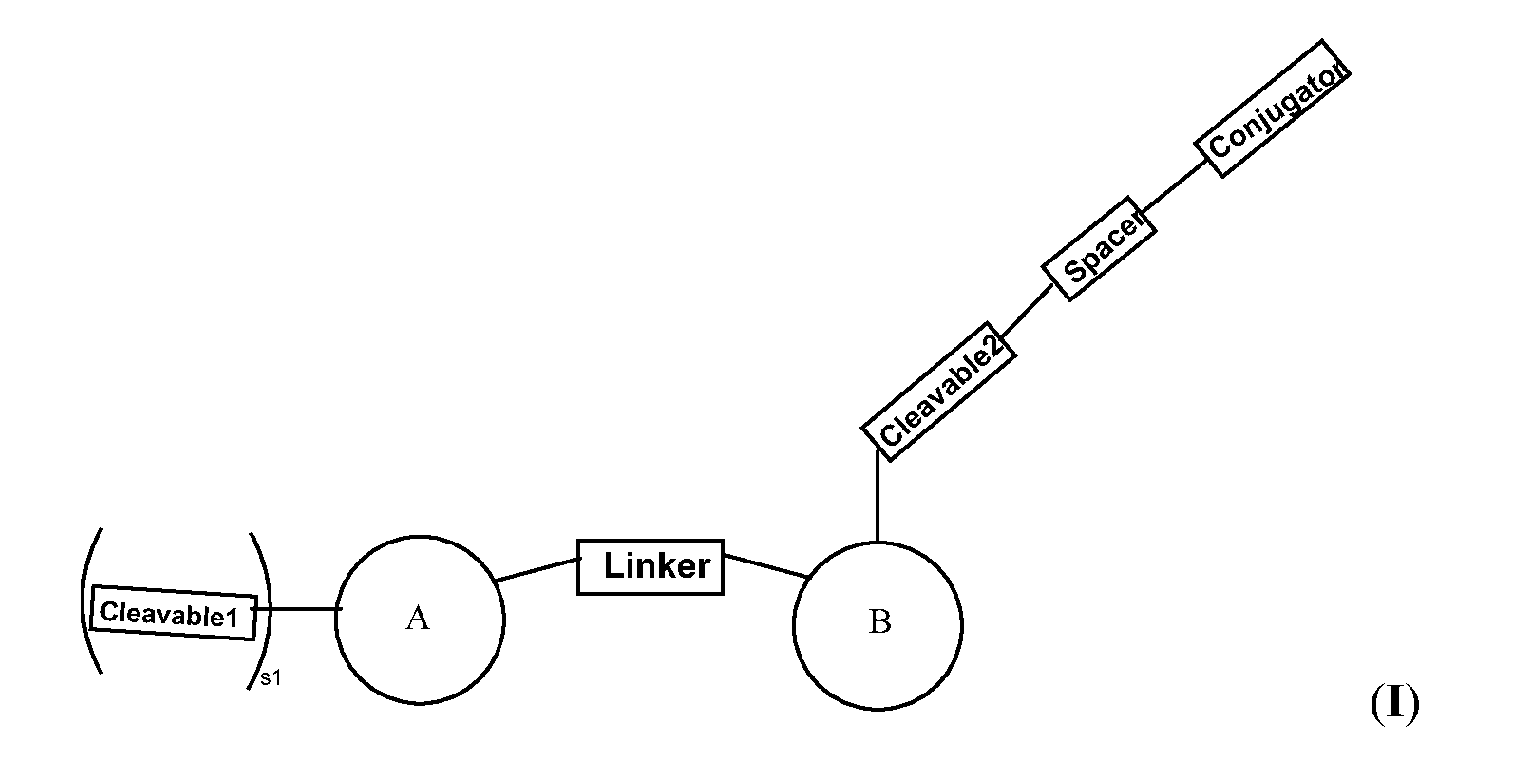 or a pharmaceutically acceptable salt, tautomer, solvate, stereoisomer, or isotopologue thereof, wherein: each of ring A and ring B is, independently, one of formula (IIa), (IIb), (IIc), (IId), (IIe), (IIf), or (IIg):

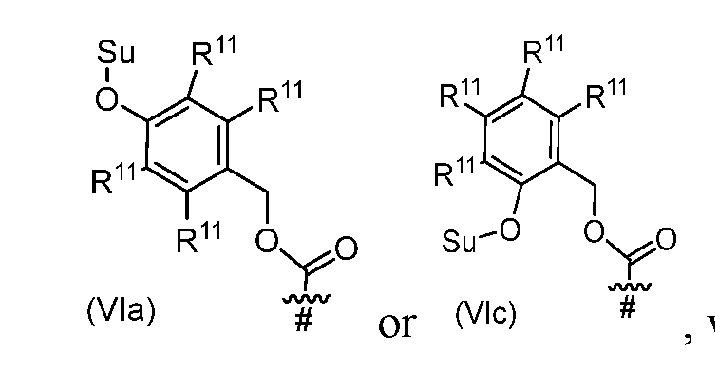




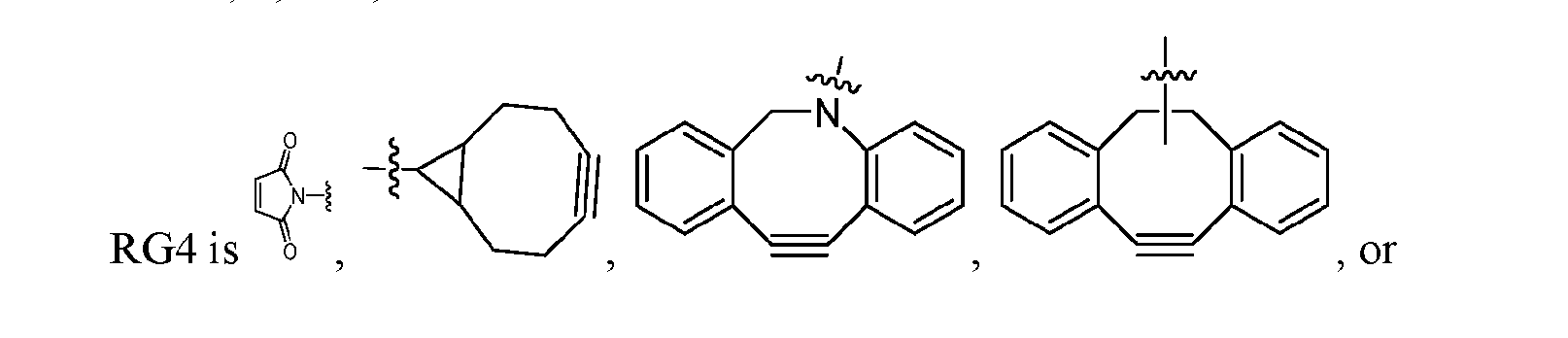


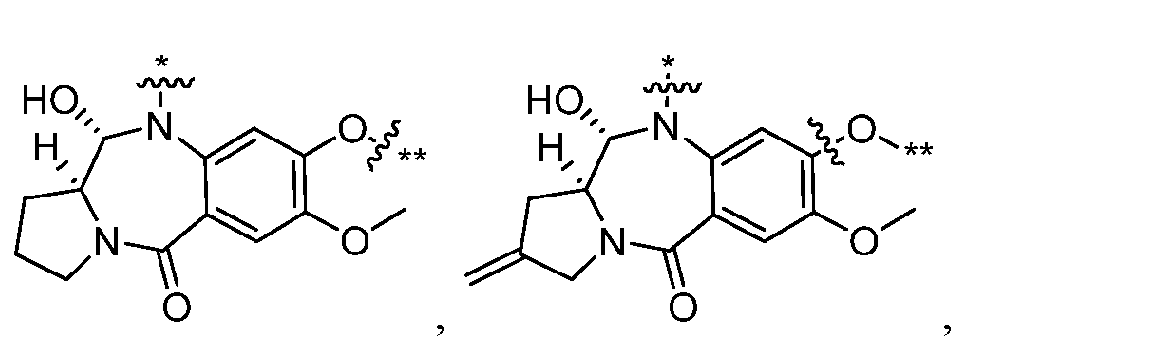


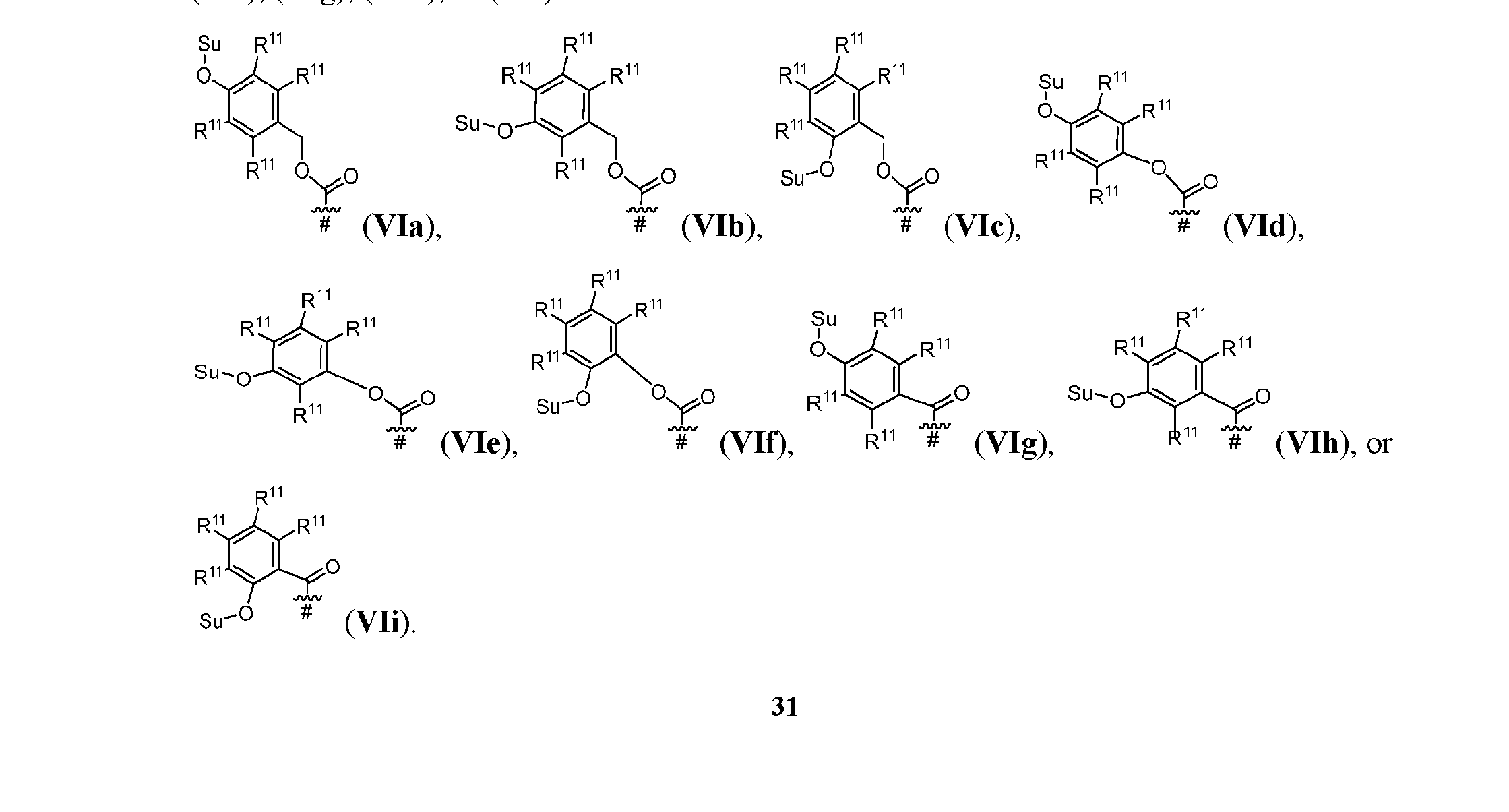


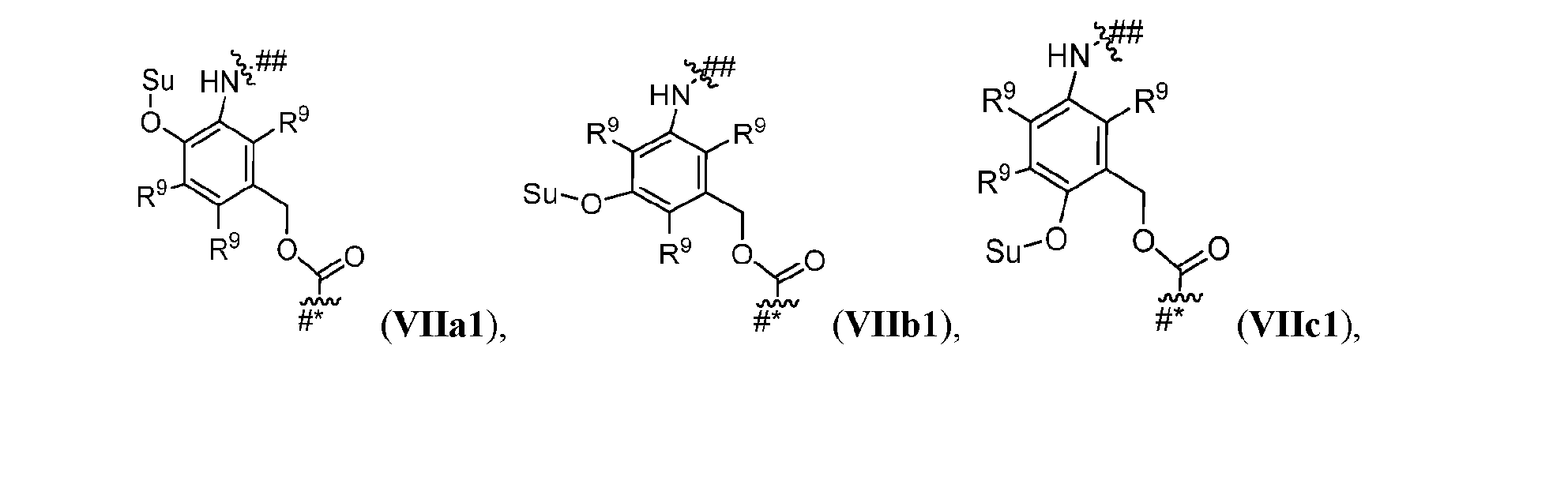

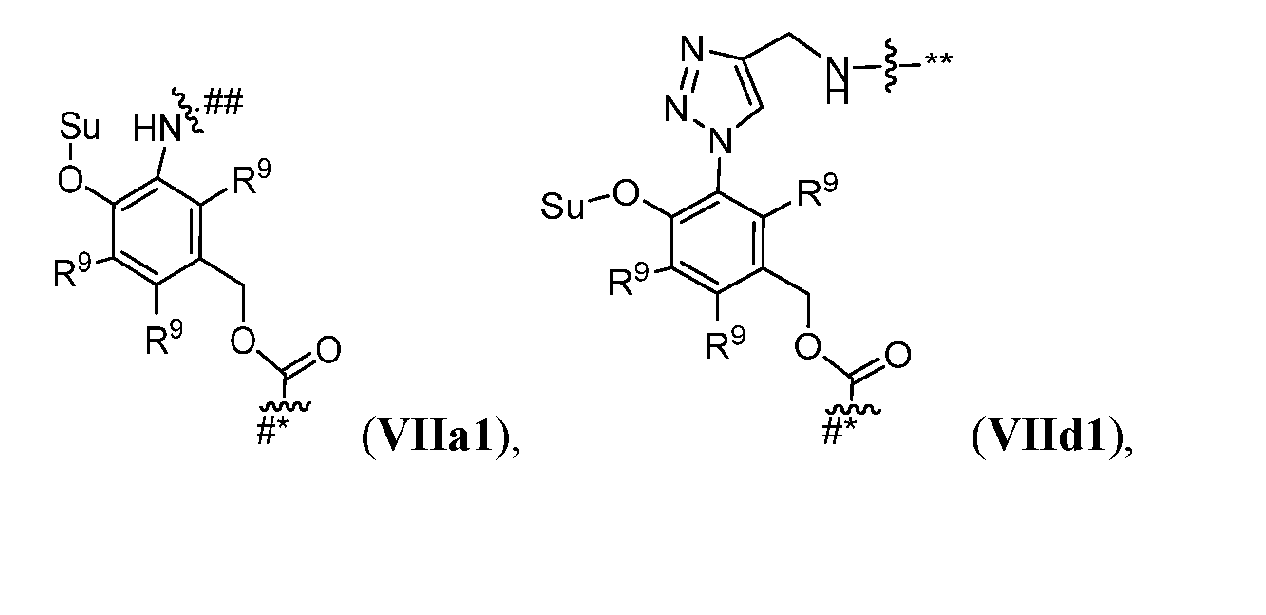


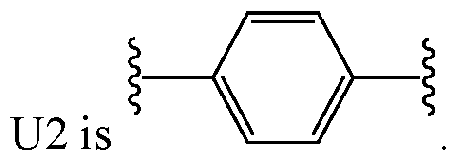
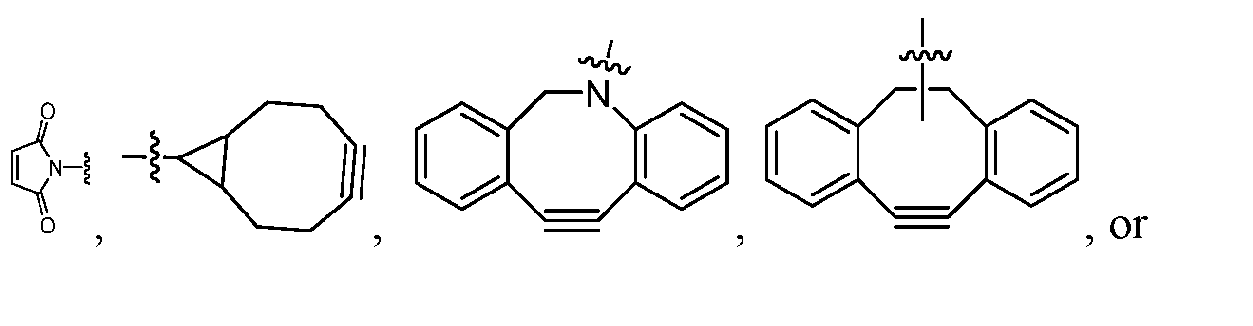
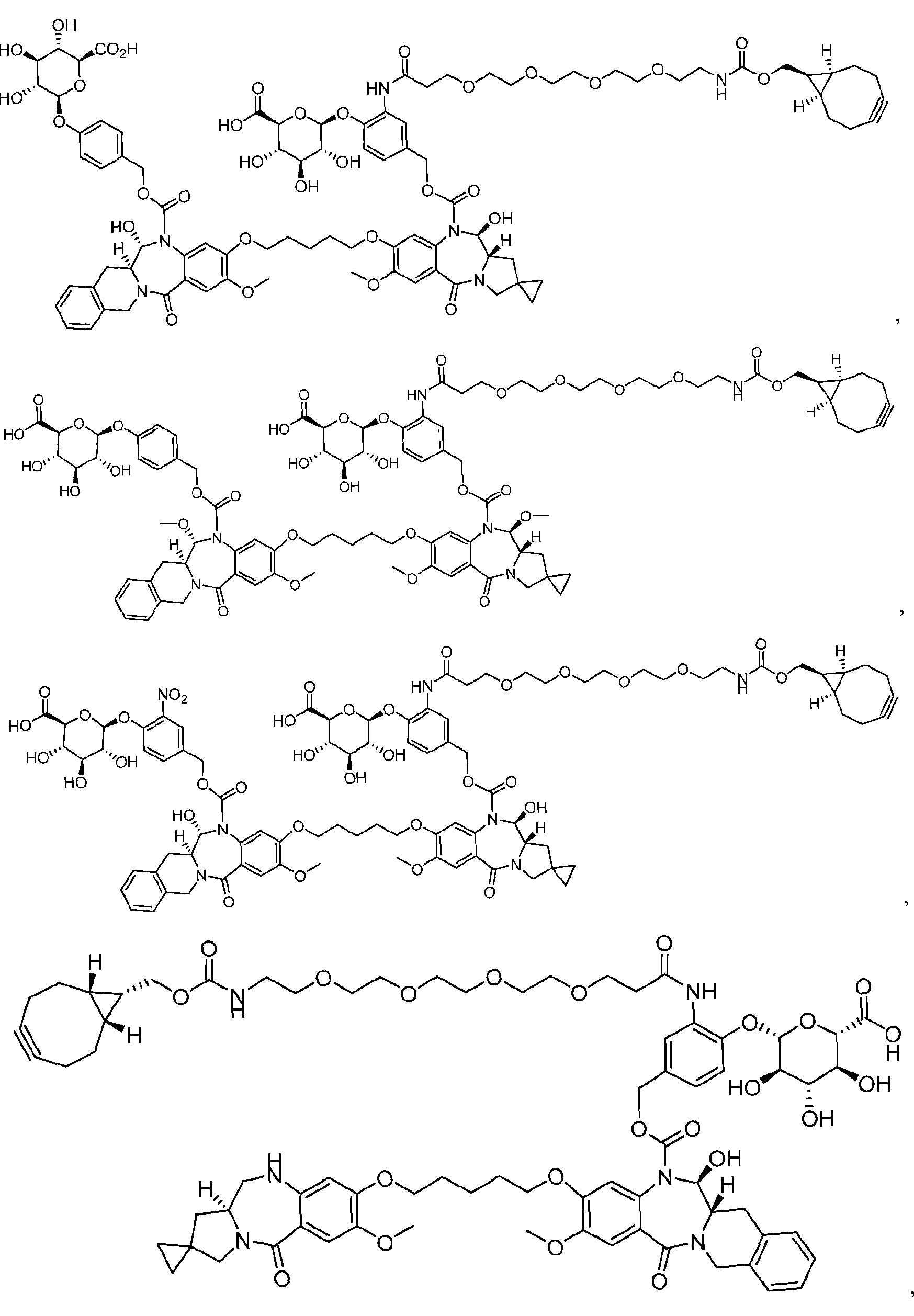


or . Aspect 3 [0248] Provided herein are ligand-drug conjugates or pharmaceutically acceptable salts or solvates thereof, wherein the conjugate comprises a ligand that is conjugated to a compound provided herein via Conjugator or , wherein the conjugate has one of the following formulas: Ligand-[Formula (I)]x or Ligand-[Formula (IA)]x, wherein x is from about 1 to about 12, and wherein Formula (I) is as described above with reference to Aspect 1 and Formula (IA) is as described above with reference to Aspect 2. [0249] In one embodiment, x is from about 1 to about 10. In one embodiment, x is from about 1.5 to about 10. In one embodiment, x is from about 1.5 to about 8. In one embodiment, x is from about 1.5 to about 6. In one embodiment, x is from about 1.5 to about 4. In one embodiment, x is from about 1.8 to about 4. In one embodiment, x is from about 1.8 to about 2.5. In one embodiment, x is about 2. [0250] In some embodiments, the ligand is a humanized, monoclonal, chimeric, or a human antibody, or an antigen binding fragment thereof. [0251] In some embodiments, the ligand is conjugated to a compound provided herein via the moiety of the compound.
[0252] In some embodiments, the conjugate has the following formula wherein Ab is a humanized, monoclonal, chimeric, or human antibody, or an antigen binding fragment thereof, and values for the remaining variables (e.g., Cleavable 1, s1, ring A, Linker, ring B, Cleavable 2, Spacer, RE4, t4) are as described herein. [0253] In some embodiments, the ligand or Ab binds to one or more receptors chosen from B7- H3, cytokeratin 15, PTK7, HER3, HER2, CD7, CD19, CD20, CD22, CD25, CD27, CD30, CD33, CD37, CD38, CD46, CD70, CD71, CD74, CD79b, CD123, CD138, CD142, CD166, CD205, CD228, CCR2, CA6, p-Cadherin, CEA, CEACAM5, C4.4a, DLL3, EGFR, EGFRVIII, ENPP3, EphA2, EphrinA, FLOR1, FGFR2, GCC, cKIT, LIV1, LY6E, MSLN, MUC16, NaPi2b, Nectin4, gpNMB, PSMA, SLITRK6, STEAP1, TROP2, 5T4, SSEA4, GloboH, Gb5, STn, Tn, B7H3, BCMA, MUC1, cMet, ROR1 MSLN, FRa, CLDN18.2, CLDN6, PTK7, Axl, FGFR2b, CLL1, CCR7, GPC1, GPC3, ISAC, CDCP1, ITGB6, ADAM9, or CD45-iADC. [0254] In one embodiment, Ab is an anti-CD74 antibody. In one embodiment, Ab is the anti- CD74 antibody STRO-001. [0255] In some embodiments, the conjugate is: ,


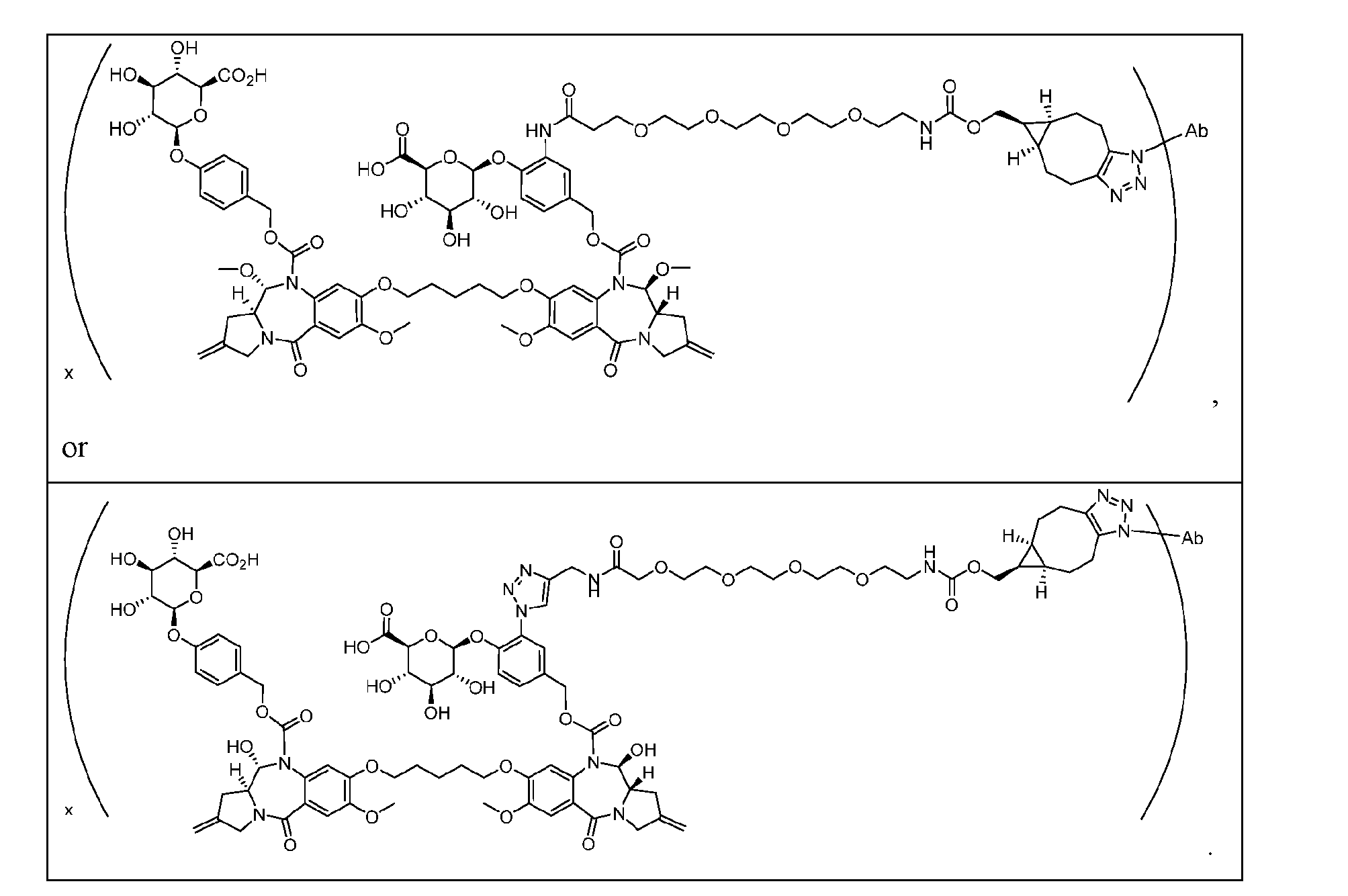
[0256] In some embodiments, the conjugate is

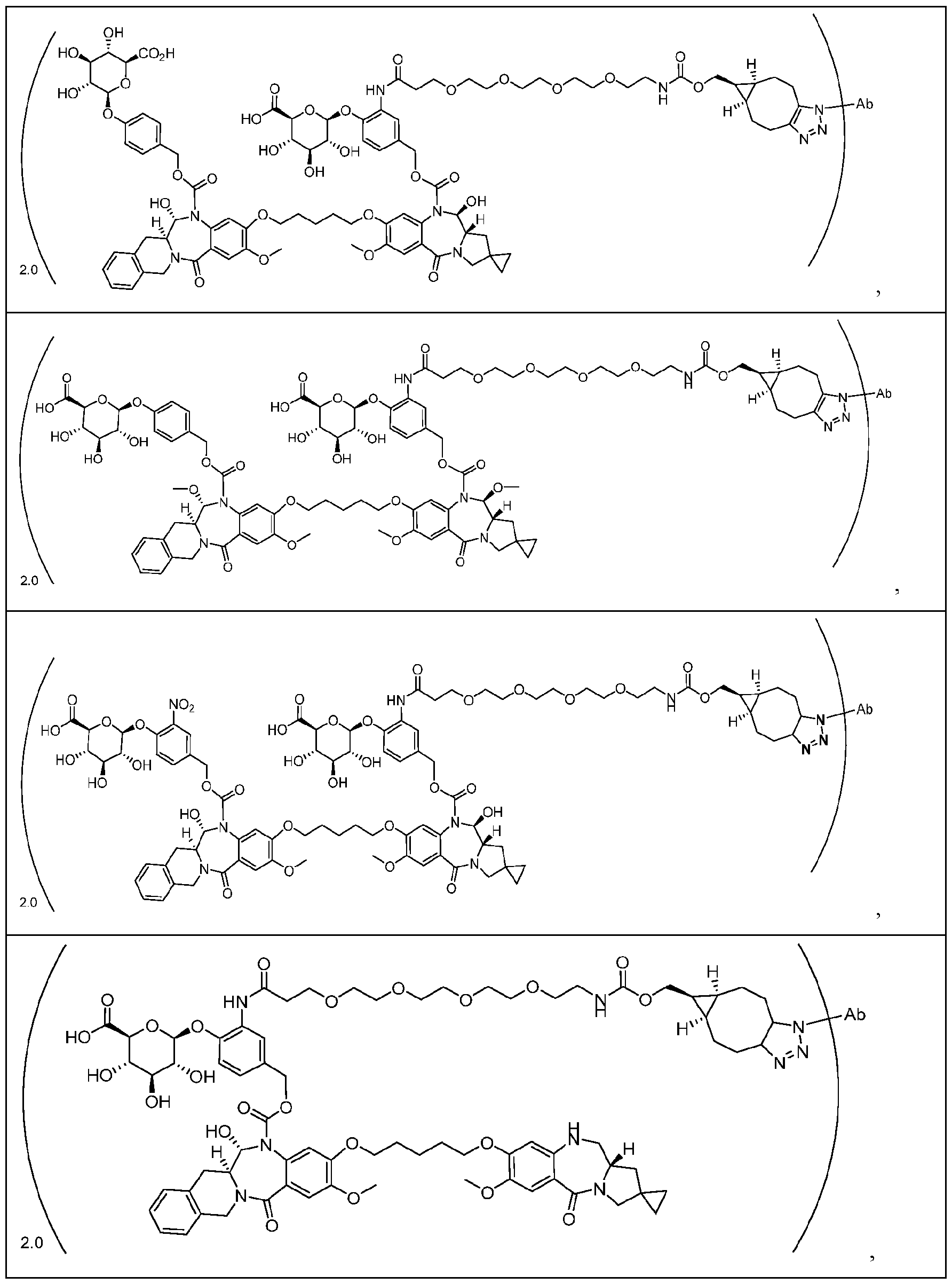


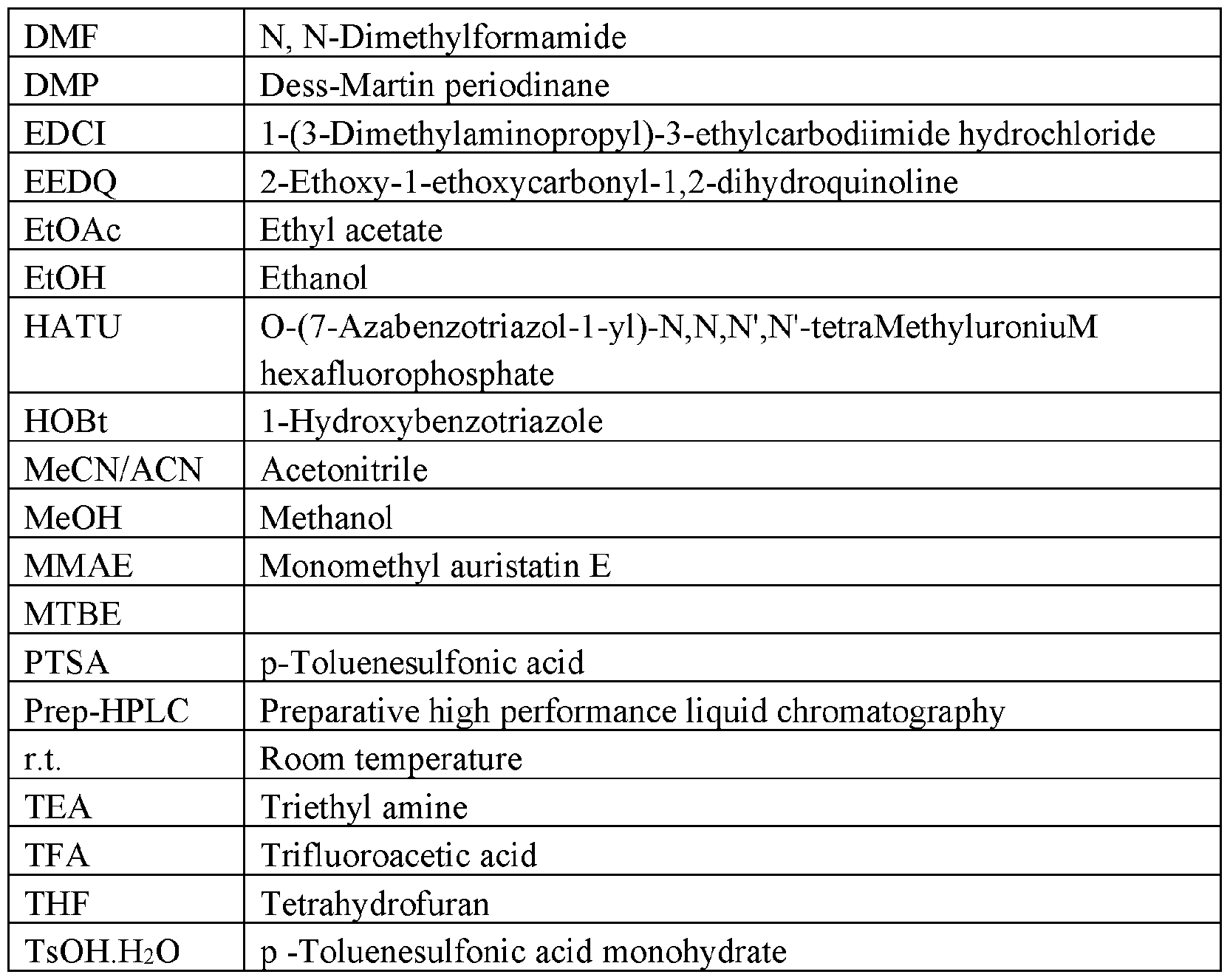


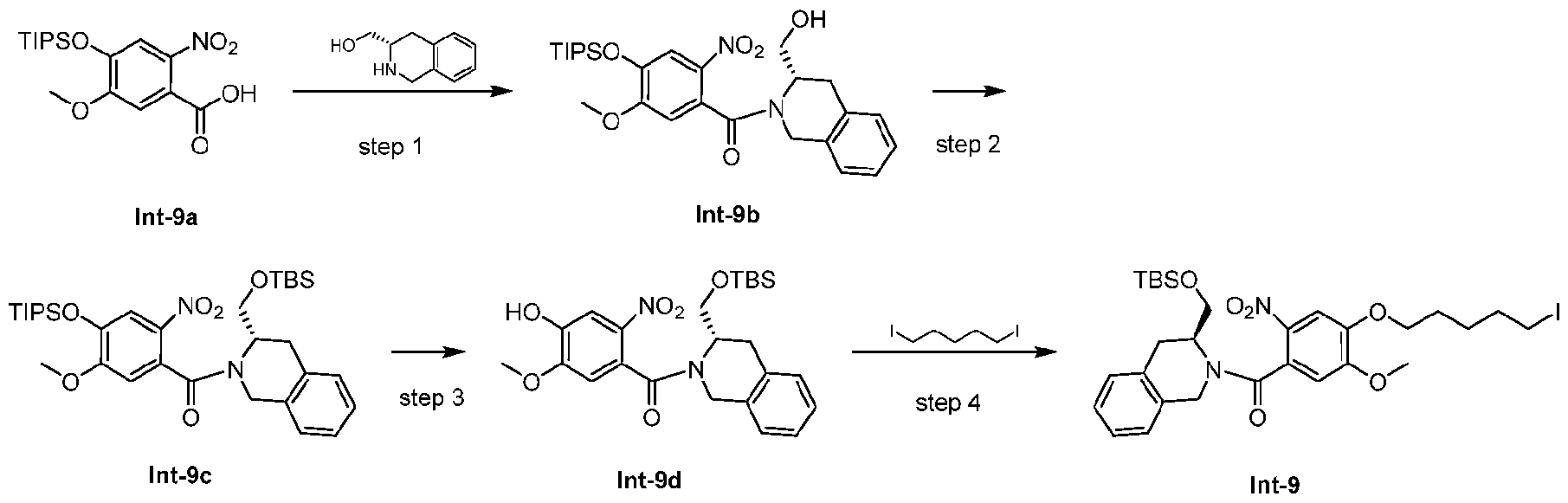
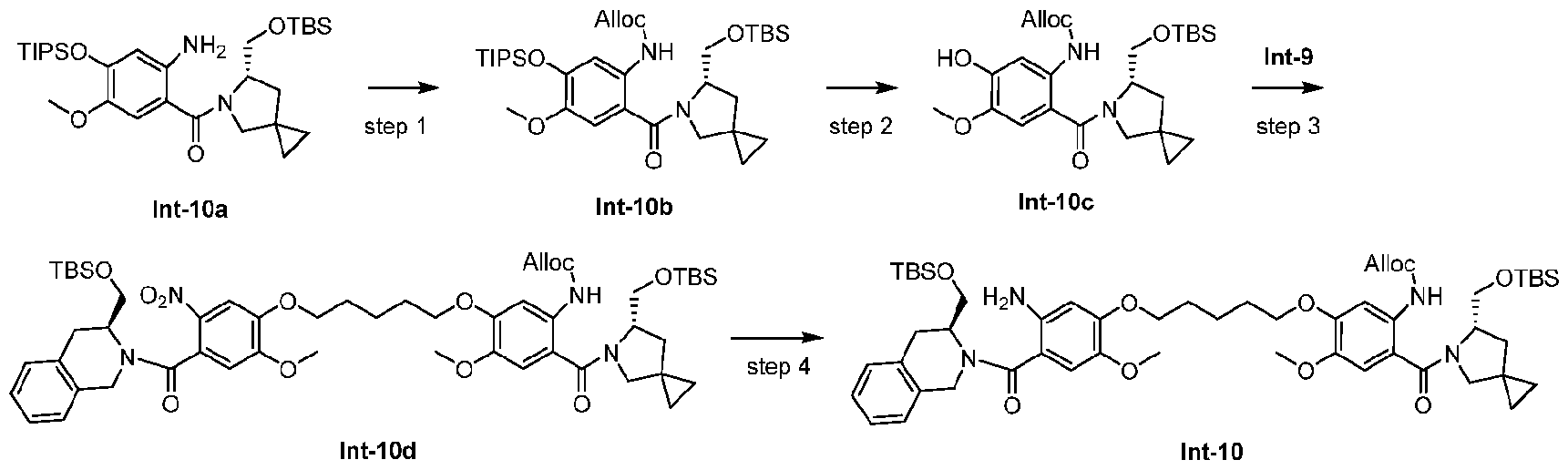






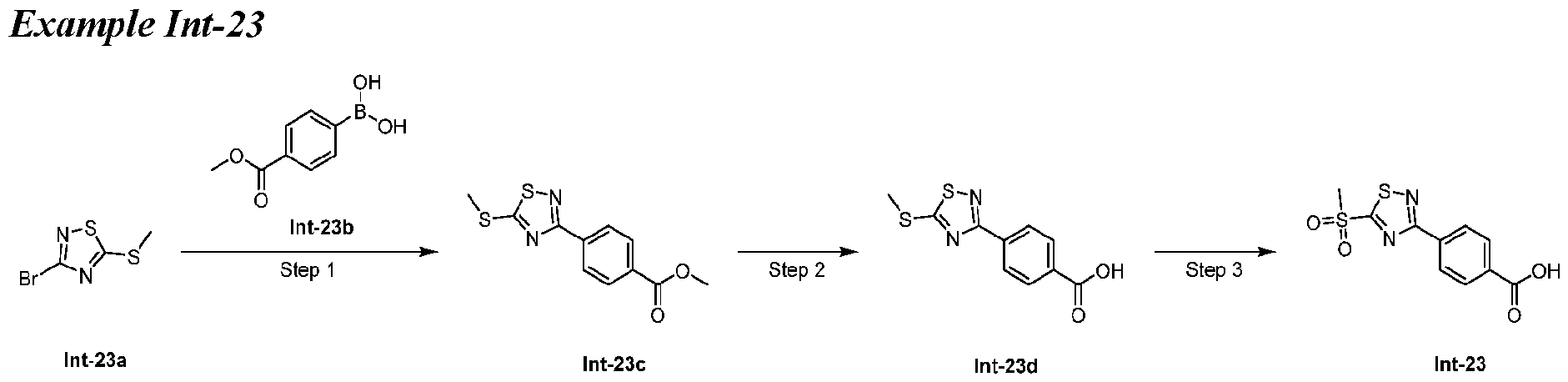


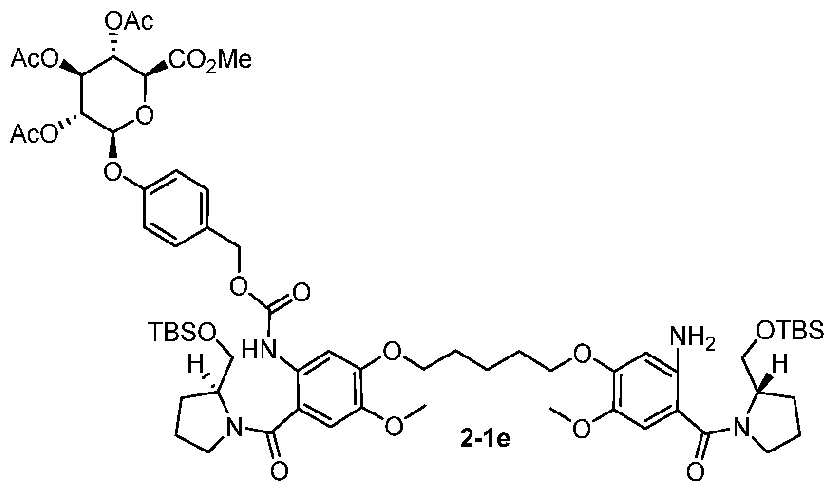


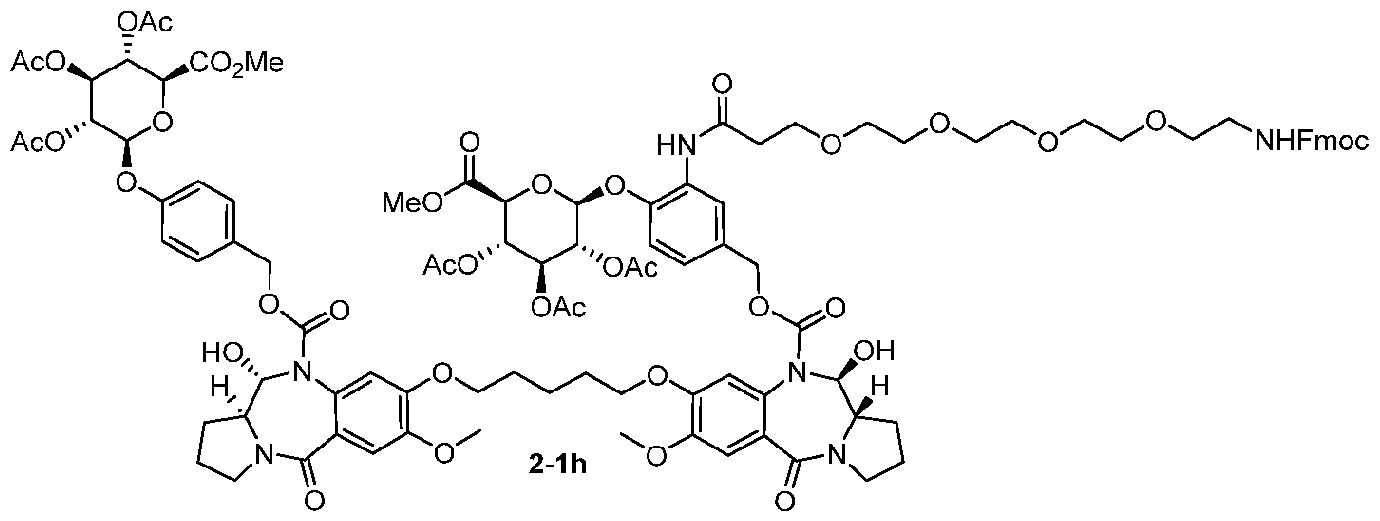
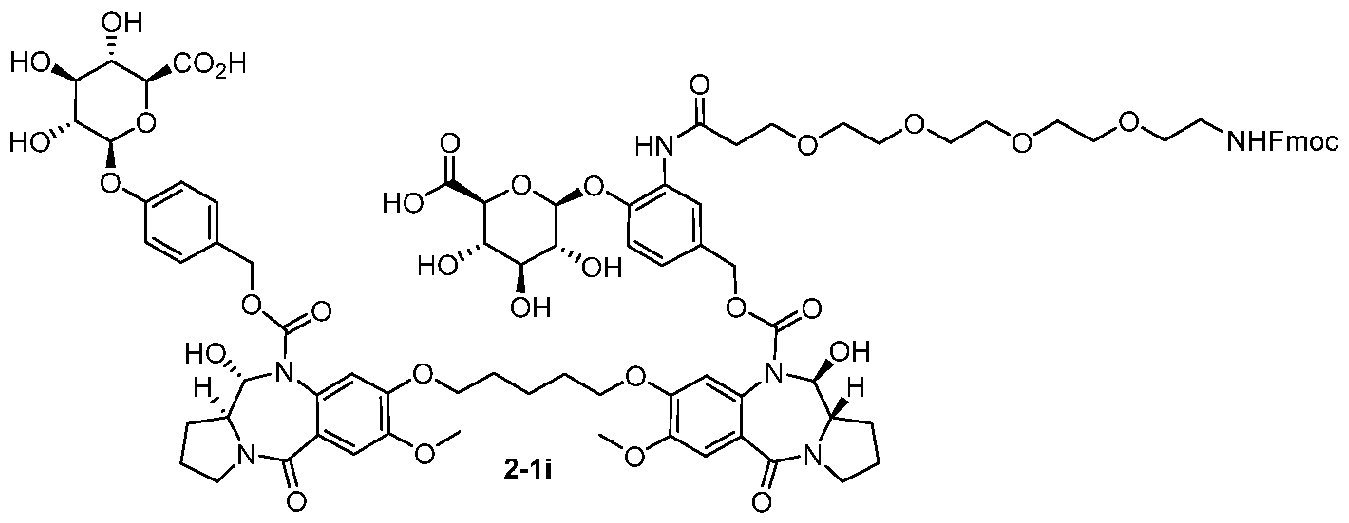

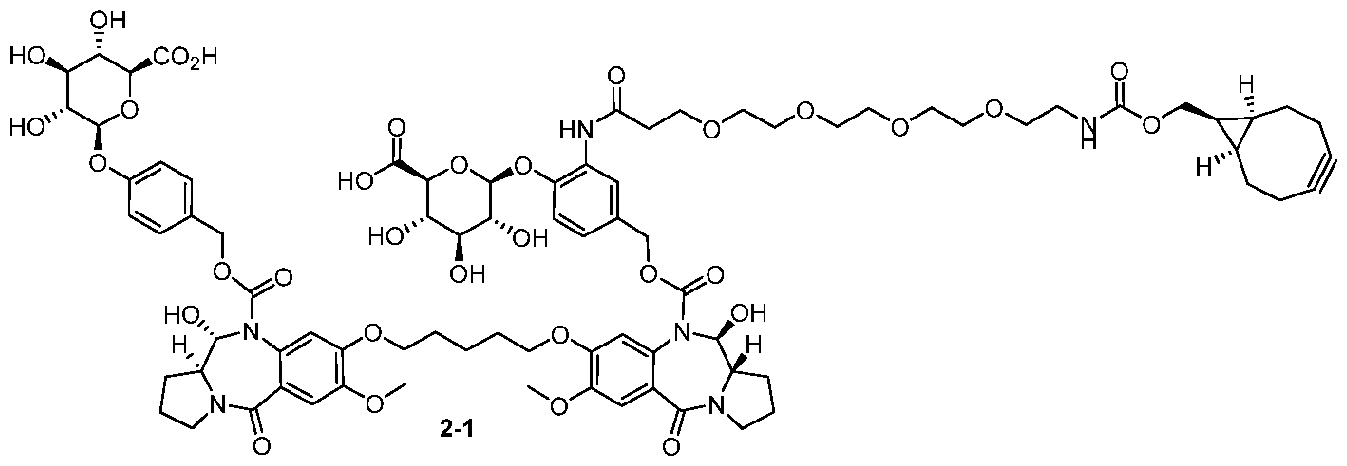

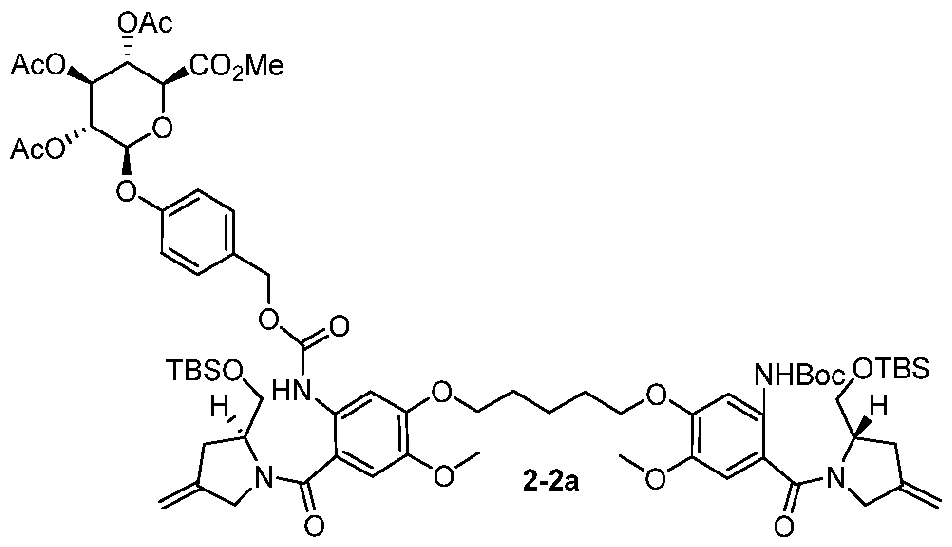

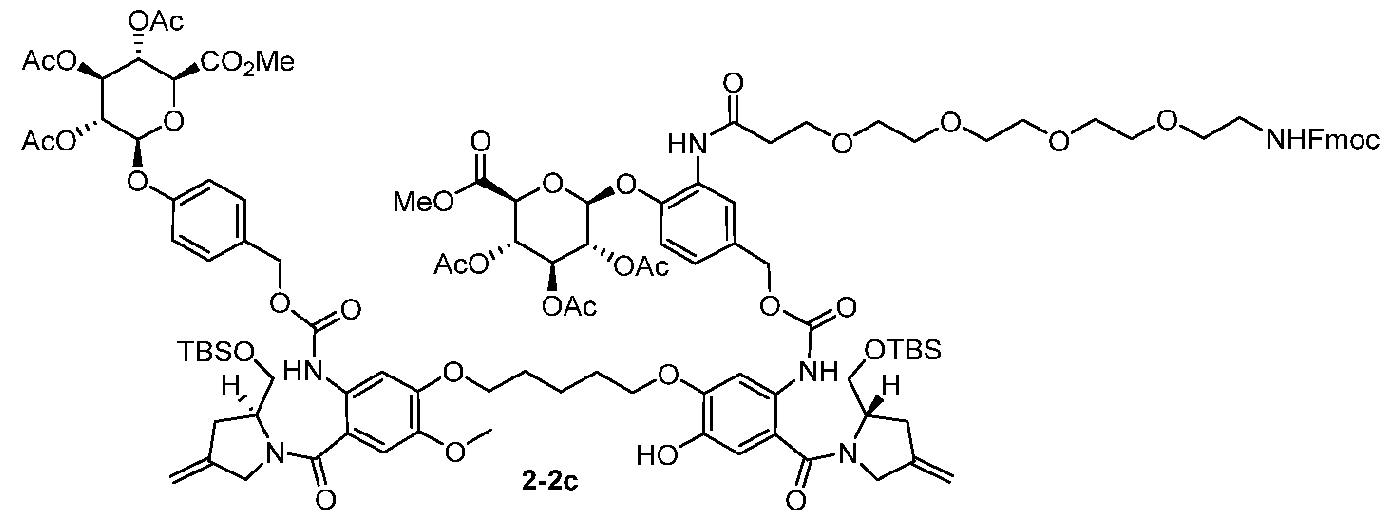


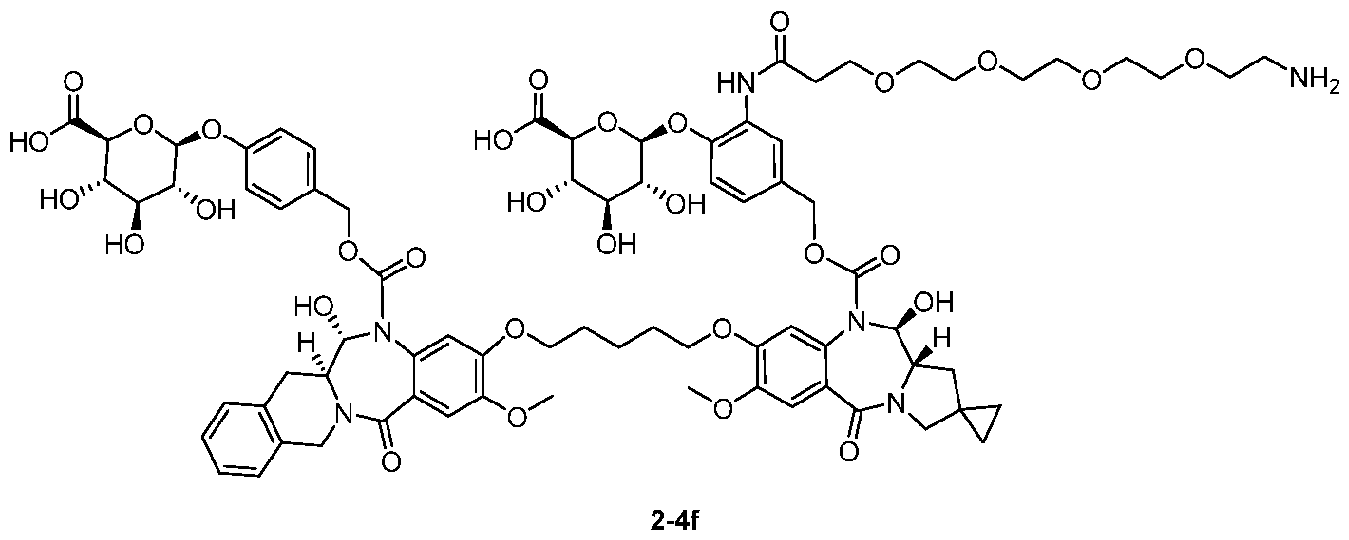


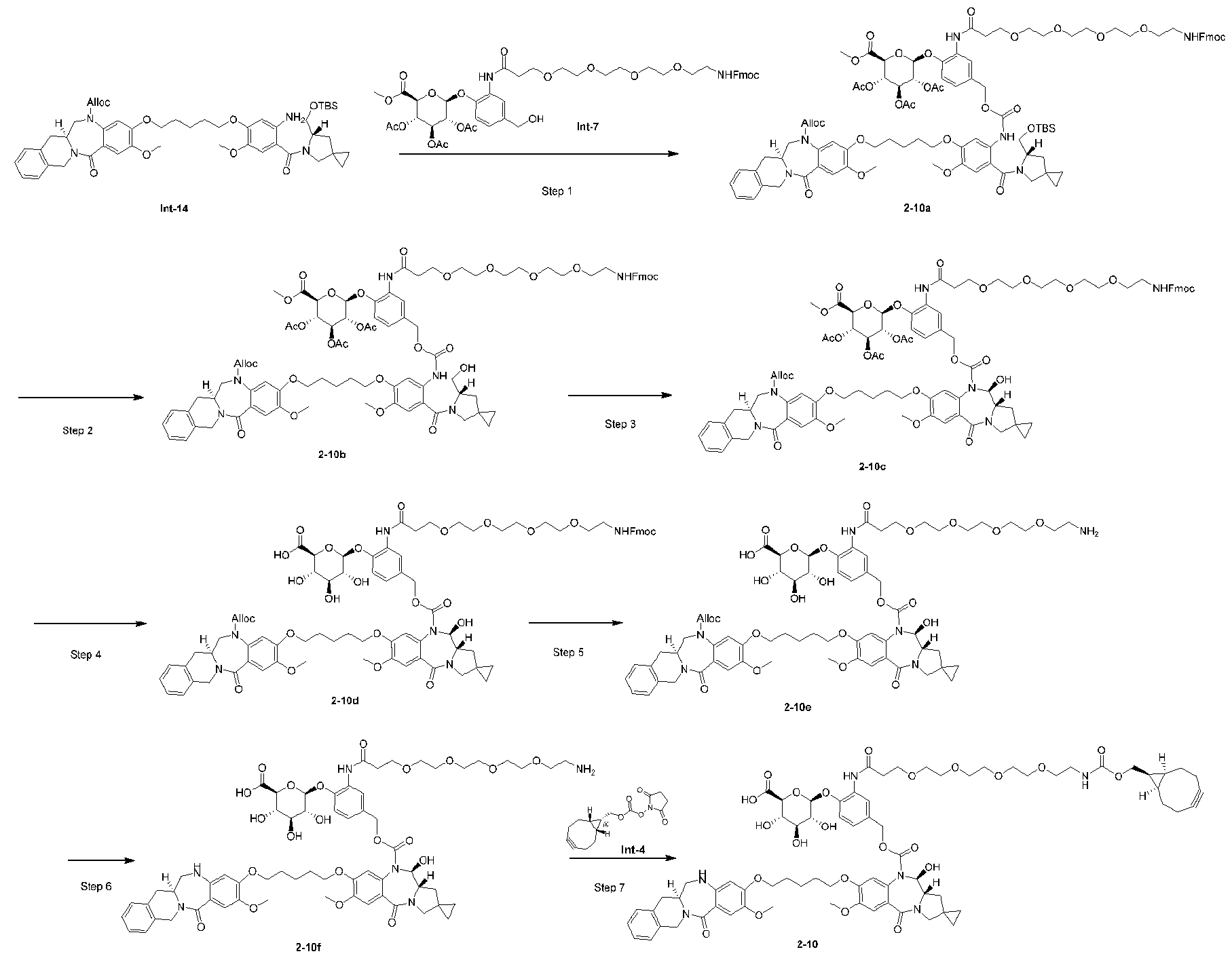
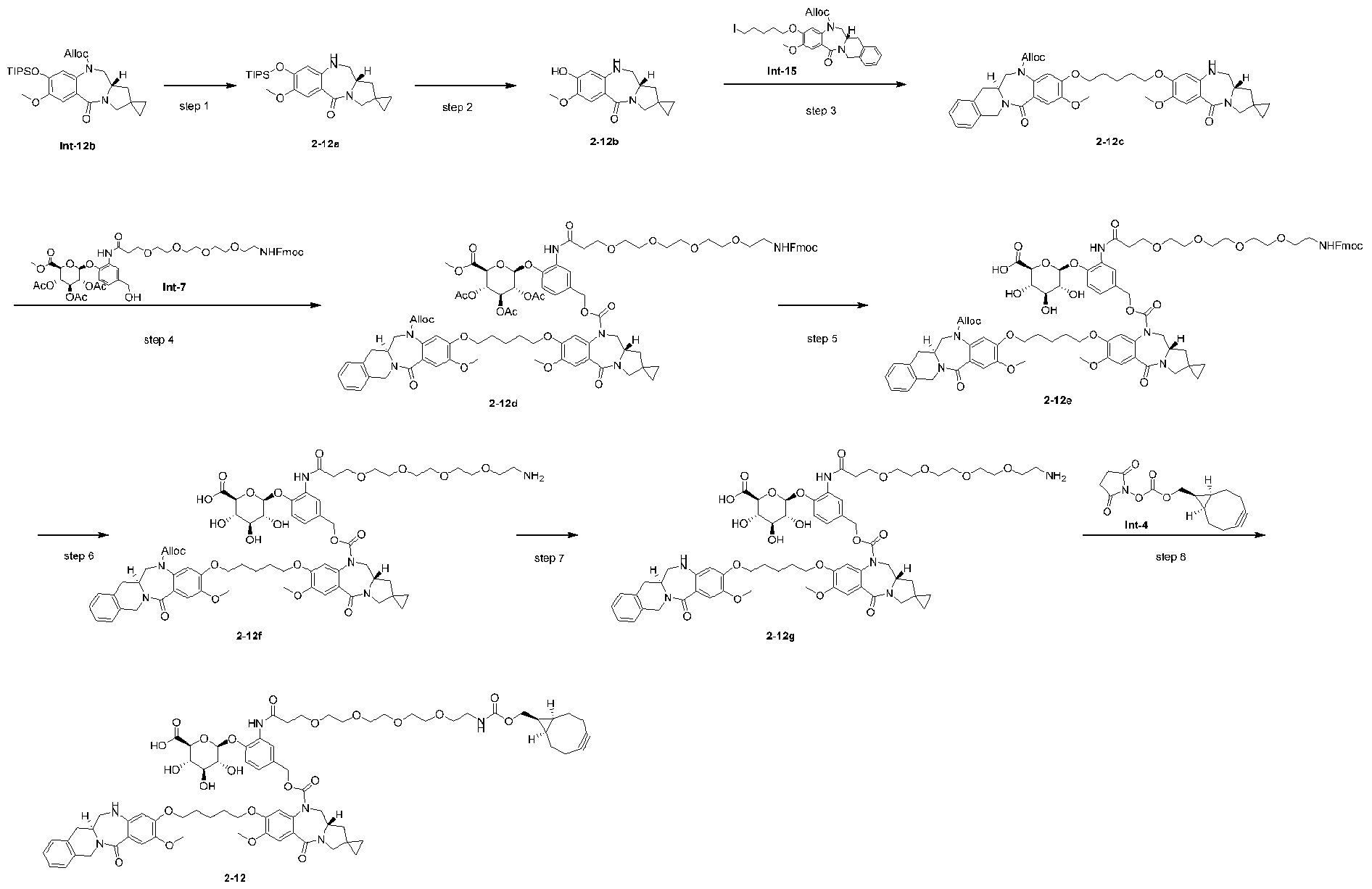


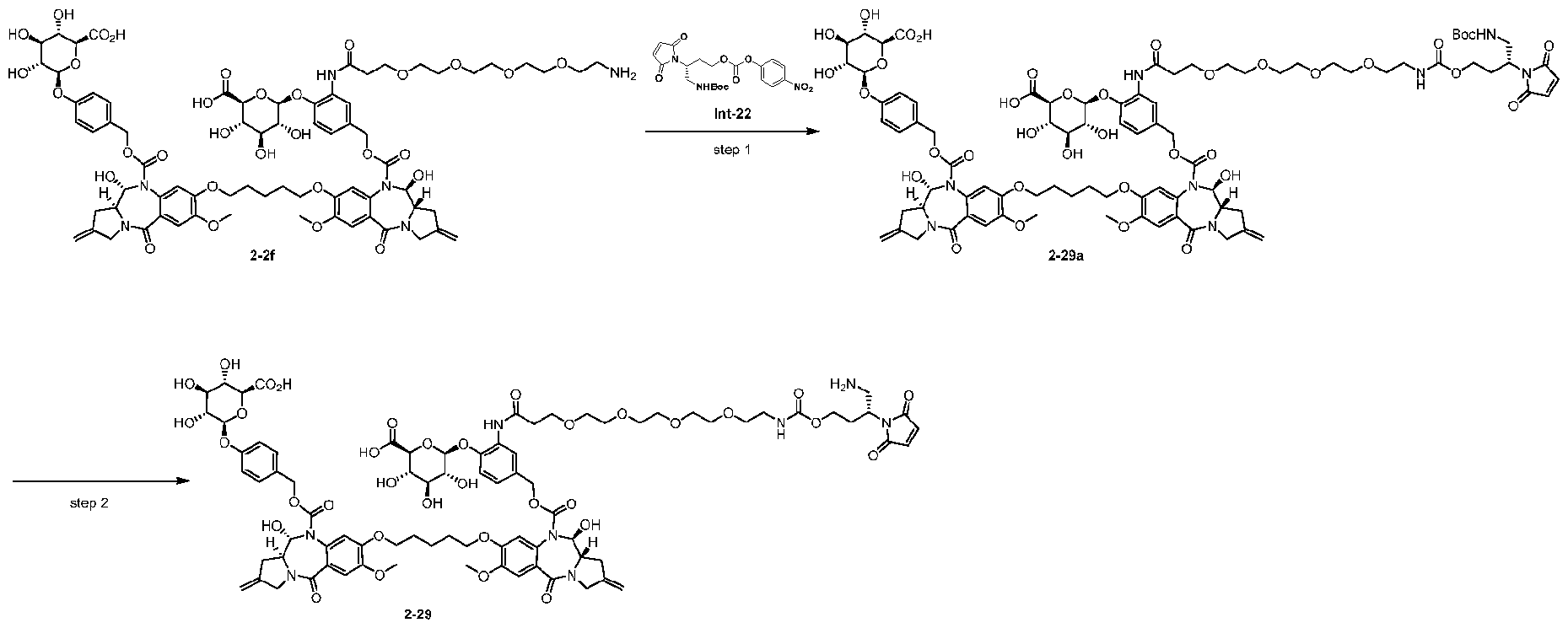

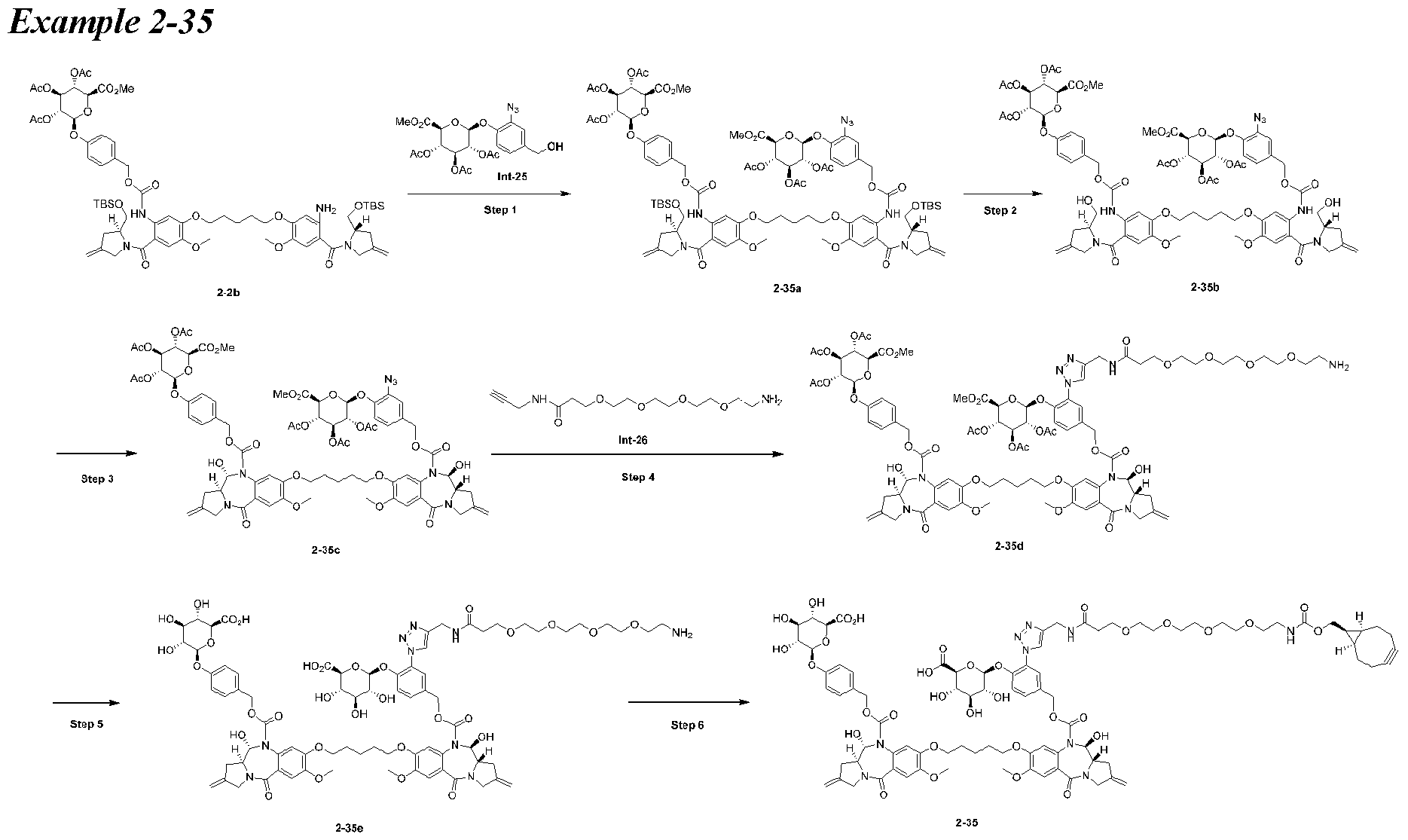

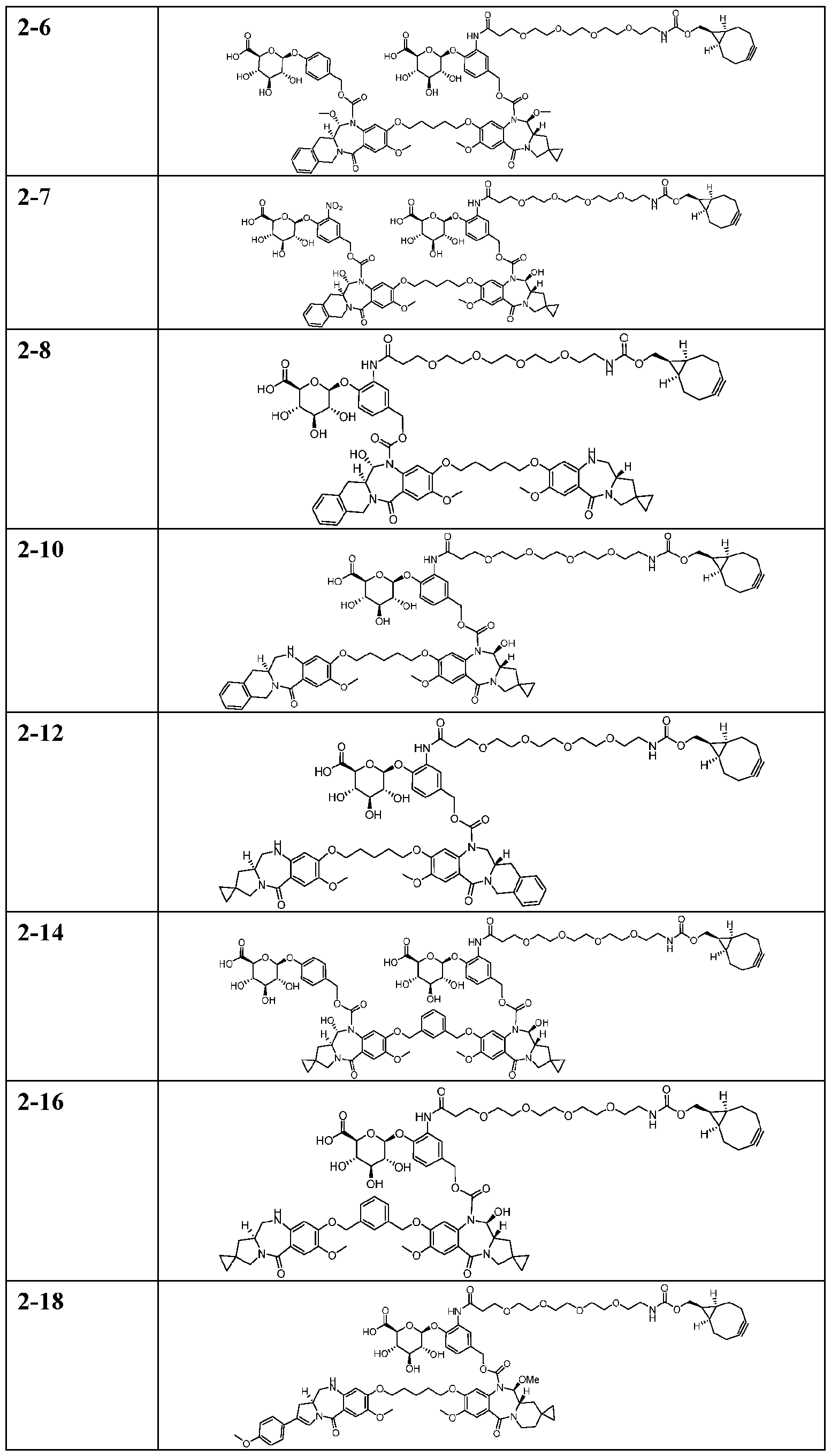
Exa
 mple 2: Antibody drug conjugate preparation and characterization
[0574] DAR2 antibody drug conjugate preparation. Anti-CD74 antibody STRO-001 or isotype antibody CB6 (either, “mAb1”) in reaction buffer (with concentration 0.5-25 mg/mL, 50 mM Tris-HCl buffer pH 7.0-8.5) was incubated with 1/2000-1/500 w/w (EndoS2/mAb weight ratio) endoS2 under reaction temperature (0-40 ºC) for 1-24 h. 2-40 eq. UDP-GalNAz (20 mM) and 0.1 w/w%-10 w/w% (GalT/mAb weight ratio) β1,4-GalT were added into the reaction mixture and incubated in reaction buffer (50 mM Tris-HCl buffer pH 7.0-8.5, 20 mM MnCl2) for 8-24 hours at reaction temperature (0-40 ºC). The reaction mixture was purified with protein A resin to give the mAb1-GalNAz. [0575] Organic solvent (e.g., DMSO, DMF, DMA, PG, acetonitrile, 0-25% v/v) and linker- payload stock (10-25 eq., 10 mM stock in organic solvent) were added stepwise in reaction buffer (PBS buffer pH 7.0-8.5) with mAb1-GalNAz (1-20 mg/mL) at 0-25 ºC for 0.5-24 h. The solution was submitted to buffer exchange (spin desalting column, ultrafiltration, and dialysis) into storage buffer (for example, pH 5.5-6.5 histidine acetate buffer, with optional additive such as sucrose, trehalose, tween 20, 60, 80). [0576] Synthesized ADCs are shown below in Table 2. Ab was STRO-001 for all ADCs except Isotype ADC, in which Ab was CB6. [0577] ADC characterization. ADCs were characterized via the following analytical methods. SEC purity of all ADCs were > 95 % purity. [0578] Drug to antibody ratio (DAR) determination by LCMS or HIC methods LCMS method: LC-MS analysis was carried out under the following measurement conditions: LC-MS system: Vanquish Flex UHPLC and Orbitrap Exploris 240 Mass Spectrometer Column: MAbPac™ RP, 2.1*50mm, 4μm, 1,500 Å, Thermo Scientific™ Column temperature: 80 ºC Mobile phase A: 0.1 % formic acid (FA) aqueous solution Mobile phase B: Acetonitrile solution containing 0.1 % formic acid (FA) Gradient program: 25 %B-25 %B (0 min-2 min), 25 %B-50 %B (2 min-18 min), 50 %B- 90 %B (18 min-18.1 min), 90 %B-90 %B (18.1 min-20 min), 90 %B-25 %B (20 min-20.1 min), 25 %B-25 %B (20.1 min-25 min) Injected sample amount: 1 μg MS parameters: Intact and denaturing MS data were acquired in HMR mode at setting of R=15k and deconvolved using the ReSpect™ algorithm and Sliding Window integration in Thermo Scientific™ BioPharma Finder™ 4.0 software. HIC method: HPLC analysis was carried out under the following measurement conditions: HPLC system: Waters ACQUITY ARC HPLC System Detector: measurement wavelength: 280 nm
Column: Tosoh Bioscience 4.6 μm ID×3.5 cm, 2.5 μm butyl-nonporous resin column Column temperature: 25 ºC Mobile phase A: 1.5 M ammonium sulfate, 50 mM phosphate buffer, pH 7.0 Mobile phase B: 50 mM phosphate buffer, 25% (V/V) isopropanol, pH 7.0 Gradient program: 0%B-0%B (0 min-2 min), 0%B-100%B (2 min-15 min), 100%B- 100%B (15 min-16 min), 100%B-0%B (16 min-17 min), 0%B-0%B (17 min-20 min) Injected sample amount: 20 μg [0579] SEC method to determine ADC purity [0580] HPLC analysis was carried out under the following measurement conditions: HPLC system: Waters H-Class UPLC System Detector: measurement wavelength: 280 nm Column: ACQUITY UPLC BEH200 SEC 1.7um 4.6x150mm, Waters Column temperature: room temperature Mobile phase A: 200 mM phosphate buffer, 250 mM potassium chloride, 15% isopropyl alcohol, pH 7.0 Gradient program: under 10 min isocratic elutions with a flow rate of 0.3 mL/min Injected sample amount: 20 μg [0581] ADC hydrophobicity evaluation by HIC method: An ADC with a higher hydrophobic property would appear with a later retention time from HIC (hydrophobicity interaction column) chromatography. The DAR2 peak was used as a reference. [0582] HPLC analysis was carried out under the following measurement conditions: Method 1 HPLC system: Waters ACQUITY ARC HPLC System Detector: measurement wavelength: 280 nm Column: Tosoh Bioscience 4.6 μm ID×3.5 cm, 2.5 μm butyl-nonporous resin column Column temperature: 25ºC Mobile phase A: 1.5 M ammonium sulfate, 50 mM phosphate buffer, pH 7.0 Mobile phase B: 50 mM Phosphate buffer, 25% (V/V) isopropanol, pH 7.0 Gradient program: 0%B-0%B (0 min-2 min), 0%B-100%B (2 min-15 min), 100%B- 100%B (15 min-16 min), 100%B-0%B (16 min-17 min), 0%B-0%B (17 min-20 min) Injected sample amount: 20 μg Method 2 HPLC system: Waters ACQUITY ARC HPLC System Detector: measurement wavelength: 280 nm Column: MABPac HIC-10, 5 μm, 4.6×10 mm (Thermo)
Column temperature: 25 ºC Mobile phase A: 1.5 M ammonium sulfate, 50 mM sodium phosphate, pH 7.0 Mobile phase B: 50 mM sodium phosphate, pH 7.0 Gradient program: 20%B-20%B (0 min-1 min), 0%B-0%B (1 min-35 min), 20%B-20%B (35 min-40 min) Flow rate: 0.5 mL/min Sample preparation: The sample was diluted with initial mobile phase to 0.5 mg/mL. Table 2: ADC Structures
mple 2: Antibody drug conjugate preparation and characterization
[0574] DAR2 antibody drug conjugate preparation. Anti-CD74 antibody STRO-001 or isotype antibody CB6 (either, “mAb1”) in reaction buffer (with concentration 0.5-25 mg/mL, 50 mM Tris-HCl buffer pH 7.0-8.5) was incubated with 1/2000-1/500 w/w (EndoS2/mAb weight ratio) endoS2 under reaction temperature (0-40 ºC) for 1-24 h. 2-40 eq. UDP-GalNAz (20 mM) and 0.1 w/w%-10 w/w% (GalT/mAb weight ratio) β1,4-GalT were added into the reaction mixture and incubated in reaction buffer (50 mM Tris-HCl buffer pH 7.0-8.5, 20 mM MnCl2) for 8-24 hours at reaction temperature (0-40 ºC). The reaction mixture was purified with protein A resin to give the mAb1-GalNAz. [0575] Organic solvent (e.g., DMSO, DMF, DMA, PG, acetonitrile, 0-25% v/v) and linker- payload stock (10-25 eq., 10 mM stock in organic solvent) were added stepwise in reaction buffer (PBS buffer pH 7.0-8.5) with mAb1-GalNAz (1-20 mg/mL) at 0-25 ºC for 0.5-24 h. The solution was submitted to buffer exchange (spin desalting column, ultrafiltration, and dialysis) into storage buffer (for example, pH 5.5-6.5 histidine acetate buffer, with optional additive such as sucrose, trehalose, tween 20, 60, 80). [0576] Synthesized ADCs are shown below in Table 2. Ab was STRO-001 for all ADCs except Isotype ADC, in which Ab was CB6. [0577] ADC characterization. ADCs were characterized via the following analytical methods. SEC purity of all ADCs were > 95 % purity. [0578] Drug to antibody ratio (DAR) determination by LCMS or HIC methods LCMS method: LC-MS analysis was carried out under the following measurement conditions: LC-MS system: Vanquish Flex UHPLC and Orbitrap Exploris 240 Mass Spectrometer Column: MAbPac™ RP, 2.1*50mm, 4μm, 1,500 Å, Thermo Scientific™ Column temperature: 80 ºC Mobile phase A: 0.1 % formic acid (FA) aqueous solution Mobile phase B: Acetonitrile solution containing 0.1 % formic acid (FA) Gradient program: 25 %B-25 %B (0 min-2 min), 25 %B-50 %B (2 min-18 min), 50 %B- 90 %B (18 min-18.1 min), 90 %B-90 %B (18.1 min-20 min), 90 %B-25 %B (20 min-20.1 min), 25 %B-25 %B (20.1 min-25 min) Injected sample amount: 1 μg MS parameters: Intact and denaturing MS data were acquired in HMR mode at setting of R=15k and deconvolved using the ReSpect™ algorithm and Sliding Window integration in Thermo Scientific™ BioPharma Finder™ 4.0 software. HIC method: HPLC analysis was carried out under the following measurement conditions: HPLC system: Waters ACQUITY ARC HPLC System Detector: measurement wavelength: 280 nm
Column: Tosoh Bioscience 4.6 μm ID×3.5 cm, 2.5 μm butyl-nonporous resin column Column temperature: 25 ºC Mobile phase A: 1.5 M ammonium sulfate, 50 mM phosphate buffer, pH 7.0 Mobile phase B: 50 mM phosphate buffer, 25% (V/V) isopropanol, pH 7.0 Gradient program: 0%B-0%B (0 min-2 min), 0%B-100%B (2 min-15 min), 100%B- 100%B (15 min-16 min), 100%B-0%B (16 min-17 min), 0%B-0%B (17 min-20 min) Injected sample amount: 20 μg [0579] SEC method to determine ADC purity [0580] HPLC analysis was carried out under the following measurement conditions: HPLC system: Waters H-Class UPLC System Detector: measurement wavelength: 280 nm Column: ACQUITY UPLC BEH200 SEC 1.7um 4.6x150mm, Waters Column temperature: room temperature Mobile phase A: 200 mM phosphate buffer, 250 mM potassium chloride, 15% isopropyl alcohol, pH 7.0 Gradient program: under 10 min isocratic elutions with a flow rate of 0.3 mL/min Injected sample amount: 20 μg [0581] ADC hydrophobicity evaluation by HIC method: An ADC with a higher hydrophobic property would appear with a later retention time from HIC (hydrophobicity interaction column) chromatography. The DAR2 peak was used as a reference. [0582] HPLC analysis was carried out under the following measurement conditions: Method 1 HPLC system: Waters ACQUITY ARC HPLC System Detector: measurement wavelength: 280 nm Column: Tosoh Bioscience 4.6 μm ID×3.5 cm, 2.5 μm butyl-nonporous resin column Column temperature: 25ºC Mobile phase A: 1.5 M ammonium sulfate, 50 mM phosphate buffer, pH 7.0 Mobile phase B: 50 mM Phosphate buffer, 25% (V/V) isopropanol, pH 7.0 Gradient program: 0%B-0%B (0 min-2 min), 0%B-100%B (2 min-15 min), 100%B- 100%B (15 min-16 min), 100%B-0%B (16 min-17 min), 0%B-0%B (17 min-20 min) Injected sample amount: 20 μg Method 2 HPLC system: Waters ACQUITY ARC HPLC System Detector: measurement wavelength: 280 nm Column: MABPac HIC-10, 5 μm, 4.6×10 mm (Thermo)
Column temperature: 25 ºC Mobile phase A: 1.5 M ammonium sulfate, 50 mM sodium phosphate, pH 7.0 Mobile phase B: 50 mM sodium phosphate, pH 7.0 Gradient program: 20%B-20%B (0 min-1 min), 0%B-0%B (1 min-35 min), 20%B-20%B (35 min-40 min) Flow rate: 0.5 mL/min Sample preparation: The sample was diluted with initial mobile phase to 0.5 mg/mL. Table 2: ADC Structures


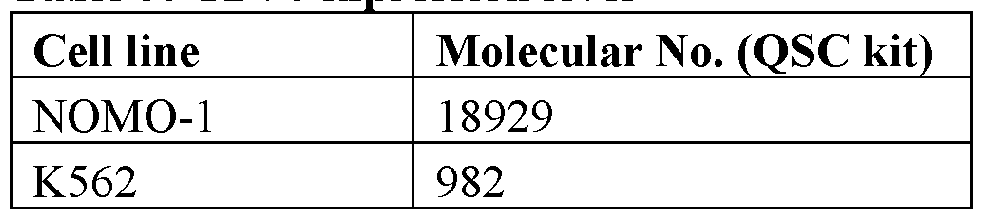
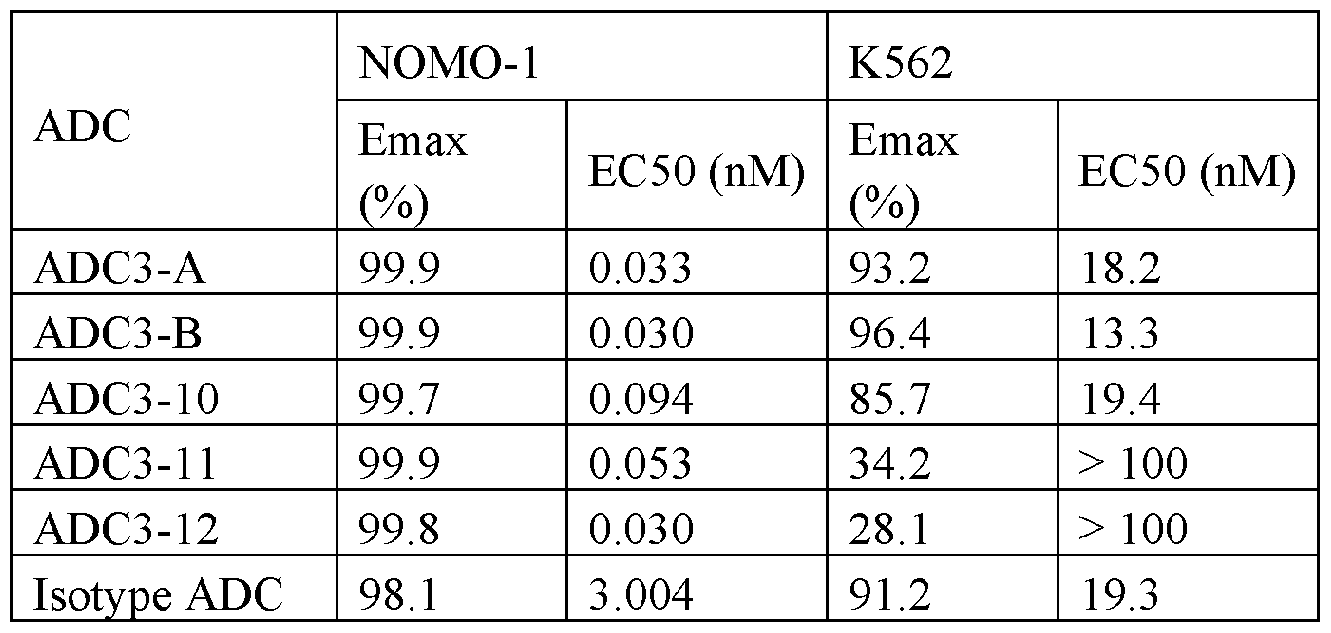




Claims
What is claimed is: 1. A compound of Formula (I):
 or a pharmaceutically acceptable salt, tautomer, solvate, stereoisomer, or isotopologue thereof, wherein: each of ring A and ring B is, independently, one of formula (IIa), (IIb), (IIc), (IId), (IIe), (IIf), or (IIg):
 wherein: each ring C is independently a cyclopropyl ring or a cyclobutyl ring; each R1 is independently H, OH, C1-4 alkyl, C1-4 alkoxyl, or -O-(CH2CH2O)t1-CH3; each R2 is independently H or C1-4 alkyl; each R3 and R4 is, independently, H, NRa1Rb1, OH, C1-4 alkyl, C1-4 alkoxyl, or aryl; each of Ra1 and Rb1 is, independently, H or C1-4 alkyl; each R5 is independently H, C1-4 alkyl, C1-4 alkoxyl, or aryl; each m1, n1, and o1 is, independently, 1 or 2; t1 is 1, 2, 3, 4, 5, 6, 7, or 8; * marks the bond where ring A connects to Cleavable1 when s1 is 1 or to -H when s1 is 0, or where ring B connects to Cleavable2; and ** marks the bond where ring A or ring B connects to Linker;
Linker is –(CH2)r-, -(CH2)p-X-(CH2)q-, or -(CH2)p-CH=CH-(CH2)q-; wherein: each r, p, and q, is, independently, 1, 2, 3, 4, 5, 6, 7, or 8; the sum of p and q is 2, 3, 4, 5, 6, 7, or 8; X is NR6, NHC(=O), C(=O)NH, O, SO2, a substituted or unsubstituted aryl ring, substituted or unsubstituted heteroaryl ring, substituted or unsubstituted heterocyclic ring, or substituted or unsubstituted cyclic ring; and R6 is H or C1-4 alkyl; Cleavable1, if present, has formula (VIa) or (VIc): or , wherein: Su is a sugar moiety; each R11 is, independently, hydrogen, halogen, substituted or unsubstituted C1-4 alkyl, -CN, or -NO2; and # marks the bond where Cleavable1 connects to ring A; s1 is 0 or 1; Cleavable2 has formula (VIIa1), (VIIc1), (VIId1), or (VIIf1): wherein:
wherein: each ring C is independently a cyclopropyl ring or a cyclobutyl ring; each R1 is independently H, OH, C1-4 alkyl, C1-4 alkoxyl, or -O-(CH2CH2O)t1-CH3; each R2 is independently H or C1-4 alkyl; each R3 and R4 is, independently, H, NRa1Rb1, OH, C1-4 alkyl, C1-4 alkoxyl, or aryl; each of Ra1 and Rb1 is, independently, H or C1-4 alkyl; each R5 is independently H, C1-4 alkyl, C1-4 alkoxyl, or aryl; each m1, n1, and o1 is, independently, 1 or 2; t1 is 1, 2, 3, 4, 5, 6, 7, or 8; * marks the bond where ring A connects to Cleavable1 when s1 is 1 or to -H when s1 is 0, or where ring B connects to Cleavable2; and ** marks the bond where ring A or ring B connects to Linker;
Linker is –(CH2)r-, -(CH2)p-X-(CH2)q-, or -(CH2)p-CH=CH-(CH2)q-; wherein: each r, p, and q, is, independently, 1, 2, 3, 4, 5, 6, 7, or 8; the sum of p and q is 2, 3, 4, 5, 6, 7, or 8; X is NR6, NHC(=O), C(=O)NH, O, SO2, a substituted or unsubstituted aryl ring, substituted or unsubstituted heteroaryl ring, substituted or unsubstituted heterocyclic ring, or substituted or unsubstituted cyclic ring; and R6 is H or C1-4 alkyl; Cleavable1, if present, has formula (VIa) or (VIc): or , wherein: Su is a sugar moiety; each R11 is, independently, hydrogen, halogen, substituted or unsubstituted C1-4 alkyl, -CN, or -NO2; and # marks the bond where Cleavable1 connects to ring A; s1 is 0 or 1; Cleavable2 has formula (VIIa1), (VIIc1), (VIId1), or (VIIf1): wherein:
 Su is a sugar moiety; each R9 is, independently, hydrogen, halogen, substituted or unsubstituted C1-4 alkyl, -CN, or -NO2; #* marks the bond where Cleavable2 connects to ring B; and ## marks the bond where Cleavable2 connects to Spacer; Spacer is a bond, ###-NH-(CH2CH2O)m2-CH2CH2-C(═O)-, ###-NH-(CH2CH2O)m2-CH2- C(═O)-, ###-(CH2)m2-C(═O)-, ###-CH2-C(═O)-NH-(CH2)m2-C(═O)-, ###-(CH2CH2O)m2-CH2CH2- C(═O)-, ###-CH[-(CH2)m2-COOH]-C(═O)-, ###-CH2-C(═O)-NH-(CH2)m2-C(═O)-NH-(CH2)m2- C(═O)-, ###-C(═O)-(CH2)m2-C(═O)-, or ###-NH-(CH2)m2-C(═O)-; wherein: each m2 is, independently, 1, 2, 3, 4, 6, 7, or 8; and ### marks the bond where Spacer connects to Conjugator; and Conjugator has formula (III), (IV), or (V):


2. The compound of claim 1, wherein Linker is -(CH2)r or -(CH2)p-X-(CH2)q-; ring A has formula (IIa), (IIb), (IIc), (IId), or (IIg); and ring B has formula (IIa), (IIb), (IId), or (IIg).
3. The compound of claim 1 or claim 2, wherein Linker is -(CH2)r-, ring A has formula (IIg), and ring B has formula (IIg); Linker is -(CH2)r-, ring A has formula (IId), and ring B has formula (IId); Linker is -(CH2)r-, ring A has formula (IIb), and ring B has formula (IIa); Linker is -(CH2)r-, ring A has formula (IIa), and ring B has formula (IIb); Linker is -(CH2)r-, ring A has formula (IIa), and ring B has formula (IIa); Linker is -(CH2)r-, ring A has formula (IIc), and ring B has formula (IIa); or Linker is -(CH2)p-X-(CH2)q-, ring A has formula (IIa), and ring B has formula (IIa).
4. The compound of any one of claims 1-3, wherein Linker is -(CH2)r- and r is 5.
5. The compound of any one of claims 1-3, wherein Linker is -(CH2)p-X-(CH2)q-, X is an unsubstituted aryl ring, p is 1, and q is 1.
6. The compound of claim 5, wherein X is phenylene.
7. The compound of any one of claims 1-6, wherein formula (IIa) is (IIa1); formula (IId) is (IId1); formula (IIg) is (IIg1); and/or
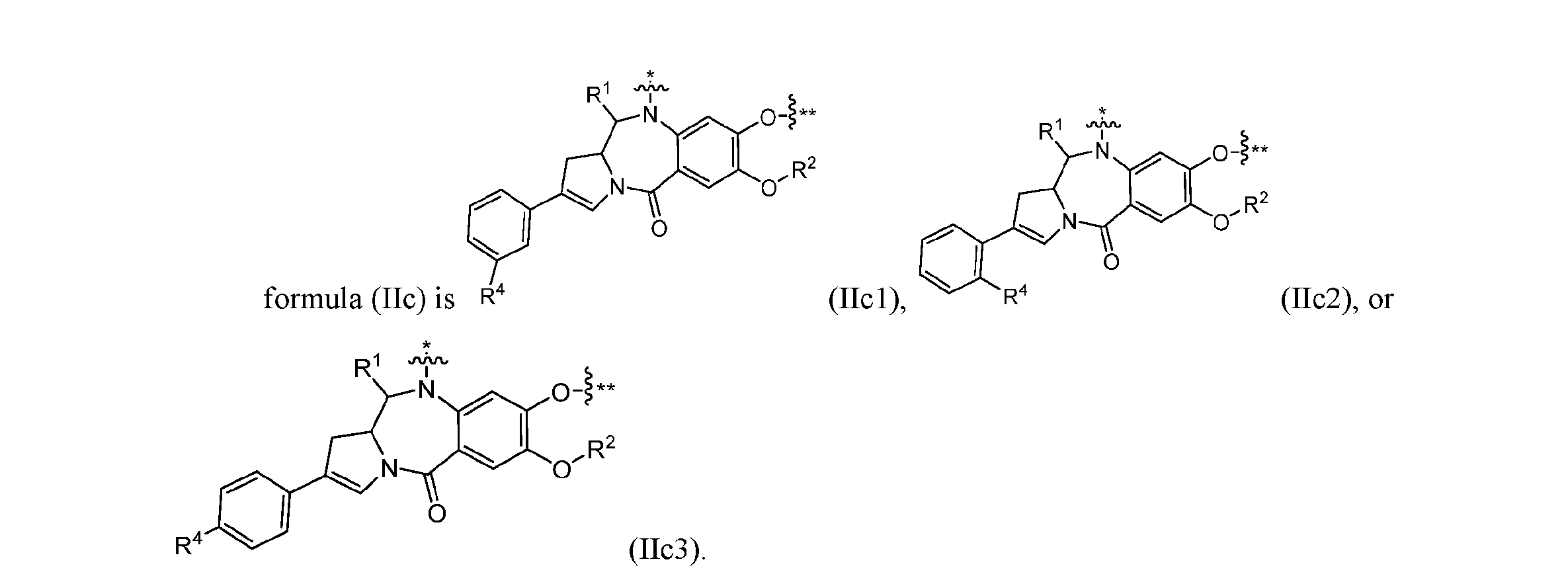
8. The compound of any one of claims 1-7, wherein ring A is
 ,
,
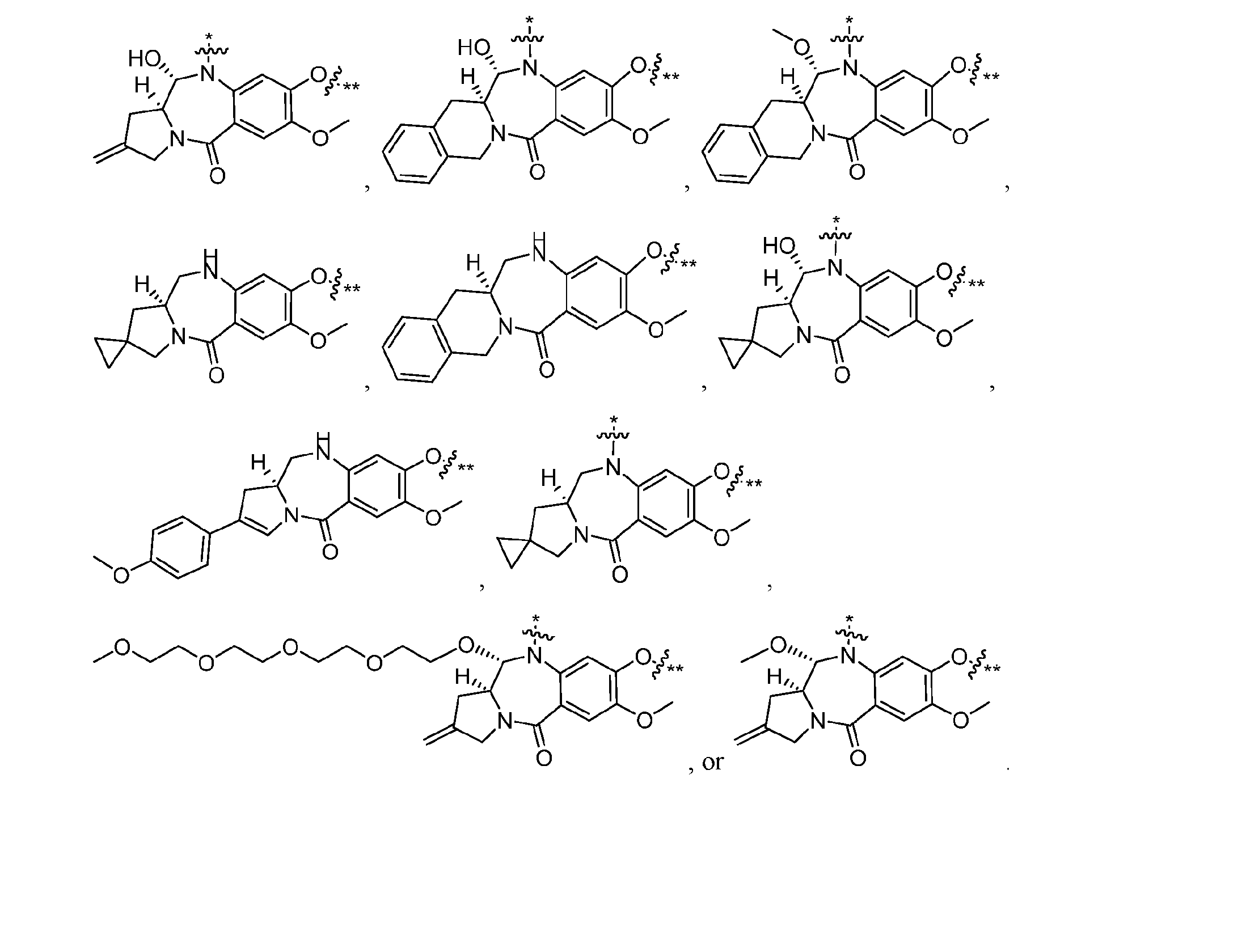
9. The compound of any one of claims 1-8, wherein ring B is


10. The compound of any one of claims 1-9, wherein each Su is independently

 or a stereoisomer thereof; each m is independently 0 or 1; and indicates a point of attachment to Cleavable1 or Cleavable2.
11. The compound of claim 10, wherein each Su is independently or , or a stereoisomer thereof.
12. The compound of claim 11, wherein each Su is .
13. The compound of any one of claims 1-12, wherein s1 is 1.
14. The compound of claim 13, wherein Cleavable1 has formula (VIa).
15. The compound of claim 14, wherein Cleavable1 is or .
16. The compound of any one of claims 1-12, wherein s1 is 0.
17. The compound of any one of claims 1-16, wherein Cleavable2 has formula (VIIa1) or (VIId1): or .
18. The compound of claim 17, wherein Cleavable2 is or .
19. The compound of any one of claims 1-18, wherein Spacer is ###-NH-(CH2CH2O)m2-CH2CH2-C(═O)- or ###-NH-(CH2CH2O)m2-CH2-C(═O)-.
20. The compound of any one of claims 1-19, wherein Spacer is ###-NH-(CH2CH2O)4-CH2CH2-C(═O)-.
21. The compound of any one of claims 1-20, wherein Conjugator has formula (III).
22. The compound of claim 21, wherein U2 is arylene.
23. The compound of claim 22, wherein U2 is .
24. The compound of any one of claims 21-23, wherein V2 is a bond.
25. The compound of any one of claims 21-24, wherein W2 is -C(=O)-.
26. The compound of any one of claims 21-25, wherein Conjugator is .
27. The compound of any one of claims 1-20, wherein Conjugator has formula (V).
28. The compound of claim 27, wherein RG4 is or .
29. The compound of claim 27 or 28, wherein t4 is 1, 2, 3, 4, or 5.
30. The compound of any one of claims 27-29, wherein s4 is 0.
31. The compound of any one of claims 27-30, wherein the sum of s4 and t4 is 1 or 5.
32. The compound of any one of claims 27-31, wherein RE4 is a bond or -O-.
33. The compound of any one of claims 27-32, wherein W4 is -C(=O)-.
34. The compound of any one of claims 27-33, wherein Conjugator is or .
35. The compound of any one of claims 1-20, wherein Conjugator has formula (IV).
36. The compound of claim 35, wherein RG3 is .
37. The compound of claim 35 or 36, wherein RS3 is NH2.
38. The compound of any one of claims 35-37, wherein t3 is 2.
39. The compound of any one of claims 35-38, wherein RE3 is -O-.
40. The compound of any one of claims 35-39, wherein s3 is 0.
41. The compound of any one of claims 35-40, wherein W3 is -C(=O)-.
42. The compound of any one of claims 35-41, wherein Conjugator is .
43. The compound of claim 1, wherein the compound is ,
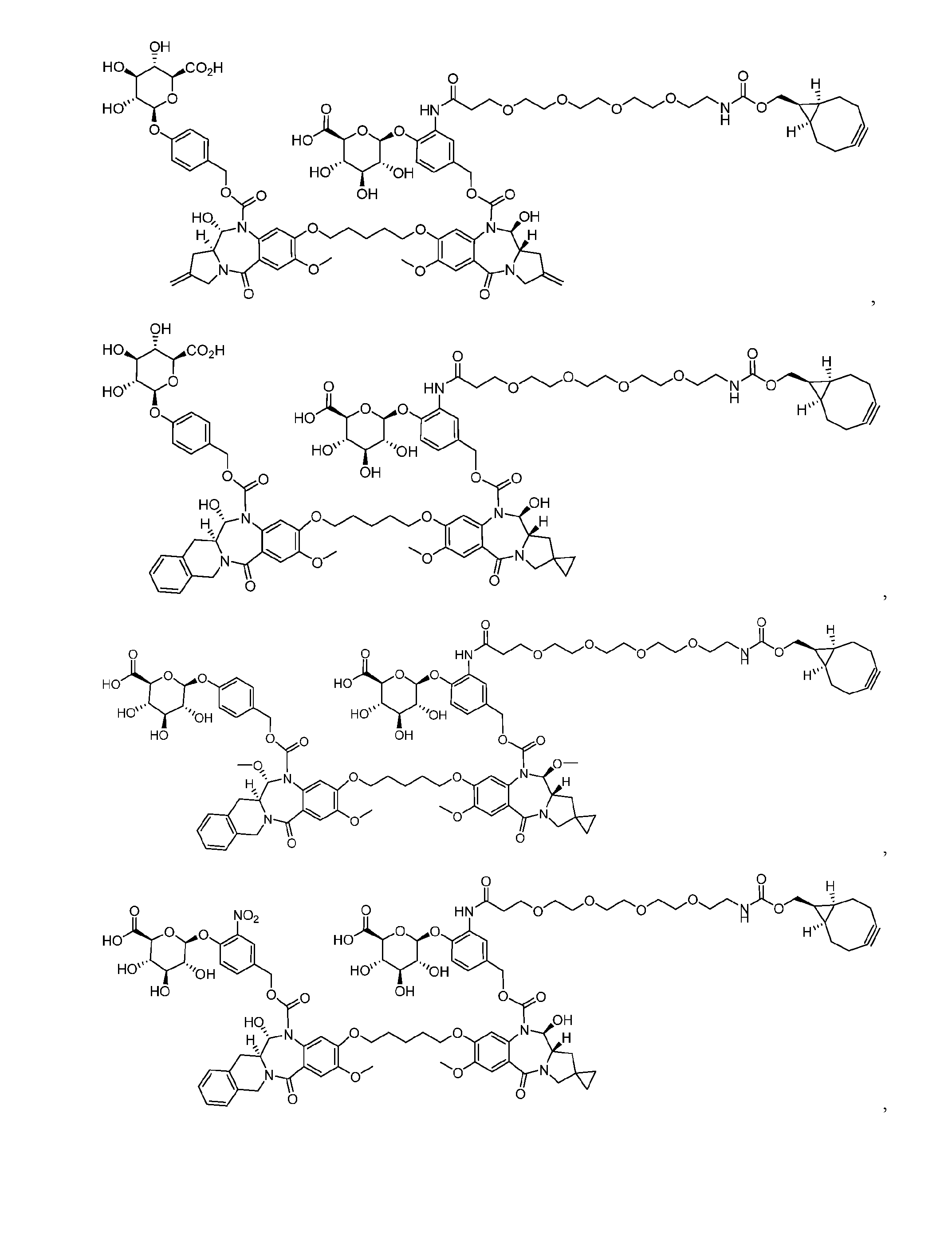
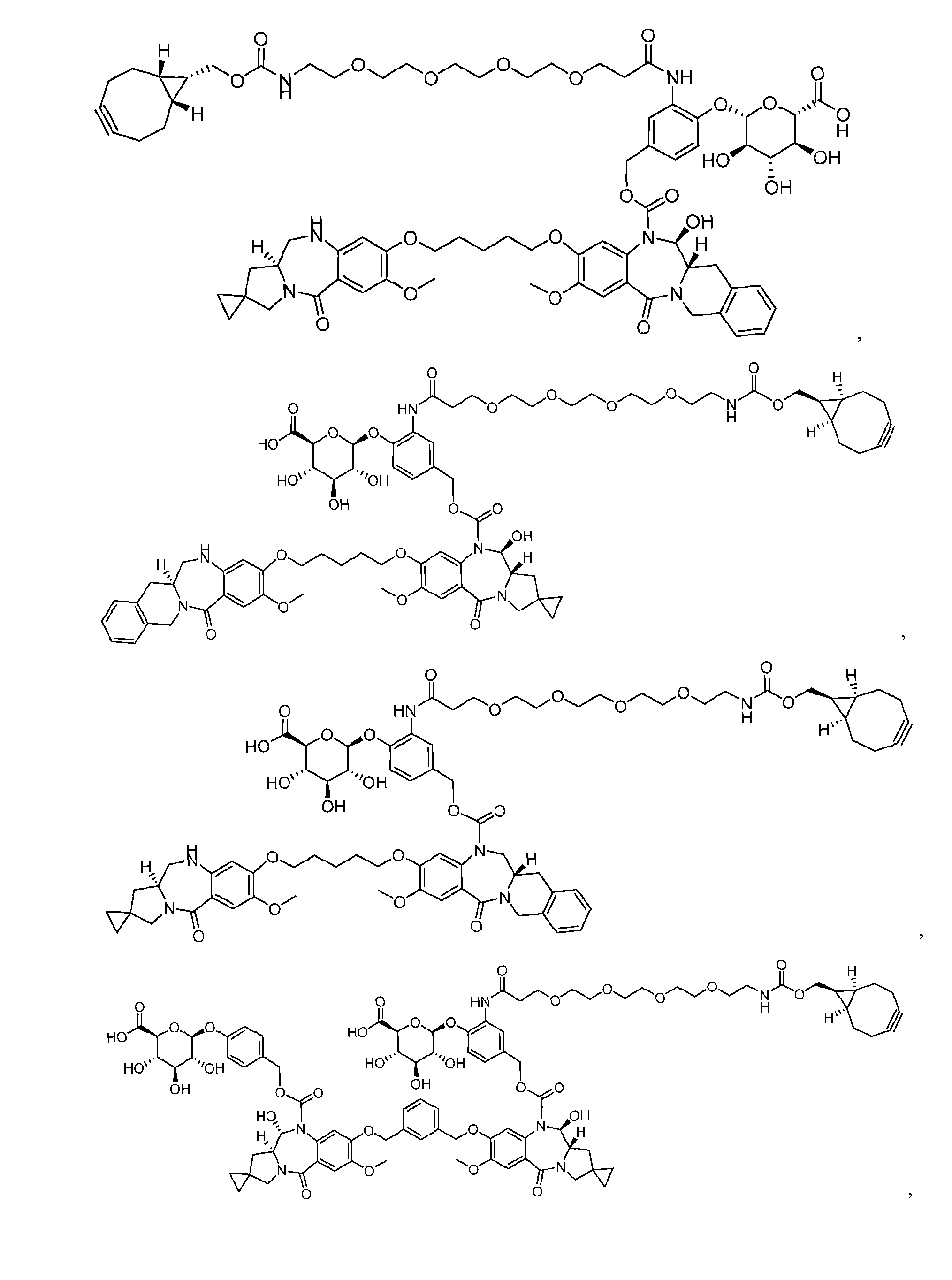
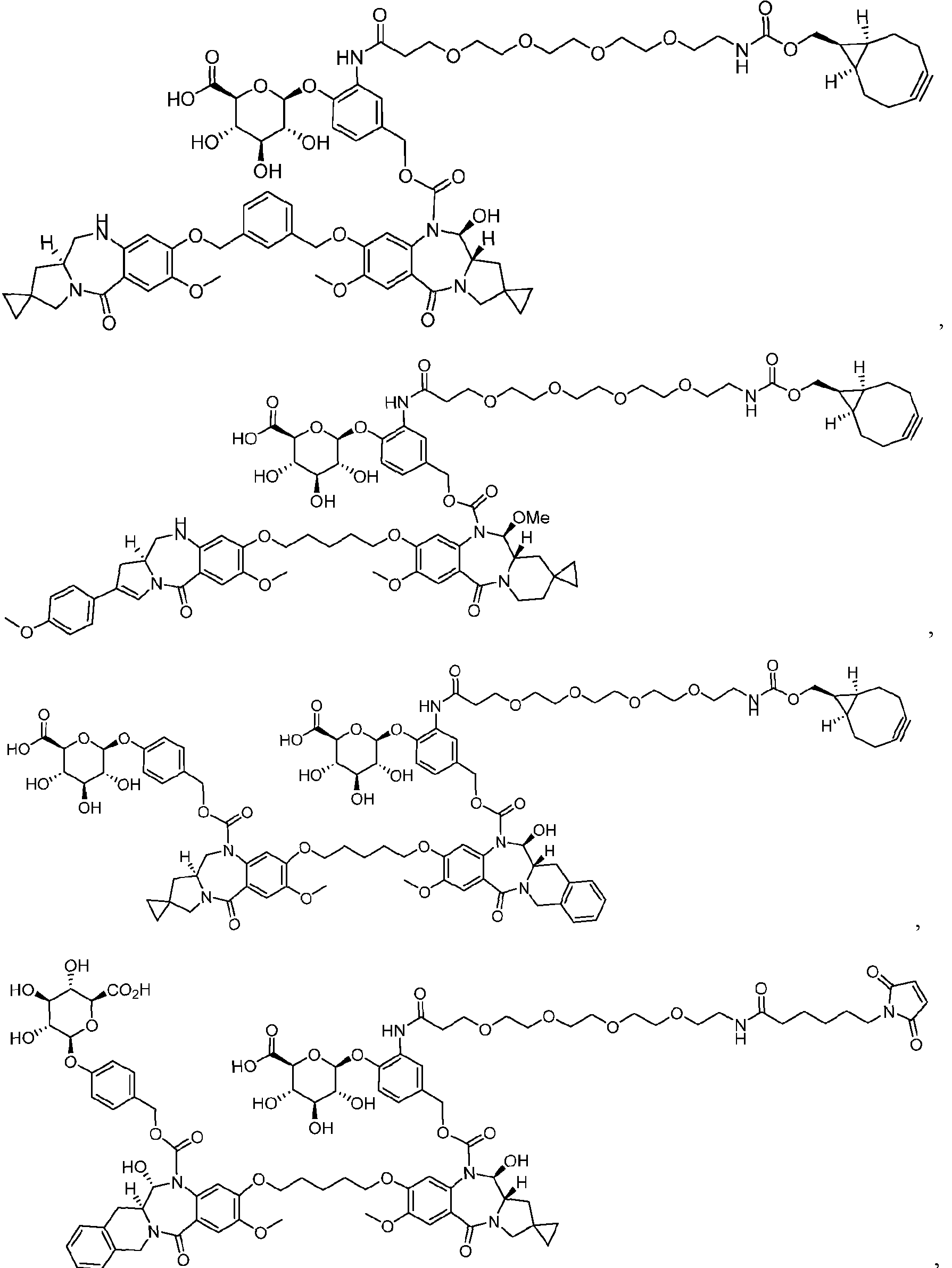
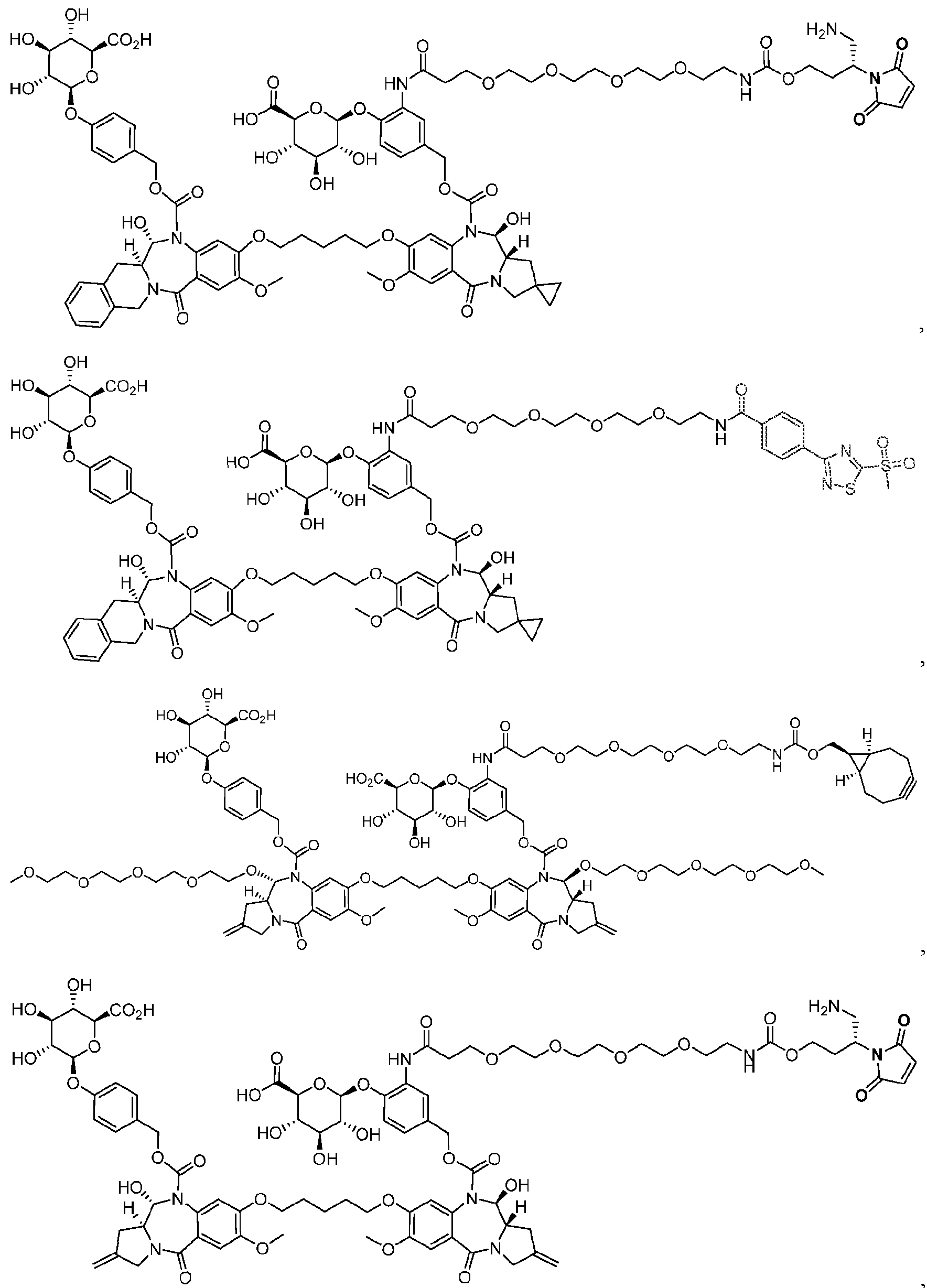
or a pharmaceutically acceptable salt, tautomer, solvate, stereoisomer, or isotopologue thereof.
44. A compound of Formula (IA): or a pharmaceutically acceptable salt, tautomer, solvate, stereoisomer, or isotopologue thereof, wherein: each of ring A and ring B is, independently, one of formula (IIa), (IIb), (IIc), (IId), (IIe), (IIf), or (IIg):
, , , or ; wherein: each ring C is independently a cyclopropyl ring or a cyclobutyl ring; each R1 is independently H, OH, C1-4 alkyl, C1-4 alkoxyl, or -O-(CH2CH2O)t1-CH3; each R2 is independently H or C1-4 alkyl; each R3 and R4 is, independently, H, NRa1Rb1, OH, C1-4 alkyl, C1-4 alkoxyl, or aryl; each of Ra1 and Rb1 is, independently, H or C1-4 alkyl; each R5 is independently H, C1-4 alkyl, C1-4 alkoxyl, or aryl; each m1, n1, and o1 is, independently, 1 or 2; t1 is 1, 2, 3, 4, 5, 6, 7, or 8; * marks the bond where ring A connects to Cleavable1 when s1 is 1 or to -H when s1 is 0, or where ring B connects to Cleavable2; and ** marks the bond where ring A or ring B connects to Linker; Linker is –(CH2)r-, -(CH2)p-X-(CH2)q-, or -(CH2)p-CH=CH-(CH2)q-; wherein: each r, p, and q, is, independently, 1, 2, 3, 4, 5, 6, 7, or 8; the sum of p and q is 1, 2, 3, 4, 5, 6, 7, or 8; X is NR6, NHC(=O), C(=O)NH, O, SO2, a substituted or unsubstituted aryl ring, substituted or unsubstituted heteroaryl ring, substituted or unsubstituted heterocyclic ring, or substituted or unsubstituted cyclic ring; and R6 is H or C1-4 alkyl; Cleavable1, if present, has the formula , wherein: Su is a sugar moiety; each R11 is, independently, hydrogen, halogen, substituted or unsubstituted C1-4 alkyl, -CN, or -NO2; and # marks the bond where Cleavable1 connects to ring A; s1 is 0 or 1; Cleavable2 has formula (VIIa1) or (VIId1):
or , wherein: Su is a sugar moiety; each R9 is, independently, hydrogen or C1-4 alkyl; #* marks the bond where Cleavable2 connects to ring B; and ## marks the bond where Cleavable2 connects to Spacer; Spacer is a bond, ###-NH-(CH2CH2O)m2-CH2CH2-C(═O)- or ###-NH-(CH2CH2O)m2-CH2- C(═O)-; wherein: each m2 is, independently, 1, 2, 3, 4, 6, 7, or 8; and ### marks the bond where Spacer connects to -C(=O)-; RE4 is a bond or -O-; and t4 is 1, 2, 3, 4, 5, 6, 7, or 8.
45. The compound of claim 44, wherein Linker is -(CH2)r or -(CH2)p-X-(CH2)q-; ring A has formula (IIa), (IIb), (IIc), (IId), or (IIg); and ring B has formula (IIa), (IIb), (IId), or (IIg).
46. The compound of claim 44 or claim 45, wherein Linker is -(CH2)r-, ring A has formula (IIg), and ring B has formula (IIg); Linker is -(CH2)r-, ring A has formula (IId), and ring B has formula (IId); Linker is -(CH2)r-, ring A has formula (IIb), and ring B has formula (IIa); Linker is -(CH2)r-, ring A has formula (IIa), and ring B has formula (IIb); Linker is -(CH2)r-, ring A has formula (IIa), and ring B has formula (IIa); Linker is -(CH2)r-, ring A has formula (IIc), and ring B has formula (IIa); or Linker is -(CH2)p-X-(CH2)q-, ring A has formula (IIa), and ring B has formula (IIa).
47. The compound of any one of claims 44-46, wherein Linker is -(CH2)r- and r is 5.
48. The compound of any one of claims 44-46, wherein Linker is -(CH2)p-X-(CH2)q-, X is an unsubstituted aryl ring, p is 1, and q is 1.
49. The compound of claim 48, wherein X is phenylene.
50. The compound of any one of claims 44-49, wherein
formula (IIa) is (IIa1); formula (IId) is (IId1); formula (IIg) is (IIg1); and/or formula (IIc) is (IIc1), (IIc2), or (IIc3).
51. The compound of any one of claims 44-50, wherein ring A is , , , , , , ,
, , , or .
52. The compound of any one of claims 44-51, wherein ring B is , , , , , , , , or .
53. The compound of any one of claims 44-52, wherein each Su is independently , , , or , or a stereoisomer thereof;
each m is independently 0 or 1; and indicates a point of attachment to Cleavable1 or Cleavable2.
54. The compound of claim 53, wherein each Su is independently or , or a stereoisomer thereof.
55. The compound of claim 54, wherein each Su is .
56. The compound of any one of claims 44-55, wherein s1 is 1.
57. The compound of claim 56, wherein each R11 is independently hydrogen or -NO2.
58. The compound of claim 57, wherein Cleavable1 is or .
59. The compound of any one of claims 44-55, wherein s1 is 0.
60. The compound of any one of claims 44-59, wherein Cleavable2 is or .
61. The compound of any one of claims 44-60, wherein Spacer is ###-NH-(CH2CH2O)m2-CH2CH2-C(═O)- or ###-NH-(CH2CH2O)m2-CH2-C(═O)-.
62. The compound of any one of claims 44-61, wherein Spacer is ###-NH-(CH2CH2O)4-CH2CH2-C(═O)-.
63. The compound of any one of claims 44-62, wherein is .
64. The compound of claim 44, wherein the compound is , , ,


65. A ligand-drug conjugate or a pharmaceutically acceptable salt or solvate thereof, wherein the conjugate comprises a ligand that is conjugated to the compound of any one of claims 1-64 via Conjugator or
 , wherein the conjugate has the following formula: Ligand-[Formula (I or Ia)]x,
wherein x is from about 1 to about 10.
, wherein the conjugate has the following formula: Ligand-[Formula (I or Ia)]x,
wherein x is from about 1 to about 10.
66. The conjugate of claim 65, wherein the ligand is a humanized, monoclonal, chimeric, or human antibody, or an antigen binding fragment thereof.
67. The conjugate of claim 65 or 66, wherein the conjugate has the following formula wherein Ab is a humanized, monoclonal, chimeric, or human antibody, or an antigen binding fragment thereof.
68. The conjugate of claim 66 or 67, wherein the ligand or Ab binds to one or more receptors chosen from B7-H3, cytokeratin 15, PTK7, HER3, HER2, CD7, CD19, CD20, CD22, CD25, CD27, CD30, CD33, CD37, CD38, CD46, CD70, CD71, CD74, CD79b, CD123, CD138, CD142, CD166, CD205, CD228, CCR2, CA6, p-Cadherin, CEA, CEACAM5, C4.4a, DLL3, EGFR, EGFRVIII, ENPP3, EphA2, EphrinA, FLOR1, FGFR2, GCC, cKIT, LIV1, LY6E, MSLN, MUC16, NaPi2b, Nectin4, gpNMB, PSMA, SLITRK6, STEAP1, TROP2, 5T4, SSEA4, GloboH, Gb5, STn, Tn, B7H3, BCMA, MUC1, cMet, ROR1 MSLN, FRa, CLDN18.2, CLDN6, PTK7, Axl, FGFR2b, CLL1, CCR7, GPC1, GPC3, ISAC, CDCP1, ITGB6, ADAM9, or CD45.
69. The conjugate of any one of claims 65-68, or a pharmaceutically acceptable salt or solvate thereof, selected from: ,


, or .
70. The conjugate of claim 69, wherein x is about 1.8 to about 2.5.
71. The conjugate of claim 69 or 70, wherein Ab is STRO-001.
72. A pharmaceutical composition comprising the conjugate of any one of claims 65-71, or a pharmaceutically acceptable salt, tautomer, solvate, stereoisomer, or isotopologue thereof, and a pharmaceutically acceptable excipient.
73. A method of treating a proliferative disease, a metabolic disease, inflammation, or a neurodegenerative disease in a subject in need thereof, comprising administering to the subject an effective amount of the conjugate of any one of claims 65-71, or a pharmaceutically acceptable salt, tautomer, solvate, stereoisomer, or isotopologue thereof, or a pharmaceutical composition of claim 72.
Applications Claiming Priority (2)
| Application Number | Priority Date | Filing Date | Title |
|---|---|---|---|
| CNPCT/CN2023/112181 | 2023-08-10 | ||
| CN2023112181 | 2023-08-10 |
Publications (1)
| Publication Number | Publication Date |
|---|---|
| WO2025032555A1 true WO2025032555A1 (en) | 2025-02-13 |
Family
ID=92711207
Family Applications (1)
| Application Number | Title | Priority Date | Filing Date |
|---|---|---|---|
| PCT/IB2024/057756 Pending WO2025032555A1 (en) | 2023-08-10 | 2024-08-09 | Bioactive conjugates, preparation method and use thereof |
Country Status (1)
| Country | Link |
|---|---|
| WO (1) | WO2025032555A1 (en) |
Citations (10)
| Publication number | Priority date | Publication date | Assignee | Title |
|---|---|---|---|---|
| JPS58180487A (en) | 1982-04-16 | 1983-10-21 | Kyowa Hakko Kogyo Co Ltd | Antibiotic dc-81 and its preparation |
| US7871607B2 (en) | 2003-03-05 | 2011-01-18 | Halozyme, Inc. | Soluble glycosaminoglycanases and methods of preparing and using soluble glycosaminoglycanases |
| US20150283262A1 (en) | 2012-10-12 | 2015-10-08 | Adc Therapeutics Sàrl | Pyrrolobenzodiazepine-antibody conjugates |
| WO2017059289A1 (en) | 2015-10-02 | 2017-04-06 | Genentech, Inc. | Pyrrolobenzodiazepine antibody drug conjugates and methods of use |
| WO2018069490A1 (en) * | 2016-10-14 | 2018-04-19 | Medimmune Limited | Pyrrolobenzodiazepine conjugates |
| CN111164208A (en) | 2017-09-29 | 2020-05-15 | 第一三共株式会社 | Antibody-pyrrolobenzodiazepine derivative conjugate |
| WO2022079211A1 (en) | 2020-10-16 | 2022-04-21 | Adc Therapeutics Sa | Glycoconjugates |
| WO2022120132A1 (en) | 2020-12-04 | 2022-06-09 | Dyne Therapeutics, Inc. | Antibody-oligonucleotide complexes and uses thereof |
| WO2022211508A1 (en) * | 2021-03-30 | 2022-10-06 | 주식회사 레고켐바이오사이언스 | Antibody-drug conjugate including antibody against human cldn18.2, and use thereof |
| WO2022245186A1 (en) * | 2021-05-21 | 2022-11-24 | 주식회사 레고켐바이오사이언스 | Antibody-drug conjugate that binds to ror1 and b7-h3, and use thereof |
-
2024
- 2024-08-09 WO PCT/IB2024/057756 patent/WO2025032555A1/en active Pending
Patent Citations (10)
| Publication number | Priority date | Publication date | Assignee | Title |
|---|---|---|---|---|
| JPS58180487A (en) | 1982-04-16 | 1983-10-21 | Kyowa Hakko Kogyo Co Ltd | Antibiotic dc-81 and its preparation |
| US7871607B2 (en) | 2003-03-05 | 2011-01-18 | Halozyme, Inc. | Soluble glycosaminoglycanases and methods of preparing and using soluble glycosaminoglycanases |
| US20150283262A1 (en) | 2012-10-12 | 2015-10-08 | Adc Therapeutics Sàrl | Pyrrolobenzodiazepine-antibody conjugates |
| WO2017059289A1 (en) | 2015-10-02 | 2017-04-06 | Genentech, Inc. | Pyrrolobenzodiazepine antibody drug conjugates and methods of use |
| WO2018069490A1 (en) * | 2016-10-14 | 2018-04-19 | Medimmune Limited | Pyrrolobenzodiazepine conjugates |
| CN111164208A (en) | 2017-09-29 | 2020-05-15 | 第一三共株式会社 | Antibody-pyrrolobenzodiazepine derivative conjugate |
| WO2022079211A1 (en) | 2020-10-16 | 2022-04-21 | Adc Therapeutics Sa | Glycoconjugates |
| WO2022120132A1 (en) | 2020-12-04 | 2022-06-09 | Dyne Therapeutics, Inc. | Antibody-oligonucleotide complexes and uses thereof |
| WO2022211508A1 (en) * | 2021-03-30 | 2022-10-06 | 주식회사 레고켐바이오사이언스 | Antibody-drug conjugate including antibody against human cldn18.2, and use thereof |
| WO2022245186A1 (en) * | 2021-05-21 | 2022-11-24 | 주식회사 레고켐바이오사이언스 | Antibody-drug conjugate that binds to ror1 and b7-h3, and use thereof |
Non-Patent Citations (35)
| Title |
|---|
| "Design and Application of Prodrugs", 1985, HARWOOD ACADEMIC PUBLISHERS GMFH |
| "Remington's Pharmaceutical Sciences 16th edition", 1980 |
| AL-LAZIKANI ET AL., J. MOL. BIOL., vol. 273, 1997, pages 927 - 948 |
| ARIMA ET AL., J. ANTIBIOTICS, vol. 25, 1972, pages 437 - 444 |
| BOSE ET AL., TETRAHEDRON, vol. 48, 1992, pages 751 - 758 |
| BOSE, D. S. ET AL., J. AM. CHEM. SOC., vol. 114, 1992, pages 4939 - 4941 |
| ELIEL, E. L.: "Stereochemistry of Carbon Compounds", 1962, MCGRAWHILL |
| GREGSON, S ET AL., J. MED. CHEM., vol. 44, 2001, pages 737 - 748 |
| HARTLEY, J. A. ET AL., CANCER RESEARCH, vol. 64, 2004, pages 6693 - 6699 |
| HOCHLOWSKI ET AL., J. ANTIBIOTICS, vol. 40, 1987, pages 145 - 148 |
| HONEGGEPLUCKTHUN, J. MOL. BIOL., vol. 309, 2001, pages 657 - 70 |
| HURLEYNEEDHAM-VANDEVANTER, ACC. CHEM. RES., vol. 19, 1986, pages 230 - 237 |
| JACQUES, J. ET AL.: "Enantiomers, Racemates and Resolutions", 1981, WILEYINTERSCIENCE |
| KOHN: "In Antibiotics III", 1975, SPRINGER-VERLAG, pages: 3 - 11 |
| KONISHI ET AL., J. ANTIBIOTICS, vol. 37, 1984, pages 200 - 206 |
| KUMINOTO ET AL., J. ANTIBIOTICS, vol. 33, 1980, pages 665 - 667 |
| LANGLEYTHURSTON, J. ORG. CHEM., vol. 52, 1987, pages 91 - 97 |
| LEBER ET AL., J. AM. CHEM. SOC., vol. 110, 1988, pages 2992 - 2993 |
| LEFRANC ET AL., DEV. COMP. IMMUNOL., vol. 27, 2003, pages 55 - 77 |
| LEIMGRUBER ET AL., J. AM. CHEM. SOC., vol. 87, 1965, pages 5791 - 5793 |
| MACCALLUM ET AL., J. MOL. BIOL., vol. 262, 1996, pages 732 - 745 |
| MARTIN, C. ET AL., BIOCHEMISTRY, vol. 44, pages 4135 - 4147 |
| ORG. PROCESS RES. DEV, vol. 26, 2022, pages 2155 - 2175 |
| RG. PROCESS RES. DEV, vol. 22, 2018, pages 1241 - 1256 |
| SHIMIZU ET AL., J. ANTIBIOTICS, vol. 29, 1982, pages 2492 - 2503 |
| SMELLIE, M. ET AL., BIOCHEMISTRY, vol. 42, 2003, pages 8232 - 8239 |
| SOC, vol. 142, no. 20, 2020, pages 9285 - 9301 |
| TAKEUCHI ET AL., J. ANTIBIOTICS, vol. 29, 1976, pages 93 - 96 |
| TETRAHEDRON LETTERS, vol. 54, 2013, pages 349 - 3495 |
| THURSTON ET AL., CHEM. BRIT., vol. 26, 1990, pages 767 - 772 |
| THURSTON ET AL., CHEM. REV, vol. 1994, 1994, pages 433 - 465 |
| THURSTON, D. E. ET AL., J. ORG. CHEM., vol. 61, 1996, pages 8141 - 8147 |
| TSUNAKAWA ET AL., J. ANTIBIOTICS, vol. 41, 1988, pages 1281 - 1284 |
| WILEN, S. H. ET AL., TETRAHEDRON, vol. 33, 1977, pages 2725 |
| WILEN, S. H.: "Tables of Resolving Agents and Optical Resolutions", 1972, UNIV. OF NOTRE DAME PRESS, pages: 268 |
Similar Documents
| Publication | Publication Date | Title |
|---|---|---|
| US20250135026A1 (en) | Antibody Drug Conjugates | |
| US20250295798A1 (en) | Ligand-drug conjugate of exatecan analogue, and medical use thereof | |
| US20260021193A1 (en) | Immunoconjugates and methods | |
| BR112021009251A2 (en) | antibody-drug conjugate, antibody or a functional fragment thereof, polynucleotide, expression vector, host cell, pharmaceutical composition, and methods for producing an antibody with remodeled glycan, an antibody-drug conjugate, antibody or a functional fragment of the same and for the treatment of a tumor. | |
| WO2025002368A1 (en) | Bioactive conjugates, preparation method and use thereof | |
| US20260007761A1 (en) | Bioactive Conjugate, Preparation Method Therefor and Use Thereof | |
| US20260027221A1 (en) | Targeted Pyrrolobenzodiazapine Conjugates | |
| EP3906063A2 (en) | Compounds comprising cleavable linker and uses thereof | |
| JP2025519421A (en) | Antibody-drug conjugates | |
| US20250312473A1 (en) | B7h3 antibody drug conjugates | |
| WO2025032555A1 (en) | Bioactive conjugates, preparation method and use thereof | |
| WO2025032556A1 (en) | Bioactive conjugates, preparation method and use thereof | |
| WO2025002370A1 (en) | Bioactive conjugates, preparation method and use thereof | |
| WO2025247391A1 (en) | Novel pi3k and/or pikk inhibitors, antibody-drug conjugates comprising the same and uses thereof | |
| WO2026032411A1 (en) | Self-stabilizing linker conjugates | |
| WO2024165045A1 (en) | Self-stabilizing linker conjugates |
Legal Events
| Date | Code | Title | Description |
|---|---|---|---|
| 121 | Ep: the epo has been informed by wipo that ep was designated in this application |
Ref document number: 24768388 Country of ref document: EP Kind code of ref document: A1 |