WO2024249573A1 - Solid forms of compounds useful in the treatment of hiv - Google Patents
Solid forms of compounds useful in the treatment of hiv Download PDFInfo
- Publication number
- WO2024249573A1 WO2024249573A1 PCT/US2024/031578 US2024031578W WO2024249573A1 WO 2024249573 A1 WO2024249573 A1 WO 2024249573A1 US 2024031578 W US2024031578 W US 2024031578W WO 2024249573 A1 WO2024249573 A1 WO 2024249573A1
- Authority
- WO
- WIPO (PCT)
- Prior art keywords
- inhibitors
- hiv
- crystal
- compound
- crystalline form
- Prior art date
- Legal status (The legal status is an assumption and is not a legal conclusion. Google has not performed a legal analysis and makes no representation as to the accuracy of the status listed.)
- Pending
Links
Classifications
-
- C—CHEMISTRY; METALLURGY
- C07—ORGANIC CHEMISTRY
- C07D—HETEROCYCLIC COMPOUNDS
- C07D401/00—Heterocyclic compounds containing two or more hetero rings, having nitrogen atoms as the only ring hetero atoms, at least one ring being a six-membered ring with only one nitrogen atom
- C07D401/14—Heterocyclic compounds containing two or more hetero rings, having nitrogen atoms as the only ring hetero atoms, at least one ring being a six-membered ring with only one nitrogen atom containing three or more hetero rings
-
- C—CHEMISTRY; METALLURGY
- C07—ORGANIC CHEMISTRY
- C07F—ACYCLIC, CARBOCYCLIC OR HETEROCYCLIC COMPOUNDS CONTAINING ELEMENTS OTHER THAN CARBON, HYDROGEN, HALOGEN, OXYGEN, NITROGEN, SULFUR, SELENIUM OR TELLURIUM
- C07F9/00—Compounds containing elements of Groups 5 or 15 of the Periodic Table
- C07F9/02—Phosphorus compounds
- C07F9/547—Heterocyclic compounds, e.g. containing phosphorus as a ring hetero atom
- C07F9/6558—Heterocyclic compounds, e.g. containing phosphorus as a ring hetero atom containing at least two different or differently substituted hetero rings neither condensed among themselves nor condensed with a common carbocyclic ring or ring system
- C07F9/65583—Heterocyclic compounds, e.g. containing phosphorus as a ring hetero atom containing at least two different or differently substituted hetero rings neither condensed among themselves nor condensed with a common carbocyclic ring or ring system each of the hetero rings containing nitrogen as ring hetero atom
-
- A—HUMAN NECESSITIES
- A61—MEDICAL OR VETERINARY SCIENCE; HYGIENE
- A61K—PREPARATIONS FOR MEDICAL, DENTAL OR TOILETRY PURPOSES
- A61K31/00—Medicinal preparations containing organic active ingredients
- A61K31/66—Phosphorus compounds
- A61K31/675—Phosphorus compounds having nitrogen as a ring hetero atom, e.g. pyridoxal phosphate
-
- A—HUMAN NECESSITIES
- A61—MEDICAL OR VETERINARY SCIENCE; HYGIENE
- A61K—PREPARATIONS FOR MEDICAL, DENTAL OR TOILETRY PURPOSES
- A61K45/00—Medicinal preparations containing active ingredients not provided for in groups A61K31/00 - A61K41/00
- A61K45/06—Mixtures of active ingredients without chemical characterisation, e.g. antiphlogistics and cardiaca
-
- A—HUMAN NECESSITIES
- A61—MEDICAL OR VETERINARY SCIENCE; HYGIENE
- A61P—SPECIFIC THERAPEUTIC ACTIVITY OF CHEMICAL COMPOUNDS OR MEDICINAL PREPARATIONS
- A61P37/00—Drugs for immunological or allergic disorders
-
- C—CHEMISTRY; METALLURGY
- C07—ORGANIC CHEMISTRY
- C07C—ACYCLIC OR CARBOCYCLIC COMPOUNDS
- C07C55/00—Saturated compounds having more than one carboxyl group bound to acyclic carbon atoms
- C07C55/02—Dicarboxylic acids
- C07C55/06—Oxalic acid
-
- C—CHEMISTRY; METALLURGY
- C07—ORGANIC CHEMISTRY
- C07C—ACYCLIC OR CARBOCYCLIC COMPOUNDS
- C07C59/00—Compounds having carboxyl groups bound to acyclic carbon atoms and containing any of the groups OH, O—metal, —CHO, keto, ether, groups, groups, or groups
- C07C59/235—Saturated compounds containing more than one carboxyl group
- C07C59/245—Saturated compounds containing more than one carboxyl group containing hydroxy or O-metal groups
- C07C59/255—Tartaric acid
-
- C—CHEMISTRY; METALLURGY
- C07—ORGANIC CHEMISTRY
- C07C—ACYCLIC OR CARBOCYCLIC COMPOUNDS
- C07C65/00—Compounds having carboxyl groups bound to carbon atoms of six—membered aromatic rings and containing any of the groups OH, O—metal, —CHO, keto, ether, groups, groups, or groups
- C07C65/01—Compounds having carboxyl groups bound to carbon atoms of six—membered aromatic rings and containing any of the groups OH, O—metal, —CHO, keto, ether, groups, groups, or groups containing hydroxy or O-metal groups
- C07C65/03—Compounds having carboxyl groups bound to carbon atoms of six—membered aromatic rings and containing any of the groups OH, O—metal, —CHO, keto, ether, groups, groups, or groups containing hydroxy or O-metal groups monocyclic and having all hydroxy or O-metal groups bound to the ring
- C07C65/05—Compounds having carboxyl groups bound to carbon atoms of six—membered aromatic rings and containing any of the groups OH, O—metal, —CHO, keto, ether, groups, groups, or groups containing hydroxy or O-metal groups monocyclic and having all hydroxy or O-metal groups bound to the ring o-Hydroxy carboxylic acids
-
- C—CHEMISTRY; METALLURGY
- C07—ORGANIC CHEMISTRY
- C07C—ACYCLIC OR CARBOCYCLIC COMPOUNDS
- C07C65/00—Compounds having carboxyl groups bound to carbon atoms of six—membered aromatic rings and containing any of the groups OH, O—metal, —CHO, keto, ether, groups, groups, or groups
- C07C65/21—Compounds having carboxyl groups bound to carbon atoms of six—membered aromatic rings and containing any of the groups OH, O—metal, —CHO, keto, ether, groups, groups, or groups containing ether groups, groups, groups, or groups
Definitions
- This disclosure relates generally to solid forms of a compound useful in the prevention or treatment of a Retroviridae viral infection, including an infection caused by the human immunodeficiency virus (HIV).
- This disclosure also relates to methods of making said compounds and intermediates in the preparation of said compounds.
- Positive- single stranded RNA viruses comprising the Retroviridae family include those of the subfamily Orthoretrovirinae and genera Alpharetrovirus, Betaretrovirus, Gammaretrovirus, Deltaretrovirus, Epsilonretrovirus, Lentivirus, and Spumavirus which cause many human and animal diseases.
- Lentivirus HIV-1 infection in humans leads to depletion of T helper cells and immune dysfunction, producing immunodeficiency and vulnerability to opportunistic infections.
- Treating HIV-1 infections with highly active antiretroviral therapies (HAART) has proven to be effective at reducing viral load and significantly delaying disease progression (Hammer, S.M., et al.; JAMA 2008, 300: 555-570).
- HIV therapies and treatments are providing regimens to patients with improved pharmacokinetic properties, including, for example, increased potency, long-acting pharmacokinetics, low solubility, low clearance, and/or other properties.
- pharmacokinetic properties including, for example, increased potency, long-acting pharmacokinetics, low solubility, low clearance, and/or other properties.
- current regimens for treating HIV have progressed enough that patients no longer have to take multiple pills multiple times a day, patients today still are required to take a pill every day for the foreseeable span of their life.
- HIV therapies that require patients take medication less than once a day (e.g. once every couple of days, once a week, once every other week, once a month, and so forth) or take a smaller effective dose of the medication(s) on a daily, weekly, monthly, or longer basis.
- the present disclosure provides, inter alia, a crystalline form of 2-(2-(4-(N-(4- chloro-7-(2-((S)-l-(2-((3bS,4aR)-5,5-difluoro-3-(trifluoromethyl)-3b,4,4a,5-tetrahydro-lH- cyclopropa[3,4]cyclopenta[l,2-c]pyrazol-l-yl)acetamido)-2-(3,5-difluorophenyl)ethyl)-6-(3- methyl-3-(methylsulfonyl)but-l-yn-l-yl)pyridin-3-yl)-l-(2,2,2-trifluoroethyl)-lH-indazol-3- yl)methylsulfonamido)-2-methyl-4-oxobutan-2-yl)-5-methyl-3-(phosphonooxy)phenyl)acetic
- the present disclosure further provides a solvate form of 2-(2-(4-(N-(4-chloro-7- (2-((S)-l-(2-((3bS,4aR)-5,5-difluoro-3-(trifluoromethyl)-3b,4,4a,5-tetrahydro-lH- cyclopropa[3,4]cyclopenta[l,2-c]pyrazol-l-yl)acetamido)-2-(3,5-difluorophenyl)ethyl)-6-(3- methyl-3-(methylsulfonyl)but-l-yn-l-yl)pyridin-3-yl)-l-(2,2,2-trifluoroethyl)-lH-indazol-3- yl)methylsulfonamido)-2-methyl-4-oxobutan-2-yl)-5-methyl-3-(phosphonooxy)phenyl)acetic acid.
- the present disclosure further provides a co-crystal of 2-(2-(4-(N-(4-chloro-7-(2- ((S)-l-(2-((3bS,4aR)-5,5-difluoro-3-(trifluoromethyl)-3b,4,4a,5-tetrahydro-lH- cyclopropa[3,4]cyclopenta[l,2-c]pyrazol-l-yl)acetamido)-2-(3,5-difluorophenyl)ethyl)-6-(3- methyl-3-(methylsulfonyl)but-l-yn-l-yl)pyridin-3-yl)-l-(2,2,2-trifluoroethyl)-lH-indazol-3- yl)methylsulfonamido)-2-methyl-4-oxobutan-2-yl)-5-methyl-3-(phosphonooxy)phenyl)acetic acid
- the present disclosure further provides a pharmaceutical composition
- a pharmaceutical composition comprising a crystalline form, solvate form, or co-crystal disclosed herein, and at least one pharmaceutically acceptable excipient.
- the present disclosure further provides a method of treating or preventing a human immunodeficiency virus (HIV) infection comprising administering a therapeutically effective amount of a crystalline form, solvate form, or co-crystal disclosed herein, to a subject in need thereof.
- HIV human immunodeficiency virus
- the present disclosure further provides a crystalline form, solvate form, or cocrystal disclosed herein, for use in therapy.
- the present disclosure further provides a crystalline form, solvate form, or cocrystal disclosed herein, for use in a method of treating or preventing a human immunodeficiency virus (HIV) infection, comprising administering a therapeutically effective amount of the crystalline or solvate form to a subject in need thereof.
- HIV human immunodeficiency virus
- FIG. 1 shows the structure of 2-(2-(4-(N-(4-chloro-7-(2-((S)-l-(2-((3bS,4aR)-5,5- difluoro-3-(trifluoromethyl)-3b,4,4a,5-tetrahydro-lH-cyclopropa[3,4]cyclopenta[l,2-c]pyrazol- l-yl)acetamido)-2-(3,5-difluorophenyl)ethyl)-6-(3-methyl-3-(methylsulfonyl)but-l-yn-l- yl)pyridin-3-yl)-l-(2,2,2-trifluoroethyl)-lH-indazol-3-yl)methylsulfonamido)-2-methyl-4- oxobutan-2-yl)-5-methyl-3-(phosphonooxy)phenyl)acetic acid (z.e., Com
- FIG. 2 shows a representative XRPD pattern of Compound 1, acetonitrile (MeCN) solvate.
- FIG. 3 shows representative XRPD patterns of the solvate precursors of Compound 1, crystalline Form I (from top to bottom): MeCN solvate, MIBK solvate 1, MIBK solvate 2, toluene solvate 2, butyronitrile solvate, nitromethane solvate, ethyl ether solvate, anisole solvate 2, and xylene solvate.
- FIG. 4 shows a representative XRPD pattern of Compound 1, crystalline Form I.
- FIG. 5 shows a representative DSC thermogram of Compound 1, crystalline
- FIG. 6 shows a representative TGA thermogram of Compound 1, crystalline Form I.
- FIG. 7 shows a representative DVS analysis of Compound 1, crystalline Form I.
- FIG. 8 shows representative XRPD patterns of the solvate precursors of Compound 1, crystalline Form II (from top to bottom): DCM solvate 2, BuOAc solvate 2, MEK solvate, EtOAc solvate 2, chloroform solvate 2, acetophenone solvate, CPME solvate, and DCE solvate.
- FIG. 9 shows an overlay of the XRPD patterns of Compound 1, crystalline Form II from simulation (top) and experiment (bottom).
- FIG. 10 shows an overly of the XRPD patterns of Compound 1, crystalline Form II obtained after drying BuOAc solvate 2 (top) and DCM solvate 2 (bottom).
- FIG. 11 shows a representative XRPD pattern of Compound 1, crystalline Form II.
- FIG. 12 shows a representative DSC thermogram of Compound 1, crystalline Form II.
- FIG. 13 shows a representative TGA thermogram of Compound 1, crystalline Form II.
- FIG. 14 shows a representative DVS analysis of Compound 1, crystalline Form
- FIG. 15 shows representative XRPD patterns of the solvate precursors of Compound 1, crystalline Form III: IP Ac solvate 2 (top) and MIBK solvate 3 (bottom).
- FIG. 16 shows a representative XRPD pattern of Compound 1, crystalline Form
- FIG. 17 shows a representative DSC thermogram of Compound 1, crystalline Form III.
- FIG. 18 shows a representative TGA thermogram of Compound 1, crystalline Form III.
- FIG. 19 shows a representative DVS analysis of Compound 1, crystalline Form III.
- FIG. 20 shows representative XRPD patterns of the solvate precursors of Compound 1, Material A (from top to bottom): EtOAc solvate 1, MeOAc solvate, IP Ac solvate 1, BuOAc solvate 1, DCM solvate 1, chloroform solvate 1, toluene solvate 1, cyclohexane solvate, and anisole solvate 1.
- FIG. 21 shows a representative XRPD pattern of Compound 1, Material A.
- FIG. 22 shows a representative reversible heat thermogram from MDSC analysis of Compound 1, Material A.
- FIG. 23 shows a representative TGA thermogram of Compound 1, Material A.
- FIG. 24 shows a representative DVS analysis of Compound 1, Material A.
- FIG. 25 shows an overlay of the spectra of Compound 1, Material A (top), and amorphous Compound 1 (bottom) from 19 F-NMR analysis.
- FIG. 26 shows a representative XRPD pattern of amorphous Compound 1.
- FIG. 27 shows a representative reversible heat thermogram from MDSC analysis of amorphous Compound 1.
- FIG. 28 shows a representative TGA thermogram of amorphous Compound 1.
- FIG. 29 shows a representative XRPD pattern of Compound 1, maleate cocrystal.
- FIG. 30 shows a representative DSC thermogram of Compound 1, maleate cocrystal.
- FIG. 31 shows a representative TGA thermogram of Compound 1, maleate cocrystal.
- FIG. 32 shows a representative DVS analysis of Compound 1, maleate co-crystal.
- FIG. 33 shows a representative XRPD pattern of Compound 1, succinate cocrystal.
- FIG. 34 shows a representative DSC thermogram of Compound 1, succinate cocrystal.
- FIG. 35 shows a representative TGA thermogram of Compound 1, succinate cocrystal.
- FIG. 36 shows a representative DVS analysis of Compound 1, succinate cocrystal.
- FIG. 37 shows representative XRPD patterns of various solvate precursors of Compound 2, crystalline Form I (from top to bottom): IPA solvate, MTBE solvate, and CPME solvate.
- FIG. 38 shows a representative XRPD pattern of Compound 2, crystalline Form I.
- FIG. 39 shows a representative DSC thermogram of Compound 2, crystalline
- FIG. 40 shows a representative TGA thermogram of Compound 2, crystalline Form I.
- FIG. 41 shows a representative DVS analysis of Compound 2, crystalline Form I.
- FIG. 42 shows representative XRPD patterns of acetone solvate of Compound 2
- FIG. 43 shows the crystal structure of Compound 2, acetone solvate (hydrogen atoms were not shown and solvent molecules were not modeled).
- FIG. 44 shows a representative XRPD pattern of Compound 2, crystalline Form
- FIG. 45 shows a representative DSC thermogram of Compound 2, crystalline Form II.
- FIG. 46 shows a representative TGA thermogram of Compound 2, crystalline Form II.
- FIG. 47 shows a representative XRPD pattern of Compound 2, crystalline Form
- FIG. 48 shows a representative DSC thermogram of Compound 2, crystalline Form III.
- FIG. 49 shows a representative TGA thermogram of Compound 2, crystalline Form III.
- FIG. 50 shows a representative XRPD pattern of amorphous Compound 2.
- FIG. 51 shows a representative DSC thermogram of amorphous Compound 2.
- FIG. 52 shows the crystal structure of Compound 2, acetonitrile (MeCN) solvate
- FIG. 53 shows the crystal structure of Compound 1, ethyl acetate (EtOAc) solvate 1 (hydrogen atoms were not shown and solvent molecules were not modeled).
- FIG. 54 shows the crystal structure of Compound 1, crystalline Form II, recrystallized from dichloromethane (DCM) (hydrogen atoms were not shown and solvent molecules were not modeled).
- DCM dichloromethane
- FIG. 55 shows the crystal structure of Compound 1, crystalline Form II, recrystallized from butyl acetate (BuOAc) (hydrogen atoms were not shown and solvent molecules were not modeled).
- FIG. 56 shows the crystal structure of Compound 1, butyl acetate (BuOAc) solvate 2 (hydrogen atoms were not shown and solvent molecules were not modeled).
- FIG. 57 shows a representative XRPD pattern of Compound 1, oxalate co-crystal.
- FIG. 58 shows a representative DSC thermogram of Compound 1, oxalate cocrystal.
- FIG. 59 shows a representative XRPD pattern of Compound 1, gentisate cocrystal.
- FIG. 60 shows a representative DSC thermogram of Compound 1, gentisate cocrystal.
- FIG. 61 shows a representative XRPD pattern of Compound 1, L-tartrate co- crystal.
- FIG. 62 shows a representative DSC thermogram of Compound 1, L-tartrate cocrystal.
- FIG. 63 shows a representative XRPD pattern of Compound 1, vanillate cocrystal.
- FIG. 64 shows a representative DSC thermogram of Compound 1, vanillate cocrystal.
- the present invention relates to new solid forms, e.g., crystalline forms, solvate forms, and/or co-crystals of 2-(2-(4-(N-(4-chloro-7-(2-((S)-l-(2-((3bS,4aR)-5,5-difluoro-3- (trifluoromethyl)-3b,4,4a,5-tetrahydro- lH-cyclopropa[3,4]cyclopenta[ 1 ,2-c]pyrazol- 1 - yl)acetamido)-2-(3,5-difluorophenyl)ethyl)-6-(3-methyl-3-(methylsulfonyl)but-l-yn-l- yl)pyridin-3-yl)-l-(2,2,2-trifluoroethyl)-lH-indazol-3-yl)methylsulfonamido)-2-methyl-4- oxo
- Compound 1 has two restricted rotational axes, resulting in 4 atropisomers (see FIG. 1) that may be detected by 19 F-NMR.
- the half-life of conversion from the major to the minor atropisomer for the biaryl rotation is about 71.6 hours with equilibrium ratio at about 3:1
- the half-life of interconversion at the 2 nd rotational axis is about 7 minutes with equilibrium ratio at about 4:3.
- Compound 1 converts to lenacapavir (z.e., N-((S)-l-(3-(4-chloro-3- (methylsulfonamido)-l-(2,2,2-trifluoroethyl)-lH-indazol-7-yl)-6-(3-methyl-3- (methylsulfonyl)but-l-yn-l-yl)pyridin-2-yl)-2-(3,5-difluorophenyl)ethyl)-2-((3bS,4aR)-5,5- difluoro-3-(trifluoromethyl)-3b,4,4a,5-tetrahydro-lH-cyclopropa[3,4]cyclopenta[l,2-c]pyrazol- 1-yl) acetamide), an HIV capsid inhibitor that is in development as a long-acting treatment for HIV, in the gastrointestinal tract when administered to a subject (e.g., a human
- the present application further relates to new solid forms, e.g., crystalline forms, of tert-butyl 2-(2-(4-(N-(4-chloro-7-(2-((S)-l-(2-((3bS,4aR)-5,5-difluoro-3-(trifluoromethyl)- 3b,4,4a,5-tetrahydro- 1 H-cyclopropa[3 ,4] cyclopen ta[ 1 ,2-c]pyrazol- 1 -yl)acetamido)-2-(3,5- difluorophenyl)ethyl)-6-(3-methyl-3-(methylsulfonyl)but- 1-yn- l-yl)pyridin-3-yl)- 1 -(2,2,2- trifluoroethyl)-lH-indazol-3-yl)methylsulfonamido)-2-methyl-4-oxobutan-2-y
- Compound 2 is an intermediate in the synthesis of Compound 1 (see e.g., U.S. Application No.: 18/061 ,375, the disclosure which is incorporated herein by reference in its entirety). Similar to Compound 1, Compound 2 has two restricted rotational axes, resulting in 4 atropisomers.
- the present application provides a crystalline form of 2-(2- (4-(N-(4-chloro-7-(2-((S)-l-(2-((3bS,4aR)-5,5-difluoro-3-(trifluoromethyl)-3b,4,4a,5-tetrahydro- lH-cyclopropa[3,4]cyclopenta[l,2-c]pyrazol-l-yl)acetamido)-2-(3,5-difluorophenyl)ethyl)-6-(3- methyl-3-(methylsulfonyl)but-l-yn-l-yl)pyridin-3-yl)-l-(2,2,2-trifluoroethyl)-lH-indazol-3- yl)methylsulfonamido)-2-methyl-4-oxobutan-2-yl)-5-methyl-3-(phosphonooxy)phenyl)acetic
- crystalline form is meant to refer to a certain lattice configuration of a crystalline substance. Different crystalline forms of the same substance typically have different crystalline lattices (e.g., unit cells) which are attributed to different physical properties that are characteristic of each of the crystalline forms. In some instances, different lattice configurations have different water or solvent content. In some embodiments, the crystalline form provided herein may be substantially anhydrous.
- the crystalline form provided herein is Compound 1, crystalline Form I.
- the Compound 1, crystalline Form I has at least one XRPD peak, in terms of 2-theta ⁇ 0.2°, selected from 6.2°, 6.6°, 8.7°, 10.5°, 12.4°, 12.6°, 13.8°, 23.1°, and 25.7°.
- the Compound 1, crystalline Form I has at least two XRPD peaks, in terms of 2-theta ⁇ 0.2°, selected from 6.2°, 6.6°, 8.7°, 10.5°, 12.4°, 12.6°, 13.8°, 23.1°, and 25.7°.
- the Compound 1, crystalline Form I has at least three XRPD peaks, in terms of 2-theta ⁇ 0.2°, selected from 6.2°, 6.6°, 8.7°, 10.5°, 12.4°, 12.6°, 13.8°, 23.1°, and 25.7°.
- the Compound 1, crystalline Form I has at least four XRPD peaks, in terms of 2-theta ⁇ 0.2°, selected from 6.2°, 6.6°, 8.7°, 10.5°, 12.4°, 12.6°, 13.8°, 23.1°, and 25.7°.
- the Compound 1, crystalline Form I has at least five XRPD peaks, in terms of 2-theta ⁇ 0.2°, selected from 6.2°, 6.6°, 8.7°, 10.5°, 12.4°, 12.6°, 13.8°, 23.1°, and 25.7°.
- the Compound 1, crystalline Form I is characterized by an XRPD pattern substantially as shown in FIG. 4.
- the Compound 1, crystalline Form I is characterized by a DSC thermogram having a melting onset at about 202 °C.
- the Compound 1, crystalline Form I is characterized by a DSC thermogram substantially as shown in FIG. 5.
- the Compound 1, crystalline Form I is characterized by a TGA thermogram substantially as shown in FIG. 6.
- the Compound 1, crystalline Form I is characterized by a DVS analysis substantially as shown in FIG. 7.
- the crystalline form provided herein is Compound 1, crystalline Form II.
- the Compound 1, crystalline Form II has at least one XRPD peak, in terms of 2-theta ⁇ 0.2°, selected from 6.5°, 8.9°, 11.4°, 14.3°, 15.7°, 17.2°, 20.0°, 20.8°, and 22.7°.
- the Compound 1, crystalline Form II has at least two XRPD peaks, in terms of 2-theta ⁇ 0.2°, selected from 6.5°, 8.9°, 11.4°, 14.3°, 15.7°, 17.2°, 20.0°, 20.8°, and 22.7°.
- the Compound 1, crystalline Form II has at least three XRPD peaks, in terms of 2-theta ⁇ 0.2°, selected from 6.5°, 8.9°, 11.4°, 14.3°, 15.7°, 17.2°, 20.0°, 20.8°, and 22.7°.
- the Compound 1, crystalline Form II has at least four XRPD peaks, in terms of 2-theta ⁇ 0.2°, selected from 6.5°, 8.9°, 11.4°, 14.3°, 15.7°, 17.2°, 20.0°, 20.8°, and 22.7°.
- the Compound 1, crystalline Form II has at least five XRPD peaks, in terms of 2-theta ⁇ 0.2°, selected from 6.5°, 8.9°, 11.4°, 14.3°, 15.7°, 17.2°, 20.0°, 20.8°, and 22.7°.
- the Compound 1, crystalline Form II is characterized by an XRPD pattern substantially as shown in FIG. 11.
- the Compound 1, crystalline Form II is characterized by a DSC thermogram having a melting onset at about 201 °C.
- the Compound 1, crystalline Form II is characterized by a DSC thermogram substantially as shown in FIG. 12.
- the Compound 1, crystalline Form II is characterized by a TGA thermogram substantially as shown in FIG. 13.
- the Compound 1, crystalline Form II is characterized by a DVS analysis substantially as shown in FIG. 14.
- the crystalline form provided herein is Compound 1, crystalline Form III.
- the Compound 1, crystalline Form III has at least one XRPD peak, in terms of 2-theta ⁇ 0.2°, selected from 6.5°, 11.8°, 12.8°, 17.4°, 18.7°, 19.2°, 21.5°, 21.9°, and 24.5°.
- the Compound 1, crystalline Form III has at least two XRPD peaks, in terms of 2-theta ⁇ 0.2°, selected from 6.5°, 11.8°, 12.8°, 17.4°, 18.7°, 19.2°, 21.5°, 21.9°, and 24.5°.
- the Compound 1, crystalline Form III has at least three XRPD peaks, in terms of 2-theta ⁇ 0.2°, selected from 6.5°, 11.8°, 12.8°, 17.4°, 18.7°, 19.2°, 21.5°, 21.9°, and 24.5°.
- the Compound 1, crystalline Form III has at least four XRPD peaks, in terms of 2-theta ⁇ 0.2°, selected from 6.5°, 11.8°, 12.8°, 17.4°, 18.7°, 19.2°, 21.5°, 21.9°, and 24.5°.
- the Compound 1, crystalline Form III has at least five XRPD peaks, in terms of 2-theta ⁇ 0.2°, selected from 6.5°, 11.8°, 12.8°, 17.4°, 18.7°, 19.2°, 21.5°, 21.9°, and 24.5°.
- the Compound 1, crystalline Form III is characterized by an XRPD pattern substantially as shown in FIG. 16.
- the Compound 1, crystalline Form III is characterized by a DSC thermogram having a melting onset at about 175 °C.
- the Compound 1, crystalline Form III is characterized by a DSC thermogram substantially as shown in FIG. 17.
- the Compound 1, crystalline Form III is characterized by a TGA thermogram substantially as shown in FIG. 18.
- the Compound 1, crystalline Form III is characterized by a DVS analysis substantially as shown in FIG. 19.
- the present application provides a solvate form of Compound 1.
- solvate refers to a complex formed by the combining of a compound provided herein (e.g.. Compound 1 or Compound 2), and a solvent or a crystalline solid containing amounts of a solvent incorporated within the crystal structure.
- solvate includes hydrates.
- hydrate refers to the complex formed by the combining a compound provided herein (e.g., Compound 1 or Compound 2), and water.
- the Compound 1, solvate form is selected from an acetonitrile solvate form, a butyronitrile solvate form, a methyl ethyl ketone solvate form, a methyl isobutyl ketone solvate form, a toluene solvate form, a nitromethane solvate form, a diethyl ether solvate form, a cyclopentyl methyl ether solvate form, an anisole solvate form, a xylene solvate form, a dichloromethane solvate form, a chloroform solvate form, an acetophenone solvate form, a dichloroethane solvate form, a methyl acetate solvate form, an ethylacetate solvate form, an isopropyl acetate solvate form, a n-butyl acetate solvate form, and a
- the solvate form of Compound 1 is an acetonitrile solvate form.
- the Compound 1, acetonitrile solvate form is characterized by an XRPD pattern substantially as shown in FIG. 2.
- the solvate form of Compound 1 is a butyronitrile solvate form.
- the Compound 1, butyronitrile solvate form is characterized by an XRPD pattern substantially as shown in FIG. 3.
- the solvate form of Compound 1 is a methyl ethyl ketone solvate form.
- the Compound 1, methyl ethyl ketone solvate form is characterized by an XRPD pattern substantially as shown in FIG. 8.
- the solvate form of Compound 1 is a methyl isobutyl ketone solvate form. In some embodiments, the solvate form of Compound 1 is methyl isobutyl ketone solvate form 1. In some embodiments, the Compound 1, methyl isobutyl ketone solvate form 1 is characterized by an XRPD pattern substantially as shown in FIG. 3. In some embodiments, the solvate form of Compound 1 is methyl isobutyl ketone solvate form 2. In some embodiments, the Compound 1, methyl isobutyl ketone solvate form 2 is characterized by an XRPD pattern substantially as shown in FIG. 3. In some embodiments, the solvate form of Compound 1 is methyl isobutyl ketone solvate form 3.
- the Compound 1, methyl isobutyl ketone solvate form 3 is characterized by an XRPD pattern substantially as shown in FIG. 15.
- the solvate form of Compound 1 is a toluene solvate form. In some embodiments, the solvate form of Compound 1 is toluene solvate form 1. In some embodiments, the Compound 1, toluene solvate form 1 is characterized by an XRPD pattern substantially as shown in FIG. 20. In some embodiments, the solvate form of Compound 1 is toluene solvate form 2. In some embodiments, the Compound 1, toluene solvate form 2 is characterized by an XRPD pattern substantially as shown in FIG. 3.
- the solvate form of Compound 1 is a nitromethane solvate form.
- the Compound 1, nitromethane solvate form is characterized by an XRPD pattern substantially as shown in FIG. 3.
- the solvate form of Compound 1 is a diethyl ether solvate form.
- the Compound 1, diethyl ether solvate form is characterized by an XRPD pattern substantially as shown in FIG. 3.
- the solvate form of Compound 1 is a cyclopentyl methyl ether solvate form.
- the Compound 1, cyclopentyl methyl ether solvate form is characterized by an XRPD pattern substantially as shown in FIG. 8.
- the solvate form of Compound 1 is an anisole solvate form. In some embodiments, the solvate form of Compound 1 is anisole solvate form 1. In some embodiments, the Compound 1, anisole solvate form 1 is characterized by an XRPD pattern substantially as shown in FIG. 20. In some embodiments, the solvate form of Compound 1 is anisole solvate form 2. In some embodiments, the Compound 1, anisole solvate form 2 is characterized by an XRPD pattern substantially as shown in FIG. 3.
- the solvate form of Compound 1 is a xylene solvate form.
- the Compound 1, xylene solvate is characterized by an XRPD pattern substantially as shown in FIG. 3.
- the solvate form of Compound 1 is a dichloromethane solvate form. In some embodiments, the solvate form of Compound 1 is dichloromethane solvate form 1. In some embodiments, the Compound 1, dichloromethane solvate form 1 is characterized by an XRPD pattern substantially as shown in FIG. 30. In some embodiments, the solvate form of Compound 1 is dichloromethane solvate form 2. In some embodiments, the Compound 1, dichloromethane solvate form 2 is characterized by an XRPD pattern substantially as shown in FIG. 8.
- the solvate form of Compound 1 is a chloroform solvate form. In some embodiments, the solvate form of Compound 1 is chloroform solvate form 1. In some embodiments, the Compound 1, chloroform solvate form 1 is characterized by an XRPD pattern substantially as shown in FIG. 20. In some embodiments, the solvate form of Compound 1 is chloroform solvate form 2. In some embodiments, the Compound 1, chloroform solvate form 2 is characterized by an XRPD pattern substantially as shown in FIG. 8.
- the solvate form of Compound 1 is an acetophenone solvate form.
- the Compound 1, acetophenone solvate form is characterized by an XRPD pattern substantially as shown in FIG. 8.
- the solvate form of Compound 1 is a dichloroethane solvate form.
- the Compound 1, dichloroethane solvate form is characterized by an XRPD pattern substantially as shown in FIG. 8.
- the solvate form of Compound 1 is a methyl acetate solvate form.
- the Compound 1, methyl acetate solvate form is characterized by an XRPD pattern substantially as shown in FIG. 20.
- the solvate form of Compound 1 is an ethyl acetate solvate form. In some embodiments, the solvate form of Compound 1 is ethyl acetate solvate form 1. In some embodiments, the Compound 1, ethyl acetate solvate form 1 is characterized by an XRPD pattern substantially as shown in FIG. 20. In some embodiments, the solvate form of Compound 1 is ethyl acetate solvate form 2. In some embodiments, the Compound 1, ethyl acetate solvate form 2 is characterized by an XRPD pattern substantially as shown in FIG. 8.
- the solvate form of Compound 1 is an isopropyl acetate solvate form. In some embodiments, the solvate form of Compound 1 is isopropyl acetate solvate form 1. In some embodiments, the Compound 1, isopropyl acetate solvate form 1 is characterized by an XRPD pattern substantially as shown in FIG. 20. In some embodiments, the solvate form of Compound 1 is isopropyl acetate solvate form 2. In some embodiments, the Compound 1, isopropyl acetate solvate form 2 is characterized by an XRPD pattern substantially as shown in FIG. 15.
- the solvate form of Compound 1 is a n-butyl acetate solvate form. In some embodiments, the solvate form of Compound 1 is n-butyl acetate solvate form 1. In some embodiments, the Compound 1, n-butyl acetate solvate form 1 is characterized by an XRPD pattern substantially as shown in FIG. 20. In some embodiments, the solvate form of Compound 1 is n-butyl acetate solvate form 2. In some embodiments, the Compound 1, n- butyl acetate solvate form 2 is characterized by an XRPD pattern substantially as shown in FIG. 8.
- the solvate form of Compound 1 is a cyclohexane solvate form.
- the Compound 1, cyclohexane solvate form is characterized by an XRPD pattern substantially as shown in FIG. 20.
- the present application provides a co-crystal form of Compound 1.
- co-crystal refers to a crystalline material formed by combining a compound provided herein (e.g., Compound 1 or Compound 2) and one or more co-crystal formers (z.e., a molecule, ion, or atom). In certain instances, co-crystals may have improved properties as compared to the parent form (z.e., the free molecule, zwitterion, etc.) or a salt of the parent compound.
- a compound provided herein e.g., Compound 1 or Compound 2
- co-crystal formers z.e., a molecule, ion, or atom
- co-crystals may have improved properties as compared to the parent form (z.e., the free molecule, zwitterion, etc.) or a salt of the parent compound.
- Improved properties can include, but are not limited to, increased solubility, increased dissolution, increased bioavailability, increased dose response, decreased hygroscopicity, a crystalline form of a normally amorphous compound, a crystalline form of a difficult to salt or unsalable compound, decreased form diversity, more desired morphology, and the like. Methods for making and characterizing co-crystals are known to those of skill in the art.
- the Compound 1 co-crystal provided herein is selected from the group consisting of a maleic acid co-crystal (z.e., “Compound 1, maleate co-crystal” or “Compound 1 maleate”), a succinic acid co-crystal (z.e., “Compound 1, succinate co-crystal” or “Compound 1 succinate”), an oxalic acid co-crystal (z.e., “Compound 1, oxalate co-crystal” or “Compound 1 oxalate”), a gentisic acid co-crystal (z.e., “Compound 1, gentisate co-crystal” or “Compound 1 gentisate”), an L-tartaric acid co-crystal (z.e., “Compound 1, L-tartrate co-crystal” or “Compound 1 L-tartrate”), and a vanillic acid co-crystal (z.e.,
- the co-crystal provided herein is a Compound 1, maleic acid co-crystal.
- the Compound 1, maleic acid co-crystal can be prepared with 1.0 to 2.0 equivalents of maleic acid.
- the Compound 1, maleic acid co-crystal has at least one XRPD peak, in terms of 2-theta ⁇ 0.2°, selected from 6.0°, 6.7°, 12.3°, 13.4°, 16.1°, 20.1°, 21.8°, 22.4°, and 24.8°.
- the Compound 1, maleic acid co-crystal has at least two XRPD peaks, in terms of 2-theta ⁇ 0.2°, selected from 6.0°, 6.7°, 12.3°, 13.4°, 16.1°, 20.1°, 21.8°, 22.4°, and 24.8°.
- the Compound 1, maleic acid co-crystal has at least three XRPD peaks, in terms of 2-theta ⁇ 0.2°, selected from 6.0°, 6.7°, 12.3°, 13.4°, 16.1°, 20.1°, 21.8°, 22.4°, and 24.8°.
- the Compound 1, maleic acid co-crystal has at least four XRPD peaks, in terms of 2-theta ⁇ 0.2°, selected from 6.0°, 6.7°, 12.3°, 13.4°, 16.1°, 20.1°, 21.8°, 22.4°, and 24.8°.
- the Compound 1, maleic acid co-crystal has at least five XRPD peaks, in terms of 2-theta ⁇ 0.2°, selected from 6.0°, 6.7°, 12.3°, 13.4°, 16.1°, 20.1°, 21.8°, 22.4°, and 24.8°.
- the Compound 1, maleic acid co-crystal is characterized by an XRPD pattern substantially as shown in FIG. 29.
- the Compound 1, maleic acid co-crystal is characterized by a DSC thermogram having an endothermic transition at about 82 °C.
- the Compound 1, maleic acid co-crystal is characterized by a DSC thermogram having an endothermic transition at about 124 °C.
- the Compound 1, maleic acid co-crystal is characterized by a DSC thermogram having an endothermic transition at about 197 °C.
- the Compound 1, maleic acid co-crystal is characterized by a DSC thermogram having at least one endothermic transition selected from the group consisting of about 82 °C, about 124 °C, and about 197 °C.
- the Compound 1, maleic acid co-crystal is characterized by a DSC thermogram having at least two endothermic transitions selected from the group consisting of about 82 °C, about 124 °C, and about 197 °C.
- the Compound 1, maleic acid co-crystal is characterized by a DSC thermogram having at least three endothermic transitions selected from the group consisting of about 82 °C, about 124 °C, and about 197 °C.
- the Compound 1, maleic acid co-crystal is characterized by a DSC thermogram having an endothermic transition at about 82 °C, 124 °C, and 197 °C.
- the Compound 1, maleic acid co-crystal is characterized by a DSC thermogram substantially as shown in FIG. 30.
- the Compound 1, maleic acid co-crystal is characterized by a TGA thermogram substantially as shown in FIG. 31.
- the Compound 1, maleic acid co-crystal is characterized by a DVS analysis substantially as shown in FIG. 32.
- the co-crystal provided herein is a Compound 1, succinic acid co-crystal.
- the Compound 1, succinic acid co-crystal can be prepared with 1.0 to 2.0 equivalents of succinic acid.
- the Compound 1, succinic acid co-crystal has at least one XRPD peak, in terms of 2-theta ⁇ 0.2°, selected from 13.5°, 16.3°, 17.4°, 18.1°, 20.2°, 22.0°, 22.7°, 24.9°, and 25.7°.
- the Compound 1, succinic acid co-crystal has at least two XRPD peaks, in terms of 2-theta ⁇ 0.2°, selected from 13.5°, 16.3°, 17.4°, 18.1°, 20.2°, 22.0°, 22.7°, 24.9°, and 25.7°.
- the Compound 1, succinic acid co-crystal has at least three XRPD peaks, in terms of 2-theta ⁇ 0.2°, selected from 13.5°, 16.3°, 17.4°, 18.1°, 20.2°, 22.0°, 22.7°, 24.9°, and 25.7°.
- the Compound 1, succinic acid co-crystal has at least four XRPD peaks, in terms of 2-theta ⁇ 0.2°, selected from 13.5°, 16.3°, 17.4°, 18.1°, 20.2°, 22.0°, 22.7°, 24.9°, and 25.7°.
- the Compound 1, succinic acid co-crystal has at least five XRPD peaks, in terms of 2-theta ⁇ 0.2°, selected from 13.5°, 16.3°, 17.4°, 18.1°, 20.2°, 22.0°, 22.7°, 24.9°, and 25.7°.
- the Compound 1, succinic acid co-crystal is characterized by an XRPD pattern substantially as shown in FIG. 33.
- the Compound 1, succinic acid co-crystal is characterized by a DSC thermogram having an endothermic transition at about 39 °C.
- the Compound 1, succinic acid co-crystal is characterized by a DSC thermogram having an endothermic transition at about 163 °C.
- the Compound 1, succinic acid co-crystal is characterized by a DSC thermogram having an endothermic transition at about 164 °C.
- the Compound 1, succinic acid co-crystal is characterized by a DSC thermogram having at least one endothermic transition selected from the group consisting of about 39 °C, about 163 °C, and about 164 °C.
- the Compound 1, succinic acid co-crystal is characterized by a DSC thermogram having at least two endothermic transitions selected from the group consisting of about 39 °C, about 163 °C, and about 164 °C.
- the Compound 1, succinic acid co-crystal is characterized by a DSC thermogram having at least three endothermic transitions selected from the group consisting of about 39 °C, about 163 °C, and about 164 °C.
- the Compound 1, succinic acid co-crystal is characterized by a DSC thermogram substantially as shown in FIG. 34.
- the Compound 1, succinic acid co-crystal is characterized by a TGA thermogram substantially as shown in FIG. 35.
- the Compound 1, succinic acid co-crystal is characterized by a DVS analysis substantially as shown in FIG. 36.
- the co-crystal provided herein is a Compound 1, oxalic acid co-crystal.
- the Compound 1, oxalic acid co-crystal has at least one XRPD peak, in terms of 2-theta ⁇ 0.2°, selected from 14.4°, 17.1°, 17.4°, 19.7°, 20.3°, 21.9°, 22.9°, 24.4°, and 26.7°.
- the Compound 1, oxalic acid co-crystal has at least two XRPD peaks, in terms of 2-theta ⁇ 0.2°, selected from 14.4°, 17.1°, 17.4°, 19.7°, 20.3°, 21.9°, 22.9°, 24.4°, and 26.7°.
- the Compound 1, oxalic acid co-crystal has at least three XRPD peaks, in terms of 2-theta ⁇ 0.2°, selected from 14.4°, 17.1°, 17.4°, 19.7°, 20.3°, 21.9°, 22.9°, 24.4°, and 26.7°.
- the Compound 1, oxalic acid co-crystal has at least four XRPD peaks, in terms of 2-theta ⁇ 0.2°, selected from 14.4°, 17.1°, 17.4°, 19.7°, 20.3°, 21.9°, 22.9°, 24.4°, and 26.7°.
- the Compound 1, oxalic acid co-crystal has at least five XRPD peaks, in terms of 2-theta ⁇ 0.2°, selected from 14.4°, 17.1°, 17.4°, 19.7°, 20.3°, 21.9°, 22.9°, 24.4°, and 26.7°.
- the Compound 1, oxalic acid co-crystal is characterized by an XRPD pattern substantially as shown in FIG. 57.
- the Compound 1, oxalic acid co-crystal is characterized by a DSC thermogram having an endothermic transition at about 82 °C.
- the Compound 1, oxalic acid co-crystal is characterized by a DSC thermogram having an endothermic transition at about 165 °C.
- the Compound 1, oxalic acid co-crystal is characterized by a DSC thermogram having an endothermic transition at about 187 °C.
- the Compound 1, oxalic acid co-crystal is characterized by a DSC thermogram having at least one endothermic transition selected from the group consisting of about 82 °C, about 165 °C, and about 187 °C.
- the Compound 1, oxalic acid co-crystal is characterized by a DSC thermogram having at least two endothermic transitions selected from the group consisting of about 82 °C, about 165 °C, and about 187 °C.
- the Compound 1, oxalic acid co-crystal is characterized by a DSC thermogram having at least three endothermic transitions selected from the group consisting of about 82 °C, about 165 °C, and about 187 °C.
- the Compound 1, oxalic acid co-crystal is characterized by a DSC thermogram substantially as shown in FIG. 58.
- the co-crystal provided herein is a Compound 1, gentisic acid co-crystal.
- the Compound 1, gentisic acid co-crystal has at least one XRPD peak, in terms of 2-theta ⁇ 0.2°, selected from 5.3°, 5.9°, 12.7°, 14.3°, 15.8°, 16.9°, 20.2°, 21.7°, and 26.7°.
- the Compound 1, gentisic acid co-crystal has at least two XRPD peaks, in terms of 2-theta ⁇ 0.2°, selected from 5.3°, 5.9°, 12.7°, 14.3°, 15.8°, 16.9°, 20.2°, 21.7°, and 26.7°.
- the Compound 1, gentisic acid co-crystal has at least three XRPD peaks, in terms of 2-theta ⁇ 0.2°, selected from 5.3°, 5.9°, 12.7°, 14.3°, 15.8°, 16.9°, 20.2°, 21.7°, and 26.7°.
- the Compound 1, gentisic acid co-crystal has at least four XRPD peaks, in terms of 2-theta ⁇ 0.2°, selected from 5.3°, 5.9°, 12.7°, 14.3°, 15.8°, 16.9°, 20.2°, 21.7°, and 26.7°.
- the Compound 1, gentisic acid co-crystal has at least five XRPD peaks, in terms of 2-theta ⁇ 0.2°, selected from 5.3°, 5.9°, 12.7°, 14.3°, 15.8°, 16.9°, 20.2°, 21.7°, and 26.7°.
- the Compound 1, gentisic acid co-crystal is characterized by an XRPD pattern substantially as shown in FIG. 59.
- the Compound 1, gentisic acid co-crystal is characterized by a DSC thermogram having an endothermic transition at about 77 °C.
- the Compound 1, gentisic acid co-crystal is characterized by a DSC thermogram having an endothermic transition at about 120 °C.
- the Compound 1, gentisic acid co-crystal is characterized by a DSC thermogram having at least one endothermic transition selected from the group consisting of about 77 °C and about 120 °C.
- the Compound 1, gentisic acid co-crystal is characterized by a DSC thermogram having at least two endothermic transitions selected from the group consisting of about 77 °C and about 120 °C.
- the Compound 1, gentisic acid co-crystal is characterized by a DSC thermogram substantially as shown in FIG. 60.
- the co-crystal provided herein is a Compound 1, L-tartaric acid co-crystal.
- the Compound 1, L-tartaric acid co-crystal has at least one XRPD peak, in terms of 2-theta ⁇ 0.2°, selected from 5.3°, 15.7°, 17.0°, 18.9°, 20.2°, 20.8°, 21.8°, 26.7°, and 29.8°.
- the Compound 1, L-tartaric acid co-crystal has at least two XRPD peaks, in terms of 2-theta ⁇ 0.2°, selected from 5.3°, 15.7°, 17.0°, 18.9°, 20.2°, 20.8°, 21.8°, 26.7°, and 29.8°.
- the Compound 1, L-tartaric acid co-crystal has at least three XRPD peaks, in terms of 2-theta ⁇ 0.2°, selected from 5.3°, 15.7°, 17.0°, 18.9°, 20.2°, 20.8°, 21.8°, 26.7°, and 29.8°.
- the Compound 1, L-tartaric acid co-crystal has at least four XRPD peaks, in terms of 2-theta ⁇ 0.2°, selected from 5.3°, 15.7°, 17.0°, 18.9°, 20.2°, 20.8°, 21.8°, 26.7°, and 29.8°.
- the Compound 1, L-tartaric acid co-crystal has at least five XRPD peaks, in terms of 2-theta ⁇ 0.2°, selected from 5.3°, 15.7°, 17.0°, 18.9°, 20.2°, 20.8°, 21.8°, 26.7°, and 29.8°.
- the Compound 1, L-tartaric acid co-crystal is characterized by an XRPD pattern substantially as shown in FIG. 61.
- the Compound 1, L-tartaric acid co-crystal is characterized by a DSC thermogram having an endothermic transition at about 109 °C.
- the Compound 1, L-tartaric acid co-crystal is characterized by a DSC thermogram having an endothermic transition at about 162 °C.
- the Compound 1, L-tartaric acid co-crystal is characterized by a DSC thermogram having at least one endothermic transition selected from the group consisting of about 109 °C and about 162 °C.
- the Compound 1, L-tartaric acid co-crystal is characterized by a DSC thermogram having at least two endothermic transitions selected from the group consisting of about 109 °C and about 162 °C.
- the Compound 1, L-tartaric acid co-crystal is characterized by a DSC thermogram substantially as shown in FIG. 62.
- the co-crystal provided herein is a Compound 1, vanillic acid co-crystal.
- the Compound 1, vanillic acid co-crystal has at least one XRPD peak, in terms of 2-theta ⁇ 0.2°, selected from 5.2°, 12.7°, 13.5°, 14.4°, 15.7°, 17.0°, 20.1°, 21.7°, and 26.7°.
- the Compound 1, vanillic acid co-crystal has at least two XRPD peaks, in terms of 2-theta ⁇ 0.2°, selected from 5.2°, 12.7°, 13.5°, 14.4°, 15.7°, 17.0°, 20.1°, 21.7°, and 26.7°.
- the Compound 1, vanillic acid co-crystal has at least three XRPD peaks, in terms of 2-theta ⁇ 0.2°, selected from 5.2°, 12.7°, 13.5°, 14.4°, 15.7°, 17.0°, 20.1°, 21.7°, and 26.7°.
- the Compound 1, vanillic acid co-crystal has at least four XRPD peaks, in terms of 2-theta ⁇ 0.2°, selected from 5.2°, 12.7°, 13.5°, 14.4°, 15.7°, 17.0°, 20.1°, 21.7°, and 26.7°.
- the Compound 1, vanillic acid co-crystal has at least five XRPD peaks, in terms of 2-theta ⁇ 0.2°, selected from 5.2°, 12.7°, 13.5°, 14.4°, 15.7°, 17.0°, 20.1°, 21.7°, and 26.7°.
- the Compound 1, vanillic acid co-crystal is characterized by an XRPD pattern substantially as shown in FIG. 63.
- the Compound 1, vanillic acid co-crystal is characterized by a DSC thermogram having an endothermic transition at about 102 °C.
- the Compound 1, vanillic acid co-crystal is characterized by a DSC thermogram having an endothermic transition at about 132 °C.
- the Compound 1, vanillic acid co-crystal is characterized by a DSC thermogram having an endothermic transition at about 184 °C.
- the Compound 1, vanillic acid co-crystal is characterized by a DSC thermogram having at least one endothermic transition selected from the group consisting of about 102 °C, about 132 °C, and about 184 °C.
- the Compound 1, vanillic acid co-crystal is characterized by a DSC thermogram having at least two endothermic transitions selected from the group consisting of about 102 °C, about 132 °C, and about 184 °C.
- the Compound 1, vanillic acid co-crystal is characterized by a DSC thermogram having at least three endothermic transitions selected from the group consisting of about 102 °C, about 132 °C, and about 184 °C.
- the Compound 1, vanillic acid co-crystal is characterized by a DSC thermogram substantially as shown in FIG. 64.
- the present application provides Compound 1, Material A.
- the Compound 1, Material A is characterized by an XRPD pattern substantially as shown in FIG. 21.
- the Compound 1, Material A is characterized by a TGA thermogram substantially as shown in FIG. 23.
- the Compound 1, Material A is characterized by a DVS analysis substantially as shown in FIG. 24.
- the present application provides an amorphous form of Compound 1.
- the Compound 1, amorphous form is characterized by an XRPD pattern substantially as shown in FIG. 26.
- the Compound 1, amorphous form is characterized by a TGA thermogram substantially as shown in FIG. 28.
- the present application provides a crystalline form of tertbutyl 2-(2-(4-(N-(4-chloro-7-(2-((S)-l-(2-((3bS,4aR)-5,5-difluoro-3-(trifluoromethyl)-3b,4,4a,5- tetrahydro-lH-cyclopropa[3,4]cyclopenta[l,2-c]pyrazol-l-yl)acetamido)-2-(3,5- difluorophenyl)ethyl)-6-(3-methyl-3-(methylsulfonyl)but- 1-yn- l-yl)pyridin-3-yl)- 1 -(2,2,2- trifluoroethyl)-lH-indazol-3-yl)methylsulfonamido)-2-methyl-4-oxobutan-2-yl)-3-((di-tert- butoxy
- the crystalline form of Compound 2 provided herein is selected from crystalline Form I, crystalline Form II, and crystalline Form III.
- the crystalline form of Compound 2 provided herein is Compound 2, crystalline Form I.
- the Compound 2, crystalline Form I has at least one XRPD peak, in terms of 2-theta ⁇ 0.2°, selected from 11.9°, 15.3°, 17.2°, 17.9°, 18.2°, 18.9°, 19.5°, 20.0°, and 21.1°.
- the Compound 2, crystalline Form I has at least two XRPD peaks, in terms of 2-theta ⁇ 0.2°, selected from 11.9°, 15.3°, 17.2°, 17.9°, 18.2°, 18.9°, 19.5°, 20.0°, and 21.1°.
- the Compound 2, crystalline Form I has at least three XRPD peaks, in terms of 2-theta ⁇ 0.2°, selected from 11.9°, 15.3°, 17.2°, 17.9°, 18.2°, 18.9°, 19.5°, 20.0°, and 21.1°.
- the Compound 2, crystalline Form I has at least four XRPD peaks, in terms of 2-theta ⁇ 0.2°, selected from 11.9°, 15.3°, 17.2°, 17.9°, 18.2°, 18.9°, 19.5°, 20.0°, and 21.1°.
- the Compound 2, crystalline Form I has at least five XRPD peaks, in terms of 2-theta ⁇ 0.2°, selected from 11.9°, 15.3°, 17.2°, 17.9°, 18.2°, 18.9°, 19.5°, 20.0°, and 21.1°.
- the Compound 2, crystalline Form I is characterized by an XRPD pattern substantially as shown in FIG. 38.
- the Compound 2, crystalline Form I is characterized by a DSC thermogram having an endothermic event at about 79°C. In some embodiments, the Compound 2, crystalline Form I is characterized by a DSC thermogram having an endothermic transition at about 115°C. In some embodiments, the Compound 2, crystalline Form I is characterized by a DSC thermogram having an endothermic transition at about 121°C. In some embodiments, the Compound 2, crystalline Form I is characterized by a DSC thermogram having an endothermic transition at about 142°C.
- the Compound 2, crystalline Form I is characterized by a DSC thermogram having at least one endothermic transition selected from about 79°C, about 115°C, about 121 °C, and about 142°C. In some embodiments, the Compound 2, crystalline Form I is characterized by a DSC thermogram having at least two endothermic transitions selected from about 79°C, about 115°C, about 121°C, and about 142°C. In some embodiments, the Compound 2, crystalline Form I is characterized by a DSC thermogram having at least three endothermic transitions selected from about 79°C, about 115°C, about 121°C, and about 142°C. In some embodiments, the Compound 2, crystalline Form I is characterized by a DSC thermogram having at least four endothermic transitions selected from about 79°C, about 115°C, about 121 °C, and about 142°C.
- the Compound 2, crystalline Form I is characterized by a DSC thermogram substantially as shown in FIG. 39.
- the Compound 2, crystalline Form I is characterized by a TGA thermogram substantially as shown in FIG. 40.
- the Compound 2, crystalline Form I is characterized by a DVS analysis substantially as shown in FIG. 41.
- the crystalline form of Compound 2 provided herein is Compound 2, crystalline Form II.
- the Compound 2, crystalline Form II has at least one XRPD peak, in terms of 2-theta ⁇ 0.2°, selected from 15.0°, 16.9°, 17.7°, 19.3°, 20.2°, 20.8°, 21.3°, 23.1°, and 23.6°.
- the Compound 2, crystalline Form II has at least two XRPD peaks, in terms of 2-theta ⁇ 0.2°, selected from 15.0°, 16.9°, 17.7°, 19.3°, 20.2°, 20.8°, 21.3°, 23.1°, and 23.6°.
- the Compound 2, crystalline Form II has at least three XRPD peaks, in terms of 2-theta ⁇ 0.2°, selected from 15.0°, 16.9°, 17.7°, 19.3°, 20.2°, 20.8°, 21.3°, 23.1°, and 23.6°.
- the Compound 2, crystalline Form II has at least four XRPD peaks, in terms of 2-theta ⁇ 0.2°, selected from 15.0°, 16.9°, 17.7°, 19.3°, 20.2°, 20.8°, 21.3°, 23.1°, and 23.6°.
- the Compound 2, crystalline Form II has at least five XRPD peaks, in terms of 2-theta ⁇ 0.2°, selected from 15.0°, 16.9°, 17.7°, 19.3°, 20.2°, 20.8°, 21.3°, 23.1°, and 23.6°.
- the Compound 2, crystalline Form II is characterized by an XRPD pattern substantially as shown in FIG. 44.
- the Compound 2, crystalline Form II is characterized by a DSC thermogram having an endothermic event at about 119°C. In some embodiments, the Compound 2, crystalline Form II is characterized by a DSC thermogram having an endothermic transition at about 130°C.
- the Compound 2, crystalline Form II is characterized by a DSC thermogram having at least one endothermic transition selected from about 119°C and about 130°C. In some embodiments, the Compound 2, crystalline Form II is characterized by a DSC thermogram having at least two endothermic transitions selected from about 119°C and about 130°C.
- the Compound 2, crystalline Form II is characterized by a DSC thermogram substantially as shown in FIG. 45.
- the Compound 2, crystalline Form II is characterized by a TGA thermogram substantially as shown in FIG. 46.
- the crystalline form of Compound 2 provided herein is Compound 2, crystalline Form III.
- the Compound 2, crystalline Form III has at least one XRPD peak, in terms of 2-theta ⁇ 0.2°, selected from 6.4°, 13.4°, 15.0°, 18.0°, 19.2°, 20.1°, 21.0°, 21.8°, and 22.1°.
- the Compound 2, crystalline Form III has at least two XRPD peaks, in terms of 2-theta ⁇ 0.2°, selected from 6.4°, 13.4°, 15.0°, 18.0°, 19.2°, 20.1°, 21.0°, 21.8°, and 22.1°.
- the Compound 2, crystalline Form III has at least three XRPD peaks, in terms of 2-theta ⁇ 0.2°, selected from 6.4°, 13.4°, 15.0°, 18.0°, 19.2°, 20.1°, 21.0°, 21.8°, and 22.1°.
- the Compound 2, crystalline Form III has at least four XRPD peaks, in terms of 2-theta ⁇ 0.2°, selected from 6.4°, 13.4°, 15.0°, 18.0°, 19.2°, 20.1°, 21.0°, 21.8°, and 22.1°.
- the Compound 2, crystalline Form III has at least five XRPD peaks, in terms of 2-theta ⁇ 0.2°, selected from 6.4°, 13.4°, 15.0°, 18.0°, 19.2°, 20.1°, 21.0°, 21.8°, and 22.1°.
- the Compound 2, crystalline Form III is characterized by an XRPD pattern substantially as shown in FIG. 47.
- the Compound 2, crystalline Form III is characterized by a DSC thermogram having an endothermic event at about 109°C. In some embodiments, the Compound 2, crystalline Form III is characterized by a DSC thermogram having an endothermic transition at about 126°C. In some embodiments, the Compound 2, crystalline Form III is characterized by a DSC thermogram having an endothermic transition at about 141°C.
- the Compound 2, crystalline Form III is characterized by a DSC thermogram having at least one endothermic transition selected from about 109°C, about 126°C, and about 141°C. In some embodiments, the Compound 2, crystalline Form III is characterized by a DSC thermogram having at least two endothermic transitions selected from about 109°C, about 126°C, and about 141°C. In some embodiments, the Compound 2, crystalline Form III is characterized by a DSC thermogram having at least three endothermic transitions selected from about 109°C, about 126°C, and about 141°C.
- the Compound 2, crystalline Form III is characterized by a DSC thermogram substantially as shown in FIG. 48.
- the Compound 2, crystalline Form III is characterized by a TGA thermogram substantially as shown in FIG. 49.
- the present application provides a solvate form of Compound 2.
- the solvate form of Compound 2 is selected from an isopropyl alcohol solvate form, a methyl tert-butyl ether solvate form, cyclopentyl methyl ether solvate form, and an acetone solvate form.
- the solvate form of Compound 2 is an isopropyl alcohol solvate form.
- the Compound 2, isopropyl alcohol solvate form is characterized by an XRPD pattern substantially as shown in FIG. 37.
- the solvate form of Compound 2 is a methyl tert-butyl ether solvate form.
- the Compound 2, methyl tert-butyl ether solvate form is characterized by an XRPD pattern substantially as shown in FIG. 37.
- the solvate form of Compound 2 is a cyclopentyl methyl ether solvate form.
- the Compound 2, cyclopentyl methyl ether solvate form is characterized by an XRPD pattern substantially as shown in FIG. 37.
- the solvate form of Compound 2 is an acetone solvate form.
- the Compound 2, acetone solvate form is characterized by an XRPD pattern substantially as shown in FIG. 42.
- the present application provides an amorphous form of Compound 2.
- the amorphous form of Compound 2 is characterized by an XRPD pattern substantially as shown in FIG. 50. [0279] In some embodiments, the amorphous form of Compound 2 is characterized by a DSC thermogram substantially as shown in FIG. 51.
- a solid form provided herein e.g., a crystalline form, solvate form, and/or co-crystal provided herein
- a compound provided herein e.g., Compound 1, or Compound 2.
- a crystalline form of Compound 1 provided herein e.g., crystalline Form II, or crystalline Form III
- different crystalline forms and solvate form of Compound 1 may have different properties with respect to bioavailability, stability, purity, and/or manufacturability for medical or pharmaceutical uses.
- Variations in the crystal structure of a pharmaceutical drug substance or active ingredient may affect the dissolution rate (which may affect bioavailability, etc.), manufacturability (e.g., ease of handling, ability to consistently prepare doses of known strength), and stability (e.g., thermal stability, shelf life, etc.) of a pharmaceutical drug product or active ingredient.
- Such variations may affect the preparation or formulation of pharmaceutical compositions in different dosage or delivery forms, such as solutions or solid oral dosage form including tablets and capsules.
- crystalline forms may provide desired or suitable hygroscopicity, particle size controls, dissolution rate, solubility, purity, physical and chemical stability, manufacturability, yield, and/or process control.
- the crystalline forms and/or solvate forms of Compound 1 provided herein may provide advantages such as improving the manufacturing process of the compound, the stability or storability of a drug product form of the compound, the stability or storability of a drug substance of the compound and/or the bioavailability and/or stability of the compound as an active agent.
- the crystalline forms and solvate forms described herein are purified or substantially isolated.
- substantially isolated is meant that the crystalline form or solvate form is at least partially or substantially separated from the environment in which it was formed or detected.
- Partial separation can include, for example, a composition enriched in the crystalline form or solvate form of the invention.
- Substantial separation can include compositions containing at least about 50%, at least about 60%, at least about 70%, at least about 80%, at least about 90%, at least about 95%, at least about 97%, or at least about 99% by weight of the crystalline form or solvate form the invention.
- the crystalline form or solvate form of the invention can be prepared with a purity of about 75% or more, 80% or more, 85% or more, 90% or more, 95% or more, 98% or more, or 99% or more.
- Different crystalline forms and solvate forms can be identified by solid state characterization methods such as by X-ray powder diffraction (XRPD). Other characterization methods such as differential scanning calorimetry (DSC) further help identify the form as well as help determine stability and solvent/water content.
- XRPD X-ray powder diffraction
- DSC differential scanning calorimetry
- An XRPD pattern of reflections is typically considered a fingerprint of a particular crystalline form. It is well known that the relative intensities of the XRPD peaks can widely vary depending on, inter alia, the sample preparation technique, crystal size distribution, various filters used, the sample mounting procedure, and the particular instrument employed. In some instances, new peaks may be observed or existing peaks may disappear, depending on the type of the instrument or the settings. As used herein, the term “peak” refers to a reflection having a relative height/intensity of at least about 5% of the maximum peak height/intensity. Moreover, instrument variation and other factors can affect the 2-theta values.
- peak assignments such as those reported herein, can vary by plus or minus about 0.2° (2-theta), and the term “substantially” and “about” as used in the context of XRPD herein is meant to encompass the above-mentioned variations.
- “Pharmaceutically acceptable” refers to compounds, salts, compositions, dosage forms and other materials which are useful in preparing a pharmaceutical composition that is suitable for veterinary or human pharmaceutical use.
- “Pharmaceutically acceptable excipient” includes without limitation any adjuvant, carrier, excipient, glidant, sweetening agent, diluent, preservative, dye/colorant, flavor enhancer, surfactant, wetting agent, dispersing agent, suspending agent, stabilizer, isotonic agent, solvent, or emulsifier which has been approved by the United States Food and Drug Administration as being acceptable for use in humans or domestic animals.
- “Pharmaceutically acceptable salt” refers to a salt of a compound that is pharmaceutically acceptable and that possesses (or can be converted to a form that possesses) the desired pharmacological activity of the parent compound.
- Subject refers to humans, domestic animals (e.g., dogs and cats), farm animals (e.g., cattle, horses, sheep, goats and pigs), laboratory animals (e.g., mice, rats, hamsters, guinea pigs, pigs, rabbits, dogs, and monkeys), and the like.
- farm animals e.g., cattle, horses, sheep, goats and pigs
- laboratory animals e.g., mice, rats, hamsters, guinea pigs, pigs, rabbits, dogs, and monkeys
- ‘Treatment” or “treating” is an approach for obtaining beneficial or desired results including clinical results.
- Beneficial or desired clinical results may include one or more of the following: a) inhibiting the disease or condition (i.e., decreasing one or more symptoms resulting from the disease or condition, and/or diminishing the extent of the disease or condition); b) slowing or arresting the development of one or more clinical symptoms associated with the disease or condition (i.e., stabilizing the disease or condition, preventing or delaying the worsening or progression of the disease or condition, and/or preventing or delaying the spread (i.e., metastasis) of the disease or condition); and/or c) relieving the disease, that is, causing the regression of clinical symptoms (i.e., ameliorating the disease state, providing partial or total remission of the disease or condition, enhancing effect of another medication, delaying the progression of the disease, increasing the quality of life, and/or prolonging survival).
- prevention or “preventing” means any treatment of a disease or condition that causes the clinical symptoms of the disease or condition not to develop.
- Compounds may, in some embodiments, be administered to a subject (including a human) who is at risk or has a family history of the disease or condition.
- “delaying” development of a disease or condition means to defer, hinder, slow, retard, stabilize and/or postpone development of the disease or condition. This delay can be of varying lengths of time, depending on the history of the disease and/or subject being treated. As is evident to one skilled in the art, a sufficient or significant delay can, in effect, encompass prevention, in that the subject does not develop the disease or condition.
- a method that “delays” development of AIDS is a method that reduces the probability of disease development in a given time frame and/or reduces extent of the disease in a given time frame, when compared to not using the method. Such comparisons may be based on clinical studies, using a statistically significant number of subjects.
- the development of AIDS can be detected using known methods, such as confirming a subject’s HIV+ status and assessing the subject’s T-cell count or other indication of AIDS development, such as extreme fatigue, weight loss, persistent diarrhea, high fever, swollen lymph nodes in the neck, armpits or groin, or presence of an opportunistic condition that is known to be associated with AIDS (e.g., a condition that is generally not present in subjects with functioning immune systems but does occur in AIDS patients). Development may also refer to disease progression that may be initially undetectable and includes occurrence, recurrence and onset.
- an “at risk” individual is an individual who is at risk of developing a condition to be treated.
- An individual “at risk” may or may not have detectable disease or condition, and may or may not have displayed detectable disease prior to the treatment of methods described herein.
- “At risk” denotes that an individual has one or more so- called risk factors, which are measurable parameters that correlate with development of a disease or condition and are known in the art. An individual having one or more of these risk factors has a higher probability of developing the disease or condition than an individual without these risk factor(s). For example, individuals at risk for AIDS are those having HIV.
- a therapeutically effective amount or “effective amount” of a solid form described herein means an amount sufficient to effect treatment when administered to a subject, to provide a therapeutic benefit such as amelioration of symptoms or slowing of disease progression.
- a therapeutically effective amount may be an amount sufficient to improve a symptom of a Retroviridae viral infection, including but not limited to HIV infection.
- the therapeutically effective amount may vary depending on the subject, and the disease or condition being treated, the weight and age of the subject, the severity of the disease or condition, and the manner of administering, which can readily be determined by one of ordinary skill in the art.
- Enantiomers are a pair of stereoisomers that are non-superimposable mirror images of each other.
- a 1:1 mixture of a pair of enantiomers is a “racemic” mixture.
- a mixture of enantiomers at a ratio other than 1:1 is a “scalemic” mixture.
- Diastereoisomers are stereoisomers that have at least two asymmetric atoms, but which are not mirror-images of each other.
- the absolute stereochemistry is specified according to the Cahn-Ingold-Prelog R- S system.
- the stereochemistry at each chiral carbon may be specified by either R or S.
- Resolved compounds whose absolute configuration is unknown can be designated (+) or (-) depending on the direction (dextro- or levorotatory) which they rotate plane polarized light at the wavelength of the sodium D line.
- Certain of the compounds and salts described herein contain one or more asymmetric centers and/or hindered rotation about a bond axis and may thus give rise to enantiomers, diastereomers, and other stereoisomeric forms that may be defined, in terms of absolute stereochemistry, as (R)- or (S)-.
- Optically active (R)- and (S)- isomers may be prepared using chiral synthons or chiral reagents, or resolved using conventional techniques.
- the present disclosure includes all tautomers of compounds detailed herein, even if only one tautomer is expressly represented (e.g., both tautomeric forms are intended and described by the presentation of one tautomeric form where a pair of two tautomers may exist).
- a compound containing an amide e.g., by structure or chemical name
- the corresponding imidic acid tautomer is included by this disclosure and described the same as if the amide were expressly recited either alone or together with the imidic acid.
- the present disclosure includes all such tautomers even if only a single tautomeric form is depicted by chemical name and/or structure.
- a compound structure may be named or identified using commonly recognized nomenclature systems and symbols.
- the compound may be named or identified with common names, systematic or non-systematic names.
- the nomenclature systems and symbols that are commonly recognized in the art of chemistry including but not limited to Chemical Abstract Service (CAS) and International Union of Pure and Applied Chemistry (IUPAC).
- CAS Chemical Abstract Service
- IUPAC International Union of Pure and Applied Chemistry
- the compound structure for Compound 1 provided above may also be named or identified as (27?,3S,57?)-5-(6-amino-2-fluoro-9H-purin-9- yl)-2-ethynyl-2-((2-phenylacetoxy)methyl)tetrahydrofuran-3-yl 2-phenylacetate.
- the current disclosure relates to the use of the crystalline forms and/or solvate forms of the invention in treating a Retroviridae viral infection including an infection caused by the HIV virus comprising administering a therapeutically effective amount of the crystalline form or solvate form to a subject in need thereof.
- the current disclosure relates to the use of the crystalline forms or solvate forms of the invention in treating a Retroviridae viral infection including an infection caused by the HIV virus comprising administering a therapeutically effective amount of the crystalline form or solvate form to a subject in need thereof.
- the EC50 value refers to the concentration of a compound in an assay that achieves 50% of the maximum efficacy.
- a compound, crystalline form, or solvate form with a lower EC50 achieves similar efficacy with lower compound, crystalline form, or solvate form concentration relative to a compound, crystalline form, or solvate form with a higher EC50.
- a lower EC50 is generally preferred for drug development.
- compositions that comprise one or more of the solid forms provided herein and one or more pharmaceutically acceptable vehicles selected from carriers, adjuvants and excipients.
- the solid forms provided herein may be the sole active ingredient or one of the active ingredients of the pharmaceutical compositions.
- Suitable pharmaceutically acceptable vehicles may include, for example, inert solid diluents and fillers, diluents, including sterile aqueous solution and various organic solvents, permeation enhancers, solubilizers and adjuvants.
- compositions are prepared in a manner well known in the pharmaceutical art. See, e.g., Remington’s Pharmaceutical Sciences, Mace Publishing Co., Philadelphia, Pa. 17th Ed. (1985); and Modern Pharmaceutics, Marcel Dekker, Inc. 3rd Ed. (G.S. Banker & C.T. Rhodes, Eds.).
- compositions comprising a solid forms provided herein (e.g., a crystalline form, a solvate form, and/or a co-crystal form provided herein), and a pharmaceutically acceptable excipient or carrier.
- the pharmaceutical compositions comprise a therapeutically effective amount of a solid for provided herein, and a pharmaceutically acceptable excipient or carrier.
- the pharmaceutical compositions provided herein further comprise one or more (i.e., one, two, three, four; one or two; one to three; or one to four) additional therapeutic agents, or a pharmaceutically acceptable salt thereof.
- the pharmaceutical compositions further comprise a therapeutically effective amount of the one or more (i.e., one, two, three, four; one or two; one to three; or one to four) additional therapeutic agents, or a pharmaceutically acceptable salt thereof.
- the one or more additional therapeutic agents include agents that are therapeutic for an HIV virus infection.
- the one or more additional therapeutic agents is an anti-HIV agent.
- the one or more additional therapeutic agents is selected from the group consisting of HIV protease inhibitors, HIV non-nucleoside or non-nucleotide inhibitors of reverse transcriptase, HIV nucleoside or nucleotide inhibitors of reverse transcriptase, HIV integrase inhibitors, HIV non-catalytic site (or allosteric) integrase inhibitors, HIV entry inhibitors, HIV maturation inhibitors, HIV capsid inhibitors, nucleocapsid protein 7 (NCp7) inhibitors, HIV Tat or Rev inhibitors, inhibitors of Tat-TAR-P-TEFb, immunomodulators, immunotherapeutic agents, antibody-drug conjugates, gene modifiers, gene editors (such as CRISPR/Cas9, zinc finger nucleases, homing nucleases,
- the additional therapeutic agent or agents are selected from combination drugs for HIV, other drugs for treating HIV, HIV protease inhibitors, HIV reverse transcriptase inhibitors, HIV integrase inhibitors, HIV non-catalytic site (or allosteric) integrase inhibitors, HIV entry (fusion) inhibitors, HIV maturation inhibitors, latency reversing agents, capsid inhibitors, immune-based therapies, PI3K inhibitors, HIV antibodies, and bispecific antibodies, and “antibody-like” therapeutic proteins, and any combinations thereof.
- the additional therapeutic agent is selected from the group consisting of combination drugs for HIV, other drugs for treating HIV, HIV protease inhibitors, HIV reverse transcriptase inhibitors, HIV integrase inhibitors, HIV non-catalytic site (or allosteric) integrase inhibitors, HIV entry (fusion) inhibitors, HIV maturation inhibitors, latency reversing agents, capsid inhibitors, immune-based therapies, PI3K inhibitors, HIV antibodies, and bispecific antibodies, and “antibody-like” therapeutic proteins, and any combinations thereof.
- the additional therapeutic agent or agents are chosen from HIV protease inhibitors, HIV non-nucleoside or non-nucleotide inhibitors of reverse transcriptase, HIV nucleoside or nucleotide inhibitors of reverse transcriptase, HIV integrase inhibitors, HIV capsid inhibitors, gp41 inhibitors, CXCR4 inhibitors, gpl20 inhibitors, CCR5 inhibitors, Nef inhibitors, latency reversing agents, HIV bNAbs, agonists of TLR7, TLR8, and TLR9, HIV vaccines, cytokines, immune checkpoint inhibitors, FLT3 ligands, T cell and NK cell recruiting bispecific antibodies, chimeric T cell receptors targeting HIV antigens, pharmacokinetic enhancers, and other drugs for treating HIV, and any combinations thereof.
- the additional therapeutic agent or agents are chosen from dolutegravir, cabotegravir, darunavir, bictegravir, elsulfavirine, rilpivirine, abacavir sulfate, tenofovir, tenofovir disoproxil, tenofovir disoproxil fumarate, tenofovir disoproxil hemifumarate, tenofovir alafenamide, and tenofovir alafenamide hemifumarate, or a pharmaceutically acceptable salt thereof.
- the additional therapeutic agent or agents are chosen from dolutegravir, cabotegravir, darunavir, bictegravir, elsulfavirine, rilpivirine, and any combinations thereof, or a pharmaceutically acceptable salt thereof.
- combination drugs include, but are not limited to, ATRIPLA® (efavirenz, tenofovir disoproxil fumarate, and emtricitabine); COMPLERA® (EVIPLERA®; rilpivirine, tenofovir disoproxil fumarate, and emtricitabine); STRIBILD® (elvitegravir, cobicistat, tenofovir disoproxil fumarate, and emtricitabine); TRUVADA® (tenofovir disoproxil fumarate and emtricitabine; TDF+FTC); DESCOVY® (tenofovir alafenamide and emtricitabine); ODEFSEY® (tenofovir alafenamide, emtricitabine, and rilpivirine);
- ATRIPLA® efavirenz, tenofovir disoproxil fumarate, and emtricitabine
- COMPLERA® EVIPLERA
- GENVOYA® tenofovir alafenamide, emtricitabine, cobicistat, and elvitegravir
- darunavir tenofovir alafenamide hemifumarate, emtricitabine, and cobicistat
- efavirenz lamivudine, and tenofovir disoproxil fumarate
- tenofovir and lamivudine tenofovir alafenamide and emtricitabine
- tenofovir alafenamide hemifumarate and emtricitabine tenofovir alafenamide hemifumarate, emtricitabine, and rilpivirine
- tenofovir alafenamide hemifumarate, emtricitabine, cobicistat, and elvitegravir ten
- compositions comprising a therapeutically effective amount of a solid form provided herein, and a pharmaceutically acceptable excipient.
- the pharmaceutical compositions provided herein further comprise one, two, three, or four additional therapeutic agents.
- the pharmaceutical compositions provided herein further comprise one, two, three, or four additional therapeutic agents, wherein the additional therapeutic agents are selected from the group consisting of combination drugs for HIV, other drugs for treating HIV, HIV protease inhibitors, HIV non-nucleoside or non-nucleotide inhibitors of reverse transcriptase, HIV nucleoside or nucleotide inhibitors of reverse transcriptase, HIV integrase inhibitors, HIV non-catalytic site (or allosteric) integrase inhibitors, HIV entry inhibitors, HIV maturation inhibitors, HIV capsid inhibitors, nucleocapsid protein 7 (NCp7) inhibitors, HIV Tat or Rev inhibitors, inhibitors of Tat-TAR-P-TEFb, immunomodulators, immunotherapeutic agents, antibody-drug conjugates, gene modifiers, gene editors (such as CRISPR/Cas9, zinc finger nucleases, homing nucleases, synthetic nucleases, TALENs), cell
- the pharmaceutical compositions provided herein further comprise one, two, three, or four additional therapeutic agents, wherein the additional therapeutic agents are selected from the group consisting of combination drugs for HIV, other drugs for treating HIV, HIV protease inhibitors, HIV reverse transcriptase inhibitors, HIV integrase inhibitors, HIV non-catalytic site (or allosteric) integrase inhibitors, HIV entry (fusion) inhibitors, HIV maturation inhibitors, latency reversing agents, capsid inhibitors, immune-based therapies, PI3K inhibitors, HIV antibodies, bispecific antibodies, “antibody -like” therapeutic proteins, or any combinations thereof.
- additional therapeutic agents are selected from the group consisting of combination drugs for HIV, other drugs for treating HIV, HIV protease inhibitors, HIV reverse transcriptase inhibitors, HIV integrase inhibitors, HIV non-catalytic site (or allosteric) integrase inhibitors, HIV entry (fusion) inhibitors, HIV maturation inhibitors, latency reversing agents, capsid inhibitor
- the pharmaceutical compositions provided herein further comprise one, two, three, or four additional therapeutic agents, wherein the additional therapeutic agents are selected from the group consisting of dolutegravir, cabotegravir, darunavir, bictegravir, elsulfavirine, rilpivirine, abacavir sulfate, tenofovir, tenofovir disoproxil, tenofovir disoproxil fumarate, tenofovir disoproxil hemifumarate, tenofovir alafenamide, and tenofovir alafenamide hemifumarate, or a pharmaceutically acceptable salt thereof.
- the additional therapeutic agents are selected from the group consisting of dolutegravir, cabotegravir, darunavir, bictegravir, elsulfavirine, rilpivirine, abacavir sulfate, tenofovir, tenofovir disoproxil, tenofovir disoproxil fum
- the pharmaceutical compositions may be administered in either single or multiple doses.
- the pharmaceutical compositions may be administered by various methods including, for example, rectal, buccal, intranasal and transdermal routes.
- the pharmaceutical compositions may be administered by intra-arterial injection, intravenously, intraperitoneally, parenterally, intramuscularly, subcutaneously, orally, topically, or as an inhalant.
- the solid forms and pharmaceutical compositions disclosed herein are administered by subcutaneous injection.
- compositions of the present disclosure may be in the form of a sterile injectable preparation, such as a sterile injectable aqueous or oleaginous suspension.
- the sterile injectable preparation may also be a sterile injectable solution or suspension in a non-toxic parenterally acceptable diluent or solvent, such as a solution in 1,3-butane-diol or prepared as a lyophilized powder.
- a non-toxic parenterally acceptable diluent or solvent such as a solution in 1,3-butane-diol or prepared as a lyophilized powder.
- the acceptable vehicles and solvents that may be employed are water, Ringer's solution and isotonic sodium chloride solution.
- sterile fixed oils may conventionally be employed as a solvent or suspending medium.
- any bland fixed oil may be employed including synthetic mono- or diglycerides.
- fatty acids such as oleic acid may likewise be used in the preparation of injectables.
- the sterile injectable preparation disclosed herein may also be a sterile injectable solution or suspension prepared from a reconstituted lyophilized powder in a non-toxic parenterally acceptable diluent or solvent, such as a solution in 1,3-butane-diol.
- a non-toxic parenterally acceptable diluent or solvent such as a solution in 1,3-butane-diol.
- acceptable vehicles and solvents that may be employed are water, Ringer's solution and isotonic sodium chloride solution.
- sterile fixed oils may conventionally be employed as a solvent or suspending medium.
- any bland fixed oil may be employed including synthetic mono- or diglycerides.
- fatty acids such as oleic acid may likewise be used in the preparation of injectables.
- Formulations suitable for parenteral administration include aqueous and nonaqueous sterile injection solutions which may contain anti-oxidants, buffers, bacteriostats and solutes which render the formulation isotonic with the blood of the intended recipient; and aqueous and non-aqueous sterile suspensions which may include suspending agents and thickening agents.
- the suspension is a microsuspension. In certain embodiments the suspension is a nanosuspension.
- formulations suitable for parenteral administration will include one or more excipients.
- Excipients should be compatible with the other ingredients of the formulation and physiologically innocuous to the recipient thereof. Examples of suitable excipients are well known to the person skilled in the art of parenteral formulation and may be found e.g., in Handbook of Pharmaceutical Excipients (eds. Rowe, Sheskey & Quinn), 6th edition 2009.
- solubilizing excipients in a parenteral formulation include, but are not limited to, polysorbates (such as polysorbate 20 or 80) and poloxamers (such as poloxamer 338, 188, or 207).
- the solid forms and pharmaceutical compositions disclosed herein are administered with implants.
- Oral administration may be another route for administration of the solid forms provided herein. Administration may be via, for example, capsule or enteric coated tablets.
- the active ingredient such as a solid form provided herein
- the active ingredient is usually diluted by an excipient and/or enclosed within such a carrier that can be in the form of a capsule, sachet, paper or other container.
- the excipient serves as a diluent, it can be in the form of a solid, semi-solid, or liquid material, which acts as a vehicle, carrier or medium for the active ingredient.
- the pharmaceutical compositions can be in the form of tablets, pills, powders, lozenges, sachets, cachets, elixirs, suspensions, emulsions, solutions, syrups, aerosols (as a solid or in a liquid medium), ointments containing, for example, up to 10% by weight of the active compound, soft and hard gelatin capsules, sterile injectable solutions, and sterile packaged powders.
- excipients include lactose, dextrose, sucrose, sorbitol, mannitol, starches, gum acacia, calcium phosphate, alginates, tragacanth, gelatin, calcium silicate, microcrystalline cellulose, polyvinylpyrrolidone, cellulose, sterile water, syrup, and methyl cellulose or any combinations thereof.
- the pharmaceutical compositions can additionally include lubricating agents such as talc, magnesium stearate, and mineral oil; wetting agents; emulsifying and suspending agents; preserving agents such as methyl and propylhydroxybenzoates; sweetening agents; and flavoring agents; or any combinations thereof.
- compositions that include at least one solid form described herein can be formulated so as to provide quick, sustained or delayed release of the active ingredient (such as a solid form provided herein) after administration to the subject by employing procedures known in the art.
- Controlled release drug delivery systems for oral administration include osmotic pump systems and dissolutional systems containing polymer- coated reservoirs or drug-polymer matrix formulations. Examples of controlled release systems are given in U.S. Patent Nos. 3,845,770; 4,326,525; 4,902,514; and 5,616,345.
- Another formulation for use in the methods of the present disclosure employs transdermal delivery devices (“patches”). Such transdermal patches may be used to provide continuous or discontinuous infusion of the solid forms provided herein in controlled amounts.
- transdermal patches for the delivery of pharmaceutical agents is well known in the art. See, e.g., U.S. Patent Nos. 5,023,252, 4,992,445 and 5,001,139. Such patches may be constructed for continuous, pulsatile, or on demand delivery of pharmaceutical agents.
- the principal active ingredient may be mixed with a pharmaceutical excipient to form a solid preformulation composition containing a homogeneous mixture of a solid form described herein.
- a pharmaceutical excipient When referring to these preformulation compositions as homogeneous, the active ingredient may be dispersed evenly throughout the composition so that the composition may be readily subdivided into equally effective unit dosage forms such as tablets, pills and capsules.
- the tablets or pills of the solid forms provided herein may be coated or otherwise compounded to provide a dosage form affording the advantage of prolonged action, or to protect from the acid conditions of the stomach.
- the tablet or pill can include an inner dosage and an outer dosage component, the latter being in the form of an envelope over the former.
- the two components can be separated by an enteric layer that serves to resist disintegration in the stomach and permit the inner component to pass intact into the duodenum or to be delayed in release.
- enteric layers or coatings such materials including a number of polymeric acids and mixtures of polymeric acids with materials such as shellac, cetyl alcohol, and cellulose acetate.
- compositions for inhalation or insufflation may include solutions and suspensions in pharmaceutically acceptable, aqueous or organic solvents, or mixtures thereof, and powders.
- the liquid or solid compositions may contain suitable pharmaceutically acceptable excipients as described supra.
- the compositions are administered by the oral or nasal respiratory route for local or systemic effect.
- compositions in pharmaceutically acceptable solvents may be nebulized by use of inert gases. Nebulized solutions may be inhaled directly from the nebulizing device or the nebulizing device may be attached to a facemask tent, or intermittent positive pressure breathing machine. Solution, suspension, or powder compositions may be administered, preferably orally or nasally, from devices that deliver the formulation in an appropriate manner.
- kits that comprise a solid form provided herein (e.g., a crystalline form, a solvate form, and/or a co-crystal form provided herein), and suitable packaging.
- the kit further comprises instructions for use.
- the kit comprises a solid form provided herein, and a label and/or instructions for use of the solid forms in the treatment of the indications, including the diseases or conditions, described herein.
- kits further comprise one or more (z.e., one, two, three, four; one or two; one to three; or one to four) additional therapeutic agents, or a pharmaceutically acceptable salt thereof.
- articles of manufacture that comprise a solid form described herein in a suitable container.
- the container may be a vial, jar, ampoule, preloaded syringe, or intravenous bag.
- the methods provided herein may be applied to cell populations in vivo or ex vivo.
- “In vivo” means within a living individual, as within an animal or human. In this context, the methods provided herein may be used therapeutically in an individual.
- “Ex vivo” means outside of a living individual. Examples of ex vivo cell populations include in vitro cell cultures and biological samples including fluid or tissue samples obtained from individuals. Such samples may be obtained by methods well known in the art. Exemplary biological fluid samples include blood, cerebrospinal fluid, urine, and saliva. Exemplary tissue samples include tumors and biopsies thereof. In this context, the present disclosure may be used for a variety of purposes, including therapeutic and experimental purposes. For example, the present disclosure may be used ex vivo to determine the optimal schedule and/or dosing of administration of a compound as disclosed herein for a given cell type, individual, and other parameters.
- the present disclosure provides a method of treating or preventing a human immunodeficiency virus (HIV) infection in a patient in need thereof comprising administering to the patient a therapeutically effective amount of a solid form provided herein (e.g., a crystalline form, a solvate form, and/or a co-crystal form provided herein), or a pharmaceutical composition provided herein.
- a solid form e.g., a crystalline form, a solvate form, and/or a co-crystal form provided herein
- a pharmaceutical composition provided herein.
- the present disclosure provides a method of treating a human immunodeficiency virus (HIV) infection in a heavily treatment-experienced patient, the method comprising administering to the patient a therapeutically effective amount of a solid form provided herein, or a pharmaceutical composition provided herein.
- HIV human immunodeficiency virus
- the methods provided herein further comprise administering a therapeutically effective amount of one, two, three, or four additional therapeutic agents, or a pharmaceutically acceptable salt thereof.
- the one, two, three, or four additional therapeutic agents are selected from the group consisting of combination drugs for HIV, other drugs for treating HIV, HIV protease inhibitors, HIV non-nucleoside or non-nucleotide inhibitors of reverse transcriptase, HIV nucleoside or nucleotide inhibitors of reverse transcriptase, HIV integrase inhibitors, HIV non-catalytic site (or allosteric) integrase inhibitors, HIV entry inhibitors, HIV maturation inhibitors, HIV capsid inhibitors, nucleocapsid protein 7 (NCp7) inhibitors, HIV Tat or Rev inhibitors, inhibitors of Tat-TAR-P-TEFb, immunomodulators, immunotherapeutic agents, antibody-drug conjugates, gene modifiers, gene editors (such as CRISPR/Cas9, zinc finger nucleases, homing nucleases, synthetic nucleases, TALENs), cell therapies (such as chimeric antigen receptor T-cell, C
- the one, two, three, or four additional therapeutic agents are selected from the group consisting of combination drugs for HIV, other drugs for treating HIV, HIV protease inhibitors, HIV reverse transcriptase inhibitors, HIV integrase inhibitors, HIV non-catalytic site (or allosteric) integrase inhibitors, HIV entry (fusion) inhibitors, HIV maturation inhibitors, latency reversing agents, capsid inhibitors, immune-based therapies, PI3K inhibitors, HIV antibodies, bispecific antibodies, and “antibody-like” therapeutic proteins, or any combinations thereof.
- the one, two, three, or four additional therapeutic agents are selected from the group consisting of dolutegravir, cabotegravir, darunavir, bictegravir, elsulfavirine, rilpivirine, abacavir sulfate, tenofovir, tenofovir disoproxil, tenofovir disoproxil fumarate, tenofovir disoproxil hemifumarate, tenofovir alafenamide, and tenofovir alafenamide hemifumarate, or a pharmaceutically acceptable salt thereof.
- the patient is a human.
- the present disclosure provides a therapeutically effective amount of a solid form provided herein, or a pharmaceutical composition provided herein for use in therapy.
- the present disclosure provides a solid form provided herein, or a pharmaceutical composition provided herein for use in a method of treating or preventing a human immunodeficiency virus (HIV) infection in a patient in need thereof, the method comprising administering to the patient a therapeutically effective amount of the solid form or the pharmaceutical composition.
- HAV human immunodeficiency virus
- the present disclosure provides a solid form provided herein, or a pharmaceutical composition provided herein for use in a method of treating a human immunodeficiency virus (HIV) infection in a heavily treatment-experienced patient, the method comprising administering to the patient a therapeutically effective amount of the solid form or the pharmaceutical composition.
- HAV human immunodeficiency virus
- the uses provided herein further comprise administering a therapeutically effective amount of one, two, three, or four additional therapeutic agents, or a pharmaceutically acceptable salt thereof.
- the one, two, three, or four additional therapeutic agents are selected from the group consisting of combination drugs for HIV, other drugs for treating HIV, HIV protease inhibitors, HIV non-nucleoside or nonnucleotide inhibitors of reverse transcriptase, HIV nucleoside or nucleotide inhibitors of reverse transcriptase, HIV integrase inhibitors, HIV non-catalytic site (or allosteric) integrase inhibitors, HIV entry inhibitors, HIV maturation inhibitors, HIV capsid inhibitors, nucleocapsid protein 7 (NCp7) inhibitors, HIV Tat or Rev inhibitors, inhibitors of Tat-TAR-P-TEFb, immunomodulators, immunotherapeutic agents, antibody-drug conjugates, gene modifiers, gene editors (such as CRISPR/Cas9, zinc finger nucleases, homing nucleases, synthetic nucleases, TALENs), cell therapies (such as chimeric antigen receptor
- the one, two, three, or four additional therapeutic agents are selected from the group consisting of combination drugs for HIV, other drugs for treating HIV, HIV protease inhibitors, HIV reverse transcriptase inhibitors, HIV integrase inhibitors, HIV non-catalytic site (or allosteric) integrase inhibitors, HIV entry (fusion) inhibitors, HIV maturation inhibitors, latency reversing agents, capsid inhibitors, immune-based therapies, PI3K inhibitors, HIV antibodies, bispecific antibodies, and “antibodylike” therapeutic proteins, or any combinations thereof.
- the one, two, three, or four additional therapeutic agents are selected from the group consisting of dolutegravir, cabotegravir, darunavir, bictegravir, elsulfavirine, rilpivirine, abacavir sulfate, tenofovir, tenofovir disoproxil, tenofovir disoproxil fumarate, tenofovir disoproxil hemifumarate, tenofovir alafenamide, and tenofovir alafenamide hemifumarate, or a pharmaceutically acceptable salt thereof.
- the patient is a human.
- the solid forms of the present disclosure can be administered by any route appropriate to the condition to be treated. Suitable routes include oral, rectal, nasal, topical (including buccal and sublingual), transdermal, vaginal and parenteral (including subcutaneous, intramuscular, intravenous, intradermal, intrathecal and epidural), and the like. It will be appreciated that the preferred route may vary with, for example, the condition of the recipient.
- a solid form of the present disclosure may be administered to an individual in accordance with an effective dosing regimen for a desired period of time or duration, such as at least about one month, at least about 2 months, at least about 3 months, at least about 6 months, or at least about 12 months or longer.
- the solid form is administered on a daily or intermittent schedule for the duration of the individual’s life.
- a dosage may be expressed as a number of milligrams of a solid form provided herein, per kilogram of the subject’s body weight (mg/kg). Dosages of between about 0.1 and 150 mg/kg may be appropriate. In some embodiments, about 0.1 and 100 mg/kg may be appropriate. In other embodiments a dosage of between 0.5 and 60 mg/kg may be appropriate.
- Normalizing according to the subject’s body weight is particularly useful when adjusting dosages between subjects of widely disparate size, such as occurs when using the drug in both children and adult humans or when converting an effective dosage in a non-human subject such as dog to a dosage suitable for a human subject.
- the dosage may also be described as a total amount of a solid form described herein administered per dose.
- the dosage or dosing frequency of a solid form of the present disclosure may be adjusted over the course of the treatment, based on the judgment of the administering physician.
- the solid forms of the present disclosure may be administered to an individual (e.g., a human) in a therapeutically effective amount.
- the solid form is administered once daily, once weekly, once monthly, once every two months, once every three months, or once every six months.
- the solid form is administered once daily.
- the solid form is administered once weekly.
- the solid form is administered once monthly.
- the solid form is administered once every two months.
- the solid form is administered once every three months.
- the solid form is administered once every six months.
- the solid forms provided herein can be administered by any useful route and means, such as by oral or parenteral (e.g., intravenous) administration.
- Therapeutically effective amounts of the solid form may include from about 0.00001 mg/kg body weight per day to about 10 mg/kg body weight per day, such as from about 0.0001 mg/kg body weight per day to about 10 mg/kg body weight per day, or such as from about 0.001 mg/kg body weight per day to about 1 mg/kg body weight per day, or such as from about 0.01 mg/kg body weight per day to about 1 mg/kg body weight per day, or such as from about 0.05 mg/kg body weight per day to about 0.5 mg/kg body weight per day.
- a therapeutically effective amount of the solid forms provided herein include from about 0.3 mg to about 30 mg per day, or from about 30 mg to about 300 mg per day, or from about 0.3 pg to about 30 mg per day, or from about 30 pg to about 300 pg per day.
- a solid form of the present disclosure may be combined with one or more additional therapeutic agents in any dosage amount of the solid form of the present disclosure (e.g., from 1 mg to 1000 mg of compound).
- Therapeutically effective amounts may include from about 0.1 mg per dose to about 1000 mg per dose, such as from about 50 mg per dose to about 500 mg per dose, or such as from about 100 mg per dose to about 400 mg per dose, or such as from about 150 mg per dose to about 350 mg per dose, or such as from about 200 mg per dose to about 300 mg per dose, or such as from about 0.01 mg per dose to about 1000 mg per dose, or such as from about 0.01 mg per dose to about 100 mg per dose, or such as from about 0.1 mg per dose to about 100 mg per dose, or such as from about 1 mg per dose to about 100 mg per dose, or such as from about 1 mg per dose to about 10 mg per dose, or such as from about 1 mg per dose to about 1000 mg per dose.
- Other therapeutically effective amounts of the solid form are about 50, 100, 125, 150, 175, 200, 225, 250, 275, or 300 mg per dose.
- Other therapeutically effective amounts of the solid forms are about 300, 325, 350, 375, 400, 425, 450, 475, 500, 525, 550, 575, 600, 625, 650, 675, 700, 725, 750, 775, 800, 825, 850, 875, 900, 925, 950, 975, or about 1000 mg per dose.
- a therapeutically effective amount of the solid form is about 1 mg to about 1000 mg. In some embodiments, a therapeutically effective amount of the solid form is about 1 mg to about 900 mg. In some embodiments, a therapeutically effective amount of the solid form is about 1 mg to about 800 mg. In some embodiments, a therapeutically effective amount of the solid form is about 1 mg to about 700 mg. In some embodiments, a therapeutically effective amount of the solid form is about 1 mg to about 600 mg. In some embodiments, a therapeutically effective amount of the solid form is about 1 mg to about 500 mg. In some embodiments, a therapeutically effective amount of the solid form is about 1 mg to about 400 mg.
- a therapeutically effective amount of the solid form is about 1 mg to about 300 mg. In some embodiments, a therapeutically effective amount of the solid form is about 1 mg to about 200 mg. In some embodiments, a therapeutically effective amount of the solid form is about 1 mg to about 100 mg. In some embodiments, a therapeutically effective amount of the solid form is about 1 mg to about 75 mg. In some embodiments, a therapeutically effective amount of the solid form is about 1 mg to about 50 mg. In some embodiments, a therapeutically effective amount of the solid form is about 1 mg to about 25 mg. In some embodiments, a therapeutically effective amount of the solid form is about 1 mg to about 20 mg. In some embodiments, a therapeutically effective amount of the solid form is about 1 mg to about 15 mg. In some embodiments, a therapeutically effective amount of the solid form is about 1 mg to about 10 mg. In some embodiments, a therapeutically effective amount of the solid form is about 1 mg to about 5 mg.
- a therapeutically effective amount of the solid form is about 50 mg, about 75 mg, about 100 mg, about 125 mg, about 150 mg, about 175 mg, about 200 mg, about 225 mg, about 275 mg, about 300 mg, about 350 mg, about 400 mg, about 450 mg, about 500 mg, about 550 mg, about 600 mg, about 650 mg, about 700 mg, about 750 mg, about 800 mg, about 850 mg, about 900 mg, about 950 mg, about 1000 mg, or about 1050 mg.
- a therapeutically effective amount of the solid form is about 5 mg.
- a therapeutically effective amount of the solid form is about 100 mg.
- a therapeutically effective amount of the solid form is about 150 mg. In some embodiments, a therapeutically effective amount of the solid form is about 200 mg. In some embodiments, a therapeutically effective amount of the solid form is about 250 mg. In some embodiments, a therapeutically effective amount of the solid form is about 300 mg. In some embodiments, a therapeutically effective amount of the solid form is about 350 mg. In some embodiments, a therapeutically effective amount of the solid form is about 400 mg. In some embodiments, a therapeutically effective amount of the solid form is about 450 mg. In some embodiments, a therapeutically effective amount of the solid form is about 500 mg. In some embodiments, a therapeutically effective amount of the solid form is about 550 mg.
- a therapeutically effective amount of the solid form is about 600 mg. In some embodiments, a therapeutically effective amount of the solid form is about 650 mg. In some embodiments, a therapeutically effective amount of the solid form is about 700 mg. In some embodiments, a therapeutically effective amount of the solid form is about 750 mg. In some embodiments, a therapeutically effective amount of the solid form is about 800 mg. In some embodiments, a therapeutically effective amount of the solid form is about 850 mg. In some embodiments, a therapeutically effective amount of the solid form is about 900 mg. In some embodiments, a therapeutically effective amount of the solid form is about 950 mg. In some embodiments, a therapeutically effective amount of the solid form is about 1000 mg. In some embodiments, a therapeutically effective amount of the solid form is about 1050 mg.
- the total weekly dosage for a human subject may be between about 1 mg and 1,000 mg/week, between about 10-500 mg/week, between about SO- SOO mg/week, between about 75-200 mg/week, or between about 100-150 mg/week. In some embodiments, the total weekly dosage for a human subject may be about 100, 200, 300, 400, 500, 600, 700, 800, 900, or 1000 mg/week administered in a single dose. In some embodiments, the total weekly dosage for a human subject of a solid form may be about 100 mg administered in a single dose. In some embodiments, the total weekly dosage for a human subject of a solid form may be about 150 mg administered in a single dose.
- the total weekly dosage for a human subject of a solid form may be about 200 mg administered in a single dose. In some embodiments, the total weekly dosage for a human subject of a solid form may be about 250 mg administered in a single dose. In some embodiments, the total weekly dosage for a human subject of a solid form may be about 300 mg administered in a single dose. In some embodiments, the total weekly dosage for a human subject of a solid form may be about 350 mg administered in a single dose. In some embodiments, the total weekly dosage for a human subject of a solid form may be about 400 mg administered in a single dose. In some embodiments, the total weekly dosage for a human subject of a solid form may be about 450 mg administered in a single dose. In some embodiments, the total weekly dosage for a human subject of a solid form may be about 500 mg administered in a single dose.
- the total monthly dosage for a human subject of a solid form may be between about 500 mg and 1,000 mg/month, between about 600-900 mg/month, or between about 700-800 mg/month.
- the total weekly dosage for a human subject of a solid form may be about 100, 200, 300, 400, 500, 600, 700, 800, 900, or 1000 mg/week administered in a single dose.
- the total monthly dosage for a human subject of a solid form may be about 500 mg administered in a single dose.
- the total monthly dosage for a human subject may be about 550 mg administered in a single dose.
- the total monthly dosage for a human subject of a solid form may be about 600 mg administered in a single dose. In some embodiments, the total monthly dosage for a human subject of a solid form may be about 650 mg administered in a single dose. In some embodiments, the total monthly dosage for a human subject of a solid form may be about 700 mg administered in a single dose. In some embodiments, the total monthly dosage for a human subject of a solid form may be about 750 mg administered in a single dose. In some embodiments, the total monthly dosage for a human subject of a solid form may be about 800 mg administered in a single dose. In some embodiments, the total monthly dosage for a human subject of a solid form may be about 850 mg administered in a single dose.
- the total monthly dosage for a human subject of a solid form may be about 900 mg administered in a single dose. In some embodiments, the total monthly dosage for a human subject of a solid form may be about 950 mg administered in a single dose. In some embodiments, the total monthly dosage for a human subject of a solid form may be about 1000 mg administered in a single dose.
- a single dose can be administered hourly, daily, weekly, or monthly. For example, a single dose can be administered once every 1 hour, 2, 3, 4, 6, 8, 12, 16 or once every 24 hours. A single dose can also be administered once every 1 day, 2, 3, 4, 5, 6, or once every 7 days. A single dose can also be administered once every 1 week, 2, 3, or once every 4 weeks. In certain embodiments, a single dose can be administered once every week. A single dose can also be administered once every month. In some embodiments, a solid form provided herein is administered once daily in a method disclosed herein. In some embodiments, a solid form provided herein is administered twice daily in a method disclosed herein.
- a solid form provided herein is administered once daily in a method disclosed herein. In some embodiments, a solid form provided herein is administered once weekly in a method disclosed herein. In some embodiments, a solid form provided herein is administered once monthly in a method disclosed herein. In some embodiments, a solid form provided herein is administered once every two months in a method disclosed herein. In some embodiments, a solid form provided herein is administered once every three months in a method disclosed herein. In some embodiments, a solid form provided herein is administered once every six months in a method disclosed herein.
- a solid form provided herein is administered orally in a single dose of about 100 mg once weekly. In some embodiments, a solid form provided herein is administered orally in a single dose of about 150 mg once weekly. In some embodiments, a solid form provided herein is administered orally in a single dose of about 200 mg once weekly. In some embodiments, a solid form provided herein is administered orally in a single dose of about 250 mg once weekly. In some embodiments, a solid form provided herein is administered orally in a single dose of about 300 mg once weekly. In some embodiments, a solid form provided herein is administered orally in a single dose of about 350 mg once weekly.
- a solid form provided herein is administered orally in a single dose of about 400 mg once weekly. In some embodiments, a solid form provided herein is administered orally in a single dose of about 450 mg once weekly. In some embodiments, a solid form provided herein is administered orally in a single dose of about 500 mg once weekly.
- a solid form provided herein is administered orally in a single dose of about 500 mg once monthly. In some embodiments, a solid form provided herein is administered orally in a single dose of about 550 mg once monthly. In some embodiments, a solid form provided herein is administered orally in a single dose of about 600 mg once monthly. In some embodiments, a solid form provided herein is administered orally in a single dose of about 650 mg once monthly. In some embodiments, a solid form provided herein is administered orally in a single dose of about 700 mg once monthly. In some embodiments, a solid form provided herein is administered orally in a single dose of about 750 mg once monthly.
- a solid form provided herein is administered orally in a single dose of about 800 mg once monthly. In some embodiments, a solid form provided herein is administered orally in a single dose of about 850 mg once monthly. In some embodiments, a solid form provided herein is administered orally in a single dose of about 900 mg once monthly. In some embodiments, a solid form provided herein is administered orally in a single dose of about 950 mg once monthly. In some embodiments, a solid form provided herein is administered orally in a single dose of about 1000 mg once monthly.
- the frequency of dosage of the solid form of the present disclosure will be determined by the needs of the individual patient and can be, for example, once per day, once per week, once per month, once per every two months, once per every three months, or once per every six months.
- Administration of the solid form continues for as long as necessary to treat the Retroviridae infection, including an HIV infection, or any other indication described herein.
- a solid form can be administered to a human suffering from a Retroviridae infection, including an HIV infection, for the duration of the human’s life.
- Administration can be intermittent, with a period of several or more days during which a patient receives a daily dose of the solid form of the present disclosure followed by a period of several or more days during which a patient does not receive a daily dose of the solid form.
- a patient can receive a dose of the solid form every other day, or three times per week.
- a patient can receive a dose of the solid form each day for a period of from 1 to 14 days, followed by a period of 7 to 21 days during which the patient does not receive a dose of the solid form followed by a subsequent period (e.g., from 1 to 14 days) during which the patient again receives a daily dose of the solid form.
- Alternating periods of administration of the solid form followed by non-administration of the solid form can be repeated as clinically required to treat the patient.
- the solid forms of the present disclosure, or the pharmaceutical compositions of the present disclosure may be administered once, twice, three, or four times daily, using any suitable mode described above. Also, administration or treatment with the solid forms may be continued for a number of days; for example, commonly treatment would continue for at least 7 days, 14 days, or 28 days, for one cycle of treatment. Treatment cycles are well known for Retroviridae infections, including an HIV infection. In some embodiments, treatment cycles are frequently alternated with resting periods of about 1 to 28 days, commonly about 7 days or about 14 days, between cycles. The treatment cycles, in other embodiments, may also be continuous.
- one aspect of the disclosure is a method of treating an HIV infection comprising administering a solid form of the present disclosure in combination with one or more compounds useful for the treatment of an HIV infection to a subject, particularly a human subject, in need thereof.
- a solid form of the present disclosure is combined with one, two, three, four or more additional therapeutic agents. In some embodiments, a solid form of the present disclosure is combined with two additional therapeutic agents. In some embodiments, a solid form of the present disclosure is combined with three additional therapeutic agents. In some embodiments, a solid form of the present disclosure is combined with four additional therapeutic agents.
- the one, two, three, four or more additional therapeutic agents can be different therapeutic agents selected from the same class of therapeutic agents, and/or they can be selected from different classes of therapeutic agents.
- the components of the composition are administered as a simultaneous or sequential regimen.
- the combination may be administered in two or more administrations.
- a solid form of the present disclosure is combined with one or more additional therapeutic agents in a unitary dosage form for simultaneous administration to a patient, for example as a solid dosage form for oral administration.
- a solid form of the present disclosure is co-administered with one or more additional therapeutic agents.
- Co-administration includes administration of unit dosages of the solid forms provided herein before or after administration of unit dosages of one or more additional therapeutic agents.
- the solid forms provided herein may be administered within seconds, minutes, or hours of the administration of one or more additional therapeutic agents.
- a unit dose of a solid form provided herein is administered first, followed within seconds or minutes by administration of a unit dose of one or more additional therapeutic agents.
- a unit dose of one or more additional therapeutic agents is administered first, followed by administration of a unit dose of a solid form provided herein within seconds or minutes.
- a unit dose of a solid form provided herein is administered first, followed, after a period of hours (i.e., 1-12 hours), by administration of a unit dose of one or more additional therapeutic agents.
- a unit dose of one or more additional therapeutic agents is administered first, followed, after a period of hours (i.e., 1-12 hours), by administration of a unit dose of a solid form provided herein.
- a solid form provided herein is formulated as a tablet, which may optionally contain one or more other compounds useful for treating the disease being treated.
- the tablet can contain another active ingredient for treating a Retroviridae infection, including an HIV infection.
- such tablets are suitable for once daily dosing.
- such tablets are suitable for once weekly dosing.
- such tablets are suitable for once monthly dosing.
- such tablets are suitable for once every two months dosing.
- such tablets are suitable for once every three months dosing.
- such tablets are suitable for once every six months dosing.
- a solid form is given to a patient in combination with one or more additional therapeutic agents or therapy.
- the total daily dosage of a solid form may be about 1 to about 500 mg administered in a single dose for a human subject.
- the additional therapeutic agent or agents may be an anti-HIV agent.
- the additional therapeutic agent can be HIV protease inhibitors, HIV non-nucleoside or non-nucleotide inhibitors of reverse transcriptase, HIV nucleoside or nucleotide inhibitors of reverse transcriptase, HIV integrase inhibitors, HIV non- catalytic site (or allosteric) integrase inhibitors, HIV entry inhibitors, HIV maturation inhibitors, HIV capsid inhibitors, nucleocapsid protein 7 (NCp7) inhibitors, HIV Tat or Rev inhibitors, inhibitors of Tat-TAR-P-TEFb, immunomodulators, immunotherapeutic agents, antibody-drug conjugates, gene modifiers, gene editors (such as CRISPR/Cas9, zinc finger nucleases, homing nucleases, synthetic nucleases, TALENs), cell therapies (such as chimeric antigen receptor T- cell, CAR-T, and
- the additional therapeutic agent or agents are selected from combination drugs for HIV, other drugs for treating HIV, HIV protease inhibitors, HIV reverse transcriptase inhibitors, HIV integrase inhibitors, HIV non-catalytic site (or allosteric) integrase inhibitors, HIV entry (fusion) inhibitors, HIV maturation inhibitors, latency reversing agents, capsid inhibitors, immune-based therapies, PI3K inhibitors, HIV antibodies, and bispecific antibodies, and “antibody-like” therapeutic proteins, and combinations thereof.
- the additional therapeutic agent is selected from the group consisting of combination drugs for HIV, other drugs for treating HIV, HIV protease inhibitors, HIV reverse transcriptase inhibitors, HIV integrase inhibitors, HIV non-catalytic site (or allosteric) integrase inhibitors, HIV entry (fusion) inhibitors, HIV maturation inhibitors, latency reversing agents, capsid inhibitors, immune-based therapies, PI3K inhibitors, HIV antibodies, and bispecific antibodies, and “antibody-like” therapeutic proteins, and combinations thereof.
- the additional therapeutic agent or agents are chosen from HIV protease inhibitors, HIV non-nucleoside or non-nucleotide inhibitors of reverse transcriptase, HIV nucleoside or nucleotide inhibitors of reverse transcriptase, HIV integrase inhibitors, HIV capsid inhibitors, gp41 inhibitors, CXCR4 inhibitors, gpl20 inhibitors, CCR5 inhibitors, Nef inhibitors, latency reversing agents, HIV bNAbs, agonists of TLR7, TLR8, and TLR9, HIV vaccines, cytokines, immune checkpoint inhibitors, FLT3 ligands, T cell and NK cell recruiting bispecific antibodies, chimeric T cell receptors targeting HIV antigens, pharmacokinetic enhancers, and other drugs for treating HIV, and combinations thereof.
- the additional therapeutic agent or agents any are chosen from dolutegravir, cabotegravir, darunavir, bictegravir, elsulfavirine, rilpivirine, and lenacapavir, and combinations thereof.
- combination drugs include, but are not limited to, ATRIPLA® (efavirenz, tenofovir disoproxil fumarate, and emtricitabine); COMPLERA® (EVIPLERA®; rilpivirine, tenofovir disoproxil fumarate, and emtricitabine); STRIBILD® (elvitegravir, cobicistat, tenofovir disoproxil fumarate, and emtricitabine); TRUVADA® (tenofovir disoproxil fumarate and emtricitabine; TDF+FTC); DESCOVY® (tenofovir alafenamide and emtricitabine); ODEFSEY® (tenofovir alafenamide, emtricitabine, and rilpivirine); GENVOYA® (tenofovir alafenamide, emtricitabine, cobicistat, and elvitegravir); dar
- Examples of other drugs for treating HIV include, but are not limited to, aspernigrin C, acemannan, alisporivir, BanLec, deferiprone, Gamimune, metenkefalin, naltrexone, Prolastin, REP 9, RPI-MN, VSSP, Hlviral, SB-728-T, 1,5-dicaffeoylquinic acid, rHIV7-shl-TAR-CCR5RZ, AAV-eCD4-Ig gene therapy, MazF gene therapy, BlockAide, bevirimat derivatives, ABBV-382, ABX-464, AG-1105, APH-0812, APH0202, bryostatin-1, bryostatin analogs, BIT-225, BRII-732, BRII-778, CYT-107, CS-TATI-1, fluoro-beta-D- arabinose nucleic acid (FANA)-modified antisense oligonucleot
- HIV protease inhibitors include, but are not limited to, amprenavir, atazanavir, brecanavir, darunavir, fosamprenavir, fosamprenavir calcium, indinavir, indinavir sulfate, lopinavir, nelfinavir, nelfinavir mesylate, ritonavir, saquinavir, saquinavir mesylate, tipranavir, ASC-09 + ritonavir, AEBL-2, DG-17, GS-1156, TMB-657 (PPL-100), T-169, BL- 008, MK-8122, TMB-607, GRL-02031, and TMC-310911. Additional examples of HIV protease inhibitors are described, e.g., in U.S. Patent No. 10,294,234, and U.S. Patent Application Publication Nos. US2020030327 and US2019210978.
- HIV Gag protein inhibitors include, but are not limited to, HRF- 10071.
- HIV ribonuclease H inhibitors include, but are not limited to, NSC- 727447.
- HIV Nef inhibitors include, but are not limited to, FP-1.
- HIV non-nucleoside or non-nucleotide inhibitors of reverse transcriptase include, but are not limited to, dapivirine, delavirdine, delavirdine mesylate, doravirine, efavirenz, etravirine, lentinan, nevirapine, rilpivirine, ACC-007, ACC-008, AIC-292, F-18, KM-023, PC-1005, Ml-TFV, M2-TFV, VM-1500A-LAI, PF-3450074, elsulfavirine (sustained release oral, HIV infection), elsulfavirine (long acting injectable nanosuspension, HIV infection), and elsulfavirine (VM-1500).
- Additional non-limiting examples of non- nucleoside or non-nucleotide inhibitors of reverse transcriptase include the compounds disclosed in U.S. Patent No. 10,548,898.
- HIV nucleoside or nucleotide inhibitors of reverse transcriptase include, but are not limited to, adefovir, adefovir dipivoxil, azvudine, emtricitabine, tenofovir, tenofovir alafenamide, tenofovir alafenamide fumarate, tenofovir alafenamide hemifumarate, tenofovir disoproxil, tenofovir disoproxil fumarate, tenofovir octadecyloxyethyl ester (AGX- 1009), tenofovir disoproxil hemifumarate, VIDEX® and VIDEX EC® (didanosine, ddl), abacavir, abacavir sulfate, alovudine, apricitabine, censavudine, didanosine, elvucita
- HIV nucleoside or nucleotide inhibitors of reverse transcriptase include, but are not limited to, those described in patent publications US2007049754, US2016250215, US2016237062, US2016251347, US2002119443, US2013065856, US2013090473, US2014221356, and WO04096286.
- HIV integrase inhibitors include, but are not limited to, elvitegravir, elvitegravir (extended-release microcapsules), curcumin, derivatives of curcumin, chicoric acid, derivatives of chicoric acid, 3,5-dicaffeoylquinic acid, derivatives of 3,5-dicaffeoylquinic acid, aurintricarboxylic acid, derivatives of aurintricarboxylic acid, caffeic acid phenethyl ester, derivatives of caffeic acid phenethyl ester, tyrphostin, derivatives of tyrphostin, quercetin, derivatives of quercetin, derivatives of quercetin, raltegravir, PEGylated raltegravir, dolutegravir, JTK-351, bictegravir, AVX-15567, cabotegravir (long acting injectable), diketo quinolin-4-1 derivatives, integras
- NICKI HIV non-catalytic site, or allosteric, integrase inhibitors
- HIV viral infectivity factor inhibitors include, but are not limited to, 2-amino-N-(2-methoxyphenyl)-6-((4-nitrophenyl)thio)benzamide derivatives, and Irino-L.
- HIV Entry Inhibitors include, but are not limited to, 2-amino-N-(2-methoxyphenyl)-6-((4-nitrophenyl)thio)benzamide derivatives, and Irino-L.
- HIV entry (fusion) inhibitors include, but are not limited to, AAR- 501, LBT-5001, cenicriviroc, CCR5 inhibitors, gp41 inhibitors, CD4 attachment inhibitors, gpl20 inhibitors, gpl60 inhibitors, and CXCR4 inhibitors.
- CCR5 inhibitors include, but are not limited to, aplaviroc, vicriviroc, maraviroc, maraviroc (long acting injectable nanoemulsion), cenicriviroc, leronlimab (PRO- 140), adaptavir (RAP-101), nifeviroc (TD-0232), anti-GP120/CD4 or CCR5 bispecific antibodies, B-07, MB-66, polypeptide C25P, TD-0680, thioraviroc and vMIP (Haimipu).
- gp41 inhibitors include, but are not limited to, albuvirtide, enfuvirtide, birithsin (gp41/gpl20/gpl60 inhibitor), BMS-986197, enfuvirtide biobetter, enfuvirtide biosimilar, HIV-1 fusion inhibitors (P26-Bapc), ITV-1, ITV-2, ITV-3, ITV-4, CPT- 31, C13hmAb, lipuvirtide, PIE- 12 trimer and sifuvirtide.
- CD4 attachment inhibitors include, but are not limited to, ibalizumab and CAD A analogs.
- gpl20 inhibitors include, but are not limited to, anti-HIV microbicide, Radha-108 (receptol) 3B3-PE38, BMS818251, BanLec, bentonite-based nanomedicine, fostemsavir tromethamine, IQP-0831, VVX-004, and BMS-663068.
- gpl60 inhibitors include, but are not limited to, fangchinoline.
- CXCR4 inhibitors include, but are not limited to, plerixafor, ALT- 1188, N15 peptide, and vMIP (Haimipu).
- HIV maturation inhibitors include, but are not limited to, BMS- 955176, GSK-3640254 and GSK-2838232.
- TLR toll-like receptor
- HD AC histone deacetylase
- PLC protein kinase C
- Smyd2 inhibitors Smyd2 inhibitors
- BET-bromodomain 4 (BRD4) inhibitors such as ZL-0580, apabetalone
- IAP antagonists inhibitor of apoptosis proteins, such as APG-1387, LBW-242
- SMAC mimetics including TL32711, LCL161, GDC-0917, HGS1029, AT-406, Debio- 1143
- PMA SAHA (suberanilohydroxamic acid, or suberoyl, anilide, and hydroxamic acid), NIZ-985,
- TLR7 agonists include, but are not limited to, those described in U.S. Patent Application Publication No. US2010143301.
- TLR8 agonists include, but are not limited to, those described in U.S. Patent Application Publication No. US2017071944.
- HD AC Histone Deacetylase
- the agents as described herein are combined with an inhibitor of a histone deacetylase, e.g., histone deacetylase 1, histone deacetylase 9 (HDAC9, HD7, HD7b, HD9, HDAC, HDAC7, HDAC7B, HDAC9B, HDAC9EL, HDRP, MITR; Gene ID: 9734).
- histone deacetylase 1 histone deacetylase 1, histone deacetylase 9 (HDAC9, HD7, HD7b, HD9, HDAC, HDAC7, HDAC7B, HDAC9B, HDAC9EL, HDRP, MITR; Gene ID: 9734).
- HDAC inhibitors include without limitation, abexinostat, ACY-241, AR-42, BEBT-908, belinostat, CKD-581, CS-055 (HBI-8000), CT-101, CUDC-907 (fimepinostat), entinostat, givinostat, mocetinostat, panobinostat, pracinostat, quisinostat (JNJ- 26481585), resminostat, ricolinostat, romidepsin, SHP-141, TMB-ADC, valproic acid (VAL- 001), vorinostat, tinostamustine, remetinostat, and entinostat.
- capsid inhibitors include, but are not limited to, capsid polymerization inhibitors or capsid disrupting compounds, HIV nucleocapsid p7 (NCp7) inhibitors such as azodicarbonamide, HIV p24 capsid protein inhibitors, lenacapavir (GS-6207), GS-CA1, AVI-621, AVI-101, AVI-201, AVI-301, and AVI-CAN1-15 series, PE-3450074, HIV- 1 capsid inhibitors (HIV-1 infection, Shandong University), and compounds described in (GSK WO20 19/087016).
- NCp7 HIV nucleocapsid p7
- capsid inhibitors include, but not limited to, those described in U.S. Patent Application Publication Nos. US2018051005 and US2016108030.
- HIV capsid inhibitors include, but are not limited to, those described in U.S. Patent Application Publication Nos. US2014221356 and US2016016973.
- Cytochrome P450 3 inhibitors include, but are not limited to, those described in U.S. Patent No. 7,939,553.
- RNA polymerase modulators include, but are not limited to, those described in U.S. Patent Nos. 10,065,958 and 8,008,264.
- the agents as described herein are combined with one or more blockers or inhibitors of inhibitory immune checkpoint proteins or receptors and/or with one or more stimulators, activators or agonists of one or more stimulatory immune checkpoint proteins or receptors.
- Blockade or inhibition of inhibitory immune checkpoints can positively regulate T-cell or NK cell activation and prevent immune escape of infected cells.
- Activation or stimulation of stimulatory immune check points can augment the effect of immune checkpoint inhibitors in infective therapeutics.
- the immune checkpoint proteins or receptors regulate T cell responses (e.g., reviewed in Xu et al., J Exp Clin Cancer Res. (2016) 37: 110).
- the immune checkpoint proteins or receptors regulate NK cell responses (e.g., reviewed in Davis et al., Semin Immunol. (2017) 31:64-75 and Chiossone et al., Nat Rev Immunol. (2016) 18(11):671-688).
- immune checkpoint proteins or receptors include without limitation CD27, CD70; CD40, CD40LG; CD47, CD48 (SLAMF2), transmembrane and immunoglobulin domain containing 2 (TMIGD2, CD28H), CD84 (LY9B, SLAMF5), CD96, CD160, MS4A1 (CD20), CD244 (SLAMF4); CD276 (B7H3); V-set domain containing T cell activation inhibitor 1 (VTCN1, B7H4); V-set immunoregulatory receptor (VSIR, B7H5, VISTA); immunoglobulin superfamily member 11 (IGSF11, VSIG3); natural killer cell cytotoxicity receptor 3 ligand 1 (NCR3LG1, B7H6); HERV-H LTR-associating 2 (HHLA2, B7H7); inducible T cell costimulator (ICOS, CD278); inducible T cell costimulator ligand (ICOSLG, B7H2); TNF receptor superfamily
- T-cell inhibitory immune checkpoint proteins or receptors include without limitation CD274 (CD274, PDL1, PD-L1); programmed cell death 1 ligand 2 (PDCD1LG2, PD- L2, CD273); programmed cell death 1 (PDCD1, PD1, PD-1); cytotoxic T-lymphocyte associated protein 4 (CTLA4, CD152); CD276 (B7H3); V-set domain containing T cell activation inhibitor 1 (VTCN1, B7H4); V-set immunoregulatory receptor (VSIR, B7H5, VISTA); immunoglobulin superfamily member 11 (IGSF11, VSIG3); TNFRSF14 (HVEM, CD270), TNFSF14 (HVEML); CD272 (B and T lymphocyte associated (BTLA)); PVR related immunoglobulin domain containing (PVRIG,
- the agents, as described herein, are combined with one or more agonist or activators of one or more T-cell stimulatory immune checkpoint proteins or receptors.
- T-cell stimulatory immune checkpoint proteins or receptors include without limitation CD27, CD70; CD40, CD40LG; inducible T cell costimulator (ICOS, CD278); inducible T cell costimulator ligand (ICOSLG, B7H2); TNF receptor superfamily member 4 (TNFRSF4, 0X40); TNF superfamily member 4 (TNFSF4, OX40L); TNFRSF9 (CD137), TNFSF9 (CD137L); TNFRSF18 (GITR), TNFSF18 (GITRL); CD80 (B7-1), CD28; nectin cell adhesion molecule 2 (NECTIN2, CD112); CD226 (DNAM-1); CD244 (2B4, SLAMF4), Poliovirus receptor (PVR) cell adhesion molecule (PVR, CD155). See, e.
- NK-cell inhibitory immune checkpoint proteins or receptors include without limitation killer cell immunoglobulin like receptor, three Ig domains and long cytoplasmic tail 1 (KIR, CD158E1); killer cell immunoglobulin like receptor, two Ig domains and long cytoplasmic tail 1 (KIR2DL1); killer cell immunoglobulin like receptor, two Ig domains and long cytoplasmic tail 2 (KIR2DL2); killer cell immunoglobulin like receptor, two Ig domains and long cytoplasmic tail 3 (KIR2DL3); killer cell immunoglobulin like receptor, three Ig domains and long cytoplasmic tail 1 (KIR3DL1); killer cell lectin like receptor Cl (KLRC1, NKG2A, CD 159 A); and killer cell lectin like receptor DI (KLRD1, CD94).
- KIR, CD158E1 killer cell immunoglobulin like receptor, two Ig domains and long cytoplasmic tail 1
- KIR2DL1 killer cell immunoglobulin like receptor, two Ig domain
- NK-cell stimulatory immune checkpoint proteins or receptors include without limitation CD16, CD226 (DNAM-1); CD244 (2B4, SLAMF4); killer cell lectin like receptor KI (KLRK1, NKG2D, CD314); SLAM family member 7 (SLAMF7). See, e.g., Davis et al., Semin Immunol. (2017) 31:64-75; Fang et al., Semin Immunol. (2017) 31:37-54; and Chiossone et al., Nat Rev Immunol. (2016) 18(11):671-688.
- the one or more immune checkpoint inhibitors comprises a proteinaceous (e.g., antibody or fragment thereof, or antibody mimetic) inhibitor of PD-L1 (CD274), PD-1 (PDCD1) or CTLA4.
- the one or more immune checkpoint inhibitors comprises a small organic molecule inhibitor of PD-L1 (CD274), PD-1 (PDCD1) or CTLA4.
- the small molecule inhibitor of CD274 or PDCD1 is selected from the group consisting of GS-4224, GS-4416, INCB086550 and MAX10181.
- the small molecule inhibitor of CTLA4 comprises BPL002.
- inhibitors of CTLA4 include without limitation ipilimumab, tremelimumab, BMS-986218, AGEN1181, AGEN1884, BMS-986249, MK-1308, REGN-4659, ADU-1604, CS-1002, BCD-145, APL-509, JS-007, BA-3071, ONC- 392, AGEN-2041, JHL-1155, KN-044, CG-0161, ATOR-1144, PBL5D3H5, BPI-002, as well as multi-specific inhibitors FPT-155 (CTLA4/PD-L1/CD28), PF-06936308 (PD-1/ CTLA4), MGD-019 (PD-1/CTLA4), KN-046 (PD-1/CTLA4), MEDI-5752 (CTLA4/PD-1), XmAb-20717 (PD-1/CTLA4), and AK-104 (CTLA4/PD-1).
- inhibitors of PD-L1 (CD274) or PD-1 (PDCD1) include without limitation pembrolizumab, nivolumab, cemiplimab, pidilizumab, AMP-224, MEDI0680 (AMP-514), spartalizumab, atezolizumab, avelumab, durvalumab, BMS- 936559, CK-301, PF-06801591, BGB-A317 (tislelizumab), GLS-010 (WBP-3055), AK-103 (HX-008), AK-105, CS-1003, HLX-10, MGA-012, BI-754091, AGEN-2034, JS-001 (toripalimab), JNJ-63723283, genolimzumab (CBT-501), LZM-009, BCD- 100, LY-3300054, SHR-1201, SHR
- the agents as described herein are combined with anti- TIGIT antibodies, such as BMS-986207, RG-6058, and AGEN-1307.
- TNF Receptor Superfamily (TNFRSF) Member Agonists or Activators
- the agents as described herein are combined with an agonist of one or more TNF receptor superfamily (TNFRSF) members, e.g., an agonist of one or more of TNFRSF1A (NCBI Gene ID: 7132), TNFRSF1B (NCBI Gene ID: 7133), TNFRSF4 (0X40, CD134; NCBI Gene ID: 7293), TNFRSF5 (CD40; NCBI Gene ID: 958), TNFRSF6 (FAS, NCBI Gene ID: 355), TNFRSF7 (CD27, NCBI Gene ID: 939), TNFRSF8 (CD30, NCBI Gene ID: 943), TNFRSF9 (4-1BB, CD137, NCBI Gene ID: 3604), TNFRSF10A (CD261, DR4, TRAILR1, NCBI Gene ID: 8797), TNFRSF10B (CD262, DR5, TRAILR2, NCBI Gene ID: 8795), TNFRSF10C (CD263,
- TNFRSF10A CD
- anti-TNFRSF4 (0X40) antibodies examples include without limitation, MEDI6469, MEDI6383, MEDI0562 (tavolixizumab), MOXR0916, PF-04518600, RG-7888, GSK-3174998, INCAGN1949, BMS-986178, GBR-8383, ABBV-368, and those described in WO2016179517, WO2017096179, WO2017096182, WO2017096281, [0427] Examples of anti-TNFRSF5 (CD40) antibodies that can be co-administered include without limitation RG7876, SEA-CD40, APX-005M and ABBV-428.
- the anti-TNFRSF7 (CD27) antibody varlilumab (CDX- 1127) is co-administered.
- anti-TNFRSF9 (4-1BB, CD137) antibodies examples include without limitation urelumab, utomilumab (PF-05082566), AGEN2373 and ADG-106.
- anti-TNFRSF18 (GITR) antibodies examples include without limitation, MEDI1873, FPA-154, INCAGN-1876, TRX-518, BMS-986156, MK-1248, GWN-323, and those described in WO2017096179, WO2017096276, WO2017096189, and WO2018089628.
- an antibody, or fragment thereof, co-targeting TNFRSF4 (0X40) and TNFRSF18 (GITR) is co-administered.
- Such antibodies are described, e.g., in WO2017096179 and WO2018089628.
- the agents as described herein are combined with a bispecific NK-cell engager (BiKE) or a tri-specific NK-cell engager (TriKE) (e.g., not having an Fc) or bi-specific antibody (e.g., having an Fc) against an NK cell activating receptor, e.g., CD16A, C-type lectin receptors (CD94/NKG2C, NKG2D, NKG2E/H and NKG2F), natural cytotoxicity receptors (NKp30, NKp44 and NKp46), killer cell C-type lectin-like receptor (NKp65, NKp80), Fc receptor FcyR (which mediates antibody-dependent cell cytotoxicity), SLAM family receptors (e.g., 2B4, SLAM6 and SLAM7), killer cell immunoglobulin-like receptors (KIR) (KIR-2DS and KIR-3DS), DNAM-1 and CD137 (41BB).
- a bispecific NK-cell engager
- the anti-CD16 binding bi-specific molecules may or may not have an Fc.
- Illustrative bi-specific NK- cell engagers that can be co-administered target CD 16 and one or more HIV-associated antigens as described herein. BiKEs and TriKEs are described, e.g., in Felices et al., Methods Mol Biol.
- TRiKE trispecific NK cell engagers
- examples of trispecific NK cell engagers include, but are not limited to, OXS-3550, HIV-TriKE, and CD16-IL-15- B7H3 TriKe.
- IDO1 indoleamine 2,3-dioxygenase 1
- IDO1 inhibitors include without limitation, BLV-0801, epacadostat, F-001287, GBV-1012, GBV- 1028, GDC-0919, indoximod, NKTR-218, NLG-919-based vaccine, PF-06840003, pyranonaphthoquinone derivatives (SN-35837), resminostat, SBEK-200802, BMS-986205, shlDO-ST, EOS-200271, KHK-2455, and EY-3381916.
- IDO1 inhibitors include without limitation, BLV-0801, epacadostat, F-001287, GBV-1012, GBV- 1028, GDC-0919, indoximod, NKTR-218, NLG-919-based vaccine, PF-06840003, pyranonaphthoquinone derivatives (SN-35837), resminostat
- TLR Toll-Like Receptor
- the agents as described herein are combined with an agonist of a toll-like receptor (TER), e.g., an agonist of TLR1 (NCBI Gene ID: 7096), TLR2 (NCBI Gene ID: 7097), TLR3 (NCBI Gene ID: 7098), TLR4 (NCBI Gene ID: 7099), TLR5 (NCBI Gene ID: 7100), TLR6 (NCBI Gene ID: 10333), TLR7 (NCBI Gene ID: 51284), TLR8 (NCBI Gene ID: 51311), TLR9 (NCBI Gene ID: 54106), and/or TLR10 (NCBI Gene ID: 81793).
- TER toll-like receptor
- Example TLR7 agonists that can be co-administered include without limitation AL-034, DSP-0509, GS-9620 (vesatolimod), vesatolimod analog, LHC-165, TMX-101 (imiquimod), GSK-2245035, resiquimod, DSR-6434, DSP-3025, IMO-4200, MCT-465, MEDI-9197, 3M- 051, SB-9922, 3M-052, Limtop, TMX-30X, TMX-202, RG-7863, RG-7854, RG-7795, and the compounds disclosed in US20100143301 (Gilead Sciences), US20110098248 (Gilead Sciences), and US20090047249 (Gilead Sciences), US20140045849 (Janssen), US20140073642 (Janssen), WO2014/056953 (Janssen), WO2014/076221 (Janssen), WO2014/128189 (Janssen),
- TLR7/TLR8 agonists include without limitation NKTR-262, telratolimod and BDB-001.
- TLR8 agonists include without limitation E-6887, IMO-4200, IMO-8400, IMO-9200, MCT-465, MEDI-9197, motolimod, resiquimod, GS-9688, VTX-1463, VTX-763, 3M-051, 3M- 052, and the compounds disclosed in US20140045849 (Janssen), US20140073642 (Janssen), WO2014/056953 (Janssen), WO2014/076221 (Janssen), WO2014/128189 (Janssen), US20140350031 (Janssen), WO2014/023813 (Janssen), US20080234251 (Array Biopharma), US20080306050 (Array Biopharma), US20100029585 (Ventirx Pharma), US20110092485 (Ventirx Pharma), US20110118235 (Vent
- TLR9 agonists include without limitation AST-008, cobitolimod, CMP-001, IMO-2055, IMO-2125, S-540956, litenimod, MGN-1601, BB-001, BB-006, IMO-3100, IMO- 8400, IR-103, IMO-9200, agatolimod, DIMS-9054, DV-1079, DV-1179, AZD-1419, lefitolimod (MGN-1703), CYT-003, CYT-003-QbG10, tilsotolimod and PUL-042.
- TLR3 agonist examples include rintatolimod, poly-ICLC, RIBOXXON®, Apoxxim, RIBOXXIM®, IPH- 33, MCT-465, MCT-475, and ND-1.1.
- TLR4 agonists include, but are not limited to, G-100 and GSK- 1795091.
- CDK inhibitors or antagonists CDK inhibitors or antagonists
- the agents described herein are combined with an inhibitor or antagonist of CDK.
- the CDK inhibitor or antagonist is selected from the group consisting of VS2-370.
- the agents described herein are combined with a stimulator of interferon genes (STING).
- STING receptor agonist or activator is selected from the group consisting of ADU-S100 (MIW-815), SB-11285, MK-1454, SR-8291, AdVCA0848, GSK-532, SYN-STING, MSA-1, SR-8291, STING agonist (latent HIV), 5,6-dimethylxanthenone-4-acetic acid (DMXAA), cyclic-GAMP (cGAMP) and cyclic-di- AMP.
- the agents described herein are combined with a RIG-I modulator such as RGT-100, or NOD2 modulator, such as SB-9200, and IR-103.
- the agents as described herein are combined with an anti-TIM-3 antibody, such as TSR-022, LY-3321367, MBG-453, INCAGN-2390.
- an anti-TIM-3 antibody such as TSR-022, LY-3321367, MBG-453, INCAGN-2390.
- the antibodies or antigen-binding fragments described herein are combined with an anti LAG-3 (Lymphocyte-activation) antibody, such as relatlimab (ONO-4482), LAG-525, MK-4280, REGN-3767, INCAGN2385.
- LAG-3 Lymphocyte-activation
- relatlimab ONO-4482
- LAG-525 LAG-525
- MK-4280 REGN-3767
- INCAGN2385 INCAGN2385.
- the agents described herein are combined with an interleukin agonist, such as IL-2, IL-7, IL-15, IL-10, IL-12 agonists;
- IL-2 agonists such as proleukin (aldesleukin, IL-2); BC-IL (Cel-Sci), pegylated IL-2 (e.g., NKTR-214); modified variants of IL-2 (e.g., THOR-707), bempegaldesleukin, AIC-284, ALKS-4230, CUI- 101, Neo-2/15;
- examples of IL-15 agonists such as ALT-803, NKTR-255, and hetIL-15, interleukin- 15/Fc fusion protein, AM-0015, NIZ-985, SO-C101, IL-15 Synthorin (pegylated II- 15), P-22339, and a IL- 15 -PD-1 fusion protein N-809;
- examples of IL-2 agonists such
- Examples of additional immune-based therapies that can be combined with an agent of this disclosure include, but are not limited to, interferon alfa, interferon alfa-2b, interferon alfa-n3, pegylated interferon alfa, interferon gamma; FLT3 agonists such as CDX- 301, GS-3583, gepon, normferon, peginterferon alfa-2a, peginterferon alfa- 2b, and RPLMN.
- FLT3 agonists such as CDX- 301, GS-3583, gepon, normferon, peginterferon alfa-2a, peginterferon alfa- 2b, and RPLMN.
- PI3K inhibitors include, but are not limited to, idelalisib, alpelisib, buparlisib, CAI orotate, copanlisib, duvelisib, gedatolisib, neratinib, panulisib, perifosine, pictilisib, pilaralisib, puquitinib mesylate, rigosertib, rigosertib sodium, sonolisib, taselisib, AMG-319, AZD-8186, BAY-1082439, CLR-1401, CLR-457, CUDC-907, DS-7423, EN-3342, GSK-2126458, GSK-2269577, GSK-2636771, INCB-040093, LY-3023414, MLN-1117, PQR- 309, RG-7666, RP-6530, RV-1729, SAR-2454
- Integrin alpha-4/beta-7 antagonists include, but are not limited to, PTG-100, TRK-170, abrilumab, etrolizumab, carotegrast methyl, and vedolizumab.
- HPK1 inhibitors include, but are not limited to, ZYF-0272, and ZYF-0057.
- HIV Targeting Antibodies examples include, but are not limited to, DARTs®, DUOBODIES®, BITES®, XmAbs®, TandAbs®, Fab derivatives, bNAbs (broadly neutralizing HIV-1 antibodies), TMB- 360, TMB-370, and those targeting HIV gpl20 or gp41, antibody-Recruiting Molecules targeting HIV, anti-CD63 monoclonal antibodies, anti-GB virus C antibodies, anti-GP120/CD4, gpl20 bispecific monoclonal antibody, CCR5 bispecific antibodies, anti-Nef single domain antibodies, anti-Rev antibody, camelid derived anti-CD18 antibodies, camelid-derived anti- ICAM-1 antibodies, DCVax-001, gpl40 targeted antibodies, gp41 -based HIV therapeutic antibodies, human recombinant mAbs (PGT-121), PGT121.414.LS, i
- bNAbs may be used. Examples include, but are not limited to, those described in U.S. Patent No. 8673307, 9,493,549, 9,783,594, 10,239,935, US2018371086, US2020223907, W02014/063059, WO2012/158948, WO2015/ 117008, and PCT/US2015/41272, and WO2017/096221, including antibodies 12A12, 12A21, NIH45-46, bANC131, 8ANC134, IB2530, INC9, 8ANC195.
- Additional examples include, but are not limited to, those described in Sajadi et al., Cell. (2016) 173(7): 1783- 1795; Sajadi et al., J Infect Dis. (2016) 213(1): 156-64; Klein et al., Nature, 492(7427): 118-22 (2012), Horwitz et al., Proc Natl Acad Sci U S A, 110(41): 16538-43 (2013), Scheid et al., Science, 333: 1633-1637 (2011), Scheid et al., Nature, 458:636-640 (2009), Eroshkin et al., Nucleic Acids Res., 42 (Database issue):Dl 133-9 (2014), Mascola et al., Immunol Rev., 254(l):225-44 (2013), such as 2F5, 4E10, M66.6, CAP206-CH12, 10E8, 10E8v4, 10E8-5R-100cF, DH511.
- additional antibodies include, but are not limited to, bavituximab,
- HIV bispecific and trispecific antibodies include without limitation
- Examples of in vivo delivered bNAbs include without limitation AAV8-VRC07; mRNA encoding anti-HIV antibody VRC01; and engineered B -cells encoding 3BNC117 (Hartweger et al., J. Exp. Med. 2019, 1301).
- Pharmacokinetic Enhancers examples include, but are not limited to, cobicistat and ritonavir.
- Examples of additional therapeutic agents include, but are not limited to, the compounds disclosed in WO 2004/096286 (Gilead Sciences), WO 2006/015261 (Gilead Sciences), WO 2006/110157 (Gilead Sciences), WO 2012/003497 (Gilead Sciences), WO 2012/003498 (Gilead Sciences), WO 2012/145728 (Gilead Sciences), WO 2013/006738 (Gilead Sciences), WO 2013/159064 (Gilead Sciences), WO 2014/100323 (Gilead Sciences), US 2013/0165489 (University of Pennsylvania), US 2014/0221378 (Japan Tobacco), US 2014/0221380 (Japan Tobacco), WO 2009/062285 (Boehringer Ingelheim), WO 2010/130034 (Boehringer Ingelheim), WO 2013/006792 (Pharma Resources), US 20140221356 (Gilead Sciences), US 20100143301 (Gilead Sciences)
- HIV vaccines include, but are not limited to, peptide vaccines, recombinant subunit protein vaccines, live vector vaccines, DNA vaccines, HIV MAG DNA vaccine, CD4-derived peptide vaccines, vaccine combinations, adenoviral vector vaccines (an adenoviral vector such as Ad5, Ad26 or Ad35), simian adenovirus (chimpanzee, gorilla, rhesus i.e.
- adenoviral vector vaccines an adenoviral vector such as Ad5, Ad26 or Ad35
- simian adenovirus chimpanzee, gorilla, rhesus i.e.
- adeno-associated virus vector vaccines Chimpanzee adenoviral vaccines (e.g., ChAdOXl, ChAd68, ChAd3, ChAd63, ChAd83, ChAdl55, ChAdl57, Pan5, Pan6, Pan7, Pan9), Coxsackieviruses based vaccines, enteric virus based vaccines, Gorilla adenovirus vaccines, lentiviral vector based vaccine, arenavirus vaccines (such as LCMV, Pichinde), bi-segmented or tri-segmented arenavirus based vaccine, trimer-based HIV-1 vaccine, measles virus based vaccine, flavivirus vector based vaccines, tobacco mosaic virus vector based vaccine, Varicellazoster virus based vaccine, Human parainfluenza virus 3 (PIV3) based vaccines, poxvirus based vaccine (modified vaccinia virus Ankara (MVA), orthopoxvirus-derived NYVAC, and avipox
- Examples of vaccines include: AAVLP-HIV vaccine, AE-298p, anti-CD40.Env- gpl40 vaccine, Ad4-EnvC150, BG505 SOSIP.664 gpl40 adjuvanted vaccine, BG505 SOSIP.GT1.1 gpl40 adjuvanted vaccine, ChAdOxl.tHIVconsvl vaccine, CMV-MVA triplex vaccine, ChAdOxl.HTI, Chimigen HIV vaccine, ConM SOSIP.v7 gpl40, ALVAC HIV (vCP1521), AIDSVAX B/E (gpl20), monomeric gpl20 HIV-1 subtype C vaccine, MPER-656 liposome subunit vaccine, Remune, ITV-1, Centre Vir, Ad5-ENVA-48, DCVax-001 (CDX- 2401), Vacc-4x, Vacc-C5, VAC-3S, multiclade DNA recombinant adenovirus-5 (r
- the agents described herein are combined with a birth control or contraceptive regimen.
- Therapeutic agents used for birth control (contraceptive) that can be combined with an agent of this disclosure include without limitation cyproterone acetate, desogestrel, dienogest, drospirenone, estradiol valerate, ethinyl Estradiol, ethynodiol, etonogestrel, levomefolate, levonorgestrel, lynestrenol, medroxyprogesterone acetate, mestranol, mifepristone, misoprostol, nomegestrol acetate, norelgestromin, norethindrone, noretynodrel, norgestimate, ormeloxifene, segestersone acetate, ulipristal acetate, and any combinations thereof.
- a solid form disclosed herein is combined with one, two, three, or four additional therapeutic agents selected from ATRIPLA® (efavirenz, tenofovir disoproxil fumarate, and emtricitabine); COMPLERA® (EVIPLERA®; rilpivirine, tenofovir disoproxil fumarate, and emtricitabine); STRIBILD® (elvitegravir, cobicistat, tenofovir disoproxil fumarate, and emtricitabine); TRUVADA® (tenofovir disoproxil fumarate and emtricitabine; TDF +FTC); DESCOVY® (tenofovir alafenamide and emtricitabine);
- ODEFSEY® tenofovir alafenamide, emtricitabine, and rilpivirine
- GENVOYA® tenofovir alafenamide, emtricitabine, cobicistat, and elvitegravir
- BIKT AR VY ® bictegravir + emtricitabine + tenofovir alafenamide), adefovir; adefovir dipivoxil; cobicistat; emtricitabine; tenofovir; tenofovir alafenamide and elvitegravir; tenofovir alafenamide + elvitegravir (rectal formulation, HIV infection); tenofovir disoproxil; tenofovir disoproxil fumarate; tenofovir alafenamide; tenofovir alafenamide hemifumarate; TRIUMEQ® (dolutegravir, a
- an agent disclosed herein, or a pharmaceutical composition thereof is combined with an HIV nucleoside or nucleotide inhibitor of reverse transcriptase and an HIV non-nucleoside inhibitor of reverse transcriptase.
- an agent disclosed herein, or a pharmaceutical composition thereof is combined with an HIV nucleoside or nucleotide inhibitor of reverse transcriptase, and an HIV protease inhibiting compound.
- an agent disclosed herein, or a pharmaceutical composition thereof is combined with an HIV nucleoside or nucleotide inhibitor of reverse transcriptase, an HIV non-nucleoside inhibitor of reverse transcriptase, and a pharmacokinetic enhancer.
- an agent disclosed herein, or a pharmaceutical composition thereof is combined with at least one HIV nucleoside inhibitor of reverse transcriptase, an integrase inhibitor, and a pharmacokinetic enhancer.
- an agent disclosed herein, or a pharmaceutical composition thereof is combined with two HIV nucleoside or nucleotide inhibitors of reverse transcriptase.
- an agent disclosed herein, or a pharmaceutical composition thereof is combined with a first additional therapeutic agent chosen from dolutegravir, cabotegravir, darunavir, bictegravir, elsulfavirine, rilpivirine, and lenacapavir and a second additional therapeutic agent chosen from emtricitabine and lamivudine.
- an agent disclosed herein, or a pharmaceutical composition thereof is combined with a first additional therapeutic agent (a contraceptive) selected from the group consisting of cyproterone acetate, desogestrel , dienogest, drospirenone, estradiol valerate, ethinyl Estradiol, ethynodiol, etonogestrel, levomefolate, levonorgestrel, lynestrenol, medroxyprogesterone acetate, mestranol, mifepristone , misoprostol, nomegestrol acetate, norelgestromin, norethindrone, noretynodrel, norgestimate, ormeloxifene , segestersone acetate, ulipristal acetate, and any combinations thereof.
- a contraceptive selected from the group consisting of cyproterone acetate, desoges
- the agents described herein are combined with a gene or cell therapy regimen.
- Gene therapy and cell therapy include without limitation the genetic modification to silence a gene; genetic approaches to directly kill the infected cells; the infusion of immune cells designed to replace most of the patient’s own immune system to enhance the immune response to infected cells, or activate the patient’s own immune system to kill infected cells, or find and kill the infected cells; genetic approaches to modify cellular activity to further alter endogenous immune responsiveness against the infection.
- Examples of cell therapy include without limitation LB-1903, ENOB-HV-01, ENOB-HV-21, ENOB-HV-31, GOVX-BOl, HSPCs overexpressing ALDH1 (LV-800, HIV infection), AGT103-T, and SupTl cell based therapy.
- Examples of dendritic cell therapy include without limitation AGS-004.
- CCR5 gene editing agents include without limitation SB-728T, SB-728-HSPC.
- CCR5 gene inhibitors include without limitation Cal-1, and lentivirus vector CCR5 shRNA/TRIM5alpha/TAR decoy- transduced autologous CD34-positive hematopoietic progenitor cells (HIV infection/HIV-related lymphoma).
- C34-CCR5/C34-CXCR4 expressing CD4-positive T-cells are co-administered with one or more multi- specific antigen binding molecules.
- the agents described herein are co-administered with AGT-103-transduced autologous T-cell therapy or AAV-eCD4-Ig gene therapy.
- the agents described herein are combined with a gene editor, e.g., an HIV targeted gene editor.
- the genome editing system can be selected from the group consisting of: a CRISPR/Cas9 complex, a zinc finger nuclease complex, a TALEN complex, a homing endonucleases complex, and a meganuclease complex.
- An illustrative HIV targeting CRISPR/Cas9 system includes without limitation EBT-101.
- the agents described herein can be co-administered with a population of immune effector cells engineered to express a chimeric antigen receptor (CAR), wherein the CAR comprises an HIV antigen binding domain.
- the HIV antigen include an HIV envelope protein or a portion thereof, gpl20 or a portion thereof, a CD4 binding site on gpl20, the CD4-induced binding site on gpl20, N glycan on gpl20, the V2 of gpl20, the membrane proximal region on gp41.
- the immune effector cell is a T-cell or an NK cell.
- the T-cell is a CD4+ T-cell, a CD8+ T-cell, or a combination thereof.
- Cells can be autologous or allogeneic.
- HIV CAR-T include A- 1801, A- 1902, convertible CAR- T, VC-CAR-T, CMV-N6-CART, anti-HIV duoCAR-T, anti-CD4 CART-cell therapy, CD4 CAR+C34-CXCR4+CCR5 ZFN T-cells, dual anti-CD4 CART-T cell therapy (CD4 CAR+C34- CXCR4 T-cells), anti-CD4 MicAbody antibody + anti-MicAbody CAR T-cell therapy (iNKG2D CAR, HIV infection), GP-120 CAR-T therapy, autologous hematopoietic stem cells genetically engineered to express a CD4 CAR and the C46 peptide.
- HIV CAR-T include A- 1801, A- 1902, convertible CAR- T
- the agents described herein are combined with a population of TCR-T-cells.
- TCR-T-cells are engineered to target HIV derived peptides present on the surface of virus-infected cells, for example, ImmTAV.
- the antibodies or antigen-binding fragments described herein are combined with a population of B cells genetically modified to express broadly neutralizing antibodies, such as 3BNC117 (Hartweger et al., J. Exp. Med. 2019, 1301, Moffett et al., Sci. Immunol. 4, eaax0644 (2019) 17 May 2019.
- a solid as disclosed herein may be combined with one, two, three, or four additional therapeutic agents in any dosage amount of the solid form (e.g., from 1 mg to 500 mg of the solid form).
- kits comprising a solid form disclosed herein in combination with one or more (e.g., one, two, three, one or two, or one to three) additional therapeutic agents are provided.
- the additional therapeutic agent or agents of the kit is an anti- HIV agent, selected from HIV protease inhibitors, HIV non-nucleoside or non-nucleotide inhibitors of reverse transcriptase, HIV nucleoside or nucleotide inhibitors of reverse transcriptase, HIV integrase inhibitors, HIV non-catalytic site (or allosteric) integrase inhibitors, HIV entry inhibitors, HIV maturation inhibitors, immunomodulators, immunotherapeutic agents, antibody-drug conjugates, gene modifiers, gene editors (such as CRISPR/Cas9, zinc finger nucleases, homing nucleases, synthetic nucleases, TALENs), cell therapies (such as chimeric antigen receptor T-cell, CAR-T, and engineered T cell receptors, TCR-T, autologous T cell therapies), compounds that target the HIV capsid, latency reversing agents, HIV bNAbs, immune-based therapies, phosphatid
- the additional therapeutic agent or agents of the kit are selected from combination drugs for HIV, other drugs for treating HIV, HIV protease inhibitors, HIV reverse transcriptase inhibitors, HIV integrase inhibitors, HIV non-catalytic site (or allosteric) integrase inhibitors, HIV entry (fusion) inhibitors, HIV maturation inhibitors, latency reversing agents, capsid inhibitors, immune-based therapies, PI3K inhibitors, HIV antibodies, and bispecific antibodies, and “antibody-like” therapeutic proteins, and combinations thereof.
- the kit includes a solid form disclosed herein and an HIV nucleoside or nucleotide inhibitor of reverse transcriptase.
- the kit includes a solid form disclosed herein and an HIV nucleoside or nucleotide inhibitor of reverse transcriptase and an HIV non-nucleoside inhibitor of reverse transcriptase.
- the kit includes a solid form disclosed herein and an HIV nucleoside or nucleotide inhibitor of reverse transcriptase, and an HIV protease inhibiting compound.
- the kit includes a solid form disclosed herein, an HIV nucleoside or nucleotide inhibitor of reverse transcriptase, an HIV non-nucleoside inhibitor of reverse transcriptase, and a pharmacokinetic enhancer.
- the kit includes a solid form disclosed herein, at least one HIV nucleoside inhibitor of reverse transcriptase, an integrase inhibitor, and a pharmacokinetic enhancer.
- the kit includes a solid form disclosed herein, and two HIV nucleoside or nucleotide inhibitors of reverse transcriptase.
- the kit includes a solid form disclosed herein, an HIV nucleoside or nucleotide inhibitor of reverse transcriptase and an HIV capsid inhibitor.
- the kit includes a solid form disclosed herein, an HIV nucleoside inhibitor of reverse transcriptase and an HIV capsid inhibitor.
- the kit includes a solid form disclosed herein, and an HIV capsid inhibitor.
- the kit includes a solid form disclosed herein, and one, two, three or four HIV bNAbs.
- the kit includes a solid form disclosed herein, one, two, three or four HIV bNAbs and an HIV capsid inhibitor.
- the kit includes a solid form disclosed herein, one, two, three or four HIV bNAbs, an HIV capsid inhibitor, and an HIV nucleoside inhibitor of reverse transcriptase.
- Examples of drugs that are being developed as long acting regimens include, but are not limited to, cabotegravir, rilpivirine, any integrase LA, VM-1500 LAI, maraviroc (LAI), tenofovir implant, doravirine, raltegravir, and long acting dolutegravir.
- kits comprising a solid form disclosed herein (e.g., a crystalline form, solvate form, and/or co-crystal form disclosed herein).
- the kit may comprise one or more additional therapeutic agents as described hereinbefore.
- the kit may further comprise instructions for use, e.g., for use in inhibiting an HIV reverse transcriptase, such as for use in treating an HIV infection or AIDS or as a research tool.
- the instructions for use are generally written instructions, although electronic storage media (e.g., magnetic diskette or optical disk) containing instructions are also acceptable.
- kits comprising one or more containers comprising a solid form disclosed herein.
- a pharmaceutical kit comprising one or more containers comprising a solid form disclosed herein.
- Optionally associated with such container(s) can be a notice in the form prescribed by a governmental agency regulating the manufacture, use or sale of pharmaceuticals, which notice reflects approval by the agency for the manufacture, use or sale for human administration.
- Each component if there is more than one component
- the kits may be in unit dosage forms, bulk packages (e.g., multi-dose packages) or sub-unit doses. Kits may also include multiple unit doses of the compounds and instructions for use and be packaged in quantities sufficient for storage and use in pharmacies (e.g., hospital pharmacies and compounding pharmacies).
- kits comprising one or more containers comprising a solid form disclosed herein.
- a pharmaceutical kit comprising one or more containers comprising a solid form disclosed herein.
- Optionally associated with such container(s) can be a notice in the form prescribed by a governmental agency regulating the manufacture, use or sale of pharmaceuticals, which notice reflects approval by the agency for the manufacture, use or sale for human administration.
- Each component if there is more than one component
- the kits may be in unit dosage forms, bulk packages (e.g., multi-dose packages) or sub-unit doses. Kits may also include multiple unit doses of the compounds and instructions for use and be packaged in quantities sufficient for storage and use in pharmacies (e.g., hospital pharmacies and compounding pharmacies).
- articles of manufacture comprising a unit dosage of a crystalline form or solvate form of Compound 1 disclosed herein in suitable packaging for use in the methods described herein.
- suitable packaging is known in the art and includes, for example, vials, vessels, ampules, bottles, jars, flexible packaging and the like.
- An article of manufacture may further be sterilized and/or sealed.
- DSC Differential Scanning Calorimetry
- MDSC Modulated Differential Scanning Calorimetry
- TGA Thermogravimetric Analysis
- Dynamic Vapor Sorption was used to study hygroscopicity on Model Q5000 SA (TA Instruments, New Castle, DE).
- a sample (1-10 mg) was placed in an aluminum pan and loaded on the sample side of the twin pan balance.
- the water sorption and desorption were studied as a function of relative humidity (RH) at 25 °C in 10% RH increments from 0% RH to 90% RH and then back to 0%.
- RH relative humidity
- Each relative humidity increment had an equilibration time of 120 minutes unless weight change % was less than 0.002% in 20 minutes.
- Data analysis was performed using Universal Analysis 2000 Version 4.7A (TA Instruments, New Castle, DE).
- a representative XRPD pattern of Compound 1, crystalline Form I (after drying the MeCN solvate at 50 °C under vacuum) is shown in FIG. 4 and is characterized by sharp reflections, indicating crystallinity.
- An XRPD peak listing is provided in Table 1-A.
- the DSC thermogram of Compound 1, crystalline Form I indicated an endotherm event with onset at about 202 °C, attributed to melting, and is shown in FIG. 5.
- the TGA thermogram, shown in FIG. 6, showed a weight loss of about 0.04% (from 25 to 150 °C), indicating that the solid is not solvated.
- DVS analysis indicated that the form is hygroscopic with about 4% water uptake from 0 to 90% RH at 25 °C, as shown in FIG. 7.
- Compound 1, crystalline Form I was stirred in about 0.2 mL of DCM at about 22 °C over a period of 2 weeks. XRPD pattern (see FIG. 8) of the wet cake showed that it was a new solvate (comparing with Compound 1, DCM Solvate 1), designated as Compound 1, DCM Solvate 2. The solid became Compound 1, crystalline Form II after drying at about 50 °C under vacuum.
- Compound 1, crystalline Form II was also be obtained as follows. About 50 mg of Compound 1, crystalline Form I was stirred in about 0.2 mL of BuOAc at about 22 °C in the presence of combined seeds of Compound 1, Forms I, II, III, and Compound 1, Material A.
- Compound 1, crystalline Form II may be obtained after drying at 50 to 75 °C from other solvates (as precursors) that had been obtained by stirring Compound 1 in the corresponding solvents (preferably with the seeds of Compound 1, crystalline Form II) with appropriate antisolvents such as diisopropyl ether, n-butyl ether, or heptanes, if necessary.
- solvates as precursors
- antisolvents such as diisopropyl ether, n-butyl ether, or heptanes
- Compound 1, crystalline Form II may be prepared from either DCM or BuOAc
- the SCXRD data, provided in Table 2 showed slight differences in the parameters of the crystal lattices, and the presence of a trace amount of water in the Compound 1, crystalline Form II obtained from BuOAc (0.17 eq, or about 0.23% water).
- the peak positions of the XRPD patterns of both materials were similar (FIG. 10); therefore, these two were both designated as Compound 1, crystalline Form II.
- Molecular conformations of Compound 1, EtOAc Solvate 1, Compound 1, crystalline Form II from DCM, Compound 1, crystalline Form II from BuOAc, and Compound 1, BuOAc solvate 2 are shown in FIGs. 53-56.
- a representative XRPD pattern of Compound 1, crystalline Form II (after drying the BuOAc solvate at 50 °C under vacuum) is shown in FIG. 11 and is characterized by sharp reflections, indicating crystallinity.
- An XRPD peak listing is provided in Table 3.
- the DSC thermogram (FIG. 12) indicated an endotherm event with onset at about 201 °C, attributed to melting.
- the TGA thermogram (FIG. 13) showed a weight loss of about 0.2% (from 25 to 150 °C), indicating that the solid is not solvated.
- DVS analysis (FIG. 14) indicated that the form is slightly hygroscopic with about 1% water uptake from 0 to 90% RH at 25 °C.
- MIBK solvate 3 (FIG. 15) that had been obtained by stirring Compound 1 in a mixture of MIBK and DBE with the combined seeds of Compound 1, crystalline Forms I, II, III, and Compound 1, Material A for two days.
- a representative XRPD pattern of Compound 1, crystalline Form III (after drying the IPAc solvate at 50 °C under vacuum) is shown in FIG. 16 and is characterized by sharp reflections, indicating crystallinity.
- An XRPD peak listing is provided in Table 4.
- the DSC thermogram (FIG. 17) indicated an endotherm event with onset at about
- Compound 1, Material A was also obtained as follows. About 1 g of Compound 1, amorphous material was stirred in 1 mL of EtOAc to form a solution. It was seeded with Compound 1, crystalline Material A (prepared as described above), sonicated, and crystallized as a thick slurry within an hour. XRPD pattern of the wet cake (with a Kapton film cover to prevent solvent loss) is shown in FIG. 20. This wet form was designated as Compound 1, EtOAc Solvate 1. After drying, the solid lost crystallinity and became Compound 1, Material A.
- Compound 1, Material A was also obtained after drying at 50 to 75 °C some solvates (as precursors) that had been obtained by stirring Compound 1 (preferably with the seeds of Material A) in the corresponding solvents with appropriate antisolvent such as diisopropyl ether, n-butyl ether, or heptanes, if necessary.
- appropriate antisolvent such as diisopropyl ether, n-butyl ether, or heptanes, if necessary.
- the XRPD patterns of some of the solvate precursors of Compound 1, Material A are shown in FIG. 20.
- a representative XRPD pattern of Compound 1, Material A (after drying the EtOAc solvate at 50 °C under vacuum) is shown in FIG. 21 and is characterized by a halo almost identical with the amorphous material, indicating disordered material after drying.
- MDSC thermogram (FIG. 22) indicated a glass transition temperature at about 154 °C.
- the TGA thermogram (FIG. 23) showed a weight loss of about 4.3% (from 25 to 150 °C) due to residual solvents as well as the hygroscopic nature of the solid.
- DVS analysis (FIG. 24) indicated that the form is hygroscopic with about 4.6% water uptake from 0 to 90% RH at 25 °C.
- Amorphous Compound 1 was obtained by precipitation, drying solutions of Compound 1 in organic solvents (e.g., in a rotary evaporator), or lyophilizing aqueous solution of Compound 1.
- a representative XRPD pattern of amorphous Compound 1 is shown in FIG. 26 (after drying a solution of Compound 1 in acetone at 50 °C under vacuum).
- MDSC thermogram (FIG. 27) indicated a glass transition temperature at about 152 °C.
- the TGA thermogram (FIG. 28) shows a weight loss of about 1.2% (from 25 to 150 °C), due to residual solvents as well as the hygroscopic nature of the solid.
- the DSC thermogram (FIG. 30) of Compound 1 maleate indicated several endotherm events with onset at about 82 °C, 124 °C, and 197 °C.
- the endotherm event with onset at 197 °C was attributed to melting of Compound 1, crystalline Form I (confirmed in another experiment that after heating to 180 °C, a sample of Compound 1 maleate lost maleic acid and became Compound 1, crystalline Form I).
- the TGA thermogram (FIG. 30) of Compound 1 maleate indicated several endotherm events with onset at about 82 °C, 124 °C, and 197 °C.
- the endotherm event with onset at 197 °C was attributed to melting of Compound 1, crystalline Form I (confirmed in another experiment that after heating to 180 °C, a sample of Compound 1 maleate lost maleic acid and became Compound 1, crystalline Form I).
- Compound 1 succinate was obtained as follows. About 100 mg of Compound 1, crystalline Form I was stirred with 1 equivalent of succinic acid in 1 mL of MTBE at about 22 °C over a period of 4 days. The sample was filtered and dried at 50 °C under vacuum. XRPD analysis showed a unique pattern, which was designated as Compound 1 succinate. Proton NMR shows about 0.83 equivalents of succinic acid.
- a representative XRPD pattern of Compound 1 succinate (after drying at 50 °C under vacuum) is shown in FIG. 33 and is characterized by sharp reflections, indicating crystallinity.
- An XRPD peak listing is provided in Table 6.
- a representative XRPD pattern of Compound 2, crystalline Form I (after drying the IPA solvate) is shown in FIG. 38 and is characterized by sharp reflections, indicating crystallinity.
- An XRPD peak listing is provided in Table 8.
- the DSC thermogram (FIG. 45) indicated two endothermic events with onsets at about 119 °C and 130 °C, respectively.
- the TGA thermogram (FIG. 46) showed a weight loss of about 1% (from 25 to 100 °C), and significant weight loss after that due to decomposition.
- Example 11 Preparation of Compound 2, Crystalline Form III
- a representative XRPD pattern of Compound 2, crystalline Form III is shown in FIG. 47 and is characterized by sharp reflections, indicating crystallinity.
- An XRPD peak listing is provided in Table 11. Table 11.
- the DSC thermogram (FIG. 48) indicated multiple endothermic events with onsets at about 109 °C, 126 °C, and 141 °C.
- the TGA thermogram (FIG. 49) showed a weight loss of about 7% (from 25 to 100 °C, due to loss of MIBK), and significant weight loss after that due to decomposition.
- Amorphous Compound 2 was prepared by charging a concentrated solution of Compound 2 in MTBE into n-heptane to form a slurry at about 21 °C, filter, wash with n- heptane, and drying at about 30 °C under nitrogen sweep. XRPD pattern of the solid is shown in FIG. 50. DSC thermogram of the sample is shown in FIG. 51. Example 13. Preparation of Compound 1, Oxalate Co-Crystal
- the DSC thermogram (FIG. 58) of Compound 1 oxalate indicated several endotherm events with onset at about 82 °C, 165 °C, and 187 °C.
- Example 14 Preparation of Compound 1, Gentisate Co-Crystal
- About 100 mg of Compound 1, crystalline Form II was stirred with 1 equivalent of gentisic acid in 1 mL of MTBE at about 22 °C over a period of 13 days.
- the sample remained as sticky substance. It was dried in the vacuum oven and switched to 0.25 mL of MeCN. After stirring overnight, the sample was dried at 50 °C under vacuum and then charged with 0.5 mL of MTBE. After stirring overnight, the sample was dried again at 50 °C under vacuum and then switched to 0.4 mL of EtOAc. After 5 days, the sample was again dried at 50 °C under vacuum, and charged with 0.5 mL of MTBE. After stirring for 13 days at about 22 °C, the sample was filtered and dried at 50 °C under vacuum. XRPD analysis showed a unique pattern, which was designated as Compound 1 gentisate.
- Example 15 Preparation of Compound 1, L-Tartrate Co-Crystal [0531] About 100 mg of Compound 1, crystalline Form I was stirred with 1 equivalent of L-tartaric acid in 1 mL of MTBE at about 22 °C over a period of 17 days. The sample was dried at 50 °C under vacuum and then charged with 0.3 mL of EtOAc and seeds of Material A. After stirring for 1 day, the sample was again dried at 50 °C under vacuum, and charged with 0.5 mL of MTBE. After stirring for 28 days at about 22 °C, the sample was filtered and dried at 50
- FIG. 63 A representative XRPD pattern of Componud 1 vanillate (after drying at 50 °C under vacuum) is shown in FIG. 63.
- An XRPD peak listing is provided in Table 15.
- the DSC thermogram (FIG. 64) of Compound 1 vanillate indicated several endotherm events with onset at about 102 °C, 132 °C, and 184 °C.
Landscapes
- Chemical & Material Sciences (AREA)
- Organic Chemistry (AREA)
- Health & Medical Sciences (AREA)
- Life Sciences & Earth Sciences (AREA)
- General Health & Medical Sciences (AREA)
- Veterinary Medicine (AREA)
- Medicinal Chemistry (AREA)
- Pharmacology & Pharmacy (AREA)
- Animal Behavior & Ethology (AREA)
- Public Health (AREA)
- Epidemiology (AREA)
- Biochemistry (AREA)
- Molecular Biology (AREA)
- Engineering & Computer Science (AREA)
- Bioinformatics & Cheminformatics (AREA)
- Immunology (AREA)
- Chemical Kinetics & Catalysis (AREA)
- General Chemical & Material Sciences (AREA)
- Nuclear Medicine, Radiotherapy & Molecular Imaging (AREA)
- Pharmaceuticals Containing Other Organic And Inorganic Compounds (AREA)
Abstract
Description


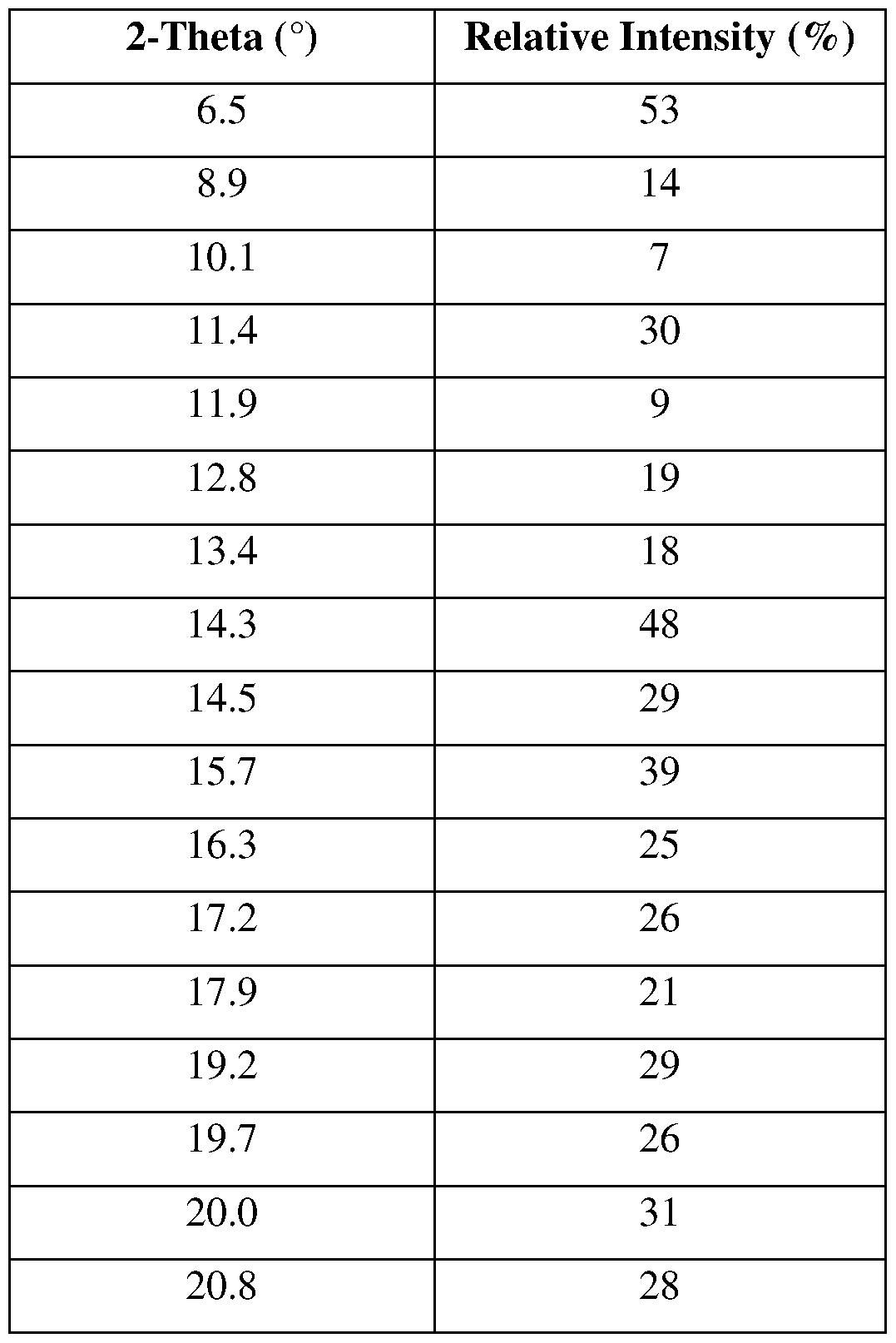


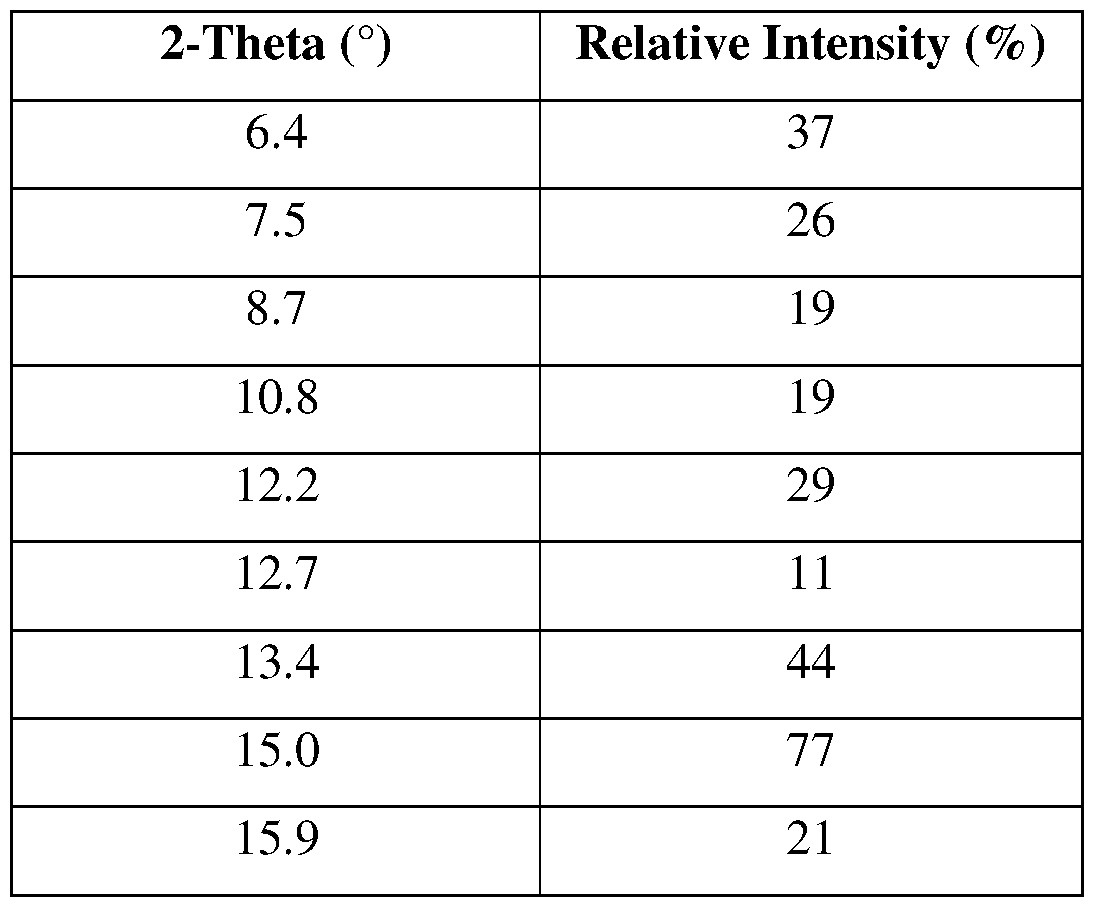
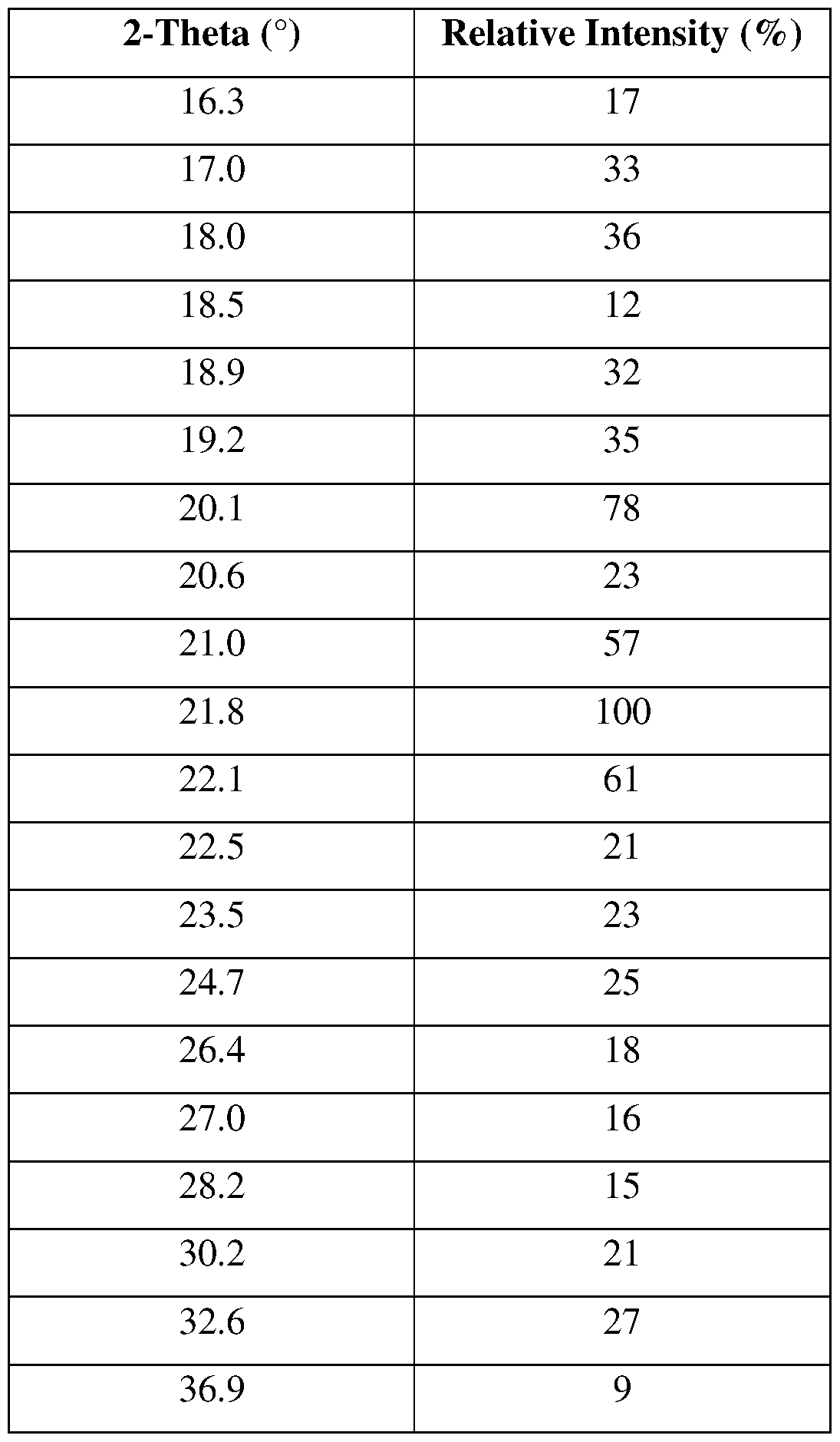


Claims
Priority Applications (2)
| Application Number | Priority Date | Filing Date | Title |
|---|---|---|---|
| CN202480035475.6A CN121219281A (en) | 2023-05-31 | 2024-05-30 | Solid forms of compounds for the treatment of HIV |
| AU2024281548A AU2024281548A1 (en) | 2023-05-31 | 2024-05-30 | Solid forms of compounds useful in the treatment of hiv |
Applications Claiming Priority (2)
| Application Number | Priority Date | Filing Date | Title |
|---|---|---|---|
| US202363505226P | 2023-05-31 | 2023-05-31 | |
| US63/505,226 | 2023-05-31 |
Publications (1)
| Publication Number | Publication Date |
|---|---|
| WO2024249573A1 true WO2024249573A1 (en) | 2024-12-05 |
Family
ID=91664545
Family Applications (1)
| Application Number | Title | Priority Date | Filing Date |
|---|---|---|---|
| PCT/US2024/031578 Pending WO2024249573A1 (en) | 2023-05-31 | 2024-05-30 | Solid forms of compounds useful in the treatment of hiv |
Country Status (5)
| Country | Link |
|---|---|
| US (1) | US20250011352A1 (en) |
| CN (1) | CN121219281A (en) |
| AU (1) | AU2024281548A1 (en) |
| TW (1) | TW202504592A (en) |
| WO (1) | WO2024249573A1 (en) |
Cited By (1)
| Publication number | Priority date | Publication date | Assignee | Title |
|---|---|---|---|---|
| WO2026020086A1 (en) * | 2024-07-19 | 2026-01-22 | Gilead Sciences, Inc. | Methods and pharmaceutical formulations for treating viral infections |
Citations (96)
| Publication number | Priority date | Publication date | Assignee | Title |
|---|---|---|---|---|
| US3845770A (en) | 1972-06-05 | 1974-11-05 | Alza Corp | Osmatic dispensing device for releasing beneficial agent |
| US4326525A (en) | 1980-10-14 | 1982-04-27 | Alza Corporation | Osmotic device that improves delivery properties of agent in situ |
| US4902514A (en) | 1988-07-21 | 1990-02-20 | Alza Corporation | Dosage form for administering nilvadipine for treating cardiovascular symptoms |
| US4992445A (en) | 1987-06-12 | 1991-02-12 | American Cyanamid Co. | Transdermal delivery of pharmaceuticals |
| US5001139A (en) | 1987-06-12 | 1991-03-19 | American Cyanamid Company | Enchancers for the transdermal flux of nivadipine |
| US5023252A (en) | 1985-12-04 | 1991-06-11 | Conrex Pharmaceutical Corporation | Transdermal and trans-membrane delivery of drugs |
| US5616345A (en) | 1983-12-22 | 1997-04-01 | Elan Corporation Plc | Controlled absorption diltiazen formulation for once-daily administration |
| US20020119443A1 (en) | 2000-07-21 | 2002-08-29 | Gilead Sciences, Inc. | Prodrugs of phosphonate nucleotide analogues and methods for selecting and making same |
| WO2004096286A2 (en) | 2003-04-25 | 2004-11-11 | Gilead Sciences, Inc. | Antiviral phosphonate analogs |
| WO2006007448A2 (en) | 2004-06-17 | 2006-01-19 | Transform Pharmaceuticals, Inc. | Pharmaceutical co-crystal compositions and related methods of use |
| WO2006015261A2 (en) | 2004-07-27 | 2006-02-09 | Gilead Sciences, Inc. | Nucleoside phosphonate conjugates as anti hiv agents |
| US20080234251A1 (en) | 2005-08-19 | 2008-09-25 | Array Biopharma Inc. | 8-Substituted Benzoazepines as Toll-Like Receptor Modulators |
| US20080306050A1 (en) | 2005-08-19 | 2008-12-11 | Array Biopharma Inc. | Aminodiazepines as Toll-Like Receptor Modulators |
| US20090047249A1 (en) | 2007-06-29 | 2009-02-19 | Micheal Graupe | Modulators of toll-like receptor 7 |
| WO2009062285A1 (en) | 2007-11-16 | 2009-05-22 | Boehringer Ingelheim International Gmbh | Inhibitors of human immunodeficiency virus replication |
| US20100029585A1 (en) | 2008-08-01 | 2010-02-04 | Howbert J Jeffry | Toll-like receptor agonist formulations and their use |
| US20100143301A1 (en) | 2008-12-09 | 2010-06-10 | Gilead Sciences, Inc. | Modulators of toll-like receptors |
| WO2010130034A1 (en) | 2009-05-15 | 2010-11-18 | Boehringer Ingelheim International Gmbh | Inhibitors of human immunodeficiency virus replication |
| US20110092485A1 (en) | 2009-08-18 | 2011-04-21 | Ventirx Pharmaceuticals, Inc. | Substituted benzoazepines as toll-like receptor modulators |
| US20110098248A1 (en) | 2009-10-22 | 2011-04-28 | Gilead Sciences, Inc. | Modulators of toll-like receptors |
| US7939553B2 (en) | 2006-07-07 | 2011-05-10 | Gilead Sciences, Inc. | Modulators of pharmacokinetic properties of therapeutics |
| US20110118235A1 (en) | 2009-08-18 | 2011-05-19 | Ventirx Pharmaceuticals, Inc. | Substituted benzoazepines as toll-like receptor modulators |
| US8008264B2 (en) | 2008-04-23 | 2011-08-30 | Gilead Sciences, Inc. | 1′-substituted carba-nucleoside analogs for antiviral treatment |
| WO2012003498A1 (en) | 2010-07-02 | 2012-01-05 | Gilead Sciences, Inc. | 2 -quinolinyl- acetic acid derivatives as hiv antiviral compounds |
| WO2012003497A1 (en) | 2010-07-02 | 2012-01-05 | Gilead Sciences, Inc. | Napht- 2 -ylacetic acid derivatives to treat aids |
| US20120082658A1 (en) | 2010-10-01 | 2012-04-05 | Ventirx Pharmaceuticals, Inc. | Methods for the Treatment of Allergic Diseases |
| US20120219615A1 (en) | 2010-10-01 | 2012-08-30 | The Trustees Of The University Of Pennsylvania | Therapeutic Use of a TLR Agonist and Combination Therapy |
| WO2012145728A1 (en) | 2011-04-21 | 2012-10-26 | Gilead Sciences, Inc. | Benzothiazole compounds and their pharmaceutical use |
| WO2012154312A1 (en) | 2011-05-09 | 2012-11-15 | The United States Of America, As Represented By The Secretary, Department Of Health & Human Services | Neutralizing antibodies to hiv-1 and their use |
| WO2012158948A1 (en) | 2011-05-17 | 2012-11-22 | The Rockefeller University | Human immunodeficiency virus neutralizing antibodies adn methods of use thereof |
| WO2013006738A1 (en) | 2011-07-06 | 2013-01-10 | Gilead Sciences, Inc. | Compounds for the treatment of hiv |
| WO2013006792A1 (en) | 2011-07-07 | 2013-01-10 | Pharmaresources (Shanghai) Co., Ltd. | Antiviral compounds |
| US20130065856A1 (en) | 2011-08-16 | 2013-03-14 | Gilead Sciences, Inc. | Tenofovir alafenamide hemifumarate |
| US20130090473A1 (en) | 2012-10-03 | 2013-04-11 | Denise A. Colby | Methods for preparing anti-viral nucleotide analogs |
| WO2013086533A1 (en) | 2011-12-08 | 2013-06-13 | The United States Of America, As Represented By The Secretary Department Of Health & Human Services | Neutralizing antibodies to hiv-1 and their use |
| WO2013091096A1 (en) | 2011-12-20 | 2013-06-27 | Boehringer Ingelheim International Gmbh | Condensed triclyclic compounds as inhibitors of hiv replication |
| US20130165489A1 (en) | 2010-05-03 | 2013-06-27 | The Trustees Of The University Of Pennsylvania | Small Molecule Modulators of HIV-1 Capsid Stability and Methods Thereof |
| WO2013142324A1 (en) | 2012-03-23 | 2013-09-26 | Usa, As Represented By The Secretary, Department Of Health And Human Services | Neutralizing antibodies to hiv-1 and their use |
| US20130251673A1 (en) | 2011-12-21 | 2013-09-26 | Novira Therapeutics, Inc. | Hepatitis b antiviral agents |
| WO2013159064A1 (en) | 2012-04-20 | 2013-10-24 | Gilead Sciences, Inc. | Benzothiazol- 6 -yl acetic acid derivatives and their use for treating an hiv infection |
| WO2014023813A1 (en) | 2012-08-10 | 2014-02-13 | Janssen R&D Ireland | Alkylpyrimidine derivatives for the treatment of viral infections and further diseases |
| US20140045849A1 (en) | 2011-04-08 | 2014-02-13 | David McGowan | Pyrimidine derivatives for the treatment of viral infections |
| US20140066432A1 (en) | 2011-01-12 | 2014-03-06 | James Jeffry Howbert | Substituted Benzoazepines As Toll-Like Receptor Modulators |
| US20140073642A1 (en) | 2011-05-18 | 2014-03-13 | Janssen R&D Ireland | Quinazoline derivatives for the treatment of viral infections and further diseases |
| US8673307B1 (en) | 2009-03-09 | 2014-03-18 | The Rockefeller University | HIV-1 anti-core neutralizing antibodies that target a conformational epitope within the ALPHA5-helix of GP120 |
| US20140088085A1 (en) | 2011-01-12 | 2014-03-27 | Array Biopharma, Inc | Substituted Benzoazepines As Toll-Like Receptor Modulators |
| WO2014056953A1 (en) | 2012-10-10 | 2014-04-17 | Janssen R&D Ireland | Pyrrolo[3,2-d]pyrimidine derivatives for the treatment of viral infections and other diseases |
| WO2014063059A1 (en) | 2012-10-18 | 2014-04-24 | Rockefeller University (The) | Broadly-neutralizing anti-hiv antibodies |
| WO2014076221A1 (en) | 2012-11-16 | 2014-05-22 | Janssen R&D Ireland | Heterocyclic substituted 2-amino-quinazoline derivatives for the treatment of viral infections |
| WO2014089152A1 (en) | 2012-12-04 | 2014-06-12 | University Of Maryland, Baltimore | Hiv-1 env-binding antibodies, fusion proteins, and methods of use |
| WO2014100323A1 (en) | 2012-12-21 | 2014-06-26 | Gilead Sciences, Inc. | Polycyclic-carbamoylpyridone compounds and their pharmaceutical use |
| US20140221380A1 (en) | 2012-12-27 | 2014-08-07 | Japan Tobacco Inc. | SUBSTITUTED SPIROPYRIDO[1,2-a]PYRAZINE DERIVATIVE AND PHARMACEUTICAL USE OF SAME AS HIV INTEGRASE INHIBITOR |
| WO2014128189A1 (en) | 2013-02-21 | 2014-08-28 | Janssen R&D Ireland | 2-aminopyrimidine derivatives for the treatment of viral infections |
| US20140275167A1 (en) | 2013-03-12 | 2014-09-18 | Novira Therapeutics, Inc. | Hepatitis b antiviral agents |
| US20140350031A1 (en) | 2012-02-08 | 2014-11-27 | Janssen R&D Ireland | Piperidino-pyrimidine derivatives for the treatment of viral infections |
| WO2015048462A1 (en) | 2013-09-27 | 2015-04-02 | Duke University | Human monoclonal antibodies |
| WO2015103549A1 (en) | 2014-01-03 | 2015-07-09 | The United States Of America, As Represented By The Secretary Department Of Health And Human Services | Neutralizing antibodies to hiv-1 env and their use |
| WO2015117008A2 (en) | 2014-01-31 | 2015-08-06 | The Rockefeller University | Broadly neutralizing anti-hiv antibodies and epitope therefor |
| WO2015196137A1 (en) | 2014-06-20 | 2015-12-23 | Gilead Sciences, Inc. | Crystalline forms of (2r,5s,13ar)-8-hydroxy-7,9-dioxo-n-(2,4,6-trifluorobenzyl)-2,3,4,5,7,9,13,13a-octahydro-2,5-methanopyrido [1',2':4,5] pyrazino [2,1-b] [1,3] oxazepine-10-carboxamide |
| US20160016973A1 (en) | 2014-06-20 | 2016-01-21 | Gilead Sciences, Inc. | Sodium (2r,5s,13ar)-7,9-dioxo-10-((2,4,6-trifluorobenzyl)carbamoyl)-2,3,4,5,7,9,13,13a-octahydro-2,5-methanopyrido[1',2':4,5]pyrazino[2,1-b]oxazepin-8-olate |
| WO2016014484A1 (en) | 2014-07-21 | 2016-01-28 | The Rockefeller University | Combination of broadly neutralizing hiv antibodies and viral inducers |
| US20160108030A1 (en) | 2013-03-01 | 2016-04-21 | Gilead Sciences, Inc. | Therapeutic compounds |
| US20160237062A1 (en) | 2014-12-24 | 2016-08-18 | Gilead Sciences, Inc. | Isoquinoline Compounds |
| US20160251347A1 (en) | 2014-12-24 | 2016-09-01 | Gilead Sciences, Inc. | Fused pyrimidine compounds |
| US20160250215A1 (en) | 2014-12-24 | 2016-09-01 | Gilead Sciences, Inc. | Quinazoline compounds |
| WO2016149710A2 (en) | 2015-03-19 | 2016-09-22 | Duke University | Hiv-1 neutralizing antibodies and uses thereof |
| WO2016154003A1 (en) | 2015-03-20 | 2016-09-29 | The United States Of America, As Represented By The Secretary, Department Of Health & Human Services | Neutralizing antibodies to gp120 and their use |
| WO2016179517A1 (en) | 2015-05-07 | 2016-11-10 | Agenus Inc. | Anti-ox40 antibodies and methods of use thereof |
| US9493549B2 (en) | 2011-07-25 | 2016-11-15 | The Rockefeller University | Antibodies directed toward the HIV-1 GP120 CD4 binding site with increased potency and breadth |
| WO2016196975A1 (en) | 2015-06-03 | 2016-12-08 | The United States Of America, As Represented By The Secretary Department Of Health & Human Services | Neutralizing antibodies to hiv-1 env and their use |
| US20170071944A1 (en) | 2015-09-15 | 2017-03-16 | Gilead Sciences, Inc. | Modulators of toll-like receptors for the treatment of hiv |
| WO2017096221A1 (en) | 2015-12-02 | 2017-06-08 | The Rockefeller University | Bispecific anti-hiv broadly neutralizing antibodies |
| WO2017096179A1 (en) | 2015-12-02 | 2017-06-08 | Agenus Inc. | Antibodies and methods of use thereof |
| WO2017096189A1 (en) | 2015-12-02 | 2017-06-08 | Agenus Inc. | Anti-gitr antibodies and methods of use thereof |
| WO2017096182A1 (en) | 2015-12-03 | 2017-06-08 | Agenus Inc. | Anti-ox40 antibodies and methods of use thereof |
| WO2017096276A1 (en) | 2015-12-02 | 2017-06-08 | Agenus Inc. | Anti-gitr antibodies and methods of use thereof |
| WO2017096281A1 (en) | 2015-12-02 | 2017-06-08 | Agenus Inc. | Anti-ox40 antibodies and methods of use thereof |
| WO2017133640A1 (en) | 2016-02-03 | 2017-08-10 | National Center For Aids/Std Control And Prevention, Chinese Center For Disease Control And Prevention | Broadly neutralizing antibodies against hiv-1 and use thereof |
| WO2017133639A1 (en) | 2016-02-02 | 2017-08-10 | National Center For Aids/Std Control And Prevention, Chinese Center For Disease Control And Prevention | Broadly neutralizing antibodies against hiv-1 and use thereof |
| US20180051005A1 (en) | 2016-08-19 | 2018-02-22 | Gilead Sciences, Inc. | Therapeutic compounds |
| WO2018089628A1 (en) | 2016-11-09 | 2018-05-17 | Agenus Inc. | Anti-ox40 antibodies, anti-gitr antibodies, and methods of use thereof |
| US10065958B2 (en) | 2010-07-22 | 2018-09-04 | Gilead Sciences, Inc. | Methods and compounds for treating Paramyxoviridae virus infections |
| US20180371086A1 (en) | 2017-06-21 | 2018-12-27 | Gilead Sciences, Inc. | Multispecific antibodies that target hiv gp120 and cd3 |
| WO2019035904A1 (en) | 2017-08-17 | 2019-02-21 | Gilead Sciences, Inc. | Solid forms of an hiv capsid inhibitor |
| US20190083478A1 (en) | 2017-08-17 | 2019-03-21 | Gilead Sciences, Inc. | Choline salt forms of an HIV capsid inhibitor |
| US10239935B2 (en) | 2015-12-15 | 2019-03-26 | Gilead Sciences, Inc. | Human immunodeficiency virus neutralizing antibodies |
| WO2019087016A1 (en) | 2017-10-30 | 2019-05-09 | Glaxosmithkline Intellectual Property Development Limited | Compounds useful in hiv therapy |
| US10294234B2 (en) | 2017-02-06 | 2019-05-21 | Gilead Sciences, Inc. | HIV inhibitor compounds |
| US20190210978A1 (en) | 2017-10-13 | 2019-07-11 | Gilead Sciences, Inc. | Hiv protease inhibitors |
| US20190300505A1 (en) | 2018-02-16 | 2019-10-03 | Gilead Sciences, Inc. | Methods and intermediates for preparing therapeutic compounds |
| US20200030327A1 (en) | 2018-07-30 | 2020-01-30 | Gilead Sciences, Inc. | Anti-hiv compounds |
| US20200038389A1 (en) | 2018-07-16 | 2020-02-06 | Gilead Sciences, Inc. | Capsid inhibitors for the treatment of hiv |
| US20200223907A1 (en) | 2018-07-03 | 2020-07-16 | Gilead Sciences, Inc. | Antibodies that target hiv gp120 and methods of use |
| US20210188815A1 (en) | 2019-11-26 | 2021-06-24 | Gilead Sciences, Inc. | Capsid inhibitors for the prevention of hiv |
| US11084832B2 (en) | 2019-03-22 | 2021-08-10 | Gilead Sciences, Inc. | Bridged tricyclic carbamoylpyridone compounds and their pharmaceutical use |
| WO2023102239A1 (en) * | 2021-12-03 | 2023-06-08 | Gilead Sciences, Inc. | Therapeutic compounds for hiv virus infection |
-
2024
- 2024-05-30 WO PCT/US2024/031578 patent/WO2024249573A1/en active Pending
- 2024-05-30 TW TW113120026A patent/TW202504592A/en unknown
- 2024-05-30 CN CN202480035475.6A patent/CN121219281A/en active Pending
- 2024-05-30 US US18/678,355 patent/US20250011352A1/en active Pending
- 2024-05-30 AU AU2024281548A patent/AU2024281548A1/en active Pending
Patent Citations (103)
| Publication number | Priority date | Publication date | Assignee | Title |
|---|---|---|---|---|
| US3845770A (en) | 1972-06-05 | 1974-11-05 | Alza Corp | Osmatic dispensing device for releasing beneficial agent |
| US4326525A (en) | 1980-10-14 | 1982-04-27 | Alza Corporation | Osmotic device that improves delivery properties of agent in situ |
| US5616345A (en) | 1983-12-22 | 1997-04-01 | Elan Corporation Plc | Controlled absorption diltiazen formulation for once-daily administration |
| US5023252A (en) | 1985-12-04 | 1991-06-11 | Conrex Pharmaceutical Corporation | Transdermal and trans-membrane delivery of drugs |
| US4992445A (en) | 1987-06-12 | 1991-02-12 | American Cyanamid Co. | Transdermal delivery of pharmaceuticals |
| US5001139A (en) | 1987-06-12 | 1991-03-19 | American Cyanamid Company | Enchancers for the transdermal flux of nivadipine |
| US4902514A (en) | 1988-07-21 | 1990-02-20 | Alza Corporation | Dosage form for administering nilvadipine for treating cardiovascular symptoms |
| US20020119443A1 (en) | 2000-07-21 | 2002-08-29 | Gilead Sciences, Inc. | Prodrugs of phosphonate nucleotide analogues and methods for selecting and making same |
| WO2004096286A2 (en) | 2003-04-25 | 2004-11-11 | Gilead Sciences, Inc. | Antiviral phosphonate analogs |
| WO2006007448A2 (en) | 2004-06-17 | 2006-01-19 | Transform Pharmaceuticals, Inc. | Pharmaceutical co-crystal compositions and related methods of use |
| US20070049754A1 (en) | 2004-07-27 | 2007-03-01 | Gilead Sciences, Inc. | Phosphonate analogs of HIV inhibitor compounds |
| WO2006110157A2 (en) | 2004-07-27 | 2006-10-19 | Gilead Sciences, Inc. | Nucleoside phosphonate conjugates as anti hiv agents |
| WO2006015261A2 (en) | 2004-07-27 | 2006-02-09 | Gilead Sciences, Inc. | Nucleoside phosphonate conjugates as anti hiv agents |
| US20080234251A1 (en) | 2005-08-19 | 2008-09-25 | Array Biopharma Inc. | 8-Substituted Benzoazepines as Toll-Like Receptor Modulators |
| US20080306050A1 (en) | 2005-08-19 | 2008-12-11 | Array Biopharma Inc. | Aminodiazepines as Toll-Like Receptor Modulators |
| US7939553B2 (en) | 2006-07-07 | 2011-05-10 | Gilead Sciences, Inc. | Modulators of pharmacokinetic properties of therapeutics |
| US20090047249A1 (en) | 2007-06-29 | 2009-02-19 | Micheal Graupe | Modulators of toll-like receptor 7 |
| WO2009062285A1 (en) | 2007-11-16 | 2009-05-22 | Boehringer Ingelheim International Gmbh | Inhibitors of human immunodeficiency virus replication |
| US8008264B2 (en) | 2008-04-23 | 2011-08-30 | Gilead Sciences, Inc. | 1′-substituted carba-nucleoside analogs for antiviral treatment |
| US20100029585A1 (en) | 2008-08-01 | 2010-02-04 | Howbert J Jeffry | Toll-like receptor agonist formulations and their use |
| US20100143301A1 (en) | 2008-12-09 | 2010-06-10 | Gilead Sciences, Inc. | Modulators of toll-like receptors |
| US8673307B1 (en) | 2009-03-09 | 2014-03-18 | The Rockefeller University | HIV-1 anti-core neutralizing antibodies that target a conformational epitope within the ALPHA5-helix of GP120 |
| WO2010130034A1 (en) | 2009-05-15 | 2010-11-18 | Boehringer Ingelheim International Gmbh | Inhibitors of human immunodeficiency virus replication |
| US20110092485A1 (en) | 2009-08-18 | 2011-04-21 | Ventirx Pharmaceuticals, Inc. | Substituted benzoazepines as toll-like receptor modulators |
| US20110118235A1 (en) | 2009-08-18 | 2011-05-19 | Ventirx Pharmaceuticals, Inc. | Substituted benzoazepines as toll-like receptor modulators |
| US20110098248A1 (en) | 2009-10-22 | 2011-04-28 | Gilead Sciences, Inc. | Modulators of toll-like receptors |
| US20130165489A1 (en) | 2010-05-03 | 2013-06-27 | The Trustees Of The University Of Pennsylvania | Small Molecule Modulators of HIV-1 Capsid Stability and Methods Thereof |
| WO2012003497A1 (en) | 2010-07-02 | 2012-01-05 | Gilead Sciences, Inc. | Napht- 2 -ylacetic acid derivatives to treat aids |
| WO2012003498A1 (en) | 2010-07-02 | 2012-01-05 | Gilead Sciences, Inc. | 2 -quinolinyl- acetic acid derivatives as hiv antiviral compounds |
| US10065958B2 (en) | 2010-07-22 | 2018-09-04 | Gilead Sciences, Inc. | Methods and compounds for treating Paramyxoviridae virus infections |
| US20120219615A1 (en) | 2010-10-01 | 2012-08-30 | The Trustees Of The University Of Pennsylvania | Therapeutic Use of a TLR Agonist and Combination Therapy |
| US20120082658A1 (en) | 2010-10-01 | 2012-04-05 | Ventirx Pharmaceuticals, Inc. | Methods for the Treatment of Allergic Diseases |
| US20140088085A1 (en) | 2011-01-12 | 2014-03-27 | Array Biopharma, Inc | Substituted Benzoazepines As Toll-Like Receptor Modulators |
| US20140066432A1 (en) | 2011-01-12 | 2014-03-06 | James Jeffry Howbert | Substituted Benzoazepines As Toll-Like Receptor Modulators |
| US20140045849A1 (en) | 2011-04-08 | 2014-02-13 | David McGowan | Pyrimidine derivatives for the treatment of viral infections |
| WO2012145728A1 (en) | 2011-04-21 | 2012-10-26 | Gilead Sciences, Inc. | Benzothiazole compounds and their pharmaceutical use |
| WO2012154312A1 (en) | 2011-05-09 | 2012-11-15 | The United States Of America, As Represented By The Secretary, Department Of Health & Human Services | Neutralizing antibodies to hiv-1 and their use |
| WO2012158948A1 (en) | 2011-05-17 | 2012-11-22 | The Rockefeller University | Human immunodeficiency virus neutralizing antibodies adn methods of use thereof |
| US9783594B2 (en) | 2011-05-17 | 2017-10-10 | The Rockefeller University | Human immunodeficiency virus neutralizing antibodies and methods of use thereof |
| US20140073642A1 (en) | 2011-05-18 | 2014-03-13 | Janssen R&D Ireland | Quinazoline derivatives for the treatment of viral infections and further diseases |
| WO2013006738A1 (en) | 2011-07-06 | 2013-01-10 | Gilead Sciences, Inc. | Compounds for the treatment of hiv |
| WO2013006792A1 (en) | 2011-07-07 | 2013-01-10 | Pharmaresources (Shanghai) Co., Ltd. | Antiviral compounds |
| US9493549B2 (en) | 2011-07-25 | 2016-11-15 | The Rockefeller University | Antibodies directed toward the HIV-1 GP120 CD4 binding site with increased potency and breadth |
| US20130065856A1 (en) | 2011-08-16 | 2013-03-14 | Gilead Sciences, Inc. | Tenofovir alafenamide hemifumarate |
| WO2013086533A1 (en) | 2011-12-08 | 2013-06-13 | The United States Of America, As Represented By The Secretary Department Of Health & Human Services | Neutralizing antibodies to hiv-1 and their use |
| WO2013091096A1 (en) | 2011-12-20 | 2013-06-27 | Boehringer Ingelheim International Gmbh | Condensed triclyclic compounds as inhibitors of hiv replication |
| US20130251673A1 (en) | 2011-12-21 | 2013-09-26 | Novira Therapeutics, Inc. | Hepatitis b antiviral agents |
| US20140350031A1 (en) | 2012-02-08 | 2014-11-27 | Janssen R&D Ireland | Piperidino-pyrimidine derivatives for the treatment of viral infections |
| WO2013142324A1 (en) | 2012-03-23 | 2013-09-26 | Usa, As Represented By The Secretary, Department Of Health And Human Services | Neutralizing antibodies to hiv-1 and their use |
| WO2013159064A1 (en) | 2012-04-20 | 2013-10-24 | Gilead Sciences, Inc. | Benzothiazol- 6 -yl acetic acid derivatives and their use for treating an hiv infection |
| WO2014023813A1 (en) | 2012-08-10 | 2014-02-13 | Janssen R&D Ireland | Alkylpyrimidine derivatives for the treatment of viral infections and further diseases |
| US20130090473A1 (en) | 2012-10-03 | 2013-04-11 | Denise A. Colby | Methods for preparing anti-viral nucleotide analogs |
| WO2014056953A1 (en) | 2012-10-10 | 2014-04-17 | Janssen R&D Ireland | Pyrrolo[3,2-d]pyrimidine derivatives for the treatment of viral infections and other diseases |
| WO2014063059A1 (en) | 2012-10-18 | 2014-04-24 | Rockefeller University (The) | Broadly-neutralizing anti-hiv antibodies |
| WO2014076221A1 (en) | 2012-11-16 | 2014-05-22 | Janssen R&D Ireland | Heterocyclic substituted 2-amino-quinazoline derivatives for the treatment of viral infections |
| WO2014089152A1 (en) | 2012-12-04 | 2014-06-12 | University Of Maryland, Baltimore | Hiv-1 env-binding antibodies, fusion proteins, and methods of use |
| WO2014100323A1 (en) | 2012-12-21 | 2014-06-26 | Gilead Sciences, Inc. | Polycyclic-carbamoylpyridone compounds and their pharmaceutical use |
| US20140221356A1 (en) | 2012-12-21 | 2014-08-07 | Gilead Sciences, Inc. | Polycyclic-carbamoylpyridone compounds and their pharmaceutical use |
| US20140221380A1 (en) | 2012-12-27 | 2014-08-07 | Japan Tobacco Inc. | SUBSTITUTED SPIROPYRIDO[1,2-a]PYRAZINE DERIVATIVE AND PHARMACEUTICAL USE OF SAME AS HIV INTEGRASE INHIBITOR |
| US20140221378A1 (en) | 2012-12-27 | 2014-08-07 | Japan Tobacco Inc. | SUBSTITUTED SPIROPYRIDO[1,2-a]PYRAZINE DERIVATIVE AND PHARMACEUTICAL USE OF SAME AS HIV INTEGRASE INHIBITOR |
| WO2014128189A1 (en) | 2013-02-21 | 2014-08-28 | Janssen R&D Ireland | 2-aminopyrimidine derivatives for the treatment of viral infections |
| US20160108030A1 (en) | 2013-03-01 | 2016-04-21 | Gilead Sciences, Inc. | Therapeutic compounds |
| US20140275167A1 (en) | 2013-03-12 | 2014-09-18 | Novira Therapeutics, Inc. | Hepatitis b antiviral agents |
| WO2015048462A1 (en) | 2013-09-27 | 2015-04-02 | Duke University | Human monoclonal antibodies |
| WO2015103549A1 (en) | 2014-01-03 | 2015-07-09 | The United States Of America, As Represented By The Secretary Department Of Health And Human Services | Neutralizing antibodies to hiv-1 env and their use |
| WO2015117008A2 (en) | 2014-01-31 | 2015-08-06 | The Rockefeller University | Broadly neutralizing anti-hiv antibodies and epitope therefor |
| US20160016973A1 (en) | 2014-06-20 | 2016-01-21 | Gilead Sciences, Inc. | Sodium (2r,5s,13ar)-7,9-dioxo-10-((2,4,6-trifluorobenzyl)carbamoyl)-2,3,4,5,7,9,13,13a-octahydro-2,5-methanopyrido[1',2':4,5]pyrazino[2,1-b]oxazepin-8-olate |
| WO2015196137A1 (en) | 2014-06-20 | 2015-12-23 | Gilead Sciences, Inc. | Crystalline forms of (2r,5s,13ar)-8-hydroxy-7,9-dioxo-n-(2,4,6-trifluorobenzyl)-2,3,4,5,7,9,13,13a-octahydro-2,5-methanopyrido [1',2':4,5] pyrazino [2,1-b] [1,3] oxazepine-10-carboxamide |
| WO2016014484A1 (en) | 2014-07-21 | 2016-01-28 | The Rockefeller University | Combination of broadly neutralizing hiv antibodies and viral inducers |
| US10548898B2 (en) | 2014-12-24 | 2020-02-04 | Gilead Sciences Inc. | Quinazoline compounds |
| US20160237062A1 (en) | 2014-12-24 | 2016-08-18 | Gilead Sciences, Inc. | Isoquinoline Compounds |
| US20160251347A1 (en) | 2014-12-24 | 2016-09-01 | Gilead Sciences, Inc. | Fused pyrimidine compounds |
| US20160250215A1 (en) | 2014-12-24 | 2016-09-01 | Gilead Sciences, Inc. | Quinazoline compounds |
| WO2016149710A2 (en) | 2015-03-19 | 2016-09-22 | Duke University | Hiv-1 neutralizing antibodies and uses thereof |
| WO2016154003A1 (en) | 2015-03-20 | 2016-09-29 | The United States Of America, As Represented By The Secretary, Department Of Health & Human Services | Neutralizing antibodies to gp120 and their use |
| WO2016179517A1 (en) | 2015-05-07 | 2016-11-10 | Agenus Inc. | Anti-ox40 antibodies and methods of use thereof |
| WO2016196975A1 (en) | 2015-06-03 | 2016-12-08 | The United States Of America, As Represented By The Secretary Department Of Health & Human Services | Neutralizing antibodies to hiv-1 env and their use |
| US20170071944A1 (en) | 2015-09-15 | 2017-03-16 | Gilead Sciences, Inc. | Modulators of toll-like receptors for the treatment of hiv |
| WO2017096276A1 (en) | 2015-12-02 | 2017-06-08 | Agenus Inc. | Anti-gitr antibodies and methods of use thereof |
| WO2017096179A1 (en) | 2015-12-02 | 2017-06-08 | Agenus Inc. | Antibodies and methods of use thereof |
| WO2017096281A1 (en) | 2015-12-02 | 2017-06-08 | Agenus Inc. | Anti-ox40 antibodies and methods of use thereof |
| WO2017096221A1 (en) | 2015-12-02 | 2017-06-08 | The Rockefeller University | Bispecific anti-hiv broadly neutralizing antibodies |
| WO2017096189A1 (en) | 2015-12-02 | 2017-06-08 | Agenus Inc. | Anti-gitr antibodies and methods of use thereof |
| WO2017096182A1 (en) | 2015-12-03 | 2017-06-08 | Agenus Inc. | Anti-ox40 antibodies and methods of use thereof |
| US10239935B2 (en) | 2015-12-15 | 2019-03-26 | Gilead Sciences, Inc. | Human immunodeficiency virus neutralizing antibodies |
| WO2017133639A1 (en) | 2016-02-02 | 2017-08-10 | National Center For Aids/Std Control And Prevention, Chinese Center For Disease Control And Prevention | Broadly neutralizing antibodies against hiv-1 and use thereof |
| WO2017133640A1 (en) | 2016-02-03 | 2017-08-10 | National Center For Aids/Std Control And Prevention, Chinese Center For Disease Control And Prevention | Broadly neutralizing antibodies against hiv-1 and use thereof |
| US20180051005A1 (en) | 2016-08-19 | 2018-02-22 | Gilead Sciences, Inc. | Therapeutic compounds |
| WO2018089628A1 (en) | 2016-11-09 | 2018-05-17 | Agenus Inc. | Anti-ox40 antibodies, anti-gitr antibodies, and methods of use thereof |
| US10294234B2 (en) | 2017-02-06 | 2019-05-21 | Gilead Sciences, Inc. | HIV inhibitor compounds |
| US20180371086A1 (en) | 2017-06-21 | 2018-12-27 | Gilead Sciences, Inc. | Multispecific antibodies that target hiv gp120 and cd3 |
| US20190084963A1 (en) | 2017-08-17 | 2019-03-21 | Gilead Sciences, Inc. | Solid Forms Of an HIV Capsid Inhibitor |
| WO2019035904A1 (en) | 2017-08-17 | 2019-02-21 | Gilead Sciences, Inc. | Solid forms of an hiv capsid inhibitor |
| US20190083478A1 (en) | 2017-08-17 | 2019-03-21 | Gilead Sciences, Inc. | Choline salt forms of an HIV capsid inhibitor |
| US20190210978A1 (en) | 2017-10-13 | 2019-07-11 | Gilead Sciences, Inc. | Hiv protease inhibitors |
| WO2019087016A1 (en) | 2017-10-30 | 2019-05-09 | Glaxosmithkline Intellectual Property Development Limited | Compounds useful in hiv therapy |
| US20190300505A1 (en) | 2018-02-16 | 2019-10-03 | Gilead Sciences, Inc. | Methods and intermediates for preparing therapeutic compounds |
| US20200223907A1 (en) | 2018-07-03 | 2020-07-16 | Gilead Sciences, Inc. | Antibodies that target hiv gp120 and methods of use |
| US20200038389A1 (en) | 2018-07-16 | 2020-02-06 | Gilead Sciences, Inc. | Capsid inhibitors for the treatment of hiv |
| US20200030327A1 (en) | 2018-07-30 | 2020-01-30 | Gilead Sciences, Inc. | Anti-hiv compounds |
| US11084832B2 (en) | 2019-03-22 | 2021-08-10 | Gilead Sciences, Inc. | Bridged tricyclic carbamoylpyridone compounds and their pharmaceutical use |
| US20210188815A1 (en) | 2019-11-26 | 2021-06-24 | Gilead Sciences, Inc. | Capsid inhibitors for the prevention of hiv |
| WO2023102239A1 (en) * | 2021-12-03 | 2023-06-08 | Gilead Sciences, Inc. | Therapeutic compounds for hiv virus infection |
Non-Patent Citations (23)
| Title |
|---|
| "Remington's Pharmaceutical Sciences", 1985, MACE PUBLISHING CO. |
| CHIOSSONE ET AL., NAT REV IMMUNOL., vol. 18, no. 11, 2018, pages 671 - 688 |
| DAVIS ET AL., SEMIN IMMUNOL., vol. 31, 2017, pages 37 - 54 |
| EROSHKIN ET AL., NUCLEIC ACIDS RES., vol. 42, 2014, pages 133 - 9 |
| FELICES ET AL., METHODS MOL BIOL., vol. 1441, 2016, pages 333 - 346 |
| HAMMER, S.M. ET AL., JAMA, vol. 300, 2008, pages 555 - 570 |
| HARTWEGER ET AL., J. EXP. MED, 2019, pages 1301 |
| HARTWEGER ET AL., J. EXP. MED., 2019, pages 1301 |
| HORWITZ ET AL., PROC NATL ACAD SCI U S A, vol. 110, no. 41, 2013, pages 16538 - 43 |
| KLEIN ET AL., NATURE, vol. 492, no. 7427, 2012, pages 118 - 22 |
| LU, J AND ROHANI, S: "Polymorphism and Crystallization of Active Pharmaceutical Ingredients (APIs)", CURRENT MEDICINAL CHEMISTRY, vol. 16, no. 7, March 2009 (2009-03-01), United Arab Emirates, pages 884 - 905, XP093210997, ISSN: 0929-8673, DOI: 10.2174/092986709787549299 |
| MASCOLA ET AL., IMMUNOL REV., vol. 254, no. 1, 2013, pages 225 - 44 |
| MOFFETT ET AL., SCI. IMMUNOL, vol. 4, 17 May 2019 (2019-05-17) |
| PALOMBO M.S. ET AL: "Prodrug and conjugate drug delivery strategies for improving HIV/AIDS therapy", JOURNAL OF DRUG DELIVERY SCIENCE AND TECHNOLOGY, vol. 19, no. 1, 1 January 2009 (2009-01-01), FR, pages 3 - 14, XP055957019, ISSN: 1773-2247, DOI: 10.1016/S1773-2247(09)50001-9 * |
| SAJADI ET AL., CELL, vol. 173, no. 7, 2018, pages 1783 - 1795 |
| SAJADI ET AL., J INFECT DIS., vol. 213, no. 1, 2016, pages 156 - 64 |
| SCHEID ET AL., NATURE, vol. 458, 2009, pages 636 - 640 |
| SCHEID ET AL., SCIENCE, vol. 333, 2011, pages 1633 - 1637 |
| SIMPLÍCIO ANA L, CLANCY J M, GILMER J F: "Prodrugs for amines.", MOLECULES, vol. 13, no. 3, 1 January 2008 (2008-01-01), CH , pages 519 - 547, XP002503564, ISSN: 1420-3049, DOI: 10.3390/molecules13030519 |
| SMITH, R. ET AL., SCIENCE, vol. 327, 2010, pages 697 - 701 |
| TAIWO, B., INTERNATIONAL JOURNAL OF INFECTIOUS DISEASES, vol. 13, 2009, pages 552 - 559 |
| U.S. DEPARTMENT OF HEALTH AND HUMAN SERVICES: "Regulatory Classification of Pharmaceutical Co-crystals - Guidance for Industry", PHARMACEUTICAL QUALTIY/CMC, 1 February 2018 (2018-02-01), pages 1 - 8, XP055937344 |
| XU ET AL., J EXP CLIN CANCER RES., vol. 37, 2018, pages 110 |
Cited By (1)
| Publication number | Priority date | Publication date | Assignee | Title |
|---|---|---|---|---|
| WO2026020086A1 (en) * | 2024-07-19 | 2026-01-22 | Gilead Sciences, Inc. | Methods and pharmaceutical formulations for treating viral infections |
Also Published As
| Publication number | Publication date |
|---|---|
| AU2024281548A1 (en) | 2025-11-13 |
| TW202504592A (en) | 2025-02-01 |
| CN121219281A (en) | 2025-12-26 |
| US20250011352A1 (en) | 2025-01-09 |
Similar Documents
| Publication | Publication Date | Title |
|---|---|---|
| US12084467B2 (en) | Therapeutic compounds for HIV virus infection | |
| WO2023102523A1 (en) | Therapeutic compounds for hiv virus infection | |
| US20240390349A1 (en) | Dosing regimen of capsid inhibitor | |
| US20250011352A1 (en) | Solid forms | |
| TWI867601B (en) | Therapeutic compounds useful for the prophylactic or therapeutic treatment of an hiv virus infection | |
| US20250090513A1 (en) | Dosing regimen of hiv capsid inhibitor | |
| US20250057826A1 (en) | Weekly regimen for hiv | |
| US20250230163A1 (en) | Solid forms of hiv integrase inhibitors | |
| US20250289822A1 (en) | Solid forms of hiv integrase inhibitors | |
| KR20260018877A (en) | Solid form of a compound useful in the treatment of HIV | |
| US20250296932A1 (en) | Pharmaceutical compositions comprising hiv integrase inhibitors | |
| TW202600554A (en) | Solid forms of hiv integrase inhibitors | |
| US20240226130A1 (en) | 4'-thionucleoside analogues and their pharmaceutical use | |
| US20250042926A1 (en) | Therapeutic compounds for hiv | |
| TW202515549A (en) | Bridged tricyclic carbamoylpyridone compounds and uses thereof | |
| WO2025029247A1 (en) | Weekly regimen of lenacapavir for the treatment and prevention of hiv | |
| WO2025042394A1 (en) | Dosing regimen of hiv capsid inhibitor | |
| WO2025080863A1 (en) | Bridged tricyclic carbamoylpyridone compounds and uses thereof | |
| WO2025080850A1 (en) | Bridged tricyclic carbamoylpyridone compounds and uses thereof | |
| WO2024044477A1 (en) | Dosing and scheduling regimen for broadly neutralizing antibodies |
Legal Events
| Date | Code | Title | Description |
|---|---|---|---|
| 121 | Ep: the epo has been informed by wipo that ep was designated in this application |
Ref document number: 24736184 Country of ref document: EP Kind code of ref document: A1 |
|
| WWE | Wipo information: entry into national phase |
Ref document number: AU2024281548 Country of ref document: AU |
|
| ENP | Entry into the national phase |
Ref document number: 2024281548 Country of ref document: AU Date of ref document: 20240530 Kind code of ref document: A |
|
| WWE | Wipo information: entry into national phase |
Ref document number: 202517121165 Country of ref document: IN |
|
| WWP | Wipo information: published in national office |
Ref document number: 202517121165 Country of ref document: IN |
|
| NENP | Non-entry into the national phase |
Ref country code: DE |
|
| WWE | Wipo information: entry into national phase |
Ref document number: 2024736184 Country of ref document: EP |