WO2024156628A1 - Cleaning compositions and uses thereof - Google Patents
Cleaning compositions and uses thereof Download PDFInfo
- Publication number
- WO2024156628A1 WO2024156628A1 PCT/EP2024/051329 EP2024051329W WO2024156628A1 WO 2024156628 A1 WO2024156628 A1 WO 2024156628A1 EP 2024051329 W EP2024051329 W EP 2024051329W WO 2024156628 A1 WO2024156628 A1 WO 2024156628A1
- Authority
- WO
- WIPO (PCT)
- Prior art keywords
- seq
- polypeptide
- amino acid
- sequence identity
- acid sequence
- Prior art date
- Legal status (The legal status is an assumption and is not a legal conclusion. Google has not performed a legal analysis and makes no representation as to the accuracy of the status listed.)
- Ceased
Links
Classifications
-
- C—CHEMISTRY; METALLURGY
- C11—ANIMAL OR VEGETABLE OILS, FATS, FATTY SUBSTANCES OR WAXES; FATTY ACIDS THEREFROM; DETERGENTS; CANDLES
- C11D—DETERGENT COMPOSITIONS; USE OF SINGLE SUBSTANCES AS DETERGENTS; SOAP OR SOAP-MAKING; RESIN SOAPS; RECOVERY OF GLYCEROL
- C11D3/00—Other compounding ingredients of detergent compositions covered in group C11D1/00
- C11D3/16—Organic compounds
- C11D3/38—Products with no well-defined composition, e.g. natural products
- C11D3/386—Preparations containing enzymes, e.g. protease or amylase
- C11D3/38636—Preparations containing enzymes, e.g. protease or amylase containing enzymes other than protease, amylase, lipase, cellulase, oxidase or reductase
-
- C—CHEMISTRY; METALLURGY
- C12—BIOCHEMISTRY; BEER; SPIRITS; WINE; VINEGAR; MICROBIOLOGY; ENZYMOLOGY; MUTATION OR GENETIC ENGINEERING
- C12N—MICROORGANISMS OR ENZYMES; COMPOSITIONS THEREOF; PROPAGATING, PRESERVING, OR MAINTAINING MICROORGANISMS; MUTATION OR GENETIC ENGINEERING; CULTURE MEDIA
- C12N9/00—Enzymes; Proenzymes; Compositions thereof; Processes for preparing, activating, inhibiting, separating or purifying enzymes
- C12N9/14—Hydrolases (3)
- C12N9/16—Hydrolases (3) acting on ester bonds (3.1)
- C12N9/22—Ribonucleases [RNase]; Deoxyribonucleases [DNase]
-
- C—CHEMISTRY; METALLURGY
- C12—BIOCHEMISTRY; BEER; SPIRITS; WINE; VINEGAR; MICROBIOLOGY; ENZYMOLOGY; MUTATION OR GENETIC ENGINEERING
- C12N—MICROORGANISMS OR ENZYMES; COMPOSITIONS THEREOF; PROPAGATING, PRESERVING, OR MAINTAINING MICROORGANISMS; MUTATION OR GENETIC ENGINEERING; CULTURE MEDIA
- C12N9/00—Enzymes; Proenzymes; Compositions thereof; Processes for preparing, activating, inhibiting, separating or purifying enzymes
- C12N9/14—Hydrolases (3)
- C12N9/24—Hydrolases (3) acting on glycosyl compounds (3.2)
- C12N9/2402—Hydrolases (3) acting on glycosyl compounds (3.2) hydrolysing O- and S- glycosyl compounds (3.2.1)
-
- C—CHEMISTRY; METALLURGY
- C12—BIOCHEMISTRY; BEER; SPIRITS; WINE; VINEGAR; MICROBIOLOGY; ENZYMOLOGY; MUTATION OR GENETIC ENGINEERING
- C12N—MICROORGANISMS OR ENZYMES; COMPOSITIONS THEREOF; PROPAGATING, PRESERVING, OR MAINTAINING MICROORGANISMS; MUTATION OR GENETIC ENGINEERING; CULTURE MEDIA
- C12N9/00—Enzymes; Proenzymes; Compositions thereof; Processes for preparing, activating, inhibiting, separating or purifying enzymes
- C12N9/14—Hydrolases (3)
- C12N9/24—Hydrolases (3) acting on glycosyl compounds (3.2)
- C12N9/2402—Hydrolases (3) acting on glycosyl compounds (3.2) hydrolysing O- and S- glycosyl compounds (3.2.1)
- C12N9/2405—Glucanases
- C12N9/2434—Glucanases acting on beta-1,4-glucosidic bonds
- C12N9/2437—Cellulases (3.2.1.4; 3.2.1.74; 3.2.1.91; 3.2.1.150)
-
- C—CHEMISTRY; METALLURGY
- C11—ANIMAL OR VEGETABLE OILS, FATS, FATTY SUBSTANCES OR WAXES; FATTY ACIDS THEREFROM; DETERGENTS; CANDLES
- C11D—DETERGENT COMPOSITIONS; USE OF SINGLE SUBSTANCES AS DETERGENTS; SOAP OR SOAP-MAKING; RESIN SOAPS; RECOVERY OF GLYCEROL
- C11D2111/00—Cleaning compositions characterised by the objects to be cleaned; Cleaning compositions characterised by non-standard cleaning or washing processes
- C11D2111/10—Objects to be cleaned
- C11D2111/12—Soft surfaces, e.g. textile
-
- C—CHEMISTRY; METALLURGY
- C11—ANIMAL OR VEGETABLE OILS, FATS, FATTY SUBSTANCES OR WAXES; FATTY ACIDS THEREFROM; DETERGENTS; CANDLES
- C11D—DETERGENT COMPOSITIONS; USE OF SINGLE SUBSTANCES AS DETERGENTS; SOAP OR SOAP-MAKING; RESIN SOAPS; RECOVERY OF GLYCEROL
- C11D2111/00—Cleaning compositions characterised by the objects to be cleaned; Cleaning compositions characterised by non-standard cleaning or washing processes
- C11D2111/10—Objects to be cleaned
- C11D2111/14—Hard surfaces
-
- C—CHEMISTRY; METALLURGY
- C12—BIOCHEMISTRY; BEER; SPIRITS; WINE; VINEGAR; MICROBIOLOGY; ENZYMOLOGY; MUTATION OR GENETIC ENGINEERING
- C12Y—ENZYMES
- C12Y301/00—Hydrolases acting on ester bonds (3.1)
- C12Y301/21—Endodeoxyribonucleases producing 5'-phosphomonoesters (3.1.21)
-
- C—CHEMISTRY; METALLURGY
- C12—BIOCHEMISTRY; BEER; SPIRITS; WINE; VINEGAR; MICROBIOLOGY; ENZYMOLOGY; MUTATION OR GENETIC ENGINEERING
- C12Y—ENZYMES
- C12Y302/00—Hydrolases acting on glycosyl compounds, i.e. glycosylases (3.2)
- C12Y302/01—Glycosidases, i.e. enzymes hydrolysing O- and S-glycosyl compounds (3.2.1)
- C12Y302/01004—Cellulase (3.2.1.4), i.e. endo-1,4-beta-glucanase
Definitions
- the present invention relates to compositions such as cleaning compositions comprising a mix of enzymes.
- the invention further relates, use of compositions comprising such enzymes in cleaning processes and/or for deep cleaning of organic soiling, methods for removal or reduction of components of organic matter.
- Enzymes have been used in detergents for decades. Usually, a cocktail of various enzymes is added to detergent compositions.
- the enzyme cocktail often comprises various enzymes, wherein each enzyme targets it specific substrate e.g., amylases are active towards starch stains, proteases on protein stains and so forth.
- Textile s surface and hard surfaces, such as dishes or the inner space of a laundry machine enduring several wash cycles, become soiled with many different types of soiling which may compose of proteins, grease, starch etc.
- Detergent compositions have been described, but there is a continued need for more sustainable detergent compositions, wherein the enzymes remain the activity and an improved sustainability profile, which can be achieved by replacing polymers in detergents partly or even completely by addition of enzymes.
- the present invention relates to a cleaning composition
- a cleaning composition comprising:
- At least one xyloglucanase wherein said xyloglucanase is selected from the group: a) at least 60%, at least 65%, at least 70%, at least 75%, at least 80%, at least 85%, at least 90%, at least 95%, at least 98%, at least 99% or 100% sequence identity to the polypeptide shown in SEQ ID NO: 1 , b) at least 60%, at least 65%, at least 70%, at least 75%, at least 80%, at least 85%, at least 90%, at least 95%, at least 98%, at least 99% or 100% sequence identity to the polypeptide shown in SEQ ID NO: 2, c) at least 60%, at least 65%, at least 70%, at least 75%, at least 80%, at least 85%, at least 90%, at least 95%, at least 98%, at least 99% or 100% sequence identity to the polypeptide shown in SEQ ID NO: 3, d) at least 60%, at least 65%, at least 70%, at least 75%, at least
- the present invention also relates also to use of the cleaning composition according to any one of the embodiments herein described in laundry, manual dishwash or automatic dishwash.
- the present invention relates also to a method of laundering, comprising laundering a fabric with the cleaning composition according to any one of the embodiments herein described, preferably at a temperature of 40°C or less.
- the present invention relates also to a method of dishwashing in an automatic dishwashing machine using a cleaning composition according to any one of the embodiments herein described, comprising the steps of adding said cleaning composition in the detergent composition compartment in said automatic dishwashing machine and releasing said cleaning composition during a main-wash cycle.
- references to “about” a value or parameter herein includes aspects that are directed to that value or parameter perse. For example, description referring to “about X” includes the aspect “X”.
- amino acid refers to the standard twenty genetically-encoded amino acids and their corresponding stereoisomers in the ‘d’ form (as compared to the natural T form), omega-amino acids other naturally-occurring amino acids, unconventional amino acids (e.g. a, a -disubstituted amino acids, N-alkyl amino acids, etc.) and chemically derivatised amino acids. Chemical derivatives of one or more amino acids may be achieved by reaction with a functional side group.
- Such derivatised molecules include, for example, those molecules in which free amino groups have been derivatised to form amine hydrochlorides, p-toluene sulphonyl groups, carboxybenzoxy groups, t-butyloxycarbonyl groups, chloroacetyl groups or formyl groups.
- Free carboxyl groups may be derivatised to form salts, methyl and ethyl esters or other types of esters and hydrazides.
- Free hydroxyl groups may be derivatised to form O-acyl or O-alkyl derivatives.
- chemical derivatives are those peptides which contain naturally occurring amino acid derivatives of the twenty standard amino acids.
- 4-hydroxyproline may be substituted for proline; 5-hydroxylysine may be substituted for lysine; 3-methylhistidine may be substituted for histidine; homoserine may be substituted for serine and ornithine for lysine.
- Derivatives also include peptides containing one or more additions or deletions as long as the requisite activity is maintained. Other included modifications are amidation, amino terminal acylation (e.g. acetylation or thioglycolic acid amidation), terminal carboxylamidation (e.g. with ammonia or methylamine), and the like terminal modifications.
- polypeptides of the invention comprise or consist of l-amino acids.
- Antiredeposition polymer In the context of the present invention polymers include but are not limited to polyacrylic acid, a modified polyacrylic acid polymer, a modified polyacrylic acid copolymer, a maleic acid-acrylic acid copolymer, carboxymethyl cellulose, cellulose gum, methyl cellulose, and/or combinations thereof.
- allelic variant means any of two or more alternative forms of a 35 gene occupying the same chromosomal locus. Allelic variation arises naturally through mutation, 3 and may result in polymorphism within populations. Gene mutations can be silent (no change in the encoded polypeptide) or may encode polypeptides having altered amino acid sequences.
- An allelic variant of a polypeptide is a polypeptide encoded by an allelic variant of a gene.
- Bacterial in relation to polypeptide (such as an enzyme, e.g. a xyloglucanase) refers to a polypeptide encoded by and thus directly derivable from the genome of a bacteria, where such bacteria has not been genetically modified to encode said polypeptide, e.g. by introducing the encoding sequence in the genome by recombinant DNA technology.
- polypeptide such as an enzyme, e.g. a xyloglucanase
- bacterial xyloglucanase or “polypeptide having xyloglucanase activity obtained from a bacterial source” or “polypeptide is of bacterial origin” thus refers to a cellulase encoded by and thus directly derivable from the genome of a bacterial species, where the bacterial species has not been subjected to a genetic modification introducing recombinant DNA encoding said xyloglucanase.
- the nucleotide sequence encoding the bacterial polypeptide having xyloglucanase activity is a sequence naturally in the genetic background of a bacterial species.
- a sequence encoding a bacterial polypeptide having cellulase activity may also be referred to a wildtype xyloglucanase (or parent xyloglucanase).
- Bacterial polypeptide having xyloglucanase activity includes recombinant produced wild types.
- the invention provides polypeptides having xyloglucanase activity, wherein said polypeptides are substantially homologous to a bacterial cellulase.
- substantially homologous denotes a polypeptide having cellulase activity which is at least 80%, preferably at least 85%, more preferably at least 90%, more preferably at least 95%, even more preferably at least 96%, 97%, 98%, and most preferably at least 99% identical to the amino acid sequence of a selected bacterial cellulase.
- Cellulolytic enzyme or cellulase means one or more (e.g., several) enzymes that hydrolyze a cellulosic material. Such enzymes include endoglucanase(s) (e.g. EC 3.2.1.4), cellobiohydrolase(s), beta-glucosidase(s), or combinations thereof.
- endoglucanase(s) e.g. EC 3.2.1.4
- cellobiohydrolase(s) e.g. EC 3.2.1.4
- beta-glucosidase(s) e.g. EC 3.2.1.4
- the two basic approaches for measuring cellulolytic enzyme activity include: (1) measuring the total cellulolytic enzyme activity, and (2) measuring the individual cellulolytic enzyme activities (endoglucanases, cellobiohydrolases, and beta-glucosidases) as reviewed in Zhang et al., 2006, Biotechnology Advances 24: 452-481.
- Total cellulolytic enzyme activity can be measured using insoluble substrates, including Whatman N°1 filter paper, microcrystalline cellulose, bacterial cellulose, algal cellulose, cotton, pretreated lignocellulose, etc.
- the most common total cellulolytic activity assay is the filter paper assay using Whatman N°1 filter paper as the substrate.
- the assay was established by the International Union of Pure and Applied Chemistry (IUPAC) (Ghose, 1987, Pure Appl. Chem. 59: 257-68).
- Cellulosic material means any material containing cellulose.
- the predominant polysaccharide in the primary cell wall of biomass is cellulose, the second most abundant is hemicellulose, and the third is pectin.
- the secondary cell wall, produced after the cell has stopped growing, also contains polysaccharides and is strengthened by polymeric lignin covalently cross-linked to hemicellulose.
- Cellulose is a homopolymer of anhydrocellobiose and thus a linear beta-(1-4)-D-glucan, while hemicelluloses include a variety of compounds, such as xylans, xyloglucans, arabinoxylans, and mannans in complex branched structures with a spectrum of substituents.
- cDNA means a DNA molecule that can be prepared by reverse transcription from a mature, spliced, mRNA molecule obtained from a eukaryotic or prokaryotic cell. cDNA lacks intron sequences that may be present in the corresponding genomic DNA.
- the initial, primary RNA transcript is a precursor to mRNA that is processed through a series of steps, including splicing, before appearing as mature spliced mRNA.
- Coding sequence means a polynucleotide, which directly specifies the amino acid sequence of a variant.
- the boundaries of the coding sequence are generally determined by an open reading frame, which begins with a start codon such as ATG, GTG or TTG and ends with a stop codon such as TAA, TAG, or TGA.
- the coding sequence may be a genomic DNA, cDNA, synthetic DNA, or a combination thereof.
- control sequences means nucleic acid sequences necessary for expression of a polynucleotide encoding a variant of the present invention.
- Each control sequence may be native (/.e., from the same gene) or foreign (/.e., from a different gene) to the polynucleotide encoding the variant or native or foreign to each other.
- control sequences include, but are not limited to, a leader, polyadenylation sequence, propeptide sequence, promoter, signal peptide sequence, and transcription terminator.
- the control sequences include a promoter, and transcriptional and translational stop signals.
- the control sequences may be provided with linkers for the purpose of introducing specific restriction sites facilitating ligation of the control sequences with the coding region of the polynucleotide encoding a variant.
- Dish washing composition refers to all forms of compositions for cleaning hard surfaces.
- the present invention is not restricted to any particular type of dish wash composition or any particular detergent.
- the dish washing composition is a liquid dish washing composition, a powder dish washing composition, wherein the composition may optionally be in the form of a unit dose.
- Detergent component the term “detergent component” is defined herein to mean the types of chemicals which can be used in detergent compositions.
- detergent components are surfactants, hydrotropes, builders, co-builders, chelators or chelating agents, bleaching system or bleach components, polymers, fabric hueing agents, fabric conditioners, foam boosters, suds suppressors, dispersants, dye transfer inhibitors, fluorescent whitening agents, perfume, optical brighteners, bactericides, fungicides, soil suspending agents, soil release polymers, anti-redeposition agents, enzyme inhibitors or stabilizers, enzyme activators, antioxidants, and solubilizers.
- the detergent composition may comprise of one or more of any type of detergent component.
- Detergent or Cleaning composition refers to compositions that find use in the removal of undesired compounds from items to be cleaned, such as textiles, dishes, and hard surfaces.
- the detergent composition may be used to e.g. clean textiles, dishes and hard surfaces for both household cleaning and industrial cleaning and/or for fabric care.
- the terms encompass any materials/compounds selected for the particular type of cleaning composition desired and the form of the product (e.g., liguid, gel, powder, granulate, paste, or spray compositions) and includes, but is not limited to, detergent compositions (e.g., liguid and/or solid laundry detergents and fine fabric detergents; hard surface cleaning formulations, such as for glass, wood, plastic, ceramic and metal counter tops and windows; carpet cleaners; oven cleaners; fabric fresheners; fabric softeners; and textile and laundry prespotters, as well as dish wash detergents).
- detergent compositions e.g., liguid and/or solid laundry detergents and fine fabric detergents
- hard surface cleaning formulations such as for glass, wood, plastic, ceramic and metal counter tops and windows
- carpet cleaners oven cleaners
- fabric fresheners fabric softeners
- textile and laundry prespotters as well as dish wash detergents
- the detergent formulation may contain one or more additional enzymes (such as amylases, proteases, peroxidases, cellulases, betaglucanases, xyloglucanases, hemicellulases, xanthanases, xanthan lyases, lipases, acyl transferases, phospholipases, esterases, laccases, catalases, aryl esterases, amylases, alpha-amylases, glucoamylases, cutinases, pectinases, pectate lyases, keratinases, reductases, oxidases, phenoloxidases, lipoxygenases, ligninases, carrageenases, pullulanases, tannases, arabinosidases, hyaluronidases, chondroitinases, xyloglucanases, xylanases,
- additional enzymes such as amylase
- Dish wash refers to all forms of washing dishes, e.g. by hand dish wash (HDW) or automatic dish wash (ADW). Washing dishes includes, but is not limited to, the cleaning of all forms of crockery such as plates, cups, glasses, bowls, all forms of cutlery such as spoons, knives, forks and serving utensils as well as ceramics, plastics, metals, china, glass and acrylics.
- Enzyme Detergency benefit The term “enzyme detergency benefit” is defined herein as the advantageous effect an enzyme may add to a detergent compared to the same detergent without the enzyme.
- Important detergency benefits which can be provided by enzymes are stain removal with no or very little visible soils after washing and/or cleaning, prevention or reduction of redeposition of soils released in the washing process (an effect that also is termed antiredeposition), restoring fully or partly the whiteness of textiles which originally were white but after repeated use and wash have obtained a greyish or yellowish appearance (an effect that also is termed whitening).
- Textile care benefits which are not directly related to catalytic stain removal or prevention of redeposition of soils, are also important for enzyme detergency benefits.
- Examples of such textile care benefits are prevention or reduction of dye transfer from one fabric to another fabric or another part of the same fabric (an effect that is also termed dye transfer inhibition or anti-backstaining), removal of protruding or broken fibers from a fabric surface to decrease pilling tendencies or remove already existing pills or fuzz (an effect that also is termed anti-pilling), improvement of the fabric-softness, colour clarification of the fabric and removal of particulate soils which are trapped in the fibers of the fabric or garment.
- Enzymatic bleaching is a further enzyme detergency benefit where the catalytic activity generally is used to catalyze the formation of bleaching components such as hydrogen peroxide or other peroxides.
- expression includes any step involved in the production of a variant including, but not limited to, transcription, post-transcriptional modification, translation, post- translational modification, and secretion.
- Expression vector means a linear or circular DNA molecule that comprises a polynucleotide encoding a variant and is operably linked to control sequences that provide for its expression.
- fragment means a polypeptide having one or more (e.g., several) amino acids absent from the amino and/or carboxyl terminus of a mature polypeptide; wherein the fragment has xyloglucanase activity.
- a fragment contains at least 445 amino acid residues at least 471 amino acid residues, or at least 497 amino acid residues.
- Fusion polypeptide is a polypeptide in which one polypeptide is fused at the N-terminus or the C-terminus of a variant of the present invention.
- a fusion polypeptide is produced by fusing a polynucleotide encoding another polypeptide to a polynucleotide of the present invention.
- Techniques for producing fusion polypeptides are known in the art, and include ligating the coding sequences encoding the polypeptides so that they are in frame and that expression of the fusion polypeptide is under control of the same promoter(s) and terminator.
- Fusion polypeptides may also be constructed using intein technology in which fusion polypeptides are created post-translationally (Cooper eta/., 1993, EMBO J. 12: 2575-2583; Dawson et al., 1994, Science 266: 776-779).
- a fusion polypeptide can further comprise a cleavage site between the two polypeptides. Upon secretion of the fusion protein, the site is cleaved releasing the two polypeptides. Examples of cleavage sites include, but are not limited to, the sites disclosed in Martin et al., 2003, J. Ind. Microbiol. Biotechnol. 3: 568-576; Svetina et al., 2000, J.
- Hard surface cleaning is defined herein as cleaning of hard surfaces wherein hard surfaces may include floors, tables, walls, roofs etc. as well as surfaces of hard objects such as cars (car wash) and dishes (dish wash). Dish washing includes but are not limited to cleaning of plates, cups, glasses, bowls, cutlery such as spoons, knives, forks, serving utensils, ceramics, plastics, metals, china, glass and acrylics.
- host cell means any cell type that is susceptible to transformation, transfection, transduction, or the like with a nucleic acid construct or expression vector comprising a polynucleotide of the present invention.
- host cell encompasses any progeny of a parent cell that is not identical to the parent cell due to mutations that occur during replication.
- Hybrid polypeptide means a polypeptide comprising domains from two or more polypeptides from different sources (origins), e.g., a binding module from one polypeptide and a catalytic domain from another polypeptide. The domains may be fused at the N-terminus or the C-terminus.
- hybrid polypeptides comprising a binding module from one polypeptide (which may be naturally occurring or further modified), an engineered linker region, such as a proline-rich linker region, which is a synthetic construct, and a catalytic domain from another polypeptide (which may be naturally occurring or further modified).
- Hybridization means the pairing of substantially complementary strands of nucleic acids, using standard Southern blotting procedures. Hybridization may be performed under medium, medium-high, high or very high stringency conditions. Medium stringency conditions means prehybridization and hybridization at 42°C in 5X SSPE, 0.3% SDS, 200 micrograms/ml sheared and denatured salmon sperm DNA, and 35% formamide for 12 to 24 hours, followed by washing three times each for 15 minutes using 0.2X SSC, 0.2% SDS at 55°C.
- Medium-high stringency conditions means prehybridization and hybridization at 42°C in 5X SSPE, 0.3% SDS, 200 micrograms/ml sheared and denatured salmon sperm DNA, and 35% formamide for 12 to 24 hours, followed by washing three times each for 15 minutes using 0.2X SSC, 0.2% SDS at 60°C.
- High stringency conditions means prehybridization and hybridization at 42°C in 5X SSPE, 0.3% SDS, 200 micrograms/ml sheared and denatured salmon sperm DNA, and 50% formamide for 12 to 24 hours, followed by washing three times each for 15 minutes using 0.2X SSC, 0.2% SDS at 65°C.
- Very high stringency conditions means prehybridization and hybridization at 42°C in 5X SSPE, 0.3% SDS, 200 micrograms/ml sheared and denatured salmon sperm DNA, and 50% formamide for 12 to 24 hours, followed by washing three times each for 15 minutes using 0.2X SSC, 0.2% SDS at 70°C.
- Improved property means a characteristic associated with a variant that is improved compared to the reference enzyme/parent enzyme. Such improved properties include, but are not limited to improved wash performance, improved enzyme detergency benefit, improved stability, and/or improved whiteness.
- Improved stability means a variant enzyme displaying retention of enzymatic activity after a period of incubation in the presence of a chemical or chemicals, either naturally occurring or synthetic, which reduces the enzymatic activity of the parent enzyme.
- Improved stability means that the variant enzyme has better stability in the presence of protease relative to the stability of a reference enzyme/parent enzyme, and includes, for example, proteolytic stability, in-detergent storage stability, in-detergent storage stability in the presence of a chelator or chelating agent, improved stability during production of the detergent composition, as well as in-wash stability.
- the improved detergent stability is, in particular, an improved stability of the xyloglucanase activity when a xyloglucanase variant of the present invention is mixed into a liquid detergent formulation or a unit dose detergent formulation and then stored at temperatures between 15 and 50 °C.
- liquid detergents are particular useful as liquid laundry detergents and/or unit dose laundry detergents.
- Improved wash performance is defined herein as an enzyme displaying an increased wash performance in a detergent composition relative to the wash performance of a reference enzyme/parent enzyme, e.g., by increased color clarification and/or anti-pilling effect, when evaluating the fresh samples and/or after the samples have been stored under the same conditions.
- improved wash performance includes wash performance in laundry but also in, e.g., hard surface cleaning such as automated dish wash (ADW).
- ADW automated dish wash
- Isolated means a polypeptide, nucleic acid, cell, or other specified material or component that is separated from at least one other material or component with which it is naturally associated as found in nature, including but not limited to, for example, other proteins, nucleic acids, cells, etc.
- An isolated polypeptide includes, but is not limited to, a culture broth containing the secreted polypeptide.
- Laundering relates to both household laundering and industrial laundering and means the process of treating textiles with a solution containing a cleaning or detergent composition of the present invention.
- the laundering process can for example be carried out using e.g., a household or an industrial washing machine or can be carried out by hand.
- Mature polypeptide The term “mature polypeptide” means a polypeptide in its mature form following N-terminal processing (e.g., removal of signal peptide).
- Mature polypeptide coding sequence means a polynucleotide that encodes a mature polypeptide having xyloglucanase activity.
- Mutant means a polynucleotide encoding a variant.
- Modification in the context of the polypeptides of the invention, means that one or more amino acids within the reference amino acid sequence (/.e. SEQ ID NO: 1 , 2 or 3) are altered by substitution with a different amino acid, by insertion of an amino acid or by deletion, preferably by at least one deletion.
- modification in the context of the polypeptides of the invention, means that one or more amino acids within the reference amino acid sequence (/.e. SEQ ID NO: 1 , 2 or 3) are altered by substitution with a different amino acid, by insertion of an amino acid or by deletion, preferably by at least one deletion.
- modification alteration
- mutation may be used interchangeably and constitute the same meaning and purpose.
- nucleic acid construct means a nucleic acid molecule, either single- or double-stranded, which is isolated from a naturally occurring gene or is modified to contain segments of nucleic acids in a manner that would not otherwise exist in nature or which is synthetic, which comprises one or more control sequences.
- operably linked means a configuration in which a control sequence is placed at an appropriate position relative to the coding sequence of a polynucleotide such that the control sequence directs expression of the coding sequence.
- purified means a nucleic acid or polypeptide that is substantially free from other components as determined by analytical techniques well known in the art (e.g., a purified polypeptide or nucleic acid may form a discrete band in an electrophoretic gel, chromatographic eluate, and/or a media subjected to density gradient centrifugation).
- a purified nucleic acid or polypeptide is at least about 50% pure, usually at least about 60%, about 65%, about 70%, about 75%, about 80%, about 85%, about 90%, about 91%, about 92%, about 93%, about 94%, about 95%, about 96%, about 97%, about 98%, about 99%, about 99.5%, about 99.6%, about 99.7%, about 99.8% or more pure (e.g., percent by weight on a molar basis).
- a composition is enriched for a molecule when there is a substantial increase in the concentration of the molecule after application of a purification or enrichment technique.
- the term “enriched” refers to a compound, polypeptide, cell, nucleic acid, amino acid, or other specified material or component that is present in a composition at a relative or absolute concentration that is higher than a starting composition.
- Recombinant when used in reference to a cell, nucleic acid, protein or vector, means that it has been modified from its native state. Thus, for example, recombinant cells express genes that are not found within the native (non-recombinant) form of the cell, or express native genes at different levels or under different conditions than found in nature.
- Recombinant nucleic acids differ from a native sequence by one or more nucleotides and/or are operably linked to heterologous sequences, e.g., a heterologous promoter in an expression vector.
- Recombinant proteins may differ from a native sequence by one or more amino acids and/or are fused with heterologous sequences.
- a vector comprising a nucleic acid encoding a polypeptide is a recombinant vector.
- the term “recombinant” is synonymous with “genetically modified” and “transgenic”.
- Sequence identity The relatedness between two amino acid sequences or between two nucleotide sequences is described by the parameter “sequence identity”.
- the sequence identity between two amino acid sequences is determined using the Needleman-Wunsch algorithm (Needleman and Wunsch, 1970, J. Mol. Biol. 48: 443-453) as implemented in the Needle program of the EMBOSS package (EMBOSS: The European Molecular Biology Open Software Suite, Rice et al., 2000, Trends Genet. 16: 276-277), preferably version 5.0.0 or later.
- the parameters used are gap open penalty of 10, gap extension penalty of 0.5, and the EBLOSUM62 (EMBOSS version of BLOSUM62) substitution matrix.
- the output of Needle labeled “longest identity” (obtained using the -nobrief option) is used as the percent identity and is calculated as follows:
- sequence identity between two deoxyribonucleotide sequences is determined using the Needleman-Wunsch algorithm (Needleman and Wunsch, 1970, supra) as implemented in the Needle program of the EMBOSS package (EMBOSS: The European Molecular Biology Open Software Suite, Rice et al., 2000, supra), preferably version 5.0.0 or later.
- the parameters used are gap open penalty of 10, gap extension penalty of 0.5, and the EDNAFULL (EMBOSS version of NCBI NLIC4.4) substitution matrix.
- the output of Needle labeled “longest identity” is used as the percent identity and is calculated as follows:
- Subsequence means a polynucleotide having one or more nucleotides absent from the 5' and/or 3' end of a mature polypeptide coding sequence; wherein the subsequence encodes a fragment having xyloglucanase activity.
- Sustainability means use of renewable resources that cause little or no damage to the environment and are biodegradable.
- Sustainability profile In the context of the present invention the term sustainability profile is used for comparing the sustainability of ingredients (e.g. in a detergent composition) where one or more ingredients can replace other less sustainable ingredients while maintaining the performance of the system (e.g. the performance of a detergent composition during wash of an item).
- Textile means any textile material including yarns, yarn intermediates, fibers, non-woven materials, natural materials, synthetic materials, and any other textile material, fabrics made of these materials and products made from fabrics (e.g., garments and other articles).
- the textile or fabric may be in the form of knits, wovens, denims, non-wovens, felts, yarns, and towelling.
- the textile may be cellulose based such as natural cellulosics, including cotton, flax/linen, jute, ramie, sisal or coir or manmade cellulosics (e.g. originating from wood pulp) including viscose/rayon, cellulose acetate fibers (tricell), lyocell or blends thereof.
- the textile or fabric may also be non-cellulose based such as natural polyamides including wool, camel, cashmere, mohair, rabbit and silk or synthetic polymers such as nylon, aramid, polyester, acrylic, polypropylene and spandex/elastane, or blends thereof as well as blends of cellulose based and non-cellulose based fibers.
- non-cellulose based such as natural polyamides including wool, camel, cashmere, mohair, rabbit and silk or synthetic polymers such as nylon, aramid, polyester, acrylic, polypropylene and spandex/elastane, or blends thereof as well as blends of cellulose based and non-cellulose based fibers.
- blends are blends of cotton and/or rayon/viscose with one or more companion material such as wool, synthetic fiber (e.g. polyamide fiber, acrylic fiber, polyester fiber, polyvinyl chloride fiber, polyurethane fiber, polyurea fiber, aramid fiber), and/or cellulose-containing fiber (e.g.
- Fabric may be conventional washable laundry, for example stained household laundry.
- fabric or garment it is intended to include the broader term textiles as well.
- variant means a polypeptide having xyloglucanase activity comprising an alteration at one or more (e.g., several) positions and retaining the activity of the parent.
- a substitution means replacement of the amino acid occupying a position with a different amino acid.
- the variants of the present invention have at least 20%, e.g., at least 40%, at least 50%, at least 60%, at least 70%, at least 80%, at least 90%, at least 91 %, at least 92%, at least 93%, at least 94%, at least 95%, at least 96%, at least 97%, at least 98%, at least 99%, or at least 100% of the xyloglucanase activity of the polypeptide of SEQ ID NO: 1 .
- wash liquor refers to an aqueous solution containing a detergent composition in dilute form, such as but not limited to a detergent solution containing a laundry detergent composition in dilute form such as the wash liquor in a laundry process.
- Whiteness is defined herein as a broad term with different meanings in different regions and for different consumers. Loss of whiteness can e.g. be due to greying, yellowing, or removal of optical brighteners/hueing agents. Greying and yellowing can be due to soil redeposition, body soils, coloring from e.g. iron and copper ions or dye transfer. Whiteness might include one or several issues from the list below: colorant or dye effects; incomplete stain removal (e.g.
- wash cycle is defined herein as a washing operation wherein textiles are immersed in the wash liquor, mechanical action of some kind is applied to the textile in order to release stains and to facilitate flow of wash liquor in and out of the textile and finally the superfluous wash liquor is removed. After one or more wash cycles, the textile is generally rinsed and dried.
- Wash performance is used as detergent composition’s, enzyme’s or polymer’s capability to remove stains present on the object to be cleaned or maintain color and whiteness of textile during wash.
- the improvement in the wash performance may be quantified by calculating the so-called delta REM as described in Experimental section.
- Weight percentage is abbreviated w/w%, wt% or w%. The abbreviations are used interchangeably.
- Wash time is defined herein as the time it takes for the entire washing process; i.e. the time for the wash cycle(s) and rinse cycle(s) together.
- Wild-type in reference to an amino acid sequence or nucleic acid sequence means that the amino acid sequence or nucleic acid sequence is a native or naturally- occurring sequence.
- naturally-occurring refers to anything (e.g., proteins, amino acids, or nucleic acid sequences) that is found in nature.
- non-naturally occurring refers to anything that is not found in nature (e.g., recombinant nucleic acids and protein sequences produced in the laboratory or modification of the wild- type sequence).
- xyloglucanase activity is defined herein as an enzyme catalyzed hydrolysis of xyloglucan. The reaction involves endo hydrolysis of 1 ,4-beta-D-glucosidic linkages in xyloglucan. For purposes of the present invention, xyloglucanase activity is determined using AZCL-xyloglucan (from Megazyme) as the reaction substrate.
- the assay can be performed in several ways, e.g. as described in WO 01/62903.
- One unit of xyloglucanase activity (Xyloll) is defined by reference to the assay method described in WO 01/62903, page 60, lines 3 - 17.
- SEQ ID NO: 1 is a xyloglucanase obtained from Paenibacillus polymyxa.
- SEQ ID NO: 2 is a xyloglucanase obtained from Paenibacillus polymyxa.
- SEQ ID NO: 3 is a xyloglucanase obtained from Paenibacillus polymyxa.
- SEQ ID NO: 4 is a xyloglucanase obtained from Paenibacillus polymyxa.
- SEQ ID NO: 5 is a xyloglucanase obtained from Paenibacillus polymyxa.
- SEQ ID NO: 6 is a xyloglucanase obtained from Paenibacillus polymyxa
- SEQ ID NO: 7 is a xyloglucanase obtained from Paenibacillus polymyxa
- SEQ ID NO: 8 is a DNase obtained from Metabacillus indicus
- SEQ ID NO: 9 is a DNase obtained from Aspergillus oryzae
- SEQ ID NO: 10 is a DNase obtained from Metabacillus indicus
- SEQ ID NO: 11 is a DNase obtained from Bacillus licheniformis
- SEQ ID NO: 12 is a DNase obtained from Bacillus subtilis
- SEQ ID NO: 13 is a DNase obtained from Aspergillus oryzae
- SEQ ID NO: 14 is a DNase obtained from Trichoderma harzianum
- SEQ ID NO: 15 is a DNase obtained from Terribacillus saccharophilus
- SEQ ID NO: 16 is a DNase obtained from Trichoderma reesei
- SEQ ID NO: 17 is a DNase obtained from Tolypocladium inflatum
- SEQ ID NO: 18 is a DNase obtained from Blastomyces gilchristii
- SEQ ID NO: 19 is a DNase obtained from Gelasinospora tetrasperma
- SEQ ID NO: 20 is a DNase obtained from Streptococcus dysgalactiae
- SEQ ID NO: 21 is a DNase obtained from Thermobifida cellulosilytica
- SEQ ID NO: 22 is a DNase obtained from Rasamsonia composticola
- SEQ ID NO: 23 is a DNase obtained from Chaetosartoryci cremeci
- SEQ ID NO: 24 is a DNase obtained from Aspergillus bisporus
- SEQ ID NO: 25 is a DNase obtained from Aspergillus clavatus
- SEQ ID NO: 26 is a DNase obtained from Metarhizium acridum
- SEQ ID NO: 27 is a DNase obtained from Aspergillus ochraceoroseus
- the present invention relates to a cleaning composition
- a cleaning composition comprising at least one xyloglucanase and at least one DNase.
- a composition of the invention is preferably a cleaning composition, the composition of the invention comprises at least one xyloglucanase and at least one DNase.
- the present invention relates to a cleaning composition
- a cleaning composition comprising:
- At least one xyloglucanase wherein said xyloglucanase is selected from the group: a) at least 60%, at least 65%, at least 70%, at least 75%, at least 80%, at least 85%, at least 90%, at least 95%, at least 98%, at least 99% or 100% sequence identity to the polypeptide shown in SEQ ID NO: 1 , h) at least 60%, at least 65%, at least 70%, at least 75%, at least 80%, at least 85%, at least 90%, at least 95%, at least 98%, at least 99% or 100% sequence identity to the polypeptide shown in SEQ ID NO: 2, i) at least 60%, at least 65%, at least 70%, at least 75%, at least 80%, at least 85%, at least 90%, at least 95%, at least 98%, at least 99% or 100% sequence identity to the polypeptide shown in SEQ ID NO: 3, j) at least 60%, at least 65%, at least 70%, at least 75%, at least
- the inventors of the present invention have surprisingly found that more sustainable cleaning compositions, i.e. cleaning compositions with an improved sustainability profile, can be achieved by replacing antiredeposition polymers in detergents partly or even completely (fully) by addition of at least one xyloglucanase and at least one DNase while maintaining the wash performance of the detergent.
- the present invention concerns the use at least one xyloglucanase and at least one DNase for improving the sustainability profile of a detergent composition by maintaining or improving the wash performance of the detergent while at the same time reducing the level of antiredeposition polymer, in particular antiredeposition polymer selected from the group consisting of polyacrylic acid, a modified polyacrylic acid polymer, a modified polyacrylic acid copolymer, a maleic acid-acrylic acid copolymer, carboxymethyl cellulose, cellulose gum, methyl cellulose, and/or combinations thereof.
- antiredeposition polymer selected from the group consisting of polyacrylic acid, a modified polyacrylic acid polymer, a modified polyacrylic acid copolymer, a maleic acid-acrylic acid copolymer, carboxymethyl cellulose, cellulose gum, methyl cellulose, and/or combinations thereof.
- the present invention concerns the use of at least one xyloglucanase and at least one DNase for improving the sustainability profile of a detergent composition by preventing, reducing, or removing redeposition of a soil to a textile during a wash cycle conducted, while at the same time reducing the level of antiredeposition polymer, in particular polymer selected from the group consisting of polyacrylic acid, a modified polyacrylic acid polymer, a modified polyacrylic acid copolymer, a maleic acid-acrylic acid copolymer, carboxymethyl cellulose, cellulose gum, and methyl cellulose, or combinations thereof.
- the textile appears cleaner.
- the present invention is directed to a detergent composition with improved sustainability profile comprising at least one xyloglucanase, and at least one DNase and at least one detergent adjunct ingredient, wherein the composition comprises less than 1%, e.g., less than 0,8%, less than 0,7%, less than 0,6%, less than 0,5%, less than 0,4%, less than 0,3%, less than 0,2%, less than 0,1 %, less than 0,05%, less than 0,025% by weight of an antiredeposition polymer, in particular antiredeposition polymer selected from the group consisting of polyacrylic acid, a modified polyacrylic acid polymer, a modified polyacrylic acid copolymer, a maleic acid-acrylic acid copolymer, carboxymethyl cellulose, cellulose gum, and methyl cellulose, or combinations thereof.
- an antiredeposition polymer in particular antiredeposition polymer selected from the group consisting of polyacrylic acid, a modified polyacrylic acid polymer, a modified polyacrylic acid copolymer, a maleic
- the present invention is directed to a detergent composition with improved sustainability profile comprising at least one xyloglucanase, and at least one DNase, an antiredepostion polymer and at least one detergent adjunct ingredient, wherein the ratio (w/w) of antiredepostion polymer to formulated xyloglucanase is in the range 0.5 to 20; such as 0.5 to 10; such as 0.5 to 5; such as 0.5 to 2.5; such as 0.5 to 1 , wherein particular polymer selected from the group consisting of polyacrylic acid, a modified polyacrylic acid polymer, a modified polyacrylic acid copolymer, a maleic acid-acrylic acid copolymer, carboxymethyl cellulose, cellulose gum, and methyl cellulose, or combinations thereof.
- the present invention is directed to a detergent composition with improved sustainability profile comprising at least one xyloglucanase and at least one DNase, antiredeposition polymer in the range 0-0.5% (w/w) and at least one detergent adjunct ingredient, wherein the formulated xyloglucanase is added in amounts in the 0,15 - 0.5 % (w/w); 0,2-0.5 % (w/w); 0.3 - 0.5 % (w/w); or 0.4 - 0.5% (w/w) where the antiredeposition polymer is selected from the group consisting of polyacrylic acid, a modified polyacrylic acid polymer, a modified polyacrylic acid copolymer, a maleic acid-acrylic acid copolymer, or combinations thereof.
- the present invention is directed to a detergent composition with improved sustainability profile comprising at least one xyloglucanase and at least one DNase, antiredeposition polymer and at least one detergent adjunct ingredient, wherein the ratio between antiredeposition polymer and polypeptide have xyloglucanase activity (active enzyme protein) is in the range 0-20, such as 2-20, 5-20, 5-15, 5-10, such as 5, 6, 7, 8, 9 or 10.
- an aspect of the invention is the use of a detergent composition comprising xyloglucanase and DNase for increasing the overall fragrance intensity on a fabric.
- a further aspect is a method for increasing the overall fragrance intensity on a fabric comprising contacting the fabric with a detergent composition comprising xyloglucanase and DNase.
- the invention further concerns a method for laundering an item, which method comprises the steps of: a) exposing an item to a wash liquor comprising at least one xyloglucanase and at least one DNase or a detergent composition comprising at least one xyloglucanase and at least one DNase and a reduced level of antiredeposition polymer, in particular of a polymer selected from the group consisting of polyacrylic acid, a modified polyacrylic acid polymer, a modified polyacrylic acid copolymer, a maleic acid-acrylic acid copolymer, carboxymethyl cellulose, cellulose gum, and methyl cellulose, or combinations thereof; b) completing at least one wash cycle; c) optionally adding additional soiling; and d) optionally rinsing the item, wherein the item is a textile.
- the laundering method with at least one xyloglucanase and at least one DNase provides the same or better whiteness of the item compared to a laundering method performed with a detergent composition without xyloglucanase but including a higher amount of antiredeposition polymer, such as polymers selected from the group consisting of polyacrylic acid, a modified polyacrylic acid polymer, a modified polyacrylic acid copolymer, a maleic acid-acrylic acid copolymer, carboxymethyl cellulose, cellulose gum, and methyl cellulose, or combinations thereof.
- a detergent composition without xyloglucanase but including a higher amount of antiredeposition polymer such as polymers selected from the group consisting of polyacrylic acid, a modified polyacrylic acid polymer, a modified polyacrylic acid copolymer, a maleic acid-acrylic acid copolymer, carboxymethyl cellulose, cellulose gum, and methyl cellulose, or combinations thereof.
- the pH at 25°C of the liquid solution is in the range of 1 to 11 , such as in the range 5.5 to 11 , such as in the range of 7 to 9, in the range of 7 to 8 or in the range of 7 to 8.5.
- the pH of a powder detergent may be measured as 1 g/L in demineralized water and is preferably in the range of 1-12; such as 5,5-11 ,5; such as 7,5-11 ,5; such as 8-11.
- the wash liquor may have a temperature in the range of 5°C to 95°C, or in the range of 10°C to 80°C, in the range of 10°C to 70°C, in the range of 10°C to 60°C, in the range of 10°C to 50°C, in the range of 15°C to 40°C or in the range of 20°C to 40°C. In one embodiment the temperature of the wash liquor is 30°C.
- the method for laundering an item further comprises draining of the wash liquor or part of the wash liquor after completion of a wash cycle.
- the wash liquor can then be re-used in a subsequent wash cycle or in a subsequent rinse cycle.
- the item may be exposed to the wash liquor during a first and optionally a second or a third wash cycle.
- the item is rinsed after being exposed to the wash liquor.
- the item can be rinsed with water or with water comprising a conditioner.
- a xyloglucanase suitable for use as described in the present application is preferably a microbial xyloglucanase, such as a Bacillus or fungal xyloglucanase.
- the xyloglucanase is obtained from Paenibacillus in particular Paenibacillus polymyxa.
- the xyloglucanase comprises the amino acid sequence of SEQ ID NO: 1 or comprises an amino acid sequence having at least 60%, e.g., at least 65%, at least 70%, at least 75%, at least 80%, at least 85%, at least 90%, at least 91 %, at least 92%, at least 93%, at least 94%, at least 95%, at least 96%, at least 97%, at least 98%, at least 99%, or 100% sequence identity to the polypeptide of SEQ ID NO:1.
- the polypeptides differ by up to 10 amino acids, e.g., 1 , 2, 3, 4, 5, 6, 7, 8, 9, or 10, from the polypeptide comprising SEQ ID NO: 1.
- the xyloglucanase is obtained from Paenibacillus in particular Paenibacillus polymyxa.
- the xyloglucanase comprises the amino acid sequence of SEQ ID NO: 2 or comprises an amino acid sequence having at least 60%, e.g., at least 65%, at least 70%, at least 75%, at least 80%, at least 85%, at least 90%, at least 91 %, at least 92%, at least 93%, at least 94%, at least 95%, at least 96%, at least 97%, at least 98%, at least 99%, or 100% sequence identity to the polypeptide of SEQ ID NO:1.
- the polypeptides differ by up to 10 amino acids, e.g., 1 , 2, 3, 4, 5, 6, 7, 8, 9, or 10, from the polypeptide comprising SEQ ID NO: 2.
- the xyloglucanase is obtained from Paenibacillus in particular Paenibacillus polymyxa.
- the xyloglucanase comprises the amino acid sequence of SEQ ID NO: 3 or comprises an amino acid sequence having at least 60%, e.g., at least 65%, at least 70%, at least 75%, at least 80%, at least 85%, at least 90%, at least 91%, at least 92%, at least 93%, at least 94%, at least 95%, at least 96%, at least 97%, at least 98%, at least 99%, or 100% sequence identity to the polypeptide of SEQ ID NO:1.
- the polypeptides differ by up to 10 amino acids, e.g., 1 , 2, 3, 4, 5, 6, 7, 8, 9, or 10, from the polypeptide comprising SEQ ID NO: 3.
- the xyloglucanase is obtained from Paenibacillus in particular Paenibacillus polymyxa.
- the xyloglucanase comprises the amino acid sequence of SEQ ID NO: 4 or comprises an amino acid sequence having at least 60%, e.g., at least 65%, at least 70%, at least 75%, at least 80%, at least 85%, at least 90%, at least 91 %, at least 92%, at least 93%, at least 94%, at least 95%, at least 96%, at least 97%, at least 98%, at least 99%, or 100% sequence identity to the polypeptide of SEQ ID NO:1.
- the polypeptides differ by up to 10 amino acids, e.g., 1 , 2, 3, 4, 5, 6, 7, 8, 9, or 10, from the polypeptide comprising SEQ ID NO: 4.
- the xyloglucanase is obtained from Paenibacillus in particular Paenibacillus polymyxa.
- the xyloglucanase comprises the amino acid sequence of SEQ ID NO: 5 or comprises an amino acid sequence having at least 60%, e.g., at least 65%, at least 70%, at least 75%, at least 80%, at least 85%, at least 90%, at least 91 %, at least 92%, at least 93%, at least 94%, at least 95%, at least 96%, at least 97%, at least 98%, at least 99%, or 100% sequence identity to the polypeptide of SEQ ID NO:1.
- the polypeptides differ by up to 10 amino acids, e.g., 1 , 2, 3, 4, 5, 6, 7, 8, 9, or 10, from the polypeptide comprising SEQ ID NO: 5.
- the xyloglucanase is obtained from Paenibacillus in particular Paenibacillus polymyxa.
- the xyloglucanase comprises the amino acid sequence of SEQ ID NO: 6 or comprises an amino acid sequence having at least 60%, e.g., at least 65%, at least 70%, at least 75%, at least 80%, at least 85%, at least 90%, at least 91%, at least 92%, at least 93%, at least 94%, at least 95%, at least 96%, at least 97%, at least 98%, at least 99%, or 100% sequence identity to the polypeptide of SEQ ID NO:1.
- the polypeptides differ by up to 10 amino acids, e.g., 1 , 2, 3, 4, 5, 6, 7, 8, 9, or 10, from the polypeptide comprising SEQ ID NO: 6.
- the xyloglucanase is obtained from Paenibacillus in particular Paenibacillus polymyxa.
- the xyloglucanase comprises the amino acid sequence of SEQ ID NO: 6 or comprises an amino acid sequence having at least 60%, e.g., at least 65%, at least 70%, at least 75%, at least 80%, at least 85%, at least 90%, at least 91 %, at least 92%, at least 93%, at least 94%, at least 95%, at least 96%, at least 97%, at least 98%, at least 99%, or 100% sequence identity to the polypeptide of SEQ ID NO:1.
- the polypeptides differ by up to 10 amino acids, e.g., 1 , 2, 3, 4, 5, 6, 7, 8, 9, or 10, from the polypeptide comprising SEQ ID NO: 7.
- the xyloglucanase of SEQ ID NO: 1 or the xyloglucanase of SEQ ID NO: 2, SEQ ID NO: 3, or the xyloglucanase of SEQ ID NO: 4 or the xyloglucanase of SEQ ID NO: 5 or the xyloglucanase of SEQ ID NO: 6 or the xyloglucanase of SEQ ID NO: 7 comprises a substitution, deletion, and/or insertion at one or more (e.g., several) positions.
- the number of amino acid substitutions, deletions and/or insertions introduced into the xyloglucanase of SEQ ID NO: 1 or the xyloglucanase of SEQ ID NO: 2, SEQ ID NO: 3, or the xyloglucanase of SEQ ID NO: 4 or the xyloglucanase of SEQ ID NO: 5 or the xyloglucanase of SEQ ID NO: 6, or the xyloglucanase of SEQ ID NO: 7 is not more than 10, e.g., 1 , 2, 3, 4, 5, 6, 7, 8 or 9.
- amino acid changes may be of a minor nature, that is conservative amino acid substitutions or insertions that do not significantly affect the folding and/or activity of the protein; small deletions, typically of 1-30 amino acids; small amino- or carboxyl-terminal extensions, such as an amino-terminal methionine residue; a small linker peptide of up to 20-25 residues; or a small extension that facilitates purification by changing net charge or another function, such as a polyhistidine tract, an antigenic epitope or a binding domain.
- Nucleases is a common term for enzymes capable of cleaving the phosphodiester bonds between monomers of nucleic acids. Exonucleases digest nucleic acids from the ends. Endonucleases act on regions in the middle of target molecules. Nucleases are further subcategorized as deoxyribonucleases acting on DNA and ribonucleases acting on RNA.
- compositions e.g., cleaning compositions comprising at least one polypeptide having DNase activity (DNase)
- nuclease having DNase activity is the Endonuclease from Serratia marcescens commercially available under the name Benzonase® (available from Sigma-Aldrich).
- the composition of the invention may include nucleases selected from E.C. 3.1.30.1 or E.C. 3.1.30.2.
- nucleases to be included in a composition of the invention are listed below suitable nucleases includes but are not limited to those listed below.
- nucleases to be included in a composition of the invention are listed below suitable nucleases includes but are not limited to those listed below.
- DNase means a polypeptide with DNase (deoxyribonuclease) activity that catalyzes the hydrolytic cleavage of phosphodiester linkages in a DNA backbone, thus degrading DNA. Exodeoxyribonuclease cut or cleaves residues at the end of the DNA back bone where endodeoxyribonucleases cleaves or cut within the DNA backbone. A DNase may cleave only doublestranded DNA or may cleave double stranded and single stranded DNA.
- DNases and the expression “a polypeptide with DNase activity” are used interchangeably throughout the application.
- the polypeptide having DNase activity is obtained from a microorganism and the DNase is a microbial enzyme.
- the DNase is preferably of fungal or bacterial origin.
- the DNase may be obtainable from Bacillus e.g. Bacillus, such as a Bacillus licheniformis, Bacillus subtilis, Bacillus sp-62451, Bacillus horikoshii, Bacillus sp-62451, Bacillus sp-16840, Bacillus sp-62668, Bacillus sp-13395, Bacillus horneckiae, Bacillus sp-11238, Bacillus cibi, Metabacillus indicus, Bacillus idriensis, Bacillus sp-62520, Bacillus sp-16840, Bacillus sp-62668, Bacillus algicola, Bacillus vietnamensis, Bacillus hwajinpoensis, Bacillus indicus, Bacillus marisflavi, Bacillus luciferensis, Bacillus sp. SA2-6.
- Bacillus such as a Bacillus licheniform
- the DNase may also be obtained from any of the following Pyrenochaetopsis sp., Vibrissea flavovirens, Setosphaeria rostrate, Endophragmiella valdina, Corynespora cassiicola, Paraphoma sp. XZ1965, Monilinia fructicola, Curvularia lunata, Penicillium reticulisporum, Penicillium quercetorum, Setophaeosphaeria sp., Alternaria, Alternaria sp.
- XZ2545 Trichoderma reesei, Chaetomium thermophilum, Scytalidium thermophilum, Metapochonia suchlasporia, Daldinia fissa, Acremonium sp. XZ2007, Acremonium sp. XZ2414, Acremonium dichromosporum, Sarocladium sp. XZ2014, Metarhizium sp. H NA 15-2, Isaria tenuipes Scytalidium circinatum, Metarhizium lepidiotae, Thermobispora bispora, Sporormia fimetaria, Pycnidiophora cf.
- Enviromental sample D Enviromental sample O
- Clavicipitaceae sp-70249 Westerdykella sp. AS85-2, Humicolopsis cephalosporioides, Neosartorya massa, Roussoella intermedia, Pleosporales, Phaeosphaeria or Didymosphaeria futilis.
- the DNase is obtained from Metabacillus in particular Metabacillus indicus.
- the DNase comprises the amino acid sequence of SEQ ID NO: 8 or comprises an amino acid sequence having at least 60%, e.g., at least 65%, at least 70%, at least 75%, at least 80%, at least 85%, at least 90%, at least 91 %, at least 92%, at least 93%, at least 94%, at least 95%, at least 96%, at least 97%, at least 98%, at least 99%, or 100% sequence identity to the polypeptide of SEQ ID NO:8.
- the polypeptides differ by up to 10 amino acids, e.g., 1 , 2, 3, 4, 5, 6, 7, 8, 9, or 10, from the polypeptide comprising SEQ ID NO: 8.
- the DNase is obtained from Aspergillus in particular Aspergillus oryzae.
- the DNase comprises the amino acid sequence of SEQ ID NO: 9 or comprises an amino acid sequence having at least 60%, e.g., at least 65%, at least 70%, at least 75%, at least 80%, at least 85%, at least 90%, at least 91%, at least 92%, at least 93%, at least 94%, at least 95%, at least 96%, at least 97%, at least 98%, at least 99%, or 100% sequence identity to the polypeptide of SEQ ID NO:9.
- the polypeptides differ by up to 10 amino acids, e.g., 1 , 2, 3, 4, 5, 6, 7, 8, 9, or 10, from the polypeptide comprising SEQ ID NO: 9.
- the DNase is obtained from Metabacillus in particular Metabacillus indicus.
- the DNase comprises the amino acid sequence of SEQ ID NO: 10 or comprises an amino acid sequence having at least 60%, e.g., at least 65%, at least 70%, at least 75%, at least 80%, at least 85%, at least 90%, at least 91 %, at least 92%, at least 93%, at least 94%, at least 95%, at least 96%, at least 97%, at least 98%, at least 99%, or 100% sequence identity to the polypeptide of SEQ ID NO: 10.
- the polypeptides differ by up to 10 amino acids, e.g., 1 , 2, 3, 4, 5, 6, 7, 8, 9, or 10, from the polypeptide comprising SEQ ID NO: 10.
- the DNase is obtained from Bacillus in particular Bacillus licheniformis.
- the DNase comprises the amino acid sequence of SEQ ID NO: 11 or comprises an amino acid sequence having at least 60%, e.g., at least 65%, at least 70%, at least 75%, at least 80%, at least 85%, at least 90%, at least 91 %, at least 92%, at least 93%, at least 94%, at least 95%, at least 96%, at least 97%, at least 98%, at least 99%, or 100% sequence identity to the polypeptide of SEQ ID NO:11.
- the polypeptides differ by up to 10 amino acids, e.g., 1 , 2, 3, 4, 5, 6, 7, 8, 9, or 10, from the polypeptide comprising SEQ ID NO: 11.
- the DNase is obtained from Bacillus in particular Bacillus substilis.
- the DNase comprises the amino acid sequence of SEQ ID NO: 12 or comprises an amino acid sequence having at least 60%, e.g., at least 65%, at least 70%, at least 75%, at least 80%, at least 85%, at least 90%, at least 91 %, at least 92%, at least 93%, at least 94%, at least 95%, at least 96%, at least 97%, at least 98%, at least 99%, or 100% sequence identity to the polypeptide of SEQ ID NO:12.
- the polypeptides differ by up to 10 amino acids, e.g., 1 , 2, 3, 4, 5, 6, 7, 8, 9, or 10, from the polypeptide comprising SEQ ID NO: 12.
- the DNase is obtained from Aspergillus in particular Aspergillus oryzae.
- the DNase comprises the amino acid sequence of SEQ ID NO: 13 or comprises an amino acid sequence having at least 60%, e.g., at least 65%, at least 70%, at least 75%, at least 80%, at least 85%, at least 90%, at least 91 %, at least 92%, at least 93%, at least 94%, at least 95%, at least 96%, at least 97%, at least 98%, at least 99%, or 100% sequence identity to the polypeptide of SEQ ID NO: 13.
- the polypeptides differ by up to 10 amino acids, e.g., 1 , 2, 3, 4, 5, 6, 7, 8, 9, or 10, from the polypeptide comprising SEQ ID NO: 13.
- the DNase is obtained from Trichoderma in particular Trichoderma harzianum.
- the DNase comprises the amino acid sequence of SEQ ID NO: 14 or comprises an amino acid sequence having at least 60%, e.g., at least 65%, at least 70%, at least 75%, at least 80%, at least 85%, at least 90%, at least 91 %, at least 92%, at least 93%, at least 94%, at least 95%, at least 96%, at least 97%, at least 98%, at least 99%, or 100% sequence identity to the polypeptide of SEQ ID NO: 14.
- the polypeptides differ by up to 10 amino acids, e.g., 1 , 2, 3, 4, 5, 6, 7, 8, 9, or 10, from the polypeptide comprising SEQ ID NO: 14.
- the DNase is obtained from Terribacillus in particular Terribacillus saccharophilus.
- the DNase comprises the amino acid sequence of SEQ ID NO: 15 or comprises an amino acid sequence having at least 60%, e.g., at least 65%, at least 70%, at least 75%, at least 80%, at least 85%, at least 90%, at least 91 %, at least 92%, at least 93%, at least 94%, at least 95%, at least 96%, at least 97%, at least 98%, at least 99%, or 100% sequence identity to the polypeptide of SEQ ID NO: 15.
- the polypeptides differ by up to 10 amino acids, e.g., 1 , 2, 3, 4, 5, 6, 7, 8, 9, or 10, from the polypeptide comprising SEQ ID NO: 15.
- the DNase is obtained from Trichoderma in particular Trichoderma reesei.
- the DNase comprises the amino acid sequence of SEQ ID NO: 16 or comprises an amino acid sequence having at least 60%, e.g., at least 65%, at least 70%, at least 75%, at least 80%, at least 85%, at least 90%, at least 91 %, at least 92%, at least 93%, at least 94%, at least 95%, at least 96%, at least 97%, at least 98%, at least 99%, or 100% sequence identity to the polypeptide of SEQ ID NO: 16.
- the polypeptides differ by up to 10 amino acids, e.g., 1 , 2, 3, 4, 5, 6, 7, 8, 9, or 10, from the polypeptide comprising SEQ ID NO: 16.
- the DNase is obtained from Tolypocladium in particular Tolypocladium inflatum.
- the DNase comprises the amino acid sequence of SEQ ID NO: 17 or comprises an amino acid sequence having at least 60%, e.g., at least 65%, at least 70%, at least 75%, at least 80%, at least 85%, at least 90%, at least 91%, at least 92%, at least 93%, at least 94%, at least 95%, at least 96%, at least 97%, at least 98%, at least 99%, or 100% sequence identity to the polypeptide of SEQ ID NO: 17.
- the polypeptides differ by up to 10 amino acids, e.g., 1 , 2, 3, 4, 5, 6, 7, 8, 9, or 10, from the polypeptide comprising SEQ ID NO: 17.
- the DNase is obtained from Blastomyces in particular Blastomyces gilchristii.
- the DNase comprises the amino acid sequence of SEQ ID NO: 18 or comprises an amino acid sequence having at least 60%, e.g., at least 65%, at least 70%, at least 75%, at least 80%, at least 85%, at least 90%, at least 91 %, at least 92%, at least 93%, at least 94%, at least 95%, at least 96%, at least 97%, at least 98%, at least 99%, or 100% sequence identity to the polypeptide of SEQ ID NO: 18.
- the polypeptides differ by up to 10 amino acids, e.g., 1 , 2, 3, 4, 5, 6, 7, 8, 9, or 10, from the polypeptide comprising SEQ ID NO: 18.
- the DNase is obtained from Gelasinospora in particular Gelasinospora tetrasperma.
- the DNase comprises the amino acid sequence of SEQ ID NO:
- polypeptide 19 or comprises an amino acid sequence having at least 60%, e.g., at least 65%, at least 70%, at least 75%, at least 80%, at least 85%, at least 90%, at least 91 %, at least 92%, at least 93%, at least 94%, at least 95%, at least 96%, at least 97%, at least 98%, at least 99%, or 100% sequence identity to the polypeptide of SEQ ID NO: 19.
- the polypeptides differ by up to 10 amino acids, e.g., 1 , 2, 3, 4, 5, 6, 7, 8, 9, or 10, from the polypeptide comprising SEQ ID NO: 19.
- the DNase is obtained from Streptococcus in particular Streptococcus dysgalactiae.
- the DNase comprises the amino acid sequence of SEQ ID NO:
- the polypeptides differ by up to 10 amino acids, e.g., 1 , 2, 3, 4, 5, 6, 7, 8, 9, or 10, from the polypeptide comprising SEQ ID NO: 20.
- the DNase is obtained from Thermobifida in particular Thermobifida cellulosilytica.
- the DNase comprises the amino acid sequence of SEQ ID NO:
- the polypeptides differ by up to 10 amino acids, e.g., 1 , 2, 3, 4, 5, 6, 7, 8, 9, or 10, from the polypeptide comprising SEQ ID NO: 21.
- the DNase is obtained from Rasamsonia in particular Rasamsonia composticola.
- the DNase comprises the amino acid sequence of SEQ ID NO:
- polypeptide 22 or comprises an amino acid sequence having at least 60%, e.g., at least 65%, at least 70%, at least 75%, at least 80%, at least 85%, at least 90%, at least 91 %, at least 92%, at least 93%, at least 94%, at least 95%, at least 96%, at least 97%, at least 98%, at least 99%, or 100% sequence identity to the polypeptide of SEQ ID NO: 22.
- the polypeptides differ by up to 10 amino acids, e.g., 1 , 2, 3, 4, 5, 6, 7, 8, 9, or 10, from the polypeptide comprising SEQ ID NO: 22.
- the DNase is obtained from Chaetosartoryci in particular Chaetosartoryci cremeci.
- the DNase comprises the amino acid sequence of SEQ ID NO: 23 or comprises an amino acid sequence having at least 60%, e.g., at least 65%, at least 70%, at least 75%, at least 80%, at least 85%, at least 90%, at least 91 %, at least 92%, at least 93%, at least 94%, at least 95%, at least 96%, at least 97%, at least 98%, at least 99%, or 100% sequence identity to the polypeptide of SEQ ID NO: 23.
- the polypeptides differ by up to 10 amino acids, e.g., 1 , 2, 3, 4, 5, 6, 7, 8, 9, or 10, from the polypeptide comprising SEQ ID NO: 23.
- the DNase is obtained from Aspergillus in particular Aspergillus bisporus.
- the DNase comprises the amino acid sequence of SEQ ID NO: 24 or comprises an amino acid sequence having at least 60%, e.g., at least 65%, at least 70%, at least 75%, at least 80%, at least 85%, at least 90%, at least 91 %, at least 92%, at least 93%, at least 94%, at least 95%, at least 96%, at least 97%, at least 98%, at least 99%, or 100% sequence identity to the polypeptide of SEQ ID NO: 24.
- the polypeptides differ by up to 10 amino acids, e.g., 1 , 2, 3, 4, 5, 6, 7, 8, 9, or 10, from the polypeptide comprising SEQ ID NO: 24.
- the DNase is obtained from Aspergillus in particular Aspergillus clavatus.
- the DNase comprises the amino acid sequence of SEQ ID NO: 25 or comprises an amino acid sequence having at least 60%, e.g., at least 65%, at least 70%, at least 75%, at least 80%, at least 85%, at least 90%, at least 91 %, at least 92%, at least 93%, at least 94%, at least 95%, at least 96%, at least 97%, at least 98%, at least 99%, or 100% sequence identity to the polypeptide of SEQ ID NO: 25.
- the polypeptides differ by up to 10 amino acids, e.g., 1 , 2, 3, 4, 5, 6, 7, 8, 9, or 10, from the polypeptide comprising SEQ ID NO: 25.
- the DNase is obtained from Metarhizium in particular Metarhizium acridum.
- the DNase comprises the amino acid sequence of SEQ ID NO: 26 or comprises an amino acid sequence having at least 60%, e.g., at least 65%, at least 70%, at least 75%, at least 80%, at least 85%, at least 90%, at least 91 %, at least 92%, at least 93%, at least 94%, at least 95%, at least 96%, at least 97%, at least 98%, at least 99%, or 100% sequence identity to the polypeptide of SEQ ID NO: 26.
- the polypeptides differ by up to 10 amino acids, e.g., 1 , 2, 3, 4, 5, 6, 7, 8, 9, or 10, from the polypeptide comprising SEQ ID NO: 26.
- the DNase is obtained from Aspergillus in particular Aspergillus ochraceoroseus.
- the DNase comprises the amino acid sequence of SEQ ID NO: 27 or comprises an amino acid sequence having at least 60%, e.g., at least 65%, at least 70%, at least 75%, at least 80%, at least 85%, at least 90%, at least 91 %, at least 92%, at least 93%, at least 94%, at least 95%, at least 96%, at least 97%, at least 98%, at least 99%, or 100% sequence identity to the polypeptide of SEQ ID NO: 27.
- the polypeptides differ by up to 10 amino acids, e.g., 1, 2, 3, 4, 5, 6, 7, 8, 9, or 10, from the polypeptide comprising SEQ ID NO: 27.
- the cleaning composition comprising the xyloglucanase of having an amino acid sequence having at least 60%, e.g., at least 65%, at least 70%, at least 75%, at least 80%, at least 85%, at least 90%, at least 91%, at least 92%, at least 93%, at least 94%, at least 95%, at least 96%, at least 97%, at least 98%, at least 99%, or 100% sequence identity to the polypeptide of SEQ ID NO:1 and the DNase of having an amino acid sequence having at least 60%, e.g., at least 65%, at least 70%, at least 75%, at least 80%, at least 85%, at least 90%, at least 91%, at least 92%, at least 93%, at least 94%, at least 95%, at least 96%, at least 97%, at least 98%, at least 99%, or 100% sequence identity to the polypeptide of SEQ ID NO:8.
- the cleaning composition comprising the xyloglucanase of having an amino acid sequence having at least 60%, e.g., at least 65%, at least 70%, at least 75%, at least 80%, at least 85%, at least 90%, at least 91%, at least 92%, at least 93%, at least 94%, at least 95%, at least 96%, at least 97%, at least 98%, at least 99%, or 100% sequence identity to the polypeptide of SEQ ID NO: 2 and the DNase of having an amino acid sequence having at least 60%, e.g., at least 65%, at least 70%, at least 75%, at least 80%, at least 85%, at least 90%, at least 91%, at least 92%, at least 93%, at least 94%, at least 95%, at least 96%, at least 97%, at least 98%, at least 99%, or 100% sequence identity to the polypeptide of SEQ ID NO:8.
- the cleaning composition comprising the xyloglucanase of having an amino acid sequence having at least 60%, e.g., at least 65%, at least 70%, at least 75%, at least 80%, at least 85%, at least 90%, at least 91%, at least 92%, at least 93%, at least 94%, at least 95%, at least 96%, at least 97%, at least 98%, at least 99%, or 100% sequence identity to the polypeptide of SEQ ID NO:3 and the DNase of having an amino acid sequence having at least 60%, e.g., at least 65%, at least 70%, at least 75%, at least 80%, at least 85%, at least 90%, at least 91%, at least 92%, at least 93%, at least 94%, at least 95%, at least 96%, at least 97%, at least 98%, at least 99%, or 100% sequence identity to the polypeptide of SEQ ID NO:8.
- the cleaning composition comprising the xyloglucanase of having an amino acid sequence having at least 60%, e.g., at least 65%, at least 70%, at least 75%, at least 80%, at least 85%, at least 90%, at least 91%, at least 92%, at least 93%, at least 94%, at least 95%, at least 96%, at least 97%, at least 98%, at least 99%, or 100% sequence identity to the polypeptide of SEQ ID NO:4 and the DNase of having an amino acid sequence having at least 60%, e.g., at least 65%, at least 70%, at least 75%, at least 80%, at least 85%, at least 90%, at least 91%, at least 92%, at least 93%, at least 94%, at least 95%, at least 96%, at least 97%, at least 98%, at least 99%, or 100% sequence identity to the polypeptide of SEQ ID NO:8.
- the cleaning composition comprising the xyloglucanase of having an amino acid sequence having at least 60%, e.g., at least 65%, at least 70%, at least 75%, at least 80%, at least 85%, at least 90%, at least 91%, at least 92%, at least 93%, at least 94%, at least 95%, at least 96%, at least 97%, at least 98%, at least 99%, or 100% sequence identity to the polypeptide of SEQ ID NO:5 and the DNase of having an amino acid sequence having at least 60%, e.g., at least 65%, at least 70%, at least 75%, at least 80%, at least 85%, at least 90%, at least 91%, at least 92%, at least 93%, at least 94%, at least 95%, at least 96%, at least 97%, at least 98%, at least 99%, or 100% sequence identity to the polypeptide of SEQ ID NO:8.
- the cleaning composition comprising the xyloglucanase of having an amino acid sequence having at least 60%, e.g., at least 65%, at least 70%, at least 75%, at least 80%, at least 85%, at least 90%, at least 91%, at least 92%, at least 93%, at least 94%, at least 95%, at least 96%, at least 97%, at least 98%, at least 99%, or 100% sequence identity to the polypeptide of SEQ ID NO:6 and the DNase of having an amino acid sequence having at least 60%, e.g., at least 65%, at least 70%, at least 75%, at least 80%, at least 85%, at least 90%, at least 91%, at least 92%, at least 93%, at least 94%, at least 95%, at least 96%, at least 97%, at least 98%, at least 99%, or 100% sequence identity to the polypeptide of SEQ ID NO:8.
- the cleaning composition comprising the xyloglucanase of having an amino acid sequence having at least 60%, e.g., at least 65%, at least 70%, at least 75%, at least 80%, at least 85%, at least 90%, at least 91%, at least 92%, at least 93%, at least 94%, at least 95%, at least 96%, at least 97%, at least 98%, at least 99%, or 100% sequence identity to the polypeptide of SEQ ID NO:7 and the DNase of having an amino acid sequence having at least 60%, e.g., at least 65%, at least 70%, at least 75%, at least 80%, at least 85%, at least 90%, at least 91%, at least 92%, at least 93%, at least 94%, at least 95%, at least 96%, at least 97%, at least 98%, at least 99%, or 100% sequence identity to the polypeptide of SEQ ID NO:8.
- the cleaning composition comprising the xyloglucanase of having an amino acid sequence having at least 60%, e.g., at least 65%, at least 70%, at least 75%, at least 80%, at least 85%, at least 90%, at least 91%, at least 92%, at least 93%, at least 94%, at least 95%, at least 96%, at least 97%, at least 98%, at least 99%, or 100% sequence identity to the polypeptide of SEQ ID NO:1 and the DNase of having an amino acid sequence having at least 60%, e.g., at least 65%, at least 70%, at least 75%, at least 80%, at least 85%, at least 90%, at least 91%, at least 92%, at least 93%, at least 94%, at least 95%, at least 96%, at least 97%, at least 98%, at least 99%, or 100% sequence identity to the polypeptide of SEQ ID NO:9.
- the cleaning composition comprising the xyloglucanase of having an amino acid sequence having at least 60%, e.g., at least 65%, at least 70%, at least 75%, at least 80%, at least 85%, at least 90%, at least 91%, at least 92%, at least 93%, at least 94%, at least 95%, at least 96%, at least 97%, at least 98%, at least 99%, or 100% sequence identity to the polypeptide of SEQ ID NO:2 and the DNase of having an amino acid sequence having at least 60%, e.g., at least 65%, at least 70%, at least 75%, at least 80%, at least 85%, at least 90%, at least 91%, at least 92%, at least 93%, at least 94%, at least 95%, at least 96%, at least 97%, at least 98%, at least 99%, or 100% sequence identity to the polypeptide of SEQ ID NO:9.
- the cleaning composition comprising the xyloglucanase of having an amino acid sequence having at least 60%, e.g., at least 65%, at least 70%, at least 75%, at least 80%, at least 85%, at least 90%, at least 91%, at least 92%, at least 93%, at least 94%, at least 95%, at least 96%, at least 97%, at least 98%, at least 99%, or 100% sequence identity to the polypeptide of SEQ ID NO:3 and the DNase of having an amino acid sequence having at least 60%, e.g., at least 65%, at least 70%, at least 75%, at least 80%, at least 85%, at least 90%, at least 91%, at least 92%, at least 93%, at least 94%, at least 95%, at least 96%, at least 97%, at least 98%, at least 99%, or 100% sequence identity to the polypeptide of SEQ ID NO:9.
- the cleaning composition comprising the xyloglucanase of having an amino acid sequence having at least 60%, e.g., at least 65%, at least 70%, at least 75%, at least 80%, at least 85%, at least 90%, at least 91%, at least 92%, at least 93%, at least 94%, at least 95%, at least 96%, at least 97%, at least 98%, at least 99%, or 100% sequence identity to the polypeptide of SEQ ID NO:4 and the DNase of having an amino acid sequence having at least 60%, e.g., at least 65%, at least 70%, at least 75%, at least 80%, at least 85%, at least 90%, at least 91%, at least 92%, at least 93%, at least 94%, at least 95%, at least 96%, at least 97%, at least 98%, at least 99%, or 100% sequence identity to the polypeptide of SEQ ID NO:9.
- the cleaning composition comprising the xyloglucanase of having an amino acid sequence having at least 60%, e.g., at least 65%, at least 70%, at least 75%, at least 80%, at least 85%, at least 90%, at least 91%, at least 92%, at least 93%, at least 94%, at least 95%, at least 96%, at least 97%, at least 98%, at least 99%, or 100% sequence identity to the polypeptide of SEQ ID NO:5 and the DNase of having an amino acid sequence having at least 60%, e.g., at least 65%, at least 70%, at least 75%, at least 80%, at least 85%, at least 90%, at least 91%, at least 92%, at least 93%, at least 94%, at least 95%, at least 96%, at least 97%, at least 98%, at least 99%, or 100% sequence identity to the polypeptide of SEQ ID NO:9.
- the cleaning composition comprising the xyloglucanase of having an amino acid sequence having at least 60%, e.g., at least 65%, at least 70%, at least 75%, at least 80%, at least 85%, at least 90%, at least 91%, at least 92%, at least 93%, at least 94%, at least 95%, at least 96%, at least 97%, at least 98%, at least 99%, or 100% sequence identity to the polypeptide of SEQ ID NO:6 and the DNase of having an amino acid sequence having at least 60%, e.g., at least 65%, at least 70%, at least 75%, at least 80%, at least 85%, at least 90%, at least 91%, at least 92%, at least 93%, at least 94%, at least 95%, at least 96%, at least 97%, at least 98%, at least 99%, or 100% sequence identity to the polypeptide of SEQ ID NO:9.
- the cleaning composition comprising the xyloglucanase of having an amino acid sequence having at least 60%, e.g., at least 65%, at least 70%, at least 75%, at least 80%, at least 85%, at least 90%, at least 91%, at least 92%, at least 93%, at least 94%, at least 95%, at least 96%, at least 97%, at least 98%, at least 99%, or 100% sequence identity to the polypeptide of SEQ ID NO:7 and the DNase of having an amino acid sequence having at least 60%, e.g., at least 65%, at least 70%, at least 75%, at least 80%, at least 85%, at least 90%, at least 91%, at least 92%, at least 93%, at least 94%, at least 95%, at least 96%, at least 97%, at least 98%, at least 99%, or 100% sequence identity to the polypeptide of SEQ ID NO:9.
- the cleaning composition comprising the xyloglucanase of having an amino acid sequence having at least 60%, e.g., at least 65%, at least 70%, at least 75%, at least 80%, at least 85%, at least 90%, at least 91%, at least 92%, at least 93%, at least 94%, at least 95%, at least 96%, at least 97%, at least 98%, at least 99%, or 100% sequence identity to the polypeptide of SEQ ID NO:1 and the DNase of having an amino acid sequence having at least 60%, e.g., at least 65%, at least 70%, at least 75%, at least 80%, at least 85%, at least 90%, at least 91%, at least 92%, at least 93%, at least 94%, at least 95%, at least 96%, at least 97%, at least 98%, at least 99%, or 100% sequence identity to the polypeptide of SEQ ID NO: 10.
- the cleaning composition comprising the xyloglucanase of having an amino acid sequence having at least 60%, e.g., at least 65%, at least 70%, at least 75%, at least 80%, at least 85%, at least 90%, at least 91%, at least 92%, at least 93%, at least 94%, at least 95%, at least 96%, at least 97%, at least 98%, at least 99%, or 100% sequence identity to the polypeptide of SEQ ID NO:2 and the DNase of having an amino acid sequence having at least 60%, e.g., at least 65%, at least 70%, at least 75%, at least 80%, at least 85%, at least 90%, at least 91%, at least 92%, at least 93%, at least 94%, at least 95%, at least 96%, at least 97%, at least 98%, at least 99%, or 100% sequence identity to the polypeptide of SEQ ID NO: 10.
- the cleaning composition comprising the xyloglucanase of having an amino acid sequence having at least 60%, e.g., at least 65%, at least 70%, at least 75%, at least 80%, at least 85%, at least 90%, at least 91%, at least 92%, at least 93%, at least 94%, at least 95%, at least 96%, at least 97%, at least 98%, at least 99%, or 100% sequence identity to the polypeptide of SEQ ID NO:3 and the DNase of having an amino acid sequence having at least 60%, e.g., at least 65%, at least 70%, at least 75%, at least 80%, at least 85%, at least 90%, at least 91%, at least 92%, at least 93%, at least 94%, at least 95%, at least 96%, at least 97%, at least 98%, at least 99%, or 100% sequence identity to the polypeptide of SEQ ID NO: 10.
- the cleaning composition comprising the xyloglucanase of having an amino acid sequence having at least 60%, e.g., at least 65%, at least 70%, at least 75%, at least 80%, at least 85%, at least 90%, at least 91%, at least 92%, at least 93%, at least 94%, at least 95%, at least 96%, at least 97%, at least 98%, at least 99%, or 100% sequence identity to the polypeptide of SEQ ID NO:4 and the DNase of having an amino acid sequence having at least 60%, e.g., at least 65%, at least 70%, at least 75%, at least 80%, at least 85%, at least 90%, at least 91%, at least 92%, at least 93%, at least 94%, at least 95%, at least 96%, at least 97%, at least 98%, at least 99%, or 100% sequence identity to the polypeptide of SEQ ID NO: 10.
- the cleaning composition comprising the xyloglucanase of having an amino acid sequence having at least 60%, e.g., at least 65%, at least 70%, at least 75%, at least 80%, at least 85%, at least 90%, at least 91%, at least 92%, at least 93%, at least 94%, at least 95%, at least 96%, at least 97%, at least 98%, at least 99%, or 100% sequence identity to the polypeptide of SEQ ID NO:5 and the DNase of having an amino acid sequence having at least 60%, e.g., at least 65%, at least 70%, at least 75%, at least 80%, at least 85%, at least 90%, at least 91%, at least 92%, at least 93%, at least 94%, at least 95%, at least 96%, at least 97%, at least 98%, at least 99%, or 100% sequence identity to the polypeptide of SEQ ID NO: 10.
- the cleaning composition comprising the xyloglucanase of having an amino acid sequence having at least 60%, e.g., at least 65%, at least 70%, at least 75%, at least 80%, at least 85%, at least 90%, at least 91%, at least 92%, at least 93%, at least 94%, at least 95%, at least 96%, at least 97%, at least 98%, at least 99%, or 100% sequence identity to the polypeptide of SEQ ID NO:6 and the DNase of having an amino acid sequence having at least 60%, e.g., at least 65%, at least 70%, at least 75%, at least 80%, at least 85%, at least 90%, at least 91%, at least 92%, at least 93%, at least 94%, at least 95%, at least 96%, at least 97%, at least 98%, at least 99%, or 100% sequence identity to the polypeptide of SEQ ID NO: 10.
- the cleaning composition comprising the xyloglucanase of having an amino acid sequence having at least 60%, e.g., at least 65%, at least 70%, at least 75%, at least 80%, at least 85%, at least 90%, at least 91%, at least 92%, at least 93%, at least 94%, at least 95%, at least 96%, at least 97%, at least 98%, at least 99%, or 100% sequence identity to the polypeptide of SEQ ID NO:7 and the DNase of having an amino acid sequence having at least 60%, e.g., at least 65%, at least 70%, at least 75%, at least 80%, at least 85%, at least 90%, at least 91%, at least 92%, at least 93%, at least 94%, at least 95%, at least 96%, at least 97%, at least 98%, at least 99%, or 100% sequence identity to the polypeptide of SEQ ID NO: 10.
- the cleaning composition comprising the xyloglucanase of having an amino acid sequence having at least 60%, e.g., at least 65%, at least 70%, at least 75%, at least 80%, at least 85%, at least 90%, at least 91%, at least 92%, at least 93%, at least 94%, at least 95%, at least 96%, at least 97%, at least 98%, at least 99%, or 100% sequence identity to the polypeptide of SEQ ID NO:1 and the DNase of having an amino acid sequence having at least 60%, e.g., at least 65%, at least 70%, at least 75%, at least 80%, at least 85%, at least 90%, at least 91%, at least 92%, at least 93%, at least 94%, at least 95%, at least 96%, at least 97%, at least 98%, at least 99%, or 100% sequence identity to the polypeptide of SEQ ID NO:11.
- the cleaning composition comprising the xyloglucanase of having an amino acid sequence having at least 60%, e.g., at least 65%, at least 70%, at least 75%, at least 80%, at least 85%, at least 90%, at least 91%, at least 92%, at least 93%, at least 94%, at least 95%, at least 96%, at least 97%, at least 98%, at least 99%, or 100% sequence identity to the polypeptide of SEQ ID NO:2 and the DNase of having an amino acid sequence having at least 60%, e.g., at least 65%, at least 70%, at least 75%, at least 80%, at least 85%, at least 90%, at least 91%, at least 92%, at least 93%, at least 94%, at least 95%, at least 96%, at least 97%, at least 98%, at least 99%, or 100% sequence identity to the polypeptide of SEQ ID NO:11.
- the cleaning composition comprising the xyloglucanase of having an amino acid sequence having at least 60%, e.g., at least 65%, at least 70%, at least 75%, at least 80%, at least 85%, at least 90%, at least 91%, at least 92%, at least 93%, at least 94%, at least 95%, at least 96%, at least 97%, at least 98%, at least 99%, or 100% sequence identity to the polypeptide of SEQ ID NO:3 and the DNase of having an amino acid sequence having at least 60%, e.g., at least 65%, at least 70%, at least 75%, at least 80%, at least 85%, at least 90%, at least 91%, at least 92%, at least 93%, at least 94%, at least 95%, at least 96%, at least 97%, at least 98%, at least 99%, or 100% sequence identity to the polypeptide of SEQ ID NO:11.
- the cleaning composition comprising the xyloglucanase of having an amino acid sequence having at least 60%, e.g., at least 65%, at least 70%, at least 75%, at least 80%, at least 85%, at least 90%, at least 91%, at least 92%, at least 93%, at least 94%, at least 95%, at least 96%, at least 97%, at least 98%, at least 99%, or 100% sequence identity to the polypeptide of SEQ ID NO:4 and the DNase of having an amino acid sequence having at least 60%, e.g., at least 65%, at least 70%, at least 75%, at least 80%, at least 85%, at least 90%, at least 91%, at least 92%, at least 93%, at least 94%, at least 95%, at least 96%, at least 97%, at least 98%, at least 99%, or 100% sequence identity to the polypeptide of SEQ ID NO:11.
- the cleaning composition comprising the xyloglucanase of having an amino acid sequence having at least 60%, e.g., at least 65%, at least 70%, at least 75%, at least 80%, at least 85%, at least 90%, at least 91%, at least 92%, at least 93%, at least 94%, at least 95%, at least 96%, at least 97%, at least 98%, at least 99%, or 100% sequence identity to the polypeptide of SEQ ID NO:5 and the DNase of having an amino acid sequence having at least 60%, e.g., at least 65%, at least 70%, at least 75%, at least 80%, at least 85%, at least 90%, at least 91%, at least 92%, at least 93%, at least 94%, at least 95%, at least 96%, at least 97%, at least 98%, at least 99%, or 100% sequence identity to the polypeptide of SEQ ID NO:11.
- the cleaning composition comprising the xyloglucanase of having an amino acid sequence having at least 60%, e.g., at least 65%, at least 70%, at least 75%, at least 80%, at least 85%, at least 90%, at least 91%, at least 92%, at least 93%, at least 94%, at least 95%, at least 96%, at least 97%, at least 98%, at least 99%, or 100% sequence identity to the polypeptide of SEQ ID NO:6 and the DNase of having an amino acid sequence having at least 60%, e.g., at least 65%, at least 70%, at least 75%, at least 80%, at least 85%, at least 90%, at least 91%, at least 92%, at least 93%, at least 94%, at least 95%, at least 96%, at least 97%, at least 98%, at least 99%, or 100% sequence identity to the polypeptide of SEQ ID NO:11.
- the cleaning composition comprising the xyloglucanase of having an amino acid sequence having at least 60%, e.g., at least 65%, at least 70%, at least 75%, at least 80%, at least 85%, at least 90%, at least 91%, at least 92%, at least 93%, at least 94%, at least 95%, at least 96%, at least 97%, at least 98%, at least 99%, or 100% sequence identity to the polypeptide of SEQ ID NO:7 and the DNase of having an amino acid sequence having at least 60%, e.g., at least 65%, at least 70%, at least 75%, at least 80%, at least 85%, at least 90%, at least 91%, at least 92%, at least 93%, at least 94%, at least 95%, at least 96%, at least 97%, at least 98%, at least 99%, or 100% sequence identity to the polypeptide of SEQ ID NO:11.
- the cleaning composition comprising the xyloglucanase of having an amino acid sequence having at least 60%, e.g., at least 65%, at least 70%, at least 75%, at least 80%, at least 85%, at least 90%, at least 91%, at least 92%, at least 93%, at least 94%, at least 95%, at least 96%, at least 97%, at least 98%, at least 99%, or 100% sequence identity to the polypeptide of SEQ ID NO:1 and the DNase of having an amino acid sequence having at least 60%, e.g., at least 65%, at least 70%, at least 75%, at least 80%, at least 85%, at least 90%, at least 91%, at least 92%, at least 93%, at least 94%, at least 95%, at least 96%, at least 97%, at least 98%, at least 99%, or 100% sequence identity to the polypeptide of SEQ ID NO: 12.
- the cleaning composition comprising the xyloglucanase of having an amino acid sequence having at least 60%, e.g., at least 65%, at least 70%, at least 75%, at least 80%, at least 85%, at least 90%, at least 91%, at least 92%, at least 93%, at least 94%, at least 95%, at least 96%, at least 97%, at least 98%, at least 99%, or 100% sequence identity to the polypeptide of SEQ ID NO:2 and the DNase of having an amino acid sequence having at least 60%, e.g., at least 65%, at least 70%, at least 75%, at least 80%, at least 85%, at least 90%, at least 91%, at least 92%, at least 93%, at least 94%, at least 95%, at least 96%, at least 97%, at least 98%, at least 99%, or 100% sequence identity to the polypeptide of SEQ ID NO: 12.
- the cleaning composition comprising the xyloglucanase of having an amino acid sequence having at least 60%, e.g., at least 65%, at least 70%, at least 75%, at least 80%, at least 85%, at least 90%, at least 91%, at least 92%, at least 93%, at least 94%, at least 95%, at least 96%, at least 97%, at least 98%, at least 99%, or 100% sequence identity to the polypeptide of SEQ ID NO:3 and the DNase of having an amino acid sequence having at least 60%, e.g., at least 65%, at least 70%, at least 75%, at least 80%, at least 85%, at least 90%, at least 91%, at least 92%, at least 93%, at least 94%, at least 95%, at least 96%, at least 97%, at least 98%, at least 99%, or 100% sequence identity to the polypeptide of SEQ ID NO: 12.
- the cleaning composition comprising the xyloglucanase of having an amino acid sequence having at least 60%, e.g., at least 65%, at least 70%, at least 75%, at least 80%, at least 85%, at least 90%, at least 91%, at least 92%, at least 93%, at least 94%, at least 95%, at least 96%, at least 97%, at least 98%, at least 99%, or 100% sequence identity to the polypeptide of SEQ ID NO:4 and the DNase of having an amino acid sequence having at least 60%, e.g., at least 65%, at least 70%, at least 75%, at least 80%, at least 85%, at least 90%, at least 91%, at least 92%, at least 93%, at least 94%, at least 95%, at least 96%, at least 97%, at least 98%, at least 99%, or 100% sequence identity to the polypeptide of SEQ ID NO: 12.
- the cleaning composition comprising the xyloglucanase of having an amino acid sequence having at least 60%, e.g., at least 65%, at least 70%, at least 75%, at least 80%, at least 85%, at least 90%, at least 91%, at least 92%, at least 93%, at least 94%, at least 95%, at least 96%, at least 97%, at least 98%, at least 99%, or 100% sequence identity to the polypeptide of SEQ ID NO:5 and the DNase of having an amino acid sequence having at least 60%, e.g., at least 65%, at least 70%, at least 75%, at least 80%, at least 85%, at least 90%, at least 91%, at least 92%, at least 93%, at least 94%, at least 95%, at least 96%, at least 97%, at least 98%, at least 99%, or 100% sequence identity to the polypeptide of SEQ ID NO: 12.
- the cleaning composition comprising the xyloglucanase of having an amino acid sequence having at least 60%, e.g., at least 65%, at least 70%, at least 75%, at least 80%, at least 85%, at least 90%, at least 91%, at least 92%, at least 93%, at least 94%, at least 95%, at least 96%, at least 97%, at least 98%, at least 99%, or 100% sequence identity to the polypeptide of SEQ ID NO:6 and the DNase of having an amino acid sequence having at least 60%, e.g., at least 65%, at least 70%, at least 75%, at least 80%, at least 85%, at least 90%, at least 91%, at least 92%, at least 93%, at least 94%, at least 95%, at least 96%, at least 97%, at least 98%, at least 99%, or 100% sequence identity to the polypeptide of SEQ ID NO: 12.
- the cleaning composition comprising the xyloglucanase of having an amino acid sequence having at least 60%, e.g., at least 65%, at least 70%, at least 75%, at least 80%, at least 85%, at least 90%, at least 91%, at least 92%, at least 93%, at least 94%, at least 95%, at least 96%, at least 97%, at least 98%, at least 99%, or 100% sequence identity to the polypeptide of SEQ ID NO:7 and the DNase of having an amino acid sequence having at least 60%, e.g., at least 65%, at least 70%, at least 75%, at least 80%, at least 85%, at least 90%, at least 91%, at least 92%, at least 93%, at least 94%, at least 95%, at least 96%, at least 97%, at least 98%, at least 99%, or 100% sequence identity to the polypeptide of SEQ ID NO: 12.
- the cleaning composition comprising the xyloglucanase of having an amino acid sequence having at least 60%, e.g., at least 65%, at least 70%, at least 75%, at least 80%, at least 85%, at least 90%, at least 91%, at least 92%, at least 93%, at least 94%, at least 95%, at least 96%, at least 97%, at least 98%, at least 99%, or 100% sequence identity to the polypeptide of SEQ ID NO:1 and the DNase of having an amino acid sequence having at least 60%, e.g., at least 65%, at least 70%, at least 75%, at least 80%, at least 85%, at least 90%, at least 91%, at least 92%, at least 93%, at least 94%, at least 95%, at least 96%, at least 97%, at least 98%, at least 99%, or 100% sequence identity to the polypeptide of SEQ ID NO: 13.
- the cleaning composition comprising the xyloglucanase of having an amino acid sequence having at least 60%, e.g., at least 65%, at least 70%, at least 75%, at least 80%, at least 85%, at least 90%, at least 91%, at least 92%, at least 93%, at least 94%, at least 95%, at least 96%, at least 97%, at least 98%, at least 99%, or 100% sequence identity to the polypeptide of SEQ ID NO:2 and the DNase of having an amino acid sequence having at least 60%, e.g., at least 65%, at least 70%, at least 75%, at least 80%, at least 85%, at least 90%, at least 91%, at least 92%, at least 93%, at least 94%, at least 95%, at least 96%, at least 97%, at least 98%, at least 99%, or 100% sequence identity to the polypeptide of SEQ ID NO: 13.
- the cleaning composition comprising the xyloglucanase of having an amino acid sequence having at least 60%, e.g., at least 65%, at least 70%, at least 75%, at least 80%, at least 85%, at least 90%, at least 91%, at least 92%, at least 93%, at least 94%, at least 95%, at least 96%, at least 97%, at least 98%, at least 99%, or 100% sequence identity to the polypeptide of SEQ ID NO:3 and the DNase of having an amino acid sequence having at least 60%, e.g., at least 65%, at least 70%, at least 75%, at least 80%, at least 85%, at least 90%, at least 91%, at least 92%, at least 93%, at least 94%, at least 95%, at least 96%, at least 97%, at least 98%, at least 99%, or 100% sequence identity to the polypeptide of SEQ ID NO: 13.
- the cleaning composition comprising the xyloglucanase of having an amino acid sequence having at least 60%, e.g., at least 65%, at least 70%, at least 75%, at least 80%, at least 85%, at least 90%, at least 91%, at least 92%, at least 93%, at least 94%, at least 95%, at least 96%, at least 97%, at least 98%, at least 99%, or 100% sequence identity to the polypeptide of SEQ ID NO:4 and the DNase of having an amino acid sequence having at least 60%, e.g., at least 65%, at least 70%, at least 75%, at least 80%, at least 85%, at least 90%, at least 91%, at least 92%, at least 93%, at least 94%, at least 95%, at least 96%, at least 97%, at least 98%, at least 99%, or 100% sequence identity to the polypeptide of SEQ ID NO: 13.
- the cleaning composition comprising the xyloglucanase of having an amino acid sequence having at least 60%, e.g., at least 65%, at least 70%, at least 75%, at least 80%, at least 85%, at least 90%, at least 91%, at least 92%, at least 93%, at least 94%, at least 95%, at least 96%, at least 97%, at least 98%, at least 99%, or 100% sequence identity to the polypeptide of SEQ ID NO:5 and the DNase of having an amino acid sequence having at least 60%, e.g., at least 65%, at least 70%, at least 75%, at least 80%, at least 85%, at least 90%, at least 91%, at least 92%, at least 93%, at least 94%, at least 95%, at least 96%, at least 97%, at least 98%, at least 99%, or 100% sequence identity to the polypeptide of SEQ ID NO: 13.
- the cleaning composition comprising the xyloglucanase of having an amino acid sequence having at least 60%, e.g., at least 65%, at least 70%, at least 75%, at least 80%, at least 85%, at least 90%, at least 91%, at least 92%, at least 93%, at least 94%, at least 95%, at least 96%, at least 97%, at least 98%, at least 99%, or 100% sequence identity to the polypeptide of SEQ ID NO:6 and the DNase of having an amino acid sequence having at least 60%, e.g., at least 65%, at least 70%, at least 75%, at least 80%, at least 85%, at least 90%, at least 91%, at least 92%, at least 93%, at least 94%, at least 95%, at least 96%, at least 97%, at least 98%, at least 99%, or 100% sequence identity to the polypeptide of SEQ ID NO: 13.
- the cleaning composition comprising the xyloglucanase of having an amino acid sequence having at least 60%, e.g., at least 65%, at least 70%, at least 75%, at least 80%, at least 85%, at least 90%, at least 91%, at least 92%, at least 93%, at least 94%, at least 95%, at least 96%, at least 97%, at least 98%, at least 99%, or 100% sequence identity to the polypeptide of SEQ ID NO:7 and the DNase of having an amino acid sequence having at least 60%, e.g., at least 65%, at least 70%, at least 75%, at least 80%, at least 85%, at least 90%, at least 91%, at least 92%, at least 93%, at least 94%, at least 95%, at least 96%, at least 97%, at least 98%, at least 99%, or 100% sequence identity to the polypeptide of SEQ ID NO: 13.
- the cleaning composition comprising the xyloglucanase of having an amino acid sequence having at least 60%, e.g., at least 65%, at least 70%, at least 75%, at least 80%, at least 85%, at least 90%, at least 91%, at least 92%, at least 93%, at least 94%, at least 95%, at least 96%, at least 97%, at least 98%, at least 99%, or 100% sequence identity to the polypeptide of SEQ ID NO:1 and the DNase of having an amino acid sequence having at least 60%, e.g., at least 65%, at least 70%, at least 75%, at least 80%, at least 85%, at least 90%, at least 91%, at least 92%, at least 93%, at least 94%, at least 95%, at least 96%, at least 97%, at least 98%, at least 99%, or 100% sequence identity to the polypeptide of SEQ ID NO: 14.
- the cleaning composition comprising the xyloglucanase of having an amino acid sequence having at least 60%, e.g., at least 65%, at least 70%, at least 75%, at least 80%, at least 85%, at least 90%, at least 91%, at least 92%, at least 93%, at least 94%, at least 95%, at least 96%, at least 97%, at least 98%, at least 99%, or 100% sequence identity to the polypeptide of SEQ ID NO:2 and the DNase of having an amino acid sequence having at least 60%, e.g., at least 65%, at least 70%, at least 75%, at least 80%, at least 85%, at least 90%, at least 91%, at least 92%, at least 93%, at least 94%, at least 95%, at least 96%, at least 97%, at least 98%, at least 99%, or 100% sequence identity to the polypeptide of SEQ ID NO: 14.
- the cleaning composition comprising the xyloglucanase of having an amino acid sequence having at least 60%, e.g., at least 65%, at least 70%, at least 75%, at least 80%, at least 85%, at least 90%, at least 91%, at least 92%, at least 93%, at least 94%, at least 95%, at least 96%, at least 97%, at least 98%, at least 99%, or 100% sequence identity to the polypeptide of SEQ ID NO:3 and the DNase of having an amino acid sequence having at least 60%, e.g., at least 65%, at least 70%, at least 75%, at least 80%, at least 85%, at least 90%, at least 91%, at least 92%, at least 93%, at least 94%, at least 95%, at least 96%, at least 97%, at least 98%, at least 99%, or 100% sequence identity to the polypeptide of SEQ ID NO: 14.
- the cleaning composition comprising the xyloglucanase of having an amino acid sequence having at least 60%, e.g., at least 65%, at least 70%, at least 75%, at least 80%, at least 85%, at least 90%, at least 91%, at least 92%, at least 93%, at least 94%, at least 95%, at least 96%, at least 97%, at least 98%, at least 99%, or 100% sequence identity to the polypeptide of SEQ ID NO:4 and the DNase of having an amino acid sequence having at least 60%, e.g., at least 65%, at least 70%, at least 75%, at least 80%, at least 85%, at least 90%, at least 91%, at least 92%, at least 93%, at least 94%, at least 95%, at least 96%, at least 97%, at least 98%, at least 99%, or 100% sequence identity to the polypeptide of SEQ ID NO: 14.
- the cleaning composition comprising the xyloglucanase of having an amino acid sequence having at least 60%, e.g., at least 65%, at least 70%, at least 75%, at least 80%, at least 85%, at least 90%, at least 91%, at least 92%, at least 93%, at least 94%, at least 95%, at least 96%, at least 97%, at least 98%, at least 99%, or 100% sequence identity to the polypeptide of SEQ ID NO:5 and the DNase of having an amino acid sequence having at least 60%, e.g., at least 65%, at least 70%, at least 75%, at least 80%, at least 85%, at least 90%, at least 91%, at least 92%, at least 93%, at least 94%, at least 95%, at least 96%, at least 97%, at least 98%, at least 99%, or 100% sequence identity to the polypeptide of SEQ ID NO: 14.
- the cleaning composition comprising the xyloglucanase of having an amino acid sequence having at least 60%, e.g., at least 65%, at least 70%, at least 75%, at least 80%, at least 85%, at least 90%, at least 91%, at least 92%, at least 93%, at least 94%, at least 95%, at least 96%, at least 97%, at least 98%, at least 99%, or 100% sequence identity to the polypeptide of SEQ ID NO:6 and the DNase of having an amino acid sequence having at least 60%, e.g., at least 65%, at least 70%, at least 75%, at least 80%, at least 85%, at least 90%, at least 91%, at least 92%, at least 93%, at least 94%, at least 95%, at least 96%, at least 97%, at least 98%, at least 99%, or 100% sequence identity to the polypeptide of SEQ ID NO: 14.
- the cleaning composition comprising the xyloglucanase of having an amino acid sequence having at least 60%, e.g., at least 65%, at least 70%, at least 75%, at least 80%, at least 85%, at least 90%, at least 91%, at least 92%, at least 93%, at least 94%, at least 95%, at least 96%, at least 97%, at least 98%, at least 99%, or 100% sequence identity to the polypeptide of SEQ ID NO:7 and the DNase of having an amino acid sequence having at least 60%, e.g., at least 65%, at least 70%, at least 75%, at least 80%, at least 85%, at least 90%, at least 91%, at least 92%, at least 93%, at least 94%, at least 95%, at least 96%, at least 97%, at least 98%, at least 99%, or 100% sequence identity to the polypeptide of SEQ ID NO: 14.
- the cleaning composition comprising the xyloglucanase of having an amino acid sequence having at least 60%, e.g., at least 65%, at least 70%, at least 75%, at least 80%, at least 85%, at least 90%, at least 91%, at least 92%, at least 93%, at least 94%, at least 95%, at least 96%, at least 97%, at least 98%, at least 99%, or 100% sequence identity to the polypeptide of SEQ ID NO:1 and the DNase of having an amino acid sequence having at least 60%, e.g., at least 65%, at least 70%, at least 75%, at least 80%, at least 85%, at least 90%, at least 91%, at least 92%, at least 93%, at least 94%, at least 95%, at least 96%, at least 97%, at least 98%, at least 99%, or 100% sequence identity to the polypeptide of SEQ ID NO: 15.
- the cleaning composition comprising the xyloglucanase of having an amino acid sequence having at least 60%, e.g., at least 65%, at least 70%, at least 75%, at least 80%, at least 85%, at least 90%, at least 91%, at least 92%, at least 93%, at least 94%, at least 95%, at least 96%, at least 97%, at least 98%, at least 99%, or 100% sequence identity to the polypeptide of SEQ ID NO:2 and the DNase of having an amino acid sequence having at least 60%, e.g., at least 65%, at least 70%, at least 75%, at least 80%, at least 85%, at least 90%, at least 91%, at least 92%, at least 93%, at least 94%, at least 95%, at least 96%, at least 97%, at least 98%, at least 99%, or 100% sequence identity to the polypeptide of SEQ ID NO: 15.
- the cleaning composition comprising the xyloglucanase of having an amino acid sequence having at least 60%, e.g., at least 65%, at least 70%, at least 75%, at least 80%, at least 85%, at least 90%, at least 91%, at least 92%, at least 93%, at least 94%, at least 95%, at least 96%, at least 97%, at least 98%, at least 99%, or 100% sequence identity to the polypeptide of SEQ ID NO:3 and the DNase of having an amino acid sequence having at least 60%, e.g., at least 65%, at least 70%, at least 75%, at least 80%, at least 85%, at least 90%, at least 91%, at least 92%, at least 93%, at least 94%, at least 95%, at least 96%, at least 97%, at least 98%, at least 99%, or 100% sequence identity to the polypeptide of SEQ ID NO: 15.
- the cleaning composition comprising the xyloglucanase of having an amino acid sequence having at least 60%, e.g., at least 65%, at least 70%, at least 75%, at least 80%, at least 85%, at least 90%, at least 91%, at least 92%, at least 93%, at least 94%, at least 95%, at least 96%, at least 97%, at least 98%, at least 99%, or 100% sequence identity to the polypeptide of SEQ ID NO:4 and the DNase of having an amino acid sequence having at least 60%, e.g., at least 65%, at least 70%, at least 75%, at least 80%, at least 85%, at least 90%, at least 91%, at least 92%, at least 93%, at least 94%, at least 95%, at least 96%, at least 97%, at least 98%, at least 99%, or 100% sequence identity to the polypeptide of SEQ ID NO: 15.
- the cleaning composition comprising the xyloglucanase of having an amino acid sequence having at least 60%, e.g., at least 65%, at least 70%, at least 75%, at least 80%, at least 85%, at least 90%, at least 91%, at least 92%, at least 93%, at least 94%, at least 95%, at least 96%, at least 97%, at least 98%, at least 99%, or 100% sequence identity to the polypeptide of SEQ ID NO:5 and the DNase of having an amino acid sequence having at least 60%, e.g., at least 65%, at least 70%, at least 75%, at least 80%, at least 85%, at least 90%, at least 91%, at least 92%, at least 93%, at least 94%, at least 95%, at least 96%, at least 97%, at least 98%, at least 99%, or 100% sequence identity to the polypeptide of SEQ ID NO: 15.
- the cleaning composition comprising the xyloglucanase of having an amino acid sequence having at least 60%, e.g., at least 65%, at least 70%, at least 75%, at least 80%, at least 85%, at least 90%, at least 91%, at least 92%, at least 93%, at least 94%, at least 95%, at least 96%, at least 97%, at least 98%, at least 99%, or 100% sequence identity to the polypeptide of SEQ ID NO:6 and the DNase of having an amino acid sequence having at least 60%, e.g., at least 65%, at least 70%, at least 75%, at least 80%, at least 85%, at least 90%, at least 91%, at least 92%, at least 93%, at least 94%, at least 95%, at least 96%, at least 97%, at least 98%, at least 99%, or 100% sequence identity to the polypeptide of SEQ ID NO: 15.
- the cleaning composition comprising the xyloglucanase of having an amino acid sequence having at least 60%, e.g., at least 65%, at least 70%, at least 75%, at least 80%, at least 85%, at least 90%, at least 91%, at least 92%, at least 93%, at least 94%, at least 95%, at least 96%, at least 97%, at least 98%, at least 99%, or 100% sequence identity to the polypeptide of SEQ ID NO:7 and the DNase of having an amino acid sequence having at least 60%, e.g., at least 65%, at least 70%, at least 75%, at least 80%, at least 85%, at least 90%, at least 91%, at least 92%, at least 93%, at least 94%, at least 95%, at least 96%, at least 97%, at least 98%, at least 99%, or 100% sequence identity to the polypeptide of SEQ ID NO: 15.
- the cleaning composition comprising the xyloglucanase of having an amino acid sequence having at least 60%, e.g., at least 65%, at least 70%, at least 75%, at least 80%, at least 85%, at least 90%, at least 91%, at least 92%, at least 93%, at least 94%, at least 95%, at least 96%, at least 97%, at least 98%, at least 99%, or 100% sequence identity to the polypeptide of SEQ ID NO: 1 and the DNase of having an amino acid sequence having at least 60%, e.g., at least 65%, at least 70%, at least 75%, at least 80%, at least 85%, at least 90%, at least 91%, at least 92%, at least 93%, at least 94%, at least 95%, at least 96%, at least 97%, at least 98%, at least 99%, or 100% sequence identity to the polypeptide of SEQ ID NO: 16.
- the cleaning composition comprising the xyloglucanase of having an amino acid sequence having at least 60%, e.g., at least 65%, at least 70%, at least 75%, at least 80%, at least 85%, at least 90%, at least 91%, at least 92%, at least 93%, at least 94%, at least 95%, at least 96%, at least 97%, at least 98%, at least 99%, or 100% sequence identity to the polypeptide of SEQ ID NO: 2 and the DNase of having an amino acid sequence having at least 60%, e.g., at least 65%, at least 70%, at least 75%, at least 80%, at least 85%, at least 90%, at least 91%, at least 92%, at least 93%, at least 94%, at least 95%, at least 96%, at least 97%, at least 98%, at least 99%, or 100% sequence identity to the polypeptide of SEQ ID NO: 16.
- the cleaning composition comprising the xyloglucanase of having an amino acid sequence having at least 60%, e.g., at least 65%, at least 70%, at least 75%, at least 80%, at least 85%, at least 90%, at least 91%, at least 92%, at least 93%, at least 94%, at least 95%, at least 96%, at least 97%, at least 98%, at least 99%, or 100% sequence identity to the polypeptide of SEQ ID NO: 3 and the DNase of having an amino acid sequence having at least 60%, e.g., at least 65%, at least 70%, at least 75%, at least 80%, at least 85%, at least 90%, at least 91%, at least 92%, at least 93%, at least 94%, at least 95%, at least 96%, at least 97%, at least 98%, at least 99%, or 100% sequence identity to the polypeptide of SEQ ID NO: 16.
- the cleaning composition comprising the xyloglucanase of having an amino acid sequence having at least 60%, e.g., at least 65%, at least 70%, at least 75%, at least 80%, at least 85%, at least 90%, at least 91%, at least 92%, at least 93%, at least 94%, at least 95%, at least 96%, at least 97%, at least 98%, at least 99%, or 100% sequence identity to the polypeptide of SEQ ID NO: 4 and the DNase of having an amino acid sequence having at least 60%, e.g., at least 65%, at least 70%, at least 75%, at least 80%, at least 85%, at least 90%, at least 91%, at least 92%, at least 93%, at least 94%, at least 95%, at least 96%, at least 97%, at least 98%, at least 99%, or 100% sequence identity to the polypeptide of SEQ ID NO: 16.
- the cleaning composition comprising the xyloglucanase of having an amino acid sequence having at least 60%, e.g., at least 65%, at least 70%, at least 75%, at least 80%, at least 85%, at least 90%, at least 91%, at least 92%, at least 93%, at least 94%, at least 95%, at least 96%, at least 97%, at least 98%, at least 99%, or 100% sequence identity to the polypeptide of SEQ ID NO: 5 and the DNase of having an amino acid sequence having at least 60%, e.g., at least 65%, at least 70%, at least 75%, at least 80%, at least 85%, at least 90%, at least 91%, at least 92%, at least 93%, at least 94%, at least 95%, at least 96%, at least 97%, at least 98%, at least 99%, or 100% sequence identity to the polypeptide of SEQ ID NO: 16.
- the cleaning composition comprising the xyloglucanase of having an amino acid sequence having at least 60%, e.g., at least 65%, at least 70%, at least 75%, at least 80%, at least 85%, at least 90%, at least 91%, at least 92%, at least 93%, at least 94%, at least 95%, at least 96%, at least 97%, at least 98%, at least 99%, or 100% sequence identity to the polypeptide of SEQ ID NO: 6 and the DNase of having an amino acid sequence having at least 60%, e.g., at least 65%, at least 70%, at least 75%, at least 80%, at least 85%, at least 90%, at least 91%, at least 92%, at least 93%, at least 94%, at least 95%, at least 96%, at least 97%, at least 98%, at least 99%, or 100% sequence identity to the polypeptide of SEQ ID NO: 16.
- the cleaning composition comprising the xyloglucanase of having an amino acid sequence having at least 60%, e.g., at least 65%, at least 70%, at least 75%, at least 80%, at least 85%, at least 90%, at least 91%, at least 92%, at least 93%, at least 94%, at least 95%, at least 96%, at least 97%, at least 98%, at least 99%, or 100% sequence identity to the polypeptide of SEQ ID NO: 7 and the DNase of having an amino acid sequence having at least 60%, e.g., at least 65%, at least 70%, at least 75%, at least 80%, at least 85%, at least 90%, at least 91%, at least 92%, at least 93%, at least 94%, at least 95%, at least 96%, at least 97%, at least 98%, at least 99%, or 100% sequence identity to the polypeptide of SEQ ID NO: 16.
- the cleaning composition comprising the xyloglucanase of having an amino acid sequence having at least 60%, e.g., at least 65%, at least 70%, at least 75%, at least 80%, at least 85%, at least 90%, at least 91%, at least 92%, at least 93%, at least 94%, at least 95%, at least 96%, at least 97%, at least 98%, at least 99%, or 100% sequence identity to the polypeptide of SEQ ID NO: 1 and the DNase of having an amino acid sequence having at least 60%, e.g., at least 65%, at least 70%, at least 75%, at least 80%, at least 85%, at least 90%, at least 91%, at least 92%, at least 93%, at least 94%, at least 95%, at least 96%, at least 97%, at least 98%, at least 99%, or 100% sequence identity to the polypeptide of SEQ ID NO: 17.
- the cleaning composition comprising the xyloglucanase of having an amino acid sequence having at least 60%, e.g., at least 65%, at least 70%, at least 75%, at least 80%, at least 85%, at least 90%, at least 91%, at least 92%, at least 93%, at least 94%, at least 95%, at least 96%, at least 97%, at least 98%, at least 99%, or 100% sequence identity to the polypeptide of SEQ ID NO: 2 and the DNase of having an amino acid sequence having at least 60%, e.g., at least 65%, at least 70%, at least 75%, at least 80%, at least 85%, at least 90%, at least 91%, at least 92%, at least 93%, at least 94%, at least 95%, at least 96%, at least 97%, at least 98%, at least 99%, or 100% sequence identity to the polypeptide of SEQ ID NO: 17.
- the cleaning composition comprising the xyloglucanase of having an amino acid sequence having at least 60%, e.g., at least 65%, at least 70%, at least 75%, at least 80%, at least 85%, at least 90%, at least 91%, at least 92%, at least 93%, at least 94%, at least 95%, at least 96%, at least 97%, at least 98%, at least 99%, or 100% sequence identity to the polypeptide of SEQ ID NO: 3 and the DNase of having an amino acid sequence having at least 60%, e.g., at least 65%, at least 70%, at least 75%, at least 80%, at least 85%, at least 90%, at least 91%, at least 92%, at least 93%, at least 94%, at least 95%, at least 96%, at least 97%, at least 98%, at least 99%, or 100% sequence identity to the polypeptide of SEQ ID NO: 17.
- the cleaning composition comprising the xyloglucanase of having an amino acid sequence having at least 60%, e.g., at least 65%, at least 70%, at least 75%, at least 80%, at least 85%, at least 90%, at least 91%, at least 92%, at least 93%, at least 94%, at least 95%, at least 96%, at least 97%, at least 98%, at least 99%, or 100% sequence identity to the polypeptide of SEQ ID NO: 4 and the DNase of having an amino acid sequence having at least 60%, e.g., at least 65%, at least 70%, at least 75%, at least 80%, at least 85%, at least 90%, at least 91%, at least 92%, at least 93%, at least 94%, at least 95%, at least 96%, at least 97%, at least 98%, at least 99%, or 100% sequence identity to the polypeptide of SEQ ID NO: 17.
- the cleaning composition comprising the xyloglucanase of having an amino acid sequence having at least 60%, e.g., at least 65%, at least 70%, at least 75%, at least 80%, at least 85%, at least 90%, at least 91%, at least 92%, at least 93%, at least 94%, at least 95%, at least 96%, at least 97%, at least 98%, at least 99%, or 100% sequence identity to the polypeptide of SEQ ID NO: 5 and the DNase of having an amino acid sequence having at least 60%, e.g., at least 65%, at least 70%, at least 75%, at least 80%, at least 85%, at least 90%, at least 91%, at least 92%, at least 93%, at least 94%, at least 95%, at least 96%, at least 97%, at least 98%, at least 99%, or 100% sequence identity to the polypeptide of SEQ ID NO: 17.
- the cleaning composition comprising the xyloglucanase of having an amino acid sequence having at least 60%, e.g., at least 65%, at least 70%, at least 75%, at least 80%, at least 85%, at least 90%, at least 91%, at least 92%, at least 93%, at least 94%, at least 95%, at least 96%, at least 97%, at least 98%, at least 99%, or 100% sequence identity to the polypeptide of SEQ ID NO: 6 and the DNase of having an amino acid sequence having at least 60%, e.g., at least 65%, at least 70%, at least 75%, at least 80%, at least 85%, at least 90%, at least 91%, at least 92%, at least 93%, at least 94%, at least 95%, at least 96%, at least 97%, at least 98%, at least 99%, or 100% sequence identity to the polypeptide of SEQ ID NO: 17.
- the cleaning composition comprising the xyloglucanase of having an amino acid sequence having at least 60%, e.g., at least 65%, at least 70%, at least 75%, at least 80%, at least 85%, at least 90%, at least 91%, at least 92%, at least 93%, at least 94%, at least 95%, at least 96%, at least 97%, at least 98%, at least 99%, or 100% sequence identity to the polypeptide of SEQ ID NO: 7 and the DNase of having an amino acid sequence having at least 60%, e.g., at least 65%, at least 70%, at least 75%, at least 80%, at least 85%, at least 90%, at least 91%, at least 92%, at least 93%, at least 94%, at least 95%, at least 96%, at least 97%, at least 98%, at least 99%, or 100% sequence identity to the polypeptide of SEQ ID NO: 17.
- the cleaning composition comprising the xyloglucanase of having an amino acid sequence having at least 60%, e.g., at least 65%, at least 70%, at least 75%, at least 80%, at least 85%, at least 90%, at least 91%, at least 92%, at least 93%, at least 94%, at least 95%, at least 96%, at least 97%, at least 98%, at least 99%, or 100% sequence identity to the polypeptide of SEQ ID NO: 1 and the DNase of having an amino acid sequence having at least 60%, e.g., at least 65%, at least 70%, at least 75%, at least 80%, at least 85%, at least 90%, at least 91%, at least 92%, at least 93%, at least 94%, at least 95%, at least 96%, at least 97%, at least 98%, at least 99%, or 100% sequence identity to the polypeptide of SEQ ID NO: 18.
- the cleaning composition comprising the xyloglucanase of having an amino acid sequence having at least 60%, e.g., at least 65%, at least 70%, at least 75%, at least 80%, at least 85%, at least 90%, at least 91%, at least 92%, at least 93%, at least 94%, at least 95%, at least 96%, at least 97%, at least 98%, at least 99%, or 100% sequence identity to the polypeptide of SEQ ID NO: 2 and the DNase of having an amino acid sequence having at least 60%, e.g., at least 65%, at least 70%, at least 75%, at least 80%, at least 85%, at least 90%, at least 91%, at least 92%, at least 93%, at least 94%, at least 95%, at least 96%, at least 97%, at least 98%, at least 99%, or 100% sequence identity to the polypeptide of SEQ ID NO: 18.
- the cleaning composition comprising the xyloglucanase of having an amino acid sequence having at least 60%, e.g., at least 65%, at least 70%, at least 75%, at least 80%, at least 85%, at least 90%, at least 91%, at least 92%, at least 93%, at least 94%, at least 95%, at least 96%, at least 97%, at least 98%, at least 99%, or 100% sequence identity to the polypeptide of SEQ ID NO: 3 and the DNase of having an amino acid sequence having at least 60%, e.g., at least 65%, at least 70%, at least 75%, at least 80%, at least 85%, at least 90%, at least 91%, at least 92%, at least 93%, at least 94%, at least 95%, at least 96%, at least 97%, at least 98%, at least 99%, or 100% sequence identity to the polypeptide of SEQ ID NO: 18.
- the cleaning composition comprising the xyloglucanase of having an amino acid sequence having at least 60%, e.g., at least 65%, at least 70%, at least 75%, at least 80%, at least 85%, at least 90%, at least 91%, at least 92%, at least 93%, at least 94%, at least 95%, at least 96%, at least 97%, at least 98%, at least 99%, or 100% sequence identity to the polypeptide of SEQ ID NO: 4 and the DNase of having an amino acid sequence having at least 60%, e.g., at least 65%, at least 70%, at least 75%, at least 80%, at least 85%, at least 90%, at least 91%, at least 92%, at least 93%, at least 94%, at least 95%, at least 96%, at least 97%, at least 98%, at least 99%, or 100% sequence identity to the polypeptide of SEQ ID NO: 18.
- the cleaning composition comprising the xyloglucanase of having an amino acid sequence having at least 60%, e.g., at least 65%, at least 70%, at least 75%, at least 80%, at least 85%, at least 90%, at least 91%, at least 92%, at least 93%, at least 94%, at least 95%, at least 96%, at least 97%, at least 98%, at least 99%, or 100% sequence identity to the polypeptide of SEQ ID NO: 5 and the DNase of having an amino acid sequence having at least 60%, e.g., at least 65%, at least 70%, at least 75%, at least 80%, at least 85%, at least 90%, at least 91%, at least 92%, at least 93%, at least 94%, at least 95%, at least 96%, at least 97%, at least 98%, at least 99%, or 100% sequence identity to the polypeptide of SEQ ID NO: 18.
- the cleaning composition comprising the xyloglucanase of having an amino acid sequence having at least 60%, e.g., at least 65%, at least 70%, at least 75%, at least 80%, at least 85%, at least 90%, at least 91%, at least 92%, at least 93%, at least 94%, at least 95%, at least 96%, at least 97%, at least 98%, at least 99%, or 100% sequence identity to the polypeptide of SEQ ID NO: 6 and the DNase of having an amino acid sequence having at least 60%, e.g., at least 65%, at least 70%, at least 75%, at least 80%, at least 85%, at least 90%, at least 91%, at least 92%, at least 93%, at least 94%, at least 95%, at least 96%, at least 97%, at least 98%, at least 99%, or 100% sequence identity to the polypeptide of SEQ ID NO: 18.
- the cleaning composition comprising the xyloglucanase of having an amino acid sequence having at least 60%, e.g., at least 65%, at least 70%, at least 75%, at least 80%, at least 85%, at least 90%, at least 91%, at least 92%, at least 93%, at least 94%, at least 95%, at least 96%, at least 97%, at least 98%, at least 99%, or 100% sequence identity to the polypeptide of SEQ ID NO: 7 and the DNase of having an amino acid sequence having at least 60%, e.g., at least 65%, at least 70%, at least 75%, at least 80%, at least 85%, at least 90%, at least 91%, at least 92%, at least 93%, at least 94%, at least 95%, at least 96%, at least 97%, at least 98%, at least 99%, or 100% sequence identity to the polypeptide of SEQ ID NO: 18.
- the cleaning composition comprising the xyloglucanase of having an amino acid sequence having at least 60%, e.g., at least 65%, at least 70%, at least 75%, at least 80%, at least 85%, at least 90%, at least 91%, at least 92%, at least 93%, at least 94%, at least 95%, at least 96%, at least 97%, at least 98%, at least 99%, or 100% sequence identity to the polypeptide of SEQ ID NO: 1 and the DNase of having an amino acid sequence having at least 60%, e.g., at least 65%, at least 70%, at least 75%, at least 80%, at least 85%, at least 90%, at least 91%, at least 92%, at least 93%, at least 94%, at least 95%, at least 96%, at least 97%, at least 98%, at least 99%, or 100% sequence identity to the polypeptide of SEQ ID NO: 19.
- the cleaning composition comprising the xyloglucanase of having an amino acid sequence having at least 60%, e.g., at least 65%, at least 70%, at least 75%, at least 80%, at least 85%, at least 90%, at least 91%, at least 92%, at least 93%, at least 94%, at least 95%, at least 96%, at least 97%, at least 98%, at least 99%, or 100% sequence identity to the polypeptide of SEQ ID NO: 2 and the DNase of having an amino acid sequence having at least 60%, e.g., at least 65%, at least 70%, at least 75%, at least 80%, at least 85%, at least 90%, at least 91%, at least 92%, at least 93%, at least 94%, at least 95%, at least 96%, at least 97%, at least 98%, at least 99%, or 100% sequence identity to the polypeptide of SEQ ID NO: 19.
- the cleaning composition comprising the xyloglucanase of having an amino acid sequence having at least 60%, e.g., at least 65%, at least 70%, at least 75%, at least 80%, at least 85%, at least 90%, at least 91%, at least 92%, at least 93%, at least 94%, at least 95%, at least 96%, at least 97%, at least 98%, at least 99%, or 100% sequence identity to the polypeptide of SEQ ID NO: 4 and the DNase of having an amino acid sequence having at least 60%, e.g., at least 65%, at least 70%, at least 75%, at least 80%, at least 85%, at least 90%, at least 91%, at least 92%, at least 93%, at least 94%, at least 95%, at least 96%, at least 97%, at least 98%, at least 99%, or 100% sequence identity to the polypeptide of SEQ ID NO: 19.
- the cleaning composition comprising the xyloglucanase of having an amino acid sequence having at least 60%, e.g., at least 65%, at least 70%, at least 75%, at least 80%, at least 85%, at least 90%, at least 91%, at least 92%, at least 93%, at least 94%, at least 95%, at least 96%, at least 97%, at least 98%, at least 99%, or 100% sequence identity to the polypeptide of SEQ ID NO: 5 and the DNase of having an amino acid sequence having at least 60%, e.g., at least 65%, at least 70%, at least 75%, at least 80%, at least 85%, at least 90%, at least 91%, at least 92%, at least 93%, at least 94%, at least 95%, at least 96%, at least 97%, at least 98%, at least 99%, or 100% sequence identity to the polypeptide of SEQ ID NO: 19.
- the cleaning composition comprising the xyloglucanase of having an amino acid sequence having at least 60%, e.g., at least 65%, at least 70%, at least 75%, at least 80%, at least 85%, at least 90%, at least 91%, at least 92%, at least 93%, at least 94%, at least 95%, at least 96%, at least 97%, at least 98%, at least 99%, or 100% sequence identity to the polypeptide of SEQ ID NO: 6 and the DNase of having an amino acid sequence having at least 60%, e.g., at least 65%, at least 70%, at least 75%, at least 80%, at least 85%, at least 90%, at least 91%, at least 92%, at least 93%, at least 94%, at least 95%, at least 96%, at least 97%, at least 98%, at least 99%, or 100% sequence identity to the polypeptide of SEQ ID NO: 19.
- the cleaning composition comprising the xyloglucanase of having an amino acid sequence having at least 60%, e.g., at least 65%, at least 70%, at least 75%, at least 80%, at least 85%, at least 90%, at least 91%, at least 92%, at least 93%, at least 94%, at least 95%, at least 96%, at least 97%, at least 98%, at least 99%, or 100% sequence identity to the polypeptide of SEQ ID NO: 7 and the DNase of having an amino acid sequence having at least 60%, e.g., at least 65%, at least 70%, at least 75%, at least 80%, at least 85%, at least 90%, at least 91%, at least 92%, at least 93%, at least 94%, at least 95%, at least 96%, at least 97%, at least 98%, at least 99%, or 100% sequence identity to the polypeptide of SEQ ID NO: 19.
- the cleaning composition comprising the xyloglucanase of having an amino acid sequence having at least 60%, e.g., at least 65%, at least 70%, at least 75%, at least 80%, at least 85%, at least 90%, at least 91%, at least 92%, at least 93%, at least 94%, at least 95%, at least 96%, at least 97%, at least 98%, at least 99%, or 100% sequence identity to the polypeptide of SEQ ID NO: 1 and the DNase of having an amino acid sequence having at least 60%, e.g., at least 65%, at least 70%, at least 75%, at least 80%, at least 85%, at least 90%, at least 91%, at least 92%, at least 93%, at least 94%, at least 95%, at least 96%, at least 97%, at least 98%, at least 99%, or 100% sequence identity to the polypeptide of SEQ ID NO: 20.
- the cleaning composition comprising the xyloglucanase of having an amino acid sequence having at least 60%, e.g., at least 65%, at least 70%, at least 75%, at least 80%, at least 85%, at least 90%, at least 91%, at least 92%, at least 93%, at least 94%, at least 95%, at least 96%, at least 97%, at least 98%, at least 99%, or 100% sequence identity to the polypeptide of SEQ ID NO: 2 and the DNase of having an amino acid sequence having at least 60%, e.g., at least 65%, at least 70%, at least 75%, at least 80%, at least 85%, at least 90%, at least 91%, at least 92%, at least 93%, at least 94%, at least 95%, at least 96%, at least 97%, at least 98%, at least 99%, or 100% sequence identity to the polypeptide of SEQ ID NO: 20.
- the cleaning composition comprising the xyloglucanase of having an amino acid sequence having at least 60%, e.g., at least 65%, at least 70%, at least 75%, at least 80%, at least 85%, at least 90%, at least 91%, at least 92%, at least 93%, at least 94%, at least 95%, at least 96%, at least 97%, at least 98%, at least 99%, or 100% sequence identity to the polypeptide of SEQ ID NO: 3 and the DNase of having an amino acid sequence having at least 60%, e.g., at least 65%, at least 70%, at least 75%, at least 80%, at least 85%, at least 90%, at least 91%, at least 92%, at least 93%, at least 94%, at least 95%, at least 96%, at least 97%, at least 98%, at least 99%, or 100% sequence identity to the polypeptide of SEQ ID NO: 20.
- the cleaning composition comprising the xyloglucanase of having an amino acid sequence having at least 60%, e.g., at least 65%, at least 70%, at least 75%, at least 80%, at least 85%, at least 90%, at least 91%, at least 92%, at least 93%, at least 94%, at least 95%, at least 96%, at least 97%, at least 98%, at least 99%, or 100% sequence identity to the polypeptide of SEQ ID NO: 4 and the DNase of having an amino acid sequence having at least 60%, e.g., at least 65%, at least 70%, at least 75%, at least 80%, at least 85%, at least 90%, at least 91%, at least 92%, at least 93%, at least 94%, at least 95%, at least 96%, at least 97%, at least 98%, at least 99%, or 100% sequence identity to the polypeptide of SEQ ID NO: 20.
- the cleaning composition comprising the xyloglucanase of having an amino acid sequence having at least 60%, e.g., at least 65%, at least 70%, at least 75%, at least 80%, at least 85%, at least 90%, at least 91%, at least 92%, at least 93%, at least 94%, at least 95%, at least 96%, at least 97%, at least 98%, at least 99%, or 100% sequence identity to the polypeptide of SEQ ID NO: 5 and the DNase of having an amino acid sequence having at least 60%, e.g., at least 65%, at least 70%, at least 75%, at least 80%, at least 85%, at least 90%, at least 91%, at least 92%, at least 93%, at least 94%, at least 95%, at least 96%, at least 97%, at least 98%, at least 99%, or 100% sequence identity to the polypeptide of SEQ ID NO: 20.
- the cleaning composition comprising the xyloglucanase of having an amino acid sequence having at least 60%, e.g., at least 65%, at least 70%, at least 75%, at least 80%, at least 85%, at least 90%, at least 91%, at least 92%, at least 93%, at least 94%, at least 95%, at least 96%, at least 97%, at least 98%, at least 99%, or 100% sequence identity to the polypeptide of SEQ ID NO: 6 and the DNase of having an amino acid sequence having at least 60%, e.g., at least 65%, at least 70%, at least 75%, at least 80%, at least 85%, at least 90%, at least 91%, at least 92%, at least 93%, at least 94%, at least 95%, at least 96%, at least 97%, at least 98%, at least 99%, or 100% sequence identity to the polypeptide of SEQ ID NO: 20.
- the cleaning composition comprising the xyloglucanase of having an amino acid sequence having at least 60%, e.g., at least 65%, at least 70%, at least 75%, at least 80%, at least 85%, at least 90%, at least 91%, at least 92%, at least 93%, at least 94%, at least 95%, at least 96%, at least 97%, at least 98%, at least 99%, or 100% sequence identity to the polypeptide of SEQ ID NO: 7 and the DNase of having an amino acid sequence having at least 60%, e.g., at least 65%, at least 70%, at least 75%, at least 80%, at least 85%, at least 90%, at least 91%, at least 92%, at least 93%, at least 94%, at least 95%, at least 96%, at least 97%, at least 98%, at least 99%, or 100% sequence identity to the polypeptide of SEQ ID NO: 20.
- the cleaning composition comprising the xyloglucanase of having an amino acid sequence having at least 60%, e.g., at least 65%, at least 70%, at least 75%, at least 80%, at least 85%, at least 90%, at least 91%, at least 92%, at least 93%, at least 94%, at least 95%, at least 96%, at least 97%, at least 98%, at least 99%, or 100% sequence identity to the polypeptide of SEQ ID NO: 1 and the DNase of having an amino acid sequence having at least 60%, e.g., at least 65%, at least 70%, at least 75%, at least 80%, at least 85%, at least 90%, at least 91%, at least 92%, at least 93%, at least 94%, at least 95%, at least 96%, at least 97%, at least 98%, at least 99%, or 100% sequence identity to the polypeptide of SEQ ID NO: 21.
- the cleaning composition comprising the xyloglucanase of having an amino acid sequence having at least 60%, e.g., at least 65%, at least 70%, at least 75%, at least 80%, at least 85%, at least 90%, at least 91%, at least 92%, at least 93%, at least 94%, at least 95%, at least 96%, at least 97%, at least 98%, at least 99%, or 100% sequence identity to the polypeptide of SEQ ID NO: 2 and the DNase of having an amino acid sequence having at least 60%, e.g., at least 65%, at least 70%, at least 75%, at least 80%, at least 85%, at least 90%, at least 91%, at least 92%, at least 93%, at least 94%, at least 95%, at least 96%, at least 97%, at least 98%, at least 99%, or 100% sequence identity to the polypeptide of SEQ ID NO: 21.
- the cleaning composition comprising the xyloglucanase of having an amino acid sequence having at least 60%, e.g., at least 65%, at least 70%, at least 75%, at least 80%, at least 85%, at least 90%, at least 91%, at least 92%, at least 93%, at least 94%, at least 95%, at least 96%, at least 97%, at least 98%, at least 99%, or 100% sequence identity to the polypeptide of SEQ ID NO: 3 and the DNase of having an amino acid sequence having at least 60%, e.g., at least 65%, at least 70%, at least 75%, at least 80%, at least 85%, at least 90%, at least 91%, at least 92%, at least 93%, at least 94%, at least 95%, at least 96%, at least 97%, at least 98%, at least 99%, or 100% sequence identity to the polypeptide of SEQ ID NO: 21.
- the cleaning composition comprising the xyloglucanase of having an amino acid sequence having at least 60%, e.g., at least 65%, at least 70%, at least 75%, at least 80%, at least 85%, at least 90%, at least 91%, at least 92%, at least 93%, at least 94%, at least 95%, at least 96%, at least 97%, at least 98%, at least 99%, or 100% sequence identity to the polypeptide of SEQ ID NO: 4 and the DNase of having an amino acid sequence having at least 60%, e.g., at least 65%, at least 70%, at least 75%, at least 80%, at least 85%, at least 90%, at least 91%, at least 92%, at least 93%, at least 94%, at least 95%, at least 96%, at least 97%, at least 98%, at least 99%, or 100% sequence identity to the polypeptide of SEQ ID NO: 21.
- the cleaning composition comprising the xyloglucanase of having an amino acid sequence having at least 60%, e.g., at least 65%, at least 70%, at least 75%, at least 80%, at least 85%, at least 90%, at least 91%, at least 92%, at least 93%, at least 94%, at least 95%, at least 96%, at least 97%, at least 98%, at least 99%, or 100% sequence identity to the polypeptide of SEQ ID NO: 5 and the DNase of having an amino acid sequence having at least 60%, e.g., at least 65%, at least 70%, at least 75%, at least 80%, at least 85%, at least 90%, at least 91%, at least 92%, at least 93%, at least 94%, at least 95%, at least 96%, at least 97%, at least 98%, at least 99%, or 100% sequence identity to the polypeptide of SEQ ID NO: 21.
- the cleaning composition comprising the xyloglucanase of having an amino acid sequence having at least 60%, e.g., at least 65%, at least 70%, at least 75%, at least 80%, at least 85%, at least 90%, at least 91%, at least 92%, at least 93%, at least 94%, at least 95%, at least 96%, at least 97%, at least 98%, at least 99%, or 100% sequence identity to the polypeptide of SEQ ID NO: 6 and the DNase of having an amino acid sequence having at least 60%, e.g., at least 65%, at least 70%, at least 75%, at least 80%, at least 85%, at least 90%, at least 91%, at least 92%, at least 93%, at least 94%, at least 95%, at least 96%, at least 97%, at least 98%, at least 99%, or 100% sequence identity to the polypeptide of SEQ ID NO: 21.
- the cleaning composition comprising the xyloglucanase of having an amino acid sequence having at least 60%, e.g., at least 65%, at least 70%, at least 75%, at least 80%, at least 85%, at least 90%, at least 91%, at least 92%, at least 93%, at least 94%, at least 95%, at least 96%, at least 97%, at least 98%, at least 99%, or 100% sequence identity to the polypeptide of SEQ ID NO: 7 and the DNase of having an amino acid sequence having at least 60%, e.g., at least 65%, at least 70%, at least 75%, at least 80%, at least 85%, at least 90%, at least 91%, at least 92%, at least 93%, at least 94%, at least 95%, at least 96%, at least 97%, at least 98%, at least 99%, or 100% sequence identity to the polypeptide of SEQ ID NO: 21.
- the cleaning composition comprising the xyloglucanase of having an amino acid sequence having at least 60%, e.g., at least 65%, at least 70%, at least 75%, at least 80%, at least 85%, at least 90%, at least 91%, at least 92%, at least 93%, at least 94%, at least 95%, at least 96%, at least 97%, at least 98%, at least 99%, or 100% sequence identity to the polypeptide of SEQ ID NO: 1 and the DNase of having an amino acid sequence having at least 60%, e.g., at least 65%, at least 70%, at least 75%, at least 80%, at least 85%, at least 90%, at least 91%, at least 92%, at least 93%, at least 94%, at least 95%, at least 96%, at least 97%, at least 98%, at least 99%, or 100% sequence identity to the polypeptide of SEQ ID NO: 22.
- the cleaning composition comprising the xyloglucanase of having an amino acid sequence having at least 60%, e.g., at least 65%, at least 70%, at least 75%, at least 80%, at least 85%, at least 90%, at least 91%, at least 92%, at least 93%, at least 94%, at least 95%, at least 96%, at least 97%, at least 98%, at least 99%, or 100% sequence identity to the polypeptide of SEQ ID NO: 2 and the DNase of having an amino acid sequence having at least 60%, e.g., at least 65%, at least 70%, at least 75%, at least 80%, at least 85%, at least 90%, at least 91%, at least 92%, at least 93%, at least 94%, at least 95%, at least 96%, at least 97%, at least 98%, at least 99%, or 100% sequence identity to the polypeptide of SEQ ID NO: 22.
- the cleaning composition comprising the xyloglucanase of having an amino acid sequence having at least 60%, e.g., at least 65%, at least 70%, at least 75%, at least 80%, at least 85%, at least 90%, at least 91%, at least 92%, at least 93%, at least 94%, at least 95%, at least 96%, at least 97%, at least 98%, at least 99%, or 100% sequence identity to the polypeptide of SEQ ID NO: 3 and the DNase of having an amino acid sequence having at least 60%, e.g., at least 65%, at least 70%, at least 75%, at least 80%, at least 85%, at least 90%, at least 91%, at least 92%, at least 93%, at least 94%, at least 95%, at least 96%, at least 97%, at least 98%, at least 99%, or 100% sequence identity to the polypeptide of SEQ ID NO: 22.
- the cleaning composition comprising the xyloglucanase of having an amino acid sequence having at least 60%, e.g., at least 65%, at least 70%, at least 75%, at least 80%, at least 85%, at least 90%, at least 91%, at least 92%, at least 93%, at least 94%, at least 95%, at least 96%, at least 97%, at least 98%, at least 99%, or 100% sequence identity to the polypeptide of SEQ ID NO: 4 and the DNase of having an amino acid sequence having at least 60%, e.g., at least 65%, at least 70%, at least 75%, at least 80%, at least 85%, at least 90%, at least 91%, at least 92%, at least 93%, at least 94%, at least 95%, at least 96%, at least 97%, at least 98%, at least 99%, or 100% sequence identity to the polypeptide of SEQ ID NO: 22.
- the cleaning composition comprising the xyloglucanase of having an amino acid sequence having at least 60%, e.g., at least 65%, at least 70%, at least 75%, at least 80%, at least 85%, at least 90%, at least 91%, at least 92%, at least 93%, at least 94%, at least 95%, at least 96%, at least 97%, at least 98%, at least 99%, or 100% sequence identity to the polypeptide of SEQ ID NO: 5 and the DNase of having an amino acid sequence having at least 60%, e.g., at least 65%, at least 70%, at least 75%, at least 80%, at least 85%, at least 90%, at least 91%, at least 92%, at least 93%, at least 94%, at least 95%, at least 96%, at least 97%, at least 98%, at least 99%, or 100% sequence identity to the polypeptide of SEQ ID NO: 22.
- the cleaning composition comprising the xyloglucanase of having an amino acid sequence having at least 60%, e.g., at least 65%, at least 70%, at least 75%, at least 80%, at least 85%, at least 90%, at least 91%, at least 92%, at least 93%, at least 94%, at least 95%, at least 96%, at least 97%, at least 98%, at least 99%, or 100% sequence identity to the polypeptide of SEQ ID NO: 6 and the DNase of having an amino acid sequence having at least 60%, e.g., at least 65%, at least 70%, at least 75%, at least 80%, at least 85%, at least 90%, at least 91%, at least 92%, at least 93%, at least 94%, at least 95%, at least 96%, at least 97%, at least 98%, at least 99%, or 100% sequence identity to the polypeptide of SEQ ID NO: 22.
- the cleaning composition comprising the xyloglucanase of having an amino acid sequence having at least 60%, e.g., at least 65%, at least 70%, at least 75%, at least 80%, at least 85%, at least 90%, at least 91%, at least 92%, at least 93%, at least 94%, at least 95%, at least 96%, at least 97%, at least 98%, at least 99%, or 100% sequence identity to the polypeptide of SEQ ID NO: 7 and the DNase of having an amino acid sequence having at least 60%, e.g., at least 65%, at least 70%, at least 75%, at least 80%, at least 85%, at least 90%, at least 91%, at least 92%, at least 93%, at least 94%, at least 95%, at least 96%, at least 97%, at least 98%, at least 99%, or 100% sequence identity to the polypeptide of SEQ ID NO: 22.
- the cleaning composition comprising the xyloglucanase of having an amino acid sequence having at least 60%, e.g., at least 65%, at least 70%, at least 75%, at least 80%, at least 85%, at least 90%, at least 91%, at least 92%, at least 93%, at least 94%, at least 95%, at least 96%, at least 97%, at least 98%, at least 99%, or 100% sequence identity to the polypeptide of SEQ ID NO: 1 and the DNase of having an amino acid sequence having at least 60%, e.g., at least 65%, at least 70%, at least 75%, at least 80%, at least 85%, at least 90%, at least 91%, at least 92%, at least 93%, at least 94%, at least 95%, at least 96%, at least 97%, at least 98%, at least 99%, or 100% sequence identity to the polypeptide of SEQ ID NO: 23.
- the cleaning composition comprising the xyloglucanase of having an amino acid sequence having at least 60%, e.g., at least 65%, at least 70%, at least 75%, at least 80%, at least 85%, at least 90%, at least 91%, at least 92%, at least 93%, at least 94%, at least 95%, at least 96%, at least 97%, at least 98%, at least 99%, or 100% sequence identity to the polypeptide of SEQ ID NO: 2 and the DNase of having an amino acid sequence having at least 60%, e.g., at least 65%, at least 70%, at least 75%, at least 80%, at least 85%, at least 90%, at least 91%, at least 92%, at least 93%, at least 94%, at least 95%, at least 96%, at least 97%, at least 98%, at least 99%, or 100% sequence identity to the polypeptide of SEQ ID NO: 23.
- the cleaning composition comprising the xyloglucanase of having an amino acid sequence having at least 60%, e.g., at least 65%, at least 70%, at least 75%, at least 80%, at least 85%, at least 90%, at least 91%, at least 92%, at least 93%, at least 94%, at least 95%, at least 96%, at least 97%, at least 98%, at least 99%, or 100% sequence identity to the polypeptide of SEQ ID NO: 3 and the DNase of having an amino acid sequence having at least 60%, e.g., at least 65%, at least 70%, at least 75%, at least 80%, at least 85%, at least 90%, at least 91%, at least 92%, at least 93%, at least 94%, at least 95%, at least 96%, at least 97%, at least 98%, at least 99%, or 100% sequence identity to the polypeptide of SEQ ID NO: 23.
- the cleaning composition comprising the xyloglucanase of having an amino acid sequence having at least 60%, e.g., at least 65%, at least 70%, at least 75%, at least 80%, at least 85%, at least 90%, at least 91%, at least 92%, at least 93%, at least 94%, at least 95%, at least 96%, at least 97%, at least 98%, at least 99%, or 100% sequence identity to the polypeptide of SEQ ID NO: 4 and the DNase of having an amino acid sequence having at least 60%, e.g., at least 65%, at least 70%, at least 75%, at least 80%, at least 85%, at least 90%, at least 91%, at least 92%, at least 93%, at least 94%, at least 95%, at least 96%, at least 97%, at least 98%, at least 99%, or 100% sequence identity to the polypeptide of SEQ ID NO: 23.
- the cleaning composition comprising the xyloglucanase of having an amino acid sequence having at least 60%, e.g., at least 65%, at least 70%, at least 75%, at least 80%, at least 85%, at least 90%, at least 91%, at least 92%, at least 93%, at least 94%, at least 95%, at least 96%, at least 97%, at least 98%, at least 99%, or 100% sequence identity to the polypeptide of SEQ ID NO: 5 and the DNase of having an amino acid sequence having at least 60%, e.g., at least 65%, at least 70%, at least 75%, at least 80%, at least 85%, at least 90%, at least 91%, at least 92%, at least 93%, at least 94%, at least 95%, at least 96%, at least 97%, at least 98%, at least 99%, or 100% sequence identity to the polypeptide of SEQ ID NO: 23.
- the cleaning composition comprising the xyloglucanase of having an amino acid sequence having at least 60%, e.g., at least 65%, at least 70%, at least 75%, at least 80%, at least 85%, at least 90%, at least 91%, at least 92%, at least 93%, at least 94%, at least 95%, at least 96%, at least 97%, at least 98%, at least 99%, or 100% sequence identity to the polypeptide of SEQ ID NO: 6 and the DNase of having an amino acid sequence having at least 60%, e.g., at least 65%, at least 70%, at least 75%, at least 80%, at least 85%, at least 90%, at least 91%, at least 92%, at least 93%, at least 94%, at least 95%, at least 96%, at least 97%, at least 98%, at least 99%, or 100% sequence identity to the polypeptide of SEQ ID NO: 23.
- the cleaning composition comprising the xyloglucanase of having an amino acid sequence having at least 60%, e.g., at least 65%, at least 70%, at least 75%, at least 80%, at least 85%, at least 90%, at least 91%, at least 92%, at least 93%, at least 94%, at least 95%, at least 96%, at least 97%, at least 98%, at least 99%, or 100% sequence identity to the polypeptide of SEQ ID NO: 7 and the DNase of having an amino acid sequence having at least 60%, e.g., at least 65%, at least 70%, at least 75%, at least 80%, at least 85%, at least 90%, at least 91%, at least 92%, at least 93%, at least 94%, at least 95%, at least 96%, at least 97%, at least 98%, at least 99%, or 100% sequence identity to the polypeptide of SEQ ID NO: 23.
- the cleaning composition comprising the xyloglucanase of having an amino acid sequence having at least 60%, e.g., at least 65%, at least 70%, at least 75%, at least 80%, at least 85%, at least 90%, at least 91%, at least 92%, at least 93%, at least 94%, at least 95%, at least 96%, at least 97%, at least 98%, at least 99%, or 100% sequence identity to the polypeptide of SEQ ID NO: 1 and the DNase of having an amino acid sequence having at least 60%, e.g., at least 65%, at least 70%, at least 75%, at least 80%, at least 85%, at least 90%, at least 91%, at least 92%, at least 93%, at least 94%, at least 95%, at least 96%, at least 97%, at least 98%, at least 99%, or 100% sequence identity to the polypeptide of SEQ ID NO: 24.
- the cleaning composition comprising the xyloglucanase of having an amino acid sequence having at least 60%, e.g., at least 65%, at least 70%, at least 75%, at least 80%, at least 85%, at least 90%, at least 91%, at least 92%, at least 93%, at least 94%, at least 95%, at least 96%, at least 97%, at least 98%, at least 99%, or 100% sequence identity to the polypeptide of SEQ ID NO: 2 and the DNase of having an amino acid sequence having at least 60%, e.g., at least 65%, at least 70%, at least 75%, at least 80%, at least 85%, at least 90%, at least 91%, at least 92%, at least 93%, at least 94%, at least 95%, at least 96%, at least 97%, at least 98%, at least 99%, or 100% sequence identity to the polypeptide of SEQ ID NO: 24.
- the cleaning composition comprising the xyloglucanase of having an amino acid sequence having at least 60%, e.g., at least 65%, at least 70%, at least 75%, at least 80%, at least 85%, at least 90%, at least 91%, at least 92%, at least 93%, at least 94%, at least 95%, at least 96%, at least 97%, at least 98%, at least 99%, or 100% sequence identity to the polypeptide of SEQ ID NO: 3 and the DNase of having an amino acid sequence having at least 60%, e.g., at least 65%, at least 70%, at least 75%, at least 80%, at least 85%, at least 90%, at least 91%, at least 92%, at least 93%, at least 94%, at least 95%, at least 96%, at least 97%, at least 98%, at least 99%, or 100% sequence identity to the polypeptide of SEQ ID NO: 24.
- the cleaning composition comprising the xyloglucanase of having an amino acid sequence having at least 60%, e.g., at least 65%, at least 70%, at least 75%, at least 80%, at least 85%, at least 90%, at least 91%, at least 92%, at least 93%, at least 94%, at least 95%, at least 96%, at least 97%, at least 98%, at least 99%, or 100% sequence identity to the polypeptide of SEQ ID NO: 4 and the DNase of having an amino acid sequence having at least 60%, e.g., at least 65%, at least 70%, at least 75%, at least 80%, at least 85%, at least 90%, at least 91%, at least 92%, at least 93%, at least 94%, at least 95%, at least 96%, at least 97%, at least 98%, at least 99%, or 100% sequence identity to the polypeptide of SEQ ID NO: 24.
- the cleaning composition comprising the xyloglucanase of having an amino acid sequence having at least 60%, e.g., at least 65%, at least 70%, at least 75%, at least 80%, at least 85%, at least 90%, at least 91%, at least 92%, at least 93%, at least 94%, at least 95%, at least 96%, at least 97%, at least 98%, at least 99%, or 100% sequence identity to the polypeptide of SEQ ID NO: 5 and the DNase of having an amino acid sequence having at least 60%, e.g., at least 65%, at least 70%, at least 75%, at least 80%, at least 85%, at least 90%, at least 91%, at least 92%, at least 93%, at least 94%, at least 95%, at least 96%, at least 97%, at least 98%, at least 99%, or 100% sequence identity to the polypeptide of SEQ ID NO: 24.
- the cleaning composition comprising the xyloglucanase of having an amino acid sequence having at least 60%, e.g., at least 65%, at least 70%, at least 75%, at least 80%, at least 85%, at least 90%, at least 91%, at least 92%, at least 93%, at least 94%, at least 95%, at least 96%, at least 97%, at least 98%, at least 99%, or 100% sequence identity to the polypeptide of SEQ ID NO: 6 and the DNase of having an amino acid sequence having at least 60%, e.g., at least 65%, at least 70%, at least 75%, at least 80%, at least 85%, at least 90%, at least 91%, at least 92%, at least 93%, at least 94%, at least 95%, at least 96%, at least 97%, at least 98%, at least 99%, or 100% sequence identity to the polypeptide of SEQ ID NO: 24.
- the cleaning composition comprising the xyloglucanase of having an amino acid sequence having at least 60%, e.g., at least 65%, at least 70%, at least 75%, at least 80%, at least 85%, at least 90%, at least 91%, at least 92%, at least 93%, at least 94%, at least 95%, at least 96%, at least 97%, at least 98%, at least 99%, or 100% sequence identity to the polypeptide of SEQ ID NO: 7 and the DNase of having an amino acid sequence having at least 60%, e.g., at least 65%, at least 70%, at least 75%, at least 80%, at least 85%, at least 90%, at least 91%, at least 92%, at least 93%, at least 94%, at least 95%, at least 96%, at least 97%, at least 98%, at least 99%, or 100% sequence identity to the polypeptide of SEQ ID NO: 24.
- the cleaning composition comprising the xyloglucanase of having an amino acid sequence having at least 60%, e.g., at least 65%, at least 70%, at least 75%, at least 80%, at least 85%, at least 90%, at least 91%, at least 92%, at least 93%, at least 94%, at least 95%, at least 96%, at least 97%, at least 98%, at least 99%, or 100% sequence identity to the polypeptide of SEQ ID NO: 1 and the DNase of having an amino acid sequence having at least 60%, e.g., at least 65%, at least 70%, at least 75%, at least 80%, at least 85%, at least 90%, at least 91%, at least 92%, at least 93%, at least 94%, at least 95%, at least 96%, at least 97%, at least 98%, at least 99%, or 100% sequence identity to the polypeptide of SEQ ID NO: 25.
- the cleaning composition comprising the xyloglucanase of having an amino acid sequence having at least 60%, e.g., at least 65%, at least 70%, at least 75%, at least 80%, at least 85%, at least 90%, at least 91%, at least 92%, at least 93%, at least 94%, at least 95%, at least 96%, at least 97%, at least 98%, at least 99%, or 100% sequence identity to the polypeptide of SEQ ID NO: 2 and the DNase of having an amino acid sequence having at least 60%, e.g., at least 65%, at least 70%, at least 75%, at least 80%, at least 85%, at least 90%, at least 91%, at least 92%, at least 93%, at least 94%, at least 95%, at least 96%, at least 97%, at least 98%, at least 99%, or 100% sequence identity to the polypeptide of SEQ ID NO: 25.
- the cleaning composition comprising the xyloglucanase of having an amino acid sequence having at least 60%, e.g., at least 65%, at least 70%, at least 75%, at least 80%, at least 85%, at least 90%, at least 91%, at least 92%, at least 93%, at least 94%, at least 95%, at least 96%, at least 97%, at least 98%, at least 99%, or 100% sequence identity to the polypeptide of SEQ ID NO: 3 and the DNase of having an amino acid sequence having at least 60%, e.g., at least 65%, at least 70%, at least 75%, at least 80%, at least 85%, at least 90%, at least 91%, at least 92%, at least 93%, at least 94%, at least 95%, at least 96%, at least 97%, at least 98%, at least 99%, or 100% sequence identity to the polypeptide of SEQ ID NO: 25.
- the cleaning composition comprising the xyloglucanase of having an amino acid sequence having at least 60%, e.g., at least 65%, at least 70%, at least 75%, at least 80%, at least 85%, at least 90%, at least 91%, at least 92%, at least 93%, at least 94%, at least 95%, at least 96%, at least 97%, at least 98%, at least 99%, or 100% sequence identity to the polypeptide of SEQ ID NO: 4 and the DNase of having an amino acid sequence having at least 60%, e.g., at least 65%, at least 70%, at least 75%, at least 80%, at least 85%, at least 90%, at least 91%, at least 92%, at least 93%, at least 94%, at least 95%, at least 96%, at least 97%, at least 98%, at least 99%, or 100% sequence identity to the polypeptide of SEQ ID NO: 25.
- the cleaning composition comprising the xyloglucanase of having an amino acid sequence having at least 60%, e.g., at least 65%, at least 70%, at least 75%, at least 80%, at least 85%, at least 90%, at least 91%, at least 92%, at least 93%, at least 94%, at least 95%, at least 96%, at least 97%, at least 98%, at least 99%, or 100% sequence identity to the polypeptide of SEQ ID NO: 5 and the DNase of having an amino acid sequence having at least 60%, e.g., at least 65%, at least 70%, at least 75%, at least 80%, at least 85%, at least 90%, at least 91%, at least 92%, at least 93%, at least 94%, at least 95%, at least 96%, at least 97%, at least 98%, at least 99%, or 100% sequence identity to the polypeptide of SEQ ID NO: 25.
- the cleaning composition comprising the xyloglucanase of having an amino acid sequence having at least 60%, e.g., at least 65%, at least 70%, at least 75%, at least 80%, at least 85%, at least 90%, at least 91%, at least 92%, at least 93%, at least 94%, at least 95%, at least 96%, at least 97%, at least 98%, at least 99%, or 100% sequence identity to the polypeptide of SEQ ID NO: 6 and the DNase of having an amino acid sequence having at least 60%, e.g., at least 65%, at least 70%, at least 75%, at least 80%, at least 85%, at least 90%, at least 91%, at least 92%, at least 93%, at least 94%, at least 95%, at least 96%, at least 97%, at least 98%, at least 99%, or 100% sequence identity to the polypeptide of SEQ ID NO: 25.
- the cleaning composition comprising the xyloglucanase of having an amino acid sequence having at least 60%, e.g., at least 65%, at least 70%, at least 75%, at least 80%, at least 85%, at least 90%, at least 91%, at least 92%, at least 93%, at least 94%, at least 95%, at least 96%, at least 97%, at least 98%, at least 99%, or 100% sequence identity to the polypeptide of SEQ ID NO: 7 and the DNase of having an amino acid sequence having at least 60%, e.g., at least 65%, at least 70%, at least 75%, at least 80%, at least 85%, at least 90%, at least 91%, at least 92%, at least 93%, at least 94%, at least 95%, at least 96%, at least 97%, at least 98%, at least 99%, or 100% sequence identity to the polypeptide of SEQ ID NO: 25.
- the cleaning composition comprising the xyloglucanase of having an amino acid sequence having at least 60%, e.g., at least 65%, at least 70%, at least 75%, at least 80%, at least 85%, at least 90%, at least 91%, at least 92%, at least 93%, at least 94%, at least 95%, at least 96%, at least 97%, at least 98%, at least 99%, or 100% sequence identity to the polypeptide of SEQ ID NO: 1 and the DNase of having an amino acid sequence having at least 60%, e.g., at least 65%, at least 70%, at least 75%, at least 80%, at least 85%, at least 90%, at least 91%, at least 92%, at least 93%, at least 94%, at least 95%, at least 96%, at least 97%, at least 98%, at least 99%, or 100% sequence identity to the polypeptide of SEQ ID NO: 26.
- the cleaning composition comprising the xyloglucanase of having an amino acid sequence having at least 60%, e.g., at least 65%, at least 70%, at least 75%, at least 80%, at least 85%, at least 90%, at least 91%, at least 92%, at least 93%, at least 94%, at least 95%, at least 96%, at least 97%, at least 98%, at least 99%, or 100% sequence identity to the polypeptide of SEQ ID NO: 2 and the DNase of having an amino acid sequence having at least 60%, e.g., at least 65%, at least 70%, at least 75%, at least 80%, at least 85%, at least 90%, at least 91%, at least 92%, at least 93%, at least 94%, at least 95%, at least 96%, at least 97%, at least 98%, at least 99%, or 100% sequence identity to the polypeptide of SEQ ID NO: 26.
- the cleaning composition comprising the xyloglucanase of having an amino acid sequence having at least 60%, e.g., at least 65%, at least 70%, at least 75%, at least 80%, at least 85%, at least 90%, at least 91%, at least 92%, at least 93%, at least 94%, at least 95%, at least 96%, at least 97%, at least 98%, at least 99%, or 100% sequence identity to the polypeptide of SEQ ID NO: 3 and the DNase of having an amino acid sequence having at least 60%, e.g., at least 65%, at least 70%, at least 75%, at least 80%, at least 85%, at least 90%, at least 91%, at least 92%, at least 93%, at least 94%, at least 95%, at least 96%, at least 97%, at least 98%, at least 99%, or 100% sequence identity to the polypeptide of SEQ ID NO: 26.
- the cleaning composition comprising the xyloglucanase of having an amino acid sequence having at least 60%, e.g., at least 65%, at least 70%, at least 75%, at least 80%, at least 85%, at least 90%, at least 91%, at least 92%, at least 93%, at least 94%, at least 95%, at least 96%, at least 97%, at least 98%, at least 99%, or 100% sequence identity to the polypeptide of SEQ ID NO: 4 and the DNase of having an amino acid sequence having at least 60%, e.g., at least 65%, at least 70%, at least 75%, at least 80%, at least 85%, at least 90%, at least 91%, at least 92%, at least 93%, at least 94%, at least 95%, at least 96%, at least 97%, at least 98%, at least 99%, or 100% sequence identity to the polypeptide of SEQ ID NO: 26.
- the cleaning composition comprising the xyloglucanase of having an amino acid sequence having at least 60%, e.g., at least 65%, at least 70%, at least 75%, at least 80%, at least 85%, at least 90%, at least 91%, at least 92%, at least 93%, at least 94%, at least 95%, at least 96%, at least 97%, at least 98%, at least 99%, or 100% sequence identity to the polypeptide of SEQ ID NO: 5 and the DNase of having an amino acid sequence having at least 60%, e.g., at least 65%, at least 70%, at least 75%, at least 80%, at least 85%, at least 90%, at least 91%, at least 92%, at least 93%, at least 94%, at least 95%, at least 96%, at least 97%, at least 98%, at least 99%, or 100% sequence identity to the polypeptide of SEQ ID NO: 26.
- the cleaning composition comprising the xyloglucanase of having an amino acid sequence having at least 60%, e.g., at least 65%, at least 70%, at least 75%, at least 80%, at least 85%, at least 90%, at least 91%, at least 92%, at least 93%, at least 94%, at least 95%, at least 96%, at least 97%, at least 98%, at least 99%, or 100% sequence identity to the polypeptide of SEQ ID NO: 6 and the DNase of having an amino acid sequence having at least 60%, e.g., at least 65%, at least 70%, at least 75%, at least 80%, at least 85%, at least 90%, at least 91%, at least 92%, at least 93%, at least 94%, at least 95%, at least 96%, at least 97%, at least 98%, at least 99%, or 100% sequence identity to the polypeptide of SEQ ID NO: 26.
- the cleaning composition comprising the xyloglucanase of having an amino acid sequence having at least 60%, e.g., at least 65%, at least 70%, at least 75%, at least 80%, at least 85%, at least 90%, at least 91%, at least 92%, at least 93%, at least 94%, at least 95%, at least 96%, at least 97%, at least 98%, at least 99%, or 100% sequence identity to the polypeptide of SEQ ID NO: 7 and the DNase of having an amino acid sequence having at least 60%, e.g., at least 65%, at least 70%, at least 75%, at least 80%, at least 85%, at least 90%, at least 91%, at least 92%, at least 93%, at least 94%, at least 95%, at least 96%, at least 97%, at least 98%, at least 99%, or 100% sequence identity to the polypeptide of SEQ ID NO: 26.
- the cleaning composition comprising the xyloglucanase of having an amino acid sequence having at least 60%, e.g., at least 65%, at least 70%, at least 75%, at least 80%, at least 85%, at least 90%, at least 91%, at least 92%, at least 93%, at least 94%, at least 95%, at least 96%, at least 97%, at least 98%, at least 99%, or 100% sequence identity to the polypeptide of SEQ ID NO: 1 and the DNase of having an amino acid sequence having at least 60%, e.g., at least 65%, at least 70%, at least 75%, at least 80%, at least 85%, at least 90%, at least 91%, at least 92%, at least 93%, at least 94%, at least 95%, at least 96%, at least 97%, at least 98%, at least 99%, or 100% sequence identity to the polypeptide of SEQ ID NO: 27.
- the cleaning composition comprising the xyloglucanase of having an amino acid sequence having at least 60%, e.g., at least 65%, at least 70%, at least 75%, at least 80%, at least 85%, at least 90%, at least 91%, at least 92%, at least 93%, at least 94%, at least 95%, at least 96%, at least 97%, at least 98%, at least 99%, or 100% sequence identity to the polypeptide of SEQ ID NO: 2 and the DNase of having an amino acid sequence having at least 60%, e.g., at least 65%, at least 70%, at least 75%, at least 80%, at least 85%, at least 90%, at least 91%, at least 92%, at least 93%, at least 94%, at least 95%, at least 96%, at least 97%, at least 98%, at least 99%, or 100% sequence identity to the polypeptide of SEQ ID NO: 27.
- the cleaning composition comprising the xyloglucanase of having an amino acid sequence having at least 60%, e.g., at least 65%, at least 70%, at least 75%, at least 80%, at least 85%, at least 90%, at least 91%, at least 92%, at least 93%, at least 94%, at least 95%, at least 96%, at least 97%, at least 98%, at least 99%, or 100% sequence identity to the polypeptide of SEQ ID NO: 3 and the DNase of having an amino acid sequence having at least 60%, e.g., at least 65%, at least 70%, at least 75%, at least 80%, at least 85%, at least 90%, at least 91%, at least 92%, at least 93%, at least 94%, at least 95%, at least 96%, at least 97%, at least 98%, at least 99%, or 100% sequence identity to the polypeptide of SEQ ID NO: 27.
- the cleaning composition comprising the xyloglucanase of having an amino acid sequence having at least 60%, e.g., at least 65%, at least 70%, at least 75%, at least 80%, at least 85%, at least 90%, at least 91%, at least 92%, at least 93%, at least 94%, at least 95%, at least 96%, at least 97%, at least 98%, at least 99%, or 100% sequence identity to the polypeptide of SEQ ID NO: 4 and the DNase of having an amino acid sequence having at least 60%, e.g., at least 65%, at least 70%, at least 75%, at least 80%, at least 85%, at least 90%, at least 91%, at least 92%, at least 93%, at least 94%, at least 95%, at least 96%, at least 97%, at least 98%, at least 99%, or 100% sequence identity to the polypeptide of SEQ ID NO: 27.
- the cleaning composition comprising the xyloglucanase of having an amino acid sequence having at least 60%, e.g., at least 65%, at least 70%, at least 75%, at least 80%, at least 85%, at least 90%, at least 91%, at least 92%, at least 93%, at least 94%, at least 95%, at least 96%, at least 97%, at least 98%, at least 99%, or 100% sequence identity to the polypeptide of SEQ ID NO: 5 and the DNase of having an amino acid sequence having at least 60%, e.g., at least 65%, at least 70%, at least 75%, at least 80%, at least 85%, at least 90%, at least 91%, at least 92%, at least 93%, at least 94%, at least 95%, at least 96%, at least 97%, at least 98%, at least 99%, or 100% sequence identity to the polypeptide of SEQ ID NO: 27.
- the cleaning composition comprising the xyloglucanase of having an amino acid sequence having at least 60%, e.g., at least 65%, at least 70%, at least 75%, at least 80%, at least 85%, at least 90%, at least 91%, at least 92%, at least 93%, at least 94%, at least 95%, at least 96%, at least 97%, at least 98%, at least 99%, or 100% sequence identity to the polypeptide of SEQ ID NO: 6 and the DNase of having an amino acid sequence having at least 60%, e.g., at least 65%, at least 70%, at least 75%, at least 80%, at least 85%, at least 90%, at least 91 %, at least 92%, at least 93%, at least 94%, at least 95%, at least 96%, at least 97%, at least 98%, at least 99%, or 100% sequence identity to the polypeptide of SEQ ID NO: 27.
- the cleaning composition comprising the xyloglucanase of having an amino acid sequence having at least 60%, e.g., at least 65%, at least 70%, at least 75%, at least 80%, at least 85%, at least 90%, at least 91 %, at least 92%, at least 93%, at least 94%, at least 95%, at least 96%, at least 97%, at least 98%, at least 99%, or 100% sequence identity to the polypeptide of SEQ ID NO: 7 and the DNase of having an amino acid sequence having at least 60%, e.g., at least 65%, at least 70%, at least 75%, at least 80%, at least 85%, at least 90%, at least 91 %, at least 92%, at least 93%, at least 94%, at least 95%, at least 96%, at least 97%, at least 98%, at least 99%, or 100% sequence identity to the polypeptide of SEQ ID NO: 27.
- amino acid changes may be of a minor nature, that is conservative amino acid substitutions or insertions that do not significantly affect the folding and/or activity of the protein; small deletions, typically of 1-30 amino acids; small amino- or carboxyl-terminal extensions, such as an amino-terminal methionine residue; a small linker peptide of up to 20-25 residues; or a small extension that facilitates purification by changing net charge or another function, such as a polyhistidine tract, an antigenic epitope or a binding domain.
- conservative substitutions are within the groups of basic amino acids (arginine, lysine and histidine), acidic amino acids (glutamic acid and aspartic acid), polar amino acids (glutamine and asparagine), hydrophobic amino acids (leucine, isoleucine and valine), aromatic amino acids (phenylalanine, tryptophan and tyrosine), and small amino acids (glycine, alanine, serine, threonine and methionine).
- Amino acid substitutions that do not generally alter specific activity are known in the art and are described, for example, by H. Neurath and R.L. Hill, 1979, In, The Proteins, Academic Press, New York.
- amino acid changes are of such a nature that the physico-chemical properties of the polypeptides are altered.
- amino acid changes may improve the thermal stability of the polypeptide, alter the substrate specificity, change the pH optimum, and the like.
- Essential amino acids in a polypeptide can be identified according to procedures known in the art, such as site-directed mutagenesis or alanine-scanning mutagenesis (Cunningham and Wells, 1989, Science 244: 1081-1085). In the latter technique, single alanine mutations are introduced at every residue in the molecule, and the resultant mutant molecules are tested for enzyme activity to identify amino acid residues that are critical to the activity of the molecule. See also, Hilton et al., 1996, J. Biol. Chem. 271 : 4699-4708.
- the active site of the enzyme or other biological interaction can also be determined by physical analysis of structure, as determined by such techniques as nuclear magnetic resonance, crystallography, electron diffraction, or photoaffinity labelling, in conjunction with mutation of putative contact site amino acids. See, for example, de Vos et al., 1992, Science 255: 306-312; Smith et al., 1992, J. Mol. Biol. 224: 899- 904; Wlodaver et al., 1992, FEBS Lett. 309: 59-64.
- the identity of essential amino acids can also be inferred from an alignment with a related polypeptide.
- Single or multiple amino acid substitutions, deletions, and/or insertions can be made and tested using known methods of mutagenesis, recombination, and/or shuffling, followed by a relevant screening procedure, such as those disclosed by Reidhaar-Olson and Sauer, 1988, Science 241 : 53-57; Bowie and Sauer, 1989, Proc. Natl. Acad. Sci. USA 86: 2152-2156; WO 95/17413; or WO 95/22625.
- Other methods that can be used include error-prone PCR, phage display (e.g., Lowman et al., 1991 , Biochemistry 30: 10832-10837; U.S. Patent No. 5,223,409; WO 92/06204), and region-directed mutagenesis (Derbyshire et al., 1986, Gene 46: 145; Ner et al., 1988, DNA 7: 127).
- Mutagenesis/shuffling methods can be combined with high-throughput, automated screening methods to detect activity of cloned, mutagenized polypeptides expressed by host cells (Ness et al., 1999, Nature Biotechnology 17: 893-896). Mutagenized DNA molecules that encode active polypeptides can be recovered from the host cells and rapidly sequenced using standard methods in the art. These methods allow the rapid determination of the importance of individual amino acid residues in a polypeptide.
- the polypeptide may be a hybrid polypeptide in which a region of one polypeptide is fused at the N-terminus or the C-terminus of a region of another polypeptide.
- the polypeptide may be a fusion polypeptide or cleavable fusion polypeptide in which another polypeptide is fused at the N-terminus or the C-terminus of the polypeptide of the present invention.
- a fusion polypeptide is produced by fusing a polynucleotide encoding another polypeptide to a polynucleotide of the present invention.
- Techniques for producing fusion polypeptides are known in the art and include ligating the coding sequences encoding the polypeptides so that they are in frame and that expression of the fusion polypeptide is under control of the same promoter(s) and terminator.
- Fusion polypeptides may also be constructed using intein technology in which fusion polypeptides are created post-translationally (Cooper et al., 1993, EMBO J. 12: 2575-2583; Dawson et al., 1994, Science 266: 776-779).
- a fusion polypeptide can further comprise a cleavage site between the two polypeptides. Upon secretion of the fusion protein, the site is cleaved releasing the two polypeptides.
- cleavage sites include, but are not limited to, the sites disclosed in Martin et al., 2003, J. Ind. Microbiol. Biotechnol. 3: 568-576; Svetina et al., 2000, J. Biotechnol. 7Q: 245-251 ; Rasmussen- Wilson et al., 1997, Appl. Environ. Microbiol.
- the concentration of the enzymes (xyloglucanase and other enzymes present) in the wash liquor is typically in the range of 0.00004-100 ppm enzyme protein, such as in the range of 0.00008-100, in the range of 0.0001-100, in the range of 0.0002-100, in the range of 0.0004-100, in the range of 0.0008-100, in the range of 0.001-100 ppm enzyme protein, 0.01-100 ppm enzyme protein, preferably 0.05-50 ppm enzyme protein, more preferably 0.1-50 ppm enzyme protein, more preferably 0.1-30 ppm enzyme protein, more preferably 0.5-20 ppm enzyme protein, and most preferably 0.5-10 ppm enzyme protein.
- the enzymes (xyloglucanase and other enzymes present) of the detergent composition of the invention may be stabilized using conventional stabilizing agents, e.g. a polyol such as propylene glycol or glycerol, a sugar or sugar alcohol, lactic acid, boric acid, or a boric acid derivative, e.g. an aromatic borate ester, or a phenyl boronic acid derivative such as 4-formyl phenyl boronic acid, and the composition may be formulated as described in, for example, WO92/19709 and WO92/19708.
- stabilizing agents e.g. a polyol such as propylene glycol or glycerol
- a sugar or sugar alcohol lactic acid, boric acid, or a boric acid derivative, e.g. an aromatic borate ester, or a phenyl boronic acid derivative such as 4-formyl phenyl boronic acid
- a polypeptide of the present invention may also be incorporated in the detergent formulations disclosed in W097/07202, which is hereby incorporated by reference.
- the enzymes may be formulated as a liquid enzyme formulation, which is generally a pourable composition, though it may also have a high viscosity.
- the physical appearance and properties of a liquid enzyme formulation may vary a lot - for example, they may have different viscosities (gel to water-like), be colored, not colored, clear, hazy, and even with solid particles like in slurries and suspensions.
- the minimum ingredients are the enzymes (xyloglucanase, DNase and other enzymes present) and a solvent system to make it a liquid.
- the solvent system may comprise water, polyols (such as glycerol, (mono, di, or tri) propylene glycol, (mono, di, or tri) ethylene glycol, sugar alcohol ⁇ e.g., sorbitol, mannitol, erythritol, dulcitol, inositol, xylitol or adonitol), polypropylene glycol, and/or polyethylene glycol), ethanol, sugars, and salts.
- the solvent system also includes a preservation agent and/or other stabilizing agents.
- a liquid enzyme formulation may be prepared by mixing a solvent system and an enzyme concentrate with a desired degree of purity (or enzyme particles to obtain a slurry/suspension).
- liquid enzyme composition comprises:
- the enzymes (xyloglucanase, DNase and other enzymes present) in the liquid composition of the invention may be stabilized using conventional stabilizing agents.
- stabilizing agents include, but are not limited to, sugars like glucose, fructose, sucrose, or trehalose; polyols like glycerol, propylene glycol; addition of salt to increase the ionic strength; divalent cations (e.g., Ca 2+ or Mg 2+ ); and enzyme inhibitors, enzyme substrates, or various polymers (e.g., PVP).
- Selecting the optimal pH for the formulation may be very important for enzyme stability. The optimal pH depends on the specific enzyme but is typically in the range of pH 4-9.
- surfactants like nonionic surfactant e.g., alcohol ethoxylates
- a polyol preferably selected from glycerol, (mono, di, or tri) propylene glycol, (mono, di, or tri) ethylene glycol, polyethylene glycol, sugar alcohols, sorbitol, mannitol, erythritol, dulcitol, inositol, xylitol and adonitol;
- an additional enzyme preferably selected from protease, amylase, or lipase, DNAse; Mannanase;
- a surfactant preferably selected from anionic and nonionic surfactants
- Slurries or dispersions of enzymes are typically prepared by dispersing small particles of enzymes (e.g., spray-dried particles) in a liquid medium in which the enzyme is sparingly soluble, e.g., a liquid nonionic surfactant or a liquid polyethylene glycol. Powder can also be added to aqueous systems in an amount so not all go into solution (above the solubility limit).
- a liquid medium in which the enzyme is sparingly soluble
- Powder can also be added to aqueous systems in an amount so not all go into solution (above the solubility limit).
- Another format is crystal suspensions which can also be aqueous liquids (see for example WO2019/002356).
- Another way to prepare such dispersion is by preparing water-in-oil emulsions, where the enzyme is in the water phase, and evaporate the water from the droplets.
- Such slurries/suspension can be physically stabilized (to reduce or avoid sedimentation) by addition of rheology modifiers, such as fumed silica or xanthan gum, typically to get a shear thinning rheology.
- rheology modifiers such as fumed silica or xanthan gum
- the enzymes may also be formulated as a solid/granular enzyme formulation.
- Non-dusting granulates may be produced, e.g. as disclosed in US 4,106,991 and US 4,661 ,452, and may optionally be coated by methods known in the art.
- waxy coating materials are poly(ethylene oxide) products (polyethyleneglycol, PEG) with mean molar weights of 1000 to 20000; ethoxylated nonylphenols having from 16 to 50 ethylene oxide units; ethoxylated fatty alcohols in which the alcohol contains from 12 to 20 carbon atoms and in which there are 15 to 80 ethylene oxide units; fatty alcohols; fatty acids; and mono- and di- and triglycerides of fatty acids.
- PEG poly(ethylene oxide) products
- PEG polyethyleneglycol
- the xyloglucanase may be formulated as a granule for example as a co-granule that combines one or more enzymes or benefit agents (such as MnTACN or other bleaching components).
- additional enzymes include lipases, xyloglucanases, perhydrolases, peroxidases, lipoxygenases, laccases, hemicellulases, proteases, care cellulases, cellulases, cellobiose dehydrogenases, xylanases, phospho lipases, esterases, cutinases, pectinases, mannanases, pectate lyases, keratinases, reductases, oxidases, phenoloxidases, ligninases, pullulanases, tannases, pentosanases, lichenases glucanases, arabinosidases, hyaluronidase, chondroitinase
- An embodiment of the invention relates to an enzyme granule/particle comprising a xyloglucanase.
- the granule is composed of a core, and optionally one or more coatings (outer layers) surrounding the core.
- the granule/particle size, measured as equivalent spherical diameter (volume based average particle size), of the granule is 20-2000 pm, particularly 50-1500 pm, 100-1500 pm or 250-1200 pm.
- the core may include additional materials such as fillers, fibre materials (cellulose or synthetic fibers), stabilizing agents, solubilising agents, suspension agents, viscosity regulating agents, light spheres, plasticizers, salts, lubricants and fragrances.
- the core may include binders, such as synthetic polymer, wax, fat, or carbohydrate.
- the core may comprise a salt of a multivalent cation, a reducing agent, an antioxidant, a peroxide decomposing catalyst and/or an acidic buffer component, typically as a homogenous blend.
- the core may consist of an inert particle with the enzyme absorbed into it, or applied onto the surface, e.g., by fluid bed coating.
- the core may have a diameter of 20-2000 pm, particularly 50-1500 pm, 100-1500 pm or 250- 1200 pm.
- the core can be prepared by granulating a blend of the ingredients, e.g., by a method comprising granulation techniques such as crystallization, precipitation, pan-coating, fluid bed coating, fluid bed agglomeration, rotary atomization, extrusion, prilling, spheronization, size reduction methods, drum granulation, and/or high shear granulation.
- Methods for preparing the core can be found in Handbook of Powder Technology; Particle size enlargement by C. E. Capes; Volume 1 ; 1980; Elsevier. These methods are well-known in the art and have also been described in international patent application WO2015/028567, pages 3-5, which is incorporated by reference.
- the core of the enzyme granule/particle may be surrounded by at least one coating, e.g., to improve the storage stability, to reduce dust formation during handling, or for coloring the granule.
- the optional coating(s) may include a salt coating, or other suitable coating materials, such as polyethylene glycol (PEG), methyl hydroxy-propyl cellulose (MHPC) and polyvinyl alcohol (PVA). Examples of enzyme granules with multiple coatings are shown in WO 93/07263 and WO 97/23606.
- Such coatings are well-known in the art, and have earlier been described in, for example, WO00/01793, W02001/025412, and WO2015/028567, which are incorporated by reference.
- the present invention provides a granule, which comprises:
- Another aspect of the invention relates to a layered granule, comprising:
- the enzymes may also be formulated as an encapsulated enzyme formulation (an ‘encapsulate’). This is particularly useful for separating the enzyme from other ingredients when the enzyme is added into, for example, a (liquid) cleaning composition, such as the detergent compositions described below.
- Physical separation can be used to solve incompatibility between the enzyme(s) and other components. Incompatibility can arise if the other components are either reactive against the enzyme, or if the other components are substrates of the enzyme. Other enzymes can be substrates of proteases.
- the enzyme may be encapsulated in a matrix, preferably a water-soluble or water dispersible matrix (e.g., water-soluble polymer particles), for example as described in WO 2016/023685.
- a water-soluble polymeric matrix is a matrix composition comprising polyvinyl alcohol. Such compositions are also used for encapsulating detergent compositions in unit-dose formats.
- the enzyme may also be encapsulated in core-shell microcapsules, for example as described in WO 2015/144784, or as described in the IP.com disclosure IPCOM000239419D.
- Such core-shell capsules can be prepared using a number of technologies known in the art, e.g., by interfacial polymerization using either a water-in-oil or an oil-in-water emulsion, where polymers are crosslinked at the surface of the droplets in the emulsion (the interface between water and oil), thus forming a wall/membrane around each droplet/capsule.
- the enzymes may be formulated as a granule for example as a co-granule that combines one or more enzymes. Each enzyme will then be present in more granules securing a more uniform distribution of enzymes in the detergent. This also reduces the physical segregation of different enzymes due to different particle sizes.
- Methods for producing multi-enzyme co-granulates for the detergent industry are disclosed in the IP.com disclosure IPCOM000200739D.
- WO 2013/188331 Another example of formulation of enzymes by the use of co-granulates are disclosed in WO 2013/188331 , which relates to a detergent composition comprising (a) a multi-enzyme co- granule; (b) less than 10 wt% zeolite (anhydrous basis); and (c) less than 10 wt% phosphate salt (anhydrous basis), wherein said enzyme co-granule comprises from 10 wt% to 98 wt% moisture sink component and the composition additionally comprises from 20 wt% to 80 wt% detergent moisture sink component.
- WO 2013/188331 also relates to a method of treating and/or cleaning a surface, preferably a fabric surface comprising the steps of (i) contacting said surface with the detergent composition as claimed and described herein in an aqueous wash liquor, (ii) rinsing and/or drying the surface.
- the multi-enzyme co-granule may comprise a xyloglucanase and (a) one or more enzymes selected from the group consisting of lipases, cellulases, xyloglucanases, perhydrolases, peroxidases, lipoxygenases, laccases and mixtures thereof; and (b) one or more enzymes selected from the group consisting of hemicellulases, proteases, care cellulases, cellulases, cellobiose dehydrogenases, xylanases, phospho lipases, esterases, cutinases, pectinases, mannanases, pectate lyases, keratinases, reductases, oxidases, phenoloxidases, ligninases, pullulanases, tannases, pentosanases, lichenases glucanases, arabinosidases, hyaluronidase, chondroit
- the enzymes (xyloglucanase, DNase and other enzymes present) used in the above- mentioned enzyme formulations may be purified to any desired degree of purity. This includes high levels of purification, as achieved for example by using methods of crystallization - but also none or low levels of purification, as achieved for example by using crude fermentation broth, as described in WO 2001/025411 , or in WO 2009/152176.
- the enzyme formulations may comprise one or more microorganisms or microbes.
- any microorganism(s) may be used in the enzyme/detergent formulations in any suitable amount(s)/concentration(s).
- Microorganisms may be used as the only biologically active ingredient, but they may also be used in conjunction with one or more of the enzymes described above.
- the purpose of adding the microorganism(s) may, for example, be to reduce malodor as described in WO 2012/112718.
- Other purposes could include in-situ production of desirable biological compounds, or inoculation/population of a locus with the microorganism(s) to competitively prevent other non-desirable microorganisms form populating the same locus (competitive exclusion).
- microorganism generally means small organisms that are visible through a microscope. Microorganisms often exist as single cells or as colonies of cells. Some microorganisms may be multicellular. Microorganisms include prokaryotic (e.g., bacteria and archaea) and eukaryotic (e.g., some fungi, algae, protozoa) organisms. Examples of bacteria may be Gram-positive bacteria or Gram-negative bacteria. Example forms of bacteria include vegetative cells and endospores. Examples of fungi may be yeasts, molds and mushrooms. Example forms of fungi include hyphae and spores. Herein, viruses may be considered microorganisms.
- prokaryotic e.g., bacteria and archaea
- eukaryotic e.g., some fungi, algae, protozoa
- bacteria may be Gram-positive bacteria or Gram-negative bacteria.
- Example forms of bacteria include vegetative cells and endospores. Examples of fungi may be yeasts, mold
- Microorganisms may be recombinant or non-recombinant.
- the microorganisms may produce various substances (e.g., enzymes) that are useful for inclusion in detergent compositions. Extracts from microorganisms or fractions from the extracts may be used in the detergents. Media in which microorganisms are cultivated or extracts or fractions from the media may also be used in detergents.
- specific of the microorganisms, substances produced by the microorganisms, extracts, media, and fractions thereof, may be specifically excluded from the detergents.
- the microorganisms, or substances produced by, or extracted from, the microorganisms may activate, enhance, preserve, prolong, and the like, detergent activity or components contained with detergents.
- microorganisms may be cultivated using methods known in the art.
- the microorganisms may then be processed or formulated in various ways.
- the microorganisms may be desiccated (e.g., lyophilized).
- the microorganisms may be encapsulated (e.g., spray drying).
- Many other treatments or formulations are possible. These treatments or preparations may facilitate retention of microorganism viability over time and/or in the presence of detergent components.
- microorganisms in detergents may not be viable.
- the processed/formulated microorganisms may be added to detergents prior to, or at the time the detergents are used.
- the microorganism is a species of Bacillus, for example, at least one species of Bacillus selected from the group consisting of Bacillus subtilis, Bacillus amyloliquefaciens, Bacillus licheniformis, Bacillus atrophaeus, Bacillus pumilus, Bacillus megaterium, or a combination thereof.
- Bacillus subtilis Bacillus subtilis
- Bacillus amyloliquefaciens Bacillus licheniformis
- Bacillus atrophaeus Bacillus pumilus
- Bacillus megaterium or a combination thereof.
- the aforementioned Bacillus species are on an endospore form, which significantly improves the storage stability.
- the invention is directed to detergent compositions comprising a xyloglucanase in combination with one or more additional cleaning composition components.
- the detergent composition comprises a polypeptide having xyloglucanase activity with an amino acid sequence having at least 60% identity, such as 70%, 80%, 90%, 95%, 96%, 97%, 98%, 99% or even 100% identity to the amino acid sequence set forth in SEQ ID NO: 1 , SEQ ID NO: 2, SEQ ID NO: 3, SEQ ID NO: 4, SEQ ID NO: 5, SEQ ID NO: 6, and SEQ ID NO: 7 in combination with a polypeptide having DNase activity.
- the polypeptide having DNase activity has at least 60% identity, such as 70%, 80%, 90%, 95%, 96%, 97%, 98%, 99% or even 100% identity to the amino acid sequence set forth in SEQ ID NO: 8, SEQ ID NO: 9, SEQ ID NO: 10, SEQ ID NO: 11 , SEQ ID NO: 12, SEQ ID NO: 13, and SEQ ID NO: 14.
- the detergent composition is in solid form.
- the detergent composition is in a liquid or gel form.
- a bar form In another embodiment the detergent may be wrapped in water soluble PVOH film.
- additional components is within the skill of the artisan and includes conventional ingredients, including the exemplary nonlimiting components set forth below.
- the liquid detergent composition may comprise a microcapsule of the invention, and thus form part of, any detergent composition in any form, such as liquid and powder detergents, and soap and detergent bars.
- the invention is directed to liquid detergent compositions comprising a microcapsule, as described above, in combination with one or more additional cleaning composition components.
- the microcapsule may be added to the liquid detergent composition in an amount corresponding to from 0.0001% to 5% (w/w) active enzyme protein (AEP); preferably from 0.001% to 5%, more preferably from 0.005% to 5%, more preferably from 0.005% to 4%, more preferably from 0.005% to 3%, more preferably from 0.005% to 2%, even more preferably from 0.01% to 2%, and most preferably from 0.01% to 1% (w/w) active enzyme protein.
- the liquid detergent composition has a physical form, which is not solid (or gas). It may be a pourable liquid, a paste, a pourable gel or a non-pourable gel. It may be either isotropic or structured, preferably isotropic. It may be a formulation useful for washing in automatic washing machines or for hand washing. It may also be a personal care product, such as a shampoo, toothpaste, or a hand soap.
- the liquid detergent composition may be aqueous, typically containing at least 20% by weight and up to 95% water, such as up to 70% water, up to 50% water, up to 40% water, up to 30% water, or up to 20% water.
- Other types of liquids including without limitation, alkanols, amines, diols, ethers and polyols may be included in an aqueous liquid detergent.
- An aqueous liquid detergent may contain from 0-30% organic solvent.
- a liquid detergent may even be non-aqueous, wherein the water content is below 10%, preferably below 5%.
- Detergent ingredients can be separated physically from each other by compartments in water dissolvable pouches. Thereby negative storage interaction between components can be avoided. Different dissolution profiles of each of the compartments can also give rise to delayed dissolution of selected components in the wash solution.
- the detergent composition may take the form of a unit dose product.
- a unit dose product is the packaging of a single dose in a non-reusable container. It is increasingly used in detergents for laundry.
- a detergent unit dose product is the packaging (e.g., in a pouch made from a water-soluble film) of the amount of detergent used for a single wash.
- Pouches can be of any form, shape and material which is suitable for holding the composition, e.g., without allowing the release of the composition from the pouch prior to water contact.
- the pouch is made from water soluble film which encloses an inner volume. Said inner volume can be divided into compartments of the pouch.
- Preferred films are polymeric materials preferably polymers which are formed into a film or sheet.
- Preferred polymers, copolymers or derivates thereof are selected polyacrylates, and water-soluble acrylate copolymers, methyl cellulose, carboxy methyl cellulose, sodium dextrin, ethyl cellulose, hydroxyethyl cellulose, hydroxypropyl methyl cellulose, maltodextrin, polymethacrylates, most preferably polyvinyl alcohol copolymers and, hydroxypropyl methyl cellulose (HPMC).
- the level of polymer in the film for example PVA is at least about 60%.
- Preferred average molecular weight will typically be about 20,000 to about 150,000.
- Films can also be a blend composition comprising hydrolytically degradable and water-soluble polymer blends such as polyactide and polyvinyl alcohol (known under the Trade reference M8630 as sold by Chris Craft In. Prod. Of Gary, Ind., US) plus plasticizers like glycerol, ethylene glycerol, Propylene glycol, sorbitol and mixtures thereof.
- the pouches can comprise a solid laundry cleaning composition or part components and/or a liquid cleaning composition or part components separated by the water-soluble film.
- the compartment for liquid components can be different in composition than compartments containing solids (see e.g., US 2009/0011970).
- detergent components may include, for textile care, the consideration of the type of textile to be cleaned, the type and/or degree of soiling, the temperature at which cleaning is to take place, and the formulation of the detergent product.
- components mentioned below are categorized by general header according to a particular functionality, this is not to be construed as a limitation, as a component may comprise additional functionalities as will be appreciated by the skilled artisan.
- the cleaning composition may comprise one or more surfactants, which may be anionic and/or cationic and/or non-ionic and/or semi-polar and/or zwitterionic, or a mixture thereof.
- the detergent composition includes a surfactant system (comprising more than one surfactant) e.g. a mixture of one or more nonionic surfactants and one or more anionic surfactants.
- the detergent comprises at least one anionic surfactant and at least one non-ionic surfactant, the weight ratio of anionic to nonionic surfactant may be from 20:1 to 1 :20.
- the amount of anionic surfactant is higher than the amount of non-ionic surfactant e.g.
- the weight ratio of anionic to non-ionic surfactant may be from 10:1 to 1.1 : 1 or from 5: 1 to 1.5: 1.
- the amount of anionic to non-ionic surfactant may also be equal and the weight ratios 1 :1.
- the amount of non-ionic surfactant is higher than the amount of anionic surfactant and the weight ratio may be 1 : 10 to 1 : 1.1.
- the weight ratio of anionic to non-ionic surfactant is from 10:1 to 1 :10, such as from 5:1 to 1 :5, or from 5:1 to 1:1.2.
- the weight fraction of non- ionic surfactant to anionic surfactant is from 0 to 0.5 or 0 to 0.2 thus non-ionic surfactant can be present or absent if the weight fraction is 0, but if non-ionic surfactant is present, then the weight fraction of the nonionic surfactant is preferably at most 50% or at most 20% of the total weight of anionic surfactant and non-ionic surfactant.
- Light duty detergent usually comprises more nonionic than anionic surfactant and there the fraction of non-ionic surfactant to anionic surfactant is preferably from 0.5 to 0.9.
- the total weight of surfactant(s) is typically present at a level of from about 0.1 % to about 60% by weight, such as about 1% to about 40%, or about 3% to about 20%, or about 3% to about 10%.
- the surfactant(s) is chosen based on the desired cleaning application, and may include any conventional surfactant(s) known in the art.
- the detergent When included therein the detergent will usually contain from about 1 % to about 40% by weight of an anionic surfactant, such as from about 5% to about 30%, including from about 5% to about 15%, or from about 15% to about 20%, or from about 20% to about 25% of an anionic surfactant.
- Non-limiting examples of anionic surfactants include sulfates and sulfonates, typically available as sodium or potassium salts or salts of monoethanolamine (MEA, 2-aminoethan-1-ol) or triethanolamine (TEA, 2,2',2"-nitrilotriethan-1-ol); in particular, linear alkylbenzenesulfonates (LAS), isomers of LAS such as branched alkylbenzenesulfonates (BABS) and phenylalkanesulfonates; olefin sulfonates, in particular alphaolefinsulfonates (AOS); alkyl sulfates (AS), in particular fatty alcohol sulfates (FAS), i.e., primary alcohol sulfates (PAS) such as dodecyl sulfate (SLS); alcohol ethersulfates (AES or AEOS or FES, also known as alcohol ethoxysulfates or
- the detergent When included therein the detergent will usually contain from about 0,1% to about 40% by weight of a cationic surfactant, for example from about 0.5% to about 30%, in particular from about 1% to about 20%, from about 3% to about 10%, such as from about 3% to about 5%, from about 8% to about 12% or from about 10% to about 12%.
- a cationic surfactant for example from about 0.5% to about 30%, in particular from about 1% to about 20%, from about 3% to about 10%, such as from about 3% to about 5%, from about 8% to about 12% or from about 10% to about 12%.
- Non-limiting examples of cationic surfactants include alkyldimethylethanolamine quat (ADMEAQ), cetyltrimethylammonium bromide (CTAB), dimethyldistearylammonium chloride (DSDMAC), and alkylbenzyldimethylammonium, alkyl quaternary ammonium compounds, alkoxylated quaternary ammonium (AQA) compounds, ester quats, and combinations thereof.
- ADMEAQ alkyldimethylethanolamine quat
- CAB cetyltrimethylammonium bromide
- DMDMAC dimethyldistearylammonium chloride
- AQA alkoxylated quaternary ammonium
- the detergent When included therein the detergent will usually contain from about 0.2% to about 40% by weight of a nonionic surfactant, for example from about 0.5% to about 30%, in particular from about 1% to about 20%, from about 3% to about 10%, such as from about 3% to about 5%, from about 8% to about 12%, or from about 10% to about 12%.
- a nonionic surfactant for example from about 0.5% to about 30%, in particular from about 1% to about 20%, from about 3% to about 10%, such as from about 3% to about 5%, from about 8% to about 12%, or from about 10% to about 12%.
- nonionic surfactants include alcohol ethoxylates (AE or AEO) e.g.
- AEO-7 alcohol propoxylates, in particular propoxylated fatty alcohols (PFA), ethoxylated and propoxylated alcohols, alkoxylated fatty acid alkyl esters, such as ethoxylated and/or propoxylated fatty acid alkyl esters (in particular methyl ester ethoxylates, MEE), alkylpolyglycosides (APG), alkoxylated amines, fatty acid monoethanolamides (FAM), fatty acid diethanolamides (FADA), ethoxylated fatty acid monoethanolamides (EFAM), propoxylated fatty acid monoethanolamides (PFAM), polyhydroxyalkyl fatty acid amides, or N-acyl N-alkyl derivatives of glucosamine (glucamides, GA, or fatty acid glucamides, FAGA), as well as products available under the trade names SPAN and TWEEN, and combinations thereof.
- PFA propoxylated fatty alcohols
- the detergent When included therein the detergent will usually contain from about 0.01 to about 10 % by weight of a semipolar surfactant.
- semipolar surfactants include amine oxides (AO) such as alkyldimethylamine oxides, in particular N-(coco alkyl)-N,N-dimethylamine oxide and N-(tallow-alkyl)-N,N-bis(2-hydroxyethyl)amine oxide, and combinations thereof.
- AO amine oxides
- the detergent When included therein the detergent will usually contain from about 0.01 % to about 10 % by weight of a zwitterionic surfactant.
- zwitterionic surfactants include betaines such as alkyldimethylbetaines, sulfobetaines, and combinations thereof.
- Additional bio-based surfactants may be used e.g. wherein the surfactant is a sugar-based non-ionic surfactant which may be a hexyl-p-D-maltopyranoside, thiomaltopyranoside or a cyclic- maltopyranoside, such as described in EP2516606 B1.
- Other biosurfactants may include rhamnolipids and sophorolipids.
- a hydrotrope is a compound that solubilises hydrophobic compounds in aqueous solutions (or oppositely, polar substances in a non-polar environment).
- hydrotropes typically have both hydrophilic and a hydrophobic character (so-called amphiphilic properties as known from surfactants); however, the molecular structure of hydrotropes generally do not favor spontaneous self-aggregation, see e.g. review by Hodgdon and Kaier (2007), Current Opinion in Colloid & Interface Science 12: 121-128. Hydrotropes do not display a critical concentration above which self-aggregation occurs as found for surfactants and lipids forming miceller, lamellar or other well defined meso-phases.
- hydrotropes show a continuous-type aggregation process where the sizes of aggregates grow as concentration increases.
- many hydrotropes alter the phase behavior, stability, and colloidal properties of systems containing substances of polar and non-polar character, including mixtures of water, oil, surfactants, and polymers.
- Hydrotropes are classically used across industries from pharma, personal care, food, to technical applications.
- Use of hydrotropes in detergent compositions allow for example more concentrated formulations of surfactants (as in the process of compacting liquid detergents by removing water) without inducing undesired phenomena such as phase separation or high viscosity.
- the detergent may contain 0-10% by weight, for example 0-5% by weight, such as about 0.5 to about 5%, or about 3% to about 5%, of a hydrotrope.
- Any hydrotrope known in the art for use in detergents may be utilized.
- Non-limiting examples of hydrotropes include sodium benzenesulfonate, sodium p-toluene sulfonate (STS), sodium xylene sulfonate (SXS), sodium cumene sulfonate (SCS), sodium cymene sulfonate, amine oxides, alcohols and polyglycolethers, sodium hydroxynaphthoate, sodium hydroxynaphthalene sulfonate, sodium ethylhexyl sulfate, and combinations thereof.
- the detergent composition may contain about 0-65% by weight, such as about 5% to about 50% of a detergent builder or co-builder, or a mixture thereof.
- the builder and/or co-builder may particularly be a chelating agent that forms water-soluble complexes with Ca and Mg. Any builder and/or co-builder known in the art for use in cleaning detergents may be utilized.
- Non-limiting examples of builders include zeolites, diphosphates (pyrophosphates), triphosphates such as sodium triphosphate (STP or STPP), carbonates such as sodium carbonate, soluble silicates such as sodium metasilicate, layered silicates (e.g., SKS-6 from Clariant), ethanolamines such as 2-aminoethan-1-ol (MEA), diethanolamine (DEA, also known as 2,2'- iminodiethan-1-ol), triethanolamine (TEA, also known as 2,2',2"-nitrilotriethan-1-ol), and (carboxymethyl)inulin (CM I), and combinations thereof.
- zeolites such as 2-aminoethan-1-ol (MEA), diethanolamine (DEA, also known as 2,2'- iminodiethan-1-ol), triethanolamine (TEA, also known as 2,2',2"-nitrilotriethan-1-ol), and (carboxymethyl)inulin (CM
- the detergent composition may also contain from about 0-50% by weight, such as about 5% to about 30%, of a detergent co-builder.
- the detergent composition may include a co-builder alone, or in combination with a builder, for example a zeolite builder.
- co-builders include or copolymers thereof, such as poly(acrylic acid) (PAA) or copoly(acrylic acid/maleic acid) (PAA/PMA). According to the present invention, these components can be included in lower levels than in currently available detergent compositions.
- Further non-limiting examples include citrate, chelators such as aminocarboxylates, aminopolycarboxylates and phosphonates, and alkyl- or alkenylsuccinic acid.
- NTA 2,2’,2”-nitrilotriacetic acid
- EDTA ethylenediaminetetraacetic acid
- DTPA diethylenetriaminepentaacetic acid
- IDS iminodisuccinic acid
- EDDS ethylenediamine-N,N’-disuccinic acid
- MGDA methylglycinediacetic acid
- GLDA glutamic acid-N,N-diacetic acid
- GLDA 1- hydroxyethane-1 , 1 -diylbis(phosphonic acid
- EDTMPA diethylenetriaminepentamethylenepentakis(phosphonic acid)
- DTMPA or DTPMPA N- (2-hydroxyethyl)iminodiacetic acid
- ASMA aspartic acid-N-monoacetic acid
- ASDA aspartic acid- N,N-diacetic acid
- ASMP aspartic acid-N-monopropionic acid
- IDA iminodisuccinic acid
- SMAS N-(2-sulfomethyl)aspartic acid
- SEAS N-(2-sulfoethyl)aspartic acid
- SMGL N-(2-sulfoethyl)glutamicacid
- SEGL N-methyliminodiaceticacid
- MIDA a-alanine-N,N-diacetic acid
- SEDA serine-N,N-diacetic acid
- the cleaning composition may contain 0-50% by weight, such as 1-40%, such as 1-30%, such as about 1% to about 20%, of a bleaching system.
- a bleaching system Any oxygen-based bleaching system comprising components known in the art for use in cleaning detergents may be utilized. Suitable bleaching system components include sources of hydrogen peroxide; peracids and sources of peracids (bleach activators); and bleach catalysts or boosters. Sources of hydrogen peroxide:
- Suitable sources of hydrogen peroxide are inorganic persalts, including alkali metal salts such as sodium percarbonate and sodium perborates (usually mono- or tetrahydrate), and hydrogen peroxide— urea (1/1).
- Peracids may be (a) incorporated directly as preformed peracids or (b) formed in situ in the wash liquor from hydrogen peroxide and a bleach activator (perhydrolysis) or (c) formed in situ in the wash liquor from hydrogen peroxide and a perhydrolase and a suitable substrate for the latter, e.g., an ester.
- Suitable preformed peracids include, but are not limited to, peroxycarboxylic acids such as peroxybenzoic acid and its ring-substituted derivatives, peroxy-a-naphthoic acid, peroxyphthalic acid, peroxylauric acid, peroxystearic acid, e-phthalimidoperoxycaproic acid [phthalimidoperoxyhexanoic acid (PAP)], and o-carboxybenzamidoperoxycaproic acid; aliphatic and aromatic diperoxydicarboxylic acids such as diperoxydodecanedioic acid, diperoxyazelaic acid, diperoxysebacic acid, diperoxybrassylic acid, 2-decyldiperoxybutanedioic acid, and diperoxyphthalic, -isophthalic and -terephthalic acids; perimidic acids; peroxymonosulfuric acid; peroxydisulfuric acid; peroxyphosphoric acid
- Suitable bleach activators include those belonging to the class of esters, amides, imides, nitriles or anhydrides and, where applicable, salts thereof.
- Suitable examples are tetraacetylethylenediamine (TAED), sodium 4-[(3,5,5-trimethylhexanoyl)oxy]benzene-1-sulfonate (ISONOBS), sodium 4-(dodecanoyloxy)benzene-1-sulfonate (LOBS), sodium 4- (decanoyloxy)benzene-l -sulfonate, 4-(decanoyloxy)benzoic acid (DOBA), sodium 4- (nonanoyloxy)benzene-l -sulfonate (NOBS), and/or those disclosed in WO98/17767.
- TAED tetraacetylethylenediamine
- ISONOBS sodium 4-[(3,5,5-trimethylhexanoyl)oxy]benzene-1-sulfonate
- LOBS 4-(dodecanoyloxy)benzene-1-sulfonate
- DOBA 4-(decanoyloxy)benzo
- ATC acetyl triethyl citrate
- ATC or a short chain triglyceride like triacetin has the advantage that they are environmentally friendly.
- acetyl triethyl citrate and triacetin have good hydrolytical stability in the product upon storage and are efficient bleach activators.
- ATC is multifunctional, as the citrate released in the perhydrolysis reaction may function as a builder.
- the bleaching system may also include a bleach catalyst or booster.
- MnTACN manganese triazacyclonon
- the bleach catalysts may also be other metal compounds, such as iron or cobalt complexes.
- an organic bleach catalyst or bleach booster may be used having one of the following formulae:
- each R1 is independently a branched alkyl groip containing from 9 to 24 carbons or linear alkyl group containing from 11 to 24 carbons, preferably each R1 is independently a branched alkyl group containing from 9 to 18 carbons or linear alkyl group containing from 11 to 18 carbons, more preferably each R1 is independently selected from the group consisting of 2-propylheptyl, 2-butyloctyl, 2-pentylnonyl, 2-hexyldecyl, dodecyl, tetradecyl, hexadecyl, octadecyl, isononyl, isodecyl, isotridecyl and isopentadecyl.
- Suitable bleaching systems are described, e.g. in W02007/087258, W02007/087244, W02007/087259, EP1867708 (Vitamin K) and W02007/087242.
- Suitable photobleaches may for example be sulfonated zinc or aluminium phthalocyanines.
- detergent compositions may contain 0-10% by weight, such as 0.5-5%, 2-5%, 0.5-2% or 0.2-1 % of a polymer. Any polymer known in the art for use in detergents may be utilized.
- the polymer may function as a co-builder as mentioned above, or may provide anti-redeposition, fiber protection, soil release, dye transfer inhibition, grease cleaning and/or anti-foaming properties.
- Some polymers may have more than one of the above-mentioned properties and/or more than one of the below-mentioned motifs.
- Exemplary polymers include poly(vinyl alcohol) (PVA), poly(vinylpyrrolidone) (PVP), poly(ethyleneglycol) or poly(ethylene oxide) (PEG), ethoxylated poly(ethyleneimine), carboxymethyl inulin (CMI), and silicones, copolymers of terephthalic acid and oligomeric glycols, copolymers of poly(ethylene terephthalate) and poly(oxyethene terephthalate) (PET-POET), PVP, poly(vinylimidazole) (PVI), poly(vinylpyridine-/V- oxide) (PVPO or PVPNO) and polyvinylpyrrolidone-vinylimidazole (PVPVI).
- PVA poly(vinyl alcohol)
- PVP poly(vinylpyrrolidone)
- PEG poly(ethylene oxide)
- CMI carboxymethyl inulin
- silicones copolymers of terephthalic acid and oli
- Further exemplary polymers include polyethylene oxide and polypropylene oxide (PEO-PPO), diquaternium ethoxy sulfate, styrene/acrylic copolymer and perfume capsules
- PEO-PPO polypropylene oxide
- diquaternium ethoxy sulfate diquaternium ethoxy sulfate
- styrene/acrylic copolymer and perfume capsules
- Other exemplary polymers are disclosed in, e.g., WO 2006/130575. Salts of the above-mentioned polymers are also contemplated.
- the detergent compositions of the present invention can also contain dispersants.
- powdered detergents may comprise dispersants.
- Suitable water-soluble organic materials include the homo- or co-polymeric acids or their salts, in which the polycarboxylic acid comprises at least two carboxyl radicals separated from each other by not more than two carbon atoms. Suitable dispersants are for example described in Powdered
- certain of the above polymers namely, a polyacrylic acid, a modified polyacrylic acid polymer, a modified polyacrylic acid copolymer, a maleic acid-acrylic acid copolymer, carboxymethyl cellulose, cellulose gum, methyl cellulose, and/or combinations thereof, can be included in lower levels than in currently available detergent compositions, or even more preferably, excluded altogether.
- the detergent compositions of the present invention may also include fabric hueing agents such as dyes or pigments, which when formulated in detergent compositions can deposit onto a fabric when said fabric is contacted with a wash liguor comprising said detergent compositions and thus altering the tint of said fabric through absorption/reflection of visible light.
- fabric hueing agents alter the tint of a surface as they absorb at least a portion of the visible light spectrum.
- Suitable fabric hueing agents include dyes and dye-clay conjugates and may also include pigments.
- Suitable dyes include small molecule dyes and polymeric dyes.
- Suitable small molecule dyes include small molecule dyes selected from the group consisting of dyes falling into the Colour Index (C.l.) classifications of Direct Blue, Direct Red, Direct Violet, Acid Blue, Acid Red, Acid Violet, Basic Blue, Basic Violet and Basic Red, or mixtures thereof, for example as described in W02005/03274, W02005/03275, W02005/03276 and EP1876226 (hereby incorporated by reference).
- the detergent composition preferably comprises from about 0.00003 wt% to about 0.2 wt%, from about 0.00008 wt% to about 0.05 wt%, or even from about 0.0001 wt% to about 0.04 wt% fabric hueing agent.
- the composition may comprise from 0.0001 wt% to 0.2 wt% fabric hueing agent, this may be especially preferred when the composition is in the form of a unit dose pouch.
- Suitable hueing agents are also disclosed in, e.g. WO 2007/087257 and W02007/087243.
- the detergent additive as well as the detergent composition may comprise one or more [additional] enzymes such as a protease, lipase, cutinase, an amylase, carbohydrase, DNase, pectinase, mannanase, arabinase, galactanase, xylanase, oxidase, e.g., a laccase, and/or peroxidase.
- the properties of the selected enzyme(s) should be compatible with the selected detergent, (/.e., pH-optimum, compatibility with other enzymatic and non-enzymatic ingredients, etc.), and the enzyme(s) should be present in effective amounts.
- Suitable nucleases include deoxyribonucleases (DNases) and ribonucleases (RNases) which are any enzyme that catalyzes the hydrolytic cleavage of phosphodiester linkages in the DNA or RNA backbone respectively, thus degrading DNA and RNA.
- DNases deoxyribonucleases
- RNases ribonucleases
- Exonucleases digest nucleic acids from the ends. Endonucleases act on regions in the middle of target molecules.
- the nuclease is preferably a DNase, which is preferable is obtainable from a microorganism, preferably a fungi or bacterium.
- a DNase which is obtainable from a species of Bacillus is preferred; in particular a DNase which is obtainable from Bacillus cibi, Metabacillus indicus, Bacillus subtilis or Bacillus licheniformis is preferred. Examples of such DNases are described in WO 2011/098579, W02014/087011 and WO2017/060475. Particularly preferred is also a DNase obtainable from a species of Aspergillus; in particular a DNase which is obtainable from Aspergillus oryzae, such as a DNase described in WO 2015/155350.
- Suitable cellulases include those of bacterial or fungal origin. Chemically modified or protein engineered mutants are included. Suitable cellulases include cellulases from the genera Bacillus, Pseudomonas, Humicola, Fusarium, Thielavia, Acremonium, e.g., the fungal cellulases produced from Humicola insolens, Myceliophthora thermophila and Fusarium oxysporum disclosed in US 4,435,307, US 5,648,263, US 5,691 ,178, US 5,776,757 and WO 89/09259.
- Especially suitable cellulases are the alkaline or neutral cellulases providing or maintaining whiteness and preventing redeposition or having color care benefits.
- Examples of such cellulases are cellulases described in EP 0 495 257, EP 0 531 372, WO 96/11262, WO 96/29397, WO 98/08940.
- Other examples are cellulase variants such as those described in WO 94/07998, EP 0 531 315, US 5,457,046, US 5,686,593, US 5,763,254, WO 95/24471 , WO 98/12307 and W099/001544.
- cellulases are endo-beta-1 , 4-glucanase enzyme having a sequence of at least 97% identity to the amino acid sequence of position 1 to position 773 of SEQ ID NO:2 of WO 2002/099091 or a family 44 xyloglucanase, which a xyloglucanase enzyme having a sequence of at least 60% identity to positions 40-559 of SEQ ID NO: 2 of WO 2001/062903.
- cellulases include CelluzymeTM, and CarezymeTM (Novozymes A/S) Carezyme PremiumTM (Novozymes A/S), Celluclean TM (Novozymes A/S), Celluclean ClassicTM (Novozymes A/S), CellusoftTM (Novozymes A/S), WhitezymeTM (Novozymes A/S), ClazinaseTM, and Puradax HATM (Genencor International Inc.), and KAC-500(B)TM (Kao Corporation).
- Suitable mannanases include those of bacterial or fungal origin. Chemically or genetically modified mutants are included.
- the mannanase may be an alkaline mannanase of Family 5 or 26. It may be a wild-type from Bacillus or Humicola, particularly B. agaradhaerens, B. licheniformis, B. halodurans, B. clausii, or H. insolens.
- Suitable mannanases are described in WO 1999/064619. A commercially available mannanase is Mannaway (Novozymes A/S).
- Suitable proteases may be of any origin, but are preferably of bacterial or fungal origin, optionally in the form of protein engineered or chemically modified mutants.
- the protease may be an alkaline protease, such as a serine protease or a metalloprotease.
- a serine protease may for example be of the S1 family, such as trypsin, or the S8 family such as a subtilisin.
- a metalloprotease may for example be a thermolysin, e.g. from the M4 family, or another metalloprotease such as those from the M5, M7 or M8 families.
- subtilases refers to a sub-group of serine proteases according to Siezen et al., Protein Eng. 4 (1991) 719-737 and Siezen et al., Protein Sci. 6 (1997) 501-523.
- Serine proteases are a subgroup of proteases characterized by having a serine in the active site, which forms a covalent adduct with the substrate.
- the subtilases may be divided into six subdivisions, the Subtilisin family, the Thermitase family, the Proteinase K family, the Lantibiotic peptidase family, the Kexin family and the Pyrolysin family.
- proteases suitable for detergent use may be obtained from a variety of organisms, including fungi such as Aspergillus, detergent proteases have generally been obtained from bacteria and in particular tromBacillus.
- Bacillus species from which subtilases have been derived include Bacillus lentus, Bacillus alkalophilus, Bacillus subtilis, Bacillus amyloliquefaciens, Bacillus licheniformis, Bacillus pumilus and Bacillus gibsonii.
- Particular subtilisins include subtilisin lentus, subtilisin Novo, subtilisin Carlsberg, subtilisin BPN’, subtilisin 309, subtilisin 147 and subtilisin 168 and e.g. protease PD138 (described in WO 93/18140).
- Other useful proteases are e.g. those described in WO 01/16285 and WO 02/16547.
- trypsin-like proteases examples include the Fusarium protease described in WO 94/25583 and WO 2005/040372, and the chymotrypsin proteases derived from Cellumonas described in WO 2005/052161 and WO 2005/052146.
- metalloproteases include the neutral metalloproteases described in WO 2007/044993 such as those derived from Bacillus amyloliquefaciens, as well as e.g. the metalloproteases described in WO 2015/158723 and WO 2016/075078.
- proteases examples include the protease variants described in WO 89/06279 WO 92/19729, WO 96/34946, WO 98/20115, WO 98/20116, WO 99/11768, WO 01/44452, WO 03/006602, WO 2004/003186, WO 2004/041979, WO 2007/006305, WO 2011/036263, WO 2014/207227, WO 2016/087617 and WO 2016/174234.
- Preferred protease variants may, for example, comprise one or more of the mutations selected from the group consisting of: S3T, V4I, S9R, S9E, A15T, S24G, S24R, K27R, N42R, S55P, G59E, G59D, N60D, N60E, V66A, N74D, S85R, A96S, S97G, S97D, S97A, S97SD, S99E, S99D, S99G, S99M, S99N, S99R, S99H, S101A, V102I, V102Y, V102N, S104A, G116V, G116R, H118D, H118N, A120S, S126L, P127Q, S128A, S154D, A156E, G157D, G157P, S158E, Y161A, R164S, Q176E, N179E, S182E, Q185N, A188P, G189E, V
- Protease variants having one or more of these mutations are preferably variants of the Bacillus lentus protease (Savinase®, also known as subtilisin 309) shown in SEQ ID NO: 1 of WO 2016/001449 or of the Bacillus amyloliquefaciens protease (BPN’) shown in SEQ ID NO: 2 of WO 2016/001449.
- Bacillus lentus protease (Savinase®, also known as subtilisin 309) shown in SEQ ID NO: 1 of WO 2016/001449 or of the Bacillus amyloliquefaciens protease (BPN’) shown in SEQ ID NO: 2 of WO 2016/001449.
- Such protease variants preferably have at least 80% sequence identity to SEQ ID NO: 1 or to SEQ ID NO: 2 of WO 2016/001449.
- protease of interest is the alkaline protease from Bacillus lentus DSM 5483, as described for example in WO 91/02792, and variants thereof which are described for example in WO 92/21760, WO 95/23221 , EP 1921147, EP 1921148 and WO 2016/096711 .
- the protease may alternatively be a variant of the TY145 protease having SEQ ID NO: 1 of WO 2004/067737, for example a variant comprising a substitution at one or more positions corresponding to positions 27, 109, 111 , 171 , 173, 174, 175, 180, 182, 184, 198, 199 and 297 of SEQ ID NO: 1 of WO 2004/067737, wherein said protease variant has a sequence identity of at least 75% but less than 100% to SEQ ID NO: 1 of WO 2004/067737.
- TY145 variants of interest are described in e.g. WO 2015/014790, WO 2015/014803, WO 2015/014804, WO 2016/097350, WO 2016/097352, WO 2016/097357 and WO 2016/097354.
- proteases examples include:
- variants of SEQ ID NO: 1 of WO 2016/001449 comprising two or more substitutions selected from the group consisting of S9E, N43R, N76D, Q206L, Y209W, S259D and L262E, for example a variant with the substitutions S9E, N43R, N76D, V205I, Q206L, Y209W, S259D, N261W and L262E, or with the substitutions S9E, N43R, N76D, N185E, S188E, Q191 N, A194P, Q206L, Y209W, S259D and L262E, wherein position numbers are based on the numbering of SEQ ID NO: 2 of WO 2016/001449;
- Suitable commercially available protease enzymes include those sold under the trade names Alcalase®, DuralaseTM, DurazymTM, Relase®, Relase® Ultra, Savinase®, Savinase® Ultra, PrimaseTM, Polarzyme®, Kannase®, Liquanase®, Liquanase® Ultra, Ovozyme®, Coronase®, Coronase® Ultra, Blaze®, Blaze Evity® 100T, Blaze Evity® 125T, Blaze Evity® 150T, Blaze Evity® 200T, Neutrase®, Everlase®, Esperase®, Progress® Uno, Progress® In and Progress® Excel (Novozymes A/S), those sold under the tradename MaxataseTM, MaxacaiTM, Maxapem®, Purafect® Ox, Purafect® OxP, Puramax®, FN2TM, FN3TM, FN4 ex TM, Excellase®, ExcellenzTM P
- Suitable lipases and cutinases include those of bacterial or fungal origin. Chemically modified or protein engineered mutant enzymes are included. Examples include lipase from Thermomyces, e.g. from T. lanuginosus (previously named Humicola lanuginosa) as described in EP258068 and EP305216, cutinase from Humicola, e.g. H. insolens (WO96/13580), lipase from strains of Pseudomonas (some of these now renamed to Burkholderia), e.g. P. alcaligenes or P. pseudoalcaligenes (EP218272), P. cepacia (EP331376), P. sp.
- Thermomyces e.g. from T. lanuginosus (previously named Humicola lanuginosa) as described in EP258068 and EP305216
- cutinase from Humicola e.g. H
- strain SD705 (W095/06720 & W096/27002), P. wisconsinensis (WO96/12012), GDSL-type Streptomyces lipases (W010/065455), cutinase from Magnaporthe grisea (WO10/107560), cutinase from Pseudomonas mendocina (US5,389,536), lipase from Thermobifida fusca (W011/084412), Geobacillus stearothermophilus lipase (W011/084417), lipase from Bacillus subtilis (W011/084599), and lipase from Streptomyces griseus (WO11/150157) and S. pristinaespiralis (W012/137147).
- lipase variants such as those described in EP407225, WO92/05249, WO94/01541 , WO94/25578, WO95/14783, WO95/30744, WO95/35381 , WO95/22615,
- Preferred commercial lipase products include include LipolaseTM, LipexTM; LipolexTM and LipocleanTM (Novozymes A/S), Lumafast (DuPont) and Lipomax (Gist-Brocades).
- lipases sometimes referred to as acyltransferases or perhydrolases, e.g. acyltransferases with homology to Candida antarctica lipase A (WO10/111143), acyltransferase from Mycobacterium smegmatis (WO05/56782), perhydrolases from the CE 7 family (WO09/67279), and variants of the M. smegmatis perhydrolase in particular the S54V variant used in the commercial product Gentle Power Bleach from Huntsman Textile Effects Pte Ltd (W010/100028).
- Amylases e.g. acyltransferases with homology to Candida antarctica lipase A (WO10/111143), acyltransferase from Mycobacterium smegmatis (WO05/56782), perhydrolases from the CE 7 family (WO09/67279), and variants of the M. smegmatis perhydrolase in particular the S54
- amylases include an alpha-amylase or a glucoamylase and may be of bacterial or fungal origin. Chemically modified or protein engineered mutants are included. Amylases include, for example, alpha-amylases obtained from Bacillus, e.g., a special strain of Bacillus licheniformis, described in more detail in GB 1 ,296,839.
- Suitable amylases include amylases having SEQ ID NO: 2 in WO 95/10603 or variants having 90% sequence identity to SEQ ID NO: 3 thereof. Preferred variants are described in WO 94/02597, WO 94/18314, WO 97/43424 and SEQ ID NO: 4 of WO 99/019467, such as variants with substitutions in one or more of the following positions: 15, 23, 105, 106, 124, 128, 133, 154, 156, 178, 179, 181 , 188, 190, 197, 201 , 202, 207, 208, 209, 211 , 243, 264, 304, 305, 391 , 408, and 444.
- amylases having SEQ ID NO: 6 in WO 02/010355 or variants thereof having 90% sequence identity to SEQ ID NO: 6.
- Preferred variants of SEQ ID NO: 6 are those having a deletion in positions 181 and 182 and a substitution in position 193.
- amylases which are suitable are hybrid alpha-amylase comprising residues 1-33 of the alpha-amylase derived from B. amyloliquefaciens shown in SEQ ID NO: 6 of WO 2006/066594 and residues 36-483 of the B. licheniformis alpha-amylase shown in SEQ ID NO: 4 of WO 2006/066594 or variants having 90% sequence identity thereof.
- Preferred variants of this hybrid alpha-amylase are those having a substitution, a deletion or an insertion in one of more of the following positions: G48, T49, G107, H156, A181 , N190, M197, 1201 , A209 and Q264.
- hybrid alpha-amylase comprising residues 1-33 of the alpha-amylase derived from B. amyloliquefaciens shown in SEQ ID NO: 6 of WO 2006/066594 and residues 36- 483 of SEQ ID NO: 4 are those having the substitutions:
- amylases which are suitable are amylases having SEQ ID NO: 6 in WO 99/019467 or variants thereof having 90% sequence identity to SEQ ID NO: 6.
- Preferred variants of SEQ ID NO: 6 are those having a substitution, a deletion or an insertion in one or more of the following positions: R181 , G182, H183, G184, N195, I206, E212, E216 and K269.
- Particularly preferred amylases are those having deletion in positions R181 and G182, or positions H183 and G184.
- Additional amylases which can be used are those having SEQ ID NO: 1 , SEQ ID NO: 3, SEQ ID NO: 2 or SEQ ID NO: 7 of WO 96/023873 or variants thereof having 90% sequence identity to SEQ ID NO: 1 , SEQ ID NO: 2, SEQ ID NO: 3 or SEQ ID NO: 7 in WO 96/023873.
- Preferred variants of the aforementioned SEQ ID NO: 1 , SEQ ID NO: 2, SEQ ID NO: 3 or SEQ ID NO: 7 are those having a substitution, a deletion or an insertion in one or more of the following positions: 140, 181 , 182, 183, 184, 195, 206, 212, 243, 260, 269, 304 and 476, using SEQ ID 2 of WO 96/023873 for numbering. More preferred variants are those having a deletion in two positions selected from 181 , 182, 183 and 184, such as 181 and 182, 182 and 183, or positions 183 and 184.
- Most preferred amylase variants of said SEQ ID NO: 1 , SEQ ID NO: 2 or SEQ ID NO: 7 are those having a deletion in positions 183 and 184 and a substitution in one or more of positions 140, 195, 206, 243, 260, 304 and 476.
- amylases which can be used are amylases having SEQ ID NO: 2 of WO 08/153815, SEQ ID NO: 10 in WO 01/66712 or variants thereof having 90% sequence identity to SEQ ID NO: 2 of WO 08/153815 or 90% sequence identity to SEQ ID NO: 10 in WO 01/66712.
- Preferred variants of SEQ ID NO: 10 in WO 01/66712 are those having a substitution, a deletion or an insertion in one of more of the following positions: 176, 177, 178, 179, 190, 201 , 207, 211 and 264.
- amylases having SEQ ID NO: 2 of WO 09/061380 or variants having 90% sequence identity to SEQ ID NO: 2 thereof.
- Preferred variants of SEQ ID NO: 2 are those having a truncation of the C-terminus and/or a substitution, a deletion or an insertion in one of more of the following positions: Q87, Q98, S125, N128, T131 , T165, K178, R180, S181 , T182, G183, M201 , F202, N225, S243, N272, N282, Y305, R309, D319, Q320, Q359, K444 and G475.
- More preferred variants of SEQ ID NO: 2 are those having the substitution in one of more of the following positions: Q87E,R, Q98R, S125A, N128C, T131 I, T165I, K178L, T182G, M201 L, F202Y, N225E.R, N272E.R, S243Q,A,E,D, Y305R, R309A, Q320R, Q359E, K444E and G475K and/or deletion in position R180 and/or S181 or of T182 and/or G183.
- Most preferred amylase variants of SEQ ID NO: 2 are those having the substitutions:
- variants are C-terminally truncated and optionally further comprises a substitution at position 243 and/or a deletion at position 180 and/or position 181.
- amylases having SEQ ID NO: 1 of WO13184577 or variants having 90% sequence identity to SEQ ID NO: 1 thereof.
- Preferred variants of SEQ ID NO: 1 are those having a substitution, a deletion or an insertion in one of more of the following positions: K176, R178, G179, T180, G181 , E187, N192, M199, I203, S241 , R458, T459, D460, G476 and G477.
- SEQ ID NO: 1 More preferred variants of SEQ ID NO: 1 are those having the substitution in one of more of the following positions: K176L, E187P, N192FYH, M199L, I203YF, S241QADN, R458N, T459S, D460T, G476K and G477K and/or deletion in position R178 and/orS179 orof T180 and/or G181.
- Most preferred amylase variants of SEQ ID NO: 1 are those having the substitutions:
- E187P+I203Y+G476K E187P+I203Y+R458N+T459S+D460T+G476K wherein the variants optionally further comprise a substitution at position 241 and/or a deletion at position 178 and/or position 179.
- amylases having SEQ ID NO: 1 of WO10104675 or variants having 90% sequence identity to SEQ ID NO: 1 thereof.
- Preferred variants of SEQ ID NO: 1 are those having a substitution, a deletion or an insertion in one of more of the following positions: N21 , D97, V128 K177, R179, S180, 1181 , G182, M200, L204, E242, G477 and G478.
- SEQ ID NO: 1 More preferred variants of SEQ ID NO: 1 are those having the substitution in one of more of the following positions: N21 D, D97N, V128I K177L, M200L, L204YF, E242QA, G477K and G478K and/or deletion in position R179 and/or S180 or of 1181 and/or G182. Most preferred amylase variants of SEQ ID NO: 1 are those having the substitutions:
- variants optionally further comprise a substitution at position 200 and/or a deletion at position 180 and/or position 181.
- amylases are the alpha-amylase having SEQ ID NO: 12 in WO01/66712 or a variant having at least 90% sequence identity to SEQ ID NO: 12.
- Preferred amylase variants are those having a substitution, a deletion or an insertion in one of more of the following positions of SEQ ID NO: 12 in WO01/66712: R28, R118, N174; R181 , G182, D183, G184, G186, W189, N195, M202, Y298, N299, K302, S303, N306, R310, N314; R320, H324, E345, Y396, R400, W439, R444, N445, K446, Q449, R458, N471 , N484.
- Particular preferred amylases include variants having a deletion of D183 and G184 and having the substitutions R118K, N195F, R320K and R458K, and a variant additionally having substitutions in one or more position selected from the group: M9, G149, G182, G186, M202, T257, Y295, N299, M323, E345 and A339, most preferred a variant that additionally has substitutions in all these positions.
- amylase variants such as those described in WO2011/098531 , WO2013/001078 and WO2013/001087.
- amylases are DuramylTM, TermamylTM, FungamylTM, Stainzyme TM , Stainzyme PlusTM, NatalaseTM, Liquozyme X and BANTM Amplify; Amplify Prime; (from Novozymes A/S), and RapidaseTM , PurastarTM/EffectenzTM, Powerase, Preferenz S1000, Preferenz S100 and Preferenz S110 (from Genencor International Inc./DuPont).
- Suitable peroxidases/oxidases include those of plant, bacterial or fungal origin. Chemically modified or protein engineered mutants are included. Examples of useful peroxidases include peroxidases from Coprinus, e.g., from C. cinereus, and variants thereof as those described in WO 93/24618, WO 95/10602, and WO 98/15257. Commercially available peroxidases include Guardzyme (Novozymes A/S).
- a suitable peroxidase is preferably a peroxidase enzyme comprised by the enzyme classification EC 1.11.1.7, as set out by the Nomenclature Committee of the International Union of Biochemistry and Molecular Biology (IUBMB), or any fragment derived therefrom, exhibiting peroxidase activity.
- Suitable peroxidases also include a haloperoxidase enzyme, such as chloroperoxidase, bromoperoxidase and compounds exhibiting chloroperoxidase or bromoperoxidase activity.
- Haloperoxidases are classified according to their specificity for halide ions. Chloroperoxidases (E.C. 1.11.1.10) catalyze formation of hypochlorite from chloride ions.
- the haloperoxidase may be a chloroperoxidase.
- the haloperoxidase is a vanadium haloperoxidase, i.e., a vanadate-containing haloperoxidase. In a preferred method the vanadate-containing haloperoxidase is combined with a source of chloride ion.
- Haloperoxidases have been isolated from many different fungi, in particular from the fungus group dematiaceous hyphomycetes, such as Caldariomyces, e.g., C. fumago, Alternaria, Curvularia, e.g., C. verruculosa and C. inaequalis, Drechslera, Ulocladium and Botrytis.
- Caldariomyces e.g., C. fumago
- Alternaria Curvularia
- Curvularia e.g., C. verruculosa and C. inaequalis
- Drechslera Ulocladium and Botrytis.
- Haloperoxidases have also been isolated from bacteria such as Pseudomonas, e.g., P. pyrrocinia and Streptomyces, e.g., S. aureofaciens.
- the haloperoxidase may be derivable from Curvularia sp., in particular Curvularia verruculosa or Curvularia inaequalis, such as C. inaequalis CBS 102.42 as described in WO 95/27046; or C. verruculosa CBS 147.63 or C. verruculosa CBS 444.70 as described in WO 97/04102; or from Drechslera hartlebii as described in WO 01/79459, Dendryphiella salina as described in WO 01/79458, Phaeotrichoconis crotalarie as described in WO 01/79461 , or Geniculosporium sp. as described in WO 01/79460.
- Curvularia verruculosa or Curvularia inaequalis such as C. inaequalis CBS 102.42 as described in WO 95/27046; or C. verruculosa CBS 147.63 or C. verruculo
- Suitable oxidases include, in particular, any laccase enzyme comprised by the enzyme classification EC 1.10.3.2, or any fragment derived therefrom exhibiting laccase activity, or a compound exhibiting a similar activity, such as a catechol oxidase (EC 1.10.3.1), an o- aminophenol oxidase (EC 1.10.3.4), or a bilirubin oxidase (EC 1.3.3.5).
- any laccase enzyme comprised by the enzyme classification EC 1.10.3.2, or any fragment derived therefrom exhibiting laccase activity, or a compound exhibiting a similar activity, such as a catechol oxidase (EC 1.10.3.1), an o- aminophenol oxidase (EC 1.10.3.4), or a bilirubin oxidase (EC 1.3.3.5).
- Preferred laccase enzymes are enzymes of microbial origin.
- the enzymes may be derived from plants, bacteria or fungi (including filamentous fungi and yeasts).
- Suitable examples from fungi include a laccase derivable from a strain of Aspergillus, Neurospora, e.g., N. crassa, Podospora, Botrytis, Collybia, Pomes, Lentinus, Pleurotus, Trametes, e.g., T. villosa and T. versicolor, Rhizoctonia, e.g., R. solani, Coprinopsis, e.g., C. cinerea, C. comatus, C. friesii, and C. plicatilis, Psathyrella, e.g., P. condelleana, Panaeolus, e.g., P.
- papilionaceus Myceliophthora, e.g., M. thermophila, Schytalidium, e.g., S. thermophilum, Polyporus, e.g., P. pinsitus, Phlebia, e.g., P. radiata (WO 92/01046), or Coriolus, e.g., C. hirsutus (JP 2238885).
- Suitable examples from bacteria include a laccase derivable from a strain of Bacillus.
- a laccase derived from Coprinopsis or Myceliophthora is preferred; in particular a laccase derived from Coprinopsis cinerea, as disclosed in WO 97/08325; or from Myceliophthora thermophila, as disclosed in WO 95/33836.
- Suitable licheninases include enzymes that catalyse the hydrolysis of the beta-1 , 4-glucosidic bonds to give beta-glucans.
- Licheninases (or lichenases) e.g. EC 3.2.1.73) hydrolyse (1 ,4)-beta-D-glucosidic linkages in beta-D-glucans containing (1 ,3)- and (1 ,4)-bonds and can act on lichenin and cereal beta-D-glucans, but not on beta-D-glucans containing only 1 ,3- or 1 ,4-bonds. Examples of such licheninases are described in patent application WO 2017/097866 and in WO 2017/129754.
- any detergent components known in the art for use in detergents may also be utilized.
- Other optional detergent components include anti-corrosion agents, anti-shrink agents, anti-soil redeposition agents, anti-wrinkling agents, bactericides, binders, corrosion inhibitors, disintegrants/disintegration agents, dyes, enzyme stabilizers (including boric acid, borates, and/or polyols such as propylene glycol), fabric conditioners including clays, fillers/processing aids, fluorescent whitening agents/optical brighteners, foam boosters, foam (suds) regulators, perfumes, soil-suspending agents, softeners, suds suppressors, tarnish inhibitors, and wicking agents, either alone or in combination.
- Any ingredient known in the art for use in detergents may be utilized. The choice of such ingredients is well within the skill of the artisan.
- the detergent compositions of the present invention may also include one or more dye transfer inhibiting agents.
- Suitable polymeric dye transfer inhibiting agents include, but are not limited to, polyvinylpyrrolidone polymers, polyamine /V-oxide polymers, copolymers of N- vinylpyrrolidone and /V-vinylimidazole, polyvinyloxazolidones and polyvinylimidazoles or mixtures thereof.
- the dye transfer inhibiting agents may be present at levels from about 0.0001 % to about 10%, from about 0.01% to about 5% or even from about 0.1 % to about 3% by weight of the composition.
- the detergent compositions of the present invention will preferably also contain additional components that may tint articles being cleaned, such as fluorescent whitening agent or optical brighteners. Where present the brightener is preferably at a level of about 0.01% to about 0.5%.
- Any fluorescent whitening agent suitable for use in a laundry detergent composition may be used in the composition of the present invention.
- the most commonly used fluorescent whitening agents are those belonging to the classes of diaminostilbene-sulfonic acid derivatives, diarylpyrazoline derivatives and bisphenyl-distyryl derivatives.
- diaminostilbenesulfonic acid derivative type of fluorescent whitening agents examples include the sodium salts of: 4,4'-bis- (2-diethanolamino-4-anilino-s-triazin-6-ylamino) stilbene-2,2'-disulfonate, 4,4'-bis-(2,4-dianilino- s-triazin-6-ylamino) stilbene-2.2'-disulfonate, 4,4'-bis-(2-anilino-4-(/V-methyl-/ ⁇ /-2-hydroxy- ethylamino)-s-triazin-6-ylamino) stilbene-2,2'-disulfonate, 4,4'-bis-(4-phenyl-1 ,2,3-triazol-2- yl)stilbene-2,2'-disulfonate and sodium 5-(2/7-naphtho[1 ,2-d][1 ,2,3]triazol-2-yl)-2-[
- Preferred fluorescent whitening agents are Tinopal DMS and Tinopal CBS available from Ciba-Geigy AG, Basel, Switzerland.
- Tinopal DMS is the disodium salt of 4,4'-bis-(2-morpholino-4-anilino-s-triazin-6-ylamino) stilbene-2,2'-disulfonate.
- Tinopal CBS is the disodium salt of 2,2'-bis-(phenyl-styryl)-disulfonate.
- fluorescent whitening agents is the commercially available Parawhite KX, supplied by Paramount Minerals and Chemicals, Mumbai, India.
- Tinopal CBS-X is a 4.4'-bis-(sulfostyryl)-biphenyl disodium salt also known as Disodium Distyrylbiphenyl Disulfonate.
- fluorescers suitable for use in the invention include the 1 -3-diaryl pyrazolines and the 7-alkylaminocoumarins.
- Suitable fluorescent brightener levels include lower levels of from about 0.01 , from 0.05, from about 0.1 or even from about 0.2 wt % to upper levels of 0.5 or even 0.75 wt%.
- the detergent compositions of the present invention may also include one or more soil release polymers which aid the removal of soils from fabrics such as cotton and polyester based fabrics, in particular the removal of hydrophobic soils from polyester based fabrics.
- the soil release polymers may for example be nonionic or anionic terephthalate based polymers, polyvinyl caprolactam and related copolymers, vinyl graft copolymers, polyester polyamides see for example Chapter 7 in Powdered Detergents, Surfactant science series volume 71 , Marcel Dekker, Inc.
- Another type of soil release polymers are amphiphilic alkoxylated grease cleaning polymers comprising a core structure and a plurality of alkoxylate groups attached to that core structure.
- the core structure may comprise a polyalkylenimine structure or a polyalkanolamine structure as described in detail in WO 2009/087523 (hereby incorporated by reference).
- random graft co-polymers are suitable soil release polymers. Suitable graft copolymers are described in more detail in WO 2007/138054, WO 2006/108856 and WO 2006/113314 (hereby incorporated by reference).
- the detergent compositions of the present invention may also include one or more antiredeposition agents such as carboxymethylcellulose (CMC), polyvinyl alcohol (PVA), polyoxyethylene and/or polyethyleneglycol (PEG), homopolymers of acrylic acid, copolymers of acrylic acid and maleic acid.
- CMC carboxymethylcellulose
- PVA polyvinyl alcohol
- PEG polyethyleneglycol
- homopolymers of acrylic acid copolymers of acrylic acid and maleic acid.
- the cellulose based polymers described under soil release polymers above may also function as anti-redeposition agents.
- certain of the above polymers namely, a polyacrylic acid, a modified polyacrylic acid polymer, a modified polyacrylic acid copolymer, a maleic acid-acrylic acid copolymer, carboxymethyl cellulose, cellulose gum, methyl cellulose, and/or combinations thereof, can be included in lower levels than in currently available detergent compositions, or excluded altogether, thus improving the sustainability profile of the detergent composition.
- the detergent compositions of the present invention may also include one or more rheology modifiers, structurants or thickeners, as distinct from viscosity reducing agents.
- the rheology modifiers are selected from the group consisting of non-polymeric crystalline, hydroxyfunctional materials, polymeric rheology modifiers which impart shear thinning characteristics to the aqueous liquid matrix of a liquid detergent composition.
- the rheology and viscosity of the detergent can be modified and adjusted by methods known in the art, for example as shown in EP 2169040.
- adjunct materials include, but are not limited to, anti-shrink agents, anti-wrinkling agents, bactericides, binders, carriers, dyes, enzyme stabilizers, fabric softeners, fillers, foam regulators, hydrotropes, perfumes, pigments, sod suppressors, solvents, and structurants for liquid detergents and/or structure elasticizing agents.
- the detergent composition of the invention may be in any convenient form, e.g., a bar, a homogenous tablet, a tablet having two or more layers, a pouch having one or more compartments, a regular or compact powder, a granule, a paste, a gel, or a regular, compact or concentrated liquid.
- Pouches can be configured as single or multicompartments. It can be of any form, shape and material which is suitable for hold the composition, e.g. without allowing the release of the composition to release of the composition from the pouch prior to water contact.
- the pouch is made from water soluble film which encloses an inner volume. Said inner volume can be divided into compartments of the pouch.
- Preferred films are polymeric materials preferably polymers which are formed into a film or sheet.
- Preferred polymers, copolymers or derivates thereof are selected polyacrylates, and water soluble acrylate copolymers, methyl cellulose, carboxy methyl cellulose, sodium dextrin, ethyl cellulose, hydroxyethyl cellulose, hydroxypropyl methyl cellulose, malto dextrin, poly methacrylates, most preferably polyvinyl alcohol copolymers and, hydroxypropyl methyl cellulose (HPMC).
- the level of polymer in the film for example PVA is at least about 60%.
- Preferred average molecular weight will typically be about 20,000 to about 150,000.
- Films can also be of blended compositions comprising hydrolytically degradable and water soluble polymer blends such as polylactide and polyvinyl alcohol (known under the Trade reference M8630 as sold by MonoSol LLC, Indiana, USA) plus plasticisers like glycerol, ethylene glycerol, propylene glycol, sorbitol and mixtures thereof.
- the pouches can comprise a solid laundry cleaning composition or part components and/or a liquid cleaning composition or part components separated by the water soluble film.
- the compartment for liquid components can be different in composition than compartments containing solids: US2009/0011970 A1.
- Detergent ingredients can be separated physically from each other by compartments in water dissolvable pouches or in different layers of tablets. Thereby negative storage interaction between components can be avoided. Different dissolution profiles of each of the compartments can also give rise to delayed dissolution of selected components in the wash solution.
- a liquid or gel detergent which is not unit dosed, may be aqueous, typically containing at least 20% by weight and up to 95% water, such as up to about 70% water, up to about 65% water, up to about 55% water, up to about 45% water, up to about 35% water.
- Other types of liquids including without limitation, alkanols, amines, diols, ethers and polyols may be included in an aqueous liquid or gel.
- An aqueous liquid or gel detergent may contain from 0-30% organic solvent.
- a liquid or gel detergent may be non-aqueous.
- the xyloglucanase of the invention may be added to laundry soap bars and used for hand washing laundry, fabrics and/or textiles.
- laundry soap bar includes laundry bars, soap bars, combo bars, syndet bars and detergent bars.
- the types of bar usually differ in the type of surfactant they contain, and the term laundry soap bar includes those containing soaps from fatty acids and/or synthetic soaps.
- the laundry soap bar has a physical form which is solid and not a liquid, gel or a powder at room temperature.
- the term solid is defined as a physical form which does not significantly change over time, i.e. if a solid object (e.g. laundry soap bar) is placed inside a container, the solid object does not change to fill the container it is placed in.
- the bar is a solid typically in bar form but can be in other solid shapes such as round or oval.
- the laundry soap bar may contain one or more additional enzymes, protease inhibitors such as peptide aldehydes (or hydrosulfite adduct or hemiacetal adduct), boric acid, borate, borax and/or phenylboronic acid derivatives such as 4-formylphenylboronic acid, one or more soaps or synthetic surfactants, polyols such as glycerine, pH controlling compounds such as fatty acids, citric acid, acetic acid and/or formic acid, and/or a salt of a monovalent cation and an organic anion wherein the monovalent cation may be for example Na + , K + or NH4 + and the organic anion may be for example formate, acetate, citrate or lactate such that the salt of a monovalent cation and an organic anion may be, for example, sodium formate.
- protease inhibitors such as peptide aldehydes (or hydrosulfite adduct or hem
- the laundry soap bar may also contain complexing agents like EDTA and HEDP, perfumes and/or different type of fillers, surfactants e.g. anionic synthetic surfactants, builders, polymeric soil release agents, detergent chelators, stabilizing agents, fillers, dyes, colorants, dye transfer inhibitors, alkoxylated polycarbonates, suds suppressers, structurants, binders, leaching agents, bleaching activators, clay soil removal agents, anti-redeposition agents, polymeric dispersing agents, brighteners, fabric softeners, perfumes and/or other compounds known in the art.
- the laundry soap bar may be processed in conventional laundry soap bar making equipment such as, but not limited to, mixers, plodders, e.g. a two-stage vacuum plodder, extruders, cutters, logo-stampers, cooling tunnels and wrappers.
- the invention is not limited to preparing the laundry soap bars by any single method.
- the premix of the invention may be added to the soap at different stages of the process.
- the premix containing a soap, xyloglucanase, optionally one or more additional enzymes, a protease inhibitor, and a salt of a monovalent cation and an organic anion may be prepared, and the mixture is then plodded.
- the xyloglucanase and optional additional enzymes may be added at the same time as the protease inhibitor for example in liquid form.
- the process may further comprise the steps of milling, extruding, cutting, stamping, cooling and/or wrapping.
- composition of detergent A liquid: Ingredients: 12% LAS, 11% AEO Biosoft N25-7 (Nl), 5% AEOS (SLES), 6% MPG (monopropylene glycol), 2.7% ethanol, 3.3% TEA, 5.5% cocoa soap, 1.7% glycerol, 2% sodium hydroxide, 2% sodium citrate, 1 % sodium formiate, 0.2% DTMPA (diethylenetriamine penta (methylene phosphonic acid)) and 0.2% PCA (polycarboxylate polymer), water to 100% (all percentages are w/w).
- composition of detergent A2 liquid: Ingredients: 12% LAS, 12% AEO Biosoft N25-7 (Nl), 4% AEOS (SLES), 2% MPG (monopropylene glycol), 3.1% ethanol, 2% TEA (triethyl amine), 3% soap, 0.5% sodium hydroxide, 3.9% sodium citrate, 1.5% DTMPA-Na7 (diethylenetraminepentakis (methylene)pentakis(phosphonic acid), heptasodium salt), 0.5% phenoxyethanol, water to 100% (all percentages are w/w).
- composition of detergent J (liquid): Ingredients: 5% LAS, 5% Alkyl sulphate, 5% AEO Biosoft N25-7 (Nl), 10% AEOS (SLES), 1% Soap, 3% MPG (monopropylene glycol), 1.5% ethanol, 0.3% MEA (Monoethanolamine), 0.5% sodium hydroxide, 4% sodium citrate, 0.1% DTPA, 1 % Sodium formate, water to 100% (all percentages are w/w).
- Example 1 Synergy of Xyloglucanase and DNase for partial or full polymer replacement
- the Terg-O-Meter is a medium scale model wash system that can be applied to test 12 different wash conditions simultaneously.
- a TOM is basically a large temperature controlled water bath with up to 12 open metal beakers submerged into it. Each beaker constitutes one small top loader style washing machine and during an experiment, each of them will contain a solution of a specific detergent/enzyme system and the soiled and unsoiled fabrics its performance is tested on. Mechanical stress is achieved by a rotating stirring arm, which stirs the liquid within each beaker. Because the TOM beakers have no lid, it is possible to withdraw samples during a TOM experiment and assay for information on-line during wash.
- the TOM model wash system is mainly used in medium scale testing of detergents and enzymes at US or LA/AP wash conditions.
- factors such as the ballast to soil ratio and the fabric to wash liquor ratio can be varied. Therefore, the TOM provides the link between small scale experiments, such as AMSA and mini-wash, and the more time-consuming full-scale experiments in top loader washing machines.
- wash solution with desired amount of detergent, temperature and water hardness was prepared in a bucket.
- the detergent was allowed to dissolve during magnet stirring for 10 min. Wash solution shall be used within 30 to 60min after preparation.
- 800ml wash solution was added into a TOM beaker.
- the wash solution was agitated at 120rpm and optionally one or more enzymes are added to the beaker.
- the swatches are sprinkled into the beaker and then the ballast load. Time measurement starts when the swatches and ballast are added to the beaker.
- the swatches are washed for 20 minutes after which agitation was terminated.
- the wash load was subsequently transferred from the TOM beaker to a sieve and rinse with cold tap water.
- the soiled swatches are separated from the ballast load.
- the soil swatches are transferred to a 5L beaker with cold tap water under running water for 5 minutes.
- the ballast load was kept separately for the coming inactivation.
- the water was gently pressed out of the swatches by hand and placed on a tray covered with a paper. Another paper was placed on top of the swatches. The swatches are allowed to dry overnight before subjecting the swatches to analysis, such as measuring the color intensity using a DataColor.
- Example 2 The effect of a mixture of xyloglucanse and DNase on boosting perfume in malodor swatches
- Knitted cotton fabric (CN-42, Center For Testmaterials BV, the Netherlands) was prewashed as described below and cut into 5 x 5 cm swatches.
- Prewash of textiles was done primarily to remove starch, carboxymethyl cellulose (CMC) and other additives from the textiles. Protease, amylase and cellulase were added to the prewashes to remove these additives as shown in Table 2.
- the textiles were washed three times in 86.1 g/wash detergent W-ECE-2 (wfk Testgewebe GmbH, Germany) using water with 15°dH water hardness (3.00 mL of 0.713 mol/L CaCh, 1.50 mL of 0.357 mol/L MgCh and 0.3371 g of NaHCOs in 1 L deionized water) and containing the following enzymes:
- DNA Deoxyribonucleic acid
- DNA Deoxyribonucleic acid
- MilliQ water a glass beaker with a magnetic stirrer to prepare a 1 % DNA solution by stirring for 1 h.
- artificial sebum BEY sebum, wfk-Testgewebe GmbH, Germany
- DNA was heated in a glass beaker in a water bath at 70°C, and 0.02% (v/v) Tween® 80 (Sigma Aldrich) was added to the DNA solution.
- sebum was transferred into 10 ml 1 % DNA in a glass beaker with magnetic stirring at 70°C.
- the glass beaker was put in a water bath on a heat stirrer with a stirring speed of 400 rpm. To avoid water evaporation during stirring, the glass beaker was covered with tin foil. Sebum and DNA solution were mixed by vigorous pipetting to form an emulsion.
- the DNA and sebum stains were placed in a fume hood, and 80 pl of the malodor mix was added to the center of each DNA and sebum stain to make the odor stain, which was left in the fume hood for 1 h before washing.
- the detergent used in the experiment was Tide Pods® Coldwater Clean (Procter & Gamble, USA), which was purchased from Amazon.
- the detergent dosage was one pod in 47 liters of water (assuming an average water intake of 47 L in a typical US top loader washing machine).
- xyloglucanase SEQ ID NO: 7
- DNase a variant of SEQ ID NO: 8 with the substitutions S25P, K33L, I56D, T77Y, V127T, G149N and S181 L. They were tested as an enzyme mix containing the two enzymes.
- the Terg-O-tometer in this example consisted of sixteen 2 L metal beakers, each fitted with an agitator which rotates in a back-and-forth manner at a controlled speed (120 rpm), to simulate the agitation mode occurring in commercial top-loader washing machines.
- the beakers were partly submerged in thermostatic water baths where the temperature was kept at 30°C.
- Three stains were washed in one beaker filled with 1 L detergent solution (6°dH water with the Tide detergent at the dosage described above).
- the wash conditions were 1) detergent without enzyme, and 2) detergent with 0.07 ppm xyloglucanase and 1.0 ppm DNase.
- Three replicates (1 replicate/beaker) were used for each condition (without or with enzymes).
- Gerstel MPS SPME Incubator Agitator, incubation temperature: 60°C; incubation time: 10.00 min; agitator speed: 250 rpm; sample parameters: extraction time: 2.00 min; inj. desorption time: 120 s.
- MS Information Acquisition Mode: Scan. Solvent Delay (minutes): 1. Scan Parameters: Start Time: 1. Low Mass: 35. High Mass: 350. Threshold: 100. A/D Samples: 4. MSZones: MS Source: 230°C. MS Quad: 150°C
Landscapes
- Life Sciences & Earth Sciences (AREA)
- Chemical & Material Sciences (AREA)
- Health & Medical Sciences (AREA)
- Organic Chemistry (AREA)
- Engineering & Computer Science (AREA)
- Wood Science & Technology (AREA)
- Bioinformatics & Cheminformatics (AREA)
- Zoology (AREA)
- Genetics & Genomics (AREA)
- Molecular Biology (AREA)
- Microbiology (AREA)
- Biotechnology (AREA)
- Biomedical Technology (AREA)
- Biochemistry (AREA)
- General Engineering & Computer Science (AREA)
- General Health & Medical Sciences (AREA)
- Medicinal Chemistry (AREA)
- Chemical Kinetics & Catalysis (AREA)
- Oil, Petroleum & Natural Gas (AREA)
- Detergent Compositions (AREA)
Abstract
Description

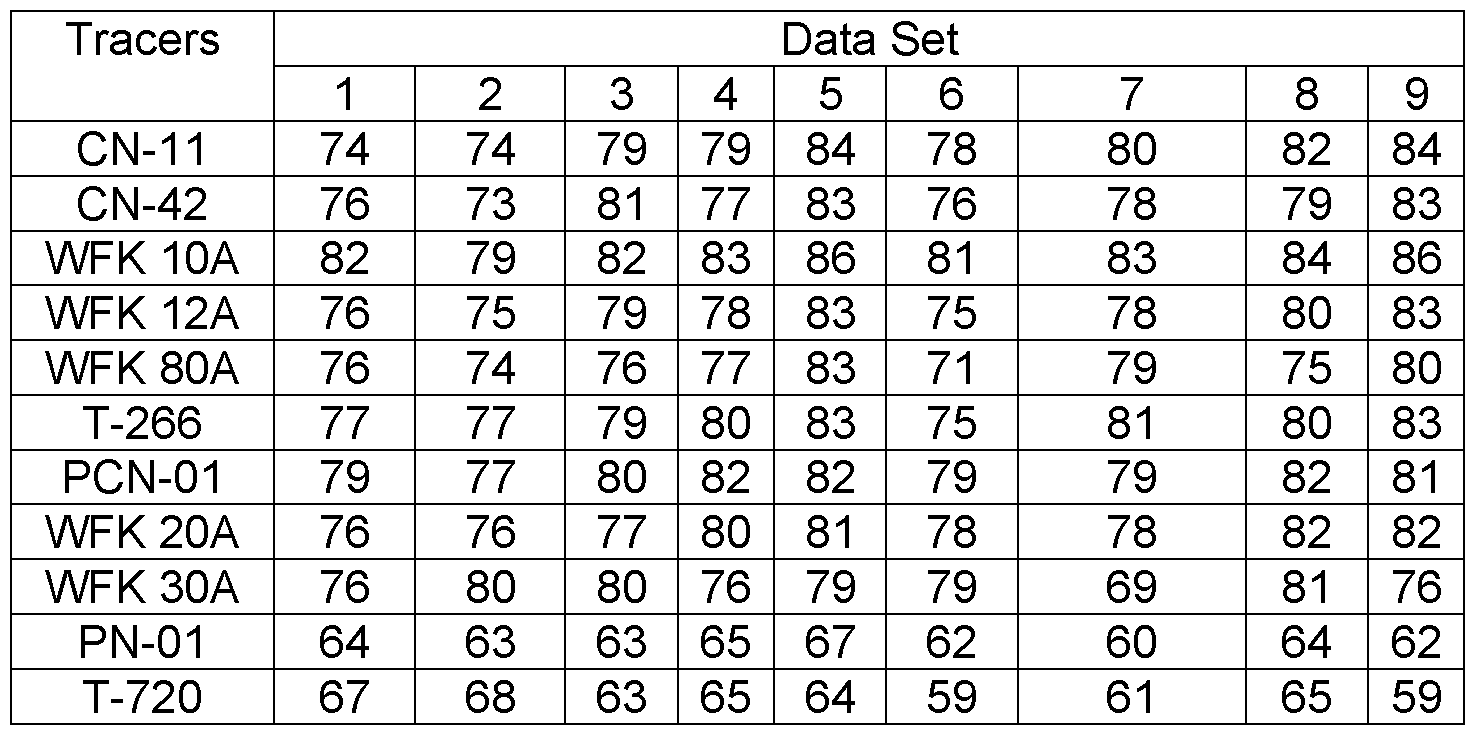


Claims
Priority Applications (2)
| Application Number | Priority Date | Filing Date | Title |
|---|---|---|---|
| CN202480006748.4A CN120435539A (en) | 2023-01-23 | 2024-01-22 | Cleaning compositions and uses thereof |
| EP24701834.4A EP4655371A1 (en) | 2023-01-23 | 2024-01-22 | Cleaning compositions and uses thereof |
Applications Claiming Priority (2)
| Application Number | Priority Date | Filing Date | Title |
|---|---|---|---|
| EP23152842 | 2023-01-23 | ||
| EP23152842.3 | 2023-01-23 |
Publications (1)
| Publication Number | Publication Date |
|---|---|
| WO2024156628A1 true WO2024156628A1 (en) | 2024-08-02 |
Family
ID=85036360
Family Applications (1)
| Application Number | Title | Priority Date | Filing Date |
|---|---|---|---|
| PCT/EP2024/051329 Ceased WO2024156628A1 (en) | 2023-01-23 | 2024-01-22 | Cleaning compositions and uses thereof |
Country Status (3)
| Country | Link |
|---|---|
| EP (1) | EP4655371A1 (en) |
| CN (1) | CN120435539A (en) |
| WO (1) | WO2024156628A1 (en) |
Cited By (1)
| Publication number | Priority date | Publication date | Assignee | Title |
|---|---|---|---|---|
| WO2025040693A1 (en) * | 2023-08-22 | 2025-02-27 | SkyLab AG | A cleaning composition comprising a glycosyl hydrolase targeting (1,4)-alpha-d-glucoside bonds and at least one glycosyl hydrolase targeting beta-glycoside bonds |
Citations (171)
| Publication number | Priority date | Publication date | Assignee | Title |
|---|---|---|---|---|
| GB1296839A (en) | 1969-05-29 | 1972-11-22 | ||
| GB1483591A (en) | 1973-07-23 | 1977-08-24 | Novo Industri As | Process for coating water soluble or water dispersible particles by means of the fluid bed technique |
| US4106991A (en) | 1976-07-07 | 1978-08-15 | Novo Industri A/S | Enzyme granulate composition and process for forming enzyme granulates |
| US4435307A (en) | 1980-04-30 | 1984-03-06 | Novo Industri A/S | Detergent cellulase |
| EP0218272A1 (en) | 1985-08-09 | 1987-04-15 | Gist-Brocades N.V. | Novel lipolytic enzymes and their use in detergent compositions |
| US4661452A (en) | 1984-05-29 | 1987-04-28 | Novo Industri A/S | Enzyme containing granulates useful as detergent additives |
| EP0258068A2 (en) | 1986-08-29 | 1988-03-02 | Novo Nordisk A/S | Enzymatic detergent additive |
| EP0305216A1 (en) | 1987-08-28 | 1989-03-01 | Novo Nordisk A/S | Recombinant Humicola lipase and process for the production of recombinant humicola lipases |
| WO1989006279A1 (en) | 1988-01-07 | 1989-07-13 | Novo-Nordisk A/S | Mutated subtilisin genes |
| EP0331376A2 (en) | 1988-02-28 | 1989-09-06 | Amano Pharmaceutical Co., Ltd. | Recombinant DNA, bacterium of the genus pseudomonas containing it, and process for preparing lipase by using it |
| WO1989009259A1 (en) | 1988-03-24 | 1989-10-05 | Novo-Nordisk A/S | A cellulase preparation |
| JPH02238885A (en) | 1989-03-13 | 1990-09-21 | Oji Paper Co Ltd | Phenol oxidase genetically recombinant DNA, microorganisms transformed with the recombinant DNA, culture thereof, and method for producing phenol oxidase |
| EP0407225A1 (en) | 1989-07-07 | 1991-01-09 | Unilever Plc | Enzymes and enzymatic detergent compositions |
| WO1991002792A1 (en) | 1989-08-25 | 1991-03-07 | Henkel Research Corporation | Alkaline proteolytic enzyme and method of production |
| WO1992001046A1 (en) | 1990-07-06 | 1992-01-23 | Valtion Teknillinen Tutkimuskeskus | Laccase production by recombinant organisms |
| WO1992005249A1 (en) | 1990-09-13 | 1992-04-02 | Novo Nordisk A/S | Lipase variants |
| WO1992006204A1 (en) | 1990-09-28 | 1992-04-16 | Ixsys, Inc. | Surface expression libraries of heteromeric receptors |
| EP0495257A1 (en) | 1991-01-16 | 1992-07-22 | The Procter & Gamble Company | Compact detergent compositions with high activity cellulase |
| WO1992019729A1 (en) | 1991-05-01 | 1992-11-12 | Novo Nordisk A/S | Stabilized enzymes and detergent compositions |
| WO1992019709A1 (en) | 1991-04-30 | 1992-11-12 | The Procter & Gamble Company | Built liquid detergents with boric-polyol complex to inhibit proteolytic enzyme |
| WO1992019708A1 (en) | 1991-04-30 | 1992-11-12 | The Procter & Gamble Company | Liquid detergents with aromatic borate ester to inhibit proteolytic enzyme |
| WO1992021760A1 (en) | 1991-05-29 | 1992-12-10 | Cognis, Inc. | Mutant proteolytic enzymes from bacillus |
| EP0531372A1 (en) | 1990-05-09 | 1993-03-17 | Novo Nordisk As | PREPARATION OF CELLULASE COMPRISING AN ENDOGLUCANASE ENZYME. |
| EP0531315A1 (en) | 1990-05-09 | 1993-03-17 | Novo Nordisk As | ENZYME CAPABLE OF DEGRADING CELLULOSE OR HEMICELLULOSE. |
| WO1993007263A2 (en) | 1991-10-07 | 1993-04-15 | Genencor International, Inc. | Coated enzyme containing granule |
| US5223409A (en) | 1988-09-02 | 1993-06-29 | Protein Engineering Corp. | Directed evolution of novel binding proteins |
| WO1993018140A1 (en) | 1992-03-04 | 1993-09-16 | Novo Nordisk A/S | Novel proteases |
| WO1993024618A1 (en) | 1992-06-01 | 1993-12-09 | Novo Nordisk A/S | Peroxidase variants with improved hydrogen peroxide stability |
| WO1994001541A1 (en) | 1992-07-06 | 1994-01-20 | Novo Nordisk A/S | C. antarctica lipase and lipase variants |
| WO1994002597A1 (en) | 1992-07-23 | 1994-02-03 | Novo Nordisk A/S | MUTANT α-AMYLASE, DETERGENT, DISH WASHING AGENT, AND LIQUEFACTION AGENT |
| WO1994007998A1 (en) | 1992-10-06 | 1994-04-14 | Novo Nordisk A/S | Cellulase variants |
| WO1994018314A1 (en) | 1993-02-11 | 1994-08-18 | Genencor International, Inc. | Oxidatively stable alpha-amylase |
| WO1994025578A1 (en) | 1993-04-27 | 1994-11-10 | Gist-Brocades N.V. | New lipase variants for use in detergent applications |
| WO1994025583A1 (en) | 1993-05-05 | 1994-11-10 | Novo Nordisk A/S | A recombinant trypsin-like protease |
| EP0624154A1 (en) | 1991-12-13 | 1994-11-17 | The Procter & Gamble Company | Acylated citrate esters as peracid precursors |
| US5389536A (en) | 1986-11-19 | 1995-02-14 | Genencor, Inc. | Lipase from Pseudomonas mendocina having cutinase activity |
| WO1995006720A1 (en) | 1993-08-30 | 1995-03-09 | Showa Denko K.K. | Novel lipase, microorganism producing the lipase, process for producing the lipase, and use of the lipase |
| WO1995010602A1 (en) | 1993-10-13 | 1995-04-20 | Novo Nordisk A/S | H2o2-stable peroxidase variants |
| WO1995010603A1 (en) | 1993-10-08 | 1995-04-20 | Novo Nordisk A/S | Amylase variants |
| WO1995014783A1 (en) | 1993-11-24 | 1995-06-01 | Showa Denko K.K. | Lipase gene and variant lipase |
| WO1995017413A1 (en) | 1993-12-21 | 1995-06-29 | Evotec Biosystems Gmbh | Process for the evolutive design and synthesis of functional polymers based on designer elements and codes |
| WO1995022625A1 (en) | 1994-02-17 | 1995-08-24 | Affymax Technologies N.V. | Dna mutagenesis by random fragmentation and reassembly |
| WO1995022615A1 (en) | 1994-02-22 | 1995-08-24 | Novo Nordisk A/S | A method of preparing a variant of a lipolytic enzyme |
| WO1995023221A1 (en) | 1994-02-24 | 1995-08-31 | Cognis, Inc. | Improved enzymes and detergents containing them |
| WO1995024471A1 (en) | 1994-03-08 | 1995-09-14 | Novo Nordisk A/S | Novel alkaline cellulases |
| WO1995027046A2 (en) | 1994-03-31 | 1995-10-12 | Unilever Nv | Enzymatic antimicrobial compositions containing haloperoxidases |
| WO1995030744A2 (en) | 1994-05-04 | 1995-11-16 | Genencor International Inc. | Lipases with improved surfactant resistance |
| WO1995033836A1 (en) | 1994-06-03 | 1995-12-14 | Novo Nordisk Biotech, Inc. | Phosphonyldipeptides useful in the treatment of cardiovascular diseases |
| WO1995035381A1 (en) | 1994-06-20 | 1995-12-28 | Unilever N.V. | Modified pseudomonas lipases and their use |
| WO1996000292A1 (en) | 1994-06-23 | 1996-01-04 | Unilever N.V. | Modified pseudomonas lipases and their use |
| WO1996011262A1 (en) | 1994-10-06 | 1996-04-18 | Novo Nordisk A/S | An enzyme and enzyme preparation with endoglucanase activity |
| WO1996012012A1 (en) | 1994-10-14 | 1996-04-25 | Solvay S.A. | Lipase, microorganism producing same, method for preparing said lipase and uses thereof |
| WO1996013580A1 (en) | 1994-10-26 | 1996-05-09 | Novo Nordisk A/S | An enzyme with lipolytic activity |
| WO1996023873A1 (en) | 1995-02-03 | 1996-08-08 | Novo Nordisk A/S | Amylase variants |
| WO1996027002A1 (en) | 1995-02-27 | 1996-09-06 | Novo Nordisk A/S | Novel lipase gene and process for the production of lipase with the use of the same |
| WO1996029397A1 (en) | 1995-03-17 | 1996-09-26 | Novo Nordisk A/S | Novel endoglucanases |
| WO1996034946A1 (en) | 1995-05-05 | 1996-11-07 | Novo Nordisk A/S | Protease variants and compositions |
| WO1997004079A1 (en) | 1995-07-14 | 1997-02-06 | Novo Nordisk A/S | A modified enzyme with lipolytic activity |
| WO1997004102A1 (en) | 1995-07-14 | 1997-02-06 | Novo Nordisk A/S | Haloperoxidases from curvularia verruculosa and nucleic acids encoding same |
| WO1997007202A1 (en) | 1995-08-11 | 1997-02-27 | Novo Nordisk A/S | Novel lipolytic enzymes |
| WO1997008325A2 (en) | 1995-08-25 | 1997-03-06 | Novo Nordisk Biotech, Inc. | Purified coprinus laccases and nucleic acids encoding same |
| WO1997023606A1 (en) | 1995-12-22 | 1997-07-03 | Genencor International, Inc. | Enzyme containing coated granules |
| US5648263A (en) | 1988-03-24 | 1997-07-15 | Novo Nordisk A/S | Methods for reducing the harshness of a cotton-containing fabric |
| WO1997043424A1 (en) | 1996-05-14 | 1997-11-20 | Genencor International, Inc. | MODIFIED α-AMYLASES HAVING ALTERED CALCIUM BINDING PROPERTIES |
| WO1998008940A1 (en) | 1996-08-26 | 1998-03-05 | Novo Nordisk A/S | A novel endoglucanase |
| WO1998012307A1 (en) | 1996-09-17 | 1998-03-26 | Novo Nordisk A/S | Cellulase variants |
| WO1998015257A1 (en) | 1996-10-08 | 1998-04-16 | Novo Nordisk A/S | Diaminobenzoic acid derivatives as dye precursors |
| WO1998017767A1 (en) | 1996-10-18 | 1998-04-30 | The Procter & Gamble Company | Detergent compositions |
| WO1998020115A1 (en) | 1996-11-04 | 1998-05-14 | Novo Nordisk A/S | Subtilase variants and compositions |
| WO1998020116A1 (en) | 1996-11-04 | 1998-05-14 | Novo Nordisk A/S | Subtilase variants and compositions |
| WO1999001544A1 (en) | 1997-07-04 | 1999-01-14 | Novo Nordisk A/S | FAMILY 6 ENDO-1,4-β-GLUCANASE VARIANTS AND CLEANING COMPOSIT IONS CONTAINING THEM |
| WO1999011768A1 (en) | 1997-08-29 | 1999-03-11 | Novo Nordisk A/S | Protease variants and compositions |
| WO1999019467A1 (en) | 1997-10-13 | 1999-04-22 | Novo Nordisk A/S | α-AMYLASE MUTANTS |
| US5977053A (en) | 1995-07-31 | 1999-11-02 | Bayer Ag | Detergents and cleaners containing iminodisuccinates |
| WO1999064619A2 (en) | 1998-06-10 | 1999-12-16 | Novozymes A/S | Novel mannanases |
| WO2000001793A1 (en) | 1998-06-30 | 2000-01-13 | Novozymes A/S | A new improved enzyme containing granule |
| WO2000034450A1 (en) | 1998-12-04 | 2000-06-15 | Novozymes A/S | Cutinase variants |
| WO2000060063A1 (en) | 1999-03-31 | 2000-10-12 | Novozymes A/S | Lipase variant |
| WO2001016285A2 (en) | 1999-08-31 | 2001-03-08 | Novozymes A/S | Novel proteases and variants thereof |
| WO2001025412A1 (en) | 1999-10-01 | 2001-04-12 | Novozymes A/S | Enzyme granulate |
| WO2001044452A1 (en) | 1999-12-15 | 2001-06-21 | Novozymes A/S | Subtilase variants having an improved wash performance on egg stains |
| WO2001062903A1 (en) | 2000-02-24 | 2001-08-30 | Novozymes A/S | Family 44 xyloglucanases |
| WO2001066712A2 (en) | 2000-03-08 | 2001-09-13 | Novozymes A/S | Variants with altered properties |
| WO2001079459A2 (en) | 2000-04-14 | 2001-10-25 | Novozymes A/S | Polypeptides having haloperoxidase activity |
| WO2001079460A2 (en) | 2000-04-14 | 2001-10-25 | Novozymes A/S | Polypeptides having haloperoxidase activity |
| WO2001079458A2 (en) | 2000-04-14 | 2001-10-25 | Novozymes A/S | Polypeptides having haloperoxidase activity |
| WO2001079461A2 (en) | 2000-04-14 | 2001-10-25 | Novozymes A/S | Polypeptides having haloperoxidase activity |
| WO2001092502A1 (en) | 2000-06-02 | 2001-12-06 | Novozymes A/S | Cutinase variants |
| WO2002010355A2 (en) | 2000-08-01 | 2002-02-07 | Novozymes A/S | Alpha-amylase mutants with altered stability |
| WO2002016547A2 (en) | 2000-08-21 | 2002-02-28 | Novozymes A/S | Subtilase enzymes |
| WO2002099091A2 (en) | 2001-06-06 | 2002-12-12 | Novozymes A/S | Endo-beta-1,4-glucanase from bacillus |
| WO2003006602A2 (en) | 2001-07-12 | 2003-01-23 | Novozymes A/S | Subtilase variants |
| WO2004003186A2 (en) | 2002-06-26 | 2004-01-08 | Novozymes A/S | Subtilases and subtilase variants having altered immunogenicity |
| WO2004041979A2 (en) | 2002-11-06 | 2004-05-21 | Novozymes A/S | Subtilase variants |
| WO2004067737A2 (en) | 2003-01-30 | 2004-08-12 | Novozymes A/S | Subtilases |
| WO2005003274A1 (en) | 2003-06-18 | 2005-01-13 | Unilever Plc | Laundry treatment compositions |
| WO2005003275A1 (en) | 2003-06-18 | 2005-01-13 | Unilever Plc | Laundry treatment compositions |
| WO2005003276A1 (en) | 2003-06-18 | 2005-01-13 | Unilever Plc | Laundry treatment compositions |
| WO2005040372A1 (en) | 2003-10-23 | 2005-05-06 | Novozymes A/S | Protease with improved stability in detergents |
| WO2005052161A2 (en) | 2003-11-19 | 2005-06-09 | Genencor International, Inc. | Serine proteases, nucleic acids encoding serine enzymes and vectors and host cells incorporating same |
| WO2005056782A2 (en) | 2003-12-03 | 2005-06-23 | Genencor International, Inc. | Perhydrolase |
| WO2006066594A2 (en) | 2004-12-23 | 2006-06-29 | Novozymes A/S | Alpha-amylase variants |
| WO2006108856A2 (en) | 2005-04-15 | 2006-10-19 | Basf Aktiengesellschaft | Amphiphilic water-soluble alkoxylated polyalkylenimines with an internal polyethylene oxide block and an external polypropylene oxide block |
| WO2006113314A1 (en) | 2005-04-15 | 2006-10-26 | The Procter & Gamble Company | Liquid laundry detergent compositions with modified polyethyleneimine polymers and lipase enzyme |
| WO2006130575A2 (en) | 2005-05-31 | 2006-12-07 | The Procter & Gamble Company | Polymer-containing detergent compositions and their use |
| WO2007006305A1 (en) | 2005-07-08 | 2007-01-18 | Novozymes A/S | Subtilase variants |
| WO2007044993A2 (en) | 2005-10-12 | 2007-04-19 | Genencor International, Inc. | Use and production of storage-stable neutral metalloprotease |
| WO2007087242A2 (en) | 2006-01-23 | 2007-08-02 | The Procter & Gamble Company | A composition comprising a lipase and a bleach catalyst |
| WO2007087244A2 (en) | 2006-01-23 | 2007-08-02 | The Procter & Gamble Company | Detergent compositions |
| WO2007087259A2 (en) | 2006-01-23 | 2007-08-02 | The Procter & Gamble Company | Enzyme and photobleach containing compositions |
| WO2007087243A2 (en) | 2006-01-23 | 2007-08-02 | The Procter & Gamble Company | Detergent compositions |
| WO2007087508A2 (en) | 2006-01-23 | 2007-08-02 | Novozymes A/S | Lipase variants |
| WO2007087257A2 (en) | 2006-01-23 | 2007-08-02 | The Procter & Gamble Company | Enzyme and fabric hueing agent containing compositions |
| WO2007087258A2 (en) | 2006-01-23 | 2007-08-02 | The Procter & Gamble Company | A composition comprising a lipase and a bleach catalyst |
| WO2007138054A1 (en) | 2006-05-31 | 2007-12-06 | The Procter & Gamble Company | Cleaning compositions with amphiphilic graft polymers based on polyalkylene oxides and vinyl esters |
| EP1867708A1 (en) | 2006-06-16 | 2007-12-19 | The Procter and Gamble Company | Detergent Compositions |
| EP1876226A1 (en) | 2006-07-07 | 2008-01-09 | The Procter and Gamble Company | Detergent compositions |
| WO2008153815A2 (en) | 2007-05-30 | 2008-12-18 | Danisco Us, Inc., Genencor Division | Variants of an alpha-amylase with improved production levels in fermentation processes |
| US20090011970A1 (en) | 2007-07-02 | 2009-01-08 | Marc Francois Theophile Evers | Laundry multi-compartment pouch composition |
| WO2009061380A2 (en) | 2007-11-05 | 2009-05-14 | Danisco Us Inc., Genencor Division | VARIANTS OF BACILLUS sp. TS-23 ALPHA-AMYLASE WITH ALTERED PROPERTIES |
| WO2009067279A1 (en) | 2007-11-21 | 2009-05-28 | E.I. Du Pont De Nemours And Company | Production of peracids using an enzyme having perhydrolysis activity |
| WO2009087523A2 (en) | 2008-01-04 | 2009-07-16 | The Procter & Gamble Company | A laundry detergent composition comprising glycosyl hydrolase |
| WO2009102854A1 (en) | 2008-02-15 | 2009-08-20 | The Procter & Gamble Company | Cleaning compositions |
| WO2009109500A1 (en) | 2008-02-29 | 2009-09-11 | Novozymes A/S | Polypeptides having lipase activity and polynucleotides encoding same |
| WO2009152176A2 (en) | 2008-06-09 | 2009-12-17 | Danisco Us Inc., Genencor Division | Recovery of insoluble enzyme from fermentation broth and formulation of insoluble enzyme |
| EP2169040A1 (en) | 2008-09-30 | 2010-03-31 | The Procter and Gamble Company | Liquid detergent compositions exhibiting two or multicolor effect |
| WO2010065455A2 (en) | 2008-12-01 | 2010-06-10 | Danisco Us Inc. | Enzymes with lipase activity |
| WO2010100028A2 (en) | 2009-03-06 | 2010-09-10 | Huntsman Advanced Materials (Switzerland) Gmbh | Enzymatic textile bleach-whitening methods |
| WO2010104675A1 (en) | 2009-03-10 | 2010-09-16 | Danisco Us Inc. | Bacillus megaterium strain dsm90-related alpha-amylases, and methods of use, thereof |
| WO2010107560A2 (en) | 2009-03-18 | 2010-09-23 | Danisco Us Inc. | Fungal cutinase from magnaporthe grisea |
| WO2010111143A2 (en) | 2009-03-23 | 2010-09-30 | Danisco Us Inc. | Cal a-related acyltransferases and methods of use, thereof |
| WO2011036263A1 (en) | 2009-09-25 | 2011-03-31 | Novozymes A/S | Subtilase variants |
| WO2011084599A1 (en) | 2009-12-21 | 2011-07-14 | Danisco Us Inc. | Detergent compositions containing bacillus subtilis lipase and methods of use thereof |
| WO2011084417A1 (en) | 2009-12-21 | 2011-07-14 | Danisco Us Inc. | Detergent compositions containing geobacillus stearothermophilus lipase and methods of use thereof |
| WO2011084412A1 (en) | 2009-12-21 | 2011-07-14 | Danisco Us Inc. | Detergent compositions containing thermobifida fusca lipase and methods of use thereof |
| WO2011098579A1 (en) | 2010-02-12 | 2011-08-18 | University Of Newcastle Upon Tyne | Bacterial deoxyribonuclease compounds and methods for biofilm disruption and prevention |
| WO2011098531A1 (en) | 2010-02-10 | 2011-08-18 | Novozymes A/S | Variants and compositions comprising variants with high stability in presence of a chelating agent |
| WO2011150157A2 (en) | 2010-05-28 | 2011-12-01 | Danisco Us Inc. | Detergent compositions containing streptomyces griseus lipase and methods of use thereof |
| WO2012112718A1 (en) | 2011-02-15 | 2012-08-23 | Novozymes Biologicals, Inc. | Mitigation of odor in cleaning machines and cleaning processes |
| WO2012137147A1 (en) | 2011-04-08 | 2012-10-11 | Danisco Us, Inc. | Compositions |
| WO2013001087A2 (en) | 2011-06-30 | 2013-01-03 | Novozymes A/S | Method for screening alpha-amylases |
| WO2013001078A1 (en) | 2011-06-30 | 2013-01-03 | Novozymes A/S | Alpha-amylase variants |
| WO2013184577A1 (en) | 2012-06-08 | 2013-12-12 | Danisco Us Inc. | Alpha-amylase variants derived from the alpha amylase of cytophaga sp.amylase|(cspamy2). |
| WO2013188331A1 (en) | 2012-06-11 | 2013-12-19 | The Procter & Gamble Company | Detergent composition |
| WO2014087011A1 (en) | 2012-12-07 | 2014-06-12 | Novozymes A/S | Preventing adhesion of bacteria |
| WO2014207227A1 (en) | 2013-06-27 | 2014-12-31 | Novozymes A/S | Subtilase variants and polynucleotides encoding same |
| WO2015014803A1 (en) | 2013-07-29 | 2015-02-05 | Novozymes A/S | Protease variants and polynucleotides encoding same |
| WO2015014790A2 (en) | 2013-07-29 | 2015-02-05 | Novozymes A/S | Protease variants and polynucleotides encoding same |
| WO2015014804A1 (en) | 2013-07-29 | 2015-02-05 | Novozymes A/S | Protease variants and polynucleotides encoding same |
| WO2015028567A1 (en) | 2013-08-28 | 2015-03-05 | Novozymes A/S | Enzyme granule with fluorescent whitening agent |
| WO2015144784A1 (en) | 2014-03-25 | 2015-10-01 | Novozymes A/S | Microencapsulation using small amines |
| WO2015155350A1 (en) | 2014-04-11 | 2015-10-15 | Novozymes A/S | Detergent composition |
| WO2015158723A1 (en) | 2014-04-14 | 2015-10-22 | Novozymes A/S | Metalloprotease from chryseobacterium |
| WO2016001449A1 (en) | 2014-07-04 | 2016-01-07 | Novozymes A/S | Subtilase variants and polynucleotides encoding same |
| WO2016023685A1 (en) | 2014-08-11 | 2016-02-18 | Novozymes A/S | Detergents and compositions with enzymatic polymer particles |
| WO2016075078A2 (en) | 2014-11-10 | 2016-05-19 | Novozymes A/S | Metalloproteases and uses thereof |
| WO2016087617A1 (en) | 2014-12-04 | 2016-06-09 | Novozymes A/S | Subtilase variants and polynucleotides encoding same |
| WO2016097352A1 (en) | 2014-12-19 | 2016-06-23 | Novozymes A/S | Protease variants and polynucleotides encoding same |
| WO2016097357A1 (en) | 2014-12-19 | 2016-06-23 | Novozymes A/S | Protease variants and polynucleotides encoding same |
| WO2016097350A1 (en) | 2014-12-19 | 2016-06-23 | Novozymes A/S | Protease variants and polynucleotides encoding same |
| WO2016097354A1 (en) | 2014-12-19 | 2016-06-23 | Novozymes A/S | Protease variants and polynucleotides encoding same |
| WO2016096711A2 (en) | 2014-12-15 | 2016-06-23 | Novozymes A/S | Subtilase variants |
| WO2016174234A2 (en) | 2015-04-29 | 2016-11-03 | Novozymes A/S | Polypeptides suitable for detergent |
| US20170081616A1 (en) * | 2014-05-28 | 2017-03-23 | Novozymes A/S | Use of Polypeptide |
| WO2017060475A2 (en) | 2015-10-07 | 2017-04-13 | Novozymes A/S | Polypeptides |
| WO2017097866A1 (en) | 2015-12-07 | 2017-06-15 | Novozymes A/S | Polypeptides having beta-glucanase activity, polynucleotides encoding same and uses thereof in cleaning and detergent compositions |
| WO2017129754A1 (en) | 2016-01-29 | 2017-08-03 | Novozymes A/S | Beta-glucanase variants and polynucleotides encoding same |
| WO2017210295A1 (en) | 2016-05-31 | 2017-12-07 | Danisco Us Inc. | Protease variants and uses thereof |
| WO2019002356A1 (en) | 2017-06-30 | 2019-01-03 | Novozymes A/S | Enzyme slurry composition |
| EP2516606B1 (en) | 2009-12-21 | 2019-01-23 | Danisco US Inc. | Surfactants that improve the cleaning of lipid-based stains treated with lipases |
| EP4034627A1 (en) * | 2019-09-29 | 2022-08-03 | Novozymes A/S | Deoxyribonuclease uses in detergent composition |
-
2024
- 2024-01-22 EP EP24701834.4A patent/EP4655371A1/en active Pending
- 2024-01-22 WO PCT/EP2024/051329 patent/WO2024156628A1/en not_active Ceased
- 2024-01-22 CN CN202480006748.4A patent/CN120435539A/en active Pending
Patent Citations (182)
| Publication number | Priority date | Publication date | Assignee | Title |
|---|---|---|---|---|
| GB1296839A (en) | 1969-05-29 | 1972-11-22 | ||
| GB1483591A (en) | 1973-07-23 | 1977-08-24 | Novo Industri As | Process for coating water soluble or water dispersible particles by means of the fluid bed technique |
| US4106991A (en) | 1976-07-07 | 1978-08-15 | Novo Industri A/S | Enzyme granulate composition and process for forming enzyme granulates |
| US4435307A (en) | 1980-04-30 | 1984-03-06 | Novo Industri A/S | Detergent cellulase |
| US4661452A (en) | 1984-05-29 | 1987-04-28 | Novo Industri A/S | Enzyme containing granulates useful as detergent additives |
| EP0218272A1 (en) | 1985-08-09 | 1987-04-15 | Gist-Brocades N.V. | Novel lipolytic enzymes and their use in detergent compositions |
| EP0258068A2 (en) | 1986-08-29 | 1988-03-02 | Novo Nordisk A/S | Enzymatic detergent additive |
| US5389536A (en) | 1986-11-19 | 1995-02-14 | Genencor, Inc. | Lipase from Pseudomonas mendocina having cutinase activity |
| EP0305216A1 (en) | 1987-08-28 | 1989-03-01 | Novo Nordisk A/S | Recombinant Humicola lipase and process for the production of recombinant humicola lipases |
| WO1989006279A1 (en) | 1988-01-07 | 1989-07-13 | Novo-Nordisk A/S | Mutated subtilisin genes |
| EP0331376A2 (en) | 1988-02-28 | 1989-09-06 | Amano Pharmaceutical Co., Ltd. | Recombinant DNA, bacterium of the genus pseudomonas containing it, and process for preparing lipase by using it |
| US5691178A (en) | 1988-03-22 | 1997-11-25 | Novo Nordisk A/S | Fungal cellulase composition containing alkaline CMC-endoglucanase and essentially no cellobiohydrolase |
| WO1989009259A1 (en) | 1988-03-24 | 1989-10-05 | Novo-Nordisk A/S | A cellulase preparation |
| US5648263A (en) | 1988-03-24 | 1997-07-15 | Novo Nordisk A/S | Methods for reducing the harshness of a cotton-containing fabric |
| US5776757A (en) | 1988-03-24 | 1998-07-07 | Novo Nordisk A/S | Fungal cellulase composition containing alkaline CMC-endoglucanase and essentially no cellobiohydrolase and method of making thereof |
| US5223409A (en) | 1988-09-02 | 1993-06-29 | Protein Engineering Corp. | Directed evolution of novel binding proteins |
| JPH02238885A (en) | 1989-03-13 | 1990-09-21 | Oji Paper Co Ltd | Phenol oxidase genetically recombinant DNA, microorganisms transformed with the recombinant DNA, culture thereof, and method for producing phenol oxidase |
| EP0407225A1 (en) | 1989-07-07 | 1991-01-09 | Unilever Plc | Enzymes and enzymatic detergent compositions |
| US5352604A (en) | 1989-08-25 | 1994-10-04 | Henkel Research Corporation | Alkaline proteolytic enzyme and method of production |
| WO1991002792A1 (en) | 1989-08-25 | 1991-03-07 | Henkel Research Corporation | Alkaline proteolytic enzyme and method of production |
| US5457046A (en) | 1990-05-09 | 1995-10-10 | Novo Nordisk A/S | Enzyme capable of degrading cellullose or hemicellulose |
| US5763254A (en) | 1990-05-09 | 1998-06-09 | Novo Nordisk A/S | Enzyme capable of degrading cellulose or hemicellulose |
| EP0531372A1 (en) | 1990-05-09 | 1993-03-17 | Novo Nordisk As | PREPARATION OF CELLULASE COMPRISING AN ENDOGLUCANASE ENZYME. |
| EP0531315A1 (en) | 1990-05-09 | 1993-03-17 | Novo Nordisk As | ENZYME CAPABLE OF DEGRADING CELLULOSE OR HEMICELLULOSE. |
| US5686593A (en) | 1990-05-09 | 1997-11-11 | Novo Nordisk A/S | Enzyme capable of degrading cellulose or hemicellulose |
| WO1992001046A1 (en) | 1990-07-06 | 1992-01-23 | Valtion Teknillinen Tutkimuskeskus | Laccase production by recombinant organisms |
| WO1992005249A1 (en) | 1990-09-13 | 1992-04-02 | Novo Nordisk A/S | Lipase variants |
| WO1992006204A1 (en) | 1990-09-28 | 1992-04-16 | Ixsys, Inc. | Surface expression libraries of heteromeric receptors |
| EP0495257A1 (en) | 1991-01-16 | 1992-07-22 | The Procter & Gamble Company | Compact detergent compositions with high activity cellulase |
| WO1992019708A1 (en) | 1991-04-30 | 1992-11-12 | The Procter & Gamble Company | Liquid detergents with aromatic borate ester to inhibit proteolytic enzyme |
| WO1992019709A1 (en) | 1991-04-30 | 1992-11-12 | The Procter & Gamble Company | Built liquid detergents with boric-polyol complex to inhibit proteolytic enzyme |
| WO1992019729A1 (en) | 1991-05-01 | 1992-11-12 | Novo Nordisk A/S | Stabilized enzymes and detergent compositions |
| WO1992021760A1 (en) | 1991-05-29 | 1992-12-10 | Cognis, Inc. | Mutant proteolytic enzymes from bacillus |
| WO1993007263A2 (en) | 1991-10-07 | 1993-04-15 | Genencor International, Inc. | Coated enzyme containing granule |
| EP0624154A1 (en) | 1991-12-13 | 1994-11-17 | The Procter & Gamble Company | Acylated citrate esters as peracid precursors |
| WO1993018140A1 (en) | 1992-03-04 | 1993-09-16 | Novo Nordisk A/S | Novel proteases |
| WO1993024618A1 (en) | 1992-06-01 | 1993-12-09 | Novo Nordisk A/S | Peroxidase variants with improved hydrogen peroxide stability |
| WO1994001541A1 (en) | 1992-07-06 | 1994-01-20 | Novo Nordisk A/S | C. antarctica lipase and lipase variants |
| WO1994002597A1 (en) | 1992-07-23 | 1994-02-03 | Novo Nordisk A/S | MUTANT α-AMYLASE, DETERGENT, DISH WASHING AGENT, AND LIQUEFACTION AGENT |
| WO1994007998A1 (en) | 1992-10-06 | 1994-04-14 | Novo Nordisk A/S | Cellulase variants |
| WO1994018314A1 (en) | 1993-02-11 | 1994-08-18 | Genencor International, Inc. | Oxidatively stable alpha-amylase |
| WO1994025578A1 (en) | 1993-04-27 | 1994-11-10 | Gist-Brocades N.V. | New lipase variants for use in detergent applications |
| WO1994025583A1 (en) | 1993-05-05 | 1994-11-10 | Novo Nordisk A/S | A recombinant trypsin-like protease |
| WO1995006720A1 (en) | 1993-08-30 | 1995-03-09 | Showa Denko K.K. | Novel lipase, microorganism producing the lipase, process for producing the lipase, and use of the lipase |
| WO1995010603A1 (en) | 1993-10-08 | 1995-04-20 | Novo Nordisk A/S | Amylase variants |
| WO1995010602A1 (en) | 1993-10-13 | 1995-04-20 | Novo Nordisk A/S | H2o2-stable peroxidase variants |
| WO1995014783A1 (en) | 1993-11-24 | 1995-06-01 | Showa Denko K.K. | Lipase gene and variant lipase |
| WO1995017413A1 (en) | 1993-12-21 | 1995-06-29 | Evotec Biosystems Gmbh | Process for the evolutive design and synthesis of functional polymers based on designer elements and codes |
| WO1995022625A1 (en) | 1994-02-17 | 1995-08-24 | Affymax Technologies N.V. | Dna mutagenesis by random fragmentation and reassembly |
| WO1995022615A1 (en) | 1994-02-22 | 1995-08-24 | Novo Nordisk A/S | A method of preparing a variant of a lipolytic enzyme |
| EP1921148A2 (en) | 1994-02-24 | 2008-05-14 | Henkel Kommanditgesellschaft auf Aktien | Improved enzymes and detergents containing them |
| EP1921147A2 (en) | 1994-02-24 | 2008-05-14 | Henkel Kommanditgesellschaft auf Aktien | Improved enzymes and detergents containing them |
| WO1995023221A1 (en) | 1994-02-24 | 1995-08-31 | Cognis, Inc. | Improved enzymes and detergents containing them |
| WO1995024471A1 (en) | 1994-03-08 | 1995-09-14 | Novo Nordisk A/S | Novel alkaline cellulases |
| WO1995027046A2 (en) | 1994-03-31 | 1995-10-12 | Unilever Nv | Enzymatic antimicrobial compositions containing haloperoxidases |
| WO1995030744A2 (en) | 1994-05-04 | 1995-11-16 | Genencor International Inc. | Lipases with improved surfactant resistance |
| WO1995033836A1 (en) | 1994-06-03 | 1995-12-14 | Novo Nordisk Biotech, Inc. | Phosphonyldipeptides useful in the treatment of cardiovascular diseases |
| WO1995035381A1 (en) | 1994-06-20 | 1995-12-28 | Unilever N.V. | Modified pseudomonas lipases and their use |
| WO1996000292A1 (en) | 1994-06-23 | 1996-01-04 | Unilever N.V. | Modified pseudomonas lipases and their use |
| WO1996011262A1 (en) | 1994-10-06 | 1996-04-18 | Novo Nordisk A/S | An enzyme and enzyme preparation with endoglucanase activity |
| WO1996012012A1 (en) | 1994-10-14 | 1996-04-25 | Solvay S.A. | Lipase, microorganism producing same, method for preparing said lipase and uses thereof |
| WO1996013580A1 (en) | 1994-10-26 | 1996-05-09 | Novo Nordisk A/S | An enzyme with lipolytic activity |
| WO1996023873A1 (en) | 1995-02-03 | 1996-08-08 | Novo Nordisk A/S | Amylase variants |
| WO1996027002A1 (en) | 1995-02-27 | 1996-09-06 | Novo Nordisk A/S | Novel lipase gene and process for the production of lipase with the use of the same |
| WO1996029397A1 (en) | 1995-03-17 | 1996-09-26 | Novo Nordisk A/S | Novel endoglucanases |
| WO1996034946A1 (en) | 1995-05-05 | 1996-11-07 | Novo Nordisk A/S | Protease variants and compositions |
| WO1997004079A1 (en) | 1995-07-14 | 1997-02-06 | Novo Nordisk A/S | A modified enzyme with lipolytic activity |
| WO1997004102A1 (en) | 1995-07-14 | 1997-02-06 | Novo Nordisk A/S | Haloperoxidases from curvularia verruculosa and nucleic acids encoding same |
| US5977053A (en) | 1995-07-31 | 1999-11-02 | Bayer Ag | Detergents and cleaners containing iminodisuccinates |
| WO1997007202A1 (en) | 1995-08-11 | 1997-02-27 | Novo Nordisk A/S | Novel lipolytic enzymes |
| WO1997008325A2 (en) | 1995-08-25 | 1997-03-06 | Novo Nordisk Biotech, Inc. | Purified coprinus laccases and nucleic acids encoding same |
| WO1997023606A1 (en) | 1995-12-22 | 1997-07-03 | Genencor International, Inc. | Enzyme containing coated granules |
| WO1997043424A1 (en) | 1996-05-14 | 1997-11-20 | Genencor International, Inc. | MODIFIED α-AMYLASES HAVING ALTERED CALCIUM BINDING PROPERTIES |
| WO1998008940A1 (en) | 1996-08-26 | 1998-03-05 | Novo Nordisk A/S | A novel endoglucanase |
| WO1998012307A1 (en) | 1996-09-17 | 1998-03-26 | Novo Nordisk A/S | Cellulase variants |
| WO1998015257A1 (en) | 1996-10-08 | 1998-04-16 | Novo Nordisk A/S | Diaminobenzoic acid derivatives as dye precursors |
| WO1998017767A1 (en) | 1996-10-18 | 1998-04-30 | The Procter & Gamble Company | Detergent compositions |
| WO1998020115A1 (en) | 1996-11-04 | 1998-05-14 | Novo Nordisk A/S | Subtilase variants and compositions |
| WO1998020116A1 (en) | 1996-11-04 | 1998-05-14 | Novo Nordisk A/S | Subtilase variants and compositions |
| WO1999001544A1 (en) | 1997-07-04 | 1999-01-14 | Novo Nordisk A/S | FAMILY 6 ENDO-1,4-β-GLUCANASE VARIANTS AND CLEANING COMPOSIT IONS CONTAINING THEM |
| WO1999011768A1 (en) | 1997-08-29 | 1999-03-11 | Novo Nordisk A/S | Protease variants and compositions |
| WO1999019467A1 (en) | 1997-10-13 | 1999-04-22 | Novo Nordisk A/S | α-AMYLASE MUTANTS |
| WO1999064619A2 (en) | 1998-06-10 | 1999-12-16 | Novozymes A/S | Novel mannanases |
| WO2000001793A1 (en) | 1998-06-30 | 2000-01-13 | Novozymes A/S | A new improved enzyme containing granule |
| WO2000034450A1 (en) | 1998-12-04 | 2000-06-15 | Novozymes A/S | Cutinase variants |
| WO2000060063A1 (en) | 1999-03-31 | 2000-10-12 | Novozymes A/S | Lipase variant |
| WO2001016285A2 (en) | 1999-08-31 | 2001-03-08 | Novozymes A/S | Novel proteases and variants thereof |
| WO2001025411A1 (en) | 1999-10-01 | 2001-04-12 | Novozymes A/S | Spray dried enzyme product |
| WO2001025412A1 (en) | 1999-10-01 | 2001-04-12 | Novozymes A/S | Enzyme granulate |
| WO2001044452A1 (en) | 1999-12-15 | 2001-06-21 | Novozymes A/S | Subtilase variants having an improved wash performance on egg stains |
| WO2001062903A1 (en) | 2000-02-24 | 2001-08-30 | Novozymes A/S | Family 44 xyloglucanases |
| WO2001066712A2 (en) | 2000-03-08 | 2001-09-13 | Novozymes A/S | Variants with altered properties |
| WO2001079459A2 (en) | 2000-04-14 | 2001-10-25 | Novozymes A/S | Polypeptides having haloperoxidase activity |
| WO2001079461A2 (en) | 2000-04-14 | 2001-10-25 | Novozymes A/S | Polypeptides having haloperoxidase activity |
| WO2001079458A2 (en) | 2000-04-14 | 2001-10-25 | Novozymes A/S | Polypeptides having haloperoxidase activity |
| WO2001079460A2 (en) | 2000-04-14 | 2001-10-25 | Novozymes A/S | Polypeptides having haloperoxidase activity |
| WO2001092502A1 (en) | 2000-06-02 | 2001-12-06 | Novozymes A/S | Cutinase variants |
| WO2002010355A2 (en) | 2000-08-01 | 2002-02-07 | Novozymes A/S | Alpha-amylase mutants with altered stability |
| WO2002016547A2 (en) | 2000-08-21 | 2002-02-28 | Novozymes A/S | Subtilase enzymes |
| WO2002099091A2 (en) | 2001-06-06 | 2002-12-12 | Novozymes A/S | Endo-beta-1,4-glucanase from bacillus |
| WO2003006602A2 (en) | 2001-07-12 | 2003-01-23 | Novozymes A/S | Subtilase variants |
| WO2004003186A2 (en) | 2002-06-26 | 2004-01-08 | Novozymes A/S | Subtilases and subtilase variants having altered immunogenicity |
| WO2004041979A2 (en) | 2002-11-06 | 2004-05-21 | Novozymes A/S | Subtilase variants |
| WO2004067737A2 (en) | 2003-01-30 | 2004-08-12 | Novozymes A/S | Subtilases |
| WO2005003274A1 (en) | 2003-06-18 | 2005-01-13 | Unilever Plc | Laundry treatment compositions |
| WO2005003275A1 (en) | 2003-06-18 | 2005-01-13 | Unilever Plc | Laundry treatment compositions |
| WO2005003276A1 (en) | 2003-06-18 | 2005-01-13 | Unilever Plc | Laundry treatment compositions |
| WO2005040372A1 (en) | 2003-10-23 | 2005-05-06 | Novozymes A/S | Protease with improved stability in detergents |
| WO2005052161A2 (en) | 2003-11-19 | 2005-06-09 | Genencor International, Inc. | Serine proteases, nucleic acids encoding serine enzymes and vectors and host cells incorporating same |
| WO2005052146A2 (en) | 2003-11-19 | 2005-06-09 | Genencor International, Inc. | Serine proteases, nucleic acids encoding serine enzymes and vectors and host cells incorporating same |
| WO2005056782A2 (en) | 2003-12-03 | 2005-06-23 | Genencor International, Inc. | Perhydrolase |
| WO2006066594A2 (en) | 2004-12-23 | 2006-06-29 | Novozymes A/S | Alpha-amylase variants |
| WO2006108856A2 (en) | 2005-04-15 | 2006-10-19 | Basf Aktiengesellschaft | Amphiphilic water-soluble alkoxylated polyalkylenimines with an internal polyethylene oxide block and an external polypropylene oxide block |
| WO2006113314A1 (en) | 2005-04-15 | 2006-10-26 | The Procter & Gamble Company | Liquid laundry detergent compositions with modified polyethyleneimine polymers and lipase enzyme |
| WO2006130575A2 (en) | 2005-05-31 | 2006-12-07 | The Procter & Gamble Company | Polymer-containing detergent compositions and their use |
| WO2007006305A1 (en) | 2005-07-08 | 2007-01-18 | Novozymes A/S | Subtilase variants |
| WO2007044993A2 (en) | 2005-10-12 | 2007-04-19 | Genencor International, Inc. | Use and production of storage-stable neutral metalloprotease |
| WO2007087242A2 (en) | 2006-01-23 | 2007-08-02 | The Procter & Gamble Company | A composition comprising a lipase and a bleach catalyst |
| WO2007087244A2 (en) | 2006-01-23 | 2007-08-02 | The Procter & Gamble Company | Detergent compositions |
| WO2007087259A2 (en) | 2006-01-23 | 2007-08-02 | The Procter & Gamble Company | Enzyme and photobleach containing compositions |
| WO2007087243A2 (en) | 2006-01-23 | 2007-08-02 | The Procter & Gamble Company | Detergent compositions |
| WO2007087508A2 (en) | 2006-01-23 | 2007-08-02 | Novozymes A/S | Lipase variants |
| WO2007087257A2 (en) | 2006-01-23 | 2007-08-02 | The Procter & Gamble Company | Enzyme and fabric hueing agent containing compositions |
| WO2007087258A2 (en) | 2006-01-23 | 2007-08-02 | The Procter & Gamble Company | A composition comprising a lipase and a bleach catalyst |
| WO2007138054A1 (en) | 2006-05-31 | 2007-12-06 | The Procter & Gamble Company | Cleaning compositions with amphiphilic graft polymers based on polyalkylene oxides and vinyl esters |
| EP1867708A1 (en) | 2006-06-16 | 2007-12-19 | The Procter and Gamble Company | Detergent Compositions |
| EP1876226A1 (en) | 2006-07-07 | 2008-01-09 | The Procter and Gamble Company | Detergent compositions |
| WO2008153815A2 (en) | 2007-05-30 | 2008-12-18 | Danisco Us, Inc., Genencor Division | Variants of an alpha-amylase with improved production levels in fermentation processes |
| US20090011970A1 (en) | 2007-07-02 | 2009-01-08 | Marc Francois Theophile Evers | Laundry multi-compartment pouch composition |
| WO2009061380A2 (en) | 2007-11-05 | 2009-05-14 | Danisco Us Inc., Genencor Division | VARIANTS OF BACILLUS sp. TS-23 ALPHA-AMYLASE WITH ALTERED PROPERTIES |
| WO2009067279A1 (en) | 2007-11-21 | 2009-05-28 | E.I. Du Pont De Nemours And Company | Production of peracids using an enzyme having perhydrolysis activity |
| WO2009087523A2 (en) | 2008-01-04 | 2009-07-16 | The Procter & Gamble Company | A laundry detergent composition comprising glycosyl hydrolase |
| WO2009102854A1 (en) | 2008-02-15 | 2009-08-20 | The Procter & Gamble Company | Cleaning compositions |
| WO2009109500A1 (en) | 2008-02-29 | 2009-09-11 | Novozymes A/S | Polypeptides having lipase activity and polynucleotides encoding same |
| WO2009152176A2 (en) | 2008-06-09 | 2009-12-17 | Danisco Us Inc., Genencor Division | Recovery of insoluble enzyme from fermentation broth and formulation of insoluble enzyme |
| EP2169040A1 (en) | 2008-09-30 | 2010-03-31 | The Procter and Gamble Company | Liquid detergent compositions exhibiting two or multicolor effect |
| WO2010065455A2 (en) | 2008-12-01 | 2010-06-10 | Danisco Us Inc. | Enzymes with lipase activity |
| WO2010100028A2 (en) | 2009-03-06 | 2010-09-10 | Huntsman Advanced Materials (Switzerland) Gmbh | Enzymatic textile bleach-whitening methods |
| WO2010104675A1 (en) | 2009-03-10 | 2010-09-16 | Danisco Us Inc. | Bacillus megaterium strain dsm90-related alpha-amylases, and methods of use, thereof |
| WO2010107560A2 (en) | 2009-03-18 | 2010-09-23 | Danisco Us Inc. | Fungal cutinase from magnaporthe grisea |
| WO2010111143A2 (en) | 2009-03-23 | 2010-09-30 | Danisco Us Inc. | Cal a-related acyltransferases and methods of use, thereof |
| WO2011036263A1 (en) | 2009-09-25 | 2011-03-31 | Novozymes A/S | Subtilase variants |
| WO2011084599A1 (en) | 2009-12-21 | 2011-07-14 | Danisco Us Inc. | Detergent compositions containing bacillus subtilis lipase and methods of use thereof |
| WO2011084417A1 (en) | 2009-12-21 | 2011-07-14 | Danisco Us Inc. | Detergent compositions containing geobacillus stearothermophilus lipase and methods of use thereof |
| WO2011084412A1 (en) | 2009-12-21 | 2011-07-14 | Danisco Us Inc. | Detergent compositions containing thermobifida fusca lipase and methods of use thereof |
| EP2516606B1 (en) | 2009-12-21 | 2019-01-23 | Danisco US Inc. | Surfactants that improve the cleaning of lipid-based stains treated with lipases |
| WO2011098531A1 (en) | 2010-02-10 | 2011-08-18 | Novozymes A/S | Variants and compositions comprising variants with high stability in presence of a chelating agent |
| WO2011098579A1 (en) | 2010-02-12 | 2011-08-18 | University Of Newcastle Upon Tyne | Bacterial deoxyribonuclease compounds and methods for biofilm disruption and prevention |
| WO2011150157A2 (en) | 2010-05-28 | 2011-12-01 | Danisco Us Inc. | Detergent compositions containing streptomyces griseus lipase and methods of use thereof |
| WO2012112718A1 (en) | 2011-02-15 | 2012-08-23 | Novozymes Biologicals, Inc. | Mitigation of odor in cleaning machines and cleaning processes |
| WO2012137147A1 (en) | 2011-04-08 | 2012-10-11 | Danisco Us, Inc. | Compositions |
| WO2013001087A2 (en) | 2011-06-30 | 2013-01-03 | Novozymes A/S | Method for screening alpha-amylases |
| WO2013001078A1 (en) | 2011-06-30 | 2013-01-03 | Novozymes A/S | Alpha-amylase variants |
| WO2013184577A1 (en) | 2012-06-08 | 2013-12-12 | Danisco Us Inc. | Alpha-amylase variants derived from the alpha amylase of cytophaga sp.amylase|(cspamy2). |
| WO2013188331A1 (en) | 2012-06-11 | 2013-12-19 | The Procter & Gamble Company | Detergent composition |
| WO2014087011A1 (en) | 2012-12-07 | 2014-06-12 | Novozymes A/S | Preventing adhesion of bacteria |
| WO2014207227A1 (en) | 2013-06-27 | 2014-12-31 | Novozymes A/S | Subtilase variants and polynucleotides encoding same |
| WO2015014803A1 (en) | 2013-07-29 | 2015-02-05 | Novozymes A/S | Protease variants and polynucleotides encoding same |
| WO2015014790A2 (en) | 2013-07-29 | 2015-02-05 | Novozymes A/S | Protease variants and polynucleotides encoding same |
| WO2015014804A1 (en) | 2013-07-29 | 2015-02-05 | Novozymes A/S | Protease variants and polynucleotides encoding same |
| WO2015028567A1 (en) | 2013-08-28 | 2015-03-05 | Novozymes A/S | Enzyme granule with fluorescent whitening agent |
| WO2015144784A1 (en) | 2014-03-25 | 2015-10-01 | Novozymes A/S | Microencapsulation using small amines |
| WO2015155350A1 (en) | 2014-04-11 | 2015-10-15 | Novozymes A/S | Detergent composition |
| WO2015158723A1 (en) | 2014-04-14 | 2015-10-22 | Novozymes A/S | Metalloprotease from chryseobacterium |
| US20170081616A1 (en) * | 2014-05-28 | 2017-03-23 | Novozymes A/S | Use of Polypeptide |
| WO2016001449A1 (en) | 2014-07-04 | 2016-01-07 | Novozymes A/S | Subtilase variants and polynucleotides encoding same |
| WO2016023685A1 (en) | 2014-08-11 | 2016-02-18 | Novozymes A/S | Detergents and compositions with enzymatic polymer particles |
| WO2016075078A2 (en) | 2014-11-10 | 2016-05-19 | Novozymes A/S | Metalloproteases and uses thereof |
| WO2016087617A1 (en) | 2014-12-04 | 2016-06-09 | Novozymes A/S | Subtilase variants and polynucleotides encoding same |
| WO2016096711A2 (en) | 2014-12-15 | 2016-06-23 | Novozymes A/S | Subtilase variants |
| WO2016097354A1 (en) | 2014-12-19 | 2016-06-23 | Novozymes A/S | Protease variants and polynucleotides encoding same |
| WO2016097350A1 (en) | 2014-12-19 | 2016-06-23 | Novozymes A/S | Protease variants and polynucleotides encoding same |
| WO2016097357A1 (en) | 2014-12-19 | 2016-06-23 | Novozymes A/S | Protease variants and polynucleotides encoding same |
| WO2016097352A1 (en) | 2014-12-19 | 2016-06-23 | Novozymes A/S | Protease variants and polynucleotides encoding same |
| WO2016174234A2 (en) | 2015-04-29 | 2016-11-03 | Novozymes A/S | Polypeptides suitable for detergent |
| WO2017060475A2 (en) | 2015-10-07 | 2017-04-13 | Novozymes A/S | Polypeptides |
| WO2017097866A1 (en) | 2015-12-07 | 2017-06-15 | Novozymes A/S | Polypeptides having beta-glucanase activity, polynucleotides encoding same and uses thereof in cleaning and detergent compositions |
| WO2017129754A1 (en) | 2016-01-29 | 2017-08-03 | Novozymes A/S | Beta-glucanase variants and polynucleotides encoding same |
| WO2017210295A1 (en) | 2016-05-31 | 2017-12-07 | Danisco Us Inc. | Protease variants and uses thereof |
| WO2019002356A1 (en) | 2017-06-30 | 2019-01-03 | Novozymes A/S | Enzyme slurry composition |
| EP4034627A1 (en) * | 2019-09-29 | 2022-08-03 | Novozymes A/S | Deoxyribonuclease uses in detergent composition |
| EP4034622A1 (en) * | 2019-09-29 | 2022-08-03 | Novozymes A/S | Use of cellulase for improvement of sustainability of detergents |
Non-Patent Citations (36)
| Title |
|---|
| "Current protocols in Molecular Biology", 1995, JOHN WILEY AND SONS |
| "DNA Cloning: A Practical Approach, Volumes I and II", 1985 |
| "Molecular cloning: A laboratory manual", 1989, COLD SPRING HARBOR LAB. |
| "Oligonucleotide Synthesis", 1984 |
| "Powdered Detergents, Surfactant science series", vol. 71, MARCEL DEKKER, INC |
| BOWIESAUER, PROC. NATL. ACAD. SCI. USA, vol. 86, 1989, pages 2152 - 2156 |
| C. E. CAPES: "Handbook of Powder Technology", vol. 1, 1980, ELSEVIER, article "Particle size enlargement" |
| CARTER ET AL., PROTEINS: STRUCTURE, FUNCTION, AND GENETICS, vol. 6, 1989, pages 240 - 248 |
| COLLINS-RACIE ET AL., BIOTECHNOLOGY, vol. 13, 1995, pages 982 - 987 |
| CONTRERAS ET AL., BIOTECHNOLOGY, vol. 9, 1991, pages 378 - 381 |
| COOPER ET AL., EMBO J., vol. 12, 1993, pages 2575 - 2583 |
| CUNNINGHAMWELLS, SCIENCE, vol. 244, 1989, pages 1081 - 1085 |
| DAWSON ET AL., SCIENCE, vol. 266, 1994, pages 776 - 779 |
| DE VOS ET AL., SCIENCE, vol. 255, 1992, pages 306 - 312 |
| DERBYSHIRE ET AL., GENE, vol. 46, 1986, pages 145 |
| EATON ET AL., BIOCHEMISTRY, vol. 25, 1986, pages 505 - 512 |
| GHOSE, PURE APPL. CHEM., vol. 59, 1987, pages 257 - 68 |
| H. NEURATHR.L. HILL: "The Proteins", 1979, ACADEMIC PRESS |
| HILTON ET AL., J. BIOL. CHEM., vol. 271, 1996, pages 4699 - 4708 |
| HODGDONKALER: "Current Opinion in Colloid & Interface Science", vol. 12, 2007, pages: 121 - 128 |
| LOWMAN ET AL., BIOCHEMISTRY, vol. 30, 1991, pages 10832 - 10837 |
| MARTIN ET AL., J. IND. MICROBIOL. BIOTECHNOL., vol. 3, 2003, pages 568 - 576 |
| NEEDLEMANWUNSCH, J. MOL. BIOL., vol. 48, 1970, pages 443 - 453 |
| NER ET AL., DNA, vol. 7, 1988, pages 127 |
| NESS ET AL., NATURE BIOTECHNOLOGY, vol. 17, 1999, pages 893 - 896 |
| RASMUSSEN-WILSON ET AL., APPL. ENVIRON. MICROBIOL., vol. 63, 1997, pages 3488 - 3493 |
| REIDHAAR-OLSONSAUER, SCIENCE, vol. 241, 1988, pages 53 - 57 |
| RICE ET AL., EMBOSS: THE EUROPEAN MOLECULAR BIOLOGY OPEN SOFTWARE SUITE, 2000 |
| RICE ET AL.: "EMBOSS: The European Molecular Biology Open Software Suite", TRENDS GENET., vol. 16, 2000, pages 276 - 277, XP004200114, DOI: 10.1016/S0168-9525(00)02024-2 |
| SIEZEN ET AL., PROTEIN ENG., vol. 71, 1991, pages 719 - 737 |
| SIEZEN ET AL., PROTEIN SCI., vol. 6, 1997, pages 501 - 523 |
| SMITH ET AL., J. MOL. BIOL., vol. 224, 1992, pages 899 - 904 |
| STEVENS, DRUG DISCOVERY WORLD, vol. 4, 2003, pages 35 - 48 |
| SVETINA ET AL., J. BIOTECHNOL., vol. 76, 2000, pages 245 - 251 |
| WLODAVER ET AL., FEBS LETT., vol. 309, 1992, pages 59 - 64 |
| ZHANG ET AL., BIOTECHNOLOGY ADVANCES, vol. 24, 2006, pages 452 - 481 |
Cited By (1)
| Publication number | Priority date | Publication date | Assignee | Title |
|---|---|---|---|---|
| WO2025040693A1 (en) * | 2023-08-22 | 2025-02-27 | SkyLab AG | A cleaning composition comprising a glycosyl hydrolase targeting (1,4)-alpha-d-glucoside bonds and at least one glycosyl hydrolase targeting beta-glycoside bonds |
Also Published As
| Publication number | Publication date |
|---|---|
| EP4655371A1 (en) | 2025-12-03 |
| CN120435539A (en) | 2025-08-05 |
Similar Documents
| Publication | Publication Date | Title |
|---|---|---|
| US20200032171A1 (en) | Laundry Method, Use of Polypeptide and Detergent Composition | |
| WO2020008024A1 (en) | Cleaning compositions and uses thereof | |
| US11634665B2 (en) | Detergent composition | |
| EP4034627A1 (en) | Deoxyribonuclease uses in detergent composition | |
| EP3607044A1 (en) | Cleaning compositions and uses thereof | |
| EP3551740A1 (en) | Use of polypeptides | |
| US10781407B2 (en) | Laundry method, use of polypeptide and detergent composition | |
| AU2016323412A1 (en) | Detergent compositions comprising polypeptides having xanthan degrading activity | |
| WO2022106404A1 (en) | Combination of proteases | |
| WO2022106400A1 (en) | Combination of immunochemically different proteases | |
| EP4486859A1 (en) | Use of xyloglucanase for improvement of sustainability of detergents | |
| EP4022019A1 (en) | Detergent composition | |
| WO2024156628A1 (en) | Cleaning compositions and uses thereof | |
| WO2025088003A1 (en) | Use of xyloglucanase for replacement of optical brightener | |
| WO2019076800A1 (en) | Cleaning compositions and uses thereof | |
| WO2024194245A1 (en) | Detergent compositions based on biosurfactants | |
| EP4031644A1 (en) | Detergent composition |
Legal Events
| Date | Code | Title | Description |
|---|---|---|---|
| 121 | Ep: the epo has been informed by wipo that ep was designated in this application |
Ref document number: 24701834 Country of ref document: EP Kind code of ref document: A1 |
|
| WWE | Wipo information: entry into national phase |
Ref document number: 202480006748.4 Country of ref document: CN |
|
| WWP | Wipo information: published in national office |
Ref document number: 202480006748.4 Country of ref document: CN |
|
| WWE | Wipo information: entry into national phase |
Ref document number: 202547079994 Country of ref document: IN |
|
| NENP | Non-entry into the national phase |
Ref country code: DE |
|
| WWP | Wipo information: published in national office |
Ref document number: 202547079994 Country of ref document: IN |
|
| WWP | Wipo information: published in national office |
Ref document number: 2024701834 Country of ref document: EP |