WO2022216820A1 - Inhibiting ubiquitin-specific protease 1 (usp1) - Google Patents
Inhibiting ubiquitin-specific protease 1 (usp1) Download PDFInfo
- Publication number
- WO2022216820A1 WO2022216820A1 PCT/US2022/023669 US2022023669W WO2022216820A1 WO 2022216820 A1 WO2022216820 A1 WO 2022216820A1 US 2022023669 W US2022023669 W US 2022023669W WO 2022216820 A1 WO2022216820 A1 WO 2022216820A1
- Authority
- WO
- WIPO (PCT)
- Prior art keywords
- methyl
- trifluoromethyl
- benzyl
- imidazol
- pyrazolo
- Prior art date
- Legal status (The legal status is an assumption and is not a legal conclusion. Google has not performed a legal analysis and makes no representation as to the accuracy of the status listed.)
- Ceased
Links
Classifications
-
- A—HUMAN NECESSITIES
- A61—MEDICAL OR VETERINARY SCIENCE; HYGIENE
- A61P—SPECIFIC THERAPEUTIC ACTIVITY OF CHEMICAL COMPOUNDS OR MEDICINAL PREPARATIONS
- A61P35/00—Antineoplastic agents
-
- A—HUMAN NECESSITIES
- A61—MEDICAL OR VETERINARY SCIENCE; HYGIENE
- A61K—PREPARATIONS FOR MEDICAL, DENTAL OR TOILETRY PURPOSES
- A61K31/00—Medicinal preparations containing organic active ingredients
- A61K31/33—Heterocyclic compounds
- A61K31/395—Heterocyclic compounds having nitrogen as a ring hetero atom, e.g. guanethidine or rifamycins
- A61K31/495—Heterocyclic compounds having nitrogen as a ring hetero atom, e.g. guanethidine or rifamycins having six-membered rings with two or more nitrogen atoms as the only ring heteroatoms, e.g. piperazine or tetrazines
- A61K31/505—Pyrimidines; Hydrogenated pyrimidines, e.g. trimethoprim
- A61K31/519—Pyrimidines; Hydrogenated pyrimidines, e.g. trimethoprim ortho- or peri-condensed with heterocyclic rings
-
- A—HUMAN NECESSITIES
- A61—MEDICAL OR VETERINARY SCIENCE; HYGIENE
- A61K—PREPARATIONS FOR MEDICAL, DENTAL OR TOILETRY PURPOSES
- A61K31/00—Medicinal preparations containing organic active ingredients
- A61K31/33—Heterocyclic compounds
- A61K31/395—Heterocyclic compounds having nitrogen as a ring hetero atom, e.g. guanethidine or rifamycins
- A61K31/495—Heterocyclic compounds having nitrogen as a ring hetero atom, e.g. guanethidine or rifamycins having six-membered rings with two or more nitrogen atoms as the only ring heteroatoms, e.g. piperazine or tetrazines
- A61K31/505—Pyrimidines; Hydrogenated pyrimidines, e.g. trimethoprim
- A61K31/519—Pyrimidines; Hydrogenated pyrimidines, e.g. trimethoprim ortho- or peri-condensed with heterocyclic rings
- A61K31/52—Purines, e.g. adenine
-
- A—HUMAN NECESSITIES
- A61—MEDICAL OR VETERINARY SCIENCE; HYGIENE
- A61K—PREPARATIONS FOR MEDICAL, DENTAL OR TOILETRY PURPOSES
- A61K31/00—Medicinal preparations containing organic active ingredients
- A61K31/33—Heterocyclic compounds
- A61K31/395—Heterocyclic compounds having nitrogen as a ring hetero atom, e.g. guanethidine or rifamycins
- A61K31/495—Heterocyclic compounds having nitrogen as a ring hetero atom, e.g. guanethidine or rifamycins having six-membered rings with two or more nitrogen atoms as the only ring heteroatoms, e.g. piperazine or tetrazines
- A61K31/505—Pyrimidines; Hydrogenated pyrimidines, e.g. trimethoprim
- A61K31/519—Pyrimidines; Hydrogenated pyrimidines, e.g. trimethoprim ortho- or peri-condensed with heterocyclic rings
- A61K31/52—Purines, e.g. adenine
- A61K31/522—Purines, e.g. adenine having oxo groups directly attached to the heterocyclic ring, e.g. hypoxanthine, guanine, acyclovir
-
- A—HUMAN NECESSITIES
- A61—MEDICAL OR VETERINARY SCIENCE; HYGIENE
- A61K—PREPARATIONS FOR MEDICAL, DENTAL OR TOILETRY PURPOSES
- A61K31/00—Medicinal preparations containing organic active ingredients
- A61K31/33—Heterocyclic compounds
- A61K31/395—Heterocyclic compounds having nitrogen as a ring hetero atom, e.g. guanethidine or rifamycins
- A61K31/535—Heterocyclic compounds having nitrogen as a ring hetero atom, e.g. guanethidine or rifamycins having six-membered rings with at least one nitrogen and one oxygen as the ring hetero atoms, e.g. 1,2-oxazines
- A61K31/5365—Heterocyclic compounds having nitrogen as a ring hetero atom, e.g. guanethidine or rifamycins having six-membered rings with at least one nitrogen and one oxygen as the ring hetero atoms, e.g. 1,2-oxazines ortho- or peri-condensed with heterocyclic ring systems
-
- A—HUMAN NECESSITIES
- A61—MEDICAL OR VETERINARY SCIENCE; HYGIENE
- A61K—PREPARATIONS FOR MEDICAL, DENTAL OR TOILETRY PURPOSES
- A61K31/00—Medicinal preparations containing organic active ingredients
- A61K31/33—Heterocyclic compounds
- A61K31/395—Heterocyclic compounds having nitrogen as a ring hetero atom, e.g. guanethidine or rifamycins
- A61K31/535—Heterocyclic compounds having nitrogen as a ring hetero atom, e.g. guanethidine or rifamycins having six-membered rings with at least one nitrogen and one oxygen as the ring hetero atoms, e.g. 1,2-oxazines
- A61K31/5375—1,4-Oxazines, e.g. morpholine
- A61K31/5383—1,4-Oxazines, e.g. morpholine ortho- or peri-condensed with heterocyclic ring systems
-
- C—CHEMISTRY; METALLURGY
- C07—ORGANIC CHEMISTRY
- C07D—HETEROCYCLIC COMPOUNDS
- C07D471/00—Heterocyclic compounds containing nitrogen atoms as the only ring hetero atoms in the condensed system, at least one ring being a six-membered ring with one nitrogen atom, not provided for by groups C07D451/00 - C07D463/00
- C07D471/02—Heterocyclic compounds containing nitrogen atoms as the only ring hetero atoms in the condensed system, at least one ring being a six-membered ring with one nitrogen atom, not provided for by groups C07D451/00 - C07D463/00 in which the condensed system contains two hetero rings
- C07D471/04—Ortho-condensed systems
-
- C—CHEMISTRY; METALLURGY
- C07—ORGANIC CHEMISTRY
- C07D—HETEROCYCLIC COMPOUNDS
- C07D473/00—Heterocyclic compounds containing purine ring systems
-
- C—CHEMISTRY; METALLURGY
- C07—ORGANIC CHEMISTRY
- C07D—HETEROCYCLIC COMPOUNDS
- C07D487/00—Heterocyclic compounds containing nitrogen atoms as the only ring hetero atoms in the condensed system, not provided for by groups C07D451/00 - C07D477/00
- C07D487/02—Heterocyclic compounds containing nitrogen atoms as the only ring hetero atoms in the condensed system, not provided for by groups C07D451/00 - C07D477/00 in which the condensed system contains two hetero rings
- C07D487/04—Ortho-condensed systems
-
- C—CHEMISTRY; METALLURGY
- C07—ORGANIC CHEMISTRY
- C07D—HETEROCYCLIC COMPOUNDS
- C07D498/00—Heterocyclic compounds containing in the condensed system at least one hetero ring having nitrogen and oxygen atoms as the only ring hetero atoms
- C07D498/02—Heterocyclic compounds containing in the condensed system at least one hetero ring having nitrogen and oxygen atoms as the only ring hetero atoms in which the condensed system contains two hetero rings
- C07D498/04—Ortho-condensed systems
-
- C—CHEMISTRY; METALLURGY
- C07—ORGANIC CHEMISTRY
- C07D—HETEROCYCLIC COMPOUNDS
- C07D513/00—Heterocyclic compounds containing in the condensed system at least one hetero ring having nitrogen and sulfur atoms as the only ring hetero atoms, not provided for in groups C07D463/00, C07D477/00 or C07D499/00 - C07D507/00
- C07D513/02—Heterocyclic compounds containing in the condensed system at least one hetero ring having nitrogen and sulfur atoms as the only ring hetero atoms, not provided for in groups C07D463/00, C07D477/00 or C07D499/00 - C07D507/00 in which the condensed system contains two hetero rings
- C07D513/04—Ortho-condensed systems
-
- C—CHEMISTRY; METALLURGY
- C07—ORGANIC CHEMISTRY
- C07D—HETEROCYCLIC COMPOUNDS
- C07D519/00—Heterocyclic compounds containing more than one system of two or more relevant hetero rings condensed among themselves or condensed with a common carbocyclic ring system not provided for in groups C07D453/00 or C07D455/00
Definitions
- This disclosure provides compounds and related methods useful for inhibiting ubiquitin-specific protease 1 (USPl).
- USPl is composed of 785-amino acids, including a catalytic triad composed of Cys90, His593 and Asp751.
- USPl deubiquitinates a variety of cellular targets involved in different processes related to cancer.
- PCNA proliferating cell nuclear antigen
- TLS translesion synthesis
- FANCD2 Fetanconi anemia group complementation group D2
- FA Fanconi anemia pathway
- USPl is upregulated in BRCAl-mutant tumors and is synthetic lethal with BRCA1.
- BRCA-mutant and more broadly homologous recombination deficient (HRD) tumors are sensitive to PARP inhibitors (Mateo et al. 2019).
- HRD broad recombination deficient
- One of the mechanisms of resistance to PARP inhibitors is restoration of replication fork stability.
- USPl protects replication forks from collapse. Knockdown or inhibition of USPl results in persistence of mono-ubiquitinated PCNA at the replication fork and cell death in BRCA1 deficient cells.
- inhibition of USPl was antiproliferative in BRCAl-mutant cells resistant to PARP inhibitor suggesting that USPl inhibitors could be useful in treating BRCA-mutant tumors resistant to PARP inhibitors.
- USPl affects other substrates beyond PCNA and FANCD2 and has been shown to impact epigenetic proteins, such as lysine-specific demethylase 4A (KDM4A) and enhancer of zeste homolog 2 (EZH2), as well as signaling pathways such as Fanconi anemia and PI3K/AKT.
- KDM4A lysine-specific demethylase 4A
- EZH2 enhancer of zeste homolog 2
- Different genetic contexts beyond BRCA mutations are therefore susceptible to drive dependency to USP1.
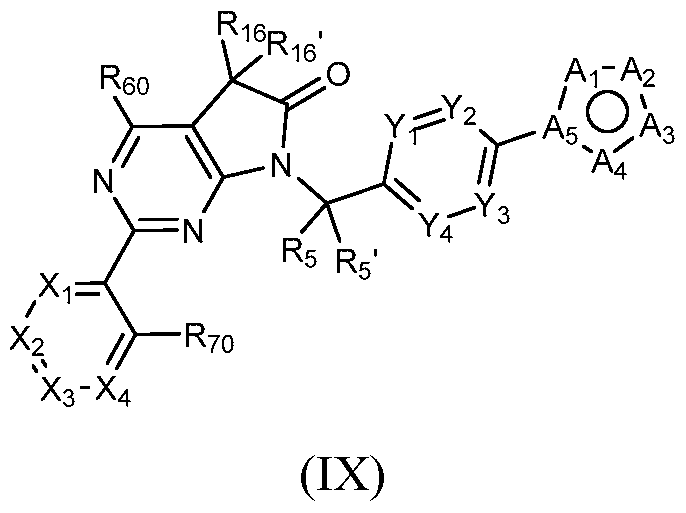
- Xi is CRe or N;
- X2 is CR7 or N;
- X3 is CRs or N; and
- X4 is CR9 or N;
- R6 is hydrogen, halogen, (Ci-C4)alkyl, (Ci-C4)alkoxy, (C3-C6)cycloalkyl, -0-(C3- C6)cycloalkyl, or 4- to 6-membered heterocycloalkyl having 1-3 heteroatoms independently selected from N, O, and S, wherein the alkyl, cycloalkyl or heterocycloalkyl is optionally substituted with one or more substituents independently selected from halogen, hydroxyl, (Ci-C4)alkoxy, or -NRbRb’;
- R7, R8 and R9 are each independently hydrogen or halogen
- R70 is hydrogen, halogen, (Ci-C4)alkyl, (Ci-C4)alkoxy, (C3-C6)cycloalkyl, -0-(C3- C6)cycloalkyl, or 4- to 6-membered heterocycloalkyl having 1-3 heteroatoms independently selected from N, O, and S, wherein the alkyl, cycloalkyl or heterocycloalkyl is optionally substituted with one or more substituents independently selected from halogen, hydroxyl, (Ci-C4)alkoxy, or -NRbRb’;
- Rio is hydrogen, halogen, (Ci-C4)alkyl, (Ci-C4)alkoxy, (C3-C6)cycloalkyl, or 4- to 6-membered heterocycloalkyl having 1-3 heteroatoms independently selected from N, O, and S, wherein the alkyl, cycloalkyl or heterocycloalkyl is optionally substituted with one or more substituents independently selected from halogen, hydroxyl, (Ci-C4)alkoxy, or - NRbRb’;
- R90 is selected from the group consisting of hydrogen; hydroxyl; (Ci-C4)alkyl optionally substituted with one or more halogen, hydroxyl or -N(Rb)(Rb ); (C3- C6)cyclopropyl optionally substituted with one or more (Ci-C4)alkyl; -0-(Ci-C4)alkyl optionally substituted with one or more halogen; (Ci-C4)alkyl-N(Rb)(Rb ); -0-(C3- C6)cycloalkyl; and a 4- to 6-membered heterocycloalkyl having 1-3 heteroatoms independently selected from N, O, or S;
- Rio, Rio ' , R16, R16 ' , R18, R18 , R20, R20 ' are each independently selected from the group consisting of hydrogen, hydroxyl, (Ci-C4)alkyl optionally substituted with one or more halogen, -0-(Ci-C4)alkyl optionally substituted with one or more halogens, (Ci- C4)alkyl-N(Rb)(Rb ' ); or R1 ⁇ 2 and Ri 6 ' , Ris and Rik, and R20 and R20 ' each together form a spirocyclic 3-to 6-membered cycloalkyl optionally substituted with one or more Ra ' ;
- Ri4 is selected from the group consisting of hydrogen and (Ci-C4)alkyl
- R5 and Rs' are each independently selected from hydrogen, halogen, (Ci-C4)alkyl, -(Ci-C4)alkyl-0-(Ci-C4)alkyl, or -(Ci-C4)alkyl-N(Rb)(Rb'), wherein each alkyl is optionally substituted with one or more halogens; or R5 and Rs ' together form a (C3- C 6 )cycloalkyl ring optionally substituted with one or more substituents independently selected from halogen or (Ci-C4)alkyl;
- Yi, Y2, Y3 and Y4 are each independently -C(R y )- or N, wherein each R y is independently hydrogen, halogen, or (Ci-C4)alkyl; each of Ai, A2, A3, and A4, is independently selected from the group consisting of C(R 2 ), N(RI), O, and S;
- each Ri is independently a bond, hydrogen, (Ci-C4)alkyl, -0-(Ci-C4)alkyl, 3- to 6- membered cycloalkyl, or 3- to 6-membered heterocycloalkyl having 1-3 heteroatoms independently selected from N, O, and S, wherein each (Ci-C4)alkyl or -0-(Ci-C4)alkyl is independently optionally substituted with one or more Ra, and each 3- to 6-membered cycloalkyl or 3- to 6-membered heterocycloalkyl is independently optionally substituted with one or more R a ; each R2 is independently a bond, hydrogen, (Ci-C4)alkyl, -0-(Ci-C4)alkyl, 3- to 6- membered cycloalkyl, or 3- to 6-membered heterocycloalkyl having 1-3 heteroatom
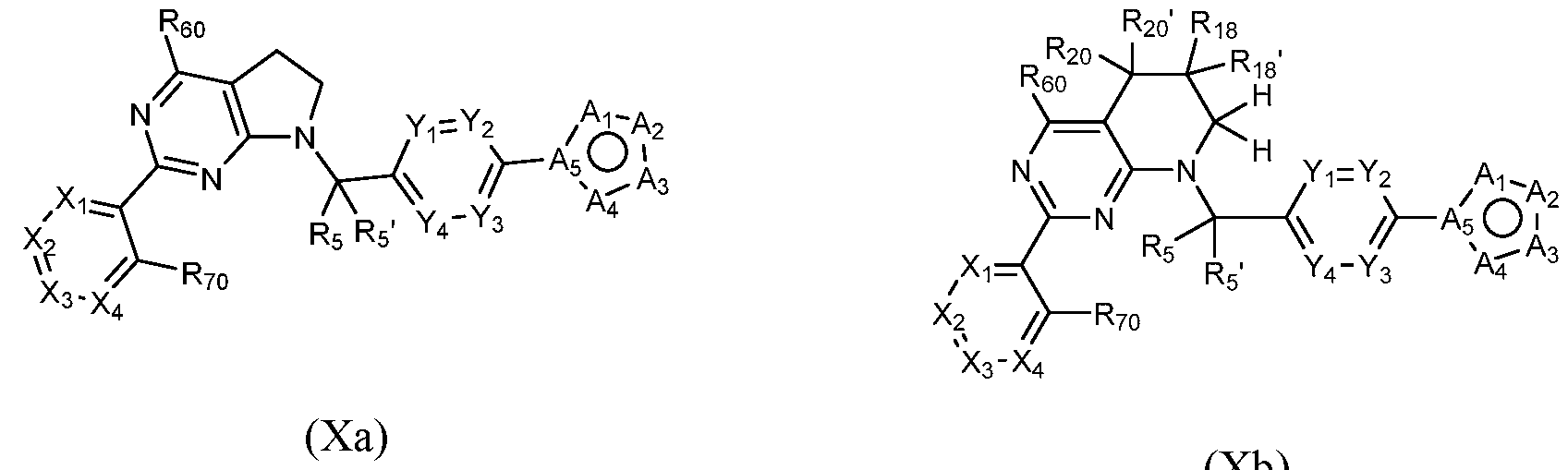
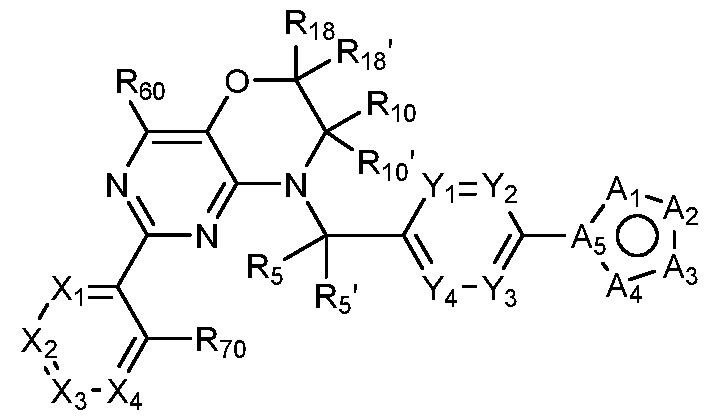
- the compound is a compound of Formula (I) wherein Z is - CFh- and W is -CH2-, such as a compound of Formula (Xa); or Z is -C(R2o)(R2o ' )C(Ri8)(Ri8’)-*, wherein * represents the point of attachment to W, and W is -CH2-, such as a compound of Formula (Xb): (Xb) or a pharmaceutically acceptable salt thereof, wherein Xi, X2, X3, X4, R60, R70, Rix, Rix ' , R20, R20 ' , R5, Rs', Yi, Y2, Y3, Y4, Ai, A2, A3, A4, and As are each
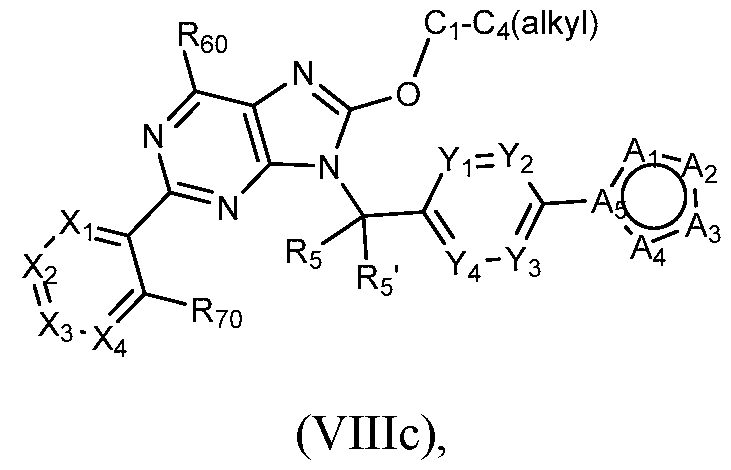
- the compound is a compound of Formula (VUIb) wherein R90 is -0-(Ci-C4)alkyl (e.g., methoxy), such as a compound of Formula (VIIIc): or a pharmaceutically acceptable salt thereof, wherein Xi, X2, X3, X4, R60, R70, Rs, Rs ' , Yi, Y2, Y3, Y4, Ai, A2, A3, A4, and As are each as described above with respect to Formula (I).
- R90 is -0-(Ci-C4)alkyl (e.g., methoxy): or a pharmaceutically acceptable salt thereof, wherein Xi, X2, X3, X4, R60, R70, Rs, Rs ' , Yi, Y2, Y3, Y4, Ai, A2, A3, A4, and As are each as described above with respect to Formula (I).
- Another aspect of the application relates to a method of treating or preventing a disease or disorder associated with the inhibition of ubiquitin specific protease 1 (USP1).
- the method comprises administering to a patient in need of a treatment for diseases or disorders associated with modulation of ubiquitin specific protease 1 (USP1) an effective amount of a compound of any of Formulae (I)-(X), or a pharmaceutically acceptable salt, hydrate, solvate, prodrug, stereoisomer, or tautomer thereof.
- Another aspect of the application is directed to a method of inhibiting ubiquitin specific protease 1 (USP1).
- the method involves administering to a patient in need thereof an effective amount of a compound of any of Formulae (I)-(X), or a pharmaceutically acceptable salt, hydrate, solvate, prodrug, stereoisomer, or tautomer thereof.
- Another aspect of the application is directed to pharmaceutical compositions comprising a compound of any of Formulae (I)-(X), or a pharmaceutically acceptable salt, hydrate, solvate, prodrug, stereoisomer, or tautomer thereof and a pharmaceutically acceptable carrier.
- the pharmaceutically acceptable carrier may further include an excipient, diluent, or surfactant.
- the present application provides the medical community with compounds for development of new pharmaceutical compositions having the inhibition of USP1 enzymes as a mechanism of action.
- Another aspect of the present application relates to a compound of any of Formulae (I)-(X), or a pharmaceutically acceptable salt, hydrate, solvate, prodrug, stereoisomer, or tautomer thereof, for use in a method of treating or preventing a disease associated with inhibiting USP1.
- the present application provides inhibitors of USP1 that are therapeutic agents in the treatment of diseases such as cancer and other diseases associated with the modulation of ubiquitin specific protease 1 (USP1).
- the present application further provides methods of treating a disease or disorder associated with modulation of ubiquitin specific protease 1 (USP1) including, but not limited to, cancer comprising administering to a patient suffering from at least one of said diseases or disorders a compound of any of Formulae (I)-(X), or a pharmaceutically acceptable salt, hydrate, solvate, prodrug, stereoisomer, or tautomer thereof.
- a disease or disorder associated with modulation of ubiquitin specific protease 1 including, but not limited to, cancer comprising administering to a patient suffering from at least one of said diseases or disorders a compound of any of Formulae (I)-(X), or a pharmaceutically acceptable salt, hydrate, solvate, prodrug, stereoisomer, or tautomer thereof.
- Another aspect of the application relates to a method of inhibiting or reducing DNA repair activity modulated by ubiquitin specific protease 1 (USP1).
- the method comprises administering to a patient in need thereof an effective amount of a compound of any of Formulae (I)-(X), or a pharmaceutically acceptable salt, hydrate, solvate, prodrug, stereoisomer, or tautomer thereof.
- Another aspect of the present application relates to a compound of any of Formulae (I)- (X), or a pharmaceutically acceptable salt, hydrate, solvate, prodrug, stereoisomer, or tautomer thereof, for use in a method of inhibiting or reducing DNA repair activity modulated by ubiquitin specific protease 1 (USP1).
- Another aspect of the present application relates to a compound of any of Formulae (I)-(X), or a pharmaceutically acceptable salt, hydrate, solvate, prodrug, stereoisomer, or tautomer thereof, for use in a method of treating or preventing a disease or disorder associated with DNA damage.
- Another aspect of the present application relates to the use of a compound of any of Formulae (I)-(X), or a pharmaceutically acceptable salt, hydrate, solvate, prodrug, stereoisomer, or tautomer thereof, in the manufacture of a medicament for treating or preventing a disease associated with inhibiting USP1.
- Another aspect of the application relates to a method of treating or preventing a disease or disorder associated with DNA damage.
- the method comprises administering to a patient in need of a treatment for diseases or disorders associated with DNA damage an effective amount of a compound of any of Formulae (I)-(X), or a pharmaceutically acceptable salt, hydrate, solvate, prodrug, stereoisomer, or tautomer thereof.
- Another aspect of the application relates to a method of treating cancer.
- the method comprises administering to a patient in need thereof of a treatment for cancer an effective amount of a compound of any of Formulae (I)-(X), or a pharmaceutically acceptable salt, hydrate, solvate, prodrug, stereoisomer, or tautomer thereof.
- Another aspect of the present application relates to a compound of any of Formulae (I)-(X), or a pharmaceutically acceptable salt, hydrate, solvate, prodrug, stereoisomer, or tautomer thereof, for use in a method for treating or preventing cancer.
- Another aspect of the present application relates to the use of a compound of any of Formulae (I)- (X), or a pharmaceutically acceptable salt, hydrate, solvate, prodrug, stereoisomer, or tautomer thereof, in the manufacture of a medicament for treating cancer.
- Another aspect of the present application relates to the use of a compound of any of Formulae (I)-(X), or a pharmaceutically acceptable salt, hydrate, solvate, prodrug, stereoisomer, or tautomer thereof, in the manufacture of a medicament for inhibiting or reducing DNA repair activity modulated by ubiquitin specific protease 1 (USP1).
- a compound of any of Formulae (I)-(X) or a pharmaceutically acceptable salt, hydrate, solvate, prodrug, stereoisomer, or tautomer thereof, in the manufacture of a medicament for inhibiting or reducing DNA repair activity modulated by ubiquitin specific protease 1 (USP1).
- USP1 ubiquitin specific protease 1
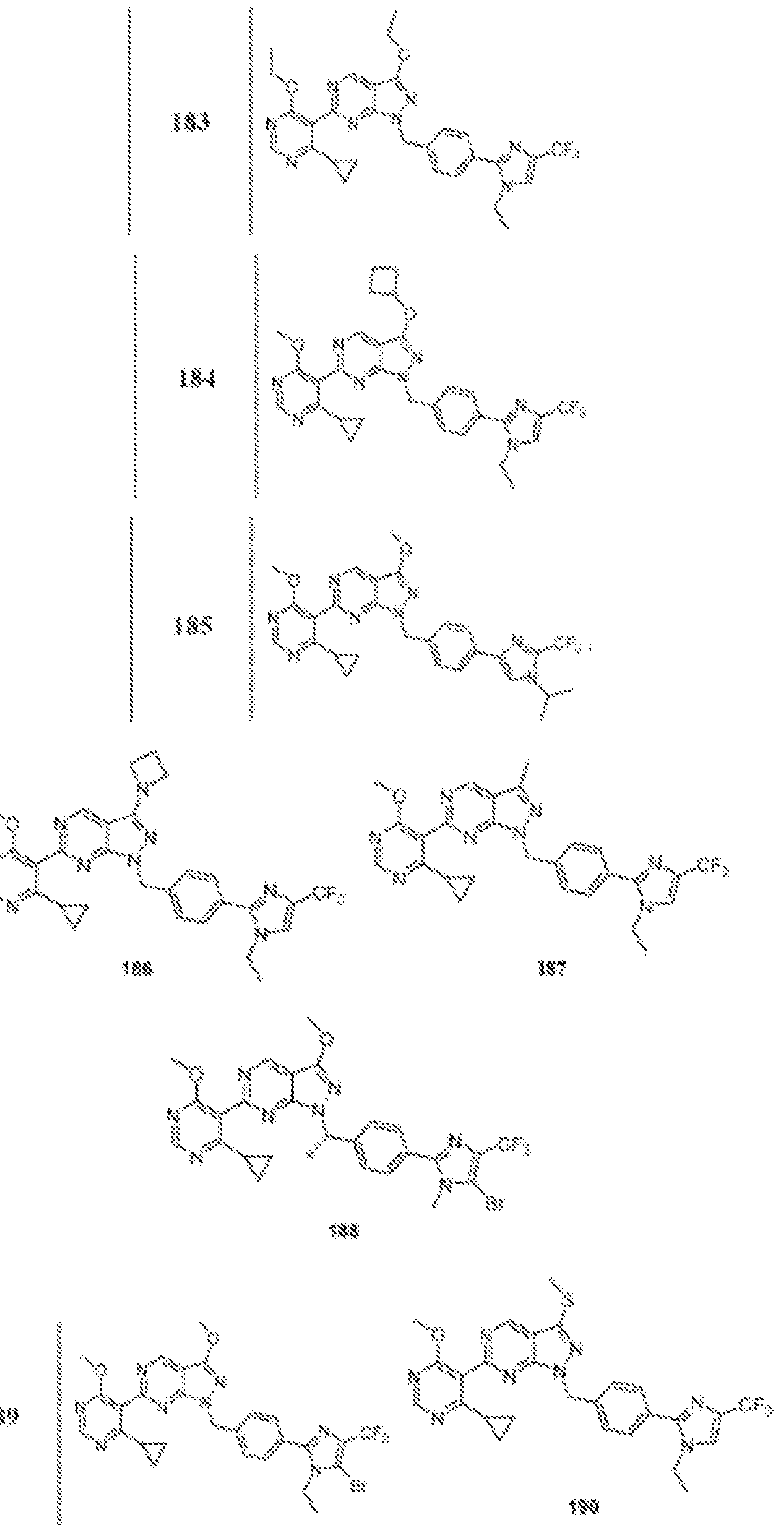
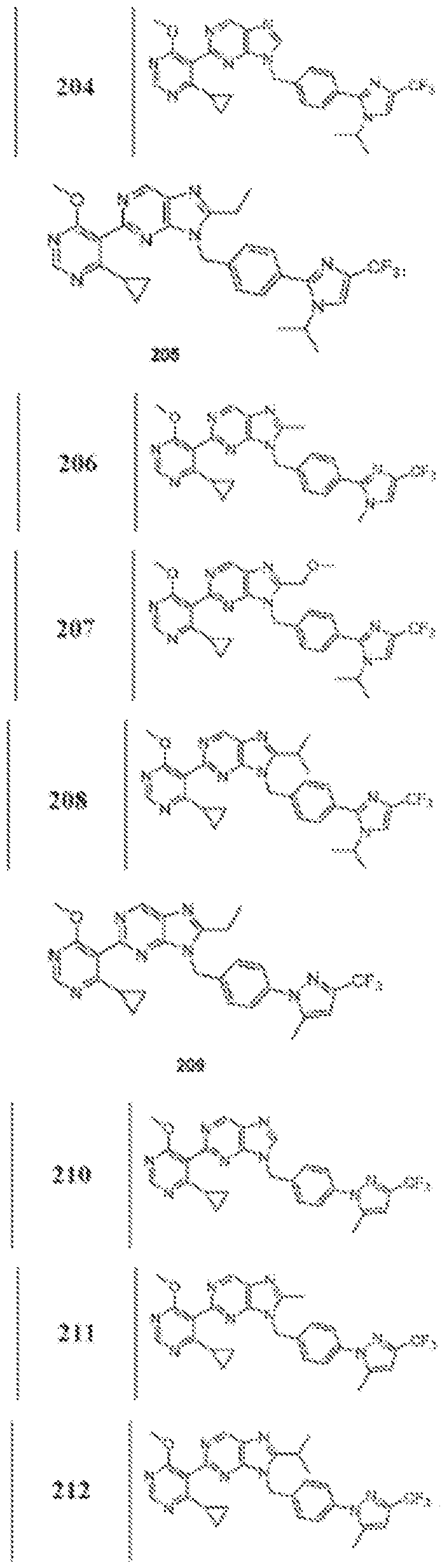
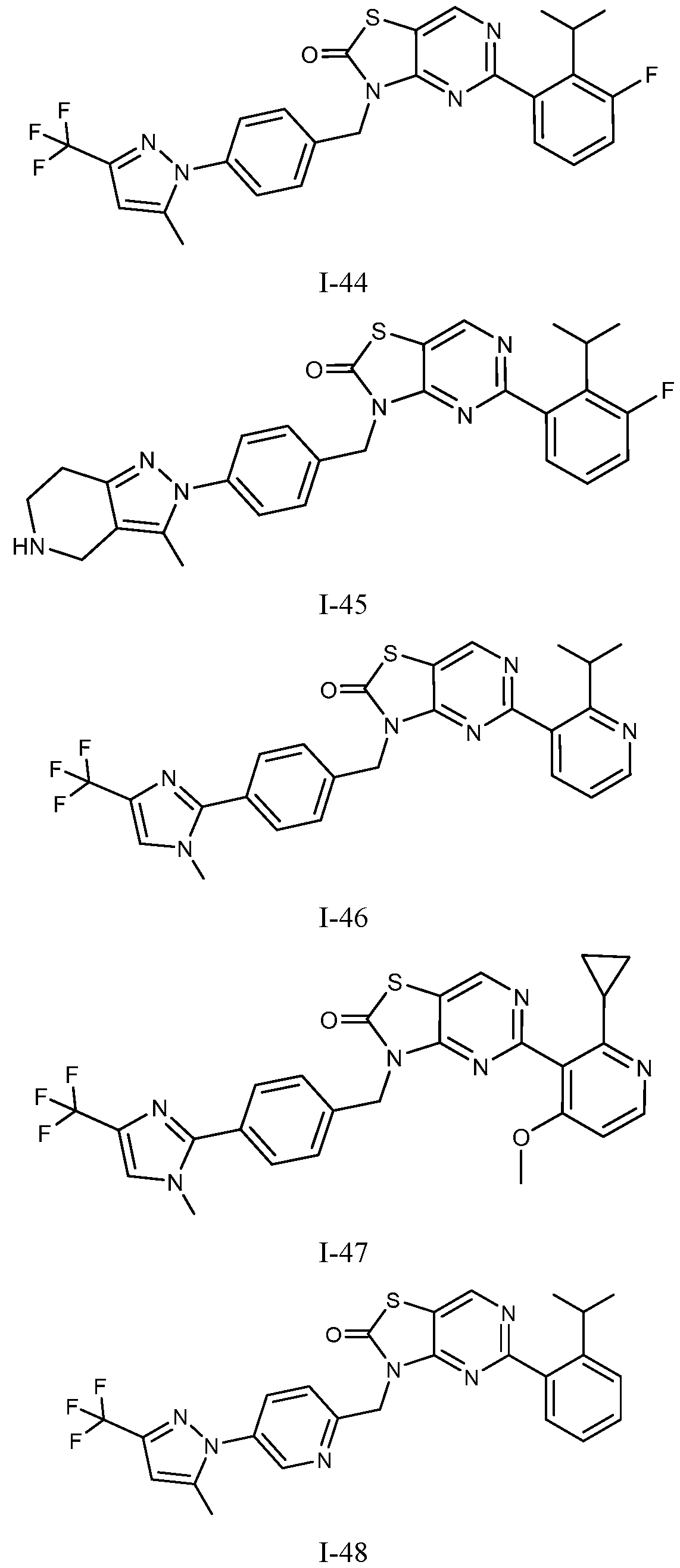
- Figure 1 is a table of exemplary Formula (Va), wherein the moiety
- Figure 2 is a table of exemplary compounds of Formula (Va), wherein R O is [0028]
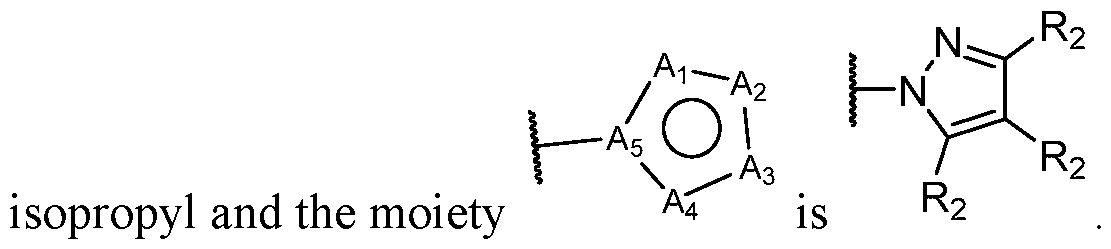
- Figure 3 is a table of exemplary compounds of Formula (Va), wherein R O is cyclopropyl and the moiety
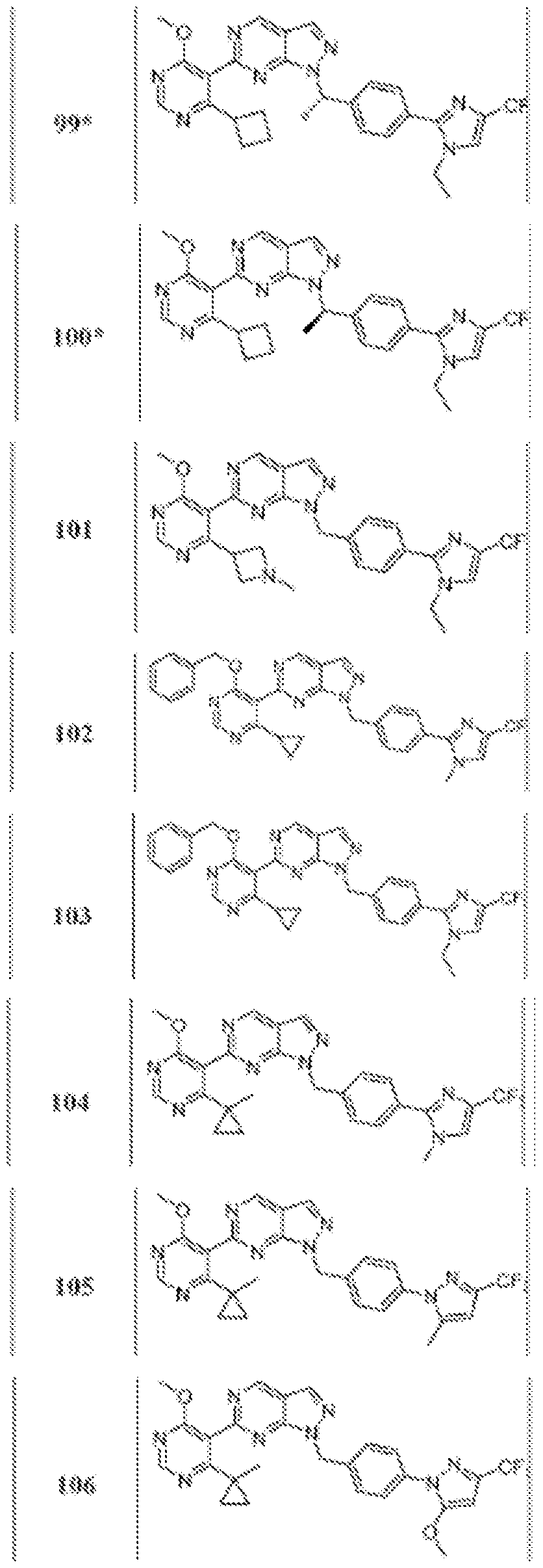
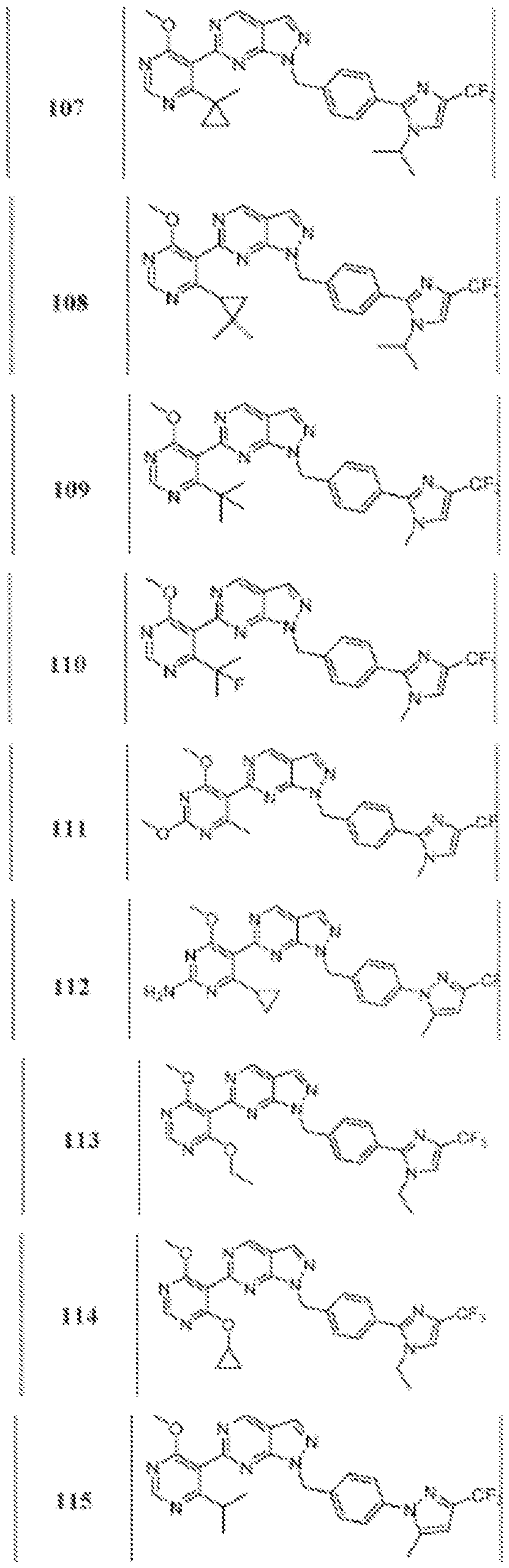
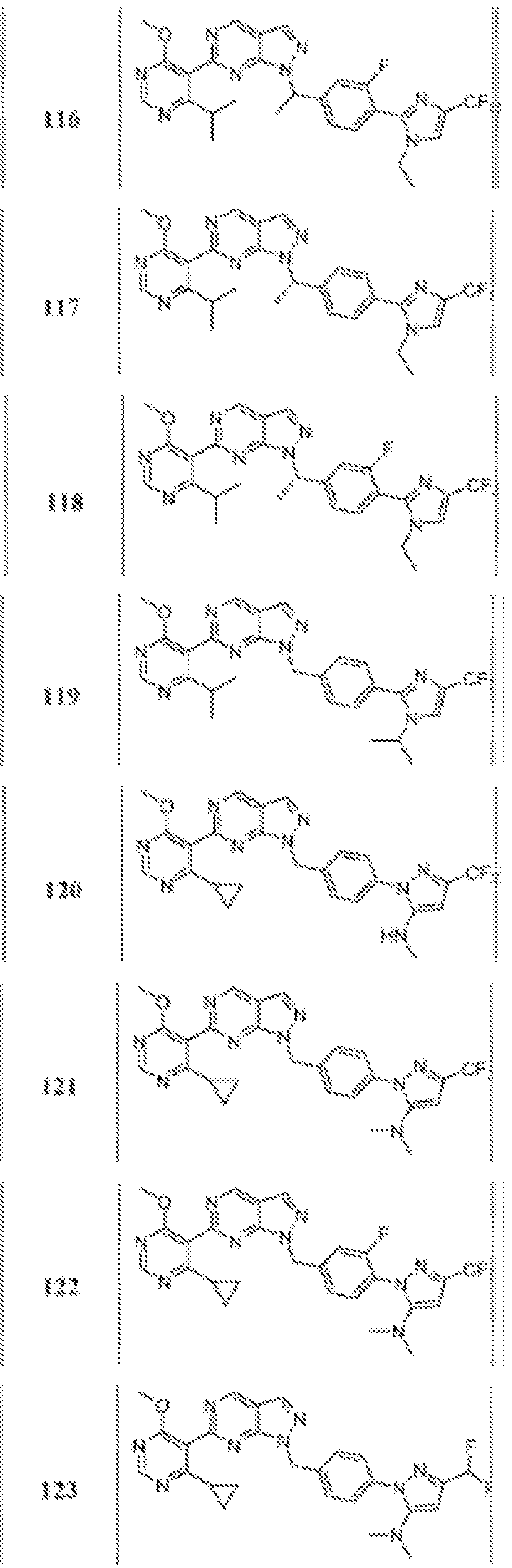
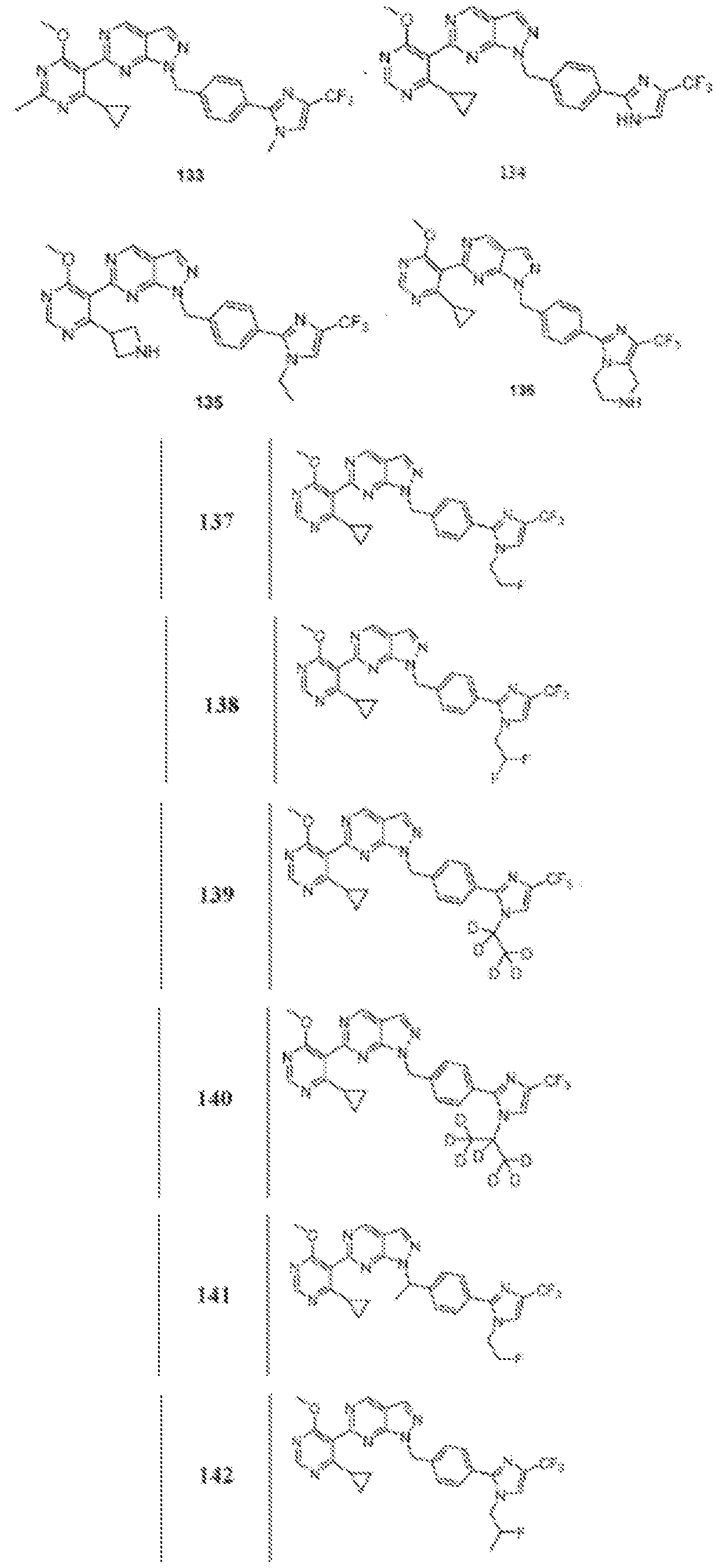
- Figure 4 is a table of exemplary compounds of Formula (Va).
- Figure 5 is a table of exemplary compounds of Formula (I), (Ha), (lib), or (lie).
- Figure 6 is a table of exemplary compounds of Formula (I), (Ilia), (Illb), or (IIIc).
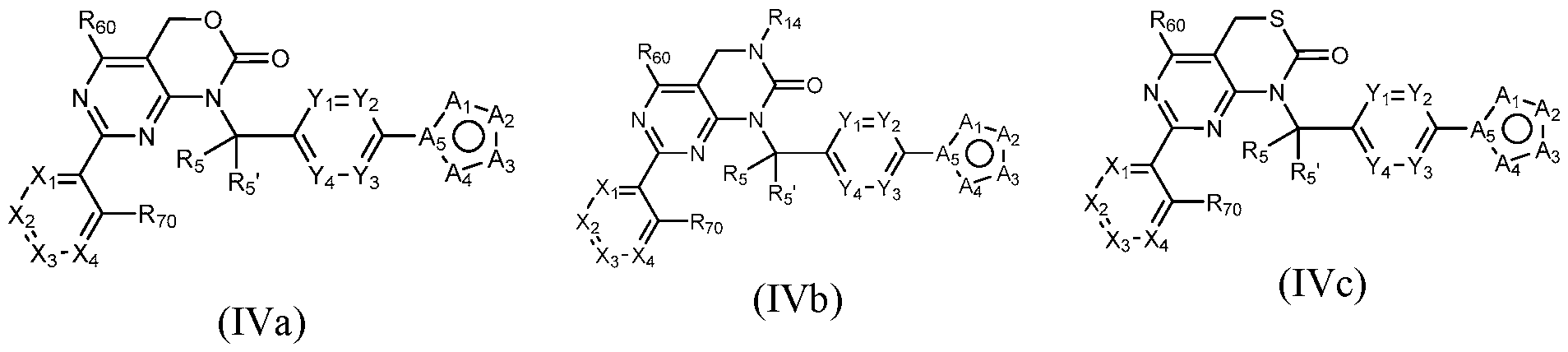
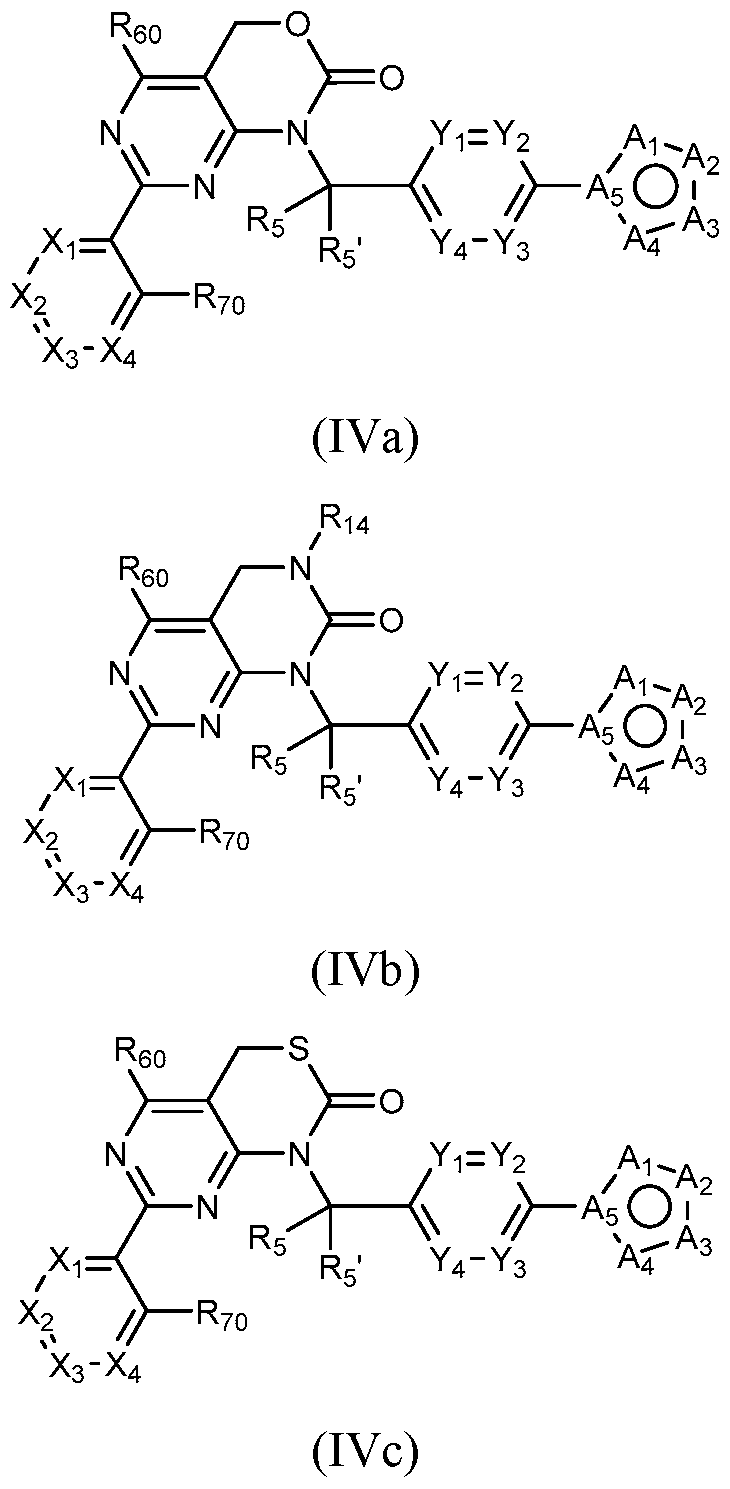
- Figure 7 is a table of exemplary compounds of Formula (I), (IVa), (IVb), or (IVc).
- Figure 8 is a table of exemplary compounds of Formula (Vb).
- Figure 9 is a table of exemplary compounds of Formula (Via) or (VIb).
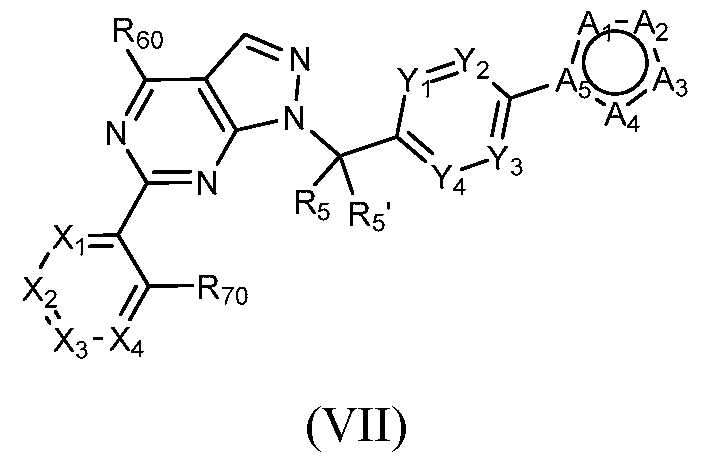
- Figure 10 is a table of exemplary compounds of Formula (VII).
- Figure 11 is a table of exemplary compounds of Formula (Villa), (VUIb), or (VIIIc).
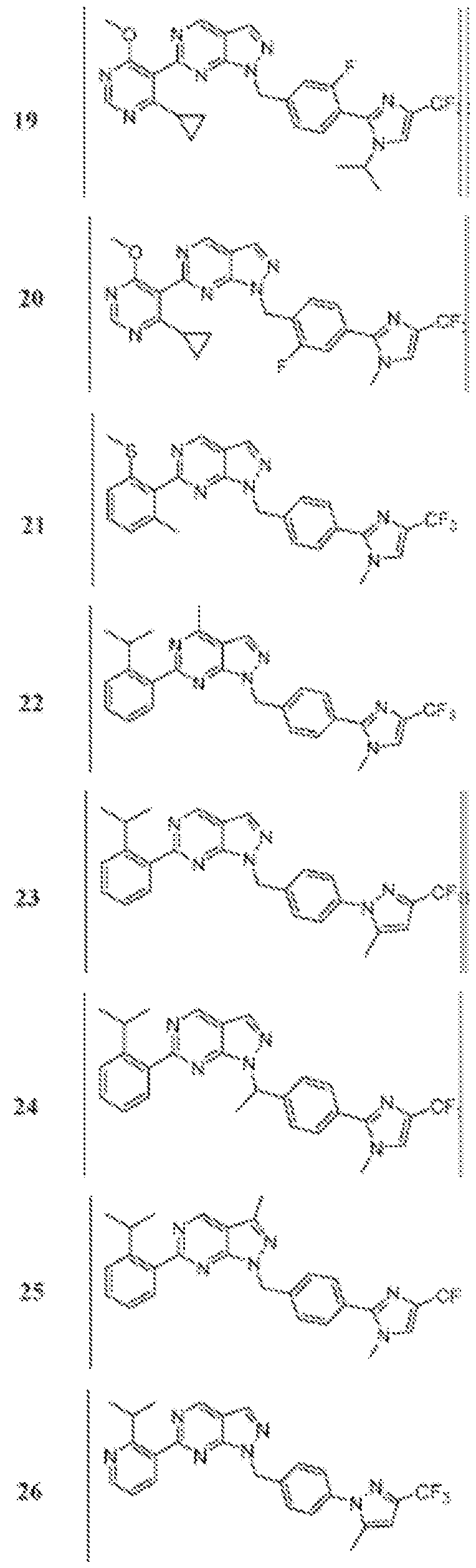
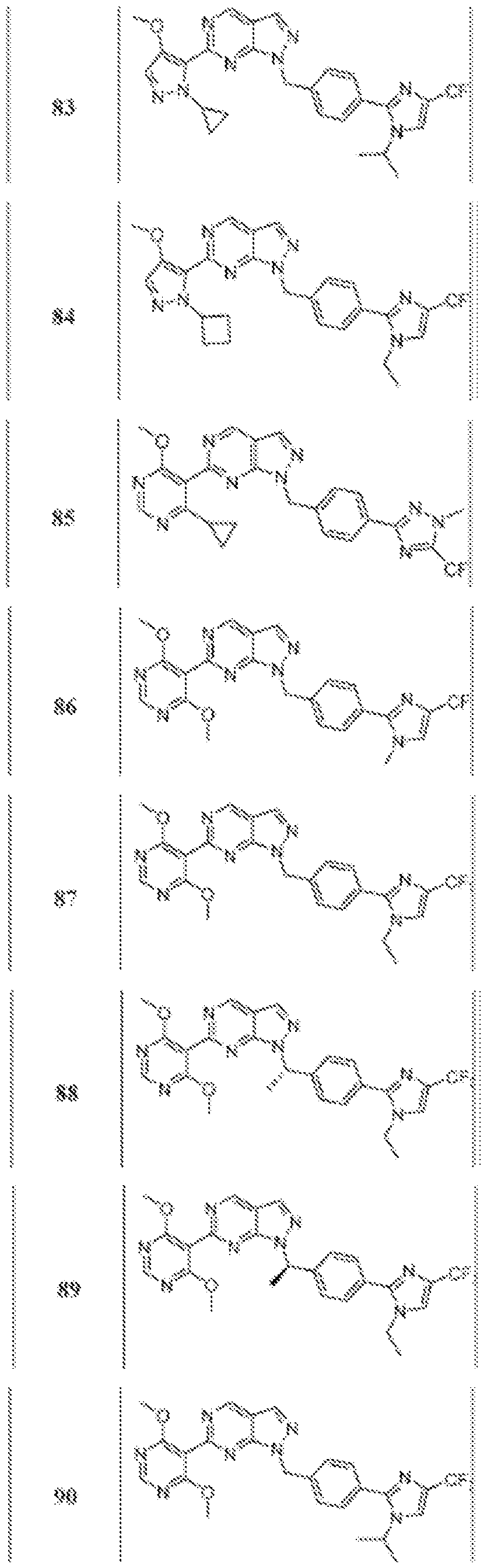
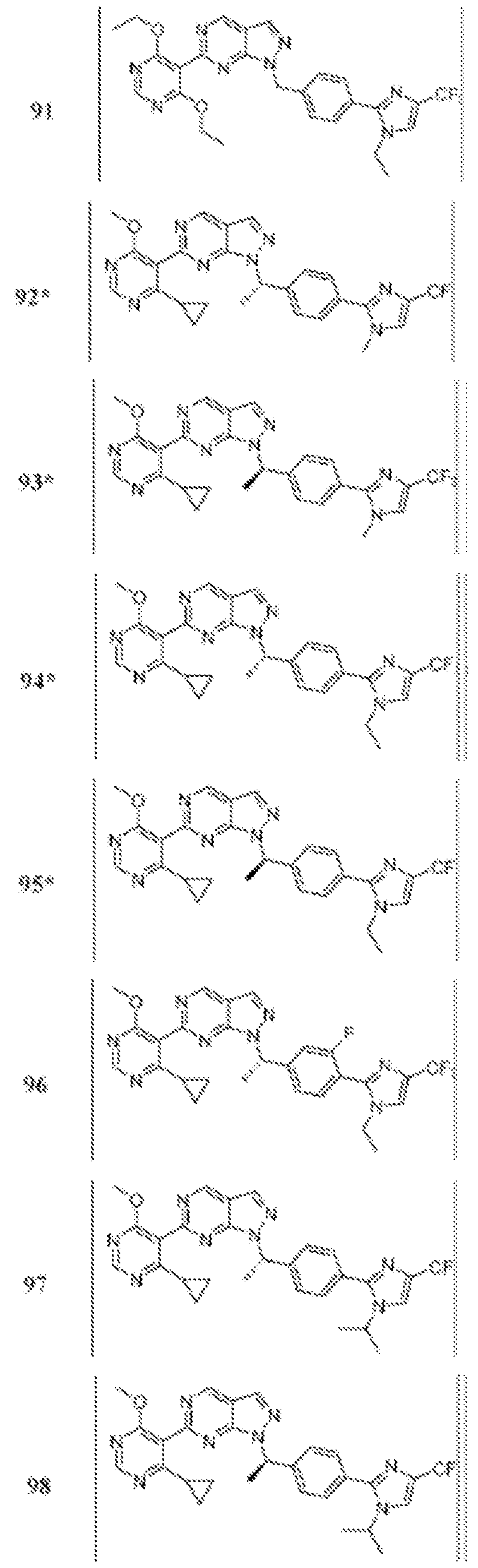
- Figure 12 is a table of exemplary compounds of Formula (I), (Xa) or (Xb).
- the compounds of the present disclosure may be made by a variety of methods, including standard chemistry. Suitable synthetic routes are depicted in the examples given below.
- the compounds of the present application can be prepared in a number of ways well known to those skilled in the art of organic synthesis. By way of example, compounds of the present application can be synthesized using the methods described below, together with synthetic methods known in the art of synthetic organic chemistry, or variations thereon as appreciated by those skilled in the art. Preferred methods include but are not limited to those methods described below.
- Compounds of the present application can be synthesized by following the steps outlined in the General Schemes below. Starting materials are either commercially available or made by known procedures in the reported literature or as illustrated.
- the present disclosure provides compounds of Formula (I): wherein, Xi, X2, X3, X4, R60, R70, Z, W, Rs, Rs ' , Yi, Y2, Y3, Y4, Ai, A2, A3, A4, and As are each as described herein, or a pharmaceutically acceptable salt thereof.
- Xi is CR. 6 or N; X2 is CR7 or N; X3 is CRs or N; and X4 is CR9 or N; provided that no more than two of Xi, X2, X3 or X4 are N and adjacent positions of Xi, X2, X3 or X4 cannot both be N.
- only two of Xi, X2, X3, X4 is N.
- only two non-adjacent positions of Xi, X2, X3, X4 are each N.
- Xi is CR6, X2 is CR7, X3 is CRs, and X4 is N. In some embodiments, Xi is N; X2 is CR7; X3 is CRs; and X4 is CR9. In some embodiments, Xi is CR6; X2 is N; X3 is CRs; and X4 is CR9. In some embodiments, Xi is CR6; X2 is CR7; X3 is N; and X4 is CR9.
- Xi is CRe or N; X2 is CR7 or N; X3 is CRs or N; and X4 is CR9 or N; provided that no more than two of Xi, X2, X3, or X4 are N and adjacent positions of Xi, X2, X3, or X4 cannot both be N.
- X2 is N
- Xi is CR6 and X3 is CRs
- X2 is CR7 and X4 is CR9.
- X2 is N
- Xi and X3 cannot be N
- X3 is N
- X2 and X4 cannot be N.
- R.6 is hydrogen; methyl or ethyl, wherein the methyl or ethyl is optionally substituted with one or more substituents independently selected from hydroxyl or halogen (e.g., F); cyclopropyl, cyclobutyl or cyclohexyl, wherein the cyclopropyl, cyclobutyl or cyclohexyl is optionally substituted with one or more substituents independently selected from methyl, hydroxyl, methoxy, -N(Rb)(Rb ), or halogen (e.g., F); or a 4- to 6-membered heterocycloalkyl having 1-3 heteroatoms independently selected from N, O, or S, optionally substituted with one or more substituents independently selected from methyl, hydroxyl, methoxy, -N(Rb)(Rb ), or halogen (e.g., F).
- hydroxyl or halogen e.g., F
- R6 is selected from the group consisting of -H, -CH 3 , -CH 2 F, -CHF 2 , -CF 3 , -CH 2 CH 3 , -CH 2 CH 2 F, -CH 2 CHF 2 , -CH 2 CF 3 , -CH(CH 3 ) 2 , - COH(CH 3 ) 2 , cyclopropyl, cyclobutyl, -(CH 2 ) 2 CH 3 , -CH 2 -0-CH 3 , -CH 2 -0-CH 2 F, -CH 2 -0-CHF 2 , - CH 2 -0-CF 3 , -CH 2 CH(CH 3 ) 2 , -CH 2 COH(CH 3 ) 2 , methylcyclopropane, oxetane, azetidine, N- methylazetidine, cyclopentyl, cyclohexyl, -CFhCFhN-di
- R7, Rx and R9 are each independently hydrogen or halogen. In some embodiments, R7, Rx and R9 are each independently hydrogen. In some embodiments, R7, R8 and R9 are each independently hydrogen or F. In some embodiments, R7, Rx and R9 are each independently hydrogen or Cl. In some embodiments, R7, Rx and R9 are each independently hydrogen, F or Cl.
- R60 is hydrogen, (Ci-C4)alkyl, (C 3 -Ce)cycloalkyl, or 4- to 6- membered heterocycloalkyl comprising one N or O heteroatom, wherein the alkyl, cycloalkyl or heterocycloalkyl is optionally substituted with one or more substituents independently selected from halogen, hydroxyl, (Ci-C4)alkoxy, or -NRbRb’.
- R60 is selected from the group consisting of: hydrogen, -CFb, -CHzF, -CHF 2 , -CF 3 , -CFhCFb, -CFhCHzF, -CH 2 CHF 2 , -CH 2 CF 3 , -CH(CH 3 ) 2 , -COH(CH 3 ) 2 , cyclopropyl, cyclobutyl, -(CH 2 ) 2 CH 3 , -CH 2 -0-CH 3 , -CH 2 -0- CH 2 F, -CH 2 -0-CHF 2 , -CH 2 -0-CF 3 , -CH 2 CH(CH 3 ) 2 , -CH 2 COH(CH 3 ) 2 , methylcyclopropane, oxetane, azetidine, N-methylazetidine, cyclopentyl, cyclohexyl, -CFhCFhN-dimethyl, -
- R70 is hydrogen, (Ci-C4)alkyl, (C 3 -Ce)cycloalkyl, or 4- to 6- membered heterocycloalkyl comprising one N or O heteroatom, wherein the alkyl, cycloalkyl or heterocycloalkyl is optionally substituted with one or more substituents independently selected from halogen, hydroxyl, (Ci-C4)alkoxy, or -NRbRb’.
- R O is selected from the group consisting of: hydrogen, -CH3, -CH2F, -CHF2, -CF3, -CH2CH3, -CH2CH2F, -CH2CHF2, -CH2CF3, -CH(CH 3 )2, -COH(CH 3 )2, cyclopropyl, cyclobutyl, -(CH 2 )2CH3, -CH2-O-CH3, -CH2-O- CH2F, -CH2-O-CHF2, -CH2-O-CF3, -CH 2 CH(CH3)2, -CH 2 C0H(CH3)2, methylcyclopropane, oxetane, azetidine, N-methylazetidine, cyclopentyl, cyclohexyl, -CFhCFhN-dimethyl, -O-CH3, - O-CH2F, -O-CHF2, -O-CF3, -O-CH2CH3,
- Rs and Rs ' are each hydrogen.
- Rs and R5 ' are each independently hydrogen or halogen (e.g., F).
- Rs and Rs ' are each independently hydrogen, F or Cl.
- R5 and Rs ' are each independently (Ci-C4)alkyl optionally substituted with one or more F, -0-(Ci-C4)alkyl optionally substituted with one or more substituents independently selected from F, -(Ci-C4)alkyl-N(Rb)(Rb ) wherein the alkyl is optionally substituted with one or more F.
- Rs and Rs ' are each independently hydrogen; methyl or ethyl each optionally substituted with one or more halogen; cyclopropyl optionally substituted with one or more halogen; or -0-(Ci-C4)alkyl optionally substituted with one or more halogen.
- Rs and Rs ' are each independently hydrogen; methyl or ethyl each optionally substituted with one or more F,; cyclopropyl optionally substituted with one or more F; or -0-(Ci-C4)alkyl optionally substituted with one or more F.
- Rs and Rs ' are each independently hydrogen, -F, -CFb, -CH2CH3, -O-CH3, - O-CH2CH3, or -CFhCFhN-dimethyl. In some embodiments, Rs and Rs ' are each independently hydrogen. In some embodiments, Rs and Rs ' together form a spirocyclic cyclopropyl.
- Rs and Rs ' together form a spirocyclic cyclopropyl, cyclobutyl or cyclohexyl optionally substituted with methyl or halogen.
- R5 and R5 ' together form a spirocyclic cyclopropyl or cyclobutyl optionally substituted with methyl or F.
- Rs and Rs ' together form a spirocyclic cyclopropyl, optionally substituted with methyl or F.
- Rs and Rs ' together form a spirocyclic cyclopropyl, optionally substituted with methyl.
- Rs and Rs ' together form a (C3-C6) cycloalkyl ring optionally substituted with one or more F or methyl.
- Yi, Y2, Y3 and Y4 are each independently -C(R y )- wherein R y is as defined with respect to Formula (I) and described in classes and subclasses herein (e.g., with respect to any one or more of Formula (II)-(X)).
- Yi, Y2, Y3 and Y4 are each independently -C(R y )- wherein each R y is independently hydrogen.
- Yi, Y2, Y3 and Y4 are each independently -C(R y )- wherein one, two, or three R y groups are independently methyl optionally substituted with one or more F or Cl, and each remaining R y is hydrogen.
- Yi is -C(R y )-, where R y is methyl optionally substituted with one or more F or Cl, and Y2, Y3 and Y4 are each hydrogen.
- Y2 is -C(R y )-, where R y is methyl optionally substituted with one or more F or Cl
- Yi, Y3 and Y4 are each hydrogen.
- Y3 is -C(R y )-, where R y is methyl optionally substituted with one or more F or Cl
- Yi, Y2 and Y4 are each independently hydrogen.
- Y4 is -C(R y )-, where R y is methyl optionally substituted with one or more F or Cl, and Yi, Y2 and Y3 are each hydrogen.
- Yi, Y2, Y3 and Y4 are each independently -C(R y )- wherein one R y is F and each remaining R y is hydrogen.
- any one of Yi, Y2, Y3 and Y4 is N and each of the remaining Yi, Y2, Y3 and Y4 is independently -C(R y )- wherein each R y is independently hydrogen or halogen (e.g., F or Cl).
- any two of Yi, Y2, Y3 and Y4 is N and each of the remaining Yi, Y2, Y3 and Y4 is independently -C(R y )- wherein each R y is independently hydrogen or halogen (e.g., F or Cl).
- any one of Yi or Y2, is N and the remaining one of Yi and Y2, is -C(R y )- wherein R y is hydrogen or halogen (e.g., F or Cl).
- any one of Y3, or Y4, is N and the remaining one of Y3 and Y4, is -C(R y )-, wherein R y is hydrogen or halogen (e.g., F or Cl).
- any one of Yi or Y2, is N, and the remaining one of Yi and Y2, and each of Y3 and Y4 is independently -C(R y )- wherein each R y is independently hydrogen or halogen (e.g., F or Cl).
- any one of Y3 or Y4, is N and the remaining one of Y3, and Y4, and each of Yi and Y2 is independently -C(R y )- wherein each R y is independently hydrogen, halogen (e.g., F or Cl) or (Ci-C4)alkyl (e.g., methyl).
- any one of Y3 or Y4 is N and the remaining one of Y3 and Y4, and each of Yi and Y2 is independently -C(R y )- wherein each R y is methyl.
- any one of Y3 or Y4 is N and the remaining one of Y3 and Y4, and each of Yi and Y2 is independently -C(R y )-, wherein each R y is hydrogen. In some embodiments, any one of Yi or Y4 is N and the remaining one of Y3 and Y4, and each of Yi and Y2 is independently -C(R y )-, wherein each R y is methyl.
- Ai, A2, A3, A4, and As together form an optionally substituted 5-membered heteroaryl ring with a total of two nitrogen heteroatoms. In some embodiments, Ai, A2, A3, A4, and As together form an optionally substituted 5-membered heteroaryl ring with a total of two non-adjacent nitrogen heteroatoms. In some embodiments, Ai, A2, A3, A4, and As together form an optionally substituted 5-membered heteroaryl ring and one or two of Ai, A2, A3, A4, and As is NRi and the remainder of Ai, A2, A3, A4, and As are each CR2.
- each of Ai, A2, A3, A4, and As is selected from the group consisting of CR2, NRi, O, and S to form a 5-membered heteroaryl ring.
- Ai is N.
- A2 is CR2.
- A3 is CR2.
- A4 is NRi.
- As is CR2 or N.
- Ai is NRi, wherein Ri is a bond, and A2 is CR2, wherein R2 is as defined with respect to Formula (I) and described in classes and subclasses herein (e.g., with respect to any one or more of Formula (II)- (X)).
- Ai is NRi, wherein Ri is a bond, and A2 is CR2, wherein R2 is methyl optionally substituted with one or more F.
- Ai is NRi, wherein Ri is a bond, and A2 is CR2, wherein R2 is -CF3.
- Ai is NRi, wherein Ri is a bond, and A3 is CR2, wherein R2 is as defined with respect to Formula (I) and described in classes and subclasses herein (e.g., with respect to any one or more of Formula (II)-(X)).
- Ai is NRi, wherein Ri is a bond, and A3 is CH.
- Ai is NRi, wherein Ri is a bond, and A2 is CR2, wherein R2 is methyl optionally substituted with one or more F, and A3 is CR2, wherein R2 is as defined with respect to Formula (I) and described in classes and subclasses herein (e.g., with respect to any one or more of Formula (II)-(X)).
- Ai is NRi, wherein Ri is a bond, and A2 is CF3, and A3 is CH.
- Ai is NRi, wherein Ri is a bond
- A4 is NRi, wherein Ri is as defined with respect to Formula (I) and described in classes and subclasses herein (e.g., with respect to any one or more of Formula (II)-(X)).
- Ai is NRi, wherein Ri is a bond
- A4 is NRi, wherein Ri is methyl, hydrogen or 3- to 6-membered cycloalkyl or heterocycloalkyl optionally substituted with one or more halogen or methyl.
- Ai is NRi, wherein Ri is a bond
- A4 is NRi, wherein Ri is methyl or oxetane.
- Ai is NRi, wherein Ri is a bond, and A2 is NRi or CR2.
- A3 is NRi or CR2 if A2 is -CH.
- A3 is CH, NH, O or S if A2 is CR2 and R2 is not hydrogen, and A4 is CR2 and As is C.
- A3 is CH, or NRi, wherein Ri is a bond, if A2 is NRi or if A4 is NRi or if As is N.
- A4 is NRi or CR2 and As is N or C.
- Ai is NRi, wherein Ri is a bond, A2 is NRi or CR2, A4 is NRi or CR2 and As is N or C.
- Ai is N, A2 is CH, A3 is NRi or CR2, A4 is NRi or CR2 and As is N or C.
- Ai is NRi, wherein Ri is a bond, A2 is CR2, A3 is CH2, NH, O or S, A4 is CR2 and As is C.
- Ai is NRi, wherein Ri is a bond, A2 is NRi, A3 is CH or N, A4 is NRi or CR2 and As is C or N.
- Ai is NRi, wherein Ri is a bond, A2 is NRi or CR2, A3 is CH or NRi, wherein Ri is a bond, A4 is NRi and As is C or N. In some embodiments, Ai is NRi, wherein Ri is a bond, A2 is NRi or CR2, A3 is CH or N, A4 is NRi or CR2 and As is N.
- Ri in Ai, A2, A3, A4, and As is a bond, hydrogen, methyl, ethyl, propyl (e.g., n-propyl or isopropyl), butyl (e.g., n-butyl or isobutyl), methoxy, ethoxy, propoxy, butoxy, cyclopropyl, cyclobutyl, cyclopentyl cyclohexyl, oxetane, or azetidine, wherein the methyl, ethyl, propyl (e.g., n-propyl or isopropyl), butyl (e.g., n-butyl or isobutyl), methoxy, ethoxy, propoxy, or butoxy is each optionally substituted with one or more R a and the cyclopropyl, cyclobutyl, cyclopentyl, cyclohexyl,
- Ri in Ai, A2, A3, A4, and As is independently selected from the group consisting of: a bond, hydrogen, -CH 3 , - CH2F, -CHF2, -CF 3 , -CH2CH3, -CH2CH2F, -CH2CHF2, -CH2CF 3 , -CH(CH 3 )2, -COH(CH 3 )2, cyclopropyl, cyclobutyl, -(CH 2 )2CH3, -CH2-O-CH 3 , -CH2-O-CH2F, -CH2-O-CHF2, -CH2-O-CF 3 , -CH 2 CH(CH3)2, -CH2COH(CH3)2, methylcyclopropane, oxetane, -azetidine, N-methylazetidine, cyclopentyl, cyclohexyl, and -CH2CH2N-dimethyl.
- R2 in Ai, A2, A3, A4, and As is selected from the group consisting of: a bond, hydrogen, (Ci-C4)alkyl, -0-(Ci-C4)alkyl, 3-6 membered cycloalkyl, and 3- to 6-membered heterocycloalkyl having 1-3 heteroatoms independently selected from N, O, and S, wherein the (Ci-C4)alkyl or -0-(Ci-C4)alkyl is each optionally substituted with one or more Ra and the 3-6 membered cycloalkyl or 3- to 6-membered heterocycloalkyl is each optionally substituted with one or more Ra .
- R2 in Ai, A2, A3, A4, and As is an oxygen- linked 3-6 member cycloalkyl or 3-6 member heterocycloalkyl or a nitrogen-linked 3-6 member cycloalkyl or 3-6 member heterocycloalkyl.
- R2 in Ai, A2, A3, A4, and As is independently selected from the group consisting of: a bond, hydrogen, -CH3, -CH2F, -CHF2, - CF3, -CH2CH3, -CH2CH2F, -CH2CHF2, -CH2CF3, -CH(CH 3 )2, -COH(CH 3 )2, cyclopropyl, cyclobutyl, -(CH 2 )2CH3, -CH2-O-CH3, -CH2-O-CH2F, -CH2-O-CHF2, -CH2-O-CF3, -
- two occurrences of R2 on adjacent carbon atoms in Ai, A2, A3, or A4, may together form a fused ring selected from a 5- to 6-membered heterocycloalkyl having 1-3 heteroatoms selected from N, O, or S or a 5- to 6-membered heteroaryl having 1-3 heteroatoms selected from N, O, or S, wherein each ring may independently be optionally substituted with one or more R a ;
- Ai is NRi, wherein Ri is a bond, A2 is CR2, wherein R2 is methyl optionally substituted with one or more F, and A4 is NRi, wherein Ri is as defined with respect to Formula (I) and described in classes and subclasses herein (e.g., with respect to any one or more of Formula (II)-(X)).
- Ai is NRi, wherein Ri is a bond, A2 is CR2, wherein R2 is methyl optionally substituted with one or more F, A3 is CR2, and A4 is NRi, wherein Ri and R2 are each independently as defined with respect to Formula (I) and described in classes and subclasses herein (e.g., with respect to any one or more of Formula (II)-(X)).
- Ai is NRi, wherein Ri is a bond, A2 is CF3, A3 is CH, and A4 is NRi, wherein Ri is methyl or oxetane.
- each Ra in each Ri or R2 in Ai, A2, A3, A4, and As is independently selected from the group consisting of halogen, hydroxyl, -N(Rb)(Rb ), (Ci- C4)alkoxy optionally substituted with one or more Ra , and 3- to 6-membered cycloalkyl optionally substituted with one or more R a .
- each Ra in each Ri or R2 in Ai, A2, A3, A4, and As is independently selected from the group consisting of Cl, F, hydroxyl, -N(Rb)(Rb ), methoxy or ethoxy optionally substituted with one or more R a , and cyclopropyl, cyclobutyl, or cyclohexyl optionally substituted with one or more Ra ' .
- each Ra in each Ri or R.2 in Ai, A2, A3, A4, and As is independently selected from the group consisting of F, hydroxyl, -N(Rb)(Rb ), methoxy optionally substituted with one or more Ra , and cyclopropyl, optionally substituted with one or more R a ' .
- each Ra ' in each Ri or R2 in Ai, A2, A3, A4, and As is independently selected from the group consisting of halogen or (Ci-C4)alkyl optionally substituted with one or more halogen.
- each Ra ' in each Ri or R2 in Ai, A2, A3, A4, and As is independently selected from the group consisting of F, Cl or methyl, ethyl, propyl (e.g., n- propyl or isopropyl), or butyl (e.g., n-butyl or isobutyl) optionally substituted with one or more F or Cl.
- each Ra in each Ri or R2 in Ai, A2, A3, A4, and As is independently selected from the group consisting of F, or methyl, optionally substituted with one or more F.
- each Rb and Rb ' in each Ri or R2 in Ai, A2, A3, A4, and As is independently selected from the group consisting of hydrogen and (Ci-C4)alkyl optionally substituted with one or more halogen.
- each Rb and Rb ' in each Ri or R2 in Ai, A2, A3, A4, and As is independently selected from the group consisting of hydrogen, methyl, ethyl, propyl (e.g., n-propyl or isopropyl), or butyl (e.g., n-butyl or isobutyl) wherein each alkyl moiety is optionally substituted with one or more Cl or F.
- each Rb and Rb ' in each Ri or R2 in Ai, A2, A3, A4, and As is independently selected from the group consisting of hydrogen, or methyl optionally substituted with one or more F.
- each Rb and Rb ' in each Ri or R2 in Ai, A2, A3, A4, and As is methyl. In some embodiments, each Rb and Rb ' in each Ri or R2 in Ai, A2, A3, A4, and As is hydrogen.
- a compound provided herein is a compound wherein Ai is NRi, wherein Ri is a bond, A2 is CR2 wherein R2 is methyl optionally substituted with one or more F (e.g., CF3), A3 is CH, A4 is NRi where Ri is methyl or a 3-6 membered heteroaryl comprising an O heteroatom, and As is C.
- a compound provided herein is a compound wherein Ai is CR2 and R2 is hydrogen or methyl optionally substituted with one or more F (e.g., CF3) in Ai, A2 is CR2 wherein R2 is hydrogen or methyl optionally substituted with one or more F (e.g., CF3) in A2, A3 is CH, A4 is NRi, wherein Ri is a bond, and As is N.
- a compound provided herein is a compound wherein Ai is CH, A2 is CH, A3 is CH, A4 is NRi, wherein Ri is a bond, and As is N.
- the moiety is selected from the group consisting of: [0063]
- Z and W are together selected to form an optionally substituted fused 5- or 6-membered ring selected from cycloalkyl, cycloalkenyl, heterocycloalkyl having 1-3 heteroatoms independently selected form N, O, or S, or heterocycloalkenyl having 1-3 heteroatoms independently selected form N, O, or S ring.
- Z and W are together selected to form an optionally substituted fused 5- or 6-membered ring selected from cycloalkyl, cycloalkenyl, heterocycloalkyl having 1-3 heteroatoms independently selected form N, O, or S, or heterocycloalkenyl having 1-3 heteroatoms independently selected form N, O, or S ring, wherein Z is selected from the group consisting of: -C(Ri6)(Ri6 ' )-, -C(Ri8)(Ri8 ' )-, - C(R20)(R20>C(Rl8)(Rl8>*, S , -S-C(Rl8)(Rl8>*, -C(Rl8)( Rl8>S-*, -N(RI4 , -N(Rl4)-C(Rl8)( Ri8>*, -C(Ri8)(Ri8>N(Ri4)-*, -O-, -0-C(Ri6)(R
- Z and W are together selected to form a fused 5- or 6- membered heterocycloalkyl having 1-3 heteroatoms independently selected form N, O, or S, or heterocycloalkenyl having 1-3 heteroatoms independently selected form N, O, or S ring comprising one nitrogen heteroatom.
- Z and W are together selected to form a fused 5- or 6-membered heterocycloalkyl having 1-3 heteroatoms independently selected form N, O, or S, or heterocycloalkenyl having 1-3 heteroatoms independently selected form N, O, or S ring comprising one nitrogen heteroatom and one S heteroatom.
- Ri4 is hydrogen. In some embodiments, Ri4 is (Ci-C4)alkyl. In some embodiments, R s methyl. In some embodiments, R s ethyl, propyl (e.g., n-propyl or isopropyl), or butyl (e.g., n-butyl or isobutyl). [0065] In some embodiments, Z and W are together selected to form an optionally substituted fused 5- or 6-membered heteroaryl ring having 1-3 heteroatoms independently selected form N, O, or S.
- R90 in W is selected from the group consisting of hydrogen; (C1-C4) alkyl optionally substituted with one or more halogen, hydroxyl or -N(Rb)(Rb ); (C3-
- Rio, Rio', Ri 6 , Ri 6' , Ris, Ris', R20, and R20' are each independently selected from the group consisting of hydrogen, (Ci-C4)alkyl optionally substituted with one or more halogen, -0-(Ci-C4)alkyl optionally substituted with one or more halogen, and (Ci-C4)alkyl-N(Rb)(Rb ); or Ri 6 and Ri 6 ' , Ris and Ris ' , and R20 and R20 ' each together form a spirocyclic 3- to 6-membered cycloalkyl optionally substituted with one or more Ra .
- a compound of Formula (I) can be a compound of Formula
- the compound is a compound a compound of Formula (I) wherein Z is -S-C(Ri8)(Ri8 ' )-*, wherein * represents the point of attachment to W, and W is -C(Rio)(Rio ' )-, such as a compound of Formula (Ila).
- the compound is a compound a compound of Formula (I) wherein Z is -N(Ri4)- C(Ri8)(Ri8>*, wherein * represents the point of attachment to W, and W is -C(Rio)(Rio ' )-, such as a compound of Formula (lib).
- the compound is a compound of Formula (I) wherein Z is -0-C(Ri8)(Ri8 ' )-*, wherein * represents the point of attachment to W, and W is - C(Rio)(Rio ' )-, such as a compound of Formula (lie).
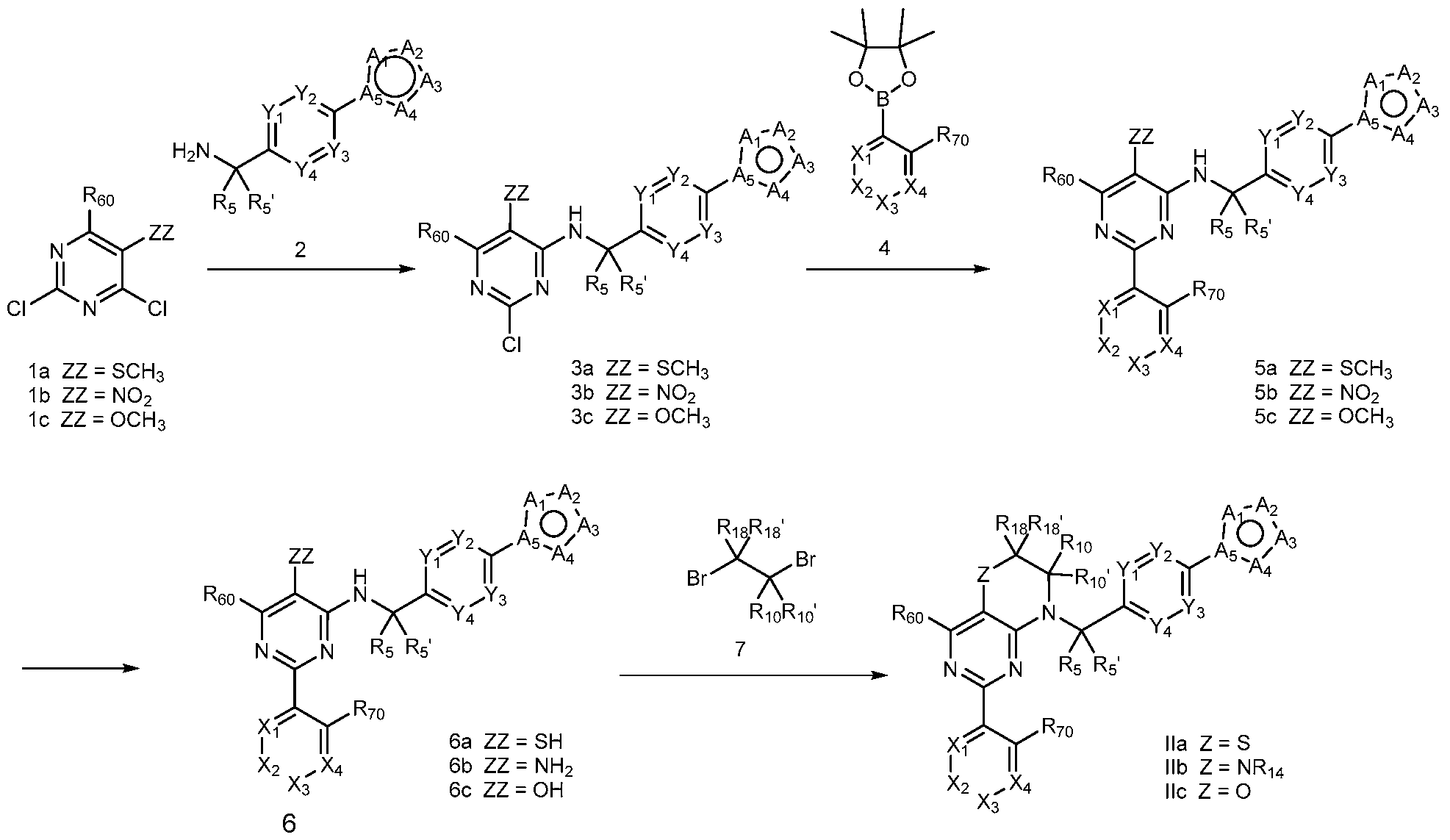
- a compound of Formula (Ha), Formula (lib) or Formula (lie) can be obtained using the method of General Scheme 1 below.
- General Scheme 1 Exemplary Synthesis of Compounds of Formula II
- a general method of preparing compounds of Formula II is outlined in General Scheme 1.
- Amination of 1 with 2 using a base (i.e., potassium carbonate (K2CO3) in a solvent (i.e., DMF) yields 3.
- a base i.e., potassium carbonate (K2CO3)
- a solvent i.e., DMF
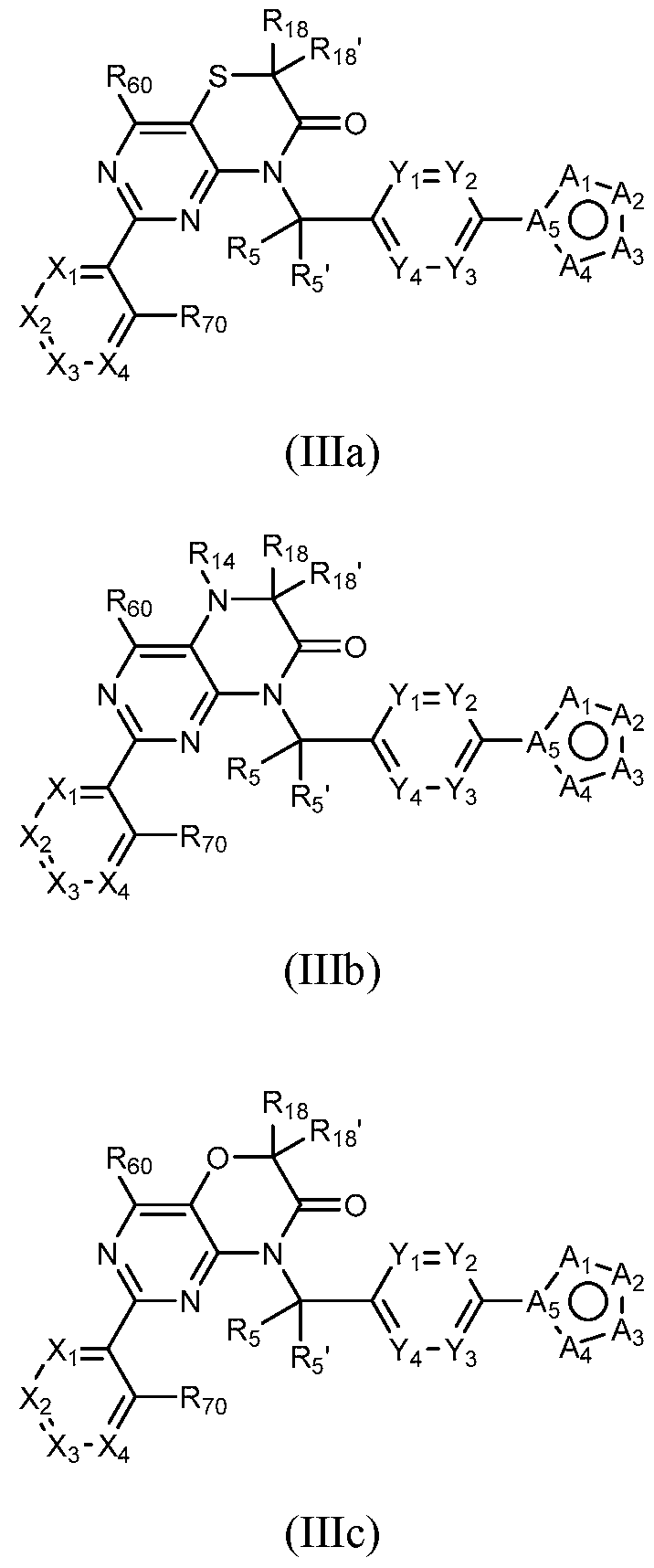
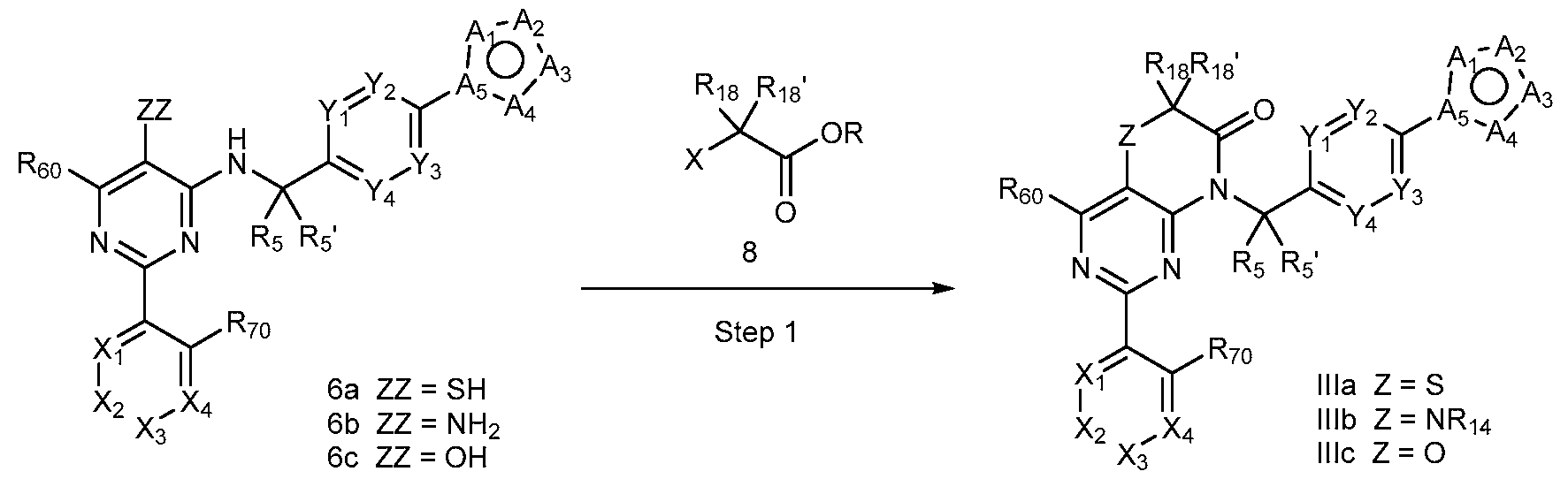
- a compound of Formula (I) can be a compound of Formula (Ilia), Formula (Illb) or Formula (IIIc).
- a compound of Formula (I) that is a Formula (Ilia) Formula (Ilia)
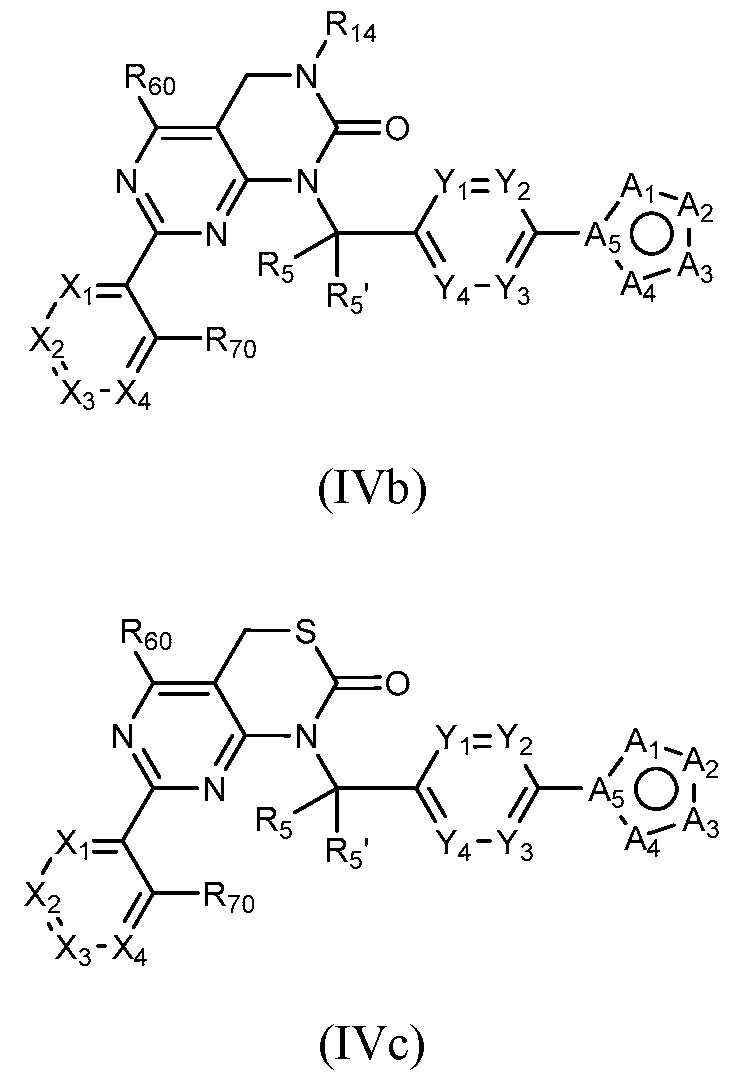
- a compound of Formula (I) can be a compound of Formula
- a general method of preparing compounds of Formula IV is outlined in General Scheme 3.
- Amination of Id or le with 2 using a base (e.g., potassium carbonate (K2CO3) in a solvent (e.g., DMF) yields 3d or 3e.
- Coupling of 3d or 3e with an arylboronic acid/ester or heteroarylboronic acid/ester 4 using a catalytic amount of a palladium catalyst (e.g., Pd(dppf)Cl2 CH2CI2) and a base (e.g., potassium carbonate) in a solvent (e.g., 1,4-dioxane) at elevated temperature provides 4d or 4e.
- a palladium catalyst e.g., Pd(dppf)Cl2 CH2CI2
- a base e.g., potassium carbonate
- Treatment of 4d with a reducing agent e.g., lithium aluminum hydride
- a solvent e.g., THF
- Treatment of 4e with hydrogen gas in the presence of a metal e.g., Raney Ni
- a basic solvent e.g., methanolic ammonia
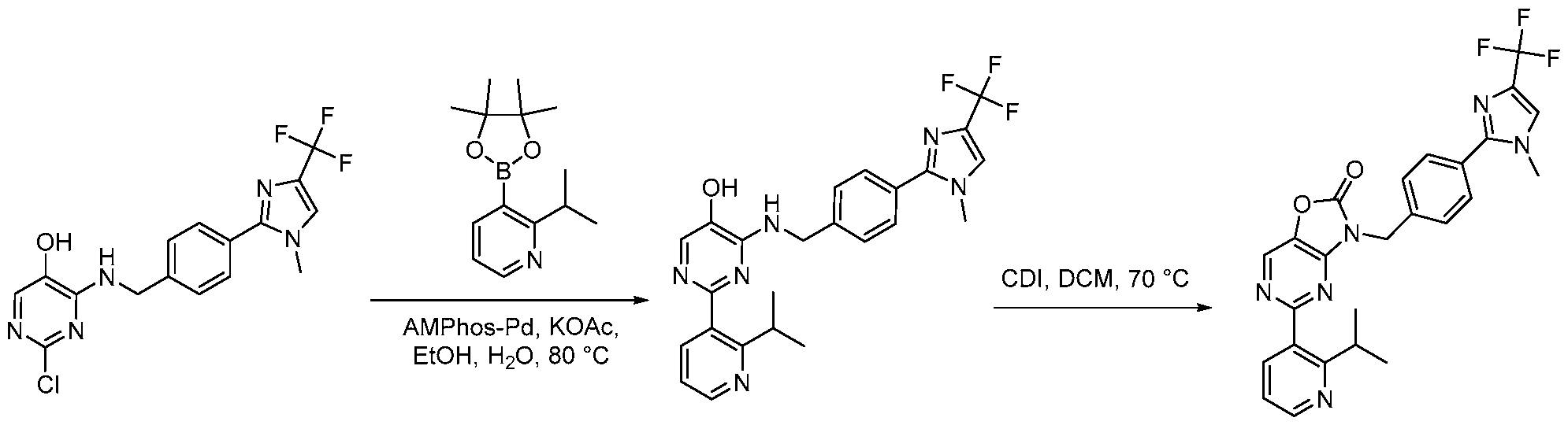
- Cyclization of 7a or 7b with CDI in a solvent e.g., DCM
- a solvent e.g., DCM
- Treatment of 7a with potassium ethylxanthate and hydrogen peroxide in a solvent e.g., DMF) provides compounds of the desired Formula IVc.
- a compound of Formula (I) can be a compound of Formula (Va), Formula (Vb) or Formula (Vc).
- a compound of Formula (I) that is a Formula (Va) can be obtained using the method of General Scheme 4 below.
- a general method of preparing compounds of Formula Va is outlined in General Scheme 4. Alkylation of 8 with 9 using a base (e.g., sodium hydride) in a solvent (e.g., DMF) yields 10. Treatment of 10 with hydrochloric acid and sodium nitrite and copper(I) chloride in water is a method that can be used to prepare 11.
- a base e.g., sodium hydride
- a solvent e.g., DMF
- a compound of Formula (I) that is a Formula (Vb) can be obtained using the method of General Scheme 5 below.
- General Scheme 5 Exemplary Synthesis of Compounds of Formula Vb
- a general method of preparing compounds of Formula Vb is outlined in General Scheme 5. Treatment of 6b with CDI in a solvent (e.g., DCM) at elevated temperature provides the desired compound of Formula Vb.
- a solvent e.g., DCM
- a compound of Formula (I) can be a compound of Formula (Via), or Formula (VIb).
- a compound of Formula (I) that is a Formula (Via) can be obtained using the method of General Scheme 6 below.
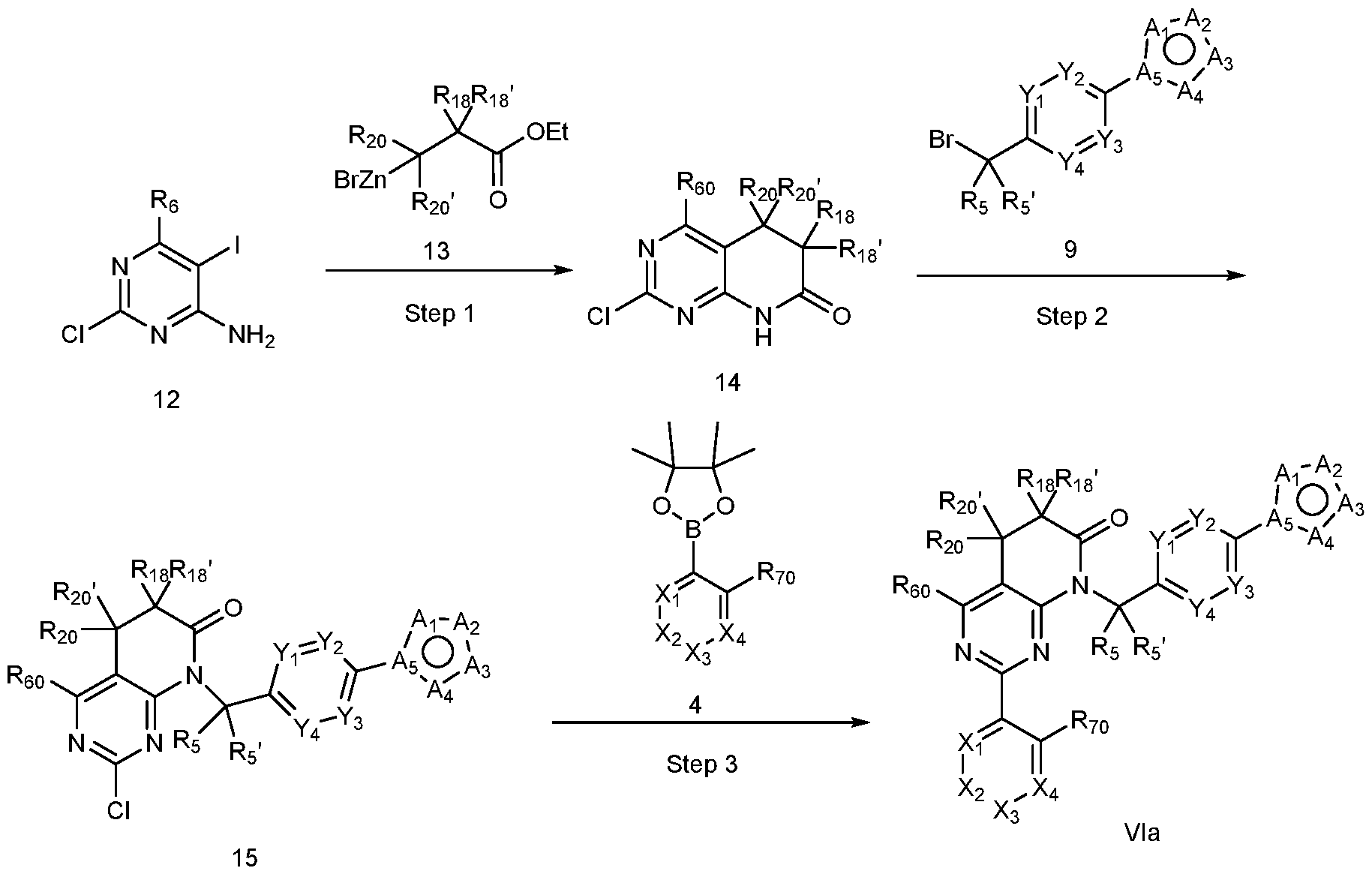
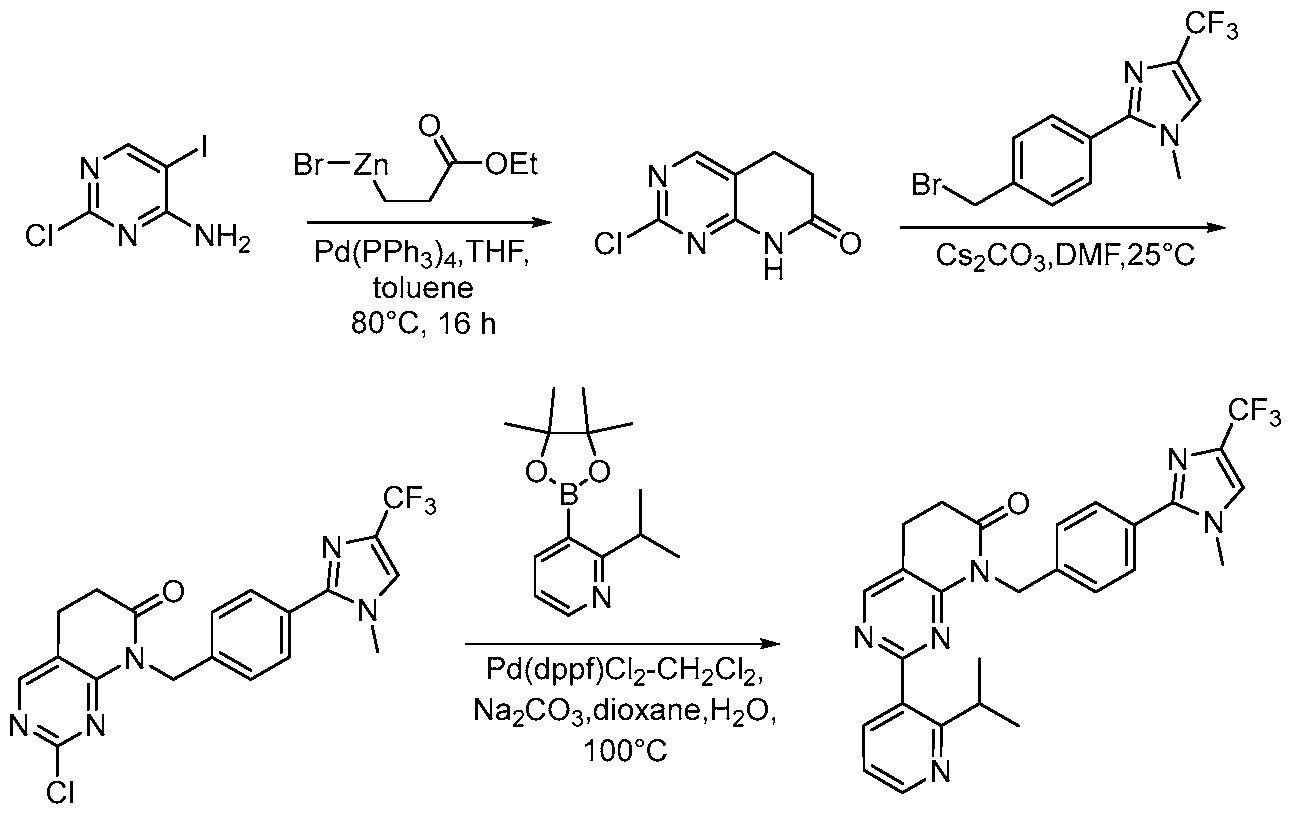
- a general method of preparing compounds of Formula Via is outlined in General Scheme 6.
- organozinc reagent 13 using a catalytic amount of a palladium catalyst (e.g, tetrakis(triphenylphosphine)palladium(0)) in a solvent mixture (e.g., toluene/THF) yields 14.
- a palladium catalyst e.g, tetrakis(triphenylphosphine)palladium(0)
- solvent mixture e.g., toluene/THF
- Alkylation of 14 with 9 using a base e.g., cesium carbonate
- a solvent e.g., DMF
- Coupling of 15 with an arylboronic acid/ester or heteroarylboronic acid/ester 4 using a catalytic amount of a palladium catalyst (e.g., Pd(dppf)Cl2 CH2CI2) and a base (e.g., potassium carbonate) in a solvent (e.g., 1,4-dioxane) at elevated temperature provides the desired compound of Formula Via.
- a palladium catalyst e.g., Pd(dppf)Cl2 CH2CI2
- a base e.g., potassium carbonate
- a compound of Formula (I) that is a Formula (VIb) can be obtained using the method of General Scheme 7 below.
- General Scheme 7 Exemplary Synthesis of Compounds of Formula VIb
- a general method of preparing compounds of Formula VIb is outlined in General Scheme 7. Alkylation of 16 with 9 using a base (e.g., potassium carbonate (K2CO3) in a solvent (e.g., DMF) yields 17. Treatment of 17 with a carboxylic acid such as 18 with a catalytic amount of a palladium catalyst (e.g., dichlorobis(tri-o-tolylphosphine)palladium(II)) and a base (e.g., DIEA) in a solvent (e.g., THF) at elevated temperature followed by addition of acetic anhydride under continued heating provides 19.
- a palladium catalyst e.g., dichlorobis(tri-o-tolylphosphine)palladium(II)
- a base e.g., DIEA
- Coupling of 19 with an arylboronic acid/ester or heteroarylboronic acid/ester 4 using a catalytic amount of a palladium catalyst (e.g., Pd(dppf)Cl2 CH2CI2) and a base (e.g., potassium carbonate) in a solvent (e.g., 1,4-dioxane) at elevated temperature provides the desired compound of Formula (VIb).
- a palladium catalyst e.g., Pd(dppf)Cl2 CH2CI2
- a base e.g., potassium carbonate
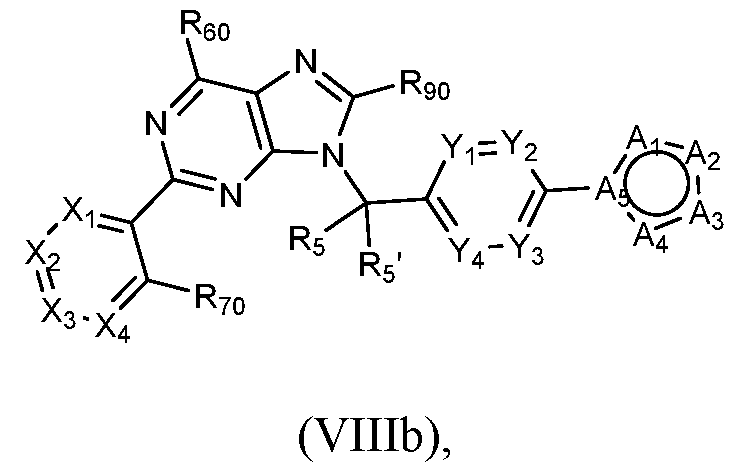
- a compound of Formula (I) can be a compound of Formula (VII), or Formula (Villa).
- a compound of Formula (I) that is a Formula (VIII) or a compound of Formula (Villa) can be obtained using the method of General Scheme 8 below.
- a general method of preparing compounds of Formula VII and Villa is outlined in General Scheme 8. Alkylation of 20 or 21 with 9 using a base (e.g., potassium carbonate) in a solvent (e.g., DMF) at elevated temperature yields 22 or 23, respectively. Coupling of 22 or 23 with an arylboronic acid/ester or heteroarylboronic acid/ester 4 using a catalytic amount of a palladium catalyst (e.g., Pd(dppf)Cl2-CH2Cl2) and a base (e.g., potassium carbonate) in a solvent (e.g., 1,4-dioxane) at elevated temperature provides the desired compounds of Formula VII or Villa, respectively.
- a compound of Formula (I) can be a compound of Formula
- a compound of Formula (I) that is a compound of Formula (Vlllb) can be obtained using the method of General Scheme 9 below.
- General Scheme 9 Exemplary Synthesis of Compounds of Formula Vlllb
- a general method of preparing compounds of Formula Vlllb is outlined in General Scheme 9.
- Treatment of 6b with a carboxylic acid 24, an activating reagent (e.g., HATU) and a base (e.g., DIEA) in a solvent (e.g., DMF) yields 25.
- Treatment of 25 in acidic solvent (e.g., acetic acid) at elevated temperature provides the desired compound of Formula (Vlllb).
- a compound of Formula (I) can be a compound of Formula (VIIIc).
- the compound is a compound of Formula (Vlllb) wherein R90 is - 0-(Ci-C4)alkyl (e.g., methoxy), such as a compound of Formula (VIIIc): or a pharmaceutically acceptable salt thereof, wherein Xi, X2, X3, X4, R.60, R70, Rs, Rs , Yi, Y2, Y3, Y4, Ai, A2, A3, A4, and As are each as described above with respect to Formula (I).
- a compound of Formula (I) that is a compound of Formula (VIIIc) can be obtained using the method of General Scheme 10 below.
- a general method of preparing compounds of Formula VIIIc is outlined in General Scheme 10.
- a base e.g., sodium hydride
- an alkyl halide e.g., methyl iodide
- solvent e.g., DMF
- a palladium catalyst e.g., Pd(dppf)Cl2-CH2Cl2
- a base e.g., potassium carbonate
- a general method of preparing compounds of Formula IX when Ri 6 and Ri 6’ are taken together to form a cyclopropyl ring is outlined in General Scheme 12.
- Bromination of 28 with NBS in a solvent mixture e.g., t-butanol/water
- Reduction of 29 using zinc in acetic acid affords 30.
- Alkylation of 30 with 1,2-dibromoethane using a base (e.g., potassium carbonate) in a solvent (e.g., DMF) at elevated temperature yields 31.
- Alkylation of 31 with 9 using a base (e.g., sodium hydride) in a solvent (e.g., DMF) yields 32.
- Coupling of 32 with an arylboronic acid/ester or heteroarylboronic acid/ester 4 using a catalytic amount of a palladium catalyst (e.g., Pd(dppf)Cl2-CH2Cl2) and a base (e.g., potassium carbonate) in a solvent (e.g., 1,4-dioxane) at elevated temperature provides the desired compounds of Formula IX where Ri 6 and Ri 6’ are taken together to form a cyclopropyl ring.
- a palladium catalyst e.g., Pd(dppf)Cl2-CH2Cl2
- a base e.g., potassium carbonate
- the compound is a compound of Formula (I) wherein Z is - CFh- and W is -CFh-, such as a compound of Formula (Xa), or Z is -C(R2o)(R2o ' )- and W is -CFh- , such as a compound of Formula (Xb):
- a compound of Formula (I) that is a compound of Formula (Xa) or Formula (Xb) can be obtained using the method of General Scheme 12 below.
- a general method of preparing compounds of Formula X is outlined in General Scheme 13.
- Amination of 33 with 2 using a base (e.g., K CO ) in a solvent (e.g., DMF) yields 34.
- a reducing agent e.g., sodium borohydride
- a solvent e.g., THF
- an activating reagent e.g., methanesulfonyl chloride
- a base e.g., TEA
- a solvent e.g., DCM
- Heating 36 with a base (e.g., DBU) in a solvent (e.g., DMF) at elevated temperature generates cyclized compound 37.
- Coupling of 37 with an arylboronic acid/ester or heteroarylboronic acid/ester 4 using a catalytic amount of a palladium catalyst (e.g., Pd ⁇ ppQCE-CFECE) and a base (e.g., potassium carbonate) in a solvent (e.g., 1,4-dioxane) at elevated temperature provides compounds of Formula X.
- a palladium catalyst e.g., Pd ⁇ ppQCE-CFECE
- a base e.g., potassium carbonate
- the compounds of the present disclosure i.e., compounds of Formula (I), or a pharmaceutically acceptable salt, enantiomer, hydrate, solvate, prodrug, isomer, or tautomer thereof, may be prepared by methods known in the art of organic synthesis as set forth in part by the following synthetic schemes. In the schemes described below, it is well understood that protecting groups for sensitive or reactive groups are employed where necessary in accordance with general principles or chemistry. Protecting groups are manipulated according to standard methods of organic synthesis (T. W. Greene and P. G. M. Wuts, "Protective Groups in Organic Synthesis", Third edition, Wiley, New York 1999). These groups are removed at a convenient stage of the compound synthesis using methods that are readily apparent to those skilled in the art. The selection processes, as well as the reaction conditions and order of their execution, shall be consistent with the preparation of compounds of Formula (I).
- the compounds described herein may be made from commercially available starting materials or synthesized using known organic, inorganic, and/or enzymatic processes.
- compositions comprising one or more USP1 inhibitor compounds as described herein, or a pharmaceutically acceptable salt thereof, and a pharmaceutically acceptable excipient.
- pharmaceutical compositions reported herein can be provided in a unit dosage form (e.g., capsule, tablet or the like).
- Pharmaceutical compositions comprising a compound provided herein can be provided in an oral dosage form such as a capsule or tablet.
- the oral dosage form optionally comprises one or more fillers, disintegrants, lubricants, glidants, anti-adherents and/or anti-statics.
- an oral dosage form is prepared via dry blending.
- an oral dosage form is a tablet and is prepared via dry granulation.
- a USP1 inhibitor compound of the present disclosure can be dosed a therapeutically safe and effective frequency determined by clinical trials.
- the pharmaceutical compositions may be orally administered in any orally acceptable dosage form.
- a patient and/or subject can be selected for treatment using a compound described herein by first evaluating the patient and/or subject to determine whether the subject is diagnosed for a condition for which a suitable pharmaceutical composition comprising a USP1 inhibitor may be indicated, and if then administering to the subject a composition described herein.
- a USP1 inhibitor compound provided herein can be useful in the treatment of cancer including but not limited to DNA damage repair pathway deficient cancers.
- Additional examples of cancer include, but are not limited to, ovarian cancer, breast cancer (including triple negative breast cancer), non- small cell lung cancer (NSCLC), and osteosarcoma.
- the cancer can be BRCA1 or BRCA2 wildtype.
- the cancer can also be BRCA1 or BRCA2 mutant.
- the cancer can further be a PARP inhibitor resistant or refractory cancer, or a PARP inhibitor resistant or refractory BRCA1 or BRCA2 -mutant cancer.
- the compounds provided herein are useful for the development of therapies to treat a Poly (ADP-ribose) polymerase (“PARP") inhibitor refractory or resistant cancer.
- PARP Poly (ADP-ribose) polymerase
- the cancer is a PARP inhibitor resistant or refractory BRCA1, BRCA2, or BRCA1 and BRCA2 mutant cancer.
- the cancer is a PARP inhibitor resistant or refractory homologous recombination-deficient (HRD) driven cancer.
- HRD homologous recombination-deficient
- a pharmaceutical composition can comprise one or more compounds of Formula (I) including any compound disclosed in the examples below, as provided herein.
- an active pharmaceutical ingredient (API) can comprise a compound provided herein in a desired amount and concentration of the compound.
- Oral dosage forms comprising a compound provided herein can be prepared as a pharmaceutically acceptable formulation in a tablet, or in a capsule.
- the capsules can contain pharmaceutically acceptable excipients, and encapsulated capsules can be packaged in high-density polyethylene induction sealed bottles.
- Example 1 Synthesis of 5-(2-isopropylphenyl)-3-(4-(l-methyl-4-(trifluoromethyl)-lH- imidazol-2-yl)benzyl)thiazolo[4,5-d]pyrimidin-2(3H)-one (1-1 ).
- Step 1 Synthesis of methyl 4-(4-(trifluoromethyl)-lH-imidazol-2-yl)benzoate [00112] To a stirred solution of methyl 4-formylbenzoate (17.00 g, 98.38 mmol, 1.00 equiv) and 3,3-dibromo-l,l,l-trifluoropropan-2-one (55.89 g, 0.197 mmol, 2.00 equiv) in MeOH (500 mL) was added sodium acetate solution (16.99 g, 0.197 mmol, 2.00 equiv) and ammonia in water (100 mL) at 25 °C. The resulting mixture was stirred for 18 h at 25 °C.
- Step 3 Synthesis of (4-(l-methyl-4-(trifluoromethyl)-lH-imidazol-2-yl)phenyl)methanol [00114] To a stirred solution of methyl 4-[l-methyl-4-(trifluoromethyl)imidazol-2- yljbenzoate (9.80 g, 29.65 mmol, 1.00 equiv, 86%) in THF (50 mL) was added LiAILL (2.12 g, 53.064 mmol, 1.79 equiv) in portions at 0 °C. The resulting mixture was stirred for 3h at 25 °C. The reaction was quenched with NEECl (aq) at 25 °C.
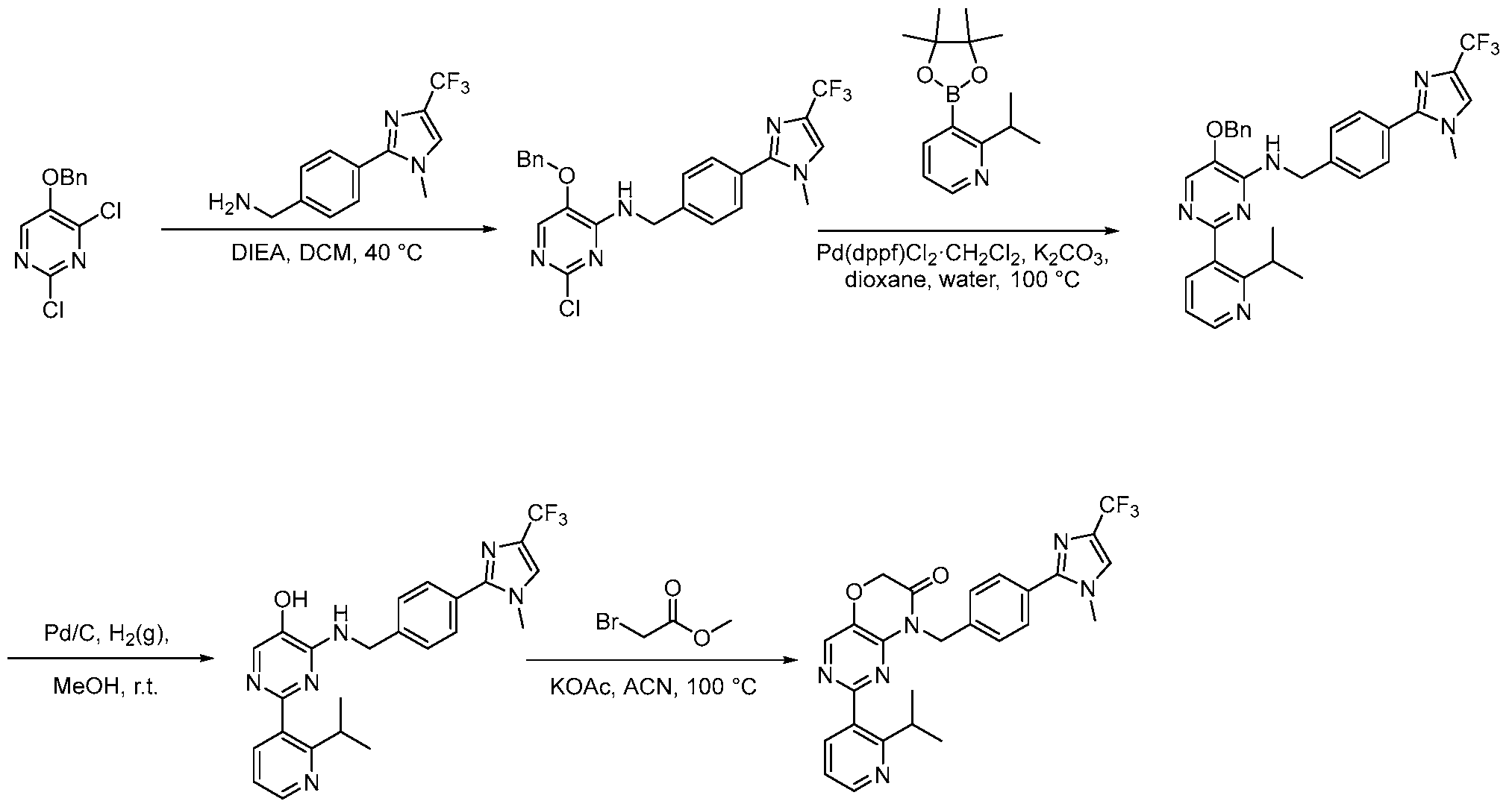
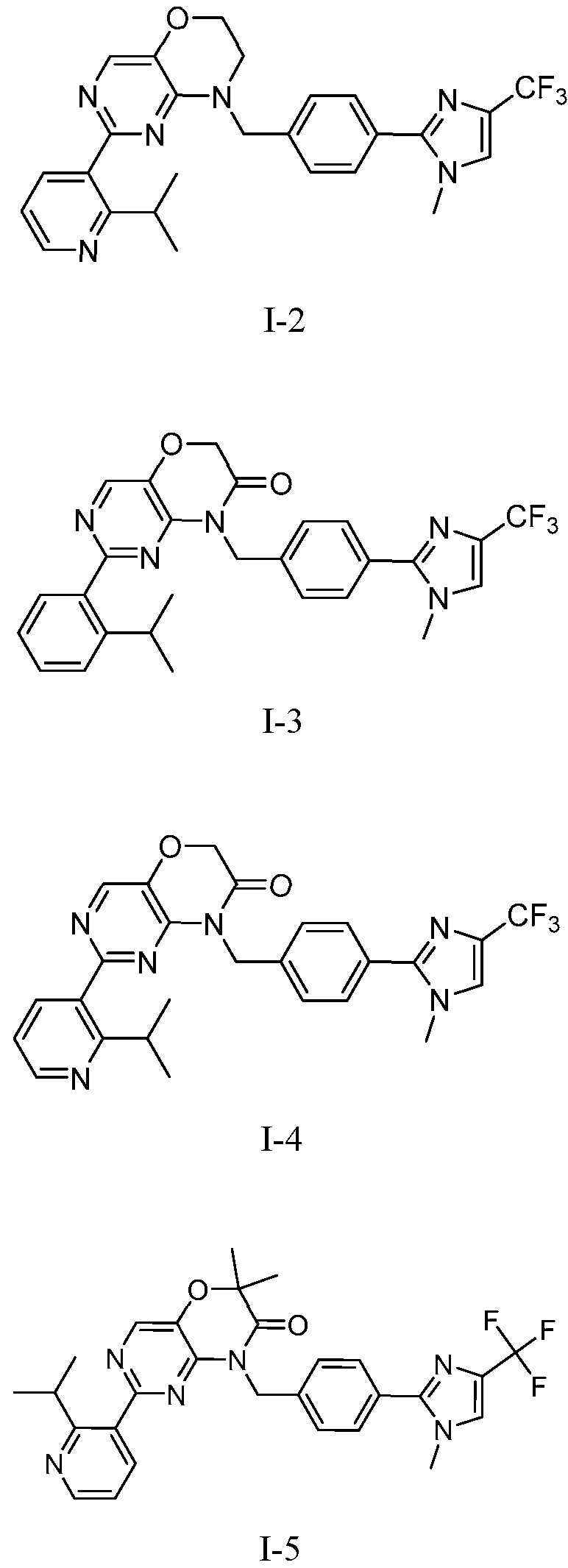
- Example 3 Synthesis of 8-([4-[l-methyl-4-(trifluoromethyl)-lH-imidazol-2- yl] phenyl] methyl)-2- [2-(propan-2-yl)phenyl]-6H,7H,8H-pyrimido [5,4-b] [1,4] oxazin-7-one (1-3) Step 1. Synthesis of 2-chloro-8-([4-[l-methyl-4-(trifluoromethyl)-lH-imidazol-2- yl] phenyl] methyl)-6H,7H,8H-pyrimido [5,4-b] [1,4] oxazin-7-one
- Example 4 Synthesis of 8-([4-[l-methyl-4-(trifluoromethyl)-lH-imidazol-2- yl] phenyl] methyl)-2- [2-(propan-2-yl)pyridin-3-yl]-6H,7H,8H-pyrimido [5,4-b] [1,4] oxazin-7- one (1-4).
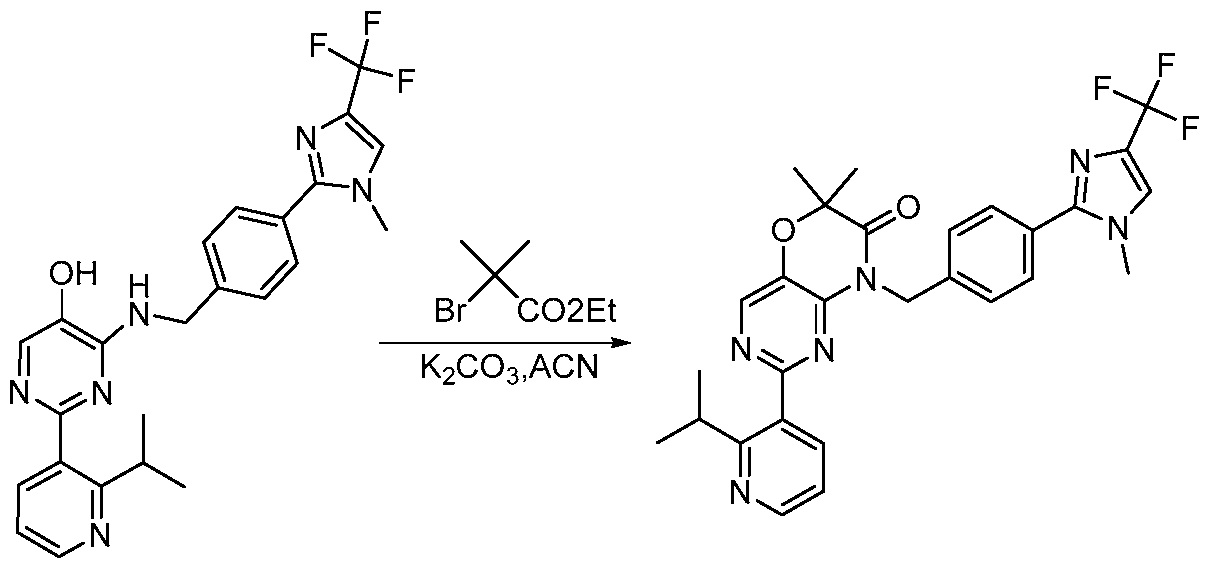
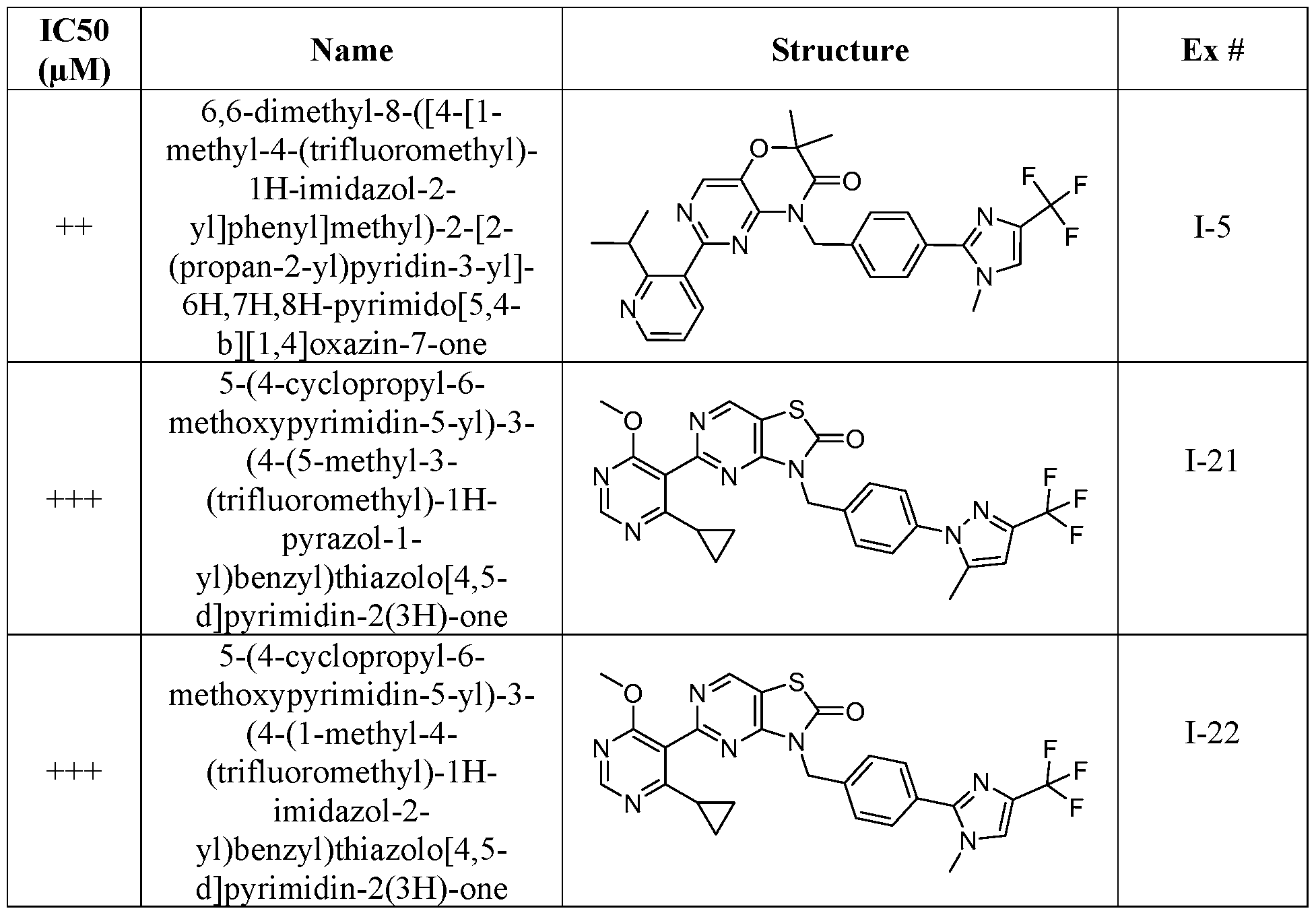
- Example 5 Synthesis of 6,6-dimethyl-8-([4-[l-methyl-4-(trifluoromethyl)-lH-imidazol-2- yl] phenyl] methyl)-2- [2-(propan-2-yl)pyridin-3-yl]-6H,7H,8H-pyrimido [5,4-b] [1,4] oxazin-7- one (1-5).
- the resulting solution was diluted with 2 mL of water.
- the resulting solution was extracted with 3x2 mL of EA and the organic layers combined and dried over anhydrous sodium sulfate. The solids were filtered out. The resulting mixture was concentrated under vacuum.
- the crude product was purified by Prep-HPLC with the following conditions: Column, XBridge C18 OBD Prep Column, 5 pm, 19 mm X 250 mm; mobile phase, water (10MMOL/L NH4HC03) and ACN (40.0% ACN up to 60.0% in 7 min); Detector, UV 254 nm.
- Example 6 Synthesis of 3-methyl-l-([4-[l-methyl-4-(trifluoromethyl)-lH-imidazol-2- yl] phenyl] methyl)-7- [2-(propan-2-yl)phenyl]-lH,2H,3H,4H- [1,3] diazino [4,5-d]pyrimidin-2- one (1-6).
- Step 1 Synthesis of 2-chloro-4-[([4-[l-methyl-4-(trifluoromethyl)-lH-imidazol-2- yl] phenyl] methyl)amino] pyr imidine-5-car bonitrile
- Example 7 Synthesis of l-([4-[l-methyl-4-(trifluoromethyl)-lH-imidazol-2- yl] phenyl] methyl)-7- [2-(propan-2-yl)phenyl]-lH,2H,4H-pyrimido [4,5-d] [1,3] oxazin-2-one
- Step 1 Synthesis of ethyl 2-chloro-4-[([4-[l-methyl-4-(trifluoromethyl)-lH-imidazol-2- yl] phenyl] methyl)amino] pyrimidine-5-car boxylate [00136] Into a 100 mL round-bottom flask, was placed ethyl 2,4-dichloropyrimidine-5- carboxylate (2 g, 9.05 mmol, 1.00 equiv), [4-[l-methyl-4-(trifluoromethyl)-lH-imidazol-2- yl]phenyl]methanamine (2.31 g, 9.05 mmol, 1.00 equiv), DCM (20 mL).
- the resulting solution was stirred for 3 h at 80 °C in an oil bath.
- the reaction mixture was cooled to room temperature.
- the solids were filtered out.
- the filter cakes were washed with 2x50 mL of EA.
- the filtrate was washed with 100 mL of brine.
- the mixture was dried over anhydrous sodium sulfate and concentrated under vacuum.
- the residue was applied onto a silica gel column with EA/hexane (1/100-1/1).
- Step 4 Synthesis of l-([4-[l-methyl-4-(trifluoromethyl)-lH-imidazol-2-yl]phenyl]methyl)-7- [2-(propan-2-yl)phenyl]-lH,2H,4H-pyrimido[4,5-d][l,3]oxazin-2-one (1-7)
- the crude product was purified by Prep-HPLC with the following conditions (Prep-HPLC-025): Column, XBridge Prep Shield RP18 OBD Column, 19xl50mm,5um-13nm; mobile phase, water with 0.05% NH4HC03 and ACN (35% ACN up to 81% in 10 min); Detector, 220/254 nm.
- Example 8 Synthesis of l-([4-[l-methyl-4-(trifluoromethyl)-lH-imidazol-2- yl] phenyl] methyl)-7- [2-(propan-2-yl)pyridin-3-yl]-lH,2H,4H-pyrimido [4,5-d] [1,3] oxazin-2- one (1-8).
- Step 1 Synthesis of ethyl 4-[([4-[l-methyl-4-(trifluoromethyl)-lH-imidazol-2- yl] phenyl] methyl)amino] -2- [2-(propan-2-yl)pyridin-3-yl] pyrimidine-5-car boxylate
- Step 3 Synthesis of l-([4-[l-methyl-4-(trifluoromethyl)-lH-imidazol-2-yl]phenyl]methyl)-7- [2-(propan-2-yl)pyridin-3-yl]-lH,2H,4H-pyrimido[4,5-d][l,3]oxazin-2-one (1-8)
- the resulting solution was stirred overnight at 80 °C.
- the reaction mixture was cooled to 25 °C.
- the resulting solution was diluted with 20 mL of water.
- the resulting solution was extracted with 3 x 20 mL of EA and the organic layers combined and concentrated under vacuum.
- the residue was applied onto a silica gel column with EA/petroleum ether (1:1).
- the crude product was purified by Prep-HPLC with the following conditions (Column, XBridge Cl 8 OBD Prep Column, 100A, 5 um, 19 mm X 250 mm; Mobile phase, water (10 mmol/L NH4HCO3) and ACN (41.0% ACN up to 61.0% in 7 min); Detector, UV 254 nm).
- Example 10 Synthesis of 3-[l-([4-[l-methyl-4-(trifluoromethyl)-lH-imidazol-2- yl]phenyl]methyl)-lH-pyrazolo[3,4-d]pyrimidin-6-yl]-2-(propan-2-yl)pyridine (1-10).
- the resulting solution was stirred overnight at 105oC in an oil bath.
- the reaction mixture was cooled.
- the solids were filtered out.
- the resulting mixture was concentrated under vacuum.
- the residue was applied onto a silica gel column with EA/petroleum ether (90-0%).
- the crude product was purified by Prep-HPLC with the following conditions ( Column, XBridge Shield RP18 OBD Column, 5pm,19xl50mm; Mobile phase, water (10 mmol/L NH4HC03) and ACN (35.0% ACN up to 75.0% in 7 min); Detector, UV 220 nm) .
- Example 11 Synthesis of 3'-([4-[l-methyl-4-(trifluoromethyl)-lH-imidazol-2- yl]phenyl]methyl)-5'-[2-(propan-2-yl)pyridin-3-yl]-2',3'-dihydrospiro[cyclopropane-l,l'- pyrrolo[2,3-d]pyrimidine]-2'-one (1-11).
- the resulting solution was stirred for 3 h at 100 oC.
- the reaction mixture was cooled 25 oC.
- the mixture was filtered through a Celite pad.
- the filtrate was concentrated under vacuum.
- the crude product was purified by Prep-HPLC with the following conditions (Prep-HPLC-025): Column: XBridge Prep C18 OBD Column 19 x 150 mm 5pm; Mobile Phase A: water (0.05% ammonia in water), Mobile Phase B: ACN; Flow rate: 20 mL/min; Gradient: 25% B to 55% B in 7 min; 254 nm.
- Example 12 Synthesis of 5-(2-isopropylphenyl)-3-(4-(l-methyl-4-(trifluoromethyl)-lH- imidazol-2-yl)benzyl)oxazolo[4,5-d]pyrimidin-2(3H)-one (1-12).
- Example 13 Synthesis of 3-([4-[l-methyl-4-(trifluoromethyl)-lH-imidazol-2- yl] phenyl] methyl)-5- [2-(propan-2-yl)phenyl]-2H,3H- [1,3] oxazolo [4,5-d] pyrimidin-2-one (I- 13).
- Example 14 Synthesis of 8-(azetidin-3-yl)-2-[2-(propan-2-yl)phenyl]-9-[[4-(lH-pyrazol-l- yl)phenyl] methyl] -9H-purine (I- 14) Step 1. Synthesis of 5-nitro-2-[2-(propan-2-yl)phenyl]-N-[[4-(lH-pyrazol-l- yl)phenyl] methyl] pyr imidin-4-amine
- the crude product was purified by Prep-HPLC with the following conditions: Column, XBridge BEH Cl 8 OBD Prep Column, 5x19 mm; mobile phase, Mobile Phase A: water with 0.05% NH4HC03, Mobile Phase B: ACN; Flow rate: 20 mL/min; Gradient: 25% B to 45% B in 10 min; Detector, 254&220 nm. This resulted in 4.0 mg (3%) of 8-(azetidin-3-yl)-2-[2-(propan-2-yl)phenyl]-9-[[4-(lH-pyrazol-l- yl)phenyl]methyl]-9H-purine as an off-white solid.
- Example 15 Synthesis of 8-(oxetan-3-yl)-2-[2-(propan-2-yl)phenyl]-9-[[4-(lH-pyrazol-l- yl)phenyl] methyl] -9H-purine (I- 15).
- the reaction was then quenched by the addition of NaHC03 (s).
- the resulting solution was diluted with 12 mL.
- the resulting solution was extracted with 3x10 mL of EA.
- the organic layers were combined.
- the mixture was dried over anhydrous sodium sulfate.
- the solids were filtered out.
- the resulting mixture was concentrated under vacuum.
- the residue was purified by preparative TLC EA/PE (0-100%).
- the crude product was purified by Prep-HPLC with the following Column: XBridge Prep C18 OBD Column 19x 150mm 5pm; Mobile Phase A: water (lOmmol/1 NH4HC03), Mobile Phase B: ACN; Flow rate: 20 mL/min; Gradient: 35% B to 55% B in 7 min; 254 220 nm.
- the crude product was purified by Prep-HPLC with the following conditions: Column, XBridge Prep C18 OBD Column, 5pm,19xl50mm; mobile phase, water (lOmmol/1 NH4HC03) and ACN (15.0% ACN up to 95.0% in 5 min); Detector, UV 254220nm. This resulted in 13.8 mg (32%) of 8-(oxetan-3-yl)-2-[2-(propan-2-yl)phenyl]-9-[[4-(lH-pyrazol-l- yl)phenyl]methyl]-9H-purine as a white solid.
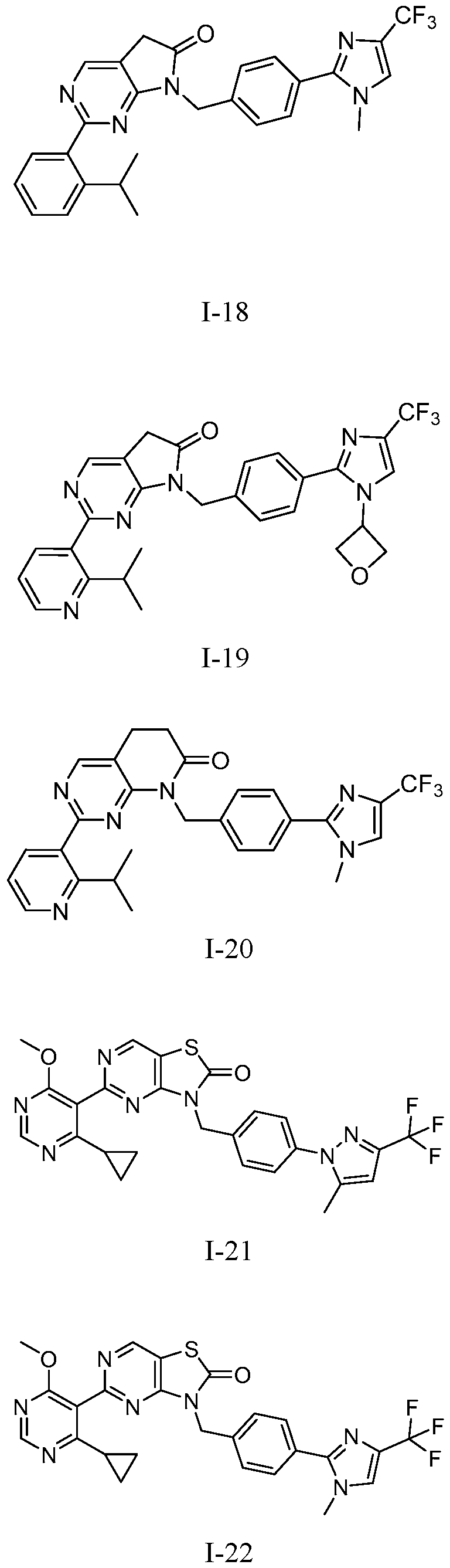
- Example 16 Synthesis of 7-([4-[l-methyl-4-(trifluoromethyl)-lH-imidazol-2- yl] phenyl] methyl)-2- [2-(propan-2-yl)pyridin-3-yl] -5H,6H,7H-pyrr olo [2, 3-d] pyr imidin-6- one (1-16) Step 1. Synthesis of 2-[4-([2-chloro-7H-pyrrolo[2,3-d]pyrimidin-7-yl]methyl)phenyl]-l- methyl-4-(trifluoromethyl)-lH-imidazole
- the reaction mixture was cooled to 25 oC.
- the mixture was filtered through a Celite pad.
- the resulting mixture was concentrated under vacuum.
- the crude product was purified by Prep-HPLC with the following conditions (Prep- HPLC-025): Column: XBridge C18 OBD Prep Column, 100 A, 5 pm, 19 mm x 250 mm;Mobile Phase A: waters (0.05% ammonia in water), Mobile Phase B: ACN; Flow rate: 20 mL/min; Gradient: 35% B to 65% B in 8 min; 254 nm.
- Example 17 Synthesis of 8-methoxy-9-([4-[l-methyl-4-(trifluoromethyl)-lH-imidazol-2- yl] phenyl] methyl)-2- [2-(propan-2-yl)pyridin-3-yl] -9H-purine (1-1 ).
- Step 1 Synthesis of 2-chloro-N-([4-[l-methyl-4-(trifluoromethyl)imidazol-2- yl] phenyl] methyl)-5-nitropyrimidin-4-amine
- the resulting mixture was stirred for 16 h at 90 °C under nitrogen atmosphere. The mixture was allowed to cool down to room temperature. The resulting mixture was filtered, the filter cake was washed with EA (3 x 2000 mL). The filtrate was concentrated under reduced pressure. The resulting mixture was diluted with water (1000 mL). The resulting mixture was extracted with EA (3 x 2000 mL). The combined organic layers were washed with brine (1000 mL), dried over anhydrous Na2S04. After filtration, the filtrate was concentrated under reduced pressure.
- the residue was purified by reverse flash chromatography with the following conditions: column, C18 silica gel; mobile phase, water (containing 0.05% TFA), ACN (5% to 50% gradient in 60 min); detector, LTV 254 nm.
- the residue was purified by reverse flash chromatography with the following conditions: column, C18 silica gel; mobile phase, water (containing 6.5 mM NH4HC03 + NH40H), ACN (0% to 50% gradient in 60 min); detector, UV 254 nm.
- the resulting solution was stirred for 2 h at 100 oC.
- the reaction mixture was cooled to 25 oC.
- the mixture was filtered through a Celite pad.
- the resulting mixture was concentrated under vacuum.
- the crude product was purified by Prep-HPLC with the following conditions (Column: XBridge Prep Shield RP18 OBD Column, 19x150mm, 5pm-13nm; Mobile phase, water with 0.05% NH4HC03 and ACN (30% ACN up to 60% in 8 min); Detector: 254nm).
- Example 19 Synthesis of 7-([4-[l-(oxetan-3-yl)-4-(trifluoromethyl)-lH-imidazol-2- yl] phenyl] methyl)-2- [2-(propan-2-yl)pyridin-3-yl] -5H,6H,7H-pyrr olo [2, 3-d] pyr imidin-6- one (1-19).
- Step 1 Synthesis of [4- [4(trifluoromethyl)-lH-imidazol-2-yl] phenyl] methanol
- Step 7 Synthesis of 7-([4-[l-(oxetan-3-yl)-4-(trifluoromethyl)-lH-imidazol-2- yl] phenyl] methyl)-2- [2-(propan-2-yl)pyridin-3-yl] -5H,6H,7H-pyrr olo [2, 3-d] pyr imidin-6- one (1-19)
- Example A Ubitquin-Rhodamine 110 Assay for USP1 Activity.
- the HTS assay was performed in a final volume of 20 pL in assay buffer containing
- the final concentration of the enzyme (USP1, construct USP1 (1-785, GG670, 671AA)/UAF1 (l-677)-Flag; Viva) in the assay was 100 pM.
- Final substrate (Ub-Rhl 10; Ubiquitin-Rhodamine 110, R&D Systems #U-555) concentration was 25 nM with [Ub-Rhl 10] «Km.
- each assay was performed in a final volume of 15 pL in assay buffer containing 20 mM Tris-HCl (pH 8.0, (1M Tris-HCl, pH 8.0 solution; Corning 46- 031 -CM)), lmM GSH (L-Glutathione reduced; Sigma #G4251), 0.03% BGG (0.22 pM filtered, Sigma, #G7516-25G), and 0.01% Triton X-100 (Sigma, #T9284-10L)).
- Tris-HCl pH 8.0, (1M Tris-HCl, pH 8.0 solution; Corning 46- 031 -CM
- lmM GSH L-Glutathione reduced
- Sigma #G4251 0.03% BGG (0.22 pM filtered, Sigma, #G7516-25G
- Triton X-100 Sigma, #T9284-10L
- Nanoliter quantities of either an 8-point or 10-point, 3-fold serial dilution in DMSO were pre-dispensed into assay plates (Perkin Elmer, ProxiPlate-384 F Plus, #6008269) for a final test concentration range of either 25 pM to 11 nM or 25 pM to 1.3 nM, respectively.
- ICso values were determined by curve fitting of the standard 4 parameter logistic fitting algorithm included in the Activity Base software package: IDBS XE Designer Model205. Data is fitted using the Levenburg Marquardt algorithm.
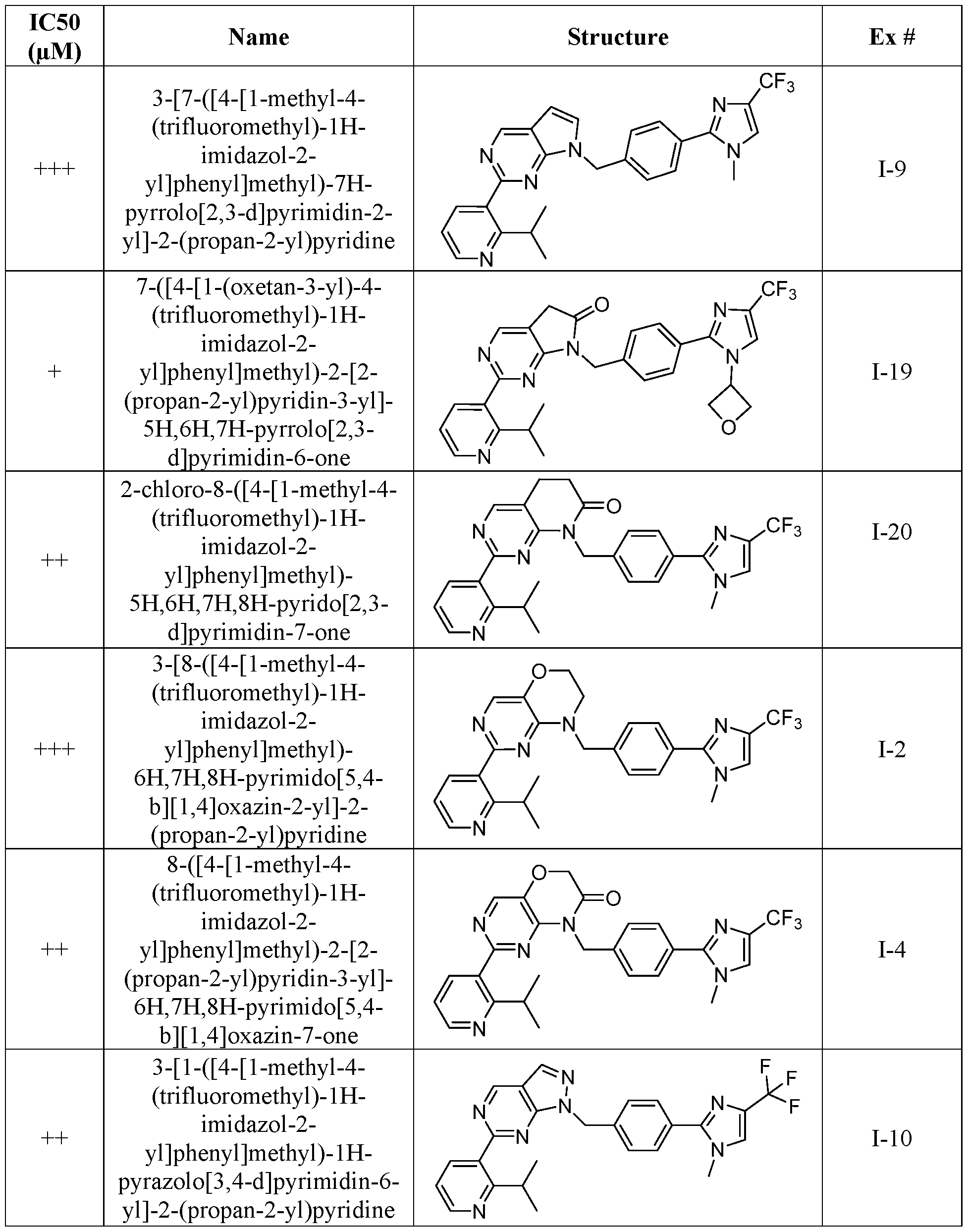
- ICso values are defined as follows: ⁇ 0.010 mM (+++); > 0.010 pM and ⁇ 0.1 pM (++); > 0.1 pM and ⁇ 1.0 pM (+).
Landscapes
- Chemical & Material Sciences (AREA)
- Organic Chemistry (AREA)
- Health & Medical Sciences (AREA)
- Veterinary Medicine (AREA)
- Medicinal Chemistry (AREA)
- Pharmacology & Pharmacy (AREA)
- Life Sciences & Earth Sciences (AREA)
- Animal Behavior & Ethology (AREA)
- General Health & Medical Sciences (AREA)
- Public Health (AREA)
- Epidemiology (AREA)
- Chemical Kinetics & Catalysis (AREA)
- General Chemical & Material Sciences (AREA)
- Nuclear Medicine, Radiotherapy & Molecular Imaging (AREA)
- Pharmaceuticals Containing Other Organic And Inorganic Compounds (AREA)
- Nitrogen Condensed Heterocyclic Rings (AREA)
- Heterocyclic Carbon Compounds Containing A Hetero Ring Having Oxygen Or Sulfur (AREA)
- Medicines That Contain Protein Lipid Enzymes And Other Medicines (AREA)
- Detergent Compositions (AREA)
- Acyclic And Carbocyclic Compounds In Medicinal Compositions (AREA)
- Medicines Containing Plant Substances (AREA)
- Nitrogen And Oxygen Or Sulfur-Condensed Heterocyclic Ring Systems (AREA)
Abstract
Description
























Claims






















Priority Applications (12)
| Application Number | Priority Date | Filing Date | Title |
|---|---|---|---|
| BR112023019075A BR112023019075A2 (en) | 2021-04-07 | 2022-04-06 | INHIBITION OF UBIQUITIN-SPECIFIC PROTEASE 1 (USP1) |
| IL307157A IL307157A (en) | 2021-04-07 | 2022-04-06 | Inhibiting ubiquitin-specific protease 1 (usp1) |
| JP2023562465A JP2024514322A (en) | 2021-04-07 | 2022-04-06 | Inhibiting ubiquitin-specific protease 1 (USP1) |
| CN202280030483.2A CN117241801A (en) | 2021-04-07 | 2022-04-06 | Inhibition of ubiquitin-specific protease 1 (USP 1) |
| KR1020237037844A KR20230167071A (en) | 2021-04-07 | 2022-04-06 | Inhibition of ubiquitin-specific protease 1 (USP1) |
| MX2023011709A MX2023011709A (en) | 2021-04-07 | 2022-04-06 | Inhibiting ubiquitin-specific protease 1 (usp1). |
| EP22785371.0A EP4319758A4 (en) | 2021-04-07 | 2022-04-06 | INHIBITION OF UBIQUITIN-SPECIFIC PROTEASE 1 (USP1) |
| CA3214040A CA3214040A1 (en) | 2021-04-07 | 2022-04-06 | Inhibiting ubiquitin-specific protease 1 (usp1) |
| US18/286,053 US20240239808A1 (en) | 2021-04-07 | 2022-04-06 | Inhibiting ubiquitin-specific protease 1 (usp1) |
| AU2022254062A AU2022254062A1 (en) | 2021-04-07 | 2022-04-06 | Inhibiting ubiquitin-specific protease 1 (usp1) |
| TNP/2023/000250A TN2023000250A1 (en) | 2021-04-07 | 2022-04-06 | Inhibiting ubiquitin-specific protease 1 (usp1) |
| MA62912A MA62912A1 (en) | 2021-04-07 | 2022-04-06 | INHIBITION OF UBIQUITIN-SPECIFIC PROTEASE 1 (USP1) |
Applications Claiming Priority (2)
| Application Number | Priority Date | Filing Date | Title |
|---|---|---|---|
| US202163171796P | 2021-04-07 | 2021-04-07 | |
| US63/171,796 | 2021-04-07 |
Publications (1)
| Publication Number | Publication Date |
|---|---|
| WO2022216820A1 true WO2022216820A1 (en) | 2022-10-13 |
Family
ID=83546542
Family Applications (1)
| Application Number | Title | Priority Date | Filing Date |
|---|---|---|---|
| PCT/US2022/023669 Ceased WO2022216820A1 (en) | 2021-04-07 | 2022-04-06 | Inhibiting ubiquitin-specific protease 1 (usp1) |
Country Status (14)
| Country | Link |
|---|---|
| US (1) | US20240239808A1 (en) |
| EP (1) | EP4319758A4 (en) |
| JP (1) | JP2024514322A (en) |
| KR (1) | KR20230167071A (en) |
| CN (1) | CN117241801A (en) |
| AU (1) | AU2022254062A1 (en) |
| BR (1) | BR112023019075A2 (en) |
| CA (1) | CA3214040A1 (en) |
| CL (1) | CL2023002956A1 (en) |
| IL (1) | IL307157A (en) |
| MA (1) | MA62912A1 (en) |
| MX (1) | MX2023011709A (en) |
| TN (1) | TN2023000250A1 (en) |
| WO (1) | WO2022216820A1 (en) |
Cited By (23)
| Publication number | Priority date | Publication date | Assignee | Title |
|---|---|---|---|---|
| WO2023083297A1 (en) * | 2021-11-12 | 2023-05-19 | Insilico Medicine Ip Limited | Small molecule inhibitors of ubiquitin specific protease 1 (usp1) and uses thereof |
| WO2023083285A1 (en) * | 2021-11-12 | 2023-05-19 | Insilico Medicine Ip Limited | Small molecule inhibitors of ubiquitin specific protease 1 (usp1) and uses thereof |
| CN116496252A (en) * | 2022-04-29 | 2023-07-28 | 江苏亚虹医药科技股份有限公司 | Pyrimidine compound, preparation method and medical application thereof |
| WO2023143424A1 (en) * | 2022-01-27 | 2023-08-03 | 四川海思科制药有限公司 | Azacyclic derivative and medical application thereof |
| WO2023148643A1 (en) * | 2022-02-03 | 2023-08-10 | Aurigene Oncology Limited | Fused bicyclic heterocyclyl compounds as usp1 inhibitors |
| US11739077B2 (en) | 2021-11-12 | 2023-08-29 | Insilico Medicine Ip Limited | Small molecule inhibitors of ubiquitin specific protease 1 (USP1) and uses thereof |
| WO2023216910A1 (en) * | 2022-05-07 | 2023-11-16 | 苏州浦合医药科技有限公司 | Substituted bicyclic heteroaryl compound as usp1 inhibitor |
| WO2024006879A1 (en) * | 2022-06-29 | 2024-01-04 | Zentaur Therapeutics Usa Inc. | Usp1 inhibitors and uses thereof |
| WO2024022266A1 (en) * | 2022-07-25 | 2024-02-01 | Guangdong Newopp Biopharmaceuticals Co., Ltd. | Heteroaryl compounds as inhibitors of usp1 |
| WO2024032647A1 (en) * | 2022-08-09 | 2024-02-15 | 上海济煜医药科技有限公司 | Preparation method for nitrogen-containing heterocyclic compound as ubiquitin-specific protease 1 inhibitor, and application and use thereof |
| WO2024051795A1 (en) * | 2022-09-09 | 2024-03-14 | 正大天晴药业集团股份有限公司 | Substituted purinone derivative used as ubiquitin-specific protease inhibitor |
| WO2024061213A1 (en) * | 2022-09-20 | 2024-03-28 | 正大天晴药业集团股份有限公司 | Carbonyl fused heterocyclic derivative used as ubiquitin-specific protease inhibitor |
| WO2024078436A1 (en) * | 2022-10-09 | 2024-04-18 | 海南先声再明医药股份有限公司 | Heterocyclic pyrimidine compound, pharmaceutical composition and application thereof |
| US20240226107A1 (en) * | 2021-04-09 | 2024-07-11 | Simcere Zaiming Pharmaceutical Co., Ltd. | Ubiquitin-specific protease 1 (usp1) inhibitor |
| WO2024153175A1 (en) * | 2023-01-19 | 2024-07-25 | Laekna Therapeutics Shanghai Co., Ltd. | Heteroaromatic compounds and their use as usp1 inhibitors |
| WO2025007777A1 (en) * | 2023-07-05 | 2025-01-09 | 江苏亚虹医药科技股份有限公司 | Pyrimidine compound, preparation method therefor and medical use thereof |
| WO2025010245A1 (en) | 2023-07-06 | 2025-01-09 | Exelixis, Inc. | Fused pyrazole derivatives as usp1 inhibitors |
| WO2025096505A1 (en) * | 2023-10-31 | 2025-05-08 | Bristol-Myers Squibb Company | Ubiquitin specific processing protease 1 (usp1) compounds |
| WO2025096488A1 (en) * | 2023-10-31 | 2025-05-08 | Bristol-Myers Squibb Company | Ubiquitin specific processing protease 1 (usp1) compounds |
| WO2025096487A1 (en) * | 2023-10-31 | 2025-05-08 | Bristol-Myers Squibb Company | Ubiquitin specific processing protease 1 (usp1) compounds |
| WO2025096539A1 (en) * | 2023-10-31 | 2025-05-08 | Bristol-Myers Squibb Company | Ubiquitin specific processing protease 1 (usp1) compounds |
| WO2025102016A1 (en) | 2023-11-10 | 2025-05-15 | Vrise Therapeutics, Inc. | Novel molecules as inhibitors of dna damage repair pathway |
| WO2025151705A1 (en) | 2024-01-10 | 2025-07-17 | Vrise Therapeutics, Inc. | Novel inhibitors of dna damage repair pathway |
Families Citing this family (4)
| Publication number | Priority date | Publication date | Assignee | Title |
|---|---|---|---|---|
| US11319319B1 (en) | 2021-04-07 | 2022-05-03 | Ventus Therapeutics U.S., Inc. | Compounds for inhibiting NLRP3 and uses thereof |
| US12331048B2 (en) | 2022-10-31 | 2025-06-17 | Ventus Therapeutics U.S., Inc. | Pyrido-[3,4-d]pyridazine amine derivatives useful as NLRP3 inhibitors |
| WO2025067259A1 (en) * | 2023-09-26 | 2025-04-03 | 上海济煜医药科技有限公司 | Preparation method for nitrogen heterocyclic amine compound which acts as ubiquitin-specific protease 1 inhibitor, and application and use |
| TW202535379A (en) * | 2024-01-26 | 2025-09-16 | 大陸商成都微芯藥業有限公司 | Usp1 inhibitor and preparation method and use thereof |
Citations (5)
| Publication number | Priority date | Publication date | Assignee | Title |
|---|---|---|---|---|
| US20150344443A1 (en) * | 2012-12-28 | 2015-12-03 | The United States Of America, As Represented By The Secretary, Department Of Health And Human | Inhibitors of the usp1/uaf1 deubiquitinase complex and uses thereof |
| US20170145012A1 (en) * | 2015-11-20 | 2017-05-25 | Forma Therapeutics, Inc. | Purinones as ubiquitin-specific protease 1 inhibitors |
| US20170202810A1 (en) * | 2010-04-30 | 2017-07-20 | Dana-Farber Cancer Institute, Inc. | Small molecule inhibitors of usp1 deubiquitinating enzyme activity |
| WO2020132269A1 (en) * | 2018-12-20 | 2020-06-25 | KSQ Therapeutics, Inc. | Substituted pyrazolopyrimidines and substituted purines and their use as ubiquitin-specific-processing protease 1 (usp1) inhibitors |
| WO2020139988A1 (en) * | 2018-12-28 | 2020-07-02 | Forma Therapeutics, Inc. | Compositions for inhibiting ubiquitin specific protease 1 |
-
2022
- 2022-04-06 WO PCT/US2022/023669 patent/WO2022216820A1/en not_active Ceased
- 2022-04-06 AU AU2022254062A patent/AU2022254062A1/en active Pending
- 2022-04-06 US US18/286,053 patent/US20240239808A1/en active Pending
- 2022-04-06 EP EP22785371.0A patent/EP4319758A4/en active Pending
- 2022-04-06 IL IL307157A patent/IL307157A/en unknown
- 2022-04-06 CN CN202280030483.2A patent/CN117241801A/en active Pending
- 2022-04-06 MX MX2023011709A patent/MX2023011709A/en unknown
- 2022-04-06 BR BR112023019075A patent/BR112023019075A2/en unknown
- 2022-04-06 KR KR1020237037844A patent/KR20230167071A/en active Pending
- 2022-04-06 TN TNP/2023/000250A patent/TN2023000250A1/en unknown
- 2022-04-06 JP JP2023562465A patent/JP2024514322A/en active Pending
- 2022-04-06 MA MA62912A patent/MA62912A1/en unknown
- 2022-04-06 CA CA3214040A patent/CA3214040A1/en active Pending
-
2023
- 2023-10-03 CL CL2023002956A patent/CL2023002956A1/en unknown
Patent Citations (5)
| Publication number | Priority date | Publication date | Assignee | Title |
|---|---|---|---|---|
| US20170202810A1 (en) * | 2010-04-30 | 2017-07-20 | Dana-Farber Cancer Institute, Inc. | Small molecule inhibitors of usp1 deubiquitinating enzyme activity |
| US20150344443A1 (en) * | 2012-12-28 | 2015-12-03 | The United States Of America, As Represented By The Secretary, Department Of Health And Human | Inhibitors of the usp1/uaf1 deubiquitinase complex and uses thereof |
| US20170145012A1 (en) * | 2015-11-20 | 2017-05-25 | Forma Therapeutics, Inc. | Purinones as ubiquitin-specific protease 1 inhibitors |
| WO2020132269A1 (en) * | 2018-12-20 | 2020-06-25 | KSQ Therapeutics, Inc. | Substituted pyrazolopyrimidines and substituted purines and their use as ubiquitin-specific-processing protease 1 (usp1) inhibitors |
| WO2020139988A1 (en) * | 2018-12-28 | 2020-07-02 | Forma Therapeutics, Inc. | Compositions for inhibiting ubiquitin specific protease 1 |
Non-Patent Citations (1)
| Title |
|---|
| See also references of EP4319758A4 * |
Cited By (24)
| Publication number | Priority date | Publication date | Assignee | Title |
|---|---|---|---|---|
| US20240226107A1 (en) * | 2021-04-09 | 2024-07-11 | Simcere Zaiming Pharmaceutical Co., Ltd. | Ubiquitin-specific protease 1 (usp1) inhibitor |
| WO2023083297A1 (en) * | 2021-11-12 | 2023-05-19 | Insilico Medicine Ip Limited | Small molecule inhibitors of ubiquitin specific protease 1 (usp1) and uses thereof |
| WO2023083285A1 (en) * | 2021-11-12 | 2023-05-19 | Insilico Medicine Ip Limited | Small molecule inhibitors of ubiquitin specific protease 1 (usp1) and uses thereof |
| US11739077B2 (en) | 2021-11-12 | 2023-08-29 | Insilico Medicine Ip Limited | Small molecule inhibitors of ubiquitin specific protease 1 (USP1) and uses thereof |
| WO2023143424A1 (en) * | 2022-01-27 | 2023-08-03 | 四川海思科制药有限公司 | Azacyclic derivative and medical application thereof |
| WO2023148643A1 (en) * | 2022-02-03 | 2023-08-10 | Aurigene Oncology Limited | Fused bicyclic heterocyclyl compounds as usp1 inhibitors |
| CN116496252A (en) * | 2022-04-29 | 2023-07-28 | 江苏亚虹医药科技股份有限公司 | Pyrimidine compound, preparation method and medical application thereof |
| CN116496252B (en) * | 2022-04-29 | 2025-07-22 | 江苏亚虹医药科技股份有限公司 | Pyrimidine compound, preparation method and medical application thereof |
| WO2023216910A1 (en) * | 2022-05-07 | 2023-11-16 | 苏州浦合医药科技有限公司 | Substituted bicyclic heteroaryl compound as usp1 inhibitor |
| WO2024006879A1 (en) * | 2022-06-29 | 2024-01-04 | Zentaur Therapeutics Usa Inc. | Usp1 inhibitors and uses thereof |
| WO2024022266A1 (en) * | 2022-07-25 | 2024-02-01 | Guangdong Newopp Biopharmaceuticals Co., Ltd. | Heteroaryl compounds as inhibitors of usp1 |
| WO2024032647A1 (en) * | 2022-08-09 | 2024-02-15 | 上海济煜医药科技有限公司 | Preparation method for nitrogen-containing heterocyclic compound as ubiquitin-specific protease 1 inhibitor, and application and use thereof |
| WO2024051795A1 (en) * | 2022-09-09 | 2024-03-14 | 正大天晴药业集团股份有限公司 | Substituted purinone derivative used as ubiquitin-specific protease inhibitor |
| WO2024061213A1 (en) * | 2022-09-20 | 2024-03-28 | 正大天晴药业集团股份有限公司 | Carbonyl fused heterocyclic derivative used as ubiquitin-specific protease inhibitor |
| WO2024078436A1 (en) * | 2022-10-09 | 2024-04-18 | 海南先声再明医药股份有限公司 | Heterocyclic pyrimidine compound, pharmaceutical composition and application thereof |
| WO2024153175A1 (en) * | 2023-01-19 | 2024-07-25 | Laekna Therapeutics Shanghai Co., Ltd. | Heteroaromatic compounds and their use as usp1 inhibitors |
| WO2025007777A1 (en) * | 2023-07-05 | 2025-01-09 | 江苏亚虹医药科技股份有限公司 | Pyrimidine compound, preparation method therefor and medical use thereof |
| WO2025010245A1 (en) | 2023-07-06 | 2025-01-09 | Exelixis, Inc. | Fused pyrazole derivatives as usp1 inhibitors |
| WO2025096505A1 (en) * | 2023-10-31 | 2025-05-08 | Bristol-Myers Squibb Company | Ubiquitin specific processing protease 1 (usp1) compounds |
| WO2025096488A1 (en) * | 2023-10-31 | 2025-05-08 | Bristol-Myers Squibb Company | Ubiquitin specific processing protease 1 (usp1) compounds |
| WO2025096487A1 (en) * | 2023-10-31 | 2025-05-08 | Bristol-Myers Squibb Company | Ubiquitin specific processing protease 1 (usp1) compounds |
| WO2025096539A1 (en) * | 2023-10-31 | 2025-05-08 | Bristol-Myers Squibb Company | Ubiquitin specific processing protease 1 (usp1) compounds |
| WO2025102016A1 (en) | 2023-11-10 | 2025-05-15 | Vrise Therapeutics, Inc. | Novel molecules as inhibitors of dna damage repair pathway |
| WO2025151705A1 (en) | 2024-01-10 | 2025-07-17 | Vrise Therapeutics, Inc. | Novel inhibitors of dna damage repair pathway |
Also Published As
| Publication number | Publication date |
|---|---|
| EP4319758A1 (en) | 2024-02-14 |
| JP2024514322A (en) | 2024-04-01 |
| IL307157A (en) | 2023-11-01 |
| CL2023002956A1 (en) | 2024-03-08 |
| BR112023019075A2 (en) | 2023-10-17 |
| AU2022254062A1 (en) | 2023-10-12 |
| TN2023000250A1 (en) | 2025-07-02 |
| MA62912A1 (en) | 2024-05-31 |
| KR20230167071A (en) | 2023-12-07 |
| MX2023011709A (en) | 2023-10-12 |
| US20240239808A1 (en) | 2024-07-18 |
| CN117241801A (en) | 2023-12-15 |
| EP4319758A4 (en) | 2025-07-30 |
| CA3214040A1 (en) | 2022-10-13 |
Similar Documents
| Publication | Publication Date | Title |
|---|---|---|
| EP4319758A1 (en) | Inhibiting ubiquitin-specific protease 1 (usp1) | |
| JP7350005B2 (en) | Heterobicyclic inhibitors of MAT2A and methods of use for the treatment of cancer | |
| CN107108648B (en) | Thieno [2,3-c] pyrroles's -4- ketone derivatives as ERK inhibitor | |
| JP6832430B2 (en) | Inhibitors of cell metabolism | |
| KR101926245B1 (en) | Tank-binding kinase inhibitor compounds | |
| US10858365B2 (en) | Triazolo-pyrimidine compounds and uses thereof | |
| EP2558468B1 (en) | 5, 7-substituted-imidazo [1,2-c] pyrimidines as inhibitors of jak kinases | |
| WO2021121397A1 (en) | Substituted alkynyl heterocyclic compound | |
| CA3189912A1 (en) | Bicyclic compounds, compositions and use thereof | |
| WO2023041049A1 (en) | Heterocyclic compound as sos1 inhibitor and uses thereof | |
| JP2022516882A (en) | MAT2A aza complex bicyclic inhibitor and its use for the treatment of cancer | |
| AU2017200619A1 (en) | Benzothiazol-6-yl acetic acid derivatives and their use for treating an HIV infection | |
| KR20220085735A (en) | Isoxazolidine derivative compounds, and uses thereof | |
| WO2023220541A1 (en) | Tetrahydropyrido[3,4-d]pyrimidines compounds as hpk1 inhibitors | |
| CN112047932B (en) | Pyrazole spleen tyrosine kinase inhibitor and preparation method and use thereof | |
| WO2026006796A1 (en) | Compositions comprising werner syndrome helicase inhibitors and methods of using the same | |
| CN113880842A (en) | Substituted alkynyl heterocycles |
Legal Events
| Date | Code | Title | Description |
|---|---|---|---|
| 121 | Ep: the epo has been informed by wipo that ep was designated in this application |
Ref document number: 22785371 Country of ref document: EP Kind code of ref document: A1 |
|
| WWE | Wipo information: entry into national phase |
Ref document number: 3214040 Country of ref document: CA |
|
| WWE | Wipo information: entry into national phase |
Ref document number: 2301005922 Country of ref document: TH |
|
| WWE | Wipo information: entry into national phase |
Ref document number: 307157 Country of ref document: IL |
|
| WWE | Wipo information: entry into national phase |
Ref document number: 804164 Country of ref document: NZ Ref document number: 2022254062 Country of ref document: AU Ref document number: AU2022254062 Country of ref document: AU Ref document number: P6002499/2023 Country of ref document: AE |
|
| WWE | Wipo information: entry into national phase |
Ref document number: 140250140003004574 Country of ref document: IR |
|
| REG | Reference to national code |
Ref country code: BR Ref legal event code: B01A Ref document number: 112023019075 Country of ref document: BR |
|
| WWE | Wipo information: entry into national phase |
Ref document number: MX/A/2023/011709 Country of ref document: MX |
|
| WWE | Wipo information: entry into national phase |
Ref document number: 202392537 Country of ref document: EA |
|
| WWE | Wipo information: entry into national phase |
Ref document number: 2023562465 Country of ref document: JP |
|
| ENP | Entry into the national phase |
Ref document number: 2022254062 Country of ref document: AU Date of ref document: 20220406 Kind code of ref document: A |
|
| ENP | Entry into the national phase |
Ref document number: 112023019075 Country of ref document: BR Kind code of ref document: A2 Effective date: 20230919 |
|
| WWE | Wipo information: entry into national phase |
Ref document number: 202280030483.2 Country of ref document: CN |
|
| WWE | Wipo information: entry into national phase |
Ref document number: DZP2023001676 Country of ref document: DZ |
|
| WWE | Wipo information: entry into national phase |
Ref document number: 12023553011 Country of ref document: PH Ref document number: 11202307092U Country of ref document: SG |
|
| ENP | Entry into the national phase |
Ref document number: 20237037844 Country of ref document: KR Kind code of ref document: A |
|
| WWE | Wipo information: entry into national phase |
Ref document number: 1020237037844 Country of ref document: KR |
|
| WWE | Wipo information: entry into national phase |
Ref document number: 202317075152 Country of ref document: IN |
|
| WWE | Wipo information: entry into national phase |
Ref document number: 2022785371 Country of ref document: EP |
|
| NENP | Non-entry into the national phase |
Ref country code: DE |
|
| ENP | Entry into the national phase |
Ref document number: 2022785371 Country of ref document: EP Effective date: 20231107 |
|
| WWE | Wipo information: entry into national phase |
Ref document number: 523451047 Country of ref document: SA |
|
| WWG | Wipo information: grant in national office |
Ref document number: 140250140003004574 Country of ref document: IR |
|
| WWP | Wipo information: published in national office |
Ref document number: 140250140003004574 Country of ref document: IR |
|
| WWE | Wipo information: entry into national phase |
Ref document number: 523451047 Country of ref document: SA |
|
| WWW | Wipo information: withdrawn in national office |
Ref document number: 202392537 Country of ref document: EA |
|
| WWR | Wipo information: refused in national office |
Ref document number: 523451047 Country of ref document: SA |