WO2022200636A1 - Pharmaceutical formulations, and methods for the production thereof - Google Patents
Pharmaceutical formulations, and methods for the production thereof Download PDFInfo
- Publication number
- WO2022200636A1 WO2022200636A1 PCT/EP2022/058175 EP2022058175W WO2022200636A1 WO 2022200636 A1 WO2022200636 A1 WO 2022200636A1 EP 2022058175 W EP2022058175 W EP 2022058175W WO 2022200636 A1 WO2022200636 A1 WO 2022200636A1
- Authority
- WO
- WIPO (PCT)
- Prior art keywords
- oil
- fibre
- microparticles
- acacia
- microemulsion
- Prior art date
- Legal status (The legal status is an assumption and is not a legal conclusion. Google has not performed a legal analysis and makes no representation as to the accuracy of the status listed.)
- Ceased
Links
Classifications
-
- A—HUMAN NECESSITIES
- A61—MEDICAL OR VETERINARY SCIENCE; HYGIENE
- A61K—PREPARATIONS FOR MEDICAL, DENTAL OR TOILETRY PURPOSES
- A61K31/00—Medicinal preparations containing organic active ingredients
- A61K31/658—Medicinal preparations containing organic active ingredients o-phenolic cannabinoids, e.g. cannabidiol, cannabigerolic acid, cannabichromene or tetrahydrocannabinol
-
- A—HUMAN NECESSITIES
- A61—MEDICAL OR VETERINARY SCIENCE; HYGIENE
- A61K—PREPARATIONS FOR MEDICAL, DENTAL OR TOILETRY PURPOSES
- A61K9/00—Medicinal preparations characterised by special physical form
- A61K9/0087—Galenical forms not covered by A61K9/02 - A61K9/7023
- A61K9/0095—Drinks; Beverages; Syrups; Compositions for reconstitution thereof, e.g. powders or tablets to be dispersed in a glass of water; Veterinary drenches
-
- A—HUMAN NECESSITIES
- A23—FOODS OR FOODSTUFFS; TREATMENT THEREOF, NOT COVERED BY OTHER CLASSES
- A23D—EDIBLE OILS OR FATS, e.g. MARGARINES, SHORTENINGS OR COOKING OILS
- A23D9/00—Other edible oils or fats, e.g. shortenings or cooking oils
- A23D9/007—Other edible oils or fats, e.g. shortenings or cooking oils characterised by ingredients other than fatty acid triglycerides
-
- A—HUMAN NECESSITIES
- A23—FOODS OR FOODSTUFFS; TREATMENT THEREOF, NOT COVERED BY OTHER CLASSES
- A23D—EDIBLE OILS OR FATS, e.g. MARGARINES, SHORTENINGS OR COOKING OILS
- A23D9/00—Other edible oils or fats, e.g. shortenings or cooking oils
- A23D9/02—Other edible oils or fats, e.g. shortenings or cooking oils characterised by the production or working-up
- A23D9/04—Working-up
- A23D9/05—Forming free-flowing pieces
-
- A—HUMAN NECESSITIES
- A23—FOODS OR FOODSTUFFS; TREATMENT THEREOF, NOT COVERED BY OTHER CLASSES
- A23G—COCOA; COCOA PRODUCTS, e.g. CHOCOLATE; SUBSTITUTES FOR COCOA OR COCOA PRODUCTS; CONFECTIONERY; CHEWING GUM; ICE-CREAM; PREPARATION THEREOF
- A23G3/00—Sweetmeats; Confectionery; Marzipan; Coated or filled products
- A23G3/34—Sweetmeats, confectionery or marzipan; Processes for the preparation thereof
- A23G3/36—Sweetmeats, confectionery or marzipan; Processes for the preparation thereof characterised by the composition containing organic or inorganic compounds
-
- A—HUMAN NECESSITIES
- A23—FOODS OR FOODSTUFFS; TREATMENT THEREOF, NOT COVERED BY OTHER CLASSES
- A23G—COCOA; COCOA PRODUCTS, e.g. CHOCOLATE; SUBSTITUTES FOR COCOA OR COCOA PRODUCTS; CONFECTIONERY; CHEWING GUM; ICE-CREAM; PREPARATION THEREOF
- A23G3/00—Sweetmeats; Confectionery; Marzipan; Coated or filled products
- A23G3/34—Sweetmeats, confectionery or marzipan; Processes for the preparation thereof
- A23G3/36—Sweetmeats, confectionery or marzipan; Processes for the preparation thereof characterised by the composition containing organic or inorganic compounds
- A23G3/40—Sweetmeats, confectionery or marzipan; Processes for the preparation thereof characterised by the composition containing organic or inorganic compounds characterised by the fats used
-
- A—HUMAN NECESSITIES
- A23—FOODS OR FOODSTUFFS; TREATMENT THEREOF, NOT COVERED BY OTHER CLASSES
- A23G—COCOA; COCOA PRODUCTS, e.g. CHOCOLATE; SUBSTITUTES FOR COCOA OR COCOA PRODUCTS; CONFECTIONERY; CHEWING GUM; ICE-CREAM; PREPARATION THEREOF
- A23G3/00—Sweetmeats; Confectionery; Marzipan; Coated or filled products
- A23G3/34—Sweetmeats, confectionery or marzipan; Processes for the preparation thereof
- A23G3/36—Sweetmeats, confectionery or marzipan; Processes for the preparation thereof characterised by the composition containing organic or inorganic compounds
- A23G3/42—Sweetmeats, confectionery or marzipan; Processes for the preparation thereof characterised by the composition containing organic or inorganic compounds characterised by the carbohydrates used, e.g. polysaccharides
-
- A—HUMAN NECESSITIES
- A23—FOODS OR FOODSTUFFS; TREATMENT THEREOF, NOT COVERED BY OTHER CLASSES
- A23G—COCOA; COCOA PRODUCTS, e.g. CHOCOLATE; SUBSTITUTES FOR COCOA OR COCOA PRODUCTS; CONFECTIONERY; CHEWING GUM; ICE-CREAM; PREPARATION THEREOF
- A23G3/00—Sweetmeats; Confectionery; Marzipan; Coated or filled products
- A23G3/34—Sweetmeats, confectionery or marzipan; Processes for the preparation thereof
- A23G3/36—Sweetmeats, confectionery or marzipan; Processes for the preparation thereof characterised by the composition containing organic or inorganic compounds
- A23G3/48—Sweetmeats, confectionery or marzipan; Processes for the preparation thereof characterised by the composition containing organic or inorganic compounds containing plants or parts thereof, e.g. fruits, seeds, extracts
-
- A—HUMAN NECESSITIES
- A23—FOODS OR FOODSTUFFS; TREATMENT THEREOF, NOT COVERED BY OTHER CLASSES
- A23L—FOODS, FOODSTUFFS OR NON-ALCOHOLIC BEVERAGES, NOT OTHERWISE PROVIDED FOR; PREPARATION OR TREATMENT THEREOF
- A23L2/00—Non-alcoholic beverages; Dry compositions or concentrates therefor; Preparation or treatment thereof
- A23L2/52—Adding ingredients
-
- A—HUMAN NECESSITIES
- A23—FOODS OR FOODSTUFFS; TREATMENT THEREOF, NOT COVERED BY OTHER CLASSES
- A23L—FOODS, FOODSTUFFS OR NON-ALCOHOLIC BEVERAGES, NOT OTHERWISE PROVIDED FOR; PREPARATION OR TREATMENT THEREOF
- A23L29/00—Foods or foodstuffs containing additives; Preparation or treatment thereof
- A23L29/30—Foods or foodstuffs containing additives; Preparation or treatment thereof containing carbohydrate syrups; containing sugars; containing sugar alcohols, e.g. xylitol; containing starch hydrolysates, e.g. dextrin
- A23L29/35—Degradation products of starch, e.g. hydrolysates, dextrins; Enzymatically modified starches
-
- A—HUMAN NECESSITIES
- A23—FOODS OR FOODSTUFFS; TREATMENT THEREOF, NOT COVERED BY OTHER CLASSES
- A23L—FOODS, FOODSTUFFS OR NON-ALCOHOLIC BEVERAGES, NOT OTHERWISE PROVIDED FOR; PREPARATION OR TREATMENT THEREOF
- A23L33/00—Modifying nutritive qualities of foods; Dietetic products; Preparation or treatment thereof
- A23L33/10—Modifying nutritive qualities of foods; Dietetic products; Preparation or treatment thereof using additives
- A23L33/105—Plant extracts, their artificial duplicates or their derivatives
-
- A—HUMAN NECESSITIES
- A23—FOODS OR FOODSTUFFS; TREATMENT THEREOF, NOT COVERED BY OTHER CLASSES
- A23L—FOODS, FOODSTUFFS OR NON-ALCOHOLIC BEVERAGES, NOT OTHERWISE PROVIDED FOR; PREPARATION OR TREATMENT THEREOF
- A23L33/00—Modifying nutritive qualities of foods; Dietetic products; Preparation or treatment thereof
- A23L33/10—Modifying nutritive qualities of foods; Dietetic products; Preparation or treatment thereof using additives
- A23L33/115—Fatty acids or derivatives thereof; Fats or oils
-
- A—HUMAN NECESSITIES
- A23—FOODS OR FOODSTUFFS; TREATMENT THEREOF, NOT COVERED BY OTHER CLASSES
- A23L—FOODS, FOODSTUFFS OR NON-ALCOHOLIC BEVERAGES, NOT OTHERWISE PROVIDED FOR; PREPARATION OR TREATMENT THEREOF
- A23L33/00—Modifying nutritive qualities of foods; Dietetic products; Preparation or treatment thereof
- A23L33/20—Reducing nutritive value; Dietetic products with reduced nutritive value
- A23L33/21—Addition of substantially indigestible substances, e.g. dietary fibres
-
- A—HUMAN NECESSITIES
- A61—MEDICAL OR VETERINARY SCIENCE; HYGIENE
- A61K—PREPARATIONS FOR MEDICAL, DENTAL OR TOILETRY PURPOSES
- A61K36/00—Medicinal preparations of undetermined constitution containing material from algae, lichens, fungi or plants, or derivatives thereof, e.g. traditional herbal medicines
- A61K36/18—Magnoliophyta (angiosperms)
- A61K36/185—Magnoliopsida (dicotyledons)
- A61K36/348—Cannabaceae
- A61K36/3482—Cannabis
-
- A—HUMAN NECESSITIES
- A61—MEDICAL OR VETERINARY SCIENCE; HYGIENE
- A61K—PREPARATIONS FOR MEDICAL, DENTAL OR TOILETRY PURPOSES
- A61K9/00—Medicinal preparations characterised by special physical form
- A61K9/10—Dispersions; Emulsions
- A61K9/107—Emulsions ; Emulsion preconcentrates; Micelles
- A61K9/1075—Microemulsions or submicron emulsions; Preconcentrates or solids thereof; Micelles, e.g. made of phospholipids or block copolymers
-
- A—HUMAN NECESSITIES
- A61—MEDICAL OR VETERINARY SCIENCE; HYGIENE
- A61K—PREPARATIONS FOR MEDICAL, DENTAL OR TOILETRY PURPOSES
- A61K9/00—Medicinal preparations characterised by special physical form
- A61K9/14—Particulate form, e.g. powders, Processes for size reducing of pure drugs or the resulting products, Pure drug nanoparticles
- A61K9/141—Intimate drug-carrier mixtures characterised by the carrier, e.g. ordered mixtures, adsorbates, solid solutions, eutectica, co-dried, co-solubilised, co-kneaded, co-milled, co-ground products, co-precipitates, co-evaporates, co-extrudates, co-melts; Drug nanoparticles with adsorbed surface modifiers
- A61K9/146—Intimate drug-carrier mixtures characterised by the carrier, e.g. ordered mixtures, adsorbates, solid solutions, eutectica, co-dried, co-solubilised, co-kneaded, co-milled, co-ground products, co-precipitates, co-evaporates, co-extrudates, co-melts; Drug nanoparticles with adsorbed surface modifiers with organic macromolecular compounds
-
- A—HUMAN NECESSITIES
- A61—MEDICAL OR VETERINARY SCIENCE; HYGIENE
- A61K—PREPARATIONS FOR MEDICAL, DENTAL OR TOILETRY PURPOSES
- A61K9/00—Medicinal preparations characterised by special physical form
- A61K9/14—Particulate form, e.g. powders, Processes for size reducing of pure drugs or the resulting products, Pure drug nanoparticles
- A61K9/16—Agglomerates; Granulates; Microbeadlets ; Microspheres; Pellets; Solid products obtained by spray drying, spray freeze drying, spray congealing,(multiple) emulsion solvent evaporation or extraction
- A61K9/1605—Excipients; Inactive ingredients
- A61K9/1617—Organic compounds, e.g. phospholipids, fats
-
- A—HUMAN NECESSITIES
- A61—MEDICAL OR VETERINARY SCIENCE; HYGIENE
- A61K—PREPARATIONS FOR MEDICAL, DENTAL OR TOILETRY PURPOSES
- A61K9/00—Medicinal preparations characterised by special physical form
- A61K9/14—Particulate form, e.g. powders, Processes for size reducing of pure drugs or the resulting products, Pure drug nanoparticles
- A61K9/16—Agglomerates; Granulates; Microbeadlets ; Microspheres; Pellets; Solid products obtained by spray drying, spray freeze drying, spray congealing,(multiple) emulsion solvent evaporation or extraction
- A61K9/1605—Excipients; Inactive ingredients
- A61K9/1629—Organic macromolecular compounds
- A61K9/1652—Polysaccharides, e.g. alginate, cellulose derivatives; Cyclodextrin
-
- A—HUMAN NECESSITIES
- A61—MEDICAL OR VETERINARY SCIENCE; HYGIENE
- A61K—PREPARATIONS FOR MEDICAL, DENTAL OR TOILETRY PURPOSES
- A61K9/00—Medicinal preparations characterised by special physical form
- A61K9/14—Particulate form, e.g. powders, Processes for size reducing of pure drugs or the resulting products, Pure drug nanoparticles
- A61K9/16—Agglomerates; Granulates; Microbeadlets ; Microspheres; Pellets; Solid products obtained by spray drying, spray freeze drying, spray congealing,(multiple) emulsion solvent evaporation or extraction
- A61K9/1605—Excipients; Inactive ingredients
- A61K9/1664—Compounds of unknown constitution, e.g. material from plants or animals
-
- A—HUMAN NECESSITIES
- A61—MEDICAL OR VETERINARY SCIENCE; HYGIENE
- A61K—PREPARATIONS FOR MEDICAL, DENTAL OR TOILETRY PURPOSES
- A61K9/00—Medicinal preparations characterised by special physical form
- A61K9/14—Particulate form, e.g. powders, Processes for size reducing of pure drugs or the resulting products, Pure drug nanoparticles
- A61K9/16—Agglomerates; Granulates; Microbeadlets ; Microspheres; Pellets; Solid products obtained by spray drying, spray freeze drying, spray congealing,(multiple) emulsion solvent evaporation or extraction
- A61K9/1682—Processes
- A61K9/1694—Processes resulting in granules or microspheres of the matrix type containing more than 5% of excipient
-
- A—HUMAN NECESSITIES
- A61—MEDICAL OR VETERINARY SCIENCE; HYGIENE
- A61K—PREPARATIONS FOR MEDICAL, DENTAL OR TOILETRY PURPOSES
- A61K9/00—Medicinal preparations characterised by special physical form
- A61K9/48—Preparations in capsules, e.g. of gelatin, of chocolate
- A61K9/4808—Preparations in capsules, e.g. of gelatin, of chocolate characterised by the form of the capsule or the structure of the filling; Capsules containing small tablets; Capsules with outer layer for immediate drug release
Definitions
- the invention relates to pharmaceutical formulations and methods for the production thereof.
- the invention relates to pharmaceutical formulations comprising microparticles containing stabilised oil, and methods for the production thereof.
- Hemp oil is recognized for its medicinal and nutritional qualities, partly due to the high amounts of cannabinoids, including cannabidiol (CBD), which have been indicated for numerous conditions including pain associated with multiple sclerosis, inflammatory conditions, and epilepsy.
- CBD cannabidiol
- the development of an oral formulation of Hemp Oil / cannabinoids for mammals is hindered by Hemp Oil’s low oral bioavailability. This means that, when given orally, very little CBD reaches the bloodstream.
- Hemp Oil and CBD are highly susceptible to oxidation and enzymatic degradation in the gastrointestinal tract and has very low permeability across the gut wall.
- a further problem associated with hemp oil products and other food grade oil products is the small and taste of the oil, and the difficulty providing hemp oil in a form in which it can be easily incorporated into aqueous products.
- W002/064109 describes process for extraction of pharmaceutically active cannabinoids from plant material followed by cold filtration, decarboxylation and purification.
- W002/092217 described microcapsules containing a mixture of at least one solubilised vegetable protein and a polyelectrolyte with an opposite charge to the protein, that are subjected to coacervation in an aqueous medium.
- WO201 2/038061 describes polymeric nanocapsules containing microemulsions of water in oil and at least one hydrophilic active ingredient dissolved in the aqueous phase.
- EP0856355 describes enzymatic crosslinking of protein-encapsulated oil particles by complex coacervation.
- US5271961 describes protein microspheres formed by phase separation in a non solvent followed by solvent removal.
- WO201 6/193373 describes a solution to the problem of stabilizing oils in food products by providing a cold gelation method of encapsulating and stabilizing the oil.
- the method comprises providing a microemulsion of oil, protein and sugar, encapsulating droplets of the microemulsion inside a chitosan shell, and polymerizing the core-shell microcapsule in a gelation bath before drying of the microcapsules.
- the core-shell microcapsules of this method provide oil is a stabilized form that can safely transit the stomach and degrade to release the oil in the ileum.
- the chitosan shell also masks the smell of the encapsulated oils. While the process is a good technical solution, it can be expensive due to the cold-gelation methods, and the amount of free (un-encapsulated oil) present in the product is rarely below 10% by volume.
- Aerosolized CBD has been reported to yield rapid peak plasma concentrations in 5- 10 minutes and higher bioavailability than oral administration; however significant dose responses from 10mg - 200mg have not been reported. Due to weak pharmakinetic character, CBD requires stabilisation for delivery through the gastrointestinal tract and further requires a chaperon to aid absorption across the gut wall without significant loss or damage to the molecule.
- the Applicant has addressed the problems of the prior art by providing a method of making a pharmaceutical composition comprising microparticles containing stabilized oil (generally food grade oil, plant oil, fish oil etc.) that results in a microparticle preparation with very low amounts of free oil (typically less than 10% by volume)
- stabilized oil generally food grade oil, plant oil, fish oil etc.
- free oil typically less than 10% by volume
- the encapsulation of the CBD oil provided for excellent bioavailability (Figs. 1 to 4) of the oil in a powder that exhibits excellent hydration properties (Fig. 5).
- the method is also less expensive and energy intensive that the cold gelation methods of the prior art.
- the method comprises making a microemulsion of oil, water and a soluble fibre such as acacia fibre or inulin (referred to hereafter as “fibre”) (and/or cyclodextrin), and processing the microemulsion by freeze-drying and size-reduction to provide a preparation of microparticles (e.g. a powder) that contains very low amounts of free oil.
- the microparticles are gastric resistant and ileal sensitive, and comprise microdroplets of oil stabilized within a continuous fibre or cyclodextrin matrix. Addition of maltodextrin has been found to improve the water dispersibility of the microparticles allowing the microparticles to be formulated in aqueous beverages.
- the present invention may also be used to encapsulate and deliver oil soluble botanical API’s in pharmaceutical compositions, such as for example vinblastine, vincristine, scopolamine base and scopolamine N- butyl briomide.
- the preparation of microparticles is combined with other ingredients to form the pharmaceutical composition of the invention.
- the invention provides a method of making a pharmaceutical composition comprising a preparation of gastro-resistant, ileal-sensitive microparticles, the method comprising the steps of: providing an oil-in-water microemulsion comprising an aqueous phase and a solid phase comprising oil and a matrix forming material selected from acacia in inulin fibre or a cyclodextrin; and treating the microemulsion to remove water and provide a preparation of dried microparticles, wherein: the dried microparticles comprise a dispersed phase of stabilized microdroplets of oil disposed in a continuous solid matrix comprising acacia or inulin fibre or cyclodextrin.
- the oil is CBD oil. In any embodiment, the oil is THC oil. In any embodiment, the oil is food-grade oil extract. In any embodiment the oil is a botanical oil extract or contains a botanical API.
- the matrix forming material is acacia fibre.
- the matrix forming material is a cyclodextrin.
- the oil in water emulsion comprises an emulsifier.
- the preparation of microcapsules contains less than 10% free oil.
- the step of treating the microemulsion comprises freeze-drying, fluid bed drying or vacuum drying the microemulsion to provide a solid cake, and size-reducing the cake to provide the dried microparticles.
- size reduction of the cake comprises shredding grinding of the cake.
- the microemulsion comprises 10-70% of the solid phase and 30- 90% of the aqueous phase (w/w).
- the microemulsion comprises 10-70% of the solid phase and 30- 90% of the aqueous phase (w/w). In any embodiment, the microemulsion comprises 20-30% of the solid phase and 70-80% of the aqueous phase (w/w).
- the solid phase comprises an oligosaccharide filler.
- the oligosaccharide filler may be for example maltodextrin or a cyclodextrin.
- the filler may constitute 2-20% or 4-15% of the solid phase by weight.
- the solid phase comprises maltodextrin. In any embodiment, the solid phase comprises 5-15% or 5-10% of maltodextrin.
- the solid phase comprises fibre and cyclodextrin.
- the weight ratio of fibre to cyclodextrin is at least 2:1 (for example 3:1 or 4:1).
- the solid phase comprises maltodextrin and cyclodextrin.
- the microemulsion comprises 25-45% of the solid phase and 55- 75% of the aqueous phase (w/w).
- the solid phase comprises (or consists essentially of) oil, cyclodextrin and/or fibre, emulsifier, optionally protein, optionally maltodextrin and optionally a divalent metal ion salt.
- Maltodextrin has been found to improve the water dispersibility of the resultant powder.
- a divalent metal ion salt such as a calcium citrate has been found to reduce the free oil content of the powder.
- the solid phase comprises:
- the solid phase comprises:
- cyclodextrin optionally including protein
- emulsifier 0.5 to 2 % emulsifier
- the solid phase comprises:
- cyclodextrin optionally including protein
- emulsifier 0.5 to 2 % emulsifier
- the solid phase comprises (w/w):
- CBD oil 20 to 80 % CBD oil; and 1 to 20 % maltodextrin.
- the solid phase comprises (w/w):
- CBD oil 25 to 75 % CBD oil; and 4 to 16 % maltodextrin.
- the solid phase comprises 5-20% (w/w) protein.
- the protein may be native or denatured.
- the solid phase comprises 1-5% (w/w) divalent metal ion salt.
- the salt may be a citrate.
- the metal ion may be calcium, magnesium or iron.
- the microemulsion consists essentially of water, oil, fibre and/or cyclodextrin, optionally protein, and optionally a filler.
- the microemulsion consists essentially of water, CBD oil, fibre and a filler. In any embodiment, the microemulsion consists essentially of water, oil, fibre and maltodextrin.
- the microemulsion consists essentially of water, CBD oil, fibre, maltodextrin and cyclodextrin.
- the microemulsion consists essentially of water, oil, emulsifier, and cyclodextrin.
- the microemulsion consists essentially of water, oil, emulsifier, cyclodextrin, and a filler such as protein or a sugar-based excipient such as maltodextrin.
- the microemulsion consists essentially of water, oil, emulsifier, cyclodextrin, and a divalent metal ion salt.
- the microemulsion consists essentially of water, oil, emulsifier, cyclodextrin, and one or more additional components selected from protein, maltodextrin and a divalent metal ion salt.
- the oil-in-water microemulsion is formed by a process comprising the steps of: combining water with a matrix forming material selected from fibre and cyclodextrin and allowing the matrix forming material to hydrate; homogenizing the hydrated matrix forming material; adding the oil to the homogenized hydrated matrix forming material; homogenizing the mixture allowing the homogenized mixture to rest for specified time period (for example 5-30 minutes); further homogenizing the mixture; and allowing the further homogenized mixture to rest.
- the matrix forming material is fibre.
- the matrix forming material is cyclodextrin.
- the matrix forming material is fibre and cyclodextrin.
- the oil is CBD oil. In any embodiment, the oil is THC oil. In any embodiment the oil is food grade oil. In any embodiment the oil is a botanical oil extract or contains a botanical API.
- the mixture is homogenised and allowed to rest in an iterative manner.
- the process comprises at least 3, 4 or 5 rounds of homogenisation following by a resting step.
- the homogenisation pressure during the rounds of homogenization/resting is alternated between low pressure (e.g. 30-70 Pa) and high pressure (e.g. 130-170 Pa).
- the pressure during the first round of homogenization may be 50 Pas, and then 150 Pas for the second round, and then 50 Pas for the third round etc.
- the water is heated to at least at 25°C, 40°C, 50°C or 55°C.
- the oil is added to the homogenized hydrated fibre in a drop-by- drop manner, typically during mixing.
- the method comprises three rounds of triple homogenisation processes followed by resting.
- each resting step last for at least 5 minutes and is generally 5- 30 minutes depending on the volume of microemulsion being processed.
- the suspension/mixture is rested at room temperature.
- the microemulsions comprises a filler, in which the method comprises adding the filler to the hydrated fibre and homogenizing the hydrated fibre and filler suspension.
- the homogenisation is performed using an in-tank or in-line three stage homogenizer with the capability to generate high shear rates.
- the invention provides a pharmaceutical composition comprising a preparation of gastro-resistant, ileal-sensitive microparticles and formed according to a method of the invention.
- the invention provides a pharmaceutical composition
- a pharmaceutical composition comprising microparticles and optionally a pharmaceutically acceptable excipient, in which the microparticles comprise oil (typically food grade oil, botanical oil extract, oil containing a botanical API, CBD oil or THC oil), fibre or cyclodextrin and optionally a filler and less than 5% water by weight, in which the oil is provided as stabilized oil microdroplets distributed throughout a continuous solid matrix comprising fibre or cyclodextrin and optionally a filler.
- oil typically food grade oil, botanical oil extract, oil containing a botanical API, CBD oil or THC oil
- the oil is provided as stabilized oil microdroplets distributed throughout a continuous solid matrix comprising fibre or cyclodextrin and optionally a filler.
- the continuous solid matrix comprises acacia fibre. In any embodiment, the continuous solid matrix comprises cyclodextrin. In any embodiment, the continuous solid matrix comprises acacia fibre and cyclodextrin.
- the oil is CBD oil. In any embodiment, the oil is THC oil. In any embodiment the oil is food grade oil extract. In any embodiment the oil is a botanical oil extract or contains a botanical API.
- the microparticle comprises 1-20% oil by weight. In any embodiment, the microparticle comprises 3-13% oil by weight. In any embodiment, the microparticle comprises about 5-10% oil by weight.
- the microparticles have an average dimension of 100-500 microns. In any embodiment, the microparticles have an average dimension of 150- 450 microns. In any embodiment, the microparticles have an average dimension of 150-200 microns. In any embodiment, the microparticles have an average dimension of 250-450 microns. In any embodiment, the microparticles have an average dimension of 250-350 microns. In any embodiment, the microparticles have an average dimension of 350-450 microns.
- the continuous solid matrix comprises filler, in which a weight ratio of fibre to filler is at least 2: 1.
- the microparticle consists essentially of oil, optionally emulsifier, optionally protein, and fibre or cyclodextrtin.
- the microparticle consists essentially of CBD oil, fibre or cyclodextrtin, optionally emulsifier, and optionally protein.
- the microparticle consists essentially of oil, fibre, and maltodextrin.
- the microparticle consists essentially of CBD oil, fibre, and cyclodextrin.
- the microparticle consists essentially of CBD oil, fibre, cyclodextrin and maltodextrin.
- the continuous solid matrix comprises protein, in which a weight ratio of cyclodextrin to protein is 3:1 to 1 :3, or 2:1 to 1 :2, or preferably 2:1 to 1:1.
- the microparticle comprises (or consists essentially of) water, oil, cyclodextrin, emulsifier, optionally protein, optionally maltodextrin and optionally a divalent metal ion salt.
- the microparticle comprises 1-5% (w/w) divalent metal ion salt.
- the salt may be a citrate.
- the metal ion may be calcium, magnesium or iron.
- the microparticle consists essentially of oil, cyclodextrin, emulsifier and optionally protein (or another filler) in which a weight ratio of cyclodextrin to protein (or filler) is at least 2:1 (e.g. 3:1 or 4:1).
- the microparticle comprises (w/w):
- the microparticle comprises (w/w):
- the microparticle comprises (w/w):
- the microparticle comprises (w/w):
- CBD oil 10 to 90 % CBD oil.
- the microparticle comprises (w/w):
- CBD oil 20 to 80 % CBD oil; and 1 to 20 % maltodextrin.
- the microparticle comprises (w/w):
- CBD oil 25 to 75 % CBD oil; and 4 to 16 % maltodextrin.
- the microparticle comprises (or consists essentially of) (w/v): 20 to 75 % cyclodextrin;
- the microparticle comprises (or consists essentially of) (w/v): 53 to 70 % cyclodextrin;
- the microparticle consists essentially of water, oil, emulsifier, cyclodextrin, and a divalent metal ion salt.
- the microemulsion consists essentially of water, oil, emulsifier, cyclodextrin, and one or more additional components selected from protein, maltodextrin and a divalent metal ion salt.
- the oil is an essential oil, or an oil containing fat soluble vitamins.
- free oil constitutes less than 10% by weight of the microparticles.
- free oil constitutes less than 8%, 7% or 6% by weight of the microparticles.
- FIG. 1 HPLC chromatographic results for micro-encapsulated CBD after extraction and release from the encapsulated matrix (low encapsulation loading material 10% CBD).
- Figure 2. HPLC chromatographic results for 15% total CBD content in micro- encapsulated CBD oil materials after extraction and release from the encapsulated matrix. (Medium encapsulation loading material 15% CBD).
- Figure 6 High loaded Botanical Extract (20 % w/w) micro-encapsulated powder.
- Figure 7 Medium loaded Botanical Oil Extract (15% w/w) micro-encapsulated powder
- Figure 8 High loaded Botanical Oil Extract (25% w/w) micro-encapsulated powder
- Figure 9 Percent free oil results after in vitro digestion of micro-encapsulated oil extract materials using human digestion model (Ref: Minekus M, Alminger M, Alvito P, Ballance S, Bohn T, Bourlieu C, Carriere F, Boutrou R, Corredig M, Dupont D, Dufour C, Egger L, Golding M, Karakaya S, Kirkhus B, Le Feunteun S, Lesmes U, Macierzanka A, Mackie A, Marze S, McClements DJ, Menard O, Redo I, Santos CN, Singh RP, Vegarud GE, Wickham MS, Weitschies W, Brodkorb A. A standardised static in vitro digestion method suitable for food - an international consensus. Food Funct. 2014 Jun;5(6):1113-24. doi: 10.1039/c3fo60702j. Epub 2014 May 7. PMID: 24803111./ doi: 10.1039/c3fo60702j.)
- the term “comprise,” or variations thereof such as “comprises” or “comprising,” are to be read to indicate the inclusion of any recited integer (e.g. a feature, element, characteristic, property, method/process step or limitation) or group of integers (e.g. features, element, characteristics, properties, method/process steps or limitations) but not the exclusion of any other integer or group of integers.
- the term “comprising” is inclusive or open-ended and does not exclude additional, unrecited integers or method/process steps.
- the term subject defines any subject, particularly a mammalian subject, for whom treatment is indicated.
- Mammalian subjects include, but are not limited to, humans, domestic animals, farm animals, zoo animals, sport animals, pet animals such as dogs, cats, guinea pigs, rabbits, rats, mice, horses, cattle, cows; primates such as apes, monkeys, orangutans, and chimpanzees; canids such as dogs and wolves; felids such as cats, lions, and tigers; equids such as horses, donkeys, and zebras; food animals such as cows, pigs, and sheep; ungulates such as deer and giraffes; and rodents such as mice, rats, hamsters and guinea pigs.
- the subject is
- the microparticle has a continuous phase comprising acacia fibre (optionally including cyclodextrin and/or maltodextrin) and dispersed phase of microdroplets of oil stabilized within the continuous phase. The oil is stabilized from oxidation within the microp
- preparation of microparticles means a powder which consists essentially of the microparticles (it may also contain some moisture and minor amounts of free oil). Typically, preparation contains less than 10%, 9%, 8%, 7% or 6% free oil. Typically, the preparation is free flowing. Typically, the microparticles constitute at least 96%, 97%, 98% or 99% of the preparation.
- compositions comprise a therapeutically effective amount of an active agent (e.g. food-grade oil. Botanical oil extract, oil containing a fat soluble API or botanical API, fish oil, CBD oil or TFIC oil), and a pharmaceutically acceptable carrier.
- an active agent e.g. food-grade oil. Botanical oil extract, oil containing a fat soluble API or botanical API, fish oil, CBD oil or TFIC oil
- pharmaceutically acceptable carrier e.g. food-grade oil.
- an active agent e.g. food-grade oil.
- Botanical oil extract oil containing a fat soluble API or botanical API, fish oil, CBD oil or TFIC oil
- pharmaceutically acceptable carrier e.g. food-grade oil.
- pharmaceutically acceptable means approved by a regulatory agency of the Federal or a state government or listed in the U.S. Pharmacopeia or other generally recognized pharmacopeia for use in animals, and more particularly in humans.
- carrier refers to a diluent, adjuvant, excipient, or vehicle with which the Therapeutic is administered.
- Such pharmaceutical carriers can be sterile liquids, such as water and oils, including those of petroleum, animal, vegetable or synthetic origin, such as peanut oil, soybean oil, mineral oil, sesame oil and the like. Water is a preferred carrier when the pharmaceutical composition is administered intravenously. Saline solutions and aqueous dextrose and glycerol solutions can also be employed as liquid carriers, particularly for injectable solutions.
- Suitable pharmaceutical excipients include starch, glucose, lactose, sucrose, gelatin, malt, rice, flour, chalk, silica gel, sodium stearate, glycerol monostearate, talc, sodium chloride, dried skim milk, glycerol, propylene glycol, water, ethanol and the like.
- Free oil as applied to a powder means that amount of oil in the powder that is not encapsuled in a microparticle. Thus if a given powder has a free oil content of 5% by weight, this means that 95% by weight of the oil in the powder is encapsuled in the microparticles (and therefore stabilized against oxidation) and 5% by weight is “free”, i.e. not encapsulated and therefore not stabilized.
- “Gastro-resistant” means that the microparticles can survive intact for at least 60 minutes in the simulated stomach digestion model described in Minekus et al. , 1999 and 2014 (A computer-controlled system to simulate conditions of the large intestine with peristaltic mixing, water absorption and absorption of fermentation product, Minekus, M., Smeets-Peeters M, Bernalier A, Marol-Bonnin S, Havenaar R, Marteau P, Alric M, Fonty G, Huis in't Veld JH, Applied Microbiology Biotechnology. 1999 Dec; 53 (1): 108-14) and (Minekus et al., 2014, A standardised static in vitro digestion method suitable for food - an international consensus, Minekus, A. et al., Food Function, 2014, 5, 1113).
- Ileal-sensitive means that the microencapsulates are capable of releasing their contents in vivo in the ileum of a mammal.
- Oil or “Lipid” means triglycerides, monoglycerides, diglycerides, phospholipids, fatty acids (essential or non-essential), oils, or compositions enriched in such lipids such as fish oils, krill oil, algal oil, CBD oil or fractions thereof, purified fatty acid compositions (for example purified LC-PUFA’s, DHA or ARA) and which may contain phospholipids, antioxidants and other fat-soluble components such as fat-soluble vitamins.
- the lipid is a purified fatty acid.
- “Fatty acids” are classified based on the length and saturation characteristics of the carbon chain.
- Fatty acids include fatty acids in various forms, including but not limited to triacylglycerols, diacylglycerols, monoacylglycerols, phospholipids, free fatty acids, esterified fatty acids, and natural or synthetic derivative forms of these fatty acids (e.g. calcium salts of fatty acids, ethyl esters, etc.).
- Short chain fatty acids have 2 to about 7 carbons and are typically saturated.
- Medium chain fatty acids have from about 8 to about 17 carbons and may be saturated or unsaturated.
- Long chain fatty acids have from 18 to 24 or more carbons and may also be saturated or unsaturated In longer chained fatty acids there may be one or more points of unsaturation, giving rise to the terms "monounsaturated” and "polyunsaturated,” respectively.
- the lipid may be derived from any source, for example fish, algae, krill, animals, vegetables, plants (e.g. botanical oils), oils containing fat soluble API’s, oils containing botanical API’s, egg, nuts and seeds.
- the oil is a PUFA, preferably a long-chain PUFA (LC-PUFA).
- LC-PUFAs are categorized according to the number and position of double bonds in the fatty acids according to a well understood nomenclature. There are two common series or families of LC-PUFAs, depending on the position of the double bond closest to the methyl end of the fatty acid: the n-3 (or w-3 or omega-3) series contains a double bond at the third carbon, while the n-6 (or w-6 or omega-6) series has no double bond until the sixth carbon. Examples of LC-PUFA’s include DHA and EPA.
- DHA Docosahexaenoic acid
- EPA icosapentaenoic acid
- DPA(n-3) docosapentaenoic acid n-3
- ARA Arachidonic acid
- DPAn-6 docosapentaenoic acid n-6
- CBD oil refers to an oil or extract fraction derived from any part of the hemp plant of the Cannabis Sativa L. family. It generally contains less than 0.2% tetrahydrocannabinol (THC) (w/w) and 2 - 96 % of cannabidiol (CBD).
- THC tetrahydrocannabinol
- CBD oil employed in the process and products of the present invention may be obtained from hemp seeds, or from hemp plant matter, or both.
- the process of the invention provides hemp oil in a microparticle in a stabilized from, in which the cannabinoid content of the oil is high, for example providing for more than 40 or 50 mg/ g in the encapsulated microparticles.
- the oil may also be enriched in THC which is referred to herein as a THC oil.
- CBD cannabinoid
- Mechoulam et al Journal of Clinical Pharmacology, (2002) 42 (11 Suppl)
- Rustichelli et al 1998 describes how direct gas chromatography (GC) analysis can only determine the total cannabinoid content of plant tissue extracts. This is due to the acidic cannabinoid compounds being converted to neutral cannabinoids by high temperatures when injected into a GC system.
- High performance liquid chromatography (HPLC) can detect both the acidic and neutral forms of cannabinoids.
- This paper outlines a room temperature method of analysis with a mobile phase of methanol/ water in the ration of 80:20 (v/v).
- the flow rate was set to 1.0ml/L min-1 and the injection volume was 20.0pL.
- a mass spectrophotometer (MS) was also used as a method of detection.
- the mass range of m/z 45-700 was scanned once per second.
- the following parameters were set on the MS; the electron impact (El) mode was enabled, ionization energy 70eV; ion source temperature 250°C, filament current 200mA, conversion dynode power -15kV and electron multiplier voltage 1500V.
- CBD CBD-A
- THC Tetrahydrocannabinol
- CBCh Cannabichromene
- HPLC-MS HPLC-MS.
- a HPLC -UV with an ultra violet detector array set at 220nm with 0.04 absorbance full scale is commonly used to measure cannabinoid content.
- HPLC /DAD method can also be used (References: De Backer, B., Debrus, B., Lebrun, P., Thenunis, L., Dubois, N., Decock, L., Verstraete, A., Hubert, P. and Charlier, C. (2009) innovative development and validation of an HPLC/DAD method for the qualitative and quantitative determination of major cannabinoids in cannabis plant material. Journal of Chromatography B, 877(2009) 4115-4124.
- THC Tetrahydrocannabinol, a cannabinol found in Hemp. It is often extracted from hemp as an oil referred to as THC oil.
- Botanical oil refers to an oil extracted from a plant, and generally extracted by cold pressing or heat.
- botanical oils are created from the fatty parts of plants including vegetables, nuts, and seeds in addition to roots, bark, flowers and stems like essential oils.
- examples of botanical oils include Rosehip oil, Evening primrose oil, Almond oil, Calendula oil, and Lavender oil. These oils have proven benefits for the skin and hair.
- Botanical API refers to an active chemical found in plant. Examples include vinblastine, vincristine, scopolamine base and scopolamine N-butyl briomide. Typically, the botanical API is a fat soluble API.
- Microemulsion means an oil emulsion that is formed between oil, an aqueous phase (e.g. water), fibre and/or cyclodextrin optionally in combination with another filler such as maltodextrin or protein, and optionally an emulsifier.
- An emulsifier is generally not essential as fibre contains natural surfactants.
- the microemulsion comprises oil, an aqueous phase, fibre and optionally a filler such as maltodextrin or cyclodextrin. It is a generally clear (non-turbid) and thermodynamically stable emulsion that does not require high shear for its formation.
- the microemulsion is formulated with an aqueous phase (e.g.
- the microemulsion contains about 20 to about 60% solids and about 40 to about 80% aqueous phase, preferably about 25 to about 50% solids and about 50 to about 75% aqueous phase, and more preferably about 30 to about 40 % solids and about 60 to about 70% aqueous phase (weight to weight).
- the ratio by weight of CBD oil to acacia fibre in the solids may be about 1 :4 to 4:1 , about 1 :3 to 3:1 or about 1 :2 to 2:1.
- the solids generally comprise 25-75% oil and 25-75% fibre (or fibre and a filler such as maltodextrin).
- the solids typically comprise 20-60% oil and 25-75% fibre (or fibre and a filler such as maltodextrin).
- a surfactant may be included and generally constitutes less than 5% of the solids.
- all of the components of the microemulsion have GRAS (generally recognized as safe) status (https://www.fda.qov/food/food-inqredients-packaginq/qenerallv-recoqnized-safe- Jerusalem).
- “Microdroplet” as applied to the oil in the microparticle means a discrete droplet of CBD oil having an average dimension of 20 - 500 microns and as applied to oil in the microparticle means a discrete droplet of oil having an average dimension in the nanometer or micron range, suitably of less than 300 or 200 microns and ideally of 10 microns to 150 microns.
- “Loading content” as applied to oil and the method of the invention refers to the amount of oil that is used in the process compared to the amount of oil that is retained in the preparation of microparticles produced by the method.
- Fibre refers to a soluble fibre (e.g. at least 85% soluble fibre by weight) typically having a viscosity of 550-900 cp at 10% v/w. Examples include acacia fibre and inulin fibre. “Acacia fibre” refers to a fibre obtained from the sap of the Acacia tree. It is also known as gum Arabic. It is often provided as a powder. “Inulin” refers to a soluble fibre that is a type of prebiotic. It's not digested or absorbed in the stomach. It stays in the bowel and helps certain beneficial bacteria to grow.
- Inulin is a starchy substance found in a wide variety of fruits, vegetables, and herbs, including wheat, onions, bananas, leeks, artichokes, and asparagus.
- the inulin that is used in supplements most commonly comes from soaking chicory roots in hot water.
- Emmulsifier refers to a surfactant suitable for forming a microemulsion. It is optional in the method and products of the invention.
- An example is lecithin, for example sunflower lecithin.
- the surfactant is employed as a minor amount (e.g. less than 5%, 4%, 2%, 2% or about 1 % of the microemulsion).
- Other emulsifiers include mono and diglycerols, locust bean gum and xanthan gum.
- Cyclodextrin refer to a member of the family of cyclic oligosaccharides, consisting of a macrocyclic ring of glucose subunits joined by a-1 ,4 glycosidic bonds. Cyclodextrins are produced from starch by enzymatic conversion. Cyclodextrins are composed of 5 or more a-D-glucopyranoside units linked 1->4, as in amylose (a fragment of starch). The largest cyclodextrin contains 32 1 ,4- anhydroglucopyranoside units, while as a poorly characterized mixture, at least 150- membered cyclic oligosaccharides are also known.
- Typical cyclodextrins contain a number of glucose monomers ranging from six to eight units in a ring, creating a cone shape. “Treating the microemulsion to remove water and provide a preparation of dried microparticles” means drying the microemulsion to provide a solid microemulsion cake and optionally size-reducing the solid. Treatments include freeze-drying or vacuum drying followed by size reduction, or spray drying, to provide the preparation of microparticles.
- CBD Cannabidiol
- CBD micro-encapsulated powder - 5% Cannabidiol (CBD) Table 7.
- the mixture is then homogenized through single or three stage homogenizer twice for minimum 10 minutes.
- the formed microemulsion is poured into a tray at a depth of 1cm
- Freeze-Drying - Pro-cool Tray Set temperature of trays to -50 °C for 90 minutes in semi-automatic mode. This mode is commonly used to freeze the product. The equipment will maintain the shelf temperature until another action is operated. Typical Cool Down ratio for commercial lyophilizer for 20 °C to -40 °C in 60 minutes. Thereafter, addition time is needed to cool from -40 °C to -50 °C in 30 minutes; hence total time for cooling 90 minutes.
- Typical Cool Down ratio for commercial lyophilizer for 20 °C to -40 °C in 60 minutes. Thereafter, addition time is needed to cool from -40 °C to -50 °C in 30 minutes; hence total time for cooling 90 minutes.
- Secondary drying this initiates removal of remaining moisture from the concentrate after completion of primary drying by controlling the shelves to the required temperature and vacuum level.
- Emulsion cake from freeze drying tray is size reduced in a commercial grinder before being sieved to an average particle dimension of 300- 500pm.
- Powder is dried to achieve moisture content ⁇ 4%.
- Micro-emulsion is sprayed onto a maltodextrin and / or inulin carrier at 37 - 39 DegC with a product temperature for 30 minutes - 4 hours Powder is dried to achieve moisture content ⁇ 4%.
Landscapes
- Health & Medical Sciences (AREA)
- Life Sciences & Earth Sciences (AREA)
- Chemical & Material Sciences (AREA)
- Engineering & Computer Science (AREA)
- Polymers & Plastics (AREA)
- Food Science & Technology (AREA)
- Bioinformatics & Cheminformatics (AREA)
- Animal Behavior & Ethology (AREA)
- Veterinary Medicine (AREA)
- Medicinal Chemistry (AREA)
- Public Health (AREA)
- General Health & Medical Sciences (AREA)
- Pharmacology & Pharmacy (AREA)
- Epidemiology (AREA)
- Botany (AREA)
- Nutrition Science (AREA)
- Natural Medicines & Medicinal Plants (AREA)
- Oil, Petroleum & Natural Gas (AREA)
- Mycology (AREA)
- Inorganic Chemistry (AREA)
- Molecular Biology (AREA)
- Alternative & Traditional Medicine (AREA)
- Microbiology (AREA)
- Medical Informatics (AREA)
- Biophysics (AREA)
- Biotechnology (AREA)
- Dispersion Chemistry (AREA)
- Zoology (AREA)
- Medicinal Preparation (AREA)
- Edible Oils And Fats (AREA)
Abstract
Pharmaceutical compositions containing microparticles containing stabilised oil, and methods for the production thereof. Pharmaceutical compositions that contain microparticles are described. The microparticles contain oil such as botanical oil extracts, CBD oil or THC oil stabilized in an acacia fibre, inulin fibre or cyclodextrin matrix. Methods for the production of the pharmaceutical compositions comprise making the microparticles by providing an oil-in-water microemulsion comprising oil, water, acacia or inulin fibre and optionally maltodextrin or cyclodextrin, and drying the microemulsion to remove water and provide a preparation of dried microparticles. The dried microparticles comprise a dispersed phase of stabilized microdroplets of oil disposed in a continuous solid matrix comprising acacia or inulin fibre. The preparation of microcapsules contains less than 10% free oil, exhibits good hydration properties, and contains oil in highly bioavailable format.
Description
Title
Pharmaceutical formulations, and methods for the production thereof
Technical Field
The invention relates to pharmaceutical formulations and methods for the production thereof. In particular, the invention relates to pharmaceutical formulations comprising microparticles containing stabilised oil, and methods for the production thereof.
Background to the Invention
Hemp oil is recognized for its medicinal and nutritional qualities, partly due to the high amounts of cannabinoids, including cannabidiol (CBD), which have been indicated for numerous conditions including pain associated with multiple sclerosis, inflammatory conditions, and epilepsy. The development of an oral formulation of Hemp Oil / cannabinoids for mammals is hindered by Hemp Oil’s low oral bioavailability. This means that, when given orally, very little CBD reaches the bloodstream. The reason for this is that Hemp Oil and CBD are highly susceptible to oxidation and enzymatic degradation in the gastrointestinal tract and has very low permeability across the gut wall. A further problem associated with hemp oil products and other food grade oil products is the small and taste of the oil, and the difficulty providing hemp oil in a form in which it can be easily incorporated into aqueous products.
W002/064109 describes process for extraction of pharmaceutically active cannabinoids from plant material followed by cold filtration, decarboxylation and purification.
W002/092217 described microcapsules containing a mixture of at least one solubilised vegetable protein and a polyelectrolyte with an opposite charge to the protein, that are subjected to coacervation in an aqueous medium.
WO201 2/038061 describes polymeric nanocapsules containing microemulsions of water in oil and at least one hydrophilic active ingredient dissolved in the aqueous phase.
EP0856355 describes enzymatic crosslinking of protein-encapsulated oil particles by complex coacervation.
US5271961 describes protein microspheres formed by phase separation in a non solvent followed by solvent removal.
WO201 6/193373 describes a solution to the problem of stabilizing oils in food products by providing a cold gelation method of encapsulating and stabilizing the oil. The method comprises providing a microemulsion of oil, protein and sugar, encapsulating droplets of the microemulsion inside a chitosan shell, and polymerizing the core-shell microcapsule in a gelation bath before drying of the microcapsules. The core-shell microcapsules of this method provide oil is a stabilized form that can safely transit the stomach and degrade to release the oil in the ileum. The chitosan shell also masks the smell of the encapsulated oils. While the process is a good technical solution, it can be expensive due to the cold-gelation methods, and the amount of free (un-encapsulated oil) present in the product is rarely below 10% by volume.
WHO dossier ( Cannabidiol Expert Committee on Drug Dependence 39 ECDD (2017) Agenda item 5.2) outlines that oral delivery of an oil-based capsule formulation of CBD has been assessed in human with low biovailability results, due to its poor aqueous solubility and absorption of CBD from the gastrointestinal tract. These weakness result in a poor pharmacokinetic profile is variable absorption rates and no therapeutic effect. Bioavailability from oral delivery of CBD is estimated to be 6 % due these absorption issue in the mammal which is linked to significant first- pass metabolism (REFERENCE: Hawksworth, G. and K. McArdle, Metabolism and pharmacokinetics of cannabinoids. The Medicinal Uses of Cannabis and Cannabinoids. Pharmaceutical Press, London, 2004: p. 205-228.)
In healthy male volunteers, the mean ±S D whole blood levels of CBD at 1 , 2 and 3 hours after administration of 600 mg oral CBD were reported to be 0.36 (0.64) ng/mL, 1.62 (2.98) ng/mL and 3.4 (6.42) ng/mL, respectively (REFERENCE: Martin- Santos, R., et al. , Acute effects of a single, oral dose ofd9- tetrahydrocannabinol (THC) and cannabidiol (CBD) administration in healthy volunteers. Curr Pharm Des, 2012. 18(32): p. 4966-79).
Aerosolized CBD has been reported to yield rapid peak plasma concentrations in 5- 10 minutes and higher bioavailability than oral administration; however significant
dose responses from 10mg - 200mg have not been reported. Due to weak pharmakinetic character, CBD requires stabilisation for delivery through the gastrointestinal tract and further requires a chaperon to aid absorption across the gut wall without significant loss or damage to the molecule.
It is an object of the invention to overcome at least one of the above-referenced problems. In particular, it is an object of the invention to provide a pharmaceutical composition (optionally in a powder form) that contains CBD oil that is stable to oxidation and contains low amounts of free oil. It is another object of the invention to provide a process for producing a pharmaceutical composition that is less expensive and energy intensive than the prior art.
It is another object of the invention to provide a pharmaceutical product having a greater bioavailability oil-borne active agents such as CBD, THC and botanical actives for improved dose response for therapeutic effects via encapsulation technology.
Summary of the Invention
The Applicant has addressed the problems of the prior art by providing a method of making a pharmaceutical composition comprising microparticles containing stabilized oil (generally food grade oil, plant oil, fish oil etc.) that results in a microparticle preparation with very low amounts of free oil (typically less than 10% by volume)
(Fig. 9). In addition, the encapsulation of the CBD oil provided for excellent bioavailability (Figs. 1 to 4) of the oil in a powder that exhibits excellent hydration properties (Fig. 5). The method is also less expensive and energy intensive that the cold gelation methods of the prior art. The method comprises making a microemulsion of oil, water and a soluble fibre such as acacia fibre or inulin (referred to hereafter as “fibre”) (and/or cyclodextrin), and processing the microemulsion by freeze-drying and size-reduction to provide a preparation of microparticles (e.g. a powder) that contains very low amounts of free oil. The microparticles are gastric resistant and ileal sensitive, and comprise microdroplets of oil stabilized within a continuous fibre or cyclodextrin matrix. Addition of maltodextrin has been found to improve the water dispersibility of the microparticles allowing the microparticles to be formulated in aqueous beverages. The present invention may also be used to
encapsulate and deliver oil soluble botanical API’s in pharmaceutical compositions, such as for example vinblastine, vincristine, scopolamine base and scopolamine N- butyl briomide. The preparation of microparticles is combined with other ingredients to form the pharmaceutical composition of the invention.
In a first aspect, the invention provides a method of making a pharmaceutical composition comprising a preparation of gastro-resistant, ileal-sensitive microparticles, the method comprising the steps of: providing an oil-in-water microemulsion comprising an aqueous phase and a solid phase comprising oil and a matrix forming material selected from acacia in inulin fibre or a cyclodextrin; and treating the microemulsion to remove water and provide a preparation of dried microparticles, wherein: the dried microparticles comprise a dispersed phase of stabilized microdroplets of oil disposed in a continuous solid matrix comprising acacia or inulin fibre or cyclodextrin.
In any embodiment, the oil is CBD oil. In any embodiment, the oil is THC oil. In any embodiment, the oil is food-grade oil extract. In any embodiment the oil is a botanical oil extract or contains a botanical API.
In any embodiment, the matrix forming material is acacia fibre.
In any embodiment, the matrix forming material is a cyclodextrin.
In any embodiment, the oil in water emulsion comprises an emulsifier.
In any embodiment, the preparation of microcapsules contains less than 10% free oil.
In any embodiment, the step of treating the microemulsion comprises freeze-drying, fluid bed drying or vacuum drying the microemulsion to provide a solid cake, and
size-reducing the cake to provide the dried microparticles. Typically, size reduction of the cake comprises shredding grinding of the cake.
In any embodiment, the microemulsion comprises 10-70% of the solid phase and 30- 90% of the aqueous phase (w/w).
In any embodiment, the microemulsion comprises 10-70% of the solid phase and 30- 90% of the aqueous phase (w/w). In any embodiment, the microemulsion comprises 20-30% of the solid phase and 70-80% of the aqueous phase (w/w).
In any embodiment, the solid phase comprises an oligosaccharide filler. The oligosaccharide filler may be for example maltodextrin or a cyclodextrin. The filler may constitute 2-20% or 4-15% of the solid phase by weight.
In any embodiment, the solid phase comprises maltodextrin. In any embodiment, the solid phase comprises 5-15% or 5-10% of maltodextrin.
In any embodiment, the solid phase comprises fibre and cyclodextrin. In any embodiment, the weight ratio of fibre to cyclodextrin is at least 2:1 (for example 3:1 or 4:1).
In any embodiment, the solid phase comprises maltodextrin and cyclodextrin.
In any embodiment, the microemulsion comprises 25-45% of the solid phase and 55- 75% of the aqueous phase (w/w).
In any embodiment, the solid phase comprises (or consists essentially of) oil, cyclodextrin and/or fibre, emulsifier, optionally protein, optionally maltodextrin and optionally a divalent metal ion salt. Maltodextrin has been found to improve the water dispersibility of the resultant powder. A divalent metal ion salt such as a calcium citrate has been found to reduce the free oil content of the powder.
In any embodiment, the solid phase comprises:
10-90% oil;
10-90% cyclodextrin or fibre and optionally including protein; and 0.1 to 5 % emulsifier.
In any embodiment, the solid phase comprises:
30-40% oil;
60-70% cyclodextrin optionally including protein; and 0.5 to 2 % emulsifier.
In any embodiment, the solid phase comprises:
30-40% oil;
60-70% cyclodextrin optionally including protein; and 0.5 to 2 % emulsifier.
In any embodiment, the solid phase comprises (w/w):
20 to 80 % fibre;
20 to 80 % CBD oil; and 1 to 20 % maltodextrin.
In any embodiment, the solid phase comprises (w/w):
20 to 60 % fibre;
25 to 75 % CBD oil; and 4 to 16 % maltodextrin.
In any embodiment, the solid phase comprises 5-20% (w/w) protein. The protein may be native or denatured.
In any embodiment, the solid phase comprises 1-5% (w/w) divalent metal ion salt. The salt may be a citrate. The metal ion may be calcium, magnesium or iron.
In any embodiment, the microemulsion consists essentially of water, oil, fibre and/or cyclodextrin, optionally protein, and optionally a filler.
In any embodiment, the microemulsion consists essentially of water, CBD oil, fibre and a filler.
In any embodiment, the microemulsion consists essentially of water, oil, fibre and maltodextrin.
In any embodiment, the microemulsion consists essentially of water, CBD oil, fibre, maltodextrin and cyclodextrin.
In any embodiment, the microemulsion consists essentially of water, oil, emulsifier, and cyclodextrin.
In any embodiment, the microemulsion consists essentially of water, oil, emulsifier, cyclodextrin, and a filler such as protein or a sugar-based excipient such as maltodextrin.
In any embodiment, the microemulsion consists essentially of water, oil, emulsifier, cyclodextrin, and a divalent metal ion salt.
In any embodiment, the microemulsion consists essentially of water, oil, emulsifier, cyclodextrin, and one or more additional components selected from protein, maltodextrin and a divalent metal ion salt.
In any embodiment, the oil-in-water microemulsion is formed by a process comprising the steps of: combining water with a matrix forming material selected from fibre and cyclodextrin and allowing the matrix forming material to hydrate; homogenizing the hydrated matrix forming material; adding the oil to the homogenized hydrated matrix forming material; homogenizing the mixture allowing the homogenized mixture to rest for specified time period (for example 5-30 minutes); further homogenizing the mixture; and allowing the further homogenized mixture to rest.
In any embodiment, the matrix forming material is fibre. In any embodiment, the matrix forming material is cyclodextrin. In any embodiment, the matrix forming material is fibre and cyclodextrin.
In any embodiment, the oil is CBD oil. In any embodiment, the oil is THC oil. In any embodiment the oil is food grade oil. In any embodiment the oil is a botanical oil extract or contains a botanical API.
In any embodiment, the mixture is homogenised and allowed to rest in an iterative manner. In any embodiment, the process comprises at least 3, 4 or 5 rounds of homogenisation following by a resting step.
In any embodiment, the homogenisation pressure during the rounds of homogenization/resting is alternated between low pressure (e.g. 30-70 Pa) and high pressure (e.g. 130-170 Pa). Thus, the pressure during the first round of homogenization may be 50 Pas, and then 150 Pas for the second round, and then 50 Pas for the third round etc.
In any embodiment, the water is heated to at least at 25°C, 40°C, 50°C or 55°C.
In any embodiment, the oil is added to the homogenized hydrated fibre in a drop-by- drop manner, typically during mixing.
In any embodiment, the method comprises three rounds of triple homogenisation processes followed by resting.
In any embodiment, each resting step last for at least 5 minutes and is generally 5- 30 minutes depending on the volume of microemulsion being processed.
In any embodiment, the suspension/mixture is rested at room temperature.
In any embodiment, the microemulsions comprises a filler, in which the method comprises adding the filler to the hydrated fibre and homogenizing the hydrated fibre and filler suspension.
In any embodiment, the homogenisation is performed using an in-tank or in-line three stage homogenizer with the capability to generate high shear rates.
In a further aspect, the invention provides a pharmaceutical composition comprising a preparation of gastro-resistant, ileal-sensitive microparticles and formed according to a method of the invention.
In a further aspect, the invention provides a pharmaceutical composition comprising microparticles and optionally a pharmaceutically acceptable excipient, in which the microparticles comprise oil (typically food grade oil, botanical oil extract, oil containing a botanical API, CBD oil or THC oil), fibre or cyclodextrin and optionally a filler and less than 5% water by weight, in which the oil is provided as stabilized oil microdroplets distributed throughout a continuous solid matrix comprising fibre or cyclodextrin and optionally a filler.
In any embodiment, the continuous solid matrix comprises acacia fibre. In any embodiment, the continuous solid matrix comprises cyclodextrin. In any embodiment, the continuous solid matrix comprises acacia fibre and cyclodextrin.
In any embodiment, the oil is CBD oil. In any embodiment, the oil is THC oil. In any embodiment the oil is food grade oil extract. In any embodiment the oil is a botanical oil extract or contains a botanical API.
In any embodiment, the microparticle comprises 1-20% oil by weight. In any embodiment, the microparticle comprises 3-13% oil by weight. In any embodiment, the microparticle comprises about 5-10% oil by weight.
In any embodiment, the microparticles have an average dimension of 100-500 microns. In any embodiment, the microparticles have an average dimension of 150- 450 microns. In any embodiment, the microparticles have an average dimension of 150-200 microns. In any embodiment, the microparticles have an average dimension of 250-450 microns. In any embodiment, the microparticles have an average
dimension of 250-350 microns. In any embodiment, the microparticles have an average dimension of 350-450 microns.
In any embodiment, the continuous solid matrix comprises filler, in which a weight ratio of fibre to filler is at least 2: 1.
In any embodiment, the microparticle consists essentially of oil, optionally emulsifier, optionally protein, and fibre or cyclodextrtin.
In any embodiment, the microparticle consists essentially of CBD oil, fibre or cyclodextrtin, optionally emulsifier, and optionally protein.
In any embodiment, the microparticle consists essentially of oil, fibre, and maltodextrin.
In any embodiment, the microparticle consists essentially of CBD oil, fibre, and cyclodextrin.
In any embodiment, the microparticle consists essentially of CBD oil, fibre, cyclodextrin and maltodextrin.
In any embodiment, the continuous solid matrix comprises protein, in which a weight ratio of cyclodextrin to protein is 3:1 to 1 :3, or 2:1 to 1 :2, or preferably 2:1 to 1:1.
In any embodiment, the microparticle comprises (or consists essentially of) water, oil, cyclodextrin, emulsifier, optionally protein, optionally maltodextrin and optionally a divalent metal ion salt.
In any embodiment, the microparticle comprises 1-5% (w/w) divalent metal ion salt. The salt may be a citrate. The metal ion may be calcium, magnesium or iron.
In any embodiment, the microparticle consists essentially of oil, cyclodextrin, emulsifier and optionally protein (or another filler) in which a weight ratio of cyclodextrin to protein (or filler) is at least 2:1 (e.g. 3:1 or 4:1).
In any embodiment, the microparticle comprises (w/w):
10 to 90 % fibre or cyclodextrin;
10 to 90 % oil.
In any embodiment, the microparticle comprises (w/w):
20 to 80 % fibre or cyclodextrin;
20 to 80 % oil; and 1 to 20 % maltodextrin.
In any embodiment, the microparticle comprises (w/w):
20 to 60 % fibre or cyclodextrin;
25 to 75 % oil; and 4 to 16 % maltodextrin.
In any embodiment, the microparticle comprises (w/w):
10 to 90 % fibre;
10 to 90 % CBD oil.
In any embodiment, the microparticle comprises (w/w):
20 to 80 % fibre;
20 to 80 % CBD oil; and 1 to 20 % maltodextrin.
In any embodiment, the microparticle comprises (w/w):
20 to 60 % fibre;
25 to 75 % CBD oil; and 4 to 16 % maltodextrin.
In any embodiment, the microparticle comprises (or consists essentially of) (w/v): 20 to 75 % cyclodextrin;
0.1 to 5.0% emulsifier;
20 to 75 % oil; and less than 1 % water.
In any embodiment, the microparticle comprises (or consists essentially of) (w/v): 53 to 70 % cyclodextrin;
0.1 to 2.0% emulsifier;
28 to 45 % oil; and less than 1 % water.
In any embodiment, the microparticle consists essentially of water, oil, emulsifier, cyclodextrin, and a divalent metal ion salt.
In any embodiment, the microemulsion consists essentially of water, oil, emulsifier, cyclodextrin, and one or more additional components selected from protein, maltodextrin and a divalent metal ion salt.
In any embodiment, the oil is an essential oil, or an oil containing fat soluble vitamins.
In any embodiment, free oil constitutes less than 10% by weight of the microparticles.
In any embodiment, free oil constitutes less than 8%, 7% or 6% by weight of the microparticles.
Other aspects and preferred embodiments of the invention are defined and described in the other claims set out below.
Brief Description of the Fiqures
Figure 1. HPLC chromatographic results for micro-encapsulated CBD after extraction and release from the encapsulated matrix (low encapsulation loading material 10% CBD).
Figure 2. HPLC chromatographic results for 15% total CBD content in micro- encapsulated CBD oil materials after extraction and release from the encapsulated matrix. (Medium encapsulation loading material 15% CBD).
Figure 3. HPLC chromatographic results for micro-encapsulated oil extract materials after extraction and release from the encapsulated matrix. (High encapsulation loading material 20% CBD).
Figure 4. HPLC chromatographic results for micro-encapsulated oil extract materials after extraction and release from the encapsulated matrix. (High encapsulation loading material 25% CBD).
Figure 5. Hydration of micro-encapsulated oil extract (20% oil loading) in cold water. Powder hydrates easily and not surface oil is evident.
Figure 6: High loaded Botanical Extract (20 % w/w) micro-encapsulated powder.
Figure 7: Medium loaded Botanical Oil Extract (15% w/w) micro-encapsulated powder
Figure 8: High loaded Botanical Oil Extract (25% w/w) micro-encapsulated powder
Figure 9. Percent free oil results after in vitro digestion of micro-encapsulated oil extract materials using human digestion model (Ref: Minekus M, Alminger M, Alvito P, Ballance S, Bohn T, Bourlieu C, Carriere F, Boutrou R, Corredig M, Dupont D, Dufour C, Egger L, Golding M, Karakaya S, Kirkhus B, Le Feunteun S, Lesmes U, Macierzanka A, Mackie A, Marze S, McClements DJ, Menard O, Redo I, Santos CN, Singh RP, Vegarud GE, Wickham MS, Weitschies W, Brodkorb A. A standardised static in vitro digestion method suitable for food - an international consensus. Food Funct. 2014 Jun;5(6):1113-24. doi: 10.1039/c3fo60702j. Epub 2014 May 7. PMID: 24803111./ doi: 10.1039/c3fo60702j.)
Figure 10. Particle Size Distribution (PSD) for encapsulated oil extract materials.
Detailed Description of the Invention
All publications, patents, patent applications and other references mentioned herein are hereby incorporated by reference in their entireties for all purposes as if each individual publication, patent or patent application were specifically and individually indicated to be incorporated by reference and the content thereof recited in full.
Definitions and general preferences
Where used herein and unless specifically indicated otherwise, the following terms are intended to have the following meanings in addition to any broader (or narrower) meanings the terms might enjoy in the art:
Unless otherwise required by context, the use herein of the singular is to be read to include the plural and vice versa. The term "a" or "an" used in relation to an entity is to be read to refer to one or more of that entity. As such, the terms "a" (or "an"),
"one or more," and "at least one" are used interchangeably herein.
As used herein, the term "comprise," or variations thereof such as "comprises" or "comprising," are to be read to indicate the inclusion of any recited integer (e.g. a feature, element, characteristic, property, method/process step or limitation) or group of integers (e.g. features, element, characteristics, properties, method/process steps or limitations) but not the exclusion of any other integer or group of integers. Thus, as used herein the term "comprising" is inclusive or open-ended and does not exclude additional, unrecited integers or method/process steps.
In the context of treatment and effective amounts as defined above, the term subject (which is to be read to include "individual", "animal", "patient" or "mammal" where context permits) defines any subject, particularly a mammalian subject, for whom treatment is indicated. Mammalian subjects include, but are not limited to, humans, domestic animals, farm animals, zoo animals, sport animals, pet animals such as dogs, cats, guinea pigs, rabbits, rats, mice, horses, cattle, cows; primates such as apes, monkeys, orangutans, and chimpanzees; canids such as dogs and wolves; felids such as cats, lions, and tigers; equids such as horses, donkeys, and zebras;
food animals such as cows, pigs, and sheep; ungulates such as deer and giraffes; and rodents such as mice, rats, hamsters and guinea pigs. In preferred embodiments, the subject is a human.
“Microparticle”: means a discrete particle generally having an average dimension in the range of 100-1000 microns, preferably X to Y microns as determined using Particle Size Distribution Assays such as Mastersizer (https://www.beckman.com/landing/ppc/part/particle-size- analysis?utm_source=google&utm_medium=cpc&gclid=CjwKCAiAp4KCBhB6EiwAx RxbpMFmJOGVaZyoub_OJqFGiFy2Lyq6CxCI9Dlbw7iZPvaAoDlp12ecJhoCRhEQA vD_BwE) The microparticle has a continuous phase comprising acacia fibre (optionally including cyclodextrin and/or maltodextrin) and dispersed phase of microdroplets of oil stabilized within the continuous phase. The oil is stabilized from oxidation within the microparticle. The microparticle also masks the smell of the oil.
“Preparation of microparticles” means a powder which consists essentially of the microparticles (it may also contain some moisture and minor amounts of free oil). Typically, preparation contains less than 10%, 9%, 8%, 7% or 6% free oil. Typically, the preparation is free flowing. Typically, the microparticles constitute at least 96%, 97%, 98% or 99% of the preparation.
The present invention provides pharmaceutical compositions. Such compositions comprise a therapeutically effective amount of an active agent (e.g. food-grade oil. Botanical oil extract, oil containing a fat soluble API or botanical API, fish oil, CBD oil or TFIC oil), and a pharmaceutically acceptable carrier. In a specific embodiment, the term "pharmaceutically acceptable" means approved by a regulatory agency of the Federal or a state government or listed in the U.S. Pharmacopeia or other generally recognized pharmacopeia for use in animals, and more particularly in humans.
The term "carrier" refers to a diluent, adjuvant, excipient, or vehicle with which the Therapeutic is administered. Such pharmaceutical carriers can be sterile liquids, such as water and oils, including those of petroleum, animal, vegetable or synthetic origin, such as peanut oil, soybean oil, mineral oil, sesame oil and the like. Water is a preferred carrier when the pharmaceutical composition is administered intravenously. Saline solutions and aqueous dextrose and glycerol solutions can also
be employed as liquid carriers, particularly for injectable solutions. Suitable pharmaceutical excipients include starch, glucose, lactose, sucrose, gelatin, malt, rice, flour, chalk, silica gel, sodium stearate, glycerol monostearate, talc, sodium chloride, dried skim milk, glycerol, propylene glycol, water, ethanol and the like.
“Free oil” as applied to a powder means that amount of oil in the powder that is not encapsuled in a microparticle. Thus if a given powder has a free oil content of 5% by weight, this means that 95% by weight of the oil in the powder is encapsuled in the microparticles (and therefore stabilized against oxidation) and 5% by weight is “free”, i.e. not encapsulated and therefore not stabilized.
“Gastro-resistant”: means that the microparticles can survive intact for at least 60 minutes in the simulated stomach digestion model described in Minekus et al. , 1999 and 2014 (A computer-controlled system to simulate conditions of the large intestine with peristaltic mixing, water absorption and absorption of fermentation product, Minekus, M., Smeets-Peeters M, Bernalier A, Marol-Bonnin S, Havenaar R, Marteau P, Alric M, Fonty G, Huis in't Veld JH, Applied Microbiology Biotechnology. 1999 Dec; 53 (1): 108-14) and (Minekus et al., 2014, A standardised static in vitro digestion method suitable for food - an international consensus, Minekus, A. et al., Food Function, 2014, 5, 1113).
“Ileal-sensitive”: means that the microencapsulates are capable of releasing their contents in vivo in the ileum of a mammal.
“Oil” or “Lipid” means triglycerides, monoglycerides, diglycerides, phospholipids, fatty acids (essential or non-essential), oils, or compositions enriched in such lipids such as fish oils, krill oil, algal oil, CBD oil or fractions thereof, purified fatty acid compositions (for example purified LC-PUFA’s, DHA or ARA) and which may contain phospholipids, antioxidants and other fat-soluble components such as fat-soluble vitamins. In one embodiment, the lipid is a purified fatty acid. “Fatty acids” are classified based on the length and saturation characteristics of the carbon chain. Fatty acids include fatty acids in various forms, including but not limited to triacylglycerols, diacylglycerols, monoacylglycerols, phospholipids, free fatty acids, esterified fatty acids, and natural or synthetic derivative forms of these fatty acids
(e.g. calcium salts of fatty acids, ethyl esters, etc.). Short chain fatty acids have 2 to about 7 carbons and are typically saturated. Medium chain fatty acids have from about 8 to about 17 carbons and may be saturated or unsaturated. Long chain fatty acids have from 18 to 24 or more carbons and may also be saturated or unsaturated In longer chained fatty acids there may be one or more points of unsaturation, giving rise to the terms "monounsaturated" and "polyunsaturated," respectively. The lipid may be derived from any source, for example fish, algae, krill, animals, vegetables, plants (e.g. botanical oils), oils containing fat soluble API’s, oils containing botanical API’s, egg, nuts and seeds.
In one embodiment, the oil is a PUFA, preferably a long-chain PUFA (LC-PUFA). “LC-PUFAs” are categorized according to the number and position of double bonds in the fatty acids according to a well understood nomenclature. There are two common series or families of LC-PUFAs, depending on the position of the double bond closest to the methyl end of the fatty acid: the n-3 (or w-3 or omega-3) series contains a double bond at the third carbon, while the n-6 (or w-6 or omega-6) series has no double bond until the sixth carbon. Examples of LC-PUFA’s include DHA and EPA. “Docosahexaenoic acid” ("DHA") refers a fatty acid with a chain length of 22 carbons with 6 double bonds beginning with the third carbon from the methyl end and is designated "22:6 n-3". “Eicosapentaenoic acid” ("EPA") which is designated "20:5 n-3" and docosapentaenoic acid n-3 ("DPA(n-3)") which is designated "22:5 n- 3." “Arachidonic acid” ("ARA") which is designated "20:4 n-6" and docosapentaenoic acid n-6 ("DPAn-6") which is designated "22:5 n-6" are suitable.
“CBD oil” (also referred to as “Hemp oil”) refers to an oil or extract fraction derived from any part of the hemp plant of the Cannabis Sativa L. family. It generally contains less than 0.2% tetrahydrocannabinol (THC) (w/w) and 2 - 96 % of cannabidiol (CBD). The CBD oil employed in the process and products of the present invention may be obtained from hemp seeds, or from hemp plant matter, or both. The process of the invention provides hemp oil in a microparticle in a stabilized from, in which the cannabinoid content of the oil is high, for example providing for more than 40 or 50 mg/ g in the encapsulated microparticles. The oil may also be enriched in THC which is referred to herein as a THC oil.
“Cannabidiol” or “CBD” refers to a specific cannabinoid present in CBD oil. It is described in Mechoulam et al (Journal of Clinical Pharmacology, (2002) 42 (11 Suppl)). Rustichelli et al 1998 describes how direct gas chromatography (GC) analysis can only determine the total cannabinoid content of plant tissue extracts. This is due to the acidic cannabinoid compounds being converted to neutral cannabinoids by high temperatures when injected into a GC system. High performance liquid chromatography (HPLC) can detect both the acidic and neutral forms of cannabinoids. This paper outlines a room temperature method of analysis with a mobile phase of methanol/ water in the ration of 80:20 (v/v). The flow rate was set to 1.0ml/L min-1 and the injection volume was 20.0pL. A mass spectrophotometer (MS) was also used as a method of detection. The mass range of m/z 45-700 was scanned once per second. The following parameters were set on the MS; the electron impact (El) mode was enabled, ionization energy 70eV; ion source temperature 250°C, filament current 200mA, conversion dynode power -15kV and electron multiplier voltage 1500V. To accurately and directly measure the presence of CBD (Cannabidiol), CBD-A (Cannabidiol - A), THC (Tetrahydrocannabinol), CBCh (Cannabichromene) and total cannabinoids by using HPLC-MS. A HPLC -UV with an ultra violet detector array set at 220nm with 0.04 absorbance full scale is commonly used to measure cannabinoid content. The Equipment needed included HPLC Agilent Infinity 1260 (Column: Zorbax (RTM) Eclypse C18, 5pm, 250x4.6mm (Agilent); solvent system: Methanol, H20, acetic acid. Isocratic
Detector: Diode array -220nm. HPLC /DAD method can also be used (References: De Backer, B., Debrus, B., Lebrun, P., Thenunis, L., Dubois, N., Decock, L., Verstraete, A., Hubert, P. and Charlier, C. (2009) Innovative development and validation of an HPLC/DAD method for the qualitative and quantitative determination of major cannabinoids in cannabis plant material. Journal of Chromatography B, 877(2009) 4115-4124.
“THC” refers to Tetrahydrocannabinol, a cannabinol found in Hemp. It is often extracted from hemp as an oil referred to as THC oil.
“Botanical oil” refers to an oil extracted from a plant, and generally extracted by cold pressing or heat. In particular, botanical oils are created from the fatty parts of plants
including vegetables, nuts, and seeds in addition to roots, bark, flowers and stems like essential oils. Examples of botanical oils include Rosehip oil, Evening primrose oil, Almond oil, Calendula oil, and Lavender oil. These oils have proven benefits for the skin and hair.
“Botanical API” refers to an active chemical found in plant. Examples include vinblastine, vincristine, scopolamine base and scopolamine N-butyl briomide. Typically, the botanical API is a fat soluble API.
“Microemulsion” means an oil emulsion that is formed between oil, an aqueous phase (e.g. water), fibre and/or cyclodextrin optionally in combination with another filler such as maltodextrin or protein, and optionally an emulsifier. An emulsifier is generally not essential as fibre contains natural surfactants. In one embodiment, the microemulsion comprises oil, an aqueous phase, fibre and optionally a filler such as maltodextrin or cyclodextrin. It is a generally clear (non-turbid) and thermodynamically stable emulsion that does not require high shear for its formation. The microemulsion is formulated with an aqueous phase (e.g. water) and solids (oil, fibre and optionally other components such as maltodextrin). The microemulsion contains about 20 to about 60% solids and about 40 to about 80% aqueous phase, preferably about 25 to about 50% solids and about 50 to about 75% aqueous phase, and more preferably about 30 to about 40 % solids and about 60 to about 70% aqueous phase (weight to weight). The ratio by weight of CBD oil to acacia fibre in the solids may be about 1 :4 to 4:1 , about 1 :3 to 3:1 or about 1 :2 to 2:1. The solids generally comprise 25-75% oil and 25-75% fibre (or fibre and a filler such as maltodextrin). The solids typically comprise 20-60% oil and 25-75% fibre (or fibre and a filler such as maltodextrin). A surfactant may be included and generally constitutes less than 5% of the solids. Generally, all of the components of the microemulsion have GRAS (generally recognized as safe) status (https://www.fda.qov/food/food-inqredients-packaginq/qenerallv-recoqnized-safe- gras).
“Microdroplet” as applied to the oil in the microparticle means a discrete droplet of CBD oil having an average dimension of 20 - 500 microns and as applied to oil in the microparticle means a discrete droplet of oil having an average dimension in the
nanometer or micron range, suitably of less than 300 or 200 microns and ideally of 10 microns to 150 microns.
“Loading content” as applied to oil and the method of the invention refers to the amount of oil that is used in the process compared to the amount of oil that is retained in the preparation of microparticles produced by the method.
“Fibre” refers to a soluble fibre (e.g. at least 85% soluble fibre by weight) typically having a viscosity of 550-900 cp at 10% v/w. Examples include acacia fibre and inulin fibre. “Acacia fibre” refers to a fibre obtained from the sap of the Acacia tree. It is also known as gum Arabic. It is often provided as a powder. “Inulin” refers to a soluble fibre that is a type of prebiotic. It's not digested or absorbed in the stomach. It stays in the bowel and helps certain beneficial bacteria to grow. Inulin is a starchy substance found in a wide variety of fruits, vegetables, and herbs, including wheat, onions, bananas, leeks, artichokes, and asparagus. The inulin that is used in supplements most commonly comes from soaking chicory roots in hot water.
“Emulsifier” refers to a surfactant suitable for forming a microemulsion. It is optional in the method and products of the invention. An example is lecithin, for example sunflower lecithin. Generally, the surfactant is employed as a minor amount (e.g. less than 5%, 4%, 2%, 2% or about 1 % of the microemulsion). Other emulsifiers include mono and diglycerols, locust bean gum and xanthan gum.
“Cyclodextrin” refer to a member of the family of cyclic oligosaccharides, consisting of a macrocyclic ring of glucose subunits joined by a-1 ,4 glycosidic bonds. Cyclodextrins are produced from starch by enzymatic conversion. Cyclodextrins are composed of 5 or more a-D-glucopyranoside units linked 1->4, as in amylose (a fragment of starch). The largest cyclodextrin contains 32 1 ,4- anhydroglucopyranoside units, while as a poorly characterized mixture, at least 150- membered cyclic oligosaccharides are also known. Typical cyclodextrins contain a number of glucose monomers ranging from six to eight units in a ring, creating a cone shape.
“Treating the microemulsion to remove water and provide a preparation of dried microparticles” means drying the microemulsion to provide a solid microemulsion cake and optionally size-reducing the solid. Treatments include freeze-drying or vacuum drying followed by size reduction, or spray drying, to provide the preparation of microparticles.
Exemplification
The invention will now be described with reference to specific Examples. These are merely exemplary and for illustrative purposes only: they are not intended to be limiting in any way to the scope of the monopoly claimed or to the invention described. These examples constitute the best mode currently contemplated for practicing the invention.
Formation of microemulsion
Table 1

Table 2
 Table 3
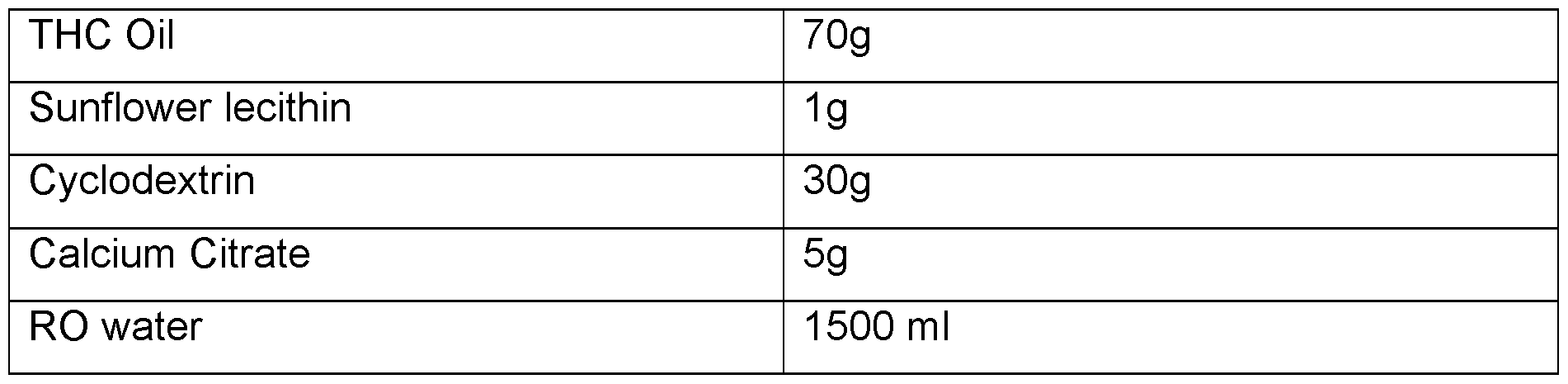 Table 4

Table 5. Generation of CBD micro-encapsulated powder - 5% Cannabidiol (CBD)
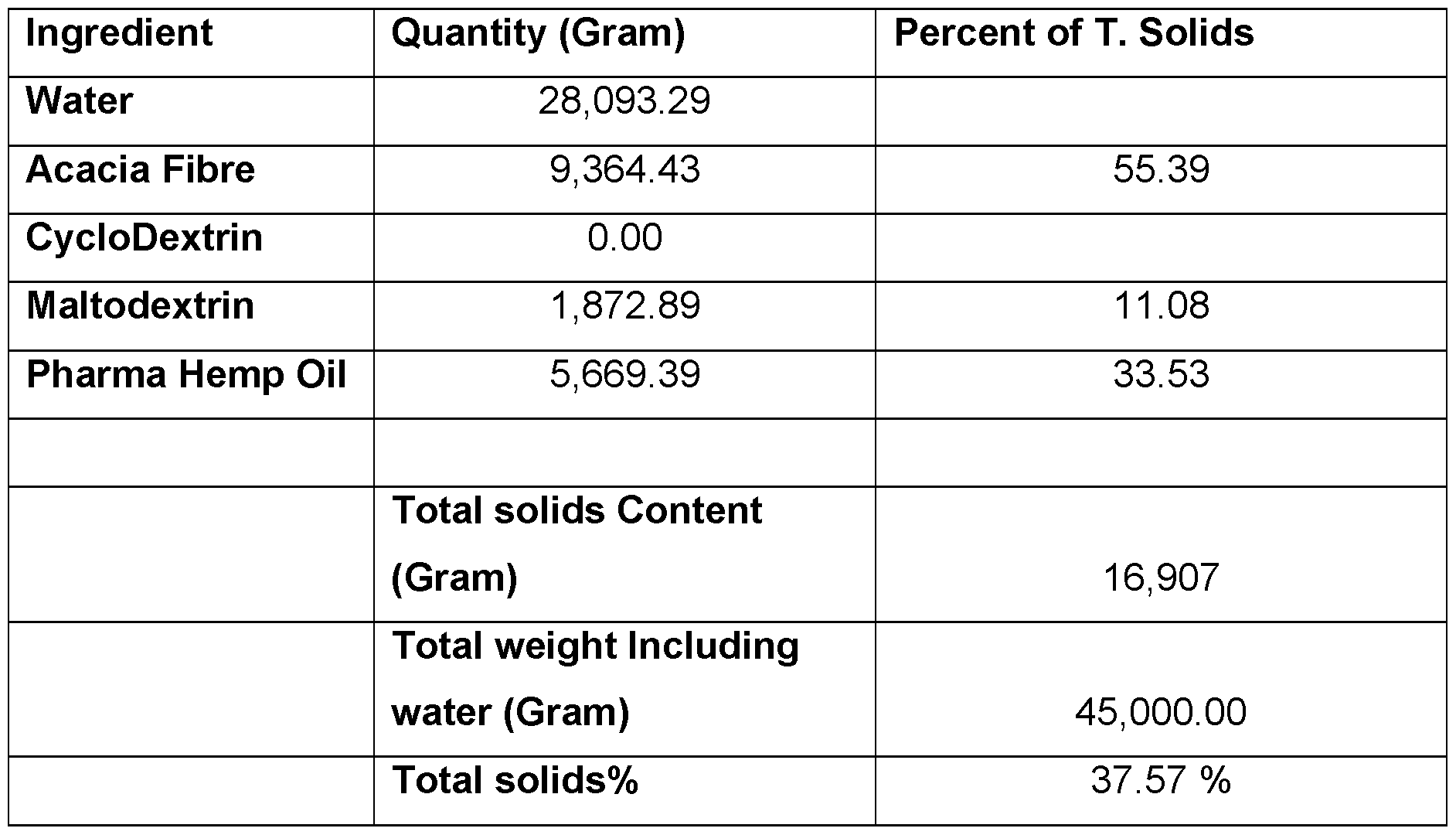
Table 6. Generation of CBD micro-encapsulated powder - 5% Cannabidiol (CBD)
 Table 7. Generation of CBD micro-encapsulated powder with oligosaccharide filler - 10% Cannabidiol (CBD)
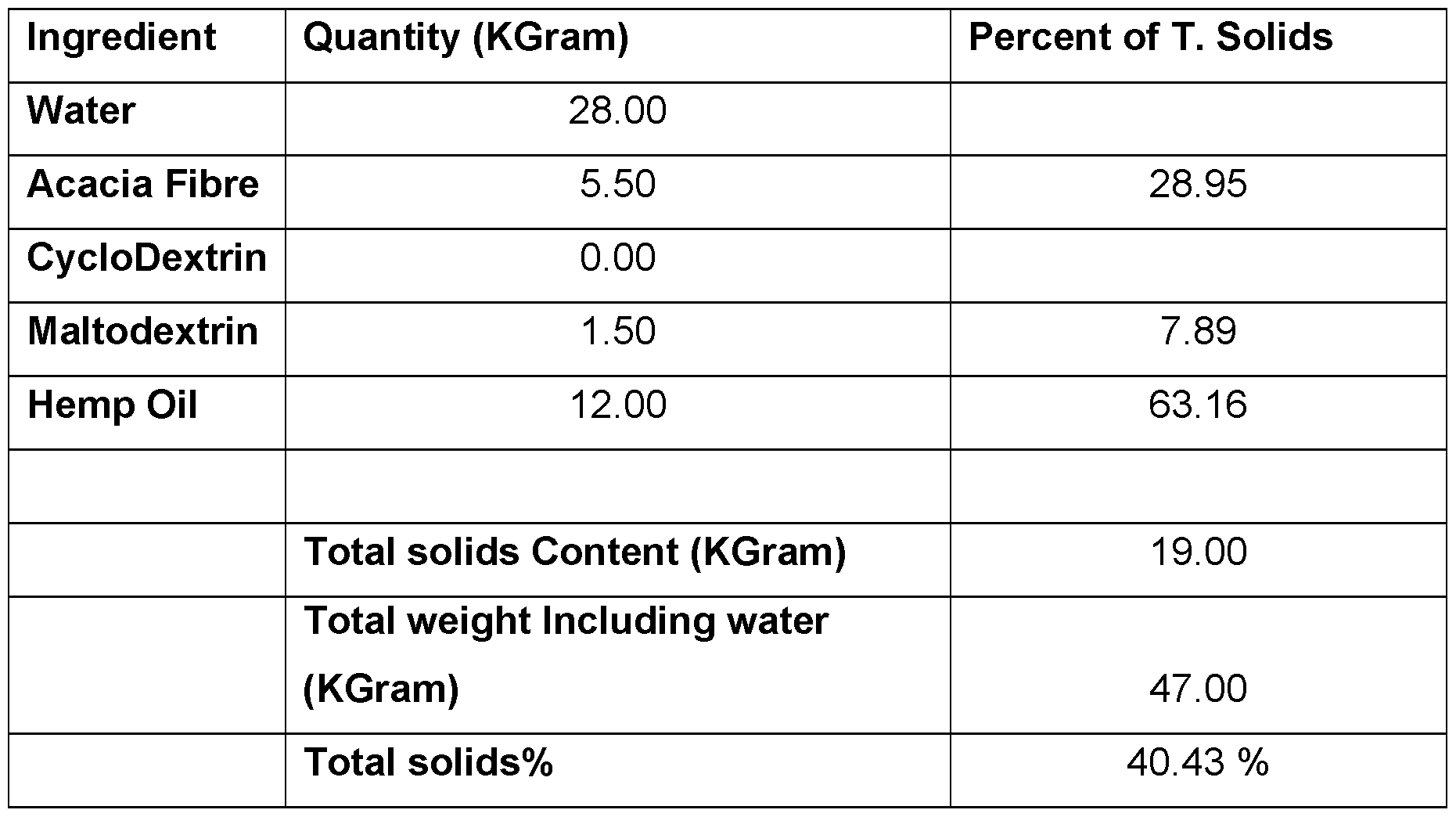 Table 8. Generation of CBD micro-encapsulated powder with oligosaccharide filler - 10% Cannabidiol (CBD)

Table 9. Generation of a high loaded CBD micro-encapsulated powder - 10% Cannabidiol (CBD)
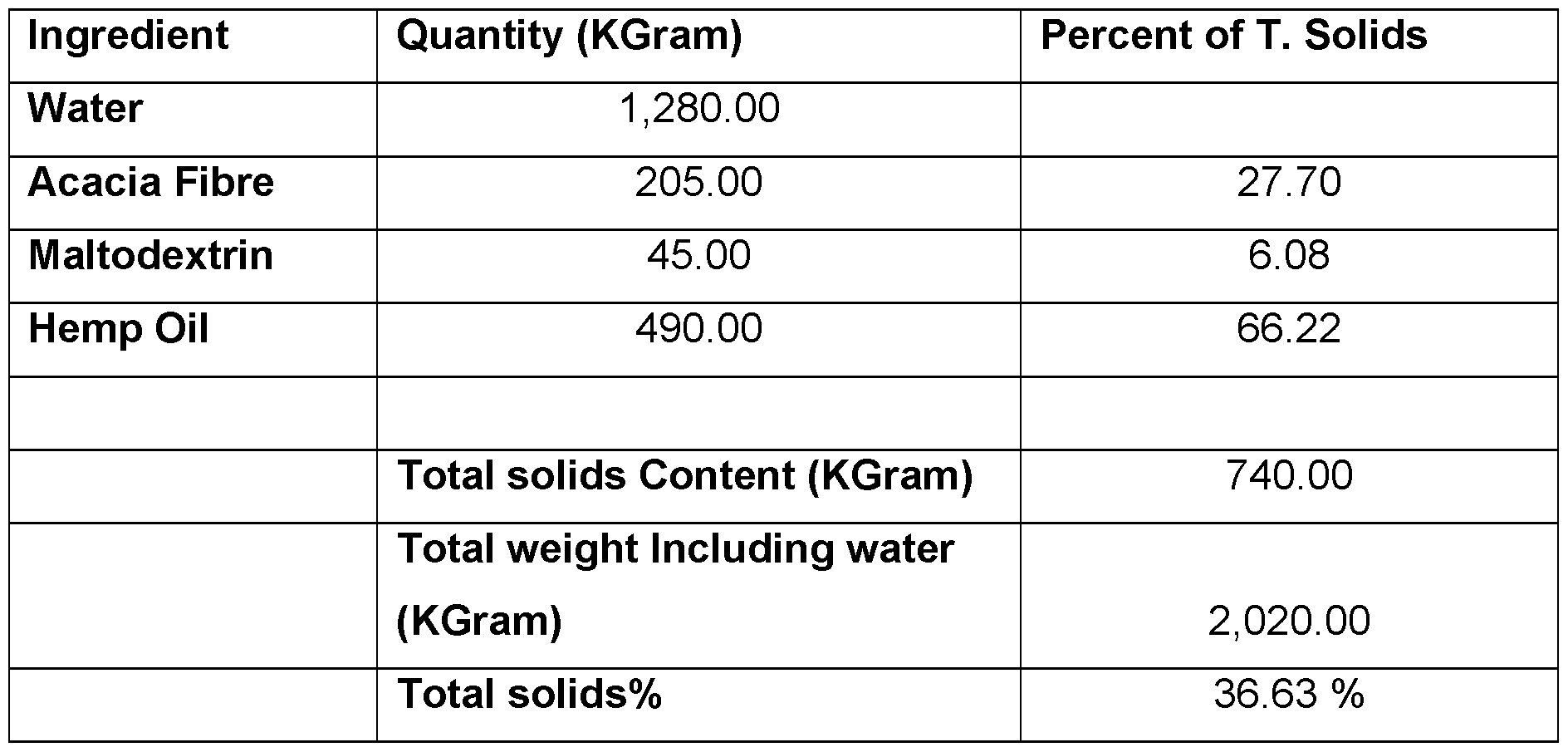 Table 10. Generation of a high loaded CBD micro-encapsulated powder - 10% Cannabidiol (CBD)

Table 11. Generation of THC micro-encapsulated powder - 5% THC
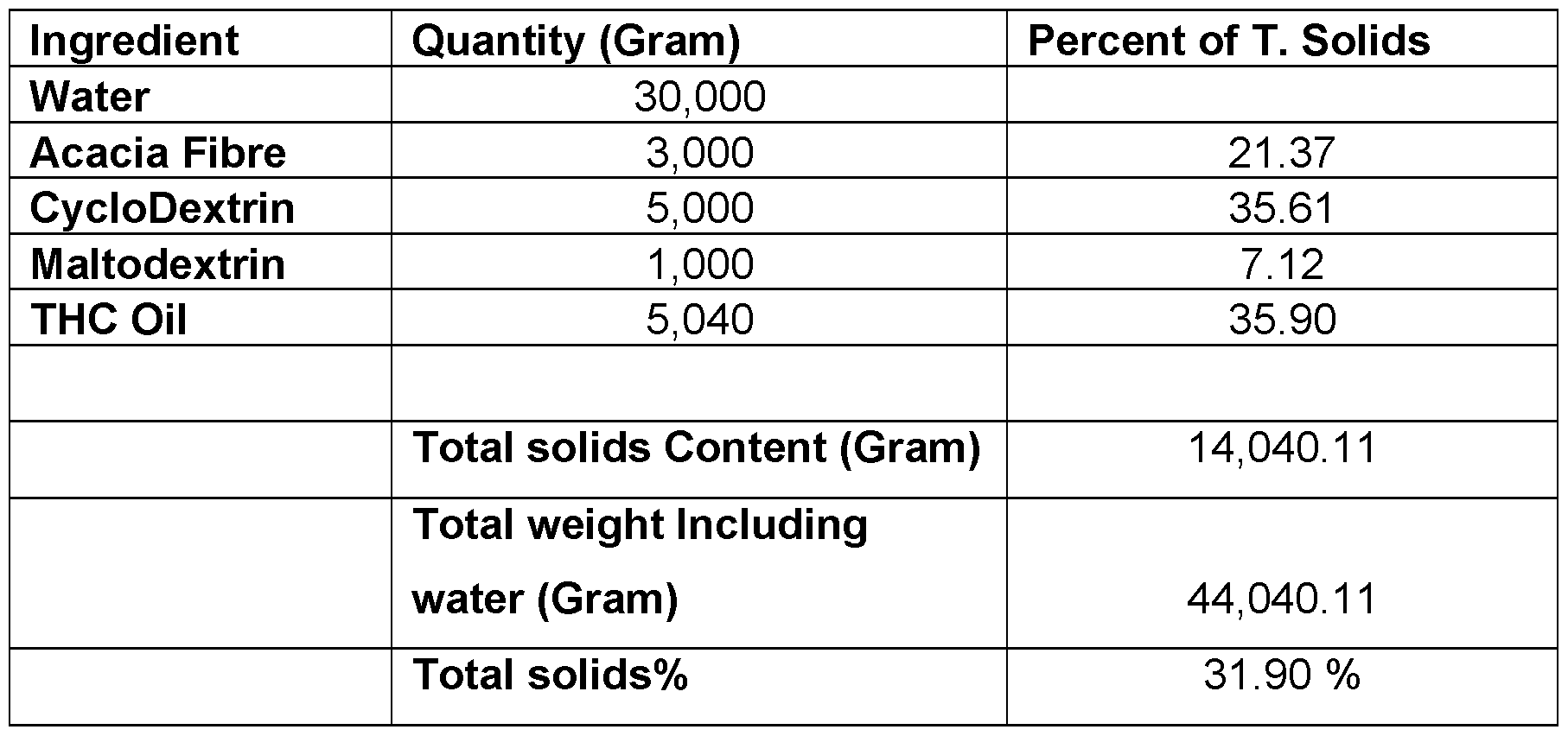 Table 12. Generation of THC micro-encapsulated powder with oligosaccharide filler - 10% THC
 Table 13. Generation of THC micro-encapsulated powder with oligosaccharide filler - 10% THC)
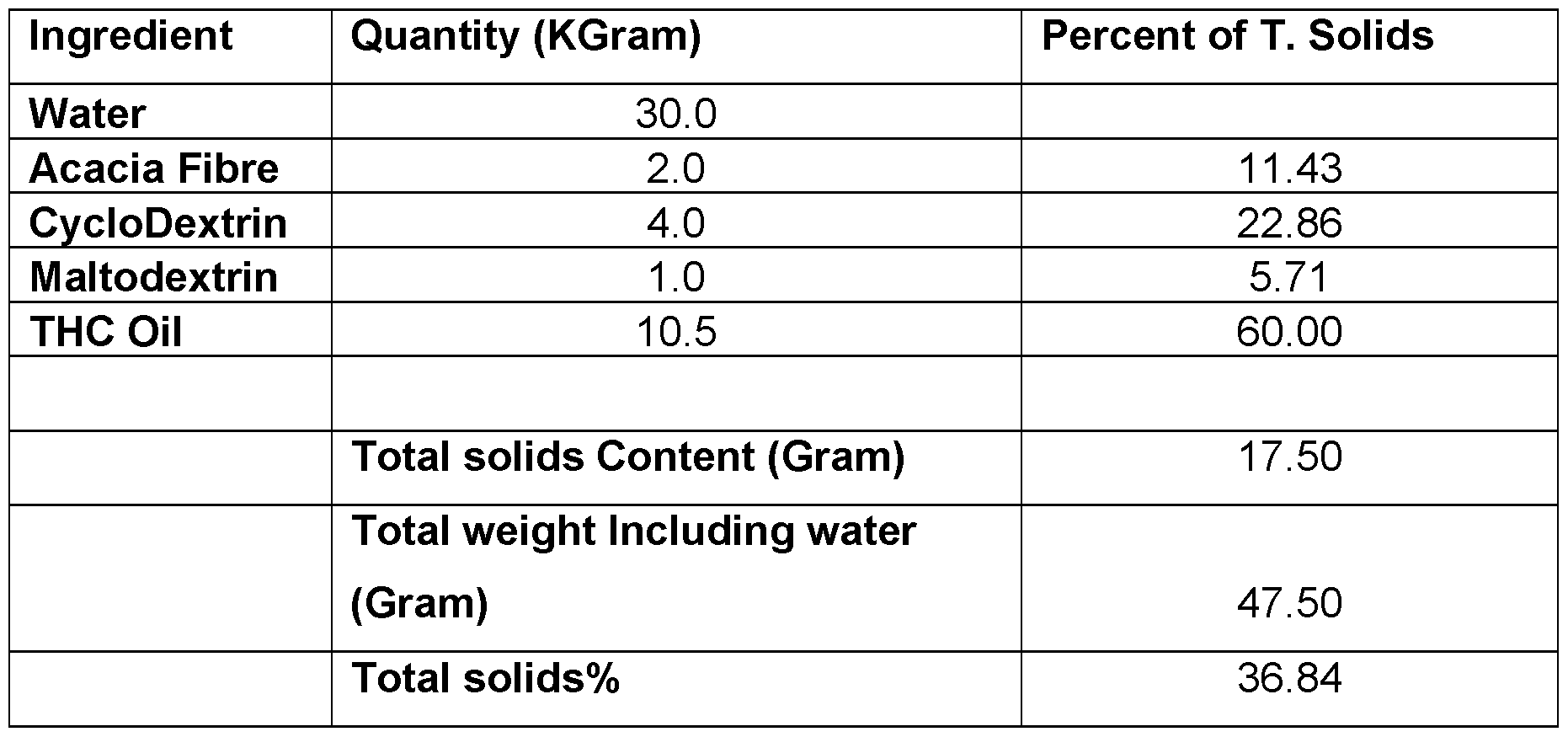 Table 14. Generation of a high loaded THC micro-encapsulated powder - 10% THC)

Table 15. Generation of a high loaded THC micro-encapsulated powder - 10% THC
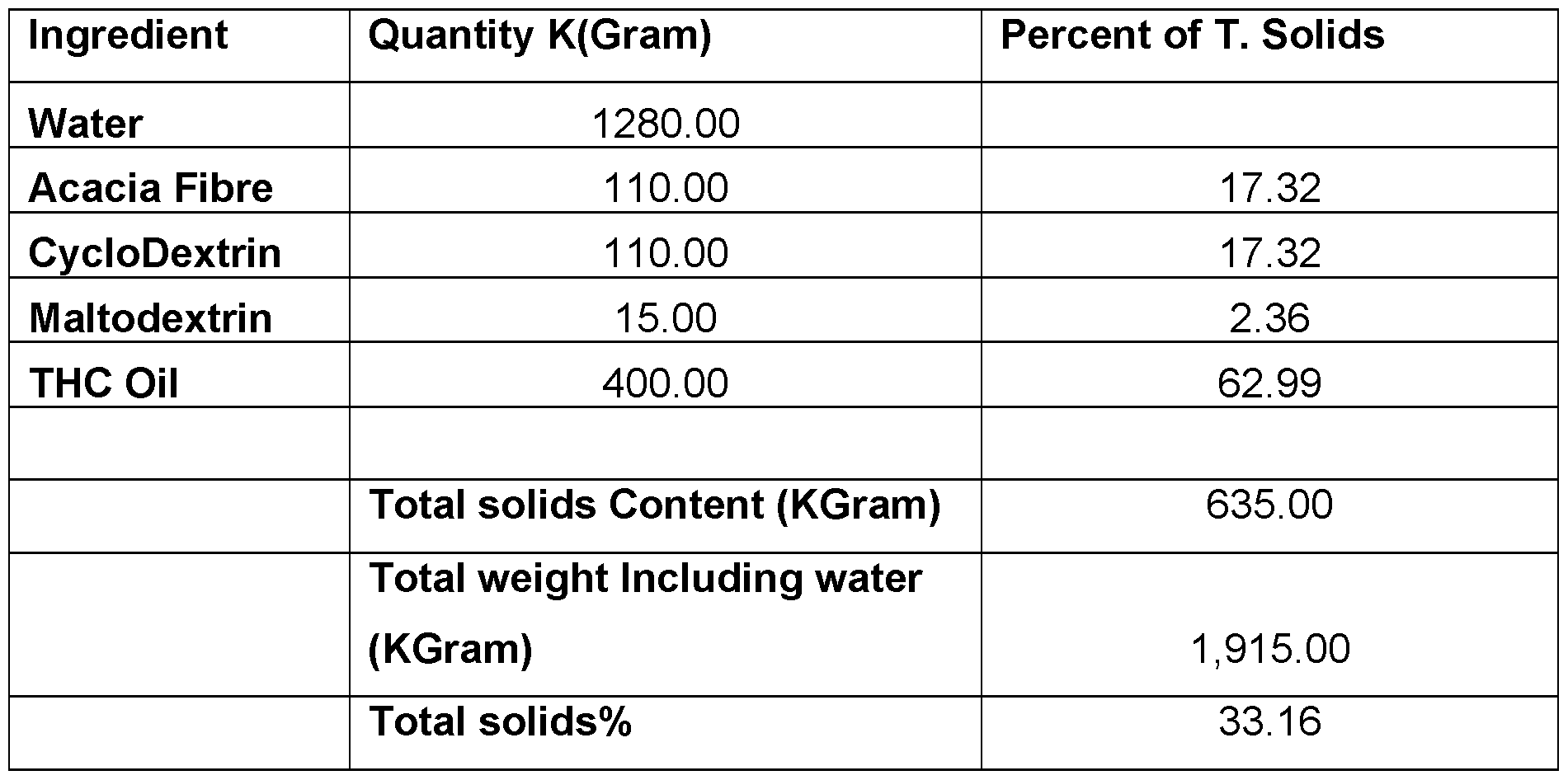 Table 16. Generation of a high loaded CBD micro-encapsulated powder - 75% CBD
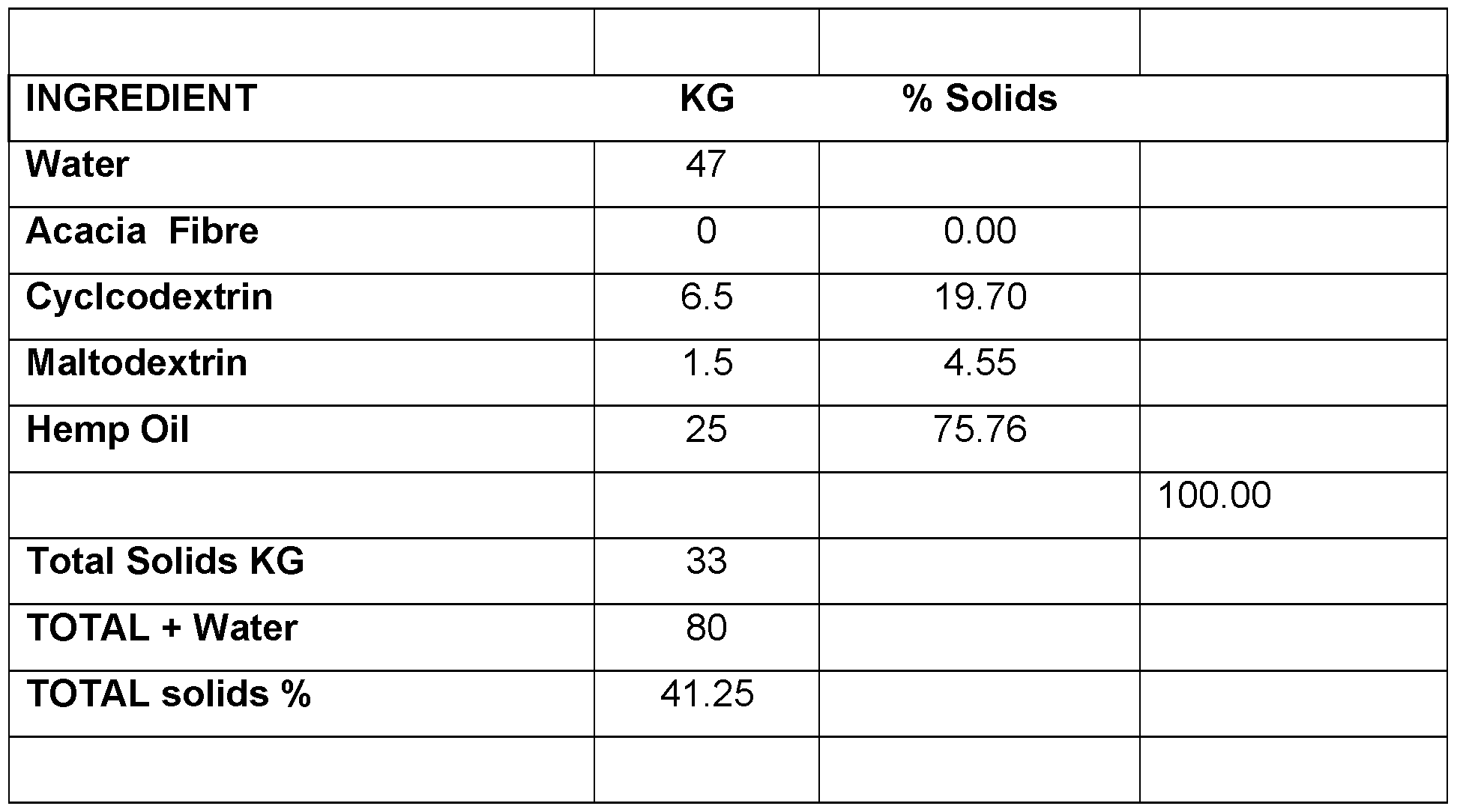 Table 17. Generation of a Medium loaded CBD micro-encapsulated powder - 25% CBD
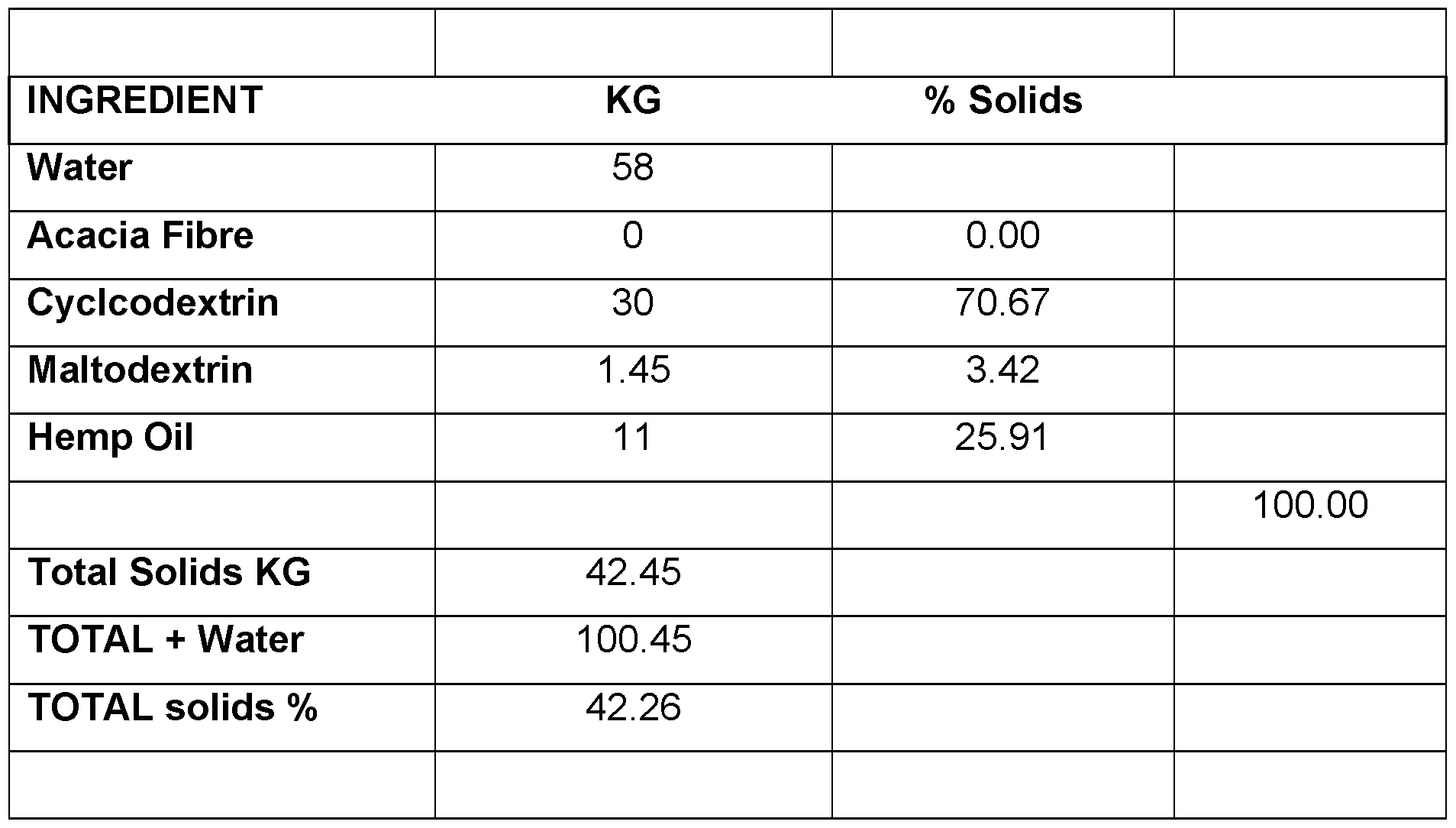 Table 18. Generation of a High loaded CBD micro-encapsulated powder - 40% CBD
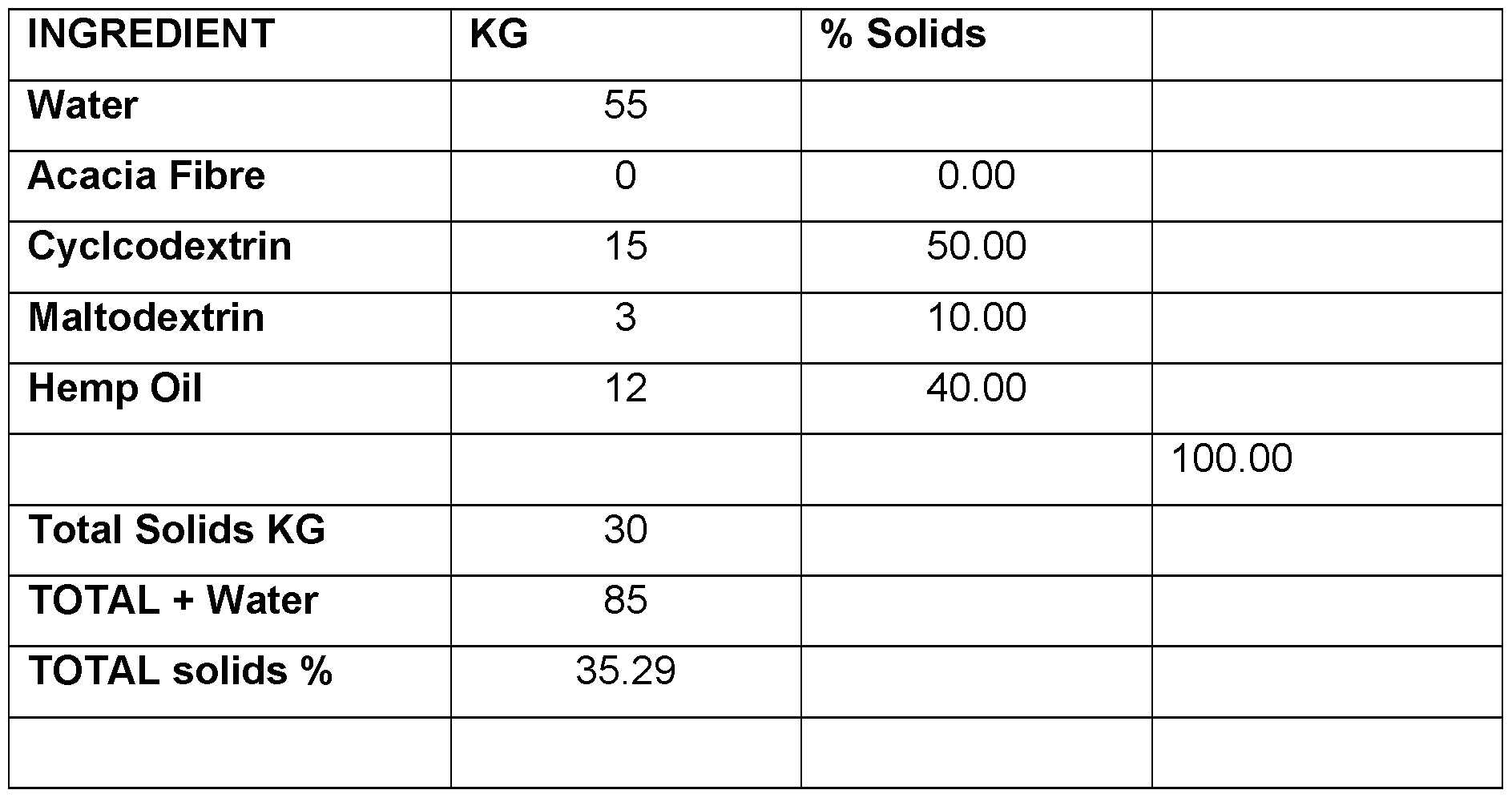 Table 19. Generation of a High loaded THC micro-encapsulated powder - 40%
THC
 Table 20

Table 21

Table 22
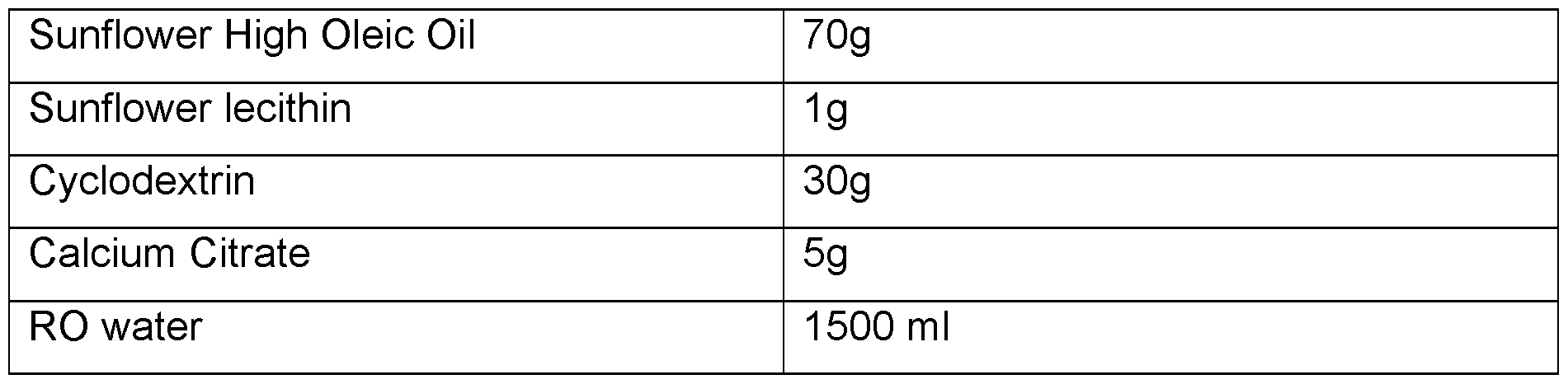
Table 23
 Table. 24
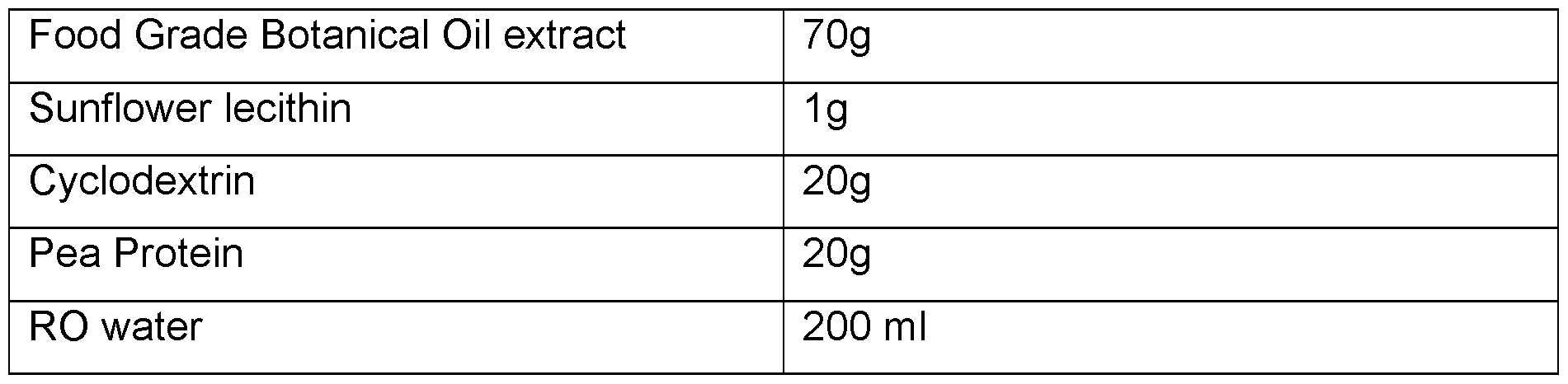 Table 25
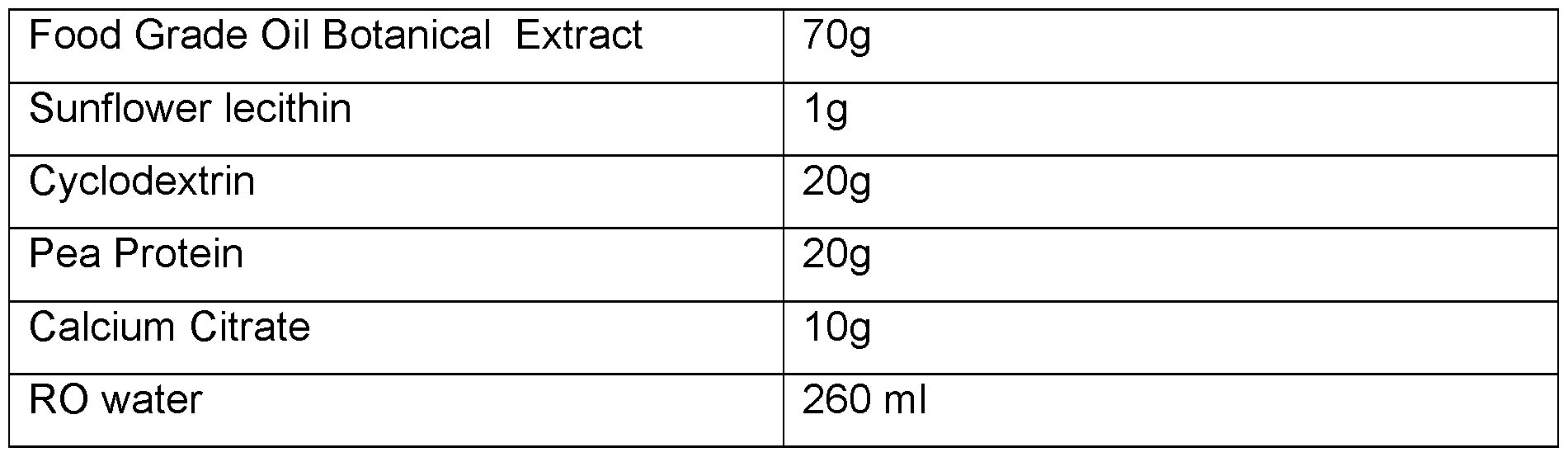
Encapsulation Formulation Table 26. Generation of a Medium loaded Food Grade Oil micro-encapsulated powder - 40% Oil -

Table 27. Generation of a High loaded Food Grade Oil micro-encapsulated powder - 75% Oil

Table 28. Generation of a Medium loaded Botanical Oil API micro-encapsulated powder - 40% Oil -
 Table 29. Generation of a High loaded Botanical Oil micro-encapsulated powder - 75% Oil
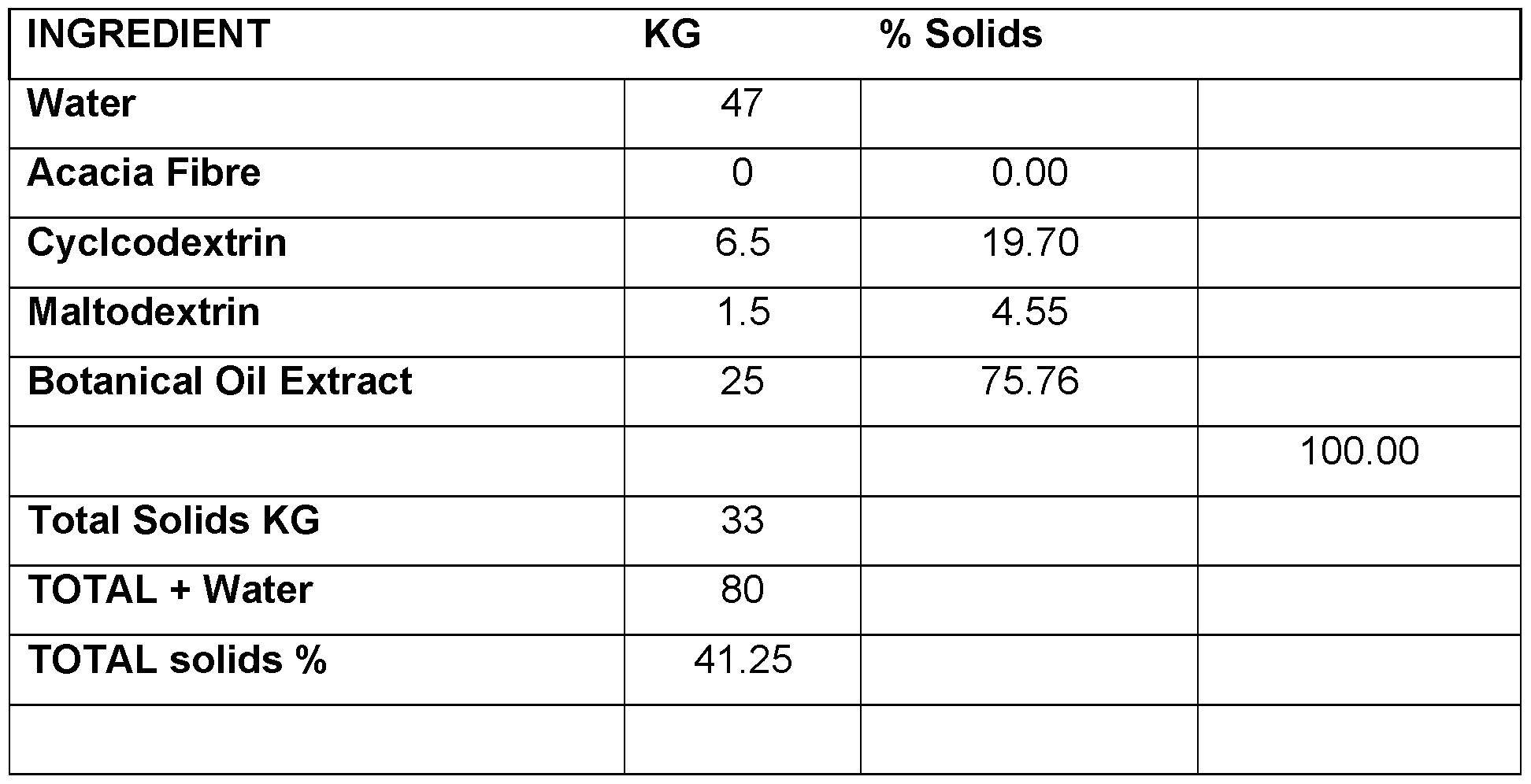 Pharma Applications

Table 30. Generation of a Medium loaded Food Grade Oil micro-encapsulated powder - 40% Oil -
 Table 31. Generation of a High loaded Food Grade Oil micro-encapsulated powder - 75% Oil
 Table 32. Pharma Gummie Preparation
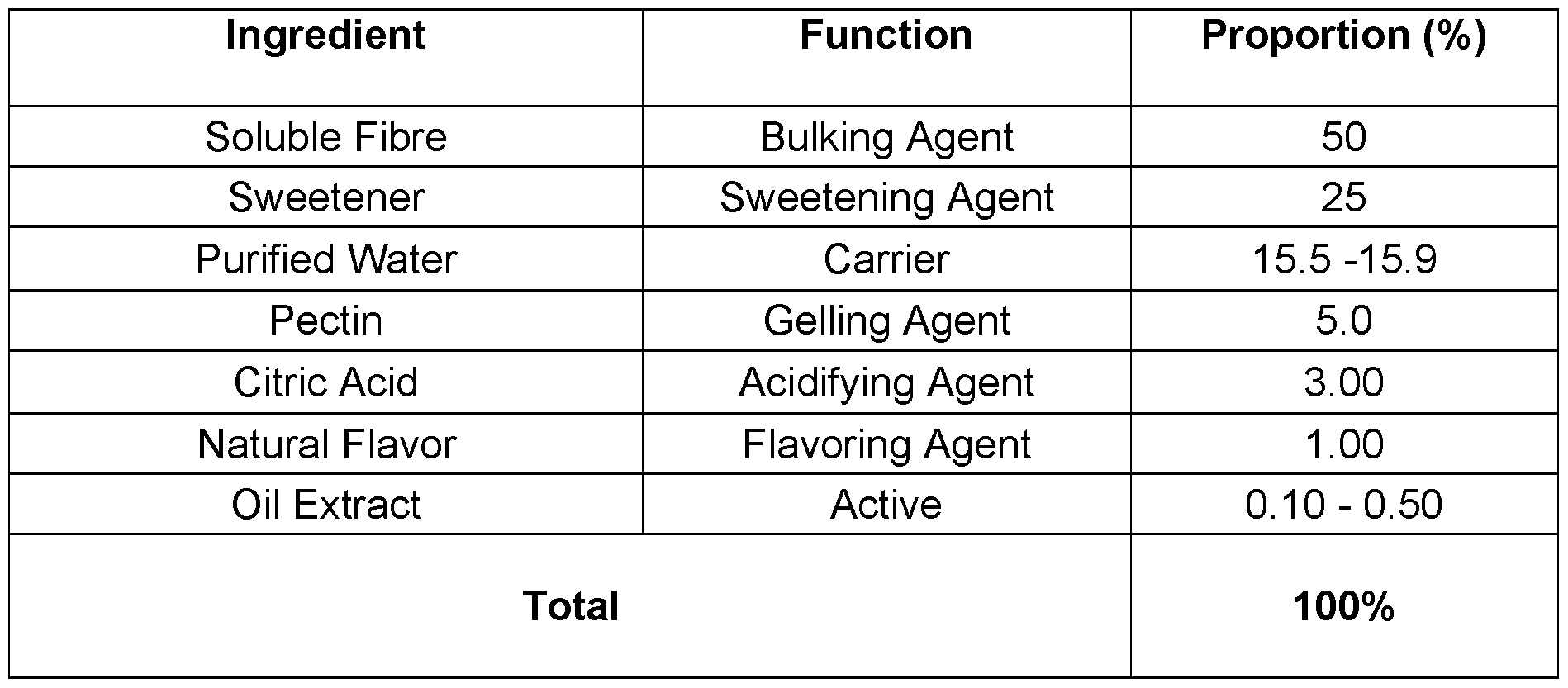 Hydration of Biopolymers
Weight water and heat to 60°C
Disperse half the required quantity of acacia gum in the tempered water.
Add acacia powder slowly and allow material to hydrate before adding more. Homogenise using single or three stage homogenisation for minimum 5minutes Allow the material to rest for minimum 5 minute Add the Maltodextrin material
Homogenise using single or three stage homogenisation for 3 minutes at 10,000 rpm Add remaining acacia gum material Homogenise for minimum 3 -5 minutes
Allow to dispersion to mix using a stir bar mild agitation for 20 min until all material is fully hydrated and dispersed
Remove vessel from 60°C heat and allow to cool to Room Temperature
Addition of (Hemp) Oil
Add (Hemp) Oil to the vessel while it is under mil agitation Add oil drop-by-drop while solution is agitating fast using sit bar Do not high shear mix
Once all the hemp oil is added
Homogenize using single or three stage homogenisation for minimum 10 minutes.
Leave the solution stirring overnight
Ideally 6 - 8 hours at room temperature (20°C)
The mixture is then homogenized through single or three stage homogenizer twice for minimum 10 minutes.
Generation of Microemulsion
After the overnight storage step, homogenize using single or three stage homogenisation at room temperature for 10 minutes.
Allow the solution resting time for minimum 5 minutes.
Repeat homogenisation steps using single or three stage homogenisation for minimum 10 minutes
Keep solution under mild agitation (350rpm / Room Temperature) while freeze drier is being filled
The formed microemulsion is poured into a tray at a depth of 1cm
Freeze-Drying - Pro-cool Tray: Set temperature of trays to -50 °C for 90 minutes in semi-automatic mode. This mode is commonly used to freeze the product. The equipment will maintain the shelf temperature until another action is operated. Typical Cool Down ratio for commercial lyophilizer for 20 °C to -40 °C in 60 minutes. Thereafter, addition time is needed to cool from -40 °C to -50 °C in 30 minutes; hence total time for cooling 90 minutes.
Freeze-Drying - Pro-cool Tray
Set temperature of trays to -50 °C for 90 minutes in semi-automatic mode. This mode is commonly used to freeze the product. The equipment will maintain the shelf temperature until another action is operated.
Typical Cool Down ratio for commercial lyophilizer for 20 °C to -40 °C in 60 minutes. Thereafter, addition time is needed to cool from -40 °C to -50 °C in 30 minutes; hence total time for cooling 90 minutes.
Primary Drying: this initiates the main drying step. Input is required for temperature controlling for the shelves vacuum level. The equipment will maintain these values
until another action is operated. The initial drying steps can be summarised as follows:
Set conditions for 2h at -25°C and O.lmbar
Set temperature ramp from -25°C to -10°C in 2h and O.lmbar
Subsequently set for 2h at -10°C and 0.1 mbar
Set temperature ramp from -10°C to 0°C in 2h and O.lmbar
Temperature ramp from 0°C to 10°C in 2h and O.lmbar
Temperature ramp from 10°C to 20°C in 4h and O.lmbar
Secondary drying: this initiates removal of remaining moisture from the concentrate after completion of primary drying by controlling the shelves to the required temperature and vacuum level.
Temperature ramp from 20°C to 30°C in 12h and O.lmbar Temperature ramp from 30°C to 37.5°C in 20h and O.lmbar
Size Reduction: Emulsion cake from freeze drying tray is size reduced in a commercial grinder before being sieved to an average particle dimension of 300- 500pm.
Vacuum Drying
Agitate the microemulsion at maintain temperature at 35°C - 45°C. during feed to the drier
Material is dried under. Vacuum conditions (1 mBar) for time of 30 minutes - 18 hours
Powder is dried to achieve moisture content < 4%.
Fluid Bed Drying
Agitate the microemulsion at maintain temperature at 35°C - 45°C during feed to the drier
Micro-emulsion is sprayed onto a maltodextrin and / or inulin carrier at 37 - 39 DegC with a product temperature for 30 minutes - 4 hours Powder is dried to achieve moisture content < 4%.
Equivalents
The foregoing description details presently preferred embodiments of the present invention. Numerous modifications and variations in practice thereof are expected to occur to those skilled in the art upon consideration of these descriptions. Those modifications and variations are intended to be encompassed within the claims appended hereto.
Claims
1. A pharmaceutical composition comprising a powder and a pharmaceutically acceptable excipient, in which the powder comprises dried microparticles and less than 10% free oil, in which the dried microparticles comprise oil and acacia or inulin fibre in which the oil is provided as stabilized oil microdroplets distributed throughout a continuous solid matrix comprising acacia or inulin fibre.
2. A pharmaceutical composition according to Claim 1 , in which the oil is selected from CBD oil, THC oil and botanical oil.
3. A pharmaceutical composition according to Claim 1 or 2, in which the continuous solid matrix comprises an oligosaccharide filler selected from cyclodextrin and maltodextrin in which a weight ratio of acacia or inulin fibre to oligosaccharide filler is at least 2:1.
4. A pharmaceutical composition according to any preceding Claim, in which the microparticles have an average dimension of 150-500 microns.
5. A pharmaceutical composition according to any preceding Claim, in which the microparticles have an average dimension of 150-500 microns and in which the powder contains 3-12% stabilized oil.
6. A pharmaceutical composition according to Claim 3, in which a weight ratio of acacia or inulin fibre to oligosaccharide filler is at least 3:1.
7. A pharmaceutical composition according to any preceding Claim, comprising 2- 15% maltodextrin by weight.
8. A pharmaceutical composition according to any preceding Claims, consisting essentially of oil, acacia or inulin fibre, an oligosaccharide filler, less than 10% free oil, and less than 5% moisture.
9. A pharmaceutical composition according to any preceding Claim, having less than 7% free oil.
10. A pharmaceutical composition according to any preceding Claim that is an aqueous beverage comprising 1-20% by weight of the powder, in which the continuous solid matrix of the microparticles comprises maltodextrin.
11. A method of making a pharmaceutical composition comprising a preparation of gastro-resistant, ileal-sensitive microparticles, the method comprising the steps of: providing an oil-in-water microemulsion comprising an aqueous phase and a solid phase comprising oil and acacia or inulin fibre; drying the microemulsion to provide a solid cake; and size-reducing the cake to provide the preparation of gastro-resistant, ileal-sensitive microparticles wherein: the microparticles comprise a dispersed phase of stabilized microdroplets of oil disposed in a continuous solid matrix comprising acacia or inulin fibre; and the preparation of microcapsules contains less than 10% free oil.
12. A method according to Claim 11 , in which the solid phase comprises 2-15% maltodextrin (w/v).
13. A method according to any of Claims 11 or 12, in which the solid phase comprises cyclodextrin, and in which a weight ratio of acacia or inulin fibre to cyclodextrin is at least 2:1.
14. A method according to any of Claims 11 to 13, in which the microemulsion comprises 10-70% of the solid phase and 30-90% of the aqueous phase (w/w).
15. A method according to any of Claims 11 to 14, in which the microemulsion comprises 20-30% of the solid phase and 70-80% of the aqueous phase (w/w).
16. A method according to any of Claims 11 to 15 in which solid phase comprises 25-70% by weight oil.
17. A method according to any of Claims 11 to 16 in which solid phase comprises 25-70% by weight oil, acacia or inulin fibre, maltodextrin and/or cyclodextrin.
18. A method according to any of Claims 11 to 17, in which the oil-in-water microemulsion is formed by a process comprising the steps of:
(a) combining water with the fibre and allowing the fibre to hydrate;
(b) homogenizing the hydrated fibre;
(c) adding the oil to the homogenized hydrated fibre to form a mixture;
(d) homogenizing the mixture;
(e) allowing the homogenized mixture to rest for a resting time of at least 5 minutes; and
(f) repeating steps (d) and (e) in sequence.
19. A method according to Claim 18, including repeating steps (d) and (e) in sequence at least two times.
20. A method according to Claim 18 or 19, in which a homogenisation pressure during the rounds of homogenization/resting is alternated between a low pressure of 30-70 Pa and a high pressure of 130-170 Pa.
21. A method according to any of Claims 11 to 20, in which the oil is selected from CBD oil, THC oil or botanical oil.
22. A method according to any of Claims 11 to 21 , in which the microemulsion is dried by fluid-bed drying, freeze-drying or vacuum-drying.
Applications Claiming Priority (4)
| Application Number | Priority Date | Filing Date | Title |
|---|---|---|---|
| GB2104355.9 | 2021-03-26 | ||
| GBGB2104350.0A GB202104350D0 (en) | 2021-03-26 | 2021-03-26 | Microparticles containing stabilised cbd oil, and methods for the production thereof |
| GBGB2104355.9A GB202104355D0 (en) | 2021-03-26 | 2021-03-26 | Microparticles containing stablished lipid, and methods for the production thereof |
| GB2104350.0 | 2021-03-26 |
Publications (1)
| Publication Number | Publication Date |
|---|---|
| WO2022200636A1 true WO2022200636A1 (en) | 2022-09-29 |
Family
ID=81386967
Family Applications (2)
| Application Number | Title | Priority Date | Filing Date |
|---|---|---|---|
| PCT/EP2022/058174 Ceased WO2022200635A1 (en) | 2021-03-26 | 2022-03-28 | Microparticles containing stabilized cbd oil, and methods for the production thereof |
| PCT/EP2022/058175 Ceased WO2022200636A1 (en) | 2021-03-26 | 2022-03-28 | Pharmaceutical formulations, and methods for the production thereof |
Family Applications Before (1)
| Application Number | Title | Priority Date | Filing Date |
|---|---|---|---|
| PCT/EP2022/058174 Ceased WO2022200635A1 (en) | 2021-03-26 | 2022-03-28 | Microparticles containing stabilized cbd oil, and methods for the production thereof |
Country Status (3)
| Country | Link |
|---|---|
| US (1) | US20240066041A1 (en) |
| EP (1) | EP4312596A1 (en) |
| WO (2) | WO2022200635A1 (en) |
Families Citing this family (1)
| Publication number | Priority date | Publication date | Assignee | Title |
|---|---|---|---|---|
| WO2024124117A1 (en) * | 2022-12-09 | 2024-06-13 | President And Fellows Of Harvard College | Emulsion-based thick-film antifouling coating for highly sensitive electrochemical sensing |
Citations (13)
| Publication number | Priority date | Publication date | Assignee | Title |
|---|---|---|---|---|
| US5271961A (en) | 1989-11-06 | 1993-12-21 | Alkermes Controlled Therapeutics, Inc. | Method for producing protein microspheres |
| EP0856355A2 (en) | 1997-01-31 | 1998-08-05 | Givaudan-Roure (International) S.A. | Protein-encapsulated oil particles |
| WO2002064109A2 (en) | 2001-02-14 | 2002-08-22 | Gw Pharma Limited | Mucoadhesive pharmaceutical formulations |
| WO2002092217A1 (en) | 2001-05-16 | 2002-11-21 | Mainelab | Vegetable protein-based microcapsules |
| WO2012038061A2 (en) | 2010-09-21 | 2012-03-29 | Lipotec, S.A. | Nanocapsules containing microemulsions |
| WO2016193373A1 (en) | 2015-06-03 | 2016-12-08 | Anabio Technologies Limited | Microencapsulates containing stabilised lipid, and methods for the production thereof |
| WO2017127641A1 (en) * | 2016-01-20 | 2017-07-27 | Flurry Powders | Encapsulation of lipophilic ingredients in dispersible spray dried powders suitable for inhalation |
| WO2018195601A1 (en) * | 2017-04-27 | 2018-11-01 | Clover Corporation Limited | Encapsulated nutritional and pharmaceutical compositions |
| WO2019219713A1 (en) * | 2018-05-14 | 2019-11-21 | Plantine Production Uk Limited | Cannabinoid-rich gelated protein microparticle |
| US20200085740A1 (en) * | 2018-09-19 | 2020-03-19 | Medpharm Holdings, Llc | Water-soluble, powdered cannabinoid and/or terpene extract |
| US20200170950A1 (en) * | 2018-11-30 | 2020-06-04 | Canopy Growth Corporation | Compositions comprising a cannabinoid or a cannabis-derived compound, methods of making and use |
| WO2020247638A1 (en) * | 2019-06-05 | 2020-12-10 | Flurry Powders, Llc | Encapsulation of lipophilic ingredients in dispersible spray dried powders suitable for inhalation |
| US20210077394A1 (en) * | 2019-09-12 | 2021-03-18 | Nulixir Inc. | Controlled release core-shell particles and suspensions including the same |
-
2022
- 2022-03-28 WO PCT/EP2022/058174 patent/WO2022200635A1/en not_active Ceased
- 2022-03-28 US US18/284,283 patent/US20240066041A1/en active Pending
- 2022-03-28 WO PCT/EP2022/058175 patent/WO2022200636A1/en not_active Ceased
- 2022-03-28 EP EP22718913.1A patent/EP4312596A1/en active Pending
Patent Citations (13)
| Publication number | Priority date | Publication date | Assignee | Title |
|---|---|---|---|---|
| US5271961A (en) | 1989-11-06 | 1993-12-21 | Alkermes Controlled Therapeutics, Inc. | Method for producing protein microspheres |
| EP0856355A2 (en) | 1997-01-31 | 1998-08-05 | Givaudan-Roure (International) S.A. | Protein-encapsulated oil particles |
| WO2002064109A2 (en) | 2001-02-14 | 2002-08-22 | Gw Pharma Limited | Mucoadhesive pharmaceutical formulations |
| WO2002092217A1 (en) | 2001-05-16 | 2002-11-21 | Mainelab | Vegetable protein-based microcapsules |
| WO2012038061A2 (en) | 2010-09-21 | 2012-03-29 | Lipotec, S.A. | Nanocapsules containing microemulsions |
| WO2016193373A1 (en) | 2015-06-03 | 2016-12-08 | Anabio Technologies Limited | Microencapsulates containing stabilised lipid, and methods for the production thereof |
| WO2017127641A1 (en) * | 2016-01-20 | 2017-07-27 | Flurry Powders | Encapsulation of lipophilic ingredients in dispersible spray dried powders suitable for inhalation |
| WO2018195601A1 (en) * | 2017-04-27 | 2018-11-01 | Clover Corporation Limited | Encapsulated nutritional and pharmaceutical compositions |
| WO2019219713A1 (en) * | 2018-05-14 | 2019-11-21 | Plantine Production Uk Limited | Cannabinoid-rich gelated protein microparticle |
| US20200085740A1 (en) * | 2018-09-19 | 2020-03-19 | Medpharm Holdings, Llc | Water-soluble, powdered cannabinoid and/or terpene extract |
| US20200170950A1 (en) * | 2018-11-30 | 2020-06-04 | Canopy Growth Corporation | Compositions comprising a cannabinoid or a cannabis-derived compound, methods of making and use |
| WO2020247638A1 (en) * | 2019-06-05 | 2020-12-10 | Flurry Powders, Llc | Encapsulation of lipophilic ingredients in dispersible spray dried powders suitable for inhalation |
| US20210077394A1 (en) * | 2019-09-12 | 2021-03-18 | Nulixir Inc. | Controlled release core-shell particles and suspensions including the same |
Non-Patent Citations (8)
| Title |
|---|
| CANNABIDIOL EXPERT COMMITTEE ON DRUG DEPENDENCE 39TH ECDD, 2017 |
| DE BACKER, B.DEBRUS, B.LEBRUN, P.THENUNIS, L.DUBOIS, N.DECOCK, L.VERSTRAETE, A.HUBERT, P.CHARLIER, C.: "Innovative development and validation of an HPLC/DAD method for the qualitative and quantitative determination of major cannabinoids in cannabis plant material", JOURNAL OF CHROMATOGRAPHY B, vol. 877, 2009, pages 4115 - 4124, XP026791284 |
| HAWKSWORTH, G.K. MCARDLE: "The Medicinal Uses of Cannabis and Cannabinoids", 2004, PHARMACEUTICAL PRESS, article "Metabolism and pharmacokinetics of cannabinoids", pages: 205 - 228 |
| MARTIN-SANTOS, R. ET AL.: "Acute effects of a single, oral dose of d9- tetrahydrocannabinol (THC) and cannabidiol (CBD) administration in healthy volunteers", CURR PHARM DES, vol. 18, no. 32, 2012, pages 4966 - 79 |
| MECHOULAM ET AL., JOURNAL OF CLINICAL PHARMACOLOGY, vol. 42, 2002 |
| MINEKUS M, ALMINGER M, ALVITO P, BALLANCE S, BOHN T, BOURLIEU C, CARRIERE F, BOUTROU R, CORREDIG M, DUPONT D, DUFOUR C, EGGER L, G: "A standardised static in vitro digestion method suitable for food - an international consensus", FOOD FUNCT., vol. 5, no. 6, 7 May 2014 (2014-05-07), pages 1113 - 24 |
| MINEKUS, A. ET AL., FOOD FUNCTION, vol. 5, 2014, pages 1113 |
| MINEKUS, M.SMEETS-PEETERS MBERNALIER AMAROL-BONNIN SHAVENAAR RMARTEAU PALRIC MFONTY GHUIS IN'T VELD JH, APPLIED MICROBIOLOGY BIOTECHNOLOGY, vol. 53, no. 1, pages 108 - 14 |
Also Published As
| Publication number | Publication date |
|---|---|
| EP4312596A1 (en) | 2024-02-07 |
| WO2022200635A1 (en) | 2022-09-29 |
| US20240066041A1 (en) | 2024-02-29 |
Similar Documents
| Publication | Publication Date | Title |
|---|---|---|
| CN106659230B (en) | Encapsulation of hydrophobic bioactive compounds | |
| CN108430461B (en) | Preparation method of high stability microcapsule dry powder/particles containing more double bond fat-soluble nutrients | |
| Sari et al. | Preparation and characterization of nanoemulsion encapsulating curcumin | |
| US4867986A (en) | Dry stabilized microemulsified omega-three acid-containing oils | |
| EP3302105B1 (en) | Microencapsulates containing stabilised lipid, and methods for the production thereof | |
| Homroy et al. | Role of encapsulation on the bioavailability of omega‐3 fatty acids | |
| CN107669657B (en) | A kind of preparation method of high stability microcapsule containing more double bond fat-soluble nutrients | |
| CN110301483A (en) | The purposes of fullerene compound and fullerene microcapsule powder and its preparation method and application | |
| DK2654463T3 (en) | ANTIOXIDANTS IN FISH OIL POWDER AND TABLETS | |
| CN102724972A (en) | Coated capsules and coated tablets of fatty acid oil blend | |
| JP2009519980A (en) | Encapsulated phospholipids-stabilized oxidizable materials | |
| KR101763947B1 (en) | Method of microcapsulating phosphatidylserine | |
| US20160143332A1 (en) | Stable oil suspensions with enhanced bioavailability and compositions thereof | |
| US10064888B2 (en) | Pectin based nanoparticles | |
| JPWO2005061684A1 (en) | Oil composition | |
| Lazăr et al. | Bioactive compounds delivery and bioavailability in structured edible oils systems | |
| Gao et al. | Advances in encapsulation systems of Antarctic krill oil: From extraction to encapsulation, and future direction | |
| US11173127B2 (en) | Potato protein nanoparticles | |
| Jala et al. | Encapsulation of DHA oils for better bioavailability: A review from the practical aspect | |
| WO2022200636A1 (en) | Pharmaceutical formulations, and methods for the production thereof | |
| CN103732255B (en) | Soft capsule preparation, composition for soft capsule preparation, and method for producing soft capsule preparation | |
| CN115844015A (en) | Lycopene oil, lycopene preparation and application thereof | |
| Klettenhammer et al. | Developments in encapsulation techniques based on supercritical fluids for food grade bioactives | |
| TW202128136A (en) | Protein encapsulation of nutritional and pharmaceutical compositions | |
| JP2024531060A (en) | Self-emulsifying drug delivery formulations with improved oral bioavailability of lipophilic compounds - Patents.com |
Legal Events
| Date | Code | Title | Description |
|---|---|---|---|
| 121 | Ep: the epo has been informed by wipo that ep was designated in this application |
Ref document number: 22718914 Country of ref document: EP Kind code of ref document: A1 |
|
| NENP | Non-entry into the national phase |
Ref country code: DE |
|
| 122 | Ep: pct application non-entry in european phase |
Ref document number: 22718914 Country of ref document: EP Kind code of ref document: A1 |