WO2022183502A1 - 抗cldn6抗体及其用途 - Google Patents
抗cldn6抗体及其用途 Download PDFInfo
- Publication number
- WO2022183502A1 WO2022183502A1 PCT/CN2021/079380 CN2021079380W WO2022183502A1 WO 2022183502 A1 WO2022183502 A1 WO 2022183502A1 CN 2021079380 W CN2021079380 W CN 2021079380W WO 2022183502 A1 WO2022183502 A1 WO 2022183502A1
- Authority
- WO
- WIPO (PCT)
- Prior art keywords
- antibody
- sequence
- amino acid
- seq
- antigen
- Prior art date
- Legal status (The legal status is an assumption and is not a legal conclusion. Google has not performed a legal analysis and makes no representation as to the accuracy of the status listed.)
- Ceased
Links
Images



Classifications
-
- C—CHEMISTRY; METALLURGY
- C07—ORGANIC CHEMISTRY
- C07K—PEPTIDES
- C07K16/00—Immunoglobulins [IGs], e.g. monoclonal or polyclonal antibodies
- C07K16/18—Immunoglobulins [IGs], e.g. monoclonal or polyclonal antibodies against material from animals or humans
- C07K16/28—Immunoglobulins [IGs], e.g. monoclonal or polyclonal antibodies against material from animals or humans against receptors, cell surface antigens or cell surface determinants
-
- A—HUMAN NECESSITIES
- A61—MEDICAL OR VETERINARY SCIENCE; HYGIENE
- A61K—PREPARATIONS FOR MEDICAL, DENTAL OR TOILETRY PURPOSES
- A61K39/00—Medicinal preparations containing antigens or antibodies
- A61K39/395—Antibodies; Immunoglobulins; Immune serum, e.g. antilymphocytic serum
- A61K39/39533—Antibodies; Immunoglobulins; Immune serum, e.g. antilymphocytic serum against materials from animals
- A61K39/3955—Antibodies; Immunoglobulins; Immune serum, e.g. antilymphocytic serum against materials from animals against proteinaceous materials, e.g. enzymes, hormones, lymphokines
-
- A—HUMAN NECESSITIES
- A61—MEDICAL OR VETERINARY SCIENCE; HYGIENE
- A61K—PREPARATIONS FOR MEDICAL, DENTAL OR TOILETRY PURPOSES
- A61K40/00—Cellular immunotherapy
- A61K40/10—Cellular immunotherapy characterised by the cell type used
- A61K40/11—T-cells, e.g. tumour infiltrating lymphocytes [TIL] or regulatory T [Treg] cells; Lymphokine-activated killer [LAK] cells
-
- A—HUMAN NECESSITIES
- A61—MEDICAL OR VETERINARY SCIENCE; HYGIENE
- A61K—PREPARATIONS FOR MEDICAL, DENTAL OR TOILETRY PURPOSES
- A61K40/00—Cellular immunotherapy
- A61K40/10—Cellular immunotherapy characterised by the cell type used
- A61K40/15—Natural-killer [NK] cells; Natural-killer T [NKT] cells
-
- A—HUMAN NECESSITIES
- A61—MEDICAL OR VETERINARY SCIENCE; HYGIENE
- A61K—PREPARATIONS FOR MEDICAL, DENTAL OR TOILETRY PURPOSES
- A61K40/00—Cellular immunotherapy
- A61K40/30—Cellular immunotherapy characterised by the recombinant expression of specific molecules in the cells of the immune system
- A61K40/31—Chimeric antigen receptors [CAR]
-
- A—HUMAN NECESSITIES
- A61—MEDICAL OR VETERINARY SCIENCE; HYGIENE
- A61K—PREPARATIONS FOR MEDICAL, DENTAL OR TOILETRY PURPOSES
- A61K40/00—Cellular immunotherapy
- A61K40/40—Cellular immunotherapy characterised by antigens that are targeted or presented by cells of the immune system
- A61K40/41—Vertebrate antigens
- A61K40/42—Cancer antigens
- A61K40/4202—Receptors, cell surface antigens or cell surface determinants
-
- A—HUMAN NECESSITIES
- A61—MEDICAL OR VETERINARY SCIENCE; HYGIENE
- A61K—PREPARATIONS FOR MEDICAL, DENTAL OR TOILETRY PURPOSES
- A61K45/00—Medicinal preparations containing active ingredients not provided for in groups A61K31/00 - A61K41/00
- A61K45/06—Mixtures of active ingredients without chemical characterisation, e.g. antiphlogistics and cardiaca
-
- A—HUMAN NECESSITIES
- A61—MEDICAL OR VETERINARY SCIENCE; HYGIENE
- A61K—PREPARATIONS FOR MEDICAL, DENTAL OR TOILETRY PURPOSES
- A61K47/00—Medicinal preparations characterised by the non-active ingredients used, e.g. carriers or inert additives; Targeting or modifying agents chemically bound to the active ingredient
- A61K47/50—Medicinal preparations characterised by the non-active ingredients used, e.g. carriers or inert additives; Targeting or modifying agents chemically bound to the active ingredient the non-active ingredient being chemically bound to the active ingredient, e.g. polymer-drug conjugates
- A61K47/51—Medicinal preparations characterised by the non-active ingredients used, e.g. carriers or inert additives; Targeting or modifying agents chemically bound to the active ingredient the non-active ingredient being chemically bound to the active ingredient, e.g. polymer-drug conjugates the non-active ingredient being a modifying agent
- A61K47/68—Medicinal preparations characterised by the non-active ingredients used, e.g. carriers or inert additives; Targeting or modifying agents chemically bound to the active ingredient the non-active ingredient being chemically bound to the active ingredient, e.g. polymer-drug conjugates the non-active ingredient being a modifying agent the modifying agent being an antibody, an immunoglobulin or a fragment thereof, e.g. an Fc-fragment
- A61K47/6835—Medicinal preparations characterised by the non-active ingredients used, e.g. carriers or inert additives; Targeting or modifying agents chemically bound to the active ingredient the non-active ingredient being chemically bound to the active ingredient, e.g. polymer-drug conjugates the non-active ingredient being a modifying agent the modifying agent being an antibody, an immunoglobulin or a fragment thereof, e.g. an Fc-fragment the modifying agent being an antibody or an immunoglobulin bearing at least one antigen-binding site
- A61K47/6849—Medicinal preparations characterised by the non-active ingredients used, e.g. carriers or inert additives; Targeting or modifying agents chemically bound to the active ingredient the non-active ingredient being chemically bound to the active ingredient, e.g. polymer-drug conjugates the non-active ingredient being a modifying agent the modifying agent being an antibody, an immunoglobulin or a fragment thereof, e.g. an Fc-fragment the modifying agent being an antibody or an immunoglobulin bearing at least one antigen-binding site the antibody targeting a receptor, a cell surface antigen or a cell surface determinant
-
- A—HUMAN NECESSITIES
- A61—MEDICAL OR VETERINARY SCIENCE; HYGIENE
- A61P—SPECIFIC THERAPEUTIC ACTIVITY OF CHEMICAL COMPOUNDS OR MEDICINAL PREPARATIONS
- A61P35/00—Antineoplastic agents
-
- G01N33/5759—
-
- A—HUMAN NECESSITIES
- A61—MEDICAL OR VETERINARY SCIENCE; HYGIENE
- A61K—PREPARATIONS FOR MEDICAL, DENTAL OR TOILETRY PURPOSES
- A61K39/00—Medicinal preparations containing antigens or antibodies
- A61K2039/505—Medicinal preparations containing antigens or antibodies comprising antibodies
-
- C—CHEMISTRY; METALLURGY
- C07—ORGANIC CHEMISTRY
- C07K—PEPTIDES
- C07K2317/00—Immunoglobulins specific features
- C07K2317/20—Immunoglobulins specific features characterized by taxonomic origin
- C07K2317/24—Immunoglobulins specific features characterized by taxonomic origin containing regions, domains or residues from different species, e.g. chimeric, humanized or veneered
-
- C—CHEMISTRY; METALLURGY
- C07—ORGANIC CHEMISTRY
- C07K—PEPTIDES
- C07K2317/00—Immunoglobulins specific features
- C07K2317/30—Immunoglobulins specific features characterized by aspects of specificity or valency
- C07K2317/31—Immunoglobulins specific features characterized by aspects of specificity or valency multispecific
-
- C—CHEMISTRY; METALLURGY
- C07—ORGANIC CHEMISTRY
- C07K—PEPTIDES
- C07K2317/00—Immunoglobulins specific features
- C07K2317/30—Immunoglobulins specific features characterized by aspects of specificity or valency
- C07K2317/33—Crossreactivity, e.g. for species or epitope, or lack of said crossreactivity
-
- C—CHEMISTRY; METALLURGY
- C07—ORGANIC CHEMISTRY
- C07K—PEPTIDES
- C07K2317/00—Immunoglobulins specific features
- C07K2317/50—Immunoglobulins specific features characterized by immunoglobulin fragments
- C07K2317/56—Immunoglobulins specific features characterized by immunoglobulin fragments variable (Fv) region, i.e. VH and/or VL
- C07K2317/565—Complementarity determining region [CDR]
-
- C—CHEMISTRY; METALLURGY
- C07—ORGANIC CHEMISTRY
- C07K—PEPTIDES
- C07K2317/00—Immunoglobulins specific features
- C07K2317/60—Immunoglobulins specific features characterized by non-natural combinations of immunoglobulin fragments
- C07K2317/62—Immunoglobulins specific features characterized by non-natural combinations of immunoglobulin fragments comprising only variable region components
- C07K2317/622—Single chain antibody (scFv)
-
- C—CHEMISTRY; METALLURGY
- C07—ORGANIC CHEMISTRY
- C07K—PEPTIDES
- C07K2317/00—Immunoglobulins specific features
- C07K2317/70—Immunoglobulins specific features characterized by effect upon binding to a cell or to an antigen
- C07K2317/73—Inducing cell death, e.g. apoptosis, necrosis or inhibition of cell proliferation
- C07K2317/732—Antibody-dependent cellular cytotoxicity [ADCC]
-
- C—CHEMISTRY; METALLURGY
- C07—ORGANIC CHEMISTRY
- C07K—PEPTIDES
- C07K2317/00—Immunoglobulins specific features
- C07K2317/70—Immunoglobulins specific features characterized by effect upon binding to a cell or to an antigen
- C07K2317/73—Inducing cell death, e.g. apoptosis, necrosis or inhibition of cell proliferation
- C07K2317/734—Complement-dependent cytotoxicity [CDC]
-
- C—CHEMISTRY; METALLURGY
- C07—ORGANIC CHEMISTRY
- C07K—PEPTIDES
- C07K2317/00—Immunoglobulins specific features
- C07K2317/70—Immunoglobulins specific features characterized by effect upon binding to a cell or to an antigen
- C07K2317/77—Internalization into the cell
-
- C—CHEMISTRY; METALLURGY
- C07—ORGANIC CHEMISTRY
- C07K—PEPTIDES
- C07K2317/00—Immunoglobulins specific features
- C07K2317/90—Immunoglobulins specific features characterized by (pharmaco)kinetic aspects or by stability of the immunoglobulin
- C07K2317/92—Affinity (KD), association rate (Ka), dissociation rate (Kd) or EC50 value
Definitions
- the present invention relates to the field of disease treatment and immunology, in particular, the present invention relates to anti-CLDN6 antibodies or antigen-binding fragments thereof, nucleic acid molecules encoding the same, immunoconjugates, bispecific molecules, chimeric antigen receptors comprising the same and pharmaceutical compositions, and their use for the prevention and/or treatment of tumors.
- Ovarian cancer is a common gynecological malignancy and is a highly heterogeneous epithelial tumor with different histological subtypes as well as genetic and biological features, including serous carcinoma, endometrioid carcinoma, clear Cellular and mucinous carcinomas. Every year, there are 310,000 new cases of ovarian cancer and more than 200,000 deaths worldwide (5). 75% of ovarian cancers are serous cancers, with a five-year survival rate of 35%. They are a very malignant type of cancer and are usually diagnosed at an advanced stage.
- Claudin is a transmembrane protein, which is a membrane protein located at the tight junction between epithelial cells and endothelial cells.
- the distribution of CLDN family proteins is specific to tissues and organs, and their main functions are intercellular adhesion, maintenance of cell polarity, regulation of paracellular permeability, and participation in the regulation of cell proliferation and differentiation. Recent studies have shown that the expression of some members of the CLDN family is up-regulated during carcinogenesis, and ectopic activation occurs in tissues that are not normally distributed in the case of carcinogenesis. This property makes scientists further consider the possibility of CLDN protein as a tumor target.
- CLDN6 is only highly expressed during embryonic development and not expressed in normal adult tissues.
- the highest expression of CLDN6 in normal adult tissues is the testis, and the expression level is only 0.83TPM.
- CLDN6 protein is a four-transmembrane protein with four transmembrane hydrophobic regions and two extracellular loops. Its recombinant protein is extremely difficult to express, so there is no suitable protein antigen for immunization, which brings difficulties to the immunization and screening of antibodies against CLDN6 .
- the CLDN family proteins have high homology. When targeting CLDN6, it is necessary to avoid binding to CLDN3 and CLDN4, which are widely expressed in normal tissues and have high homology to CLDN6, so as to avoid possible cross-binding. Toxicity issue. The above are the two major difficulties in the development of anti-CLDN6 antibodies.
- the antibodies of the present invention can specifically recognize/bind to human CLDN6 and/or CLDN9, and can induce killing of CLDN6-expressing cells (eg, tumor cells) through ADCC and/or CDC. Therefore, the antibodies of the present invention have the potential for preventing and/or treating tumors, and have great clinical value.
- CLDN6-expressing cells eg, tumor cells
- VH heavy chain variable region
- CDRs 3 complementarity determining regions
- VH CDR2 consisting of the following sequence: SEQ ID NO: 4 or 33, or having one or several amino acid substitutions, deletions or additions therefrom (e.g., 1, 2 or 3 amino acid substitutions) , deletion or addition), and
- VL CDR1 consisting of the following sequence: SEQ ID NO: 6, or having one or several amino acid substitutions, deletions or additions (e.g. 1, 2 or 3 amino acid substitutions, deletions) therefrom or added) sequence,
- VL CDR2 consisting of the following sequence: SEQ ID NO: 7, or having one or several amino acid substitutions, deletions or additions therefrom (e.g., 1, 2 or 3 amino acid substitutions, deletions) or addition), and
- substitutions described in any of (i)-(vi) are conservative substitutions.
- the CDRs described in any of (i)-(vi) are defined according to the Kabat, IMGT or Chothia numbering systems.
- the CDRs described in any of (i)-(vi) are defined according to the IMGT numbering system.
- the antibody or antigen-binding fragment thereof comprises: the following 3 heavy chain CDRs: VH CDR1 of sequence SEQ ID NO:3, VH CDR2 of sequence SEQ ID NO:33, VH of sequence SEQ ID NO:5 CDR3; and/or, the following 3 light chain CDRs: VL CDR1 of sequence SEQ ID NO:6, VL CDR2 of sequence SEQ ID NO:7, and VL CDR3 of sequence SEQ ID NO:8.
- the antibody, or antigen-binding fragment thereof further comprises framework region sequences derived from humans (eg, human immunoglobulins).
- VH CDR2 consisting of the following sequence: SEQ ID NO: 4, or with one or several amino acid substitutions, deletions or additions (e.g. 1, 2 or 3 amino acid substitutions, deletions) therefrom or added), and
- VH CDR3 consisting of the following sequence: SEQ ID NO: 5, or with one or several amino acid substitutions, deletions or additions (e.g. 1, 2 or 3 amino acid substitutions, deletions) therefrom or added);
- VL CDR2 consisting of the following sequence: SEQ ID NO: 7, or having one or several amino acid substitutions, deletions or additions therefrom (e.g., 1, 2 or 3 amino acid substitutions, deletions) or added), and
- the CDRs described in any of (i)-(vi) are defined according to the IMGT numbering system.
- the antibody, or antigen-binding fragment thereof further comprises framework region sequences derived from humans (eg, human immunoglobulins).
- the human immunoglobulins are selected from human rearranged antibody sequences or human germline antibody sequences.
- the antibody or antigen-binding fragment thereof has one or more of the following biological functions:
- the antibody or antigen-binding fragment thereof comprises:
- the present invention provides an antibody or antigen-binding fragment thereof capable of specifically binding CLDN6, the antibody or antigen-binding fragment thereof comprising:
- VH heavy chain variable region
- CDRs 3 complementarity determining regions
- VH CDR2 consisting of the following sequence: SEQ ID NO: 33, or having one or several amino acid substitutions, deletions or additions (e.g. 1, 2 or 3 amino acid substitutions, deletions) therefrom or added), and
- VH CDR3 consisting of the following sequence: SEQ ID NO: 5, or with one or several amino acid substitutions, deletions or additions (e.g. 1, 2 or 3 amino acid substitutions, deletions) therefrom or added);
- VL light chain variable region
- CDRs 3 complementarity determining regions
- VL CDR1 consisting of the following sequence: SEQ ID NO: 6, or having one or several amino acid substitutions, deletions or additions (e.g. 1, 2 or 3 amino acid substitutions, deletions) therefrom or added) sequence,
- VL CDR2 consisting of the following sequence: SEQ ID NO: 7, or having one or several amino acid substitutions, deletions or additions therefrom (e.g., 1, 2 or 3 amino acid substitutions, deletions) or added), and
- VL CDR3 consisting of the following sequence: SEQ ID NO: 8, or having one or several amino acid substitutions, deletions or additions therefrom (e.g. 1, 2 or 3 amino acid substitutions, deletions) or added) sequence.
- the CDRs described in any of (i)-(vi) are defined according to the Kabat, IMGT or Chothia numbering systems.
- the CDRs described in any of (i)-(vi) are defined according to the IMGT numbering system.
- the antibody or antigen-binding fragment thereof comprises: the following 3 heavy chain CDRs: VH CDR1 of sequence SEQ ID NO: 3, VH CDR2 of sequence SEQ ID NO: 33, VH CDR3 of sequence SEQ ID NO: 5; and/or, the following 3 light chain CDRs: VL CDR1 of sequence SEQ ID NO: 6, VL CDR2 of sequence SEQ ID NO: 7, sequence of SEQ ID NO: 8 VL CDR3.
- the antibody, or antigen-binding fragment thereof further comprises framework region sequences derived from humans (eg, human immunoglobulins).
- the antibody or antigen-binding fragment thereof comprises:
- VH heavy chain variable region
- VL light chain variable region
- substitutions described in (ii) or (v) are conservative substitutions.
- the antibody or antigen-binding fragment thereof comprises: a VH having the sequence set forth in SEQ ID NO:19 and a VL having the sequence set forth in SEQ ID NO:20.
- the present invention provides an antibody or antigen-binding fragment thereof capable of specifically binding CLDN6 and/or CLDN9, the antibody or antigen-binding fragment thereof comprising:
- VH heavy chain variable region
- CDRs 3 complementarity determining regions
- VH CDR1 consisting of the following sequence: SEQ ID NO: 13, or having one or several amino acid substitutions, deletions or additions therefrom (e.g., 1, 2 or 3 amino acid substitutions, deletions) or added) sequence,
- VH CDR2 consisting of the following sequence: SEQ ID NO: 14 or 23, or having one or several amino acid substitutions, deletions or additions (e.g. 1, 2 or 3 amino acid substitutions) therefrom , deletion or addition), and
- VH CDR3 consisting of the following sequence: SEQ ID NO: 15, or having one or several amino acid substitutions, deletions or additions therefrom (e.g. 1, 2 or 3 amino acid substitutions, deletions) or added);
- VL light chain variable region
- CDRs 3 complementarity determining regions
- VL CDR1 consisting of the following sequence: SEQ ID NO: 16 or 24, or having one or several amino acid substitutions, deletions or additions therefrom (e.g. 1, 2 or 3 amino acid substitutions) , deletion or addition) sequences,
- VL CDR2 consisting of the following sequence: SEQ ID NO: 17, or having one or several amino acid substitutions, deletions or additions (e.g. 1, 2 or 3 amino acid substitutions, deletions) therefrom or added), and
- VL CDR3 consisting of the following sequence: SEQ ID NO: 18, or having one or several amino acid substitutions, deletions or additions therefrom (e.g. 1, 2 or 3 amino acid substitutions, deletions) or added) sequence.
- substitutions described in any of (i)-(vi) are conservative substitutions.
- the CDRs described in any of (i)-(vi) are defined according to the Kabat, IMGT or Chothia numbering systems.
- the CDRs described in any of (i)-(vi) are defined according to the IMGT numbering system.
- the antibody or antigen-binding fragment thereof comprises: the following 3 heavy chain CDRs: VH CDR1 of sequence SEQ ID NO: 13, VH CDR2 of sequence SEQ ID NO: 14, VH CDR3 of sequence SEQ ID NO: 15; and/or, the following 3 light chain CDRs: VL CDR1 of sequence SEQ ID NO: 16, VL CDR2 of sequence SEQ ID NO: 17, sequence of SEQ ID NO: VL CDR3 of 18; or,
- the human immunoglobulins are selected from human rearranged antibody sequences or human germline antibody sequences.
- the present invention provides an antibody or antigen-binding fragment thereof capable of specifically binding CLDN6 and/or CLDN9, the antibody or antigen-binding fragment thereof comprising:
- VH heavy chain variable region
- CDRs 3 complementarity determining regions
- VH CDR1 consisting of the following sequence: SEQ ID NO: 13, or having one or several amino acid substitutions, deletions or additions therefrom (e.g., 1, 2 or 3 amino acid substitutions, deletions) or added) sequence,
- VH CDR2 consisting of the following sequence: SEQ ID NO: 14, or with one or several amino acid substitutions, deletions or additions (e.g. 1, 2 or 3 amino acid substitutions, deletions) therefrom or added), and
- VH CDR3 consisting of the following sequence: SEQ ID NO: 15, or having one or several amino acid substitutions, deletions or additions therefrom (e.g. 1, 2 or 3 amino acid substitutions, deletions) or added);
- VL light chain variable region
- CDRs 3 complementarity determining regions
- VL CDR1 consisting of the following sequence: SEQ ID NO: 16, or having one or several amino acid substitutions, deletions or additions (e.g. 1, 2 or 3 amino acid substitutions, deletions) therefrom or added) sequence,
- VL CDR3 consisting of the following sequence: SEQ ID NO: 18, or having one or several amino acid substitutions, deletions or additions therefrom (e.g. 1, 2 or 3 amino acid substitutions, deletions) or added) sequence.
- substitutions described in any of (i)-(vi) are conservative substitutions.
- the CDRs described in any of (i)-(vi) are defined according to the IMGT numbering system.
- the antibody or antigen-binding fragment thereof comprises: the following 3 heavy chain CDRs: VH CDR1 of sequence SEQ ID NO: 13, VH CDR2 of sequence SEQ ID NO: 14, VH CDR3 of sequence SEQ ID NO: 15; and/or, the following 3 light chain CDRs: VL CDR1 of sequence SEQ ID NO: 16, VL CDR2 of sequence SEQ ID NO: 17, sequence of SEQ ID NO: VL CDR3 of 18.
- the antibody, or antigen-binding fragment thereof further comprises framework region sequences derived from humans (eg, human immunoglobulins).
- the antibody or antigen-binding fragment thereof has one or more of the following biological functions:
- (c) induce killing of human CLDN6-expressing cells (eg, tumor cells, such as CLDN6-expressing tumor cells) by antibody-dependent cell-mediated cytotoxicity (ADCC);
- human CLDN6-expressing cells eg, tumor cells, such as CLDN6-expressing tumor cells
- ADCC antibody-dependent cell-mediated cytotoxicity
- tumors eg, tumors expressing CLDN6
- VH heavy chain variable region
- VL light chain variable region
- substitutions described in (ii) or (v) are conservative substitutions.
- the present invention provides an antibody or antigen-binding fragment thereof capable of specifically binding CLDN6 and/or CLDN9, the antibody or antigen-binding fragment thereof comprising:
- VH heavy chain variable region
- CDRs 3 complementarity determining regions
- VH CDR1 consisting of the following sequence: SEQ ID NO: 13, or having one or several amino acid substitutions, deletions or additions therefrom (e.g., 1, 2 or 3 amino acid substitutions, deletions) or added) sequence,
- VH CDR2 consisting of the following sequence: SEQ ID NO: 23, or having one or several amino acid substitutions, deletions or additions (e.g. 1, 2 or 3 amino acid substitutions, deletions) therefrom or added), and
- VH CDR3 consisting of the following sequence: SEQ ID NO: 15, or having one or several amino acid substitutions, deletions or additions therefrom (e.g. 1, 2 or 3 amino acid substitutions, deletions) or added);
- VL light chain variable region
- CDRs 3 complementarity determining regions
- VL CDR1 consisting of the following sequence: SEQ ID NO: 24, or having one or several amino acid substitutions, deletions or additions (e.g. 1, 2 or 3 amino acid substitutions, deletions) therefrom or added) sequence,
- VL CDR3 consisting of the following sequence: SEQ ID NO: 18, or having one or several amino acid substitutions, deletions or additions therefrom (e.g. 1, 2 or 3 amino acid substitutions, deletions) or added) sequence.
- substitutions described in any of (i)-(vi) are conservative substitutions.
- the CDRs described in any of (i)-(vi) are defined according to the IMGT numbering system.
- the antibody or antigen-binding fragment thereof comprises: the following 3 heavy chain CDRs: VH CDR1 of sequence SEQ ID NO: 13, VH CDR2 of sequence SEQ ID NO: 23, VH CDR3 of sequence SEQ ID NO: 15; and/or, the following 3 light chain CDRs: VL CDR1 of sequence SEQ ID NO: 24, VL CDR2 of sequence SEQ ID NO: 17, sequence of SEQ ID NO: VL CDR3 of 18.
- the human immunoglobulins are selected from human rearranged antibody sequences or human germline antibody sequences.
- the antibody or antigen-binding fragment thereof has one or more of the following biological functions:
- tumors eg, tumors expressing CLDN6
- the antibody or antigen-binding fragment thereof comprises:
- (iii) have at least 80%, at least 85%, at least 90%, at least 91%, at least 92%, at least 93%, at least 94%, at least 95%, at least 96%, Sequences of at least 97%, at least 98%, at least 99%, or 100% sequence identity;
- substitutions described in (ii) or (v) are conservative substitutions.
- the antibody or antigen-binding fragment thereof comprises: a VH having the sequence set forth in SEQ ID NO:9 and a VL having the sequence set forth in SEQ ID NO:10.
- the VH of the antibody or antigen-binding fragment thereof comprises a heavy chain variable region (VH) framework region (FR) derived from a human immunoglobulin, and/or the antibody or antigen thereof
- the VL of the binding fragment comprises a light chain variable region (VL) framework region (FR) derived from human immunoglobulin.
- the heavy chain variable region FR and/or light chain variable region FR of the antibody or antigen-binding fragment thereof may comprise one or more non-human (eg, murine) amino acid residues,
- the heavy chain framework region FR and/or the light chain framework region FR may comprise one or more amino acid back-mutations in which there are corresponding murine amino acid residues.
- a heavy chain constant region (CH) of a human immunoglobulin or a variant thereof having one or more amino acid substitutions, deletions or additions eg, up to 20, up to 15, up to 10, or up to 5 amino acid substitutions, deletions, or additions; e.g., 1, 2, 3, 4, or 5 amino acid substitutions, deletions, or additions; and
- the heavy chain constant region is an IgG heavy chain constant region, eg, an IgGl, IgG2, IgG3 or IgG4 heavy chain constant region.
- the light chain constant region is a kappa or lambda light chain constant region.
- the antibody or antigen-binding fragment thereof comprises the light chain constant region (CL) set forth in SEQ ID NO:22.
- the antigen-binding fragment is selected from the group consisting of Fab, Fab', (Fab') 2 , Fv, disulfide-linked Fv, scFv, diabodies, and single domain antibodies (sdAbs) and/or, the antibody is a murine antibody, a chimeric antibody, a humanized antibody, a bispecific antibody or a multispecific antibody.
- the antibodies of the present invention can be prepared by various methods known in the art, such as by genetic engineering recombinant techniques. For example, DNA molecules encoding the heavy and light chain genes of the antibodies of the invention are obtained by chemical synthesis or PCR amplification. The resulting DNA molecule is inserted into an expression vector and then transfected into a host cell. Then, the transfected host cells are cultured under specific conditions and express the antibodies of the present invention.
- Antigen-binding fragments of the present invention can be obtained by hydrolysis of intact antibody molecules (see Morimoto et al., J. Biochem. Biophys. Methods 24:107-117 (1992) and Brennan et al., Science 229:81 (1985)) .
- these antigen-binding fragments can also be produced directly by recombinant host cells (reviewed in Hudson, Curr. Opin. Immunol. 11:548-557 (1999); Little et al., Immunol. Today, 21:364-370 (2000) )).
- Fab' fragments can be obtained directly from host cells; Fab' fragments can be chemically coupled to form F(ab') 2 fragments (Carter et al., Bio/Technology, 10:163-167 (1992)).
- Fv, Fab or F(ab') 2 fragments can also be directly isolated from recombinant host cell culture medium. Other techniques for preparing these antigen-binding fragments are well known to those of ordinary skill in the art.
- the present invention provides an isolated nucleic acid molecule comprising nucleotides encoding an antibody or antigen-binding fragment thereof of the present invention, or a heavy chain variable region and/or a light chain variable region thereof sequence.
- the isolated nucleic acid molecule encodes an antibody or antigen-binding fragment thereof of the invention, or a heavy chain variable region and/or a light chain variable region thereof.
- the present invention provides a vector (eg, a cloning vector or an expression vector) comprising the isolated nucleic acid molecule of the present invention.
- the vectors of the present invention are, for example, plasmids, cosmids, phages, and the like.
- the vector is capable of expressing an antibody or antigen-binding fragment thereof of the invention in a subject (eg, a mammal, eg, a human).
- the present invention provides a host cell comprising an isolated nucleic acid molecule of the present invention or a vector of the present invention.
- host cells include, but are not limited to, prokaryotic cells such as E. coli cells, and eukaryotic cells such as yeast cells, insect cells, plant cells, and animal cells (eg, mammalian cells, eg, mouse cells, human cells, etc.).
- the host cells of the present invention are mammalian cells, such as CHO (eg, CHO-K1, CHO-S, CHO DG44).
- An antibody or antigen-binding fragment thereof of the invention can be derivatized, eg, linked to another molecule (eg, another polypeptide or protein).
- another molecule eg, another polypeptide or protein.
- derivatization eg, labeling
- an antibody or antigen-binding fragment thereof does not adversely affect its binding to CLDN6 and/or CLDN9, particularly human CLDN6 and/or human CLDN9.
- the antibodies or antigen-binding fragments thereof of the invention are also intended to include such derivatized forms.
- an antibody or antigen-binding fragment thereof of the invention can be functionally linked (by chemical coupling, genetic fusion, non-covalent attachment, or otherwise) to one or more other molecular moieties, such as another antibody (eg, to form a bispecific antibodies), detection reagents, pharmaceutical reagents, and/or proteins or polypeptides (eg, avidin or polyhistidine tags) capable of mediating binding of an antibody or antigen-binding fragment to another molecule.
- the antibodies or antigen-binding fragments thereof of the present invention can also be derivatized with chemical groups such as polyethylene glycol (PEG), methyl or ethyl, or glycosyl groups. These groups can be used to improve the biological properties of antibodies, such as increasing serum half-life.
- Such labels are well known in the art, examples of which include, but are not limited to, enzymes (eg, horseradish peroxidase, alkaline phosphatase, beta-galactosidase, urease, glucose oxidase, etc.), radionuclides Fluorescein (eg, 3 H, 125 I, 35 S, 14 C, or 32 P), fluorescent dyes (eg, fluorescein isothiocyanate (FITC), fluorescein, tetramethylrhodamine isothiocyanate (TRITC) , phycoerythrin (PE), Texas red, rhodamine, quantum dots or cyanine dye derivatives (eg Cy7, Alexa 750)), luminescent substances (eg chemiluminescent substances such as acridine esters), Magnetic beads (eg, ), calorimetric labels such as colloidal gold or colored glass or plastic (eg, polystyrene, polypropylene, latex, etc
- Patents teaching the use of this marker include, but are not limited to, US Patents 3,817,837; 3,850,752; 3,939,350; 3,996,345; 4,277,437; 4,275,149; and 4,366,241 (all incorporated herein by reference).
- Detectable labels as described above can be detected by methods known in the art. For example, radiolabels can be detected using photographic film or a scintillation calculator, and fluorescent labels can be detected using a light detector to detect the emitted light.
- Enzyme labels are generally detected by providing a substrate to the enzyme and detecting the reaction product produced by the action of the enzyme on the substrate, and calorimetric labels are detected by simply visualizing the colored label.
- such labels can be suitable for use in immunological detection (eg, enzyme-linked immunoassays, radioimmunoassays, fluorescent immunoassays, chemiluminescence immunoassays, etc.).
- a detectable label as described above can be attached to an antibody or antigen-binding fragment thereof of the invention via linkers of various lengths to reduce potential steric hindrance.
- the antibodies or antigen-binding fragments thereof of the invention can be used to form bispecific or multispecific molecules.
- An antibody or antigen-binding fragment thereof of the invention may be part of a bispecific or multispecific molecule comprising a molecule with a different binding specificity than the antibody or antigen-binding fragment thereof of the invention A second functional moiety (eg, a second antibody), thereby capable of binding at least two different binding sites and/or target molecules.
- an antibody or antigen-binding fragment thereof of the invention can be linked to a second antibody or antigen-binding fragment thereof capable of specifically binding any protein that can be used as a potential target for combination therapy.
- an antibody or antigen-binding fragment thereof of the invention can be linked (eg, by chemical conjugation, genetic fusion, non-covalent association, or otherwise) to one or more other Binding molecules (eg, additional antibodies, antibody fragments, peptides, or binding mimetics).
- Binding molecules eg, additional antibodies, antibody fragments, peptides, or binding mimetics.
- the present invention provides a bispecific or multispecific molecule comprising an antibody or antigen-binding fragment thereof of the present invention.
- the bispecific or multispecific molecule further comprises at least one molecule (eg, a second antibody) having a second binding specificity for a second target.
- Antibodies of the invention or antigen-binding fragments thereof can be linked to therapeutic agents to form immunoconjugates.
- Immunoconjugates can enhance the present invention due to their ability to selectively deliver one or more therapeutic agents to target tissues (eg, tumor-associated antigens such as tumors expressing CLDN6 and/or CLDN9).
- Therapeutic efficacy of an antibody or antigen-binding fragment thereof in the treatment of disease eg, cancer.
- the present invention provides immunoconjugates comprising an antibody or antigen-binding fragment thereof of the present invention and a therapeutic agent linked to the antibody or antigen-binding fragment thereof.
- the therapeutic agent is a cytotoxic agent.
- the cytotoxic agent includes any agent that is detrimental to cells (eg, kills cells).
- the therapeutic agent is selected from the group consisting of alkylating agents, mitotic inhibitors, antitumor antibiotics, antimetabolites, topoisomerase inhibitors, tyrosine kinase inhibitors, radionuclide agents, and any combination thereof.
- alkylating agents examples include, but are not limited to, nitrogen mustards (eg, diclofenac, chlorambucil, melphalan, cyclophosphamide, etc.), ethyleneimine (such as cetepa, etc.), sulfates and polyols (such as busulfan, dibromomannitol), nitrosoureas (such as carmustine, lomustine, etc.), platinum anti-tumor agents (such as cisplatin, oxaliplatin, carboplatin, etc.).
- nitrogen mustards eg, diclofenac, chlorambucil, melphalan, cyclophosphamide, etc.
- ethyleneimine such as cetepa, etc.
- sulfates and polyols such as busulfan, dibromomannitol
- nitrosoureas such as carmustine, lomustine, etc.
- platinum anti-tumor agents such as
- antitumor antibiotics examples include, but are not limited to, actinomycins, anthracyclines (eg, daunorubicin, doxorubicin, epirubicin, idarubicin, etc.) , calicheamicin, duocarcinomycin, etc.
- antimetabolites examples include, but are not limited to, folate antagonists (eg, methotrexate, etc.), pyrimidine antagonists (eg, 5-fluorouracil, floxuridine, cytarabine, Pecitabine, gemcitabine, etc.), purine antagonists (such as 6-mercaptopurine, 6-thioguanine, etc.), adenosine deaminase inhibitors (such as cladribine, fludarabine, nelarabine, pentosine tatin, etc.).
- folate antagonists eg, methotrexate, etc.
- pyrimidine antagonists eg, 5-fluorouracil, floxuridine, cytarabine, Pecitabine, gemcitabine, etc.
- purine antagonists such as 6-mercaptopurine, 6-thioguanine, etc.
- adenosine deaminase inhibitors such as cladribine, fludarabine, ne
- topoisomerase inhibitors examples include, but are not limited to (camptothecins and their derivatives (eg, irinotecan, topotecan, etc.), amacridine, daunol Mycin, doxorubicin, epipodophyllotoxins, ellipticines, epirubicin, etoposide, propylimine, teniposide, etc.
- tyrosine kinase inhibitors that can be used in the immunoconjugates of the invention include, but are not limited to, axitinib, bosutinib, cediranib, dasatinib, erlotinib, gefitinib Nilotinib, imatinib, lapatinib, letotinib, nilotinib, simazanib, sunitinib, vandetanib, etc.
- the therapeutic agent is selected from the group consisting of platinum-based antineoplastic agents, anthracyclines, taxanes, nucleoside analogs, camptothecins, and analogs or homologs thereof , and any combination thereof.
- the antibodies or antigen-binding fragments thereof of the invention are optionally conjugated to the therapeutic agent through a linker.
- a cytotoxic agent can be conjugated to an antibody or antigen-binding fragment thereof of the present invention using linker technology available in the art.
- linker technology available in the art.
- Examples of the types of linkers that have been used to conjugate cytotoxic agents to antibodies include, but are not limited to, hydrazones, thioethers, esters, disulfides, and peptide-containing linkers.
- Linkers can be selected that are, for example, susceptible to cleavage by low pH within the lysosomal compartment or by proteases (eg, proteases preferentially expressed in tumor tissues, such as cathepsins, such as cathepsins B, C, D).
- the antibodies or antigen-binding fragments thereof of the present invention can be used to construct a chimeric antigen receptor (CAR) comprising a CAR that specifically binds CLDN6 and/or CLDN9, linked to a transmembrane domain, and bound to one or more intracellular T cell signaling domain linked extracellular antigen binding domain (eg, scFv).
- the intracellular T cell signaling domain can include, for example, a T cell receptor signaling domain, a T cell costimulatory signaling domain, or a combination thereof.
- the T cell receptor signaling domain refers to the portion of the CAR that contains the intracellular domain of the T cell receptor (eg, the intracellular portion of the CD3 ⁇ protein).
- the costimulatory signaling domain refers to the portion of the CAR that contains the intracellular domain of costimulatory molecules, which are cell surface molecules other than antigen receptors or their ligands required for efficient lymphocyte responses to antigens .
- CARs of the invention include their ability to direct T-cell specificity and reactivity to cells expressing CLDN6 and/or CLDN9 (eg, tumor cells) in a non-MHC-restricted manner.
- CLDN6 and/or CLDN9 eg, tumor cells
- the non-MHC-restricted CLDN6 and/or CLDN9 recognition ability confers the ability of T cells expressing the CARs of the invention to recognize antigen independent of antigen processing.
- the present invention provides a chimeric antigen receptor (CAR) comprising the antigen-binding domain of the antibody or antigen-binding fragment thereof of the present invention.
- CAR chimeric antigen receptor
- the antigen-binding domain comprises the heavy and light chain variable regions of an antibody or antigen-binding fragment thereof of the invention.
- the antigen binding domain is an scFv.
- the antigen-binding receptor comprises an antigen-binding fragment (eg, scFv) of an antibody of the invention.
- the antigen binding receptor is expressed by immune effector cells (eg, T cells).
- a spacer domain comprising a polypeptide sequence.
- the spacer domain may comprise up to 300 amino acids, preferably 10 to 100 amino acids, and most preferably 25 to 50 amino acids.
- the spacer domain may comprise an immunoglobulin domain, eg, a human immunoglobulin sequence.
- the immunoglobulin domain comprises immunoglobulin CH2 and CH3 domain sequences.
- the CH2 and CH3 domains extend the antigen-binding domain of the CAR from the membrane of the CAR-expressing cell and may more accurately mimic the size and size of the native TCR and Domain structure.
- the transmembrane domain may be derived from natural or synthetic sources.
- the domains can be derived from any membrane-bound or transmembrane protein.
- Exemplary transmembrane domains that can be used in the CARs of the present invention can comprise at least the transmembrane region of the alpha, beta or zeta chain of a T cell receptor, which can be selected from CD28, CD3 ⁇ , CD45, CD4, CD5, CDS, CD9, CD16, CD22, CD33, CD37, CD64, CD80, CD86, CD134, CD137, CD154.
- the transmembrane domain may be synthetic, in which case it will contain predominantly hydrophobic residues such as leucine and valine.
- the transmembrane domain comprises a transmembrane domain of a T cell receptor, eg, a CD8 transmembrane domain.
- the transmembrane domain comprises the transmembrane domain of a T cell costimulatory molecule (eg, CD137 or CD28).
- a T cell costimulatory molecule eg, CD137 or CD28.
- examples of intracellular T cell domains useful for use in the CAR include cytoplasmic sequences and costimulatory molecules of the T cell receptor (TCR), the T cell receptor ( The cytoplasmic sequences of TCR) and costimulatory molecules cooperate to initiate signal transduction upon antigen receptor engagement, as well as any derivatives or variants of these sequences and any synthetic sequences having the same functional capability.
- TCR T cell receptor
- costimulatory molecules of the T cell receptor The cytoplasmic sequences of TCR and costimulatory molecules cooperate to initiate signal transduction upon antigen receptor engagement, as well as any derivatives or variants of these sequences and any synthetic sequences having the same functional capability.
- the intracellular region of the CAR may comprise an ITAM containing a primary cytoplasmic signaling domain (eg, CD3 ⁇ ) by itself or in combination with any other desired cytoplasmic domain useful in the context of the CAR .
- a primary cytoplasmic signaling domain eg, CD3 ⁇
- the cytoplasmic domain of the CAR comprises a CD3 ⁇ chain portion and an intracellular costimulatory signaling domain.
- the costimulatory signaling domain refers to the portion of the CAR comprising the intracellular domain of the costimulatory molecule.
- Costimulatory molecules are cell surface molecules other than antigen receptors or their ligands that are required for efficient lymphocyte responses to antigens.
- Examples of such molecules include CD27, CD28, 4-1BB (CD137), OX40 (CD134), CD30, CD40, PD-1, ICOS, lymphocyte function-associated antigen 1 (LFA-1), CD2, CD7, LIGHT, NKG2C and B7-H3.
- the CAR may comprise a CD3 ⁇ signaling domain, a CD8 signaling domain, a CD28 signaling domain, a CD137 signaling domain, or any combination thereof.
- the order of the one or more T cell signaling domains on the CAR can be varied as desired by those skilled in the art.
- a nucleic acid molecule encoding a chimeric antigen binding receptor of the invention can be included in an expression vector (eg, a lentiviral vector) for expression in a host cell, such as a T cell, to manufacture the CAR.
- an expression vector eg, a lentiviral vector
- the method of using the chimeric antigen receptor comprises isolating T cells from a subject, transforming the T cells with an expression vector (eg, a lentiviral vector) encoding the chimeric antigen receptor, and The engineered T cells expressing the chimeric antigen receptor are administered to the subject for therapy, eg, for treating a tumor in the subject.
- an expression vector eg, a lentiviral vector
- the present invention provides a vector (eg, a cloning vector or an expression vector) comprising an isolated nucleic acid molecule as described above.
- a vector eg, a cloning vector or an expression vector
- the vectors of the present invention are, for example, plasmids.
- the antibody or antigen-binding fragment thereof of the present invention can induce ADCC and/or CDC by binding to CLDN6 and/or CLDN9 to kill cells, thereby being useful for preventing and/or treating tumors.
- the present invention provides a pharmaceutical composition
- a pharmaceutical composition comprising an antibody or antigen-binding fragment thereof, bispecific or multispecific molecule, or immunoconjugate of the invention, and a pharmaceutically acceptable carrier and/or excipient.
- the pharmaceutical composition may further comprise additional pharmaceutically active agents.
- the additional pharmaceutically active agent is a drug with anti-tumor activity, eg, alkylating agents, mitotic inhibitors, anti-tumor antibiotics, antimetabolites, topoisomerase inhibitors, tyrosine Acid kinase inhibitors, radionuclide agents, radiosensitizers (eg, gemcitabine, 5-fluorouracil, taxane, cisplatin, etc.), anti-angiogenic agents, cytokines (eg, GM-CSF, IL-7, IL- 12.
- cytokines eg, GM-CSF, IL-7, IL- 12.
- IL-15 IL-18, IL-21, etc.
- molecular targeted drugs for example, CD20 antibodies such as rituximab, Her2 antibodies such as trastuzumab, VEGF antibodies such as bevacizumab, EGFR antibodies such as cetuximab, etc.
- immune checkpoint inhibitors eg, PD-1 antibody, PD-L1 antibody, CTLA-4 antibody, LAG-3 antibody, etc.
- oncolytic viruses etc.
- an antibody or antigen-binding fragment thereof, bispecific or multispecific molecule, or immunoconjugate of the invention is combined with the additional pharmaceutically active agent as Separate components or provided as components of the same composition.
- the antibody or antigen-binding fragment thereof, bispecific or multispecific molecule, or immunoconjugate of the invention and the additional pharmaceutically active agent can be administered simultaneously, separately or sequentially.
- the pharmaceutical compositions comprise sterile injectable liquids (eg, aqueous or non-aqueous suspensions or solutions).
- sterile injectable liquids are selected from the group consisting of water for injection (WFI), bacteriostatic water for injection (BWFI), sodium chloride solution (eg, 0.9% (w/v) NaCl), dextrose Solutions (eg, 5% dextrose), surfactant-containing solutions (eg, 0.01% polysorbate 20), pH buffered solutions (eg, phosphate buffered solution), Ringer's solution, and any combination thereof.
- the present invention provides a method for reducing the expression level of CLDN6 and/or CLDN9 on a cell surface, comprising combining said cell with an antibody or antigen-binding fragment, bispecific or multispecific thereof of the present invention Contacting the molecule, immunoconjugate, or pharmaceutical composition results in a reduced level of expression of CLDN6 and/or CLDN9 on the cell surface; wherein the cell expresses CLDN6 and/or CLDN9 on its surface.
- the cells are tumor cells expressing CLDN6 and/or CLDN9.
- the methods are used to reduce cell surface expression levels of CLDN6 and/or CLDN9 in vitro for non-diagnostic purposes.
- an antibody or antigen-binding fragment thereof, bispecific or multispecific molecule, immunoconjugate, or pharmaceutical composition of the invention in the manufacture of a medicament for reducing CLDN6 and and/or the expression level of CLDN9 on the cell surface.
- an antibody or antigen-binding fragment thereof, bispecific or multispecific molecule, immunoconjugate, or pharmaceutical composition of the invention for use in reducing cell surface expression of CLDN6 and/or CLDN9 Level.
- the present invention provides a method for inhibiting the growth of and/or killing tumor cells expressing CLDN6 and/or CLDN9, comprising combining the tumor cells with an effective amount of the antibody of the present invention or its Antigen-binding fragments, bispecific or multispecific molecules, immunoconjugates, pharmaceutical compositions, chimeric antigen receptors, or host cells expressing said chimeric antigen receptors (e.g., chimeric antigen receptor T cells (CARs). -T)) contact.
- CARs chimeric antigen receptor T cells
- the method may be used for therapeutic purposes, or for non-therapeutic purposes.
- the methods may be used for non-therapeutic purposes for inhibiting the growth and/or killing of tumor cells expressing CLDN6 and/or CLDN9 in vitro.
- an antibody or antigen-binding fragment thereof, bispecific or multispecific molecule, immunoconjugate, pharmaceutical composition, chimeric antigen receptor or an antibody expressing said chimeric antigen receptor of the invention is provided.
- a host cell such as a chimeric antigen receptor T cell (CAR-T)
- CAR-T chimeric antigen receptor T cell
- an antibody or antigen-binding fragment thereof, bispecific or multispecific molecule, immunoconjugate, pharmaceutical composition, chimeric antigen receptor or an antibody expressing said chimeric antigen receptor of the invention e.g, chimeric antigen receptor T cells (CAR-T)) for inhibiting the growth and/or killing tumor cells expressing CLDN6 and/or CLDN9.
- Host cells eg, chimeric antigen receptor T cells (CAR-T) for inhibiting the growth and/or killing tumor cells expressing CLDN6 and/or CLDN9.
- the present invention provides a method for preventing and/or treating a tumor in a subject (eg, a human), the method comprising administering to a subject in need thereof an effective amount of a Antibodies or antigen-binding fragments thereof, bispecific or multispecific molecules, immunoconjugates, pharmaceutical compositions, chimeric antigen receptors, or host cells expressing said chimeric antigen receptors (eg, chimeric antigen receptor T cells (CAR-T)).
- a subject eg, a human
- the tumor involves tumor cells expressing CLDN6 and/or CLDN9.
- the CLDN6 and/or CLDN9 are expressed on the surface of the tumor cells.
- the tumor expresses CLDN6 and/or CLDN9.
- the tumor is selected from ovarian cancer, testicular cancer, gastric cancer, endometrial cancer, lung cancer, esophageal cancer, pancreatic cancer, bronchial cancer, breast cancer, ear nose and throat (ENT) cancer, colon cancer , liver cancer, head and neck cancer, gallbladder cancer and their metastases (eg, gastric cancer metastasis such as Krukenberg tumor, peritoneal metastasis or lymph node metastasis).
- metastases eg, gastric cancer metastasis such as Krukenberg tumor, peritoneal metastasis or lymph node metastasis.
- an antibody or antigen-binding fragment thereof, bispecific or multispecific molecule, immunoconjugate, pharmaceutical composition, chimeric antigen receptor or expression of said chimeric antigen of the invention is The recipient's host cells (eg, chimeric antigen receptor T cells (CAR-T)) are used in combination with another drug with antitumor activity.
- additional drugs with anti-tumor activity may be administered after the antibody or antigen-binding fragment thereof, bispecific or multispecific molecule, immunoconjugate, pharmaceutical composition, chimeric antigen receptor or expression of the chimeric Administered before, at the same time, or after the antigen receptor-conjugated host cell (eg, CAR-T).
- an antibody or antigen-binding fragment thereof, bispecific or multispecific molecule, immunoconjugate, pharmaceutical composition, chimeric antigen receptor or expression of said chimeric antigen of the invention is The recipient's host cell (eg, CAR-T) is administered in combination with additional therapy.
- This additional therapy can be any therapy known for tumors such as surgery, chemotherapy, radiation therapy, targeted therapy, immunotherapy, hormone therapy, gene therapy, or palliative care.
- Such additional therapy may be administered upon administration of an antibody or antigen-binding fragment thereof, bispecific or multispecific molecule, immunoconjugate, pharmaceutical composition, chimeric antigen receptor, or expression of said chimeric antigen receptor of the invention administered before, simultaneously with, or after the host cell (eg, CAR-T).
- compositions of the present invention should be sterile and stable under the conditions of manufacture and storage.
- a preferred dosage form is an injection.
- injectable preparations can be sterile injectable solutions.
- Sterile injectable solutions can be prepared, for example, by incorporating the required amount of an antibody of the invention in the appropriate solvent, optionally with other desired ingredients including, but not limited to, pH adjusting agents , surfactants, adjuvants, ionic strength enhancers, isotonicity agents, preservatives, diluents, or any combination thereof) followed by filter sterilization.
- sterile injectable solutions can be prepared as sterile lyophilized powders (eg, by vacuum drying or freeze-drying) for ease of storage and use.
- Such sterile lyophilized powders can be dispersed in a suitable vehicle, eg, water for injection (WFI), bacteriostatic water for injection (BWFI), sodium chloride solution (eg, 0.9% (w/v) NaCl), Dextrose solutions (eg, 5% dextrose), surfactant-containing solutions (eg, 0.01% polysorbate 20), pH buffered solutions (eg, phosphate buffered solutions), Ringer's solution, and any combination thereof.
- WFI water for injection
- BWFI bacteriostatic water for injection
- sodium chloride solution eg, 0.9% (w/v) NaCl
- Dextrose solutions eg, 5% dextrose
- surfactant-containing solutions eg, 0.01% polysorbate 20
- pH buffered solutions eg, phosphate buffered solutions
- Ringer's solution eg, Ringer's solution, and any combination thereof.
- the antibodies or antigen-binding fragments thereof, bispecific or multispecific molecules, immunoconjugates, pharmaceutical compositions, chimeric antigen receptors, or host cells expressing said chimeric antigen receptors can be presented in a pharmaceutical composition in unit dosage form for ease of administration.
- Antibodies or antigen-binding fragments thereof, bispecific or multispecific molecules, immunoconjugates, pharmaceutical compositions, chimeric antigen receptors, or host cells (eg, T cells) expressing said chimeric antigen receptors of the invention Administration may be by any suitable method known in the art, including, but not limited to, oral, buccal, sublingual, ocular, topical, parenteral, rectal, intrathecal, intracytoplasmic reticulum, inguinal, intravesical, Topical (eg, powder, ointment, or drops), or nasal route.
- the preferred route/mode of administration is parenteral administration (eg, intravenous or bolus injection, subcutaneous injection, intraperitoneal injection, intramuscular injection).
- the route and/or mode of administration will vary depending on the intended purpose.
- the antibody or antigen-binding fragment thereof, bispecific or multispecific molecule, immunoconjugate, pharmaceutical composition, chimeric antigen receptor or expression thereof of the invention is of host cells (eg T cells) are administered by intravenous injection or bolus injection.
- compositions of the present invention may include a "therapeutically effective amount” or “prophylactically effective amount” of an antibody or antigen-binding fragment thereof, bispecific or multispecific molecule, immunoconjugate, pharmaceutical composition, chimeric An antigen receptor or a host cell (eg, a T cell) expressing the chimeric antigen receptor.
- a “prophylactically effective amount” refers to an amount sufficient to prevent, prevent, or delay the onset of a disease.
- a “therapeutically effective amount” refers to an amount sufficient to cure or at least partially arrest the disease and its complications in a patient already suffering from the disease.
- the therapeutically effective amount of the antibody or antigen-binding fragment thereof of the present invention may vary according to the following factors: the severity of the disease to be treated, the general state of the patient's own immune system, the general condition of the patient such as age, weight and sex, the drug's mode of administration, and other treatments administered concurrently, among others.
- the dosing regimen can be adjusted to obtain the optimal response of interest (eg, a therapeutic or prophylactic response). For example, a single dose may be administered, multiple doses may be administered over a period of time, or the dose may be proportionally reduced or increased as indicated by the exigencies of the therapeutic situation.
- the optimal response of interest eg, a therapeutic or prophylactic response.
- a single dose may be administered, multiple doses may be administered over a period of time, or the dose may be proportionally reduced or increased as indicated by the exigencies of the therapeutic situation.
- the subject may be a mammal, such as a human.
- the antibody or antigen-binding fragment thereof of the present invention can specifically bind to CLDN6 and/or CLDN9, and thus can be used to detect the presence or level of CLDN6 and/or CLDN9 in a sample.
- the present invention provides a kit comprising an antibody or antigen-binding fragment thereof of the present invention.
- the antibodies or antigen-binding fragments thereof of the invention are detectably labeled.
- the kit further comprises a second antibody that specifically recognizes the antibody or antigen-binding fragment thereof of the present invention.
- the second antibody further comprises a detectable label.
- the detectable label may be any substance detectable by fluorescent, spectroscopic, photochemical, biochemical, immunological, electrical, optical or chemical means. It is particularly preferred that such labels be suitable for use in immunological detection (eg, enzyme-linked immunoassays, radioimmunoassays, fluorescent immunoassays, chemiluminescence immunoassays, etc.).
- immunological detection eg, enzyme-linked immunoassays, radioimmunoassays, fluorescent immunoassays, chemiluminescence immunoassays, etc.
- Such labels include, but are not limited to, enzymes (eg, horseradish peroxidase, alkaline phosphatase, beta-galactosidase, urease, glucose oxidase, etc.), radionuclides ( For example, 3 H, 125 I, 35 S, 14 C, or 32 P), fluorescent dyes (eg, fluorescein isothiocyanate (FITC), fluorescein, tetramethylrhodamine isothiocyanate (TRITC), algae Hemoglobin (PE), Texas Red, Rhodamine, Quantum Dots or Cyanine Derivatives (e.g. Cy7, Alexa 750)), Luminescent Substances (e.g.
- Chemiluminescent Substances such as Acridine Esters), Magnetic Beads (E.g, ), calorimetric labels such as colloidal gold or colored glass or plastic (eg, polystyrene, polypropylene, latex, etc.) beads, and modified avidins (eg, streptavidin) for binding to the aforementioned labels ) of biotin.
- Patents teaching the use of this marker include, but are not limited to, US Patents 3,817,837; 3,850,752; 3,939,350; 3,996,345; 4,277,437; 4,275,149; and 4,366,241 (all incorporated herein by reference). Labels encompassed by the present invention can be detected by methods known in the art.
- radiolabels can be detected using photographic film or a scintillation calculator, and fluorescent labels can be detected using a light detector to detect the emitted light.
- Enzyme labels are generally detected by providing a substrate to the enzyme and detecting the reaction product produced by the action of the enzyme on the substrate, and calorimetric labels are detected by simply visualizing the colored label.
- a detectable label as described above can be attached to an antibody or antigen-binding fragment thereof of the invention via linkers of varying lengths to reduce potential steric hindrance.
- the present invention provides a method of detecting the presence or amount of CLDN6 and/or CLDN9 in a sample, comprising the steps of:
- the formation of the complex indicates the presence of CLDN6 and/or CLDN9 or cells expressing CLDN6 and/or CLDN9.
- the sample is a cellular sample, ie, a sample comprising cells (eg, tumor cells).
- the complex is formed between the antibody, antigen-binding fragment or conjugate and CLDN6 and/or CLDN9 expressed by cells in the sample.
- the antibody or antigen-binding fragment thereof of the invention is also detectably labeled.
- a reagent with a detectable label is used to detect the antibody or antigen-binding fragment thereof of the present invention.
- the method may be used for diagnostic purposes, or for non-diagnostic purposes (eg, the sample is a cell sample rather than a sample from a patient).
- the CLDN6 and/or CLDN9 is human CLDN6 and/or CLDN9.
- an antibody or antigen-binding fragment thereof of the present invention in the preparation of a kit for detecting the presence or amount of CLDN6 and/or CLDN9 in a sample.
- the CLDN6 and/or CLDN9 is human CLDN6 and/or CLDN9.
- the present invention provides a method for detecting whether a tumor can be treated by an anti-tumor therapy targeting CLDN6 and/or CLDN9, comprising the steps of:
- the complex is formed between the antibody or antigen-binding fragment thereof and CLDN6 and/or CLDN9 expressed by tumor cells in the sample.
- the sample is from a subject who has, is suspected of having, or is at risk of having a tumor.
- the sample is from a tissue or organ in which cells do not substantially express CLDN6 and/or CLDN9 when the tissue or organ is not cancerous.
- the tissue is selected from gastric tissue, lung tissue, esophageal tissue, pancreatic tissue, or breast tissue, and the tissue has optionally been diagnosed as being affected by cancer, eg, by treating the tissue Or organ cells are diagnosed by visual inspection or culture tests.
- the tissue is tissue other than gastric tissue.
- the tissue is lung tissue, esophageal tissue, pancreatic tissue, or breast tissue.
- CLDN6 and/or CLDN9 or An increase in the amount of cells expressing CLDN6 and/or CLDN9 indicates that the subject is suitable for anti-tumor therapy targeting CLDN6 and/or CLDN9.
- the antibody or antigen-binding fragment thereof of the invention is also detectably labeled.
- a reagent with a detectable label is used to detect the antibody or antigen-binding fragment thereof of the present invention.
- the CLDN6 and/or CLDN9 is human CLDN6 and/or CLDN9.
- the tumor is selected from ovarian cancer, testicular cancer, gastric cancer, endometrial cancer, lung cancer, esophageal cancer, pancreatic cancer, bronchial cancer, breast cancer, ear nose and throat (ENT) cancer, colon cancer , liver cancer, head and neck cancer, gallbladder cancer and their metastases (eg, gastric cancer metastasis such as Krukenberg tumor, peritoneal metastasis or lymph node metastasis).
- metastases eg, gastric cancer metastasis such as Krukenberg tumor, peritoneal metastasis or lymph node metastasis.
- the antibody or antigen-binding fragment thereof is detectably labeled.
- the CLDN6 and/or CLDN9 is human CLDN6 and/or CLDN9.
- the tumor is selected from ovarian cancer, testicular cancer, gastric cancer, endometrial cancer, lung cancer, esophageal cancer, pancreatic cancer, bronchial cancer, breast cancer, ear nose and throat (ENT) cancer, colon cancer , liver cancer, head and neck cancer, gallbladder cancer and their metastases (eg, gastric cancer metastasis such as Krukenberg tumor, peritoneal metastasis or lymph node metastasis).
- metastases eg, gastric cancer metastasis such as Krukenberg tumor, peritoneal metastasis or lymph node metastasis.
- CLDN6 Claudin 6, Claudin 6
- CLDN9 Claudin 9, Claudin 9
- NCBI database accession number 095484 The sequence of CLDN9 is well known in the art and can be found in NCBI database accession number 095484.
- antibody refers to an immunoglobulin molecule generally composed of two pairs of polypeptide chains, each pair having one light (LC) and one heavy (HC) chain.
- Antibody light chains can be classified as kappa (kappa) and lambda (lambda) light chains.
- Heavy chains can be classified as mu, delta, gamma, alpha, or epsilon, and define the antibody's isotype as IgM, IgD, IgG, IgA, and IgE, respectively.
- the variable and constant regions are linked by a "J" region of about 12 or more amino acids, and the heavy chain also contains a "D" region of about 3 or more amino acids.
- Each heavy chain consists of a heavy chain variable region (VH) and a heavy chain constant region (CH).
- the heavy chain constant region consists of 3 domains (CH1, CH2 and CH3).
- Each light chain consists of a light chain variable region (VL) and a light chain constant region (CL).
- the light chain constant region consists of one domain, CL.
- Constant domains are not directly involved in the binding of antibodies to antigens, but exhibit a variety of effector functions, such as mediating immunoglobulins with host tissues or factors, including various cells of the immune system (eg, effector cells) and classical complement Binding of the first component (C1q) of the system.
- VH and VL regions can also be subdivided into regions of high variability called complementarity determining regions (CDRs) interspersed with more conserved regions called framework regions (FRs).
- CDRs complementarity determining regions
- FRs framework regions
- Each VH and VL consists of 3 CDRs and 4 FRs arranged in the following order: FR1, CDR1, FR2, CDR2, FR3, CDR3, FR4 from amino terminus to carboxy terminus.
- the assignment of amino acids to regions or domains can follow Kabat, Sequences of Proteins of Immunological Interest (National Institutes of Health, Bethesda, Md. (1987 and 1991)), or Chothia & Lesk (1987) J. Mol. Biol. 196:901- 917; definition by Chothia et al. (1989) Nature 342:878-883.
- CDR complementarity determining region
- the variable regions of the heavy and light chains each contain three CDRs, designated CDR1, CDR2 and CDR3.
- CDR1, CDR2 and CDR3 The precise boundaries of these CDRs can be defined according to various numbering systems known in the art, for example according to the Kabat numbering system (Kabat et al., Sequences of Proteins of Immunological Interest, 5th Ed. Public Health Service, National Institutes of Health, Bethesda, Md., 1991), the Chothia numbering system (Chothia & Lesk (1987) J. Mol. Biol. 196:901-917; Chothia et al.
- the CDRs contained in the antibody or antigen-binding fragment thereof of the present invention can be determined according to various numbering systems known in the art. In certain embodiments, the CDRs contained by an antibody or antigen-binding fragment thereof of the invention are preferably determined by the Kabat, Chothia or IMGT numbering systems. In certain embodiments, the CDRs contained by an antibody or antigen-binding fragment thereof of the invention are preferably determined by the IMGT numbering system.
- framework region or "FR” residues refers to those amino acid residues in the variable region of an antibody other than the CDR residues as defined above.
- antibody is not limited by any particular method of producing an antibody. For example, it includes recombinant antibodies, monoclonal antibodies and polyclonal antibodies. Antibodies can be of different isotypes, eg, IgG (eg, IgGl, IgG2, IgG3, or IgG4 subtype), IgAl, IgA2, IgD, IgE, or IgM antibodies.
- IgG eg, IgGl, IgG2, IgG3, or IgG4 subtype
- IgAl IgA2, IgD, IgE, or IgM antibodies.
- antigen-binding fragment of an antibody refers to a polypeptide comprising a fragment of a full-length antibody that retains the ability to specifically bind to, and/or compete with, the same antigen to which the full-length antibody binds Specific binding to an antigen, which is also referred to as an "antigen binding moiety".
- an antigen binding moiety which is also referred to as an "antigen binding moiety”.
- Non-limiting examples of antigen-binding fragments include Fab, Fab', F(ab') 2 , Fd, Fv, complementarity determining region (CDR) fragments, scFv, diabody, single domain antibody, chimeric antibody, linear antibody, nanobody (technology from Domantis), , probody and polypeptides comprising sufficient to confer specificity to the polypeptide At least a portion of an antibody with antigen binding capacity.
- Engineered antibody variants are reviewed in Holliger et al., 2005; Nat Biotechnol, 23: 1126-1136.
- full-length antibody means an antibody consisting of two “full-length heavy chains” and two “full-length light chains”.
- full-length heavy chain refers to a polypeptide chain consisting of a heavy chain variable region (VH), a heavy chain constant region CH1 domain, a hinge region (HR), a heavy chain A constant region CH2 domain, a heavy chain constant region CH3 domain; and, when the full-length antibody is of the IgE isotype, optionally a heavy chain constant region CH4 domain.
- VH heavy chain variable region
- CH1 domain heavy chain constant region
- HR hinge region
- CH2 domain heavy chain A constant region
- CH3 domain a heavy chain constant region CH4 domain
- a "full-length heavy chain” is a polypeptide chain consisting of VH, CH1, HR, CH2 and CH3 in the N-terminal to C-terminal direction.
- a "full-length light chain” is a polypeptide chain consisting of a light chain variable region (VL) and a light chain constant region (CL) in the N-terminal to C-terminal direction.
- the two pairs of full-length antibody chains are linked together by a disulfide bond between CL and CH1 and a disulfide bond between the HRs of the two full-length heavy chains.
- the full-length antibody of the present invention can be from a single species, such as human; it can also be a chimeric antibody or a humanized antibody.
- the full-length antibodies of the present invention comprise two antigen-binding sites formed by VH and VL pairs, respectively, which specifically recognize/bind to the same antigen.
- Fd means an antibody fragment consisting of VH and CH1 domains
- dAb fragment means an antibody fragment consisting of a VH domain (Ward et al., Nature 341:544 546 ( 1989))
- Fab fragment means an antibody fragment consisting of VL, VH, CL and CH1 domains
- F(ab') 2 fragment means an antibody fragment comprising two fragments linked by a disulfide bridge on the hinge region.
- Fab'fragment means a fragment obtained by reducing the disulfide bond linking two heavy chain fragments in an F(ab') 2 fragment, consisting of an intact light chain and heavy chain Fd Fragments (consisting of VH and CH1 domains).
- Fv means an antibody fragment consisting of the one-armed VL and VH domains of an antibody. Fv fragments are generally considered to be the smallest antibody fragments that can form a complete antigen-binding site. It is generally believed that the six CDRs confer antigen-binding specificity to an antibody. However, even a single variable region (eg, an Fd fragment, which contains only three CDRs specific for the antigen) is able to recognize and bind the antigen, albeit probably with lower affinity than the intact binding site.
- Fc means that the second and third constant regions of the first heavy chain of an antibody are joined by disulfide bonds to the second and third constant regions of the second heavy chain.
- Antibody Fragments The Fc fragment of an antibody has many different functions, but is not involved in antigen binding.
- scFv refers to a single polypeptide chain comprising VL and VH domains, wherein the VL and VH are connected by a linker (see, eg, Bird et al., Science 242:423 -426 (1988); Huston et al., Proc. Natl. Acad. Sci. USA 85:5879-5883 (1988); and Pluckthun, The Pharmacology of Monoclonal Antibodies, Vol. 113, eds. Roseburg and Moore, Springer-Verlag, New York, pp. 269-315 (1994)).
- Such scFv molecules may have the general structure: NH2 -VL-linker-VH-COOH or NH2 -VH-linker-VL-COOH.
- Suitable prior art linkers consist of repeated GGGGS amino acid sequences or variants thereof.
- GGGGS linker with the amino acid sequence
- Other linkers useful in the present invention are described by Alfthan et al. (1995), Protein Eng. 8:725-731, Choi et al. (2001), Eur. J. Immunol. 31:94-106, Hu et al.
- a disulfide bond may also exist between the VH and VL of the scFv.
- the term "diabody” means that its VH and VL domains are expressed on a single polypeptide chain, but use linkers that are too short to allow pairing between the two domains of the same chain, This forces the domains to pair with the complementary domains of the other chain and create two antigen-binding sites (see, e.g., Holliger P. et al., Proc. Natl. Acad. Sci. USA 90:6444-6448 (1993), and Poljak R.J. et al, Structure 2:1121-1123 (1994)).
- single-domain antibody has the meaning commonly understood by those of skill in the art, which refers to a combination of a single monomeric variable antibody domain (eg, a single heavy chain variable region), which retain the ability to specifically bind to the same antigen to which the full-length antibody binds.
- Single domain antibodies are also known as nanobodies.
- the term "probody” has the meaning commonly understood by those of skill in the art and refers to a masked antibody that remains inert in healthy tissue but is specifically activated in a disease setting (eg, via protease cleavage by proteases that are enriched or unique in the disease environment). Detailed teachings thereof can be found, for example, in Desnoyers et al., Sci. Transl. Med., 5:207ra144, 2013. Similar masking techniques can be used with any of the antibodies or antigen-binding portions thereof described herein.
- Each of the aforementioned antibody fragments retains the ability to specifically bind to the same antigen bound by the full-length antibody, and/or compete with the full-length antibody for specific binding to the antigen.
- Antigen-binding fragments of an antibody can be obtained from a given antibody (eg, an antibody provided herein) using conventional techniques known to those of skill in the art (eg, recombinant DNA techniques or enzymatic or chemical fragmentation methods). ), and the antibody is screened for specificity for antigen-binding fragments in the same manner as is used for intact antibodies.
- antibody includes not only whole antibodies but also antigen-binding fragments of antibodies.
- the terms "monoclonal antibody”, “monoclonal antibody”, “mAb” have the same meaning and are used interchangeably and interchangeably, and refer to one from a population of highly homologous antibody molecules An antibody or a fragment of an antibody, that is, a population of identical antibody molecules, except for natural mutations that may arise spontaneously.
- Monoclonal antibodies are highly specific for a single epitope on an antigen.
- Polyclonal antibodies are relative to monoclonal antibodies, which generally comprise at least two or more different antibodies that generally recognize different epitopes on an antigen.
- the modifier "monoclonal” only indicates that the antibody is characterized as being obtained from a population of highly homologous antibodies and should not be construed as requiring any particular method to prepare said antibody.
- Monoclonal antibodies of the invention can be prepared by a variety of techniques, such as hybridoma technology (see, eg, Kohler et al. Nature, 256:495, 1975), recombinant DNA technology (see, eg, US Patent Application 4,816,567), or bacteriophage Antibody library technology (see, eg, Clackson et al. Nature 352:624-628, 1991, or Marks et al. J. Mol. Biol. 222:581-597, 1991).
- Antibodies can be purified by well-known techniques, such as affinity chromatography using protein A or protein G. Subsequently or alternatively, the specific antigen (the target molecule recognized by the antibody) or its epitope can be immobilized on a column and the immunospecific antibody purified by immunoaffinity chromatography.
- immunoaffinity chromatography For the purification of immunoglobulin, refer to, for example, D. Wilkinson (The Engineer, published by The Engineer, Inc., Philadelphia Pa., Vol. 14, No. 8 (Apr. 17, 2000), pp. 25-28).
- chimeric antibody refers to an antibody whose light chain or/and a portion of its heavy chain is derived from an antibody (which may be derived from a particular species or belong to a a particular antibody class or subclass), and another portion of the light chain or/and heavy chain is derived from another antibody (which may be derived from the same or a different species or of the same or different antibody class or subclass), but regardless of whether the However, it still retains binding activity to the target antigen (U.S.P 4,816,567 to Cabilly et al.; Morrison et al., Proc. Natl. Acad. Sci. USA, 81:6851 6855 (1984)).
- chimeric antibody can include antibodies (eg, human-mouse chimeric antibodies) in which the heavy and light chain variable regions of the antibody are derived from a primary antibody (eg, a murine antibody) and the heavy and The light chain variable region is derived from a second antibody (eg, a human antibody).
- a primary antibody eg, a murine antibody
- a second antibody eg, a human antibody
- humanized antibody refers to a genetically engineered non-human antibody whose amino acid sequence has been modified to increase homology to the sequence of a human antibody.
- CDR regions of a humanized antibody are derived from a non-human antibody (donor antibody), and all or part of the non-CDR regions (eg, variable FR and/or constant regions) are derived from human Immunoglobulins (receptor antibodies).
- Humanized antibodies generally retain the expected properties of the donor antibody, including, but not limited to, antigen specificity, affinity, reactivity, and the like.
- the donor antibody can be a mouse, rat, rabbit, or non-human primate (eg, cynomolgus monkey) antibody with the desired properties (eg, antigen specificity, affinity, reactivity, etc.).
- the expected properties of the antibodies of the invention include: (1) specific recognition/binding of CLDN6 and/or CLDN9 (especially human CLDN6 and/or human CLDN9); (2) mediation of CLDN6 internalization; (3) Induction of killing of human CLDN6 expressing cells by antibody-dependent cell-mediated cytotoxicity (ADCC); (4) induction of killing of human CLDN6-expressing cells by complement-dependent cytotoxicity (CDC); (5) prevention and/or treatment tumor capacity.
- Antibodies of the present invention possess one or more of the expected properties described above.
- the chimeric antibody or humanized antibody of the present invention can be prepared according to the sequence of the mouse monoclonal antibody prepared above.
- DNA encoding the heavy and light chains can be obtained from target murine hybridomas and engineered to contain non-murine (eg, human) immunoglobulin sequences using standard molecular biology techniques.
- murine immunoglobulin variable regions can be linked to human immunoglobulin constant regions using methods known in the art (see, eg, US Patent No. 4,816,567 to Cabilly et al.).
- the VH-encoding DNA is operably linked to another DNA molecule encoding the heavy chain constant region to obtain a full-length heavy chain gene.
- the sequences of human heavy chain constant region genes are known in the art (see, e.g., Kabat, E.A. et al. (1991) Sequences of Proteins of Immunological Interest, Fifth Edition, U.S. Department of Health and Human Services, NIH Publication No. 91-3242 ), DNA fragments containing these regions can be obtained by standard PCR amplification.
- the heavy chain constant region may be an IgGl, IgG2, IgG3, IgG4, IgA, IgE, IgM or IgD constant region, but is generally preferably an IgGl or IgG4 constant region.
- the DNA encoding VL is operably linked to another DNA molecule encoding the light chain constant region CL to obtain a full-length light chain gene (as well as a Fab light chain gene).
- Sequences of human light chain constant region genes are known in the art (see, e.g., Kabat, E.A. et al. (1991) Sequences of Proteins of Immunological Interest, Fifth Edition, U.S. Department of Health and Human Services, NIH Publication No. 91-3242 ), DNA fragments containing these regions can be obtained by standard PCR amplification.
- the light chain constant region may be a kappa or lambda constant region, but is generally preferably a kappa constant region.
- murine CDR regions can be inserted into human framework sequences using methods known in the art (see US Patent Nos. 5,225,539 to Winter; US Patent Nos. 5,530,101 to Queen et al; 5,585,089; 5,693,762 and 6,180,370; and Lo, Benny, KC, editor, in Antibody Engineering: Methods and Protocols, volume 248, Humana Press, New Jersey, 2004).
- transgenic animals that are capable of producing no endogenous immunoglobulins following immunization and capable of producing fully human antibody repertoires can also be utilized.
- JH antibody heavy chain joining region
- Non-limiting examples of such transgenic animals include, HuMAb mice (Medarex, Inc.), which contain human immunoglobulin gene miniatures encoding unrearranged human heavy (mu and gamma) and kappa light chain immunoglobulin sequences. loci (miniloci), plus targeted mutations that inactivate endogenous mu and kappa chain loci (see, eg, Lonberg et al. (1994) Nature 368(6474):856-859); or carrying a human heavy chain transgene and human "KM mouse TM " of the light chain transchromosome (see patent application WO02/43478).
- Other methods for humanizing antibodies include phage display technology (Hoogenboom et al., 1991, J. Mol. Biol. 227:381; Marks et al., J. Mol. Biol. 1991, 222:581-597; Vaughan et al., 1996 , Nature Biotech 14:309).
- germline antibody gene or “germline antibody gene segment” refers to sequences encoding immunoglobulins present in the genome of an organism , which have not undergone maturation processes that lead to genetic rearrangements and mutations that result in the expression of specific immunoglobulins.
- the expression “heavy chain germline gene” refers to a germline antibody gene or gene fragment encoding an immunoglobulin heavy chain, which includes V gene (variable), D gene (diversity), and J gene (joining) and C gene (constant); similarly, the expression “light chain germline gene” refers to a germline antibody gene or gene fragment encoding an immunoglobulin light chain, which includes V gene (variable), J gene (joining) and C gene (constant).
- the amino acid sequence encoded by the germline antibody gene or germline antibody gene fragment is also referred to as "germline sequence”. Germline antibody genes or germline antibody gene fragments and their corresponding germline sequences are well known to those skilled in the art and can be obtained or queried from specialized databases (eg, IMGT, UNSWIg, NCBI or VBASE2).
- the term “specific binding” refers to a non-random binding reaction between two molecules, such as between an antibody and the antigen to which it is directed.
- the strength or affinity of a specific binding interaction can be expressed in terms of the equilibrium dissociation constant ( KD ) for that interaction.
- K D the equilibrium dissociation constant
- K D refers to the dissociation equilibrium constant of a particular antibody-antigen interaction, which is used to describe the binding affinity between an antibody and an antigen. The smaller the equilibrium dissociation constant, the tighter the antibody-antigen binding and the higher the affinity between the antibody and the antigen.
- an antibody that specifically binds to an antigen refers to an antibody with a concentration of less than about 10-9 M, such as less than about 10-9 M, 10-10 M, Binds the antigen with an affinity (K D ) of 10 ⁇ 11 M or 10 ⁇ 12 M or less.
- K D surface plasmon resonance
- cytotoxic agent includes any agent that is detrimental to (eg, kills) cells, such as chemotherapeutic drugs, bacterial toxins, plant toxins, or radioisotopes, and the like.
- the term "vector” refers to a nucleic acid delivery vehicle into which a polynucleotide can be inserted.
- the vector can express the protein encoded by the inserted polynucleotide, the vector is called an expression vector.
- the vector can be introduced into a host cell by transformation, transduction or transfection, so that the genetic material elements carried by it can be expressed in the host cell.
- Vectors are well known to those skilled in the art and include, but are not limited to: plasmids; phagemids; cosmids; artificial chromosomes, such as yeast artificial chromosomes (YACs), bacterial artificial chromosomes (BACs) or P1 derived artificial chromosomes (PACs) ; Phage such as ⁇ phage or M13 phage and animal viruses.
- YACs yeast artificial chromosomes
- BACs bacterial artificial chromosomes
- PACs P1 derived artificial chromosomes
- Animal viruses that can be used as vectors include, but are not limited to, retroviruses (including lentiviruses), adenoviruses, adeno-associated viruses, herpesviruses (eg, herpes simplex virus), poxviruses, baculoviruses, papillomaviruses, papillomaviruses Polyoma vacuolar virus (eg SV40).
- retroviruses including lentiviruses
- adenoviruses eg, adeno-associated viruses
- herpesviruses eg, herpes simplex virus
- poxviruses baculoviruses
- papillomaviruses papillomaviruses
- Polyoma vacuolar virus eg SV40
- a vector may contain a variety of elements that control expression, including, but not limited to, promoter sequences, transcription initiation sequences, enhancer sequences, selection elements, and
- the term "host cell” refers to a cell that can be used to introduce a vector, including, but not limited to, prokaryotic cells such as E. coli or Bacillus subtilis, fungal cells such as yeast cells or Aspergillus, etc., Insect cells such as S2 Drosophila cells or Sf9, or animal cells such as fibroblasts, CHO cells, COS cells, NSO cells, HeLa cells, BHK cells, HEK 293 cells or human cells.
- prokaryotic cells such as E. coli or Bacillus subtilis
- fungal cells such as yeast cells or Aspergillus, etc.
- Insect cells such as S2 Drosophila cells or Sf9
- animal cells such as fibroblasts, CHO cells, COS cells, NSO cells, HeLa cells, BHK cells, HEK 293 cells or human cells.
- identity is used to refer to the match of sequences between two polypeptides or between two nucleic acids.
- a position in both sequences being compared is occupied by the same base or amino acid monomer subunit (e.g., a position in each of two DNA molecules is occupied by an adenine, or both A position in each of the polypeptides is occupied by a lysine)
- the molecules are identical at that position.
- the "percent identity” between two sequences is a function of the number of matched positions shared by the two sequences divided by the number of positions compared x 100. For example, two sequences are 60% identical if 6 out of 10 positions match.
- the DNA sequences CTGACT and CAGGTT share 50% identity (matching at 3 positions out of a total of 6).
- comparisons are made when two sequences are aligned for maximum identity.
- Such alignment can be accomplished using, for example, the method of Needleman et al. (1970) J. Mol. Biol. 48:443-453, which can be conveniently performed by a computer program such as the Align program (DNAstar, Inc.). It is also possible to use the algorithm of E. Meyers and W. Miller (Comput.
- conservative substitutions means amino acid substitutions that do not adversely affect or alter the intended properties of the protein/polypeptide comprising the amino acid sequence.
- conservative substitutions can be introduced by standard techniques known in the art such as site-directed mutagenesis and PCR-mediated mutagenesis.
- Conservative amino acid substitutions include substitutions of amino acid residues with amino acid residues that have similar side chains, e.g., that are physically or functionally similar to the corresponding amino acid residues (e.g., have similar size, shape, charge, chemical properties, including the ability to form covalent bonds or hydrogen bonds, etc.) Families of amino acid residues with similar side chains have been defined in the art.
- These families include those with basic side chains (eg, lysine, arginine, and histidine), acidic side chains (eg, aspartic acid, glutamic acid), uncharged polar side chains (eg, glycine) , asparagine, glutamine, serine, threonine, tyrosine, cysteine, tryptophan), non-polar side chains (e.g.
- alanine, valine, leucine, isoleucine amino acid, proline, phenylalanine, methionine), beta branched side chains (eg, threonine, valine, isoleucine), and aromatic side chains (eg, tyrosine, phenylalanine, tryptophan, histidine). Therefore, it is preferred to replace the corresponding amino acid residue with another amino acid residue from the same side chain family.
- Methods for identifying conservative substitutions of amino acids are well known in the art (see, eg, Brummell et al., Biochem. 32:1180-1187 (1993); Kobayashi et al. Protein Eng. 12(10):879-884 (1999) and Burks et al. Proc. Natl Acad. Set USA 94:412-417 (1997), which is incorporated herein by reference).
- amino acids are generally represented by one-letter and three-letter abbreviations well known in the art.
- alanine can be represented by A or Ala.
- chimeric antigen receptor refers to an extracellular antibody-derived targeting domain (e.g., scFv) engineered T cell receptors.
- the term “chimeric antigen receptor T cell” is a T cell that expresses a CAR and has an antigen specificity determined by the targeting domain of the CAR.
- Methods of making CARs are known in the art, see, eg, Park et al., Trends Biotechnol., 29:550-557, 2011; Grupp et al., NEnglJMed., 368:1509-1518 , 2013; Han et al., J. Hematol Oncol., 6:47, 2013; PCT Patent Publications WO2012/079000, WO2013/059593; and US Patent Publication 2012/0213783, all of which are incorporated herein by reference in their entirety.
- the term "pharmaceutically acceptable carrier and/or excipient” refers to a carrier and/or excipient that is pharmacologically and/or physiologically compatible with the subject and the active ingredient, It is well known in the art (see e.g. Remington's Pharmaceutical Sciences. Edited by Gennaro AR, 19th ed. Pennsylvania: Mack Publishing Company, 1995) and includes, but is not limited to: pH adjusters, surfactants, adjuvants, ionic strength enhancers Agents, diluents, agents to maintain osmotic pressure, agents to delay absorption, preservatives.
- pH adjusting agents include, but are not limited to, phosphate buffers.
- Surfactants include, but are not limited to, cationic, anionic or nonionic surfactants, such as Tween-80.
- Ionic strength enhancers include, but are not limited to, sodium chloride.
- Preservatives include, but are not limited to, various antibacterial and antifungal agents, such as parabens, chlorobutanol, phenol, sorbic acid, and the like.
- Agents for maintaining osmotic pressure include, but are not limited to, sugars, NaCl, and the like.
- Agents that delay absorption include, but are not limited to, monostearate salts and gelatin.
- Diluents include, but are not limited to, water, aqueous buffers (eg, buffered saline), alcohols and polyols (eg, glycerol), and the like.
- Preservatives include, but are not limited to, various antibacterial and antifungal agents, such as thimerosal, 2-phenoxyethanol, parabens, chlorobutanol, phenol, sorbic acid, and the like.
- Stabilizers have the meaning commonly understood by those skilled in the art, which are capable of stabilizing the desired activity of the active ingredient in the drug, including but not limited to sodium glutamate, gelatin, SPGA, sugars (such as sorbitol, mannitol, starch, sucrose , lactose, glucan, or glucose), amino acids (such as glutamic acid, glycine), proteins (such as dry whey, albumin or casein) or their degradation products (such as lactalbumin hydrolyzate) and the like.
- the pharmaceutically acceptable carrier or excipient includes sterile injectable liquids (eg, aqueous or non-aqueous suspensions or solutions).
- such sterile injectable liquids are selected from the group consisting of water for injection (WFI), bacteriostatic water for injection (BWFI), sodium chloride solution (eg, 0.9% (w/v) NaCl), dextrose Solutions (eg, 5% dextrose), surfactant-containing solutions (eg, 0.01% polysorbate 20), pH buffered solutions (eg, phosphate buffered solution), Ringer's solution, and any combination thereof.
- WFI water for injection
- BWFI bacteriostatic water for injection
- sodium chloride solution eg, 0.9% (w/v) NaCl
- dextrose Solutions eg, 5% dextrose
- surfactant-containing solutions eg, 0.01% polysorbate 20
- pH buffered solutions eg, phosphate buffered solution
- Ringer's solution e.g, Ringer's solution, and any combination thereof.
- prevention refers to a method performed to prevent or delay the occurrence of a disease or disorder or symptom (eg, tumor) in a subject.
- treatment refers to a method performed to obtain a beneficial or desired clinical result.
- a beneficial or desired clinical outcome includes, but is not limited to, alleviation of symptoms, reduction in the extent of the disease, stabilization (ie, not worsening) of the disease state, delaying or slowing the progression of the disease, amelioration or alleviation of the disease status, and relief of symptoms (whether in part or in full), whether detectable or undetectable.
- treatment can also mean prolonging survival as compared to expected survival if not receiving treatment.
- the term "subject” refers to a mammal, such as a primate, such as a human.
- the subject eg, a human
- has a tumor eg, a tumor expressing CLDN6 and/or CLDN9, or is at risk of having the aforementioned diseases.
- the term "effective amount" refers to an amount sufficient to obtain, or at least partially obtain, the desired effect.
- a disease-prophylactically effective amount refers to an amount sufficient to prevent, arrest, or delay the onset of a disease (eg, a tumor);
- a disease-treatment effective amount refers to an amount sufficient to cure or at least partially prevent an existing disease
- an amount effective for therapeutic use will depend on the severity of the disease to be treated, the general state of the patient's own immune system, the patient's general condition such as age, weight and sex, the mode of administration of the drug, and other concurrently administered treatments and many more.
- immune effector cells includes cells of hematopoietic origin and that play a role in immune responses, such as lymphocytes, such as B cells and T cells; natural killer cells; myeloid cells, such as monocytes cells, macrophages, eosinophils, mast cells, basophils and granulocytes.
- lymphocytes such as B cells and T cells
- natural killer cells such as myeloid cells, such as monocytes cells, macrophages, eosinophils, mast cells, basophils and granulocytes.
- myeloid cells such as monocytes cells, macrophages, eosinophils, mast cells, basophils and granulocytes.
- the immune effector cells are T cells.
- metastasis refers to the spread of cancer cells from their original site to other parts of the body.
- the formation of metastases is a very complex process and depends on the detachment of malignant cells from the primary tumor, invasion of the extracellular matrix, penetration of the endothelial basement membrane to enter body cavities and blood vessels, and subsequent infiltration of target organs after transport by the blood.
- new tumors ie, secondary tumors or metastatic tumors
- Tumor metastasis often occurs even after resection of the primary tumor, as tumor cells or components may remain and develop metastatic potential.
- the term “metastasis” relates to "distant metastasis", which involves metastasis away from the primary tumor and the regional lymph node system.
- the cells of a secondary or metastatic tumor resemble those in the original tumor. This means that for example if ovarian cancer metastasizes to the liver, the secondary tumor consists of abnormal ovarian cells (rather than abnormal liver cells). The tumor in the liver is then called metastatic ovarian cancer (rather than liver cancer).
- the antibodies of the present invention can specifically recognize/bind to CLDN6 and/or CLDN9, and can induce killing of CLDN6-expressing cells (eg, tumor cells) through ADCC and/or CDC. Therefore, the antibodies of the present invention have potential for use in the prevention and/or treatment of tumors (especially expressing CLDN6).
- the humanized antibody of the present invention not only retains the functions and properties of the parent antibody, but also has a high degree of humanization, so that it can be safely administered to a human subject without eliciting an immunogenic response.
- the antibodies of the present invention hardly bind to other proteins in the CLDN family (eg, CLDN3 and CLDN4). Therefore, the antibodies (especially humanized antibodies) of the present invention have great clinical value.
- Figures 1A-1D show the results of measuring the binding activity of the anti-CLDN6 murine antibody 15H2 to different cell surface CLDN proteins, respectively.
- Figure 1A CHOS-hCLDN6
- Figure 1B CHOS-CLDN3
- Figure 1C CHOS-CLDN4
- Figure ID CHOS-CLDN9.
- Figures 2A-2D show the assay results of the binding activity of the anti-CLDN6 murine antibody 9H3 to different cell surface CLDN proteins, respectively.
- Figure 2A CHOS-hCLDN6
- Figure 2B CHOS-CLDN3
- Figure 2C CHOS-CLDN4
- Figure 2D CHOS-CLDN9.
- Figures 3A-3D show the binding results of humanized antibodies 7008-01 and 7008-03 to four tumor cells naturally expressing human CLDN6, respectively.
- Figure 3A OV90
- Figure 3B NEC8
- Figure 3C NTERA2
- Figure 3D Bewo.
- Figures 4A-4D show the results of antibody-dependent cytotoxicity of effector cells induced by humanized antibodies 7008-01 and 7008-03 on four tumor cells naturally expressing human CLDN6, respectively.
- Figure 4A OV90
- Figure 4B NEC8
- Figure 4C NTERA2
- Figure 4D Bewo.
- Figure 5 shows the results of complement-dependent killing of NTERA2 tumor cells naturally expressing human CLDN6 by humanized antibodies 7008-01 and 7008-03 induced by complement.
- Figures 6A-6D show the binding results of hotspot mutant antibodies to different CLDN6 expressing tumor cells, respectively.
- Figure 6A Binding result of 15H2 antibody and NEC8
- Figure 6B Binding result of 15H2 antibody and Bewo
- Figure 6C Binding result of 9H3 antibody and NEC8
- Figure 6D Binding result of 9H3 antibody and Bewo.
- the molecular biology experimental methods and immunoassay methods used in the present invention basically refer to J. Sambrook et al., Molecular Cloning: A Laboratory Manual, 2nd Edition, Cold Spring Harbor Laboratory Press, 1989, and F.M. Ausubel et al., Refined Molecular Biology Laboratory Manual, 3rd Edition, John Wiley & Sons, Inc., 1995, was performed as described; restriction enzymes were used according to the conditions recommended by the product manufacturer.
- restriction enzymes were used according to the conditions recommended by the product manufacturer.
- the constructed CHOS-hCLDN6 cells overexpressing human CLDN6 were used to immunize Balb/c mice (Beijing Weitong Lihua Laboratory Animal Technology Co., Ltd., strain code 216); the primary adjuvant was complete CFA (InvivoGen, product number vac-cfa-60) was used as adjuvant, and IFA (InvivoGen company, product number vac-ifa-60) was used as an immune adjuvant; the immunization route was subcutaneous multiple points.
- CFA InvivoGen, product number vac-cfa-60
- IFA InvivoGen company, product number vac-ifa-60
- the spleen cells of the immunized mice were fused with mouse myeloma cells SP2/0 using the polyethylene glycol method to obtain B cells that could express antibodies and proliferate indefinitely in vitro, and were selected and cultured in HAT. cultured in the base.
- the fused hybridoma cells were plated in a 96-well cell culture plate, and by detecting the ability of the antibody in the supernatant to bind CLDN3/4/6/9 at the cellular level, the target positive clones (only binding to CLDN6, not binding to CLDN6) were screened out.
- Antibodies to CLDN3/4/9; antibodies that simultaneously bind CLDN6/9, but not CLDN3/4) were subjected to 2-3 rounds of subcloning.
- High-throughput screening of murine anti-binding cell level In the screening, cells expressing human CLDN3/4/6/9 (CHOS-hCLDN6, CHOS-CLDN3, CHOS-CLDN4, CHOS-CLDN9) were plated separately. Dilute 10,000 cells in 100 ⁇ L of complete medium, use a flat-bottom 96-well plate, allow cells to adhere or settle to the bottom of the well overnight, and remove the supernatant the next day. 100 ⁇ L of the hybridoma supernatant to be screened was added to the cell plate and incubated at room temperature for 1 hour.
- the image obtained by the fluorescence channel counts the cells bound by the antibody according to the parameters set by the fluorescently labeled cell morphology and fluorescence intensity, and the image obtained by the brightfield channel counts the adherent cells according to the parameters set by the cell shape.
- the percentage of cells showing fluorescence bound to the antibody was obtained by dividing the total number of cells. Based on this ratio, the binding effect of the antibody in the supernatant of the fusion tumor to the cells expressing CLDN3/4/6/9 was determined.
- CLDN6 expressing cells (CHOS-hCLDN6, CHOS-CLDN3, CHOS-CLDN4, CHOS-CLDN9) were placed in FACS buffer (PBS + 2% FBS) )/well, incubate at 4°C for 1 hour after adding the mouse antibody to be tested. The supernatant was removed by centrifugation, washed twice with FACS buffer, and a secondary antibody (DyLight488 goat anti-mouse IgG, Abcam catalog number ab97015) was added and incubated at 4 degrees Celsius for 0.5 hours.
- FACS buffer PBS + 2% FBS
- FIG. 1A-1D The binding of mouse antibody 15H2 to CHOS-hCLDN6, CHOS-CLDN3, CHOS-CLDN4, and CHOS-CLDN9 is shown in Figures 1A-1D.
- the isotype control antibody ISO (Beyotime, CatA7028) does not bind to CHOS-hCLDN6 , CHOS-CLDN3, CHOS-CLDN4, CHOS-CLDN9 cells bind
- antibody 15H2 can bind to CHOS-hCLDN6 cells, but hardly bind to CHOS-CLDN3, CHOS-CLDN4 and CHOS-CLDN9 cells
- murine antibody 9H3 binds to CHOS-
- FIG. 2A-2D The binding of hCLDN6, CHOS-CLDN3, CHOS-CLDN4, and CHOS-CLDN9 is shown in Figures 2A-2D.
- the isotype control antibody ISO does not bind to CHOS-hCLDN6, CHOS-CLDN3, CHOS-CLDN4, and CHOS-CLDN9.
- Cell binding, antibody 9H3 was able to bind to CHOS-hCLDN6 and CHOS-CLDN9 cells, but hardly to CHOS-CLDN3 and CHOS-CLDN4 cells.
- Hybridoma cells were collected by centrifugation, 1 ml of TRIzol and 0.2 ml of chloroform were added to each 5-10 ⁇ 10 6 cells, vigorously shaken for 15 seconds, and left at room temperature for 3 minutes. The RNA was obtained after washing with ethanol and drying. Add template RNA and primers to the ice-bath centrifuge tube to make the primers and templates correctly paired, then perform reverse transcription, and then perform PCR amplification. 2.5 ⁇ l of dNTP/ddNTP mixture was added to each of the 4 microcentrifuge tubes, and the mixture was incubated at 37°C for 5 min for later use.
- VH and VL sequences of the two strains of murine antibodies are shown in Table 1. Further, the CDR sequences of the two mouse monoclonal antibodies were determined by the IMGT numbering system.
- variable region of the mouse antibody is linked to the constant region of the human antibody (human IgG1), and the expression plasmid containing the antibody gene is transfected into mammalian cells.
- Flask-grown mammalian cell supernatants containing antibody clones were harvested, purified using a protein A column, and the antibody protein was eluted using 100 mM acetic acid pH 3.0. The purified antibody protein was then loaded onto a size exclusion chromatography column for further separation and purification.
- Antibody proteins corresponding to monomers were formulated in PBS buffer supplemented with 20% glycerol.
- the murine antibody provided in the above example can be designed and prepared by humanization, using methods known in the art to Human framework sequences were inserted into the murine CDR regions (see U.S. Patent No. 5,225,539 to Winter; U.S. Patent Nos. 5,530,101 to Queen et al.; 5,585,089; 5,693,762 and 6,180,370; , volume 248, Humana Press, New Jersey, 2004).
- the heavy chain and light chain CDR regions of murine antibodies 15H2 and 9H3 were constructed on the FR framework of the corresponding humanized template, respectively, and a series of amino acid residues in the FR region of the humanized template were analyzed. Back-mutation is performed so that the humanized antibody retains the antigen-binding ability of the murine antibody as much as possible.
- PTM hotspot Post-Translation Modification hotspot
- the possible post-translational modification hotspots in the CDR regions of murine antibodies are considered (Post-Translation Modification hotspot, PTM hotspot), such as the aspartate isomerization hotspot DG in 15H2 HCDR2, and the aspartate isomerization hotspot in 9H3 HCDR2.
- DG, deamination hotspots NG in 9H3 LCDR1 these hotspots were mutated using methods known in the art.
- mutating D in aspartate isomerization hot spot DG to E/S/G, etc., or mutating G in DG to A/S/D, etc., or mutating N in deamination hot spot NG into Q/S/A, etc., or mutate G in NG to A/S/D, etc. after experimental verification, most of the above-mentioned mutations do not change the ability of the antibody to bind to CLDN6 expressing cells (such as 15H2 HCDR2 DG mutated to EG/SG/GG; 9H3 LCDR1 NG is mutated to QG/NA/SG; 9H3 LCDR1 NG is mutated to QG and its HCDR2 DG is mutated to DA) or within three-fold (9H3 LCDR1 NG is mutated to NA and its HCDR2 DG is also mutated to DA) mutated to DA; 9H3 LCDR1 NG was mutated to SG and its
- Figures 6A and 6B show the binding of a partial hotspot mutant antibody of 15H2 to CLDN6 expressing tumor cells NEC8/Bewo
- Figures 6C and 6D show the binding of a partial hotspot mutant antibody of 9H3 to CLDN6 expressing tumor cells NEC8/Bewo.
- each murine antibody should correspond to humanized and One hot spot mutant antibody, respectively named 7008-01 (its heavy chain variable region and light chain variable region are shown in SEQ ID NOs: 19 and 20, respectively) and 7008-03 (its heavy chain variable region and light chain variable region are shown in SEQ ID NO: 19 and 20, respectively)
- the chain variable regions are shown in SEQ ID NOs: 9 and 10, respectively).
- the heavy chain constant region of each antibody is SEQ ID NO:21, and the light chain constant region is SEQ ID NO:22.
- the target cells use CLDN6 naturally expressing tumor cells (OV90, ATCC; NEC8, JCRB; NTERA2, Nanjing Kebai Bio; Bewo, Nanjing Kebai Bio), and the effector cells use the in-house constructed stably transfected CD16 receptor and NFAT ( Nuclear Factor of Activated T-cells) reaction element Jurkat-NFAT-Luc-CD16 cell line, experiments were performed in 96-well flat-bottom cell plates (Corning 3903). The serially diluted antibodies were added to the target cells and incubated at 37°C for 30 minutes. Add 60,000 effector cells per 10,000 target cells, and carry out the reaction at 37°C for 4-6 hours.
- One-GloTM reagent (Promega, E6110) was added for fluorescence color development, and the cell plate was measured with a Tecan Spark10 microplate reader. .
- GraphPad was used for data analysis, the abscissa used the logarithm of the antibody concentration, and the ordinate used the luminescence reading of the corresponding well, and the EC50 of the antibody-dependent cytotoxicity of the anti-CLDN6 antibody was fitted according to the curve.
- Humanized antibodies 7008-01 and 7008-03 induced antibody-dependent cytotoxicity of effector cells to four tumor cells naturally expressing human CLDN6 (OV90/NEC8/NTERA2/Bewo) as shown in Figures 4A-4D, respectively.
- Table 3 lists the EC50 and maximum (Top Lum) of ADCC of the two antibodies in different tumor cells. The results showed that both humanized antibodies 7008-01 and 7008-03 could effectively induce effector cells to kill CLDN6-expressing tumor cells.
- Target cells naturally express tumor cell NTERA2 using CLDN6.
- the target cells were pre-mixed with the BATDA fluorescence-enhancing ligand reagent (PerkinElmer, AD0116) in the EuTDA cytotoxicity detection kit at a ratio of 1 ⁇ 10 6 cells per milliliter of 2 microliters, and incubated at 37 °C for 20 minutes; Cells (5 ⁇ 10 3 ) were mixed with various concentrations of antibodies and human serum as a source of complement (TPCS, A515) at a ratio of 1:8 and incubated in a 96-well round bottom plate (Coring, GLS3799) at 37°C for 3 Hour.
- TPCS human serum as a source of complement
- the supernatant in the 96-well round bottom plate was transferred to a 96-well flat-bottom plate (Coring, Cat. No. 3903) supplemented with Europium solution (PerkinElmer, AD0116) for further incubation at room temperature for 15 min.
- the fluorescence donor released into the supernatant after cell death in each well was excited and the emission light emitted by the acceptor after energy was transferred to the acceptor (excitation: 320/340 nm, emission: 615 nm).
- This example tested anti-CLDN6 antibody-mediated internalization of CLDN6 by flow cytometry.
- CLDN6 natively expressing tumor cells OV90/Bewo
- 10 ⁇ g/mL antibody was incubated with 10 ⁇ g/mL antibody at 37°C/4°C for various times.
- PBS containing 2% FBS 10 ⁇ g/mL secondary antibody was added for staining at 4° C. for 30 minutes, and then the cells were analyzed for CLDN6 expression by flow cytometry.
- MFI37 is the MFI of the sample incubated at 37°C
- MFI4 is the MFI of the sample incubated at 4°C, where only binding occurs without endocytosis, and the MFI background is the MFI of the secondary antibody only, antibody-mediated
- the percentage of cell surface CLDN6 endocytosis was calculated by the following formula:
Landscapes
- Health & Medical Sciences (AREA)
- Chemical & Material Sciences (AREA)
- Life Sciences & Earth Sciences (AREA)
- General Health & Medical Sciences (AREA)
- Medicinal Chemistry (AREA)
- Public Health (AREA)
- Veterinary Medicine (AREA)
- Animal Behavior & Ethology (AREA)
- Immunology (AREA)
- Organic Chemistry (AREA)
- Epidemiology (AREA)
- Pharmacology & Pharmacy (AREA)
- Molecular Biology (AREA)
- Biochemistry (AREA)
- Proteomics, Peptides & Aminoacids (AREA)
- Genetics & Genomics (AREA)
- Biophysics (AREA)
- Engineering & Computer Science (AREA)
- Nuclear Medicine, Radiotherapy & Molecular Imaging (AREA)
- General Chemical & Material Sciences (AREA)
- Chemical Kinetics & Catalysis (AREA)
- Bioinformatics & Cheminformatics (AREA)
- Cell Biology (AREA)
- Microbiology (AREA)
- Mycology (AREA)
- Endocrinology (AREA)
- Peptides Or Proteins (AREA)
- Medicines Containing Antibodies Or Antigens For Use As Internal Diagnostic Agents (AREA)
- Medicines That Contain Protein Lipid Enzymes And Other Medicines (AREA)
- Medicinal Preparation (AREA)
- Micro-Organisms Or Cultivation Processes Thereof (AREA)
- Preparation Of Compounds By Using Micro-Organisms (AREA)
- Hematology (AREA)
- Oncology (AREA)
- Biomedical Technology (AREA)
- Measuring Or Testing Involving Enzymes Or Micro-Organisms (AREA)
- Urology & Nephrology (AREA)
- Hospice & Palliative Care (AREA)
- Biotechnology (AREA)
- Food Science & Technology (AREA)
Abstract
Description


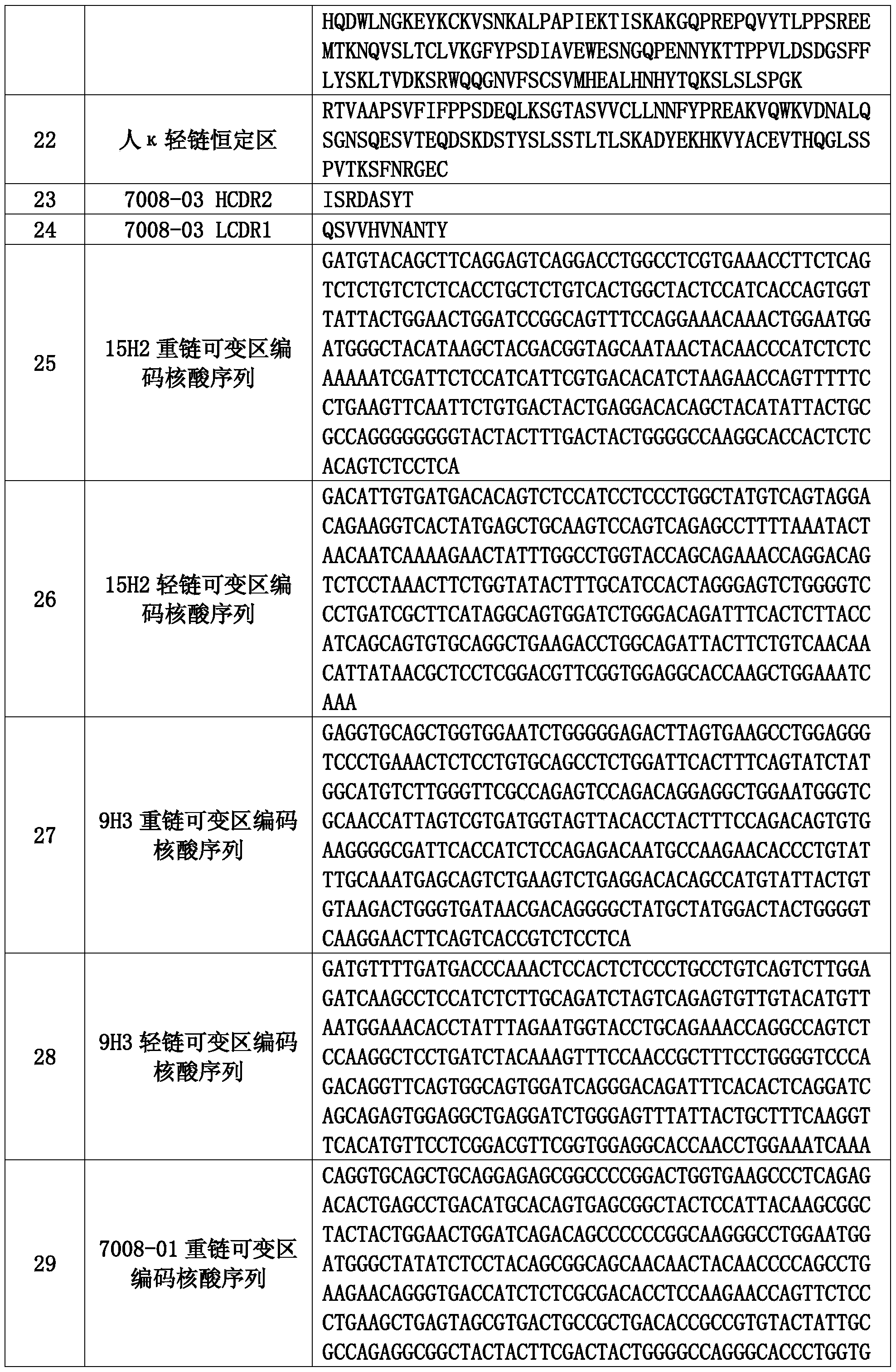


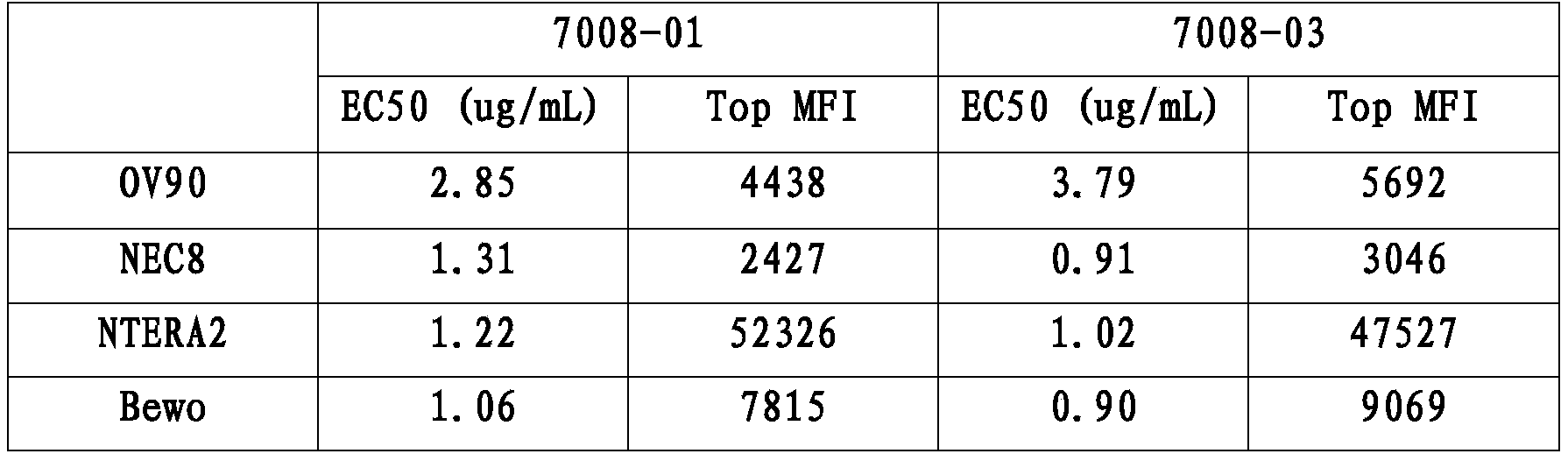
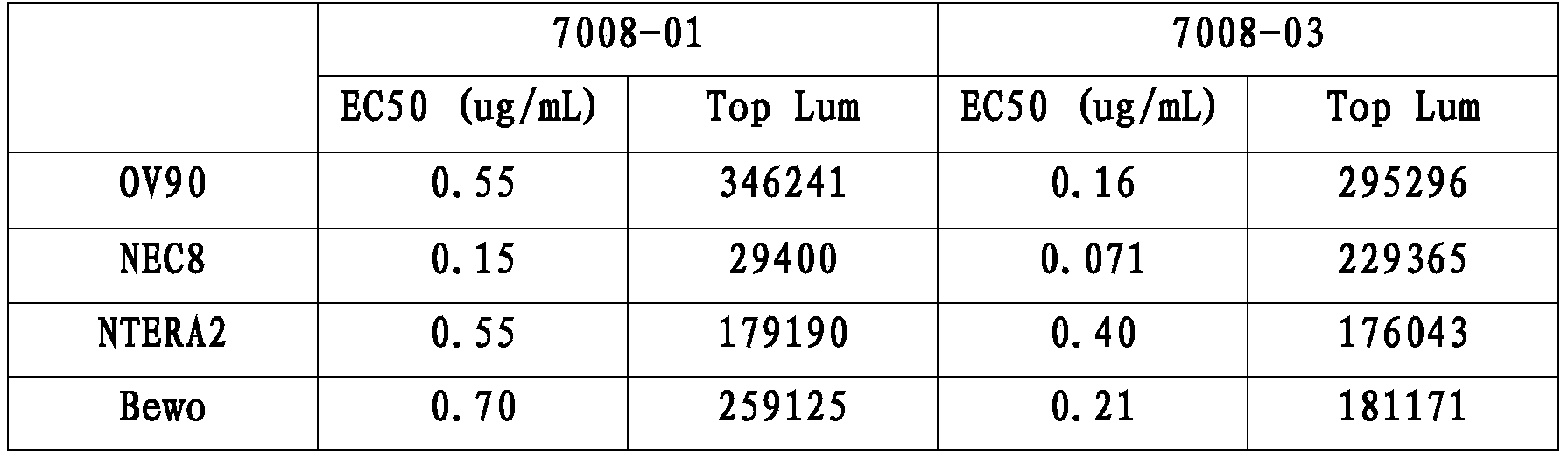

Claims (32)
- 能够特异性结合CLDN6的抗体或其抗原结合片段,所述抗体或其抗原结合片段包含:(a)包含下述3个互补决定区(CDR)的重链可变区(VH):(i)VH CDR1,其由下述序列组成:SEQ ID NO:3,或与其相比具有一个或几个氨基酸的置换、缺失或添加(例如1个,2个或3个氨基酸的置换、缺失或添加)的序列,(ii)VH CDR2,其由下述序列组成:SEQ ID NO:4或33,或与其相比具有一个或几个氨基酸的置换、缺失或添加(例如1个,2个或3个氨基酸的置换、缺失或添加)的序列,和(iii)VH CDR3,其由下述序列组成:SEQ ID NO:5,或与其相比具有一个或几个氨基酸的置换、缺失或添加(例如1个,2个或3个氨基酸的置换、缺失或添加)的序列;和/或(b)包含下述3个互补决定区(CDR)的轻链可变区(VL):(iv)VL CDR1,其由下述序列组成:SEQ ID NO:6,或与其相比具有一个或几个氨基酸的置换、缺失或添加(例如1个,2个或3个氨基酸的置换、缺失或添加)的序列,(v)VL CDR2,其由下述序列组成:SEQ ID NO:7,或与其相比具有一个或几个氨基酸的置换、缺失或添加(例如1个,2个或3个氨基酸的置换、缺失或添加)的序列,和(vi)VL CDR3,其由下述序列组成:SEQ ID NO:8,或与其相比具有一个或几个氨基酸的置换、缺失或添加(例如1个,2个或3个氨基酸的置换、缺失或添加)的序列;优选地,(i)-(vi)任一项中所述的置换为保守置换;优选地,(i)-(vi)任一项中所述的CDR根据Kabat、IMGT或Chothia编号系统定义;优选地,(i)-(vi)任一项中所述的CDR根据IMGT编号系统定义;优选地,所述抗体或其抗原结合片段,其包含:如下3个重链CDRs:序列为SEQ ID NO:3的VH CDR1,序列为SEQ ID NO:4的VH CDR2,序列为SEQ ID NO:5的VH CDR3;和/或,如下3个轻链CDRs:序列为SEQ ID NO:6的VL CDR1,序列为SEQ ID NO:7的VL CDR2,序列为SEQ ID NO:8的VL CDR3;或者,所述抗体或其抗原结合片段,其包含:如下3个重链CDRs:序列为SEQ ID NO:3的VH CDR1,序列为SEQ ID NO:33的VH CDR2,序列为SEQ ID NO:5的VH CDR3;和/或,如下3个轻链CDRs:序列为SEQ ID NO:6的VL CDR1,序列为SEQ ID NO:7的VL CDR2,序列为SEQ ID NO:8的VL CDR3;优选地,所述抗体或其抗原结合片段,其进一步包含来源于人的框架区序列(例如,人免疫球蛋白);优选地,所述人免疫球蛋选自人重排抗体序列或人胚系抗体序列。
- 权利要求1的抗体或其抗原结合片段,其包含:(a)包含下述3个互补决定区(CDR)的重链可变区(VH):(i)VH CDR1,其由下述序列组成:SEQ ID NO:3,或与其相比具有一个或几个氨基酸的置换、缺失或添加(例如1个,2个或3个氨基酸的置换、缺失或添加)的序列,(ii)VH CDR2,其由下述序列组成:SEQ ID NO:4,或与其相比具有一个或几个氨基酸的置换、缺失或添加(例如1个,2个或3个氨基酸的置换、缺失或添加)的序列,和(iii)VH CDR3,其由下述序列组成:SEQ ID NO:5,或与其相比具有一个或几个氨基酸的置换、缺失或添加(例如1个,2个或3个氨基酸的置换、缺失或添加)的序列;和/或(b)包含下述3个互补决定区(CDR)的轻链可变区(VL):(iv)VL CDR1,其由下述序列组成:SEQ ID NO:6,或与其相比具有一个或几个氨基酸的置换、缺失或添加(例如1个,2个或3个氨基酸的置换、缺失或添加)的序列,(v)VL CDR2,其由下述序列组成:SEQ ID NO:7,或与其相比具有一个或几个氨基酸的置换、缺失或添加(例如1个,2个或3个氨基酸的置换、缺失或添加)的序列,和(vi)VL CDR3,其由下述序列组成:SEQ ID NO:8,或与其相比具有一个或几个氨基酸的置换、缺失或添加(例如1个,2个或3个氨基酸的置换、缺失或添加)的序列;优选地,(i)-(vi)任一项中所述的置换为保守置换;优选地,(i)-(vi)任一项中所述的CDR根据Kabat、IMGT或Chothia编号系统定义;优选地,(i)-(vi)任一项中所述的CDR根据IMGT编号系统定义;优选地,所述抗体或其抗原结合片段,其包含:如下3个重链CDRs:序列为SEQ ID NO:3的VH CDR1,序列为SEQ ID NO:4的VH CDR2,序列为SEQ ID NO:5的VH CDR3;和/或,如下3个轻链CDRs:序列为SEQ ID NO:6的VL CDR1,序列为SEQ ID NO:7的VL CDR2,序列为SEQ ID NO:8的VL CDR3;优选地,所述抗体或其抗原结合片段,其进一步包含来源于人的框架区序列(例如, 人免疫球蛋白);优选地,所述人免疫球蛋选自人重排抗体序列或人胚系抗体序列。
- 权利要求2所述的抗体或其抗原结合片段,其中,所述抗体或其抗原结合片段包含:(a)重链可变区(VH),其包含选自下列的氨基酸序列:(i)SEQ ID NO:1所示的序列;(ii)与SEQ ID NO:1所示的序列相比具有一个或几个氨基酸的置换、缺失或添加(例如1个,2个,3个,4个或5个氨基酸的置换、缺失或添加)的序列;或(iii)与SEQ ID NO:1所示的序列具有至少80%、至少85%、至少90%、至少91%、至少92%、至少93%、至少94%、至少95%、至少96%、至少97%、至少98%、至少99%、或100%的序列同一性的序列;和/或,(b)轻链可变区(VL),其包含选自下列的氨基酸序列:(iv)SEQ ID NO:2所示的序列;(v)与SEQ ID NO:2所示的序列相比具有一个或几个氨基酸的置换、缺失或添加(例如1个,2个,3个,4个或5个氨基酸的置换、缺失或添加)的序列;或(vi)与SEQ ID NO:2所示的序列具有至少80%、至少85%、至少90%、至少91%、至少92%、至少93%、至少94%、至少95%、至少96%、至少97%、至少98%、至少99%、或100%的序列同一性的序列;优选地,(ii)或(v)中所述的置换是保守置换;优选地,所述抗体或其抗原结合片段包含:具有如SEQ ID NO:1所示的序列的VH和具有如SEQ ID NO:2所示的序列的VL。
- 权利要求1的抗体或其抗原结合片段,其包含:(a)包含下述3个互补决定区(CDR)的重链可变区(VH):(i)VH CDR1,其由下述序列组成:SEQ ID NO:3,或与其相比具有一个或几个氨基酸的置换、缺失或添加(例如1个,2个或3个氨基酸的置换、缺失或添加)的序列,(ii)VH CDR2,其由下述序列组成:SEQ ID NO:33,或与其相比具有一个或几个氨基酸的置换、缺失或添加(例如1个,2个或3个氨基酸的置换、缺失或添加)的序列, 和(iii)VH CDR3,其由下述序列组成:SEQ ID NO:5,或与其相比具有一个或几个氨基酸的置换、缺失或添加(例如1个,2个或3个氨基酸的置换、缺失或添加)的序列;和/或(b)包含下述3个互补决定区(CDR)的轻链可变区(VL):(iv)VL CDR1,其由下述序列组成:SEQ ID NO:6,或与其相比具有一个或几个氨基酸的置换、缺失或添加(例如1个,2个或3个氨基酸的置换、缺失或添加)的序列,(v)VL CDR2,其由下述序列组成:SEQ ID NO:7,或与其相比具有一个或几个氨基酸的置换、缺失或添加(例如1个,2个或3个氨基酸的置换、缺失或添加)的序列,和(vi)VL CDR3,其由下述序列组成:SEQ ID NO:8,或与其相比具有一个或几个氨基酸的置换、缺失或添加(例如1个,2个或3个氨基酸的置换、缺失或添加)的序列;优选地,(i)-(vi)任一项中所述的置换为保守置换;优选地,(i)-(vi)任一项中所述的CDR根据Kabat、IMGT或Chothia编号系统定义;优选地,(i)-(vi)任一项中所述的CDR根据IMGT编号系统定义;优选地,所述抗体或其抗原结合片段,其包含:如下3个重链CDRs:序列为SEQ ID NO:3的VH CDR1,序列为SEQ ID NO:33的VH CDR2,序列为SEQ ID NO:5的VH CDR3;和/或,如下3个轻链CDRs:序列为SEQ ID NO:6的VL CDR1,序列为SEQ ID NO:7的VL CDR2,序列为SEQ ID NO:8的VL CDR3;优选地,所述抗体或其抗原结合片段,其进一步包含来源于人的框架区序列(例如,人免疫球蛋白);优选地,所述人免疫球蛋选自人重排抗体序列或人胚系抗体序列。
- 权利要求4所述的抗体或其抗原结合片段,其中,所述抗体或其抗原结合片段包含:(a)重链可变区(VH),其包含选自下列的氨基酸序列:(i)SEQ ID NO:19所示的序列;(ii)与SEQ ID NO:19所示的序列相比具有一个或几个氨基酸的置换、缺失或添加(例如1个,2个,3个,4个或5个氨基酸的置换、缺失或添加)的序列;或(iii)与SEQ ID NO:19所示的序列具有至少80%、至少85%、至少90%、至少91%、至少92%、至少93%、至少94%、至少95%、至少96%、至少97%、至少98%、至少99%、 或100%的序列同一性的序列;和/或,(b)轻链可变区(VL),其包含选自下列的氨基酸序列:(iv)SEQ ID NO:20所示的序列;(v)与SEQ ID NO:20所示的序列相比具有一个或几个氨基酸的置换、缺失或添加(例如1个,2个,3个,4个或5个氨基酸的置换、缺失或添加)的序列;或(vi)与SEQ ID NO:20所示的序列具有至少80%、至少85%、至少90%、至少91%、至少92%、至少93%、至少94%、至少95%、至少96%、至少97%、至少98%、至少99%、或100%的序列同一性的序列;优选地,(ii)或(v)中所述的置换是保守置换;优选地,所述抗体或其抗原结合片段包含:具有如SEQ ID NO:19所示的序列的VH和具有如SEQ ID NO:20所示的序列的VL。
- 能够特异性结合CLDN6和/或CLDN9的抗体或其抗原结合片段,所述抗体或其抗原结合片段包含:(a)包含下述3个互补决定区(CDR)的重链可变区(VH):(i)VH CDR1,其由下述序列组成:SEQ ID NO:13,或与其相比具有一个或几个氨基酸的置换、缺失或添加(例如1个,2个或3个氨基酸的置换、缺失或添加)的序列,(ii)VH CDR2,其由下述序列组成:SEQ ID NO:14或23,或与其相比具有一个或几个氨基酸的置换、缺失或添加(例如1个,2个或3个氨基酸的置换、缺失或添加)的序列,和(iii)VH CDR3,其由下述序列组成:SEQ ID NO:15,或与其相比具有一个或几个氨基酸的置换、缺失或添加(例如1个,2个或3个氨基酸的置换、缺失或添加)的序列;和/或(b)包含下述3个互补决定区(CDR)的轻链可变区(VL):(iv)VL CDR1,其由下述序列组成:SEQ ID NO:16或24,或与其相比具有一个或几个氨基酸的置换、缺失或添加(例如1个,2个或3个氨基酸的置换、缺失或添加)的序列,(v)VL CDR2,其由下述序列组成:SEQ ID NO:17,或与其相比具有一个或几个氨基酸的置换、缺失或添加(例如1个,2个或3个氨基酸的置换、缺失或添加)的序列, 和(vi)VL CDR3,其由下述序列组成:SEQ ID NO:18,或与其相比具有一个或几个氨基酸的置换、缺失或添加(例如1个,2个或3个氨基酸的置换、缺失或添加)的序列;优选地,(i)-(vi)任一项中所述的置换为保守置换;优选地,(i)-(vi)任一项中所述的CDR根据Kabat、IMGT或Chothia编号系统定义;优选地,(i)-(vi)任一项中所述的CDR根据IMGT编号系统定义;优选地,所述抗体或其抗原结合片段,其包含:如下3个重链CDRs:序列为SEQ ID NO:13的VH CDR1,序列为SEQ ID NO:14的VH CDR2,序列为SEQ ID NO:15的VH CDR3;和/或,如下3个轻链CDRs:序列为SEQ ID NO:16的VL CDR1,序列为SEQ ID NO:17的VL CDR2,序列为SEQ ID NO:18的VL CDR3;或者,所述抗体或其抗原结合片段,其包含:如下3个重链CDRs:序列为SEQ ID NO:13的VH CDR1,序列为SEQ ID NO:23的VH CDR2,序列为SEQ ID NO:15的VH CDR3;和/或,如下3个轻链CDRs:序列为SEQ ID NO:24的VL CDR1,序列为SEQ ID NO:17的VL CDR2,序列为SEQ ID NO:18的VL CDR3;优选地,所述抗体或其抗原结合片段,其进一步包含来源于人的框架区序列(例如,人免疫球蛋白);优选地,所述人免疫球蛋选自人重排抗体序列或人胚系抗体序列。
- 权利要求6的抗体或其抗原结合片段,其包含:(a)包含下述3个互补决定区(CDR)的重链可变区(VH):(i)VH CDR1,其由下述序列组成:SEQ ID NO:13,或与其相比具有一个或几个氨基酸的置换、缺失或添加(例如1个,2个或3个氨基酸的置换、缺失或添加)的序列,(ii)VH CDR2,其由下述序列组成:SEQ ID NO:14,或与其相比具有一个或几个氨基酸的置换、缺失或添加(例如1个,2个或3个氨基酸的置换、缺失或添加)的序列,和(iii)VH CDR3,其由下述序列组成:SEQ ID NO:15,或与其相比具有一个或几个氨基酸的置换、缺失或添加(例如1个,2个或3个氨基酸的置换、缺失或添加)的序列;和/或(b)包含下述3个互补决定区(CDR)的轻链可变区(VL):(iv)VL CDR1,其由下述序列组成:SEQ ID NO:16,或与其相比具有一个或几个氨 基酸的置换、缺失或添加(例如1个,2个或3个氨基酸的置换、缺失或添加)的序列,(v)VL CDR2,其由下述序列组成:SEQ ID NO:17,或与其相比具有一个或几个氨基酸的置换、缺失或添加(例如1个,2个或3个氨基酸的置换、缺失或添加)的序列,和(vi)VL CDR3,其由下述序列组成:SEQ ID NO:18,或与其相比具有一个或几个氨基酸的置换、缺失或添加(例如1个,2个或3个氨基酸的置换、缺失或添加)的序列;优选地,(i)-(vi)任一项中所述的置换为保守置换;优选地,(i)-(vi)任一项中所述的CDR根据Kabat、IMGT或Chothia编号系统定义;优选地,(i)-(vi)任一项中所述的CDR根据IMGT编号系统定义;优选地,所述抗体或其抗原结合片段,其包含:如下3个重链CDRs:序列为SEQ ID NO:13的VH CDR1,序列为SEQ ID NO:14的VH CDR2,序列为SEQ ID NO:15的VH CDR3;和/或,如下3个轻链CDRs:序列为SEQ ID NO:16的VL CDR1,序列为SEQ ID NO:17的VL CDR2,序列为SEQ ID NO:18的VL CDR3;优选地,所述抗体或其抗原结合片段,其进一步包含来源于人的框架区序列(例如,人免疫球蛋白);优选地,所述人免疫球蛋选自人重排抗体序列或人胚系抗体序列。
- 权利要求7所述的抗体或其抗原结合片段,其中,所述抗体或其抗原结合片段包含:(a)重链可变区(VH),其包含选自下列的氨基酸序列:(i)SEQ ID NO:11所示的序列;(ii)与SEQ ID NO:11所示的序列相比具有一个或几个氨基酸的置换、缺失或添加(例如1个,2个,3个,4个或5个氨基酸的置换、缺失或添加)的序列;或(iii)与SEQ ID NO:11所示的序列具有至少80%、至少85%、至少90%、至少91%、至少92%、至少93%、至少94%、至少95%、至少96%、至少97%、至少98%、至少99%、或100%的序列同一性的序列;和/或,(b)轻链可变区(VL),其包含选自下列的氨基酸序列:(iv)SEQ ID NO:12所示的序列;(v)与SEQ ID NO:12所示的序列相比具有一个或几个氨基酸的置换、缺失或添加 (例如1个,2个,3个,4个或5个氨基酸的置换、缺失或添加)的序列;或(vi)与SEQ ID NO:12所示的序列具有至少80%、至少85%、至少90%、至少91%、至少92%、至少93%、至少94%、至少95%、至少96%、至少97%、至少98%、至少99%、或100%的序列同一性的序列;优选地,(ii)或(v)中所述的置换是保守置换;优选地,所述抗体或其抗原结合片段包含:具有如SEQ ID NO:11所示的序列的VH和具有如SEQ ID NO:12所示的序列的VL。
- 权利要求6的抗体或其抗原结合片段,其包含:(a)包含下述3个互补决定区(CDR)的重链可变区(VH):(i)VH CDR1,其由下述序列组成:SEQ ID NO:13,或与其相比具有一个或几个氨基酸的置换、缺失或添加(例如1个,2个或3个氨基酸的置换、缺失或添加)的序列,(ii)VH CDR2,其由下述序列组成:SEQ ID NO:23,或与其相比具有一个或几个氨基酸的置换、缺失或添加(例如1个,2个或3个氨基酸的置换、缺失或添加)的序列,和(iii)VH CDR3,其由下述序列组成:SEQ ID NO:15,或与其相比具有一个或几个氨基酸的置换、缺失或添加(例如1个,2个或3个氨基酸的置换、缺失或添加)的序列;和/或(b)包含下述3个互补决定区(CDR)的轻链可变区(VL):(iv)VL CDR1,其由下述序列组成:SEQ ID NO:24,或与其相比具有一个或几个氨基酸的置换、缺失或添加(例如1个,2个或3个氨基酸的置换、缺失或添加)的序列,(v)VL CDR2,其由下述序列组成:SEQ ID NO:17,或与其相比具有一个或几个氨基酸的置换、缺失或添加(例如1个,2个或3个氨基酸的置换、缺失或添加)的序列,和(vi)VL CDR3,其由下述序列组成:SEQ ID NO:18,或与其相比具有一个或几个氨基酸的置换、缺失或添加(例如1个,2个或3个氨基酸的置换、缺失或添加)的序列;优选地,(i)-(vi)任一项中所述的置换为保守置换;优选地,(i)-(vi)任一项中所述的CDR根据Kabat、IMGT或Chothia编号系统定义;优选地,(i)-(vi)任一项中所述的CDR根据IMGT编号系统定义;优选地,所述抗体或其抗原结合片段,其包含:如下3个重链CDRs:序列为SEQ ID NO:13的VH CDR1,序列为SEQ ID NO:23的VH CDR2,序列为SEQ ID NO:15的VH CDR3;和/或,如下3个轻链CDRs:序列为SEQ ID NO:24的VL CDR1,序列为SEQ ID NO:17的VL CDR2,序列为SEQ ID NO:18的VL CDR3;优选地,所述抗体或其抗原结合片段,其进一步包含来源于人的框架区序列(例如,人免疫球蛋白);优选地,所述人免疫球蛋选自人重排抗体序列或人胚系抗体序列。
- 权利要求9所述的抗体或其抗原结合片段,其中,所述抗体或其抗原结合片段包含:(a)重链可变区(VH),其包含选自下列的氨基酸序列:(i)SEQ ID NO:9所示的序列;(ii)与SEQ ID NO:9所示的序列相比具有一个或几个氨基酸的置换、缺失或添加(例如1个,2个,3个,4个或5个氨基酸的置换、缺失或添加)的序列;或(iii)与SEQ ID NO:9所示的序列具有至少80%、至少85%、至少90%、至少91%、至少92%、至少93%、至少94%、至少95%、至少96%、至少97%、至少98%、至少99%、或100%的序列同一性的序列;和/或,(b)轻链可变区(VL),其包含选自下列的氨基酸序列:(iv)SEQ ID NO:10所示的序列;(v)与SEQ ID NO:10所示的序列相比具有一个或几个氨基酸的置换、缺失或添加(例如1个,2个,3个,4个或5个氨基酸的置换、缺失或添加)的序列;或(vi)与SEQ ID NO:10所示的序列具有至少80%、至少85%、至少90%、至少91%、至少92%、至少93%、至少94%、至少95%、至少96%、至少97%、至少98%、至少99%、或100%的序列同一性的序列;优选地,(ii)或(v)中所述的置换是保守置换;优选地,所述抗体或其抗原结合片段包含:具有如SEQ ID NO:9所示的序列的VH和具有如SEQ ID NO:10所示的序列的VL。
- 权利要求1-10任一项所述的抗体或其抗原结合片段,其中,所述抗体或其抗原结合片段进一步包含:(a)人免疫球蛋白的重链恒定区(CH)或其变体,所述变体与其所源自的野生型序列相比具有一个或多个氨基酸的置换、缺失或添加(例如,至多20个、至多15个、至多10个、或至多5个氨基酸的置换、缺失或添加;例如1个,2个,3个,4个或5个氨基酸的置换、缺失或添加);和(b)人免疫球蛋白的轻链恒定区(CL)或其变体,所述变体与其所源自的野生型序列相比具有至多20个氨基酸的保守置换(例如至多15个、至多10个、或至多5个氨基酸的保守置换;例如1个,2个,3个,4个或5个氨基酸的保守置换);优选地,所述重链恒定区是IgG重链恒定区,例如IgG1、IgG2、IgG3或IgG4重链恒定区;优选地,所述抗体或其抗原结合片段包含SEQ ID NO:21所示的重链恒定区(CH);优选地,所述轻链恒定区是κ或λ轻链恒定区;优选地,所述抗体或其抗原结合片段包含SEQ ID NO:22所示的轻链恒定区(CL)。
- 权利要求1-11任一项所述的抗体或其抗原结合片段,其中,所述抗原结合片段选自Fab、Fab’、(Fab’) 2、Fv、二硫键连接的Fv、scFv、双抗体(diabody)和单域抗体(sdAb);和/或,所述抗体为鼠源抗体、嵌合抗体、人源化抗体、双特异性抗体或多特异性抗体。
- 权利要求1-12任一项所述的抗体或其抗原结合片段,其中,所述抗体或其抗原结合片段带有标记;优选地,所述抗体或其抗原结合片段带有可检测的标记,例如酶(例如辣根过氧化物酶)、放射性核素、荧光染料、发光物质(如化学发光物质)或生物素。
- 分离的核酸分子,其编码权利要求1-13任一项所述的抗体或其抗原结合片段,或其重链可变区和/或轻链可变区。
- 载体,其包含权利要求14所述的分离的核酸分子;优选地,所述载体为克隆载体或表达载体。
- 宿主细胞,其包含权利要求14所述的分离的核酸分子或权利要求15所述的载 体。
- 制备权利要求1-13任一项所述的抗体或其抗原结合片段的方法,其包括,在允许所述抗体或其抗原结合片段表达的条件下,培养权利要求16所述的宿主细胞,和从培养的宿主细胞培养物中回收所述抗体或其抗原结合片段。
- 双特异性或多特异性分子,其包含权利要求1-13任一项所述的抗体或其抗原结合片段;优选地,所述双特异性或多特异性分子特异性结合CLDN6,并且额外地特异性结合一个或多个其他靶标;优选地,所述双特异性或多特异性分子还包含至少一种具有针对第二靶标的第二结合特异性的分子(例如第二抗体)。
- 免疫缀合物,其包含权利要求1-13任一项所述的抗体或其抗原结合片段以及连接于所述抗体或其抗原结合片段的治疗剂;优选地,所述治疗剂选自细胞毒剂;优选地,所述治疗剂选自烷化剂、有丝分裂抑制剂、抗肿瘤抗生素、抗代谢物、拓扑异构酶抑制剂、酪氨酸激酶抑制剂、放射性核素剂,及其任意组合;优选地,所述免疫缀合物是抗体-药物偶联物(ADC)。
- 药物组合物,其含有权利要求1-13任一项所述的抗体或其抗原结合片段、权利要求18所述的双特异性或多特异性分子或者权利要求19所述的免疫缀合物,以及药学上可接受的载体和/或赋形剂;优选地,药物组合物还包含另外的药学活性剂;优选地,所述另外的药学活性剂是具有抗肿瘤活性的药物,例如烷化剂、有丝分裂抑制剂、抗肿瘤抗生素、抗代谢物、拓扑异构酶抑制剂、酪氨酸激酶抑制剂、放射性核素剂、放射增敏剂、抗血管生成剂、细胞因子、分子靶向药物、免疫检查点抑制剂或溶瘤病毒;优选地,所述抗体或其抗原结合片段、双特异性或多特异性分子或免疫缀合物与所述另外的药学活性剂作为分离的组分或作为同一组合物的组分提供。
- 试剂盒,其含有权利要求1-13任一项所述的抗体或其抗原结合片段;优选地,所述抗体或其抗原结合片段带有可检测的标记,例如酶(例如辣根过氧化物酶)、放射性核素、荧光染料、发光物质(如化学发光物质)或生物素;优选地,所述试剂盒还包括第二抗体,其特异性识别权利要求1-13任一项所述的抗体或其抗原结合片段;优选地,所述第二抗体还包括可检测的标记,例如酶(例如辣根过氧化物酶)、放射性核素、荧光染料、发光物质(如化学发光物质)或生物素。
- 嵌合抗原受体,其包含权利要求1-13任一项所述的抗体或其抗原结合片段的抗原结合结构域;优选地,所述抗原结合结构域包含权利要求1-13任一项所述的抗体或其抗原结合片段的重链可变区和轻链可变区;优选地,所述抗原结合结构域是scFv;优选地,所述抗原结合受体包含权利要求1-13任一项所述的抗体的抗原结合片段;优选地,所述抗原结合受体由免疫效应细胞(例如T细胞)所表达。
- 分离的核酸分子,其编码权利要求22所述的嵌合抗原受体。
- 载体,其包含权利要求23所述的分离的核酸分子;优选地,其用于制备嵌合抗原受体T细胞。
- 宿主细胞,其包含权利要求23所述的分离的核酸分子或权利要求24所述的载体;优选地,所述宿主细胞是免疫效应细胞(例如,T细胞或NK细胞);优选地,所述宿主细胞是嵌合抗原受体T细胞(CAR-T)。
- 一种用于降低CLDN6和/或CLDN9在细胞表面的表达水平的方法,其包括将所述细胞与权利要求1-13任一项所述的抗体或其抗原结合片段,或权利要求18所述的双特异性或多特异性分子,或权利要求19所述的免疫缀合物,或权利要求20所述的药物组合物,或权利要求22所述的嵌合抗原受体,或权利要求25所述的宿主细胞接触,使 得CLDN6和/或CLDN9在所述细胞表面的表达水平降低;其中,所述细胞在其表面表达CLDN6和/或CLDN9;优选地,所述细胞是表达CLDN6和/或CLDN9的肿瘤细胞。
- 一种抑制表达CLDN6和/或CLDN9的肿瘤细胞生长和/或杀伤所述肿瘤细胞的方法,其包括将所述肿瘤细胞与有效量的权利要求1-13任一项所述的抗体或其抗原结合片段,或权利要求18所述的双特异性或多特异性分子,或权利要求19所述的免疫缀合物,或权利要求20所述的药物组合物,或权利要求22所述的嵌合抗原受体,或权利要求25所述的宿主细胞接触。
- 一种用于在受试者(例如人)中预防和/或治疗肿瘤的方法,所述方法包括向有此需要的受试者施用有效量的权利要求1-13任一项所述的抗体或其抗原结合片段,或权利要求18所述的双特异性或多特异性分子,或权利要求19所述的免疫缀合物,或权利要求20所述的药物组合物,或权利要求22所述的嵌合抗原受体,或权利要求25所述的宿主细胞;优选地,所述肿瘤表达CLDN6和/或CLDN9;优选地,所述肿瘤涉及表达CLDN6和/或CLDN9的肿瘤细胞;优选地,所述CLDN6和/或CLDN9在所述肿瘤细胞表面上表达;优选地,所述肿瘤选自卵巢癌、睾丸癌、胃癌、子宫内膜癌、肺癌、食管癌、胰腺癌、支气管癌、乳腺癌、耳鼻喉(ENT)癌、结肠癌、肝癌、头颈癌、胆囊癌及其转移癌(例如,胃癌转移,如Krukenberg瘤、腹膜转移或淋巴结转移);优选地,所述受试者为哺乳动物,例如人;优选地,所述方法还包括施用另外的具有抗肿瘤活性的药物,例如烷化剂、有丝分裂抑制剂、抗肿瘤抗生素、抗代谢物、拓扑异构酶抑制剂、酪氨酸激酶抑制剂、放射性核素剂、放射增敏剂、抗血管生成剂、细胞因子、分子靶向药物、免疫检查点抑制剂或溶瘤病毒;优选地,所述方法还包括施用另外的抗肿瘤疗法,例如手术、化学治疗、放射治疗、靶向治疗、免疫治疗、激素治疗、基因治疗或姑息治疗。
- 权利要求1-13任一项所述的抗体或其抗原结合片段,或权利要求18所述的双特 异性或多特异性分子,或权利要求19所述的免疫缀合物,或权利要求20所述的药物组合物,或权利要求22所述的嵌合抗原受体,或权利要求25所述的宿主细胞,在制备药物中的用途,所述药物用于在受试者(例如人)中预防和/治疗肿瘤;优选地,药物还包含另外的药学活性剂;优选地,所述另外的药学活性剂是具有抗肿瘤活性的药物,例如烷化剂、有丝分裂抑制剂、抗肿瘤抗生素、抗代谢物、拓扑异构酶抑制剂、酪氨酸激酶抑制剂、放射性核素剂、放射增敏剂、抗血管生成剂、细胞因子、分子靶向药物、免疫检查点抑制剂或溶瘤病毒;优选地,所述肿瘤表达CLDN6和/或CLDN9;优选地,所述肿瘤涉及表达CLDN6和/或CLDN9的肿瘤细胞;优选地,所述CLDN6和/或CLDN9在所述肿瘤细胞表面上表达;优选地,所述肿瘤选自卵巢癌、睾丸癌、胃癌、子宫内膜癌、肺癌、食管癌、胰腺癌、支气管癌、乳腺癌、耳鼻喉(ENT)癌、结肠癌、肝癌、头颈癌、胆囊癌及其转移癌(例如,胃癌转移,如Krukenberg瘤、腹膜转移或淋巴结转移);优选地,所述受试者为哺乳动物,例如人。
- 一种检测CLDN6和/或CLDN9(例如人CLDN6和/或人CLDN9)在样品中的存在或其量的方法,其包括以下步骤:(1)将所述样品与权利要求1-13任一项所述的抗体或其抗原结合片段接触;(2)检测所述抗体或其抗原结合片段与CLDN6和/或CLDN9之间复合物的形成或检测所述复合物的量;优选地,所述抗体或其抗原结合片段带有可检测的标记;优选地,所述CLDN6是人CLDN6;优选地,所述CLDN9是人CLDN9。
- 一种用于检测肿瘤是否能够通过靶向CLDN6和/或CLDN9的抗肿瘤疗法来治疗的方法,其包括以下步骤:(1)将含有所述肿瘤细胞的样品与权利要求1-13任一项所述的抗体或其抗原结合片段接触;(2)检测所述抗体或其抗原结合片段与CLDN6和/或CLDN9之间复合物的形成;优选地,所述抗体或其抗原结合片段带有可检测的标记;优选地,所述CLDN6是人CLDN6;优选地,所述CLDN9是人CLDN9;优选地,所述肿瘤选自卵巢癌、睾丸癌、胃癌、子宫内膜癌、肺癌、食管癌、胰腺癌、支气管癌、乳腺癌、耳鼻喉(ENT)癌、结肠癌、肝癌、头颈癌、胆囊癌及其转移癌(例如,胃癌转移,如Krukenberg瘤、腹膜转移或淋巴结转移)。
- 权利要求1-13任一项所述的抗体或其抗原结合片段在制备试剂盒中的用途,所述试剂盒用于检测肿瘤是否能够通过靶向CLDN6和/或CLDN9的抗肿瘤疗法来治疗;优选地,所述抗体或其抗原结合片段带有可检测的标记;优选地,所述CLDN6是人CLDN6;优选地,所述CLDN9是人CLDN9;优选地,所述肿瘤选自卵巢癌、睾丸癌、胃癌、子宫内膜癌、肺癌、食管癌、胰腺癌、支气管癌、乳腺癌、耳鼻喉(ENT)癌、结肠癌、肝癌、头颈癌、胆囊癌及其转移癌(例如,胃癌转移,如Krukenberg瘤、腹膜转移或淋巴结转移)。
Priority Applications (9)
| Application Number | Priority Date | Filing Date | Title |
|---|---|---|---|
| CN202180095157.5A CN116940377A (zh) | 2021-03-05 | 2021-03-05 | 抗cldn6抗体及其用途 |
| PCT/CN2021/079380 WO2022183502A1 (zh) | 2021-03-05 | 2021-03-05 | 抗cldn6抗体及其用途 |
| CA3212530A CA3212530A1 (en) | 2021-03-05 | 2021-03-05 | Anti-cldn6 antibody and use thereof |
| US18/280,379 US20240150455A1 (en) | 2021-03-05 | 2021-03-05 | Anti-cldn6 antibody and use thereof |
| EP21928585.5A EP4302777A4 (en) | 2021-03-05 | 2021-03-05 | ANTI-CLDN6 ANTIBODY AND ITS USE |
| KR1020237033643A KR20230154317A (ko) | 2021-03-05 | 2021-03-05 | 항-cldn6 항체 및 이의 용도 |
| JP2023553642A JP7734753B2 (ja) | 2021-03-05 | 2021-03-05 | 抗cldn6抗体およびその使用 |
| TW111107215A TW202235441A (zh) | 2021-03-05 | 2022-03-01 | 抗cldn6抗體及其用途 |
| JP2025140700A JP2026000918A (ja) | 2021-03-05 | 2025-08-26 | 抗cldn6抗体およびその使用 |
Applications Claiming Priority (1)
| Application Number | Priority Date | Filing Date | Title |
|---|---|---|---|
| PCT/CN2021/079380 WO2022183502A1 (zh) | 2021-03-05 | 2021-03-05 | 抗cldn6抗体及其用途 |
Publications (1)
| Publication Number | Publication Date |
|---|---|
| WO2022183502A1 true WO2022183502A1 (zh) | 2022-09-09 |
Family
ID=83154900
Family Applications (1)
| Application Number | Title | Priority Date | Filing Date |
|---|---|---|---|
| PCT/CN2021/079380 Ceased WO2022183502A1 (zh) | 2021-03-05 | 2021-03-05 | 抗cldn6抗体及其用途 |
Country Status (8)
| Country | Link |
|---|---|
| US (1) | US20240150455A1 (zh) |
| EP (1) | EP4302777A4 (zh) |
| JP (2) | JP7734753B2 (zh) |
| KR (1) | KR20230154317A (zh) |
| CN (1) | CN116940377A (zh) |
| CA (1) | CA3212530A1 (zh) |
| TW (1) | TW202235441A (zh) |
| WO (1) | WO2022183502A1 (zh) |
Cited By (8)
| Publication number | Priority date | Publication date | Assignee | Title |
|---|---|---|---|---|
| WO2024165057A1 (en) * | 2023-02-07 | 2024-08-15 | LaNova Medicines Limited | Antibodies and antibody-drug conjugates targeting claudin 6 |
| CN118754987A (zh) * | 2024-08-21 | 2024-10-11 | 广州百吉生物制药有限公司 | 一种紧密连接蛋白抗体h04及其应用 |
| CN118812714A (zh) * | 2024-08-21 | 2024-10-22 | 广州百吉生物制药有限公司 | 一种紧密连接蛋白抗体b3及其应用 |
| WO2024227424A1 (zh) * | 2023-04-30 | 2024-11-07 | 泰诚思(上海)生物医药有限公司 | hCLDN6的抗原结合蛋白和其用途 |
| US20250121084A1 (en) * | 2023-10-17 | 2025-04-17 | Adc Therapeutics Sa | Anti-claudin-6 conjugates |
| WO2025083067A1 (en) * | 2023-10-17 | 2025-04-24 | Adc Therapeutics Sa | Anti-claudin-6 conjugates |
| WO2025162270A1 (zh) * | 2024-02-01 | 2025-08-07 | 江苏恒瑞医药股份有限公司 | 抗cldn6抗体、其抗体-药物偶联物及其医药用途 |
| US12528863B2 (en) | 2019-07-10 | 2026-01-20 | Chugai Seiyaku Kabushiki Kaisha | Claudin-6 binding molecules and uses thereof |
Families Citing this family (3)
| Publication number | Priority date | Publication date | Assignee | Title |
|---|---|---|---|---|
| JP7689666B2 (ja) * | 2021-12-17 | 2025-06-09 | 国立大学法人 筑波大学 | ヒト化抗dnam-1抗体 |
| CN118772280B (zh) * | 2024-06-13 | 2025-04-04 | 广州百吉生物制药有限公司 | 一种抗人cldn6单域抗体及其应用 |
| CN119462928B (zh) * | 2024-11-08 | 2025-09-05 | 深圳豪石生物科技有限公司 | 特异性靶向cldn6的抗体及其在制备car-t细胞中的应用 |
Citations (20)
| Publication number | Priority date | Publication date | Assignee | Title |
|---|---|---|---|---|
| US3817837A (en) | 1971-05-14 | 1974-06-18 | Syva Corp | Enzyme amplification assay |
| US3850752A (en) | 1970-11-10 | 1974-11-26 | Akzona Inc | Process for the demonstration and determination of low molecular compounds and of proteins capable of binding these compounds specifically |
| US3939350A (en) | 1974-04-29 | 1976-02-17 | Board Of Trustees Of The Leland Stanford Junior University | Fluorescent immunoassay employing total reflection for activation |
| US3996345A (en) | 1974-08-12 | 1976-12-07 | Syva Company | Fluorescence quenching with immunological pairs in immunoassays |
| US4275149A (en) | 1978-11-24 | 1981-06-23 | Syva Company | Macromolecular environment control in specific receptor assays |
| US4277437A (en) | 1978-04-05 | 1981-07-07 | Syva Company | Kit for carrying out chemically induced fluorescence immunoassay |
| US4366241A (en) | 1980-08-07 | 1982-12-28 | Syva Company | Concentrating zone method in heterogeneous immunoassays |
| US4816567A (en) | 1983-04-08 | 1989-03-28 | Genentech, Inc. | Recombinant immunoglobin preparations |
| US5225539A (en) | 1986-03-27 | 1993-07-06 | Medical Research Council | Recombinant altered antibodies and methods of making altered antibodies |
| US5530101A (en) | 1988-12-28 | 1996-06-25 | Protein Design Labs, Inc. | Humanized immunoglobulins |
| WO2002043478A2 (en) | 2000-11-30 | 2002-06-06 | Medarex, Inc. | Transgenic transchromosomal rodents for making human antibodies |
| CN101918450A (zh) * | 2008-01-11 | 2010-12-15 | 国立大学法人东京大学 | 抗cldn6抗体 |
| WO2012079000A1 (en) | 2010-12-09 | 2012-06-14 | The Trustees Of The University Of Pennsylvania | Use of chimeric antigen receptor-modified t cells to treat cancer |
| US20120213783A1 (en) | 2009-10-01 | 2012-08-23 | Rosenberg Steven A | Anti-vascular endothelial growth factor receptor-2 chimeric antigen receptors and use of same for the treatment of cancer |
| WO2013059593A1 (en) | 2011-10-20 | 2013-04-25 | The United States Of America, As Represented By The Secretary, Department Of Health And Human Services | Anti-cd22 chimeric antigen receptors |
| WO2013126726A1 (en) | 2012-02-22 | 2013-08-29 | The Trustees Of The University Of Pennsylvania | Double transgenic t cells comprising a car and a tcr and their methods of use |
| CN105813650A (zh) * | 2013-11-06 | 2016-07-27 | 施特姆森特克斯股份有限公司 | 新型抗-密蛋白抗体和使用方法 |
| CN106432500A (zh) * | 2009-11-11 | 2017-02-22 | 加尼梅德药物公司 | 密蛋白6(cldn6)特异性的抗体 |
| CN107207580A (zh) * | 2014-11-05 | 2017-09-26 | 艾伯维施特姆森特克斯有限责任公司 | 抗‑cldn嵌合抗原受体和使用方法 |
| WO2020191342A1 (en) * | 2019-03-20 | 2020-09-24 | The Regents Of The University Of California | Claudin-6 antibodies and drug conjugates |
Family Cites Families (1)
| Publication number | Priority date | Publication date | Assignee | Title |
|---|---|---|---|---|
| JP7682797B2 (ja) | 2019-03-20 | 2025-05-26 | ザ リージェンツ オブ ザ ユニバーシティ オブ カリフォルニア | クローディン6二重特異性抗体 |
-
2021
- 2021-03-05 WO PCT/CN2021/079380 patent/WO2022183502A1/zh not_active Ceased
- 2021-03-05 CN CN202180095157.5A patent/CN116940377A/zh active Pending
- 2021-03-05 KR KR1020237033643A patent/KR20230154317A/ko active Pending
- 2021-03-05 JP JP2023553642A patent/JP7734753B2/ja active Active
- 2021-03-05 CA CA3212530A patent/CA3212530A1/en active Pending
- 2021-03-05 US US18/280,379 patent/US20240150455A1/en active Pending
- 2021-03-05 EP EP21928585.5A patent/EP4302777A4/en active Pending
-
2022
- 2022-03-01 TW TW111107215A patent/TW202235441A/zh unknown
-
2025
- 2025-08-26 JP JP2025140700A patent/JP2026000918A/ja active Pending
Patent Citations (25)
| Publication number | Priority date | Publication date | Assignee | Title |
|---|---|---|---|---|
| US3850752A (en) | 1970-11-10 | 1974-11-26 | Akzona Inc | Process for the demonstration and determination of low molecular compounds and of proteins capable of binding these compounds specifically |
| US3817837A (en) | 1971-05-14 | 1974-06-18 | Syva Corp | Enzyme amplification assay |
| US3939350A (en) | 1974-04-29 | 1976-02-17 | Board Of Trustees Of The Leland Stanford Junior University | Fluorescent immunoassay employing total reflection for activation |
| US3996345A (en) | 1974-08-12 | 1976-12-07 | Syva Company | Fluorescence quenching with immunological pairs in immunoassays |
| US4277437A (en) | 1978-04-05 | 1981-07-07 | Syva Company | Kit for carrying out chemically induced fluorescence immunoassay |
| US4275149A (en) | 1978-11-24 | 1981-06-23 | Syva Company | Macromolecular environment control in specific receptor assays |
| US4366241A (en) | 1980-08-07 | 1982-12-28 | Syva Company | Concentrating zone method in heterogeneous immunoassays |
| US4366241B1 (zh) | 1980-08-07 | 1988-10-18 | ||
| US4816567A (en) | 1983-04-08 | 1989-03-28 | Genentech, Inc. | Recombinant immunoglobin preparations |
| US5225539A (en) | 1986-03-27 | 1993-07-06 | Medical Research Council | Recombinant altered antibodies and methods of making altered antibodies |
| US5693762A (en) | 1988-12-28 | 1997-12-02 | Protein Design Labs, Inc. | Humanized immunoglobulins |
| US5585089A (en) | 1988-12-28 | 1996-12-17 | Protein Design Labs, Inc. | Humanized immunoglobulins |
| US5530101A (en) | 1988-12-28 | 1996-06-25 | Protein Design Labs, Inc. | Humanized immunoglobulins |
| US6180370B1 (en) | 1988-12-28 | 2001-01-30 | Protein Design Labs, Inc. | Humanized immunoglobulins and methods of making the same |
| WO2002043478A2 (en) | 2000-11-30 | 2002-06-06 | Medarex, Inc. | Transgenic transchromosomal rodents for making human antibodies |
| CN101918450A (zh) * | 2008-01-11 | 2010-12-15 | 国立大学法人东京大学 | 抗cldn6抗体 |
| US20120213783A1 (en) | 2009-10-01 | 2012-08-23 | Rosenberg Steven A | Anti-vascular endothelial growth factor receptor-2 chimeric antigen receptors and use of same for the treatment of cancer |
| CN106432500A (zh) * | 2009-11-11 | 2017-02-22 | 加尼梅德药物公司 | 密蛋白6(cldn6)特异性的抗体 |
| CN111875703A (zh) * | 2009-11-11 | 2020-11-03 | 安斯泰来制药股份有限公司 | 密蛋白6(cldn6)特异性的抗体 |
| WO2012079000A1 (en) | 2010-12-09 | 2012-06-14 | The Trustees Of The University Of Pennsylvania | Use of chimeric antigen receptor-modified t cells to treat cancer |
| WO2013059593A1 (en) | 2011-10-20 | 2013-04-25 | The United States Of America, As Represented By The Secretary, Department Of Health And Human Services | Anti-cd22 chimeric antigen receptors |
| WO2013126726A1 (en) | 2012-02-22 | 2013-08-29 | The Trustees Of The University Of Pennsylvania | Double transgenic t cells comprising a car and a tcr and their methods of use |
| CN105813650A (zh) * | 2013-11-06 | 2016-07-27 | 施特姆森特克斯股份有限公司 | 新型抗-密蛋白抗体和使用方法 |
| CN107207580A (zh) * | 2014-11-05 | 2017-09-26 | 艾伯维施特姆森特克斯有限责任公司 | 抗‑cldn嵌合抗原受体和使用方法 |
| WO2020191342A1 (en) * | 2019-03-20 | 2020-09-24 | The Regents Of The University Of California | Claudin-6 antibodies and drug conjugates |
Non-Patent Citations (56)
| Title |
|---|
| "Immunology-A Synthesis", 1991, SINAUER ASSOCIATES, SUNDERLAND, MASS. |
| "NCBI", Database accession no. 095484 |
| ALFTHAN ET AL., PROTEIN ENG., vol. 8, 1995, pages 725 - 731 |
| ALLEN, T.M., NAT. REV. CANCER, vol. 2, 2002, pages 750 - 763 |
| BIRD ET AL., SCIENCE, vol. 242, 1988, pages 423 - 426 |
| BRENNAN ET AL., SCIENCE, vol. 229, 1985, pages 81 |
| BRENTJENS ET AL., MOLECULAR THERAPY, vol. 18, no. 4, 2010, pages 666 - 668 |
| BRUGGERMANN ET AL., YEAR IN IMMUNOLOGY, vol. 7, 1993, pages 33 |
| BRUMMELL ET AL., BIOCHEM., vol. 32, 1993, pages 1180 - 1187 |
| BURKS ET AL., PROC. NATL ACAD. SET USA, vol. 94, 1997, pages 412 - 417 |
| CHOI ET AL., EUR. J. IMMUNOL., vol. 31, 2001, pages 94 - 106 |
| CHOTHIA ET AL., NATURE, vol. 341, 1989, pages 544 - 546 |
| CHOTHIALESK, J. MOL. BIOL., vol. 196, 1987, pages 901 - 917 |
| CLACKSON ET AL., NATURE, vol. 352, 1991, pages 624 - 628 |
| D. WILKINSON: "The Scientist", vol. 14, 17 April 2000, THE SCIENTIST, INC., pages: 25 - 28 |
| DESNOYERS ET AL., SCI. TRANSL. MED., vol. 5, 2013, pages 207ra144 |
| DUCHOSAL ET AL., NATURE, vol. 355, 1992, pages 258 |
| E. MEYERSW. MILLER, COMPUT. APPL BIOSCI., vol. 4, 1988, pages 11 - 17 |
| ENGINEERED ANTIBODY VARIANTS ARE REVIEWED IN HOLLIGER, 2005 |
| F. M. AUSUBEL ET AL.: "Molecular Biology Experimental Guide", 1995, MACK PUBLISHING COMPANY |
| GRUPP ET AL., NENGLJMED., vol. 368, 2013, pages 1509 - 1518 |
| HAN ET AL., J. HEMATOL ONCOL., vol. 6, 2013, pages 47 |
| HAN ET AL., J.HEMATOL ONCOL., vol. 6, 2013, pages 47 |
| HOLLIGER P. ET AL., PROC. NATL. ACAD. SCI. USA, vol. 90, 1993, pages 2551 - 6448 |
| HOOGENBOOM ET AL., J. MOL. BIOL., vol. 227, 1991, pages 381 - 597 |
| HU ET AL., CANCER RES., vol. 56, 1996, pages 3055 - 3061 |
| HUDSON, CURR. OPIN. IMMUNOL., vol. 11, 1999, pages 548 - 557 |
| HUSTON ET AL., PROC. NATL. ACAD. SCI. USA, vol. 85, 1988, pages 5879 - 5883 |
| J. SAMBROOK ET AL.: "Molecular Cloning: A Laboratory Manual", 1989, COLD SPRING HARBOR LABORATORY PRESS |
| JAKOBOVITS ET AL., NATURE, vol. 362, 1993, pages 255 - 258 |
| KABAT, E.A. ET AL.: "U.S. Department of Health and Human Services", 1991, NIH PUBLICATION, article "Sequences of Proteins of Immunological Interest", pages: 3242 |
| KIPRIYANOV ET AL., J. MOL. BIOL., vol. 293, 1999, pages 41 - 56 |
| KOBAYASHI ET AL., PROTEIN ENG., vol. 12, no. 10, 1999, pages 879 - 884 |
| KOHLER ET AL., NATURE, vol. 256, 1975, pages 495 |
| KOJIMA MANABU, SUGIMOTO KOTARO, TANAKA MIZUKO, ENDO YUTA, KATO HITOMI, HONDA TSUYOSHI, FURUKAWA SHIGENORI, NISHIYAMA HIROSHI, WATA: "Prognostic Significance of Aberrant Claudin-6 Expression in Endometrial Cancer", CANCERS, vol. 12, no. 10, pages 2748, XP055963951, DOI: 10.3390/cancers12102748 * |
| LEFRANC ET AL., DEV. COMPARAT. IMMUNOL., vol. 27, 2003, pages 55 - 77 |
| LITTLE ET AL., IMMUNOL. TODAY, vol. 21, 2000, pages 364 - 370 |
| LOBENNY, K.C.: "Antibody Engineering: Methods and Protocols", vol. 248, 2004, HUMANA PRESS |
| LONBERG ET AL., NATURE, vol. 368, no. 6474, 1994, pages 856 - 859 |
| MORGAN ET AL., MOLECULAR THERAPY, 23 February 2010 (2010-02-23), pages 1 - 9 |
| MORIMOTO ET AL., J. BIOCHEM. BIOPHYS. METHODS, vol. 24, 1992, pages 107 - 117 |
| MORRISON ET AL.: "81", PROC. NATL. ACAD. SCI. USA, 1984, pages 544 546 |
| NAT BIOTECHNOL, vol. 23, pages 1126 - 1136 |
| NEEDLEMAN ET AL., J. MOL. BIOL., vol. 48, 1970, pages 443 - 453 |
| NEEDLEMANWUNSCH, J MOI BIOL., vol. 48, 1970, pages 444 - 453 |
| PARK ET AL., TRENDS BIOTECHNOL., vol. 29, 2011, pages 550 - 557 |
| PASTAN, I.KREITMAN, R.J., CURR. OPIN. INVESTIG. DRUGS, vol. 3, 2002, pages 1089 - 1091 |
| PAYNE, G., CANCER CELL, vol. 3, 2003, pages 207 - 212 |
| POLJAK R. J. ET AL., STRUCTURE, vol. 113, 1994, pages 1121 - 1123 |
| ROOVERS ET AL., CANCER IMMUNOL, 2001 |
| SAITO, G. ET AL., ADV. DRUG DELIV. REV., vol. 55, 2003, pages 199 - 215 |
| See also references of EP4302777A4 |
| SENTER, P.D.; SPRINGER, C.J., ADV. DRUG DELIV.REV, vol. 53, 2001, pages 247 - 264 |
| TILL ET AL., BLOOD, vol. 112, 2008, pages 2261 - 2271 |
| TRAIL, P.A. ET AL., CANCER IMMUNOL. IMMUNOTHER, vol. 52, 2003, pages 328 - 337 |
| VAUGHANMAN ET AL., NATURE BIOTECH, vol. 14, 1996, pages 309 |
Cited By (10)
| Publication number | Priority date | Publication date | Assignee | Title |
|---|---|---|---|---|
| US12528863B2 (en) | 2019-07-10 | 2026-01-20 | Chugai Seiyaku Kabushiki Kaisha | Claudin-6 binding molecules and uses thereof |
| WO2024165057A1 (en) * | 2023-02-07 | 2024-08-15 | LaNova Medicines Limited | Antibodies and antibody-drug conjugates targeting claudin 6 |
| US12180276B2 (en) | 2023-02-07 | 2024-12-31 | LaNova Medicines Limited | Antibodies and antibody-drug conjugates targeting claudin 6 |
| WO2024227424A1 (zh) * | 2023-04-30 | 2024-11-07 | 泰诚思(上海)生物医药有限公司 | hCLDN6的抗原结合蛋白和其用途 |
| US20250121084A1 (en) * | 2023-10-17 | 2025-04-17 | Adc Therapeutics Sa | Anti-claudin-6 conjugates |
| WO2025083067A1 (en) * | 2023-10-17 | 2025-04-24 | Adc Therapeutics Sa | Anti-claudin-6 conjugates |
| WO2025162270A1 (zh) * | 2024-02-01 | 2025-08-07 | 江苏恒瑞医药股份有限公司 | 抗cldn6抗体、其抗体-药物偶联物及其医药用途 |
| CN118754987A (zh) * | 2024-08-21 | 2024-10-11 | 广州百吉生物制药有限公司 | 一种紧密连接蛋白抗体h04及其应用 |
| CN118812714A (zh) * | 2024-08-21 | 2024-10-22 | 广州百吉生物制药有限公司 | 一种紧密连接蛋白抗体b3及其应用 |
| CN118754987B (zh) * | 2024-08-21 | 2025-02-11 | 广州百吉生物制药有限公司 | 一种紧密连接蛋白抗体h04及其应用 |
Also Published As
| Publication number | Publication date |
|---|---|
| JP2026000918A (ja) | 2026-01-06 |
| EP4302777A1 (en) | 2024-01-10 |
| US20240150455A1 (en) | 2024-05-09 |
| CN116940377A (zh) | 2023-10-24 |
| EP4302777A4 (en) | 2025-07-02 |
| CA3212530A1 (en) | 2022-09-09 |
| JP7734753B2 (ja) | 2025-09-05 |
| JP2024512337A (ja) | 2024-03-19 |
| TW202235441A (zh) | 2022-09-16 |
| KR20230154317A (ko) | 2023-11-07 |
Similar Documents
| Publication | Publication Date | Title |
|---|---|---|
| CN112912396B (zh) | 抗cldn18.2抗体及其用途 | |
| JP7734753B2 (ja) | 抗cldn6抗体およびその使用 | |
| US12297265B2 (en) | Antibody and use thereof | |
| US20230312739A1 (en) | Anti-cd73 antibody and use thereof | |
| ES3039621T3 (en) | Anti-cd3 antibody, and molecule containing said antibody | |
| CN110734493B (zh) | 抗pd-1抗体及其用途 | |
| EP4596582A1 (en) | B7-h3 binding protein and use thereof | |
| WO2024007671A1 (zh) | 特异性结合cd24的抗体及其用途 | |
| KR20250042908A (ko) | 항-메소텔린 항체 및 이의 용도 | |
| WO2024000259A1 (zh) | Cd22特异性结合抗体及其制备方法和其在双特异cart上的用途 | |
| RU2797709C2 (ru) | Антитело к cldn18.2 и его применения | |
| US20250092154A1 (en) | Anti-mesothelin antibodies and uses thereof | |
| HK40044791A (zh) | 抗cldn18.2抗体及其用途 | |
| TW202140551A (zh) | 抗cldn18.2抗體及其用途 | |
| HK40044791B (zh) | 抗cldn18.2抗体及其用途 | |
| KR20250126941A (ko) | 항-메소텔린 인간화 항체 및 이의 용도 | |
| HK40083261A (zh) | 抗cd73抗体及其用途 |
Legal Events
| Date | Code | Title | Description |
|---|---|---|---|
| 121 | Ep: the epo has been informed by wipo that ep was designated in this application |
Ref document number: 21928585 Country of ref document: EP Kind code of ref document: A1 |
|
| WWE | Wipo information: entry into national phase |
Ref document number: 2023553642 Country of ref document: JP Ref document number: 202180095157.5 Country of ref document: CN |
|
| WWE | Wipo information: entry into national phase |
Ref document number: 18280379 Country of ref document: US Ref document number: 3212530 Country of ref document: CA |
|
| ENP | Entry into the national phase |
Ref document number: 20237033643 Country of ref document: KR Kind code of ref document: A |
|
| WWE | Wipo information: entry into national phase |
Ref document number: 2021928585 Country of ref document: EP |
|
| ENP | Entry into the national phase |
Ref document number: 2021928585 Country of ref document: EP Effective date: 20231005 |
|
| NENP | Non-entry into the national phase |
Ref country code: DE |
|
| WWE | Wipo information: entry into national phase |
Ref document number: 11202500642W Country of ref document: SG |
|
| WWP | Wipo information: published in national office |
Ref document number: 11202500642W Country of ref document: SG |