WO2022168991A1 - フコース含有糖質の輸送活性を有する蛋白質及びフコース含有糖質の製造法 - Google Patents
フコース含有糖質の輸送活性を有する蛋白質及びフコース含有糖質の製造法 Download PDFInfo
- Publication number
- WO2022168991A1 WO2022168991A1 PCT/JP2022/004972 JP2022004972W WO2022168991A1 WO 2022168991 A1 WO2022168991 A1 WO 2022168991A1 JP 2022004972 W JP2022004972 W JP 2022004972W WO 2022168991 A1 WO2022168991 A1 WO 2022168991A1
- Authority
- WO
- WIPO (PCT)
- Prior art keywords
- fucose
- dna
- protein
- seq
- amino acid
- Prior art date
- Legal status (The legal status is an assumption and is not a legal conclusion. Google has not performed a legal analysis and makes no representation as to the accuracy of the status listed.)
- Ceased
Links
Classifications
-
- C—CHEMISTRY; METALLURGY
- C12—BIOCHEMISTRY; BEER; SPIRITS; WINE; VINEGAR; MICROBIOLOGY; ENZYMOLOGY; MUTATION OR GENETIC ENGINEERING
- C12P—FERMENTATION OR ENZYME-USING PROCESSES TO SYNTHESISE A DESIRED CHEMICAL COMPOUND OR COMPOSITION OR TO SEPARATE OPTICAL ISOMERS FROM A RACEMIC MIXTURE
- C12P19/00—Preparation of compounds containing saccharide radicals
-
- C—CHEMISTRY; METALLURGY
- C07—ORGANIC CHEMISTRY
- C07K—PEPTIDES
- C07K14/00—Peptides having more than 20 amino acids; Gastrins; Somatostatins; Melanotropins; Derivatives thereof
- C07K14/195—Peptides having more than 20 amino acids; Gastrins; Somatostatins; Melanotropins; Derivatives thereof from bacteria
- C07K14/24—Peptides having more than 20 amino acids; Gastrins; Somatostatins; Melanotropins; Derivatives thereof from bacteria from Enterobacteriaceae (F), e.g. Citrobacter, Serratia, Proteus, Providencia, Morganella, Yersinia
- C07K14/245—Escherichia (G)
-
- C—CHEMISTRY; METALLURGY
- C12—BIOCHEMISTRY; BEER; SPIRITS; WINE; VINEGAR; MICROBIOLOGY; ENZYMOLOGY; MUTATION OR GENETIC ENGINEERING
- C12N—MICROORGANISMS OR ENZYMES; COMPOSITIONS THEREOF; PROPAGATING, PRESERVING, OR MAINTAINING MICROORGANISMS; MUTATION OR GENETIC ENGINEERING; CULTURE MEDIA
- C12N15/00—Mutation or genetic engineering; DNA or RNA concerning genetic engineering, vectors, e.g. plasmids, or their isolation, preparation or purification; Use of hosts therefor
- C12N15/09—Recombinant DNA-technology
- C12N15/63—Introduction of foreign genetic material using vectors; Vectors; Use of hosts therefor; Regulation of expression
- C12N15/70—Vectors or expression systems specially adapted for E. coli
-
- C—CHEMISTRY; METALLURGY
- C12—BIOCHEMISTRY; BEER; SPIRITS; WINE; VINEGAR; MICROBIOLOGY; ENZYMOLOGY; MUTATION OR GENETIC ENGINEERING
- C12N—MICROORGANISMS OR ENZYMES; COMPOSITIONS THEREOF; PROPAGATING, PRESERVING, OR MAINTAINING MICROORGANISMS; MUTATION OR GENETIC ENGINEERING; CULTURE MEDIA
- C12N9/00—Enzymes; Proenzymes; Compositions thereof; Processes for preparing, activating, inhibiting, separating or purifying enzymes
- C12N9/10—Transferases (2.)
- C12N9/1048—Glycosyltransferases (2.4)
- C12N9/1051—Hexosyltransferases (2.4.1)
-
- C—CHEMISTRY; METALLURGY
- C12—BIOCHEMISTRY; BEER; SPIRITS; WINE; VINEGAR; MICROBIOLOGY; ENZYMOLOGY; MUTATION OR GENETIC ENGINEERING
- C12Y—ENZYMES
- C12Y204/00—Glycosyltransferases (2.4)
- C12Y204/01—Hexosyltransferases (2.4.1)
-
- C—CHEMISTRY; METALLURGY
- C12—BIOCHEMISTRY; BEER; SPIRITS; WINE; VINEGAR; MICROBIOLOGY; ENZYMOLOGY; MUTATION OR GENETIC ENGINEERING
- C12N—MICROORGANISMS OR ENZYMES; COMPOSITIONS THEREOF; PROPAGATING, PRESERVING, OR MAINTAINING MICROORGANISMS; MUTATION OR GENETIC ENGINEERING; CULTURE MEDIA
- C12N2800/00—Nucleic acids vectors
- C12N2800/10—Plasmid DNA
- C12N2800/101—Plasmid DNA for bacteria
-
- C—CHEMISTRY; METALLURGY
- C12—BIOCHEMISTRY; BEER; SPIRITS; WINE; VINEGAR; MICROBIOLOGY; ENZYMOLOGY; MUTATION OR GENETIC ENGINEERING
- C12Y—ENZYMES
- C12Y204/00—Glycosyltransferases (2.4)
- C12Y204/01—Hexosyltransferases (2.4.1)
- C12Y204/01214—Glycoprotein 3-alpha-L-fucosyltransferase (2.4.1.214)
Definitions
- the present invention relates to a transporter involved in the excretion of fucose-containing carbohydrates and a method for producing fucose-containing carbohydrates such as 3-fucosyllactose.
- HMO human milk oligosaccharides
- Non-Patent Document 2 Among carbohydrates known as HMOs, fucose-containing carbohydrates such as 2′-fucosyllactose and 3-fucosyllactose account for about 60% of the total HMOs in terms of substance amount (Non-Patent Document 2). Particular attention is paid to functionality.
- Non-Patent Document 3 describes a fermentation method using microorganisms that express fucosyltransferase derived from microorganisms such as Helicobacter pylori and Bacteroides fragilis, and using lactose and GDP-fucose as substrates. discloses a method for producing 2'-fucosyllactose and 3-fucosyllactose.
- Patent Document 1 shows that the SetA protein, known as a transporter involved in sugar excretion in E. coli, is also involved in the transport of fucose-containing sugars such as 2'-fucosyllactose, and overexpresses the protein.
- a method for improving the productivity of fucose-containing carbohydrates is disclosed.
- the SetA protein is a transport protein belonging to the SET family among major facilitator superfamily (MFS) transporters (Non-Patent Document 4). unknown to
- CDT2 protein derived from Neurospora crassa belonging to the SP family is involved in the transport of 2'-fucosyllactose as a transporter responsible for transporting oligosaccharides like the SetA protein (non-patent Reference 5).
- the purpose of the present invention is to provide a method for efficiently producing fucose-containing carbohydrates using proteins involved in the transport of fucose-containing carbohydrates and microorganisms having the ability to produce proteins.
- the present inventors have found that 3-fucosyllactose can be produced more efficiently than conventional methods by using a microorganism that has the ability to produce a protein having a transport activity for fucose-containing carbohydrates containing a specific amino acid sequence. I found that it can be done, and completed the present invention.
- [1] A protein consisting of the amino acid sequence represented by SEQ ID NO: 2 or 4.
- [2] A mutant protein consisting of an amino acid sequence in which 1 to 20 amino acids are deleted, substituted, inserted or added in the amino acid sequence represented by SEQ ID NO: 2 or 4, and having transport activity for fucose-containing carbohydrates.
- [3] A homologous protein comprising an amino acid sequence having 90% or more identity with the amino acid sequence represented by SEQ ID NO: 2 or 4 and having transport activity for fucose-containing carbohydrates.
- 2. The protein according to 1 above, wherein the fucose-containing carbohydrate is an oligosaccharide. 3.
- a method for producing a fucose-containing carbohydrate comprising culturing the transformant according to any one of 5 to 7 above in a medium to produce the fucose-containing carbohydrate in the culture.
- the fucose-containing carbohydrate is an oligosaccharide.
- the oligosaccharide is 3-fucosyllactose.
- the protein of the present invention has excellent fucose-containing carbohydrate transport activity due to its specific amino acid sequence.
- fucose-containing carbohydrates such as 3-fucosyllactose can be produced more efficiently than conventional methods.
- the protein of the present invention is a protein according to any one of [1] to [3] below.
- [1] A protein consisting of the amino acid sequence represented by SEQ ID NO: 2 or 4.
- [2] A mutant protein consisting of an amino acid sequence in which 1 to 20 amino acids are deleted, substituted, inserted or added in the amino acid sequence represented by SEQ ID NO: 2 or 4, and having transport activity for fucose-containing carbohydrates.
- [3] A homologous protein comprising an amino acid sequence having 90% or more identity with the amino acid sequence represented by SEQ ID NO: 2 or 4 and having transport activity for fucose-containing carbohydrates.
- amino acid deletion means deletion or disappearance of an amino acid residue in a sequence
- amino acid substitution means that an amino acid residue in a sequence is replaced with another amino acid residue
- amino acid insertion means that a new amino acid is inserted into the sequence
- amino acid addition means that a new amino acid residue is added to the sequence to insert it. do.
- substitution, substitution, insertion or addition of 1 to 20 amino acids include embodiments in which 1 to 20 amino acids are replaced with other chemically similar amino acids.
- replacement of a hydrophobic amino acid with another hydrophobic amino acid, replacement of a polar amino acid with another polar amino acid having the same charge, and the like can be mentioned.
- Such chemically similar amino acids are known in the art for each amino acid.
- nonpolar (hydrophobic) amino acids include alanine, valine, glycine, isoleucine, leucine, proline, tryptophan, phenylalanine, and methionine.
- Polar (neutral) amino acids include serine, threonine, tyrosine, glutamine, asparagine, cysteine, and the like.
- positively charged basic amino acids include arginine, histidine, and lysine.
- aspartic acid, glutamic acid, etc. are mentioned as an acidic amino acid with a negative charge.
- Amino acid sequences having 1 to 20 amino acid deletions, substitutions, insertions, additions, etc. in the amino acid sequence of the protein of interest include amino acids that have a certain degree of sequence identity with the amino acid sequence of the protein of interest. sequence. For example, preferably 60% or more, more preferably 65% or more, 70% or more, 75% or more, 80% or more, 85% or more, more preferably 90% or more, more preferably 90% or more of the amino acid sequence of the target protein, in the following order Amino acid sequences having 95% or more identity are preferred.
- Deletion, substitution, insertion or addition of 1 to 20 amino acids in the amino acid sequence represented by SEQ ID NO: 2 or 4 confirms, for example, deletion, substitution, insertion or addition. It can be confirmed by aligning the amino acid sequence of the protein of interest with the amino acid sequence of the original protein.
- Alignment of amino acid sequences can be created using, for example, the known alignment program ClustalW [Nucelic Acids Research 22, 4673, (1994)].
- ClustalW for example, http://www. ebi.ac. Available from uk/clustalw/ (European Bioinformatics Institute). Default values, for example, can be used for parameters when creating an alignment using ClustalW.
- amino acid residues to be substituted, inserted or added may be natural or non-natural.
- natural amino acids include L-alanine, L-asparagine, L-aspartic acid, L-glutamine, L-glutamic acid, glycine, L-histidine, L-isoleucine, L-leucine, L-lysine, and L-arginine.
- L-methionine L-phenylalanine, L-proline, L-serine, L-threonine, L-tryptophan, L-tyrosine, L-valine, L-cysteine and the like.
- Group A leucine, isoleucine, norleucine, valine, norvaline, alanine, 2-aminobutanoic acid, methionine, o-methylserine, t-butylglycine, t-butylalanine, cyclohexylalanine
- Group B aspartic acid, glutamic acid, isoaspartic acid, Isoglutamic acid, 2-aminoadipic acid, 2-aminosuberic acid
- Group C asparagine, glutamine
- D lysine, arginine, ornithine, 2,4-diaminobutanoic acid, 2,3-diaminopropionic acid
- Group E proline, 3 -Hydroxyproline, 4-hydroxyproline
- F group serine, threonine, homoserine
- G group phenylalanine
- the transport activity of fucose-containing carbohydrates refers to the activity of transporting intracellular fucose-containing carbohydrates out of the cell.
- an oligosaccharide containing fucose as a constituent monosaccharide is preferable, and an oligosaccharide having a chain length of 3 to 6 and having a lactose terminal is more preferable.
- 3-fucosyllactose 2′-fucosyllactose, lacto-N-fucopentaose I, lacto-N-fucopentaose II, lacto-N-fucopentaose III, lacto-N-fucopentaose V, lactodifucotetra ose, lacto-N-difcohexaose I, and lacto-N-difcohexaose II, among which 3-fucosyllactose.
- Mutant protein refers to a protein obtained by artificially deleting or substituting amino acid residues in the original protein, or artificially inserting or adding amino acid residues into the protein.
- Deletion, substitution, insertion or addition of amino acids in the mutant protein may mean deletion, substitution, insertion or addition of 1 to 20 amino acids at any position in the same sequence.
- Amino acids to be substituted, inserted or added may be natural or non-natural.
- naturally occurring amino acids include the aforementioned naturally occurring amino acids.
- mutually substitutable amino acids are as described above.
- Amino acids included in the same group can be substituted for each other.
- Homologous proteins refer to a group of proteins derived from proteins of the same evolutionary origin, which are proteins possessed by organisms that exist in nature. Homologous proteins are similar in structure and function to each other.
- a recombinant DNA having a DNA encoding a mutant protein or a homologous protein whose activity is to be confirmed is prepared by the method described below.
- a transformant having a higher activity of the protein than the parent strain is prepared, and fucose produced and accumulated in the culture medium of the parent strain or the transformant It can be confirmed by comparing the amount of sugar contained.
- the term "parent strain” refers to the original strain to be subjected to genetic modification, transformation, and the like.
- DNA of the present invention is DNA encoding the protein described in [1] to [3] above. Specific examples of the DNA of the present invention include the following DNAs [A1] to [A3]. [A1] A base sequence represented by SEQ ID NO: 1 or 3. [A2] Encodes a homologous protein that hybridizes under stringent conditions with a DNA consisting of a nucleotide sequence complementary to the nucleotide sequence represented by SEQ ID NO: 1 or 3 and has fucose-containing carbohydrate transport activity DNA.
- hybridize means a step in which DNA hybridizes to a DNA having a specific base sequence or a part of the DNA. Therefore, the DNA having the specific nucleotide sequence or the nucleotide sequence of the DNA hybridizing to a part of the DNA is useful as a probe for Northern or Southern blot analysis, or can be used as an oligonucleotide primer for PCR analysis. It may be the same DNA.
- DNAs used as probes include, for example, DNAs of at least 100 bases or more, preferably 200 bases or more, and more preferably 500 bases or more.
- DNAs used as primers include, for example, DNAs of at least 10 bases or more, preferably 15 bases or more.
- DNA that hybridizes under stringent conditions can also be obtained by following the instructions attached to the commercially available hybridization kit.
- Commercially available hybridization kits include, for example, a random primed DNA labeling kit (manufactured by Roche Diagnostics) in which probes are prepared by the random prime method and hybridized under stringent conditions.
- the above stringent conditions are, for example, DNA-immobilized filters and probe DNAs mixed with 50% formamide, 5 ⁇ SSC (750 mM sodium chloride, 75 mM sodium citrate), 50 mM sodium phosphate (pH 7.6). ), 5 ⁇ Denhardt's solution, 10% dextran sulfate, and 20 ⁇ g/L of denatured salmon sperm DNA after overnight incubation at 42° C., followed by, for example, 0.2 ⁇ SSC solution at about 65° C. conditions in which the filter is washed.
- 5 ⁇ SSC 750 mM sodium chloride, 75 mM sodium citrate
- 50 mM sodium phosphate pH 7.6
- 5 ⁇ Denhardt's solution 10% dextran sulfate
- 20 ⁇ g/L of denatured salmon sperm DNA after overnight incubation at 42° C.
- 0.2 ⁇ SSC solution at about 65° C. conditions in which the filter is washed.
- the various conditions described above can also be set by adding or changing blocking reagents used to suppress background in hybridization experiments. Addition of blocking reagents as described above may be accompanied by alteration of the hybridization conditions in order to match the conditions.
- Examples of the DNA that can hybridize under stringent conditions include the nucleotide sequence represented by SEQ ID NO: 1 or 3 when calculated based on the parameters described above using programs such as BLAST and FASTA described above.
- a DNA consisting of a base sequence having at least 95% or more, preferably 97% or more, more preferably 98% or more, and most preferably 99% or more identity is included.
- the DNA of the present invention can be obtained by, for example, molecular cloning 4th ed. It can be obtained by introducing a mutation by a site-directed mutagenesis method described in Protocols in Molecular Biology (JOHN WILEY & SONS, INC.), etc., and replacing it with a base sequence encoding another amino acid residue. . Alternatively, the DNA of the present invention can also be obtained by using PrimeSTAR Mutagenesis Basal Kit (manufactured by Takara Bio Inc.).
- the DNA encoding the protein consisting of the amino acid sequence represented by SEQ ID NO: 2 can be obtained, for example, by using a probe that can be designed based on the base sequence of the DNA encoding the protein consisting of the amino acid sequence represented by SEQ ID NO: 2.
- a specific example of the DNA encoding the protein consisting of the amino acid sequence represented by SEQ ID NO:2 is the DNA consisting of the base sequence represented by SEQ ID NO:1.
- the DNA encoding the amino acid sequence represented by SEQ ID NO: 4 can be obtained, for example, by using a probe that can be designed based on the base sequence of the DNA encoding the protein consisting of the amino acid sequence represented by SEQ ID NO: 4, using a microorganism, preferably Escherichia. Escherichia coli W3110 using a primer DNA that can be designed by Southern hybridization to a chromosomal DNA library of the genus, more preferably Escherichia coli W3110 strain, or based on a DNA encoding a protein consisting of the amino acid sequence represented by SEQ ID NO: 4 It can be obtained by PCR using the chromosomal DNA of the strain as a template.
- a specific example of the DNA encoding the protein consisting of the amino acid sequence represented by SEQ ID NO:4 is the DNA consisting of the base sequence represented by SEQ ID NO:3.
- a mutein comprising an amino acid sequence in which 1 to 20 amino acids are deleted, substituted, inserted and/or added in the amino acid sequence represented by SEQ ID NO: 2 or 4, and fucose according to [2] above, and fucose
- a DNA encoding a mutant protein having transport activity for contained carbohydrates can be obtained, for example, by subjecting a DNA consisting of the base sequence represented by SEQ ID NO: 1 or 3 to error-prone PCR or the like as a template.
- a partial specific mutagenesis method by PCR using a set of PCR primers each having at their 5' end a nucleotide sequence designed to introduce the desired mutation (deletion, substitution, insertion or addition) ( Gene, 77, 51, 1989), a mutein comprising an amino acid sequence in which 1 to 20 amino acids are deleted, substituted, inserted or added in the amino acid sequence represented by SEQ ID NO: 2 or 4 of [2].
- a DNA encoding a mutant protein having a fucose-containing carbohydrate transport activity can be obtained.
- the DNA can also be obtained by following the instructions attached to the commercially available partial-specific mutagenesis kit.
- a commercially available partial-specific mutagenesis kit for example, PrimeSTAR (registered trademark) Mutagenesis Basal Kit (manufactured by Takara Bio Inc.) that can introduce mutation (deletion, substitution, insertion or addition) at the position where the desired mutation is to be introduced is available. mentioned.
- a pair of mutagenesis primers having a 15-base overlap on the 5' side is designed. do. At this time, the overlapping portion contains the desired mutation.
- PCR is performed using a plasmid having a nucleotide sequence to be mutated as a template.
- a DNA encoding a homologous protein comprising an amino acid sequence having 90% or more identity with the amino acid sequence represented by SEQ ID NO: 2 or 4 and having transport activity for fucose-containing carbohydrates can be obtained by, for example, the following: can be obtained by the method of Specifically, for example, preferably 80% or more, more preferably 90% or more, still more preferably 95% or more, and most preferably 99% of the nucleotide sequence represented by SEQ ID NO: 1 or 3 in various gene sequence databases.
- a base sequence having an identity of 10% or more is searched, and using a probe DNA or primer DNA that can be designed based on the base sequence or amino acid sequence obtained by the search, and a microorganism having the DNA, the above SEQ ID NO: 2
- the DNA encoding the homologous protein can be obtained by the same method as the method for obtaining the DNA encoding the protein having the amino acid sequence represented by 4.
- base sequences and amino acid sequences can be determined by the same method as 1 above.
- the DNA of the present invention obtained by the above method may be used as it is, or may be cleaved with an appropriate restriction enzyme or the like, incorporated into a vector by a conventional method, and the resulting recombinant DNA introduced into a host cell.
- Sequence analysis methods such as the dideoxy method (Proc. Nat. Acad. Sci., USA, 74, 5463, 1977), or Applied Biosystems 3500 Genetic Analyzer and Applied Biosystems 3730 DNA Analyzer (both from Thermo Fisher Scientific
- the base sequence of the DNA can be determined by analysis using a base sequence analyzer such as (manufactured by Co., Ltd.).
- Vectors that can be used for determining the nucleotide sequence of the DNA of the present invention include, for example, pBluescriptII KS (+), pPCR-Script Amp SK (+) (all manufactured by Agilent Technologies), pT7Blue (Merck Millipore company), pCRII (manufactured by Thermo Fisher Scientific), pCR-TRAP (manufactured by Gene Hunter), and pDIRECT (Nucleic Acids Res., 18, 6069, 1990).
- the above host cells may be any cells as long as the vector can be introduced and proliferated.
- any method for introducing DNA into host cells can be used.
- a method using calcium ions Proc. Natl. Acad. Sci., USA, 69, 2110, 1972
- protoplast method Japanese Patent Laid-Open No. 63-248394
- electroporation method Nucleic Acids Res., 16, 6127, 1988
- full-length DNA can be obtained by Southern hybridization method etc. for the chromosomal DNA library using the partial length DNA as a probe.
- the target DNA can be prepared by chemical synthesis using the NTS M series DNA synthesizer manufactured by Nippon Techno Service Co., Ltd., etc.
- the recombinant DNA of the present invention is a DNA capable of autonomous replication in a host cell, wherein the DNA of the present invention is incorporated into an expression vector containing a promoter at a position where the DNA of the present invention can be transcribed in 2 above. It is the DNA that exists.
- a DNA that can be integrated into the chromosome in a host cell and that has the DNA of the present invention is also the recombinant DNA of the present invention. If the recombinant DNA is a recombinant DNA capable of chromosomal integration, it may not contain a promoter.
- the recombinant DNA of the present invention is a recombinant DNA composed of a promoter, a ribosome binding sequence, the DNA of the present invention described in 2 above, and a transcription termination sequence. is preferred. Furthermore, a gene controlling a promoter may be included.
- a transcription termination sequence is not necessarily required for expression of the DNA of the present invention, but it is preferable to place a transcription termination sequence immediately below the structural gene.
- expression vectors include pColdI, pSTV28, pUC118 (all manufactured by Takara Bio), pET21a, pCDF-1b, and pRSF.
- pKYP200 Agric.Biol.Chem., 48,669,1984)
- pLSA1 Agric.Biol.Chem., 53, 277, 1989
- pGEL1 Proc. Natl. Acad. Sci., USA, 82, 4306 (1985)
- pTrS30 prepared from Escherichia coli JM109/pTrS30 (FERM BP-5407)]
- pTrS32 Escherichia coli JM109/pTrS32 ( FERM BP-5408)]
- pTK31 [APPLIED AND ENVIRONMENTAL MICROBIOLOGY, 2007, Vol. 73, No.
- any promoter that functions in the cells of microorganisms belonging to the genus Escherichia can be used when the above expression vector is used.
- Examples include trp promoter, gapA promoter, lac promoter, PL promoter, PR promoter, Examples thereof include promoters derived from Escherichia coli, phages, etc., such as PSE promoter.
- artificially designed and modified promoters such as a promoter in which two trp promoters are arranged in series, a tac promoter, a trc promoter, a lacT5 promoter, a lacT7 promoter, and a letI promoter are also included.
- expression vectors include, for example, pCG1 (Japanese Patent Laid-Open No. 57-134500), pCG2 (Japanese Patent Laid-Open No. 58- 35197), pCG4 (Japanese Patent Laid-Open No. 57-183799), pCG11 (Japanese Patent Laid-Open No. 57-134500), pCG116, pCE54, pCB101 (both Japanese Patent Laid-Open No. 58-105999 publication), pCE51, pCE52, and pCE53 (all of which are Molecular and General Genetics, 196, 175, 1984).
- any promoter that functions in coryneform bacterium cells can be used as the promoter when the above expression vector is used.
- P54-6 promoter Appl. Microbiol. , 2000.
- expression vectors include, for example, YEp13 (ATCC37115), YEp24 (ATCC37051), YCp50 (ATCC37419), pHS19, and pHS15.
- Any promoter can be used when the expression vector is used, as long as it functions in cells of yeast strains. Examples include PHO5 promoter, PGK promoter, GAP promoter, ADH promoter, gal1 promoter, gal10 promoter, Promoters such as heat shock polypeptide promoter, MF ⁇ 1 promoter, and CUP1 promoter are included.
- the recombinant DNA of the present invention can be produced, for example, by treating the DNA fragment prepared by the method 2 above with a restriction enzyme and inserting it downstream of the promoter of the appropriate expression vector.
- the expression level of the protein encoded by the DNA can be improved.
- Information on codon usage in host cells is available through public databases.
- the transformant of the present invention is a transformant obtained by transforming a host cell with the recombinant DNA containing the DNA of the present invention described in 2 above.
- the term "host cell” refers to the original cell to be transformed by gene transfer.
- transformants of the present invention include microorganisms in which the activity of the protein of any one of [1] to [3] above and the productivity of fucose-containing carbohydrates are enhanced.
- Examples of the microorganism in which the activity of the protein according to any one of [1] to [3] above is enhanced include a recombinant having the DNA according to any one of [A1] to [A3] above.
- Examples thereof include microorganisms obtained by transforming a parent strain with somatic DNA and having enhanced productivity of fucose-containing carbohydrates compared to the parent strain.
- Microorganisms obtained by transforming the parent strain with the recombinant DNA and having enhanced productivity of fucose-containing carbohydrates compared to the parent strain include, for example, the following microorganisms i) to iii). i) The recombinant DNA having the DNA according to any one of [A1] to [A3] above is introduced into the parent strain as an autonomously replicable plasmid, or integrated into the chromosome of the parent strain. A microorganism in which the amount of transcription of said DNA or the amount of production of a protein encoded by said DNA is increased.
- a microorganism having enhanced productivity of fucose-containing carbohydrates by producing a protein having an enhanced specific activity of a protein having transport activity for fucose-containing carbohydrates as the mutant protein of [2] above.
- iii) A microorganism having enhanced productivity of fucose-containing saccharides by producing a protein having an enhanced specific activity of a protein having transport activity for fucose-containing saccharides as the homologous protein of [3] above.
- a transformant strain obtained by transforming a parent strain with DNA encoding a mutant protein. It is cultured in a medium, and the specific activity is measured from the amount of fucose-containing saccharide produced accumulated in the culture and the amount of the protein. This can be confirmed by comparing with the specific activity of the protein without
- transformants of the present invention include the FucT/pSTV_YdeA strain and the FucT/pMW118_MdfA strain described later in Examples.
- Host cells into which the recombinant DNA of the present invention is introduced may be any of prokaryotes, yeast, animal cells, insect cells, plant cells, etc., preferably prokaryotes or yeast strains, more preferably Escherichia genus.
- Escherichia coli for example, Escherichia coli BL21 codon plus, Escherichia coli XL1-Blue, Escherichia coli XL2-Blue (all manufactured by Agilent Technologies), Escherichia coli BL21(DE3)pLysS( ⁇ ) ⁇ Escherichia coli DH5 ⁇ Escherichia coli HST08Premium ⁇ Escherichia coli HST02 ⁇ Escherichia coli HST04 dam - /dcm - ⁇ Escherichia coli JM109 ⁇ Escherichia coli HB101 ⁇
- yeast strains such as Saccharomyces cerevisiae, Schizosaccharomyces pombe, Kluyveromyces lactis, Trichosporon pullulans, Schwanniomyces alluvius, Pichia pastoris or Cuandis.
- host cells include microorganisms capable of producing fucose-containing carbohydrates, preferably microorganisms that have higher activity of proteins involved in the biosynthesis of fucose-containing carbohydrates than the parent strain.
- Proteins involved in the biosynthesis of fucose-containing carbohydrates include GDP-fucose, which is a reaction substrate of fucosyltransferase, and receptor carbohydrates and fucosyltransferase, which are reaction substrates of fucosyltransferase.
- Host cells include, for example, the following 1) to 3).
- a microorganism used as a host cell, in which the ability to produce GDP-fucose, which is a reaction substrate for fucosyltransferase, is artificially imparted or enhanced 2)
- a microorganism used as a host cell, a reaction substrate for fucosyltransferase Microorganisms artificially endowed or enhanced with the ability to supply certain receptor carbohydrates 3) Microorganisms used as host cells with artificially endowed or enhanced fucosyltransferase activity Each host cell will be described below. .
- a microorganism used as a host cell that is artificially endowed or enhanced with the ability to produce GDP-fucose, which is a reaction substrate for fucosyltransferase.
- methods for enhancement include known methods such as methods by various genetic manipulations (Metabolic Engineering (2017) 41: 23-38).
- the ability to produce GDP-fucose includes the ability to produce GDP-fucose from sugar.
- Methods for artificially imparting or enhancing the ability to produce GDP-fucose from sugar to a microorganism used as a host cell include, for example, the following methods (1a) to (1d). These methods may be used alone or in combination.
- the mechanism controlling the biosynthetic pathway that produces GDP-fucose from sugar include known mechanisms such as a control mechanism by a transcriptional regulatory factor (e.g., RcsA, etc.) involved in the regulation of the biosynthetic pathway. be done.
- a transcriptional regulatory factor e.g., RcsA, etc.
- enzymes involved in the biosynthetic pathway that produces GDP-fucose from sugar include mannose-6-phosphate isomerase, phosphomannommutase, mannose-1-phosphate guanylyltransferase, GDP-mannose- Known enzymes such as 4,6-dehydratase and GDP-L-fucose synthase can be mentioned.
- metabolic pathway branching from the biosynthetic pathway that produces GDP-fucose from sugar to metabolites other than the target substance include known metabolic pathways such as the metabolic pathway from GDP-fucose to colanic acid. be done.
- methods for artificially imparting or enhancing include the following (2a) to (2g). These methods may be used alone or in combination.
- Receptor carbohydrates include, for example, N-acetylglucosamine, N-acetyllactosamine, galactose, fucose, sialic acid, glucose or lactose, combinations thereof, and carbohydrate chains containing these as partial structures. Among these, lactose is preferred.
- enzymes involved in biosynthetic pathways that produce acceptor carbohydrates from sugars include known enzymes such as enzymes that have lactose synthase activity that produces lactose using glucose and UDP-galactose as substrates.
- enzymes that have lactose synthase activity that produces lactose using glucose and UDP-galactose as substrates include known enzymes such as ⁇ -galactosidase, which catalyzes the hydrolysis of lactose to produce glucose and galactose.
- enzymes involved in intracellular uptake of receptor carbohydrates include known enzymes such as lactose permease, which is involved in intracellular uptake of lactose.
- Specific examples of the method of imparting or enhancing the ability to supply receptor carbohydrates include methods of reducing or inactivating ⁇ -galactosidase activity by genetic manipulation (Metabolic Engineering, 2017, 41: 23-38). , known methods.
- Microorganisms to which fucosyltransferase activity is artificially imparted or enhanced in microorganisms used as host cells examples include: (3a) and (3b). These methods may be used alone or in combination. (3a) a method of enhancing the expression of at least one fucosyltransferase (3b) a method of increasing the copy number of at least one gene encoding a fucosyltransferase
- Fucosyltransferases include, for example, ⁇ 1,2-fucosyltransferase, ⁇ 1,3-fucosyltransferase, ⁇ 1,4-fucosyltransferase, and ⁇ 1,6-fucosyltransferase. Fucosyltransferase is preferred.
- ⁇ 1,3-fucosyltransferases include the following proteins I) to III).
- Methods for introducing the recombinant DNA of 3 above as an autonomously replicable plasmid in host cells include, for example, the above-described method using calcium ions, the protoplast method, the electroporation method, and the spheroplast method (Proc. Natl.Acad.Sci., USA, 81, 4889, 1984) and the lithium acetate method (J. Bacteriol., 153, 163, 1983).
- Methods for integrating recombinant DNA into the chromosome of host cells include, for example, homologous recombination.
- the homologous recombination method includes, for example, a method using a plasmid for homologous recombination that can be prepared by ligating with a plasmid DNA having a drug resistance gene that cannot autonomously replicate in the host cell to be introduced.
- a method using homologous recombination frequently used in Escherichia coli for example, a method of introducing recombinant DNA using the homologous recombination system of lambda phage (Proc. Natl. Acad. Sci. USA, 97 , 6641-6645, 2000).
- a selection method utilizing the sucrose sensitivity of Escherichia coli due to the Bacillus subtilis levansucrase integrated on the chromosome together with the recombinant DNA, and a method of incorporating a wild-type rpsL gene into Escherichia coli having a streptomycin-resistant mutant rpsL gene.
- a selection method utilizing the sensitivity of E. coli to streptomycin [Mol. Microbiol. , 55, 137 (2005), Biosci. Biotechnol. Biochem. , 71, 2905 (2007)], etc., to obtain E. coli in which the target region on the chromosomal DNA of the host cell has been replaced with recombinant DNA.
- the transformant obtained by the above method has the DNA of the present invention described in 2 above is, for example, the ability of the transformant to produce GDP-fucose or an acceptor sugar from sugar.
- a transformant obtained by transforming a host cell having can be confirmed by
- the method for producing fucose-containing saccharides of the present invention comprises culturing the transformant of 4 above in a medium to produce fucose-containing saccharides in the culture.
- a method for producing fucose-containing saccharides by fermentation is mentioned.
- the transformant of the present invention used in the method for producing fucose-containing carbohydrates by fermentation is preferably a transformant capable of producing GDP-fucose from sugar.
- a transformant having the ability to produce an acceptor saccharide may also be used as the transformant of the present invention used in the method for producing a fucose-containing saccharide by fermentation.
- the method for culturing the transformant in 4 above can be carried out according to the usual method used for culturing microorganisms.
- any medium containing a carbon source, a nitrogen source, inorganic salts, etc. that can be assimilated by the transformant and capable of efficiently culturing the transformant can be used.
- both natural and synthetic media may be used.
- Any carbon source can be used as long as it can be assimilated by the transformant.
- sugars such as glucose, fructose, sucrose, molasses containing these, starch or starch hydrolysates, and organic sources such as acetic acid or propionic acid.
- organic sources such as acetic acid or propionic acid.
- acids include acids, alcohols such as glycerol, ethanol, propanol, and the like.
- Nitrogen sources include, for example, ammonia, ammonium chloride, ammonium sulfate, ammonium acetate, ammonium salts of inorganic or organic acids such as ammonium phosphate, other nitrogen-containing compounds, peptone, meat extract, yeast extract, corn steep liquor. , casein hydrolysates, soybean meal, soybean meal hydrolysates, various fermented bacteria and their digests, and the like.
- inorganic salts include monopotassium phosphate, dipotassium phosphate, magnesium phosphate, magnesium sulfate, sodium chloride, ferrous sulfate, manganese sulfate, copper sulfate, and calcium carbonate.
- Acceptor carbohydrates such as lactose may be added as precursors of fucose-containing carbohydrates, and GTP, mannose, etc. as precursors of GDP-fucose may be added to the medium.
- GDP-fucose is added to the medium during culture.
- GDP-fucose may be supplied to the transformant of the present invention by co-cultivating a microorganism capable of producing GDP-fucose from sugar with the transformant of the present invention.
- a microorganism capable of producing GTP may be cultured at the same time.
- microorganisms capable of producing GTP include known microorganisms such as microorganisms in which expression of enzymes involved in the biosynthetic pathway of GTP is enhanced by various genetic manipulations (Biotechnol Bioeng, Sep. 3: 2019, 2412-2417). are mentioned.
- the transformant to be used does not have the ability to produce receptor carbohydrates such as lactose
- the receptor carbohydrates such as lactose are added to the medium during culture. Add to.
- the transformant to be used does not have the ability to produce receptor carbohydrates such as lactose
- receptor carbohydrates such as lactose can be added during the culture.
- the medium by simultaneously culturing a microorganism capable of producing an acceptor carbohydrate such as lactose from sugar with the transformant of the present invention, the transformant of the present invention accepts lactose and the like.
- Body carbohydrates may be supplied.
- Cultivation is usually preferably carried out under aerobic conditions such as shaking culture or deep aeration stirring culture.
- the culture temperature is usually 15 to 40° C., and the culture time is usually 5 hours to 7 days.
- the pH of the culture solution during cultivation is usually maintained at 3.0 to 9.0.
- the pH is adjusted using an inorganic or organic acid, alkaline solution, urea, calcium carbonate, ammonia, or the like.
- Example 1 Construction of microorganisms used for production of 3-fucosyllactose (1) Obtaining DNA fragments used as markers for gene deficiency As such, PCR was performed using the DNA listed in "Template” in Table 1 as a template to obtain each amplified DNA fragment.
- the genomic DNA of 168 strains of Bacillus subtilis was prepared by a standard method.
- the cat of the amplified DNA fragment includes about 200 bp upstream to about 50 bp downstream of the cat gene on pHSG396.
- the amplified DNA fragment sacB contains about 300 bp upstream to about 100 bp downstream of the sacB gene on the genomic DNA of Bacillus subtilis strain 168.
- PCR is performed using DNA consisting of the nucleotide sequences represented by SEQ ID NOS: 8 and 11 as a primer set, and DNA containing the cat gene and the sacB gene (hereinafter referred to as cat -sacB) fragment was obtained.
- PCR was performed using the DNA consisting of the base sequences shown in Table 2 as a primer set to amplify each DNA fragment.
- lacZ upstream 1 and lacZ upstream 2 regions include regions approximately 1000 bp upstream of the start codon from the start codon of the lacZ gene.
- lacY downstream 1 and lacY downstream 2 include about 50 bp to about 1000 bp downstream of the stop codon of the lacY gene.
- lacZY::cat-sacB DNA fragment consisting of a sequence in which the cat-sacB fragment was inserted into the sequences of the regions surrounding the lacZ and lacY genes was obtained.
- lacZ upstream 2 and lacY downstream 2 were directly linked (hereinafter referred to as ⁇ lacZY) to obtain a DNA fragment.
- lacZY::cat-sacB fragment was transformed into plasmid pKD46 [Datsenko, K. et al. A. , Warner, B.; L. , Proc. Natl. Acad. Sci. , USA, Vol. 97, 6640-6645 (2000)] was introduced into the W3110 strain by electroporation, and a transformant exhibiting chloramphenicol resistance and sucrose sensitivity (lacZ and lacY genes are lacZY::cat -sacB) was obtained.
- the ⁇ lacZY fragment was introduced into the transformant by electroporation to obtain a chloramphenicol-sensitive and sucrose-resistant transformant (a transformant in which lacZY::cat-sacB was replaced with ⁇ lacZY). . From these, a transformant exhibiting ampicillin sensitivity (a transformant lacking pKD46) was obtained. The transformant was named W3110 ⁇ lacZY.
- PCR was performed using the genomic DNA of the W3110 strain as a template and DNA consisting of the base sequences shown in "primer set" in Table 3 as a primer set to obtain each amplified DNA fragment.
- wcaJ upstream 1 and wcaJ upstream 2 include regions from the start codon of the wcaJ gene to about 1000 bp upstream of the start codon.
- wcaM downstream 1 and wcaM downstream 2 include the region from the stop codon of the wcaM gene to about 1000 bp downstream of the stop codon.
- a mixture of wcaJ upstream 1, wcaM downstream 1 and cat-sacB fragment in an equimolar ratio was used as a template, and PCR was performed using DNAs consisting of the nucleotide sequences represented by SEQ ID NOS: 19 and 21 as a primer set.
- a DNA fragment (hereinafter referred to as wcaJ-wzxC-wcaKLM::cat-sacB) consisting of a sequence in which the cat-sacB fragment was inserted into the sequence of the -wzxC-wcaKLM operon peripheral region was obtained.
- PCR was performed using a mixture of wcaJ upstream 2 and wcaM downstream 2 at an equimolar ratio as a template, and DNA consisting of the nucleotide sequences represented by SEQ ID NOS: 19 and 21 as a primer set to obtain wcaJ-wzxC-wcaKLM.
- a DNA (hereinafter referred to as ⁇ wcaJ-wzxC-wcaKLM) fragment consisting of a sequence in which the wcaJ upstream and the wcaM downstream are directly linked was obtained.
- a transformant (wcaJ-wzxC- A transformant in which wcaKLM was replaced with wcaJ-wzxC-wcaKLM::cat-sacB) was obtained.
- the ⁇ wcaJM fragment was introduced into the transformant by electroporation, and a transformant exhibiting chloramphenicol sensitivity and sucrose resistance (wcaJ-wzxC-wcaKLM::cat-sacB was replaced with ⁇ wcaJ-wzxC-wcaKLM A transformed transformant) was obtained. Furthermore, a transformant exhibiting ampicillin sensitivity (a transformant lacking pKD46) was obtained. The transformant was named T166.
- Genomic DNA of Escherichia coli W3110 strain and Bacteroides reticulotermitis JCM10512 strain was prepared by a conventional method.
- the DNA consisting of the base sequence represented by SEQ ID NO: 7 is a codon-optimized DNA for expressing the partial sequence of the gene encoding ⁇ 1,3-fucosyltransferase derived from Bacteroides fragilis ATCC 25285 strain in E. coli.
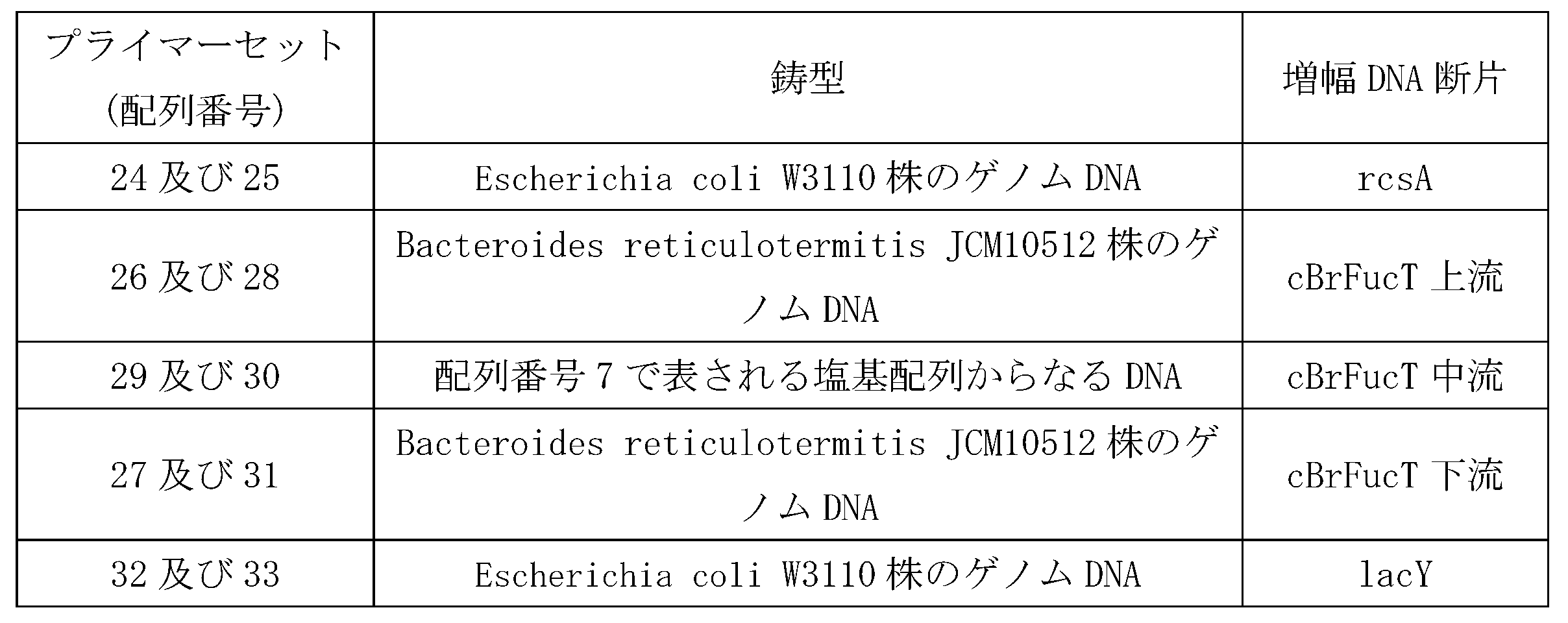
- the nucleotide sequences represented by SEQ ID NOs: 25 and 26, SEQ ID NOs: 28 and 29, SEQ ID NOs: 30 and 31, and SEQ ID NOs: 27 and 32 contain sequences complementary to their 5' ends.
- PCR was performed using, as a template, a mixture of three fragments, cBrFucT upstream, cBrFucT midstream, and cBrFucT downstream, at an equimolar ratio, and DNA consisting of the nucleotide sequences represented by SEQ ID NOs: 26 and 27 was used as a primer set.
- 3 fragments hereinafter referred to as cBrFucT fragment
- rcsA, cBrFucT, and lacY fragments were used as a template, and DNA consisting of the nucleotide sequences represented by SEQ ID NOs: 34 and 35 was used as a primer set to perform PCR, and the three fragments were ligated together. (hereinafter referred to as rcsA-cBrFucT-lacY) fragment was obtained.
- nucleotide sequences represented by SEQ ID NOS: 36 and 37 were PCR performed using the plasmid pPE167 (Appl. Obtained. At this time, the nucleotide sequences represented by SEQ ID NOs: 34 and 37 and SEQ ID NOs: 35 and 36 contain sequences complementary to their 5' ends.
- An ⁇ 1,3-fucosyltransferase expression plasmid was obtained by ligating the rcsA-cBrFucT-lacY fragment obtained above and the vector fragment using the In-Fusion HD Cloning Kit (manufactured by Takara Bio Inc.).
- E. coli harboring the plasmid was constructed by the following method.
- PCR was performed using oligonucleotides consisting of the base sequences represented by SEQ ID NOs: 38 and 39 as a primer set to obtain a pSTV29 vector fragment.
- PCR was performed using the chromosomal DNA of Escherichia coli ATCC9637 strain as a template and oligonucleotides consisting of the base sequences represented by SEQ ID NOs: 40 and 41 as a primer set to amplify a DNA fragment containing the uspA promoter.
- the nucleotide sequences represented by SEQ ID NOs: 38 and 41 and SEQ ID NOs: 39 and 40 contain sequences complementary to their 5' ends.
- the obtained DNA fragment containing the uspA promoter was ligated to the pSTV29 vector fragment using the In-Fusion HD Cloning Kit (manufactured by Takara Bio) to obtain the expression vector pSTV.
- PCR was performed using the chromosomal DNA of Escherichia coli W3110 strain as a template and oligonucleotides consisting of the base sequences represented by SEQ ID NOS: 43 and 44 as a primer set to obtain YdeA protein (having the amino acid sequence represented by SEQ ID NO: 2 A DNA fragment encoding the protein) was amplified.
- the nucleotide sequences represented by SEQ ID NOs: 41 and 43 and SEQ ID NOs: 42 and 44 contain sequences complementary to their 5' ends.
- the expression vector pSTV_YdeA was obtained by ligating the DNA fragment encoding YdeA obtained above to the pSTV vector fragment using the In-Fusion HD Cloning Kit (Takara Bio).
- an Escherichia coli-derived drug an Escherichia coli-derived transporter gene (mdfA) belonging to the H+ antiporter-1 family was placed under the lac promoter, and an E. coli strain containing the gene expression plasmid was constructed by the following method.
- mdfA Escherichia coli-derived transporter gene belonging to the H+ antiporter-1 family was placed under the lac promoter, and an E. coli strain containing the gene expression plasmid was constructed by the following method.
- PCR was performed using oligonucleotides consisting of the base sequences represented by SEQ ID NOs: 45 and 46 as a primer set to obtain a pMW118 vector fragment.
- PCR was performed using the chromosomal DNA of Escherichia coli W3110 strain as a template and oligonucleotides consisting of the base sequences represented by SEQ ID NOs: 47 and 48 as a primer set to obtain the MdfA protein (having the amino acid sequence represented by SEQ ID NO: 4 A DNA fragment encoding the protein) was amplified.
- the nucleotide sequences represented by SEQ ID NOs: 45 and 48 and SEQ ID NOs: 46 and 47 contain sequences complementary to their 5' ends.
- the obtained DNA fragment encoding MdfA was ligated to the pMW118 vector fragment using In-Fusion HD Cloning Kit (manufactured by Takara Bio) to obtain the expression vector pMW118_MdfA.
- the FucT strain constructed in Example 1 (3) was transformed to obtain FucT/pSTV strain, FucT/pMW118 strain, FucT/ The pSTV_YdeA and FucT/pMW118_MdfA strains were obtained.
- Example 2 Production of 3-fucosyllactose by fermentation using a microorganism that strongly expresses a transporter , cultured on an LB plate at 30 ° C. for 24 hours, added 100 mg / L kanamycin and 25 mg / L chloramphenicol (pSTV29-derived plasmid expression strain) or 100 mg / L ampicillin (pMW118-derived plasmid expression strain) The strain was inoculated into a large test tube containing 4 mL of LB medium containing the strain, and cultured with shaking at 30°C for 18 hours.
- the resulting culture was transferred to a production medium containing 100 mg/L kanamycin and 25 mg/L chloramphenicol (pSTV29-derived plasmid expression strain) or 100 mg/L ampicillin (pMW118-derived plasmid expression strain)
- pSTV29-derived plasmid expression strain 100 mg/L ampicillin
- ampicillin pMW118-derived plasmid expression strain
- glucose 30 g /L lactose monohydrate 10 g/L, magnesium sulfate heptahydrate 2 g/L, dipotassium hydrogen phosphate 16 g/L, potassium dihydrogen phosphate 14 g/L, ammonium sulfate 2 g/L, citric acid 1 g/L , casamino acids 5 g/L, thiamine hydrochloride 10 mg/L, ferrous sulfate heptahydrate 50 mg/L, manganese sulfate pentahydrate 10 mg/L (glucose, lacto
- SEQ ID NO: 1 E. Nucleotide sequence of ydeA derived from E. coli W3110 SEQ ID NO: 2: E. coli W3110 E. coli W3110-derived YdeA amino acid sequence SEQ ID NO: 3: E. coli W3110. Nucleotide sequence of mdfA derived from E. coli W3110 SEQ ID NO: 4: E. coli W3110 E.
Landscapes
- Chemical & Material Sciences (AREA)
- Health & Medical Sciences (AREA)
- Life Sciences & Earth Sciences (AREA)
- Organic Chemistry (AREA)
- Genetics & Genomics (AREA)
- Engineering & Computer Science (AREA)
- Zoology (AREA)
- Wood Science & Technology (AREA)
- Bioinformatics & Cheminformatics (AREA)
- General Engineering & Computer Science (AREA)
- General Health & Medical Sciences (AREA)
- Biotechnology (AREA)
- Biochemistry (AREA)
- Microbiology (AREA)
- Biomedical Technology (AREA)
- Molecular Biology (AREA)
- Biophysics (AREA)
- Medicinal Chemistry (AREA)
- General Chemical & Material Sciences (AREA)
- Chemical Kinetics & Catalysis (AREA)
- Physics & Mathematics (AREA)
- Plant Pathology (AREA)
- Gastroenterology & Hepatology (AREA)
- Proteomics, Peptides & Aminoacids (AREA)
- Micro-Organisms Or Cultivation Processes Thereof (AREA)
- Preparation Of Compounds By Using Micro-Organisms (AREA)
Abstract
Description
1.下記[1]~[3]のいずれか1の蛋白質。
[1]配列番号2又は4で表されるアミノ酸配列からなる蛋白質。
[2]配列番号2又は4で表されるアミノ酸配列において、1~20個のアミノ酸が欠失、置換、挿入又は付加されたアミノ酸配列からなり、かつフコース含有糖質の輸送活性を有する変異蛋白質。
[3]配列番号2又は4で表されるアミノ酸配列と90%以上の同一性を有するアミノ酸配列からなり、かつフコース含有糖質の輸送活性を有する相同蛋白質。
2.前記フコース含有糖質がオリゴ糖である、前記1に記載の蛋白質。
3.配列番号1又は3で表される塩基配列又はその相同配列からなり、かつ前記1または2に記載の蛋白質をコードするDNA。
4.前記3に記載のDNAを含有する組換え体DNA。
5.前記4に記載の組換え体DNAで宿主細胞を形質転換して得られる形質転換体。
6.前記1に記載の[1]~[3]のいずれか1の蛋白質の活性及び前記フコース含有糖質の生産性が増強された微生物である、前記5に記載の形質転換体。
7.前記微生物が前記フコース含有糖質の生産能を有する大腸菌である、前記6に記載の形質転換体。
8.前記5~7のいずれか1に記載の形質転換体を培地に培養して培養物中に前記フコース含有糖質を生成させることを含む、フコース含有糖質の製造法。
9.前記フコース含有糖質がオリゴ糖である、前記8に記載の製造法。
10.前記オリゴ糖が3-フコシルラクトースである、前記9に記載の製造法。
本発明の蛋白質は、以下の[1]~[3]のいずれか1に記載の蛋白質である。
[1]配列番号2又は4で表されるアミノ酸配列からなる蛋白質。
[2]配列番号2又は4で表されるアミノ酸配列において、1~20個のアミノ酸が欠失、置換、挿入又は付加されたアミノ酸配列からなる、かつフコース含有糖質の輸送活性を有する変異蛋白質。
[3]配列番号2又は4で表されるアミノ酸配列と90%以上の同一性を有するアミノ酸配列からなる、かつフコース含有糖質の輸送活性を有する相同蛋白質。
A群:ロイシン、イソロイシン、ノルロイシン、バリン、ノルバリン、アラニン、2-アミノブタン酸、メチオニン、o-メチルセリン、t-ブチルグリシン、t-ブチルアラニン、シクロヘキシルアラニン
B群:アスパラギン酸、グルタミン酸、イソアスパラギン酸、イソグルタミン酸、2-アミノアジピン酸、2-アミノスベリン酸
C群:アスパラギン、グルタミン
D群:リジン、アルギニン、オルニチン、2,4-ジアミノブタン酸、2,3-ジアミノプロピオン酸
E群:プロリン、3-ヒドロキシプロリン、4-ヒドロキシプロリン
F群:セリン、スレオニン、ホモセリン
G群:フェニルアラニン、チロシン
本発明のDNAは、上記[1]~[3]に記載の蛋白質をコードするDNAである。本発明のDNAとして、具体的には以下の[A1]~[A3]のDNAが挙げられる。
[A1]配列番号1又は3で表される塩基配列。
[A2]配列番号1又は3で表される塩基配列と相補的な塩基配列からなるDNAとストリンジェントな条件下でハイブリダイズし、かつ、フコース含有糖質の輸送活性を有する相同蛋白質をコードするDNA。
[A3]配列番号1又は3で表される塩基配列と少なくとも95%以上、好ましくは97%以上、さらに好ましくは98%以上、最も好ましくは99%以上の同一性を有する塩基配列からなり、かつ、フコース含有糖質の輸送活性を有する相同蛋白質をコードするDNA。
本発明の組換え体DNAは、宿主細胞において自律複製可能なDNAであって、前記2の本発明のDNAを転写できる位置にプロモーターを含有している発現ベクターに本発明のDNAが組み込まれているDNAである。
本発明の形質転換体は、前記2に記載の本発明のDNAを含有する組換え体DNAで宿主細胞を形質転換して得られる形質転換体である。本明細書において、「宿主細胞」とは、遺伝子導入による形質転換の対象となる元の細胞をいう。
i)上記[A1]~[A3]のいずれか1つに記載のDNAを有する組換え体DNAが、親株において自律複製可能なプラスミドとして導入されることにより、又は親株の染色体中に組み込まれることにより、該DNAの転写量若しくは該DNAがコードする蛋白質の生産量が増大した微生物。
ii)上記[2]の変異蛋白質としてフコース含有糖質の輸送活性を有する蛋白質の比活性が増強された蛋白質を生産することにより、フコース含有糖質の生産性が増強された微生物。
iii)上記[3]の相同蛋白質としてフコース含有糖質の輸送活性を有する蛋白質の比活性が増強された蛋白質を生産することにより、フコース含有糖質の生産性が増強された微生物。
1)宿主細胞として用いる微生物において、フコース転移酵素の反応基質であるGDP-フコースを生産する能力が人工的に付与又は増強された微生物
2)宿主細胞として用いる微生物において、フコース転移酵素の反応基質である受容体糖質を供給する能力が人工的に付与又は増強された微生物
3)宿主細胞として用いる微生物において、フコース転移酵素活性が人工的に付与又は増強された微生物
以下、各宿主細胞について説明する。
宿主細胞として用いる微生物において、GDP-フコースを生成する能力を付与又は増強する方法としては、具体的には例えば、各種遺伝子操作による方法(Metabolic Engineering(2017)41:23-38)等、公知の方法が挙げられる。
(1a)糖からGDP-フコースを生成する生合成経路を制御する機構の少なくとも1つを緩和又は解除する方法
(1b)糖からGDP-フコースを生成する生合成経路に関与する酵素の少なくとも1つについて発現を増強する方法
(1c)糖からGDP-フコースを生成する生合成経路に関与する酵素をコードする遺伝子の少なくとも1つのコピー数を増加させる方法
(1d)糖からGDP-フコースを生成する生合成経路から該目的物質以外の代謝産物へ分岐する代謝経路の少なくとも1つを弱化又は遮断する方法
宿主細胞として用いる微生物に、受容体糖質を供給する能力を人工的に付与又は増強する方法としては、例えば、以下の(2a)~(2g)が挙げられる。これらの方法は単独または組み合わせて用いてもよい。
(2a)糖から受容体糖質を生成する生合成経路を制御する機構の少なくとも1つを緩和又は解除する方法
(2b)糖から受容体糖質を生成する生合成経路に関与する酵素の少なくとも1つについて発現を増強する方法
(2c)糖から受容体糖質を生成する生合成経路に関与する酵素をコードする遺伝子の少なくとも1つのコピー数を増加させる方法
(2d)受容体糖質を分解する機構の少なくとも1つを緩和又は解除する方法
(2e)受容体糖質の細胞内取り込みに関与する酵素の少なくとも1つについて発現を増強する方法
(2f)受容体糖質の細胞内取り込みに関与する酵素をコードする遺伝子の少なくとも1つのコピー数を増加させる方法
(2g)受容体糖質から該目的物質以外の代謝産物へ分岐する代謝経路の少なくとも1つを弱化又は遮断する方法
宿主細胞として用いる微生物において、フコース転移酵素活性を人工的に付与又は増強する方法としては、例えば、以下の(3a)および(3b)が挙げられる。これらの方法は単独または組み合わせて用いてもよい。
(3a)フコース転移酵素の少なくとも1つについて発現を増強する方法
(3b)フコース転移酵素をコードする遺伝子の少なくとも1つのコピー数を増加させる方法
I)配列番号6で表されるアミノ酸配列からなる蛋白質
II)配列番号6で表されるアミノ酸配列において、1~20個のアミノ酸が欠失、置換、挿入又は付加されたアミノ酸配列からなり、かつα1,3-フコース転移酵素活性を有する変異蛋白質
III)配列番号6で表されるアミノ酸配列と90%以上の同一性を有するアミノ酸配列からなり、かつα1,3-フコース転移酵素活性を有する相同蛋白質
本発明のフコース含有糖質の製造法としては、上記4の形質転換体を培地に培養して培養物中にフコース含有糖質を生成せることを含む、発酵法によるフコース含有糖質の製造法が挙げられる。
実施例において、3-フコシルラクトースの分析、定量は以下に示す手順で行った。培養後の微生物を含む培養液を遠心分離し、上清を回収した。該上清に含まれる3-フコシルラクトースを糖分析装置ICS-5000(サーモフィッシャー・サイエンティフィック社製)にて分析した。
[分析条件]
カラム:CarboPAC PA1
カラム温度:25℃
移動相:(移動相A)水
(移動相B)500mmol/L 水酸化ナトリウム
(移動相C)300mmol/L 酢酸ナトリウム
移動相A、移動相B及び移動相C混合比:
(0~10分)80:20:0
(10~15分)80:20:0から70:20:10の勾配
(15~17分)70:20:10から0:20:80の勾配
(17~25分)0:20:80
(25~35分)80:20:0
流速:1.0mL/min
検出器:パルスドアンペロメトリー検出器
(1)遺伝子欠損の際にマーカーとして用いるDNA断片の取得
表1の「プライマーセット」で表される塩基配列からなるDNAをプライマーセットとして、表1の「鋳型」に記載されたDNAを鋳型としてPCRを行い、各増幅DNA断片を得た。

β-ガラクトシダーゼをコードするDNA(以下、lacZ遺伝子という。)、ラクトースパーミアーゼをコードするDNA(以下、lacY遺伝子という。)、及びコラン酸生成関連蛋白質をコードするDNA(以下、wcaJ、wzxC、wcaK、wcaL又はwcaM遺伝子という。)を欠損した大腸菌を、以下の方法で造成した。なお、lacZ及びlacY(以下、lacZYという。)、ならびに、wcaJ、wzxC、wcaK、wcaL及びwcaM(以下、wcaJ-wzxC-wcaKLMという。)は大腸菌ゲノム上でそれぞれオペロンを形成している。


表4の「プライマーセット」で表される塩基配列からなるDNAをプライマーセットとして、表4の「鋳型」に記載されたDNAを鋳型としてPCRを行い、各増幅DNA断片を得た。
uspAプロモーター下にEscherichia coli由来のドラッグ:H+アンチポーター-1ファミリーに属するトランスポーター遺伝子(ydeA)を配置した、該遺伝子発現用プラスミドを有する大腸菌を、以下の方法で造成した。
実施例1で得られたFucT/pSTV株、FucT/pMW118、FucT/pSTV_YdeA株及びFucT/pMW118_MdfA株を、LBプレート上で30℃にて24時間培養し、100mg/Lのカナマイシン、及び25mg/Lのクロラムフェニコール(pSTV29由来プラスミド発現株)または100mg/Lのアンピシリン(pMW118由来プラスミド発現株)を含むLB培地4mLが入った大型試験管に植菌して30℃で18時間、振盪培養した。

配列番号2:E.coli W3110由来YdeAのアミノ酸配列
配列番号3:E.coli W3110由来mdfAの塩基配列
配列番号4:E.coli W3110由来MdfAのアミノ酸配列
配列番号5:キメラ型FucTの塩基配列
配列番号6:キメラ型FucTのアミノ酸配列
配列番号7:コドン最適化型BfFucTの部分配列
配列番号8、9:cat増幅用プライマーの塩基配列
配列番号10、11:sacB増幅用プライマーの塩基配列
配列番号12、13:lacZ上流1増幅用プライマーの塩基配列
配列番号14、15:lacY下流1増幅用プライマーの塩基配列
配列番号16:lacZ上流2増幅用プライマーの塩基配列
配列番号17:lacY下流2増幅用プライマーの塩基配列
配列番号18、19:wcaJ上流1増幅用プライマーの塩基配列
配列番号20、21:wcaM下流1増幅用プライマーの塩基配列
配列番号22:wcaJ上流2増幅用プライマーの塩基配列
配列番号23:wcaM下流2増幅用プライマーの塩基配列
配列番号24、25:rcsA増幅用プライマーの塩基配列
配列番号26、28:cBrFucT上流増幅用プライマーの塩基配列
配列番号27、31:cBrFucT下流増幅用プライマーの塩基配列
配列番号29、30:cBrFucT中流増幅用プライマーの塩基配列
配列番号32、33:lacY増幅用プライマーの塩基配列
配列番号34、35:rcsA-cBrFucT-lacY増幅用プライマーの塩基配列
配列番号36、37:pPE167増幅用プライマーの塩基配列
配列番号38、39:pSTV29増幅用プライマーの塩基配列
配列番号40、41:PuspA増幅用プライマーの塩基配列
配列番号42:pSTV-PuspA増幅用プライマーの塩基配列
配列番号43、44:ydeA増幅用プライマーの塩基配列
配列番号45、46:pMW118増幅用プライマーの塩基配列
配列番号47、48:mdfA増幅用プライマーの塩基配列
Claims (10)
- 下記[1]~[3]のいずれか1の蛋白質。
[1]配列番号2又は4で表されるアミノ酸配列からなる蛋白質。
[2]配列番号2又は4で表されるアミノ酸配列において、1~20個のアミノ酸が欠失、置換、挿入又は付加されたアミノ酸配列からなり、かつフコース含有糖質の輸送活性を有する変異蛋白質。
[3]配列番号2又は4で表されるアミノ酸配列と90%以上の同一性を有するアミノ酸配列からなり、かつフコース含有糖質の輸送活性を有する相同蛋白質。 - 前記フコース含有糖質がオリゴ糖である、請求項1に記載の蛋白質。
- 配列番号1又は3で表される塩基配列又はその相同配列を含み、かつ請求項1または2に記載の蛋白質をコードするDNA。
- 請求項3に記載のDNAを含有する組換え体DNA。
- 請求項4に記載の組換え体DNAで宿主細胞を形質転換して得られる形質転換体。
- 請求項1に記載の[1]~[3]のいずれか1の蛋白質の活性及び前記フコース含有糖質の生産性が増強された微生物である、請求項5に記載の形質転換体。
- 前記微生物が前記フコース含有糖質の生産能を有する大腸菌である、請求項6に記載の形質転換体。
- 請求項5~7のいずれか1項に記載の形質転換体を培地に培養して培養物中に前記フコース含有糖質を生成させることを含む、フコース含有糖質の製造法。
- 前記フコース含有糖質がオリゴ糖である、請求項8に記載の製造法。
- 前記オリゴ糖が3-フコシルラクトースである、請求項9に記載の製造法。
Priority Applications (4)
| Application Number | Priority Date | Filing Date | Title |
|---|---|---|---|
| CN202280013831.5A CN116848248A (zh) | 2021-02-08 | 2022-02-08 | 具有含有岩藻糖的糖质的转运活性的蛋白和含有岩藻糖的糖质的制造方法 |
| EP22749862.3A EP4289955A4 (en) | 2021-02-08 | 2022-02-08 | Protein with fucose-containing sugar transport activity and process for producing fucose-containing sugar |
| US18/264,666 US20240110212A1 (en) | 2021-02-08 | 2022-02-08 | Protein having fucose-containing sugar transporting activity, and method for producing fucose-containing sugar |
| JP2022579651A JPWO2022168991A1 (ja) | 2021-02-08 | 2022-02-08 |
Applications Claiming Priority (2)
| Application Number | Priority Date | Filing Date | Title |
|---|---|---|---|
| JP2021018484 | 2021-02-08 | ||
| JP2021-018484 | 2021-02-08 |
Publications (1)
| Publication Number | Publication Date |
|---|---|
| WO2022168991A1 true WO2022168991A1 (ja) | 2022-08-11 |
Family
ID=82742149
Family Applications (1)
| Application Number | Title | Priority Date | Filing Date |
|---|---|---|---|
| PCT/JP2022/004972 Ceased WO2022168991A1 (ja) | 2021-02-08 | 2022-02-08 | フコース含有糖質の輸送活性を有する蛋白質及びフコース含有糖質の製造法 |
Country Status (5)
| Country | Link |
|---|---|
| US (1) | US20240110212A1 (ja) |
| EP (1) | EP4289955A4 (ja) |
| JP (1) | JPWO2022168991A1 (ja) |
| CN (1) | CN116848248A (ja) |
| WO (1) | WO2022168991A1 (ja) |
Cited By (1)
| Publication number | Priority date | Publication date | Assignee | Title |
|---|---|---|---|---|
| WO2023153461A1 (ja) * | 2022-02-09 | 2023-08-17 | キリンホールディングス株式会社 | ルイスx骨格を有するオリゴ糖の製造法 |
Families Citing this family (1)
| Publication number | Priority date | Publication date | Assignee | Title |
|---|---|---|---|---|
| CN116806260A (zh) * | 2021-02-08 | 2023-09-26 | 协和发酵生化株式会社 | 具有1,3-岩藻糖基转移酶活性的蛋白和含有岩藻糖的糖质的制造方法 |
Citations (9)
| Publication number | Priority date | Publication date | Assignee | Title |
|---|---|---|---|---|
| JPS58110600A (ja) | 1981-12-25 | 1983-07-01 | Kyowa Hakko Kogyo Co Ltd | ヒトβ型インタ−フエロン遺伝子を含む組みかえ体プラスミド |
| JPS63233798A (ja) | 1986-10-09 | 1988-09-29 | Kyowa Hakko Kogyo Co Ltd | 5′−グアニル酸の製造法 |
| JPS63248394A (ja) | 1987-04-06 | 1988-10-14 | Kyowa Hakko Kogyo Co Ltd | 核酸関連物質の製造法 |
| WO1998012343A1 (en) | 1996-09-17 | 1998-03-26 | Kyowa Hakko Kogyo Co., Ltd. | Processes for producing sugar nucleotides and complex carbohydrates |
| JP5580408B2 (ja) | 2009-06-08 | 2014-08-27 | イェンネワイン バイオテクノロジー ゲーエムベーハー | ヒトミルクオリゴ糖の合成 |
| JP2018526019A (ja) * | 2015-09-12 | 2018-09-13 | イェネヴァイン ビオテヒノロギー ゲーエムベーハー | 取り込み/排出を改変した微生物宿主におけるヒトミルクオリゴ糖の生産 |
| JP2019531752A (ja) * | 2016-10-29 | 2019-11-07 | イェネヴァイン ビオテヒノロギー ゲーエムベーハー | フコシル化オリゴ糖の製造のための改良された方法 |
| WO2021013708A1 (en) * | 2019-07-19 | 2021-01-28 | Inbiose N.V. | Production of fucosyllactose in host cells |
| JP2021018484A (ja) | 2019-07-17 | 2021-02-15 | 国立研究開発法人 海上・港湾・航空技術研究所 | 周辺状態表現方法、避航動作学習プログラム、避航動作学習システム、及び船舶 |
Family Cites Families (1)
| Publication number | Priority date | Publication date | Assignee | Title |
|---|---|---|---|---|
| JP6018357B2 (ja) * | 2007-04-06 | 2016-11-02 | 協和発酵バイオ株式会社 | グルタチオンおよびγ−グルタミルシステインの製造法 |
-
2022
- 2022-02-08 US US18/264,666 patent/US20240110212A1/en active Pending
- 2022-02-08 WO PCT/JP2022/004972 patent/WO2022168991A1/ja not_active Ceased
- 2022-02-08 JP JP2022579651A patent/JPWO2022168991A1/ja active Pending
- 2022-02-08 CN CN202280013831.5A patent/CN116848248A/zh active Pending
- 2022-02-08 EP EP22749862.3A patent/EP4289955A4/en active Pending
Patent Citations (9)
| Publication number | Priority date | Publication date | Assignee | Title |
|---|---|---|---|---|
| JPS58110600A (ja) | 1981-12-25 | 1983-07-01 | Kyowa Hakko Kogyo Co Ltd | ヒトβ型インタ−フエロン遺伝子を含む組みかえ体プラスミド |
| JPS63233798A (ja) | 1986-10-09 | 1988-09-29 | Kyowa Hakko Kogyo Co Ltd | 5′−グアニル酸の製造法 |
| JPS63248394A (ja) | 1987-04-06 | 1988-10-14 | Kyowa Hakko Kogyo Co Ltd | 核酸関連物質の製造法 |
| WO1998012343A1 (en) | 1996-09-17 | 1998-03-26 | Kyowa Hakko Kogyo Co., Ltd. | Processes for producing sugar nucleotides and complex carbohydrates |
| JP5580408B2 (ja) | 2009-06-08 | 2014-08-27 | イェンネワイン バイオテクノロジー ゲーエムベーハー | ヒトミルクオリゴ糖の合成 |
| JP2018526019A (ja) * | 2015-09-12 | 2018-09-13 | イェネヴァイン ビオテヒノロギー ゲーエムベーハー | 取り込み/排出を改変した微生物宿主におけるヒトミルクオリゴ糖の生産 |
| JP2019531752A (ja) * | 2016-10-29 | 2019-11-07 | イェネヴァイン ビオテヒノロギー ゲーエムベーハー | フコシル化オリゴ糖の製造のための改良された方法 |
| JP2021018484A (ja) | 2019-07-17 | 2021-02-15 | 国立研究開発法人 海上・港湾・航空技術研究所 | 周辺状態表現方法、避航動作学習プログラム、避航動作学習システム、及び船舶 |
| WO2021013708A1 (en) * | 2019-07-19 | 2021-01-28 | Inbiose N.V. | Production of fucosyllactose in host cells |
Non-Patent Citations (29)
| Title |
|---|
| "Immunology methods manual", 1997, ACADEMIC PRESS |
| "Methods for General and Molecular Bacteriology", 1994, ASM PRESS |
| "Molecular Cloning", 2012, COLD SPRING HARBOR LABORATORY PRESS |
| AGRIC. BIOL. CHEM., vol. 48, 1984, pages 669 |
| AGRIC. BIOL. CHEM., vol. 53, 1989, pages 277 |
| APPL. ENVIRON. MICROBIOL., vol. 73, 2007, pages 6378 - 6385 |
| APPL. MICROBIOL. BIOTECHNOL., vol. 53, 2000, pages 674 - 679 |
| APPLIED AND ENVIRONMENTAL MICROBIOLOGY, vol. 73, no. 20, 2007, pages 6378 - 6385 |
| BIOSCI. BIOTECHNOL. BIOCHEM., vol. 71, 2007, pages 2905 |
| BIOTECHNOL BIOENG, 2019, pages 2412 - 2417 |
| CURR OPIN BIOTECHNOL, vol. 56, 2019, pages 130 - 137 |
| DATABASE Nucleotide 7 March 2022 (2022-03-07), ANONYMOUS: "Escherichia coli str. K-12 substr. MG1655, complete genome", XP009538911, retrieved from Genbank Database accession no. U00096 * |
| DATSENKO, K. A., WAINER, B. L. L., PROC. NATL. ACAD.SCI, vol. 97, 2000, pages 6640 - 6645 |
| GENE, vol. 33, 1985, pages 103 |
| INT J PEDIATRICS, vol. 2390240, 2019, pages 1 - 8 |
| J BIOL CHEM, vol. 274, 1999, pages 22977 - 22984 |
| J. BACTERIOL., vol. 153, 1983, pages 163 |
| J. MOL. BIOL., vol. 215, 1990, pages 403 |
| METABOLIC ENGINEERING, vol. 41, 2017, pages 23 - 38 |
| METABOLIC ENGINEERING, vol. 52, 2019, pages 232 - 242 |
| MOL. MICROBIOL., vol. 55, 2005, pages 137 |
| NUCLEIC ACIDS RES., vol. 16, 1988, pages 6127 |
| NUCLEIC ACIDS RES., vol. 18, 1990, pages 6069 |
| PROC. NAT. ACAD. SCI., vol. 74, 1977, pages 5463 |
| PROC. NATL. ACAD. SCI. USA, vol. 97, 2000, pages 6641 - 6645 |
| PROC. NATL. ACAD. SCI., vol. 69, 1972, pages 2110 |
| PROC. NATL. ACAD. SCI., vol. 81, 1984, pages 4889 |
| PROC. NATL. ACAD. SCI., vol. 82, 1985, pages 4306 |
| See also references of EP4289955A4 |
Cited By (1)
| Publication number | Priority date | Publication date | Assignee | Title |
|---|---|---|---|---|
| WO2023153461A1 (ja) * | 2022-02-09 | 2023-08-17 | キリンホールディングス株式会社 | ルイスx骨格を有するオリゴ糖の製造法 |
Also Published As
| Publication number | Publication date |
|---|---|
| CN116848248A (zh) | 2023-10-03 |
| US20240110212A1 (en) | 2024-04-04 |
| EP4289955A4 (en) | 2025-06-11 |
| JPWO2022168991A1 (ja) | 2022-08-11 |
| EP4289955A1 (en) | 2023-12-13 |
Similar Documents
| Publication | Publication Date | Title |
|---|---|---|
| JP7244613B2 (ja) | 希少糖の製造法 | |
| WO2022168992A1 (ja) | 1,3-フコシルトランスフェラーゼ活性を有する蛋白質及びフコース含有糖質の製造法 | |
| JP7761754B2 (ja) | α1,2-フコシルトランスフェラーゼ活性を有する蛋白質及びラクト-N-フコペンタオースI(LNFPI)の製造方法 | |
| WO2022168991A1 (ja) | フコース含有糖質の輸送活性を有する蛋白質及びフコース含有糖質の製造法 | |
| EP4538362A1 (en) | Microorganism having improved 3'-sialyllactose productivity and production method of 3'-sialyllactose | |
| JP7807473B2 (ja) | ルイスx骨格を有するオリゴ糖の製造法 | |
| JP6441806B2 (ja) | N−アセチルノイラミン酸及びn−アセチルノイラミン酸含有糖質の製造法 | |
| JP7770553B2 (ja) | Nampt活性を有する蛋白質およびnmnの製造方法 | |
| EP4502168A1 (en) | Production method for lactodifucotetraose (ldft) | |
| EP4455264A1 (en) | Method for producing sugar including lacto-n-triose ii as core trisaccharide and method for producing crystals of said sugar | |
| JP7697887B2 (ja) | 改変されたラクトースパーミアーゼを有する微生物及びラクトース含有オリゴ糖の製造法 | |
| WO2022176994A1 (ja) | 改変されたα1,2-フコシルトランスフェラーゼ活性を有する蛋白質及びフコース含有糖質の製造法 | |
| WO2025047866A1 (ja) | 遺伝子改変微生物、及びオリゴ糖の製造方法 | |
| WO2025047865A1 (ja) | 遺伝子改変微生物、及びオリゴ糖の製造方法 | |
| WO2025183209A1 (ja) | 1,3-フコシルトランスフェラーゼ活性を有する蛋白質及びフコース含有糖質の製造法 | |
| WO2024253084A1 (ja) | α1,2-フコシルトランスフェラーゼ活性を有する蛋白質及びラクト-N-フコペンタオースI(LNFPI)の製造方法 | |
| HK40118495A (zh) | 提高了3'-唾液酸乳糖的生产率的微生物和3'-唾液酸乳糖的制造方法 | |
| WO2025206361A1 (ja) | 遺伝子改変微生物及び糖を生産する方法 | |
| HK40114771A (en) | Method for producing sugar including lacto-n-triose ii as core trisaccharide and method for producing crystals of said sugar | |
| WO2023038128A1 (ja) | Cdp-コリンの製造に用いる組換え微生物及び該組換え微生物を用いるcdp-コリンの製造方法 |
Legal Events
| Date | Code | Title | Description |
|---|---|---|---|
| 121 | Ep: the epo has been informed by wipo that ep was designated in this application |
Ref document number: 22749862 Country of ref document: EP Kind code of ref document: A1 |
|
| WWE | Wipo information: entry into national phase |
Ref document number: 2022579651 Country of ref document: JP |
|
| WWE | Wipo information: entry into national phase |
Ref document number: 202280013831.5 Country of ref document: CN |
|
| WWE | Wipo information: entry into national phase |
Ref document number: 18264666 Country of ref document: US |
|
| NENP | Non-entry into the national phase |
Ref country code: DE |
|
| ENP | Entry into the national phase |
Ref document number: 2022749862 Country of ref document: EP Effective date: 20230908 |