WO2022138966A1 - Photochromic composition, photochromic article, and spectacles - Google Patents
Photochromic composition, photochromic article, and spectacles Download PDFInfo
- Publication number
- WO2022138966A1 WO2022138966A1 PCT/JP2021/048399 JP2021048399W WO2022138966A1 WO 2022138966 A1 WO2022138966 A1 WO 2022138966A1 JP 2021048399 W JP2021048399 W JP 2021048399W WO 2022138966 A1 WO2022138966 A1 WO 2022138966A1
- Authority
- WO
- WIPO (PCT)
- Prior art keywords
- group
- general formula
- photochromic
- independently represent
- bis
- Prior art date
- Legal status (The legal status is an assumption and is not a legal conclusion. Google has not performed a legal analysis and makes no representation as to the accuracy of the status listed.)
- Ceased
Links
Classifications
-
- C—CHEMISTRY; METALLURGY
- C07—ORGANIC CHEMISTRY
- C07D—HETEROCYCLIC COMPOUNDS
- C07D311/00—Heterocyclic compounds containing six-membered rings having one oxygen atom as the only hetero atom, condensed with other rings
- C07D311/02—Heterocyclic compounds containing six-membered rings having one oxygen atom as the only hetero atom, condensed with other rings ortho- or peri-condensed with carbocyclic rings or ring systems
- C07D311/94—Heterocyclic compounds containing six-membered rings having one oxygen atom as the only hetero atom, condensed with other rings ortho- or peri-condensed with carbocyclic rings or ring systems condensed with rings other than six-membered or with ring systems containing such rings
-
- C—CHEMISTRY; METALLURGY
- C09—DYES; PAINTS; POLISHES; NATURAL RESINS; ADHESIVES; COMPOSITIONS NOT OTHERWISE PROVIDED FOR; APPLICATIONS OF MATERIALS NOT OTHERWISE PROVIDED FOR
- C09K—MATERIALS FOR MISCELLANEOUS APPLICATIONS, NOT PROVIDED FOR ELSEWHERE
- C09K9/00—Tenebrescent materials, i.e. materials for which the range of wavelengths for energy absorption is changed as a result of excitation by some form of energy
- C09K9/02—Organic tenebrescent materials
-
- C—CHEMISTRY; METALLURGY
- C07—ORGANIC CHEMISTRY
- C07D—HETEROCYCLIC COMPOUNDS
- C07D311/00—Heterocyclic compounds containing six-membered rings having one oxygen atom as the only hetero atom, condensed with other rings
- C07D311/02—Heterocyclic compounds containing six-membered rings having one oxygen atom as the only hetero atom, condensed with other rings ortho- or peri-condensed with carbocyclic rings or ring systems
- C07D311/78—Ring systems having three or more relevant rings
-
- C—CHEMISTRY; METALLURGY
- C07—ORGANIC CHEMISTRY
- C07D—HETEROCYCLIC COMPOUNDS
- C07D407/00—Heterocyclic compounds containing two or more hetero rings, at least one ring having oxygen atoms as the only ring hetero atoms, not provided for by group C07D405/00
- C07D407/02—Heterocyclic compounds containing two or more hetero rings, at least one ring having oxygen atoms as the only ring hetero atoms, not provided for by group C07D405/00 containing two hetero rings
- C07D407/04—Heterocyclic compounds containing two or more hetero rings, at least one ring having oxygen atoms as the only ring hetero atoms, not provided for by group C07D405/00 containing two hetero rings directly linked by a ring-member-to-ring-member bond
-
- C—CHEMISTRY; METALLURGY
- C07—ORGANIC CHEMISTRY
- C07D—HETEROCYCLIC COMPOUNDS
- C07D409/00—Heterocyclic compounds containing two or more hetero rings, at least one ring having sulfur atoms as the only ring hetero atoms
- C07D409/02—Heterocyclic compounds containing two or more hetero rings, at least one ring having sulfur atoms as the only ring hetero atoms containing two hetero rings
- C07D409/04—Heterocyclic compounds containing two or more hetero rings, at least one ring having sulfur atoms as the only ring hetero atoms containing two hetero rings directly linked by a ring-member-to-ring-member bond
-
- C—CHEMISTRY; METALLURGY
- C07—ORGANIC CHEMISTRY
- C07D—HETEROCYCLIC COMPOUNDS
- C07D497/00—Heterocyclic compounds containing in the condensed system at least one hetero ring having oxygen and sulfur atoms as the only ring hetero atoms
- C07D497/02—Heterocyclic compounds containing in the condensed system at least one hetero ring having oxygen and sulfur atoms as the only ring hetero atoms in which the condensed system contains two hetero rings
- C07D497/04—Ortho-condensed systems
-
- C—CHEMISTRY; METALLURGY
- C07—ORGANIC CHEMISTRY
- C07F—ACYCLIC, CARBOCYCLIC OR HETEROCYCLIC COMPOUNDS CONTAINING ELEMENTS OTHER THAN CARBON, HYDROGEN, HALOGEN, OXYGEN, NITROGEN, SULFUR, SELENIUM OR TELLURIUM
- C07F7/00—Compounds containing elements of Groups 4 or 14 of the Periodic Table
- C07F7/02—Silicon compounds
- C07F7/04—Esters of silicic acids
-
- C—CHEMISTRY; METALLURGY
- C08—ORGANIC MACROMOLECULAR COMPOUNDS; THEIR PREPARATION OR CHEMICAL WORKING-UP; COMPOSITIONS BASED THEREON
- C08K—Use of inorganic or non-macromolecular organic substances as compounding ingredients
- C08K5/00—Use of organic ingredients
- C08K5/04—Oxygen-containing compounds
- C08K5/15—Heterocyclic compounds having oxygen in the ring
- C08K5/151—Heterocyclic compounds having oxygen in the ring having one oxygen atom in the ring
- C08K5/1545—Six-membered rings
-
- C—CHEMISTRY; METALLURGY
- C08—ORGANIC MACROMOLECULAR COMPOUNDS; THEIR PREPARATION OR CHEMICAL WORKING-UP; COMPOSITIONS BASED THEREON
- C08K—Use of inorganic or non-macromolecular organic substances as compounding ingredients
- C08K5/00—Use of organic ingredients
- C08K5/16—Nitrogen-containing compounds
- C08K5/34—Heterocyclic compounds having nitrogen in the ring
- C08K5/35—Heterocyclic compounds having nitrogen in the ring having also oxygen in the ring
- C08K5/357—Six-membered rings
-
- C—CHEMISTRY; METALLURGY
- C08—ORGANIC MACROMOLECULAR COMPOUNDS; THEIR PREPARATION OR CHEMICAL WORKING-UP; COMPOSITIONS BASED THEREON
- C08K—Use of inorganic or non-macromolecular organic substances as compounding ingredients
- C08K5/00—Use of organic ingredients
- C08K5/54—Silicon-containing compounds
- C08K5/541—Silicon-containing compounds containing oxygen
- C08K5/5415—Silicon-containing compounds containing oxygen containing at least one Si—O bond
-
- G—PHYSICS
- G02—OPTICS
- G02B—OPTICAL ELEMENTS, SYSTEMS OR APPARATUS
- G02B1/00—Optical elements characterised by the material of which they are made; Optical coatings for optical elements
- G02B1/04—Optical elements characterised by the material of which they are made; Optical coatings for optical elements made of organic materials, e.g. plastics
-
- G—PHYSICS
- G02—OPTICS
- G02B—OPTICAL ELEMENTS, SYSTEMS OR APPARATUS
- G02B1/00—Optical elements characterised by the material of which they are made; Optical coatings for optical elements
- G02B1/04—Optical elements characterised by the material of which they are made; Optical coatings for optical elements made of organic materials, e.g. plastics
- G02B1/041—Lenses
-
- G—PHYSICS
- G02—OPTICS
- G02B—OPTICAL ELEMENTS, SYSTEMS OR APPARATUS
- G02B5/00—Optical elements other than lenses
- G02B5/20—Filters
- G02B5/22—Absorbing filters
- G02B5/23—Photochromic filters
-
- G—PHYSICS
- G02—OPTICS
- G02C—SPECTACLES; SUNGLASSES OR GOGGLES INSOFAR AS THEY HAVE THE SAME FEATURES AS SPECTACLES; CONTACT LENSES
- G02C7/00—Optical parts
- G02C7/02—Lenses; Lens systems ; Methods of designing lenses
-
- C—CHEMISTRY; METALLURGY
- C09—DYES; PAINTS; POLISHES; NATURAL RESINS; ADHESIVES; COMPOSITIONS NOT OTHERWISE PROVIDED FOR; APPLICATIONS OF MATERIALS NOT OTHERWISE PROVIDED FOR
- C09K—MATERIALS FOR MISCELLANEOUS APPLICATIONS, NOT PROVIDED FOR ELSEWHERE
- C09K2211/00—Chemical nature of organic luminescent or tenebrescent compounds
- C09K2211/10—Non-macromolecular compounds
- C09K2211/1003—Carbocyclic compounds
- C09K2211/1007—Non-condensed systems
-
- C—CHEMISTRY; METALLURGY
- C09—DYES; PAINTS; POLISHES; NATURAL RESINS; ADHESIVES; COMPOSITIONS NOT OTHERWISE PROVIDED FOR; APPLICATIONS OF MATERIALS NOT OTHERWISE PROVIDED FOR
- C09K—MATERIALS FOR MISCELLANEOUS APPLICATIONS, NOT PROVIDED FOR ELSEWHERE
- C09K2211/00—Chemical nature of organic luminescent or tenebrescent compounds
- C09K2211/10—Non-macromolecular compounds
- C09K2211/1003—Carbocyclic compounds
- C09K2211/1014—Carbocyclic compounds bridged by heteroatoms, e.g. N, P, Si or B
-
- C—CHEMISTRY; METALLURGY
- C09—DYES; PAINTS; POLISHES; NATURAL RESINS; ADHESIVES; COMPOSITIONS NOT OTHERWISE PROVIDED FOR; APPLICATIONS OF MATERIALS NOT OTHERWISE PROVIDED FOR
- C09K—MATERIALS FOR MISCELLANEOUS APPLICATIONS, NOT PROVIDED FOR ELSEWHERE
- C09K2211/00—Chemical nature of organic luminescent or tenebrescent compounds
- C09K2211/10—Non-macromolecular compounds
- C09K2211/1018—Heterocyclic compounds
-
- C—CHEMISTRY; METALLURGY
- C09—DYES; PAINTS; POLISHES; NATURAL RESINS; ADHESIVES; COMPOSITIONS NOT OTHERWISE PROVIDED FOR; APPLICATIONS OF MATERIALS NOT OTHERWISE PROVIDED FOR
- C09K—MATERIALS FOR MISCELLANEOUS APPLICATIONS, NOT PROVIDED FOR ELSEWHERE
- C09K2211/00—Chemical nature of organic luminescent or tenebrescent compounds
- C09K2211/10—Non-macromolecular compounds
- C09K2211/1018—Heterocyclic compounds
- C09K2211/1025—Heterocyclic compounds characterised by ligands
- C09K2211/1088—Heterocyclic compounds characterised by ligands containing oxygen as the only heteroatom
-
- G—PHYSICS
- G02—OPTICS
- G02C—SPECTACLES; SUNGLASSES OR GOGGLES INSOFAR AS THEY HAVE THE SAME FEATURES AS SPECTACLES; CONTACT LENSES
- G02C7/00—Optical parts
- G02C7/10—Filters, e.g. for facilitating adaptation of the eyes to the dark; Sunglasses
- G02C7/102—Photochromic filters
Definitions
- the present invention relates to a photochromic composition, a photochromic article and eyeglasses.
- the photochromic compound is a compound having a property of coloring under irradiation of light in a wavelength range having photoresponsiveness and fading under non-irradiation (photochromic property).
- Patent Document 1 discloses a naphthopyrane-based compound having photochromic properties.
- Examples of the method of imparting photochromic properties to an optical article such as a spectacle lens include a method of incorporating a photochromic compound in a substrate and a method of forming a layer containing the photochromic compound.
- a high coloring density at the time of coloring in the visible region can be mentioned.
- One aspect of the present invention is to provide a photochromic article having a high coloring concentration at the time of coloring in the visible range.
- One aspect of the present invention is one or more compounds represented by the following general formula A, one or more compounds represented by the following general formula B, and one or more compounds represented by the following general formula C.
- photochromic articles including.
- one aspect of the present invention relates to a photochromic composition containing one or more compounds represented by the following general formula A and one or more compounds represented by the following general formula B.
- R 1 to R 6 , B 1 and B 2 each independently represent a hydrogen atom or a substituent.
- R 7 to R 12 , B 3 and B 4 independently represent a hydrogen atom or a substituent, and R 13 and R 14 each independently represent an electron donating group.
- R 15 to R 20 , B 5 and B 6 independently represent a hydrogen atom or a substituent
- R 21 and R 22 represent a hydrogen atom on one side and an electron donating group on the other side, respectively. ..
- the present inventor has combined a compound represented by the general formula A, a compound represented by the general formula B, and a compound represented by the general formula C to color the compound at a high concentration in the visible region.
- a compound represented by the general formula A the compound represented by the general formula B, and the compound represented by the general formula C have different absorption peak positions and / or peak intensities in the visible region, and therefore these compounds are combined. It is presumed that this enables high-concentration coloring in a wide wavelength range.
- the present invention is not limited to the inferences described herein.
- a photochromic compound undergoes an excited state when irradiated with light such as sunlight, and structurally transforms into a colored body.
- the structure after structural conversion through light irradiation can be called a "colored body”.
- the structure before light irradiation can be called a "colorless body”.
- the term "colorless” with respect to a colorless body is not limited to being completely colorless, and includes cases where the color is lighter than that of the colored body.
- the structure of the general formula A, the structure of the general formula B, and the structure of the general formula C are colorless structures, respectively.
- the "photochromic article” means an article containing a photochromic compound.
- the photochromic article according to one aspect of the present invention is, as a photochromic compound, one or more compounds represented by the general formula A, one or more compounds represented by the general formula B, and a compound represented by the general formula C. Includes one or more.
- the photochromic compound can be included in the substrate of the photochromic article and / or can be included in the photochromic layer in the photochromic article having the substrate and the photochromic layer.
- the "photochromic layer” is a layer containing a photochromic compound.
- the "photochromic composition” means a composition containing a photochromic compound.
- the photochromic composition according to one aspect of the present invention is, as a photochromic compound, one or more compounds represented by the general formula A, one or more compounds represented by the general formula B, and a compound represented by the general formula C.
- any of various substituents that is, R 1 , R 2 , B 1 , B 2 in the general formula A, and R 7 to R 12 , B 3 and B 4 in the general formula B.
- the substituents that can be represented by the above, the substituents that can be represented by any of R 15 to R 20 , R 5 and R 6 in the general formula C, and the substituents that will be described later have substituents.
- a linear or branched alkyl group having 1 to 18 carbon atoms such as a hydroxy group, a methyl group, an ethyl group, a propyl group, a butyl group, a pentyl group and a hexyl group, and a single group having 5 to 18 carbon atoms such as a cyclopentyl group and a cyclohexyl group.
- a linear or branched alkoxy group having 1 to 24 constituent atoms such as a cyclic aliphatic alkyl group, a methoxy group, an ethoxy group, and a butoxy group having a compound ring such as a ring or a bicyclo ring, and a non-aromatic group having 1 to 24 constituent atoms.
- a linear or branched perfluoroalkyl group having 1 to 18 carbon atoms such as a cyclic substituent and a trifluoromethyl group
- a linear or branched perfluoroalkoxy group such as a trifluoromethoxy group, a methyl sulfide group and an ethyl sulfide group.
- a linear or branched alkyl sulfide group having 1 to 24 constituent atoms such as a butyl sulfide group, a phenyl group, a naphthyl group, an anthrasenyl group, a fluoranthenyl group, a phenanthryl group, a pyranyl group, a peryleneyl group, a styryl group, a fluorenyl group, etc.
- Aryl group such as phenyloxy group, aryl sulfide group such as phenyl sulfide group, pyridyl group, furanyl group, thienyl group, pyrrolyl group, benzofuranyl group, benzothiophenyl group, indolyl group, dibenzofuranyl group, Heteroaryl groups such as dibenzothiophenyl group, carbazolyl group, diazolyl group, triazolyl group, quinolinyl group, phenothiazine group, phenoxadinyl group, phenazinyl group, thianthryl group, acridinyl group, amino group (-NH 2 ), monomethylamino group and the like.
- Monoalkylamino group dialkylamino group such as dimethylamino group, monoarylamino group such as monophenylamino group, diarylamino group such as diphenylamino group, piperidino group, morpholino group, thiomorpholino group, tetrahydroquinolino group, Cyclic amino groups such as tetrahydroisoquinolino groups, ethynyl groups, mercapto groups, silyl groups, sulfonic acid groups, alkylsulfonyl groups, formyl groups, carboxy groups, cyano groups and fluorine atoms, chlorine atoms, bromine atoms, iodine atoms, etc.
- Substituent Rm selected from the group consisting of halogen atoms; or Substituents in which R m is further substituted with one or more identical or different R m ; Can be.
- R m substituted with one or more identical or different R m an alkoxy group is further substituted with the carbon atom at the end of the alkoxy group, and the carbon atom at the end of the alkoxy group is further substituted.
- examples thereof include structures in which the alkoxy group is substituted.
- the same or different positions are used in two or more of the five replaceable positions of the phenyl group.
- a structure in which R m is substituted can be mentioned. However, the present invention is not limited to this example.
- the "carbon number” and the “constituting atom number” refer to the number including the carbon number or the atom number of the substituent for the group having a substituent.
- substituents that is, R 1 , R 2 , B 1 , B 2 in the general formula A, and R 7 to R 12 , B 3 and B 4 in the general formula B.
- the "solubilizing group” refers to a substituent that can contribute to enhancing compatibility with any liquid or a specific liquid.
- the solubilizing group includes a linear group having 4 to 50 carbon atoms, an alkyl group containing a branched or cyclic structure, a linear group having 4 to 50 constituent atoms, a branched or cyclic alkoxy group, and a linear chain having 4 to 50 constituent atoms.
- Substituents that may contribute to promoting the thermal motion of the molecules of the compound are preferred.
- a compound having a solubilizing group as a substituent prevents the solute from solidifying by inhibiting the distance between the solute molecules from approaching, and lowers the melting point and / or the glass transition temperature of the solute to reduce the molecular assembly close to that of a liquid. You can make a state.
- the soluble group can liquefy the solute and increase the solubility of the compound having this substituent in the liquid.
- the solubilizing group includes a linear alkyl group such as n-butyl group, n-pentyl group, n-hexyl group, n-octyl group, branched alkyl group tert-butyl group and cyclic alkyl group. Certain cyclopentyl and cyclohexyl groups are preferred.
- the substituent is preferably a methoxy group, an ethoxy group, a phenoxy group, a methyl sulfide group, an ethyl sulfide group, a phenyl sulfide group, a trifluoromethyl group, a phenyl group, a naphthyl group, a dibenzofuranyl group or a dibenzothiophenyl group.
- it can be a methoxy group, a phenoxy group, a methyl sulfide group, a phenyl sulfide group, a trifluoromethyl group, a phenyl group, a dimethyl amino group, a diphenyl amino group, a piperidino group, a morphorylno group, a thiomorpholino group, a cyano group.
- a substituent selected from the group consisting of solubilizing groups.
- the "electron-withdrawing group” refers to a substituent that easily attracts an electron from the bonded atom side as compared with a hydrogen atom. Electron-withdrawing groups can attract electrons as a result of substituent effects such as inductive effects, mesomeric effects (or resonance effects).
- the electron-withdrawing group examples include a halogen atom (fluorine atom: -F, chlorine atom: -Cl, bromine atom: -Br, iodine atom: -I), trifluoromethyl group: -CF 3 , nitro group: -NO 2 , cyano group: -CN, formyl group: -CHO, acyl group: -COR (R is a substituent), alkoxycarbonyl group: -COOR, carboxy group: -COOH, substituted sulfonyl group: -SO 2 R ( R is a substituent), a sulfo group: -SO 3H and the like.
- halogen atom fluorine atom: -F, chlorine atom: -Cl, bromine atom: -Br, iodine atom: -I
- trifluoromethyl group -CF 3
- nitro group: -NO 2 cyano group:
- Suitable electron-withdrawing groups include a fluorine atom, which is an electron-withdrawing group having a high electronegativity, and an electron-withdrawing group having a positive value for the substituent constant ⁇ p at the paraposition based on Hammett's law. can.
- the "electron donating group” refers to a substituent that is more likely to donate an electron to the bonded atom side as compared with a hydrogen atom.
- the electron-donating group can be a substituent that easily donates an electron as a sum of the inductive effect, the mesomeric effect (or the resonance effect), and the like.
- Specific examples of the electron donating group include hydroxy group: -OH, thiol group: -SH, alkoxy group: -OR (R is an alkyl group), alkyl sulfide group: -SR (R is an alkyl group), and aryl sulfide group.
- R 1 to R 6 , B 1 and B 2 each independently represent a hydrogen atom or a substituent.
- R 1 and R 2 each independently preferably represent a substituted or unsubstituted alkyl group having 1 to 20 carbon atoms, and each represent a methyl group, an ethyl group, a propyl group, a butyl group, a pentyl group or a hexyl group. Is more preferable. It is more preferable that R 1 and R 2 each independently represent a methyl group or an ethyl group, and it is even more preferable that both R 1 and R 2 represent a methyl group or both represent an ethyl group.
- B 1 and B 2 each independently represent a substituted or unsubstituted phenyl group.
- the phenyl group has a plurality of substituents, two or more of these substituents may be bonded to form a ring.
- Specific examples of the formed ring include the rings contained in the exemplary compounds described below.
- the substitution position of the substituent in the substituted phenyl group is preferably a position at the para position with respect to the carbon atom to which B 1 and B 2 are bonded.
- substituent of the substituted phenyl group include a morpholino group, a piperidino group, a halogen atom, an alkoxy group, and a substituent contained in the following exemplary compounds such as the following substituents.
- "*" relating to a partial structure of a compound indicates a bonding position with an atom to which the partial structure is bonded.
- R 3 to R 6 independently represent hydrogen atoms or substituents, respectively. In one form, R 3 to R 6 can all be hydrogen atoms. In another embodiment, R 3 to R 6 each independently represent a hydrogen atom or an electron-withdrawing group, where one or more of R 3 to R 6 represents an electron-withdrawing group.
- a halogen atom a perfluoroalkyl group having 1 to 6 carbon atoms, a perfluorophenyl group, a perfluoroalkylphenyl group or a cyano group is preferable.
- a fluorine atom is preferable as the halogen atom.
- the perfluoroalkyl group having 1 to 6 carbon atoms a trifluoromethyl group is preferable.
- the compound represented by the general formula A can be the following compound.
- R 3 to R 6 only R 4 is an electron-withdrawing group, and R 3 , R 5 and R 6 are hydrogen atoms.
- R 3 to R 6 R 4 and R 6 are the same or different electron-withdrawing groups, and R 3 and R 5 are hydrogen atoms.
- R 3 to R 6 R 3 and R 5 are the same or different electron-withdrawing groups, and R 4 and R 6 are hydrogen atoms.
- Examples of the compound represented by the general formula A include the following compounds. However, the present invention is not limited to the compounds exemplified below.
- R 7 to R 12 , B 3 and B 4 independently represent hydrogen atoms or substituents, respectively.
- R 7 and R 8 each independently preferably represent a substituted or unsubstituted alkyl group having 1 to 20 carbon atoms, and each represent a methyl group, an ethyl group, a propyl group, a butyl group, a pentyl group or a hexyl group. Is more preferable. It is more preferable that R 7 and R 8 each independently represent a methyl group or an ethyl group, and it is even more preferable that both R 7 and R 8 represent a methyl group or both represent an ethyl group.
- B 3 and B 4 each independently represent a substituted or unsubstituted phenyl group.
- the phenyl group has a plurality of substituents, two or more of these substituents may be bonded to form a ring.
- Specific examples of the formed ring include the rings contained in the exemplary compounds described below.
- the substitution position of the substituent in the substituted phenyl group is preferably a position at the para position with respect to the carbon atom to which B 3 and B 4 are bonded.
- substituent of the substituted phenyl group include a morpholino group, a piperidino group, a halogen atom, an alkoxy group, and a substituent contained in the following exemplary compounds such as the following substituents.
- R 9 to R 12 each independently represent a hydrogen atom or a substituent. In one form, R 9 to R 12 can all be hydrogen atoms. In another embodiment, R 10 can be an electron-withdrawing group and R 9 , R 11 and R 12 can all be hydrogen atoms. Further, in another embodiment, R 9 and R 11 can be independently electron-withdrawing groups, and R 10 and R 12 can be hydrogen atoms.
- As the electron-withdrawing group a halogen atom, a perfluoroalkyl group having 1 to 6 carbon atoms, a perfluorophenyl group, a perfluoroalkylphenyl group or a cyano group is preferable.
- a fluorine atom is preferable as the halogen atom.
- R 10 can be a substituted or unsubstituted phenyl group, preferably R 10 is a substituted or unsubstituted phenyl group, and R 9 , R 11 and R 12 are hydrogen atoms. can.
- a substituted phenyl group a phenyl group substituted with one or more halogen atoms and / or one or more cyano groups, for example, a halogen atom (preferably a fluorine atom) at all five substitution positions of the phenyl group.
- Examples thereof include a phenyl group substituted with a cyano group and a monosubstituted phenyl group substituted with a cyano group at a position at the para position with respect to the carbon atom to which R10 is bonded.
- R 13 and R 14 each independently represent an electron donating group. That is, R 13 and R 14 represent the same or different electron donating groups.
- R 13 and R 14 are independently selected from the group consisting of a methoxy group, an ethoxy group, a phenoxy group, a methyl sulfide group, a phenyl sulfide group, a dimethyl amino group, a pyrrolidino group, a piperidino group, a morpholino group and a thiomorpholino group. It is preferable to represent an electron donating group.
- R 13 and R 14 are a morpholino group and R 14 is an alkoxy group (preferably a methoxy group), R 13 is a morpholino group and R 14 is a methyl sulfide group (-S-). It is preferable that CH 3 ), that both R 13 and R 14 are alkoxy groups (preferably methoxy groups), and that both R 13 and R 14 are methyl sulfide groups.
- Examples of the compound represented by the general formula B include the following compounds. However, the present invention is not limited to the compounds exemplified below.
- R 15 to R 20 , B 5 and B 6 independently represent hydrogen atoms or substituents, respectively.
- One of R 21 and R 22 represents a hydrogen atom and the other represents an electron donating group.
- R 15 and R 16 each independently represent a substituted or unsubstituted alkyl group having 1 to 20 carbon atoms, and are preferably a methyl group, an ethyl group, a propyl group, a butyl group, a pentyl group or a group. It is more preferable to represent a hexyl group. It is more preferable that R 15 and R 16 each independently represent a methyl group or an ethyl group, and it is even more preferable that both R 15 and R 16 represent a methyl group or both represent an ethyl group.
- B 5 and B 6 each independently represent a substituted or unsubstituted phenyl group.
- the phenyl group has a plurality of substituents, two or more of these substituents may be bonded to form a ring.
- the formed ring include the rings contained in the exemplary compounds described below.
- the substitution position of the substituent in the substituted phenyl group is preferably a position at the para position with respect to the carbon atom to which B 5 and B 6 are bonded.
- Specific examples of the substituent of the substituted phenyl group include a morpholino group, a piperidino group, a halogen atom, an alkoxy group, the following substituents and the like.
- R 17 to R 20 each independently represent a hydrogen atom or a substituent.
- R 17 to R 20 can all be hydrogen atoms.
- R 18 can be an electron-withdrawing group and R 17 , R 19 and R 20 can all be hydrogen atoms.
- R 17 and R 19 can be independently electron-withdrawing groups, and R 18 and R 20 can be hydrogen atoms.
- a halogen atom a perfluoroalkyl group having 1 to 6 carbon atoms, a perfluorophenyl group, a perfluoroalkylphenyl group or a cyano group is preferable.
- a fluorine atom is preferable as the halogen atom.
- the perfluoroalkyl group having 1 to 6 carbon atoms a trifluoromethyl group is preferable.
- R 18 can be a substituted or unsubstituted phenyl group, preferably R 18 is a substituted or unsubstituted phenyl group, and R 17 , R 19 and R 20 are hydrogen atoms. can.
- a substituted phenyl group a phenyl group substituted with one or more halogen atoms and / or one or more cyano groups, for example, a halogen atom (preferably a fluorine atom) at all five substitution positions of the phenyl group.
- Examples thereof include a phenyl group substituted with a cyano group and a monosubstituted phenyl group substituted with a cyano group at a position at the para position with respect to the carbon atom to which R10 is bonded.
- R 21 and R 22 represents a hydrogen atom and the other represents an electron donating group. It is preferable that R 21 is a hydrogen atom and R 22 is an electron donating group.
- the electron donating group represented by R 21 or R 22 (preferably R 22 ) is a methoxy group, an ethoxy group, a phenoxy group, a methyl sulfide group, a phenyl sulfide group, a dimethyl amino group, a pyrrolidino group, a piperidino group or a morpholino group. And more preferably represent an electron donating group selected from the group consisting of thiomorpholino groups.
- Examples of the compound represented by the general formula C include the following compounds. However, the present invention is not limited to the compounds exemplified below.
- the compound represented by the general formula A, the compound represented by the general formula B, and the compound represented by the general formula C can be synthesized by a known method.
- the following documents can be referred to. Japanese Patent No. 4884578, US2006 / 0226402A1, US2006 / 0228557A1, US2008 / 0103301A1, US2011 / 0108781A1, US2011 / 0108781A1, US Pat. No. 7527754, US Pat. No. 7556751, WO2001 / 60811A1, WO2001 / 60811A1 , WO1996 / 014596A1 and WO2001 / 019813A1.
- the photochromic article according to one aspect of the present invention and the photochromic composition according to one aspect of the present invention include one or more compounds represented by the general formula A and one or more compounds represented by the general formula B. Includes one or more of the compounds represented by the general formula C.
- the compound represented by the general formula A contained in the photochromic article and the photochromic composition may be only one kind, and may be two or more kinds (for example, two or more kinds and four kinds or less).
- the compound represented by the general formula B contained in the photochromic article and the photochromic composition may be only one kind, and may be two or more kinds (for example, two or more kinds and four kinds or less).
- the compound represented by the general formula C contained in the photochromic article and the photochromic composition may be only one kind, and may be two or more kinds (for example, two or more kinds and four kinds or less).
- the total content of the compound represented by the general formula B and the compound represented by the general formula C is higher than the content of the compound represented by the general formula A on a mass basis. Is preferable.
- the compound represented by the general formula B and the compound represented by the general formula C are represented by 100% by mass as a total of the compound represented by the general formula A, the compound represented by the general formula B and the compound represented by the general formula C.
- the total content of the compounds is preferably more than 50% by mass, more preferably 60% by mass or more, further preferably 70% by mass or more, still more preferably 80% by mass or more. It is even more preferable that the content is 90% by mass or more.
- the compound represented by the general formula B and the compound represented by the general formula C are used with respect to the total (100% by mass) of the compound represented by the general formula A, the compound represented by the general formula B, and the compound represented by the general formula C.
- the total content of the represented compounds can be less than 100% by weight, 99% by weight or less, 98% by weight or less, 97% by weight or less, 96% by weight or less or 95% by weight or less.
- the total of the compound represented by the general formula B and the compound represented by the general formula C is set to 100% by mass, and the general formula is used.
- the content of the compound represented by B can be 1% by mass or more or 99% by mass or more, and can be 25% by mass or less or 75% by mass or less.
- the content of the compound represented by the general formula B is the total content of the photochromic article and the photochromic composition when two or more compounds represented by the general formula B are contained. This point is the same for the content of various components in the present invention and the present specification.
- the total amount thereof is 100% by mass
- the compound represented by the general formula A, the compound represented by the general formula B and the compound represented by the general formula C are in total, for example, 0.1 to 15. It can contain about 0.0% by mass. However, it is not limited to this range.
- the photochromic article can have at least a substrate.
- the compound represented by the general formula A, the compound represented by the general formula B, and the compound represented by the general formula C can be contained in the base material of the photochromic article.
- the photochromic article can have a base material and a photochromic layer, and the base material and / or the photochromic layer is represented by a compound represented by the general formula A, a compound represented by the general formula B, and a general formula C. Compounds can be included.
- the compound represented by the general formula A, the compound represented by the general formula B, and the compound represented by the general formula C can be contained only in the base material in one form in the base material and the photochromic layer, and other compounds can be contained in the base material. In one form, it can be contained only in the photochromic layer, and in the other form, it can be contained in the base material and the photochromic layer. Further, the base material and the photochromic layer may contain only the compound represented by the general formula A, the compound represented by the general formula B and the compound represented by the general formula C as the photochromic compound, or one or more thereof. Other photochromic compounds can also be included.
- photochromic compounds include azobenzenes, spiropyrans, spiroxazines, naphthopyrans, indenonaphthopyrans, phenanthropyrans, hexaallylbisimidazoles, donor-acceptorstenhouse adducts (DASA). , Salicylidene anilines, dihydropyrenes, anthracene dimers, flugides, diarylethenes, phenoxynaphthasequinones, stilbenes and the like.
- DASA donor-acceptorstenhouse adducts
- the photochromic article can include a substrate selected according to the type of the photochromic article.
- the spectacle lens base material includes a plastic lens base material or a glass lens base material.
- the glass lens base material can be, for example, a lens base material made of inorganic glass.
- the plastic lens base material include styrene resins such as (meth) acrylic resins, polycarbonate resins, allyl resins, allyl carbonate resins such as diethylene glycol bisallyl carbonate resin (CR-39), vinyl resins, polyester resins, and polyether resins.
- Urethane resin obtained by reacting isocyanate compound with hydroxy compound such as diethylene glycol thiourethane resin obtained by reacting isocyanate compound with polythiol compound, (thio) epoxy compound having one or more disulfide bonds in the molecule.
- hydroxy compound such as diethylene glycol
- thiourethane resin obtained by reacting isocyanate compound with polythiol compound thio epoxy compound having one or more disulfide bonds in the molecule.
- examples thereof include a cured product (generally referred to as a transparent resin) obtained by curing the curable composition contained therein.
- a cured product generally referred to as a transparent resin
- the lens base material an undyed lens (colorless lens) may be used, or a dyed lens (dyed lens) may be used.
- the refractive index of the lens substrate can be, for example, about 1.50 to 1.75.
- the refractive index of the lens substrate is not limited to the above range, and may be within the above range or may be vertically separated from the above range.
- the refractive index means the refractive index for light having a wavelength of 500 nm.
- the lens base material may be a lens having a refractive power (so-called prescription lens) or a lens without refractive power (so-called prescription lens).
- the photochromic composition can be a polymerizable composition.
- the "polymerizable composition” is a composition containing one or more kinds of polymerizable compounds.
- a polymerizable composition containing at least, by a known molding method a cured product of such a polymerizable composition can be produced.
- the cured product can be included in the photochromic article as a substrate and / or can be included as a photochromic layer.
- the curing treatment can be light irradiation and / or heat treatment.
- the polymerizable compound is a compound having a polymerizable group, and the polymerizable composition can be cured to form a cured product by advancing the polymerization reaction of the polymerizable compound.
- the polymerizable composition can further contain one or more additives (eg, a polymerization initiator, etc.).
- the spectacle lens can be various lenses such as a single focus lens, a multifocal lens, and a progressive power lens.
- the type of lens is determined by the surface shapes of both sides of the lens base material.
- the surface of the lens substrate may be a convex surface, a concave surface, or a flat surface.
- the surface on the object side is a convex surface and the surface on the eyeball side is a concave surface.
- the photochromic layer can usually be provided on the object-side surface of the lens substrate, but may be provided on the eyeball-side surface.
- the photochromic layer can be a layer provided directly on the surface of the substrate or indirectly via one or more other layers.
- the photochromic layer can be, for example, a cured layer obtained by curing a polymerizable composition.
- a photochromic layer can be formed as a cured layer obtained by curing a polymerizable composition containing at least.
- the polymerizable composition is generally applied directly on the surface of the substrate, or applied to the surface of a layer provided on the substrate, and the applied polymerizable composition is cured.
- a photochromic layer is formed as a cured layer containing one or more compounds represented by the formula A, one or more compounds represented by the general formula B, and one or more compounds represented by the general formula C. can do.
- the coating method known coating methods such as a spin coating method, a dip coating method, a spray coating method, an inkjet method, a nozzle coating method, and a slit coating method can be adopted.
- the curing treatment can be light irradiation and / or heat treatment.
- the polymerizable composition can further contain one or more additives (for example, a polymerization initiator) in addition to one or more polymerizable compounds. As the polymerization reaction of the polymerizable compound proceeds, the polymerizable composition can be cured and a cured layer can be formed.
- the thickness of the photochromic layer can be, for example, 5 ⁇ m or more, 10 ⁇ m or more, or 20 ⁇ m or more, and can be, for example, 80 ⁇ m or less, 70 ⁇ m or less, or 50 ⁇ m or less.
- the polymerizable compound means a compound having one or more polymerizable groups in one molecule
- the "polymerizable group” means a reactive group capable of polymerizing. do.
- the polymerizable group include an acryloyl group, a methacryloyl group, a vinyl group, a vinyl ether group, an epoxy group, a thiol group, an oxetane group, a hydroxy group, a carboxy group, an amino group, an isocyanate group and the like.
- Examples of the polymerizable compound that can be used for forming the base material and the photochromic layer include the following compounds.
- An episulfide compound is a compound having two or more episulfide groups in one molecule.
- the episulfide group is a polymerizable group capable of ring-opening polymerization.
- Specific examples of episulfide compounds include bis (1,2-epithioethyl) sulfide, bis (1,2-epioethyl) disulfide, bis (2,3-epiothiopropyl) sulfide, and bis (2,3-epiothiopropyl) sulfide.
- the thietanyl compound is a thietan compound having two or more thietanyl groups in one molecule.
- the thietanyl group is a polymerizable group capable of ring-opening polymerization.
- Some thietanyl compounds have an episulfide group together with a plurality of thietanyl groups. Such compounds are listed as examples of the above episulfide compounds.
- Other thietanyl-based compounds include metal-containing thietan compounds having a metal atom in the molecule and non-metal-based thietan compounds containing no metal.
- non-metallic thietan compound examples include bis (3-thietanyl) disulfide, bis (3-thietanyl) sulfide, bis (3-thietanyl) trisulfide, bis (3-thietanyl) tetrasulfide, and 1,4-bis.
- the metal-containing thietan compound includes 14 group atoms such as Sn atom, Si atom, Ge atom and Pb atom, 4 group elements such as Zr atom and Ti atom, and 13 such as Al atom in the molecule. Examples thereof include group 12 atoms such as group atoms and Zn atoms. Specific examples thereof include alkylthio (thietanylthio) tin, bis (alkylthio) bis (thietanylthio) tin, alkylthio (alkylthio) bis (thietanylthio) tin, bis (thietanylthio) cyclic dithiotin compounds, and alkyl (thietanylthio) tin compounds.
- alkylthio (thietanylthio) tin examples include methylthiotris (thietanylthio) tin, ethylthiotris (thietanylthio) tin, propylthiotris (thietanylthio) tin, isopropylthiotris (thietanylthio) tin and the like.
- bis (alkylthio) bis (thietanylthio) tin include bis (methylthio) bis (thietanylthio) tin, bis (ethylthio) bis (thietanylthio) tin, bis (propylthio) bis (thietanylthio) tin, and bis (isopropylthio). Examples thereof include bis (thietanylthio) tin and the like.
- alkylthio (alkylthio) bis (thietanylthio) tin examples include ethylthio (methylthio) bis (thietanylthio) tin, methylthio (propylthio) bis (thietanylthio) tin, isopropylthio (methylthio) bis (thietanylthio) tin, and ethylthio (propylthio).
- Examples thereof include bis (thietanylthio) tin, ethylthio (isopropylthio) bis (thietanylthio) tin, and isopropylthio (propylthio) bis (thietanylthio) tin.
- bis (thietanilthio) cyclic dithiostin compound examples include bis (thietanilthio) dithiastannetan, bis (thietanilthio) dithiastannolan, bis (thietanilthio) dithiastanninan, and bis (thietanilthio) trithiastannocan. Can be exemplified.
- alkyl (thietanylthio) tin compound examples include methyltris (thietanylthio) tin, dimethylbis (thietanylthio) tin, butyltris (thietanylthio) tin, tetrakis (thietanylthio) tin, tetrakis (thietanylthio) germanium, and tris (thietanylthio) bismuth. It can be exemplified.
- a polyamine compound is a compound having two or more NH groups in one molecule, and can form a urea bond by reaction with polyisocyanate, and can form a thiourea bond by reaction with polyisothiocyanate. ..
- Specific examples of the polyamine compound include ethylenediamine, hexamethylenediamine, isophoronediamine, nonamethylenediamine, undecamethylenediamine, dodecamethylenediamine, metaxylenediamine, 1,3-propanediamine, putresin, and 2- (2-aminoethyl).
- Amino) etanol, diaminetriamine, p-phenylenediamine, m-phenylenediamine, melamine, 1,3,5-benzenetriamine and the like can be mentioned.
- Epoxy compound is a compound having an epoxy group in the molecule.
- the epoxy group is a polymerizable group capable of ring-opening polymerization.
- Epoxy compounds are generally classified into aliphatic epoxy compounds, alicyclic epoxy compounds and aromatic epoxy compounds.
- aliphatic epoxy compound examples include ethylene oxide, 2-ethyloxylan, butyl glycidyl ether, phenyl glycidyl ether, 2,2'-methylenebisoxylane, 1,6-hexanediol diglycidyl ether, and ethylene glycol diglycidyl ether.
- Diethylene glycol diglycidyl ether triethylene glycol diglycidyl ether, tetraethylene glycol diglycidyl ether, nonaethylene glycol diglycidyl ether, propylene glycol diglycidyl ether, dipropylene glycol diglycidyl ether, tripropylene glycol diglycidyl ether, tetrapropylene glycol di Glycyzyl ether, nonapropylene glycol diglycidyl ether, neopentyl glycol diglycidyl ether, trimethylolpropane triglycidyl ether, glycerol triglycidyl ether, diglycerol tetraglycidyl ether, pentaerythritol tetraglycidyl ether, tris (2-hydroxyethyl) isocyanurate Examples thereof include triglycidyl ether and the like.
- alicyclic epoxy compound examples include isophorone diol diglycidyl ether and bis-2,2-hydroxycyclohexylpropane diglycidyl ether.
- aromatic epoxy compound examples include resorcin diglycidyl ether, bisphenol A diglycidyl ether, bisphenol F diglycidyl ether, bisphenol S diglycidyl ether, orthophthalic acid diglycidyl ester, phenol novolac polyglycidyl ether, and cresol novolac poly. Examples thereof include glycidyl ether.
- epoxy compounds having a sulfur atom in the molecule can also be used together with the epoxy group.
- sulfur-containing atomic epoxy compounds include chain aliphatic compounds and cyclic aliphatic compounds.
- chain aliphatic sulfur-containing atomic epoxy compounds include bis (2,3-epylpropyl) sulfide, bis (2,3-epoxypropyl) disulfide, and bis (2,3-epoxypropylthio) methane.
- 1,2-bis (2,3-epoxypropylthio) ethane 1,2-bis (2,3-epoxypropylthio) propane, 1,3-bis (2,3-epoxypropylthio) propane, 1 , 3-bis (2,3-epoxypropylthio) -2-methylpropane, 1,4-bis (2,3-epoxypropylthio) butane, 1,4-bis (2,3-epoxypropylthio)- 2-Methylbutane, 1,3-bis (2,3-epoxypropylthio) butane, 1,5-bis (2,3-epoxypropylthio) pentane, 1,5-bis (2,3-epoxypropylthio) -2-Methylpentane, 1,5-bis (2,3-epoxypropylthio) -3-thiapentane, 1,6-bis (2,3-epoxypropylthio) hexane, 1,6-bis
- cyclic aliphatic sulfur-containing atomic epoxy compound examples include 1,3-bis (2,3-epoxypropylthio) cyclohexane, 1,4-bis (2,3-epoxypropylthio) cyclohexane, and 1, 3-Bis (2,3-epoxypropylthiomethyl) cyclohexane, 1,4-bis (2,3-epoxypropylthiomethyl) cyclohexane, 2,5-bis (2,3-epoxypropylthiomethyl) -1, 4-Dithiane, 2,5-bis [ ⁇ 2- (2,3-epoxypropylthiomethyl) ethyl> thiomethyl] -1,4-dithiane, 2,5-bis (2,3-epoxypropylthiomethyl) -2 , 5-Dimethyl-1,4-dithiane and the like.
- a compound having a radically polymerizable group is a polymerizable group that can be radically polymerized.
- the radically polymerizable group include an acryloyl group, a methacryloyl group, an allyl group, a vinyl group and the like.
- a compound having a polymerizable group selected from the group consisting of an acryloyl group and a methacryloyl group is referred to as a "(meth) acrylate compound".
- the (meth) acrylate compound include ethylene glycol di (meth) acrylate, diethylene glycol di (meth) acrylate, triethylene glycol di (meth) acrylicate, tetraethylene glycol di (meth) acrylicate, and polyethylene.
- allyl compound examples include allyl glycidyl ether, diallyl phthalate, diallyl terephthalate, diallyl isophthalate, diallyl carbonate, diethylene glycol bisallyl carbonate, methoxypolyethylene glycol allyl ether, and polyethylene glycol allyl ether.
- Methoxypolyethylene glycol-polypropylene glycol allyl ether Methoxypolyethylene glycol-polypropylene glycol allyl ether, butoxypolyethylene glycol-polypropylene glycol allyl ether, methacryloyloxypolyethylene glycol-polypropylene glycol allyl ether, phenoxypolyethylene glycol allyl ether, methacryloyloxypolyethylene glycol allyl ether and the like.
- Examples of the compound having a vinyl group include ⁇ -methylstyrene, ⁇ -methylstyrene dimer, styrene, chlorostyrene, methylstyrene, bromostyrene, dibromostyrene, divinylbenzene, and 3,9-divinylspirobi (m-dioxane). And so on.
- the photochromic article is a photochromic article such as a protective layer for improving the durability of the photochromic article, an antireflection layer, a water-repellent or hydrophilic antifouling layer, an anti-fog layer, and a primer layer for improving the adhesion between layers.
- a photochromic article such as a protective layer for improving the durability of the photochromic article, an antireflection layer, a water-repellent or hydrophilic antifouling layer, an anti-fog layer, and a primer layer for improving the adhesion between layers.
- One or more layers known as functional layers can be included at any position.
- the above photochromic article can be an optical article.
- One form of an optical article is a spectacle lens.
- a spectacle lens can also be referred to as a photochromic lens or a photochromic spectacle lens.
- a lens for goggles, a visor (eaves) portion of a sun visor, a shield member of a helmet, and the like can be mentioned.
- An optical article having an antiglare function is formed by applying the above-mentioned photochromic composition, which is a polymerizable composition, onto a substrate for these optical articles and subjecting the applied composition to a curing treatment to form a photochromic layer. Can be obtained.
- One aspect of the present invention relates to spectacles provided with a spectacle lens, which is a form of the above photochromic article.
- the details of the spectacle lens included in the spectacles are as described above.
- the photochromic compound can exert an antiglare effect like sunglasses by coloring the photochromic compound outdoors by being irradiated with sunlight, and when returning indoors, the photochromic compound can be exhibited. Transparency can be restored by fading.
- a known technique can be applied to the structure of the frame and the like for the above-mentioned eyeglasses.
- compositions containing a plurality of photochromic compounds the mass ratios of the respective photochromic compounds when the total amount of the photochromic compounds is 10 are shown in Table 2 (Tables 2-1 and 2-2).
- a photopolymerization initiator phenylbis (2,4,6-trimethylbenzoyl) phosphine oxide
- an antioxidant bis (3-tert-butyl-4-hydroxy-5-methylphenyl) propionic acid
- ethylene bis (oxyethylene) and a photostabilizer (bis sevacinate (1,2,2,6,6-pentamethyl-4-piperidyl)) and stirring thoroughly, a silane coupling agent ( ⁇ -methacry) Roxypropyltrimethoxysilane) was added dropwise with stirring. After that, defoaming was performed with an automatic revolution type stirring defoaming device.
- a photochromic composition was prepared by the above method.
- a plastic lens base material (HOYA brand name EYAS: center thickness 2.5 mm, diameter 75 mm, spherical lens power-4.00) is immersed in a sodium hydroxide aqueous solution (liquid temperature 60 ° C.) having a concentration of 10% by mass for 5 minutes. It was washed with alkali, then washed with pure water and dried. Then, an aqueous polyurethane resin solution (polycarbonate polyol polyurethane emulsion, viscosity 100 cPs, solid content concentration 38% by mass) was applied to the convex surface of the plastic lens base material in an environment of room temperature and a relative humidity of 40 to 60%, manufactured by Mikasa.
- a primer layer having a thickness of 5.5 ⁇ m was formed by applying a spin coater MS-B150 at a rotation speed of 1500 rpm for 1 minute by a spin coating method and then allowing it to air dry for 15 minutes.
- ⁇ Film formation of photochromic layer The photochromic composition prepared above is dropped onto the primer layer, and the rotation speed is changed in the slope mode from 500 rpm to 1500 rpm for 1 minute using MS-B150 manufactured by Mikasa, and further at 1500 rpm for 5 It was applied by a spin coating method using a program that was rotated for a second. Then, the photochromic composition coated on the primer layer formed on the plastic lens base material is irradiated with ultraviolet rays (main wavelength 405 nm) for 40 seconds in a nitrogen atmosphere (oxygen concentration of 500 ppm or less), and this composition. Was cured to form a photochromic layer. The thickness of the formed photochromic layer was 45 ⁇ m. In this way, a photochromic article (spectacle lens) was produced.
- the fading rate was evaluated by the following method.
- the transmittance (measurement wavelength: 550 nm) of each of the spectacle lenses of Examples and Comparative Examples before light irradiation (uncolored state) was measured by a spectrophotometer manufactured by Otsuka Electronics. The transmittance measured here is called "initial transmittance".
- Each spectacle lens was irradiated with light through an aeromas filter using a xenon lamp as a light source for 15 minutes to color the photochromic layer. This irradiation light was performed so that the irradiance and the tolerance of the irradiance became the values shown in Table 1 as specified in JIS T7333: 2005.
- the transmittance at the time of this coloring was measured in the same manner as the initial transmittance.
- the transmittance measured here is referred to as "coloring transmittance”.
- the time required from the time when the light irradiation was stopped until the transmittance became [(initial transmittance-transmittance at the time of coloring) / 2] was measured. This time is referred to as "half time”. It can be said that the shorter the half time, the faster the fading speed. Table 2 shows the obtained half time.
- one or more of the compounds represented by the general formula A, one or more of the compounds represented by the general formula B, and one or more of the compounds represented by the general formula C are included.
- Photochromic articles and photochromic compositions are provided.
- R 1 and R 2 can independently represent substituted or unsubstituted alkyl groups having 1 to 20 carbon atoms.
- R 1 and R 2 can independently represent a methyl group, an ethyl group, a propyl group, a butyl group, a pentyl group or a hexyl group, respectively.
- B 1 and B 2 in the general formula A, B 3 and B 4 in the general formula B, and B 5 and B 6 in the general formula C independently have substituted or unsubstituted phenyl groups, respectively.
- the substituents may be bonded to form a ring.
- R 3 to R 6 can independently represent a hydrogen atom or an electron-withdrawing group (however, one or more of R 3 to R 6 represent an electron-withdrawing group). ..
- the electron-withdrawing group can be a halogen atom, a perfluoroalkyl group having 1 to 6 carbon atoms, a perfluorophenyl group, a perfluoroalkylphenyl group or a cyano group.
- the halogen atom can be a fluorine atom.
- the perfluoroalkyl group can be a trifluoromethyl group.
- One or more selected from the group consisting of 5 and B6 can represent a substituent, such a substituent.
- Alkoxy group non-aromatic cyclic substituent having 1 to 24 constituent atoms, linear or branched perfluoroalkyl group having 1 to 18 carbon atoms, linear or branched perfluoroalkoxy group, constituent atoms 1 to 24 Linear or branched alkyl sulfide group, aryl group, aryloxy group, aryl sulfide group, heteroaryl group, amino group, monoalkylamino group, dialkylamino group, monoarylamino group, diarylamino group, piperidino group, morpholino Cyclic amino groups such as groups, thiomorpholino groups, tetrahydroquinolino groups, tetrahydroisoquinolino groups, ethynyl groups, mercapto groups, silyl groups, sulfonic acid groups, alkylsulfonyl groups, formyl groups, carboxy groups, cyano groups and halogen atoms. Substi
- R 7 and R 8 can independently represent substituted or unsubstituted alkyl groups having 1 to 20 carbon atoms.
- R 7 and R 8 can independently represent a methyl group, an ethyl group, a propyl group, a butyl group, a pentyl group or a hexyl group, respectively.
- R 13 and R 14 are independently methoxy group, ethoxy group, phenoxy group, methyl sulfide group, phenyl sulfide group, dimethyl amino group, pyrrolidino group, piperidino group, morpholino group and It can represent an electron donating group selected from the group consisting of thiomorpholino groups.
- R 15 and R 16 can independently represent substituted or unsubstituted alkyl groups having 1 to 20 carbon atoms.
- R 15 and R 16 can independently represent a methyl group, an ethyl group, a propyl group, a butyl group, a pentyl group or a hexyl group, respectively.
- the electron donating group represented by R 21 or R 22 in the general formula C is a methoxy group, an ethoxy group, a phenoxy group, a methyl sulfide group, a phenyl sulfide group, a dimethyl amino group, a pyrrolidino group or a piperidino group. It can be an electron donating group selected from the group consisting of a morpholino group and a thiomorpholino group.
- the total content of the compound represented by the general formula B and the compound represented by the general formula C in the photochromic article and the photochromic composition on a mass basis is that of the compound represented by the general formula A.
- the content can be exceeded.
- the photochromic article has a base material and a photochromic layer, and the photochromic layer is generally composed of one or more compounds represented by the general formula A and one or more compounds represented by the general formula B. It can be a photochromic article containing one or more of the compounds represented by the formula C.
- the photochromic layer can be a cured layer obtained by curing the polymerizable composition.
- the photochromic composition can contain a polymerizable compound.
- the photochromic article can be a spectacle lens.
- the photochromic article can be a goggle lens.
- the photochromic article can be the visor portion of a sun visor.
- the photochromic article can be a shield member of a helmet.
- spectacles provided with the above spectacle lens are provided.
- One aspect of the present invention is useful in the technical fields of eyeglasses, goggles, sun visors, helmets and the like.
Landscapes
- Chemical & Material Sciences (AREA)
- Organic Chemistry (AREA)
- Physics & Mathematics (AREA)
- General Physics & Mathematics (AREA)
- Optics & Photonics (AREA)
- Health & Medical Sciences (AREA)
- Engineering & Computer Science (AREA)
- Materials Engineering (AREA)
- Chemical Kinetics & Catalysis (AREA)
- Medicinal Chemistry (AREA)
- Polymers & Plastics (AREA)
- Ophthalmology & Optometry (AREA)
- General Health & Medical Sciences (AREA)
- Optical Filters (AREA)
- Nitrogen And Oxygen Or Sulfur-Condensed Heterocyclic Ring Systems (AREA)
- Eyeglasses (AREA)
- Heterocyclic Carbon Compounds Containing A Hetero Ring Having Oxygen Or Sulfur (AREA)
- Plural Heterocyclic Compounds (AREA)
- Compositions Of Macromolecular Compounds (AREA)
- Laminated Bodies (AREA)
Abstract
Description
本発明は、フォトクロミック組成物、フォトクロミック物品及び眼鏡に関する。 The present invention relates to a photochromic composition, a photochromic article and eyeglasses.
フォトクロミック化合物は、光応答性を有する波長域の光の照射下で着色し(coloring)、非照射下では退色する性質(フォトクロミック性)を有する化合物である。例えば特許文献1には、フォトクロミック性を有するナフトピラン系化合物が開示されている。 The photochromic compound is a compound having a property of coloring under irradiation of light in a wavelength range having photoresponsiveness and fading under non-irradiation (photochromic property). For example, Patent Document 1 discloses a naphthopyrane-based compound having photochromic properties.
眼鏡レンズ等の光学物品にフォトクロミック性を付与する方法としては、フォトクロミック化合物を基材に含有させる方法及びフォトクロミック化合物を含む層を形成する方法が挙げられる。このようにフォトクロミック性が付与された光学物品に望まれる性能としては、可視域(波長380~780nm)における着色時の着色濃度が高いことが挙げられる。 Examples of the method of imparting photochromic properties to an optical article such as a spectacle lens include a method of incorporating a photochromic compound in a substrate and a method of forming a layer containing the photochromic compound. As a performance desired for the optical article to which the photochromic property is imparted as described above, a high coloring density at the time of coloring in the visible region (wavelength 380 to 780 nm) can be mentioned.
本発明の一態様は、可視域における着色時の着色濃度が高いフォトクロミック物品を提供することを目的とする。 One aspect of the present invention is to provide a photochromic article having a high coloring concentration at the time of coloring in the visible range.
本発明の一態様は、下記一般式Aで表される化合物の1種以上と、下記一般式Bで表される化合物の1種以上と、下記一般式Cで表される化合物の1種以上と、を含むフォトクロミック物品に関する。 One aspect of the present invention is one or more compounds represented by the following general formula A, one or more compounds represented by the following general formula B, and one or more compounds represented by the following general formula C. With respect to photochromic articles, including.
また、本発明の一態様は、下記一般式Aで表される化合物の1種以上と、下記一般式Bで表される化合物の1種以上と、を含むフォトクロミック組成物に関する。 Further, one aspect of the present invention relates to a photochromic composition containing one or more compounds represented by the following general formula A and one or more compounds represented by the following general formula B.

一般式A中、R1~R6、B1及びB2は、それぞれ独立に水素原子又は置換基を表す。 In the general formula A, R 1 to R 6 , B 1 and B 2 each independently represent a hydrogen atom or a substituent.
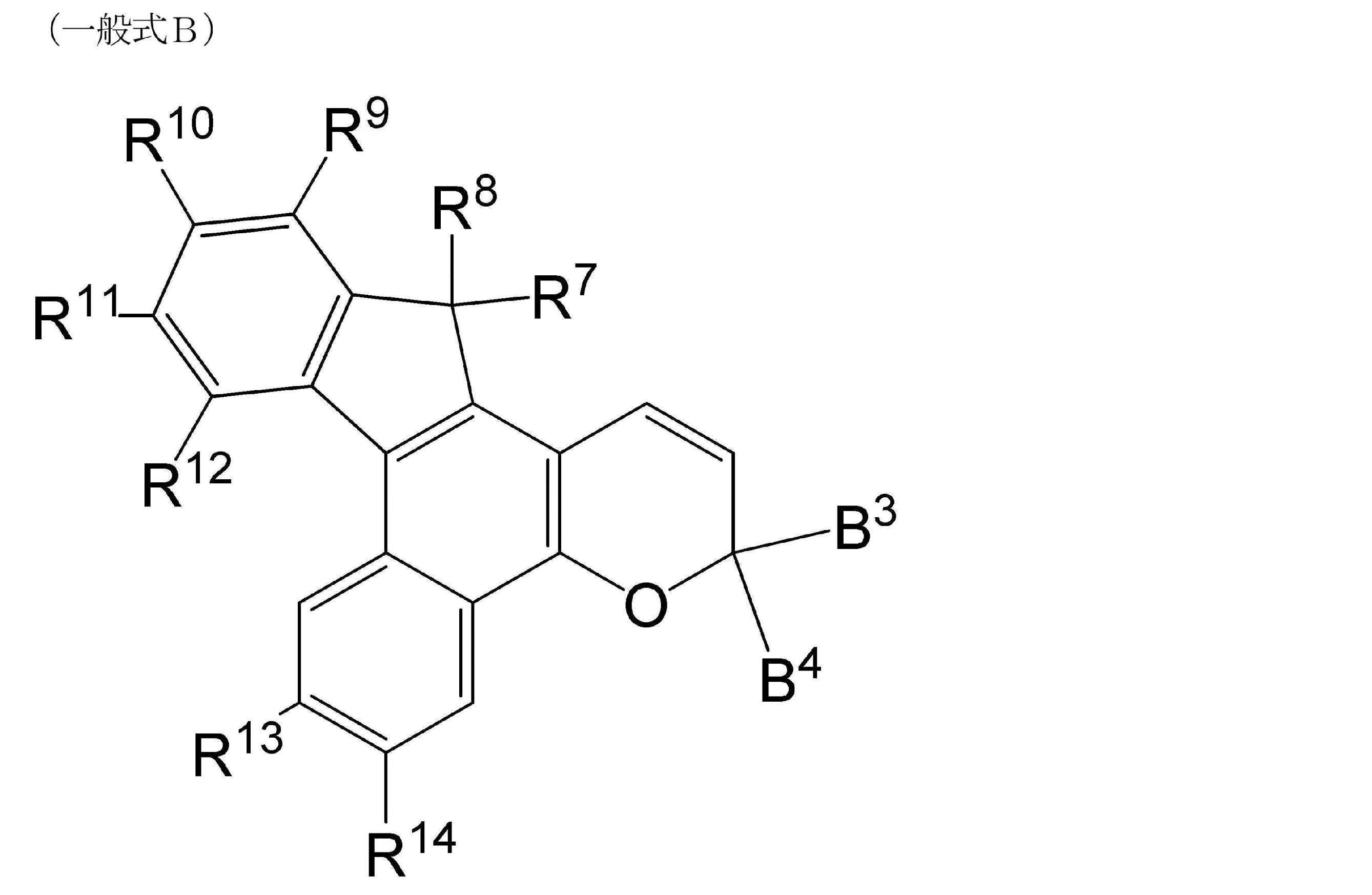
一般式B中、R7~R12、B3及びB4は、それぞれ独立に水素原子又は置換基を表し、R13及びR14は、それぞれ独立に電子供与性基を表す。 In the general formula B, R 7 to R 12 , B 3 and B 4 independently represent a hydrogen atom or a substituent, and R 13 and R 14 each independently represent an electron donating group.

一般式C中、R15~R20、B5及びB6は、それぞれ独立に水素原子又は置換基を表し、R21及びR22は、一方が水素原子を表し他方が電子供与性基を表す。 In the general formula C, R 15 to R 20 , B 5 and B 6 independently represent a hydrogen atom or a substituent, and R 21 and R 22 represent a hydrogen atom on one side and an electron donating group on the other side, respectively. ..
本発明者は鋭意検討を重ねた結果、一般式Aで表される化合物と一般式Bで表される化合物と一般式Cで表される化合物とを組み合わせることによって、可視域において高濃度で着色し得るフォトクロミック物品の提供が可能になることを新たに見出した。これは、一般式Aで表される化合物と一般式Bで表される化合物と一般式Cで表される化合物は、可視域における吸収ピーク位置及び/又はピーク強度が異なるため、これら化合物を組み合わせることによって広範な波長域において高濃度での着色が可能になるためと推察される。ただし、本発明は、本明細書に記載の推察によって限定されるものではない。更に、一般式Aで表される化合物と一般式Bで表される化合物と一般式Cで表される化合物とを組み合わせることによって、速い退色速度を示すフォトクロミック物品の提供が可能になることも判明した。 As a result of diligent studies, the present inventor has combined a compound represented by the general formula A, a compound represented by the general formula B, and a compound represented by the general formula C to color the compound at a high concentration in the visible region. We have newly found that it is possible to provide possible photochromic articles. This is because the compound represented by the general formula A, the compound represented by the general formula B, and the compound represented by the general formula C have different absorption peak positions and / or peak intensities in the visible region, and therefore these compounds are combined. It is presumed that this enables high-concentration coloring in a wide wavelength range. However, the present invention is not limited to the inferences described herein. Furthermore, it has also been found that by combining the compound represented by the general formula A, the compound represented by the general formula B, and the compound represented by the general formula C, it becomes possible to provide a photochromic article exhibiting a high fading rate. did.
本発明の一態様によれば、可視域における着色時の着色濃度が高いフォトクロミック物品を提供することができる。 According to one aspect of the present invention, it is possible to provide a photochromic article having a high coloring concentration at the time of coloring in the visible region.
フォトクロミック化合物は、一例として、太陽光等の光の照射を受けて励起状態を経て、着色体に構造変換する。光照射を経て構造変換した後の構造を「着色体」と呼ぶことができる。これに対し、光照射前の構造を「無色体」と呼ぶことができる。ただし、無色体について「無色」とは、完全な無色に限定されるものではなく、着色体に対して色が薄い場合も包含される。一般式Aの構造、一般式Bの構造及び一般式Cの構造は、それぞれ無色体の構造である。 As an example, a photochromic compound undergoes an excited state when irradiated with light such as sunlight, and structurally transforms into a colored body. The structure after structural conversion through light irradiation can be called a "colored body". On the other hand, the structure before light irradiation can be called a "colorless body". However, the term "colorless" with respect to a colorless body is not limited to being completely colorless, and includes cases where the color is lighter than that of the colored body. The structure of the general formula A, the structure of the general formula B, and the structure of the general formula C are colorless structures, respectively.
本発明及び本明細書において、「フォトクロミック物品」とは、フォトクロミック化合物を含む物品をいうものとする。本発明の一態様にかかるフォトクロミック物品は、フォトクロミック化合物として、一般式Aで表される化合物の1種以上と一般式Bで表される化合物の1種以上と一般式Cで表される化合物の1種以上とを含む。フォトクロミック化合物は、フォトクロミック物品の基材に含まれることができ、及び/又は、基材とフォトクロミック層とを有するフォトクロミック物品においてフォトクロミック層に含まれることができる。「フォトクロミック層」とは、フォトクロミック化合物を含む層である。 In the present invention and the present specification, the "photochromic article" means an article containing a photochromic compound. The photochromic article according to one aspect of the present invention is, as a photochromic compound, one or more compounds represented by the general formula A, one or more compounds represented by the general formula B, and a compound represented by the general formula C. Includes one or more. The photochromic compound can be included in the substrate of the photochromic article and / or can be included in the photochromic layer in the photochromic article having the substrate and the photochromic layer. The "photochromic layer" is a layer containing a photochromic compound.
本発明及び本明細書において、「フォトクロミック組成物」とは、フォトクロミック化合物を含む組成物をいうものとする。本発明の一態様にかかるフォトクロミック組成物は、フォトクロミック化合物として、一般式Aで表される化合物の1種以上と一般式Bで表される化合物の1種以上と一般式Cで表される化合物の1種以上とを含み、本発明の一態様にかかるフォトクロミック物品の製造のために使用することができる。 In the present invention and the present specification, the "photochromic composition" means a composition containing a photochromic compound. The photochromic composition according to one aspect of the present invention is, as a photochromic compound, one or more compounds represented by the general formula A, one or more compounds represented by the general formula B, and a compound represented by the general formula C. Can be used for the production of a photochromic article according to one aspect of the present invention, including one or more of the above.
本発明及び本明細書において、各種置換基、即ち、一般式A中のR1、R2、B1、B2、一般式B中のR7~R12、B3及びB4のいずれかで表され得る置換基、一般式C中のR15~R20、R5及びR6のいずれかで表され得る置換基、更に、後述する各基が置換基を有する場合の置換基は、それぞれ独立に、
ヒドロキシ基、メチル基、エチル基、プロピル基、ブチル基、ペンチル基、ヘキシル基等の炭素数1~18の直鎖若しくは分岐のアルキル基、シクロペンチル基、シクロヘキシル基等の炭素数5~18の単環若しくはビシクロ環等の複環の環状脂肪族アルキル基、メトキシ基、エトキシ基、ブトキシ基等の構成原子数1~24の直鎖若しくは分岐のアルコキシ基、構成原子数1~24の非芳香族環状置換基、トリフルオロメチル基等の炭素数1~18の直鎖若しくは分岐のパーフルオロアルキル基、トリフルオロメトキシ基等の直鎖若しくは分岐のパーフルオロアルコキシ基、メチルスルフィド基、エチルスルフィド基、ブチルスルフィド基等の構成原子数1~24の直鎖若しくは分岐のアルキルスルフィド基、フェニル基、ナフチル基、アントラセニル基、フルオランテニル基、フェナントリル基、ピラニル基、ペリレニル基、スチリル基、フルオレニル基等のアリール基、フェニルオキシ基等のアリールオキシ基、フェニルスルフィド基等のアリールスルフィド基、ピリジル基、フラニル基、チエニル基、ピロリル基、ベンゾフラニル基、ベンゾチオフェニル基、インドリル基、ジベンゾフラニル基、ジベンゾチオフェニル基、カルバゾリル基、ジアゾリル基、トリアゾリル基、キノリニル基、フェノチアジニル基、フェノキサジニル基、フェナジニル基、チアンスリル基、アクリジニル基等のヘテロアリール基、アミノ基(-NH2)、モノメチルアミノ基等のモノアルキルアミノ基、ジメチルアミノ基等のジアルキルアミノ基、モノフェニルアミノ基等のモノアリールアミノ基、ジフェニルアミノ基等のジアリールアミノ基、ピペリジノ基、モルホリノ基、チオモルホリノ基、テトラヒドロキノリノ基、テトラヒドロイソキノリノ基等の環状アミノ基、エチニル基、メルカプト基、シリル基、スルホン酸基、アルキルスルホニル基、ホルミル基、カルボキシ基、シアノ基及びフッ素原子、塩素原子、臭素原子、ヨウ素原子等のハロゲン原子からなる群から選ばれる置換基Rm;又は、
Rmに更に1つ以上の同一若しくは異なるRmが置換した置換基;
であることができる。
In the present invention and the present specification, any of various substituents, that is, R 1 , R 2 , B 1 , B 2 in the general formula A, and R 7 to R 12 , B 3 and B 4 in the general formula B. The substituents that can be represented by the above, the substituents that can be represented by any of R 15 to R 20 , R 5 and R 6 in the general formula C, and the substituents that will be described later have substituents. Independently
A linear or branched alkyl group having 1 to 18 carbon atoms such as a hydroxy group, a methyl group, an ethyl group, a propyl group, a butyl group, a pentyl group and a hexyl group, and a single group having 5 to 18 carbon atoms such as a cyclopentyl group and a cyclohexyl group. A linear or branched alkoxy group having 1 to 24 constituent atoms such as a cyclic aliphatic alkyl group, a methoxy group, an ethoxy group, and a butoxy group having a compound ring such as a ring or a bicyclo ring, and a non-aromatic group having 1 to 24 constituent atoms. A linear or branched perfluoroalkyl group having 1 to 18 carbon atoms such as a cyclic substituent and a trifluoromethyl group, a linear or branched perfluoroalkoxy group such as a trifluoromethoxy group, a methyl sulfide group and an ethyl sulfide group. A linear or branched alkyl sulfide group having 1 to 24 constituent atoms such as a butyl sulfide group, a phenyl group, a naphthyl group, an anthrasenyl group, a fluoranthenyl group, a phenanthryl group, a pyranyl group, a peryleneyl group, a styryl group, a fluorenyl group, etc. Aryl group, aryloxy group such as phenyloxy group, aryl sulfide group such as phenyl sulfide group, pyridyl group, furanyl group, thienyl group, pyrrolyl group, benzofuranyl group, benzothiophenyl group, indolyl group, dibenzofuranyl group, Heteroaryl groups such as dibenzothiophenyl group, carbazolyl group, diazolyl group, triazolyl group, quinolinyl group, phenothiazine group, phenoxadinyl group, phenazinyl group, thianthryl group, acridinyl group, amino group (-NH 2 ), monomethylamino group and the like. Monoalkylamino group, dialkylamino group such as dimethylamino group, monoarylamino group such as monophenylamino group, diarylamino group such as diphenylamino group, piperidino group, morpholino group, thiomorpholino group, tetrahydroquinolino group, Cyclic amino groups such as tetrahydroisoquinolino groups, ethynyl groups, mercapto groups, silyl groups, sulfonic acid groups, alkylsulfonyl groups, formyl groups, carboxy groups, cyano groups and fluorine atoms, chlorine atoms, bromine atoms, iodine atoms, etc. Substituent Rm selected from the group consisting of halogen atoms; or
Substituents in which R m is further substituted with one or more identical or different R m ;
Can be.
上記のRmに更に1つ以上の同一又は異なるRmが置換した置換基の一例としては、アルコキシ基の末端の炭素原子に更にアルコキシ基が置換し、このアルコキシ基の末端の炭素原子に更にアルコキシ基が置換した構造を挙げることができる。また、上記のRmに更に1つ以上の同一又は異なるRmが置換した置換基の他の一例としては、フェニル基の5つの置換可能位置の中の2つ以上の位置に、同一又は異なるRmが置換した構造を挙げることができる。ただし、かかる例に限定されるものではない。 As an example of the above-mentioned R m substituted with one or more identical or different R m , an alkoxy group is further substituted with the carbon atom at the end of the alkoxy group, and the carbon atom at the end of the alkoxy group is further substituted. Examples thereof include structures in which the alkoxy group is substituted. Further, as another example of the substituent in which one or more identical or different R m is substituted for the above R m , the same or different positions are used in two or more of the five replaceable positions of the phenyl group. A structure in which R m is substituted can be mentioned. However, the present invention is not limited to this example.
本発明及び本明細書において、「炭素数」及び「構成原子数」とは、置換基を有する基については、置換基の炭素数又は原子数も含む数をいうものとする。 In the present invention and the present specification, the "carbon number" and the "constituting atom number" refer to the number including the carbon number or the atom number of the substituent for the group having a substituent.
また、本発明及び本明細書において、各種置換基、即ち、一般式A中のR1、R2、B1、B2、一般式B中のR7~R12、B3及びB4のいずれかで表され得る置換基、一般式C中のR15~R20、R5及びR6のいずれかで表され得る置換基、更に、後述する各基が置換基を有する場合の置換基は、それぞれ独立に、可溶化基であることもできる。本発明及び本明細書において、「可溶化基」とは、任意の液体又は特定の液体との相溶性を高めることに寄与し得る置換基を指す。可溶化基としては、炭素数4~50の直鎖、分岐又は環状構造を含むアルキル基、構成原子数4~50の直鎖、分岐又は環状のアルコキシ基、構成原子数4~50の直鎖、分岐又は環状のシリル基、上記の基の一部をケイ素原子、硫黄原子、窒素原子、リン原子等に置き換えたもの、上記の基の2つ以上を組み合わせたもの等の、この置換基を有することが化合物の分子の熱運動を促進することに寄与し得る置換基が好適である。置換基として可溶化基を有する化合物は、溶質分子間の距離が近づくことを阻害することで溶質の固体化を防いだり、溶質の融点及び/又はガラス転移温度を下げることで液体に近い分子集合状態を作ることができる。こうして、可溶性基は、溶質を液体化したり、この置換基を有する化合物の液体への溶解性を高めることができる。一形態では、可溶化基としては、直鎖アルキル基であるn-ブチル基、n-ペンチル基、n-ヘキシル基、n-オクチル基、分岐アルキル基であるtert-ブチル基並びに環状アルキル基であるシクロペンチル基及びシクロヘキシル基が好ましい。 Further, in the present invention and the present specification, various substituents, that is, R 1 , R 2 , B 1 , B 2 in the general formula A, and R 7 to R 12 , B 3 and B 4 in the general formula B. Substituents that can be represented by any of, substituents that can be represented by any of R 15 to R 20 , R 5 and R 6 in the general formula C, and substituents when each group described later has a substituent. Can also be solubilizing groups independently of each other. In the present invention and the present specification, the "solubilizing group" refers to a substituent that can contribute to enhancing compatibility with any liquid or a specific liquid. The solubilizing group includes a linear group having 4 to 50 carbon atoms, an alkyl group containing a branched or cyclic structure, a linear group having 4 to 50 constituent atoms, a branched or cyclic alkoxy group, and a linear chain having 4 to 50 constituent atoms. , A branched or cyclic silyl group, a part of the above group replaced with a silicon atom, a sulfur atom, a nitrogen atom, a phosphorus atom, etc., a combination of two or more of the above groups, etc. Substituents that may contribute to promoting the thermal motion of the molecules of the compound are preferred. A compound having a solubilizing group as a substituent prevents the solute from solidifying by inhibiting the distance between the solute molecules from approaching, and lowers the melting point and / or the glass transition temperature of the solute to reduce the molecular assembly close to that of a liquid. You can make a state. Thus, the soluble group can liquefy the solute and increase the solubility of the compound having this substituent in the liquid. In one form, the solubilizing group includes a linear alkyl group such as n-butyl group, n-pentyl group, n-hexyl group, n-octyl group, branched alkyl group tert-butyl group and cyclic alkyl group. Certain cyclopentyl and cyclohexyl groups are preferred.
上記置換基は、好ましくは、メトキシ基、エトキシ基、フェノキシ基、メチルスルフィド基、エチルスルフィド基、フェニルスルフィド基、トリフルオロメチル基、フェニル基、ナフチル基、ジベンゾフラニル基、ジベンゾチオフェニル基、カルバゾリル基、フェノチアジニル基、フェノキサジニル基、フェナジニル基、アクリジニル基、ジメチルアミノ基、ジフェニルアミノ基、ピペリジノ基、モルホリルノ基、チオモルホリノ基、シアノ基及び可溶化基からなる群から選ばれる置換基であることができ、より好ましくは、メトキシ基、フェノキシ基、メチルスルフィド基、フェニルスルフィド基、トリフルオロメチル基、フェニル基、ジメチルアミノ基、ジフェニルアミノ基、ピペリジノ基、モルホリルノ基、チオモルホリノ基、シアノ基及び可溶化基からなる群から選ばれる置換基であることができる。 The substituent is preferably a methoxy group, an ethoxy group, a phenoxy group, a methyl sulfide group, an ethyl sulfide group, a phenyl sulfide group, a trifluoromethyl group, a phenyl group, a naphthyl group, a dibenzofuranyl group or a dibenzothiophenyl group. It is a substituent selected from the group consisting of a carbazolyl group, a phenothiazine group, a phenoxadinyl group, a phenazinyl group, an acridinyl group, a dimethylamino group, a diphenylamino group, a piperidino group, a morphorylno group, a thiomorpholino group, a cyano group and a solubilizing group. More preferably, it can be a methoxy group, a phenoxy group, a methyl sulfide group, a phenyl sulfide group, a trifluoromethyl group, a phenyl group, a dimethyl amino group, a diphenyl amino group, a piperidino group, a morphorylno group, a thiomorpholino group, a cyano group. And can be a substituent selected from the group consisting of solubilizing groups.
本発明及び本明細書において、「電子吸引性基」とは、水素原子と比較して、結合している原子側から電子を引きつけやすい置換基をいう。電子吸引性基は、誘起効果、メソメリー効果(又は共鳴効果)等の置換基効果の結果、電子を引きつけることができる。電子吸引性基の具体例としては、ハロゲン原子(フッ素原子:-F、塩素原子:-Cl、臭素原子:-Br、ヨウ素原子:-I)、トリフルオロメチル基:-CF3、ニトロ基:-NO2、シアノ基:-CN、ホルミル基:-CHO、アシル基:-COR(Rは置換基)、アルコキシカルボニル基:-COOR、カルボキシ基:-COOH、置換スルホニル基:-SO2R(Rは置換基)、スルホ基:-SO3H等を挙げることができる。好適な電子吸引性基としては、電気陰性度の高い電子吸引性基であるフッ素原子、ハメット則に基づくパラ位の置換基定数σpが正の値である電子吸引性基等を挙げることができる。 In the present invention and the present specification, the "electron-withdrawing group" refers to a substituent that easily attracts an electron from the bonded atom side as compared with a hydrogen atom. Electron-withdrawing groups can attract electrons as a result of substituent effects such as inductive effects, mesomeric effects (or resonance effects). Specific examples of the electron-withdrawing group include a halogen atom (fluorine atom: -F, chlorine atom: -Cl, bromine atom: -Br, iodine atom: -I), trifluoromethyl group: -CF 3 , nitro group: -NO 2 , cyano group: -CN, formyl group: -CHO, acyl group: -COR (R is a substituent), alkoxycarbonyl group: -COOR, carboxy group: -COOH, substituted sulfonyl group: -SO 2 R ( R is a substituent), a sulfo group: -SO 3H and the like. Suitable electron-withdrawing groups include a fluorine atom, which is an electron-withdrawing group having a high electronegativity, and an electron-withdrawing group having a positive value for the substituent constant σ p at the paraposition based on Hammett's law. can.
本発明及び本明細書において、「電子供与性基」とは、水素原子と比較して、結合している原子側に電子を与えやすい置換基をいう。電子供与性基は、誘起効果、メソメリー効果(又は共鳴効果)等の総和として、電子を与えやすい置換基であることができる。電子供与性基の具体例としては、ヒドロキシ基:-OH、チオール基:-SH、アルコキシ基:-OR(Rはアルキル基)、アルキルスルフィド基:-SR(Rはアルキル基)、アリールスルフィド基、アセチル基:-OCOCH3、アミノ基:-NH2、アルキルアミド基:-NHCOCH3、ジアルキルアミノ基:-N(R)2(2つのRは同一又は異なるアルキル基)、メチル基等を挙げることができる。好適な電子供与性基としては、ハメット則に基づくパラ位の置換基定数σpが負の値である電子供与性基等を挙げることができる。 In the present invention and the present specification, the "electron donating group" refers to a substituent that is more likely to donate an electron to the bonded atom side as compared with a hydrogen atom. The electron-donating group can be a substituent that easily donates an electron as a sum of the inductive effect, the mesomeric effect (or the resonance effect), and the like. Specific examples of the electron donating group include hydroxy group: -OH, thiol group: -SH, alkoxy group: -OR (R is an alkyl group), alkyl sulfide group: -SR (R is an alkyl group), and aryl sulfide group. , Acetyl group: -OCOCH 3 , amino group: -NH 2 , alkylamide group: -NHCOCH 3 , dialkylamino group: -N (R) 2 (two Rs are the same or different alkyl groups), methyl group, etc. be able to. As a suitable electron donating group, an electron donating group in which the substituent constant σ p at the paraposition based on Hammett's rule is a negative value can be mentioned.
ハメット則に基づくパラ位の置換基定数σp(出典:岩村秀、野依良治、中井武、北川勲 編、大学院有機化学(上)(1988))の具体例を以下に示す。
-N(CH3)2:-0.83
-OCH3:-0.27
-t-C4H9:-0.20
-CH3:-0.17
-C2H5:-0.15
-C6H5:-0.01
(-H:0)
-F:+0.06
-Cl:+0.27
-Br:+0.23
-CO2C2H5:+0.45
-CF3:+0.54
-CN:+0.66
-SO2CH3:+0.72
-NO2:+0.78
A specific example of the para-position substituent constant σ p based on Hammett's law (Source: Hide Iwamura, Ryoji Noyori, Takeshi Nakai, Isao Kitagawa, Graduate School of Organic Chemistry (above) (1988)) is shown below.
-N (CH 3 ) 2 : -0.83
-OCH3: -0.27
-T-C 4 H 9 : -0.20
-CH 3 : -0.17
-C 2 H 5 : -0.15
-C 6 H 5 : -0.01
(-H: 0)
-F: +0.06
-Cl: +0.27
-Br: +0.23
-CO 2 C 2 H 5 : +0.45
-CF 3 : +0.54
-CN: +0.66
-SO 2 CH 3 : +0.72
-NO 2 : +0.78
以下に、一般式Aで表される化合物、一般式Bで表される化合物及び一般式Cで表される化合物について、更に詳細に説明する。 Hereinafter, the compound represented by the general formula A, the compound represented by the general formula B, and the compound represented by the general formula C will be described in more detail.
<一般式Aで表される化合物>

一般式A中、R1~R6、B1及びB2は、それぞれ独立に水素原子又は置換基を表す。 In the general formula A, R 1 to R 6 , B 1 and B 2 each independently represent a hydrogen atom or a substituent.
R1及びR2は、それぞれ独立に、炭素数1~20の置換又は無置換のアルキル基を表すことが好ましく、メチル基、エチル基、プロピル基、ブチル基、ペンチル基又はヘキシル基を表すことがより好ましい。R1及びR2が、それぞれ独立にメチル基又はエチル基を表すことが更に好ましく、R1及びR2がいずれもメチル基を表すこと又はいずれもエチル基を表すことが一層好ましい。 R 1 and R 2 each independently preferably represent a substituted or unsubstituted alkyl group having 1 to 20 carbon atoms, and each represent a methyl group, an ethyl group, a propyl group, a butyl group, a pentyl group or a hexyl group. Is more preferable. It is more preferable that R 1 and R 2 each independently represent a methyl group or an ethyl group, and it is even more preferable that both R 1 and R 2 represent a methyl group or both represent an ethyl group.
B1及びB2は、それぞれ独立に、置換又は無置換のフェニル基を表すことが好ましい。フェニル基が置換基を複数有する場合、これら置換基の2つ以上が結合して環を形成してもよい。形成される環の具体例としては、後掲の例示化合物に含まれる環を挙げることができる。置換フェニル基における置換基の置換位置は、B1とB2とが結合する炭素原子に対してパラ位となる位置であることが好ましい。置換フェニル基の置換基の具体例としては、モルホリノ基、ピペリジノ基、ハロゲン原子、アルコキシ基、以下の置換基等の後掲の例示化合物に含まれる置換基を挙げることができる。本発明及び本明細書において、化合物の部分構造に関する「*」は、かかる部分構造が結合する原子との結合位置を示す。 It is preferable that B 1 and B 2 each independently represent a substituted or unsubstituted phenyl group. When the phenyl group has a plurality of substituents, two or more of these substituents may be bonded to form a ring. Specific examples of the formed ring include the rings contained in the exemplary compounds described below. The substitution position of the substituent in the substituted phenyl group is preferably a position at the para position with respect to the carbon atom to which B 1 and B 2 are bonded. Specific examples of the substituent of the substituted phenyl group include a morpholino group, a piperidino group, a halogen atom, an alkoxy group, and a substituent contained in the following exemplary compounds such as the following substituents. In the present invention and the present specification, "*" relating to a partial structure of a compound indicates a bonding position with an atom to which the partial structure is bonded.

一般式A中、R3~R6は、それぞれ独立に水素原子又は置換基を表す。一形態では、R3~R6がすべて水素原子であることができる。他の一形態では、R3~R6は、それぞれ独立に水素原子又は電子吸引性基を表し、ただし、R3~R6の1つ以上は電子吸引性基を表す。電子吸引性基としては、ハロゲン原子、炭素数1~6のパーフルオロアルキル基、パーフルオロフェニル基、パーフルオロアルキルフェニル基又はシアノ基が好ましい。ハロゲン原子としてはフッ素原子が好ましい。炭素数1~6のパーフルオロアルキル基としてはトリフルオロメチル基が好ましい。 In the general formula A, R 3 to R 6 independently represent hydrogen atoms or substituents, respectively. In one form, R 3 to R 6 can all be hydrogen atoms. In another embodiment, R 3 to R 6 each independently represent a hydrogen atom or an electron-withdrawing group, where one or more of R 3 to R 6 represents an electron-withdrawing group. As the electron-withdrawing group, a halogen atom, a perfluoroalkyl group having 1 to 6 carbon atoms, a perfluorophenyl group, a perfluoroalkylphenyl group or a cyano group is preferable. A fluorine atom is preferable as the halogen atom. As the perfluoroalkyl group having 1 to 6 carbon atoms, a trifluoromethyl group is preferable.
一形態では、一般式Aで表される化合物は、以下の化合物であることができる。
R3~R6の中で、R4のみが電子吸引性基であって、R3、R5及びR6は水素原子である化合物。
R3~R6の中で、R4及びR6は同一又は異なる電子吸引性基であって、R3及びR5は水素原子である化合物。
R3~R6の中で、R3及びR5は同一又は異なる電子吸引性基であって、R4及びR6は水素原子である化合物。
In one form, the compound represented by the general formula A can be the following compound.
Among R 3 to R 6 , only R 4 is an electron-withdrawing group, and R 3 , R 5 and R 6 are hydrogen atoms.
Among R 3 to R 6 , R 4 and R 6 are the same or different electron-withdrawing groups, and R 3 and R 5 are hydrogen atoms.
Among R 3 to R 6 , R 3 and R 5 are the same or different electron-withdrawing groups, and R 4 and R 6 are hydrogen atoms.
一般式Aで表される化合物としては、以下の化合物を例示できる。ただし、本発明は以下に例示された化合物に限定されるものではない。 Examples of the compound represented by the general formula A include the following compounds. However, the present invention is not limited to the compounds exemplified below.


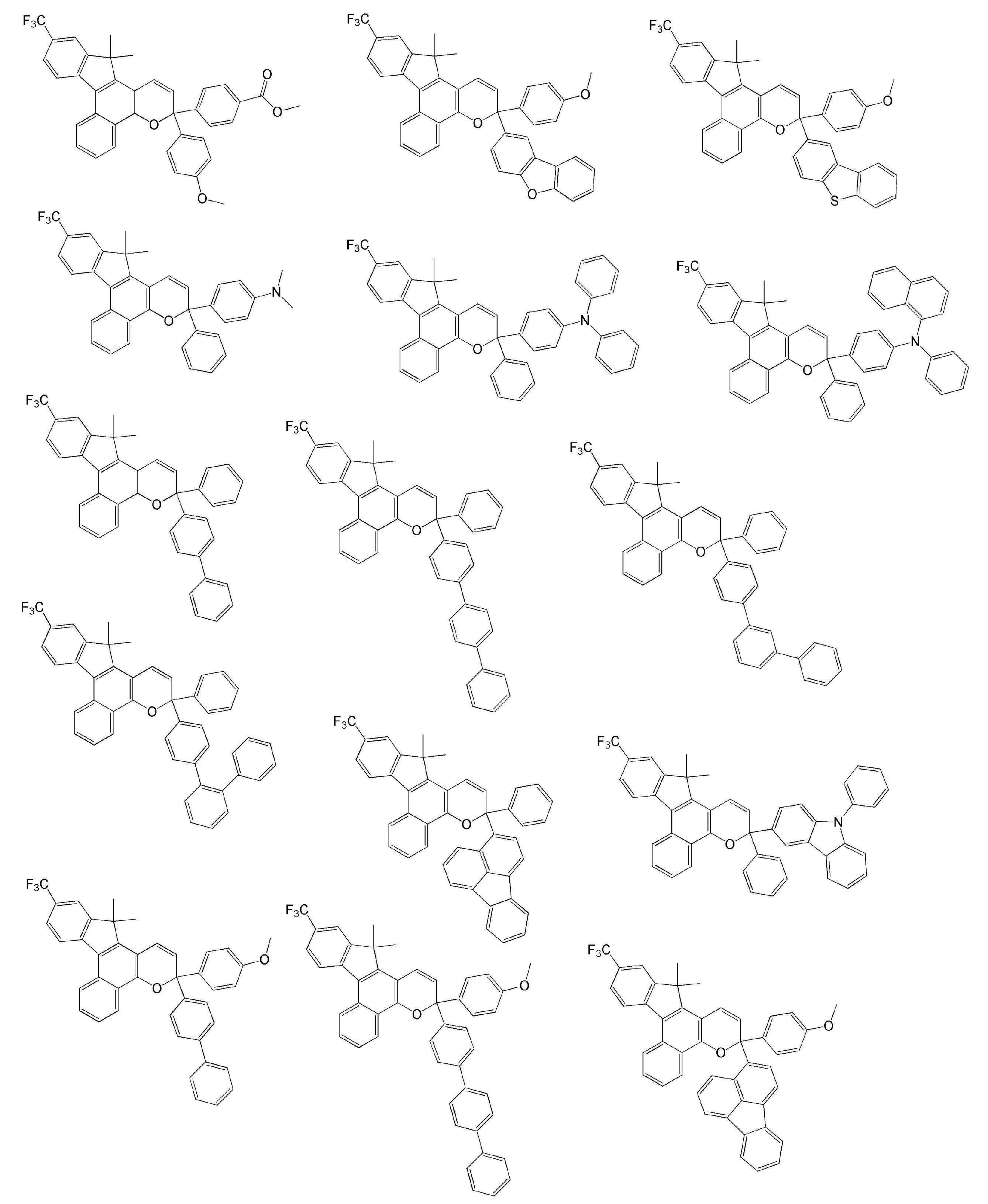


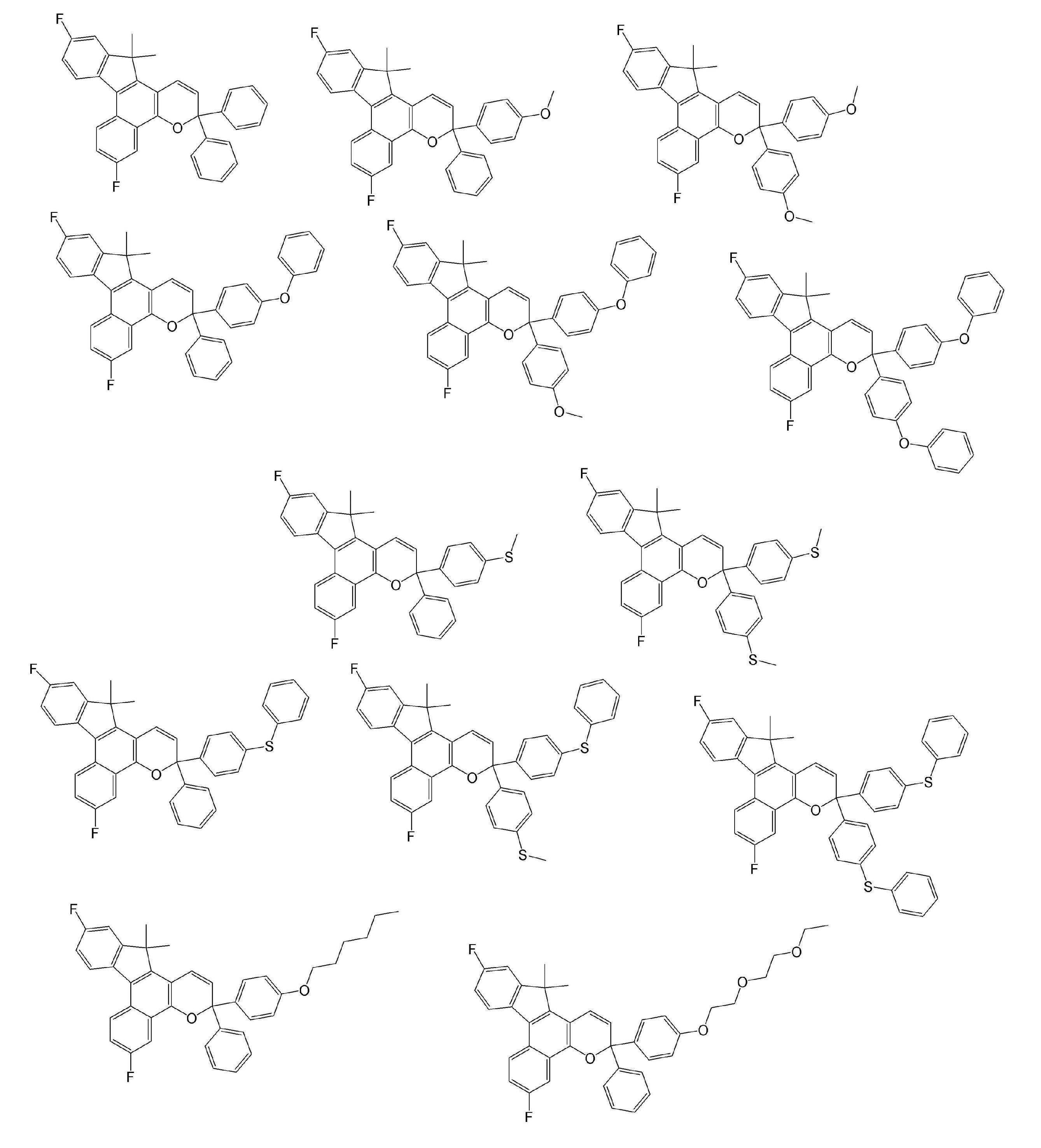


<一般式Bで表される化合物>

一般式B中、R7~R12、B3及びB4は、それぞれ独立に水素原子又は置換基を表す。 In the general formula B, R 7 to R 12 , B 3 and B 4 independently represent hydrogen atoms or substituents, respectively.
R7及びR8は、それぞれ独立に、炭素数1~20の置換又は無置換のアルキル基を表すことが好ましく、メチル基、エチル基、プロピル基、ブチル基、ペンチル基又はヘキシル基を表すことがより好ましい。R7及びR8が、それぞれ独立にメチル基又はエチル基を表すことが更に好ましく、R7及びR8がいずれもメチル基を表すこと又はいずれもエチル基を表すことが一層好ましい。 R 7 and R 8 each independently preferably represent a substituted or unsubstituted alkyl group having 1 to 20 carbon atoms, and each represent a methyl group, an ethyl group, a propyl group, a butyl group, a pentyl group or a hexyl group. Is more preferable. It is more preferable that R 7 and R 8 each independently represent a methyl group or an ethyl group, and it is even more preferable that both R 7 and R 8 represent a methyl group or both represent an ethyl group.
B3及びB4は、それぞれ独立に、置換又は無置換のフェニル基を表すことが好ましい。フェニル基が置換基を複数有する場合、これら置換基の2つ以上が結合して環を形成してもよい。形成される環の具体例としては、後掲の例示化合物に含まれる環を挙げることができる。置換フェニル基における置換基の置換位置は、B3とB4とが結合する炭素原子に対してパラ位となる位置であることが好ましい。置換フェニル基の置換基の具体例としては、モルホリノ基、ピペリジノ基、ハロゲン原子、アルコキシ基、以下の置換基等の後掲の例示化合物に含まれる置換基を挙げることができる。 It is preferable that B 3 and B 4 each independently represent a substituted or unsubstituted phenyl group. When the phenyl group has a plurality of substituents, two or more of these substituents may be bonded to form a ring. Specific examples of the formed ring include the rings contained in the exemplary compounds described below. The substitution position of the substituent in the substituted phenyl group is preferably a position at the para position with respect to the carbon atom to which B 3 and B 4 are bonded. Specific examples of the substituent of the substituted phenyl group include a morpholino group, a piperidino group, a halogen atom, an alkoxy group, and a substituent contained in the following exemplary compounds such as the following substituents.

R9~R12は、それぞれ独立に水素原子又は置換基を表す。一形態では、R9~R12は、すべて水素原子であることができる。他の一形態では、R10が電子吸引性基であって、R9、R11及びR12がいずれも水素原子であることができる。また、他の一形態では、R9及びR11がそれぞれ独立に電子吸引性基であって、R10及びR12が水素原子であることができる。電子吸引性基としては、ハロゲン原子、炭素数1~6のパーフルオロアルキル基、パーフルオロフェニル基、パーフルオロアルキルフェニル基又はシアノ基が好ましい。ハロゲン原子としてはフッ素原子が好ましい。炭素数1~6のパーフルオロアルキル基としてはトリフルオロメチル基が好ましい。 R 9 to R 12 each independently represent a hydrogen atom or a substituent. In one form, R 9 to R 12 can all be hydrogen atoms. In another embodiment, R 10 can be an electron-withdrawing group and R 9 , R 11 and R 12 can all be hydrogen atoms. Further, in another embodiment, R 9 and R 11 can be independently electron-withdrawing groups, and R 10 and R 12 can be hydrogen atoms. As the electron-withdrawing group, a halogen atom, a perfluoroalkyl group having 1 to 6 carbon atoms, a perfluorophenyl group, a perfluoroalkylphenyl group or a cyano group is preferable. A fluorine atom is preferable as the halogen atom. As the perfluoroalkyl group having 1 to 6 carbon atoms, a trifluoromethyl group is preferable.
一形態では、R10が置換又は無置換フェニル基であることができ、好ましくはR10が置換又は無置換フェニル基であって、かつR9、R11及びR12が水素原子であることができる。かかる置換フェニル基の具体例としては、1つ以上のハロゲン原子及び/又は1つ以上のシアノ基が置換したフェニル基、例えば、フェニル基の5つの置換位置すべてにハロゲン原子(好ましくはフッ素原子)が置換したフェニル基、及びR10が結合する炭素原子に対してパラ位となる位置にシアノ基が置換した一置換フェニル基を挙げることができる。 In one embodiment, R 10 can be a substituted or unsubstituted phenyl group, preferably R 10 is a substituted or unsubstituted phenyl group, and R 9 , R 11 and R 12 are hydrogen atoms. can. As a specific example of such a substituted phenyl group, a phenyl group substituted with one or more halogen atoms and / or one or more cyano groups, for example, a halogen atom (preferably a fluorine atom) at all five substitution positions of the phenyl group. Examples thereof include a phenyl group substituted with a cyano group and a monosubstituted phenyl group substituted with a cyano group at a position at the para position with respect to the carbon atom to which R10 is bonded.
R13及びR14は、それぞれ独立に電子供与性基を表す。即ち、R13及びR14は、同一又は異なる電子供与性基を表す。R13及びR14は、それぞれ独立に、メトキシ基、エトキシ基、フェノキシ基、メチルスルフィド基、フェニルスルフィド基、ジメチルアミノ基、ピロリジノ基、ピペリジノ基、モルホリノ基及びチオモルホリノ基からなる群から選択される電子供与性基を表すことが好ましい。中でも、R13及びR14について、R13がモルホリノ基であってR14がアルコキシ基(好ましくはメトキシ基)であること、R13がモルホリノ基であってR14がメチルスルフィド基(-S-CH3)であること、R13及びR14がいずれもアルコキシ基(好ましくはメトキシ基)であること、並びに、R13及びR14がいずれもメチルスルフィド基であることが好ましい。 R 13 and R 14 each independently represent an electron donating group. That is, R 13 and R 14 represent the same or different electron donating groups. R 13 and R 14 are independently selected from the group consisting of a methoxy group, an ethoxy group, a phenoxy group, a methyl sulfide group, a phenyl sulfide group, a dimethyl amino group, a pyrrolidino group, a piperidino group, a morpholino group and a thiomorpholino group. It is preferable to represent an electron donating group. Among them, regarding R 13 and R 14 , R 13 is a morpholino group and R 14 is an alkoxy group (preferably a methoxy group), R 13 is a morpholino group and R 14 is a methyl sulfide group (-S-). It is preferable that CH 3 ), that both R 13 and R 14 are alkoxy groups (preferably methoxy groups), and that both R 13 and R 14 are methyl sulfide groups.
一般式Bで表される化合物としては、以下の化合物を例示できる。ただし、本発明は以下に例示された化合物に限定されるものではない。 Examples of the compound represented by the general formula B include the following compounds. However, the present invention is not limited to the compounds exemplified below.


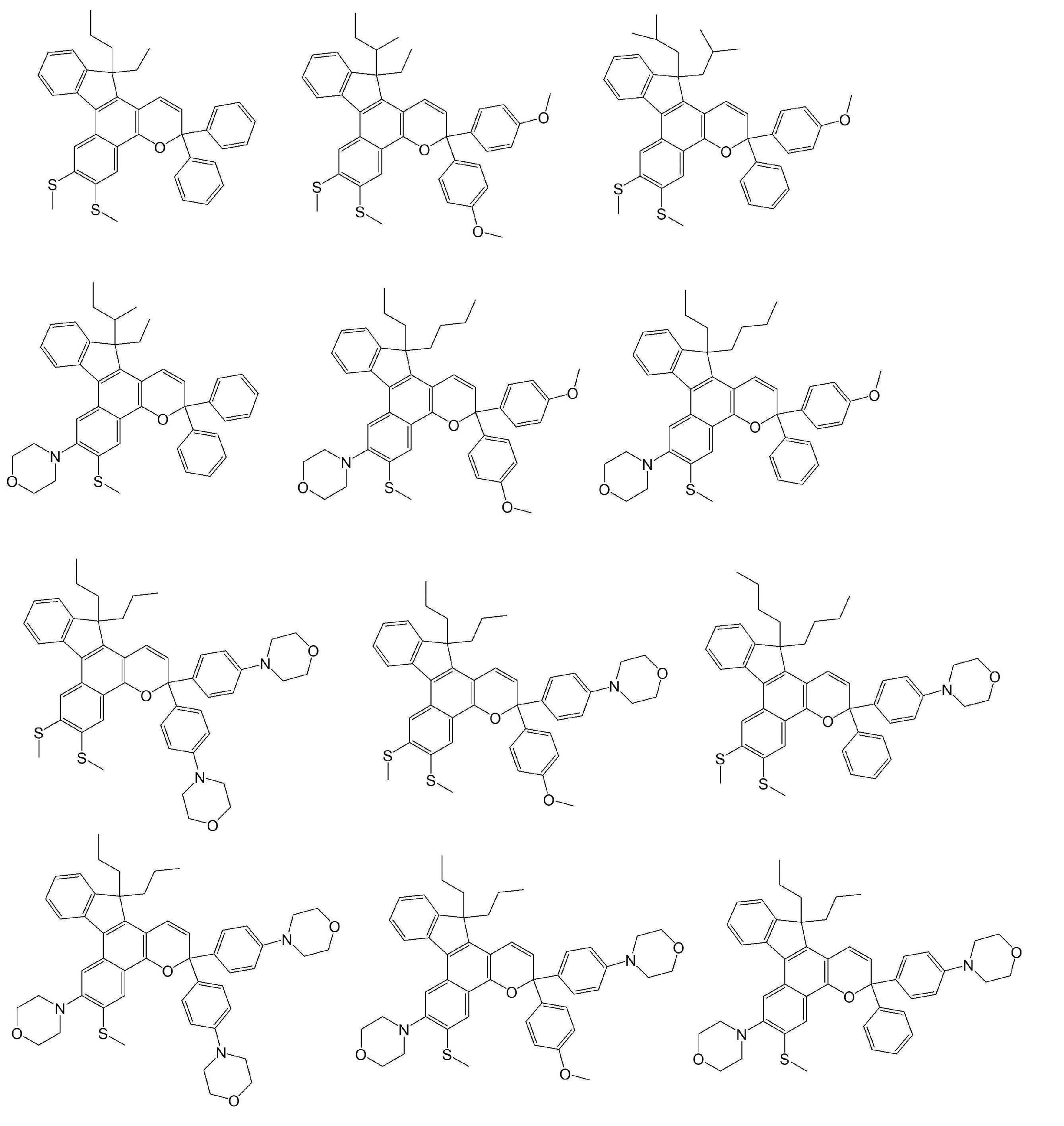


<一般式Cで表される化合物>

一般式C中、R15~R20、B5及びB6は、それぞれ独立に水素原子又は置換基を表し、
R21及びR22は、一方が水素原子を表し他方が電子供与性基を表す。
In the general formula C, R 15 to R 20 , B 5 and B 6 independently represent hydrogen atoms or substituents, respectively.
One of R 21 and R 22 represents a hydrogen atom and the other represents an electron donating group.
一般式C中、R15及びR16は、それぞれ独立に、炭素数1~20の置換又は無置換のアルキル基を表すことが好ましく、メチル基、エチル基、プロピル基、ブチル基、ペンチル基又はヘキシル基を表すことがより好ましい。R15及びR16が、それぞれ独立にメチル基又はエチル基を表すことが更に好ましく、R15及びR16がいずれもメチル基を表すこと又はいずれもエチル基を表すことが一層好ましい。 In the general formula C, R 15 and R 16 each independently represent a substituted or unsubstituted alkyl group having 1 to 20 carbon atoms, and are preferably a methyl group, an ethyl group, a propyl group, a butyl group, a pentyl group or a group. It is more preferable to represent a hexyl group. It is more preferable that R 15 and R 16 each independently represent a methyl group or an ethyl group, and it is even more preferable that both R 15 and R 16 represent a methyl group or both represent an ethyl group.
B5及びB6は、それぞれ独立に、置換又は無置換のフェニル基を表すことが好ましい。フェニル基が置換基を複数有する場合、これら置換基の2つ以上が結合して環を形成してもよい。形成される環の具体例としては、後掲の例示化合物に含まれる環を挙げることができる。置換フェニル基における置換基の置換位置は、B5とB6とが結合する炭素原子に対してパラ位となる位置であることが好ましい。置換フェニル基の置換基の具体例としては、モルホリノ基、ピペリジノ基、ハロゲン原子、アルコキシ基、以下の置換基等を挙げることができる。 It is preferable that B 5 and B 6 each independently represent a substituted or unsubstituted phenyl group. When the phenyl group has a plurality of substituents, two or more of these substituents may be bonded to form a ring. Specific examples of the formed ring include the rings contained in the exemplary compounds described below. The substitution position of the substituent in the substituted phenyl group is preferably a position at the para position with respect to the carbon atom to which B 5 and B 6 are bonded. Specific examples of the substituent of the substituted phenyl group include a morpholino group, a piperidino group, a halogen atom, an alkoxy group, the following substituents and the like.

R17~R20は、それぞれ独立に水素原子又は置換基を表す。一形態では、R17~R20は、すべて水素原子であることができる。他の一形態では、R18が電子吸引性基であって、R17、R19及びR20がいずれも水素原子であることができる。また、他の一形態では、R17及びR19がそれぞれ独立に電子吸引性基であって、R18及びR20が水素原子であることができる。電子吸引性基としては、ハロゲン原子、炭素数1~6のパーフルオロアルキル基、パーフルオロフェニル基、パーフルオロアルキルフェニル基又はシアノ基が好ましい。ハロゲン原子としてはフッ素原子が好ましい。炭素数1~6のパーフルオロアルキル基としてはトリフルオロメチル基が好ましい。 R 17 to R 20 each independently represent a hydrogen atom or a substituent. In one form, R 17 to R 20 can all be hydrogen atoms. In another embodiment, R 18 can be an electron-withdrawing group and R 17 , R 19 and R 20 can all be hydrogen atoms. In another embodiment, R 17 and R 19 can be independently electron-withdrawing groups, and R 18 and R 20 can be hydrogen atoms. As the electron-withdrawing group, a halogen atom, a perfluoroalkyl group having 1 to 6 carbon atoms, a perfluorophenyl group, a perfluoroalkylphenyl group or a cyano group is preferable. A fluorine atom is preferable as the halogen atom. As the perfluoroalkyl group having 1 to 6 carbon atoms, a trifluoromethyl group is preferable.
一形態では、R18が置換又は無置換フェニル基であることができ、好ましくはR18が置換又は無置換フェニル基であって、かつR17、R19及びR20が水素原子であることができる。かかる置換フェニル基の具体例としては、1つ以上のハロゲン原子及び/又は1つ以上のシアノ基が置換したフェニル基、例えば、フェニル基の5つの置換位置すべてにハロゲン原子(好ましくはフッ素原子)が置換したフェニル基、及びR10が結合する炭素原子に対してパラ位となる位置にシアノ基が置換した一置換フェニル基を挙げることができる。 In one embodiment, R 18 can be a substituted or unsubstituted phenyl group, preferably R 18 is a substituted or unsubstituted phenyl group, and R 17 , R 19 and R 20 are hydrogen atoms. can. As a specific example of such a substituted phenyl group, a phenyl group substituted with one or more halogen atoms and / or one or more cyano groups, for example, a halogen atom (preferably a fluorine atom) at all five substitution positions of the phenyl group. Examples thereof include a phenyl group substituted with a cyano group and a monosubstituted phenyl group substituted with a cyano group at a position at the para position with respect to the carbon atom to which R10 is bonded.
R21及びR22は、一方が水素原子を表し他方が電子供与性基を表す。R21が水素原子であって、R22が電子供与性基であることが好ましい。R21又はR22(好ましくはR22)よって表される電子供与性基は、メトキシ基、エトキシ基、フェノキシ基、メチルスルフィド基、フェニルスルフィド基、ジメチルアミノ基、ピロリジノ基、ピペリジノ基、モルホリノ基及びチオモルホリノ基からなる群から選択される電子供与性基を表すことがより好ましい。 One of R 21 and R 22 represents a hydrogen atom and the other represents an electron donating group. It is preferable that R 21 is a hydrogen atom and R 22 is an electron donating group. The electron donating group represented by R 21 or R 22 (preferably R 22 ) is a methoxy group, an ethoxy group, a phenoxy group, a methyl sulfide group, a phenyl sulfide group, a dimethyl amino group, a pyrrolidino group, a piperidino group or a morpholino group. And more preferably represent an electron donating group selected from the group consisting of thiomorpholino groups.
一般式Cで表される化合物としては、以下の化合物を例示できる。ただし、本発明は以下に例示された化合物に限定されるものではない。 Examples of the compound represented by the general formula C include the following compounds. However, the present invention is not limited to the compounds exemplified below.


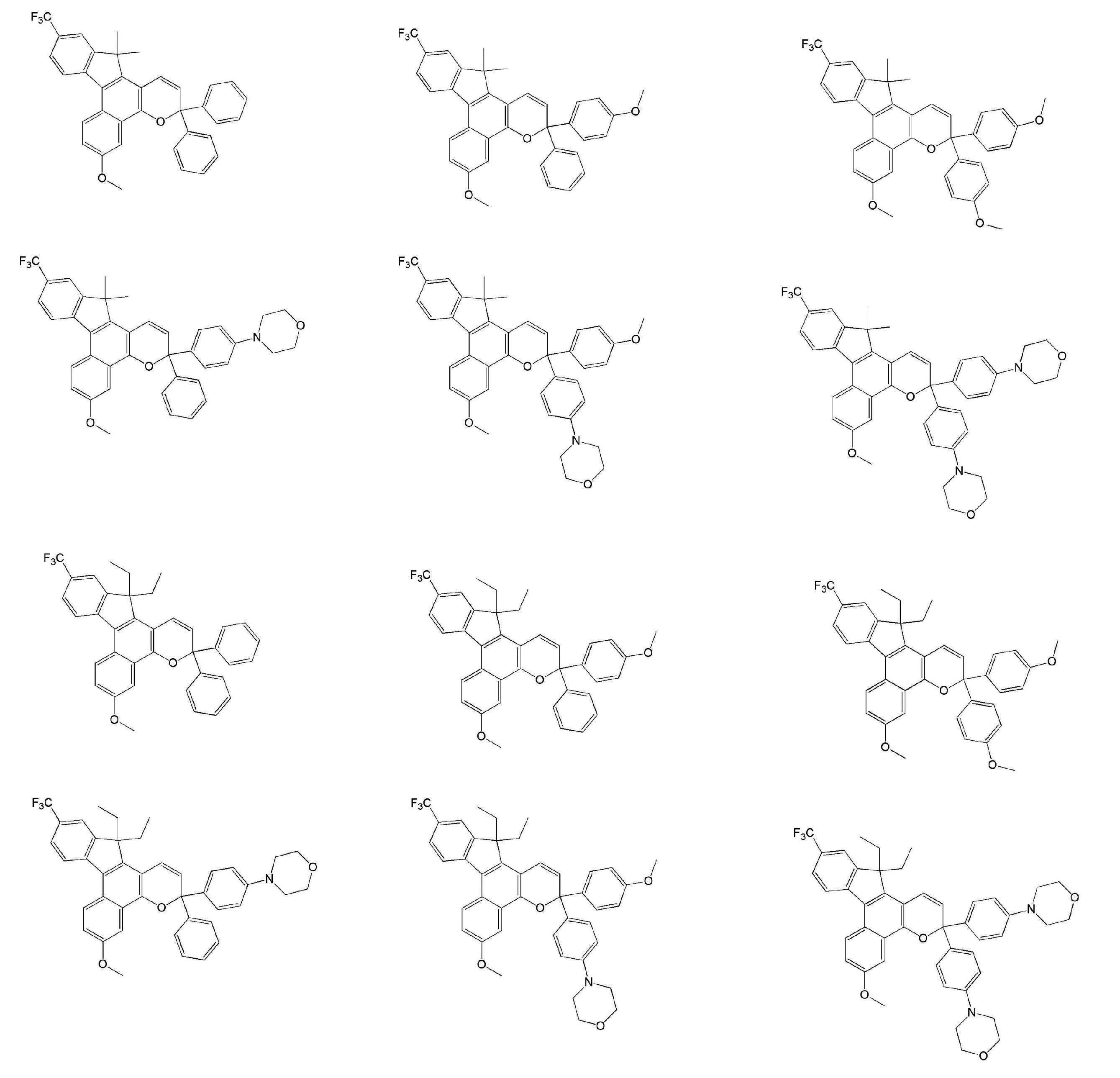

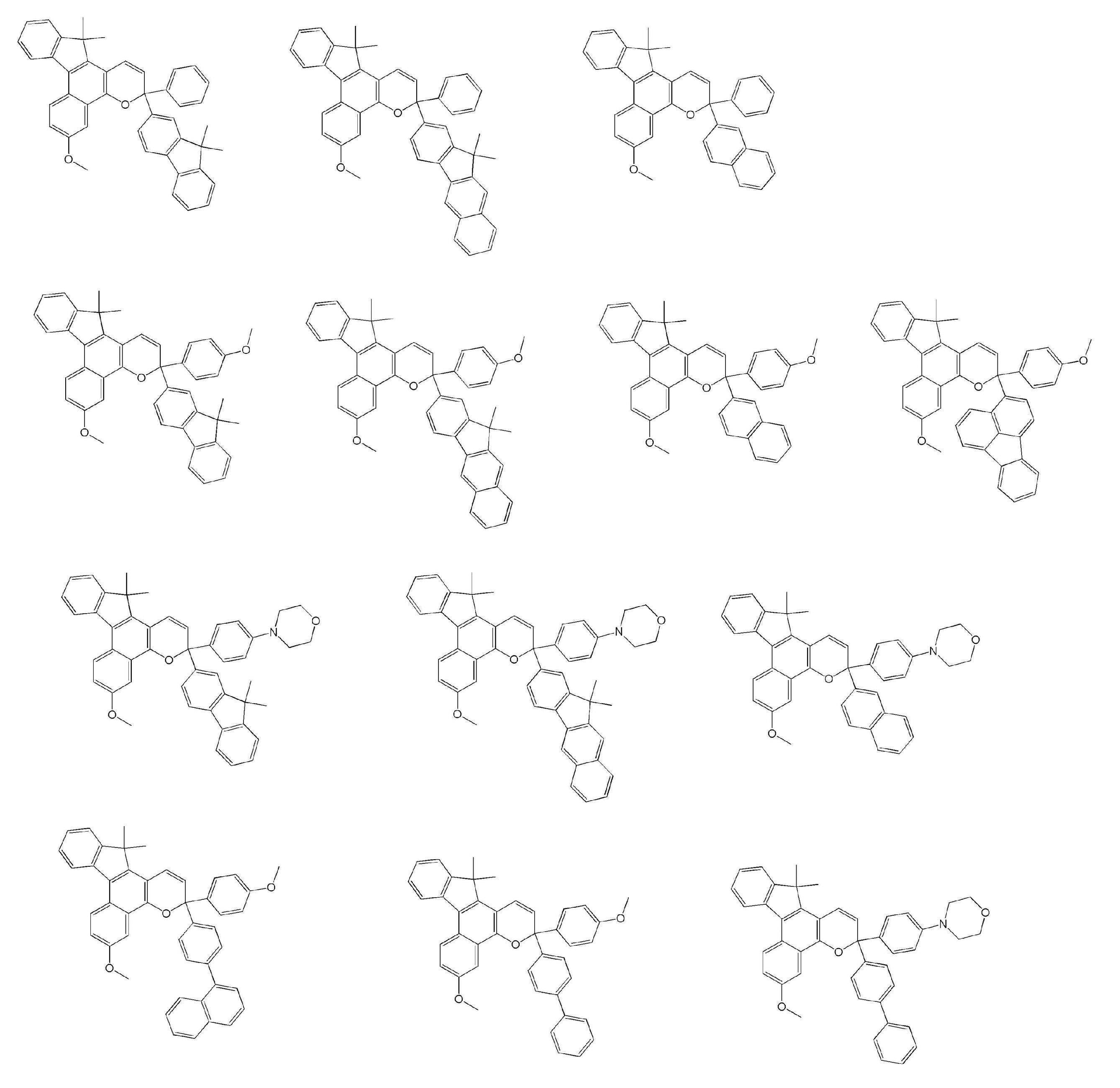


一般式Aで表される化合物、一般式Bで表される化合物及び一般式Cで表される化合物は、公知の方法で合成することができる。合成方法については、例えば以下の文献を参照できる。特許第4884578号明細書、US2006/0226402A1、US2006/0228557A1、US2008/0103301A1、US2011/0108781A1、US2011/0108781A1、米国特許第7527754号明細書、米国特許第7556751号明細書、WO2001/60811A1、WO2013/086248A1、WO1996/014596A1及びWO2001/019813A1。 The compound represented by the general formula A, the compound represented by the general formula B, and the compound represented by the general formula C can be synthesized by a known method. For the synthesis method, for example, the following documents can be referred to. Japanese Patent No. 4884578, US2006 / 0226402A1, US2006 / 0228557A1, US2008 / 0103301A1, US2011 / 0108781A1, US2011 / 0108781A1, US Pat. No. 7527754, US Pat. No. 7556751, WO2001 / 60811A1, WO2001 / 60811A1 , WO1996 / 014596A1 and WO2001 / 019813A1.
本発明の一態様にかかるフォトクロミック物品及び本発明の一態様に係るフォトクロミック組成物は、一般式Aで表される化合物の1種以上と、一般式Bで表される化合物の1種以上と、一般式Cで表される化合物の1種以上と、を含む。
上記フォトクロミック物品及び上記フォトクロミック組成物に含まれる一般式Aで表される化合物は、1種のみであることができ、2種以上(例えば2種以上4種以下)であることもできる。
上記フォトクロミック物品及び上記フォトクロミック組成物に含まれる一般式Bで表される化合物は、1種のみであることができ、2種以上(例えば2種以上4種以下)であることもできる。
上記フォトクロミック物品及び上記フォトクロミック組成物に含まれる一般式Cで表される化合物は、1種のみであることができ、2種以上(例えば2種以上4種以下)であることもできる。
上記フォトクロミック物品及び上記フォトクロミック組成物において、質量基準で、一般式Bで表される化合物及び一般式Cで表される化合物の合計含有率は、一般式Aで表される化合物の含有率より多いことが好ましい。一般式Aで表される化合物、一般式Bで表される化合物及び一般式Cで表される化合物の合計を100質量%として、一般式Bで表される化合物及び一般式Cで表される化合物の合計含有率は、50質量%超であることが好ましく、60質量%以上であることがより好ましく、70質量%以上であることが更に好ましく、80質量%以上であることが一層好ましく、90質量%以上であることがより一層好ましい。一般式Aで表される化合物、一般式Bで表される化合物及び一般式Cで表される化合物の合計(100質量%)に対して、一般式Bで表される化合物及び一般式Cで表される化合物の合計含有率は、100質量%未満であることができ、99質量%以下、98質量%以下、97質量%以下、96質量%以下又は95質量%以下であることができる。
一般式Bで表される化合物と一般式Cで表される化合物の混合比については、一般式Bで表される化合物と一般式Cで表される化合物の合計を100質量%として、一般式Bで表される化合物の含有率は、1質量%以上若しくは99質量%以上であることができ、また、25質量%以下若しくは75質量%以下であることができる。上記の一般式Bで表される化合物の含有率は、上記フォトクロミック物品及び上記フォトクロミック組成物に一般式Bで表される化合物が2種以上含まれる場合には、それらの合計含有率である。この点は、本発明及び本明細書における各種成分の含有率についても同様である。
上記フォトクロミック物品及び上記フォトクロミック組成物は、それらの全量を100質量%として、一般式Aで表される化合物、一般式B及び一般式Cで表される化合物を合計で、例えば0.1~15.0質量%程度含むことができる。ただし、この範囲に限定されるものではない。
The photochromic article according to one aspect of the present invention and the photochromic composition according to one aspect of the present invention include one or more compounds represented by the general formula A and one or more compounds represented by the general formula B. Includes one or more of the compounds represented by the general formula C.
The compound represented by the general formula A contained in the photochromic article and the photochromic composition may be only one kind, and may be two or more kinds (for example, two or more kinds and four kinds or less).
The compound represented by the general formula B contained in the photochromic article and the photochromic composition may be only one kind, and may be two or more kinds (for example, two or more kinds and four kinds or less).
The compound represented by the general formula C contained in the photochromic article and the photochromic composition may be only one kind, and may be two or more kinds (for example, two or more kinds and four kinds or less).
In the photochromic article and the photochromic composition, the total content of the compound represented by the general formula B and the compound represented by the general formula C is higher than the content of the compound represented by the general formula A on a mass basis. Is preferable. The compound represented by the general formula B and the compound represented by the general formula C are represented by 100% by mass as a total of the compound represented by the general formula A, the compound represented by the general formula B and the compound represented by the general formula C. The total content of the compounds is preferably more than 50% by mass, more preferably 60% by mass or more, further preferably 70% by mass or more, still more preferably 80% by mass or more. It is even more preferable that the content is 90% by mass or more. The compound represented by the general formula B and the compound represented by the general formula C are used with respect to the total (100% by mass) of the compound represented by the general formula A, the compound represented by the general formula B, and the compound represented by the general formula C. The total content of the represented compounds can be less than 100% by weight, 99% by weight or less, 98% by weight or less, 97% by weight or less, 96% by weight or less or 95% by weight or less.
Regarding the mixing ratio of the compound represented by the general formula B and the compound represented by the general formula C, the total of the compound represented by the general formula B and the compound represented by the general formula C is set to 100% by mass, and the general formula is used. The content of the compound represented by B can be 1% by mass or more or 99% by mass or more, and can be 25% by mass or less or 75% by mass or less. The content of the compound represented by the general formula B is the total content of the photochromic article and the photochromic composition when two or more compounds represented by the general formula B are contained. This point is the same for the content of various components in the present invention and the present specification.
In the photochromic article and the photochromic composition, the total amount thereof is 100% by mass, and the compound represented by the general formula A, the compound represented by the general formula B and the compound represented by the general formula C are in total, for example, 0.1 to 15. It can contain about 0.0% by mass. However, it is not limited to this range.
[フォトクロミック物品、フォトクロミック組成物]
上記フォトクロミック物品は、少なくとも基材を有することができる。一形態では、一般式Aで表される化合物、一般式Bで表される化合物及び一般式Cで表される化合物は、上記フォトクロミック物品の基材に含まれることができる。上記フォトクロミック物品は、基材とフォトクロミック層とを有することができ、基材及び/又はフォトクロミック層に、一般式Aで表される化合物、一般式Bで表される化合物及び一般式Cで表される化合物を含むことができる。一般式Aで表される化合物、一般式Bで表される化合物及び一般式Cで表される化合物は、基材及びフォトクロミック層において、一形態では基材のみに含まれることができ、他の一形態ではフォトクロミック層のみに含まれることができ、また他の一形態では基材とフォトクロミック層とに含まれることができる。また、基材及びフォトクロミック層は、フォトクロミック化合物として、一般式Aで表される化合物、一般式Bで表される化合物及び一般式Cで表される化合物のみを含むことができ、又は1種以上の他のフォトクロミック化合物を含むこともできる。他のフォトクロミック化合物としては、アゾベンゼン類、スピロピラン類、スピロオキサジン類、ナフトピラン類、インデノナフトピラン類、フェナントロピラン類、ヘキサアリルビスイミダゾール類、ドナー-アクセプターステンハウス付加物(DASA)類、サリシリデンアニリン類、ジヒドロピレン類、アントラセンダイマー類、フルギド類、ジアリールエテン類、フェノキシナフタセンキノン類、スチルベン類等を挙げることができる。
[Photochromic Articles, Photochromic Compositions]
The photochromic article can have at least a substrate. In one form, the compound represented by the general formula A, the compound represented by the general formula B, and the compound represented by the general formula C can be contained in the base material of the photochromic article. The photochromic article can have a base material and a photochromic layer, and the base material and / or the photochromic layer is represented by a compound represented by the general formula A, a compound represented by the general formula B, and a general formula C. Compounds can be included. The compound represented by the general formula A, the compound represented by the general formula B, and the compound represented by the general formula C can be contained only in the base material in one form in the base material and the photochromic layer, and other compounds can be contained in the base material. In one form, it can be contained only in the photochromic layer, and in the other form, it can be contained in the base material and the photochromic layer. Further, the base material and the photochromic layer may contain only the compound represented by the general formula A, the compound represented by the general formula B and the compound represented by the general formula C as the photochromic compound, or one or more thereof. Other photochromic compounds can also be included. Other photochromic compounds include azobenzenes, spiropyrans, spiroxazines, naphthopyrans, indenonaphthopyrans, phenanthropyrans, hexaallylbisimidazoles, donor-acceptorstenhouse adducts (DASA). , Salicylidene anilines, dihydropyrenes, anthracene dimers, flugides, diarylethenes, phenoxynaphthasequinones, stilbenes and the like.
<基材>
上記フォトクロミック物品は、フォトクロミック物品の種類に応じて選択された基材を含むことができる。基材の一例として、眼鏡レンズ基材としては、プラスチックレンズ基材又はガラスレンズ基材が挙げられる。ガラスレンズ基材は、例えば無機ガラス製のレンズ基材であることができる。プラスチックレンズ基材としては、(メタ)アクリル樹脂をはじめとするスチレン樹脂、ポリカーボネート樹脂、アリル樹脂、ジエチレングリコールビスアリルカーボネート樹脂(CR-39)等のアリルカーボネート樹脂、ビニル樹脂、ポリエステル樹脂、ポリエーテル樹脂、イソシアネート化合物とジエチレングリコール等のヒドロキシ化合物との反応で得られたウレタン樹脂、イソシアネート化合物とポリチオール化合物とを反応させたチオウレタン樹脂、分子内に1つ以上のジスルフィド結合を有する(チオ)エポキシ化合物を含有する硬化性組成物を硬化した硬化物(一般に透明樹脂と呼ばれる。)を挙げることができる。レンズ基材としては、染色されていないもの(無色レンズ)を用いてもよく、染色されているもの(染色レンズ)を用いてもよい。レンズ基材の屈折率は、例えば、1.50~1.75程度であることができる。ただしレンズ基材の屈折率は、上記範囲に限定されるものではなく、上記の範囲内でも、上記の範囲から上下に離れていてもよい。ここで屈折率とは、波長500nmの光に対する屈折率をいうものとする。また、レンズ基材は、屈折力を有するレンズ(いわゆる度付レンズ)であってもよく、屈折力なしのレンズ(いわゆる度なしレンズ)であってもよい。
<Base material>
The photochromic article can include a substrate selected according to the type of the photochromic article. As an example of the base material, the spectacle lens base material includes a plastic lens base material or a glass lens base material. The glass lens base material can be, for example, a lens base material made of inorganic glass. Examples of the plastic lens base material include styrene resins such as (meth) acrylic resins, polycarbonate resins, allyl resins, allyl carbonate resins such as diethylene glycol bisallyl carbonate resin (CR-39), vinyl resins, polyester resins, and polyether resins. , Urethane resin obtained by reacting isocyanate compound with hydroxy compound such as diethylene glycol, thiourethane resin obtained by reacting isocyanate compound with polythiol compound, (thio) epoxy compound having one or more disulfide bonds in the molecule. Examples thereof include a cured product (generally referred to as a transparent resin) obtained by curing the curable composition contained therein. As the lens base material, an undyed lens (colorless lens) may be used, or a dyed lens (dyed lens) may be used. The refractive index of the lens substrate can be, for example, about 1.50 to 1.75. However, the refractive index of the lens substrate is not limited to the above range, and may be within the above range or may be vertically separated from the above range. Here, the refractive index means the refractive index for light having a wavelength of 500 nm. Further, the lens base material may be a lens having a refractive power (so-called prescription lens) or a lens without refractive power (so-called prescription lens).
例えば、上記フォトクロミック組成物は、重合性組成物であることができる。本発明及び本明細書において、「重合性組成物」とは、1種以上の重合性化合物を含む組成物である。一般式Aで表される化合物の1種以上と、一般式Bで表される化合物の1種以上と、一般式Cで表される化合物の1種以上と、重合性化合物の1種以上と、を少なくとも含む重合性組成物を公知の成形方法によって成形することにより、かかる重合性組成物の硬化物を作製することができる。かかる硬化物は、上記フォトクロミック物品に基材として含まれることができ、及び/又は、フォトクロミック層として含まれることができる。硬化処理は、光照射及び/又は加熱処理であることができる。重合性化合物とは、重合性基を有する化合物であり、重合性化合物の重合反応が進行することによって重合性組成物が硬化し硬化物が形成され得る。重合性組成物は、1種以上の添加剤(例えば重合開始剤等)を更に含むことができる。 For example, the photochromic composition can be a polymerizable composition. In the present invention and the present specification, the "polymerizable composition" is a composition containing one or more kinds of polymerizable compounds. One or more compounds represented by the general formula A, one or more compounds represented by the general formula B, one or more compounds represented by the general formula C, and one or more polymerizable compounds. By molding a polymerizable composition containing at least, by a known molding method, a cured product of such a polymerizable composition can be produced. The cured product can be included in the photochromic article as a substrate and / or can be included as a photochromic layer. The curing treatment can be light irradiation and / or heat treatment. The polymerizable compound is a compound having a polymerizable group, and the polymerizable composition can be cured to form a cured product by advancing the polymerization reaction of the polymerizable compound. The polymerizable composition can further contain one or more additives (eg, a polymerization initiator, etc.).
眼鏡レンズは、単焦点レンズ、多焦点レンズ、累進屈折力レンズ等の各種レンズであることができる。レンズの種類は、レンズ基材の両面の面形状により決定される。また、レンズ基材表面は、凸面、凹面、平面のいずれであってもよい。通常のレンズ基材及び眼鏡レンズでは、物体側表面は凸面、眼球側表面は凹面である。ただし、これに限定されるものではない。フォトクロミック層は、通常、レンズ基材の物体側表面上に設けることができるが、眼球側表面上に設けてもよい。 The spectacle lens can be various lenses such as a single focus lens, a multifocal lens, and a progressive power lens. The type of lens is determined by the surface shapes of both sides of the lens base material. Further, the surface of the lens substrate may be a convex surface, a concave surface, or a flat surface. In a normal lens base material and a spectacle lens, the surface on the object side is a convex surface and the surface on the eyeball side is a concave surface. However, the present invention is not limited to this. The photochromic layer can usually be provided on the object-side surface of the lens substrate, but may be provided on the eyeball-side surface.
<フォトクロミック層>
フォトクロミック層は、基材の表面上に直接又は一層以上の他の層を介して間接的に設けられた層であることができる。フォトクロミック層は、例えば、重合性組成物を硬化した硬化層であることができる。一般式Aで表される化合物の1種以上と、一般式Bで表される化合物の1種以上と、一般式Cで表される化合物の1種以上と、重合性化合物の1種以上と、を少なくとも含む重合性組成物を硬化した硬化層として、フォトクロミック層を形成することができる。例えば、かかる重合性組成物を基材の表面上に直接塗布するか、又は基材上に設けられた層の表面に塗布し、塗布された重合性組成物に硬化処理を施すことによって、一般式Aで表される化合物の1種以上と一般式Bで表される化合物の1種以上と、一般式Cで表される化合物の1種以上と、を含む硬化層として、フォトクロミック層を形成することができる。塗布方法としては、スピンコート法、ディップコート法、スプレーコート法、インクジェット法、ノズルコート法、スリットコート法等の公知の塗布方法を採用することができる。硬化処理は、光照射及び/又は加熱処理であることができる。重合性組成物は、1種以上の重合性化合物に加えて、1種以上の添加剤(例えば重合開始剤等)を更に含むことができる。重合性化合物の重合反応が進行することによって重合性組成物が硬化し硬化層が形成され得る。
<Photochromic layer>
The photochromic layer can be a layer provided directly on the surface of the substrate or indirectly via one or more other layers. The photochromic layer can be, for example, a cured layer obtained by curing a polymerizable composition. One or more compounds represented by the general formula A, one or more compounds represented by the general formula B, one or more compounds represented by the general formula C, and one or more polymerizable compounds. A photochromic layer can be formed as a cured layer obtained by curing a polymerizable composition containing at least. For example, the polymerizable composition is generally applied directly on the surface of the substrate, or applied to the surface of a layer provided on the substrate, and the applied polymerizable composition is cured. A photochromic layer is formed as a cured layer containing one or more compounds represented by the formula A, one or more compounds represented by the general formula B, and one or more compounds represented by the general formula C. can do. As the coating method, known coating methods such as a spin coating method, a dip coating method, a spray coating method, an inkjet method, a nozzle coating method, and a slit coating method can be adopted. The curing treatment can be light irradiation and / or heat treatment. The polymerizable composition can further contain one or more additives (for example, a polymerization initiator) in addition to one or more polymerizable compounds. As the polymerization reaction of the polymerizable compound proceeds, the polymerizable composition can be cured and a cured layer can be formed.
フォトクロミック層の厚さは、例えば5μm以上、10μm以上若しくは20μm以上であることができ、また、例えば80μm以下、70μm以下若しくは50μm以下であることができる。 The thickness of the photochromic layer can be, for example, 5 μm or more, 10 μm or more, or 20 μm or more, and can be, for example, 80 μm or less, 70 μm or less, or 50 μm or less.
<重合性化合物>
本発明及び本明細書において、重合性化合物とは、1分子中に1つ以上の重合性基を有する化合物をいい、「重合性基」とは、重合反応し得る反応性基をいうものとする。重合性基としては、例えば、アクリロイル基、メタクリロイル基、ビニル基、ビニルエーテル基、エポキシ基、チオール基、オキセタン基、ヒドロキシ基、カルボキシ基、アミノ基、イソシアネート基等を挙げることができる。
<Polymerizable compound>
In the present invention and the present specification, the polymerizable compound means a compound having one or more polymerizable groups in one molecule, and the "polymerizable group" means a reactive group capable of polymerizing. do. Examples of the polymerizable group include an acryloyl group, a methacryloyl group, a vinyl group, a vinyl ether group, an epoxy group, a thiol group, an oxetane group, a hydroxy group, a carboxy group, an amino group, an isocyanate group and the like.
上記基材及び上記フォトクロミック層の形成のために使用可能な重合性化合物としては、以下の化合物を例示できる。 Examples of the polymerizable compound that can be used for forming the base material and the photochromic layer include the following compounds.
(エピスルフィド系化合物)
エピスルフィド系化合物は、1分子内に2個以上のエピスルフィド基を有する化合物である。エピスルフィド基は、開環重合し得る重合性基である。エピスルフィド系化合物の具体例としては、ビス(1,2-エピチオエチル)スルフィド、ビス(1,2-エピチオエチル)ジスルフィド、ビス(2,3-エピチオプロピル)スルフィド、ビス(2,3-エピチオプロピルチオ)メタン、ビス(2,3-エピチオプロピル)ジスルフィド、ビス(2,3-エピチオプロピルジチオ)メタン、ビス(2,3-エピチオプロピルジチオ)エタン、ビス(6,7-エピチオ-3,4-ジチアヘプチル)スルフィド、ビス(6,7-エピチオ-3,4-ジチアヘプチル)ジスルフィド、1,4-ジチアン-2,5-ビス(2,3-エピチオプロピルジチオメチル)、1,3-ビス(2,3-エピチオプロピルジチオメチル)ベンゼン、1,6-ビス(2,3-エピチオプロピルジチオメチル)-2-(2,3-エピチオプロピルジチオエチルチオ)-4-チアヘキサン、1,2,3-トリス(2,3-エピチオプロピルジチオ)プロパン、1,1,1,1-テトラキス(2,3-エピチオプロピルジチオメチル)メタン、1,3-ビス(2,3-エピチオプロピルジチオ)-2-チアプロパン、1,4-ビス(2,3-エピチオプロピルジチオ)-2,3-ジチアブタン、1,1,1-トリス(2,3-エピチオプロピルジチオ)メタン、1,1,1-トリス(2,3-エピチオプロピルジチオメチルチオ)メタン、1,1,2,2-テトラキス(2,3-エピチオプロピルジチオ)エタン、1,1,2,2-テトラキス(2,3-エピチオプロピルジチオメチルチオ)エタン、1,1,3,3-テトラキス(2,3-エピチオプロピルジチオ)プロパン、1,1,3,3-テトラキス(2,3-エピチオプロピルジチオメチルチオ)プロパン、2-[1,1-ビス(2,3-エピチオプロピルジチオ)メチル]-1,3-ジチエタン、2-[1,1-ビス(2,3-エピチオプロピルジチオメチルチオ)メチル]-1,3-ジチエタン等を挙げることができる。
(Episulfide compound)
An episulfide compound is a compound having two or more episulfide groups in one molecule. The episulfide group is a polymerizable group capable of ring-opening polymerization. Specific examples of episulfide compounds include bis (1,2-epithioethyl) sulfide, bis (1,2-epioethyl) disulfide, bis (2,3-epiothiopropyl) sulfide, and bis (2,3-epiothiopropyl) sulfide. Thio) Methane, Bis (2,3-Epithiopropyl) Disulfide, Bis (2,3-Epithiopropyldithio) Methane, Bis (2,3-Epithiopropyldithio) Etan, Bis (6,7-Epithio- 3,4-Dithiaheptyl) sulfide, bis (6,7-epiothio-3,4-dithiaheptyl) disulfide, 1,4-dithian-2,5-bis (2,3-epiopropyldithiomethyl), 1,3 -Bis (2,3-Epithiopropyldithiomethyl) benzene, 1,6-bis (2,3-Epithiopropyldithiomethyl) -2- (2,3-Epithiopropyldithioethylthio) -4-thiahexane , 1,2,3-Tris (2,3-Epithiopropyldithio) Propyl, 1,1,1,1-Tetrakiss (2,3-Epithiopropyldithiomethyl) Methane, 1,3-Bis (2,3) 3-Epithiopropyl Dithio) -2-thiapropane, 1,4-bis (2,3-Epithiopropyldithio) -2,3-Dithiabutane, 1,1,1-Tris (2,3-Epithiopropyldithio) ) Methane, 1,1,1-Tris (2,3-Epithiopropyldithiomethylthio) Methane, 1,1,2,2-Tetrakiss (2,3-Epithiopropyldithio) Etan, 1,1,2, 2-Tetrakiss (2,3-Epithiopropyldithiomethylthio) Etan, 1,1,3,3-Tetrakiss (2,3-Epithiopropyldithio) Propyl, 1,1,3,3-Tetrakiss (2,3) -Epithiopropyldithiomethylthio) Propyl, 2- [1,1-bis (2,3-epithiopropyldithio) methyl] -1,3-dithietan, 2- [1,1-bis (2,3-epi) Thiopropyldithiomethylthio) methyl] -1,3-dithietan and the like can be mentioned.
(チエタニル系化合物)
チエタニル系化合物は、1分子内に2個以上のチエタニル基を有するチエタン化合物である。チエタニル基は、開環重合し得る重合性基である。チエタニル系化合物の中には、複数のチエタニル基と共にエピスルフィド基を有するものがある。かかる化合物は、上記のエピスルフィド系化合物の例に挙げられている。その他のチエタニル系化合物には、分子内に金属原子を有している含金属チエタン化合物と、金属を含んでいない非金属系チエタン化合物とがある。
(Thietanyl compound)
The thietanyl compound is a thietan compound having two or more thietanyl groups in one molecule. The thietanyl group is a polymerizable group capable of ring-opening polymerization. Some thietanyl compounds have an episulfide group together with a plurality of thietanyl groups. Such compounds are listed as examples of the above episulfide compounds. Other thietanyl-based compounds include metal-containing thietan compounds having a metal atom in the molecule and non-metal-based thietan compounds containing no metal.
非金属系チエタン化合物の具体例としては、ビス(3-チエタニル)ジスルフィド、ビス(3-チエタニル)スルフィド、ビス(3-チエタニル)トリスルフィド、ビス(3-チエタニル)テトラスルフィド、1,4-ビス(3-チエタニル)-1,3,4-トリチアブタン、1,5-ビス(3-チエタニル)-1,2,4,5-テトラチアペンタン、1,6-ビス(3-チエタニル)-1,3,4,6-テトラチアヘキサン、1,6-ビス(3-チエタニル)-1,3,5,6-テトラチアヘキサン、1,7-ビス(3-チエタニル)-1,2,4,5,7-ペンタチアヘプタン、1,7-ビス(3-チエタニルチオ)-1,2,4,6,7-ペンタチアヘプタン、1,1-ビス(3-チエタニルチオ)メタン、1,2-ビス(3-チエタニルチオ)エタン、1,2,3-トリス(3-チエタニルチオ)プロパン、1,8-ビス(3-チエタニルチオ)-4-(3-チエタニルチオメチル)-3,6-ジチアオクタン、1,11-ビス(3-チエタニルチオ)-4,8-ビス(3-チエタニルチオメチル)-3,6,9-トリチアウンデカン、1,11-ビス(3-チエタニルチオ)-4,7-ビス(3-チエタニルチオメチル)-3,6,9-トリチアウンデカン、1,11-ビス(3-チエタニルチオ)-5,7-ビス(3-チエタニルチオメチル)-3,6,9-トリチアウンデカン、2,5-ビス(3-チエタニルチオメチル)-1,4-ジチアン、2,5-ビス[[2-(3-チエタニルチオ)エチル]チオメチル]-1,4-ジチアン、2,5-ビス(3-チエタニルチオメチル)-2,5-ジメチル-1,4-ジチアン、ビスチエタニルスルフィド、ビス(チエタニルチオ)メタン、3-[<(チエタニルチオ)メチルチオ>メチルチオ]チエタン、ビスチエタニルジスルフィド、ビスチエタニルトリスルフィド、ビスチエタニルテトラスルフィド、ビスチエタニルペンタスルフィド、1,4-ビス(3-チエタニルジチオ)-2,3-ジチアブタン、1,1,1-トリス(3-チエタニルジチオ)メタン、1,1,1-トリス(3-チエタニルジチオメチルチオ)メタン、1,1,2,2-テトラキス(3-チエタニルジチオ)エタン、1,1,2,2-テトラキス(3-チエタニルジチオメチルチオ)エタン等を挙げることができる。 Specific examples of the non-metallic thietan compound include bis (3-thietanyl) disulfide, bis (3-thietanyl) sulfide, bis (3-thietanyl) trisulfide, bis (3-thietanyl) tetrasulfide, and 1,4-bis. (3-Tietanyl) -1,3,4-trithiabutane, 1,5-bis (3-thietanyl) -1,2,4,5-tetrathiapentane, 1,6-bis (3-thietanyl) -1, 3,4,6-tetrathiahexane, 1,6-bis (3-thietanyl) -1,3,5,6-tetrathiahexane, 1,7-bis (3-thietanyl) -1,2,4 5,7-Pentathiaheptane, 1,7-bis (3-thietanylthio) -1,2,4,6,7-pentathiaheptane, 1,1-bis (3-thietanylthio) methane, 1,2-bis (3-Tietanilthio) ethane, 1,2,3-tris (3-thietanylthio) propane, 1,8-bis (3-thietanylthio) -4- (3-thietanylthiomethyl) -3,6-dithiaoctane, 1 , 11-bis (3-thietanylthio) -4,8-bis (3-thietanylthiomethyl) -3,6,9-trithiaundecane, 1,11-bis (3-thietanylthio) -4,7-bis (3-Thietanylthiomethyl) -3,6,9-trithiaundecane, 1,11-bis (3-thietanylthio) -5,7-bis (3-thietanylthiomethyl) -3,6,9- Trithiaundecane, 2,5-bis (3-thietanylthiomethyl) -1,4-dithian, 2,5-bis [[2- (3-thietanylthio) ethyl] thiomethyl] -1,4-dithian, 2 , 5-bis (3-thietanylthiomethyl) -2,5-dimethyl-1,4-dithian, bisthietanyl sulfide, bis (thietanylthio) methane, 3-[<(thietanylthio) methylthio> methylthio] thietan, bis Thietanyl disulfide, bistietanyl trisulfide, bistietanyl tetrasulfide, bistietanyl pentasulfide, 1,4-bis (3-thietanyl dithio) -2,3-dithiabutane, 1,1,1-tris (3-thietanyl dithio) ) Methane, 1,1,1-tris (3-thietanyldithiomethylthio) methane, 1,1,2,2-tetrakis (3-thietanyldithio) ethane, 1,1,2,2-tetrakis (3-thietanyl) Dithiomethylthio) Ethane and the like can be mentioned.
含金属チエタン化合物としては、分子内に、金属原子として、Sn原子、Si原子、Ge原子、Pb原子等の14族の原子、Zr原子、Ti原子等の4族の元素、Al原子等の13族の原子、Zn原子等の12族の原子等を含むものが挙げられる。具体例としては、アルキルチオ(チエタニルチオ)スズ、ビス(アルキルチオ)ビス(チエタニルチオ)スズ、アルキルチオ(アルキルチオ)ビス(チエタニルチオ)スズ、ビス(チエタニルチオ)環状ジチオスズ化合物、アルキル(チエタニルチオ)スズ化合物等が挙げられる。 The metal-containing thietan compound includes 14 group atoms such as Sn atom, Si atom, Ge atom and Pb atom, 4 group elements such as Zr atom and Ti atom, and 13 such as Al atom in the molecule. Examples thereof include group 12 atoms such as group atoms and Zn atoms. Specific examples thereof include alkylthio (thietanylthio) tin, bis (alkylthio) bis (thietanylthio) tin, alkylthio (alkylthio) bis (thietanylthio) tin, bis (thietanylthio) cyclic dithiotin compounds, and alkyl (thietanylthio) tin compounds.
アルキルチオ(チエタニルチオ)スズの具体例としては、メチルチオトリス(チエタニルチオ)スズ、エチルチオトリス(チエタニルチオ)スズ、プロピルチオトリス(チエタニルチオ)スズ、イソプロピルチオトリス(チエタニルチオ)スズ等を例示できる。 Specific examples of the alkylthio (thietanylthio) tin include methylthiotris (thietanylthio) tin, ethylthiotris (thietanylthio) tin, propylthiotris (thietanylthio) tin, isopropylthiotris (thietanylthio) tin and the like.
ビス(アルキルチオ)ビス(チエタニルチオ)スズの具体例としては、ビス(メチルチオ)ビス(チエタニルチオ)スズ、ビス(エチルチオ)ビス(チエタニルチオ)スズ、ビス(プロピルチオ)ビス(チエタニルチオ)スズ、ビス(イソプロピルチオ)ビス(チエタニルチオ)スズ等を例示できる。 Specific examples of bis (alkylthio) bis (thietanylthio) tin include bis (methylthio) bis (thietanylthio) tin, bis (ethylthio) bis (thietanylthio) tin, bis (propylthio) bis (thietanylthio) tin, and bis (isopropylthio). Examples thereof include bis (thietanylthio) tin and the like.
アルキルチオ(アルキルチオ)ビス(チエタニルチオ)スズの具体例としては、エチルチオ(メチルチオ)ビス(チエタニルチオ)スズ、メチルチオ(プロピルチオ)ビス(チエタニルチオ)スズ、イソプロピルチオ(メチルチオ)ビス(チエタニルチオ)スズ、エチルチオ(プロピルチオ)ビス(チエタニルチオ)スズ、エチルチオ(イソプロピルチオ)ビス(チエタニルチオ)スズ、イソプロピルチオ(プロピルチオ)ビス(チエタニルチオ)スズ等を例示できる。 Specific examples of alkylthio (alkylthio) bis (thietanylthio) tin include ethylthio (methylthio) bis (thietanylthio) tin, methylthio (propylthio) bis (thietanylthio) tin, isopropylthio (methylthio) bis (thietanylthio) tin, and ethylthio (propylthio). Examples thereof include bis (thietanylthio) tin, ethylthio (isopropylthio) bis (thietanylthio) tin, and isopropylthio (propylthio) bis (thietanylthio) tin.
ビス(チエタニルチオ)環状ジチオスズ化合物の具体例としては、ビス(チエタニルチオ)ジチアスタンネタン、ビス(チエタニルチオ)ジチアスタンノラン、ビス(チエタニルチオ)ジチアスタンニナン、ビス(チエタニルチオ)トリチアスタンノカン等を例示できる。 Specific examples of the bis (thietanilthio) cyclic dithiostin compound include bis (thietanilthio) dithiastannetan, bis (thietanilthio) dithiastannolan, bis (thietanilthio) dithiastanninan, and bis (thietanilthio) trithiastannocan. Can be exemplified.
アルキル(チエタニルチオ)スズ化合物の具体例としては、メチルトリス(チエタニルチオ)スズ、ジメチルビス(チエタニルチオ)スズ、ブチルトリス(チエタニルチオ)スズ、テトラキス(チエタニルチオ)スズ、テトラキス(チエタニルチオ)ゲルマニウム、トリス(チエタニルチオ)ビスマス等を例示できる。 Specific examples of the alkyl (thietanylthio) tin compound include methyltris (thietanylthio) tin, dimethylbis (thietanylthio) tin, butyltris (thietanylthio) tin, tetrakis (thietanylthio) tin, tetrakis (thietanylthio) germanium, and tris (thietanylthio) bismuth. It can be exemplified.
(ポリアミン化合物)
ポリアミン化合物は、一分子中にNH2基を2つ以上有する化合物であり、ポリイソシアネートとの反応でウレア結合を形成することができ、ポリイソチオシアネートとの反応でチオウレア結合を形成することができる。ポリアミン化合物の具体例としては、エチレンジアミン、ヘキサメチレンジアミン、イソホロンジアミン、ノナメチレンジアミン、ウンデカメチレンジアミン、ドデカメチレンジアミン、メタキシレンジアミン、1,3-プロパンジアミン、プトレシン、2-(2-アミノエチルアミノ)エタノ-ル、ジエチレントリアミン、p-フェニレンジアミン、m-フェニレンジアミン、メラミン、1,3,5-ベンゼントリアミン等が挙げられる。
(Polyamine compound)
A polyamine compound is a compound having two or more NH groups in one molecule, and can form a urea bond by reaction with polyisocyanate, and can form a thiourea bond by reaction with polyisothiocyanate. .. Specific examples of the polyamine compound include ethylenediamine, hexamethylenediamine, isophoronediamine, nonamethylenediamine, undecamethylenediamine, dodecamethylenediamine, metaxylenediamine, 1,3-propanediamine, putresin, and 2- (2-aminoethyl). Amino) etanol, diaminetriamine, p-phenylenediamine, m-phenylenediamine, melamine, 1,3,5-benzenetriamine and the like can be mentioned.
(エポキシ系化合物)
エポキシ系化合物は、分子内にエポキシ基を有する化合物である。エポキシ基は、開環重合し得る重合性基である。エポキシ系化合物は、一般に、脂肪族エポキシ化合物、脂環族エポキシ化合物及び芳香族エポキシ化合物に分類される。
(Epoxy compound)
The epoxy compound is a compound having an epoxy group in the molecule. The epoxy group is a polymerizable group capable of ring-opening polymerization. Epoxy compounds are generally classified into aliphatic epoxy compounds, alicyclic epoxy compounds and aromatic epoxy compounds.
脂肪族エポキシ化合物の具体例としては、エチレンオキシド、2-エチルオキシラン、ブチルグリシジルエーテル、フェニルグリシジルエーテル、2,2’-メチレンビスオキシラン、1,6-ヘキサンジオールジグリシジルエーテル、エチレングリコールジグリシジルエーテル、ジエチレングリコールジグリシジルエーテル、トリエチレングリコールジグリシジルエーテル、テトラエチレングリコールジグリシジルエーテル、ノナエチレングリコールジグリシジルエーテル、プロピレングリコールジグリシジルエーテル、ジプロピレングリコールジグリシジルエーテル、トリプロピレングリコールジグリシジルエーテル、テトラプロピレングリコールジグリシジルエーテル、ノナプロピレングリコールジグリシジルエーテル、ネオペンチルグリコールジグリシジルエーテル、トリメチロールプロパントリグリシジルエーテル、グリセロールトリグリシジルエーテル、ジグリセロールテトラグリシジルエーテル、ペンタエリスリトールテトラグリシジルエーテル、トリス(2-ヒドロキシエチル)イソシアヌレートのトリグリシジルエーテル等が挙げられる。 Specific examples of the aliphatic epoxy compound include ethylene oxide, 2-ethyloxylan, butyl glycidyl ether, phenyl glycidyl ether, 2,2'-methylenebisoxylane, 1,6-hexanediol diglycidyl ether, and ethylene glycol diglycidyl ether. Diethylene glycol diglycidyl ether, triethylene glycol diglycidyl ether, tetraethylene glycol diglycidyl ether, nonaethylene glycol diglycidyl ether, propylene glycol diglycidyl ether, dipropylene glycol diglycidyl ether, tripropylene glycol diglycidyl ether, tetrapropylene glycol di Glycyzyl ether, nonapropylene glycol diglycidyl ether, neopentyl glycol diglycidyl ether, trimethylolpropane triglycidyl ether, glycerol triglycidyl ether, diglycerol tetraglycidyl ether, pentaerythritol tetraglycidyl ether, tris (2-hydroxyethyl) isocyanurate Examples thereof include triglycidyl ether and the like.
脂環族エポキシ化合物の具体例としては、イソホロンジオールジグリシジルエーテル、ビス-2,2-ヒドロキシシクロヘキシルプロパンジグリシジルエーテル等が挙げられる。 Specific examples of the alicyclic epoxy compound include isophorone diol diglycidyl ether and bis-2,2-hydroxycyclohexylpropane diglycidyl ether.
芳香族エポキシ化合物の具体例としては、レゾールシンジグリシジルエーテル、ビスフェノ-ルAジグリシジルエーテル、ビスフェノールFジグリシジルエーテル、ビスフェノールSジグリシジルエーテル、オルトフタル酸ジグリシジルエステル、フェノールノボラックポリグリシジルエーテル、クレゾールノボラックポリグリシジルエーテル等が挙げられる。 Specific examples of the aromatic epoxy compound include resorcin diglycidyl ether, bisphenol A diglycidyl ether, bisphenol F diglycidyl ether, bisphenol S diglycidyl ether, orthophthalic acid diglycidyl ester, phenol novolac polyglycidyl ether, and cresol novolac poly. Examples thereof include glycidyl ether.
また、上記以外にも、エポキシ基と共に、分子内に硫黄原子を有するエポキシ系化合物も使用することができる。このような含硫黄原子エポキシ系化合物には、鎖状脂肪族系のものと環状脂肪族系のものとがある。 In addition to the above, epoxy compounds having a sulfur atom in the molecule can also be used together with the epoxy group. Such sulfur-containing atomic epoxy compounds include chain aliphatic compounds and cyclic aliphatic compounds.
鎖状脂肪族系含硫黄原子エポキシ系化合物の具体例としては、ビス(2,3-エポキシプロピル)スルフィド、ビス(2,3-エポキシプロピル)ジスルフィド、ビス(2,3-エポキシプロピルチオ)メタン、1,2-ビス(2,3-エポキシプロピルチオ)エタン、1,2-ビス(2,3-エポキシプロピルチオ)プロパン、1,3-ビス(2,3-エポキシプロピルチオ)プロパン、1,3-ビス(2,3-エポキシプロピルチオ)-2-メチルプロパン、1,4-ビス(2,3-エポキシプロピルチオ)ブタン、1,4-ビス(2,3-エポキシプロピルチオ)-2-メチルブタン、1,3-ビス(2,3-エポキシプロピルチオ)ブタン、1,5-ビス(2,3-エポキシプロピルチオ)ペンタン、1,5-ビス(2,3-エポキシプロピルチオ)-2-メチルペンタン、1,5-ビス(2,3-エポキシプロピルチオ)-3-チアペンタン、1,6-ビス(2,3-エポキシプロピルチオ)ヘキサン、1,6-ビス(2,3-エポキシプロピルチオ)-2-メチルヘキサン、3,8-ビス(2,3-エポキシプロピルチオ)-3,6-ジチアオクタン、1,2,3-トリス(2,3-エポキシプロピルチオ)プロパン、2,2-ビス(2,3-エポキシプロピルチオ)-1,3-ビス(2,3-エポキシプロピルチオメチル)プロパン、2,2-ビス(2,3-エポキシプロピルチオメチル)-1-(2,3-エポキシプロピルチオ)ブタン等が挙げられる。 Specific examples of chain aliphatic sulfur-containing atomic epoxy compounds include bis (2,3-epylpropyl) sulfide, bis (2,3-epoxypropyl) disulfide, and bis (2,3-epoxypropylthio) methane. , 1,2-bis (2,3-epoxypropylthio) ethane, 1,2-bis (2,3-epoxypropylthio) propane, 1,3-bis (2,3-epoxypropylthio) propane, 1 , 3-bis (2,3-epoxypropylthio) -2-methylpropane, 1,4-bis (2,3-epoxypropylthio) butane, 1,4-bis (2,3-epoxypropylthio)- 2-Methylbutane, 1,3-bis (2,3-epoxypropylthio) butane, 1,5-bis (2,3-epoxypropylthio) pentane, 1,5-bis (2,3-epoxypropylthio) -2-Methylpentane, 1,5-bis (2,3-epoxypropylthio) -3-thiapentane, 1,6-bis (2,3-epoxypropylthio) hexane, 1,6-bis (2,3) -Epoxypropylthio) -2-methylhexane, 3,8-bis (2,3-epoxypropylthio) -3,6-dithiaoctane, 1,2,3-tris (2,3-epoxypropylthio) propane, 2,2-Bis (2,3-Epoxypropylthiomethyl) -1,3-Bis (2,3-Epoxypropylthiomethyl) Propyl, 2,2-Bis (2,3-Epoxypropylthiomethyl) -1- (2,3-Epoxypropylthio) Butane and the like can be mentioned.
環状脂肪族系含硫黄原子エポキシ系化合物の具体例としては、1,3-ビス(2,3-エポキシプロピルチオ)シクロヘキサン、1,4-ビス(2,3-エポキシプロピルチオ)シクロヘキサン、1,3-ビス(2,3-エポキシプロピルチオメチル)シクロヘキサン、1,4-ビス(2,3-エポキシプロピルチオメチル)シクロヘキサン、2,5-ビス(2,3-エポキシプロピルチオメチル)-1,4-ジチアン、2,5-ビス[<2-(2,3-エポキシプロピルチオ)エチル>チオメチル]-1,4-ジチアン、2,5-ビス(2,3-エポキシプロピルチオメチル)-2,5-ジメチル-1,4-ジチアン等が挙げられる。 Specific examples of the cyclic aliphatic sulfur-containing atomic epoxy compound include 1,3-bis (2,3-epoxypropylthio) cyclohexane, 1,4-bis (2,3-epoxypropylthio) cyclohexane, and 1, 3-Bis (2,3-epoxypropylthiomethyl) cyclohexane, 1,4-bis (2,3-epoxypropylthiomethyl) cyclohexane, 2,5-bis (2,3-epoxypropylthiomethyl) -1, 4-Dithiane, 2,5-bis [<2- (2,3-epoxypropylthiomethyl) ethyl> thiomethyl] -1,4-dithiane, 2,5-bis (2,3-epoxypropylthiomethyl) -2 , 5-Dimethyl-1,4-dithiane and the like.
(ラジカル重合性基を有する化合物)
ラジカル重合性基を有する化合物は、ラジカル重合し得る重合性基である。ラジカル重合性基としては、アクリロイル基、メタクリロイル基、アリル基、ビニル基等が挙げられる。
(Compound having radically polymerizable group)
A compound having a radically polymerizable group is a polymerizable group that can be radically polymerized. Examples of the radically polymerizable group include an acryloyl group, a methacryloyl group, an allyl group, a vinyl group and the like.
以下において、アクリロイル基及びメタクリロイル基からなる群から選ばれる重合性基を有する化合物を、「(メタ)アクリレート化合物」と呼ぶ。(メタ)アクリレート化合物の具体例としては、エチレングリコールジ(メタ)アクリレート、ジエチレングリコールジ(メタ)アクリレート、トリエチレングリコールジ(メタ)アクリレ-ト、テトラエチレングリコ-ルジ(メタ)アクリレ-ト、ポリエチレングリコールジ(メタ)アクリレート、プロピレングリコールジ(メタ)アクリレート、ジプロピレングリコールジ(メタ)アクリレート、トリプロピレングリコールジ(メタ)アクリレート、ポリプロピレングリコールジ(メタ)アクリレート、ネオペンチルグリコ-ルジ(メタ)アクリレート、エチレングリコールビスグリシジル(メタ)アクリレ-ト、ビスフェノ-ルAジ(メタ)アクリレート、2,2-ビス(4-(メタ)アクロキシエトキシフェニル)プロパン、2,2-ビス(4-(メタ)アクロキシジエトキシフェニル)プロパン、2,2-ビス(4-(メタ)アクリロイルオキシエトキシフェニル)プロパン、2,2-ビス(3,5-ジブロモ-4-(メタ)アクリロイルオキシエトキシフェニル)プロパン、2,2-ビス(4-(メタ)アクリロイルオキシジプロポキシフェニル)プロパン、ビスフェノ-ルFジ(メタ)アクリレート、1,1-ビス(4-(メタ)アクロキシエトキシフェニル)メタン、1,1-ビス(4-(メタ)アクロキシジエトキシフェニル)メタン、ジメチロールトリシクロデカンジ(メタ)アクリレート、トリメチロールプロパントリ(メタ)アクリレート、ジトリメチロールプロパンテトラ(メタ)アクリレート、グリセロールジ(メタ)アクリレート、ペンタエリスリトールトリ(メタ)アクリレート、ペンタエリスリト-ルテトラ(メタ)アクリレート、メチルチオ(メタ)アクリレート、フェニルチオ(メタ)アクリレート、ベンジルチオ(メタ)アクリレート、キシリレンジチオールジ(メタ)アクリレート、メルカプトエチルスルフィドジ(メタ)アクリレート、2官能ウレタン(メタ)アクリレート等が挙げられる。 Hereinafter, a compound having a polymerizable group selected from the group consisting of an acryloyl group and a methacryloyl group is referred to as a "(meth) acrylate compound". Specific examples of the (meth) acrylate compound include ethylene glycol di (meth) acrylate, diethylene glycol di (meth) acrylate, triethylene glycol di (meth) acrylicate, tetraethylene glycol di (meth) acrylicate, and polyethylene. Glycoldi (meth) acrylate, propylene glycol di (meth) acrylate, dipropylene glycol di (meth) acrylate, tripropylene glycol di (meth) acrylate, polypropylene glycol di (meth) acrylate, neopentyl glycol di (meth) acrylate , Ethylene glycol bisglycidyl (meth) acrylicate, bisphenol A di (meth) acrylate, 2,2-bis (4- (meth) achromiethoxyphenyl) propane, 2,2-bis (4- (meth) ) Acryloyloxyethoxyphenyl) propane, 2,2-bis (4- (meth) acryloyloxyethoxyphenyl) propane, 2,2-bis (3,5-dibromo-4- (meth) acryloyloxyethoxyphenyl) propane , 2,2-Bis (4- (meth) acryloyloxydipropoxyphenyl) propane, bisphenol F di (meth) acrylate, 1,1-bis (4- (meth) acloxyethoxyphenyl) methane, 1, 1-Bis (4- (meth) acroxidiethoxyphenyl) methane, dimethyloltricyclodecanedi (meth) acrylate, trimethylolpropanetri (meth) acrylate, ditrimethylolpropanetetra (meth) acrylate, glycerol di (meth) ) Acrylate, pentaerythritol tri (meth) acrylate, pentaerythritol tetra (meth) acrylate, methylthio (meth) acrylate, phenylthio (meth) acrylate, benzylthio (meth) acrylate, xylylene dithioldi (meth) acrylate, mercaptoethyl Examples thereof include sulfide di (meth) acrylate and bifunctional urethane (meth) acrylate.
アリル基を有する化合物(アリル化合物)の具体例としては、アリルグリシジルエーテル、ジアリルフタレ-ト、ジアリルテレフタレート、ジアリルイソフタレート、ジアリルカーボネート、ジエチレングリコールビスアリルカ-ボネート、メトキシポリエチレングリコールアリルエーテル、ポリエチレングリコールアリルエーテル、メトキシポリエチレングリコール-ポリプロピレングリコールアリルエーテル、ブトキシポリエチレングリコール-ポリプロピレングリコールアリルエーテル、メタクリロイルオキシポリエチレングリコール-ポリプロピレングリコールアリルエーテル、フェノキシポリエチレングリコールアリルエーテル、メタクリロイルオキシポリエチレングリコールアリルエーテル等が挙げられる。 Specific examples of the compound having an allyl group (allyl compound) include allyl glycidyl ether, diallyl phthalate, diallyl terephthalate, diallyl isophthalate, diallyl carbonate, diethylene glycol bisallyl carbonate, methoxypolyethylene glycol allyl ether, and polyethylene glycol allyl ether. , Methoxypolyethylene glycol-polypropylene glycol allyl ether, butoxypolyethylene glycol-polypropylene glycol allyl ether, methacryloyloxypolyethylene glycol-polypropylene glycol allyl ether, phenoxypolyethylene glycol allyl ether, methacryloyloxypolyethylene glycol allyl ether and the like.
ビニル基を有する化合物(ビニル化合物)としては、α-メチルスチレン、α-メチルスチレンダイマー、スチレン、クロロスチレン、メチルスチレン、ブロモスチレン、ジブロモスチレン、ジビニルベンゼン、3,9-ジビニルスピロビ(m-ジオキサン)等が挙げられる。 Examples of the compound having a vinyl group (vinyl compound) include α-methylstyrene, α-methylstyrene dimer, styrene, chlorostyrene, methylstyrene, bromostyrene, dibromostyrene, divinylbenzene, and 3,9-divinylspirobi (m-dioxane). And so on.
上記フォトクロミック物品は、フォトクロミック物品の耐久性向上のための保護層、反射防止層、撥水性又は親水性の防汚層、防曇層、層間の密着性向上のためのプライマー層等のフォトクロミック物品の機能性層として公知の層の1層以上を任意の位置に含むことができる。 The photochromic article is a photochromic article such as a protective layer for improving the durability of the photochromic article, an antireflection layer, a water-repellent or hydrophilic antifouling layer, an anti-fog layer, and a primer layer for improving the adhesion between layers. One or more layers known as functional layers can be included at any position.
上記フォトクロミック物品は、光学物品であることができる。光学物品の一形態は、眼鏡レンズである。かかる眼鏡レンズは、フォトクロミックレンズ又はフォトクロミック眼鏡レンズとも呼ぶことができる。また、光学物品の一形態としては、ゴーグル用レンズ、サンバイザーのバイザー(ひさし)部分、ヘルメットのシールド部材等を挙げることもできる。これら光学物品用の基材上に重合性組成物である上記フォトクロミック組成物を塗布し、塗布された組成物に硬化処理を施すことによりフォトクロミック層を形成することによって、防眩機能を有する光学物品を得ることができる。 The above photochromic article can be an optical article. One form of an optical article is a spectacle lens. Such a spectacle lens can also be referred to as a photochromic lens or a photochromic spectacle lens. Further, as one form of the optical article, a lens for goggles, a visor (eaves) portion of a sun visor, a shield member of a helmet, and the like can be mentioned. An optical article having an antiglare function is formed by applying the above-mentioned photochromic composition, which is a polymerizable composition, onto a substrate for these optical articles and subjecting the applied composition to a curing treatment to form a photochromic layer. Can be obtained.
[眼鏡]
本発明の一態様は、上記フォトクロミック物品の一形態である眼鏡レンズを備えた眼鏡に関する。この眼鏡に含まれる眼鏡レンズの詳細については、先に記載した通りである。上記眼鏡は、かかる眼鏡レンズを備えることにより、例えば屋外ではフォトクロミック化合物が太陽光の照射を受けて着色することでサングラスのように防眩効果を発揮することができ、屋内に戻るとフォトクロミック化合物が退色することで透過性を回復することができる。上記眼鏡について、フレーム等の構成については、公知技術を適用することができる。
[glasses]
One aspect of the present invention relates to spectacles provided with a spectacle lens, which is a form of the above photochromic article. The details of the spectacle lens included in the spectacles are as described above. By providing the above-mentioned spectacle lens, for example, the photochromic compound can exert an antiglare effect like sunglasses by coloring the photochromic compound outdoors by being irradiated with sunlight, and when returning indoors, the photochromic compound can be exhibited. Transparency can be restored by fading. A known technique can be applied to the structure of the frame and the like for the above-mentioned eyeglasses.
以下、本発明を実施例により更に説明する。ただし、本発明は実施例に示す実施形態に限定されるものではない。 Hereinafter, the present invention will be further described by way of examples. However, the present invention is not limited to the embodiments shown in the examples.
[化合物の合成]
化合物の合成方法に関して先に示した参照文献を参考に、以下に示す化合物1~15を合成した。参照公報に記載の方法と同様に化合物の同定を行い、以下に示す化合物が合成されたことを確認した。化合物1~7は一般式Aで表される化合物であり、化合物8~15は一般式Bで表される化合物であり、化合物16~23は一般式Cで表される化合物である。
[Compound synthesis]
The following compounds 1 to 15 were synthesized with reference to the above-mentioned references regarding the method for synthesizing the compound. The compounds were identified in the same manner as in the method described in the reference gazette, and it was confirmed that the compounds shown below were synthesized. Compounds 1 to 7 are compounds represented by the general formula A, compounds 8 to 15 are compounds represented by the general formula B, and compounds 16 to 23 are compounds represented by the general formula C.


[実施例1~48、比較例1~3]
<フォトクロミック組成物(重合性組成物)の調製>
プラスチック製容器内で、(メタ)アクリレートの合計100質量部に対して、68質量部のポリエチレングリコールジアクリレート、12質量部のトリメチロールプロパントリメタクリレート、20質量部のネオペンチルグリコールジメタクリレートを混合し、(メタ)アクリレート混合物を調製した。この(メタ)アクリレート混合物100質量部に対して、2.5質量部となるようにフォトクロミック化合物を混合した。複数のフォトクロミック化合物を含む組成物については、フォトクロミック化合物の全量を10とした場合のそれぞれのフォトクロミック化合物の質量比を表2(表2-1及び表2-2)に示した。更に、光重合開始剤(フェニルビス(2,4,6-トリメチルベンゾイル)ホスフィンオキシド)、酸化防止剤[ビス(3-tert-ブチル-4-ヒドロキシ-5-メチルフェニル)プロピオン酸)][エチレンビス(オキシエチレン)及び光安定化剤(セバシン酸ビス(1,2,2,6,6-ペンタメチル-4-ピペリジル))を混合し、十分に攪拌した後、シランカップリング剤(γ-メタクリロキシプロピルトリメトキシシラン)を攪拌しながら滴下した。その後、自動公転方式攪拌脱泡装置で脱泡した。
以上の方法により、フォトクロミック組成物を調製した。
[Examples 1 to 48, Comparative Examples 1 to 3]
<Preparation of photochromic composition (polymerizable composition)>
In a plastic container, 68 parts by mass of polyethylene glycol diacrylate, 12 parts by mass of trimethylolpropane trimethacrylate, and 20 parts by mass of neopentyl glycol dimethacrylate are mixed with a total of 100 parts by mass of (meth) acrylate. , A (meth) acrylate mixture was prepared. The photochromic compound was mixed so as to be 2.5 parts by mass with respect to 100 parts by mass of this (meth) acrylate mixture. For compositions containing a plurality of photochromic compounds, the mass ratios of the respective photochromic compounds when the total amount of the photochromic compounds is 10 are shown in Table 2 (Tables 2-1 and 2-2). Furthermore, a photopolymerization initiator (phenylbis (2,4,6-trimethylbenzoyl) phosphine oxide), an antioxidant [bis (3-tert-butyl-4-hydroxy-5-methylphenyl) propionic acid)] [ethylene After mixing bis (oxyethylene) and a photostabilizer (bis sevacinate (1,2,2,6,6-pentamethyl-4-piperidyl)) and stirring thoroughly, a silane coupling agent (γ-methacry) Roxypropyltrimethoxysilane) was added dropwise with stirring. After that, defoaming was performed with an automatic revolution type stirring defoaming device.
A photochromic composition was prepared by the above method.
<プライマー層の成膜>
プラスチックレンズ基材(HOYA社製商品名EYAS:中心厚2.5mm、直径75mm、球面レンズ度数-4.00)を濃度10質量%の水酸化ナトリウム水溶液(液温60℃)に5分間浸漬処理することでアルカリ洗浄し、更に純水で洗浄し乾燥させた。その後、このプラスチックレンズ基材の凸面に対して、水系ポリウレタン樹脂液(ポリカーボネートポリオール系ポリウレタンエマルジョン、粘度100cPs、固形分濃度38質量%)を室温且つ相対湿度40~60%の環境において、ミカサ社製スピンコーターMS-B150を用い、回転数1500rpmで1分間スピンコート法により塗布した後、15分間自然乾燥させることにより、厚さ5.5μmのプライマー層を形成した。
<Film formation of primer layer>
A plastic lens base material (HOYA brand name EYAS: center thickness 2.5 mm, diameter 75 mm, spherical lens power-4.00) is immersed in a sodium hydroxide aqueous solution (liquid temperature 60 ° C.) having a concentration of 10% by mass for 5 minutes. It was washed with alkali, then washed with pure water and dried. Then, an aqueous polyurethane resin solution (polycarbonate polyol polyurethane emulsion, viscosity 100 cPs, solid content concentration 38% by mass) was applied to the convex surface of the plastic lens base material in an environment of room temperature and a relative humidity of 40 to 60%, manufactured by Mikasa. A primer layer having a thickness of 5.5 μm was formed by applying a spin coater MS-B150 at a rotation speed of 1500 rpm for 1 minute by a spin coating method and then allowing it to air dry for 15 minutes.
<フォトクロミック層の成膜>
上記で調製したフォトクロミック組成物を、上記プライマー層の上に滴下し、ミカサ社製MS-B150を用い、回転数500rpmから1500rpmまで1分間かけてスロープモードで回転数を変化させ、更に1500rpmで5秒間回転させるプログラムを用いたスピンコート法により塗布した。その後、プラスチックレンズ基材上に形成されたプライマー層上に塗布された上記フォトクロミック組成物に対し、窒素雰囲気中(酸素濃度500ppm以下)で紫外線(主波長405nm)を40秒間照射し、この組成物を硬化させてフォトクロミック層を形成した。形成されたフォトクロミック層の厚さは45μmであった。
こうして、フォトクロミック物品(眼鏡レンズ)を作製した。
<Film formation of photochromic layer>
The photochromic composition prepared above is dropped onto the primer layer, and the rotation speed is changed in the slope mode from 500 rpm to 1500 rpm for 1 minute using MS-B150 manufactured by Mikasa, and further at 1500 rpm for 5 It was applied by a spin coating method using a program that was rotated for a second. Then, the photochromic composition coated on the primer layer formed on the plastic lens base material is irradiated with ultraviolet rays (main wavelength 405 nm) for 40 seconds in a nitrogen atmosphere (oxygen concentration of 500 ppm or less), and this composition. Was cured to form a photochromic layer. The thickness of the formed photochromic layer was 45 μm.
In this way, a photochromic article (spectacle lens) was produced.
[評価方法]
<着色濃度の評価>
JIS T7333:2005に準じた以下の方法によって視感反射率を求めた。
実施例及び比較例の各眼鏡レンズの凸面に向けて、キセノンランプを光源に用いてエアロマスフィルターを介した光を15分間照射し、フォトクロミック層を着色させた。この照射光はJIS T7333:2005に規定されているように放射照度及び放射照度の許容差が表1に示す値となるように行った。この着色時の透過率を大塚電子製分光光度計により測定した。波長範囲380nmから780nmの範囲での測定結果から求めた視感透過率T(%)を表2に示す。T(%)の値が小さいほど、フォトクロミック化合物が高濃度に着色していることを意味する。
[Evaluation method]
<Evaluation of coloring concentration>
The visual reflectance was determined by the following method according to JIS T7333: 2005.
A xenon lamp was used as a light source and light was irradiated through an aeromas filter for 15 minutes toward the convex surface of each of the spectacle lenses of Examples and Comparative Examples to color the photochromic layer. This irradiation light was performed so that the irradiance and the tolerance of the irradiance became the values shown in Table 1 as specified in JIS T7333: 2005. The transmittance at the time of coloring was measured by a spectrophotometer manufactured by Otsuka Electronics. Table 2 shows the visual transmittance T (%) obtained from the measurement results in the wavelength range of 380 nm to 780 nm. The smaller the value of T (%), the higher the concentration of the photochromic compound.

<退色速度の評価>
退色速度は以下の方法により評価した。
実施例及び比較例の各眼鏡レンズの光照射前(未着色状態)の透過率(測定波長:550nm)を大塚電子製分光光度計により測定した。ここで測定された透過率を「初期透過率」と呼ぶ。
各眼鏡レンズに対し、キセノンランプを光源に用いてエアロマスフィルターを介した光を15分間照射し、フォトクロミック層を着色させた。この照射光はJIS T7333:2005に規定されているように放射照度及び放射照度の許容差が表1に示す値となるように行った。この着色時の透過率を初期透過率と同様に測定した。ここで測定された透過率を「着色時透過率」と呼ぶ。
その後、光照射を止めた時間から透過率が、[(初期透過率-着色時透過率)/2]となるまでに要する時間を測定した。この時間を「半減時間」とする。半減時間が短いほど退色速度が速いということができる。求められた半減時間を表2に示す。
<Evaluation of fading speed>
The fading rate was evaluated by the following method.
The transmittance (measurement wavelength: 550 nm) of each of the spectacle lenses of Examples and Comparative Examples before light irradiation (uncolored state) was measured by a spectrophotometer manufactured by Otsuka Electronics. The transmittance measured here is called "initial transmittance".
Each spectacle lens was irradiated with light through an aeromas filter using a xenon lamp as a light source for 15 minutes to color the photochromic layer. This irradiation light was performed so that the irradiance and the tolerance of the irradiance became the values shown in Table 1 as specified in JIS T7333: 2005. The transmittance at the time of this coloring was measured in the same manner as the initial transmittance. The transmittance measured here is referred to as "coloring transmittance".
After that, the time required from the time when the light irradiation was stopped until the transmittance became [(initial transmittance-transmittance at the time of coloring) / 2] was measured. This time is referred to as "half time". It can be said that the shorter the half time, the faster the fading speed. Table 2 shows the obtained half time.
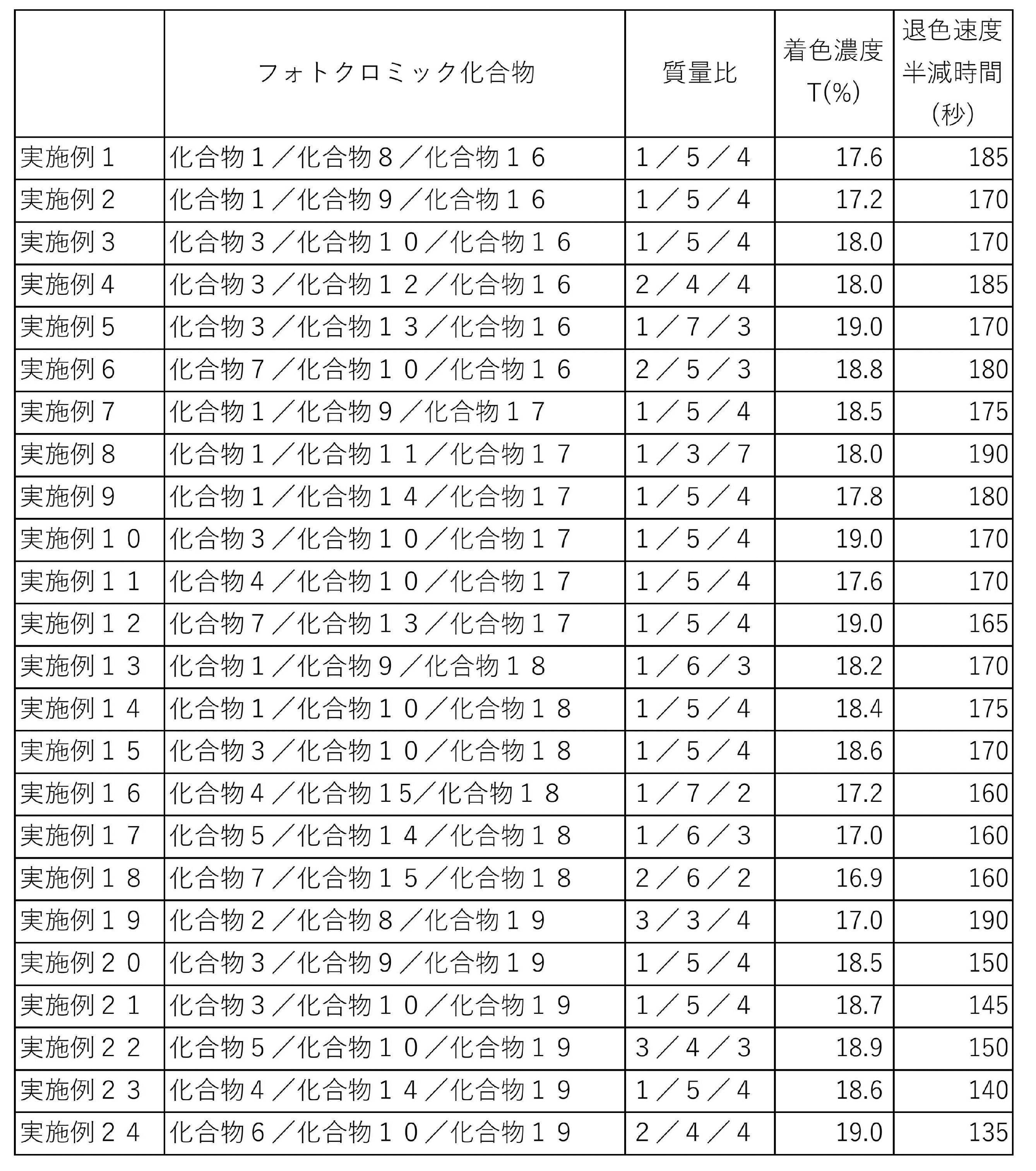

表2に示す結果から、一般式Aで表される化合物と一般式Bで表される化合物と一般式Cで表される化合物とを組み合わせることによって、可視域で高濃度に着色するフォトクロミック物品の提供が可能になることが確認できる。更に、表2に示す結果から、実施例の各眼鏡レンズが速い退色速度を示すことも確認できる。 From the results shown in Table 2, a photochromic article that is colored to a high concentration in the visible region by combining a compound represented by the general formula A, a compound represented by the general formula B, and a compound represented by the general formula C It can be confirmed that the provision will be possible. Furthermore, from the results shown in Table 2, it can be confirmed that each spectacle lens of the example shows a fast fading speed.
最後に、前述の各態様を総括する。 Finally, we will summarize each of the above aspects.
一態様によれば、一般式Aで表される化合物の1種以上と、一般式Bで表される化合物の1種以上と、一般式Cで表される化合物の1種以上と、を含むフォトクロミック物品及びフォトクロミック組成物が提供される。 According to one aspect, one or more of the compounds represented by the general formula A, one or more of the compounds represented by the general formula B, and one or more of the compounds represented by the general formula C are included. Photochromic articles and photochromic compositions are provided.
一形態では、一般式A中、R1及びR2は、それぞれ独立に、炭素数1~20の置換又は無置換のアルキル基を表すことができる。 In one form, in the general formula A, R 1 and R 2 can independently represent substituted or unsubstituted alkyl groups having 1 to 20 carbon atoms.
一形態では、一般式A中、R1及びR2は、それぞれ独立に、メチル基、エチル基、プロピル基、ブチル基、ペンチル基又はヘキシル基を表すことができる。 In one form, in the general formula A, R 1 and R 2 can independently represent a methyl group, an ethyl group, a propyl group, a butyl group, a pentyl group or a hexyl group, respectively.
一形態では、一般式A中のB1及びB2、一般式B中のB3及びB4並びに一般式C中のB5及びB6は、それぞれ独立に、置換又は無置換のフェニル基を表すことができる。かかるフェニル基が置換基を複数有する場合、それら置換基が結合して環を形成してもよい。 In one embodiment, B 1 and B 2 in the general formula A, B 3 and B 4 in the general formula B, and B 5 and B 6 in the general formula C independently have substituted or unsubstituted phenyl groups, respectively. Can be represented. When the phenyl group has a plurality of substituents, the substituents may be bonded to form a ring.
一形態では、一般式A中、R3~R6は、それぞれ独立に水素原子又は電子吸引性基を表す(ただしR3~R6の1つ以上は電子吸引性基を表す)ことができる。 In one form, in the general formula A, R 3 to R 6 can independently represent a hydrogen atom or an electron-withdrawing group (however, one or more of R 3 to R 6 represent an electron-withdrawing group). ..
一形態では、上記電子吸引性基は、ハロゲン原子、炭素数1~6のパーフルオロアルキル基、パーフルオロフェニル基、パーフルオロアルキルフェニル基又はシアノ基であることができる。 In one form, the electron-withdrawing group can be a halogen atom, a perfluoroalkyl group having 1 to 6 carbon atoms, a perfluorophenyl group, a perfluoroalkylphenyl group or a cyano group.
一形態では、上記ハロゲン原子は、フッ素原子であることができる。 In one form, the halogen atom can be a fluorine atom.
一形態では、上記パーフルオロアルキル基は、トリフルオロメチル基であることができる。 In one form, the perfluoroalkyl group can be a trifluoromethyl group.
一形態では、一般式A中のR1~R6、B1、B2、一般式B中のR7~R12、B3、B4、一般式C中のR15~R20、B5及びB6からなる群から選ばれる1つ以上は置換基を表すことができ、かかる置換基は、
ヒドロキシ基、炭素数1~18の直鎖若しくは分岐のアルキル基、炭素数5~18の単環若しくはビシクロ環等の複環の環状脂肪族アルキル基、構成原子数1~24の直鎖若しくは分岐のアルコキシ基、構成原子数1~24の非芳香族環状置換基、炭素数1~18の直鎖若しくは分岐のパーフルオロアルキル基、直鎖若しくは分岐のパーフルオロアルコキシ基、構成原子数1~24の直鎖若しくは分岐のアルキルスルフィド基、アリール基、アリールオキシ基、アリールスルフィド基、ヘテロアリール基、アミノ基、モノアルキルアミノ基、ジアルキルアミノ基、モノアリールアミノ基、ジアリールアミノ基、ピペリジノ基、モルホリノ基、チオモルホリノ基、テトラヒドロキノリノ基、テトラヒドロイソキノリノ基等の環状アミノ基、エチニル基、メルカプト基、シリル基、スルホン酸基、アルキルスルホニル基、ホルミル基、カルボキシ基、シアノ基及びハロゲン原子からなる群から選ばれる置換基Rm;
Rmに更に1つ以上の同一若しくは異なるRmが置換した置換基;又は
可溶化基
であることができる。
In one form, R 1 to R 6 , B 1 , B 2 in the general formula A, R 7 to R 12 , B 3 , B 4 in the general formula B, R 15 to R 20 , B in the general formula C. One or more selected from the group consisting of 5 and B6 can represent a substituent, such a substituent.
A hydroxy group, a linear or branched alkyl group having 1 to 18 carbon atoms, a cyclic aliphatic alkyl group having a compound ring such as a monocyclic or bicyclo ring having 5 to 18 carbon atoms, a linear or branched alkyl group having 1 to 24 constituent atoms. Alkoxy group, non-aromatic cyclic substituent having 1 to 24 constituent atoms, linear or branched perfluoroalkyl group having 1 to 18 carbon atoms, linear or branched perfluoroalkoxy group, constituent atoms 1 to 24 Linear or branched alkyl sulfide group, aryl group, aryloxy group, aryl sulfide group, heteroaryl group, amino group, monoalkylamino group, dialkylamino group, monoarylamino group, diarylamino group, piperidino group, morpholino Cyclic amino groups such as groups, thiomorpholino groups, tetrahydroquinolino groups, tetrahydroisoquinolino groups, ethynyl groups, mercapto groups, silyl groups, sulfonic acid groups, alkylsulfonyl groups, formyl groups, carboxy groups, cyano groups and halogen atoms. Substituents selected from the group consisting of R m ;
It can be a substituent in which R m is further substituted with one or more identical or different R m ; or a solubilizing group.
一形態では、一般式B中、R7及びR8は、それぞれ独立に、炭素数1~20の置換又は無置換のアルキル基を表すことができる。 In one form, in General Formula B, R 7 and R 8 can independently represent substituted or unsubstituted alkyl groups having 1 to 20 carbon atoms.
一形態では、一般式B中、R7及びR8は、それぞれ独立に、メチル基、エチル基、プロピル基、ブチル基、ペンチル基又はヘキシル基を表すことができる。 In one form, in General Formula B, R 7 and R 8 can independently represent a methyl group, an ethyl group, a propyl group, a butyl group, a pentyl group or a hexyl group, respectively.
一形態では、一般式B中、R13及びR14は、それぞれ独立に、メトキシ基、エトキシ基、フェノキシ基、メチルスルフィド基、フェニルスルフィド基、ジメチルアミノ基、ピロリジノ基、ピペリジノ基、モルホリノ基及びチオモルホリノ基からなる群から選択される電子供与性基を表すことができる。 In one form, in the general formula B, R 13 and R 14 are independently methoxy group, ethoxy group, phenoxy group, methyl sulfide group, phenyl sulfide group, dimethyl amino group, pyrrolidino group, piperidino group, morpholino group and It can represent an electron donating group selected from the group consisting of thiomorpholino groups.
一形態では、一般式C中、R15及びR16は、それぞれ独立に、炭素数1~20の置換又は無置換のアルキル基を表すことができる。 In one form, in the general formula C, R 15 and R 16 can independently represent substituted or unsubstituted alkyl groups having 1 to 20 carbon atoms.
一形態では、一般式C中、R15及びR16は、それぞれ独立に、メチル基、エチル基、プロピル基、ブチル基、ペンチル基又はヘキシル基を表すことができる。 In one form, in General Formula C, R 15 and R 16 can independently represent a methyl group, an ethyl group, a propyl group, a butyl group, a pentyl group or a hexyl group, respectively.
一形態では、一般式C中、R21又はR22で表される電子供与性基は、メトキシ基、エトキシ基、フェノキシ基、メチルスルフィド基、フェニルスルフィド基、ジメチルアミノ基、ピロリジノ基、ピペリジノ基、モルホリノ基及びチオモルホリノ基からなる群から選択される電子供与性基であることができる。 In one form, the electron donating group represented by R 21 or R 22 in the general formula C is a methoxy group, an ethoxy group, a phenoxy group, a methyl sulfide group, a phenyl sulfide group, a dimethyl amino group, a pyrrolidino group or a piperidino group. It can be an electron donating group selected from the group consisting of a morpholino group and a thiomorpholino group.
一形態では、上記フォトクロミック物品及び上記フォトクロミック組成物において、質量基準で、一般式Bで表される化合物及び一般式Cで表される化合物の合計含有率は、一般式Aで表される化合物の含有率を上回ることができる。 In one form, the total content of the compound represented by the general formula B and the compound represented by the general formula C in the photochromic article and the photochromic composition on a mass basis is that of the compound represented by the general formula A. The content can be exceeded.
一形態では、上記フォトクロミック物品は、基材とフォトクロミック層とを有し、このフォトクロミック層に一般式Aで表される化合物の1種以上と一般式Bで表される化合物の1種以上と一般式Cで表される化合物の1種以上とを含むフォトクロミック物品であることができる。 In one form, the photochromic article has a base material and a photochromic layer, and the photochromic layer is generally composed of one or more compounds represented by the general formula A and one or more compounds represented by the general formula B. It can be a photochromic article containing one or more of the compounds represented by the formula C.
一形態では、上記フォトクロミック層は、重合性組成物を硬化した硬化層であることができる。 In one form, the photochromic layer can be a cured layer obtained by curing the polymerizable composition.
一形態では、上記フォトクロミック組成物は、重合性化合物を含むことができる。 In one form, the photochromic composition can contain a polymerizable compound.
一形態では、上記フォトクロミック物品は、眼鏡レンズであることができる。 In one form, the photochromic article can be a spectacle lens.
一形態では、上記フォトクロミック物品は、ゴーグル用レンズであることができる。 In one form, the photochromic article can be a goggle lens.
一形態では、上記フォトクロミック物品は、サンバイザーのバイザー部分であることができる。 In one form, the photochromic article can be the visor portion of a sun visor.
一形態では、上記フォトクロミック物品は、ヘルメットのシールド部材であることができる。 In one form, the photochromic article can be a shield member of a helmet.
一態様によれば、上記眼鏡レンズを備えた眼鏡が提供される。 According to one aspect, spectacles provided with the above spectacle lens are provided.
本明細書に記載の各種態様及び各種形態は、任意の組み合わせで2つ以上を組み合わせることができる。 Two or more of the various aspects and various forms described in the present specification can be combined in any combination.
今回開示された実施の形態はすべての点で例示であって制限的なものではないと考えられるべきである。本発明の範囲は上記した説明ではなくて請求の範囲によって示され、請求の範囲と均等の意味及び範囲内でのすべての変更が含まれることが意図される。 The embodiments disclosed this time should be considered to be exemplary in all respects and not restrictive. The scope of the present invention is shown by the scope of claims rather than the above description, and is intended to include all modifications within the meaning and scope of the claims.
本発明の一態様は、眼鏡、ゴーグル、サンバイザー、ヘルメット等の技術分野において有用である。 One aspect of the present invention is useful in the technical fields of eyeglasses, goggles, sun visors, helmets and the like.
Claims (24)


R7~R12、B3及びB4は、それぞれ独立に水素原子又は置換基を表し、
R13及びR14は、それぞれ独立に電子供与性基を表す。)

R15~R20、B5及びB6は、それぞれ独立に水素原子又は置換基を表し、
R21及びR22は、一方が水素原子を表し他方が電子供与性基を表す。) A photochromic composition comprising one or more compounds represented by the following general formula A, one or more compounds represented by the following general formula B, and one or more compounds represented by the following general formula C. ..
R 7 to R 12 , B 3 and B 4 independently represent hydrogen atoms or substituents, respectively.
R 13 and R 14 each independently represent an electron donating group. )
R 15 to R 20 , B 5 and B 6 each independently represent a hydrogen atom or a substituent.
One of R 21 and R 22 represents a hydrogen atom and the other represents an electron donating group. )
ヒドロキシ基、炭素数1~18の直鎖若しくは分岐のアルキル基、炭素数5~18の単環若しくはビシクロ環等の複環の環状脂肪族アルキル基、構成原子数1~24の直鎖若しくは分岐のアルコキシ基、構成原子数1~24の非芳香族環状置換基、炭素数1~18の直鎖若しくは分岐のパーフルオロアルキル基、直鎖若しくは分岐のパーフルオロアルコキシ基、構成原子数1~24の直鎖若しくは分岐のアルキルスルフィド基、アリール基、アリールオキシ基、アリールスルフィド基、ヘテロアリール基、アミノ基、モノアルキルアミノ基、ジアルキルアミノ基、モノアリールアミノ基、ジアリールアミノ基、ピペリジノ基、モルホリノ基、チオモルホリノ基、テトラヒドロキノリノ基、テトラヒドロイソキノリノ基等の環状アミノ基、エチニル基、メルカプト基、シリル基、スルホン酸基、アルキルスルホニル基、ホルミル基、カルボキシ基、シアノ基及びハロゲン原子からなる群から選ばれる置換基Rm;
Rmに更に1つ以上の同一若しくは異なるRmが置換した置換基;又は
可溶化基
である、請求項1~8のいずれか1項に記載のフォトクロミック組成物。 R 1 to R 6 , B 1 , B 2 in the general formula A, R 7 to R 12 , B 3 , B 4 in the general formula B, R 15 to R 20 , B 5 and B 6 in the general formula C. One or more selected from the group consisting of a substituent represents a substituent, which is a substituent.
A hydroxy group, a linear or branched alkyl group having 1 to 18 carbon atoms, a cyclic aliphatic alkyl group having a compound ring such as a monocyclic or bicyclo ring having 5 to 18 carbon atoms, a linear or branched alkyl group having 1 to 24 constituent atoms. Alkoxy group, non-aromatic cyclic substituent having 1 to 24 constituent atoms, linear or branched perfluoroalkyl group having 1 to 18 carbon atoms, linear or branched perfluoroalkoxy group, constituent atoms 1 to 24 Linear or branched alkyl sulfide group, aryl group, aryloxy group, aryl sulfide group, heteroaryl group, amino group, monoalkylamino group, dialkylamino group, monoarylamino group, diarylamino group, piperidino group, morpholino Cyclic amino group such as group, thiomorpholino group, tetrahydroquinolino group, tetrahydroisoquinolino group, ethynyl group, mercapto group, silyl group, sulfonic acid group, alkylsulfonyl group, formyl group, carboxy group, cyano group and halogen atom. Substituents selected from the group consisting of R m ;
The photochromic composition according to any one of claims 1 to 8, which is a substituent in which R m is further substituted with one or more identical or different R m ; or a solubilizing group.
Priority Applications (8)
| Application Number | Priority Date | Filing Date | Title |
|---|---|---|---|
| JP2022571719A JP7290809B2 (en) | 2020-12-24 | 2021-12-24 | Photochromic composition, photochromic article and spectacles |
| EP25150422.1A EP4549533A1 (en) | 2020-12-24 | 2021-12-24 | Photochromic composition, photochromic article, and spectacles |
| ES21911103T ES3014883T3 (en) | 2020-12-24 | 2021-12-24 | Photochromic composition, photochromic article, and spectacles |
| KR1020237009357A KR102780823B1 (en) | 2020-12-24 | 2021-12-24 | Photochromic compositions, photochromic articles and glasses |
| EP21911103.6A EP4198583B1 (en) | 2020-12-24 | 2021-12-24 | Photochromic composition, photochromic article, and spectacles |
| CN202180064027.5A CN116323577A (en) | 2020-12-24 | 2021-12-24 | Photochromic composition, photochromic article and glasses |
| US18/122,949 US20230227717A1 (en) | 2020-12-24 | 2023-03-17 | Photochromic composition, photochromic article, and spectacles |
| JP2023090581A JP7741131B2 (en) | 2020-12-24 | 2023-06-01 | Photochromic articles and glasses |
Applications Claiming Priority (6)
| Application Number | Priority Date | Filing Date | Title |
|---|---|---|---|
| JP2020215159 | 2020-12-24 | ||
| JP2020215158 | 2020-12-24 | ||
| JP2020-215159 | 2020-12-24 | ||
| JP2020-215158 | 2020-12-24 | ||
| JP2021-018610 | 2021-02-08 | ||
| JP2021018610 | 2021-02-08 |
Related Child Applications (1)
| Application Number | Title | Priority Date | Filing Date |
|---|---|---|---|
| US18/122,949 Continuation US20230227717A1 (en) | 2020-12-24 | 2023-03-17 | Photochromic composition, photochromic article, and spectacles |
Publications (1)
| Publication Number | Publication Date |
|---|---|
| WO2022138966A1 true WO2022138966A1 (en) | 2022-06-30 |
Family
ID=82158206
Family Applications (4)
| Application Number | Title | Priority Date | Filing Date |
|---|---|---|---|
| PCT/JP2021/048401 Ceased WO2022138968A1 (en) | 2020-12-24 | 2021-12-24 | Photochromic composition, photochromic article, and eyeglasses |
| PCT/JP2021/048398 Ceased WO2022138965A1 (en) | 2020-12-24 | 2021-12-24 | Photochromic composition, photochromic article, and glasses |
| PCT/JP2021/048400 Ceased WO2022138967A1 (en) | 2020-12-24 | 2021-12-24 | Photochromic compound, photochromic composition, photochromic article, and eyeglasses |
| PCT/JP2021/048399 Ceased WO2022138966A1 (en) | 2020-12-24 | 2021-12-24 | Photochromic composition, photochromic article, and spectacles |
Family Applications Before (3)
| Application Number | Title | Priority Date | Filing Date |
|---|---|---|---|
| PCT/JP2021/048401 Ceased WO2022138968A1 (en) | 2020-12-24 | 2021-12-24 | Photochromic composition, photochromic article, and eyeglasses |
| PCT/JP2021/048398 Ceased WO2022138965A1 (en) | 2020-12-24 | 2021-12-24 | Photochromic composition, photochromic article, and glasses |
| PCT/JP2021/048400 Ceased WO2022138967A1 (en) | 2020-12-24 | 2021-12-24 | Photochromic compound, photochromic composition, photochromic article, and eyeglasses |
Country Status (7)
| Country | Link |
|---|---|
| US (4) | US20240103200A1 (en) |
| EP (5) | EP4270067B1 (en) |
| JP (8) | JP7547510B2 (en) |
| KR (5) | KR20250044801A (en) |
| CN (2) | CN116323577A (en) |
| ES (1) | ES3014883T3 (en) |
| WO (4) | WO2022138968A1 (en) |
Cited By (5)
| Publication number | Priority date | Publication date | Assignee | Title |
|---|---|---|---|---|
| WO2023190905A1 (en) | 2022-03-31 | 2023-10-05 | ホヤ レンズ タイランド リミテッド | Polymerizable composition for optical article and optical article |
| WO2023190904A1 (en) | 2022-03-31 | 2023-10-05 | ホヤ レンズ タイランド リミテッド | Polymerizable composition for optical article and optical article |
| WO2024181425A1 (en) | 2023-02-28 | 2024-09-06 | ホヤ レンズ タイランド リミテッド | Photochromic compound, photochromic composition, photochromic article, and eyeglasses |
| WO2024203725A1 (en) | 2023-03-30 | 2024-10-03 | ホヤ レンズ タイランド リミテッド | Photochromic article, spectacles, and method for producing photochromic article |
| EP4674923A1 (en) | 2023-02-28 | 2026-01-07 | Hoya Lens Thailand Ltd. | Photochromic compound, photochromic composition, photochromic article, and eyeglasses |
Families Citing this family (2)
| Publication number | Priority date | Publication date | Assignee | Title |
|---|---|---|---|---|
| EP4270067B1 (en) * | 2020-12-24 | 2025-12-03 | Hoya Lens Thailand Ltd. | Photochromic composition, photochromic article, and glasses |
| EP4581021A1 (en) * | 2022-08-30 | 2025-07-09 | Transitions Optical, Ltd. | Photochromic indeno-fused naphthopyran compounds, compositions, and articles containing same |
Citations (16)
| Publication number | Priority date | Publication date | Assignee | Title |
|---|---|---|---|---|
| WO1996014596A1 (en) | 1994-11-03 | 1996-05-17 | Ppg Industries, Inc. | Novel photochromic indeno-fused naphthopyrans |
| WO2001019813A1 (en) | 1999-09-17 | 2001-03-22 | Transitions Optical, Inc. | Novel indeno-fused photochromic naphthopyrans |
| WO2001060811A1 (en) | 2000-02-21 | 2001-08-23 | Tokuyama Corporation | Chromene compound |
| US20060228557A1 (en) | 2005-04-08 | 2006-10-12 | Beon-Kyu Kim | Photochromic materials having extended pi-conjugated systems and compositions and articles including the same |
| US20060226402A1 (en) | 2005-04-08 | 2006-10-12 | Beon-Kyu Kim | Ophthalmic devices comprising photochromic materials having extended PI-conjugated systems |
| JP2008507618A (en) * | 2004-07-30 | 2008-03-13 | トランジションズ オプティカル, インコーポレイテッド | Photochromic material |
| US20080103301A1 (en) | 2006-10-30 | 2008-05-01 | Transitions Optical, Inc. | Photochromic materials demonstrating improved fade rates |
| US7527754B2 (en) | 2005-12-21 | 2009-05-05 | Transitions Optical, Inc. | Photochromic indeno-fused naphthopyrans |
| US7556751B2 (en) | 2005-12-21 | 2009-07-07 | Transitions Optical, Inc. | Photochromic materials having electron-withdrawing substituents |
| US20110108781A1 (en) | 2009-10-28 | 2011-05-12 | Transitions Optical, Inc. | Photochromic materials |
| JP4884578B2 (en) | 1998-05-29 | 2012-02-29 | ローデンストック.ゲゼルシャフト.ミット.ベシュレンクテル.ハフツング | Photochromic spirofluorenopyran and uses thereof |
| WO2013086248A1 (en) | 2011-12-08 | 2013-06-13 | Ppg Industries, Inc. | Photochromic materials that include indeno-fused naphthopyrans |
| JP2014502604A (en) * | 2010-12-16 | 2014-02-03 | トランジションズ オプティカル, インコーポレイテッド | Photochromic compounds and compositions |
| JP2014506247A (en) * | 2010-12-16 | 2014-03-13 | トランジションズ オプティカル, インコーポレイテッド | Photochromic compounds and compositions |
| US20160279886A1 (en) * | 2013-11-20 | 2016-09-29 | Transitions Optical, Inc. | Method of forming a photochromic segmented multifocal lens |
| WO2020094772A1 (en) * | 2018-11-08 | 2020-05-14 | Transitions Optical, Ltd. | Photochromic article |
Family Cites Families (27)
| Publication number | Priority date | Publication date | Assignee | Title |
|---|---|---|---|---|
| US5645767A (en) * | 1994-11-03 | 1997-07-08 | Transitions Optical, Inc. | Photochromic indeno-fused naphthopyrans |
| FR2783250B1 (en) | 1998-09-11 | 2001-02-23 | Flamel Tech Sa | C6-C7 ANNELED NAPHTHOPYRANS, THEIR PREPARATION, AND THE POLYMERIC COMPOSITIONS AND MATRICES (CO) CONTAINING THEM |
| US7320826B2 (en) * | 2003-03-20 | 2008-01-22 | Ppg Industries Ohio, Inc. | Photochromic articles with reduced temperature dependency and methods for preparation |
| US20110140056A1 (en) * | 2003-07-01 | 2011-06-16 | Transitions Optical, Inc. | Indeno-fused ring compounds |
| US8698117B2 (en) | 2003-07-01 | 2014-04-15 | Transitions Optical, Inc. | Indeno-fused ring compounds |
| WO2005028465A1 (en) | 2003-09-18 | 2005-03-31 | Tokuyama Corporation | Chromene compound |
| JP4424962B2 (en) * | 2003-10-07 | 2010-03-03 | 株式会社トクヤマ | Chromene compounds |
| JP4424981B2 (en) * | 2003-12-26 | 2010-03-03 | 株式会社トクヤマ | Chromene compounds |
| US8147725B2 (en) * | 2005-04-08 | 2012-04-03 | Transitions Optical, Inc | Photochromic materials having extended pi-conjugated systems and compositions and articles including the same |
| US8647538B2 (en) * | 2005-04-08 | 2014-02-11 | Transitions Optical, Inc. | Photochromic compounds having at least two photochromic moieties |
| WO2009136668A1 (en) * | 2008-05-09 | 2009-11-12 | 株式会社トクヤマ | Chromene compound |
| EP2463280B1 (en) * | 2009-08-04 | 2013-09-11 | Tokuyama Corporation | Chromene compound |
| EP2479171A4 (en) * | 2009-09-18 | 2013-03-06 | Tokuyama Corp | CHROME COMPOUND |
| JP2013035877A (en) * | 2009-12-10 | 2013-02-21 | Tokuyama Corp | Photochromic composition |
| KR101097618B1 (en) * | 2010-04-15 | 2011-12-22 | 한남대학교 산학협력단 | Novel indeno-fused naphthopyran-based photochromic compound containing phenylazanediyl group and process for preparing the same |
| US8535577B2 (en) * | 2010-04-30 | 2013-09-17 | Transitions Optical, Inc. | Photochromic materials that include 6-amino substituted indeno-fused naphthopyrans |
| US9034219B2 (en) | 2010-12-16 | 2015-05-19 | Transitions Optical, Inc. | Photochromic compounds and compositions |
| CN103635470B (en) * | 2011-09-22 | 2016-12-21 | 株式会社德山 | Chromene compounds and solidification compound |
| WO2014151543A1 (en) * | 2013-03-15 | 2014-09-25 | Ppg Industries Ohio, Inc. | Controlled radical polymerization initiators |
| JP2017512858A (en) * | 2014-03-25 | 2017-05-25 | サビック グローバル テクノロジーズ ビー.ブイ. | Discoloring material |
| JP6980376B2 (en) * | 2016-12-14 | 2021-12-15 | 株式会社トクヤマ | Photochromic optical articles |
| CN111149046B (en) * | 2018-03-30 | 2021-10-22 | 豪雅镜片泰国有限公司 | Optical Items |
| KR102696642B1 (en) * | 2018-04-17 | 2024-08-22 | 가부시끼가이샤 도꾸야마 | Photochromic compound, curable composition comprising said photochromic compound and optical article |
| JP7152173B2 (en) * | 2018-04-17 | 2022-10-12 | 株式会社トクヤマ | Method for producing photochromic cured body |
| JP7195209B2 (en) * | 2018-04-17 | 2022-12-23 | 株式会社トクヤマ | A photochromic compound, a curable composition containing the photochromic compound, and a photochromic cured body comprising the curable composition |
| MX2020012945A (en) * | 2018-05-28 | 2021-05-12 | Transitions Optical Ltd | Photochromic indeno-fused naphthopyran compounds with reduced temperature dependence. |
| EP4270067B1 (en) * | 2020-12-24 | 2025-12-03 | Hoya Lens Thailand Ltd. | Photochromic composition, photochromic article, and glasses |
-
2021
- 2021-12-24 EP EP21911102.8A patent/EP4270067B1/en active Active
- 2021-12-24 WO PCT/JP2021/048401 patent/WO2022138968A1/en not_active Ceased
- 2021-12-24 JP JP2022571721A patent/JP7547510B2/en active Active
- 2021-12-24 US US18/269,003 patent/US20240103200A1/en active Pending
- 2021-12-24 EP EP21911103.6A patent/EP4198583B1/en active Active
- 2021-12-24 US US18/269,005 patent/US20240059959A1/en active Pending
- 2021-12-24 JP JP2022571720A patent/JP7334368B2/en active Active
- 2021-12-24 KR KR1020257009298A patent/KR20250044801A/en active Pending
- 2021-12-24 KR KR1020237009358A patent/KR102786669B1/en active Active
- 2021-12-24 KR KR1020237009357A patent/KR102780823B1/en active Active
- 2021-12-24 JP JP2022571718A patent/JP7639026B2/en active Active
- 2021-12-24 ES ES21911103T patent/ES3014883T3/en active Active
- 2021-12-24 WO PCT/JP2021/048398 patent/WO2022138965A1/en not_active Ceased
- 2021-12-24 WO PCT/JP2021/048400 patent/WO2022138967A1/en not_active Ceased
- 2021-12-24 KR KR1020237021232A patent/KR102877221B1/en active Active
- 2021-12-24 EP EP25150422.1A patent/EP4549533A1/en active Pending
- 2021-12-24 WO PCT/JP2021/048399 patent/WO2022138966A1/en not_active Ceased
- 2021-12-24 JP JP2022571719A patent/JP7290809B2/en active Active
- 2021-12-24 CN CN202180064027.5A patent/CN116323577A/en active Pending
- 2021-12-24 EP EP21911105.1A patent/EP4269532B1/en active Active
- 2021-12-24 CN CN202180064029.4A patent/CN116323857A/en active Pending
- 2021-12-24 KR KR1020237021233A patent/KR102877222B1/en active Active
- 2021-12-24 EP EP21911104.4A patent/EP4198102A4/en active Pending
-
2023
- 2023-03-17 US US18/122,935 patent/US20230340318A1/en active Pending
- 2023-03-17 US US18/122,949 patent/US20230227717A1/en active Pending
- 2023-06-01 JP JP2023090581A patent/JP7741131B2/en active Active
- 2023-08-16 JP JP2023132427A patent/JP2023175687A/en active Pending
-
2024
- 2024-08-28 JP JP2024146374A patent/JP2024167317A/en active Pending
-
2025
- 2025-02-19 JP JP2025024849A patent/JP2025081515A/en active Pending
Patent Citations (16)
| Publication number | Priority date | Publication date | Assignee | Title |
|---|---|---|---|---|
| WO1996014596A1 (en) | 1994-11-03 | 1996-05-17 | Ppg Industries, Inc. | Novel photochromic indeno-fused naphthopyrans |
| JP4884578B2 (en) | 1998-05-29 | 2012-02-29 | ローデンストック.ゲゼルシャフト.ミット.ベシュレンクテル.ハフツング | Photochromic spirofluorenopyran and uses thereof |
| WO2001019813A1 (en) | 1999-09-17 | 2001-03-22 | Transitions Optical, Inc. | Novel indeno-fused photochromic naphthopyrans |
| WO2001060811A1 (en) | 2000-02-21 | 2001-08-23 | Tokuyama Corporation | Chromene compound |
| JP2008507618A (en) * | 2004-07-30 | 2008-03-13 | トランジションズ オプティカル, インコーポレイテッド | Photochromic material |
| US20060228557A1 (en) | 2005-04-08 | 2006-10-12 | Beon-Kyu Kim | Photochromic materials having extended pi-conjugated systems and compositions and articles including the same |
| US20060226402A1 (en) | 2005-04-08 | 2006-10-12 | Beon-Kyu Kim | Ophthalmic devices comprising photochromic materials having extended PI-conjugated systems |
| US7556751B2 (en) | 2005-12-21 | 2009-07-07 | Transitions Optical, Inc. | Photochromic materials having electron-withdrawing substituents |
| US7527754B2 (en) | 2005-12-21 | 2009-05-05 | Transitions Optical, Inc. | Photochromic indeno-fused naphthopyrans |
| US20080103301A1 (en) | 2006-10-30 | 2008-05-01 | Transitions Optical, Inc. | Photochromic materials demonstrating improved fade rates |
| US20110108781A1 (en) | 2009-10-28 | 2011-05-12 | Transitions Optical, Inc. | Photochromic materials |
| JP2014502604A (en) * | 2010-12-16 | 2014-02-03 | トランジションズ オプティカル, インコーポレイテッド | Photochromic compounds and compositions |
| JP2014506247A (en) * | 2010-12-16 | 2014-03-13 | トランジションズ オプティカル, インコーポレイテッド | Photochromic compounds and compositions |
| WO2013086248A1 (en) | 2011-12-08 | 2013-06-13 | Ppg Industries, Inc. | Photochromic materials that include indeno-fused naphthopyrans |
| US20160279886A1 (en) * | 2013-11-20 | 2016-09-29 | Transitions Optical, Inc. | Method of forming a photochromic segmented multifocal lens |
| WO2020094772A1 (en) * | 2018-11-08 | 2020-05-14 | Transitions Optical, Ltd. | Photochromic article |
Non-Patent Citations (1)
| Title |
|---|
| HIIZU IWAMURARYOJI NOYORITAKESHI NAKAIISAO KITAGAWA, ORGANIC CHEMISTRY FOR GRADUATE SCHOOL, vol. 1, 1988 |
Cited By (6)
| Publication number | Priority date | Publication date | Assignee | Title |
|---|---|---|---|---|
| WO2023190905A1 (en) | 2022-03-31 | 2023-10-05 | ホヤ レンズ タイランド リミテッド | Polymerizable composition for optical article and optical article |
| WO2023190904A1 (en) | 2022-03-31 | 2023-10-05 | ホヤ レンズ タイランド リミテッド | Polymerizable composition for optical article and optical article |
| WO2024181425A1 (en) | 2023-02-28 | 2024-09-06 | ホヤ レンズ タイランド リミテッド | Photochromic compound, photochromic composition, photochromic article, and eyeglasses |
| EP4674923A1 (en) | 2023-02-28 | 2026-01-07 | Hoya Lens Thailand Ltd. | Photochromic compound, photochromic composition, photochromic article, and eyeglasses |
| EP4674924A1 (en) | 2023-02-28 | 2026-01-07 | Hoya Lens Thailand Ltd. | Photochromic compound, photochromic composition, photochromic article, and eyeglasses |
| WO2024203725A1 (en) | 2023-03-30 | 2024-10-03 | ホヤ レンズ タイランド リミテッド | Photochromic article, spectacles, and method for producing photochromic article |
Also Published As
Similar Documents
| Publication | Publication Date | Title |
|---|---|---|
| JP7290809B2 (en) | Photochromic composition, photochromic article and spectacles | |
| JP7696427B2 (en) | Photochromic compounds, photochromic compositions, photochromic articles and glasses | |
| WO2022075330A1 (en) | Optical article, eyeglasses and photochromic compound | |
| JP7574333B2 (en) | Photochromic compounds, photochromic compositions, photochromic articles and glasses | |
| JP7728850B2 (en) | Photochromic compounds, photochromic compositions, photochromic articles and eyeglasses | |
| CN116745383A (en) | Photochromic compositions, photochromic articles and glasses | |
| WO2024181424A1 (en) | Photochromic compound, photochromic composition, photochromic article, and eyeglasses | |
| WO2024181425A1 (en) | Photochromic compound, photochromic composition, photochromic article, and eyeglasses | |
| WO2025143226A1 (en) | Photochromic compound, photochromic composition, photochromic article, and eyeglasses |
Legal Events
| Date | Code | Title | Description |
|---|---|---|---|
| 121 | Ep: the epo has been informed by wipo that ep was designated in this application |
Ref document number: 21911103 Country of ref document: EP Kind code of ref document: A1 |
|
| ENP | Entry into the national phase |
Ref document number: 2022571719 Country of ref document: JP Kind code of ref document: A |
|
| ENP | Entry into the national phase |
Ref document number: 20237009357 Country of ref document: KR Kind code of ref document: A |
|
| ENP | Entry into the national phase |
Ref document number: 2021911103 Country of ref document: EP Effective date: 20230316 |
|
| NENP | Non-entry into the national phase |
Ref country code: DE |