WO2020203297A1 - 多成分型硬化性オルガノポリシロキサン組成物、熱伝導性部材および放熱構造体 - Google Patents
多成分型硬化性オルガノポリシロキサン組成物、熱伝導性部材および放熱構造体 Download PDFInfo
- Publication number
- WO2020203297A1 WO2020203297A1 PCT/JP2020/011998 JP2020011998W WO2020203297A1 WO 2020203297 A1 WO2020203297 A1 WO 2020203297A1 JP 2020011998 W JP2020011998 W JP 2020011998W WO 2020203297 A1 WO2020203297 A1 WO 2020203297A1
- Authority
- WO
- WIPO (PCT)
- Prior art keywords
- component
- group
- curable organopolysiloxane
- organopolysiloxane composition
- composition
- Prior art date
- Legal status (The legal status is an assumption and is not a legal conclusion. Google has not performed a legal analysis and makes no representation as to the accuracy of the status listed.)
- Ceased
Links
Classifications
-
- C—CHEMISTRY; METALLURGY
- C08—ORGANIC MACROMOLECULAR COMPOUNDS; THEIR PREPARATION OR CHEMICAL WORKING-UP; COMPOSITIONS BASED THEREON
- C08L—COMPOSITIONS OF MACROMOLECULAR COMPOUNDS
- C08L83/00—Compositions of macromolecular compounds obtained by reactions forming in the main chain of the macromolecule a linkage containing silicon with or without sulfur, nitrogen, oxygen or carbon only; Compositions of derivatives of such polymers
- C08L83/04—Polysiloxanes
-
- C—CHEMISTRY; METALLURGY
- C08—ORGANIC MACROMOLECULAR COMPOUNDS; THEIR PREPARATION OR CHEMICAL WORKING-UP; COMPOSITIONS BASED THEREON
- C08K—Use of inorganic or non-macromolecular organic substances as compounding ingredients
- C08K5/00—Use of organic ingredients
- C08K5/54—Silicon-containing compounds
- C08K5/541—Silicon-containing compounds containing oxygen
- C08K5/5415—Silicon-containing compounds containing oxygen containing at least one Si—O bond
- C08K5/5419—Silicon-containing compounds containing oxygen containing at least one Si—O bond containing at least one Si—C bond
-
- C—CHEMISTRY; METALLURGY
- C08—ORGANIC MACROMOLECULAR COMPOUNDS; THEIR PREPARATION OR CHEMICAL WORKING-UP; COMPOSITIONS BASED THEREON
- C08G—MACROMOLECULAR COMPOUNDS OBTAINED OTHERWISE THAN BY REACTIONS ONLY INVOLVING UNSATURATED CARBON-TO-CARBON BONDS
- C08G77/00—Macromolecular compounds obtained by reactions forming a linkage containing silicon with or without sulfur, nitrogen, oxygen or carbon in the main chain of the macromolecule
- C08G77/04—Polysiloxanes
- C08G77/14—Polysiloxanes containing silicon bound to oxygen-containing groups
- C08G77/16—Polysiloxanes containing silicon bound to oxygen-containing groups to hydroxyl groups
-
- C—CHEMISTRY; METALLURGY
- C08—ORGANIC MACROMOLECULAR COMPOUNDS; THEIR PREPARATION OR CHEMICAL WORKING-UP; COMPOSITIONS BASED THEREON
- C08G—MACROMOLECULAR COMPOUNDS OBTAINED OTHERWISE THAN BY REACTIONS ONLY INVOLVING UNSATURATED CARBON-TO-CARBON BONDS
- C08G77/00—Macromolecular compounds obtained by reactions forming a linkage containing silicon with or without sulfur, nitrogen, oxygen or carbon in the main chain of the macromolecule
- C08G77/04—Polysiloxanes
- C08G77/14—Polysiloxanes containing silicon bound to oxygen-containing groups
- C08G77/18—Polysiloxanes containing silicon bound to oxygen-containing groups to alkoxy or aryloxy groups
-
- C—CHEMISTRY; METALLURGY
- C08—ORGANIC MACROMOLECULAR COMPOUNDS; THEIR PREPARATION OR CHEMICAL WORKING-UP; COMPOSITIONS BASED THEREON
- C08K—Use of inorganic or non-macromolecular organic substances as compounding ingredients
- C08K3/00—Use of inorganic substances as compounding ingredients
- C08K3/18—Oxygen-containing compounds, e.g. metal carbonyls
- C08K3/20—Oxides; Hydroxides
- C08K3/22—Oxides; Hydroxides of metals
-
- C—CHEMISTRY; METALLURGY
- C08—ORGANIC MACROMOLECULAR COMPOUNDS; THEIR PREPARATION OR CHEMICAL WORKING-UP; COMPOSITIONS BASED THEREON
- C08K—Use of inorganic or non-macromolecular organic substances as compounding ingredients
- C08K5/00—Use of organic ingredients
- C08K5/54—Silicon-containing compounds
- C08K5/544—Silicon-containing compounds containing nitrogen
-
- C—CHEMISTRY; METALLURGY
- C08—ORGANIC MACROMOLECULAR COMPOUNDS; THEIR PREPARATION OR CHEMICAL WORKING-UP; COMPOSITIONS BASED THEREON
- C08K—Use of inorganic or non-macromolecular organic substances as compounding ingredients
- C08K9/00—Use of pretreated ingredients
- C08K9/04—Ingredients treated with organic substances
- C08K9/06—Ingredients treated with organic substances with silicon-containing compounds
-
- C—CHEMISTRY; METALLURGY
- C08—ORGANIC MACROMOLECULAR COMPOUNDS; THEIR PREPARATION OR CHEMICAL WORKING-UP; COMPOSITIONS BASED THEREON
- C08L—COMPOSITIONS OF MACROMOLECULAR COMPOUNDS
- C08L83/00—Compositions of macromolecular compounds obtained by reactions forming in the main chain of the macromolecule a linkage containing silicon with or without sulfur, nitrogen, oxygen or carbon only; Compositions of derivatives of such polymers
- C08L83/04—Polysiloxanes
- C08L83/06—Polysiloxanes containing silicon bound to oxygen-containing groups
-
- H10W40/251—
-
- C—CHEMISTRY; METALLURGY
- C08—ORGANIC MACROMOLECULAR COMPOUNDS; THEIR PREPARATION OR CHEMICAL WORKING-UP; COMPOSITIONS BASED THEREON
- C08K—Use of inorganic or non-macromolecular organic substances as compounding ingredients
- C08K3/00—Use of inorganic substances as compounding ingredients
- C08K3/18—Oxygen-containing compounds, e.g. metal carbonyls
- C08K3/20—Oxides; Hydroxides
- C08K3/22—Oxides; Hydroxides of metals
- C08K2003/2227—Oxides; Hydroxides of metals of aluminium
-
- C—CHEMISTRY; METALLURGY
- C08—ORGANIC MACROMOLECULAR COMPOUNDS; THEIR PREPARATION OR CHEMICAL WORKING-UP; COMPOSITIONS BASED THEREON
- C08K—Use of inorganic or non-macromolecular organic substances as compounding ingredients
- C08K2201/00—Specific properties of additives
- C08K2201/001—Conductive additives
-
- H10W40/00—
Definitions
- the present invention is a curable organopoly having high thermal conductivity, excellent deep curability at room temperature, excellent adhesion to various substrates, and excellent adhesion to heat-dissipating parts and the like.
- the present invention relates to a siloxane composition, a heat conductive member comprising the siloxane composition, and a heat radiating structure using the same.
- thermally conductive silicone composition composed of an organopolysiloxane and a thermally conductive filler such as aluminum oxide powder and zinc oxide powder is widely used.
- a heat conductive silicone composition packed with a large amount of heat conductive filler has been proposed in order to cope with a high heat dissipation amount.
- Patent Document 1 proposes a room temperature moisture thickening type thermally conductive silicone grease composition in which a diorganosiloxane having a hydroxyl group terminal and a diorganopolysiloxane having an alkoxysilyl group are used in combination.
- a room temperature moisture thickening type thermally conductive silicone grease composition in which a diorganosiloxane having a hydroxyl group terminal and a diorganopolysiloxane having an alkoxysilyl group are used in combination.
- such a composition has insufficient curing rate and deep curing property at room temperature, and there is still room for improvement in adhesiveness to various substrates.
- a room-temperature curable silicone rubber composition that cures at room temperature by contacting with moisture in the air and exhibits good adhesion to a substrate in contact during curing. It consists of a diorganopolysiloxane having a specific alkoxysilyl group such as a methoxysilylethyl-containing group, an organopolysiloxane having no alkoxysilyl group and a hydroxyl group, an alkoxysilane as a cross-linking agent or a hydrolyzate thereof, and a condensation reaction catalyst.
- Patent Document 2 A room temperature curable silicone rubber composition has been proposed (Patent Document 2).
- Patent Document 2 has an insufficient curing rate at room temperature, and there is still room for improvement in adhesiveness to various substrates. Further, Patent Document 2 does not disclose any heat conductive silicone composition packed with a large amount of heat conductive filler in order to cope with a high heat dissipation amount.
- the present invention has been made to solve the above problems, has high thermal conductivity, and even when the thermally conductive inorganic filler is highly filled, the entire composition after mixing has high fluidity.
- To provide a multi-component curable organopolysiloxane composition which is excellent in precision coating property and gap fill property for electronic parts having many gaps and is excellent in deep curability and adhesiveness at room temperature for maintenance.
- the obtained thermally conductive cured product has excellent curing adhesion, and damage to the member can be prevented by relaxing the stress generated by the difference in the coefficient of thermal expansion between the electronic component and the heat radiating structure.
- Another object of the present invention is to provide a heat conductive member using the curable organopolysiloxane composition and a heat radiating structure using the member.
- (C) Thermally conductive filler 400 to 3,500 parts by mass
- (D) Organosilicon compound which is a surface treatment agent for component (C) An amount of 0.1 to 2.0% by mass with respect to component (C).
- (E) Alkoxyalkoxysilane and one or more components (e1) selected from the following components (e1) to (e3) A reaction mixture of an amino group-containing organoalkoxysilane and an epoxy group-containing organoalkoxysilane, (E2) An organic compound having at least two alkoxysilyl groups in one molecule and containing a bond other than a silicon-oxygen bond between the silyl groups.
- the component (D) and the component (E) may be the same component or different components, and at least a part of the component (D) and the component (E) may be an alkylalkoxysilane.
- Liquid (I) A composition (II) liquid containing the component (A) and the component (C), the component (D) can be arbitrarily selected, and the component (B), (E), and (F) are not contained. : Composition containing components (B), (C), (D), (E) and (F) and not containing component (A) [2] Further containing (G) aminoalkylmethoxysilane, [ 1] The curable organopolysiloxane composition according to 1]. [3] The curable organopolysiloxane composition according to any one of [1] to [2], wherein at least a part of the component (D) is an alkylalkoxysilane.
- It is curable at room temperature, and is characterized by forming a thermally conductive organopolysiloxane cured product by curing.
- a thermally conductive member comprising the curable organopolysiloxane composition according to any one of [1] to [5] or a cured product thereof.
- a heat radiating structure provided with the heat conductive member according to [6].
- a heat radiating component or a circuit board on which the heat radiating component is mounted is provided with a heat radiating member via the curable organopolysiloxane composition according to any one of [1] to [5] or a cured product thereof.
- Heat dissipation structure [9] The heat radiating structure according to [7] or [8], which is an electrical / electronic device.
- the thermally conductive inorganic filler is highly filled, the entire composition after mixing is precision for electronic parts having many gaps in order to maintain high fluidity.
- a multi-component curable organopolysiloxane composition having excellent coatability and gap fillability, and excellent deep curability and adhesiveness at room temperature. Further, the obtained thermally conductive organopolysiloxane cured product has excellent curing adhesion, and by relaxing the stress caused by the difference in the coefficient of thermal expansion between the electronic component and the heat radiating structure, damage to the member can be prevented.
- a heat conductive member using the curable organopolysiloxane composition and a heat radiating structure using the same member are included.
- a heat dissipation structure for electrical and electronic equipment can be provided.
- Multi-component curable thermally conductive organopolysiloxane composition The composition according to the present invention (A) 100 parts by weight of diorganopolysiloxane having a viscosity at 25 ° C. of 20 to 1,000,000 mPa ⁇ s with the end of the molecular chain sealed with a hydroxysilyl group. (B) Diorganopolysiloxane having a molecular chain end sealed with an alkoxysilyl group and having a viscosity at 25 ° C. of 20 to 1,000,000 mPa ⁇ s, (C) a heat conductive filler, and (D) component (C).
- A 100 parts by weight of diorganopolysiloxane having a viscosity at 25 ° C. of 20 to 1,000,000 mPa ⁇ s with the end of the molecular chain sealed with a hydroxysilyl group.
- B Diorganopolysiloxane having a molecular chain end
- at least a part of the component (D) and the component (E) may be the same, or the component (D) and the component (E) may be different components.
- a composition in which at least a part of the component (D) and the component (E) is an alkylalkoxysilane such as decyltrimethoxysilane is preferably included in the scope of the present invention.
- each composition stored individually does not contain the above-mentioned component (A) and component (F) at the same time. This is because when the component (A) and the component (F) are blended at the same time, the cross-linking reaction by the condensation reaction starts spontaneously, the storage stability of the composition is lost in a short period of time, and the purpose of the multi-component curable composition is This is because a certain long-term storage stability and handling workability cannot be realized.
- the inclusion of at least liquids (I) and (II) is a composition that is stored separately and comprises a plurality of compositions containing at least two different compositions as defined below. It means that the composition is a multi-component curable composition, and is not particularly limited as long as it is composed of two or more individually stored compositions. It is preferable that these components are packaged in a container when they are individually stored, and when used, they are stirred in a common container using mechanical force such as a mixer, or a dispenser that supports mixing of multiple components. Etc. are mixed and applied or applied.
- the multi-component curable organopolysiloxane composition of the present invention is substantially composed of the following solutions (I) and (II). It is preferably a two-component curable organopolysiloxane composition.
- the liquid (I) is a composition containing the hydroxysilyl-terminated diorganopolysiloxane which is the main component of the present composition, contains the above-mentioned components (A) and (C), and the component (D) is optionally selected. It is possible, and it is necessary that the composition does not contain the components (B), (E), and (F), and may contain other components.
- the liquid (II) is a composition containing an alkoxysilyl-terminated diorganopolysiloxane, a condensation reaction catalyst, a surface treatment agent, an adhesion accelerator, and the like, and contains the above-mentioned components (B) to (F), and the component (A). It is necessary that the composition does not contain, and optionally, some components (G) or other components may be contained. As described above, at least a part of the component (D) and the component (E) may be the same component.
- the composition of the present invention contains a large amount of a heat conductive filler as a whole, and these liquids (I) and (II) contain both liquids.
- the content of the component (C) is preferably in the range of 85 to 98% by mass of the entire composition.
- the liquid (II) contains an organosilicon compound which is a surface treatment agent for the component (C), separation is suppressed, and a large amount of a heat conductive filler is contained in the composition as a whole, so that the heat conduction of the composition It is possible to design a composition having a rate of 2.0 W / mK or more, preferably 3.5 W / mK or more, and more preferably 4.0 W / mK or more.
- the multi-component curable organopolysiloxane composition according to the present invention contains a large amount of a heat conductive filler as the whole composition or as each of the above-mentioned liquids (I) and (II). It is possible to design the composition to be contained, and it is excellent in deep curability and adhesiveness without impairing the thermal conductivity and handling workability of the entire composition, and realizes practically sufficient storage stability. It is a thing. Further, the curable organopolysiloxane composition according to the present invention is excellent in precision coating property and gap fill property for electronic parts having many gaps in order to maintain sufficient fluidity for practical use in the entire composition after mixing. In addition, it is possible to provide a thermally conductive organopolysiloxane curing reaction product having excellent curing adhesion to a member without causing curing failure particularly in a deep part.
- the multi-component curable organopolysiloxane composition of the present invention is used by mixing a plurality of individually stored compositions containing the liquid (I) and the liquid (II) in use thereof. To do.
- each component of the multi-component curable organopolysiloxane composition is introduced into a mechanical mixing device (for example, a general-purpose mixer such as a static mixer) from a storage container using a measuring pump and used for mixing.
- a mechanical mixing device for example, a general-purpose mixer such as a static mixer
- the method, or the use of a dispenser that can be mixed by loading a package of each component and squeezing each component at a constant volume or volume ratio, is exemplified.
- the mixture When each component of the multi-component curable organopolysiloxane composition is mixed and used with an open mixer, the mixture may be defoamed before use, and it is preferable.
- the liquids (I) and (II) constituting the curable organopolysiloxane composition of the present invention are excellent in long-term storage stability, do not cause separation problems, and can be uniformly mixed by a simple method. Therefore, the handling workability is remarkably excellent.
- the component (A) is the main component of the liquid component of the curable organopolysiloxane composition (I), and if necessary, the component (A-1) is a diorganopolysiloxane in which both ends of the molecular chain are sealed with a hydroxysilyl group.
- A-2) A mixture of diorganopolysiloxane diorganopolysiloxane in which only one end of the molecular chain is sealed with a hydroxysilyl group may be used.
- the viscosity at 25 ° C. is preferably in the range of 20 to 1,000,000 mPa ⁇ s, more preferably in the range of 100 to 200,000 mPa ⁇ s.
- the viscosity is the viscosity of the mixture.
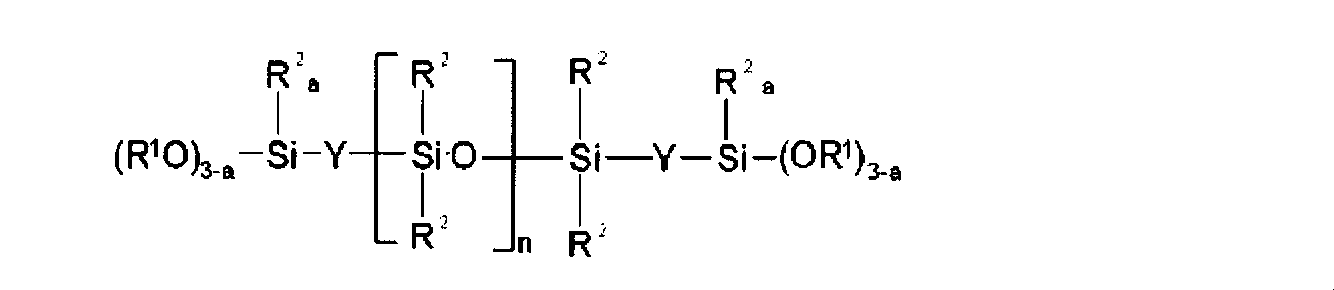
- the preferred component (A-1) is the general formula: It is a diorganopolysiloxane represented by.
- R1 is a hydrogen atom and a is 2.
- R2 is a group selected from a monovalent hydrocarbon group, a halogenated hydrocarbon group and a cyanoalkyl group, and is an alkyl group having 1 to 10 carbon atoms such as a methyl group, an ethyl group, a propyl group, a butyl group and an octyl group; Cycloalkyl groups such as cyclopentyl group and cyclohexyl group; alkenyl group such as vinyl group and allyl group; aryl group such as phenyl group, trill group and naphthyl group; aralkyl group such as benzyl group, phenylethyl group and phenylflopyl group; Halogenated hydrocarbon groups such as trifluoropropyl group and chloropropyl group
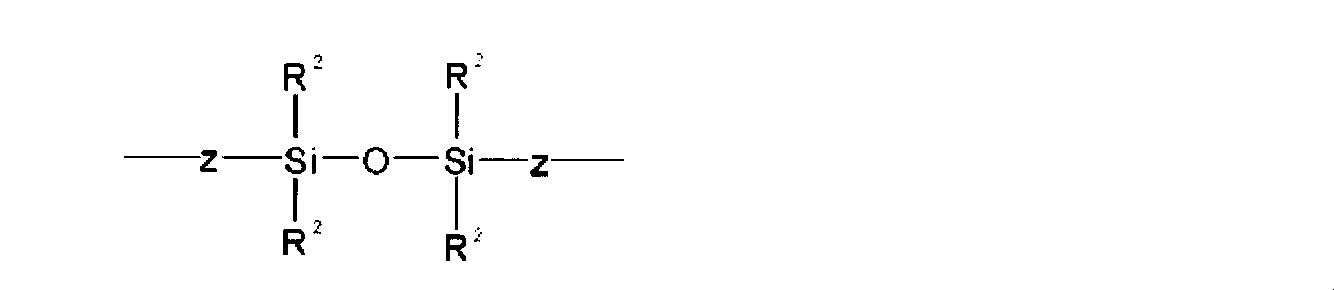
- Y is an oxygen atom, a divalent hydrocarbon group, or a general formula: (In the formula, R2 is the same as described above, and Z is a divalent hydrocarbon group.).
- the divalent hydrocarbon group is preferably an alkylene group having 1 to 10 carbon atoms such as a methylene group, an ethylene group, a propylene group, a butylene group and a hexene group.
- n is a number such that the viscosity at 25 ° C. is 20 to 1,000,000 mPa ⁇ s.
- the component (A-1) can be produced by a well-known method, for example, the method described in Japanese Patent Application Laid-Open No. 3-4566 and Japanese Patent Application Laid-Open No. 63-270762.
- the component (A-2) has a function of lowering the modulus of the silicone elastomer which is a cured product of the composition of the present invention and improving the adhesiveness to a poorly adhesive substrate.
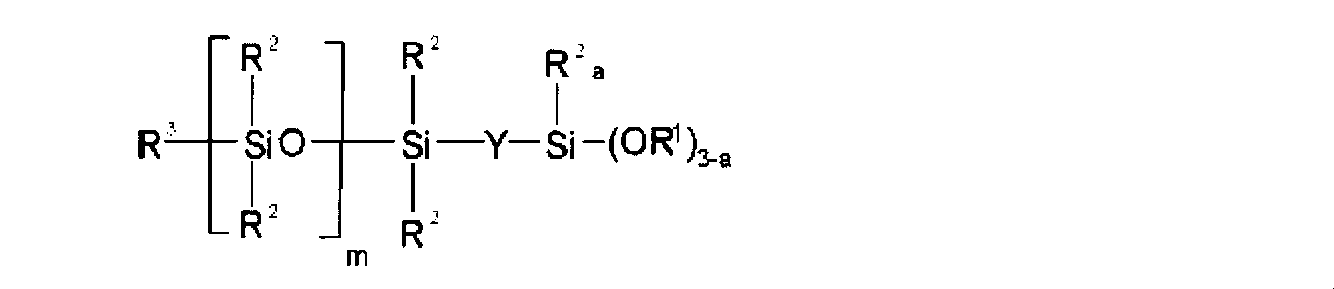
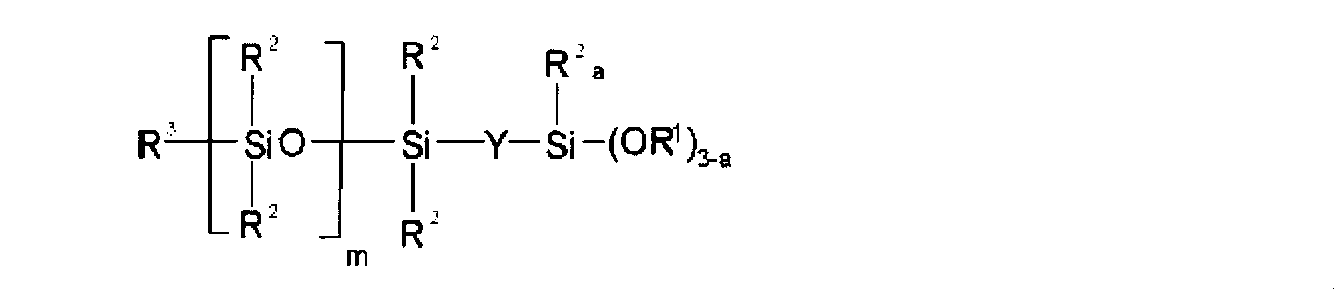
- a preferable component (A-2) the general formula: It is a diorganopolysiloxane represented by.
- R1, R2, Y, and a are the same as described above, and R3 is an alkyl group having 1 to 10 carbon atoms such as a methyl group, an ethyl group, a propyl group, a butyl group, and an octyl group; a vinyl group and an allyl group.
- Etc. preferably an alkyl group having 1 to 10 carbon atoms, and more preferably a methyl group.
- m represents a number such that the viscosity at 25 ° C. is 20 to 1,000,000 mPa ⁇ s.
- the component (A-2) can be produced by a well-known method, for example, the method described in JP-A-4-13767 and JP-A-63-270762.
- the diorganopolysiloxane, which is the component (A) does not reduce the amount of low molecular weight siloxane oligomers (octamethyltetrasiloxane (D4), decamethylpentasiloxane (D5)) from the viewpoint of preventing contact failure. It is preferably removed.
- the component (B) is the main component of the liquid component of the curable organopolysiloxane composition (II), and if necessary, the component (B-1) is a diorganopolysiloxane in which both ends of the molecular chain are sealed with an alkoxysilyl group.
- B-2 A mixture of diorganopolysiloxane diorganopolysiloxane in which only one end of the molecular chain is sealed with an alkoxysilyl group may be used.
- the viscosity of the component (B) is too low, the strength of the silicone elastomer after curing is low, and if it is too high, the workability during manufacturing and use is lowered, so that the viscosity at 25 ° C. is 20 to 1,000. It is preferably in the range of 000 mPa ⁇ s, and more preferably in the range of 100 to 200,000 mPa ⁇ s.
- the component (B) is the component (B-1) and the component (B). -2) In the case of a mixture of components, the above viscosity is the viscosity of the mixture.
- the preferred component (B-1) is the general formula: It is a diorganopolysiloxane represented by.
- R1 is an alkyl group having 1 to 10 carbon atoms such as a methyl group, an ethyl group, a propyl group, a butyl group and an octyl group; an alkoxyalkyl group such as a methoxymethyl group, a methoxyethyl group, an ethoxymethyl group and an ethoxyethoxy group. It is a group selected from the groups, and is preferably a methyl group or an ethyl group.
- R2 is a group selected from a monovalent hydrocarbon group, a halogenated hydrocarbon group and a cyanoalkyl group, and is an alkyl group having 1 to 10 carbon atoms such as a methyl group, an ethyl group, a propyl group, a butyl group and an octyl group; Cycloalkyl groups such as cyclopentyl group and cyclohexyl group; alkenyl group such as vinyl group and allyl group; aryl group such as phenyl group, trill group and naphthyl group; aralkyl group such as benzyl group, phenylethyl group and phenylflopyl group; Halogenated hydrocarbon groups such as trifluoropropyl group and chloropropyl group; cyanoalkyl groups such as ⁇ -cyanoethyl group and ⁇ -cyanopropyl group are exemplified. Of these, it is preferably a
- Y is an oxygen atom, a divalent hydrocarbon group, or a general formula: (In the formula, R2 is the same as described above, and Z is a divalent hydrocarbon group.).
- the divalent hydrocarbon group is preferably an alkylene group having 1 to 10 carbon atoms such as a methylene group, an ethylene group, a propylene group, a butylene group and a hexene group.
- n is a number such that the viscosity at 25 ° C. is 20 to 1,000,000 mPa ⁇ s.
- the component (B-1) can be produced by a well-known method, for example, the method described in Japanese Patent Application Laid-Open No. 3-4566 and Japanese Patent Application Laid-Open No. 63-270762.
- the component (B-2) has a function of lowering the modulus of the silicone elastomer which is a cured product of the composition of the present invention and improving the adhesiveness to a poorly adhesive substrate.
- a preferable component (B-2) the general formula: It is a diorganopolysiloxane represented by.
- R1, R2, Y, and a are the same as described above, and R3 is an alkyl group having 1 to 10 carbon atoms such as a methyl group, an ethyl group, a propyl group, a butyl group, and an octyl group; a vinyl group and an allyl group.
- Etc. preferably an alkyl group having 1 to 10 carbon atoms, and more preferably a methyl group.
- m represents a number such that the viscosity at 25 ° C. is 20 to 1,000,000 mPa ⁇ s.
- the component is a well-known method, for example, JP-A-4-13767, JP-A-63-2. It can be produced by the method described in Japanese Patent Application Laid-Open No. 70762. From the viewpoint of preventing contact failure, the diorganopolysiloxane, which is the component (B), does not reduce the amount of low molecular weight siloxane oligomers (octamethyltetrasiloxane (D4), decamethylpentasiloxane (D5)). It is preferably removed.
- the component (C) is a component common to the above liquids (I) and (II), and is for imparting thermal conductivity to the present composition and the thermally conductive member obtained by curing the present composition. It is a thermally conductive filler.
- a component (C) was selected from the group consisting of pure metals, alloys, metal oxides, metal hydroxides, metal nitrides, metal carbides, metal silicates, carbons, soft magnetic alloys and ferrites. At least one kind of powder and / or fiber is preferable, and a metal powder, a metal oxide powder, a metal nitride powder, or a carbon powder is preferable.
- thermally conductive filler is surface-treated with a surface-treating agent such as alkoxysilane, which is a component (D) described later.
- a surface-treating agent such as alkoxysilane, which is a component (D) described later.
- the surface treatment does not necessarily have to be performed.
- Examples of pure metals include bismuth, lead, tin, antimony, indium, cadmium, zinc, silver, copper, nickel, aluminum, iron and metallic silicon. Alloys include alloys consisting of two or more metals selected from the group consisting of bismuth, lead, tin, antimony, indium, cadmium, zinc, silver, aluminum, iron and metallic silicon.
- Examples of the metal oxide include alumina, zinc oxide, silicon oxide, magnesium oxide, beryllium oxide, chromium oxide and titanium oxide.
- Examples of the metal hydroxide include magnesium hydroxide, aluminum hydroxide, barium hydroxide, and calcium hydroxide.
- metal nitride examples include boron nitride, aluminum nitride and silicon nitride.
- metal carbides include silicon carbide, boron carbide and titanium carbide.
- Metal silides include magnesium silicate, titanium silicate, zirconium silicate, tantalum silicate, niobium silicate, chromium silicate, tungsten silicate and molybdenum silicate.
- carbon examples of carbon include diamond, graphite, fullerene, carbon nanotube, graphene, activated carbon and amorphous carbon black.
- Fe-Si alloy, Fe-Al alloy, Fe-Si-Al alloy, Fe-Si-Cr alloy, Fe-Ni alloy, Fe-Ni-Co alloy, Fe-Ni-Mo alloy, Fe. -Co alloys, Fe—Si—Al—Cr alloys, Fe—Si—B alloys and Fe—Si—Co—B alloys can be mentioned.
- the ferrite include Mn-Zn ferrite, Mn-Mg-Zn ferrite, Mg-Cu-Zn ferrite, Ni-Zn ferrite, Ni-Cu-Zn ferrite and Cu-Zn ferrite.
- the component (C) is preferably silver powder, aluminum powder, aluminum oxide powder, zinc oxide powder, aluminum nitride powder or graphite.
- the present composition is preferably a metal oxide powder or a metal nitride powder, and in particular, aluminum oxide powder, zinc oxide powder, or aluminum nitride powder. It is preferable to have.
- the shape of the component (C) is not particularly limited, and examples thereof include a spherical shape, a needle shape, a disk shape, a rod shape, and an indefinite shape, and a spherical shape and an indefinite shape are preferable.
- the average particle size of the component (D) is not particularly limited, but is preferably in the range of 0.01 to 100 ⁇ m, and more preferably in the range of 0.01 to 50 ⁇ m.
- the component (C) is (C1) a plate-shaped boron nitride powder having an average particle size of 0.1 to 150 ⁇ m, and (C2) a granular or spherically formed boron nitride having an average particle size of 0.1 to 500 ⁇ m.
- it is a mixture of two or more kinds of spherical and crushed aluminum oxide powder having an average particle size of 0.01 to 50 ⁇ m.
- the filling efficiency is improved, and low viscosity and high thermal conductivity can be achieved.
- the content of the component (C) is preferably in the range of 400 to 3,500 parts by mass with respect to 100 parts by mass of the component (A) in the entire composition for each of the liquid (I) and the liquid (II). Is in the range of 600 to 3,000 parts by mass. That is, as a whole composition, the total of the components (C) in the liquid (I) and the liquid (II) may be in the range of 800 to 7000 parts by mass, and the total may be in the range of 1200 to 6000 parts by mass. It may be in the range of 2400 to 5500 parts by mass.
- the composition of the present invention preferably has a thermal conductivity of 2.0 W / mK or more, and the content of the component (C) is preferably in the range of 85 to 98% by mass of the entire composition. More preferably, it is in the range of ⁇ 95% by mass.
- the composition of the present invention has, as an optional component, an inorganic filler such as, for example, fumed silica, wet silica, pulverized quartz, titanium oxide, magnesium carbonate, zinc oxide, iron oxide, diatomaceous earth, carbon black and the like (“inorganic filling”). It is not completely prevented from blending an inorganic filler obtained by hydrophobically treating the surface of such an inorganic filler with an organic silicon compound (silazane, etc.), but the technical effect of the present invention is In particular, from the viewpoint of achieving both high thermal conductivity and gap fill property, it is preferable that the filler other than the component (C) is substantially not contained.
- the content of the filler other than the component (C) in the composition is preferably less than 1% by mass, and more preferably less than 0.5% by mass. Most preferably, the intentional addition amount of the filler other than the component (C) is 0.0% by mass in the composition.
- the present composition is blended with an organosilicon compound which is a surface treatment agent for the component (C) in the range of 0.1 to 2.0% by mass when the total component (C) of the present invention is 100% by mass. It is preferable that the component (C) is surface-treated with these components.
- the surface treatment step of the component (C) is optional, but from the viewpoint of realizing practical fluidity and gap fill property in the present composition, at least a part of the component (C) is surfaced, especially by the component (D).
- the process being processed is preferably exemplified.
- the component (D) is a surface treatment agent for the component (C), and is a component that improves the blending amount of the component (C) and also improves the viscosity and fluidity of the entire composition, and is practical as a whole composition. Sufficient fluidity and gap fillability can be achieved.
- a known organosilicon compound can be used without particular limitation, and in particular, a component (D1) described later: an alkoxysilane having an alkyl group having 6 or more carbon atoms in the molecule is included. Is preferable.
- At least a part of the component (D) and the component (E) may be an alkylalkoxysilane, and is preferable. That is, an alkylalkoxysilane such as an alkyltrialkoxysilane is a component that can be used as a component (D) and a part or all of the component (E), and both the component (D) and the component (E) are alkyl. Embodiments of alkoxysilanes are included in preferred embodiments of the present invention.
- organosilicon compounds are low molecular weight organosilicon compounds such as silane, silazane, siloxane, or the like, and organosilicon polymers or oligomers such as polysiloxane, polycarbosiloxane, or the like.
- An example of a preferred silane is a so-called silane coupling agent.
- silane coupling agents include alkyltrialkoxysilanes (methyltrimethoxysilane, vinyltrimethoxysilane, hexyltrimethoxysilane, octyltrimethoxysilane, decyltrimethoxysilane or the like), organic functionals, etc.
- Group-containing trialkoxysilanes such as glycidoxypropyltrimethoxysilane, epoxycyclohexylethyltrimethoxysilane, methacryloxypropyltrimethoxysilane, aminopropyltrimethoxysilane, or the like.
- Preferred siloxanes and polysiloxanes include hexamethyldisiloxane, 1,3-dihexyl-tetramethyldisiloxane, single-terminated polydimethylsiloxane, trialkoxysilyl single-ended dimethylvinyl single-terminated.
- Examples thereof include polydimethylsiloxane, trialkoxysilyl single-ended organic functional group single-ended polydimethylsiloxane, trialkoxysilyl double-ended polydimethylsiloxane, organic functional group double-ended polydimethylsiloxane, or the like. ..
- the number n of siloxane bonds is preferably in the range of 2 to 150.
- preferred silazanes are hexamethyldisilazane, 1,3-dihexyl-tetramethyldisilazane, or the like.
- An example of a preferred polycarbosiloxane is a polymer having a Si—C—C—Si bond in the polymer backbone.
- the silane coupling agent which is the component (D) has a general formula: R 1 (4-c) Si (OR 2 ) c It is represented by.
- R 1 is a monovalent hydrocarbon group, an epoxy group-containing organic group, a methacryl group-containing organic group, or an acrylic group-containing organic group.
- Examples of the monovalent hydrocarbon group of R 1 include linear alkyl groups such as methyl group, ethyl group, propyl group, butyl group, hexyl group and decyl group; branched chains such as isopropyl group, tertiary butyl group and isobutyl group.
- Cyclic alkyl group cyclic alkyl group such as cyclohexyl group; alkenyl group such as vinyl group, allyl group, butenyl group, pentenyl group, hexenyl group, heptenyl group; aryl group such as phenyl group, tolyl group, xsilyl group; benzyl group, Aralkyl groups such as phenethyl groups; substituted or unsubstituted monovalent hydrocarbon groups such as alkyl halides such as 3,3,3-trifluoropropyl group and 3-chloropropyl group are exemplified.
- the epoxy group-containing organic group of R4 includes a glycidoxyalkyl group such as 3-glycidoxypropyl group and 4-glycidoxybutyl group; 2- (3,4-epoxycyclohexyl) ethyl group and 3-.
- An epoxycyclohexylalkyl group such as a (3,4-epoxycyclohexyl) propyl group is exemplified.
- Examples of the methacryl group-containing organic group of R 1 include methacryloxyalkyl groups such as 3-methacryloxypropyl group and 4-methacryloxybutyl group.
- Examples of the acrylic group-containing organic group of R 1 include acryloxyalkyl groups such as 3-acryloxypropyl group and 4-acryloxysibutyl group.
- R 2 is an alkyl group, an alkoxyalkyl group, an alkenyl group, or an acyl group, and is exemplified.
- the alkyl group of R 2 include a linear alkyl group, a branched chain alkyl group, and a cyclic alkyl group similar to the above, and examples of the alkoxyalkyl group of R 2 include a methoxyethyl group and a methoxypropyl group.
- alkenyl group R 2 a vinyl group, an allyl group, butenyl group, pentenyl group, hexenyl group and the like
- the acyl group of R2 an acetyl group, octanoyl group are exemplified.
- c is an integer of 1 to 3, preferably 3.
- Examples of such a component (D) other than the component (D1) include methyltrimethoxysilane, methyltriethoxysilane, ethyltrimethoxysilane, n-propyltrimethoxysilane, butyltrimethoxysilane, and pentiltli.
- the component (D1) is a suitable component in the present composition and is an alkoxysilane having an alkyl group having 6 or more carbon atoms in the molecule.
- specific examples of the alkyl group having 6 or more carbon atoms include an alkyl group such as a hexyl group, an octyl group, a dodecyl group, a tetradecyl group, a hexadecyl group and an octadecyl group, and an aralkyl group such as a benzyl group and a phenylethyl group.
- an alkyl group having 6 to 20 carbon atoms is particularly preferable.
- an alkoxysilane having an alkyl group having less than 6 carbon atoms the effect of lowering the viscosity of the composition is insufficient, and the viscosity of the composition increases, so that the desired fluidity and gap fill property cannot be achieved. There is. Further, when an alkoxysilane having an alkyl group having 20 or more carbon atoms is used, the industrial supply property is inferior, and the compatibility may be lowered depending on the type of the component (A).
- the component (D1) has the following structural formula: Y n Si (OR) 4-n (In the formula, Y is an alkyl group having 6 to 18 carbon atoms, R is an alkyl group having 1 to 5 carbon atoms, and n is a number of 1 or 2).
- the alkoxysilane is represented by, and examples of the OR group include a methoxy group, an ethoxy group, a propoxy group, and a butoxy group, and a methoxy group and an ethoxy group are particularly preferable.
- n is 1, 2, or 3, and is particularly preferably 1.
- such a component (E1) is C 6 H 13 Si (OCH 3 ) 3 , C 8 H 17 Si (OC 2 H 5 ) 3 , C 10 H 21 Si (OCH 3 ) 3 , C.
- Examples include 11 H 23 Si (OCH 3 ) 3 , C 12 H 25 Si (OCH 3 ) 3 , C 14 H 29 Si (OC 2 H 5 ) 3, and the like, most preferably decyltrimethoxysilane.
- the component (D2) is a surface treatment agent having a hydrolyzable silyl group at one end of the molecular chain and having a polysiloxane structure, and the component (C) is preferably surface-treated with the component (D1). Then, by performing a surface treatment with the component (D2), even if a large amount of the heat conductive filler as the component (C) is blended, the deep curability and adhesiveness of the present composition are not impaired. In some cases, it may be possible to provide a multi-component curable organopolysiloxane composition in which the composition before curing has sufficient fluidity and gap fill property for practical use.
- the component (D2) is an organopolysiloxane having a hydrolyzable silyl group at the end of the molecular chain, and its structure is not particularly limited, but such a component (F) is described below.
- It is an organopolysiloxane represented by the general formula (1) or the general formula (2), or a mixture thereof.
- R 1 is an independently unsubstituted or substituted monovalent hydrocarbon group
- R 2 is independently a hydrogen atom, an alkyl group, an alkoxyalkyl group, an alkenyl group or an acyl group, and a is 5 to 250.
- Organopolysiloxane which is represented by (b is an integer of 1 to 3) and has a viscosity at 25 ° C. of less than 10 to 10,000 mP ⁇ s.
- the component (E) is a component having a function as a cross-linking agent and an adhesion promoter, and the above-mentioned alkyl trialkoxysilanes (methyltrimethoxysilane, vinyltrimethoxysilane, hexyltrimethoxysilane, octyltri) as the component (D). It is an alkylalkoxysilane such as methoxysilane, decyltrimethoxysilane, or the like) and one or more components selected from the following components (e1) to (e3), and is used in a harsh environment.
- (E1) A reaction mixture of an amino group-containing organoalkoxysilane and an epoxy group-containing organoalkoxysilane
- (E2) An organic compound having at least two alkoxysilyl groups in one molecule and containing a bond other than a silicon-oxygen bond between the silyl groups.
- the component (e1) is a reaction mixture of an amino group-containing organoalkoxysilane and an epoxy group-containing organoalkoxysilane.
- a component (e1) is a component for imparting initial adhesiveness to various base materials in contact during curing, particularly low temperature adhesiveness to an unwashed adherend.
- it may also act as a cross-linking agent.
- Such a reaction mixture is disclosed in Japanese Patent Publication No. 52-8854 and Japanese Patent Application Laid-Open No. 10-195085.
- alkoxysilane having an amino group-containing organic group constituting such a component (e1) examples include aminomethyltriethoxysilane, 3-aminopropyltrimethoxysilane, 3-aminopropyltriethoxysilane, and 3-aminopropylmethyldimethoxy.
- Silane, N- (2-aminoethyl) aminomethyltributoxysilane, N- (2-aminoethyl) -3-aminopropyltrimethoxysilane, N- (2-aminoethyl) -3-aminopropylmethyldimethoxysilane, 3-anilinopropyltriethoxysilane is exemplified.
- epoxy group-containing organoalkoxysilane examples include 3-glycidoxyprolyltrimethoxysilane, 3-glycidoxypropylmethyldimethoxysilane, 2- (3,4-epoxycyclohexyl) ethyltrimethoxysilane, and 2-( 3,4-Epoxycyclohexyl) ethylmethyldimethoxysilane is exemplified.
- the ratio of the alkoxysilane having an amino group-containing organic group to the alkoxysilane having an epoxy group-containing organic group is preferably in the range of (1: 1.5) to (1: 5) in terms of molar ratio. It is particularly preferable that it is in the range of (1: 2) to (1: 4).
- This component (e1) is easily synthesized by mixing an alkoxysilane having an amino group-containing organic group as described above and an alkoxysilane having an epoxy group-containing organic group and reacting them at room temperature or under heating. be able to.
- R 3 is the same or different hydrogen atom or alkyl group.
- R 3 is particularly preferable to contain a carbacilatran derivative represented by.
- Examples of such a carbasilatrane derivative include a silatran derivative having an alkenyl group and a silicon atom-bonded alkoxy group in one molecule represented by the following structure. (In the formula, Rc is a group selected from a methoxy group, an ethoxy group, a vinyl group, an allyl group and a hexenyl group)
- R 1 in the formula is the same or different hydrogen atom or alkyl group, and in particular, R 1 is preferably a hydrogen atom or a methyl group.
- R 2 in the above formula consists of a group consisting of a hydrogen atom, an alkyl group, and an alkoxysilyl group-containing organic group represented by the general formula: -R 4- Si (OR 5 ) x R 6 (3-x). The same or different groups of choice, except that at least one of R 2 is this alkoxysilyl group-containing organic group. Examples of the alkyl group of R 2 include a methyl group.
- alkoxysilyl group-containing organic groups of R 2 , R 4 in the formula is a divalent organic group, and an alkylene group or an alkyleneoxyalkylene group is exemplified, and in particular, an ethylene group, a propylene group, a butylene group, and a methyleneoxy group. It is preferably a propylene group or a methyleneoxypentylene group.
- R 5 in the formula is an alkyl group having 1 to 10 carbon atoms, preferably a methyl group or an ethyl group.
- R 6 in the formula is a substituted or unsubstituted monovalent hydrocarbon group, preferably a methyl group.
- x in the formula is 1, 2, or 3, preferably 3.
- Examples of such an alkoxysilyl group-containing organic group of R 2 include the following groups. -(CH2) 2Si (OCH3) 3- (CH2) 2Si (OCH3) 2CH3 -(CH2) 3Si (OC2H5) 3- (CH2) 3Si (OC2H5) (CH3) 2 -CH2O (CH2) 3Si (OCH3) 3 -CH2O (CH2) 3Si (OC2H5) 3 -CH2O (CH2) 3Si (OCH3) 2CH3 -CH2O (CH2) 3Si (OC2H5) 2CH3 -CH2OCH2Si (OCH3) 3-CH2OCH2Si (OCH3) (CH3) 2
- R 3 in the above formula is selected from the group consisting of a substituted or unsubstituted monovalent hydrocarbon group, an alkoxy group having 1 to 10 carbon atoms, a glycidoxyalkyl group, an oxylanylalkyl group, and an asyloxyalkyl group.
- Examples of the glycidoxyalkyl group of R 3 include a 3-glycidoxypropyl group, and examples of the oxylanylalkyl group of R 3 include a 4-oxylanylbutyl group and an 8-oxylanyloctyl group.
- Examples of the asyloxyalkyl group of R 3 include an acetoxypropyl group and a 3-methacryloxypropyl group.
- R 3 is preferably an alkyl group, an alkenyl group, or an alkoxy group, more preferably an alkyl group or an alkenyl group, and a group selected from a methyl group, a vinyl group, an allyl group, and a hexenyl group. Is particularly preferably exemplified.
- the component (e2) is an organic compound having at least two alkoxysilyl groups in one molecule and containing a bond other than a silicon-oxygen bond between the silyl groups, and can provide initial adhesiveness by itself. In addition to improving, when used in combination with the above-mentioned components (e1) and (e3), it works to improve the adhesion durability of a cured product containing the present adhesion accelerator under harsh conditions.
- the component (e2) has the following general formula: (Wherein, R C is an alkylene group of a substituted or unsubstituted carbon atoms 2 ⁇ 20, R D are each independently an alkyl group or an alkoxyalkyl group, R E are each independently a monovalent hydrocarbon radical , And b is independently 0 or 1, respectively.)
- the disilaalkyl compound represented by) is suitable.
- Various compounds of such a component (e2) are commercially available as reagents and products, and if necessary, they can be synthesized by a known method such as a Grignard reaction or a hydrosilylation reaction. For example, it can be synthesized by a well-known method of hydrosilylating a diene with a trialkoxysilane or an organodialkoxysilane.
- R E is a methyl group, an ethyl group, an alkyl group such as propyl; alkenyl groups such as vinyl and allyl group; a monovalent hydrocarbon group exemplified by an aryl group such as a phenyl group, a lower alkyl group Is preferable.
- RD is an alkyl group such as a methyl group, an ethyl group or a propyl group; an alkoxyalkyl group such as a methoxyethyl group, preferably having 4 or less carbon atoms.
- RC is a substituted or unsubstituted alkylene group, and a linear or branched alkylene group is used without limitation, and a mixture thereof may be used. From the viewpoint of improving adhesiveness, a linear and / or branched alkylene group having 2 to 20 carbon atoms is preferable, and a linear and / or branched alkylene group having 5 to 10 carbon atoms, particularly a branched chain alkylene group, has a carbon number of 5 to 10. Hexylene of 6 is preferred.
- the unsubstituted alkylene group is a butylene group, a pentylene group, a hexylene group, a heptylene group, an octylene group, a nonylene group, a decylene group or a branched chain form thereof, and the hydrogen atom thereof is a methyl group, an ethyl group, a propyl group or a butyl group.
- Cyclopentyl group, cyclohexyl group, vinyl group, allyl group, 3,3,3-trifluoropropyl group and 3-chloropropyl group may be substituted.
- component (e2) examples include bis (trimethoxysilyl) ethane, 1,2-bis (trimethoxysilyl) ethane, 1,2-bis (triethoxysilyl) ethane, and 1,2-bis (methyldimethoxy).
- 1,6-bis (trimethoxysilyl) hexane 1,6-bis (triethoxysilyl) hexane, 1,4-bis (trimethoxysilyl) hexane, 1,5-bis ( Trimethoxysilyl) hexane, 2,5-bis (trimethoxysilyl) hexane, 1-methyldimethoxysilyl-6-trimethoxysilyl hexane, 1-phenyldiethoxysilyl-6-triethoxysilyl hexane, 1,6-bis (Methyldimethoxysilyl) hexane can be exemplified.
- the component (e3) has a general formula: R a n Si (OR b) 4-n (In the formula, Ra is a monovalent epoxy group-containing organic group, R b is an alkyl group or a hydrogen atom having 1 to 6 carbon atoms, and n is a number in the range of 1 to 3.) It is an epoxy group-containing silane represented by (1) or a partially hydrolyzed condensate thereof.
- the present adhesion promoter can be used in combination with the above-mentioned components (e1) and (e2). It works to improve the adhesive durability of the contained cured product under harsh conditions such as immersion in salt water.
- the component (e3) is one of the constituent components of the component (e1), but is different from the component (e1) which is a reaction product (typically, a carbaciratlan derivative which is a cyclized reaction product). It is necessary that the mass ratio is in a specific range from the viewpoint of the technical effect of the invention, and it is necessary to add it as a component separate from the component (e1).
- a reaction product typically, a carbaciratlan derivative which is a cyclized reaction product
- Examples of such an epoxy group-containing silane include 3-glycidoxyprolyltrimethoxysilane, 3-glycidoxypropylmethyldimethoxysilane, 2- (3,4-epoxycyclohexyl) ethyltrimethoxysilane, and 2- (3). , 4-Epoxycyclohexyl) Ethylmethyldimethoxysilane is exemplified.
- the blending amount of the component (E) is not limited, but the mass of the component (E) is 0.5 to 20% by mass in the curable organopolysiloxane composition from the viewpoint of its function as an adhesion accelerator and a cross-linking agent. It may be in the range, and preferably contains 1.0 to 10% by mass, particularly 1.0 to 5.0% by mass.
- the alkylalkoxysilane is a component that also functions as a surface treatment agent that is the component (D).
- the alkylalkoxysilane is added as the above component (D) in a step different from the surface treatment of the component (C).
- Alkoxyalkoxysilane may be blended in a larger amount than the amount used as the above-mentioned surface treatment agent.
- the component (F) is a condensation reaction catalyst having a catalytic amount, and promotes and cures the above-mentioned organopolysiloxane for the condensation reaction.
- a component (F) include tin compounds such as dimethyltin dineodecanoate and stanas octoate; tetra (isopropoxy) titanium, tetra (n-butoxy) titanium, and tetra (t-butoxy).
- Titanium compounds such as titanium, di (isopropoxy) bis (ethylacetacetate) titanium, di (isopropoxy) bis (methylacetacetate) titanium, and di (isopropoxy) bis (acetylacetonate) titanium are exemplified.
- the amount used is the amount of catalyst and can be appropriately selected according to the desired curing conditions, but is generally in the range of 0.01 to 5 parts by mass with respect to a total of 100 parts by mass of the organopolysiloxane in the entire composition. Is.
- aminoalkylmethoxysilanes include aminomethyltriethoxysilane, 3-aminopropyltrimethoxysilane, 3-aminopropyltriethoxysilane, 3-aminopropylmethyldimethoxysilane, and N- (2-aminoethyl) aminomethyltributoxysilane.
- N- (2-aminoethyl) -3-aminopropyltrimethoxysilane, N- (2-aminoethyl) -3-aminopropylmethyldimethoxysilane, 3-anilinopropyltriethoxysilane are exemplified.
- the composition of the present invention preferably further contains a heat resistance imparting agent from the viewpoint of improving the heat resistance of the multi-component curable organopolysiloxane composition after mixing and the cured product thereof.
- This component may be blended in either solution (I) or solution (II), and when the composition is designed to have three or more components, it may be added as an independent component. Good.
- the component is not particularly limited as long as it can impart heat resistance to the composition of the present invention and its cured product, but for example, metal oxides such as iron oxide, titanium oxide, cerium oxide, magnesium oxide and zinc oxide, and water.
- Examples thereof include metal hydroxides such as cerium oxide, phthalocyanine compounds, cerium silanolate, cerium fatty acid salts, and reaction products of organopolysiloxane and cerium carboxylate.
- it is a phthalocyanine compound, and for example, an additive selected from the group consisting of a metal-free phthalocyanine compound and a metal-containing phthalocyanine compound disclosed in JP-A-2014-503680 is preferably used, and a metal-containing phthalocyanine is preferably used.
- copper phthalocyanine compounds are particularly suitable.
- phthalocyaninato (2-) -N29, N30, N31, N32 copper is 29H, 31H-phthalocyaninato (2-) -N29, N30, N31, N32 copper.
- phthalocyanine compounds are commercially available, for example, Stan-tone TM 40SP03 from PolyOne Corporation (Avon Lake, Ohio, USA).
- the blending amount of such a heat resistance imparting agent may be in the range of 0.01 to 5.0% by mass of the entire composition, 0.05 to 0.2% by mass, and 0.07 to 0. It may be in the range of 1% by mass.
- any component can be blended as long as the object of the present invention is not impaired.
- the optional component include a cold resistance imparting agent, a flame retardant imparting agent, a pigment, a dye and the like.
- the multi-component curable organopolysiloxane composition of the present invention comprises, if desired, a known adhesive-imparting agent, a cationic surfactant, an anionic surfactant, a nonionic surfactant, or the like.
- More than one kind of antistatic agent; dielectric filler; electrically conductive filler; mold releasable component; thixo property imparting agent; antifungal agent and the like can be contained. Further, if desired, an organic solvent may be added. These additives may be blended in either solution (I) or solution (II), and when the composition is designed to have three or more components, they may be added as independent components. Good.
- the composition may include, for example, quartz fine powder, calcium carbonate fine powder, diatomaceous earth fine powder, aluminum hydroxide fine powder, alumina fine powder, hydroxide as any other components.
- quartz fine powder, calcium carbonate fine powder, diatomaceous earth fine powder, aluminum hydroxide fine powder, alumina fine powder, hydroxide as any other components.
- the multi-component curable organopolysiloxane composition of the present invention can be prepared by mixing each of the above components.
- the component (A), the component (C), and any other components can be prepared. It can be prepared by mixing the components. Further, it can be adjusted by mixing the component (C) and the component (D) as needed, treating the surface of the component (C) with the component (D), and then mixing the component (A).
- the surface of the component (C) is treated with the component (D), and then the component (E) and the component (F) are treated.
- the component (G) can be prepared by mixing the component (G), as well as any other component.
- the mixing method of each component is not particularly limited by a conventionally known method, but it is usually preferable to mix using a mixing device because a uniform mixture can be obtained by simple stirring.
- a mixing device is not particularly limited, and examples thereof include a uniaxial or biaxial continuous mixer, a double roll, a loss mixer, a hobert mixer, a dental mixer, a planetary mixer, a kneader mixer, and a Henschel mixer.
- the multi-component curable organopolysiloxane composition of the present invention is a multi-component curable type (including a multi-component type, particularly a two-component type) in which the separated multi-components are mixed at the time of use, and is stored individually.
- a plurality of compositions to be prepared can be mixed and used in a predetermined ratio.
- These packages can be selected as desired according to the curing method, coating means, and application target described later, and are not particularly limited.
- the curable organopolysiloxane composition according to the present invention is a condensation-reactive and room temperature curable composition, and is 60 ° C. or lower, preferably 50 ° C. or lower, more preferably room temperature (25 ° C.) in the presence of moisture.
- An organopolysiloxane cured product can be formed by a curing reaction mainly consisting of a condensation reaction (particularly dehydration condensation, deoxime condensation or dealcohol condensation) accompanied by a hydrolysis reaction in a temperature range of about 50 ° C.
- the curing process is not particularly limited, but after mixing each component, it is rapidly cured to a deep part by contact with moisture in the air in a temperature range of 15 to 50 ° C.
- the curable organopolysiloxane composition according to the present invention can stably and highly fill the thermally conductive filler, and is 2.0 W / mK or more, preferably 3.5 W / mK or more, more preferably. It has a thermal conductivity of 4.0 W / mK or higher, particularly preferably 5.0 W / mK.
- a composition of 4.0 to 7.0 W / mK and an organopolysiloxane cured product can be designed, and the above-mentioned deep curability and member / group can be designed. It is possible to realize high adhesiveness to the material (curing adhesiveness).
- the curable organopolysiloxane composition of the present invention is a heat transfer material (heat transfer material) that is interposed at the interface between the thermal interface of the heat-generating component and the heat-dissipating member such as a heat sink or a circuit board for cooling the heat-generating component by heat conduction. It is useful as a heat conductive member), and a heat radiating structure equipped with this can be formed.
- the type, size, and detailed structure of the heat-generating component are not particularly limited, but the curable organopolysiloxane composition of the present invention has high thermal conductivity and is deep in the cured product.
- It has excellent curability, adhesion to members, and gap fillability, and has high adhesion and followability to heat-generating members having fine irregularities and narrow gap structures without causing the problem of poor curing. Since it also has the flexibility peculiar to a silicone material, it is suitably applied to a heat radiating structure of an electric / electronic device including an electric / electronic component or a cell type secondary battery.
- the structure of such a heat radiating structure is not particularly limited, but the heat radiating component or the circuit board on which the heat radiating component is mounted is subjected to the heat radiating member via the curable organopolysiloxane composition or the cured product thereof.
- An example is a heat dissipation structure provided with.
- an electronic component which is a heat-dissipating component is mounted on a circuit board, and heat generated from the electronic component is dissipated through a curable organopolysiloxane composition or a thin film layer of the cured product.
- the structure in which heat is dissipated is illustrated, and these members are arranged in the horizontal direction, and the curable organopolysiloxane composition or the thin film layer of the cured product is vertically sandwiched between the circuit board and the heat dissipation member.
- the circuit on the circuit board and the electronic component may be electrically connected to each other, and a via hole may be formed in the circuit board in order to efficiently transfer heat generated from the electronic component.
- the curable organopolysiloxane composition or the cured product thereof is sandwiched between the circuit board and the heat radiating member, and the thickness thereof is not particularly limited, but is in the range of 0.1 to 2 mm. Even so, the heat generated from the electronic component filled with the composition without gaps can be efficiently transferred to the heat radiating member without slipping off.
- the electric / electronic device provided with the curable organopolysiloxane composition or a member made of the cured product thereof is not particularly limited, and for example, a cell type lithium ion electrode secondary battery and a cell stack type fuel.
- Secondary batteries such as batteries; Electronic circuit boards such as printed boards; IC chips in which optical semiconductor devices such as diodes (LEDs), organic electric field elements (organic EL), laser diodes, and LED arrays are packaged; personal computers, CPUs used in electronic devices such as digital video disks, mobile phones, and smartphones; LSI chips such as driver ICs and memories are exemplified.
- heat removal is a major factor for the performance and reliability of the integrated circuit, but the thermal conductivity according to the present invention.
- the curable organopolysiloxane composition or the heat conductive member made of the cured product of the above has heat dissipation property even when applied to power semiconductor applications such as engine control in transport machines, power train systems, and air conditioner control. It is also excellent in handling workability, and can realize excellent heat resistance and thermal conductivity even when it is incorporated into an in-vehicle electronic component such as an electronic control unit (ECU) and used in a harsh environment.
- ECU electronice control unit
- the curable organopolysiloxane composition according to the present invention is excellent in deep curability and curable adhesiveness / adhesion, so that it can be suitably arranged not only on a horizontal surface but also on an inclined surface or a vertical surface. It is possible to provide a heat-dissipating structure without gaps by invading the fine structures of heat-generating parts such as electric / electronic parts and secondary batteries. As a result, it does not easily slip off even if it is left vertically in a harsh temperature environment, and is therefore suitable as a heat radiating member and a protective material for an automobile control unit.
- the heat dissipation of electrical and electronic equipment equipped with the heat dissipation structure is improved, the problems of latent heat and thermal runaway are improved, and the heat conductive organopolysiloxane curing that has both flexibility and constant hardness.
- objects can protect the partial structure of electrical and electronic equipment and improve its reliability and operational stability.
- the material constituting the above electric / electronic device examples include resins, ceramics, glass, metals such as aluminum, and the like.
- the curable organopolysiloxane composition of the present invention can be a curable organopolysiloxane composition (fluid) in which each component is mixed before curing, or a thermally conductive organopolysiloxane cured product (curing reaction) after the curing reaction. As a product), it can be applied to these base materials and used.
- the method for forming a heat-dissipating structure using the curable organopolysiloxane composition of the present invention is not limited.
- the curable organopolysiloxane composition of the present invention is applied to the heat-dissipating portion. Examples thereof include a method of curing this composition by pouring, sufficiently filling the gaps, and then leaving the composition at room temperature. Since the curable organopolysiloxane composition according to the present invention is particularly excellent in deep curability and curing adhesion / adhesion, stable thermal conductivity organopolysiloxane curing does not cause a problem of curing failure. An object can be provided, and a heat dissipation structure having excellent heat dissipation effect and heat dissipation efficiency can be formed without creating a gap between the member and the heat dissipation target member.
- the curable organopolysiloxane composition of the present invention is cured in the presence of humidity at 60 ° C. or lower, preferably at room temperature (25 ° C.) to 50 ° C. to form a thermally conductive organopolysiloxane cured product. It is possible and the conditions required for curing depend on the temperature and humidity, but in the case of about 25 ° C.-RH (relative humidity) of about 50%, it is generally in the range of several hours to several days.
- the cured organopolysiloxane may continue to be deeply cured in the presence of moisture, but the curable organopolysiloxane composition of the present invention is rapidly cured to the deep part after mixing each component.
- a cured product having excellent adhesion / adhesiveness to a member to be dissipated is formed without causing the problem of poor curing.
- the shape, thickness, arrangement, etc. of the organopolysiloxane cured product obtained by the above curing can be designed as desired, and may be cured as necessary after being filled in the gaps between electrical and electronic devices, and peeled off. It may be applied or cured on a film provided with a layer (separator) and handled alone as a sheet-shaped cured organopolysiloxane. Further, in that case, it may be in the form of a heat conductive sheet reinforced with a known reinforcing material.
- the curable organopolysiloxane composition of the present invention has sufficient fluidity and gap fill property for practical use, and is excellent in adhesion / adhesion to a member to be radiated without causing a problem of curing failure due to deep curing. Since a thermally conductive member made of an organopolysiloxane cured product that is flexible and has excellent thermal conductivity is formed, the gap between electrodes, electrical elements and electric elements, electric elements and packages, etc. in electric / electronic parts is narrow.
- the cured organopolysiloxane of the present invention has high deep curability and excellent curing adhesion to the heat-dissipating target member, and thus has an advantage that the heat-dissipating efficiency of these electric / electronic devices can be remarkably improved.
- Examples 1 to 6 relate to a thermally conductive two-component curable organopolysiloxane composition, and these compositions have room temperature curability.
- a frame having a height of 15 mm, a length of 100 mm, and a width of 50 mm was created on a polypropylene sheet using a polyethylene backer, and the obtained composition was filled therein so that the Teflon (registered trademark) sheet was smoothed on the frame. It was pressed and cured as it was in an atmosphere of 25 ° C. for 1 day. After curing, the Teflon (registered trademark) sheet and the polyethylene backer were removed, and the mixture was further cured in an atmosphere of 25 ° C. for 6 days to obtain a thermally conductive organopolysiloxane cured product.
- the curable organopolysiloxane composition obtained by the number of copies shown in Examples 1 to 6 and Comparative Examples 1 to 3 contains the component (D) so as to obtain a thermal conductivity of 3.5 W / mK.
- This thermal conductivity is a value measured by the hot disk method using TPS-500S manufactured by Kyoto Electronics Industry Co., Ltd.
- the viscosity (Pa ⁇ s) of the curable organopolysiloxane composition at 25 ° C. was measured using a viscometer (Leocompass MCR102 manufactured by Anton Pearl Co., Ltd.). For the geometry, a parallel plate having a diameter of 20 mm was used, and the value of shear rate 10.0 (1 / s) was measured with a gap of 600 ⁇ m.
- the viscosity is a value measured by a rotational viscometer at 25 ° C.
- the components (b1-1) to (b1-3) are dimethylsiloxane (viscosity 400 mPa ⁇ s) in which both ends of the molecular chain are sealed with dimethylvinylsiloxy groups, and 0.8 per vinyl group. It is a mixture obtained by preparing the following alkoxysilyl-containing siloxane by
- E-1 Decyltrimethoxysilane
- E-2 1,6-bis (trimethoxysilyl) hexane
- E-3 Alkoxysilane having an amino group-containing organic group and an epoxy group-containing organic group represented by the following formula. Cyclic condensation reaction product with alkoxysilane having
- Example 1 Weigh 90.9 parts by mass of component (A-1) and 9.1 parts by mass of component (A-2), and take 60 minutes to measure 173 parts by mass of component (C-1) and 191 parts of component (C-2). By mass and 464 parts by mass of the component (C-3) were sequentially mixed. After homogenization, the mixture was mixed under reduced pressure for 30 minutes to obtain a liquid (I) of a curable organopolysiloxane composition.
- the solutions (I) and (II) of the curable organopolysiloxane composition were cured at 25 ° C. for 1 day, and then the viscosities of the respective solutions were measured with a viscometer (Leocompass MCR102 manufactured by Anton Pearl Co., Ltd.). After mixing the liquid (I) and the liquid (II) with the same mass, the viscosity, pot life, and adhesiveness were measured.
- Example 2 [Example 2] (I) of the curable organopolysiloxane composition in the same manner as in Example 1 except that 0.91 part by mass of the component (G-1) was added to the solution (II) of the curable organopolysiloxane composition of Example 1. A liquid and a liquid (II) were obtained, and the viscosity of each liquid was measured. Further, after mixing the liquid (I) and the liquid (II) with the same mass, the viscosity, pot life, and adhesiveness were measured.
- Example 3 Curable organopoly as in Example 1 except that the component (E-1) of the liquid (II) solution of the curable organopolysiloxane composition of Example 1 was replaced with 11.8 parts by mass of the component (E-2). Liquids (I) and (II) of the siloxane composition were obtained, and the viscosities of each liquid were measured. Further, after mixing the liquid (I) and the liquid (II) with the same mass, the viscosity, pot life, and adhesiveness were measured.
- Example 4 (I) of the curable organopolysiloxane composition in the same manner as in Example 3 except that 0.91 part by mass of the component (G-1) was added to the solution (II) of the curable organopolysiloxane composition of Example 3. A liquid and a liquid (II) were obtained, and the viscosity of each liquid was measured. Further, after mixing the liquid (I) and the liquid (II) with the same mass, the viscosity, pot life, and adhesiveness were measured.
- Example 5 Curable organopoly as in Example 1 except that the component (E-1) of the liquid (II) solution of the curable organopolysiloxane composition of Example 1 was replaced with 11.8 parts by mass of the component (E-3). Liquids (I) and (II) of the siloxane composition were obtained, and the viscosities of each liquid were measured. Further, after mixing the liquid (I) and the liquid (II) with the same mass, the viscosity, pot life, and adhesiveness were measured.
- Example 6 (I) of the curable organopolysiloxane composition in the same manner as in Example 5 except that 0.91 part by mass of the component (G-1) was added to the solution (II) of the curable organopolysiloxane composition of Example 5. A liquid and a liquid (II) were obtained, and the viscosity of each liquid was measured. Further, after mixing the liquid (I) and the liquid (II) with the same mass, the viscosity, pot life, and adhesiveness were measured.
- [Comparative Example 2] Weigh 90.9 parts by mass of component (A-1) and 9.1 parts by mass of component (A-2), and take 60 minutes to measure 173 parts by mass of component (C-1) and 191 parts of component (C-2). A mass portion and a mass portion of 464 parts by mass of the component (C-3) were sequentially mixed. After homogenization, 11.8 parts by mass of component (E-1), 0.091 parts by mass of component (F-1), 0.91 parts by mass of component (G-1), and 2.3 parts by mass of pigment were added to this mixture. The parts were uniformly mixed to obtain a curable organopolysiloxane composition curable at room temperature. When the room temperature curable organopolysiloxane composition was cured at 25 ° C. for 1 day, it had already been cured, so that the characteristics could not be evaluated.
- the two-component organopolysiloxane compositions according to Examples 1 to 6 have a practically sufficient pot life and fluidity of 30 minutes or more, and the adhesive strength can be increased after one day regardless of whether the thickness is 100 ⁇ m or 1 mm. A measurable amount of cured organopolysiloxane was given, and after 7 days, even higher adhesive strength was given. From this, the compositions according to Examples 1 to 6 realize sufficient deep curability in a relatively short period of time even when applied thickly, and have high adhesiveness (curing adhesion). It was confirmed that the cured product was provided and could achieve high thermal conductivity (3.5 W / mK in the present invention).
- Comparative Example 2 the one-component compositions of Comparative Examples 1 to 3 cannot realize a sufficient pot life (Comparative Example 2), or have insufficient deep curability and adhesiveness, especially at a thickness of 1 mm. In the case of coating, it was not possible to obtain an organopolysiloxane cured product having a measurable adhesive strength by the above method even after 7 days (Comparative Example 1 and Comparative Example 3).
Landscapes
- Chemical & Material Sciences (AREA)
- Chemical Kinetics & Catalysis (AREA)
- Medicinal Chemistry (AREA)
- Polymers & Plastics (AREA)
- Organic Chemistry (AREA)
- Health & Medical Sciences (AREA)
- Compositions Of Macromolecular Compounds (AREA)
- Engineering & Computer Science (AREA)
- Materials Engineering (AREA)
- Cooling Or The Like Of Semiconductors Or Solid State Devices (AREA)
- Physics & Mathematics (AREA)
- Computer Hardware Design (AREA)
- Microelectronics & Electronic Packaging (AREA)
- Power Engineering (AREA)
- General Physics & Mathematics (AREA)
- Condensed Matter Physics & Semiconductors (AREA)
Abstract
Description
(A)分子鎖末端がヒドロキシシリル基で封鎖された25℃における粘度が20~1,000,000mPa・sであるジオルガノポリシロキサン 100重量部、
(B)分子鎖末端がアルコキシシリル基で封鎖された25℃における粘度が20~1,000,000mPa・sであるジオルガノポリシロキサン、(A)成分100質量部に対して50~200質量部、
(C)熱伝導性充填剤 400~3,500質量部、
(D)成分(C)の表面処理剤である有機ケイ素化合物 成分(C)に対して0.1~2.0質量%となる量、
(E)
アルキルアルコキシシランおよび以下の成分(e1)~(e3)から選ばれる1種類以上の成分
(e1) アミノ基含有オルガノアルコキシシランとエポキシ基含有オルガノアルコキシシランとの反応混合物、
(e2) 一分子中に少なくとも二つのアルコキシシリル基を有し,かつそれらのシリル基の間にケイ素-酸素結合以外の結合が含まれている有機化合物、
(e3) 一般式:
Ra nSi(ORb)4-n
(式中、Raは一価のエポキシ基含有有機基であり、Rbは炭素原子数1~6のアルキル基または水素原子である。nは1~3の範囲の数である)
で表されるエポキシ基含有シランまたはその部分加水分解縮合物、および
(F)触媒量の縮合反応用触媒
を含有してなり、個別に保存される以下の(I)液および(II)液を少なくとも含むことを特徴とする、多成分型の硬化性オルガノポリシロキサン組成物により、上記課題を解決できる事を見出し、本発明に到達した。なお、成分(D)と成分(E)は同一の成分であっても異なる成分であってもよく、成分(D)および成分(E)の少なくとも一部がアルキルアルコキシシランであってよい。
(I)液: 成分(A)および成分(C)を含み、成分(D)は任意で選択可能であり、成分(B)、(E)、(F)を含まない組成物
(II)液:成分(B)、(C)、(D)、(E)および(F)を含み、成分(A)を含まない組成物
[1]
(A)分子鎖末端がヒドロキシシリル基で封鎖された25℃における粘度が20~1,000,000mPa・sであるジオルガノポリシロキサン 100重量部、
(B)分子鎖末端がアルコキシシリル基で封鎖された25℃における粘度が20~1,000,000mPa・sであるジオルガノポリシロキサン、(A)成分100質量部に対して50~200質量部、
(C)熱伝導性充填剤 400~3,500質量部、
(D)成分(C)の表面処理剤である有機ケイ素化合物 成分(C)に対して0.1~2.0質量%となる量、
(E)アルキルアルコキシシランおよび以下の成分(e1)~(e3)から選ばれる1種類以上の成分
(e1) アミノ基含有オルガノアルコキシシランとエポキシ基含有オルガノアルコキシシランとの反応混合物、
(e2) 一分子中に少なくとも二つのアルコキシシリル基を有し,かつそれらのシリル基の間にケイ素-酸素結合以外の結合が含まれている有機化合物、
(e3) 一般式:
Ra nSi(ORb)4-n
(式中、Raは一価のエポキシ基含有有機基であり、Rbは炭素原子数1~6のアルキル基または水素原子である。nは1~3の範囲の数である)
で表されるエポキシ基含有シランまたはその部分加水分解縮合物、および
(F)触媒量の縮合反応用触媒
を含有してなり、個別に保存される以下の(I)液および(II)液を少なくとも含むことを特徴とする、多成分型の硬化性オルガノポリシロキサン組成物。
(I)液: 成分(A)および成分(C)を含み、成分(D)は任意で選択可能であり、成分(B)、(E)、(F)を含まない組成物
(II)液:成分(B)、(C)、(D)、(E)および(F)を含み、成分(A)を含まない組成物
[2] さらに、(G)アミノアルキルメトキシシランを含有する、[1]に記載の硬化性オルガノポリシロキサン組成物。
[3] 成分(D)の少なくとも一部が、アルキルアルコキシシランであることを特徴とする、[1]~[2]のいずれか1項に記載の硬化性オルガノポリシロキサン組成物。
[4] 成分(D)および成分(E)の少なくとも一部が、アルキルアルコキシシランであることを特徴とする、[1]~[3]のいずれか1項に記載の硬化性オルガノポリシロキサン組成物。
[5] 室温硬化性であり、硬化により、熱伝導性オルガノポリシロキサン硬化物を形成することを特徴とする、
[1]~[4]のいずれか1項に記載の硬化性オルガノポリシロキサン組成物。
[6] [1]~[5]のいずれか1項に記載の硬化性オルガノポリシロキサン組成物またはその硬化物からなる熱伝導性部材。
[7] [6]に記載の熱伝導性部材を備えた放熱構造体。
[8] 放熱部品または該放熱部品を搭載した回路基板に、[1]~[5]のいずれか1項に記載の硬化性オルガノポリシロキサン組成物またはその硬化物を介して放熱部材を設けてなる放熱構造体。
[9] 電気・電子機器である、[7]または[8]に記載の放熱構造体。
[10] 電気・電子部品または二次電池である、[7]または[8]に記載の放熱構造体。
本発明に係る組成物は、
(A)分子鎖末端がヒドロキシシリル基で封鎖された25℃における粘度が20~1,000,000mPa・sであるジオルガノポリシロキサン 100重量部、
(B)分子鎖末端がアルコキシシリル基で封鎖された25℃における粘度が20~1,000,000mPa・sであるジオルガノポリシロキサン、(C)熱伝導性充填剤、(D)成分(C)の表面処理剤である有機ケイ素化合物、(E)アルキルアルコキシシラン等の成分、および(F)縮合反応用触媒を含有してなり、個別に保存される以下の(I)液および(II)液を少なくとも含む多成分型の硬化性オルガノポリシロキサン組成物である。ここで、成分(D)と成分(E)の少なくとも一部は同一であってもよく、成分(D)と成分(E)が異なる成分であってもよい。特に、成分(D)と成分(E)の少なくとも一部が共にデシルトリメトキシシラン等のアルキルアルコキシシランである組成物は、本願発明の範囲に好適に包含される。
(I)液は、本組成物の主剤である、ヒドロキシシリル末端ジオルガノポリシロキサンを含む組成物であり、前記の成分(A)および成分(C)を含み、成分(D)は任意で選択可能であり、成分(B)、(E)、(F)を含まない組成物であることが必要であり、その他の成分を含んでも良い。
(II)液は、アルコキシシリル末端ジオルガノポリシロキサン、縮合反応触媒、表面処理剤、接着促進剤等を含む組成物であり、前記の成分(B)~(F)を含み、成分(A)を含まない組成物であることが必要であり、任意で、一部の成分(G)またはその他の成分を含んでも良い。なお、上記のとおり、成分(D)と成分(E)の少なくとも一部は同一の成分であってもよい。
(A)成分は、上記硬化性オルガノポリシロキサン組成物(I)液成分の主剤であり、必要に応じて(A-1)分子鎖両末端がヒドロキシシリル基で封鎖されたジオルガノポリシロキサンと(A-2)分子鎖の片末端のみがヒドロキシシリル基で封鎖されたジオルガノポリシロキサンジオルガノポリシロキサンの混合物であってもよい。
強度が低下したり、基体との接着性が低下したりする傾向がある。その混合比は、質量比で(A-1):(A-2)=100:0~20:80の範囲にあることが好ましく、(A-1):(A-2)=100:0~60:40の範囲であることがより好ましく、(A-1):(A-2)=95:5~70:30の範囲であることが更に好ましく、(A-1):(A-2)=95:5~80:20の範囲であることが最も好ましい。
25℃における粘度が20~1,000,000mPa・sの範囲内にあることが好ましく、100~200,000mPa・sの範囲内にあることがより好ましい。なお、(A)成分が(A-1)成分と(A-2)成分の混合物である場合は、上記粘度は混合物としての粘度である。

なお、これらの成分(A)であるジオルガノポリシロキサンからは、接点障害防止等の見地から、低分子量のシロキサンオリゴマー(オクタメチルテトラシロキサン(D4)、デカメチルペンタシロキサン(D5))が低減ないし除去されていることが好ましい。
(B)成分は、上記硬化性オルガノポリシロキサン組成物(II)液成分の主剤であり、必要に応じて(B-1)分子鎖両末端がアルコキシシリル基で封鎖されたジオルガノポリシロキサンと(B-2)分子鎖の片末端のみがアルコキシシリル基で封鎖されたジオルガノポリシロキサンジオルガノポリシロキサンの混合物であってもよい。
-2)成分の混合物である場合は、上記粘度は混合物としての粘度である。

70762号公報に記載された方法により製造することができる。
なお、これらの成分(B)であるジオルガノポリシロキサンからは、接点障害防止等の見地から、低分子量のシロキサンオリゴマー(オクタメチルテトラシロキサン(D4)、デカメチルペンタシロキサン(D5))が低減ないし除去されていることが好ましい。
成分(C)は、上記の(I)液および(II)液に共通する構成成分であり、本組成物および本組成物を硬化させてなる熱伝導性部材に熱伝導性を付与するための熱伝導性充填剤である。このような成分(C)としては、純金属、合金、金属酸化物、金属水酸化物、金属窒化物、金属炭化物、金属ケイ化物、炭素、軟磁性合金及びフェライトからなる群から選ばれた、少なくとも1種以上の粉末及び/又はファイバーであることが好ましく、金属系粉末、金属酸化物系粉末、金属窒化物系粉末、または炭素粉末が好適である。
本発明の組成物は、任意成分として、例えば、ヒュームドシリカ、湿式シリカ、粉砕石英、酸化チタン、炭酸マグネシウム、酸化亜鉛、酸化鉄、ケイ藻土、カーボンブラック等の無機充填剤(「無機充填材」ともいう)、こうした無機充填剤の表面を有機ケイ素化合物(シラザン類等)により疎水処理してなる無機充填剤を配合することを完全に妨げられるものではないが、本発明の技術的効果、特に、高い熱伝導性およびギャップフィル性を両立する見地からは、成分(C)以外の充填剤を実質的に含まないことが好ましい。特に、補強性シリカ類のような広いBET比表面積を持った補強性充填剤を本組成に配合した場合、3.5W/mK以上の熱伝導性を与える量の成分(C)を組成中に配合して、本発明に特徴的なレオロジー特性を実現することが困難となる場合がある。なお、「実質的に含まない」とは、組成中における成分(C)以外の充填剤の含有量が1質量%未満であることが好ましく、0.5質量%未満であることがより好ましい。なお、最も好適には、成分(C)以外の充填剤の意図的な添加量が組成中に0.0質量%であることである。
本組成物は、成分(C)の表面処理剤である有機ケイ素化合物を、本発明の成分(C)全体を100質量%とした場合、0.1~2.0質量%の範囲で配合されており、成分(C)がこれらの成分により表面処理されていることが好ましい。成分(C)の表面処理工程は任意であるが、本組成物に実用的な流動性およびギャップフィル性を実現する見地から、特に成分(D)により、成分(C)の少なくとも一部が表面処理されている工程が好適に例示される。
成分(D)は成分(C)の表面処理剤であり、成分(C)の配合量を改善し、かつ、組成物全体の粘度および流動性を改善する成分であり、組成物全体として、実用上十分な流動性およびギャップフィル性を実現することができる。このような成分(D)は公知の有機ケイ素化合物を特に制限なく使用することができるが、特に、後述する成分(D1):分子内に炭素原子数6以上のアルキル基を有するアルコキシシランを含むことが好適である。なお、前記のとおり、成分(D)および成分(E)の少なくとも一部は、アルキルアルコキシシランであってもよく、かつ、好ましい。すなわち、アルキルトリアルコキシシラン等のアルキルアルコキシシランは、成分(D)としても、成分(E)の一部または全部としても利用可能な成分であり、成分(D)および成分(E)が共にアルキルアルコキシシランである実施形態は、本発明の好適な形態に包含される。
R1 (4-c)Si(OR2)c
で表される。式中、R1は、一価炭化水素基、エポキシ基含有有機基、メタクリル基含有有機基、またはアクリル基含有有機基である。R1の一価炭化水素基としては、メチル基、エチル基、プロピル基、ブチル基、ヘキシル基、デシル基等の直鎖状アルキル基;イソプロピル基、ターシャリーブチル基、イソブチル基等の分岐鎖状アルキル基;シクロヘキシル基等の環状アルキル基;ビニル基、アリル基、ブテニル基、ペンテニル基、ヘキセニル基、ヘプテニル基等のアルケニル基;フェニル基、トリル基、キシリル基等のアリール基;ベンジル基、フェネチル基等のアラルキル基;3,3,3-トリフルオロプロピル基、3-クロロプロピル基等のハロゲン化アルキル基等の置換もしくは非置換の一価炭化水素基が例示される。また、R4のエポキシ基含有有機基としては、3-グリシドキシプロピル基、4-グリシドキシブチル基等のグリシドキシアルキル基;2-(3,4-エポキシシクロヘキシル)エチル基、3-(3,4-エポキシシクロヘキシル)プロピル基等のエポキシシクロヘキシルアルキル基が例示される。また、R1のメタクリル基含有有機基としては、3-メタクリロキシプロピル基、4-メタクリロキシブチル基等のメタクリロキシアルキル基が例示される。また、R1のアクリル基含有有機基としては、3-アクリロキシプロピル基、4-アクリロキシシブチル基等のアクリロキシアルキル基が例示される。
成分(D1)は、本組成物における好適な成分であり、分子内に炭素原子数6以上のアルキル基を有するアルコキシシランである。ここで、炭素原子数6以上のアルキル基の具体例としてはヘキシル基、オクチル基、ドデシル基、テトラデシル基、ヘキサデシル基、オクタデシル基等のアルキル基やベンジル基、フェニルエチル基等のアラルキル基などが挙げられるが、特に炭素数6~20のアルキル基が好ましい。炭素原子数6未満のアルキル基を有するアルコキシシランの場合、組成物の粘度を低下させる効果が不十分であり、組成物の粘度が上昇して、所望の流動性およびギャップフィル性が実現できない場合がある。また、炭素原子数20以上のアルキル基等を有するアルコキシシランを用いた場合、工業的供給性に劣るほか、成分(A)の種類によっては、相溶性が低下する場合がある。
YnSi(OR)4-n
(式中、Yは炭素原子数6~18のアルキル基であり、Rは炭素原子数1~5のアルキル基であり、nは1または2の数である)
で表されるアルコキシシランであり、OR基としてメトキシ基、エトキシ基、プロポキシ基、ブトキシ基などが例示され、特にメトキシ基及びエトキシ基が好ましい。また、nは1,2又は3であり、特に1であることが好ましい。
成分(D2)は、分子鎖片末端に加水分解性シリル基を有し、かつ、ポリシロキサン構造を有する表面処理剤であり、成分(C)を、好適には、成分(D1)で表面処理した後に、次いで、成分(D2)による表面処理を行うことにより、成分(C)である熱伝導性充填剤が大量に配合されても、本組成物の深部硬化性および接着性を損なうことなく、硬化前の組成物が実用上十分な流動性およびギャップフィル性を備える多成分型硬化性オルガノポリシロキサン組成物を提供することができる場合がある。
(i) 一般式(1):

(式中、R1は独立に非置換または置換の一価炭化水素基であり、R2は独立に水素原子、アルキル基、アルコキシアルキル基、アルケニル基またはアシル基であり、aは5~250の整数であり、bは1~3の整数である。)で表され、25℃における粘度が10~10,000mP・s未満であるオルガノポリシロキサン
成分(E)は、架橋剤かつ接着促進剤としての機能を有する成分であり、成分(D)として前記したアルキルトリアルコキシシラン(メチルトリメトキシシラン、ビニルトリメトキシシラン、ヘキシルトリメトキシシラン、オクチルトリメトキシシラン、デシルトリメトキシシラン又は同様物など)等のアルキルアルコキシシランおよび以下の成分(e1)~(e3)から選ばれる1種類以上の成分であり、過酷な環境下で使用した場合であっても、接着耐久性と接着強度にさらに改善され、電気・電子部品の信頼性・耐久性を長期間に渡って維持することを可能とするものである。
(e1) アミノ基含有オルガノアルコキシシランとエポキシ基含有オルガノアルコキシシランとの反応混合物、
(e2) 一分子中に少なくとも二つのアルコキシシリル基を有し,かつそれらのシリル基の間にケイ素-酸素結合以外の結合が含まれている有機化合物、
(e3) 一般式:
Ra nSi(ORb)4-n
(式中、Raは一価のエポキシ基含有有機基であり、Rbは炭素原子数1~6のアルキル基または水素原子である。nは1~3の範囲の数である)
で表されるエポキシ基含有シランまたはその部分加水分解縮合物
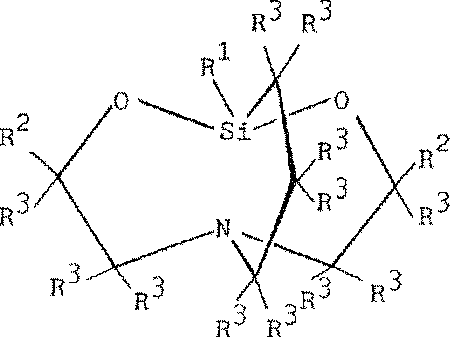
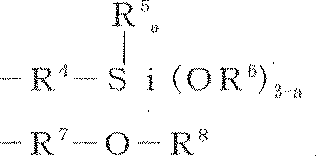
で表される基からなる群から選択される基であり、R3は同じかまたは異なる水素原子もしくはアルキル基である。}
で表されるカルバシラトラン誘導体を含有することが特に好ましい。このようなカルバシラトラン誘導体として、以下の構造で表される1分子中にアルケニル基およびケイ素原子結合アルコキシ基を有するシラトラン誘導体が例示される。
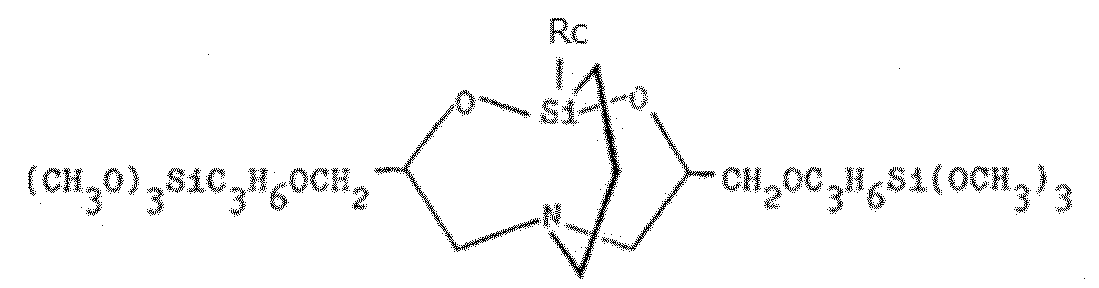
下記構造式で表される、シラトラン誘導体を接着付与剤として利用してもよい。
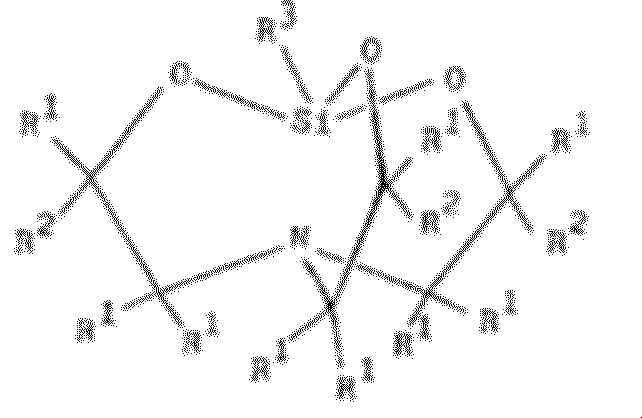
-(CH2)2Si(OCH3)3-(CH2)2Si(OCH3)2CH3
-(CH2)3Si(OC2H5)3-(CH2)3Si(OC2H5)(CH3)2
-CH2O(CH2)3Si(OCH3)3
-CH2O(CH2)3Si(OC2H5)3
-CH2O(CH2)3Si(OCH3)2CH3
-CH2O(CH2)3Si(OC2H5)2CH3
-CH2OCH2Si(OCH3)3-CH2OCH2Si(OCH3)(CH3)2
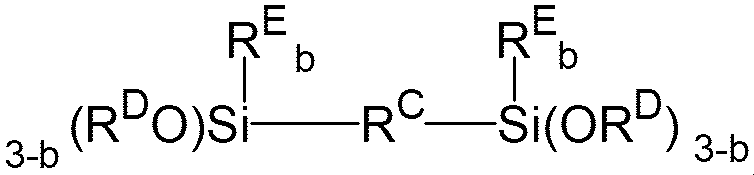
Ra nSi(ORb)4-n
(式中、Raは一価のエポキシ基含有有機基であり、Rbは炭素原子数1~6のアルキル基または水素原子である。nは1~3の範囲の数である)
で表されるエポキシ基含有シランまたはその部分加水分解縮合物であり、単独でも初期接着性を改善するほか、特に前記の成分(e1)および成分(e2)と併用することにより本接着促進剤を含んでなる硬化物に塩水浸漬などの苛酷な条件下での接着耐久性を向上させる働きをする。なお、成分(e3)は、成分(e1)の構成成分の一つであるが、反応物である成分(e1)(典型的には、環化した反応物であるカルバシラトラン誘導体)との質量比が特定の範囲にあることが発明の技術的効果の点から必要であり、成分(e1)とは別個の成分として添加されることが必要である。
(F)成分は、前記の(B)成分等と併用することで、本発明に係る組成物の室温~50度以下の加温における硬化性および各種基材への接着性を改善することができる。具体的には、(F)成分は、触媒量の縮合反応触媒であり、前記のオルガノポリシロキサンの縮合反応用を促進して硬化させる。このような成分(F)としては、例えば、ジメチル錫ジネオデカノエートおよびスタナスオクトエート等の錫化合物;テトラ(イソプロポキシ)チタン、テトラ(n-ブトキシ)チタン、テトラ(t-ブトキシ)チタン、ジ(イソプロポキシ)ビス(エチルアセトアセテート)チタン、ジ(イソプロポキシ)ビス(メチルアセトアセテート)チタン、およびジ(イソプロポキシ)ビス(アセチルアセトネート)チタン等のチタン化合物が例示される。その使用量は触媒量であり、所望の硬化条件に合わせて適宜選択可能であるが、組成物全体中のオルガノポリシロキサンの合計100質量部に対して0.01~5質量部範囲が一般的である。
アミノアルキルメトキシシランとしては、アミノメチルトリエトキシシラン、3-アミノプロピルトリメトキシシラン、3-アミノプロピルトリエトキシシラン、3-アミノプロピルメチルジメトキシシラン、N-(2-アミノエチル)アミノメチルトリブトキシシラン、N-(2-アミノエチル)-3-アミノプロピルトリメトキシシラン、N-(2-アミノエチル)-3-アミノプロピルメチルジメトキシシラン、3-アニリノプロピルトリエトキシシランが例示される。
本発明組成物は、混合後の多成分型硬化性オルガノポリシロキサン組成物およびその硬化物の耐熱性改善の見地から、さらに、耐熱性付与剤を含有することが好ましい。なお、本成分は、(I)液および(II)液から選ばれるどちらか一方に配合してもよく、本組成物を3成分以上に設計した場合は、独立した1成分として添加してもよい。本成分として、本発明の組成物およびその硬化物に耐熱性を付与できるものならば特に限定されないが、例えば、酸化鉄、酸化チタン、酸化セリウム、酸化マグネシウム、酸化亜鉛等の金属酸化物、水酸化セリウム等の金属水酸化物、フタロシアニン化合物、セリウムシラノレ-ト、セリウム脂肪酸塩、オルガノポリシロキサンとセリウムのカルボン酸塩との反応生成物等が挙げられる。特に好適には、フタロシアニン化合物であり、例えば、特表2014-503680号公報に開示された無金属フタロシアニン化合物及び金属含有フタロシアニン化合物からなる群より選択される添加剤が好適に用いられ、金属含有フタロシアニン化合物のうち、銅フタロシアニン化合物が特に好適である。最も好適かつ非限定的な耐熱性付与剤の一例は、29H,31H-フタロシアニナト(2-)-N29,N30,N31,N32銅である。このようなフタロシアニン化合物は市販されており、例えば、PolyOne Corporation(Avon Lake,Ohio,USA)のStan-tone(商標)40SP03がある。
本発明の多成分型硬化性オルガノポリシロキサン組成物は、上記した成分以外にも、本発明の目的を損なわない範囲で任意成分を配合することができる。この任意成分としては、例えば、耐寒性付与剤、難燃性付与剤、顔料、染料等が挙げられる。また、本発明の多成分型硬化性オルガノポリシロキサン組成物は、所望により、公知の接着性付与剤、カチオン系界面活性剤、アニオン系界面活性剤、または非イオン系界面活性剤などからなる1種類以上の帯電防止剤;誘電性フィラー;電気伝導性フィラー;離型性成分;チクソ性付与剤;防カビ剤などを含むことができる。また、所望により、有機溶媒を添加してもよい。これらの添加剤は、(I)液および(II)液から選ばれるどちらか一方に配合してもよく、本組成物を3成分以上に設計した場合は、独立した1成分として添加してもよい。
本発明の多成分型硬化性オルガノポリシロキサン組成物は、上記の各成分を混合することにより調製でき、例えば(I)液の場合、成分(A)、成分(C)、並びに他の任意の成分を混合することにより調製できる。また、必要に応じて成分(C)、成分(D)を混合し、成分(C)の表面を成分(D)で処理した後、成分(A)を混合することにより調整できる。
本発明の多成分型硬化性オルガノポリシロキサン組成物は、分液した多成分を使用時に混合する多成分硬化型(多液型、特に二液型を含む)の組成物であり、個別に保存される複数の組成物を所定の比率で混合して使用することができる。なお、これらのパッケージは、後述する硬化方法や塗布手段、適用対象に応じて所望により選択することができ、特に制限されない。
本発明にかかる硬化性オルガノポリシロキサン組成物は縮合反応性かつ室温硬化性の組成物であり、湿気の存在下、60℃以下、好適には50℃以下、より好適には室温(25℃)~50℃の温度範囲において加水分解反応を伴う縮合反応(特に脱水縮合、脱オキシム縮合または脱アルコール縮合)を主とする硬化反応により、オルガノポリシロキサン硬化物を形成可能である。その硬化プロセスは特に限定されるものではないが、各成分を混合後、15~50℃の温度範囲で、通常、空気中の水分と接触することで速やかに深部まで硬化して、接着性に優れるオルガノポリシロキサン硬化反応物である、熱伝導性のオルガノポリシロキサン硬化物を形成する。こうした硬化物は深部硬化性が良好であり、かつ、硬化途上で接触している基材に対して良好な接着性を示すため、放熱部材に対して空隙や間隙を生じることなく、放熱効率に優れる構造体を形成することができる。
本発明にかかる硬化性オルガノポリシロキサン組成物は、熱伝導性充填剤を安定的に高充填することができ、2.0W/mK以上、好適には3.5W/mK以上、より好適には4.0W/mK以上、特に好適には5.0W/mKの熱伝導率を備える。なお、本発明の硬化性オルガノポリシロキサン組成物においては、4.0~7.0W/mKの組成物およびオルガノポリシロキサン硬化物を設計可能であり、かつ、上記の深部硬化性および部材/基材への高い接着性(硬化接着性)を実現可能である。
本発明の硬化性オルガノポリシロキサン組成物は、熱伝導による発熱性部品の冷却のために、発熱性部品の熱境界面とヒートシンク又は回路基板等の放熱部材との界面に介在させる熱伝達材料(熱伝導性部材)として有用であり、これを備えた放熱構造体を形成することができる。ここで、発熱性部品の種類や大きさ、細部の構造は特に限定されるものではないが、本発明の硬化性オルガノポリシロキサン組成物は、高い熱伝導性を有しながら、硬化物の深部硬化性および部材への密着性とギャップフィル性に優れ、硬化不良の問題を生じることなく、微細な凹凸や狭いギャップ構造を有する発熱性部材に対しても密着性と追従性が高く、かつ、シリコーン材料特有の柔軟性を併せ持つことから、電気・電子部品又はセル方式の二次電池類を含む電気・電子機器の放熱構造体に好適に適用される。
発熱性部品について、本発明の硬化性オルガノポリシロキサン組成物を用いた放熱構造を形成する方法は限定されず、例えば、電気・電子部品について放熱部分に本発明の硬化性オルガノポリシロキサン組成物を注ぎ、十分に間隙まで充填した後、室温で放置したりすることにより、この組成物を硬化させる方法が挙げられる。なお、本発明にかかる硬化性オルガノポリシロキサン組成物は、特に深部硬化性と硬化密着性/接着性に著しく優れるので、硬化不良の問題を起こすことなく、安定した熱伝導性のオルガノポリシロキサン硬化物を与えることができ、放熱対象部材との間に空隙を生じることなく、放熱効果および放熱効率にすぐれた放熱構造体を形成可能である。
本発明の硬化性オルガノポリシロキサン組成物は、実用上十分な流動性およびギャップフィル性を備え、深部硬化により、硬化不良の問題を生じることなく、放熱対象部材との密着性/接着性に優れ、柔軟かつ熱伝導性に優れたオルガノポリシロキサン硬化物からなる熱伝導性部材を形成するので、電気・電子部品中の電極と電極、電気素子と電気素子、電気素子とパッケージ等の隙間が狭いものや、これらの構造がこのオルガノポリシロキサン硬化物の膨張・収縮に追随しにくい構造を有するものに対しても有効であり、例えば、IC、ハイブリッドIC、LSI等の半導体素子、このような半導体素子、コンデンサ、電気抵抗器等の電気素子を実装した電気回路やモジュール、圧力センサー等の各種センサー、自動車用のイグナイターやレギュレーター、発電システム、または宇宙輸送システム等のパワーデバイス等に対しても使用することができる。特に、本発明のオルガノポリシロキサン硬化物は深部硬化性が高く、放熱対象部材との硬化密着性に優れるので、これらの電気・電子機器の放熱効率を著しく改善できる利点がある。
硬化性オルガノポリシロキサン組成物の25℃における粘度(Pa・s)を、粘度計(アントンパール社製レオコンパスMCR102)を用いて測定した。ジオメトリーは直径20mmのパラレルプレートを用い、ギャップ600μmでシェアレイト10.0(1/s)の値を測定した。
個別に保存されたシリコーンエラストマーベース組成物((I)液)と架橋剤組成物((II)液)を評価温度雰囲気中で24時間以上放置した後、混合し、各評価温度雰囲気下に放置した。試料を金属ヘラですくったときに粘性が失われて塑性が発現するまでの時間を測定し、スナップタイムとした。可使時間の評価は25℃で行った。
硬化性オルガノポリシロキサン組成物の混合物を2枚のアルミテストパネル(アルマイトA5052P)の間に、それぞれ1mmと100μmとなるように挟み込み、温度25±2℃、湿度50±5%の条件下で静置して硬化させた。得られた接着試験体の引張りせん断接着強さをそれぞれ1日後、7日後にJIS K 6850:1999「接着剤-剛性被着材の引張りせん断接着強さ試験方法」に規定の方法に準じて測定した。
A-1:末端が水酸基で封鎖されたジメチルポリシロキサン(粘度420mPa・s、末端率85%、15%トリメチルシロキシ基封鎖)
A-2:片末端が水酸基で封鎖され、他の末端がトリメチルシロキシ基で鎖されたジメチルシロキサン(粘度24mPa・s)
[(B-1)成分:下記アルコキシシリル含有基を有するオルガノポリシロキサン]
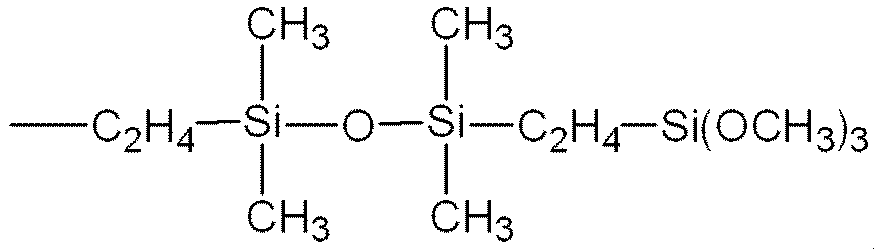
(b1-2)片末端変性(Vi)シロキサン:分子鎖の片末端のみに前記のアルコキシシリル含有基を有し、他の末端がジメチルビニルシロキシ基で封鎖されたジメチルシロキサン(粘度400mPa・s、Vi含有量0.04質量%)
(b1-3)両末端Viポリシロキサン:分子鎖両末端がジメチルビニルシロキシ基で封鎖されたジメチルシロキサン(粘度400mPa・s、Vi含有量0.08質量%)
以上、(b1-1)~(b1-3)成分は、分子鎖両末端がジメチルビニルシロキシ基で封鎖されたジメチルシロキサン(粘度400mPa・s)に、ビニル基あたり0.8
モル当量となるように下記アルコキシシリル含有シロキサンをヒドロシリル化反応用触媒の存在下でヒドロシリル化反応することにより調製して得た混合物である

C-1:平均粒子径0.4μmの破砕状酸化アルミニウム粉末
C-2:平均粒子径2.5μmの破砕状酸化アルミニウム粉末
C-3:平均粒子径35μmの球状溶融固化酸化アルミニウム粉末
D-1:デシルトリメトキシシラン
E-1:デシルトリメトキシシラン
E-2:1,6-ビス(トリメトキシシリル)ヘキサン
E-3:下式で示されるシラトラン誘導体(アミノ基含有有機基を有するアルコキシシランとエポキシ基含有有機基を有するアルコキシシランとの環化縮合反応物)
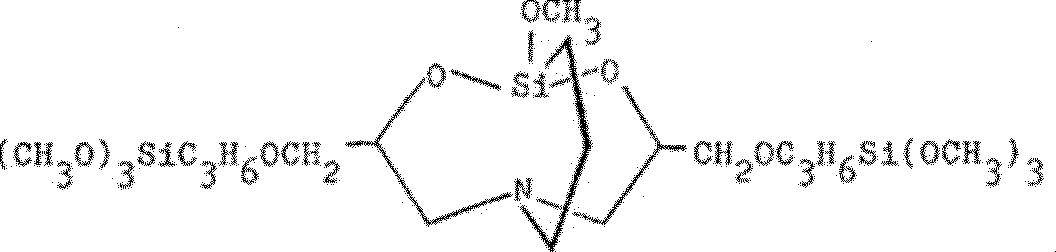
F-1:ジメチルスズジネオデカノエート
成分(G):
G-1:N-(2-アミノエチル)3-アミノプロピルトリメトキシシラン
顔料:酸化鉄/オルガノポリシロキサンマスターバッチ
成分(A-1)90.9質量部、成分(A-2)9.1質量部を計量し、そこに60分かけて成分(C-1)173質量部、成分(C-2)191質量部、成分(C-3)464質量部を順次混合した。均一にしたのち、減圧下で30分混合後し、硬化性オルガノポリシロキサン組成物の(I)液を得た。
この混合物に、成分(E-1)11.8質量部、成分(F-1)0.091質量部、顔料2.3質量部を均一混合し、硬化性オルガノポリシロキサン組成物の(II)液を得た。
実施例1の硬化性オルガノポリシロキサン組成物の(II)液に成分(G-1)0.91質量部を加えた以外は実施例1と同様に硬化性オルガノポリシロキサン組成物の(I)液と(II)液を得、各液の粘度を測定した。さらに、当該(I)液と(II)液を同一質量で混合後、粘度、可使時間、接着性を測定した。
実施例1の硬化性オルガノポリシロキサン組成物の(II)液の成分(E-1)を成分(E-2)11.8質量部に置き換えた以外は実施例1と同様に硬化性オルガノポリシロキサン組成物の(I)液と(II)液を得、各液の粘度を測定した。さらに、当該 (I)液と(II)液を同一質量で混合後、粘度、可使時間、接着性を測定した。
実施例3の硬化性オルガノポリシロキサン組成物の(II)液に成分(G-1)0.91質量部を加えた以外は実施例3と同様に硬化性オルガノポリシロキサン組成物の(I)液と(II)液を得、各液の粘度を測定した。さらに、当該(I)液と(II)液を同一質量で混合後、粘度、可使時間、接着性を測定した。
実施例1の硬化性オルガノポリシロキサン組成物の(II)液の成分(E-1)を成分(E-3)11.8質量部に置き換えた以外は実施例1と同様に硬化性オルガノポリシロキサン組成物の(I)液と(II)液を得、各液の粘度を測定した。さらに、当該(I)液と(II)液を同一質量で混合後、粘度、可使時間、接着性を測定した。
実施例5の硬化性オルガノポリシロキサン組成物の(II)液に成分(G-1)0.91質量部を加えた以外は実施例5と同様に硬化性オルガノポリシロキサン組成物の(I)液と(II)液を得、各液の粘度を測定した。さらに、当該(I)液と(II)液を同一質量で混合後、粘度、可使時間、接着性を測定した。
(B-1)81.8質量部、成分(D-1)2.9質量部を計量し、そこに60分かけて成分(C-1)173質量部、成分(C-2)191質量部、成分(C-3)464質量部を順次混合した。均一にしたのち、減圧下で160℃で60分加熱混合後、室温まで冷却して混合物を得た。
この混合物に、成分(E-1)11.8質量部、成分(F-1)0.091質量部、顔料2.3質量部を均一混合し、室温硬化性の硬化性オルガノポリシロキサン組成物を得た。
上記硬化性オルガノポリシロキサン組成物を25℃で1日養生後、実施例と同様にで粘度、可使時間、接着性を測定した。
成分(A-1)90.9質量部、成分(A-2)9.1質量部を計量し、そこに60分かけて成分(C-1)173質量部、成分(C-2)191質量部、成分(C-3)464質量部を順次混合した。均一にしたのち、この混合物に、成分(E-1)11.8質量部、成分(F-1)0.091質量部、成分(G-1)0.91質量部、顔料2.3質量部を均一混合し、室温硬化性の硬化性オルガノポリシロキサン組成物を得た。
上記室温硬化性の硬化性オルガノポリシロキサン組成物を25℃で1日養生したところ、すでに硬化していたため、特性評価をすることが出来なかった。
ダウ・東レ株式会社製の1液型の室温硬化性熱伝導性シリコーン組成物であるSE4485熱伝導性接着剤を使用して、実施例同様に粘度、可使時間、接着性を測定した。
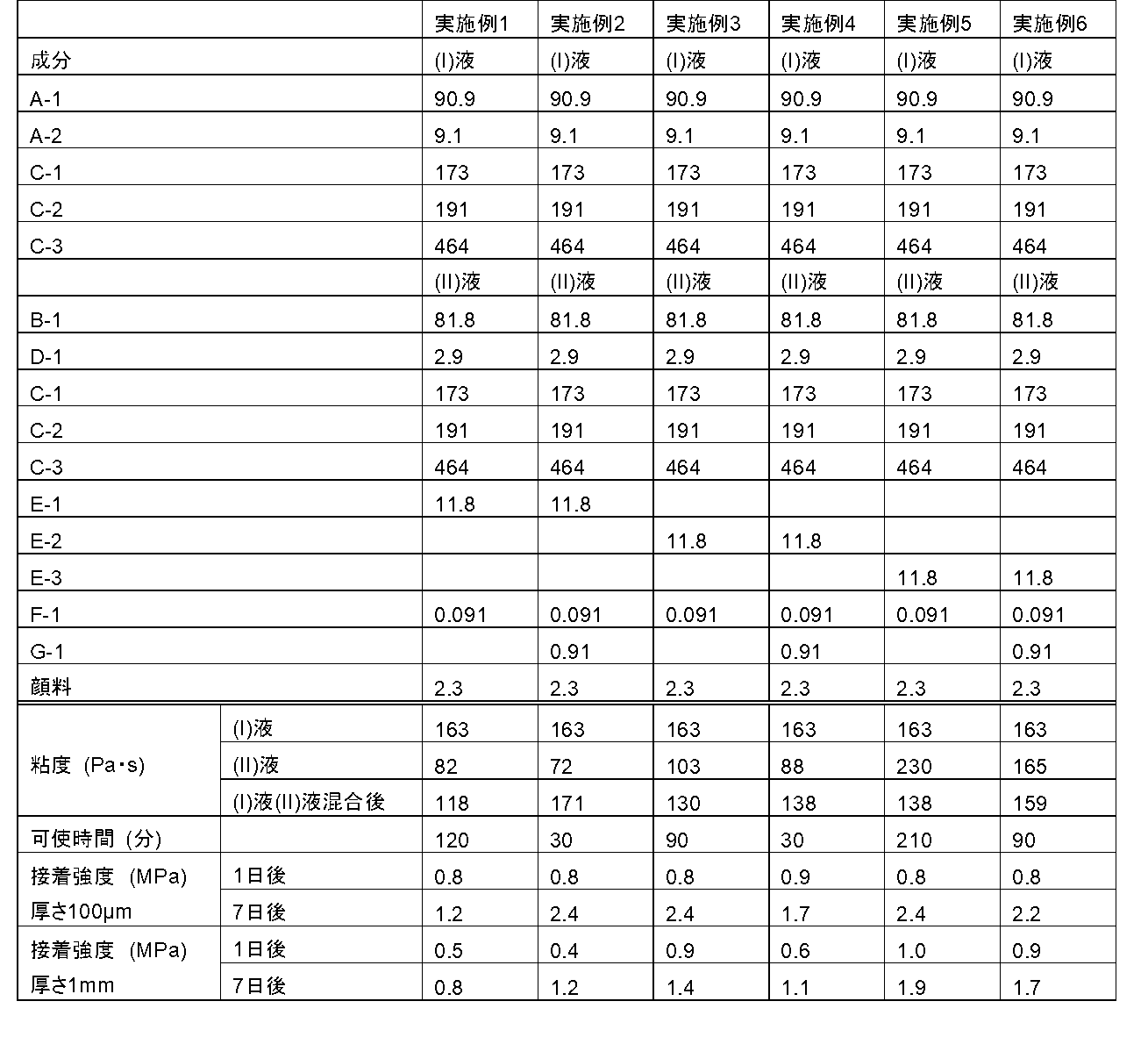
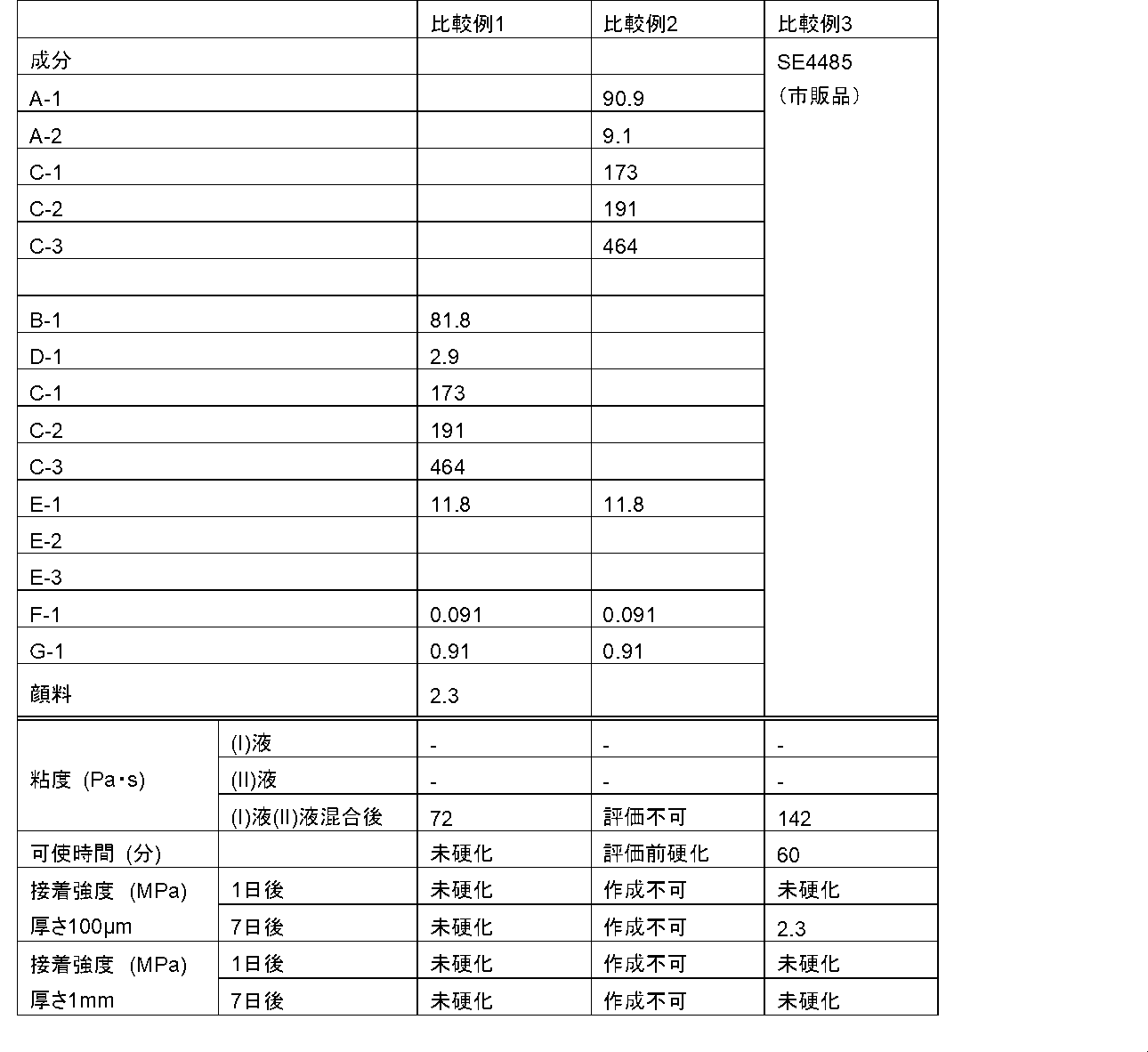
実施例1~6にかかる2液型のオルガノポリシロキサン組成物は30分以上の実用上十分な可使時間と流動性を備え、100μm厚/1mm厚のいずれでも、一日後には接着強度を測定可能な程度のオルガノポリシロキサン硬化物を与え、かつ、7日後にはさらに高い接着強度を与えるものであった。このことから、実施例1~6にかかる組成物は、厚く塗布した場合であっても、比較的短期間に、十分な深部硬化性を実現し、かつ、高い接着性(硬化密着性)を備える硬化物であって、高い熱伝導率(本発明では、3.5W/mK)を実現できることが確認できた。
Claims (10)
- (A)分子鎖末端がヒドロキシシリル基で封鎖された25℃における粘度が20~1,000,000mPa・sであるジオルガノポリシロキサン 100重量部、
(B)分子鎖末端がアルコキシシリル基で封鎖された25℃における粘度が20~1,000,000mPa・sであるジオルガノポリシロキサン、(A)成分100質量部に対して50~200質量部、
(C)熱伝導性充填剤 400~3,500質量部、
(D)成分(C)の表面処理剤である有機ケイ素化合物 成分(C)に対して0.1~2.0質量%となる量、
(E)アルキルアルコキシシランおよび以下の成分(e1)~(e3)から選ばれる1種類以上の成分
(e1) アミノ基含有オルガノアルコキシシランとエポキシ基含有オルガノアルコキシシランとの反応混合物、
(e2) 一分子中に少なくとも二つのアルコキシシリル基を有し,かつそれらのシリル基の間にケイ素-酸素結合以外の結合が含まれている有機化合物、
(e3) 一般式:
Ra nSi(ORb)4-n
(式中、Raは一価のエポキシ基含有有機基であり、Rbは炭素原子数1~6のアルキル基または水素原子である。nは1~3の範囲の数である)
で表されるエポキシ基含有シランまたはその部分加水分解縮合物、および(F)触媒量の縮合反応用触媒
を含有してなり、個別に保存される以下の(I)液および(II)液を少なくとも含むことを特徴とする、多成分型の硬化性オルガノポリシロキサン組成物。
(I)液: 成分(A)および成分(C)を含み、成分(D)は任意で選択可能であり、成分(B)、(E)、(F)を含まない組成物
(II)液:成分(B)、(C)、(D)、(E)および(F)を含み、成分(A)を含まない組成物 - さらに、(G)アミノアルキルメトキシシランを含有する、請求項1に記載の硬化性オルガノポリシロキサン組成物。
- 成分(D)の少なくとも一部が、アルキルアルコキシシランであることを特徴とする、請求項1~2のいずれか1項に記載の硬化性オルガノポリシロキサン組成物。
- 成分(D)および成分(E)の少なくとも一部が、アルキルアルコキシシランであることを特徴とする、請求項1~3のいずれか1項に記載の硬化性オルガノポリシロキサン組成物。
- 室温硬化性であり、硬化により、熱伝導性オルガノポリシロキサン硬化物を形成することを特徴とする、
請求項1~4のいずれか1項に記載の硬化性オルガノポリシロキサン組成物。 - 請求項1~5のいずれか1項に記載の硬化性オルガノポリシロキサン組成物またはその硬化物からなる熱伝導性部材。
- 請求項6に記載の熱伝導性部材を備えた放熱構造体。
- 放熱部品または該放熱部品を搭載した回路基板に、請求項1~請求項5のいずれか1項に記載の硬化性オルガノポリシロキサン組成物またはその硬化物を介して放熱部材を設けてなる放熱構造体。
- 電気・電子機器である、請求項7または請求項8に記載の放熱構造体。
- 電気・電子部品または二次電池である、請求項7または請求項8に記載の放熱構造体。
Priority Applications (5)
| Application Number | Priority Date | Filing Date | Title |
|---|---|---|---|
| US17/442,686 US20220185992A1 (en) | 2019-03-29 | 2020-03-18 | Multi-component type thermally conductive silicone-gel composition, thermally conductive material and heat-emission structure |
| EP20782188.5A EP3951858A4 (en) | 2019-03-29 | 2020-03-18 | CURABLE MULTI-COMPONENT ORGANOPOLYSILOXA COMPOSITION, THERMAL CONDUCTING ELEMENT AND HEAT DISSIPATION STRUCTURE |
| KR1020217034129A KR20210148203A (ko) | 2019-03-29 | 2020-03-18 | 다성분형 경화성 오가노폴리실록산 조성물, 열전도성 부재 및 방열 구조체 |
| CN202080017480.6A CN113508460A (zh) | 2019-03-29 | 2020-03-18 | 多成分型固化性聚有机硅氧烷组合物、导热性构件以及散热结构体 |
| JP2021511418A JP7444856B2 (ja) | 2019-03-29 | 2020-03-18 | 多成分型硬化性オルガノポリシロキサン組成物、熱伝導性部材および放熱構造体 |
Applications Claiming Priority (2)
| Application Number | Priority Date | Filing Date | Title |
|---|---|---|---|
| JP2019065807 | 2019-03-29 | ||
| JP2019-065807 | 2019-03-29 |
Publications (1)
| Publication Number | Publication Date |
|---|---|
| WO2020203297A1 true WO2020203297A1 (ja) | 2020-10-08 |
Family
ID=72668776
Family Applications (1)
| Application Number | Title | Priority Date | Filing Date |
|---|---|---|---|
| PCT/JP2020/011998 Ceased WO2020203297A1 (ja) | 2019-03-29 | 2020-03-18 | 多成分型硬化性オルガノポリシロキサン組成物、熱伝導性部材および放熱構造体 |
Country Status (7)
| Country | Link |
|---|---|
| US (1) | US20220185992A1 (ja) |
| EP (1) | EP3951858A4 (ja) |
| JP (1) | JP7444856B2 (ja) |
| KR (1) | KR20210148203A (ja) |
| CN (1) | CN113508460A (ja) |
| TW (1) | TW202102606A (ja) |
| WO (1) | WO2020203297A1 (ja) |
Cited By (2)
| Publication number | Priority date | Publication date | Assignee | Title |
|---|---|---|---|---|
| JPWO2022138627A1 (ja) * | 2020-12-21 | 2022-06-30 | ||
| WO2023190722A1 (ja) * | 2022-03-31 | 2023-10-05 | 積水ポリマテック株式会社 | バッテリ用硬化性接着剤組成物、バッテリモジュール、バッテリパック |
Families Citing this family (3)
| Publication number | Priority date | Publication date | Assignee | Title |
|---|---|---|---|---|
| WO2020203299A1 (ja) | 2019-03-29 | 2020-10-08 | ダウ・東レ株式会社 | 多成分型熱伝導性シリコーンゲル組成物、熱伝導性部材および放熱構造体 |
| CN114921219B (zh) * | 2022-04-18 | 2023-08-15 | 小禾电子材料(德清)有限公司 | 一种双组份有机硅胶粘剂及制备方法 |
| WO2025166510A1 (en) * | 2024-02-05 | 2025-08-14 | Henkel Ag & Co. Kgaa | Thermal conductive composition and heat dissipating member |
Citations (11)
| Publication number | Priority date | Publication date | Assignee | Title |
|---|---|---|---|---|
| JPS528854B2 (ja) | 1972-01-13 | 1977-03-11 | ||
| JPS63270762A (ja) | 1987-04-28 | 1988-11-08 | Toray Silicone Co Ltd | 電気・電子機器用室温硬化性オルガノポリシロキサン組成物 |
| JPH034566B2 (ja) | 1983-08-08 | 1991-01-23 | Gen Electric | |
| JPH0413767A (ja) | 1990-05-07 | 1992-01-17 | Shin Etsu Chem Co Ltd | 硬化性シリコーン組成物及び硬化物 |
| JPH10195085A (ja) | 1996-11-18 | 1998-07-28 | Toray Dow Corning Silicone Co Ltd | カルバシラトラン誘導体、その製造方法、接着促進剤、および硬化性シリコーン組成物 |
| JP2008150491A (ja) * | 2006-12-18 | 2008-07-03 | Momentive Performance Materials Japan Kk | 室温硬化性ポリオルガノシロキサン組成物 |
| JP2012069783A (ja) * | 2010-09-24 | 2012-04-05 | Yokohama Rubber Co Ltd:The | 熱伝導性シリコーン組成物およびこれを用いる実装基板 |
| JP2012219113A (ja) | 2011-04-04 | 2012-11-12 | Dow Corning Toray Co Ltd | 室温硬化性シリコーンゴム組成物 |
| JP2013091683A (ja) | 2011-10-24 | 2013-05-16 | Shin-Etsu Chemical Co Ltd | 室温湿気増粘型熱伝導性シリコーングリース組成物 |
| JP2015110792A (ja) * | 2015-01-22 | 2015-06-18 | 信越化学工業株式会社 | 室温湿気増粘型熱伝導性シリコーングリース組成物 |
| WO2015093139A1 (ja) * | 2013-12-17 | 2015-06-25 | 信越化学工業株式会社 | 多成分系室温硬化性オルガノポリシロキサン組成物、該組成物の硬化物及び該硬化物からなる成型物 |
Family Cites Families (4)
| Publication number | Priority date | Publication date | Assignee | Title |
|---|---|---|---|---|
| JP3614958B2 (ja) * | 1995-11-29 | 2005-01-26 | 東レ・ダウコーニング・シリコーン株式会社 | 室温硬化性シリコーンエラストマー組成物 |
| JP4255287B2 (ja) * | 2001-05-14 | 2009-04-15 | 東レ・ダウコーニング株式会社 | 熱伝導性シリコーン組成物 |
| WO2015022998A1 (en) * | 2013-08-14 | 2015-02-19 | Dow Corning Toray Co., Ltd. | Novel organic silicon compound, surface treatment agent containing same, resin composition containing same, and gel or cured product of same |
| CN105849213B (zh) * | 2013-12-23 | 2018-07-27 | 美国陶氏有机硅公司 | 可湿固化的组合物 |
-
2020
- 2020-03-18 JP JP2021511418A patent/JP7444856B2/ja active Active
- 2020-03-18 CN CN202080017480.6A patent/CN113508460A/zh active Pending
- 2020-03-18 EP EP20782188.5A patent/EP3951858A4/en active Pending
- 2020-03-18 KR KR1020217034129A patent/KR20210148203A/ko not_active Withdrawn
- 2020-03-18 WO PCT/JP2020/011998 patent/WO2020203297A1/ja not_active Ceased
- 2020-03-18 US US17/442,686 patent/US20220185992A1/en not_active Abandoned
- 2020-03-27 TW TW109110533A patent/TW202102606A/zh unknown
Patent Citations (11)
| Publication number | Priority date | Publication date | Assignee | Title |
|---|---|---|---|---|
| JPS528854B2 (ja) | 1972-01-13 | 1977-03-11 | ||
| JPH034566B2 (ja) | 1983-08-08 | 1991-01-23 | Gen Electric | |
| JPS63270762A (ja) | 1987-04-28 | 1988-11-08 | Toray Silicone Co Ltd | 電気・電子機器用室温硬化性オルガノポリシロキサン組成物 |
| JPH0413767A (ja) | 1990-05-07 | 1992-01-17 | Shin Etsu Chem Co Ltd | 硬化性シリコーン組成物及び硬化物 |
| JPH10195085A (ja) | 1996-11-18 | 1998-07-28 | Toray Dow Corning Silicone Co Ltd | カルバシラトラン誘導体、その製造方法、接着促進剤、および硬化性シリコーン組成物 |
| JP2008150491A (ja) * | 2006-12-18 | 2008-07-03 | Momentive Performance Materials Japan Kk | 室温硬化性ポリオルガノシロキサン組成物 |
| JP2012069783A (ja) * | 2010-09-24 | 2012-04-05 | Yokohama Rubber Co Ltd:The | 熱伝導性シリコーン組成物およびこれを用いる実装基板 |
| JP2012219113A (ja) | 2011-04-04 | 2012-11-12 | Dow Corning Toray Co Ltd | 室温硬化性シリコーンゴム組成物 |
| JP2013091683A (ja) | 2011-10-24 | 2013-05-16 | Shin-Etsu Chemical Co Ltd | 室温湿気増粘型熱伝導性シリコーングリース組成物 |
| WO2015093139A1 (ja) * | 2013-12-17 | 2015-06-25 | 信越化学工業株式会社 | 多成分系室温硬化性オルガノポリシロキサン組成物、該組成物の硬化物及び該硬化物からなる成型物 |
| JP2015110792A (ja) * | 2015-01-22 | 2015-06-18 | 信越化学工業株式会社 | 室温湿気増粘型熱伝導性シリコーングリース組成物 |
Non-Patent Citations (1)
| Title |
|---|
| See also references of EP3951858A4 |
Cited By (4)
| Publication number | Priority date | Publication date | Assignee | Title |
|---|---|---|---|---|
| JPWO2022138627A1 (ja) * | 2020-12-21 | 2022-06-30 | ||
| WO2022138627A1 (ja) * | 2020-12-21 | 2022-06-30 | モメンティブ・パフォーマンス・マテリアルズ・ジャパン合同会社 | 耐水性を有する接着性ポリオルガノシロキサン組成物 |
| JP7626312B2 (ja) | 2020-12-21 | 2025-02-07 | モメンティブ・パフォーマンス・マテリアルズ・ジャパン合同会社 | 耐水性を有する接着性ポリオルガノシロキサン組成物 |
| WO2023190722A1 (ja) * | 2022-03-31 | 2023-10-05 | 積水ポリマテック株式会社 | バッテリ用硬化性接着剤組成物、バッテリモジュール、バッテリパック |
Also Published As
| Publication number | Publication date |
|---|---|
| CN113508460A (zh) | 2021-10-15 |
| US20220185992A1 (en) | 2022-06-16 |
| JPWO2020203297A1 (ja) | 2020-10-08 |
| EP3951858A1 (en) | 2022-02-09 |
| JP7444856B2 (ja) | 2024-03-06 |
| EP3951858A4 (en) | 2022-12-28 |
| TW202102606A (zh) | 2021-01-16 |
| KR20210148203A (ko) | 2021-12-07 |
Similar Documents
| Publication | Publication Date | Title |
|---|---|---|
| TWI811225B (zh) | 多成分固化型導熱性聚矽氧凝膠組合物、導熱性構件及散熱結構體 | |
| TWI851537B (zh) | 導熱性聚矽氧凝膠組合物、導熱性構件及散熱結構體 | |
| US11674040B2 (en) | Thermally-conductive silicone gel composition, thermally-conductive member, and heat dissipation structure | |
| JP7422742B2 (ja) | 多成分型熱伝導性シリコーンゲル組成物、熱伝導性部材および放熱構造体 | |
| JP7444856B2 (ja) | 多成分型硬化性オルガノポリシロキサン組成物、熱伝導性部材および放熱構造体 | |
| WO2015155948A1 (ja) | 熱伝導性シリコーン組成物および電気・電子機器 | |
| CN112334542B (zh) | 热间隙填料及其在电池管理系统中的应用 | |
| WO2021132345A1 (ja) | 硬化性オルガノポリシロキサン組成物及びその硬化物、保護剤又は接着剤、並びに電気・電子機器 | |
| JP7444857B2 (ja) | 室温硬化性オルガノポリシロキサン組成物および電気・電子部品の保護剤または接着剤組成物 | |
| WO2022038888A1 (ja) | 硬化性オルガノポリシロキサン組成物、熱伝導性部材および放熱構造体 |
Legal Events
| Date | Code | Title | Description |
|---|---|---|---|
| 121 | Ep: the epo has been informed by wipo that ep was designated in this application |
Ref document number: 20782188 Country of ref document: EP Kind code of ref document: A1 |
|
| ENP | Entry into the national phase |
Ref document number: 2021511418 Country of ref document: JP Kind code of ref document: A |
|
| NENP | Non-entry into the national phase |
Ref country code: DE |
|
| ENP | Entry into the national phase |
Ref document number: 20217034129 Country of ref document: KR Kind code of ref document: A |
|
| ENP | Entry into the national phase |
Ref document number: 2020782188 Country of ref document: EP Effective date: 20211029 |
|
| WWW | Wipo information: withdrawn in national office |
Ref document number: 1020217034129 Country of ref document: KR |