WO2019182123A1 - Liquid preparation containing transglutaminase - Google Patents
Liquid preparation containing transglutaminase Download PDFInfo
- Publication number
- WO2019182123A1 WO2019182123A1 PCT/JP2019/012142 JP2019012142W WO2019182123A1 WO 2019182123 A1 WO2019182123 A1 WO 2019182123A1 JP 2019012142 W JP2019012142 W JP 2019012142W WO 2019182123 A1 WO2019182123 A1 WO 2019182123A1
- Authority
- WO
- WIPO (PCT)
- Prior art keywords
- transglutaminase
- liquid preparation
- glycine
- acid salt
- glutamate
- Prior art date
- Legal status (The legal status is an assumption and is not a legal conclusion. Google has not performed a legal analysis and makes no representation as to the accuracy of the status listed.)
- Ceased
Links
Images


Classifications
-
- A—HUMAN NECESSITIES
- A23—FOODS OR FOODSTUFFS; TREATMENT THEREOF, NOT COVERED BY OTHER CLASSES
- A23L—FOODS, FOODSTUFFS OR NON-ALCOHOLIC BEVERAGES, NOT OTHERWISE PROVIDED FOR; PREPARATION OR TREATMENT THEREOF
- A23L7/00—Cereal-derived products; Malt products; Preparation or treatment thereof
- A23L7/10—Cereal-derived products
- A23L7/104—Fermentation of farinaceous cereal or cereal material; Addition of enzymes or microorganisms
- A23L7/107—Addition or treatment with enzymes not combined with fermentation with microorganisms
-
- A—HUMAN NECESSITIES
- A23—FOODS OR FOODSTUFFS; TREATMENT THEREOF, NOT COVERED BY OTHER CLASSES
- A23L—FOODS, FOODSTUFFS OR NON-ALCOHOLIC BEVERAGES, NOT OTHERWISE PROVIDED FOR; PREPARATION OR TREATMENT THEREOF
- A23L11/00—Pulses, i.e. fruits of leguminous plants, for production of food; Products from legumes; Preparation or treatment thereof
- A23L11/05—Mashed or comminuted pulses or legumes; Products made therefrom
- A23L11/07—Soya beans, e.g. oil-extracted soya bean flakes
-
- A—HUMAN NECESSITIES
- A23—FOODS OR FOODSTUFFS; TREATMENT THEREOF, NOT COVERED BY OTHER CLASSES
- A23L—FOODS, FOODSTUFFS OR NON-ALCOHOLIC BEVERAGES, NOT OTHERWISE PROVIDED FOR; PREPARATION OR TREATMENT THEREOF
- A23L13/00—Meat products; Meat meal; Preparation or treatment thereof
- A23L13/40—Meat products; Meat meal; Preparation or treatment thereof containing additives
- A23L13/48—Addition of, or treatment with, enzymes
-
- A—HUMAN NECESSITIES
- A23—FOODS OR FOODSTUFFS; TREATMENT THEREOF, NOT COVERED BY OTHER CLASSES
- A23L—FOODS, FOODSTUFFS OR NON-ALCOHOLIC BEVERAGES, NOT OTHERWISE PROVIDED FOR; PREPARATION OR TREATMENT THEREOF
- A23L29/00—Foods or foodstuffs containing additives; Preparation or treatment thereof
- A23L29/06—Enzymes
-
- C—CHEMISTRY; METALLURGY
- C12—BIOCHEMISTRY; BEER; SPIRITS; WINE; VINEGAR; MICROBIOLOGY; ENZYMOLOGY; MUTATION OR GENETIC ENGINEERING
- C12N—MICROORGANISMS OR ENZYMES; COMPOSITIONS THEREOF; PROPAGATING, PRESERVING, OR MAINTAINING MICROORGANISMS; MUTATION OR GENETIC ENGINEERING; CULTURE MEDIA
- C12N9/00—Enzymes; Proenzymes; Compositions thereof; Processes for preparing, activating, inhibiting, separating or purifying enzymes
- C12N9/10—Transferases (2.)
- C12N9/1025—Acyltransferases (2.3)
- C12N9/104—Aminoacyltransferases (2.3.2)
- C12N9/1044—Protein-glutamine gamma-glutamyltransferase (2.3.2.13), i.e. transglutaminase or factor XIII
Definitions
- the present invention relates to a liquid preparation containing transglutaminase, and more particularly, to a liquid preparation having improved stability of transglutaminase.
- Transglutaminase is an enzyme that catalyzes protein cross-linking by condensing the amino group of a glutamine residue in a protein with a primary amine and transferring a substituent on the amine to a glutamine residue. It is widely used in processing and the like. From the viewpoint of enzyme stability, a preparation containing transglutaminase is provided as a solid preparation such as powder or granule. However, when transglutaminase is allowed to act on a substrate, it is often dissolved in an appropriate solvent and used as a liquid preparation. In conventional solid preparations, it is necessary to dissolve in a solvent when used. In addition, there is a problem that microbial contamination may occur when dissolved in a solvent.
- the liquid preparation containing transglutaminase contains 25% to 100% by weight of polyol and contains transglutaminase in a polyol-water suspension having a pH value in the range of 4.4 to 5.1.
- a preparation in which transglutaminase is dissolved together with a water activity adjusting agent, a redox potential control agent, a preservative, and a pH adjusting agent.
- it is necessary to control the pH of the polyol-water suspension within a very narrow range of 4.4 to 5.1.
- the preparation described in Patent Document 2 requires the incorporation of a considerable type of stabilizer in order to stabilize the transglutaminase, which may be a limitation when the enzyme preparation is used.
- Patent Documents 3 and 4 sugar, sugar alcohol or amino acid is used as a stabilizer in a freeze-dried preparation of transglutaminase.
- the techniques described in Patent Documents 3 and 4 relate to a freeze-dried preparation of transglutaminase, which is a blood coagulation factor XIII, and are not intended to stabilize a liquid preparation of transglutaminase used in the food field. Absent.
- an object of the present invention is to provide a liquid preparation containing transglutaminase, which improves the stability of transglutaminase and is easy to use in the food field.
- the present inventors have selected 1 from the group consisting of glycine, proline, serine, glutamate, aspartate and organic acid salt as a liquid preparation containing transglutaminase. It has been found that the stability of transglutaminase in a liquid preparation is improved by containing a seed or two or more kinds at a concentration of 2 wt% or more or 5 wt% or more in the total content thereof. It came to be completed.
- the present invention relates to the following.
- the transglutaminase is a microorganism-derived transglutaminase.
- [3] The total content of one or more selected from the group consisting of glycine, proline, serine, glutamate, aspartate and organic acid salt is 10% by weight or more, [1] or [2 ] The liquid formulation as described in.
- a liquid preparation comprising transglutaminase added to a solvent and dissolved together with one or more selected from the group consisting of glycine, proline, serine, glutamate, aspartate and organic acid salt
- a liquid preparation wherein the total content of one or more selected from the group consisting of glycine, proline, serine, glutamate, aspartate and organic acid salt is 5% by weight or more Manufacturing method.
- the transglutaminase is a microorganism-derived transglutaminase.
- the total content of one or more selected from the group consisting of glycine, proline, serine, glutamate, aspartate and organic acid salt is 10% by weight or more, [8] or [9 ] The manufacturing method of description.
- the production method according to any of [8] to [12] comprising adjusting the pH of the liquid preparation to 4 to 7.
- a liquid preparation comprising transglutaminase added to a solvent and dissolved together with one or more selected from the group consisting of glycine, proline, serine, glutamate, aspartate and organic acid salt
- a liquid preparation, wherein the total content of one or more selected from the group consisting of glycine, proline, serine, glutamate, aspartate and organic acid salt is 2% by weight or more Manufacturing method.
- transglutaminase is a microorganism-derived transglutaminase.
- the total content of one or more selected from the group consisting of glycine, proline, serine, glutamate, aspartate and organic acid salt is 10% by weight or more. [15 ] Or the stabilization method according to [16].
- transglutaminase One or more selected from the group consisting of glycine, proline, serine, glutamate, aspartate, and organic acid salt in a liquid preparation containing transglutaminase, the total content of which is 2
- a method for stabilizing transglutaminase in a liquid preparation comprising containing the composition so as to be at least wt%.
- a food to which the liquid preparation according to any one of [1] to [6] is added.
- a food to which the liquid preparation according to [7] is added.
- a liquid preparation of transglutaminase with improved stability of transglutaminase can be provided.
- the liquid preparation of the present invention does not need to dissolve transglutaminase in a solvent at the time of use, is excellent in convenience, and is less likely to cause microbial contamination. It is also suitable for use in the food field.
- Test Example 1 it is a figure showing the residual rate of transglutaminase activity of each liquid formulation of Examples 1 to 5 and Comparative Example 1.
- Test Example 2 (1) it is a diagram showing the residual rate of transglutaminase activity of each liquid formulation of Examples 1-1 to 1-3 and Comparative Example 2.
- Test Example 2 (2) it is a diagram showing the residual rate of transglutaminase activity of each liquid formulation of Examples 2-1 to 2-4 and Comparative Example 3.
- Test Example 2 (3) it is a diagram showing the residual rate of transglutaminase activity of each liquid formulation of Examples 3-1 to 3-3 and Comparative Example 4.
- FIG. 1 it is a figure showing the residual rate of transglutaminase activity of each liquid formulation of Examples 1 to 5 and Comparative Example 1.
- Test Example 2 (1) it is a diagram showing the residual rate of transglutaminase activity of each liquid formulation of Examples 1-1 to 1-3 and Comparative Example 2.
- Test Example 2 (2) it is a diagram showing the residual rate of transglutaminas
- Test Example 2 it is a diagram showing the residual rate of transglutaminase activity of each liquid formulation of Examples 4-1 to 4-4 and Comparative Example 5.
- Experiment 3 it is a figure which shows the relationship between pH of a liquid formulation, and transglutaminase activity about a glycine addition group and a glycine non-addition group.
- Test Example 4 it is a figure showing the residual rate of transglutaminase activity of each liquid formulation of Example 6 and Comparative Examples 6-1 and 6-2.
- Test Example 4 it is a figure showing the residual rate of transglutaminase activity of each liquid formulation of Example 7 and Comparative Examples 7-1 and 7-2.
- Test Example 4 it is a figure showing the residual rate of transglutaminase activity of each liquid formulation of Example 8 and Comparative Examples 8-1 and 8-2.
- the present invention provides a liquid preparation containing transglutaminase and having improved stability of transglutaminase (hereinafter also referred to as “the preparation of the present invention”).
- the preparation of the present invention contains one or more selected from the group consisting of glycine, proline, serine, glutamate, aspartate and organic acid salt together with transglutaminase at a concentration of 5% by weight or more. .
- the preparation of the present invention contains 2 or more of one or more selected from the group consisting of glycine, proline, serine, glutamate, aspartate and organic acid salt together with transglutaminase. Contained at a concentration of at least%.
- Transglutaminase protein-glutamine ⁇ -glutamyltransferase
- Transglutaminase is a reaction in which an amino group of a glutamine residue in a protein is condensed with a primary amine, and a substituent on the amine is transferred to a glutamine residue to generate ammonia.
- the amino group of a lysine residue in a protein is usually used as a primary amine and acts as a cross-linking enzyme. Therefore, transglutaminase is preferably used in the modification and processing of meat such as fish meat and livestock meat.
- transglutaminase a calcium-independent one obtained from a microorganism is preferably used.
- the calcium-independent transglutaminase derived from microorganisms include transglutaminase produced by actinomycetes belonging to the genus Streptomyces, and can be obtained according to the method described in Japanese Patent No. 2572716.
- Commercial products such as “Activa TG-K” and “Activa TG-S” provided by companies and the like can also be used.
- the content of transglutaminase in the preparation of the present invention is preferably 1 U (unit) to 1,000 U, and more preferably 10 U to 350 U, per 1 g of the preparation of the present invention.
- glycine contained together with transglutaminase is 2-aminoacetic acid, has the simplest structure among amino acids constituting a protein, and is classified as a nonpolar side chain amino acid.
- Proline is pyrrolidine-2-carboxylic acid and is a cyclic amino acid.
- Serine is 2-amino-3-hydroxypropionic acid and is a hydroxy amino acid classified as a polar uncharged side chain amino acid.
- glycine, proline and serine are each contained in a free form.
- Glutamate is a salt of 2-aminopentanedioic acid classified as an acidic polar side chain amino acid.
- Aspartate is a salt of 2-aminobutanedioic acid classified as an acidic polar side chain amino acid.
- Proline, serine, glutamate and aspartate can be used in any of L-form, D-form and DL-form, preferably L-form and DL-form, and more preferably L-form. It is.
- glutamate and aspartate in the preparation of the present invention include inorganic bases, organic bases, inorganic acids, salts with organic acids, and salts with amino acids.
- Examples of the salt with an inorganic base include a salt with an alkali metal such as lithium, sodium and potassium, a salt with an alkaline earth metal such as magnesium and calcium, and an ammonium salt.
- Examples of the salt with an organic base include a salt with an alkanolamine such as monoethanolamine, diethanolamine and triethanolamine, and a salt with a heterocyclic amine such as morpholine and piperidine.
- Examples of the salt with inorganic acid include salts with hydrohalic acid (hydrochloric acid, hydrobromic acid, hydroiodic acid, etc.), sulfuric acid, nitric acid, phosphoric acid and the like.
- salts with organic acids include salts with monocarboxylic acids such as formic acid, acetic acid and propanoic acid; salts with saturated dicarboxylic acids such as oxalic acid, malonic acid, malic acid and succinic acid; maleic acid and fumaric acid A salt with an unsaturated dicarboxylic acid such as citric acid; a salt with a tricarboxylic acid such as citric acid; and a salt with a keto acid such as ⁇ -ketoglutaric acid.
- a salt with an amino acid a salt with an aliphatic amino acid such as glycine or alanine; a salt with an aromatic amino acid such as phenylalanine; a salt with a basic amino acid such as lysine; an amino acid with a lactam such as pyroglutamic acid Examples include salts.
- alkali metal salts such as sodium salts are preferably used as glutamate and aspartate.
- an acidic salt (hydrogen salt) is suitably used as the glutamate and aspartate described above, and these hydrates can also be used.
- each content of glutamate and aspartate in the preparation of the present invention is a content converted to an anhydride, respectively. expressed.
- the above-mentioned glycine, proline, serine, glutamate and aspartate are extracted and purified from naturally occurring animals and plants or the like, or chemically synthesized, fermented, enzymatic, or genetically modified. Any of those obtained by the law may be used, but commercially available products provided by each company may be used.
- the organic acid salt contained together with the transglutaminase is an acid salt of an organic compound, and can be dissolved in a liquid preparation, so long as it is edible and usable for food.
- Saturated monocarboxylic acid salts such as formic acid, acetic acid and propanoic acid; Unsaturated monocarboxylic acid salts such as sorbic acid; Hydroxy monocarboxylic acid salts such as glycolic acid, lactic acid and glyceric acid; Salts of saturated dicarboxylic acids such as oxalic acid, malonic acid and succinic acid; Salts of unsaturated dicarboxylic acids such as maleic acid and fumaric acid; Salts of hydroxydicarboxylic acids such as malic acid and tartaric acid; Hydroxy such as citric acid and isocitric acid Tricarboxylic acid salts; salts of keto acids such as pyruvic acid, oxaloacetic acid, ⁇ -ketoglutaric acid
- Aldonic acid salts having about 5 to 6 carbon atoms aldaric acid salts having about 5 to 6 carbon atoms such as glucaric acid, galactaric acid and mannaric acid; carbons such as fructuronic acid, glucuronic acid, galacturonic acid and mannuronic acid
- a salt of uronic acid having a number of about 5 to 6 is preferably used, and acetate, citrate and gluconate are more preferably used.
- acetate, citrate and the like are also preferable in that they function as a buffering agent described later.
- the salt of the organic acid examples include a salt with an alkali metal such as lithium, sodium and potassium, a salt with an alkaline earth metal such as magnesium and calcium, and a salt with an inorganic base such as an ammonium salt; , Salts with alkanolamines such as diethanolamine and triethanolamine, salts with organic bases such as salts with heterocyclic amines such as morpholine and piperidine, alkali metal salts are preferably used, and sodium salts are more preferable. Used. In the preparation of the present invention, not only a normal salt but also an acidic salt (hydrogen salt) is suitably used as the above-mentioned organic acid salt, and these hydrates can also be used. In addition, when a hydrate is used as the organic acid salt, the content of the organic acid salt in the preparation of the present invention is represented by a content converted to an anhydrous product.
- an alkali metal such as lithium, sodium and potassium
- an alkaline earth metal such as magnesium and calcium
- any one extracted from a naturally occurring animal or plant or the like, or obtained by a chemical synthesis method, a fermentation method, an enzyme method, a gene recombination method or the like is used.
- a commercially available product provided by each company may be used.
- one or more kinds can be selected and used from the group consisting of glycine, proline, serine, glutamate, aspartate and organic acid salt.
- one or more selected from the group consisting of glycine, proline, serine, glutamate, aspartate and organic acid salt contains 5% by weight or more as a total content thereof. The content is preferably 10% by weight or more.
- the preparation of the present invention includes one or more selected from the group consisting of glycine, proline, serine, glutamate, aspartate and organic acid salt. The total content is 2% by weight or more.
- the total content of one or more selected from the group consisting of glycine, proline, serine, glutamate, aspartate and organic acid salt in the preparation of the present invention is usually 20% by weight or less. This is because if the total content of amino acids or the like exceeds 20% by weight, the stabilizing effect of transglutaminase becomes a plateau, and an effect commensurate with the content of amino acids or the like cannot be expected, which is not economical.
- the preparation of the present invention is a liquid preparation in which transglutaminase and one or more selected from the group consisting of glycine, proline, serine, glutamate, aspartate and organic acid salt are dissolved in a solvent.
- the “liquid formulation” refers to a formulation in the form of a solution at room temperature, and includes a formulation in the form of a viscous liquid.
- Room temperature means a room temperature defined in the 17th revised Japanese Pharmacopoeia General Rules, that is, 1 ° C. to 30 ° C.
- water suitable for food production such as purified water, deionized water, and tap water is preferably used.
- a buffer solution such as an acetate buffer solution or a phosphate buffer solution can also be used as a solvent.
- the pH of the preparation of the present invention is preferably 4 to 7, more preferably 4 to 6, and further preferably 5 to 6.
- pH of the formulation of this invention is measured at 20 degreeC by the normal glass electrode method.
- the pH of the preparation of the present invention can be adjusted using a pH adjuster or a buffer.
- the pH adjusting agent or buffering agent the pH of a solution containing transglutaminase and the above-described amino acid can be adjusted to a desired range, and any edible one can be used without particular limitation.
- examples thereof include sodium and sodium dihydrogen phosphate.
- citric acid, sodium citrate, acetic acid, sodium acetate, phosphoric acid, sodium hydrogen phosphate, sodium dihydrogen phosphate and the like are preferably used.
- the preparation of the present invention can also be prepared using a citrate buffer solution, an acetate buffer solution, a phosphate buffer solution or the like whose pH is adjusted to 4 to 7 as a solvent.
- the concentration of various buffering agents in the buffer is preferably about 0.01M to 1M.
- thickening stabilizers sodium alginate, xanthan gum, sodium carboxymethylcellulose, etc.
- preservatives sodium benzoate, sodium edetate, potassium sorbate, etc.
- Antioxidants ascorbic acid, erythorbic acid, etc.
- other food additives can be contained.
- the preparation of the present invention comprises transglutaminase and one or more selected from the group consisting of glycine, proline, serine, glutamate, aspartate and organic acid salt, if necessary, a pH adjusting agent or It can be produced by adding to a solvent such as water together with a buffer or other food additive, and mixing and dissolving.
- the preparation of the present invention comprises transglutaminase and one or more selected from the group consisting of glycine, proline, serine, glutamate, aspartate and organic acid salt, if necessary.
- it can also be produced by adding, mixing and dissolving in a buffer whose pH is preferably adjusted to 4-7.
- transglutaminase In the preparation of the present invention, the stability of transglutaminase is improved, and it can be stored for a long time under normal storage conditions (for example, refrigerated storage). Therefore, since it is not necessary to dissolve in a solvent at the time of use, the convenience is high, and the possibility of causing microbial contamination during the operation of dissolving in a solvent is reduced.
- the present invention also provides a method for producing a stable liquid preparation containing transglutaminase (hereinafter also referred to as “the production method of the present invention”).
- transglutaminase is added to a solvent and dissolved together with one or more selected from the group consisting of glycine, proline, serine, glutamate, aspartate and organic acid salt. including.
- the total content in one or more liquid preparations selected from the group consisting of glycine, proline, serine, glutamate, aspartate and organic acid salt is 5% by weight or more. Yes, and preferably 10% by weight or more.
- the total content in one or more liquid preparations selected from the group consisting of glycine, proline, serine, glutamate, aspartate and organic acid salt is 2% by weight or more.
- transglutaminase On the other hand, if the total content of amino acids and the like exceeds 20% by weight, the stabilizing effect of transglutaminase becomes a plateau, so it is selected from the group consisting of glycine, proline, serine, glutamate, aspartate and organic acid salt.
- the total content in one or more liquid preparations is usually 20% by weight or less.
- the transglutaminase, glycine, proline, serine, glutamate, aspartate and organic acid salt, and the solvent for dissolving them are as described above for the preparation of the present invention.
- the pH of the liquid preparation is preferably controlled to 4 to 7, more preferably 4 to 6, by using a pH adjusting agent or buffer, or by using a buffer as a solvent. More preferably, it is controlled to 5-6.
- the pH adjusting agent or buffer and buffer, and the pH measurement method are as described above for the preparation of the present invention.
- other food additives such as a pH adjuster or a buffer, for example, a thickening stabilizer, a preservative, an antioxidant, etc. can be added within the range not impairing the characteristics of the present invention. .
- Such other food additives are also as described above.
- transglutaminase is stabilized, and can be stored for a long period of time under normal storage conditions (for example, refrigerated storage), providing a highly convenient liquid formulation that does not need to be dissolved in a solvent during use can do.
- the present invention provides a method for stabilizing transglutaminase in a liquid preparation (hereinafter, also referred to as “stabilization method of the present invention” in the present specification).
- one or more selected from the group consisting of glycine, proline, serine, glutamate, aspartate and organic acid salt are added to a liquid preparation containing transglutaminase. It contains including so that total content may be 5 weight% or more.
- the total content of one or more selected from the group consisting of glycine, proline, serine, glutamate, aspartate and organic acid salt is preferably 10% by weight or more. is there.
- the total content of one or more selected from the group consisting of glycine, proline, serine, glutamate, aspartate and organic acid salt is 2 % By weight or more.
- transglutaminase If the total content of amino acids and the like exceeds 20% by weight, the stabilizing effect of transglutaminase becomes a plateau, so it is selected from the group consisting of glycine, proline, serine, glutamate, aspartate and organic acid salt.
- the total content in one or more liquid preparations is usually 20% by weight or less.
- the transglutaminase, glycine, proline, serine, glutamate, aspartate and organic acid salt, and the solvent used in the liquid preparation are as described above for the preparation of the present invention.
- the pH of the liquid preparation containing transglutaminase is preferably controlled to 4 to 7 by using a pH adjuster or buffer, or by using a buffer as a solvent. More preferably, it is controlled to 4-6, and more preferably 5-6.
- the pH adjusting agent or buffer and buffer, and the pH measurement method are as described above for the preparation of the present invention.
- other food additives such as a pH adjuster or a buffer, for example, a thickening stabilizer, a preservative, an antioxidant, etc. may be added as long as the characteristics of the present invention are not impaired. it can.
- Such other food additives are as described above for the preparation of the present invention.
- the transglutaminase in the liquid preparation is stabilized by the stabilization method of the present invention, it can be stored for a long time under normal storage conditions (for example, refrigerated storage) and does not need to be dissolved in a solvent at the time of use.
- a highly liquid preparation can be provided.
- the present invention provides a food to which the preparation of the present invention is added (hereinafter also referred to as “the food of the present invention”).
- the food of the present invention is preferably processed meat products (for example, processed products of salted meat such as ham and bacon; processed meat products such as sausages, hamburgers, meatballs, shumai, gyoza, meat buns, meatballs, and meat cutlets)
- Processed fishery products for example, fish sausage, kamaboko, chikuwa, fried sweet potato, hampen, tsumire, shrimp dumpling, etc.) Rice noodles, etc.), noodles (eg, udon, pasta, Japanese noodles, Chinese noodles, fried noodles, noodles such as instant noodles that have undergone a frying process and a drying process, dumplings and barley skin), flour (eg, wheat flour, barley flour) Corn flour, buckwheat flour, rye flour, oat flour, millet flour, pea flour, soybean flour, etc.) and processed foods,
- the addition amount of the preparation of the present invention in the food of the present invention can be appropriately set according to the form of the food of the present invention, the type of raw materials contained in the food, the processing means, etc. It is preferably added so that the value is 0.00001U to 1000U, more preferably 0.0001U to 100U, and further preferably 0.001U to 10U. preferable.
- the food of the present invention can be produced according to a general food production method by adding a general food additive to a food material such as meat and the preparation of the present invention as necessary.
- a stabilized transglutaminase acts on a food material such as meat to provide a food having an improved texture.
- Example 1 Evaluation of stabilizing effect of transglutaminase The stability of transglutaminase in the liquid preparations of Examples 1 to 5 and Comparative Example 1 was evaluated by an accelerated test by high-temperature storage as follows. Each liquid formulation of Examples 1 to 5 and Comparative Example 1 was stored at 4 ° C. and 44 ° C. for 24 hours, and the transglutaminase activity in each liquid formulation was measured by the hydroxamate method described above. A liquid preparation in which only transglutaminase was dissolved in a phosphate buffer was used as a control and treated in the same manner. The stability of transglutaminase in each liquid formulation is shown in Table 1 and FIG. 1 in terms of the transglutaminase activity when stored at 44 ° C. and the residual rate (%) relative to the transglutaminase activity when stored at 4 ° C. Indicated.
- the residual activity of transglutaminase in the control was 62%.
- a high transglutaminase activity remaining rate of about 90% was observed.
- the activity remaining rate of transglutaminase was 66%, which was similar to the control.
- Each liquid formulation of Examples 1-1 to 1-3 and Comparative Example 2 was stored at 4 ° C. and 44 ° C. for 24 hours, and the transglutaminase activity in each liquid formulation was measured by the hydroxamate method described above.
- the liquid preparation prepared in the same manner without adding glycine was treated in the same manner as a control.
- FIG. 2 shows the transglutaminase activity when each liquid preparation was stored at 44 ° C., and the residual rate (%) relative to the transglutaminase activity when stored at 4 ° C.
- Each liquid formulation of Examples 2-1 to 2-4 and Comparative Example 3 was stored at 4 ° C. and 44 ° C. for 24 hours, and the transglutaminase activity in each liquid formulation was measured by the hydroxamate method described above.
- a liquid preparation prepared in the same manner without adding proline was treated in the same manner as a control.
- FIG. 3 shows the transglutaminase activity when each liquid preparation was stored at 44 ° C., and the residual rate (%) relative to the transglutaminase activity when stored at 4 ° C.
- Each liquid formulation of Examples 3-1 to 3-3 and Comparative Example 4 was stored at 4 ° C. and 44 ° C. for 24 hours, and the transglutaminase activity in each liquid formulation was measured by the hydroxamate method described above.
- the liquid preparation prepared in the same manner without adding serine was treated in the same manner as a control.
- FIG. 4 shows the transglutaminase activity when each liquid preparation was stored at 44 ° C., and the residual rate (%) relative to the transglutaminase activity when stored at 4 ° C.
- Each liquid formulation of Examples 4-1 to 4-4 and Comparative Example 5 was stored at 4 ° C. and 44 ° C. for 24 hours, and the transglutaminase activity in each liquid formulation was measured by the hydroxamate method described above.
- a liquid preparation prepared in the same manner without adding sodium glutamate was treated in the same manner as a control.
- FIG. 5 shows the transglutaminase activity when each liquid preparation was stored at 44 ° C., and the residual rate (%) relative to the transglutaminase activity when stored at 4 ° C.
- Each sample in the glycine-added group and the glycine-free group was stored at 4 ° C. and 44 ° C. for 24 hours, and the transglutaminase activity in each liquid formulation was measured by the hydroxamate method described above, and the results are shown in FIG. It was.
- transglutaminase is also stabilized by the organic acid salts sodium acetate, sodium gluconate and sodium citrate, and the content of the organic acid salt in the liquid preparation is 10% by weight. %, It was shown that transglutaminase is well stabilized.
- a liquid preparation of transglutaminase having improved stability of transglutaminase can be provided.
- the liquid preparation of the present invention does not need to dissolve transglutaminase in a solvent at the time of use, is excellent in convenience, and is less likely to cause microbial contamination. It is also suitable for use in the food field.
- the above-described liquid preparation of the present invention can be added to provide a food containing a food material such as meat to which transglutaminase having improved stability has acted.
Landscapes
- Life Sciences & Earth Sciences (AREA)
- Engineering & Computer Science (AREA)
- Food Science & Technology (AREA)
- Nutrition Science (AREA)
- Chemical & Material Sciences (AREA)
- Health & Medical Sciences (AREA)
- Microbiology (AREA)
- Polymers & Plastics (AREA)
- Biotechnology (AREA)
- Agronomy & Crop Science (AREA)
- Botany (AREA)
- Coloring Foods And Improving Nutritive Qualities (AREA)
- Enzymes And Modification Thereof (AREA)
- General Preparation And Processing Of Foods (AREA)
- Medicinal Preparation (AREA)
Abstract
Description
本発明は、トランスグルタミナーゼを含有する液体製剤に関し、さらに詳しくは、トランスグルタミナーゼの安定性が向上した液体製剤に関する。 The present invention relates to a liquid preparation containing transglutaminase, and more particularly, to a liquid preparation having improved stability of transglutaminase.
トランスグルタミナーゼは、タンパク質中のグルタミン残基のアミノ基と第1級アミンを縮合させ、アミン上の置換基をグルタミン残基に転移させてタンパク質の架橋を触媒する酵素であり、食肉の改質や加工等において汎用される。酵素の安定性の観点からは、トランスグルタミナーゼを含有する製剤は、粉末状、顆粒状等の固形状製剤として提供される。
しかし、トランスグルタミナーゼを基質に作用させる際には、適当な溶媒に溶解し、液状の製剤として用いることが多く、従来の固形状製剤では、使用に際し、溶媒に溶解する必要があるため、利便性に欠け、さらには、溶媒に溶解する際に微生物汚染を招く恐れがあるという問題があった。
Transglutaminase is an enzyme that catalyzes protein cross-linking by condensing the amino group of a glutamine residue in a protein with a primary amine and transferring a substituent on the amine to a glutamine residue. It is widely used in processing and the like. From the viewpoint of enzyme stability, a preparation containing transglutaminase is provided as a solid preparation such as powder or granule.
However, when transglutaminase is allowed to act on a substrate, it is often dissolved in an appropriate solvent and used as a liquid preparation. In conventional solid preparations, it is necessary to dissolve in a solvent when used. In addition, there is a problem that microbial contamination may occur when dissolved in a solvent.
トランスグルタミナーゼを含有する液状の製剤としては、25重量%~100重量%のポリオールを含有し、4.4~5.1の範囲内のpH値を有するポリオール-水懸濁液にトランスグルタミナーゼを含有させた製剤(特許文献1)、トランスグルタミナーゼを水分活性調整剤、酸化還元電位制御剤、保存剤およびpH調整剤とともに溶解させた製剤(特許文献2)が開示されている。
しかしながら、特許文献1に記載された製剤では、ポリオール-水懸濁液のpHを4.4~5.1と非常に狭い範囲に制御することを要する。また、特許文献2に記載された製剤には、トランスグルタミナーゼの安定化を図るために相当種類の安定化剤の配合を要し、酵素製剤の利用の際に制限となることもあり得る。
The liquid preparation containing transglutaminase contains 25% to 100% by weight of polyol and contains transglutaminase in a polyol-water suspension having a pH value in the range of 4.4 to 5.1. And a preparation (Patent Document 2) in which transglutaminase is dissolved together with a water activity adjusting agent, a redox potential control agent, a preservative, and a pH adjusting agent.
However, in the preparation described in Patent Document 1, it is necessary to control the pH of the polyol-water suspension within a very narrow range of 4.4 to 5.1. In addition, the preparation described in Patent Document 2 requires the incorporation of a considerable type of stabilizer in order to stabilize the transglutaminase, which may be a limitation when the enzyme preparation is used.
一方、トランスグルタミナーゼの凍結乾燥製剤において、糖または糖アルコールやアミノ酸を安定化剤として用いることが開示されている(特許文献3、4)。
しかし、特許文献3および4に記載された技術は、血液凝固第XIII因子であるトランスグルタミナーゼの凍結乾燥製剤に関するものであり、食品分野で使用されるトランスグルタミナーゼの液体製剤における安定化を図るものではない。
On the other hand, it is disclosed that sugar, sugar alcohol or amino acid is used as a stabilizer in a freeze-dried preparation of transglutaminase (Patent Documents 3 and 4).
However, the techniques described in Patent Documents 3 and 4 relate to a freeze-dried preparation of transglutaminase, which is a blood coagulation factor XIII, and are not intended to stabilize a liquid preparation of transglutaminase used in the food field. Absent.
それゆえ、食品分野で利用しやすく、かつ安定性の高いトランスグルタミナーゼの液体製剤が望まれている。 Therefore, a liquid preparation of transglutaminase that is easy to use in the food field and has high stability is desired.
そこで、本発明は、トランスグルタミナーゼを含有する液体製剤であって、トランスグルタミナーゼの安定性が向上し、かつ食品分野における利用が容易な液体製剤を提供することを目的とした。 Therefore, an object of the present invention is to provide a liquid preparation containing transglutaminase, which improves the stability of transglutaminase and is easy to use in the food field.
本発明者らは、上記課題を解決すべく鋭意検討した結果、トランスグルタミナーゼを含有する液体製剤に、グリシン、プロリン、セリン、グルタミン酸塩、アスパラギン酸塩および有機酸塩からなる群より選択される1種または2種以上を、これらの総含有量にして2重量%以上または5重量%以上の濃度で含有させることにより、液体製剤中のトランスグルタミナーゼの安定性が向上することを見出し、本発明を完成するに至った。 As a result of intensive studies to solve the above problems, the present inventors have selected 1 from the group consisting of glycine, proline, serine, glutamate, aspartate and organic acid salt as a liquid preparation containing transglutaminase. It has been found that the stability of transglutaminase in a liquid preparation is improved by containing a seed or two or more kinds at a concentration of 2 wt% or more or 5 wt% or more in the total content thereof. It came to be completed.
すなわち、本発明は以下に関する。
[1]トランスグルタミナーゼと、グリシン、プロリン、セリン、グルタミン酸塩、アスパラギン酸塩および有機酸塩からなる群より選択される1種または2種以上とを含有する液体製剤であって、グリシン、プロリン、セリン、グルタミン酸塩、アスパラギン酸塩および有機酸塩からなる群より選択される1種または2種以上の総含有量が5重量%以上である、液体製剤。
[2]トランスグルタミナーゼが微生物由来のトランスグルタミナーゼである、[1]に記載の液体製剤。
[3]グリシン、プロリン、セリン、グルタミン酸塩、アスパラギン酸塩および有機酸塩からなる群より選択される1種または2種以上の総含有量が10重量%以上である、[1]または[2]に記載の液体製剤。
[4]有機酸塩が、酢酸塩、クエン酸塩およびグルコン酸塩からなる群より選択される1種または2種以上である、[1]~[3]のいずれかに記載の液体製剤。
[5]グルタミン酸塩、アスパラギン酸塩および有機酸塩がそれぞれナトリウム塩である、[1]~[4]のいずれかに記載の液体製剤。
[6]液体製剤のpHが4~7である、[1]~[5]のいずれかに記載の液体製剤。
[7]トランスグルタミナーゼと、グリシン、プロリン、セリン、グルタミン酸塩、アスパラギン酸塩および有機酸塩からなる群より選択される1種または2種以上とを含有する液体製剤であって、グリシン、プロリン、セリン、グルタミン酸塩、アスパラギン酸塩および有機酸塩からなる群より選択される1種または2種以上の総含有量が2重量%以上である、液体製剤。
[8]トランスグルタミナーゼを、グリシン、プロリン、セリン、グルタミン酸塩、アスパラギン酸塩および有機酸塩からなる群より選択される1種または2種以上とともに、溶媒に添加して溶解することを含む液体製剤の製造方法であって、グリシン、プロリン、セリン、グルタミン酸塩、アスパラギン酸塩および有機酸塩からなる群より選択される1種または2種以上の総含有量が5重量%以上である、液体製剤の製造方法。
[9]トランスグルタミナーゼが微生物由来のトランスグルタミナーゼである、[8]に記載の製造方法。
[10]グリシン、プロリン、セリン、グルタミン酸塩、アスパラギン酸塩および有機酸塩からなる群より選択される1種または2種以上の総含有量が10重量%以上である、[8]または[9]に記載の製造方法。
[11]有機酸塩が、酢酸塩、クエン酸塩およびグルコン酸塩からなる群より選択される1種または2種以上である、[8]~[10]のいずれかに記載の製造方法。
[12]グルタミン酸塩、アスパラギン酸塩および有機酸塩がそれぞれナトリウム塩である、[8]~[11]のいずれかに記載の製造方法。
[13]液体製剤のpHを4~7とすることを含む、[8]~[12]のいずれかに記載の製造方法。
[14]トランスグルタミナーゼを、グリシン、プロリン、セリン、グルタミン酸塩、アスパラギン酸塩および有機酸塩からなる群より選択される1種または2種以上とともに、溶媒に添加して溶解することを含む液体製剤の製造方法であって、グリシン、プロリン、セリン、グルタミン酸塩、アスパラギン酸塩および有機酸塩からなる群より選択される1種または2種以上の総含有量が2重量%以上である、液体製剤の製造方法。
[15]トランスグルタミナーゼを含有する液体製剤に、グリシン、プロリン、セリン、グルタミン酸塩、アスパラギン酸塩および有機酸塩からなる群より選択される1種または2種以上を、これらの総含有量が5重量%以上となるように含有させることを含む、液体製剤中のトランスグルタミナーゼの安定化方法。
[16]トランスグルタミナーゼが微生物由来のトランスグルタミナーゼである、[15]に記載の安定化方法。
[17]グリシン、プロリン、セリン、グルタミン酸塩、アスパラギン酸塩および有機酸塩からなる群より選択される1種または2種以上の総含有量が10重量%以上となるように含有させる、[15]または[16]に記載の安定化方法。
[18]有機酸塩が、酢酸塩、クエン酸塩およびグルコン酸塩からなる群より選択される1種または2種以上である、[15]~[17]のいずれかに記載の安定化方法。
[19]グルタミン酸塩、アスパラギン酸塩および有機酸塩がそれぞれナトリウム塩である、[15]~[18]のいずれかに記載の安定化方法。
[20]液体製剤のpHを4~7とすることを含む、[15]~[19]のいずれかに記載の安定化方法。
[21]トランスグルタミナーゼを含有する液体製剤に、グリシン、プロリン、セリン、グルタミン酸塩、アスパラギン酸塩および有機酸塩からなる群より選択される1種または2種以上を、これらの総含有量が2重量%以上となるように含有させることを含む、液体製剤中のトランスグルタミナーゼの安定化方法。
[22][1]~[6]のいずれかに記載の液体製剤が添加された食品。
[23][7]に記載の液体製剤が添加された食品。
That is, the present invention relates to the following.
[1] A liquid preparation containing transglutaminase and one or more selected from the group consisting of glycine, proline, serine, glutamate, aspartate and organic acid salt, comprising glycine, proline, A liquid preparation, wherein the total content of one or more selected from the group consisting of serine, glutamate, aspartate and organic acid salt is 5% by weight or more.
[2] The liquid preparation according to [1], wherein the transglutaminase is a microorganism-derived transglutaminase.
[3] The total content of one or more selected from the group consisting of glycine, proline, serine, glutamate, aspartate and organic acid salt is 10% by weight or more, [1] or [2 ] The liquid formulation as described in.
[4] The liquid preparation according to any one of [1] to [3], wherein the organic acid salt is one or more selected from the group consisting of acetate, citrate and gluconate.
[5] The liquid preparation according to any one of [1] to [4], wherein the glutamate, aspartate and organic acid salt are each a sodium salt.
[6] The liquid preparation according to any one of [1] to [5], wherein the pH of the liquid preparation is 4 to 7.
[7] A liquid preparation containing transglutaminase and one or more selected from the group consisting of glycine, proline, serine, glutamate, aspartate and organic acid salt, comprising glycine, proline, A liquid preparation wherein the total content of one or more selected from the group consisting of serine, glutamate, aspartate and organic acid salt is 2% by weight or more.
[8] A liquid preparation comprising transglutaminase added to a solvent and dissolved together with one or more selected from the group consisting of glycine, proline, serine, glutamate, aspartate and organic acid salt A liquid preparation, wherein the total content of one or more selected from the group consisting of glycine, proline, serine, glutamate, aspartate and organic acid salt is 5% by weight or more Manufacturing method.
[9] The production method according to [8], wherein the transglutaminase is a microorganism-derived transglutaminase.
[10] The total content of one or more selected from the group consisting of glycine, proline, serine, glutamate, aspartate and organic acid salt is 10% by weight or more, [8] or [9 ] The manufacturing method of description.
[11] The production method according to any one of [8] to [10], wherein the organic acid salt is one or more selected from the group consisting of acetate, citrate and gluconate.
[12] The production method according to any one of [8] to [11], wherein the glutamate, aspartate and organic acid salt are each a sodium salt.
[13] The production method according to any of [8] to [12], comprising adjusting the pH of the liquid preparation to 4 to 7.
[14] A liquid preparation comprising transglutaminase added to a solvent and dissolved together with one or more selected from the group consisting of glycine, proline, serine, glutamate, aspartate and organic acid salt A liquid preparation, wherein the total content of one or more selected from the group consisting of glycine, proline, serine, glutamate, aspartate and organic acid salt is 2% by weight or more Manufacturing method.
[15] One or more selected from the group consisting of glycine, proline, serine, glutamate, aspartate and organic acid salt in a liquid preparation containing transglutaminase, the total content of which is 5 A method for stabilizing transglutaminase in a liquid preparation, comprising containing the composition so as to be at least wt%.
[16] The stabilization method according to [15], wherein the transglutaminase is a microorganism-derived transglutaminase.
[17] The total content of one or more selected from the group consisting of glycine, proline, serine, glutamate, aspartate and organic acid salt is 10% by weight or more. [15 ] Or the stabilization method according to [16].
[18] The stabilization method according to any one of [15] to [17], wherein the organic acid salt is one or more selected from the group consisting of acetate, citrate and gluconate .
[19] The stabilization method according to any one of [15] to [18], wherein the glutamate, aspartate and organic acid salt are each a sodium salt.
[20] The stabilization method according to any of [15] to [19], comprising adjusting the pH of the liquid preparation to 4 to 7.
[21] One or more selected from the group consisting of glycine, proline, serine, glutamate, aspartate, and organic acid salt in a liquid preparation containing transglutaminase, the total content of which is 2 A method for stabilizing transglutaminase in a liquid preparation, comprising containing the composition so as to be at least wt%.
[22] A food to which the liquid preparation according to any one of [1] to [6] is added.
[23] A food to which the liquid preparation according to [7] is added.
本発明により、トランスグルタミナーゼの安定性が向上したトランスグルタミナーゼの液体製剤を提供することができる。
本発明の液体製剤は、使用時にトランスグルタミナーゼを溶媒に溶解する必要がなく、利便性に優れ、さらに微生物汚染等の生じるおそれも少ない。また、食品分野における利用に適する。
According to the present invention, a liquid preparation of transglutaminase with improved stability of transglutaminase can be provided.
The liquid preparation of the present invention does not need to dissolve transglutaminase in a solvent at the time of use, is excellent in convenience, and is less likely to cause microbial contamination. It is also suitable for use in the food field.
本発明は、トランスグルタミナーゼを含有し、トランスグルタミナーゼの安定性が向上した液体製剤(以下、本明細書において「本発明の製剤」とも称する)を提供する。 The present invention provides a liquid preparation containing transglutaminase and having improved stability of transglutaminase (hereinafter also referred to as “the preparation of the present invention”).
本発明の製剤は、トランスグルタミナーゼとともに、グリシン、プロリン、セリン、グルタミン酸塩、アスパラギン酸塩および有機酸塩からなる群より選択される1種または2種以上を、5重量%以上の濃度で含有する。
また、他の態様において、本発明の製剤は、トランスグルタミナーゼとともに、グリシン、プロリン、セリン、グルタミン酸塩、アスパラギン酸塩および有機酸塩からなる群より選択される1種または2種以上を、2重量%以上の濃度で含有する。
The preparation of the present invention contains one or more selected from the group consisting of glycine, proline, serine, glutamate, aspartate and organic acid salt together with transglutaminase at a concentration of 5% by weight or more. .
In another embodiment, the preparation of the present invention contains 2 or more of one or more selected from the group consisting of glycine, proline, serine, glutamate, aspartate and organic acid salt together with transglutaminase. Contained at a concentration of at least%.
トランスグルタミナーゼ(タンパク質-グルタミンγ-グルタミルトランスフェラーゼ)は、タンパク質中のグルタミン残基のアミノ基と第1級アミンを縮合させ、アミン上の置換基をグルタミン残基に転移させて、アンモニアが生成する反応を触媒する転移酵素であり、通常は第1級アミンとしてタンパク質中のリジン残基のアミノ基が用いられ、架橋酵素として作用する。
従って、トランスグルタミナーゼは、魚肉、畜肉等の食肉の改質、加工等において好ましく用いられる。
Transglutaminase (protein-glutamine γ-glutamyltransferase) is a reaction in which an amino group of a glutamine residue in a protein is condensed with a primary amine, and a substituent on the amine is transferred to a glutamine residue to generate ammonia. The amino group of a lysine residue in a protein is usually used as a primary amine and acts as a cross-linking enzyme.
Therefore, transglutaminase is preferably used in the modification and processing of meat such as fish meat and livestock meat.
トランスグルタミナーゼとしては、微生物より得られるカルシウム非依存性のものが好ましく用いられる。
微生物由来のカルシウム非依存性トランスグルタミナーゼとしては、ストレプトマイセス属に属する放線菌により産生されるトランスグルタミナーゼが挙げられ、特許第2572716号公報に記載された方法等に従って得ることができるが、味の素株式会社等から提供されている「アクティバTG-K」、「アクティバTG-S」等、市販の製品を用いることもできる。
本発明の製剤におけるトランスグルタミナーゼの含有量は、本発明の製剤1gあたり1U(ユニット)~1,000Uが好ましく、10U~350Uがより好ましい。
なお、トランスグルタミナーゼの酵素活性については、たとえば、ヒドロキサメート法により測定し、算出することができる。すなわち、ベンジルオキシカルボニル-L-グルタミニルグリシンとヒドロキシルアミンを基質として反応を行わせ、トリクロロ酢酸存在下で、前記反応で生成したヒドロキサム酸の鉄錯体を形成させた後、525nmの吸光度を測定して、ヒドロキサム酸の生成量を検量線より求めることにより、酵素活性を算出することができる。本明細書では、37℃、pH=6.0で1分間に1μmolのヒドロキサム酸を生成する酵素量を、1Uと定義した(特開昭64-027471号公報参照)。
As transglutaminase, a calcium-independent one obtained from a microorganism is preferably used.
Examples of the calcium-independent transglutaminase derived from microorganisms include transglutaminase produced by actinomycetes belonging to the genus Streptomyces, and can be obtained according to the method described in Japanese Patent No. 2572716. Commercial products such as “Activa TG-K” and “Activa TG-S” provided by companies and the like can also be used.
The content of transglutaminase in the preparation of the present invention is preferably 1 U (unit) to 1,000 U, and more preferably 10 U to 350 U, per 1 g of the preparation of the present invention.
The enzyme activity of transglutaminase can be measured and calculated by, for example, the hydroxamate method. That is, the reaction was carried out using benzyloxycarbonyl-L-glutaminylglycine and hydroxylamine as substrates, and in the presence of trichloroacetic acid, an iron complex of hydroxamic acid produced by the above reaction was formed, and then the absorbance at 525 nm was measured. Thus, the enzyme activity can be calculated by determining the amount of hydroxamic acid produced from a calibration curve. In this specification, the amount of enzyme that produces 1 μmol of hydroxamic acid per minute at 37 ° C. and pH = 6.0 is defined as 1 U (see Japanese Patent Application Laid-Open No. 64-024471).
本発明の製剤において、トランスグルタミナーゼとともに含有されるグリシンは、2-アミノ酢酸であり、タンパク質を構成するアミノ酸の中で最も単純な構造を有し、非極性側鎖アミノ酸に分類される。
プロリンは、ピロリジン-2-カルボン酸であり、環状アミノ酸である。
セリンは、2-アミノ-3-ヒドロキシプロピオン酸であり、極性無電荷側鎖アミノ酸に分類されるヒドロキシアミノ酸である。
本発明の製剤には、グリシン、プロリンおよびセリンは、それぞれ遊離体の形態で含有される。
また、グルタミン酸塩は、酸性極性側鎖アミノ酸に分類される2-アミノペンタン二酸の塩である。
アスパラギン酸塩は、酸性極性側鎖アミノ酸に分類される2-アミノブタン二酸の塩である。
プロリン、セリン、グルタミン酸塩およびアスパラギン酸塩は、L-体、D-体、DL-体のいずれも使用できるが、好ましくは、L-体およびDL-体であり、さらに好ましくは、L-体である。
In the preparation of the present invention, glycine contained together with transglutaminase is 2-aminoacetic acid, has the simplest structure among amino acids constituting a protein, and is classified as a nonpolar side chain amino acid.
Proline is pyrrolidine-2-carboxylic acid and is a cyclic amino acid.
Serine is 2-amino-3-hydroxypropionic acid and is a hydroxy amino acid classified as a polar uncharged side chain amino acid.
In the preparation of the present invention, glycine, proline and serine are each contained in a free form.
Glutamate is a salt of 2-aminopentanedioic acid classified as an acidic polar side chain amino acid.
Aspartate is a salt of 2-aminobutanedioic acid classified as an acidic polar side chain amino acid.
Proline, serine, glutamate and aspartate can be used in any of L-form, D-form and DL-form, preferably L-form and DL-form, and more preferably L-form. It is.
本発明の製剤において、グルタミン酸塩およびアスパラギン酸塩としては、具体的には無機塩基、有機塩基、無機酸、有機酸との塩およびアミノ酸との塩等が挙げられる。 Specific examples of glutamate and aspartate in the preparation of the present invention include inorganic bases, organic bases, inorganic acids, salts with organic acids, and salts with amino acids.
無機塩基との塩としては、たとえば、リチウム、ナトリウム、カリウム等のアルカリ金属との塩、マグネシウム、カルシウム等のアルカリ土類金属との塩、アンモニウム塩等が挙げられる。
有機塩基との塩としては、たとえばモノエタノールアミン、ジエタノールアミン、トリエタノールアミン等のアルカノールアミンとの塩、モルホリン、ピペリジン等の複素環式アミンとの塩等が挙げられる。
無機酸との塩としては、たとえば、ハロゲン化水素酸(塩酸、臭化水素酸、ヨウ化水素酸等)、硫酸、硝酸、リン酸等との塩等が挙げられる。
有機酸との塩としては、たとえば、ギ酸、酢酸、プロパン酸等のモノカルボン酸との塩;シュウ酸、マロン酸、リンゴ酸、コハク酸等の飽和ジカルボン酸との塩;マレイン酸、フマル酸等の不飽和ジカルボン酸との塩;クエン酸等のトリカルボン酸との塩;α-ケトグルタル酸等のケト酸との塩等が挙げられる。
アミノ酸との塩としては、グリシン、アラニン等の脂肪族アミノ酸との塩;フェニルアラニン等の芳香族アミノ酸との塩;リジン等の塩基性アミノ酸との塩;ピログルタミン酸等のラクタムを形成したアミノ酸との塩等が挙げられる。
Examples of the salt with an inorganic base include a salt with an alkali metal such as lithium, sodium and potassium, a salt with an alkaline earth metal such as magnesium and calcium, and an ammonium salt.
Examples of the salt with an organic base include a salt with an alkanolamine such as monoethanolamine, diethanolamine and triethanolamine, and a salt with a heterocyclic amine such as morpholine and piperidine.
Examples of the salt with inorganic acid include salts with hydrohalic acid (hydrochloric acid, hydrobromic acid, hydroiodic acid, etc.), sulfuric acid, nitric acid, phosphoric acid and the like.
Examples of salts with organic acids include salts with monocarboxylic acids such as formic acid, acetic acid and propanoic acid; salts with saturated dicarboxylic acids such as oxalic acid, malonic acid, malic acid and succinic acid; maleic acid and fumaric acid A salt with an unsaturated dicarboxylic acid such as citric acid; a salt with a tricarboxylic acid such as citric acid; and a salt with a keto acid such as α-ketoglutaric acid.
As a salt with an amino acid, a salt with an aliphatic amino acid such as glycine or alanine; a salt with an aromatic amino acid such as phenylalanine; a salt with a basic amino acid such as lysine; an amino acid with a lactam such as pyroglutamic acid Examples include salts.
本発明の製剤における溶解性およびトランスグルタミナーゼの安定化効果の観点からは、グルタミン酸塩およびアスパラギン酸塩としては、ナトリウム塩等のアルカリ金属塩が好ましく用いられる。
本発明の製剤においては、上記したグルタミン酸塩およびアスパラギン酸塩として、正塩のみならず酸性塩(水素塩)も好適に用いられ、また、これらの水和物も用いることができる。
なお、グルタミン酸塩およびアスパラギン酸塩として、これらの水和物を用いた場合には、本発明の製剤中のグルタミン酸塩およびアスパラギン酸塩の各含有量は、それぞれ無水和物に換算した含有量で表される。
From the viewpoints of solubility in the preparation of the present invention and the effect of stabilizing transglutaminase, alkali metal salts such as sodium salts are preferably used as glutamate and aspartate.
In the preparation of the present invention, not only the normal salt but also an acidic salt (hydrogen salt) is suitably used as the glutamate and aspartate described above, and these hydrates can also be used.
In addition, when these hydrates are used as glutamate and aspartate, each content of glutamate and aspartate in the preparation of the present invention is a content converted to an anhydride, respectively. expressed.
本発明においては、上記したグリシン、プロリン、セリン、グルタミン酸塩およびアスパラギン酸塩としては、天然に存在する動植物等から抽出し精製したもの、あるいは、化学合成法、発酵法、酵素法又は遺伝子組換え法等によって得られるもののいずれを使用してもよいが、各社より提供されている市販の製品を利用してもよい。 In the present invention, the above-mentioned glycine, proline, serine, glutamate and aspartate are extracted and purified from naturally occurring animals and plants or the like, or chemically synthesized, fermented, enzymatic, or genetically modified. Any of those obtained by the law may be used, but commercially available products provided by each company may be used.
本発明の製剤において、トランスグルタミナーゼとともに含有される有機酸塩は、有機化合物の酸の塩であって、液体製剤に溶解させることができ、可食性で食品に利用できるものであれば、特に制限なく用いることができるが、ギ酸、酢酸、プロパン酸等の飽和モノカルボン酸の塩;ソルビン酸等の不飽和モノカルボン酸の塩;グリコール酸、乳酸、グリセリン酸等のヒドロキシモノカルボン酸の塩;シュウ酸、マロン酸、コハク酸等の飽和ジカルボン酸の塩;マレイン酸、フマル酸等の不飽和ジカルボン酸の塩;リンゴ酸、酒石酸等のヒドロキシジカルボン酸の塩;クエン酸、イソクエン酸等のヒドロキシトリカルボン酸の塩;ピルビン酸、オキサロ酢酸、α-ケトグルタル酸等のケト酸の塩、グルコン酸、ガラクトン酸、マンノン酸等の炭素数が5~6程度のアルドン酸の塩;グルカル酸、ガラクタル酸、マンナル酸等の炭素数が5~6程度のアルダル酸の塩;フルクツロン酸、グルクロン酸、ガラクツロン酸、マンヌロン酸等の炭素数が5~6程度のウロン酸の塩等が好ましく用いられ、酢酸塩、クエン酸塩、グルコン酸塩がより好ましく用いられる。
なお、酢酸塩、クエン酸塩等は、後述する緩衝剤として機能する点でも好ましい。
In the preparation of the present invention, the organic acid salt contained together with the transglutaminase is an acid salt of an organic compound, and can be dissolved in a liquid preparation, so long as it is edible and usable for food. Saturated monocarboxylic acid salts such as formic acid, acetic acid and propanoic acid; Unsaturated monocarboxylic acid salts such as sorbic acid; Hydroxy monocarboxylic acid salts such as glycolic acid, lactic acid and glyceric acid; Salts of saturated dicarboxylic acids such as oxalic acid, malonic acid and succinic acid; Salts of unsaturated dicarboxylic acids such as maleic acid and fumaric acid; Salts of hydroxydicarboxylic acids such as malic acid and tartaric acid; Hydroxy such as citric acid and isocitric acid Tricarboxylic acid salts; salts of keto acids such as pyruvic acid, oxaloacetic acid, α-ketoglutaric acid, gluconic acid, galactonic acid, mannonic acid, etc. Aldonic acid salts having about 5 to 6 carbon atoms; aldaric acid salts having about 5 to 6 carbon atoms such as glucaric acid, galactaric acid and mannaric acid; carbons such as fructuronic acid, glucuronic acid, galacturonic acid and mannuronic acid A salt of uronic acid having a number of about 5 to 6 is preferably used, and acetate, citrate and gluconate are more preferably used.
In addition, acetate, citrate and the like are also preferable in that they function as a buffering agent described later.
上記有機酸の塩としては、たとえば、リチウム、ナトリウム、カリウム等のアルカリ金属との塩、マグネシウム、カルシウム等のアルカリ土類金属との塩、アンモニウム塩等の無機塩基との塩;たとえばモノエタノールアミン、ジエタノールアミン、トリエタノールアミン等のアルカノールアミンとの塩、モルホリン、ピペリジン等の複素環式アミンとの塩等の有機塩基との塩が挙げられ、アルカリ金属塩が好ましく用いられ、ナトリウム塩がより好ましく用いられる。
本発明の製剤においては、上記した有機酸塩として、正塩のみならず酸性塩(水素塩)も好適に用いられ、これらの水和物も用いることができる。
なお、有機酸塩として、水和物を用いた場合には、本発明の製剤中の有機酸塩の含有量は、無水和物に換算した含有量で表される。
Examples of the salt of the organic acid include a salt with an alkali metal such as lithium, sodium and potassium, a salt with an alkaline earth metal such as magnesium and calcium, and a salt with an inorganic base such as an ammonium salt; , Salts with alkanolamines such as diethanolamine and triethanolamine, salts with organic bases such as salts with heterocyclic amines such as morpholine and piperidine, alkali metal salts are preferably used, and sodium salts are more preferable. Used.
In the preparation of the present invention, not only a normal salt but also an acidic salt (hydrogen salt) is suitably used as the above-mentioned organic acid salt, and these hydrates can also be used.
In addition, when a hydrate is used as the organic acid salt, the content of the organic acid salt in the preparation of the present invention is represented by a content converted to an anhydrous product.
本発明においては、上記した有機酸塩としては、天然に存在する動植物等から抽出し精製したもの、あるいは、化学合成法、発酵法、酵素法又は遺伝子組換え法等によって得られるもののいずれを使用してもよいが、各社より提供されている市販の製品を利用してもよい。 In the present invention, as the above-mentioned organic acid salt, any one extracted from a naturally occurring animal or plant or the like, or obtained by a chemical synthesis method, a fermentation method, an enzyme method, a gene recombination method or the like is used. Alternatively, a commercially available product provided by each company may be used.
本発明の製剤には、上記したグリシン、プロリン、セリン、グルタミン酸塩、アスパラギン酸塩および有機酸塩からなる群より、1種または2種以上を選択して用いることができる。
本発明の製剤には、グリシン、プロリン、セリン、グルタミン酸塩、アスパラギン酸塩および有機酸塩からなる群より選択される1種または2種以上は、これらの総含有量として5重量%以上含有され、好ましくは10重量%以上含有される。
また、本発明の他の態様において、本発明の製剤には、グリシン、プロリン、セリン、グルタミン酸塩、アスパラギン酸塩および有機酸塩からなる群より選択される1種または2種以上は、これらの総含有量として2重量%以上含有される。
一方、本発明の製剤におけるグリシン、プロリン、セリン、グルタミン酸塩、アスパラギン酸塩および有機酸塩からなる群より選択される1種または2種以上の総含有量は、通常20重量%以下である。前記アミノ酸等の総含有量が20重量%を超えると、トランスグルタミナーゼの安定化効果がプラトーとなり、アミノ酸等の含有量に見合う効果が見込めないため、経済的でないからである。
In the preparation of the present invention, one or more kinds can be selected and used from the group consisting of glycine, proline, serine, glutamate, aspartate and organic acid salt.
In the preparation of the present invention, one or more selected from the group consisting of glycine, proline, serine, glutamate, aspartate and organic acid salt contains 5% by weight or more as a total content thereof. The content is preferably 10% by weight or more.
In another embodiment of the present invention, the preparation of the present invention includes one or more selected from the group consisting of glycine, proline, serine, glutamate, aspartate and organic acid salt. The total content is 2% by weight or more.
On the other hand, the total content of one or more selected from the group consisting of glycine, proline, serine, glutamate, aspartate and organic acid salt in the preparation of the present invention is usually 20% by weight or less. This is because if the total content of amino acids or the like exceeds 20% by weight, the stabilizing effect of transglutaminase becomes a plateau, and an effect commensurate with the content of amino acids or the like cannot be expected, which is not economical.
本発明の製剤は、トランスグルタミナーゼと、グリシン、プロリン、セリン、グルタミン酸塩、アスパラギン酸塩および有機酸塩からなる群より選択される1種または2種以上とを溶媒に溶解した液体製剤である。
ここで、「液体製剤」とは、室温で溶液の形態である製剤をいい、粘性を有する液体の形態である製剤も含まれる。
なお、「室温」とは、第十七改正日本薬局方通則に定義される室温、すなわち1℃~30℃をいう。
トランスグルタミナーゼおよび上記アミノ酸等を溶解する溶媒としては、精製水、脱イオン水、水道水等の食品製造用水として適する水が好ましく用いられる。また、後述するように、酢酸緩衝液、リン酸緩衝液等の緩衝液を溶媒として用いることもできる。
The preparation of the present invention is a liquid preparation in which transglutaminase and one or more selected from the group consisting of glycine, proline, serine, glutamate, aspartate and organic acid salt are dissolved in a solvent.
Here, the “liquid formulation” refers to a formulation in the form of a solution at room temperature, and includes a formulation in the form of a viscous liquid.
“Room temperature” means a room temperature defined in the 17th revised Japanese Pharmacopoeia General Rules, that is, 1 ° C. to 30 ° C.
As a solvent that dissolves transglutaminase and the above-described amino acids, water suitable for food production such as purified water, deionized water, and tap water is preferably used. Further, as will be described later, a buffer solution such as an acetate buffer solution or a phosphate buffer solution can also be used as a solvent.
本発明において、トランスグルタミナーゼの安定性の観点からは、本発明の製剤のpHが4~7であることが好ましく、4~6であることがより好ましく、5~6であることがさらに好ましい。
なお、本発明の製剤のpHは、通常のガラス電極法により、20℃にて測定される。
本発明の製剤のpHは、pH調整剤もしくは緩衝剤を用いて調整することができる。pH調整剤もしくは緩衝剤としては、トランスグルタミナーゼと上記アミノ酸等とを含有する溶液のpHを所望の範囲に調整することができ、可食性のものであれば、特に制限なく用いることができる。例えば、塩酸、クエン酸、クエン酸ナトリウム、コハク酸、酢酸、酢酸ナトリウム、水酸化カリウム、水酸化ナトリウム、炭酸水素ナトリウム、炭酸ナトリウム、乳酸、乳酸ナトリウム、リン酸、リン酸三ナトリウム、リン酸水素ナトリウム、リン酸二水素ナトリウム等が例示される。
これらの中でも、クエン酸、クエン酸ナトリウム、酢酸、酢酸ナトリウム、リン酸、リン酸水素ナトリウム、リン酸二水素ナトリウム等が好ましく用いられる。
また、本発明の製剤は、pHが4~7に調整されたクエン酸緩衝液、酢酸緩衝液、リン酸緩衝液等を溶媒として用いて、調製することもできる。かかる緩衝液における各種緩衝剤の濃度は、0.01M~1M程度とすることが好ましい。
In the present invention, from the viewpoint of the stability of transglutaminase, the pH of the preparation of the present invention is preferably 4 to 7, more preferably 4 to 6, and further preferably 5 to 6.
In addition, pH of the formulation of this invention is measured at 20 degreeC by the normal glass electrode method.
The pH of the preparation of the present invention can be adjusted using a pH adjuster or a buffer. As the pH adjusting agent or buffering agent, the pH of a solution containing transglutaminase and the above-described amino acid can be adjusted to a desired range, and any edible one can be used without particular limitation. For example, hydrochloric acid, citric acid, sodium citrate, succinic acid, acetic acid, sodium acetate, potassium hydroxide, sodium hydroxide, sodium bicarbonate, sodium carbonate, lactic acid, sodium lactate, phosphoric acid, trisodium phosphate, hydrogen phosphate Examples thereof include sodium and sodium dihydrogen phosphate.
Among these, citric acid, sodium citrate, acetic acid, sodium acetate, phosphoric acid, sodium hydrogen phosphate, sodium dihydrogen phosphate and the like are preferably used.
The preparation of the present invention can also be prepared using a citrate buffer solution, an acetate buffer solution, a phosphate buffer solution or the like whose pH is adjusted to 4 to 7 as a solvent. The concentration of various buffering agents in the buffer is preferably about 0.01M to 1M.
さらに、本発明の製剤には、本発明の特徴を損なわない範囲で、増粘安定剤(アルギン酸ナトリウム、キサンタンガム、カルボキシメチルセルロースナトリウム等)、保存料(安息香酸ナトリウム、エデト酸ナトリウム、ソルビン酸カリウム等)、酸化防止剤(アスコルビン酸、エリソルビン酸等)等の食品添加物を含有させることができる。 Furthermore, in the preparation of the present invention, thickening stabilizers (sodium alginate, xanthan gum, sodium carboxymethylcellulose, etc.), preservatives (sodium benzoate, sodium edetate, potassium sorbate, etc.) are within the range not impairing the characteristics of the present invention ), Antioxidants (ascorbic acid, erythorbic acid, etc.) and other food additives can be contained.
本発明の製剤は、トランスグルタミナーゼと、グリシン、プロリン、セリン、グルタミン酸塩、アスパラギン酸塩および有機酸塩からなる群より選択される1種または2種以上とを、必要に応じてpH調整剤もしくは緩衝剤や、他の食品添加物とともに水等の溶媒に添加して、混合、溶解して製造することができる。
また、本発明の製剤は、トランスグルタミナーゼと、グリシン、プロリン、セリン、グルタミン酸塩、アスパラギン酸塩および有機酸塩からなる群より選択される1種または2種以上とを、必要に応じて他の食品添加物とともに、pHが好ましくは4~7に調整された緩衝液に添加し、混合、溶解して製造することもできる。
The preparation of the present invention comprises transglutaminase and one or more selected from the group consisting of glycine, proline, serine, glutamate, aspartate and organic acid salt, if necessary, a pH adjusting agent or It can be produced by adding to a solvent such as water together with a buffer or other food additive, and mixing and dissolving.
In addition, the preparation of the present invention comprises transglutaminase and one or more selected from the group consisting of glycine, proline, serine, glutamate, aspartate and organic acid salt, if necessary. Along with food additives, it can also be produced by adding, mixing and dissolving in a buffer whose pH is preferably adjusted to 4-7.
本発明の製剤においては、トランスグルタミナーゼの安定性が向上し、通常の保存条件(たとえば冷蔵保存等)で長期間保存することができる。
従って、使用時に溶媒に溶解する必要がないため利便性が高く、また、溶媒に溶解する操作の際に、微生物汚染等が生じるおそれも低減される。
In the preparation of the present invention, the stability of transglutaminase is improved, and it can be stored for a long time under normal storage conditions (for example, refrigerated storage).
Therefore, since it is not necessary to dissolve in a solvent at the time of use, the convenience is high, and the possibility of causing microbial contamination during the operation of dissolving in a solvent is reduced.
本発明はまた、トランスグルタミナーゼを含有する安定な液体製剤の製造方法(以下、本明細書にて「本発明の製造方法」とも称する)を提供する。 The present invention also provides a method for producing a stable liquid preparation containing transglutaminase (hereinafter also referred to as “the production method of the present invention”).
本発明の製造方法は、トランスグルタミナーゼを、グリシン、プロリン、セリン、グルタミン酸塩、アスパラギン酸塩および有機酸塩からなる群より選択される1種または2種以上とともに、溶媒に添加して溶解することを含む。
本発明の製造方法において、グリシン、プロリン、セリン、グルタミン酸塩、アスパラギン酸塩および有機酸塩からなる群より選択される1種または2種以上の液体製剤における総含有量は、5重量%以上であり、10重量%以上であることが好ましい。
また、本発明の製造方法の他の態様において、グリシン、プロリン、セリン、グルタミン酸塩、アスパラギン酸塩および有機酸塩からなる群より選択される1種または2種以上の液体製剤における総含有量は、2重量%以上である。
一方、上記アミノ酸等の総含有量が20重量%を超えると、トランスグルタミナーゼの安定化効果がプラトーとなるため、グリシン、プロリン、セリン、グルタミン酸塩、アスパラギン酸塩および有機酸塩からなる群より選択される1種または2種以上の液体製剤における総含有量は、通常20重量%以下である。
トランスグルタミナーゼ、グリシン、プロリン、セリン、グルタミン酸塩、アスパラギン酸塩および有機酸塩、ならびにこれらを溶解する溶媒については、本発明の製剤について、上記した通りである。
In the production method of the present invention, transglutaminase is added to a solvent and dissolved together with one or more selected from the group consisting of glycine, proline, serine, glutamate, aspartate and organic acid salt. including.
In the production method of the present invention, the total content in one or more liquid preparations selected from the group consisting of glycine, proline, serine, glutamate, aspartate and organic acid salt is 5% by weight or more. Yes, and preferably 10% by weight or more.
In another aspect of the production method of the present invention, the total content in one or more liquid preparations selected from the group consisting of glycine, proline, serine, glutamate, aspartate and organic acid salt is 2% by weight or more.
On the other hand, if the total content of amino acids and the like exceeds 20% by weight, the stabilizing effect of transglutaminase becomes a plateau, so it is selected from the group consisting of glycine, proline, serine, glutamate, aspartate and organic acid salt. The total content in one or more liquid preparations is usually 20% by weight or less.
The transglutaminase, glycine, proline, serine, glutamate, aspartate and organic acid salt, and the solvent for dissolving them are as described above for the preparation of the present invention.
本発明の製造方法においては、pH調整剤もしくは緩衝剤を用いることにより、または緩衝液を溶媒として用いることにより、液体製剤のpHは、好ましくは4~7に制御され、より好ましくは4~6に制御され、さらに好ましくは5~6に制御される。
pH調整剤もしくは緩衝剤および緩衝液、ならびにpHの測定方法については、本発明の製剤について、上記した通りである。
In the production method of the present invention, the pH of the liquid preparation is preferably controlled to 4 to 7, more preferably 4 to 6, by using a pH adjusting agent or buffer, or by using a buffer as a solvent. More preferably, it is controlled to 5-6.
The pH adjusting agent or buffer and buffer, and the pH measurement method are as described above for the preparation of the present invention.
本発明の製造方法においては、本発明の特徴を損なわない範囲で、pH調整剤もしくは緩衝剤の他の食品添加物、たとえば増粘安定剤、保存料、酸化防止剤等を添加することもできる。
かかる他の食品添加物についても、上記した通りである。
In the production method of the present invention, other food additives such as a pH adjuster or a buffer, for example, a thickening stabilizer, a preservative, an antioxidant, etc. can be added within the range not impairing the characteristics of the present invention. .
Such other food additives are also as described above.
本発明の製造方法により、トランスグルタミナーゼが安定化され、通常の保存条件(たとえば冷蔵保存等)で長期間の保存が可能で、使用時に溶媒に溶解する必要のない利便性の高い液体製剤を提供することができる。 By the production method of the present invention, transglutaminase is stabilized, and can be stored for a long period of time under normal storage conditions (for example, refrigerated storage), providing a highly convenient liquid formulation that does not need to be dissolved in a solvent during use can do.
さらに、本発明は、液体製剤におけるトランスグルタミナーゼの安定化方法(以下、本明細書において「本発明の安定化方法」とも称する)を提供する。 Furthermore, the present invention provides a method for stabilizing transglutaminase in a liquid preparation (hereinafter, also referred to as “stabilization method of the present invention” in the present specification).
本発明の安定化方法は、トランスグルタミナーゼを含有する液体製剤に、グリシン、プロリン、セリン、グルタミン酸塩、アスパラギン酸塩および有機酸塩からなる群より選択される1種または2種以上を、これらの総含有量が5重量%以上となるように含有させることを含む。
本発明の安定化方法において、グリシン、プロリン、セリン、グルタミン酸塩、アスパラギン酸塩および有機酸塩からなる群より選択される1種または2種以上の総含有量は、好ましくは10重量%以上である。
また、本発明の安定化方法の他の態様において、グリシン、プロリン、セリン、グルタミン酸塩、アスパラギン酸塩および有機酸塩からなる群より選択される1種または2種以上の総含有量は、2重量%以上である。
なお、上記アミノ酸等の総含有量が20重量%を超えると、トランスグルタミナーゼの安定化効果がプラトーとなるため、グリシン、プロリン、セリン、グルタミン酸塩、アスパラギン酸塩および有機酸塩からなる群より選択される1種または2種以上の液体製剤における総含有量は、通常20重量%以下である。
トランスグルタミナーゼ、グリシン、プロリン、セリン、グルタミン酸塩、アスパラギン酸塩および有機酸塩、ならびに、液体製剤に用いられる溶媒については、本発明の製剤について、上記した通りである。
In the stabilization method of the present invention, one or more selected from the group consisting of glycine, proline, serine, glutamate, aspartate and organic acid salt are added to a liquid preparation containing transglutaminase. It contains including so that total content may be 5 weight% or more.
In the stabilization method of the present invention, the total content of one or more selected from the group consisting of glycine, proline, serine, glutamate, aspartate and organic acid salt is preferably 10% by weight or more. is there.
In another embodiment of the stabilization method of the present invention, the total content of one or more selected from the group consisting of glycine, proline, serine, glutamate, aspartate and organic acid salt is 2 % By weight or more.
If the total content of amino acids and the like exceeds 20% by weight, the stabilizing effect of transglutaminase becomes a plateau, so it is selected from the group consisting of glycine, proline, serine, glutamate, aspartate and organic acid salt. The total content in one or more liquid preparations is usually 20% by weight or less.
The transglutaminase, glycine, proline, serine, glutamate, aspartate and organic acid salt, and the solvent used in the liquid preparation are as described above for the preparation of the present invention.
本発明の安定化方法においては、pH調整剤もしくは緩衝剤を用いることにより、または緩衝液を溶媒として用いることにより、トランスグルタミナーゼを含有する液体製剤のpHが、好ましくは4~7に制御され、より好ましくは4~6に制御され、さらに好ましくは5~6に制御される。
pH調整剤もしくは緩衝剤および緩衝液、ならびにpHの測定方法については、本発明の製剤について、上記した通りである。
In the stabilization method of the present invention, the pH of the liquid preparation containing transglutaminase is preferably controlled to 4 to 7 by using a pH adjuster or buffer, or by using a buffer as a solvent. More preferably, it is controlled to 4-6, and more preferably 5-6.
The pH adjusting agent or buffer and buffer, and the pH measurement method are as described above for the preparation of the present invention.
本発明の安定化方法においては、本発明の特徴を損なわない範囲で、pH調整剤もしくは緩衝剤の他の食品添加物、たとえば増粘安定剤、保存料、酸化防止剤等を添加することもできる。
かかる他の食品添加物についても、本発明の製剤について、上記した通りである。
In the stabilization method of the present invention, other food additives such as a pH adjuster or a buffer, for example, a thickening stabilizer, a preservative, an antioxidant, etc. may be added as long as the characteristics of the present invention are not impaired. it can.
Such other food additives are as described above for the preparation of the present invention.
本発明の安定化方法により、液体製剤中のトランスグルタミナーゼが安定化されるため、通常の保存条件(たとえば冷蔵保存等)で長期間保存することができ、使用時に溶媒に溶解する必要のない利便性の高い液体製剤を提供することができる。 Since the transglutaminase in the liquid preparation is stabilized by the stabilization method of the present invention, it can be stored for a long time under normal storage conditions (for example, refrigerated storage) and does not need to be dissolved in a solvent at the time of use. A highly liquid preparation can be provided.
さらに、本発明は、本発明の製剤を添加した食品(以下、本明細書において「本発明の食品」とも称する)を提供する。
本発明の食品としては、好ましくは、畜肉加工食品(例えば、ハム、ベーコン等の塩漬けした食肉の加工品;ソーセージ、ハンバーグ、ミートボール、シュウマイ、ギョーザ、肉まん、つくね、メンチカツ等の畜肉練り製品等)、水産加工食品(例えば、魚肉ソーセージ、かまぼこ、ちくわ、さつま揚げ、ハンペン、つみれ、エビ団子等)、米飯食品(例えば、炊飯白米、赤飯、ピラフ、炊き込みご飯、粥、リゾット、おにぎり、寿司、弁当、米麺等)、麺類(例えば、うどん、パスタ、日本そば、中華麺、焼きそば、フライ工程や乾燥工程を経る即席めん等の麺類、餃子や焼売の皮等)、穀粉(例えば、小麦粉、大麦粉、とうもろこし粉、そば粉、ライ麦粉、オート麦粉、キビ粉、エンドウ豆粉、大豆粉等)およびその加工食品、乳製品(ヨーグルト、チーズ、クリーム、バター、バターオイル、チーズ、濃縮ホエイ、アイスクリーム類、濃縮乳、練乳、クリームパウダー、ホエイパウダー、バターミルクパウダー、粉乳、発酵乳、乳酸菌飲料、乳飲料等)、豆腐類(例えば絹ごし豆腐、木綿豆腐、ソフト豆腐、充填豆腐等)およびその加工品(例えば、豆腐生揚げ、絹生揚げ、焼き豆腐、油揚げ(厚揚げ、薄油揚、寿司揚等);豆乳、豆腐生地、分離大豆タンパク等を原料とした豆腐練り製品(がんもどき、豆腐竹輪、豆腐蒲鉾等);高野豆腐;豆乳・豆腐デザート類(豆乳プリン、豆乳ゼリー、豆乳ヨーグルト等))が挙げられるが、これらに限定されない。
Furthermore, the present invention provides a food to which the preparation of the present invention is added (hereinafter also referred to as “the food of the present invention”).
The food of the present invention is preferably processed meat products (for example, processed products of salted meat such as ham and bacon; processed meat products such as sausages, hamburgers, meatballs, shumai, gyoza, meat buns, meatballs, and meat cutlets) Processed fishery products (for example, fish sausage, kamaboko, chikuwa, fried sweet potato, hampen, tsumire, shrimp dumpling, etc.) Rice noodles, etc.), noodles (eg, udon, pasta, Japanese noodles, Chinese noodles, fried noodles, noodles such as instant noodles that have undergone a frying process and a drying process, dumplings and barley skin), flour (eg, wheat flour, barley flour) Corn flour, buckwheat flour, rye flour, oat flour, millet flour, pea flour, soybean flour, etc.) and processed foods, dairy products ( -Grut, cheese, cream, butter, butter oil, cheese, concentrated whey, ice cream, concentrated milk, condensed milk, cream powder, whey powder, buttermilk powder, powdered milk, fermented milk, lactic acid bacteria beverage, milk beverage, etc.), tofu (For example, silk tofu, cotton tofu, soft tofu, filled tofu, etc.) and processed products thereof (for example, tofu raw fried, silk fresh fried, fried tofu, fried tofu, deep fried, thin fried tofu, sushi fried, etc.); soy milk, tofu dough, isolated soybean Examples include, but are not limited to, tofu kneaded products made from protein and the like (such as ganmodoki, tofu bamboo rings, and tofu cakes); Takano tofu; soy milk and tofu desserts (soy milk pudding, soy milk jelly, soy milk yogurt, etc.). .
本発明の食品における本発明の製剤の添加量は、本発明の食品の形態、食品に含有される原材料の種類、加工手段等に応じて適宜設定され得るが、食品1gあたりのトランスグルタミナーゼの力価が0.00001U~1000Uとなるように添加されることが好ましく、0.0001U~100Uとなるように添加されることがより好ましく、0.001U~10Uとなるように添加されることがさらに好ましい。 The addition amount of the preparation of the present invention in the food of the present invention can be appropriately set according to the form of the food of the present invention, the type of raw materials contained in the food, the processing means, etc. It is preferably added so that the value is 0.00001U to 1000U, more preferably 0.0001U to 100U, and further preferably 0.001U to 10U. preferable.
本発明の食品は、食肉等の食品素材および本発明の製剤に、必要に応じて一般的な食品添加物を加え、一般的な食品の製造方法に従って、製造することができる。 The food of the present invention can be produced according to a general food production method by adding a general food additive to a food material such as meat and the preparation of the present invention as necessary.
本発明により、安定化されたトランスグルタミナーゼが食肉等の食品素材に作用して、食感が改善された食品を提供することができる。 According to the present invention, a stabilized transglutaminase acts on a food material such as meat to provide a food having an improved texture.
以下に実施例により、本発明についてさらに詳細に説明する。 Hereinafter, the present invention will be described in more detail with reference to examples.
[実施例1~5、比較例1]トランスグルタミナーゼを含有する液体製剤
微生物由来のトランスグルタミナーゼ(1,000U/g、「アクティバTG」、味の素株式会社)17.6重量%を、グリシン、プロリン、セリン、グルタミン酸ナトリウムおよびアスパラギン酸ナトリウム各10重量%とともに、それぞれ0.05Mリン酸緩衝液(pH=6.0)72.4重量%に溶解し、実施例1~5の液体製剤とした。
一方、同量の上記トランスグルタミナーゼをリジン塩酸塩10重量%とともに0.05Mリン酸緩衝液(pH=6.0)72.4重量%に溶解し、比較例1の液体製剤とした。
[Examples 1 to 5, Comparative Example 1] Liquid preparation containing transglutaminase 17.6% by weight of microbial-derived transglutaminase (1,000 U / g, “Activa TG”, Ajinomoto Co., Inc.), glycine, proline, Along with 10% by weight each of serine, sodium glutamate and sodium aspartate, each was dissolved in 72.4% by weight of 0.05M phosphate buffer (pH = 6.0) to obtain liquid preparations of Examples 1-5.
On the other hand, the same amount of the above transglutaminase was dissolved in 72.4% by weight of 0.05M phosphate buffer (pH = 6.0) together with 10% by weight of lysine hydrochloride to obtain a liquid preparation of Comparative Example 1.
[試験例1]トランスグルタミナーゼの安定化効果の評価
上記実施例1~5および比較例1の各液体製剤におけるトランスグルタミナーゼの安定性について、以下の通り、高温保存による加速試験により評価した。
実施例1~5および比較例1の各液体製剤を4℃および44℃で24時間保存し、各液体製剤中のトランスグルタミナーゼ活性を、上記したヒドロキサメート法により測定した。
なお、トランスグルタミナーゼのみをリン酸緩衝液に溶解させた液体製剤を対照とし、同様に処理した。
各液体製剤中におけるトランスグルタミナーゼの安定性は、それぞれ44℃で保存した場合のトランスグルタミナーゼ活性について、4℃で保存した場合のトランスグルタミナーゼ活性に対する残存率(%)にて、表1および図1に示した。
[Test Example 1] Evaluation of stabilizing effect of transglutaminase The stability of transglutaminase in the liquid preparations of Examples 1 to 5 and Comparative Example 1 was evaluated by an accelerated test by high-temperature storage as follows.
Each liquid formulation of Examples 1 to 5 and Comparative Example 1 was stored at 4 ° C. and 44 ° C. for 24 hours, and the transglutaminase activity in each liquid formulation was measured by the hydroxamate method described above.
A liquid preparation in which only transglutaminase was dissolved in a phosphate buffer was used as a control and treated in the same manner.
The stability of transglutaminase in each liquid formulation is shown in Table 1 and FIG. 1 in terms of the transglutaminase activity when stored at 44 ° C. and the residual rate (%) relative to the transglutaminase activity when stored at 4 ° C. Indicated.
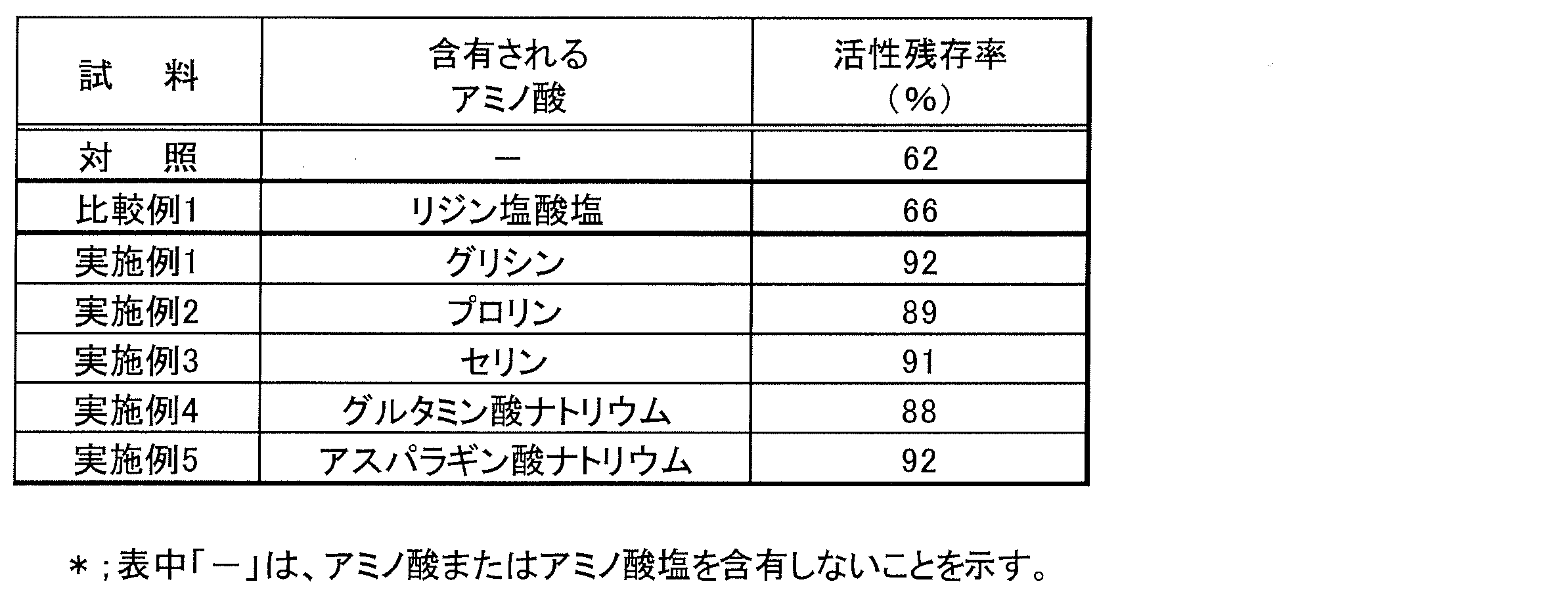
表1および図1に示されるように、対照におけるトランスグルタミナーゼの活性残存率は、62%であった。
これに対し、本発明の実施例1~5の液体製剤では、90%前後の高いトランスグルタミナーゼ活性残存率が認められた。
一方、比較例1の液体製剤では、トランスグルタミナーゼの活性残存率は66%であり、対照と同程度であった。
As shown in Table 1 and FIG. 1, the residual activity of transglutaminase in the control was 62%.
In contrast, in the liquid preparations of Examples 1 to 5 of the present invention, a high transglutaminase activity remaining rate of about 90% was observed.
On the other hand, in the liquid preparation of Comparative Example 1, the activity remaining rate of transglutaminase was 66%, which was similar to the control.
試験例1の上記結果から、グリシン、プロリン、セリン、グルタミン酸ナトリウムおよびアスパラギン酸ナトリウムのそれぞれが、液体製剤中のトランスグルタミナーゼの安定化効果を有することが確認された。
一方、上記以外のアミノ酸の塩である塩酸リジンについては、トランスグルタミナーゼの安定化効果は認められなかった。
From the results of Test Example 1, it was confirmed that each of glycine, proline, serine, sodium glutamate and sodium aspartate had a stabilizing effect on transglutaminase in the liquid preparation.
On the other hand, lysine hydrochloride, which is a salt of an amino acid other than those mentioned above, did not show the effect of stabilizing transglutaminase.
[試験例2]アミノ酸またはアミノ酸塩の含有量がトランスグルタミナーゼ安定化効果に及ぼす影響の検討
以下の通り、液体製剤中のアミノ酸またはアミノ酸塩の含有量が、トランスグルタミナーゼの安定性に及ぼす影響について、高温保存による加速試験により評価した。
[Test Example 2] Examination of influence of amino acid or amino acid salt content on transglutaminase stabilization effect As described below, the effect of amino acid or amino acid salt content in the liquid preparation on the stability of transglutaminase. Evaluation was made by an accelerated test by high-temperature storage.
(1)グリシンの含有量について
微生物由来のトランスグルタミナーゼ(1,000U/g、「アクティバTG」、味の素株式会社)17.6重量%、安息香酸ナトリウム0.1重量%を含有する0.05Mリン酸緩衝液(pH=6.0)に、グリシンを5重量%、10重量%および20重量%となるように添加して溶解し、0.05Mリン酸緩衝液(pH=6.0)で全量を100重量%として液体製剤を調製し、それぞれ実施例1-1、1-2および1-3とした。
また、グリシンの含有量を1重量%として同様に調製した液体製剤を比較例2とした。
実施例1-1~1-3および比較例2の各液体製剤を4℃および44℃で24時間保存し、各液体製剤中のトランスグルタミナーゼ活性を、上記したヒドロキサメート法により測定した。なお、グリシンを添加せずに同様に調製した液体製剤を対照として、同様に処理した。
各液体製剤を44℃で保存した場合のトランスグルタミナーゼ活性について、4℃で保存した場合のトランスグルタミナーゼ活性に対する残存率(%)にて、図2に示した。
(1) Content of glycine 0.05M phosphorus containing 17.6% by weight of microorganism-derived transglutaminase (1,000 U / g, “Activa TG”, Ajinomoto Co., Inc.) and 0.1% by weight of sodium benzoate In acid buffer (pH = 6.0), glycine was added to 5 wt%, 10 wt%, and 20 wt% and dissolved, and 0.05 M phosphate buffer (pH = 6.0) was added. Liquid preparations were prepared with a total amount of 100% by weight, and were designated as Examples 1-1, 1-2 and 1-3, respectively.
Moreover, the liquid formulation prepared similarly by making content of glycine 1 weight% was made into the comparative example 2.
Each liquid formulation of Examples 1-1 to 1-3 and Comparative Example 2 was stored at 4 ° C. and 44 ° C. for 24 hours, and the transglutaminase activity in each liquid formulation was measured by the hydroxamate method described above. The liquid preparation prepared in the same manner without adding glycine was treated in the same manner as a control.
FIG. 2 shows the transglutaminase activity when each liquid preparation was stored at 44 ° C., and the residual rate (%) relative to the transglutaminase activity when stored at 4 ° C.
図2に示されるように、グリシンを5重量%、10重量%および20重量%の各濃度で含有する実施例1-1~1-3の各液体製剤においては、対照に比べて高いトランスグルタミナーゼの活性残存率が認められた。
一方、グリシンの含有量が1重量%である比較例2の液体製剤では、トランスグルタミナーゼの活性残存率は、対照と同程度であった。
As shown in FIG. 2, in each liquid formulation of Examples 1-1 to 1-3 containing glycine at concentrations of 5% by weight, 10% by weight, and 20% by weight, a higher transglutaminase than the control Activity remaining rate was observed.
On the other hand, in the liquid preparation of Comparative Example 2 in which the glycine content was 1% by weight, the activity remaining rate of transglutaminase was comparable to that of the control.
(2)プロリンの含有量について
微生物由来のトランスグルタミナーゼ(1,000U/g、「アクティバTG」、味の素株式会社)17.6重量%、安息香酸ナトリウム0.1重量%を含有する0.05Mリン酸緩衝液(pH=6.0)に、プロリンを5重量%、10重量%、20重量%および30重量%となるように添加して溶解し、0.05Mリン酸緩衝液(pH=6.0)で全量を100重量%として液体製剤を調製し、それぞれ実施例2-1、2-2、2-3および2-4とした。
また、プロリンの含有量を1重量%として同様に調製した液体製剤を比較例3とした。
実施例2-1~2-4および比較例3の各液体製剤を4℃および44℃で24時間保存し、各液体製剤中のトランスグルタミナーゼ活性を、上記したヒドロキサメート法により測定した。なお、プロリンを添加せずに同様に調製した液体製剤を対照として、同様に処理した。
各液体製剤を44℃で保存した場合のトランスグルタミナーゼ活性について、4℃で保存した場合のトランスグルタミナーゼ活性に対する残存率(%)にて、図3に示した。
(2) Proline content 0.05M phosphorus containing 17.6% by weight of microorganism-derived transglutaminase (1,000 U / g, “Activa TG”, Ajinomoto Co., Inc.) and 0.1% by weight of sodium benzoate Proline is added to an acid buffer (pH = 6.0) so as to be 5% by weight, 10% by weight, 20% by weight, and 30% by weight and dissolved, and 0.05M phosphate buffer (pH = 6) is dissolved. 0.0) to prepare a liquid preparation with a total amount of 100% by weight, which were designated as Examples 2-1, 2-2, 2-3 and 2-4, respectively.
A liquid preparation prepared in the same manner with a proline content of 1% by weight was used as Comparative Example 3.
Each liquid formulation of Examples 2-1 to 2-4 and Comparative Example 3 was stored at 4 ° C. and 44 ° C. for 24 hours, and the transglutaminase activity in each liquid formulation was measured by the hydroxamate method described above. A liquid preparation prepared in the same manner without adding proline was treated in the same manner as a control.
FIG. 3 shows the transglutaminase activity when each liquid preparation was stored at 44 ° C., and the residual rate (%) relative to the transglutaminase activity when stored at 4 ° C.
図3に示されるように、プロリンを5重量%、10重量%、20重量%および30重量%の各濃度で含有する実施例2-1~2-4の各液体製剤においては、対照に比べて高いトランスグルタミナーゼの活性残存率が認められた。なお、プロリンの含有量が30重量%である実施例2-4の液体製剤におけるトランスグルタミナーゼの活性残存率は、プロリンの含有量が20重量%である実施例2-3の液体製剤における活性残存率と大差なく、プロリン含有量が20重量%を超えると、トランスグルタミナーゼ活性の安定化効果はプラトーとなることが示唆された。
一方、プロリンの含有量が1重量%である比較例3の液体製剤では、トランスグルタミナーゼの活性残存率は、対照と同程度であった。
As shown in FIG. 3, in each liquid formulation of Examples 2-1 to 2-4 containing proline at respective concentrations of 5%, 10%, 20% and 30% by weight, compared to the control A high activity rate of transglutaminase was observed. It should be noted that the residual activity of transglutaminase in the liquid preparation of Example 2-4 in which the proline content is 30% by weight is the residual activity in the liquid preparation in Example 2-3 in which the proline content is 20% by weight. It was suggested that when the proline content exceeds 20% by weight, the stabilizing effect of the transglutaminase activity becomes a plateau.
On the other hand, in the liquid preparation of Comparative Example 3 in which the proline content was 1% by weight, the activity remaining rate of transglutaminase was almost the same as that of the control.
(3)セリンの含有量について
微生物由来のトランスグルタミナーゼ(1,000U/g、「アクティバTG」、味の素株式会社)17.6重量%、安息香酸ナトリウム0.1重量%を含有する0.05Mリン酸緩衝液(pH=6.0)に、セリンを5重量%、10重量%および20重量%となるように添加して溶解し、0.05Mリン酸緩衝液(pH=6.0)で全量を100重量%として液体製剤を調製し、それぞれ実施例3-1、3-2および3-3とした。
また、セリンの含有量を1重量%として同様に調製した液体製剤を比較例4とした。
実施例3-1~3-3および比較例4の各液体製剤を4℃および44℃で24時間保存し、各液体製剤中のトランスグルタミナーゼ活性を、上記したヒドロキサメート法により測定した。なお、セリンを添加せずに同様に調製した液体製剤を対照として、同様に処理した。
各液体製剤を44℃で保存した場合のトランスグルタミナーゼ活性について、4℃で保存した場合のトランスグルタミナーゼ活性に対する残存率(%)にて、図4に示した。
(3) About Serine Content 0.05M phosphorus containing 17.6% by weight of microorganism-derived transglutaminase (1,000 U / g, “Activa TG”, Ajinomoto Co., Inc.) and 0.1% by weight of sodium benzoate Serine was added and dissolved in acid buffer (pH = 6.0) so as to be 5 wt%, 10 wt% and 20 wt%, and 0.05 M phosphate buffer (pH = 6.0) was used. Liquid preparations were prepared with a total amount of 100% by weight, and were designated as Examples 3-1, 3-2 and 3-3, respectively.
Moreover, the liquid formulation similarly prepared by making content of serine 1 weight% was made into the comparative example 4.
Each liquid formulation of Examples 3-1 to 3-3 and Comparative Example 4 was stored at 4 ° C. and 44 ° C. for 24 hours, and the transglutaminase activity in each liquid formulation was measured by the hydroxamate method described above. The liquid preparation prepared in the same manner without adding serine was treated in the same manner as a control.
FIG. 4 shows the transglutaminase activity when each liquid preparation was stored at 44 ° C., and the residual rate (%) relative to the transglutaminase activity when stored at 4 ° C.
図4に示されるように、セリンを5重量%、10重量%および20重量%の各濃度で含有する実施例3-1~3-3の各液体製剤においては、対照に比べて高いトランスグルタミナーゼの活性残存率が認められた。
一方、セリンの含有量が1重量%である比較例4の液体製剤では、トランスグルタミナーゼの活性残存率は、対照と同程度であった。
As shown in FIG. 4, in each liquid formulation of Examples 3-1 to 3-3 containing serine at concentrations of 5 wt%, 10 wt% and 20 wt%, a higher transglutaminase than the control Activity remaining rate was observed.
On the other hand, in the liquid preparation of Comparative Example 4 in which the serine content was 1% by weight, the activity remaining rate of transglutaminase was similar to that of the control.
(4)グルタミン酸ナトリウムの含有量について
微生物由来のトランスグルタミナーゼ(1,000U/g、「アクティバTG」、味の素株式会社)17.6重量%、安息香酸ナトリウム0.1重量%を含有する0.05Mリン酸緩衝液(pH=6.0)に、グルタミン酸ナトリウムを5重量%、10重量%、20重量%および30重量%となるように添加して溶解し、0.05Mリン酸緩衝液(pH=6.0)で全量を100重量%として液体製剤を調製し、それぞれ実施例4-1、4-2、4-3および4-4とした。
また、グルタミン酸ナトリウムの含有量を1重量%として同様に調製した液体製剤を比較例5とした。
実施例4-1~4-4および比較例5の各液体製剤を4℃および44℃で24時間保存し、各液体製剤中のトランスグルタミナーゼ活性を、上記したヒドロキサメート法により測定した。なお、グルタミン酸ナトリウムを添加せずに同様に調製した液体製剤を対照として、同様に処理した。
各液体製剤を44℃で保存した場合のトランスグルタミナーゼ活性について、4℃で保存した場合のトランスグルタミナーゼ活性に対する残存率(%)にて、図5に示した。
(4) Content of sodium glutamate 0.05 M containing 17.6% by weight of microorganism-derived transglutaminase (1,000 U / g, “Activa TG”, Ajinomoto Co., Inc.) and 0.1% by weight of sodium benzoate To phosphate buffer (pH = 6.0), sodium glutamate was added to 5 wt%, 10 wt%, 20 wt% and 30 wt% and dissolved, and 0.05 M phosphate buffer (pH = 6.0) and a liquid preparation was prepared with the total amount being 100% by weight, which were designated as Examples 4-1, 4-2, 4-3 and 4-4, respectively.
Further, a liquid preparation prepared in the same manner with the content of sodium glutamate being 1% by weight was defined as Comparative Example 5.
Each liquid formulation of Examples 4-1 to 4-4 and Comparative Example 5 was stored at 4 ° C. and 44 ° C. for 24 hours, and the transglutaminase activity in each liquid formulation was measured by the hydroxamate method described above. A liquid preparation prepared in the same manner without adding sodium glutamate was treated in the same manner as a control.
FIG. 5 shows the transglutaminase activity when each liquid preparation was stored at 44 ° C., and the residual rate (%) relative to the transglutaminase activity when stored at 4 ° C.
図5に示されるように、グルタミン酸ナトリウムを5重量%、10重量%、20重量%および30重量%の各濃度で含有する実施例4-1~4-4の各液体製剤においては、対照に比べて高いトランスグルタミナーゼの活性残存率が認められた。なお、グルタミン酸ナトリウムの含有量が30重量%である実施例4-4の液体製剤におけるトランスグルタミナーゼの活性残存率は、グルタミン酸ナトリウムの含有量が20重量%である実施例4-3の液体製剤における活性残存率と大差なく、グルタミン酸ナトリウム含有量が20重量%を超えると、トランスグルタミナーゼ活性の安定化効果はプラトーとなることが示唆された。
一方、グルタミン酸ナトリウムの含有量が1重量%である比較例5の液体製剤では、トランスグルタミナーゼの活性残存率は、対照と同程度であった。
As shown in FIG. 5, in each liquid formulation of Examples 4-1 to 4-4 containing sodium glutamate at concentrations of 5%, 10%, 20% and 30% by weight, A higher activity rate of transglutaminase was observed. The residual activity of transglutaminase in the liquid preparation of Example 4-4 in which the content of sodium glutamate is 30% by weight is the same as that in the liquid preparation in Example 4-3 in which the content of sodium glutamate is 20% by weight. It was suggested that when the sodium glutamate content exceeds 20% by weight, the stabilizing effect of the transglutaminase activity becomes a plateau without much difference from the residual activity rate.
On the other hand, in the liquid preparation of Comparative Example 5 in which the content of sodium glutamate was 1% by weight, the activity remaining rate of transglutaminase was similar to the control.
上記試験例2の結果から、液体製剤におけるグリシン、プロリン、セリンおよびグルタミン酸ナトリウムの各含有量が5重量%以上である場合に、トランスグルタミナーゼの安定化効果が認められ、グリシン、プロリン、セリンおよびグルタミン酸ナトリウムの各含有量が10重量%以上であると、より良好な安定化効果が得られることが示された。
また、グリシン、プロリン、セリンおよびグルタミン酸ナトリウムの各含有量が20重量%を超えると、トランスグルタミナーゼの安定化効果はプラトーとなることが示唆された。
From the results of Test Example 2 above, when each content of glycine, proline, serine and sodium glutamate in the liquid preparation is 5% by weight or more, the stabilizing effect of transglutaminase was observed, and glycine, proline, serine and glutamic acid were found. It was shown that a better stabilizing effect can be obtained when each content of sodium is 10% by weight or more.
Moreover, it was suggested that when each content of glycine, proline, serine and sodium glutamate exceeds 20% by weight, the stabilizing effect of transglutaminase becomes a plateau.
[試験例3]トランスグルタミナーゼの安定化に対する液体製剤のpHの影響の検討
以下の通り、液体製剤のpHが、トランスグルタミナーゼの安定化に及ぼす影響を、高温保存による加速試験により評価した。
グリシン添加区として、表2に示す液体製剤の処方に従い、微生物由来のトランスグルタミナーゼ(1,000U/g、「アクティバTG」、味の素株式会社)とグリシン10重量%を含有する試料を調製した。
また、グリシン添加区の各試料において、グリシンを各緩衝液で代替し、グリシン無添加区の各試料とした。
グリシン添加区およびグリシン無添加区の各試料を、4℃および44℃で24時間保存し、各液体製剤中のトランスグルタミナーゼ活性を、上記したヒドロキサメート法により測定し、結果を図6に示した。
[Test Example 3] Examination of influence of pH of liquid preparation on stabilization of transglutaminase As described below, the influence of the pH of the liquid preparation on the stabilization of transglutaminase was evaluated by an accelerated test by high-temperature storage.
As a glycine-added section, a sample containing microorganism-derived transglutaminase (1,000 U / g, “Activa TG”, Ajinomoto Co., Inc.) and glycine 10% by weight was prepared according to the formulation of the liquid preparation shown in Table 2.
Moreover, in each sample of the glycine addition group, glycine was substituted with each buffer solution, and it was set as each sample of the glycine non-addition group.
Each sample in the glycine-added group and the glycine-free group was stored at 4 ° C. and 44 ° C. for 24 hours, and the transglutaminase activity in each liquid formulation was measured by the hydroxamate method described above, and the results are shown in FIG. It was.
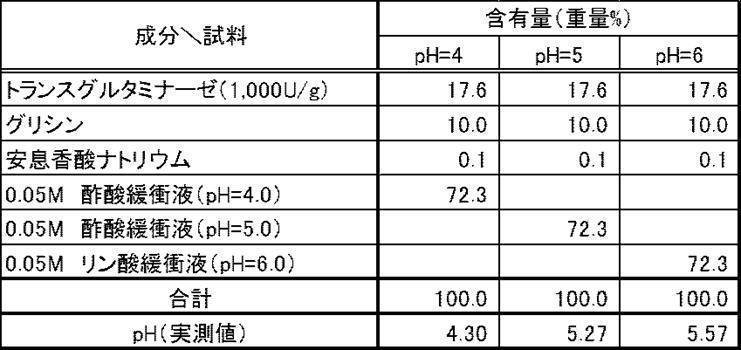
図6に示されるように、pHが4~6の液体製剤において、グリシンを添加した試料では、グリシンを添加しない試料に比べて、トランスグルタミナーゼ活性が高いことが認められた。
また、グリシンを含有する試料では、液体製剤のpHが5~6である場合において、トランスグルタミナーゼ活性が特に高いことが認められた。
As shown in FIG. 6, in the liquid preparation having a pH of 4 to 6, it was confirmed that the sample to which glycine was added had higher transglutaminase activity than the sample to which glycine was not added.
Further, it was confirmed that the transglutaminase activity was particularly high in the sample containing glycine when the pH of the liquid preparation was 5-6.
試験例3の上記結果から、本発明の製剤のpHが4~6である場合に、良好なトランスグルタミナーゼの安定化効果が認められ、液体製剤のpHが5~6である場合には、トランスグルタミナーゼ活性はより高く維持されることが示唆された。 From the above results of Test Example 3, when the pH of the preparation of the present invention is 4 to 6, a good stabilizing effect of transglutaminase is recognized, and when the pH of the liquid preparation is 5 to 6, It was suggested that glutaminase activity is maintained higher.
[実施例6~8、比較例6-1~8-2]トランスグルタミナーゼを含有する液体製剤
微生物由来のトランスグルタミナーゼ(1,000U/g、「アクティバTG」、味の素株式会社)17.6重量%を、酢酸ナトリウム、グルコン酸ナトリウムおよびクエン酸ナトリウム各10重量%とともに、それぞれ0.05Mリン酸緩衝液(pH=6.0)72.4重量%に溶解し、実施例6~8の液体製剤とした。
また、酢酸ナトリウム、グルコン酸ナトリウムおよびクエン酸ナトリウムの各含有量を、それぞれ1重量%および0.1重量%として、上記各実施例と同様に調製し、比較例6-1~8-2の液体製剤とした。
[Examples 6 to 8, Comparative Examples 6-1 to 8-2] Liquid preparations containing transglutaminase Microorganism-derived transglutaminase (1,000 U / g, “Activa TG”, Ajinomoto Co., Inc.) 17.6% by weight Was dissolved in 72.4% by weight of 0.05 M phosphate buffer (pH = 6.0) together with 10% by weight of sodium acetate, sodium gluconate and sodium citrate, respectively. It was.
Further, each content of sodium acetate, sodium gluconate and sodium citrate was adjusted to 1% by weight and 0.1% by weight, respectively, in the same manner as in each of the above examples, and Comparative Examples 6-1 to 8-2. It was set as the liquid formulation.
[試験例4]トランスグルタミナーゼの安定化効果の評価
上記実施例6~8および比較例6-1~8-2の各液体製剤におけるトランスグルタミナーゼの安定性について、以下の通り、高温保存による加速試験により評価した。
実施例6~8および比較例6-1~8-2の各液体製剤を4℃および44℃で24時間保存し、各液体製剤中のトランスグルタミナーゼ活性を、上記したヒドロキサメート法により測定した。
なお、トランスグルタミナーゼのみをリン酸緩衝液に溶解させた液体製剤を対照とし、同様に処理した。
各液体製剤中におけるトランスグルタミナーゼの安定性は、それぞれ44℃で保存した場合のトランスグルタミナーゼ活性について、4℃で保存した場合のトランスグルタミナーゼ活性に対する残存率(%)にて、図7~9に示した。
[Test Example 4] Evaluation of stabilizing effect of transglutaminase The stability of transglutaminase in each of the liquid preparations of Examples 6 to 8 and Comparative Examples 6-1 to 8-2 was as follows. It was evaluated by.
The liquid preparations of Examples 6 to 8 and Comparative Examples 6-1 to 8-2 were stored at 4 ° C. and 44 ° C. for 24 hours, and the transglutaminase activity in each liquid preparation was measured by the hydroxamate method described above. .
A liquid preparation in which only transglutaminase was dissolved in a phosphate buffer was used as a control and treated in the same manner.
The stability of transglutaminase in each liquid formulation is shown in FIGS. 7 to 9 in terms of the transglutaminase activity when stored at 44 ° C. and the residual rate (%) relative to the transglutaminase activity when stored at 4 ° C. It was.
図7~9に示されるように、酢酸ナトリウム、グルコン酸ナトリウムおよびクエン酸ナトリウムをそれぞれ10重量%含有する実施例6~8の各液体製剤では、対照に比べて、トランスグルタミナーゼの活性残存率が明らかに向上した。
しかし、酢酸ナトリウム、グルコン酸ナトリウムおよびクエン酸ナトリウムの各含有量がそれぞれ1重量%である比較例6-1、7-1および8-1、ならびに、酢酸ナトリウム、グルコン酸ナトリウムおよびクエン酸ナトリウムの各含有量がそれぞれ0.1重量%である比較例6-2、7-2および8-2の各液体製剤では、トランスグルタミナーゼの活性残存率は対照と同程度であった。
As shown in FIGS. 7 to 9, in the liquid preparations of Examples 6 to 8 each containing 10% by weight of sodium acetate, sodium gluconate and sodium citrate, the residual activity of transglutaminase was higher than that of the control. Obviously improved.
However, each of Comparative Examples 6-1, 7-1 and 8-1 in which each content of sodium acetate, sodium gluconate and sodium citrate is 1% by weight, and sodium acetate, sodium gluconate and sodium citrate In each of the liquid preparations of Comparative Examples 6-2, 7-2, and 8-2, each content was 0.1% by weight, the activity remaining rate of transglutaminase was similar to that of the control.
試験例4の上記結果から、有機酸塩である酢酸ナトリウム、グルコン酸ナトリウムおよびクエン酸ナトリウムによっても、トランスグルタミナーゼが安定化されること、ならびに、液体製剤における前記有機酸塩の含有量が10重量%である場合に、トランスグルタミナーゼが良好に安定化されることが示された。 From the above results of Test Example 4, transglutaminase is also stabilized by the organic acid salts sodium acetate, sodium gluconate and sodium citrate, and the content of the organic acid salt in the liquid preparation is 10% by weight. %, It was shown that transglutaminase is well stabilized.
以上、詳述したように、本発明により、トランスグルタミナーゼの安定性が向上したトランスグルタミナーゼの液体製剤を提供することができる。
本発明の液体製剤は、使用時にトランスグルタミナーゼを溶媒に溶解する必要がなく、利便性に優れ、さらに微生物汚染等の生じるおそれも少ない。また、食品分野における利用に適する。
また、本発明により、上記した本発明の液体製剤を添加し、安定性の向上したトランスグルタミナーゼが作用した食肉等の食品素材を含有する食品を提供することができる。
As described above in detail, according to the present invention, a liquid preparation of transglutaminase having improved stability of transglutaminase can be provided.
The liquid preparation of the present invention does not need to dissolve transglutaminase in a solvent at the time of use, is excellent in convenience, and is less likely to cause microbial contamination. It is also suitable for use in the food field.
In addition, according to the present invention, the above-described liquid preparation of the present invention can be added to provide a food containing a food material such as meat to which transglutaminase having improved stability has acted.
本願は、日本国で出願された特願2018-057185を基礎としており、その内容は本明細書にすべて包含されるものである。 This application is based on Japanese Patent Application No. 2018-057185 filed in Japan, the contents of which are incorporated in full herein.
Claims (23)
Priority Applications (3)
| Application Number | Priority Date | Filing Date | Title |
|---|---|---|---|
| JP2020507936A JP7501357B2 (en) | 2018-03-23 | 2019-03-22 | Liquid preparations containing transglutaminase |
| EP19771166.6A EP3770254A4 (en) | 2018-03-23 | 2019-03-22 | Liquid preparation containing transglutaminase |
| JP2023186015A JP7761033B2 (en) | 2018-03-23 | 2023-10-30 | Liquid preparations containing transglutaminase |
Applications Claiming Priority (2)
| Application Number | Priority Date | Filing Date | Title |
|---|---|---|---|
| JP2018057185 | 2018-03-23 | ||
| JP2018-057185 | 2018-03-23 |
Publications (1)
| Publication Number | Publication Date |
|---|---|
| WO2019182123A1 true WO2019182123A1 (en) | 2019-09-26 |
Family
ID=67987410
Family Applications (1)
| Application Number | Title | Priority Date | Filing Date |
|---|---|---|---|
| PCT/JP2019/012142 Ceased WO2019182123A1 (en) | 2018-03-23 | 2019-03-22 | Liquid preparation containing transglutaminase |
Country Status (3)
| Country | Link |
|---|---|
| EP (1) | EP3770254A4 (en) |
| JP (2) | JP7501357B2 (en) |
| WO (1) | WO2019182123A1 (en) |
Cited By (2)
| Publication number | Priority date | Publication date | Assignee | Title |
|---|---|---|---|---|
| JP2021145603A (en) * | 2020-03-18 | 2021-09-27 | 味の素株式会社 | Method for stabilizing enzyme in liquid preparation |
| WO2023058616A1 (en) | 2021-10-04 | 2023-04-13 | 天野エンザイム株式会社 | Liquid transglutaminase enzyme preparation |
Citations (16)
| Publication number | Priority date | Publication date | Assignee | Title |
|---|---|---|---|---|
| JPS53300B1 (en) | 1967-04-28 | 1978-01-07 | ||
| JPS5359018A (en) * | 1976-11-10 | 1978-05-27 | Green Cross Corp:The | Concentrated xiii-th blood coagulating factor derived from human placentaand its preparation |
| JPS55145615A (en) * | 1979-04-25 | 1980-11-13 | Behringwerke Ag | Blood coagulation factor and its manufacture |
| JPS6244079B2 (en) | 1979-11-01 | 1987-09-18 | Enu Eru Chem Inc | |
| JPS6427471A (en) | 1987-03-04 | 1989-01-30 | Ajinomoto Kk | Novel enzyme and production of protein gelatinized product using said enzyme |
| JPH04207194A (en) * | 1990-11-30 | 1992-07-29 | Ajinomoto Co Inc | Stabilized transglutaminase composition and method for preserving the same |
| JP2572716B2 (en) | 1987-03-04 | 1997-01-16 | 味の素株式会社 | Novel transglutaminase |
| JPH11130682A (en) * | 1997-10-28 | 1999-05-18 | Nihon Pharmaceutical Co Ltd | Thermostabilization of blood coagulation factor XIII |
| JP2002529202A (en) * | 1998-11-18 | 2002-09-10 | アベンティス・ベーリング・ゲゼルシャフト・ミット・ベシュレンクテル・ハフツング | Stabilized protein preparation for tissue adhesive |
| JP2004305010A (en) * | 2003-04-02 | 2004-11-04 | Amano Enzyme Inc | Stabilized transglutaminase |
| JP2009062384A (en) * | 2008-10-22 | 2009-03-26 | Csl Behring Gmbh | Stabilized aqueous liquid formulation of human blood coagulation factor XIII |
| JP2011206048A (en) * | 2010-03-08 | 2011-10-20 | Ajinomoto Co Inc | Method for producing food, and enzyme preparation for modifying food |
| WO2012077817A1 (en) * | 2010-12-07 | 2012-06-14 | 味の素株式会社 | Stabilized enzyme composition and method for producing same |
| JP2014532421A (en) | 2011-11-01 | 2014-12-08 | ヴァリオ・リミテッドValio Ltd. | Liquid enzyme preparation and preparation method thereof |
| CN105462950A (en) | 2016-02-16 | 2016-04-06 | 上海青瑞食品科技有限公司 | Liquid enzyme preparation and preparation method thereof |
| JP2018057185A (en) | 2016-09-29 | 2018-04-05 | 株式会社日立製作所 | Railway vehicular control device |
Family Cites Families (3)
| Publication number | Priority date | Publication date | Assignee | Title |
|---|---|---|---|---|
| JPH08333277A (en) * | 1995-06-05 | 1996-12-17 | Hoechst Japan Ltd | Human blood coagulation factor XIII stabilized aqueous liquid preparation |
| CA2728187C (en) * | 2008-06-18 | 2014-04-29 | Lifebond Ltd | Improved cross-linked compositions |
| JP6822019B2 (en) * | 2016-09-07 | 2021-01-27 | 味の素株式会社 | Fish as food modifier |
-
2019
- 2019-03-22 WO PCT/JP2019/012142 patent/WO2019182123A1/en not_active Ceased
- 2019-03-22 EP EP19771166.6A patent/EP3770254A4/en active Pending
- 2019-03-22 JP JP2020507936A patent/JP7501357B2/en active Active
-
2023
- 2023-10-30 JP JP2023186015A patent/JP7761033B2/en active Active
Patent Citations (17)
| Publication number | Priority date | Publication date | Assignee | Title |
|---|---|---|---|---|
| JPS53300B1 (en) | 1967-04-28 | 1978-01-07 | ||
| JPS5359018A (en) * | 1976-11-10 | 1978-05-27 | Green Cross Corp:The | Concentrated xiii-th blood coagulating factor derived from human placentaand its preparation |
| JPS55145615A (en) * | 1979-04-25 | 1980-11-13 | Behringwerke Ag | Blood coagulation factor and its manufacture |
| JPS6244079B2 (en) | 1979-11-01 | 1987-09-18 | Enu Eru Chem Inc | |
| JPS6427471A (en) | 1987-03-04 | 1989-01-30 | Ajinomoto Kk | Novel enzyme and production of protein gelatinized product using said enzyme |
| JP2572716B2 (en) | 1987-03-04 | 1997-01-16 | 味の素株式会社 | Novel transglutaminase |
| JPH04207194A (en) * | 1990-11-30 | 1992-07-29 | Ajinomoto Co Inc | Stabilized transglutaminase composition and method for preserving the same |
| JPH11130682A (en) * | 1997-10-28 | 1999-05-18 | Nihon Pharmaceutical Co Ltd | Thermostabilization of blood coagulation factor XIII |
| JP2002529202A (en) * | 1998-11-18 | 2002-09-10 | アベンティス・ベーリング・ゲゼルシャフト・ミット・ベシュレンクテル・ハフツング | Stabilized protein preparation for tissue adhesive |
| JP2004305010A (en) * | 2003-04-02 | 2004-11-04 | Amano Enzyme Inc | Stabilized transglutaminase |
| JP2009062384A (en) * | 2008-10-22 | 2009-03-26 | Csl Behring Gmbh | Stabilized aqueous liquid formulation of human blood coagulation factor XIII |
| JP2011206048A (en) * | 2010-03-08 | 2011-10-20 | Ajinomoto Co Inc | Method for producing food, and enzyme preparation for modifying food |
| WO2012077817A1 (en) * | 2010-12-07 | 2012-06-14 | 味の素株式会社 | Stabilized enzyme composition and method for producing same |
| JP2014532421A (en) | 2011-11-01 | 2014-12-08 | ヴァリオ・リミテッドValio Ltd. | Liquid enzyme preparation and preparation method thereof |
| CN105462950A (en) | 2016-02-16 | 2016-04-06 | 上海青瑞食品科技有限公司 | Liquid enzyme preparation and preparation method thereof |
| WO2017140051A1 (en) * | 2016-02-16 | 2017-08-24 | 上海青瑞食品科技有限公司 | Liquid enzyme preparation and preparation method thereof |
| JP2018057185A (en) | 2016-09-29 | 2018-04-05 | 株式会社日立製作所 | Railway vehicular control device |
Non-Patent Citations (1)
| Title |
|---|
| See also references of EP3770254A4 |
Cited By (4)
| Publication number | Priority date | Publication date | Assignee | Title |
|---|---|---|---|---|
| JP2021145603A (en) * | 2020-03-18 | 2021-09-27 | 味の素株式会社 | Method for stabilizing enzyme in liquid preparation |
| JP7559336B2 (en) | 2020-03-18 | 2024-10-02 | 味の素株式会社 | Methods for stabilizing enzymes in liquid formulations |
| WO2023058616A1 (en) | 2021-10-04 | 2023-04-13 | 天野エンザイム株式会社 | Liquid transglutaminase enzyme preparation |
| EP4414450A4 (en) * | 2021-10-04 | 2025-07-02 | Amano Enzyme Inc | LIQUID TRANSGLUTAMINASE ENZYME PREPARATION |
Also Published As
| Publication number | Publication date |
|---|---|
| JPWO2019182123A1 (en) | 2021-04-08 |
| EP3770254A4 (en) | 2021-12-29 |
| JP7761033B2 (en) | 2025-10-28 |
| JP2024012430A (en) | 2024-01-30 |
| JP7501357B2 (en) | 2024-06-18 |
| EP3770254A1 (en) | 2021-01-27 |
Similar Documents
| Publication | Publication Date | Title |
|---|---|---|
| JP6894907B2 (en) | Liquid enzyme preparation and its preparation method | |
| JP3651003B2 (en) | Stabilized transglutaminase and enzyme preparation containing the same | |
| JP7761033B2 (en) | Liquid preparations containing transglutaminase | |
| WO2004028274A1 (en) | Enzyme preparation and process for producing food using the same | |
| US5009907A (en) | Method for treating food to control the growth of yeasts | |
| JP5929760B2 (en) | Stabilized enzyme composition and method for producing the same | |
| JP2006149384A (en) | Method for producing processed food | |
| WO2022163737A1 (en) | Fried prepared food modifier, fried prepared food coating material and dredging liquid, method for improving flavor of fried prepared food and method for producing fried prepared food | |
| JPS61170376A (en) | Preservative for food | |
| JP3314277B2 (en) | Processed food preservative and preservation method | |
| JP5752884B2 (en) | Powder formulation for food | |
| JP2004065186A (en) | Powdered emulsifier composition, food shelf life improver containing the same and food | |
| JP4988470B2 (en) | Food shelf life improving agent and shelf life improving method | |
| JP6852303B2 (en) | How to make salted subclasses | |
| JP6496661B2 (en) | Food shelf life improving agent and food shelf life improving method | |
| JPH048273A (en) | Agent for improvement of keeping quality of food | |
| JP6650805B2 (en) | Powdered shelf life improver for food | |
| US20040156951A1 (en) | Controlled acidification of food products using lactic-or glycolic acid oligomers/derivatives | |
| JPH11123070A (en) | Food preservation agent | |
| JP7410654B2 (en) | Amino acid component-containing food and beverage composition, unpleasant taste masking agent for amino acid components, and method for improving unpleasant taste derived from amino acid components | |
| JPH0611228B2 (en) | Food preservative composition | |
| EP1571922B1 (en) | Controlled acidification of food products using lactic - or glycolic acid oligomers/derivatives | |
| JP4748677B2 (en) | Thiamine lauryl sulfate-containing liquid formulation | |
| JP2007189926A (en) | Meat quality improver, and method for producing meat processed product | |
| JP3558408B2 (en) | Food preservatives |
Legal Events
| Date | Code | Title | Description |
|---|---|---|---|
| 121 | Ep: the epo has been informed by wipo that ep was designated in this application |
Ref document number: 19771166 Country of ref document: EP Kind code of ref document: A1 |
|
| ENP | Entry into the national phase |
Ref document number: 2020507936 Country of ref document: JP Kind code of ref document: A |
|
| NENP | Non-entry into the national phase |
Ref country code: DE |
|
| ENP | Entry into the national phase |
Ref document number: 2019771166 Country of ref document: EP Effective date: 20201023 |