WO2018233571A1 - Antibody-drug conjugate with acidic self-stabilizing linker - Google Patents
Antibody-drug conjugate with acidic self-stabilizing linker Download PDFInfo
- Publication number
- WO2018233571A1 WO2018233571A1 PCT/CN2018/091621 CN2018091621W WO2018233571A1 WO 2018233571 A1 WO2018233571 A1 WO 2018233571A1 CN 2018091621 W CN2018091621 W CN 2018091621W WO 2018233571 A1 WO2018233571 A1 WO 2018233571A1
- Authority
- WO
- WIPO (PCT)
- Prior art keywords
- group
- antibody
- drug
- pharmaceutically acceptable
- acceptable salt
- Prior art date
- Legal status (The legal status is an assumption and is not a legal conclusion. Google has not performed a legal analysis and makes no representation as to the accuracy of the status listed.)
- Ceased
Links
- 0 CC(CC(**)N(C(C=C1)=O)C1=O)=O Chemical compound CC(CC(**)N(C(C=C1)=O)C1=O)=O 0.000 description 7
- ZDHYOZGGUNBHKM-HWGZXBSUSA-N CCOP(CCN(CC(C(N[C@@H](C(C)C)C(N[C@@H](CCCNC(N)=O)C(Nc1ccc(COC(Oc(cc2)ccc2[N+]([O-])=O)=O)cc1)=O)=O)=O)N(C(C=C1)=O)C1=O)C(OC(C)(C)C)=O)(OCC)=O Chemical compound CCOP(CCN(CC(C(N[C@@H](C(C)C)C(N[C@@H](CCCNC(N)=O)C(Nc1ccc(COC(Oc(cc2)ccc2[N+]([O-])=O)=O)cc1)=O)=O)=O)N(C(C=C1)=O)C1=O)C(OC(C)(C)C)=O)(OCC)=O ZDHYOZGGUNBHKM-HWGZXBSUSA-N 0.000 description 1
- GNIOAQOGTUXHIE-JOFMAYJPSA-N CC[C@H](C)C([C@@H](CC(N(CCC1)C1[C@H]([C@@H](C)C(N[C@@H](Cc1ccccc1)C(O)=O)=O)OC)=O)OC)N(C)C(CC(C)C/[O]=C(/C(C(C)C)N(C)C(C(C(C)CC(C)C(C)=O)N(C(C=C1)=O)C1=O)=O)\N)=O Chemical compound CC[C@H](C)C([C@@H](CC(N(CCC1)C1[C@H]([C@@H](C)C(N[C@@H](Cc1ccccc1)C(O)=O)=O)OC)=O)OC)N(C)C(CC(C)C/[O]=C(/C(C(C)C)N(C)C(C(C(C)CC(C)C(C)=O)N(C(C=C1)=O)C1=O)=O)\N)=O GNIOAQOGTUXHIE-JOFMAYJPSA-N 0.000 description 1
- KMTDMTZBNYGUNX-UHFFFAOYSA-N Cc1ccc(CO)cc1 Chemical compound Cc1ccc(CO)cc1 KMTDMTZBNYGUNX-UHFFFAOYSA-N 0.000 description 1
Images




Classifications
-
- A—HUMAN NECESSITIES
- A61—MEDICAL OR VETERINARY SCIENCE; HYGIENE
- A61K—PREPARATIONS FOR MEDICAL, DENTAL OR TOILETRY PURPOSES
- A61K47/00—Medicinal preparations characterised by the non-active ingredients used, e.g. carriers or inert additives; Targeting or modifying agents chemically bound to the active ingredient
- A61K47/50—Medicinal preparations characterised by the non-active ingredients used, e.g. carriers or inert additives; Targeting or modifying agents chemically bound to the active ingredient the non-active ingredient being chemically bound to the active ingredient, e.g. polymer-drug conjugates
- A61K47/51—Medicinal preparations characterised by the non-active ingredients used, e.g. carriers or inert additives; Targeting or modifying agents chemically bound to the active ingredient the non-active ingredient being chemically bound to the active ingredient, e.g. polymer-drug conjugates the non-active ingredient being a modifying agent
- A61K47/68—Medicinal preparations characterised by the non-active ingredients used, e.g. carriers or inert additives; Targeting or modifying agents chemically bound to the active ingredient the non-active ingredient being chemically bound to the active ingredient, e.g. polymer-drug conjugates the non-active ingredient being a modifying agent the modifying agent being an antibody, an immunoglobulin or a fragment thereof, e.g. an Fc-fragment
- A61K47/6889—Conjugates wherein the antibody being the modifying agent and wherein the linker, binder or spacer confers particular properties to the conjugates, e.g. peptidic enzyme-labile linkers or acid-labile linkers, providing for an acid-labile immuno conjugate wherein the drug may be released from its antibody conjugated part in an acidic, e.g. tumoural or environment
-
- A—HUMAN NECESSITIES
- A61—MEDICAL OR VETERINARY SCIENCE; HYGIENE
- A61K—PREPARATIONS FOR MEDICAL, DENTAL OR TOILETRY PURPOSES
- A61K47/00—Medicinal preparations characterised by the non-active ingredients used, e.g. carriers or inert additives; Targeting or modifying agents chemically bound to the active ingredient
- A61K47/50—Medicinal preparations characterised by the non-active ingredients used, e.g. carriers or inert additives; Targeting or modifying agents chemically bound to the active ingredient the non-active ingredient being chemically bound to the active ingredient, e.g. polymer-drug conjugates
- A61K47/51—Medicinal preparations characterised by the non-active ingredients used, e.g. carriers or inert additives; Targeting or modifying agents chemically bound to the active ingredient the non-active ingredient being chemically bound to the active ingredient, e.g. polymer-drug conjugates the non-active ingredient being a modifying agent
- A61K47/68—Medicinal preparations characterised by the non-active ingredients used, e.g. carriers or inert additives; Targeting or modifying agents chemically bound to the active ingredient the non-active ingredient being chemically bound to the active ingredient, e.g. polymer-drug conjugates the non-active ingredient being a modifying agent the modifying agent being an antibody, an immunoglobulin or a fragment thereof, e.g. an Fc-fragment
- A61K47/6835—Medicinal preparations characterised by the non-active ingredients used, e.g. carriers or inert additives; Targeting or modifying agents chemically bound to the active ingredient the non-active ingredient being chemically bound to the active ingredient, e.g. polymer-drug conjugates the non-active ingredient being a modifying agent the modifying agent being an antibody, an immunoglobulin or a fragment thereof, e.g. an Fc-fragment the modifying agent being an antibody or an immunoglobulin bearing at least one antigen-binding site
- A61K47/6849—Medicinal preparations characterised by the non-active ingredients used, e.g. carriers or inert additives; Targeting or modifying agents chemically bound to the active ingredient the non-active ingredient being chemically bound to the active ingredient, e.g. polymer-drug conjugates the non-active ingredient being a modifying agent the modifying agent being an antibody, an immunoglobulin or a fragment thereof, e.g. an Fc-fragment the modifying agent being an antibody or an immunoglobulin bearing at least one antigen-binding site the antibody targeting a receptor, a cell surface antigen or a cell surface determinant
-
- A—HUMAN NECESSITIES
- A61—MEDICAL OR VETERINARY SCIENCE; HYGIENE
- A61K—PREPARATIONS FOR MEDICAL, DENTAL OR TOILETRY PURPOSES
- A61K38/00—Medicinal preparations containing peptides
- A61K38/04—Peptides having up to 20 amino acids in a fully defined sequence; Derivatives thereof
- A61K38/07—Tetrapeptides
-
- A—HUMAN NECESSITIES
- A61—MEDICAL OR VETERINARY SCIENCE; HYGIENE
- A61K—PREPARATIONS FOR MEDICAL, DENTAL OR TOILETRY PURPOSES
- A61K47/00—Medicinal preparations characterised by the non-active ingredients used, e.g. carriers or inert additives; Targeting or modifying agents chemically bound to the active ingredient
- A61K47/50—Medicinal preparations characterised by the non-active ingredients used, e.g. carriers or inert additives; Targeting or modifying agents chemically bound to the active ingredient the non-active ingredient being chemically bound to the active ingredient, e.g. polymer-drug conjugates
- A61K47/51—Medicinal preparations characterised by the non-active ingredients used, e.g. carriers or inert additives; Targeting or modifying agents chemically bound to the active ingredient the non-active ingredient being chemically bound to the active ingredient, e.g. polymer-drug conjugates the non-active ingredient being a modifying agent
- A61K47/54—Medicinal preparations characterised by the non-active ingredients used, e.g. carriers or inert additives; Targeting or modifying agents chemically bound to the active ingredient the non-active ingredient being chemically bound to the active ingredient, e.g. polymer-drug conjugates the non-active ingredient being a modifying agent the modifying agent being an organic compound
- A61K47/545—Heterocyclic compounds
-
- A—HUMAN NECESSITIES
- A61—MEDICAL OR VETERINARY SCIENCE; HYGIENE
- A61K—PREPARATIONS FOR MEDICAL, DENTAL OR TOILETRY PURPOSES
- A61K47/00—Medicinal preparations characterised by the non-active ingredients used, e.g. carriers or inert additives; Targeting or modifying agents chemically bound to the active ingredient
- A61K47/50—Medicinal preparations characterised by the non-active ingredients used, e.g. carriers or inert additives; Targeting or modifying agents chemically bound to the active ingredient the non-active ingredient being chemically bound to the active ingredient, e.g. polymer-drug conjugates
- A61K47/51—Medicinal preparations characterised by the non-active ingredients used, e.g. carriers or inert additives; Targeting or modifying agents chemically bound to the active ingredient the non-active ingredient being chemically bound to the active ingredient, e.g. polymer-drug conjugates the non-active ingredient being a modifying agent
- A61K47/62—Medicinal preparations characterised by the non-active ingredients used, e.g. carriers or inert additives; Targeting or modifying agents chemically bound to the active ingredient the non-active ingredient being chemically bound to the active ingredient, e.g. polymer-drug conjugates the non-active ingredient being a modifying agent the modifying agent being a protein, peptide or polyamino acid
- A61K47/65—Peptidic linkers, binders or spacers, e.g. peptidic enzyme-labile linkers
-
- A—HUMAN NECESSITIES
- A61—MEDICAL OR VETERINARY SCIENCE; HYGIENE
- A61K—PREPARATIONS FOR MEDICAL, DENTAL OR TOILETRY PURPOSES
- A61K47/00—Medicinal preparations characterised by the non-active ingredients used, e.g. carriers or inert additives; Targeting or modifying agents chemically bound to the active ingredient
- A61K47/50—Medicinal preparations characterised by the non-active ingredients used, e.g. carriers or inert additives; Targeting or modifying agents chemically bound to the active ingredient the non-active ingredient being chemically bound to the active ingredient, e.g. polymer-drug conjugates
- A61K47/51—Medicinal preparations characterised by the non-active ingredients used, e.g. carriers or inert additives; Targeting or modifying agents chemically bound to the active ingredient the non-active ingredient being chemically bound to the active ingredient, e.g. polymer-drug conjugates the non-active ingredient being a modifying agent
- A61K47/68—Medicinal preparations characterised by the non-active ingredients used, e.g. carriers or inert additives; Targeting or modifying agents chemically bound to the active ingredient the non-active ingredient being chemically bound to the active ingredient, e.g. polymer-drug conjugates the non-active ingredient being a modifying agent the modifying agent being an antibody, an immunoglobulin or a fragment thereof, e.g. an Fc-fragment
- A61K47/6801—Drug-antibody or immunoglobulin conjugates defined by the pharmacologically or therapeutically active agent
- A61K47/6803—Drugs conjugated to an antibody or immunoglobulin, e.g. cisplatin-antibody conjugates
-
- A—HUMAN NECESSITIES
- A61—MEDICAL OR VETERINARY SCIENCE; HYGIENE
- A61K—PREPARATIONS FOR MEDICAL, DENTAL OR TOILETRY PURPOSES
- A61K47/00—Medicinal preparations characterised by the non-active ingredients used, e.g. carriers or inert additives; Targeting or modifying agents chemically bound to the active ingredient
- A61K47/50—Medicinal preparations characterised by the non-active ingredients used, e.g. carriers or inert additives; Targeting or modifying agents chemically bound to the active ingredient the non-active ingredient being chemically bound to the active ingredient, e.g. polymer-drug conjugates
- A61K47/51—Medicinal preparations characterised by the non-active ingredients used, e.g. carriers or inert additives; Targeting or modifying agents chemically bound to the active ingredient the non-active ingredient being chemically bound to the active ingredient, e.g. polymer-drug conjugates the non-active ingredient being a modifying agent
- A61K47/68—Medicinal preparations characterised by the non-active ingredients used, e.g. carriers or inert additives; Targeting or modifying agents chemically bound to the active ingredient the non-active ingredient being chemically bound to the active ingredient, e.g. polymer-drug conjugates the non-active ingredient being a modifying agent the modifying agent being an antibody, an immunoglobulin or a fragment thereof, e.g. an Fc-fragment
- A61K47/6801—Drug-antibody or immunoglobulin conjugates defined by the pharmacologically or therapeutically active agent
- A61K47/6803—Drugs conjugated to an antibody or immunoglobulin, e.g. cisplatin-antibody conjugates
- A61K47/68031—Drugs conjugated to an antibody or immunoglobulin, e.g. cisplatin-antibody conjugates the drug being an auristatin
-
- A—HUMAN NECESSITIES
- A61—MEDICAL OR VETERINARY SCIENCE; HYGIENE
- A61K—PREPARATIONS FOR MEDICAL, DENTAL OR TOILETRY PURPOSES
- A61K47/00—Medicinal preparations characterised by the non-active ingredients used, e.g. carriers or inert additives; Targeting or modifying agents chemically bound to the active ingredient
- A61K47/50—Medicinal preparations characterised by the non-active ingredients used, e.g. carriers or inert additives; Targeting or modifying agents chemically bound to the active ingredient the non-active ingredient being chemically bound to the active ingredient, e.g. polymer-drug conjugates
- A61K47/51—Medicinal preparations characterised by the non-active ingredients used, e.g. carriers or inert additives; Targeting or modifying agents chemically bound to the active ingredient the non-active ingredient being chemically bound to the active ingredient, e.g. polymer-drug conjugates the non-active ingredient being a modifying agent
- A61K47/68—Medicinal preparations characterised by the non-active ingredients used, e.g. carriers or inert additives; Targeting or modifying agents chemically bound to the active ingredient the non-active ingredient being chemically bound to the active ingredient, e.g. polymer-drug conjugates the non-active ingredient being a modifying agent the modifying agent being an antibody, an immunoglobulin or a fragment thereof, e.g. an Fc-fragment
- A61K47/6835—Medicinal preparations characterised by the non-active ingredients used, e.g. carriers or inert additives; Targeting or modifying agents chemically bound to the active ingredient the non-active ingredient being chemically bound to the active ingredient, e.g. polymer-drug conjugates the non-active ingredient being a modifying agent the modifying agent being an antibody, an immunoglobulin or a fragment thereof, e.g. an Fc-fragment the modifying agent being an antibody or an immunoglobulin bearing at least one antigen-binding site
- A61K47/6851—Medicinal preparations characterised by the non-active ingredients used, e.g. carriers or inert additives; Targeting or modifying agents chemically bound to the active ingredient the non-active ingredient being chemically bound to the active ingredient, e.g. polymer-drug conjugates the non-active ingredient being a modifying agent the modifying agent being an antibody, an immunoglobulin or a fragment thereof, e.g. an Fc-fragment the modifying agent being an antibody or an immunoglobulin bearing at least one antigen-binding site the antibody targeting a determinant of a tumour cell
-
- A—HUMAN NECESSITIES
- A61—MEDICAL OR VETERINARY SCIENCE; HYGIENE
- A61K—PREPARATIONS FOR MEDICAL, DENTAL OR TOILETRY PURPOSES
- A61K47/00—Medicinal preparations characterised by the non-active ingredients used, e.g. carriers or inert additives; Targeting or modifying agents chemically bound to the active ingredient
- A61K47/50—Medicinal preparations characterised by the non-active ingredients used, e.g. carriers or inert additives; Targeting or modifying agents chemically bound to the active ingredient the non-active ingredient being chemically bound to the active ingredient, e.g. polymer-drug conjugates
- A61K47/51—Medicinal preparations characterised by the non-active ingredients used, e.g. carriers or inert additives; Targeting or modifying agents chemically bound to the active ingredient the non-active ingredient being chemically bound to the active ingredient, e.g. polymer-drug conjugates the non-active ingredient being a modifying agent
- A61K47/68—Medicinal preparations characterised by the non-active ingredients used, e.g. carriers or inert additives; Targeting or modifying agents chemically bound to the active ingredient the non-active ingredient being chemically bound to the active ingredient, e.g. polymer-drug conjugates the non-active ingredient being a modifying agent the modifying agent being an antibody, an immunoglobulin or a fragment thereof, e.g. an Fc-fragment
- A61K47/6835—Medicinal preparations characterised by the non-active ingredients used, e.g. carriers or inert additives; Targeting or modifying agents chemically bound to the active ingredient the non-active ingredient being chemically bound to the active ingredient, e.g. polymer-drug conjugates the non-active ingredient being a modifying agent the modifying agent being an antibody, an immunoglobulin or a fragment thereof, e.g. an Fc-fragment the modifying agent being an antibody or an immunoglobulin bearing at least one antigen-binding site
- A61K47/6851—Medicinal preparations characterised by the non-active ingredients used, e.g. carriers or inert additives; Targeting or modifying agents chemically bound to the active ingredient the non-active ingredient being chemically bound to the active ingredient, e.g. polymer-drug conjugates the non-active ingredient being a modifying agent the modifying agent being an antibody, an immunoglobulin or a fragment thereof, e.g. an Fc-fragment the modifying agent being an antibody or an immunoglobulin bearing at least one antigen-binding site the antibody targeting a determinant of a tumour cell
- A61K47/6859—Medicinal preparations characterised by the non-active ingredients used, e.g. carriers or inert additives; Targeting or modifying agents chemically bound to the active ingredient the non-active ingredient being chemically bound to the active ingredient, e.g. polymer-drug conjugates the non-active ingredient being a modifying agent the modifying agent being an antibody, an immunoglobulin or a fragment thereof, e.g. an Fc-fragment the modifying agent being an antibody or an immunoglobulin bearing at least one antigen-binding site the antibody targeting a determinant of a tumour cell the tumour determinant being from liver or pancreas cancer cell
-
- A—HUMAN NECESSITIES
- A61—MEDICAL OR VETERINARY SCIENCE; HYGIENE
- A61P—SPECIFIC THERAPEUTIC ACTIVITY OF CHEMICAL COMPOUNDS OR MEDICINAL PREPARATIONS
- A61P29/00—Non-central analgesic, antipyretic or antiinflammatory agents, e.g. antirheumatic agents; Non-steroidal antiinflammatory drugs [NSAID]
-
- A—HUMAN NECESSITIES
- A61—MEDICAL OR VETERINARY SCIENCE; HYGIENE
- A61P—SPECIFIC THERAPEUTIC ACTIVITY OF CHEMICAL COMPOUNDS OR MEDICINAL PREPARATIONS
- A61P35/00—Antineoplastic agents
-
- A—HUMAN NECESSITIES
- A61—MEDICAL OR VETERINARY SCIENCE; HYGIENE
- A61P—SPECIFIC THERAPEUTIC ACTIVITY OF CHEMICAL COMPOUNDS OR MEDICINAL PREPARATIONS
- A61P37/00—Drugs for immunological or allergic disorders
- A61P37/02—Immunomodulators
-
- C—CHEMISTRY; METALLURGY
- C07—ORGANIC CHEMISTRY
- C07K—PEPTIDES
- C07K16/00—Immunoglobulins [IGs], e.g. monoclonal or polyclonal antibodies
- C07K16/18—Immunoglobulins [IGs], e.g. monoclonal or polyclonal antibodies against material from animals or humans
- C07K16/28—Immunoglobulins [IGs], e.g. monoclonal or polyclonal antibodies against material from animals or humans against receptors, cell surface antigens or cell surface determinants
- C07K16/30—Immunoglobulins [IGs], e.g. monoclonal or polyclonal antibodies against material from animals or humans against receptors, cell surface antigens or cell surface determinants from tumour cells
- C07K16/303—Liver or Pancreas
-
- A—HUMAN NECESSITIES
- A61—MEDICAL OR VETERINARY SCIENCE; HYGIENE
- A61K—PREPARATIONS FOR MEDICAL, DENTAL OR TOILETRY PURPOSES
- A61K45/00—Medicinal preparations containing active ingredients not provided for in groups A61K31/00 - A61K41/00
- A61K45/06—Mixtures of active ingredients without chemical characterisation, e.g. antiphlogistics and cardiaca
Definitions
- the present invention relates to the use of antibody drug conjugates for the treatment of tumors or other diseases, in particular to the use of a special hydrophilic acid stable linker for the preparation of antibody drug conjugates to increase the stability of the drug in plasma, while significantly improving the metabolic power of the drug Learning (PK).
- PK drug Learning
- antibody-conjugated drugs generally consist of three parts: antibody or antibody ligands, small molecule drugs, and linkers that couple antibodies and drugs.
- the antibody-conjugated drug utilizes the specific recognition of the antigen by the antibody, transports the drug molecule to the vicinity of the target cell and effectively releases the drug molecule for therapeutic purposes.
- FDA US Food and Drug Administration
- Adecteis TM developed by Seattle Genes for the treatment of Hodgkin's lymphoma and relapsed large cell lymphoma (ALCL).
- Clinical applications have proven The safety and effectiveness of such drugs.
- conjugates currently entering clinical trials are usually linked to lysine residues on the surface of the ligand or cysteine residues in the hinge region of the antibody via a linker.
- the base (reduced by partial reduction of the interchain disulfide bond).
- the number of couplings and the uncertainty of the site are caused, which in turn leads to heterogeneity of the antibody drug conjugate.
- the problem of poor uniformity of product quality can be effectively avoided by sulfhydryl coupling, wherein maleimide can be used as a linker to rapidly and highly selectively form a thioether product with the antibody thiol under mild conditions.
- Patent WO2016025752 discloses a method for introducing a strong electron withdrawing group outside a succinimide ring, which utilizes an electrosorption effect to reduce the exchange of thioether addition products with albumin, but also because of the presence of electron withdrawing groups.
- the entire succinimide and drug linker are difficult to preserve under natural conditions, and the succinimide with strong electron withdrawing group is easily hydrolyzed and opened and can no longer be further added with sulfhydryl groups.
- the stability in plasma is significantly improved. It is well known that the human plasma PH is weakly alkaline, and the introduction of a basic group promotes the ring opening of succinimide, but it is disadvantageous for the improvement of the hydrophilicity of the entire molecule. This is well documented in later patents of Seattle Genetics, WO2015057699.
- the inventors introduced a stable linker with a basic group in the molecule and found that the antibody-conjugated drug molecule was rapidly degraded in mice due to hydrophobicity at a higher drug loading amount (see In order to improve this situation, the inventors have had to introduce complex polyethylene glycol structures in the molecular side chains to improve the aggregation of molecules (see patent WO2015057699).
- each targeting agent is capable of delivering (ie, to each targeting agent (eg, , antibody)
- the amount of cytotoxic agent called the drug load. It has been hypothesized that higher drug loading will be superior to lower drug loading (eg, 8-unit loading) Contrast 4-unit loading should have better in vitro and in vivo efficacy. The rationale is that a higher drug-loaded conjugate will deliver more drug (cytotoxic agent) to the target cells. Conjugates with higher drug loadings have higher activity in cell lines in vitro. However, some subsequent studies have revealed that this hypothesis has not been confirmed in animal models in vivo.
- a conjugate of 4 units of a certain auristatin drug and 8 units of drug loading unexpectedly had similar activity in a mouse model, and no higher drug efficacy was observed with 8 units of drug loading. See Hamblett et al. Report, Clinical Cancer Res. 10:7063-70 (2004). Hamblett et al. revealed the reasons for the above experimental phenomena and further reported that higher carrier ADCs will be cleared faster in animal models. This faster clearance indicates higher The loading of the conjugate is more unstable than the PK of the lower loading conjugate.
- ADCs with a drug loading of 2 at engineered sites in reported monoclonal antibodies have the same or better PK properties and therapeutic indices compared to certain 4-unit loading ADCs. See report by Junutula et al. , Clinical Cancer Res. 16: 4769 (2010).
- Increasing the drug loading can theoretically increase the amount of drug that is carried by a single antibody into a targeted cell.
- the amount of the drug is increased while the hydrophobicity of the ADC drug is increased, resulting in aggregation of the ADC drug in the body and lowering the treatment. index.
- An alternative approach to overcoming the PK reduction propensity of higher loading ADCs involves adding solubilizing groups to the ADC structure.
- an increase in the linker eg, between the drug and antibody binding sites
- the present invention aims to provide a special hydrophilic acid stable linker-drug conjugate.
- the inventors have surprisingly discovered through experiments that, unlike the introduction of a basic group as described in US20130309256, the introduction of acidic amino acids or oligopeptide units can reduce the thiol exchange of succinimide with antibody conjugates and maintain a high level in plasma. stability.
- the designed conjugate has similar hydrophilicity to the unconjugated targeting agent, thereby retaining the pharmacokinetics similar to the unconjugated targeting agent in vivo. (PK) nature. Therefore, the presence of an acidic stable linker can increase the stability of the drug in plasma and improve the pharmacokinetics (PK) through the above two routes, thereby contributing to the efficacy.
- the conjugate can also have a higher drug loading (ie, a higher number of hydrophilic drug linkers per targeting agent) than a lower drug loading conjugate. While retaining the desired PK properties and having the same or better activity in the body.
- 4-unit loading or 8-unit loading conjugates may each have the same or better PK properties than their 2 or 4 unit loading counterparts; such 4-unit loading or 8-unit
- the loading conjugates may each have the same or better PK properties than their 2 or 4 unit loading counterparts).
- the present invention provides an antibody drug conjugate of the formula I or a pharmaceutically acceptable salt thereof:
- L is an antibody, antibody fragment or protein
- M sodium succinimide
- Ac is a fragment consisting of an amino group and an acidic group or an oligopeptide composed of a plurality of amino acids, and is linked to a circle by an amino moiety;
- D is the drug part
- A is a linker part
- the circle represents a scaffold, which is a substituted or unsubstituted C 1-8 alkylene group, a C 1-8 heteroalkylene group, a C 6-10 arylene group or a C 4-10 heteroarylene group;
- n is 1 or 2.
- the antibody is an antibody against a cell surface receptor and a tumor associated antigen.
- Ac is an amino acid unit or an acidic oligopeptide which is substantially acidic.
- Ac is preferably a natural amino acid or an unnatural amino acid having an isoelectric point of 7.0 or less and an oligopeptide composed thereof.
- the oligopeptide unit preferably has a composition of 2-5 amino acids.
- the A is a cleavable linker or a non-cleavable linker.
- the drug is a cytotoxic drug, a drug for treating an autoimmune disease, and an anti-inflammatory drug.
- the drug D is selected from the group consisting of maytansinoids, auristatin drugs, benzodipyrroles, pyrrolobenzoxazoles, amanita toxins or derivatives thereof, camptothecin compounds Group.
- A has the following formula:
- C is an optional extendable unit at the end
- E is an optional cleavable unit
- F is a spacer unit
- subscript e, f is 0 or 1.
- the wavy line indicates the attachment site to the acidic self-stabilizing linker and the drug unit.
- the circle represents a C 1-8 alkylene group or a C 1-8 heteroalkylene group.
- the circle represents a C 1-3 alkylene group
- the Ac is selected from the group consisting of (D/L) glycine, (D/L) alanine, (D/L) leucine, (D/L) isoleucine, (D/ L) proline, (D/L) phenylalanine, (D/L) proline, (D/L) tryptophan, (D/L) serine, (D/L) tyrosine, (D/L) cysteine, (D/L) methionine, (D/L) asparagine, (D/L) glutamine, (D/L) threonine, (D/L) days Aspartic acid, (D/L) glutamic acid or the following structural formula:
- the wavy line indicates the attachment site to the scaffold and R is any link between the amino group and the phosphate group.
- linker-drug linker having the structure shown below is provided:
- Ac is an amino acid unit having an isoelectric point of less than 7;
- D is the drug part
- A is a linker part
- q is selected from an integer ranging from 1 to 8, and n is 1 or 2.
- the present invention provides an antibody drug conjugate or a pharmaceutically acceptable salt thereof, and a pharmaceutical composition of a pharmaceutically acceptable diluent carrier or excipient.
- an antibody drug conjugate or a pharmaceutically acceptable salt thereof for the preparation of a medicament for treating cancer, immune diseases, and inflammation.
- Figure 1 shows the results of MS-TOF detection of Compound 11.
- FIG. 2A shows the results of SEC-HPLC detection of H-11.
- Figure 2B shows the results of SEC-HPLC detection of H-20.
- Figure 2C shows the results of SEC-HPLC of H-29.
- Figure 2D shows the results of SEC-HPLC detection of H-39.
- Figure 2E shows the results of SEC-HPLC detection of H-41.
- Figure 2F shows the results of SEC-HPLC detection of H-43.
- Figure 2G shows the results of SEC-HPLC detection of MC-VC-PAB-MMAE.
- Figure 2H shows the results of SEC-HPLC detection of DPR-VC-PAB-MMAE.
- Figure 3 shows the results of in vivo stability studies of unconjugated antibodies, ADCs with acidic stable linkers and control ADCs.
- Figure 4 shows the HIC chromatographic results for an ADC with an acidic stable linker and a control ADC.
- Figure 5 shows the in vivo efficacy of an ADC with an acidic stable linker and a control ADC.
- the inventors After extensive and intensive research, the inventors have surprisingly found that antibody drug conjugates with acidic stable linkers have better stability in plasma and have better hydrophilicity than conventional antibody drug conjugates. Sexually, the coupled structure can withstand higher drug loadings and maintain the pharmacokinetics of the structure at low loadings. Higher drug loadings result in better activity and therapeutic effects.
- the antibody drug conjugate having an acidic stable linker provided by the present invention has a maleimide unit, and after coupling with the antibody thiol group, the maleimide is hydrolyzed and opened under the participation of a stable acidic group.
- the formed structure is not exchanged with other thiol-containing macromolecules in plasma, thereby avoiding the detachment of drug molecules.
- the formed ring-opening structure antibody drug conjugate is more hydrophilic, and problems such as reduced activity due to increased drug loading can be avoided.
- the resulting antibody drug conjugate can be used to target a drug to a target cell population, such as a tumor cell.
- the antibody drug conjugate can specifically bind to cell surface proteins, and the resulting conjugate is randomly endocytosed by the cells. Within the cell, the drug is released as an active drug to produce efficacy.
- Antibodies include chimeric antibodies, humanized antibodies, human antibodies; antibody fragments that bind to an antigen; or antibody Fc fusion proteins; or proteins.
- Drugs are highly active drugs including, but not limited to, Maytansinoids, Auristatins, Calicheamicins, doxorubicins, benzophenones.
- Dipyrrole antibiotics Duocarmycins and CC-1065
- pyrrolobenzodiazepine dimers PBDS
- amanita toxins camptothecin and derivatives such as SN38, irinotecan, ezetidine, etc. .
- the trade name includes the product formulation, generic drug, and active pharmaceutical ingredient of the trade name product.
- alkylene refers to a divalent straight-chain saturated hydrocarbon group having 1 to 20 carbon atoms, and includes a group of from 1 to 10 carbon atoms.
- alkylene groups include, but are not limited to, methylene (-CH2-), ethylene (-CH2-CH2-), n-propyl, n-butylene, n-pentylene, and n-hexylene.
- aryl refers to a polyunsaturated, generally aromatic, hydroxyl group which may be monocyclic or fused or covalently attached polycyclic (up to three rings).
- arylhetero refers to an aryl (or ring) containing from 1 to 5 heteroatoms selected from N, O or S, wherein the nitrogen and sulfur atoms are optionally oxidized, the nitrogen atom optionally being seasoned Ammonium.
- a heteroaryl group can be attached to the remainder of the molecule through a heteroatom.
- Non-limiting examples of aryl groups include phenyl, naphthyl and diphenyl
- non-limiting examples of heteroaryl groups include: pyridyl, pyridazinyl, pyrazinyl, pyrimindinyl, Triazinyl, quinolyl, quinoxalinyl, quinazolinyl, porphyrinyl, phthalaziniyl, benzotriazinyl, fluorenyl, benzimidazolyl, benzopyrazole, benzene And triazolyl, benzisoxazolyl, isobenzofuranyl, isodecyl, pyridazinyl, benzotriazinyl, thienopyridyl, thienopyrimidinyl, pyridopyrimidinyl, imidazopyridine , benzothiaxolyl, benzofuranyl, benzothienyl, fluorenyl
- arylene group described in this patent means that two covalent bond structures exist in the above-mentioned aryl structure in the presence, meta or para position.
- R', R" and R"' each independently denote hydrogen, unsubstituted C1-8 alkyl, unsubstituted aryl, aryl substituted with 1-3 halogens, unsubstituted C1-8 alkyl, a C 1-8 alkoxy group or a C 1-8 thioalkoxy group, or an unsubstituted aryl-C 1-4 alkyl group.
- R' and R" When R' and R" are bonded to the same nitrogen atom, they may be bonded to the nitrogen The atoms together form a 3-, 4-, 5-, 6- or 7-membered ring.
- -NR'R" includes 1-pyrrolidinyl and 4-morpholinyl.
- a “derivative" of a compound as used herein refers to a substance having a chemical structure similar to that of a compound but further containing at least one chemical group not present in the compound and/or lacking a chemical group present in at least one compound.
- the compounds to which the derivatives are compared are referred to as "parent” compounds.
- a “derivative” can be produced from a parent compound in one or more chemical reaction steps.
- antibodies, antibody fragments and protein units are targeting agents that specifically bind to a target moiety.
- the antibodies of the invention are capable of specifically binding to a cellular component or to other target molecules of interest.
- the function of the antibody unit is to deliver a drug unit to a particular target cell population with which the ligand unit interacts.
- Ligands include, but are not limited to, proteins, polypeptides, and peptides, as well as non-proteins such as sugars.
- Suitable ligand units include, for example, antibodies, such as full length (intact) antibodies and antigen-binding fragments thereof.
- the Ligand unit is a non-antibody targeting agent
- it can be a peptide or polypeptide, or a non-protein molecule.
- targeting agents include interferons, lymphokines, hormones, growth factors and colony stimulating factors, vitamins, nutrient transport molecules, or any other cell binding molecule or substance.
- the linker is covalently attached to the sulfur atom of the ligand.
- the sulfur atom is a sulfur atom of a cysteine residue that forms an interchain disulfide bond of the antibody.
- the sulfur atom is a sulfur atom that has been introduced into the cysteine residue of the ligand unit, which forms an interchain disulfide bond of the antibody.
- the sulfur atom is a sulfur atom that has been introduced into the cysteine residue of the ligand unit (eg, by site-directed mutagenesis or chemical reaction).
- the linker-bonded sulfur atom is selected from a cysteine residue that forms an interchain disulfide bond of the antibody or a cysteine residue that has been introduced into the ligand unit (eg, by site-directed mutagenesis or chemical reaction).
- antibody or “antibody unit” is within the scope of its disclosure, including any portion of the antibody structure. This unit can bind, responsively associate, or complex a receptor, antigen, or other receptor unit that the cell population has.
- the antibody can be any protein or proteinaceous molecule that can bind, complex, or react with a portion of the cell population to be treated or bioengineered.
- the antibodies used in this patent include polyclonal antibodies and monoclonal antibodies in which the polyclonal antibody is derived from a heterogeneous population of antibody molecules from the serum of the immunized animal.
- Monoclonal antibodies include, but are not limited to, murine, human monoclonal antibodies, humanized monoclonal antibodies or chimeric monoclonal antibodies, and antibodies derived from other species.
- Human monoclonal antibodies can be prepared by any of a wide variety of techniques known in the art (e.g., Teng et al, 1983, proc. Natl. Acad. Sci. USA. 80: 7308-7312. Olsson et al, 1982, MEthan, Enzymol 92:3 -16)
- the antibodies constituting the antibody drug conjugate in this patent preferably retain their antigen binding ability in the original wild state. Therefore, the antibody of the present invention can, preferably, specifically bind to an antigen.
- Antigens involved include, for example, tumor associated antigen (TAA), cell surface receptor proteins and other cell surface molecules, cell survival regulators, cell proliferation regulators, molecules associated with tissue growth and differentiation (as known or predicted) Functional), lymphokines, cytokines, molecules involved in cell cycle regulation, molecules involved in angiogenesis, and molecules involved in angiogenesis (as known or predicted to be functional).
- TAA tumor associated antigen
- the tumor associated factor may be a cluster differentiation factor (such as a CD protein).
- the antibodies used in antibody drug conjugates described herein include, but are not limited to, antibodies directed against cell surface receptors and tumor associated antigens.
- tumor associated antigens are well known in the art and can be prepared by antibody preparation methods and information well known in the art.
- transmembrane or other tumor-associated polypeptides are capable of being specifically expressed on the surface of one or more cancer cells with little or no expression on the surface of one or more non-cancer cells.
- tumor-associated polypeptides are more overexpressed on the surface of cancer cells relative to the surface of non-cancer cells. Confirmation of such tumor-associated factors can greatly enhance the specific targeting characteristics of cancer-based treatment of cancer.
- the proteins or peptides used in the preparation of antibody drug conjugates in this patent may be any random peptide or protein having affinity for an epitope or corresponding receptor, and they do not necessarily have to belong to the immunoglobulin family. These peptides can be isolated by techniques similar to phage display antibodies (Szardenings, J Recept Signal Transduct Res. 2003: 23(4): 307-49). The use of peptides from such random peptide libraries can be similar to antibodies and antibody fragments.
- the binding molecule of the peptide or protein may be bound or conjugated to a macromolecule or material such as, but not limited to, albumin, polymer, liposome, nanoparticle, dendrimer, as long as such binding allows for peptide or protein retention Its antigen binding specificity.
- a macromolecule or material such as, but not limited to, albumin, polymer, liposome, nanoparticle, dendrimer, as long as such binding allows for peptide or protein retention Its antigen binding specificity.
- Tumor-associated antigens include antigens well known in the art. Nucleic acid and protein sequences corresponding to tumor associated antigens can be found in public databases such as Genbank. Antibody-targeting corresponding tumor-associated antigens include all amino acid sequence variants and isoforms, having at least 70%, 80%, 85%, 90%, or 95% homology to the sequences identified in the references, or The tumor-associated antigen sequences cited in the literature have completely identical biological properties and characteristics.
- inhibiting means reducing the detectable amount or completely preventing it.
- cancer refers to a physiological condition or disease characterized by dysregulated cell growth.
- Tumors include cancer cells.
- autoimmune disease is a disease or disorder that results from tissue or protein directed against the individual's own body.
- pharmaceutically acceptable salt refers to a pharmaceutically acceptable organic or inorganic salt of a compound (eg, a drug, a drug-linker or a ligand-linker-drug conjugate).
- the compound may contain at least one amino or carboxyl group and thus may form an addition salt with the corresponding acid or base.
- Exemplary salts include, but are not limited to, sulfates, trifluoroacetates, citrates, acetates, oxalates, chlorides, bromides, iodides, nitrates, hydrogen sulfates, phosphates, acids Phosphate, isonicotinic acid, lactate, salicylate, acidic citrate, tartrate, oleate, tannic acid, pantothenate, hydrogen tartrate, ascorbate, salicylate, Formate, orthoformate, glutamate, methanesulfonate, ethanesulfonate, benzenesulfonate, p-toluenesulfonate, potassium salt, sodium salt, and the like.
- pharmaceutically acceptable salts have more than one dotted atom in the structure.
- An example in which a plurality of charged atoms are part of a pharmaceutically acceptable salt can have a plurality of counterexamples.
- a pharmaceutically acceptable salt has one or more charged atoms and/or one or more counter atoms.
- Preferred drugs are: a cytotoxic drug for cancer treatment, including but not limited to maytansin or maytansinoid, doxatin 10 (Dolastatin 10) analog, calicheamicin drug Benzo-benzopyrrole antibiotics (duocarmycins, CC-1065, etc.) pyrrolo[2,1-c][1,4]benzodi-azepines (PBDs) or PBD dimers (PBD dimmers) and derivatives, amanita toxin or its derivatives, camptothecin compounds include camptothecin, hydroxycamptothecin, SN-38, ezetidine, irinotecan and the like.
- the drug is not limited to the above-mentioned categories, but also includes all drugs that can be used for antibody drug conjugates.
- the invention further comprises the following radioisotopes by a drug linked by an acidic self-stabilizing linker. Including but not limited to 3 H, 11 C, 18 F, 32 P, 35 S, 64 Cu, 68 Ga, 86 Y, 99 Tc, 111 In, 123 I, 125 I, 131 I, 133 Xe, 177 Lu, 211 At and 213 Bi.
- linker or “linker of antibody drug conjugate” can be divided into two classes: non-cleavable linkers and cleavable linkers.
- the drug release mechanism is: after the conjugate binds to the antigen and is endocytosed by the cell, the antibody is hydrolyzed in the lysosome, and the drug is released by the small molecule drug.
- An active molecule composed of an amino acid residue of an antibody. The resulting change in the molecular structure of the drug does not diminish its cytotoxicity, but since the active molecule is charged (amino acid residues), it cannot penetrate into adjacent cells. Therefore, such active drugs cannot kill tumor cells (bystander effect) adjacent to the non-expressing target antigen (antigen-negative cells) (Ducry et al, 2010, Bioconjugate Chem. 21: 5-13).
- a cleavable linker can cleave in the target cell and release the active drug (the small molecule drug itself).
- Breakable linkers can be divided into two main classes: chemically labile linkers and enzyme labile linkers.
- Chemically labile linkers can be selectively cleaved due to differences in plasma and cytoplasmic properties. Such properties include pH, glutathione concentration, and the like.
- the linker is a pH sensitive linker, also commonly referred to as an acid cleavage linker.
- a linker is relatively stable in the neutral environment of blood (pH 7.3-7.5), but will be in the weakly acidic endosomes (pH 5.0-6.5) and lysosomes (pH 4.5-5.0). hydrolysis.
- Most of the first generation of antibody drug conjugates use such linkers, such as hydrazine, carbonate, acetal, ketal.
- Antibody drug conjugates based on such linkers typically have a shorter half-life (2-3 days) due to the limited plasma stability of the acid-cleaved linker. This shorter half-life limits the use of pH-sensitive linkers in a new generation of antibody drug conjugates to some extent.
- disulfide bond For glutathione-sensitive linkers, it is also called disulfide bond. Drug release is based on a difference between the high concentration (in millimolar range) of intracellular glutathione and the relatively low concentration of glutathione (micromolar range) in the blood. This is especially true for tumor cells, where low oxygen levels result in enhanced reductase activity, resulting in higher glutathione concentrations. Disulfide bonds are thermodynamically stable and therefore have better stability in plasma.
- Enzyme-labile linkers such as peptide linkers, provide better control of drug release.
- Peptide linkers are capable of being efficiently cleaved by lysosome in vivo proteases such as cathepsin B or plasmin (an increase in the amount of such enzymes in some tumor tissues). This peptide linkage is believed to be very stable in the plasma circulation because the extracellular pH is inappropriate and the serum protease inhibitors cause the protease to be generally inactive.
- enzyme-labile linkers are widely used as cleavable linkers for antibody drug conjugates.
- Typical enzyme-labile linkers include Val-Cit (vc), Phe-Lys, and the like.
- the spacer unit is typically chimeric between the cleavable linker and the active drug, or is itself a part of the cleavable linker.
- the mechanism of action of the spacer unit is that, when the cleavable linker is broken under suitable conditions, the spacer unit is capable of spontaneously rearranging the structure, thereby releasing the active drug attached thereto.
- Common such spacer units include p-aminobenzyl alcohols (PAB) and beta-glucuronides, substituted or unsubstituted ethylenediamines and the like.
- This patent may use the following abbreviations and have the specified definitions: Boc, tert-butoxycarbonyl; DCC, cyclohexylcarbodiimide; DCM: dichloromethane; DIPEA: diisopropylcarbodiimide; DMF: N , N-dimethylformamide; DMAP: 4-(N,N-dimethylamino)pyridine; HATU: 2-(7-oxobenzotriazole)-N,N,N',N'- Tetramethylurea hexafluorophosphate; HPLC: high performance liquid chromatography; PEG: polyethylene glycol; TFA: trifluoroacetic acid; THF: tetrahydrofuran; PBS: phosphate buffer solution (pH 7.0-7.5).
- the pharmaceutically acceptable excipients include any carrier, diluent, adjuvant or excipient such as preservatives and antioxidants, fillers, disintegrating agents, wetting agents, emulsifying agents, suspending agents, solvents, dispersion media. , coating agents, antibacterial and antifungal agents and absorption delaying agents, and the like.
- the use of such media and agents for the use of pharmaceutically active substances is well known in the art.
- any conventional media or agents that are incompatible with the active ingredients their use in therapeutic compositions is also contemplated.
- the additional active ingredient can also be incorporated into the compositions.
- the acid conjugated antibody antibody conjugate provided by the invention can greatly reduce the exchange of conjugates with albumin thiol in vivo, and significantly increase plasma stability.
- the acidic stable linker provided by the invention has better water solubility due to the introduction of an acidic group, effectively improves the PK property of the antibody-conjugated drug, and has better in vivo efficacy.
- the antibody drug conjugate with acidic stable linker provided by the invention can improve the PK property of the final conjugate while increasing plasma stability, and the above advantages can well meet the high drug loading requirement and reduce the high drug loading. Aggregation of antibody drug conjugates is measured to obtain better efficacy than low drug loading.
- the antibody molecules having a monomeric ratio of more than 95% after preliminary purification were exchanged into a phosphate buffer solution containing EDTA using an ultrafiltration centrifuge tube at a concentration of 10 mg/ml.
- TCEP was added 10 times the number of molecules of the antibody, and reacted at room temperature for 8 hours.
- the interchain disulfide bond was opened, and the number of free thiol groups was determined by the Ellman method to determine whether the disulfide bonds were all open.
- a payload 10 times the number of molecules of the antibody was added, and the reaction was carried out for 8 hours at room temperature.
- the solution was exchanged into PBS using an ultrafiltration centrifuge tube having a molecular weight cut-off of 30 KDa, and the unconjugated payload was removed.
- ELISA method for detecting antibodies in serum anti-antibody 2ug/ml 4°C coating overnight, PBST wash plate 3 times, 1% BSA+PBST blocked at 37°C for 1 hr; serum samples were incubated, PBST was washed 3 times; incubation antibody was incubated at 37°C (Anti-Fc monoclonal antibody or polyclonal antibody (HRP label)) 1 hr, PBST wash plate 3 times, TMB color development, 2M H2SO4 termination, microplate reader reading.
- Anti-Fc monoclonal antibody or polyclonal antibody (HRP label) Anti-Fc monoclonal antibody or polyclonal antibody (HRP label)
- ADC hydrophobic interaction chromatography
- MPB mobile phase B
- MPB consisting of 1.5 M ammonium sulfate and .025 M sodium phosphate
- MPB consisting of 0.025 M sodium phosphate, 25% isopropanol.
- the sample loading was approximately 20 ⁇ g and the gradient elution was completed in 15 minutes.
- UV 280 nm was used for detection, the stronger the water-transfer sample, the later the peak.
- ADC sample Take a certain amount of ADC sample, add it to human plasma from which human IgG has been removed, repeat three tubes of each ADC, incubate in a 37 °C water bath, incubate for 0h, 72h, and then take out the ADC sample, and add ProteinA (MabSelect SuReTM) to each tube.
- LX Lot: #10221479GE washed with PBS 100 ul, shaking with a vertical mixer for 2 h, after washing and eluting steps to obtain the ADC after incubation.
- RP-HPLC detection of ADC samples for specific time of incubation. Plasma stability.
- the antibody molecules having a monomeric ratio of more than 95% after preliminary purification were exchanged into a phosphate buffer solution containing EDTA using an ultrafiltration centrifuge tube at a concentration of 10 mg/ml.
- TCEP was added 10 times the number of molecules of the antibody, and reacted at room temperature for 2 h.
- the solution was changed to a phosphate buffer of pH 6.5 using an ultrafiltration centrifuge tube, and DHAA was added 10 times the number of molecules of the antibody, and reacted at room temperature for 2 hours.
- a payload three times the number of molecules of the antibody was added, and the reaction was carried out for 4 hours at room temperature.
- the antibody drug conjugate H-11 was prepared according to the method of General Method B, and the average drug/antibody ratio (DAR) value was 7.2 as determined by reversed phase high performance liquid chromatography.
- Preparation of antibody drug conjugate H-20 was prepared according to the method of General Method B, and the average drug/antibody ratio (DAR) value was 7.2 as determined by reversed phase high performance liquid chromatography.
- DAR drug/antibody ratio
- antibody drug conjugate H-29 was prepared according to the method of General Method B, and the average drug/antibody ratio (DAR) value was 6.8 as determined by reversed-phase high performance liquid chromatography.
- Preparation of antibody drug conjugate H-39 was prepared according to the method of General Method B, and the average drug/antibody ratio (DAR) value was 7.0 as determined by reversed-phase high performance liquid chromatography.
- DAR drug/antibody ratio
- Preparation of antibody drug conjugate H-41 was prepared according to the method of General Method B, and the average drug/antibody ratio (DAR) value was 7.5 as determined by reversed-phase high performance liquid chromatography.
- DAR drug/antibody ratio
- Preparation of the antibody drug conjugate H-43 was prepared according to the method of General Method B, and the average drug/antibody ratio (DAR) value was 7.7 as determined by reversed phase high performance liquid chromatography.
- DAR drug/antibody ratio
- Ac represents a non-basic amino acid or an oligopeptide, and an amino group in the amino acid is linked to the alkyl group;
- n 1,2,3...
- Table 1 summarizes the synthesis and characteristics of drug linkers containing different amino acids and oligopeptides.
- the first column on the left is the compound number
- the second column is the amino acid category
- the third column is the value of n
- the fourth column is the general method of synthesis
- the fifth and sixth columns are the calculation quality of the drug linker.
- the mass determined by mass spectrometry.
- Gly is L-glycine
- Ala is L-alanine
- Phe is L-phenylalanine
- Trp is L-tyrosine
- Asp is L-aspartic acid
- Ser is L-serine
- Val is L- Proline
- a drug-linker linker with an acid stable linker as described in the Examples.
- Such linkers have an acidic stabilizing linker that is linked to the cytotoxic drug MMAE or MMAF by a cleavable or non-cleavable linker.
- MC-VC-PAB-MMAE a classical non-self-stabilizing drug-linker linker
- DPR a patent describing a drug-linker linker with an alkaline self-stabilizing linker
- the results are shown in the following table.
- the experimental results show that the ADC with acidic stable linker has almost no drug loss during plasma incubation, while the classical MC linker ADC has a significant decrease in DAR after 72 h incubation.
- the experimental results show that the acidic stable linker can significantly improve the plasma stability of the ADC drug.
- the coupled ADC sample was centrifuged at 14000 rpm for 5 minutes, and the supernatant was subjected to injection analysis.
- Mobile phase A: 50 mM PB, 300 mM NaCl, 200 mM Arg, 5% IPA, pH 6.5
- the mobile phase A was isocratically eluted for 30 min, the flow rate was 0.714 ml/min, the column temperature was 25 ° C, and the detection wavelength was 280 nm.
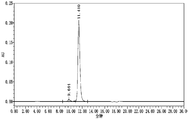
- the SEC-HPLC peaks of each ADC can be obtained by SEC-HPLC as shown in Fig. 2A-2H.
- the data are summarized in the following table.
- the monomer rate is significantly improved and the degree of aggregation is significantly reduced.
- Target conjugate Monomer rate Aggregation rate H-11 96.25% 3.75% H-20 98.85% 1.15% H-29 98.26% 1.74%
- the PK properties of the ADC drug were determined in a mouse model, and the tail of the mouse was administered intravenously at a dose of 2 mg/kg.
- the total antibody (Total Ab) concentration in the blood was measured according to the general procedure B. The results are shown in Figure 3.
- the experimental results show that in the mouse, the acidic stable linker ADC shows a significant improvement in PK, and the total antibody in the blood can be maintained at a higher concentration for a longer period of time.
- the ADC with an acidic linker has a relatively short retention time in HIC, and the antibody conjugate of MC-VC-PAB-MMAE has the longest retention time.
- the experimental results show that the ADC molecules with acidic stable linkers have better hydrophilicity.
- Human pancreatic adenocarcinoma cell line BxPc3 was cultured in vitro and inoculated subcutaneously into the back of BALB/c nude mice according to the number of cells 5 ⁇ 10 6 . After the tumor grew to 100-200 mm 3 , the mice were given a single dose of ADC drug 3 mg/kg (tail vein injection). At the same time, the vehicle control group was set up, the body weight was measured regularly, the tumor volume was measured, and the drug efficacy against the BxPc3 model was evaluated by investigating the antitumor efficacy of the ADC drug. The experimental results are shown in Figures 5 and 6.
Landscapes
- Health & Medical Sciences (AREA)
- Life Sciences & Earth Sciences (AREA)
- Bioinformatics & Cheminformatics (AREA)
- Engineering & Computer Science (AREA)
- Chemical & Material Sciences (AREA)
- Medicinal Chemistry (AREA)
- General Health & Medical Sciences (AREA)
- Animal Behavior & Ethology (AREA)
- Pharmacology & Pharmacy (AREA)
- Public Health (AREA)
- Veterinary Medicine (AREA)
- Immunology (AREA)
- Epidemiology (AREA)
- Organic Chemistry (AREA)
- Cell Biology (AREA)
- Nuclear Medicine, Radiotherapy & Molecular Imaging (AREA)
- Chemical Kinetics & Catalysis (AREA)
- General Chemical & Material Sciences (AREA)
- Proteomics, Peptides & Aminoacids (AREA)
- Gastroenterology & Hepatology (AREA)
- Rheumatology (AREA)
- Pain & Pain Management (AREA)
- Biochemistry (AREA)
- Oncology (AREA)
- Biophysics (AREA)
- Molecular Biology (AREA)
- Genetics & Genomics (AREA)
- Medicinal Preparation (AREA)
- Medicines Containing Antibodies Or Antigens For Use As Internal Diagnostic Agents (AREA)
- Peptides Or Proteins (AREA)
- Medicines That Contain Protein Lipid Enzymes And Other Medicines (AREA)
- Pharmaceuticals Containing Other Organic And Inorganic Compounds (AREA)
Abstract
La présente invention concerne un conjugué de médicament spécial ayant une jonction de stabilisation acide hydrophile. Par comparaison avec un conjugué ayant une charge de médicament inférieure, du fait de l'introduction de la jonction de stabilisation acide, le conjugué de la présente invention peut également avoir une charge de médicament plus élevée (qui est, chaque réactif ciblé a des jonctions de médicament plus hydrophiles), maintient une propriété PK souhaitée et présente une activité identique ou meilleure dans un corps.The present invention relates to a special drug conjugate having a hydrophilic acid stabilizing junction. In comparison with a conjugate having a lower drug loading, because of the introduction of the acid stabilizing junction, the conjugate of the present invention may also have a higher drug loading (that is, each targeted reagent has junctions more hydrophilic drug), maintains a desired PK property and has the same or better activity in a body.
Description
本发明涉及应用抗体药物偶联物治疗肿瘤或其他疾病,尤其涉及应用一种特殊的亲水酸性稳定接头来制备抗体药物偶联物以增加药物在血浆中的稳定性,同时显著改善药物代谢动力学(PK)。The present invention relates to the use of antibody drug conjugates for the treatment of tumors or other diseases, in particular to the use of a special hydrophilic acid stable linker for the preparation of antibody drug conjugates to increase the stability of the drug in plasma, while significantly improving the metabolic power of the drug Learning (PK).
抗体偶联药物(ADC)作为新型的靶向药物,一般由三部分组成:抗体或抗体类配体,小分子药物以及将抗体和药物偶联起来的连接子。抗体偶联药物利用抗体对抗原的特异性识别,将药物分子运输至靶细胞附近并有效释放药物分子,达到治疗目的。2011年8月,美国食品药品监督管理局(FDA)批准西雅图基因公司研制的用于治疗霍奇金淋巴瘤以及复发性变性大细胞淋巴瘤(ALCL)的ADC新药Adecteis TM上市,临床应用已经证明了此类药物的安全性和有效性。 As a novel targeted drug, antibody-conjugated drugs (ADCs) generally consist of three parts: antibody or antibody ligands, small molecule drugs, and linkers that couple antibodies and drugs. The antibody-conjugated drug utilizes the specific recognition of the antigen by the antibody, transports the drug molecule to the vicinity of the target cell and effectively releases the drug molecule for therapeutic purposes. In August 2011, the US Food and Drug Administration (FDA) approved the launch of the new ADC, Adecteis TM , developed by Seattle Genes for the treatment of Hodgkin's lymphoma and relapsed large cell lymphoma (ALCL). Clinical applications have proven The safety and effectiveness of such drugs.
在抗体偶联药物中,为使药物分子与抗体高效的连接,目前进入临床试验的偶联物通常通过连接子连接在配体表面的赖氨酸残基或抗体铰链区的半胱氨酸残基(由链间二硫键部分还原得到)上。然而,由于抗体表面存在大量的赖氨酸残基(超过80个)以及偶联的非选择性,导致偶联数目和位点的不确定性,进而导致抗体药物偶联物的不均一性。通过巯基偶联可有效避免产品质量均一性差的问题,其中马来酰亚胺作为连接头可与抗体巯基在温和条件下迅速,高选择性发生迈克尔加成形成硫醚产物。In antibody-conjugated drugs, in order to efficiently link drug molecules with antibodies, conjugates currently entering clinical trials are usually linked to lysine residues on the surface of the ligand or cysteine residues in the hinge region of the antibody via a linker. The base (reduced by partial reduction of the interchain disulfide bond). However, due to the large number of lysine residues (more than 80) on the surface of the antibody and the non-selectivity of the coupling, the number of couplings and the uncertainty of the site are caused, which in turn leads to heterogeneity of the antibody drug conjugate. The problem of poor uniformity of product quality can be effectively avoided by sulfhydryl coupling, wherein maleimide can be used as a linker to rapidly and highly selectively form a thioether product with the antibody thiol under mild conditions.
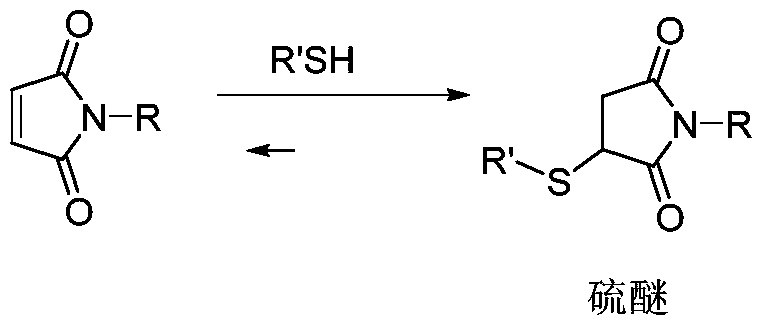
然而,越来越多的研究表明,丁二酰亚胺与巯基的加成反应为可逆过程(逆迈克尔加成),当加成产物进入血浆后,由于血浆中大量含有游离巯基的蛋白的存在,可明显观察到加成产物与白蛋白巯基发生交换,导致药物分子脱落。脱落的药物分子一方面产生毒副作用,另一方面降低抗体偶联药物的药效。(见Shen,等“Conjugation site modulate the vivo stability and therapeutic activity of antibody-drug conjugates”Nature Biotech(2012)30:184-189;Baldwin&Kiick,Bioconj.Chem 2011,)22,1946-1953;Alley等Bioconjugate Chem.2008,19,759-765.However, more and more studies have shown that the addition reaction of succinimide with sulfhydryl is a reversible process (inverse Michael addition). When the addition product enters the plasma, the presence of a large amount of free thiol-containing protein in plasma It is obvious that the addition product is exchanged with the albumin sulfhydryl group, resulting in the detachment of the drug molecule. Exfoliated drug molecules produce toxic side effects on the one hand, and reduce the efficacy of antibody-conjugated drugs on the other hand. (See Shen, et al., "Conjugation site modulate the vivo stability and therapeutic activity of antibody-drug conjugates" Nature Biotech (2012) 30: 184-189; Baldwin & Kiick, Bioconj. Chem 2011,) 22, 1946-1953; Alley et al. .2008,19,759-765.
为提高抗体偶联药物在血浆中的稳定性,降低巯基逆迈克尔加成作用,许多文献进行了探索。有报道马来酰亚胺与巯基形成的环状硫醚加成产物在含水环境中可发生水解形成硫醚开环产物。与环状硫醚加成产物不同,硫醚开环产物在血浆中保持稳定,不再与其他巯基发生交换。所以,如果能在抗体偶联药物进入体内之前全部转化为开环结构,即可有效避免巯基交换的发生。In order to improve the stability of antibody-conjugated drugs in plasma and reduce the anti-Michael addition of thiol groups, many literatures have been explored. It has been reported that a cyclic thioether addition product formed by maleimide and a thiol group can be hydrolyzed in an aqueous environment to form a thioether ring-opening product. Unlike the cyclic thioether addition product, the thioether ring opening product remains stable in plasma and is no longer exchanged with other sulfhydryl groups. Therefore, if the antibody-conjugated drug can be completely converted into an open-loop structure before entering the body, the occurrence of thiol exchange can be effectively avoided.

加成开环反应速度受反应条件中的PH,温度以及结构本身多种因素的影响,由于抗体对PH及温度的敏感性,通过优化连接头结构,使其在抗体可耐受的PH、温度下快速开环成为最佳选择。专利WO2016025752公布一种在丁二酰亚胺环外引入强吸电子基团的方法,该方法利用吸电效应降低硫醚加成产物与白蛋白交换,然而也是因为吸电子基团的存在,导致整个丁二酰亚胺与药物连接物在自然条件下难以保存,带强吸电子基团的丁二酰亚胺极易水解开环而不再能与巯基进一步加成。The rate of addition ring opening reaction is affected by various factors such as pH, temperature and structure itself in the reaction conditions. Due to the sensitivity of the antibody to pH and temperature, the pH of the antibody can be tolerated by optimizing the structure of the junction. The quick open loop is the best choice. Patent WO2016025752 discloses a method for introducing a strong electron withdrawing group outside a succinimide ring, which utilizes an electrosorption effect to reduce the exchange of thioether addition products with albumin, but also because of the presence of electron withdrawing groups. The entire succinimide and drug linker are difficult to preserve under natural conditions, and the succinimide with strong electron withdrawing group is easily hydrolyzed and opened and can no longer be further added with sulfhydryl groups.

美国Seattle Genetics公司专利US20130309256公开一种连接头,在丁二酰亚胺旁引入碱性基团以及一个吸电子基团,在碱性基团的促进下加成产物可有效降低白蛋白交换率,在血浆中稳定性明显提高。众所周知,人体血浆PH呈弱碱性,碱性基团的引入虽可促进丁二酰亚胺的开环,但对于整个分子亲水性的改善是不利的。这一点在Seattle Genetics后来的专利WO2015057699中得到了很好的印证。该发明人在分子中引入带碱性基团的稳定接头后,发现在较高载药量的情况下,由于疏水性的原因,整个抗体偶联药物分子在小鼠体内依然被快速降解(见专利WO2015057699第225页),为改善这一情况,该发明人不得不在分子侧链中引入复杂的聚乙二醇结构以改善分子的聚集(见专利WO2015057699)。US Patent No. 20130309256 to the United States of America, the United States of America, discloses a connector which introduces a basic group and an electron withdrawing group beside the succinimide, and the addition product under the promotion of a basic group can effectively reduce the albumin exchange rate. The stability in plasma is significantly improved. It is well known that the human plasma PH is weakly alkaline, and the introduction of a basic group promotes the ring opening of succinimide, but it is disadvantageous for the improvement of the hydrophilicity of the entire molecule. This is well documented in later patents of Seattle Genetics, WO2015057699. The inventors introduced a stable linker with a basic group in the molecule and found that the antibody-conjugated drug molecule was rapidly degraded in mice due to hydrophobicity at a higher drug loading amount (see In order to improve this situation, the inventors have had to introduce complex polyethylene glycol structures in the molecular side chains to improve the aggregation of molecules (see patent WO2015057699).
除了降低白蛋白交换,提高血浆稳定性以外,抗体-药物偶联物设计中的另一项重要因素是:每个靶向剂能够递送的药物的量(即,连接至各靶向剂(例如,抗体)的细胞毒剂的数量,称为药物载量(drug load)。曾经有假设认为,较高的药物载量的药效将优于较低的药 物载量(例如,8-单位载量对比4-单位载量应该拥有更好的体内外药效)。该理论依据是,载药量更高的偶联物将向靶细胞递送更多的药物(细胞毒剂)。体外结果也证实,具有较更高载药量的偶联物在体外对于细胞系具有更高的活性。然而,后续某些研究揭示,该假设在动物体内模型中并没有得到相应的证实。有文献观察到,具有某种奥瑞他汀药物的4单位与8单位药物载量的偶联物在小鼠模型中出乎预料的具有相似活性,并未观察到8单位药物载量更高的药效。参见Hamblett等的报道,Clinical Cancer Res.10:7063-70(2004)。Hamblett等揭示了上述实验现象的原因,并进一步报道了更高载体的ADC在动物模型中将被更快的清除出循环。该更快的清除表明,较高载量的偶联物相比较低载量的偶联物的PK更加不稳定的倾向。另外,较高载量的偶联物在小鼠中有较低的MTD,并且因此具有较窄的治疗指数。相反,报告单克隆抗体中工程改造的位点处载药量为2的ADC具有与某些4-单位载量ADC相比相同或更好的PK性质和治疗指数。参见Junutula等的报道,Clinical Cancer Res.16:4769(2010)。In addition to reducing albumin exchange and increasing plasma stability, another important factor in antibody-drug conjugate design is the amount of drug that each targeting agent is capable of delivering (ie, to each targeting agent (eg, , antibody) The amount of cytotoxic agent, called the drug load. It has been hypothesized that higher drug loading will be superior to lower drug loading (eg, 8-unit loading) Contrast 4-unit loading should have better in vitro and in vivo efficacy. The rationale is that a higher drug-loaded conjugate will deliver more drug (cytotoxic agent) to the target cells. Conjugates with higher drug loadings have higher activity in cell lines in vitro. However, some subsequent studies have revealed that this hypothesis has not been confirmed in animal models in vivo. A conjugate of 4 units of a certain auristatin drug and 8 units of drug loading unexpectedly had similar activity in a mouse model, and no higher drug efficacy was observed with 8 units of drug loading. See Hamblett et al. Report, Clinical Cancer Res. 10:7063-70 (2004). Hamblett et al. revealed the reasons for the above experimental phenomena and further reported that higher carrier ADCs will be cleared faster in animal models. This faster clearance indicates higher The loading of the conjugate is more unstable than the PK of the lower loading conjugate. In addition, the higher loading conjugate has a lower MTD in mice and therefore has a narrower treatment In contrast, ADCs with a drug loading of 2 at engineered sites in reported monoclonal antibodies have the same or better PK properties and therapeutic indices compared to certain 4-unit loading ADCs. See report by Junutula et al. , Clinical Cancer Res. 16: 4769 (2010).
提高载药量理论上可提高单个抗体携带的进入靶向细胞药物数量,然而由于药物的疏水性,在提高药物数量的同时也提高了ADC药物的疏水性,导致ADC药物在体内聚集而降低治疗指数。克服较高载量ADC的PK降低倾向的替代方法包括向ADC结构中添加增溶基团。例如,在连接子中(例如,在药物和抗体的接合位点之间)增加包括了聚乙二醇聚合物或其它水溶性聚合物以尝试克服聚集倾向。如Seattle Genetics公司在拥有通过引入碱性基团而稳定接头的技术后,依然需要通过在接头-药物偶联物中引入侧链PEG等方法来改善高载药量下药物分子的PK。然而,添加增溶基团会增加这种偶联物的制备复杂度。Increasing the drug loading can theoretically increase the amount of drug that is carried by a single antibody into a targeted cell. However, due to the hydrophobicity of the drug, the amount of the drug is increased while the hydrophobicity of the ADC drug is increased, resulting in aggregation of the ADC drug in the body and lowering the treatment. index. An alternative approach to overcoming the PK reduction propensity of higher loading ADCs involves adding solubilizing groups to the ADC structure. For example, an increase in the linker (eg, between the drug and antibody binding sites) includes a polyethylene glycol polymer or other water soluble polymer in an attempt to overcome the tendency to aggregate. For example, after Seattle Genetics has a technique for stabilizing a linker by introducing a basic group, it is still necessary to improve the PK of the drug molecule at a high drug loading by introducing a side chain PEG into the linker-drug conjugate. However, the addition of solubilizing groups increases the complexity of preparation of such conjugates.
因此,在改善高载药量(DAR)带来的不利影响的新型ADC领域中亟需一种新的方法,可同时克服丁二酰亚胺巯基交换增加血浆稳定性并同时改善高DAR的抗体偶联药物的药代动力学性质。本发明的酸性稳定接头惊人的同时满足了这些需求。Therefore, there is a need for a new method in the field of novel ADCs that can improve the adverse effects of high drug loading (DAR), which can simultaneously overcome the succinimide sulfhydryl exchange to increase plasma stability while improving high DAR antibodies. The pharmacokinetic properties of the coupled drug. The acid stable joints of the present invention are surprisingly satisfying these needs.
发明内容Summary of the invention
本发明旨在提供一种特殊的亲水酸性稳定接头—药物偶联物。发明人通过实验惊奇的发现,与US20130309256描述的引入碱性基团不同,带酸性的氨基酸或寡肽单元的引入可以降低丁二酰亚胺与抗体偶联物的巯基交换,在血浆中保持高度稳定性。同时,通过实验证明,由于氨基酸的引入,所设计的偶联物具有与未偶联的靶向试剂相似的亲水性,从而保留了与体内未偶联的靶向试剂相似的药代动力学(PK)性质。所以,酸性稳定接头的存在,通过以上两种途径共同增加药物在血浆中的稳定性,改善药物代谢动力学(PK),从而对药效带来帮助。The present invention aims to provide a special hydrophilic acid stable linker-drug conjugate. The inventors have surprisingly discovered through experiments that, unlike the introduction of a basic group as described in US20130309256, the introduction of acidic amino acids or oligopeptide units can reduce the thiol exchange of succinimide with antibody conjugates and maintain a high level in plasma. stability. At the same time, it has been experimentally proved that due to the introduction of amino acids, the designed conjugate has similar hydrophilicity to the unconjugated targeting agent, thereby retaining the pharmacokinetics similar to the unconjugated targeting agent in vivo. (PK) nature. Therefore, the presence of an acidic stable linker can increase the stability of the drug in plasma and improve the pharmacokinetics (PK) through the above two routes, thereby contributing to the efficacy.
由于酸性稳定接头的引入,与较低载药量的偶联物相比,偶联物也可具有较高的载药量 (即,每个靶向试剂更高数量的亲水性药物接头),同时保留希望的PK性质并且在体内具有相同或更好的活性。(例如,4-单位载量或8-单位载量偶联物可分别具有与其2或4单位载量对应物相比相同或更好的PK性质;这种4-单位载量或8-单位载量偶联物可分别具有与其2或4单位载量对应物相比相同或更好的PK性质)。Due to the introduction of an acidic stabilizing linker, the conjugate can also have a higher drug loading (ie, a higher number of hydrophilic drug linkers per targeting agent) than a lower drug loading conjugate. While retaining the desired PK properties and having the same or better activity in the body. (For example, 4-unit loading or 8-unit loading conjugates may each have the same or better PK properties than their 2 or 4 unit loading counterparts; such 4-unit loading or 8-unit The loading conjugates may each have the same or better PK properties than their 2 or 4 unit loading counterparts).
具体的,本发明提供一种如式I所示的抗体药物偶联物或其药学上可接受的盐:Specifically, the present invention provides an antibody drug conjugate of the formula I or a pharmaceutically acceptable salt thereof:

其中among them
L是抗体,抗体片段或蛋白;L is an antibody, antibody fragment or protein;
M是琥珀酰亚胺或水解琥珀酰亚胺;M is sodium succinimide
Ac为由氨基和酸性基团组成的片段或由多个氨基酸组成的寡肽,且以氨基部分与圆圈相连;Ac is a fragment consisting of an amino group and an acidic group or an oligopeptide composed of a plurality of amino acids, and is linked to a circle by an amino moiety;
D是药物部分;D is the drug part;
A是连接子部分;A is a linker part;
圆圈表示支架,为取代或无取代C 1-8亚烃基、C 1-8杂亚烃基、C 6-10亚芳基或C 4-10杂亚芳基; The circle represents a scaffold, which is a substituted or unsubstituted C 1-8 alkylene group, a C 1-8 heteroalkylene group, a C 6-10 arylene group or a C 4-10 heteroarylene group;
m选自1-20范围的整数,n为1或2。m is selected from an integer ranging from 1 to 20, and n is 1 or 2.
优选的,所述抗体为针对细胞表面受体和肿瘤相关抗原的抗体。Preferably, the antibody is an antibody against a cell surface receptor and a tumor associated antigen.
优选的,Ac为整体显酸性的氨基酸单元或酸性寡肽。Preferably, Ac is an amino acid unit or an acidic oligopeptide which is substantially acidic.
更加优选的,Ac优选为等电点7.0以下的天然氨基酸或非天然氨基酸及它们组成的寡肽。More preferably, Ac is preferably a natural amino acid or an unnatural amino acid having an isoelectric point of 7.0 or less and an oligopeptide composed thereof.
在一些优选例中,所述寡肽单元优选2-5个氨基酸组成。In some preferred embodiments, the oligopeptide unit preferably has a composition of 2-5 amino acids.
在一些优选例中,所述A是可裂解连接子或不可裂解连接子。In some preferred embodiments, the A is a cleavable linker or a non-cleavable linker.
在一些优选例中,所述药物为细胞毒性药物,治疗自身免疫疾病的药物和抗炎症的药物。In some preferred embodiments, the drug is a cytotoxic drug, a drug for treating an autoimmune disease, and an anti-inflammatory drug.
更加优选的,药物D选自美登素类药物、澳瑞他汀类药物,苯并二吡咯类药物,吡咯并苯二氮唑类药物,鹅膏毒素或其衍生物,喜树碱类化合物组成的组。More preferably, the drug D is selected from the group consisting of maytansinoids, auristatin drugs, benzodipyrroles, pyrrolobenzoxazoles, amanita toxins or derivatives thereof, camptothecin compounds Group.
在一些优选例中,A具有下式:In some preferred embodiments, A has the following formula:
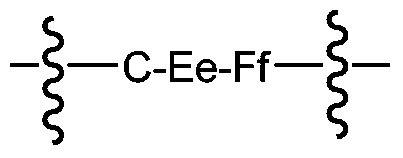
其中C是末端任选的可延伸单元,E为任选的可断裂单元,F为间隔单元,下标e,f为0或1。波浪线表示到酸性自稳定接头和药物单元的连接位点。Wherein C is an optional extendable unit at the end, E is an optional cleavable unit, F is a spacer unit, and subscript e, f is 0 or 1. The wavy line indicates the attachment site to the acidic self-stabilizing linker and the drug unit.
在一些优选例中,圆圈表示C 1-8亚烃基或C 1-8杂亚烃基。 In some preferred embodiments, the circle represents a C 1-8 alkylene group or a C 1-8 heteroalkylene group.
更加优选的,圆圈表示C 1-3亚烃基; More preferably, the circle represents a C 1-3 alkylene group;
在一些优选例中,所述的Ac选自(D/L)甘氨酸,(D/L)丙氨酸,(D/L)亮氨酸,(D/L)异亮氨酸,(D/L)缬氨酸,(D/L)苯丙氨酸、(D/L)脯氨酸、(D/L)色氨酸、(D/L)丝氨酸、(D/L)酪氨酸、(D/L)半胱氨酸、(D/L)蛋氨酸、(D/L)天冬酰胺、(D/L)谷氨酰胺、(D/L)苏氨酸、(D/L)天冬氨酸、(D/L)谷氨酸或以下结构式:In some preferred embodiments, the Ac is selected from the group consisting of (D/L) glycine, (D/L) alanine, (D/L) leucine, (D/L) isoleucine, (D/ L) proline, (D/L) phenylalanine, (D/L) proline, (D/L) tryptophan, (D/L) serine, (D/L) tyrosine, (D/L) cysteine, (D/L) methionine, (D/L) asparagine, (D/L) glutamine, (D/L) threonine, (D/L) days Aspartic acid, (D/L) glutamic acid or the following structural formula:


本发明的另一方面,提供了一种结构如下所示的接头—药物连接物:In another aspect of the invention, a linker-drug linker having the structure shown below is provided:
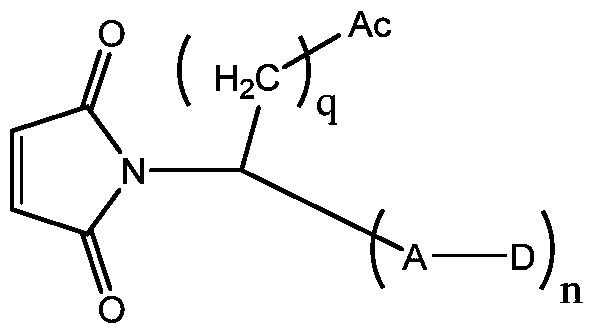
Ac为等电点小于7的氨基酸单元;Ac is an amino acid unit having an isoelectric point of less than 7;
D是药物部分;D is the drug part;
A是连接子部分;A is a linker part;
q选自1-8范围的整数,n为1或2。q is selected from an integer ranging from 1 to 8, and n is 1 or 2.
本发明提供了一种抗体药物偶联物或其药学上可接受的盐,以及药学上可接受的稀释剂运载体或赋形剂的药物组合物。The present invention provides an antibody drug conjugate or a pharmaceutically acceptable salt thereof, and a pharmaceutical composition of a pharmaceutically acceptable diluent carrier or excipient.
抗体药物偶联物或其药学上可接受的盐用于制备治疗癌症、免疫疾病、炎症药物的用途。The use of an antibody drug conjugate or a pharmaceutically acceptable salt thereof for the preparation of a medicament for treating cancer, immune diseases, and inflammation.
图1为化合物11的MS-TOF检测结果。Figure 1 shows the results of MS-TOF detection of
图2A为H-11的SEC-HPLC检测结果。Figure 2A shows the results of SEC-HPLC detection of H-11.
图2B为H-20的SEC-HPLC检测结果。Figure 2B shows the results of SEC-HPLC detection of H-20.
图2C为H-29的SEC-HPLC检测结果。Figure 2C shows the results of SEC-HPLC of H-29.
图2D为H-39的SEC-HPLC检测结果。Figure 2D shows the results of SEC-HPLC detection of H-39.
图2E为H-41的SEC-HPLC检测结果。Figure 2E shows the results of SEC-HPLC detection of H-41.
图2F为H-43的SEC-HPLC检测结果。Figure 2F shows the results of SEC-HPLC detection of H-43.
图2G为MC-VC-PAB-MMAE的SEC-HPLC检测结果。Figure 2G shows the results of SEC-HPLC detection of MC-VC-PAB-MMAE.
图2H为DPR-VC-PAB-MMAE的SEC-HPLC检测结果。Figure 2H shows the results of SEC-HPLC detection of DPR-VC-PAB-MMAE.
图3为未偶联的抗体,带酸性稳定接头的ADC和对照ADC的小鼠体内稳定性的研究结果。Figure 3 shows the results of in vivo stability studies of unconjugated antibodies, ADCs with acidic stable linkers and control ADCs.
图4为带酸性稳定接头的ADC和1种对照ADC的HIC色谱结果。Figure 4 shows the HIC chromatographic results for an ADC with an acidic stable linker and a control ADC.
图5为带酸性稳定接头的ADC和1种对照ADC的体内药效结果。Figure 5 shows the in vivo efficacy of an ADC with an acidic stable linker and a control ADC.
发明人经过广泛而深入的研究,惊奇的发现具有酸性稳定接头的抗体药物偶联物在血浆中具有更佳的稳定性,并且与传统的抗体药物偶联物相比,具有更好的亲水性,偶联后的结构可承受更高载药量,并且保持低载量量时结构的药代动力学。更高载药量可带来更好的活性和治疗效果。After extensive and intensive research, the inventors have surprisingly found that antibody drug conjugates with acidic stable linkers have better stability in plasma and have better hydrophilicity than conventional antibody drug conjugates. Sexually, the coupled structure can withstand higher drug loadings and maintain the pharmacokinetics of the structure at low loadings. Higher drug loadings result in better activity and therapeutic effects.
具体的,本发明提供的具有酸性稳定接头的抗体药物偶联物具有马来酰亚胺单元,在与抗体巯基偶联后,在稳定酸性基团的参与下,马来酰亚胺水解开环,所形成结构在血浆中不与其他含巯基的大分子交换,从而避免药物分子的脱落。Specifically, the antibody drug conjugate having an acidic stable linker provided by the present invention has a maleimide unit, and after coupling with the antibody thiol group, the maleimide is hydrolyzed and opened under the participation of a stable acidic group. The formed structure is not exchanged with other thiol-containing macromolecules in plasma, thereby avoiding the detachment of drug molecules.

同时,由于亲水酸性基团的存在,所形成的开环结构抗体药物偶联物亲水性更好,可避免因提高载药量而导致的活性降低等问题。At the same time, due to the presence of hydrophilic acidic groups, the formed ring-opening structure antibody drug conjugate is more hydrophilic, and problems such as reduced activity due to increased drug loading can be avoided.
所产生的抗体药物偶联物可用于靶向药物到达目标细胞群体,例如肿瘤细胞。抗体药物偶联物可以特异性的与细胞表面蛋白结合,所产生的结合物随机被细胞内吞。在细胞内,药物以活性药物的方式释放出来产生功效。抗体包括嵌合抗体、人源化抗体,人抗体;可与抗原结合的抗体片段;或者抗体Fc融合蛋白;或者蛋白。药物是高活性的药物,包括,但不局限于,美登素类(Maytansinoids),澳瑞他汀类药物(Auristatins),卡奇霉素类(Calicheamicins),阿霉素类(doxorubicins),苯并二吡咯类抗生素类(Duocarmycins and CC-1065),吡咯并苯二氮卓二聚体类(PBDS)类,鹅膏毒素类,喜树碱及衍生物如SN38、伊立替康、依喜替康等。The resulting antibody drug conjugate can be used to target a drug to a target cell population, such as a tumor cell. The antibody drug conjugate can specifically bind to cell surface proteins, and the resulting conjugate is randomly endocytosed by the cells. Within the cell, the drug is released as an active drug to produce efficacy. Antibodies include chimeric antibodies, humanized antibodies, human antibodies; antibody fragments that bind to an antigen; or antibody Fc fusion proteins; or proteins. Drugs are highly active drugs including, but not limited to, Maytansinoids, Auristatins, Calicheamicins, doxorubicins, benzophenones. Dipyrrole antibiotics (Duocarmycins and CC-1065), pyrrolobenzodiazepine dimers (PBDS), amanita toxins, camptothecin and derivatives such as SN38, irinotecan, ezetidine, etc. .
本专利的详细说明Detailed description of this patent
缩写和定义Abbreviations and definitions
除非另有说明,否则如本文所用的以下术语和短语旨在具有以下含义。当本文中使用商标名称时,除非上下文中另有指明,否则商标名称包括所述商标名称产品的产品配方、通用药物和活性药物成分。Unless otherwise stated, the following terms and phrases as used herein are intended to have the following meanings. When a trade name is used herein, unless otherwise indicated by the context, the trade name includes the product formulation, generic drug, and active pharmaceutical ingredient of the trade name product.
术语“亚烃基”是指具有1-20个碳原子的二价直链饱和烃基团,包括从1至10碳原子的基团。亚烃基基团的实施例包括但不限于亚甲基(-CH2-),亚乙基(-CH2-CH2-),亚正丙基,亚正丁基,亚正戊基和亚正己基等。除非另有说明,术语“芳基”指多不饱和、一般是芳族的羟基团,它可以是单环或者稠合或共价连接的多环(至多三个环)。术语“芳杂基”指含有1-5个选自N、O或S的杂原子的芳基(或环),其中所述氮和硫原子任选被氧化,所述氮原子任选被季铵化。杂芳基团可通过杂原子连接于分子的其余部分。芳基基团的非限制性例子包括:苯基、萘基和二苯基,而杂芳基团的非限制性例子包括:吡啶基、哒嗪基、吡嗪基、嘧啶基(pyrimindinyl)、三嗪基、喹啉基、喹喔啉基、喹唑啉基、噌啉基、酞嗪基(phthalaziniyl)、苯并三嗪基、嘌呤基、苯并咪唑基、苯并吡唑基、苯并三唑基、苯并异唑基、异苯并呋喃基、异吲哚基、吲嗪基、苯并三嗪基、噻吩并吡啶基、噻吩并嘧啶基、吡啶并嘧啶基、咪唑并吡啶、苯并噻唑基(benzothiaxolyl)、苯并呋喃基、苯并噻吩基、吲哚基、喹啉基、异喹啉基、异噻唑基、吡唑基、吲唑基、蝶啶基、咪唑基、三唑基、四唑基、噁唑基、异噁唑基、噻二唑基、吡咯基、噻唑基、呋喃基、以及噻吩基等。当描述为“取代的”时,上述芳环和杂芳环系统的取代基选自下述可接受的取代基。The term "alkylene" refers to a divalent straight-chain saturated hydrocarbon group having 1 to 20 carbon atoms, and includes a group of from 1 to 10 carbon atoms. Examples of alkylene groups include, but are not limited to, methylene (-CH2-), ethylene (-CH2-CH2-), n-propyl, n-butylene, n-pentylene, and n-hexylene. . Unless otherwise indicated, the term "aryl" refers to a polyunsaturated, generally aromatic, hydroxyl group which may be monocyclic or fused or covalently attached polycyclic (up to three rings). The term "arylhetero" refers to an aryl (or ring) containing from 1 to 5 heteroatoms selected from N, O or S, wherein the nitrogen and sulfur atoms are optionally oxidized, the nitrogen atom optionally being seasoned Ammonium. A heteroaryl group can be attached to the remainder of the molecule through a heteroatom. Non-limiting examples of aryl groups include phenyl, naphthyl and diphenyl, and non-limiting examples of heteroaryl groups include: pyridyl, pyridazinyl, pyrazinyl, pyrimindinyl, Triazinyl, quinolyl, quinoxalinyl, quinazolinyl, porphyrinyl, phthalaziniyl, benzotriazinyl, fluorenyl, benzimidazolyl, benzopyrazole, benzene And triazolyl, benzisoxazolyl, isobenzofuranyl, isodecyl, pyridazinyl, benzotriazinyl, thienopyridyl, thienopyrimidinyl, pyridopyrimidinyl, imidazopyridine , benzothiaxolyl, benzofuranyl, benzothienyl, fluorenyl, quinolyl, isoquinolinyl, isothiazolyl, pyrazolyl, oxazolyl, pteridoyl, imidazolyl , triazolyl, tetrazolyl, oxazolyl, isoxazolyl, thiadiazolyl, pyrrolyl, thiazolyl, furyl, and thienyl. When described as "substituted", the substituents of the above aromatic and heteroaryl ring systems are selected from the following acceptable substituents.
本专利中所述亚芳基系指在上述芳基结构中存在以临位、间位或对位存在的两个共价键结构。The arylene group described in this patent means that two covalent bond structures exist in the above-mentioned aryl structure in the presence, meta or para position.
除非文中另有说明,烃基(包括通常为称为亚烷基、烯基、炔基和环烷基的那些)的取代基可以是选自下组的多种基团:-卤素、-OR’、-NR’R”、-SR’、-SiR’R”R”’、-OC(O)R’、-C(O)R’、-CO 2R’、-CONR’R”、-OC(O)NR’R”、-NR”C(O)R’、-NR’-C(O)NR”R”’、-NR”C(O) 2R’、-NH-C(NH 2)=NH、-NR’C(NH 2)=NH、-NH-C(NH 2)=NR’、-S(O)R’、-S(O) 2R’、-S(O) 2NR’R”、-NR’S(O) 2R”、-CN和-NO 2,取代基数量为0至(2m’+1),其中m’为该基团中碳原子的总数。R’、R”和R”’各自独立的指代氢、未取代的C 1-8烷基、未取代的芳基、由1-3个卤素取代的芳基、未取代的C 1-8烷基、C 1-8烷氧基或C 1-8硫代烷氧基、或未取代的芳基-C 1-4烷基。R’和R”连接于同一个氮原子时,它们可与该氮原子一起形成3-,4-,5-,6-或7-元环。例如,-NR’R”包括1-吡咯烷基和4-吗啉基。 Unless otherwise indicated herein, the substituents of the hydrocarbyl group (including those generally referred to as alkylene, alkenyl, alkynyl and cycloalkyl) may be a plurality of groups selected from the group consisting of -halogen, -OR' , -NR'R", -SR', -SiR'R"R"', -OC(O)R', -C(O)R', -CO 2 R', -CONR'R", -OC (O)NR'R", -NR"C(O)R', -NR'-C(O)NR"R"', -NR"C(O) 2 R', -NH-C(NH 2 )=NH, -NR'C(NH 2 )=NH, -NH-C(NH 2 )=NR', -S(O)R', -S(O) 2 R', -S(O) 2 NR'R", -NR'S(O) 2 R", -CN and -NO 2 , the number of substituents is 0 to (2m'+1), wherein m' is the total number of carbon atoms in the group. R', R" and R"' each independently denote hydrogen, unsubstituted C1-8 alkyl, unsubstituted aryl, aryl substituted with 1-3 halogens, unsubstituted C1-8 alkyl, a C 1-8 alkoxy group or a C 1-8 thioalkoxy group, or an unsubstituted aryl-C 1-4 alkyl group. When R' and R" are bonded to the same nitrogen atom, they may be bonded to the nitrogen The atoms together form a 3-, 4-, 5-, 6- or 7-membered ring. For example, -NR'R" includes 1-pyrrolidinyl and 4-morpholinyl.
本文中所用的化合物的“衍生物”是指具有与化合物相似的化学结构但还含有至少一个 化合物中不存在的化学基团和/或缺少至少一个化合物中存在的化学基团的物质。衍生物所比较的化合物被称为“母体”化合物。通常,“衍生物”可在一个或多个化学反应步骤中由母体化合物产生。A "derivative" of a compound as used herein refers to a substance having a chemical structure similar to that of a compound but further containing at least one chemical group not present in the compound and/or lacking a chemical group present in at least one compound. The compounds to which the derivatives are compared are referred to as "parent" compounds. Generally, a "derivative" can be produced from a parent compound in one or more chemical reaction steps.
抗体、抗体片段及蛋白Antibodies, antibody fragments and proteins
本发明实施例中抗体、抗体片段和蛋白单元是与靶标部分特异性结合的靶向剂。本发明所述抗体能够特异性结合至细胞组分或结合至其他感兴趣的靶标分子。在一些方面中,抗体单元的作用是将药物单元递送至配体单元与之相互作用的特定靶细胞群。配体包括但不限于蛋白质、多肽和肽,以及非蛋白质如糖。合适的配体单元包括,例如,抗体,例如全长(完整)抗体及其抗原结合片段。在配体单元是非抗体靶向试剂的实施方式中,其可以是肽或多肽,或非蛋白质分子。这类靶向试剂的示例包括干扰素、淋巴因子、激素、生长因子和集落刺激因子、维生素、营养转运分子、或任何其他细胞结合分子或物质。在一些实施方式中,连接子共价连接至配体的硫原子。在一些方面中,硫原子是半胱氨酸残基的硫原子,其形成抗体的链间二硫键。在另一方面中,硫原子是已经导入配体单元的半胱氨酸残基的硫原子,其形成抗体的链间二硫键。在另一方面中,硫原子是已经导入配体单元的半胱氨酸残基的硫原子(例如,通过定点诱变或化学反应)。在其他方面中,连接子结合的硫原子选自形成抗体的链间二硫键的半胱氨酸残基或已经引入配体单元的额半胱氨酸残基(例如,通过定点诱变或化学反应)。在一些实施方式中,按照Kabat(Kabat E.A等,(1991))《免疫学感兴趣的蛋白质序列》(Sequences of proteins of Immunological Interest),第五版,NIH出版物91-3242)中的EU索引编号系统。In embodiments of the invention, antibodies, antibody fragments and protein units are targeting agents that specifically bind to a target moiety. The antibodies of the invention are capable of specifically binding to a cellular component or to other target molecules of interest. In some aspects, the function of the antibody unit is to deliver a drug unit to a particular target cell population with which the ligand unit interacts. Ligands include, but are not limited to, proteins, polypeptides, and peptides, as well as non-proteins such as sugars. Suitable ligand units include, for example, antibodies, such as full length (intact) antibodies and antigen-binding fragments thereof. In embodiments where the Ligand unit is a non-antibody targeting agent, it can be a peptide or polypeptide, or a non-protein molecule. Examples of such targeting agents include interferons, lymphokines, hormones, growth factors and colony stimulating factors, vitamins, nutrient transport molecules, or any other cell binding molecule or substance. In some embodiments, the linker is covalently attached to the sulfur atom of the ligand. In some aspects, the sulfur atom is a sulfur atom of a cysteine residue that forms an interchain disulfide bond of the antibody. In another aspect, the sulfur atom is a sulfur atom that has been introduced into the cysteine residue of the ligand unit, which forms an interchain disulfide bond of the antibody. In another aspect, the sulfur atom is a sulfur atom that has been introduced into the cysteine residue of the ligand unit (eg, by site-directed mutagenesis or chemical reaction). In other aspects, the linker-bonded sulfur atom is selected from a cysteine residue that forms an interchain disulfide bond of the antibody or a cysteine residue that has been introduced into the ligand unit (eg, by site-directed mutagenesis or chemical reaction). In some embodiments, the EU index in Kabat (Kabat EA et al, (1991)) "Sequences of proteins of Immunological Interest, Fifth Edition, NIH Publication 91-3242" Numbering system.
如本专利所用,“抗体”或“抗体单元”在其所属的范围内,包括抗体结构的任何部分。这一单元可以结合,反应性关联,或者络合一个受体,抗原,或者靶向细胞群体具有的其它受体单元。抗体可以是任何蛋白或蛋白类分子,它可以结合,络合,或者与待治疗或生物改造的细胞群体的一部分发生反应。As used herein, "antibody" or "antibody unit" is within the scope of its disclosure, including any portion of the antibody structure. This unit can bind, responsively associate, or complex a receptor, antigen, or other receptor unit that the cell population has. The antibody can be any protein or proteinaceous molecule that can bind, complex, or react with a portion of the cell population to be treated or bioengineered.
本专利所用抗体包括多克隆抗体和单克隆抗体其中多克隆抗体时源自免疫动物的血清的抗体分子异质群体。单克隆抗体包括但不限于鼠类、人单克隆抗体、人源化单克隆抗体或嵌合单克隆抗体和衍生自其它物种的抗体。可以通过本领域已知的任何众多技术制备人单克隆抗体(如Teng等,1983,proc.Nat1.Acad.Sci.USA.80:7308-7312.Olsson等,1982,MEthan、,Enzymol 92:3-16)The antibodies used in this patent include polyclonal antibodies and monoclonal antibodies in which the polyclonal antibody is derived from a heterogeneous population of antibody molecules from the serum of the immunized animal. Monoclonal antibodies include, but are not limited to, murine, human monoclonal antibodies, humanized monoclonal antibodies or chimeric monoclonal antibodies, and antibodies derived from other species. Human monoclonal antibodies can be prepared by any of a wide variety of techniques known in the art (e.g., Teng et al, 1983, proc. Natl. Acad. Sci. USA. 80: 7308-7312. Olsson et al, 1982, MEthan, Enzymol 92:3 -16)
本专利中组成抗体药物偶联物的抗体最好保持其原有野生状态时的抗原结合能力。因此,本发明中的抗体能够,最好专一性的与抗原结合。涉及的抗原包括,例如,肿瘤相关抗原(TAA),细胞表面受体蛋白和其他细胞表面分子,细胞存活调节因子,细胞增殖调节因子, 与组织生长与分化相关的分子(如已知或预知的具有功能性的),淋巴因子,细胞因子,参与细胞循环调节的分子,参与血管生成的分子,以及与血管生成有关的分子(如已知或预知的具有功能性的)。肿瘤相关因子可以是簇分化因子(如CD蛋白)。The antibodies constituting the antibody drug conjugate in this patent preferably retain their antigen binding ability in the original wild state. Therefore, the antibody of the present invention can, preferably, specifically bind to an antigen. Antigens involved include, for example, tumor associated antigen (TAA), cell surface receptor proteins and other cell surface molecules, cell survival regulators, cell proliferation regulators, molecules associated with tissue growth and differentiation (as known or predicted) Functional), lymphokines, cytokines, molecules involved in cell cycle regulation, molecules involved in angiogenesis, and molecules involved in angiogenesis (as known or predicted to be functional). The tumor associated factor may be a cluster differentiation factor (such as a CD protein).
本发明中所述应用在抗体药物偶联物中的抗体包括,但不局限于,针对细胞表面受体和肿瘤相关抗原的抗体。这样的肿瘤相关抗原是业内所熟知的,可以通过业内熟知的抗体制备方法和信息来制备。为了开发可用于癌症诊断与治疗的有效的细胞水平目标物,研究人员力图找寻跨膜或其他肿瘤相关多肽。这些目标物能够特异性的表达在一种或多种癌细胞表面,而在一种或多种非癌细胞表面表达很少或不表达。通常,相对于非癌细胞表面而言,这样的肿瘤相关多肽在癌细胞表面更加过度表达。确认这样的肿瘤相关因子,可大大提高基于抗体治疗癌症的专一靶向特性。The antibodies used in antibody drug conjugates described herein include, but are not limited to, antibodies directed against cell surface receptors and tumor associated antigens. Such tumor associated antigens are well known in the art and can be prepared by antibody preparation methods and information well known in the art. To develop effective cell-level targets for cancer diagnosis and treatment, researchers have sought to find transmembrane or other tumor-associated polypeptides. These targets are capable of being specifically expressed on the surface of one or more cancer cells with little or no expression on the surface of one or more non-cancer cells. Typically, such tumor-associated polypeptides are more overexpressed on the surface of cancer cells relative to the surface of non-cancer cells. Confirmation of such tumor-associated factors can greatly enhance the specific targeting characteristics of cancer-based treatment of cancer.
本专利中用于制备抗体药物偶联物的蛋白质或肽可以是对表位或相应受体具有亲和力的任何随机肽或蛋白质,并且它们不一定必须属于免疫球蛋白家族。这些肽可以通过与噬菌体展示抗体相似的技术分离(Szardenings,J Recept Signal Transduct Res.2003:23(4):307-49)。来自这种随机肽文库的肽的使用可以类似于抗体和抗体片段。肽或蛋白质的结合分子可以是结合或欧联在大分子或材料上,例如但不限于白蛋白、聚合物、脂质体、纳米颗粒、树状聚体,只要这种结合允许肽或蛋白质保留其抗原结合特异性。The proteins or peptides used in the preparation of antibody drug conjugates in this patent may be any random peptide or protein having affinity for an epitope or corresponding receptor, and they do not necessarily have to belong to the immunoglobulin family. These peptides can be isolated by techniques similar to phage display antibodies (Szardenings, J Recept Signal Transduct Res. 2003: 23(4): 307-49). The use of peptides from such random peptide libraries can be similar to antibodies and antibody fragments. The binding molecule of the peptide or protein may be bound or conjugated to a macromolecule or material such as, but not limited to, albumin, polymer, liposome, nanoparticle, dendrimer, as long as such binding allows for peptide or protein retention Its antigen binding specificity.
肿瘤相关抗原包括,为业内所熟知的抗原。与肿瘤相关抗原对应的核酸和蛋白序列可参见公开数据库,例如Genbank。抗体靶向对应的肿瘤相关抗原包括所有的氨基酸序列变种和同种,与参考文献中确认的序列具有至少70%,80%,85%,90%,或者95%的同源性,或者具备与引用文献中的肿瘤相关抗原序列具有完全一致的生物性质和特征。Tumor-associated antigens include antigens well known in the art. Nucleic acid and protein sequences corresponding to tumor associated antigens can be found in public databases such as Genbank. Antibody-targeting corresponding tumor-associated antigens include all amino acid sequence variants and isoforms, having at least 70%, 80%, 85%, 90%, or 95% homology to the sequences identified in the references, or The tumor-associated antigen sequences cited in the literature have completely identical biological properties and characteristics.
术语“抑制”或“的抑制”指,减少了可检测的量,或完全阻止。The term "inhibiting" or "inhibiting" means reducing the detectable amount or completely preventing it.
术语“癌症”指的是以失调的细胞生长为特征的生理病症或疾病。“肿瘤”包括癌细胞。The term "cancer" refers to a physiological condition or disease characterized by dysregulated cell growth. "Tumors" include cancer cells.
术语“自身免疫疾病”是源自针对个体自身的组织或蛋白质的疾病或紊乱。The term "autoimmune disease" is a disease or disorder that results from tissue or protein directed against the individual's own body.
本文中所用的短语“药学上可接受的盐”指的是,化合物(例如,药物,药物-接头或配体-接头-药物偶联物)的药学上可接收到有机或无机盐。该化合物可含有至少一个氨基或羧基,并且因此可与相应的酸或碱形成加成盐。示例性的盐包括但不限于:硫酸盐、三氟乙酸盐、柠檬酸盐、乙酸盐、草酸盐、氯化物、溴化物、碘化物、硝酸盐、硫酸氢盐、磷酸盐、酸性磷酸盐、异烟酸盐、乳酸盐、水杨酸盐、酸性柠檬酸盐、酒石酸盐、油酸盐、单宁酸盐、泛酸盐、酒石酸氢盐、抗坏血酸盐、水杨酸盐、甲酸盐、本甲酸盐、谷氨酸盐、甲磺酸盐、乙磺酸盐、苯磺酸盐、对甲苯磺酸盐,钾盐、钠盐等。另外,药学上可接受的盐在结构中具有超过一个的带点原子。其中多个带电原子是药学上可接受的盐的一部分的示例能有多个抗 衡例子。例如,药学上可接受的盐具有一个或多个带电原子和/或一个或多个抗衡原子。The phrase "pharmaceutically acceptable salt" as used herein refers to a pharmaceutically acceptable organic or inorganic salt of a compound (eg, a drug, a drug-linker or a ligand-linker-drug conjugate). The compound may contain at least one amino or carboxyl group and thus may form an addition salt with the corresponding acid or base. Exemplary salts include, but are not limited to, sulfates, trifluoroacetates, citrates, acetates, oxalates, chlorides, bromides, iodides, nitrates, hydrogen sulfates, phosphates, acids Phosphate, isonicotinic acid, lactate, salicylate, acidic citrate, tartrate, oleate, tannic acid, pantothenate, hydrogen tartrate, ascorbate, salicylate, Formate, orthoformate, glutamate, methanesulfonate, ethanesulfonate, benzenesulfonate, p-toluenesulfonate, potassium salt, sodium salt, and the like. Additionally, pharmaceutically acceptable salts have more than one dotted atom in the structure. An example in which a plurality of charged atoms are part of a pharmaceutically acceptable salt can have a plurality of counterexamples. For example, a pharmaceutically acceptable salt has one or more charged atoms and/or one or more counter atoms.
较佳的药物是指:一种用于癌症治疗的细胞毒性药物,包括但不局限于美登素或类美登素,海兔毒素10(Dolastatin10)的类似物,卡奇霉素类药物阿霉素类苯并二吡咯类抗生素(duocarmycins,CC-1065等)吡咯并苯二氮唑类(pyrrolo[2,1-c][1,4]benzodi-azepines,PBDs)或者PBD二聚体类(PBD dimmers)以及衍生物,鹅膏毒素或者其衍生物,喜树碱类化合物包括喜树碱,羟基喜树碱,SN-38,依喜替康,伊立替康等。Preferred drugs are: a cytotoxic drug for cancer treatment, including but not limited to maytansin or maytansinoid, doxatin 10 (Dolastatin 10) analog, calicheamicin drug Benzo-benzopyrrole antibiotics (duocarmycins, CC-1065, etc.) pyrrolo[2,1-c][1,4]benzodi-azepines (PBDs) or PBD dimers (PBD dimmers) and derivatives, amanita toxin or its derivatives, camptothecin compounds include camptothecin, hydroxycamptothecin, SN-38, ezetidine, irinotecan and the like.
另一方面,药物并不仅仅局限于上述提到的类别,还包括所有可用于抗体药物偶联物的药物。On the other hand, the drug is not limited to the above-mentioned categories, but also includes all drugs that can be used for antibody drug conjugates.
在一些实施例中,本发明通过带酸性自稳定接头连接的药物还包括下列放射性同位素。包括但不局限于 3H, 11C, 18F, 32P, 35S, 64Cu, 68Ga, 86Y, 99Tc, 111In, 123I, 125I, 131I, 133Xe, 177Lu, 211At和 213Bi。 In some embodiments, the invention further comprises the following radioisotopes by a drug linked by an acidic self-stabilizing linker. Including but not limited to 3 H, 11 C, 18 F, 32 P, 35 S, 64 Cu, 68 Ga, 86 Y, 99 Tc, 111 In, 123 I, 125 I, 131 I, 133 Xe, 177 Lu, 211 At and 213 Bi.
按照在细胞内药物释放的机制,如本文所用,“连接子”或“抗体药物偶联物的连接子”可被分为两类:不可断裂连接子和可断裂连接子。According to the mechanism of drug release in cells, as used herein, "linker" or "linker of antibody drug conjugate" can be divided into two classes: non-cleavable linkers and cleavable linkers.
对于含有不可断裂连接子的抗体药物偶联物,其药物释放机制为:偶联物与抗原结合并被细胞内吞后,抗体在溶酶体中被酶解,释放出由小分子药物,连接子,和抗体氨基酸残基共同组成的活性分子。由此带来的药物分子结构改变并不减弱其细胞毒性,但由于活性分子是带电荷的(氨基酸残基),从而导致其不能渗入邻近细胞。因此,此类活性药物不能杀死邻近不表达靶向抗原(抗原阴性细胞)的肿瘤细胞(旁观者效应,bystander effect)(Ducry等,2010,Bioconjugate Chem.21:5-13)。For an antibody drug conjugate containing an unbreakable linker, the drug release mechanism is: after the conjugate binds to the antigen and is endocytosed by the cell, the antibody is hydrolyzed in the lysosome, and the drug is released by the small molecule drug. An active molecule composed of an amino acid residue of an antibody. The resulting change in the molecular structure of the drug does not diminish its cytotoxicity, but since the active molecule is charged (amino acid residues), it cannot penetrate into adjacent cells. Therefore, such active drugs cannot kill tumor cells (bystander effect) adjacent to the non-expressing target antigen (antigen-negative cells) (Ducry et al, 2010, Bioconjugate Chem. 21: 5-13).
可断裂连接子,顾名思义,可以在目标细胞内断裂并释放出活性药物(小分子药物本身)。可断裂连接子可分为两个主要的类别:化学不稳定连接子和酶不稳定连接子。A cleavable linker, as the name implies, can cleave in the target cell and release the active drug (the small molecule drug itself). Breakable linkers can be divided into two main classes: chemically labile linkers and enzyme labile linkers.
化学不稳定连接子可以由于血浆和细胞质性质的不同而选择性的断裂。这样的性质包括pH值,谷胱甘肽浓度等。Chemically labile linkers can be selectively cleaved due to differences in plasma and cytoplasmic properties. Such properties include pH, glutathione concentration, and the like.
在本专利的一些实施例中,连接子为对pH值敏感的连接子,通常又称为酸断裂连接子。这样的连接子在血液的中性环境下相对稳定(pH7.3-7.5),但是在弱酸性的内涵体(pH5.0-6.5)和溶酶体(pH4.5-5.0)内将会被水解。第一代的抗体药物偶联物大多应用这类连接子,例如腙,碳酸酯,缩醛,缩酮类。由于酸断裂连接子有限的血浆稳定性,基于此类连接子的抗体药物偶联物通常具有较短的半衰期(2-3天)。这种较短的半衰期在一定程度上限制了pH敏感连接子在新一代抗体药物偶联物中的应用。In some embodiments of the patent, the linker is a pH sensitive linker, also commonly referred to as an acid cleavage linker. Such a linker is relatively stable in the neutral environment of blood (pH 7.3-7.5), but will be in the weakly acidic endosomes (pH 5.0-6.5) and lysosomes (pH 4.5-5.0). hydrolysis. Most of the first generation of antibody drug conjugates use such linkers, such as hydrazine, carbonate, acetal, ketal. Antibody drug conjugates based on such linkers typically have a shorter half-life (2-3 days) due to the limited plasma stability of the acid-cleaved linker. This shorter half-life limits the use of pH-sensitive linkers in a new generation of antibody drug conjugates to some extent.
对于谷胱甘肽敏感的连接子,又称二硫键连接子。药物释放是基于细胞内谷胱甘肽的高浓度(毫摩尔范围)与血液中相对较低的谷胱甘肽浓度(微摩尔范围)差异引起的。对于肿 瘤细胞而言尤其如此,其低含氧量导致还原酶的活性增强,因而导致更高的谷胱甘肽浓度。二硫键具有热力学稳定性,因此在血浆中具有较好的稳定性。For glutathione-sensitive linkers, it is also called disulfide bond. Drug release is based on a difference between the high concentration (in millimolar range) of intracellular glutathione and the relatively low concentration of glutathione (micromolar range) in the blood. This is especially true for tumor cells, where low oxygen levels result in enhanced reductase activity, resulting in higher glutathione concentrations. Disulfide bonds are thermodynamically stable and therefore have better stability in plasma.
酶不稳定连接子,如肽连接子,能够更好的控制药物释放。肽连接子能够被溶酶体内蛋白酶,如组织蛋白酶(Cathepsin B)或纤溶酶(在一些肿瘤组织中此类酶含量增加),有效的切断。这种肽连接被认为在血浆循环中非常稳定,这是因为细胞外不合宜的pH值及血清蛋白酶抑制剂导致蛋白酶通常不具备活性。鉴于较高的血浆稳定性和良好的细胞内断裂选择性和有效性,酶不稳定连接子被广泛用做抗体药物偶联物的可断裂连接子。典型的酶不稳定性连接子包括Val-Cit(vc),Phe-Lys等。Enzyme-labile linkers, such as peptide linkers, provide better control of drug release. Peptide linkers are capable of being efficiently cleaved by lysosome in vivo proteases such as cathepsin B or plasmin (an increase in the amount of such enzymes in some tumor tissues). This peptide linkage is believed to be very stable in the plasma circulation because the extracellular pH is inappropriate and the serum protease inhibitors cause the protease to be generally inactive. In view of the high plasma stability and good intracellular cleavage selectivity and effectiveness, enzyme-labile linkers are widely used as cleavable linkers for antibody drug conjugates. Typical enzyme-labile linkers include Val-Cit (vc), Phe-Lys, and the like.
间隔单元一般嵌合在可断裂连接子与活性药物之间,或者本身就是可断裂连接子的一部分。间隔单元的作用机制是:当可断裂连接子在合宜的条件下断裂后,间隔单元能够自发的进行结构重排,进而释放与之连接的活性药物。常见的此类间隔单元包括对氨基苄醇类(PAB)和β-葡萄糖醛酸苷类(β-Glucuronide),取代或无取代的乙二胺等。The spacer unit is typically chimeric between the cleavable linker and the active drug, or is itself a part of the cleavable linker. The mechanism of action of the spacer unit is that, when the cleavable linker is broken under suitable conditions, the spacer unit is capable of spontaneously rearranging the structure, thereby releasing the active drug attached thereto. Common such spacer units include p-aminobenzyl alcohols (PAB) and beta-glucuronides, substituted or unsubstituted ethylenediamines and the like.
本专利可以使用以下缩写并具有指定的定义:Boc,叔丁氧基羰基;DCC,环二己基碳二亚胺;DCM:二氯甲烷;DIPEA:二异丙基碳二亚胺;DMF:N、N-二甲基甲酰胺;DMAP:4-(N、N-二甲基氨基)吡啶;HATU:2-(7-氧化苯并三氮唑)-N,N,N',N'-四甲基脲六氟磷酸酯;HPLC:高效液相色谱;PEG:聚乙二醇;TFA:三氟乙酸;THF:四氢呋喃;PBS:磷酸盐缓冲溶液(PH7.0-7.5)。This patent may use the following abbreviations and have the specified definitions: Boc, tert-butoxycarbonyl; DCC, cyclohexylcarbodiimide; DCM: dichloromethane; DIPEA: diisopropylcarbodiimide; DMF: N , N-dimethylformamide; DMAP: 4-(N,N-dimethylamino)pyridine; HATU: 2-(7-oxobenzotriazole)-N,N,N',N'- Tetramethylurea hexafluorophosphate; HPLC: high performance liquid chromatography; PEG: polyethylene glycol; TFA: trifluoroacetic acid; THF: tetrahydrofuran; PBS: phosphate buffer solution (pH 7.0-7.5).
药学上可接受的赋形剂包括任何载体,稀释剂,佐剂或赋形剂,如防腐剂和抗氧剂,填充剂,崩解剂,湿润剂,乳化剂,悬浮剂,溶剂,分散介质,包衣剂,抗细菌剂和抗真菌剂和吸收延迟剂等。这样的介质和药剂用于药物活性物质的使用在本领域时公知的。除了任何常规的介质或试剂与活性成分不相容以外,其在治疗组合物中的用途也被考虑到。作为合适的治疗组合,还可以将补充的活性成分掺入组合物中。The pharmaceutically acceptable excipients include any carrier, diluent, adjuvant or excipient such as preservatives and antioxidants, fillers, disintegrating agents, wetting agents, emulsifying agents, suspending agents, solvents, dispersion media. , coating agents, antibacterial and antifungal agents and absorption delaying agents, and the like. The use of such media and agents for the use of pharmaceutically active substances is well known in the art. In addition to any conventional media or agents that are incompatible with the active ingredients, their use in therapeutic compositions is also contemplated. As a suitable therapeutic combination, the additional active ingredient can also be incorporated into the compositions.
本发明的主要优点在于:The main advantages of the invention are:
1、本发明提供的具有酸性稳定接头抗体药物偶联物,可以大幅降低了偶联物在体内发生与白蛋白巯基交换,显著增加血浆稳定性。1. The acid conjugated antibody antibody conjugate provided by the invention can greatly reduce the exchange of conjugates with albumin thiol in vivo, and significantly increase plasma stability.
2、本发明提供的酸性稳定接头,因为酸性基团的引入,分子具有更好的水溶性,有效的改善了抗体偶联药物的PK性质,具有更好的体内药效。2. The acidic stable linker provided by the invention has better water solubility due to the introduction of an acidic group, effectively improves the PK property of the antibody-conjugated drug, and has better in vivo efficacy.
3、本发明提供的带酸性稳定接头的抗体药物偶联物在增加血浆稳定性的同时可改善最终偶联物的PK性质,以上优势可以很好的满足高载药量需求,降低高载药量下抗体药物偶联物的聚集,获得相比于低载药量更好的药效。3. The antibody drug conjugate with acidic stable linker provided by the invention can improve the PK property of the final conjugate while increasing plasma stability, and the above advantages can well meet the high drug loading requirement and reduce the high drug loading. Aggregation of antibody drug conjugates is measured to obtain better efficacy than low drug loading.
下面结合具体实施例,进一步阐述本发明,应理解,这些实施例只用于说明本发明,而不用于限制本发明的范围。下列实施例中未注明具体条件的试验方法,通常按照常规条件或按照制造厂商所建议的条件。除非另外说明,否则所有的百分数、比例、比率、或份数按重量计。除非另行定义,文中所使用的所有专业和科学用于与本领域熟练人员所熟悉的意义相同。此外,任何与所记载内容相似或均等的方法及材料皆可应用于本发明方法中。文中所述的较佳实施方法与材料仅作示范之用。The invention is further illustrated by the following examples, which are intended to illustrate the invention and not to limit the scope of the invention. The test methods which do not specify the specific conditions in the following examples are usually carried out according to conventional conditions or according to the conditions recommended by the manufacturer. All percentages, ratios, ratios, or parts are by weight unless otherwise indicated. All the professions and sciences used herein are used in the same sense as those skilled in the art, unless otherwise defined. In addition, any methods and materials similar or equivalent to those described may be employed in the methods of the invention. The preferred embodiments and materials described herein are for illustrative purposes only.
本发明下列实施例中采用的通用步骤是:The general steps employed in the following embodiments of the invention are:
通用步骤AGeneral procedure A
将通过初步的纯化后单体率大于95%的抗体分子,使用超滤离心管换液至含有EDTA的磷酸盐缓冲液中,浓度10mg/ml。加入10倍于抗体摩尔分子数的TCEP,室温下反应8h。打开抗体链间二硫键,并用Ellman方法测定游离巯基数,判断二硫键是否全部打开。然后加入10倍于抗体摩尔分子数的payload,室温下反应8h。反应结束后,使用截留分子量为30KDa的超滤离心管换液至PBS中,并去除未偶联的payload。The antibody molecules having a monomeric ratio of more than 95% after preliminary purification were exchanged into a phosphate buffer solution containing EDTA using an ultrafiltration centrifuge tube at a concentration of 10 mg/ml. TCEP was added 10 times the number of molecules of the antibody, and reacted at room temperature for 8 hours. The interchain disulfide bond was opened, and the number of free thiol groups was determined by the Ellman method to determine whether the disulfide bonds were all open. Then, a
通用步骤BGeneral Step B
药代动力学研究Pharmacokinetic study
检测血清中抗体的ELISA方法:抗抗体2ug/ml 4℃包被过夜,PBST洗板3次,1%BSA+PBST 37℃封闭1hr;孵育血清样品,PBST洗板3次;37℃孵育检测抗体(抗Fc的单抗或多抗(HRP标记))1hr,PBST洗板3次,TMB显色,2M H2SO4终止,酶标仪读值。ELISA method for detecting antibodies in serum: anti-antibody 2ug/ml 4°C coating overnight,
通用步骤CGeneral procedure C
疏水性相互作用色谱(HIC)测定Hydrophobic Interaction Chromatography (HIC)
使用疏水性相互作用色谱(HIC)来进行对ADC的分析。通过0-100%流动相B(MPB)脱,其中流动相A(MPA)由1.5M硫酸铵和.025M磷酸钠组成,并且MPB由0.025M的磷酸钠、25%异丙醇组成。样品上样量约为20μg,梯度洗脱在15分钟完成。用UV280nm进行检测,输水性越强的样品越晚出峰。Analysis of the ADC was performed using hydrophobic interaction chromatography (HIC). Degassed by 0-100% mobile phase B (MPB) consisting of 1.5 M ammonium sulfate and .025 M sodium phosphate, and MPB consisting of 0.025 M sodium phosphate, 25% isopropanol. The sample loading was approximately 20 μg and the gradient elution was completed in 15 minutes. When the UV 280 nm was used for detection, the stronger the water-transfer sample, the later the peak.
通用步骤DGeneral Step D
血浆稳定性研究Plasma stability study
取一定量的ADC样品,加入到已去除人IgG的人血浆中,每种ADC重复三管,放置37℃水浴中孵育,分别孵育0h、72h后,取出ADC样品,每管加入ProteinA(MabSelect SuReTM LX Lot:#10221479GE,用取PBS洗涤过的)100ul,垂直混合仪晃动吸附2h,经过洗涤洗脱步骤,获得孵育后的ADC.对孵育特定时间的ADC样品进行RP-HPLC检测.判定样品的血浆稳定性。Take a certain amount of ADC sample, add it to human plasma from which human IgG has been removed, repeat three tubes of each ADC, incubate in a 37 °C water bath, incubate for 0h, 72h, and then take out the ADC sample, and add ProteinA (MabSelect SuReTM) to each tube. LX Lot: #10221479GE, washed with
通用步骤E定点偶联制备ADCGeneral procedure E site-directed coupling to prepare ADC
将通过初步的纯化后单体率大于95%的抗体分子,使用超滤离心管换液至含有EDTA的磷酸盐缓冲液中,浓度10mg/ml。加入10倍于抗体摩尔分子数的TCEP,室温下反应2h,。使用超滤离心管换液至pH6.5的磷酸缓冲液中,再加入10倍于抗体摩尔分子数的DHAA,室温下反应2h。然后加入3倍于抗体摩尔分子数的payload,室温下反应4h。反应结束后,使用截留分子量为30KDa的超滤离心管换液至PBS中,并去除未偶联的payload得定点偶联ADC(DAR=2)。The antibody molecules having a monomeric ratio of more than 95% after preliminary purification were exchanged into a phosphate buffer solution containing EDTA using an ultrafiltration centrifuge tube at a concentration of 10 mg/ml. TCEP was added 10 times the number of molecules of the antibody, and reacted at room temperature for 2 h. The solution was changed to a phosphate buffer of pH 6.5 using an ultrafiltration centrifuge tube, and DHAA was added 10 times the number of molecules of the antibody, and reacted at room temperature for 2 hours. Then, a payload three times the number of molecules of the antibody was added, and the reaction was carried out for 4 hours at room temperature. After completion of the reaction, the solution was exchanged into PBS using an ultrafiltration centrifuge tube having a molecular weight cut off of 30 KDa, and the uncoupled payload was removed to obtain a coupled ADC (DAR = 2).
实施例1Example 1
化合物1的制备Preparation of Compound 1

将化合物(S)-N-苄氧羰基-N’-叔丁氧羰基-2,3-二氨基丙酸50g溶于500mL二氯甲烷中,加入三氟乙酸50mL,室温搅拌反应过夜。反应完全后减压浓缩干,加入乙酸乙酯溶解,再加入正己烷搅拌析出固体,过滤,干燥得固体21g。LC-MS m/z(ES +):239.1(M+H) + 50 g of the compound (S)-N-benzyloxycarbonyl-N'-tert-butoxycarbonyl-2,3-diaminopropionic acid was dissolved in 500 mL of dichloromethane, and 50 mL of trifluoroacetic acid was added thereto, and the mixture was stirred at room temperature overnight. After completion of the reaction, the mixture was concentrated to dryness, evaporated, evaporated, evaporated. LC-MS m/z (ES + ): 239.1 (M+H) +
实施例2Example 2
化合物2的制备Preparation of
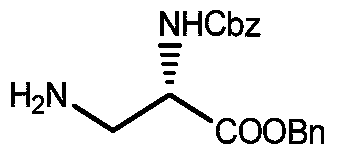
将200mL苯甲醇加入反应瓶中,水浴下缓慢滴入二氯亚砜(6.69mL,92.4mmol),滴完搅拌1h,分批次加入化合物1(20g,84mmol),加完室温搅拌过夜。反应结束,油泵减压蒸出苄醇,残余物用硅胶柱层析色谱(洗脱液为二氯甲烷:甲醇=150:1)分离得到产品22g。LC-MS m/z(ES +):329.1(M+H) + 200 mL of benzyl alcohol was added to the reaction flask, and thionyl chloride (6.69 mL, 92.4 mmol) was slowly added dropwise under a water bath. After stirring for 1 h, Compound 1 (20 g, 84 mmol) was added in portions and stirred at room temperature overnight. After completion of the reaction, the oil was distilled off under reduced pressure to give benzyl alcohol, and the residue was purified by silica gel column chromatography (eluent: methylene chloride:methanol = 150:1). LC-MS m/z (ES + ): 329.1 (M+H) +
实施例3Example 3
化合物3的制备Preparation of

将化合物2(10g,30.4mmol)溶于150mL乙腈中,加入二异丙基乙基胺(DIEA,4.72mL, 36.58mmol),冰水浴下滴加溴乙酸叔丁酯(4.75g,24.4mmol),滴毕,反应30min后移至室温反应,TLC(展开剂DCM:MeOH=10:1)检测。反应完毕后,减压浓缩,残余物用硅胶柱层析色谱(洗脱液为二氯甲烷:甲醇=100:1)分离得到产品5.9g。LC-MS m/z(ES +):443.3(M+H) + Compound 2 (10 g, 30.4 mmol) was dissolved in 150 mL of acetonitrile, diisopropylethylamine (DIEA, 4.72 mL, 36.58 mmol) was added, and t-butyl bromoacetate (4.75 g, 24.4 mmol) was added dropwise in ice water. After the completion of the reaction, the mixture was reacted for 30 min, and then transferred to room temperature to be reacted, and TLC (developing solvent DCM: MeOH = 10:1). After completion of the reaction, the mixture was evaporated to dryness. LC-MS m/z (ES + ): 443.3 (M+H) +
实施例4Example 4
化合物4的制备Preparation of Compound 4

将化合物3(5.9g,13.3mmol)、30mL1,4-二氧六环、30mL水加入反应瓶中,再加入DIEA(3.3mL,20mmol),室温下滴入Boc酸酐(14.5g,66.7mmol),反应液呈黄色,滴完室温反应约3-4h,TLC(展开剂DCM:MeOH=30:1)监测。反应完全后减压浓缩除去二氧六环,加入DCM萃取,减压浓缩得黄色油状物粗品,经硅胶柱层析色谱(洗脱液为二氯甲烷:甲醇=300:1)分离得产品6.6g。LC-MS m/z(ES +):443.3(M+H) +-Boc,543.2(M+H) + Compound 3 (5.9 g, 13.3 mmol), 30 mL of 1,4-dioxane, 30 mL of water was added to a reaction flask, then DIEA (3.3 mL, 20 mmol) was added, and Boc anhydride (14.5 g, 66.7 mmol) was added dropwise at room temperature. The reaction solution was yellow, and the reaction was carried out at room temperature for about 3-4 h, and was monitored by TLC (developing solvent DCM: MeOH = 30:1). After the reaction is completed, the residue is evaporated to drynessnessnessnessnessnessnessnessnessnessnessnessness g. LC-MS m/z (ESI + ): 443.3 (M+H) + -Boc, 543.2 (M+H) +
实施例5Example 5
化合物5的制备Preparation of

将6.6g化合物4溶于50ml甲醇中,加入1.32g 5%Pd/C,氢气置换2-3次,室温反应,TLC(展开剂DCM:MeOH=5:1)监测。反应完全后,过滤,于40℃下减压浓缩得产品4.4g,直接用于下一步反应。6.6 g of compound 4 was dissolved in 50 ml of methanol, 1.32 g of 5% Pd/C was added, and hydrogen was replaced 2-3 times, and the reaction was carried out at room temperature, and was monitored by TLC (developing solvent DCM: MeOH = 5:1). After completion of the reaction, the mixture was filtered and concentrated under reduced pressure at 40 ° C to give 4.4 g of product, which was used directly for the next reaction.
实施例6Example 6
化合物6的制备Preparation of compound 6
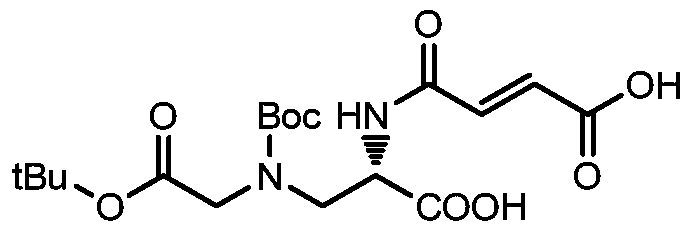
将化合物5(4.4g,13.8mmol)溶于40mL冰乙酸中,加入马来酸酐(2.71g,27.6mmol),室温搅拌反应。TLC(DCM:MeOH=3:1)监测反应。反应完全减压浓缩,残余物用高效液相纯化。Compound 5 (4.4 g, 13.8 mmol) was dissolved in 40 mL of glacial acetic acid, and maleic anhydride (2.71 g, 27.6 mmol) was added, and the reaction was stirred at room temperature. The reaction was monitored by TLC (DCM: MeOH = 3:1). The reaction was concentrated under reduced pressure and the residue was purified using purified.
(柱:YMC-C18,100mm*450mm,10μm,采用乙腈/水(0.2%TFA),流速200mL/min,于λ=215nm检测)(Column: YMC-C18, 100mm*450mm, 10μm, using acetonitrile/water (0.2% TFA), flow rate 200mL/min, detected at λ=215nm)
溶剂A:0.2%TFA水Solvent A: 0.2% TFA water
溶剂B:乙腈Solvent B: acetonitrile
梯度:0-10min 90%A,10-25min,90%A~45%A,25-55min,45%A~40%AGradient: 0-
收集具有43min保留时间的馏分并冻干,得白色固体1.51g。LC-MS m/z(ES +):317.9(M+H) +-Boc,417.9(M+H) + Fractions with a retention time of 43 min were collected and lyophilized to give a white solid, 1.51 g. LC-MS m/z (ESI + ): 317.9 (M+H) + -Boc, 417.9 (M+H) +
实施例7Example 7
化合物7的制备Preparation of Compound 7
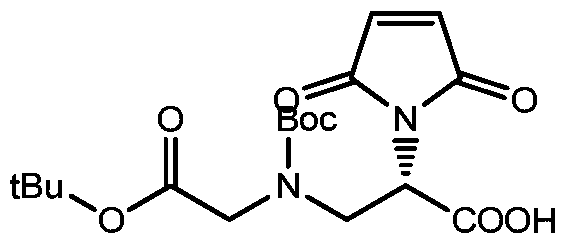
将化合物6(1.2g,2.88mmol)溶于25mL干燥的甲苯及2.5mLDMA溶液中,加入三乙胺(1.2mL,8.65mmol)(可加入几粒干燥的分子筛),氮气置换,升温至120℃反应,TLC(展开剂DCM:MeOH=3:1)监测反应。反应完全后,油泵减压浓缩,残余物用硅胶柱层析色谱(洗脱液为二氯甲烷/甲醇从20/1到10/1)分离得产品700mg。LC-MS m/z(ES +):299.2(M+H) +-Boc,399.3(M+H) + Compound 6 (1.2 g, 2.88 mmol) was dissolved in 25 mL of dry toluene and 2.5 mL of DMA solution. Triethylamine (1.2 mL, 8.65 mmol) was added (several dried molecular sieves may be added), replaced with nitrogen, and heated to 120 ° C. The reaction was monitored by TLC (developer DCM:MeOH = 3:1). After the completion of the reaction, the oil was concentrated under reduced pressure, and the residue was purified by silica gel column chromatography (eluent: methylene chloride / methanol from 20/1 to 10/1). LC-MS m/z (ESI + ): 299.2 (M+H) + -Boc, 399.3 (M+H) +
实施例8Example 8
化合物8的制备Preparation of
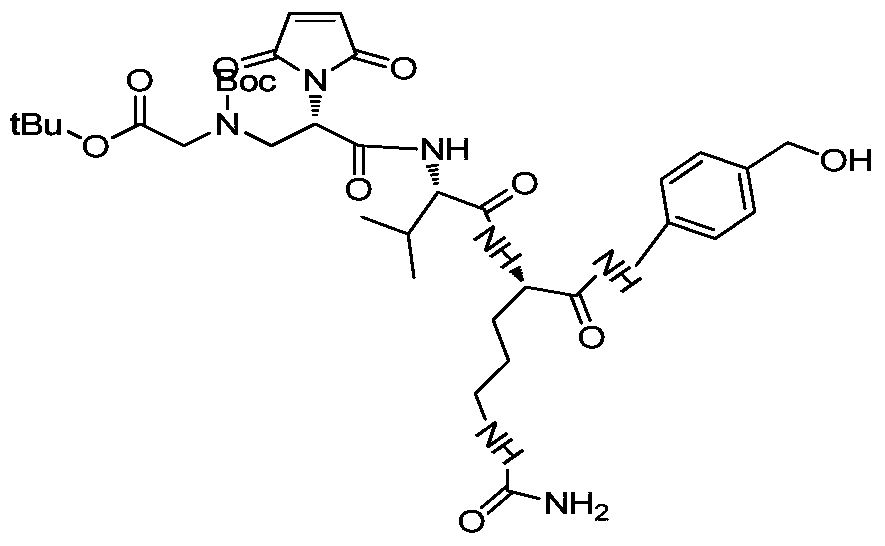
将700mg(1.7mmol)化合物7溶于3.5mLDMF中,加入531mg(2.11mmol)EEDQ、733mg(1.93mmol)Val-Cit-PABOH,室温反应。TLC(展开剂DCM:MeOH=5:1)监测。反应完毕后于45℃下油泵浓缩,残余物用硅胶柱层析色谱(洗脱液为二氯甲烷/甲醇从50/1到20/1)分离得520mg。LC-MS m/z(ES +):660.3(M+H) +-Boc,760.4(M+H) + 700 mg (1.7 mmol) of Compound 7 was dissolved in 3.5 mL of DMF, and 531 mg (2.11 mmol) of EEDQ, 733 mg (1.93 mmol) of Val-Cit-PABOH was added and reacted at room temperature. TLC (developer DCM: MeOH = 5:1) was monitored. After the completion of the reaction, the oil was concentrated at 45 ° C, and the residue was purified by silica gel column chromatography (eluent: methylene chloride / methanol from 50/1 to 20/1). LC-MS m/z (ESI + ): 660.3 (M+H) + -Boc, 760.4 (M+H) +
实施例9Example 9
化合物9的制备Preparation of
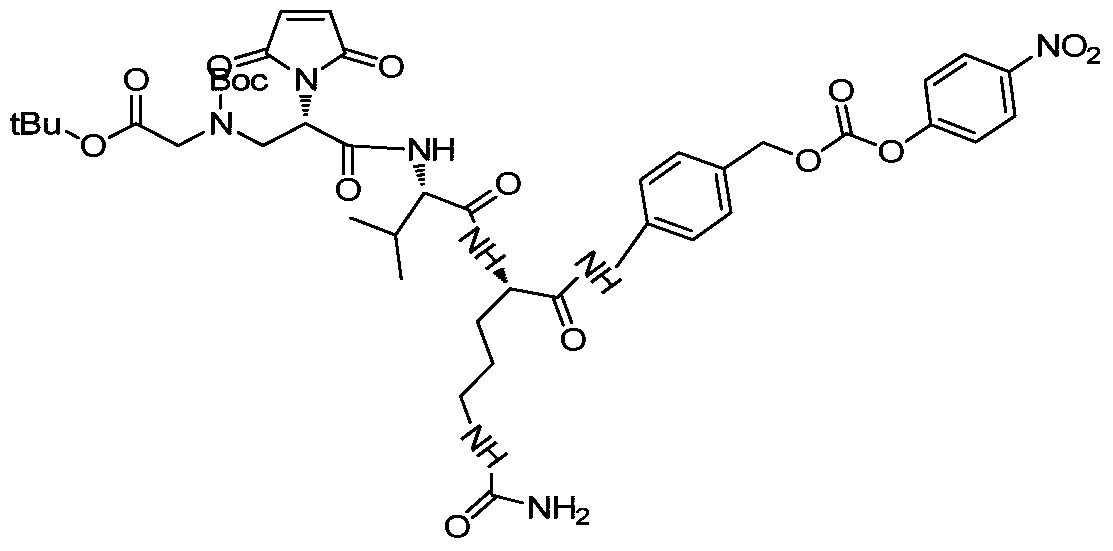
将520mg(0.685mmol)化合物8、1.04g(3.42mmol)NCP依次加入反应瓶中,加入10mLDMF溶清,再加入0.33mL(2.05mmol)DIEA,室温反应。TLC(展开剂DCM:MeOH=5:1)监测。反应完毕后于45℃油泵浓缩,残余物用硅胶柱层析色谱(洗脱液为二氯甲烷/甲醇=30/1)分离得530mg。LC-MS m/z(ES
+):825.3(M+H)
+-Boc,925.2(M+H)
+
520 mg (0.685 mmol) of
实施例10Example 10
化合物10的制备Preparation of

将530mg(0.57mmol)化合物9、13.5mg(0.1mol)HOBT溶于5mLDMF中,加入0.17mL(1.04mmol)DIEA,室温活化1h后,加入373mg(0.52mmol)MMAE室温反应过夜。HPLC监测,原料MMAE作用完。用高效液相纯化.530 mg (0.57 mmol) of
(柱:YMC-C18,50mm*450mm,10μm,采用乙腈/水(0.2%TFA),流速50mL/min,于λ=205nm检测)(Column: YMC-C18, 50mm*450mm, 10μm, using acetonitrile/water (0.2% TFA), flow rate 50mL/min, detected at λ=205nm)
溶剂A:0.2%TFA水Solvent A: 0.2% TFA water
溶剂B:乙腈Solvent B: acetonitrile
梯度:0-10min 90%A,10-25min,90%A~45%A,25-55min,45%A~40%AGradient: 0-
收集具有34min保留时间的馏分并冻干,得产品200mg,LC-MS m/z(ES
+):1503.2(M+H)
+
The fractions with a retention time of 34 min were collected and lyophilized to give the
实施例11Example 11
化合物11的制备Preparation of
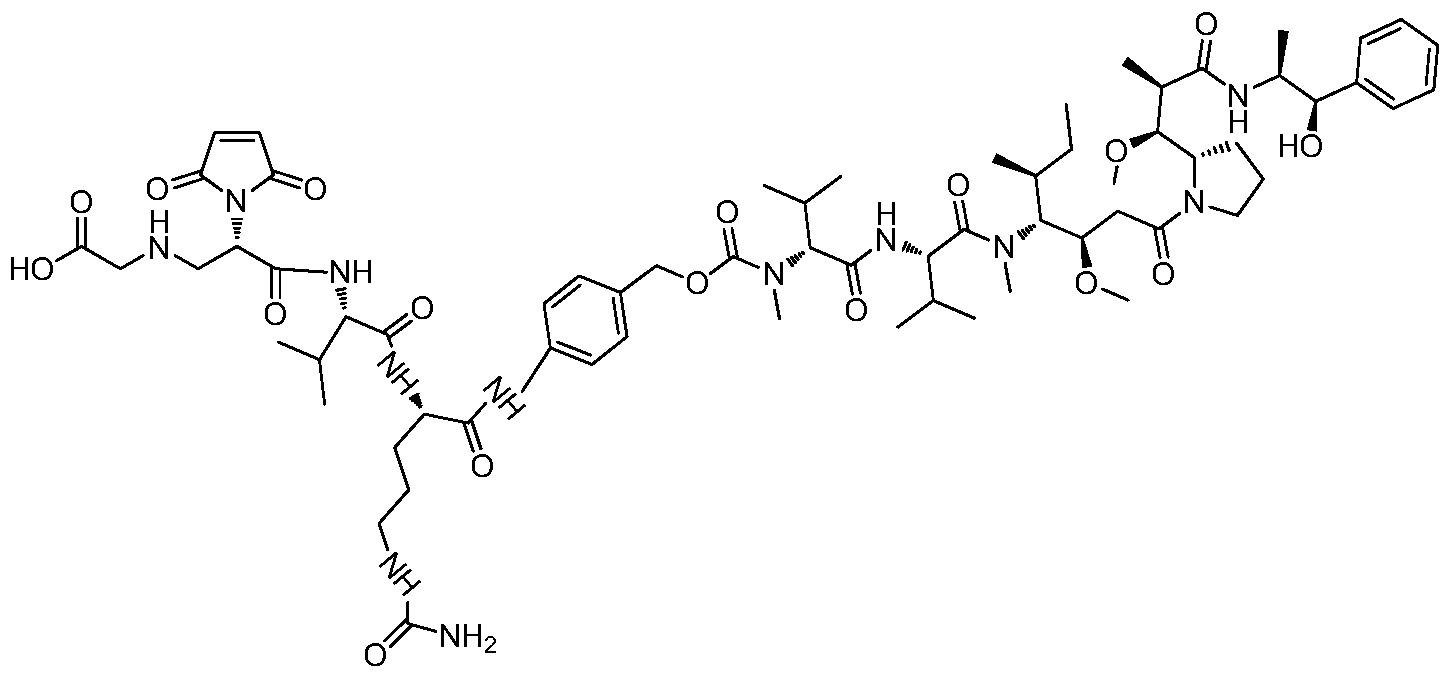
将70mg化合物10溶于10mL干燥二氯甲烷,加入4mL三氟醋酸,室温反应1h,用高效液相纯化.70 mg of
(柱:YMC-C18,30mm*450mm,10μm,采用乙腈/水(0.2%TFA),流速25mL/min,于λ=205nm检测)(Column: YMC-C18, 30mm*450mm, 10μm, using acetonitrile/water (0.2% TFA), flow rate 25mL/min, detected at λ=205nm)
溶剂A:0.2%TFA水Solvent A: 0.2% TFA water
溶剂B:乙腈Solvent B: acetonitrile
梯度:0-10min 95%A,10-30min,95%A~80%A,30-50min,80%A~50%AGradient: 0-10min 95% A, 10-30min, 95% A ~ 80% A, 30-50min, 80% A ~ 50% A
收集具有33min保留时间的馏分并冻干,得产品34mg,LC-MS m/z(ES +):1347.8(M+H) + Fractions with a retention time of 33 min were collected and lyophilized to give product 34 mg, LC-MS m/z (ES + ): 1347.8 (M+H) +
实施例12Example 12
化合物12的制备Preparation of Compound 12

将化合物L-谷氨酸二叔丁酯(8g,,30.8mmol)溶于150mL乙腈中,加入DIEA(6mL,37mmol),冰水浴下滴加2-溴代-N-苄氧羰基-L-丙氨酸苄酯(10.2g,26.1mmol),滴毕,反应40min后移至室温反应,TLC(展开剂DCM:MeOH=10:1)检测。反应完毕后,减压浓缩,残余物用硅胶柱层析色谱(洗脱液为二氯甲烷/甲醇=100/1)分离得到产品8.1g。LC-MS m/z(ES +):571.2(M+H) + The compound L-glutamic acid di-tert-butyl ester (8 g, 30.8 mmol) was dissolved in 150 mL of acetonitrile, DIEA (6 mL, 37 mmol) was added, and 2-bromo-N-benzyloxycarbonyl-L- was added dropwise in an ice water bath. Alanine benzyl ester (10.2 g, 26.1 mmol) was added dropwise, and the reaction was allowed to react for 40 min. After completion of the reaction, the residue was evaporated. LC-MS m/z (ES + ): 571.2 (M+H) +
实施例13Example 13
化合物13的制备Preparation of compound 13
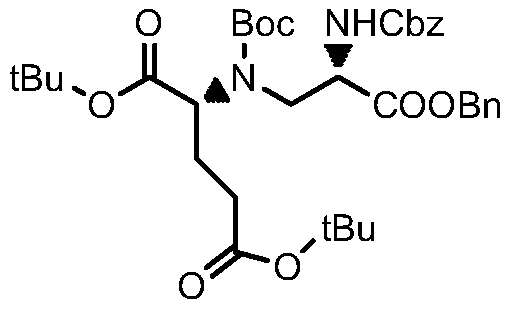
将8.1g(14.2mmol)化合物12、50mL1,4-二氧六环、50mL水加入反应瓶中,再加入3.5mL(21.3mmol)DIEA,室温下滴入14.5g(66.7mmol)Boc酸酐,反应液呈黄色,滴完室温反应,TLC(展开剂DCM:MeOH=30:1)监测。反应完全后减压浓缩除去二氧六环,加入DCM萃取,减压浓缩得黄色油状物粗品,经硅胶柱层析色谱(洗脱液为二氯甲烷/甲醇=300/1)分离得产品8.55g。LC-MS m/z(ES
+):471.1(M+H)
+-Boc,571.3(M+H)
+.
8.1 g (14.2 mmol) of
实施例14Example 14
化合物14的制备Preparation of compound 14

将8.5g化合物13溶于70ml甲醇中,加入1.7g 5%Pd/C,氢气置换2-3次,室温反应,TLC(展开剂DCM:MeOH=5:1)监测。反应完全后,过滤,于40℃下减压浓缩得产品5g,直接用于下步反应。8.5 g of compound 13 was dissolved in 70 ml of methanol, 1.7 g of 5% Pd/C was added, and hydrogen was replaced 2-3 times, and the reaction was carried out at room temperature, and was monitored by TLC (developing solvent DCM: MeOH = 5:1). After completion of the reaction, the mixture was filtered and concentrated under reduced pressure at 40 ° C to give 5 g of product, which was used directly for the next step.
实施例15Example 15
化合物15的制备Preparation of
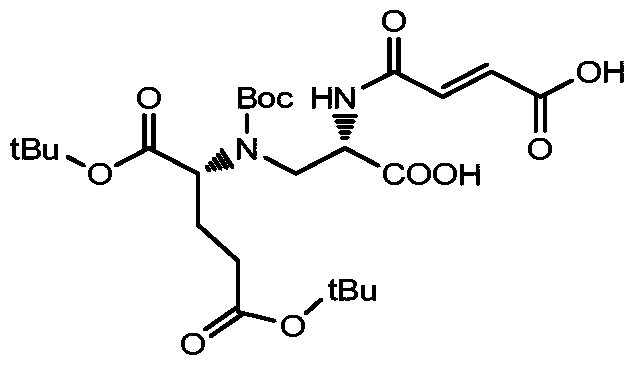
将5g(11.2mmol)化合物14溶于40mL冰乙酸中,加入2.19g(22.4mmol)马来酸酐,室温搅拌反应。TLC(DCM:MeOH=3:1)监测反应。反应完全减压浓缩,残余物用高效液相纯化,5 g (11.2 mmol) of compound 14 was dissolved in 40 mL of glacial acetic acid, 2.19 g (22.4 mmol) of maleic anhydride was added, and the reaction was stirred at room temperature. The reaction was monitored by TLC (DCM: MeOH = 3:1). The reaction was concentrated under reduced pressure, and the residue was purified
(柱:YMC-C18,100mm*450mm,10μm,采用乙腈/水(0.2%TFA),流速200mL/min,于λ=215nm检测)(Column: YMC-C18, 100mm*450mm, 10μm, using acetonitrile/water (0.2% TFA), flow rate 200mL/min, detected at λ=215nm)
溶剂A:0.2%TFA水Solvent A: 0.2% TFA water
溶剂B:乙腈Solvent B: acetonitrile
梯度:0-10min 90%A,10-25min,90%A~45%A,25-55min,45%A~40%AGradient: 0-
收集具有48min保留时间的馏分并冻干,得产品2.3g。LC-MS m/z(ES +):445.2(M+H) +-Boc,545.3(M+H) +。 Fractions with a retention time of 48 min were collected and lyophilized to give a product of 2.3 g. LC-MS m / z (ES +): 445.2 (M + H) + -Boc, 545.3 (M + H) +.
实施例16Example 16
化合物16的制备Preparation of Compound 16
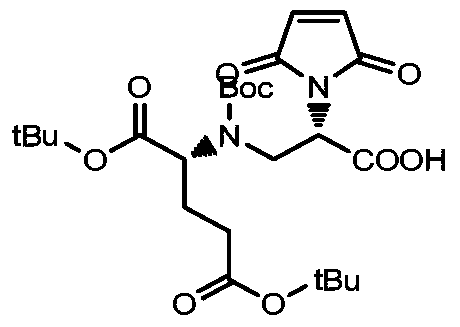
将2g(3.80mmol)化合物15溶于25mL干燥的甲苯及2.5mLDMA溶液中,加入1.58mL(11.4mmol)三乙胺,氮气置换,升温至120℃反应,TLC(展开剂DCM:MeOH=3:1)监测反应。反应完全后,油泵减压浓缩,残余物用硅胶柱层析色谱(洗脱液为二氯甲烷/甲醇从20/1到10/1)分离得产品1.19g.LC-MS m/z(ES
+):427.1(M+H)
+-Boc,527.3(M+H)
+.
2 g (3.80 mmol) of
实施例17Example 17
化合物17的制备Preparation of compound 17

将1.19g(1.7mmol)化合物16溶于3.5mLDMF中,加入531mg(2.11mmol)EEDQ、733mg(1.93mmol)Val-Cit-PABOH,室温反应。TLC(展开剂DCM:MeOH=5:1)监测。反应完毕后于45℃下油泵浓缩,残余物用硅胶柱层析色谱(洗脱液为二氯甲烷/甲醇从50/1到25/1)分离得753mg。LC-MS m/z(ES +):788.5(M+H) +-Boc,888.4(M+H) +. 1.19 g (1.7 mmol) of compound 16 was dissolved in 3.5 mL of DMF, and 531 mg (2.11 mmol) of EEDQ and 733 mg (1.93 mmol) of Val-Cit-PABOH were added and reacted at room temperature. TLC (developer DCM: MeOH = 5:1) was monitored. After the completion of the reaction, the oil was concentrated at 45 ° C, and the residue was purified by silica gel column chromatography (eluent: methylene chloride / methanol from 50/1 to 25/1). LC-MS m / z (ES +): 788.5 (M + H) + -Boc, 888.4 (M + H) +.
实施例18Example 18
化合物18的制备Preparation of Compound 18

将753mg(0.849mmol)化合物17、1.28g(4.24mmol)NCP依次加入反应瓶中,加入15mLDMF溶清,再加入0.35mL(2.55mmol)DIEA,室温反应。TLC(展开剂DCM:MeOH=5:1)监测。反应完毕后于45℃油泵浓缩,残余物用硅胶柱层析色谱(洗脱液为二氯甲烷/甲醇=25/1)分离得762mg。LC-MS m/z(ES +):1053.6(M+H) + 753 mg (0.849 mmol) of compound 17, 1.28 g (4.24 mmol) of NCP were sequentially added to the reaction flask, and 15 mL of DMF was added to dissolve, and 0.35 mL (2.55 mmol) of DIEA was added thereto, and the mixture was reacted at room temperature. TLC (developer DCM: MeOH = 5:1) was monitored. After completion of the reaction, the oil was concentrated at 45 ° C, and the residue was purified by silica gel column chromatography (eluent, methylene chloride / methanol = 25 / 1). LC-MS m/z (ES + ): 1053.6 (M+H) +
实施例19Example 19
化合物19的制备Preparation of Compound 19

将762mg(0.71mmol)化合物18、13.5mg(0.1mol)HOBT溶于8mLDMF中,加入0.23mL(1.42mmol)DIEA,室温活化1h后,加入463mg(0.645mmol)MMAE室温反应过夜。HPLC监测,原料MMAE反应完。用高效液相纯化。762 mg (0.71 mmol) of compound 18, 13.5 mg (0.1 mol) of HOBT was dissolved in 8 mL of DMF, and 0.23 mL (1.42 mmol) of DIEA was added thereto, and after activation at room temperature for 1 hour, 463 mg (0.645 mmol) of MMAE was added to react at room temperature overnight. The raw material MMAE was reacted by HPLC monitoring. Purified with high performance liquid phase.
(柱:YMC-C18,100mm*450mm,10μm,采用乙腈/水(0.2%TFA),流速200mL/min,于λ=215nm检测)(Column: YMC-C18, 100mm*450mm, 10μm, using acetonitrile/water (0.2% TFA), flow rate 200mL/min, detected at λ=215nm)
溶剂A:0.2%TFA水Solvent A: 0.2% TFA water
溶剂B:乙腈Solvent B: acetonitrile
梯度:0-10min 90%A,10-25min,90%A~45%A,25-55min,45%A~40%AGradient: 0-
收集具有30min保留时间的馏分并冻干,得产品300mg。LC-MS m/z(ES +):1631.6(M+H) + Fractions with a retention time of 30 min were collected and lyophilized to give a product of 300 mg. LC-MS m/z (ES + ): 1631.6 (M+H) +
实施例20Example 20
化合物20的制备Preparation of

将100mg化合物19溶于10mL干燥二氯甲烷,加入4mL三氟醋酸,室温反应2h,用高效液相纯化。100 mg of compound 19 was dissolved in 10 mL of dry dichloromethane, and 4 mL of trifluoroacetic acid was added thereto, and the mixture was reacted at room temperature for 2 hours, and purified by high-performance liquid phase.
(柱:YMC-C18,30mm*450mm,10μm,采用乙腈/水(0.2%TFA),流速25mL/min,于λ=215nm检测)(Column: YMC-C18, 30mm*450mm, 10μm, using acetonitrile/water (0.2% TFA), flow rate 25mL/min, detected at λ=215nm)
溶剂A:0.2%TFA水Solvent A: 0.2% TFA water
溶剂B:乙腈Solvent B: acetonitrile
梯度:0-10min 95%A,10-25min,95%A~80%A,25-55min,80%A~55%AGradient: 0-10min 95% A, 10-25min, 95% A ~ 80% A, 25-55min, 80% A ~ 55% A
收集具有30min保留时间的馏分并冻干,得产品45mg。LC-MS m/z(ES +):1419.1(M+H) + Fractions with a retention time of 30 min were collected and lyophilized to give a product of 45 mg. LC-MS m/z (ES + ): 1419.1 (M+H) +
实施例21-29Example 21-29
化合物21-29合成Compound 21-29 Synthesis

实施例21Example 21
化合物21的制备Preparation of Compound 21

将化合物3-硝基-4氨基苯甲酸15g溶于100ml甲醇中,加入3g 5%Pd/C,常压氢化5h,过滤,滤饼以甲醇洗涤2次,高真空下室温浓缩至干,不经纯化直接用于下步反应。15 g of the compound 3-nitro-4-aminobenzoic acid was dissolved in 100 ml of methanol, 3 g of 5% Pd/C was added, hydrogenation was carried out under normal pressure for 5 h, filtered, and the filter cake was washed twice with methanol, and concentrated to dryness under high vacuum at room temperature. Purified directly for the next step of the reaction.
实施例22Example 22
化合物22的制备Preparation of Compound 22

将化合物3,4-二氨基苯甲酸(10g,65.7mmol)溶于100mLDMF中,加入碳酸钾粉末(13.6g,98.55mol)及碘化钾(2.2g,1.31mmol),氮气保护下滴加溴乙酸叔丁酯(12.8g,65.7mol),滴毕室温反应。TLC(展开剂DCM:MeOH=10:1)检测。反应完毕后,加入水,乙酸乙酯萃取,合并有机相,经饱和食盐水洗涤,无水硫酸钠干燥,过滤、减压浓缩,残余物用硅胶柱层析色谱纯化(洗脱液为二氯甲烷/甲醇=150/1~100/1)分离得到产品3.46g。LC-MS m/z(ES
+):267.4(M+H)
+;HNMR:7.51-7.53,dd,1H;7.44-7.45,d,1H;6.66-6.69,d,1H;4.69,s,2H;1.49,s,9H.
The
实施例23Example 23
化合物23的制备Preparation of Compound 23

将3g(11.2mmol)化合物22、15mL冰乙酸、顺丁烯二酸酐(0.55g,5.6mmol)水加入反应瓶中,室温反应,HPLC监测。反应完全后减压浓缩除去冰乙酸,制备纯化.(柱:YMC-C18,100mm*450mm,10μm,采用乙腈/水(0.2%TFA),流速200mL/min,于λ=214nm检测)3 g (11.2 mmol) of
溶剂A:0.2%TFA水Solvent A: 0.2% TFA water
溶剂B:乙腈Solvent B: acetonitrile
梯度:0-5min 80%A,5-35min,80%A~65%A,35-45min,65%A~60%A,收集具有37min-42min 保留时间的馏分并冻干,得产品2g。LC-MS m/z(ES
+):365.4(M+H)
+,309.3(M+H)
+-tBu。HNMR:10.48,s,1H;7.41-7.44,dd,1H;7.35-7.36,d,1H;6.92,s,2H;6.70-6.72,d,1H;4.68,s,2H;1.42,s,9H..
Gradient: 0-5
实施例24Example 24
化合物24的制备Preparation of Compound 24

将化合物23(2g,5.49mmol)溶于30mlTHF中,加入Boc酸酐(1.44g,6.59mmol),DMAP(1.32g,10.9mmol)及DIEA(1.8mL,10.98mmol),室温反应。TLC(展开剂DCM:MeOH=10:1)监测。反应完全后,经硅胶柱层析色谱,洗脱液为二氯甲烷/甲醇=100/1~20/1)分离得到产品2.2g.LC-MS m/z(ES +):365.4(M+H) +-Boc。HNMR:10.50,s,1H;7.46-7.48,dd,1H;7.41-7.42,d,1H;6.95,s,2H;6.73-6.75,d,1H;4.69,s,2H;1.48,s,9H;1.40,s,9H. Compound 23 (2 g, 5.49 mmol) was dissolved in 30 mL of THF. EtOAc (1. 4 g, <RTI ID=0.0></RTI></RTI><RTIgt; TLC (developer DCM: MeOH = 10:1) was monitored. After completion of the reaction, the product was separated by silica gel column chromatography eluting with methylene chloride/methanol = 100/1 to 20/1 to yield product 2.2 g. LC-MS m/z (ES + ): 365.4 (M+ H) + -Boc. H NMR: 10.50, s, 1H; 7.46-7.48, dd, 1H; 7.41-7.42, d, 1H; 6.95, s, 2H; 6.73-6.75, d, 1H; 4.69, s, 2H; 1.48, s, 9H; 1.40, s, 9H.
实施例25Example 25
化合物25的制备Preparation of compound 25

将2g(4.31mmol)化合物24溶于15mL甲苯及2mLDMA中,加入(1.2mL,8.62mmol)三乙胺,120℃反应。TLC(DCM:MeOH=10:1)监测反应。反应完全减压浓缩,残余物用硅胶柱层析色谱纯化,洗脱液为二氯甲烷/甲醇=100/1~50/1)分离得到产品1.63g.LC-MS m/z(ES +):347.4(M+H) +-Boc。HNMR:7.50-7.51,dd,1H;7.43-7.44,d,1H;6.97,s,2H;6.75-6.77d,1H;4.67,s,2H;1.48,s,9H;1.40,s,9H. 2 g (4.31 mmol) of compound 24 was dissolved in 15 mL of toluene and 2 mL of DMA, and (1.2 mL, 8.62 mmol) of triethylamine was added and reacted at 120 °C. The reaction was monitored by TLC (DCM: MeOH = 10:1). The reaction was concentrated completely under reduced pressure, the residue was purified by silica gel column chromatography, eluting with methylene chloride / methanol = 100/1 ~ 50/1) to give the product isolated 1.63g.LC-MS m / z (ES +) : 347.4 (M+H) + -Boc. H NMR: 7.50-7.51, dd, 1H; 7.43-7.44, d, 1H; 6.97, s, 2H; 6.75-6.77d, 1H; 4.67, s, 2H; 1.48, s, 9H; 1.40, s, 9H.
实施例26Example 26
化合物26的制备Preparation of Compound 26

将1.6g(3.58mmol)化合物25溶于10mLDMF中,加入1.77g(7.17mmol)EEDQ、2.98g(7.89mmol)Val-Cit-PABOH,室温反应。TLC(展开剂DCM:MeOH=10:1)监测。反应完毕后于45℃下油泵浓缩,残余物用硅胶柱层析色谱(洗脱液为二氯甲烷/甲醇从100/1到25/1)分离得2.1g。LC-MS m/z(ES +):709.8(M+H) +-Boc,809.7(M+H) +. 1.6 g (3.58 mmol) of compound 25 was dissolved in 10 mL of DMF, and 1.77 g (7.17 mmol) of EEDQ and 2.98 g (7.89 mmol) of Val-Cit-PABOH were added and reacted at room temperature. TLC (developer DCM: MeOH = 10:1) was monitored. After the completion of the reaction, the oil was concentrated at 45 ° C, and the residue was purified by silica gel column chromatography (eluent: methylene chloride / methanol from 100/1 to 25/1). LC-MS m / z (ES +): 709.8 (M + H) + -Boc, 809.7 (M + H) +.
实施例27Example 27
化合物27的制备Preparation of Compound 27

将2g(2.47mmol)化合物26、3.71g(12.3mmol)NCP依次加入反应瓶中,加入20mLDMF溶清,再加入1.2mL(7.41mmol)DIEA,室温反应。TLC(展开剂DCM:MeOH=15:1)监测。反应完毕后于45℃油泵浓缩,残余物用硅胶柱层析色谱(洗脱液为二氯甲烷/甲醇=100/1)分离得2.1g。LC-MS m/z(ES +):973.3(M+H) + 2 g (2.47 mmol) of compound 26 and 3.71 g (12.3 mmol) of NCP were sequentially added to a reaction flask, and 20 mL of DMF was added to dissolve, and then 1.2 mL (7.41 mmol) of DIEA was added thereto, and the mixture was reacted at room temperature. TLC (developer DCM: MeOH = 15:1) was monitored. After completion of the reaction, the oil was concentrated at 45 ° C, and the residue was purified by silica gel column chromatography (dichloromethane/methanol = 100/1). LC-MS m/z (ES + ): 973.3 (M+H) +
实施例28Example 28
化合物28的制备Preparation of Compound 28
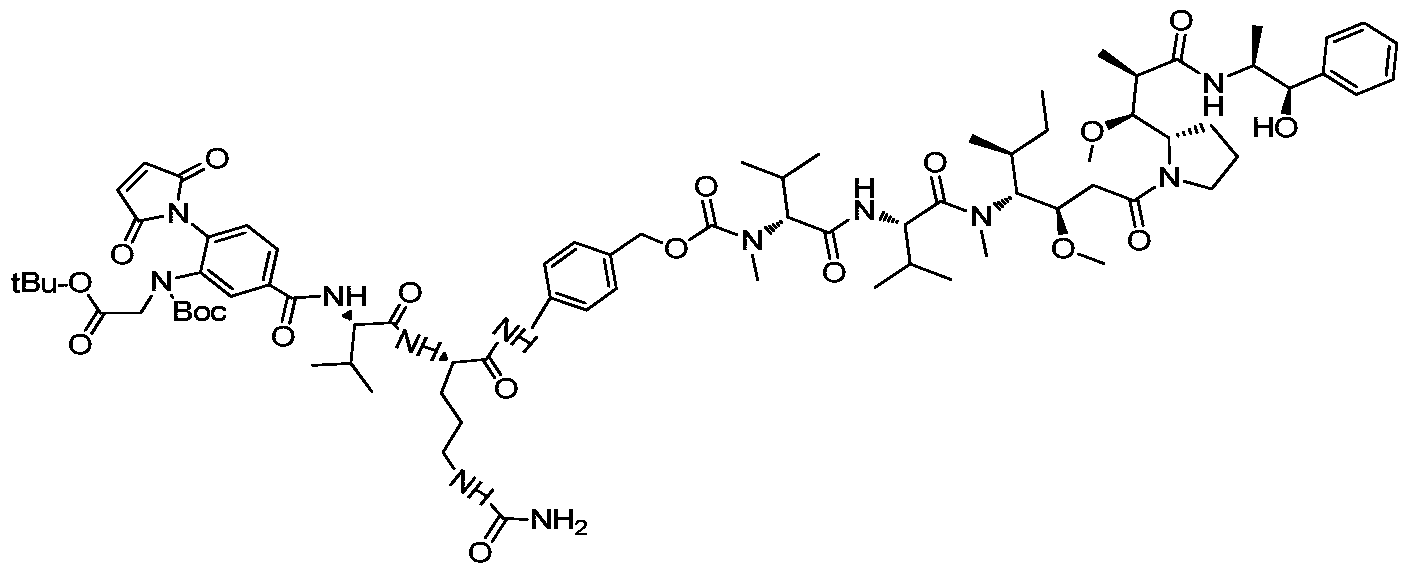
将1g(1mmol)化合物27、13.5mg(0.1mol)HOBT溶于8mLDMF中,加入0.33mL(2mmol)DIEA,室温活化1h后,加入646mg(0.9mmol)MMAE室温反应过夜。HPLC监测,原料MMAE反应完。用高效液相纯化。1 g (1 mmol) of compound 27, 13.5 mg (0.1 mol) of HOBT was dissolved in 8 mL of DMF, and 0.33 mL (2 mmol) of DIEA was added thereto, and after activation at room temperature for 1 hour, 646 mg (0.9 mmol) of MMAE was added to react at room temperature overnight. The raw material MMAE was reacted by HPLC monitoring. Purified with high performance liquid phase.
(柱:YMC-C18,100mm*450mm,10μm,采用乙腈/水(0.2%TFA),流速200mL/min,于λ=214nm检测)(Column: YMC-C18, 100mm*450mm, 10μm, using acetonitrile/water (0.2% TFA), flow rate 200mL/min, detected at λ=214nm)
溶剂A:0.2%TFA水Solvent A: 0.2% TFA water
溶剂B:乙腈Solvent B: acetonitrile
梯度:0-10min 90%A,10-25min,90%A~45%A,25-55min,45%A~40%AGradient: 0-
收集具有30min保留时间的馏分并冻干,得产品560mg。LC-MS m/z(ES +):1551.7(M+H) + Fractions with a retention time of 30 min were collected and lyophilized to give a product of 560 mg. LC-MS m/z (ES + ): 1551.7 (M+H) +
实施例29Example 29
化合物29的制备Preparation of

将100mg化合物28溶于10mL干燥二氯甲烷,加入4mL三氟醋酸,室温反应2h,用高效液相纯化。100 mg of compound 28 was dissolved in 10 mL of dry dichloromethane, and 4 mL of trifluoroacetic acid was added thereto, and the mixture was reacted at room temperature for 2 hours, and purified by high-performance liquid phase.
(柱:YMC-C18,30mm*450mm,10μm,采用乙腈/水(0.2%TFA),流速25mL/min,于λ=214nm检测)(Column: YMC-C18, 30mm*450mm, 10μm, using acetonitrile/water (0.2% TFA), flow rate 25mL/min, detected at λ=214nm)
溶剂A:0.2%TFA水Solvent A: 0.2% TFA water
溶剂B:乙腈Solvent B: acetonitrile
梯度:0-10min 95%A,10-25min,95%A~80%A,25-55min,80%A~55%AGradient: 0-10min 95% A, 10-25min, 95% A ~ 80% A, 25-55min, 80% A ~ 55% A
收集具有30min保留时间的馏分并冻干,得产品45mg。LC-MS m/z(ES +):1395.7(M+H) + Fractions with a retention time of 30 min were collected and lyophilized to give a product of 45 mg. LC-MS m/z (ES + ): 1395.7 (M+H) +
实施例30-39Example 30-39
化合物30-39合成Compound 30-39 Synthesis
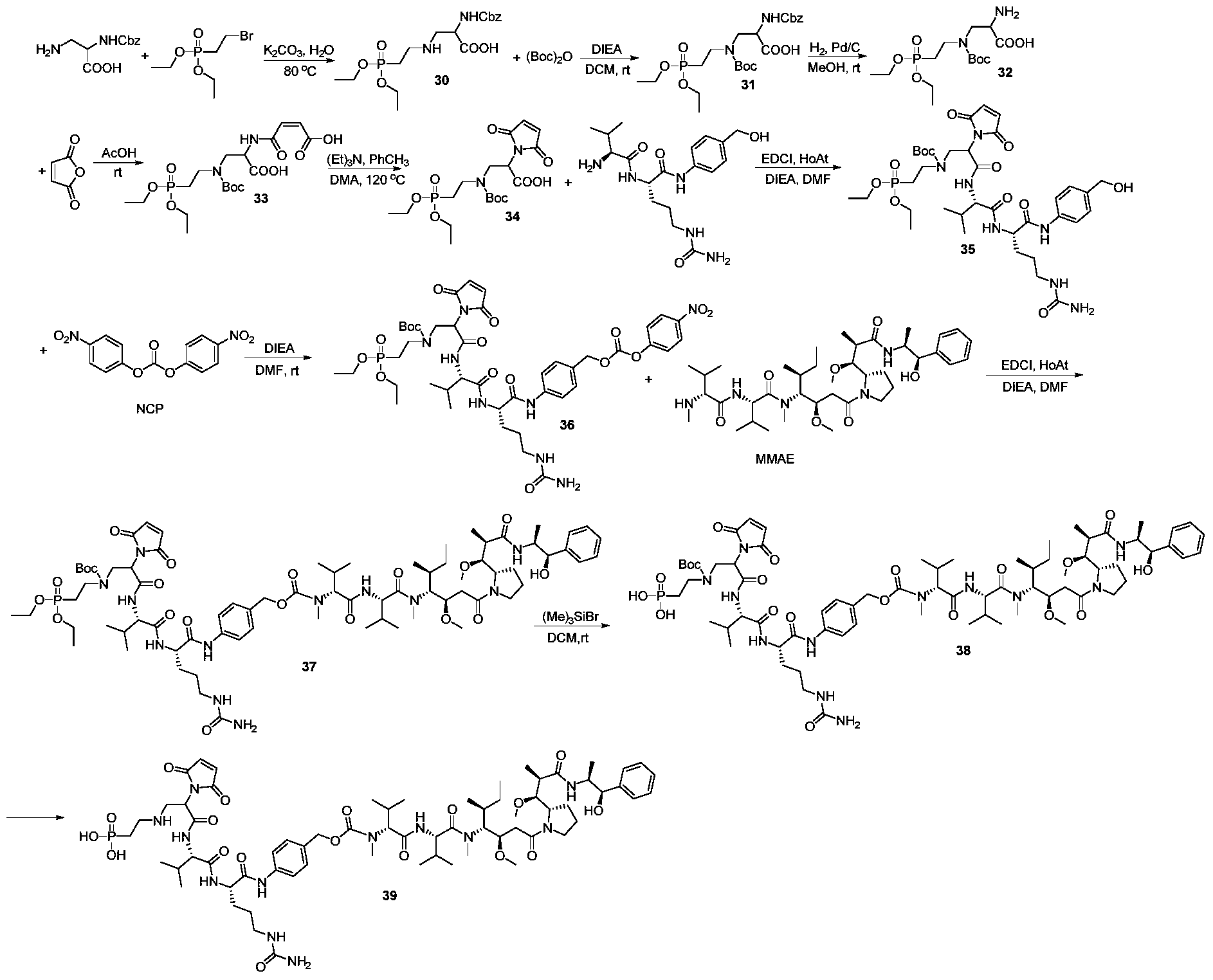
实施例30Example 30
化合物30的制备Preparation of

在500ml的圆底烧瓶中,将碳酸钾(24.7g,179.24mmol)溶于220ml纯水中,再加入(S)-3-氨基-2-(苄氧羰基氨基)丙酸(16g,67.16mmol),搅拌至大部分溶解,然后加入2-溴乙基磷酸二乙酯(10.98g,44.81mmol),加入完毕后置于80℃的油浴锅中搅拌反应6小时,反应完毕。反应液经高效液相制备纯化。(柱:YMC-C18,100mm*450mm,10μm,采用乙腈/水(0.2%TFA),流速200mL/min,于λ=214nm检测)Potassium carbonate (24.7 g, 179.24 mmol) was dissolved in 220 ml of purified water in a 500 ml round bottom flask, followed by (S)-3-amino-2-(benzyloxycarbonylamino)propionic acid (16 g, 67.16 mmol). After stirring, most of the dissolution was carried out, and then diethyl 2-bromoethyl phosphate (10.98 g, 44.81 mmol) was added. After the addition, the mixture was stirred in an oil bath at 80 ° C for 6 hours, and the reaction was completed. The reaction solution was purified by high performance liquid phase preparation. (Column: YMC-C18, 100mm*450mm, 10μm, using acetonitrile/water (0.2% TFA), flow rate 200mL/min, detected at λ=214nm)
溶剂A:0.2%TFA水Solvent A: 0.2% TFA water
溶剂B:乙腈Solvent B: acetonitrile
梯度:0-10min,5%B~15%B,10-15min,15%B,15-25min,15%B~20%B,25-50min,20%B~30%B,50-55min,30%B~50%B,55-65min,50%B~90%B。收集具有42~49min保留时间的馏 分并冻干,得产品8.38g无色油状物,产率为46.5%。 1H NMR data(CDCl 3,400MHz):7.39-7.28(m,5H),6.54-6.41(m,1H),5.12-5.01(m,2H),4.63-4.53(m,1H),4.16-4.03(m,4H),3.48-3.36(m,2H),3.35-3.25(m,2H),2.35-2.23(m,2H),1.29(t,J=6.8Hz,6H);LCMS[M+H] +m/z 403.3(calcd for C 17H 27N 2O 7P,402.16)。 Gradient: 0-10 min, 5% B ~ 15% B, 10-15 min, 15% B, 15-25 min, 15% B ~ 20% B, 25-50 min, 20% B ~ 30% B, 50-55 min, 30% B to 50% B, 55-65 min, 50% B to 90% B. A fraction having a retention time of 42 to 49 min was collected and lyophilized to give 8.38 g of a colorless oily product, yield 46.5%. 1 H NMR data (CDCl 3, 400MHz): 7.39-7.28 (m, 5H), 6.54-6.41 (m, 1H), 5.12-5.01 (m, 2H), 4.63-4.53 (m, 1H), 4.16-4.03 (m, 4H), 3.48-3.36 (m, 2H), 3.35-3.25 (m, 2H), 2.35-2.23 (m, 2H), 1.29 (t, J = 6.8 Hz, 6H); LCMS [M+H ] + m/z 403.3 (calcd for C 17 H 27 N 2 O 7 P, 402.16).
实施例31Example 31
化合物31的制备Preparation of Compound 31

在100ml的三口瓶中,用50ml二氯甲烷溶剂将化合物30(8.3g,20.85mmol)溶解,氮气保护下置于0℃的低温反应器中,搅拌下滴入DIEA碱(6.7g,52.11mmol)的,之后再于半小时滴入Boc酸酐(5.0g,22.935mmol),滴加完毕后移至室温搅拌反应2小时,TLC检测反应完全(展开剂DCM:MeOH=4:1)。后处理:反应液中加入水洗涤三次,有机相用无水硫酸钠干燥后减压浓缩,残余物经高效液相制备纯化。(柱:YMC-C18,100mm*450mm,10μm,采用乙腈/水(0.2%TFA),流速200mL/min,于λ=214nm检测)In a 100 ml three-necked flask, compound 30 (8.3 g, 20.85 mmol) was dissolved in 50 ml of dichloromethane solvent, placed under a nitrogen atmosphere in a low temperature reactor at 0 ° C, and DIEA base (6.7 g, 52.11 mmol) was added dropwise with stirring. Then, Boc anhydride (5.0 g, 22.935 mmol) was added dropwise thereto in half an hour. After the dropwise addition, the reaction was stirred at room temperature for 2 hours, and the reaction was completed by TLC (developing solvent DCM: MeOH = 4:1). Post-treatment: The reaction mixture was washed with water three times. The organic phase was dried over anhydrous sodium sulfate and then evaporated. (Column: YMC-C18, 100mm*450mm, 10μm, using acetonitrile/water (0.2% TFA), flow rate 200mL/min, detected at λ=214nm)
溶剂A:0.2%TFA水Solvent A: 0.2% TFA water
溶剂B:乙腈Solvent B: acetonitrile
梯度:0min,40%B,0-10min,40%B,10-20min,40%B~45%B,20-30min,45%B,30-45min,45%B~80%B,45-50min,80%B~95%B。收集具有26~29.5min保留时间的馏分并冻干,得4.02g的无色油状液体,产率为38.3%。 1H NMR data(CDCl 3,400MHz):7.36-7.28(m,5H),5.09(s,2H),4.63-4.43(m,1H),4..14-4.01(m,4H),3.92-3.65(m,2H),3.61-3.29(m,2H),2.34-1.95(m,2H),1.45(s,9H),1.36-1.22(m,6H);LCMS[M+H] +m/z 503.4(calcd for C 22H 35N 2O 9P,502.21)。 Gradient: 0 min, 40% B, 0-10 min, 40% B, 10-20 min, 40% B ~ 45% B, 20-30 min, 45% B, 30-45 min, 45% B - 80% B, 45- 50 min, 80% B ~ 95% B. A fraction having a retention time of 26 to 29.5 min was collected and lyophilized to obtain 4.02 g of a colorless oily liquid in a yield of 38.3%. 1 H NMR data (CDCl 3 , 400 MHz): 7.36-7.28 (m, 5H), 5.09 (s, 2H), 4.63-4.43 (m, 1H), 4..14-4.01 (m, 4H), 3.92 3.65 (m, 2H), 3.61-3.29 (m, 2H), 2.34-1.95 (m, 2H), 1.45 (s, 9H), 1.36-1.22 (m, 6H); LCMS [M+H] + m/ z 503.4 (calcd for C 22 H 35 N 2 O 9 P, 502.11).
实施例32Example 32
化合物32的制备Preparation of Compound 32

在150ml的圆底烧瓶中,用50ml甲醇将化合物31(4.0g,8.0mmol)溶解,再加入800mg 的Pd/C(含Pd量为5%),氢气置换后室温搅拌反应4小时,TLC检测(展开剂DCM:MeOH=4:1)反应完全,停止反应。有机膜滤去钯碳,减压浓缩,残余物无需纯化,直接投入下步反应。LCMS[M+H] +m/z 369.4(calcd for C 14H 29N 2O 7P,368.17)。 In a 150 ml round bottom flask, compound 31 (4.0 g, 8.0 mmol) was dissolved in 50 ml of methanol, and 800 mg of Pd/C (containing Pd was 5%) was added. After hydrogen replacement, the reaction was stirred at room temperature for 4 hours, and detected by TLC. (developing agent DCM: MeOH = 4:1) The reaction was completed and the reaction was stopped. Palladium carbon was filtered off from the organic membrane, concentrated under reduced pressure, and the residue was directly transferred to the next step without purification. LCMS [M+H] + m/z 369.4 (calcd for C 14 H 29 N 2 O 7 P, 368.17).
实施例33Example 33
化合物33的制备Preparation of Compound 33

在100ml的圆底烧瓶中加入30ml冰乙酸将未经纯化的化合物32溶解,再于搅拌下加入顺丁烯二酸酐(1.57g,16.0mmol),之后室温搅拌反应过夜。次日停止反应,45℃下用油泵减压浓缩除去冰乙酸,残余物经高效液相制备纯化。(柱:YMC-C18,100mm*450mm,10μm,采用乙腈/水(0.2%TFA),流速200mL/min,于λ=214nm检测)Unpurified Compound 32 was dissolved in a 100 ml round bottom flask by adding 30 ml of glacial acetic acid, and maleic anhydride (1.57 g, 16.0 mmol) was added thereto with stirring, followed by stirring at room temperature overnight. The reaction was stopped the next day, and glacial acetic acid was concentrated under reduced pressure at 45 ° C with an oil pump, and the residue was purified by high-performance liquid chromatography. (Column: YMC-C18, 100mm*450mm, 10μm, using acetonitrile/water (0.2% TFA), flow rate 200mL/min, detected at λ=214nm)
溶剂A:0.2%TFA水Solvent A: 0.2% TFA water
溶剂B:乙腈Solvent B: acetonitrile
梯度:0min,5%B,0-10min,5%B~15%B,10-20min,15%B~30%B,20-35min,30%B~55%B,35-45min,55%B,45-55min,55%B~80%B,55-60min,80%B~98%B。收集具有25~26.5min保留时间的馏分并冻干,得3.35g油状物,两步产率为90%。 1H NMR data(CDCl 3,400MHz):6.40(d,J=12Hz,1H),6.35(d,J=12Hz,1H),4.96-4.82(m,1H),4.19-3.99(m,4H),3.98-3.61(m,2H),3.60-3.36(m,2H),2.22-2.00(m,2H),1.45(s,9H),1.33(t,J=7.0Hz,3H),1.32(t,J=7.0Hz,3H);LCMS[M+H] +m/z 467.3(calcd for C 18H 31N 2O 10P,466.17)。 Gradient: 0 min, 5% B, 0-10 min, 5% B ~ 15% B, 10-20 min, 15% B ~ 30% B, 20-35 min, 30% B ~ 55% B, 35-45 min, 55% B, 45-55 min, 55% B-80% B, 55-60 min, 80% B-98% B. A fraction having a retention time of 25 to 26.5 min was collected and lyophilized to give 3.35 g of an oily product in a two-step yield of 90%. 1 H NMR data (CDCl 3 , 400 MHz): 6.40 (d, J = 12 Hz, 1H), 6.35 (d, J = 12 Hz, 1H), 4.96 - 4.82 (m, 1H), 4.19 - 3.99 (m, 4H) , 3.98-3.61 (m, 2H), 3.60-3.36 (m, 2H), 2.22-2.00 (m, 2H), 1.45 (s, 9H), 1.33 (t, J = 7.0 Hz, 3H), 1.32 (t , J = 7.0 Hz, 3H); LCMS [M+H] + m/z 467.3 (calcd for C 18 H 31 N 2 O 10 P, 466.17).
实施例34Example 34
化合物34的制备Preparation of compound 34
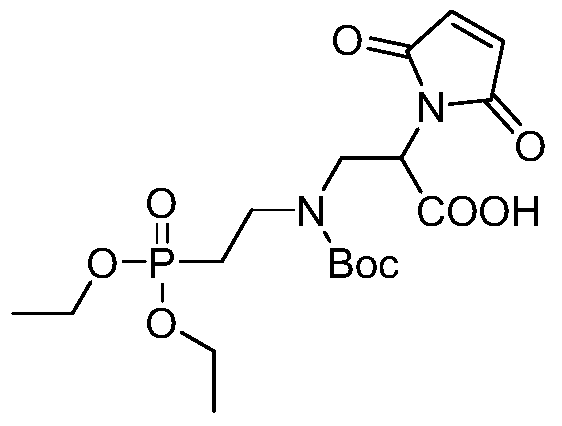
在100ml的圆底烧瓶中,用40ml甲苯和4ml的DMA将化合物33(3.3g,7.07mmol)搅拌溶解,再加入三乙胺(2.1g,21.2mmol),装上分水器和回流冷凝管120℃回流搅拌反应3小时,TLC检测反应完全(展开剂DCM:MeOH=4:1)。后处理:45℃减压浓缩除去甲苯, 残余物经高效液相制备纯化。(柱:YMC-C18,100mm*450mm,10μm,采用乙腈/水(0.2%TFA),流速200mL/min,于λ=214nm检测)In a 100 ml round bottom flask, compound 33 (3.3 g, 7.07 mmol) was stirred and dissolved with 40 ml of toluene and 4 ml of DMA, then triethylamine (2.1 g, 21.2 mmol) was added, and a water separator and reflux condenser were attached. The reaction was stirred at 120 ° C for 3 hours, and the reaction was completed by TLC (developing solvent DCM: MeOH = 4:1). Post-treatment: Toluene was concentrated under reduced pressure at 45 ° C, and the residue was purified by high-purity liquid. (Column: YMC-C18, 100mm*450mm, 10μm, using acetonitrile/water (0.2% TFA), flow rate 200mL/min, detected at λ=214nm)
溶剂A:0.2%TFA水Solvent A: 0.2% TFA water
溶剂B:乙腈Solvent B: acetonitrile
梯度:0min,5%B,0-10min,5%B~15%B,10-20min,15%B~30%B,20-35min,30%B~55%B,35-45min,55%B,45-55min,55%B~80%B,55-60min,80%B~98%B。收集具有27~29min保留时间的馏分并冻干,得2.12g的白色粉末状固体(很快吸潮变为粘稠油状物),产率为67%。LCMS[M+H] +m/z 449.3(calcd for C 18H 29N 2O 9P,448.16). Gradient: 0 min, 5% B, 0-10 min, 5% B ~ 15% B, 10-20 min, 15% B ~ 30% B, 20-35 min, 30% B ~ 55% B, 35-45 min, 55% B, 45-55 min, 55% B-80% B, 55-60 min, 80% B-98% B. A fraction having a retention time of 27 to 29 min was collected and lyophilized to obtain 2.12 g of a white powdery solid (very fast moisture absorption to a viscous oil) yielding 67%. LCMS [M+H] + m/z 449.3 (calcd for C 18 H 29 N 2 O 9 P, 448.16).
实施例35Example 35
化合物35的制备Preparation of Compound 35
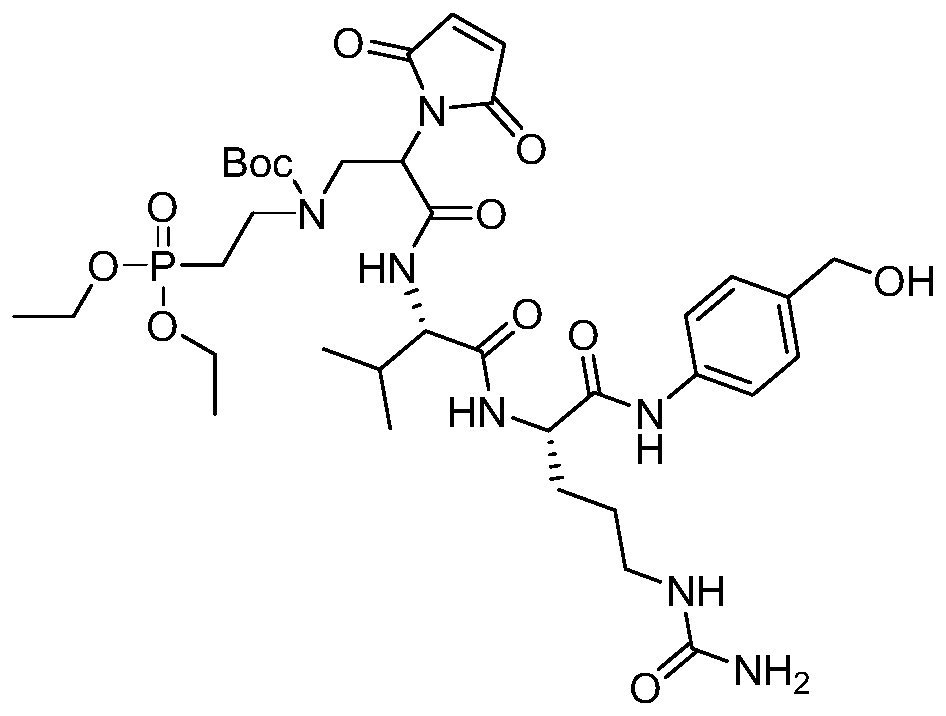
装有化合物34(2.1g,4.69mmol)的100ml圆底烧瓶用油泵抽干可能的残余水分,加入20ml干燥的DMF搅拌溶解,然后加入DIEA(1.8g,14.07mmol),再顺序加入EDCI(1.81g,9.38mmol)和HoAt(1.28g,9.38mmol),之后室温搅拌活化化合物5半小时,再加入化合物6(2.66g,7.03mmol),室温搅拌反应过夜,次日停止反应。后处理:45℃油泵减压浓缩除去DMF溶剂,残余物经柱层析纯化(洗脱剂二氯甲烷:甲醇=20:1~10:1~5:1),得1.01g白色粉末状固体,产率为26.6%。LCMS[M+H]
+m/z 810.4(calcd for C
36H
56N
7O
12P,809.37)。
A 100 ml round bottom flask containing compound 34 (2.1 g, 4.69 mmol) was drained with an oil pump to remove possible residual moisture, and dissolved by adding 20 ml of dry DMF, then DIEA (1.8 g, 14.07 mmol) was added, followed by EDCI (1.81). g, 9.38 mmol) and HoAt (1.28 g, 9.38 mmol), then the
实施例36Example 36
化合物36的制备Preparation of Compound 36

在50ml的圆底烧瓶中,用15ml干燥DMF将化合物35(1.0g,1.24mmol)搅拌溶解,再加入DIEA(961mg,7.44mmol)与NPC(1.88g,6.2mmol),加入完毕室温搅拌反应过夜,次日早TLC检测反应完全(展开剂二氯甲烷:甲醇=5:1),停止反应。后处理:45℃用油泵减压浓缩,残余物制备薄层层析(展开剂二氯甲烷:甲醇=6:1)制备纯化得1.02g的白色粉末状固体,产率为84.5%。LCMS[M+H] +m/z 975.3(calcd for C 43H 59N 8O 16P,974.38)。 In a 50 ml round bottom flask, compound 35 (1.0 g, 1.24 mmol) was stirred and dissolved with 15 ml of dry DMF, and then DIEA (961 mg, 7.44 mmol) and NPC (1.88 g, 6.2 mmol) were added. The next morning TLC detection reaction was complete (developing solvent dichloromethane: methanol = 5:1), and the reaction was stopped. Post-treatment: concentrating under reduced pressure with an oil pump at 45 ° C, and the residue was purified by chromatography (yield: methylene chloride:methanol = 6:1) to yield 1.02 g of white powdery solid. LCMS [M+H] + m/z 975.3 (calcd for C 43 H 59 N 8 O 16 P, 974.38).
实施例37Example 37
化合物37的制备Preparation of Compound 37

在100ml的圆底烧瓶中,用10ml干燥的DMF将化合物36(1.0g,1.03mmol)溶解,再加入HoBt(28mg,0.21mmol)和DIEA(266mg,2.06mmol),搅拌反应半小时后,再加入MMAE(740mg,1.03mmol),室温搅拌反应过夜。后处理:反应液经制备液相制备纯化。(柱:YMC-C18,50mm*450mm,10μm,采用乙腈/水(0.2%TFA),流速50mL/min,于λ=214nm检测)In a 100 ml round bottom flask, compound 36 (1.0 g, 1.03 mmol) was dissolved in 10 ml of dry DMF, then HoBt (28 mg, 0.21 mmol) and DIEA (266 mg, 2.06 mmol) were added and the reaction was stirred for half an hour. MMAE (740 mg, 1.03 mmol) was added and the reaction was stirred at room temperature overnight. Post-treatment: The reaction solution is purified by preparative liquid phase preparation. (Column: YMC-C18, 50mm*450mm, 10μm, using acetonitrile/water (0.2% TFA), flow rate 50mL/min, detected at λ=214nm)
溶剂A:0.2%TFA水Solvent A: 0.2% TFA water
溶剂B:乙腈Solvent B: acetonitrile
梯度:0min,5%B,0-10min,5%B~15%B,10-20min,15%B~30%B,20-35min,30%B~55%B, 35-45min,55%B~70%B,45-55min,70%B,55-60min,70%B~98%B。Gradient: 0 min, 5% B, 0-10 min, 5% B ~ 15% B, 10-20 min, 15% B ~ 30% B, 20-35 min, 30% B ~ 55% B, 35-45 min, 55% B ~ 70% B, 45-55 min, 70% B, 55-60 min, 70% B ~ 98% B.
收集具有38-40min保留时间的馏分并冻干,得320mg白色粉末状固体,产率为20%。LCMS[M+H] +m/z 1553.8(calcd for C 76H 121N1 2O 20P,1552.85)。 Fractions with a retention time of 38-40 min were collected and lyophilized to give 320 mg of a white powdery solid in 20% yield. LCMS [M + H] + m / z 1553.8 (calcd for C 76 H 121 N1 2 O 20 P, 1552.85).
实施例38Example 38
化合物38的制备Preparation of Compound 38

用5ml重蒸的二氯甲烷将化合物37(260mg,0.17mmol)溶解于25ml的圆底烧瓶中,氮气保护下于冰浴中加入三甲基溴硅烷(78mg,0.51mmol),加入完毕后移至室温搅拌反应过夜,次日早再加入1ml甲醇室温搅拌反应1小时,液相分析化合物37反应完全。后处理:减压浓缩反应液,残余物经高效液相制备纯化。(柱:YMC-C18,30mm*450mm,10μm,采用乙腈/水(0.2%TFA),流速25mL/min,于λ=214nm检测)Compound 37 (260 mg, 0.17 mmol) was dissolved in a 25 ml round bottom flask with 5 mL of EtOAc (EtOAc). The reaction was stirred overnight at room temperature, and the reaction was further stirred for 1 hour by adding 1 ml of methanol at room temperature the next day, and the liquid phase analysis of Compound 37 was completed. Post-treatment: The reaction solution was concentrated under reduced pressure, and the residue was purified by HPLC. (Column: YMC-C18, 30mm*450mm, 10μm, using acetonitrile/water (0.2% TFA), flow rate 25mL/min, detected at λ=214nm)
溶剂A:0.2%TFA水Solvent A: 0.2% TFA water
溶剂B:乙腈Solvent B: acetonitrile
梯度:0min,5%B,0-10min,5%B~15%B,10-20min,15%B~30%B,20-35min,30%B~55%B,35-45min,55%B~70%B,45-55min,70%B,55-60min,70%B~98%B。Gradient: 0 min, 5% B, 0-10 min, 5% B ~ 15% B, 10-20 min, 15% B ~ 30% B, 20-35 min, 30% B ~ 55% B, 35-45 min, 55% B ~ 70% B, 45-55 min, 70% B, 55-60 min, 70% B ~ 98% B.
收集具有20-23min保留时间的馏分并冻干,得140mg的白色粉末状固体,产率为55%。Fractions with a retention time of 20-23 min were collected and lyophilized to give 140 mg of a white powdery solid in a 55% yield.
实施例39Example 39
化合物39的制备Preparation of

在25ml的圆底烧瓶中,用2ml二氯甲烷将化合物38(120mg,0.08mmol)搅拌溶解,冰浴下滴入800微升三氟乙酸,加入完毕后,移至室温搅拌反应1小时,反应完全。后处理:减压浓缩反应液,残余物经高效液相制备纯化。(柱:YMC-C18,30mm*450mm,10μm,采用乙腈/水(0.2%TFA),流速25mL/min,于λ=214nm检测)In a 25 ml round bottom flask, compound 38 (120 mg, 0.08 mmol) was stirred and dissolved with 2 ml of dichloromethane, and 800 μl of trifluoroacetic acid was added dropwise thereto in an ice bath. After the addition was completed, the reaction was stirred at room temperature for 1 hour, and the reaction was carried out. complete. Post-treatment: The reaction solution was concentrated under reduced pressure, and the residue was purified by HPLC. (Column: YMC-C18, 30mm*450mm, 10μm, using acetonitrile/water (0.2% TFA), flow rate 25mL/min, detected at λ=214nm)
溶剂A:0.2%TFA水Solvent A: 0.2% TFA water
溶剂B:乙腈Solvent B: acetonitrile
梯度:0min,5%B,0-10min,5%B~15%B,10-20min,15%B~30%B,20-35min,30%B~55%B,35-45min,55%B~70%B,45-55min,70%B,55-60min,70%B~98%B。Gradient: 0 min, 5% B, 0-10 min, 5% B ~ 15% B, 10-20 min, 15% B ~ 30% B, 20-35 min, 30% B ~ 55% B, 35-45 min, 55% B ~ 70% B, 45-55 min, 70% B, 55-60 min, 70% B ~ 98% B.
收集具有18-19.5min保留时间的馏分并冻干,得55mg白色粉末状固体,产率为49%。LC-MS m/z(ES +):1397.8(M+H) + A fraction having a retention time of 18-19.5 min was collected and lyophilized to give 55 mg of a white powdery solid in a yield of 49%. LC-MS m/z (ES + ): 1397.8 (M+H) +
实施例40Example 40
化合物40的制备Preparation of
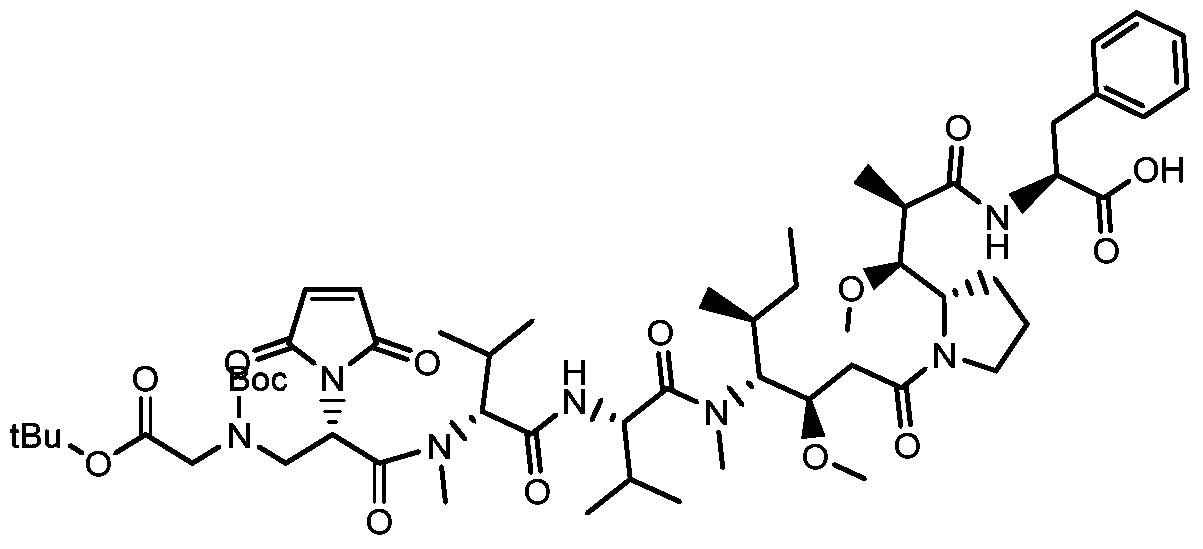
将化合物7(332mg,0.836mmol)溶于干燥二氯甲烷中,加入五氟苯酚(184mg,1mmol),二环己基碳二亚胺(2mmol),室温搅拌3h至化合物7消失。加入MMAF(460mg,0.585mmol)及二异丙基乙胺(DIEA,0.27mL,1.67mmol)溶于15mL干燥二氯甲烷溶液,于氮气保护下室温反应4h。减压浓缩,残余物用硅胶柱层谱(洗脱液为二氯甲烷/甲醇=50/1)分离得产品290mg。LC-MS m/z(ES +):1168.8(M+H) + Compound 7 (332 mg, 0.836 mmol) was dissolved in dry methylene chloride. <RTI ID=0.0>>>> MMAF (460 mg, 0.585 mmol) and diisopropylethylamine (DIEA, 0.27 mL, 1.67 mmol) were dissolved in 15 mL of dry dichloromethane. The organic layer was concentrated under reduced pressure. EtOAc m. LC-MS m/z (ES + ): 1168.8 (M+H) +
实施例41Example 41
化合物41的制备Preparation of

将100mg化合物39溶于10mL干燥二氯甲烷,加入4mL三氟醋酸,室温反应2h,用高效液相纯化。100 mg of
(柱:YMC-C18,30mm*450mm,10μm,采用乙腈/水(0.2%TFA),流速25mL/min,于λ=215nm检测)(Column: YMC-C18, 30mm*450mm, 10μm, using acetonitrile/water (0.2% TFA), flow rate 25mL/min, detected at λ=215nm)
溶剂A:0.2%TFA水Solvent A: 0.2% TFA water
溶剂B:乙腈Solvent B: acetonitrile
梯度:0-10min 95%A,10-25min,95%A~70%A,25-55min,70%A~40%AGradient: 0-10min 95% A, 10-25min, 95% A ~ 70% A, 25-55min, 70% A ~ 40% A
收集具有33min保留时间的馏分并冻干,得产品50mg。LC-MS m/z(ES +):956.6(M+H) + Fractions with a retention time of 33 min were collected and lyophilized to give a product of 50 mg. LC-MS m/z (ES + ): 956.6 (M+H) +
实施例42Example 42
化合物42的制备Preparation of Compound 42
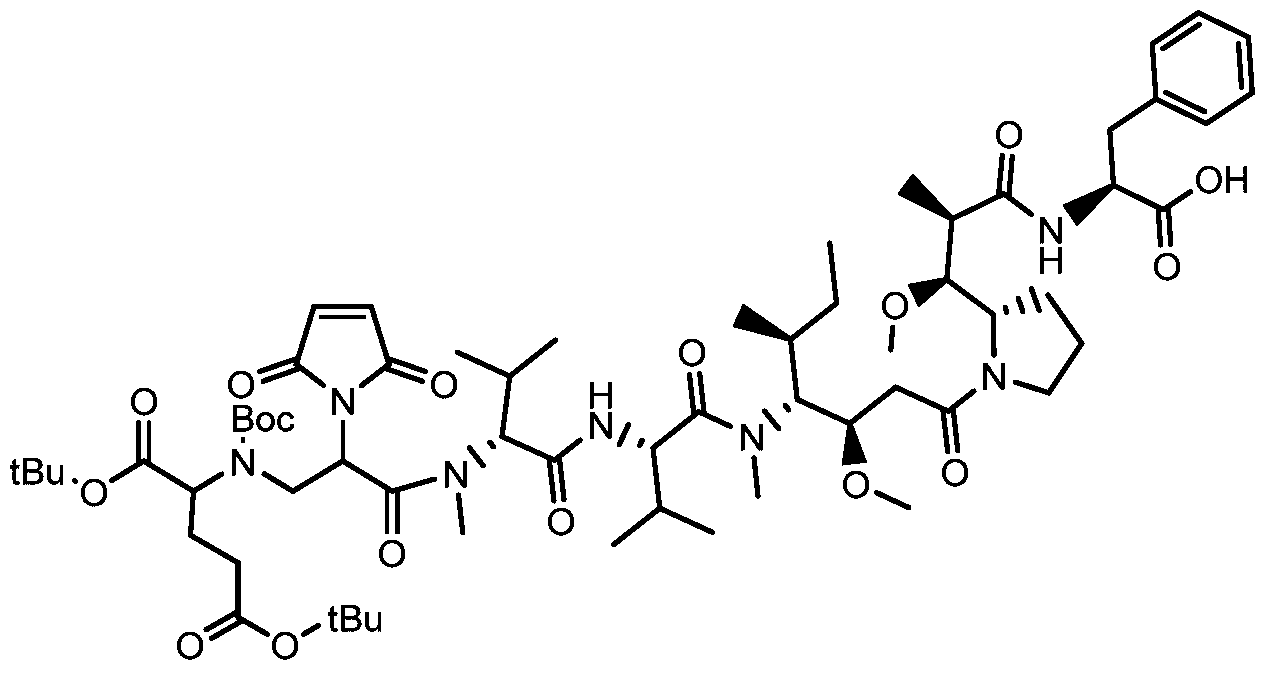
将化合物16(400mg,0.76mmol)溶于干燥二氯甲烷中,加入五氟苯酚(184mg,1mmol),二环己基碳二亚胺(2mmol),室温搅拌4h至化合物16消失。加入MMAF(389mg,0.49mmol)及二异丙基乙胺(DIEA,0.25mL,1.52mmol)溶于15mL干燥二氯甲烷中,氮气保护下室温反应4h。减压浓缩,残余物用硅胶柱层谱(洗脱液为二氯甲烷/甲醇=50/1)分离得产品330mg。LC-MS m/z(ES +):1296.8(M+H) + Compound 16 (400 mg, 0.76 mmol) was dissolved in dry methylene chloride. <RTI ID=0.0>>>> MMAF (389 mg, 0.49 mmol) and diisopropylethylamine (DIEA, 0.25 mL, 1.52 mmol) were dissolved in 15 mL of dry dichloromethane. The organic layer was concentrated under reduced pressure. LC-MS m/z (ES + ): 1296.8 (M+H) +
实施例43Example 43
化合物43的制备Preparation of Compound 43
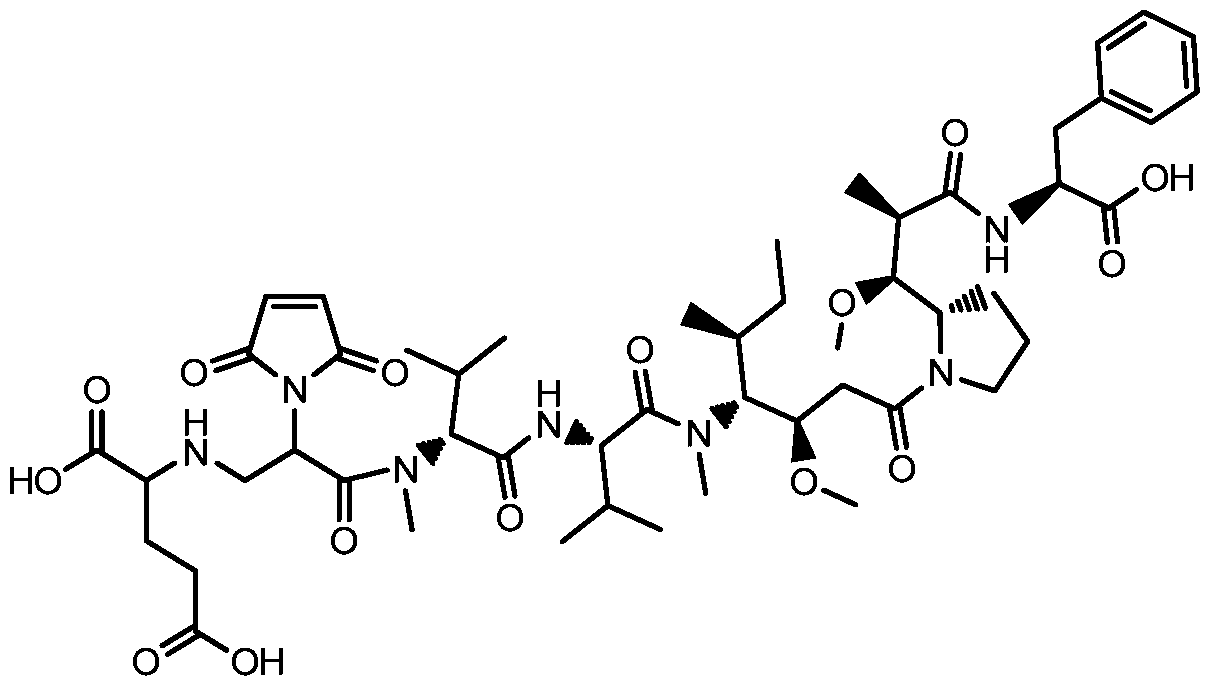
将100mg化合物41溶于10mL干燥二氯甲烷,加入4mL三氟醋酸,室温反应2h,用高效液相纯化。100 mg of
(柱:YMC-C18,30mm*450mm,10μm,采用乙腈/水(0.2%TFA),流速25mL/min,于λ=215nm检测)(Column: YMC-C18, 30mm*450mm, 10μm, using acetonitrile/water (0.2% TFA), flow rate 25mL/min, detected at λ=215nm)
溶剂A:0.2%TFA水Solvent A: 0.2% TFA water
溶剂B:乙腈Solvent B: acetonitrile
梯度:0-10min 95%A,10-25min,95%A~70%A,25-55min,70%A~40%AGradient: 0-10min 95% A, 10-25min, 95% A ~ 70% A, 25-55min, 70% A ~ 40% A
收集具有30min保留时间的馏分并冻干,得产品48mg。LC-MS m/z(ES +):1028.5(M+H) + Fractions with a retention time of 30 min were collected and lyophilized to give a product of 48 mg. LC-MS m/z (ES + ): 1028.5 (M+H) +
实施例44Example 44
抗体药物偶联物H-11的制备是按照通用方法B的方法制备得到,经反相高效液相色谱测定,其平均药物/抗体比(DAR)值为7.2The antibody drug conjugate H-11 was prepared according to the method of General Method B, and the average drug/antibody ratio (DAR) value was 7.2 as determined by reversed phase high performance liquid chromatography.
实施例45Example 45
抗体药物偶联物H-20的制备按照通用方法B的方法制备得到,经反相高效液相色谱测定,其平均药物/抗体比(DAR)值为7.2Preparation of antibody drug conjugate H-20 was prepared according to the method of General Method B, and the average drug/antibody ratio (DAR) value was 7.2 as determined by reversed phase high performance liquid chromatography.
实施例46Example 46
抗体药物偶联物H-29的制备按照通用方法B的方法制备得到,经反相高效液相色谱测定,其平均药物/抗体比(DAR)值为6.8The preparation of antibody drug conjugate H-29 was prepared according to the method of General Method B, and the average drug/antibody ratio (DAR) value was 6.8 as determined by reversed-phase high performance liquid chromatography.
实施例47Example 47
抗体药物偶联物H-39的制备按照通用方法B的方法制备得到,经反相高效液相色谱测定,其平均药物/抗体比(DAR)值为7.0Preparation of antibody drug conjugate H-39 was prepared according to the method of General Method B, and the average drug/antibody ratio (DAR) value was 7.0 as determined by reversed-phase high performance liquid chromatography.
实施例48Example 48
抗体药物偶联物H-41的制备按照通用方法B的方法制备得到,经反相高效液相色谱测定, 其平均药物/抗体比(DAR)值为7.5Preparation of antibody drug conjugate H-41 was prepared according to the method of General Method B, and the average drug/antibody ratio (DAR) value was 7.5 as determined by reversed-phase high performance liquid chromatography.
实施例49Example 49
抗体药物偶联物H-43的制备按照通用方法B的方法制备得到,经反相高效液相色谱测定,其平均药物/抗体比(DAR)值为7.7Preparation of the antibody drug conjugate H-43 was prepared according to the method of General Method B, and the average drug/antibody ratio (DAR) value was 7.7 as determined by reversed phase high performance liquid chromatography.
实施例50Example 50
继续合成得到如下所示药物-接头连接物:Continue synthesis to obtain the drug-linker linker shown below:


其中:Ac代表非碱性氨基酸或寡肽,且氨基酸中的氨基与烷基相连;Wherein: Ac represents a non-basic amino acid or an oligopeptide, and an amino group in the amino acid is linked to the alkyl group;
n=1,2,3…;n=1,2,3...;
下表1总结了含不同氨基酸及寡肽的药物接头合成及特征。在该表中,左侧第一列为化合物编号,第二列为氨基酸类别,第三列为n的取值,第四列为合成的通用方法,第五、六列为药物接头的计算质量和通过质谱确定的质量。Table 1 below summarizes the synthesis and characteristics of drug linkers containing different amino acids and oligopeptides. In the table, the first column on the left is the compound number, the second column is the amino acid category, the third column is the value of n, the fourth column is the general method of synthesis, and the fifth and sixth columns are the calculation quality of the drug linker. And the mass determined by mass spectrometry.
表1Table 1

缩写:abbreviation:
Gly是L-甘氨酸,Ala是L-丙氨酸,Phe是L-苯丙氨酸,Trp是L-酪氨酸,Asp是L-天冬氨酸,Ser是L-丝氨酸,Val是L-缬氨酸;Gly is L-glycine, Ala is L-alanine, Phe is L-phenylalanine, Trp is L-tyrosine, Asp is L-aspartic acid, Ser is L-serine, Val is L- Proline
吡唑:

实施例52-56Examples 52-56
为了评价采用酸性自稳定接头制备的ADC的稳定性、亲水性以及药理学活性,我们依实施例制备得到带酸性稳定接头的药物-接头连接物。这类连接物均具有酸性稳定接头,通过可裂解或不可裂解的连接子连接到细胞毒性药物MMAE或MMAF。作为比较,依照文献方法合成得到经典的非自稳定药物-接头连接物(本文称为MC-VC-PAB-MMAE)以及专利描述带碱性自稳定接头的药物-接头连接物(本文称为DPR-VC-PAB-MMAE)。To evaluate the stability, hydrophilicity, and pharmacological activity of ADCs prepared using acidic self-stabilizing linkers, we prepared a drug-linker linker with an acid stable linker as described in the Examples. Such linkers have an acidic stabilizing linker that is linked to the cytotoxic drug MMAE or MMAF by a cleavable or non-cleavable linker. For comparison, a classical non-self-stabilizing drug-linker linker (herein referred to as MC-VC-PAB-MMAE) and a patent describing a drug-linker linker with an alkaline self-stabilizing linker (herein referred to as DPR) were synthesized according to literature methods. -VC-PAB-MMAE).


实施例52体外血浆稳定性Example 52 in vitro plasma stability
按通用步骤D血浆稳定性研究,结果如下表所示,实验结果表明,带有酸性稳定接头的ADC在血浆孵育过程中几乎没有损失药物,而经典的MC接头ADC在孵育72h后DAR降低非常显著。实验结果证明,酸性稳定接头可显著提高ADC药物血浆稳定性。According to the general procedure D plasma stability study, the results are shown in the following table. The experimental results show that the ADC with acidic stable linker has almost no drug loss during plasma incubation, while the classical MC linker ADC has a significant decrease in DAR after 72 h incubation. . The experimental results show that the acidic stable linker can significantly improve the plasma stability of the ADC drug.
实施例53 SEC-HPLC检测Example 53 SEC-HPLC detection
将偶联所得的ADC样品于14000rpm离心5分钟,取上清液进样分析。The coupled ADC sample was centrifuged at 14000 rpm for 5 minutes, and the supernatant was subjected to injection analysis.
仪器:Waters e2695(2489UV/Vis)Instrument: Waters e2695 (2489UV/Vis)
色谱柱:TSKgel G3000SWXL(7.8×300mm,5μm)Column: TSKgel G3000SWXL (7.8×300mm, 5μm)
流动相:A:50mM PB,300mM NaCl,200mM Arg,5%IPA,pH6.5Mobile phase: A: 50 mM PB, 300 mM NaCl, 200 mM Arg, 5% IPA, pH 6.5
流动相A等度洗脱30min,流速:0.714ml/min,柱温25℃,检测波长:280nm。The mobile phase A was isocratically eluted for 30 min, the flow rate was 0.714 ml/min, the column temperature was 25 ° C, and the detection wavelength was 280 nm.
通过SEC-HPLC可得出各ADC的聚集程度SEC-HPLC峰图见图2A-2H,数据总结如下表所示,在引入酸性稳定接头的ADC中,单体率明显提高,聚集程度显著降低。The SEC-HPLC peaks of each ADC can be obtained by SEC-HPLC as shown in Fig. 2A-2H. The data are summarized in the following table. In the ADC with acidic stable linker, the monomer rate is significantly improved and the degree of aggregation is significantly reduced.
实施例54Example 54
小鼠体内PK实验PK experiment in mice
在小鼠模型中测定ADC药物(载药量8)的PK性质,小鼠尾单次静脉注射给药,给药剂量2mg/kg,按照通用步骤B检测血液中总抗体(Total Ab)浓度,结果如图三,实验结果表明,在小鼠体内,酸性稳定接头ADC表现出明显的PK改善,血液中总抗体能够更长时间维持在更高的浓度。The PK properties of the ADC drug (drug loading 8) were determined in a mouse model, and the tail of the mouse was administered intravenously at a dose of 2 mg/kg. The total antibody (Total Ab) concentration in the blood was measured according to the general procedure B. The results are shown in Figure 3. The experimental results show that in the mouse, the acidic stable linker ADC shows a significant improvement in PK, and the total antibody in the blood can be maintained at a higher concentration for a longer period of time.
实施例55Example 55
疏水性相互作用色谱(HIC)测定Hydrophobic Interaction Chromatography (HIC)
按照通用步骤A将抗体IgG1抗体全部还原到每抗体8硫醇后,采用非定点偶联制备相应的抗体-药物偶联物。以通过疏水作用色谱进一步分离纯化每抗体8个药物的带酸性稳定接头的ADC和传统接头ADC(即MC-VC-PAB-MMAE),并按照通用步骤C,用疏水性相互作用色谱HIC对ADC分析。具有更大疏水性,或更大数量的药物/分子的ADC在更晚的保留时间洗脱。实验结果如图四,具有酸性接头的ADC在HIC中具有相对较短的保留时间,MC-VC-PAB-MMAE的抗体偶联物具有最长的保留时间。实验结果证明,具有酸性稳定接头的ADC分子具有更好的亲水性。After all of the antibody IgG1 antibody was reduced to 8 thiol per antibody according to general procedure A, the corresponding antibody-drug conjugate was prepared by non-directed coupling. An acid-stabilized linker-based ADC and a conventional linker ADC (ie, MC-VC-PAB-MMAE) were further separated and purified by hydrophobic interaction chromatography with 8 drugs per antibody, and subjected to hydrophobic interaction chromatography HIC to ADC according to general procedure C. analysis. ADCs with greater hydrophobicity, or a greater number of drugs/molecules, elute at a later retention time. The experimental results are shown in Figure 4. The ADC with an acidic linker has a relatively short retention time in HIC, and the antibody conjugate of MC-VC-PAB-MMAE has the longest retention time. The experimental results show that the ADC molecules with acidic stable linkers have better hydrophilicity.
实施例56Example 56
体内药效实验(Cell Proliferation Assay)Cell Proliferation Assay
体外培养人胰腺腺癌细胞BxPc3,按细胞数量5×10
6接种于BALB/c裸鼠背部皮下,待肿瘤长到100~200mm
3后,分组,单次给予ADC药物3mg/kg(尾静脉注射),同时设溶媒对照组,定期称体重、测量肿瘤体积,通过考察ADC药物的抑瘤疗效等指标,来评价药物对于BxPc3模型的药效。实验结果如图五、六所示。结果表明,带有酸性稳定接头的ADC药物在DAR=2下与Dpr-MC-VC-PAB-MMAE具有相似药效,明显优于Mc-VC-PAB-MMAE。在高载药量DAR=8下,在BxPc3小鼠皮下移植瘤模型中具有很好的药效。
Human pancreatic adenocarcinoma cell line BxPc3 was cultured in vitro and inoculated subcutaneously into the back of BALB/c nude mice according to the number of
Claims (17)

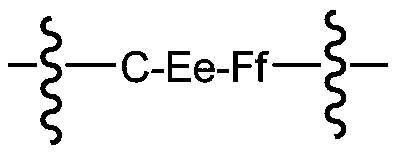

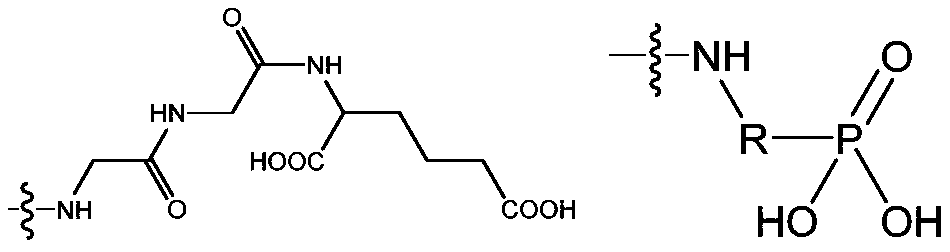

Priority Applications (8)
| Application Number | Priority Date | Filing Date | Title |
|---|---|---|---|
| DE112018007259.2T DE112018007259T5 (en) | 2017-06-19 | 2018-06-15 | Antibody-drug conjugate with an acid-forming self-stabilizing linkage |
| EP18820589.2A EP3769786A4 (en) | 2017-06-19 | 2018-06-15 | Antibody-drug conjugate having acidic self-stabilization junction |
| NZ766984A NZ766984B2 (en) | 2018-06-15 | Antibody-drug conjugate having acidic self-stabilization junction | |
| CA3095067A CA3095067C (en) | 2017-06-19 | 2018-06-15 | An antibody-drug conjugate having an acidic self-stabilization junction |
| US16/971,219 US20210100912A1 (en) | 2017-06-19 | 2018-06-15 | Antibody-drug conjugate having acidic self-stabilization junction |
| AU2018288029A AU2018288029B2 (en) | 2017-06-19 | 2018-06-15 | Antibody-drug conjugate having acidic self-stabilization junction |
| SG11202007919RA SG11202007919RA (en) | 2017-06-19 | 2018-06-15 | Antibody-drug conjugate having acidic self-stabilization junction |
| JP2020550685A JP7224365B2 (en) | 2017-06-19 | 2018-06-15 | Antibody drug conjugates with acidic self-stabilizing joints |
Applications Claiming Priority (2)
| Application Number | Priority Date | Filing Date | Title |
|---|---|---|---|
| CN201710462790.9 | 2017-06-19 | ||
| CN201710462790 | 2017-06-19 |
Publications (2)
| Publication Number | Publication Date |
|---|---|
| WO2018233571A1 true WO2018233571A1 (en) | 2018-12-27 |
| WO2018233571A9 WO2018233571A9 (en) | 2019-08-22 |
Family
ID=63214893
Family Applications (1)
| Application Number | Title | Priority Date | Filing Date |
|---|---|---|---|
| PCT/CN2018/091621 Ceased WO2018233571A1 (en) | 2017-06-19 | 2018-06-15 | Antibody-drug conjugate with acidic self-stabilizing linker |
Country Status (8)
| Country | Link |
|---|---|
| US (1) | US20210100912A1 (en) |
| EP (1) | EP3769786A4 (en) |
| JP (1) | JP7224365B2 (en) |
| CN (2) | CN108452321B (en) |
| AU (1) | AU2018288029B2 (en) |
| DE (1) | DE112018007259T5 (en) |
| SG (1) | SG11202007919RA (en) |
| WO (1) | WO2018233571A1 (en) |
Cited By (2)
| Publication number | Priority date | Publication date | Assignee | Title |
|---|---|---|---|---|
| CN113827736A (en) * | 2020-06-08 | 2021-12-24 | 四川百利药业有限责任公司 | A kind of camptothecin drug and its conjugate with high stability hydrophilic linking unit |
| WO2023208168A1 (en) | 2022-04-29 | 2023-11-02 | 成都百利多特生物药业有限责任公司 | Ligand-drug conjugate containing hydrophilic sugar structure |
Families Citing this family (17)
| Publication number | Priority date | Publication date | Assignee | Title |
|---|---|---|---|---|
| CN109106951A (en) * | 2017-08-18 | 2019-01-01 | 四川百利药业有限责任公司 | A kind of camptothecine-antibody coupling matter |
| CN111686259B (en) * | 2019-05-26 | 2023-08-08 | 成都百利多特生物药业有限责任公司 | SN 38-containing antibody drug conjugate |
| CN110974975B (en) * | 2019-12-12 | 2023-10-20 | 成都百利多特生物药业有限责任公司 | Quick-release antibody drug conjugate |
| CN111560078A (en) * | 2020-06-19 | 2020-08-21 | 联宁(苏州)生物制药有限公司 | Double-arm intermediate with maleimide joint and synthetic method thereof |
| US20230372526A1 (en) * | 2020-09-29 | 2023-11-23 | Mabwell (shanghai) Bioscience Co., Ltd. | Preparation method for bis-substituted bridging antibody-drug conjugate |
| EP4227309A4 (en) | 2020-10-12 | 2024-11-27 | Sichuan Baili Pharmaceutical Co. Ltd. | Deuterated camptothecin derivative and antibody-drug conjugate thereof |
| IL302054A (en) | 2020-10-12 | 2023-06-01 | Sichuan Baili Pharm Co Ltd | CAMPTOTHECIN DERIVATIVE AND ITS LIGAND-DRUG CONJUGATION |
| CN112957463A (en) * | 2021-02-22 | 2021-06-15 | 深圳市康居正医药科技有限公司 | Immune activation type antibody and application thereof |
| PE20250759A1 (en) | 2021-11-15 | 2025-03-13 | Systimmune Inc | Camptothecin Bispecific Antibody-Drug Conjugate and its Pharmaceutical Use |
| IL313262A (en) | 2021-12-03 | 2024-08-01 | Systimmune Inc | Antibody pair against human TROP2 and drug CAMPTOTHECIN and its medical use |
| AR128330A1 (en) * | 2022-01-26 | 2024-04-17 | Genentech Inc | CHEMICAL DEGRADATION INDUCERS CONJUGATED WITH ANTIBODY AND METHODS OF THESE |
| EP4420684A1 (en) | 2022-03-25 | 2024-08-28 | Systimmune, Inc. | Dna toxic dimer compound and conjugate thereof |
| JP2025518554A (en) | 2022-05-18 | 2025-06-17 | システィミューン,インコーポレイテッド | Ligand drug conjugates and uses thereof |
| CN117752813A (en) | 2022-09-26 | 2024-03-26 | 成都百利多特生物药业有限责任公司 | Anti-CD33 antibodies and anti-CD33 antibody-drug conjugates and their uses |
| AU2023349132A1 (en) | 2022-09-30 | 2025-04-24 | Systimmune, Inc. | Auristatin drug with high-stability hydrophilic linking unit and conjugate thereof |
| CN119504932A (en) * | 2023-08-23 | 2025-02-25 | 成都精西药业有限责任公司 | A method for preparing a linker-drug |
| WO2025088200A2 (en) * | 2023-10-27 | 2025-05-01 | Philochem Ag | Acid phosphatase 3 ligands for targeted delivery applications |
Citations (8)
| Publication number | Priority date | Publication date | Assignee | Title |
|---|---|---|---|---|
| WO2004010957A2 (en) * | 2002-07-31 | 2004-02-05 | Seattle Genetics, Inc. | Drug conjugates and their use for treating cancer, an autoimmune disease or an infectious disease |
| US20130309256A1 (en) | 2012-05-15 | 2013-11-21 | Seattle Genetics, Inc. | Self-stabilizing linker conjugates |
| CN103648532A (en) * | 2011-06-21 | 2014-03-19 | 伊缪诺金公司 | Novel maytansinoid derivatives with peptide linker and conjugates thereof |
| WO2015057699A2 (en) | 2013-10-15 | 2015-04-23 | Seattle Genetics, Inc. | Pegylated drug-linkers for improved ligand-drug conjugate pharmacokinetics |
| CN104758946A (en) * | 2015-04-07 | 2015-07-08 | 中国科学院过程工程研究所 | Antibody-coupled drug as well as preparation and application thereof |
| WO2016025752A1 (en) | 2014-08-14 | 2016-02-18 | Prolynx Llc | Reagents for thiol conjugation and conjugates formed therefrom |
| WO2016147031A2 (en) * | 2015-03-19 | 2016-09-22 | Hangzhou Dac Biotech Co., Ltd | Novel hydrophilic linkers and ligand-drug conjugates thereof |
| CN106029083A (en) * | 2014-02-17 | 2016-10-12 | 西雅图基因公司 | Hydrophilic antibody-drug conjugates |
Family Cites Families (6)
| Publication number | Priority date | Publication date | Assignee | Title |
|---|---|---|---|---|
| CN103127523A (en) * | 2005-06-20 | 2013-06-05 | Psma开发有限公司 | Psma antibody-drug conjugates |
| CL2008001334A1 (en) * | 2007-05-08 | 2008-09-22 | Genentech Inc | ANTI-MUC16 ANTIBODY DESIGNED WITH CISTEINE; CONJUGADO THAT UNDERSTANDS IT; METHOD OF PRODUCTION; PHARMACEUTICAL FORMULATION THAT UNDERSTANDS IT; AND ITS USE TO TREAT CANCER. |
| CN105451773A (en) | 2013-03-15 | 2016-03-30 | 诺华股份有限公司 | Cell proliferation inhibitors and conjugates thereof |
| SI3134127T1 (en) * | 2014-04-25 | 2020-06-30 | Rinat Neuroscience Corp. | Conjugate drugs with high-level antibodies |
| CN106267225B (en) * | 2015-05-29 | 2020-03-06 | 上海新理念生物医药科技有限公司 | Trimaleimide-type linker and use thereof |
| TWI618697B (en) * | 2015-11-03 | 2018-03-21 | 財團法人工業技術研究院 | Compounds, linker-drugs and ligand-drug conjugates |
-
2018
- 2018-06-15 US US16/971,219 patent/US20210100912A1/en active Pending
- 2018-06-15 DE DE112018007259.2T patent/DE112018007259T5/en not_active Withdrawn
- 2018-06-15 WO PCT/CN2018/091621 patent/WO2018233571A1/en not_active Ceased
- 2018-06-15 EP EP18820589.2A patent/EP3769786A4/en active Pending
- 2018-06-15 SG SG11202007919RA patent/SG11202007919RA/en unknown
- 2018-06-15 CN CN201810620856.7A patent/CN108452321B/en active Active
- 2018-06-15 JP JP2020550685A patent/JP7224365B2/en active Active
- 2018-06-15 AU AU2018288029A patent/AU2018288029B2/en active Active
- 2018-06-15 CN CN202111213342.8A patent/CN113952469A/en active Pending
Patent Citations (9)
| Publication number | Priority date | Publication date | Assignee | Title |
|---|---|---|---|---|
| WO2004010957A2 (en) * | 2002-07-31 | 2004-02-05 | Seattle Genetics, Inc. | Drug conjugates and their use for treating cancer, an autoimmune disease or an infectious disease |
| CN103648532A (en) * | 2011-06-21 | 2014-03-19 | 伊缪诺金公司 | Novel maytansinoid derivatives with peptide linker and conjugates thereof |
| US20130309256A1 (en) | 2012-05-15 | 2013-11-21 | Seattle Genetics, Inc. | Self-stabilizing linker conjugates |
| US9504756B2 (en) * | 2012-05-15 | 2016-11-29 | Seattle Genetics, Inc. | Self-stabilizing linker conjugates |
| WO2015057699A2 (en) | 2013-10-15 | 2015-04-23 | Seattle Genetics, Inc. | Pegylated drug-linkers for improved ligand-drug conjugate pharmacokinetics |
| CN106029083A (en) * | 2014-02-17 | 2016-10-12 | 西雅图基因公司 | Hydrophilic antibody-drug conjugates |
| WO2016025752A1 (en) | 2014-08-14 | 2016-02-18 | Prolynx Llc | Reagents for thiol conjugation and conjugates formed therefrom |
| WO2016147031A2 (en) * | 2015-03-19 | 2016-09-22 | Hangzhou Dac Biotech Co., Ltd | Novel hydrophilic linkers and ligand-drug conjugates thereof |
| CN104758946A (en) * | 2015-04-07 | 2015-07-08 | 中国科学院过程工程研究所 | Antibody-coupled drug as well as preparation and application thereof |
Non-Patent Citations (10)
| Title |
|---|
| ALLEY ET AL., BIOCONJUGATE CHEM., vol. 19, 2008, pages 759 - 765 |
| BALDWINKIICK, BIOCONJ. CHEM, vol. 22, 2011, pages 1946 - 1953 |
| DUCRY ET AL., BIOCONJUGATE CHEM., vol. 21, 2010, pages 5 - 13 |
| HAMBLETT ET AL., CLINICAL CANCER RES., vol. 10, 2004, pages 7063 - 70 |
| JUNUTULA ET AL., CLINICAL CANCER RES., vol. 16, 2010, pages 4769 |
| KABAT E.A. ET AL.: "Sequences of proteins of Immunological Interest", 1991, NIH |
| OLSSON ET AL., METHAN, ENZYMOL, vol. 92, 1982, pages 3 - 16 |
| SHEN ET AL.: "Conjugation site modulate the vivo stability and therapeutic activity of antibody-drug conjugates", NATURE BIOTECH, vol. 30, 2012, pages 184 - 189 |
| SZARDENINGS, J RECEPT SIGNAL TRANSDUCT RES., vol. 23, no. 4, 2003, pages 307 - 49 |
| TENG ET AL., PROC. NATL. ACAD. SCI. USA, vol. 80, 1983, pages 7308 - 7312 |
Cited By (3)
| Publication number | Priority date | Publication date | Assignee | Title |
|---|---|---|---|---|
| CN113827736A (en) * | 2020-06-08 | 2021-12-24 | 四川百利药业有限责任公司 | A kind of camptothecin drug and its conjugate with high stability hydrophilic linking unit |
| CN113827736B (en) * | 2020-06-08 | 2025-09-30 | 成都百利多特生物药业有限责任公司 | Camptothecin drug with highly stable hydrophilic linker unit and conjugate thereof |
| WO2023208168A1 (en) | 2022-04-29 | 2023-11-02 | 成都百利多特生物药业有限责任公司 | Ligand-drug conjugate containing hydrophilic sugar structure |
Also Published As
| Publication number | Publication date |
|---|---|
| NZ766984A (en) | 2023-08-25 |
| DE112018007259T5 (en) | 2020-12-24 |
| SG11202007919RA (en) | 2020-09-29 |
| CN108452321B (en) | 2021-11-26 |
| AU2018288029B2 (en) | 2021-12-23 |
| AU2018288029A1 (en) | 2021-01-21 |
| CN113952469A (en) | 2022-01-21 |
| JP2021519749A (en) | 2021-08-12 |
| CA3095067A1 (en) | 2018-12-27 |
| WO2018233571A9 (en) | 2019-08-22 |
| US20210100912A1 (en) | 2021-04-08 |
| EP3769786A1 (en) | 2021-01-27 |
| CN108452321A (en) | 2018-08-28 |
| JP7224365B2 (en) | 2023-02-17 |
| EP3769786A4 (en) | 2021-12-08 |
Similar Documents
| Publication | Publication Date | Title |
|---|---|---|
| WO2018233571A1 (en) | Antibody-drug conjugate with acidic self-stabilizing linker | |
| CN108853514B (en) | Antibody drug conjugates with two different drugs | |
| TWI680765B (en) | Self-stabilizing linker conjugates | |
| WO2019034176A1 (en) | Camptothecin-antibody conjugate | |
| JP3645283B2 (en) | Lysosomal enzyme-cleavable antitumor agent conjugate | |
| CN113874046B (en) | Glycoside-containing peptide linkers for antibody-drug conjugates | |
| JP2024503074A (en) | Camptothecin antibody-drug conjugate and method of use thereof | |
| CN107043406B (en) | Compounds, Linker-Drugs, and Ligand-Drug Conjugates | |
| WO2018086239A9 (en) | Antibody of targeting tacstd2 and antibody drug conjugate (adc) molecule | |
| WO2024012566A2 (en) | Antibody, linkers, payload, conjugates and applications thereof | |
| WO2018064964A1 (en) | Cysteine modified antibody-drug conjugate and preparation method thereof | |
| WO2023061405A1 (en) | Highly-stable targeted linker-drug conjugate | |
| CN116847885A (en) | Double-cleaved ester linkers for antibody-drug conjugates | |
| WO2024207177A9 (en) | Antibody, linkers, payload, conjugates and applications thereof | |
| RU2793125C2 (en) | Antibody-drug conjugate having an acid self-stabilizing binding site | |
| EP4153242B1 (en) | Para-amino-benzyl linkers, process for their preparation and their use in conjugates | |
| WO2023208168A1 (en) | Ligand-drug conjugate containing hydrophilic sugar structure | |
| WO2023179723A1 (en) | Cleavable fragment directed by affinity fragment, design and synthesis thereof, and use thereof in preparation of site-directed drug conjugate | |
| CA3095067C (en) | An antibody-drug conjugate having an acidic self-stabilization junction | |
| HK40035178A (en) | Antibody-drug conjugate having acidic self-stabilization junction | |
| WO2025113659A1 (en) | Trisaccharide linker, linker-payload comprising trisaccharide linker, and glycan chain-remodeled antibody-drug conjugate, and preparation methods therefor and uses thereof | |
| CN116783208A (en) | Glycoside double cleavage linker for antibody-drug conjugates | |
| CN118339165A (en) | Antibody-drug conjugates and methods of use thereof | |
| HK40076663B (en) | Selective drug release from internalized conjugates of biologically active compounds |
Legal Events
| Date | Code | Title | Description |
|---|---|---|---|
| 121 | Ep: the epo has been informed by wipo that ep was designated in this application |
Ref document number: 18820589 Country of ref document: EP Kind code of ref document: A1 |
|
| NENP | Non-entry into the national phase |
Ref country code: DE |
|
| REG | Reference to national code |
Ref country code: DE Ref legal event code: R409 |
|
| 122 | Ep: pct application non-entry in european phase |
Ref document number: 18820589 Country of ref document: EP Kind code of ref document: A1 |
|
| ENP | Entry into the national phase |
Ref document number: 2020550685 Country of ref document: JP Kind code of ref document: A |
|
| ENP | Entry into the national phase |
Ref document number: 3095067 Country of ref document: CA |
|
| ENP | Entry into the national phase |
Ref document number: 2018820589 Country of ref document: EP Effective date: 20200120 |
|
| ENP | Entry into the national phase |
Ref document number: 2018288029 Country of ref document: AU Date of ref document: 20180615 Kind code of ref document: A |