WO2018079503A1 - Method for purifying p1,p4-di(uridine 5'-)tetraphosphate - Google Patents
Method for purifying p1,p4-di(uridine 5'-)tetraphosphate Download PDFInfo
- Publication number
- WO2018079503A1 WO2018079503A1 PCT/JP2017/038237 JP2017038237W WO2018079503A1 WO 2018079503 A1 WO2018079503 A1 WO 2018079503A1 JP 2017038237 W JP2017038237 W JP 2017038237W WO 2018079503 A1 WO2018079503 A1 WO 2018079503A1
- Authority
- WO
- WIPO (PCT)
- Prior art keywords
- solution
- iron
- uridine
- tetraphosphate
- chelate resin
- Prior art date
- Legal status (The legal status is an assumption and is not a legal conclusion. Google has not performed a legal analysis and makes no representation as to the accuracy of the status listed.)
- Ceased
Links
Images


Classifications
-
- C—CHEMISTRY; METALLURGY
- C07—ORGANIC CHEMISTRY
- C07H—SUGARS; DERIVATIVES THEREOF; NUCLEOSIDES; NUCLEOTIDES; NUCLEIC ACIDS
- C07H19/00—Compounds containing a hetero ring sharing one ring hetero atom with a saccharide radical; Nucleosides; Mononucleotides; Anhydro-derivatives thereof
- C07H19/02—Compounds containing a hetero ring sharing one ring hetero atom with a saccharide radical; Nucleosides; Mononucleotides; Anhydro-derivatives thereof sharing nitrogen
- C07H19/04—Heterocyclic radicals containing only nitrogen atoms as ring hetero atom
- C07H19/06—Pyrimidine radicals
- C07H19/10—Pyrimidine radicals with the saccharide radical esterified by phosphoric or polyphosphoric acids
-
- A—HUMAN NECESSITIES
- A61—MEDICAL OR VETERINARY SCIENCE; HYGIENE
- A61K—PREPARATIONS FOR MEDICAL, DENTAL OR TOILETRY PURPOSES
- A61K31/00—Medicinal preparations containing organic active ingredients
- A61K31/70—Carbohydrates; Sugars; Derivatives thereof
- A61K31/7088—Compounds having three or more nucleosides or nucleotides
- A61K31/7105—Natural ribonucleic acids, i.e. containing only riboses attached to adenine, guanine, cytosine or uracil and having 3'-5' phosphodiester links
-
- A—HUMAN NECESSITIES
- A61—MEDICAL OR VETERINARY SCIENCE; HYGIENE
- A61P—SPECIFIC THERAPEUTIC ACTIVITY OF CHEMICAL COMPOUNDS OR MEDICINAL PREPARATIONS
- A61P27/00—Drugs for disorders of the senses
- A61P27/02—Ophthalmic agents
-
- C—CHEMISTRY; METALLURGY
- C07—ORGANIC CHEMISTRY
- C07H—SUGARS; DERIVATIVES THEREOF; NUCLEOSIDES; NUCLEOTIDES; NUCLEIC ACIDS
- C07H1/00—Processes for the preparation of sugar derivatives
- C07H1/06—Separation; Purification
Definitions
- the present invention relates to a method for removing iron ions from an aqueous solution or hydrophilic solvent solution containing P 1 , P 4 -di (uridine 5 ′-) tetraphosphate and iron ions and reducing the iron ion concentration.
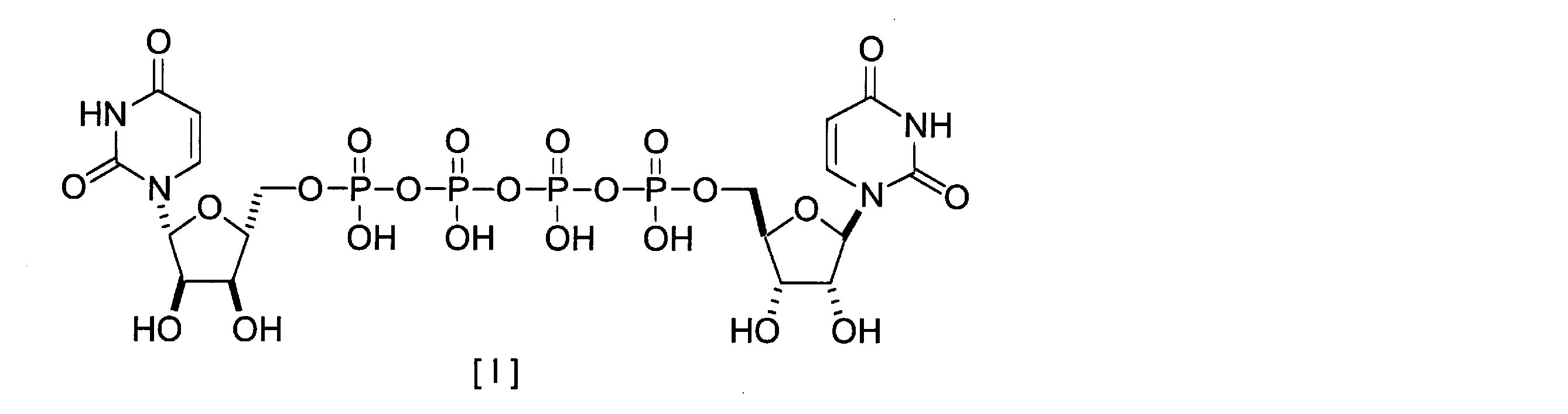
- P 1 , P 4 -di (uridine 5 ′-) tetraphosphate (hereinafter referred to as “UP 4 U”) or a salt thereof represented by the following formula [I] is a treatment for keratoconjunctival epithelial disorder associated with dry eye. It is used as a medicine. In addition, it is a compound that has an action of inducing excretion and is expected to be developed as an expectorant or a pneumonia therapeutic agent.
- Non-patent Document 1 A method of reacting uridine 5′-cyclic triphosphate prepared by dehydration condensation reaction of uridine 5′-triphosphate (UTP) with uridine 5′-monophosphate (UMP) (Non-patent Document 1), And its improved method (Patent Document 1).
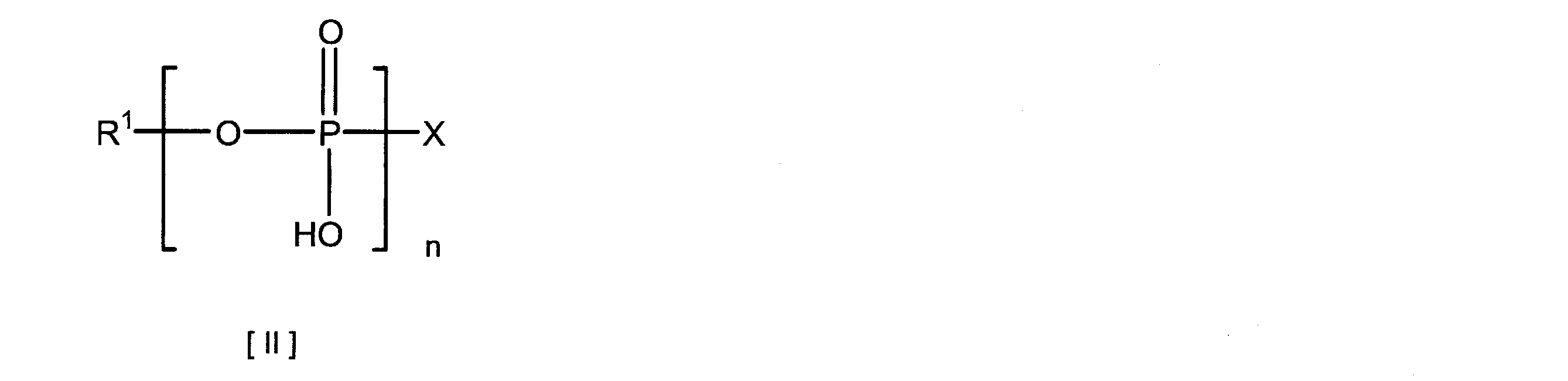
- Patent Document 2 A method of synthesizing pyrophosphoric diimidazolide by activating pyrophosphoric acid with imidazole and condensing it with UMP in an anhydrous environment using an organic solvent such as dimethylformamide (DMF) (Patent Document 2, Non-Patent Document 2) ).
- DMF dimethylformamide
- R 1 represents a uridyl group bonded at the 5 ′ position
- X represents a heterocyclic group
- n represents an integer of 1 or 2.
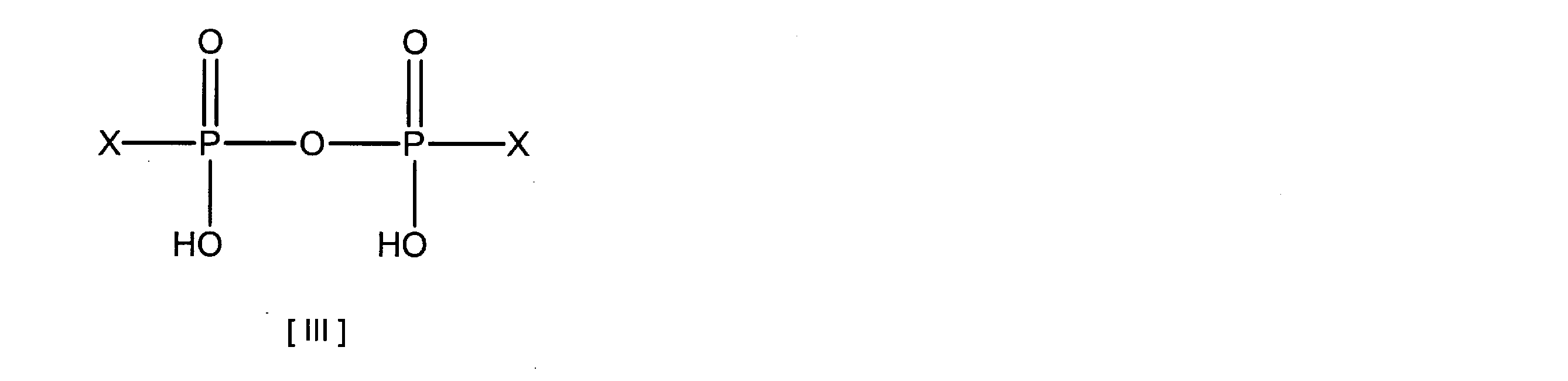
- X represents one heterocyclic group selected from the group consisting of an imidazolyl group, a benzimidazolyl group, and a 1,2,4-triazolyl group.
- UP 4 U when the method (3) is used, UP 4 U can be synthesized in good yield while avoiding UTP-free use and dehydration of UTP salt, which are not suitable for industrial mass production. Further, this method is very suitable for industrial large-scale synthesis of UP 4 U because it hardly generates a by-product and can omit a complicated dehydration step by carrying out the reaction under hydrophilic conditions.
- UP 4 U is a compound used as a raw material for pharmaceuticals, and requires extremely high impurity control. Therefore, it is essential to keep the metal ion concentration at a sufficiently low value.
- the (3) in the manufacturing method since the addition of iron (II) ions or iron (III) metal ions such as ions as a catalyst in the reaction solution, the UP 4 U solution after completion of the reaction metal Contains ions. In such a case, it is necessary to remove metal ions in the purification process.
- UP 4 U As a purification method of UP 4 U, conventionally, crude UP 4 U or a salt thereof is purified using anion exchange chromatography and activated carbon chromatography, and the purified UP 4 U or a salt solution thereof is optionally adjusted to pH 6 to A method for producing a crystal of UP 4 U or a salt thereof is known in which a crystal is precipitated by adding a hydrophilic organic solvent under a temperature condition of 60 ° C. or less after adjustment to 9 (Patent Document 4). However, the removal efficiency of metals from the UP 4 U solution containing iron ions has not been studied.
- a precipitate derived from iron ions is formed using phosphoric acid or caustic soda, and the iron ions are adsorbed using a chelate resin or a synthetic adsorption resin.
- the method of removing is used as a conventional method.
- the present inventor has found that when trying to reduce the iron ion concentration of the UP 4 U reaction solution containing iron ions, the conventional method as described above has a sufficient iron ion concentration. It has been found that there are cases where it cannot be reduced.
- an object of the present invention is to provide an easy and practical method for removing iron ions as a purification method of UP 4 U.
- the present inventors have conducted a column purification step using a chelate resin to remove iron ions from an aqueous solution or hydrophilic solvent solution containing UP 4 U and iron ions, By combining a crystallization process at a pH of 5.5 or lower, which is different from the conventionally known crystallization conditions, or a treatment process using zinc chloride activated activated carbon, iron ions in the UP 4 U reaction solution are sufficiently removed.
- the present inventors have found that the residual concentration of iron ions can be reduced to a very low concentration of 10 ppm or less.
- the present invention provides the following [1] and [2].
- [1] Iron ions are removed from an aqueous solution or hydrophilic solvent solution containing P 1 , P 4 -di (uridine 5 ′-) tetraphosphate and iron ions, and P 1 , P 4 -di (uridine 5′- )
- a method for purifying tetraphosphate comprising: (1) Column purification step using a chelate resin, and (2) After adjusting the solution pH after purification of the chelate resin column to 5.5 or less, P 1 , P 4 -di (uridine 5 ′-) tetraphosphate was added.
- a method for purifying P 1 , P 4 -di (uridine 5 ′-) tetraphosphate comprising a step of crystallizing or a step of treating a solution after purification of a chelate resin column with activated carbon activated with zinc chloride.
- UP 4 U having the same quality as UP 4 U produced by a method not using a catalyst can be produced even in a method using iron ions as a catalyst.
- FIG. 1 shows the concentration of iron ions to UP 4 U in the solution after completion of the treatment when the chelate resin column treatment is performed again using various resins after the chelate resin column treatment.
- FIG. 2 shows the concentration of UP 4 U iron ions in the solution after completion of the treatment when the activated carbon treatment is performed after the chelate resin column treatment.
- the method of the present invention relates to a method for removing iron ions from an aqueous solution or a hydrophilic solvent solution containing UP 4 U and iron ions to reduce the iron ion concentration.
- UP 4 U and iron ions with an aqueous solution containing or hydrophilic solvent solution is not limited as long as containing UP 4 U and iron ions.
- a phosphate active compound represented by the following formula [II] or [III] and (2) a phosphate compound selected from the group consisting of UMP, UDP, UTP and pyrophosphate, or a salt thereof (UTP-free)
- a metal ion selected from the group consisting of iron (II) ion and iron (III) ion in water or a hydrophilic organic solvent examples thereof include a synthesis reaction solution obtained by (Patent Document 3).
- R 1 represents a uridyl group bonded at the 5 ′ position
- X represents a heterocyclic group
- n represents an integer of 1 or 2.
- X represents one heterocyclic group selected from the group consisting of an imidazolyl group, a benzimidazolyl group, and a 1,2,4-triazolyl group.
- the “iron ion” of the present invention means a metal ion in water or a hydrophilic organic solvent by adding iron to the solution in the form of a salt.
- a halide, an inorganic acid salt, an organic acid salt and the like can be presented. Further specific examples include (i) ferrous chloride, ferric chloride, ferric bromide and the like as examples of halides, and (ii) sulfuric acid, nitric acid, perchloric acid and the like as examples of inorganic acid salts.
- inorganic acid salts include (iii) organic acid salts such as trifluoromethanesulfonate, acetate, trifluoroacetate, and citrate.
- the salt may be a ferrous salt or a ferric salt, but a ferric salt is preferable, and ferric chloride is particularly preferable.
- the salt used may be an anhydride or a hydrate.
- the solvent is water or a hydrophilic organic solvent.
- the hydrophilic organic solvent include alcohols having 6 or less carbon atoms such as methanol and ethanol, ketones such as acetone, ethers such as dioxane, nitriles such as acetonitrile, amides such as dimethylformamide, and the like. it can.
- the iron ion concentration in the UP 4 U solution is preferably 10 ppm or more with respect to UP 4 U, more preferably 60 ppm or more, and further preferably 60 ppm or more and 10% or less.
- the UP 4 UP 4 U concentration in U solution is preferably 0.01 to 10%, more preferably from 0.1 to 5%, more preferably 1-3%.
- the method of the present invention is a method for removing iron ions from a UP 4 U solution, (1) a column purification step using a chelate resin, and (2) a step of crystallization at pH 5.5 or lower, or zinc chloride activation And a method for purifying UP 4 U.
- column purification may be performed according to a conventional method.
- a kind of chelate resin to be used any one of aminophosphate type, iminodiacetic acid type, polyamine type, bispicolylamine type, isothiouronium type and the like may be used. Of these, aminophosphoric acid type and iminodiacetic acid type are preferable.
- chelate resins include IRC747 (amino phosphate group Na type, manufactured by Organo Corporation), IRC748 (iminodiacetic acid group Na type, manufactured by Organo Corporation), CR-11 (iminodiacetic acid group Na type, Mitsubishi Chemical Corporation).
- step (1) specifically, an UP 4 U aqueous solution or a hydrophilic organic solvent solution containing iron ions is passed through a column filled with a chelate resin, and the passed solution may be collected. Column purification process using a chelating resin, the iron ion concentration on UP 4 U of UP 4 U solution becomes 60ppm or less.
- an acid such as hydrochloric acid, phosphoric acid, sulfuric acid, nitric acid, acetic acid, etc. is added to the treated solution to bring the crystallization mother liquor to pH 5.5 or lower. Adjust and crystallize.
- the pH may be 5.5 or less, but more preferably 2.5 or more and 5.5 or less.
- a hydrophilic organic solvent is added to the UP 4 U solution until it becomes cloudy and stirred, and then allowed to stand, and the precipitated crystals may be removed by filtration or the like.
- hydrophilic organic solvent examples include alcohols having 6 or less carbon atoms such as methanol and ethanol, ketones such as acetone, ethers such as dioxane, nitriles such as acetonitrile, amides such as dimethylformamide, and the like. And in particular alcohols, preferably ethanol. At this time, in order to improve the crystallization efficiency, a seed crystal may be added simultaneously with the hydrophilic organic solvent.
- activated carbon treatment may be performed according to a conventional method. That is, (1) a treatment method such as adding zinc chloride activated activated carbon to the treated solution and stirring for 30 minutes to 20 hours, and then removing the activated carbon by filtration or the like may be performed.
- the type of activated carbon used in the method of the present invention is characterized in that among those activated by steam and those activated by chemicals, those activated by zinc chloride are used.
- the raw material for the activated carbon can be selected from wood, coconut shells, coal, and the like.
- the shape may be selected from powder, crushed shape, granular shape, columnar shape, fiber shape, sheet shape and the like.
- Examples of commercially available zinc chloride activated activated carbon include special white birch M600 (manufactured by Osaka Gas Chemical Co., Ltd.).
- the above (1) column purification step using a chelate resin and (2) a crystallization step or a zinc chloride-activated activated carbon treatment step under a pH of 5.5 or less are performed as (1), (2) Repeat at least once in this order.
- the method of the present invention further includes a step of performing column purification using an ion exchange column or the like, a step of performing another activated carbon treatment, a step of performing recrystallization, and the like. You can leave. These steps can be performed before and after steps (1) and (2) and in the middle.
- the iron concentration in the UP 4 U-containing solution can be reduced to a very low concentration, for example, adjusted to a very low value of 10 ppm or less with respect to the UP 4 U iron content after treatment. It is possible.
- UP 4 U can be obtained with high purity by performing crystallization treatment as necessary after completion of purification by the zinc chloride activated activated carbon treatment step as step (2). it can.
- a crystallization method for example, known knowledge (Patent Document 4) can be used.
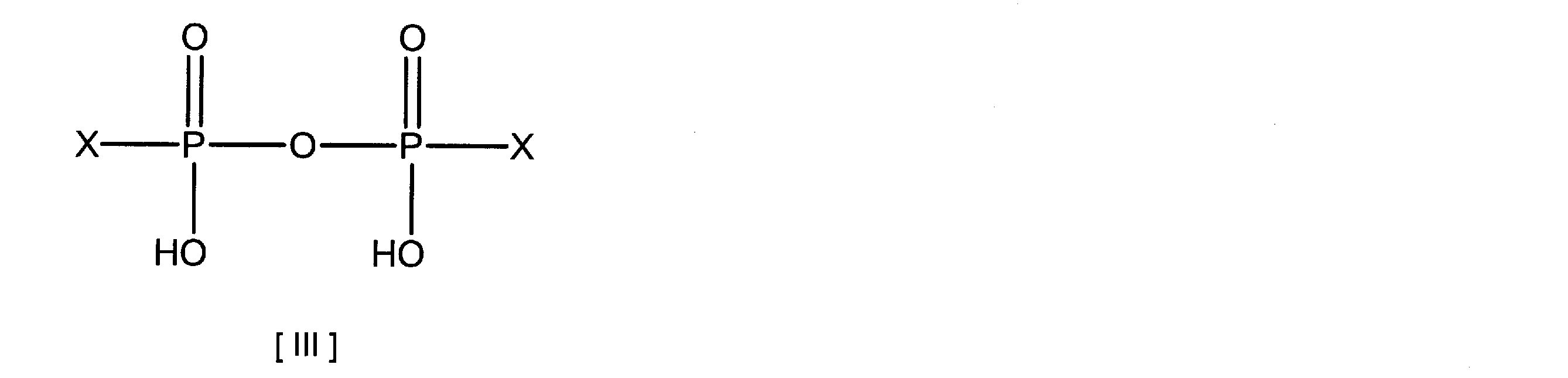
- UP 4 U was synthesized according to a known method (Patent Document 3). Pyrophosphate diimidazolide was used as the phosphate active compound, UMP was used as the phosphate compound, water was used as the solvent, and ferric chloride was used as the catalyst. (Formula [III], X is an imidazolyl group.)
- the solution after the condensation reaction was subjected to a chelate resin (IRC748, manufactured by Organo Corporation) column treatment.
- the iron ion concentration after the chelate resin treatment was 40 ppm. Thereafter, even when crystallization was performed according to a known method, the iron ion concentration did not become 40 ppm or less.
- the iron ion concentration was quantified with reference to the 1,10-phenanthroline spectrophotometric method of JIS K 0400-57-10.
- the specific quantification method is as follows. (1) Put a sample and an iron standard solution (Fe100) for preparing a calibration curve into a 10 mL volumetric flask. Also prepare a 10 mL volumetric flask with nothing added for the blank. (2) Add 400 ⁇ L of 6.0 M HCl solution and 200 ⁇ L of 10% hydroxylamine hydrochloride solution to all volumetric flasks and mix well. Then, let stand for 30 minutes or more.
- Example 1 Examination of combination of chelate resin column treatment and crystallization process As a method of adding deironing treatment again after chelate resin column treatment, crystallization is performed on the chelate treatment solution and only crystals are separated. Then, we examined reducing the iron concentration.
- the examination was performed by preparing a simulated treatment liquid containing 38 ppm of iron with respect to UP 4 U. Specifically, first, 480 g of UP 4 U was dissolved in deionized water and adjusted to 2 L. Then, an iron (III) chloride solution was added to the solution to make the content of UP 4 U iron 38 ppm. Hydrochloric acid was added to the solution to adjust the pH to 4.5, 5.0, 5, 5, 6.0, 6.5, 7.0, and this was used as a simulated treatment solution.
- the iron concentration after crystallization of the pre-crystallization solution at pH 7.0 was 38 ppm, and iron was not removed.
- the iron concentration after crystallization when crystallized at pH 5.5 or less is 10 ppm or less, and the iron concentration is lowered to a very low concentration by performing crystallization under a low pH condition of pH 5.5 or less. I was able to.
- Example 2 Examination of combination of chelate resin column treatment and separate treatment
- iron adsorbent variant chelating column resins or various chelating column resins or Various activated carbons
- the examination was performed by creating a simulated treatment liquid containing iron ions. Specifically, first, 480 g of UP 4 U was dissolved in deionized water and adjusted to 2 L. Then, an iron (III) chloride solution was added to the solution to make a UP 4 U iron content of 60 ppm as a simulated treatment solution.
- the simulated treatment liquid adjusted to pH 2.0 was weighed out into 14 test tubes each 4.0 mL. 60 mg each of chelate resin or powdered activated carbon was weighed into the simulated treatment liquid in the test tube, added to the test tube containing the simulated treatment liquid, and stirred. After 20 hours from the start of stirring, 1 mL or more of the treatment solution was collected and filtered through a 0.2 ⁇ m membrane filter to remove the resin and activated carbon. The iron content was measured using 1 mL of the filtrate.
- the types of chelate column resins used in the test are as follows: IRC747 (aminophosphate group Na type, manufactured by Organo Corporation), IRC748 (iminodiacetic acid group Na type, manufactured by Organo Corporation), CR- 11 (iminodiacetic acid group Na type, manufactured by Mitsubishi Chemical Corporation), CR-20 (polyamine group free type, manufactured by Mitsubishi Chemical Corporation), OT-71 (iminodiacetic acid group Na type, manufactured by Muromachi Chemical Co., Ltd.), XMS-5612 (Aminophosphate group Na type, manufactured by Muromachi Chemical Co., Ltd.), XMS-5418 (Bispicolylamine group SO4 type, manufactured by Muromachi Chemical Co.), XMS-5413 (isothiouronium group Cl type, manufactured by Muromachi Chemical Co.).
- the types of activated carbon are as follows: white birch P (coconut husk / steam activated, Osaka Gas Chemical Co.), special white birch (wood / zinc chloride activated, Osaka Gas Chemical Co.), white birch A (wood / Water vapor activation, Osaka Gas Chemical Co., Ltd.), FP-3 (raw material unknown / water vapor activation, Osaka Gas Chemical Co., Ltd.), Dazai K type A (wood / activation method unknown, Phutamura Chemical Co., Ltd.).
Landscapes
- Chemical & Material Sciences (AREA)
- Health & Medical Sciences (AREA)
- Life Sciences & Earth Sciences (AREA)
- Organic Chemistry (AREA)
- General Health & Medical Sciences (AREA)
- Biochemistry (AREA)
- Molecular Biology (AREA)
- Engineering & Computer Science (AREA)
- Public Health (AREA)
- Medicinal Chemistry (AREA)
- Genetics & Genomics (AREA)
- Veterinary Medicine (AREA)
- Animal Behavior & Ethology (AREA)
- Pharmacology & Pharmacy (AREA)
- Biotechnology (AREA)
- Ophthalmology & Optometry (AREA)
- General Chemical & Material Sciences (AREA)
- Nuclear Medicine, Radiotherapy & Molecular Imaging (AREA)
- Chemical Kinetics & Catalysis (AREA)
- Bioinformatics & Cheminformatics (AREA)
- Epidemiology (AREA)
- Saccharide Compounds (AREA)
- Pharmaceuticals Containing Other Organic And Inorganic Compounds (AREA)
Abstract
Description
本発明は、P1,P4-ジ(ウリジン5’-)テトラホスフェートおよび鉄イオンを含有する水溶液または親水性溶媒溶液から、鉄イオンを除去し、当該鉄イオン濃度を低減させる方法に関する。 The present invention relates to a method for removing iron ions from an aqueous solution or hydrophilic solvent solution containing P 1 , P 4 -di (uridine 5 ′-) tetraphosphate and iron ions and reducing the iron ion concentration.
下記式[I]で表されるP1,P4-ジ(ウリジン5’-)テトラホスフェート(以下「UP4U」と表記する)またはその塩は、ドライアイに伴う角結膜上皮障害の治療薬として用いられている。また、痰排出誘導作用を有し、去痰剤または肺炎治療薬としての開発が期待されている化合物である。 P 1 , P 4 -di (uridine 5 ′-) tetraphosphate (hereinafter referred to as “UP 4 U”) or a salt thereof represented by the following formula [I] is a treatment for keratoconjunctival epithelial disorder associated with dry eye. It is used as a medicine. In addition, it is a compound that has an action of inducing excretion and is expected to be developed as an expectorant or a pneumonia therapeutic agent.
従来UP4Uの合成法として、下記の方法が知られている。
(1)ウリジン5’-トリリン酸(UTP)の脱水縮合反応により調製されるウリジン5’-環状トリリン酸と、ウリジン5’-モノリン酸(UMP)とを反応させる方法(非特許文献1)、およびその改良法(特許文献1)。
(2)ピロリン酸をイミダゾールによって活性化してピロリン酸ジイミダゾリドを合成し、これをジメチルホルムアミド(DMF)などの有機溶媒を用いた無水環境下でUMPと縮合させる方法(特許文献2、非特許文献2)。
(3)下記式[II]または[III]で示されるリン酸活性化合物と、UMP、UDP、UTPおよびピロリン酸から成る群より選択されるリン酸化合物またはその塩(UTPフリーを除く)とを、鉄(II)イオンまたは鉄(III)イオン等の金属イオンの存在下、水または親水性溶媒中で反応させることを特徴とする方法(特許文献3)。
(式[II]中、R1は5’位で結合したウリジル基を、Xは複素環式基を、nは1または2の整数を示す。)
(式[III]中、Xはイミダゾリル基、ベンズイミダゾリル基および1,2,4-トリアゾリル基から成る群より選択される1つの複素環式基を示す。)
Conventionally, the following method is known as a synthesis method of UP 4 U.
(1) A method of reacting uridine 5′-cyclic triphosphate prepared by dehydration condensation reaction of uridine 5′-triphosphate (UTP) with uridine 5′-monophosphate (UMP) (Non-patent Document 1), And its improved method (Patent Document 1).
(2) A method of synthesizing pyrophosphoric diimidazolide by activating pyrophosphoric acid with imidazole and condensing it with UMP in an anhydrous environment using an organic solvent such as dimethylformamide (DMF) (Patent Document 2, Non-Patent Document 2) ).
(3) A phosphoric acid active compound represented by the following formula [II] or [III], and a phosphoric acid compound selected from the group consisting of UMP, UDP, UTP and pyrophosphoric acid or a salt thereof (excluding UTP-free) And a reaction in water or a hydrophilic solvent in the presence of metal ions such as iron (II) ions or iron (III) ions (Patent Document 3).
(In the formula [II], R 1 represents a uridyl group bonded at the 5 ′ position, X represents a heterocyclic group, and n represents an integer of 1 or 2.)
(In the formula [III], X represents one heterocyclic group selected from the group consisting of an imidazolyl group, a benzimidazolyl group, and a 1,2,4-triazolyl group.)
中でも(3)の方法を用いると、工業的な大量製造に適さないUTPフリーの利用およびUTP塩の脱水操作を回避しつつ、しかも収率よくUP4Uを合成できる。また、この方法は、副生成物をほとんど生成せず、親水性条件下で反応を行うことにより煩雑な脱水工程を省略できることなどから、UP4Uの工業的な大量合成にきわめて好適である。 In particular, when the method (3) is used, UP 4 U can be synthesized in good yield while avoiding UTP-free use and dehydration of UTP salt, which are not suitable for industrial mass production. Further, this method is very suitable for industrial large-scale synthesis of UP 4 U because it hardly generates a by-product and can omit a complicated dehydration step by carrying out the reaction under hydrophilic conditions.
UP4Uは医薬品原料として用いられる化合物であり、きわめて高度な不純物管理が求められる。したがって金属イオン濃度についても、十分な低値におさえることが必須である。一方、たとえば上記(3)の製造方法では、反応溶液中に触媒として鉄(II)イオンまたは鉄(III)イオン等の金属イオンを添加することから、反応終了後のUP4U溶液には金属イオンが含有されている。このような場合、精製工程において金属イオンを除去する必要がある。 UP 4 U is a compound used as a raw material for pharmaceuticals, and requires extremely high impurity control. Therefore, it is essential to keep the metal ion concentration at a sufficiently low value. On the other hand, for example, the (3) in the manufacturing method, since the addition of iron (II) ions or iron (III) metal ions such as ions as a catalyst in the reaction solution, the UP 4 U solution after completion of the reaction metal Contains ions. In such a case, it is necessary to remove metal ions in the purification process.
UP4Uの精製法として従来、粗UP4U又はその塩を、陰イオン交換クロマトグラフィーと活性炭クロマトグラフィーとを用いて精製し、精製されたUP4U又はその塩溶液を、所望によりpH6~9に調整後、60℃以下の温度条件で親水性有機溶媒を加えて結晶を析出させることを特徴とするUP4U又はその塩の結晶の製造法が知られている(特許文献4)。しかし、鉄イオンを含むUP4U溶液中からの金属の除去効率等については検討されていない。 As a purification method of UP 4 U, conventionally, crude UP 4 U or a salt thereof is purified using anion exchange chromatography and activated carbon chromatography, and the purified UP 4 U or a salt solution thereof is optionally adjusted to pH 6 to A method for producing a crystal of UP 4 U or a salt thereof is known in which a crystal is precipitated by adding a hydrophilic organic solvent under a temperature condition of 60 ° C. or less after adjustment to 9 (Patent Document 4). However, the removal efficiency of metals from the UP 4 U solution containing iron ions has not been studied.
一方、溶液中の鉄イオンを除去する方法としては、リン酸や苛性ソーダを用いて鉄イオン由来の沈殿を形成させ、当該沈殿を除去する方法、キレート樹脂や合成吸着樹脂を用いて鉄イオンを吸着除去する方法などが、常法として用いられる。しかしながら、本発明者は検討を行った結果、鉄イオンを含有するUP4U反応液の鉄イオン濃度を低下させようとするとき、上に説明したような常法では、鉄イオンの濃度を十分に低減することができない場合があることを見出した。 On the other hand, as a method of removing iron ions in the solution, a precipitate derived from iron ions is formed using phosphoric acid or caustic soda, and the iron ions are adsorbed using a chelate resin or a synthetic adsorption resin. The method of removing is used as a conventional method. However, as a result of investigations, the present inventor has found that when trying to reduce the iron ion concentration of the UP 4 U reaction solution containing iron ions, the conventional method as described above has a sufficient iron ion concentration. It has been found that there are cases where it cannot be reduced.
したがって本発明の課題は、UP4Uの精製法として容易かつ実践的な鉄イオン除去方法を提供することである。 Accordingly, an object of the present invention is to provide an easy and practical method for removing iron ions as a purification method of UP 4 U.
本発明者らは上記課題を解決すべく鋭意検討を行った結果、UP4Uおよび鉄イオンを含む水溶液または親水性溶媒溶液から鉄イオンを除去するにあたり、キレート樹脂を用いたカラム精製工程と、従来知られている結晶化条件とは異なるpH5.5以下での結晶化工程、又は塩化亜鉛賦活活性炭を用いた処理工程とを組み合わせることによって、UP4U反応液中の鉄イオンを十分に除去し、当該鉄イオンの残存濃度10ppm以下という非常に低い濃度まで低減させることができることを見出した。 As a result of intensive studies to solve the above-mentioned problems, the present inventors have conducted a column purification step using a chelate resin to remove iron ions from an aqueous solution or hydrophilic solvent solution containing UP 4 U and iron ions, By combining a crystallization process at a pH of 5.5 or lower, which is different from the conventionally known crystallization conditions, or a treatment process using zinc chloride activated activated carbon, iron ions in the UP 4 U reaction solution are sufficiently removed. The present inventors have found that the residual concentration of iron ions can be reduced to a very low concentration of 10 ppm or less.
すなわち、本発明は、次の〔1〕及び〔2〕を提供するものである。
〔1〕P1,P4-ジ(ウリジン5’-)テトラホスフェートおよび鉄イオンを含有する水溶液または親水性溶媒溶液から、鉄イオンを除去し、P1,P4-ジ(ウリジン5’-)テトラホスフェートを精製する方法であって、
(1)キレート樹脂を用いたカラム精製工程、および
(2)キレート樹脂カラム精製後の溶液pHを5.5以下に調整した後、P1,P4-ジ(ウリジン5’-)テトラホスフェートを結晶化させる工程、又は
キレート樹脂カラム精製後の溶液を、塩化亜鉛賦活活性炭によって処理する工程
を含む、P1,P4-ジ(ウリジン5’-)テトラホスフェートの精製方法。
〔2〕鉄イオンが3価の鉄イオンである、〔1〕記載の精製方法。
That is, the present invention provides the following [1] and [2].
[1] Iron ions are removed from an aqueous solution or hydrophilic solvent solution containing P 1 , P 4 -di (uridine 5 ′-) tetraphosphate and iron ions, and P 1 , P 4 -di (uridine 5′- ) A method for purifying tetraphosphate, comprising:
(1) Column purification step using a chelate resin, and (2) After adjusting the solution pH after purification of the chelate resin column to 5.5 or less, P 1 , P 4 -di (uridine 5 ′-) tetraphosphate was added. A method for purifying P 1 , P 4 -di (uridine 5 ′-) tetraphosphate, comprising a step of crystallizing or a step of treating a solution after purification of a chelate resin column with activated carbon activated with zinc chloride.
[2] The purification method according to [1], wherein the iron ion is a trivalent iron ion.
本発明の精製方法を用いることにより、鉄イオンを触媒として用いる方法でも、触媒を用いない方法で製造されたUP4Uと同等品質のUP4Uを製造することが可能となる。 By using the purification method of the present invention, UP 4 U having the same quality as UP 4 U produced by a method not using a catalyst can be produced even in a method using iron ions as a catalyst.
本発明の方法は、UP4Uおよび鉄イオンを含有する水溶液または親水性溶媒溶液から、鉄イオンを除去し、当該鉄イオン濃度を低減させる方法に関するものである。 The method of the present invention relates to a method for removing iron ions from an aqueous solution or a hydrophilic solvent solution containing UP 4 U and iron ions to reduce the iron ion concentration.
UP4Uおよび鉄イオンを含有する水溶液または親水性溶媒溶液は、UP4Uおよび鉄イオンを含有する限り限定されるものでない。たとえば、(1)下記式[II]または[III]で示されるリン酸活性化合物と、(2)UMP、UDP、UTPおよびピロリン酸から成る群より選択されるリン酸化合物またはその塩(UTPフリーを除く)とを、(3)鉄(II)イオンおよび鉄(III)イオンからなる群より選択される金属イオンの存在下、水または親水性有機溶媒中で反応させることを特徴とする製造法(特許文献3)によって得られた合成反応液などを挙げることができる。
(式[II]中、R1は5’位で結合したウリジル基を、Xは複素環式基を、nは1または2の整数を示す。)
(式[III]中、Xはイミダゾリル基、ベンズイミダゾリル基および1,2,4-トリアゾリル基から成る群より選択される1つの複素環式基を示す。)
UP 4 U and iron ions with an aqueous solution containing or hydrophilic solvent solution is not limited as long as containing UP 4 U and iron ions. For example, (1) a phosphate active compound represented by the following formula [II] or [III], and (2) a phosphate compound selected from the group consisting of UMP, UDP, UTP and pyrophosphate, or a salt thereof (UTP-free) And (3) in the presence of a metal ion selected from the group consisting of iron (II) ion and iron (III) ion in water or a hydrophilic organic solvent. Examples thereof include a synthesis reaction solution obtained by (Patent Document 3).
(In the formula [II], R 1 represents a uridyl group bonded at the 5 ′ position, X represents a heterocyclic group, and n represents an integer of 1 or 2.)
(In the formula [III], X represents one heterocyclic group selected from the group consisting of an imidazolyl group, a benzimidazolyl group, and a 1,2,4-triazolyl group.)


本発明の「鉄イオン」とは、鉄が塩の形態で溶液に添加されることによって、水または親水性有機溶媒中で金属イオンとなっているものをいう。塩の種類としては、ハロゲン化物、無機酸塩、有機酸塩等を提示することができる。さらなる具体例としては、(i)ハロゲン化物の例として塩化第一鉄、塩化第二鉄、臭化第二鉄等を、(ii)無機酸塩の例として硫酸、硝酸、過塩素酸等の無機酸塩を、(iii)有機酸塩の例としてトリフルオロメタンスルホン酸塩、酢酸塩、トリフルオロ酢酸塩、クエン酸塩等を有機酸塩を挙げることができる。塩は第一鉄塩であっても第二鉄塩であってもよいが、第二鉄塩が好ましく、中でも塩化第二鉄が特に好ましい。なお、用いる塩は、無水物であっても水和物であっても良い。 The “iron ion” of the present invention means a metal ion in water or a hydrophilic organic solvent by adding iron to the solution in the form of a salt. As the kind of salt, a halide, an inorganic acid salt, an organic acid salt and the like can be presented. Further specific examples include (i) ferrous chloride, ferric chloride, ferric bromide and the like as examples of halides, and (ii) sulfuric acid, nitric acid, perchloric acid and the like as examples of inorganic acid salts. Examples of inorganic acid salts include (iii) organic acid salts such as trifluoromethanesulfonate, acetate, trifluoroacetate, and citrate. The salt may be a ferrous salt or a ferric salt, but a ferric salt is preferable, and ferric chloride is particularly preferable. The salt used may be an anhydride or a hydrate.
本発明のUP4U溶液において、溶媒は水または親水性有機溶剤である。親水性有機溶剤としては、メタノール、エタノール等の炭素数6以下のアルコール類、アセトン等のケトン類、ジオキサン等のエーテル類、アセトニトリル等のニトリル類、ジメチルホルムアミド等のアミド類等を使用することができる。 In the UP 4 U solution of the present invention, the solvent is water or a hydrophilic organic solvent. Examples of the hydrophilic organic solvent include alcohols having 6 or less carbon atoms such as methanol and ethanol, ketones such as acetone, ethers such as dioxane, nitriles such as acetonitrile, amides such as dimethylformamide, and the like. it can.
UP4U溶液中の鉄イオン濃度は、UP4Uに対して10ppm以上であるのが好ましく、60ppm以上であるのがより好ましく、60ppm以上10%以下であるのがさらに好ましい。またUP4U溶液中のUP4U濃度は0.01~10%が好ましく、0.1~5%がより好ましく、1~3%がさらに好ましい。 The iron ion concentration in the UP 4 U solution is preferably 10 ppm or more with respect to UP 4 U, more preferably 60 ppm or more, and further preferably 60 ppm or more and 10% or less. The UP 4 UP 4 U concentration in U solution is preferably 0.01 to 10%, more preferably from 0.1 to 5%, more preferably 1-3%.
本発明の方法は、UP4U溶液から鉄イオンを除去する方法において、(1)キレート樹脂を用いたカラム精製工程と、(2)pH5.5以下で結晶化を行う工程、又は塩化亜鉛賦活化活性炭処理を行う工程とを含む、UP4Uの精製方法に関するものである。 The method of the present invention is a method for removing iron ions from a UP 4 U solution, (1) a column purification step using a chelate resin, and (2) a step of crystallization at pH 5.5 or lower, or zinc chloride activation And a method for purifying UP 4 U.
(1)のキレート樹脂を用いたカラム精製工程では、常法にしたがってカラム精製を行えばよい。用いるキレート樹脂の種類としてはアミノリン酸型、イミノジ酢酸型、ポリアミン型、ビスピコリルアミン型、イソチオウロニウム型などの中から任意のものを用いればよい。中でもアミノリン酸型、イミノジ酢酸型のものが好ましい。 In the column purification step using the chelate resin (1), column purification may be performed according to a conventional method. As a kind of chelate resin to be used, any one of aminophosphate type, iminodiacetic acid type, polyamine type, bispicolylamine type, isothiouronium type and the like may be used. Of these, aminophosphoric acid type and iminodiacetic acid type are preferable.
キレート樹脂の市販品としては、IRC747(アミノリン酸基Na型、オルガノ株式会社製)、IRC748(イミノジ酢酸基Na型、オルガノ株式会社製)、CR-11(イミノジ酢酸基Na型、三菱化学株式会社製)、CR-20(ポリアミン基遊離型、三菱化学株式会社製)、OT-71(イミノジ酢酸基Na型、室町ケミカル社製)、XMS-5612(アミノリン酸基Na型、室町ケミカル社製)、XMS-5418(ビスピコリルアミン基SO4型、室町ケミカル社製)、XMS-5413(イソチオウロニウム基Cl型、室町ケミカル社製)が挙げられる。
工程(1)は、具体的には、鉄イオンを含むUP4U水溶液又は親水性有機溶媒溶液を、キレート樹脂を充填したカラムに通液し、通過した溶液を採取すればよい。
キレート樹脂を用いたカラム精製工程により、UP4U溶液中のUP4Uに対する鉄イオン濃度は60ppm以下になる。
Commercially available chelate resins include IRC747 (amino phosphate group Na type, manufactured by Organo Corporation), IRC748 (iminodiacetic acid group Na type, manufactured by Organo Corporation), CR-11 (iminodiacetic acid group Na type, Mitsubishi Chemical Corporation). Manufactured), CR-20 (polyamine group free type, manufactured by Mitsubishi Chemical Corporation), OT-71 (iminodiacetic acid group Na type, manufactured by Muromachi Chemical Co.), XMS-5612 (amino phosphate group Na type, manufactured by Muromachi Chemical Co., Ltd.) XMS-5418 (bispicolylamine group SO4 type, manufactured by Muromachi Chemical Co., Ltd.) and XMS-5413 (isothiouronium group Cl type, manufactured by Muromachi Chemical Co., Ltd.).
In the step (1), specifically, an UP 4 U aqueous solution or a hydrophilic organic solvent solution containing iron ions is passed through a column filled with a chelate resin, and the passed solution may be collected.
Column purification process using a chelating resin, the iron ion concentration on UP 4 U of UP 4 U solution becomes 60ppm or less.
(2)の結晶化工程(2-1)では、まず(1)処理後の溶液に塩酸、リン酸、硫酸、硝酸、酢酸等の酸を添加することで結晶化母液をpH5.5以下に調整し、結晶化を行う。ここでpHは5.5以下であればよいが、2.5以上5.5以下がより好ましい。結晶化では、たとえば当該UP4U溶液に親水性有機溶媒を白濁するまで添加・撹拌したのち静置し、析出した結晶をろ過などによって取り出せばよい。親水性有機溶媒としては、メタノール、エタノール等炭素数6以下のアルコール類、アセトン等のケトン類、ジオキサン等のエーテル類、アセトニトリル等のニトリル類、ジメチルホルムアミド等のアミド類等を例示することができ、特にアルコール類、好ましくはエタノールが挙げられる。このとき、結晶化の効率を向上させるため、親水性有機溶媒と同時に種結晶を添加しても良い。 In the crystallization step (2-1) of (2), first, an acid such as hydrochloric acid, phosphoric acid, sulfuric acid, nitric acid, acetic acid, etc. is added to the treated solution to bring the crystallization mother liquor to pH 5.5 or lower. Adjust and crystallize. Here, the pH may be 5.5 or less, but more preferably 2.5 or more and 5.5 or less. In the crystallization, for example, a hydrophilic organic solvent is added to the UP 4 U solution until it becomes cloudy and stirred, and then allowed to stand, and the precipitated crystals may be removed by filtration or the like. Examples of the hydrophilic organic solvent include alcohols having 6 or less carbon atoms such as methanol and ethanol, ketones such as acetone, ethers such as dioxane, nitriles such as acetonitrile, amides such as dimethylformamide, and the like. And in particular alcohols, preferably ethanol. At this time, in order to improve the crystallization efficiency, a seed crystal may be added simultaneously with the hydrophilic organic solvent.
(2)の塩化亜鉛賦活化活性炭を用いた処理工程(2-2)では、常法に従って活性炭処理を行なえばよい。すなわち、(1)処理後の溶液に塩化亜鉛賦活化活性炭を加えて30分間~20時間ほど撹拌した後、ろ過等によって当該活性炭を取り除くなどの処理方法を行なえばよい。 In the treatment step (2-2) using zinc chloride activated activated carbon in (2), activated carbon treatment may be performed according to a conventional method. That is, (1) a treatment method such as adding zinc chloride activated activated carbon to the treated solution and stirring for 30 minutes to 20 hours, and then removing the activated carbon by filtration or the like may be performed.
本発明の方法で用いる活性炭の種別としては、水蒸気賦活されたものや、薬剤賦活されたものなどの中でも、塩化亜鉛賦活化されたものを用いることを特徴とする。活性炭の原料は木材、ヤシガラ、石炭などの中から選ぶことができる。形状は粉末、破砕状、顆粒状、円柱状、繊維状、シート状などの中から任意のものを選べばよい。塩化亜鉛賦活化活性炭の市販品としては、特製白鷺M600(大阪ガスケミカル社製)等が挙げられる。 The type of activated carbon used in the method of the present invention is characterized in that among those activated by steam and those activated by chemicals, those activated by zinc chloride are used. The raw material for the activated carbon can be selected from wood, coconut shells, coal, and the like. The shape may be selected from powder, crushed shape, granular shape, columnar shape, fiber shape, sheet shape and the like. Examples of commercially available zinc chloride activated activated carbon include special white birch M600 (manufactured by Osaka Gas Chemical Co., Ltd.).
本発明の方法では、上記(1)キレート樹脂を用いたカラム精製工程および(2)pH5.5以下条件下での結晶化工程又は塩化亜鉛賦活化活性炭処理工程を、(1)、(2)の順で少なくとも1回ずつ行う。また本発明の方法は、上記工程(1)、(2)のほかに、イオン交換カラム等によるカラム精製を行う工程、他の活性炭処理を行う工程、再度の結晶化を行う工程などをさらに含んでいても良い。これらの工程は、工程(1)及び(2)の前後、及び中間に行うことができる。 In the method of the present invention, the above (1) column purification step using a chelate resin and (2) a crystallization step or a zinc chloride-activated activated carbon treatment step under a pH of 5.5 or less are performed as (1), (2) Repeat at least once in this order. In addition to the above steps (1) and (2), the method of the present invention further includes a step of performing column purification using an ion exchange column or the like, a step of performing another activated carbon treatment, a step of performing recrystallization, and the like. You can leave. These steps can be performed before and after steps (1) and (2) and in the middle.
本発明の方法による精製を行うことで、UP4U含有溶液中の鉄濃度をきわめて低い濃度に低下させることができ、たとえば処理後の対UP4U鉄含量10ppm以下というきわめて低い値に調整することが可能である。 By carrying out the purification according to the method of the present invention, the iron concentration in the UP 4 U-containing solution can be reduced to a very low concentration, for example, adjusted to a very low value of 10 ppm or less with respect to the UP 4 U iron content after treatment. It is possible.
本発明の方法において、工程(2)として塩化亜鉛賦活化活性炭処理工程による精製が完了した後は、必要に応じて結晶化処理などを行うことによって、UP4Uを高純度で取得することができる。結晶化の方法としては、たとえば公知の知見(特許文献4)等を用いることができる。 In the method of the present invention, UP 4 U can be obtained with high purity by performing crystallization treatment as necessary after completion of purification by the zinc chloride activated activated carbon treatment step as step (2). it can. As a crystallization method, for example, known knowledge (Patent Document 4) can be used.
(参考例)
公知の方法(特許文献3)にしたがってUP4Uを合成した。リン酸活性化合物としてピロリン酸ジイミダゾリド、リン酸化合物としてUMPを用い、溶媒は水、触媒は塩化第二鉄を用いて縮合反応させた。(式[III]、Xはイミダゾリル基。)
(Reference example)
UP 4 U was synthesized according to a known method (Patent Document 3). Pyrophosphate diimidazolide was used as the phosphate active compound, UMP was used as the phosphate compound, water was used as the solvent, and ferric chloride was used as the catalyst. (Formula [III], X is an imidazolyl group.)
縮合反応後の溶液を、キレート樹脂(IRC748、オルガノ株式会社製)カラム処理に供した。キレート樹脂処理後の鉄イオン濃度は40ppmであった。その後、既知法に従って結晶化を行っても鉄イオン濃度は40ppm以下とはならなかった。 The solution after the condensation reaction was subjected to a chelate resin (IRC748, manufactured by Organo Corporation) column treatment. The iron ion concentration after the chelate resin treatment was 40 ppm. Thereafter, even when crystallization was performed according to a known method, the iron ion concentration did not become 40 ppm or less.
なお、鉄イオン濃度の定量は、JIS K 0400-57-10の1、10-フェナントロリン吸光光度法を参考に行った。具体的な定量方法は下記の通りである。
(1)検体および検量線作成用の鉄標準液(Fe100)を10mLメスフラスコに投入する。ブランク用に何も投入しない10mLメスフラスコも用意する。
(2)全てのメスフラスコに6.0M HCl溶液400μL、10%塩酸ヒドロキシルアミン溶液200μLを投入し、よく混和する。その後、30分間以上静置する。
(3)0.5% o-Phenanthroline溶液200μL、50%酢酸アンモニウム溶液1mLを添加し、10mLにメスアップする。
(4)よく撹拌し、10分以上室温で静置する。その後、それぞれのOD510を測定する。
(5)得られたOD510の値から検量線を作成し、検体中の鉄イオン濃度を求める。
The iron ion concentration was quantified with reference to the 1,10-phenanthroline spectrophotometric method of JIS K 0400-57-10. The specific quantification method is as follows.
(1) Put a sample and an iron standard solution (Fe100) for preparing a calibration curve into a 10 mL volumetric flask. Also prepare a 10 mL volumetric flask with nothing added for the blank.
(2) Add 400 μL of 6.0 M HCl solution and 200 μL of 10% hydroxylamine hydrochloride solution to all volumetric flasks and mix well. Then, let stand for 30 minutes or more.
(3) Add 200 μL of 0.5% o-Phenanthroline solution and 1 mL of 50% ammonium acetate solution, and make up to 10 mL.
(4) Stir well and leave at room temperature for at least 10 minutes. Thereafter, each OD 510 is measured.
(5) A calibration curve is created from the obtained OD 510 value, and the iron ion concentration in the specimen is determined.
(実施例1)キレート樹脂カラム処理と結晶化工程の組み合わせの検討
キレート樹脂カラム処理の後に再度脱鉄処理を追加する方法として、キレート処理液に対して結晶化を行い、結晶のみを分離することで、鉄の濃度を低下させることを検討した。
(Example 1) Examination of combination of chelate resin column treatment and crystallization process As a method of adding deironing treatment again after chelate resin column treatment, crystallization is performed on the chelate treatment solution and only crystals are separated. Then, we examined reducing the iron concentration.
検討は、UP4Uに対して鉄を38ppm含む模擬処理液を作成して行った。具体的には、まずUP4U 480gを脱イオン水に溶解し、2Lに調整した。そして当該溶液に塩化鉄(III)溶液を添加し、対UP4U鉄含量38ppmとした。当該溶液に塩酸を添加し、pHを4.5、5.0、5,5、6.0、6.5、7.0になるように調整し、これを模擬処理液とした。 The examination was performed by preparing a simulated treatment liquid containing 38 ppm of iron with respect to UP 4 U. Specifically, first, 480 g of UP 4 U was dissolved in deionized water and adjusted to 2 L. Then, an iron (III) chloride solution was added to the solution to make the content of UP 4 U iron 38 ppm. Hydrochloric acid was added to the solution to adjust the pH to 4.5, 5.0, 5, 5, 6.0, 6.5, 7.0, and this was used as a simulated treatment solution.
それぞれの模擬処理液200mLを25℃水浴中で撹拌した後、95%エタノールを白濁するまで(約120mL)添加し、UP4Uの種結晶(25mg)を加えて一晩撹拌した。結晶が十分析出したことを確認し、さらに95%エタノールを約40mL添加して撹拌した。ろ過にて結晶と上清を分離した。得られた結晶を100mLの脱イオン水に溶解し、鉄含量を測定した。
結果を表1に示す。
After 200 mL of each simulated treatment solution was stirred in a 25 ° C. water bath, 95% ethanol was added until cloudy (about 120 mL), UP 4 U seed crystals (25 mg) were added, and the mixture was stirred overnight. After confirming that crystals were sufficiently precipitated, about 40 mL of 95% ethanol was further added and stirred. The crystals and the supernatant were separated by filtration. The obtained crystals were dissolved in 100 mL of deionized water and the iron content was measured.
The results are shown in Table 1.

上記表に示すように、キレート樹脂に続いて結晶化処理を行うとき、結晶化前液がpH7.0で結晶化した後の鉄濃度は38ppmで、鉄は除去されていなかった。一方、pH5.5以下で結晶化したときの結晶化後の鉄濃度は10ppm以下であり、pH5.5以下の低いpH条件で結晶化を行うことにより、鉄濃度を非常に低い濃度まで低下させることができた。 As shown in the above table, when the crystallization treatment was performed following the chelate resin, the iron concentration after crystallization of the pre-crystallization solution at pH 7.0 was 38 ppm, and iron was not removed. On the other hand, the iron concentration after crystallization when crystallized at pH 5.5 or less is 10 ppm or less, and the iron concentration is lowered to a very low concentration by performing crystallization under a low pH condition of pH 5.5 or less. I was able to.
(実施例2)キレート樹脂カラム処理と別処理の組み合わせの検討
キレート樹脂カラム処理の後に再度脱鉄処理を追加する方法として、はじめのキレート処理液に対して再度鉄吸着剤(各種キレートカラム樹脂または各種活性炭)を投入し、鉄の濃度を低下させることを検討した。
検討は、鉄イオンを含む模擬処理液を作成して行った。具体的には、まずUP4U 480gを脱イオン水に溶解し、2Lに調整した。そして当該溶液に塩化鉄(III)溶液を添加し、対UP4U鉄含量60ppmとしたものを模擬処理液とした。
(Example 2) Examination of combination of chelate resin column treatment and separate treatment As a method of adding deironing treatment again after chelating resin column treatment, iron adsorbent (various chelating column resins or various chelating column resins or Various activated carbons) were introduced to study the reduction of iron concentration.
The examination was performed by creating a simulated treatment liquid containing iron ions. Specifically, first, 480 g of UP 4 U was dissolved in deionized water and adjusted to 2 L. Then, an iron (III) chloride solution was added to the solution to make a UP 4 U iron content of 60 ppm as a simulated treatment solution.
pH2.0に調整した模擬処理液を、4.0mLずつ14本の試験管に量り取った。当該試験管中の模擬処理液に、キレート樹脂、あるいは粉末活性炭を各60mgずつ量り取り、模擬処理液の入った試験管に添加して撹拌した。撹拌開始から20時間後に、当該処理液を1mL以上採取し、0.2μmのメンブランフィルターでろ過して樹脂や活性炭を取り除いた。ろ液1mLを使用し、鉄含量を測定した。 The simulated treatment liquid adjusted to pH 2.0 was weighed out into 14 test tubes each 4.0 mL. 60 mg each of chelate resin or powdered activated carbon was weighed into the simulated treatment liquid in the test tube, added to the test tube containing the simulated treatment liquid, and stirred. After 20 hours from the start of stirring, 1 mL or more of the treatment solution was collected and filtered through a 0.2 μm membrane filter to remove the resin and activated carbon. The iron content was measured using 1 mL of the filtrate.
なお、試験に用いたキレートカラム樹脂の種別は、下記に挙げるとおりである;IRC747(アミノリン酸基Na型、オルガノ株式会社製)、IRC748(イミノジ酢酸基Na型、オルガノ株式会社製)、CR-11(イミノジ酢酸基Na型、三菱化学株式会社製)、CR-20(ポリアミン基遊離型、三菱化学株式会社製)、OT-71(イミノジ酢酸基Na型、室町ケミカル社製)、XMS-5612(アミノリン酸基Na型、室町ケミカル社製)、XMS-5418(ビスピコリルアミン基SO4型、室町ケミカル社製)、XMS-5413(イソチオウロニウム基Cl型、室町ケミカル社製)。 The types of chelate column resins used in the test are as follows: IRC747 (aminophosphate group Na type, manufactured by Organo Corporation), IRC748 (iminodiacetic acid group Na type, manufactured by Organo Corporation), CR- 11 (iminodiacetic acid group Na type, manufactured by Mitsubishi Chemical Corporation), CR-20 (polyamine group free type, manufactured by Mitsubishi Chemical Corporation), OT-71 (iminodiacetic acid group Na type, manufactured by Muromachi Chemical Co., Ltd.), XMS-5612 (Aminophosphate group Na type, manufactured by Muromachi Chemical Co., Ltd.), XMS-5418 (Bispicolylamine group SO4 type, manufactured by Muromachi Chemical Co.), XMS-5413 (isothiouronium group Cl type, manufactured by Muromachi Chemical Co.).
また、活性炭の種別は下記の通りである;白鷺P(やし殻/水蒸気賦活、大阪ガスケミカル株式会社)、特製白鷺(木質/塩化亜鉛賦活、大阪ガスケミカル株式会社)、白鷺A(木質/水蒸気賦活、大阪ガスケミカル株式会社)、FP-3(原料不明/水蒸気賦活、大阪ガスケミカル株式会社製)、太閤KタイプA(木質/賦活法不明、フタムラ化学株式会社製)。 The types of activated carbon are as follows: white birch P (coconut husk / steam activated, Osaka Gas Chemical Co.), special white birch (wood / zinc chloride activated, Osaka Gas Chemical Co.), white birch A (wood / Water vapor activation, Osaka Gas Chemical Co., Ltd.), FP-3 (raw material unknown / water vapor activation, Osaka Gas Chemical Co., Ltd.), Dazai K type A (wood / activation method unknown, Phutamura Chemical Co., Ltd.).
結果を表2、3および図1、2に示す。 Results are shown in Tables 2 and 3 and FIGS.


上記図1に示すように、キレート樹脂カラム処理液にキレート樹脂を投入した場合には、アミノリン酸基Na型であるXMS-5612(室町ケミカル社製)またはIRC747(オルガノ株式会社製)を用いた場合を除くと、鉄は除去されなかった。また、アミノリン酸基Na型樹脂で処理した場合でも、処理後の鉄濃度は10ppm以上であった。 As shown in FIG. 1 above, when chelate resin was added to the chelate resin column treatment solution, aminophosphate group Na type XMS-5612 (Muromachi Chemical Co.) or IRC747 (organo Corporation) was used. Except in some cases, iron was not removed. Moreover, even when it processed with aminophosphate group Na type resin, the iron concentration after a process was 10 ppm or more.
次に図2に示すように、キレート樹脂カラム処理液に活性炭処理を行うと、いずれの活性炭を用いた場合でも鉄濃度は低下していた。とくに、塩化亜鉛賦活活性炭を用いた場合では、処理後の鉄濃度は10ppm未満となっており、鉄濃度を非常に低い濃度まで低下させることができた。 Next, as shown in FIG. 2, when activated carbon treatment was performed on the chelate resin column treatment solution, the iron concentration was reduced regardless of which activated carbon was used. In particular, when zinc chloride activated activated carbon was used, the iron concentration after the treatment was less than 10 ppm, and the iron concentration could be reduced to a very low concentration.
Claims (2)
(1)キレート樹脂を用いたカラム精製工程、および
(2)キレート樹脂カラム精製後の溶液pHを5.5以下に調整した後、P1,P4-ジ(ウリジン5’-)テトラホスフェートを結晶化させる工程、又は
キレート樹脂カラム精製後の溶液を、塩化亜鉛賦活活性炭によって処理する工程
を含む、P1,P4-ジ(ウリジン5’-)テトラホスフェートの精製方法。 P 1 , P 4 -di (uridine 5 ′-) tetraphosphate and iron ions are removed from an aqueous solution or hydrophilic solvent solution containing iron ions and P 1 , P 4 -di (uridine 5 ′-) tetraphosphate A method of purifying
(1) Column purification step using a chelate resin, and (2) After adjusting the solution pH after purification of the chelate resin column to 5.5 or less, P 1 , P 4 -di (uridine 5 ′-) tetraphosphate was added. A method for purifying P 1 , P 4 -di (uridine 5 ′-) tetraphosphate, comprising a step of crystallizing or a step of treating a solution after purification of a chelate resin column with activated carbon activated with zinc chloride.
Priority Applications (7)
| Application Number | Priority Date | Filing Date | Title |
|---|---|---|---|
| EP17863832.6A EP3546472B1 (en) | 2016-10-25 | 2017-10-24 | Method for purifying p1,p4-di(uridine 5'-)tetraphosphate |
| CN201780066159.5A CN109843901B (en) | 2016-10-25 | 2017-10-24 | Purification method of P1, P4-di (uridine 5' -) tetraphosphate |
| KR1020197009395A KR102259309B1 (en) | 2016-10-25 | 2017-10-24 | Purification of P1, P4-di(uridine 5'-)tetraphosphate |
| ES17863832T ES2878083T3 (en) | 2016-10-25 | 2017-10-24 | Method to purify P1, P4-di (uridine 5 '-) tetraphosphate |
| US16/339,485 US10815263B2 (en) | 2016-10-25 | 2017-10-24 | Method for purifying P1,P4-di(uridine 5′-)tetraphosphate |
| JP2018547665A JP6774663B2 (en) | 2016-10-25 | 2017-10-24 | Method for purifying P1, P4-di (uridine 5'-) tetraphosphate |
| CA3039053A CA3039053C (en) | 2016-10-25 | 2017-10-24 | Method for purifying p1,p4-di(uridine 5'-)tetraphosphate |
Applications Claiming Priority (4)
| Application Number | Priority Date | Filing Date | Title |
|---|---|---|---|
| JP2016-209024 | 2016-10-25 | ||
| JP2016209024 | 2016-10-25 | ||
| JP2016-209026 | 2016-10-25 | ||
| JP2016209026 | 2016-10-25 |
Publications (1)
| Publication Number | Publication Date |
|---|---|
| WO2018079503A1 true WO2018079503A1 (en) | 2018-05-03 |
Family
ID=62024945
Family Applications (1)
| Application Number | Title | Priority Date | Filing Date |
|---|---|---|---|
| PCT/JP2017/038237 Ceased WO2018079503A1 (en) | 2016-10-25 | 2017-10-24 | Method for purifying p1,p4-di(uridine 5'-)tetraphosphate |
Country Status (9)
| Country | Link |
|---|---|
| US (1) | US10815263B2 (en) |
| EP (1) | EP3546472B1 (en) |
| JP (1) | JP6774663B2 (en) |
| KR (1) | KR102259309B1 (en) |
| CN (1) | CN109843901B (en) |
| CA (1) | CA3039053C (en) |
| ES (1) | ES2878083T3 (en) |
| HU (1) | HUE055280T2 (en) |
| WO (1) | WO2018079503A1 (en) |
Families Citing this family (2)
| Publication number | Priority date | Publication date | Assignee | Title |
|---|---|---|---|---|
| KR200494933Y1 (en) | 2019-12-03 | 2022-02-08 | 오세욱 | Device for Sorting Wastepaper |
| CN113527394A (en) * | 2020-04-18 | 2021-10-22 | 上海键合医药科技有限公司 | A kind of purification method of diquafosol |
Citations (4)
| Publication number | Priority date | Publication date | Assignee | Title |
|---|---|---|---|---|
| WO2000020430A1 (en) | 1998-10-02 | 2000-04-13 | Yamasa Corporation | Crystal of diuridine tetraphosphate or salt thereof and method for preparing the same, and method for producing said compound |
| WO2008012949A1 (en) | 2006-07-26 | 2008-01-31 | Yamasa Corporation | Process for producing di(pyrimidine nucleoside 5'-)polyphosphate |
| WO2008024169A1 (en) | 2006-07-21 | 2008-02-28 | Glsynthesis, Inc. | Reactive pyrophosphoric and bisphosphonic acid derivatives and methods of their use |
| WO2014103704A1 (en) | 2012-12-28 | 2014-07-03 | ヤマサ醤油株式会社 | Method for producing p1,p4-di(uridine 5'-)tetraphosphate |
Family Cites Families (4)
| Publication number | Priority date | Publication date | Assignee | Title |
|---|---|---|---|---|
| DK1012154T3 (en) * | 1997-07-25 | 2004-07-26 | Inspire Pharmaceuticals Inc | Salts of di (uridine 5'-tetraphosphate), process for preparation and uses thereof |
| EA004707B1 (en) * | 1999-06-30 | 2004-06-24 | Ямаса Корпорейшн | Dinucleotide crystals |
| US6867199B2 (en) * | 2000-08-21 | 2005-03-15 | Inspire Pharmaceuticals, Inc. | Dinucleoside polyphosphate compositions and their therapeutic use |
| CN106007056B (en) * | 2016-06-02 | 2019-06-04 | 哈尔滨工业大学 | A device and method for synchronously removing trace heavy metals in electroplating wastewater |
-
2017
- 2017-10-24 JP JP2018547665A patent/JP6774663B2/en active Active
- 2017-10-24 HU HUE17863832A patent/HUE055280T2/en unknown
- 2017-10-24 US US16/339,485 patent/US10815263B2/en active Active
- 2017-10-24 CA CA3039053A patent/CA3039053C/en active Active
- 2017-10-24 KR KR1020197009395A patent/KR102259309B1/en active Active
- 2017-10-24 CN CN201780066159.5A patent/CN109843901B/en active Active
- 2017-10-24 ES ES17863832T patent/ES2878083T3/en active Active
- 2017-10-24 WO PCT/JP2017/038237 patent/WO2018079503A1/en not_active Ceased
- 2017-10-24 EP EP17863832.6A patent/EP3546472B1/en active Active
Patent Citations (4)
| Publication number | Priority date | Publication date | Assignee | Title |
|---|---|---|---|---|
| WO2000020430A1 (en) | 1998-10-02 | 2000-04-13 | Yamasa Corporation | Crystal of diuridine tetraphosphate or salt thereof and method for preparing the same, and method for producing said compound |
| WO2008024169A1 (en) | 2006-07-21 | 2008-02-28 | Glsynthesis, Inc. | Reactive pyrophosphoric and bisphosphonic acid derivatives and methods of their use |
| WO2008012949A1 (en) | 2006-07-26 | 2008-01-31 | Yamasa Corporation | Process for producing di(pyrimidine nucleoside 5'-)polyphosphate |
| WO2014103704A1 (en) | 2012-12-28 | 2014-07-03 | ヤマサ醤油株式会社 | Method for producing p1,p4-di(uridine 5'-)tetraphosphate |
Non-Patent Citations (6)
| Title |
|---|
| AOKI, HIROYUKI ET AL.: "Industrial production and market of activated carbon", TANSO, vol. 232, 1 January 2008 (2008-01-01), pages 98 - 107, XP055598790, DOI: 10.7209/tanso.2008.98 * |
| BIOORG. & MEDICINAL CHEMISTRY LETTERS, vol. 11, 2001, pages 157 - 160 |
| NISHINO, HIROSHI: "Active carbon C", SSOC JOURNAL, vol. 40, no. 9, 1982, pages 853 - 854, XP055598776, DOI: 10.5059/yukigoseikyokaishi.40.853 * |
| ORG. BIOMOL. CHEM., 2011, pages 730 - 738 |
| See also references of EP3546472A4 |
| YANACHKOV, IVAN B. ET AL: "P 1 ,P2-Diimidazolyl derivatives of pyrophosphate and bis-phosphonates – synthesis, properties, and use in preparation of dinucleoside tetraphosphates and analogs", ORG BIOMOL CHEM, vol. 9, no. 3, 2011, pages 730 - 738, XP009514869, DOI: 10.1039/cOob00542h * |
Also Published As
| Publication number | Publication date |
|---|---|
| CA3039053C (en) | 2021-04-20 |
| CN109843901A (en) | 2019-06-04 |
| CN109843901B (en) | 2022-04-26 |
| US20190233462A1 (en) | 2019-08-01 |
| JP6774663B2 (en) | 2020-10-28 |
| EP3546472A4 (en) | 2020-07-01 |
| CA3039053A1 (en) | 2018-05-03 |
| US10815263B2 (en) | 2020-10-27 |
| ES2878083T3 (en) | 2021-11-18 |
| EP3546472A1 (en) | 2019-10-02 |
| KR102259309B1 (en) | 2021-06-01 |
| EP3546472B1 (en) | 2021-06-16 |
| KR20190067162A (en) | 2019-06-14 |
| JPWO2018079503A1 (en) | 2019-09-19 |
| HUE055280T2 (en) | 2021-11-29 |
Similar Documents
| Publication | Publication Date | Title |
|---|---|---|
| CA2896455C (en) | Method for producing p1,p4-di(uridine 5'-)tetraphosphate | |
| JP7373598B2 (en) | Method for producing dinucleoside polyphosphate compounds | |
| JP6774663B2 (en) | Method for purifying P1, P4-di (uridine 5'-) tetraphosphate | |
| JP2015523335A (en) | Methods for synthesizing and purifying phosphaplatin compounds and use of the compounds | |
| WO2016121810A1 (en) | Crystals of n-acetylneuraminic acid ammonium salt anhydrate, and method for producing same | |
| CN105037288B (en) | A kind of preparation method of cloth alcohol | |
| CN109096129B (en) | Preparation method of L-carnitine tartrate | |
| JP2021511332A (en) | Calcobtrol manufacturing method | |
| CN114369129A (en) | Synthetic method of chlorinated nicotinamide ribose | |
| CN101104621A (en) | Process for preparing high-purity cefpirome sulfate | |
| CN121152781A (en) | Synthesis method | |
| EP3121188B1 (en) | Crystalline 3',5'-cyclic diguanylic acid | |
| JP7405991B2 (en) | Method for producing uridine 5'-diphosphate (UDP), its salt or its hydrate | |
| JP2021138695A (en) | Method for manufacturing calcobutrol | |
| CN108473411B (en) | Crystal of monovalent cation salt of 3-hydroxyisovaleric acid and method for producing the same | |
| US9994458B2 (en) | Process for the preparation and/or purification of ruthenium(III) chloride | |
| JP2018039756A (en) | Method for producing sodium 2α-methyl-2β- (1,2,3-triazol-1-yl) -methylpenam-3α-carboxylic acid 1,1-dioxide monohydrate crystal | |
| JP2004196560A (en) | Method for refining alkali iodide | |
| RU2507195C1 (en) | Method of obtaining asymmetric ethylene diamine-n,n-dipropionic acid | |
| JP4402500B2 (en) | Purification method of iopamidol | |
| CN117777044A (en) | A preparation method of calcobutrol sodium and its intermediates | |
| JPH02131494A (en) | Crystal or sodium l-ascorbate 2-phosphate and production thereof | |
| CN112679568A (en) | Novel isopamicin analogs and methods of synthesis thereof | |
| JPS6157295B2 (en) |
Legal Events
| Date | Code | Title | Description |
|---|---|---|---|
| 121 | Ep: the epo has been informed by wipo that ep was designated in this application |
Ref document number: 17863832 Country of ref document: EP Kind code of ref document: A1 |
|
| ENP | Entry into the national phase |
Ref document number: 3039053 Country of ref document: CA Ref document number: 20197009395 Country of ref document: KR Kind code of ref document: A |
|
| ENP | Entry into the national phase |
Ref document number: 2018547665 Country of ref document: JP Kind code of ref document: A |
|
| NENP | Non-entry into the national phase |
Ref country code: DE |
|
| ENP | Entry into the national phase |
Ref document number: 2017863832 Country of ref document: EP Effective date: 20190527 |