EP3546472B1 - Method for purifying p1,p4-di(uridine 5'-)tetraphosphate - Google Patents
Method for purifying p1,p4-di(uridine 5'-)tetraphosphate Download PDFInfo
- Publication number
- EP3546472B1 EP3546472B1 EP17863832.6A EP17863832A EP3546472B1 EP 3546472 B1 EP3546472 B1 EP 3546472B1 EP 17863832 A EP17863832 A EP 17863832A EP 3546472 B1 EP3546472 B1 EP 3546472B1
- Authority
- EP
- European Patent Office
- Prior art keywords
- solution
- iron
- treatment
- iron ions
- type
- Prior art date
- Legal status (The legal status is an assumption and is not a legal conclusion. Google has not performed a legal analysis and makes no representation as to the accuracy of the status listed.)
- Active
Links
- WGPNYUZTEAYUFS-UHFFFAOYSA-N CC1C2C=CCC12 Chemical compound CC1C2C=CCC12 WGPNYUZTEAYUFS-UHFFFAOYSA-N 0.000 description 1
Images


Classifications
-
- C—CHEMISTRY; METALLURGY
- C07—ORGANIC CHEMISTRY
- C07H—SUGARS; DERIVATIVES THEREOF; NUCLEOSIDES; NUCLEOTIDES; NUCLEIC ACIDS
- C07H19/00—Compounds containing a hetero ring sharing one ring hetero atom with a saccharide radical; Nucleosides; Mononucleotides; Anhydro-derivatives thereof
- C07H19/02—Compounds containing a hetero ring sharing one ring hetero atom with a saccharide radical; Nucleosides; Mononucleotides; Anhydro-derivatives thereof sharing nitrogen
- C07H19/04—Heterocyclic radicals containing only nitrogen atoms as ring hetero atom
- C07H19/06—Pyrimidine radicals
- C07H19/10—Pyrimidine radicals with the saccharide radical esterified by phosphoric or polyphosphoric acids
-
- A—HUMAN NECESSITIES
- A61—MEDICAL OR VETERINARY SCIENCE; HYGIENE
- A61K—PREPARATIONS FOR MEDICAL, DENTAL OR TOILETRY PURPOSES
- A61K31/00—Medicinal preparations containing organic active ingredients
- A61K31/70—Carbohydrates; Sugars; Derivatives thereof
- A61K31/7088—Compounds having three or more nucleosides or nucleotides
- A61K31/7105—Natural ribonucleic acids, i.e. containing only riboses attached to adenine, guanine, cytosine or uracil and having 3'-5' phosphodiester links
-
- A—HUMAN NECESSITIES
- A61—MEDICAL OR VETERINARY SCIENCE; HYGIENE
- A61P—SPECIFIC THERAPEUTIC ACTIVITY OF CHEMICAL COMPOUNDS OR MEDICINAL PREPARATIONS
- A61P27/00—Drugs for disorders of the senses
- A61P27/02—Ophthalmic agents
-
- C—CHEMISTRY; METALLURGY
- C07—ORGANIC CHEMISTRY
- C07H—SUGARS; DERIVATIVES THEREOF; NUCLEOSIDES; NUCLEOTIDES; NUCLEIC ACIDS
- C07H1/00—Processes for the preparation of sugar derivatives
- C07H1/06—Separation; Purification
Definitions
- the present invention relates to a method for removing iron ions from an aqueous solution or hydrophilic solvent solution containing P 1 ,P 4 -di(uridine 5'-)tetraphosphate and iron ions, to reduce the iron ions concentration.
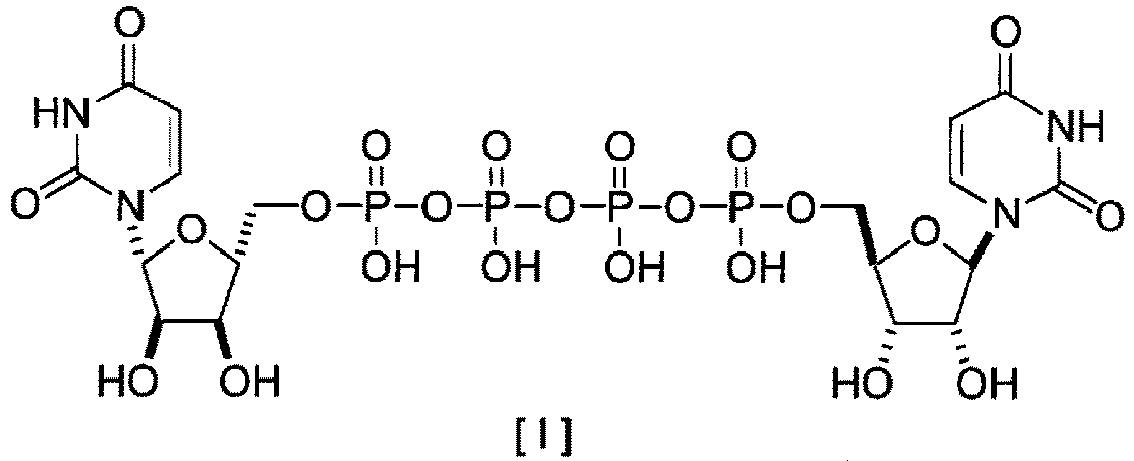
- P 1 ,P 4 -di(uridine 5'-)tetraphosphate (hereinafter referred to as "UP 4 U") represented by the following formula [I] or a salt thereof is used as a therapeutic agent for keratoconjunctival epithelial disorder accompanying dry eye.
- the compound also shows an effect of inducing expectoration, and is expected to be developed as an expectorant or a therapeutic agent for pneumonia.
- UP 4 U is a compound used as a raw material for pharmaceuticals, so extremely high level of impurity management is required. Therefore, it is also essential to keep the metal ions concentration at a sufficiently low degree.
- a metal ion such as an iron(II) ion or an iron(III) ion is added to the reaction solution as a catalyst, the metal ions are contained in the UP 4 U solution after completion of the reaction. In such a case, it is necessary to remove the metal ions in the purification step.
- a purification method of UP 4 U a method for producing crystals of UP 4 U or a salt thereof has been known, wherein the method is characterized as comprising a step of purifying crude UP 4 U or a salt thereof via anion exchange chromatography and activated carbon chromatography, a step of adjusting the pH of the purified UP 4 U or its salt solution to 6 to 9 as desired, and a step of then adding a hydrophilic organic solvent at a temperature condition of 60°C or less to thereby precipitate crystals (Patent Literature 4).
- Patent Literature 4 the efficiency for the removal of metals from the UP 4 U solution containing iron ions has not been investigated.
- an object of the present invention is to provide a method for conveniently and practically removing iron ion as an alternative purification method of UP 4 U.
- the present inventors have found that the iron ions in the UP 4 U reaction solution may be sufficiently removed and the concentration of residual iron ions can be reduced to extremely low concentration of 10 ppm or less, by removing iron ions from an aqueous solution or hydrophilic solvent solution containing UP 4 U and iron ions via combination between a step of column purification using a chelating resin and either a step of crystallization at pH 5.5 or less differently from the conventionally known crystallization condition, or a step of treatment using zinc chloride-activated activated carbon.
- the present invention provides the following [1] and [2].
- the method of the present invention relates to a method of removing iron ions from an aqueous solution or hydrophilic solvent solution containing UP 4 U and iron ions, to reduce the iron ions concentration.
- the aqueous solution or hydrophilic solvent solution containing UP 4 U and iron ions is not limited as long as it contains UP 4 U and iron ions.
- Examples thereof include a synthetic reaction solution obtained by a production method including reacting (1) a phosphoric acid-activating compound represented by the following formula [II] or [III] with (2) a phosphoric acid compound selected from the group consisting of UMP, UDP, UTP and a pyrophosphoric acid or a salt thereof (excluding UTP free) in water or a hydrophilic organic solvent, in the presence of (3) a metal ion selected from the group consisting of an iron(II) ion and an iron(III) ion (Patent Literature 3).
- R 1 represents a uridyl group binding to the 5'-position;
- X represents a heterocyclic group; and
- n represents an integer of 1 or 2.
- X represents a heterocyclic group selected from the group consisting of an imidazolyl group, a benzimidazolyl group, and a 1,2,4-triazolyl group.
- the "iron ion" of the present invention refers to an ion converted from an iron salt to a metal ion by addition thereof in water or a hydrophilic organic solvent.
- the kind of salt may include, for example, halide, inorganic acid salt, and organic acid salt. Further specific examples include (i) ferrous chloride, ferric chloride, and ferric bromide as examples of halides, (ii) sulfuric acid, nitric acid, and perchloric acid as examples of inorganic acid salts and (iii) organic acid salts such as trifluoromethanesulfonates, acetates, trifluoroacetates, and citrates as examples of organic acid salts.
- the salt may be a ferrous salt or a ferric salt, a ferric salt is preferable, and among them, ferric chloride is particularly preferable.
- the salt to be used may be an anhydride or a hydrate.
- the solvent is water or a hydrophilic organic solvent.
- hydrophilic organic solvent alcohols having 6 or less carbon atoms such as methanol and ethanol, ketones such as acetone, ethers such as dioxane, nitriles such as acetonitrile, amides such as dimethylformamide may be used.
- the iron ions concentration in the UP 4 U solution is preferably 10 ppm or more, more preferably 60 ppm or more, and further preferably 60 ppm or more and 10% or less, with respect to UP 4 U. Also, the UP 4 U concentration in the UP 4 U solution is preferably 0.01 to 10%, more preferably 0.1 to 5%, and further preferably 1 to 3%.
- the method of the present invention relates to a method for purifying UP 4 U including, as steps for removing iron ions from the UP 4 U solution, (1) a step of purification of the solution using a chelating resin packed column, (2) a step of performing crystallization at pH 5.5 or less, or a step of performing zinc chloride-activated activated carbon treatment.
- the column purification step using the chelating resin may be performed according to an ordinary method.
- the kind of chelating resin to be used may include, for example, any one selected from aminophosphoric acid type, iminodiacetic acid type, polyamine type, bispicolylamine type, and isothiouronium type. Among them, aminophosphoric acid type and iminodiacetic acid type are preferable.
- chelating resin Commercially available products of chelating resin include IRC747 (aminophosphoric acid group Na type, manufactured by Organo Corporation), IRC748 (iminodiacetic acid group Na type, manufactured by Organo Corporation), CR-11 (iminodiacetic acid group Na type, manufactured by Mitsubishi Chemical Corporation), CR-20 (polyamine group free type, manufactured by Mitsubishi Chemical Corporation), OT-71 (iminodiacetic acid group Na type, manufactured by MUROMACHI CHEMICALS INC.), XMS-5612 (aminophosphoric acid group Na type, manufactured by MUROMACHI CHEMICALS INC.), XMS-5418 (bispicolylamine group SO 4 type, manufactured by MUROMACHI CHEMICALS INC.), XMS-5413 (isothiouronium group Cl type, manufactured by MUROMACHI CHEMICALS INC.).
- step (1) specifically, an aqueous solution or a hydrophilic organic solvent solution of UP 4 U containing iron ions is passed through a column packed with a chelating resin, and the passed solution is collected.
- the iron ions concentration relative to UP 4 U in the UP 4 U solution is reduced to 60 ppm or less.
- a crystallization mother liquor is first adjusted to pH 5.5 or less by adding an acid such as hydrochloric acid, phosphoric acid, sulfuric acid, nitric acid or acetic acid to the solution after the treatment (1), and subjected to crystallization.
- pH may be 5.5 or less, and is more preferably 2.5 or more and 5.5 or less.
- the hydrophilic organic solvent is added to the UP 4 U solution and stirred until the mixture becomes turbid, and the mixture is allowed to stand, and the precipitated crystals are collected by filtration.
- hydrophilic organic solvent examples include alcohols having 6 or less carbon atoms such as methanol and ethanol, ketones such as acetone, ethers such as dioxane, nitriles such as acetonitrile, amides such as dimethylformamide, particularly alcohols, and preferably ethanol.
- alcohols having 6 or less carbon atoms such as methanol and ethanol
- ketones such as acetone
- ethers such as dioxane
- nitriles such as acetonitrile
- amides such as dimethylformamide
- activated carbon treatment may be performed according to an ordinary method.
- zinc chloride-activated activated carbon may be added to the solution after the treatment (1) and the mixture may be stirred for about 30 minutes to 20 hours, followed by removal of the activated carbon by filtration.
- the type of activated carbon used in the method of the present invention includes, for example, steam-activated and chemical-activated activated carbon, and among them, using zinc chloride-activated activated carbon is characteristic feature of the present invention.
- the raw material of activated carbon may be selected from, for example, wood, coconut shell, and coal.
- the shape may be selected from, for example, powder, crushed, granular, columnar, fibrous, and sheet-like.
- Commercially available products of zinc chloride-activated activated carbon include, for example, Tokusei Shirasagi M600 (manufactured by Osaka Gas Chemicals Co., Ltd.).
- the column purification step using a chelating resin and (2) the crystallization step under a condition of pH 5.5 or less or the zinc chloride-activated activated carbon treatment step are performed at least once in order of (1), (2).
- the method of the present invention may further include, for example, a step of performing column purification using an ion exchange column, a step of performing other activated carbon treatment, or a step of performing crystallization again. These steps may be performed before, after, and between the steps (1) and (2).
- the iron concentration in the UP 4 U-containing solution can be reduced to an extremely low concentration, for example, it can be adjusted to an extremely low value of 10 ppm or less of iron content relative to UP 4 U after the treatment.
- UP 4 U can be obtained with high purity by performing a crystallization treatment as necessary.
- a crystallization method for example, publicly known method (Patent Literature 4) may be used.
- UP 4 U was synthesized according to a known method (Patent Literature 3). Using diimidazolyl pyrophosphate as the phosphoric acid-activating compound, and UMP as the phosphoric acid compound, the condensation reaction was performed using water as a solvent and ferric chloride as a catalyst. (Formula [III], X is an imidazolyl group.)
- the solution after the condensation reaction was subjected to a chelating resin (IRC748, manufactured by Organo Corporation) packed column treatment.
- the iron ions concentration after the chelating resin treatment was 40 ppm. Thereafter, even when crystallization was performed according to a known method, the iron ions concentration did not become 40 ppm or less.
- the iron ions concentration was determined following spectrometric method using 1,10-phenanthroline of JIS K 0400-57-10. Specific quantification methods are as follows.
- the evaluation was conducted by preparing a simulated treatment solution containing 38 ppm of iron relative to UP 4 U. Specifically, 480 g of UP 4 U was first dissolved in deionized water and the volume of the solution was adjusted to 2 L. Then, an iron(III) chloride solution was added to the solution to adjust an iron content relative to UP 4 U of 38 ppm. Hydrochloric acid was added to the solution to adjust pH to be 4.5, 5.0, 5, 5, 6.0, 6.5, and 7.0, and these were used as simulated treatment solution.
- the iron concentration after crystallization of the precrystallization solution at pH 7.0 was 38 ppm, suggesting that the iron was not removed. While, the iron concentration after crystallization when crystallized at pH 5.5 or less was 10 ppm or less, suggesting that when the crystallization was performed at a low pH condition of pH 5.5 or less, the iron concentration was able to be reduced to a very low concentration.
- the evaluation was conducted by preparing a simulated treatment solution containing iron ions. Specifically, 480 g of UP 4 U was first dissolved in deionized water and the volume of the solution was adjusted to 2 L. Then, one obtained by adding an iron(III) chloride solution to the solution to make an iron content relative to UP 4 U of 60 ppm was used as a simulated treatment solution.
- a simulated treatment solution adjusted to pH 2.0 was measured and charged into 14 test tubes at 4.0 mL each. Each 60 mg of chelating resin or powdered activated carbon was weighed and charged into the simulated treatment solution in the test tube, and the mixture was stirred. Twenty hours after the start of stirring, 1 mL or more of the treatment solution was sampled out and filtered with a 0.2 ⁇ m membrane filter to remove the resin and the activated carbon. The iron content was measured using 1 mL of the filtrate.
- the types of chelating column resins used in the test are as follows; IRC747 (aminophosphoric acid group Na type, manufactured by Organo Corporation), IRC748 (iminodiacetic acid group Na type, manufactured by Organo Corporation), CR-11 (iminodiacetic acid group Na type, manufactured by Mitsubishi Chemical Corporation), CR-20 (polyamine group free type, manufactured by Mitsubishi Chemical Corporation), OT-71 (iminodiacetic acid group Na type, manufactured by MUROMACHI CHEMICALS INC.), XMS-5612 (aminophosphoric acid group Na type, manufactured by MUROMACHI CHEMICALS INC.), XMS-5418 (bispicolylamine group SO4 type, manufactured by MUROMACHI CHEMICALS INC.), XMS-5413 (isothiouronium group Cl type, manufactured by MUROMACHI CHEMICALS INC.).
- the types of activated carbon are as follows; Shirasagi P (coconut shell/steam activation, Osaka Gas Chemical Co., Ltd.), Tokusei Shirasagi (wood/zinc chloride activation, Osaka Gas Chemical Co., Ltd.), Shirasagi A (wood/steam activation, Osaka Gas Chemical Co., Ltd.), FP-3 (material unknown/steam activation, manufactured by Osaka Gas Chemical Co., Ltd.), TAIKO K Type A (wood/activation method unknown, manufactured by Futamura Chemical Co.,Ltd.).
Landscapes
- Chemical & Material Sciences (AREA)
- Health & Medical Sciences (AREA)
- Life Sciences & Earth Sciences (AREA)
- Organic Chemistry (AREA)
- General Health & Medical Sciences (AREA)
- Biochemistry (AREA)
- Molecular Biology (AREA)
- Engineering & Computer Science (AREA)
- Public Health (AREA)
- Medicinal Chemistry (AREA)
- Genetics & Genomics (AREA)
- Veterinary Medicine (AREA)
- Animal Behavior & Ethology (AREA)
- Pharmacology & Pharmacy (AREA)
- Biotechnology (AREA)
- Ophthalmology & Optometry (AREA)
- General Chemical & Material Sciences (AREA)
- Nuclear Medicine, Radiotherapy & Molecular Imaging (AREA)
- Chemical Kinetics & Catalysis (AREA)
- Bioinformatics & Cheminformatics (AREA)
- Epidemiology (AREA)
- Saccharide Compounds (AREA)
- Pharmaceuticals Containing Other Organic And Inorganic Compounds (AREA)
Description
- The present invention relates to a method for removing iron ions from an aqueous solution or hydrophilic solvent solution containing P1,P4-di(uridine 5'-)tetraphosphate and iron ions, to reduce the iron ions concentration.
- P1,P4-di(uridine 5'-)tetraphosphate (hereinafter referred to as "UP4U") represented by the following formula [I] or a salt thereof is used as a therapeutic agent for keratoconjunctival epithelial disorder accompanying dry eye. The compound also shows an effect of inducing expectoration, and is expected to be developed as an expectorant or a therapeutic agent for pneumonia.
- Conventionally, the following methods are known as methods for synthesizing UP4U.
- (1) the method by reacting uridine 5'-cyclic triphosphate prepared from dehydration condensation of uridine 5'-triphosphate (UTP), with uridine 5'-monophosphate (UMP) (Non Patent Literature 1), and the modified method thereof (Patent Literature 1).
- (2) the method by activating pyrophosphoric acid with imidazole to synthesize diimidazolyl pyrophosphate, and condensing it with UMP under an anhydrous environment using an organic solvent such as dimethylformamide (DMF) (Patent Literature 2, Non Patent Literature 2).
- (3) the method by reacting a phosphoric acid-activating compound represented by the following formula [II] or [III] with a phosphoric acid compound selected from the group consisting of UMP, UDP, UTP and a pyrophosphoric acid or a salt thereof (excluding UTP free) in water or a hydrophilic solvent, in the presence of a metal ion such as an iron(II) ion and an iron(III) ion (Patent Literature 3).
(In the formula [II], R1 represents a uridyl group binding to the 5'-position; X represents a heterocyclic group; and n represents an integer of 1 or 2.)
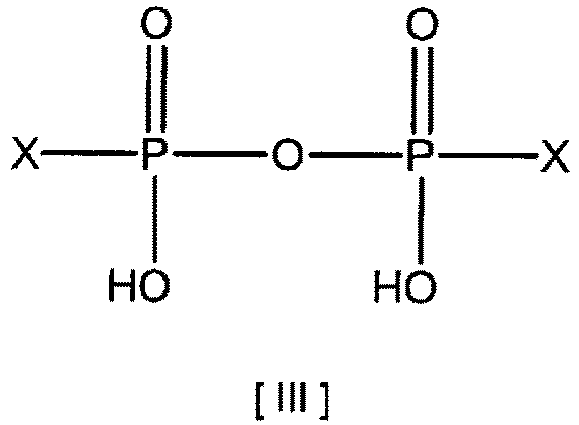
(In the formula [III], X represents a heterocyclic group selected from the group consisting of an imidazolyl group, a benzimidazolyl group, and a 1,2,4-triazolyl group.)

- Among them, when the method (3) is employed, synthesis of UP4U with high yield, while avoiding utilization of UTP free not suitable for industrial mass production and dehydration operation of UTP salt, may be available. In addition, this method is extremely suitable for industrial large-scale synthesis of UP4U because it hardly produces by-products and can omit a complicated dehydration step according to employment of a reaction under hydrophilic conditions.
-
- Patent Literature 1:
WO 2008/012949 A - Patent Literature 2:
WO 2008/024169 A - Patent Literature 3:
WO 2014/103704 A - Patent Literature 4:
WO 2000/020430 A -
- Non Patent Literature 1: Bioorg. & Medicinal Chemistry Letters, vol. 11, 157-160 (2001)
- Non Patent Literature 2: Org. Biomol. Chem., 2011, No. 9, 730-738 (2011)
- UP4U is a compound used as a raw material for pharmaceuticals, so extremely high level of impurity management is required. Therefore, it is also essential to keep the metal ions concentration at a sufficiently low degree. On the other hand, for example, in the production method (3) above, since a metal ion such as an iron(II) ion or an iron(III) ion is added to the reaction solution as a catalyst, the metal ions are contained in the UP4U solution after completion of the reaction. In such a case, it is necessary to remove the metal ions in the purification step.
- Conventionally, as a purification method of UP4U, a method for producing crystals of UP4U or a salt thereof has been known, wherein the method is characterized as comprising a step of purifying crude UP4U or a salt thereof via anion exchange chromatography and activated carbon chromatography, a step of adjusting the pH of the purified UP4U or its salt solution to 6 to 9 as desired, and a step of then adding a hydrophilic organic solvent at a temperature condition of 60°C or less to thereby precipitate crystals (Patent Literature 4). However, the efficiency for the removal of metals from the UP4U solution containing iron ions has not been investigated.
- On the other hand, as methods for removing iron ions contained in a solution, for example, a method of forming a precipitate derived from iron ions by using phosphoric acid or sodium hydroxide and removing the precipitate, and a method of adsorbing and removing iron ions by using a chelating resin or synthetic adsorption resin are used as ordinary methods. However, as a result of study, the present inventor has found that in the case when lowering the iron ions concentration of the UP4U reaction solution containing iron ions, the concentration of iron ions sometimes cannot be sufficiently reduced by the ordinary methods as described above depending on the condition.
- Therefore, an object of the present invention is to provide a method for conveniently and practically removing iron ion as an alternative purification method of UP4U.
- As a result of intensive studies to solve the above problems, the present inventors have found that the iron ions in the UP4U reaction solution may be sufficiently removed and the concentration of residual iron ions can be reduced to extremely low concentration of 10 ppm or less, by removing iron ions from an aqueous solution or hydrophilic solvent solution containing UP4U and iron ions via combination between a step of column purification using a chelating resin and either a step of crystallization at pH 5.5 or less differently from the conventionally known crystallization condition, or a step of treatment using zinc chloride-activated activated carbon.
- More specifically, the present invention provides the following [1] and [2].
- [1] A method for purifying P1,P4-di(uridine 5'-)tetraphosphate by removing iron ions from an aqueous solution or hydrophilic solvent solution containing P1,P4-di(uridine 5'-)tetraphosphate and iron ions, including
- (1) a step of purification of the solution using a chelating resin packed column, and
- (2) a step of adjusting the pH of the solution after said purification step using the chelating resin packed column to 5.5 or less, and then crystallizing P1,P4-di(uridine 5'-)tetraphosphate, or
a step of treating the solution after said purification step using the chelating resin packed column with zinc chloride-activated activated carbon.
- [2] The purification method according to [1], wherein the iron ions are trivalent iron ions.
- By employing the purification method of the present invention, it is possible to produce UP4U having the same quality as UP4U produced by a method without using the catalyst, even if iron ions are used as a catalyst.
-
-
Fig. 1 shows the concentrations of iron ions relative to UP4U in solutions after chelating resin column treatment and subsequent treatment using various kinds of chelating resin column. -
Fig. 2 shows the concentrations of iron ions relative to UP4U in solutions after chelating resin column treatment and subsequent treatment using activated carbon. - The method of the present invention relates to a method of removing iron ions from an aqueous solution or hydrophilic solvent solution containing UP4U and iron ions, to reduce the iron ions concentration.
- The aqueous solution or hydrophilic solvent solution containing UP4U and iron ions is not limited as long as it contains UP4U and iron ions. Examples thereof include a synthetic reaction solution obtained by a production method including reacting (1) a phosphoric acid-activating compound represented by the following formula [II] or [III] with (2) a phosphoric acid compound selected from the group consisting of UMP, UDP, UTP and a pyrophosphoric acid or a salt thereof (excluding UTP free) in water or a hydrophilic organic solvent, in the presence of (3) a metal ion selected from the group consisting of an iron(II) ion and an iron(III) ion (Patent Literature 3).
(In formula [II], R1 represents a uridyl group binding to the 5'-position; X represents a heterocyclic group; and n represents an integer of 1 or 2.)
(In formula [III], X represents a heterocyclic group selected from the group consisting of an imidazolyl group, a benzimidazolyl group, and a 1,2,4-triazolyl group.)

- The "iron ion" of the present invention refers to an ion converted from an iron salt to a metal ion by addition thereof in water or a hydrophilic organic solvent. The kind of salt may include, for example, halide, inorganic acid salt, and organic acid salt. Further specific examples include (i) ferrous chloride, ferric chloride, and ferric bromide as examples of halides, (ii) sulfuric acid, nitric acid, and perchloric acid as examples of inorganic acid salts and (iii) organic acid salts such as trifluoromethanesulfonates, acetates, trifluoroacetates, and citrates as examples of organic acid salts. The salt may be a ferrous salt or a ferric salt, a ferric salt is preferable, and among them, ferric chloride is particularly preferable. The salt to be used may be an anhydride or a hydrate.
- In the UP4U solution of the present invention, the solvent is water or a hydrophilic organic solvent. As the hydrophilic organic solvent, alcohols having 6 or less carbon atoms such as methanol and ethanol, ketones such as acetone, ethers such as dioxane, nitriles such as acetonitrile, amides such as dimethylformamide may be used.
- The iron ions concentration in the UP4U solution is preferably 10 ppm or more, more preferably 60 ppm or more, and further preferably 60 ppm or more and 10% or less, with respect to UP4U. Also, the UP4U concentration in the UP4U solution is preferably 0.01 to 10%, more preferably 0.1 to 5%, and further preferably 1 to 3%.
- The method of the present invention relates to a method for purifying UP4U including, as steps for removing iron ions from the UP4U solution, (1) a step of purification of the solution using a chelating resin packed column, (2) a step of performing crystallization at pH 5.5 or less, or a step of performing zinc chloride-activated activated carbon treatment.
- In (1) the column purification step using the chelating resin, column purification may be performed according to an ordinary method. The kind of chelating resin to be used may include, for example, any one selected from aminophosphoric acid type, iminodiacetic acid type, polyamine type, bispicolylamine type, and isothiouronium type. Among them, aminophosphoric acid type and iminodiacetic acid type are preferable.
- Commercially available products of chelating resin include IRC747 (aminophosphoric acid group Na type, manufactured by Organo Corporation), IRC748 (iminodiacetic acid group Na type, manufactured by Organo Corporation), CR-11 (iminodiacetic acid group Na type, manufactured by Mitsubishi Chemical Corporation), CR-20 (polyamine group free type, manufactured by Mitsubishi Chemical Corporation), OT-71 (iminodiacetic acid group Na type, manufactured by MUROMACHI CHEMICALS INC.), XMS-5612 (aminophosphoric acid group Na type, manufactured by MUROMACHI CHEMICALS INC.), XMS-5418 (bispicolylamine group SO4 type, manufactured by MUROMACHI CHEMICALS INC.), XMS-5413 (isothiouronium group Cl type, manufactured by MUROMACHI CHEMICALS INC.).
- In the step (1), specifically, an aqueous solution or a hydrophilic organic solvent solution of UP4U containing iron ions is passed through a column packed with a chelating resin, and the passed solution is collected.
- By the column purification step using the chelating resin, the iron ions concentration relative to UP4U in the UP4U solution is reduced to 60 ppm or less.
- In the crystallization step (2-1) of (2), a crystallization mother liquor is first adjusted to pH 5.5 or less by adding an acid such as hydrochloric acid, phosphoric acid, sulfuric acid, nitric acid or acetic acid to the solution after the treatment (1), and subjected to crystallization. Here, pH may be 5.5 or less, and is more preferably 2.5 or more and 5.5 or less. In the crystallization, for example, the hydrophilic organic solvent is added to the UP4U solution and stirred until the mixture becomes turbid, and the mixture is allowed to stand, and the precipitated crystals are collected by filtration. Examples of the hydrophilic organic solvent include alcohols having 6 or less carbon atoms such as methanol and ethanol, ketones such as acetone, ethers such as dioxane, nitriles such as acetonitrile, amides such as dimethylformamide, particularly alcohols, and preferably ethanol. In this case, in order to improve the crystallization efficiency, a seed crystal may be added simultaneously with the hydrophilic organic solvent.
- In the treatment step (2-2) of (2) using zinc chloride-activated activated carbon, activated carbon treatment may be performed according to an ordinary method. In the method, zinc chloride-activated activated carbon may be added to the solution after the treatment (1) and the mixture may be stirred for about 30 minutes to 20 hours, followed by removal of the activated carbon by filtration.
- The type of activated carbon used in the method of the present invention includes, for example, steam-activated and chemical-activated activated carbon, and among them, using zinc chloride-activated activated carbon is characteristic feature of the present invention. The raw material of activated carbon may be selected from, for example, wood, coconut shell, and coal. The shape may be selected from, for example, powder, crushed, granular, columnar, fibrous, and sheet-like. Commercially available products of zinc chloride-activated activated carbon include, for example, Tokusei Shirasagi M600 (manufactured by Osaka Gas Chemicals Co., Ltd.).
- In the method of the present invention, (1) the column purification step using a chelating resin and (2) the crystallization step under a condition of pH 5.5 or less or the zinc chloride-activated activated carbon treatment step are performed at least once in order of (1), (2). Also, in addition to the above steps (1) and (2), the method of the present invention may further include, for example, a step of performing column purification using an ion exchange column, a step of performing other activated carbon treatment, or a step of performing crystallization again. These steps may be performed before, after, and between the steps (1) and (2).
- By performing purification by the method of the present invention, the iron concentration in the UP4U-containing solution can be reduced to an extremely low concentration, for example, it can be adjusted to an extremely low value of 10 ppm or less of iron content relative to UP4U after the treatment.
- In the method of the present invention, after purification by the zinc chloride-activated activated carbon treatment step as the step (2) is completed, UP4U can be obtained with high purity by performing a crystallization treatment as necessary. As a crystallization method, for example, publicly known method (Patent Literature 4) may be used.
- UP4U was synthesized according to a known method (Patent Literature 3). Using diimidazolyl pyrophosphate as the phosphoric acid-activating compound, and UMP as the phosphoric acid compound, the condensation reaction was performed using water as a solvent and ferric chloride as a catalyst. (Formula [III], X is an imidazolyl group.)
- The solution after the condensation reaction was subjected to a chelating resin (IRC748, manufactured by Organo Corporation) packed column treatment. The iron ions concentration after the chelating resin treatment was 40 ppm. Thereafter, even when crystallization was performed according to a known method, the iron ions concentration did not become 40 ppm or less.
- The iron ions concentration was determined following spectrometric method using 1,10-phenanthroline of JIS K 0400-57-10. Specific quantification methods are as follows.
- (1) Charge a 10 mL volumetric flask with a sample and an iron standard solution (Fe100) for preparing calibration curve. Prepare a 10 mL volumetric flask that does not charge anything for blanks.
- (2) Add 400 µL of a 6.0 M HCl solution and 200 µL of a 10% hydroxylamine hydrochloride solution to all volumetric flasks and sufficiently mix the mixture. Then, allow the flasks to stand for 30 minutes or more.
- (3) Add 200 µL of a 0.5% o-Phenanthroline solution and 1 mL of a 50% ammonium acetate solution and make up to 10 mL.
- (4) Stir well and allow the flasks to stand at room temperature for 10 minutes or more. Then, measure OD510 of each solution.
- (5) Prepare a calibration curve from the obtained OD510 value and determine the iron ions concentration in the sample.
- As a method of adding a de-ironing treatment additionally after the chelating resin column treatment, the process for reducing the iron concentration by crystallizing the chelating treatment solution and only separating the crystal was investigated.
- The evaluation was conducted by preparing a simulated treatment solution containing 38 ppm of iron relative to UP4U. Specifically, 480 g of UP4U was first dissolved in deionized water and the volume of the solution was adjusted to 2 L. Then, an iron(III) chloride solution was added to the solution to adjust an iron content relative to UP4U of 38 ppm. Hydrochloric acid was added to the solution to adjust pH to be 4.5, 5.0, 5, 5, 6.0, 6.5, and 7.0, and these were used as simulated treatment solution.
- 200 mL of each simulated treatment solution was stirred in a 25°C water bath, then 95% ethanol was added until the mixture became turbid (about 120 mL), seed crystals of UP4U (25 mg) were added thereto, and the mixture was stirred overnight. After confirming that crystals were sufficiently precipitated, about 40 mL of 95% ethanol was further added thereto, and the mixture was stirred. The crystals and the supernatant were separated by filtration. The obtained crystals were dissolved in 100 mL of deionized water, and the iron content was measured.
- The results are shown in Table 1.
[Table 1] pH 7.0 6.5 6.0 5.5 5.0 4.5 Fe content relative to UP4U (ppm) 38 18 14 5 6 6 - As shown in the above table, when the crystallization treatment was performed following the chelating resin treatment, the iron concentration after crystallization of the precrystallization solution at pH 7.0 was 38 ppm, suggesting that the iron was not removed. While, the iron concentration after crystallization when crystallized at pH 5.5 or less was 10 ppm or less, suggesting that when the crystallization was performed at a low pH condition of pH 5.5 or less, the iron concentration was able to be reduced to a very low concentration.
- As a method of adding a de-ironing treatment additionally after the chelating resin column treatment, the process for reducing the iron concentration by charging an iron adsorbent (various chelating column resins or various activated carbons) to the initial chelating treatment solution was evaluated.
- The evaluation was conducted by preparing a simulated treatment solution containing iron ions. Specifically, 480 g of UP4U was first dissolved in deionized water and the volume of the solution was adjusted to 2 L. Then, one obtained by adding an iron(III) chloride solution to the solution to make an iron content relative to UP4U of 60 ppm was used as a simulated treatment solution.
- A simulated treatment solution adjusted to pH 2.0 was measured and charged into 14 test tubes at 4.0 mL each. Each 60 mg of chelating resin or powdered activated carbon was weighed and charged into the simulated treatment solution in the test tube, and the mixture was stirred. Twenty hours after the start of stirring, 1 mL or more of the treatment solution was sampled out and filtered with a 0.2 µm membrane filter to remove the resin and the activated carbon. The iron content was measured using 1 mL of the filtrate.
- The types of chelating column resins used in the test are as follows; IRC747 (aminophosphoric acid group Na type, manufactured by Organo Corporation), IRC748 (iminodiacetic acid group Na type, manufactured by Organo Corporation), CR-11 (iminodiacetic acid group Na type, manufactured by Mitsubishi Chemical Corporation), CR-20 (polyamine group free type, manufactured by Mitsubishi Chemical Corporation), OT-71 (iminodiacetic acid group Na type, manufactured by MUROMACHI CHEMICALS INC.), XMS-5612 (aminophosphoric acid group Na type, manufactured by MUROMACHI CHEMICALS INC.), XMS-5418 (bispicolylamine group SO4 type, manufactured by MUROMACHI CHEMICALS INC.), XMS-5413 (isothiouronium group Cl type, manufactured by MUROMACHI CHEMICALS INC.).
- In addition, the types of activated carbon are as follows; Shirasagi P (coconut shell/steam activation, Osaka Gas Chemical Co., Ltd.), Tokusei Shirasagi (wood/zinc chloride activation, Osaka Gas Chemical Co., Ltd.), Shirasagi A (wood/steam activation, Osaka Gas Chemical Co., Ltd.), FP-3 (material unknown/steam activation, manufactured by Osaka Gas Chemical Co., Ltd.), TAIKO K Type A (wood/activation method unknown, manufactured by Futamura Chemical Co.,Ltd.).
- The results are shown in Tables 2 and 3 and
FIGS. 1 and2 .[Table 2] Resin name Functional group Fe concentration relative to UP4U (ppm) Simulated treatment solution - 58.9ppm IRC747 Aminophosphoric acid type (Na) 14.5ppm XMS-5612 Aminophosphoric acid type (Na) 21.0ppm IRC748 Iminodiacetic acid type (Na) 57.2ppm CR-11 Iminodiacetic acid type (Na) 56.2ppm OT-71 Iminodiacetic acid type (Na) 57.2ppm CR-20 Polyamine type (free) 57.2ppm XMS5418 Bispicolylamine type (SO4) 53.6ppm XMS-5413 Isothiouronium type (Cl) 55.0ppm [Table 3] Activated carbon name Material Activation method Fe concentration relative to UP4U (ppm) Simulated treatment solution - - 58.9ppm Tokusei Shirasagi M600 Wood Zinc chloride 6.5ppm Shirasagi P M597 Coconut shell Steam 14.3ppm Shirasagi A M604 Wood Steam 16.3ppm FP-3 M623 Unknown Steam 17.1ppm TAIKO powdered activated carbon Wood Unknown 14.7ppm - As shown in
FIG. 1 above, when an additional chelating resin was added to the solution after chelating resin column treatment, iron was not removed except of using an aminophosphoric acid group Na type XMS-5612 (manufactured by MUROMACHI CHEMICALS INC.) or IRC747 (manufactured by Organo Corporation). Also, even when treated with an aminophosphoric acid group Na type resin, the iron concentration after treatment was 10 ppm or more. - While, as shown in
FIG. 2 , when activated carbon treatment was applied to the solution after chelating resin column treatment, the iron concentration was reduced even when any activated carbon was used. In particular, in the case of using zinc chloride-activated activated carbon, the iron concentration after treatment was less than 10 ppm, and the iron concentration was able to be reduced to a very low concentration.
Claims (2)
- A method for purifying P1,P4-di(uridine 5'-)tetraphosphate by removing iron ions from an aqueous solution or hydrophilic solvent solution containing P1,P4-di(uridine 5'-)tetraphosphate and iron ions, comprising(1) a step of purification using a chelating resin packed column, and(2) a step of adjusting the pH of the solution after said purification step using the chelating resin packed column to 5.5 or less, and then crystallizing P1,P4-di(uridine 5'-)tetraphosphate, or
a step of treating the solution after said purification step using the chelating resin packed column with zinc chloride-activated activated carbon. - The purification method according to claim 1, wherein the iron ions are trivalent iron ions.
Applications Claiming Priority (3)
| Application Number | Priority Date | Filing Date | Title |
|---|---|---|---|
| JP2016209024 | 2016-10-25 | ||
| JP2016209026 | 2016-10-25 | ||
| PCT/JP2017/038237 WO2018079503A1 (en) | 2016-10-25 | 2017-10-24 | Method for purifying p1,p4-di(uridine 5'-)tetraphosphate |
Publications (3)
| Publication Number | Publication Date |
|---|---|
| EP3546472A1 EP3546472A1 (en) | 2019-10-02 |
| EP3546472A4 EP3546472A4 (en) | 2020-07-01 |
| EP3546472B1 true EP3546472B1 (en) | 2021-06-16 |
Family
ID=62024945
Family Applications (1)
| Application Number | Title | Priority Date | Filing Date |
|---|---|---|---|
| EP17863832.6A Active EP3546472B1 (en) | 2016-10-25 | 2017-10-24 | Method for purifying p1,p4-di(uridine 5'-)tetraphosphate |
Country Status (9)
| Country | Link |
|---|---|
| US (1) | US10815263B2 (en) |
| EP (1) | EP3546472B1 (en) |
| JP (1) | JP6774663B2 (en) |
| KR (1) | KR102259309B1 (en) |
| CN (1) | CN109843901B (en) |
| CA (1) | CA3039053C (en) |
| ES (1) | ES2878083T3 (en) |
| HU (1) | HUE055280T2 (en) |
| WO (1) | WO2018079503A1 (en) |
Families Citing this family (2)
| Publication number | Priority date | Publication date | Assignee | Title |
|---|---|---|---|---|
| KR200494933Y1 (en) | 2019-12-03 | 2022-02-08 | 오세욱 | Device for Sorting Wastepaper |
| CN113527394A (en) * | 2020-04-18 | 2021-10-22 | 上海键合医药科技有限公司 | A kind of purification method of diquafosol |
Family Cites Families (8)
| Publication number | Priority date | Publication date | Assignee | Title |
|---|---|---|---|---|
| DK1012154T3 (en) * | 1997-07-25 | 2004-07-26 | Inspire Pharmaceuticals Inc | Salts of di (uridine 5'-tetraphosphate), process for preparation and uses thereof |
| JP3247685B2 (en) | 1998-10-02 | 2002-01-21 | ヤマサ醤油株式会社 | Crystal of diuridine tetraphosphate or a salt thereof, method for producing the same, and method for producing the compound |
| EA004707B1 (en) * | 1999-06-30 | 2004-06-24 | Ямаса Корпорейшн | Dinucleotide crystals |
| US6867199B2 (en) * | 2000-08-21 | 2005-03-15 | Inspire Pharmaceuticals, Inc. | Dinucleoside polyphosphate compositions and their therapeutic use |
| US8288545B2 (en) * | 2006-07-21 | 2012-10-16 | Glsynthesis Inc. | Reactive pyrophosphoric and bisphosphonic acid derivatives and methods of their use |
| EP2045257B1 (en) * | 2006-07-26 | 2016-08-17 | Yamasa Corporation | Process for producing di(pyrimidine nucleoside 5'-)polyphosphate |
| US10179799B2 (en) | 2012-12-28 | 2019-01-15 | Yamasa Corporation | Method for producing P1,P4-di(uridine 5′-) tetraphosphate |
| CN106007056B (en) * | 2016-06-02 | 2019-06-04 | 哈尔滨工业大学 | A device and method for synchronously removing trace heavy metals in electroplating wastewater |
-
2017
- 2017-10-24 JP JP2018547665A patent/JP6774663B2/en active Active
- 2017-10-24 HU HUE17863832A patent/HUE055280T2/en unknown
- 2017-10-24 US US16/339,485 patent/US10815263B2/en active Active
- 2017-10-24 CA CA3039053A patent/CA3039053C/en active Active
- 2017-10-24 KR KR1020197009395A patent/KR102259309B1/en active Active
- 2017-10-24 CN CN201780066159.5A patent/CN109843901B/en active Active
- 2017-10-24 ES ES17863832T patent/ES2878083T3/en active Active
- 2017-10-24 WO PCT/JP2017/038237 patent/WO2018079503A1/en not_active Ceased
- 2017-10-24 EP EP17863832.6A patent/EP3546472B1/en active Active
Also Published As
| Publication number | Publication date |
|---|---|
| CA3039053C (en) | 2021-04-20 |
| CN109843901A (en) | 2019-06-04 |
| CN109843901B (en) | 2022-04-26 |
| WO2018079503A1 (en) | 2018-05-03 |
| US20190233462A1 (en) | 2019-08-01 |
| JP6774663B2 (en) | 2020-10-28 |
| EP3546472A4 (en) | 2020-07-01 |
| CA3039053A1 (en) | 2018-05-03 |
| US10815263B2 (en) | 2020-10-27 |
| ES2878083T3 (en) | 2021-11-18 |
| EP3546472A1 (en) | 2019-10-02 |
| KR102259309B1 (en) | 2021-06-01 |
| KR20190067162A (en) | 2019-06-14 |
| JPWO2018079503A1 (en) | 2019-09-19 |
| HUE055280T2 (en) | 2021-11-29 |
Similar Documents
| Publication | Publication Date | Title |
|---|---|---|
| CA2896455C (en) | Method for producing p1,p4-di(uridine 5'-)tetraphosphate | |
| JP7373598B2 (en) | Method for producing dinucleoside polyphosphate compounds | |
| JP5656881B2 (en) | Improved process for the production of meropenem using zinc powder | |
| EP3546472B1 (en) | Method for purifying p1,p4-di(uridine 5'-)tetraphosphate | |
| CN1170841C (en) | Process for producing methylcobalamin | |
| CN108299322A (en) | A method of preparing high-purity Gadobutrol | |
| JP6867409B2 (en) | Method for purifying methylcobalamin | |
| JP3824894B2 (en) | Process for producing P1, P4-di (uridine 5 '-) tetraphosphate or a salt thereof | |
| CN105037288B (en) | A kind of preparation method of cloth alcohol | |
| CN114369129A (en) | Synthetic method of chlorinated nicotinamide ribose | |
| CN101104621A (en) | Process for preparing high-purity cefpirome sulfate | |
| WO2019143074A1 (en) | Method for producing calcobutrol | |
| EP4491574A1 (en) | Silanol compound, production method for silanol compound, and composition including silanol compound | |
| JP7405991B2 (en) | Method for producing uridine 5'-diphosphate (UDP), its salt or its hydrate | |
| US20210252037A1 (en) | Process for the preparation of hydroxocobalamin hydrochloride | |
| HU183192B (en) | Improved process for preparing corrinoide derivatives bearing a substituent in position co-aeta | |
| JPS6140240B2 (en) |
Legal Events
| Date | Code | Title | Description |
|---|---|---|---|
| STAA | Information on the status of an ep patent application or granted ep patent |
Free format text: STATUS: THE INTERNATIONAL PUBLICATION HAS BEEN MADE |
|
| PUAI | Public reference made under article 153(3) epc to a published international application that has entered the european phase |
Free format text: ORIGINAL CODE: 0009012 |
|
| STAA | Information on the status of an ep patent application or granted ep patent |
Free format text: STATUS: REQUEST FOR EXAMINATION WAS MADE |
|
| 17P | Request for examination filed |
Effective date: 20190429 |
|
| AK | Designated contracting states |
Kind code of ref document: A1 Designated state(s): AL AT BE BG CH CY CZ DE DK EE ES FI FR GB GR HR HU IE IS IT LI LT LU LV MC MK MT NL NO PL PT RO RS SE SI SK SM TR |
|
| AX | Request for extension of the european patent |
Extension state: BA ME |
|
| DAV | Request for validation of the european patent (deleted) | ||
| DAX | Request for extension of the european patent (deleted) | ||
| A4 | Supplementary search report drawn up and despatched |
Effective date: 20200604 |
|
| RIC1 | Information provided on ipc code assigned before grant |
Ipc: C07H 19/10 20060101AFI20200528BHEP Ipc: A61K 31/7105 20060101ALI20200528BHEP Ipc: C07H 1/06 20060101ALI20200528BHEP |
|
| GRAP | Despatch of communication of intention to grant a patent |
Free format text: ORIGINAL CODE: EPIDOSNIGR1 |
|
| STAA | Information on the status of an ep patent application or granted ep patent |
Free format text: STATUS: GRANT OF PATENT IS INTENDED |
|
| INTG | Intention to grant announced |
Effective date: 20210127 |
|
| GRAS | Grant fee paid |
Free format text: ORIGINAL CODE: EPIDOSNIGR3 |
|
| GRAA | (expected) grant |
Free format text: ORIGINAL CODE: 0009210 |
|
| STAA | Information on the status of an ep patent application or granted ep patent |
Free format text: STATUS: THE PATENT HAS BEEN GRANTED |
|
| AK | Designated contracting states |
Kind code of ref document: B1 Designated state(s): AL AT BE BG CH CY CZ DE DK EE ES FI FR GB GR HR HU IE IS IT LI LT LU LV MC MK MT NL NO PL PT RO RS SE SI SK SM TR |
|
| REG | Reference to a national code |
Ref country code: GB Ref legal event code: FG4D |
|
| REG | Reference to a national code |
Ref country code: CH Ref legal event code: EP |
|
| REG | Reference to a national code |
Ref country code: DE Ref legal event code: R096 Ref document number: 602017040560 Country of ref document: DE |
|
| REG | Reference to a national code |
Ref country code: AT Ref legal event code: REF Ref document number: 1402280 Country of ref document: AT Kind code of ref document: T Effective date: 20210715 |
|
| REG | Reference to a national code |
Ref country code: SE Ref legal event code: TRGR |
|
| REG | Reference to a national code |
Ref country code: IE Ref legal event code: FG4D |
|
| REG | Reference to a national code |
Ref country code: NL Ref legal event code: FP |
|
| REG | Reference to a national code |
Ref country code: LT Ref legal event code: MG9D |
|
| REG | Reference to a national code |
Ref country code: SK Ref legal event code: T3 Ref document number: E 37983 Country of ref document: SK |
|
| PG25 | Lapsed in a contracting state [announced via postgrant information from national office to epo] |
Ref country code: HR Free format text: LAPSE BECAUSE OF FAILURE TO SUBMIT A TRANSLATION OF THE DESCRIPTION OR TO PAY THE FEE WITHIN THE PRESCRIBED TIME-LIMIT Effective date: 20210616 Ref country code: BG Free format text: LAPSE BECAUSE OF FAILURE TO SUBMIT A TRANSLATION OF THE DESCRIPTION OR TO PAY THE FEE WITHIN THE PRESCRIBED TIME-LIMIT Effective date: 20210916 Ref country code: FI Free format text: LAPSE BECAUSE OF FAILURE TO SUBMIT A TRANSLATION OF THE DESCRIPTION OR TO PAY THE FEE WITHIN THE PRESCRIBED TIME-LIMIT Effective date: 20210616 Ref country code: LT Free format text: LAPSE BECAUSE OF FAILURE TO SUBMIT A TRANSLATION OF THE DESCRIPTION OR TO PAY THE FEE WITHIN THE PRESCRIBED TIME-LIMIT Effective date: 20210616 |
|
| REG | Reference to a national code |
Ref country code: ES Ref legal event code: FG2A Ref document number: 2878083 Country of ref document: ES Kind code of ref document: T3 Effective date: 20211118 |
|
| REG | Reference to a national code |
Ref country code: HU Ref legal event code: AG4A Ref document number: E055280 Country of ref document: HU |
|
| PG25 | Lapsed in a contracting state [announced via postgrant information from national office to epo] |
Ref country code: GR Free format text: LAPSE BECAUSE OF FAILURE TO SUBMIT A TRANSLATION OF THE DESCRIPTION OR TO PAY THE FEE WITHIN THE PRESCRIBED TIME-LIMIT Effective date: 20210917 Ref country code: RS Free format text: LAPSE BECAUSE OF FAILURE TO SUBMIT A TRANSLATION OF THE DESCRIPTION OR TO PAY THE FEE WITHIN THE PRESCRIBED TIME-LIMIT Effective date: 20210616 Ref country code: NO Free format text: LAPSE BECAUSE OF FAILURE TO SUBMIT A TRANSLATION OF THE DESCRIPTION OR TO PAY THE FEE WITHIN THE PRESCRIBED TIME-LIMIT Effective date: 20210916 Ref country code: LV Free format text: LAPSE BECAUSE OF FAILURE TO SUBMIT A TRANSLATION OF THE DESCRIPTION OR TO PAY THE FEE WITHIN THE PRESCRIBED TIME-LIMIT Effective date: 20210616 |
|
| PG25 | Lapsed in a contracting state [announced via postgrant information from national office to epo] |
Ref country code: EE Free format text: LAPSE BECAUSE OF FAILURE TO SUBMIT A TRANSLATION OF THE DESCRIPTION OR TO PAY THE FEE WITHIN THE PRESCRIBED TIME-LIMIT Effective date: 20210616 Ref country code: SM Free format text: LAPSE BECAUSE OF FAILURE TO SUBMIT A TRANSLATION OF THE DESCRIPTION OR TO PAY THE FEE WITHIN THE PRESCRIBED TIME-LIMIT Effective date: 20210616 Ref country code: RO Free format text: LAPSE BECAUSE OF FAILURE TO SUBMIT A TRANSLATION OF THE DESCRIPTION OR TO PAY THE FEE WITHIN THE PRESCRIBED TIME-LIMIT Effective date: 20210616 Ref country code: PT Free format text: LAPSE BECAUSE OF FAILURE TO SUBMIT A TRANSLATION OF THE DESCRIPTION OR TO PAY THE FEE WITHIN THE PRESCRIBED TIME-LIMIT Effective date: 20211018 |
|
| PG25 | Lapsed in a contracting state [announced via postgrant information from national office to epo] |
Ref country code: PL Free format text: LAPSE BECAUSE OF FAILURE TO SUBMIT A TRANSLATION OF THE DESCRIPTION OR TO PAY THE FEE WITHIN THE PRESCRIBED TIME-LIMIT Effective date: 20210616 |
|
| REG | Reference to a national code |
Ref country code: DE Ref legal event code: R097 Ref document number: 602017040560 Country of ref document: DE |
|
| PLBE | No opposition filed within time limit |
Free format text: ORIGINAL CODE: 0009261 |
|
| STAA | Information on the status of an ep patent application or granted ep patent |
Free format text: STATUS: NO OPPOSITION FILED WITHIN TIME LIMIT |
|
| PG25 | Lapsed in a contracting state [announced via postgrant information from national office to epo] |
Ref country code: DK Free format text: LAPSE BECAUSE OF FAILURE TO SUBMIT A TRANSLATION OF THE DESCRIPTION OR TO PAY THE FEE WITHIN THE PRESCRIBED TIME-LIMIT Effective date: 20210616 |
|
| 26N | No opposition filed |
Effective date: 20220317 |
|
| PG25 | Lapsed in a contracting state [announced via postgrant information from national office to epo] |
Ref country code: AL Free format text: LAPSE BECAUSE OF FAILURE TO SUBMIT A TRANSLATION OF THE DESCRIPTION OR TO PAY THE FEE WITHIN THE PRESCRIBED TIME-LIMIT Effective date: 20210616 |
|
| PG25 | Lapsed in a contracting state [announced via postgrant information from national office to epo] |
Ref country code: MC Free format text: LAPSE BECAUSE OF FAILURE TO SUBMIT A TRANSLATION OF THE DESCRIPTION OR TO PAY THE FEE WITHIN THE PRESCRIBED TIME-LIMIT Effective date: 20210616 |
|
| PG25 | Lapsed in a contracting state [announced via postgrant information from national office to epo] |
Ref country code: LU Free format text: LAPSE BECAUSE OF NON-PAYMENT OF DUE FEES Effective date: 20211024 |
|
| P01 | Opt-out of the competence of the unified patent court (upc) registered |
Effective date: 20230420 |
|
| PG25 | Lapsed in a contracting state [announced via postgrant information from national office to epo] |
Ref country code: CY Free format text: LAPSE BECAUSE OF FAILURE TO SUBMIT A TRANSLATION OF THE DESCRIPTION OR TO PAY THE FEE WITHIN THE PRESCRIBED TIME-LIMIT Effective date: 20210616 |
|
| PG25 | Lapsed in a contracting state [announced via postgrant information from national office to epo] |
Ref country code: MK Free format text: LAPSE BECAUSE OF FAILURE TO SUBMIT A TRANSLATION OF THE DESCRIPTION OR TO PAY THE FEE WITHIN THE PRESCRIBED TIME-LIMIT Effective date: 20210616 |
|
| PG25 | Lapsed in a contracting state [announced via postgrant information from national office to epo] |
Ref country code: MT Free format text: LAPSE BECAUSE OF FAILURE TO SUBMIT A TRANSLATION OF THE DESCRIPTION OR TO PAY THE FEE WITHIN THE PRESCRIBED TIME-LIMIT Effective date: 20210616 |
|
| PGFP | Annual fee paid to national office [announced via postgrant information from national office to epo] |
Ref country code: NL Payment date: 20250912 Year of fee payment: 9 Ref country code: IT Payment date: 20250922 Year of fee payment: 9 |
|
| PGFP | Annual fee paid to national office [announced via postgrant information from national office to epo] |
Ref country code: BE Payment date: 20250917 Year of fee payment: 9 Ref country code: GB Payment date: 20250904 Year of fee payment: 9 |
|
| PGFP | Annual fee paid to national office [announced via postgrant information from national office to epo] |
Ref country code: FR Payment date: 20250908 Year of fee payment: 9 |
|
| PGFP | Annual fee paid to national office [announced via postgrant information from national office to epo] |
Ref country code: SE Payment date: 20250910 Year of fee payment: 9 |
|
| PGFP | Annual fee paid to national office [announced via postgrant information from national office to epo] |
Ref country code: IE Payment date: 20250909 Year of fee payment: 9 |
|
| PGFP | Annual fee paid to national office [announced via postgrant information from national office to epo] |
Ref country code: SK Payment date: 20250912 Year of fee payment: 9 |
|
| REG | Reference to a national code |
Ref country code: CH Ref legal event code: U11 Free format text: ST27 STATUS EVENT CODE: U-0-0-U10-U11 (AS PROVIDED BY THE NATIONAL OFFICE) Effective date: 20251101 |
|
| PGFP | Annual fee paid to national office [announced via postgrant information from national office to epo] |
Ref country code: HU Payment date: 20250929 Year of fee payment: 9 |
|
| PG25 | Lapsed in a contracting state [announced via postgrant information from national office to epo] |
Ref country code: TR Free format text: LAPSE BECAUSE OF FAILURE TO SUBMIT A TRANSLATION OF THE DESCRIPTION OR TO PAY THE FEE WITHIN THE PRESCRIBED TIME-LIMIT Effective date: 20210616 |
|
| PGFP | Annual fee paid to national office [announced via postgrant information from national office to epo] |
Ref country code: DE Payment date: 20250902 Year of fee payment: 9 |
|
| PGFP | Annual fee paid to national office [announced via postgrant information from national office to epo] |
Ref country code: AT Payment date: 20250925 Year of fee payment: 9 |
|
| PGFP | Annual fee paid to national office [announced via postgrant information from national office to epo] |
Ref country code: CH Payment date: 20251101 Year of fee payment: 9 |
|
| PGFP | Annual fee paid to national office [announced via postgrant information from national office to epo] |
Ref country code: CZ Payment date: 20251010 Year of fee payment: 9 |
|
| PGFP | Annual fee paid to national office [announced via postgrant information from national office to epo] |
Ref country code: ES Payment date: 20251103 Year of fee payment: 9 |