WO2016054522A1 - Compositions and methods for inhibiting the biological activity of soluble biomolecules - Google Patents
Compositions and methods for inhibiting the biological activity of soluble biomolecules Download PDFInfo
- Publication number
- WO2016054522A1 WO2016054522A1 PCT/US2015/053748 US2015053748W WO2016054522A1 WO 2016054522 A1 WO2016054522 A1 WO 2016054522A1 US 2015053748 W US2015053748 W US 2015053748W WO 2016054522 A1 WO2016054522 A1 WO 2016054522A1
- Authority
- WO
- WIPO (PCT)
- Prior art keywords
- particle
- agent
- protein
- target
- ligand
- Prior art date
- Legal status (The legal status is an assumption and is not a legal conclusion. Google has not performed a legal analysis and makes no representation as to the accuracy of the status listed.)
- Ceased
Links
Classifications
-
- A—HUMAN NECESSITIES
- A61—MEDICAL OR VETERINARY SCIENCE; HYGIENE
- A61K—PREPARATIONS FOR MEDICAL, DENTAL OR TOILETRY PURPOSES
- A61K47/00—Medicinal preparations characterised by the non-active ingredients used, e.g. carriers or inert additives; Targeting or modifying agents chemically bound to the active ingredient
- A61K47/50—Medicinal preparations characterised by the non-active ingredients used, e.g. carriers or inert additives; Targeting or modifying agents chemically bound to the active ingredient the non-active ingredient being chemically bound to the active ingredient, e.g. polymer-drug conjugates
- A61K47/69—Medicinal preparations characterised by the non-active ingredients used, e.g. carriers or inert additives; Targeting or modifying agents chemically bound to the active ingredient the non-active ingredient being chemically bound to the active ingredient, e.g. polymer-drug conjugates the conjugate being characterised by physical or galenical forms, e.g. emulsion, particle, inclusion complex, stent or kit
- A61K47/6921—Medicinal preparations characterised by the non-active ingredients used, e.g. carriers or inert additives; Targeting or modifying agents chemically bound to the active ingredient the non-active ingredient being chemically bound to the active ingredient, e.g. polymer-drug conjugates the conjugate being characterised by physical or galenical forms, e.g. emulsion, particle, inclusion complex, stent or kit the form being a particulate, a powder, an adsorbate, a bead or a sphere
- A61K47/6927—Medicinal preparations characterised by the non-active ingredients used, e.g. carriers or inert additives; Targeting or modifying agents chemically bound to the active ingredient the non-active ingredient being chemically bound to the active ingredient, e.g. polymer-drug conjugates the conjugate being characterised by physical or galenical forms, e.g. emulsion, particle, inclusion complex, stent or kit the form being a particulate, a powder, an adsorbate, a bead or a sphere the form being a solid microparticle having no hollow or gas-filled cores
-
- A—HUMAN NECESSITIES
- A61—MEDICAL OR VETERINARY SCIENCE; HYGIENE
- A61K—PREPARATIONS FOR MEDICAL, DENTAL OR TOILETRY PURPOSES
- A61K38/00—Medicinal preparations containing peptides
- A61K38/16—Peptides having more than 20 amino acids; Gastrins; Somatostatins; Melanotropins; Derivatives thereof
- A61K38/17—Peptides having more than 20 amino acids; Gastrins; Somatostatins; Melanotropins; Derivatives thereof from animals; from humans
-
- A—HUMAN NECESSITIES
- A61—MEDICAL OR VETERINARY SCIENCE; HYGIENE
- A61K—PREPARATIONS FOR MEDICAL, DENTAL OR TOILETRY PURPOSES
- A61K38/00—Medicinal preparations containing peptides
- A61K38/16—Peptides having more than 20 amino acids; Gastrins; Somatostatins; Melanotropins; Derivatives thereof
- A61K38/17—Peptides having more than 20 amino acids; Gastrins; Somatostatins; Melanotropins; Derivatives thereof from animals; from humans
- A61K38/19—Cytokines; Lymphokines; Interferons
-
- A—HUMAN NECESSITIES
- A61—MEDICAL OR VETERINARY SCIENCE; HYGIENE
- A61K—PREPARATIONS FOR MEDICAL, DENTAL OR TOILETRY PURPOSES
- A61K38/00—Medicinal preparations containing peptides
- A61K38/16—Peptides having more than 20 amino acids; Gastrins; Somatostatins; Melanotropins; Derivatives thereof
- A61K38/17—Peptides having more than 20 amino acids; Gastrins; Somatostatins; Melanotropins; Derivatives thereof from animals; from humans
- A61K38/19—Cytokines; Lymphokines; Interferons
- A61K38/191—Tumor necrosis factors [TNF], e.g. lymphotoxin [LT], i.e. TNF-beta
-
- A—HUMAN NECESSITIES
- A61—MEDICAL OR VETERINARY SCIENCE; HYGIENE
- A61K—PREPARATIONS FOR MEDICAL, DENTAL OR TOILETRY PURPOSES
- A61K38/00—Medicinal preparations containing peptides
- A61K38/16—Peptides having more than 20 amino acids; Gastrins; Somatostatins; Melanotropins; Derivatives thereof
- A61K38/17—Peptides having more than 20 amino acids; Gastrins; Somatostatins; Melanotropins; Derivatives thereof from animals; from humans
- A61K38/19—Cytokines; Lymphokines; Interferons
- A61K38/195—Chemokines, e.g. RANTES
-
- A—HUMAN NECESSITIES
- A61—MEDICAL OR VETERINARY SCIENCE; HYGIENE
- A61K—PREPARATIONS FOR MEDICAL, DENTAL OR TOILETRY PURPOSES
- A61K38/00—Medicinal preparations containing peptides
- A61K38/16—Peptides having more than 20 amino acids; Gastrins; Somatostatins; Melanotropins; Derivatives thereof
- A61K38/17—Peptides having more than 20 amino acids; Gastrins; Somatostatins; Melanotropins; Derivatives thereof from animals; from humans
- A61K38/19—Cytokines; Lymphokines; Interferons
- A61K38/20—Interleukins [IL]
- A61K38/2013—IL-2
-
- A—HUMAN NECESSITIES
- A61—MEDICAL OR VETERINARY SCIENCE; HYGIENE
- A61K—PREPARATIONS FOR MEDICAL, DENTAL OR TOILETRY PURPOSES
- A61K47/00—Medicinal preparations characterised by the non-active ingredients used, e.g. carriers or inert additives; Targeting or modifying agents chemically bound to the active ingredient
- A61K47/06—Organic compounds, e.g. natural or synthetic hydrocarbons, polyolefins, mineral oil, petrolatum or ozokerite
- A61K47/08—Organic compounds, e.g. natural or synthetic hydrocarbons, polyolefins, mineral oil, petrolatum or ozokerite containing oxygen, e.g. ethers, acetals, ketones, quinones, aldehydes, peroxides
- A61K47/10—Alcohols; Phenols; Salts thereof, e.g. glycerol; Polyethylene glycols [PEG]; Poloxamers; PEG/POE alkyl ethers
-
- A—HUMAN NECESSITIES
- A61—MEDICAL OR VETERINARY SCIENCE; HYGIENE
- A61K—PREPARATIONS FOR MEDICAL, DENTAL OR TOILETRY PURPOSES
- A61K47/00—Medicinal preparations characterised by the non-active ingredients used, e.g. carriers or inert additives; Targeting or modifying agents chemically bound to the active ingredient
- A61K47/50—Medicinal preparations characterised by the non-active ingredients used, e.g. carriers or inert additives; Targeting or modifying agents chemically bound to the active ingredient the non-active ingredient being chemically bound to the active ingredient, e.g. polymer-drug conjugates
- A61K47/51—Medicinal preparations characterised by the non-active ingredients used, e.g. carriers or inert additives; Targeting or modifying agents chemically bound to the active ingredient the non-active ingredient being chemically bound to the active ingredient, e.g. polymer-drug conjugates the non-active ingredient being a modifying agent
- A61K47/52—Medicinal preparations characterised by the non-active ingredients used, e.g. carriers or inert additives; Targeting or modifying agents chemically bound to the active ingredient the non-active ingredient being chemically bound to the active ingredient, e.g. polymer-drug conjugates the non-active ingredient being a modifying agent the modifying agent being an inorganic compound, e.g. an inorganic ion that is complexed with the active ingredient
-
- A—HUMAN NECESSITIES
- A61—MEDICAL OR VETERINARY SCIENCE; HYGIENE
- A61K—PREPARATIONS FOR MEDICAL, DENTAL OR TOILETRY PURPOSES
- A61K47/00—Medicinal preparations characterised by the non-active ingredients used, e.g. carriers or inert additives; Targeting or modifying agents chemically bound to the active ingredient
- A61K47/50—Medicinal preparations characterised by the non-active ingredients used, e.g. carriers or inert additives; Targeting or modifying agents chemically bound to the active ingredient the non-active ingredient being chemically bound to the active ingredient, e.g. polymer-drug conjugates
- A61K47/51—Medicinal preparations characterised by the non-active ingredients used, e.g. carriers or inert additives; Targeting or modifying agents chemically bound to the active ingredient the non-active ingredient being chemically bound to the active ingredient, e.g. polymer-drug conjugates the non-active ingredient being a modifying agent
- A61K47/56—Medicinal preparations characterised by the non-active ingredients used, e.g. carriers or inert additives; Targeting or modifying agents chemically bound to the active ingredient the non-active ingredient being chemically bound to the active ingredient, e.g. polymer-drug conjugates the non-active ingredient being a modifying agent the modifying agent being an organic macromolecular compound, e.g. an oligomeric, polymeric or dendrimeric molecule
- A61K47/59—Medicinal preparations characterised by the non-active ingredients used, e.g. carriers or inert additives; Targeting or modifying agents chemically bound to the active ingredient the non-active ingredient being chemically bound to the active ingredient, e.g. polymer-drug conjugates the non-active ingredient being a modifying agent the modifying agent being an organic macromolecular compound, e.g. an oligomeric, polymeric or dendrimeric molecule obtained otherwise than by reactions only involving carbon-to-carbon unsaturated bonds, e.g. polyureas or polyurethanes
- A61K47/60—Medicinal preparations characterised by the non-active ingredients used, e.g. carriers or inert additives; Targeting or modifying agents chemically bound to the active ingredient the non-active ingredient being chemically bound to the active ingredient, e.g. polymer-drug conjugates the non-active ingredient being a modifying agent the modifying agent being an organic macromolecular compound, e.g. an oligomeric, polymeric or dendrimeric molecule obtained otherwise than by reactions only involving carbon-to-carbon unsaturated bonds, e.g. polyureas or polyurethanes the organic macromolecular compound being a polyoxyalkylene oligomer, polymer or dendrimer, e.g. PEG, PPG, PEO or polyglycerol
-
- A—HUMAN NECESSITIES
- A61—MEDICAL OR VETERINARY SCIENCE; HYGIENE
- A61K—PREPARATIONS FOR MEDICAL, DENTAL OR TOILETRY PURPOSES
- A61K47/00—Medicinal preparations characterised by the non-active ingredients used, e.g. carriers or inert additives; Targeting or modifying agents chemically bound to the active ingredient
- A61K47/50—Medicinal preparations characterised by the non-active ingredients used, e.g. carriers or inert additives; Targeting or modifying agents chemically bound to the active ingredient the non-active ingredient being chemically bound to the active ingredient, e.g. polymer-drug conjugates
- A61K47/51—Medicinal preparations characterised by the non-active ingredients used, e.g. carriers or inert additives; Targeting or modifying agents chemically bound to the active ingredient the non-active ingredient being chemically bound to the active ingredient, e.g. polymer-drug conjugates the non-active ingredient being a modifying agent
- A61K47/56—Medicinal preparations characterised by the non-active ingredients used, e.g. carriers or inert additives; Targeting or modifying agents chemically bound to the active ingredient the non-active ingredient being chemically bound to the active ingredient, e.g. polymer-drug conjugates the non-active ingredient being a modifying agent the modifying agent being an organic macromolecular compound, e.g. an oligomeric, polymeric or dendrimeric molecule
- A61K47/61—Medicinal preparations characterised by the non-active ingredients used, e.g. carriers or inert additives; Targeting or modifying agents chemically bound to the active ingredient the non-active ingredient being chemically bound to the active ingredient, e.g. polymer-drug conjugates the non-active ingredient being a modifying agent the modifying agent being an organic macromolecular compound, e.g. an oligomeric, polymeric or dendrimeric molecule the organic macromolecular compound being a polysaccharide or a derivative thereof
-
- A—HUMAN NECESSITIES
- A61—MEDICAL OR VETERINARY SCIENCE; HYGIENE
- A61K—PREPARATIONS FOR MEDICAL, DENTAL OR TOILETRY PURPOSES
- A61K47/00—Medicinal preparations characterised by the non-active ingredients used, e.g. carriers or inert additives; Targeting or modifying agents chemically bound to the active ingredient
- A61K47/50—Medicinal preparations characterised by the non-active ingredients used, e.g. carriers or inert additives; Targeting or modifying agents chemically bound to the active ingredient the non-active ingredient being chemically bound to the active ingredient, e.g. polymer-drug conjugates
- A61K47/51—Medicinal preparations characterised by the non-active ingredients used, e.g. carriers or inert additives; Targeting or modifying agents chemically bound to the active ingredient the non-active ingredient being chemically bound to the active ingredient, e.g. polymer-drug conjugates the non-active ingredient being a modifying agent
- A61K47/62—Medicinal preparations characterised by the non-active ingredients used, e.g. carriers or inert additives; Targeting or modifying agents chemically bound to the active ingredient the non-active ingredient being chemically bound to the active ingredient, e.g. polymer-drug conjugates the non-active ingredient being a modifying agent the modifying agent being a protein, peptide or polyamino acid
-
- A—HUMAN NECESSITIES
- A61—MEDICAL OR VETERINARY SCIENCE; HYGIENE
- A61K—PREPARATIONS FOR MEDICAL, DENTAL OR TOILETRY PURPOSES
- A61K47/00—Medicinal preparations characterised by the non-active ingredients used, e.g. carriers or inert additives; Targeting or modifying agents chemically bound to the active ingredient
- A61K47/50—Medicinal preparations characterised by the non-active ingredients used, e.g. carriers or inert additives; Targeting or modifying agents chemically bound to the active ingredient the non-active ingredient being chemically bound to the active ingredient, e.g. polymer-drug conjugates
- A61K47/51—Medicinal preparations characterised by the non-active ingredients used, e.g. carriers or inert additives; Targeting or modifying agents chemically bound to the active ingredient the non-active ingredient being chemically bound to the active ingredient, e.g. polymer-drug conjugates the non-active ingredient being a modifying agent
- A61K47/62—Medicinal preparations characterised by the non-active ingredients used, e.g. carriers or inert additives; Targeting or modifying agents chemically bound to the active ingredient the non-active ingredient being chemically bound to the active ingredient, e.g. polymer-drug conjugates the non-active ingredient being a modifying agent the modifying agent being a protein, peptide or polyamino acid
- A61K47/64—Drug-peptide, drug-protein or drug-polyamino acid conjugates, i.e. the modifying agent being a peptide, protein or polyamino acid which is covalently bonded or complexed to a therapeutically active agent
- A61K47/642—Drug-peptide, drug-protein or drug-polyamino acid conjugates, i.e. the modifying agent being a peptide, protein or polyamino acid which is covalently bonded or complexed to a therapeutically active agent the peptide or protein in the drug conjugate being a cytokine, e.g. IL2, chemokine, growth factors or interferons being the inactive part of the conjugate
-
- A—HUMAN NECESSITIES
- A61—MEDICAL OR VETERINARY SCIENCE; HYGIENE
- A61K—PREPARATIONS FOR MEDICAL, DENTAL OR TOILETRY PURPOSES
- A61K47/00—Medicinal preparations characterised by the non-active ingredients used, e.g. carriers or inert additives; Targeting or modifying agents chemically bound to the active ingredient
- A61K47/50—Medicinal preparations characterised by the non-active ingredients used, e.g. carriers or inert additives; Targeting or modifying agents chemically bound to the active ingredient the non-active ingredient being chemically bound to the active ingredient, e.g. polymer-drug conjugates
- A61K47/69—Medicinal preparations characterised by the non-active ingredients used, e.g. carriers or inert additives; Targeting or modifying agents chemically bound to the active ingredient the non-active ingredient being chemically bound to the active ingredient, e.g. polymer-drug conjugates the conjugate being characterised by physical or galenical forms, e.g. emulsion, particle, inclusion complex, stent or kit
- A61K47/6921—Medicinal preparations characterised by the non-active ingredients used, e.g. carriers or inert additives; Targeting or modifying agents chemically bound to the active ingredient the non-active ingredient being chemically bound to the active ingredient, e.g. polymer-drug conjugates the conjugate being characterised by physical or galenical forms, e.g. emulsion, particle, inclusion complex, stent or kit the form being a particulate, a powder, an adsorbate, a bead or a sphere
- A61K47/6923—Medicinal preparations characterised by the non-active ingredients used, e.g. carriers or inert additives; Targeting or modifying agents chemically bound to the active ingredient the non-active ingredient being chemically bound to the active ingredient, e.g. polymer-drug conjugates the conjugate being characterised by physical or galenical forms, e.g. emulsion, particle, inclusion complex, stent or kit the form being a particulate, a powder, an adsorbate, a bead or a sphere the form being an inorganic particle, e.g. ceramic particles, silica particles, ferrite or synsorb
-
- A—HUMAN NECESSITIES
- A61—MEDICAL OR VETERINARY SCIENCE; HYGIENE
- A61K—PREPARATIONS FOR MEDICAL, DENTAL OR TOILETRY PURPOSES
- A61K47/00—Medicinal preparations characterised by the non-active ingredients used, e.g. carriers or inert additives; Targeting or modifying agents chemically bound to the active ingredient
- A61K47/50—Medicinal preparations characterised by the non-active ingredients used, e.g. carriers or inert additives; Targeting or modifying agents chemically bound to the active ingredient the non-active ingredient being chemically bound to the active ingredient, e.g. polymer-drug conjugates
- A61K47/69—Medicinal preparations characterised by the non-active ingredients used, e.g. carriers or inert additives; Targeting or modifying agents chemically bound to the active ingredient the non-active ingredient being chemically bound to the active ingredient, e.g. polymer-drug conjugates the conjugate being characterised by physical or galenical forms, e.g. emulsion, particle, inclusion complex, stent or kit
- A61K47/6921—Medicinal preparations characterised by the non-active ingredients used, e.g. carriers or inert additives; Targeting or modifying agents chemically bound to the active ingredient the non-active ingredient being chemically bound to the active ingredient, e.g. polymer-drug conjugates the conjugate being characterised by physical or galenical forms, e.g. emulsion, particle, inclusion complex, stent or kit the form being a particulate, a powder, an adsorbate, a bead or a sphere
- A61K47/6927—Medicinal preparations characterised by the non-active ingredients used, e.g. carriers or inert additives; Targeting or modifying agents chemically bound to the active ingredient the non-active ingredient being chemically bound to the active ingredient, e.g. polymer-drug conjugates the conjugate being characterised by physical or galenical forms, e.g. emulsion, particle, inclusion complex, stent or kit the form being a particulate, a powder, an adsorbate, a bead or a sphere the form being a solid microparticle having no hollow or gas-filled cores
- A61K47/6929—Medicinal preparations characterised by the non-active ingredients used, e.g. carriers or inert additives; Targeting or modifying agents chemically bound to the active ingredient the non-active ingredient being chemically bound to the active ingredient, e.g. polymer-drug conjugates the conjugate being characterised by physical or galenical forms, e.g. emulsion, particle, inclusion complex, stent or kit the form being a particulate, a powder, an adsorbate, a bead or a sphere the form being a solid microparticle having no hollow or gas-filled cores the form being a nanoparticle, e.g. an immuno-nanoparticle
-
- A—HUMAN NECESSITIES
- A61—MEDICAL OR VETERINARY SCIENCE; HYGIENE
- A61K—PREPARATIONS FOR MEDICAL, DENTAL OR TOILETRY PURPOSES
- A61K47/00—Medicinal preparations characterised by the non-active ingredients used, e.g. carriers or inert additives; Targeting or modifying agents chemically bound to the active ingredient
- A61K47/50—Medicinal preparations characterised by the non-active ingredients used, e.g. carriers or inert additives; Targeting or modifying agents chemically bound to the active ingredient the non-active ingredient being chemically bound to the active ingredient, e.g. polymer-drug conjugates
- A61K47/69—Medicinal preparations characterised by the non-active ingredients used, e.g. carriers or inert additives; Targeting or modifying agents chemically bound to the active ingredient the non-active ingredient being chemically bound to the active ingredient, e.g. polymer-drug conjugates the conjugate being characterised by physical or galenical forms, e.g. emulsion, particle, inclusion complex, stent or kit
- A61K47/6921—Medicinal preparations characterised by the non-active ingredients used, e.g. carriers or inert additives; Targeting or modifying agents chemically bound to the active ingredient the non-active ingredient being chemically bound to the active ingredient, e.g. polymer-drug conjugates the conjugate being characterised by physical or galenical forms, e.g. emulsion, particle, inclusion complex, stent or kit the form being a particulate, a powder, an adsorbate, a bead or a sphere
- A61K47/6927—Medicinal preparations characterised by the non-active ingredients used, e.g. carriers or inert additives; Targeting or modifying agents chemically bound to the active ingredient the non-active ingredient being chemically bound to the active ingredient, e.g. polymer-drug conjugates the conjugate being characterised by physical or galenical forms, e.g. emulsion, particle, inclusion complex, stent or kit the form being a particulate, a powder, an adsorbate, a bead or a sphere the form being a solid microparticle having no hollow or gas-filled cores
- A61K47/6929—Medicinal preparations characterised by the non-active ingredients used, e.g. carriers or inert additives; Targeting or modifying agents chemically bound to the active ingredient the non-active ingredient being chemically bound to the active ingredient, e.g. polymer-drug conjugates the conjugate being characterised by physical or galenical forms, e.g. emulsion, particle, inclusion complex, stent or kit the form being a particulate, a powder, an adsorbate, a bead or a sphere the form being a solid microparticle having no hollow or gas-filled cores the form being a nanoparticle, e.g. an immuno-nanoparticle
- A61K47/6931—Medicinal preparations characterised by the non-active ingredients used, e.g. carriers or inert additives; Targeting or modifying agents chemically bound to the active ingredient the non-active ingredient being chemically bound to the active ingredient, e.g. polymer-drug conjugates the conjugate being characterised by physical or galenical forms, e.g. emulsion, particle, inclusion complex, stent or kit the form being a particulate, a powder, an adsorbate, a bead or a sphere the form being a solid microparticle having no hollow or gas-filled cores the form being a nanoparticle, e.g. an immuno-nanoparticle the material constituting the nanoparticle being a polymer
- A61K47/6935—Medicinal preparations characterised by the non-active ingredients used, e.g. carriers or inert additives; Targeting or modifying agents chemically bound to the active ingredient the non-active ingredient being chemically bound to the active ingredient, e.g. polymer-drug conjugates the conjugate being characterised by physical or galenical forms, e.g. emulsion, particle, inclusion complex, stent or kit the form being a particulate, a powder, an adsorbate, a bead or a sphere the form being a solid microparticle having no hollow or gas-filled cores the form being a nanoparticle, e.g. an immuno-nanoparticle the material constituting the nanoparticle being a polymer the polymer being obtained otherwise than by reactions involving carbon to carbon unsaturated bonds, e.g. polyesters, polyamides or polyglycerol
- A61K47/6937—Medicinal preparations characterised by the non-active ingredients used, e.g. carriers or inert additives; Targeting or modifying agents chemically bound to the active ingredient the non-active ingredient being chemically bound to the active ingredient, e.g. polymer-drug conjugates the conjugate being characterised by physical or galenical forms, e.g. emulsion, particle, inclusion complex, stent or kit the form being a particulate, a powder, an adsorbate, a bead or a sphere the form being a solid microparticle having no hollow or gas-filled cores the form being a nanoparticle, e.g. an immuno-nanoparticle the material constituting the nanoparticle being a polymer the polymer being obtained otherwise than by reactions involving carbon to carbon unsaturated bonds, e.g. polyesters, polyamides or polyglycerol the polymer being PLGA, PLA or polyglycolic acid
-
- A—HUMAN NECESSITIES
- A61—MEDICAL OR VETERINARY SCIENCE; HYGIENE
- A61P—SPECIFIC THERAPEUTIC ACTIVITY OF CHEMICAL COMPOUNDS OR MEDICINAL PREPARATIONS
- A61P35/00—Antineoplastic agents
-
- A—HUMAN NECESSITIES
- A61—MEDICAL OR VETERINARY SCIENCE; HYGIENE
- A61P—SPECIFIC THERAPEUTIC ACTIVITY OF CHEMICAL COMPOUNDS OR MEDICINAL PREPARATIONS
- A61P37/00—Drugs for immunological or allergic disorders
- A61P37/02—Immunomodulators
-
- B—PERFORMING OPERATIONS; TRANSPORTING
- B82—NANOTECHNOLOGY
- B82Y—SPECIFIC USES OR APPLICATIONS OF NANOSTRUCTURES; MEASUREMENT OR ANALYSIS OF NANOSTRUCTURES; MANUFACTURE OR TREATMENT OF NANOSTRUCTURES
- B82Y30/00—Nanotechnology for materials or surface science, e.g. nanocomposites
-
- B—PERFORMING OPERATIONS; TRANSPORTING
- B82—NANOTECHNOLOGY
- B82Y—SPECIFIC USES OR APPLICATIONS OF NANOSTRUCTURES; MEASUREMENT OR ANALYSIS OF NANOSTRUCTURES; MANUFACTURE OR TREATMENT OF NANOSTRUCTURES
- B82Y5/00—Nanobiotechnology or nanomedicine, e.g. protein engineering or drug delivery
Definitions
- Dozens of anti-cancer therapies available clinically or under development involve stimulation of the immune system's ability either to recognize or destroy cancer, or both.
- Three of the most prominent are the anti-checkpoint inhibitors Yervoy (Ipilimumab) from Bristol-Myers Squibb, Keytruda (Pembrolizumab, formerly Lambrolizumab) from Merck, and the cell therapy known as adoptive cell transfer with tumor infiltrating lymphocytes (ACT/TIL) from Moffitt Cancer Center/National Cancer Institute.
- ACT/TIL tumor infiltrating lymphocytes
- the present disclosure provides methods and compositions based on alternative approaches for harnessing a subject's own immune system against cancer, including dis-inhibiting the tumor microenvironment, i.e., weakening the tumor's defensive system, versus stimulating immune cells.
- compositions that bind to and inhibit the biological activity of soluble biomolecules, as well as pharmaceutical compositions thereof.
- compositions described herein are useful for inhibiting proliferation, growth, and/or survival of a cell, such as a cancer cell.
- compositions described herein can be useful to bind to and neutralize toxins ⁇ e.g., zootoxins, bacterial toxins, and/or plant toxins), viruses, or other foreign compounds in the circulation of a subject.
- toxins e.g., zootoxins, bacterial toxins, and/or plant toxins
- viruses or other foreign compounds in the circulation of a subject.
- Figure 1 depicts an exemplary embodiment of a particle that binds to soluble forms of TNF receptor (TNFR).
- the particle is one cubic micron.
- the inner surfaces of the particle contain immobilized TNF, which is capable of binding to soluble TNFR and sequestering (scavenging) it away from its natural ligands.
- Figure 2 depicts an exemplary embodiment of a particle that binds to soluble forms of TNF receptor (TNFR).
- TNFR TNF receptor
- the ring-shaped particle has a diameter of 175 nm.
- the inner surfaces of the particle contain immobilized TNF, which is capable of binding to soluble TNF receptor (TNFR).
- TNFR TNFR and sequestering (scavenging) it away from its natural ligands.
- Figure 3 depicts exemplary embodiments of particles that bind to soluble forms of
- TNF receptor TNF receptor
- the particle at the left of the figure is an octahedron with a core having a longest dimension of 100 to 150 nm.
- the particle at the right of the figure is an icosahedron with a core having a longest dimension of 200 to 300 nm.
- Each particle further comprises molecular protrusions pointing outward from the vertices of the core polyhedral structure. The protrusions serve as "cell repellers", which inhibit the interaction between the TNF bound to the particle and cell surface TNFR.
- the disclosure features compositions and methods for sequestering a soluble biomolecule away from its natural environment, e.g., to thereby inhibit the biological activity of the soluble biomolecule.
- the disclosure provides a particle, or a plurality of particles, having a surface comprising an agent (e.g., immobilized on a surface of the particle) that selectively binds to a soluble biomolecule.
- an agent e.g., immobilized on a surface of the particle
- the soluble biomolecule is bound by the agent, it is sequestered by the particle such that the soluble biomolecule has a reduced ability (e.g., substantially reduced ability or no ability) to interact with other natural binding partners of the soluble biomolecule.
- the soluble biomolecule becomes inert.
- the soluble biomolecule is, generally, a first member of a specific binding pair.
- a binding partner generally comprises any member of a pair of binding members that bind to each other with substantial affinity and specificity.
- a pair of binding partners may bind to one another to the substantial exclusion of at least most or at least substantially all other components of a sample, and/or may have a dissociation constant of less than about 10 ⁇ 4 , 10 "5 , 10 "6 , 10 "7 , or 10 "8 M, among others.
- a pair of binding partners may "fit” together in a predefined manner that relies on a plurality of atomic interactions to cooperatively increase specificity and affinity.
- Binding partners may be derived from biological systems (e.g., receptor-ligand interactions), chemical interactions, and/or by molecular imprinting technology, among others. Exemplary corresponding pairs of binding partners, also termed specific binding pairs, are presented in Table 1 , with the designations "first" and "second” being arbitrary and interchangeable.
- biomolecule refers to any molecule that may exert an effect on a living organism.
- the biomolecule is an atom, such as lithium or lead (e.g., the biomolecule may be a metal cation).
- the biomolecule is not an atom or metal ion.
- the biomolecule may be a molecule, such as an organic compound or inorganic compound.
- the biomolecule is a drug, such as warfarin.
- the biomolecule may be a psychoactive drug, such as diacetylmorphine.
- the biomolecule may be a poison, toxin, or venom.
- the biomolecule may be an allergen.
- the biomolecule may be a carcinogen.
- the biomolecule may be the agent of a chemical weapon, such as a nerve agent.
- the biomolecule may be a virus or viroid.
- the biomolecule may be a molecule that is endogenous to the organism, such as a hormone, cytokine, neurotransmitter, soluble extracellular receptor, antibody, or soluble matrix protein.
- the biomolecule may be a peptide, polypeptide, protein, nucleic acid, carbohydrate, or sugar.
- the biomolecule may comprise a peptide, polypeptide, protein, nucleic acid, carbohydrate, or sugar.
- the biomolecule may be a lipid, a steroid, or cholesterol.
- the biomolecule may be a ligand of a cell surface receptor.
- the ligand may be a naturally-occurring ligand or a synthetic ligand.
- the ligand may be a native ligand of the receptor (e.g., a ligand that is produced by a subject in vivo) or a non-native ligand (e.g., a ligand that is introduced into the subject, such as a virus or drug).
- the biomolecule may be a ligand for a cytosolic receptor or a nuclear receptor.
- tumor cells are known to protect themselves from host immune surveillance by shedding soluble forms of cytokine receptors, which soluble receptors bind to the cytokines produced by immune cells in the tumor microenvironment.
- cancer cells shed soluble forms of TNF receptor and other cytokine receptors, such as IL-2 receptor and TRAIL receptor.
- TNF receptor and other cytokine receptors such as IL-2 receptor and TRAIL receptor.
- IL-2 receptor and TRAIL receptors confer a growth advantage to cancer cells by relieving the cells of the pro-apoptotic effects of the TNFa, IL-2, and TRAIL.
- Karpatova et al. report the shedding of the 67kD laminin receptor by human cancer cells, which may augment tumor invasion and metastasis ((1996) J Cell Biochem 60(2):226-234).
- the particles described herein can be engineered for scavenging soluble forms of cell surface receptor proteins, e.g., for use in the treatment of cancer.
- the cell surface receptor protein is expressed by a cancer cell and/or the cell surface receptor protein is a protein shed by the cancer cell as a soluble form of the cell surface receptor protein.
- the cell surface receptor protein when activated, induces apoptosis (e.g., a death receptor).
- the cell surface receptor protein is a tumor necrosis factor receptor (TNFR) protein (e.g., TNFR-1 or TNFR-2).
- TNFR tumor necrosis factor receptor
- the cell surface receptor protein is a Fas receptor protein.
- the cell surface receptor protein is a TNF- related apoptosis-inducing ligand receptor (TRAILR) protein, 4- IBB receptor protein, CD30 protein, EDA receptor protein, HVEM protein, lymphotoxin beta receptor protein, DR3 protein, or TWEAK receptor protein.
- the cell surface receptor protein is an interleukin receptor protein, e.g., an IL-2 receptor protein. It is understood that in such embodiments, the target soluble biomolecule can be a soluble form of the cell surface receptor, e.g., shed from a cancer cell.
- the particles described herein are also useful for scavenging a wider variety of soluble biomolecules whose biological activity may be, e.g., undesirable.
- the particles can be engineered to bind to components of viral capsids or envelopes to thereby sequester virus from the blood of a subject.
- the particles may be, in some embodiments, engineered to bind and sequester toxins (e.g., bacterial toxins, plant toxins, and zootoxins, such as one or more components of snake venom) in the circulation of a subject.
- the particles can be engineered to bind to and sequester small molecules (e.g., illicit drugs or small molecular toxins) from the circulation of a subject.
- the particles can be useful to remove toxins from the body, e.g., following a snake or insect bite.
- the particles can be used for treating, preventing, delaying the onset, or reducing the severity of, anaphylactic shock in a subject (e.g., by scavenging the antigen giving rise to the anaphylactic immune response).
- the soluble biomolecule is a virus, e.g., a viral structural protein (such as a viral capsid or viral envelope protein) that is bound by the agent.
- the particles are useful as anti-viral therapies, e.g., for a subject infected with a virus or at risk of being infected with a virus.
- the soluble biomolecule is a small molecule or
- the longest dimension of the soluble biomolecule is no greater than 600 nm (e.g., less than 550, 500, 450, 400, 350, 300, 250, 200, 150, 100, 50, or 25 nm).
- the biomolecule may have a molecular radius of about 1 A to about 1 ⁇ , such as about 1 A to about 100 nm, about 1 A to about 20 nm, about 1 nm to about 1 ⁇ , about 1 nm to about 100 nm, or about 1 nm to about 20 nm.
- the biomolecule may have a molecular weight of about 3 amu to about 10 7 amu, such as about 100 amu to about 10 7 amu, about 3 amu to about 10 6 amu, about 3 amu to about 10 5 amu, about 100 amu to about 10 6 amu, or about 400 amu to about 10 6 amu.
- a first member of a specific binding pair can specifically bind to the second member of the binding pair with a k a of at least (or greater than) 10 6 (e.g., at least or greater than 10 7 , 10 8 , 10 9 , 10 10 , 10 11 , 10 12 , 10 13 , 10 14 , or 10 15 or higher) M ' V 1 .
- a selective interaction has a dissociation constant (k d ) of less than or equal to 10 ⁇ 3 (e.g., 8 x 10 ⁇ 4 , 5 x 10 " 4 , 2 x 10 "4 , 10 "4 , or 10 "5 ) s "1 .
- a selective interaction has a KD of less than 10 "8 , 10 ⁇ 9 , 10 "10 ,
- the equilibrium constant KD is the ratio of the kinetic rate constants - k d /k a .
- a selective interaction has a KD of less than 1 x 10 "9 M.
- interaction when referring to an interaction between two molecules, refers to the physical contact (e.g., binding) of the molecules with one another. Generally, such an interaction results in an activity (which produces a biological effect) of one or both of said molecules. To inhibit such an interaction results in the disruption of the activity of one or more molecules involved in the interaction.
- the term “inhibiting” and grammatical equivalents thereof refer to a decrease, limiting, and/or blocking of a particular action, function, or interaction.
- the term refers to reducing the level of a given output or parameter to a quantity (e.g., the background level of the interaction between two members of a specific binding pair) which is at least 10%, 15%, 20%, 25%, 30%, 35%, 40%, 45%, 50%, 55%, 60%, 65%, 70%, 75%, 80%, 85%, 90%, 95%, 99% or less than the quantity in a quantity (e.g., the background level of the interaction between two members of a specific binding pair) which is at least 10%, 15%, 20%, 25%, 30%, 35%, 40%, 45%, 50%, 55%, 60%, 65%, 70%, 75%, 80%, 85%, 90%, 95%, 99% or less than the quantity in a quantity (e.g., the background level of the interaction between two members of a specific binding pair) which is at least 10%, 15%, 20%
- a reduced level of a given output or parameter need not, although it may, mean an absolute absence of the output or parameter.
- the invention does not require, and is not limited to, methods that wholly eliminate the output or parameter.
- Substantial inhibition can be, e.g., at least 50 (e.g., 55, 60, 65, 70, 75, 80, 85, 90, or 95 or greater) %> inhibition of an interaction between two biomolecules (e.g. , the first and second members of a binding pair).
- BioLayer Interferometry (BLI), Western blot, dot blot, surface plasmon resonance method (SPR), enzyme-linked immunosorbent assay (ELISA), AlphaScreen® or AlphaLISA® assays, or mass spectrometry based methods.
- SPR surface plasmon resonance method
- ELISA enzyme-linked immunosorbent assay
- AlphaScreen® or AlphaLISA® assays or mass spectrometry based methods.
- binding can be assayed using any SPR-based assays known in the art for characterizing the kinetic parameters of the interaction of two biomolecules.
- Any SPR instrument commercially available including, but not limited to, BIAcore
- Spreeta (Texas Instruments; Dallas, Texas) can be used in the methods described herein. See, e.g. , Mullett et al. (2000) Methods 21: 77-91 ; Dong et al. (2002) Reviews in Mol
- biomolecular interactions between two biomolecules can be assayed using BLI on an Octet (ForteBio Inc.).
- BLI is a label-free optical analytical technique that senses binding between a ligand that is immobilized on a biosensor tip and an analyte in solution by measuring the change in the thickness of the protein layer on the biosensor tip in real-time.
- AlphaScreen (PerkinElmer) assays can be used to determine whether AlphaScreen (PerkinElmer) assays.
- ALPHA Amplified Luminescent Proximity Homogeneous Assay.
- AlphaScreen is a bead-based proximity assay that senses binding between molecules attached to donor and acceptor beads by measuring the signal produced by energy transfer between the donor and acceptor beads.
- AlphaLISA® PerkinElmer assays can be used to characterize binding of two biomolecules.
- AlphaLISA is modified from the AlphaScreen assay described above to include europium-containing acceptor beads and functions as an alternative to traditional ELISA assays. (See, e.g., Eglen et al. (2008) Curr Chem Genomics
- immunoassay encompasses techniques including, without limitation, flow cytometry, FACS, enzyme immunoassays (EIA), such as enzyme multiplied immunoassay technique (EMIT), enzyme-linked immunosorbent assay (ELISA), IgM antibody capture ELISA (MAC ELISA), and microparticle enzyme immunoassay (MEIA), furthermore capillary electrophoresis immunoassays (CEIA), radio-immunoassays (RIA), immunoradiometric assays (IRMA), fluorescence polarization immunoassays (FPIA), and chemiluminescence assays (CL).
- EIA enzyme multiplied immunoassay technique
- ELISA enzyme-linked immunosorbent assay
- MAC ELISA IgM antibody capture ELISA
- MEIA microparticle enzyme immunoassay
- CEIA capillary electrophoresis immunoassays
- RIA radio-immunoassays
- IRMA immunoradi
- immunoassays can be automated. Immunoassays can also be used in conjunction with laser induced fluorescence. Liposome immunoassays, such as flow-injection liposome immunoassays and liposome immunosensors, are also suitable for use in the present invention. In addition,
- nephelometry assays in which, for example, the formation of biomolecular complexes results in increased light scatter that is converted to a peak rate signal as a function of the marker concentration, are suitable for use in the methods of the present invention.
- the incubation products are detected by ELISA, RIA, fluoro immunoassay (FIA) or soluble particle immune assay (SPIA).
- binding of two biomolecules can be assayed using thermodenaturation methods involving differential scanning fluorimetry (DSF) and differential static light scattering (DSLS).
- DSF differential scanning fluorimetry
- DSLS differential static light scattering
- binding of two biomolecules can be assayed using a mass spectrometry based method such as, but not limited to, an affinity selection coupled to mass spectrometry (AS-MS) platform.
- AS-MS affinity selection coupled to mass spectrometry
- binding of two biomolecules can be quantitated using, for
- detectably labeled proteins such as radiolabeled (e.g., P, S, C or H), fluorescently labeled (e.g., FITC), or enzymatically labeled biomolecule, by immunoassay, or by chromatographic detection.
- radiolabeled e.g., P, S, C or H
- fluorescently labeled e.g., FITC
- the present invention contemplates the use of fluorescence polarization assays and fluorescence resonance energy transfer (FRET) assays in
- the term "particle” refers to a small mass that can comprise any material, such as alumina, metal (e.g., gold or platinum), glass, silica, latex, plastic, agarose, polyacrylamide, methacrylate or any polymeric material, and be of any size and shape.
- the particle or particles comprise silicon. See, e.g., International Patent Application Publication Nos. WO 2013/011764, WO 2013/029278, and WO 2014/151381, and U.S. Patent Application Publication No. 2014/0271886, the disclosures of each of which are incorporated by reference in their entirety.
- the particles can comprise or consist of starch (see, e.g., International Patent Application Publication No. WO 2010/084088).
- the plurality of particles has a narrow or broad polydispersity.
- polydispersity refers to the range of sizes of particles within a particular particle population. That is, an extremely polydisperse population might involve particles having a mean size of, say, 1 micron with individual particles ranging from 0.1 to 4 microns.
- a “narrow polydispersity” is preferred. That is, given a particular mean particle size, it is presently preferred that individual particles in the population differ by no more than ⁇ 20%, preferably no more than ⁇ 15%, and most preferably at present no more than ⁇ 10% from the mean particle size.
- a particle population preferably has a mean particle size of about 1 micron or less.
- individual particles in the population would most preferably be within the range of from about 0.8 to about 1.2 microns.
- the particle population has a mean particle size of about 0.3 to about 1 micron, e.g., about 0.4 to about 0.9, about 0.5 to about 0.9, about 0.4 to about 0.8, about 0.5 to about 0.7, about 0.3 to about 0.9, or about 0.3 to about 0.7 microns.
- the disclosure features a collection or plurality of particles having a defined mean particle size.
- mean particle size is arrived at by measuring the size of individual particles and then dividing by the total number of particles. The determination of mean particle size is well known in the art.
- the longest average dimension of the particles is no greater than 1 ⁇ .
- the particles are nanoparticles.
- the longest average dimension of the particles is no greater than 900 (e.g., 850, 800, 750, 700, 650, 600, 550, 500, 450, 400, 450, 400, 350, 300, 250, 200, or 150) nm.
- a particle is shaped and sized to circulate in the blood or vasculature (e.g., arteries, veins, and capillaries) of a subject (e.g., a human subject).
- exemplary particle designs are set forth in Figures 1 to 3.
- a plurality of the particles are polyhedral, e.g., cubic. In some embodiments, a plurality of the particles are spherical. In some embodiments, any of the particles described herein can be porous. Such porous particles comprise an outer surface and inner surfaces of the pores of the particle. The agent can be, e.g., immobilized on the inner surfaces. In some embodiments, a plurality of pores have a cross-sectional dimension of at least 50 nm. In some embodiments, a plurality of pores have a cross- sectional dimension of at least 100 nm. Porous nanoparticles have been described in, e.g., U.S. Patent Application Publication Nos.
- Spherical particles are described in, e.g., U.S. Patent No. 8,778,830 and 8,586,096, each of which is hereby incorporated by reference.
- spherical particles can further comprise two intersecting ridges extending from the spherical surface of the particle, wherein the longest dimension of each of the structures is no greater than 1 ⁇ , and wherein the ridges are sized and oriented: (i) to inhibit the agent immobilized on the surface of the spherical particle from binding to, or activating, a cell surface receptor protein and/or (ii) when the soluble biomolecule is bound to the agent, to inhibit the interaction of the soluble biomolecule and a second member of a specific binding pair of which the soluble biomolecule is the first member.
- a plurality of particles are toroidal.
- the agent can be immobilized on an inner circumferential surface of the particle (e.g. , around the hole - see Figure 2).
- the diameter of the particle is no greater than 600 (e.g., 550, 500, 450, 400, 350, 300, 200, or 150) nm.
- the particles described herein are dendritic. Such particles are described in, e.g., Du et al. (2015) Small 11(4):392-413: U.S. Patent Nos. 5,814,272 and 7,932,311; and U.S. Patent Application Publication No. 20040166166, the disclosures of each of which are incorporated by reference herein.
- the geometry of the dendritic particles is such that the agent immobilized on the inner surface of the particle has a reduced, or substantially reduced, ability to interact with a biomolecule on the surface of a cell and/or the soluble biomolecule bound to the particle by virtue of the agent has a reduced, or substantially reduced, ability to interact with its cognate ligand (the second member of the specific binding pair).
- a plurality of particles are polyhedral, e.g. , octahedral or icosahedral (see, e.g., Figure 3), whether regular or irregular.
- the particles may comprise at least one protrusion from at least one of their vertices (see, e.g., Figure 3).
- the particles may comprise more than one (e.g., 2, 3, 4, 5, 6, 7, or 8 or more) protrusion from their vertices.
- Such protrusions can be, e.g., sized and/or oriented: (i) to inhibit the agent immobilized on the surface of the spherical particle from binding to, or activating, a cell surface receptor protein and/or (ii) when the soluble biomolecule is bound to the agent, to inhibit the interaction of the soluble biomolecule and a second member of a specific binding pair of which the soluble biomolecule is the first member.
- the material used to make the particles may have a porosity of about 40% to about 95%, such as about 60% to about 80%.
- Porosity is a measure of the void spaces in a material, and is a fraction of the volume of voids over the total volume of the material.
- the carrier material has a porosity of at least about 10%>, at least about 20%>, at least about 30%>, at least about 40%>, at least about 50%>, at least about 60%>, at least about 70%>, at least about 80%>, or even at least about 90%>.
- the porosity is greater than about 40%>, such as greater than about 50%, greater than about 60%, or even greater than about 70%.
- the agent is distributed to a pore depth from the surface of the material of at least about 0.005 microns, at least 0.05 microns, at least about 0.1 microns, at least about 0.2 microns, at least about 0.3 microns, at least about 0.4 microns, at least about 0.5 microns, at least about 0.6 microns, or at least about 0.7 microns.
- the agent is distributed in the pores of the carrier material substantially uniformly.
- the agent may be loaded into the particle to a depth which is measured as a ratio to the total width of the particle.
- the agent is distributed to a depth of at least about 10% into the particle, to at least about 20% into the particle, at least about 30% into the particle, at least about 40% into the particle, at least about 50% into the particle, or at least about 60% into the particle.
- the pore size may be preselected to the dimensional characteristics of the agent and target biomolecule to control the release of the biomolecule. Typically, pore sizes that are too small preclude loading of the agent and/or binding of the biomolecule.
- the average pore diameter for a material may be selected from larger pores, e.g., 15 nm to 40 nm, for high molecular weight molecules, e.g., 200,000-500,000 amu, and smaller pores, e.g., 2 nm to 10 nm, for molecules of a lower molecular weight, e.g., 10,000-50,0000 amu.
- average pore sizes of about 6 nm in diameter may be suitable for molecules of molecular weight around 14,000 to 15,000 amu such as about 14,700 amu.
- Average pore sizes of about 10 nm in diameter may be selected for molecules of molecular weight around 45,000 to 50,000 amu such as about 48,000 amu.
- Average pore sizes of about 25-30 nm in diameter may be selected for molecules of molecular weight around 150,000 nm.
- the pore size may be preselected to be adapted to the molecular radii of the agent or biomolecule. For instance, average pore sizes of about 25 nm to about 40 nm in diameter may be suitable for molecules with a largest molecular radius from about 6 nm to about 8 nm.
- Molecular radii may be calculated by any suitable method such as by using the physical dimensions of the molecule based on the X-ray crystallography data or using the hydrodynamic radius which represents the solution state size of the molecule. As the solution state calculation is dependent upon the nature of the solution in which the calculation is made, it may be preferable for some measurements to use the physical dimensions of the molecule based on the X-ray crystallography data. As used herein the largest molecular radius reflects half of the largest dimension of the therapeutic agent.
- the average pore diameter is selected to limit the aggregation of molecules, e.g., proteins, within a pore. It would be advantageous to prevent biomolecules such as proteins from aggregating in a carrier material as this is believed to impede the controlled release of molecules into a biological system. Therefore, a pore that, due to the relationship between its size and the size of a biomolecule, allows, for example, only one biomolecule to enter the pore at any one time, will be preferable to a pore that allows multiple biomolecules to enter the pore together and aggregate within the pore. In certain embodiments, multiple biomolecules may be loaded into a pore, but due to the depth of the pore, the proteins distributed throughout this depth of the pore will aggregate to a lesser extent.
- molecules e.g., proteins
- the geometry of the particle is such that the immobilized agent has a reduced, or substantially reduced, ability to interact with a biomolecule on the surface of a cell.
- TNFa or IL-2 immobilized on the surface of a particle described herein has less than 50 ⁇ e.g., 45, 40, 35, 30, 25, 20, 15, 10, 9, 8, 7, 6, 5, 4, 3, 2, or 1) % of the ability of free TNFa or IL-2 to bind to a TNFa receptor or IL-2 receptor on the surface of a cell.
- the soluble biomolecule bound to the particle has a reduced, or substantially reduced, ability to interact with its cognate ligand (the second member of the specific binding pair).
- a soluble TNFR bound to a particle described herein has less than 50 ⁇ e.g., 45, 40, 35, 30, 25, 20, 15, 10, 9, 8, 7, 6, 5, 4, 3, 2, or 1) % of the ability of free, soluble TNFR to interact with free TNFoc.
- a soluble virion bound to a particle described herein has less than 50 (e.g., 45, 40, 35, 30, 25, 20, 15, 10, 9, 8, 7, 6, 5, 4, 3, 2, or 1) % of the ability of free virion to interact with its cognate cell surface receptor(s) and infect a cell.
- Exemplary particle geometries capable of reducing or substantially reducing the interaction of an agent with a biomolecule on a cell surface, or the interaction between a biomolecule bound to the particle, and its cognate ligand, are set forth in Figures 1 to 3 and described herein.
- the agent immobilized on the surface of a particle is a small molecule, a macrocycle compound, a polypeptide, a peptidomimetic compound, an aptamer, a nucleic acid, or a nucleic acid analog.
- "Small molecule” as used herein, is meant to refer to an agent, which has a molecular weight of less than about 6 kDa and most preferably less than about 2.5 kDa.
- Many pharmaceutical companies have extensive libraries of chemical and/or biological mixtures comprising arrays of small molecules, often fungal, bacterial, or algal extracts, which can be screened with any of the assays of the application.
- Tan et al. described a library with over two million synthetic compounds that is compatible with miniaturized cell-based assays (J Am Chem Soc (1998) 120:8565-8566).
- Peptidomimetics can be compounds in which at least a portion of a subject polypeptide is modified, and the three dimensional structure of the peptidomimetic remains substantially the same as that of the subject polypeptide.
- Peptidomimetics may be analogues of a subject polypeptide of the disclosure that are, themselves, polypeptides containing one or more substitutions or other modifications within the subject polypeptide sequence.
- at least a portion of the subject polypeptide sequence may be replaced with a noii-peptide structure, such that the three-dimensional structure of the subject polypeptide is substantially retained.
- one, two or three amino acid residues within the subject polypeptide sequence may be replaced by a noii-peptide structure.
- peptide portions of the subject polypeptide may, but need not, be replaced with a non-peptide structure.
- Peptidomimetics both peptide and non-peptidyl analogues
- Peptidomimetics may have improved properties (e.g., decreased proteolysis, increased retention or increased bioavailability).
- Peptidomimetics generally have improved oral availability, which makes them especially suited to treatment of humans or animals.
- peptidomimetics may or may not have similar two-dimensional chemical structures, but share common three-dimensional structural features and geometry. Each peptidormmetic may further have one or more unique additional binding elements.
- a tamers are short oligonucleotide sequences that can be used to recognize and specifically bind almost any molecule, including cell surface proteins.
- the systematic evolution of iigands by exponential enrichment (SELEX) process is powerful and can be used to readily identify such aptamers.
- Aptamers can be made for a wide range of proteins of importance for therapy and diagnostics, such as growth factors and cell surface antigens.
- These oligonucleotides bind their targets with similar affinities and specificities as antibodies do (see, e.g., Uirich (2006) Handb Exp Pharmacol 173:305-326).
- antibody refers to whole antibodies including antibodies of different isotypes, such as IgM, IgG, IgA, IgD, and IgE antibodies.
- antibody includes a polyclonal antibody, a monoclonal antibody, a chimerized or chimeric antibody, a humanized antibody, a primatized antibody, a deimmunized antibody, and a fully human antibody.
- the antibody can be made in or derived from any of a variety of species, e.g., mammals such as humans, non-human primates (e.g., orangutan, baboons, or chimpanzees), horses, cattle, pigs, sheep, goats, dogs, cats, rabbits, guinea pigs, gerbils, hamsters, rats, and mice.
- mammals such as humans, non-human primates (e.g., orangutan, baboons, or chimpanzees), horses, cattle, pigs, sheep, goats, dogs, cats, rabbits, guinea pigs, gerbils, hamsters, rats, and mice.
- the antibody can be a purified or a recombinant antibody.
- antibody fragment refers to a fragment of an antibody that retains the ability to bind to a target antigen.
- fragments include, e.g., a single chain antibody, a single chain Fv fragment (scFv), an Fd fragment, an Fab fragment, an Fab' fragment, or an F(ab') 2 fragment.
- scFv fragment is a single polypeptide chain that includes both the heavy and light chain variable regions of the antibody from which the scFv is derived.
- bispecific antibodies are also embraced by the term "antibody.”
- Bispecific antibodies are monoclonal, preferably human or humanized, antibodies that have binding specificities for at least two different antigens.
- the term "antibody” also includes, e.g., single domain antibodies such as camelized single domain antibodies. See, e.g., Muyldermans et al. (2001) Trends Biochem Sci 26:230-235; Nuttall et al. (2000) Curr Pharm Biotech1:253-263; Reichmann et al. (1999) J Immunol Meth 23J_:25-38; PCT application publication nos. WO 94/04678 and WO 94/25591; and U.S. Patent Nos. 6,005,079, 6,015,695, and 7,794,981, all of which are incorporated herein by reference in their entireties.
- the disclosure provides single domain antibodies comprising two VH domains with
- the agent is a non-antibody, scaffold protein.
- These proteins are, generally, obtained through combinatorial chemistry-based adaptation of pre-existing ligand- or antigen-binding proteins.
- the binding site of human transferrin for human transferrin receptor can be modified using combinatorial chemistry to create a diverse library of transferrin variants, some of which have acquired affinity for different antigens (see Ali et al. (1999) J Biol Chem T l2Wtt-2Wll>).
- the portion of human transferrin not involved with binding the receptor remains unchanged and serves as a scaffold, like framework regions of antibodies, to present the variant binding sites.
- Non- antibody scaffold proteins while similar in function to antibodies, are claimed as having a number of advantages as compared to antibodies, which advantages include, among other things, enhanced solubility and tissue penetration, less costly manufacture, and ease of conjugation to other molecules of interest (see Hey et al. (2005) TRENDS Biotechnol
- the scaffold portion of the non-antibody scaffold protein can include, e.g., all or part of: the Z domain of S. aureus protein A, human transferrin, human tenth fibronectin type III domain, kunitz domain of a human trypsin inhibitor, human CTLA-4, an ankyrin repeat protein, a human lipocalin, human crystallin, human ubiquitin, or a trypsin inhibitor from E. elaterium (see Hey et al. (2005) TRENDS Biotechnol 23 ⁇ 10 ⁇ :514-522).
- the agent is a natural ligand of a target biomolecule.
- the agent can be a cytokine.
- cytokine refers to any secreted polypeptide that affects the functions of cells and is a molecule which modulates interactions between cells in the immune, inflammatory or hematopoietic response.
- a cytokine includes, but is not limited to, monokines and lymphokines, regardless of which cells produce them.
- a monokine is generally referred to as being produced and secreted by a mononuclear cell, such as a macrophage and/or monocyte.
- Lymphokines are generally referred to as being produced by lymphocyte cells. Examples of cytokines include, but are not limited to,
- Interleukin-1 Interleukin-1
- Interleukin-2 Interleukin-2
- Interleukin-6 Interleukin-6
- Interleukin-8 Interleukin-8
- TNF-a Tumor Necrosis Factor-alpha
- TNF- ⁇ Tumor Necrosis Factor beta
- the agent is a tumor necrosis factor (TNF) family ligand, e.g., the TNF family ligand is selected from TNFa, ⁇ , Fas ligand, lymphotoxin, lymphotoxin alpha, lymphotoxin beta, 4-1BB Ligand, CD30 Ligand, EDA-A1, LIGHT, TLA1, TWEAK, TNF , and TRAIL.
- TNF tumor necrosis factor
- the agent is a variant of a natural ligand for a target biomolecule, e.g., a variant interleukin polypeptide, such as variant IL-2 or variant TNFa.
- Variants in accordance with some embodiments of the invention, can contain one or more amino acid substitutions, deletions, or insertions. The substitutions can be conservative or non-conservative. As used herein, the term "conservative substitution" refers to the replacement of an amino acid present in the native sequence in a given polypeptide with a naturally or non- naturally occurring amino acid having similar steric properties.
- the conservative substitution should be with a naturally occurring amino acid or a non-naturally occurring amino acid that is also polar or hydrophobic, and, optionally, with the same or similar steric properties as the side-chain of the replaced amino acid.
- Conservative substitutions typically include substitutions within the following groups: glycine and alanine; valine, isoleucine, and leucine; aspartic acid and glutamic acid; asparagine, glutamine, serine, and threonine; lysine, histidine, and arginine; and phenylalanine and tyrosine.
- One letter amino acid abbreviations are as follows: alanine (A); arginine (R); asparagine (N); aspartic acid (D); cysteine (C); glycine (G); glutamine (Q); glutamic acid
- E histidine (H); isoleucine (I); leucine (L); lysine (K); methionine (M); phenylalanine
- variants also include fragments of the full-length, wild-type natural ligands as well as fragments comprising one or more amino acid substitutions, insertions, or deletions relative to the wild-type, full-length natural ligand from which the fragment was derived.
- non-conservative substitutions refers to replacement of the amino acid as present in the parent sequence by another naturally or non-naturally occurring amino acid, having different electrochemical and/or steric properties.
- the side chain of the substituting amino acid can be significantly larger (or smaller) than the side chain of the native amino acid being substituted and/or can have functional groups with significantly different electronic properties than the amino acid being substituted.
- a variant polypeptide comprises at least two (e.g., at least three, four, five, six, seven, eight, nine, 10, 15, 20, 25, 30, 35, 40, 45, 50, 55, 60, 65, 70, 75, 80, 85, 90, 95, 100, or more than 100) amino acid substitutions, deletions, or insertions, relative to the wild-type, full-length polypeptide from which it was derived.
- a variant polypeptide comprises no more than 150 (e.g., no more than 145, 140, 135, 130, 125, 120, 1 15, 1 10, 105, 100, 95, 90, 85, 80, 75, 70, 65, 60, 55, 50, 45, 40, 35, 30, 25, 24, 23, 22, 21 , 20, 19, 18, 17, 16, 15, 14, 13, 12, 1 1 , 10, 9, 8, 7, 6, 5, 4, 3, or 2) amino acid substitutions, deletions, or insertions, relative to the wild-type, full-length polypeptide from which it was derived.
- 150 e.g., no more than 145, 140, 135, 130, 125, 120, 1 15, 1 10, 105, 100, 95, 90, 85, 80, 75, 70, 65, 60, 55, 50, 45, 40, 35, 30, 25, 24, 23, 22, 21 , 20, 19, 18, 17, 16, 15, 14, 13, 12, 1 1 1 , 10, 9, 8, 7, 6, 5, 4, 3, or 2 amino acid substitutions, deletions, or insertions, relative to the wild-type, full-length polypeptide from which
- a variant polypeptide (e.g., a variant IL-2 or TNFa polypeptide) retains at least 10 (e.g., at least 15, 20, 25, 30, 35, 40, 45, 50, 55, 60, 65, 70, 75, 80, 85, 90, 95, or 100) % of the ability of the wild-type, full-length polypeptide from which it was derived to bind to the target biomolecule (e.g., the member of the specific binding pair of which the wild-type, full-length polypeptide is a member).
- the variant polypeptide will have a greater affinity for the target biomolecule than the wild-type, full-length polypeptide from which the variant was derived.
- the variant polypeptide has two (three, four, five, 10, 20, 30, 40, 50, 100, 200, 500, or even 1000) times greater affinity for the target biomolecule than does the wild-type, full-length polypeptide from which the variant polypeptide was derived.
- Methods for detecting or measuring the interaction between two proteins are known in the art and described above.
- the wild-type, full-length natural ligand modulates the activity of a cell surface receptor. Accordingly, variants of the natural ligands can have enhanced or reduced ability to modulate the activity of the receptor, relative to the activity of the wild-type natural ligand.
- a variant polypeptide has less than 90 (e.g., 85, 80, 75, 70, 65, 60, 55, 50, 45, 40, 35, 30, 25, 20, 15, 10, or less than 5) % of the ability of the full-length, wild-type polypeptide from which the variant was derived to activate a cell surface receptor protein. In some embodiments, the variant polypeptide does not activate the receptor to which it binds.
- Such exemplary variant polypeptides are known in the art. For example,
- variant TNF ligands retain the ability to bind to TNF family receptors. Suitable methods for comparing activity between variant and wild-type natural ligands are known in the art.
- the soluble biomolecule is a ligand for a cell surface receptor, e.g., a cytokine or chemokine, such as any of those known in the art or described herein.
- the ligand is a tumor necrosis factor (TNF) family ligand or a variant thereof.
- TNF family ligand is TNFa or a variant thereof.
- the TNF family ligand is Fas ligand, lymphotoxin, lymphotoxin alpha, lymphotoxin beta, 4-1BB Ligand, CD30 Ligand, EDA-A1, LIGHT, TLA1, TWEAK, TNF , TRAIL, or a variant of any of the foregoing. ).
- the soluble biomolecule is one identified in Table 2.
- Binding Pair Soluble Gene Molecule Associated Second member of Biomolecule or Agent
- Binding Pair Soluble Gene Molecule Associated Second member of Biomolecule or Agent
- AD refers to autoimmune disorders and/or inflammatory disorders.
- OA refers to
- each particle comprises a plurality of agents.
- the plurality of agents may comprise 10 to about 10 9 copies of the agent, such as about 10 3 to about 10 7 copies of the agent or about 10 4 to about 10 6 copies of the agent.
- the agents immobilized on the surface of the particle or particles is an antibody or antigen-binding fragment thereof.
- Antibodies may be elicited by methods known in the art.
- a mammal such as a mouse, a hamster or rabbit, may be immunized with an immunogenic form of a soluble biomolecule (e.g. , a soluble TNFR, a toxin, or a viral protein).
- immunization may occur by using a nucleic acid, which in vivo expresses a biomolecule (e.g. , a soluble protein) giving rise to the immunogenic response observed.
- Techniques for conferring immunogenicity on a protein or peptide include conjugation to carriers or other techniques well known in the art.
- a peptidyl portion of a polypeptide of the invention may be administered in the presence of adjuvant.
- the progress of immunization may be monitored by the detection of antibody titers in plasma or serum.
- Standard ELISA or other immunoassays may be used with the immunogen as antigen to assess the levels of antibodies.
- antibody producing cells may be harvested from an immunized animal and fused by standard somatic cell fusion procedures with immortalizing cells such as myeloma cells to yield hybridoma cells.
- Hybridoma cells can be screened immunochemically for production of antibodies specifically reactive with the polypeptides of the invention and the monoclonal antibodies isolated.
- a particle comprises a clearance agent.
- the clearance agent may facilitate clearance of the particle through a biological pathway, such as by excretion in the urine, degradation, excretion by a hepatobiliary pathway, and/or phagocytosis.
- the particle may comprise a reservoir, wherein the reservoir comprises a clearance agent.
- the reservoir may be a hole or void in the body of a particle, e.g., a void in the body of a porous silicon particle.
- the reservoir may be a pore or the reservoir may be larger or smaller than the average pore size.
- a reservoir may consist of a recess in the body of a particle (e.g., a shallow recess), wherein the width or diameter of the recess is larger than the width or diameter of the average pore size.
- the width or diameter of a reservoir may be at least about 2, 3, 4, 5, 6, 7, 8, 9, 10, 11, 12, 13, 14, 15, 16, 17, 18, 19, 20, 25, 30, 35, 40, 45, 50, 55, 60, 65, 70, 75, 80, 90, 100, 110, 120, 130, 140, 150, 175, 200, 250, 300, 400, or even about 500 times as large as the width or diameter of the average pore size.
- the width or diameter of the reservoir may be about 2 times to about 10 times the width or diameter of the average pore size, such as about 2 times to about 8 times or about 2 times to about 6 times.
- the width or diameter of a reservoir may be about 2, 3, 4, 5, 6, 7, 8, 9, 10, 11, 12, 13, 14, 15, 16, 17, 18, 19, 20, 25, 30, 35, 40, 45, 50, 55, 60, 65, 70, 75, 80, 90, 100, 110, 120, 130, 140, 150, 175, 200, 250, 300, 400, or even about 500 times as large as the width or diameter of the average pore size.
- the reservoir may comprise an opening.
- the opening may be covered by a cap or member, thereby inhibiting interactions between the clearance agent and cells and/or extracellular proteins (e.g., antibodies).
- the cap or member may comprise a polymer, such as a biodegradable polymer.
- the cap or member may degrade after a predetermined period of time (e.g., by hydrolysis), thereby exposing the clearance agent to cells and/or extracellular proteins.
- the cap or member may degrade after exposure to a biological fluid (e.g. , blood plasma or extracellular fluid) for about 1 day to about 5 years, such as about 1 day to about 3 years, or about 1 day to about 1 year.
- a biological fluid e.g. , blood plasma or extracellular fluid
- a predetermined period of time may be a period of time that the particle is in a liquid (e.g., an aqueous liquid).
- the predetermined period of time may be a period of in vivo residence of a particle (e.g., exposure to biological fluids, pH, enzymes, and/or temperatures).
- the predetermined period of time may be determined, at least in part, by the binding of the particle to a biomolecule.
- the particle may be configured such that the binding of a biomolecule exposes the clearance agent to cells and/or extracellular proteins (see, e.g., PCT Patent Application Publication No. WO2014/170899, hereby incorporated by reference).
- the predetermined period of time may be about 1 day to about 5 years, such as about 1 day to about 3 years, or about 1 day to about 1 year.
- Exemplary materials suitable for use as caps or membranes are described in U.S. Pat. No. 7,918,842, which is hereby incorporated by reference. In general, these materials degrade or dissolve either by enzymatic hydrolysis or exposure to water in vivo or in vitro, or by surface or bulk erosion.
- Representative synthetic, biodegradable polymers include: poly(amides) such as poly(amino acids) and poly(peptides); poly(esters) such as poly(lactic acid), poly(glycolic acid), poly(lactic-co-glycolic acid), and poly(caprolactone);
- poly(ethers) such as poly(ethylene oxide), poly(ethylene glycol), and poly(tetramethylene oxide); vinyl polymers— poly(acrylates) and poly(methacrylates) such as methyl, ethyl, other alkyl, hydroxyethyl methacrylate, acrylic and methacrylic acids, and others such as poly( vinyl alcohol), poly(vinyl pyrolidone), and poly( vinyl acetate); poly(urethanes);
- cellulose and its derivatives such as alkyl, hydroxyalkyl, ethers, esters, nitrocellulose, and various cellulose acetates; poly(siloxanes); and any chemical derivatives thereof
- the reservoir cap is formed from one or more cross-linked polymers, such as cross-linked polyvinyl alcohol.
- a particle comprises a coating.
- the coating comprises a clearance agent.
- the coating may mask a clearance agent.
- the particle may comprise a first surface and a second surface; the agent may be immobilized on the first surface; and the coating may cover at least a portion of the second surface.
- the first surface may be an interior surface or an inner surface, e.g., the first surface may be oriented such that the agent has a reduced ability to bind to a molecule on a cell surface.
- Examples of an interior surface or inner surface include the inner walls of a pore, reservoir, or tube, the inner circumferential surface of a toroid, or the hollow of a concave surface.
- Other examples of an interior surface or inner surface include the outer surface of a particle, wherein the outer surface is protected from interactions with cells by one or more protrusions.
- the second surface may be an exterior surface, e.g., the second surface may be oriented such that the coating can interact with a cell.
- a coating may inhibit interactions between particles, e.g., the coating may reduce the propensity of particles to form aggregates.
- the coating may inhibit interactions between a particle and cells, e.g., by presenting a biologically-inert surface.
- the coating may inhibit non-specific interactions with extracellular molecules, e.g., non-specific adsorption of biomolecules.
- a coating may inhibit specific interactions with cells or extracellular molecules, e.g., a coating may disfavor or delay the excretion or phagocytosis of a particle.
- a coating may target a particle for excretion or phagocytosis.
- a coating or other feature e.g., an "excretion-inducing compound” that targets a particle for excretion or phagocytosis may be masked by a coating (e.g., a second coating) that delays the excretion or phagocytosis of the particle, e.g., to promote maintenance of the particles in the bloodstream for a predetermined amount of time.
- a coating e.g., a second coating
- a particle may comprise a second coating, e.g., wherein the second coating consists of a second plurality of coating molecules.
- a particle may comprise a second plurality of coating molecules.
- the second coating and/or second plurality of coating molecules may decrease the clearance of the particle in vivo, e.g., by masking the coating and/or plurality of coating molecules.
- the second coating and/or second plurality of coating molecules may be biodegradable, e.g., to expose the coating and/or plurality of coating molecules to cells and/or extracellular proteins after a predetermined period of time.
- the second coating and/or second plurality of coating molecules may comprise a biodegradable polymer, e.g., each molecule of the second plurality of coating molecules may comprise a biodegradable polymer.
- the second coating and/or second plurality of coating molecules may comprise CD47, which inhibits phagocytosis.
- the particle comprises a first surface ⁇ e.g., an interior surface) and a second surface ⁇ e.g., an exterior surface); the agent is immobilized on the first surface; and the coating covers at least a portion of the second surface.
- the orientation of the first surface may reduce the ability of the agent to interact with molecules on a cell surface.
- the orientation of the second surface may permit interactions between the coating and cells, extracellular molecules, and/or different particles.
- An "interaction" between the coating and cells, extracellular molecules, and/or different particles may be a weak, neutral, or unfavorable interaction, e.g., to disfavor stable binding of the particle to a cell, extracellular molecule, or other particle.
- an interaction between the coating and either cells and/or extracellular molecules may be a specific or designed interaction, e.g., to favor clearance of the particle through a biological pathway, such as phagocytosis.
- the second surface is substantially free of agent.
- the first surface is substantially free of coating.
- the coating covers substantially all of the second surface.
- the particle comprises a first surface ⁇ e.g., an interior surface) and a second surface ⁇ e.g., an exterior surface); the agent is immobilized on the first surface and the second surface; and the coating covers at least a portion of the second surface.
- the coating (and/or a second coating) may inhibit interactions between the agent and molecules on a cell surface.
- the coating covers substantially all of the second surface.
- the particle comprises a first surface ⁇ e.g., an interior surface) and a second surface ⁇ e.g., an exterior surface); the agent is immobilized on the first surface; and the coating covers at least a portion of the first surface and at least a portion of the second surface.
- the coating preferably does not affect the ability of the agent to specifically bind to a biomolecule.
- the coating covers substantially all of the second surface.
- the particle comprises a surface; the agent is immobilized on the surface; and the coating covers at least a portion of the surface.
- the coating may not affect the ability of the agent to specifically bind to a biomolecule.
- the coating may allow for some of the agent to specifically bind to a biomolecule and inhibit interactions between some of the agent and biomolecule.
- the coating may inhibit interactions between the agent and molecules on a cell surface. In certain preferred embodiments, the coating covers substantially all of the surface.
- a coating may comprise coating molecules, e.g., a coating may consist of a plurality of coating molecules or a coating may consist of a population of coating molecules.
- a coating may consist of a plurality of coating molecules or a coating may consist of a population of coating molecules.
- plural of coating molecules and “population of coating molecules” each refer to a coating.
- the term “coating”, however, may refer to additional compositions, such as a hydrogel.
- a coating molecule may be a clearance agent (and thus, a clearance agent may be a coating molecule).
- a particle may comprise a plurality of coating molecules.
- the particle may comprise a surface and a plurality of agents immobilized on the surface, and at least one molecule of the plurality of coating molecules may be bound to the surface. For example, all or substantially all of the molecules of the plurality of coating molecules may be bound to the surface.
- the particle may comprise a surface and a second surface, wherein a plurality of agents immobilized on the surface, and at least one molecule of the plurality of coating molecules may be bound to the second surface.
- a plurality of agents immobilized on the surface and at least one molecule of the plurality of coating molecules may be bound to the second surface.
- all or substantially all of the molecules of the plurality of coating molecules may be bound to the second surface.
- some of the molecules of the plurality of coating molecules are bound to the surface and some of the molecules of the plurality of coating molecules are bound to the second surface.
- the coating molecules increase the clearance of the particle in vivo.
- the coating molecules may comprise a pathogen-associated molecular pattern.
- the particles described herein have a coating comprising an excretion-inducing compound, which facilitates the removal of the particles from the circulation, e.g., via the kidneys, liver/intestines (e.g., via bile), or phagocytosis (e.g., by antigen-presenting cells).
- a plurality of coating molecules may be a plurality of excretion- inducing compounds.
- the inner circumferential surface e.g. , a first surface
- the outer surface e.g. , a second surface
- the excretion-inducing compound is programmed. That is, the compound can be covered with a coating that degrades (e.g., through the action of enzymes, hydrolysis, or gradual dissolution) over time (e.g., a predetermined amount of time) eventually exposing the excretion-inducing compound or other feature that increases the rate of clearance.
- the coating may degrade after exposure to a biological fluid (e.g., blood plasma or extracellular fluid) for about 1 day to about 5 years, such as about 1 day to about 3 years, or about 1 day to about 1 year.
- a biological fluid e.g., blood plasma or extracellular fluid
- a coating may comprise an organic polymer, such as polyethylene glycol (PEG).
- An organic polymer may be attached to a particle, e.g., attached to a surface of the particle.
- the organic polymer may include PEG, polylactate, polylactic acids, sugars, lipids, polyglutamic acid, polyglycolic acid (PGA), polylactic acid (PLA), poly(lactic-co-glycolic acid) (PLGA), polyvinyl acetate (PVA), and combinations thereof.
- PEG polyethylene glycol
- An organic polymer may be attached to a particle, e.g., attached to a surface of the particle.
- the organic polymer may include PEG, polylactate, polylactic acids, sugars, lipids, polyglutamic acid, polyglycolic acid (PGA), polylactic acid (PLA), poly(lactic-co-glycolic acid) (PLGA), polyvinyl acetate (PVA), and combinations thereof.
- PEG polyethylene glycol
- the particle is covalently conjugated with PEG, which discourages adsorption of serum proteins, facilitates efficient urinary excretion and decreases aggregation of the particle (see, e.g., Burns et al. Nano Letters, 9(l):442-448 (2009) and U.S. Patent
- the coating comprises at least one hydrophilic moiety, for example, Pluronic® type polymers (a nonionic polyoxyethylene-polyoxypropylene block co-polymer with the general formula HO(C 2 H 4 0) a (-C 3 H 6 0) b (C 2 H 4 0) a H), a triblock copolymer poly(ethylene glycol-b-(DL-lactic acid-co-glycolic acid)-b-ethylene glycol) (PEG-PLGA-PEG), a diblock copolymer polycaprolactone-PEG (PCL-PEG),
- Pluronic® type polymers a nonionic polyoxyethylene-polyoxypropylene block co-polymer with the general formula HO(C 2 H 4 0) a (-C 3 H 6 0) b (C 2 H 4 0) a H)
- PEG-PLGA-PEG triblock copolymer poly(ethylene glycol-b-(DL-lactic acid-co-g
- the hydrophilic moiety is a PEG moiety such as: a
- [Methoxy(Polyethyleneoxy)Propyl]-Trimethoxysilane e.g. , CH 3 (OC 2 H 4 )6- 9(CH 2 )OSi(OCH 3 )3), a [Methoxy(Polyethyleneoxy)Propyl]-Dimethoxysilane (e.g., CH 3 (OC2H4)6-9(CH2)OSi(OCH 3 )2), or a [Methoxy(Polyethyleneoxy)Propyl]- Monomethoxysilane (e.g., CH (OC 2 H 4 )6-9(CH 2 )OSi(OCH )).
- Suitable coatings are described, for example, in U.S. Patent Application Publication No. 2011/0028662 (hereby incorporated by reference).
- the coating may include a polyhydroxylated polymer, such as natural polymers or hydroxyl-containing polymers including multiply-hydroxylated polymers, polysaccharides, carbohydrates, polyols, polyvinyl alcohol, poly amino acids such as polyserine, or other polymers such as 2-(hydroxyethyl)methacrylate, or combinations thereof.
- the polyhydroxylated polymers are polysaccharides. Polysaccharides include, mannan, pullulan, maltodextrin, starches, cellulose, and cellulose derivatives, gums, xanthan gum, locust bean gum, or pectin, combinations thereof (see, e.g., U.S. Patent Application Publication No. 2013/0337070, hereby incorporated by reference).
- the coating comprises a zwitterionic polymer (see, e.g., U.S. Patent Application Publication Nos. 2014/0235803, 2014/0147387, 2013/0196450, and 2012/0141797; and U.S. Patent No. 8,574,549, each of which is hereby incorporated by reference).
- Suitable coatings include poly-alpha hydroxy acids (including polyactic acid or polylactide, polyglycolic acid, or polyglycolide), poly-beta hydroxy acids (such as polyhydroxybutyrate or polyhydroxyvalerate), epoxy polymers (including polyethylene oxide (PEO)), polyvinyl alcohols, polyesters, polyorthoesters, polyamidoesters,
- polyesteramides polyphosphoesters, and polyphosphoester-urethanes.
- degradable polyesters include: poly(hydroxyalkanoates), including poly(lactic acid) or (polylactide, PLA), poly(glycolic acid) or polyglycolide (PGA), poly(3-hydroxybutyrate), poly(4-hydroxybutyrate), poly(3-hydroxyvalerate), and poly(caprolactone), or
- poly(valero lactone) examples include poly(alkylene oxalates) such as poly(ethylene oxalate)) and polyoxaesters containing amido groups.
- suitable coating materials include polyethers including polyglycols, ether-ester copolymers (copoly(ether- esters)) and polycarbonates.
- biodegradable polycarbonates include polyorthocarbonates, polyiminocarbonates, polyalkylcarbonates such as poly(trimethylene carbonate), poly(l ,3-dioxan-2-one), poly(p-dioxanone), poly(6,6-dimethyl- 1 ,4-dioxan-2- one), poly(l,4-dioxepan-2-one), and poly(l,5-dioxepan-2-one).
- polyorthocarbonates such as poly(trimethylene carbonate), poly(l ,3-dioxan-2-one), poly(p-dioxanone), poly(6,6-dimethyl- 1 ,4-dioxan-2- one), poly(l,4-dioxepan-2-one), and poly(l,5-dioxepan-2-one).
- Suitable biodegradable coatings can also include polyanhydrides, polyimines (such as poly(ethylene imine) (PEI)), polyamides (including poly-N-(2-hydroxypropyl)-methacrylamide), poly(amino acids) (including a polylysine such as poly-L-lysine, or a polyglutamic acid such as poly-L- glutamic acid), polyphosphazenes (such as poly(phenoxy-co-carboxylatophenoxy phosphazene), polyorganophosphazenes, polycyanoacrylates and polyalkylcyanoacrylates (including polybutylcyanoacrylate), polyisocyanates, and polyvinylpyrrolidones.
- PEI poly(ethylene imine)
- polyamides including poly-N-(2-hydroxypropyl)-methacrylamide
- poly(amino acids) including a polylysine such as poly-L-lysine, or a polyglutamic acid such as poly-L
- the chain length of a polymeric coating molecule may be about 1 to about 100 monomer units, such as about 4 to about 25 units.
- a particle may be coated with a naturally occurring polymer, including fibrin, fibrinogen, elastin, casein, collagens, chitosan, extracellular matrix (ECM), carrageenan, chondroitin, pectin, alginate, alginic acid, albumin, dextrin, dextrans, gelatins, mannitol, n- halamine, polysaccharides, poly-l,4-glucans, starch, hydroxyethyl starch (HES), dialdehyde starch, glycogen, amylase, hydroxyethyl amylase, amylopectin, glucoso-glycans, fatty acids (and esters thereof), hyaluronic acid, protamine, polyaspartic acid, polyglutamic acid, D- mannuronic acid, L-guluronic acid, zein and other prolamines, alginic acid, guar gum, and phosphorylcholine, as well as co
- the coating may also comprise a modified polysaccharide, such as cellulose, chitin, dextran, starch, hydroxyethyl starch, polygluconate, hyaluronic acid, and elatin, as well as co-polymers and derivative thereof.
- a modified polysaccharide such as cellulose, chitin, dextran, starch, hydroxyethyl starch, polygluconate, hyaluronic acid, and elatin, as well as co-polymers and derivative thereof.
- a particle may be coated with a hydrogel.
- the hydrogel can be formed, for example, using a base polymer selected from any suitable polymer, such as
- a cross-linking agent can be one or more of peroxides, sulfur, sulfur dichloride, metal oxides, selenium, tellurium, diamines, diisocyanates, alkyl phenyl disulfides, tetraalkyl thiuram disulfides, 4,4'-dithiomorpholine, p-quinine dioxime and tetrachloro-p-benzoquinone.
- boronic acid-containing polymers can be incorporated in hydrogels, with optional photopolymerizable groups.
- the coating comprises a material that is approved for use by the U.S. Food and Drug Administration (FDA).
- FDA-approved materials include polyglycolic acid (PGA), polylactic acid (PLA), Polyglactin 910 (comprising a 9: 1 ratio of glycolide per lactide unit, and known also as VICRYLTM), polyglyconate
- a coating comprising a 9: 1 ratio of glycolide per trimethylene carbonate unit, and known also as MAXONTM
- PDS polydioxanone
- the attachment of a coating to a particle may be accomplished by a covalent bond or a non-covalent bond, such as by ionic bond, hydrogen bond, hydrophobic bond, coordination, adhesive, or physical absorption or interaction.
- Dry methods include: (a) physical vapor deposition (Zhang, Y. et al. Solid State Commun. 115:51 (2000)), (b) plasma treatment (Shi, D. et al. Appl. Phys. Lett. 78: 1243 (2001);
- a coating may be applied by electroplating, spray coating, dip coating, sputtering, chemical vapor deposition, or physical vapor deposition. Additionally, methods for coating various nanoparticles with polysaccharides are known in the art ⁇ see, e.g., U.S. Patent No. 8,685,538 and U.S. Patent Application Publication No. 2013/0323182, each of which is hereby incorporated by reference).
- the particles may be adapted to facilitate clearance by renal excretion. Renal clearance for subjects with normal renal function generally requires particles with at least one dimension that is less than 15 nm ⁇ see, e.g., Choi, H.S., et al. Nat Biotechnol 25(1): 1165 (2007); Longmire, M. et al, Nanomedicine 3(5):703 (2008)).
- the particles may be adapted to facilitate clearance by hepatobiliary excretion.
- the mononuclear phagocytic system which includes the Kupffer cells in the liver, is involved in the liver uptake and subsequent biliary excretion of nanoparticles.
- Certain size and surface properties of nanoparticles are known to increase uptake by the MPS in the liver ⁇ see Choi et al, J. of Dispersion Sci. Tech. 24(3/4):475-487 (2003); and Brannon-Peppas et al, J. Drug Delivery Sci. Tech. 14(4):257-264 (2004), each of which is incorporated by reference).
- a coating that facilitates clearance by hepatobiliary excretion may cover a portion of an inner surface of a particle such that the coating becomes exposed following degradation of the particle.
- the particle may comprise a plurality of coating molecules, e.g., hydrophobic molecules, that cover a portion of a surface. The surface may be exposed following degradation of the particle, allowing for clearance of the degraded particle.
- the particle is adapted to facilitate clearance by phagocytosis.
- the particle may comprise a clearance agent, wherein the clearance agent comprises a pathogen-associated molecular pattern, e.g., for recognition by macrophages.
- Pathogen-associated molecular patterns include unmethylated CpG DNA
- the PAMP clearance agent is masked such that macrophages do not engulf the particle prior to the binding of the particle to one or more targets.
- a PAMP clearance agent may be masked by any one of the aforementioned coatings (e.g.
- a polymeric coating such as a biodegradable polymeric coating.
- Macrophages can engulf particles as large as 20 ⁇ (see, e.g., Cannon, G.J. and Swanson, J.A., J. Cell Science 101 :907-913 (1992); Champion, J.A., et al. Pharm Res 25(8): 1815-1821 (2008)).
- a clearance agent that facilitates clearance by phagocytosis may cover a portion of an inner surface of a particle such that the clearance agent becomes exposed following degradation of the particle.
- the particle may comprise a plurality of clearance agents, e.g., PAMPs, that cover a portion of a surface.
- the surface may be exposed following degradation of the particle, allowing for clearance of the degraded particle.
- the clearance agent may cover a portion of a surface that overlaps a surface comprising an agent.
- the clearance agent e.g., PAMPs
- PAMPs may elicit an immune response against the particle, e.g., following the degradation of a second coating or following the degradation of the particle.
- an immune response directed against a clearance agent may outcompete an immune response directed against the agent and/or agent/ biomolecule complex, thereby inhibiting or delaying the onset of an immune response directed against the agent and/or agent/ biomolecule complex.
- a clearance agent e.g. PAMPs
- degradation of a particle may expose both a clearance agent and an agent (and/or agent/ biomolecule complex) to leukocytes.
- a PAMP clearance agent may allow for rapid clearance of the degraded particle by macrophages, thereby delaying an immune response (e.g. , B-cell mediated immune response) against the agent and/or agent/ biomolecule complex.
- a clearance agent may be calreticulin, which induced phagocytosis.
- a particle may be cleared by an organism in about 1 day to about 5 years, such as about 1 day to about 3 years, or about 1 day to about 1 year.
- compositions described herein may be administered to cells and tissues in vitro and/or in vivo.
- Administration in vivo includes administration to an animal model of disease, such as an animal model of cancer, or administration to a subject in need thereof.
- Suitable cells, tissues, or subjects include animals, such as companion animals, livestock, zoo animals, endangered species, rare animals, non-human primates, and humans.
- Exemplary companion animals include dogs and cats.
- compositions may be added to the culture media, such as to contact the microenvironment or contact soluble material in the culture media or to contact the cell or even to penetrate the cell.
- the desired site of activity influences the delivery mechanism and means for administering the compositions (e.g., particles described herein).
- microenvironment of cells and tissue and/or to a subject in need thereof, numerous methods of administration are envisioned.
- the particular method may be selected based on the particle composition and the particular application and the patient.
- Various delivery systems are known and can be used to administer agents of the disclosure. Any such methods may be used to administer any of the agents described herein.
- Methods of introduction can be enteral or parenteral, including but not limited to, intradermal, intramuscular, intraperitoneal, intramyocardial, intravenous, subcutaneous, pulmonary, intranasal, intraocular, epidural, and oral routes.
- a composition of the disclosure may be administered by any convenient route, for example, by infusion or bolus injection, by absorption through epithelial or mucocutaneous linings (e.g., oral mucosa, rectal and intestinal mucosa, etc.) and may be administered together (either concurrently or consecutively) with other biologically active agents. Administration can be systemic or local.
- epithelial or mucocutaneous linings e.g., oral mucosa, rectal and intestinal mucosa, etc.
- Administration can be systemic or local.
- a composition is administered intravenously, such as by bolus inject or infusion. In certain embodiments, a composition is administered orally, subcutaneously, intramuscularly or intraperitoneally.
- compositions of the disclosure may be desirable to administer a composition of the disclosure locally to the area in need of treatment (e.g., to the site of a tumor, such as by injection into the tumor).
- the liver is a frequent site of metastases.
- delivery of an composition described herein is directed to the liver.
- a venous catheter may be placed in the hepatic portal vein to deliver agent of the disclosure to the liver.
- compositions of the disclosure are administered by intravenous infusion.
- the a composition is infused over a period of at least 10, at least 15, at least 20, or at least 30 minutes.
- the agent is infused over a period of at least 60, 90, or 120 minutes.
- each infusion is part of an overall treatment plan where agent is administered according to a regular schedule (e.g., weekly, monthly, etc.) for some period of time.
- a composition is delivered by bolus injection, e.g., as part of an overall treatment plan where agent is administered according to a regular schedule for some period of time.
- compositions of the disclosure may be administered in vitro or in vivo via any suitable route or method.
- Compositions may be administered as part of a therapeutic regimen where a composition is administered one time or multiple times, including according to a particular schedule.
- the compositions of the disclosure will be formulated as appropriate for the route of
- compositions e.g. , a particle or plurality of particles
- the disclosure specifically contemplates any combination of the features of such compositions of the disclosure, compositions, and methods with the features described for the various pharmaceutical compositions and routes of administration described in this section and below.
- the subject particle or particles of the present disclosure are formulated with a pharmaceutically acceptable carrier.
- One or more compositions e.g., comprising a particle or plurality of particles described herein
- the composition includes two or more particles of the disclosure or a particle of the disclosure formulated with a second therapeutic agent.
- a composition of the disclosure may be formulated for administration in any convenient way for use in human or veterinary medicine.
- Wetting agents, emulsifiers and lubricants, such as sodium lauryl sulfate and magnesium stearate, as well as coloring agents, release agents, coating agents, sweetening, flavoring and perfuming agents, preservatives and antioxidants can also be present in the compositions.
- Formulations of the subject particle or particles include, for example, those suitable for oral, nasal, topical, parenteral, rectal, and/or intravaginal administration.
- the formulations may conveniently be presented in unit dosage form and may be prepared by any methods well known in the art of pharmacy.
- the amount of active ingredient which can be combined with a carrier material to produce a single dosage form will vary depending upon the host being treated and the particular mode of administration.
- the amount of active ingredient which can be combined with a carrier material to produce a single dosage form will generally be that amount of the compound which produces a therapeutic effect.
- methods of preparing these formulations or compositions include combining one or more particles and a carrier and, optionally, one or more accessory ingredients.
- the formulations can be prepared with a liquid carrier, or a finely divided solid carrier, or both, and then, if necessary, shaping the product.
- Formulations for oral administration may be in the form of capsules, cachets, pills, tablets, lozenges (using a flavored basis, usually sucrose and acacia or tragacanth), powders, granules, or as a solution or a suspension in an aqueous or non-aqueous liquid, or as an oil-in-water or water-in-oil liquid emulsion, or as an elixir or syrup, or as pastilles (using an inert base, such as gelatin and glycerin, or sucrose and acacia) and/or as mouth washes and the like, each containing a predetermined amount of a particle of the disclosure.
- Suspensions in addition to the active compounds, may contain suspending agents such as ethoxylated isostearyl alcohols, polyoxyethylene sorbitol, and sorbitan esters,
- microcrystalline cellulose aluminum metahydroxide, bentonite, agar-agar and tragacanth, and mixtures thereof.
- one or more compositions of the present disclosure may be mixed with one or more pharmaceutically acceptable carriers, such as sodium citrate or dicalcium phosphate, and/or any of the following: (1) fillers or extenders, such as starches, lactose, sucrose, glucose, mannitol, and/or silicic acid; (2) binders, such as, for example, carboxymethylcellulose, alginates, gelatin, polyvinyl pyrrolidone, sucrose, and/or acacia; (3) humectants, such as glycerol; (4) disintegrating agents, such as agar-agar, calcium carbonate, potato or tapioca starch, alginic acid, certain silicates, and sodium carbonate; (5) solution retarding agents, such as paraffin; (6) absorption accelerators, such as quaternary ammonium compounds; (7) wetting agents, such as
- the pharmaceutical compositions may also comprise buffering agents.
- Solid compositions of a similar type may also be employed as fillers in soft and hard- filled gelatin capsules using such excipients as lactose or milk sugars, as well as high molecular weight polyethylene glycols and the like.
- Liquid dosage forms for oral administration include pharmaceutically acceptable emulsions, microemulsions, solutions, suspensions, syrups, and elixirs.
- the liquid dosage forms may contain inert diluents commonly used in the art, such as water or other solvents, solubilizing agents and emulsifiers, such as ethyl alcohol, isopropyl alcohol, ethyl carbonate, ethyl acetate, benzyl alcohol, benzyl benzoate, propylene glycol, 1,3-butylene glycol, oils (in particular, cottonseed, groundnut, corn, germ, olive, castor, and sesame oils), glycerol, tetrahydrofuryl alcohol, polyethylene glycols and fatty acid esters of sorbitan, and mixtures thereof.
- inert diluents commonly used in the art, such as water or other solvents, solubilizing agents and emulsifiers, such as ethyl alcohol, isopropyl alcohol, ethyl carbonate, ethyl acetate, benzyl alcohol, benzyl benzoate,
- the oral compositions can also include adjuvants such as wetting agents, emulsifying and suspending agents, sweetening, flavoring, coloring, perfuming, and preservative agents.
- adjuvants such as wetting agents, emulsifying and suspending agents, sweetening, flavoring, coloring, perfuming, and preservative agents.
- methods of the disclosure include topical administration, either to skin or to mucosal membranes such as those on the cervix and vagina.
- the topical formulations may further include one or more of the wide variety of agents known to be effective as skin or stratum corneum penetration enhancers. Examples of these are 2- pyrrolidone, N-methyl-2-pyrrolidone, dimethylacetamide, dimethylformamide, propylene glycol, methyl or isopropyl alcohol, dimethyl sulfoxide, and azone. Additional agents may further be included to make the formulation cosmetically acceptable. Examples of these are fats, waxes, oils, dyes, fragrances, preservatives, stabilizers, and surface active agents.
- Keratolytic agents such as those known in the art may also be included. Examples are salicylic acid and sulfur. Dosage forms for the topical or transdermal administration include powders, sprays, ointments, pastes, creams, lotions, gels, solutions, patches, and inhalants.
- the subject agents of the disclosure may be mixed under sterile conditions with a pharmaceutically acceptable carrier, and with any preservatives, buffers, or propellants which may be required.
- the ointments, pastes, creams and gels may contain, in addition to a subject agent of the disclosure, excipients, such as animal and vegetable fats, oils, waxes, paraffins, starch, tragacanth, cellulose derivatives, polyethylene glycols, silicones, bentonites, silicic acid, talc and zinc oxide, or mixtures thereof.
- Powders and sprays can contain, in addition to a subject agent of the disclosure, excipients such as lactose, talc, silicic acid, aluminum hydroxide, calcium silicates, and polyamide powder, or mixtures of these substances.
- Sprays can additionally contain customary propellants, such as chlorofluorohydrocarbons and volatile unsubstituted hydrocarbons, such as butane and propane.
- compositions suitable for parenteral administration may comprise one or more compositions of the disclosure in combination with one or more
- sterile isotonic aqueous or nonaqueous solutions, dispersions, suspensions or emulsions, or sterile powders which may be reconstituted into sterile injectable solutions or dispersions just prior to use, which may contain antioxidants, buffers, bacteriostats, solutes which render the formulation isotonic with the blood of the intended recipient or suspending or thickening agents.
- aqueous and nonaqueous carriers examples include water, ethanol, polyols (such as glycerol, propylene glycol, polyethylene glycol, and the like), and suitable mixtures thereof, vegetable oils, such as olive oil, and injectable organic esters, such as ethyl oleate.
- polyols such as glycerol, propylene glycol, polyethylene glycol, and the like
- vegetable oils such as olive oil
- injectable organic esters such as ethyl oleate.
- Proper fluidity can be maintained, for example, by the use of coating materials, such as lecithin, by the maintenance of the required particle size in the case of dispersions, and by the use of surfactants.
- compositions may also contain adjuvants, such as preservatives, wetting agents, emulsifying agents and dispersing agents.
- microorganisms may be ensured by the inclusion of various antibacterial and antifungal agents, for example, paraben, chlorobutanol, phenol sorbic acid, and the like. It may also be desirable to include isotonic agents, such as sugars, sodium chloride, and the like into the compositions. In addition, prolonged absorption of the injectable pharmaceutical form may be brought about by the inclusion of agents which delay absorption, such as aluminum monostearate and gelatin.
- Injectable depot forms are made by forming microencapsule matrices of one or more particles in biodegradable polymers such as polylactide-polyglycolide. Depending on the ratio of drug to polymer, and the nature of the particular polymer employed, the rate of drug release can be controlled. Examples of other biodegradable polymers include poly(orthoesters) and poly(anhydrides). Depot injectable formulations are also prepared by entrapping the drug in liposomes or microemulsions which are compatible with body tissue.
- the compositions of the present disclosure are formulated in accordance with routine procedures as a pharmaceutical composition adapted for intravenous administration to human beings or animals, such as companion animals.
- the composition may also include a solubilizing agent and a local anesthetic such as lidocaine to ease pain at the site of the injection.
- a solubilizing agent such as lidocaine to ease pain at the site of the injection.
- the composition is to be administered by infusion, it can be dispensed with an infusion bottle containing sterile pharmaceutical grade water or saline.
- an ampoule of sterile water for injection or saline can be provided so that the ingredients may be mixed prior to administration.
- compositions e.g., particle or particles
- the agents and particles of the present disclosure are formulated for local delivery to a tumor, such as for delivery for intratumoral injection.
- the composition is intended for local administration to the liver via the hepatic portal vein, and the agents and particles may be formulated
- a particular formulation is suitable for use in the context of deliver via more than one route.
- a formulation suitable for intravenous infusion may also be suitable for delivery via the hepatic portal vein.
- a formulation is suitable for use in the context of one route of delivery, but is not suitable for use in the context of a second route of delivery.
- the amount of an agent or particle of the disclosure which will be effective in the treatment of a condition, such as cancer, and/or will be effective in neutralizing soluble TNFR and/or will be effective in decreasing the amount or TNF alpha binding activity of soluble TNFR, particularly soluble TNFR present in a tumor micro environment and, optionally, in plasma and/or will be effective in inhibiting tumor cell proliferation, growth or survival in vitro or in vivo can be determined by standard clinical or laboratory techniques. In addition, in vitro assays may optionally be employed to help identify optimal dosage ranges.
- the precise dose to be employed in the formulation will also depend on the route of administration, and the seriousness of the condition, and should be decided according to the judgment of the practitioner and each subject's circumstances. Effective doses for administration to humans or animals may be extrapolated from dose- response curves derived from in vitro or animal model test systems.
- compositions of the disclosure are non-pyrogenic.
- the compositions are substantially pyrogen-free.
- the formulations of the disclosure are pyrogen-free formulations that are substantially free of endotoxins and/or related pyrogenic substances.
- Endotoxins include toxins that are confined inside a microorganism and are released only when the microorganisms are broken down or die.
- Pyrogenic substances also include fever-inducing, thermostable substances (glycoproteins) from the outer membrane of bacteria and other microorganisms. Both of these substances can cause fever, hypotension and shock if administered to humans. Due to the potential harmful effects, even low amounts of endotoxins must be removed from intravenously administered pharmaceutical drug solutions.
- FDA Food & Drug Administration
- EU endotoxin units
- the endotoxin and pyrogen levels in the composition are less than 10 EU/mg, or less than 5 EU/mg, or less than 1 EU/mg, or less than 0.1 EU/mg, or less than 0.01 EU/mg, or less than 0.001 EU/mg.
- agents of the disclosure provides numerous general and specific examples of agents and categories of agents suitable for use in the methods of the present disclosure ("agents of the disclosure").
- agents of the disclosure contemplates that any such agent or category of agent can be formulated as described herein for administration in vitro or in vivo.
- compositions including pharmaceutically compositions comprising any agent of the disclosure described herein formulated with one or more pharmaceutically acceptable carrier and/or excipient.
- Such compositions may be described using any of the functional and/or structural features of an agent of the disclosure provided herein. Any such compositions or pharmaceutical compositions can be used in vitro or in vivo in any of the methods of the disclosure.
- an isolated or purified agent of the disclosure contemplates an isolated or purified agent of the disclosure.
- An agent of the disclosure described based on any of the functional and/or structural features of an agent described herein may be provided as an isolated agent or a purified agent.
- Such isolated or purified agents have numerous uses in vitro or in vivo, including use in any of the in vitro or in vivo methods described herein.
- compositions e.g., particles and pharmaceutical compositions thereof
- the particles described herein can be used to treat cancer, detoxify a subject, or treat viral or bacterial infection.
- Therapeutic applications include administering one or more of the compositions described herein to a subject, e.g., a human subject, using a variety of methods that depend, in part, on the route of administration.
- the route can be, e.g., intravenous injection or infusion (IV), subcutaneous injection (SC), intraperitoneal (IP) injection, or intramuscular injection (IM).
- Administration can be achieved by, e.g., local infusion, injection, or by means of an implant.
- the implant can be of a porous, non-porous, or gelatinous material, including membranes, such as sialastic membranes, or fibers.
- the implant can be configured for sustained or periodic release of the composition to the subject. See, e.g., U.S. Patent Application Publication No. 20080241223; U.S. Patent Nos. 5,501,856; 5,164,188;
- composition can be delivered to the subject by way of an implantable device based on, e.g., diffusive, erodible, or convective systems, e.g., osmotic pumps, biodegradable implants, electrodiffusion systems, electroosmosis systems, vapor pressure pumps, electrolytic pumps, effervescent pumps, piezoelectric pumps, erosion-based systems, or electromechanical systems.
- diffusive, erodible, or convective systems e.g., osmotic pumps, biodegradable implants, electrodiffusion systems, electroosmosis systems, vapor pressure pumps, electrolytic pumps, effervescent pumps, piezoelectric pumps, erosion-based systems, or electromechanical systems.
- the term "effective amount” or " ' therapeutically effective amount" in an in vivo setting means a dosage sufficient to treat, inhibit, or alleviate one or more symptoms of the disorder being treated or to otherwise provide a desired pharmacologic and/or physiologic effect, e.g., modulate (e.g., enhance) an immune response to an antigen.
- the precise dosage wil l vary according to a variety of factors such as subject-dependent variables (e.g., age, immune system health, etc.), the disease, and the treatment being effected.
- a mammal can be a human, a non-human primate (e.g. , monkey, baboon, or chimpanzee), a horse, a cow, a pig, a sheep, a goat, a dog, a cat, a rabbit, a guinea pig, a gerbil, a hamster, a rat, or a mouse.
- the mammal is an infant (e.g., a human infant).
- a subject mammal “in need of prevention,” “in need of treatment,” or “in need thereof,” refers to one, who by the judgment of an appropriate medical practitioner (e.g., a doctor, a nurse, or a nurse practitioner in the case of humans; a veterinarian in the case of non-human mammals), would reasonably benefit from a given treatment.
- an appropriate medical practitioner e.g., a doctor, a nurse, or a nurse practitioner in the case of humans; a veterinarian in the case of non-human mammals
- the term “preventing” is art-recognized, and when used in relation to a condition, is well understood in the art, and includes administration of a composition which reduces the frequency of, or delays the onset of, symptoms of a medical condition in a subject mammal relative to a subject which does not receive the composition.
- Suitable human doses of any of the compositions described herein can further be evaluated in, e.g., Phase I dose escalation studies. See, e.g., van Gurp et al. (2008) Am J Transplantation 8(8): 1711-1718; Hanouska et al. (2007) Clin Cancer Res 13(2, part 1):523- 531; and Hetherington et al. (2006) Antimicrobial Agents and Chemotherapy 50(10): 3499- 3500.
- Toxicity and therapeutic efficacy of such compositions can be determined by known pharmaceutical procedures in cell cultures or experimental animals (e.g. , animal models of cancer, toxicity, or infection). These procedures can be used, e.g., for determining the LD 50 (the dose lethal to 50% of the population) and the ED 50 (the dose therapeutically effective in 50% of the population). The dose ratio between toxic and therapeutic effects is the therapeutic index and it can be expressed as the ratio LD 50 /ED 50 . Agents that exhibit a high therapeutic index are preferred. While compositions that exhibit toxic side effects may be used, care should be taken to design a delivery system that targets such compounds to the site of affected tissue and to minimize potential damage to normal cells and, thereby, reduce side effects.
- the data obtained from the cell culture assays and animal studies can be used in formulating a range of dosage for use in humans.
- the dosage of such compositions lies generally within a range of circulating concentrations of the compositions that include the ED50 with little or no toxicity.
- the dosage may vary within this range depending upon the dosage form employed and the route of administration utilized.
- a therapeutically effective dose can be estimated initially from cell culture assays.
- a dose can be formulated in animal models to achieve a circulating plasma concentration range that includes the IC 50 (i.e., the concentration of the antibody which achieves a half-maximal inhibition of symptoms) as determined in cell culture.
- IC 50 i.e., the concentration of the antibody which achieves a half-maximal inhibition of symptoms
- levels in plasma may be measured, for example, by high performance liquid chromatography. In some embodiments, e.g., where local
- a particle can be administered to a mammal in conjunction with one or more additional therapeutic agents (e.g., therapeutic agents for treating an infection or treating cancer).
- additional therapeutic agents e.g., therapeutic agents for treating an infection or treating cancer.
- the particle and additional therapeutic agent can be administered to the mammal using different routes of administration.
- the additional therapeutic agent can be administered subcutaneously or intramuscularly and the particle can be administered intravenously.
- the particles described herein can be useful for treating a subject with cancer.
- Exemplary agents useful in the particle compositions described herein, and/or soluble biomolecules which can be scavenged by such particles are described herein (e.g. , Table 2) and known in the art.
- particles capable of scavenging sTNFR, MMP2, MMP9, sIL-2R, sIL-1 receptor, and the like are useful for treating a cancer and/or for enhancing an immune response to a cancer by relieving immune dis-inhibition.
- particles of the disclosure provide an immunotherapy approach without the need for hyper- stimulating the patient's immune system by adding exogenous, active cytokines intended to bind cell surface receptors to provoke an immune response and/or without otherwise hyper- stimulating the patient's immune system.
- lymphocytes are drawn to the tumor.
- TNF Tumor Necrosis Factor
- TNF such as TNF alpha
- TNFR TNF receptor
- TNF deployed by lymphocytes would be available to bind cell surface TNF receptors (Rl and/or R2 receptors) as part of mounting an immune response. Even in the tumor context, the lymphocytes are deployed to the tumor site.
- the microenvironment of cancer cells and/or tumors includes amounts of soluble TNF receptors.
- the soluble TNF receptor levels in the tumor microenvironment exceed that found in the microenvironment of healthy cells, such as healthy cells of the same tissue type.
- the rate and extent of TNF receptor shedding is greater for cancer cells than from healthy cells.
- the levels of soluble TNF receptor found in the plasma of cancer patients may, in certain
- embodiments be higher than in healthy patients.
- these shed, soluble TNF receptors bind to the TNF endogenously released by the recruited lymphocytes, neutralizing the endogenous TNF and effectively creating a bubble of immunologic privilege around the tumor, within which the tumor continues to grow and shed additional TNF receptors.
- the shed, soluble TNF receptors soak up the TNF alpha endogenously produced by lymphocytes and prevent or inhibit that TNF from binding cell surface TNF receptors on the cancer cells. This decreases or eliminates the TNF available to bind cell surface TNF receptors on the cancer cells.
- the soluble TNF receptors essentially outcompete for binding to TNF alpha, and thus, decrease the activity of TNF, such as TNF alpha for binding cell surface TNF receptors.
- the present disclosure provides pharmacologic approaches that can be deployed systemically or locally to relieve the inhibition of the immune system created by shed receptors in cancer (e.g., immune dis-inhibition).
- the present disclosure provides methods and compositions for decreasing the amount and/or activity (e.g., neutralizing the activity) of soluble TNF receptors and/or soluble IL-2 receptors (or any other soluble biomolecules that result in immune dis-inhibition) such as in the microenvironment of cancer cells and tumors.
- decreasing the amount and/or activity of, for example, soluble TNF receptors may be used as part of a method for inhibiting proliferation, growth, or survival of a cell, such as a cancer cell. In certain embodiments, it may be used for inhibiting survival of a cell, such as a cancer cell. Exemplary methods and agents are described herein.
- Regulatory T cells can secrete the same ligands as cancer cells as a way of tamping down the immune response to avoid, e.g. , autoimmune disease caused by overactive T cells or prolonged T cell function.
- CD80/B7-1 and CD86/B7-2 bind to the CTLA-4 receptor on T-cells and inhibit T cell activity.
- the particles described herein can be designed to scavenge CD80/B7- 1 and/or CD86/B7-2.
- the particles described herein can be designed to scavenge other immune checkpoint inhibitors, such as PD-1L, e.g., using particles comprising PD-1 receptor.
- Such particle compositions offer several benefits over other approaches to stimulating the immune system for the treatment of cancer.
- the subject is one who has, is suspected of having, or is at risk for developing a cancer. In some embodiments, the subject is one who has, is suspected of having, or is at risk for developing an autoimmune disease.
- a subject "at risk for developing" a cancer is a subject having one or more (e.g., two, three, four, five, six, seven, or eight or more) risk factors for developing a cancer.
- a subject at risk of developing a cancer may have a predisposition to develop a cancer (i.e., a genetic predisposition to develop a cancer such as a mutation in a tumor suppressor gene (e.g., mutation in BRCA1, p53, RB, or APC) or has been exposed to conditions that can result in the condition.
- a predisposition to develop a cancer i.e., a genetic predisposition to develop a cancer such as a mutation in a tumor suppressor gene (e.g., mutation in BRCA1, p53, RB, or APC) or has been exposed to conditions that can result in the condition.
- a subject can be one "at risk of developing a cancer when the subject has been exposed to mutagenic or carcinogenic levels of certain compounds (e.g., carcinogenic compounds in cigarette smoke such as acrolein, arsenic, benzene, benz[a]anthracene, benzo[a]pyrene, polonium-210 (Radon), uretiiane, or vinyl chloride).
- carcinogenic compounds in cigarette smoke such as acrolein, arsenic, benzene, benz[a]anthracene, benzo[a]pyrene, polonium-210 (Radon), uretiiane, or vinyl chloride.
- the subject can be "at risk of developing a cancer" when the subject has been exposed to, e.g., large doses of ultraviolet light or X-irradiation, or exposed (e.g., infected) to a tumor-causing/associated virus such as papillomavirus, Epstem-Barr virus, hepatitis B virus, or human T-cell leukemia-lymphoma virus.
- a tumor-causing/associated virus such as papillomavirus, Epstem-Barr virus, hepatitis B virus, or human T-cell leukemia-lymphoma virus.
- Cancer is a class of diseases or disorders characterized by uncontrolled division of cells and the ability of these to spread, either by direct growth into adjacent tissue through invasion, or by implantation into distant sites by metastasis (where cancer cells are transported through the bloodstream or lymphatic system). Cancer can affect people at all ages, but risk tends to increase with age.
- Types of cancers can include, e.g., lung cancer, breast cancer, colon cancer, pancreatic cancer, renal cancer, stomach cancer, liver cancer, bone cancer, hematological cancer, neural tissue cancer (e.g. , glioblastoma such as glioblastoma multiforme), melanoma, thyroid cancer, ovarian cancer, testicular cancer, prostate cancer, cervical cancer, vaginal cancer, or bladder cancer.
- lung cancer breast cancer, colon cancer, pancreatic cancer, renal cancer, stomach cancer, liver cancer, bone cancer, hematological cancer, neural tissue cancer (e.g. , glioblastoma such as glioblastoma multiforme), melanoma, thyroid cancer, ovarian cancer, testicular cancer, prostate cancer, cervical cancer, vaginal cancer, or bladder cancer.
- a subject at risk for developing an infection is one having one or more risk factors that increase the likelihood of exposure to a pathogenic microorganism.
- a subject "suspected of having” a cancer or an infection is one having one or more symptoms of the cancer or infection. It should be understood that subjects at risk for developing, or suspected of having, a cancer or an infection does not include all subjects within the species of interest.
- the methods include determining whether the subject has a cancer or an autoimmune disease.
- the particles described herein can be used for treating an inflammatory disorder and/or an autoimmune disorder.
- exemplary agents useful in the particle compositions described herein, and/or soluble biomolecules which can be scavenged by such particles are described herein (e.g. , Table 2) and known in the art.
- particles capable of scavenging cytokines e.g., TNFa or interleukins, such as IL- 2, IL-6, or IL-1
- chemokines e.g., CXCL8 or CXCL1
- the autoimmune or inflammatory disorder is a
- hypersensitivity reaction refers to an undesirable immune system response. Hypersensitivity is divided into four categories. Type I hypersensitivity includes allergies (e.g., Atopy, Anaphylaxis, or Asthma). Type II hypersensitivity is cytotoxic/antibody mediated (e.g., Autoimmune hemolytic anemia, Thrombocytopenia, Erythroblastosis fetalis, or Goodpasture's syndrome). Type III is immune complex diseases (e.g., Serum sickness, Arthus reaction, or SLE). Type IV is delayed-type hypersensitivity (DTH), Cell-mediated immune memory response, and antibody-independent (e.g., Contact dermatitis, Tuberculin skin test, or Chronic transplant rejection).
- DTH delayed-type hypersensitivity
- DTH Cell-mediated immune memory response
- antibody-independent e.g., Contact dermatitis, Tuberculin skin test, or Chronic transplant rejection.
- allergy means a disorder characterized by excessive activation of mast cells and basophils by IgE.
- the excessive activation of mast cells and basophils by IgE results (either partially or fully) in an inflammatory response.
- the inflammatory response is local.
- the inflammatory response results in the narrowing of airways (i.e., bronchoconstriction).
- the inflammatory response results in inflammation of the nose (i.e., rhinitis).
- the inflammatory response is systemic (i.e., anaphylaxis).
- the particles described herein can be designed to bind to microorganisms (e.g., viruses or bacteria) or components of microorganisms, such as endotoxin. Accordingly, the particles described herein can be useful for treat, e.g., an infectious disease (e.g., viral infectious diseases including HPV, HBV, hepatitis C Virus (HCV), retroviruses such as human immunodeficiency virus (HIV-1 and HIV-2), herpes viruses such as Epstein Barr Virus (EBV), cytomegalovirus (CMV), HSV-1 and HSV-2, and influenza virus.
- an infectious disease e.g., viral infectious diseases including HPV, HBV, hepatitis C Virus (HCV), retroviruses such as human immunodeficiency virus (HIV-1 and HIV-2), herpes viruses such as Epstein Barr Virus (EBV), cytomegalovirus (CMV), HSV-1 and HSV-2, and influenza virus.
- an infectious disease e.g.
- bacterial, fungal and other pathogenic infections are included, such as Aspergillus, Brugia, Candida, Chlamydia, Coccidia, Cryptococcus, Dirofilaria, Gonococcus, Histoplasma, Leishmania, Mycobacterium, Mycoplasma,
- Exemplary species include Neisseria gonorrhea, Mycobacterium tuberculosis, Candida albicans, Candida tropicalis, Trichomonas vaginalis, Haemophilus vaginalis, Group B Streptococcus sp., Microplasma hominis, Hemophilus ducreyi, Granuloma inguinale, Lymphopathia venereum, Treponema pallidum, Brucella abortus.
- Toxoplasma gondii Escherichia coli, Actinobacillus equuli, Salmonella abortus ovis, Salmonella abortus equi, Pseudomonas aeruginosa, Corynebacterium equi,
- Category A agents such as variola major (smallpox), Bacillus anthracis (anthrax), Yersinia pestis (plague), Clostridium botulinum toxin (botulism), Francisella tularensis (tularaemia), filoviruses (Ebola hemorrhagic fever, Marburg hemorrhagic fever), arenaviruses (Lassa (Lassa fever), Junin (Argentine hemorrhagic fever), and related viruses);
- Category B agents such as Coxiella burnetii (Q fever), Brucella species (brucellosis), Burkholderia mallei (glanders), alphaviruses (Venezuelan encephalomyelitis, eastern & western equine encephalomyelitis), ricin toxin from Ricinus communis (castor beans), epsilon toxin of Clostridium perfringens; Staphylococcus enterot
- helminths such as Schistosoma and Taenia
- protozoa such as Leishmania ⁇ e.g., L. mexicana), and Plasmodium.
- the disclosure also provides a pharmaceutical package or kit comprising one or more containers filled with at least one composition (e.g., particle or particles) of the disclosure.
- a pharmaceutical package or kit comprising one or more containers filled with at least one composition (e.g., particle or particles) of the disclosure.
- Optionally associated with such container(s) can be a notice in the form prescribed by a governmental agency regulating the manufacture, use or sale of pharmaceuticals or biological products, which notice reflects (a) approval by the agency of manufacture, use or sale for human administration, (b) directions for use, or both.
- the kit includes additional materials to facilitate delivery of the subject agents.
- the kit may include one or more of a catheter, tubing, infusion bag, syringe, and the like.
- a composition e.g., comprising particles as described herein
- the kit includes at least two containers: a container comprising the lyophilized composition and a container comprising a suitable amount of water, buffer, or other liquid suitable for reconstituting the lyophilized material.
- a human patient is identified by a medical practitioner as having a cancer (e.g., lung, colon, breast, brain, liver, pancreatic, skin, or hematological cancer) that shed soluble TNFR or soluble IL-2R.
- a cancer e.g., lung, colon, breast, brain, liver, pancreatic, skin, or hematological cancer
- the patient is administered a composition comprising particles (described herein) that bind to and sequester soluble TNFR or IL-2R in an amount effective to treat the cancer.
- the patient is given "maintenance doses" of the composition to maintain inhibition of the effects of soluble TNFR or IL-2R and thereby continue to enhance immune surveillance against the cancer in the patient.
- a human patient is presents with symptoms of toxicity associated with botulinum toxin.
- the patient is administered a composition comprising particles (described herein) that bind to and sequester soluble botulinum toxin in an amount effective to ameliorate one or more symptoms associated with the toxicity.
- a human patient is identified by a medical practitioner as having an HIV-1 infection.
- the patient is administered a composition comprising particles (described herein) that bind to and sequester soluble HIV-1 virions in an amount effective to reduce titers of the virus in the patient's circulation.
- the patient is given "maintenance doses" of the composition to maintain reduction of HIV-1 virion titers and thereby suppress the infection in the patient, as well as reduce the likelihood of transmission of the virus to another.
- Porous silicon disks are manufactured with sizes of 1000 nm by 400 nm and 1000 nm by 800 nm with variable pore sizes. The size and morphology of the disks, as well as pore diameters, are characterized by scanning electron microscopy.
- Gold nanoparticles (Au) are deposited in the pores of the porous silicon disks.
- Tumor necrosis factors (TNFs) are conjugated to the surfaces of the gold nanoparticles through dative covalent bonds. The ligand density and TNF-Au binding stabilities are assessed.
- Poly(lactide-co-glycolide) (PLGA) particles are fabricated by emulsion.
- the size and morphology of the PLGA particles are characterized by scanning electron microscopy, atomic force microscopy, and transmission electron microscopy.
- the particles are coated with quaternary ammonium beta-cyclodextrin, for macrophage recruitment (i.e., phagocytosis).
- the coating is verified by atomic force microscopy and transmission electron microscopy. Coating density and uniformity is characterized by transmission electron microscopy and dynamic light scattering.
- the beta-cyclodextrin-coated PLGA particles are incubated with macrophages, and phagocytosis is monitored by fluorescence microscopy and by flow cytometry.
- the beta-cyclodextrin-coated PLGA particles are coated with a blend of polyethylene glycol (PEG) and thiol moieties to allow for prevention of opsonization and evasion of macrophage uptake, as well as binding to other particles.
- PEG polyethylene glycol
- the uniformity and density of the PEG and thiol coatings are characterized by atomic force microscopy.
- Coating stabilities are characterized by incubating the particles in media for various periods of time. Evasion and uptake of the particles are monitored at various time points by incubating the particles with macrophages, as described above.
- the PLGA particles are coated with tumor necrosis factor (TNF), and the particles are combined by disulfide bonds to form a "sponge", comprising TNF on the interior surface of the sponge.
- TNF tumor necrosis factor
- the exterior surface of the sponge is optionally blocked with particles that do not comprise TNF to prevent interactions between the TNF of the sponge and cells.
- the sponge of Example 5 (i.e., a composition comprising "sponges” of Example 5, such as 10 3 to 10 12 sponges) is administered either intravenously or intratumorally into mouse models of primary and metastatic cancer as well as healthy controls.
- the toxicity of the sponge is determined by identifying LDso's for each route of administration.
- the half- life of the sponge is determined by monitoring plasma concentrations of the sponge by LC/MS and ICP for each route of administration.
- the biodistribution of the sponge is determined by taking biopsies of the mice and analyzing tissue for the sponge and its components by LC/MS, ICP, and confocal microscopy.
- the sponge of Example 5 (i.e., a composition comprising "sponges” of Example 5, such as 10 3 to 10 12 sponges) is administered to mice comprising MDA-MB-231 or 4T1 xenographs.
- the MDA-MB-231 model is used to assess reductions in tumor size and growth
- the 4T1 model is used to assess inhibition of metastasis.
- the sponge is administered intratumorally to MDA-MB-231 mice once a week for 6 weeks, and body weight and tumor sizes are monitored periodically.
- the sponge is administered intravenously to 4T1 mice once a week for 6 weeks, and the number of metastases are monitored.
Landscapes
- Health & Medical Sciences (AREA)
- Life Sciences & Earth Sciences (AREA)
- Chemical & Material Sciences (AREA)
- Engineering & Computer Science (AREA)
- Bioinformatics & Cheminformatics (AREA)
- General Health & Medical Sciences (AREA)
- Medicinal Chemistry (AREA)
- Pharmacology & Pharmacy (AREA)
- Public Health (AREA)
- Veterinary Medicine (AREA)
- Animal Behavior & Ethology (AREA)
- Epidemiology (AREA)
- Proteomics, Peptides & Aminoacids (AREA)
- Immunology (AREA)
- Nanotechnology (AREA)
- Zoology (AREA)
- Gastroenterology & Hepatology (AREA)
- Molecular Biology (AREA)
- Inorganic Chemistry (AREA)
- General Chemical & Material Sciences (AREA)
- Chemical Kinetics & Catalysis (AREA)
- Crystallography & Structural Chemistry (AREA)
- Ceramic Engineering (AREA)
- Organic Chemistry (AREA)
- Nuclear Medicine, Radiotherapy & Molecular Imaging (AREA)
- Condensed Matter Physics & Semiconductors (AREA)
- Materials Engineering (AREA)
- General Physics & Mathematics (AREA)
- Composite Materials (AREA)
- Physics & Mathematics (AREA)
- Biophysics (AREA)
- Biotechnology (AREA)
- General Engineering & Computer Science (AREA)
- Medical Informatics (AREA)
- Oil, Petroleum & Natural Gas (AREA)
- Peptides Or Proteins (AREA)
- Medicines That Contain Protein Lipid Enzymes And Other Medicines (AREA)
- Medicinal Preparation (AREA)
- Virology (AREA)
- Toxicology (AREA)
Abstract
Description

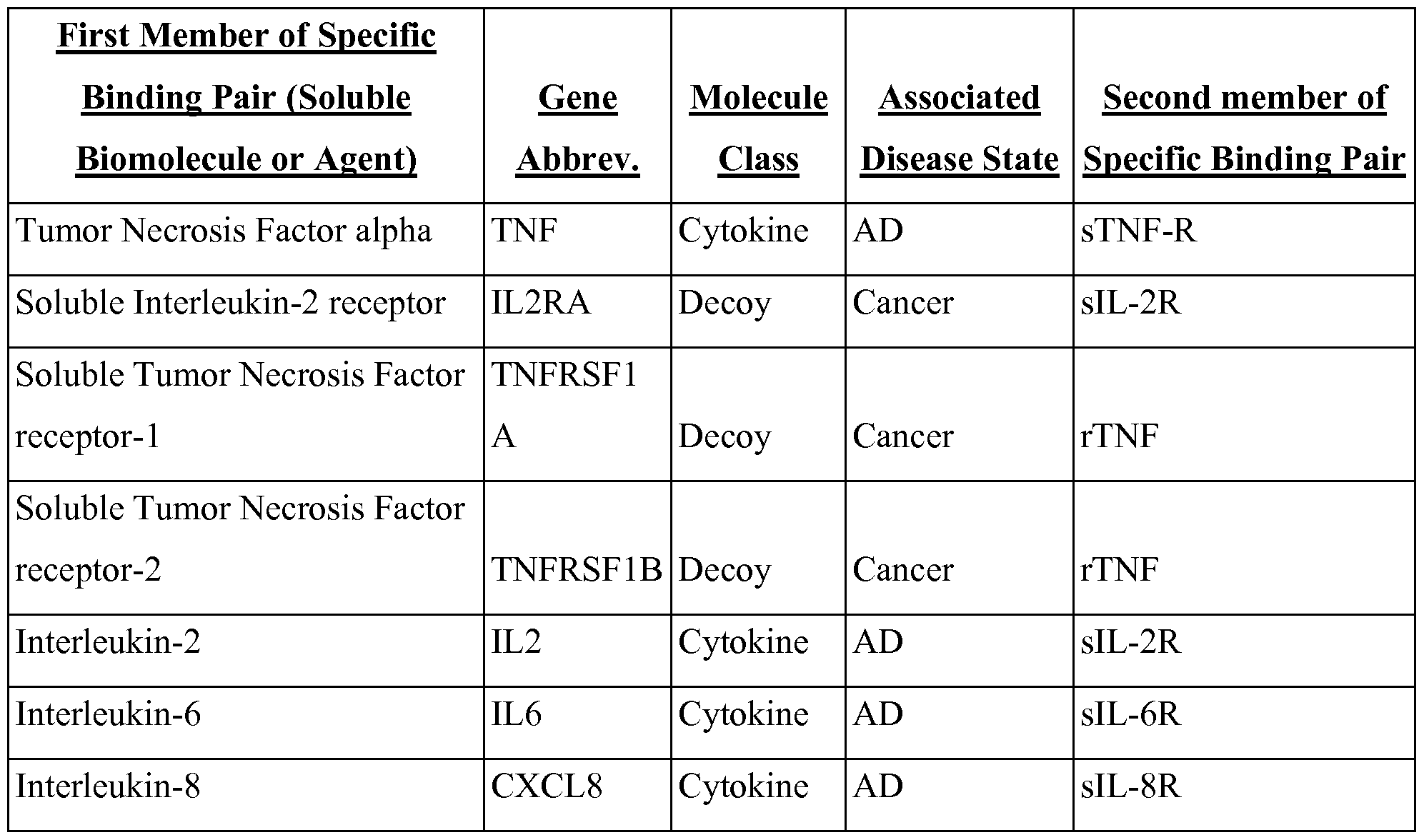
Claims
Priority Applications (18)
| Application Number | Priority Date | Filing Date | Title |
|---|---|---|---|
| AU2015327928A AU2015327928A1 (en) | 2014-10-03 | 2015-10-02 | Compositions and methods for inhibiting the biological activity of soluble biomolecules |
| MYPI2017000484A MY203626A (en) | 2014-10-03 | 2015-10-02 | Compositions and methods for inhibiting the biological activity of soluble biomolecules |
| KR1020177011587A KR102510540B1 (en) | 2014-10-03 | 2015-10-02 | Compositions and methods for inhibiting the biological activity of soluble biomolecules |
| CN201580065861.0A CN106999550B (en) | 2014-10-03 | 2015-10-02 | Compositions and methods for inhibiting biological activity of soluble biomolecules |
| CN202310118475.XA CN115957347A (en) | 2014-10-03 | 2015-10-02 | Compositions and methods for inhibiting biological activity of soluble biomolecules |
| EP15845555.0A EP3215176B1 (en) | 2014-10-03 | 2015-10-02 | Compositions and methods for inhibiting the biological activity of soluble biomolecules |
| KR1020237008615A KR20230042391A (en) | 2014-10-03 | 2015-10-02 | Compositions and methods for inhibiting the biological activity of soluble biomolecules |
| SG11201702304UA SG11201702304UA (en) | 2014-10-03 | 2015-10-02 | Compositions and methods for inhibiting the biological activity of soluble biomolecules |
| JP2017538165A JP6876608B2 (en) | 2014-10-03 | 2015-10-02 | Compositions and Methods for Inhibiting the Biological Activity of Soluble Biomolecules |
| BR112017006552A BR112017006552A2 (en) | 2014-10-03 | 2015-10-02 | compositions and methods for inhibiting the biological activity of soluble biomolecules |
| EA201790773A EA035898B1 (en) | 2014-10-03 | 2015-10-02 | Compositions and methods for inhibiting the biological activity of soluble biomolecules |
| MX2017003903A MX2017003903A (en) | 2014-10-03 | 2015-10-02 | COMPOSITIONS AND METHODS TO INHIBIT THE BIOLOGICAL ACTIVITY OF SOLUBLE BIOMOLECULES. |
| CN202310092283.6A CN115990272A (en) | 2014-10-03 | 2015-10-02 | Compositions and methods for inhibiting biological activity of soluble biomolecules |
| CA2962251A CA2962251A1 (en) | 2014-10-03 | 2015-10-02 | Compositions and methods for inhibiting the biological activity of soluble biomolecules |
| CN201710931432.8A CN107837389B (en) | 2014-10-03 | 2015-10-02 | Compositions and methods for inhibiting biological activity of soluble biomolecules |
| IL251232A IL251232B (en) | 2014-10-03 | 2017-03-16 | Compositions and methods for inhibiting the biological activity of soluble biomolecules |
| AU2021205051A AU2021205051B2 (en) | 2014-10-03 | 2021-07-14 | Compositions and methods for inhibiting the biological activity of soluble biomolecules |
| AU2025201024A AU2025201024A1 (en) | 2014-10-03 | 2025-02-14 | Compositions and methods for inhibiting the biological activity of soluble biomolecules |
Applications Claiming Priority (6)
| Application Number | Priority Date | Filing Date | Title |
|---|---|---|---|
| US201462059628P | 2014-10-03 | 2014-10-03 | |
| US62/059,628 | 2014-10-03 | ||
| US201562198541P | 2015-07-29 | 2015-07-29 | |
| US201562198519P | 2015-07-29 | 2015-07-29 | |
| US62/198,541 | 2015-07-29 | ||
| US62/198,519 | 2015-07-29 |
Publications (1)
| Publication Number | Publication Date |
|---|---|
| WO2016054522A1 true WO2016054522A1 (en) | 2016-04-07 |
Family
ID=55631617
Family Applications (1)
| Application Number | Title | Priority Date | Filing Date |
|---|---|---|---|
| PCT/US2015/053748 Ceased WO2016054522A1 (en) | 2014-10-03 | 2015-10-02 | Compositions and methods for inhibiting the biological activity of soluble biomolecules |
Country Status (14)
| Country | Link |
|---|---|
| US (6) | US9623081B2 (en) |
| EP (1) | EP3215176B1 (en) |
| JP (4) | JP6876608B2 (en) |
| KR (2) | KR20230042391A (en) |
| CN (4) | CN115957347A (en) |
| AU (3) | AU2015327928A1 (en) |
| BR (1) | BR112017006552A2 (en) |
| CA (1) | CA2962251A1 (en) |
| EA (1) | EA035898B1 (en) |
| IL (1) | IL251232B (en) |
| MX (2) | MX2017003903A (en) |
| MY (1) | MY203626A (en) |
| SG (1) | SG11201702304UA (en) |
| WO (1) | WO2016054522A1 (en) |
Cited By (8)
| Publication number | Priority date | Publication date | Assignee | Title |
|---|---|---|---|---|
| WO2017004159A1 (en) * | 2015-06-30 | 2017-01-05 | Ntercept, Llc | Compositions and methods related to scavanger particles |
| WO2017019949A1 (en) * | 2015-07-29 | 2017-02-02 | Ntercept, Llc | Modular compositions for scavenging soluble biomolecules and methods related thereto |
| US9623081B2 (en) | 2014-10-03 | 2017-04-18 | Ntercept, Llc | Compositions and methods for inhibiting the biological activity of soluble biomolecules |
| EP3097420A4 (en) * | 2014-01-24 | 2018-01-17 | Ntercept, LLC | Methods and compositions for immune dis-inhibition |
| WO2018129207A1 (en) * | 2017-01-04 | 2018-07-12 | Nanotics, Llc | Methods for assembling scavenging particles |
| WO2018129188A1 (en) * | 2017-01-04 | 2018-07-12 | Nanotics, Llc | Methods for assembling scavenging particles |
| CN109173755A (en) * | 2018-09-19 | 2019-01-11 | 苏州大学 | Super-hydrophobic multifunctional membrane and preparation method thereof and the application in water-oil separating |
| WO2020106619A1 (en) * | 2018-11-19 | 2020-05-28 | Board Of Regents, The University Of Texas System | Suicide gene |
Citations (41)
| Publication number | Priority date | Publication date | Assignee | Title |
|---|---|---|---|---|
| US3710795A (en) | 1970-09-29 | 1973-01-16 | Alza Corp | Drug-delivery device with stretched, rate-controlling membrane |
| US4863457A (en) | 1986-11-24 | 1989-09-05 | Lee David A | Drug delivery device |
| EP0430539A2 (en) | 1989-11-22 | 1991-06-05 | Visionex, Inc. | Ocular implants |
| EP0488401A1 (en) | 1990-11-30 | 1992-06-03 | Senju Pharmaceutical Co., Ltd. | A controlled-release pharmaceutical preparation for intra-ocular implant |
| WO1994004678A1 (en) | 1992-08-21 | 1994-03-03 | Casterman Cecile | Immunoglobulins devoid of light chains |
| WO1994025591A1 (en) | 1993-04-29 | 1994-11-10 | Unilever N.V. | PRODUCTION OF ANTIBODIES OR (FUNCTIONALIZED) FRAGMENTS THEREOF DERIVED FROM HEAVY CHAIN IMMUNOGLOBULINS OF $i(CAMELIDAE) |
| US5814272A (en) | 1996-02-21 | 1998-09-29 | Millipore Corporation | Method for forming dendritic metal particles |
| US6005079A (en) | 1992-08-21 | 1999-12-21 | Vrije Universiteit Brussels | Immunoglobulins devoid of light chains |
| DE10144251A1 (en) * | 2001-08-31 | 2003-03-27 | Fraunhofer Ges Forschung | Device for directed immobilization of proteins, useful for diagnosis or therapy, e.g. of tumors, includes surface with two types of functional groups for immobilization |
| US20040105821A1 (en) | 2002-09-30 | 2004-06-03 | Howard Bernstein | Sustained release pharmaceutical formulation for inhalation |
| WO2004071641A2 (en) * | 2003-02-10 | 2004-08-26 | Pointilliste, Inc. | Self-assembling arrays and uses thereof |
| US20040166166A1 (en) | 2002-12-25 | 2004-08-26 | Fuji Photo Film Co. Ltd. | Nano-particles and process for producing nano-particles |
| WO2005107802A2 (en) * | 2004-04-30 | 2005-11-17 | Biopheresis Technologies, Llc | Method and system to remove soluble tnfr1, tnfr2, and il2 in patients |
| US20080241223A1 (en) | 2004-04-30 | 2008-10-02 | Allergan, Inc. | Extended release biodegradable ocular implants |
| WO2008127515A1 (en) * | 2007-03-01 | 2008-10-23 | Cytologic, Inc. | Compositions and method for enhancing immune responses in mammals |
| US20080277346A1 (en) | 2006-02-13 | 2008-11-13 | Advanced Materials Technology, Inc. | Process for preparing substrates with porous surface |
| WO2009030492A2 (en) | 2007-09-05 | 2009-03-12 | Freie Universität Berlin | Functionalized nanoparticles for the inhibition of selectin-mediated cell adhesion |
| WO2010084088A2 (en) | 2009-01-21 | 2010-07-29 | Basf Se | Starch nanoparticles for drug delivery systems |
| US20110028662A1 (en) | 2007-08-31 | 2011-02-03 | Hybrid Silica Technologies, Inc. | Peg-coated core-shell silica nanoparticles and methods of manufacture and use |
| US7918842B2 (en) | 1996-07-02 | 2011-04-05 | Massachusetts Institute Of Technology | Medical device with controlled reservoir opening |
| US7932311B2 (en) | 2005-12-23 | 2011-04-26 | Centre National De La Recherche Scientifique (C.N.R.S.) | Synthesis of particles in dendritic structures |
| US20120108787A1 (en) | 2009-02-26 | 2012-05-03 | Nubiome, Inc. | Immobilization Particles for Removal of Microorganisms and/or Chemicals |
| US20120141797A1 (en) | 2010-04-21 | 2012-06-07 | Brookhaven Science Associates, Llc | Zwitterion-Linker Coatings for Nano-objects in Solutions of Multivalent Counterions |
| WO2012085891A2 (en) | 2010-12-24 | 2012-06-28 | Rijksuniversiteit Groningen | Tnf family ligand variants |
| WO2013011764A1 (en) | 2011-07-15 | 2013-01-24 | 国立大学法人 東京大学 | Silicon microparticles and method for synthesizing same |
| US20130039848A1 (en) | 2009-07-02 | 2013-02-14 | Cornell University | Fluorescent silica-based nanoparticles |
| WO2013029278A1 (en) | 2011-09-02 | 2013-03-07 | National Center For Nanoscience And Technology | A method for preparing functionalized silicon nanoparticles |
| US20130196450A1 (en) | 2010-10-13 | 2013-08-01 | Pharmadiagnostics Nv | Method for coating nanoparticles |
| US8574549B2 (en) | 2008-12-29 | 2013-11-05 | General Electric Company | Nanoparticle contrast agents for diagnostic imaging |
| US8586096B2 (en) | 2007-10-01 | 2013-11-19 | The Curators Of The University Of Missouri | Soy or lentil stabilized gold nanoparticles and method for making same |
| US20130323182A1 (en) | 2011-02-09 | 2013-12-05 | Hanwha Chemical Corporation | Method of preparing iron oxide nanoparticles coated with hydrophilic material, and magnetic resonance imaging contrast agent using the same |
| US20130337070A1 (en) | 2012-05-25 | 2013-12-19 | University Of Central Florida Research Foundation Inc. | Coated Nanoparticle Therapy for Skin Cancer |
| US8685538B2 (en) | 2009-03-25 | 2014-04-01 | Northeastern University | Stable polyelectrolyte coated nanoparticles |
| US20140147387A1 (en) | 2008-12-29 | 2014-05-29 | General Electric Company | Nanoparticle contrast agents for diagnostic imaging |
| US8778830B2 (en) | 2010-05-14 | 2014-07-15 | The University Of Hong Kong | Solid supported gold nanoparticles, methods of use thereof, and methods for making same |
| US20140199352A1 (en) | 2013-01-14 | 2014-07-17 | Xerox Corporation | Porous nanoparticles produced by solvent-free emulsification |
| US20140235803A1 (en) | 2005-08-25 | 2014-08-21 | University Of Washington | Particles coated with zwitterionic polymers |
| US20140248210A1 (en) | 2009-07-02 | 2014-09-04 | Cornell University | Multimodal silica-based nanoparticles |
| US20140271886A1 (en) | 2013-03-15 | 2014-09-18 | Psivida Corp | Bioerodible Silicon-Based Compositions for Delivery of Therapeutic Agents |
| WO2014170899A1 (en) | 2013-04-18 | 2014-10-23 | Bar-Ilan University | Systems comprising non-immunogenic and nuclease resistant nucleic acid origami devices for molecular computation |
| WO2015112842A1 (en) * | 2014-01-24 | 2015-07-30 | Ntercept, Llc | Methods and compositions for immune dis-inhibition |
Family Cites Families (38)
| Publication number | Priority date | Publication date | Assignee | Title |
|---|---|---|---|---|
| US8197430B1 (en) | 1998-05-22 | 2012-06-12 | Biopheresis Technologies, Inc. | Method and system to remove cytokine inhibitor in patients |
| US6620382B1 (en) | 1998-05-22 | 2003-09-16 | Biopheresis Technologies, Llc. | Method and compositions for treatment of cancers |
| ES2528307T3 (en) | 1999-11-10 | 2015-02-06 | Innatus Corporation | Method and system to eliminate the cytokine inhibitor in patients |
| EP1174129A1 (en) | 2000-07-17 | 2002-01-23 | Zenner, Hans Peter, Prof. Dr. med. | Use of a matrix-metalloprotease inhibitor for the treatment of cancer |
| JP2002248682A (en) * | 2001-02-26 | 2002-09-03 | Neoex Lab Inc | Mold for mounting skin and skin mounting method |
| DE10144252A1 (en) | 2001-08-31 | 2003-03-27 | Fraunhofer Ges Forschung | Nanoparticles with biologically active TNF immobilized on them |
| AU2003237532B2 (en) | 2002-06-12 | 2009-07-30 | Symphony Evolution, Inc. | Human ADAM-10 inhibitors |
| ES2401136T3 (en) | 2002-11-15 | 2013-04-17 | Genmab A/S | Human monoclonal antibodies against CD25 |
| EP1781818B1 (en) | 2004-07-22 | 2017-09-06 | Early Detection, LLC | CANCER AND INFLAMMATION DIAGNOSIS USING ANTI sTNFR ANTIBODIES |
| CN101123990A (en) | 2004-10-01 | 2008-02-13 | Mida科技有限公司 | Nanoparticles comprising antigen and adjuvant, and immunogenic constructs |
| WO2006086428A2 (en) * | 2005-02-08 | 2006-08-17 | Board Of Regents, The University Of Texas System | Particles for inactivating toxins |
| EP2056794A4 (en) | 2006-08-08 | 2012-12-26 | Univ Texas | ADMINISTRATION OF ACTIVE AGENTS WITH MULTIPLE STEPS |
| US20080075690A1 (en) | 2006-09-22 | 2008-03-27 | Mark Douglas Howell | Method for enhancing immune responses in mammals |
| WO2008041774A1 (en) * | 2006-10-02 | 2008-04-10 | National Institute For Materials Science | Sustained-release preparation having bone conduction ability |
| WO2009061853A2 (en) | 2007-11-05 | 2009-05-14 | Massachusetts Institute Of Technology | Mutant interleukin-2 (il-2) polypeptides |
| US20100008978A1 (en) * | 2008-05-09 | 2010-01-14 | The Regents Of The University Of California | Nanoparticles effective for internalization into cells |
| WO2010042555A2 (en) | 2008-10-06 | 2010-04-15 | The Brigham And Women's Hospital, Inc. | Particles with multiple functionalized surface domains |
| WO2010127099A2 (en) | 2009-04-29 | 2010-11-04 | Amarin Corporation Plc | Pharmaceutical compositions comprising epa and a cardiovascular agent and methods of using the same |
| EP2512522A4 (en) | 2009-12-16 | 2013-09-25 | Brigham & Womens Hospital | PARTICULARS FOR THE DELIVERY OF SEVERAL ACTIVE SUBSTANCES |
| SG10201804552WA (en) * | 2011-01-24 | 2018-07-30 | Anterios Inc | Nanoparticle compositions, formulations thereof, and uses therefor |
| WO2012163544A1 (en) | 2011-06-01 | 2012-12-06 | Biopheresis Technologies, Inc. | Removal of soluble tumor necrosis factor receptor 2 (stnfr2) |
| CN103857387B (en) | 2011-06-02 | 2017-03-15 | 加利福尼亚大学董事会 | Membrane-encapsulated nanoparticles and methods of use |
| AU2012303619B2 (en) | 2011-08-26 | 2017-01-19 | Vecoy Nanomedicines Ltd. | Pathogen and substance traps |
| WO2013095736A2 (en) | 2011-09-27 | 2013-06-27 | The Methodist Hospital Research Institute | Gold-in-silicon nanoassembly for thermal therapy and methods of use |
| US8926994B2 (en) | 2011-12-07 | 2015-01-06 | The Methodist Hospital Research Institute | Mesoporous silicon particles for the presentation of tumor antigens and adjuvant for anti-cancer immunity |
| WO2013179143A2 (en) | 2012-06-01 | 2013-12-05 | Biopheresis Technologies, Inc. | Sensitization of cancer cells by the removal of soluble tumor necrosis factor receptors |
| US10842749B2 (en) | 2012-06-12 | 2020-11-24 | The Methodist Hospital Research Institute | Compositions and methods of treating therapy resistant cancer and uses thereof |
| EP2895197B1 (en) | 2012-09-12 | 2020-02-26 | Ramot at Tel-Aviv University Ltd. | Immunoparticles and methods of generating and using same |
| US20140220133A1 (en) * | 2012-11-28 | 2014-08-07 | Cytimmune Sciences, Inc. | Nanotechnology Based Medicine for Biodefense |
| ITMI20130631A1 (en) * | 2013-04-18 | 2014-10-19 | Consiglio Nazionale Ricerche | METHOD OF REALIZING A WAVE GUIDE IN A SUBSTRATE VIA LASER IN FEMTOSECONDI |
| US20150112842A1 (en) | 2013-10-21 | 2015-04-23 | Insurance Auto Auctions, Inc. | Parts exchange method and apparatus |
| BR112017006552A2 (en) | 2014-10-03 | 2017-12-19 | Ntercept Llc | compositions and methods for inhibiting the biological activity of soluble biomolecules |
| US20180256747A1 (en) | 2015-06-30 | 2018-09-13 | Nanotics, Llc | Compositions and methods related to scavenger particles |
| KR20180034619A (en) | 2015-07-29 | 2018-04-04 | 나노틱스 엘엘씨 | Module compositions for eradicating soluble biomolecules and related methods |
| US20170056327A1 (en) | 2015-08-25 | 2017-03-02 | The Methodist Hospital | Micro/nano composite drug delivery formulations and uses thereof |
| WO2017176762A1 (en) | 2016-04-06 | 2017-10-12 | Nanotics, Llc | Particles comprising subparticles or nucleic acid scaffolds |
| WO2018129188A1 (en) | 2017-01-04 | 2018-07-12 | Nanotics, Llc | Methods for assembling scavenging particles |
| EP3565604A4 (en) | 2017-01-04 | 2020-09-09 | Nanotics, LLC | METHOD OF PLACEMENT OF DISHWASHING ITEMS |
-
2015
- 2015-10-02 BR BR112017006552A patent/BR112017006552A2/en not_active Application Discontinuation
- 2015-10-02 KR KR1020237008615A patent/KR20230042391A/en not_active Ceased
- 2015-10-02 CN CN202310118475.XA patent/CN115957347A/en active Pending
- 2015-10-02 US US14/873,847 patent/US9623081B2/en active Active
- 2015-10-02 KR KR1020177011587A patent/KR102510540B1/en active Active
- 2015-10-02 MX MX2017003903A patent/MX2017003903A/en unknown
- 2015-10-02 MY MYPI2017000484A patent/MY203626A/en unknown
- 2015-10-02 CN CN201710931432.8A patent/CN107837389B/en active Active
- 2015-10-02 CA CA2962251A patent/CA2962251A1/en active Pending
- 2015-10-02 AU AU2015327928A patent/AU2015327928A1/en not_active Abandoned
- 2015-10-02 JP JP2017538165A patent/JP6876608B2/en active Active
- 2015-10-02 SG SG11201702304UA patent/SG11201702304UA/en unknown
- 2015-10-02 CN CN202310092283.6A patent/CN115990272A/en active Pending
- 2015-10-02 WO PCT/US2015/053748 patent/WO2016054522A1/en not_active Ceased
- 2015-10-02 EP EP15845555.0A patent/EP3215176B1/en active Active
- 2015-10-02 EA EA201790773A patent/EA035898B1/en not_active IP Right Cessation
- 2015-10-02 CN CN201580065861.0A patent/CN106999550B/en active Active
-
2017
- 2017-03-06 US US15/450,769 patent/US9907831B2/en active Active
- 2017-03-16 IL IL251232A patent/IL251232B/en unknown
- 2017-03-24 MX MX2022006304A patent/MX2022006304A/en unknown
-
2018
- 2018-03-01 US US15/909,820 patent/US10420817B2/en active Active
-
2019
- 2019-08-07 US US16/534,428 patent/US10888602B2/en active Active
-
2020
- 2020-12-10 US US17/118,013 patent/US11771744B2/en active Active
-
2021
- 2021-02-08 JP JP2021018410A patent/JP2021098696A/en active Pending
- 2021-07-14 AU AU2021205051A patent/AU2021205051B2/en active Active
-
2022
- 2022-06-01 JP JP2022089328A patent/JP7485724B2/en active Active
-
2023
- 2023-08-17 US US18/234,936 patent/US20240226237A1/en active Pending
-
2024
- 2024-05-02 JP JP2024074584A patent/JP2024099810A/en active Pending
-
2025
- 2025-02-14 AU AU2025201024A patent/AU2025201024A1/en active Pending
Patent Citations (47)
| Publication number | Priority date | Publication date | Assignee | Title |
|---|---|---|---|---|
| US3710795A (en) | 1970-09-29 | 1973-01-16 | Alza Corp | Drug-delivery device with stretched, rate-controlling membrane |
| US4863457A (en) | 1986-11-24 | 1989-09-05 | Lee David A | Drug delivery device |
| EP0430539A2 (en) | 1989-11-22 | 1991-06-05 | Visionex, Inc. | Ocular implants |
| US5164188A (en) | 1989-11-22 | 1992-11-17 | Visionex, Inc. | Biodegradable ocular implants |
| US5501856A (en) | 1990-11-30 | 1996-03-26 | Senju Pharmaceutical Co., Ltd. | Controlled-release pharmaceutical preparation for intra-ocular implant |
| EP0488401A1 (en) | 1990-11-30 | 1992-06-03 | Senju Pharmaceutical Co., Ltd. | A controlled-release pharmaceutical preparation for intra-ocular implant |
| US6015695A (en) | 1992-08-21 | 2000-01-18 | Vrije Universiteit Brussel | Immunoglobulins devoid of light chains |
| US6005079A (en) | 1992-08-21 | 1999-12-21 | Vrije Universiteit Brussels | Immunoglobulins devoid of light chains |
| WO1994004678A1 (en) | 1992-08-21 | 1994-03-03 | Casterman Cecile | Immunoglobulins devoid of light chains |
| US7794981B2 (en) | 1993-04-29 | 2010-09-14 | Bac Ip B.V. | Prosuction of antibodies or (functionalized) fragments thereof derived from heavy chain immunoglobulins of camelidae |
| WO1994025591A1 (en) | 1993-04-29 | 1994-11-10 | Unilever N.V. | PRODUCTION OF ANTIBODIES OR (FUNCTIONALIZED) FRAGMENTS THEREOF DERIVED FROM HEAVY CHAIN IMMUNOGLOBULINS OF $i(CAMELIDAE) |
| US5814272A (en) | 1996-02-21 | 1998-09-29 | Millipore Corporation | Method for forming dendritic metal particles |
| US7918842B2 (en) | 1996-07-02 | 2011-04-05 | Massachusetts Institute Of Technology | Medical device with controlled reservoir opening |
| DE10144251A1 (en) * | 2001-08-31 | 2003-03-27 | Fraunhofer Ges Forschung | Device for directed immobilization of proteins, useful for diagnosis or therapy, e.g. of tumors, includes surface with two types of functional groups for immobilization |
| US20040105821A1 (en) | 2002-09-30 | 2004-06-03 | Howard Bernstein | Sustained release pharmaceutical formulation for inhalation |
| US20040166166A1 (en) | 2002-12-25 | 2004-08-26 | Fuji Photo Film Co. Ltd. | Nano-particles and process for producing nano-particles |
| WO2004071641A2 (en) * | 2003-02-10 | 2004-08-26 | Pointilliste, Inc. | Self-assembling arrays and uses thereof |
| WO2005107802A2 (en) * | 2004-04-30 | 2005-11-17 | Biopheresis Technologies, Llc | Method and system to remove soluble tnfr1, tnfr2, and il2 in patients |
| US20080241223A1 (en) | 2004-04-30 | 2008-10-02 | Allergan, Inc. | Extended release biodegradable ocular implants |
| US20140235803A1 (en) | 2005-08-25 | 2014-08-21 | University Of Washington | Particles coated with zwitterionic polymers |
| US7932311B2 (en) | 2005-12-23 | 2011-04-26 | Centre National De La Recherche Scientifique (C.N.R.S.) | Synthesis of particles in dendritic structures |
| US20080277346A1 (en) | 2006-02-13 | 2008-11-13 | Advanced Materials Technology, Inc. | Process for preparing substrates with porous surface |
| WO2008127515A1 (en) * | 2007-03-01 | 2008-10-23 | Cytologic, Inc. | Compositions and method for enhancing immune responses in mammals |
| US20110028662A1 (en) | 2007-08-31 | 2011-02-03 | Hybrid Silica Technologies, Inc. | Peg-coated core-shell silica nanoparticles and methods of manufacture and use |
| WO2009030492A2 (en) | 2007-09-05 | 2009-03-12 | Freie Universität Berlin | Functionalized nanoparticles for the inhibition of selectin-mediated cell adhesion |
| US8586096B2 (en) | 2007-10-01 | 2013-11-19 | The Curators Of The University Of Missouri | Soy or lentil stabilized gold nanoparticles and method for making same |
| US20140147387A1 (en) | 2008-12-29 | 2014-05-29 | General Electric Company | Nanoparticle contrast agents for diagnostic imaging |
| US8574549B2 (en) | 2008-12-29 | 2013-11-05 | General Electric Company | Nanoparticle contrast agents for diagnostic imaging |
| WO2010084088A2 (en) | 2009-01-21 | 2010-07-29 | Basf Se | Starch nanoparticles for drug delivery systems |
| US20120108787A1 (en) | 2009-02-26 | 2012-05-03 | Nubiome, Inc. | Immobilization Particles for Removal of Microorganisms and/or Chemicals |
| US8685538B2 (en) | 2009-03-25 | 2014-04-01 | Northeastern University | Stable polyelectrolyte coated nanoparticles |
| US20140248210A1 (en) | 2009-07-02 | 2014-09-04 | Cornell University | Multimodal silica-based nanoparticles |
| US20130039848A1 (en) | 2009-07-02 | 2013-02-14 | Cornell University | Fluorescent silica-based nanoparticles |
| US20120141797A1 (en) | 2010-04-21 | 2012-06-07 | Brookhaven Science Associates, Llc | Zwitterion-Linker Coatings for Nano-objects in Solutions of Multivalent Counterions |
| US8778830B2 (en) | 2010-05-14 | 2014-07-15 | The University Of Hong Kong | Solid supported gold nanoparticles, methods of use thereof, and methods for making same |
| US20130196450A1 (en) | 2010-10-13 | 2013-08-01 | Pharmadiagnostics Nv | Method for coating nanoparticles |
| US20140096274A1 (en) | 2010-12-24 | 2014-04-03 | Wilhelmus Johannes Quax | TNF Family Ligand Variants |
| WO2012085891A2 (en) | 2010-12-24 | 2012-06-28 | Rijksuniversiteit Groningen | Tnf family ligand variants |
| US20130323182A1 (en) | 2011-02-09 | 2013-12-05 | Hanwha Chemical Corporation | Method of preparing iron oxide nanoparticles coated with hydrophilic material, and magnetic resonance imaging contrast agent using the same |
| WO2013011764A1 (en) | 2011-07-15 | 2013-01-24 | 国立大学法人 東京大学 | Silicon microparticles and method for synthesizing same |
| WO2013029278A1 (en) | 2011-09-02 | 2013-03-07 | National Center For Nanoscience And Technology | A method for preparing functionalized silicon nanoparticles |
| US20130337070A1 (en) | 2012-05-25 | 2013-12-19 | University Of Central Florida Research Foundation Inc. | Coated Nanoparticle Therapy for Skin Cancer |
| US20140199352A1 (en) | 2013-01-14 | 2014-07-17 | Xerox Corporation | Porous nanoparticles produced by solvent-free emulsification |
| US20140271886A1 (en) | 2013-03-15 | 2014-09-18 | Psivida Corp | Bioerodible Silicon-Based Compositions for Delivery of Therapeutic Agents |
| WO2014151381A1 (en) | 2013-03-15 | 2014-09-25 | Psivida Us, Inc. | Bioerodible silicon-based compositions for delivery of therapeutic agents |
| WO2014170899A1 (en) | 2013-04-18 | 2014-10-23 | Bar-Ilan University | Systems comprising non-immunogenic and nuclease resistant nucleic acid origami devices for molecular computation |
| WO2015112842A1 (en) * | 2014-01-24 | 2015-07-30 | Ntercept, Llc | Methods and compositions for immune dis-inhibition |
Non-Patent Citations (40)
| Title |
|---|
| ALI ET AL., J BIOL CHEM, vol. 274, 1999, pages 24066 - 24073 |
| BRANNON-PEPPAS ET AL., J. DRUG DELIVERY SCI. TECH., vol. 14, no. 4, 2004, pages 257 - 264 |
| BUMS ET AL., NANO LETTERS, vol. 9, no. 1, 2009, pages 442 - 448 |
| CANNON, G.J.SWANSON, J.A., J. CELL SCIENCE, vol. 101, 1992, pages 907 - 913 |
| CHAMPION, J.A. ET AL., PHARM RES, vol. 25, no. 8, 2008, pages 1815 - 1821 |
| CHOI ET AL., J. OF DISPERSION SCI. TECH., vol. 24, no. 3/4, 2003, pages 475 - 487 |
| CHOI, H.S. ET AL., NAT BIOTECHNOL, vol. 25, no. 1, 2007, pages 1165 |
| COHEN, H ET AL., GENE THER, vol. 7, 2000, pages 1896 |
| COLE ET AL.: "Monoclonal Antibodies and Cancer Therapy", 1985, ALAN R. LISS, INC., pages: 77 - 96 |
| DONG ET AL., REVIEWS IN MOL BIOTECH, vol. 82, 2002, pages 303 - 323 |
| DU, SMALL, vol. 11, no. 4, 2015, pages 392 - 413 |
| EGLEN ET AL., CURR CHEM GENOMICS, vol. 1, 2008, pages 2 - 10 |
| FIVASH ET AL., CURR OPIN BIOTECHNOL, vol. 9, 1998, pages 97 - 101 |
| HANOUSKA ET AL., CLIN CANCER RES, vol. 13, 2007, pages 523 - 531 |
| HETHERINGTON ET AL., ANTIMICROBIAL AGENTS AND CHEMOTHERAPY, vol. 50, no. 10, 2006, pages 3499 - 3500 |
| HEY ET AL., TRENDS BIOTECHNOL, vol. 23, no. 10, 2005, pages 514 - 522 |
| HRKACH, J. S. ET AL., BIOMATERIALS, vol. 18, 1997, pages 27 |
| HUDSONKORTT, J IMMUNOL METHODS, vol. 231, no. 1, 1999, pages 177 - 189 |
| J AIII CHEM SOC, vol. 120, 1998, pages 8565 - 8566 |
| J CELL BIOCHEM, vol. 60, no. 2, 1996, pages 226 - 234 |
| KOHLERMILSTEIN, NATURE, vol. 256, 1975, pages 495 - 497 |
| KOZBAR ET AL., IMMUNOLOGY TODAY, vol. 4, 1983, pages 72 |
| LONGMIRE, M. ET AL., NANOMEDICINE, vol. 3, no. 5, 2008, pages 703 |
| MULLETT ET AL., METHODS, vol. 22, 2000, pages 77 - 91 |
| MUYLDERMANS ET AL., TRENDS BIOCHEM SCI, vol. 26, 2001, pages 230 - 235 |
| NUTTALL ET AL., CURR PHARM BIOTECH, vol. 1, 2000, pages 253 - 263 |
| POLJAK, STRUCTURE, vol. 2, no. 12, 1994, pages 1121 - 1123 |
| REICHMANN ET AL., J IMMUNOL METH, vol. 231, 1999, pages 25 - 38 |
| RICH ET AL., CURR OPIN BIOTECHNOL, vol. 11, 2000, pages 54 - 61 |
| RONDONMARASCO, ANNUAL REVIEW OF MICROBIOLOGY, vol. 51, 1997, pages 257 - 283 |
| See also references of EP3215176A4 |
| SGLAVO, V. M. ET AL., J. MATER SCI., vol. 28, 1993, pages 6437 |
| SHI, D. ET AL., APPL. PHYS. LETT., vol. 78, 2001, pages 1243 |
| TAKEO, O. ET AL., J. MATER. CHEM., vol. 8, 1998, pages 1323 |
| TODOROVSKA ET AL., J IMMUNOL METHODS, vol. 248, no. 1, 2001, pages 47 - 66 |
| ULRICH, HANDB EXP PHARMACOL, vol. 173, 2006, pages 305 - 326 |
| VAN GURP ET AL., AM J TRANSPLANTATION, vol. 8, no. 8, 2008, pages 1711 - 1718 |
| VOLLATH, D. ET AL., J. NANOPARTICLE RES., vol. 1, 1999, pages 235 |
| WANG, D. ET AL., J. CONTROL. REL., vol. 57, 1999, pages 9 |
| ZHANG, Y. ET AL., SOLID STATE COMMUN, vol. 115, 2000, pages 51 |
Cited By (23)
| Publication number | Priority date | Publication date | Assignee | Title |
|---|---|---|---|---|
| EP3097420A4 (en) * | 2014-01-24 | 2018-01-17 | Ntercept, LLC | Methods and compositions for immune dis-inhibition |
| US10420817B2 (en) | 2014-10-03 | 2019-09-24 | Nanotics, Llc | Compositions and methods for inhibiting the biological activity of soluble biomolecules |
| US11771744B2 (en) | 2014-10-03 | 2023-10-03 | Nanotics, Llc | Compositions and methods for inhibiting the biological activity of soluble biomolecules |
| US9623081B2 (en) | 2014-10-03 | 2017-04-18 | Ntercept, Llc | Compositions and methods for inhibiting the biological activity of soluble biomolecules |
| US9907831B2 (en) | 2014-10-03 | 2018-03-06 | Nanotics, Llc | Compositions and methods for inhibiting the biological activity of soluble biomolecules |
| US10888602B2 (en) | 2014-10-03 | 2021-01-12 | Nanotics, Llc | Compositions and methods for inhibiting the biological activity of soluble biomolecules |
| CN108135848A (en) * | 2015-06-30 | 2018-06-08 | 纳米提克斯有限责任公司 | Compositions and methods related to removing particles |
| CN114129737A (en) * | 2015-06-30 | 2022-03-04 | 纳米提克斯有限责任公司 | Compositions and methods related to particle removal |
| WO2017004159A1 (en) * | 2015-06-30 | 2017-01-05 | Ntercept, Llc | Compositions and methods related to scavanger particles |
| US10653790B2 (en) | 2015-07-29 | 2020-05-19 | Nanotics, Llc | Compositions and methods related to scavenger particles |
| WO2017019949A1 (en) * | 2015-07-29 | 2017-02-02 | Ntercept, Llc | Modular compositions for scavenging soluble biomolecules and methods related thereto |
| JP2023075293A (en) * | 2017-01-04 | 2023-05-30 | ナノティックス,エルエルシー | Method for assembling entrapped particles |
| EP3565604A4 (en) * | 2017-01-04 | 2020-09-09 | Nanotics, LLC | METHOD OF PLACEMENT OF DISHWASHING ITEMS |
| JP2020504177A (en) * | 2017-01-04 | 2020-02-06 | ナノティックス,エルエルシー | Method for assembling trapped particles |
| US11065345B2 (en) | 2017-01-04 | 2021-07-20 | Nanotics, Llc | Methods for assembling scavenging particles |
| WO2018129207A1 (en) * | 2017-01-04 | 2018-07-12 | Nanotics, Llc | Methods for assembling scavenging particles |
| IL267765B1 (en) * | 2017-01-04 | 2023-03-01 | Nanotics Llc | Methods for assembling scavenging particles |
| WO2018129188A1 (en) * | 2017-01-04 | 2018-07-12 | Nanotics, Llc | Methods for assembling scavenging particles |
| IL267765B2 (en) * | 2017-01-04 | 2023-07-01 | Nanotics Llc | Methods for assembling scavenging particles |
| US12083186B2 (en) | 2017-01-04 | 2024-09-10 | Nanotics, Llc | Methods for assembling scavenging particles |
| CN109173755B (en) * | 2018-09-19 | 2020-04-03 | 苏州大学 | Super-hydrophobic multifunctional membrane, preparation method thereof and application thereof in oil-water separation |
| CN109173755A (en) * | 2018-09-19 | 2019-01-11 | 苏州大学 | Super-hydrophobic multifunctional membrane and preparation method thereof and the application in water-oil separating |
| WO2020106619A1 (en) * | 2018-11-19 | 2020-05-28 | Board Of Regents, The University Of Texas System | Suicide gene |
Also Published As
Similar Documents
| Publication | Publication Date | Title |
|---|---|---|
| US11771744B2 (en) | Compositions and methods for inhibiting the biological activity of soluble biomolecules | |
| AU2022200233B2 (en) | Compositions and methods related to scavenger particles | |
| WO2017176762A1 (en) | Particles comprising subparticles or nucleic acid scaffolds | |
| HK40095344A (en) | Compositions and methods for inhibiting the biological activity of soluble biomolecules | |
| HK40095343A (en) | Compositions and methods for inhibiting the biological activity of soluble biomolecules | |
| HK1252911B (en) | Compositions and methods for inhibiting the biological activity of soluble biomolecules | |
| HK1242184A1 (en) | Compositions and methods for inhibiting the biological activity of soluble biomolecules | |
| HK1242184B (en) | Compositions and methods for inhibiting the biological activity of soluble biomolecules | |
| HK40069974A (en) | Compositions and methods related to scavanger particles |
Legal Events
| Date | Code | Title | Description |
|---|---|---|---|
| 121 | Ep: the epo has been informed by wipo that ep was designated in this application |
Ref document number: 15845555 Country of ref document: EP Kind code of ref document: A1 |
|
| WWE | Wipo information: entry into national phase |
Ref document number: 251232 Country of ref document: IL |
|
| ENP | Entry into the national phase |
Ref document number: 2962251 Country of ref document: CA |
|
| WWE | Wipo information: entry into national phase |
Ref document number: MX/A/2017/003903 Country of ref document: MX |
|
| ENP | Entry into the national phase |
Ref document number: 2017538165 Country of ref document: JP Kind code of ref document: A |
|
| NENP | Non-entry into the national phase |
Ref country code: DE |
|
| REG | Reference to national code |
Ref country code: BR Ref legal event code: B01A Ref document number: 112017006552 Country of ref document: BR |
|
| ENP | Entry into the national phase |
Ref document number: 20177011587 Country of ref document: KR Kind code of ref document: A |
|
| WWE | Wipo information: entry into national phase |
Ref document number: 201790773 Country of ref document: EA |
|
| REEP | Request for entry into the european phase |
Ref document number: 2015845555 Country of ref document: EP |
|
| ENP | Entry into the national phase |
Ref document number: 2015327928 Country of ref document: AU Date of ref document: 20151002 Kind code of ref document: A |
|
| ENP | Entry into the national phase |
Ref document number: 112017006552 Country of ref document: BR Kind code of ref document: A2 Effective date: 20170330 |