WO2015200425A1 - Topical dosage regimen - Google Patents
Topical dosage regimen Download PDFInfo
- Publication number
- WO2015200425A1 WO2015200425A1 PCT/US2015/037323 US2015037323W WO2015200425A1 WO 2015200425 A1 WO2015200425 A1 WO 2015200425A1 US 2015037323 W US2015037323 W US 2015037323W WO 2015200425 A1 WO2015200425 A1 WO 2015200425A1
- Authority
- WO
- WIPO (PCT)
- Prior art keywords
- percent
- certain embodiments
- optionally substituted
- alkyl
- hours
- Prior art date
- Legal status (The legal status is an assumption and is not a legal conclusion. Google has not performed a legal analysis and makes no representation as to the accuracy of the status listed.)
- Ceased
Links
- 0 C[C@](CCCCCC(*)*)CC1[C@@]2C(*)CC(*)C2C1CC[C@@](*)C** Chemical compound C[C@](CCCCCC(*)*)CC1[C@@]2C(*)CC(*)C2C1CC[C@@](*)C** 0.000 description 4
- YXFVVABEGXRONW-UHFFFAOYSA-N Cc1ccccc1 Chemical compound Cc1ccccc1 YXFVVABEGXRONW-UHFFFAOYSA-N 0.000 description 1
Classifications
-
- A—HUMAN NECESSITIES
- A61—MEDICAL OR VETERINARY SCIENCE; HYGIENE
- A61K—PREPARATIONS FOR MEDICAL, DENTAL OR TOILETRY PURPOSES
- A61K31/00—Medicinal preparations containing organic active ingredients
- A61K31/557—Eicosanoids, e.g. leukotrienes or prostaglandins
- A61K31/5575—Eicosanoids, e.g. leukotrienes or prostaglandins having a cyclopentane, e.g. prostaglandin E2, prostaglandin F2-alpha
-
- A—HUMAN NECESSITIES
- A61—MEDICAL OR VETERINARY SCIENCE; HYGIENE
- A61K—PREPARATIONS FOR MEDICAL, DENTAL OR TOILETRY PURPOSES
- A61K47/00—Medicinal preparations characterised by the non-active ingredients used, e.g. carriers or inert additives; Targeting or modifying agents chemically bound to the active ingredient
- A61K47/06—Organic compounds, e.g. natural or synthetic hydrocarbons, polyolefins, mineral oil, petrolatum or ozokerite
-
- A—HUMAN NECESSITIES
- A61—MEDICAL OR VETERINARY SCIENCE; HYGIENE
- A61K—PREPARATIONS FOR MEDICAL, DENTAL OR TOILETRY PURPOSES
- A61K47/00—Medicinal preparations characterised by the non-active ingredients used, e.g. carriers or inert additives; Targeting or modifying agents chemically bound to the active ingredient
- A61K47/06—Organic compounds, e.g. natural or synthetic hydrocarbons, polyolefins, mineral oil, petrolatum or ozokerite
- A61K47/08—Organic compounds, e.g. natural or synthetic hydrocarbons, polyolefins, mineral oil, petrolatum or ozokerite containing oxygen, e.g. ethers, acetals, ketones, quinones, aldehydes, peroxides
- A61K47/14—Esters of carboxylic acids, e.g. fatty acid monoglycerides, medium-chain triglycerides, parabens or PEG fatty acid esters
-
- A—HUMAN NECESSITIES
- A61—MEDICAL OR VETERINARY SCIENCE; HYGIENE
- A61K—PREPARATIONS FOR MEDICAL, DENTAL OR TOILETRY PURPOSES
- A61K9/00—Medicinal preparations characterised by special physical form
- A61K9/0012—Galenical forms characterised by the site of application
- A61K9/0014—Skin, i.e. galenical aspects of topical compositions
-
- A—HUMAN NECESSITIES
- A61—MEDICAL OR VETERINARY SCIENCE; HYGIENE
- A61K—PREPARATIONS FOR MEDICAL, DENTAL OR TOILETRY PURPOSES
- A61K9/00—Medicinal preparations characterised by special physical form
- A61K9/06—Ointments; Bases therefor; Other semi-solid forms, e.g. creams, sticks, gels
-
- A—HUMAN NECESSITIES
- A61—MEDICAL OR VETERINARY SCIENCE; HYGIENE
- A61P—SPECIFIC THERAPEUTIC ACTIVITY OF CHEMICAL COMPOUNDS OR MEDICINAL PREPARATIONS
- A61P27/00—Drugs for disorders of the senses
-
- A—HUMAN NECESSITIES
- A61—MEDICAL OR VETERINARY SCIENCE; HYGIENE
- A61P—SPECIFIC THERAPEUTIC ACTIVITY OF CHEMICAL COMPOUNDS OR MEDICINAL PREPARATIONS
- A61P43/00—Drugs for specific purposes, not provided for in groups A61P1/00-A61P41/00
Definitions
- This invention relates to a novel dosage regimen for a prostaglandin FP receptor agonist (a PFPRA compound), e.g., latanoprost, bimatoprost, tafluprost, travoprost, and prodrugs thereof, administered to the skin.
- a PFPRA compound e.g., latanoprost, bimatoprost, tafluprost, travoprost, and prodrugs thereof
- the dosage regimen is useful for local reduction of subcutaneous fat, for example, in individuals with local excesses of subcutaneous fat.
- the dosage regimen improves a user's comfort and convenience while achieving the desired drug delivery.
- the efficacy of a drug depends on the degree of drug exposure in the target tissue, e.g., the excess adipose tissue, e.g., subcutaneous fat.
- a standard measure of drug exposure is the area under the time-concentration curve (AUC) in the target tissue.
- PFPRA compound prostaglandin FP receptor agonist
- the present invention arises from the experimental discovery that PFPRA compounds possess unexpectedly different pharmacokinetic properties in subcutaneous fat and dermis, compared to other previously studied compartments, such as plasma and the eye. Briefly, it has been discovered that when a PFPRA compound is applied to surface of skin (for example, in certain ointment and gel formulations), most of the delivery into the dermis or across the skin is achieved within 4-12 hours. Furthermore, the compound (or its active metabolite) remains in the dermis or subcutaneous fat for 24 hours or more. This is surprising, because it is typical for PFPRA compounds to be rapidly metabolized and cleared from the body. For example, when latanoprost is administered intravenously or
- topical compositions comprising a PFPRA compound are removed after most of a daily dose is delivered (e.g., about 4 to 8 hours after application), longer exposure on the skin surface is unnecessary, and the topical composition or residue thereof can be removed from the skin surface.
- a daily dose e.g., about 4 to 8 hours after application
- Removal of the topical composition means gross removal (e.g., removal of at least 80%, 85%, 90%, 95%, 99%, or 100%) of the remaining topical composition or residue thereof, including any remaining PFPRA compound and any remaining excipients, from the skin surface, e.g., by washing, bathing, scrubbing, scraping, removing patches, and the like, and/or stripping from the skin.
- some ingredients of the topical composition can be volatile and can evaporate following application to the skin thereby leaving a residue. Other ingredients do not necessarily evaporate.
- PFPRA compounds are not volatile compounds.
- a prostaglandin FP receptor agonist compound for topical use in reducing body fat, whereby the duration of skin surface exposure to the composition or residue thereof is between about 4 hours and about 12 hours per dose of the composition.
- a method for locally reducing body fat in a subject in need thereof comprising administering a topical composition comprising a PFPRA compound to the skin surface, and removing the topical composition or residue thereof from the skin surface between about 4 hours and about 12 hours after said
- the dermis has taken up at least 80% of maximal load by the PFPRA compound (or active metabolite thereof) within about 4 to about 12 hours of administration (with maximal load as defined herein).
- the step of removing comprises removing the composition or residue thereof from the skin surface after the dermis has taken up at least 80% of maximal load.
- more than about 60 percent of the 24-hour transcutaneous flux occurs within 4 to 12 hours after administration.
- the step of removing comprises removing the composition or residue thereof from the skin surface after more than about 60 percent of the 24-hour transcutaneous flux has occurred.
- kits comprising a topical fat-reducing composition and instructions for use, wherein the composition comprises a PFPRA compound, and wherein the instructions provide for a duration of skin surface exposure to the composition or residue thereof of between about 4 hours and about 12 hours per dose of the composition.
- the dose frequency is about once every 24 hours.
- the PFPRA compound is selected from the group consisting of latanoprost, tafluprost, travoprost, bimatoprost, and pharmaceutically acceptable salts, hydrates, solvates, stereoisomers, polymorphs, tautomers, isotopically enriched derivatives, or prodrugs thereof.
- the PFPRA compound is hydrolyzed in the skin to an active metabolite.
- latanoprost is a prodrug that is hydrolyzed in the skin to yield latanoprost free acid.
- tafluprost is a prodrug that is hydrolyzed in the skin to yield tafluprost free acid.
- travoprost is a prodrug that is hydrolyzed in the skin to yield travoprost free acid (aka fluprostenol).
- bimatoprost is a prodrug that is hydrolyzed in the skin to yield bimatoprost free acid.
- Certain compounds as described herein can comprise one or more asymmetric centers, and thus can exist in various isomeric forms, e.g., enantiomers and/or diastereomers.
- the compounds provided herein can be in the form of an individual enantiomer, diastereomer or geometric isomer, or can be in the form of a mixture of stereoisomers, including racemic mixtures and mixtures enriched in one or more stereoisomer.
- the compounds as described herein are enantiopure compounds. In certain other embodiments, mixtures of stereoisomers are provided.
- certain compounds, as described herein may have one or more double bonds that can exist as either the cis or trans, or the E or Z isomer, unless otherwise indicated.
- the invention additionally encompasses the compounds as individual isomers substantially free of other isomers, and alternatively, as mixtures of various isomers, e.g., racemic mixtures of E/Z isomers or mixtures enriched in one E/Z isomer.
- an enantiomerically enriched preparation of the (S)-enantiomer means a preparation of the compound having greater than 50% by weight of the (S)-enantiomer relative to the (R)- enantiomer, more preferably at least 75% by weight, and even more preferably at least 80% by weight.
- the enrichment can be much greater than 80% by weight, providing a "substantially enantiomerically enriched,” “substantially enantiomerically pure” or a “substantially non-racemic” preparation, which refers to preparations of compositions which have at least 85% by weight of one enantiomer relative to other enantiomer, more preferably at least 90% by weight, and even more preferably at least 95% by weight.
- the enantiomerically enriched composition has a higher potency with respect to therapeutic utility per unit mass than does the racemic mixture of that composition.
- Enantiomers can be isolated from mixtures by methods known to those skilled in the art, including chiral high pressure liquid chromatography (HPLC) and the formation and crystallization of chiral salts; or preferred enantiomers can be prepared by asymmetric syntheses. See, for example, Jacques, et ah, Enantiomers, Racemates and Resolutions (Wiley Interscience, New York, 1981); Wilen, S.H., et ah, Tetrahedron 33:2725 (1977); Eliel, E.L. Stereochemistry of Carbon Compounds (McGraw-Hill, NY, 1962); and Wilen, S.H. Tables of Resolving Agents and Optical Resolutions p. 268 (E.L. Eliel, Ed., Univ. of Notre Dame Press, Notre Dame, IN 1972).
- aliphatic refers to an alkyl, alkenyl, alkynyl, or carbocyclyl group, as defined herein.
- alkyl refers to a radical of a straight-chain or branched saturated hydrocarbon group having from 1 to 30 carbon atoms (“C ⁇ o alkyl”). In some embodiments, an alkyl group has 1 to 20 carbon atoms (“C ⁇ o alkyl”). In some embodiments, an alkyl group has 1 to 10 carbon atoms (“C ⁇ o alkyl”). In some embodiments, an alkyl group has 1 to 6 carbon atoms (“C ⁇ alkyl”). In some embodiments, an alkyl group has 1 to 5 carbon atoms (“Q-5 alkyl”). In some embodiments, an alkyl group has 1 to 4 carbon atoms ("C ⁇ alkyl”).
- an alkyl group has 1 to 3 carbon atoms ("C ⁇ alkyl”). In some embodiments, an alkyl group has 1 to 2 carbon atoms (“Ci_ 2 alkyl”). In some embodiments, an alkyl group has 1 carbon atom (“Q alkyl”). In some embodiments, an alkyl group has 2 to 6 carbon atoms (“C 2 -6 alkyl”).
- Ci- ⁇ alkyl groups include methyl (CO, ethyl (C 2 ), n-propyl (C 3 ), isopropyl (C 3 ), n-butyl (C 4 ), tert-butyl (C 4 ), sec-butyl (C 4 ), iso-butyl (C 4 ), n-pentyl (C 5 ), 3-pentanyl (C 5 ), amyl (C 5 ), neopentyl (C 5 ), 3-methyl-2-butanyl (C 5 ), tertiary amyl (C 5 ), and n-hexyl (C 6 ).
- each instance of an alkyl group is independently unsubstituted (an "unsubstituted alkyl") or substituted (a "substituted alkyl") are substituted with one or more substituents.
- the alkyl group is an unsubstituted Ci_ 3 o alkyl.
- the alkyl group is a substituted Ci_ 3 o alkyl.
- perhaloalkyl refers to an alkyl group having from having from 1 to 30 carbon atoms wherein all of the hydrogen atoms are each independently replaced halogen, e.g., selected from fluoro, bromo, chloro or iodo ("C ⁇ o perhaloalkyl").
- the perhaloalkyl has 1 to 20 carbon atoms ("Ci_ 2 o perhaloalkyl”).
- the perhaloalkyl has 1 to 10 carbon atoms ("C ⁇ o perhaloalkyl”).
- the perhaloalkyl has 1 to 6 carbon atoms ("C ⁇ perhaloalkyl").
- the perhaloalkyl has 1 to 5 carbon atoms ("Q-5 perhaloalkyl”). In some embodiments, the perhaloalkyl has 1 to 4 carbon atoms ("C ⁇ perhaloalkyl”). In some embodiments, the perhaloalkyl has 1 to 3 carbon atoms (“Ci_ 3 perhaloalkyl”). In some embodiments, the perhaloalkyl has 1 to 2 carbon atoms ("C ⁇ perhaloalkyl”). In some embodiments, all of the hydrogen atoms are each replaced with fluoro. In some embodiments, all of the hydrogen atoms are each replaced with chloro. Examples of perhaloalkyl groups include -CF , -CF 2 CF , -CF 2 CF 2 CF , -CC1 3 , -CFC1 2 , - CF 2 C1 and the like.
- alkyloxy refers to an alkyl group, as defined herein, substituted with an oxygen atom, wherein the point of attachment is the oxygen atom.
- the alkyl group has 1 to 30 carbon atoms ("C ⁇ o alkyloxy”).
- the alkyl group has 1 to 20 carbon atoms ("C ⁇ o alkyloxy”).
- the alkyl group has 1 to 10 carbon atoms ("C ⁇ o alkyloxy”).
- the alkyl group has 1 to 6 carbon atoms (“C ⁇ alkyloxy”).
- the alkyl group has 1 to 4 carbon atoms ("C ⁇ alkyloxy").
- C ⁇ alkyloxy groups include methoxy (CO, ethoxy (C 2 ), propoxy (C 3 ), isopropoxy (C 3 ), butoxy (C 4 ), iert-butoxy (C 5 ) and the like.
- C ⁇ alkyloxy groups include the
- alkyloxy groups as well as pentyloxy (C 5 ), isopentyloxy (C 5 ), neopentyloxy (C 5 ), hexyloxy (C 6 ) and the like.
- each instance of the alkyl moiety of the alkyloxy group is independently unsubstituted (an "unsubstituted alkyloxy") or substituted (a "substituted alkyloxy”) with one or more substituents.
- the alkyloxy group is an unsubstituted Ci_ 3 o alkyloxy.
- the alkyloxy group is a substituted Ci_ 3 o alkyloxy.
- R a is an alkyl group as defined herein.
- the alkyl of the alkylcarboxy group has 1 to 6 carbon atoms ("Q-6 alkylcarboxy").
- the alkyl of the alkylcarboxy group has 1 to 5 carbon atoms ("Q-s
- alkylcarboxy has 1 to 4 carbon atoms ("Ci ⁇ alkylcarboxy”). In some embodiments, the alkyl of the alkylcarboxy group has 1 to 3 carbon atoms ("Q-3 alkylcarboxy”). In some embodiments, the alkyl of the
- alkylcarboxy group has 1 to 2 carbon atoms ("Q-2 alkylcarboxy"). Unless otherwise specified, each instance of the alkyl of the alkylcarboxy group is independently unsubstituted (an "unsubstituted alkylcarboxy") or substituted (a "substituted alkylcarboxy") with one or more substituents. In certain embodiments, the alkylcarboxy group is an unsubstituted Ci-e alkylcarboxy. In certain embodiments, the alkylcarboxy group is a substituted Q-6 alkylcarboxy.
- alkenyl refers to a radical of a straight-chain or branched hydrocarbon group having from 2 to 30 carbon atoms and one or more carbon-carbon double bonds (“C 2 - 3 o alkenyl”). In some embodiments, an alkenyl group has 2 to 20 carbon atoms ("C 2 - 2 o alkenyl”). In some embodiments, an alkenyl group has 2 to 10 carbon atoms (“C 2 -io alkenyl”). In some embodiments, an alkenyl group has 2 to 6 carbon atoms (“C 2 -6 alkenyl”).
- an alkenyl group has 2 to 5 carbon atoms ("C2-5 alkenyl”). In some embodiments, an alkenyl group has 2 to 4 carbon atoms ("C 2 ⁇ alkenyl”). In some embodiments, an alkenyl group has 2 to 3 carbon atoms (“C 2 _ 3 alkenyl”). In some embodiments, an alkenyl group has 2 carbon atoms ("C 2 alkenyl”).
- the one or more carbon-carbon double bonds can be internal (such as in 2-butenyl) or terminal (such as in 1-butenyl).
- Examples of C 2 ⁇ alkenyl groups include ethenyl (C 2 ), 1- propenyl (C 3 ), 2-propenyl (C 3 ), 1-butenyl (C 4 ), 2-butenyl (C 4 ), butadienyl (C 4 ) and the like.
- Examples of C 2 -6 alkenyl groups include the aforementioned C 2 ⁇ alkenyl groups as well as pentenyl (C 5 ), pentadienyl (C 5 ), hexenyl (C 6 ) and the like.
- each instance of an alkenyl group is independently unsubstituted (an "unsubstituted alkenyl") or substituted (a "substituted alkenyl") with one or more substituents.
- the alkenyl group is an unsubstituted C 2 -30 alkenyl.
- the alkenyl group is a substituted C 2 -30 alkenyl.
- alkynyl refers to a radical of a straight-chain or branched hydrocarbon group having from 2 to 30 carbon atoms and one or more carbon-carbon triple bonds ("C 2 -30 alkynyl"). In some embodiments, an alkynyl group has 2 to 20 carbon atoms ("C 2 - 20 alkynyl”). In some embodiments, an alkynyl group has 2 to 10 carbon atoms ("C 2 - 10 alkynyl”). In some embodiments, an alkynyl group has 2 to 6 carbon atoms (“C 2 -6 alkynyl").
- an alkynyl group has 2 to 5 carbon atoms ("C 2 -5 alkynyl”). In some embodiments, an alkynyl group has 2 to 4 carbon atoms ("C 2 ⁇ alkynyl”). In some embodiments, an alkynyl group has 2 to 3 carbon atoms (“C 2 _ 3 alkynyl”). In some embodiments, an alkynyl group has 2 carbon atom (“C 2 alkynyl”).
- the one or more carbon-carbon triple bonds can be internal (such as in 2-butynyl) or terminal (such as in 1- butynyl).
- C 2 ⁇ alkynyl groups include, without limitation, ethynyl (C 2 ), 1- propynyl (C 3 ), 2-propynyl (C 3 ), 1-butynyl (C 4 ), 2-butynyl (C 4 ) and the like.
- Examples of C 2 -6 alkenyl groups include the aforementioned C 2 ⁇ alkynyl groups as well as pentynyl (C 5 ), hexynyl (C 6 ) and the like.
- each instance of an alkynyl group is independently unsubstituted (an "unsubstituted alkynyl") or substituted (a "substituted alkynyl") with one or more substituents.
- the alkynyl group is an unsubstituted C 2 - 3 o alkynyl.
- the alkynyl group is a substituted C 2 - 3 o alkynyl.
- carbocyclyl or “carbocyclic” refers to a radical of a non- aromatic cyclic hydrocarbon group having from 3 to 10 ring carbon atoms ("G ⁇ o carbocyclyl”) and zero heteroatoms in the non-aromatic ring system.
- a carbocyclyl group has 3 to 8 ring carbon atoms (“C 3 _8 carbocyclyl”).
- a carbocyclyl group has 3 to 7 ring carbon atoms ("C 3 _7 carbocyclyl”). In some embodiments, a carbocyclyl group has 3 to 6 ring carbon atoms ("C 3 _6 carbocyclyl").
- Exemplary carbocyclyl groups include, without limitation, cyclopropyl (C 3 ), cyclopropenyl (C 3 ), cyclobutyl (C 4 ), cyclobutenyl (C 4 ), cyclopentyl (C 5 ), cyclopentenyl (C 5 ), cyclohexyl (C 6 ), cyclohexenyl (C 6 ), cyclohexadienyl (C 6 ), cycloheptyl (C 7 ), cycloheptenyl (C 7 ), cycloheptadienyl (C 7 ), cycloheptatrienyl (C 7 ), and the like.
- the carbocyclyl group is either monocyclic (“monocyclic carbocyclyl”) or polycyclic (e.g., containing a fused, bridged or spiro ring system such as a bicyclic system (“bicyclic carbocyclyl”)) and can be saturated or can contain one or more carbon-carbon double or triple bonds.
- “Carbocyclyl” also includes ring systems wherein the carbocyclyl ring, as defined above, is fused with one or more aryl or heteroaryl groups wherein the point of attachment is on the carbocyclyl ring, and in such instances, the number of carbons continue to designate the number of carbons in the carbocyclic ring system.
- each instance of a carbocyclyl group is independently
- the carbocyclyl group is an unsubstituted C 3 _io carbocyclyl. In certain embodiments, the carbocyclyl group is a substituted C 3 _io carbocyclyl.
- “carbocyclyl” is a monocyclic, saturated carbocyclyl group having from 3 to 7 ring carbon atoms ("C 3 _ 7 cycloalkyl”). In some embodiments, a cycloalkyl group has 3 to 6 ring carbon atoms ("C 3 _6 cycloalkyl”). In some embodiments, a cycloalkyl group has 5 to 6 ring carbon atoms ("Cs_6 cycloalkyl”). Examples of C 5 _6 cycloalkyl groups include cyclopentyl (C 5 ) and cyclohexyl (C 5 ).
- C 3 _6 cycloalkyl groups include the aforementioned C 5 _6 cycloalkyl groups as well as cyclopropyl (C 3 ) and cyclobutyl (C 4 ).
- C 3 _ 7 cycloalkyl groups include the aforementioned C 3 _ 6 cycloalkyl groups as well as cycloheptyl (C 7 ).
- each instance of a cycloalkyl group is independently unsubstituted (an "unsubstituted cycloalkyl") or substituted (a "substituted cycloalkyl") with one or more substituents.
- the cycloalkyl group is an unsubstituted C 3 _ 7 cycloalkyl.
- the cycloalkyl group is a substituted C 3 _ 7 cycloalkyl.
- heterocyclyl refers to a radical of a 3- to 8-membered non-aromatic ring system having ring carbon atoms and 1 to 4 ring heteroatoms, wherein each heteroatom is independently selected from nitrogen, oxygen and sulfur ("3-8-membered heterocyclyl").
- heterocyclyl groups that contain one or more nitrogen atoms, the point of attachment can be a carbon or nitrogen atom, as valency permits.
- a heterocyclyl group can either be monocyclic (“monocyclic heterocyclyl”) or polycyclic (e.g., a fused, bridged or spiro ring system such as a bicyclic system ("bicyclic
- Heterocyclyl polycyclic ring systems can include one or more heteroatoms in one or both rings.
- Heterocyclyl also includes ring systems wherein the heterocycyl ring, as defined above, is fused with one or more carbocycyl groups wherein the point of attachment is either on the carbocycyl or heterocyclyl ring, or ring systems wherein the heterocyclyl ring, as defined above, is fused with one or more aryl or heteroaryl groups, wherein the point of attachment is on the heterocyclyl ring, and in such instances, the number of ring members continue to designate the number of ring members in the heterocyclyl ring system.
- a heterocyclyl group is a 5-8 membered non-aromatic ring system having ring carbon atoms and 1-4 ring heteroatoms, wherein each heteroatom is independently selected from nitrogen, oxygen and sulfur ("5-8-membered heterocyclyl").
- a heterocyclyl group is a 5-6-membered non-aromatic ring system having ring carbon atoms and 1-4 ring heteroatoms, wherein each heteroatom is
- the 5-6-membered heterocyclyl has 1-3 ring heteroatoms selected from nitrogen, oxygen and sulfur. In some embodiments, the 5-6-membered heterocyclyl has 1-2 ring heteroatoms selected from nitrogen, oxygen and sulfur. In some embodiments, the 5-6- membered heterocyclyl has 1 ring heteroatom selected from nitrogen, oxygen and sulfur.
- Exemplary 3-membered heterocyclyls containing 1 heteroatom include, without limitation, azirdinyl, oxiranyl, thiorenyl.
- heteroatom include, without limitation, azetidinyl, oxetanyl and thietanyl.
- exemplary 5- membered heterocyclyls containing 1 heteroatom include, without limitation,
- Exemplary 5-membered heterocyclyls containing 2 heteroatoms include, without limitation, dioxolanyl, oxathiolanyl and dithiolanyl.
- Exemplary 5-membered heterocyclyls containing 3 heteroatoms include, without limitation, triazolinyl, oxadiazolinyl, and thiadiazolinyl.
- Exemplary 6-membered heterocyclyl groups containing 1 heteroatom include, without limitation, piperidinyl, tetrahydropyranyl, dihydropyridinyl, and thianyl.
- Exemplary 6-membered heterocyclyl groups containing 2 heteroatoms include, without limitation, piperazinyl, morpholinyl, dithianyl, dioxanyl.
- Exemplary 6-membered heterocyclyl groups containing 3 heteroatoms include, without limitation, triazinanyl.
- Exemplary 7-membered heterocyclyl groups containing 1 heteroatom include, without limitation, azepanyl, oxepanyl and thiepanyl.
- Exemplary 8-membered heterocyclyl groups containing 1 heteroatom include, without limitation, azocanyl, oxecanyl and thiocanyl.
- each instance of heterocyclyl is independently unsubstituted (an "unsubstituted heterocyclyl") or substituted (a "substituted heterocyclyl") with one or more substituents.
- the heterocyclyl group is an unsubstituted 3-8- membered heterocyclyl.
- the heterocyclyl group is a substituted 3-8- membered heterocyclyl.
- aryl refers to a radical of a monocyclic or polycyclic (e.g., bicyclic or tricyclic) 4n+2 aromatic ring system having 6-10 ring carbon atoms and zero heteroatoms provided in the aromatic ring system ("C 6 - 10 aryl").
- an aryl group has 6 ring carbon atoms ("Ce aryl”; e.g., phenyl).
- an aryl group has 10 ring carbon atoms ("Cio aryl”; e.g., naphthyl such as 1-naphthyl and 2-naphthyl).
- Aryl also includes ring systems wherein the aryl ring, as defined above, is fused with one or more cycloalkyl or heterocyclyl groups wherein the radical or point of attachment is on the aryl ring, and in such instances, the number of carbon atoms continue to designate the number of carbon atoms in the aryl ring system. Unless otherwise specified, each instance of an aryl group is independently unsubstituted (an
- the aryl group is an unsubstituted C 6 - 10 aryl. In certain embodiments, the aryl group is a substituted C 6 - 10 aryl.
- heteroaryl refers to a radical of a 5-14-membered monocyclic or polycyclic (e.g., bicyclic) 4n+2 aromatic ring system having 4- 10 ring carbon atoms and 1-4 ring heteroatoms provided in the aromatic ring system, wherein each heteroatom is independently selected from nitrogen, oxygen and sulfur ("5-10-membered heteroaryl").
- heteroaryl groups that contain one or more nitrogen atoms, the point of attachment can be a carbon or nitrogen atom, as valency permits.
- Heteroaryl polycyclic ring systems can include one or more heteroatoms in one or both rings.
- Heteroaryl includes ring systems wherein the heteroaryl ring, as defined above, is fused with one or more carbocycyl or heterocycyl groups wherein the point of attachment is on the heteroaryl ring, and in such instances, the number of ring members continue to designate the number of ring members in the heteroaryl ring system.
- Heteroaryl also includes ring systems wherein the heteroaryl ring, as defined above, is fused with one or more aryl groups wherein the point of attachment is either on the aryl or on the heteroaryl ring, and in such instances, the number of ring members designates the number of ring members in the fused polycyclic (aryl/heteroaryl) ring system.
- a heteroaryl group is a 5-10-membered aromatic ring system having ring carbon atoms and 1-4 ring heteroatoms provided in the aromatic ring system, wherein each heteroatom is independently selected from nitrogen, oxygen and sulfur ("5-10-membered heteroaryl").
- a heteroaryl group is a 5-8-membered aromatic ring system having ring carbon atoms and 1-4 ring heteroatoms provided in the aromatic ring system, wherein each heteroatom is independently selected from nitrogen, oxygen and sulfur ("5-8-membered heteroaryl").
- a heteroaryl group is a 5-6-membered aromatic ring system having ring carbon atoms and 1-4 ring heteroatoms provided in the aromatic ring system, wherein each heteroatom is independently selected from nitrogen, oxygen and sulfur ("5-6-membered heteroaryl").
- the 5-6-membered heteroaryl has 1-3 ring heteroatoms selected from nitrogen, oxygen and sulfur.
- the 5-6- membered heteroaryl has 1-2 ring heteroatoms selected from nitrogen, oxygen and sulfur. In some embodiments, the 5-6-membered heteroaryl has 1 ring heteroatom selected from nitrogen, oxygen and sulfur.
- Exemplary 5-membered heteroaryls containing 1 heteroatom include, without limitation, pyrrolyl, furanyl and thiophenyl.
- Exemplary 5-membered heteroaryls containing 2 heteroatoms include, without limitation, imidazolyl, pyrazolyl, oxazolyl, isoxazolyl, thiazolyl, and isothiazolyl.
- Exemplary 5-membered heteroaryls containing 3 heteroatoms include, without limitation, triazolyl, oxadiazolyl, thiadiazolyl.
- Exemplary 5-membered heteroaryls containing 4 heteroatoms include, without limitation, tetrazolyl.
- Exemplary 6-membered heteroaryls containing 1 heteroatom include, without limitation, pyridinyl.
- Exemplary 6-membered heteroaryls containing 2 heteroatoms include, without limitation, pyridazinyl, pyrimidinyl and pyrazinyl.
- Exemplary 6-membered heteroaryls containing 3 or 4 heteroatoms include, without limitation, triazinyl and tetrazinyl, respectively.
- Exemplary 7 membered heteroaryls containing 1 heteroatom include, without limitation, azepinyl, oxepinyl and thiepinyl.
- Exemplary 5,6-bicyclic heteroaryls include, without limitation, indolyl, isoindolyl, indazolyl, benzotriazolyl, benzothiophenyl (aka benzothienyl), isobenzothiophenyl, benzofuranyl, benzoisofuranyl, benzimidazolyl, benzoxazolyl, benzisoxazolyl, benzoxadiazolyl, benzthiazolyl, benzisothiazolyl,
- heteroaryl group is independently unsubstituted (an "unsubstituted heteroaryl") or substituted (a "substituted heteroaryl") with one or more substituents.
- the heteroaryl group is an unsubstituted 5-10-membered heteroaryl.
- the heteroaryl group is a substituted 5-10-membered heteroaryl.
- Alkyl, alkenyl, alkynyl, carbocyclyl, heterocyclyl, aryl, and heteroaryl referred to without the suffix "-ene,” describe a monoradical of alkyl, alkenyl, alkynyl, carbocyclyl, heterocyclyl, aryl, or heteroaryl, respectively, and as defined herein, wherein the monoradical is directly attached to a parent molecule or to another group by one bond (e.g. , one single or double bond).
- Monoradical groups, as defined herein, may also be optionally substituted.
- Groups referred to with the suffix "-ene”, such as alkylene, alkenylene, alkynylene, carbocyclylene, heterocyclylene, arylene and heteroarylene groups describe a diradical of alkyl, alkenyl, alkynyl, carbocyclyl, heterocyclyl, aryl, or heteroaryl, respectively, and as defined herein, wherein the diradical is between and directly attached to two groups (e.g. , between the parent molecule and another group) by two bonds (e.g. , single or double bonds). Diradical groups may also be optionally substituted.
- Aliphatic, alkyl, alkenyl, alkynyl, carbocyclyl, heterocyclyl, aryl, and heteroaryl groups, as defined herein, are optionally substituted (e.g., "substituted” or “unsubstituted” aliphatic, "substituted” or “unsubstituted” alkyl, "substituted” or “unsubstituted” alkenyl, "substituted” or “unsubstituted” alkynyl, "substituted” or “unsubstituted” carbocyclyl, "substituted” or “unsubstituted” heterocyclyl, "substituted” or “unsubstituted” aryl or “substituted” or “unsubstituted” heteroaryl group).
- substituted means that at least one hydrogen present on a group (e.g., a carbon or nitrogen atom) is replaced with a permissible substituent, e.g., a substituent which upon substitution results in a stable compound, e.g., a compound which does not spontaneously undergo transformation such as by rearrangement, cyclization, elimination, or other reaction.
- a "substituted” group has a substituent at one or more substitutable positions of the group (e.g., 1, 2, 3, 4, or 5 positions), and when more than one position in any given structure is substituted, the substituent is either the same or different at each position.
- heteroatoms such as nitrogen may have hydrogen substituents and/or any suitable substituent as described herein which satisfy the valencies of the heteroatoms and results in the formation of a stable moiety.
- R aa is, independently, selected from Q-6 alkyl, C 2 _6 alkenyl, C 2 _ 6 alkynyl, C 3 _ 7 carbocyclyl, 3-8-membered heterocyclyl, C 6 -io aryl, and 5-10-membered heteroaryl, or two R aa groups are joined to form a 3-8-membered heterocyclyl or 5-10- membered heteroaryl ring, wherein each alkyl, alkenyl, alkynyl, carbocyclyl, heterocyclyl, aryl, and
- each instance of R cc is, independently, selected from hydrogen, C ⁇ alkyl, C 2 _ 6 alkenyl, C 2 _ 6 alkynyl, C 3 _ 7 carbocyclyl, 3-8-membered heterocyclyl, C 6 -io aryl, and 5-10- membered heteroaryl, or two R cc groups are joined to form a 3-8-membered heterocyclyl or 5-10-membered heteroaryl ring, wherein each alkyl, alkenyl, alkynyl, carbocyclyl, heterocyclyl, aryl, and heteroaryl is independently substituted with 0, 1, 2, 3, 4, or 5 R dd groups;
- each instance of R ee is, independently, selected from d_6 alkyl, C 2 _6 alkenyl, C 2 _ 6 alkynyl, C 3 _ 7 carbocyclyl, 3-8-membered heterocyclyl, C 6 -io aryl, and 5-10-membered heteroaryl, wherein each alkyl, alkenyl, alkynyl, carbocyclyl, heterocyclyl, aryl, and heteroaryl is independently substituted with 0, 1, 2, 3, 4, or 5 R gg groups;
- each instance of R is, independently, selected from hydrogen, d_6 alkyl, C 2 _ 6 alkenyl, C 2 _ 6 alkynyl, C 3 _ 7 carbocyclyl, 3-8-membered heterocyclyl, C 6 -io aryl, and 5-10- membered heteroaryl, or two R ff groups are joined to form a 3-8-membered heterocyclyl or 5-10-membered heteroaryl ring, wherein each alkyl, alkenyl, alkynyl, carbocyclyl, heterocyclyl, aryl, and heteroaryl is independently substituted with 0, 1, 2, 3, 4, or 5 R gg groups; and
- hydroxyl refers to the group -OH.
- thiol refers to the group -SH.
- amino refers to the group -NH 2 .
- substituted amino refers to a mono substituted, disubstituted, or trisubstituted amino group, as defined herein.
- halo refers to fluorine (fluoro, -F), chlorine (chloro, -CI), bromine (bromo, -Br), or iodine (iodo, -I).
- nitro refers to the group -N0 2 .
- cyano refers to the group -CN.
- Nitrogen atoms can be substituted or unsubstituted as valency permits, and include primary, secondary, tertiary, and quarternary nitrogen atoms.
- the substituent present on the nitrogen atom is an "amino protecting group".
- Amino protecting groups such as sulfonamide groups include, but are not limited to, p-toluenesulfonamide (Ts), benzenesulfonamide, 2,3,6,-trimethyl-4- methoxybenzenesulfonamide (Mtr), 2,4,6-trimethoxybenzenesulfonamide (Mtb), 2,6- dimethyl-4-methoxybenzenesulfonamide (Pme), 2,3,5, 6-tetramethyl-4- methoxybenzenesulfonamide (Mte), 4-methoxybenzenesulfonamide (Mbs), 2,4,6- trimethylbenzenesulfonamide (Mts), 2,6-dimethoxy-4-methylbenzenesulfonamide (iMds), 2,2,5,7, 8-pentamethylchroman-6-sulfonamide (Pmc), methanes
- Ts p-toluenesulfonamide
- Mtr 2,
- amino protecting groups include, but are not limited to, phenothiazinyl- (lO)-carbonyl derivative, N'-p-toluenesulfonylaminocarbonyl derivative, N'- phenylaminothiocarbonyl derivative, N-benzoylphenylalanyl derivative, N-acetylmethionine derivative, 4,5-diphenyl-3-oxazolin-2-one, N-phthalimide, N-dithiasuccinimide (Dts), N- 2,3-diphenylmaleimide, N-2,5-dimethylpyrrole, N- 1,1, 4,4- tetramethyldisilylazacyclopentane adduct (STABASE), 5-substituted l,3-dimethyl-l,3,5- triazacyclohexan-2-one, 5-substituted l,3-dibenzyl-l,3,5-triazacyclohex
- the substituent present on the oxygen atom is an "oxygen protecting group”.
- oxygen protecting groups include, but are not limited to, methyl, methoxylmethyl (MOM), methylthiomethyl (MTM), t-butylthiomethyl,
- DPMS diphenylmethylsilyl
- TMPS i-butylmethoxyphenylsilyl
- the protecting groups include methylene acetal, ethylidene acetal, 1-i-butylethylidene ketal, 1-phenylethylidene ketal, (4-methoxyphenyl)ethylidene acetal, 2,2,2- trichloroethylidene acetal, acetonide, cyclopentylidene ketal, cyclohexylidene ketal, cycloheptylidene ketal, benzylidene acetal, p-methoxybenzylidene acetal, 2,4- dimethoxybenzylidene ketal, 3,4-dimethoxybenzylidene acetal, 2-nitrobenzylidene acetal, methoxymethylene acetal, ethoxymethylene acetal, dimethoxymethylene ortho ester, 1- methoxyethylidene ortho ester,
- TIPDS tetra-i-butoxydisiloxane-l,3-diylidene derivative
- TBDS tetra-i-butoxydisiloxane-l,3-diylidene derivative
- cyclic carbonates cyclic boronates, ethyl boronate, and phenyl boronate.
- the substituent present on an sulfur atom is an sulfur protecting group (also referred to as a thiol protecting group).
- Sulfur protecting groups are well known in the art and include those described in detail in Protecting Groups in Organic Synthesis, T. W. Greene and P. G. M. Wuts, 3 rd edition, John Wiley & Sons, 1999, incorporated herein by reference.
- salt As used herein, the terms “salt”, “acceptable salt”, or “pharmaceutically acceptable salt” refers to those salts which are, within the scope of sound medical judgment, suitable for use in contact with the tissues of humans and lower animals without undue toxicity, irritation, allergic response and the like, and are commensurate with a reasonable benefit/risk ratio.
- Pharmaceutically acceptable salts are well known in the art. For example, Berge et ah, describes pharmaceutically acceptable salts in detail in /. Pharmaceutical Sciences (1977) 66: 1-19.
- Pharmaceutically acceptable salts of the compounds of this invention include those derived from suitable inorganic and organic acids and bases.
- Examples of pharmaceutically acceptable, nontoxic acid addition salts are salts of an amino group formed with inorganic acids such as hydrochloric acid, hydrobromic acid, phosphoric acid, sulfuric acid and perchloric acid or with organic acids such as acetic acid, oxalic acid, maleic acid, tartaric acid, citric acid, succinic acid or malonic acid or by using other methods used in the art such as ion exchange.
- inorganic acids such as hydrochloric acid, hydrobromic acid, phosphoric acid, sulfuric acid and perchloric acid
- organic acids such as acetic acid, oxalic acid, maleic acid, tartaric acid, citric acid, succinic acid or malonic acid or by using other methods used in the art such as ion exchange.
- salts include adipate, alginate, ascorbate, aspartate, benzenesulfonate, benzoate, bisulfate, borate, butyrate, camphorate, camphorsulfonate, citrate, cyclopentanepropionate, digluconate, dodecylsulfate, ethanesulfonate, formate, fumarate, glucoheptonate, glycerophosphate, gluconate, hemisulfate, heptanoate, hexanoate, hydroiodide, 2-hydroxy-ethanesulfonate, lactobionate, lactate, laurate, lauryl sulfate, malate, maleate, malonate, methanesulfonate, 2- naphthalenesulfonate, nicotinate, nitrate, oleate, oxalate, palmitate, pamoate, pectinate
- Salts derived from appropriate bases include alkali metal, alkaline earth metal, ammonium and N + (C 1 ⁇ alkyl) 4 salts.
- Representative alkali or alkaline earth metal salts include sodium, lithium, potassium, calcium, magnesium, and the like.
- Further pharmaceutically acceptable salts include, when appropriate, nontoxic ammonium, quaternary ammonium, and amine cations formed using counterions such as halide, hydroxide, carboxylate, sulfate, phosphate, nitrate, lower alkyl sulfonate and aryl sulfonate.
- prodrug means a compound that can hydrolyze, oxidize, or otherwise react under biological conditions (e.g., in vitro or in vivo enzymatic conditions) to provide a pharmacologically active compound.
- the "prodrug” is a compound administered to a subject, and the pharmacologically active compound is the "active metabolite thereof.”
- exemplary prodrugs include esters, amides, and/or thioamides of the parent free acid, and compounds wherein a hydroxyl group on the parent compound (e.g., a pentacyclic hydroxyl group of the PFPRA compound) is acylated.
- a prodrug has improved physical and/or delivery properties over the parent compound.
- Prodrugs are typically designed to enhance pharmacologically, pharmaceutically and/or pharmacokinetically based properties associated with the parent compound.
- the advantage of a prodrug can lie in its physical properties, such as enhanced water solubility for parenteral administration at physiological pH compared to the parent compound, or it enhances absorption from the digestive tract, or it may enhance drug stability for long-term storage.
- an "individual” or “subject” to which administration is contemplated includes, but is not limited to, humans (i.e. , a male or female of any age group, e.g. , a pediatric subject (e.g. , child, adolescent) or adult subject (e.g., young adult, middle- aged adult or senior adult)), other primates (e.g., cynomolgus monkeys, rhesus monkeys) and commercially relevant mammals such as cattle, pigs, horses, sheep, goats, cats, and/or dogs.
- the mammal is a human.
- local administration or “administering locally” or “local effect” means administration/application of the active ingredient or active metabolite thereof directly, or in proximity to, a part of the body, tissue, or lesion where said active substance is intended to exert its action. This may include, for example, topical administration to a part of the skin.
- topical administration or “topically” means application to the surface of the skin.
- a “therapeutically effective amount” means the level, amount or concentration of the compound needed to treat a disease, disorder or condition, or to reduce or lower a particular parameter (e.g. , body fat) in the body of a subject, without causing significant negative or adverse side effects to body or the treated tissue.
- a particular parameter e.g. , body fat
- therapeutically effective amount can encompass an amount that improves overall therapy, reduces or avoids symptoms or causes of disease or condition, or enhances the therapeutic efficacy of another therapeutically active agent.
- lowering means to diminish or lessen the volume, size, mass, bulk, density, amount, and/or quantity of a substance (e.g. , body fat, adipose tissue) in the body of a subject.
- a substance e.g. , body fat, adipose tissue
- the term "eliminate” means to completely remove any unwanted or undesired volume, size, mass, bulk, density, amount, and/or quantity of a substance (e.g., excess body fat, excess adipose tissue) in the body of a subject.
- a substance e.g., excess body fat, excess adipose tissue
- uffer refers to a subject diagnosed with a particular disease or condition.
- likely to suffer refers to a subject who has not been diagnosed with a particular disease or condition by a medical practitioner, but has a predisposition (e.g., genetic and/or physiologic predisposition), or exhibits signs or symptoms of the disease or condition.
- predisposition e.g., genetic and/or physiologic predisposition
- the terms “treat,” “treating” and “treatment” contemplate an action that occurs while a subject is suffering from the specified disease or condition, which reduces the severity of the disease or condition, or retards or slows the progression of the disease or condition.
- the terms “prevent,” “preventing” and “prevention” contemplate an action that occurs before a subject begins to suffer from the specified disease or condition, which inhibits or reduces the severity of the disease or condition.
- Conditions for which treatment and prevention are contemplated may be further classified as a medical condition or a cosmetic condition.
- a cosmetic condition can occur, for example, due to normal processes in a body, such as aging, pregnancy, puberty, and exposure to the sun or the elements, or due to normal features of a body, such as inherited facial features or body shapes that are found in healthy individuals.
- Various medical and cosmetic conditions are described herein.
- a “cosmetic method” refers to a method or procedure intended to ameliorate a cosmetic condition in the subject, e.g., for the beautification of the subject' s body or a part thereof, e.g., to ameliorate a "cosmetic condition in the subject” is contemplated useful for such purpose.
- a “therapeutic method” refers to a method or procedure intended to treat a medical condition, and a “pharmaceutical composition” is contemplated useful for such purpose.
- pharmaceutical compositions are contemplated useful for therapeutic and prophylactic purposes, and cosmetic compositions are contemplated useful for cosmetic purposes, there may be overlap between the two compositions in terms of use of the composition.
- a pharmaceutical composition is also contemplated useful for beautification purposes.
- excess submental fat means excess fat on the body region including the mentum, the underside of the jaw, and the anterior neck, for example to the level of the inferior border of the cricoid.
- Steatoblepharon refers to a condition characterized by excess fat of the eyelids and/or periorbital tissue.
- the excess fat can be due to prolapse of orbital or periorbital fat.
- Steatoblepharon can occur in the lower or upper eyelid, or both.
- Steatoblepharon can be considered a cause of "eye bags.”
- the presence, amount, or severity of excess fat can be assessed objectively, e.g., by magnetic resonance imaging, computed tomography, biopsy, or skin calipers, or subjectively, e.g., by a clinician, a patient, or other observer, optionally with reference to a photonumeric, verbal, or descriptive scale or classification system, e.g., a five-step severity scale.
- PFPRA compound prostaglandin FP receptor agonist
- the present invention arises from the experimental discovery that PFPRA compounds possess unexpectedly different pharmacokinetic properties in subcutaneous fat and dermis, compared to other previously studied compartments, such as plasma and the eye. Briefly, it has been discovered that when a PFPRA compound is applied to surface of skin (for example, in certain ointment and gel formulations), most of the delivery into the dermis or across the skin is achieved within 4-12 hours. Furthermore, the compound (or its active metabolite) remains in the dermis or subcutaneous fat for 24 hours or more. This is surprising, because it is typical for PFPRA compounds to be rapidly metabolized and cleared from the body. For example, when latanoprost is administered intravenously or
- a topical composition or residue thereof comprising a PFPRA compound is removed from the skin surface after the dermis is maximally loaded (e.g., removed about 4 to about 12 hours, e.g., about 4 to about 8 hours, after application), further exposure on the skin surface can be avoided, and patient comfort and convenience can be promoted, without compromising delivery of the drug to the dermis and fat.
- Comforts and conveniences include the freedom to wash the skin for hygienic purposes, to apply cosmetics or fragrances to the skin, to wear certain clothing without risk of staining the clothing, and to interact with other persons without the odor or appearance (e.g., sheen or greasiness) of a pharmaceutical composition on one's body.
- side effects that can occur with any topical composition, and that can be reduced or avoided by a reduction in the exposure time of a topical composition, include greasy or oily skin, acne, dry skin, irritation, redness, and itch.
- a prostaglandin FP receptor agonist compound for topical use in reducing body fat, whereby the duration of skin surface exposure to the composition or residue thereof is between about 4 hours and about 12 hours per dose of the composition.
- a method for locally reducing body fat in a subject in need thereof comprising administering a topical composition comprising a PFPRA compound to the skin surface and removing the topical composition or residue thereof from the skin surface between about 4 hour and about 12 hours, inclusive, after said administering.
- the dermis has taken up at least 80% of maximal load by the PFPRA compound (or active metabolite thereof) within about 4 to about 12 hours of administration.
- the step of removing comprises removing the composition or residue thereof from the skin surface after the dermis has taken up at least 80% of maximal load.
- kits comprising a topical fat-reducing composition and instructions for use, wherein the composition comprises a PFPRA compound, and wherein the instructions provide for a duration of skin surface exposure to the composition or residue thereof of between about 4 hours and about 12 hours per dose of the composition.
- the dose frequency is about once every 24 hours.
- a "PFPRA compound” can be any therapeutically relevant, naturally occurring or synthetic prostaglandin or prostaglandin analog, provided that it or its active metabolite (e.g., if an ester, the parent acid) agonizes a prostaglandin FP receptor, e.g., as determined using afunctional assay.
- “Agonizes” or “agonsim” may refer to, for example, a half maximal effective concentration (EC 50 ) of 1 micromolar or less, preferably 100 nanomolar or less.
- a functional assay may be, for example, assessment of phosphoinositide turnover in HEK293 cells expressing a cloned FP prostaglandin receptor.
- PFPRA compounds can be classified as prostaglandins, prostanoids, or prostamides.
- Naturally occurring prostaglandins are a class of structurally related eicosanoid hormones that are derived enzymatically from arachidonic acid.
- An example of a naturally occurring prostaglandin PFPRA compound is prostaglandin F2cc.
- Exemplary synthetic prostaglandins which are prostaglandin F2cc analogs, include, but are not limited to, latanoprost, latanoprost free acid, bimatoprost, bimatoprost free acid, tafluprost, tafluprost free acid, travoprost, travoprost free acid (a.k. fluprostenol), and prodrugs (e.g., 9-, 11-, and/or 15-ester derivatives) thereof.
- prodrugs e.g., 9-, 11-, and/or 15-ester derivatives
- the PFPRA compound is a compound of Formula (I)
- L is a group of the formula
- each instance of independently represents a single bond or a double bond which can be in the cis or trans configuration
- A is optionally substituted Q-ioalkylene, optionally substituted C 2 -ioalkenylene, or optionally substituted C 2 _ 10 alkynylene, wherein the alkylene, alkenylene, or alkynylene group is optionally interrupted by one or more -O- or -S- groups;
- B is hydrogen, optionally substituted C3_ 7 carbocyclyl, optionally substituted 3-8- membered-heterocyclyl, optionally substituted 5-14-membered-heteroaryl, optionally substituted C 6 -ioaryl, optionally substituted C ⁇ oalkyl, optionally substituted C 2 - 3 oalkenyl, or optionally substituted C 2 - 3 oalkynyl;
- Ri 0, -OH, or -0(CO)R 6 , wherein R 6 is a an optionally substituted C ⁇ oalkyl, optionally substituted C 2 _ 2 oalkenyl, optionally substituted C 2 _ 20 alkynyl, or -(CH 2 ) m R 7 wherein m is 0 or an integer of between 1-10, inclusive, and R 7 is optionally substituted C 3 _ 7 carbocyclyl, optionally substituted 3-8- membered-heterocyclyl, optionally substituted C 6 -ioaryl, or optionally substituted 5-14- membered-heteroaryl.
- the endocyclic dotted lines of Formula (I) (i.e., depicted in the 5-membered ring) each represent a single bond.
- the exocyclic dotted line (i.e., depicted outside of the 5-membered ring) of Formula (I) or (II) or a subset thereof represents a double bond in the cis or trans configuration. In certain embodiments, the exocyclic dotted line
- each instance of independently represents a single bond or a double bond which can be in the cis or trans configuration.
- R 6 is an optionally substituted Ci_ 2 oalkyl, optionally substituted C 2 _ 2 oalkenyl, optionally substituted C 2 _ 20 alkynyl, or -(CH 2
- one of Ri and R 2 is -OH, substituted hydroxyl, or -0(CO)R 6 , and the other one is -OH, substituted hydroxyl, or -0(CO)R 6 .
- both Ri and R 2 are -OH.
- one of Ri and R 2 is -OH, and the other one is -0(CO)R 6 .
- Ri is -OH, and R 2 is -0(CO)R 6 .
- R 2 is -OH, and Ri is -0(CO)R6.
- R 6 is an optionally substituted C ⁇ oalkyl, e.g., optionally substituted Ci-isalkyl, optionally substituted Q-ioalkyl, optionally substituted Ci_ galkyl, optionally substituted Ci- 6 alkyl, optionally substituted Ci-salkyl, optionally substituted C 1-4 alkyl, optionally substituted Ci- 3 alkyl, or optionally substituted C 1-2 alkyl.
- R 6 is -(CH 2 ) r CH 3 wherein r is 0, 1, 2, 3, 4, 5, or 6, -CH(CH 3 ) 2 , - CH 2 CH(CH 3 ) 2 , -CH 2 C(CH 3 ) 3 , or -C(CH 3 ) 3 .
- A is optionally substituted Q-ioalkylene, optionally substituted C ⁇ ioalkenylene or optionally substituted C ⁇ ioalkynylene, wherein the alkylene, alkenylene, or alkynylene group is optionally interrupted by one or more -O- or -S- groups.
- A is optionally substituted Q-ioalkylene, optionally substituted C ⁇ ioalkenylene or optionally substituted C ⁇ ioalkynylene, wherein the alkylene, alkenylene, or alkynylene group is optionally interrupted by one -O- group.
- A is optionally substituted C 4 _ 6 alkylene, optionally substituted C 4 _ 6 alkenylene or optionally substituted C ⁇ alkynylene, wherein the alkylene, alkenylene, or alkynylene group is optionally interrupted by one -O- group.
- A is optionally substituted C 4 _ 6 alkylene optionally interrupted by one -O- group. In certain embodiments, A is optionally substituted C 4 _
- A is optionally substituted C ⁇ alkynylene optionally interrupted by one -O- group.
- A is substituted with one or more groups selected from the group consisting of halogen, -OH, substituted hydroxyl, or -0(CO)Rg, wherein R 8 is optionally substituted C ⁇ oalkyl, optionally substituted C 2 _ 2 oalkenyl, optionally substituted
- C 2 _ 2 oalkynyl or -(CH 2 ) m R 9 wherein m is 0 or an integer between 1-10, inclusive, and R 9 is optionally substituted C 3 _ 7 carbocyclyl, optionally substituted C 6 -ioaryl, and optionally sub stituted 5-14-membered-heteroaryl .
- A is substituted with -OH or substituted hydroxyl.
- A is substituted with substituted hydroxyl.
- A is substituted with -OH.
- A is a group of the Formula (i), (ii), (iii), (iv), (v), or (vi):
- each instance of independently represents a single bond or a double bond which can be in the cis or trans configuration
- each instance of R 3 and R ' is hydrogen, halogen, -OH, substituted hydroxyl, or -0(CO)R8, wherein Rg is optionally substituted C ⁇ oalkyl, optionally substituted C 2
- G is -O- or -S-;
- y is 0, 1, or 2;
- x is 0 or 1.
- G is -0-. In certain embodiments, G is -S-.
- the group of the Formula (ii) is of the formula:
- the group of the Formula (i) is of the formula:
- the group of the Formula (ii) is of the formula:
- R is hydrogen. In certain embodiments, R ' is hydrogen. In certain embodiments, R is hydrogen and R ' is a non-hydrogen group. In certain embodiments, R 3 ' is hydrogen and R 3 is a non-hydrogen group. In certain embodiments, however, neither R 3 nor R 3 ' is hydrogen.
- R and R ' are the same group. In certain embodiments,
- R 3 and R 3 ' are different groups.
- R 3 is -OH, substituted hydroxyl, or -0(CO)R8, wherein R 8 is optionally substituted C 1 _ 2 oalkyl, optionally substituted C 2 - 2 oalkenyl, optionally substituted C 2 - 2 oalkynyl, or -(CH 2 ) m R9 wherein m is 0 or an integer between 1-10, inclusive, and Rg is optionally substituted C 3 _ 7 carbocyclyl, optionally substituted C 6 -ioaryl, or optionally substituted 5-14-membered-heteroaryl. In certain embodiments, R 3 is -0(CO)Rg.
- R 3 is -0(CO)Rg
- R 8 is optionally substituted C ⁇ oalkyl, e.g., optionally substituted Ci-isalkyl, optionally substituted Q-ioalkyl, optionally substituted Ci- galkyl, optionally substituted Ci- 6 alkyl, optionally substituted Ci-salkyl, optionally substituted C 1 _ 4 alkyl, optionally substituted C 1-3 alkyl, or optionally substituted C 1-2 alkyl.
- R is -0(CO)Rg
- R 8 is -(CH 2 ) q CH wherein q is 0, 1, 2, 3, 4, 5, or 6, -CH(CH 3 ) 2 , -CH 2 CH(CH 3 ) 2 , -CH 2 C(CH 3 ) 3 , or -C(CH 3 ) 3
- R 3 is -OH or substituted hydroxyl. In certain embodiments, R 3 is substituted hydroxyl. In certain embodiments, R is -OH.
- R ' is -OH, substituted hydroxyl, or -0(CO)Rg, wherein Rg is optionally substituted C ⁇ oalkyl, optionally substituted C 2 - 2 oalkenyl, optionally substituted C 2 - 2 oalkynyl, or -(CH 2 ) m R9 wherein m is 0 or an integer between 1-10, inclusive, and R 9 is optionally substituted C 3 _ 7 carbocyclyl, optionally substituted C 6 -ioaryl, or optionally substituted 5-14-membered-heteroaryl.
- R ' is -0(CO)Rg.
- R 3 ' is -0(CO)Rg
- Rg is optionally substituted C ⁇ oalkyl, e.g., optionally substituted Ci- ⁇ alkyl, optionally substituted Q-ioalkyl, optionally substituted Ci_ galkyl, optionally substituted C 1-6 alkyl, optionally substituted C ⁇ ancyl, optionally substituted C 1-4 alkyl, optionally substituted C 1-3 alkyl, or optionally substituted C 1 _ 2 alkyl.
- R 3 ' is -0(CO)Rg, and Rg is -(CH 2 ) q CH 3 wherein q is 0, 1, 2, 3, 4, 5, or 6, -CH(CH 3 ) 2 , -CH 2 CH(CH 3 ) 2 , -CH 2 C(CH 3 ) 3 , or -C(CH 3 ) 3 .
- R 3 ' is -OH or substituted hydroxyl. In certain embodiments, R ' is substituted hydroxyl. In certain embodiments, R ' is -OH.
- R 3 is halogen, e.g., selected from fluoro, chloro, bromo, and iodo.
- R 3 ' is halogen, e.g. , selected from fluoro, chloro, bromo, and iodo.
- R is halogen and R ' is halogen, e.g., each independently selected from fluoro, chloro, bromo, and iodo. In certain embodiments, both R and R ' are fluoro.
- y is 0; and x is 1. In certain embodiments, y is 0; and x is 0. In certain embodiments, y is 1 ; and x is 1. In certain embodiments, y is 1 ; and x is 0. In certain embodiments, y is 2; and x is 0. In certain embodiments, y is 2; and x is 1.
- B is hydrogen, optionally substituted C 3 _ 7 carbocyclyl, optionally substituted 3-8-membered-heterocyclyl, optionally substituted 5-14-membered- heteroaryl, optionally substituted C 6 -i 0 aryl, optionally substituted C ⁇ oalkyl, optionally substituted C 2 - 3 oalkenyl, or optionally substituted C 2 - 3 oalkynyl.
- B is hydrogen.
- B is optionally substituted Q-soalkyl. In certain embodiments, B is optionally substituted C 2 - 3 oalkenyl. In certain embodiments, B is optionally substituted C 2 - 3 oalkynyl.
- B is optionally substituted C 3 _ 7 carbocyclyl, e.g., optionally substituted cyclohexyl. In certain embodiments, B is optionally substituted 3-8- membered-heterocyclyl. In certain embodiments, B is optionally substituted C6-ioaryl. In certain embodiments, B is optionally substituted C 6 aryl (i.e., phenyl). In certain
- B is optionally substituted Cioaryl (i.e., napthyl). In certain embodiments, B is optionally substituted 5-to 14-membered heteroaryl. In certain embodiments, B is a monocyclic heteroaryl. In certain embodiments, B is optionally substituted monocylic 5- membered heteroaryl. In certain embodiments, B is optionally substituted thienyl, e.g., optionally substituted 2-thienyl or optionally substituted 3-thienyl.
- B is 3-(2-methyl)thienyl, 4-(2-methyl)thienyl, 2-(5-methyl)thienyl, 3-(2-chloro)thienyl, 2- (4- bromo)thienyl, 2-(5-bromo)thienyl, 3-(2,5-dichloro)thienyl, or 2-(3-chloro)thienyl.
- B is optionally substituted furanyl, e.g., optionally substituted 2-furanyl or optionally substituted 3-furanyl.
- B is a bicyclic heteroaryl.
- B is an optionally substituted 5,6-bicyclic heteroaryl.
- B is 2-benzofuranyl.
- B is 2-benzothienyl. See, for example, U.S. Patent 5,834,498, the contents of which are incorporated herein by reference.
- B is an optionally substituted phenyl of the Formula (viii):
- Y is selected from the group consisting of optionally substituted Ci-ioalkyl, Q_ ioperhaloalkyl, optionally substituted C 2 -ioalkenyl, optionally substituted C 2 -ioalkynyl, halo, nitro, cyano, thiol, substituted thiol, hydroxyl, substituted hydroxyl, amino, mono substituted amino, and disubstituted amino; and n is 0 or an integer of from 1 to 5, inclusive.
- n is 0 or an integer from 1 to 3, inclusive.
- n is 0 or an integer from 1 to 2, inclusive.
- n is 0. In certain embodiments, n is 1. In certain embodiments, n is 2. In certain embodiments, n is 3. [00127] For example, in certain embodiments, wherein n is 1, the group of the Formula (viii) is of the formula:
- B is an optionally substituted heteroaryl of the Formula:
- W is O or S
- Y is selected from the group consisting of optionally substituted Ci-ioalkyl, Q_ ioperhaloalkyl, optionally substituted C 2 -ioalkenyl, optionally substituted C 2 -ioalkynyl, halo, nitro, cyano, thiol, substituted thiol, hydroxyl, substituted hydroxyl, amino, mono substituted amino, and disubstituted amino; and
- v is 0 or an integer of from 1 to 3, inclusive.
- v is 0 or an integer from 1 to 2, inclusive. In certain embodiments, v is 0 or 1. In certain embodiments, v is 0. In certain embodiments, v is 1. In certain embodiments, v is 2. In certain embodiments, v is 3.
- Y is halo, i.e. selected from fluoro, iodo, bromo, or chloro. In certain embodiments Y is chloro. In certain embodiments Y is fluoro.
- Y is optionally substituted Q-ioalkyl or Q_
- Y is optionally substituted Q-walkyl. In certain embodiments, Y is optionally substituted C ⁇ a cyl. In certain embodiments, Y is optionally substituted C ⁇ alkyl. In certain embodiments, Y is optionally substituted C ⁇ alkyl. In certain embodiments, Y is optionally substituted C ⁇ alkyl. In certain embodiments, Y is - CH 3 , -CH 2 F, or -CHF 2 .
- Y is Ci-ioperhaloalkyl. In certain embodiments, Y is Q_ 6 perhaloalkyl. In certain embodiments, Y is C ⁇ perhaloalkyl. In certain embodiments, Y is Ci ⁇ perhaloalkyl. In certain embodiments, Y is C ⁇ perhaloalkyl. In certain embodiments, Y is -CF 3 , -CF2CI, or -CFCI2.
- Z 0.
- Z S.
- Z NRz, wherein R z is selected from hydrogen, an amino protecting group, -OH, substituted hydroxyl, optionally substituted Q-ioalkyl, optionally substituted C ⁇ ioalkenyl, optionally substituted C ⁇ ioalkynyl, optionally substituted C 3 _ 7 carbocyclyl, optionally substituted 3-8-membered-heterocyclyl, optionally substituted C 6 -ioaryl, or optionally substituted 5-14-membered-heteroaryl.
- R z is selected from hydrogen, an amino protecting group, -OH, substituted hydroxyl, optionally substituted Q-ioalkyl, optionally substituted C ⁇ ioalkenyl, optionally substituted C ⁇ ioalkynyl, optionally substituted C 3 _ 7 carbocyclyl, optionally substituted 3-8-membered-heterocyclyl, optionally substituted C 6 -ioaryl, or optionally substituted 5-14-membered-
- Z represents two hydrogen atoms.
- X is -OR 4 .
- X is -OR ⁇ , and R ⁇ is hydrogen.
- X is -OR 4 , and R 4 is optionally substituted Q- ⁇ alkyl, optionally substituted C 2 - 2 oalkenyl, or optionally substituted C 2 - 2 oalkynyl.
- R 4 is optionally substituted Q-walkyl, optionally substituted C 2 -ioalkenyl, or optionally substituted C 2 -ioalkynyl.
- R4 is optionally substituted Q_ 6 alkyl, e.g., C ⁇ alkyl, C 3 ⁇ alkyl, or C 4 _ 6 alkyl.
- R 4 is optionally substituted C 2 - 6 alkenyl, e.g. , C 2 - 3 alkenyl, C 3 ⁇ alkenyl, or C 4 _ 6 alkenyl.
- R 4 is optionally substituted C 2 - 6 alkynyl, e.g. , C 2 - 3 alkynyl, C 3 ⁇ alkynyl, or C 4 _ 6 alkynyl.
- R5 is optionally substituted Q- ⁇ alkyl, optionally substituted C 2 - 2 oalkenyl, or optionally substituted C 2 2 oalkynyl.
- R 5 is optionally substituted Ci-ioalkyl, optionally substituted C 2 -ioalkenyl, or optionally substituted C 2 -ioalkynyl.
- R5 optionally substituted C ⁇ a cyl, e.g., C ⁇ alkyl, C 3 ⁇ alkyl, or C 4 _ 6 alkyl.
- R 5 is optionally substituted C 2 - 6 alkenyl, e.g., C 2 - 3 alkenyl, C 3 ⁇ alkenyl, or C 4 _ 6 alkenyl.
- R 5 is optionally substituted C 2 - 6 alkynyl, e.g. , C 2 - 3 alkynyl, C 3 ⁇ alkynyl, or C 4 _ 6 alkynyl.
- R 5 is optionally substituted Ci-ioalkyl, optionally substituted C 2 -ioalkenyl, or optionally substituted C 2 -ioalkynyl.
- R5 optionally substituted C ⁇ a cyl, e.g., C ⁇ alkyl, C 3 ⁇ alkyl, or C 4 _ 6 alkyl.
- R 5 is optionally substituted C 2 - 6 alkenyl, e.g., C 2 - 3 alkenyl, C 3 ⁇ alkenyl, or C 4 _ 6 alkenyl.
- R 5 is optionally substituted C 2 - 6 alkynyl, e.g. , C 2 - 3 alkynyl, C 3 ⁇ alkynyl, or C 4 _ 6 alkynyl.
- X is -SR 4 .
- X is -SR ⁇ , and R 4 is hydrogen.
- X is -SRj, and R 4 is optionally substituted C ⁇ oalkyl, optionally substituted C 2 - 2 oalkenyl, or optionally substituted C 2 - 2 oalkynyl.
- R 4 is optionally substituted Q-ioalkyl, optionally substituted C 2 -ioalkenyl, or optionally substituted C 2 -ioalkynyl.
- R ⁇ is optionally substituted Q_ 6 alkyl, e.g., Ci_ 3 alkyl, C 3 ⁇ alkyl, or C 4 _ 6 alkyl.
- R ⁇ is optionally substituted C 2 - 6 alkenyl, e.g. , C 2 - 3 alkenyl, C 3 ⁇ alkenyl, or C 4 _ 6 alkenyl.
- R 4 is optionally substituted C 2 - 6 alkynyl, e.g. , C 2 - 3 alkynyl, C 3 ⁇ alkynyl, or C 4 _ 6 alkynyl.
- R5 is optionally substituted Q- ⁇ alkyl, optionally substituted C 2 - 2 oalkenyl, or optionally substituted C 2 2 oalkynyl.
- R 5 is optionally substituted Ci-ioalkyl, optionally substituted C 2 -ioalkenyl, or optionally substituted C 2 -ioalkynyl.
- R5 is optionally substituted C ⁇ a cyl, e.g., C ⁇ alkyl, C 3 ⁇ alkyl, or C 4 _ 6 alkyl.
- R 5 is optionally substituted C 2 - 6 alkenyl, e.g., C 2 - 3 alkenyl, C 3 ⁇ alkenyl, or C 4 _ 6 alkenyl.
- R 5 is optionally substituted C 2 - 6 alkynyl, e.g. , C 2 - 3 alkynyl, C 3 ⁇ alkynyl, or C 4 _ 6 alkynyl.
- R 5 is optionally substituted Ci-ioalkyl, optionally substituted C 2 -ioalkenyl, or optionally substituted C 2 -ioalkynyl.
- R5 is optionally substituted C ⁇ a cyl, e.g., C ⁇ alkyl, C 3 ⁇ alkyl, or C 4 _ 6 alkyl.
- R 5 is optionally substituted C 2 - 6 alkenyl, e.g., C 2 - 3 alkenyl, C 3 ⁇ alkenyl, or C 4 _ 6 alkenyl.
- R 5 is optionally substituted C 2 - 6 alkynyl, e.g., C 2 - 3 alkynyl, C 3 ⁇ alkynyl, or C 4 _ 6 alkynyl.
- X is -N(R 4 ) 2 . In certain embodiments, X is -N(R 4 ) 2 and at least one R ⁇ group is hydrogen. In certain embodiments, X is -N(R 4 ) 2 and neither of the two R 4 groups are hydrogen. In certain embodiments, X is -N(R 4 ) 2 and at least one R ⁇ is optionally substituted C 1 _ 2 oalkyl, optionally substituted C 2 _ 2 oalkenyl, or optionally substituted C 2 - 2 oalkynyl.
- X is -N(R 4 ) 2 and at least one R 4 is optionally substituted Q-ioalkyl, optionally substituted C 2 -ioalkenyl, or optionally substituted C 2 - ioalkynyl.
- X is -N(R 4 ) 2 and at least one R ⁇ is optionally substituted C ⁇ alkyl, e.g. , Ci_ 3 alkyl, C 3 ⁇ alkyl, or C 4 _ 6 alkyl
- X is -N(R 4 ) 2 and at least one R 4 is optionally substituted C 2 - 6 alkenyl, e.g.
- X is -N(R 4 ) 2 and at least one R ⁇ is optionally substituted C 2 - 6 alkynyl, e.g. , C 2 - 3 alkynyl, C 3 ⁇ alkynyl, or C 4 _ 6 alkynyl.
- R 4 is optionally substituted C 2 - 6 alkynyl, e.g. , C 2 - 3 alkynyl, C 3 ⁇ alkynyl, or C 4 _ 6 alkynyl.
- X is not -NH(iPr).
- R 5 is optionally substituted C 1 _ 2 oalkyl, optionally substituted C 2 - 2 oalkenyl, or optionally substituted C 2 - 2 oalkynyl.
- R5 is optionally substituted Q-ioalkyl, optionally substituted C ⁇ oalkenyl, or optionally substituted C ⁇ oalkynyl.
- R5 is optionally substituted C ⁇ a cyl, e.g., C ⁇ alkyl, C 3 ⁇ alkyl, or C 4 _ 6 alkyl.
- R 5 is optionally substituted C 2 _ 6 alkenyl, e.g., C 2 _ 3 alkenyl, C 3 ⁇ alkenyl, or C 4 _ 6 alkenyl.
- R 5 is optionally substituted C 2 _ 6 alkynyl, e.g. , C 2 _ 3 alkynyl, C 3 ⁇ alkynyl, or C 4 _ 6 alkynyl.
- R 5 is optionally substituted Q-walkyl, optionally substituted C 2 -ioalkenyl, or optionally substituted C 2 -ioalkynyl.
- R5 is optionally substituted C ⁇ a cyl, e.g., C ⁇ alkyl, C 3 ⁇ alkyl, or C 4 _ 6 alkyl.
- R 5 is optionally substituted C 2 _ 6 alkenyl, e.g., C 2 _ 3 alkenyl, C 3 ⁇ alkenyl, or C 4 _ 6 alkenyl.
- R 5 is optionally substituted C 2 _ 6 alkynyl, e.g. , C 2 _ 3 alkynyl, C 3 ⁇ alkynyl, or C 4 _ 6 alkynyl.
- X is -N(R 4 ) 2 and the two R ⁇ groups are joined to form an optionally substituted 3-8-membered-heterocyclyl or optionally substituted 5-14- membered-heteroaryl ring.
- any one of R ⁇ or R 5 is optionally substituted C ⁇ oalkyl (e.g., Ci-ioalkyl, C ⁇ a cyl, C ⁇ alkyl, C 7 _ 3 oalkyl, Qo- 30 alkyl, C 7 _ 25 alkyl, Cio- ⁇ alkyl, Cis- ⁇ alkyl).
- C ⁇ oalkyl e.g., Ci-ioalkyl, C ⁇ a cyl, C ⁇ alkyl, C 7 _ 3 oalkyl, Qo- 30 alkyl, C 7 _ 25 alkyl, Cio- ⁇ alkyl, Cis- ⁇ alkyl.
- any one of R ⁇ or R 5 is optionally substituted C 2 _ 3 oalkenyl (e.g., C 2 -ioalkenyl, C 2 - 6 alkenyl, C ⁇ alkenyl, C 7 _ 3 oalkenyl, Cio ⁇ oalkenyl, C 7 _ 2 salkenyl, Cio- ⁇ alkenyl, C 15 _ 25 alkenyl).
- any one of R 4 or R5 is optionally substituted C 2 _ 3 oalkynyl (e.g.
- R 4 or R 5 when R 4 or R 5 are defined as a C 7 _ 3 oalkyl or C 7 _ 0alkenyl groups, such groups may also be referred to as "lipid tails.”
- Lipid tails present in these lipid groups can be saturated and unsaturated, depending on whether or not the lipid tail comprises double bonds.
- the lipid tail can also comprise different lengths, often categorized as medium (i.e. , with tails between 7-12 carbons, e.g., C 7 _ 12 alkyl or C 7 _ 12 alkenyl), long (i.e. , with tails greater than 12 carbons and up to 22 carbons, e.g.
- C 13 _ 22 alkyl or C 13 _ 22 alkenyl or very long (i.e. , with tails greater than 22 carbons, e.g., C 23 - 3 o alkyl or C 23 _ 3 o alkenyl).
- Exemplary unsaturated lipid tails include, but are not limited to:
- Myristoleic -(CH 2 ) 7 CH CH(CH 2 ) 3 CH 3 ,
- Oleic -(CH 2 ) 7 CH CH(CH 2 ) 7 CH 3 ,
- Exemplary saturated lipid tails include, but are not limited to:
- the compound is of Formula (I-a):
- R 1; R 2 , Z, and X are as defined herein;
- each instance of independently represents a single bond or a double bond which can be in the cis or trans configuration
- each instance of R 3 and R 3 ' is independently hydrogen, halogen, -OH, substituted hydroxyl, or -0(CO)Rg, wherein R 8 is optionally substituted Q- ⁇ alkyl, optionally
- Y is selected from the group consisting of optionally substituted Ci-ioalkyl, Q_ ioperhaloalkyl, optionally substituted C 2 -ioalkenyl, optionally substituted C 2 -ioalkynyl, halo, nitro, cyano, thiol, substituted thiol, hydroxyl, substituted hydroxyl, amino, mono substituted amino, and disubstituted amino;
- G is -O- or -S-;
- y is 0, 1, or 2;
- x is 0 or 1 ;
- n is 0 or an integer of from 1 to 5, inclusive.
- R 1; R 2 , R 3 , Z, X, Y, G, y, x, and n are as defined herein.
- R 1; R 2 , R 3 ', Z, X, Y, G, y, x, and n are as defined herein.
- G is -0-. In certain embodiments, G is -S-. [00162] In certain embodiments of Formula (I-a), wherein G is -0-, provided is a compound of Formula (I-al):
- R 1; R 2 , Z, and X are as defined herein; wherein , R 1; R 2 , R 3 , Z, X, Y, y, x, and n are as defined herein.
- R 1; R 2 , R 3 , Z, X, Y, y, x, and n are as defined herein.
- R 1; R 2 , Z, and X are as defined herein; wherein , R 1; R 2 , R 3 , R 3 ', Z, X, Y, y, x, and n are as defined herein.
- R 1; R 2 , R 3 , Z, X, Y, y, x, and n are as defined herein.
- the compound of Formula (I-a) has the following stereochemistry, also referred to herein as a com ound of Formula (I-d):
- X, y, x, and n are as defined herein.
- R 1; R 2 , R , Z, X, Y, G, y, x, and n are as defined herein.
- R 1; R 2 , R ' Z, X, Y, G, y, x, and n are as defined herein.
- G is -0-. In certain embodiments, G is -S-. [00172] In certain embodiments of Formula (I-d), wherein G is -0-, the compound is of Formula (I-dl):
- R 1; R 2 , R 3 , R 3 ', Z, Y, X, y, x, and n are as defined herein.
- R 1; R 2 , R , Z, X, Y, y, x, and n are as defined herein.
- R 1 ; R 2 , R 3 , R 3 ', Z, Y, X, y, x, and n are as defined herein.
- R 1 ; R 2 , R , Z, X, Y, y, x, and n are as defined herein.
- R 1 ; R 2 , R ', Z, X, Y, y, x, and n are as defined herein.
- each represents a single bond.
- each endocyclic represents a single bond.
- at least one exocyclic represents a ds-double bond.
- each instance of Ri and R 2 is -OH.
- each instance of Ri and R 2 is -0(CO)R 6 .
- one of Ri and R 2 is -OH, and the other one is -0(CO)R6.
- one of R 3 and R 3 R 3 ' is -0(CO)Rg, and the other is hydrogen.
- Ri is -OH
- R 2 is -0(CO)R 6
- one of R and R 3 R 3 ' is -OH
- the other is hydrogen.
- R 2 is -OH
- Ri is -0(CO)R 6
- one of R 3 and R 3 R 3 ' is -OH
- the other is hydrogen.
- each of Ri and R 2 is - OH
- one of R and R 3 R 3 ' is -0(CO)Rg, and the other is hydrogen.
- each instance of Ri and R 2 is -0(CO)R 6
- one of R and R 3 R 3 ' is
- -0(CO)R 8 and the other is hydrogen.
- -0(CO)R 6 and -0(CO)R 8 attached to the compound are the same group.
- -0(CO)R 6 and -0(CO)Rg attached to the compound are different groups.
- each endocyclic ⁇ represents a single bond, and at least one exocyclic represents a ds-double bond, provided is a com ound of Formula (I— f3) having the following stereochemistry:
- R 6 , R 3 , R 3 ', G, Y, X, y, x, and n are as defined herein.
- Y, X, y, x, and n are as defined herein.
- R 3 , R ', R 8 , G, Y, X, y, x, and n are as defined herein.
- R 6 , R 3 , R 3 ', G, Y, X, y, x, and n are as defined herein.
- R 6 , R % , G, Y, X, y, x, and n are as defined herein.
- X, Y, R 3 , R 3 ', y, x, and n are as defined herein.
- R 3 , R ', Y, X, y, x, and n are as defined herein.
- R 3 ,Y, X, y, x, and n are as defined herein.
- R 8 , Y, X, y, x, and n are as defined herein.
- R 1; R 2 , Z, and X are as defined herein;
- each instance of independently represents a single bond or a double bond which can be in the cis or trans configuration
- Y is selected from the group consisting of optionally substituted Ci-ioalkyl, Q_ ioperhaloalkyl, optionally substituted C 2 -ioalkenyl, optionally substituted C 2 -ioalkynyl, halo, nitro, cyano, thiol, substituted thiol, hydroxyl, substituted hydroxyl, amino, mono substituted amino, and disubstituted amino;
- G is -O- or -S-; y is 0, 1, or 2;
- x is 0 or 1 ;
- n is 0 or an integer of from 1 to 5, inclusive.
- L is a group of the formula wherein represents a single bond.
- L is a group of the formula wherein
- the double bond represents a double bond which can be in the cis or trans configuration.
- the double bond is in the cis configuration.
- the double bond is in the trans configuration
- L is a group of the formula wherein
- L is a group of the formula wherein
- the double bond represents a double bond which can be in the cis or trans configuration.
- the double bond is in the cis configuration.
- the double bond is in the trans configuration
- R 1 ; Z, X, Y, G, R , R ⁇ y, x, and n are as defined herein.
- G is -0-. In certain embodiments, G is -S-.
- Ri, R 2 , Z, and X are as defined herein; wherein ⁇ z ⁇ z ., R 1? R 2? R 3 ,', Z, X, Y, y, x, and n are as defined herein.
- Z 0.
- At least one exocyclic represents a ds-double bond.
- R 1; R 3 , R 3 ', Y, X, y, x, and n are as defined herein.
- Exemplary compounds of Formula (I) include, but are not limited to:
- bimatoprost isopropyl ester also referred to herein as bimatoprost isopropyl ester
- bimatoprost free acid also referred to herein as bimatoprost free acid
- tafluprost free acid also referred to herein as tafluprost free acid or AFP
- CAY CAY
- CAY 10509 free acid also referred to herein as CAY 10509 free acid
- Ri is -0(CO)R 6 and R 2 is -OH, or
- Ri is -OH
- R 2 is -0(CO)R 6 , or
- Ri is -OH
- R 2 is -OH
- R 3 is -0(CO)R 8 , or
- Ri is -OH
- R 2 is -0(CO)R 6
- R 3 is -OH
- Ri is -0(CO)R 6
- R 2 is -0(CO)R 6
- R 3 is -OH
- Ri is -0(CO)R 6
- R 2 is -OH
- R 3 is -0(CO)R 8 , or
- Ri is -OH
- R 2 is -0(CO)R 6
- R 3 is -0(CO)R 8 , or
- Ri is -0(CO)R 6
- R 2 is -0(CO)R 6
- R 3 is -0(CO)R 8
- R 6 and R 8 are as defined herein, and pharmaceutically acceptable salts, hydrates, solvates, stereoisomers, polymorphs, tautomers, isotopically enriched derivatives, and prodrugs thereof.
- R 8 is -(CH 2 ) q CH wherein q is 0, 1, 2, 3, 4, 5, or 6, -CH(CH 3 ) 2 , -CH 2 CH(CH 3 ) 2 , -CH 2 C(CH 3 ) 3 , or -C(CH 3 ) 3 .
- R 6 is -(CH 2 ) r CH 3 wherein r is 0, 1, 2, 3, 4, 5, or 6, -CH(CH 3 ) 2 , -CH 2 CH(CH 3 ) 2 , -CH 2 C(CH 3 ) 3 , or -C(CH 3 ) 3 .
- the compound of Formula (I) is selected from the group consisting of latanoprost, latanoprost free acid, tafluprost, tafluprost free acid, travoprost, fluprostenol, bimatoprost, bimatoprost free acid, and pharmaceutically acceptable salts, hydrates, solvates, stereoisomers, polymorphs, tautomers, isotopically enriched derivatives, and prodrugs thereof.
- the compound of Formula (I) is selected from the group consisting of latanoprost, latanoprost free acid, tafluprost, tafluprost free acid, and pharmaceutically acceptable salts, hydrates, solvates, stereoisomers, polymorphs, tautomers, isotopically enriched derivatives, and prodrugs thereof.
- the compound of Formula (I) is selected from the group consisting of latanoprost and
- the compound of Formula (I) is selected from the group consisting of latanoprost free acid and pharmaceutically acceptable salts, hydrates, solvates, stereoisomers, polymorphs, tautomers, isotopically enriched derivatives, and prodrugs thereof.
- the compound of Formula (I) is latanoprost.
- the compound of Formula (I) is selected from the group consisting of tafluprost and pharmaceutically acceptable hydrates, solvates, stereoisomers, polymorphs, tautomers, isotopically enriched derivatives, and prodrugs thereof.
- the compound of Formula (I) is selected from the group consisting of tafluprost free acid and pharmaceutically acceptable salts, hydrates, solvates, stereoisomers, polymorphs, tautomers, isotopically enriched derivatives, and prodrugs thereof.
- the compound of Formula (I) is tafluprost.
- Exemplary compounds of Formula (II) include, but are not limited to,
- AL- 12182 also referred to as AL- 12182;.
- ester derivatives e.g., rodru s
- ester derivatives e.g., rodru s
- Ri is -OH and R 3 is -0(CO)R 8 , or
- Ri is -0(CO)R 6
- R 3 is -OH
- Ri is -0(CO)R 6
- R 3 is -0(CO)Ri wherein R 6 and R 8 are as defined herein, and pharmaceutically acceptable salts, hydrates, solvates, stereoisomers, polymorphs, tautomers, isotopically enriched derivatives, and prodrugs thereof.
- Rg is -(CH 2 ) q CH 3 wherein q is 0, 1, 2, 3, 4, 5, or 6, -CH(CH 3 ) 2 , -CH 2 CH(CH 3 ) 2 , -CH 2 C(CH 3 ) 3 , or -C(CH 3 ) 3 .
- R 6 is -(CH 2 ) r CH 3 wherein r is 0, 1, 2, 3, 4, 5, or 6, -CH(CH 3 ) 2 , -CH 2 CH(CH 3 ) 2 , -CH 2 C(CH 3 ) 3 , or -C(CH 3 ) 3 .
- the compound of Formula (I) or (II) is a prodrug of any one of the compounds described herein.
- exemplary prodrugs include esters, amides, and/or thioamides of the parent free acid, and compounds wherein a hydroxyl group on the parent compound (e.g., a pentacyclic hydroxyl group Ri and/or R 2 or the hydroxyl group at the R / and/or R 3 ' position) is esterified, e.g., 9-, 11-, and/or 15-ester derivatives as described herein, e.g., wherein the ester at said position is a Ci_6 ester, e.g., 9-propionyl bimatoprost, 11- propionyl bimatoprost, 15 -propionyl bimatoprost, 9-butyryl bimatoprost, 11-butyryl bimatoprost, 15-butyryl bimatoprost, 15-buty
- compositions for use in any of the inventive methods, described herein, comprising a PFPFRA compound (the "active ingredient”), and optionally a pharmaceutically acceptable excipient.
- Topical compositions encompass pharmaceutical compositions as well as cosmetic compositions. While pharmaceutical compositions are useful for therapeutic and prophylactic purposes, and cosmetic compositions are useful for beautification purposes.
- the topical composition may additionally comprise one or more pharmaceutically acceptable excipients.
- Pharmaceutically acceptable excipients include, but are not limited to, any and all solvents, diluents or other liquid vehicles, inert diluents, dispersing and/or granulating agents, surface active agents and/or emulsifiers, thickening agents, disintegrating agents, binding agents, preservatives, buffering agents, lubricating agents, and/or oils. Excipients such as coloring agents, coating agents, perfuming agents, and sunscreens may also be present in the composition.
- General considerations in the formulation and/or manufacture of the topical compositions can be found, for example, in Remington's Pharmaceutical Sciences, Sixteenth Edition, E. W.
- the composition is a non-emulsion, i.e., is not an emulsion. In certain embodiments, the composition is not irritating to the skin.
- Exemplary solvents and liquid vehicles include, but are not limited to, organic solvents (e.g., polar protic solvents, polar aprotic solvents), water, saline, buffered aqueous solutions, and mixtures thereof.
- Exemplary polar protic solvents include, but are not limited to, organic alcohols such as methanol, ethanol, propanol, isopropanol, 1,3-butanediol, ethylene glycol, or propylene glycol, or mixture thereof. However, in certain embodiments, 1,3,-butanediol is excluded.
- Exemplary polar aprotic solvents include, but are not limited to, dimethylsulfoxide (DMSO), and ethers such as diethyl ether and diethylene glycol monoethyl ether (DEGEE).
- Exemplary granulating and/or dispersing agents include potato starch, corn starch, tapioca starch, sodium starch glycolate, clays, alginic acid, guar gum, citrus pulp, agar, bentonite, cellulose and wood products, natural sponge, cation-exchange resins, calcium carbonate, silicates, sodium carbonate, cross-linked poly(vinyl-pyrrolidone) (crospovidone), sodium carboxymethyl starch (sodium starch glycolate), carboxymethyl cellulose, cross- linked sodium carboxymethyl cellulose (croscarmellose), methylcellulose, pregelatinized starch (starch 1500), microcrystalline starch, water insoluble starch, calcium carboxymethyl cellulose, magnesium aluminum silicate (Veegum), sodium lauryl sulfate, quaternary ammonium compounds, etc., and combinations thereof.
- Exemplary surface active agents and/or emulsifiers include lipids/natural emulsifiers (e.g. acacia, agar, alginic acid, sodium alginate, tragacanth, chondrux, cholesterol, xanthan, pectin, gelatin, egg yolk, casein, wool fat, cholesterol, wax, and lecithin), colloidal clays (e.g. bentonite [aluminum silicate] and Veegum [magnesium aluminum silicate]), long chain amino acid derivatives, high molecular weight alcohols (e.g. stearyl alcohol, cetyl alcohol, oleyl alcohol, triacetin monostearate, ethylene glycol distearate, glyceryl
- lipids/natural emulsifiers e.g. acacia, agar, alginic acid, sodium alginate, tragacanth, chondrux, cholesterol, xanthan, pectin, gelatin,
- carboxy polymethylene polyacrylic acid, acrylic acid polymer, and carboxyvinyl polymer
- carrageenan cellulosic derivatives (e.g. carboxymethylcellulose sodium, powdered cellulose, hydroxymethyl cellulose, hydroxypropyl cellulose, hydroxypropyl methylcellulose, methylcellulose), sorbitan fatty acid esters (e.g. polyoxyethylene sorbitan monolaurate
- polyoxyethylene lauryl ether [Brij 30]), poly(vinyl-pyrrolidone), diethylene glycol monolaurate, triethanolamine oleate, sodium oleate, potassium oleate, ethyl oleate, oleic acid, ethyl laurate, sodium lauryl sulfate, Pluronic F 68, Poloxamer 188, cetrimonium bromide, cetylpyridinium chloride, benzalkonium chloride, docusate sodium, etc. and/or combinations thereof.
- Exemplary binding agents include starch (e.g. cornstarch and starch paste), gelatin, sugars (e.g. sucrose, glucose, dextrose, dextrin, molasses, lactose, lactitol, mannitol, etc.), natural and synthetic gums (e.g. acacia, sodium alginate, extract of Irish moss, panwar gum, ghatti gum, mucilage of isapol husks, carboxymethylcellulose, methylcellulose, ethylcellulose, hydroxyethylcellulose, hydroxypropyl cellulose, hydroxypropyl
- starch e.g. cornstarch and starch paste
- gelatin e.g. cornstarch and starch paste
- sugars e.g. sucrose, glucose, dextrose, dextrin, molasses, lactose, lactitol, mannitol, etc.
- natural and synthetic gums e.g. acacia
- methylcellulose methylcellulose, microcrystalline cellulose, cellulose acetate, poly(vinyl-pyrrolidone), magnesium aluminum silicate (Veegum), and larch arabogalactan), alginates, polyethylene oxide, polyethylene glycol, inorganic calcium salts, silicic acid, polymethacrylates, waxes, water, alcohol, etc., and/or combinations thereof.
- Exemplary preservatives include antioxidants, chelating agents, antimicrobial preservatives, antifungal preservatives, alcohol preservatives, acidic preservatives, and other preservatives.
- antioxidants include alpha tocopherol, ascorbic acid, acorbyl palmitate, butylated hydroxyanisole, butylated hydroxytoluene, monothioglycerol, potassium metabisulfite, propionic acid, propyl gallate, sodium ascorbate, sodium bisulfite, sodium metabisulfite, and sodium sulfite.
- Exemplary chelating agents include ethylenediaminetetraacetic acid (EDTA) and salts and hydrates thereof (e.g., sodium edetate, disodium edetate, trisodium edetate, calcium disodium edetate, dipotassium edetate, and the like), citric acid and salts and hydrates thereof (e.g., citric acid monohydrate), fumaric acid and salts and hydrates thereof, malic acid and salts and hydrates thereof, phosphoric acid and salts and hydrates thereof, and tartaric acid and salts and hydrates thereof.
- EDTA ethylenediaminetetraacetic acid
- salts and hydrates thereof e.g., sodium edetate, disodium edetate, trisodium edetate, calcium disodium edetate, dipotassium edetate, and the like
- citric acid and salts and hydrates thereof e.g., citric acid mono
- antimicrobial preservatives include benzalkonium chloride, benzethonium chloride, benzyl alcohol, bronopol, cetrimide, cetylpyridinium chloride, chlorhexidine, chlorobutanol, chlorocresol, chloroxylenol, cresol, ethyl alcohol, glycerin, hexetidine, imidurea, phenol, phenoxyethanol, phenylethyl alcohol, phenylmercuric nitrate, propylene glycol, and thimerosal.
- Exemplary antifungal preservatives include butyl paraben, methyl paraben, ethyl paraben, propyl paraben, benzoic acid, hydroxybenzoic acid, potassium benzoate, potassium sorbate, sodium benzoate, sodium propionate, and sorbic acid.
- Exemplary alcohol preservatives include ethanol, polyethylene glycol, phenol, phenolic compounds, bisphenol, chlorobutanol, hydroxybenzoate, and phenylethyl alcohol.
- Exemplary acidic preservatives include vitamin A, vitamin C, vitamin E, beta- carotene, citric acid, acetic acid, dehydroacetic acid, ascorbic acid, sorbic acid, and phytic acid.
- preservatives include tocopherol, tocopherol acetate, deteroxime mesylate, cetrimide, butylated hydroxyanisol (BHA), butylated hydroxytoluened (BHT),
- the preservative is an anti-oxidant. In other embodiments, the preservative is a chelating agent.
- Exemplary buffering agents include citrate buffer solutions, acetate buffer solutions, phosphate buffer solutions, ammonium chloride, calcium carbonate, calcium chloride, calcium citrate, calcium glubionate, calcium gluceptate, calcium gluconate, D- gluconic acid, calcium glycerophosphate, calcium lactate, propanoic acid, calcium levulinate, pentanoic acid, dibasic calcium phosphate, phosphoric acid, tribasic calcium phosphate, calcium hydroxide phosphate, potassium acetate, potassium chloride, potassium gluconate, potassium mixtures, dibasic potassium phosphate, monobasic potassium phosphate, potassium phosphate mixtures, sodium acetate, sodium bicarbonate, sodium chloride, sodium citrate, sodium lactate, dibasic sodium phosphate, monobasic sodium phosphate, sodium phosphate mixtures, tromethamine, magnesium hydroxide, aluminum hydroxide, alginic acid, pyrogen-free water, isotonic s
- Exemplary lubricating agents include magnesium stearate, calcium stearate, stearic acid, silica, talc, malt, glyceryl behanate, hydrogenated vegetable oils, polyethylene glycol, sodium benzoate, sodium acetate, sodium chloride, leucine, magnesium lauryl sulfate, sodium lauryl sulfate, etc. , and combinations thereof.
- Exemplary oils include almond, apricot kernel, avocado, babassu, bergamot, black current seed, borage, cade, camomile, canola, caraway, carnauba, castor, cinnamon, cocoa butter, coconut, cod liver, coffee, corn, cotton seed, emu, eucalyptus, evening primrose, fish, flaxseed, geraniol, gourd, grape seed, hazel nut, hyssop, isopropyl myristate, jojoba, kukui nut, lavandin, lavender, lemon, litsea cubeba, macademia nut, mallow, mango seed, meadowfoam seed, mink, nutmeg, olive, orange, orange roughy, palm, palm kernel, peach kernel, peanut, poppy seed, pumpkin seed, rapeseed, rice bran, rosemary, safflower, sandalwood, sasquana, savoury, sea
- oils include, but are not limited to, butyl stearate, caprylic triglyceride, capric triglyceride, cyclomethicone, diethyl sebacate, dimethicone 360, isopropyl myristate, mineral oil, octyldodecanol, oleyl alcohol, silicone oil, and combinations thereof.
- the composition further comprises a viscosity enhancing agent.
- a viscosity enhancing agent is a substance which increases the viscosity of a solution or liquid/solid mixture.
- Exemplary viscosity enhancing agents include, but are not limited to, glycerin; cellulose derivatives (e.g., methylcellulose (MC);
- hydroxypropylmethylcellulose HPMC
- carboxymethylcellulose CMC
- microcrystalline cellulose CC
- ethyl cellulose hydroxyethyl cellulose
- HPC hydroxypropyl cellulose
- gelatin starch; hetastarch; poloxamers; pluronics; sodium CMC; sorbitol; acacia; povidone; carbopol; polycarbophil; chitosan; alginate; chitosan glutamate; hyaluronic acid; elastin; hyaluronan; maltodextrin DE; deoxyglycocholate (GDC); polymethacrylic acid; glycols (e.g., polymethylene glycol; polyethylene glycol); cyclodextrins (e.g., sulfobutylether B cyclodextrin); sodium tauro-dihydrofusidate (STDHF); and N-trimethyl chitos
- glycols
- the viscosity enhancing agent is a cellulose derivative, e.g., hydroxypropyl cellulose (HPC).
- the composition comprises a viscosity enhancing agent between about 0.5% and about 5% by weight, inclusive.
- the composition comprises a viscosity enhancing agent in between about 0.5% and about 4%, between about 0.5% and about 3%, between about 0.5% and about 2%, between about 0.5% and about 1%, between about 0.8% and about 5%, between about 0.8% and about 4%, between about 0.8% and about 3%, between about 0.5% and about 2%, or between about 0.5% and about 1%, inclusive.
- the composition comprises a viscosity enhancing agent in about 0.5%, 0.6%, 0.7%, 0.8%, 0.9%, 1%, 2%, 3%, 4%, or 5% (by weight).
- the composition comprises
- hydroxypropylcellulose in about 1% by weight.
- the composition further comprises an antioxidant, e.g., alpha tocopherol, ascorbic acid, acorbyl palmitate, butylated hydroxyanisole, butylated hydroxytoluene, monothioglycerol, potassium metabisulfite, propionic acid, propyl gallate, sodium ascorbate, sodium bisulfite, sodium metabisulfite, and sodium sulfite.
- the composition comprises an antioxidant in between about 0.001% and about 0.1% by weight, inclusive.
- the composition comprises an antioxidant in between about 0.001% and about 0.05%, 0.001% and about 0.04%, 0.001% and about 0.03%, 0.001% and about 0.02%, 0.001% and about 0.01%, inclusive.
- an antioxidant e.g., alpha tocopherol, ascorbic acid, acorbyl palmitate, butylated hydroxyanisole, butylated hydroxytoluene, monothioglycerol, potassium metabisulfite, propi
- the composition comprises an antioxidant in about 0.001%, 0.002%, 0.003%, 0.004%, 0.005%, 0.006%, 0.007%, 0.008%, 0.009%, 0.01%, 0.02%, 0.03%, 0.04%, 0.05%, 0.06%, 0.07%, 0.08%, 0.09%, or 0.1% by weight.
- the composition comprises alpha tocopherol in about 0.002% by weight.
- the composition further comprises a fatty acid and/or fatty acid ester, e.g., of the below formulae:
- the acyl moiety of the ester or acid (R ) is optionally substituted Q 0 -C 20 alkyl or optionally substituted Cio-C 2 o alkenyl.
- R FA3 is an optionally substituted Ci-salkyl, Ci ⁇ alkyl, d- 3 alkyl, C ⁇ alkyl, C 2 _ 6 alkyl, C 2 _ 5 alkyl, C 2 ⁇ alkyl, C 2 _ 3 alkyl, C 3 _ 6 alkyl, C 3 _ 5 alkyl, C 3 ⁇ alkyl, C ⁇
- C ⁇ Cs_ 6 alkyl is a branched alkyl group, e.g., for example, isopropyl, isobutyl, sec -butyl, tert-butyl, or neopentyl.
- branched alkyl group e.g., for example, isopropyl, isobutyl, sec -butyl, tert-butyl, or neopentyl.
- R FA3 is an unbranched alkyl group, e.g., for example, methyl, ethyl, n-propyl, n-butyl, n- pentyl, or n-hexyl.
- R is an unsubstituted alkyl group, i.e., comprising only carbon and hydrogen atoms.
- R FA3 is a substituted alkyl group, e.g., substituted by halogen atoms.
- R FA1 is an optionally substituted Cio-C ⁇ alkyl, Cio-C ⁇ alkyl, C 10 -C 17 alkyl, C 10 -C 16 alkyl, C 10 -C 15 alkyl, C 10 -C 14 alkyl, C 10 -C 13 alkyl, C n -C 20 alkyl, Cn-C 19 alkyl, C n -C 18 alkyl, C u -C 17 alkyl, C n -C 16 alkyl, C u -C 15 alkyl, C n -C 14 alkyl, C u -C 13 alkyl, C12-C19 alkyl, Ci 2 -Ci 8 alkyl, Ci 2 -Ci 7 alkyl, Ci 2 -Ci 6 alkyl, C12-C15 alkyl, C12-C14 alkyl, C12-C13 alkyl, Ci3-C 20 alkyl, C13-C
- R FA1 is an unsubstituted alkyl group, i.e., comprising only carbon and hydrogen atoms.
- R is a substituted alkyl group, e.g., substituted by halogen atoms.
- R FA1 is an optionally substituted Q 0 -Q 9 alkenyl, CK T C 18 alkenyl, C 10 -C 17 alkenyl, C 10 -C 16 alkenyl, Q 0 -Q5 alkenyl, C 10 -C 14 alkenyl, C 10 -C 13 alkenyl, Cn-C 2 o alkenyl, Cn-C 19 alkenyl, Cn-C 18 alkenyl, Cn-C 17 alkenyl, Cn-C 16 alkenyl, Cn-Qs alkenyl, Cn-C 14 alkenyl, Cn-C 13 alkenyl, C 12 -C 19 alkenyl, C 12 -C 18 alkenyl, C 12 -C 17 alkenyl, C12-C16 alkenyl, C 12 -C 15 alkenyl, C 12 -C 14 alkenyl, C 12 -C 13 alkenyl,
- R is a substituted alkenyl group, e.g., substituted by halogen atoms.
- FAl a substituted alkenyl group, e.g., substituted by halogen atoms.
- R is an alkenyl group comprising 1, 2, 3, or 4 double bonds, each independently cis or trans.
- R FA1 is an alkenyl group comprising at least one cis double bond, e.g., 1, 2, 3, or 4 cis double bonds.
- FAl is an alkenyl group comprising at least one cis double bond, e.g., 1, 2, 3, or 4 cis double bonds.
- R is an alkenyl group of formula (a):
- p is an integer between 2 and 8, inclusive;
- q is an integer between 1 and 8, inclusive.
- R is an optionally substituted Q-CK) alkyl, or an optionally substituted C 2 - C 10 alkenyl,
- R FA2 is an optionally substituted CrC 9 alkyl, CrC 8 alkyl,
- R FA2 is a straight chain (unbranched) alkyl group. In certain embodiments, R FA2 is an unsubstituted alkyl group, i.e., comprising only carbon and hydrogen atoms. In certain embodiments, R FA2 is a substituted alkyl group, e.g., substituted by halogen atoms.
- R FA2 is an optionally substituted C 2 -C 9 alkenyl, C 2 -C 8 alkenyl, C 2 -C 7 alkenyl, C 2 -C 6 alkenyl, C 2 -C 5 alkenyl, C 2 -C 4 alkenyl, C 2 -C 3 alkenyl, C 3 -C 10 alkenyl, C 3 -C 9 alkenyl, C 3 -C 8 alkenyl, C 3 -C 7 alkenyl, C 3 -C 6 alkenyl, C 3 -C 5 alkenyl, C 3 -C 4 alkenyl, C 4 -Cio alkenyl, C 4 -Cg alkenyl, C 4 -Cg alkenyl, C 4 -C 7 alkenyl, C 4 -C 6 alkenyl, C 4 -C 5 alkenyl, Cs-Cio alkenyl, C 5 -C
- R is a straight chain (unbranched) alkenyl group.
- R FA2 is an unsubstituted alkenyl group, i.e., comprising only carbon and hydrogen atoms.
- R FA2 is a substituted alkenyl group, e.g., substituted by halogen atoms.
- R FA2 is a substituted alkenyl group, e.g., substituted by halogen atoms.
- R FA2 is an alkenyl group comprising 1 or 2 double bonds, each independently cis or trans.
- p is 2, 3, 4, 5, 6, 7, or 8. In certain embodiments, q is 1, 2, 3, 4, 5, 6, 7, or 8. In certain embodiments, p is 4, 5, 6, or 7. In certain embodiments, q is 1. In certain embodiments, q is 3, 4, or 5. In certain embodiments, q is 6, 7, or 8.
- R FA1 is selected from any one of the following saturated or unsaturated fatty acyl moieties:
- Palmitoliec -(CH 2 ) 7 CH CH(CH 2 ) 5 CH 3 , i.e., of formula , wherein p
- the total number of aliphatic carbons atoms in the fatty acid is between 11 and 19, inclusive, i.e., 11, 12, 13, 14, 15, 16, 17, 18, or 19 aliphatic carbon atoms total.
- the total number of aliphatic carbons in the fatty acid is selected to approximate the aliphatic chain length of the PFPRA compound (e.g., latanoprost has 13 aliphatic carbons if the cyclizing carbons 9 through 11 of the cyclopentyl ring are not counted).
- the total carbon atoms in the aliphatic chain of the PFPRA compound is between 11 and 19, inclusive, i.e., 11, 12, 13, 14, 15, 16, 17, 18, or 19 aliphatic carbon atoms total.
- the total number of carbons atoms in the fatty acid ester which include the number of carbons of R FA 1 and R F A3 is between 11 and 19, inclusive, i.e., 11, 12, 13, 14, 15, 16, 17, 18, or 19 carbon atoms total.
- the total number of carbons in the fatty acid ester is selected to approximate the total carbon atoms in the sum of the aliphatic chain and ester moiety of the PFPRA compound.
- the total carbon atoms in the sum of the aliphatic chain and ester moiety of the PFPRA compound is between 11 and 19, inclusive, i.e., 11, 12, 13, 14, 15, 16, 17, 18, or 19 carbon atoms total.
- fatty acid or fatty acid ester is selected such that its predicted length (e.g. by molecular modeling) is similar (e.g., within +3 A) to the predicted length of the PFPRA compound.
- the fatty acid oleic acid has a predicted length
- the fatty acid ester isopropyl myristate has a predicted length (between the two most distant heavy atoms) of about 20 A, each of which compares favorably with a length of about 17 A for latanoprost free acid, tafluprost free acid, and bimatoprost free acid; 18 A for latanoprost and tafluprost; about 19 A for bimatoprost and travoprost free acid (i.e., fluprostenol), and about 20 A for travoprost.
- the predicted length is in an energy-minimized conformation.
- the predicted length is in an energy- minimized conformation.
- the predicted length is of a conformation whereby freely rotating bonds are rotated as to provide a maximal length.
- the final concentration of the fatty acid is between about 1 percent to about 20 percent by weight, inclusive. In some embodiments, the final concentration of the fatty acid is between about 5 and about 15 percent, about 1 and about 10 percent, about 1 and about 2 percent, about 1 and about 3 percent, about 1 and about 5 percent, about 2 and about 4 percent, about 3 and about 5 percent, about 3 and about 7 percent, about 4 and about 6 percent, about 5 and about 7 percent, about 6 and about 8 percent, about 7 and about 10 percent, about 10 and about 20 percent, about 10 and about 15 percent, or about 15 and about 20 percent, inclusive. In certain embodiments, the final concentration of the fatty acid is 1, 2, 3, 4, 5, 6, 7, 8, 9, 10, 11, 12, 13, 14, 15, 16, 17, 18, 19, or 20 percent by weight.
- the final concentration of the fatty acid ester is between about 1 percent to about 20 percent by weight, inclusive. In some embodiments, the final concentration of the fatty acid ester is between about 5 and about 15 percent, about 1 and about 10 percent, about 1 and about 2 percent, about 1 and about 3 percent, about 1 and about 5 percent, about 2 and about 4 percent, about 3 and about 5 percent, about 3 and about 7 percent, about 4 and about 6 percent, about 5 and about 7 percent, about 6 and about 8 percent, about 7 and about 10 percent, about 10 and about 20 percent, about 10 and about 15 percent, or about 15 and about 20 percent, inclusive. In certain embodiments, the final concentration of the fatty acid ester is 1, 2, 3, 4, 5, 6, 7, 8, 9, 10, 11, 12, 13, 14, 15, 16, 17, 18, 19, or 20 percent by weight
- fatty acid ester is isopropyl myristate.
- the composition comprises isopropyl myristate and one or more additional different fatty acid esters.
- isopropyl myristate cannot be replaced with a different fatty acid ester.
- the composition comprises isopropyl myristate and does not comprise one or more additional different fatty acid esters.
- the composition further comprises an organic alcohol, e.g., methanol, ethanol, propanol, isopropanol, 1,3-butanediol, ethylene glycol, or propylene glycol.
- an organic alcohol e.g., methanol, ethanol, propanol, isopropanol, 1,3-butanediol, ethylene glycol, or propylene glycol.
- the final concentration of an organic alcohol is between about 5 percent and about 99 percent by weight.
- the composition comprises an organic alcohol which acts as a base excipient (i.e., constituting the major component of the composition, such as for example, provided in greater than 50% by weight).
- the final concentration of the organic alcohol base excipient is greater than 50 percent and about 99 percent by weight, inclusive.
- the final concentration of the organic alcohol base excipient is between about 51 percent and 60 percent, 51 percent and about 70 percent, about 60 percent and about 70 percent, about 60 percent and about 80 percent, about 70 percent and about 80 percent, about 70 percent and about 90 percent, about 80 percent and about 90 percent, about 85 percent and about 95 percent, about 90 percent and about 95 percent, about 90 percent and about 99 percent, and about 95 percent and about 99 percent, inclusive.
- the organic alcohol which acts as a base excipient is ethanol.
- the composition comprises an organic alcohol which is not the base component of the composition (e.g., provided as a component in 50% or less by weight).
- the final concentration of the organic alcohol is between about 5 percent and about 50 percent by weight, inclusive.
- the final concentration of the organic alcohol is between about 5 percent and 10 percent, about 5 percent and about 15 percent, about 10 percent and about 15 percent, about 10 percent and about 20 percent, about 15 percent and about 20 percent, about 15 percent and about 25 percent, about 20 percent and about 25 percent, about 20 percent and 30 percent, about 25 percent and about 30 percent, about 25 percent and about 35 percent, about 30 percent and about 35 percent, about 30 percent and about 40 percent, about 35 percent and about 40 percent, about 35 percent and about 45 percent, about 40 percent and about 50 percent, about 40 percent and about 45 percent, or about 45 percent and about 50 percent, inclusive.
- the composition comprises an organic alcohol in 1, 2, 3, 4, 5, 6, 7, 8, 9, 10, 11, 12, 13, 14, 15, 16, 17, 18, 19, 20, 21, 22, 23, 24, 25, 26, 27, 28, 29, or 30% by weight.
- the organic alcohol is propylene glycol.
- the composition further comprises an ointment base.
- an ointment base is a homogeneous, viscous, semi-solid preparation, which comprises a greasy, ointment base having a medium-to-high viscosity, that is intended for topical application to the skin.
- Exemplary ointment bases include, but are not limited to, hydrocarbon bases/waxes (e.g., plant and animal waxes (e.g., beeswax, lanolin, carnauba wax), petroleum derived waxes (e.g., hard paraffin wax or soft paraffin wax, i.e., petroleum jelly), microcyrstalline wax, ceresine wax, white wax, yellow wax, and cetyl esters wax).
- the ointment base is a hydrocarbon base, e.g., petroleum jelly.
- Petroleum jelly also known as petrolatum, white petrolatum, soft paraffin wax or multi- hydrocarbon wax
- the petroleum jelly is obtained in sterile form or is sterilized prior to manufacturing the composition.
- the petroleum jelly is pure ultra white petroleum jelly.
- the final concentration of ointment base is between about 50 percent and about 99 percent by weight. In some embodiments, the final concentration of ointment base is between about about 50 percent and 60 percent, 50 percent and about 70 percent, about 60 percent and about 70 percent, about 60 percent and about 80 percent, about 70 percent and about 80 percent, about 70 percent and about 90 percent, about 80 percent and about 90 percent, about 85 percent and about 95 percent, about about 90 percent and about 95 percent, about 90 percent and about 99 percent, and about 95 percent and about 99 percent.
- Topical compositions as described herein can be prepared by any method known in the art of pharmacology. In general, such preparatory methods include the steps of bringing the PFPRA compound into association with an excipient and/or one or more other accessory ingredients, and then, if necessary and/or desirable, shaping and/or packaging the product into a dosage form.
- compositions for topical administration of the PFPRA compound may include ointments, pastes, creams, lotions, gels, powders, solutions, sprays, and/or patches.
- the PFPRA compound is admixed under sterile conditions with a pharmaceutically acceptable excipient and/or any needed preservatives and/or buffers as can be required.
- a PFPRA compound can be combined with, incorporated into, and/or delivered by means of a patch or dressing, which often have the added advantage of providing controlled delivery of the PFPRA compound to the skin and/or subcutaneous fat.
- dosage forms can be prepared, for example, by dissolving and/or dispensing the PFPRA compound in the proper medium.
- the rate can be controlled by either providing a rate controlling membrane and/or by dispersing the PFPRA compound in a polymer matrix and/or gel.
- skin surface exposure can be controlled by applying or removing the patch or dressing.
- the term "dose” or “dosed” means the measured amount of a composition to be administered at one time.
- Relative amounts of the dose to be administered (e.g., comprising the PFPRA compound, the pharmaceutically acceptable excipient, and/or any additional ingredients) in the topical composition will vary, depending upon the identity, size, and/or condition of the subject treated and further depending upon the route by which the composition is to be administered.
- a dose of the topical composition may comprise between about 0.0001% and about 10% (w/w) of the PFPRA compound.
- the concentration of the PFPRA compound is between about 0.0001 percent and about 1 percent, about 0.0001 and about 0.0003 percent, about 0.0001 and about 0.001 percent, 0.001 and about 0.003 percent, about 0.001 and about 0.01 percent, about 0.003 and about 0.01 percent, about 0.01 and about 0.03 percent, about 0.01 and about 0.1 percent, about 0.03 and about 0.1 percent, about 0.1 and about 0.3 percent, about 0.1 and about 1 percent, or about 0.3 and about 1 percent (by weight), inclusive, per dose of the topical composition.
- the composition comprises a PFPRA compound, fatty acid ester (e.g., isopropyl myristate), and an ointment base.
- the composition further comprises an organic alcohol, e.g., methanol, ethanol, propanol, isopropanol, 1,3-butanediol, ethylene glycol, or propylene glycol.
- the organic alcohol is propylene glycol.
- the composition comprises latanoprost, isopropyl myristate, and an ointment base.
- the composition comprises tafluoprost, isopropyl myristate, and an ointment base. In certain embodiments, the composition consists essentially of the above -recited components. In certain embodiments, the composition is not irritating to the skin. In certain embodiments, the composition is sterile, endotoxin-free or essentially endotoxin-free, ophthalmic, and/or ophthalmically compatible.
- Kalayoglu (PCT/US2012/021692; WO2012/099942) teaches certain formulations for systemic (transdermal) delivery of a PFPRA to the bloodstream.
- These include two emulsions (Lipoderm or pluronic lecithin organogel).
- Emulsions are challenging to manufacture and susceptible to phase separation; e.g., for example, pluronic lecithin organogel is prone to phase separation at temperatures of about 5°C or below.
- the composition is a non-emulsion, i.e., is not an emulsion.
- the composition in a non-emulsion comprising a PFPRA compound, fatty acid ester (e.g., isopropyl myristate), and an ointment base.
- the fatty acid ester e.g., isopropyl myristate
- composition is a non-emulsion comprising a PFPRA compound, fatty acid ester (e.g., isopropyl myristate), an organic alcohol, and an ointment base.
- fatty acid ester e.g., isopropyl myristate
- the final concentration of the PFPRA compound provided in the composition is between about 0.0001 percent and about 1 percent (by weight). In some embodiments, the final concentration is between about 0.001 percent and about 1 percent, 0.001 and about 0.003 percent, about 0.001 and about 0.01 percent, about 0.003 and about 0.01 percent, about 0.01 and about 0.03 percent, about 0.01 and about 0.1 percent, about 0.05 and about 5 percent, about 0.03 and about 0.1 percent, about 0.1 and about 0.3 percent, about 0.1 and about 1 percent, or about 0.3 and about 1 percent (by weight), inclusive. These percentages are expressed by weight of the total weight of the composition.
- the PFPRA compound is latanoprost and the final concentration of latanoprost is between about 0.001 percent and about 1 percent, 0.001 and about 0.003 percent, about 0.001 and about 0.01 percent, about 0.003 and about 0.01 percent, about 0.01 and about 0.03 percent, about 0.01 and about 0.1 percent, about 0.05 and about 5 percent, about 0.03 and about 0.1 percent, about 0.1 and about 0.3 percent, about 0.1 and about 1 percent, about 0.05 and about 5 percent, or about 0.3 and about 1 percent (by weight), inclusive.
- the PFPRA compound is tafluprost and the final concentration of tafluprost is between about 0.001 percent and about 1 percent, 0.001 and about 0.003 percent, about 0.001 and about 0.01 percent, about 0.003 and about 0.01 percent, about 0.01 and about 0.03 percent, about 0.01 and about 0.1 percent, about 0.05 and about 5 percent, about 0.03 and about 0.1 percent, about 0.1 and about 0.3 percent, about 0.1 and about 1 percent, about 0.05 and about 5 percent, or about 0.3 and about 1 percent (by weight), inclusive. These percentages are expressed by weight of the total weight of the composition.
- the final concentration of the fatty acid ester is between about 1 percent to about 20 percent by weight, inclusive. In some embodiments, the final concentration is between about 5 and about 15 percent, about 1 and about 10 percent, about 1 and about 2 percent, about 1 and about 3 percent, about 2 and about 4 percent, about 3 and about 5 percent, about 3 and about 7 percent, about 4 and about 6 percent, about 5 and about 7 percent, about 6 and about 8 percent, about 7 and about 10 percent, about 10 and about 20 percent, about 10 and about 15 percent, or about 15 and about 20 percent, inclusive.
- the final concentration is between about 1 percent to about 20 percent by weight, inclusive. In some embodiments, the final concentration is between about 5 and about 15 percent, about 1 and about 10 percent, about 1 and about 2 percent, about 1 and about 3 percent, about 2 and about 4 percent, about 3 and about 5 percent, about 3 and about 7 percent, about 4 and about 6 percent, about 5 and about 7 percent, about 6 and about 8 percent, about 7 and about 10 percent, about 10 and about 20 percent, about 10 and about 15 percent
- the final concentration of the fatty acid ester is 1, 2, 3, 4, 5, 6, 7, 8, 9, 10, 11, 12, 13, 14, 15, 16, 17, 18, 19, or 20 percent by weight. These percentages are expressed by weight of the total weight of the composition.
- the PFPRA compound is latanoprost; the final
- concentration of latanoprost is between about 0.001 percent and about 1 percent, 0.001 and about 0.003 percent, about 0.001 and about 0.01 percent, about 0.003 and about 0.01 percent, about 0.01 and about 0.03 percent, about 0.01 and about 0.1 percent, about 0.03 and about 0.1 percent, about 0.1 and about 0.3 percent, about 0.1 and about 1 percent, about 0.05 and about
- fatty acid ester e.g., isopropyl myristate
- concentration of fatty acid ester is between about 5 and about 15 percent, about 1 and about 10 percent, about 1 and about 2 percent, about 1 and about 3 percent, about 2 and about 4 percent, about 3 and about 5 percent, about 3 and about 7 percent, about 4 and about
- the PFPRA compound is tafluprost; the final concentration of tafluprost is between about 0.001 percent and about 1 percent, 0.001 and about 0.003 percent, about 0.001 and about 0.01 percent, about 0.003 and about 0.01 percent, about 0.01 and about 0.03 percent, about 0.01 and about 0.1 percent, about 0.05 and about 5 percent, about 0.03 and about 0.1 percent, about 0.1 and about 0.3 percent, about 0.1 and about 1 percent, or about 0.3 and about 1 percent (by weight) , inclusive; and the final concentration of fatty acid ester (e.g., isopropyl myristate) is between about 5 and about 15 percent, about 1 and about 10 percent, about 1 and about 2 percent, about 1 and about 3 percent, about 2 and about 4 percent, about 3 and about 5 percent, about 3 and about 7 percent, about 4 and about 6 percent, about 5 and about 7 percent, about 6 and about 8 percent, about 7 and about 10 percent, about 10 and about 20
- the composition comprises an ointment base, e.g., a hydrocarbon base.
- the hydrocarbon base is selected from the group consisting of white wax, yellow wax, hard paraffin wax, petroleum jelly, and cetyl esters wax.
- the final concentration of ointment base is between about 50 percent and about 99 percent by weight.
- the final concentration of ointment base is between about 50 percent and 60 percent, 50 percent and about 70 percent, about 60 percent and about 70 percent, about 60 percent and about 80 percent, about 70 percent and about 80 percent, about 70 percent and about 90 percent, about 70 percent and about 99 percent, about 80 percent and about 90 percent, about 85 percent and about 95 percent, about 90 percent and about 95 percent, about 90 percent and about 99 percent, and about 95 percent and about 99 percent, inclusive.
- the ointment base is petroleum jelly, and the final concentration of petroleum jelly is between about 50 percent and about 99 percent by weight, inclusive.
- the final concentration of petroleum jelly is between about 50 percent and 60 percent, 50 percent and about 70 percent, about 60 percent and about 70 percent, about 60 percent and about 80 percent, about 70 percent and about 80 percent, about 70 percent and about 90 percent, about 70 percent and about 99 percent, about 80 percent and about 90 percent, about 85 percent and about 95 percent, about 90 percent and about 95 percent, about 90 percent and about 99 percent, and about 95 percent and about 99 percent, inclusive.
- the PFPRA compound is latanoprost; the final
- concentration of latanoprost is between about 0.001 percent and about 1 percent, 0.001 and about 0.003 percent, about 0.001 and about 0.01 percent, about 0.003 and about 0.01 percent, about 0.01 and about 0.03 percent, about 0.01 and about 0.1 percent, about 0.05 and about 5 percent, about 0.03 and about 0.1 percent, about 0.1 and about 0.3 percent, about 0.1 and about 1 percent, or about 0.3 and about 1 percent (by weight), inclusive; the final
- concentration of fatty acid ester is between about 5 and about 15 percent, about 1 and about 10 percent, about 1 and about 2 percent, about 1 and about 3 percent, about 2 and about 4 percent, about 3 and about 5 percent, about 3 and about 7 percent, about 4 and about 6 percent, about 5 and about 7 percent, about 6 and about 8 percent, about 7 and about 10 percent, about 10 and about 20 percent, about 10 and about 15 percent, or about 15 and about 20 percent, by weight, inclusive; and the final concentration of the ointment base (e.g., petroleum jelly) is between about 50 percent and 60 percent, 50 percent and about 70 percent, about 60 percent and about 70 percent, about 60 percent and about 80 percent, about 70 percent and about 80 percent, about 70 percent and about 90 percent, about 70 percent and about 99 percent, about 80 percent and about 90 percent, about 85 percent and about 95 percent, about 90 percent and about 95 percent, about 90 percent and about 99 percent, and about 95 percent and about 99 percent, inclusive.
- the PFPRA compound is tafluprost; the final concentration of tafluprost is between about 0.001 percent and about 1 percent, 0.001 and about 0.003 percent, about 0.001 and about 0.01 percent, about 0.003 and about 0.01 percent, about 0.01 and about 0.03 percent, about 0.01 and about 0.1 percent, about 0.03 and about 0.1 percent, about 0.1 and about 0.3 percent, about 0.1 and about 1 percent, about 0.05 and about 5 percent, or about 0.3 and about 1 percent (by weight), inclusive; and the final concentration of fatty acid ester (e.g., isopropyl myristate) is between about 5 and about 15 percent, about 1 and about 10 percent, about 1 and about 2 percent, about 1 and about 3 percent, about 2 and about 4 percent, about 3 and about 5 percent, about 3 and about 7 percent, about 4 and about 6 percent, about 5 and about 7 percent, about 6 and about 8 percent, about 7 and about 10 percent, about 10 and about 20 percent,
- the composition further comprises an organic alcohol (e.g., propylene glycol).
- the final concentration of propylene glycol is between about 5 percent and about 50 percent by weight, inclusive.
- the final concentration of the organic alcohol (e.g., propylene glycol) is between about 5 percent and 10 percent, about 5 percent and about 15 percent, about 5 percent and about 20 percent, about 10 percent and about 15 percent, about 10 percent and about 20 percent, about 15 percent and about 20 percent, about 15 percent and about 25 percent, about 20 percent and about 25 percent, about 20 percent and 30 percent about 25 percent and about 30 percent, about 25 percent and about 35 percent, about 30 percent and about 35 percent, about 30 percent and about 40 percent, about 35 percent and about 40 percent, about 35 percent and about 45 percent, about 40 percent and about 50 percent, about 40 percent and about 45 percent, or about 45 percent and about 50 percent, inclusive.
- the PFPRA compound is latanoprost; the final
- concentration of latanoprost is between about 0.001 percent and about 1 percent, 0.001 and about 0.003 percent, about 0.001 and about 0.01 percent, about 0.003 and about 0.01 percent, about 0.01 and about 0.03 percent, about 0.01 and about 0.1 percent, about 0.05 and about 5 percent, about 0.03 and about 0.1 percent, about 0.1 and about 0.3 percent, about 0.1 and about 1 percent, or about 0.3 and about 1 percent (by weight), inclusive; and the final concentration of fatty acid ester (e.g., isopropyl myristate) is between about 5 and about 15 percent, about 1 and about 10 percent, about 1 and about 2 percent, about 1 and about 3 percent, about 2 and about 4 percent, about 3 and about 5 percent, about 3 and about 7 percent, about 4 and about 6 percent, about 5 and about 7 percent, about 6 and about 8 percent, about 7 and about 10 percent, about 10 and about 20 percent, about 10 and about 15 percent, or about 15 and about 20 percent, by weight, inclusive; and the final concentration of
- the PFPRA compound is tafluprost; the final concentration of tafluprost is between about 0.001 percent and about 1 percent, 0.001 and about 0.003 percent, about 0.001 and about 0.01 percent, about 0.003 and about 0.01 percent, about 0.01 and about 0.03 percent, about 0.01 and about 0.1 percent, about 0.03 and about 0.1 percent, about 0.1 and about 0.3 percent, about 0.1 and about 1 percent, about 0.05 and about 5 percent, or about 0.3 and about 1 percent (by weight), inclusive; and the final concentration of fatty acid ester (e.g., isopropyl myristate) is between about 5 and about 15 percent, about 1 and about 10 percent, about 1 and about 2 percent, about 1 and about 3 percent, about 2 and about 4 percent, about 3 and about 5 percent, about 3 and about 7 percent, about 4 and about 6 percent, about 5 and about 7 percent, about 6 and about 8 percent, about 7 and about 10 percent, about 10 and about 20 percent,
- the PFPRA compound is latanoprost; the final
- concentration of latanoprost is between about 0.001 percent and about 1 percent, 0.001 and about 0.003 percent, about 0.001 and about 0.01 percent, about 0.003 and about 0.01 percent, about 0.01 and about 0.03 percent, about 0.01 and about 0.1 percent, about 0.05 and about 5 percent, about 0.03 and about 0.1 percent, about 0.1 and about 0.3 percent, about 0.1 and about 1 percent, or about 0.3 and about 1 percent (by weight), inclusive; and the final concentration of fatty acid ester (e.g., isopropyl myristate) is between about 5 and about 15 percent, about 1 and about 10 percent, about 1 and about 2 percent, about 1 and about 3 percent, about 2 and about 4 percent, about 3 and about 5 percent, about 3 and about 7 percent, about 4 and about 6 percent, about 5 and about 7 percent, about 6 and about 8 percent, about 7 and about 10 percent, about 10 and about 20 percent, about 10 and about 15 percent, or about 15 and about 20 percent, by weight, inclusive; the final concentration of the
- the PFPRA compound is tafluprost; the final concentration of tafluprost is between about 0.001 percent and about 1 percent, 0.001 and about 0.003 percent, about 0.001 and about 0.01 percent, about 0.003 and about 0.01 percent, about 0.01 and about 0.03 percent, about 0.01 and about 0.1 percent, about 0.05 and about 5 percent, about 0.03 and about 0.1 percent, about 0.1 and about 0.3 percent, about 0.1 and about 1 percent, or about 0.3 and about 1 percent (by weight), inclusive; and the final concentration of fatty acid ester (e.g., isopropyl myristate) is between about 5 and about 15 percent, about 1 and about 10 percent, about 1 and about 2 percent, about 1 and about 3 percent, about 2 and about 4 percent, about 3 and about 5 percent, about 3 and about 7 percent, about 4 and about 6 percent, about 5 and about 7 percent, about 6 and about 8 percent, about 7 and about 10 percent, about 10 and about 20 percent,
- the composition is sterile.
- methods of manufacturing a sterile composition include gamma irradiation, heat (e.g., autoclave or dry heat), and microfiltration (e.g., with a 0.2 micron filter); however, some of these methods can be unsuitable for certain compositions.
- gamma irradiation or heat can cause degradation of the PFPRA compound; oleaginous bases such as petroleum jelly are not amenable to autoclave sterilization; and some excipients may be incompatible or poorly compatible with a 0.2 micron filter.
- compositions are principally directed to compositions that are suitable for administration to humans, it will be understood by the skilled artisan that such compositions are generally suitable for administration to animals of all sorts. Modification of the topical composition suitable for administration to humans in order to render the composition suitable for administration to various animals is well understood, and the ordinarily skilled veterinary pharmacologist can design and/or perform such modification with ordinary experimentation. General considerations in the composition and/or manufacture of compositions can be found, for example, in Remington: The Science and Practice of Pharmacy 21st ed., Lippincott Williams & Wilkins, 2005.
- kits comprising a topical composition as described herein and instructions for use.
- Kits provided may comprise a provided composition and a container (e.g., a tube, vial, ampoule, bottle, syringe, and/or dispenser package, or other suitable container).
- topical compositions as described herein are contemplated useful in the reduction of subcutaneous fat in a subject in need thereof.
- a prostaglandin FP receptor agonist compound for topical use in reducing body fat, whereby the duration of skin surface exposure to the composition or residue thereof is between about 4 hour and about 12 hours per dose of the composition.
- a method for locally reducing body fat in a subject in need thereof comprising administering a topical composition comprising a PFPRA compound to the skin surface, and removing the topical composition or residue thereof from the skin surface between about 4 hour and about 12 hours after said
- the step of removing comprises removing the composition or residue thereof from the skin surface after the dermis has taken up at least 80% of maximal load. In certain embodiments, more than about 60 percent of the 24-hour transcutaneous flux occurs within 4 to 12 hours after administration. In certain embodiments, the step of removing comprises removing the composition or residue thereof from the skin surface after more than about 60 percent of the 24-hour transcutaneous flux has occurred.
- kits comprising a topical fat-reducing composition and instructions for use, wherein the composition comprises a PFPRA compound, and wherein the instructions provide for a duration of skin surface exposure to the composition or residue thereof of between about 4 hours and about 12 hours per dose of the composition.
- latanoprost for use in reducing body fat, wherein the latanoprost is provided in a topical composition, and whereby the duration of skin surface exposure to the composition or residue thereof is between about 4 hours and about 12 hours, inclusive, per dose of the composition. In certain embodiments, the duration is between about 4 hours and about 10 hours, inclusive, per dose of the composition. In certain embodiments, the duration is between about 4 hours and about 8 hours, inclusive, per dose of the composition. In certain embodiments, the duration is between about 6 hours and about 10 hours, inclusive, per dose of the composition. In certain embodiments, the composition is administered about once every 24 hours.
- a method for locally reducing body fat in a subject in need thereof comprising the steps of administering a composition comprising latanoprost to the skin surface; and removing the composition or residue thereof from the skin surface between about 4 hours and about 12 hours, inclusive, after said administering.
- the removing is between about 4 hours and about 10 hours, inclusive, after said administering.
- the removing is between about 4 hours and about 8 hours, inclusive, after said administering.
- the removing is between about 6 hours and about 10 hours, inclusive, after said administering.
- more than about 60 percent of the 24-hour flux of latanoprost or an active metabolite thereof occurs within 4 to 12 hours, inclusive, after the step of administering, and wherein the step of removing is after more than about 60 percent of the 24-hour flux has occurred.
- the dermis is fully loaded with latanoprost, an active metabolite thereof, or a combination thereof, within 4 to 12 hours, inclusive, after the administering, and wherein the step of removing is after the dermis is fully loaded.
- tafluprost for use in reducing body fat, wherein the tafluprost is provided in a topical composition, and whereby the duration of skin surface exposure to the composition or residue thereof is between about 4 hours and about 12 hours, inclusive, per dose of the composition.
- the duration is between about 4 hours and about 10 hours, inclusive, per dose of the composition.
- the duration is between about 4 hours and about 8 hours, inclusive, per dose of the composition.
- the duration is between about 6 hours and about 10 hours, inclusive, per dose of the composition.
- the composition is administered about once every 24 hours.
- a method for locally reducing body fat in a subject in need thereof comprising the steps of administering a composition comprising tafluprost to the skin surface; and removing the composition or residue thereof from the skin surface between about 4 hours and about 12 hours, inclusive, after said administering.
- the removing is between about 4 hours and about 10 hours, inclusive, after said administering.
- the removing is between about 4 hours and about 8 hours, inclusive, after said administering.
- the removing is between about 6 hours and about 10 hours, inclusive, after said administering.
- more than about 60 percent of the 24-hour flux of tafluprost or an active metabolite thereof occurs within 4 to 12 hours, inclusive, after the step of administering, and wherein the step of removing is after more than about 60 percent of the 24-hour flux has occurred.
- the dermis is fully loaded with tafluprost, an active metabolite thereof, or a combination thereof, within 4 to 12 hours, inclusive, after the administering, and wherein the step of removing is after the dermis is fully loaded.
- travoprost for use in reducing body fat, wherein the travoprost is provided in a topical composition, and whereby the duration of skin surface exposure to the composition or residue thereof is between about 4 hours and about 12 hours, inclusive, per dose of the composition.
- the duration is between about 4 hours and about 10 hours, inclusive, per dose of the composition.
- the duration is between about 4 hours and about 8 hours, inclusive, per dose of the composition.
- the duration is between about 6 hours and about 10 hours, inclusive, per dose of the composition.
- the composition is administered about once every 24 hours.
- a method for locally reducing body fat in a subject in need thereof comprising the steps of administering a composition comprising travoprost to the skin surface; and removing the composition or residue thereof from the skin surface between about 4 hours and about 12 hours, inclusive, after said administering.
- the removing is between about 4 hours and about 10 hours, inclusive, after said administering.
- the removing is between about 4 hours and about 8 hours, inclusive, after said administering.
- the removing is between about 6 hours and about 10 hours, inclusive, after said administering.
- more than about 60 percent of the 24-hour flux of travoprost or an active metabolite thereof occurs within 4 to 12 hours, inclusive, after the step of administering, and wherein the step of removing is after more than about 60 percent of the 24-hour flux has occurred.
- the dermis is fully loaded with travoprost, an active metabolite thereof, or a combination thereof, within 4 to 12 hours, inclusive, after the administering, and wherein the step of removing is after the dermis is fully loaded.
- bimatoprost for use in reducing body fat, wherein the bimatoprost is provided in a topical composition, and whereby the duration of skin surface exposure to the composition or residue thereof is between about 4 hours and about 12 hours, inclusive, per dose of the composition.
- the duration is between about 4 hours and about 10 hours, inclusive, per dose of the composition.
- the duration is between about 4 hours and about 8 hours, inclusive, per dose of the composition.
- the duration is between about 6 hours and about 10 hours, inclusive, per dose of the composition.
- the composition is administered about once every 24 hours.
- a method for locally reducing body fat in a subject in need thereof comprising the steps of administering a composition comprising bimatoprost to the skin surface; and removing the composition or residue thereof from the skin surface between about 4 hours and about 12 hours, inclusive, after said administering.
- the removing is between about 4 hours and about 10 hours, inclusive, after said administering.
- the removing is between about 4 hours and about 8 hours, inclusive, after said administering.
- the removing is between about 6 hours and about 10 hours, inclusive, after said administering.
- more than about 60 percent of the 24-hour flux of bimatoprost or an active metabolite thereof occurs within 4 to 12 hours, inclusive, after the step of administering, and wherein the step of removing is after more than about 60 percent of the 24-hour flux has occurred.
- the dermis is fully loaded with bimatoprost, an active metabolite thereof, or a combination thereof, within 4 to 12 hours, inclusive, after the administering, and wherein the step of removing is after the dermis is fully loaded.
- kits comprising a topical fat- reducing composition and instructions for use, wherein the composition comprises a prostaglandin FP receptor agonist compound, and wherein the instructions provide for a duration of skin surface exposure to the composition or residue thereof of between about 4 hours and about 12 hours, inclusive, per dose of the composition.
- the duration is between about 4 hours and about 10 hours, inclusive, per dose of the composition.
- the duration is between about 4 hours and about 8 hours, inclusive, per dose of the composition.
- the duration is between about 6 hours and about 10 hours, inclusive, per dose of the composition.
- the dose frequency is about once every 24 hours.
- skin surface exposure means the duration in which the PFPRA compound is in contact with the surface of the skin, prior to removal of the composition or residue thereof.
- skin surface exposure begins when the topical composition comprising the PFPRA compound is applied to the skin and ends when the topical composition or residue thereof (which may or may not comprise unabsorbed PFPRA compound) is removed from the skin.
- Removal of the topical composition means gross removal (e.g., removal of 90%, 95%, 99%, or 100%) of the remaining topical composition, including any remaining PFPRA compound and any remaining excipients, from the skin surface, e.g., by washing, scrubbing, scraping, removing patches and the like, and/or stripping the skin.
- some ingredients of the topical composition can be volatile and can evaporate following application to the skin. Other ingredients do not necessarily evaporate.
- PFPRA compounds are not generally considered to be volatile compounds.
- the "residue" of a composition refers to the portion(s) of a composition that remain on the skin surface after a period of time, taking into account losses due to absorption into the skin, evaporation, perspiration, chemical reaction, incidental physical losses, and the like.
- maximal load or “maximum load,” or “maximally loaded” refer to the maximal concentration of a compound in a tissue (e.g., dermis or fat) during the dosing interval (e.g., 24 hours).
- concentration can be expressed in terms of mass of compound per mass of tissue, for example, ng of compound per mg of tissue. Alternatively, the concentration can be expressed in terms of mass of compound per cm of skin surface area.
- the maximal concentration can be the maximum value observed in the course of an vitro or in vivo pharmacokinetic experiment, or can be the calculated maximum based on any generally accepted method of regression or pharmacokinetic modeling (e.g., a nonlinear model).
- the maximal load is between about 0.01 nanograms (ng) and about 1000 nanograms (ng) of PFPRA compound per milligram of tissue. In some embodiments, the maximal load is between about 0.0 lng about 0.1 ng, about 0.01 ng and about 1 ng, about 0.01 ng and about 10 ng, about 0.01 ng and about 100 ng, about 0.1 ng to about 1 ng, about 0.1 ng and about 10 ng, about 0.1 ng and about 100 ng, about 1 ng and about 10 ng, about 1 ng and about 100 ng, about 10 ng and about 100 ng, about 10 ng and about 1000 ng, and about 100 ng and about 1000 ng of PFPRA compound per milligram of tissue.
- the maximal load is between about 1 ng and about 100,000 ng of PFPRA compound per cm square of skin. In some embodiments, the maximal load is between about 1 ng about 10 ng, about 1 ng and about 100 ng, about 1 ng and about 1000 ng, about 1 ng and about 10,000 ng, about 10 ng to about 100 ng, about 10 ng and about 1000 ng, about 1 ng and about 10,000 ng, about 100 ng and about 1000 ng, about 100 ng and about 10,000 ng, about 1000 ng and about 10,000 ng, about 1000 ng and about 100,000 ng, and about 10,000 ng and about 100,000 ng of PFPRA per cm 2 of skin.
- transcutaneous flux means the cumulative amount of a PFPRA compound that crosses the skin and/or is detected in subcutaneous fat over the 24-hour period that commences upon application to the skin.
- 24-hour flux can be determined or estimated by the amount of a PFPRA compound (or metabolite thereof) that has crossed the skin (e.g., into a serosal receptor compartment) in an in vitro or ex vivo skin permeation experiment (e.g., Franz cell); in subcutaneous fat in an in vivo experiment; or in blood (e.g., plasma or serum) in an in vivo experiment.
- 24-hour flux is the determined or estimated by the area under a time-concentration curve.
- 24-hour flux can be determined by use of chromatography, spectroscopy, immunoassay, or autoradiography. In some cases, 24-hour flux is normalized for the surface area of treated skin. In some cases, 24-hour flux is normalized for the dose, volume, and/or dose concentration of the composition. The skilled artisan will further appreciate that as the concept of 24-hour flux is particularly suitable for a 24-hour dose interval, the concept can be generalized for other dose intervals, e.g., a 72-hour flux for a 72-hour dose interval.
- 24-hour flux is between about 0.01 micrograms ⁇ g) and about 1000 micrograms ⁇ g) of PFPRA compound per cm square of skin. In some embodiments, 24-hour flux is between about 0.01 ⁇ g about 0.1 ⁇ g, about 0.01 ⁇ g and about 1 ⁇ g, about 0.01 ⁇ g and about 10 ⁇ g, about 0.01 ⁇ g and about 100 ⁇ g, about 0.1 ⁇ g to about 1 ⁇ g, about 0.1 ⁇ g and about 10 ⁇ g, about 0.1 ⁇ g and about 100 ⁇ g, about 1 ⁇ g and about 10 ⁇ g, about 1 ⁇ g and about 100 ⁇ g, about 10 ⁇ g and about 100 ⁇ g, about 10 ⁇ g and about 1000 ⁇ g, and about 100 ⁇ g and about 1000 ⁇ g of PFPRA compound per cm of skin.
- 24- hour flux is between about 0.1 ⁇ g and about 1 ⁇ g, about 0.1 ⁇ g and about 10 ⁇ g, about 0.1 ⁇ g and about 100 ⁇ g, about 0.1 ⁇ g and about 1,000 ⁇ g, about 0.1 ⁇ g and about 10,000 ⁇ g, about 1 ⁇ g and about 10 ⁇ g, about 1 ⁇ g and about 100 ⁇ g, about 1 ⁇ g and about 1000 ⁇ g, about 1 ⁇ g and about 10,000 ⁇ g, about 10 ⁇ g and about 100 ⁇ g, about 10 ⁇ g and about 1000 ⁇ g, about 10 ⁇ g and about 10,000 ⁇ g, about 10 ⁇ g and about 100,000 ⁇ g, about 100 ⁇ g and about 1000 ⁇ g, about 100 ⁇ g and about 10,000 ⁇ g, about 100 ⁇ g and about 100,000 ⁇ g, about 1000 ⁇ g and about 10,000 ⁇ g, about 1000 ⁇ g and about 100,000 ⁇ g, and about 10,000 ⁇ g and about 100,000 ⁇ g, about 100 ⁇ g and about 1000 ⁇ g, about 100
- the composition is washed with water, and optionally with soap.
- the composition is removed with the aid of a solvent.
- the solvent comprises water, ethanol, and/or isopropanol.
- composition is removed mechanically.
- composition is removed with the aid of an adhesive, tape (e.g., by epidermal stripping), or scraper.
- the composition is delivered by use of a patch or dressing, the composition is removed by removing the patch or dressing.
- Fat reduction can include reducing fat as measured by at least one of volume, size, mass, bulk, density, amount, and/or quantity.
- the present invention is expected to reduce fat by greater than or equal to 75%, greater than or equal to 70%, greater than or equal to 60%, greater than or equal to 50%, greater than or equal to 40%, greater than or equal to 30%, greater than or equal to 25%, greater than or equal to 20%, greater than or equal to 15%, greater than or equal to 10%, or greater than or equal to 5%.
- fat reduction can also include reducing fat cell amount (for example, fat cell number), reducing fat cell volume, reducing fat cell maturation, and/or dedifferentiating a fat cell.
- the body fat is local, e.g., concentrated on the face, periorbital area, cheeks, chin, neck, chest, breast, abdomen, buttocks, hips, thighs, legs, and/or arms.
- the duration of skin surface exposure to the composition is between about 4 hours and about 12 hours per dose of the composition, or about 6 hours and about 10 hours per dose of the composition.
- the composition is administered to the skin surface, and then the remainder of the composition is removed after 4 hours, 5 hours, 6 hours, 7 hours, 8 hours, 9 hours, 10 hours, 11 hours, or 12 hours, after this application to the skin.
- the duration of skin surface exposure is described by an approximate range, e.g., between about 4 hours and about 12 hours, a corresponding exact range can be used, e.g., between 4 hours and 12 hours. Therefore, in some embodiments, the duration of skin surface exposure can be between 4 hours and 12 hours, between 4 hours and 8 hours, between 4 hours and 10 hours, or between 6 hours and 10 hours.
- the dermis has more than 80% of maximal load within 4 to 12 hours after administration, e.g., within 4, 5, 6, 7, 8, 9, 10, 11, or 12 hours after administration. In certain embodiments, this dermis has more than about more than about 75 percent, more than about 80 percent, more than about 85 percent, more than about 90 percent, or more than about 95 percent of the maximal load within 4 to 12 hours after administration, e.g., within 4, 5, 6, 7, 8, 9, 10, 11, or 12 hours after administration. In certain embodiments, the step of removing comprises removing the composition or residue thereof from the skin surface after more than about 70 percent of the maximal load has occurred, or is considered to have occurred based on prior experimental evidence.
- the step of removing comprises removing the composition or residue thereof from the skin surface after more than about 60 to about 95 nanograms per cm of flux have occurred.
- the step of removing comprises removing the composition or residue thereof from the skin surface after more than about 60, about 65, about 70, about 75, about 80, about 85, about 90, or about
- the step of removing comprises removing the composition or residue thereof from the skin surface after more than about 0.6 to about 0.95 micrograms per cm of flux have occurred. In some embodiments wherein 24-hour flux is about 1 microgram per cm of skin, the step of removing comprises removing the composition or residue thereof from the skin surface after more than about 0.6, about 0.65, about 0.7, about 0.75, about 0.8, about 0.85, about 0.9, or about 0.95 micrograms per cm of flux have occurred.
- the step of removing comprises removing the composition or residue thereof from the skin surface after more than about 6 to about 9.5 micrograms per cm of flux have occurred.
- the step of removing comprises removing the composition or residue thereof from the skin surface after more than about 6, about 6.5, about 7, about 7.5, about 8, about 8.5, about 9, or about
- the step of removing comprises removing the composition or residue thereof from the skin surface after more than about 60 to about 95 micrograms per cm of flux have occurred.
- the step of removing comprises removing the composition or residue thereof from the skin surface after more than about 60, about 65, about 70, about 75, about 80, about 85, about 90, or about 95 micrograms per cm of flux have occurred.
- more than about 60 percent of the 24-hour flux occurs within 4 to 12 hours after administration, e.g., within 4, 5, 6, 7, 8, 9, 10, 11, or 12 hours after administration. In certain embodiments, more than about 65 percent, more than about 70 percent, more than about 75 percent, more than about 80 percent, more than about 85 percent, more than about 90 percent, or more than about 95 percent of the 24-hour flux occurs within 1 to 12 hours after administration, e.g., within 4, 5, 6, 7, 8, 9, 10, 11, or 12 hours after administration. In certain embodiments, the step of removing comprises removing the composition or residue thereof from the skin surface after more than 60 percent of the 24-hour flux has occurred, or is likely to have occurred based on prior experimental evidence.
- the step of removing comprises removing the composition or residue thereof from the skin surface after more than about 6 to about 9.5 nanograms per cm of flux have occurred.
- the step of removing comprises removing the composition or residue thereof from the skin surface after more than about 6, about 6.5, about 7, about 7.5, about 8, about 8.5, about 9, or about
- the step of removing comprises removing the composition or residue thereof from the skin surface after more than about 60 to about 95 nanograms per cm of flux have occurred.
- the step of removing comprises removing the composition or residue thereof from the skin surface after more than about 60, about 65, about 70, about 75, about 80, about 85, about 90, or about
- the step of removing comprises removing the composition or residue thereof from the skin surface after more than about 0.6 to about 0.95 micrograms per cm of flux have occurred. In some embodiments wherein 24-hour flux is about 1 microgram per cm of skin, the step of removing comprises removing the composition or residue thereof from the skin surface after more than about 0.6, about 0.65, about 0.7, about 0.75, about 0.8, about 0.85, about 0.9, or about 0.95 micrograms per cm of flux have occurred.
- the step of removing comprises removing the composition or residue thereof from the skin surface after more than about 6 to about 9.5 micrograms per cm of flux have occurred.
- the step of removing comprises removing the composition or residue thereof from the skin surface after more than about 6, about 6.5, about 7, about 7.5, about 8, about 8.5, about 9, or about
- the step of removing comprises removing the composition or residue thereof from the skin surface after more than about 60 to about 95 micrograms per cm of flux have occurred.
- the step of removing comprises removing the composition or residue thereof from the skin surface after more than about 60, about 65, about 70, about 75, about 80, about 85, about 90, or about 95 micrograms per cm of flux have occurred.
- steady state or “steady- state” means a condition in which the overall (e.g., daily) penetration of a PFPRA compound into subcutaneous fat is roughly in dynamic equilibrium with its removal from subcutaneous fat. Removal can occur, for example, by systemic absorption, (re)distribution into another compartment, and/or local metabolism to an inactive metabolite.
- more than about 60 percent of steady-state exposure in subcutaneous fat is attributable to delivery of a PFPRA within 4 to 12 hours after
- administration e.g., within 4, 5, 6, 7, 8, 9, 10, 11, or 12 hours after administration. This is measured, for example, as the ratio of steady-state exposure in subcutaneous fat for 12 hours vs. 24 hours of skin surface exposure.
- more than about 65 percent, more than about 70 percent, more than about 75 percent, more than about 80 percent, more than about 85 percent, more than about 90 percent, or more than about 95 percent of steady- state exposure in subcutaneous fat is attributable to delivery of a PFPRA within 4 to 12 hours after administration, e.g., within 4, 5, 6, 7, 8, 9, 10, 11, or 12 hours after administration.
- the dose frequency is about once every 24 hours, about once every day, about once every 48 hours, about once every two days, about once every three days, about once every week, about once every two weeks, or about once every four weeks, or about once every month.
- steady-state in subcutaneous fat occurs after about 4 doses, about 5 doses, about 6 doses, about 7 doses, about 8 doses, about 9 doses, about 10 doses, about 15 doses, about 4 days, about 5 days, about 6 days, about 7 days, about 10 days, about 2 weeks, about 3 weeks, or about 1 month.
- treatment period is for about 1 weeks, about 2 weeks, about 3 weeks, about 4 weeks, about 6 weeks, about 7 weeks, about 8 weeks, about 9 weeks, about 10 weeks, about 1 month, about 2 months, about 3 months, about 4 months, about 5 months, about 6 months, about 7 months, about 8 months, about 9 months, about 10 months, about 11 months, about 12 months, about 18 months, about 2 years, or about 3 years. In some embodiments, treatment period continues indefinitely.
- a higher dose (“loading dose”) is administered at or around the beginning of a treatment period, compared to subsequent doses in the treatment period.
- the loading dose is achieved by use of higher dose concentration, higher dose volume, or higher dose frequency.
- the loading dose is 1.5 time or greater than the subsequent dose(s), e.g., between about 1.5 times to about 5 times the subsequent dose(s), e.g., about 1.5 times, about 2 times, about 3 times, about 4 times, or about 5 times the subsequent dose(s).
- compositions are described as having, including, or comprising specific components, it is contemplated that these compositions may also consist essentially of, or consist of, the recited components. Further, it should be understood that the order of steps or order for performing certain actions are immaterial so long as the invention remains operable. Moreover, two or more steps or actions may be conducted simultaneously.
- Table 2 shows the relative amounts of LFA delivered at different time intervals for each formulation, i.e. the percentage of 24-hour flux that occurred in each time interval.
- Ethanol formulation 1 consisted essentially of 27% propylene glycol and 3% oleic acid in a base of about 69% ethanol.
- TK Plasma toxicokinetics
- TK showed a peak LFA plasma concentration at about 2 to 3 hours after latanoprost application.
- Such accumulation does not occur in plasma (half-life in humans is about 17 minutes) and can only be explained by redistribution from another tissue compartment.
- the methods of Example 1 were used to verify that substantial levels of LFA had in fact remained in subcutaneous fat after the 24-hours dose interval. The result was a mean concentration of 9600 nM at the 0.8% dose.
- PK pharmacokinetic
- a randomized, double-blind, placebo-controlled trial of topical latanoprost applied to the submental area was conducted with adult men and women with excess submental fat.
- participants were randomized to receive latanoprost in an ethanol-based composition, or a matching placebo composition.
- participants were randomized to receive latanoprost in a petroleum jelly-based composition, or a matching placebo composition.
- the composition was applied at bedtime to a controlled 50 cm area of submental skin. Participants were instructed to wash the 50 cm area after 8-10 hours, so as to remove the composition. Treatment continued for 42 days. Topical latanoprost was well tolerated.
- kits comprising a tube of a topical composition comprising a
- PFPFRA compound e.g., latanoprost, tafluprost, travoprost, or bimatoprost
- the instructions for use comprise instructions to apply the composition in a thin film to a particular area of the body once nightly, e.g., at bedtime, and to remove the gel, e.g., by washing with soap and water, 6 to 10 hours after application.
- steatoblepharon i.e., eye bags.
- Participants received a kit comprising a tube of latanoprost ointment and instructions to apply the topical composition to the lower eyelids once nightly at bedtime. Participants were instructed to wash the lower eyelids 8-10 hours after ointment application, so as to remove the ointment or residue thereof. Treatment continued for 10 weeks.
- Latanoprost ointment was associated with statistically significant improvements in patient- and clinican-reported measures of eyelid fat volume, patient appearance, and patient satisfaction over the course of the study. The topical latanoprost composition was well tolerated.
- a topical composition comprising a compound of the formula:
- pharmaceutically acceptable excipients e.g., water, ethanol, propylene glycol, petrolatum, mineral oil, white wax, isopropyl myristate, and/or diethylene glycol monoethyl ether
- an area of skin e.g., eyelid, face and/or submental region
- the composition is removed after about 6 to 12 hours. It is contemplated that after 1 to 6 months of repeated administration, subcutaneous fat will be reduced at the site of administration.
- the invention encompasses all variations, combinations, and permutations in which one or more limitations, elements, clauses, and descriptive terms from one or more of the listed claims is introduced into another claim.
- any claim that is dependent on another claim can be modified to include one or more limitations found in any other claim that is dependent on the same base claim.
- elements are presented as lists, e.g., in Markush group format, each subgroup of the elements is also disclosed, and any element(s) can be removed from the group. It should it be understood that, in general, where the invention, or aspects of the invention, is/are referred to as comprising particular elements and/or features, certain embodiments of the invention or aspects of the invention consist, or consist essentially of, such elements and/or features.
Landscapes
- Health & Medical Sciences (AREA)
- Chemical & Material Sciences (AREA)
- Life Sciences & Earth Sciences (AREA)
- Veterinary Medicine (AREA)
- Public Health (AREA)
- Medicinal Chemistry (AREA)
- General Health & Medical Sciences (AREA)
- Animal Behavior & Ethology (AREA)
- Pharmacology & Pharmacy (AREA)
- Epidemiology (AREA)
- Chemical Kinetics & Catalysis (AREA)
- General Chemical & Material Sciences (AREA)
- Engineering & Computer Science (AREA)
- Oil, Petroleum & Natural Gas (AREA)
- Dermatology (AREA)
- Organic Chemistry (AREA)
- Nuclear Medicine, Radiotherapy & Molecular Imaging (AREA)
- Bioinformatics & Cheminformatics (AREA)
- Pharmaceuticals Containing Other Organic And Inorganic Compounds (AREA)
Abstract
Described herein is a novel dosage regimen, and related uses and methods, for a prostaglandin FP receptor agonist (PFPRA) compound topically administered to the skin. The dosage regimen is useful for reduction of subcutaneous fat, for example, in patients who suffer from local excesses of subcutaneous fat. A particular advantage of the dosage regimen is the ability to reduce composition exposure and thereby promote convenience and comfort, while maintaining the desired exposure and therapeutic effect in subcutaneous fat. Further provided are kits according to the novel dosage regimen, comprising a PFPRA composition and instructions for use.
Description
TOPICAL DOSAGE REGIMEN
Related Applications
[0001] The present application claims priority under 35 U.S.C. § 119(e) to U.S.
provisional patent application, U.S. S.N. 62/018,233, filed June 27, 2014, the entire contents of which are incorporated herein by reference.
Field of the Invention
[0002] This invention relates to a novel dosage regimen for a prostaglandin FP receptor agonist (a PFPRA compound), e.g., latanoprost, bimatoprost, tafluprost, travoprost, and prodrugs thereof, administered to the skin. The dosage regimen is useful for local reduction of subcutaneous fat, for example, in individuals with local excesses of subcutaneous fat. The dosage regimen improves a user's comfort and convenience while achieving the desired drug delivery.
Background of the Invention
[0003] Local excesses of body fat are an important cause of aesthetic dissatisfaction, reduced self-esteem, and psychosocial distress. These excesses may involve, for example, prominent and undesired deposits of fat on the face, periorbital area, cheeks, chin, neck, chest, breast, abdomen, buttocks, hips, thighs, legs, and/or arms. One approach to reduce local excesses of body fat is to administer a fat-reducing drug. Some fat-reducing drugs are administered topically, i.e., to the skin surface.
[0004] Generally, the efficacy of a drug depends on the degree of drug exposure in the target tissue, e.g., the excess adipose tissue, e.g., subcutaneous fat. A standard measure of drug exposure is the area under the time-concentration curve (AUC) in the target tissue.
[0005] Many topical skin medications are used on a daily schedule, which is easy for users to remember. Furthermore, many daily skin medications, e.g., retinoids, acne medications, corticosteroids, antibiotics, antimycotics, and moisturizers, are left on the skin indefinitely and removed only incidentally, e.g., when the user next washes the skin.
[0006] Instructions that accompany many daily skin medications are silent as to whether and when the product should be removed. Thus, use of daily skin medications can routinely result in skin surface exposure for well over 12 hours, and in some cases 24 hours or more. These extended periods of skin surface exposure can be desirable when the therapeutic
purpose is to treat the skin per se, because they maximize skin exposure over the dosage interval.
[0007] However, when the efficacy of a topical medication is determined by exposure in tissue other than the skin surface, an opportunity can exist to modify exposure beneficially in one tissue without compromise to the other. For example, exposure on the skin surface may merely be incidental to the route of delivery when exposure in subcutaneous fat (and the dermis adjacent to it) is more relevant to efficacy.
[0008] Therefore, there is a need for topical PFPRA dosage regimens to that improve patient comfort and convenience by reducing exposure on the skin surface without reducing exposure in subcutaneous fat and/or dermis.
Summary of the Invention
[0009] The inventors have previously found that compounds of the prostaglandin FP receptor agonist (PFPRA compound) class can be administered to the skin to locally reduce adipose tissue under the skin, i.e., subcutaneous fat. See, e.g., U.S. Patent 8,426,471 and U.S. Publication No. 2010/0234466, incorporated herein by reference.
[0010] The present invention arises from the experimental discovery that PFPRA compounds possess unexpectedly different pharmacokinetic properties in subcutaneous fat and dermis, compared to other previously studied compartments, such as plasma and the eye. Briefly, it has been discovered that when a PFPRA compound is applied to surface of skin (for example, in certain ointment and gel formulations), most of the delivery into the dermis or across the skin is achieved within 4-12 hours. Furthermore, the compound (or its active metabolite) remains in the dermis or subcutaneous fat for 24 hours or more. This is surprising, because it is typical for PFPRA compounds to be rapidly metabolized and cleared from the body. For example, when latanoprost is administered intravenously or
ophthalmically, the active metabolite, latanoprost free acid, is eliminated with a half-life of about 9-85 minutes. However, it has now been discovered that when latanoprost is administered percutaneously to subcutaneous fat, the active metabolite, latanoprost free acid, is eliminated slowly, with a half-life of about 18-24 hours (Example 5).
[0011] Based on the above experimental results, the inventors have recognized that if certain topical compositions comprising a PFPRA compound are removed after most of a daily dose is delivered (e.g., about 4 to 8 hours after application), longer exposure on the skin surface is unnecessary, and the topical composition or residue thereof can be removed from the skin surface. Thus, patient comfort and convenience can be promoted without
compromising delivery of the drug to the dermis and fat. Removal of the topical composition, in this instance, means gross removal (e.g., removal of at least 80%, 85%, 90%, 95%, 99%, or 100%) of the remaining topical composition or residue thereof, including any remaining PFPRA compound and any remaining excipients, from the skin surface, e.g., by washing, bathing, scrubbing, scraping, removing patches, and the like, and/or stripping from the skin. It should be understood that some ingredients of the topical composition can be volatile and can evaporate following application to the skin thereby leaving a residue. Other ingredients do not necessarily evaporate. For example, PFPRA compounds are not volatile compounds.
[0012] Thus, in one aspect, provided is a prostaglandin FP receptor agonist compound for topical use in reducing body fat, whereby the duration of skin surface exposure to the composition or residue thereof is between about 4 hours and about 12 hours per dose of the composition.
[0013] In another aspect, provided is a method for locally reducing body fat in a subject in need thereof, the method comprising administering a topical composition comprising a PFPRA compound to the skin surface, and removing the topical composition or residue thereof from the skin surface between about 4 hours and about 12 hours after said
administering. In certain embodiments, the dermis has taken up at least 80% of maximal load by the PFPRA compound (or active metabolite thereof) within about 4 to about 12 hours of administration (with maximal load as defined herein). In certain embodiments, the step of removing comprises removing the composition or residue thereof from the skin surface after the dermis has taken up at least 80% of maximal load. In certain embodiments, more than about 60 percent of the 24-hour transcutaneous flux occurs within 4 to 12 hours after administration. In certain embodiments, the step of removing comprises removing the composition or residue thereof from the skin surface after more than about 60 percent of the 24-hour transcutaneous flux has occurred.
[0014] In another aspect, provided is a kit comprising a topical fat-reducing composition and instructions for use, wherein the composition comprises a PFPRA compound, and wherein the instructions provide for a duration of skin surface exposure to the composition or residue thereof of between about 4 hours and about 12 hours per dose of the composition.
[0015] In certain embodiments of the uses, methods, and kits described herein, the dose frequency is about once every 24 hours.
[0016] In certain embodiments, the PFPRA compound is selected from the group consisting of latanoprost, tafluprost, travoprost, bimatoprost, and pharmaceutically acceptable
salts, hydrates, solvates, stereoisomers, polymorphs, tautomers, isotopically enriched derivatives, or prodrugs thereof. In certain embodiments, the PFPRA compound is hydrolyzed in the skin to an active metabolite. For example, in certain embodiments, latanoprost is a prodrug that is hydrolyzed in the skin to yield latanoprost free acid. In certain embodiments, tafluprost is a prodrug that is hydrolyzed in the skin to yield tafluprost free acid. In certain embodiments, travoprost is a prodrug that is hydrolyzed in the skin to yield travoprost free acid (aka fluprostenol). In certain embodiments, bimatoprost is a prodrug that is hydrolyzed in the skin to yield bimatoprost free acid.
[0017] Other objects and advantages will become apparent to those skilled in the art from consideration of the ensuing Detailed Description, Examples, and Claims.
Definitions
Chemical definitions
[0018] Definitions of specific functional groups and chemical terms are described in more detail below. The chemical elements are identified in accordance with the Periodic Table of the Elements, CAS version, Handbook of Chemistry and Physics, 75th Ed., inside cover, and specific functional groups are generally defined as described therein.
Additionally, general principles of organic chemistry, as well as specific functional moieties and reactivity, are described in Organic Chemistry, Thomas Sorrell, University Science Books, Sausalito, 1999; Smith and March March's Advanced Organic Chemistry, 5th Edition, John Wiley & Sons, Inc., New York, 2001; Larock, Comprehensive Organic
Transformations, VCH Publishers, Inc., New York, 1989; and Carruthers, Some Modern
Methods of Organic Synthesis, 3 rd Edition, Cambridge University Press, Cambridge, 1987.
[0019] Certain compounds as described herein can comprise one or more asymmetric centers, and thus can exist in various isomeric forms, e.g., enantiomers and/or diastereomers. The compounds provided herein can be in the form of an individual enantiomer, diastereomer or geometric isomer, or can be in the form of a mixture of stereoisomers, including racemic mixtures and mixtures enriched in one or more stereoisomer. In certain embodiments, the compounds as described herein are enantiopure compounds. In certain other embodiments, mixtures of stereoisomers are provided.
[0020] Furthermore, certain compounds, as described herein may have one or more double bonds that can exist as either the cis or trans, or the E or Z isomer, unless otherwise indicated. The invention additionally encompasses the compounds as individual isomers
substantially free of other isomers, and alternatively, as mixtures of various isomers, e.g., racemic mixtures of E/Z isomers or mixtures enriched in one E/Z isomer.
[0021] The terms "enantiomerically enriched," "enantiomerically pure" and "non- racemic," as used interchangeably herein, refer to compositions in which the percent by weight of one enantiomer is greater than the amount of that one enantiomer in a control mixture of the racemic composition (e.g., greater than 1: 1 by weight). For example, an enantiomerically enriched preparation of the (S)-enantiomer, means a preparation of the compound having greater than 50% by weight of the (S)-enantiomer relative to the (R)- enantiomer, more preferably at least 75% by weight, and even more preferably at least 80% by weight. In some embodiments, the enrichment can be much greater than 80% by weight, providing a "substantially enantiomerically enriched," "substantially enantiomerically pure" or a "substantially non-racemic" preparation, which refers to preparations of compositions which have at least 85% by weight of one enantiomer relative to other enantiomer, more preferably at least 90% by weight, and even more preferably at least 95% by weight. In preferred embodiments, the enantiomerically enriched composition has a higher potency with respect to therapeutic utility per unit mass than does the racemic mixture of that composition. Enantiomers can be isolated from mixtures by methods known to those skilled in the art, including chiral high pressure liquid chromatography (HPLC) and the formation and crystallization of chiral salts; or preferred enantiomers can be prepared by asymmetric syntheses. See, for example, Jacques, et ah, Enantiomers, Racemates and Resolutions (Wiley Interscience, New York, 1981); Wilen, S.H., et ah, Tetrahedron 33:2725 (1977); Eliel, E.L. Stereochemistry of Carbon Compounds (McGraw-Hill, NY, 1962); and Wilen, S.H. Tables of Resolving Agents and Optical Resolutions p. 268 (E.L. Eliel, Ed., Univ. of Notre Dame Press, Notre Dame, IN 1972).
[0022] When a range of values is listed, it is intended to encompass each value and subrange within the range. For example "C^ alkyl" is intended to encompass, Q, C2, C3, C4,
C5, C6, Ci_6, Ci_5, Ci^, Ci-3, Ci-2, C2-6, C2_5, C-2-A, C2_3, C3_6, C3_5, C3^, C S, C4_5, and C5_6 alkyl.
[0023] As used herein, "aliphatic" refers to an alkyl, alkenyl, alkynyl, or carbocyclyl group, as defined herein.
[0024] As used herein, alone or as part of another group, "alkyl" refers to a radical of a straight-chain or branched saturated hydrocarbon group having from 1 to 30 carbon atoms ("C^o alkyl"). In some embodiments, an alkyl group has 1 to 20 carbon atoms ("C^o alkyl"). In some embodiments, an alkyl group has 1 to 10 carbon atoms ("C^o alkyl"). In
some embodiments, an alkyl group has 1 to 6 carbon atoms ("C^ alkyl"). In some embodiments, an alkyl group has 1 to 5 carbon atoms ("Q-5 alkyl"). In some embodiments, an alkyl group has 1 to 4 carbon atoms ("C^ alkyl"). In some embodiments, an alkyl group has 1 to 3 carbon atoms ("C^ alkyl"). In some embodiments, an alkyl group has 1 to 2 carbon atoms ("Ci_2 alkyl"). In some embodiments, an alkyl group has 1 carbon atom ("Q alkyl"). In some embodiments, an alkyl group has 2 to 6 carbon atoms ("C2-6 alkyl").
Examples of Ci-β alkyl groups include methyl (CO, ethyl (C2), n-propyl (C3), isopropyl (C3), n-butyl (C4), tert-butyl (C4), sec-butyl (C4), iso-butyl (C4), n-pentyl (C5), 3-pentanyl (C5), amyl (C5), neopentyl (C5), 3-methyl-2-butanyl (C5), tertiary amyl (C5), and n-hexyl (C6). Unless otherwise specified, each instance of an alkyl group is independently unsubstituted (an "unsubstituted alkyl") or substituted (a "substituted alkyl") are substituted with one or more substituents. In certain embodiments, the alkyl group is an unsubstituted Ci_3o alkyl. In certain embodiments, the alkyl group is a substituted Ci_3o alkyl.
[0025] As used herein "perhaloalkyl" as defined herein refers to an alkyl group having from having from 1 to 30 carbon atoms wherein all of the hydrogen atoms are each independently replaced halogen, e.g., selected from fluoro, bromo, chloro or iodo ("C^o perhaloalkyl"). In some embodiments, the perhaloalkyl has 1 to 20 carbon atoms ("Ci_2o perhaloalkyl"). In some embodiments, the perhaloalkyl has 1 to 10 carbon atoms ("C^o perhaloalkyl"). In some embodiments, the perhaloalkyl has 1 to 6 carbon atoms ("C^ perhaloalkyl"). In some embodiments, the perhaloalkyl has 1 to 5 carbon atoms ("Q-5 perhaloalkyl"). In some embodiments, the perhaloalkyl has 1 to 4 carbon atoms ("C^ perhaloalkyl"). In some embodiments, the perhaloalkyl has 1 to 3 carbon atoms ("Ci_3 perhaloalkyl"). In some embodiments, the perhaloalkyl has 1 to 2 carbon atoms ("C^ perhaloalkyl"). In some embodiments, all of the hydrogen atoms are each replaced with fluoro. In some embodiments, all of the hydrogen atoms are each replaced with chloro. Examples of perhaloalkyl groups include -CF , -CF2CF , -CF2CF2CF , -CC13, -CFC12, - CF2C1 and the like.
[0026] As used herein, "alkyloxy" refers to an alkyl group, as defined herein, substituted with an oxygen atom, wherein the point of attachment is the oxygen atom. In certain embodiments, the alkyl group has 1 to 30 carbon atoms ("C^o alkyloxy"). In some embodiments, the alkyl group has 1 to 20 carbon atoms ("C^o alkyloxy"). In some embodiments, the alkyl group has 1 to 10 carbon atoms ("C^o alkyloxy"). In some embodiments, the alkyl group has 1 to 6 carbon atoms ("C^ alkyloxy"). In some embodiments, the alkyl group has 1 to 4 carbon atoms ("C^ alkyloxy"). Examples of C^
alkyloxy groups include methoxy (CO, ethoxy (C2), propoxy (C3), isopropoxy (C3), butoxy (C4), iert-butoxy (C5) and the like. Examples of C^ alkyloxy groups include the
aforementioned alkyloxy groups as well as pentyloxy (C5), isopentyloxy (C5), neopentyloxy (C5), hexyloxy (C6) and the like. Unless otherwise specified, each instance of the alkyl moiety of the alkyloxy group is independently unsubstituted (an "unsubstituted alkyloxy") or substituted (a "substituted alkyloxy") with one or more substituents. In certain embodiments, the alkyloxy group is an unsubstituted Ci_3o alkyloxy. In certain embodiments, the alkyloxy group is a substituted Ci_3o alkyloxy.
[0027] As used herein, "alkylcarboxy" refers to a group of the formula -C(=0)ORa or - OC(=0)Ra, wherein Ra is an alkyl group as defined herein. In certain embodiments, the alkyl of the alkylcarboxy group has 1 to 6 carbon atoms ("Q-6 alkylcarboxy"). In some
embodiments, the alkyl of the alkylcarboxy group has 1 to 5 carbon atoms ("Q-s
alkylcarboxy"). In some embodiments, the alkyl of the alkylcarboxy group has 1 to 4 carbon atoms ("Ci^ alkylcarboxy"). In some embodiments, the alkyl of the alkylcarboxy group has 1 to 3 carbon atoms ("Q-3 alkylcarboxy"). In some embodiments, the alkyl of the
alkylcarboxy group has 1 to 2 carbon atoms ("Q-2 alkylcarboxy"). Unless otherwise specified, each instance of the alkyl of the alkylcarboxy group is independently unsubstituted (an "unsubstituted alkylcarboxy") or substituted (a "substituted alkylcarboxy") with one or more substituents. In certain embodiments, the alkylcarboxy group is an unsubstituted Ci-e alkylcarboxy. In certain embodiments, the alkylcarboxy group is a substituted Q-6 alkylcarboxy.
[0028] As used herein, alone or as part of another group, "alkenyl" refers to a radical of a straight-chain or branched hydrocarbon group having from 2 to 30 carbon atoms and one or more carbon-carbon double bonds ("C2-3o alkenyl"). In some embodiments, an alkenyl group has 2 to 20 carbon atoms ("C2-2o alkenyl"). In some embodiments, an alkenyl group has 2 to 10 carbon atoms ("C2-io alkenyl"). In some embodiments, an alkenyl group has 2 to 6 carbon atoms ("C2-6 alkenyl"). In some embodiments, an alkenyl group has 2 to 5 carbon atoms ("C2-5 alkenyl"). In some embodiments, an alkenyl group has 2 to 4 carbon atoms ("C2^ alkenyl"). In some embodiments, an alkenyl group has 2 to 3 carbon atoms ("C2_3 alkenyl"). In some embodiments, an alkenyl group has 2 carbon atoms ("C2 alkenyl").
The one or more carbon-carbon double bonds can be internal (such as in 2-butenyl) or terminal (such as in 1-butenyl). Examples of C2^ alkenyl groups include ethenyl (C2), 1- propenyl (C3), 2-propenyl (C3), 1-butenyl (C4), 2-butenyl (C4), butadienyl (C4) and the like. Examples of C2-6 alkenyl groups include the aforementioned C2^ alkenyl groups as well as
pentenyl (C5), pentadienyl (C5), hexenyl (C6) and the like. Unless otherwise specified, each instance of an alkenyl group is independently unsubstituted (an "unsubstituted alkenyl") or substituted (a "substituted alkenyl") with one or more substituents. In certain embodiments, the alkenyl group is an unsubstituted C2-30 alkenyl. In certain embodiments, the alkenyl group is a substituted C2-30 alkenyl.
[0029] As used herein, alone or as part of another group, "alkynyl" refers to a radical of a straight-chain or branched hydrocarbon group having from 2 to 30 carbon atoms and one or more carbon-carbon triple bonds ("C2-30 alkynyl"). In some embodiments, an alkynyl group has 2 to 20 carbon atoms ("C2-20 alkynyl"). In some embodiments, an alkynyl group has 2 to 10 carbon atoms ("C2-10 alkynyl"). In some embodiments, an alkynyl group has 2 to 6 carbon atoms ("C2-6 alkynyl"). In some embodiments, an alkynyl group has 2 to 5 carbon atoms ("C2-5 alkynyl"). In some embodiments, an alkynyl group has 2 to 4 carbon atoms ("C2^ alkynyl"). In some embodiments, an alkynyl group has 2 to 3 carbon atoms ("C2_3 alkynyl"). In some embodiments, an alkynyl group has 2 carbon atom ("C2 alkynyl"). The one or more carbon-carbon triple bonds can be internal (such as in 2-butynyl) or terminal (such as in 1- butynyl). Examples of C2^ alkynyl groups include, without limitation, ethynyl (C2), 1- propynyl (C3), 2-propynyl (C3), 1-butynyl (C4), 2-butynyl (C4) and the like. Examples of C2-6 alkenyl groups include the aforementioned C2^ alkynyl groups as well as pentynyl (C5), hexynyl (C6) and the like. Unless otherwise specified, each instance of an alkynyl group is independently unsubstituted (an "unsubstituted alkynyl") or substituted (a "substituted alkynyl") with one or more substituents. In certain embodiments, the alkynyl group is an unsubstituted C2-3o alkynyl. In certain embodiments, the alkynyl group is a substituted C2-3o alkynyl.
[0030] As used herein, "carbocyclyl" or "carbocyclic" refers to a radical of a non- aromatic cyclic hydrocarbon group having from 3 to 10 ring carbon atoms ("G^o carbocyclyl") and zero heteroatoms in the non-aromatic ring system. In some embodiments, a carbocyclyl group has 3 to 8 ring carbon atoms ("C3_8 carbocyclyl"). In some
embodiments, a carbocyclyl group has 3 to 7 ring carbon atoms ("C3_7 carbocyclyl"). In some embodiments, a carbocyclyl group has 3 to 6 ring carbon atoms ("C3_6 carbocyclyl").
Exemplary carbocyclyl groups include, without limitation, cyclopropyl (C3), cyclopropenyl (C3), cyclobutyl (C4), cyclobutenyl (C4), cyclopentyl (C5), cyclopentenyl (C5), cyclohexyl (C6), cyclohexenyl (C6), cyclohexadienyl (C6), cycloheptyl (C7), cycloheptenyl (C7), cycloheptadienyl (C7), cycloheptatrienyl (C7), and the like. As the foregoing examples illustrate, in certain embodiments, the carbocyclyl group is either monocyclic ("monocyclic
carbocyclyl") or polycyclic (e.g., containing a fused, bridged or spiro ring system such as a bicyclic system ("bicyclic carbocyclyl")) and can be saturated or can contain one or more carbon-carbon double or triple bonds. "Carbocyclyl" also includes ring systems wherein the carbocyclyl ring, as defined above, is fused with one or more aryl or heteroaryl groups wherein the point of attachment is on the carbocyclyl ring, and in such instances, the number of carbons continue to designate the number of carbons in the carbocyclic ring system..
Unless otherwise specified, each instance of a carbocyclyl group is independently
unsubstituted (an "unsubstituted carbocyclyl") or substituted (a "substituted carbocyclyl") with 1, 2, 3, 4, or 5 substituents as described herein. In certain embodiments, the carbocyclyl group is an unsubstituted C3_io carbocyclyl. In certain embodiments, the carbocyclyl group is a substituted C3_io carbocyclyl.
[0031] In some embodiments, "carbocyclyl" is a monocyclic, saturated carbocyclyl group having from 3 to 7 ring carbon atoms ("C3_7 cycloalkyl"). In some embodiments, a cycloalkyl group has 3 to 6 ring carbon atoms ("C3_6 cycloalkyl"). In some embodiments, a cycloalkyl group has 5 to 6 ring carbon atoms ("Cs_6 cycloalkyl"). Examples of C5_6 cycloalkyl groups include cyclopentyl (C5) and cyclohexyl (C5). Examples of C3_6 cycloalkyl groups include the aforementioned C5_6 cycloalkyl groups as well as cyclopropyl (C3) and cyclobutyl (C4). Examples of C3_7 cycloalkyl groups include the aforementioned C3_6 cycloalkyl groups as well as cycloheptyl (C7). Unless otherwise specified, each instance of a cycloalkyl group is independently unsubstituted (an "unsubstituted cycloalkyl") or substituted (a "substituted cycloalkyl") with one or more substituents. In certain embodiments, the cycloalkyl group is an unsubstituted C3_7 cycloalkyl. In certain embodiments, the cycloalkyl group is a substituted C3_7 cycloalkyl.
[0032] As used herein, alone or as part of another group, "heterocyclyl" refers to a radical of a 3- to 8-membered non-aromatic ring system having ring carbon atoms and 1 to 4 ring heteroatoms, wherein each heteroatom is independently selected from nitrogen, oxygen and sulfur ("3-8-membered heterocyclyl"). In heterocyclyl groups that contain one or more nitrogen atoms, the point of attachment can be a carbon or nitrogen atom, as valency permits. A heterocyclyl group can either be monocyclic ("monocyclic heterocyclyl") or polycyclic (e.g., a fused, bridged or spiro ring system such as a bicyclic system ("bicyclic
heterocyclyl")), and can be saturated or can contain one or more carbon-carbon double or triple bonds. Heterocyclyl polycyclic ring systems can include one or more heteroatoms in one or both rings. "Heterocyclyl" also includes ring systems wherein the heterocycyl ring, as defined above, is fused with one or more carbocycyl groups wherein the point of attachment
is either on the carbocycyl or heterocyclyl ring, or ring systems wherein the heterocyclyl ring, as defined above, is fused with one or more aryl or heteroaryl groups, wherein the point of attachment is on the heterocyclyl ring, and in such instances, the number of ring members continue to designate the number of ring members in the heterocyclyl ring system.
[0033] In some embodiments, a heterocyclyl group is a 5-8 membered non-aromatic ring system having ring carbon atoms and 1-4 ring heteroatoms, wherein each heteroatom is independently selected from nitrogen, oxygen and sulfur ("5-8-membered heterocyclyl"). In some embodiments, a heterocyclyl group is a 5-6-membered non-aromatic ring system having ring carbon atoms and 1-4 ring heteroatoms, wherein each heteroatom is
independently selected from nitrogen, oxygen and sulfur ("5-6-membered heterocyclyl"). In some embodiments, the 5-6-membered heterocyclyl has 1-3 ring heteroatoms selected from nitrogen, oxygen and sulfur. In some embodiments, the 5-6-membered heterocyclyl has 1-2 ring heteroatoms selected from nitrogen, oxygen and sulfur. In some embodiments, the 5-6- membered heterocyclyl has 1 ring heteroatom selected from nitrogen, oxygen and sulfur. Exemplary 3-membered heterocyclyls containing 1 heteroatom include, without limitation, azirdinyl, oxiranyl, thiorenyl. Exemplary 4-membered heterocyclyls containing 1
heteroatom include, without limitation, azetidinyl, oxetanyl and thietanyl. Exemplary 5- membered heterocyclyls containing 1 heteroatom include, without limitation,
tetrahydrofuranyl, dihydrofuranyl, tetrahydrothiophenyl, dihydrothiophenyl, pyrrolidinyl, dihydropyrrolyl and pyrrolyl-2,5-dione. Exemplary 5-membered heterocyclyls containing 2 heteroatoms include, without limitation, dioxolanyl, oxathiolanyl and dithiolanyl. Exemplary 5-membered heterocyclyls containing 3 heteroatoms include, without limitation, triazolinyl, oxadiazolinyl, and thiadiazolinyl. Exemplary 6-membered heterocyclyl groups containing 1 heteroatom include, without limitation, piperidinyl, tetrahydropyranyl, dihydropyridinyl, and thianyl. Exemplary 6-membered heterocyclyl groups containing 2 heteroatoms include, without limitation, piperazinyl, morpholinyl, dithianyl, dioxanyl. Exemplary 6-membered heterocyclyl groups containing 3 heteroatoms include, without limitation, triazinanyl.
Exemplary 7-membered heterocyclyl groups containing 1 heteroatom include, without limitation, azepanyl, oxepanyl and thiepanyl. Exemplary 8-membered heterocyclyl groups containing 1 heteroatom include, without limitation, azocanyl, oxecanyl and thiocanyl.
Unless otherwise specified, each instance of heterocyclyl is independently unsubstituted (an "unsubstituted heterocyclyl") or substituted (a "substituted heterocyclyl") with one or more substituents. In certain embodiments, the heterocyclyl group is an unsubstituted 3-8-
membered heterocyclyl. In certain embodiments, the heterocyclyl group is a substituted 3-8- membered heterocyclyl.
[0034] As used herein, alone or as part of another group, "aryl" refers to a radical of a monocyclic or polycyclic (e.g., bicyclic or tricyclic) 4n+2 aromatic ring system having 6-10 ring carbon atoms and zero heteroatoms provided in the aromatic ring system ("C6-10 aryl"). In some embodiments, an aryl group has 6 ring carbon atoms ("Ce aryl"; e.g., phenyl). In some embodiments, an aryl group has 10 ring carbon atoms ("Cio aryl"; e.g., naphthyl such as 1-naphthyl and 2-naphthyl). "Aryl" also includes ring systems wherein the aryl ring, as defined above, is fused with one or more cycloalkyl or heterocyclyl groups wherein the radical or point of attachment is on the aryl ring, and in such instances, the number of carbon atoms continue to designate the number of carbon atoms in the aryl ring system. Unless otherwise specified, each instance of an aryl group is independently unsubstituted (an
"unsubstituted aryl") or substituted (a "substituted aryl") with one or more substituents as described herein. In certain embodiments, the aryl group is an unsubstituted C6-10 aryl. In certain embodiments, the aryl group is a substituted C6-10 aryl.
[0035] As used herein, alone or as part of another group, "heteroaryl" refers to a radical of a 5-14-membered monocyclic or polycyclic (e.g., bicyclic) 4n+2 aromatic ring system having 4- 10 ring carbon atoms and 1-4 ring heteroatoms provided in the aromatic ring system, wherein each heteroatom is independently selected from nitrogen, oxygen and sulfur ("5-10-membered heteroaryl"). In heteroaryl groups that contain one or more nitrogen atoms, the point of attachment can be a carbon or nitrogen atom, as valency permits. Heteroaryl polycyclic ring systems can include one or more heteroatoms in one or both rings.
"Heteroaryl" includes ring systems wherein the heteroaryl ring, as defined above, is fused with one or more carbocycyl or heterocycyl groups wherein the point of attachment is on the heteroaryl ring, and in such instances, the number of ring members continue to designate the number of ring members in the heteroaryl ring system. "Heteroaryl" also includes ring systems wherein the heteroaryl ring, as defined above, is fused with one or more aryl groups wherein the point of attachment is either on the aryl or on the heteroaryl ring, and in such instances, the number of ring members designates the number of ring members in the fused polycyclic (aryl/heteroaryl) ring system. Polycyclic heteroaryl groups wherein one ring does not contain a heteroatom (e.g., indolyl, quinolinyl, carbazolyl and the like) the point of attachment can be on either ring, i.e., either the ring bearing a heteroatom (e.g., 2-indolyl) or the ring that does not contain a heteroatom (e.g., 5-indolyl). In some embodiments, a heteroaryl group is a 5-10-membered aromatic ring system having ring carbon atoms and 1-4
ring heteroatoms provided in the aromatic ring system, wherein each heteroatom is independently selected from nitrogen, oxygen and sulfur ("5-10-membered heteroaryl"). In some embodiments, a heteroaryl group is a 5-8-membered aromatic ring system having ring carbon atoms and 1-4 ring heteroatoms provided in the aromatic ring system, wherein each heteroatom is independently selected from nitrogen, oxygen and sulfur ("5-8-membered heteroaryl"). In some embodiments, a heteroaryl group is a 5-6-membered aromatic ring system having ring carbon atoms and 1-4 ring heteroatoms provided in the aromatic ring system, wherein each heteroatom is independently selected from nitrogen, oxygen and sulfur ("5-6-membered heteroaryl"). In some embodiments, the 5-6-membered heteroaryl has 1-3 ring heteroatoms selected from nitrogen, oxygen and sulfur. In some embodiments, the 5-6- membered heteroaryl has 1-2 ring heteroatoms selected from nitrogen, oxygen and sulfur. In some embodiments, the 5-6-membered heteroaryl has 1 ring heteroatom selected from nitrogen, oxygen and sulfur. Exemplary 5-membered heteroaryls containing 1 heteroatom include, without limitation, pyrrolyl, furanyl and thiophenyl. Exemplary 5-membered heteroaryls containing 2 heteroatoms include, without limitation, imidazolyl, pyrazolyl, oxazolyl, isoxazolyl, thiazolyl, and isothiazolyl. Exemplary 5-membered heteroaryls containing 3 heteroatoms include, without limitation, triazolyl, oxadiazolyl, thiadiazolyl. Exemplary 5-membered heteroaryls containing 4 heteroatoms include, without limitation, tetrazolyl. Exemplary 6-membered heteroaryls containing 1 heteroatom include, without limitation, pyridinyl. Exemplary 6-membered heteroaryls containing 2 heteroatoms include, without limitation, pyridazinyl, pyrimidinyl and pyrazinyl. Exemplary 6-membered heteroaryls containing 3 or 4 heteroatoms include, without limitation, triazinyl and tetrazinyl, respectively. Exemplary 7 membered heteroaryls containing 1 heteroatom include, without limitation, azepinyl, oxepinyl and thiepinyl. Exemplary 5,6-bicyclic heteroaryls include, without limitation, indolyl, isoindolyl, indazolyl, benzotriazolyl, benzothiophenyl (aka benzothienyl), isobenzothiophenyl, benzofuranyl, benzoisofuranyl, benzimidazolyl, benzoxazolyl, benzisoxazolyl, benzoxadiazolyl, benzthiazolyl, benzisothiazolyl,
benzthiadiazolyl, indolizinyl, and purinyl. Exemplary 6,6-bicyclic heteroaryls include, without limitation, naphthyridinyl, pteridinyl, quinolinyl, isoquinolinyl, cinnolinyl, quinoxalinyl, phthalazinyl and quinazolinyl. Unless otherwise specified, each instance of a heteroaryl group is independently unsubstituted (an "unsubstituted heteroaryl") or substituted (a "substituted heteroaryl") with one or more substituents. In certain embodiments, the heteroaryl group is an unsubstituted 5-10-membered heteroaryl. In certain embodiments, the heteroaryl group is a substituted 5-10-membered heteroaryl.
[0036] Alkyl, alkenyl, alkynyl, carbocyclyl, heterocyclyl, aryl, and heteroaryl, referred to without the suffix "-ene," describe a monoradical of alkyl, alkenyl, alkynyl, carbocyclyl, heterocyclyl, aryl, or heteroaryl, respectively, and as defined herein, wherein the monoradical is directly attached to a parent molecule or to another group by one bond (e.g. , one single or double bond). Monoradical groups, as defined herein, may also be optionally substituted. Groups referred to with the suffix "-ene", such as alkylene, alkenylene, alkynylene, carbocyclylene, heterocyclylene, arylene and heteroarylene groups, describe a diradical of alkyl, alkenyl, alkynyl, carbocyclyl, heterocyclyl, aryl, or heteroaryl, respectively, and as defined herein, wherein the diradical is between and directly attached to two groups (e.g. , between the parent molecule and another group) by two bonds (e.g. , single or double bonds). Diradical groups may also be optionally substituted.
[0037] Aliphatic, alkyl, alkenyl, alkynyl, carbocyclyl, heterocyclyl, aryl, and heteroaryl groups, as defined herein, are optionally substituted (e.g., "substituted" or "unsubstituted" aliphatic, "substituted" or "unsubstituted" alkyl, "substituted" or "unsubstituted" alkenyl, "substituted" or "unsubstituted" alkynyl, "substituted" or "unsubstituted" carbocyclyl, "substituted" or "unsubstituted" heterocyclyl, "substituted" or "unsubstituted" aryl or "substituted" or "unsubstituted" heteroaryl group). In general, the term "substituted", whether preceded by the term "optionally" or not, means that at least one hydrogen present on a group (e.g., a carbon or nitrogen atom) is replaced with a permissible substituent, e.g., a substituent which upon substitution results in a stable compound, e.g., a compound which does not spontaneously undergo transformation such as by rearrangement, cyclization, elimination, or other reaction. Unless otherwise indicated, a "substituted" group has a substituent at one or more substitutable positions of the group (e.g., 1, 2, 3, 4, or 5 positions), and when more than one position in any given structure is substituted, the substituent is either the same or different at each position. For purposes of this invention, heteroatoms such as nitrogen may have hydrogen substituents and/or any suitable substituent as described herein which satisfy the valencies of the heteroatoms and results in the formation of a stable moiety.
[0038] Exemplary carbon atom substituents include, but are not limited to, halogen, -CN, -N02, -N3, -S02H, -S03H, -OH, -ORaa, -ON(Rbb)2, -N(Rbb)2, -N(ORcc)Rbb, -SH, -SRaa, - SSRCC, -C(=0)Raa, -C02H, -CHO, -C(ORcc)2, -C02Raa, -OC(=0)Raa, -OCO^, - C(=0)N(Rbb)2, -OC(=0)N(Rbb)2, -NRbbC(=0)Raa, -NRbbC02Raa, -NRbbC(=0)N(Rbb)2, - C(=NRbb)Raa, -C(=NRbb)ORaa, -OC(=NRbb)Raa, -OC(=NRbb)ORaa, -C(=NRbb)N(Rbb)2, - OC(=NRbb)N(Rbb)2, -NRbbC(=NRbb)N(Rbb)2, -C(=0)NRbbS02Raa, -NRbbS02Raa, - S02N(Rbb)2, -S02Raa, -S02ORaa, -OS02Raa, -S(=0)Raa, -OS(=0)Raa, -Si(Raa)3, -OSi(Raa)3
-C(=S)N(R )2, -C(=0)SRaa, -C(=S)SRaa, -SC(=S)SRaa, -SC(=0)SRaa, -SC(=0)ORaa, - OC(=0)SRaa, -SC(=0)Raa, -P(=0)2Raa, -OP(=0)2Raa, -P(=0)(Raa)2, -OP(=0)(Raa)2, - OP(=0)(ORcc)2, -P(=0)2N(Rbb)2, -OP(=0)2N(Rbb)2, -P(=0)(NRbb)2, -OP(=0)(NRbb)2, - NRbbP(=0)(ORcc)2, -NRbbP(=0)(NRbb)2, -P(RCC)2, -P(RCC)3, -OP(Rcc)2, -OP(Rcc)3, -B(Raa)2, -B(ORcc)2, -BRaa(ORcc), Ci_6 alkyl, C2_6 alkenyl, C2_6 alkynyl, C3_7 carbocyclyl, 3-8- membered heterocyclyl, C^o aryl, and 5-10-membered heteroaryl, wherein each alkyl, alkenyl, alkynyl, carbocyclyl, heterocyclyl, aryl, and heteroaryl is independently substituted with 0, 1, 2, 3, 4, or 5 Rdd groups;
or two geminal hydrogens on a carbon atom are replaced with the group =0, =S, =NN(Rbb)2, =NNRbbC(=0)Raa, =NNRbbC(=0)ORaa, =NNRbbS(=0)2Raa, =NRbb, or =NORcc; each instance of Raa is, independently, selected from Q-6 alkyl, C2_6 alkenyl, C2_6 alkynyl, C3_7 carbocyclyl, 3-8-membered heterocyclyl, C6-io aryl, and 5-10-membered heteroaryl, or two Raa groups are joined to form a 3-8-membered heterocyclyl or 5-10- membered heteroaryl ring, wherein each alkyl, alkenyl, alkynyl, carbocyclyl, heterocyclyl, aryl, and heteroaryl is independently substituted with 0, 1, 2, 3, 4, or 5 Rdd groups;
each instance of Rbb is, independently, selected from hydrogen, -OH, -ORaa, - N(RCC)2, -CN, -C(=0)Raa, -C(=0)N(Rcc)2, -C02Raa, -S02Raa, -C(=NRcc)ORaa, - C(=NRCC)N(RCC)2, -S02N(Rcc)2, -S02Rcc, -S02ORcc, -SORaa, -C(=S)N(RCC)2, -C(=0)SRcc, - C(=S)SRCC, -P(=0)2Raa, -P(=0)(Raa)2, -P(=0)2N(Rcc)2, -P(=0)(NRcc)2, Ci_6 alkyl, C2^, alkenyl, C2_6 alkynyl, C3_7 carbocyclyl, 3-8-membered heterocyclyl, C6-io aryl, and 5-10- membered heteroaryl, or two Rbb groups are joined to form a 3-8-membered heterocyclyl or 5-10-membered heteroaryl ring, wherein each alkyl, alkenyl, alkynyl, carbocyclyl, heterocyclyl, aryl, and heteroaryl is independently substituted with 0, 1, 2, 3, 4, or 5 Rdd groups;
each instance of Rcc is, independently, selected from hydrogen, C^ alkyl, C2_6 alkenyl, C2_6 alkynyl, C3_7 carbocyclyl, 3-8-membered heterocyclyl, C6-io aryl, and 5-10- membered heteroaryl, or two Rcc groups are joined to form a 3-8-membered heterocyclyl or 5-10-membered heteroaryl ring, wherein each alkyl, alkenyl, alkynyl, carbocyclyl, heterocyclyl, aryl, and heteroaryl is independently substituted with 0, 1, 2, 3, 4, or 5 Rdd groups;
each instance of Rdd is, independently, selected from halogen, -CN, -N02, -N3, - S02H, -S03H, -OH, -ORee, -ON(Rff)2, -N(Rff)2, -N(ORee)Rff, -SH, -SRee, -SSRee, - C(=0)Ree, -C02H, -C(=0)ORee, -OC(=0)Ree, -OC(=0)ORee, -C(=0)N(Rff)2, - OC(=0)N(Rff)2, -NRffC(=0)Ree, -NRffC02Ree, -NRffC(=0)N(Rff)2, -C(=NRff)ORee, -
OC(=NR")Ree, -OC(=NR")ORee, -C(=NR")N(R")2, -OC(=NR")N(R")2, - NRffC(=NRff)N(Rff)2,-NRffS02Ree, -S02N(Rff)2, -S02Ree, -S02ORee, -OS02Ree, -S(=0)Ree, -Si(Ree)3, -OSi(Ree)3, -C(=S)N(Rff)2, -C(=0)SRee, -C(=S)SRee, -SC(=S)SRee, -P(=0)2Ree, - P(=0)(Ree)2, -OP(=0)(Ree)2, -OP(=0)(ORee)2, Ci_6 alkyl, C2_6 alkenyl, C2_6 alkynyl, C3_7 carbocyclyl, 3-8-membered heterocyclyl, C6-io aryl, and 5-10-membered heteroaryl, wherein each alkyl, alkenyl, alkynyl, carbocyclyl, heterocyclyl, aryl, and heteroaryl is independently substituted with 0, 1, 2, 3, 4, or 5 Rgg groups, or two geminal Rdd substituents can be joined to form =0 or =S;
each instance of Ree is, independently, selected from d_6 alkyl, C2_6 alkenyl, C2_6 alkynyl, C3_7 carbocyclyl, 3-8-membered heterocyclyl, C6-io aryl, and 5-10-membered heteroaryl, wherein each alkyl, alkenyl, alkynyl, carbocyclyl, heterocyclyl, aryl, and heteroaryl is independently substituted with 0, 1, 2, 3, 4, or 5 Rgg groups;
ff
each instance of R is, independently, selected from hydrogen, d_6 alkyl, C2_6 alkenyl, C2_6 alkynyl, C3_7 carbocyclyl, 3-8-membered heterocyclyl, C6-io aryl, and 5-10- membered heteroaryl, or two R ff groups are joined to form a 3-8-membered heterocyclyl or 5-10-membered heteroaryl ring, wherein each alkyl, alkenyl, alkynyl, carbocyclyl, heterocyclyl, aryl, and heteroaryl is independently substituted with 0, 1, 2, 3, 4, or 5 Rgg groups; and
each instance of Rgg is, independently, halogen, -CN, -N02, -N3, -S02H, -S03H, - OH, -OCi-6 alkyl, -ON(Ci_6 alkyl)2, -N(Ci_6 alkyl)2, -N(OCi_6 alkyl)(Ci_6 alkyl), - N(OH)(Ci_6 alkyl), -NH(OH), -SH, -SCi_6 alkyl, -SS(Ci_6 alkyl), -C(=0)(Ci_6 alkyl), - C02H, -C02(d_6 alkyl), -OC(=0)(d 6 alkyl), -OC02(d 6 alkyl), -C(=0)NH2, - C(=0)N(Ci_6 alkyl)2, -OC(=0)NH(C^ alkyl), -NHC(=0)( Ci-e alkyl), -N(Ci_6
alkyl)C(=0)( Ci_6 alkyl), -NHC02(Ci_6 alkyl), -NHC(=0)N(Ci_6 alkyl)2, -NHC(=0)NH(Ci_ 6 alkyl), -NHC(=0)NH2, -C(=NH)0(Ci_6 alkyl),-OC(=NH)(Ci_6 alkyl), -OC(=NH)OCi^, alkyl, -C(=NH)N(Ci_6 alkyl)2, -C(=NH)NH(Ci_6 alkyl), -C(=NH)NH2, -OC(=NH)N(Ci_6 alkyl)2, -OC(NH)NH(Ci_6 alkyl), -OC(NH)NH2, -NHC(NH)N(Ci_6 alkyl)2, - NHC(=NH)NH2, -NHS02(Ci_6 alkyl), -S02N(Ci_6 alkyl)2, -S02NH(Ci^ alkyl), -S02NH2 - S02Ci^, alkyl, -S02OCi_6 alkyl, -OS02Ci^, alkyl, -SOCi_6 alkyl, -Si(Ci_e alkyl)3, -OSi(Ci_6 alkyl)3 -C(=S)N(Ci_6 alkyl)2, C(=S)NH(C^ alkyl), C(=S)NH2, -C(=0)S(d_6 alkyl), - C(=S)SCi_6 alkyl, -SC(=S)SC^ alkyl, -P(=0)2(Ci_6 alkyl), -P(=0)(Ci_6 alkyl)2, - OP(=0)(Ci_6 alkyl)2, -OP(=0)(OCi_6 alkyl)2, alkyl, C2_6 alkenyl, C2_6 alkynyl, C3_7 carbocyclyl, 3-8-membered-heterocyclyl, C6-io aryl, and 5-10-membered heteroaryl; or two geminal Rgg substituents can be joined to form =0 or =S.
[0039] In certain embodiments, the carbon atom substituent is selected from the group consisting of halogen, -CN, -N02, -N3, -S02H, -S03H, -OH, -ORaa, -N(Rbb)2, -SH, -SRaa, -C(=0)Raa, -C02H, -CHO, -C02Raa, -OC(=0)Raa, -OC02Raa, -C(=0)N(Rbb)2, - OC(=0)N(Rbb)2, -NRbbC(=0)Raa, -NRbbC02Raa, -NRbbC(=0)N(Rbb)2, -C(=0)NRbbS02Raa, -NRbbS02Raa, -S02N(Rbb)2, -S02Raa, -S02ORaa, -S(=0)Raa, -OS(=0)Raa, -Si(Raa)3, Ci 6 alkyl, C2_6 alkenyl, C2_6 alkynyl, C3_7 carbocyclyl, 3-8-membered heterocyclyl, C6-io aryl, and 5-10-membered heteroaryl, or two Rcc groups attached to an N atom are joined to form a 3-8-membered heterocyclyl or 5-10-membered heteroaryl ring, wherein each alkyl, alkenyl, alkynyl, carbocyclyl, heterocyclyl, aryl, and heteroaryl is independently substituted with 0, 1, 2, 3, 4, or 5 Rdd groups, and wherein Raa, Rbb, Rcc and Rdd are as defined above.
[0040] As used herein, the term "hydroxyl" or "hydroxy" refers to the group -OH. The term "substituted hydroxyl" or "substituted hydroxy," by extension, refers to a hydroxyl group wherein the oxygen atom is substituted with a group other than hydrogen, e.g., selected from -ORaa, -ON(Rbb)2, -OC(=0)Raa, -OC(=0)SRaa, -OCO^, -OC(=0)N(Rbb)2, - OC(=NRbb)Raa, -OC(=NRbb)ORaa, -OC(=NRbb)N(Rbb)2, -OS(=0)Raa, -OSOaR^, -OSi(Raa)3, -OP(Rcc)2, -OP(Rcc)3, -OP(=0)2Raa, -OP(=0)(Raa)2, -OP(=0)(ORcc)2, -OP(=0)2N(Rbb)2, and -OP(=0)(NRbb)2, wherein Raa, Rbb, and Rcc are as defined herein.
[0041] As used herein, the term "thiol" or "thio" refers to the group -SH. The term "substituted thiol" or "substituted thio," by extension, refers to a thiol group wherein the sulfur atom is substituted with a group other than hydrogen, and includes groups selected from -SRaa, -S=SRCC, -SC(=S)SRaa, -SC(=0)SRaa, -SC(=0)ORaa, and -SC(=0)Raa, wherein Raa and Rcc are as defined herein.
[0042] As used herein, the term, "amino" refers to the group -NH2.
[0043] As used herein, the term "substituted amino" refers to a mono substituted, disubstituted, or trisubstituted amino group, as defined herein.
[0044] As used herein, the term "mono substituted amino" refers to an amino group substituted with one hydrogen and one group other than hydrogen, and includes groups selected from -NH(Rbb), -NHC(=0)Raa, -NHC02Raa, -NHC(=0)N(Rbb)2, - NHC(=NRbb)N(Rbb)2, -NHS02Raa, -NHP(=0)(ORcc)2, and -NHP(=0)(NRbb)2, wherein Raa, Rbb and Rcc are as defined herein, and wherein Rbb of the group -NH(Rbb) is not hydrogen.
[0045] As used herein, the term "disubstituted amino" refers to an amino group substituted with two groups other than hydrogen, and includes groups selected from -N(Rbb)2, -NRbb C(=0)Raa, -NR^COaR^, -NRbbC(=0)N(Rbb)2, -NRbbC(=NRbb)N(Rbb)2, - NRbbS02Raa, -NRbbP(=0)(ORcc)2, and -NRbbP(=0)(NRbb)2, wherein Raa, Rbb, and Rcc are as
defined herein, with the proviso that the nitrogen atom directly attached to the parent molecule is not substituted with hydrogen.
[0046] As used herein, the term "halo" or "halogen" refers to fluorine (fluoro, -F), chlorine (chloro, -CI), bromine (bromo, -Br), or iodine (iodo, -I).
[0047] As used herein, "nitro" refers to the group -N02.
[0048] As used herein, "cyano" refers to the group -CN.
[0049] Nitrogen atoms can be substituted or unsubstituted as valency permits, and include primary, secondary, tertiary, and quarternary nitrogen atoms. Exemplary nitrogen atom substitutents include, but are not limited to, hydrogen, -OH, -ORaa, -N(RCC)2, -CN, - C(=0)Raa, -C(=0)N(Rcc)2, -C02Raa, -S02Raa, -C(=NRbb)Raa, -C(=NRcc)ORaa, - C(=NRCC)N(RCC)2, -S02N(Rcc)2, -S02Rcc, -S02ORcc, -SORaa, -C(=S)N(RCC)2, -C(=0)SRcc, - C(=S)SRCC, -P(=0)2Raa, -P(=0)(Raa)2, -P(=0)2N(Rcc)2, -P(=0)(NRcc)2, Ci_i0 alkyl, Ci_i0 perhaloalkyl, C2_io alkenyl, C2_io alkynyl, C3_io carbocyclyl, 3-14 membered heterocyclyl, C6-i4 aryl, and 5-14 membered heteroaryl, or two Rcc groups attached to an N atom are joined to form a 3-14 membered heterocyclyl or 5-14 membered heteroaryl ring, wherein each alkyl, alkenyl, alkynyl, carbocyclyl, heterocyclyl, aryl, and heteroaryl is independently substituted with 0, 1, 2, 3, 4, or 5 Rdd groups, and wherein Raa, Rbb, Rcc and Rdd are as defined above.
[0050] In certain embodiments, the substituent present on the nitrogen atom is an "amino protecting group". Amino protecting groups include, but are not limited to, -OH, -ORaa, - N(RCC)2, -C(=0)Raa, -C(=0)N(Rcc)2, -COrf ", -S02Raa, -C(=NRcc)Raa, -C(=NRcc)ORaa, - C(=NRCC)N(RCC)2, -S02N(Rcc)2, -S02Rcc, -S02ORcc, -SORaa, -C(=S)N(RCC)2, -C(=0)SRcc, - C(=S)SRCC, Ci-io alkyl (e.g., aralkyl, heteroaralkyl), C2_10 alkenyl, C2_10 alkynyl, C3-10 carbocyclyl, 3-14 membered heterocyclyl, C6-i4 aryl, and 5-14 membered heteroaryl groups, wherein each alkyl, alkenyl, alkynyl, carbocyclyl, heterocyclyl, aralkyl, aryl, and heteroaryl is independently substituted with 0, 1, 2, 3, 4, or 5 Rdd groups, and wherein Raa, Rbb, Rcc and Rdd are as defined herein. Amino protecting groups are well known in the art and include those described in detail in Protecting Groups in Organic Synthesis, T. W. Greene and P. G. M.
3rd
Wuts, edition, John Wiley & Sons, 1999, incorporated herein by reference.
[0051] For example, amino protecting groups such as amide groups (e.g., -C(=0)Raa) include, but are not limited to, formamide, acetamide, chloroacetamide, trichloroacetamide, trifluoroacetamide, phenylacetamide, 3-phenylpropanamide, picolinamide, 3- pyridylcarboxamide, N-benzoylphenylalanyl derivative, benzamide, p-phenylbenzamide, o- nitophenylacetamide, o-nitrophenoxyacetamide, acetoacetamide, (Ν'-
dithiobenzyloxycarbonylamino)acetamide, 3-(p-hydroxyphenyl)propanamide, 3-(o- nitrophenyl)propanamide, 2-methyl-2-(o-nitrophenoxy)propanamide, 2-methyl-2-(o- phenylazophenoxy)propanamide, 4-chlorobutanamide, 3-methyl-3-nitrobutanamide, o- nitrocinnamide, N-acetylmethionine derivative, o-nitrobenzamide and o- (benzoyloxymethyl)benzamide.
[0052] Amino protecting groups such as carbamate groups {e.g., -C(=0)ORaa) include, but are not limited to, methyl carbamate, ethyl carbamante, 9-fluorenylmethyl carbamate (Fmoc), 9-(2-sulfo)fluorenylmethyl carbamate, 9-(2,7-dibromo)fluoroenylmethyl carbamate, 2,7-di-i-butyl-[9-( 10,10-dioxo-l 0, 10, 10,10-tetrahydrothioxanthyl)]methyl carbamate (DBD-Tmoc), 4-methoxyphenacyl carbamate (Phenoc), 2,2,2-trichloroethyl carbamate (Troc), 2-trimethylsilylethyl carbamate (Teoc), 2-phenylethyl carbamate (hZ), 1- (l-adamantyl)-l-methylethyl carbamate (Adpoc), l, l-dimethyl-2-haloethyl carbamate, l,l-dimethyl-2,2-dibromoethyl carbamate (DB-i-BOC), l,l-dimethyl-2,2,2-trichloroethyl carbamate (TCBOC), l-methyl-l-(4-biphenylyl)ethyl carbamate (Bpoc), 1— (3,5— di— i— butylphenyl)-l-methylethyl carbamate (i-Bumeoc), 2-(2'- and 4'-pyridyl)ethyl carbamate (Pyoc), 2-(N,N-dicyclohexylcarboxamido)ethyl carbamate, i-butyl carbamate (BOC), 1- adamantyl carbamate (Adoc), vinyl carbamate (Voc), allyl carbamate (Alloc), 1- isopropylallyl carbamate (Ipaoc), cinnamyl carbamate (Coc), 4-nitrocinnamyl carbamate (Noc), 8-quinolyl carbamate, N-hydroxypiperidinyl carbamate, alkyldithio carbamate, benzyl carbamate (Cbz), p-methoxybenzyl carbamate (Moz), /?-nitobenzyl carbamate, p- bromobenzyl carbamate, p-chlorobenzyl carbamate, 2,4-dichlorobenzyl carbamate, 4- methylsulfinylbenzyl carbamate (Msz), 9-anthrylmethyl carbamate, diphenylmethyl carbamate, 2-methylthioethyl carbamate, 2-methylsulfonylethyl carbamate, 2-(p- toluenesulfonyl)ethyl carbamate, [2-(l,3-dithianyl)]methyl carbamate (Dmoc), 4- methylthiophenyl carbamate (Mtpc), 2,4-dimethylthiophenyl carbamate (Bmpc), 2- phosphonioethyl carbamate (Peoc), 2-triphenylphosphonioisopropyl carbamate (Ppoc), 1, 1- dimethyl-2-cyanoethyl carbamate, m-chloro-p-acyloxybenzyl carbamate, p- (dihydroxyboryl)benzyl carbamate, 5-benzisoxazolylmethyl carbamate, 2-(trifluoromethyl)- 6-chromonylmethyl carbamate (Tcroc), m-nitrophenyl carbamate, 3,5-dimethoxybenzyl carbamate, o-nitrobenzyl carbamate, 3,4-dimethoxy-6-nitrobenzyl carbamate, phenyl (o- nitrophenyl)methyl carbamate, i-amyl carbamate, 5-benzyl thiocarbamate, p-cyanobenzyl carbamate, cyclobutyl carbamate, cyclohexyl carbamate, cyclopentyl carbamate,
cyclopropylmethyl carbamate, p-decyloxybenzyl carbamate, 2,2-dimethoxycarbonylvinyl carbamate, o-(N,N-dimethylcarboxamido)benzyl carbamate, l,l-dimethyl-3-(N,N-
dimethylcarboxamido)propyl carbamate, 1,1-dimethylpropynyl carbamate, di(2- pyridyl)methyl carbamate, 2-furanylmethyl carbamate, 2-iodoethyl carbamate, isoborynl carbamate, isobutyl carbamate, isonicotinyl carbamate, p-(p '-methoxyphenylazo)benzyl carbamate, 1-methylcyclobutyl carbamate, 1-methylcyclohexyl carbamate, 1-methyl-l- cyclopropylmethyl carbamate, l-methyl-l-(3,5-dimethoxyphenyl)ethyl carbamate, 1- methyl-l-(p-phenylazophenyl)ethyl carbamate, 1 -methyl- 1-phenylethyl carbamate, 1- methyl-l-(4-pyridyl)ethyl carbamate, phenyl carbamate, /?-(phenylazo)benzyl carbamate, 2,4,6-tri-i-butylphenyl carbamate, 4-(trimethylammonium)benzyl carbamate, and 2,4,6- trimethylbenzyl carbamate.
[0053] Amino protecting groups such as sulfonamide groups (e.g., -S(=0)2Raa) include, but are not limited to, p-toluenesulfonamide (Ts), benzenesulfonamide, 2,3,6,-trimethyl-4- methoxybenzenesulfonamide (Mtr), 2,4,6-trimethoxybenzenesulfonamide (Mtb), 2,6- dimethyl-4-methoxybenzenesulfonamide (Pme), 2,3,5, 6-tetramethyl-4- methoxybenzenesulfonamide (Mte), 4-methoxybenzenesulfonamide (Mbs), 2,4,6- trimethylbenzenesulfonamide (Mts), 2,6-dimethoxy-4-methylbenzenesulfonamide (iMds), 2,2,5,7, 8-pentamethylchroman-6-sulfonamide (Pmc), methanesulfonamide (Ms), β- trimethylsilylethanesulfonamide (SES), 9-anthracenesulfonamide, 4-(4',8'- dimethoxynaphthylmethyl)benzenesulfonamide (DNMBS), benzylsulfonamide,
trifluoromethylsulfonamide, and phenacylsulfonamide.
[0054] Other amino protecting groups include, but are not limited to, phenothiazinyl- (lO)-carbonyl derivative, N'-p-toluenesulfonylaminocarbonyl derivative, N'- phenylaminothiocarbonyl derivative, N-benzoylphenylalanyl derivative, N-acetylmethionine derivative, 4,5-diphenyl-3-oxazolin-2-one, N-phthalimide, N-dithiasuccinimide (Dts), N- 2,3-diphenylmaleimide, N-2,5-dimethylpyrrole, N- 1,1, 4,4- tetramethyldisilylazacyclopentane adduct (STABASE), 5-substituted l,3-dimethyl-l,3,5- triazacyclohexan-2-one, 5-substituted l,3-dibenzyl-l,3,5-triazacyclohexan-2-one, 1- substituted 3,5-dinitro-4-pyridone, N-methylamine, N-allylamine, N-[2- (trimethylsilyl)ethoxy]methylamine (SEM), N-3-acetoxypropylamine, N-(l-isopropyl-4- nitro-2-oxo-3-pyroolin-3-yl)amine, quaternary ammonium salts, N-benzylamine, N-di(4- methoxyphenyl)methylamine, N-5-dibenzosuberylamine, N-triphenylmethylamine (Tr), N- [(4-methoxyphenyl)diphenylmethyl] amine (MMTr), N-9-phenylfluorenylamine (PhF), N- 2,7-dichloro-9-fluorenylmethyleneamine, N-ferrocenylmethylamino (Fcm), N-2- picolylamino N'-oxide, N-l,l-dimethylthiomethyleneamine, N-benzylideneamine, N-p- methoxybenzylideneamine, N-diphenylmethyleneamine, N-[(2-
pyridyl)mesityl]methyleneamine, N-(N',N'-dimethylaminomethylene)amine, Ν,Ν'- isopropylidenediamine, N-p-nitrobenzylideneamine, N-salicylideneamine, N-5- chlorosalicylideneamine, N-(5-chloro-2-hydroxyphenyl)phenylmethyleneamine, N- cyclohexylideneamine, N-(5,5-dimethyl-3-oxo-l-cyclohexenyl)amine, N-borane derivative, N-diphenylborinic acid derivative, N-[phenyl(pentacarbonylchromium- or tungsten)carbonyl] amine, N-copper chelate, N-zinc chelate, N-nitroamine, N-nitrosoamine, amine N-oxide, diphenylphosphinamide (Dpp), dimethylthiophosphinamide (Mpt), diphenylthiophosphinamide (Ppt), dialkyl phosphoramidates, dibenzyl phosphoramidate, diphenyl phosphoramidate, benzenesulfenamide, o-nitrobenzenesulfenamide (Nps), 2,4- dinitrobenzenesulfenamide, pentachlorobenzenesulfenamide, 2-nitro-4- methoxybenzenesulfenamide, triphenylmethylsulfenamide, and 3-nitropyridinesulfenamide (Npys).
[0055] In certain embodiments, the substituent present on the oxygen atom is an "oxygen protecting group". Oxygen protecting groups include, but are not limited to -Raa, -N(Rbb)2, -C(=0)Raa, -C(=0)ORaa, -C(=0)SRaa, -C(=0)N(Rbb)2, -C(=NRbb)Raa, -C(=NRbb)ORaa, - C(=NRbb)N(Rbb)2, -S(=0)Raa, -SOaR^, -Si(Raa)3 -P(RCC)2, -P(RCC) , -P(=0)2Raa, - P(=0)(Raa)2, -P(=0)(ORcc)2, -P(=0)2N(Rbb)2, and -P(=0)(NRbb)2, wherein Raa, Rbb, and Rcc are as defined herein. Oxygen protecting groups are well known in the art and include those described in detail in Protecting Groups in Organic Synthesis, T. W. Greene and P. G. M.
rd
Wuts, 3 edition, John Wiley & Sons, 1999, the entirety of which is incorporated herein by reference.
[0056] Exemplary oxygen protecting groups include, but are not limited to, methyl, methoxylmethyl (MOM), methylthiomethyl (MTM), t-butylthiomethyl,
(phenyldimethylsilyl)methoxymethyl (SMOM), benzyloxymethyl (BOM), p- methoxybenzyloxymethyl (PMBM), (4-methoxyphenoxy)methyl (p-AOM), guaiacolmethyl (GUM), i-butoxymethyl, 4-pentenyloxymethyl (POM), siloxymethyl, 2- methoxyethoxymethyl (MEM), 2,2,2-trichloroethoxymethyl, bis(2-chloroethoxy)methyl, 2- (trimethylsilyl)ethoxymethyl (SEMOR), tetrahydropyranyl (THP), 3- bromotetrahydropyranyl, tetrahydrothiopyranyl, 1-methoxycyclohexyl, 4- methoxytetrahydropyranyl (MTHP), 4-methoxytetrahydrothiopyranyl, 4- methoxytetrahydrothiopyranyl S,S-dioxide, l-[(2-chloro-4-methyl)phenyl]-4- methoxypiperidin-4-yl (CTMP), l,4-dioxan-2-yl, tetrahydrofuranyl, tetrahydrothiofuranyl, 2,3,3a,4,5,6,7,7a-octahydro-7,8,8-trimethyl-4,7-methanobenzofuran-2-yl, 1-ethoxyethyl, l-(2-chloroethoxy)ethyl, 1-methyl-l-methoxyethyl, 1-methyl-l-benzyloxyethyl, 1-
methyl-l-benzyloxy-2-fluoroethyl, 2,2,2-trichloroethyl, 2-trimethylsilylethyl, 2- (phenylselenyl)ethyl, i-butyl, allyl, p-chlorophenyl, p-methoxyphenyl, 2,4-dinitrophenyl, benzyl, p-methoxybenzyl, 3,4-dimethoxybenzyl, o-nitrobenzyl, p-nitrobenzyl, p- halobenzyl, 2,6-dichlorobenzyl, p-cyanobenzyl, p-phenylbenzyl, 2-picolyl, 4-picolyl, 3- methyl-2-picolyl N-oxido, diphenylmethyl, p,p '-dinitrobenzhydryl, 5-dibenzosuberyl, triphenylmethyl, a-naphthyldiphenylmethyl, /7-methoxyphenyldiphenylmethyl, di(p- methoxyphenyl)phenylmethyl, tri(p-methoxyphenyl)methyl, 4-(4'- bromophenacyloxyphenyl)diphenylmethyl, 4,4' ,4' '-tris(4,5- dichlorophthalimidophenyl)methyl, 4,4', 4' '-tris(levulinoyloxyphenyl)methyl, 4,4', 4' '- tris(benzoyloxyphenyl)methyl, 3-(imidazol-l-yl)bis(4' ,4' '-dimethoxyphenyl)methyl, 1 , 1- bis(4-methoxyphenyl)-l '-pyrenylmethyl, 9-anthryl, 9-(9-phenyl)xanthenyl, 9-(9-phenyl- 10-oxo)anthryl, l,3-benzodithiolan-2-yl, benzisothiazolyl S,S-dioxido, trimethylsilyl (TMS), triethylsilyl (TES), triisopropylsilyl (TIPS), dimethylisopropylsilyl (IPDMS), diethylisopropylsilyl (DEIPS), dimethylthexylsilyl, i-butyldimethylsilyl (TBDMS), t- butyldiphenylsilyl (TBDPS), tribenzylsilyl, tri-p-xylylsilyl, triphenylsilyl,
diphenylmethylsilyl (DPMS), i-butylmethoxyphenylsilyl (TBMPS), formate,
benzoylformate, acetate, chloroacetate, dichloroacetate, trichloroacetate, trifhioroacetate, methoxyacetate, triphenylmethoxyacetate, phenoxyacetate, p-chlorophenoxyacetate, 3- phenylpropionate, 4-oxopentanoate (levulinate), 4,4-(ethylenedithio)pentanoate
(levulinoyldithioacetal), pivaloate, adamantoate, crotonate, 4-methoxycrotonate, benzoate, p- phenylbenzoate, 2,4,6-trimethylbenzoate (mesitoate), methyl carbonate, 9-fluorenylmethyl carbonate (Fmoc), ethyl carbonate, 2,2,2-trichloroethyl carbonate (Troc), 2- (trimethylsilyl)ethyl carbonate (TMSEC), 2-(phenylsulfonyl) ethyl carbonate (Psec), 2- (triphenylphosphonio) ethyl carbonate (Peoc), isobutyl carbonate, vinyl carbonate, allyl carbonate, /7-nitrophenyl carbonate, benzyl carbonate, p-methoxybenzyl carbonate, 3,4- dimethoxybenzyl carbonate, o-nitrobenzyl carbonate, p-nitrobenzyl carbonate, S-benzyl thiocarbonate, 4-ethoxy-l-napththyl carbonate, methyl dithiocarbonate, 2-iodobenzoate, 4- azidobutyrate, 4-nitro-4-methylpentanoate, o-(dibromomethyl)benzoate, 2- formylbenzenesulfonate, 2-(methylthiomethoxy)ethyl, 4-(methylthiomethoxy)butyrate, 2- (methylthiomethoxymethyl)benzoate, 2,6-dichloro-4-methylphenoxyacetate, 2,6-dichloro- 4-( 1 , 1 ,3,3-tetramethylbutyl)phenoxyacetate, 2,4-bis( 1 , l-dimethylpropyl)phenoxyacetate, chlorodiphenylacetate, isobutyrate, monosuccinoate, (E)-2-methyl-2-butenoate, o- (methoxycarbonyl)benzoate, a-naphthoate, N,N,N',N'-tetramethylphosphorodiamidate, N- phenylcarbamate, dimethylphosphinothioyl, 2,4-dinitrophenylsulfenate, sulfate,
methanesulfonate (mesylate), benzylsulfonate, and tosylate (Ts). For protecting 1,2- or 1,3- diols, the protecting groups include methylene acetal, ethylidene acetal, 1-i-butylethylidene ketal, 1-phenylethylidene ketal, (4-methoxyphenyl)ethylidene acetal, 2,2,2- trichloroethylidene acetal, acetonide, cyclopentylidene ketal, cyclohexylidene ketal, cycloheptylidene ketal, benzylidene acetal, p-methoxybenzylidene acetal, 2,4- dimethoxybenzylidene ketal, 3,4-dimethoxybenzylidene acetal, 2-nitrobenzylidene acetal, methoxymethylene acetal, ethoxymethylene acetal, dimethoxymethylene ortho ester, 1- methoxyethylidene ortho ester, 1-ethoxyethylidine ortho ester, 1,2-dimethoxyethylidene ortho ester, a-methoxybenzylidene ortho ester, l-(N,N-dimethylamino)ethylidene derivative, a-(N,N'-dimethylamino)benzylidene derivative, 2-oxacyclopentylidene ortho ester, di— i— butylsilylene group (DTBS), l,3-(l,l,3,3-tetraisopropyldisiloxanylidene) derivative
(TIPDS), tetra-i-butoxydisiloxane-l,3-diylidene derivative (TBDS), cyclic carbonates, cyclic boronates, ethyl boronate, and phenyl boronate.
[0057] In certain embodiments, the substituent present on an sulfur atom is an sulfur protecting group (also referred to as a thiol protecting group). Sulfur protecting groups include, but are not limited to, -Raa, -N(Rbb)2, -C(=0)SRaa, -C(=0)Raa, -C02Raa, - C(=0)N(Rbb)2, -C(=NRbb)Raa, -C(=NRbb)ORaa, -C(=NRbb)N(Rbb)2, -S(=0)Raa, -SO^, - Si(Raa)3 -P(RCC)2, -P(RCC)3, -P(=0)2Raa, -P(=0)(Raa)2, -P(=0)(ORcc)2, -P(=0)2N(Rbb)2, and - P(=0)(NRbb)2, wherein Raa, Rbb, and Rcc are as defined herein. Sulfur protecting groups are well known in the art and include those described in detail in Protecting Groups in Organic Synthesis, T. W. Greene and P. G. M. Wuts, 3rd edition, John Wiley & Sons, 1999, incorporated herein by reference.
[0058] These and other exemplary substituents are described in more detail in the
Detailed Description, the Examples and in the Claims. The invention is not intended to be limited in any manner by the above exemplary listing of substituents.
[0059] As used herein, the terms "salt", "acceptable salt", or "pharmaceutically acceptable salt" refers to those salts which are, within the scope of sound medical judgment, suitable for use in contact with the tissues of humans and lower animals without undue toxicity, irritation, allergic response and the like, and are commensurate with a reasonable benefit/risk ratio. Pharmaceutically acceptable salts are well known in the art. For example, Berge et ah, describes pharmaceutically acceptable salts in detail in /. Pharmaceutical Sciences (1977) 66: 1-19. Pharmaceutically acceptable salts of the compounds of this invention include those derived from suitable inorganic and organic acids and bases.
Examples of pharmaceutically acceptable, nontoxic acid addition salts are salts of an amino
group formed with inorganic acids such as hydrochloric acid, hydrobromic acid, phosphoric acid, sulfuric acid and perchloric acid or with organic acids such as acetic acid, oxalic acid, maleic acid, tartaric acid, citric acid, succinic acid or malonic acid or by using other methods used in the art such as ion exchange. Other pharmaceutically acceptable salts include adipate, alginate, ascorbate, aspartate, benzenesulfonate, benzoate, bisulfate, borate, butyrate, camphorate, camphorsulfonate, citrate, cyclopentanepropionate, digluconate, dodecylsulfate, ethanesulfonate, formate, fumarate, glucoheptonate, glycerophosphate, gluconate, hemisulfate, heptanoate, hexanoate, hydroiodide, 2-hydroxy-ethanesulfonate, lactobionate, lactate, laurate, lauryl sulfate, malate, maleate, malonate, methanesulfonate, 2- naphthalenesulfonate, nicotinate, nitrate, oleate, oxalate, palmitate, pamoate, pectinate, persulfate, 3-phenylpropionate, phosphate, picrate, pivalate, propionate, stearate, succinate, sulfate, tartrate, thiocyanate, p-toluenesulfonate, undecanoate, valerate salts, and the like. Salts derived from appropriate bases include alkali metal, alkaline earth metal, ammonium and N+(C1^alkyl)4 salts. Representative alkali or alkaline earth metal salts include sodium, lithium, potassium, calcium, magnesium, and the like. Further pharmaceutically acceptable salts include, when appropriate, nontoxic ammonium, quaternary ammonium, and amine cations formed using counterions such as halide, hydroxide, carboxylate, sulfate, phosphate, nitrate, lower alkyl sulfonate and aryl sulfonate.
[0060] As used herein, the term "prodrug" means a compound that can hydrolyze, oxidize, or otherwise react under biological conditions (e.g., in vitro or in vivo enzymatic conditions) to provide a pharmacologically active compound. In this instance, the "prodrug" is a compound administered to a subject, and the pharmacologically active compound is the "active metabolite thereof." Exemplary prodrugs include esters, amides, and/or thioamides of the parent free acid, and compounds wherein a hydroxyl group on the parent compound (e.g., a pentacyclic hydroxyl group of the PFPRA compound) is acylated. In certain cases, a prodrug has improved physical and/or delivery properties over the parent compound.
Prodrugs are typically designed to enhance pharmacologically, pharmaceutically and/or pharmacokinetically based properties associated with the parent compound. The advantage of a prodrug can lie in its physical properties, such as enhanced water solubility for parenteral administration at physiological pH compared to the parent compound, or it enhances absorption from the digestive tract, or it may enhance drug stability for long-term storage.
Other definitions
[0061] "Disease", "disorder," and "condition" are used interchangeably herein.
[0062] As used herein, an "individual" or "subject" to which administration is contemplated includes, but is not limited to, humans (i.e. , a male or female of any age group, e.g. , a pediatric subject (e.g. , child, adolescent) or adult subject (e.g., young adult, middle- aged adult or senior adult)), other primates (e.g., cynomolgus monkeys, rhesus monkeys) and commercially relevant mammals such as cattle, pigs, horses, sheep, goats, cats, and/or dogs. In any aspect and/or embodiment of the invention, the mammal is a human.
[0063] As used herein, "local administration" or "administering locally" or "local effect" means administration/application of the active ingredient or active metabolite thereof directly, or in proximity to, a part of the body, tissue, or lesion where said active substance is intended to exert its action. This may include, for example, topical administration to a part of the skin.
[0064] As used herein, unless otherwise specified, "topical administration" or "topically" means application to the surface of the skin.
[0065] As used herein, and unless otherwise specified, a "therapeutically effective amount" "an amount sufficient" or "sufficient amount" of a compound means the level, amount or concentration of the compound needed to treat a disease, disorder or condition, or to reduce or lower a particular parameter (e.g. , body fat) in the body of a subject, without causing significant negative or adverse side effects to body or the treated tissue. The term "therapeutically effective amount" can encompass an amount that improves overall therapy, reduces or avoids symptoms or causes of disease or condition, or enhances the therapeutic efficacy of another therapeutically active agent.
[0066] As used herein, the terms "reduce", "reduction", "reducing", "lower", or
"lowering" means to diminish or lessen the volume, size, mass, bulk, density, amount, and/or quantity of a substance (e.g. , body fat, adipose tissue) in the body of a subject.
[0067] As used herein, the term "eliminate" means to completely remove any unwanted or undesired volume, size, mass, bulk, density, amount, and/or quantity of a substance (e.g., excess body fat, excess adipose tissue) in the body of a subject.
[0068] As used herein, "suffer," "suffers" or "suffering from" refers to a subject diagnosed with a particular disease or condition. As used herein, "likely to suffer" refers to a subject who has not been diagnosed with a particular disease or condition by a medical practitioner, but has a predisposition (e.g., genetic and/or physiologic predisposition), or exhibits signs or symptoms of the disease or condition.
[0069] As used herein, and unless otherwise specified, the terms "treat," "treating" and "treatment" contemplate an action that occurs while a subject is suffering from the specified
disease or condition, which reduces the severity of the disease or condition, or retards or slows the progression of the disease or condition.
[0070] As used herein, unless otherwise specified, the terms "prevent," "preventing" and "prevention" contemplate an action that occurs before a subject begins to suffer from the specified disease or condition, which inhibits or reduces the severity of the disease or condition.
[0071] Conditions for which treatment and prevention are contemplated may be further classified as a medical condition or a cosmetic condition. A "medical condition", as used herein, refers to an abnormal condition that affects the body. A "cosmetic condition", as used herein, refers to a condition other than a medical condition that affects the physical appearance of the body. A cosmetic condition can occur, for example, due to normal processes in a body, such as aging, pregnancy, puberty, and exposure to the sun or the elements, or due to normal features of a body, such as inherited facial features or body shapes that are found in healthy individuals. Various medical and cosmetic conditions are described herein. A "cosmetic method" refers to a method or procedure intended to ameliorate a cosmetic condition in the subject, e.g., for the beautification of the subject' s body or a part thereof, e.g., to ameliorate a "cosmetic condition in the subject" is contemplated useful for such purpose. A "therapeutic method" refers to a method or procedure intended to treat a medical condition, and a "pharmaceutical composition" is contemplated useful for such purpose. However, while pharmaceutical compositions are contemplated useful for therapeutic and prophylactic purposes, and cosmetic compositions are contemplated useful for cosmetic purposes, there may be overlap between the two compositions in terms of use of the composition. For example, a pharmaceutical composition is also contemplated useful for beautification purposes.
[0072] As used herein, the term "medicament" is used interchangeably with the term "pharmaceutical composition."
[0073] As used herein, unless otherwise specified, "excess submental fat" means excess fat on the body region including the mentum, the underside of the jaw, and the anterior neck, for example to the level of the inferior border of the cricoid.
[0074] As used herein, unless otherwise specified, "steatoblepharon" refers to a condition characterized by excess fat of the eyelids and/or periorbital tissue. The excess fat can be due to prolapse of orbital or periorbital fat. Steatoblepharon can occur in the lower or upper eyelid, or both. Steatoblepharon can be considered a cause of "eye bags."
[0075] The presence, amount, or severity of excess fat can be assessed objectively, e.g., by magnetic resonance imaging, computed tomography, biopsy, or skin calipers, or subjectively, e.g., by a clinician, a patient, or other observer, optionally with reference to a photonumeric, verbal, or descriptive scale or classification system, e.g., a five-step severity scale.
Detailed Description of Certain Embodiments of the Invention
[0076] The inventors have previously found that compounds of the prostaglandin FP receptor agonist (PFPRA compound) class can be administered to the skin to locally reduce adipose tissue under the skin, i.e., subcutaneous fat. See, e.g., U.S. Patent 8,426,471 and U.S. Publication No. 2010/0234466.
[0077] The present invention arises from the experimental discovery that PFPRA compounds possess unexpectedly different pharmacokinetic properties in subcutaneous fat and dermis, compared to other previously studied compartments, such as plasma and the eye. Briefly, it has been discovered that when a PFPRA compound is applied to surface of skin (for example, in certain ointment and gel formulations), most of the delivery into the dermis or across the skin is achieved within 4-12 hours. Furthermore, the compound (or its active metabolite) remains in the dermis or subcutaneous fat for 24 hours or more. This is surprising, because it is typical for PFPRA compounds to be rapidly metabolized and cleared from the body. For example, when latanoprost is administered intravenously or
ophthalmically, the active metabolite is eliminated with a half-life of about 9-85 minutes. However, it has now been discovered that when the compound is administered
percutaneously to subcutaneous fat, the active metabolite is eliminated slowly, with a half-life of about 18-24 hours (Example 5).
[0078] Thus, the inventors have recognized that if a topical composition or residue thereof comprising a PFPRA compound is removed from the skin surface after the dermis is maximally loaded (e.g., removed about 4 to about 12 hours, e.g., about 4 to about 8 hours, after application), further exposure on the skin surface can be avoided, and patient comfort and convenience can be promoted, without compromising delivery of the drug to the dermis and fat. Comforts and conveniences include the freedom to wash the skin for hygienic purposes, to apply cosmetics or fragrances to the skin, to wear certain clothing without risk of staining the clothing, and to interact with other persons without the odor or appearance (e.g., sheen or greasiness) of a pharmaceutical composition on one's body. Examples of side effects that can occur with any topical composition, and that can be reduced or avoided by a
reduction in the exposure time of a topical composition, include greasy or oily skin, acne, dry skin, irritation, redness, and itch.
[0079] Thus, in one aspect, provided is a prostaglandin FP receptor agonist compound for topical use in reducing body fat, whereby the duration of skin surface exposure to the composition or residue thereof is between about 4 hours and about 12 hours per dose of the composition.
[0080] In another aspect, provided is a method for locally reducing body fat in a subject in need thereof, the method comprising administering a topical composition comprising a PFPRA compound to the skin surface and removing the topical composition or residue thereof from the skin surface between about 4 hour and about 12 hours, inclusive, after said administering. In certain embodiments, the dermis has taken up at least 80% of maximal load by the PFPRA compound (or active metabolite thereof) within about 4 to about 12 hours of administration. In certain embodiments, the step of removing comprises removing the composition or residue thereof from the skin surface after the dermis has taken up at least 80% of maximal load.
[0081] In another aspect, provided is a kit comprising a topical fat-reducing composition and instructions for use, wherein the composition comprises a PFPRA compound, and wherein the instructions provide for a duration of skin surface exposure to the composition or residue thereof of between about 4 hours and about 12 hours per dose of the composition.
[0082] In certain embodiments of the uses, methods, and kits described herein, the dose frequency is about once every 24 hours.
PFPRA compounds
[0083] As used herein, a "PFPRA compound" can be any therapeutically relevant, naturally occurring or synthetic prostaglandin or prostaglandin analog, provided that it or its active metabolite (e.g., if an ester, the parent acid) agonizes a prostaglandin FP receptor, e.g., as determined using afunctional assay. "Agonizes" or "agonsim" may refer to, for example, a half maximal effective concentration (EC50) of 1 micromolar or less, preferably 100 nanomolar or less. A functional assay may be, for example, assessment of phosphoinositide turnover in HEK293 cells expressing a cloned FP prostaglandin receptor. See, e.g., Sharif et ah, J. Ocular Pharmacol. Ther. 2002;18:313-324. Many PFPRA compounds can be classified as prostaglandins, prostanoids, or prostamides. Naturally occurring prostaglandins are a class of structurally related eicosanoid hormones that are derived enzymatically from arachidonic acid. An example of a naturally occurring prostaglandin PFPRA compound is
prostaglandin F2cc. Exemplary synthetic prostaglandins, which are prostaglandin F2cc analogs, include, but are not limited to, latanoprost, latanoprost free acid, bimatoprost, bimatoprost free acid, tafluprost, tafluprost free acid, travoprost, travoprost free acid (a.k. fluprostenol), and prodrugs (e.g., 9-, 11-, and/or 15-ester derivatives) thereof.
[0084] In certain embodiments, the PFPRA compound is a compound of Formula (I)
(Π):

or a pharmaceutically acceptable salt, hydrate, solvate, stereoisomer, polymorph, tautomer, isotopically enriched derivative, or prodrug thereof;
wherein:
L is a group of the formula

each instance of independently represents a single bond or a double bond which can be in the cis or trans configuration;
A is optionally substituted Q-ioalkylene, optionally substituted C2-ioalkenylene, or optionally substituted C2_10 alkynylene, wherein the alkylene, alkenylene, or alkynylene group is optionally interrupted by one or more -O- or -S- groups;
B is hydrogen, optionally substituted C3_7carbocyclyl, optionally substituted 3-8- membered-heterocyclyl, optionally substituted 5-14-membered-heteroaryl, optionally substituted C6-ioaryl, optionally substituted C^oalkyl, optionally substituted C2-3oalkenyl, or optionally substituted C2-3oalkynyl;
X is -OR4, -SR4, or -N(P4)2, wherein each instance of R4 is independently hydrogen, optionally substituted Ci^oalkyl, optionally substituted C2-3oalkenyl, optionally substituted C2-3oalkynyl, -C(=0)R5, or -C(=0)OR5, wherein R5 is optionally substituted C^oalkyl, optionally substituted C2-3oalkenyl, or optionally substituted C2-3oalkynyl, or two R4 groups are joined to form an optionally substituted 3-8-membered-heterocyclyl or optionally substituted 5-14-membered-heteroaryl ring;
Z is =0, =S, or =NRz, wherein Rz is selected from hydrogen, an amino protecting group, -OH, substituted hydroxyl, optionally substituted Ci-ioalkyl, optionally substituted C2 ioalkenyl, optionally substituted C^ioalkynyl, optionally substituted C3_7carbocyclyl, optionally substituted 3-8-membered-heterocyclyl, optionally substituted C6-ioaryl, or optionally substituted 5-14-membered-heteroaryl, or Z represents two hydrogen atoms; with regard to the compound of Formula (I), one of R and R2 is =0, -OH, or a -0(CO)R6 group and the other one is -OH or -0(CO)R6, or R is =0 and R2 is H, wherein R6 is an optionally substituted C^oalkyl, optionally substituted C2_2oalkenyl, optionally substituted C2_2o alkynyl, or -(CH2)mR7 wherein m is 0 or an integer of between 1-10, inclusive, and R7 is optionally substituted C3_7carbocyclyl, optionally substituted 3-8- membered-heterocyclyl, optionally substituted Ce-waryl, or optionally substituted 5-14- membered-heteroaryl; and
with regard to the compound of Formula (II), Ri is =0, -OH, or -0(CO)R6, wherein R6 is a an optionally substituted C^oalkyl, optionally substituted C2_2oalkenyl, optionally substituted C2_20 alkynyl, or -(CH2)mR7 wherein m is 0 or an integer of between 1-10, inclusive, and R7 is optionally substituted C3_7carbocyclyl, optionally substituted 3-8- membered-heterocyclyl, optionally substituted C6-ioaryl, or optionally substituted 5-14- membered-heteroaryl.
[0085] In certain embodiments, the endocyclic dotted lines of Formula (I) (i.e., depicted in the 5-membered ring) each represent a single bond.
[0086] For example, in certain embodiments, wherein the endocyclic dotted lines of Formula (I) each represent a single bond, provided is a compound having any one of the following stereochemistry:


pharmaceutically acceptable salt, hydrate, solvate, stereoisomer, polymorph, tautomer, isotopically enriched derivative, or prodrug thereof, wherein , R1; R2, A, B, Z and X are as defined herein.
[0087] In certain embodiments, the exocyclic dotted line (i.e., depicted outside of the 5-membered ring) of Formula (I) or (II) or a subset thereof represents a double bond in the cis or trans configuration. In certain embodiments, the exocyclic dotted line
represents a double bond in the cis configuration.
[0088] In certain embodiments, each instance of independently represents a single bond or a double bond which can be in the cis or trans configuration.
[0089] As generally defined above, one of Ri and R2 is =0, -OH, or a -0(CO)R6 group and the other one is -OH or -0(CO)R6, or Ri is =0 and R2 is H, wherein R6 is an optionally substituted Ci_2oalkyl, optionally substituted C2_2oalkenyl, optionally substituted C2_20 alkynyl, or -(CH2)mR7 wherein m is 0 or an integer of between 1-10, inclusive,, and R7 is optionally substituted C3_7carbocyclyl, optionally substituted 3-8-membered-heterocyclyl, optionally substituted C6-ioaryl, or optionally substituted 5-14-membered-heteroaryl.
[0090] In certain embodiments, Ri is =0; and R2 is H.
[0091] In certain embodiments, one of Ri and R2 is -OH, substituted hydroxyl, or -0(CO)R6, and the other one is -OH, substituted hydroxyl, or -0(CO)R6.
[0092] In certain embodiments, both Ri and R2 are -OH.
[0093] In certain embodiments, one of Ri and R2 is -OH, and the other one is -0(CO)R6. In certain embodiments, Ri is -OH, and R2 is -0(CO)R6. In certain embodiments, R2 is -OH,
and Ri is -0(CO)R6. In certain embodiments, R6 is an optionally substituted C^oalkyl, e.g., optionally substituted Ci-isalkyl, optionally substituted Q-ioalkyl, optionally substituted Ci_ galkyl, optionally substituted Ci-6alkyl, optionally substituted Ci-salkyl, optionally substituted C1-4alkyl, optionally substituted Ci-3alkyl, or optionally substituted C1-2alkyl. In certain embodiments, R6 is -(CH2)rCH3 wherein r is 0, 1, 2, 3, 4, 5, or 6, -CH(CH3)2, - CH2CH(CH3)2, -CH2C(CH3)3, or -C(CH3)3.
[0094] As generally defined above, A is optionally substituted Q-ioalkylene, optionally substituted C^ioalkenylene or optionally substituted C^ioalkynylene, wherein the alkylene, alkenylene, or alkynylene group is optionally interrupted by one or more -O- or -S- groups.
[0095] In certain embodiments, A is optionally substituted Q-ioalkylene, optionally substituted C^ioalkenylene or optionally substituted C^ioalkynylene, wherein the alkylene, alkenylene, or alkynylene group is optionally interrupted by one -O- group.
[0096] In certain embodiments, A is optionally substituted C4_6alkylene, optionally substituted C4_6alkenylene or optionally substituted C^alkynylene, wherein the alkylene, alkenylene, or alkynylene group is optionally interrupted by one -O- group.
[0097] In certain embodiments, A is optionally substituted C4_6alkylene optionally interrupted by one -O- group. In certain embodiments, A is optionally substituted C4_
6alkenylene optionally interrupted by one -O- group. In certain embodiments, A is optionally substituted C^alkynylene optionally interrupted by one -O- group.
[0098] In certain embodiments, A is substituted with one or more groups selected from the group consisting of halogen, -OH, substituted hydroxyl, or -0(CO)Rg, wherein R8 is optionally substituted C^oalkyl, optionally substituted C2_2oalkenyl, optionally substituted
C2_2oalkynyl, or -(CH2)mR9 wherein m is 0 or an integer between 1-10, inclusive, and R9 is optionally substituted C3_7carbocyclyl, optionally substituted C6-ioaryl, and optionally sub stituted 5-14-membered-heteroaryl .
[0099] In certain embodiments, A is substituted with =0.
[00100] In certain embodiments, A is substituted with -OC(=0)R8, wherein Rg is optionally substituted C^oalkyl, optionally substituted C2_2oalkenyl, optionally substituted C2_2oalkynyl, or -(CH2)mR9, wherein m is 0 or an integer between 1-10, inclusive, and R9 is optionally substituted C3_7carbocyclyl, optionally substituted C6-i0aryl, or optionally sub stituted 5-14-membered-heteroaryl .
[00101] In certain embodiments, A is substituted with -OH or substituted hydroxyl.
[00102] In certain embodiments, A is substituted with substituted hydroxyl.
[00103] In certain embodiments, A is substituted with -OH.
[00104] In certain embodiments, A is a group of the Formula (i), (ii), (iii), (iv), (v), or (vi):

wherein each instance of independently represents a single bond or a double bond which can be in the cis or trans configuration;
each instance of R3 and R ' is hydrogen, halogen, -OH, substituted hydroxyl, or -0(CO)R8, wherein Rg is optionally substituted C^oalkyl, optionally substituted C2
2oalkenyl, optionally substituted C2_2oalkynyl, or -(CH2)mR9 wherein m is 0 or an integer between 1-10, inclusive, and R9 is optionally substituted C3_7carbocyclyl, optionally substituted C6-ioaryl, or optionally substituted 5-14-membered-heteroaryl, or R and R ' are joined to form =0;
G is -O- or -S-;
y is 0, 1, or 2; and
x is 0 or 1.
[00105] In certain embodiments, G is -0-. In certain embodiments, G is -S-.
[00106] In certain embodiments, of Formula (i), (ii), or (iii) represents a double bond in the cis configuration.
[00107] In certain embodiments, of Formula (i), (ii), or (iii) represents a double bond in the trans configuration.
[00108] In certain embodiments, the group of the Formula (i) is of the formula:

[00109] In certain embodiments, the group of the Formula (ii) is of the formula:

[00110] In certain embodiments, of Formula (i), (ii), or (iii) represents a single bond.
[00111] In certain embodiments, the group of the Formula (i) is of the formula:

[00112] In certain embodiments, the group of the Formula (ii) is of the formula:

[00113] As generally defined above, each instance of R3 and R3' is independently hydrogen, halogen, -OH, substituted hydroxyl, or -0(CO)R8, wherein Rg is optionally substituted Q-^alkyl, optionally substituted C2-2oalkenyl, optionally substituted C2-2oalkynyl, or -(CH2)mR9 wherein m is 0 or an integer between 1-10, inclusive, and R9 is optionally substituted C3_7carbocyclyl, optionally substituted C6-ioaryl, or optionally substituted 5-14- membered-heteroaryl; or R3 and R3' are joined to form =0.
[00114] In certain embodiments, R is hydrogen. In certain embodiments, R ' is hydrogen. In certain embodiments, R is hydrogen and R ' is a non-hydrogen group. In certain embodiments, R3' is hydrogen and R3 is a non-hydrogen group. In certain embodiments, however, neither R3 nor R3' is hydrogen.
[00115] In certain embodiments, R and R ' are joined to form =0.
[00116] In certain embodiments, R and R ' are the same group. In certain embodiments,
R3 and R3' are different groups.
[00117] In certain embodiments, R3 is -OH, substituted hydroxyl, or -0(CO)R8, wherein R8 is optionally substituted C1_2oalkyl, optionally substituted C2-2oalkenyl, optionally substituted C2-2oalkynyl, or -(CH2)mR9 wherein m is 0 or an integer between 1-10, inclusive, and Rg is optionally substituted C3_7carbocyclyl, optionally substituted C6-ioaryl, or
optionally substituted 5-14-membered-heteroaryl. In certain embodiments, R3 is -0(CO)Rg. In certain embodiments, R3 is -0(CO)Rg, and R8 is optionally substituted C^oalkyl, e.g., optionally substituted Ci-isalkyl, optionally substituted Q-ioalkyl, optionally substituted Ci- galkyl, optionally substituted Ci-6alkyl, optionally substituted Ci-salkyl, optionally substituted C1_4alkyl, optionally substituted C1-3alkyl, or optionally substituted C1-2alkyl. In certain embodiments, R is -0(CO)Rg, and R8 is -(CH2)qCH wherein q is 0, 1, 2, 3, 4, 5, or 6, -CH(CH3)2, -CH2CH(CH3)2, -CH2C(CH3)3, or -C(CH3)3. In certain embodiments, R3 is -OH or substituted hydroxyl. In certain embodiments, R3 is substituted hydroxyl. In certain embodiments, R is -OH.
[00118] In certain embodiments, R ' is -OH, substituted hydroxyl, or -0(CO)Rg, wherein Rg is optionally substituted C^oalkyl, optionally substituted C2-2oalkenyl, optionally substituted C2-2oalkynyl, or -(CH2)mR9 wherein m is 0 or an integer between 1-10, inclusive, and R9 is optionally substituted C3_7carbocyclyl, optionally substituted C6-ioaryl, or optionally substituted 5-14-membered-heteroaryl. In certain embodiments, R ' is -0(CO)Rg. In certain embodiments, R3' is -0(CO)Rg, and Rg is optionally substituted C^oalkyl, e.g., optionally substituted Ci-^alkyl, optionally substituted Q-ioalkyl, optionally substituted Ci_ galkyl, optionally substituted C1-6alkyl, optionally substituted C^ancyl, optionally substituted C1-4alkyl, optionally substituted C1-3alkyl, or optionally substituted C1_2alkyl. In certain embodiments, R3' is -0(CO)Rg, and Rg is -(CH2)qCH3 wherein q is 0, 1, 2, 3, 4, 5, or 6, -CH(CH3)2, -CH2CH(CH3)2, -CH2C(CH3)3, or -C(CH3)3. In certain embodiments, R3' is -OH or substituted hydroxyl. In certain embodiments, R ' is substituted hydroxyl. In certain embodiments, R ' is -OH.
[00119] In certain embodiments, R3 is halogen, e.g., selected from fluoro, chloro, bromo, and iodo. In certain embodiments, R3' is halogen, e.g. , selected from fluoro, chloro, bromo, and iodo. In certain embodiments, R is halogen and R ' is halogen, e.g., each independently selected from fluoro, chloro, bromo, and iodo. In certain embodiments, both R and R ' are fluoro.
[00120] In certain embodiments, y is 0; and x is 1. In certain embodiments, y is 0; and x is 0. In certain embodiments, y is 1 ; and x is 1. In certain embodiments, y is 1 ; and x is 0. In certain embodiments, y is 2; and x is 0. In certain embodiments, y is 2; and x is 1.
[00121] As defined generally above, B is hydrogen, optionally substituted C3_7carbocyclyl, optionally substituted 3-8-membered-heterocyclyl, optionally substituted 5-14-membered- heteroaryl, optionally substituted C6-i0aryl, optionally substituted C^oalkyl, optionally substituted C2-3oalkenyl, or optionally substituted C2-3oalkynyl.
[00122] In certain embodiments, B is hydrogen.
[00123] In certain embodiments, B is optionally substituted Q-soalkyl. In certain embodiments, B is optionally substituted C2-3oalkenyl. In certain embodiments, B is optionally substituted C2-3oalkynyl.
[00124] In certain embodiments, B is optionally substituted C3_7carbocyclyl, e.g., optionally substituted cyclohexyl. In certain embodiments, B is optionally substituted 3-8- membered-heterocyclyl. In certain embodiments, B is optionally substituted C6-ioaryl. In certain embodiments, B is optionally substituted C6aryl (i.e., phenyl). In certain
embodiments, B is optionally substituted Cioaryl (i.e., napthyl). In certain embodiments, B is optionally substituted 5-to 14-membered heteroaryl. In certain embodiments, B is a monocyclic heteroaryl. In certain embodiments, B is optionally substituted monocylic 5- membered heteroaryl. In certain embodiments, B is optionally substituted thienyl, e.g., optionally substituted 2-thienyl or optionally substituted 3-thienyl. In certain embodiments, B is 3-(2-methyl)thienyl, 4-(2-methyl)thienyl, 2-(5-methyl)thienyl, 3-(2-chloro)thienyl, 2- (4- bromo)thienyl, 2-(5-bromo)thienyl, 3-(2,5-dichloro)thienyl, or 2-(3-chloro)thienyl. In certain embodiments, B is optionally substituted furanyl, e.g., optionally substituted 2-furanyl or optionally substituted 3-furanyl. In certain embodiments, B is a bicyclic heteroaryl. In certain embodiments, B is an optionally substituted 5,6-bicyclic heteroaryl. In certain embodiments, B is 2-benzofuranyl. In certain embodiments, B is 2-benzothienyl. See, for example, U.S. Patent 5,834,498, the contents of which are incorporated herein by reference.
[00125] For example, in certain embodiments, B is an optionally substituted phenyl of the Formula (viii):

wherein:
Y is selected from the group consisting of optionally substituted Ci-ioalkyl, Q_ ioperhaloalkyl, optionally substituted C2-ioalkenyl, optionally substituted C2-ioalkynyl, halo, nitro, cyano, thiol, substituted thiol, hydroxyl, substituted hydroxyl, amino, mono substituted amino, and disubstituted amino; and n is 0 or an integer of from 1 to 5, inclusive.
[00126] In certain embodiments, n is 0 or an integer from 1 to 3, inclusive.
In certain embodiments, n is 0 or an integer from 1 to 2, inclusive.
In certain embodiments, n is 0. In certain embodiments, n is 1. In certain embodiments, n is 2. In certain embodiments, n is 3.
[00127] For example, in certain embodiments, wherein n is 1, the group of the Formula (viii) is of the formula:

[00128] In certain embodiments, wherein n is 2, the group of the Formula (viii) is of the formula:

[00129] In other embodiments B is an optionally substituted heteroaryl of the Formula:

wherein:
W is O or S;
Y is selected from the group consisting of optionally substituted Ci-ioalkyl, Q_ ioperhaloalkyl, optionally substituted C2-ioalkenyl, optionally substituted C2-ioalkynyl, halo, nitro, cyano, thiol, substituted thiol, hydroxyl, substituted hydroxyl, amino, mono substituted amino, and disubstituted amino; and
v is 0 or an integer of from 1 to 3, inclusive.
[00130] In certain embodiments, v is 0 or an integer from 1 to 2, inclusive. In certain embodiments, v is 0 or 1. In certain embodiments, v is 0. In certain embodiments, v is 1. In certain embodiments, v is 2. In certain embodiments, v is 3.
[00131] In certain embodiments, Y is halo, i.e. selected from fluoro, iodo, bromo, or
chloro. In certain embodiments Y is chloro. In certain embodiments Y is fluoro.
[00132] In certain embodiments, Y is optionally substituted Q-ioalkyl or Q_
ioperhaloalkyl.
[00133] In certain embodiments, Y is optionally substituted Q-walkyl. In certain embodiments, Y is optionally substituted C^a cyl. In certain embodiments, Y is optionally substituted C^alkyl. In certain embodiments, Y is optionally substituted C^alkyl. In certain embodiments, Y is optionally substituted C^alkyl. In certain embodiments, Y is - CH3, -CH2F, or -CHF2.
[00134] In certain embodiments, Y is Ci-ioperhaloalkyl. In certain embodiments, Y is Q_ 6perhaloalkyl. In certain embodiments, Y is C^perhaloalkyl. In certain embodiments, Y is Ci^perhaloalkyl. In certain embodiments, Y is C^perhaloalkyl. In certain embodiments, Y is -CF3, -CF2CI, or -CFCI2.
[00135] As generally defined above, Z is =0, =S, or =NRz, wherein Rz is selected from hydrogen, an amino protecting group, -OH, substituted hydroxyl, optionally substituted Q_ 10alkyl, optionally substituted C^oalkenyl, optionally substituted C^oalkynyl, optionally substituted C3_7carbocyclyl, optionally substituted 3-8-membered-heterocyclyl, optionally substituted C6-ioaryl, or optionally substituted 5-14-membered-heteroaryl, or Z represents two hydrogen atoms.
[00136] In certain embodiments, Z is =0.
[00137] In certain embodiments, Z is =S.
[00138] In certain embodiments, Z is =NRz, wherein Rz is selected from hydrogen, an amino protecting group, -OH, substituted hydroxyl, optionally substituted Q-ioalkyl, optionally substituted C^ioalkenyl, optionally substituted C^ioalkynyl, optionally substituted C3_7carbocyclyl, optionally substituted 3-8-membered-heterocyclyl, optionally substituted C6-ioaryl, or optionally substituted 5-14-membered-heteroaryl. In certain embodiments, Z is =NRz and Rz is hydrogen.
[00139] In certain embodiments, Z represents two hydrogen atoms.
[00140] As generally defined above, X is -OR4, -SR4, or -N(R4)2, wherein each instance of Rj is independently hydrogen, optionally substituted C^oalkyl, optionally substituted C2 0alkenyl, optionally substituted C2_3oalkynyl, -C(=0)R5, or -C(=0)OR5, wherein R5 is optionally substituted C^oalkyl, optionally substituted C2_3oalkenyl, or optionally substituted C2_3oalkynyl, or two R^ groups are joined to form an optionally substituted 3-8-membered- heterocyclyl or optionally substituted 5-14-membered-heteroaryl ring.
[00141] In certain embodiments, X is -OR4. In certain embodiments, X is -OR^, and R^ is
hydrogen. In certain embodiments, X is -OR4, and R4 is optionally substituted Q-^alkyl, optionally substituted C2-2oalkenyl, or optionally substituted C2-2oalkynyl. In certain embodiments, R4 is optionally substituted Q-walkyl, optionally substituted C2-ioalkenyl, or optionally substituted C2-ioalkynyl. In certain embodiments, R4 is optionally substituted Q_ 6alkyl, e.g., C^alkyl, C3^alkyl, or C4_6alkyl. In certain embodiments, R4 is optionally substituted C2-6alkenyl, e.g. , C2-3alkenyl, C3^alkenyl, or C4_6alkenyl. In certain
embodiments, R4 is optionally substituted C2-6alkynyl, e.g. , C2-3alkynyl, C3^alkynyl, or C4_ 6alkynyl.
[00142] In certain embodiments, X is -OR4> wherein R^ is -C(=0)R5, or -C(=0)OR5.
[00143] In certain embodiments, X is -OR4> and R^ is -C(=0)R5, and R5 is optionally substituted Q-^alkyl, optionally substituted C2-2oalkenyl, or optionally substituted C2 2oalkynyl. In certain embodiments, R5 is optionally substituted Ci-ioalkyl, optionally substituted C2-ioalkenyl, or optionally substituted C2-ioalkynyl. In certain embodiments, R5 optionally substituted C^a cyl, e.g., C^alkyl, C3^alkyl, or C4_6alkyl. In certain embodiments, R5 is optionally substituted C2-6alkenyl, e.g., C2-3alkenyl, C3^alkenyl, or C4_ 6alkenyl. In certain embodiments, R5 is optionally substituted C2-6alkynyl, e.g. , C2-3alkynyl, C3^alkynyl, or C4_6alkynyl.
[00144] In certain embodiments, X is -OR4> and R^ is -C(=0)OR5 and R5 is optionally substituted Q-^alkyl, optionally substituted C2-2oalkenyl, or optionally substituted C2 2oalkynyl. In certain embodiments, R5 is optionally substituted Ci-ioalkyl, optionally substituted C2-ioalkenyl, or optionally substituted C2-ioalkynyl. In certain embodiments, R5 optionally substituted C^a cyl, e.g., C^alkyl, C3^alkyl, or C4_6alkyl. In certain embodiments, R5 is optionally substituted C2-6alkenyl, e.g., C2-3alkenyl, C3^alkenyl, or C4_ 6alkenyl. In certain embodiments, R5 is optionally substituted C2-6alkynyl, e.g. , C2-3alkynyl, C3^alkynyl, or C4_6alkynyl.
[00145] In certain embodiments, X is -SR4. In certain embodiments, X is -SR^, and R4 is hydrogen. In certain embodiments, X is -SRj, and R4 is optionally substituted C^oalkyl, optionally substituted C2-2oalkenyl, or optionally substituted C2-2oalkynyl. In certain embodiments, R4 is optionally substituted Q-ioalkyl, optionally substituted C2-ioalkenyl, or optionally substituted C2-ioalkynyl. In certain embodiments, R^ is optionally substituted Q_ 6alkyl, e.g., Ci_3alkyl, C3^alkyl, or C4_6alkyl. In certain embodiments, R^ is optionally substituted C2-6alkenyl, e.g. , C2-3alkenyl, C3^alkenyl, or C4_6alkenyl. In certain
embodiments, R4 is optionally substituted C2-6alkynyl, e.g. , C2-3alkynyl, C3^alkynyl, or C4_ 6alkynyl.
[00146] In certain embodiments, X is -SR4> wherein R4 is -C(=0)R5, or -C(=0)OR5.
[00147] In certain embodiments, X is -SR4> and R^ is -C(=0)R5, and R5 is optionally substituted Q-^alkyl, optionally substituted C2-2oalkenyl, or optionally substituted C2 2oalkynyl. In certain embodiments, R5 is optionally substituted Ci-ioalkyl, optionally substituted C2-ioalkenyl, or optionally substituted C2-ioalkynyl. In certain embodiments, R5 is optionally substituted C^a cyl, e.g., C^alkyl, C3^alkyl, or C4_6alkyl. In certain
embodiments, R5 is optionally substituted C2-6alkenyl, e.g., C2-3alkenyl, C3^alkenyl, or C4_ 6alkenyl. In certain embodiments, R5 is optionally substituted C2-6alkynyl, e.g. , C2-3alkynyl, C3^alkynyl, or C4_6alkynyl.
[00148] In certain embodiments, X is -SR4> and R^ is -C(=0)OR5 and R5 is optionally substituted Q-^alkyl, optionally substituted C2-2oalkenyl, or optionally substituted C2 2oalkynyl. In certain embodiments, R5 is optionally substituted Ci-ioalkyl, optionally substituted C2-ioalkenyl, or optionally substituted C2-ioalkynyl. In certain embodiments, R5 is optionally substituted C^a cyl, e.g., C^alkyl, C3^alkyl, or C4_6alkyl. In certain
embodiments, R5 is optionally substituted C2-6alkenyl, e.g., C2-3alkenyl, C3^alkenyl, or C4_ 6alkenyl. In certain embodiments, R5 is optionally substituted C2-6alkynyl, e.g., C2-3alkynyl, C3^alkynyl, or C4_6alkynyl.
[00149] In certain embodiments, X is -N(R4)2. In certain embodiments, X is -N(R4)2 and at least one R^ group is hydrogen. In certain embodiments, X is -N(R4)2 and neither of the two R4 groups are hydrogen. In certain embodiments, X is -N(R4)2 and at least one R^ is optionally substituted C1_2oalkyl, optionally substituted C2_2oalkenyl, or optionally substituted C2-2oalkynyl. In certain embodiments, X is -N(R4)2 and at least one R4 is optionally substituted Q-ioalkyl, optionally substituted C2-ioalkenyl, or optionally substituted C2- ioalkynyl. In certain embodiments, X is -N(R4)2 and at least one R^ is optionally substituted C^alkyl, e.g. , Ci_3alkyl, C3^alkyl, or C4_6alkyl In certain embodiments, X is -N(R4)2 and at least one R4 is optionally substituted C2-6alkenyl, e.g. , C2-3alkenyl, C3^alkenyl, or C4_ 6alkenyl. In certain embodiments, X is -N(R4)2 and at least one R^ is optionally substituted C2-6alkynyl, e.g. , C2-3alkynyl, C3^alkynyl, or C4_6alkynyl. However, in certain
embodiments, X is not -NH(iPr).
[00150] In certain embodiments, X is -N(R4)2 and at least one R^ is -C(=0)R5, or - C(=0)OR5.
[00151] In certain embodiments, X is -N(R4)2 and at least one R^ is -C(=0)R5, and R5 is optionally substituted C1_2oalkyl, optionally substituted C2-2oalkenyl, or optionally substituted C2-2oalkynyl. In certain embodiments, R5 is optionally substituted Q-ioalkyl, optionally
substituted C^oalkenyl, or optionally substituted C^oalkynyl. In certain embodiments, R5 is optionally substituted C^a cyl, e.g., C^alkyl, C3^alkyl, or C4_6alkyl. In certain embodiments, R5 is optionally substituted C2_6alkenyl, e.g., C2_3alkenyl, C3^alkenyl, or C4_ 6alkenyl. In certain embodiments, R5 is optionally substituted C2_6alkynyl, e.g. , C2_3alkynyl, C3^alkynyl, or C4_6alkynyl.
[00152] In certain embodiments, X is -N(R4)2 and at least one R^ is -C(=0)OR5 and R5 is optionally substituted C^oalkyl, optionally substituted C2_2oalkenyl, or optionally substituted C2-2oalkynyl. In certain embodiments, R5 is optionally substituted Q-walkyl, optionally substituted C2-ioalkenyl, or optionally substituted C2-ioalkynyl. In certain embodiments, R5 is optionally substituted C^a cyl, e.g., C^alkyl, C3^alkyl, or C4_6alkyl. In certain
embodiments, R5 is optionally substituted C2_6alkenyl, e.g., C2_3alkenyl, C3^alkenyl, or C4_ 6alkenyl. In certain embodiments, R5 is optionally substituted C2_6alkynyl, e.g. , C2_3alkynyl, C3^alkynyl, or C4_6alkynyl.
[00153] In other embodiments, X is -N(R4)2 and the two R^ groups are joined to form an optionally substituted 3-8-membered-heterocyclyl or optionally substituted 5-14- membered-heteroaryl ring.
[00154] In certain embodiments, wherein X is -OR^, -SR^, or -N(R4)2, any one of R^ or R5 is optionally substituted C^oalkyl (e.g., Ci-ioalkyl, C^a cyl, C^alkyl, C7_3oalkyl, Qo- 30alkyl, C7_25alkyl, Cio-^alkyl, Cis-^alkyl). In certain embodiments, any one of R^ or R5 is optionally substituted C2_3oalkenyl (e.g., C2-ioalkenyl, C2-6alkenyl, C^alkenyl, C7_3oalkenyl, Cio^oalkenyl, C7_2salkenyl, Cio-^alkenyl, C15_25alkenyl). In certain embodiments, any one of R4 or R5 is optionally substituted C2_3oalkynyl (e.g. , C2-ioalkynyl, C2-6alkynyl, C^alkynyl, C7_30alkynyl, C10-3oalkynyl, C7_25alkynyl, C10-25alkynyl, C15-25alkynyl).
[00155] In any of the above embodiments, when R4 or R5 are defined as a C7_3oalkyl or C7_ 0alkenyl groups, such groups may also be referred to as "lipid tails." Lipid tails present in these lipid groups can be saturated and unsaturated, depending on whether or not the lipid tail comprises double bonds. The lipid tail can also comprise different lengths, often categorized as medium (i.e. , with tails between 7-12 carbons, e.g., C7_12 alkyl or C7_12 alkenyl), long (i.e. , with tails greater than 12 carbons and up to 22 carbons, e.g. , C13_22 alkyl or C13_22 alkenyl), or very long (i.e. , with tails greater than 22 carbons, e.g., C23-3o alkyl or C23_3o alkenyl).
[00156] Exemplary unsaturated lipid tails include, but are not limited to:
Myristoleic -(CH2)7CH=CH(CH2)3CH3,
Palmitoliec -(CH2)7CH=CH(CH2)5CH3,
Sapienic -(CH2)4CH=CH(CH2)8CH3,
Oleic -(CH2)7CH=CH(CH2)7CH3,
Linoleic -(CH2)7CH=CHCH2CH=CH(CH2)4CH3,
CC-Linolenic -(CH2)7CH=CHCH2CH=CHCH2CH=CHCH2CH3,
Arachinodonic -(CH2)3CH=CHCH2CH=CHCH2CH=CHCH2CH=CH(CH2)4CH3,
Eicosapentaenoic -(CH2)3CH=CHCH2CH=CHCH2CH=CHCH2CH=CHCH2CH=CHCH2CH3,
Erucic -(CH2)UCH=CH(CH2)7CH3, and
Docosahexaenoic -(CH2)2CH=CHCH2CH=CHCH2CH=CHCH2CH=CHCH2CH=CHCH2CH=CH-CH2CH3.
[00157] Exemplary saturated lipid tails include, but are not limited to:
Laurie -(CH2)10CH ,
Myristic -(CH2)12CH ,
Palmitic -(CH2)14CH3,
Stearic -(CH2)16CH3,
Arachidic -(CH2)18CH ,
Behenic -(CH2)20CH ,
Lignoceric -(CH2)22CH3, and
Cerotic -(CH2)24CH3.
[00158] In certain embodiments of Formula (I), the compound is of Formula (I-a):

or a pharmaceutically acceptable salt, hydrate, solvate, stereoisomer, polymorph, tautomer, isotopically enriched derivative, or prodrug thereof; wherein R1; R2, Z, and X are as defined herein;
each instance of independently represents a single bond or a double bond which can be in the cis or trans configuration;
each instance of R3 and R3' is independently hydrogen, halogen, -OH, substituted hydroxyl, or -0(CO)Rg, wherein R8 is optionally substituted Q-^alkyl, optionally
substituted C2_2oalkenyl, optionally substituted C2_2oalkynyl, or -(CH2)mR9 wherein m is 0 or an integer between 1-10, inclusive, and R9 is optionally substituted C3_7carbocyclyl, optionally substituted C6-ioaryl, or optionally substituted 5-14-membered-heteroaryl,or R3 and R3' are joined to form =0;
Y is selected from the group consisting of optionally substituted Ci-ioalkyl, Q_ ioperhaloalkyl, optionally substituted C2-ioalkenyl, optionally substituted C2-ioalkynyl, halo, nitro, cyano, thiol, substituted thiol, hydroxyl, substituted hydroxyl, amino, mono substituted amino, and disubstituted amino;
G is -O- or -S-;
y is 0, 1, or 2;
x is 0 or 1 ; and
n is 0 or an integer of from 1 to 5, inclusive.
[00159] In certain embodiments of Formula (I-a), wherein R3' is hydrogen, the compound is of Formula (I-b):

or a pharmaceutically acceptable salt, hydrate, solvate, stereoisomer, polymorph, tautomer, isotopically enriched derivative, or prodrug thereof; wherein , R1; R2, R3, Z, X, Y, G, y, x, and n are as defined herein.
[00160] In certain embodiments of Formula (I-a), wherein R3 is hydrogen, the compound is of Formula (I-c):

or a pharmaceutically acceptable salt, hydrate, solvate, stereoisomer, polymorph, tautomer, isotopically enriched derivative, or prodrug thereof; wherein , R1; R2, R3', Z, X, Y, G, y, x, and n are as defined herein.
[00161] In certain embodiments, G is -0-. In certain embodiments, G is -S-.
[00162] In certain embodiments of Formula (I-a), wherein G is -0-, provided is a compound of Formula (I-al):

or a pharmaceutically acceptable salt, hydrate, solvate, stereoisomer, polymorph, tautomer, isotopically enriched derivative, or prodrug thereof; wherein R1; R2, Z, and X are as defined herein; wherein , R1; R2, R3, Z, X, Y, y, x, and n are as defined herein.
[00163] In certain embodiments of Formula (I-b), wherein G is -0-, the compound is of
Formula (I-bl):

or a pharmaceutically acceptable salt, hydrate, solvate, stereoisomer, polymorph, tautomer, isotopically enriched derivative, or prodrug thereof; wherein , R1; R2, R3, Z, X, Y, y, x, and n are as defined herein.
[00164] In certain embodiments of Formula (I-c), wherein G is -0-, the compound is of Formula (I-cl):

or a pharmaceutically acceptable salt, hydrate, solvate, stereoisomer, polymorph, tautomer, isotopically enriched derivative, or prodrug thereof; wherein , R1; R2, R3', Z, X, Y, y, x, and n are as defined herein.
[00165] In certain embodiments of Formula (I-a), wherein G is -S-, provided is a compound of Formula I-a2):

or a pharmaceutically acceptable salt, hydrate, solvate, stereoisomer, polymorph, tautomer, isotopically enriched derivative, or prodrug thereof; wherein R1; R2, Z, and X are as defined herein; wherein , R1; R2, R3, R3', Z, X, Y, y, x, and n are as defined herein.
[00166] In certain embodiments of Formula (I-b), wherein G is -S-, the compound is of Formula (I-b2):

or a pharmaceutically acceptable salt, hydrate, solvate, stereoisomer, polymorph, tautomer, isotopically enriched derivative, or prodrug thereof; wherein , R1; R2, R3, Z, X, Y, y, x, and n are as defined herein.
[00167] In certain embodiments of Formula (I-c), wherein G is -S-, the compound is of Formula (I-c2):

or a pharmaceutically acceptable salt, hydrate, solvate, stereoisomer, polymorph, tautomer, isotopically enriched derivative, or prodrug thereof; wherein , R1; R2, R3,', Z, X, Y, y, x, and n are as defined herein.
[00168] In certain embodiments, the compound of Formula (I-a) has the following stereochemistry, also referred to herein as a com ound of Formula (I-d):
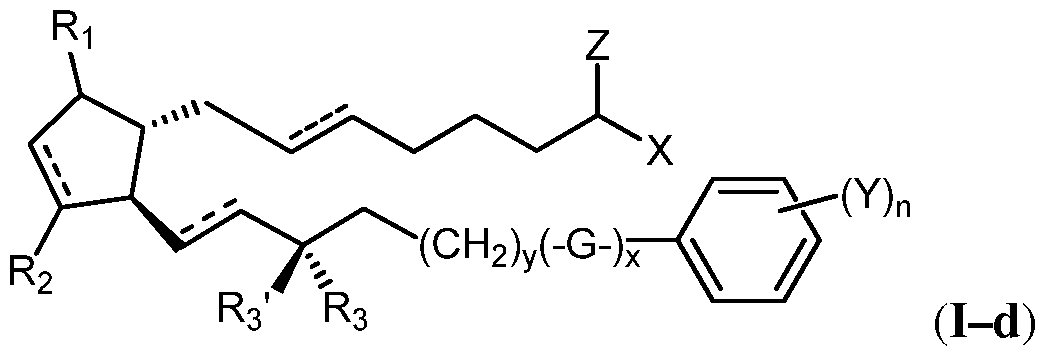
or a pharmaceutically acceptable salt, hydrate, solvate, stereoisomer, polymorph, tautomer, isotopically enriched derivative, or prodrug thereof; wherein , R1; R2, R3, R3', Z, Y, G,
X, y, x, and n are as defined herein.
[00169] In certain embodiments of Formula (I-d), wherein R ' is hydrogen, the compound is of Formula (I-e):

or a pharmaceutically acceptable salt, hydrate, solvate, stereoisomer, polymorph, tautomer, isotopically enriched derivative, or prodrug thereof; wherein , R1; R2, R , Z, X, Y, G, y, x, and n are as defined herein.
[00170] In certain embodiments of Formula (I-d), wherein R3 is hydrogen, the compound is of Formula (I-f):

or a pharmaceutically acceptable salt, hydrate, solvate, stereoisomer, polymorph, tautomer, isotopically enriched derivative, or prodrug thereof; wherein , R1; R2, R ' Z, X, Y, G, y, x, and n are as defined herein.
[00171] In certain embodiments, G is -0-. In certain embodiments, G is -S-.
[00172] In certain embodiments of Formula (I-d), wherein G is -0-, the compound is of Formula (I-dl):

or a pharmaceutically acceptable salt, hydrate, solvate, stereoisomer, polymorph, tautomer, isotopically enriched derivative, or prodrug thereof; wherein , R1; R2, R3, R3', Z, Y, X, y, x, and n are as defined herein.
[00173] In certain embodiments of Formula (I-e), wherein G is -0-, the compound is of Formula (I-el):

or a pharmaceutically acceptable salt, hydrate, solvate, stereoisomer, polymorph, tautomer, isotopically enriched derivative, or prodrug thereof; wherein , R1; R2, R , Z, X, Y, y, x, and n are as defined herein.
[00174] In certain embodiments of Formula (I-f), wherein G is -0-, the compound is of Formula (I-fl):

or a pharmaceutically acceptable salt, hydrate, solvate, stereoisomer, polymorph, tautomer, isotopically enriched derivative, or prodrug thereof; wherein , R1; R2, R ', Z, X, Y, y, x, and n are as defined herein.
[00175] In certain embodiments of Formula (I-d), wherein G is -S-, the compound is of Formula (I-d2):

or a pharmaceutically acceptable salt, hydrate, solvate, stereoisomer, polymorph, tautomer, isotopically enriched derivative, or prodrug thereof; wherein , R1 ; R2, R3, R3', Z, Y, X, y, x, and n are as defined herein.
[00176] In certain embodiments of Formula (I-e), wherein G is -S-, the compound is of Formula (I-e2):

or a pharmaceutically acceptable salt, hydrate, solvate, stereoisomer, polymorph, tautomer, isotopically enriched derivative, or prodrug thereof; wherein , R1 ; R2, R , Z, X, Y, y, x, and n are as defined herein.
[00177] In certain embodiments of Formula (I-f), wherein G is -S-, the compound is of Formula (I-f2):

or a pharmaceutically acceptable salt, hydrate, solvate, stereoisomer, polymorph, tautomer, isotopically enriched derivative, or prodrug thereof; wherein , R1 ; R2, R ', Z, X, Y, y, x, and n are as defined herein.
[00178] In certain embodiments, Z is =0. In certain embodiments, each represents a single bond. In certain embodiments, each endocyclic represents a single bond. In certain embodiments at least one exocyclic represents a ds-double bond. In certain embodiments, each instance of Ri and R2 is -OH. In certain embodiments, each instance of Ri and R2 is -0(CO)R6. In certain embodiments, one of Ri and R2 is -OH, and the other one
is -0(CO)R6. In certain embodiments, one of R3 and R3 R3' is -0(CO)Rg, and the other is hydrogen. In certain embodiments, Ri is -OH, R2 is -0(CO)R6, one of R and R3 R3' is -OH, and the other is hydrogen. In certain embodiments, R2 is -OH, Ri is -0(CO)R6, one of R3 and R3 R3' is -OH, and the other is hydrogen. In certain embodiments, each of Ri and R2 is - OH, and one of R and R3 R3' is -0(CO)Rg, and the other is hydrogen. In certain
embodiments, each instance of Ri and R2 is -0(CO)R6, and one of R and R3 R3' is
-0(CO)R8, and the other is hydrogen. In certain embodiments, -0(CO)R6 and -0(CO)R8 attached to the compound are the same group. In certain embodiments, -0(CO)R6 and -0(CO)Rg attached to the compound are different groups.
[00179] In certain embodiments of Formula (I-d), wherein Z is =0, each endocyclic
represents a single bond, and at least one exocyclic represents a ds-double bond, provided is a compound of Formula (I-d3) having the following stereochemistry:

or a pharmaceutically acceptable salt, hydrate, solvate, stereoisomer, polymorph, tautomer, isotopically enriched derivative, or prodrug thereof; wherein , Ri, R2, R3, R3', G, Y, X, y, x, and n are as defined herein.
[00180] In certain embodiments of Formula (I-e), wherein Z is =0, each endocyclic
represents a single bond, and at least one exocyclic represents a ds-double bond, provided is a compound of Formula (I-e3) having the following stereochemistry:

or a pharmaceutically acceptable salt, hydrate, solvate, stereoisomer, polymorph, tautomer, isotopically enriched derivative, or prodrug thereof; wherein , Ri, R2, R3, G, X, Y, y, x, and n are as defined herein.
[00181] In certain embodiments of Formula (I-f), wherein Z is =0, each endocyclic
^represents a single bond, and at least one exocyclic represents a ds-double bond, provided is a com ound of Formula (I— f3) having the following stereochemistry:

or a pharmaceutically acceptable salt, hydrate, solvate, stereoisomer, polymorph, tautomer, isotopically enriched derivative, or prodrug thereof; wherein :, Ri, R2, R3', G, X, Y, y, x, and n are as defined herein.
[00182] In certain embodiments of Formula (I-d3), wherein Ri is -OH and R2 is
-0(CO)R6, or wherein R2 is -OH and Ri is -0(CO)R6, or wherein both Ri and R2 are
-0(CO)R6, provided is a compound of Formula (I-d4), (I-d5), and (I-d6) having the following stereochemistry:

[00183] In certain embodiments of Formula (I-d3), wherein R3 is -0(CO)R8 or R3' is -0(CO)Rg, provided is a compound of Formula (I-d7) and (I-d8) having the following stereochemistry:

or a pharmaceutically acceptable salt, hydrate, solvate, stereoisomer, polymorph, tautomer, isotopically enriched derivative, or prodrug thereof; wherein , R1 ; R2, R3, R3', Rg, G,
Y, X, y, x, and n are as defined herein.
[00184] In certain embodiments of Formula (I-d3), wherein Ri and R2 are each -OH and R3 is -0(CO)R8, or wherein Ri and R2 are each -OH and R3' is -0(CO)R8, provided is a compound of Formula I-d9) and (I-dl0) having the following stereochemistry:


or a pharmaceutically acceptable salt, hydrate, solvate, stereoisomer, polymorph, tautomer, isotopically enriched derivative, or prodrug thereof; wherein , R3, R ', R8, G, Y, X, y, x, and n are as defined herein.
[00185] In certain embodiments of Formula (I-e3), wherein R is -OH and R2 is
-0(CO)R6, or wherein R2 is -OH and Ri is -0(CO)R6, or wherein both Ri and R2 are
-0(CO)R6, and R ' is hydrogen and R is -OH, provided is a compound of Formula (I-dll), (I-dl2), and (I-dl3 having the following stereochemistry:

[00186] In certain embodiments of Formula (I-d8), wherein each of Ri and R2 are -0(CO)R6 and R ' is hydrogen, provided is a compound of Formula (I-dl4) having the following stereochemistr
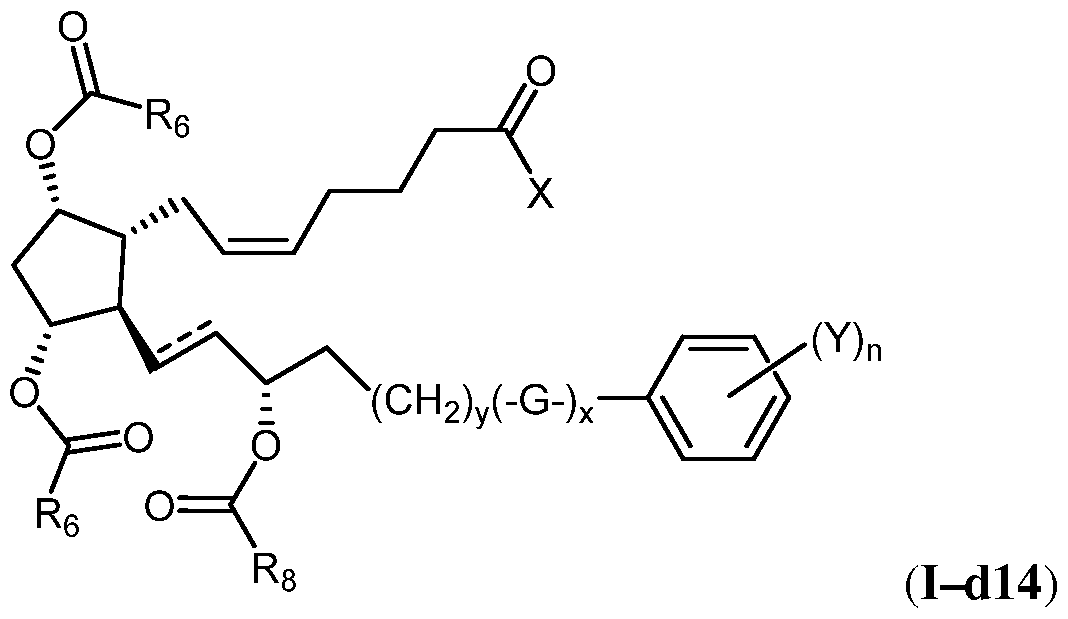
or a pharmaceutically acceptable salt, hydrate, solvate, stereoisomer, polymorph, tautomer, isotopically enriched derivative, or prodrug thereof; wherein , R6, R%, G, Y, X, y, x, and n are as defined herein.
[00187] In certain embodiments of Formula (I-d2), wherein Z is =0, each instance of Ri and R2 is -OH, and each represents a single bond, provided is a compound of
Formula (I-g):
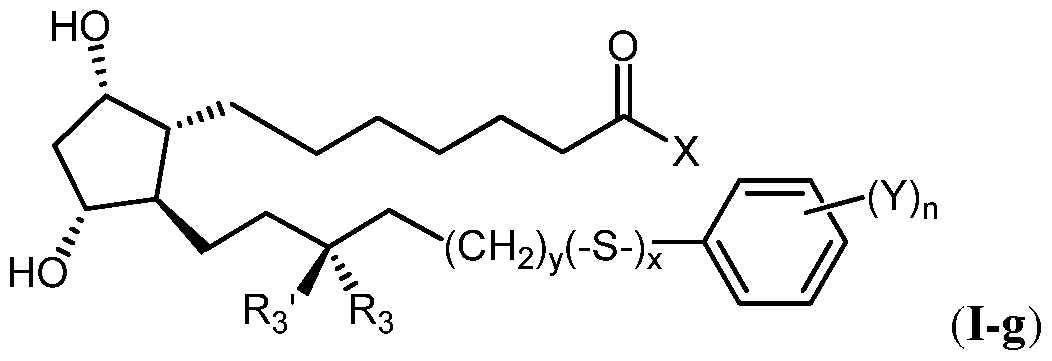
or a pharmaceutically acceptable salt, hydrate, solvate, stereoisomer, polymorph, tautomer, isotopically enriched derivative, or prodrug thereof; wherein X, Y, R3, R3', y, x, and n are as defined herein.
[00188] In certain embodiments of Formula (I-dl), wherein each instance of Ri and R2 is -OH, and Z is =0, provided is a compound of Formula (I-h):

[00189] In certain embodiments of Formula (I-h), wherein R3' is hydrogen, provided is a compound of Formul -i):

or a pharmaceutically acceptable salt, hydrate, solvate, stereoisomer, polymorph, tautomer, isotopically enriched derivative, or prodrug thereof; wherein , R3,Y, X, y, x, and n are as defined herein.
[00190] In certain embodiments of Formula (I-i), wherein R3 is -OH, provided is a compound of Formula (I-j):

or a pharmaceutically acceptable salt, hydrate, solvate, stereoisomer, polymorph, tautomer, isotopically enriched derivative, or prodrug thereof; wherein Y, X, y, x, and n are as defined herein.
[00191] In certain embodiments of Formula (I-h), wherein R3 is F and R3' is F, provided is a compound of Formula (I-k):

or a pharmaceutically acceptable salt, hydrate, solvate, stereoisomer, polymorph, tautomer, isotopically enriched derivative, or prodrug thereof; wherein , Y, X, y, x, and n are as defined herein.
[00192] In certain embodiments of Formula (I-i), wherein R3 is -0(CO)Rg, provided is a compound of Formula (I-o :

or a pharmaceutically acceptable salt, hydrate, solvate, stereoisomer, polymorph, tautomer, isotopically enriched derivative, or prodrug thereof; wherein R8, Y, X, y, x, and n are as defined herein.
[00193] In certain embodiments of Formula (I), the compound of Formula (1-1):

or a pharmaceutically acceptable salt, hydrate, solvate, stereoisomer, polymorph, tautomer, isotopically enriched derivative, or prodrug thereof; wherein R1; R2, Z, and X are as defined herein;
each instance of independently represents a single bond or a double bond which can be in the cis or trans configuration;
each instance of R and R ' is independently hydrogen, halogen, -OH, substituted hydroxyl, or -0(CO)R8, wherein Rg is optionally substituted C^oalkyl, optionally substituted C2-2oalkenyl, optionally substituted C2-2oalkynyl, or -(CH2)mR9 wherein m is 0 or an integer between 1-10, inclusive, and R9 is optionally substituted C3_7carbocyclyl, optionally substituted C6-ioaryl, or optionally substituted 5-14-membered-heteroaryl, or R and R3' are joined to form =0;
Y is selected from the group consisting of optionally substituted Ci-ioalkyl, Q_ ioperhaloalkyl, optionally substituted C2-ioalkenyl, optionally substituted C2-ioalkynyl, halo, nitro, cyano, thiol, substituted thiol, hydroxyl, substituted hydroxyl, amino, mono substituted amino, and disubstituted amino;
G is -O- or -S-;
y is 0, 1, or 2;
x is 0 or 1 ; and
n is 0 or an integer of from 1 to 5, inclusive.
[00194] In certain embodiments of Formula (1-1), wherein Z is =0, and Ri and R2 are each -OH, provided is a compound of Formula (I-m):

or a pharmaceutically acceptable salt, hydrate, solvate, stereoisomer, polymorph, tautomer, isotopically enriched derivative, or prodrug thereof; wherein Ri, R2, Z, and X are as defined herein.
[00195] In certain embodiments of Formula (I-m), wherein R ' is hydrogen, y is 2 and x is 0, provided is a compound of Formula (I-n):

or a pharmaceutically acceptable salt, hydrate, solvate, stereoisomer, polymorph, tautomer, isotopically enriched derivative, or prodrug thereof; wherein Ri, R2, Z, and X are as defined herein.
[00196] As generally defined above, in certain embodiments, provided is a compound of Formula (II):

or a pharmaceutically acceptable salt, hydrate, solvate, stereoisomer, polymorph, tautomer, isotopically enriched derivative, or prodrug thereof; , wherein A, B, X, Z, L, and Ri are as defined herein are as defined herein.
wherein A, B, X, Z, L, and Ri are as defined herein, are as defined herein.
[00197] In certain embodiments, L is a group of the formula wherein represents a single bond.
[00198] In certain embodiments, L is a group of the formula
 wherein
represents a double bond which can be in the cis or trans configuration. In certain embodiments, the double bond is in the cis configuration. In certain embodiments, the double bond is in the trans configuration
[00199] In certain embodiments, L is a group of the formula
 wherein
represents a single bond.
[00200] In certain embodiments, L is a group of the formula
 wherein
represents a double bond which can be in the cis or trans configuration. In certain embodiments, the double bond is in the cis configuration. In certain embodiments, the double bond is in the trans configuration
[00201] In certain embodiments of Formula (II), the compound of Formula (Il-a):

or a pharmaceutically acceptable salt, hydrate, solvate, stereoisomer, polymorph, tautomer, isotopically enriched derivative, or prodrug thereof, wherein ^z ^, R Z, X, Y, G, R3, R3', y, x and n are as defined herein.
wherein R1 ; Z, X, Y, G, R , R \ y, x, and n are as defined herein.
[00202] In certain embodiments of Formula (Il-a), wherein R ' is hydrogen, the compound is of Formula (Il-b):

or a pharmaceutically acceptable salt, hydrate, solvate, stereoisomer, polymorph, tautomer, isotopically enriched derivative, or prodrug thereof; wherein z^^ , Rt, R3, Z, X, Y, G, y, x, and n are as defined herein.
[00203] In certain embodiments of Formula (Il-a), wherein R3 is hydrogen, the compound is of Formula (II-c):

or a pharmaceutically acceptable salt, hydrate, solvate, stereoisomer, polymorph, tautomer, isotopically enriched derivative, or prodrug thereof; wherein - , R1; R2, R3\ Z, X, Y, G, y, x, and n are as defined herein.
[00204] In certain embodiments, G is -0-. In certain embodiments, G is -S-.
[00205] In certain embodiments of Formula (Il-a), wherein G is -0-, provided is a compound of Formu -al):

or a pharmaceutically acceptable salt, hydrate, solvate, stereoisomer, polymorph, tautomer, isotopically enriched derivative, or prodrug thereof; wherein Ri, R2, Z, and X are as defined herein; wherein ^z^z ., R1? R2? R3,', Z, X, Y, y, x, and n are as defined herein.
[00206] In certain embodiments, Z is =0.
[00207] In certain embodiments at least one exocyclic represents a ds-double bond.
[00208] For example, in certain embodiments of Formula (Il-al), wherein Z is =0, provided is a compound of Formula (Il-d):

or a pharmaceutically acceptable salt, hydrate, solvate, stereoisomer, polymorph, tautomer, isotopically enriched derivative, or prodrug thereof; wherein " , R1; R3, R3', Y, X, y, x, and n are as defined herein.
[00209] In certain embodiments of Formula (Il-d), wherein Ri is OH, R3' is hydrogen, R3
is -OH, y is 0, and x is 1, provided is a compound of Formula (Il-e):

OH (Il-e)
or a pharmaceutically acceptable salt, hydrate, solvate, stereoisomer, polymorph, tautomer, isotopically enriched derivative, or prodrug thereof; wherein , Y, X, and n are as defined herein.
[00210] Exemplary compounds of Formula (I) include, but are not limited to:
referred to herein as Prostagl
also referred to herein as bi

also referred to herein as bimatoprost isopropyl ester;
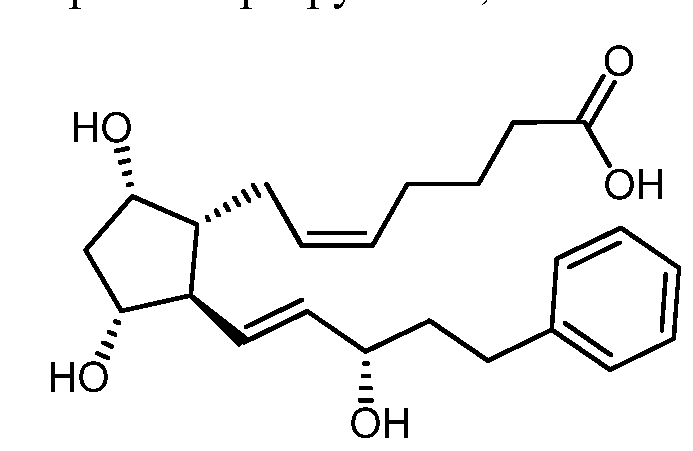

also referred to herein as latano rost;

also referred to herein as latanoprost free acid;

also referred to herein as tafhiprost;

also referred to herein as tafluprost free acid or AFP

also referred to herein as CAY

also referred to herein as CAY 10509 free acid;

also referred to herein as 7-[3a,5a-dihydroxy-2-(3a-hydroxy-5-(3-(2,5-dichloro)thienyl)-lE- pentenyl)cyclopentyl]-5Z-heptenamide;
and 9-, 11-, and/or 15-ester derivatives (e.g., prodrugs) of the above, e.g., of formula:
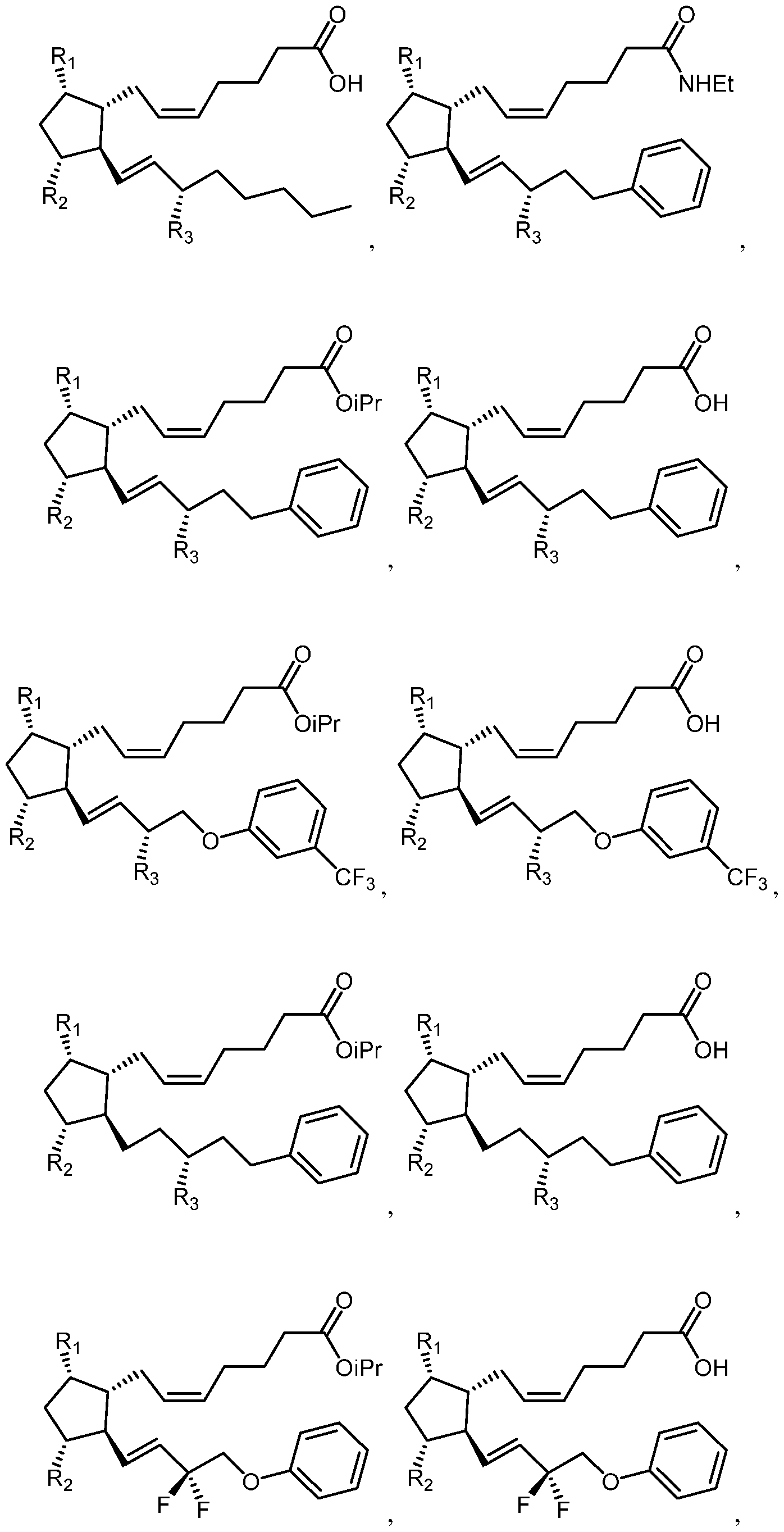

wherein:
Ri is -0(CO)R6 and R2 is -OH, or
Ri is -OH, R2 is -0(CO)R6, or
Ri is -OH, R2 is -OH, and R3 is -0(CO)R8, or
Ri is -OH, R2 is -0(CO)R6, and R3 is -OH, or
Ri is -0(CO)R6, R2 is -0(CO)R6, and R3 is -OH, or
Ri is -0(CO)R6, R2 is -OH, and R3 is -0(CO)R8, or
Ri is -OH, R2 is -0(CO)R6, and R3 is -0(CO)R8, or
Ri is -0(CO)R6, R2 is -0(CO)R6, and R3 is -0(CO)R8,
wherein R6 and R8 are as defined herein, and pharmaceutically acceptable salts, hydrates, solvates, stereoisomers, polymorphs, tautomers, isotopically enriched derivatives, and prodrugs thereof. In certain embodiments, R8 is -(CH2)qCH wherein q is 0, 1, 2, 3, 4, 5, or 6, -CH(CH3)2, -CH2CH(CH3)2, -CH2C(CH3)3, or -C(CH3)3. In certain embodiments, R6 is -(CH2)rCH3 wherein r is 0, 1, 2, 3, 4, 5, or 6, -CH(CH3)2, -CH2CH(CH3)2, -CH2C(CH3)3, or -C(CH3)3.
[00211] In certain embodiments, the compound of Formula (I) is selected from the group consisting of latanoprost, latanoprost free acid, tafluprost, tafluprost free acid, travoprost, fluprostenol, bimatoprost, bimatoprost free acid, and pharmaceutically acceptable salts, hydrates, solvates, stereoisomers, polymorphs, tautomers, isotopically enriched derivatives, and prodrugs thereof. In certain embodiments, the compound of Formula (I) is selected from the group consisting of latanoprost, latanoprost free acid, tafluprost, tafluprost free acid, and pharmaceutically acceptable salts, hydrates, solvates, stereoisomers, polymorphs, tautomers, isotopically enriched derivatives, and prodrugs thereof. In certain embodiments, the compound of Formula (I) is selected from the group consisting of latanoprost and
pharmaceutically acceptable hydrates, solvates, stereoisomers, polymorphs, tautomers, isotopically enriched derivatives, and prodrugs thereof. In certain embodiments, the compound of Formula (I) is selected from the group consisting of latanoprost free acid and
pharmaceutically acceptable salts, hydrates, solvates, stereoisomers, polymorphs, tautomers, isotopically enriched derivatives, and prodrugs thereof. In certain embodiments, the compound of Formula (I) is latanoprost. In certain embodiments, the compound of Formula (I) is selected from the group consisting of tafluprost and pharmaceutically acceptable hydrates, solvates, stereoisomers, polymorphs, tautomers, isotopically enriched derivatives, and prodrugs thereof. In certain embodiments, the compound of Formula (I) is selected from the group consisting of tafluprost free acid and pharmaceutically acceptable salts, hydrates, solvates, stereoisomers, polymorphs, tautomers, isotopically enriched derivatives, and prodrugs thereof. In certain embodiments, the compound of Formula (I) is tafluprost.
[00212] Exemplary compounds of Formula (II) include, but are not limited to,

OH
also referred to as AL- 12182;.

also referred to as AL- 12182 free acid;
and ester derivatives (e.g., rodru s) of the above, e.g., of formula:

wherein:
Ri is -OH and R3 is -0(CO)R8, or
Ri is -0(CO)R6, and R3 is -OH, or
Ri is -0(CO)R6, and R3 is -0(CO)Ri
wherein R6 and R8 are as defined herein, and pharmaceutically acceptable salts, hydrates, solvates, stereoisomers, polymorphs, tautomers, isotopically enriched derivatives, and prodrugs thereof. In certain embodiments, Rg is -(CH2)qCH3 wherein q is 0, 1, 2, 3, 4, 5, or 6, -CH(CH3)2, -CH2CH(CH3)2, -CH2C(CH3)3, or -C(CH3)3. In certain embodiments, R6 is -(CH2)rCH3 wherein r is 0, 1, 2, 3, 4, 5, or 6, -CH(CH3)2, -CH2CH(CH3)2, -CH2C(CH3)3, or -C(CH3)3.
[00213] In certain embodiments, the compound of Formula (I) or (II) is a prodrug of any one of the compounds described herein. Exemplary prodrugs include esters, amides, and/or thioamides of the parent free acid, and compounds wherein a hydroxyl group on the parent compound (e.g., a pentacyclic hydroxyl group Ri and/or R2 or the hydroxyl group at the R / and/or R3' position) is esterified, e.g., 9-, 11-, and/or 15-ester derivatives as described herein, e.g., wherein the ester at said position is a Ci_6 ester, e.g., 9-propionyl bimatoprost, 11- propionyl bimatoprost, 15 -propionyl bimatoprost, 9-butyryl bimatoprost, 11-butyryl bimatoprost, 15-butyryl bimatoprost, and the like.
Compositions and Formulations
[00214] As generally described herein, provided are topical compositions for use in any of the inventive methods, described herein, comprising a PFPFRA compound (the "active ingredient"), and optionally a pharmaceutically acceptable excipient.
[00215] Topical compositions, as used herein, encompass pharmaceutical compositions as well as cosmetic compositions. While pharmaceutical compositions are useful for therapeutic and prophylactic purposes, and cosmetic compositions are useful for beautification purposes.
[00216] In addition to the PFPRA compound, the topical composition may additionally comprise one or more pharmaceutically acceptable excipients. Pharmaceutically acceptable excipients include, but are not limited to, any and all solvents, diluents or other liquid vehicles, inert diluents, dispersing and/or granulating agents, surface active agents and/or emulsifiers, thickening agents, disintegrating agents, binding agents, preservatives, buffering agents, lubricating agents, and/or oils. Excipients such as coloring agents, coating agents, perfuming agents, and sunscreens may also be present in the composition. General considerations in the formulation and/or manufacture of the topical compositions can be found, for example, in Remington's Pharmaceutical Sciences, Sixteenth Edition, E. W.
Martin (Mack Publishing Co., Easton, Pa., 1980), and Remington: The Science and Practice of Pharmacy, 21st Edition (Lippincott Williams & Wilkins, 2005).
[00217] In some embodiments, the composition is a non-emulsion, i.e., is not an emulsion.
In certain embodiments, the composition is not irritating to the skin.
[00218] Exemplary solvents and liquid vehicles include, but are not limited to, organic solvents (e.g., polar protic solvents, polar aprotic solvents), water, saline, buffered aqueous solutions, and mixtures thereof. Exemplary polar protic solvents include, but are not limited to, organic alcohols such as methanol, ethanol, propanol, isopropanol, 1,3-butanediol, ethylene glycol, or propylene glycol, or mixture thereof. However, in certain embodiments, 1,3,-butanediol is excluded. Exemplary polar aprotic solvents include, but are not limited to, dimethylsulfoxide (DMSO), and ethers such as diethyl ether and diethylene glycol monoethyl ether (DEGEE).
[00219] Exemplary granulating and/or dispersing agents include potato starch, corn starch, tapioca starch, sodium starch glycolate, clays, alginic acid, guar gum, citrus pulp, agar, bentonite, cellulose and wood products, natural sponge, cation-exchange resins, calcium carbonate, silicates, sodium carbonate, cross-linked poly(vinyl-pyrrolidone) (crospovidone), sodium carboxymethyl starch (sodium starch glycolate), carboxymethyl cellulose, cross- linked sodium carboxymethyl cellulose (croscarmellose), methylcellulose, pregelatinized starch (starch 1500), microcrystalline starch, water insoluble starch, calcium carboxymethyl cellulose, magnesium aluminum silicate (Veegum), sodium lauryl sulfate, quaternary ammonium compounds, etc., and combinations thereof.
[00220] Exemplary surface active agents and/or emulsifiers include lipids/natural emulsifiers (e.g. acacia, agar, alginic acid, sodium alginate, tragacanth, chondrux, cholesterol, xanthan, pectin, gelatin, egg yolk, casein, wool fat, cholesterol, wax, and lecithin), colloidal clays (e.g. bentonite [aluminum silicate] and Veegum [magnesium aluminum silicate]), long chain amino acid derivatives, high molecular weight alcohols (e.g. stearyl alcohol, cetyl alcohol, oleyl alcohol, triacetin monostearate, ethylene glycol distearate, glyceryl
monostearate, and propylene glycol monostearate, polyvinyl alcohol), carbomers (e.g.
carboxy polymethylene, polyacrylic acid, acrylic acid polymer, and carboxyvinyl polymer), carrageenan, cellulosic derivatives (e.g. carboxymethylcellulose sodium, powdered cellulose, hydroxymethyl cellulose, hydroxypropyl cellulose, hydroxypropyl methylcellulose, methylcellulose), sorbitan fatty acid esters (e.g. polyoxyethylene sorbitan monolaurate
[Tween 20], polyoxyethylene sorbitan [Tween 60], polyoxyethylene sorbitan monooleate [Tween 80], sorbitan monopalmitate [Span 40], sorbitan monostearate [Span 60], sorbitan tristearate [Span 65], glyceryl monooleate, sorbitan monooleate [Span 80]), polyoxyethylene esters (e.g. polyoxyethylene monostearate [Myrj 45], polyoxyethylene hydrogenated castor oil, polyethoxylated castor oil, polyoxymethylene stearate, and Solutol), sucrose fatty acid
esters, polyethylene glycol fatty acid esters (e.g., Cremophor), polyoxyethylene ethers, (e.g. polyoxyethylene lauryl ether [Brij 30]), poly(vinyl-pyrrolidone), diethylene glycol monolaurate, triethanolamine oleate, sodium oleate, potassium oleate, ethyl oleate, oleic acid, ethyl laurate, sodium lauryl sulfate, Pluronic F 68, Poloxamer 188, cetrimonium bromide, cetylpyridinium chloride, benzalkonium chloride, docusate sodium, etc. and/or combinations thereof.
[00221] Exemplary binding agents include starch (e.g. cornstarch and starch paste), gelatin, sugars (e.g. sucrose, glucose, dextrose, dextrin, molasses, lactose, lactitol, mannitol, etc.), natural and synthetic gums (e.g. acacia, sodium alginate, extract of Irish moss, panwar gum, ghatti gum, mucilage of isapol husks, carboxymethylcellulose, methylcellulose, ethylcellulose, hydroxyethylcellulose, hydroxypropyl cellulose, hydroxypropyl
methylcellulose, microcrystalline cellulose, cellulose acetate, poly(vinyl-pyrrolidone), magnesium aluminum silicate (Veegum), and larch arabogalactan), alginates, polyethylene oxide, polyethylene glycol, inorganic calcium salts, silicic acid, polymethacrylates, waxes, water, alcohol, etc., and/or combinations thereof.
[00222] Exemplary preservatives include antioxidants, chelating agents, antimicrobial preservatives, antifungal preservatives, alcohol preservatives, acidic preservatives, and other preservatives.
[00223] Exemplary antioxidants include alpha tocopherol, ascorbic acid, acorbyl palmitate, butylated hydroxyanisole, butylated hydroxytoluene, monothioglycerol, potassium metabisulfite, propionic acid, propyl gallate, sodium ascorbate, sodium bisulfite, sodium metabisulfite, and sodium sulfite.
[00224] Exemplary chelating agents include ethylenediaminetetraacetic acid (EDTA) and salts and hydrates thereof (e.g., sodium edetate, disodium edetate, trisodium edetate, calcium disodium edetate, dipotassium edetate, and the like), citric acid and salts and hydrates thereof (e.g., citric acid monohydrate), fumaric acid and salts and hydrates thereof, malic acid and salts and hydrates thereof, phosphoric acid and salts and hydrates thereof, and tartaric acid and salts and hydrates thereof. Exemplary antimicrobial preservatives include benzalkonium chloride, benzethonium chloride, benzyl alcohol, bronopol, cetrimide, cetylpyridinium chloride, chlorhexidine, chlorobutanol, chlorocresol, chloroxylenol, cresol, ethyl alcohol, glycerin, hexetidine, imidurea, phenol, phenoxyethanol, phenylethyl alcohol, phenylmercuric nitrate, propylene glycol, and thimerosal.
[00225] Exemplary antifungal preservatives include butyl paraben, methyl paraben, ethyl paraben, propyl paraben, benzoic acid, hydroxybenzoic acid, potassium benzoate, potassium
sorbate, sodium benzoate, sodium propionate, and sorbic acid.
[00226] Exemplary alcohol preservatives include ethanol, polyethylene glycol, phenol, phenolic compounds, bisphenol, chlorobutanol, hydroxybenzoate, and phenylethyl alcohol.
[00227] Exemplary acidic preservatives include vitamin A, vitamin C, vitamin E, beta- carotene, citric acid, acetic acid, dehydroacetic acid, ascorbic acid, sorbic acid, and phytic acid.
[00228] Other preservatives include tocopherol, tocopherol acetate, deteroxime mesylate, cetrimide, butylated hydroxyanisol (BHA), butylated hydroxytoluened (BHT),
ethylenediamine, sodium lauryl sulfate (SLS), sodium lauryl ether sulfate (SLES), sodium bisulfite, sodium metabisulfite, potassium sulfite, potassium metabisulfite, Glydant Plus, Phenonip, methylparaben, Germall 115, Germaben II, Neolone, Kathon, and Euxyl. In certain embodiments, the preservative is an anti-oxidant. In other embodiments, the preservative is a chelating agent.
[00229] Exemplary buffering agents include citrate buffer solutions, acetate buffer solutions, phosphate buffer solutions, ammonium chloride, calcium carbonate, calcium chloride, calcium citrate, calcium glubionate, calcium gluceptate, calcium gluconate, D- gluconic acid, calcium glycerophosphate, calcium lactate, propanoic acid, calcium levulinate, pentanoic acid, dibasic calcium phosphate, phosphoric acid, tribasic calcium phosphate, calcium hydroxide phosphate, potassium acetate, potassium chloride, potassium gluconate, potassium mixtures, dibasic potassium phosphate, monobasic potassium phosphate, potassium phosphate mixtures, sodium acetate, sodium bicarbonate, sodium chloride, sodium citrate, sodium lactate, dibasic sodium phosphate, monobasic sodium phosphate, sodium phosphate mixtures, tromethamine, magnesium hydroxide, aluminum hydroxide, alginic acid, pyrogen-free water, isotonic saline, Ringer's solution, ethyl alcohol, etc., and combinations thereof.
[00230] Exemplary lubricating agents include magnesium stearate, calcium stearate, stearic acid, silica, talc, malt, glyceryl behanate, hydrogenated vegetable oils, polyethylene glycol, sodium benzoate, sodium acetate, sodium chloride, leucine, magnesium lauryl sulfate, sodium lauryl sulfate, etc. , and combinations thereof.
[00231] Exemplary oils include almond, apricot kernel, avocado, babassu, bergamot, black current seed, borage, cade, camomile, canola, caraway, carnauba, castor, cinnamon, cocoa butter, coconut, cod liver, coffee, corn, cotton seed, emu, eucalyptus, evening primrose, fish, flaxseed, geraniol, gourd, grape seed, hazel nut, hyssop, isopropyl myristate, jojoba, kukui nut, lavandin, lavender, lemon, litsea cubeba, macademia nut, mallow, mango seed,
meadowfoam seed, mink, nutmeg, olive, orange, orange roughy, palm, palm kernel, peach kernel, peanut, poppy seed, pumpkin seed, rapeseed, rice bran, rosemary, safflower, sandalwood, sasquana, savoury, sea buckthorn, sesame, shea butter, silicone, soybean, sunflower, tea tree, thistle, tsubaki, vetiver, walnut, and wheat germ oils. Exemplary oils include, but are not limited to, butyl stearate, caprylic triglyceride, capric triglyceride, cyclomethicone, diethyl sebacate, dimethicone 360, isopropyl myristate, mineral oil, octyldodecanol, oleyl alcohol, silicone oil, and combinations thereof.
[00232] In some embodiments, the composition further comprises a viscosity enhancing agent. A viscosity enhancing agent, as used herein, is a substance which increases the viscosity of a solution or liquid/solid mixture. Exemplary viscosity enhancing agents include, but are not limited to, glycerin; cellulose derivatives (e.g., methylcellulose (MC);
hydroxypropylmethylcellulose (HPMC); carboxymethylcellulose (CMC); microcrystalline cellulose (CC); ethyl cellulose; hydroxyethyl cellulose (HEC); hydroxypropyl cellulose (HPC); cellulose); gelatin; starch; hetastarch; poloxamers; pluronics; sodium CMC; sorbitol; acacia; povidone; carbopol; polycarbophil; chitosan; alginate; chitosan glutamate; hyaluronic acid; elastin; hyaluronan; maltodextrin DE; deoxyglycocholate (GDC); polymethacrylic acid; glycols (e.g., polymethylene glycol; polyethylene glycol); cyclodextrins (e.g., sulfobutylether B cyclodextrin); sodium tauro-dihydrofusidate (STDHF); and N-trimethyl chitosan chloride (TMC). In certain embodiments, the viscosity enhancing agent is a cellulose derivative, e.g., hydroxypropyl cellulose (HPC). In certain embodiments, the composition comprises a viscosity enhancing agent between about 0.5% and about 5% by weight, inclusive. In certain embodiments, the composition comprises a viscosity enhancing agent in between about 0.5% and about 4%, between about 0.5% and about 3%, between about 0.5% and about 2%, between about 0.5% and about 1%, between about 0.8% and about 5%, between about 0.8% and about 4%, between about 0.8% and about 3%, between about 0.5% and about 2%, or between about 0.5% and about 1%, inclusive. In certain embodiments, the composition comprises a viscosity enhancing agent in about 0.5%, 0.6%, 0.7%, 0.8%, 0.9%, 1%, 2%, 3%, 4%, or 5% (by weight). In certain embodiments, the composition comprises
hydroxypropylcellulose in about 1% by weight.
[00233] In certain embodiments, the composition further comprises an antioxidant, e.g., alpha tocopherol, ascorbic acid, acorbyl palmitate, butylated hydroxyanisole, butylated hydroxytoluene, monothioglycerol, potassium metabisulfite, propionic acid, propyl gallate, sodium ascorbate, sodium bisulfite, sodium metabisulfite, and sodium sulfite. In certain embodiments, the composition comprises an antioxidant in between about 0.001% and about
0.1% by weight, inclusive. In certain embodiments, the composition comprises an antioxidant in between about 0.001% and about 0.05%, 0.001% and about 0.04%, 0.001% and about 0.03%, 0.001% and about 0.02%, 0.001% and about 0.01%, inclusive. In certain
embodiments, the composition comprises an antioxidant in about 0.001%, 0.002%, 0.003%, 0.004%, 0.005%, 0.006%, 0.007%, 0.008%, 0.009%, 0.01%, 0.02%, 0.03%, 0.04%, 0.05%, 0.06%, 0.07%, 0.08%, 0.09%, or 0.1% by weight. In certain embodiments, the composition comprises alpha tocopherol in about 0.002% by weight.
[00234] In certain embodiments, the composition further comprises a fatty acid and/or fatty acid ester, e.g., of the below formulae:

fatty acid fatty acid ester
wherein the alcohol moiety of the ester (R ) is optionally substituted C -C alkyl,
FA1
and the acyl moiety of the ester or acid (R ) is optionally substituted Q0-C20 alkyl or optionally substituted Cio-C2o alkenyl.
[00235] In certain embodiments, RFA3 is an optionally substituted Ci-salkyl, Ci^alkyl, d- 3alkyl, C^alkyl, C2_6alkyl, C2_5alkyl, C2^alkyl, C2_3alkyl, C3_6alkyl, C3_5alkyl, C3^alkyl, C^
6alkyl, alkyl, or nts, R FA3
C^ Cs_6alkyl. In certain embodime is a branched alkyl group, e.g., for example, isopropyl, isobutyl, sec -butyl, tert-butyl, or neopentyl. In certain embodiments,
R FA3 is an unbranched alkyl group, e.g., for example, methyl, ethyl, n-propyl, n-butyl, n- pentyl, or n-hexyl. In certain embodiments, R is an unsubstituted alkyl group, i.e., comprising only carbon and hydrogen atoms. In certain embodiments, R FA3 is a substituted alkyl group, e.g., substituted by halogen atoms.
[00236] In certain embodiments, RFA1 is an optionally substituted Cio-C^ alkyl, Cio-C^ alkyl, C10-C17 alkyl, C10-C16 alkyl, C10-C15 alkyl, C10-C14 alkyl, C10-C13 alkyl, Cn-C20 alkyl, Cn-C19 alkyl, Cn-C18 alkyl, Cu-C17 alkyl, Cn-C16 alkyl, Cu-C15 alkyl, Cn-C14 alkyl, Cu-C13 alkyl, C12-C19 alkyl, Ci2-Ci8 alkyl, Ci2-Ci7 alkyl, Ci2-Ci6 alkyl, C12-C15 alkyl, C12-C14 alkyl, C12-C13 alkyl, Ci3-C20 alkyl, C13-C19 alkyl, Ci3-Ci8 alkyl, Ci3-Ci7 alkyl, Ci3-Ci6 alkyl, C13-C15 alkyl, C1 -C14 alkyl, C1 -C20 alkyl, C1 -C19 alkyl, C14-C18 alkyl, C14-C17 alkyl, C14-C16 alkyl, C14-C15 alkyl, C15-C20 alkyl, C15-C19 alkyl, C15-C18 alkyl, C15-C17 alkyl, or C15-C16 alkyl. In certain embodiments, R FA1 is a straight chain (unbranched) alkyl group. In certain
embodiments, R FA1 is an unsubstituted alkyl group, i.e., comprising only carbon and
hydrogen atoms. In certain embodiments, R is a substituted alkyl group, e.g., substituted by halogen atoms.
[00237] In certain embodiments, RFA1 is an optionally substituted Q0-Q9 alkenyl, CKTC18 alkenyl, C10-C17 alkenyl, C10-C16 alkenyl, Q0-Q5 alkenyl, C10-C14 alkenyl, C10-C13 alkenyl, Cn-C2o alkenyl, Cn-C19 alkenyl, Cn-C18 alkenyl, Cn-C17 alkenyl, Cn-C16 alkenyl, Cn-Qs alkenyl, Cn-C14 alkenyl, Cn-C13 alkenyl, C12-C19 alkenyl, C12-C18 alkenyl, C12-C17 alkenyl, C12-C16 alkenyl, C12-C15 alkenyl, C12-C14 alkenyl, C12-C13 alkenyl, C13-C2o alkenyl, C13-Ci9 alkenyl, C13-C18 alkenyl, C13-C17 alkenyl, C13-C16 alkenyl, C13-C15 alkenyl, C13-C14 alkenyl, C14-C2o alkenyl, C14-C19 alkenyl, C14-C18 alkenyl, C14-C17 alkenyl, C14-C16 alkenyl, C1 -C15 alkenyl, C15-C2o alkenyl, Q5-Q9 alkenyl, C15-C18 alkenyl, C15-C17 alkenyl, C15-C16 alkenyl. In certain embodiments, R is a unbranched alkenyl group. In certain embodiments, R is an unsubstituted alkenyl group, i.e., comprising only carbon and hydrogen atoms. In certain embodiments, FAl
R is a substituted alkenyl group, e.g., substituted by halogen atoms. In certain embodiments, FAl
R is an alkenyl group comprising 1, 2, 3, or 4 double bonds, each independently cis or trans.
[00238] In certain embodiments, RFA1 is an alkenyl group comprising at least one cis double bond, e.g., 1, 2, 3, or 4 cis double bonds. In certain embodiments, FAl
R is an alkenyl group of formula (a):
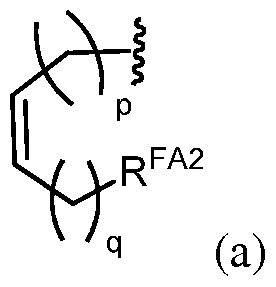
wherein:
p is an integer between 2 and 8, inclusive;
q is an integer between 1 and 8, inclusive; and
FA2
R is an optionally substituted Q-CK) alkyl, or an optionally substituted C2- C10alkenyl,
provided the sum of carbons of formula (a) does not exceed 20.
[00239] In certain embodiments, RFA2 is an optionally substituted CrC9 alkyl, CrC8 alkyl,
C1-C7 alkyl, Ci-C6 alkyl, C1-C5 alkyl, C C4 alkyl, C1-C3 alkyl, Ci-C2 alkyl, C2-Ci0 alkyl, C2- C9 alkyl, C2-C8 alkyl, C2-C7 alkyl, C2-C6 alkyl, C2-C5 alkyl, C2-C4 alkyl, C2-C3 alkyl, C3-Ci0 alkyl, C3-C9 alkyl, C3-C8 alkyl, C3-C7 alkyl, C3-C6 alkyl, C3-C5 alkyl, C3-C4 alkyl, C4-C10 alkyl, C4-C9 alkyl, C4-C8 alkyl, C4-C7 alkyl, C4-C6 alkyl, C4-C5 alkyl, C5-C10 alkyl, C5-C9 alkyl, C5-C8 alkyl, C5-C7 alkyl, C5-C6 alkyl, C6-Ci0 alkyl, C6-C9 alkyl, C6-C8 alkyl, C6-C7
alkyl, C7-C10 alkyl, C7-C9 alkyl, C7-C8 alkyl, C8-Ci0 alkyl, C8-C9 alkyl, or C9-C10 alkyl. In certain embodiments, R FA2 is a straight chain (unbranched) alkyl group. In certain embodiments, R FA2 is an unsubstituted alkyl group, i.e., comprising only carbon and hydrogen atoms. In certain embodiments, R FA2 is a substituted alkyl group, e.g., substituted by halogen atoms.
[00240] In certain embodiments, RFA2 is an optionally substituted C2-C9 alkenyl, C2-C8 alkenyl, C2-C7 alkenyl, C2-C6 alkenyl, C2-C5 alkenyl, C2-C4 alkenyl, C2-C3 alkenyl, C3-C10 alkenyl, C3-C9 alkenyl, C3-C8 alkenyl, C3-C7 alkenyl, C3-C6 alkenyl, C3-C5 alkenyl, C3-C4 alkenyl, C4-Cio alkenyl, C4-Cg alkenyl, C4-Cg alkenyl, C4-C7 alkenyl, C4-C6 alkenyl, C4-C5 alkenyl, Cs-Cio alkenyl, C5-C9 alkenyl, Cs-Cg alkenyl, C5-C7 alkenyl, C5-C6 alkenyl, C6-Cio alkenyl, C6-C9 alkenyl, C6-C8 alkenyl, C6-C7 alkenyl, C7-Q0 alkenyl, C7-C9 alkenyl, C7-C8
FA2 alkenyl, Cs-Qo alkenyl, C8-C9 alkenyl, or C9-Q0 alkenyl. In certain embodiments, R is a straight chain (unbranched) alkenyl group. In certain embodiments, R FA2 is an unsubstituted alkenyl group, i.e., comprising only carbon and hydrogen atoms. In certain embodiments,
R FA2 is a substituted alkenyl group, e.g., substituted by halogen atoms. In certain
embodiments, R FA2 is a substituted alkenyl group, e.g., substituted by halogen atoms. In certain embodiments, R FA2 is an alkenyl group comprising 1 or 2 double bonds, each independently cis or trans.
[00241] In certain embodiments, p is 2, 3, 4, 5, 6, 7, or 8. In certain embodiments, q is 1, 2, 3, 4, 5, 6, 7, or 8. In certain embodiments, p is 4, 5, 6, or 7. In certain embodiments, q is 1. In certain embodiments, q is 3, 4, or 5. In certain embodiments, q is 6, 7, or 8.
[00242] In certain embodiments, RFA1 is selected from any one of the following saturated or unsaturated fatty acyl moieties:
Laurie -(CH2)ioCH3 (11 aliphatic carbons),
Myristic -(CH2)12CH3 (13 aliphatic carbons),
Palmitic -(CH2)14CH3 (15 aliphatic carbons),
Stearic -(CH2)i6CH3 (17 aliphatic carbons),
Myristoleic (CH2)7CH=C 3,
i.e., of formula
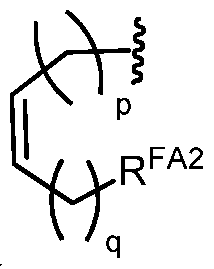 , wherein p = 7, q = 3, R = -CH3 (13 aliphatic carbons)
Palmitoliec -(CH2)7CH=CH(CH2)5CH3 ,
i.e., of formula
 , wherein p
aliphatic carbons)
Sapienic -(CH2)4CH=C 3,
i.e., of formula
 , wherein p
aliphatic carbons)
Oleic -(CH2)7CH=C H3,
i.e., of formula
 , wherein p = 7, q = 7, R = -CH (17 aliphatic carbons)
Linoleic -(CH2)7CH=C =CH(CH2)4CH3,
i.e., of formula
 , wherein p = 7, q = l, R = C7-alkenyl (17 aliphatic carbons)
CC-Linolenic -(CH2)7CH=C =CHCH2CH=CHCH2CH3>
i.e., of formula
 , wherein p = 7, q = 1, RrPL = C7-alkenyl (17 aliphatic carbons)
[00243] In certain embodiments, the total number of aliphatic carbons atoms in the fatty acid is between 11 and 19, inclusive, i.e., 11, 12, 13, 14, 15, 16, 17, 18, or 19 aliphatic carbon atoms total. In certain embodiments, the total number of aliphatic carbons in the fatty acid is selected to approximate the aliphatic chain length of the PFPRA compound (e.g., latanoprost has 13 aliphatic carbons if the cyclizing carbons 9 through 11 of the cyclopentyl ring are not counted). For example, in certain embodiments, the total carbon atoms in the aliphatic chain
of the PFPRA compound is between 11 and 19, inclusive, i.e., 11, 12, 13, 14, 15, 16, 17, 18, or 19 aliphatic carbon atoms total.
[00244] In certain embodiments, the total number of carbons atoms in the fatty acid ester, which include the number of carbons of R FA 1 and R F A3 is between 11 and 19, inclusive, i.e., 11, 12, 13, 14, 15, 16, 17, 18, or 19 carbon atoms total. In some embodiments, the total number of carbons in the fatty acid ester is selected to approximate the total carbon atoms in the sum of the aliphatic chain and ester moiety of the PFPRA compound. For example, in certain embodiments, the total carbon atoms in the sum of the aliphatic chain and ester moiety of the PFPRA compound is between 11 and 19, inclusive, i.e., 11, 12, 13, 14, 15, 16, 17, 18, or 19 carbon atoms total.
[00245] In some embodiments, fatty acid or fatty acid ester is selected such that its predicted length (e.g. by molecular modeling) is similar (e.g., within +3 A) to the predicted length of the PFPRA compound. For example, the fatty acid oleic acid has a predicted length
(between the two most distant heavy atoms) of about 19 A, and the fatty acid ester isopropyl myristate has a predicted length (between the two most distant heavy atoms) of about 20 A, each of which compares favorably with a length of about 17 A for latanoprost free acid, tafluprost free acid, and bimatoprost free acid; 18 A for latanoprost and tafluprost; about 19 A for bimatoprost and travoprost free acid (i.e., fluprostenol), and about 20 A for travoprost. In some embodiments, the predicted length is in an energy-minimized conformation. In some embodiments, the predicted length is in an energy- minimized conformation. In some embodiments, the predicted length is of a conformation whereby freely rotating bonds are rotated as to provide a maximal length.
[00246] In some embodiments, the final concentration of the fatty acid is between about 1 percent to about 20 percent by weight, inclusive. In some embodiments, the final concentration of the fatty acid is between about 5 and about 15 percent, about 1 and about 10 percent, about 1 and about 2 percent, about 1 and about 3 percent, about 1 and about 5 percent, about 2 and about 4 percent, about 3 and about 5 percent, about 3 and about 7 percent, about 4 and about 6 percent, about 5 and about 7 percent, about 6 and about 8 percent, about 7 and about 10 percent, about 10 and about 20 percent, about 10 and about 15 percent, or about 15 and about 20 percent, inclusive. In certain embodiments, the final concentration of the fatty acid is 1, 2, 3, 4, 5, 6, 7, 8, 9, 10, 11, 12, 13, 14, 15, 16, 17, 18, 19, or 20 percent by weight.
[00247] In some embodiments, the final concentration of the fatty acid ester is between about 1 percent to about 20 percent by weight, inclusive. In some embodiments, the final
concentration of the fatty acid ester is between about 5 and about 15 percent, about 1 and about 10 percent, about 1 and about 2 percent, about 1 and about 3 percent, about 1 and about 5 percent, about 2 and about 4 percent, about 3 and about 5 percent, about 3 and about 7 percent, about 4 and about 6 percent, about 5 and about 7 percent, about 6 and about 8 percent, about 7 and about 10 percent, about 10 and about 20 percent, about 10 and about 15 percent, or about 15 and about 20 percent, inclusive. In certain embodiments, the final concentration of the fatty acid ester is 1, 2, 3, 4, 5, 6, 7, 8, 9, 10, 11, 12, 13, 14, 15, 16, 17, 18, 19, or 20 percent by weight
[00248] In some embodiments, fatty acid ester is isopropyl myristate. In some
embodiments, the composition comprises isopropyl myristate and one or more additional different fatty acid esters. Alternatively, in some embodiments, isopropyl myristate cannot be replaced with a different fatty acid ester. In some embodiments, the composition comprises isopropyl myristate and does not comprise one or more additional different fatty acid esters.
[00249] In some embodiments, the composition further comprises an organic alcohol, e.g., methanol, ethanol, propanol, isopropanol, 1,3-butanediol, ethylene glycol, or propylene glycol. In some embodiments, the final concentration of an organic alcohol is between about 5 percent and about 99 percent by weight.
[00250] In some embodiments, the composition comprises an organic alcohol which acts as a base excipient (i.e., constituting the major component of the composition, such as for example, provided in greater than 50% by weight). In some embodiments, the final concentration of the organic alcohol base excipient is greater than 50 percent and about 99 percent by weight, inclusive. In some embodiments, the final concentration of the organic alcohol base excipient is between about 51 percent and 60 percent, 51 percent and about 70 percent, about 60 percent and about 70 percent, about 60 percent and about 80 percent, about 70 percent and about 80 percent, about 70 percent and about 90 percent, about 80 percent and about 90 percent, about 85 percent and about 95 percent, about 90 percent and about 95 percent, about 90 percent and about 99 percent, and about 95 percent and about 99 percent, inclusive. In certain embodiments, the organic alcohol which acts as a base excipient is ethanol.
[00251] In some embodiments, the composition comprises an organic alcohol which is not the base component of the composition (e.g., provided as a component in 50% or less by weight). In certain embodiments, the final concentration of the organic alcohol is between about 5 percent and about 50 percent by weight, inclusive. In some embodiments, the final concentration of the organic alcohol is between about 5 percent and 10 percent, about 5
percent and about 15 percent, about 10 percent and about 15 percent, about 10 percent and about 20 percent, about 15 percent and about 20 percent, about 15 percent and about 25 percent, about 20 percent and about 25 percent, about 20 percent and 30 percent, about 25 percent and about 30 percent, about 25 percent and about 35 percent, about 30 percent and about 35 percent, about 30 percent and about 40 percent, about 35 percent and about 40 percent, about 35 percent and about 45 percent, about 40 percent and about 50 percent, about 40 percent and about 45 percent, or about 45 percent and about 50 percent, inclusive. In certain embodiments, the composition comprises an organic alcohol in 1, 2, 3, 4, 5, 6, 7, 8, 9, 10, 11, 12, 13, 14, 15, 16, 17, 18, 19, 20, 21, 22, 23, 24, 25, 26, 27, 28, 29, or 30% by weight. In certain embodiments, the organic alcohol is propylene glycol.
[00252] In certain embodiments, the composition further comprises an ointment base. As used herein, an ointment base is a homogeneous, viscous, semi-solid preparation, which comprises a greasy, ointment base having a medium-to-high viscosity, that is intended for topical application to the skin. Exemplary ointment bases include, but are not limited to, hydrocarbon bases/waxes (e.g., plant and animal waxes (e.g., beeswax, lanolin, carnauba wax), petroleum derived waxes (e.g., hard paraffin wax or soft paraffin wax, i.e., petroleum jelly), microcyrstalline wax, ceresine wax, white wax, yellow wax, and cetyl esters wax). In certain embodiments, the ointment base is a hydrocarbon base, e.g., petroleum jelly.
Petroleum jelly (also known as petrolatum, white petrolatum, soft paraffin wax or multi- hydrocarbon wax) is a semi-solid preparation typically comprising (or consisting of) one or more saturated hydrocarbons with carbon numbers mainly higher than 25 (typically 25 to 50, such as 25 to 40, such as 25 to 35). It typically has a boiling point of from about 250°C to about 350°C, such as about 280°C to about 320°C, preferably about about 300°C, and a melting point typically from about 36°C to about 60°C. In certain embodiments, the petroleum jelly is obtained in sterile form or is sterilized prior to manufacturing the composition. In certain embodiments, the petroleum jelly is pure ultra white petroleum jelly. In some embodiments, the final concentration of ointment base is between about 50 percent and about 99 percent by weight. In some embodiments, the final concentration of ointment base is between about about 50 percent and 60 percent, 50 percent and about 70 percent, about 60 percent and about 70 percent, about 60 percent and about 80 percent, about 70 percent and about 80 percent, about 70 percent and about 90 percent, about 80 percent and about 90 percent, about 85 percent and about 95 percent, about about 90 percent and about 95 percent, about 90 percent and about 99 percent, and about 95 percent and about 99 percent.
[00253] Topical compositions as described herein can be prepared by any method known
in the art of pharmacology. In general, such preparatory methods include the steps of bringing the PFPRA compound into association with an excipient and/or one or more other accessory ingredients, and then, if necessary and/or desirable, shaping and/or packaging the product into a dosage form.
[00254] Compositions for topical administration of the PFPRA compound may include ointments, pastes, creams, lotions, gels, powders, solutions, sprays, and/or patches.
Generally, the PFPRA compound is admixed under sterile conditions with a pharmaceutically acceptable excipient and/or any needed preservatives and/or buffers as can be required.
Furthermore, a PFPRA compound can be combined with, incorporated into, and/or delivered by means of a patch or dressing, which often have the added advantage of providing controlled delivery of the PFPRA compound to the skin and/or subcutaneous fat. Such dosage forms can be prepared, for example, by dissolving and/or dispensing the PFPRA compound in the proper medium. Alternatively or additionally, the rate can be controlled by either providing a rate controlling membrane and/or by dispersing the PFPRA compound in a polymer matrix and/or gel. In some embodiments, skin surface exposure can be controlled by applying or removing the patch or dressing.
[00255] As used herein, the term "dose" or "dosed" means the measured amount of a composition to be administered at one time. Relative amounts of the dose to be administered (e.g., comprising the PFPRA compound, the pharmaceutically acceptable excipient, and/or any additional ingredients) in the topical composition will vary, depending upon the identity, size, and/or condition of the subject treated and further depending upon the route by which the composition is to be administered. By way of example, a dose of the topical composition may comprise between about 0.0001% and about 10% (w/w) of the PFPRA compound. In some embodiments, the concentration of the PFPRA compound is between about 0.0001 percent and about 1 percent, about 0.0001 and about 0.0003 percent, about 0.0001 and about 0.001 percent, 0.001 and about 0.003 percent, about 0.001 and about 0.01 percent, about 0.003 and about 0.01 percent, about 0.01 and about 0.03 percent, about 0.01 and about 0.1 percent, about 0.03 and about 0.1 percent, about 0.1 and about 0.3 percent, about 0.1 and about 1 percent, or about 0.3 and about 1 percent (by weight), inclusive, per dose of the topical composition.
[00256] In certain embodiments, the composition comprises a PFPRA compound, fatty acid ester (e.g., isopropyl myristate), and an ointment base. In some embodiments, the composition further comprises an organic alcohol, e.g., methanol, ethanol, propanol, isopropanol, 1,3-butanediol, ethylene glycol, or propylene glycol. In certain embodiments,
the organic alcohol is propylene glycol. In certain embodiments, the composition comprises latanoprost, isopropyl myristate, and an ointment base. In certain embodiments, the composition comprises tafluoprost, isopropyl myristate, and an ointment base. In certain embodiments, the composition consists essentially of the above -recited components. In certain embodiments, the composition is not irritating to the skin. In certain embodiments, the composition is sterile, endotoxin-free or essentially endotoxin-free, ophthalmic, and/or ophthalmically compatible.
[00257] Kalayoglu (PCT/US2012/021692; WO2012/099942) teaches certain formulations for systemic (transdermal) delivery of a PFPRA to the bloodstream. These include two emulsions (Lipoderm or pluronic lecithin organogel). Emulsions are challenging to manufacture and susceptible to phase separation; e.g., for example, pluronic lecithin organogel is prone to phase separation at temperatures of about 5°C or below. Thus, in some embodiments, the composition is a non-emulsion, i.e., is not an emulsion. In some embodiments, the composition in a non-emulsion comprising a PFPRA compound, fatty acid ester (e.g., isopropyl myristate), and an ointment base. In some embodiments, the
composition is a non-emulsion comprising a PFPRA compound, fatty acid ester (e.g., isopropyl myristate), an organic alcohol, and an ointment base.
[00258] In some embodiments, the final concentration of the PFPRA compound provided in the composition is between about 0.0001 percent and about 1 percent (by weight). In some embodiments, the final concentration is between about 0.001 percent and about 1 percent, 0.001 and about 0.003 percent, about 0.001 and about 0.01 percent, about 0.003 and about 0.01 percent, about 0.01 and about 0.03 percent, about 0.01 and about 0.1 percent, about 0.05 and about 5 percent, about 0.03 and about 0.1 percent, about 0.1 and about 0.3 percent, about 0.1 and about 1 percent, or about 0.3 and about 1 percent (by weight), inclusive. These percentages are expressed by weight of the total weight of the composition.
[00259] In some embodiments, the PFPRA compound is latanoprost and the final concentration of latanoprost is between about 0.001 percent and about 1 percent, 0.001 and about 0.003 percent, about 0.001 and about 0.01 percent, about 0.003 and about 0.01 percent, about 0.01 and about 0.03 percent, about 0.01 and about 0.1 percent, about 0.05 and about 5 percent, about 0.03 and about 0.1 percent, about 0.1 and about 0.3 percent, about 0.1 and about 1 percent, about 0.05 and about 5 percent, or about 0.3 and about 1 percent (by weight), inclusive.
[00260] In some embodiments, the PFPRA compound is tafluprost and the final concentration of tafluprost is between about 0.001 percent and about 1 percent, 0.001 and
about 0.003 percent, about 0.001 and about 0.01 percent, about 0.003 and about 0.01 percent, about 0.01 and about 0.03 percent, about 0.01 and about 0.1 percent, about 0.05 and about 5 percent, about 0.03 and about 0.1 percent, about 0.1 and about 0.3 percent, about 0.1 and about 1 percent, about 0.05 and about 5 percent, or about 0.3 and about 1 percent (by weight), inclusive. These percentages are expressed by weight of the total weight of the composition.
[00261] In some embodiments, the final concentration of the fatty acid ester (e.g., isopropyl myristate) is between about 1 percent to about 20 percent by weight, inclusive. In some embodiments, the final concentration is between about 5 and about 15 percent, about 1 and about 10 percent, about 1 and about 2 percent, about 1 and about 3 percent, about 2 and about 4 percent, about 3 and about 5 percent, about 3 and about 7 percent, about 4 and about 6 percent, about 5 and about 7 percent, about 6 and about 8 percent, about 7 and about 10 percent, about 10 and about 20 percent, about 10 and about 15 percent, or about 15 and about 20 percent, inclusive. In certain embodiments, the final concentration of the fatty acid ester (e.g., isopropyl myristate) is 1, 2, 3, 4, 5, 6, 7, 8, 9, 10, 11, 12, 13, 14, 15, 16, 17, 18, 19, or 20 percent by weight. These percentages are expressed by weight of the total weight of the composition.
[00262] In some embodiments, the PFPRA compound is latanoprost; the final
concentration of latanoprost is between about 0.001 percent and about 1 percent, 0.001 and about 0.003 percent, about 0.001 and about 0.01 percent, about 0.003 and about 0.01 percent, about 0.01 and about 0.03 percent, about 0.01 and about 0.1 percent, about 0.03 and about 0.1 percent, about 0.1 and about 0.3 percent, about 0.1 and about 1 percent, about 0.05 and about
5 percent, or about 0.3 and about 1 percent (by weight), inclusive; and the final concentration of fatty acid ester (e.g., isopropyl myristate) is between about 5 and about 15 percent, about 1 and about 10 percent, about 1 and about 2 percent, about 1 and about 3 percent, about 2 and about 4 percent, about 3 and about 5 percent, about 3 and about 7 percent, about 4 and about
6 percent, about 5 and about 7 percent, about 6 and about 8 percent, about 7 and about 10 percent, about 10 and about 20 percent, about 10 and about 15 percent, or about 15 and about 20 percent, by weight, inclusive. These percentages are expressed by weight of the total weight of the composition.
[00263] In some embodiments, the PFPRA compound is tafluprost; the final concentration of tafluprost is between about 0.001 percent and about 1 percent, 0.001 and about 0.003 percent, about 0.001 and about 0.01 percent, about 0.003 and about 0.01 percent, about 0.01 and about 0.03 percent, about 0.01 and about 0.1 percent, about 0.05 and about 5 percent, about 0.03 and about 0.1 percent, about 0.1 and about 0.3 percent, about 0.1 and about 1
percent, or about 0.3 and about 1 percent (by weight) , inclusive; and the final concentration of fatty acid ester (e.g., isopropyl myristate) is between about 5 and about 15 percent, about 1 and about 10 percent, about 1 and about 2 percent, about 1 and about 3 percent, about 2 and about 4 percent, about 3 and about 5 percent, about 3 and about 7 percent, about 4 and about 6 percent, about 5 and about 7 percent, about 6 and about 8 percent, about 7 and about 10 percent, about 10 and about 20 percent, about 10 and about 15 percent, or about 15 and about 20 percent, by weight, inclusive. These percentages are expressed by weight of the total weight of the composition.
[00264] In some embodiments, the composition comprises an ointment base, e.g., a hydrocarbon base. In some embodiments, the hydrocarbon base is selected from the group consisting of white wax, yellow wax, hard paraffin wax, petroleum jelly, and cetyl esters wax. In some embodiments, the final concentration of ointment base is between about 50 percent and about 99 percent by weight. In some embodiments, the final concentration of ointment base is between about 50 percent and 60 percent, 50 percent and about 70 percent, about 60 percent and about 70 percent, about 60 percent and about 80 percent, about 70 percent and about 80 percent, about 70 percent and about 90 percent, about 70 percent and about 99 percent, about 80 percent and about 90 percent, about 85 percent and about 95 percent, about 90 percent and about 95 percent, about 90 percent and about 99 percent, and about 95 percent and about 99 percent, inclusive. In some embodiments, the ointment base is petroleum jelly, and the final concentration of petroleum jelly is between about 50 percent and about 99 percent by weight, inclusive. In some embodiments, the final concentration of petroleum jelly is between about 50 percent and 60 percent, 50 percent and about 70 percent, about 60 percent and about 70 percent, about 60 percent and about 80 percent, about 70 percent and about 80 percent, about 70 percent and about 90 percent, about 70 percent and about 99 percent, about 80 percent and about 90 percent, about 85 percent and about 95 percent, about 90 percent and about 95 percent, about 90 percent and about 99 percent, and about 95 percent and about 99 percent, inclusive.
[00265] In some embodiments, the PFPRA compound is latanoprost; the final
concentration of latanoprost is between about 0.001 percent and about 1 percent, 0.001 and about 0.003 percent, about 0.001 and about 0.01 percent, about 0.003 and about 0.01 percent, about 0.01 and about 0.03 percent, about 0.01 and about 0.1 percent, about 0.05 and about 5 percent, about 0.03 and about 0.1 percent, about 0.1 and about 0.3 percent, about 0.1 and about 1 percent, or about 0.3 and about 1 percent (by weight), inclusive; the final
concentration of fatty acid ester (e.g., isopropyl myristate) is between about 5 and about 15
percent, about 1 and about 10 percent, about 1 and about 2 percent, about 1 and about 3 percent, about 2 and about 4 percent, about 3 and about 5 percent, about 3 and about 7 percent, about 4 and about 6 percent, about 5 and about 7 percent, about 6 and about 8 percent, about 7 and about 10 percent, about 10 and about 20 percent, about 10 and about 15 percent, or about 15 and about 20 percent, by weight, inclusive; and the final concentration of the ointment base (e.g., petroleum jelly) is between about 50 percent and 60 percent, 50 percent and about 70 percent, about 60 percent and about 70 percent, about 60 percent and about 80 percent, about 70 percent and about 80 percent, about 70 percent and about 90 percent, about 70 percent and about 99 percent, about 80 percent and about 90 percent, about 85 percent and about 95 percent, about 90 percent and about 95 percent, about 90 percent and about 99 percent, and about 95 percent and about 99 percent, inclusive. These percentages are expressed by weight of the total weight of the composition.
[00266] In some embodiments, the PFPRA compound is tafluprost; the final concentration of tafluprost is between about 0.001 percent and about 1 percent, 0.001 and about 0.003 percent, about 0.001 and about 0.01 percent, about 0.003 and about 0.01 percent, about 0.01 and about 0.03 percent, about 0.01 and about 0.1 percent, about 0.03 and about 0.1 percent, about 0.1 and about 0.3 percent, about 0.1 and about 1 percent, about 0.05 and about 5 percent, or about 0.3 and about 1 percent (by weight), inclusive; and the final concentration of fatty acid ester (e.g., isopropyl myristate) is between about 5 and about 15 percent, about 1 and about 10 percent, about 1 and about 2 percent, about 1 and about 3 percent, about 2 and about 4 percent, about 3 and about 5 percent, about 3 and about 7 percent, about 4 and about 6 percent, about 5 and about 7 percent, about 6 and about 8 percent, about 7 and about 10 percent, about 10 and about 20 percent, about 10 and about 15 percent, or about 15 and about 20 percent, by weight, inclusive; and the final concentration of the ointment base (e.g., petroleum jelly) is between about 50 percent and 60 percent, 50 percent and about 70 percent, about 60 percent and about 70 percent, about 60 percent and about 80 percent, about 70 percent and about 80 percent, about 70 percent and about 90 percent, about 70 percent and about 99 percent, about 80 percent and about 90 percent, about 85 percent and about 95 percent, about 90 percent and about 95 percent, about 90 percent and about 99 percent, and about 95 percent and about 99 percent, inclusive. These percentages are expressed by weight of the total weight of the composition.
[00267] In some embodiments, the composition further comprises an organic alcohol (e.g., propylene glycol). In some embodiments, the final concentration of propylene glycol is between about 5 percent and about 50 percent by weight, inclusive. In some embodiments,
the final concentration of the organic alcohol (e.g., propylene glycol) is between about 5 percent and 10 percent, about 5 percent and about 15 percent, about 5 percent and about 20 percent, about 10 percent and about 15 percent, about 10 percent and about 20 percent, about 15 percent and about 20 percent, about 15 percent and about 25 percent, about 20 percent and about 25 percent, about 20 percent and 30 percent about 25 percent and about 30 percent, about 25 percent and about 35 percent, about 30 percent and about 35 percent, about 30 percent and about 40 percent, about 35 percent and about 40 percent, about 35 percent and about 45 percent, about 40 percent and about 50 percent, about 40 percent and about 45 percent, or about 45 percent and about 50 percent, inclusive.
[00268] In some embodiments, the PFPRA compound is latanoprost; the final
concentration of latanoprost is between about 0.001 percent and about 1 percent, 0.001 and about 0.003 percent, about 0.001 and about 0.01 percent, about 0.003 and about 0.01 percent, about 0.01 and about 0.03 percent, about 0.01 and about 0.1 percent, about 0.05 and about 5 percent, about 0.03 and about 0.1 percent, about 0.1 and about 0.3 percent, about 0.1 and about 1 percent, or about 0.3 and about 1 percent (by weight), inclusive; and the final concentration of fatty acid ester (e.g., isopropyl myristate) is between about 5 and about 15 percent, about 1 and about 10 percent, about 1 and about 2 percent, about 1 and about 3 percent, about 2 and about 4 percent, about 3 and about 5 percent, about 3 and about 7 percent, about 4 and about 6 percent, about 5 and about 7 percent, about 6 and about 8 percent, about 7 and about 10 percent, about 10 and about 20 percent, about 10 and about 15 percent, or about 15 and about 20 percent, by weight, inclusive; and the final concentration of the organic alcohol (e.g., propylene glycol) is between about 5 percent and 10 percent, about 5 percent and about 15 percent, about 5 percent and about 20 percent, about 10 percent and about 15 percent, about 10 percent and about 20 percent, about 15 percent and about 20 percent, about 15 percent and about 25 percent, about 20 percent and about 25 percent, about 20 percent and 30 percent about 25 percent and about 30 percent, about 25 percent and about 35 percent, about 30 percent and about 35 percent, about 30 percent and about 40 percent, about 35 percent and about 40 percent, about 35 percent and about 45 percent, about 40 percent and about 50 percent, about 40 percent and about 45 percent, or about 45 percent and about 50 percent, inclusive. These percentages are expressed by weight of the total weight of the composition.
[00269] In some embodiments, the PFPRA compound is tafluprost; the final concentration of tafluprost is between about 0.001 percent and about 1 percent, 0.001 and about 0.003 percent, about 0.001 and about 0.01 percent, about 0.003 and about 0.01 percent, about 0.01
and about 0.03 percent, about 0.01 and about 0.1 percent, about 0.03 and about 0.1 percent, about 0.1 and about 0.3 percent, about 0.1 and about 1 percent, about 0.05 and about 5 percent, or about 0.3 and about 1 percent (by weight), inclusive; and the final concentration of fatty acid ester (e.g., isopropyl myristate) is between about 5 and about 15 percent, about 1 and about 10 percent, about 1 and about 2 percent, about 1 and about 3 percent, about 2 and about 4 percent, about 3 and about 5 percent, about 3 and about 7 percent, about 4 and about 6 percent, about 5 and about 7 percent, about 6 and about 8 percent, about 7 and about 10 percent, about 10 and about 20 percent, about 10 and about 15 percent, or about 15 and about 20 percent, by weight, inclusive; and the final concentration of the organic alcohol (e.g., propylene glycol) is between about 5 percent and 10 percent, about 5 percent and about 15 percent, about 5 percent and about 20 percent, about 10 percent and about 15 percent, about 10 percent and about 20 percent, about 15 percent and about 20 percent, about 15 percent and about 25 percent, about 20 percent and about 25 percent, about 20 percent and 30 percent about 25 percent and about 30 percent, about 25 percent and about 35 percent, about 30 percent and about 35 percent, about 30 percent and about 40 percent, about 35 percent and about 40 percent, about 35 percent and about 45 percent, about 40 percent and about 50 percent, about 40 percent and about 45 percent, or about 45 percent and about 50 percent, inclusive. These percentages are expressed by weight of the total weight of the composition.
[00270] In some embodiments, the PFPRA compound is latanoprost; the final
concentration of latanoprost is between about 0.001 percent and about 1 percent, 0.001 and about 0.003 percent, about 0.001 and about 0.01 percent, about 0.003 and about 0.01 percent, about 0.01 and about 0.03 percent, about 0.01 and about 0.1 percent, about 0.05 and about 5 percent, about 0.03 and about 0.1 percent, about 0.1 and about 0.3 percent, about 0.1 and about 1 percent, or about 0.3 and about 1 percent (by weight), inclusive; and the final concentration of fatty acid ester (e.g., isopropyl myristate) is between about 5 and about 15 percent, about 1 and about 10 percent, about 1 and about 2 percent, about 1 and about 3 percent, about 2 and about 4 percent, about 3 and about 5 percent, about 3 and about 7 percent, about 4 and about 6 percent, about 5 and about 7 percent, about 6 and about 8 percent, about 7 and about 10 percent, about 10 and about 20 percent, about 10 and about 15 percent, or about 15 and about 20 percent, by weight, inclusive; the final concentration of the organic alcohol (e.g., propylene glycol) is between about 5 percent and 10 percent, about 5 percent and about 15 percent, about 5 percent and about 20 percent, about 10 percent and about 15 percent, about 10 percent and about 20 percent, about 15 percent and about 20 percent, about 15 percent and about 25 percent, about 20 percent and about 25 percent, about
20 percent and 30 percent about 25 percent and about 30 percent, about 25 percent and about 35 percent, about 30 percent and about 35 percent, about 30 percent and about 40 percent, about 35 percent and about 40 percent, about 35 percent and about 45 percent, about 40 percent and about 50 percent, about 40 percent and about 45 percent, or about 45 percent and about 50 percent, inclusive; and the final concentration of the ointment base (e.g., petroleum jelly) is between about 50 percent and 60 percent, 50 percent and about 70 percent, about 60 percent and about 70 percent, about 60 percent and about 80 percent, about 70 percent and about 80 percent, about 70 percent and about 90 percent, about 70 percent and about 99 percent, about 80 percent and about 90 percent, about 85 percent and about 95 percent, about 90 percent and about 95 percent, about 90 percent and about 99 percent, and about 95 percent and about 99 percent, inclusive. These percentages are expressed by weight of the total weight of the composition.
[00271] In some embodiments, the PFPRA compound is tafluprost; the final concentration of tafluprost is between about 0.001 percent and about 1 percent, 0.001 and about 0.003 percent, about 0.001 and about 0.01 percent, about 0.003 and about 0.01 percent, about 0.01 and about 0.03 percent, about 0.01 and about 0.1 percent, about 0.05 and about 5 percent, about 0.03 and about 0.1 percent, about 0.1 and about 0.3 percent, about 0.1 and about 1 percent, or about 0.3 and about 1 percent (by weight), inclusive; and the final concentration of fatty acid ester (e.g., isopropyl myristate) is between about 5 and about 15 percent, about 1 and about 10 percent, about 1 and about 2 percent, about 1 and about 3 percent, about 2 and about 4 percent, about 3 and about 5 percent, about 3 and about 7 percent, about 4 and about 6 percent, about 5 and about 7 percent, about 6 and about 8 percent, about 7 and about 10 percent, about 10 and about 20 percent, about 10 and about 15 percent, or about 15 and about 20 percent, by weight, inclusive; the final concentration of the organic alcohol (e.g., propylene glycol) is between about 5 percent and 10 percent, about 5 percent and about 15 percent, about 5 percent and about 20 percent, about 10 percent and about 15 percent, about 10 percent and about 20 percent, about 15 percent and about 20 percent, about 15 percent and about 25 percent, about 20 percent and about 25 percent, about 20 percent and 30 percent about 25 percent and about 30 percent, about 25 percent and about 35 percent, about 30 percent and about 35 percent, about 30 percent and about 40 percent, about 35 percent and about 40 percent, about 35 percent and about 45 percent, about 40 percent and about 50 percent, about 40 percent and about 45 percent, or about 45 percent and about 50 percent, inclusive; and the final concentration of the ointment base (e.g., petroleum jelly) is between about 50 percent and 60 percent, 50 percent and about 70 percent, about 60 percent and about
70 percent, about 60 percent and about 80 percent, about 70 percent and about 80 percent, about 70 percent and about 90 percent, about 70 percent and about 99 percent, about 80 percent and about 90 percent, about 85 percent and about 95 percent, about 90 percent and about 95 percent, about 90 percent and about 99 percent, and about 95 percent and about 99 percent, inclusive. These percentages are expressed by weight of the total weight of the composition.
[00272] In some embodiments, the composition is sterile. Generally, methods of manufacturing a sterile composition include gamma irradiation, heat (e.g., autoclave or dry heat), and microfiltration (e.g., with a 0.2 micron filter); however, some of these methods can be unsuitable for certain compositions. For example, gamma irradiation or heat can cause degradation of the PFPRA compound; oleaginous bases such as petroleum jelly are not amenable to autoclave sterilization; and some excipients may be incompatible or poorly compatible with a 0.2 micron filter.
[00273] Although the descriptions of the topical compositions provided herein are principally directed to compositions that are suitable for administration to humans, it will be understood by the skilled artisan that such compositions are generally suitable for administration to animals of all sorts. Modification of the topical composition suitable for administration to humans in order to render the composition suitable for administration to various animals is well understood, and the ordinarily skilled veterinary pharmacologist can design and/or perform such modification with ordinary experimentation. General considerations in the composition and/or manufacture of compositions can be found, for example, in Remington: The Science and Practice of Pharmacy 21st ed., Lippincott Williams & Wilkins, 2005.
[00274] Still further encompassed by the invention are kits comprising a topical composition as described herein and instructions for use. Kits provided may comprise a provided composition and a container (e.g., a tube, vial, ampoule, bottle, syringe, and/or dispenser package, or other suitable container).
Dosing Regimen for Reduction of Subcutaneous Fat
[00275] As generally described herein, the topical compositions as described herein are contemplated useful in the reduction of subcutaneous fat in a subject in need thereof.
[00276] In one aspect, provided is a prostaglandin FP receptor agonist compound for topical use in reducing body fat, whereby the duration of skin surface exposure to the composition or residue thereof is between about 4 hour and about 12 hours per dose of the
composition.
[00277] In another aspect, provided is a method for locally reducing body fat in a subject in need thereof, the method comprising administering a topical composition comprising a PFPRA compound to the skin surface, and removing the topical composition or residue thereof from the skin surface between about 4 hour and about 12 hours after said
administering. In certain embodiments, at the dermis has taken up at least 80% of maximal load by the PFPRA compound (or active metabolite thereof) within about 4 to about 12 hours of administration (with maximal load as defined herein). In certain embodiments, the step of removing comprises removing the composition or residue thereof from the skin surface after the dermis has taken up at least 80% of maximal load. In certain embodiments, more than about 60 percent of the 24-hour transcutaneous flux occurs within 4 to 12 hours after administration. In certain embodiments, the step of removing comprises removing the composition or residue thereof from the skin surface after more than about 60 percent of the 24-hour transcutaneous flux has occurred.
[00278] In another aspect, provided is a kit comprising a topical fat-reducing composition and instructions for use, wherein the composition comprises a PFPRA compound, and wherein the instructions provide for a duration of skin surface exposure to the composition or residue thereof of between about 4 hours and about 12 hours per dose of the composition.
[00279] In certain specific embodiments, provided is latanoprost for use in reducing body fat, wherein the latanoprost is provided in a topical composition, and whereby the duration of skin surface exposure to the composition or residue thereof is between about 4 hours and about 12 hours, inclusive, per dose of the composition. In certain embodiments, the duration is between about 4 hours and about 10 hours, inclusive, per dose of the composition. In certain embodiments, the duration is between about 4 hours and about 8 hours, inclusive, per dose of the composition. In certain embodiments, the duration is between about 6 hours and about 10 hours, inclusive, per dose of the composition. In certain embodiments, the composition is administered about once every 24 hours.
[00280] In certain specific embodiments, further provided is a method for locally reducing body fat in a subject in need thereof, the method comprising the steps of administering a composition comprising latanoprost to the skin surface; and removing the composition or residue thereof from the skin surface between about 4 hours and about 12 hours, inclusive, after said administering. In certain embodiments, the removing is between about 4 hours and about 10 hours, inclusive, after said administering. In certain embodiments, the removing is between about 4 hours and about 8 hours, inclusive, after said administering. In certain
embodiments, the removing is between about 6 hours and about 10 hours, inclusive, after said administering. In certain embodiments, more than about 60 percent of the 24-hour flux of latanoprost or an active metabolite thereof occurs within 4 to 12 hours, inclusive, after the step of administering, and wherein the step of removing is after more than about 60 percent of the 24-hour flux has occurred. In certain embodiments, the dermis is fully loaded with latanoprost, an active metabolite thereof, or a combination thereof, within 4 to 12 hours, inclusive, after the administering, and wherein the step of removing is after the dermis is fully loaded.
[00281] In certain specific embodiments, provided is tafluprost for use in reducing body fat, wherein the tafluprost is provided in a topical composition, and whereby the duration of skin surface exposure to the composition or residue thereof is between about 4 hours and about 12 hours, inclusive, per dose of the composition. In certain embodiments, the duration is between about 4 hours and about 10 hours, inclusive, per dose of the composition. In certain embodiments, the duration is between about 4 hours and about 8 hours, inclusive, per dose of the composition. In certain embodiments, the duration is between about 6 hours and about 10 hours, inclusive, per dose of the composition. In certain embodiments, the composition is administered about once every 24 hours.
[00282] In certain specific embodiments, further provided is a method for locally reducing body fat in a subject in need thereof, the method comprising the steps of administering a composition comprising tafluprost to the skin surface; and removing the composition or residue thereof from the skin surface between about 4 hours and about 12 hours, inclusive, after said administering. In certain embodiments, the removing is between about 4 hours and about 10 hours, inclusive, after said administering. In certain embodiments, the removing is between about 4 hours and about 8 hours, inclusive, after said administering. In certain embodiments, the removing is between about 6 hours and about 10 hours, inclusive, after said administering. In certain embodiments, more than about 60 percent of the 24-hour flux of tafluprost or an active metabolite thereof occurs within 4 to 12 hours, inclusive, after the step of administering, and wherein the step of removing is after more than about 60 percent of the 24-hour flux has occurred. In certain embodiments, the dermis is fully loaded with tafluprost, an active metabolite thereof, or a combination thereof, within 4 to 12 hours, inclusive, after the administering, and wherein the step of removing is after the dermis is fully loaded.
[00283] In certain specific embodiments, provided is travoprost for use in reducing body fat, wherein the travoprost is provided in a topical composition, and whereby the duration of skin surface exposure to the composition or residue thereof is between about 4 hours and
about 12 hours, inclusive, per dose of the composition. In certain embodiments, the duration is between about 4 hours and about 10 hours, inclusive, per dose of the composition. In certain embodiments, the duration is between about 4 hours and about 8 hours, inclusive, per dose of the composition. In certain embodiments, the duration is between about 6 hours and about 10 hours, inclusive, per dose of the composition. In certain embodiments, the composition is administered about once every 24 hours.
[00284] In certain specific embodiments, further provided is a method for locally reducing body fat in a subject in need thereof, the method comprising the steps of administering a composition comprising travoprost to the skin surface; and removing the composition or residue thereof from the skin surface between about 4 hours and about 12 hours, inclusive, after said administering. In certain embodiments, the removing is between about 4 hours and about 10 hours, inclusive, after said administering. In certain embodiments, the removing is between about 4 hours and about 8 hours, inclusive, after said administering. In certain embodiments, the removing is between about 6 hours and about 10 hours, inclusive, after said administering. In certain embodiments, more than about 60 percent of the 24-hour flux of travoprost or an active metabolite thereof occurs within 4 to 12 hours, inclusive, after the step of administering, and wherein the step of removing is after more than about 60 percent of the 24-hour flux has occurred. In certain embodiments, the dermis is fully loaded with travoprost, an active metabolite thereof, or a combination thereof, within 4 to 12 hours, inclusive, after the administering, and wherein the step of removing is after the dermis is fully loaded.
[00285] In certain specific embodiments, provided is bimatoprost for use in reducing body fat, wherein the bimatoprost is provided in a topical composition, and whereby the duration of skin surface exposure to the composition or residue thereof is between about 4 hours and about 12 hours, inclusive, per dose of the composition. In certain embodiments, the duration is between about 4 hours and about 10 hours, inclusive, per dose of the composition. In certain embodiments, the duration is between about 4 hours and about 8 hours, inclusive, per dose of the composition. In certain embodiments, the duration is between about 6 hours and about 10 hours, inclusive, per dose of the composition. In certain embodiments, the composition is administered about once every 24 hours.
[00286] In certain specific embodiments, further provided is a method for locally reducing body fat in a subject in need thereof, the method comprising the steps of administering a composition comprising bimatoprost to the skin surface; and removing the composition or residue thereof from the skin surface between about 4 hours and about 12 hours, inclusive,
after said administering. In certain embodiments, the removing is between about 4 hours and about 10 hours, inclusive, after said administering. In certain embodiments, the removing is between about 4 hours and about 8 hours, inclusive, after said administering. In certain embodiments, the removing is between about 6 hours and about 10 hours, inclusive, after said administering. In certain embodiments, more than about 60 percent of the 24-hour flux of bimatoprost or an active metabolite thereof occurs within 4 to 12 hours, inclusive, after the step of administering, and wherein the step of removing is after more than about 60 percent of the 24-hour flux has occurred. In certain embodiments, the dermis is fully loaded with bimatoprost, an active metabolite thereof, or a combination thereof, within 4 to 12 hours, inclusive, after the administering, and wherein the step of removing is after the dermis is fully loaded.
[00287] In certain specific embodiments, further provided is a kit comprising a topical fat- reducing composition and instructions for use, wherein the composition comprises a prostaglandin FP receptor agonist compound, and wherein the instructions provide for a duration of skin surface exposure to the composition or residue thereof of between about 4 hours and about 12 hours, inclusive, per dose of the composition. In certain embodiments, the duration is between about 4 hours and about 10 hours, inclusive, per dose of the composition. In certain embodiments, the duration is between about 4 hours and about 8 hours, inclusive, per dose of the composition. In certain embodiments, the duration is between about 6 hours and about 10 hours, inclusive, per dose of the composition. In certain embodiments, the dose frequency is about once every 24 hours.
[00288] As used herein, the term "skin surface exposure" means the duration in which the PFPRA compound is in contact with the surface of the skin, prior to removal of the composition or residue thereof. For example, skin surface exposure begins when the topical composition comprising the PFPRA compound is applied to the skin and ends when the topical composition or residue thereof (which may or may not comprise unabsorbed PFPRA compound) is removed from the skin. Removal of the topical composition, in this instance, means gross removal (e.g., removal of 90%, 95%, 99%, or 100%) of the remaining topical composition, including any remaining PFPRA compound and any remaining excipients, from the skin surface, e.g., by washing, scrubbing, scraping, removing patches and the like, and/or stripping the skin. It should be understood that some ingredients of the topical composition can be volatile and can evaporate following application to the skin. Other ingredients do not necessarily evaporate. For example, PFPRA compounds are not generally considered to be volatile compounds.
[00289] As used herein, the "residue" of a composition refers to the portion(s) of a composition that remain on the skin surface after a period of time, taking into account losses due to absorption into the skin, evaporation, perspiration, chemical reaction, incidental physical losses, and the like.
[00290] As used herein in reference to a tissue, "maximal load," or "maximum load," or "maximally loaded" refer to the maximal concentration of a compound in a tissue (e.g., dermis or fat) during the dosing interval (e.g., 24 hours). The concentration can be expressed in terms of mass of compound per mass of tissue, for example, ng of compound per mg of tissue. Alternatively, the concentration can be expressed in terms of mass of compound per cm of skin surface area. The maximal concentration can be the maximum value observed in the course of an vitro or in vivo pharmacokinetic experiment, or can be the calculated maximum based on any generally accepted method of regression or pharmacokinetic modeling (e.g., a nonlinear model).
[00291] In some embodiments, the maximal load is between about 0.01 nanograms (ng) and about 1000 nanograms (ng) of PFPRA compound per milligram of tissue. In some embodiments, the maximal load is between about 0.0 lng about 0.1 ng, about 0.01 ng and about 1 ng, about 0.01 ng and about 10 ng, about 0.01 ng and about 100 ng, about 0.1 ng to about 1 ng, about 0.1 ng and about 10 ng, about 0.1 ng and about 100 ng, about 1 ng and about 10 ng, about 1 ng and about 100 ng, about 10 ng and about 100 ng, about 10 ng and about 1000 ng, and about 100 ng and about 1000 ng of PFPRA compound per milligram of tissue.
[00292] In some embodiments, the maximal load is between about 1 ng and about 100,000 ng of PFPRA compound per cm square of skin. In some embodiments, the maximal load is between about 1 ng about 10 ng, about 1 ng and about 100 ng, about 1 ng and about 1000 ng, about 1 ng and about 10,000 ng, about 10 ng to about 100 ng, about 10 ng and about 1000 ng, about 1 ng and about 10,000 ng, about 100 ng and about 1000 ng, about 100 ng and about 10,000 ng, about 1000 ng and about 10,000 ng, about 1000 ng and about 100,000 ng, and about 10,000 ng and about 100,000 ng of PFPRA per cm2 of skin.
[00293] As used herein, the term "24-hour flux" (or interchangeably, "24-hour
transcutaneous flux") means the cumulative amount of a PFPRA compound that crosses the skin and/or is detected in subcutaneous fat over the 24-hour period that commences upon application to the skin. In some cases, 24-hour flux can be determined or estimated by the amount of a PFPRA compound (or metabolite thereof) that has crossed the skin (e.g., into a serosal receptor compartment) in an in vitro or ex vivo skin permeation experiment (e.g.,
Franz cell); in subcutaneous fat in an in vivo experiment; or in blood (e.g., plasma or serum) in an in vivo experiment. In some cases, 24-hour flux is the determined or estimated by the area under a time-concentration curve. In some cases, 24-hour flux can be determined by use of chromatography, spectroscopy, immunoassay, or autoradiography. In some cases, 24-hour flux is normalized for the surface area of treated skin. In some cases, 24-hour flux is normalized for the dose, volume, and/or dose concentration of the composition. The skilled artisan will further appreciate that as the concept of 24-hour flux is particularly suitable for a 24-hour dose interval, the concept can be generalized for other dose intervals, e.g., a 72-hour flux for a 72-hour dose interval.
[00294] In some embodiments, 24-hour flux is between about 0.01 micrograms ^g) and about 1000 micrograms ^g) of PFPRA compound per cm square of skin. In some embodiments, 24-hour flux is between about 0.01 μg about 0.1 μg, about 0.01 μg and about 1 μg, about 0.01 μg and about 10 μg, about 0.01 μg and about 100 μg, about 0.1 μg to about 1 μg, about 0.1 μg and about 10 μg, about 0.1 μg and about 100 μg, about 1 μg and about 10 μg, about 1 μg and about 100 μg, about 10 μg and about 100 μg, about 10 μg and about 1000 μg, and about 100 μg and about 1000 μg of PFPRA compound per cm of skin.
[00295] In some embodiments wherein the area of treated skin is about 10 cm2 and about
100 cm , 24-hour flux is between about 0.1 μg and about 100,000 μg of PFPRA compound.
In some embodiments wherein the area of treated skin is about 10 and about 100 cm , 24- hour flux is between about 0.1 μg and about 1 μg, about 0.1 μg and about 10 μg, about 0.1 μg and about 100 μg, about 0.1 μg and about 1,000 μg, about 0.1 μg and about 10,000 μg, about 1 μg and about 10 μg, about 1 μg and about 100 μg, about 1 μg and about 1000 μg, about 1 μg and about 10,000 μg, about 10 μg and about 100 μg, about 10 μg and about 1000 μg, about 10 μg and about 10,000 μg, about 10 μg and about 100,000 μg, about 100 μg and about 1000 μg, about 100 μg and about 10,000 μg, about 100 μg and about 100,000 μg, about 1000 μg and about 10,000 μg, about 1000 μg and about 100,000 μg, and about 10,000 μg and about 100,000 μg of PFPRA compound.
[00296] In some embodiments, the composition is washed with water, and optionally with soap. In some embodiments, the composition is removed with the aid of a solvent. In some embodiments, the solvent comprises water, ethanol, and/or isopropanol. In some
embodiments, the composition is removed mechanically. In some embodiments, composition is removed with the aid of an adhesive, tape (e.g., by epidermal stripping), or scraper. In some embodiments, wherein the composition is delivered by use of a patch or dressing, the composition is removed by removing the patch or dressing.
[00297] Fat reduction can include reducing fat as measured by at least one of volume, size, mass, bulk, density, amount, and/or quantity. The present invention is expected to reduce fat by greater than or equal to 75%, greater than or equal to 70%, greater than or equal to 60%, greater than or equal to 50%, greater than or equal to 40%, greater than or equal to 30%, greater than or equal to 25%, greater than or equal to 20%, greater than or equal to 15%, greater than or equal to 10%, or greater than or equal to 5%. For example, fat reduction can also include reducing fat cell amount (for example, fat cell number), reducing fat cell volume, reducing fat cell maturation, and/or dedifferentiating a fat cell.
[00298] In certain embodiments, the body fat is local, e.g., concentrated on the face, periorbital area, cheeks, chin, neck, chest, breast, abdomen, buttocks, hips, thighs, legs, and/or arms.
[00299] In some embodiments of any of the above aspects of the invention, the duration of skin surface exposure to the composition is between about 4 hours and about 12 hours per dose of the composition, or about 6 hours and about 10 hours per dose of the composition. For example, in certain embodiments, the composition is administered to the skin surface, and then the remainder of the composition is removed after 4 hours, 5 hours, 6 hours, 7 hours, 8 hours, 9 hours, 10 hours, 11 hours, or 12 hours, after this application to the skin.
[00300] In any embodiment where the duration of skin surface exposure is described by an approximate range, e.g., between about 4 hours and about 12 hours, a corresponding exact range can be used, e.g., between 4 hours and 12 hours. Therefore, in some embodiments, the duration of skin surface exposure can be between 4 hours and 12 hours, between 4 hours and 8 hours, between 4 hours and 10 hours, or between 6 hours and 10 hours.
[00301] In certain embodiments of any of the above aspects of the invention, optionally wherein the dosing interval is about once per 24 hours, the dermis has more than 80% of maximal load within 4 to 12 hours after administration, e.g., within 4, 5, 6, 7, 8, 9, 10, 11, or 12 hours after administration. In certain embodiments, this dermis has more than about more than about 75 percent, more than about 80 percent, more than about 85 percent, more than about 90 percent, or more than about 95 percent of the maximal load within 4 to 12 hours after administration, e.g., within 4, 5, 6, 7, 8, 9, 10, 11, or 12 hours after administration. In certain embodiments, the step of removing comprises removing the composition or residue thereof from the skin surface after more than about 70 percent of the maximal load has occurred, or is considered to have occurred based on prior experimental evidence.
[00302] In some embodiments wherein 24-hour flux is about 100 nanograms per cm2 of skin, the step of removing comprises removing the composition or residue thereof from the
skin surface after more than about 60 to about 95 nanograms per cm of flux have occurred.
In some embodiments wherein 24-hour flux is about 100 nanograms per cm of skin, the step of removing comprises removing the composition or residue thereof from the skin surface after more than about 60, about 65, about 70, about 75, about 80, about 85, about 90, or about
95 nanograms per cm of flux have occurred.
[00303] In some embodiments wherein 24-hour flux is about 1 microgram per cm2 of skin, the step of removing comprises removing the composition or residue thereof from the skin surface after more than about 0.6 to about 0.95 micrograms per cm of flux have occurred. In some embodiments wherein 24-hour flux is about 1 microgram per cm of skin, the step of removing comprises removing the composition or residue thereof from the skin surface after more than about 0.6, about 0.65, about 0.7, about 0.75, about 0.8, about 0.85, about 0.9, or about 0.95 micrograms per cm of flux have occurred.
[00304] In some embodiments wherein 24-hour flux is about 10 micrograms per cm2 of skin, the step of removing comprises removing the composition or residue thereof from the skin surface after more than about 6 to about 9.5 micrograms per cm of flux have occurred.
In some embodiments wherein 24-hour flux is about 10 micrograms per cm of skin, the step of removing comprises removing the composition or residue thereof from the skin surface after more than about 6, about 6.5, about 7, about 7.5, about 8, about 8.5, about 9, or about
9.5 micrograms per cm of flux have occurred.
[00305] In some embodiments wherein 24-hour flux is about 100 micrograms per cm2 of skin, the step of removing comprises removing the composition or residue thereof from the skin surface after more than about 60 to about 95 micrograms per cm of flux have occurred.
In some embodiments wherein 24-hour flux is about 100 micrograms per cm of skin, the step of removing comprises removing the composition or residue thereof from the skin surface after more than about 60, about 65, about 70, about 75, about 80, about 85, about 90, or about 95 micrograms per cm of flux have occurred.
[00306] In certain embodiments of any of the above aspects of the invention, more than about 60 percent of the 24-hour flux occurs within 4 to 12 hours after administration, e.g., within 4, 5, 6, 7, 8, 9, 10, 11, or 12 hours after administration. In certain embodiments, more than about 65 percent, more than about 70 percent, more than about 75 percent, more than about 80 percent, more than about 85 percent, more than about 90 percent, or more than about 95 percent of the 24-hour flux occurs within 1 to 12 hours after administration, e.g., within 4, 5, 6, 7, 8, 9, 10, 11, or 12 hours after administration. In certain embodiments, the step of removing comprises removing the composition or residue thereof from the skin
surface after more than 60 percent of the 24-hour flux has occurred, or is likely to have occurred based on prior experimental evidence.
[00307] In some embodiments wherein 24-hour flux is about 10 nanograms per cm2 of skin, the step of removing comprises removing the composition or residue thereof from the skin surface after more than about 6 to about 9.5 nanograms per cm of flux have occurred.
In some embodiments wherein 24-hour flux is about 10 micrograms per cm of skin, the step of removing comprises removing the composition or residue thereof from the skin surface after more than about 6, about 6.5, about 7, about 7.5, about 8, about 8.5, about 9, or about
9.5 nanograms per cm of flux have occurred.
[00308] In some embodiments wherein 24-hour flux is about 100 nanograms per cm2 of skin, the step of removing comprises removing the composition or residue thereof from the skin surface after more than about 60 to about 95 nanograms per cm of flux have occurred.
In some embodiments wherein 24-hour flux is about 100 nanograms per cm of skin, the step of removing comprises removing the composition or residue thereof from the skin surface after more than about 60, about 65, about 70, about 75, about 80, about 85, about 90, or about
95 nanograms per cm of flux have occurred.
[00309] In some embodiments wherein 24-hour flux is about 1 microgram per cm2 of skin, the step of removing comprises removing the composition or residue thereof from the skin surface after more than about 0.6 to about 0.95 micrograms per cm of flux have occurred. In some embodiments wherein 24-hour flux is about 1 microgram per cm of skin, the step of removing comprises removing the composition or residue thereof from the skin surface after more than about 0.6, about 0.65, about 0.7, about 0.75, about 0.8, about 0.85, about 0.9, or about 0.95 micrograms per cm of flux have occurred.
[00310] In some embodiments wherein 24-hour flux is about 10 micrograms per cm2 of skin, the step of removing comprises removing the composition or residue thereof from the skin surface after more than about 6 to about 9.5 micrograms per cm of flux have occurred.
In some embodiments wherein 24-hour flux is about 10 micrograms per cm of skin, the step of removing comprises removing the composition or residue thereof from the skin surface after more than about 6, about 6.5, about 7, about 7.5, about 8, about 8.5, about 9, or about
9.5 micrograms per cm of flux have occurred.
[00311] In some embodiments wherein 24-hour flux is about 100 micrograms per cm2 of skin, the step of removing comprises removing the composition or residue thereof from the skin surface after more than about 60 to about 95 micrograms per cm of flux have occurred.
In some embodiments wherein 24-hour flux is about 100 micrograms per cm of skin, the
step of removing comprises removing the composition or residue thereof from the skin surface after more than about 60, about 65, about 70, about 75, about 80, about 85, about 90, or about 95 micrograms per cm of flux have occurred.
[00312] As used herein, unless otherwise defined by the context, the term "steady state" or "steady- state" means a condition in which the overall (e.g., daily) penetration of a PFPRA compound into subcutaneous fat is roughly in dynamic equilibrium with its removal from subcutaneous fat. Removal can occur, for example, by systemic absorption, (re)distribution into another compartment, and/or local metabolism to an inactive metabolite.
[00313] In certain embodiments, more than about 60 percent of steady-state exposure in subcutaneous fat is attributable to delivery of a PFPRA within 4 to 12 hours after
administration e.g., within 4, 5, 6, 7, 8, 9, 10, 11, or 12 hours after administration. This is measured, for example, as the ratio of steady-state exposure in subcutaneous fat for 12 hours vs. 24 hours of skin surface exposure. In certain embodiments, more than about 65 percent, more than about 70 percent, more than about 75 percent, more than about 80 percent, more than about 85 percent, more than about 90 percent, or more than about 95 percent of steady- state exposure in subcutaneous fat is attributable to delivery of a PFPRA within 4 to 12 hours after administration, e.g., within 4, 5, 6, 7, 8, 9, 10, 11, or 12 hours after administration.
[00314] In some embodiments of any of the above aspects of the invention, the dose frequency is about once every 24 hours, about once every day, about once every 48 hours, about once every two days, about once every three days, about once every week, about once every two weeks, or about once every four weeks, or about once every month.
[00315] In some embodiments, steady-state in subcutaneous fat occurs after about 4 doses, about 5 doses, about 6 doses, about 7 doses, about 8 doses, about 9 doses, about 10 doses, about 15 doses, about 4 days, about 5 days, about 6 days, about 7 days, about 10 days, about 2 weeks, about 3 weeks, or about 1 month.
[00316] In some embodiments, treatment period is for about 1 weeks, about 2 weeks, about 3 weeks, about 4 weeks, about 6 weeks, about 7 weeks, about 8 weeks, about 9 weeks, about 10 weeks, about 1 month, about 2 months, about 3 months, about 4 months, about 5 months, about 6 months, about 7 months, about 8 months, about 9 months, about 10 months, about 11 months, about 12 months, about 18 months, about 2 years, or about 3 years. In some embodiments, treatment period continues indefinitely.
[00317] In some embodiments, a higher dose ("loading dose") is administered at or around the beginning of a treatment period, compared to subsequent doses in the treatment period. In some embodiments, the loading dose is achieved by use of higher dose concentration,
higher dose volume, or higher dose frequency. In some embodiments, the loading dose is 1.5 time or greater than the subsequent dose(s), e.g., between about 1.5 times to about 5 times the subsequent dose(s), e.g., about 1.5 times, about 2 times, about 3 times, about 4 times, or about 5 times the subsequent dose(s).
Examples
[00318] Throughout the description, where compositions are described as having, including, or comprising specific components, it is contemplated that these compositions may also consist essentially of, or consist of, the recited components. Further, it should be understood that the order of steps or order for performing certain actions are immaterial so long as the invention remains operable. Moreover, two or more steps or actions may be conducted simultaneously.
[00319] In light of the foregoing description, the specific non-limiting examples presented below are for illustrative purposes and not intended to limit the scope of the invention in any way.
Example 1
[00320] The following example describes a single-dose tissue pharmacokinetic experiment of topical latanoprost in minipigs. A composition comprising 0.8% latanoprost by weight was applied at different time points, each time to a separate but comparable application area on the back of an adult minipig. Twenty-four hours after the first dose, the animal was sacrificed and the skin was washed. Samples of skin, subcutaneous fat, and muscle were dissected en bloc from each application area and flash-frozen. Resulting fat samples were surface-washed with methanol, weighed, pulverized, resuspended, and homogenized. The content of latanoprost free acid (LFA, the active metabolite of latanoprost) in each sample was determined by an LC/MS/MS assay. The results are shown in Table 1.
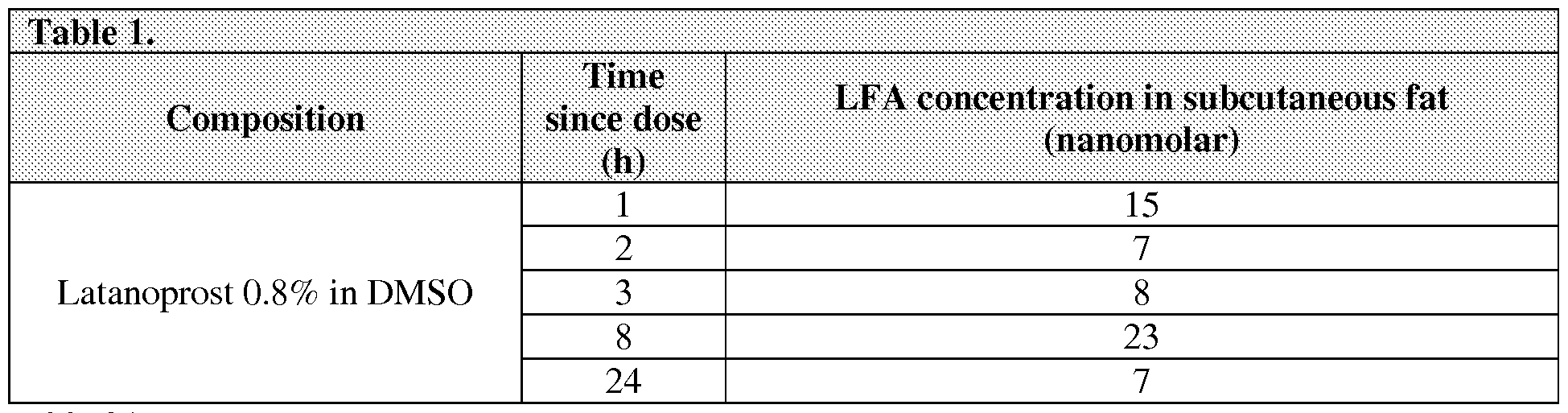
[00321] Thus, in an animal model with skin and subcutaneous fat similar to those of a human, a biphasic LFA concentration curve was seen in subcutaneous fat, with peak
concentrations at about 8 hours after a single topical dose of latanoprost. Thus, most of the latanoprost to be delivered over a 24-hour period is delivered in the first 8 hours.
Example 2
[00322] Skin permeation studies were conducted with compositions of latanoprost, ex vivo, on fresh human skin. Skin was obtained from live donors undergoing abdominoplasty and mounted on a standard (Franz-type) diffusion cell apparatus. All test articles contained 0.8% latanoprost (by weight) and were applied uniformly to a skin surface of 0.8 cm . Each study was replicated on skin from at least two different donors. Treated skin was left open to the atmosphere to simulate clinical conditions. Receptor fluid flowed continuously over 24 hours and was collected in fractions. The amount of active drug metabolite (LFA) in these fractions was determined by Liquid Chromatography/Tandem Mass Spectrometry (LC/MS/MS).
Table 2 shows the relative amounts of LFA delivered at different time intervals for each formulation, i.e. the percentage of 24-hour flux that occurred in each time interval. [Ethanol formulation 1 consisted essentially of 27% propylene glycol and 3% oleic acid in a base of about 69% ethanol.

[00323] Thus, when DMSO- or ethanol-based compositions of latanoprost were applied to human skin in vitro, proportionately more permeation of latanoprost (and/or its active metabolite) occurred at initial application (0 hours) to about 12 hours compared to 12-24 hours after latanoprost administration. For DMSO-based formulations, about 61% to about 84% of the 24-hour flux occurred within 12 hours of application. For an ethanol-based formulation, about 63% of the 24-hour flux occurred within 12 hours of application.
Example 3
[00324] Skin permeation studies were conducted with a petroleum jelly composition of latanoprost, ex vivo, on fresh pig skin. The composition consisted essentially of 0.3% latanoprost, 5% isopropyl myristate, and 95% petroleum jelly. Skin was mounted on a standard (Franz-type) diffusion cell apparatus. All test articles were applied uniformly to a
9
skin surface of 0.8 cm . Each study was replicated on skin from at least two different donors. Treated skin was left open to the atmosphere to simulate clinical conditions. After 1, 2, 4 or 8 hours, the test articles were removed by wiping with a swab soaked in a soap-and- water solution, followed by wiping with a dry swab. After 24 hours, samples were removed from the diffusion cells, and the dermis was isolated. The amount of active drug metabolite (LFA) in each dermis samples was determined by Liquid Chromatography/Tandem Mass
Spectrometry (LC/MS/MS). Table 3 shows the results of this experiment.

[00325] Thus, when a petroleum jelly-based composition of latanoprost was applied to skin in vitro, the dermis became fully loaded with drug (latanoprost or LFA) within 4 hours of skin contact.
Example 4
[00326] A randomized, placebo-controlled trial of topical latanoprost was conducted on male and female minipigs. Animals were randomized to no treatment, placebo (vehicle only), latanoprost 0.16%, or latanoprost 0.8% in an emulsion consisting essentially of water, poloxamer, lecithin, and isopropyl palmitate. The treatment was applied once daily to a 400
9
cm area on the dorsum, with a semi-occlusive dressing. Treatment continued for 42 days. Animals received a full panel of local and systemic safety assessments over the course of the study. Plasma toxicokinetics (TK) were assessed at various timepoints. After 42 days of treatment, animals were sacrificed. Samples of skin and subcutaneous fat were dissected from the treatment area in a controlled fashion and submitted for microscopic examination by a veterinary pathologist who was not informed of the compound tested or its therapeutic purpose.
[00327] At steady state, TK showed a peak LFA plasma concentration at about 2 to 3 hours after latanoprost application. There was evidence of accumulation of latanoprost and/or LFA in subcutaneous fat, with a plasma exposure accumulation ratio (steady state vs. first dose) of about 5 to 6 at the 0.8% dose. Such accumulation does not occur in plasma (half-life in humans is about 17 minutes) and can only be explained by redistribution from
another tissue compartment. The methods of Example 1 were used to verify that substantial levels of LFA had in fact remained in subcutaneous fat after the 24-hours dose interval. The result was a mean concentration of 9600 nM at the 0.8% dose.
[00328] Dose-dependent depletion of subcutaneous fat was noted on microscopic examination of treated subcutaneous fat. Reduction of subcutaneous fat thickness was quantified using ImageJ software. In the high-dose group the mean reduction was 2.2 cubic centimeters of fat per 100 cm of treated skin.
[00329] Thus, in a controlled trial of daily topical latanoprost in minipigs, there was evidence of peak latanoprost/LFA penetration at about 2-3 hours, accumulation and persistence of LFA in subcutaneous fat beyond 24 hours, and dose-dependent reduction of subcutaneous fat.
Example 5
[00330] A pharmacokinetic (PK) experiment was conducted on male and female minipigs (n = 6 per sex). Ointment comprising latanoprost 0.5% w/w in a vehicle comprising petroleum jelly and isopropyl myristate was applied once daily for 91 days to skin over 10% of body surface area. After the last topical application, plasma PK was assessed by sampling all animals through 24 hours, and in 2 animals per sex over for an additional 48 hours. Table 4 shows the results.

[00331] The results at 24, 48, and 72 hours, which correspond to the elmination (beta) phase of the time-concentration curve, were fit to a first-order kinetic model, which indicated a surprisingly long terminal elimination half-life of about 18-24 hours. This result can be attributed to redistribution from from subcutaneous fat and/or dermis. The result is in contrast to a half-life of about 9- 17 minutes or about 17-85 minutes, respectively, for LFA after intravenous or ocular administration. (See Sjoquist B et al., The phamacokinetics of a new antiglaucoma drug, latanoprost, in the rabbit, Drug Metabol Distribution 1998;26:745- 754; and Sjoquist B and Stjernschantz J, Ocular and systemic pharmacokinetics of latanoprost in humans, Surv Ophthalmol 2002;47:S6-S 12).
Example 6
[00332] A randomized, double-blind, placebo-controlled trial of topical latanoprost applied to the submental area was conducted with adult men and women with excess submental fat. In one cohort, participants were randomized to receive latanoprost in an ethanol-based composition, or a matching placebo composition. In another cohort, participants were randomized to receive latanoprost in a petroleum jelly-based composition, or a matching placebo composition. The composition was applied at bedtime to a controlled 50 cm area of submental skin. Participants were instructed to wash the 50 cm area after 8-10 hours, so as to remove the composition. Treatment continued for 42 days. Topical latanoprost was well tolerated.
Example 7
[00333] A kit is provided comprising a tube of a topical composition comprising a
PFPFRA compound, e.g., latanoprost, tafluprost, travoprost, or bimatoprost, for reducing subcutaneous fat, and instructions for use. The instructions for use comprise instructions to apply the composition in a thin film to a particular area of the body once nightly, e.g., at bedtime, and to remove the gel, e.g., by washing with soap and water, 6 to 10 hours after application.
Example 8
[00334] A randomized, double-masked, placebo-controlled trial of latanoprost ointment applied to lower eyelids was conducted with adult men and women with lower lid
steatoblepharon, i.e., eye bags. Participants received a kit comprising a tube of latanoprost ointment and instructions to apply the topical composition to the lower eyelids once nightly at bedtime. Participants were instructed to wash the lower eyelids 8-10 hours after ointment application, so as to remove the ointment or residue thereof. Treatment continued for 10 weeks. Latanoprost ointment was associated with statistically significant improvements in patient- and clinican-reported measures of eyelid fat volume, patient appearance, and patient satisfaction over the course of the study. The topical latanoprost composition was well tolerated.
Example 9
[00335] A topical composition comprising a compound of the formula:

(at a concentration between about 0.03% and about 3% w/w) and one or more
pharmaceutically acceptable excipients {e.g., water, ethanol, propylene glycol, petrolatum, mineral oil, white wax, isopropyl myristate, and/or diethylene glycol monoethyl ether), is administered once daily to an area of skin {e.g., eyelid, face and/or submental region) on a patient for a period between about 1 to 6 months. After each administration the composition is removed after about 6 to 12 hours. It is contemplated that after 1 to 6 months of repeated administration, subcutaneous fat will be reduced at the site of administration.
Other Embodiments
[00336] In the claims articles such as "a," "an," and "the" may mean one or more than one unless indicated to the contrary or otherwise evident from the context. Claims or descriptions that include "or" between one or more members of a group are considered satisfied if one, more than one, or all of the group members are present in, employed in, or otherwise relevant to a given product or process unless indicated to the contrary or otherwise evident from the context. The invention includes embodiments in which exactly one member of the group is present in, employed in, or otherwise relevant to a given product or process. The invention includes embodiments in which more than one, or all of the group members are present in, employed in, or otherwise relevant to a given product or process.
[00337] Furthermore, the invention encompasses all variations, combinations, and permutations in which one or more limitations, elements, clauses, and descriptive terms from one or more of the listed claims is introduced into another claim. For example, any claim that is dependent on another claim can be modified to include one or more limitations found in any other claim that is dependent on the same base claim. Where elements are presented as lists, e.g., in Markush group format, each subgroup of the elements is also disclosed, and any element(s) can be removed from the group. It should it be understood that, in general, where the invention, or aspects of the invention, is/are referred to as comprising particular elements
and/or features, certain embodiments of the invention or aspects of the invention consist, or consist essentially of, such elements and/or features. For purposes of simplicity, those embodiments have not been specifically set forth in haec verba herein. It is also noted that the terms "comprising" and "containing" are intended to be open and permits the inclusion of additional elements or steps. Where ranges are given, endpoints are included. Furthermore, unless otherwise indicated or otherwise evident from the context and understanding of one of ordinary skill in the art, values that are expressed as ranges can assume any specific value or sub-range within the stated ranges in different embodiments of the invention, to the tenth of the unit of the lower limit of the range, unless the context clearly dictates otherwise.
[00338] This application refers to various issued patents, published patent applications, journal articles, and other publications, all of which are incorporated herein by reference. If there is a conflict between any of the incorporated references and the instant specification, the specification shall control. In addition, any particular embodiment of the present invention that falls within the prior art may be explicitly excluded from any one or more of the claims. Because such embodiments are deemed to be known to one of ordinary skill in the art, they may be excluded even if the exclusion is not set forth explicitly herein. Any particular embodiment of the invention can be excluded from any claim, for any reason, whether or not related to the existence of prior art.
[00339] Those skilled in the art will recognize or be able to ascertain using no more than routine experimentation many equivalents to the specific embodiments described herein. The scope of the present embodiments described herein is not intended to be limited to the above Description, but rather is as set forth in the appended claims. Those of ordinary skill in the art will appreciate that various changes and modifications to this description may be made without departing from the spirit or scope of the present invention, as defined in the following claims.
Claims
1. Latanoprost for use in reducing body fat, wherein the latanoprost is provided in a topical composition, and whereby the duration of skin surface exposure to the composition or residue thereof is between about 4 hours and about 12 hours, inclusive, per dose of the composition.
2. The use of claim 1, wherein the duration is between about 4 hours and about 10 hours, inclusive, per dose of the composition.
3. The use of claim 2, wherein the duration is between about 4 hours and about 8 hours, inclusive, per dose of the composition.
4. The use of claim 2, wherein the duration is between about 6 hours and about 10 hours, inclusive, per dose of the composition.
5. The use of claim 1 wherein the dose frequency is once every 24 hours.
6. The use of claim 1, wherein the body fat is eyelid fat.
7. The use of claim 1, wherein the topical composition is an ointment.
8. The use of claim 1, wherein the topical composition comprises petroleum jelly.
9. The use of claim 8, wherein the topical composition further comprises isopropyl myristate.
10. A method for locally reducing body fat in a subject in need thereof, the method comprising the steps of: administering a composition comprising latanoprost to the skin surface; and removing the composition or residue thereof from the skin surface between about 4 hours and about 12 hours, inclusive, after said administering.
11. The method of claim 10, wherein the removing is between about 4 hours and about 10 hours, inclusive, after said administering.
12. The method of claim 11, wherein the removing is between about 4 hours and about 8 hours, inclusive, after said administering.
13. The method of claim 11, wherein the removing is between about 6 hours and about 10 hours, inclusive, after said administering.
14. The method of claim 10, wherein more than about 60 percent of the 24-hour flux of latanoprost or an active metabolite thereof occurs within 4 to 12 hours, inclusive, after the step of administering, and wherein the step of removing is after more than about 60 percent of the 24-hour flux has occurred.
15. The method of claim 10, wherein the dermis is fully loaded with latanoprost, an active metabolite thereof, or a combination thereof, within 4 to 12 hours, inclusive, after the administering, and wherein the step of removing is after the dermis is fully loaded.
16. The method of claim 10, wherein the dose frequency is once every 24 hours.
17. The method of claim 10, wherein the body fat is eyelid fat.
18. The method of claim 10, wherein the composition is an ointment.
19. The method of claim 10, wherein the composition comprises petroleum jelly.
20. The use of claim 19, wherein the topical composition further comprises isopropyl myristate.
Priority Applications (1)
| Application Number | Priority Date | Filing Date | Title |
|---|---|---|---|
| US15/321,241 US10188661B2 (en) | 2014-06-27 | 2015-06-24 | Topical dosage regimen |
Applications Claiming Priority (2)
| Application Number | Priority Date | Filing Date | Title |
|---|---|---|---|
| US201462018233P | 2014-06-27 | 2014-06-27 | |
| US62/018,233 | 2014-06-27 |
Publications (1)
| Publication Number | Publication Date |
|---|---|
| WO2015200425A1 true WO2015200425A1 (en) | 2015-12-30 |
Family
ID=53525289
Family Applications (1)
| Application Number | Title | Priority Date | Filing Date |
|---|---|---|---|
| PCT/US2015/037323 Ceased WO2015200425A1 (en) | 2014-06-27 | 2015-06-24 | Topical dosage regimen |
Country Status (2)
| Country | Link |
|---|---|
| US (1) | US10188661B2 (en) |
| WO (1) | WO2015200425A1 (en) |
Cited By (2)
| Publication number | Priority date | Publication date | Assignee | Title |
|---|---|---|---|---|
| WO2016176640A1 (en) * | 2015-04-30 | 2016-11-03 | Allergan, Inc. | Cosmetic method and therapeutic use for fat reduction |
| US11452703B2 (en) * | 2020-05-21 | 2022-09-27 | Peregrine Ophthalmic PTE LTD. | Methods and compositions for reducing adipocyte numbers |
Families Citing this family (8)
| Publication number | Priority date | Publication date | Assignee | Title |
|---|---|---|---|---|
| CA2681668C (en) | 2006-03-23 | 2014-04-01 | Michael S. Singer | Compositions comprising prostaglandin f2-alpha analogs and methods for reducing body fat |
| US9089579B2 (en) | 2011-01-19 | 2015-07-28 | Topokine Therapeutics, Inc. | Methods and compositions for treating metabolic syndrome |
| US8426471B1 (en) | 2011-12-19 | 2013-04-23 | Topokine Therapeutics, Inc. | Methods and compositions for reducing body fat and adipocytes |
| NO2753788T3 (en) | 2013-05-10 | 2018-06-16 | ||
| WO2014186504A1 (en) | 2013-05-15 | 2014-11-20 | Topokine Therapeutics, Inc. | Methods and compositions for topical delivery of prostaglandins to subcutaneous fat |
| US10821075B1 (en) * | 2017-07-12 | 2020-11-03 | James Blanchard | Compositions for topical application of a medicaments onto a mammalian body surface |
| US10993944B2 (en) | 2019-08-07 | 2021-05-04 | Aneira Pharma, Inc. | Methods and compositions for the treatment of hair loss |
| US12539302B2 (en) | 2019-08-07 | 2026-02-03 | Aneira Pharma, Inc. | Methods and compositions for the treatment of hair loss |
Citations (2)
| Publication number | Priority date | Publication date | Assignee | Title |
|---|---|---|---|---|
| WO2007111806A2 (en) * | 2006-03-23 | 2007-10-04 | Massachusetts Eye And Ear Infirmary | Cyclopentane heptanoic acid compounds for reducing body fat |
| WO2012099942A2 (en) * | 2011-01-19 | 2012-07-26 | Terakine Therapeutics, Inc. | Methods and compositions for treating metabolic syndrome |
Family Cites Families (87)
| Publication number | Priority date | Publication date | Assignee | Title |
|---|---|---|---|---|
| US4270537A (en) | 1979-11-19 | 1981-06-02 | Romaine Richard A | Automatic hypodermic syringe |
| US4599353A (en) | 1982-05-03 | 1986-07-08 | The Trustees Of Columbia University In The City Of New York | Use of eicosanoids and their derivatives for treatment of ocular hypertension and glaucoma |
| US4596556A (en) | 1985-03-25 | 1986-06-24 | Bioject, Inc. | Hypodermic injection apparatus |
| US4886499A (en) | 1986-12-18 | 1989-12-12 | Hoffmann-La Roche Inc. | Portable injection appliance |
| GB8704027D0 (en) | 1987-02-20 | 1987-03-25 | Owen Mumford Ltd | Syringe needle combination |
| US4941880A (en) | 1987-06-19 | 1990-07-17 | Bioject, Inc. | Pre-filled ampule and non-invasive hypodermic injection device assembly |
| US4940460A (en) | 1987-06-19 | 1990-07-10 | Bioject, Inc. | Patient-fillable and non-invasive hypodermic injection device assembly |
| US4790824A (en) | 1987-06-19 | 1988-12-13 | Bioject, Inc. | Non-invasive hypodermic injection device |
| EP0302147A1 (en) | 1987-08-03 | 1989-02-08 | The Procter & Gamble Company | Topical tanning compositions |
| US5339163A (en) | 1988-03-16 | 1994-08-16 | Canon Kabushiki Kaisha | Automatic exposure control device using plural image plane detection areas |
| US5296504A (en) | 1988-09-06 | 1994-03-22 | Kabi Pharmacia | Prostaglandin derivatives for the treatment of glaucoma or ocular hypertension |
| ATE101342T1 (en) | 1988-09-06 | 1994-02-15 | Kabi Pharmacia Ab | PROSTAGLAND INDIVIDUALS FOR THE TREATMENT OF GREEN STAR OR OCULAR HYPERTENSION. |
| FR2638359A1 (en) | 1988-11-03 | 1990-05-04 | Tino Dalto | SYRINGE GUIDE WITH ADJUSTMENT OF DEPTH DEPTH OF NEEDLE IN SKIN |
| US5312335A (en) | 1989-11-09 | 1994-05-17 | Bioject Inc. | Needleless hypodermic injection device |
| US5064413A (en) | 1989-11-09 | 1991-11-12 | Bioject, Inc. | Needleless hypodermic injection device |
| US5011062A (en) | 1990-05-09 | 1991-04-30 | Delco Electronics Corporation | Ultrasonic welding mask |
| US5190521A (en) | 1990-08-22 | 1993-03-02 | Tecnol Medical Products, Inc. | Apparatus and method for raising a skin wheal and anesthetizing skin |
| US5527288A (en) | 1990-12-13 | 1996-06-18 | Elan Medical Technologies Limited | Intradermal drug delivery device and method for intradermal delivery of drugs |
| GB9118204D0 (en) | 1991-08-23 | 1991-10-09 | Weston Terence E | Needle-less injector |
| SE9102652D0 (en) | 1991-09-13 | 1991-09-13 | Kabi Pharmacia Ab | INJECTION NEEDLE ARRANGEMENT |
| US5328483A (en) | 1992-02-27 | 1994-07-12 | Jacoby Richard M | Intradermal injection device with medication and needle guard |
| US5383851A (en) | 1992-07-24 | 1995-01-24 | Bioject Inc. | Needleless hypodermic injection device |
| US5972991A (en) | 1992-09-21 | 1999-10-26 | Allergan | Cyclopentane heptan(ene) oic acid, 2-heteroarylalkenyl derivatives as therapeutic agents |
| US5688819A (en) | 1992-09-21 | 1997-11-18 | Allergan | Cyclopentane heptanoic acid, 2-cycloalkyl or arylalkyl derivatives as therapeutic agents |
| US5569189A (en) | 1992-09-28 | 1996-10-29 | Equidyne Systems, Inc. | hypodermic jet injector |
| US5334144A (en) | 1992-10-30 | 1994-08-02 | Becton, Dickinson And Company | Single use disposable needleless injector |
| US5510383A (en) | 1993-08-03 | 1996-04-23 | Alcon Laboratories, Inc. | Use of cloprostenol, fluprostenol and their salts and esters to treat glaucoma and ocular hypertension |
| JPH07138258A (en) | 1993-11-16 | 1995-05-30 | Taiho Yakuhin Kogyo Kk | Thiazolidinedione derivative or salt thereof |
| WO1995024176A1 (en) | 1994-03-07 | 1995-09-14 | Bioject, Inc. | Ampule filling device |
| US5466220A (en) | 1994-03-08 | 1995-11-14 | Bioject, Inc. | Drug vial mixing and transfer device |
| US5631287A (en) | 1994-12-22 | 1997-05-20 | Alcon Laboratories, Inc. | Storage-stable prostaglandin compositions |
| US5599302A (en) | 1995-01-09 | 1997-02-04 | Medi-Ject Corporation | Medical injection system and method, gas spring thereof and launching device using gas spring |
| US5730723A (en) | 1995-10-10 | 1998-03-24 | Visionary Medical Products Corporation, Inc. | Gas pressured needle-less injection device and method |
| US5893397A (en) | 1996-01-12 | 1999-04-13 | Bioject Inc. | Medication vial/syringe liquid-transfer apparatus |
| GB9607549D0 (en) | 1996-04-11 | 1996-06-12 | Weston Medical Ltd | Spring-powered dispensing device |
| RU2157689C2 (en) | 1996-07-24 | 2000-10-20 | Панацея Биотек Лтд. | Pharmaceutical compositions of therapeutic, anti-inflammatory and analgetic agent for topical application and method of their preparing |
| JP3480549B2 (en) | 1996-12-26 | 2003-12-22 | 参天製薬株式会社 | Difluoroprostaglandin derivatives and uses thereof |
| DE69823852T2 (en) | 1997-02-04 | 2005-05-19 | Johnstone, Murray A., Seattle | PROCESS FOR PROMOTING HAIR GROWTH AND DEVELOPING THE HAIR SYSTEM |
| US5993412A (en) | 1997-05-19 | 1999-11-30 | Bioject, Inc. | Injection apparatus |
| US6646001B2 (en) | 1997-12-19 | 2003-11-11 | Alcon Manufacturing, Ltd. | Use of non-steroidal anti-inflammatory agents in combination with prostaglandin FP receptor agonists to treat glaucoma and ocular hypertension |
| US6232344B1 (en) | 1997-12-22 | 2001-05-15 | Alcon Laboratories, Inc. | 13-Oxa prostaglandins for the treatment of glaucoma and ocular hypertension |
| IT1298087B1 (en) | 1998-01-08 | 1999-12-20 | Fiderm S R L | DEVICE FOR CHECKING THE PENETRATION DEPTH OF A NEEDLE, IN PARTICULAR APPLICABLE TO A SYRINGE FOR INJECTIONS |
| US6235781B1 (en) | 1998-07-14 | 2001-05-22 | Alcon Laboratories, Inc. | Prostaglandin product |
| WO2001058240A2 (en) | 2000-02-10 | 2001-08-16 | Massachusetts Eye And Ear Infirmary | Photodynamic therapy for treating conditions of the eye |
| US20020172693A1 (en) | 2000-03-31 | 2002-11-21 | Delong Michell Anthony | Compositions and methods for treating hair loss using non-naturally occurring prostaglandins |
| ES2172415B2 (en) | 2000-07-28 | 2003-11-16 | Univ Madrid Complutense | TREATMENT OF GLAUCOMA AND OCULAR HYPERTENSION THROUGH A MELATONINE ANALOG. |
| JP2004526745A (en) | 2001-03-27 | 2004-09-02 | ザ リージェンツ オブ ザ ユニバーシティ オブ カリフォルニア | Methods, compounds and compositions for reducing body fat and modulating fatty acid metabolism |
| GB0202159D0 (en) | 2002-01-30 | 2002-03-20 | Sensor Highway Ltd | OPtical time domain reflectometry |
| IL147921A0 (en) | 2002-01-31 | 2002-08-14 | Abdulrazik Mohammad | A method for treating central nervous system disorders by ocular dosing |
| US7351404B2 (en) | 2002-02-04 | 2008-04-01 | Allergan, Inc. | Method of enhancing hair growth |
| US6864282B2 (en) | 2002-08-05 | 2005-03-08 | Allergan, Inc. | 9,11-cycloendoperoxide pro-drugs of prostaglandin analogues for treatment of ocular hypertension and glaucoma |
| US20040115234A1 (en) | 2002-09-24 | 2004-06-17 | Gewirtz Joan T. | Cosmetic composition |
| US20050261641A1 (en) | 2002-09-26 | 2005-11-24 | Warchol Mark P | Method for ophthalmic administration of medicament |
| NZ539582A (en) | 2002-10-23 | 2007-07-27 | Sucampo Ag | Prostaglandin compounds for the treatment of obesity |
| US7074827B2 (en) | 2002-10-24 | 2006-07-11 | Sucampo Ag (Usa) Inc. | Method for treating ocular hypertension and glaucoma |
| JP4667369B2 (en) | 2003-03-21 | 2011-04-13 | ネックスメド ホールディングス インコーポレイテッド | Compositions and methods for treating premature ejaculation |
| US6933289B2 (en) | 2003-07-01 | 2005-08-23 | Allergan, Inc. | Inhibition of irritating side effects associated with use of a topical ophthalmic medication |
| US20050058614A1 (en) | 2003-09-15 | 2005-03-17 | Allergan, Inc. | Methods for the treatment of gray hair using cyclopentane(ene) heptan(en)oic acid amides |
| US7070768B2 (en) | 2003-09-25 | 2006-07-04 | Allergan, Inc. | Method for imparting artificial tan to human skin |
| US7993634B2 (en) | 2004-04-30 | 2011-08-09 | Allergan, Inc. | Oil-in-oil emulsified polymeric implants containing a hypotensive lipid and related methods |
| US8722097B2 (en) | 2004-04-30 | 2014-05-13 | Allergan, Inc. | Oil-in-water method for making polymeric implants containing a hypotensive lipid |
| SI2422789T1 (en) | 2004-05-19 | 2018-07-31 | Los Angeles Biomedical Research Institute At Harbor-Ucla Medical Center | An injectable composition comprising sodium deoxycholate |
| EP1812407A2 (en) | 2004-11-02 | 2007-08-01 | Pfizer, Inc. | Novel compounds of substituted and unsubstituted adamantyl amides |
| ES2314354T3 (en) | 2004-11-09 | 2009-03-16 | Novagali Pharma S.A. | EMULSION OF WATER OIL TYPE WITH LOW CONCENTRATION OF CATIONIC AGENT AND POTENTIAL POSITIVE ZETA. |
| WO2006082588A2 (en) | 2005-02-07 | 2006-08-10 | Pharmalight Inc. | Method and device for ophthalmic administration of active pharmaceutical ingredients |
| PL1864666T3 (en) | 2005-03-31 | 2013-02-28 | Agc Inc | Protective agent for retinal neuronal cell containing prostaglandin f2 alpha derivative as active ingredient |
| US7829554B2 (en) | 2005-07-14 | 2010-11-09 | Lithera, Inc. | Sustained release enhanced lipolytic formulation for regional adipose tissue treatment |
| ZA200802546B (en) | 2005-08-29 | 2009-10-28 | Healor Ltd | Methods and compositions for prvention and treatment of diabetic and aged skin |
| US9393218B2 (en) | 2005-12-23 | 2016-07-19 | Epinamics Gmbh | Use of film-forming hair care polymers from the group of polyurethanes and pharmaceutical preparations and patches that contain these polymers |
| RU2325912C1 (en) | 2006-09-06 | 2008-06-10 | Открытое акционерное общество "Химико-фармацевтический комбинат "АКРИХИН" (ОАО "АКРИХИН") | Phamaceutical formulation of anti-inflammatory and antibacterial action in ointment form with hydrophobic base applied for dermatoses treatment (versions) |
| US8796282B2 (en) | 2007-03-28 | 2014-08-05 | Case Western Reserve University | Method of treating dermatological disorders |
| WO2008120249A1 (en) | 2007-03-30 | 2008-10-09 | Sifi S.P.A. | Pharmaceutical formulations based on apolar and polar lipids for ophthalmic use |
| US20100074857A1 (en) | 2008-09-23 | 2010-03-25 | Pamela Lipkin | Compositions and methods to treat epithelial-related conditions |
| US20100104654A1 (en) | 2008-10-27 | 2010-04-29 | Allergan, Inc. | Prostaglandin and prostamide drug delivery systems and intraocular therapeutic uses thereof |
| US8722739B2 (en) | 2008-10-29 | 2014-05-13 | Novaer Holdings, Inc. | Amino acid salts of prostaglandins |
| CN101427993A (en) | 2008-11-20 | 2009-05-13 | 沈阳万爱普利德医药科技有限公司 | Prostaglandin microemulsion gel rubber preparation and method of producing the same |
| EP2228058A1 (en) | 2009-03-04 | 2010-09-15 | Novagali Pharma S.A. | Anionic oil-in-water emulsion containing prostaglandins and uses thereof |
| RU2567792C2 (en) | 2009-11-09 | 2015-11-10 | Аллерган, Инк. | Compositions and methods for hair growth stimulation |
| JP6042343B2 (en) | 2010-11-18 | 2016-12-14 | スティーヴン ヨーリン | Compositions and methods for hair growth |
| WO2012112451A1 (en) | 2011-02-14 | 2012-08-23 | Allergan, Inc. | Ester derivatives of bimatoprost compositions and methods |
| US20120251613A1 (en) | 2011-03-29 | 2012-10-04 | Agila Specialities Pvt. Ltd. | Method for treating vitiligo with a prostaglandin analogue |
| US8426471B1 (en) | 2011-12-19 | 2013-04-23 | Topokine Therapeutics, Inc. | Methods and compositions for reducing body fat and adipocytes |
| US20150164765A1 (en) | 2012-05-17 | 2015-06-18 | Steven G. Yoelin | Compositions and methods for hair growth |
| KR20140043562A (en) | 2012-09-24 | 2014-04-10 | 한국콜마주식회사 | The water-insoluble latanoprost covered with amorphous surfactant and method for preparing the same |
| US20150313825A1 (en) | 2012-11-21 | 2015-11-05 | Topokine Therapeutics, Inc. | Methods and compositions for locally increasing body fat |
| NO2753788T3 (en) | 2013-05-10 | 2018-06-16 | ||
| WO2014186504A1 (en) | 2013-05-15 | 2014-11-20 | Topokine Therapeutics, Inc. | Methods and compositions for topical delivery of prostaglandins to subcutaneous fat |
-
2015
- 2015-06-24 WO PCT/US2015/037323 patent/WO2015200425A1/en not_active Ceased
- 2015-06-24 US US15/321,241 patent/US10188661B2/en active Active
Patent Citations (2)
| Publication number | Priority date | Publication date | Assignee | Title |
|---|---|---|---|---|
| WO2007111806A2 (en) * | 2006-03-23 | 2007-10-04 | Massachusetts Eye And Ear Infirmary | Cyclopentane heptanoic acid compounds for reducing body fat |
| WO2012099942A2 (en) * | 2011-01-19 | 2012-07-26 | Terakine Therapeutics, Inc. | Methods and compositions for treating metabolic syndrome |
Cited By (6)
| Publication number | Priority date | Publication date | Assignee | Title |
|---|---|---|---|---|
| WO2016176640A1 (en) * | 2015-04-30 | 2016-11-03 | Allergan, Inc. | Cosmetic method and therapeutic use for fat reduction |
| US9795615B2 (en) | 2015-04-30 | 2017-10-24 | Allergan, Inc. | Methods for fat reduction |
| US10117877B2 (en) | 2015-04-30 | 2018-11-06 | Allergan, Inc. | Methods for fat reduction |
| EP3721885A1 (en) * | 2015-04-30 | 2020-10-14 | Allergan, Inc. | Cosmetic method and therapeutic use for fat reduction |
| AU2016254208B2 (en) * | 2015-04-30 | 2021-07-15 | Allergan, Inc. | Cosmetic method and therapeutic use for fat reduction |
| US11452703B2 (en) * | 2020-05-21 | 2022-09-27 | Peregrine Ophthalmic PTE LTD. | Methods and compositions for reducing adipocyte numbers |
Also Published As
| Publication number | Publication date |
|---|---|
| US10188661B2 (en) | 2019-01-29 |
| US20170202852A1 (en) | 2017-07-20 |
Similar Documents
| Publication | Publication Date | Title |
|---|---|---|
| US20220152206A1 (en) | Compositions and methods for topical delivery of prostaglandins to subcutaneous fat | |
| WO2015200425A1 (en) | Topical dosage regimen | |
| US20230330105A1 (en) | Methods and compositions for topical delivery of prostaglandins to subcutaneous fat | |
| WO2012099942A2 (en) | Methods and compositions for treating metabolic syndrome | |
| AU2012358998B2 (en) | Methods and compositions for reducing body fat and adipocytes | |
| US8883834B2 (en) | Methods and compositions for locally increasing body fat | |
| HK1263095A1 (en) | Compositions and methods for topical delivery of prostaglandins to subcutaneous fat | |
| HK1233926A1 (en) | Compositions and methods for topical delivery of prostaglandins to subcutaneous fat |
Legal Events
| Date | Code | Title | Description |
|---|---|---|---|
| 121 | Ep: the epo has been informed by wipo that ep was designated in this application |
Ref document number: 15735811 Country of ref document: EP Kind code of ref document: A1 |
|
| DPE1 | Request for preliminary examination filed after expiration of 19th month from priority date (pct application filed from 20040101) | ||
| WWE | Wipo information: entry into national phase |
Ref document number: 15321241 Country of ref document: US |
|
| NENP | Non-entry into the national phase |
Ref country code: DE |
|
| 122 | Ep: pct application non-entry in european phase |
Ref document number: 15735811 Country of ref document: EP Kind code of ref document: A1 |