WO2014101113A1 - Piperazine-substituted 7-methoxy-[1,2,4]triazolo[1,5-c]quinazolin-5-amine compounds with a2a antagonist properties - Google Patents
Piperazine-substituted 7-methoxy-[1,2,4]triazolo[1,5-c]quinazolin-5-amine compounds with a2a antagonist properties Download PDFInfo
- Publication number
- WO2014101113A1 WO2014101113A1 PCT/CN2012/087851 CN2012087851W WO2014101113A1 WO 2014101113 A1 WO2014101113 A1 WO 2014101113A1 CN 2012087851 W CN2012087851 W CN 2012087851W WO 2014101113 A1 WO2014101113 A1 WO 2014101113A1
- Authority
- WO
- WIPO (PCT)
- Prior art keywords
- compound
- alkyl
- moiety
- formula
- independently
- Prior art date
- Legal status (The legal status is an assumption and is not a legal conclusion. Google has not performed a legal analysis and makes no representation as to the accuracy of the status listed.)
- Ceased
Links
- 0 C[C@](*)(CN(*1CC1)[C@](*)([C@]1*)*=*)N1C(*)(*)c(nc1c2cc(*)c3)n[n]1c(N)nc2c3OC Chemical compound C[C@](*)(CN(*1CC1)[C@](*)([C@]1*)*=*)N1C(*)(*)c(nc1c2cc(*)c3)n[n]1c(N)nc2c3OC 0.000 description 8
- UBQKCCHYAOITMY-UHFFFAOYSA-N O=C1NC=CC=C1 Chemical compound O=C1NC=CC=C1 UBQKCCHYAOITMY-UHFFFAOYSA-N 0.000 description 2
- GNTCSQDIVOAUIX-OKILXGFUSA-N CC(C)CN([C@H](C)C1)[C@@H](C)CN1C(c(cc1)ccc1F)=O Chemical compound CC(C)CN([C@H](C)C1)[C@@H](C)CN1C(c(cc1)ccc1F)=O GNTCSQDIVOAUIX-OKILXGFUSA-N 0.000 description 1
- JLNKWNZLUOQHQK-UHFFFAOYSA-N COc1cc(CNc2nc(c(OC)ccc3)c3c3nc(CCl)n[n]23)cc(OC)c1 Chemical compound COc1cc(CNc2nc(c(OC)ccc3)c3c3nc(CCl)n[n]23)cc(OC)c1 JLNKWNZLUOQHQK-UHFFFAOYSA-N 0.000 description 1
- IWHUMTGIIKFLSP-SECBINFHSA-N C[C@H](C1)NCCN1c(cc1)ccc1F Chemical compound C[C@H](C1)NCCN1c(cc1)ccc1F IWHUMTGIIKFLSP-SECBINFHSA-N 0.000 description 1
- BDIPIFXCDHCLMF-MRXNPFEDSA-N C[C@H]1N(Cc(nc2c3ccc4)n[n]2c(NCc2cc(OC)cc(OC)c2)nc3c4OC)CCNC1 Chemical compound C[C@H]1N(Cc(nc2c3ccc4)n[n]2c(NCc2cc(OC)cc(OC)c2)nc3c4OC)CCNC1 BDIPIFXCDHCLMF-MRXNPFEDSA-N 0.000 description 1
- VWEJPENHRNKKTA-UHFFFAOYSA-N Cc1cc(cncc2)c2[o]1 Chemical compound Cc1cc(cncc2)c2[o]1 VWEJPENHRNKKTA-UHFFFAOYSA-N 0.000 description 1
Classifications
-
- C—CHEMISTRY; METALLURGY
- C07—ORGANIC CHEMISTRY
- C07D—HETEROCYCLIC COMPOUNDS
- C07D487/00—Heterocyclic compounds containing nitrogen atoms as the only ring hetero atoms in the condensed system, not provided for by groups C07D451/00 - C07D477/00
- C07D487/02—Heterocyclic compounds containing nitrogen atoms as the only ring hetero atoms in the condensed system, not provided for by groups C07D451/00 - C07D477/00 in which the condensed system contains two hetero rings
- C07D487/04—Ortho-condensed systems
-
- A—HUMAN NECESSITIES
- A61—MEDICAL OR VETERINARY SCIENCE; HYGIENE
- A61P—SPECIFIC THERAPEUTIC ACTIVITY OF CHEMICAL COMPOUNDS OR MEDICINAL PREPARATIONS
- A61P25/00—Drugs for disorders of the nervous system
-
- A—HUMAN NECESSITIES
- A61—MEDICAL OR VETERINARY SCIENCE; HYGIENE
- A61P—SPECIFIC THERAPEUTIC ACTIVITY OF CHEMICAL COMPOUNDS OR MEDICINAL PREPARATIONS
- A61P25/00—Drugs for disorders of the nervous system
- A61P25/28—Drugs for disorders of the nervous system for treating neurodegenerative disorders of the central nervous system, e.g. nootropic agents, cognition enhancers, drugs for treating Alzheimer's disease or other forms of dementia
-
- C—CHEMISTRY; METALLURGY
- C07—ORGANIC CHEMISTRY
- C07D—HETEROCYCLIC COMPOUNDS
- C07D487/00—Heterocyclic compounds containing nitrogen atoms as the only ring hetero atoms in the condensed system, not provided for by groups C07D451/00 - C07D477/00
- C07D487/02—Heterocyclic compounds containing nitrogen atoms as the only ring hetero atoms in the condensed system, not provided for by groups C07D451/00 - C07D477/00 in which the condensed system contains two hetero rings
- C07D487/08—Bridged systems
-
- C—CHEMISTRY; METALLURGY
- C07—ORGANIC CHEMISTRY
- C07D—HETEROCYCLIC COMPOUNDS
- C07D487/00—Heterocyclic compounds containing nitrogen atoms as the only ring hetero atoms in the condensed system, not provided for by groups C07D451/00 - C07D477/00
- C07D487/12—Heterocyclic compounds containing nitrogen atoms as the only ring hetero atoms in the condensed system, not provided for by groups C07D451/00 - C07D477/00 in which the condensed system contains three hetero rings
- C07D487/18—Bridged systems
-
- C—CHEMISTRY; METALLURGY
- C07—ORGANIC CHEMISTRY
- C07D—HETEROCYCLIC COMPOUNDS
- C07D513/00—Heterocyclic compounds containing in the condensed system at least one hetero ring having nitrogen and sulfur atoms as the only ring hetero atoms, not provided for in groups C07D463/00, C07D477/00 or C07D499/00 - C07D507/00
- C07D513/02—Heterocyclic compounds containing in the condensed system at least one hetero ring having nitrogen and sulfur atoms as the only ring hetero atoms, not provided for in groups C07D463/00, C07D477/00 or C07D499/00 - C07D507/00 in which the condensed system contains two hetero rings
- C07D513/04—Ortho-condensed systems
Definitions
- Adenosine is known to be an endogenous modulator of a number of physiological functions. At the cardiovascular system level, adenosine is a strong vasodilator and a cardiac depressor. On the central nervous system, adenosine induces sedative, anxiolytic and antiepileptic effects. On the respiratory system, adenosine induces bronchoconstriction. At the kidney level, it exerts a biphasic action, inducing vasoconstriction at low concentrations and vasodilation at high doses. Adenosine acts as a lipolysis inhibitor on fat cells and as an antiaggregant on platelets.
- Adenosine action is mediated by the interaction with different membrane specific receptors which belong to the family of receptors coupled with G proteins.
- Biochemical and pharmacological studies, together with advances in molecular biology, have allowed the identification of at least four subtypes of adenosine receptors: Ai, A 2A , A 2b and A 3 .
- Ai and A 3 are high-affinity, inhibiting the activity of the enzyme adenylate cyclase, and
- a A and A3 ⁇ 4 are low-affinity, stimulating the activity of the same enzyme.
- a 2A antagonists can have antidepressant properties and stimulate cognitive functions.
- a 2A receptors are present in high density in the basal ganglia, known to be important in the control of movement.
- a 2A antagonists can improve motor impairment due to neurodegenerative diseases, for example, Parkinson's disease, senile dementia as in Alzheimer's disease, and psychoses of organic origin.
- xanthine-related compounds have been found to be Ai receptor selective antagonists, and xanthine and non-xanthine compounds have been found to have high A 2A affinity with varying degrees of A 2A vs. Ai selectivity.
- Triazolo-pyrimidine adenosine A 2A receptor antagonists with different substitution at the 7-position have been disclosed previously, for example in WO 95/01356; US 5,565,460; WO 97/05138; and WO 98/52568.
- Parkinson's disease is characterized by progressive degeneration of the nigrostriatal dopaminergic pathway. The subsequent reduction in striatal dopamine levels is responsible for motor symptoms associated with Parkinson's disease, e.g., the loss of fine motor control or motor impairment manifested in those suffering from the disease.
- Current methodologies for alleviating motor symptoms associated with Parkinson's disease seek to replace dopamine either within the presynaptic terminal, for example, by administration of L-Dopa, directly through stimulation of the postsynaptic D 2 receptors, or by inhibiting metabolism, for example, by administration of monoamine oxidase type B (MAO-B) or catechol-O-methyltransferase (COMT). Long term use of such therapies is often associated with adverse events.
- MAO-B monoamine oxidase type B
- COMP catechol-O-methyltransferase
- a 2A receptor antagonists in the treatment of central nervous system diseases, in particular Parkinson's disease, and pharmaceutical compositions comprising said compounds has elevated the need for potent, moderately lipophilic, brain penetrant inhibitors of the A 2A receptor.
- Such compounds would provide an expansion of the arsenal of compounds which are believed to have value in the treatment of central nervous system disorders, in particular treating or managing the progression of such diseases, for example, but not limited to, Parkinson's disease.
- the invention provides one or more compounds, or a salt thereof, believed to have utility as an A 2A -receptor antagonist which have the structure:
- m and n are independently an integer of from 1 to 3, with the proviso that no more than two R G2a substituents are located on adjacent ring carbon atoms;
- R G2a is independently: (i) -OH; (ii) -CN; (iii) Halogen (preferably -CI or -F); (iv) -Ci -6 -linear alkyl which is optionally substituted by one or more fluorine substituents, and preferably when fluorine substituted is -CF 3 ; or (v) -Ci_ 6 -alkoxy, which is optionally substituted by a
- Ci-4-alkoxy moiety and preferably when so substituted the alkoxy substitutent is -O-CH3, and in some embodiments where R G2a is an alkoxy-substituted-alkoxy moiety, preferably it
- R G4 and R G5 are: (a) independently, for each occurrence, (i) -H; (ii) -F; or (iii) -Ci -6 -alkyl (linear, branched or cyclic) which is optionally substituted with one or more fluorine substituents; or
- R G4 and R G5 are taken together to form a carbonyl [-C(O)-] moiety, with the proviso that where "m" > 1 , R G4 and R G5 are not selected to form two adjacent carbonyl moieties; and
- R a6 is -H; or -CH 3 ; and R al ; R a2 ; R a3 ; R a4 ; and R a5 are independently:
- R al ; R a2 ; R 33 ; and R a4 are independently -H or C1.5 linear, branched or cyclic alkyl;
- R a5 and R a ' ' are joined together via a -(CH 2 ) q - "bridge" to form a moiety of the structure:
- R al R a2 or R a3 R a4 are each -H and the other pair form a spirocycle of up to five carbon atoms, thereby providing a spirocycle of Formula Fb 3 or Formula Fb 4 :
- R o1 is: (i) aryl; (ii) Ci-s-alkoxy; or (iii) Ci-e-alkyl;
- a mono- or polycyclic aryl moiety comprising from 5 to 10 carbon atoms which is optionally linked to a nitrogen of the piperazine moiety through a carbonyl carbon, thereby forming an amide linkage, and wherein one or more ring carbon atoms is optionally substituted with a moiety which is, independently for each occurrence:
- Ci-6-alkyl that is optionally halogen substituted, and in some embodiments when
- halogen substituted alkyl preferably it is -CF 3 ;
- Ci-6-alkoxy preferably methoxy
- a compound Formula A preferably has the structure of Formula AI:
- R G2 is independently:
- Halogen preferably -CI or -F
- R G3 is -H or -F
- the present invention is the provision of a pharmaceutical formulation comprising at least one compound of Formula A or a salt thereof and at least one excipient.
- the present invention is the provision of a method of treating central nervous system disorders by administering to a patient in need thereof a therapeutical amount of at least one compound of Formula A or a salt thereof.
- the invention provides one or more compounds believed to have utility as an A 2 A- receptor antagonist which have the structure of Formula A.
- compounds of Formula A preferably have the structure of Formula B:
- R and R ⁇ 3 are independently for each occurrence: (1 ) -H; (2) Ci_ 6 -alkyl; or (3) Ci_ 6 -alkoxy, or
- R and R ⁇ together with the carbon to which they are bonded represent a carbonyl moiety (-C(O)-);
- R al , R a , R ai , R a4 , and R a3 are independently: -H; aryl; or d.j-alkyl; and
- R b2 is :
- R cl is: (i) aryl; (ii) Ci_ 6 -alkoxy; or (iii) Ci_ 6 -alkyl;
- a mono- or polycyclic aryl moiety comprising from 5 to 10 carbon atoms which is optionally linked to a nitrogen of the piperazine moiety through a carbonyl carbon, thereby forming an amide linkage, and wherein one or more ring carbon atoms is optionally substituted with a moiety which is, independently for each occurrence:
- Ci-6-alkyl that is optionally halogen substituted, and in some embodiments when
- halogen substituted alkyl preferably it is -CF 3 ;
- a mono- or polycyclic heteroaryl moiety comprising from 5 to 10 carbon atoms and from 1 to 4 heteroatoms which are independently for each occurrence, "N", “O”, or “S”, which is optionally linked to a nitrogen of the piperazine moiety through a carbonyl carbon, thereby forming an amide linkage, and wherein, optionally one or more ring carbon atoms is substituted with a moiety which is, independently for each occurrence:
- compounds of Formula A preferably have the structure of Formula F:
- R DZ is as defined for compounds of Formula B, above.
- variable R G3 is -H and the variables R G4 , R G5 , R al to R a5 , and R l are defined in Table I, below.
- embo n is a compound of Formula B:
- variable R G3 is -F
- variable R a5 is -H
- the variables R G4 , R G5 , R al to R a4 , and R are defined in Table ⁇ , below. Table II
- d of the invention is a compound of Formula E:
- variable R b2 is defined in Table ⁇ , below.
- compounds of the invention have the structure of the formula:
- R G3a is -H or -F and R b2 is a mono- or polycyclic aryl moiety comprising from 5 to 10 carbon atoms which is optionally linked to a nitrogen of the piperazine moiety through a carbonyl carbon, thereby forming an amide linkage, and wherein one or more ring carbon atoms thereof is optionally substituted with a moiety which is, independently for each occurrence:
- Ci-6-alkyl that is optionally halogen substituted, and in some embodiments when R 2 is a halogen substituted alkyl, preferably it is -CF 3 ;
- Ci-6-alkoxy preferably methoxy
- heteroatoms which are, independently for each occurrence, "N", “O”, or "S"; or
- preferably compounds of the invention have the structural formula shown in Examples 1 to 5 herein.
- a compound in treatment means that an amount of the compound, generally presented as a component of a formulation that comprises other excipients, is administered in aliquots of an amount, and at time intervals, which provides and maintains at least a therapeutic serum level of at least one pharmaceutically active form of the compound over the time interval between dose administration.
- Absolute stereochemistry is illustrated by the use of hashed and solid wedge bonds. As shown in Illus-I and Illus- ⁇ . Accordingly, the methyl group of Illus-I is emerging from the page of the paper and the ethyl group in Illus- ⁇ is descending into the page, where the cyclohexene ring resides within the plane of the paper. It is assumed that the hydrogen on the same carbon as the methyl group of Illus-I descends into the page and the hydrogen on the same carbon as the ethyl group of Illus-II
- phrases "at least one" used in reference to the number of components comprising a composition, for example, "at least one pharmaceutical excipient” means that one member of the specified group is present in the composition, and more than one may additionally be present.
- Components of a composition are typically aliquots of isolated pure material added to the composition, where the purity level of the isolated material added into the composition is the normally accepted purity level of a substance appropriate for pharmaceutical use.
- At least one used in reference to substituents on a compound or moiety appended to the core structure of a compound means that one substituent of the group of substituents specified is present, and more than one substituent may be bonded to chemically accessible bonding points of the core.
- the next component is administered after an effective time period after the first component;
- the effective time period is the amount of time given for realization of a benefit from the administration of the first component;
- effective amount means, for example, providing the amount of at least one compound of Formula A that results in a therapeutic response in a patient afflicted with a movement disorder ("the condition"), including a response suitable to manage, alleviate, ameliorate, or treat the condition or alleviate, ameliorate, reduce, or eradicate one or more symptoms attributed to the condition and/or long-term stabilization of the condition, for example, as may be determined by the analysis of pharmacodynamic markers or clinical evaluation of patients afflicted with the condition;
- patient and “subject” means an animal, such as a mammal (e.g., a human being) and is preferably a human being;
- prodrug means compounds that are rapidly transformed, for example, by hydrolysis in blood, in vivo to the parent compound, e.g., conversion of a prodrug of Formula A to a compound of Formula A, or to a salt thereof; a thorough discussion is provided in T. Higuchi and V. Stella, Pro-drugs as Novel Delivery Systems, Vol. 14 of the A.C.S. Symposium Series, and in Edward B. Roche, ed., Bioreversible Carriers in Drug Design, American Pharmaceutical Association and Pergamon Press, 1987, both of which are incorporated herein by reference; the scope of this invention includes prodrugs of the novel compounds of this invention;
- solvate means a physical association of a compound of this invention with one or more solvent molecules; this physical association involves varying degrees of ionic and covalent bonding, including hydrogen bonding; in certain instances the solvate will be capable of isolation, for example when one or more solvent molecules are incorporated in the crystal lattice of the crystalline solid;
- solvate encompasses both solution-phase and isolatable solvates; non-limiting examples of suitable solvates include ethanolates, methanolates, and the like; "hydrate” is a solvate wherein the solvent molecule is H 2 0.
- substituted means that one or more of the enumerated substituents (or, where a list of substituents are not specifically enumerated, the default substituents specified in this "Definitions" section for the particular type of substrate which contains variable substituents) can occupy one or more of the bonding positions on the substrate typically occupied by "-H", provided that such substitution does not exceed the normal valency rules for the atom in the bonding configuration present in the substrate, and that the substitution ultimate provides a stable compound, e.g., mutually reactive substituents are not present geminal or vicinal to each other, and wherein such a compound is sufficiently robust to survive isolation to a useful degree of purity from a reaction mixture; when the text indicates optional substitution of a moiety (e.g.
- the term means "if present, one or more of the enumerated (or default substituents for the specified substrate) can be present on the substrate in a bonding position normally occupied by a hydrogen atom" in accordance with the definition of "substituted” presented herein;
- acyl means an R'-C(O)-, where R' is linear, branched or cyclic alkyl; linear, branched or cyclic alkenyl; or linear, branched or cyclic alkynyl moiety, each of which moieties can be substituted; wherein the acyl substituent is bonded through the carbonyl carbon to the substrate of which it is a substituent, or -NH-S0 2 -R', where -R' is as previously defined; non-limiting examples of suitable acyl groups include formyl, acetyl, propanoyl, 2-methylpropanoyl, butanoyl and cyclohexanoyl;
- substituted alkenyl unless specified otherwise by a recitation of specific substituents defining the term, means that the alkenyl group is substituted by one or more substituents which are independently for each occurrence: Cm alkyl, C 3 _i 0 cycloalkyl, and CMO alkoxy ;
- alkoxy means a moiety of the structure: alkyl-O- (i.e., the bond to the substrate moiety is through the ether oxygen), wherein the alkyl portion of the moiety is as defined below for alkyl; non- limiting examples of suitable alkoxy groups include methoxy, ethoxy, n-propoxy, isopropoxy, n- butoxy and heptoxy;
- alkoxyalkyl means a moiety of the structure: alkoxy-alkyl- (i.e., the bond to the substrate moiety is through an alkyl moiety, which is terminated by, or substituted with, an alkoxy substituent that is not itself bonded to the substrate, non-limiting examples of alkoxyalkyl groups include H 3 C- (CH2) y -0-CH2-(CH2)x- wherein "y” and "x" are independently an integer of from 0 to 6;
- “-alkyl” (including the alkyl portions of other moieties, such as trifluoromethyl-alkyl- and (-alkoxy) means an aliphatic hydrocarbon chain comprising from about 1 to about 20 carbon atoms (that is, "Ci- 20 alkyl”), preferably 1 to about 10 carbon atoms (herein “CMO alkyl”), unless the term is modified by an indication that a shorter chain is contemplated, for example, an alkyl moiety of up to 8 carbon atoms (designated herein "Ci-s-alkyl”); the term “alkyl”, unless specifically limited by another term, for example, “linear”, “branched”, or “cyclic”, includes alkyl moieties which are linear (a hydrocarbon chain with no aliphatic hydrocarbon "branches” appended to it); branched (a main hydrocarbon chain comprising up to the maximum specified number of carbon atoms with a lower- alkyl chain appended to one or more carbon atoms compris
- alkyl groups include, but are not limited to, methyl, ethyl, n- propyl, isopropyl, n-butyl, t-butyl, n-pentyl, heptyl, nonyl, decyl, fluoromethyl, trifluoromethyl and cyclopropylmethyl, where the term "alkyl” is indicated with two hyphens (i.e., "-alkyl-” it indicates that the alkyl moiety is bonded in a manner that the alkyl moiety connects a substrate with another moiety, for example, "-alkyl-OH” indicates an alkyl moiety connecting a hydroxyl moiety to a substrate;
- lower alkyl means a group comprising about 1 to about 6 carbon atoms in the chain (i.e. Ci-e); non-limiting examples of suitable lower alkyl groups include methyl, ethyl, n-propyl, isopropyl, n- butyl, t-butyl, n-pentyl, and hexyl;
- alkylaryl (or alkaryl) means an alkyl-aryl- group (i.e., the bond to the parent moiety is through the aryl group) wherein the alkyl group is unsubstituted or substituted as defined above, and the aryl group is unsubstituted or substituted as defined below; preferred alkylaryl moieties comprise a lower alkyl group; non-limiting examples of suitable alkylaryl groups include o-tolyl, p-tolyl and xylyl;
- the alkynyl moiety can be incorporated into a linear or branched hydrocarbon chain, or incorporated into a cyclic hydrocarbon chain (non-aromatic, termed "cycloalkynyl",); preferably hydrocarbon chains of an alkynyl moiety comprises about 2 to about 15 carbon atoms; more preferably alkynyl groups comprise about 2 to about 12 carbon atoms in the chain; and more preferably about 2 to about 4 carbon atoms in the chain;
- amino means an -NR 2 group wherein R is selected independently for each occurrence from - H or alkyl
- alkylamino means - R' 3 ⁇ 4 wherein one R' is -alkyl and the other is -H or -alkyl selected independently for each occurrence
- alkylamino moieties are -NH-CH 3 (methylamino-) and -N(CH 3 ) 2 (dimethylamino);
- ammonium ion means wherein R is independently -H, alkyl, substituted alkyl, or the cationic portion of a dissociated acid capable of producing an ammonium ion from an amine; when not explicitly shown in representations herein the presence of an ammonium ion presumes that a charge- balancing anion is associated with the ammonium ion moiety, which anion is derived from the anionic portion of the acid used to provide said ammonium ion, it will be appreciated that many of the nitrogen atoms present in compounds of the invention can be converted to an ammonium ion thereby providing a salt of the parent compound, which is within the scope of the invention;
- aryl (sometimes abbreviated “ar”) means an aromatic monocyclic or multicyclic ring system comprising about 6 to about 14 carbon atoms (denoted herein also as “Cs-i4-aryl”), preferably about 6 to about 10 carbon atoms (“Cfi.io-aryl”); the aryl group can be optionally substituted with one or more independently selected “ring system substituents” (defined below).
- Non-limiting examples of suitable l which is also abbreviated herein "Ph” for convenience, and 5 wherein bonding can be through any of the carbons in the aromatic ring, on atoms not participating in a bond to the substrate may have bonded to it a independently selected in each instance from the list of "ring-system substituents" defined herein, or as defined in each instance where the term is used in conjunction with an enumerated list of substituents;
- aryloxy means an aryl-O- group (i.e., the moiety is bonded to a substrate through the ether oxygen) wherein the aryl group is unsubstituted or substituted as defined above; non-limiting examples of suitable aryloxy groups include phenoxy and naphthoxy;
- aryloxycarbonyl means an aryl-O-C(O)- group (i.e., the bond to a substrate is through the carbonyl carbon) wherein the aryl group is unsubstituted or substituted as previously defined; non- limiting examples of suitable aryloxycarbonyl groups include phenoxycarbonyl and
- a "carboxylic acid” moiety means a substituent having the formula "-C(0)-OH", wherein the moiety is bonded to a substrate is through the carbonyl carbon;
- cycloalkyl defined above with the “alkyl” definition, means a non-aromatic mono- or multicyclic ring system comprising about 3 to about 20 carbon atoms which may be substituted as defined herein; the term includes multicyclic cycloalkyls, for example, 1 -decalin, norbomyl, adamantyl and the like;
- halogen means fluorine, chlorine, bromine, or iodine; preferred halogens, unless specified otherwise where the term is used, are fluorine, chlorine and bromine, a substituent which is a halogen atom means -F, -CI, -Br, or -I, and "halo" means fluoro, chloro, bromo, or iodo substituents bonded to the moiety defined, for example, "haloalkyl” means an alkyl, as defined above, wherein one or more of the bonding positions on the alkyl moiety typically occupied by hydrogen atoms are instead occupied by a halo group, perhaloalkyl means that all bonding positions not participating in bonding the alkyl substituent to a substrate are occupied by a halogen, for example, perfluoroalkyl, where alkyl is methyl, means -CF 3 ;
- heteroaryl means an aromatic monocyclic or multicyclic ring system comprising about 5 to about 14 ring atoms, preferably about 5 to about 10 ring atoms, in which one or more of the ring atoms is an element other than carbon, for example nitrogen, oxygen or sulfur, alone or in combination;
- heteroaryl moieties comprise 5 ring atoms, for example, thiazole thiadiazole, imidazole, isothiazole, oxazole, oxadiazole, or pyrazole; the "heteroaryl” can be optionally substituted at chemically available ring atoms by one or more independently selected “ring system substituents” (defined below); the prefix aza, azo, oxa, oxo, thia or thio before the heteroaryl root name means that at least a nitrogen, oxygen or sulfur atom, respectively, is present as a ring atom, and in some embodiments 2 or more heteroatoms are present in a ring, for example, a pyrazole or a thiazole moiety; a nitrogen atom of a heteroaryl can be optionally oxidized to the corresponding N-oxide; non-limiting examples of heteroaryl moieties include: pyridyl- , thiopenyl- , furanyl
- heterocyclyl (or heterocycloalkyl) means a non-aromatic saturated monocyclic or multicyclic ring system comprising about 3 to about 10 ring atoms, preferably about 5 to about 10 ring atoms, in which one or more of the atoms in the ring system is an element other than carbon, for example nitrogen, oxygen or sulfur, alone or in combination; there are no adjacent oxygen and/or sulfur atoms present in the ring system; preferred heterocyclyl moieties contain about 5 to about 6 ring atoms; the prefix aza, oxa or thia before the heterocyclyl root name means that at least one nitrogen, oxygen or sulfur atom, respectively, is present as a ring atom; the heterocyclyl can be optionally substituted by one or more independently selected "ring system substituents" (defined below); the nitrogen or sulfur atom of the heterocyclyl can be optionally oxidized to the corresponding N-oxide, S-oxide or S,S- dioxide; non
- pyrrolidinyl piperazinyl, morpholinyl - (where unless otherwise noted the moiety is bonded to the substrate through any of ring carbon atoms C2, C3, C5, or C6), thiomorpholinyl, thiazolidinyl, 1 ,3-dioxolanyl, 1 ,4-dioxanyl, tetrahydrofuranyl, tetrahydrothiophenyl,
- tetrahydropyranyl moiety means a 6-member cyclic ether of the formula: , where, the bond line having an open end in the center of the structure and terminated at the other end with a wavy line indicates that the substituent is bonded to the substrate to which it is attached through any of carbon atoms 1 to 5, and wherein any of the bonding positions on carbons 1 to 5 normally occupied by a hydrogen atom, that is, the bonding positions on carbon atoms 1 to 5 which are not occupied by the bond to the substrate can optionally be occupied by specified or optional substituents;
- the open bond line terminated on one end with a wavy line indicates the ring atom through which the moiety is bonded to the substrate (i.e., any of carbon atoms 2 to 6 (left-hand structure) or the ring nitrogen atom (right-hand structure), and wherein any of the bonding positions on the nitrogen atom or on carbon atoms 2 to 6 not participating in a bond to the substrate and normally occupied by a hydrogen atom can be bonded to a specified or optional substituent, and wherein R', if present, is either -H or another specified substituent;
- the bond-terminated-with-wavy-line indicates that the pyridinyl moiety is bonded to the substrate at any of carbon atoms 2 to 6, and wherein any of the bonding positions on carbons 2 to 6 normally occupied by a hydrogen atom, that is, any position on carbon 2 to 6 which is not the bond to the substrate, can optionally be occupied by a specified substituent;
- quinoline means:
- moiety is bonded to the substrate through any of carbon atoms 2 to 8, and wherein any of the bonding positions on carbon atoms 2 to 8 normally occupied by a hydrogen atom, that is, any bonding positions on carbon atoms 2 to 8 which are not bonded to the substrate, can optionally be occupied by one of a list of enumerated substituents;
- bonding sequence is indicated by hyphens where moieties are represented in text, for example - alkyl, indicates a single bond between a substrate and an alkyl moiety, -alkyl-X, indicates that an alkyl group bonds an "X" substituent to a substrate, and in structural representation, bonding sequence is
- composition encompasses both the bulk composition and individual dosage units comprised of more than one (e.g., two) pharmaceutically active agents such as, for example, a compound of the present invention and an additional agent as described herein, along with any pharmaceutically inactive excipients.
- excipients are any constituent which adapts the composition to a particular route of administration or aids the processing of a composition into a dosage form without itself exerting an active pharmaceutical effect.
- the bulk composition and each individual dosage unit can contain fixed amounts of the afore-said "more than one pharmaceutically active agents".
- the bulk composition is material that has not yet been formed into individual dosage units.
- This invention also includes the compounds of this invention in isolated and purified form obtained by routine techniques. Polymorphic forms of the compounds of any of Formulae A to D, and of the salts thereof, are intended to be included in the present invention. Certain compounds of the invention may exist in different isomeric (e.g., enantiomers, diastereoisomers, atropisomers) forms. The invention contemplates all such isomers both in pure form and in admixture, including racemic mixtures.
- All stereoisomers (for example, geometric isomers, optical isomers and the like) of the present compounds including prodrugs of compounds of the invention as well as the salts and solvates of the inventive compounds and their prodrugs), such as those which may exist due to asymmetric carbons present in a compound of the invention, and including enantiomeric forms (which may exist even in the absence of asymmetric carbons), rotameric forms, atropisomers, and diastereomeric forms, are contemplated within the scope of this invention.
- Individual stereoisomers of the compounds of the invention may be isolated in a pure form, for example, substantially free of other isomers, or may be isolated as an admixture of two or more stereoisomers or as a racemate.
- the chiral centers of the present invention can have the S or R configuration as defined by the TUPAC 1974 Recommendations.
- the use of the terms “salt”, “solvate” “prodrug” and the like, is intended to equally apply to salts, solvates and prodrugs of isolated enantiomers, stereoisomer pairs or groups, rotamers, tautomers, or racemates of the inventive compounds.
- diasteromeric mixtures can be separated into their individual diastereomers on the basis of their physical chemical differences by methods well known to those skilled in the art, for example, by chiral chromatography and/or fractional crystallization.
- enantiomers can also be separated by converting the enantiomeric mixture into a diasteromeric mixture by reaction with an appropriate optically active compound (e.g., chiral auxiliary such as a chiral alcohol or Mosher's acid chloride), separating the diastereomers and converting (e.g., hydrolyzing) the individually isolated diastereomers to the corresponding enantiomers.
- an appropriate optically active compound e.g., chiral auxiliary such as a chiral alcohol or Mosher's acid chloride
- salts are also within the scope of this invention.
- Reference to a compound of the invention herein is understood to include reference to salts thereof, unless otherwise indicated.
- salts of the compounds of the invention may be formed, for example, by reacting a compound of the invention with an amount of acid or base, for example, an equivalent amount, in a medium in which the salt precipitates or in an aqueous medium wherein the product is obtained by lyophilization.
- Acids (and bases) which are generally considered suitable for the formation of pharmaceutically useful salts from basic (or acidic) pharmaceutical compounds are discussed, for example, by S. Berge et al., Journal of Pharmaceutical Sciences (1977) 66(1) 1 -19; P. Gould, International J. of Pharmaceutics (1986) 33 201 -217; Anderson et al. The Practice of Medicinal Chemistry (1 96), Academic Press, New York; in The Orange Book (Food & Drug Administration, Washington, D C. on their website); and P. Heinrich Stahl, Camille G. Wermuth (Eds.), Handbook of Pharmaceutical Salts: Properties, Selection, and Use, (2002) Int'l. Union of Pure and Applied Chemistry, pp. 330-331. These disclosures are incorporated herein by reference.
- acid addition salts include, but are not limited to, acetates, including trifluoroacetate salts, adipates, alginates, ascorbates, aspartates, benzoates, benzenesulfonates, bisulfates, borates, butyrates, citrates, camphorates, camphorsulfonates, cyclopentanepropionates, digluconates, dodecylsulfates,
- ethanesulfonates fumarates, glucoheptanoates, glycerophosphates, hemisulfates, heptanoates, hexanoates, hydrochlorides, hydrobromides, hydroiodides, 2-hydroxyethanesulfonates, lactates, maleates, methanesulfonates, methyl sulfates, 2-naphthalenesulfonates, nicotinates, nitrates, oxalates, pamoates, pectinates, persulfates, 3-phenylpropionates, phosphates, picrates, pivalates, propionates, salicylates, succinates, sulfates, sulfonates (such as those mentioned herein), tartarates, thiocyanates, toluenesulfonates (also known as tosylates,) undecanoates, and the like.
- Exemplary basic salts include ammonium salts, alkali metal salts such as sodium, lithium, and potassium salts, alkaline earth metal salts such as calcium and magnesium salts, aluminum salts, zinc salts, salts with organic bases (for example, organic amines) such as benzathines, diethylamine, dicyclohexylamines, hydrabamines (formed with N,N-bis(dehydroabietyl)ethylenediamine), N-methyl- D-glucamines, N-methyl-D-glucamides, t-butyl amines, piperazine, phenylcyclohexyl-amine, choline, rromethamine, and salts with amino acids such as arginine, lysine and the like.
- organic bases for example, organic amines
- organic bases for example, organic amines
- benzathines diethylamine, dicyclohexylamines, hydrabamines (formed with N,N-
- Basic nitrogen- containing groups may be converted to an ammonium ion or quarternized with agents such as lower alkyl halides (e.g. methyl, ethyl, propyl, and butyl chlorides, bromides and iodides), dialkyl sulfates (e.g. dimethyl, diethyl, dibutyl, and diamyl sulfates), long chain halides (e.g. decyl, lauryl, myristyl and stearyl chlorides, bromides and iodides), aralkyl halides (e.g. benzyl and phenethyl bromides), and others.
- lower alkyl halides e.g. methyl, ethyl, propyl, and butyl chlorides, bromides and iodides
- dialkyl sulfates e.g. dimethyl, diethyl, dibutyl, and diamyl
- purified refers to the physical state of said compound after being isolated from a synthetic process or natural source or combination thereof.
- purified refers to the physical state of said compound after being obtained from a purification process or processes described herein or well known to the skilled artisan, and in sufficient purity to be characterized by standard analytical techniques described herein or well known to the skilled artisan.
- a functional group in a compound termed "protected” means that the group is in modified form to preclude undesired side reactions at the protected site when the compound is subjected to a reaction.
- Suitable protecting groups will be recognized by those with ordinary skill in the art as well as by reference to standard textbooks such as, for example, T. W. Greene etal, Protective Groups in organic Synthesis (1991), Wiley, New York.
- variable e.g., aryl, heterocycl, R 3 , etc.
- the selection of moieties defining that variable for each occurrence is independent of its definition at every other occurrence unless specified otherwise in the variable definition.
- composition is intended to encompass a product comprising the specified ingredients in the specified amounts, and any product which results, directly or indirectly, from combination of the specified ingredients in the specified amounts.
- the present invention also embraces isotopically-labeled compounds of the present invention which are structurally identical to those recited herein, but for the fact that a statistically significant percentage of one or more atoms in that form of the compound are replaced by an atom having an atomic mass or mass number different from the atomic mass or mass number of the most abundant isotope usually found in nature, thus altering the naturally occurring abundance of that isotope present in a compound of the invention.
- isotopes that can be preferentially incorporated into compounds of the invention include isotopes of hydrogen, carbon, nitrogen, oxygen, phosphorus, fluorine and chlorine, for example 2 H, 3 ⁇ 4 13 C, 14 C, 15 N, 18 0, 17 0, 31 P, 32 P, 35 S, 18 F, and 36 C1, respectively. It will be appreciated that other isotopes may be incorporated by know means also.
- Certain isotopically-labeled compounds of the invention are useful in compound and/or substrate tissue distribution assays. Tritiated (i.e., 3 H) and carbon-14 (i.e., 14 C) isotopes are particularly preferred for their ease of preparation and detection. Further, substitution with heavier isotopes such as deuterium (i.e., 2 H) may afford certain therapeutic advantages resulting from greater metabolic stability (e.g., increased in vivo half-life or reduced dosage requirements) and hence may be preferred in some circumstances.
- Isotopically labeled compounds of the invention can generally be prepared by following procedures analogous to those disclosed in the Schemes and/or in the Examples herein below, by substituting an appropriate isotopically labeled reagent for a non-isotopically labeled reagent. Such compounds are included also in the present invention.
- the present invention provides pharmaceutical formulations (pharmaceutical compositions) suitable for use in treating CNS disorders, for example, movement disorders associated with Parkinson's disease or the treatment thereof, the compositions comprising at least one compound of Formula A, as defined herein.
- the invention provides pharmaceutical formulations
- compositions suitable for use in blocking adenosine A2a receptors found in the basal ganglia, comprising at least one compound of Formula A, or a salt thereof, and at least one pharmaceutically acceptable carrier (described below).
- pharmaceutically formulations of the invention may comprise more than one compound of the invention, for example, the combination of two or three compounds of the invention, each present by adding to the formulation the desired amount of the compound in a pharmaceutically acceptably pure form.
- compositions of the invention may comprise, in addition to one or more of compounds of the invention, one or more other compounds which also have pharmacological activity, for example, as described herein below.
- formulations of the invention may be employed in bulk form, it will be appreciated that for most applications the inventive formulations will be incorporated into a dosage form suitable for administration to a patient, each dosage form comprising an amount of the selected formulation which contains an effective amount of said one or more compounds of the invention.
- suitable dosage forms include, but are not limited to, dosage forms adapted for: (i) oral administration, e.g., a liquid, gel, powder, solid or semi-solid pharmaceutical composition which is loaded into a capsule or pressed into a tablet and may comprise additionally one or more coatings which modify its release properties, for example, coatings which impart delayed release or formulations which have extended release properties; (ii) a dosage form adapted for intramuscular administration (IM), for example, an injectable solution or suspension, and which may be adapted to form a depot having extended release properties; (iii) a dosage form adapted for intravenous administration (IV), for example, a solution or suspension, for example, as an IV solution or a concentrate to be injected into a saline IV bag; (iv) a dosage form adapted for administration through tissues of the oral cavity, for example, a rapidly dissolving tablet, a lozenge, a solution, a gel, a sachette or a needle array suitable for providing intramucosal administration
- compositions from the compounds described by this invention generally pharmaceutically active compounds are combined with one or more pharmaceutically inactive excipients.
- These pharmaceutically inactive excipients impart to the composition properties which make it easier to handle or process, for example, lubricants or pressing aids in powdered medicaments intended to be tableted, or adapt the formulation to a desired route of administration, for example, excipients which provide a formulation for oral administration, for example, via absorption from the gastrointestinal tract, transdermal or transmucosal administration, for example, via adhesive skin “patch” or buccal administration, or injection, for example, intramuscular or intravenous, routes of administration.
- a carrier a carrier
- compositions can be solid, semi-solid or liquid.
- Solid form preparations can be adapted to a variety of modes of administration and include powders, dispersible granules, mini-tablets, beads, and the like for example, for tableting, encapsulation, or direct administration.
- formulations may comprise up to about 95 percent active ingredient, although formulations with greater amounts may be prepared.
- Liquid form preparations include solutions, suspensions and emulsions.
- liquid forms of medicament include, but are not limited to, water or water/surfactant mixtures, for example a water-propylene glycol solution, which can be employed in the preparation of formulations intended, for example, for parenteral injection, for example, as a solvent or as a suspending medium for the preparation of suspensions and emulsions where a medicament comprises constituents which are insoluble in water or water/surfactant mixtures.
- Liquid form preparations may also include solutions or suspensions for intranasal administration and may also include, for example, viscosity modifiers to adapt the formulation for application to particular mucosa tissues accessible via nasal administration.
- Aerosol preparations for example, suitable for administration via inhalation or via nasal mucosa, may include solutions and solids in powder form, which may be in combination with a pharmaceutically acceptable propellant, for example, an inert compressed gas, e.g. nitrogen. Also included are solid form preparations which are intended to be converted, shortly before use, to a suspension or a solution, for example, for oral or parenteral administration. Examples of such solid forms include freeze dried formulations and liquid formulations adsorbed into a solid absorbent medium.
- a pharmaceutically acceptable propellant for example, an inert compressed gas, e.g. nitrogen.
- solid form preparations which are intended to be converted, shortly before use, to a suspension or a solution, for example, for oral or parenteral administration. Examples of such solid forms include freeze dried formulations and liquid formulations adsorbed into a solid absorbent medium.
- transdermal compositions can take also the form of creams, lotions, aerosols and/or emulsions and can be provided in a unit dosage form which includes a transdermal patch of any know in the art, for example, a patch which incorporates either a matrix comprising the pharmaceutically active compound or a reservoir which comprises a solid or liquid form of the pharmaceutically active compound.
- the pharmaceutical preparation is in a unit dosage form.
- the preparations subdivided into suitably sized unit doses containing appropriate quantities of the active component, e.g., an effective amount to achieve the desired purpose.
- the actual dosage employed may be varied depending upon the requirements of the patient and the severity of the condition being treated Determination of the proper dosage regimen for a particular situation is within the skill in the art. For convenience, the total daily dosage may be divided and administered in portions during the day as required.
- the present invention provides for treatment, management, prevention, alleviation or amelioration of conditions or disease states which can be, or are believed to be, treated, managed, prevented, alleviated or ameliorated by specific blocking of adenosine A2a receptors, for example, central neverous system diseases, for example, movement disorders associated with
- Parkinson's disease or associated with the treatment of Parkinson's disease.
- blocking adenosine A2a receptors is accomplished by administering to a patient in need of such therapy an effective amount of one or more compounds of the invention, or a pharmaceutically acceptable salt thereof
- the compound in some embodiments it is preferred for the compound to be administered in the form of a pharmaceutical composition comprising the compound of the invention, or a salt thereof, and at least one pharmaceutically acceptable carrier (described below). It will be appreciated that
- pharmaceutically formulations of the invention may comprise more than one compound of the invention or a salt thereof, for example, the combination of two or three compounds of the invention, each present by adding to the formulation the desired amount of the compound or a salt thereof which has been isolated in a pharmaceutically acceptably pure form.
- administering a compound of the invention to effect antagonism of A2a receptor sites, which is believed to be beneficial in the treatment of central nervous system diseases is preferably accomplished by incorporating the compound into a pharmaceutical formulation incorporated into a dosage form, for example, one of the above-described dosage forms comprising an effective amount of at least one compound of the invention (e.g., 1 , 2 or 3, or 1 or 2, or 1, and usually 1 compound of the invention), or a pharmaceutically acceptable salt thereof, for example.
- a pharmaceutical formulation incorporated into a dosage form
- a dosage form for example, one of the above-described dosage forms comprising an effective amount of at least one compound of the invention (e.g., 1 , 2 or 3, or 1 or 2, or 1, and usually 1 compound of the invention), or a pharmaceutically acceptable salt thereof, for example.
- the amount and frequency of administration of the compounds of the invention and/or the pharmaceutically acceptable salts thereof will be regulated according to the judgment of the attending clinician considering such factors as age, condition and size of the patient as well as severity of the symptoms being treated.
- Compounds of the instant invention can be administered at a total daily dosage of up to 1 ,000 mg, which can be administered in one daily dose or can be divided into two to four doses per day.
- the dosage form administered will contain an amount of at least one compound of the invention, or a salt thereof, which will provide a
- dosages of a pharmaceutical composition providing a therapeutically effective serum level of a compound of the invention can be spaced in time to provide serum level meeting or exceeding the minimum therapeutically effective serum level on a continuous basis throughout the period during which treatment is administered.
- the dosage form administered may also be in a form providing an extended release period for the pharmaceutically active compound which will provide a therapeutic serum level for a longer period, necessitating less frequent dosage intervals.
- a composition of the invention can incorporate additional
- Such additional therapeutic agents can include compounds with dopaminergic activity, for example, i) L-DOPA; ii) DOPA decarboxylase inghibitors; and iii) COMT inhibitors.
- treatment protocols utilizing at least one compound of Formula A can be varied according to the needs of the patient.
- compounds of Formula A used in the methods of this invention can be administered in variations of the protocols described above.
- the compounds of this invention can be administered discontinuously rather than continuously during the treatment cycle.
- compounds of the invention may be prepared by reacting a suitably functionalized triazole "right-side” precursor, which supplies the "right- side” of the product compound desired, with a suitably functionalized “left-side” precursor which provides either the "left-side” of the desired product compound directly, or provides an intermediate product in which the "left-side” fragment has incorporated into one or morea suitably reactive substituents that, through subsequent reactions at such reactive substituents, afford the desired product.
- some compounds of the invention can be prepared by reacting suitably-substituted compound 19 (a precursor forming the "right-side” of a compound of the invention) with a suitably substituted aryl-boronic acid or heteroaryl-boronic acid precursor supplying a "leftside” fragment of the desired compound.
- the reagent supplying the "left-side” fragment may include one or more reactive moieties which can be subsequently derivatized to supply a compound of the invention rather than reacting a complete "leftside” fragment that provides the desired compound of the invention directly from this coupling reaction.
- heteroarylboronic acid or arylboronic acid compounds are available as articles of commerce, including those in which the heteroaryl or aryl portion of the compound contains substituents suitable for further reaction, and which can therefore be utilized to form a precursor from which desired compounds of the invention can be prepared, as will be illustrated in the Examples below.
- a compound 19 in the presence of sodium hydride can be reacted with a reagent having a "left-side” fragment which contains a hydroxyl moiety, thereby providing a product which joins the "left-side” and “right-side” fragments with an alkoxy (-0-CH 2 -) "linker” in place of the chloro-substituent present in compound 19.
- R A1 can be alkyl, substituted alkyl, aryl (substituted or unsubstituted), heteroaryl (substituted or unsubstituted) bicycloalkylaryl (substituted or unsubstituted) or bicycloalkylheteroaryl (substituted or unsubstituted).
- R'--R NH
- DIPEA diisopropylethyl amine
- T3P 2,4,6-tripropyl-l,3,5,2,4,6-trioxatriphosphoriane- 2,,4,6-trioxide
- P24 amide compound P24, which can be obtained from the reaction mixture by treating the reaction mixture with saturates NaHC0 3 and extracting with dichloromethane (DCM). Specific examples of these compounds are presented in the Examples below.
- Scheme ⁇ illustrates several transformations which can provide a compound of the invention, or a precursor thereof, from hydroxy-functionalized compound 13, after conversion to the
- compound 14 can deprotected (using TFA) and reacted with a "left-side" precursor having a suitable reactive nitrogen (for example, a secondary amine shown) under suitable conditions (in the presence of potassium iodide and DIPEA (Hunig's base, diisopropylethylamine), thereby providing compound of the invention (or a precursor thereof) in which the "left-side” and "right-side” fragments are linked by a secondary-amino or cyclo-amino moiety.
- a suitable reactive nitrogen for example, a secondary amine shown
- DIPEA Human iodide
- the methoxy- functional group of compound 14 is converted to the corresponding methylchloride
- compound 15 can be deprotected and reacted with a secondary- or cyclo-amine
- “left-side" precursor in the same manner as compound 14, to provide a compound of the invention or an intermediate thereof, or in the protected form compound 15 can be reacted with an appropriately substituted aryl- or heteroaromatic boronic acid in the presence of a suitable palladium catalyst (in accordance with the similar reaction shown in Scheme AI, above) to provide an aryl-substituted or heteroaryl-substituted triazole of the invention (or an intermediate thereof).
- a suitable palladium catalyst in accordance with the similar reaction shown in Scheme AI, above
- compound 15 can alternatively be reacted with sodium azide followed by reaction with a suitable aryl-alkyne then deprotected to provide triazole-functionalized compounds of the invention or a precursor thereof.
- X-phos precatalyst which is utilized to provide a carbon-carbon bond between a heteroaryl-boronic acid reagent and the chloromethyl substituent shown in the schemes (e.g. compounds 15 and 19).
- this phrase refers to dicyclohexylphosphino-2',4',6'-triisopropyl-l,r-biphenyl)[2-(2- aminoethyl)phenyl]palladium(II) chloride ), which is commercially available.
- the catalyst employed is l, -Bis(diphenylphosphino)ferrocene-palladium(II)di chloride (Pd(dppf)Cl2), (for convenience abbreviated herein PdC ⁇ dppf -CH ⁇ Cyalso an article of commerce.
- Pd(dppf)Cl2 l, -Bis(diphenylphosphino)ferrocene-palladium(II)di chloride
- PdC ⁇ dppf -CH ⁇ Cy also an article of commerce.
- suitable aryl-boronic acids and heteroaryl-boronic acids are also commercially available or are readily prepared from commercially available boronic acid compounds.
- Scheme BI illustrates several paths for the preparation of triazole precursor comopounds.
- the substituted triazole compounds thus prepared are useful as a precursor in the preparation of susbtituted pyridine-triazole compounds of the invention, specific examples of which are described herein below.
- one or more -CH2- moieties which will ultimately link the triazolo "core" of the "Right-side” fragment of a compound of the invention to the "Left-side” fragment can be incorporated into the "Right-side” precursor at this stage of the synthesis.
- PG is an acetyl or dimethoxybenzyl (DMB) protecting group (BIc illustrates an acetyl protecting group)
- Scheme Bla and Bib illustrate two routes for preparing a hydrazine precursor in which the hydrazine intermediate ultimately contains an aryl- or heteroaryl-hydrazine-quinoline moiety prior to cyclization (where R 10 is a substituted aryl or substituted heteroaryl, for example, benzene or halopyridine).
- R 10 is a substituted aryl or substituted heteroaryl, for example, benzene or halopyridine.
- route Bla a quinazoline precursor, compound 4 can be reacted either with a hydrazine derivative, compound 4B (where R 10 is a functionalized heteroaryl, for example, ?insert example) and subsequently deprotected to provide compound 6B.
- compound 4 can be reacted with hydrazine directly, deprotected to provide a hydrazinyl-quinazolin-amine intermediate, and the hydrazinyl-quinolin-amine subsequently reacted with an R 10 -acid, wherein R 10 is a
- Scheme PI illustrates the preparation of compound 4, useful in providing "right-side" triazole precursor compounds (see e.g., Schemes Bla to BIc, above), from commercially available 2-amino-3- methoxy-benzoic acid.
- N-(8-methoxy-4-(lH-l ,2,4-triazol-l-yl)quinazolin-2-yl)acetamide (compound 4) was prepared from a benzoic acid starting material in accordance with Scheme PI by adding into a solution of 2- amino-3-methoxybenzoic acid (compound PI-1) (50 g, 299 mmol) in EtOH (400 ml), cyanamide (18.86 g, 449 mmol) and concentrated HC1 (12 ml, 299 mmol). The reaction mixture thus provided was refluxed overnight and then cooled to room temperature. The precipitates were collected through filtration, washing with cold ethanol to yield compound PI-2 (50 g).
- Step A Preparation of 2-amino-6.8-difluoroquinazolin-4-ol (Cmpd PII-2)
- Step B Preparation of 6.8-difluoro-4-(lH-1.2.4-triazol-l-yl)quinazolin-2 -amine (Cmpd PII-3)
- Step C Preparation of N'-(2-amino-6,8-difluoroquinazolin-4-yl)-2-hydroxyacetohydrazide(Cmpd ⁇ -4 ⁇
- N'-(2-amino-6,8-difluoroquinazolin-4-yl)-2-hydroxyacetohydrazide (Cmpd PII-4, 0.8g, 2.97 mmol) was added to a stirred, cooled room temperature mixture of BSA (12 g, 60 mmol) in and the mixture was stirred at 120 °C for 2 h. After 2 hours BSA was removed under vacuum and 5 mL of MeOH was added slowly.
- Step E Preparation of 2-rchloromethylV7.9-difluoro-[1.2.4]triazolo[1.5-c]quinazolin-5-amine i8F)
- compound 8G can be employed to prepare additional analogs, for example, using Scheme PI(a), the cyano-functionalized analog can be prepared.
- the organic extract was further washed with water, brine and dried over solid anhydrous Na 2 SC>4.
- the crude product was purified by preparative TLC, developing the plate with EtOAc-CH 2 Cl 2 (1 :1) to provide the cyano analog of protected 8G-alcohol (herein CN-8G-alcohol isolated as beige solid.
- reaction mixture was diluted with EtOAc and washed with water, brine, dried and concentrated to obtain the crude mesylate.
- Scheme BII illustrates the preparation of a "protected-amine" "Right-side” precursor from commercially available 2-amino-3-methoxy-benzoic acid.
- Scheme ⁇ illustrates that one or more -CH 2 - moieties, which will ultimately link the triazolo "core" portion of the "Right-side” fragment of a compound of the invention to the "Left-side” fragment, can be incorporated into the "Right-side” precursor at this stage of the synthesis.
- compound 12a (20.3 g, 49.1 mmol) was placed into a tube, BSTA (144 ml, 589 mmol) was added and the tube was sealed. The sealed reaction mixture was heated to 130 °C ovemight. Afterward, the reaction mixture was cooled down, transferred to a rotary evaporator and the BSTA was evaporated from the rotary evaporator for one hour in a water bath heated to 70 °C.
- the hydroxy-substituted "right-side" precursor is prepared, for example, compounds 13a, 13b, or 13c
- the hydroxy-substituted compound can be reacted to provide additional functionality at that location, for example, conversion to the corresponding chloride as shown in Scheme PVa.
- Step 1 To a microwave tube was added (S)-4-N-BOC-2-METHYLPIPERAZINE, 11 (250 mg, 1.248 mmol), 4-fluorobromobenzene (240 mg, 1.373 mmol), POTASSIUM TERT-BUTOXIDE (140 mg, 1.248 mmol), TRIS(DrBENZYLTDENEACETONE)DIPALLADlUM-CHLOROFORM
- ADDUCT (64.6 mg, 0.062 mmol), 2-DICYCLOmXYLPHOSPfflNO-2 ⁇ 6'-DI-I-PROPOXY-l ,l '- BIPHENYL (87 mg, 0.187 mmol) and Toluene (416 ⁇ ).
- the reaction mixture was microwaved at 100 °C for 2hrs.
- the solvent was evaporated and EtOAc was added.
- the organic layer was washed with water, dried over MgS04, filtered, and concentrated.
- Step 2 To a stirred solution of 13 (210 mg, 0.713 mmol) in DCM (446 ⁇ ) was added 4M HCI in dioxane solution (5 mL). The reaction mixture was stirred at RT overnight.
- Example 1 Preparation of cycloamine-triazole compounds in Accordance with Scheme E2 - Coupling "Right-Side” Piperazine-Precursor with Aryl or HeteroAryl-halo Precursor
- Piperazine precursor compounds were prepared using the reaction chemistry shown in Scheme ⁇ to provide Ex-E2-pre piperazine-functionalized compounds (where the piperazine functional group is HN-R 15 ).
- Compounds of the invention were prepared from the piperazine precursor inaccordance with Scheme El .
- the compound of Ex-187 was prepared by suspending 80 mg of dihydridochloride salt (80 mg) of a compound of 2-((2,2-dimemylpiperazin -yl)methyl)-7- metho -[l,2,4]triazolo[l,5-c]quinazolin-5-amine (the compound of Formula Ex-E2-pre where HNR 15 is as shown below in Table VI for Ex-187) was suspended in DIPEA (101 micro-L) with 2- fluoro-5-(trifluoromethyl)pyridine (47.8 mg, reagent X-R 16 for Ex-187 in Table VI) and heated at 80 °C overnight, then diluted with DCM.
- DIPEA 101 micro-L
- 2- fluoro-5-(trifluoromethyl)pyridine 47.8 mg, reagent X-R 16 for Ex-187 in Table VI
- Scheme E2 illustrates preparation of compounds of the invention in accordance with general Scheme AIII to prepare compounds of Formula 16 by coupling a functionalized piperidine reagent and a suitable chloro-functionalized "right-side" triazole precursor.
- R d is defined in Table Via
- compound Ex-170 was prepared by combining 2-(chloromethyl)-7-methoxy- [l ,2,4]triazolo[l ,5-c]quinazolin-5-amine (40 mg, 0.15 mmol) in DMF (2 mL) with DIPEA (39 mg, 0.30 mmol) and mopholine (26 mg, 0.30 mmol). The mixture was stirred at ambient for 48 hours.
- the product (Ex-170, Table VIII) was purified using Gilson® reverse phase HPLC
- Example 3 Preparation of compounds of the invention via DIPEA-mediated coupling of a piperazine "left-side” precursor and triazolo "right-side” precursor
- Example 3 Preparation of cycloamine-triazole piperazine compounds using Palladium Catalyst in Accordance with Scheme ⁇ from DMB-protected "right-side” piperazine-substituted precursor (Ex- E4-Pre) and appropriately-substituted Aryl bromide
- Step A 5-[(2.4-dimethoxybenzynamino]-7-methoxy[1.2.4]triazolo[1.5-c]quinazoline-2- carbaldehyde
- reaction mixture was stirred at room temperature for 30 minutes, washed with saturated sodium bicarbonate solution and then with brine, dried (magnesium sulfate), filtered, and concentrated in vacuo. Chromatography over silica gel, eluting with hexanes/ethyl acetate, afforded the title compound as a white solid.
- Step B ( ⁇ Vl - ⁇ 5-[(2,4-dimethoxybenzyl1 ⁇ 4mino]-7-methoxy[L2,4]triazolo[l procur5-c]quinazolin-2- yllethanol
- Step C ( ⁇ Vl - ⁇ 5-[(2.4-dimethoxybenzylkmino]-7-methoxy[1.2.4]triazolo[1.5-c]quinazolin-2- yl ⁇ ethyl methanesulfonate
- Step D ( ⁇ )-2-(l -chloroe1hyl)-N-(2.4-dimethoxybenzyl)-7-methoxy[l .2.4]triazolo[l .5- c] quinazolin- 5 -amine
- Step E N-(2.4-dimethoxybenzyl)-2- ⁇ 1 -[(27?V4-(4-fluorophenyl)-2-methylpiperazin-l - yl]ethyl ⁇ -7-methoxy[1.2.4]triazolo[1.5-c]quinazolin-5-amine
- Step F 2- ⁇ 1 -[(2 ⁇ )-4-(4-fluorophenyl)-2-methylpiperazin-l -yl]ethyl ⁇ -7- methoxy[L2.4]triazolo[L5-c]quinazolin-5-amine
- Binding affinities of compounds of the invention for the human A2a receptor were determined in a competition binding assay using Scintillation Proximity technology.
- a compound of the invention at concentrations ranging from 3000 nM to 0.15 nM in a reaction mixture containing also 0.5 nM of a tritiated form of 5-amino-7-[2-phenethyl]-2-(furan-2-yl)-7H-pyrazolo[4,3-e][l ,2,4]triazolo- [l ,5-c]pyrimidine (the tritiated compound) and 100 ug of wheatgerm agglutin-coated yttrium silicate SPA beads for one hour at room temperature with agitation. The beads were then allowed to settle to the bottom of the wells for 1 hr, after which the membrane-associated radioactivity was determined by
- A2a antagonist standard (9-chloro-l-(2-furanyl)-[l ,2,4]triazolol,5-c]quinazolin-5-amine from Tocris Bioscience)
- the final concentration in the assay is 0.5 nM. Calculate the concentration by counting two 5 ul aliquots.
- ⁇ Use 0.25 ug of membrane/well. Dilute membranes to 9.7 ug/ml in assay buffer. Treat with 20 ug/ml adenosine deaminase (ADA) for 15 minutes at room temperature to degrade endogenous adenosine.
- ADA adenosine deaminase
- a curve fitting program i.e., Prism, Activity Base, Chemcart
- the Ki value is calculated using the Cheng-Prusoff equation.
Landscapes
- Chemical & Material Sciences (AREA)
- Organic Chemistry (AREA)
- Health & Medical Sciences (AREA)
- Engineering & Computer Science (AREA)
- Bioinformatics & Cheminformatics (AREA)
- Biomedical Technology (AREA)
- Neurology (AREA)
- Neurosurgery (AREA)
- General Chemical & Material Sciences (AREA)
- Chemical Kinetics & Catalysis (AREA)
- Medicinal Chemistry (AREA)
- Nuclear Medicine, Radiotherapy & Molecular Imaging (AREA)
- Pharmacology & Pharmacy (AREA)
- Life Sciences & Earth Sciences (AREA)
- Animal Behavior & Ethology (AREA)
- General Health & Medical Sciences (AREA)
- Public Health (AREA)
- Veterinary Medicine (AREA)
- Psychiatry (AREA)
- Hospice & Palliative Care (AREA)
- Pharmaceuticals Containing Other Organic And Inorganic Compounds (AREA)
Abstract
Disclosed are compounds of Formula (A), as defined herein, which have binding activity for an A2A-receptor and are believed to be useful for treatment or management of CNS diseases or conditions which can be treated or managed using compounds which have A2A receptor antagonist activity.
Description
PIPFRAZINT-Sl BSTITl TF.D 7-METHOXY- [1 ,2,4] TRIAZOLO [1 ,5-C] QTJINAZOLIN- 5- AMINE COMPOUNDS WITH A2A ANTAGONIST PROPERTIES BACKGROUND
[0001] Adenosine is known to be an endogenous modulator of a number of physiological functions. At the cardiovascular system level, adenosine is a strong vasodilator and a cardiac depressor. On the central nervous system, adenosine induces sedative, anxiolytic and antiepileptic effects. On the respiratory system, adenosine induces bronchoconstriction. At the kidney level, it exerts a biphasic action, inducing vasoconstriction at low concentrations and vasodilation at high doses. Adenosine acts as a lipolysis inhibitor on fat cells and as an antiaggregant on platelets.
[0002] Adenosine action is mediated by the interaction with different membrane specific receptors which belong to the family of receptors coupled with G proteins. Biochemical and pharmacological studies, together with advances in molecular biology, have allowed the identification of at least four subtypes of adenosine receptors: Ai, A2A, A2b and A3. Ai and A3 are high-affinity, inhibiting the activity of the enzyme adenylate cyclase, and A A and A¾ are low-affinity, stimulating the activity of the same enzyme.
[0003] Analogs of adenosine able to interact as antagonists with the Ai, A2A, A2b and A3 receptors have also been identified. Selective antagonists for the A2A receptor are of pharmacological interest because of their reduced level of side affects. In the central nervous system, A2A antagonists can have antidepressant properties and stimulate cognitive functions. Moreover, data has shown that A2A receptors are present in high density in the basal ganglia, known to be important in the control of movement. Hence, A2A antagonists can improve motor impairment due to neurodegenerative diseases, for example, Parkinson's disease, senile dementia as in Alzheimer's disease, and psychoses of organic origin.
[0004] Some xanthine-related compounds have been found to be Ai receptor selective antagonists, and xanthine and non-xanthine compounds have been found to have high A2A affinity with varying degrees of A2A vs. Ai selectivity. Triazolo-pyrimidine adenosine A2A receptor antagonists with different substitution at the 7-position have been disclosed previously, for example in WO 95/01356; US 5,565,460; WO 97/05138; and WO 98/52568.
[0005] Parkinson's disease is characterized by progressive degeneration of the nigrostriatal dopaminergic pathway. The subsequent reduction in striatal dopamine levels is responsible for motor symptoms associated with Parkinson's disease, e.g., the loss of fine motor control or motor impairment manifested in those suffering from the disease. Current methodologies for alleviating motor symptoms associated with Parkinson's disease seek to replace dopamine either within the presynaptic terminal, for example, by administration of L-Dopa, directly through stimulation of the postsynaptic D2 receptors, or by inhibiting metabolism, for example, by administration of monoamine oxidase type B (MAO-B) or catechol-O-methyltransferase (COMT). Long term use of such therapies is often associated with adverse events. For example, long term therapy with L-Dopa (currently the standard of care) is often associated with adverse events (e.g. motor complications), for example, "wearing-off ', "random on-off ' oscillations, or dyskinesia. These motor complications arising from therapy administered to manage Parkinson's disease often become progressively more severe with continued treatment.
[0006] As mentioned above, A2A receptors are present in high density in the basal ganglia and are known to be important in the control of fine motor movement Highly selective A2A antagonists have demonstrated their efficacy in reducing motor symptoms associated with neurodegenerative diseases. Accordingly, compounds which are A2A receptor antagonists are belived to be useful in alleviating motor symptoms associated with Parkinson's disease. For example, U.S. Patent No. 6,630,475 to Neustadt et al. (the '475 patent) describes the preparation of the compound of Formula PI:
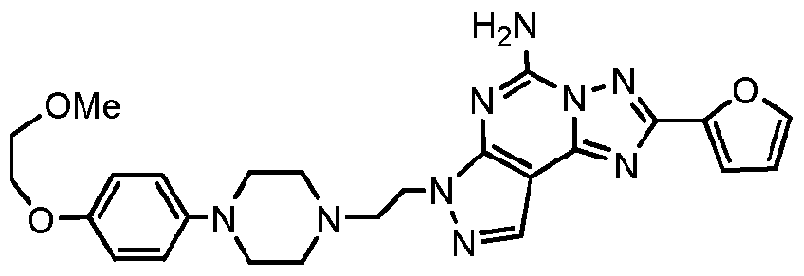
Formula PI,
[0007] In the '475 patent example Schemes 1 to 5, along with preparative Schemes 1 to 4, show general methods of preparing compounds of Formula PI. The '475 patent describes also that the compound of Formula I can be prepared as a pharmaceutically acceptable salt which may be useful for treating Parkinson's disease
[0008] The use of A2A receptor antagonists in the treatment of central nervous system diseases, in particular Parkinson's disease, and pharmaceutical compositions comprising said compounds has elevated the need for potent, moderately lipophilic, brain penetrant inhibitors of the A2A receptor. Such compounds would provide an expansion of the arsenal of compounds which are believed to have value in the treatment of central nervous system disorders, in particular treating or managing the progression of such diseases, for example, but not limited to, Parkinson's disease.
SUMMARY OF THE INVENTION
[0009] In one aspect, the invention provides one or more compounds, or a salt thereof, believed to have utility as an A2A-receptor antagonist which have the structure:
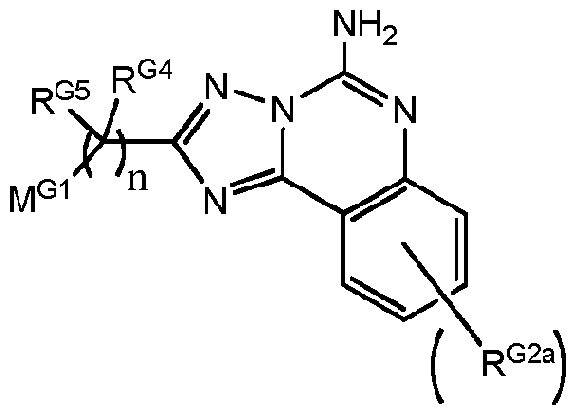
[0010] wherein:
"m" and "n" are independently an integer of from 1 to 3, with the proviso that no more than two RG2a substituents are located on adjacent ring carbon atoms;
RG2a is independently: (i) -OH; (ii) -CN; (iii) Halogen (preferably -CI or -F); (iv) -Ci-6-linear alkyl which is optionally substituted by one or more fluorine substituents, and preferably when fluorine substituted is -CF3; or (v) -Ci_6-alkoxy, which is optionally substituted by a
Ci-4-alkoxy moiety, and preferably when so substituted the alkoxy substitutent is -O-CH3, and in some embodiments where RG2a is an alkoxy-substituted-alkoxy moiety, preferably it

RG4 and RG5 are:
(a) independently, for each occurrence, (i) -H; (ii) -F; or (iii) -Ci-6-alkyl (linear, branched or cyclic) which is optionally substituted with one or more fluorine substituents; or
(b) RG4 and RG5 are taken together to form a carbonyl [-C(O)-] moiety, with the proviso that where "m" > 1 , RG4 and RG5 are not selected to form two adjacent carbonyl moieties; and
[0011] 01 is a moiety of the formula:

wherein:
[0012] substituents Ral, R32, Ra3, Ra4, Ra5, and Ra6, are defined as follows:
(a) Ra6 is -H; or -CH3; and Ral; Ra2; Ra3; Ra4; and Ra5 are independently:
(i) H;
(ii) an aromatic moiety of from 6 to 10 carbon atoms; or
(iii) -Ci-5 linear, branched or cyclic alkyl which is optionally substituted with one or more of -F or -Ci-4-alkyl substituent wherein one or more carbon atoms in said optional Ci-4-alkyl substituent are optionally substituted with one or more -F atoms; or
(b) Ral ; Ra2; R33; and Ra4 are independently -H or C1.5 linear, branched or cyclic alkyl; and
Ra5 and Ra' ' are joined together via a -(CH2)q- "bridge" to form a moiety of the structure:
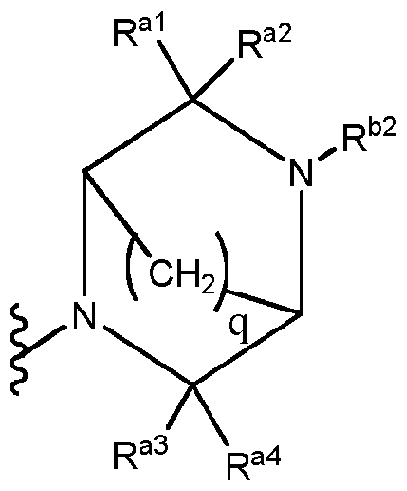
, where "q" is 1 or 2; or
(c) one pair of Ral Ra2 or Ra3 Ra4 together form an oxo-functional group and the other pair are hydrogen, providing a structure of Formula Ga1 or Ga2:
 Formula Ga ;
(d) one pair of Ral Ra2 or Ra3 Ra4 are each -H and the other pair form a spirocycle of up to five carbon atoms, thereby providing a spirocycle of Formula Fb3 or Formula Fb4:
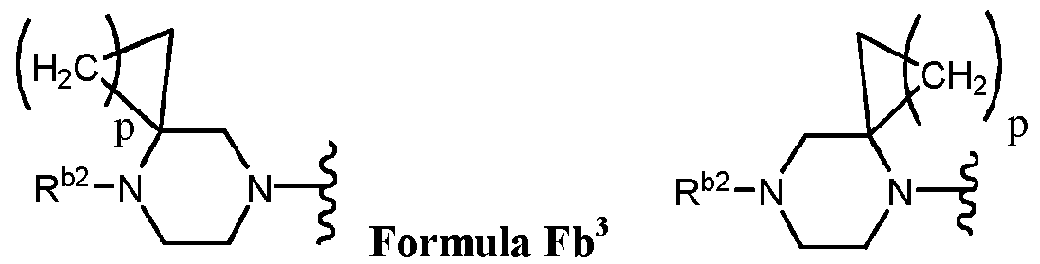
is an integer from 1 to 3; or
l or Ra2, from a bridg into said bridge are

(a) -Ci-6-alkyl which is optionally substituted on one or more carbon atoms with: (i)
halogen; (ii) C]_5-alkoxy; or (iii) Ci.6-alkyl-S02-;
(b) -C(0)-Ro1 wherein, "Ro1" is: (i) aryl; (ii) Ci-s-alkoxy; or (iii) Ci-e-alkyl;
(c) a mono- or polycyclic aryl moiety comprising from 5 to 10 carbon atoms which is optionally linked to a nitrogen of the piperazine moiety through a carbonyl carbon, thereby forming an amide linkage, and wherein one or more ring carbon atoms is optionally substituted with a moiety which is, independently for each occurrence:
(i) halogen, preferably F or CI;
(ii) Ci-6-alkyl, that is optionally halogen substituted, and in some embodiments when
Rb2
is a halogen substituted alkyl, preferably it is -CF3;
(iii) Ci-6-alkoxy, preferably methoxy;
(iv) Ci_6-alkoxy-Ci-6-alkoxide;
(v) aryloxy of from 6 to 10 carbon atoms;
(vi) Ci-6-heterocycloalkyl comprising from 1 to 3 heteroatoms which are, independently for each occurrence "N", "S", or "0", wherein, in some embodiments where the substituent is a heterocycloalkyl it is preferably a -pyrrolidinyl moiety, and wherein said heterocycl-ring may optionally include a carbonyl group (C=0), and wherein, in some embodiments where Rb2 is a heterocycloalkyl comprising a carbonyl group, it is preferably a -pyrolidin-oneyl moiety;
(vii) (Rdl)2N-, wherein "Rdl" is independently -H or -Ci.6-alkyl;
(viii) nitrile;
(ix) mono- or polycyclic heteroaryl of from 5 to 10 carbon atoms, comprising from 1 to 4 heteroatoms which are, independently for each occurrence, "N", "0", or "S "; or
(x) -C(0)-OH; or
(d) a mono- or polycyclic heteroaryl moiety comprising from 5 to 10 carbon atoms and from 1 to 4 heteroatoms which are independently for each occurrence, "N", "O", or "S", which is optionally linked to a nitrogen of the piperazine moiety through a carbonyl carbon, thereby forming an amide linkage, and wherein, optionally one or more ring carbon atoms is substituted with a moiety which is, independently for each occurrence:
(i) -halogen;
(ii) -Ci-6-alkyl-sulfonyl;
(iii) -Ci-6-alkyl which is optionally substituted with one or more substituents that are, independently for each occurrence, halogen or Ci-s-alkoxide;
(iv) -Ci.6-alkoxide which is optionally substituted with one or more substituents that are, independently for each occurrence, halogen or -Ci-6-alkyl;
(v) d.6-C(0)-;
(vi) -CN; or
(vii) d.6C(0)0-.
[0014] In some embodiments a compound Formula A preferably has the structure of Formula AI:

Formula AI,
wherein:
"n", M01, R°4 and R°5 are as defined for the compound of Formula A;
RG2 is independently:
(i) -OH;
(ii) -CN;
(iii) Halogen (preferably -CI or -F);
(iv) -Ci-3-linear alkyl which is optionally substituted by one or more fluorine substituents, and preferably when fluorine substituted is -CF3; or
(v) -Ci_6-alkoxy, which is optionally substituted by a Ci_4-alkoxy moiety, and preferably when so substituted the alkoxy substitutent is -O-CH3, and in some embodiments where
RG2
is an alkoxy-substituted-alkoxy moiety, preferably it is -0-(CH2)i-4-OCH3; and RG3 is -H or -F
[0015] In some aspects the present invention is the provision of a pharmaceutical formulation comprising at least one compound of Formula A or a salt thereof and at least one excipient.
[0016] In some aspects the present invention is the provision of a method of treating central nervous system disorders by administering to a patient in need thereof a therapeutical amount of at least one compound of Formula A or a salt thereof.
DETAILED DESCRIPTION OF THE INVENTION
[0017] As mentioned above, in one aspect the invention provides one or more compounds believed to have utility as an A2A- receptor antagonist which have the structure of Formula A.

[0018] where "n", "m". M° . Ruza, Γ, and R"" have been defined above.
[0019] In some embodiments, compounds of Formula A preferably have the structure of Formula B:

, Formula B, or a salt thereof,
[0020] wherein:
[0021] R -F or -H;
» G4
[0022] R and R^3 are independently for each occurrence: (1 ) -H; (2) Ci_6-alkyl; or (3) Ci_6-alkoxy, or
, G5
R and R^ together with the carbon to which they are bonded represent a carbonyl moiety (-C(O)-);
Ral, Ra , Rai, Ra4, and Ra3 are independently: -H; aryl; or d.j-alkyl; and
[0023] Rb2 is :
(a) -Ci-6-alkyl which is optionally substituted on one or more carbon atoms with: (i)
halogen; (ii) Ci-6-alkoxy; or (iii) Ci.6-alkyl-S02-;
(b) -C(0)-Rcl wherein, "Rcl" is: (i) aryl; (ii) Ci_6-alkoxy; or (iii) Ci_6-alkyl;
(c) a mono- or polycyclic aryl moiety comprising from 5 to 10 carbon atoms which is optionally linked to a nitrogen of the piperazine moiety through a carbonyl carbon, thereby forming an amide linkage, and wherein one or more ring carbon atoms is optionally substituted with a moiety which is, independently for each occurrence:
(i) halogen, preferably F or CI;
(ii) Ci-6-alkyl, that is optionally halogen substituted, and in some embodiments when
Rb2
is a halogen substituted alkyl, preferably it is -CF3;
(iii) -Ci-6-alkoxy, preferably methoxy;
(iv) -Ci_6-alkoxy-Ci_6-alkoxide;
(v) aryloxy of from 6 to 10 carbon atoms;
(vi) Ci-6-heterocycloalkyl comprising from 1 to 3 heteroatoms which are, independently for each occurrence "N", "S", or "0", wherein, in some embodiments where the substituent is a heterocycloalkyl it is preferably a -pyrrolidinyl moiety, and wherein said heterocycl-ring may optionally include a carbonyl group (C=0), and wherein, in some embodiments where Rb2 is a heterocycloalkyl comprising a carbonyl group, it is preferably a -pyrolidin-oneyl moiety;
(vii) ( dl)2N-, wherein "Rdl" is independently -H or -Ci.6-alkyl;
(viii) nitrile;
(ix) mono- or polycychc heteroaryl of from 5 to 10 carbon atoms, comprising from 1 to 4 heteroatoms which are, independently for each occurrence, "N", "O", or "S "; or
(x) -C(0)-OH; or
(d) a mono- or polycyclic heteroaryl moiety comprising from 5 to 10 carbon atoms and from 1 to 4 heteroatoms which are independently for each occurrence, "N", "O", or "S", which is optionally linked to a nitrogen of the piperazine moiety through a carbonyl carbon, thereby forming an amide linkage, and wherein, optionally one or more ring carbon atoms is substituted with a moiety which is, independently for each occurrence:
(i) -halogen;
(ii) -Ci-6-alkylsulfonyl;
(iii) -Ci-6-alkyl which is optionally substituted with one or more substituents that are, independently for each occurrence, halogen or Ci-e-alkoxide;
(iv) -Ci-6-alkoxide which is optionally substituted with one or more substituents that are, independently for each occurrence, halogen or -Ci-6-alkyl;
(v) d_6-C(0)-;
(vi) -CN; or
(vii) CwC C O-.
structure of Formula C:
alt thereof, wherein "q" is
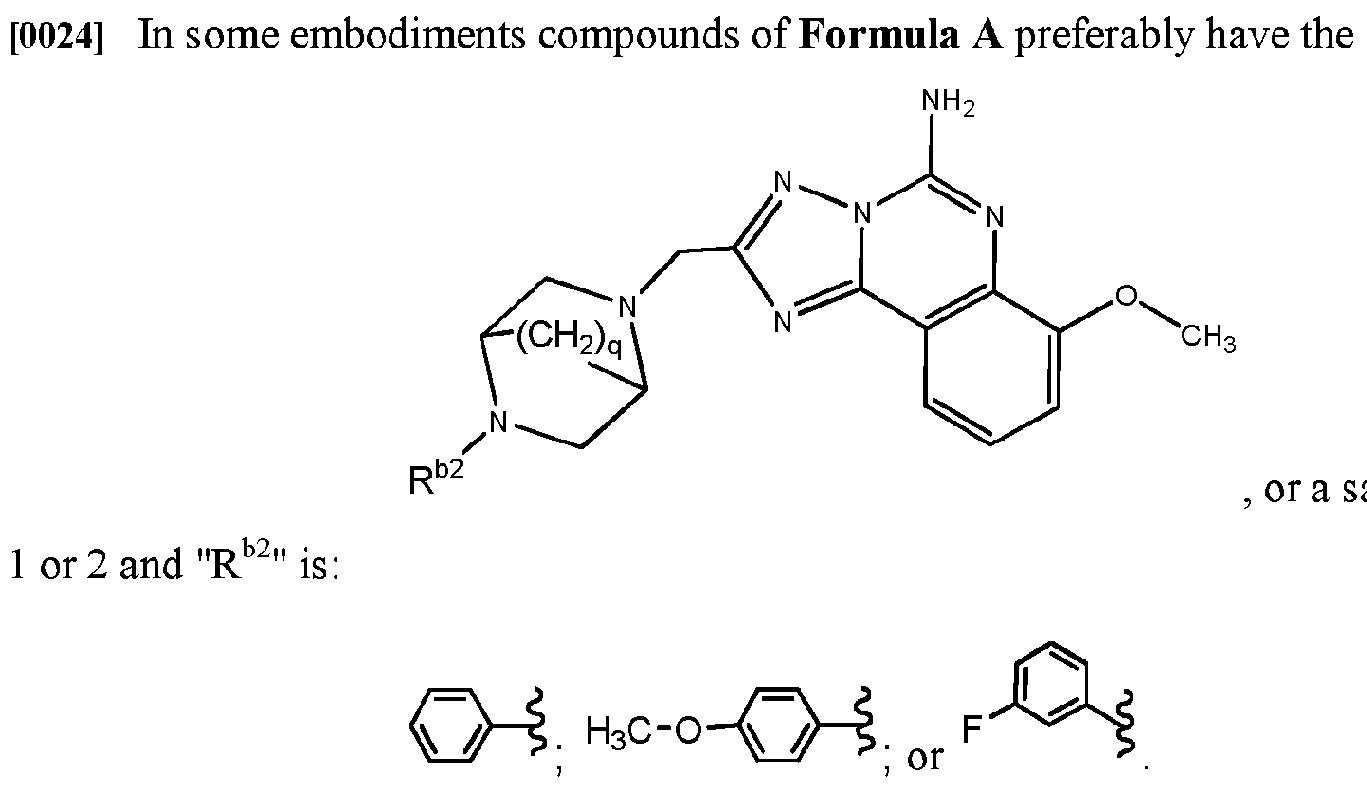
[0025] In some embodiments compounds of Formula A preferably have the structure of Formula F:

, Formula F.
form a

[0027] In some embo is a compound of Formula B:

Formula B.
wherein, variable RG3 is -H and the variables RG4, RG5, Ral to Ra5, and R l are defined in Table I, below.
Table I
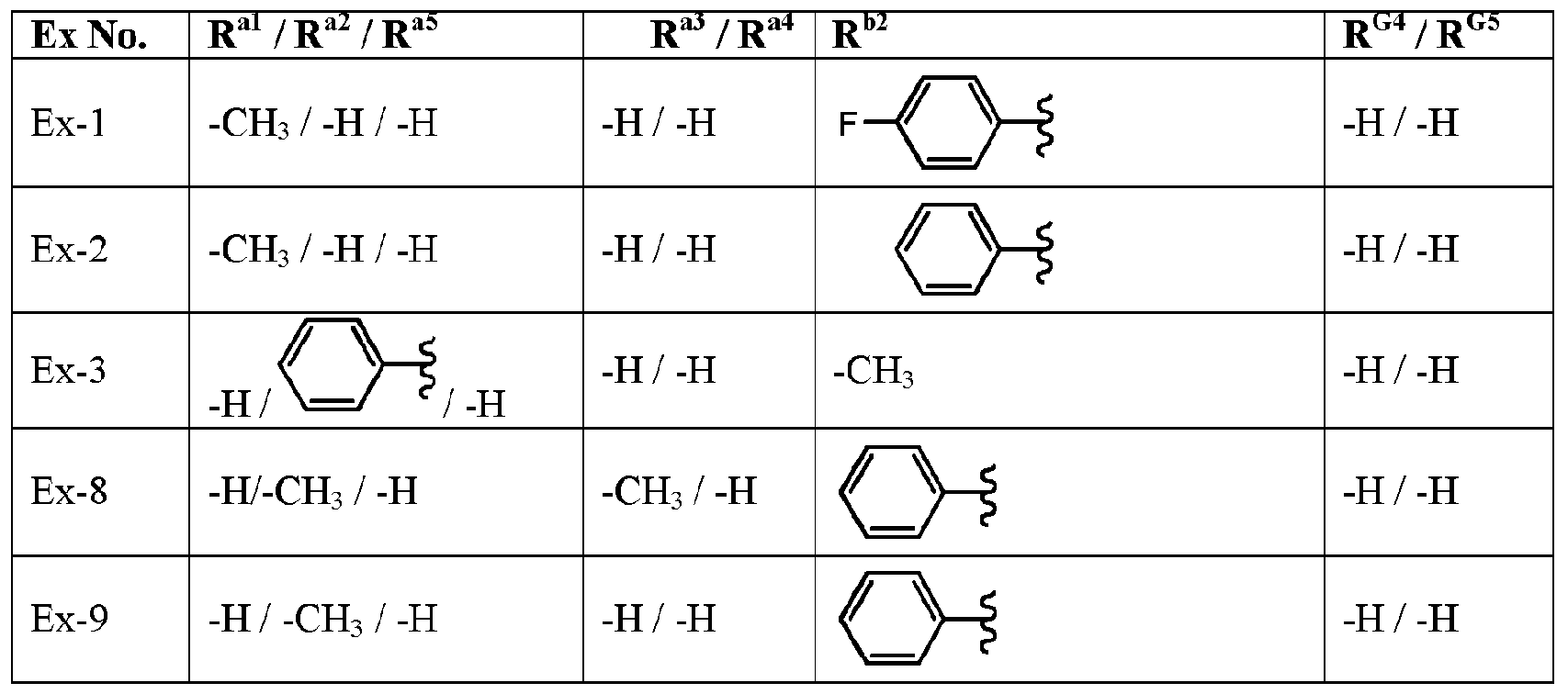


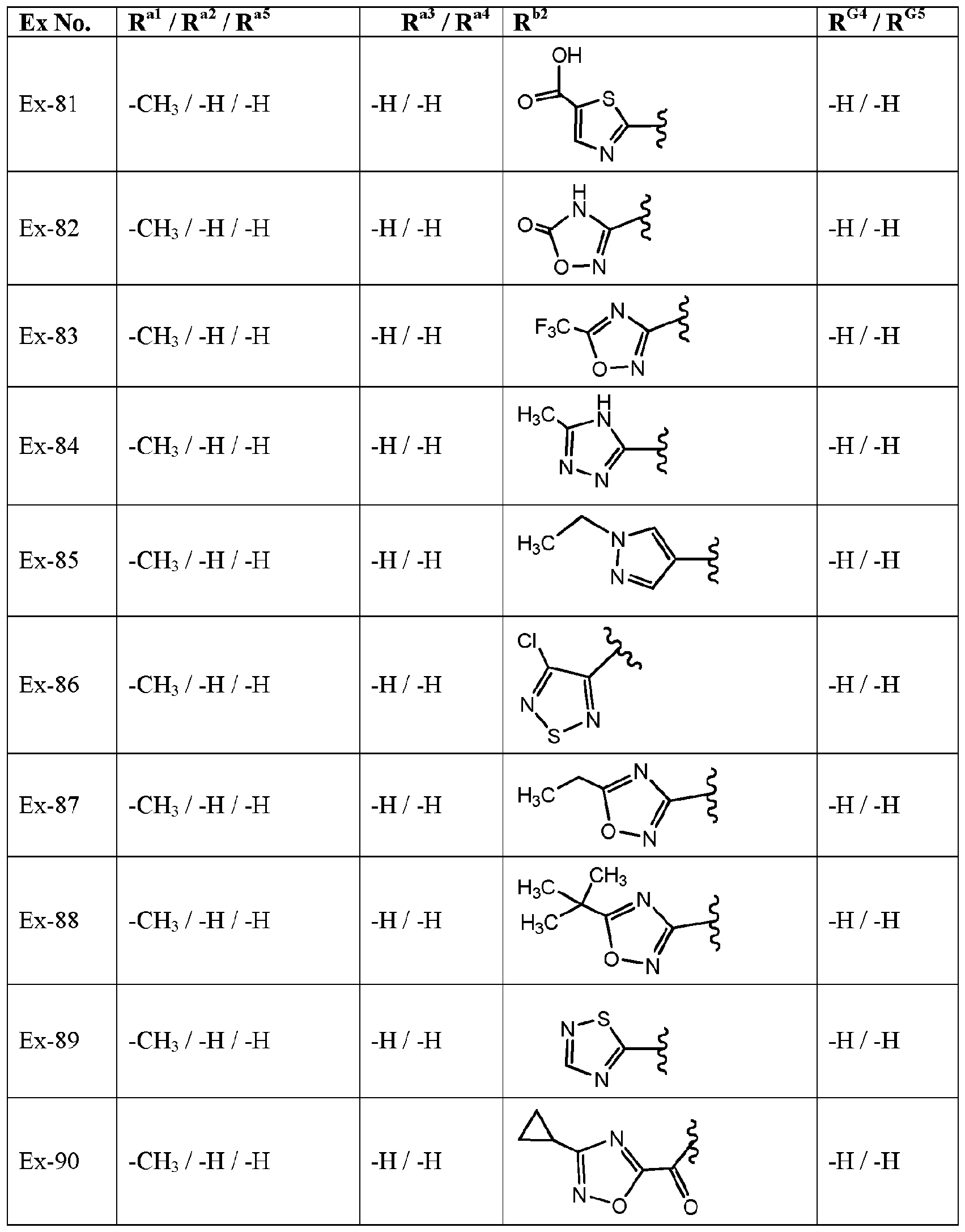


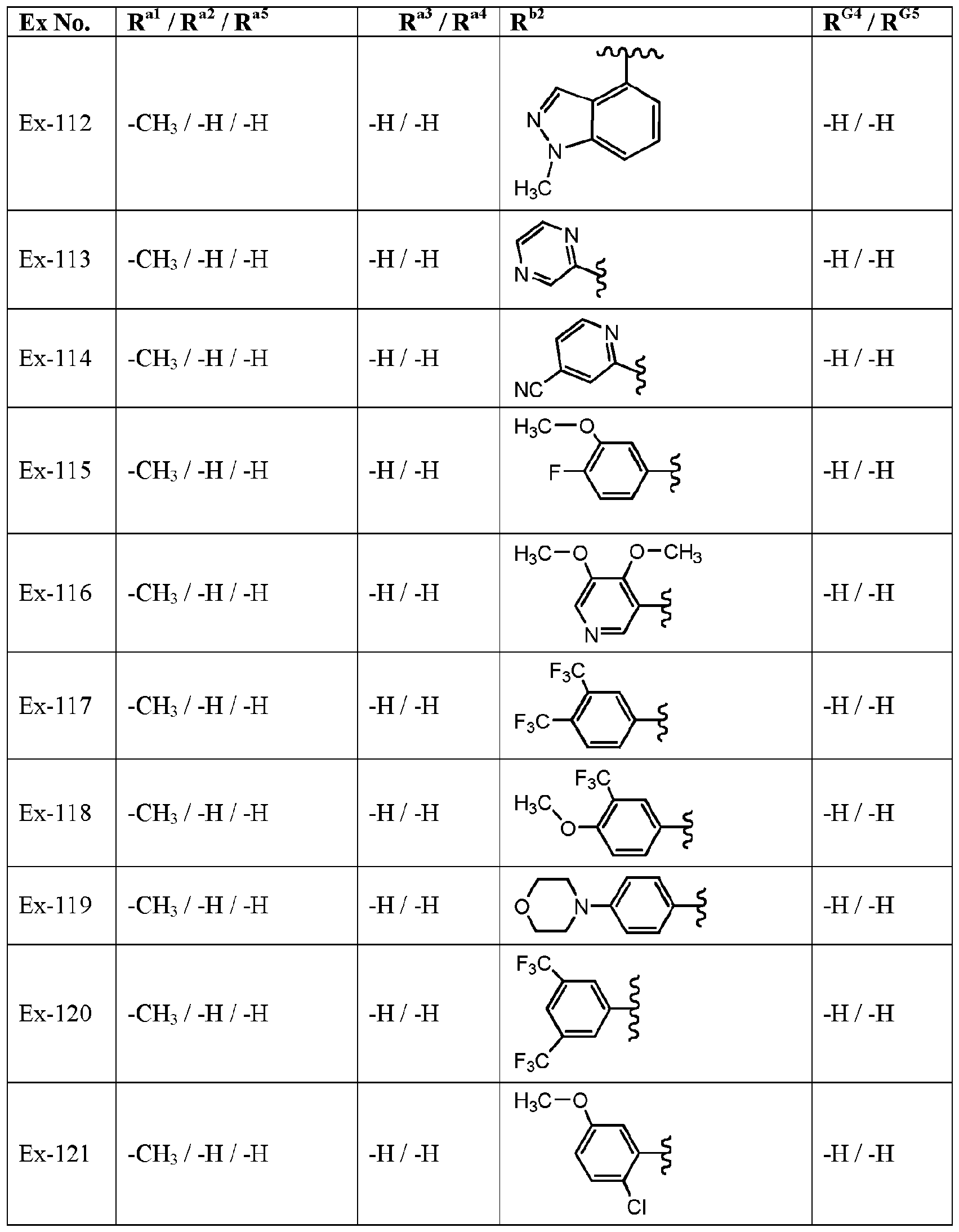


[0028] In some embo n is a compound of Formula B:

wherein variable RG3 is -F, variable Ra5 is -H and the variables RG4, RG5, Ral to Ra4, and R are defined in Table Π, below.
Table II
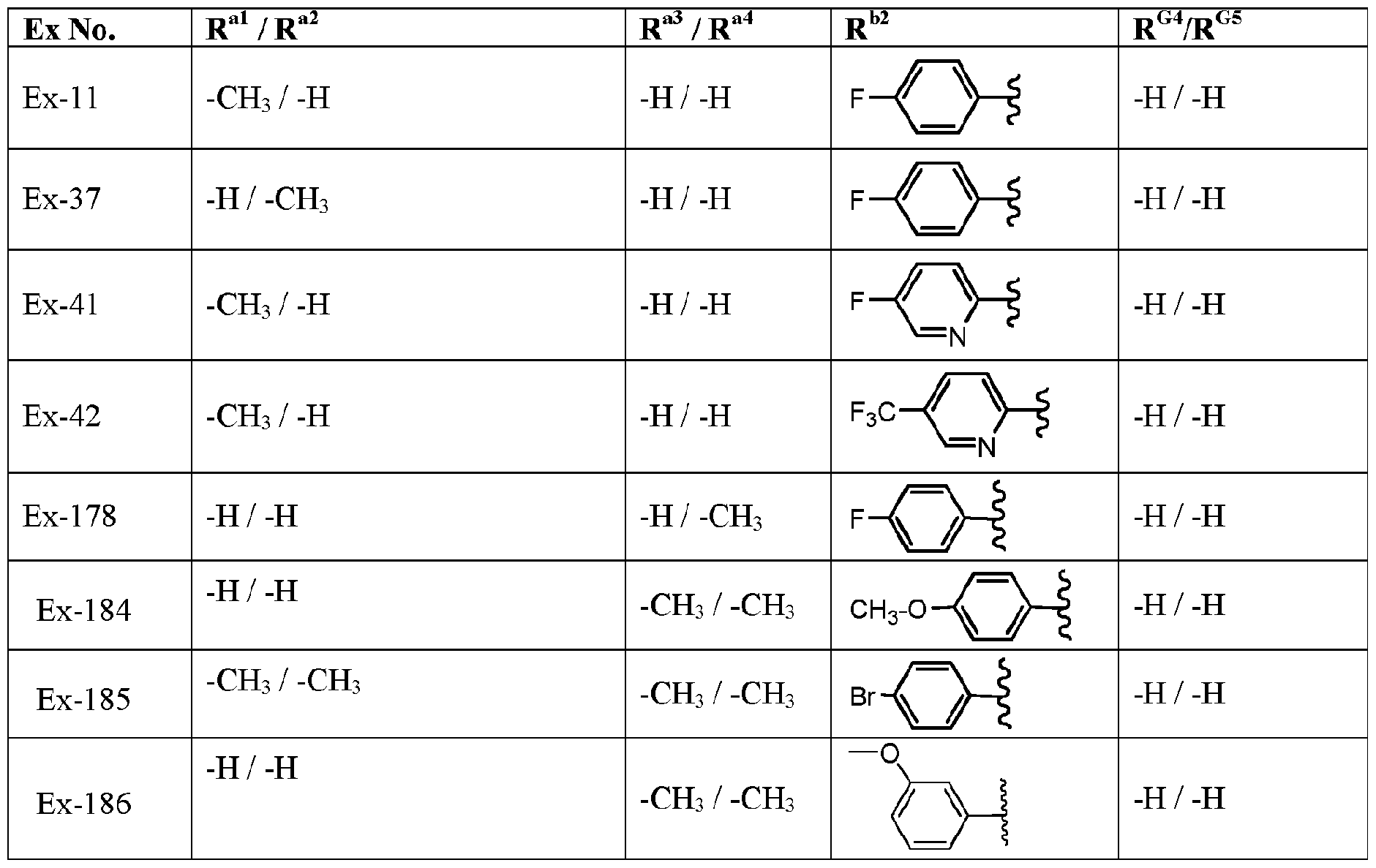
[0029] d of the invention is a compound of Formula E:

[0030] variable Rb2 is defined in Table ΠΙ, below.
Table III


, Formula F or a salt thereof, wherein one pair of Ral Ra2 or Ra3/Ra4 are both -H and the other pair together form a spirocyclpropyl moiety, in accordance with the definition of variables Ral to Ra4 and Rb2 presented in Table IV below.
Table IV

[0032] In invention have the structure of Formula G:

(Ex-208), a l -(4-fluorophenyl)-methanone substituent (Ex-204); a 1 -(4-trifluoromethylphenyl)- methanone substituent (Ex-203), or a 2-[5-(trifluoromethyl)pyridinyl]- substituent (Ex-205).
[0033] In some embodiments, compounds of the invention have the structure of Formula H:

, Formula H, or a salt thereof
[0034] In some embodiments, compounds of the invention have the structure of the formula:
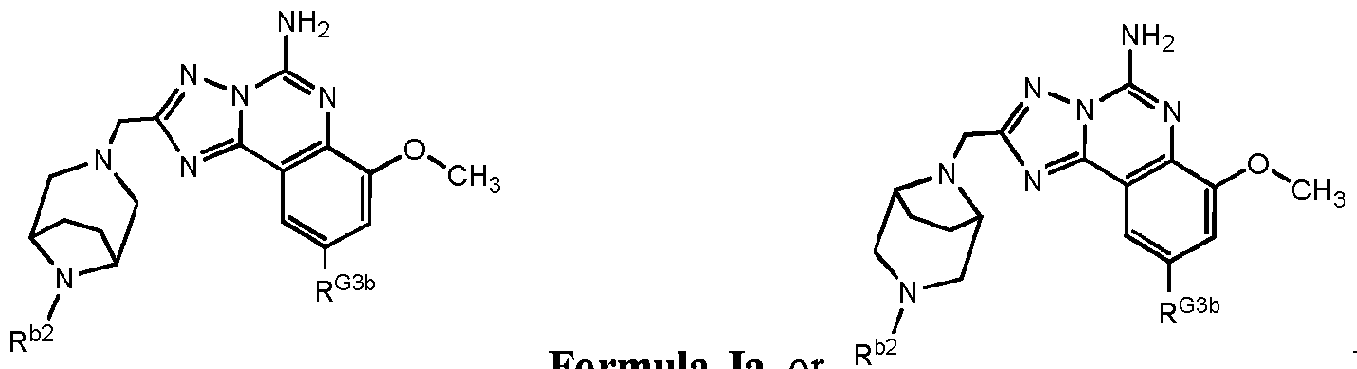
Formula Ja, or R Formula Jb, or a salt of either thereof,
wherein RG3a is -H or -F and Rb2 is a mono- or polycyclic aryl moiety comprising from 5 to 10 carbon atoms which is optionally linked to a nitrogen of the piperazine moiety through a carbonyl carbon, thereby forming an amide linkage, and wherein one or more ring carbon atoms thereof is optionally substituted with a moiety which is, independently for each occurrence:
(i) halogen, preferably F or CI;
(ii) Ci-6-alkyl, that is optionally halogen substituted, and in some embodiments when R 2 is a halogen substituted alkyl, preferably it is -CF3;
(iii) Ci-6-alkoxy, preferably methoxy;
(iv) Ci-6-alkoxy-Ci-S-alkoxide;
(v) aryloxy of from 6 to 10 carbon atoms;
(vi) Ci-6-heterocycloalkyl comprising from 1 to 3 heteroatoms which are, independently for each occurrence "N", "S", or "O", wherein, in some embodiments where the substituent is a heterocycloalkyl it is preferably a -pyrrolidinyl moiety, and wherein said heterocycl-ring may optionally include a carbonyl group (C=0), and wherein, in some embodiments where Rb2 is a heterocycloalkyl comprising a carbonyl group, it is preferably a -pyrolidin-oneyl moiety;
(vii) (Rdl)2N-, wherein "Rdl" is independently -H or -Ci-e-alkyl;
(viii) nitrile;
(ix) mono- or polycyclic heteroaryl of from 5 to 10 carbon atoms, comprising from 1 to 4
heteroatoms which are, independently for each occurrence, "N", "O", or "S"; or
(x) -C(0)-OH.
[0035] In some embodiments, preferably compounds of the invention have the structural formula shown in Examples 1 to 5 herein.
[0036] As described herein, unless otherwise indicated, the use of a compound in treatment means that an amount of the compound, generally presented as a component of a formulation that comprises other excipients, is administered in aliquots of an amount, and at time intervals, which provides and
maintains at least a therapeutic serum level of at least one pharmaceutically active form of the compound over the time interval between dose administration.
[0037] Absolute stereochemistry is illustrated by the use of hashed and solid wedge bonds. As shown in Illus-I and Illus-Π. Accordingly, the methyl group of Illus-I is emerging from the page of the paper and the ethyl group in Illus-Π is descending into the page, where the cyclohexene ring resides within the plane of the paper. It is assumed that the hydrogen on the same carbon as the methyl group of Illus-I descends into the page and the hydrogen on the same carbon as the ethyl group of Illus-II
plane of the paper the plane of
 h
h
[0038] As is conventional, ordinary "stick" bonds or "wavy" bonds are used where there is a mixture of possible isomers present, including a racemic mixture of possible isomers
[0039] As used herein, unless otherwise specified, the following terms have the following meanings:
[0040] The phrase "at least one" used in reference to the number of components comprising a composition, for example, "at least one pharmaceutical excipient" means that one member of the specified group is present in the composition, and more than one may additionally be present.
Components of a composition are typically aliquots of isolated pure material added to the composition, where the purity level of the isolated material added into the composition is the normally accepted purity level of a substance appropriate for pharmaceutical use.
[0041] "at least one" used in reference to substituents on a compound or moiety appended to the core structure of a compound means that one substituent of the group of substituents specified is present, and more than one substituent may be bonded to chemically accessible bonding points of the core.
[0042] Whether used in reference to a substituent on a compound or a component of a pharmaceutical composition the phrase "one or more", means the same as "at least one";
[0043] "concurrently" and "contemporaneously" both include in their meaning (1) simultaneously in time (e.g., at the same time); and (2) at different times but within the course of a common treatment schedule;
[0044] "consecutively" means one following the other;
[0045] "sequentially" refers to a series administration of therapeutic agents that awaits a period of efficacy to transpire between administering each additional agent; this is to say that after
administration of one component, the next component is administered after an effective time period after the first component; the effective time period is the amount of time given for realization of a benefit from the administration of the first component;
[0046] "effective amount" or "therapeutically effective amount" is meant to describe the provision of an amount of at least one compound of the invention or of a composition comprising at least one compound of the invention which is effective in treating or inhibiting a disease or condition described herein, and thus produce the desired therapeutic, ameliorative, inhibitory or preventative effect For example, in treating neuropathic pain with one or more of the compounds described herein "effective amount" (or "therapeutically effective amount") means, for example, providing the amount of at least one compound of Formula A that results in a therapeutic response in a patient afflicted with a movement disorder ("the condition"), including a response suitable to manage, alleviate, ameliorate, or treat the condition or alleviate, ameliorate, reduce, or eradicate one or more symptoms attributed to the
condition and/or long-term stabilization of the condition, for example, as may be determined by the analysis of pharmacodynamic markers or clinical evaluation of patients afflicted with the condition;
[0047] "patient" and "subject" means an animal, such as a mammal (e.g., a human being) and is preferably a human being;
[0048] "prodrug" means compounds that are rapidly transformed, for example, by hydrolysis in blood, in vivo to the parent compound, e.g., conversion of a prodrug of Formula A to a compound of Formula A, or to a salt thereof; a thorough discussion is provided in T. Higuchi and V. Stella, Pro-drugs as Novel Delivery Systems, Vol. 14 of the A.C.S. Symposium Series, and in Edward B. Roche, ed., Bioreversible Carriers in Drug Design, American Pharmaceutical Association and Pergamon Press, 1987, both of which are incorporated herein by reference; the scope of this invention includes prodrugs of the novel compounds of this invention;
[0049] "solvate" means a physical association of a compound of this invention with one or more solvent molecules; this physical association involves varying degrees of ionic and covalent bonding, including hydrogen bonding; in certain instances the solvate will be capable of isolation, for example when one or more solvent molecules are incorporated in the crystal lattice of the crystalline solid;
"solvate" encompasses both solution-phase and isolatable solvates; non-limiting examples of suitable solvates include ethanolates, methanolates, and the like; "hydrate" is a solvate wherein the solvent molecule is H20.
[0050] The term "substituted" means that one or more of the enumerated substituents (or, where a list of substituents are not specifically enumerated, the default substituents specified in this "Definitions" section for the particular type of substrate which contains variable substituents) can occupy one or more of the bonding positions on the substrate typically occupied by "-H", provided that such substitution does not exceed the normal valency rules for the atom in the bonding configuration present in the substrate, and that the substitution ultimate provides a stable compound, e.g., mutually reactive substituents are not present geminal or vicinal to each other, and wherein such a compound is sufficiently robust to survive isolation to a useful degree of purity from a reaction mixture; when the text indicates optional substitution of a moiety (e.g. "optionally substituted") the term means "if present, one or more of the enumerated (or default substituents for the specified substrate) can be present on the substrate in a bonding position normally occupied by a hydrogen atom" in accordance with the definition of "substituted" presented herein;
[0051] As used herein, unless otherwise specified, the following terms used to describe moieties, whether comprising the entire definition of a variable portion of a structural representation of a compound of the invention or a substituent appended to a variable portion of a structural representation of a group of compounds of the invention have the following meanings, and unless otherwise specified, the definitions of each term (i.e., moiety or substituent) apply when that term is used individually or as a component of another term (e.g., the definition of aryl is the same for aryl and for the aryl portion of arylalkyl, alkylaryl, arylalkynyl moieties, and the like); moieties are equivalently described herein by structure, typographical representation or chemical terminology without intending any differentiation in meaning, for example, the chemical term "acyl", defined below, is equivalently described herein by the term itself, or by typographical representations "R'-(C=0)-" or "R'-C(O)-", or by the structural
O representation: R'
[0052] "acyl" means an R'-C(O)-, where R' is linear, branched or cyclic alkyl; linear, branched or cyclic alkenyl; or linear, branched or cyclic alkynyl moiety, each of which moieties can be substituted; wherein the acyl substituent is bonded through the carbonyl carbon to the substrate of which it is a substituent, or -NH-S02-R', where -R' is as previously defined; non-limiting examples of suitable acyl groups include formyl, acetyl, propanoyl, 2-methylpropanoyl, butanoyl and cyclohexanoyl;
[0053] "alkenyl" means an aliphatic hydrocarbon moiety which is not aromatic but includes in its structure at least one constituent of the structure -(R'C=CR'2) or -(R'C=CR)-, where R' is a defined substituent, for example -H or -alkyl; the alkenyl moiety can be incorporated into a linear hydrocarbon chain, or incorporated into a cyclic hydrocarbon chain (termed "cycloalkenyl") and can comprise further, linear, branched, or cyclic substituents depending from the carbon atoms of the chain, preferably the chain comprises about 2 to about 15 carbon atoms; more preferably from about 2 to about 12 carbon atoms; and more preferably chains comprise from about 2 to about 6 carbon atoms;
[0054] the term "substituted alkenyl", unless specified otherwise by a recitation of specific substituents defining the term, means that the alkenyl group is substituted by one or more substituents which are independently for each occurrence: Cm alkyl, C3_i0 cycloalkyl, and CMO alkoxy ;
[0055] "-alkoxy" means a moiety of the structure: alkyl-O- (i.e., the bond to the substrate moiety is through the ether oxygen), wherein the alkyl portion of the moiety is as defined below for alkyl; non- limiting examples of suitable alkoxy groups include methoxy, ethoxy, n-propoxy, isopropoxy, n- butoxy and heptoxy;
[0056] "alkoxyalkyl" means a moiety of the structure: alkoxy-alkyl- (i.e., the bond to the substrate moiety is through an alkyl moiety, which is terminated by, or substituted with, an alkoxy substituent that is not itself bonded to the substrate, non-limiting examples of alkoxyalkyl groups include H3C- (CH2)y -0-CH2-(CH2)x- wherein "y" and "x" are independently an integer of from 0 to 6;
[0057] "alkoxycarbonyl" means a moiety of the structure alkyl-O-C(O)-, equivalently represented as [alkyl-O-(OO)-] and also as R-0(C=0)-, where "R" is a defined alkyl moiety, (i.e., the bond to the parent moiety is through the carbonyl carbon) wherein the alkyoxy portion of the moiety is as previously defined; non-limiting examples of suitable alkoxycarbonyl groups include methoxycarbonyl and ethoxycarbonyl;
[0058] "-alkyl" (including the alkyl portions of other moieties, such as trifluoromethyl-alkyl- and (-alkoxy) means an aliphatic hydrocarbon chain comprising from about 1 to about 20 carbon atoms (that is, "Ci-20 alkyl"), preferably 1 to about 10 carbon atoms (herein "CMO alkyl"), unless the term is modified by an indication that a shorter chain is contemplated, for example, an alkyl moiety of up to 8 carbon atoms (designated herein "Ci-s-alkyl"); the term "alkyl", unless specifically limited by another term, for example, "linear", "branched", or "cyclic", includes alkyl moieties which are linear (a hydrocarbon chain with no aliphatic hydrocarbon "branches" appended to it); branched (a main hydrocarbon chain comprising up to the maximum specified number of carbon atoms with a lower- alkyl chain appended to one or more carbon atoms comprising, but not terminating, the main hydrocarbon chain); and cyclic (the main hydrocarbon chain forms an cyclic aliphatic moiety of from 3 carbon atoms, the minimum number necessary to provide a cyclic moiety, up to the maximum number of specified carbon atoms), accordingly when unmodified, the term " Ci_x alkyl" refers to linear, branched, or cyclic alkyl, and the "Ci-χ" designation means: for a cyclic moiety a ring comprising at minimum 3 carbon atoms up to "X" carbon atoms; for a branched moiety, a main chain of at least 3 carbon atoms up to "X" carbon atoms with at least one linear or branched alkyl moiety bonded to a carbon atom which does not terminate the chain; and for a linear alkyl, a moiety comprising one
carbon atom (i.e., -methyl), up to "X" carbon atoms; when the term "alkyl" is modified by "substituted" or "optionally substituted" it means an alkyl group having substituents in accordance with the relevant definitions appearing below; where use of the terms "substituted" or "optionally substituted" modify "alkyl" and substituent moieties are not specifically enumerated, the substituents bonded to the alkyl substrate are independently for each occurrence (in accordance with definitions appearing herein): Ci_ 20 alkyl; halogen; -alkoxy; -OH; -CN; alkylthio-; amino, -NH(alkyl), -NH(cycloalkyl), - N(alkyl)2, -(C=0)-OH; -C(0)0-alkyl; -S (alkyl); or -S(02)-alkyl; or -aryl; cycloalkyl moieties may alternatively, or in addition, be substituted with one or more, "ring-system substituents" as that term is defined herein. Examples of suitable alkyl groups include, but are not limited to, methyl, ethyl, n- propyl, isopropyl, n-butyl, t-butyl, n-pentyl, heptyl, nonyl, decyl, fluoromethyl, trifluoromethyl and cyclopropylmethyl, where the term "alkyl" is indicated with two hyphens (i.e., "-alkyl-" it indicates that the alkyl moiety is bonded in a manner that the alkyl moiety connects a substrate with another moiety, for example, "-alkyl-OH" indicates an alkyl moiety connecting a hydroxyl moiety to a substrate;
[0059] "lower alkyl" means a group comprising about 1 to about 6 carbon atoms in the chain (i.e. Ci-e); non-limiting examples of suitable lower alkyl groups include methyl, ethyl, n-propyl, isopropyl, n- butyl, t-butyl, n-pentyl, and hexyl;
[0060] "alkylaryl" (or alkaryl) means an alkyl-aryl- group (i.e., the bond to the parent moiety is through the aryl group) wherein the alkyl group is unsubstituted or substituted as defined above, and the aryl group is unsubstituted or substituted as defined below; preferred alkylaryl moieties comprise a lower alkyl group; non-limiting examples of suitable alkylaryl groups include o-tolyl, p-tolyl and xylyl;
[0061] in general, as exemplified by the term "alkyl-aryl" defined above, a substituent which is the called out by the combination of terms used to define two other substituent fragments indicates that the substituent called out by the last term used is bonded to the substrate whilst the preceding term called out is bonded in turn to the substituent fragment it precedes, proceeding right to left to understand the order in which the various fragments are bonded to the substrate;
t one moiety of the
 a defined substituent, the alkynyl moiety can be incorporated into a linear or branched hydrocarbon chain, or incorporated into a cyclic hydrocarbon chain (non-aromatic, termed "cycloalkynyl",); preferably hydrocarbon chains of an alkynyl moiety comprises about 2 to about 15 carbon atoms; more preferably alkynyl groups comprise about 2 to about 12 carbon atoms in the chain; and more preferably about 2 to about 4 carbon atoms in the chain;
[0063] "amino" means an -NR2 group wherein R is selected independently for each occurrence from - H or alkyl, alkylamino means - R'¾ wherein one R' is -alkyl and the other is -H or -alkyl selected independently for each occurrence, non-limiting examples of alkylamino moieties are -NH-CH3 (methylamino-) and -N(CH3)2 (dimethylamino);
[0064] "ammonium ion" means wherein R is independently -H, alkyl, substituted alkyl, or the cationic portion of a dissociated acid capable of producing an ammonium ion from an amine; when not explicitly shown in representations herein the presence of an ammonium ion presumes that a charge- balancing anion is associated with the ammonium ion moiety, which anion is derived from the anionic portion of the acid used to provide said ammonium ion, it will be appreciated that many of the nitrogen
atoms present in compounds of the invention can be converted to an ammonium ion thereby providing a salt of the parent compound, which is within the scope of the invention;
[0065] "aryl" (sometimes abbreviated "ar") means an aromatic monocyclic or multicyclic ring system comprising about 6 to about 14 carbon atoms (denoted herein also as "Cs-i4-aryl"), preferably about 6 to about 10 carbon atoms ("Cfi.io-aryl"); the aryl group can be optionally substituted with one or more independently selected "ring system substituents" (defined below). Non-limiting examples of suitable l ( , which is also abbreviated herein "Ph" for convenience, and 5 wherein bonding can be through any of the carbons in the aromatic ring, on atoms not participating in a bond to the substrate may have bonded to it a
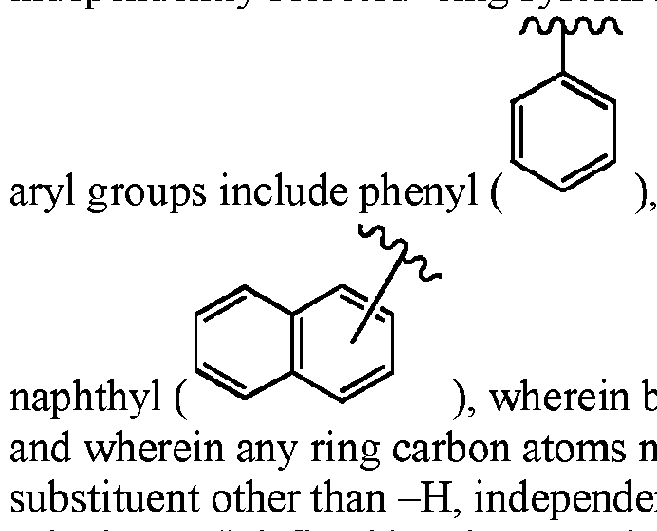 independently selected in each instance from the list of "ring-system substituents" defined herein, or as defined in each instance where the term is used in conjunction with an enumerated list of substituents;
[0066] "aryloxy" means an aryl-O- group (i.e., the moiety is bonded to a substrate through the ether oxygen) wherein the aryl group is unsubstituted or substituted as defined above; non-limiting examples of suitable aryloxy groups include phenoxy and naphthoxy;
[0067] "aryloxycarbonyl" means an aryl-O-C(O)- group (i.e., the bond to a substrate is through the carbonyl carbon) wherein the aryl group is unsubstituted or substituted as previously defined; non- limiting examples of suitable aryloxycarbonyl groups include phenoxycarbonyl and
naphthoxycarbonyl;
[0068] a "carboxylic acid" moiety means a substituent having the formula "-C(0)-OH", wherein the moiety is bonded to a substrate is through the carbonyl carbon;
[0069] "cycloalkyl" defined above with the "alkyl" definition, means a non-aromatic mono- or multicyclic ring system comprising about 3 to about 20 carbon atoms which may be substituted as defined herein; the term includes multicyclic cycloalkyls, for example, 1 -decalin, norbomyl, adamantyl and the like;
[0070] "halogen" means fluorine, chlorine, bromine, or iodine; preferred halogens, unless specified otherwise where the term is used, are fluorine, chlorine and bromine, a substituent which is a halogen atom means -F, -CI, -Br, or -I, and "halo" means fluoro, chloro, bromo, or iodo substituents bonded to the moiety defined, for example, "haloalkyl" means an alkyl, as defined above, wherein one or more of the bonding positions on the alkyl moiety typically occupied by hydrogen atoms are instead occupied by a halo group, perhaloalkyl means that all bonding positions not participating in bonding the alkyl substituent to a substrate are occupied by a halogen, for example, perfluoroalkyl, where alkyl is methyl, means -CF3;
[0071] " heteroaryl" means an aromatic monocyclic or multicyclic ring system comprising about 5 to about 14 ring atoms, preferably about 5 to about 10 ring atoms, in which one or more of the ring atoms is an element other than carbon, for example nitrogen, oxygen or sulfur, alone or in combination;
preferred heteroaryl moieties comprise 5 ring atoms, for example, thiazole thiadiazole, imidazole,
isothiazole, oxazole, oxadiazole, or pyrazole; the "heteroaryl" can be optionally substituted at chemically available ring atoms by one or more independently selected "ring system substituents" (defined below); the prefix aza, azo, oxa, oxo, thia or thio before the heteroaryl root name means that at least a nitrogen, oxygen or sulfur atom, respectively, is present as a ring atom, and in some embodiments 2 or more heteroatoms are present in a ring, for example, a pyrazole or a thiazole moiety; a nitrogen atom of a heteroaryl can be optionally oxidized to the corresponding N-oxide; non-limiting examples of heteroaryl moieties include: pyridyl- , thiopenyl- , furanyl- υ triazolyl , oxazolyl , pyrazinyl, thienyl, pyrimidinyl, isoxazolyl, isothiazolyl, thiazolyl, pyrazolyl, furazanyl, pyrrolyl, pyrazolyl, 1 ,2,4-thiadiazolyl, pyrazinyl, pyridazinyl, quinoxalinyl, phthalazinyl, imidazo[l,2-a]pyridinyl, imidazo[2,l-b]thiazolyl, benzofurazanyl, indolyl, azaindolyl, benzimidazolyl, benzothienyl, quinolinyl, imidazolyl, thienopyridyl, quinazolinyl, thienopyrimidyl, pyrrolopyridyl, imidazopyridyl, isoquinolinyl, benzoazaindolyl, 1 ,2,4-triazinyl, benzothiazolyl, furopyridine, for example:

[0072] , and the like (unless otherwise noted, bonded to the substrate through any available atom that results in a stable bonding arrangement);
[0073] "heterocyclyl" (or heterocycloalkyl) means a non-aromatic saturated monocyclic or multicyclic ring system comprising about 3 to about 10 ring atoms, preferably about 5 to about 10 ring atoms, in which one or more of the atoms in the ring system is an element other than carbon, for example nitrogen, oxygen or sulfur, alone or in combination; there are no adjacent oxygen and/or sulfur atoms present in the ring system; preferred heterocyclyl moieties contain about 5 to about 6 ring atoms; the prefix aza, oxa or thia before the heterocyclyl root name means that at least one nitrogen, oxygen or sulfur atom, respectively, is present as a ring atom; the heterocyclyl can be optionally substituted by one or more independently selected "ring system substituents" (defined below); the nitrogen or sulfur atom of the heterocyclyl can be optionally oxidized to the corresponding N-oxide, S-oxide or S,S- dioxide; non-limiting examples of suitable monocyclic heterocyclyl rings include piperidyl,

pyrrolidinyl, piperazinyl, morpholinyl - (where unless otherwise noted the moiety is bonded to the substrate through any of ring carbon atoms C2, C3, C5, or C6), thiomorpholinyl, thiazolidinyl, 1 ,3-dioxolanyl, 1 ,4-dioxanyl, tetrahydrofuranyl, tetrahydrothiophenyl,
tetrahydrothiopyranyl, and the like;
[0074] "tetrahydropyranyl" moiety means a 6-member cyclic ether of the formula:
 , where, the bond line having an open end in the center of the structure and terminated at the other end with a wavy line indicates that the substituent is bonded to the substrate to which it is attached through any of carbon atoms 1 to 5, and wherein any of the bonding positions on carbons 1 to 5 normally occupied by a hydrogen atom, that is, the bonding positions on carbon atoms 1 to 5 which are not occupied by the bond to the substrate can optionally be occupied by specified or optional substituents;
[0075] "piperidinyl" means:

[0076] where, the open bond line terminated on one end with a wavy line indicates the ring atom through which the moiety is bonded to the substrate (i.e., any of carbon atoms 2 to 6 (left-hand structure) or the ring nitrogen atom (right-hand structure), and wherein any of the bonding positions on the nitrogen atom or on carbon atoms 2 to 6 not participating in a bond to the substrate and normally occupied by a hydrogen atom can be bonded to a specified or optional substituent, and wherein R', if present, is either -H or another specified substituent;
"pyridinyl" means:
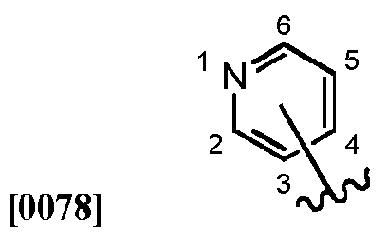
[0079] where, the bond-terminated-with-wavy-line indicates that the pyridinyl moiety is bonded to the substrate at any of carbon atoms 2 to 6, and wherein any of the bonding positions on carbons 2 to 6 normally occupied by a hydrogen atom, that is, any position on carbon 2 to 6 which is not the bond to the substrate, can optionally be occupied by a specified substituent;
[0080] "quinoline" means:

[0081] , where, the bond-terminated-with-wavy-line indicates that the
[0082] moiety is bonded to the substrate through any of carbon atoms 2 to 8, and wherein any of the bonding positions on carbon atoms 2 to 8 normally occupied by a hydrogen atom, that is, any bonding positions on carbon atoms 2 to 8 which are not bonded to the substrate, can optionally be occupied by one of a list of enumerated substituents;
[0083] for any of the foregoing ring-system moieties, bonding of the moiety through a specific ring carbon atom (or heteroatom) is sometimes described for convenience and "bonded through C-X to C-Y carbon atoms", where "X" and "Y" are integers referring to the carbon atoms, for example, as numbered in the examples above;
[0084] "hydroxyl moiety" and "hydroxy" means an HO- group, "hydroxyalkyl" means a substituent of the formula: "HO-alkyl-",wherein the alkyl group is bonded to the substrate and may be substituted or unsubstituted as defined above; preferred hydroxyalkyl moieties comprise a lower alkyl; Non-limiting examples of suitable hydroxyalkyl groups include hydroxymethyl and 2-hydroxyethyl; and
[0085] bonding sequence is indicated by hyphens where moieties are represented in text, for example - alkyl, indicates a single bond between a substrate and an alkyl moiety, -alkyl-X, indicates that an alkyl group bonds an "X" substituent to a substrate, and in structural representation, bonding sequence is
indicated by a wavy line termin indicates that the methylphenyl moiety is bon
 ethyl
ethyl
out a

[0087] Any carbon or heteroatom with unsatisfied valences in the text, schemes, examples, structural formulae, and any Tables herein is assumed to have a hydrogen atom or atoms of sufficient number to satisfy the valences;
[0088] The term "pharmaceutical composition" as used herein encompasses both the bulk composition and individual dosage units comprised of more than one (e.g., two) pharmaceutically active agents such as, for example, a compound of the present invention and an additional agent as described herein, along with any pharmaceutically inactive excipients. As will be appreciated by the ordinarily skilled artisan, excipients are any constituent which adapts the composition to a particular route of administration or aids the processing of a composition into a dosage form without itself exerting an active pharmaceutical effect. The bulk composition and each individual dosage unit can contain fixed amounts of the afore-said "more than one pharmaceutically active agents". The bulk composition is material that has not yet been formed into individual dosage units.
[0089] This invention also includes the compounds of this invention in isolated and purified form obtained by routine techniques. Polymorphic forms of the compounds of any of Formulae A to D, and of the salts thereof, are intended to be included in the present invention. Certain compounds of the invention may exist in different isomeric (e.g., enantiomers, diastereoisomers, atropisomers) forms. The invention contemplates all such isomers both in pure form and in admixture, including racemic mixtures.
[0090] All stereoisomers (for example, geometric isomers, optical isomers and the like) of the present compounds (including prodrugs of compounds of the invention as well as the salts and solvates of the inventive compounds and their prodrugs), such as those which may exist due to asymmetric carbons present in a compound of the invention, and including enantiomeric forms (which may exist even in the absence of asymmetric carbons), rotameric forms, atropisomers, and diastereomeric forms, are contemplated within the scope of this invention. Individual stereoisomers of the compounds of the
invention may be isolated in a pure form, for example, substantially free of other isomers, or may be isolated as an admixture of two or more stereoisomers or as a racemate. The chiral centers of the present invention can have the S or R configuration as defined by the TUPAC 1974 Recommendations. The use of the terms "salt", "solvate" "prodrug" and the like, is intended to equally apply to salts, solvates and prodrugs of isolated enantiomers, stereoisomer pairs or groups, rotamers, tautomers, or racemates of the inventive compounds.
[0091] Where diasteromeric mixtures can be separated into their individual diastereomers on the basis of their physical chemical differences by methods well known to those skilled in the art, for example, by chiral chromatography and/or fractional crystallization. As is know, enantiomers can also be separated by converting the enantiomeric mixture into a diasteromeric mixture by reaction with an appropriate optically active compound (e.g., chiral auxiliary such as a chiral alcohol or Mosher's acid chloride), separating the diastereomers and converting (e.g., hydrolyzing) the individually isolated diastereomers to the corresponding enantiomers.
[0092] Where the compounds of the invention form salts by known, ordinary methods, these salts are also within the scope of this invention Reference to a compound of the invention herein is understood to include reference to salts thereof, unless otherwise indicated. The term "salt(s)", as employed herein, denotes acidic salts formed with inorganic and/or organic acids, as well as basic salts formed with inorganic and/or organic bases. In addition, when a compound of the invention contains both a basic moiety, for example, but not limited to, a nitrogen atom, for example, an amine, pyridine or imidazole, and an acidic moiety, for example, but not limited to a carboxylic acid, zwitterions ("inner salts") may be formed and are included within the term "salt(s)" as used herein. Pharmaceutically acceptable (i.e., non-toxic, physiologically acceptable salts) are preferred. Salts of the compounds of the invention may be formed, for example, by reacting a compound of the invention with an amount of acid or base, for example, an equivalent amount, in a medium in which the salt precipitates or in an aqueous medium wherein the product is obtained by lyophilization. Acids (and bases) which are generally considered suitable for the formation of pharmaceutically useful salts from basic (or acidic) pharmaceutical compounds are discussed, for example, by S. Berge et al., Journal of Pharmaceutical Sciences (1977) 66(1) 1 -19; P. Gould, International J. of Pharmaceutics (1986) 33 201 -217; Anderson et al. The Practice of Medicinal Chemistry (1 96), Academic Press, New York; in The Orange Book (Food & Drug Administration, Washington, D C. on their website); and P. Heinrich Stahl, Camille G. Wermuth (Eds.), Handbook of Pharmaceutical Salts: Properties, Selection, and Use, (2002) Int'l. Union of Pure and Applied Chemistry, pp. 330-331. These disclosures are incorporated herein by reference.
[0093] Where it is possible to provide an acid addition salt with a compound, in general, acid addition salts include, but are not limited to, acetates, including trifluoroacetate salts, adipates, alginates, ascorbates, aspartates, benzoates, benzenesulfonates, bisulfates, borates, butyrates, citrates, camphorates, camphorsulfonates, cyclopentanepropionates, digluconates, dodecylsulfates,
ethanesulfonates, fumarates, glucoheptanoates, glycerophosphates, hemisulfates, heptanoates, hexanoates, hydrochlorides, hydrobromides, hydroiodides, 2-hydroxyethanesulfonates, lactates, maleates, methanesulfonates, methyl sulfates, 2-naphthalenesulfonates, nicotinates, nitrates, oxalates, pamoates, pectinates, persulfates, 3-phenylpropionates, phosphates, picrates, pivalates, propionates, salicylates, succinates, sulfates, sulfonates (such as those mentioned herein), tartarates, thiocyanates, toluenesulfonates (also known as tosylates,) undecanoates, and the like.
[0094] Exemplary basic salts include ammonium salts, alkali metal salts such as sodium, lithium, and potassium salts, alkaline earth metal salts such as calcium and magnesium salts, aluminum salts, zinc salts, salts with organic bases (for example, organic amines) such as benzathines, diethylamine, dicyclohexylamines, hydrabamines (formed with N,N-bis(dehydroabietyl)ethylenediamine), N-methyl-
D-glucamines, N-methyl-D-glucamides, t-butyl amines, piperazine, phenylcyclohexyl-amine, choline, rromethamine, and salts with amino acids such as arginine, lysine and the like. Basic nitrogen- containing groups may be converted to an ammonium ion or quarternized with agents such as lower alkyl halides (e.g. methyl, ethyl, propyl, and butyl chlorides, bromides and iodides), dialkyl sulfates (e.g. dimethyl, diethyl, dibutyl, and diamyl sulfates), long chain halides (e.g. decyl, lauryl, myristyl and stearyl chlorides, bromides and iodides), aralkyl halides (e.g. benzyl and phenethyl bromides), and others.
[0095] All such acid and base salts are intended to be pharmaceutically acceptable salts within the scope of the invention and all acid and base salts are considered equivalent to the free forms of the corresponding compounds for purposes of the invention.
[0096] Compounds of the invention may exist in exist in different tautomeric forms. All such forms are embraced and included within the scope of the invention. Examples of well-known tautomeric forms include, but are not limited to, ketone/enol tautomeric forms, imine-enamine tautomeric forms, and for example heteroaromat as the following moieties:

[0097] Where a compound of the invention can exist in more than one such form, representation or presentation of one tautomeric form of such compound is considered herein equivalent to presentation of all the tautomeric forms in which the compound exists.
[0098] The term "purified", "in purified form" or "in isolated and purified form" for a compound refers to the physical state of said compound after being isolated from a synthetic process or natural source or combination thereof. Thus, the term "purified", "in purified form" or "in isolated and purified form" for a compound refers to the physical state of said compound after being obtained from a purification process or processes described herein or well known to the skilled artisan, and in sufficient purity to be characterized by standard analytical techniques described herein or well known to the skilled artisan.
[0099] A functional group in a compound termed "protected" means that the group is in modified form to preclude undesired side reactions at the protected site when the compound is subjected to a reaction. Suitable protecting groups will be recognized by those with ordinary skill in the art as well as by reference to standard textbooks such as, for example, T. W. Greene etal, Protective Groups in organic Synthesis (1991), Wiley, New York.
[0100] When a variable (e.g., aryl, heterocycl, R3, etc.) appears more than once in any moiety or in any compound of the invention, the selection of moieties defining that variable for each occurrence is independent of its definition at every other occurrence unless specified otherwise in the variable definition.
[0101] As used herein, the term "composition" is intended to encompass a product comprising the specified ingredients in the specified amounts, and any product which results, directly or indirectly, from combination of the specified ingredients in the specified amounts.
[0102] The present invention also embraces isotopically-labeled compounds of the present invention which are structurally identical to those recited herein, but for the fact that a statistically significant percentage of one or more atoms in that form of the compound are replaced by an atom having an atomic mass or mass number different from the atomic mass or mass number of the most abundant
isotope usually found in nature, thus altering the naturally occurring abundance of that isotope present in a compound of the invention. Examples of isotopes that can be preferentially incorporated into compounds of the invention include isotopes of hydrogen, carbon, nitrogen, oxygen, phosphorus, fluorine and chlorine, for example 2H, ¾ 13C, 14C, 15N, 180, 170, 31P, 32P, 35S, 18F, and 36C1, respectively. It will be appreciated that other isotopes may be incorporated by know means also.
[0103] Certain isotopically-labeled compounds of the invention (e.g., those labeled with 3H and 14C) are useful in compound and/or substrate tissue distribution assays. Tritiated (i.e., 3H) and carbon-14 (i.e., 14C) isotopes are particularly preferred for their ease of preparation and detection. Further, substitution with heavier isotopes such as deuterium (i.e., 2H) may afford certain therapeutic advantages resulting from greater metabolic stability (e.g., increased in vivo half-life or reduced dosage requirements) and hence may be preferred in some circumstances. Isotopically labeled compounds of the invention can generally be prepared by following procedures analogous to those disclosed in the Schemes and/or in the Examples herein below, by substituting an appropriate isotopically labeled reagent for a non-isotopically labeled reagent. Such compounds are included also in the present invention.
[0104] In one aspect, as mentioned above, the present invention provides pharmaceutical formulations (pharmaceutical compositions) suitable for use in treating CNS disorders, for example, movement disorders associated with Parkinson's disease or the treatment thereof, the compositions comprising at least one compound of Formula A, as defined herein.
[0105] As mentioned above, in one aspect the invention provides pharmaceutical formulations
(pharmaceutical compositions) suitable for use in blocking adenosine A2a receptors found in the basal ganglia, comprising at least one compound of Formula A, or a salt thereof, and at least one pharmaceutically acceptable carrier (described below). It will be appreciated that pharmaceutically formulations of the invention may comprise more than one compound of the invention, for example, the combination of two or three compounds of the invention, each present by adding to the formulation the desired amount of the compound in a pharmaceutically acceptably pure form. It will be appreciated that compositions of the invention may comprise, in addition to one or more of compounds of the invention, one or more other compounds which also have pharmacological activity, for example, as described herein below.
[0106] While formulations of the invention may be employed in bulk form, it will be appreciated that for most applications the inventive formulations will be incorporated into a dosage form suitable for administration to a patient, each dosage form comprising an amount of the selected formulation which contains an effective amount of said one or more compounds of the invention. Examples of suitable dosage forms include, but are not limited to, dosage forms adapted for: (i) oral administration, e.g., a liquid, gel, powder, solid or semi-solid pharmaceutical composition which is loaded into a capsule or pressed into a tablet and may comprise additionally one or more coatings which modify its release properties, for example, coatings which impart delayed release or formulations which have extended release properties; (ii) a dosage form adapted for intramuscular administration (IM), for example, an injectable solution or suspension, and which may be adapted to form a depot having extended release properties; (iii) a dosage form adapted for intravenous administration (IV), for example, a solution or suspension, for example, as an IV solution or a concentrate to be injected into a saline IV bag; (iv) a dosage form adapted for administration through tissues of the oral cavity, for example, a rapidly dissolving tablet, a lozenge, a solution, a gel, a sachette or a needle array suitable for providing intramucosal administration; (v) a dosage form adapted for administration via the mucosa of the nasal or upper respiratory cavity, for example a solution, suspension or emulsion formulation for dispersion in the nose or airway; (vi) a dosage form adapted for transdermal administration, for example, a patch,
cream or gel; (vii) a dosage form adapted for intradermal administration, for example, a microneedle array; and (viii) a dosage form adapted for delivery via rectal or vaginal mucosa, for example, a suppository.
[0107] For preparing pharmaceutical compositions from the compounds described by this invention, generally pharmaceutically active compounds are combined with one or more pharmaceutically inactive excipients. These pharmaceutically inactive excipients impart to the composition properties which make it easier to handle or process, for example, lubricants or pressing aids in powdered medicaments intended to be tableted, or adapt the formulation to a desired route of administration, for example, excipients which provide a formulation for oral administration, for example, via absorption from the gastrointestinal tract, transdermal or transmucosal administration, for example, via adhesive skin "patch" or buccal administration, or injection, for example, intramuscular or intravenous, routes of administration. These excipients are collectively termed herein "a carrier".
[0108] Pharmaceutical compositions can be solid, semi-solid or liquid. Solid form preparations can be adapted to a variety of modes of administration and include powders, dispersible granules, mini-tablets, beads, and the like for example, for tableting, encapsulation, or direct administration. Typically formulations may comprise up to about 95 percent active ingredient, although formulations with greater amounts may be prepared.
[0109] Liquid form preparations include solutions, suspensions and emulsions. Examples of liquid forms of medicament include, but are not limited to, water or water/surfactant mixtures, for example a water-propylene glycol solution, which can be employed in the preparation of formulations intended, for example, for parenteral injection, for example, as a solvent or as a suspending medium for the preparation of suspensions and emulsions where a medicament comprises constituents which are insoluble in water or water/surfactant mixtures. Liquid form preparations may also include solutions or suspensions for intranasal administration and may also include, for example, viscosity modifiers to adapt the formulation for application to particular mucosa tissues accessible via nasal administration.
[0110] Aerosol preparations, for example, suitable for administration via inhalation or via nasal mucosa, may include solutions and solids in powder form, which may be in combination with a pharmaceutically acceptable propellant, for example, an inert compressed gas, e.g. nitrogen. Also included are solid form preparations which are intended to be converted, shortly before use, to a suspension or a solution, for example, for oral or parenteral administration. Examples of such solid forms include freeze dried formulations and liquid formulations adsorbed into a solid absorbent medium.
[0111] The compounds of the invention may also be deliverable transdermally or transmucosally, for example, from a liquid, suppository, cream, foam, gel, or rapidly dissolving solid form. It will be appreciated that transdermal compositions can take also the form of creams, lotions, aerosols and/or emulsions and can be provided in a unit dosage form which includes a transdermal patch of any know in the art, for example, a patch which incorporates either a matrix comprising the pharmaceutically active compound or a reservoir which comprises a solid or liquid form of the pharmaceutically active compound.
[0112] Examples of pharmaceutically acceptable carriers and methods of manufacture for various compositions mentioned above may be found in A. Gennaro (ed.), Remington: The Science and Practice of Pharmacy, 20th Edition, (2000), Lippincott Williams & Wilkins, Baltimore, MD
[0113] Preferably, the pharmaceutical preparation is in a unit dosage form. In such form, the preparations subdivided into suitably sized unit doses containing appropriate quantities of the active component, e.g., an effective amount to achieve the desired purpose.
[0114] The actual dosage employed may be varied depending upon the requirements of the patient and the severity of the condition being treated Determination of the proper dosage regimen for a particular situation is within the skill in the art. For convenience, the total daily dosage may be divided and administered in portions during the day as required.
[0115] In another embodiment the present invention provides for treatment, management, prevention, alleviation or amelioration of conditions or disease states which can be, or are believed to be, treated, managed, prevented, alleviated or ameliorated by specific blocking of adenosine A2a receptors, for example, central neverous system diseases, for example, movement disorders associated with
Parkinson's disease or associated with the treatment of Parkinson's disease.
[0116] In accordance with the present invention, blocking adenosine A2a receptors is accomplished by administering to a patient in need of such therapy an effective amount of one or more compounds of the invention, or a pharmaceutically acceptable salt thereof
[0117] In some embodiments it is preferred for the compound to be administered in the form of a pharmaceutical composition comprising the compound of the invention, or a salt thereof, and at least one pharmaceutically acceptable carrier (described below). It will be appreciated that
pharmaceutically formulations of the invention may comprise more than one compound of the invention or a salt thereof, for example, the combination of two or three compounds of the invention, each present by adding to the formulation the desired amount of the compound or a salt thereof which has been isolated in a pharmaceutically acceptably pure form.
[0118] As mentioned above, administration of a compound of the invention to effect antagonism of A2a receptor sites, which is believed to be beneficial in the treatment of central nervous system diseases is preferably accomplished by incorporating the compound into a pharmaceutical formulation incorporated into a dosage form, for example, one of the above-described dosage forms comprising an effective amount of at least one compound of the invention (e.g., 1 , 2 or 3, or 1 or 2, or 1, and usually 1 compound of the invention), or a pharmaceutically acceptable salt thereof, for example. Methods for determining safe and effective administration of compounds which are pharmaceutically active, for example, a compound of the invention, are known to those skilled in the art, for example, as described in the standard literature, for example, as described in the "Physicians' Desk Reference" (PDR), e.g., 1996 edition (Medical Economics Company, Montvale, NJ 07645-1742, USA), the Physician's Desk Reference, 56th Edition, 2002 (published by Medical Economics company, Inc. Montvale, NJ 07645- 1742), or the Physician's Desk Reference, 57th Edition, 2003 (published by Thompson PDR, Montvale, NJ 07645-1742); the disclosures of which is incorporated herein by reference thereto. The amount and frequency of administration of the compounds of the invention and/or the pharmaceutically acceptable salts thereof will be regulated according to the judgment of the attending clinician considering such factors as age, condition and size of the patient as well as severity of the symptoms being treated. Compounds of the instant invention can be administered at a total daily dosage of up to 1 ,000 mg, which can be administered in one daily dose or can be divided into two to four doses per day.
[0119] In general, in what ever form administered, the dosage form administered will contain an amount of at least one compound of the invention, or a salt thereof, which will provide a
therapeutically effective serum level of the compound in some form for a period of at least 2 hours, preferably at least four hours, and preferably longer. In general, as is known in the art, dosages of a pharmaceutical composition providing a therapeutically effective serum level of a compound of the invention, e.g., a compound of Formula A, can be spaced in time to provide serum level meeting or exceeding the minimum therapeutically effective serum level on a continuous basis throughout the period during which treatment is administered. As will be appreciated the dosage form administered
may also be in a form providing an extended release period for the pharmaceutically active compound which will provide a therapeutic serum level for a longer period, necessitating less frequent dosage intervals. As mentioned above, a composition of the invention can incorporate additional
pharmaceutically active components or be administered simultaneously, contemporaneously, or sequentially with other pharmaceutically active compositions as may be additionally needed in the course of providing treatment. Such additional therapeutic agents can include compounds with dopaminergic activity, for example, i) L-DOPA; ii) DOPA decarboxylase inghibitors; and iii) COMT inhibitors.
[0120] Those skilled in the art will appreciate that treatment protocols utilizing at least one compound of Formula A can be varied according to the needs of the patient. Thus, compounds of Formula A used in the methods of this invention can be administered in variations of the protocols described above. For example, the compounds of this invention can be administered discontinuously rather than continuously during the treatment cycle.
[0121] There follows general synthetic schemes by which compounds of the invention may be prepared.
Examples
[0122] As shown in General Schemes AI through ΑΠΙ, below, compounds of the invention may be prepared by reacting a suitably functionalized triazole "right-side" precursor, which supplies the "right- side" of the product compound desired, with a suitably functionalized "left-side" precursor which provides either the "left-side" of the desired product compound directly, or provides an intermediate product in which the "left-side" fragment has incorporated into one or morea suitably reactive substituents that, through subsequent reactions at such reactive substituents, afford the desired product. Additionally, some of the coupling schemes illustrated below can be employed using intermediate compounds which contain certain reactive substituents (which may be present as a protected form of the reactive site) thereby yielding product compounds which contain sites that can be further reacted to provide additional compounds of the invention which are derivatives of the parent compound.
Scheme AI - Preparation of Compounds of the Invention via joining appropriate "Free-amine" precursors providing the "right-side" portion of a compound of the invention with a suitably substituted reagent supplying the "left-side" of the desired product.
[0123] With reference to Scheme AI, some compounds of the invention can be prepared by reacting suitably-substituted compound 19 (a precursor forming the "right-side" of a compound of the invention) with a suitably substituted aryl-boronic acid or heteroaryl-boronic acid precursor supplying a "leftside" fragment of the desired compound. As mentioned in the preamble, it will be appreciated that the reagent supplying the "left-side" fragment may include one or more reactive moieties which can be subsequently derivatized to supply a compound of the invention rather than reacting a complete "leftside" fragment that provides the desired compound of the invention directly from this coupling reaction. It will be appreciated that certain heteroarylboronic acid or arylboronic acid compounds are available as articles of commerce, including those in which the heteroaryl or aryl portion of the compound contains substituents suitable for further reaction, and which can therefore be utilized to form a precursor from which desired compounds of the invention can be prepared, as will be illustrated in the Examples below.
Scheme AI
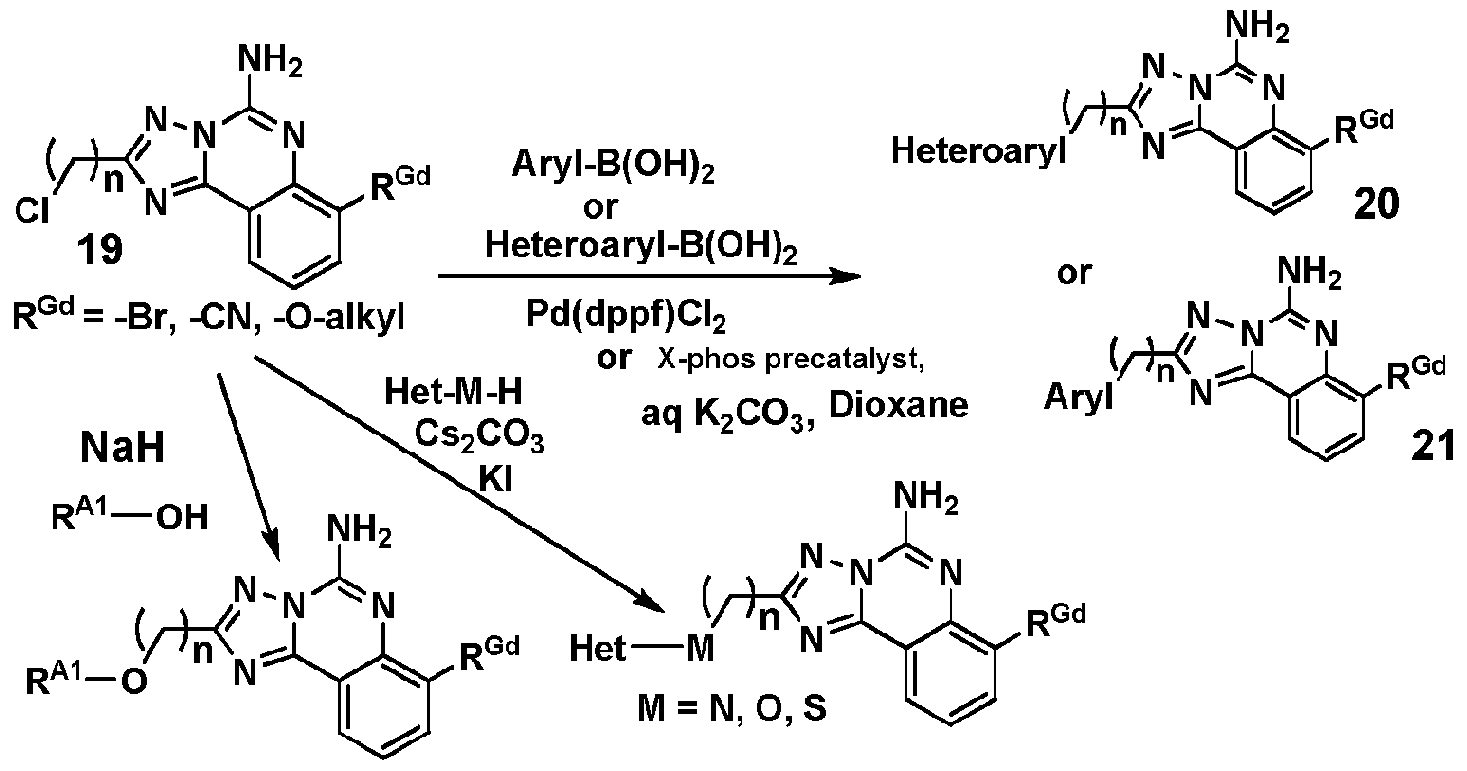
[0124] As shown also in Scheme AI, a compound 19 in the presence of sodium hydride can be reacted with a reagent having a "left-side" fragment which contains a hydroxyl moiety, thereby providing a product which joins the "left-side" and "right-side" fragments with an alkoxy (-0-CH2-) "linker" in place of the chloro-substituent present in compound 19. In such synthetic procedures, RA1 can be alkyl, substituted alkyl, aryl (substituted or unsubstituted), heteroaryl (substituted or unsubstituted) bicycloalkylaryl (substituted or unsubstituted) or bicycloalkylheteroaryl (substituted or unsubstituted). In AI, the reaction shown is catalyzed by Pd(dppf)Cl2 which is a palladium(2 ) catalyst available as an article of commerce complexed with dichloromethane (DCM) (l , l '-Bis(diphenylphosphino)ferrocene- palladium(II)dichloride)
[0125] Amide-substituted compounds of the invention can be prepared in accordance with Scheme ΑΠ:

[0126] Thus, a suspension of P23 (the preparation of which is discussed further below) in DMF treated with an amine, for example, a cyclic amine e.g. a piperidine or piperazine moiety (shown in AUc as
(R'--R")=NH), diisopropylethyl amine (DIPEA) and 2,4,6-tripropyl-l,3,5,2,4,6-trioxatriphosphoriane- 2,,4,6-trioxide (T3P) at room temperature provides the corresponding amide compound P24, which can be obtained from the reaction mixture by treating the reaction mixture with saturates NaHC03 and
extracting with dichloromethane (DCM). Specific examples of these compounds are presented in the Examples below.
[0127] Scheme ΑΠΙ - Preparation of Compounds of the Invention From DMoB-protected triazole precursor and a "Left-Side" Precursor which is: (i) a Primary or Secondary Amine; (ii) an Alkyne or (iii) a Boronic Acid.
Scheme ΑΠΙ

[0128] Scheme ΑΙΠ illustrates several transformations which can provide a compound of the invention, or a precursor thereof, from hydroxy-functionalized compound 13, after conversion to the
corresponding mesyl-functional group (compound 14) via treatment with mesyl chloride. Compound 14 can subsequently be reacted with a primary amine and the product deprotected to provide an amine- linked compound of the invention (compound 16A) or a precursor thereof.
[0129] Alternatively, compound 14 can deprotected (using TFA) and reacted with a "left-side" precursor having a suitable reactive nitrogen (for example, a secondary amine shown) under suitable conditions (in the presence of potassium iodide and DIPEA (Hunig's base, diisopropylethylamine), thereby providing compound of the invention (or a precursor thereof) in which the "left-side" and "right-side" fragments are linked by a secondary-amino or cyclo-amino moiety. Alternatively, the methoxy- functional group of compound 14 is converted to the corresponding methylchloride
(compound 15).
[0130] As shown, compound 15 can be deprotected and reacted with a secondary- or cyclo-amine
"left-side" precursor in the same manner as compound 14, to provide a compound of the invention or an intermediate thereof, or in the protected form compound 15 can be reacted with an appropriately substituted aryl- or heteroaromatic boronic acid in the presence of a suitable palladium catalyst (in accordance with the similar reaction shown in Scheme AI, above) to provide an aryl-substituted or heteroaryl-substituted triazole of the invention (or an intermediate thereof). As illustrated in Scheme ΑΠ also, compound 15 can alternatively be reacted with sodium azide followed by reaction with a
suitable aryl-alkyne then deprotected to provide triazole-functionalized compounds of the invention or a precursor thereof.
[0131] With reference to Schemes AI and ΑΠΙ, it will be appreciated that any synthetic scheme which provides any of compounds 13, 14, 15 or 19 can be employed to provide a suitable "right-side" precursor utilized in Schemes AI and ΑΠ to ultimately provide a compound of the invention. It will be appreciated as well that any synthetic scheme which provides compound 4 can be employed to provide a suitable quinolin-azole precursor for use in Scheme AIL
[0132] In some of the schemes above and throughout, reference is made to "X-phos precatalyst" which is utilized to provide a carbon-carbon bond between a heteroaryl-boronic acid reagent and the chloromethyl substituent shown in the schemes (e.g. compounds 15 and 19). As used herein, this phrase refers to dicyclohexylphosphino-2',4',6'-triisopropyl-l,r-biphenyl)[2-(2- aminoethyl)phenyl]palladium(II) chloride ), which is commercially available. Alternately, in some schemes the catalyst employed is l, -Bis(diphenylphosphino)ferrocene-palladium(II)di chloride (Pd(dppf)Cl2), (for convenience abbreviated herein PdC^dppf -CH^Cyalso an article of commerce. In general, suitable aryl-boronic acids and heteroaryl-boronic acids are also commercially available or are readily prepared from commercially available boronic acid compounds.
Preparative Schemes B: Synthetic Pathways Suitable for Preparation of "Right-side" Precursor Compounds
[0133] Preparative Schemes BI (which provide free amine products) and ΒΠ (which provides protected amine products) illustrate general routes for preparing a "Right-Side" precursor which can be employed in the general Schemes AI and AIII, shown above to prepare compounds of the invention. These are followed by several specific examples of preparation of variously functionalized "right-side" precursor compounds useful in synthesis of compounds of the invention.
Scheme BI - Preparation of Heteroaryl- triazole Compounds of the Invention by Preparation and Cyclization of Heteroarylhydrazine-substituted Quinazoline-precursor Compounds.
[0134] Scheme BI illustrates several paths for the preparation of triazole precursor comopounds. The substituted triazole compounds thus prepared are useful as a precursor in the preparation of susbtituted pyridine-triazole compounds of the invention, specific examples of which are described herein below.
[0135] As shown in the Schemes of BI, one or more -CH2- moieties which will ultimately link the triazolo "core" of the "Right-side" fragment of a compound of the invention to the "Left-side" fragment can be incorporated into the "Right-side" precursor at this stage of the synthesis.
[0136] Scheme BI
Scheme Bla

Scheme Bib

N
[0137] In Schemes of BI, "PG" is an acetyl or dimethoxybenzyl (DMB) protecting group (BIc illustrates an acetyl protecting group)
[0138] Scheme Bla and Bib illustrate two routes for preparing a hydrazine precursor in which the hydrazine intermediate ultimately contains an aryl- or heteroaryl-hydrazine-quinoline moiety prior to cyclization (where R10 is a substituted aryl or substituted heteroaryl, for example, benzene or halopyridine). In route Bla, a quinazoline precursor, compound 4 can be reacted either with a hydrazine derivative, compound 4B (where R10 is a functionalized heteroaryl, for example, ?insert example) and subsequently deprotected to provide compound 6B. In route Bib, compound 4 can be reacted with hydrazine directly, deprotected to provide a hydrazinyl-quinazolin-amine intermediate, and the hydrazinyl-quinolin-amine subsequently reacted with an R10-acid, wherein R10 is a
functionalized heteroaryl moiety, for example, 2-(2-bromopyridin-3-yl)acetic acid, to provide compound 6B. Prepared by either route, the hydrazinyl-quinoline intermediated, 6B, can be cyclized to provide a triazole compound of the invention. As mentioned herein, this is also useful for providing an R10-substituted triazole precursor containing one or more reactive substituents which can be subsequently derivatized to provide additional compounds of the invention. Scheme BIc illustrates the use of a hydrazine derivative that provides a hydroxy-functionalized triazole compound (compound 7c), and Scheme Bid illustrates conversion of the alcohol-functionalized triazole of compound 7c to the corresponding chloride compound 8. The latter two routes of Scheme BI provide a "right-side" precursor which is widely useful in coupling piperazine "left-side" precursor compounds, as is illustrated herein.
[0139] Scheme BIc is illustrated further by the preparation of N'-(2-amino-8-methoxyquinazolin-4-yl)- 2-hydroxyacetohydrazide (compound 7cl) in accordance therewith:
 Compound 7cl
[0140] Accordingly, Compound 7cl was prepared by taking a portion of compound 4 (4.0 g, 14.1 mmol) thus prepared was suspended in THF (300 ml). To the suspension was added 2- hydroxyacetohydrazide (1.39 g, 15.5 mmol, compound 4a wherein "n" = 1), followed by DIPEA (1.71 g, 17.9 mmol). This mixture was stirred at 60°C for 48 h then concentrated in vacuo. The residue thus obtained was dissoved in MeOH( 200 ml) and ¾0 (100 mL). K2CO3 was added. The mixture was stirred at 65°C for 2h, cooled to RT. MeOH was removed in vacuo. The precipitates were collected by filtration, cooled to 0°C, washed with H20, DCM Hexanes (1 :1), and dried in vacuum oven to afford N'-(2-amino-8-methoxyquinazolin-4-yl)-2-hydroxyacetohydrazide (compound 6cl, which is compound 6c wherein "n" = 1). The identity of the product was confirmed by LC/MS in accordance with the procedure described herein (LC MS = 264 [M+l ]).
[0141] A portion of compound 6cl thus prepared (3.5 g, 13.3 mmol) was stirred with Ν,Ο- Bis(Trimethylsilyl)acetamide (100 mL) at 120°C for 3 h, cooled to RT, concentrated in vacuo with heating to remove trimethylsilyl N-(trimethylsilyl)acetimidate completely. MeOH was added to the residue and the mixture was concentrated in vacuo. The solids obtained were suspended in MeOH, cooled and filtered. The precipitate were washed with MeOH, dried and concentrated to afford (5- amino-7-methoxy-[l ,2,4]triazolo[l ,5-c]quinazolin-2-yl)methanol (compound 7cl). The identity of the product was confirmed by LC MS in accordance with the procedure described herein (LC/MS = 246
[M+l ]).
[0142] In the same manner, Scheme Bid is illustrated by the preparation of compound 8a (compound 8 wherein "n'
 compound 8a
[0143] Thus, with reference to Scheme Bid, above,a portion of compound 7cl previously prepared (2.8 g, 11.4 mmol) was mixed with SOCl2 (10 ml) and the mixture stirred at 65°C for 45 min. The mixture was then cooled to RT, concentrated to remove SOCI2 completely, and the residue was suspended in DCM and filtered. The precipitates were collected and dried to afford 2-(chloromethyl)- 7-methoxy-[l,2,4]triazolo[l,5-c]quinazolin-5-amine (compound 8a). The identity of the product was confirmed by LC/MS in accordance with the procedure described herein (LC/MS = 264 [M+l]).
Preparative Scheme PI: Preparation of triazole precursors.
[0144] Scheme PI illustrates the preparation of compound 4, useful in providing "right-side" triazole precursor compounds (see e.g., Schemes Bla to BIc, above), from commercially available 2-amino-3- methoxy-benzoic acid.
Scheme PI

Preparative Example PI: Preparation of N-(8-me oxy-4-(lH-1.2.4-triazol-l-v0quinazolin-2- yPacetamide (compound PI-4)
[0145] N-(8-methoxy-4-(lH-l ,2,4-triazol-l-yl)quinazolin-2-yl)acetamide (compound 4)was prepared from a benzoic acid starting material in accordance with Scheme PI by adding into a solution of 2- amino-3-methoxybenzoic acid (compound PI-1) (50 g, 299 mmol) in EtOH (400 ml), cyanamide (18.86 g, 449 mmol) and concentrated HC1 (12 ml, 299 mmol). The reaction mixture thus provided was refluxed overnight and then cooled to room temperature. The precipitates were collected through filtration, washing with cold ethanol to yield compound PI-2 (50 g). A portion of compound PI-2 thus provided (10 g, 52.3 mmol) was suspended in acetic anhydride (60 ml, 52.3 mmol). The suspension was placed into a sealed tube and heated at 130 °C for 40 minutes, providing N-(4-hydroxy-8- methoxyquinazolin-2-yl)acetamide (compound PI-3). The identity of the product was confirmed by LC S in accordance with the procedure described herein (LC/MS = 259 [M+l ]).
[0146] In a subsequent step, a portion of compound PI-3 thus provided (7 g, 30.0 mmol) was suspended in Acetonitrile (300 ml) and added thereto was 1 ,2,4-triazole (20.73 g, 300 mmol), DIPEA (15.31 ml, 90 mmol), and then drop wise was added POCI3 (8.22 ml, 90 mmol). This reaction mixture was stirred at room temperature overnight. The yellow precipitates formed were filtered and washed with EtOH twice and then ether to afford N-(8-methoxy-4-(lH-l,2,4-triazol-l-yl)quinazolin-2- yl)acetamide (compound PI-4).
[0147] The PI synthetic scheme was carried out by substituting 3 -hydroxypropanehydrazide
(compound 4a in Scheme BI where "n"=2) in place of 2-hydroxyacetohydrazide used in the previous preparative example. When this substitution was made, scheme PI provided 2-(2-chloroethyl)-7- methoxy-[l,2,4]triazolo[l,5-c]quinazolin-5-amine (compound 8b, compound 8 in Scheme BI where "n"=2). Isolation and purification of 8b was carried out in a DCM/Hexane mixture instead of DCM alone, and the identity of the product was confirmed by LC/MS (LC/MS = 279 [M+l ]).
[0148] When the PI synthetic procedure was carried out using 4-hydroxybutanehydrazide (compound 4a in Scheme BI where "n"=3) in place of 3 -hydroxypropanehydrazide used in the previous preparative example, producing thereby 2-(2-chloropropyl)-7-methoxy-[l ,2,4]triazolo[l ,5- c]quinazolin-5-amine (compound 8c, compound 8 in Scheme BI where "n"=3). Compound 8c was isolated by evacuating the SOCI2 from the reaction mixture and using the residue as prepared. The product was confirmed by LC MS (LC MS = 293 [M+l]).
[0149] It will be appreciated that preparative procedure PI can be carried out starting with other methoxy-benzoic acid starting materials in place of compound 1 (2-amino-3-methoxybenzoic acid) to provide variously-substituted "right-side" triazole precursors for use in preparing compounds of the invention. For example, carrying out Scheme PI using 2-amino-5-fluoro-3-methoxybenzoic acid enables, after a process of Scheme BI, the provision of compound 8d (2-(chloromethyl)-9-fluoro-7- methoxy-[l, 2, 4]triazolo[l,5-c]quinazolin-5, LC/MS = 282.1 [M+l]). In the same manner, employing 2-amino-4-fluoro-3-methoxybenzoic acid enables the preparation of compound 8e.
 compound 8e
[0150] It will be appreciated that in some procedures employing fluorinated amino-methoxybenzoic acid starting materials, the step of preparing an acetamide-protected analog of compound 3 may be eliminated and the free-base may be employed in the reactions instead of employing an acetamide- protected form of the compound. Such a scheme is illustrated in preparative example PII, whrein compound 8F is prepared starting with 2-amino-4,6-difluoro-benzoic acid (compound PII-1).
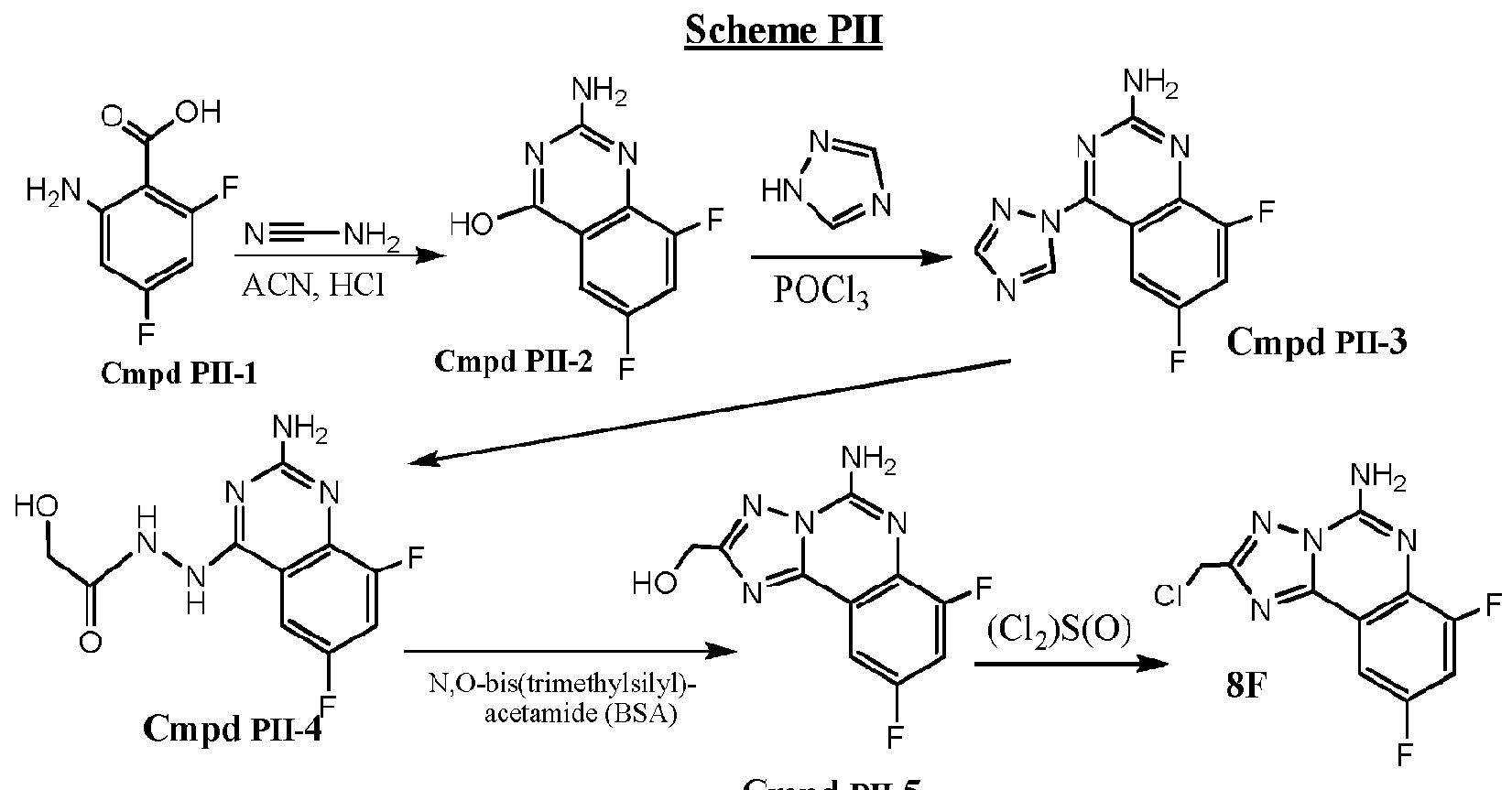
mp ΡΠ-
Step A: Preparation of 2-amino-6.8-difluoroquinazolin-4-ol (Cmpd PII-2)
[0151] To a solution of the 2-arnino-4,6-difluorobenzoic acid (Cmpd PII-1, 5g, 28.9 mmol)) in actonitrile(20 ml) was added cyanoamide (1.821 g, 43.3 mmol)) and concentrate hydrochloric acid (3 ml, ). Reaction mixture was refluxed overnight. Cooled to room temperature and then the precipitate was collected through filtration, washing with acetonitrile to yield the desired 2-amino-6,8- difluoroquinazolin-4-ol (Cmpd PII-2, 5g, 25.4 mmol, 88 % yield). Retention time: 0.10, LC/MS = 198 [M+l ].
Step B: Preparation of 6.8-difluoro-4-(lH-1.2.4-triazol-l-yl)quinazolin-2 -amine (Cmpd PII-3)
[0152] To a stirred solution of 2-amino-6,8-difluoroquinazolin-4-ol (2g, 10.14 mmol) and triazol (7.01 g, 101 mmol) in acetonitrile (30 mL), POCI3 (10.63 ml, 60.9 mmol) was added slowly in one over 1 h making sure to maintain the temperature below 60°C (Highly exothermic!). The reaction was stirred overnight at room temperature. Cooled to room temperature and then the precipitate was collected through filtration, washing with acetonitrile to yield the desired product 6,8-difluoro-4-(lH-l,2,4- triazol-l-yl)quinazolin-2-amine(Cmpd PII-3, 2g, 79 % yield) as a colorless solid . Retention time: 0.20, LC MS = 249 [M+l ].
Step C: Preparation of N'-(2-amino-6,8-difluoroquinazolin-4-yl)-2-hydroxyacetohydrazide(Cmpd ΡΠ-4^
[0153] Into a stirred mixture of 24iydroxyacetohydrazide( 0.18g, 2.0 mmol) in 20mL of THF) was added 6,8-difluoro-4-(lH-l ,2,4-triazol-l-yl)quinazolin-2-amine (Cmpd PII-3, 0.18 g, 2.0 mmol). The mixture was stirred at room temperature overnight, then the solvent was evaporated under reduced pressure. DCM was added to the residue and the solid was filtered off. The yellow solid was disolved in water and the residue was filtered off and retained. Acetonitrile was added into the aqueous phase with stirring untill precipation and the solid was filtered again. Solids were collected and dried in vacuo at room temperature to give N'-(2-amino-6,8-difluoroquinazolin-4-yl)-2-hydroxyacetohydrazide ( Cmpd PII-4, 0.3g, 55%) as a yellow solid. The identity of the product was verified by LC/MS - Retention time: 0.54, LC MS = 270 [M+l].
Step D Preparation of (5-amino-7.9-difluoro-[l,2.4]triazolo[l ,5-c]quinazolin-2-yl)methanol (Cmpd
ΡΠ-5)
[0154] N'-(2-amino-6,8-difluoroquinazolin-4-yl)-2-hydroxyacetohydrazide (Cmpd PII-4, 0.8g, 2.97 mmol) was added to a stirred, cooled room temperature mixture of BSA (12 g, 60 mmol) in and the mixture was stirred at 120 °C for 2 h. After 2 hours BSA was removed under vacuum and 5 mL of MeOH was added slowly. The solvent was removed under vacuum, water was added, and the mixture was filtered and washed with dichloromethane to give (5-amino-7,9-difluoro4^1,2,4]triazolo[l,5- c]quinazolin-2-yl)methanol as yellow solid (0.5g, 1.991 mmol, 67.0 % yield). Retention time: 1.35, LC MS = 252[M+1 ],
Step E: Preparation of 2-rchloromethylV7.9-difluoro-[1.2.4]triazolo[1.5-c]quinazolin-5-amine i8F)
[0155] A portion of Cmpd PII-5, prepared in the previous step (0.4g, 1.60mmol) was suspended in 5 mL of SOC and DCM(10 mL) . The mixture was stirred at RT for 1 h, concentrated in vacuo to remove SOCl2 completely. The residue was suspended in DCM/Hex (1 :2), cooled to 0°C, filtered, and the solid was dried in vaccum oven to give 2-(chloromethyl)-7,9-difluoro-[l,2,4]triazolo[l,5- c]quinazolin-5-amine (0.3g, 1.1 13 mmol, 69.9 % yield). Retention time: 1.68, LC/MS = 270 [M+l ].
[0156] It will be appreciated that by using the PI and ΡΠ synthesis procedures described above with variously substituted aminobenzoic acid starting material, other precursors with various substituents on the "aryl-ring" of the triazole "right-side" precursor compound may be prepared. Accordingly,
and nd 8H.
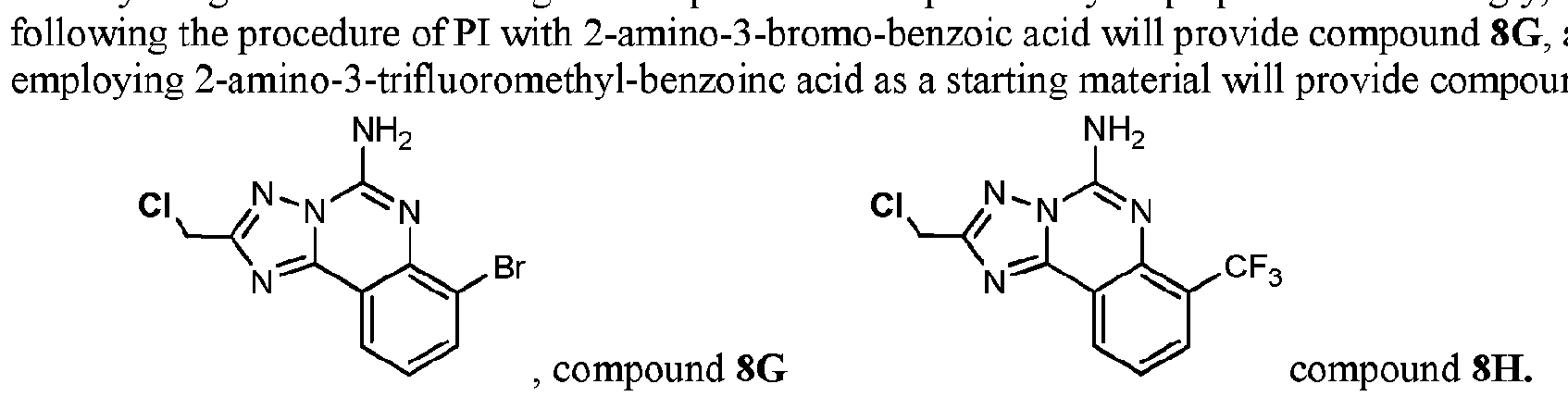
[0157] Moreover, compound 8G can be employed to prepare additional analogs, for example, using Scheme PI(a), the cyano-functionalized analog can be prepared.
Scheme PI(a)

Protected-8G-alcohol Protected-8H
[0158] In accordance with Scheme PI(a), a mixture of Protected-8G-alcohol prepared in accordance with PI (200 mg; 0.45 mmol), zinc cyanide (31 7 mg; 0.27 mmol) and PdCl2(dp f)2:CH2Cl2 were dissolved in DMF (1 mL) and water (0.1 mL). The resulting clear red solution was degassed with nitrogen, stirred and heated at 120° C for 14 hr. MS analysis of the reaction mixture showed absence of the starting bromo tricyclic alcohol and presence of the product nitrile (Mlf = 391). The reaction mixture was quenched with water and organics were extracted with EtOAc. The organic extract was further washed with water, brine and dried over solid anhydrous Na2SC>4. The crude product was purified by preparative TLC, developing the plate with EtOAc-CH2Cl2 (1 :1) to provide the cyano analog of protected 8G-alcohol (herein CN-8G-alcohol isolated as beige solid.
[0159] The compound CN-8G-alcohol thus prepared was dissolved (140 mg; 0.36 mmol) in CH2C12 (2 mL) and CDC13 (2 mL). The solution was cooled in an ice bath and treated sequentially with Et3N (40 mg; 55 uL; 0.395 mmol) and MsCl (49 mg; 0.43 mmol), taking care not to use even a slight excess of Et3N to avoid quaternary salt formation. The ice bath was removed after 5 minutes and the reaction mixture was stirred at RT for 45 minutes when the analysis (TLC, MS) showed absence of alcohol.
The reaction mixture was diluted with EtOAc and washed with water, brine, dried and concentrated to obtain the crude mesylate.
[0160] The crude mesylate prepared in the previous step was redissolved in acetone (3 mL), treated with solid LiCl (76 mg; 1.79 mmol) and was stirred with heating at 58°C for 3 hr. After confirming the complete formation of the tricyclic chloride (MIT" = 408/410), the reaction mixture was cooled to RT and acetone was removed under house vacuum. The residue was dissolved in CH2CI2/CHCI3 (4:1) and washed with water, brine and concentrated to obtain 140 mg of a beige solid. The crude product thus obtained was purified by preparative TLC (30% EtOAc-CF^C ) to furnish compound protected-8H as off-white solid.
General Preparative Scheme BII: Preparation of "protected-amine". "Right-Side" triazole Precursors.
[0161] Scheme BII illustrates the preparation of a "protected-amine" "Right-side" precursor from commercially available 2-amino-3-methoxy-benzoic acid. As was shown in Scheme BI, Scheme ΒΠ illustrates that one or more -CH2- moieties, which will ultimately link the triazolo "core" portion of the "Right-side" fragment of a compound of the invention to the "Left-side" fragment, can be incorporated into the "Right-side" precursor at this stage of the synthesis.
Scheme BII

water
10
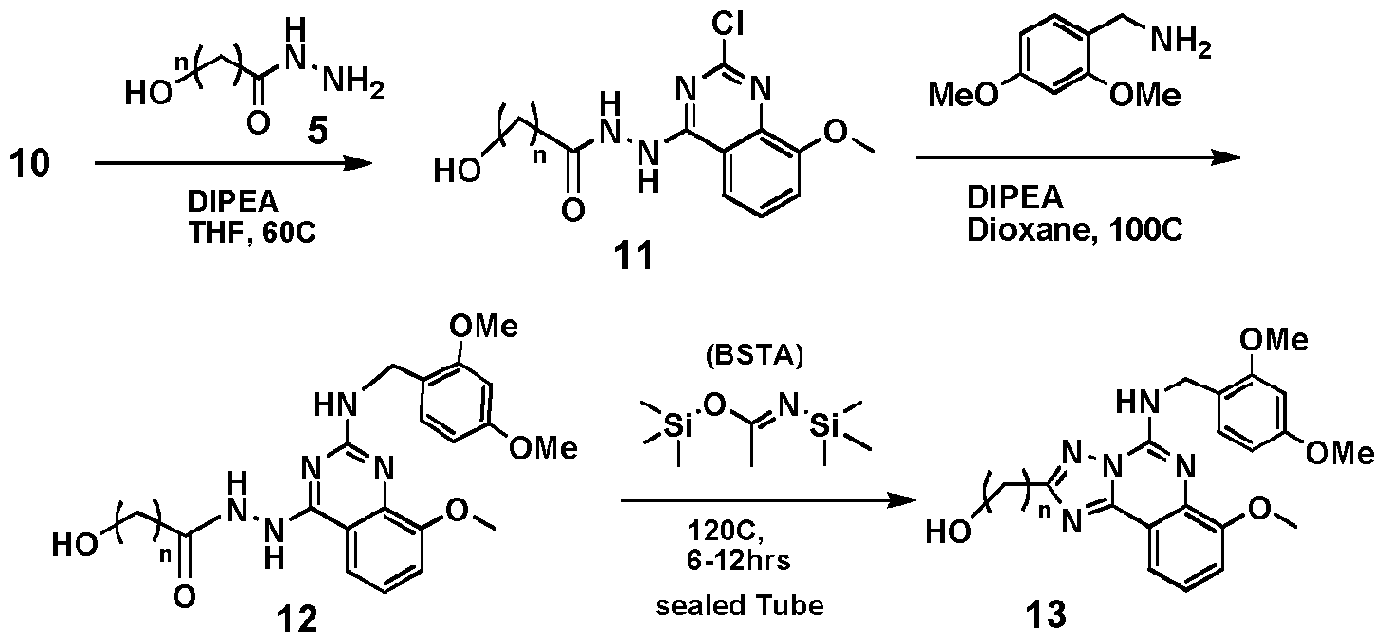
[0162] Preparative Example ΡΠΙ: Preparation of (5-(2.4-dimethoxyben2ylamino)-7-methoKy- [1.2.4]triazolo[1.5-c]quinazolin-2-yr)methanol (compound 13a) in accordance with Scheme BII

[0163] With reference to Scheme ΒΠ, above, (5-(2,4-dimethoxybenzylamino)-7-methoxy- [l ,2,4]triazolo[l ,5-c]quinazolin-2-yl)methanol (compound 13a, which is compound 13 of Scheme BII where "n" = 1) was prepared starting from compound 1 by placing into a reaction vessel a suspension of compound 1 (3 g, 17.95 mmol) in water (100 ml) and acetic acid (1.099 ml, 19.20 mmol) maintained at 55-60 °C, and adding thereto a solution of KOCN (3.49 g, 43.1 mmol) in water (7 mL). After about 4 hours of stirring at 55-60 °C, the reaction was cooled to ambient temperature and solid NaOH (31.6 g, 790 mmol, 35-44eq) was added quickly in one portion.
[0164] The resultant pale brownish cloudy solution became clear and then became white murky solution after 10 min. The reaction mixture was cooled to 0 °C and Cone. HC1 (around 38 mL) was added to make pH 4-5 while maintaining the reaction mixture at 0 °C, generating a white precipitate. The reaction mixture was filtered, and the solids obtained were washed with water (500 mL) and dried under vac. oven overnight to afford compound 9. The identity of compound 9 was verified by LC MS in accordance with the procedure listed herein (193 [M+l ]
[0165] A stirred suspension of compound 9 prepared above (2.0 g, 10.41 mmol) in neat POCl3 (9.70 ml, 104 mmol) was heated to!05 °C overnight. After 16hrs, the murky solution became clear and the
reaction mixture was cooled down. The POCl3 was evaporated until solution became solid. The crude product thus obtained was mixed with EtOAc (500 mL) and the mixture poured into a 12L beaker Aqueous NaHC03(aq) was added and the mixture was stirred for 30 min. The crude product solids became soluble in EtOAc and any remaining POCI3 was quenched. The resulting organic layer was washed with NaHC03(aq), and brine solution, dried over MgS04, filtered and concentrated, yielding pale yellowish solid product, compound 10. The identity of compound 10 was verified by LC/MS in accordance with the procedure listed herein (230 [M+l].
[0166] Thus prepared, compound 10 (15.2 g, 66.4 mmol) was dissolved in THF (664 ml), and to this solution was added DIPEA (13.91 ml, 80mmol) and 2-hydroxyacetohydrazide (with reference to Scheme BII, compound 5 where "n"=l, 5.98 g, 66.4 mmol). The reaction mixture was stirred at 65 °C ovemight, then the reaction mixture was cooled to T and the solvent was evaporated. The crude product was redissolved in DCM and stirred for 30min providing a pale yellowish precipitate. The precipitate was filtered and washed with DCM then dried in vacuo to afford compound 11a (with reference to Scheme ΒΠ, compound 11 wherein "n"=l ). The identity of compound 11a was verified by LC MS in accordance with the procedure listed herein (283 [M+l ]).

(compound 11a)
[0167] Compound 11a thus obtained (14.7 g, 52.0 mmol) was suspended in Dioxane (520 ml) and added thereto was DIPEA (22.71 ml,130 mmol) and 2,4)-dimethoxyphenyl-methanamine (10.16 ml, 67.6 mmol). The reaction mixture was heated to 100 C for 16 hrs. then cooled to room temperature. The reaction was filtered and washed with dioxane until no yellow solution came out and washed with hexane several times and dried in vacuo to afford compound 12a (with reference to Scheme BII, compound 12, wherein "n' -l). The identity of compound 12a was verified by LC/MS in accordance with the procedure listed herein (414 [M+l ]).
[0168] Thus obtained, compound 12a (20.3 g, 49.1 mmol) was placed into a tube, BSTA (144 ml, 589 mmol) was added and the tube was sealed. The sealed reaction mixture was heated to 130 °C ovemight. Afterward, the reaction mixture was cooled down, transferred to a rotary evaporator and the BSTA was evaporated from the rotary evaporator for one hour in a water bath heated to 70 °C.
[0169] The crude material thus obtained was dissolved in MeOH (170mL) and 2.5mL of cone. HC1 was added. The solution became murky and after lOmin, the precipitate which had formed was filtered and washed with water (x5) and the solids were washed X2 with DCM (50mL) followed by 1 X with water, then dried under vac. oven overnight to afford as a pale yellow powder, compound 13a. The identity of compound 13a was verified by LC/MS in accordance with the procedure listed herein (396
[M+l ]).
[0170] It will be appreciated that by selecting an appropriate hydrazide (compound 5, Scheme BII) analogs of compound 13a having an alkoxy-substituent where "n">l can be prepared. For example, following Scheme ΒΠ using 3-hydroxypropanehydrazide (Scheme ΒΠ, compound 5 where "n"=2) to react with compound 10 in place of 2-hydroxyacetohydrazide used as compound 5 in Preparative Example ΡΠ ("n' -l), ultimately yields compound 13b (shown above) from this procedure.
[0171] Once the hydroxy-substituted "right-side" precursor is prepared, for example, compounds 13a, 13b, or 13c, the hydroxy-substituted compound can be reacted to provide additional functionality at that location, for example, conversion to the corresponding chloride as shown in Scheme PVa.
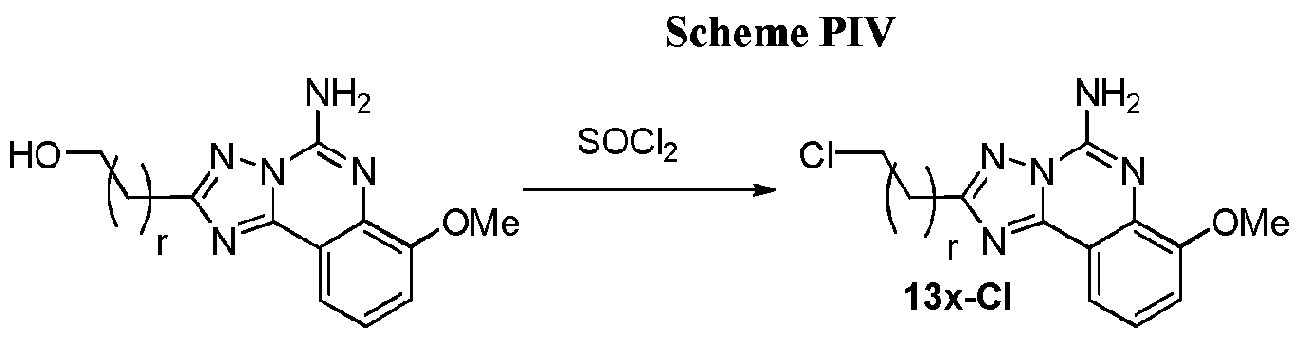
[0172] Thus, compound 13b-Cl (13x-Cl where "x" is "b" and "r" is 1) was prepared by suspending 2- (5-amino-7-methoxy-[l,2,4]triazolo[l ,5-c]quinazolin-2-yl)ethanol (4 g, 15.4 mmol) in DCM (50 mL) and SOCI2 (50 ml). The mixture was stirred at RT for 1 h, concentrated in vacuo to remove SOCI2 completely. The residue was suspended in DCM Hex (1 :2), cooled to 0°C, filtered and dried to afford the titled compound LC/MS = 279 [M+l ].
[0173] In the same manner, compound 13c-Cl (13x-Cl where "x" is "c" and "r" is 2) was prepared by suspending 3-(5-amino-7-methoxy-[l ,2,4]triazolo[l,5-c]quinazolin-2-yl)propan-l-ol in (240 mg, 0.878 mmol) in SOCI2 (25 ml) and DCM (50 ml). The mixture was stirred at RT for 1 h, concentrated in vacuo to remove SOCl2 completely to afford the titled compound. LC MS = 293 [M+l].
[0174] Variations on this procedure can provide a triazolo core with different functionality. For example, a 7-methoxy 9-fluoro-triazole can be prepared in accordance with the following scheme in a similar procedure by starting with -amino-5-fluoro-3-methoxybenzoic acid in accordance with Scheme E3, below
[0175] A variation of synthesis Scheme BII is shown in Scheme PV (below). Thus, after obtaining compound 10 in accordance with Scheme BII, compound 10 was reacted with a hydrazinyl- oxopropanoate to provide compound lib. In turn, compound lib was reacted as shown in Scheme PV to provide "right-side" precursor P24, which is useful in preparing amide-substituted triazole compounds of the invention, for example, compounds Ex-153 and Ex-154 (described herein below).

[0176] In accordance with the foregoing, to a stirred suspension of compound 10 (3.0 g, 13.10 mmol, prepared in accordance with general Scheme ΒΠ) in THF (30 mL) was added ethyl 3-hydrazinyl-3- oxopropanoate (2.01 g, 13.75 mmol) and DIPEA (6.86 ml, 39.3 mmol). The reaction mixture was heated to 55 °C overnight then cooled to ambient temp, and the solvent was evaporated. To the residue, DCM and water were added and the mixture extracted with DCM (x3). The organic extract was evaporated to afford compound Pllb, (3. lg, 67%) used as prepared.
[0177] To a pressure tube of Pllb (2.1 g, 6.20 mmol) was added 90mL ammonia (2M in isopropanol). The pressure tube was sealed and heated to 105C overnight. The reaction mixture was cooled to room temperature and evaporated solvent. The crude product, compound P21 (2.72 g, 8.54 mmol), without further purification was mixed with Ν,Ο-bistrimethylsilyl acetamide (BSTA, 20.9 ml, 85 mmol) and the mixture sealed in a pressure tube then heated, with stirring, to 130 °C for 4hrs. The reaction
mixture was cooled to ambient temperature, then transferred to a rotary evaporator and the solvent removed. The residue was purified by silica chromatography (1/1 EtOAc/Hex to 10%MeOH/DCM) yielding ethyl 2-(5-amino-7-methoxy-[l ,2,4]triazolo[l ,5-c]quinazolin-2-yl)acetate. This product was suspended in THF (20mL) and water (4mL), mixed with LiOH-H20. The mixture was stirred at room temperature overnight, then the solvent was evaporated and the residue dried under vac. oven overnight to yield P23.
General preparation of "Left-Side" precursors
Preparative Example ΡΠΙ: Preparation of piperazine-functional "Left-Side" precursors
[0178]

[0179] (Step 1) To a microwave tube was added (S)-4-N-BOC-2-METHYLPIPERAZINE, 11 (250 mg, 1.248 mmol), 4-fluorobromobenzene (240 mg, 1.373 mmol), POTASSIUM TERT-BUTOXIDE (140 mg, 1.248 mmol), TRIS(DrBENZYLTDENEACETONE)DIPALLADlUM-CHLOROFORM
ADDUCT (64.6 mg, 0.062 mmol), 2-DICYCLOmXYLPHOSPfflNO-2^6'-DI-I-PROPOXY-l ,l '- BIPHENYL (87 mg, 0.187 mmol) and Toluene (416 μΐ). The reaction mixture was microwaved at 100 °C for 2hrs. The solvent was evaporated and EtOAc was added. The organic layer was washed with water, dried over MgS04, filtered, and concentrated.
[0180] The crude product was purified by ISCO (EtO Ac/Hex =1/5) to give the desired product 13, which was confirmed by LC MS = 295 [M+l],
[0181] (Step 2) To a stirred solution of 13 (210 mg, 0.713 mmol) in DCM (446 μΐ) was added 4M HCI in dioxane solution (5 mL).The reaction mixture was stirred at RT overnight.
[0182] The solvent was evaporated and the crude product was concentrated under high vac. to give the desired product, 13, which yielded LC MS = 1 5 [M+l ].
Example 1 : Preparation of cycloamine-triazole compounds in Accordance with Scheme E2 - Coupling "Right-Side" Piperazine-Precursor with Aryl or HeteroAryl-halo Precursor
[0183] Piperazine precursor compounds were prepared using the reaction chemistry shown in Scheme ΑΠΙ to provide Ex-E2-pre piperazine-functionalized compounds (where the piperazine functional group is HN-R15). Compounds of the invention were prepared from the piperazine precursor inaccordance with Scheme El .
Scheme El

-E2-pre
[0184] Thus, in accordance with Scheme El, the compound of Ex-187 was prepared by suspending 80 mg of dihydridochloride salt (80 mg) of a compound of 2-((2,2-dimemylpiperazin -yl)methyl)-7- metho -[l,2,4]triazolo[l,5-c]quinazolin-5-amine (the compound of Formula Ex-E2-pre where HNR15 is as shown below in Table VI for Ex-187) was suspended in DIPEA (101 micro-L) with 2- fluoro-5-(trifluoromethyl)pyridine (47.8 mg, reagent X-R16 for Ex-187 in Table VI) and heated at 80 °C overnight, then diluted with DCM. The organic layer was separated, washed with sat. aq HCU then water, dried over MgSC , filtered and concentrated. The residue was purified by silica chromatography (EtOAc Hex = 1/1 to 100% EtOAc) to yield Ex-199.
[0185] All of the compounds of the form Ex-E2b from scheme El shown in Table V were prepared in a similar manner from the appropriate piperazine precursor and appropriate X-R16 reagent.
TABLE V


Example 2: Preparation of cycloamine-triazole and derivative compounds in Accordance with Scheme AIII - Coupling "Right-Side" Precursor with Amine or CycloAmine Exemplied in Scheme E3 with piperazine
[0186] Scheme E2 illustrates preparation of compounds of the invention in accordance with general Scheme AIII to prepare compounds of Formula 16 by coupling a functionalized piperidine reagent and a suitable chloro-functionalized "right-side" triazole precursor.
Scheme E2

[0187] Thus, in accordance with Scheme E2, to a stirred solution of the hydridochloride salt of compound 8a (80 mg, 0.267 mmol) in DMF (2665 μΐ) was added piperazine P-13 (78 mg, 0.293 mmol, prepared in accordance with preparative Example PHI, above), DIPEA (186 μΐ, 1.066 mmol), and KI (8.85 mg, 0.053 mmol). The reaction mixture was heated to 80 °C and stirred overnight. After cooling to ambient, NH3Cl(aq) was added. The resulting precipitate was filtered, washed, dried and purified by flash chromatography (ISCO) (EtO Ac/Hex = 1/1 to 10%MeOH DCM) to give compound EX-178 (62 mg, 55%). The identity of the product was confirmed by LC MS (LC/MS = 422 [M+l ]).
[0188] Using the coupling procedure described above in Scheme E2 and various "Left-side" amino- functionalized "Left-side" precursor compounds, additional examples of compounds of the invention described above were prepared which have the general structure:
 , where Rd is denned in Table VI
Table VI
Example Structure LC-MS
Ex-10 440 [M+1 ]
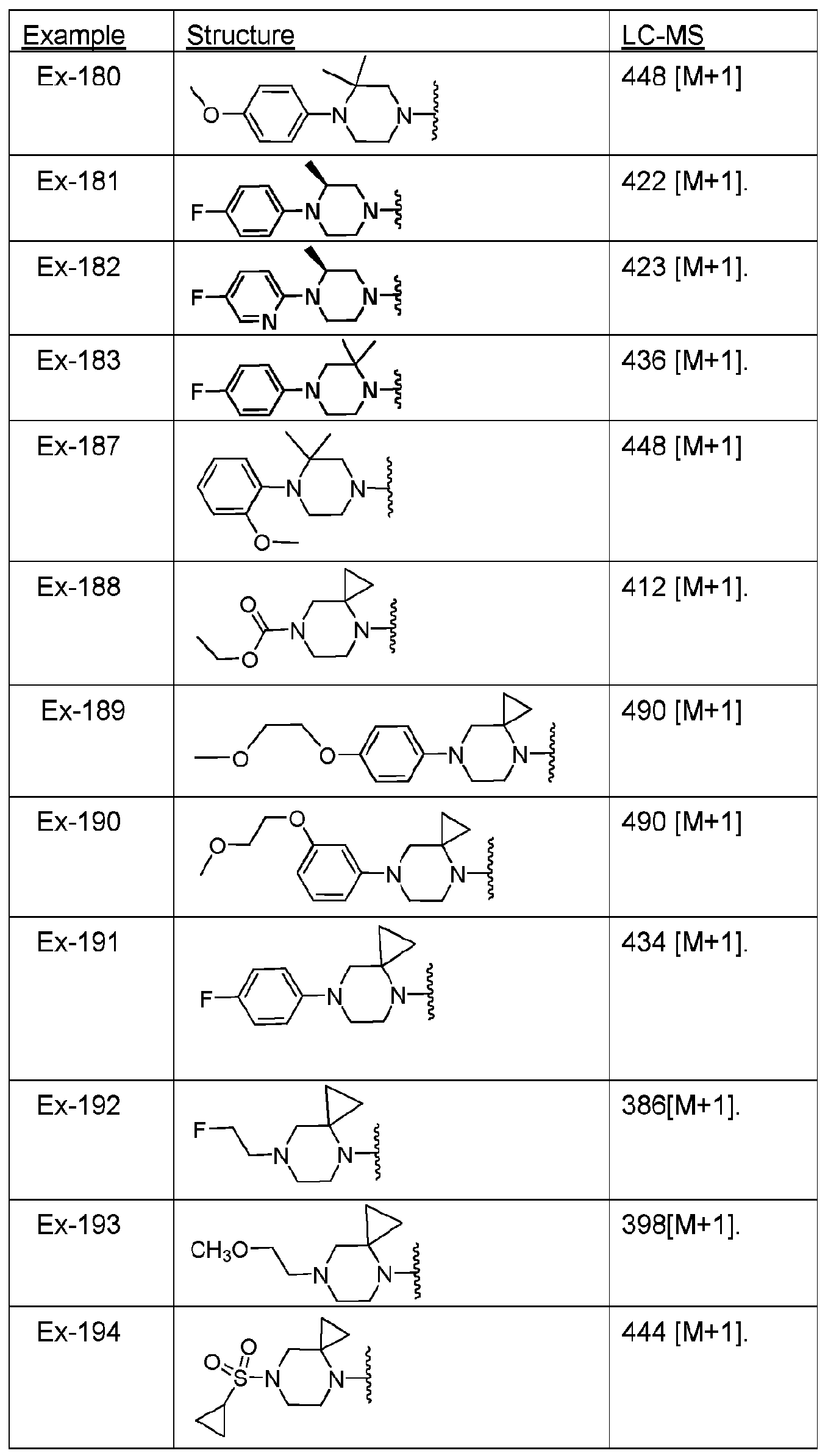


Table Via

[0190] The synthesis presented in Scheme E2, above, was repeated using compound 8d (preparative Scheme PI, above) and an appropriate "left-side" precursor in accordance with reaction Scheme E3 to prepare (R)-9-fluoro-2-((4-(4-fluorophenyl)-2-methylpiperazin-l -yl) methyl)-7-methoxy- [l ,2,4]triazolo[l ,5-c]quinazolm-5-amine (compound Ex-178).
E3:

[0191] Thus, in accordance with Scheme E3, Hunig'sBase (0.093 mL, 0.533 mmol) was added to a stirred, room temperature mixture of ( )-l-(4-fluorophenyl)-3-methylpiperazine (41.4 mg, 0.213 mmol) in DMF (1 mL) and the mixture was stirred at room temperature for 10 min. 2-(chloromethyl)-9- fluoro-7-methoxy-[l , 2, 4]triazolo[l,5-c]quinazolin-5-amine (50 mg, 0.178 mmol) and Potassium Iodide (1.473 mg, 8.88 μπιοΐ) were added thereafter, and the resultant mixture was kept stirring at 80 °C overnight. The mixture was cooled, water (8 mL) was added and the yellow precipitate was collected and washed with water, dried. The yellow solid obtained was further purified by column chromatography on silica gel Teledyne ISCO Si; 24g prepacked, eluting with CH2Cl2 MeOH = 20:1 to give R)-9-fluoro-2-((4-(4-fluorophenyl)-2-methylpiperazin-l-yl)methyl)-7-methoxy- [l ,2,4]triazolo[l ,5-c]quinazolin-5-amine (compound Ex-178, 35 mg, 0.080 mmol, 44.9 % yield) as a light yellow solid. LC/MS = 422.2 [M+l].
[0192] This same synthetic procedure was carried out using an appropriately functionalized "left-side" piperazine precursor to provide compounds of the invention have the structure of Formula E3-A:
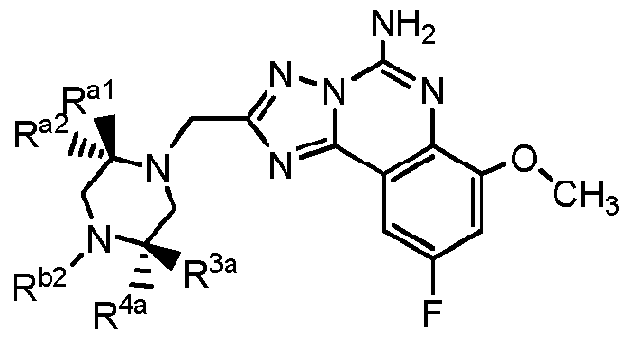
, Formula E3-A, wherein Ral to Ra4 and R > b012 a , re each defined in Table VII.
TABLE Vn
Ex No. Ral / Ra2 Rb2 LC/MS [M+l]
Ex-1 1 440.2
-C¾ / -H -H / -H
Ex-37
-H / -CH3 -H / -H
Ex-41
-CH3 / -H -H / -H
Ex-42
-CH3 / -H -H / -H

[0193] The synthesis presented in Scheme E3, above, was repeated using compound 8a and an appropriate "left-side" functionalized piperazine precursor to provide compounds of the invention, for example, compound Ex-170:

[0194] Thus, compound Ex-170 was prepared by combining 2-(chloromethyl)-7-methoxy- [l ,2,4]triazolo[l ,5-c]quinazolin-5-amine (40 mg, 0.15 mmol) in DMF (2 mL) with DIPEA (39 mg, 0.30 mmol) and mopholine (26 mg, 0.30 mmol). The mixture was stirred at ambient for 48 hours. The product (Ex-170, Table VIII) was purified using Gilson® reverse phase HPLC
(acetonitrile(0.1%TFA) H2O with 0.1%TFA). The compound was characterized by LC MS [M+1 = 391 ].
[0195] This same procedure was carried out to provide additional compounds of the invention having the Formula E3-B:

E3-B, where Re is defined in Table IX.
TABLE Vni
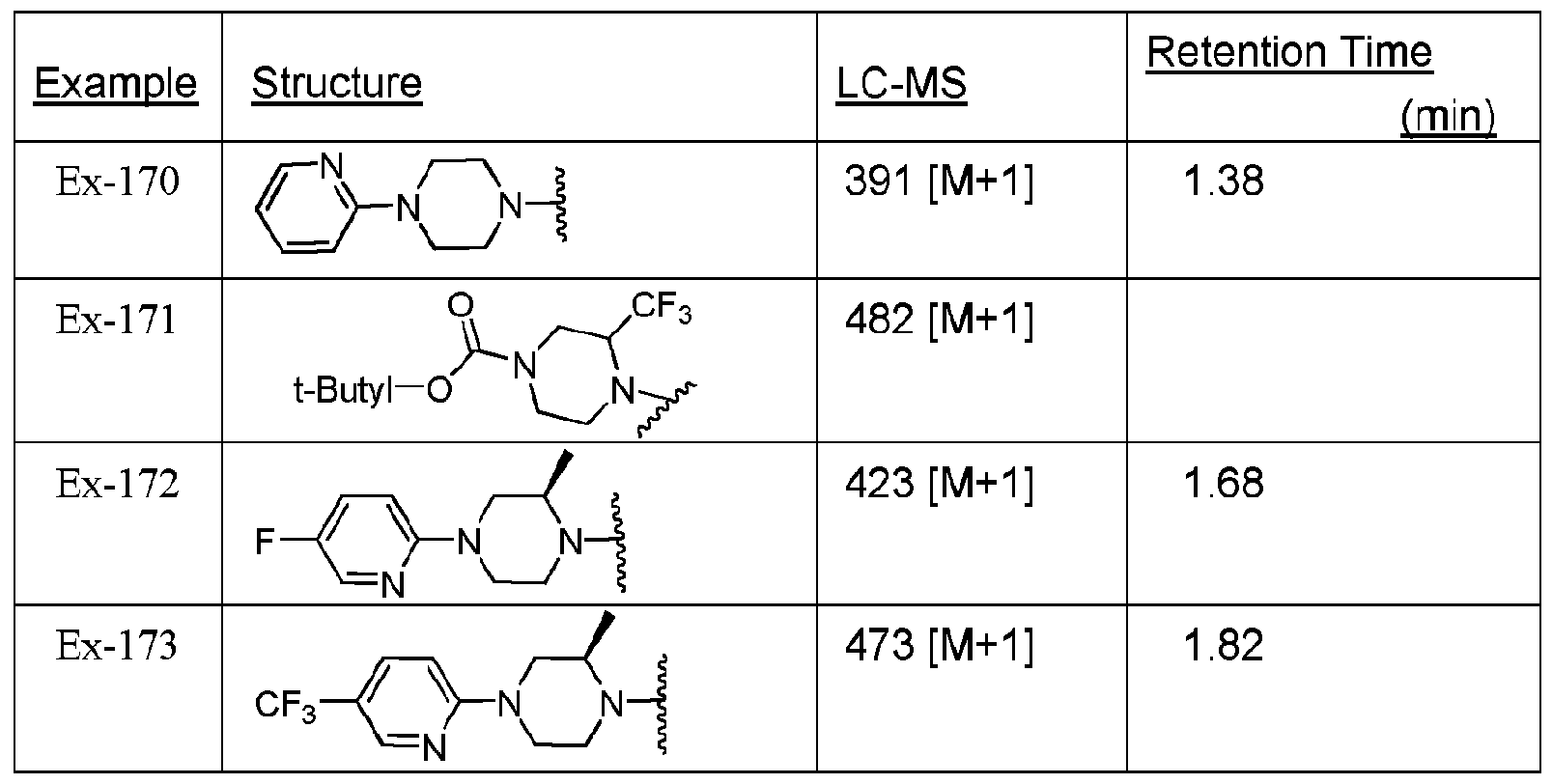

[0196] The compounds shown in Table IX were also prepared using the synthesis procedure of E3 and an appropriately substituted piperazine "left-side" precursor.
Table ΓΧ


[0197] The synthesis process presented in Scheme E3, above, was repeated using compound 8b
(preparative example PI, above) and an appropriate piperazine reagent in accordance with Scheme E3ab:
SCHEME E3ab

Preparation of 7-methoxy-2-i2-(piperidin-l-yl)ethylV[L2.4]triazolo[L5-c]quinazolin-5-amine (Ex-163)
[0198] Into a vessel was placed 2-(2-chloroethyl)-7-methoxy-[l ,2,4]triazolo[l ,5-c]quinazolin-5-amine (compound 8b, 150 mg, 0.54 mmol), 5-fluoro-2-(piperazin-l-yl)pyrimidine (92 mg, 1.1 mmol), DIPEA (105 mg, 0.81 mmol) and KI (269 mg, 1.62 mmol) in DMF (50 mL), and the mixture was stirred at 80°C for 18 h. The mixture was cooled down to RT, diluted with DCM, washed with H20 (3X), dried and concentrated. Chromatography purification MeOH/DCM (1 :30-l :20-l :10) afforded the compound Ex-163, which was characterized using. LC MS = 424 [M+l]..
[0199] Using a procedure similar to that used in the preparation of compound Ex-163, compounds of the invention having the structure of Formula E3-C were prepared:

TABLE X
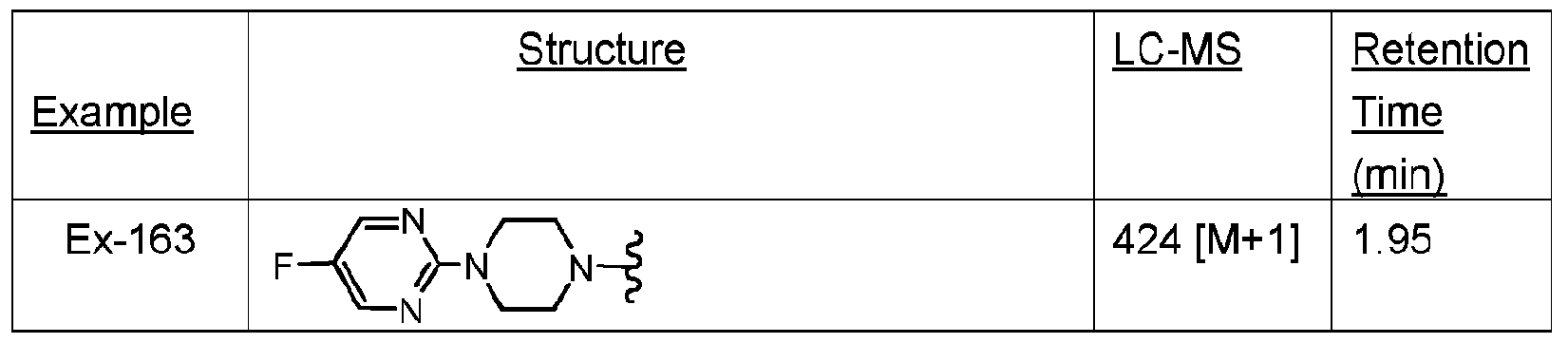

[0200] Compound Ex-158 was prepared in accordance with Scheme E3-ac from compound 8c (preparative example PI, above) and an appropriate piperazine reagent.

Preparation of 7-methoxy-2-(3-morpholinopropylV[1.2.41triazolo[1.5-clquinazolin-5-amine
[0201] Into a vessel was placed 2-(3-chloropropyl)-7-methoxy-[l ,2,4]triazolo[l ,5-c]quinazolin-5- amine (compound 8c, 80 mg, 0.286 mmol), l -(pyridin-2-yl)piperazine (75 mg, 0.86 mmol), and KI (142 mg, 0.858 mmol) in DMF (2 mL). The mixture was stirred at 80°C for 18 h. The mixture was cooled down to RT, diluted with DCM, washed with ¾0 (3X), dried and concentrated.
Chromatography purification MeOH/DCM (1 :30-l :20-l :10) afforded compound Ex-158, which was characterized by LC/MS = 419 [M+1 ].
[0202] Using the procedure shown in Scheme E3-ab and an appropriate piperazine derivative, the compounds of Formula E3-D were prepared:.
 E3-D, where "Rg" is defined in Table XI.
TABLE XI

Example 3: Preparation of compounds of the invention via DIPEA-mediated coupling of a piperazine "left-side" precursor and triazolo "right-side" precursor
[0203] Additional compounds of the invention were prepared in accordance with general preparative scheme AI from triazole "right-side" precursor 8F (prep scheme PII) and an appropriate piperazine

[0204] Using this same procedure, compounds of Formula E3-E were prepared:
[0205]
 Formula E3-E, wherein R is defined in Table XII.
Table XII
Retention time (inin)
Example
LC-MS fM+11.
1.46
Ex-160 433
1.41
Ex-161
434
Example 3: Preparation of cycloamine-triazole piperazine compounds using Palladium Catalyst in Accordance with Scheme ΑΠΙ from DMB-protected "right-side" piperazine-substituted precursor (Ex- E4-Pre) and appropriately-substituted Aryl bromide
[0206] Using the process described in Scheme E3, the compound Ex-E4-pre was was prepared from Compound 8a-Protected (see general prep Scheme AIII (preparation of cmpd 15) and Scheme Bid) and an appropriate acyl-protected piperazine precursor as shown in Scheme E4.
Scheme E4

[0207] The compound Ex-55 was prepared from Compound Ex-E4-pre and an appropriately substituted aromatic reagent Scheme E4-ab.

[0208] Accordingly, into a vessel containing the compound of Formula Ex-E4-pre previously prepared ([( )-N-(3,5-dimethoxybenzyl)-7-methoxy-2-((2-methylpiperazin-l-yl)methyl)- [1 ,2,4]triazolo[l ,5-c]quinazolin-5 -amine], 30 mg, 0.063 mmol) dissolved in THF (628 uL), was added
Chloro(2-dicyclohexylphosphino-2',6'-d^
palladium(n) (X-Phos, 9 mg, 0.013 mmol), 3-bromobenzotrifluoride (27.46, 0.0123 mmol) and finally potassium fert-butoxide (22 mg, 0.188 mmol) . The reaction mixture was heated at 100 °C for 15 h then cooled to ambient temperature of 21 °C. 10% w/v citric acid (1000 uL) was added followed by dichloromethane (2 x 1000 uL). The organic layers were separated and then concentrated in vacuo via a Genevac. The residue thus collected was then dissolved in trifluoroacetic acid (300 uL, 3.89 mmol) and heated to 40 C for 4h and then allowed to stir at 21 °C for 8 hours. The reaction was then diluted with DMSO (1000 uL) and was purified by reverse phase semi prep HPLC Waters XBridge
(CH3CN H2O/NH4OH, CI 8, 5u, 19x100 mm system) to yield compound Ex-55 as a solid, which was characterized using LC MS = 472 [M+l ] .
[0209] Compounds of the invention having the structure of Formula E4-A were prepared by using this compound of Formula Ex-E4-pre in

TABLE ΧΠΙ

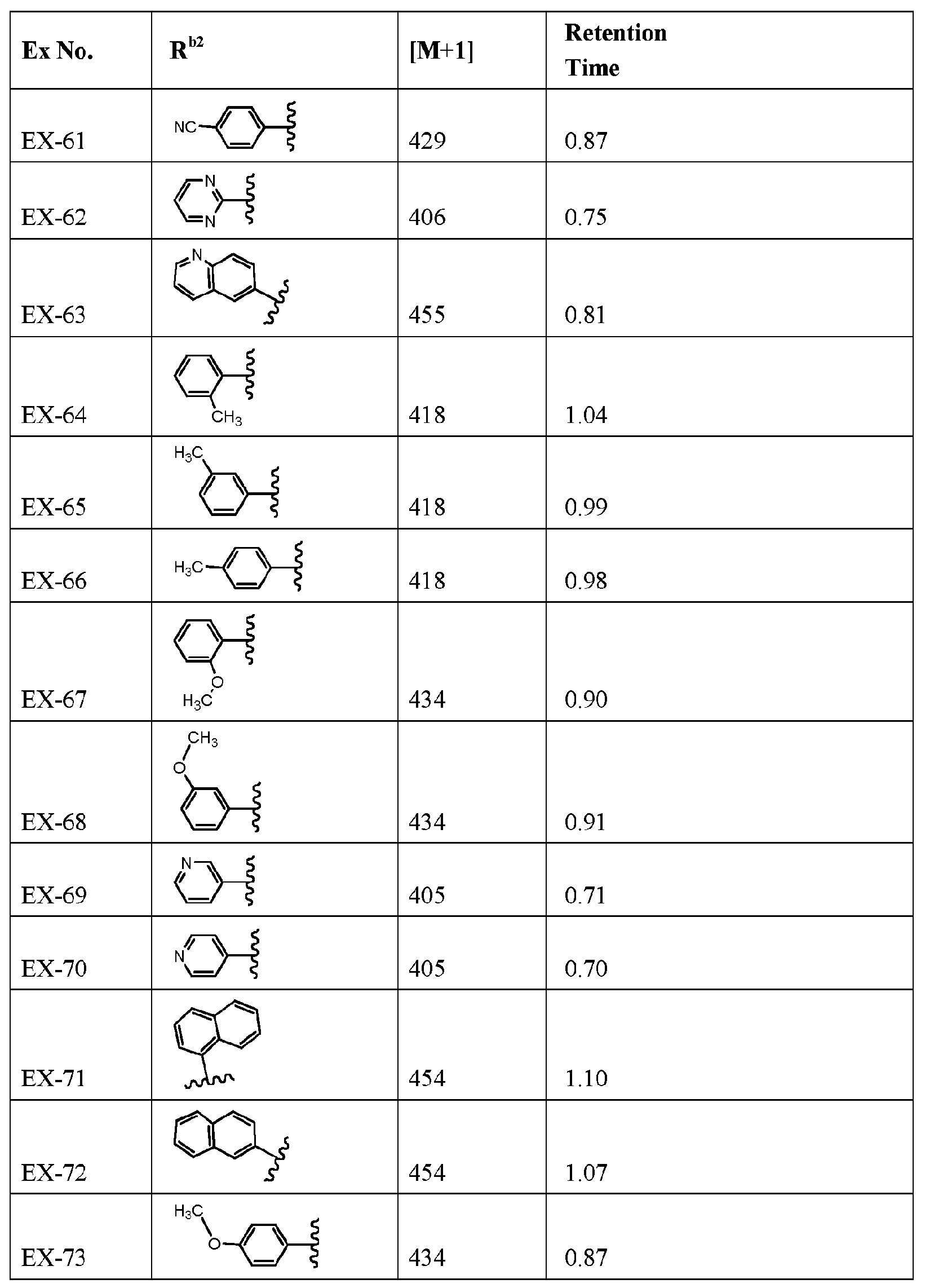
[0210] "Right-side" precursors having substituents in the RE5a position as defined in Table XIV (below) were employed to prepare piperidine-substituted compounds of the invention using the synthesis procedure described in general scheme Affl, as shown in Scheme E5.

[0211] Accordingly, the compound Ex-4-B-CN (compound Ex-4-B where substituent R is -CN), (110 mg; 0.27 mmol), l-(4-fluorophenyl)-3(i?)-methyl piperazine hydrochloride (85 mg; 0 37 mmol) and Hunig's base (0.14 mL; 104 mg; 0.807 mmol) in anhydrous DMF (1 mL) was stirred and heated at 80° C for 18 hr. The reaction mixture was cooled to RT, diluted with water and extracted with EtOAc. The organic extract was washed with water and brine. Combined aqueous layers were back extracted with CH2CI2 Both organic extracts were combined, dried over solid anhydrous Na2SC>4 and concentrated to get 140 mg of beige solid. The crude product was purified by preparative TLC (5% CH3OH-CH2CI2) and the major fluorescent band which was the 2,4-dimethoxybenzyl protected form of 13Ex-4-C-CN (Ex-4-C wherein substituent RE5a is -CN) was isolated as an off-white solid which was characterized by LC MS = 567 (MPT).
[0212] The isolated product from the previous step was dissolved in CH2C12:TFA (1 mL each) and stirred at 57° C for 4hr The clear reaction mixture had become deep purple and MS showed complete deprotection of the DMB group to give the desired product. The solvents were removed on a rotary evaporator and the residual TFA was removed by azeotrope formation with toluene to give a yellow sticky semi-solid. This material was treated with 7% NH3 in methanol, stirred for 10 minutes and concentrated to obtain a beige solid. The crude product was purified by preparative TLC (CH2C12 with 7% NH3 in methanol, 96:4) to afford compound Ex-156, an off-white solid characterized using LC MS: 417 (MFT); Rt

Table XIV:

EXAMPLE 5: Preparation of [1.2.4]triazolo[1.5-c]quinazolin-2-ylVl -(4substituted-piperazin-l - vOethanone compounds from 2-r5-amino-7-methoxy-[1.2.41triazolo[1.5-c1quinazolin-2-ylkcetic acid "right-side" precursor and an appropriately-substituted piperazine reagent
SCHEME Ell

[0214] To a stirred suspension of Ell-A (0.025 g, 0.081 mmol) followed by Dichloromethane (5 ml), 4-fluorophenylpiperazine (0.031 g, 0.161 mmol), DIPEA (0.070 ml, 0.404 mmol), and 1- PROPANEPHOSPHONIC ACID CYCLIC ANHYDRIDE (0.096 ml, 0.161 mmol). The reaction was stirred room temperature overnight.
[0215] The reaction mixture was concentrated, diluted with water (~0.5mL) and then dissolved in DMSO (~4 mL).
[0216] The residue was purified by preparative HPLC (Reverse phase C-l 8, Phenomenex Gemini, Axia 1 0 21.2 mm, 5u), eluting with 10-95 % Acetonitrile/Water + 0.1 % TFA (20mL/min) over 10 min. to give the product (5 mg, 7.38 μηιοΐ) as a TFA salt. LCMS M+H = 450
[0217] Using a similar procedure, the compound of Formula Ex-153 was also prepared from a suitably substituted piperazine "left-side" precursor and the compound of Formula P23:

[0218] The compound of Formula Ex-153 was characterized by LC MS (Rt 0.51 , Meth B, [M+l ]= 419]
EXAMPLE 6: Preparation of compound of the invention Ex-50 from "right-side" precursor of Formula 13a

[0219] Step A: 5-[(2.4-dimethoxybenzynamino]-7-methoxy[1.2.4]triazolo[1.5-c]quinazoline-2- carbaldehyde
[0220] To a dichloromethane (50 mL) solution of {5-[(2,4-dimethoxybenzyl)amino]-7-methoxy[l ,2,4] triazolo[l,5-c]quinazolin-2-yl} methanol (compound 13a prepared in accordance with general preparative procedure ΡΠ, above, 1 ,000 mg, 2.53 mmol) was added l ,l ,l -tris(acetyloxy)-l, l -dihydro- l ,2-benziodoxol-3-(lH)- one (1 ,126 mg, 2.66 mmol). The reaction mixture was stirred at room temperature for 30 minutes, washed with saturated sodium bicarbonate solution and then with brine, dried (magnesium sulfate), filtered, and concentrated in vacuo. Chromatography over silica gel, eluting with hexanes/ethyl acetate, afforded the title compound as a white solid. Ή MR (500 MFIz, DMSO-d5) δ 10.19 (s, 1Η), 8.59 (t, J = 5.8 Hz, 1H), 7.84 (dd, J = 7.9, 1.3 Hz, 1H), 7.37 (t, J = 7.9 Hz,
1H), 7.30 (dd, J = 8.0, 1.3 Hz, 1H), 7.26 (d, J = 8.4 Hz, 1H), 6.57 (d, J= 2.4 Hz, 1H), 6.42 (dd, J = 8.4, 2.4 Hz, 1H), 4.70 (d, J= 5.7 Hz, 2H), 3.90 (s, 3H), 3.84 (s, 3H), 3.71 (s, 3H); LC-MS: m/z 394.1 (M + H).
[0221] Step B: (±Vl - {5-[(2,4-dimethoxybenzyl¼mino]-7-methoxy[L2,4]triazolo[l„5-c]quinazolin-2- yllethanol
[0222] To a tetrahydrofuran (10 mL) solution of 5^(2,4-dimethoxybenzyl)amino]-7-methoxy[l,2,4] triazolo[l,5-c]quinazoline-2-carbaldehyde (537 mg, 1.37 mmol) at 0 0 C was added 3.0 M
tetrahydrofuran solution of methylmagnesium chloride (1.0 mL, 3.0 mmol). The reaction mixture was stirred in an ice-bath for 45 minutes and then at room temperature for 1.5 hours. It was quenched with saturated ammonium chloride solution and extracted with ethyl acetate (3 x 50 mL). The combined organic layers were washed with brine and concentrated in vacuo to afford the crude solid. It was recrystallized from ethyl acetate hexanes to afford the title compound as an off-white solid. Ή NMR (500 MHz, DMSO-dg) δ 8.09 (t, J= 6.1 Hz, lH), 7.76 (d, J= 8.0 Hz, 1H), 7.30 (t, J= 7.7 Hz, 1H), 7.26-7.20 (m, 2H), 6.57 (d, J = 2.3 Hz, 1H), 6.43 (dd, 7= 8.3, 2.5 Hz, 1H), 5.58 (d, J= 5.1 Hz, 1H), 4.99 (quintet, J= 6.1 Hz, 1H), 4.68 (d, J= 5.9 Hz, 2H), 3.89 (s, 3H), 3.84 (s, 3H), 3.71 (s, 3H), 1.55 (d, J = 6.6 Hz, 3H); LC-MS: m/z 410.1 (M + H).
[0223] Step C: (±Vl - {5-[(2.4-dimethoxybenzylkmino]-7-methoxy[1.2.4]triazolo[1.5-c]quinazolin-2- yl} ethyl methanesulfonate
[0224] To a dichloromethane (20 mL) solution of (±)-l - {5-[(2,4-dimethoxybenzyl)amino]-7- methoxy[l,2,4] triazolo[l,5-c]quinazolin-2-yl} ethanol (437 mg, 0.865 mmol) and
diisopropylethylamine (0.75 mL, 4.3 mmol) was added methanesulfonyl chloride (0.25 mL, 3.2 mmol). The reaction mixture was stirred for 15 minutes at room temperature. It was washed with water and with brine, dried (magnesium sulfate), and concentrated in vacuo. Chromatography over silica gel, eluting with hexanes/ethyl acetate, afforded the title compound as a white solid. Ή NMR (500 MHz, DMSO-ds) δ 8.24 (t, J= 6.0 Hz, 1H), 7.78 (d, J = 1 9 Hz, 1H), 7.39-7.26 (m, 1H), 7.25 (d, J= 8.3 Hz, 2H), 6.57 (d, .7 = 2.4 Hz, 1H), 6.43 (dd, J = 8.2, 2.6 Hz, 1H), 6.01 (q, J= 6.6 Hz, 1H), 4.69 (d, .7= 6.2 Hz, 2H), 3.89 (s, 3H), 3.84 (s, 3H), 3.71 (s, 3H), 3.27 (s, 3H), 1.83 (d, J = 6.6 Hz, 3H); LC-MS: m/z 488.0 (M + H).
[0225] Step D: (±)-2-(l -chloroe1hyl)-N-(2.4-dimethoxybenzyl)-7-methoxy[l .2.4]triazolo[l .5- c] quinazolin- 5 -amine
[0226] To an acetone (15 mL) solution of (±)-l-{5-[(2,4-dimethoxybenzyl)amino]-7-methoxy[l,2,4] triazolo[l,5-c]quinazolin-2-yl} ethyl methanesulfonate (340 mg, 0.697 mmol) was added lithium chloride (150 mg, 3.54 mmol). The reaction mixture was refluxed for 24 hours and concentrated in vacuo. It was dissolved in dichloromethane (50 mL), washed with saturated sodium bicarbonate solution, dried (magnesium sulfate), and concentrated in vacuo to afford the title compound as a crude solid. It was used in the subsequent reaction without further purification. Ή NMR (500 MHz, DMSO-dg) δ 8.21 (t, J= 6.0 Hz, 1H), 7.78 (dd, J= 7.9, 1.3 Hz, 1H), 7.32 (t, J = 8.0 Hz, 1H), 7.27-7.23 (m, 2H), 6.57 (d, = 2.3 Hz, 1H), 6.43 (dd, J= 8.3, 2.5 Hz, 1H), 5.57 (q, J = 6.8 Hz, 1H), 4.68 (dd, 7 = 6.3, 2.5 Hz, 2H), 3.89 (s, 3H), 3.84 (s, 3H), 3.71 (s, 3H), 1.98 (d, J= 6.7 Hz, 3H); LC-MS: m/z 428.0 (M + H).
[0227] Step E: N-(2.4-dimethoxybenzyl)-2- { 1 -[(27?V4-(4-fluorophenyl)-2-methylpiperazin-l - yl]ethyl} -7-methoxy[1.2.4]triazolo[1.5-c]quinazolin-5-amine
[0228] To a 7V,N-dimethylformamide (5 mL) solution of (3i?)-l -(4-fluorophenyl)-3-methylpiperazine (158 mg, 0.813 mmol) and (±)-2-(l-chloroethyl)-N-(2,4-dimethoxybenzyl)-7-
methoxy[l,2,4]triazolo[l,5-c]quinazolin-5-amine (300 mg, 0.701 mmol) was added potassium iodide (148 mg, 0.892 mmol) and diisopropylethylamine (0.30 mL, 1.7 mmol). The reaction mixture was heated to 80 0 C for 18 hours. It was cooled to room temperature and diluted with saturated ammonium chloride solution. It was extracted with ethyl acetate (3 x 25 mL), and the combined organic layers were washed with water and with brine, dried (magnesium sulfate), and concentrated in vacuo. Chromatography over silica gel, eluting with hexanes/ethyl acetate, afforded the title compound as two separated diastereomers.
[0229] Less polar diastereomer Ή NMR (500 MHz, DMSO-d6) 5 8.11 (t, J= 6.0 Hz, 1H), 7.78 (d, J = 7.9 Hz, 1H), 7.30 (t, J= 7.9 Hz, 1H), 7.28-7.19 (m, 2H), 7.00 (t, J = 8.7 Hz, 2H), 6.91-6.86 (m, 2H), 6.57 (d, J = 2.3 Hz, 1H), 6.44 (dd, J= 8.4, 2.3 Hz, 1H), 4.69 (d, J = 6.0 Hz, 2H), 4.55 (q, J= 6.9 Hz,
1H), 3.89 (s, 3H), 3.84 (s, 3H), 3.71 (s, 3H), 3.40 (d, J = 11.2 Hz, 1H), 3.24 (d, = 10.6 Hz, 1H), 2.99- 2.84 (m, 1H), 2.89-2.83 (m, 1H), 2.67-2.51 (m, 3H), 1.44 (d, J = 6.8 Hz, 3H), 1.20 (d, J = 6.2 Hz, 3H); LC-MS: m/z 586.1 (M + H).
[0230] More polar diastereomer Ή NMR (500 MHz, DMSO-d6) δ 7.98 (t, J= 6.1 Hz, lH), 7.77 (dd, J = 7.9, 1.3 Hz, lH), 7.30 (t, J= 7.9 Hz, 1H), 7.26 (d, J= 8.4 Hz, 1H), 7.23 (dd, J= 8.0, 1.4 Hz, 1H), 7.02-6.94 (m, 2H), 6.89-6 84 (m, 2H), 6.58 (d, J= 2.4 Hz, 1H), 6.45 (dd, J = 8.4, 2 4 Hz, 1H), 4.75- 4.64 (m, 2H), 4.64-4.57 (m, 1H), 3.89 (s, 3H), 3.84 (s, 3H), 3.71 (s, 3H), 3.45 (d, J= 11.3 Hz, 1H), 3.38 (d, = 1 1.5 Hz, 1H), 3.13 (dt, J= 11.7, 2.9 Hz, 1H), 2.63 (td, J = 11.1 , 2.9 Hz, 1H), 2.59-2.48 (m, 1H), 2.41 (td, J= 11.4, 2.9 Hz, 1H), 2.36 (t, J = 10.6 Hz, 1H), 1.58 (d, J= 7.0 Hz, 3H), 1.29 (d, J = 6.1 Hz, 3H); LC-MS: m/z 586.1 (M + H).
[0231] Step F: 2- { 1 -[(2^)-4-(4-fluorophenyl)-2-methylpiperazin-l -yl]ethyl} -7- methoxy[L2.4]triazolo[L5-c]quinazolin-5-amine
[0232] The less polar diastereomer of N-(2,4-dimethoxybenzyl)-2-{l-[(2i?)-4-(4-fluorophenyl)-2- methylpiperazin-l-yl]ethyl}-7-methoxy[l,2,4]triazolo[l ,5-c]quinazolin-5-amine (78 mg, 0.133 mmol) was charged with trifluoroacetic acid (2 mL) and heated at 50 0 C for 3 hours. The reaction mixture was concentrated in vacuo and charged with a 2.0 M methanolic solution of ammonia (4 mL), precipitating one diasteromer of the title compound as a white solid. Ή NMR (500 MHz, DMSO-d6) δ 7.79 (s, 2H), 7.76 (d, J= 8.1 Hz, 1H), 7.29 (t, J= 7.9 Hz, lH), 7.21 (d, J = 7.9 Hz, 1H), 7.00 (t, J = 8.7 Hz, 2H), 6.89 (dd, J = 8.9, 4.7 Hz, 2H), 4.53 (q, J = 6.9 Hz, 1H), 3.89 (s, 3H), 3.39 (d, J = 11.3 Hz, 1H), 3.24 (d, J = 11.8 Hz, 1H), 2.94-2.89 (m, 1H), 2.89-2.83 (m, 1H), 2.66-2.53 (m, 3H), 1.43 (d, J = 6.8 Hz, 3H), 1.20 (d, J= 6.2 Hz, 3H); LC-MS: m/z 436 0 (M + H).
[0233] The more polar diastereomer of N-(2,4-dimethoxybenzyl)-2- { 1 -[(2R)-4-(4-fluorophenyl)-2- methylpiperazin-l-yl]ethyl}-7-methoxy[l,2,4]triazolo[l ,5-c]quinazolin-5-amine (100 mg, 0 171 mmol) was charged with trifluoroacetic acid (2 mL) and heated at 50 0 C for 3 hours. The reaction mixture was concentrated in vacuo and charged with a 2.0 M methanolic solution of ammonia (4 mL). The reaction mixture was concentrated in vacuo to afford a crude solid. Chromatography over silica gel, eluting with hexanes/ethyl acetate, afforded the other diasteromer of the title compound. Ή NMR (500 MHz, DMSO-de) δ 7.77 (s, 2H), 7.74 (dd, J = 8.0, 1.2 Hz, 1H), 7.29 (t, J= 8.0 Hz, 1H), 7.21 (d, J = 7.9 Hz, 1H), 6.98 (t, J = 8.7 Hz, 2H), 6.86 (dd, J= 8.9, 4.7 Hz, 2H), 4.59 (q, J= 7.1 Hz, 1H), 3.89 (s, 3H), 3.45 (d, J = 11.1 Hz, 1H), 3.37 (d, J= 1 1.4 Hz, 1H), 3.13 (d, J= 11.5 Hz, 1H), 2.63 (td, J= 11.1, 2.8 Hz, 1H), 2.55-2.46 (m, 1H), 2.42 (td, J= 1 1.4, 2.9 Hz, 1H), 2.35 (t, J = 10.6 Hz, 1H), 1.57 (d, J = 7.0 Hz, 3H), 1.28 (d, J= 6.1 Hz, 3H); LC-MS: m/z 436 0 (M + H).
[0234] It will be appreciated that by applying the foregoing methods, all of the compounds presented in Tables I through IV and the compounds of Formulae G, H, Ja and Jb can be prepared.
A2a Activity of Compounds of the Invention
[0235] Binding affinities of compounds of the invention for the human A2a receptor were determined in a competition binding assay using Scintillation Proximity technology. Thus, 0.3 ug of membranes from HEK293 cells expressing the human A2a receptor were incubated with a compound of the invention at concentrations ranging from 3000 nM to 0.15 nM in a reaction mixture containing also 0.5 nM of a tritiated form of 5-amino-7-[2-phenethyl]-2-(furan-2-yl)-7H-pyrazolo[4,3-e][l ,2,4]triazolo- [l ,5-c]pyrimidine (the tritiated compound) and 100 ug of wheatgerm agglutin-coated yttrium silicate SPA beads for one hour at room temperature with agitation. The beads were then allowed to settle to the bottom of the wells for 1 hr, after which the membrane-associated radioactivity was determined by scintillation counting in a TopCount microplate reader. Ki values were determined using the Cheng- Prusoff equation.
[0236] Summary of materials and methods used in A2a activity determination:
Materials
• HEK293 cells expressing the human, rat, dog or monkey adenosine 2a receptor (Purchased from Perkin-Elmer # RBHA2AM400UA).
• The Tritiated compound was prepared in-house by MRL Radiochemistry according to published methods.
• Wheatgerm agglutinin-coated yttrium silicate SPA beads (GE Healthcare #RPNQ0023). Dilute to 25 mg/ml in assay buffer.
· Assay Buffe r was prepated in house: Dulbecco's calcium and magnesium free phosphate buffered saline + 10 mM MgCl2
• Adenosine deaminase from calf intestine, 10 mg/2 ml (Roche # 10 102 105 001).
• DMSO
• A2a antagonist standard (9-chloro-l-(2-furanyl)-[l ,2,4]triazolol,5-c]quinazolin-5-amine from Tocris Bioscience)
Compound Dilution
• Make eight 1 :3 serial dilutions in 100% DMSO from a 3 mM compound stock
• Transfer 0 nl of compound into a 384-well OptiPlate (Perkin Elmer).
• Typically, final concentrations of compound used in the assay ranged from 3000 nM to 0.152 nM. Radioisotope
• Dilute a solution of the Tritiated compound to 1.25 nM in assay buffer. This is a 2.5X solution.
The final concentration in the assay is 0.5 nM. Calculate the concentration by counting two 5 ul aliquots.
Membrane Preparation
· Use 0.25 ug of membrane/well. Dilute membranes to 9.7 ug/ml in assay buffer. Treat with 20 ug/ml adenosine deaminase (ADA) for 15 minutes at room temperature to degrade endogenous adenosine.
Membrane-Bead Mixture
• Use 100 ug/well wheatgerm agglutinin-coated yttrium silicate SPA beads.
· Mix ADA-treated membranes and SPA beads together for 30 min prior to assay.
Assay Assembly
• To the Perkin-Elmer Optiplate-384 containing the compound titration add 20 ul of 2.5X solution of the Tritiated compound and 30 ul of the membrane-bead mixture Incubate for one hour at room temperature with agitation.
• Include total binding (assay buffer + 1% DMSO) and non-specific binding (CGS15943, 1 uM) wells.
Counting
• Allow the beads to settle for one hour.
• Count in TopCount.
Calculations
· A curve fitting program (i.e., Prism, Activity Base, Chemcart) is used to determine the EC50. The Ki value is calculated using the Cheng-Prusoff equation.
K i = EC50 / (1+ (radioligand concentration / Kd))
[0237] Using the foregoing assay method, the following results were obtained using various of the compounds of the invention described herein. Each example compound tested is reported in the following format: Example number: A2a EC50 reported in nM. Thus, for example, the compound Ex- 1 was determined to have an EC50 using the above-described assay, of 4.251 nM, and is accordingly reported as "Ex-1 : A2a= 4.251 ":
Ex-1: A2a= 4.251 ; Ex-2: A2a = 10.1 ; Ex-3: A2a = 189.7; Ex-4: A2a = 43.54; Ex-5:
A2a = 6.785; Ex-6: A2a = 4.023; Ex-7: A2a = 20.91 ; Ex-8: A2a = 21.25; Ex-9: A2a = 44; Ex-10: A2a = 54.67; Ex-11: A2a = 7.682; Ex-12: A2a = 87.95; Ex-13: A2a = 87.1 ;
Ex-14: A2a = 52.77; Ex-15: A2a = 8.097; Ex-16: A2a = 36.51 ; Ex-17: A2a = 26.7; Ex- 18: A2a = 26.9; Ex-19: A2a = 29.6; Ex-20: A2a = 51.7; Ex-21: A2a = 20.3; Ex-22:
A2a = 10; Ex-23: A2a = 17.7; Ex-24: A2a = 14.4; Ex-25: A2a = 34.5; Ex-26: A2a =
21.8; Ex-27: A2a = 6.8; Ex-28: A2a = 15.6; Ex-29: A2a = 18.6; Ex-30: A2a = 9.2; Ex- 31: A2a = 49.1 ; Ex-32: A2a = 78.3; Ex-33: A2a = 35.9; Ex-34: A2a = 18.5;
Ex-35: A2a = 3.7; Ex-36: A2a = 18.1; Ex-37: A2a = 48.9; Ex-38: A2a = 37.5;
Ex-39: A2a = 13.3; Ex-40: A2a = 22.6; Ex-41 : A2a = 18.1 ; Ex-42: A2a = 28.3;
Ex-43: A2a = 2.108; Ex-44: A2a = 3.6; Ex-45: A2a = 5.7; Ex-46: A2a = 50.2;
Ex-47: A2a = 59.2; Ex-48: A2a = 18.2; Ex-49: A2a = 4.9; Ex-50: A2a = 139.4;
Ex-51: A2a = 73.8; Ex-52: A2a = 48.5; Ex-53: A2a = 15.93; Ex-54: A2a = 106;
Ex-55: A2a = 5.2; Ex-56: A2a = 8.5; Ex-57: A2a = 4.178; Ex-58: A2a = 12.4;
Ex-59: A2a = 30.9; Ex-60: A2a = 18.8; Ex-61 : A2a = 11.4; Ex-62: A2a = 26.5; Ex-63: A2a = 1.444; Ex-64: A2a = 13.1 ; Ex-65: A2a = 7.0; Ex-66: A2a = 3.0; Ex-67: A2a = 8.9; Ex-68: A2a = 7.71; Ex-69: A2a = 39.8; Ex-70: A2a = 92.8; Ex-71: A2a = 11.5;
Ex-72: A2a = 6.7; Ex-73: A2a = 2.1 ; Ex-74: A2a = 31.82; Ex-75: A2a = 47.4; Ex-76:
A2a = 13.48; Ex-77: A2a = 9.691 ; Ex-78: A2a = 4.537; Ex-79: A2a = 21.12; Ex-80:
A2a = 19.37; Ex-81 : A2a = 68.2; Ex-82:A2a = 627.6; Ex-83: A2a = 47.65; Ex-84:
A2a = 57.21 ; Ex-85: A2a = 7.682; Ex-86: A2a = 3.325; Ex-87: A2a = 21.47; Ex-88:
A2a = 22.16; Ex-89: A2a = 72.24; Ex-90: A2a = 53.5; Ex-91: A2a = 42.25; Ex-92:
A2a = 5.2; Ex-93: A2a = 4.6; Ex-94: A2a = 1.848; Ex-95: A2a = 3.098; Ex-96: A2a =
3.411 ; Ex-97: A2a = 18.18; Ex-98: A2a = 39.66; Ex-99: A2a = 46.29; Ex-100: A2a = 29 4; Ex-101: A2a = 4.954; Ex-102: A2a = 2.14; Ex-103: A2a = 5.559; Ex-104: A2a = 23.13 ; Ex-105: A2a = 16.79; Ex-106: A2a = 4.728; Ex-107: A2a = 6.98; Ex-108: A2a = 5.268; Ex-109: A2a = 4.664; Ex-110: A2a = 1.105; Ex-Ill: A2a = 0.9182; Ex-112:
A2a = 1.597; Ex-113: A2a = 27.30; Ex-114: A2a = 12.25; Ex-115: A2a = 1.388; Ex-116:
A2a = 3.033; Ex-117: A2a = 12.7; Ex-118: A2a = 1.246; Ex-119: A2a = 1.974; Ex-120: A2a = 20.75; Ex-121: A2a = 13.24; Ex-122: A2a = 4.858; Ex-123: A2a = 4.248; Ex-124: A2a = 2.824; Ex-125: A2a = 1.026;
Ex-126: A2a = 2.393; Ex-127: A2a = 3.076; Ex-128: A2a = 0.964; Ex-129: A2a = 11.58; Ex-130: A2a = 0.8983; Ex-131 : A2a = 0.6984; Ex-132: A2a = 2.041 ; Ex-133:
A2a = 1.684; Ex-134: A2a = 4.566; Ex-135: A2a = 10.7; Ex-136: A2a = 11.42; Ex-137: A2a = 20.57; Ex-138: A2a = 14.28; Ex-139: A2a = 81.77; Ex-140: A2a = 4.929; Ex-141: A2a = 2.339; Ex-142: A2a = 16.49; Ex-143: A2a = 13.89; Ex-144: A2a = 20.12; Ex-145: A2a = 18.37; Ex-146: A2a = 6.348; Ex-147: A2a = 6.6; Ex-148: A2a = 18; Ex-149: A2a = 13.42; Ex-150: A2a = 15.02; Ex-151: A2a = 2.217; Ex-152: A2a = 2.2; Ex-153:
A2a = 7.3; Ex-154: A2a = 2.6; Ex-155: A2a = 136.4; Ex-156: A2a = 740; Ex-157: A2a = 14.4; Ex-158: A2a = 7.1 ; Ex-159: A2a = 24.4; Ex-160: A2a = 343.4; Ex-161: A2a = 524.9; Ex-162: A2a = 74.2; Ex-163: A2a = 7.8; Ex-164: A2a = 2.5; Ex- 165: A2a = 3.3; Ex-166: A2a = 13.5; Ex-167: A2a = 11.5; Ex-168: A2a = 4 1 ; Ex-169: A2a = 2.6; Ex- 170: A2a = 157; Ex-171: A2a = 30.4; Ex-172: A2a = 13.3; Ex-173: A2a = 22.6; Ex-174:
A2a = 37.5; Ex-175: A2a = 5.6; Ex-176: A2a = 8.9; Ex-177: A2a = 12.7; Ex-178: A2a = 19 3; Ex-180: A2a = 1.1 ; Ex-181: A2a = 19.9; Ex-182: A2a = 10.2; Ex-183: A2a = 5.0; Ex-184: A2a = 16.4; Ex-185: A2a = 5.7; Ex-186: A2a = 3.5; Ex-187: A2a = 5.8; Ex-188: A2a = 12.6; Ex-189: A2a = 3.1 ; Ex-190: A2a = 6.7; Ex-191 : A2a = 8.2; Ex- 192: A2a = 153.1 ; Ex-193: A2a = 127.8; Ex-194: A2a = 24.8; Ex-195: A2a = 41.6; Ex-
196: A2a = 95.7; Ex-197: A2a = 32.4; Ex-198: A2a = 8.25;:Ex-199: A2a = 10.8; Ex- 200: A2a = 15.6; Ex-201: A2a = 50.2; Ex-202: A2a = 29.1; Ex-203: A2a = 8,5; Ex-204: A2a = 11.5; Ex-205: A2a = 4.1 ; Ex-206: A2a = 30.9; Ex-207: A2a = 144.8; Ex-208: A2a = 143.1 ; Ex-209: A2a = 9.4; Ex-210: A2a = 7.7; Ex-211: A2a = 9.9.
Claims
rmaceutically acceptable salt thereof
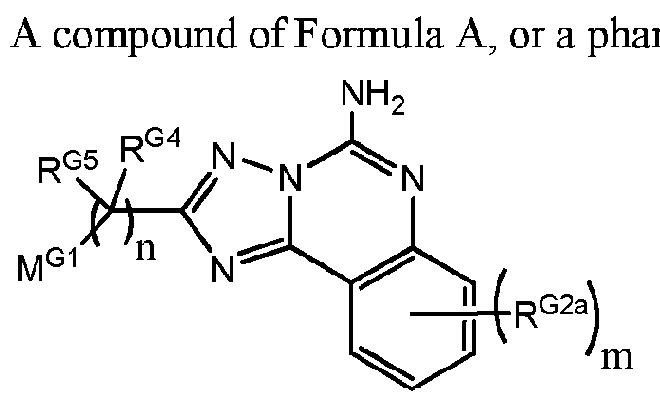
Formula A,
wherein:
"m" and "n" are independently an integer of from 1 to 3, with the proviso that no more than two RG2a substituents are located on adjacent ring carbon atoms;
RG2a is independently: (i) -OH; (ii) -CN; (iii) Halogen; (iv) -Ci-s-linear alkyl which is optionally substituted by one or more fluorine substituents; or (v) -Ci-6-alkoxy, which is optionally substituted by a Ci-4-alkoxy moiety;
RG4 and RG5 are:
(a) independently, for each occurrence, (i) -H; (ii) -F; or (iii) -Ci-6-alkyl which is optionally substituted with one or more fluorine substituents; or
(b) RG4 and RG5 are taken together to form a carbonyl [-C(O)-] moiety, with the proviso that where "m" > 1 , RG4 and RG5 are not selected to form two adjacent carbonyl moieties; and
M01 is a moiety of the formula:
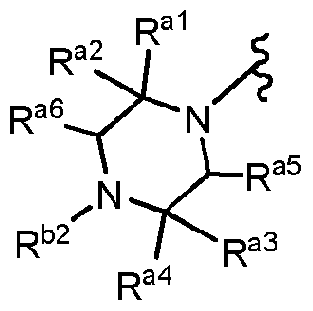
wherein:
(I) substituents Ral, Ra2, Ra3, Ra4, Ra5, and Ra6, are defined as follows:
(a) Ra6 is : -H; or -CH3; and Ral ; Ra2; Ra3; Ra4; and Ra5 are independently:
(i) -H;
(ii) an aromatic moiety of from 6 to 10 carbon atoms; or
(iii) -Ci-5 linear, branched or cyclic alkyl which is optionally substituted with one or more of -F or -Ci-4-alkyl substituent wherein one or more carbon atoms in said optional Ci-4-alkyl substituent are optionally substituted with one or more -F atoms; or
(b) Ral; Ra2; Ra3; and Ra4 are independently -H; or C1.5 linear, branched or cyclic alkyl; and Ra5 and R"6 are joined together via a -(CH2)q- "bridge" to form a moiety of the structure:

, where "q" is 1 or 2; or one pair of Ral/R l or Ra3 Ra4 together form an oxo-functional group and other pair are hydrogen, providing a structure of Formula Ga1 or Ga2:

Formula Ga2
(d) /Ra4 are each -H and the other pair form a spir atoms, thereby providing a spirocycle of Formula Fb3

> a2 r R' not

is:
(a) -Ci-6-alkyl which is optionally substituted on one or more carbon atoms with: (i) halogen; (ii) Ci-6-alkoxy; or (iii) Ci-6-alkyl-S02-;
(b) -C(0)-RcL wherein, "Rcl" is: (ι) aryl; (ii) d_6-alkoxy; or (iii) Ci-6-alkyl;
(c) a mono- or polycyclic aryl moiety comprising from 5 to 10 carbon atoms which is optionally linked to a nitrogen of the piperazme moiety through a carbonyl carbon, thereby forming an amide linkage, and wherein one or more ring carbon atoms is optionally substituted with a moiety which is, independently for each occurrence:
(i) halogen;
(ii) Ci-6-alkyl, that is optionally halogen substituted;
(iii) Ci-6-alkoxy;
(iv) Ci.(5-alkoxy-Ci-6-alkoxide;
(v) aryloxy of from 6 to 10 carbon atoms;
(vi) Ci-e-heterocycloalkyl comprising from 1 to 3 heteroatoms which are, independently for each occurrence "N", "S", or "O", wherein said heterocycl-ring may optionally include a carbonyl group (C=0;
(vii) (Rdl)2N-, wherein "Rdl" is independently -H or -Ci-6-alkyl; (viii) nitrile;
(ix) mono- or polycyclic heteroaryl of from 5 to 10 carbon atoms, comprising from 1 to 4 heteroatoms which are, independently for each occurrence, "N", "0", or "S"; or
(x) -C(0)-OH; or
(d) a mono- or polycyclic heteroaryl moiety comprising from 5 to 10 carbon atoms and from 1 to 4 heteroatoms which are independently for each occurrence, "N", "O", or "S", which is optionally linked to a nitrogen of the piperazine moiety through a carbonyl carbon, thereby forming an amide linkage, and wherein, optionally one or more ring carbon atoms is substituted with a moiety which is, independently for each occurrence:
(i) -halogen;
(ii) -Ci.6-alkyl-sulfonyl;
(iii) -Ci.6-alkyl which is optionally substituted with one or more substituents that are, independently for each occurrence, halogen or Ci.6- alkoxide;
(iv) -Ci.6-alkoxide which is optionally substituted with one or more substituents that are, independently for each occurrence, halogen or -Ci.e- alkyl;
(v) d.6-C(0)-;
(vi) -CN; or
(vii) d.6C(0)0-.
2. A compound of Formula A, or a pharmaceutically acceptable salt thereof, having the structure of Formula AI:

Formula AI,
wherein:
"n", ]Vr , R and R are as defined for the compound of Formula A;
RG2 is independently:
(i) OH;
(ii) -CN;
(iii) Halogen;
(iv) -Ci-3-linear alkyl which is optionally substituted by one or more fluorine substituents; or
(v) -Ci-6-alkoxy, which is optionally substituted by a Ci-4-alkoxy moiety; and
R 3 is -H or -F.
3. A compound of Claim 1 having the Formula CCl :


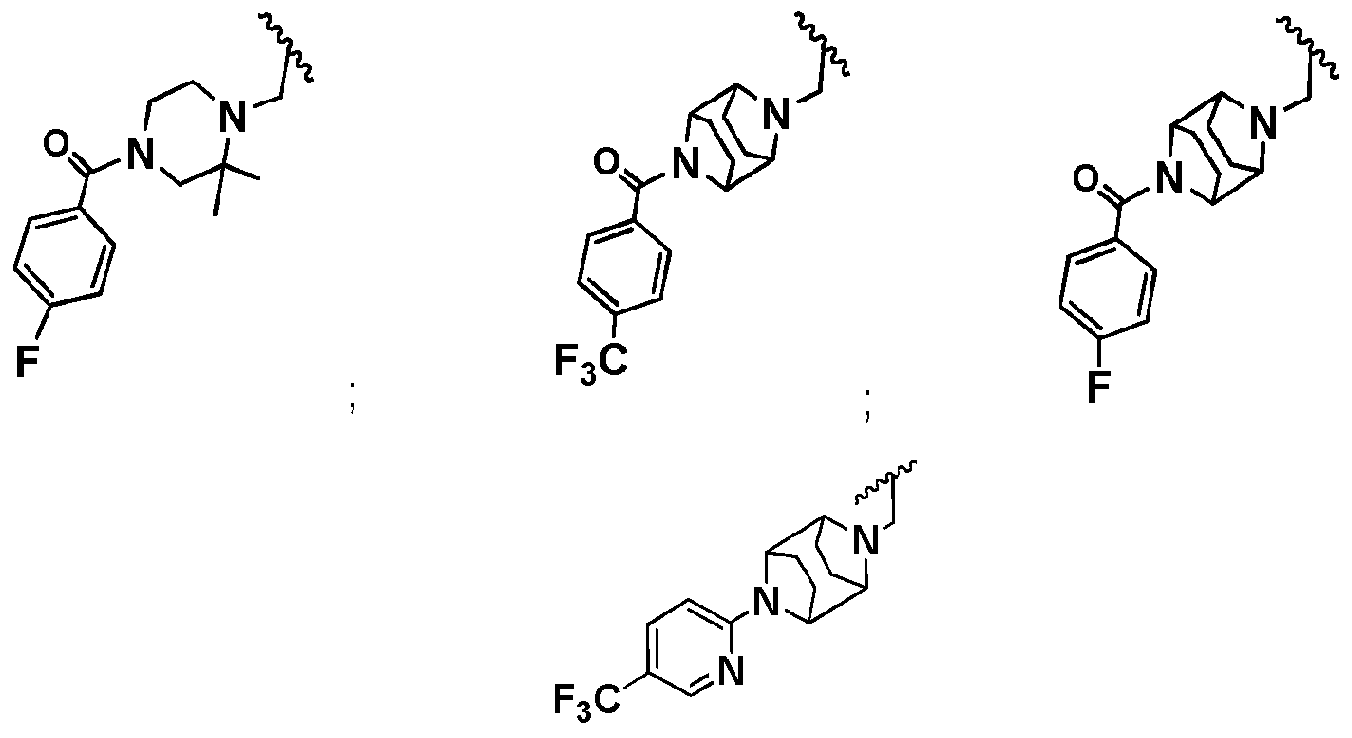


of Claim 1 having the Formula CC4:

CC4, or a salt thereof,
wherein Rc is:
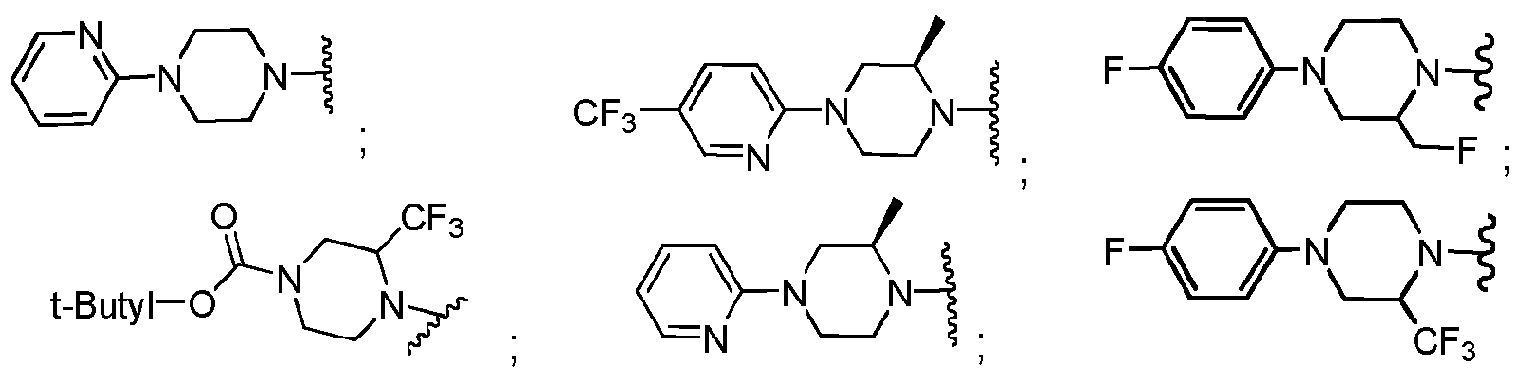

A compound of Claim 1 having the Formula CC5 :
 CCS, or a salt thereof, where "Rf" is:
82
CCS, or a salt thereof, where "Rf" is:
82

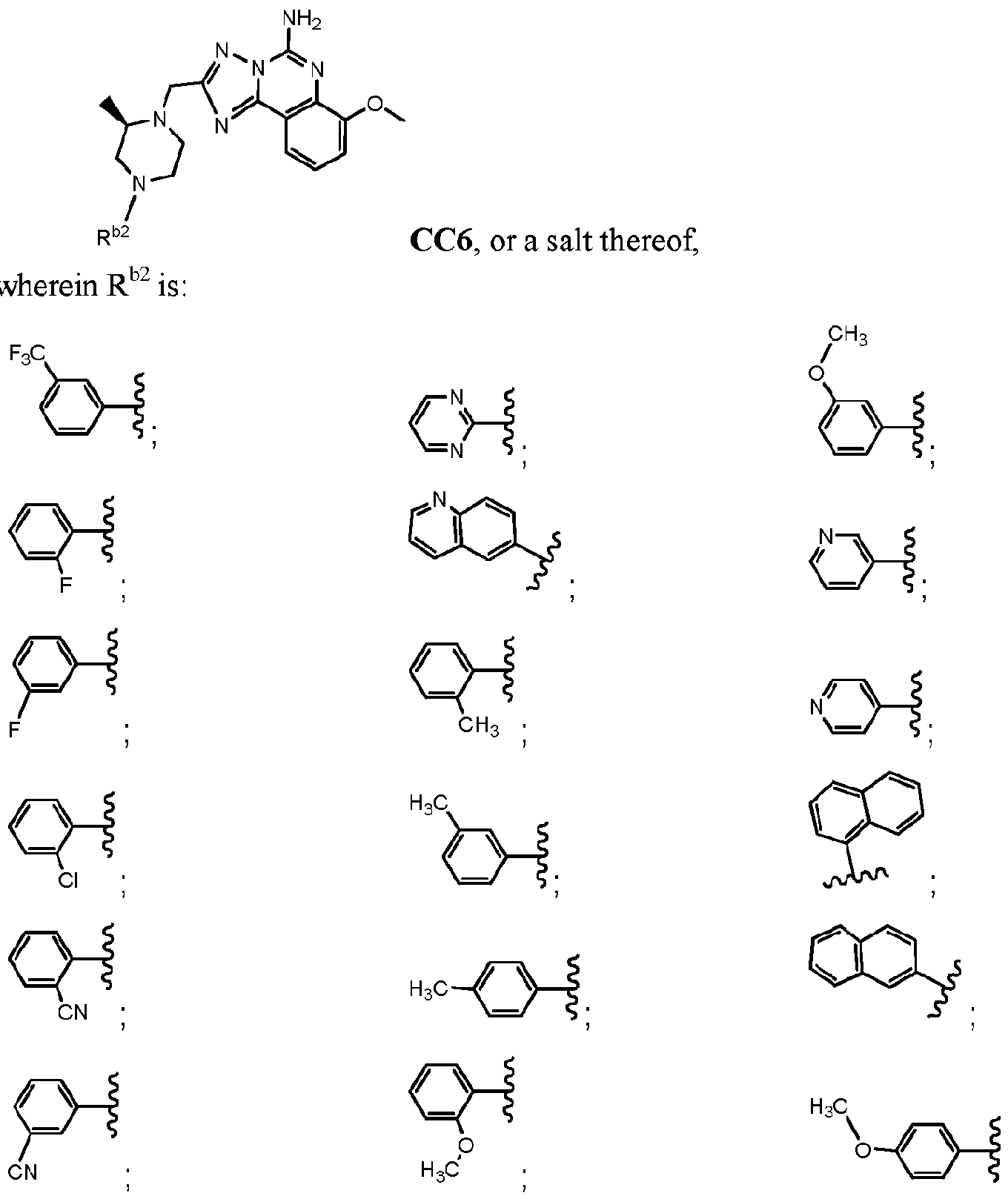


10. The following compounds, or a salt thereof:

11. A method of treating a central nervous system disease by administering a compound of any of Claims 1 to 10.
Priority Applications (4)
| Application Number | Priority Date | Filing Date | Title |
|---|---|---|---|
| PCT/CN2012/087851 WO2014101113A1 (en) | 2012-12-28 | 2012-12-28 | Piperazine-substituted 7-methoxy-[1,2,4]triazolo[1,5-c]quinazolin-5-amine compounds with a2a antagonist properties |
| US14/655,572 US9676780B2 (en) | 2012-12-20 | 2013-12-20 | Piperazine-substituted [1,2,4]triazolo[1,5-C]quinazolin-5-amine compounds with A2A antagonist properties |
| PCT/US2013/076775 WO2014105664A1 (en) | 2012-12-28 | 2013-12-20 | Piperazine-substituted [1,2,4]triazolo[1,5-c]quinazolin-5-amine compounds with a2a antagonist properties |
| EP13867977.4A EP2938344B1 (en) | 2012-12-28 | 2013-12-20 | Piperazine-substituted [1,2,4]triazolo[1,5-c]quinazolin-5-amine compounds with a2a antagonist properties |
Applications Claiming Priority (1)
| Application Number | Priority Date | Filing Date | Title |
|---|---|---|---|
| PCT/CN2012/087851 WO2014101113A1 (en) | 2012-12-28 | 2012-12-28 | Piperazine-substituted 7-methoxy-[1,2,4]triazolo[1,5-c]quinazolin-5-amine compounds with a2a antagonist properties |
Publications (1)
| Publication Number | Publication Date |
|---|---|
| WO2014101113A1 true WO2014101113A1 (en) | 2014-07-03 |
Family
ID=51019741
Family Applications (2)
| Application Number | Title | Priority Date | Filing Date |
|---|---|---|---|
| PCT/CN2012/087851 Ceased WO2014101113A1 (en) | 2012-12-20 | 2012-12-28 | Piperazine-substituted 7-methoxy-[1,2,4]triazolo[1,5-c]quinazolin-5-amine compounds with a2a antagonist properties |
| PCT/US2013/076775 Ceased WO2014105664A1 (en) | 2012-12-20 | 2013-12-20 | Piperazine-substituted [1,2,4]triazolo[1,5-c]quinazolin-5-amine compounds with a2a antagonist properties |
Family Applications After (1)
| Application Number | Title | Priority Date | Filing Date |
|---|---|---|---|
| PCT/US2013/076775 Ceased WO2014105664A1 (en) | 2012-12-20 | 2013-12-20 | Piperazine-substituted [1,2,4]triazolo[1,5-c]quinazolin-5-amine compounds with a2a antagonist properties |
Country Status (3)
| Country | Link |
|---|---|
| US (1) | US9676780B2 (en) |
| EP (1) | EP2938344B1 (en) |
| WO (2) | WO2014101113A1 (en) |
Cited By (13)
| Publication number | Priority date | Publication date | Assignee | Title |
|---|---|---|---|---|
| WO2015031221A1 (en) | 2013-08-29 | 2015-03-05 | Merck Sharp & Dohme Corp. | 2,2-difluorodioxolo a2a receptor antagonists |
| WO2016022521A1 (en) * | 2014-08-07 | 2016-02-11 | Vitae Pharmaceuticals, Inc. | Piperazine derivatives as liver x receptor modulators |
| WO2017008205A1 (en) * | 2015-07-10 | 2017-01-19 | Merck Sharp & Dohme Corp. | Substituted aminoquinazoline compounds as a2a antagonist |
| CN109293586A (en) * | 2018-11-22 | 2019-02-01 | 云南师范大学 | A kind of method for synthesizing quinazolinone compound from halogenated benzoic acid under microwave condition in ammonia water |
| WO2020146795A1 (en) | 2019-01-11 | 2020-07-16 | Omeros Corporation | Methods and compositions for treating cancer |
| US11312719B2 (en) | 2018-11-30 | 2022-04-26 | Merck Sharp & Dohme Corp. | 9-substituted amino triazolo quinazoline derivatives as adenosine receptor antagonists, pharmaceutical compositions and their use |
| WO2023201267A1 (en) | 2022-04-13 | 2023-10-19 | Gilead Sciences, Inc. | Combination therapy for treating trop-2 expressing cancers |
| EP4185297A4 (en) * | 2020-07-24 | 2024-08-28 | Merck Sharp & Dohme LLC | DUAL ADENOSINE A2A RECEPTOR AND A2B RECEPTOR ANTAGONISTS FOR IMMUNO-ONCOLOGY |
| EP4185296A4 (en) * | 2020-07-24 | 2025-03-05 | Merck Sharp & Dohme LLC | Adenosine a2a and a2b receptor dual antagonists for immuno-oncology |
| US12263171B2 (en) | 2018-11-30 | 2025-04-01 | Merck Sharp & Dohme Llc | 7-, 8-, and 10-substituted amino triazolo quinazoline derivatives as adenosine receptor antagonists, pharmaceutical compositions and their use |
| WO2025137640A1 (en) | 2023-12-22 | 2025-06-26 | Gilead Sciences, Inc. | Azaspiro wrn inhibitors |
| US12414952B2 (en) | 2018-11-20 | 2025-09-16 | Merck Sharp & Dohme Llc | Substituted amino triazolopyrimidine and amino triazolopyrazine adenosine receptor antagonists, pharmaceutical compositions and their use |
| US12466831B2 (en) | 2018-11-20 | 2025-11-11 | Merck Sharp & Dohme Llc | Substituted amino triazolopyrimidine and amino triazolopyrazine adenosine receptor antagonists, pharmaceutical compositions and their use |
Families Citing this family (4)
| Publication number | Priority date | Publication date | Assignee | Title |
|---|---|---|---|---|
| WO2014101120A1 (en) | 2012-12-28 | 2014-07-03 | Merck Sharp & Dohme Corp. | Heterobicyclo-substituted-7-methoxy-[1,2,4]triazolo[1,5-c]quinazolin-5-amine compounds with a2a antagonist properties |
| EP3119774A1 (en) | 2014-03-17 | 2017-01-25 | reMynd NV | Oxadiazole compounds |
| US10138212B2 (en) | 2015-02-06 | 2018-11-27 | Merck Sharp & Dohme Corp. | Aminoquinazoline compounds as A2A antagonist |
| CN119143734A (en) * | 2023-06-16 | 2024-12-17 | 武汉人福创新药物研发中心有限公司 | Heterocyclic compounds as AT2R antagonists and uses thereof |
Citations (3)
| Publication number | Priority date | Publication date | Assignee | Title |
|---|---|---|---|---|
| EP0181282A1 (en) * | 1984-10-01 | 1986-05-14 | Ciba-Geigy Ag | Triazoloquinazoline compounds |
| WO1988002370A1 (en) * | 1986-09-30 | 1988-04-07 | Ciba-Geigy Ag | 2-substituted-e-fused-[1,2,4]triazolo[1,5-c]pyrimidines pharmaceutical compositions and uses thereof |
| WO1997027177A2 (en) * | 1996-01-29 | 1997-07-31 | The United States Of America, Represented By The Secretary, Department Of Health And Human Services | Dihydropyridine-, pyridine-, benzopyran-4-one- and triazoloquinazoline derivatives, their preparation and their use as adenosine receptor antagonists |
Family Cites Families (7)
| Publication number | Priority date | Publication date | Assignee | Title |
|---|---|---|---|---|
| US4713383A (en) * | 1984-10-01 | 1987-12-15 | Ciba-Geigy Corporation | Triazoloquinazoline compounds, and their methods of preparation, pharmaceutical compositions, and uses |
| US5571775A (en) * | 1994-07-11 | 1996-11-05 | Dowelanco | N-aryl[1,2,4]triazolo[1,5-a]pyridine-2-sulfonamide herbicides |
| NZ540493A (en) | 2002-12-19 | 2008-04-30 | Schering Corp | Uses of adenosine A2a receptor antagonists |
| PE20070521A1 (en) * | 2005-09-23 | 2007-07-13 | Schering Corp | 7- [2- [4- (6-FLUORO-3-METHYL-1,2-BENZYSOXAZOL-5-IL) -1-PIPERAZINYL] ETHYL] -2- (1-PROPINYL) -7H-PIRAZOLE- [4, 3-E] - [1,2,4] -TRIAZOL- [1,5-C] -PYRIMIDIN-5-AMINE AS ANTAGONIST OF THE ADENOSINE A2a RECEPTOR |
| MX2009000104A (en) * | 2006-06-26 | 2009-01-23 | Schering Corp | Adenosine a2a receptor antagonists. |
| EP2509983B1 (en) * | 2009-11-16 | 2014-09-17 | Merck Sharp & Dohme Corp. | FUSED TRICYCLIC COMPOUNDS WITH ADENOSINE A2a RECEPTOR ANTAGONIST ACTIVITY |
| WO2012135084A1 (en) * | 2011-03-31 | 2012-10-04 | Merck Sharp & Dohme Corp. | METABOLITES OF 2-(FURAN-2-YL)-7-(2-(4-(4-(2-METHOXYETHOXY)PHENYL)PIPERAZIN-1-YL)ETHYL)-7H-PYRAZOLO[4,3-e][1,2,4]TRIAZOLO[1,5-c]PYRIMIDIN-5-AMINE AND THEIR UTILITY AS ADENOSINE A2a RECEPTOR ANTAGONISTS |
-
2012
- 2012-12-28 WO PCT/CN2012/087851 patent/WO2014101113A1/en not_active Ceased
-
2013
- 2013-12-20 EP EP13867977.4A patent/EP2938344B1/en active Active
- 2013-12-20 US US14/655,572 patent/US9676780B2/en active Active
- 2013-12-20 WO PCT/US2013/076775 patent/WO2014105664A1/en not_active Ceased
Patent Citations (3)
| Publication number | Priority date | Publication date | Assignee | Title |
|---|---|---|---|---|
| EP0181282A1 (en) * | 1984-10-01 | 1986-05-14 | Ciba-Geigy Ag | Triazoloquinazoline compounds |
| WO1988002370A1 (en) * | 1986-09-30 | 1988-04-07 | Ciba-Geigy Ag | 2-substituted-e-fused-[1,2,4]triazolo[1,5-c]pyrimidines pharmaceutical compositions and uses thereof |
| WO1997027177A2 (en) * | 1996-01-29 | 1997-07-31 | The United States Of America, Represented By The Secretary, Department Of Health And Human Services | Dihydropyridine-, pyridine-, benzopyran-4-one- and triazoloquinazoline derivatives, their preparation and their use as adenosine receptor antagonists |
Cited By (24)
| Publication number | Priority date | Publication date | Assignee | Title |
|---|---|---|---|---|
| EP3038466A4 (en) * | 2013-08-29 | 2017-01-18 | Merck Sharp & Dohme Corp. | 2,2-difluorodioxolo a2a receptor antagonists |
| WO2015031221A1 (en) | 2013-08-29 | 2015-03-05 | Merck Sharp & Dohme Corp. | 2,2-difluorodioxolo a2a receptor antagonists |
| AU2015301207B2 (en) * | 2014-08-07 | 2020-01-30 | Vitae Pharmaceuticals, Llc | Piperazine derivatives as liver X receptor modulators |
| EA031480B1 (en) * | 2014-08-07 | 2019-01-31 | Вайтаи Фармасьютиклз, Инк. | Liver x receptor modulators |
| CN106715413B (en) * | 2014-08-07 | 2019-11-01 | 生命医药有限责任公司 | piperazine derivatives as liver X receptor modulators |
| CN106715413A (en) * | 2014-08-07 | 2017-05-24 | 生命医药公司 | Piperazine derivatives as liver x receptor modulators |
| JP2017523222A (en) * | 2014-08-07 | 2017-08-17 | ヴァイティー ファーマシューティカルズ,インコーポレイテッド | Piperazine derivatives as liver X receptor modulators |
| US10144715B2 (en) | 2014-08-07 | 2018-12-04 | Vitae Pharmaceuticals, Inc. | Piperazine derivatives as liver X receptor modulators |
| WO2016022521A1 (en) * | 2014-08-07 | 2016-02-11 | Vitae Pharmaceuticals, Inc. | Piperazine derivatives as liver x receptor modulators |
| US10822338B2 (en) | 2015-07-10 | 2020-11-03 | Merck Sharp & Dohme Corp. | Substituted aminoquinazoline compounds as A2A antagonist |
| WO2017008205A1 (en) * | 2015-07-10 | 2017-01-19 | Merck Sharp & Dohme Corp. | Substituted aminoquinazoline compounds as a2a antagonist |
| EP3331532A4 (en) * | 2015-07-10 | 2018-12-05 | Merck Sharp & Dohme Corp. | Substituted aminoquinazoline compounds as a2a antagonist |
| WO2017011214A1 (en) | 2015-07-10 | 2017-01-19 | Merck Sharp & Dohme Corp. | Substituted aminoquinazoline compounds as a2a antagonist |
| US12466831B2 (en) | 2018-11-20 | 2025-11-11 | Merck Sharp & Dohme Llc | Substituted amino triazolopyrimidine and amino triazolopyrazine adenosine receptor antagonists, pharmaceutical compositions and their use |
| US12414952B2 (en) | 2018-11-20 | 2025-09-16 | Merck Sharp & Dohme Llc | Substituted amino triazolopyrimidine and amino triazolopyrazine adenosine receptor antagonists, pharmaceutical compositions and their use |
| CN109293586A (en) * | 2018-11-22 | 2019-02-01 | 云南师范大学 | A kind of method for synthesizing quinazolinone compound from halogenated benzoic acid under microwave condition in ammonia water |
| US12263171B2 (en) | 2018-11-30 | 2025-04-01 | Merck Sharp & Dohme Llc | 7-, 8-, and 10-substituted amino triazolo quinazoline derivatives as adenosine receptor antagonists, pharmaceutical compositions and their use |
| US11312719B2 (en) | 2018-11-30 | 2022-04-26 | Merck Sharp & Dohme Corp. | 9-substituted amino triazolo quinazoline derivatives as adenosine receptor antagonists, pharmaceutical compositions and their use |
| US12060357B2 (en) | 2018-11-30 | 2024-08-13 | Merck Sharp & Dohme Llc | 9-substituted amino triazolo quinazoline derivatives as adenosine receptor antagonists, pharmaceutical compositions and their use |
| WO2020146795A1 (en) | 2019-01-11 | 2020-07-16 | Omeros Corporation | Methods and compositions for treating cancer |
| EP4185296A4 (en) * | 2020-07-24 | 2025-03-05 | Merck Sharp & Dohme LLC | Adenosine a2a and a2b receptor dual antagonists for immuno-oncology |
| EP4185297A4 (en) * | 2020-07-24 | 2024-08-28 | Merck Sharp & Dohme LLC | DUAL ADENOSINE A2A RECEPTOR AND A2B RECEPTOR ANTAGONISTS FOR IMMUNO-ONCOLOGY |
| WO2023201267A1 (en) | 2022-04-13 | 2023-10-19 | Gilead Sciences, Inc. | Combination therapy for treating trop-2 expressing cancers |
| WO2025137640A1 (en) | 2023-12-22 | 2025-06-26 | Gilead Sciences, Inc. | Azaspiro wrn inhibitors |
Also Published As
| Publication number | Publication date |
|---|---|
| WO2014105664A1 (en) | 2014-07-03 |
| EP2938344A4 (en) | 2016-06-08 |
| EP2938344A1 (en) | 2015-11-04 |
| EP2938344B1 (en) | 2017-06-21 |
| US9676780B2 (en) | 2017-06-13 |
| US20160194330A1 (en) | 2016-07-07 |
Similar Documents
| Publication | Publication Date | Title |
|---|---|---|
| EP2938344B1 (en) | Piperazine-substituted [1,2,4]triazolo[1,5-c]quinazolin-5-amine compounds with a2a antagonist properties | |
| EP2945632B1 (en) | Heterobicyclo-substituted-[1,2,4]triazolo[1,5-c]quinazolin-5-amine compounds suitable for treatment or prevention of central nervous system disorders | |
| EP3307067B1 (en) | Aminopyrazine compounds with a2a antagonist properties | |
| JP5710492B2 (en) | Organic compounds | |
| EP2240028B1 (en) | Pyrazolopyrimidine-4,6-dione derivatives and their use as pharmaceutical | |
| EP2038285B1 (en) | Adenosine a2a receptor antagonists | |
| EP1453835B1 (en) | Adenosine a 2a receptor antagonists | |
| US20090099195A1 (en) | Therapeutic Compounds 570 | |
| EP3253390B1 (en) | Aminoquinazoline compounds as a2a antagonist | |
| EP3331532B1 (en) | Substituted aminoquinazoline compounds as a2a antagonist | |
| EP2282999B1 (en) | Amino-quinoxaline and amino-quinoline compounds for use as adenosine a2a receptor antagonists | |
| IL272089B2 (en) | Compounds, compositions and methods | |
| CA2465893A1 (en) | Polycyclic guanine derivative phosphodiesterase v inhibitors | |
| EP3452465B1 (en) | Substituted 2, 4-diamino-quinoline derivatives for use in the treatment of proliferative diseases | |
| CA2717172A1 (en) | 1,2,4-triazolo[4,3-c]pyrimidin-3-one and pyrazolo [4,3-e] -1,2,4-triazolo [4,3-c] pyrimidin-3-one compounds for use as adenosine a2a receptor antagonists | |
| AU2020386189B2 (en) | Adenosine receptor antagonist compounds | |
| WO2020243199A1 (en) | Tricyclic compounds | |
| CN105025899B (en) | Having a2AHeterobicyclically substituted- [1,2,4 ] antagonists]Triazolo [1,5-c]Quinazoline-5-amine compounds | |
| IL297624B1 (en) | Cycloalkyl pyrimidines as proportin inhibitors | |
| HK1064100B (en) | Adenosine a 2a receptor antagonists |
Legal Events
| Date | Code | Title | Description |
|---|---|---|---|
| 121 | Ep: the epo has been informed by wipo that ep was designated in this application |
Ref document number: 12891301 Country of ref document: EP Kind code of ref document: A1 |
|
| NENP | Non-entry into the national phase |
Ref country code: DE |
|
| 122 | Ep: pct application non-entry in european phase |
Ref document number: 12891301 Country of ref document: EP Kind code of ref document: A1 |