WO2014002290A1 - Cosmetic composition for keratin fibers - Google Patents
Cosmetic composition for keratin fibers Download PDFInfo
- Publication number
- WO2014002290A1 WO2014002290A1 PCT/JP2012/067247 JP2012067247W WO2014002290A1 WO 2014002290 A1 WO2014002290 A1 WO 2014002290A1 JP 2012067247 W JP2012067247 W JP 2012067247W WO 2014002290 A1 WO2014002290 A1 WO 2014002290A1
- Authority
- WO
- WIPO (PCT)
- Prior art keywords
- oil
- weight
- cosmetic composition
- triglyceride
- acid
- Prior art date
- Legal status (The legal status is an assumption and is not a legal conclusion. Google has not performed a legal analysis and makes no representation as to the accuracy of the status listed.)
- Ceased
Links
Classifications
-
- A—HUMAN NECESSITIES
- A61—MEDICAL OR VETERINARY SCIENCE; HYGIENE
- A61K—PREPARATIONS FOR MEDICAL, DENTAL OR TOILETRY PURPOSES
- A61K8/00—Cosmetics or similar toiletry preparations
- A61K8/18—Cosmetics or similar toiletry preparations characterised by the composition
- A61K8/92—Oils, fats or waxes; Derivatives thereof, e.g. hydrogenation products thereof
- A61K8/922—Oils, fats or waxes; Derivatives thereof, e.g. hydrogenation products thereof of vegetable origin
-
- A—HUMAN NECESSITIES
- A61—MEDICAL OR VETERINARY SCIENCE; HYGIENE
- A61K—PREPARATIONS FOR MEDICAL, DENTAL OR TOILETRY PURPOSES
- A61K8/00—Cosmetics or similar toiletry preparations
- A61K8/18—Cosmetics or similar toiletry preparations characterised by the composition
- A61K8/30—Cosmetics or similar toiletry preparations characterised by the composition containing organic compounds
- A61K8/33—Cosmetics or similar toiletry preparations characterised by the composition containing organic compounds containing oxygen
- A61K8/37—Esters of carboxylic acids
-
- A—HUMAN NECESSITIES
- A61—MEDICAL OR VETERINARY SCIENCE; HYGIENE
- A61K—PREPARATIONS FOR MEDICAL, DENTAL OR TOILETRY PURPOSES
- A61K8/00—Cosmetics or similar toiletry preparations
- A61K8/18—Cosmetics or similar toiletry preparations characterised by the composition
- A61K8/30—Cosmetics or similar toiletry preparations characterised by the composition containing organic compounds
- A61K8/33—Cosmetics or similar toiletry preparations characterised by the composition containing organic compounds containing oxygen
- A61K8/37—Esters of carboxylic acids
- A61K8/375—Esters of carboxylic acids the alcohol moiety containing more than one hydroxy group
-
- A—HUMAN NECESSITIES
- A61—MEDICAL OR VETERINARY SCIENCE; HYGIENE
- A61Q—SPECIFIC USE OF COSMETICS OR SIMILAR TOILETRY PREPARATIONS
- A61Q5/00—Preparations for care of the hair
- A61Q5/04—Preparations for permanent waving or straightening the hair
-
- A—HUMAN NECESSITIES
- A61—MEDICAL OR VETERINARY SCIENCE; HYGIENE
- A61Q—SPECIFIC USE OF COSMETICS OR SIMILAR TOILETRY PREPARATIONS
- A61Q5/00—Preparations for care of the hair
- A61Q5/06—Preparations for styling the hair, e.g. by temporary shaping or colouring
Definitions
- more than 70% by weight or more, relative to the total weight of the fatty acids in the triglyceride(s), of the fatty acids in the triglyceride(s) or the liquid fatty acid ester other than triglyceride have 20 or more carbon atoms.
- liquid fatty acid ester other than triglyceride is selected from the group consisting of linoleyl lactate; oleyl lactate; decyl oleate; isocetyl isostearate; isostearyl palmitate; octyldodecyl erucate; oleyl erucate; ethyl, cetyl, and isopropyl palmitates; 2-ethylhexyl palmitate; and 2-octyldecyl palmitate.
- the present invention also relates to a process for perming (permanent waving or straightening) keratin fibers, preferably hair, characterized by using the cosmetic composition as defined above.
- the fatty material may be in the form of a liquid or a solid.
- liquid and solid mean that the fatty material is in the form of a liquid or a paste (non-solid) or solid, respectively, at ambient temperature (25 °C) under atmospheric pressure (760 mmHg or 10 5 Pa).
- the plant oil can be selected from the group consisting of olive oil, camellia oil, coriander oil, jojoba oil, apricot oil, meadowfoam oil, pracaxi oil and almond oil. It is furthermore preferable the plant oil is olive oil or jojoba oil.
- the unsaturated fatty acid which has less than 16 carbon atoms can be used for the liquid fatty esters.
- the unsaturated fatty acid with less than 16 carbon atoms mention may be, for example, crotonic acid and myristoleic acid.
- the additional fatty compound is different from triglycerides or the above liquid fatty ester other than triglyceride, wherein the fatty acid has 16 or more carbon atoms and/or at least one carbon-carbon double bond.
- the additional fatty compound may be selected from the group consisting of other esters, aliphatic hydrocarbons, animal oils, silicone oils, fatty alcohols, non salified fatty acids, and mixtures thereof. These additional fatty compounds may be volatile or non- volatile.
- the additional fatty compound (s) is(are) selected from aliphatic hydrocarbons, animal oils, silicone oils, fatty alcohols, or mixtures thereof.
- the additional fatty compound may be at least one fatty acid, and two or more fatty acids may be used.
- the fatty acids should be in acidic form (i.e., unsalified, to avoid soaps) and may be saturated or unsaturated and contain from 6 to 30 carbon atoms and in particular from 9 to 30 carbon atoms, which is optionally substituted, in particular with one or more hydroxyl groups (in particular 1 to 4). If they are unsaturated, these compounds may include one to three conjugated or non-conjugated carbon-carbon double bonds. They are more particularly chosen from myristic acid, palmitic acid, stearic acid, behenic acid, oleic acid, linoleic acid, linolenic acid and isostearic acid.
- the additional fatty compound is not a fatty acid.
- the polymer wax may be chosen from polyethylene waxes such as the wax sold under the name "Performalene 400 Polyethylene” by the company New Phase Technologies, silicone waxes, for instance poly(C 24 -C 28 )all ⁇ lmethyldrmethylsiloxane, such as the product sold under the name "Abil Wax 9810" by the company Goldschmidt
- the oxidizing agent be hydrogen peroxide.
- R4, R 5 and Re which may be identical or different, represent an alkyl group containing from 1 to
- Ri and R 2 which may be identical or different, represent hydrogen or an alkyl group containing from 1 to 6 carbon atoms, and preferably methyl or ethyl;
- memacryloyloxy(C 1 -C 4 )aIkyltri(C 1 -C 4 )alkylarnmonium salt polymers such as the polymers obtained by homopolymenzation of dimemylaminoethyl methacrylate quatemized with methyl chloride, or by copolymerization of acrylamide with dimethylarninoethyl methacrylate quatemized with methyl chloride, the homo- or copolymerization being followed by crosslinking with a compound containing olefinic unsaturation, in particular methylenebisacrylamide.
- cellulose or cellulose derivatives grafted with a water-soluble quaternary ammonium monomer described especially in patent US 4 131 576, such as hydroxyalkylcelluloses, for instance hydroxymethyl-, hydroxyethyl- or hydroxypropylcelluloses grafted especially with a memacryloylemyltrmietnylammonium, memacrylamidopropylrrimethyl- ammonium or dimethyldiallylammonium salt.
- the commercial products corresponding to this definition are more particularly the products sold under the name Celquat L 200 and Celquat H 100 by the company National Starch.
- Water-soluble polyamino amides prepared in particular by polycondensation of an acidic compound with a polyamine; these polyamino amides can be crosslinked with an epmalohydrin, a diepoxide, a dianhydride, an unsaturated dianhydride, a bis-unsaturated derivative, a
- olearnidopropylhydroxysultaine cocohydroxysultaine, laurylhydroxysultaine, and cocosultaine, alone or as mixtures.
- alkylamidoalkylbetaine in particular cocobetaine and cocarnidopropylbetaine.
- amidoaminecarboxylated derivatives mention may be made of the products sold under the name Miranol, as described in U.S. Pat. Nos. 2,528,378 and 2,781,354 and classified in the CTFA dictionary, 3rd edition, 1982 (the disclosures of which are incorporated herein by reference), under the names Amphocarboxyglycinates and Amphocarboxypropionates, with the respective structures:
- X denotes an organic or inorganic anionic ion such as halides, acetates, phosphates, nitrates, alkyl(C 1 -C4)sulfates, alkyl(C 1 -C 4 )- or particularly methylsulfate and ethylsulfate; or and X " are not present;
- X' denotes a -CH 2 -COOH group, -CH 2 -COOZ', -CH 2 CH 2 -COOH, -CH 2 CH 2 -COOZ' or a hydrogen atom
- Y * denotes -COOH, -COOZ ⁇ -CH 2 -CHOH-S0 3 Z', -CH 2 -CHOH-S0 3 H radical or a
- Y denotes -C(0)OH, -C(0)OZ", -CH 2 -CH(OH)-S0 3 H or -CH 2 -CH(OH)-S0 3 -Z", wherein Z" denotes a cationic ion derived from alkaline metal or alkaline-earth metals such as sodium, ammonium ion or an ion derived from organic amine;
- Rd and Re denotes a CrC 4 alkyl or Ci-C 4 hydroxyalkyl radical
- Ra denotes a o-Qo group alkyl or alkenyl group from an acid
- n and n' independently denote an integer from 1 to 3.
- amphoteric surfactant with formula Bl and B2 be selected from
- Caprylamphodiacetate Disodium Capryloamphodiacetate, Disodium Cocoamphodipropionate, Disodium Lauroamphopropionate, Disodium Caprylamphodipropionate, Disodium
- cocoamphodiacetate sold under the trade name Miranol® C2M concentrate by the company Rhodia Chimie.
- the cationic surfactant may be selected from the group consisting of optionally
- quaternary ammonium salts examples include, but are not limited to: those of general formula (B3) below:
- Ri, R 2 , R3, and R4, which may be identical or different, are chosen from linear and branched aliphatic radicals including from 1 to 30 carbon atoms and optionally including heteroatoms such as oxygen, nitrogen, sulfur and halogens.
- the aliphatic radicals may be chosen, for example, from alkyl, alkoxy, C 2 -C 6 polyoxyalkylene, alkylamide, (C 12 -C 22 )alkylamido(C 2 -C 6 )alkyl, (C 12 -C 22 )alkylacetate and hydroxyalkyl radicals; and aromatic radicals such as aryl and alkylaryl; and
- X " is chosen from halides,- phosphates, acetates, lactates, (C 2 -C 6 ) alkyl sulfates and alkyl- or alkylaryl-sulfonates;
- R 5 is chosen from alkenyl and alkyl radicals including from 8 to 30 carbon atoms, for example fatty acid derivatives of tallow or of coconut;
- 3 ⁇ 4 is chosen from hydrogen, C 1 -C 4 alkyl radicals, and alkenyl and alkyl radicals including from 8 to 30 carbon atoms;
- Re is chosen from hydrogen and C1-C4 alkyl radicals
- X " is chosen from halides, phosphates, acetates, lactates, alkyl sulfates, alkyl sulfonates, and alkylaryl sulfonates.
- R 5 and 3 ⁇ 4 are, for example, a mixture of radicals chosen from alkenyl and alkyl radicals including from 12 to 21 carbon atoms, such as fatty acid derivatives of tallow, R 7 is methyl and 3 ⁇ 4 is hydrogen.
- R.9 is chosen from aliphatic radicals including from 16 to 30 carbon atoms
- R 10 is chosen from hydrogen or alkyl radicals including from 1 to 4 carbon atoms or a group
- Rn, R 12 , R 13 , R 14 , Ri 6a , Ri7 3 ⁇ 4 and R 18a which may be identical or different, are chosen from hydrogen and alkyl radicals including from 1 to 4 carbon atoms;
- R 22 is chosen from C ⁇ -Ce alkyl radicals and Q-Q hydroxyalkyl and dihydroxyalkyl radicals;
- R 23 is chosen from:
- R 22 is chosen from methyl and ethyl radicals
- r, s and t are equal to 2;
- R 23 is chosen from:
- the acyl radicals may include from 14 to 18 carbon atoms, and may be derived, for example, from a plant oil, for instance palm oil and sunflower oil. When the compound includes several acyl radicals, these radicals may be identical or different.
- This esterification may be followed by a quaternization using an alkylating agent chosen from alkyl halides, for example methyl and ethyl halides; dialkyl sulfates, for example dimethyl and diethyl sulfates; methyl methanesulfonate; methyl para-toluenesulfonate; glycol chlorohydrin; and glycerol chlorohydrin.
- alkylating agent chosen from alkyl halides, for example methyl and ethyl halides; dialkyl sulfates, for example dimethyl and diethyl sulfates; methyl methanesulfonate; methyl para-toluenesulfonate; glycol chlorohydrin; and glycerol chlorohydrin.
- quaternary ammonium salts mentioned above that may be used in compositions according to the invention include, but are not limited to, those corresponding to formula (I), for example tefraalkylammonium chlorides, for instance dialkyldimethylammonium and
- cetyltrimethylammonium and benzyldimethylstearylammonium chloride cetyltrimethylammonium and benzyldimethylstearylammonium chloride
- palmitylarnidopropyltrimemylammonium chloride palmitylarnidopropyltrimemylammonium chloride, and stearamidopropyldimethylamine.
- polyoxyalkylenated, monoglycerolated or polyglycerolated nonionic surfactants are more particularly oxyethylene or oxypropylene units, or a combination thereof, preferably oxyethylene units.
Landscapes
- Health & Medical Sciences (AREA)
- Life Sciences & Earth Sciences (AREA)
- Animal Behavior & Ethology (AREA)
- General Health & Medical Sciences (AREA)
- Public Health (AREA)
- Veterinary Medicine (AREA)
- Birds (AREA)
- Epidemiology (AREA)
- Emergency Medicine (AREA)
- Chemical & Material Sciences (AREA)
- Oil, Petroleum & Natural Gas (AREA)
- Cosmetics (AREA)
Description
DESCRIPTION COSMETIC COMPOSITION FOR KERATIN FIBERS TECHNICAL FIELD The present invention relates to a cosmetic composition for keratin fibers such
BACKGROUND ART
In long-lasting deformation of keratin fibers such as hair, first the disulphide bonds -S-S- of the keratin (cystine) are opened using a composition containing a suitable reducing agent (reduction stage) then, after rinsing the hair thus treated, secondly the disulphide bonds are reconstituted by applying, on the hair previously put under tension (curlers etc.), an oxidizing composition (oxidation stage, also called fixation) so as finally to give the hair the desired form. This technique thus makes it possible to carry out either waving or straightening of the hair. The new shape imposed on the hair by chemical treatment as described above is extremely long-lasting and notably withstands the action of washing with water or shampoo, in contrast to the simple conventional techniques of temporary styling.
The oxidizing compositions required for application of the fixation stage are generally
compositions based on hydrogen peroxide or bromate.
Many compositions and processes for the above chemical treatment have been proposed. For example, JP-A-S54-28833 discloses an oxidizing composition including hydrogen peroxide an oil with an iodine value of 15 or less, and other ingredients. The oil with an iodine value of 15 or less corresponds to coconuts oil.
However, there are various drawbacks in the above chemical treatment process that may not be suitable from the view point of consumer' s expectations. The drawbacks include insufficient cosmetic properties or perm performance on the keratin fibers such as hair as well as damages to the keratin fibers and the deterioration of the feel to touch of the keratin fibers.
DISCLOSURE OF INVENTION
An objective of the present invention is to provide a cosmetic composition for keratin fibers such as hair which can provide the keratin fibers with superior cosmetic properties or perm
performance, can reduce the damages to the keratin fibers, and can improve the feel to touch of the keratin fibers treated with a chemical process such as a permanent waving.
The above objective of the present invention can be achieved by a cosmetic composition for keratin fibers, including:
at least one fatty material including (i) at least one plant oil formed by triglycerides derived from fatty acids, and/or (ii) at least one liquid fatty acid ester other than triglyceride; and - at least one oxidizing agent,
wherein
a) 50% by weight or more, relative to the total weight of the fatty acids in the triglyceride(s), of the fatty acids in the triglyceride(s) have 18 or more carbon atoms and at least one carbon-carbon double bond;
b) the fatty acid in the liquid fatty acid ester other than triglyceride has 16 or more carbon atoms and/or at least one carbon-carbon double bond; and
c) the pH of the composition is less than 8.
The plant oil and the fatty acid ester other than triglyceride are in the form of liquids at ambient temperature and under normal atmospheric pressure.
According to the present invention, 50% by weight or more, relative to the total weight of the fatty acids in the triglyceride(s), of the fatty acids in the triglyceride(s) are composed of unsaturated fatty acids. In particular, it is preferable that from 50% to 100 %by weight, preferably from 60% to 90% by weight, relative to the total weight of the fatty acids in the triglyceride(s), of the fatty acids in the triglyceride(s) have 18 or more carbon atoms and at least one carbon-carbon double bond.
It is preferable that 5% by weight or more, relative to the total weight of the fatty acids in the triglyceride(s), of the fatty acids in the triglyceride(s) have 18 or more carbon atoms and at least two carbon-carbon double bonds.
It is preferable that more than 70% by weight or more, relative to the total weight of the fatty acids in the triglyceride(s), of the fatty acids in the triglyceride(s) or the liquid fatty acid ester other than triglyceride have 20 or more carbon atoms.
It is possible that the fatty acid in the triglyceride(s) include a carbon-carbon triple bond.
It is more preferable that the plant oil is selected from the group consisting of olive oil, camellia oil, cameline oil, rape oil, coriander oil, jojoba oil, apricot oil, meadowfoam oil, sunflower oil, maize oil, cottonseed oil, borage oil, sesame oil, sawflower oil, pracaxi oil, argan oil and almond oil. Furthermore preferably, the plant oil is selected from the group consisting of olive oil, camellia oil, coriander oil, jojoba oil, apricot oil, meadowfoam oil, pracaxi oil and almond oil. In particular, olive oil and jojoba oil are most preferable.
It is preferable that the liquid fatty acid ester other than triglyceride is selected from the group consisting of linoleyl lactate; oleyl lactate; decyl oleate; isocetyl isostearate; isostearyl palmitate; octyldodecyl erucate; oleyl erucate; ethyl, cetyl, and isopropyl palmitates; 2-ethylhexyl palmitate; and 2-octyldecyl palmitate.
It is preferable that the amount of the plant oil(s) and/or the liquid fatty acid ester(s) other than triglyceride is from 0.01% to 10% by weight, preferably from 0.05% to 5% by weight, and more preferably from 0.01% to 1% by weight relative to the total weight of the composition. The fatty material may comprises at least one additional fatty compound, preferably chosen
among other esters, aliphatic hydrocarbons, animal oils, silicone oils, fatty alcohols, polymer waxes, and mixtures thereof.
It is preferable that the total amount of the fatty material(s) is from 0.01% to 25% by weight, preferably from 0.05% to 15% by weight, and more preferably from 0.01 % to 10% by weight relative to the total weight of the composition.
It is preferable that the oxidizing agent is hydrogen peroxide or bromate. More preferably oxidizing agent is hydrogen peroxide.
It is preferable that the amount of the oxidizing agent(s) is from 0.1 % to 15% by weight, preferably from 0.5% to 10% by weight, and more preferably from 1% to 5% by weight, relative to the total weight of the composition. It is preferable that the cosmetic composition according to the present invention further includes at least one cationic polymer and/or at least one surfactant.
According to one preferred embodiment, it is preferable that the cosmetic composition has a pH range from 1.5 to 7.9, more preferably from 1.5 to 7, even more preferably from 2 to 4.
According to another embodiment, the cosmetic composition has a pH range from 5 to 7.9, more preferably from 6 to 7.8, even more preferably from 7 to 7.7.
The present invention also relates to a process for perming (permanent waving or straightening) keratin fibers, preferably hair, characterized by using the cosmetic composition as defined above.
The present invention also relates to a multi-compartment system or kit including, at least,
a first compartment, and
a second compartment,
wherein
the first compartment includes including at least one fatty material including (i) at least one plant oil formed by triglycerides derived from fatty acids, and/or (ii) at least one liquid fatty acid ester other than triglyceride, and
the second compartment includes at least one oxidizing agent, and
wherein
a) 50% by weight or more, relative to the total weight of the fatty acids in the triglyceride(s), of the fatty acids in the triglyceride(s) have 18 or more carbon atoms and at least one carbon-carbon double bond,
b) the fatty acid in the liquid fatty acid ester other than triglyceride has 16 or more carbon atoms and/or at least one carbon-carbon double bond, and
c) the pH of the composition obtainable by mixing the contents in the first and second
compartments is less than 8.
BEST MODE FOR CARRYING OUT THE INVENTION
After diligent research, the inventors have discovered that it is possible to achieve a cosmetic composition for keratin fibers, such as hair, by combining at least one specific plant oil and/or at least one specific fatty acid ester other than triglyceride with an oxidizing agent such as hydrogen peroxide, and that the above cosmetic composition can provide the keratin fibers with superior cosmetic properties or perm performance, can reduce the damages to the keratin fibers, and can improve the feel to touch of the keratin fibers.
Thus, the present invention is a cosmetic composition for keratin fibers, including:
at least one fatty material including (i) at least one plant oil formed by at least one triglyceride derived from fatty acids, and/or (ii) at least one liquid fatty acid ester other than triglyceride; and
at least one oxidizing agent,
wherein
a) 50% by weight or more, relative to the total weight of the fatty acids in the triglyceride(s), of the fatty acids in the triglyceride(s) have 18 or more carbon atoms and at least one carbon-carbon double bond;
b) the fatty acid in the liquid fatty acid ester other than triglyceride has 16 or more carbon atoms and/or at least one carbon-carbon double bond;
c) the pH of the composition is less than 8.
Hereinafter, the cosmetic composition according to the present invention will be explained in a more detailed manner.
(Composition)
(a) Fatty Material
The cosmetic composition according to the present invention contains at least one fatty material including at least one plant oil formed by at least one triglyceride derived from fatty acids and/or at least one liquid fatty acid ester other than triglyceride,
wherein
a) 50% by weight or more, relative to the total weight of the fatty acids in the triglyceride(s), of the fatty acids in the triglyceride(s) have 18 or more carbon atoms and at least one carbon-carbon double bond, and
b) the fatty acid in the liquid fatty acid ester other than triglyceride has 16 or more carbon atoms and/or at least one carbon-carbon double bond.
The cosmetic composition according to the present invention may contain one fatty material or two or more fatty materials in combination. Thus, a single type of fatty material or a
combination of different type of fatty materials may be used.
The term "fatty material" means an organic compound that is insoluble in water at ordinary temperature (25 °C) and at atmospheric pressure (760 rnmHg) (solubility of less than 5%, preferably 1 % and even more preferentially 0.1%). In addition, the fatty material may be soluble
in organic solvents under the same temperature and pressure conditions, for instance chloroform, ethanol, benzene or decamethylcyclopentasiloxane.
The fatty material may be in the form of a liquid or a solid. Here, "liquid" and "solid" mean that the fatty material is in the form of a liquid or a paste (non-solid) or solid, respectively, at ambient temperature (25 °C) under atmospheric pressure (760 mmHg or 105Pa).
The fatty material may contain one plant oil or two or more plant oils in combination. Thus, a single type of plant oil or a combination of different type of plant oils may be used. The plant oil is preferably in the form of a liquid.
The plant oil may include one triglyceride which includes fatty acids or two or more triglycerides in combination. A single type of triglyceride or a combination of different type of triglycerides may be used. Also, a single type of fatty acid or a combination of different type of fatty acids may be used.
According to the present invention, 50% by weight or more, relative to the total weight of the fatty acids in the triglyceride(s) are composed of unsaturated fatty acids. It is preferable that from 50% to 100 % by weight, more preferably from 60% to 90% by weight, relative to the total weight of the fatty acids in the triglyceride(s) have 18 or more carbon atoms and at least one
carbon-carbon double bond.
As examples of the fatty acid having 18 or more carbon atoms and at least one carbon-carbon double bond, mention may be made of, for example, oleic acid, elaidic acid, vaccenic acid, gadoleic acid, eicosenoic acid, erucic acid, nervonic acid, linoleic acid, eicosadienoic acid, docosadienoic acid, linolenic acid, pinolenic acid, eleostearic acid, mead acid, eicosatrienoic acid, stearidonic acid, arachidonic acid, eicosatetraenoic acid, adrenic acid, bosseopentaenoic acid, eicosapentaenoic acid, osbond acid, clupanodonic acid, tetracosapentaenoic acid,
docosahexaenoic acid, and nisinic acid.
As examples of the fatty acid having 18 or more carbon atoms and at least two carbon-carbon double bond, mention may be made of, for example, linoleic acid, eicosadienoic acid,
docosadienoic acid, linolenic acid, pinolenic acid, eleostearic acid, mead acid, eicosatrienoic acid, stearidonic acid, arachidonic acid, eicosatetraenoic acid, adrenic acid, bosseopentaenoic acid, eicosapentaenoic acid, osbond acid, clupanodonic acid, tetracosapentaenoic acid,
docosahexaenoic acid, and nisinic acid.
It is preferable that 5% by weight or more, relative to the total weight of the fatty acids in the triglyceride(s), of the fatty acids in the triglyceride(s) have 18 or more carbon atoms and at least two carbon-carbon double bonds.
It is preferable that more than 70% by weight or more, relative to the total weight of the fatty acids in the triglyceride(s), of the fatty acids in the triglyceride(s) have 20 or more carbon atoms. It is possible that the fatty acid in the triglyceride(s) include a carbon-carbon triple bond.
The plant oil according to the present invention can preferably be selected from the group consisting of olive oil, camellia oil, cameline oil, rape oil, coriander oil, jojoba oil, apricot oil, meado foam oil, sunflower oil, maize oil, cottonseed oil, borage oil, sesame oil, sawflower oil, pracaxi oil, argan oil, and almond oil. More preferably, the plant oil can be selected from the group consisting of olive oil, camellia oil, coriander oil, jojoba oil, apricot oil, meadowfoam oil, pracaxi oil and almond oil. It is furthermore preferable the plant oil is olive oil or jojoba oil.
In addition, the fatty material may contain at least one additional plant oil such as palm oil, crocosmia oil, baobab oil, and coconut oil. The additional plant oil may be in the form of a paste or solid. Thus, the additional plant oil may be, for example, a butter such as cocoa butter, and karite butter.
The fatty material may contain one liquid fatty acid ester other than triglyceride or two or more liquid fatty acid esters other than triglyceride in combination, wherein the fatty acid has 16 or more carbon atoms and/or at least one carbon-carbon double bond. Thus, a single type of the liquid fatty acid ester other than triglyceride or a combination of different type of the liquid fatty acid esters other than triglyceride may be used. The fatty acid which has 16 or more carbon atoms may be saturated or unsaturated.
As examples of the saturated fatty acids having 16 or more carbon atoms, mention may be made of, for example, palmitic acid, heptadecanoic acid, stearic acid, nonadecanoic acid, arachidic acid, behenic acid, tetradocosanoic acid, hexadocosanoic acid, and octadocosanoic acid.
As examples of the unsaturated fatty acids having 16 or more carbon atoms, mention may be made of, for example, palmitoleic acid, oleic acid, elaidic acid, vaccenic acid, gadoleic acid, eicosenoic acid, erucic acid, nervonic acid, linoleic acid, eicosadienoic acid, docosadienoic acid, linolenic acid, pinolenic acid, eleostearic acid, mead acid, eicosatrienoic acid, stearidonic acid, arachidonic acid, eicosatetraenoic acid, adrenic acid, bosseopentaenoic acid, eicosapentaenoic acid, osbond acid, clupanodonic acid, tetracosapentaenoic acid, docosahexaenoic acid, and nisinic acid.
The unsaturated fatty acid which has less than 16 carbon atoms can be used for the liquid fatty esters. As examples of the unsaturated fatty acid with less than 16 carbon atoms, mention may be, for example, crotonic acid and myristoleic acid.
As examples of the liquid fatty acid ester other than the triglycerides, mention may be made of esters of saturated linear or branched C16-C26 aliphatic mono- or polyacids and of saturated or unsaturated, linear or branched C1-C26 aliphatic mono- or polyalcohols, and esters of unsaturated linear or branched C16-C26 aliphatic mono- or polyacids and of saturated or unsaturated, linear or branched C C26 aliphatic mono- or polyalcohols.
Among these esters, mention may be made of linoleyl lactate; oleyl lactate; decyl oleate; isocetyl isostearate; isostearyl palmitate; octyldodecyl erucate; oleyl erucate; ethyl, cetyl and isopropyl palmitates; 2-ethylhexyl palmitate; and 2-octyldecyl palmitate,.
Among the esters mentioned above, it is preferred to use ethyl, cetyl and isopropyl palmitate, 2-ethylhexyl palmitate, and 2-octyldecyl palmitate. It is preferable that the amount of the plant oil(s) and/or the liquid fatty acid ester(s) other than triglyceride is from 0.01% to 10% by weight, more preferably from 0.05% to 5% by weight, aind even more preferably from 0.1% to 1% by weight relative to the total weight of the composition.
The fatty materials may contain, in addition to the above essential components, at least one additional fatty compound which may be solid or liquid at ambient temperature and under atmospheric pressure.
In the scope of the present invention, it has to be noted that fatty compound(s) do(es) not include any C2-C3 oxyalkylene units or any glycerolated units.
The additional fatty compound is different from triglycerides or the above liquid fatty ester other than triglyceride, wherein the fatty acid has 16 or more carbon atoms and/or at least one carbon-carbon double bond. The additional fatty compound may be selected from the group consisting of other esters, aliphatic hydrocarbons, animal oils, silicone oils, fatty alcohols, non salified fatty acids, and mixtures thereof. These additional fatty compounds may be volatile or non- volatile. Preferably, the additional fatty compound (s) is(are) selected from aliphatic hydrocarbons, animal oils, silicone oils, fatty alcohols, or mixtures thereof.
As examples of the other esters, mention may be made of, for example, esters of saturated fatty acids with 14 or less carbon atoms, such as myristate esters, for example, isopropyl myristate and cetyl myristate. As examples of aliphatic hydrocarbons, mention may be made of, for example, linear or branched liquid or solid hydrocarbons such as mineral oil (e.g., liquid paraffin), paraffin, vaseline or petrolatum,ozokerite, naphthalenes, and the like; hydrogenated polyisobutene, isoeicosan, polydecenes, hydrogenated polyisobutenes such as Parleam, and decene/butene copolymer; and mixtures thereof.
As examples of other aliphatic hydrocarbons, mention may also be made of linear or branched, or possibly cyclic C6-C16 lower alkanes. Examples that may be mentioned include hexane, undecane, dodecane, tridecane and isoparaffins such as isohexadecane and isodecane. As examples of animal oils, mention may be made of, for example, squalene, perhydrosqualene and squalane.
As examples of silicone oils, mention may be made of, for example, linear organopolysiloxanes such as dimethylpolysiloxanes, methylphenylpolysiloxanes, methylhydrogenpolysiloxanes, and the like; cyclic organopolysiloxanes such as octamethylcyclotetrasiloxane,
decamethylcyclopentasiloxane, dodecamethylcyclohexasiloxane, and the like; and mixtures thereof.
The additional fatty compound may be at least one fatty acid, and two or more fatty acids may be used. The fatty acids should be in acidic form (i.e., unsalified, to avoid soaps) and may be saturated or unsaturated and contain from 6 to 30 carbon atoms and in particular from 9 to 30 carbon atoms, which is optionally substituted, in particular with one or more hydroxyl groups (in particular 1 to 4). If they are unsaturated, these compounds may include one to three conjugated or non-conjugated carbon-carbon double bonds. They are more particularly chosen from myristic acid, palmitic acid, stearic acid, behenic acid, oleic acid, linoleic acid, linolenic acid and isostearic acid. Preferably the additional fatty compound is not a fatty acid.
The additional fatty compound may be at least one fatty alcohol, and two or more fatty alcohols may be used.
The term "fatty alcohol" here means any saturated or unsaturated, linear or branched C8-C30 fatty alcohol, which is optionally substituted, in particular with one or more hydroxyl groups (in particular 1 to 4). If they are unsaturated, these compounds may include one to three conjugated or non-conjugated carbon-carbon double bonds.
Among the C8-C30 fatty alcohols, C12-C22 fatty alcohols, for example, are used. Mention may be made among these of lauryl alcohol, cetyl alcohol, stearyl alcohol, isostearyl alcohol, oleyl alcohol, behenyl alcohol, linoleyl alcohol, undecylenyl alcohol, palmitoleyl alcohol, linolenyl alcohol, myristyl alcohol, arachidonyl alcohol and erucyl alcohol, and mixtures thereof. In one embodiment, cetyl alcohol, stearyl alcohol or a mixture thereof (e.g., cetearyl alcohol), as well as myristyl alcohol, can be used as a solid fatty compound. In another embodiment, isostearyl alcohol can be used as a liquid fatty compound.
The additional fatty compound may be a polymer wax. Here, "wax" means that the fatty compound is substantially in the form of a solid at room temperature (25°C) under atmospheric pressure (760 mmHg), and has a melting point generally of 35°C or more. As the waxy fatty compound, waxes generally used in cosmetics can be used alone or in combination thereof.
For example, the polymer wax may be chosen from polyethylene waxes such as the wax sold under the name "Performalene 400 Polyethylene" by the company New Phase Technologies, silicone waxes, for instance poly(C24-C28)all^lmethyldrmethylsiloxane, such as the product sold under the name "Abil Wax 9810" by the company Goldschmidt
It is preferable that the amount of the additional fatty compound(s) is from 0.01% to 15% by weight, more preferably from 0.05% to 10% by weight, and even more preferably from 0.01%> to 5% by weight relative to the total weight of the composition.
It is preferable that the total amount of the fatty material is from 0.01% to 25% by weight, more preferably from 0.05% to 15% by weight, and even more preferably from 0.1 to 10% by weight relative to the total weight of the composition.
(b) Oxidizing Agent
The cosmetic composition according to the present invention includes at least one oxidizing agent, and two or more oxidizing agents may be used. Thus, a single type of oxidizing agent or a combination of different types of oxidizing agents may be used.
The oxidizing agent may be chosen from hydrogen peroxide, alkali metal bromates, ferricyanides peroxygenated salts, and compounds capable of producing hydrogen peroxide by hydrolysis. For example, the oxidizing agent can be chosen from aqueous hydrogen peroxide solution, urea peroxide, alkali metal bromates and persalts such as perborates and persulphates.
In a preferred embodiment, the oxidizing agent may be chosen from hydrogen peroxide and bromates such as alkali metal bromates.
It is preferable that the oxidizing agent be hydrogen peroxide.
The oxidizing agent's concentration may range from 0.1 to 15% by weight, preferably from 0.5 to 10% by weight, and more preferably 1 to 5% by weight, relative to the total weight of the cosmetic composition according to the present invention.
In one embodiment, when the oxidizing agent is hydrogen peroxide, the composition may include at least one hydrogen peroxide stabilizer, which may be chosen, for example, from alkali metal and alkaline-earth metal pyrophosphates, alkali metal and alkaline-earth metal stannates, phenacetin and salts of acids and of oxyquinoline, for example, oxyquinoline sulphate. In another embodiment, at least one stannate optionally in combination with at least one
pyrophosphate is used.
It is also possible to use salicylic acid and salts thereof, pyridinedicarboxylic acid and salts thereof, and paracetamol.
In the cosmetic composition, the concentration of the hydrogen peroxide stabilizer may range from 0.0001 to 5% by weight such as from 0.01 to 2% by weight, relative to the total weight of the cosmetic composition according to the present invention.
In the composition including hydrogen peroxide, the concentration ratio of the hydrogen peroxide to the stabilizer may range from 0.05:1 to 1,000:1, such as from 0.1 :1 to 500:1 and further such as from 1:1 to 300:1. (c) Cationic Polymer
The cosmetic composition according to the present invention may include at least one cationic polymer. Two or more cationic polymers may be used. Thus, a single type of cationic polymer or a combination of different type of cationic polymers may be used.
It should be noted that, for the purposes of the present invention, the term "cationic polymer" denotes any polymer containing cationic groups and/or groups that may be ionized into cationic groups. Such polymers may be chosen from those already known per se as improving the cosmetic properties of the hair, i.e., especially those described in patent application EP-A-337 354 and in French patents FR-2 270 846, 2 383 660, 2 598 611, 2470 596 and 2 519 863.
The cationic polymers that are preferred are chosen from those containing units including primary, secondary, tertiary and/or quaternary amine groups, which may either form part of the main polymer chain or may be borne by a side substituent directly attached thereto.
The cationic polymers used generally have a number-average molecular mass of between approximately 500 and approximately 5*10 6 and preferably between approximately 103 and approximately 3 * 106.
Among the cationic polymers that may be mentioned more particularly are polymers of the polyamine, polyamino amide and polyquaternary ammonium type. These are known products. They are described in particular in French patents Nos 2 505 348 and 2 542 997. Among the said polymers, mention may be made of the following.
(1) homopolymers or copolymers derived from acrylic or methacrylic esters or amides and including at least one of the units of formula (I), (II), (III) or (TV) below:

R3> which may be identical or different, denote a hydrogen atom or a CH3 radical;
A, which may be identical or different, represent a linear or branched alkyl group of 1 to 6 carbon atoms, preferably 2 or 3 carbon atoms, or a hydroxyalkyl group of 1 to 4 carbon atoms;
R4, R5 and Re, which may be identical or different, represent an alkyl group containing from 1 to
18 carbon atoms or a benzyl radical and preferably an alkyl group containing from 1 to 6 carbon atoms;
Ri and R2, which may be identical or different, represent hydrogen or an alkyl group containing from 1 to 6 carbon atoms, and preferably methyl or ethyl; and
X denotes an anion derived from an inorganic or organic acid, such as a methosulfate anion or a halide such as chloride or bromide.
The polymers of family (1) can also contain one or more units derived from comonomers which
may be chosen from the family of acrylamides, methacrylamides, diacetone acrylamides, acrylamides and methacrylamides substituted on the nitrogen with lower ( -C4) alkyls, acrylic or methacrylic acids or esters thereof, vinyllactams such as vinylpyrrolidone or vinyl-caprolactam, and vinyl esters.
Thus, among these polymers of family (1), mention may be made of:
- copolymers of acrylamide and of dimethylarninoethyl methacrylate quatemized with dimethyl sulfate or with a dimethyl halide, such as the product sold under the name Hercofloc by the company Hercules,
- the copolymers of acrylamide and of memacryloyloxyemyltrimemylammonium chloride described, for example, in patent application EP-A-080 976 and sold under the name Bina Qiiat P 100 by the company Ciba Geigy,
- the copolymer of acrylamide and of memacryloyloxyemyltrimemylammonium methosulfate sold under the name Reten by the company Hercules,
- quatemized or non-quaternized vmylpyrrolidone/dialkylarninoalkyl acrylate or methacrylate copolymers, such as the products sold under the name "Gafquat" by the company ISP, for instance "Gafquat 734" or "Gafquat 755", or alternatively the products known as "Copolymer 845, 958 and 937". These polymers are described in detail in French patents 2 077 143 and 2 393 573,
- dimemylaminoethyl memaciylate/vmylcaprolactam/vinylpyrrolidone terpolymers, such as the product sold under the name Gaffix VC 713 by the company ISP, and
- vmylpyrrolidone/memaciylamidopropyldimethylaniine copolymers sold in particular under the name Styleze CC 10 by ISP, and quatemized vmylpyrrolidone/dimemylaminopropyl
methacrylamide copolymers such as the product sold under the name "Gafquat HS 100" by the company ISP.
- crosslinked memacryloyloxy(C1-C4)aIkyltri(C1-C4)alkylarnmonium salt polymers such as the polymers obtained by homopolymenzation of dimemylaminoethyl methacrylate quatemized with methyl chloride, or by copolymerization of acrylamide with dimethylarninoethyl methacrylate quatemized with methyl chloride, the homo- or copolymerization being followed by crosslinking with a compound containing olefinic unsaturation, in particular methylenebisacrylamide. A crosslinked acrylamide/memacryloyloxyemyltrimemylammonium chloride copolymer (20/80 by weight) in the form of a dispersion containing 50% by weight of the said copolymer in mineral oil can be used more particularly. This dispersion is sold under the name "Salcare® SC 92" by the company Allied Colloids. A crosslinked memaciyloyloxyemyltrimemylammonium chloride homopolymer containing about 50% by weight of the homopolymer in mineral oil or in a liquid ester can also be used. These dispersions are sold under the names "Salcare® SC 95" and "Salcare® SC 96" by the company Allied Colloids.
(2) Cationic polysaccharides a) Cationic cellulose derivatives
Cationic polymers include cellulose ether derivatives including quaternary ammonium groups, which are described in French patent 1 492 597, and in particular the polymers sold under the names "JR" (JR 400, JR 125, JR 30M) or "LR" (LR 400, LR 30M) by the company Union Carbide Corporation. These polymers are also defined in the CTFA dictionary as
hydroxyethylcellulose quaternary ammoniums that have reacted with an epoxide substituted with a Irimethylammonium group.
They include also the copolymers of cellulose or cellulose derivatives grafted with a water-soluble quaternary ammonium monomer, described especially in patent US 4 131 576, such as hydroxyalkylcelluloses, for instance hydroxymethyl-, hydroxyethyl- or hydroxypropylcelluloses grafted especially with a memacryloylemyltrmietnylammonium, memacrylamidopropylrrimethyl- ammonium or dimethyldiallylammonium salt. The commercial products corresponding to this definition are more particularly the products sold under the name Celquat L 200 and Celquat H 100 by the company National Starch. b) cationic guar gums The cationic guar gums described are more particularly in patents US 3 589 578 and 4 031 307, such as guar gums containing trialkylammonium cationic groups. Use is made, for example, of guar gums modified with a salt (e.g., chloride) of 2,3-epoxypropyltrimethylammonium. Such products are sold especially under the trade names Jaguar C13S, Jaguar CI 5, Jaguar CI 7 and Jaguar CI 62 by the company Meyhall.
(3) Polymers consisting of piperazinyl units and of divalent alkylene or hydroxyalkylene radicals containing straight or branched chains, optionally interrupted by oxygen, sulfur or nitrogen atoms or by aromatic or heterocyclic rings, and also the oxidation and/or quatemization products of these polymers. Such polymers are described, in particular, in French patents 2 162 025 and
2 280 361.
(4) Water-soluble polyamino amides prepared in particular by polycondensation of an acidic compound with a polyamine; these polyamino amides can be crosslinked with an epmalohydrin, a diepoxide, a dianhydride, an unsaturated dianhydride, a bis-unsaturated derivative, a
bis-halohydrin, a bis-azetidinium, a bis-haloacyldiamine, a bis-alkyl halide or alternatively with an oligomer resulting from the reaction of a difunctional compound which is reactive with a bis-halohydrin, a bis-azetidinium, a bis-haloacyldiamine, a bis-alkyl halide, an epihalohydrin, a diepoxide or a bis-unsaturated derivative; the crosslinking agent being used in proportions ranging from 0.025 to 0.35 mol per amine group of the polyamino amide; these polyamino amides can be alkylated or, if they contain one or more tertiary amine functions, they can be quaternized. Such polymers are described, in particular, in French patents 2252 840 and 2 368 508.
(5) The polyamino amide derivatives resulting from the condensation of polyalkylene polyamines with polycarboxylic acids followed by alkylation with difunctional agents. Mention may be made, for example, of adipic acid/dialkylan inohydroxyalkyldialkylenelriamine polymers in which the alkyl radical contains from 1 to 4 carbon atoms and preferably denotes methyl, ethyl or propyl. Such polymers are described in particular in French patent 1 583 363.
Among these derivatives, mention may be made more particularly of the adipic
acid^dimemylammohydroxypropyl/diethylenetriamine polymers sold under the name
"Cartaretine F, F4 or F8" by the company Sandoz.
(6) The polymers obtained by reaction of a polyalkylene polyamine containing two primary amine groups and at least one secondary amine group with a dicarboxylic acid chosen from diglycolic acid and saturated aliphatic dicarboxylic acids having from 3 to 8 carbon atoms. The molar ratio between the polyalkylene polyamine and the dicarboxylic acid is between 0.8: 1 and 1.4: 1 ; the polyamino amide resulting therefrom is reacted with epichlorohydrin in a molar ratio of epichlorohydrin relative to the secondary amine group of the polyamino amide of between 0.5:1 and 1.8:1. Such polymers are described in particular in US patents 3 227 615 and 2 961 347.
Polymers of this type are sold in particular under the name "Hercosett 57" by the company Hercules Inc. or alternatively under the name "PD 170" or "Delsette 101" by the company Hercules in the case of the adipic aciaVepoxypropyl/diemylenetriamine copolymer. (7) Cyclopolymers of alkyldiallylamine or of dialkyldiallylammonium, such as the homopolymers or copolymers containing, as a main constituent of the chain, units corresponding to formula (V) or (VI):

in which formulae
k and t are equal to 0 or 1 , the sum k + 1 being equal to 1 ; R9 denotes a hydrogen atom or a methyl radical; R7 and Rg, independently of each other, denote an alkyl group having from 1 to 6 carbon atoms, a hydroxyalkyl group in which the alkyl group preferably has 1 to 5 carbon atoms, a lower (C1-C4) amidoalkyl group, or R7 and ¾ can denote, together with the nitrogen atom to which they are attached, heterocyclic groups such as piperidyl or morpholinyl; R7 and Rg, independently of each other, preferably denote an alkyl group having from 1 to 4 carbon atoms; Y" is an anion such as bromide, chloride, acetate, borate, citrate, tartrate, bisulfate, bisulfite, sulfate or phosphate. These polymers are described in particular in French patent 2 080 759 and in its Certificate of Addition 2 190406. Among the polymers defined above, mention may be made more particularly of the
dimethyldiallylammonium chloride homopolymer sold under the name "Merquat 100" by the company Calgon (and its homologues of low weight-average molecular mass) and the copolymers of diallyldimethylammonium chloride and of acrylamide, sold under the name "Merquat 550". (8) The quaternary diammonium polymer containing repeating units corresponding to the formula:
R Ί.0 R 1.2
N+ -A,— N+- B,— (VII)
R11 . X R13 X
in which formula (VII):
R10, Rn, Rn and Rn, which may be identical or different, represent aliphatic, alicyclic or arylaliphatic radicals containing from 1 to 20 carbon atoms or lower hydroxyalkylaliphatic radicals, or alternatively R10, Rn, R12 and R13, together or separately, constitute, with the nitrogen atoms to which they are attached, heterocycles optionally containing a second hetero atom other than nitrogen, or alternatively R10, Rn, R12 and R13 represent a linear or branched Ci-C6 alkyl radical substituted with a nitrile, ester, acyl or amide group or a group -CO-0-R14-D or -CO- H-Ru-D where R14 is an alkylene and D is a quaternary ammonium group;
Ai and B\ represent polymethylene groups containing from 2 to 20 carbon atoms which may be linear or branched, saturated or unsaturated, and which may contain, linked to or intercalated in the main chain, one or more aromatic rings or one or more oxygen or sulfur atoms or sulfoxide, sulfone, disulfide, amino, alkylamino, hydroxyl, quaternary ammonium, ureido, amide or ester groups, and
X" denotes an anion derived from an inorganic or organic acid;
Als Rio and R12 can form, with the two nitrogen atoms to which they are attached, a piperazine ring; in addition, if Ai denotes a linear or branched, saturated or unsaturated alkylene or hydroxyalkylene radical, i can also denote a group -(CH2)n-CO-D-OC-(CH2)n- in which D denotes:
i) a glycol residue of formula: -0-Z-0-, where Z denotes a linear or branched hydrocarbon-based radical or a group corresponding to one of the following formulae:
-(CH2-CH2-0)X-CH2-CH2-; and
-[CH2-CH(CH3)-0]y-CH2-CH(CH3)- where x and y denote an integer from 1 to 4, representing a defined and unique degree of polymerization or any number from 1 to 4 representing an average degree of polymerization; ii) a bis-secondary diamine residue such as a piperazine derivative;
iii) a bis-primary diamine residue of formula -NH-Y-NH-, where Y denotes a linear or branched hydrocarbon-based radical, or alternatively the divalent radical -CH2-CH2-S-S-CH2-CH2-; or iv) a ureylene group of formula -NH-CO-NH-.
Preferably, X" is an anion such as chloride or bromide.
These polymers generally have a number-average molecular mass of between 1000 and 100 000. Polymers of this type are described in particular in French patents 2 320 330, 2270 846,
2 316 271, 2 336434 and 2 413 907 and US patents 2 273 780, 2 375 853, 2 388 614, 2 454 547,
3 206 462, 2261 002, 2 271 378, 3 874 870, 4 001 432, 3 929 990, 3 966 904, 4 005 193,
4 025 617, 4 025 627, 4 025 653, 4 026 945 and 4 027 020. It is more particularly possible to use polymers that consist of repeating units corresponding to the following formula (VIII):

in which
R10, Rn, R12 and R13, which may be identical or different, denote an alkyl or hydroxyalkyl radical containing from 1 to 4 carbon atoms approximately, n and p are integers ranging from 2 to 20 approximately, and X" is an anion derived from a mineral or organic acid.
(9) Pol uaternary ammonium polymers consisting of units of formula (ΓΧ)

in which p denotes an integer ranging from 1 to 6 approximately, D may be nothing or may represent a group -(CH2)r-CO- in which r denotes a number equal to 4 or 7, and
X" is an anion.
Such polymers may be prepared according to the processes described in patents US 4 157 388, 4 702 906 and 4 719282. They are especially described in patent application EP-A-122 324.
Among these polymers, examples that may be mentioned include the products "Mirapol A 15", "Mirapol ADl", "Mirapol AZl" and "Mirapol 175" sold by the company Miranol.
(10) Quaternary polymers of vinylpyrrolidone and of vinylimidazole, for instance the products sold under the names Luviquat FC 905, FC 550 and FC 370 by the company BASF.
(11) Polyamines such as Polyquart H sold by Henkel, which is given under the reference name "Polyethylene glycol (15) tallow polyamine" in the CTFA dictionary. (12) Other cationic polymers which can be used in the context of the invention are
polyalkyleneimines, in particular polyethyleneirnines, polymers containing vinylpyridine or vinylpyridinium units, condensates of polyamines and of epichlorohydrin, quaternary
polyureylenes. Preferably, the cationic polymer is chosen from families (7), (8) and (9), more preferably from families (7) and (8).
In a specific embodiement cationic polymers are selected from halides of dialkyldiallylammonium homopolymers or copolymers.
The amount of cationic polymers in the cosmetic composition according to the present invention
is not limited, but the amount of the cationic polymer may be from 0.1 to 5% by weight, preferably 0.3 to 3% by weight, and more preferably 0.5 to 2% by weight relative to the total weight of the composition. (d) Surfactant
The cosmetic composition according to the present invention may include at least one surfactant. Two or more surfactants may be used. Thus, a single type of surfactant or a combination of different type of surfactants may be used.
Any surfactant may be used for the present invention. The surfactant may be selected from the group consisting of anionic surfactants, amphoteric surfactants, cationic surfactants and nonionic surfactants. Two or more surfactants may be used in combination. Thus, a single type of surfactant or a combination of different type of surfactants may be used. Preferably according to the present invention, the "surfactant" is capable of forming foam with water without additives.
(d-1) Anionic Surfactants
It is preferable that the anionic surfactant be selected from the group consisting of(C6-C30)alkyl sulfates, (C6-C3o)alkyl ether sulfates, (C6-C30)alkylamido ether sulfates, alkylaryl polyether sulfates, monoglyceride sulfates; (C6-C3o)alkylsulfonates, (C6-C30)alkylamide sulfonates,
(C6-C30)alkylaryl sulfonates, a-olefin sulfonates, paraffin sulfonates; (C6-C30)alkyl phosphates; (C6-C3o)alkyl sulfosuccinates, (C6-C30)alkyl ether sulfosuccinates, (C6-C3o)alkylamide
sulfosuccinates; (C6-C30)alkyl sulfoacetates; (C6-C24)acyl sarcosinates; (C6-C24)acyl glutamates; (C -C3o)alkylpolyglycoside carboxylic ethers; (C6-C30)alkylpolyglycoside sulfosuccinates;
(C6-C3o)alkyl sulfosuccinamates; (C6-C24)acyl isethionates; N-(C6-C24)acyl taurates; C6-C30 fatty acid salts; coconut oil acid salts or hydrogenated coconut oil acid salts; (C8-C20)acyl lactylates; (C6-C30)aIkyl-D-galactoside uronic acid salts; polyoxyalkylenated (C6-C3o)alkyl ether carboxylic acid salts; polyoxyalkylenated (C6-C3o)alkylaryl ether carboxylic acid salts; and
polyoxyalkylenated (C6-C3o)alkylamido ether carboxylic acid salts; and corresponding acid forms.
In at least one embodiment, the anionic surfactants are in the form of salts such as salts of alkali metals, for instance sodium; salts of alkaline-earth metals, for instance magnesium; ammonium salts; amine salts; and amino alcohol salts. Depending on the conditions, they may also be in acid form.
It is more preferable that the anionic surfactant be selected from salts of (C6-C30)alkyl sulfate, (C6-C30)alkyl ether sulfates or polyoxyalkylenated (C6-C30)alkyl ether carboxylic acid salified or not.
(d-2) Amphoteric Surfactants
The amphoteric or zwitterionic surfactants can be, for example (non-limiting list), amine derivatives such as aliphatic secondary or tertiary amine, and optionally quaternized amine derivatives, in which the aliphatic radical is a linear or branched chain including 8 to 22 carbon
atoms and containing at least one water-solubilizing anionic group (for example, carboxylate, sulphonate, sulphate, phosphate or phosphonate).
The amphoteric surfactant may preferably be selected from the group consisting of betaines and armdoaminecarboxylated derivatives.
The betaine-type amphoteric surfactant is preferably selected from the group consisting of alkylbetaines, alkylamidoalkylbetaines, sulfobetaines, phosphobetaines, and
alkylamidoalkylsulfobetaines, in particular, (C -C24)alkylbetaines,
(C8-C24)all<ylamido(C1-Cg)alkylbetaines, sulphobetaines, and
(C8-C24)alkylamido(C1-C8)a]kylsulphobetaines. In one embodiment, the amphoteric surfactants of betaine type are chosen from (C8-C24)alkylbetaines,
(C8-C24)all ylamido(C1-C8)alkylsulphobetaines, sulphobetaines, and phosphobetaines. Non-limiting examples that may be mentioned include the compounds classified in the CTF A dictionary, 9th edition, 2002, under the names cocobetaine, laurylbetaine, cetylbetaine, coco/oleamidopropylbetaine, cocarnidopropylbetaine, palmitamidopropylbetaine,
stearamidopropylbetaine, cocamidoethylbetaine, cocamidopropylhydroxysultaine,
olearnidopropylhydroxysultaine, cocohydroxysultaine, laurylhydroxysultaine, and cocosultaine, alone or as mixtures.
The betaine-type amphoteric surfactant is preferably an alkylbetaine and an
alkylamidoalkylbetaine, in particular cocobetaine and cocarnidopropylbetaine. Among the amidoaminecarboxylated derivatives, mention may be made of the products sold under the name Miranol, as described in U.S. Pat. Nos. 2,528,378 and 2,781,354 and classified in the CTFA dictionary, 3rd edition, 1982 (the disclosures of which are incorporated herein by reference), under the names Amphocarboxyglycinates and Amphocarboxypropionates, with the respective structures:
R1-CONHCH2CH2-N+(R2)(R3)(CH2COO") M+ X- (Bl) in which:
R\ denotes an alkyl radical of an acid Rt-COOH present in hydrolysed coconut oil, a heptyl, nonyl or undecyl radical,
R2 denotes a beta-hydroxyethyl group,
R3 denotes a carboxymethyl group,
denotes a cationic ion derived from alkaline metals such as sodium; ammonium ion; or an ion derived from an organic amine;
X" denotes an organic or inorganic anionic ion such as halides, acetates, phosphates, nitrates, alkyl(C1-C4)sulfates, alkyl(C1-C4)- or
 particularly methylsulfate and ethylsulfate; or and X" are not present;
R1'-CONHCH2CH2-N(B)(C) (B2)
in which:
R denotes an alkyl radical of an acid Ri'-COOH present in coconut oil or in hydrolysed linseed oil, an alkyl radical, such as a C7, C9, Cn or C13 alkyl radical, a C17 alkyl radical and its iso-form, or an unsaturated C17 radical,
B represents -CH2CH2OX',
C represents -(CEb Y1, with z=l or 2,
X' denotes a -CH2-COOH group, -CH2-COOZ', -CH2CH2-COOH, -CH2CH2-COOZ' or a hydrogen atom, and
Y* denotes -COOH, -COOZ\ -CH2-CHOH-S03Z', -CH2-CHOH-S03H radical or a
-CH2-CH(OH)-S03-Z' radical,
wherein Z' represents an ion of an alkaline or alkaline earth metal such as sodium, an ammonium ion or an ion derived from an organic amine;
and
Ra-NH-CHCYO-CCH^-CCO^ H-CCHz -NCRdXTle) (B'2) in which:
Y" denotes -C(0)OH, -C(0)OZ", -CH2-CH(OH)-S03H or -CH2-CH(OH)-S03-Z", wherein Z" denotes a cationic ion derived from alkaline metal or alkaline-earth metals such as sodium, ammonium ion or an ion derived from organic amine;
Rd and Re, denotes a CrC4 alkyl or Ci-C4 hydroxyalkyl radical;
Ra" denotes a o-Qo group alkyl or alkenyl group from an acid, and
n and n' independently denote an integer from 1 to 3.
It is preferable that the amphoteric surfactant with formula Bl and B2 be selected from
(C8-C24)-alkyl amphomonoacetates, (C8-C24)alkyl amphodiacetates, (Cg-C24)alkyl
amphomonopropionates, and (C8-C24)alkyl amphodipropionates These compounds are classified in the CTFA dictionary, 5th edition, 1993, under the names Disodium Cocoamphodiacetate, Disodium Lauroamphodiacetate, Disodium
Caprylamphodiacetate, Disodium Capryloamphodiacetate, Disodium Cocoamphodipropionate, Disodium Lauroamphopropionate, Disodium Caprylamphodipropionate, Disodium
Caprylamphodipropionate, Lauroamphodipropionic acid and Cocoamphodipropionic acid.
By way of example, mention may be made of the cocoamphodiacetate sold under the trade name Miranol® C2M concentrate by the company Rhodia Chimie.
Among compounds of formula (B'2) mention may be made of sodium diemylarninopropyl cocoaspartamide (CTFA) marketed by CHIMEX under the denomination CHIMEXANE HB.
(d-3) Cationic Surfactants
The cationic surfactant may be selected from the group consisting of optionally
polyoxyalkylenated, primary, secondary or tertiary fatty amine salts, quaternary ammonium salts, and mixtures thereof. Examples of quaternary ammonium salts that may be mentioned include, but are not limited to: those of general formula (B3) below:

wherein
Ri, R2, R3, and R4, which may be identical or different, are chosen from linear and branched aliphatic radicals including from 1 to 30 carbon atoms and optionally including heteroatoms such as oxygen, nitrogen, sulfur and halogens. The aliphatic radicals may be chosen, for example, from alkyl, alkoxy, C2-C6 polyoxyalkylene, alkylamide, (C12-C22)alkylamido(C2-C6)alkyl, (C12-C22)alkylacetate and hydroxyalkyl radicals; and aromatic radicals such as aryl and alkylaryl; and X" is chosen from halides,- phosphates, acetates, lactates, (C2-C6) alkyl sulfates and alkyl- or alkylaryl-sulfonates;
quaternary ammonium salts of imidazoline, for instance those of formula (B4) below:
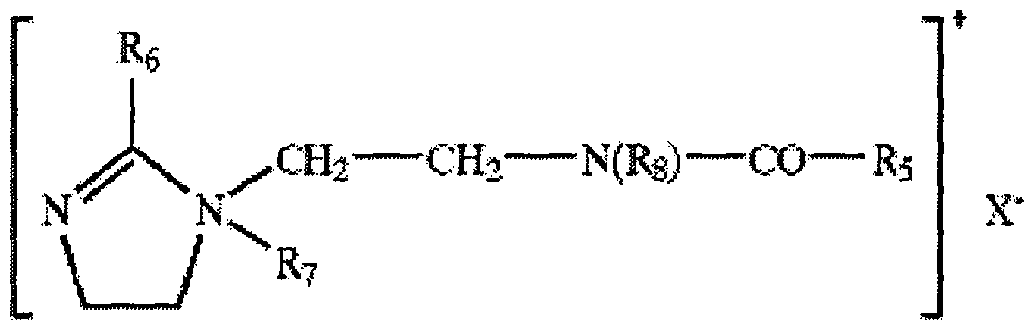
(B4)
wherein:
R5 is chosen from alkenyl and alkyl radicals including from 8 to 30 carbon atoms, for example fatty acid derivatives of tallow or of coconut;
¾ is chosen from hydrogen, C1-C4 alkyl radicals, and alkenyl and alkyl radicals including from 8 to 30 carbon atoms;
R7 is chosen from Ci-C4 alkyl radicals;
Re is chosen from hydrogen and C1-C4 alkyl radicals; and
X" is chosen from halides, phosphates, acetates, lactates, alkyl sulfates, alkyl sulfonates, and alkylaryl sulfonates. In one embodiment, R5 and ¾ are, for example, a mixture of radicals chosen from alkenyl and alkyl radicals including from 12 to 21 carbon atoms, such as fatty acid derivatives of tallow, R7 is methyl and ¾ is hydrogen. Examples of such products include, but are not limited to, Quaternium-27 (CTFA 1997) and Quaternium-83 (CTFA 1997), which are sold under the names "Rewoquat®" W75, W90, W75PG and W75HPG by the company Witco;
Di or tri quaternary ammonium salts of formula (B5):
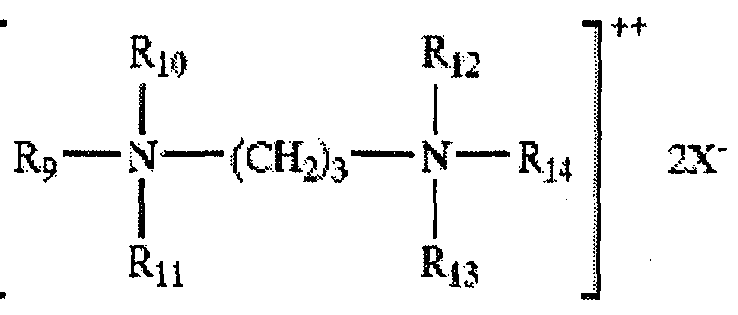
(B5)
wherein:
R.9 is chosen from aliphatic radicals including from 16 to 30 carbon atoms;
R10 is chosen from hydrogen or alkyl radicals including from 1 to 4 carbon atoms or a group
-(CH2)3 (R16a)(Rl7a)(Rl8a)N¾--;
Rn, R12, R13, R14, Ri6a, Ri7¾ and R18a, which may be identical or different, are chosen from hydrogen and alkyl radicals including from 1 to 4 carbon atoms; and
X" is chosen from halides, acetates, phosphates, nitrates, ethyl sulfates, and methyl sulfates.
An example of one such diquaternary ammonium salt is FINQUAT CT-P of
FINETEX(Quaternium-89) or FINQUAT CT (Quaternium-75);
and
quaternary ammonium salts mcluding at least one ester function, such as those of formula (B6) below:

wherein:
R22 is chosen from C\-Ce alkyl radicals and Q-Q hydroxyalkyl and dihydroxyalkyl radicals; R23 is chosen from:
the radical blow:

linear and branched, saturated and unsaturated .C22 hydrocarbon-based radicals R27, and hydrogen,
R25 is chosen from:
the radical below:
O
R 28 ^
linear and branched, saturated and unsaturated Q-C6 hydrocarbon-based radicals R29, and hydrogen,
R24, R26, and R28, which may be identical or different, are chosen from linear and branched, saturated and unsaturated, C7-C21, hydrocarbon-based radicals;
r, s, and t, which may be identical or different, are chosen from integers ranging from 2 to 6;
each of rl and tl, which may be identical or different, is 0 or 1, and r2+rl=2r and tl+2t=2t;
y is chosen from integers ranging from 1 to 10;
x and z, which may be identical or different, are chosen from integers ranging from 0 to 10;
X" is chosen from simple and complex, organic and inorganic anions; with the proviso that the sum x+y+z ranges from 1 to 15, that when x is 0, R23 denotes R27, and that when z is 0, R25 denotes R29. R22 may be chosen from linear and branched alkyl radicals. In one embodiment, R22 is chosen from linear alkyl radicals. In another embodiment, R& is chosen from methyl, ethyl, hydroxyethyl, and dihydroxypropyl radicals, for example methyl and ethyl radicals. In one embodiment, the sum x+y+z ranges from 1 to 10. When R23 is a hydrocarbon-based radical R27, it may be long and include from 12 to 22 carbon atoms, or short and include from 1 to 3 carbon atoms. When R25 is a hydrocarbon-based radical R29, it may include, for example, from 1 to 3 carbon atoms. By way of a non-limiting example, in one embodiment, R24, R26, and R28, which may be identical or different, are chosen from linear and branched, saturated and
unsaturated, Cn-C21 hydrocarbon-based radicals, for example from linear and branched, saturated and unsaturated Cn-C21 alkyl and alkenyl radicals. In another embodiment, x and z, which may be identical or different, are 0 or 1. In one embodiment, y is equal to 1. In another embodiment, r, s and t, which may be identical or different, are equal to 2 or 3, for example equal to 2. The anion X" may be chosen from, for example, halides, such as chloride, bromide, and iodide; and Q-C4 alkyl sulfates, such as methyl sulfate. However, methanesulfonate, phosphate, nitrate, tosylate, an anion derived from an organic acid, such as acetate and lactate, and any other anion that is compatible with the ammonium including an ester function, are other non-limiting examples of anions that may be used according to the invention. In one embodiment, the anion X" is chosen from chloride and methyl sulfate. In another embodiment, the ammonium salts of formula (B6) may be used, wherein:
R22 is chosen from methyl and ethyl radicals,
x and y are equal to 1;
z is equal to 0 or 1;
r, s and t are equal to 2;
R23 is chosen from:
the radical below:
O
II methyl, ethyl, and C14-C22 hydrocarbon-based radicals, hydrogen;
R25 is chosen from:
the radical below:
O
_ l l
R28 C and hydrogen;
R24, R26, and R28, which may be identical or different, are chosen from linear and branched, saturated and unsaturated, C13-C17 hydrocarbon-based radicals, for example from linear and branched, saturated and unsaturated, C13-C1 alkyl and alkenyl radicals.
In one embodiment, the hydrocarbon-based radicals are linear.
Non-limiting examples of compounds of formula (B6) that may be mentioned include salts, for example chloride and methyl sulfate, of diacyloxyemyl-dmiemylammonium, of
diacyloxyemyl-hyclroxyemyl-methylarnm- onium, of
monoacyloxyemyl-dmydroxyemyl-methylarnmonium, of triacyloxyethyl-methylammonium, of monoacyloxyemyl-hydroxyethyl-dimethyl- ammonium, and mixtures thereof. In one embodiment, the acyl radicals may include from 14 to 18 carbon atoms, and may be derived, for example, from a plant oil, for instance palm oil and sunflower oil. When the compound includes several acyl radicals, these radicals may be identical or different.
These products may be obtained, for example, by direct esterification of optionally oxyalkylenated triethanolamine, triisopropanolamine, alkyldiemanolamine or alkyldiisopropanolamine onto fatty acids or onto mixtures of fatty acids of plant or animal origin, or by transesterification of the methyl esters thereof. This esterification may be followed by a quaternization using an alkylating agent chosen from alkyl halides, for example methyl and ethyl halides; dialkyl sulfates, for example dimethyl and diethyl sulfates; methyl methanesulfonate; methyl para-toluenesulfonate; glycol chlorohydrin; and glycerol chlorohydrin.
Such compounds are sold, for example, under the names Dehyquart® by the company Cognis, Stepanquat® by the company Stepan, Noxamiurn® by the company Ceca, and "Rewoquat® WE 18" by the company Rewo-Goldschmidt. Other non-limiting examples of ammonium salts that may be used in the compositions according to the invention include the ammonium salts including at least one ester function described in U.S. Pa Nos. 4,874,554 and 4,137,180.
Among the quaternary ammonium salts mentioned above that may be used in compositions according to the invention include, but are not limited to, those corresponding to formula (I), for example tefraalkylammonium chlorides, for instance dialkyldimethylammonium and
alkyltrimethylammonium chlorides in which the alkyl radical includes from about 12 to 22 carbon atoms, such as behenyltrimemylarnmonium, distearyldimemylammonium,
cetyltrimethylammonium and benzyldimethylstearylammonium chloride;
palmitylamidopropyltrimemylanimonium chloride; and stearan idopropyldimethyl(myristyl acetate)ammonium chloride, sold under the name "Ceraphyl® 70" by the company Van Dyk.
According to one embodiment, the cationic surfactant that may be used in the compositions of the invention is chosen from behenyltrimemylarnmonium chloride, cetyltrimethylammonium chloride, Quaternium-83, Quaternium-87, Quaternium-22,
behenylamidopropyl-2,3-dmydroxypropyldimemylanimonium chloride,
palmitylarnidopropyltrimemylammonium chloride, and stearamidopropyldimethylamine.
(d-4) Nonionic Surfactants
The nonionic surfactants are compounds well known in themselves (see, e.g., in this regard, "Handbook of Surfactants" by M. R. Porter, Blackie & Son publishers (Glasgow and London), 1991, pp. 116-178). Thus, they can, for example, be chosen from alcohols, alpha-diols, alkylphenols and esters of fatty acids that are polyethoxylated, polypropoxylated or
polyglycerolated and have at least one fatty chain including, for example, from 8 to 18 carbon atoms, it being possible for the number of ethylene oxide or propylene oxide groups to range from 1 to 100, and for the number of glycerol groups to range from 1 to 30. Maltose derivatives may also be mentioned. Non-limiting mention may also be made of copolymers of ethylene oxide and/or of propylene oxide; condensates of ethylene oxide arid/or of propylene oxide with fatty alcohols; polyethoxylated fatty amides including, for example, from 1 to 30 mol of ethylene oxide; polyglycerolated fatty amides including, for example, from 1 to 5 glycerol groups, such as from 1.5 to 4; ethoxylated fatty acid esters of sorbitan including from 2 to 30 mol of ethylene oxide; ethoxylated oils from plant origin; fatty acid esters of sucrose; fatty acid esters of polyethylene glycol; fatty acid mono or diesters of glycerol; (C6-C24)alkylpolyglycosides;
N-(C6-C24)alkylglucamine derivatives, amine oxides such as (C10-C14)alkylamine oxides or N-(C1o-C14)acylaminopropylmorpholine oxides; and mixtures thereof.
The nonionic surfactants may preferably be chosen from nionooxyalkylenated or
polyoxyalkylenated, monoglycerolated or polyglycerolated nonionic surfactants. The oxyalkylene units are more particularly oxyethylene or oxypropylene units, or a combination thereof, preferably oxyethylene units.
Examples of oxyalkylenated nonionic surfactants that may be mentioned include:
oxyalkylenated (C8-C24)alkylphenols,
saturated or unsaturated, linear or branched, oxyalkylenated C8-C30 alcohols,
saturated or unsaturated, linear or branched, oxyalkylenated C8-C3o amides,
esters of saturated or unsaturated, linear or branched, C8-C30 acids and of polyethylene glycols, polyoxyalkylenated esters of saturated or unsaturated, linear or branched, C8-C30 acids and of sorbitol,
saturated or unsaturated, oxyalkylenated plant oils,
condensates of ethylene oxide and/or of propylene oxide, inter alia, alone or as mixtures.
The surfactants may contain a number of moles of ethylene oxide and/or of propylene oxide of between 1 and 100 and preferably between 2 and 50. Advantageously, the nonionic surfactants do not include any oxypropylene units.
In accordance with one preferred embodiment of the invention, the oxyalkylenated nonionic surfactants are chosen from oxyethylenated C8-C3o alcohols or ethoxylated fatty esters. Examples of ethoxylated fatty alcohols (or C8-C30 alcohols)that may be mentioned include the adducts of ethylene oxide with lauryl alcohol, especially those containing from 9 to 50
oxyethylene groups and more particularly those containing from 10 to 12 oxyethylene groups (Laureth-10 to Laureth-12, as the CTFA names); the adducts of ethylene oxide with behenyl alcohol, especially those containing from 9 to 50 oxyethylene groups (Beheneth-9 to Beheneth-50, as the CTFA names); the adducts of ethylene oxide with cetearyl alcohol (mixture of cetyl alcohol
and stearyl alcohol), especially those containing from 10 to 30 oxyethylene groups (Ceteareth-10 to Ceteareth-30, as the CTFA names); the adducts of ethylene oxide with cetyl alcohol, especially those containing from 10 to 30 oxyethylene groups (Ceteth-10 to Ceteth-30, as the CTFA names); the adducts of ethylene oxide with stearyl alcohol, especially those containing from 10 to 30 oxyethylene groups (Steareth-10 to Steareth-30, as the CTFA names); the adducts of ethylene oxide with isostearyl alcohol, especially those containing from 10 to 50 oxyethylene groups (Isosteareth-10 to Isosteareth-50, as the CTFA names); and mixtures thereof.
Examples of ethoxylated fatty esters that may be mentioned include the adducts of ethylene oxide with esters of lauric acid, palmitic acid, stearic acid or behenic acid, and mixtures thereof, especially those containing from 9 to 50 oxyethylene groups, such as PEG-9 to PEG-50 laurate (as the CTFA names: PEG-9 laurate to PEG-50 laurate); PEG-9 to PEG-50 palmitate (as the CTFA names: PEG-9 palmitate to PEG-50 palmitate); PEG-9 to PEG-50 stearate (as the CTFA names: PEG-9 stearate to PEG-50 stearate); PEG-9 to PEG-50 palmitostearate; PEG-9 to PEG-50 behenate (as the CTFA names: PEG-9 behenate to PEG-50 behenate); and mixtures thereof.
Mixtures of these oxyethylenated derivatives of fatty alcohols and of fatty esters may also be used.
According to one preferred embodiment of the invention, the cosmetic composition according to the present invention includes at least one ethoxylated fatty alcohol.
As examples of monoglycerolated or polyglycerolated nonionic surfactants, monoglycerolated or polyglycerolated C8-C4o alcohols are preferably used. In particular, the monoglycerolated or polyglycerolated C8-C40 alcohols correspond to the following formula:
RO-[CH2-CH(CH2OH)-0]m-H or RO-[CH(CH2OH)-CH20]m-H in which R represents a linear or branched C8-C40 and preferably C8-C30 alkyl or alkenyl radical, and m represents a number ranging from 1 to 30 and preferably from 1 to 10.
As examples of compounds that are suitable in the context of the invention, mention may be made of lauryl alcohol containing 4 mol of glycerol (INCI name: Polyglyceryl-4 Lauryl Ether), lauryl alcohol containing 1.5 mol of glycerol, oleyl alcohol containing 4 mol of glycerol (INCI name: Polyglyceryl-4 Oleyl Ether), oleyl alcohol containing 2 mol of glycerol (INCI name:
Polyglyceryl-2 Oleyl Ether), cetearyl alcohol containing 2 mol of glycerol, cetearyl alcohol containing 6 mol of glycerol, oleocetyl alcohol containing 6 mol of glycerol, and octadecanol containing 6 mol of glycerol.
The alcohol may represent a mixture of alcohols in the same way that the value of m represents a statistical value, which means that, in a commercial product, several species of polyglycerolated fatty alcohol may coexist in the form of a mixture.
Among the monoglycerolated or polyglycerolated alcohols, it is more particularly preferred to use the Cg/C10 alcohol containing 1 mol of glycerol, the Qo/Cn alcohol containing 1 mol of glycerol and the C12 alcohol containing 1.5 mol of glycerol. According to one embodiment of the present invention, the amount of the surfactant(s) may range from 0.1 to 20% by weight, preferably from 0.5 to 15% by weight, and more preferably from 1 to 10% by weight, relative to the total weight of the cosmetic composition according to the present invention. (e) Other Components
The cosmetic composition according to the present invention may include an aqueous medium.
The medium in the cosmetic composition according to the present invention may include water. The amount of water may be 99% by weight or less, preferably from 50 to 99% by weight, more preferably from 60 to 95% by weight, and further more preferably from 70 to 90% by weight, relative to the total weight of the composition.
The aqueous medium may further include at least one organic solvent. The organic solvent is preferably water-miscible. As the organic solvent, there may be mentioned, for example, Q-C4 alkanols, such as ethanol and isopropanol; glycerol; glycols and glycol ethers such as
2-butoxyethanol, propylene glycol, monomethyl ether of propylene glycol, monoethyl ether and monomethyl ether of diethylene glycol, and aromatic alcohols such as benzyl alcohol and phenoxyethanol, analogous products and mixtures thereof.
The organic solvents may be present in an amount ranging from 1 to 40% by weight, preferably from 1 to 30% by weight, and more preferably from 5 to 20% by weight, relative to the total weight of the composition. The form of the cosmetic composition according to the present invention is not particularly limited, and may take various forms such as an O/W emulsion, a W/O emulsion, an aqueous gel, an aqueous solution, or the like. The form of an O W emulsion is preferable.
The pH of the cosmetic composition according to the present invention is less than 8. It can range preferably from 1.5 to 7.9, more preferably 1.5 to 7, and even more preferably 2 to 4 and may be adjusted to the desired value using at least one acidifying agent that is well known in the prior art.
The acidifying agents can be, for example, mineral or organic acids, for instance hydrochloric acid, phosphoric acid, carboxylic acids, for instance tartaric acid, citric acid, lactic acid, or sulphonic acids.
The cosmetic composition according to the present invention can be prepared by mixing the above essential or optional components by using a conventional mixing means such as a mixer and a homogenizer.
(System or Kit)
The cosmetic composition according to the present invention can be prepared just before the use of the cosmetic composition.
In this case, the cosmetic composition according to the present invention may be formulated into a multi-compartment system or kit in which a first compartment includes the fatty material according to the present invention, and a second compartment includes the oxidizing agent, wherein the mixture of the compositions in the first and second compartments will be less than 8.
The multi-compartment system may be equipped with a means for mixing and/or applying the above components such as a valve and a nozzle. Thus, according to one embodiment, the multi-compartment system or kit includes, at least, a first compartment, and
a second compartment,
wherein
the first compartment includes at least one fatty material including at least one plant oil formed by at least one triglyceride derived from fatty acids and/or at least one liquid fatty acid ester other than triglyceride, and
the second compartment includes at least one oxidizing agent,
wherein
a) 50% by weight or more, relative to the total weight of the fatty acids in the triglyceride(s), of the fatty acids in the triglyceride(s) have 18 or more carbon atoms and at least one carbon-carbon double bond,
b) the fatty acid in the liquid fatty acid ester other than triglyceride has 16 or more carbon atoms and/or at least one carbon-carbon double bond, and
c) the pH of the composition obtainable by mixing the contents in the first and second
compartments is less than 8.
The cosmetic composition according to the present invention can be used, for example, in perming keratin fibers such as hair by a process including, for example, the steps of:
applying to wet or dry keratin fibers a reducing cosmetic composition including at least one reducing agent;
after an exposure time such as approximately from 5 to 40 minutes, rinsing the keratin fibers; and applying the cosmetic composition according to the present invention. After an exposure time such as from approximately 1 to 20 minutes, the fibers are rinsed; and optionally washed with shampoo, rinsed again and then dried.
The application of the cosmetic compositions may be realized at room temperature or with the use of a wanning device which is able to produce a temperature ranging from 40 to 220°C, preferably ranging from 40 to 80°C. The reducing agent is generally chosen from sulfured compounds and non-sulfured compounds.
The sulfured compounds are generally chosen from thiols, sulfites and hydrosulfites. Thiols are preferably selected from thioglycolic acid or thiolactic acid or cysteine and their salts. The non-sulfured compounds are generally chosen from phosphines, hydrides or reductones, especially ascorbic acid or erythorbic acid and their salts.
The reducing agent(s) may preferably represent(s) from 0.01 to 20% by weight, preferably from 0.1 to 15% by weight, and more preferably from 1 to 10% by weight, relative to the total weight of the reducing cosmetic composition.
The reducing cosmetic composition may include at least one alkaline agent. The alkaline agent may be an inorganic alkaline agent. It is preferable that the inorganic alkaline agent be selected from the group consisting of ammonia, alkaline metal salts; alkaline earth metal salts; alkaline metal hydroxides; and alkaline earth metal hydroxides.
As examples of the inorganic alkaline metal hydroxides, mention may be made of sodium hydroxide and potassium hydroxide. As examples of the alkaline earth metal hydroxides, mention may be made of calcium hydroxide and magnesium hydroxide. Sodium hydroxide is preferable.
The alkaline agent may be an organic alkaline agent. It is preferable that the organic alkaline agent be selected from the group consisting of monoamines and derivatives thereof; diamines and derivatives thereof; polyamines and derivatives thereof; basic amino acids and derivatives thereof; oligomers of basic amino acids and derivatives thereof; polymers of basic amino acids and derivatives thereof; urea and derivatives thereof; and guanidine and derivatives thereof.
As examples of the organic alkaline agents, mention may be made of alkanolamines such as mono-, di- and tri-emanolamine, and isopropanolamine; urea, guanidine and their derivatives; basic amino acids such as lysine or arginine; and diamines such as those described in the structure below:

wherein W denotes an alkylene such as propylene optionally substituted by a hydroxyl or a C1-C4 alkyl radical, and Ra, ¾, Rc and ¾ independently denote a hydrogen atom, an alkyl radical or a C1-C4 hydroxyalkyl radical, which may be exemplified by 1 ,3-propanediarnine and derivatives thereof. Arginine, urea and monoe&anolamine are preferable.
According to one embodiment, the alkaline agent is an alkanolamine and preferably
monoethanolamine.
The alkaline agent may be used in a total amount of from 0.1 to 20% by weight, preferably from 1 to 15% by weight, more preferably from 3 to 10% by weight, relative to the total weight of the reducing cosmetic composition. The cosmetic composition according to present the invention may also be used as an oxidative composition for dyeing keratin fibers such as hair, especially when using oxidative hair dyes such as primary intermediates and coupling agents.
In a preferred embodiement, the composition according the invention is used for perming hair.
EXAMPLE
The present invention will be described in more detail by way of examples, which however should not be construed as limiting the scope of the present invention.
The following composition with the formulation shown in Table 1 was prepared (active ingredients in wt%) as a reducing lotion.
Table 1

[Compositions 1 to 3]
Compositions 1 to 3 with the formulation shown in Table 2 were prepared (active ingredients in wt%) as an oxidizing lotion, i.e., the first part or PART A, of a 2 Part-Neutralizer.
Table 2 (PART A: Oxidizing Lotion)

Compositions 4 and 5 with the formulation shown in Table 3 were prepared (active ingredients in wt%) as an emulsion, i.e., the second part or PART B, of a 2 Part-Neutralizer.
Table 3 (PART B: Emulsion)

[Compositions 6 to 9] Compositions 6 to 9 with the formulation shown in Table 4 were prepared (active ingredients in wt%) as an emulsion, i.e., the second part or PART B, of a 2 Part-Neutralizer.
Table 4 (PART B: Emulsion)

80g of the above reducing lotion was applied to the hair of a tester which had been moistened beforehand and wound on a curler. After leaving the reducing lotion to act for about 15 minutes, the hair was rinsed thoroughly with water.
Then, the hair was oxidized as follows.
Each of Compositions 1 and 2 was mixed with water in a weight ratio of 90: 10 as shown in Table 5 to prepare an oxidizing agent for Comparative Examples 4 and 5.
On the other hand, the compositions in PART A and PART B were mixed in a weight ratio of 90:10 as shown in Table 5 to prepare emulsified oxidizing agents for Examples 1 to 4 and Comparative Examples 1 to 3. The mixing was very easy, and the oxidizing agents according to Examples 1 to 4 were obtained very quickly.
The oxidized agent for Comparative Example 5 as a control was applied to the half of the hair, and each of the oxidized agents for Examples 1 to 4 and Comparative Examples 1 to 4 was applied to the other half of the hair. The application of the oxidized agents for Examples 1 to 4 was easy. The oxidizing agents were left to stand on the hair for 5 minutes. Then, the hair was rinsed thoroughly and dried. The rinse of the hair oxidized with the oxidizing agents as Examples 1 to 4 was easy.
After drying the hair, the tester evaluated the hair in terms of wave intensity, elasticity, smoothness, and suppleness of the hair, based on the following evaluation standards by the tester.
(Evaluation Standards)
Wave intensity
+: Better wave efficiency
-: Less wave efficiency
±: Neither
Elasticity
+: Better elasticity
-: Less elasticity
±: Neither
Smoothness +: Better smoothness
-: Less smoothness
±: Neither
Suppleness
+: Better suppleness
-: Less suppleness
±: Neither The above test was performed for 5 testers, and the evaluation results were averaged. The averaged results are given in Table 5.
Table 5

Compositions 10 and 11 with the formulation shown in Table 6 were prepared (active ingredients in wt%) as an oxidizing lotion, i.e., the first part or PART A, of a 2 Part-Neutralizer.
Table 6 (PART A: Oxidizing Lotion)

[Evaluation 2]
80 g of the above reducing lotion was applied to the hair of a tester which had been moistened beforehand and wound on a curler. After leaving the reducing lotion to act for about 15 minutes, the hair was rinsed thoroughly with water.
Then, the hair was oxidized as follows.
Each of Compositions 10 and 11 was mixed with water in a weight ratio of 90:10 as shown in Table 7 to prepare an oxidizing agent for Comparative Examples 7 and 8.
On the other hand, the compositions in PART A and PART B were mixed in a weight ratio of 90:10 as shown in Table 7 to prepare an emulsified oxidizing agent for Example 5 and an oxidizing agent for Comparative Example 6. The mixing was very easy, and the oxidizing agent according to Example 5 was obtained very quickly.
The oxidized agent for Comparative Example 8 as a control was applied to the half of the hair, and each of the oxidized agents for Example 5 and Comparative Examples 6 and 7 was applied to the other half of the hair. The application of the oxidized agent for Example 5 was easy. The oxidizing agents were left to stand on the hair for 5 minutes. Then, the hair was rinsed thoroughly and dried. The rinse of the hair oxidized with the oxidizing agent as Example 5 was easy.
After drying the hair, the tester evaluated the hair in terms of wave intensity, elasticity, smoothness, and suppleness of the hair, based on the same evaluation standards shown as in
[Evaluation 1] by the tester.
The above test was performed for 5 testers, and the evaluation results were averaged. The averaged results are given in Table 7.
Table 7

Claims
A cosmetic composition for keratin fibers, comprising:
at least one fatty material including (i) at least one plant oil formed by at least one triglyceride derived from fatty acids, and/or (ii) at least one liquid fatty acid ester other than triglyceride; and
at least one oxidizing agent,
wherein
a) 50% by weight or more, relative to the total weight of the fatty acids in the
triglycerides, of the fatty acids in the triglycerides have 18 or more carbon atoms and at least one carbon-carbon double bond;
b) the fatty acid in the liquid fatty acid ester other than triglyceride has 16 or more
carbon atoms and/or at least one carbon-carbon double bond; and
c) the pH of the composition is less than 8.
The cosmetic composition according to Claim 1, wherein from 50% to 100% by weight, preferably from 60% to 90% by weight, relative to the total weight of the fatty acids in the triglyceride(s), of the fatty acids in the triglyceride(s) have 18 or more carbon atoms and at least one carbon-carbon double bond.
The cosmetic composition according to Claim 1 or 2, wherein the fatty material comprises at least one plant oil.
The cosmetic composition according to any one of Claims 1 to 3, wherein the plant oil is selected from the group consisting of olive oil, camellia oil, cameline oil, rape oil, coriander oil, jojoba oil, apricot oil, meadowfoam oil, sunflower oil, maize oil, cottonseed oil, borage oil, sesame oil, sawflower oil, pracaxi oil, argan oil, and almond oil.
The cosmetic composition according to any one of Claims 1 to 4, wherein the plant oil is selected from the group consisting of olive oil, camellia oil, coriander oil, jojoba oil, apricot oil, meadowform oil, pracaxi oil and almond oil.
The cosmetic composition according to any one of Claims 1 to 5, wherein the plant oil is olive oil or jojoba oil.
The cosmetic composition according to any one of Claims 1 to 6, wherein the liquid fatty acid ester other than triglyceride is selected from the group consisting of linoleyl lactate; oleyl lactate; decyl oleate;isocetyl isostearate; isostearyl palmitate; octyldodecyl erucate; oleyl erucate; ethyl, cetyl, and isopropyl palmitates; 2-ethylhexyl palmitate; and
2-octyldecyl palmitate.
The cosmetic composition according to any one of Claims 1 to 7, wherein the amount of the plant oil (s) and/or liquid fatty acid ester(s) other than triglyceride is from 0.01% to 10% by weight, preferably from 0.05% to 5% by weight, and more preferably from 0.1% to 1% by weight relative to the total weight of the composition.
9. The cosmetic composition according to any one of Claims 1 to 8, wherein the fatty material comprises at least one additional fatty compound, preferably chosen among other esters, aliphatic hydrocarbons, animal oils, silicone oils, fatty alcohols, polymer waxes, and mixtures thereof.
10. The cosmetic composition according to any one of Claims 1 to 9, wherein the total amount of the fatty material(s) is from 0.01 % to 25% by weight, preferably from 0.05% to 15% by weight, and more preferably from 0.1% to 10% by weight relative to the total weight of the composition.
11. The cosmetic composition according to any one of Claims 1 to 10, wherein the oxidizing agent is hydrogen peroxide or bromate, preferably hydrogen peroxide.
12. The cosmetic composition according to any one of Claims 1 to 11, wherein the amount of the oxidizing agent(s) is from 0.1% to 15% by weight, preferably from 0.5% to 10% by weight, and more preferably from 1% to 5% by weight, relative to the total weight of the composition.
13. The cosmetic composition according to any one of Claims 1 to 12, further comprising at least one cationic polymer and/or a least one surfactant.
14. The cosmetic composition according to any one of Claims 1 to 13, having a pH range from 1.5 to 7.9, preferably from 1.5 to 7, and even more preferably from 2 to 4.
15. A process for perming keratin fibers, preferably hair, characterized by using the cosmetic composition according to any one of Claims 1 to 14.
16. A multi-compartment system or kit comprising, at least,
a first compartment, and
a second compartment,
wherein
the first compartment includes at least one fatty material including (i) at least one plant oil formed by at least one triglyceride derived from fatty acids, and/or (ii) at least one liquid fatty acid ester other than triglyceride, and
the second compartment includes at least one oxidizing agent, and
wherein
a) 50% by weight or more, relative to the total weight of the fatty acids in the
triglyceride(s), of the fatty acids in the triglyceride(s) have 18 or more carbon atoms and at least one carbon-carbon double bond;
b) the fatty acid in the liquid fatty acid ester other than triglyceride and has 16 or more carbon atoms and/or at least one carbon-carbon double bond; and
c) the pH of the composition obtainable by mixing the contents in the first and second compartments is less than 8.
Priority Applications (3)
| Application Number | Priority Date | Filing Date | Title |
|---|---|---|---|
| CN201280075266.1A CN104519862A (en) | 2012-06-29 | 2012-06-29 | Cosmetic composition for keratin fibers |
| JP2014561644A JP6257535B2 (en) | 2012-06-29 | 2012-06-29 | Cosmetic composition for keratin fibers |
| PCT/JP2012/067247 WO2014002290A1 (en) | 2012-06-29 | 2012-06-29 | Cosmetic composition for keratin fibers |
Applications Claiming Priority (1)
| Application Number | Priority Date | Filing Date | Title |
|---|---|---|---|
| PCT/JP2012/067247 WO2014002290A1 (en) | 2012-06-29 | 2012-06-29 | Cosmetic composition for keratin fibers |
Publications (1)
| Publication Number | Publication Date |
|---|---|
| WO2014002290A1 true WO2014002290A1 (en) | 2014-01-03 |
Family
ID=46551827
Family Applications (1)
| Application Number | Title | Priority Date | Filing Date |
|---|---|---|---|
| PCT/JP2012/067247 Ceased WO2014002290A1 (en) | 2012-06-29 | 2012-06-29 | Cosmetic composition for keratin fibers |
Country Status (3)
| Country | Link |
|---|---|
| JP (1) | JP6257535B2 (en) |
| CN (1) | CN104519862A (en) |
| WO (1) | WO2014002290A1 (en) |
Cited By (1)
| Publication number | Priority date | Publication date | Assignee | Title |
|---|---|---|---|---|
| CN108208194A (en) * | 2016-12-09 | 2018-06-29 | 嘉里特种油脂(上海)有限公司 | A kind of impervious fluid composition |
Families Citing this family (4)
| Publication number | Priority date | Publication date | Assignee | Title |
|---|---|---|---|---|
| CN105213223A (en) * | 2015-06-30 | 2016-01-06 | 朱耀灯 | A kind of Oleum Camelliae elastin and preparation method thereof |
| CN114667129B (en) * | 2019-09-25 | 2023-10-20 | 莱雅公司 | Kit for caring for keratin materials |
| DE102019218236A1 (en) * | 2019-11-26 | 2021-05-27 | Henkel Ag & Co. Kgaa | Process for improving the feel of colored keratinic material, in particular human hair |
| CN116600780A (en) * | 2020-12-01 | 2023-08-15 | 莱雅公司 | Compositions for keratin fibers |
Citations (62)
| Publication number | Priority date | Publication date | Assignee | Title |
|---|---|---|---|---|
| US2261002A (en) | 1941-06-17 | 1941-10-28 | Du Pont | Organic nitrogen compounds |
| US2271378A (en) | 1939-08-30 | 1942-01-27 | Du Pont | Pest control |
| US2273780A (en) | 1939-12-30 | 1942-02-17 | Du Pont | Wax acryalte ester blends |
| US2375853A (en) | 1942-10-07 | 1945-05-15 | Du Pont | Diamine derivatives |
| US2388614A (en) | 1942-05-05 | 1945-11-06 | Du Pont | Disinfectant compositions |
| US2454547A (en) | 1946-10-15 | 1948-11-23 | Rohm & Haas | Polymeric quaternary ammonium salts |
| US2528378A (en) | 1947-09-20 | 1950-10-31 | John J Mccabe Jr | Metal salts of substituted quaternary hydroxy cycloimidinic acid metal alcoholates and process for preparation of same |
| US2781354A (en) | 1956-03-26 | 1957-02-12 | John J Mccabe Jr | Imidazoline derivatives and process |
| US2961347A (en) | 1957-11-13 | 1960-11-22 | Hercules Powder Co Ltd | Process for preventing shrinkage and felting of wool |
| US3206462A (en) | 1962-10-31 | 1965-09-14 | Dow Chemical Co | Quaternary poly(oxyalkylene)alkylbis(diethylenetriamine) compounds |
| US3227615A (en) | 1962-05-29 | 1966-01-04 | Hercules Powder Co Ltd | Process and composition for the permanent waving of hair |
| FR1492597A (en) | 1965-09-14 | 1967-08-18 | Union Carbide Corp | New cellulose ethers containing quaternary nitrogen |
| FR1583363A (en) | 1967-09-28 | 1969-10-24 | ||
| US3589578A (en) | 1968-01-20 | 1971-06-29 | Monforts Fa A | Tension-relieving device for stretchable sheet material |
| FR2077143A5 (en) | 1970-01-30 | 1971-10-15 | Gaf Corp | |
| FR2080759A1 (en) | 1970-02-25 | 1971-11-19 | Gillette Co | |
| FR2162025A1 (en) | 1971-11-29 | 1973-07-13 | Oreal | |
| US3874870A (en) | 1973-12-18 | 1975-04-01 | Mill Master Onyx Corp | Microbiocidal polymeric quarternary ammonium compounds |
| FR2252840A1 (en) | 1973-11-30 | 1975-06-27 | Oreal | |
| FR2270846A1 (en) | 1974-05-16 | 1975-12-12 | Oreal | |
| US3929990A (en) | 1973-12-18 | 1975-12-30 | Millmaster Onyx Corp | Microbiocidal polymeric quaternary ammonium compounds |
| FR2280361A2 (en) | 1974-08-02 | 1976-02-27 | Oreal | HAIR TREATMENT AND CONDITIONING COMPOSITIONS |
| US3966904A (en) | 1974-10-03 | 1976-06-29 | Millmaster Onyx Corporation | Quaternary ammonium co-polymers for controlling the proliferation of bacteria |
| US4001432A (en) | 1974-10-29 | 1977-01-04 | Millmaster Onyx Corporation | Method of inhibiting the growth of bacteria by the application thereto of capped polymers |
| US4005193A (en) | 1974-08-07 | 1977-01-25 | Millmaster Onyx Corporation | Microbiocidal polymeric quaternary ammonium compounds |
| FR2316271A1 (en) | 1975-07-04 | 1977-01-28 | Oreal | NEW QUATERNIZED POLYMERS, THEIR PREPARATION PROCESS, AND THEIR APPLICATION |
| FR2320330A1 (en) | 1974-01-25 | 1977-03-04 | Calgon Corp | COMPOSITION OF FUNCTIONAL IONEN POLYMERS AND THEIR USE |
| US4025653A (en) | 1975-04-07 | 1977-05-24 | Millmaster Onyx Corporation | Microbiocidal polymeric quaternary ammonium compounds |
| US4025617A (en) | 1974-10-03 | 1977-05-24 | Millmaster Onyx Corporation | Anti-microbial quaternary ammonium co-polymers |
| US4025627A (en) | 1973-12-18 | 1977-05-24 | Millmaster Onyx Corporation | Microbiocidal polymeric quaternary ammonium compounds |
| US4027020A (en) | 1974-10-29 | 1977-05-31 | Millmaster Onyx Corporation | Randomly terminated capped polymers |
| US4026945A (en) | 1974-10-03 | 1977-05-31 | Millmaster Onyx Corporation | Anti-microbial quaternary ammonium co-polymers |
| US4031307A (en) | 1976-05-03 | 1977-06-21 | Celanese Corporation | Cationic polygalactomannan compositions |
| FR2336434A1 (en) | 1975-12-23 | 1977-07-22 | Ciba Geigy Ag | QUATERNARY POLYMERIC AMMONIUM SALTS, THEIR PREPARATION PROCESS AND THEIR USE |
| FR2368508A2 (en) | 1977-03-02 | 1978-05-19 | Oreal | HAIR CONDITIONING COMPOSITION |
| FR2383660A1 (en) | 1977-03-15 | 1978-10-13 | Oreal | COMPOSITION AND PROCESS FOR TREATMENT OF KERATINIC MATERIALS WITH CATIONIC AND ANIONIC POLYMERS |
| US4131576A (en) | 1977-12-15 | 1978-12-26 | National Starch And Chemical Corporation | Process for the preparation of graft copolymers of a water soluble monomer and polysaccharide employing a two-phase reaction system |
| FR2393573A1 (en) | 1977-06-10 | 1979-01-05 | Gaf Corp | HAIR PREPARATIONS CONTAINING A VINYLPYRROLIDONE COPOLYMER |
| US4137180A (en) | 1976-07-02 | 1979-01-30 | Lever Brothers Company | Fabric treatment materials |
| JPS5428833A (en) | 1977-08-03 | 1979-03-03 | Kashiwa Kagaku Kogyo Kk | Oxidizing agent for hair dyeing agent |
| US4157388A (en) | 1977-06-23 | 1979-06-05 | The Miranol Chemical Company, Inc. | Hair and fabric conditioning compositions containing polymeric ionenes |
| FR2413907A1 (en) | 1977-09-20 | 1979-08-03 | Oreal | COSMETIC COMPOSITIONS BASED ON QUATERNARY POLYAMMONIUM POLYMERS |
| FR2470596A1 (en) | 1979-11-28 | 1981-06-12 | Oreal | COMPOSITION FOR THE TREATMENT OF KERATIN FIBERS BASED ON AMPHOTERIC POLYMERS AND CATIONIC POLYMERS |
| FR2505348A1 (en) | 1981-05-08 | 1982-11-12 | Oreal | COMPOSITION IN THE FORM OF AEROSOL FOAM BASED ON CATIONIC POLYMER AND ANIONIC POLYMER |
| EP0080976A1 (en) | 1981-11-30 | 1983-06-08 | Ciba-Geigy Ag | Mixtures of quaternary polymeric acrylic ammonium salts, quaternary mono- or oligomeric ammonium salts and surfactants, their preparation and their use in cosmetic compositions |
| FR2519863A1 (en) | 1982-01-15 | 1983-07-22 | Oreal | COSMETIC COMPOSITION FOR THE TREATMENT OF KERATIN FIBERS AND METHOD FOR THE TREATMENT THEREOF |
| FR2542997A1 (en) | 1983-03-23 | 1984-09-28 | Oreal | A THICKENED OR GELIFIED HAIR CONDITIONING COMPOSITION CONTAINING AT LEAST ONE CATIONIC POLYMER, AT LEAST ONE ANIONIC POLYMER AND AT LEAST ONE XANTHAN GUM |
| EP0122324A1 (en) | 1983-04-15 | 1984-10-24 | Miranol Inc. | Polyquaternary ammonium compounds and cosmetic compositions containing them |
| US4702906A (en) | 1979-12-21 | 1987-10-27 | Societe Anonyme Dite: L'oreal | Cosmetic agents based on polycationic polymers, and their use in cosmetic compositions |
| FR2598611A1 (en) | 1986-05-16 | 1987-11-20 | Oreal | COSMETIC COMPOSITIONS CONTAINING A CATIONIC POLYMER AND AN ANIONIC POLYMER AS A THICKENING AGENT |
| US4719282A (en) | 1986-04-22 | 1988-01-12 | Miranol Inc. | Polycationic block copolymer |
| US4874554A (en) | 1986-07-10 | 1989-10-17 | Henkel Kommanditgesellschaft Auf Aktien | Quaternary ammonium compounds |
| EP0337354A1 (en) | 1988-04-12 | 1989-10-18 | Kao Corporation | Low-irritation detergent composition |
| JPH0748229A (en) * | 1993-08-05 | 1995-02-21 | Seresu Kosume Plan:Kk | Set of cosmetics for growing and raising hair |
| DE19610459C1 (en) * | 1996-03-16 | 1997-07-10 | Wella Ag | Natural wax mixtures for skin or hair cosmetic products |
| US6165453A (en) * | 1995-09-09 | 2000-12-26 | Wella Aktiengesellschaft | Hair care and conditioning preparation and its use |
| KR20010054050A (en) * | 1999-12-03 | 2001-07-02 | 오현자 | Clinic cream helping damaged hair and hair skin |
| US20030118516A1 (en) * | 2001-08-24 | 2003-06-26 | Winfried Emmerling | Aerosol spray |
| WO2005011625A1 (en) * | 2003-07-29 | 2005-02-10 | Beebong Fine Co., Ltd. | The composition of permanent wave and straightner which contains the beads |
| WO2005072689A1 (en) * | 2004-01-29 | 2005-08-11 | Avlon Industries, Inc. | Conditioning hair lightener system, compositions, method and kit therefor |
| US20100203003A1 (en) * | 2009-01-30 | 2010-08-12 | Kokyu Alcohol Kogyo Co., Ltd. | Oily Hair Cosmetics |
| EP2417965A1 (en) * | 2010-12-28 | 2012-02-15 | KPSS-Kao Professional Salon Services GmbH | Hair colouring composition |
Family Cites Families (14)
| Publication number | Priority date | Publication date | Assignee | Title |
|---|---|---|---|---|
| JPH0920627A (en) * | 1995-06-30 | 1997-01-21 | Shiseido Co Ltd | Oxidative hair dye composition |
| WO1997009028A1 (en) * | 1995-09-09 | 1997-03-13 | Wella Aktiengesellschaft | Hair care and conditioning preparation and its use |
| JP3195557B2 (en) * | 1996-03-16 | 2001-08-06 | ウエラ アクチェンゲゼルシャフト | Mixed wax and cosmetics containing it |
| US5843193A (en) * | 1997-03-18 | 1998-12-01 | Revlon Consumer Products Corporation | Hair dye compositions and process |
| JP3916198B2 (en) * | 1999-05-06 | 2007-05-16 | ホーユー株式会社 | Perm first agent composition |
| JP2001220326A (en) * | 2001-03-29 | 2001-08-14 | Sanei Kagaku Kk | Composition for formulating hair treatment preparation and hair treatment preparation |
| JP4205602B2 (en) * | 2004-02-02 | 2009-01-07 | ポーラ化成工業株式会社 | Two-part hair dye |
| JP2006143616A (en) * | 2004-11-17 | 2006-06-08 | Sanei Kagaku Kk | Hair treatment composition |
| JP2006241047A (en) * | 2005-03-02 | 2006-09-14 | Shinya Miyazaki | Additive composition for permanent wave agent |
| JP4999411B2 (en) * | 2006-09-19 | 2012-08-15 | 株式会社マンダム | Oxidative hair dye composition |
| JP4999410B2 (en) * | 2006-09-19 | 2012-08-15 | 株式会社マンダム | Oxidative hair dye composition |
| JP2011518889A (en) * | 2008-04-29 | 2011-06-30 | ヘアー システムズ インコーポレイティッド | Composition and method for cream bleach products |
| EP2198843B1 (en) * | 2008-12-19 | 2017-09-13 | L'Oréal | Lightening of human keratinic fibers with a anhydrous composition comprising a mixture of monoethanolamine/basic amine acid and kit |
| JP5561580B2 (en) * | 2009-08-28 | 2014-07-30 | 山栄化学株式会社 | Hair cosmetic containing high erucic acid rapeseed oil |
-
2012
- 2012-06-29 WO PCT/JP2012/067247 patent/WO2014002290A1/en not_active Ceased
- 2012-06-29 JP JP2014561644A patent/JP6257535B2/en not_active Expired - Fee Related
- 2012-06-29 CN CN201280075266.1A patent/CN104519862A/en active Pending
Patent Citations (62)
| Publication number | Priority date | Publication date | Assignee | Title |
|---|---|---|---|---|
| US2271378A (en) | 1939-08-30 | 1942-01-27 | Du Pont | Pest control |
| US2273780A (en) | 1939-12-30 | 1942-02-17 | Du Pont | Wax acryalte ester blends |
| US2261002A (en) | 1941-06-17 | 1941-10-28 | Du Pont | Organic nitrogen compounds |
| US2388614A (en) | 1942-05-05 | 1945-11-06 | Du Pont | Disinfectant compositions |
| US2375853A (en) | 1942-10-07 | 1945-05-15 | Du Pont | Diamine derivatives |
| US2454547A (en) | 1946-10-15 | 1948-11-23 | Rohm & Haas | Polymeric quaternary ammonium salts |
| US2528378A (en) | 1947-09-20 | 1950-10-31 | John J Mccabe Jr | Metal salts of substituted quaternary hydroxy cycloimidinic acid metal alcoholates and process for preparation of same |
| US2781354A (en) | 1956-03-26 | 1957-02-12 | John J Mccabe Jr | Imidazoline derivatives and process |
| US2961347A (en) | 1957-11-13 | 1960-11-22 | Hercules Powder Co Ltd | Process for preventing shrinkage and felting of wool |
| US3227615A (en) | 1962-05-29 | 1966-01-04 | Hercules Powder Co Ltd | Process and composition for the permanent waving of hair |
| US3206462A (en) | 1962-10-31 | 1965-09-14 | Dow Chemical Co | Quaternary poly(oxyalkylene)alkylbis(diethylenetriamine) compounds |
| FR1492597A (en) | 1965-09-14 | 1967-08-18 | Union Carbide Corp | New cellulose ethers containing quaternary nitrogen |
| FR1583363A (en) | 1967-09-28 | 1969-10-24 | ||
| US3589578A (en) | 1968-01-20 | 1971-06-29 | Monforts Fa A | Tension-relieving device for stretchable sheet material |
| FR2077143A5 (en) | 1970-01-30 | 1971-10-15 | Gaf Corp | |
| FR2080759A1 (en) | 1970-02-25 | 1971-11-19 | Gillette Co | |
| FR2162025A1 (en) | 1971-11-29 | 1973-07-13 | Oreal | |
| FR2252840A1 (en) | 1973-11-30 | 1975-06-27 | Oreal | |
| US3874870A (en) | 1973-12-18 | 1975-04-01 | Mill Master Onyx Corp | Microbiocidal polymeric quarternary ammonium compounds |
| US3929990A (en) | 1973-12-18 | 1975-12-30 | Millmaster Onyx Corp | Microbiocidal polymeric quaternary ammonium compounds |
| US4025627A (en) | 1973-12-18 | 1977-05-24 | Millmaster Onyx Corporation | Microbiocidal polymeric quaternary ammonium compounds |
| FR2320330A1 (en) | 1974-01-25 | 1977-03-04 | Calgon Corp | COMPOSITION OF FUNCTIONAL IONEN POLYMERS AND THEIR USE |
| FR2270846A1 (en) | 1974-05-16 | 1975-12-12 | Oreal | |
| FR2280361A2 (en) | 1974-08-02 | 1976-02-27 | Oreal | HAIR TREATMENT AND CONDITIONING COMPOSITIONS |
| US4005193A (en) | 1974-08-07 | 1977-01-25 | Millmaster Onyx Corporation | Microbiocidal polymeric quaternary ammonium compounds |
| US4026945A (en) | 1974-10-03 | 1977-05-31 | Millmaster Onyx Corporation | Anti-microbial quaternary ammonium co-polymers |
| US4025617A (en) | 1974-10-03 | 1977-05-24 | Millmaster Onyx Corporation | Anti-microbial quaternary ammonium co-polymers |
| US3966904A (en) | 1974-10-03 | 1976-06-29 | Millmaster Onyx Corporation | Quaternary ammonium co-polymers for controlling the proliferation of bacteria |
| US4001432A (en) | 1974-10-29 | 1977-01-04 | Millmaster Onyx Corporation | Method of inhibiting the growth of bacteria by the application thereto of capped polymers |
| US4027020A (en) | 1974-10-29 | 1977-05-31 | Millmaster Onyx Corporation | Randomly terminated capped polymers |
| US4025653A (en) | 1975-04-07 | 1977-05-24 | Millmaster Onyx Corporation | Microbiocidal polymeric quaternary ammonium compounds |
| FR2316271A1 (en) | 1975-07-04 | 1977-01-28 | Oreal | NEW QUATERNIZED POLYMERS, THEIR PREPARATION PROCESS, AND THEIR APPLICATION |
| FR2336434A1 (en) | 1975-12-23 | 1977-07-22 | Ciba Geigy Ag | QUATERNARY POLYMERIC AMMONIUM SALTS, THEIR PREPARATION PROCESS AND THEIR USE |
| US4031307A (en) | 1976-05-03 | 1977-06-21 | Celanese Corporation | Cationic polygalactomannan compositions |
| US4137180A (en) | 1976-07-02 | 1979-01-30 | Lever Brothers Company | Fabric treatment materials |
| FR2368508A2 (en) | 1977-03-02 | 1978-05-19 | Oreal | HAIR CONDITIONING COMPOSITION |
| FR2383660A1 (en) | 1977-03-15 | 1978-10-13 | Oreal | COMPOSITION AND PROCESS FOR TREATMENT OF KERATINIC MATERIALS WITH CATIONIC AND ANIONIC POLYMERS |
| FR2393573A1 (en) | 1977-06-10 | 1979-01-05 | Gaf Corp | HAIR PREPARATIONS CONTAINING A VINYLPYRROLIDONE COPOLYMER |
| US4157388A (en) | 1977-06-23 | 1979-06-05 | The Miranol Chemical Company, Inc. | Hair and fabric conditioning compositions containing polymeric ionenes |
| JPS5428833A (en) | 1977-08-03 | 1979-03-03 | Kashiwa Kagaku Kogyo Kk | Oxidizing agent for hair dyeing agent |
| FR2413907A1 (en) | 1977-09-20 | 1979-08-03 | Oreal | COSMETIC COMPOSITIONS BASED ON QUATERNARY POLYAMMONIUM POLYMERS |
| US4131576A (en) | 1977-12-15 | 1978-12-26 | National Starch And Chemical Corporation | Process for the preparation of graft copolymers of a water soluble monomer and polysaccharide employing a two-phase reaction system |
| FR2470596A1 (en) | 1979-11-28 | 1981-06-12 | Oreal | COMPOSITION FOR THE TREATMENT OF KERATIN FIBERS BASED ON AMPHOTERIC POLYMERS AND CATIONIC POLYMERS |
| US4702906A (en) | 1979-12-21 | 1987-10-27 | Societe Anonyme Dite: L'oreal | Cosmetic agents based on polycationic polymers, and their use in cosmetic compositions |
| FR2505348A1 (en) | 1981-05-08 | 1982-11-12 | Oreal | COMPOSITION IN THE FORM OF AEROSOL FOAM BASED ON CATIONIC POLYMER AND ANIONIC POLYMER |
| EP0080976A1 (en) | 1981-11-30 | 1983-06-08 | Ciba-Geigy Ag | Mixtures of quaternary polymeric acrylic ammonium salts, quaternary mono- or oligomeric ammonium salts and surfactants, their preparation and their use in cosmetic compositions |
| FR2519863A1 (en) | 1982-01-15 | 1983-07-22 | Oreal | COSMETIC COMPOSITION FOR THE TREATMENT OF KERATIN FIBERS AND METHOD FOR THE TREATMENT THEREOF |
| FR2542997A1 (en) | 1983-03-23 | 1984-09-28 | Oreal | A THICKENED OR GELIFIED HAIR CONDITIONING COMPOSITION CONTAINING AT LEAST ONE CATIONIC POLYMER, AT LEAST ONE ANIONIC POLYMER AND AT LEAST ONE XANTHAN GUM |
| EP0122324A1 (en) | 1983-04-15 | 1984-10-24 | Miranol Inc. | Polyquaternary ammonium compounds and cosmetic compositions containing them |
| US4719282A (en) | 1986-04-22 | 1988-01-12 | Miranol Inc. | Polycationic block copolymer |
| FR2598611A1 (en) | 1986-05-16 | 1987-11-20 | Oreal | COSMETIC COMPOSITIONS CONTAINING A CATIONIC POLYMER AND AN ANIONIC POLYMER AS A THICKENING AGENT |
| US4874554A (en) | 1986-07-10 | 1989-10-17 | Henkel Kommanditgesellschaft Auf Aktien | Quaternary ammonium compounds |
| EP0337354A1 (en) | 1988-04-12 | 1989-10-18 | Kao Corporation | Low-irritation detergent composition |
| JPH0748229A (en) * | 1993-08-05 | 1995-02-21 | Seresu Kosume Plan:Kk | Set of cosmetics for growing and raising hair |
| US6165453A (en) * | 1995-09-09 | 2000-12-26 | Wella Aktiengesellschaft | Hair care and conditioning preparation and its use |
| DE19610459C1 (en) * | 1996-03-16 | 1997-07-10 | Wella Ag | Natural wax mixtures for skin or hair cosmetic products |
| KR20010054050A (en) * | 1999-12-03 | 2001-07-02 | 오현자 | Clinic cream helping damaged hair and hair skin |
| US20030118516A1 (en) * | 2001-08-24 | 2003-06-26 | Winfried Emmerling | Aerosol spray |
| WO2005011625A1 (en) * | 2003-07-29 | 2005-02-10 | Beebong Fine Co., Ltd. | The composition of permanent wave and straightner which contains the beads |
| WO2005072689A1 (en) * | 2004-01-29 | 2005-08-11 | Avlon Industries, Inc. | Conditioning hair lightener system, compositions, method and kit therefor |
| US20100203003A1 (en) * | 2009-01-30 | 2010-08-12 | Kokyu Alcohol Kogyo Co., Ltd. | Oily Hair Cosmetics |
| EP2417965A1 (en) * | 2010-12-28 | 2012-02-15 | KPSS-Kao Professional Salon Services GmbH | Hair colouring composition |
Non-Patent Citations (8)
| Title |
|---|
| "CTFA dictionary", 1982 |
| "CTFA dictionary", 1993 |
| "CTFA dictionary", 2002 |
| DATABASE WPI Week 197915, Derwent World Patents Index; AN 1979-28587B, XP002693758 * |
| DATABASE WPI Week 199517, Derwent World Patents Index; AN 1995-126083, XP002693759 * |
| DATABASE WPI Week 200207, Derwent World Patents Index; AN 2002-053632, XP002694023 * |
| KARMAKAR A ET AL: "Properties of various plants and animals feedstocks for biodiesel production", BIORESOURCE TECHNOLOGY, ELSEVIER BV, GB, vol. 101, no. 19, 1 October 2010 (2010-10-01), pages 7201 - 7210, XP027089354, ISSN: 0960-8524, [retrieved on 20100520] * |
| M. R. PORTER: "Handbook of Surfactants", 1991, BLACKIE & SON PUBLISHERS, pages: 116 - 178 |
Cited By (2)
| Publication number | Priority date | Publication date | Assignee | Title |
|---|---|---|---|---|
| CN108208194A (en) * | 2016-12-09 | 2018-06-29 | 嘉里特种油脂(上海)有限公司 | A kind of impervious fluid composition |
| CN108208194B (en) * | 2016-12-09 | 2021-12-31 | 嘉里特种油脂(上海)有限公司 | Impervious oil composition |
Also Published As
| Publication number | Publication date |
|---|---|
| JP6257535B2 (en) | 2018-01-10 |
| CN104519862A (en) | 2015-04-15 |
| JP2015525737A (en) | 2015-09-07 |
Similar Documents
| Publication | Publication Date | Title |
|---|---|---|
| US9849071B2 (en) | Composition for the oxidation dyeing of keratin fibres, comprising particular fatty alcohols, a liquid fatty substance and a cationic polymer | |
| EP3694475B1 (en) | Process for reshaping keratin fibers | |
| EP2621465A2 (en) | Process for treating keratin fibres using at least one sulfureous reducing agent, at least one cationic polymer and at least one mercaptosiloxane | |
| WO2023105021A1 (en) | Composition comprising a particular oxidation dye precursor and a particular amino silicone | |
| EP3694478B1 (en) | Process for reshaping keratin fibres | |
| WO2014002290A1 (en) | Cosmetic composition for keratin fibers | |
| US20200261339A1 (en) | Cosmetic composition comprising an anionic surfactant, a solid fatty alcohol and a solid fatty ester, and cosmetic treatment process | |
| EP3458018A1 (en) | Cosmetic composition comprising anionic surfactants, amphoteric surfac-tants, cationic polymers and liquid fatty substances chosen from fatty alco-hols and fatty esters, and cosmetic treatment process | |
| US20160120789A1 (en) | Cosmetic composition containing non-ionic associative polymers and non-ionic surfactants, and method for cosmetic treatment | |
| ES2959340T3 (en) | Cosmetic composition comprising an anionic surfactant, at least 3.5% by weight of a fatty acid, and an anti-dandruff agent | |
| WO2019002149A1 (en) | Cosmetic composition comprising organosilanes, cationic polymers, liquid fatty substances, particular anionic surfactants, and non-ionic and amphoteric surfactants, cosmetic treatment process and use | |
| JP2016113435A (en) | Method for treating keratin fiber | |
| US20160101040A1 (en) | Cosmetic composition comprising nonionic associative polymers and carboxylate anionic surfactants, and cosmetic treatment process | |
| WO2023105022A1 (en) | Composition comprising two particular oxidation dye precursors and a particular amino silicone | |
| WO2019034573A1 (en) | Aqueous cosmetic composition comprising a chemical oxidizing agent, a fixing polymer and montmorillonite | |
| WO2019002150A1 (en) | Cosmetic composition comprising a mixture of particular carboxylic surfactants, non-ionic and amphoteric surfactants, and cationic polymers, cosmetic treatment process and use | |
| WO2017018498A1 (en) | Composition, process, method and use for keratin fibers | |
| ES2828175T3 (en) | Cosmetic composition comprising non-amino polyalkylsiloxanes, oxyethylenated polymers and fatty alcohols | |
| EP4532028A1 (en) | Hair treatment method comprising the application of a composition comprising amino acids and hydroxylated (poly)carboxylic acids, followed by washing the hair, and use as a pre-shampoo | |
| WO2025087973A1 (en) | Process for dyeing or bleaching keratin fibres, comprising the application of a composition comprising compounds of amino acid type and hydroxylated carboxylic acids | |
| US20160120790A1 (en) | Cosmetic composition comprising nonionic associative polymers and sulfonate anionic surfactants, and cosmetic treatment process | |
| US20160101041A1 (en) | Cosmetic composition comprising nonionic associative polymers and amphoteric surfactants, and cosmetic treatment process | |
| WO2015001074A2 (en) | Self-foaming non-colouring hair composition comprising a particular anionic copolymer, an alkaline agent, a surfactant and a propellant gas | |
| BR112020025648B1 (en) | READY-TO-USE COMPOSITION FOR COLORING, KERATIN FIBER COLORING PROCESS AND DEVICE | |
| WO2017102650A1 (en) | Device for dispensing a product for dyeing and/or lightening keratin fibres comprising an associative polymer |
Legal Events
| Date | Code | Title | Description |
|---|---|---|---|
| 121 | Ep: the epo has been informed by wipo that ep was designated in this application |
Ref document number: 12738238 Country of ref document: EP Kind code of ref document: A1 |
|
| ENP | Entry into the national phase |
Ref document number: 2014561644 Country of ref document: JP Kind code of ref document: A |
|
| NENP | Non-entry into the national phase |
Ref country code: DE |
|
| 122 | Ep: pct application non-entry in european phase |
Ref document number: 12738238 Country of ref document: EP Kind code of ref document: A1 |