WO2013144187A1 - 5-aminopyrimidine derivatives and use thereof for combating undesired plant growth - Google Patents
5-aminopyrimidine derivatives and use thereof for combating undesired plant growth Download PDFInfo
- Publication number
- WO2013144187A1 WO2013144187A1 PCT/EP2013/056483 EP2013056483W WO2013144187A1 WO 2013144187 A1 WO2013144187 A1 WO 2013144187A1 EP 2013056483 W EP2013056483 W EP 2013056483W WO 2013144187 A1 WO2013144187 A1 WO 2013144187A1
- Authority
- WO
- WIPO (PCT)
- Prior art keywords
- alkyl
- haloalkyl
- alkoxy
- group
- cycloalkenyl
- Prior art date
- Legal status (The legal status is an assumption and is not a legal conclusion. Google has not performed a legal analysis and makes no representation as to the accuracy of the status listed.)
- Ceased
Links
- MVRLPHXEZLNOIV-UHFFFAOYSA-N CC(C)(C1)c2c(C)c(C(c(cn[n]3C)c3O)=O)ccc2S1(=O)=O Chemical compound CC(C)(C1)c2c(C)c(C(c(cn[n]3C)c3O)=O)ccc2S1(=O)=O MVRLPHXEZLNOIV-UHFFFAOYSA-N 0.000 description 1
- HTFGCDFRHUJJCG-UHFFFAOYSA-N CCCS(Oc([n](C)nc1)c1C(c(cc1)c(C)c(C(C)(C)C2)c1S2(=O)=O)=O)(=O)=O Chemical compound CCCS(Oc([n](C)nc1)c1C(c(cc1)c(C)c(C(C)(C)C2)c1S2(=O)=O)=O)(=O)=O HTFGCDFRHUJJCG-UHFFFAOYSA-N 0.000 description 1
- XPEVJXBWHXAUDR-UHFFFAOYSA-N CCOC(COc(nccc1)c1Oc(c(Cl)c1)cc(N(C(C=C(C(F)(F)F)N2C)=O)C2=O)c1F)=O Chemical compound CCOC(COc(nccc1)c1Oc(c(Cl)c1)cc(N(C(C=C(C(F)(F)F)N2C)=O)C2=O)c1F)=O XPEVJXBWHXAUDR-UHFFFAOYSA-N 0.000 description 1
- KDHKOPYYWOHESS-UHFFFAOYSA-N COC(c1nc(-c(ccc(Cl)c2OC)c2F)cc(N)c1Cl)=O Chemical compound COC(c1nc(-c(ccc(Cl)c2OC)c2F)cc(N)c1Cl)=O KDHKOPYYWOHESS-UHFFFAOYSA-N 0.000 description 1
- OBYZKWPLYOAHMQ-UHFFFAOYSA-N COCCOCc(nc(C(F)(F)F)cc1)c1C(C(C(CCC1)=O)C1=O)=O Chemical compound COCCOCc(nc(C(F)(F)F)cc1)c1C(C(C(CCC1)=O)C1=O)=O OBYZKWPLYOAHMQ-UHFFFAOYSA-N 0.000 description 1
- KKLBEFSLWYDQFI-UHFFFAOYSA-N COc(c(F)c(cc1)-c(nc2C(O)=O)cc(N)c2Cl)c1Cl Chemical compound COc(c(F)c(cc1)-c(nc2C(O)=O)cc(N)c2Cl)c1Cl KKLBEFSLWYDQFI-UHFFFAOYSA-N 0.000 description 1
Classifications
-
- A—HUMAN NECESSITIES
- A01—AGRICULTURE; FORESTRY; ANIMAL HUSBANDRY; HUNTING; TRAPPING; FISHING
- A01N—PRESERVATION OF BODIES OF HUMANS OR ANIMALS OR PLANTS OR PARTS THEREOF; BIOCIDES, e.g. AS DISINFECTANTS, AS PESTICIDES OR AS HERBICIDES; PEST REPELLANTS OR ATTRACTANTS; PLANT GROWTH REGULATORS
- A01N43/00—Biocides, pest repellants or attractants, or plant growth regulators containing heterocyclic compounds
- A01N43/48—Biocides, pest repellants or attractants, or plant growth regulators containing heterocyclic compounds having rings with two nitrogen atoms as the only ring hetero atoms
- A01N43/54—1,3-Diazines; Hydrogenated 1,3-diazines
-
- C—CHEMISTRY; METALLURGY
- C07—ORGANIC CHEMISTRY
- C07D—HETEROCYCLIC COMPOUNDS
- C07D403/00—Heterocyclic compounds containing two or more hetero rings, having nitrogen atoms as the only ring hetero atoms, not provided for by group C07D401/00
- C07D403/02—Heterocyclic compounds containing two or more hetero rings, having nitrogen atoms as the only ring hetero atoms, not provided for by group C07D401/00 containing two hetero rings
- C07D403/12—Heterocyclic compounds containing two or more hetero rings, having nitrogen atoms as the only ring hetero atoms, not provided for by group C07D401/00 containing two hetero rings linked by a chain containing hetero atoms as chain links
-
- C—CHEMISTRY; METALLURGY
- C07—ORGANIC CHEMISTRY
- C07D—HETEROCYCLIC COMPOUNDS
- C07D239/00—Heterocyclic compounds containing 1,3-diazine or hydrogenated 1,3-diazine rings
- C07D239/02—Heterocyclic compounds containing 1,3-diazine or hydrogenated 1,3-diazine rings not condensed with other rings
- C07D239/24—Heterocyclic compounds containing 1,3-diazine or hydrogenated 1,3-diazine rings not condensed with other rings having three or more double bonds between ring members or between ring members and non-ring members
- C07D239/28—Heterocyclic compounds containing 1,3-diazine or hydrogenated 1,3-diazine rings not condensed with other rings having three or more double bonds between ring members or between ring members and non-ring members with hetero atoms or with carbon atoms having three bonds to hetero atoms with at the most one bond to halogen, directly attached to ring carbon atoms
- C07D239/32—One oxygen, sulfur or nitrogen atom
- C07D239/42—One nitrogen atom
-
- C—CHEMISTRY; METALLURGY
- C07—ORGANIC CHEMISTRY
- C07D—HETEROCYCLIC COMPOUNDS
- C07D239/00—Heterocyclic compounds containing 1,3-diazine or hydrogenated 1,3-diazine rings
- C07D239/02—Heterocyclic compounds containing 1,3-diazine or hydrogenated 1,3-diazine rings not condensed with other rings
- C07D239/24—Heterocyclic compounds containing 1,3-diazine or hydrogenated 1,3-diazine rings not condensed with other rings having three or more double bonds between ring members or between ring members and non-ring members
- C07D239/28—Heterocyclic compounds containing 1,3-diazine or hydrogenated 1,3-diazine rings not condensed with other rings having three or more double bonds between ring members or between ring members and non-ring members with hetero atoms or with carbon atoms having three bonds to hetero atoms with at the most one bond to halogen, directly attached to ring carbon atoms
- C07D239/46—Two or more oxygen, sulphur or nitrogen atoms
- C07D239/47—One nitrogen atom and one oxygen or sulfur atom, e.g. cytosine
-
- C—CHEMISTRY; METALLURGY
- C07—ORGANIC CHEMISTRY
- C07D—HETEROCYCLIC COMPOUNDS
- C07D401/00—Heterocyclic compounds containing two or more hetero rings, having nitrogen atoms as the only ring hetero atoms, at least one ring being a six-membered ring with only one nitrogen atom
- C07D401/02—Heterocyclic compounds containing two or more hetero rings, having nitrogen atoms as the only ring hetero atoms, at least one ring being a six-membered ring with only one nitrogen atom containing two hetero rings
- C07D401/12—Heterocyclic compounds containing two or more hetero rings, having nitrogen atoms as the only ring hetero atoms, at least one ring being a six-membered ring with only one nitrogen atom containing two hetero rings linked by a chain containing hetero atoms as chain links
-
- C—CHEMISTRY; METALLURGY
- C07—ORGANIC CHEMISTRY
- C07D—HETEROCYCLIC COMPOUNDS
- C07D405/00—Heterocyclic compounds containing both one or more hetero rings having oxygen atoms as the only ring hetero atoms, and one or more rings having nitrogen as the only ring hetero atom
- C07D405/02—Heterocyclic compounds containing both one or more hetero rings having oxygen atoms as the only ring hetero atoms, and one or more rings having nitrogen as the only ring hetero atom containing two hetero rings
- C07D405/12—Heterocyclic compounds containing both one or more hetero rings having oxygen atoms as the only ring hetero atoms, and one or more rings having nitrogen as the only ring hetero atom containing two hetero rings linked by a chain containing hetero atoms as chain links
-
- C—CHEMISTRY; METALLURGY
- C07—ORGANIC CHEMISTRY
- C07D—HETEROCYCLIC COMPOUNDS
- C07D409/00—Heterocyclic compounds containing two or more hetero rings, at least one ring having sulfur atoms as the only ring hetero atoms
- C07D409/02—Heterocyclic compounds containing two or more hetero rings, at least one ring having sulfur atoms as the only ring hetero atoms containing two hetero rings
- C07D409/12—Heterocyclic compounds containing two or more hetero rings, at least one ring having sulfur atoms as the only ring hetero atoms containing two hetero rings linked by a chain containing hetero atoms as chain links
Definitions
- the invention relates to the technical field of pesticides, in particular that of herbicides for the selective control of weeds and weeds in crops and ornamental garden and general control of weeds and weeds in herbbhus in which plant growth is disturbing.
- the invention relates to substituted 5-amino-pyrimidines, processes for their preparation and their use for controlling harmful plants.
- Diaminopyrimidines which have a herbicidal action are known from the prior art.
- 2,4-diaminopyrimidines and their use in the field of crop protection are disclosed, for example, by the documents EP 0523533 A1 WO 2010/076009 and WO 2010/076010.
- Crop crops however, often require a high cost
- the object of the present invention is to provide alternative pyrimidine derivatives, which are used as herbicides or plant growth regulators, with a satisfactory herbicidal activity and a broad spectrum of activity against harmful plants and / or with a high selectivity in
- Crops crops can be used.
- pyrimidine Dehvate should show a better property profile, in particular a better herbicidal activity against harmful plants, a broader spectrum of harmful plants and / or a higher selectivity in crops compared to the known from the prior art pyrimidine derivatives.
- the compounds of the formula (I) according to the invention have, in the 5-position of the pyrimidine, a partially hydrogenated bicyclic substituent bonded in the alpha position to the aromatic via an amine.
- the 5-aminopyrimidine derivatives of the formula (I) according to the invention differ from the known herbicides with 2,4-diaminopyrimidine structure in the positioning and in the number of amino groups.
- the 5-aminopyrimidines according to the invention are characterized in that they are substituted by an amino group, which is substituted by a bicyclic radical-substituted amino group in the 5-position of the pyrimidine.
- radicals R 1 , R 2a and R 2b in the compounds of the formula (I) are not an amino group, ie the R 1 , R 2a and R 2b are not bonded via a nitrogen atom to the pryimidine. Nevertheless, the radicals R 1 , R 2a and R 2b may contain an amino group or an amide group (eg aminocarbonyl- (C 1 -C 6) -alkyl, di- (C 1 -C 6) -alkylaminocarbonyl- (C 1 -C 6) -alkyl) ,
- the present invention relates to compounds of the formula (I)
- R 1 is selected from the group consisting of
- (C3-C8) -cycloalkyl which may optionally be substituted on the cycloalkyl radical by (Ci-C6) -alkyl and / or halogen; (C 3 -C 8 ) -cycloalkoxy, (C 3 -C 8 ) -cycloalkyl (C 1 -C 6 ) -alkyl, (C 3 -C 8 ) -cycloalkyl (C 1 -C 6 ) -haloalkyl, (C 3 C 8) -Cycloal alkyl- (Ci-C6) -al koxy, (C 3 -C 8) -Cycloal alkyl- (Ci-C6) -haloal -alkoxy, (C 3 C 8) -Cycloal kylcarbonyl , (C 3 -C 8 ) -cycloalkoxycarbonyl, (C 3 -C 8 ) -cycloalkyl (C 1
- R 2a and R 2b are selected from the group consisting of
- (C3-C8) -cycloalkyl which may optionally be substituted on the cycloalkyl radical by (Ci-C6) -alkyl and / or halogen; (C 3 -C 8 ) -cycloalkoxy, (C 3 -C 8 ) -cycloalkyl (C 1 -C 6 ) -alkyl, (C 3 -C 8 ) -cycloalkyl (C 1 -C 6 ) -haloalkyl, (C 3 C 8) -Cycloal alkyl- (Ci-C6) -al koxy, (C 3 -C 8) -Cycloal alkyl- (Ci-C6) -haloal -alkoxy, (C 3 C 8) -Cycloal kylcarbonyl , (C 3 -C 8 ) -cycloalkoxycarbonyl, (C 3 -C 8 ) -cycloalkyl (C 1
- R 3 is selected from the group consisting of
- R 4 and R 5 are selected from the group consisting of hydrogen, (C 1 -C 6) -alkyl, (C 1 -C 6) -haloalkyl, hydroxy, (C 1 -C 6) -alkoxy and (C 1 -C 6) haloalkoxy; or the radicals R 4 and R 5 together with the carbon atom to which they are attached form a three- to seven-membered ring; and
- R 6 and R 7 are selected from the group consisting of hydrogen, (C 1 -C 6 ) -alkyl, (C 1 -C 6 ) -haloalkyl, (C 1 -C 6 ) -alkoxy, (C 1 -C 6 ) -haloalkoxy, (C 6 -C 12) -aryl, ( C 6 -C) aryloxy, (C 6 -C) - arylcarbonyl and (C6-Ci 4) aryloxycarbonyl; or the radicals R 6 and R 7 together form a (C 1 -C 7 ) -alkylene group which may contain one or more oxygen and / or sulfur atoms, where the (C 1 -C 7) -alkylene group may be monosubstituted or polysubstituted by halogen and the respective halogen substituents may be identical or different, and
- n is the sequence number 0, 1 or 2 and R 8 , R 9 , R 10 and R 11 , each independently of one another, are selected from the group consisting of hydrogen, halogen, cyano, C (O) OH,
- Carbon atom to the aromatic part and the heteroatom O or S is attached to the partially hydrogenated part of the amine
- R 12 and R 13 are selected from the group consisting of hydrogen, (C 1 -C 6) alkyl and (C 1 -C 6) haloalkyl; and R 14 is selected from the group consisting of
- the compounds of the formula (I) are distinguished not only by a good activity profile and good crop plant compatibility, but also by their cost-effective production because the substances according to the invention can be prepared from inexpensive and easily accessible precursors by more cost-effective processes and therefore the use of expensive and difficult to access intermediates can be dispensed with.
- a first embodiment of the present invention comprises compounds of the general formula (I) in which R 1 is preferably selected from the group consisting of
- Amino-carbonyl mono - ((C 1 -C 6 ) -alkyl) -amino-carbonyl, di- ((C 1 -C 6 ) -alkyl) -aminocarbonyl, (C 6 -C 1) -aryl, (C 6 -Ci ) -aryl haloalkyl, (Ci-Ce) aryloxy, (C 6 - Ci) haloaryl (Ci-C 6) alkyl, (C2-C6) alkynyl (Ci-C 6) alkoxy, (C 2 - C 6 ) -alkynyl- (C 1 -C 6 ) -alkyl- (C 1 -C 6 ) -alkoxy and (C 1 -C 6 ) -alkyl- (C 2 -C 6 ) -alkynyl- (C 1 -C 6 ) -alkoxy;
- R 1 is particularly preferably selected from the group consisting of
- R 1 is very particularly preferably selected from the group consisting of CN, NO 2 , CH 3 , CH 2 CH 3 , CH (CH 3 ) 2 , OCH 3,
- CF 3 CF 2 Cl, CF 2 H, CFHCH 3 , CF 2 CF 3 , OCH 3 , OCH 2 CH 3 , OCH 2 CF 3 , SCH 3 ,
- R 1 is most preferably SO 2 CH 3.
- a second embodiment of the present invention comprises compounds of the general formula (I) in which R 2a and R 2b , each independently of one another, are preferably selected from the group consisting of hydrogen, CN, hydroxy, (C 1 -C 6) -alkyl, (C1-C6) - haloalkyl, (Ci-C6) -cycloalkyl, (Ci-C6) -alkoxy, aminocarbonyl, hydroxycarbonyl, (C1- ⁇ ) - ⁇ -koxycarbonyl, (C1- ⁇ ) - ⁇ -kylsulfonyl, mono - (( Ci-C6) -alkyl) amino carbonyl, di - ((Ci-C6) -alkyl) -amino-carbonyl, mono - ((C6-Ci 4) -aryl) amino carbonyl, mono - (( C 2 -C 6) alkylene) amino-carbonyl, mono - ((C6-Ci 4)
- R 2a and R 2b are particularly preferably selected from the group consisting of hydrogen, CN, hydroxy (OH), (C 1 -C 6) -alkyl,
- R 2a and R 2b are each independently selected, most preferably selected from the group consisting of
- CF 2 Cl cyclopropyl, OCH 3 , CONH 2 , COOH, COOCH 3 , COOCH 2 CH 3 , SO 2 CH 3 , CONHCHs, CONHcyprop, CON (CH 3 ) 2 , CON (CH 2 CH 3 ) 2 , CONHC 6 H 5 ,
- CONHCH 2 CH CH 2 , CONHCH 2 C 6 H 5 , COOCH 2 CH 2 OCH 3 , COOCH 2 CH 2 N (CH 3 ) 2
- R 2a and R 2b are most preferably selected from the group consisting of compounds of general formula (I) in which
- R 2a is selected from the group consisting of hydrogen, CH 3, CH 2 CH 3 and CF 3, and
- R 2b is selected from the group consisting of hydrogen and CH 3.
- a third embodiment of the present invention comprises compounds of the general formula (I) in which
- R 3 is preferably selected from the group consisting of hydrogen, (C 1 -C 6 ) -alkyl, (C 1 -C 6 ) -alkoxy, (C 1 -C 6 ) -alkoxy- (C 1 -C 6 ) -alkyl, (Ci -C 6 ) -alkoxycarbonyl,
- R 3 is particularly preferably selected from the group consisting of
- R 3 is very particularly preferably selected from the group consisting of
- R 3 is most preferably hydrogen.
- a fourth embodiment of the present invention comprises compounds of the general formula (I) in which
- R 4 and R 5 are each independently selected, preferably from
- R 4 and R 5 are each independently selected, more preferably selected from the group consisting of hydrogen, cyano, hydroxy, (C 1 -C 6 ) -alkyl and (C 1 -C 6 ) -alkoxy; R 4 and R 5 are each independently selected, most preferably selected from the group consisting of hydrogen, cyano, hydroxy, CH 3, CH 2 CH 3, CH 2 C 6 H 5 and OCH 3 ; and in which
- R 4 and R 5 are each independently, most preferably methyl or
- radicals R 4 or R 5 are hydrogen. It is further preferred if at least one of the radicals R 4 or R 5 is hydrogen and the other radical R 4 or R 5 is other than hydrogen, in particular (C 1 -C 6) -alkyl, preferably methyl (CH 3).
- a fifth embodiment of the present invention comprises compounds of the general formula (I) in which
- R 4 and R 5 are preferably a (Ci-C7) -alkylene group and together with the
- R 4 and R 5 particularly preferably represent a (C 1 -C 3) -alkylene group and
- R 4 and R 5 very particularly preferably represent the alkylene group (-CH 2 -CH 2 -) and together with the carbon atom to which they are attached form a three-membered ring.
- a sixth embodiment of the present invention eliminates compounds of the general formula (I) in which
- R 6 and R 7 independently of one another, are preferably selected from the group consisting of hydrogen, (Ci-C6) alkyl and (C6-Ci 4) aryl;
- R 6 and R 7 are independently selected, particularly preferably selected from
- a seventh embodiment of the present invention comprises compounds of the general formula (I) in which
- R 8 is preferably selected from the group consisting of hydrogen, halogen, (C 1 -C 6 ) -alkyl, (C 1 -C 6 ) -alkoxy, and di- ((C 1 -C 6 ) -alkylamino;
- R 8 is particularly preferably selected from the group consisting of
- R 8 is very particularly preferably selected from the group consisting of hydrogen, fluorine, chlorine, CH 3, OCH 3 and N (CH 3) 2; and in which
- R 8 is most preferably hydrogen.
- An eighth embodiment of the present invention comprises compounds of the general formula (I) in which
- R 9 is preferably selected from the group consisting of hydrogen, halogen, (C 1 -C 6 ) -alkyl, (C 1 -C 6 ) -alkoxy; is particularly preferably selected from the group consisting of hydrogen, chlorine, fluorine, (C 1 -C 6 ) -alkyl and (C 1 -C 6 ) -alkoxy; and most preferably selected from the group consisting
- Hydrogen fluorine, chlorine, methyl and methoxy; and in which most preferably is hydrogen.
- a ninth embodiment of the present invention comprises compounds of the general formula (I) in which is preferably selected from the group consisting of hydrogen, halogen, cyano, aminocarbonyl, hydroxycarbonyl, (C 1 -C 6) -alkyl, (C 1 -C 6) - Alkoxy, (C 2 -C 6 ) alkenyl, (C 2 -C 6 ) alkynyl and (C 1 -C 6 ) alkyl (C 2 -C 6 ) alkynyl;
- R 10 is particularly preferably selected from the group consisting of
- R 10 is very particularly preferably hydrogen or methyl.
- a tenth embodiment of the present invention comprises compounds of the general formula (I) in which
- R 11 is preferably selected from the group consisting of hydrogen and (C 1 -C 6 ) -alkyl; R 11 is particularly preferably selected from the group consisting of
- R 11 is very particularly preferably hydrogen.
- An eleventh embodiment of the present invention comprises compounds of general formula (I) in which X is preferably selected from the group consisting of O, S, carbonyl, Ch NH, CH (Ci-C 6 ) alkyl, di (C C 6 ) alkylalkylene, O- (C 1 -C 7 ) alkylene, S- (C 1 -C 7 ) alkylene, (C 1 -C 6) alkylamino, or in which X represents a chemical bond;
- X is particularly preferably selected from the group consisting of
- X is very particularly preferably selected from the group consisting of
- Substituents R 1 to R 11 and X to combine with each other as desired are encompassed by the present invention in which, for example, the substituent R 1 has a preferred meaning and the substituents R 2 to R 14 have the general meaning or the substituent R 2 has a preferred meaning has, the substituent R 3 has a particularly preferred, or a very particularly preferred, meaning and the other substituents have a general meaning.
- a twelfth embodiment of the present invention comprises compounds of the general formula (I) in which
- R 1 is selected from the group consisting of,
- R 2a and R 2b are selected from the group consisting of
- R 4 and R 5 are each independently selected from the group consisting of hydrogen, cyano, hydroxy, (C 1 -C 6) alkyl and (C 1 -C 6) alkoxy; or alternatively R 4 and R 5 are a (C 1 -C 3) -alkylene group and together with the
- Carbon atom to which they are attached form a three- or four-membered ring
- a thirteenth embodiment of the present invention comprises compounds of the general formula (I) in which
- R 1 is selected from the group consisting of CN, NO 2 , CH 3 , CH 2 CH 3 , CH (CH 3 ) 2 , OCH 3 , CF 3 , CF 2 Cl, CF 2 H, CFHCH 3,
- R 2a and R 2b are selected from the group consisting of
- CONHCH 2 CH CH 2 , CONHCH 2 C 6 H 5 , COOCH 2 CH 2 OCH 3, COOCH 2 CH 2 N (CH 3 ) 2;
- R 3 is selected from the group consisting of
- R 4 and R 5 are each independently selected from the group consisting of
- R 4 and R 5 are the alkylene group (-CH 2 -CH 2 -) and together with the
- R 6 and R 7 are independently selected from the group consisting of hydrogen, methyl and phenyl
- R 8 is selected from the group consisting of hydrogen, fluorine, chlorine, CH 3 , OCH 3 and N (CH 3 ) 2 ; is selected from the group consisting of hydrogen, fluoro, chloro, methyl and methoxy;
- R 10 is hydrogen or methyl;
- R 11 is hydrogen; and in which
- X is selected from the group consisting of
- a fourteenth embodiment of the present invention comprises compounds of the general formula (I) in which R 1 is selected from the group consisting of
- R 2a and R 2b are selected from the group consisting of
- R 4 and R 5 are each independently selected from the group consisting of
- R 4 and R 5 are a (Ci-C3) -alkylene group and together with the
- R 6 and R 7 are independently selected from the group consisting of hydrogen, methyl and phenyl; is selected from the group consisting of hydrogen, halogen, (C 1 -C 6) alkyl, (C 1 -C 6 ) alkoxy, and di (C 1 -C 6 ) alkylamino;
- R 9 is selected from the group consisting of hydrogen, chlorine, fluoro, (C 1 -C 6 ) -alkyl and (C 1 -C 6 ) -alkoxy;
- R 11 is selected from the group consisting of hydrogen and methyl
- X is selected from the group consisting of
- the compound of the general formula (I) also includes compounds which are quaternized by a) protonation, b) alkylation or c) oxidation on a nitrogen atom. In particular, the corresponding N-oxides should be mentioned in this regard.
- the compounds of formula (I) can form salts. Salt formation can through
- Sulfonanide group -NHSO2- contains.
- Suitable bases are, for example, organic amines, such as trialkylamines, morpholine, piperidine or pyridine and ammonium, alkali metal or alkaline earth metal hydroxides, carbonates and bicarbonates, in particular sodium and potassium hydroxide, sodium and potassium carbonate and sodium and
- Hydrogen is replaced by a cation suitable for agriculture, for example metal salts, in particular alkali metal salts or alkaline earth metal salts, especially sodium and potassium salts, or ammonium salts, salts with organic amines or quaternary (quaternary) ammonium salts, for example with cations of the formula [NRR ' R " R "' ] + , in which R 1 to R '" each independently of one another represent an organic radical, in particular alkyl, aryl, aralkyl or alkylaryl, Also suitable are alkylsulfonium and alkylsulfoxonium salts, such as (C 1 -C 4 ) -trialkylsulfonium and ( Ci-C 4 ) -trialkylsulfoxonium salts.
- metal salts in particular alkali metal salts or alkaline earth metal salts, especially sodium and potassium salts, or ammonium salts, salts with organic amines or quaternary (
- the compounds of formula (I) can be prepared by addition of a suitable inorganic or organic acid, such as mineral acids such as HCl, HBr, H 2 SO 4, HSPO 4 or HNO 3, or organic acids, eg.
- a suitable inorganic or organic acid such as mineral acids such as HCl, HBr, H 2 SO 4, HSPO 4 or HNO 3, or organic acids, eg.
- carboxylic acids such as formic acid, acetic acid, propionic acid, oxalic acid, lactic acid or salicylic acid or sulfonic acids such as p-toluenesulfonic acid to form a basic group such as amino, alkylamino, dialkylamino, piperidino, morpholino or pyridino, salts.
- These salts then contain the conjugate base of the acid as an anion.
- Suitable substituents which are in deprotonated form e.g. Sulfonic acids or carboxylic acids, may form internal salts with their turn protonatable groups, such as amino groups.
- radicals alkyl, alkoxy, haloalkyl, haloalkoxy, alkylamino, alkylthio, haloalkylthio and the corresponding unsaturated and / or substituted radicals in the carbon skeleton may each be straight-chain or branched , Unless specifically stated, these radicals are the lower carbon skeletons, e.g. B. with 1 to 6 carbon atoms, in particular 1 to 4 carbon atoms, or in unsaturated Groups of 2 to 6 carbon atoms, in particular 2 to 4 carbon atoms, are preferred.
- Alkyl radicals including in the composite meanings such as alkoxy, haloalkyl, etc., mean, for example, methyl, ethyl, n- or i-propyl, n-, i-, t- or 2-butyl, pentyls, hexyls, such as n-hexyl, i -Hexyl and 1, 3-dimethylbutyl, heptyls, such as n-heptyl, 1-methylhexy and 1, 4-dimethylpentyl; Alkenyl and alkynyl radicals have the meaning of the possible unsaturated radicals corresponding to the alkyl radicals; in which
- Alkenyl means e.g. Vinyl, allyl, 1-methylprop-2-en-1-yl, 2-methyl-prop-2-en-1-yl, but-2-en-1-yl, but-3-en-1-yl, 1 - methyl-but-3-en-1-yl and 1-methyl-but-2-en-1-yl;
- Alkynyl means e.g. ethinyl,
- Cycloalkyl groups are, for. Cyclopropyl, cyclobutyl, cyclopentyl, cyclohexyl, cycloheptyl and cyclooctyl.
- the cycloalkyl groups can occur in bi- or tri-cyclic form.
- Carbon skeletons e.g. B. with 1 to 6 carbon atoms or 2 to 6, in particular 1 to 4 carbon atoms or preferably 2 to 4 carbon atoms, and the corresponding unsaturated and / or substituted radicals in the carbon skeleton in each case straight-chain or branched.
- Examples are difluoromethyl, 2,2,2-trifluoroethyl, trifluoroallyl, 1-chloroprop-1-yl-3-yl.
- Alkylene groups in these residues are the lower carbon skeletons, e.g. B. with 1 to 10 C-atoms, in particular 1 to 6 C-atoms or preferably 2 to 4 C-atoms, as well as the appropriate unsaturated and / or substituted remainders in
- Carbon skeleton which can each be straight-chain or branched. Examples are methylene, ethylene, n- and i-propylene and n-, s-, i-, t-butylene. Hydroxyalkyl groups in these residues are the lower carbon skeletons, e.g. B. with 1 to 6 carbon atoms, in particular 1 to 4 carbon atoms, and the corresponding unsaturated and / or substituted radicals in the carbon skeleton, which may each be straight-chain or branched. Examples of these are 1, 2-dihydroxyethyl and 3-hydroxypropyl. Halogen is fluorine, chlorine, bromine or iodine.
- Haloalkoxy is eg OCF 3 , OCHF 2, OCH 2 F, CF 3 CF 2 O, OCH 2 CF 3 and OCH 2 CH 2 Cl; the same applies to haloalkenyl and other halogen-substituted radicals.
- Aryl means a mono-, bi- or polycyclic aromatic system, for example phenyl or naphthyl, preferably phenyl.
- compounds of the general formula (I) or their agrochemical salts or quaternary N derivatives of the invention are of particular interest, in which individual radicals are one of those already mentioned or mentioned below have preferred meanings, or in particular those in which one or more of the aforementioned or mentioned below preferred meanings occur in combination.
- Residue definitions apply both to the end products of the general formula (I) and correspondingly to the starting materials and intermediates required in each case for the preparation. These residue definitions can be interchanged with each other as well as between the specified preferred ranges.
- the present compounds of the general formula (I) have a chiral carbon atom, which in the structure shown below by the
- Carbon atom have both an (R) and an (S) configuration.
- the present invention covers compounds of the general formula (I) having both (S) and (R) configurations, that is to say that the present invention covers the compounds of the general formula (I) in which the relevant carbon atom ( 1) an (R) configuration; or
- the present invention relates in particular to compounds of the general formula (III) in which the stereochemical configuration at the (*)
- characterized carbon atom having a stereochemical purity of 60 to 100% (R), preferably 80 to 100% (R), in particular 90 to 100% (R), completely
- the present invention particularly relates to compounds of the general formula (I) in which the stereochemical configuration is characterized by (*)
- the compounds of the general formula (I) according to the invention may contain further chiral centers on those labeled (**) and (***)
- Diastereomers (Z and E isomers) occur. For example, if one or more asymmetric carbon atoms are present, enantiomers and diastereomers may occur.
- Corresponding stereoisomers can be obtained from the mixtures obtained in the preparation by customary separation methods, for example by chromatographic separation methods. Likewise, stereoisomers can by use
- Stereoisomers encompassed by the general formula (I) but not specified with their specific stereoform and mixtures thereof.
- the left bond binds to the aromatic and the right bond to the hydrogenated part of the bicyclic amine
- a further subject of the present invention are processes for preparing corresponding compounds of the general formula (I) and / or salts thereof and / or their agrochemically compatible quaternized nitrogen derivatives: a.) For the preparation of compounds of the general formula (I)
- R 1 and R 2a and R 2b have the above significance and
- Z 1 represents an exchangeable radical or a leaving group
- the exchangeable radical Z 1 or the leaving group Z 1 is in particular fluorine, chlorine, bromine, iodine, a (C 1 -C 4 ) -alkylsulfonyl, an unsubstituted or a substituted phenyl- (C 1 -C 4 ) -alkylsulfonyl or a (C 1 -C 4 ) -alkylphenylsulfonyl.
- R 2aa represents (C 1 -C 4 ) -alkyl, (C 1 -C 4 ) -alkylphenyl or other ester-forming groups and then, under the chosen reaction conditions, the COOR 2aa is saponified in situ or subsequently saponified in R 2a is converted to COOH, then the COOH group is decarboxylated and converted into hydrogen.
- reaction can also be catalyzed by different excipients, such as by the reagents potassium phosphate, copper (I) iodide and N, N-diethyl-2-hydroxybenzamide or in the sense of Buchwald Hartwig coupling by special transition metal catalyst systems.
- excipients such as by the reagents potassium phosphate, copper (I) iodide and N, N-diethyl-2-hydroxybenzamide or in the sense of Buchwald Hartwig coupling by special transition metal catalyst systems.
- 2-methylthio-5-chloro-pyrimidines-4-carboxylic acids from mucochloric acid and S-methylthiuronium sulphates Liang, Yong-min, Luo, Sheng-jun, Zhang, Zhao-xin and Yong-xiang (2002) 'EFFICIENT SYNTHESIS OF A NEW PYRIMIDINE DERIVATIVES ', Synthetic Communications, 32: 1, 153-157, http://dx.doi.org/10.1081/SCC-120001523) and subsequently oxidized to the methanesulfonyl derivative.
- mucobromic acid Collect., Czech, Chem.
- 5-aminopyrimidines are reacted with commercially available or prepared by known methods ketones and example meadow with sodium triacetoxyborohydride to compounds according to formula (I) hydrogenated.
- reaction can also be in two separate
- derivatives of formula (I) with R 1 , R 2a , R 2b or R 10 shark, in particular iodine or bromine with acetylenes or
- the listed equipment leads to a modular procedure, in which the individual work steps are automated, but between the work steps, manual operations must be performed.
- This can be circumvented by the use of partially or fully integrated automation systems in which the respective automation modules are operated, for example, by robots.
- Such automation systems can be obtained, for example, from Caliper, Hopkinton, MA 01748, USA.
- Synthesis methods allow a number of protocols known from the literature, which in turn can be carried out manually or automatically.
- the reactions can be carried out, for example, by means of IRORI technology in microreactors. Nexus Biosystems, 12140 Community Road, Poway, CA92064, USA.
- Herbicides are used in agricultural crops during various stages of cultivation. Thus, the application of some products already before or during the sowing. Others are applied before the crop is run up, i. before the seedling breaks through the earth's surface (pre-emergence herbicides). Postemergence herbicides are finally used when either the cotyledons or leaves are already formed from the crop.
- the compounds of the invention can be used both in the forerun and in the wake, wherein a use of the compounds of the invention in the flow is preferred.
- Pre-emergence treatment includes pre-sowing (ppi) pre-sowing treatment as well as treatment of sown, but not overgrown crop areas.
- the compounds of the formula (I) according to the invention and their salts, also referred to below together as compounds of the formula (I), have excellent herbicidal activity against a broad spectrum of economically important monocotyledonous and dicotyledonous harmful plants. Also difficult to control perennial weeds, from rhizomes, rhizomes or others
- Agrostis Alopecurus, Apera, Avena, Brachicaria, Bromus, Dactyloctenium, Digitaria, Echinochloa, Eleocharis, Eleusine, Festuca, Fimbristylis, ischemic, Lolium, Monochoria, Panicum, Paspalum, Phalaris, Phleum, Poa, Sagittaria, Scirpus, Setaria, Sphenoclea, as well as Cyperusart mainly from thebrushedle group and on the part of the perennial species Agropyron, Cynodon, Imperata and Sorghum and also perennial Cyperusart well grasped.
- herbicidal activity in dicotyledonous weeds such as Ambrosia, Anthemis, Carduus, Centaurea, Chenopodium, Cirsium, Convolvulus, Datura, Emex, Galeopsis, Galinsoga, Lepidium, Lindernia, Papaver, Portlaca, Polygonum, Ranunculus, Rorippa, Rotala, Seneceio, Sesbania, Solanum, Sonchus, Taraxacum, Trifolium, Urtica and Xanthium are observed.
- the substances of the general formula (I) according to the invention have excellent growth-regulatory properties in crop plants. They regulate the plant's metabolism and can thus be used to specifically influence plant constituents and to facilitate harvesting, such as, for example, B. be used by triggering desiccation and stunted growth.
- the active compounds can also be used for controlling harmful plants in crops of known or yet to be developed genetically modified plants.
- the transgenic plants are usually characterized by particular advantageous properties, for example by resistance to certain pesticides, especially certain herbicides, resistance to plant diseases or pathogens of plant diseases such as certain insects or microorganisms such as fungi, bacteria or viruses.
- Other special special traits for example by resistance to certain pesticides, especially certain herbicides, resistance to plant diseases or pathogens of plant diseases such as certain insects or microorganisms such as fungi, bacteria or viruses.
- Properties may be in a tolerance or resistance to abiotic stressors z. As heat, cold, drought, salt and ultraviolet radiation.
- cereals such as wheat, barley, rye, oats, millet, rice, cassava and corn or cultures of sugar beet, cotton, soy, rape, potato, tomato, pea and other vegetables.
- the compounds of general formula (I) can be used as herbicides in crops which are resistant to the phytotoxic effects of the herbicides or have been made genetically resistant.
- Glufosinate cf., for example, EP 0242236, EP 0242246) or glyphosate
- nucleic acid molecules can be used in any genetic manipulations.
- nucleic acid molecules can be used in any genetic manipulations.
- Plasmids are introduced which allow mutagenesis or a sequence change by recombination of DNA sequences. With the help of standard methods z. For example, base substitutions are made, partial sequences are removed, or natural or synthetic sequences are added. For the connection of the DNA fragments with one another adapters or linkers can be attached to the fragments. Sambrook et al., 1989, Molecular Cloning, A Laboratory Manual, 2nd Edition Cold Spring Harbor Laboratory Press, Cold Spring Harbor, NY; or Winnacker "Genes and Clones", VCH Weinheim 2nd edition 1996. The production of plant cells having a reduced activity of a gene product can be achieved, for example, by the expression of at least one
- Cosuppressions need.es or the expression of at least one appropriately engineered ribozyme that specifically cleaves transcripts of the above gene product.
- DNA molecules may be used which comprise the entire coding sequence of a gene product, including any flanking sequences that may be present, as well as DNA molecules which comprise only parts of the coding sequence, which parts must be long enough to be present in the cells to cause an antisense effect. It is also possible to use DNA sequences which have a high degree of homology to the coding sequences of a gene product, but are not completely identical.
- the synthesized protein may be located in any compartment of the plant cell. But to achieve the localization in a particular compartment, z.
- the coding region can be linked to DNA sequences that ensure localization in a particular compartment. Such sequences are the
- Organelles of the plant cells take place.
- the transgenic plant cells can be regenerated to whole plants by known techniques.
- the transgenic plants may, in principle, be plants of any plant species, that is, both monocotyledonous and dicotyledonous plants.
- transgenic plants are available, the altered properties by
- the compounds of the general formula (I) according to the invention can be used in transgenic cultures which are resistant to growth substances, such. B. Dicamba or against herbicides, the essential plant enzymes, eg. B.
- Acetolactate synthases (ALS), EPSP synthases, glutamine synthases (GS) or
- Hydoxyphenylpyruvate Dioxygenases inhibit, respectively against herbicides from the group of sulfonylureas, glyphosate, glufosinate or
- the invention therefore also relates to the use of the compounds of the general formula (I) according to the invention as herbicides for controlling
- the compounds of the general formula (I) can be formulated in various ways, depending on which biological and / or chemical-physical
- WP wettable powder
- SP water-soluble powders
- EC emulsifiable concentrates
- EW emulsions
- SC Suspension concentrates
- SC oil- or water-based dispersions
- oil-miscible solutions capsule suspensions (CS)
- Granules in the form of micro, spray, elevator and adsorption granules, water-dispersible granules (WG), water-soluble granules (SG), ULV formulations, microcapsules and waxes.
- WG water-dispersible granules
- SG water-soluble granules
- ULV ULV formulations
- microcapsules microcapsules and waxes.
- Injection powders are preparations which are uniformly dispersible in water and, in addition to the active ingredient, also contain ionic and / or nonionic surfactants (wetting agent, dispersant) in addition to a diluent or inert substance, eg. B. polyoxyethylated alkylphenols, polyoxethylated fatty alcohols, polyoxethylated fatty amines,
- Emulsifiable concentrates are prepared by dissolving the active ingredient in an organic solvent z.
- organic solvent z As butanol, cyclohexanone, dimethylformamide, xylene or higher-boiling aromatics or hydrocarbons or mixtures of organic solvents with the addition of one or more surfactants of ionic and / or nonionic type (emulsifiers).
- emulsifiers which may be used are: alkylarylsulfonic acid calcium salts such as calcium dodecylbenzenesulfonate or nonionic emulsifiers such as fatty acid polyglycol esters, alkylaryl polyglycol ethers, fatty alcohol polyglycol ethers, propylene oxide-ethylene oxide condensation products, alkyl polyethers, sorbitan esters such as, for example, B. sorbitan fatty acid ester or Polyoxethylenensorbitanester such. B. Polyoxyethylensorbitanfettklad.
- alkylarylsulfonic acid calcium salts such as calcium dodecylbenzenesulfonate
- nonionic emulsifiers such as fatty acid polyglycol esters, alkylaryl polyglycol ethers, fatty alcohol polyglycol ethers, propylene oxide-ethylene oxide condensation products, alkyl polyethers, sorbitan esters such
- Dusts are obtained by grinding the active ingredient with finely divided solids, eg. Talc, natural clays such as kaolin, bentonite and pyrophyllite, or diatomaceous earth.
- finely divided solids eg. Talc, natural clays such as kaolin, bentonite and pyrophyllite, or diatomaceous earth.
- Suspension concentrates may be water or oil based. You can, for example, by wet grinding using commercially available bead mills and optionally added surfactants, such as. B. above at the other
- Emulsions eg. As oil-in-water emulsions (EW) can be, for example, by means of stirring, colloid mills and / or static mixers using aqueous organic solvents and optionally surfactants, such as. B. are listed above in the other types of formulation produced.
- EW oil-in-water emulsions
- Granules can be prepared either by spraying the active ingredient on adsorptive, granulated inert material or by applying
- Active substance concentrates by means of adhesives, eg. As polyvinyl alcohol, polyacrylic acid sodium or mineral oils, on the surface of carriers such as sand, kaolinites or granulated inert material. It is also possible to granulate suitable active ingredients in the manner customary for the production of fertilizer granules, if desired in admixture with fertilizers.
- Water-dispersible granules are generally prepared by the usual methods such as spray drying, fluidized bed granulation, plate granulation, mixing with high-speed mixers and extrusion without solid inert material. For the preparation of plate, fluidized bed, extruder and spray granules see, for. B.
- the agrochemical preparations generally contain from 0.1 to 99% by weight, in particular from 0.1 to 95% by weight, of active compound of the formula (I).
- the active ingredient concentration z. B. about 10 to 90 wt .-%, the remainder to 100 wt .-% consists of conventional formulation components.
- the active substance concentration can be about 1 to 90,
- Dusty formulations contain 1 to 30 wt .-% of active ingredient, preferably usually 5 to 20 wt .-% of active ingredient, sprayable solutions contain about 0.05 to 80, preferably 2 to 50 wt .-% of active ingredient.
- the active ingredient content depends, in part, on whether the active compound is liquid or solid and which
- Granulation aids fillers u.a. be used. In the water
- the content of active ingredient is for example between 1 and 95 wt .-%, preferably between 10 and 80 wt .-%.
- the active substance formulations mentioned optionally contain the customary adhesive, wetting, dispersing, emulsifying, penetrating, preserving,
- Antifreeze and solvents, fillers, carriers and dyes, defoamers, evaporation inhibitors and the pH and viscosity affecting agents can be used as such or in the form of their formulations (formulations) with other pesticidally active substances, such as.
- insecticides, acaricides, nematicides, herbicides, fungicides, safeners, fertilizers and / or growth regulators can be used in combination, eg. B. as a ready-made formulation or as tank mixes.
- Mixture formulations or in the tank mix are, for example, known active substances which are based on an inhibition of, for example, acetolactate synthase, acetyl-CoA carboxylase, cellulose synthase, enolpyruvylshikimate-3-phosphate synthase,
- Glutamine synthetase, p-hydroxyphenylpyruvate dioxygenase, phytoene desaturase, photosystem I, photosystem II or protoporphyrinogen oxidase can be used, e.g. from Weed Research 26 (1986) 441-445 or "The Pesticide Manual", 15th edition, The British Crop Protection Council and the Royal Soc. of Chemistry, 2006 and cited therein.
- herbicidal mixture partners are:
- Aminocyclopyrachlor aminocyclopyrachlor potassium, aminocyclopyrachloromethyl, aminopyralid, amitrole, ammonium sulfamate, anilofos, asulam, atrazines, azafenidine, azimsulfuron, beflubutamide, benazolin, benazolin-ethyl, benfluralin, benfuresate, bensulfuron, bensulfuron-methyl, benzenside, bentazone, benzobicyclone, Benzofenap, Bicyclopyrone, Bifenox, Bilanafos, Bilanafos Sodium, Bispyribac, Bispyribac Sodium, Bromacil, Bromobutide, Bromofenoxime, Bromoxynil, Busoxinone, Butachlor,
- Dimepiperate dimethachlor, dimethametryn, dimethenamid, dimethenamid-P,
- Mecoprop mecoprop-sodium, mecopropbutotyl, mecoprop-p-butotyl, mecoprop-P-dimethylammonium, mecoprop-P-2-ethylhexyl, mecoprop-P-potassium, mefenacet, mefluidide, mepiquat chloride, mesosulfuron, mesosulfuron-methyl, mesotrione,
- Methabenzothiazuron Metam, Metamifop, Metamitron, Metazachlor, Metazasulfuron, Methiopyrsulfuron, Methiozoline, Methylisothiocyanate, Metobromuron, Metolachlor, S-Metolachlor, Metosulam, Metoxuron, Metribuzin, Metsulfuron, Metsulfuron-methyl, Molinate, Monolinuron, Monosulfuron, Monosulfuron Ester, MT- 128, d. H.
- plant growth regulators as possible mixing partners are:
- Prohexadione Prohexadione-Calcium, Prohydrojasmon, Salicyclic acid, Strigolactone, Tecnazen, Thidiazuron, Triacontanol, Trinexapac, Trinexapac-ethyl, Tsitodef,
- cereals wheat, barley, rye, corn, rice, millet
- sugar beet sugar cane
- oilseed rape cotton and soybeans, preferably cereals.
- the following groups of compounds are suitable, for example, as safeners for the compounds (I), alone or in combinations thereof with other pesticides:
- the safeners are preferably selected from the group consisting of: S1) compounds of the formula (S1),
- nA is a natural number of 0 to 5, preferably 0 to 3;
- RA 1 is halogen, (Ci-C) alkyl, (Ci-C) alkoxy, nitro or (Ci-C) haloalkyl; WA is an unsubstituted or substituted divalent heterocyclic radical from the group of the pentally unsaturated or aromatic five-membered heterocycles with 1 to 3 heterogeneous sodium from the group N and O, wherein at least one N-atom and at most one O-atom is contained in the ring, preferably a radical from the group (W A 1 ) to (W A 4 ),
- mA is 0 or 1
- RA 2 is ORA 3 , SRA 3 or NRA 3 RA 4 or a saturated or unsaturated 3- to 7-membered heterocycle having at least one N atom and up to 3 heteroatoms, preferably from the group O and S, via the N atom is bonded to the carbonyl group in (S1) and is unsubstituted or substituted by radicals from the group (C 1 -C 4 ) alkyl, (C 1 -C 4 ) alkoxy or optionally substituted phenyl, preferably a radical of the formula ORA 3 , NHRA 4 or N (CH 3) 2, in particular of the formula ORA 3 ;
- RA 3 is hydrogen or an unsubstituted or substituted aliphatic
- Hydrocarbon radical preferably having a total of 1 to 18 carbon atoms
- RA 4 is hydrogen, (Ci-Ce) alkyl, (Ci-Ce) alkoxy or substituted or
- RA 5 is H, (Ci-C 8 ) alkyl, (Ci-C 8 ) haloalkyl, (Ci-C) alkoxy (Ci-C 8 ) alkyl, cyano or COORA 9 , where R A 9 hydrogen, (Ci-C 8 ) alkyl, (Ci-Cs) haloalkyl, (Ci-C) alkoxy- (Ci-C) alkyl, (Ci-C 6 ) hydroxyalkyl, (C 3 -Ci 2 ) cycloalkyl or tri- (Ci-C) - alkyl-silyl;
- RA 6 , RA 7 , RA 8 are identical or different hydrogen, (Ci-Cs) alkyl, (Ci-Cs) haloalkyl, (C3-Ci2) cycloalkyl or substituted or unsubstituted phenyl; preferably:
- Si c derivatives of 1,5-diphenylpyrazole-3-carboxylic acid (Si c), preferably compounds such as ethyl 1- (2,4-dichlorophenyl) -5-phenylpyrazole-3-carboxylate (S1 -5), 1- (2-chlorophenyl ) -5-phenylpyrazole-3-carboxylic acid methyl ester (S1 -6) and related compounds as described, for example, in EP-A-268554
- EP-A-346 620 are described;
- RB 1 is halogen, (Ci-C) alkyl, (Ci-C) alkoxy, nitro or (Ci-C) haloalkyl;
- nB is a natural number from 0 to 5, preferably 0 to 3;
- RB 2 is OR B 3 , SRB 3 or NR B 3 RB 4 or a saturated one
- N atom and up to 3 heteroatoms preferably from the group O and S, which is connected via the N-atom with the carbonyl group in (S2) and
- RB 3 is hydrogen or an unsubstituted or substituted aliphatic
- Hydrocarbon radical preferably having a total of 1 to 18 carbon atoms
- RB 4 is hydrogen, (Ci-Ce) alkyl, (Ci-Ce) alkoxy or substituted or
- TB is a (Ci or C2) alkanediyl chain which is unsubstituted or substituted by one or two (Ci-C 4 ) alkyl radicals or by [(Ci-C3) alkoxy] carbonyl; preferably:
- Rc 1 is (Ci-C 4) alkyl, (Ci-C 4) haloalkyl, (C 2 -C 4) alkenyl, (C 2 -C 4) haloalkenyl,
- R c 2 , R c 3 are identical or different hydrogen, (C 1 -C 4 ) alkyl, (C 2 -C 4 ) alkenyl,
- R-28725" (3-dichloroacetyl-2,2, -dimethyl-1,3-oxazolidine) from Stauffer (S3-3), "Benoxacor” (4-dichloroacetyl-3,4-dihydro-3-methyl-2H-1,4-benzoxazine) (S3-4), "PPG-1292” (N-allyl-N - [(1,3) dioxolan-2-yl) -methyl] -dichloroacetamide) from PPG Industries (S3-5),
- AD-67 or "MON 4660” (3-dichloroacetyl-1-oxa-3-aza-spiro [4,5] decane) from Nitrokemia or Monsanto (S3-7),
- TI-35 (1-dichloroacetyl-azepane) from TRI-Chemical RT (S3-8),
- Diaclonone (dicyclonone) or "BAS145138” or “LAB145138” (S3-9) ((RS) -1-dichloroacetyl-3,3,8a-trimethyl-perhydropyrrolo [1,2-a] pyrimidin-6-one) from the company
- XD is CH or N
- RD 1 is CO-NR D 5 RD 6 or NHCO-RD 7 ;
- RD 2 is halogen, (Ci-C) haloalkyl, (Ci-C) haloalkoxy, nitro, (Ci-C) alkyl,
- RD 3 is hydrogen, (Ci-C) alkyl, (C 2 -C) alkenyl or (C 2 -C) alkynyl;
- R D 4 is halogen, nitro, (Ci-C) alkyl, (Ci-C) haloalkyl, (Ci-C) haloalkoxy,
- RD 5 is hydrogen, (C 1 -C 6 ) alkyl, (C 3 -C 6 ) cycloalkyl, (C 2 -C 6 ) alkenyl, (C 2 -C 6 ) alkynyl, (C 5 -C 6 ) cycloalkenyl, phenyl or 3 to 6 heterocyclyl-containing hetero-hetero-atoms from the group nitrogen, oxygen and sulfur, wherein the seven latter radicals by vD substituents selected from the group consisting of halogen, (C 1 -C 6 ) alkoxy, cyano, (Ci-C) alkylthio, (Ci-C) alkyl sulfinyl, (Ci-C 4) alkylsulfonyl, (Ci-C 4) alkoxycarbonyl or (C 1 -C 4 ) alkylcarbonyl;
- RD 5 is hydrogen, (C 1 -C 6 ) alkyl, (C 3
- R D 7 is hydrogen, (Ci-C 4) alkylamino, di (Ci-C 4) alkylamino, (Ci-Ce) alkyl,
- (C3-C6) cycloalkyl where the 2 last-mentioned radicals by vD substituents selected from the group consisting of halogen, (Ci-C 4 ) alkoxy, (Ci-Ce) haloalkoxy and (Ci-C 4 ) alkylthio and in the case of cyclic radicals also (Ci -C 4) alkyl and (Ci-C4) haloalkyl groups;
- nD 0, 1 or 2;
- mD 1 or 2;
- vD is 0, 1, 2 or 3; preferred are compounds of the type of N-acylsulfonamides, for example the following formula (S4 a ), the z. B. are known from WO-A-97/45016
- RD 4 is halogen, (Ci-C) alkyl, (Ci-C) alkoxy, CF 3 ;
- vD is 0, 1, 2 or 3;
- Acylsulfamoylbenzoeklareamide for example, the following formula (S4 b ), for example, are known from WO-A-99/16744,
- RD 8 and RD 9 are each independently hydrogen, (Ci-C8) alkyl, (C3-
- mD is 1 or 2; for example
- RE 1 are independently halogen, (Ci-C 4) alkyl, (Ci-C 4) alkoxy,
- a E is COORE 3 or COSRE 4
- RE 3 , RE 4 are, independently of one another, hydrogen, (C 1 -C 4 ) -alkyl, (C 2 -C 6 ) -alkenyl,
- nE1 is 0 or 1
- nE2, nE3 are independently 0, 1 or 2, preferably:
- Methyl diphenylmethoxyacetate (CAS No. 41858-19-9) (S7-1).
- nF N, an integer from 0 to 4.
- RF 1 halogen, (Ci-C 4 ) alkyl, (Ci-C) haloalkyl, (Ci-C) alkoxy, (Ci-C) haloalkoxy, nitro, (Ci-C) alkylthio, (Ci-C) -alkylsulfonyl, (Ci-C) alkoxycarbonyl, if necessary
- Phenyl optionally substituted phenoxy
- RF 2 is hydrogen or (Ci-C) alkyl
- R F 3 is hydrogen, (Ci-C 8 ) alkyl, (C 2 -C) alkenyl, (C 2 -C) alkynyl, or aryl, wherein each of the aforementioned C-containing radicals unsubstituted or by one or more, preferably up to three identical or different radicals from the group consisting of halogen and alkoxy is substituted, or their salts, preferably compounds wherein
- nF is an integer from 0 to 2
- RF 1 halogen, (Ci-C) alkyl, (Ci-C) haloalkyl, (Ci-C) alkoxy, (Ci-C) haloalkoxy, R F 2 hydrogen or (Ci-C) alkyl,
- RF 3 is hydrogen, (Ci-C 8 ) alkyl, (C 2 -C) alkenyl, (C 2 -C) alkynyl, or aryl, wherein each of the aforementioned C-containing radicals unsubstituted or by one or more, preferably up to three the same or different radicals from the group consisting of halogen and alkoxy is substituted, mean, or their salts.
- RG 1 is halogen, (C 1 -C 4) alkyl, methoxy, nitro, cyano, CF 3 , OCF 3
- YG, ZG independently of one another O or S,
- nG is an integer from 0 to 4,
- R G 2 is (C 1 -C 6 ) alkyl, (C 2 -C 6 ) alkenyl, (C 3 -C 6 ) cycloalkyl, aryl; Benzyl, halobenzyl, RG 3 is hydrogen or (Ci-Ce) alkyl.
- S1 1 active ingredients of the type of oxyimino compounds (S1 1), which are known as seed dressing, such.
- Oxabetrinil ((Z) -1, 3-dioxolan-2-ylmethoxyimino (phenyl) acetonitrile) (S1 1 -1), which is known as millet safener for millet against damage by metolachlor," Fluxofenim “(1- (4 -Chlorophenyl) -2,2,2-trifluoro-1-ethanone O- (1,3-dioxolan-2-ylmethyl) -oxime) (S1 1 -2), which was used as a seed dressing safener for millet against damage by metolachlor is known, and
- S12 Isothiochromanone (S12) class agents, e.g. Methyl - [(3-oxo-1H-2-benzothiopyran-4 (3H) -ylidene) methoxy] acetate (CAS No. 205121 04-6) (S12-1) and related compounds of WO-A- 1998/13361.
- S12 Isothiochromanone (S12) class agents, e.g. Methyl - [(3-oxo-1H-2-benzothiopyran-4 (3H) -ylidene) methoxy] acetate (CAS No. 205121 04-6) (S12-1) and related compounds of WO-A- 1998/13361.
- S13 One or more compounds from group (S13): "Naphthalene anhydride” (1,8-naphthalenedicarboxylic anhydride) (S13-1), which is known as a seed safener for corn against damage by thiocarbamate herbicides.
- Pretilachlor is known in sown rice
- MG 191 (CAS Reg. No. 96420-72-3) (2-dichloromethyl-2-methyl-1,3-dioxolane) (S13-5) from Nitrokemia, which is known as safener for corn,
- Some of the safeners are already known as herbicides and therefore, in addition to the herbicidal effect on harmful plants, also have a protective effect on the crop plants.
- the weight ratio of herbicide (mixture) to safener generally depends on the application rate of herbicide and the effectiveness of the particular safener and can vary within wide limits, for example in the range from 200: 1 to 1: 200, preferably 100: 1 to 1: 100, in particular 20: 1 to 1:20.
- the safeners can analogously to the compounds of formula (I) or mixtures thereof with others
- Herbicides / pesticides and as a finished formulation Herbicides / pesticides and as a finished formulation
- the formulations present in commercially available form are diluted, if appropriate, in the customary manner, for.
- emulsifiable concentrates As in wettable powders, emulsifiable concentrates, dispersions and water-dispersible granules by means of water.
- Dust-like preparations, ground or scattered granules and sprayable solutions are usually no longer diluted with other inert substances before use.
- the external conditions such as temperature, humidity, the nature of the herbicide used, inter alia, the required application rate of the compounds of the general formula (I) varies. It can vary within wide limits, eg. B. between 0.001 and 10.0 kg / ha or more active substance, but it is preferably between 0.005 and 5 kg / ha.
- Triethylamine in 1, 5 ml of ⁇ , ⁇ -dimethylacetamide are in a closed cuvette in the microwave for 120 minutes at 200 ° C (Biotage initiator,
- the crude mixture thus obtained is applied to silica gel and purified by column chromatography using heptane / ethyl acetate as eluent. After concentration, first 0.08 g of 5-chloro-2 - ⁇ [(1R, 2S) -2,6-dimethyl-2,3-dihydro-1H-inden-1-yl] amino ⁇ pyrimidines-4-carboxamides ( waxy) and then 0.09 g of N- (3,4-dihydro-2H-chromen-4-yl) -2- (methylsulfonyl) pyrimidin-5-amine (waxy, yield 19% at 85% purity).
- a dust is obtained by mixing 10 parts by weight of a compound of the formula (I) and / or salts thereof and 90 parts by weight of talc as inert material and comminuting in a hammer mill.
- a wettable powder readily dispersible in water is obtained by reacting 25 parts by weight of a compound of the formula (I) and / or its salts, 64 parts by weight of kaolin-containing quartz as inert material, 10 parts by weight
- a dispersion concentrate which is readily dispersible in water is obtained by reacting 20 parts by weight of a compound of the formula (I) and / or salts thereof with 6 parts by weight of alkylphenol polyglycol ether ( ⁇ Triton X 207), 3 parts by weight
- Mineral oil (boiling range, for example, about 255 to about 277 C) mixed and ground in a ball mill to a fineness of less than 5 microns.
- An emulsifiable concentrate is obtained from 15 parts by weight of a
- a water-dispersible granules are also obtained by
- the compounds according to the invention formulated in the form of wettable powders (WP) or as emulsion concentrates (EC) are then used as aqueous suspension or
- ABUTH Abutilon theophrasti ALOMY: Alopecurus myosuroides
- POLCO Polygonum convolvulus SETVI: Setaria viridis
- compounds of the invention have a good herbicidal pre-emergence activity against a broad spectrum of grass weeds and weeds.
- the compounds of Table 1 have very good herbicidal activity against harmful plants such as Avena fatua, Stellaria media,
- Echinochloa crus-galli Lolium multiflorum, Setaria viridis, Abutilon theophrasti, Amaranthus retroflexus and Alopecurus myosuroides pre-emergence at an application rate of 1, 28 kg and less active ingredient per hectare.
- Compounds according to the invention are therefore suitable in the pre-emergence method for controlling unwanted plant growth. 2. Herbicidal action or crop plant compatibility postemergence
- the compounds according to the invention formulated in the form of wettable powders (WP) or as emulsion concentrates (EC) are then used as aqueous suspension or
- compounds according to the invention have a good herbicidal postemergence activity against a broad spectrum of grass weeds and weeds.
- the compounds of Table 2 have very good herbicidal activity against harmful plants such as Avena fatua, Stellaria media,
- the compounds according to the invention are therefore suitable postemergence for controlling unwanted plant growth.
Landscapes
- Chemical & Material Sciences (AREA)
- Organic Chemistry (AREA)
- Life Sciences & Earth Sciences (AREA)
- Agronomy & Crop Science (AREA)
- Pest Control & Pesticides (AREA)
- Plant Pathology (AREA)
- Health & Medical Sciences (AREA)
- Engineering & Computer Science (AREA)
- Dentistry (AREA)
- General Health & Medical Sciences (AREA)
- Wood Science & Technology (AREA)
- Zoology (AREA)
- Environmental Sciences (AREA)
- Plural Heterocyclic Compounds (AREA)
- Agricultural Chemicals And Associated Chemicals (AREA)
Description
5-Amino-Pyrimidinderivate und deren Verwendung zur Bekämpfung unerwünschten Pflanzenwachstums 5-Amino-pyrimidine derivatives and their use for controlling undesired plant growth
Beschreibung Die Erfindung betrifft das technische Gebiet der Pflanzenschutzmittel, insbesondere das der Herbizide zur selektiven Bekämpfung von Unkräutern und Ungräsern in Nutzpflanzenkulturen sowie im Ziergartenbereich und zur generellen Bekämpfung von Unkräutern und Ungräsern in Umweltbreichen, in denen Pflanzenwuchs störend ist. Insbesondere betrifft die Erfindung substituierte 5-Amino-Pyrimidine, Verfahren zu deren Herstellung sowie deren Verwendung zur Bekämpfung von Schadpflanzen. The invention relates to the technical field of pesticides, in particular that of herbicides for the selective control of weeds and weeds in crops and ornamental garden and general control of weeds and weeds in Umweltbreichen in which plant growth is disturbing. In particular, the invention relates to substituted 5-amino-pyrimidines, processes for their preparation and their use for controlling harmful plants.
Aus dem Stand der Technik sind Diaminopyrimidine bekannt, welche eine herbizide Wirkung aufweisen. So werden 2,4-Diaminopyrimidine und deren Anwendung im Bereich des Pflanzenschutzes beispielsweise durch die Dokumente EP 0523533 A1 WO 2010/076009 und WO 2010/076010 offenbart. Diaminopyrimidines which have a herbicidal action are known from the prior art. Thus, 2,4-diaminopyrimidines and their use in the field of crop protection are disclosed, for example, by the documents EP 0523533 A1 WO 2010/076009 and WO 2010/076010.
Die Anwendung der Derivate dieses Typs als selektive Herbizide zur Schadpflanzenbekämpfung oder als Pflanzenwachstumsregulatoren in verschiedenen The use of derivatives of this type as selective herbicides for controlling harmful plants or as plant growth regulators in various
Nutzpflanzenkulturen erfordert jedoch häufig eine hohe Kosten verursachendeCrop crops, however, often require a high cost
Aufwandmenge oder führt zu unerwünschten Schädigungen der Nutzpflanzen. Zudem ist die Anwendung der Wirkstoffe in vielen Fällen wegen verhältnismäßig hoher Herstell kosten unwirtschaftlich. Es ist deshalb erstrebenswert, alternative chemische Wirkstoffe auf Basis von Application rate or leads to undesirable damage to crops. In addition, the use of the active ingredients in many cases, because of relatively high manufacturing costs uneconomical. It is therefore desirable to use alternative chemical agents based on
Pyrimidinderivaten bereitzustellen, die als Herbizide oder Pflanzenwachstumsregulatoren eingesetzt werden können und mit welchen bestimmte Vorteile im Vergleich zu aus dem Stand der Technik bekannten Systemen verbunden sind. Die Aufgabe der vorliegenden Erfindung besteht in der Bereitstellung alternativer Pyrimidin-Dehvate, welche als Herbizide oder Pflanzenwachstumsregulatoren, mit einer zufriedenstellenden herbiziden Wirkung und einem breiten Wirkspektrum gegenüber Schadpflanzen und/oder mit einer hohen Selektivität in To provide pyrimidine derivatives which can be used as herbicides or plant growth regulators and with which certain advantages in comparison to known from the prior art systems are connected. The object of the present invention is to provide alternative pyrimidine derivatives, which are used as herbicides or plant growth regulators, with a satisfactory herbicidal activity and a broad spectrum of activity against harmful plants and / or with a high selectivity in
Nutzpflanzenkulturen, eingesetzt werden können. Crops crops can be used.
Diese Pyrimidin-Dehvate sollen im Vergleich zu den aus dem Stand der Technik bekannten Pyrimidinderivate ein besseres Eigenschaftsprofil, insbesondere eine bessere herbizide Wirkung gegen Schadpflanzen, ein breiteres Spektrum gegenüber Schadpflanzen und/oder eine höhere Selektivität in Nutzpflanzenkulturen zeigen. These pyrimidine Dehvate should show a better property profile, in particular a better herbicidal activity against harmful plants, a broader spectrum of harmful plants and / or a higher selectivity in crops compared to the known from the prior art pyrimidine derivatives.
Erfindungsgemäß wurden nun speziell substituierte 5-Amino-pyrimidine der Formel (I) gefunden, welche vorteilhaft als Herbizide und Pflanzenwachstumsregulatoren eingesetzt werden können. According to the invention, specifically substituted 5-amino-pyrimidines of the formula (I) have now been found which can be used advantageously as herbicides and plant growth regulators.
Die erfindungsgemäßen Verbindungen der Formel (I) weisen, in der 5-Positon des Pyrimidines einen in der alpha Position zum Aromaten über ein Amin gebundenen teilhydrierten bicyclischen Substituienten auf. Die erfindungsgemäßen 5-Aminopyrimidinderivate der Formel (I) unterscheiden sich von den bekannten Herbiziden mit 2,4-Diaminopyrimidin-Struktur in der Positionierung und in der Zahl der Aminogruppen. Die erfindungsgemäßen 5-Aminopyrimidine zeichnen sich dadurch aus, dass sie nur durch eine Aminogruppe substituiert sind, wobei sich diese durch einen bicyclischen Rest substituierte Aminogruppe in 5- Position des Pyrimidins befindet. The compounds of the formula (I) according to the invention have, in the 5-position of the pyrimidine, a partially hydrogenated bicyclic substituent bonded in the alpha position to the aromatic via an amine. The 5-aminopyrimidine derivatives of the formula (I) according to the invention differ from the known herbicides with 2,4-diaminopyrimidine structure in the positioning and in the number of amino groups. The 5-aminopyrimidines according to the invention are characterized in that they are substituted by an amino group, which is substituted by a bicyclic radical-substituted amino group in the 5-position of the pyrimidine.
Somit stehen die Reste R1, R2a und R2b in den Verbindungen der Formel (I) nicht für eine Aminogruppe, d.h. die R1, R2a und R2b sind nicht über ein Stickstoffatom an das Pryimidin gebunden. Gleichwohl können die Reste R1, R2a und R2b eine Aminogruppe, bzw. ein Amidgruppen (z.B. Aminocarbonyl-(Ci-C6)-alkyl, Di-(Ci-Ce)- Alkylaminocarbonyl-(Ci-C6)-alkyl) enthalten. Gegenstand der vorliegenden Erfindung sind Verbindungen der Formel (I) Thus, the radicals R 1 , R 2a and R 2b in the compounds of the formula (I) are not an amino group, ie the R 1 , R 2a and R 2b are not bonded via a nitrogen atom to the pryimidine. Nevertheless, the radicals R 1 , R 2a and R 2b may contain an amino group or an amide group (eg aminocarbonyl- (C 1 -C 6) -alkyl, di- (C 1 -C 6) -alkylaminocarbonyl- (C 1 -C 6) -alkyl) , The present invention relates to compounds of the formula (I)

und deren agrochemisch verträglichen Salze, in welchen and their agrochemically acceptable salts, in which
R1 ausgewählt ist aus der Gruppe, bestehend aus R 1 is selected from the group consisting of
Cyano, Nitro, C(O)OH, C(O)NH2; Cyano, nitro, C (O) OH, C (O) NH 2 ;
(Ci-C6)-Alkyl, (Ci-C6)-Halogenalkyl, (Ci-C6)-Alkylcarbonyl, (Ci-C6)-Halo alkylcarbonyl, (Ci-C6)-Alkylcarbonyloxy, (C1-C6)- Halogenalkylcarbonyloxy, (Ci-C6)-Alkylcarbonyl-(Ci-C4)-alkyl; (Ci-C 6) -alkyl, (Ci-C 6) -haloalkyl, (Ci-C 6) alkylcarbonyl, (Ci-C 6) -halo alkylcarbonyl, (Ci-C6) alkylcarbonyloxy, (C1-C6) - haloalkylcarbonyloxy, (C 1 -C 6) -alkylcarbonyl- (C 1 -C 4 ) -alkyl;
(Ci-C6)-Alkoxy, (Ci-C6)-Halogenalkoxy, (Ci-C6)-Alkoxycarbonyl, (Ci-C6) Haloalkoxycarbonyl, (Ci-C6)-Alkoxycarbonyl-(Ci-C6)-alkyl, (Ci-C6)-Halo- alkoxycarbonyl-(Ci-C6)-alkyl, (Ci-C6)-Alkoxycarbonyl-(Ci-C6)- halogenalkyl, (Ci-C6)-Halogenalkoxycarbonyl-(Ci-C6)-halogenalkyl; (C2-C6)-Alkenyl, (C2-C6)-Halogenalkenyl, (C2-C6)-Alkenylcarbonyl, (C2- C6)-Haloalkenylcarbonyl, (C2-C6)-Alkenyloxy, (C2-C6)-Haloalkenyloxy, (C2-C6)-Alkenyloxycarbonyl, (C2-C6)-Haloalkenyloxycarbonyl; (Ci-C 6) alkoxy, (Ci-C 6) -haloalkoxy, (Ci-C 6) alkoxycarbonyl, (Ci-C 6) haloalkoxycarbonyl, (Ci-C6) alkoxycarbonyl (Ci-C6) alkyl , (C 1 -C 6) -haloalkoxycarbonyl- (C 1 -C 6) -alkyl, (C 1 -C 6) -alkoxycarbonyl- (C 1 -C 6) -halogenoalkyl, (C 1 -C 6) -haloalkoxycarbonyl- (C 1 -C 6) -haloalkyl ; (C2-C6) alkenyl, (C2-C6) haloalkenyl, (C2-C6) alkenylcarbonyl, (C 2 - C6) -Haloalkenylcarbonyl, (C2-C6) alkenyloxy, (C2-C6) - Haloalkenyloxy, (C 2 -C 6) alkenyloxycarbonyl, (C 2 -C 6) haloalkenyloxycarbonyl;
(C2-C6)-Alkinyl, (C2-C6)-Halogenalkinyl, (C2-C6)-Alkinylcarbonyl, (C2-C6)- Haloalkinylcarbonyl, (C2-C6)-Alkinyloxy, (C2-C6)-Haloalkinyloxy, (C2-C6)- Alkinyloxycarbonyl, (C2-C6)-Halogenalkinyloxycarbonyl; (C2-C6) -alkynyl, (C2-C6) haloalkynyl, (C2-C6) -alkynylcarbonyl, (C2-C6) - Haloalkinylcarbonyl, (C2-C6) alkynyloxy, (C2-C6) - Haloalkynyloxy, (C 2 -C 6) -alkynyloxycarbonyl, (C 2 -C 6) -haloalkynyloxycarbonyl;
Tri-(Ci-C6)-alkylsilyl-(C2-C6)-alkinyl, Di-(Ci-C6)-alkylsilyl-(C2-C6)-alkinyl, Mono-(Ci-C6)-alkylsilyl-(C2-C6)-alkinyl; Phenylsilyl-(C2-C6)-alkinyl; Tri (C 1 -C 6 ) alkylsilyl (C 2 -C 6 ) alkynyl, di (C 1 -C 6 ) alkylsilyl (C 2 -C 6 ) alkynyl, mono (C 1 -C 6 ) alkylsilyl (C2 C6) -alkynyl; Phenylsilyl (C 2 -C 6 ) alkynyl;
(C6-Ci )-Aryl, (C6-Ci )-Aryloxy, (C6-Ci )-Arylcarbonyl und (C6-Ci )-Aryl- oxycarbonyl, welche jeweils am Arylteil mit Halogen, (Ci-C6)-Alkyl und/oder (Ci-C6)-Haloalkyl substituiert sein können; (C 6 -C 12) -aryl, (C 6 -C 12) -acyloxy, (C 6 -C 12) -arylcarbonyl and (C 6 -C 12) -aryloxycarbonyl, which in each case on the aryl part with halogen, (C 1 -C 6 ) -Alkyl and / or (Ci-C6) -haloalkyl may be substituted;
(C6-Ci )-Aryl-(Ci-C6)-alkyl, (C6-Ci )-Aryl-(Ci-C6)-alkoxy, (C6-Ci )-Aryl- (Ci-C6)-alkyl-carbonyl, (C6-Ci4)-Aryl-(Ci-C6)-alkyl-carbonyloxy, (C6-Ci4)- Aryl-(Ci-C6)-alkoxycarbonyl, (C6-Ci4)-Aryl-(Ci-C6)-alkoxycarbonyloxy; Aminocarbonyl-(Ci-C6)-alkyl, Di-(Ci-C6)-Alkylaminocarbonyl-(Ci-C6)- alkyl; (C6-Ci) -aryl- (Ci-C 6) alkyl, (C6-Ci) aryl (Ci-C6) alkoxy, (C 6 -C) aryl (Ci-C6) alkyl carbonyl, (C6-Ci 4) -aryl- (Ci-C6) alkyl-carbonyloxy, (C6-Ci 4) - aryl- (Ci-C6) -alkoxycarbonyl, (C6-Ci 4) aryl (Ci- C6) alkoxycarbonyloxy; Aminocarbonyl- (C 1 -C 6) -alkyl, di- (C 1 -C 6) -alkylaminocarbonyl- (C 1 -C 6) -alkyl;
Mono-((Ci-C6)-alkyl)-amino-carbonyl, Mono-((Ci-C6)-haloalkyl)-amino- carbonyl, Di-((Ci-C6)-alkyl)-amino-carbonyl, Di-((Ci-C6)-haloalkyl)-amino- carbonyl, ((Ci-C6)-Alkyl-(Ci-C6)-haloalkyl)-annino-carbonyl, N-((Ci-C6)-AI- kanoyl)-amino-carbonyl, N-((Ci-C6)-Haloalkanoyl)-amino-carbonyl, Mono ((C6-Ci4)-aryl)-amino-carbonyl, Di-((C6-Ci4)-aryl)-amino-carbonyl; Mono - ((C 1 -C 6) -alkyl) -amino-carbonyl, mono - ((C 1 -C 6) -haloalkyl) -aminocarbonyl, di- ((C 1 -C 6) -alkyl) -amino-carbonyl, di- ((C 1 -C 6 ) -haloalkyl) -aminocarbonyl, ((C 1 -C 6 ) -alkyl- (C 1 -C 6 ) -haloalkyl) -annino-carbonyl, N - ((C 1 -C 6 ) -alkanoyl ) -amino-carbonyl, N - ((Ci-C6) -Haloalkanoyl) -amino-carbonyl, mono ((C6-Ci 4) -aryl) amino-carbonyl, di - ((C6-Ci 4) aryl) amino-carbonyl;
(Ci-C6)-Alkoxy-(Ci-C6)-alkyl, (Ci-C6)-Alkoxy-(Ci-C6)-alkoxy, (Ci-Ce)-Alk- oxycarbonyl-(Ci-C6)-alkoxy; (C 1 -C 6 ) -alkoxy- (C 1 -C 6 ) -alkyl, (C 1 -C 6 ) -alkoxy- (C 1 -C 6 ) -alkoxy, (C 1 -C 6 ) -alkoxycarbonyl- (C 1 -C 6 ) - alkoxy;
(C3-C8)-Cycloalkyl, welches gegebenenfalls am Cycloalkylrest durch (Ci- C6)-Alkyl und/oder Halogen substituiert sein kann; (C3-C8)-Cycloalkoxy, (C3-C8)-Cycloal kyl-(Ci -C6)-al kyl , (C3-C8)-Cycloal kyl-(Ci -C6)-haloal kyl , (C3 C8)-Cycloal kyl-(Ci -C6)-al koxy, (C3-C8)-Cycloal kyl-(Ci -C6)-haloal koxy, (C3 C8)-Cycloal kylcarbonyl , (C3-C8)-Cycloal koxycarbonyl , (C3-C8)-Cycloal kyl- (Ci-C6)-alkylcarbonyl, (C3-C8)-Cycloalkyl-(Ci-C6)-haloalkylcarbonyl, (C3- C8)-Cycloal kyl-(Ci -C6)-al koxycarbonyl , (C3-C8)-Cycloal kyl-(Ci -C6)- haloal koxycarbonyl, (C3-C8)-Cycloalkylcarbonyloxy, (C3-C8)- Cycloalkoxycarbonyloxy, (C3-C8)-Cycloalkyl-(Ci-C6)-alkylcarbonyloxy, (C3-C8)-Cycloalkyl-(Ci-C6)-halogenalkylcarbonyloxy, (C3-C8)-Cycloalkyl- (Ci-C6)-alkoxycarbonyloxy, (C3-C8)-Cycloalkyl-(Ci-C6)-haloalkoxycar- bonyloxy; (C3-C8) -cycloalkyl, which may optionally be substituted on the cycloalkyl radical by (Ci-C6) -alkyl and / or halogen; (C 3 -C 8 ) -cycloalkoxy, (C 3 -C 8 ) -cycloalkyl (C 1 -C 6 ) -alkyl, (C 3 -C 8 ) -cycloalkyl (C 1 -C 6 ) -haloalkyl, (C 3 C 8) -Cycloal alkyl- (Ci-C6) -al koxy, (C 3 -C 8) -Cycloal alkyl- (Ci-C6) -haloal -alkoxy, (C 3 C 8) -Cycloal kylcarbonyl , (C 3 -C 8 ) -cycloalkoxycarbonyl, (C 3 -C 8 ) -cycloalkyl (C 1 -C 6 ) -alkylcarbonyl, (C 3 -C 8 ) -cycloalkyl- (C 1 -C 6 ) -haloalkylcarbonyl, ( C 3 - C 8 ) -Cycloal kyl- (Ci -C 6 ) -alkoxycarbonyl, (C 3 -C 8 ) -Cycloal kyl- (Ci -C 6 ) - haloalkoxycarbonyl, (C 3 -C 8 ) -Cycloalkylcarbonyloxy , (C 3 -C 8) - cycloalkoxycarbonyloxyC, (C 3 -C 8) cycloalkyl (Ci-C6) alkylcarbonyloxy, (C 3 -C 8) cycloalkyl (Ci-C6) haloalkylcarbonyloxy, (C 3 -C 8 ) -cycloalkyl- (C 1 -C 6 ) -alkoxycarbonyloxy, (C 3 -C 8 ) -cycloalkyl- (C 1 -C 6 ) -haloalkoxycarbonyloxy;
(C3-C8)-Cycloal kenyl , (C3-C8)-Cycloal kenyloxy, (C3-C8)-Cycloal kenyl-(Ci - C6)-alkyl, (C3-C8)-Cycloalkenyl-(Ci-C6)-halogenalkyl, (C3-C8)- Cycloalkenyl-(Ci-C6)-alkoxy, (C3-C8)-Cycloalkenyl-(Ci-C6)- halogenalkoxy, (C3-C8)-Cycloalkenylcarbonyl, (C3-C8)-Cycloalkenyl- oxycarbonyl , (C3-C8)-Cycloal kenyl-(Ci -C6)-al kylcarbonyl , (C3-C8)- Cycloalkenyl-(Ci-C6)-halogenalkylcarbonyl, (C3-C8)-Cycloalkenyl-(Ci-C6) al koxycarbonyl, (C3-C8)-Cycloalkenyl-(Ci-C6)-haloalkoxycarbonyl, (C3- C8)-Cycloalkenylcarbonyloxy, (C3-C8)-Cycloalkenyloxycarbonyloxy, (C3- C8)-Cycloalkenyl-(Ci-C6)-alkylcarbonyloxy, (C3-C8)-Cycloalkenyl-(Ci-C6)- halogenalkylcarbonyloxy, (C3-C8)-Cycloalkenyl-(Ci-C6)-alkoxycarbonyl- oxy, (C3-C8)-Cycloalkenyl-(Ci-C6)-haloalkoxycarbonyloxy; (C 3 -C 8 ) -cycloalkenyl, (C 3 -C 8 ) -cycloalkenyloxy, (C 3 -C 8 ) -cycloalkenyl- (C 1 -C 6 ) -alkyl, (C 3 -C 8 ) - Cycloalkenyl- (C 1 -C 6 ) -haloalkyl, (C 3 -C 8 ) -cycloalkenyl- (C 1 -C 6 ) -alkoxy, (C 3 -C 8 ) -cycloalkenyl- (C 1 -C 6 ) -haloalkoxy, (C 3 -C 8) -Cycloalkenylcarbonyl, (C 3 -C 8) cycloalkenyl oxycarbonyl, (C 3 -C 8) -Cycloal kenyl- (Ci-C6) -al kylcarbonyl, (C 3 -C 8) - cycloalkenyl, ( Ci-C6) haloalkylcarbonyl, (C 3 -C 8) cycloalkenyl (Ci-C6) al koxycarbonyl, (C 3 -C 8) cycloalkenyl (Ci-C6) -haloalkoxycarbonyl, (C 3 - C 8) -Cycloalkenylcarbonyloxy, (C 3 -C 8) -Cycloalkenyloxycarbonyloxy, (C 3 - C 8) cycloalkenyl (Ci-C6) alkylcarbonyloxy, (C 3 -C 8) cycloalkenyl (Ci-C6) - halogenoalkylcarbonyloxy, ( C 3 -C 8 ) -cycloalkenyl- (C 1 -C 6 ) -alkoxycarbonyl-oxy, (C 3 -C 8 ) -cycloalkenyl- (C 1 -C 6 ) -haloalkoxycarbonyloxy;
Hydroxy-(Ci-C6)-alkyl, Hydroxy-(Ci-C6)-alkoxy Cyano-(Ci-C6)-alkoxy, Cy ano-(Ci-C6)-alkyl; (Ci-C6)-Alkylsulfonyl, (Ci-C6)-Alkylthio, (Ci-C6)-Alkylsulfinyl, (Ci-C6)-Ha- loalkylsulfonyl, (Ci-C6)-Halogenalkylthio, (Ci-C6)-Halogenalkylsulfinyl, (Ci-C6)-Alkylsulfonyl-(Ci-C6)-alkyl, (Ci-C6)-Al kylth io-(Ci-C6)-alkyl, (Ci- C6)-Al kylsu If iny I -(Ci -C6)-al ky I , (Ci-C6)-Haloalkylsulfonyl-(Ci-C6)-alkyl, (Ci- C6)-Haloalkylthio-(Ci-C6)-alkyl, (Ci-C6)-Haloalkylsulfinyl-(Ci-C6)-alkyl, (Ci-C6)-Alkylsulfonyl-(Ci-C6)-haloalkyl, (Ci-C6)-Alkylthio-(Ci-C6)-haloal- kyl, (Ci-C6)-Alkylsulfinyl-(Ci-C6)-haloalkyl, (Ci-C6)-Haloalkylsulfonyl-(Ci- C6)-haloalkyl, (Ci-C6)-Haloalkylthio-(Ci-C6)-haloalkyl, (Ci-C6)- Haloalkylsulfinyl-(Ci-C6)-haloalkyl, (Ci-C6)-Alkylsulfonyloxy, (Ci-C6)- Halogenalkylsulfonyloxy, (Ci-C6)-Alkylthiocarbonyl, (C1-C6)- Haloalkylthiocarbonyl, (Ci-Ce)-Al kylth iocarbonyloxy, (Ci-C6)-Haloalkyl- th iocarbonyloxy, (C1 -C6)-Al kylth io-(Ci -C6)-al kyl , (C1 -C6)-Al kylth io-(Ci -C6)- alkoxy, (Ci-Ce)-Al kylth io-(Ci-C6)-alkylcarbonyl, (Ci-Ce)-Al kylth io-(Ci-Ce)- alkylcarbonyloxy; (C4-Ci4)-Arylsulfonyl, (C6-Ci4)-Arylthio, (C6-Ci4)- Arylsulfinyl, (C3-C8)-Cycloal kylth io, (C3-C8)-Alkenylthio, (C3-C8)- Cycloalkenylthio, (C3-C6)-Alkinylthio; und Hydroxy- (C 1 -C 6) -alkyl, hydroxy- (C 1 -C 6) -alkoxy cyano- (C 1 -C 6) -alkoxy, cyano (C 1 -C 6) -alkyl; (C 1 -C 6 ) -alkylsulfonyl, (C 1 -C 6 ) -alkylthio, (C 1 -C 6 ) -alkylsulfinyl, (C 1 -C 6 ) -haloalkylsulfonyl, (C 1 -C 6 ) -haloalkylthio, (C 1 -C 6 ) ) haloalkylsulfinyl, (Ci-C 6) alkylsulfonyl (Ci-C 6) alkyl, (Ci-C 6) -alkyl kylth io- (Ci-C 6) alkyl, (Ci- C 6) -Al kylsu If iny I - (C 1 -C 6 ) -alkenyl, (C 1 -C 6 ) -haloalkylsulfonyl- (C 1 -C 6 ) -alkyl, (C 1 -C 6 ) -haloalkylthio (C 1 -C 6 ) -alkyl, (C 1 -C 6 ) -haloalkylsulfinyl- (C 1 -C 6 ) -alkyl, (C 1 -C 6 ) -alkylsulfonyl- (C 1 -C 6 ) -haloalkyl, (C 1 -C 6 ) -alkylthio (C 1 -C 6 ) -haloal - C 1 -C 6 -alkylsulfinyl- (C 1 -C 6 ) -haloalkyl, (C 1 -C 6 ) -haloalkylsulfonyl- (C 1 -C 6 ) -haloalkyl, (C 1 -C 6 ) -haloalkylthio (C 1 -C 4 ) -alkyl 6 ) -haloalkyl, (C 1 -C 6 ) -haloalkylsulfinyl- (C 1 -C 6 ) -haloalkyl, (C 1 -C 6 ) -alkylsulfonyloxy, (C 1 -C 6 ) -haloalkylsulfonyloxy, (C 1 -C 6 ) -alkylthiocarbonyl, ( C 1 -C 6 ) - haloalkylthiocarbonyl, (C 1 -C 6 ) -alkylthiocarbonyloxy, (C 1 -C 6 ) -haloalkylthiocarbonyloxy, (C 1 -C 6 ) -alkylthio (C 1 -C 6 ) -alkyl, ( C 1 -C 6 ) -alkylthio (C 1 -C 6 ) -alkoxy, (C 1 -C 6 ) -alkylthio (C 1 -C 6 ) -alkylca rbonyl, (Ci-Ce) -Al kylth io- (Ci-Ce) - alkylcarbonyloxy; (C 4 -C 4) arylsulfonyl, (C6-Ci 4) arylthio, (C6-Ci 4) - arylsulfinyl, (C 3 -C 8) -Cycloal kylth io, (C 3 -C 8) -alkenylthio, (C 3 -C 8 ) -cycloalkenylthio, (C 3 -C 6 ) -alkynylthio; and
R2a und R2b, jeweils unabhängig voneinander, ausgewählt sind aus der Gruppe, bestehend aus R 2a and R 2b , each independently, are selected from the group consisting of
Wasserstoff, Halogen, Hydroxy, Cyano, Nitro, C(O)OH, C(O)NH2; Hydrogen, halogen, hydroxy, cyano, nitro, C (O) OH, C (O) NH 2 ;
(Ci-C6)-Alkyl, (Ci-C6)-Halogenalkyl, (Ci-C6)-Alkylcarbonyl, (Ci-Ce)-Halo- alkylcarbonyl, (Ci-C6)-Alkylcarbonyloxy, (C1-C6)- Halogenalkylcarbonyloxy, (Ci-C6)-Alkylcarbonyl-(Ci-C4)-alkyl; (Ci-C 6) -alkyl, (Ci-C 6) -haloalkyl, (Ci-C 6) alkylcarbonyl, (Ci-Ce) -Halo- alkylcarbonyl, (Ci-C6) alkylcarbonyloxy, (C1-C6) - haloalkylcarbonyloxy, (C 1 -C 6) -alkylcarbonyl- (C 1 -C 4 ) -alkyl;
(Ci-Ce)-Alkoxy, (Ci-C6)-Halogenalkoxy, (Ci-C6)-Alkoxycarbonyl, (Ci-C6)- Haloalkoxycarbonyl, (Ci-C6)-Alkoxycarbonyl-(Ci-C6)-alkyl, (Ci-C6)-Halo- alkoxycarbonyl-(Ci-C6)-alkyl, (Ci-C6)-Alkoxycarbonyl-(Ci-C6)- halogenalkyl, (Ci-C6)-Halogenalkoxycarbonyl-(Ci-C6)-halogenalkyl; (Ci-Ce) alkoxy, (Ci-C 6) -haloalkoxy, (Ci-C 6) alkoxycarbonyl, (Ci-C 6) - haloalkoxycarbonyl, (Ci-C6) alkoxycarbonyl (Ci-C6) alkyl , (C 1 -C 6) -haloalkoxycarbonyl- (C 1 -C 6) -alkyl, (C 1 -C 6) -alkoxycarbonyl- (C 1 -C 6) -halogenoalkyl, (C 1 -C 6) -haloalkoxycarbonyl- (C 1 -C 6) -haloalkyl ;
(C2-C6)-Alkenyl, (C2-C6)-Halogenalkenyl, (C2-C6)-Alkenylcarbonyl, (C2- C6)-Haloalkenylcarbonyl, (C2-C6)-Alkenyloxy, (C2-C6)-Haloalkenyloxy, (C2-C6)-Alkenyloxycarbonyl, (C2-C6)-Haloalkenyloxycarbonyl; (C2-C6)-Alkinyl, (C2-C6)-Halogenalkinyl, (C2-C6)-Alkinylcarbonyl, (C2-C6)- Haloalkinylcarbonyl, (C2-C6)-Alkinyloxy, (C2-C6)-Haloalkinyloxy, (C2-C6)- Alkinyloxycarbonyl, (C2-C6)-Halogenalkinyloxycarbonyl; Tri-(Ci-C6)-alkylsilyl-(C2-C6)-alkinyl, Di-(Ci -Ce)-al kylsilyl -(C2-Ce)-al kinyl , Mono-(Ci-C6)-alkylsilyl-(C2-C6)-alkinyl; Phenylsilyl-(C2-C6)-alkinyl; (C2-C6) alkenyl, (C2-C6) haloalkenyl, (C2-C6) alkenylcarbonyl, (C 2 - C6) -Haloalkenylcarbonyl, (C2-C6) alkenyloxy, (C2-C6) - Haloalkenyloxy, (C 2 -C 6) alkenyloxycarbonyl, (C 2 -C 6) haloalkenyloxycarbonyl; (C2-C6) -alkynyl, (C2-C6) haloalkynyl, (C2-C6) -alkynylcarbonyl, (C 2 -C 6) - Haloalkinylcarbonyl, (C2-C6) alkynyloxy, (C2-C6) -Haloalkynyloxy, (C 2 -C 6) -alkynyloxycarbonyl, (C 2 -C 6) -haloalkynyloxycarbonyl; Tri (C 1 -C 6 ) -alkylsilyl (C 2 -C 6 ) -alkynyl, di- (C 1 -C 6 ) -alkylsilyl- (C 2 -C 6 ) -alkenyl, mono- (C 1 -C 6 ) -alkylsilyl ( C 2 -C 6 ) alkynyl; Phenylsilyl (C 2 -C 6 ) alkynyl;
(C6-Ci )-Aryl, (C6-Ci )-Aryloxy, (C6-Ci )-Arylcarbonyl und (C6-Ci )-Aryl- oxycarbonyl, welche jeweils am Arylteil mit Halogen, (Ci-Ce)-Alkyl und/oder (Ci-C6)-Haloalkyl substituiert sein können; (C 6 -C 12) -aryl, (C 6 -C 12) -acyloxy, (C 6 -C 12) -arylcarbonyl and (C 6 -C 12) -aryloxycarbonyl, which in each case on the aryl moiety with halogen, (Ci-Ce) -Alkyl and / or (Ci-C6) -haloalkyl may be substituted;
(C6-Ci )-Aryl-(Ci-C6)-alkyl, (C6-Ci )-Aryl-(Ci-C6)-alkoxy, (C6-Ci )-Aryl- (Ci-C6)-alkyl-carbonyl, (C6-Ci4)-Aryl-(Ci-C6)-alkyl-carbonyloxy, (C6-Ci4)- Aryl-(Ci-C6)-alkoxycarbonyl, (C6-Ci4)-Aryl-(Ci-C6)-alkoxycarbonyloxy; Aminocarbonyl-(Ci-C6)-alkyl, Di-(Ci-C6)-Alkylaminocarbonyl-(Ci-C6)- alkyl; (C6-Ci) -aryl- (Ci-C 6) alkyl, (C6-Ci) -aryl- (Ci-C 6) alkoxy, (C 6 -C) aryl (Ci-C6) alkyl -carbonyl, (C6-Ci 4) -aryl- (Ci-C6) alkyl-carbonyloxy, (C6-Ci 4) - aryl- (Ci-C6) -alkoxycarbonyl, (Ci-C6 4) aryl (C -C 6) alkoxycarbonyloxy; Aminocarbonyl- (C 1 -C 6) -alkyl, di- (C 1 -C 6) -alkylaminocarbonyl- (C 1 -C 6) -alkyl;
N-((Ci-C6)-Haloalkanoyl)-amino-carbonyl, Mono-((C6-Ci4)-aryl)-amino- carbonyl, Di-((C6-Ci4)-aryl)-amino-carbonyl; N - ((Ci-C6) -Haloalkanoyl) -amino-carbonyl, mono - ((C6-Ci 4) -aryl) amino carbonyl, di - ((C6-Ci 4) -aryl) amino-carbonyl;
(Ci-C6)-Alkoxy-(Ci-C6)-alkyl, (Ci-C6)-Alkoxy-(Ci-C6)-alkoxy, (Ci-Ce)-Alk- oxycarbonyl-(Ci-C6)-alkoxy; (C 1 -C 6 ) -alkoxy- (C 1 -C 6 ) -alkyl, (C 1 -C 6 ) -alkoxy- (C 1 -C 6 ) -alkoxy, (C 1 -C 6 ) -alkoxycarbonyl- (C 1 -C 6 ) - alkoxy;
(C3-C8)-Cycloalkyl, welches gegebenenfalls am Cycloalkylrest durch (Ci- C6)-Alkyl und/oder Halogen substituiert sein kann; (C3-C8)-Cycloalkoxy, (C3-C8)-Cycloal kyl-(Ci -C6)-al kyl , (C3-C8)-Cycloal kyl-(Ci -C6)-haloal kyl , (C3 C8)-Cycloal kyl-(Ci -C6)-al koxy, (C3-C8)-Cycloal kyl-(Ci -C6)-haloal koxy, (C3 C8)-Cycloal kylcarbonyl , (C3-C8)-Cycloal koxycarbonyl , (C3-C8)-Cycloal kyl- (Ci-C6)-alkylcarbonyl, (C3-C8)-Cycloalkyl-(Ci-C6)-haloalkylcarbonyl, (C3- C8)-Cycloal kyl-(Ci -C6)-al koxycarbonyl , (C3-C8)-Cycloal kyl-(Ci -C6)- haloal koxycarbonyl, (C3-C8)-Cycloalkylcarbonyloxy, (C3-C8)- Cycloalkoxycarbonyloxy, (C3-C8)-Cycloalkyl-(Ci-C6)-alkylcarbonyloxy, (C3-C8)-Cycloalkyl-(Ci-C6)-halogenalkylcarbonyloxy, (C3-C8)-Cycloalkyl- (Ci-C6)-alkoxycarbonyloxy, (C3-C8)-Cycloalkyl-(Ci-C6)-haloalkoxycar- bonyloxy; (C3-C8) -cycloalkyl, which may optionally be substituted on the cycloalkyl radical by (Ci-C6) -alkyl and / or halogen; (C 3 -C 8 ) -cycloalkoxy, (C 3 -C 8 ) -cycloalkyl (C 1 -C 6 ) -alkyl, (C 3 -C 8 ) -cycloalkyl (C 1 -C 6 ) -haloalkyl, (C 3 C 8) -Cycloal alkyl- (Ci-C6) -al koxy, (C 3 -C 8) -Cycloal alkyl- (Ci-C6) -haloal -alkoxy, (C 3 C 8) -Cycloal kylcarbonyl , (C 3 -C 8 ) -cycloalkoxycarbonyl, (C 3 -C 8 ) -cycloalkyl (C 1 -C 6 ) -alkylcarbonyl, (C 3 -C 8 ) -cycloalkyl- (C 1 -C 6 ) -haloalkylcarbonyl, ( C 3 - C 8 ) -Cycloal kyl- (Ci -C 6 ) -alkoxycarbonyl, (C 3 -C 8 ) -Cycloal kyl- (Ci -C 6 ) - haloalkoxycarbonyl, (C 3 -C 8 ) -Cycloalkylcarbonyloxy , (C 3 -C 8) - cycloalkoxycarbonyloxyC, (C 3 -C 8) cycloalkyl (Ci-C6) alkylcarbonyloxy, (C 3 -C 8) cycloalkyl (Ci-C6) haloalkylcarbonyloxy, (C 3 -C 8 ) -cycloalkyl- (C 1 -C 6 ) -alkoxycarbonyloxy, (C 3 -C 8 ) -cycloalkyl- (C 1 -C 6 ) -haloalkoxycarbonyloxy;
(C3-C8)-Cycloal kenyl , (C3-C8)-Cycloal kenyloxy, (C3-C8)-Cycloal kenyl-(Ci - C6)-alkyl, (C3-C8)-Cycloalkenyl-(Ci-C6)-halogenalkyl, (C3-C8)- Cycloalkenyl-(Ci-C6)-alkoxy, (C3-C8)-Cycloalkenyl-(Ci-C6)- halogenalkoxy, (C3-C8)-Cycloalkenylcarbonyl, (C3-C8)-Cycloalkenyl- oxycarbonyl , (C3-C8)-Cycloal kenyl-(Ci -C6)-al kylcarbonyl , (C3-C8)- Cycloalkenyl-(Ci-C6)-halogenalkylcarbonyl, (C3-C8)-Cycloalkenyl-(Ci-C6) al koxycarbonyl, (C3-C8)-Cycloalkenyl-(Ci-C6)-haloalkoxycarbonyl, (C3- C8)-Cycloalkenylcarbonyloxy, (C3-C8)-Cycloalkenyloxycarbonyloxy, (C3- C8)-Cycloalkenyl-(Ci-C6)-alkylcarbonyloxy, (C3-C8)-Cycloalkenyl-(Ci-C6)- halogenalkylcarbonyloxy, (C3-C8)-Cycloalkenyl-(Ci-C6)-alkoxycarbonyl- oxy, (C3-C8)-Cycloalkenyl-(Ci-C6)-haloalkoxycarbonyloxy; (C 3 -C 8 ) -cycloalkenyl, (C 3 -C 8 ) -cycloalkenyloxy, (C 3 -C 8 ) -cycloalkenyl- (C 1 -C 6 ) -alkyl, (C 3 -C 8 ) - Cycloalkenyl- (C 1 -C 6 ) -haloalkyl, (C 3 -C 8 ) -cycloalkenyl- (C 1 -C 6 ) -alkoxy, (C 3 -C 8 ) -cycloalkenyl- (C 1 -C 6 ) -haloalkoxy, (C 3 -C 8) -Cycloalkenylcarbonyl, (C 3 -C 8) cycloalkenyl oxycarbonyl, (C 3 -C 8) -Cycloal kenyl- (Ci-C6) -al kylcarbonyl, (C 3 -C 8) - cycloalkenyl, ( Ci-C6) haloalkylcarbonyl, (C 3 -C 8) cycloalkenyl (Ci-C6) al koxycarbonyl, (C 3 -C 8) cycloalkenyl (Ci-C6) -haloalkoxycarbonyl, (C 3 - C 8) -Cycloalkenylcarbonyloxy, (C 3 -C 8 ) -cycloalkenyloxycarbonyloxy, (C 3 - C 8) -cycloalkenyl- (C 1 -C 6) -alkylcarbonyloxy, (C 3 -C 8) -cycloalkenyl- (C 1 -C 6) -halogenoalkylcarbonyloxy, (C 3 -C 8) -cycloalkenyl- (C 1 -C 6) -alkoxycarbonyl-oxy, C8) cycloalkenyl (Ci-C6) -haloalkoxycarbonyloxy;
Hydroxy-(Ci-C6)-alkyl, Hydroxy-(Ci-C6)-alkoxy Cyano-(Ci-C6)-alkoxy, Cy ano-(Ci-C6)-alkyl; Hydroxy- (C 1 -C 6) -alkyl, hydroxy- (C 1 -C 6) -alkoxy cyano- (C 1 -C 6) -alkoxy, cyano (C 1 -C 6) -alkyl;
(Ci-C6)-Alkylsulfonyl, (Ci-C6)-Alkylthio, (Ci-C6)-Alkylsulfinyl, (Ci-Ce)-Ha- loalkylsulfonyl, (Ci-C6)-Halogenalkylthio, (Ci-C6)-Halogenalkylsulfinyl, (Ci-C6)-Alkylsulfonyl-(Ci-C6)-alkyl, (Ci -C6)-AI kylth io-(Ci -C6)-al kyl , (Ci- C6)-Al kylsu If iny I -(Ci -C6)-al ky I , (Ci-C6)-Haloalkylsulfonyl-(Ci-C6)-alkyl, (Ci C6)-Haloalkylthio-(Ci-C6)-alkyl, (Ci-C6)-Haloalkylsulfinyl-(Ci-C6)-alkyl, (Ci-C6)-Alkylsulfonyl-(Ci-C6)-haloalkyl, (Ci-C6)-Alkylthio-(Ci-C6)-haloal- kyl, (Ci-C6)-Alkylsulfinyl-(Ci-C6)-haloalkyl, (Ci-C6)-Haloalkylsulfonyl-(Ci- C6)-haloalkyl, (Ci-C6)-Haloalkylthio-(Ci-C6)-haloalkyl, (Ci-C6)- Haloalkylsulfinyl-(Ci-C6)-haloalkyl, (Ci-C6)-Alkylsulfonyloxy, (Ci-C6)- Halogenalkylsulfonyloxy, (Ci-C6)-Alkylthiocarbonyl, (C1-C6)- Haloalkylthiocarbonyl, (Ci-C6)-Alkylthiocarbonyloxy, (Ci-C6)-Haloalkyl- th iocarbonyloxy, (Ci -C6)-Al kylth io-(Ci -C6)-al kyl , (C1 -C6)-AI kylth io-(Ci -C6)- alkoxy, (Ci-C6)-Alkylthio-(Ci-C6)-alkylcarbonyl, (Ci-C6)-Alkylthio-(Ci-C6)- alkylcarbonyloxy; (C4-Ci4)-Arylsulfonyl, (C6-Ci4)-Arylthio, (C6-Ci4)- Arylsulfinyl, (C3-C8)-Cycloalkylthio, (C3-C8)-Alkenylthio, (C3-C8)- Cycloalkenylthio, (C3-C6)-Alkinylthio; und (C 1 -C 6 ) -alkylsulfonyl, (C 1 -C 6 ) -alkylthio, (C 1 -C 6 ) -alkylsulfinyl, (C 1 -C 6 ) -haloalkylsulfonyl, (C 1 -C 6 ) -haloalkylthio, (C 1 -C 6 ) haloalkylsulfinyl, (Ci-C 6) alkylsulfonyl (Ci-C 6) alkyl, (Ci-C6) -AI kylth io- (Ci-C6) -alkyl, (Ci- C 6) -Al kylsu If iny I - (C 1 -C 6 ) -alkenyl, (C 1 -C 6 ) -haloalkylsulfonyl- (C 1 -C 6 ) -alkyl, (C 1 -C 6 ) -haloalkylthio (C 1 -C 6 ) -alkyl, ( C 1 -C 6 ) -haloalkylsulfinyl- (C 1 -C 6 ) -alkyl, (C 1 -C 6 ) -alkylsulfonyl- (C 1 -C 6 ) -haloalkyl, (C 1 -C 6 ) -alkylthio (C 1 -C 6 ) -haloalkyl kyl, (Ci-C6) alkylsulfinyl (Ci-C 6) -haloalkyl, (Ci-C 6) -Haloalkylsulfonyl- (Ci- C 6) -haloalkyl, (Ci-C6) -Haloalkylthio- (Ci-C 6 ) -haloalkyl, (Ci-C 6) - Haloalkylsulfinyl- (Ci-C 6) -haloalkyl, (Ci-C 6) alkylsulfonyloxy, (Ci-C 6) - haloalkylsulfonyloxy, (Ci-C6) alkylthiocarbonyl, (C1 -C 6) - haloalkylthiocarbonyl, (C 1 -C 6 ) -alkylthiocarbonyloxy, (C 1 -C 6 ) -haloalkylthiocarbonyloxy, (C 1 -C 6 ) -alkylthio (C 1 -C 6 ) -alkyl, (C 1 -C 4 ) -cycloalkylthiocarbonyl; 6 ) -Al kylth io- (Ci -C 6 ) - alkoxy, (Ci-C6) alkylthio (Ci-C 6 ) alkylcarbo nyl, (C 1 -C 6 ) -alkylthio (C 1 -C 6 ) -alkylcarbonyloxy; (C 4 -C 4) arylsulfonyl, (C6-Ci 4) arylthio, (C6-Ci 4) - arylsulfinyl, (C 3 -C 8) -cycloalkylthio, (C 3 -C 8) -alkenylthio, (C 3 -C 8 ) - cycloalkenylthio, (C 3 -C 6 ) -alkynylthio; and
R3 ausgewählt ist aus der Gruppe, bestehend aus R 3 is selected from the group consisting of
Wasserstoff, Cyano, C(O)OH, C(O)NH2; Hydrogen, cyano, C (O) OH, C (O) NH 2 ;
(Ci-C6)-Alkyl und (Ci-C6)-Haloalkyl; (C 1 -C 6 ) -alkyl and (C 1 -C 6 ) -haloalkyl;
(Ci-C6)-Alkoxycarbonyl; und (Ci-C6) alkoxycarbonyl; and
R4 und R5, jeweils unabhängig voneinander, ausgewählt sind aus der Gruppe bestehend aus Wasserstoff, (Ci-C6)-Alkyl, (Ci-C6)-Haloalkyl, Hydroxy, (Ci-C6)-Alkoxy und (Ci-C6)-Halogenalkoxy; oder die Reste R4 und R5 zusammen mit dem Kohlenstoffatom, an welchem sie gebunden sind, einen drei- bis siebengliedrigen Ring bilden; und R 4 and R 5 , each independently of one another, are selected from the group consisting of hydrogen, (C 1 -C 6) -alkyl, (C 1 -C 6) -haloalkyl, hydroxy, (C 1 -C 6) -alkoxy and (C 1 -C 6) haloalkoxy; or the radicals R 4 and R 5 together with the carbon atom to which they are attached form a three- to seven-membered ring; and
R6 und R7, jeweils unabhängig voneinander, ausgewählt sind aus der Gruppe bestehend aus Wasserstoff, (Ci-C6)-Alkyl, (Ci-C6)-Haloalkyl, (Ci-C6)- Alkoxy, (Ci-C6)-Halogenalkoxy, (C6-Ci )-Aryl, (C6-Ci )-Aryloxy, (C6-Ci )- Arylcarbonyl und (C6-Ci4)-Aryloxycarbonyl; oder die Reste R6 und R7 zusammen eine (Ci-C7)-Alkylengruppe bilden, die ein oder mehrere Sauerstoff- und/oder Schwefelatome enthalten können, wobei die (Ci- C7)-Alkylengruppe durch Halogen einfach oder mehrfach substituiert sein kann und die jeweilgen Halogensubstituenten gleich oder verschieden sein können, und R 6 and R 7 , each independently, are selected from the group consisting of hydrogen, (C 1 -C 6 ) -alkyl, (C 1 -C 6 ) -haloalkyl, (C 1 -C 6 ) -alkoxy, (C 1 -C 6 ) -haloalkoxy, (C 6 -C 12) -aryl, ( C 6 -C) aryloxy, (C 6 -C) - arylcarbonyl and (C6-Ci 4) aryloxycarbonyl; or the radicals R 6 and R 7 together form a (C 1 -C 7 ) -alkylene group which may contain one or more oxygen and / or sulfur atoms, where the (C 1 -C 7) -alkylene group may be monosubstituted or polysubstituted by halogen and the respective halogen substituents may be identical or different, and
n die Laufzahl 0, 1 oder 2 ist und R8, R9, R10 und R11, jeweils unabhängig voneinander, ausgewählt sind aus der Gruppe, bestehend aus Wasserstoff, Halogen, Cyano, C(O)OH, n is the sequence number 0, 1 or 2 and R 8 , R 9 , R 10 and R 11 , each independently of one another, are selected from the group consisting of hydrogen, halogen, cyano, C (O) OH,
C(O)NH2, (Ci-C6)-Alkyl, (Ci-C6)-Alkylcarbonyl, (Ci-C6)-Alkyloxycarbonyl, (Ci-C6)-Alkylaminocarbonyl, (Ci-C6)-di-Alkylaminocarbonyl, (C1-C6)- Haloalkyl, (Ci-Ce)-Alkoxy, (Ci-C6)-Halogenalkoxy, (C2-C6)-Alkenyl, (C2- C6)-Alkinyl, (C2-C6)-Halogenalkinyl, (C2-C6)-Alkinylcarbonyl, (C2-C6)-Halo- alkinylcarbonyl, (C2-C6)-Alkinyloxy, (C2-C6)-Haloalkinyloxy, (C2-C6)-Alki- nyloxycarbonyl und (C2-C6)-Halogenalkinyloxycarbonyl und Nitro; X für eine Bindung, CH2, O, S, Carbonyl, NH, CR12R13 und NR14 oder C (O) NH 2 , (C 1 -C 6 ) -alkyl, (C 1 -C 6 ) -alkylcarbonyl, (C 1 -C 6 ) -alkyloxycarbonyl, (C 1 -C 6 ) -alkylaminocarbonyl, (C 1 -C 6 ) -di- alkylaminocarbonyl, (C1-C6) - haloalkyl, (Ci-Ce) alkoxy, (Ci-C 6) -haloalkoxy, (C2-C6) alkenyl, (C 2 - C 6) -alkynyl, (C2-C 6 ) -haloalkynyl, (C 2 -C 6 ) -alkynylcarbonyl, (C 2 -C 6 ) -haloalkynylcarbonyl, (C 2 -C 6 ) -alkynyloxy, (C 2 -C 6 ) -haloalkynyloxy, (C 2 -C 6 ) -alkylene nyloxycarbonyl and (C 2 -C 6) -haloalkynyloxycarbonyl and nitro; X is a bond, CH 2 , O, S, carbonyl, NH, CR 12 R 13 and NR 14 or
CH2O, CH2S, wobei bei den beiden letztgenannten Gruppen das CH2O, CH2S, where in the latter two groups the
Kohlenstoffatom an den aromatischen Teil und das Heteroatom O oder S an den teilhydrierten Teil des Amins gebunden ist, Carbon atom to the aromatic part and the heteroatom O or S is attached to the partially hydrogenated part of the amine,
steht; und R12 und R13, jeweils unabhängig voneinander, ausgewählt sind aus der Gruppe, bestehend aus Wasserstoff, (Ci-Ce)-Alkyl und (Ci-C6)-Haloalkyl; und R14 ausgewählt ist aus der Gruppe, bestehend aus stands; and R 12 and R 13 , each independently, are selected from the group consisting of hydrogen, (C 1 -C 6) alkyl and (C 1 -C 6) haloalkyl; and R 14 is selected from the group consisting of
Wasserstoff, (Ci-C6)-Alkyl, (Ci-Ce)-Haloalkyl. Hydrogen, (C 1 -C 6 ) -alkyl, (C 1 -C 6 ) -haloalkyl.
Die Verbindungen der Formel (I) zeichnen sich neben einem guten Wirksamkeitsprofil und einer guten Kulturpflanzenverträglichkeit durch ihre kostengünstige Herstellung aus, da die erfindungsgemäßen Substanzen aus preiswerten und gut zugänglichen Vorstufen durch kostengünstigere Prozesse hergestellt werden können und daher auf die Verwendung teurer und schwer zugänglicher Zwischenprodukte verzichtet werden kann. The compounds of the formula (I) are distinguished not only by a good activity profile and good crop plant compatibility, but also by their cost-effective production because the substances according to the invention can be prepared from inexpensive and easily accessible precursors by more cost-effective processes and therefore the use of expensive and difficult to access intermediates can be dispensed with.
Im Folgenden werden, jeweils für die einzelnen Substituenten, bevorzugte, besonders bevorzugte und ganz besonders bevorzugte Bedeutungen beschrieben. In the following, in each case for the individual substituents, preferred, particularly preferred and very particularly preferred meanings are described.
Eine erste Ausführungsform der vorliegenden Erfindung umfasst Verbindungen der allgemeinen Formel (I), in welchen R1 bevorzugt ausgewählt ist aus der Gruppe, bestehend aus A first embodiment of the present invention comprises compounds of the general formula (I) in which R 1 is preferably selected from the group consisting of
Wasserstoff, Halogen, Cyano, NO2, (Ci-C6)-Alkyl, (Ci-C6)-Haloalkyl, (Ci-C6)- Alkoxy, (Ci-C6)-Haloalkoxy, (C1 -C6)-Alkylthio, (Ci-C6)-Alkylsulfoxid, (Ci-C6)- Alkylsulfonyl, (Ci-C6)-Haloalkylsulfonyl, (Ci-C6)-Alkoxy-carbonyl, Hydrogen, halogen, cyano, NO 2 , (C 1 -C 6 ) -alkyl, (C 1 -C 6 ) -haloalkyl, (C 1 -C 6 ) -alkoxy, (C 1 -C 6 ) -haloalkoxy, (C 1 -C 6 ) alkylthio, (Ci-C 6) alkylsulfoxide, (Ci-C 6) - alkylsulfonyl, (Ci-C6) haloalkylsulfonyl, (Ci-C6) alkoxy-carbonyl,
Amino-Carbonyl, Mono-((Ci-C6)-alkyl)-amino-carbonyl, Di-((Ci-C6)-alkyl)-amino- carbonyl, (C6-Ci )-Aryl, (C6-Ci )-Aryl-Haloalkyl, (Ci-Ce)Aryloxy, (C6- Ci )Haloaryl-(Ci-C6)alkyl, (C2-C6)-Alkinyl-(Ci-C6)-alkoxy, (C2-C6)-Alkinyl-(Ci- C6)alkyl-(Ci-C6)-alkoxy und (Ci-C6)Alkyl-(C2-C6)-Alkinyl-(Ci-C6)-Alkoxy; Amino-carbonyl, mono - ((C 1 -C 6 ) -alkyl) -amino-carbonyl, di- ((C 1 -C 6 ) -alkyl) -aminocarbonyl, (C 6 -C 1) -aryl, (C 6 -Ci ) -aryl haloalkyl, (Ci-Ce) aryloxy, (C 6 - Ci) haloaryl (Ci-C 6) alkyl, (C2-C6) alkynyl (Ci-C 6) alkoxy, (C 2 - C 6 ) -alkynyl- (C 1 -C 6 ) -alkyl- (C 1 -C 6 ) -alkoxy and (C 1 -C 6 ) -alkyl- (C 2 -C 6 ) -alkynyl- (C 1 -C 6 ) -alkoxy;
R1 besonders bevorzugt ausgewählt ist aus der Gruppe, bestehend aus, R 1 is particularly preferably selected from the group consisting of
Cyano (CN), NO2, (Ci-C3)-Alkyl, (Ci-C6)-Haloalkyl, (Ci-C6)-Alkoxy, Cyano (CN), NO 2 , (C 1 -C 3 ) -alkyl, (C 1 -C 6 ) -haloalkyl, (C 1 -C 6 ) -alkoxy,
(Ci-C6)-Haloalkoxy, (Ci-C6)-Alkylthio, (Ci-C6)-Alkylsulfoxid, (Ci-C6)- Alkylsulfonyl, (Ci-C6)-Haloalkylsulfonyl, (Ci-C6)-Alkoxy-carbonyl, Amino-(Ci-C 6) -haloalkoxy, (Ci-C 6) alkylthio, (Ci-C 6) alkylsulfoxide, (Ci-C 6) - alkylsulfonyl, (Ci-C6) haloalkylsulfonyl, (Ci-C6) - Alkoxycarbonyl, amino
Carbonyl, Mono-((Ci-C6)-alkyl)-amino-carbonyl, Di-((Ci-C6)-alkyl)-amino- carbonyl, (C6-Ci )-Aryl, (C6-Ci )-Aryl-Haloalkyl, (Ci-Ce)-Aryloxy, (C6-Ci )- Haloaryl-(Ci-C6)alkyl, (C2-C6)-Alkinyl-(Ci-C6)-alkoxy, (C2-C6)-Alkinyl-(Ci- C6)alkyl-(Ci-C6)-alkoxy und (Ci-C6)Alkyl-(C2-C6)-Alkinyl-(Ci-C6)-Alkoxy; Carbonyl, mono - ((C 1 -C 6 ) -alkyl) -amino-carbonyl, di- ((C 1 -C 6 ) -alkyl) -aminocarbonyl, (C 6 -C 12) -aryl, (C 6 -C 12) - Aryl-haloalkyl, (C 1 -C 6 ) -aryloxy, (C 6 -C 1) -haloaryl- (C 1 -C 6 ) -alkyl, (C 2 -C 6 ) -alkynyl- (C 1 -C 6 ) -alkoxy, (C 2 -) C 6 ) -alkynyl- (C 1 -C 6 ) -alkyl- (C 1 -C 6 ) -alkoxy and (C 1 -C 6 ) -alkyl- (C 2 -C 6 ) -alkynyl- (C 1 -C 6 ) -alkoxy;
R1 ganz besonders bevorzugt ausgewählt ist aus der Gruppe, bestehend aus CN, NO2, CH3, CH2CH3, CH(CH3)2, OCH3, R 1 is very particularly preferably selected from the group consisting of CN, NO 2 , CH 3 , CH 2 CH 3 , CH (CH 3 ) 2 , OCH 3,
CF3 , CF2CI, CF2H, CFHCH3, CF2CF3, OCH3, OCH2CH3, OCH2CF3, SCH3, CF 3 , CF 2 Cl, CF 2 H, CFHCH 3 , CF 2 CF 3 , OCH 3 , OCH 2 CH 3 , OCH 2 CF 3 , SCH 3 ,
SOCH3, SO2CH3, SO2CH2CH3, SO2CF3, COOCH3, COOCH2CH3, CONH2, CONHCH3, CON(CH3)2, C6H5-, CHF-C6H5, OC6H5, CH2C6H4-4-CI, OCH2C=CH, OCH(CH3)C=CH, OCH2C=CCH3 ist; und in welchen SOCH3, SO2CH3, SO2CH2CH3, SO2CF3, COOCH3, COOCH2CH3, CONH2, CONHCH 3, CON (CH 3) 2, C 6 H 5 -, CHF-C 6 H 5, OC 6 H 5, CH 2 C 6 H 4 -4-Cl, OCH 2 C = CH, OCH (CH 3) C = CH, OCH 2 C = CCH 3 ; and in which
R1 am meisten bevorzugt SO2CH3 ist. R 1 is most preferably SO 2 CH 3.
Eine zweite Ausführungsform der vorliegenden Erfindung umfasst Verbindungen der allgemeinen Formel (I), in welchen R2a und R2b , jeweils unabhängig voneinander, bevorzugt ausgewählt sind aus der Gruppe, bestehend aus Wasserstoff, CN, Hydroxy, (Ci-C6)-Alkyl, (C1-C6)- Haloalkyl, (Ci-C6)-Cycloalkyl,(Ci-C6)-Alkoxy, Aminocarbonyl, Hydroxycarbonyl, (C1 -ΟΘ)-ΑΙ koxycarbonyl , (C1 -ΟΘ)-ΑΙ kylsulfonyl , Mono-((Ci -C6)-al kyl)-amino- carbonyl, Di-((Ci-C6)-alkyl)-amino-carbonyl, Mono-((C6-Ci4)-Aryl)-amino- carbonyl, Mono-((C2-C6)-Alkylen)-amino-carbonyl, Mono-((C6-Ci4)-Aryl-(Ci-C6)-A second embodiment of the present invention comprises compounds of the general formula (I) in which R 2a and R 2b , each independently of one another, are preferably selected from the group consisting of hydrogen, CN, hydroxy, (C 1 -C 6) -alkyl, (C1-C6) - haloalkyl, (Ci-C6) -cycloalkyl, (Ci-C6) -alkoxy, aminocarbonyl, hydroxycarbonyl, (C1-ΟΘ) -ΑΙ-koxycarbonyl, (C1-ΟΘ) -ΑΙ-kylsulfonyl, mono - (( Ci-C6) -alkyl) amino carbonyl, di - ((Ci-C6) -alkyl) -amino-carbonyl, mono - ((C6-Ci 4) -aryl) amino carbonyl, mono - (( C 2 -C 6) alkylene) amino-carbonyl, mono - ((C6-Ci 4) -aryl- (Ci-C6) -
Alkyl)-amino-carbonyl, (Ci-C6)-Alkoxy-(Ci-C6)-alkoxy-carbonyl und Di-((Ci-C6)- alkyl)-amino-(Ci-C6)-alkoxycarbonyl; Alkyl) -amino-carbonyl, (C 1 -C 6) -alkoxy- (C 1 -C 6) -alkoxycarbonyl and di- ((C 1 -C 6) -alkyl) -amino- (C 1 -C 6) -alkoxycarbonyl;
R2a und R2b, jeweils unabhängig voneinander, besonders bevorzugt ausgewählt sind aus der Gruppe, bestehend aus Wasserstoff, CN, Hydroxy (OH), (Ci-C6)-Alkyl,R 2a and R 2b , each independently of one another, are particularly preferably selected from the group consisting of hydrogen, CN, hydroxy (OH), (C 1 -C 6) -alkyl,
(Ci-C6)-Haloalkyl, (Ci-C6)-Cycloalkyl, (Ci-Ce)-Alkoxy, Aminocarbonyl, (C 1 -C 6 ) -haloalkyl, (C 1 -C 6 ) -cycloalkyl, (C 1 -C 6 ) -alkoxy, aminocarbonyl,
Hydroxycarbonyl COOH, (Ci-Ce)-Al koxycarbonyl, (Ci-C6)-Alkylsulfonyl, Mono- ((Ci-C6)-alkyl)-amino-carbonyl, Di-((Ci-C6)-alkyl)-amino-carbonyl, Mono-((C6- Ci4)-Aryl)-amino-carbonyl, Mono-((C2-C6)-Alkylen)-amino-carbonyl, Mono-((C6- Ci4)-Aryl-(Ci-C6)-Alkyl)-amino-carbonyl, (Ci-C6)-Alkoxy-(Ci-C6)-alkoxy-carbonyl und Di-((Ci-C6)-alkyl)-amino-(Ci-C6)-alkoxycarbonyl; und in welchen Hydroxycarbonyl COOH, (C 1 -C 6) -alkoxycarbonyl, (C 1 -C 6) -alkylsulfonyl, mono- ((C 1 -C 6) -alkyl) -amino-carbonyl, di- ((C 1 -C 6) -alkyl) -amino carbonyl, mono - ((C6-Ci 4) -aryl) amino-carbonyl, mono - ((C 2 -C 6) alkylene) amino-carbonyl, mono - ((C6-Ci 4) -aryl- (C -C 6) alkyl) amino carbonyl, (C 1 -C 6) alkoxy- (C 1 -C 6) alkoxycarbonyl and di- ((C 1 -C 6) alkyl) amino (C 1 -C 6) alkoxycarbonyl ; and in which
R2a und R2b, jeweils unabhängig voneinander, ganz besonders bevorzugt ausgewählt sind aus der Gruppe, bestehend aus R 2a and R 2b are each independently selected, most preferably selected from the group consisting of
Wasserstoff, CN, Hydroxy (OH), CH3, CH2CH3, CH(CH3)2, C(CH3)3, CF3, CF2H,Hydrogen, CN, hydroxy (OH), CH 3 , CH 2 CH 3 , CH (CH 3 ) 2 , C (CH 3 ) 3 , CF 3 , CF 2 H,
CF2CI, Cyclopropyl, OCH3, CONH2, COOH, COOCH3, COOCH2CH3, SO2CH3, CONHCHs, CONHcyprop, CON(CH3)2, CON(CH2CH3)2, CONHC6H5, CF 2 Cl, cyclopropyl, OCH 3 , CONH 2 , COOH, COOCH 3 , COOCH 2 CH 3 , SO 2 CH 3 , CONHCHs, CONHcyprop, CON (CH 3 ) 2 , CON (CH 2 CH 3 ) 2 , CONHC 6 H 5 ,
CONHCH2CH=CH2, CONHCH2C6H5, COOCH2CH2OCH3, COOCH2CH2N(CH3)2 R2a und R2b, jeweils unabhängig voneinander, am meisten bevorzugt ausgewählt sind aus der Gruppe, bestehend aus Verbindungen der allgemeinen Formel (I), in welchen CONHCH 2 CH = CH 2 , CONHCH 2 C 6 H 5 , COOCH 2 CH 2 OCH 3 , COOCH 2 CH 2 N (CH 3 ) 2 R 2a and R 2b , each independently, are most preferably selected from the group consisting of compounds of general formula (I) in which
R2a ausgewählt ist aus der Gruppe, bestehend aus Wasserstoff, CH3, CH2CH3 und CF3, und R 2a is selected from the group consisting of hydrogen, CH 3, CH 2 CH 3 and CF 3, and
R2b ausgewählt ist aus der Gruppe, bestehend aus Wasserstoff und CH3. R 2b is selected from the group consisting of hydrogen and CH 3.
Eine dritte Ausführungsform der vorliegenden Erfindung umfasst Verbindungen der allgemeinen Formel (I), in welchen A third embodiment of the present invention comprises compounds of the general formula (I) in which
R3 bevorzugt ausgewählt ist aus der Gruppe, bestehend aus Wasserstoff, (C1-C-6)- Alkyl, (Ci-C6)-Alkoxy,(Ci-C6)-Alkoxy-(Ci-C6)-Alkyl, (Ci-C6)-Alkoxy-carbonyl, R 3 is preferably selected from the group consisting of hydrogen, (C 1 -C 6 ) -alkyl, (C 1 -C 6 ) -alkoxy, (C 1 -C 6 ) -alkoxy- (C 1 -C 6 ) -alkyl, (Ci -C 6 ) -alkoxycarbonyl,
Aminocarbonyl, (C6-Ci4)-Aryl; Aminocarbonyl, (C6-Ci 4) aryl;
R3 besonders bevorzugt ausgewählt ist aus der Gruppe, bestehend aus R 3 is particularly preferably selected from the group consisting of
Wasserstoff, CH3, CH2CH2OCH3, COOCH3, CONH2, und C6H5; und R3 ganz besonders bevorzugt ausgewählt ist aus der Gruppe, bestehend aus Hydrogen, CH 3 , CH 2 CH 2 OCH 3 , COOCH 3, CONH 2 , and C 6 H 5 ; and R 3 is very particularly preferably selected from the group consisting of
Wasserstoff, CH3, CH2CH2OCH3; und in welchen Hydrogen, CH 3 , CH 2 CH 2 OCH 3 ; and in which
R3 am meisten bevorzugt Wasserstoff ist. R 3 is most preferably hydrogen.
Eine vierte Ausführungsform der vorliegenden Erfindung umfasst Verbindungen der allgemeinen Formel (I), in welchen A fourth embodiment of the present invention comprises compounds of the general formula (I) in which
R4 und R5 jeweils unabhängig voneinander, bevorzugt ausgewählt sind aus der R 4 and R 5 are each independently selected, preferably from
Gruppe, bestehend aus Wasserstoff, Cyano, Hydroxy, (Ci-C6)-Alkyl, (C1- Group consisting of hydrogen, cyano, hydroxy, (C 1 -C 6) -alkyl, (C 1 -C 4) -alkyl,
C6)-Alkylphenyl und (Ci-Ce)-Alkoxy; R4 und R5 jeweils unabhängig voneinander, besonders bevorzugt ausgewählt sind aus der Gruppe, bestehend aus Wasserstoff, Cyano, Hydroxy, (C1-C-6)- Alkyl und (Ci-C6)-Alkoxy; R4 und R5 jeweils unabhängig voneinander, ganz besonders bevorzugt ausgewählt sind aus der Gruppe, bestehend aus Wasserstoff, Cyano, Hydroxy, CH3, CH2CH3, CH2C6H5 und OCH3; und in welchen C 6 ) -alkylphenyl and (C 1 -C 6 ) -alkoxy; R 4 and R 5 are each independently selected, more preferably selected from the group consisting of hydrogen, cyano, hydroxy, (C 1 -C 6 ) -alkyl and (C 1 -C 6 ) -alkoxy; R 4 and R 5 are each independently selected, most preferably selected from the group consisting of hydrogen, cyano, hydroxy, CH 3, CH 2 CH 3, CH 2 C 6 H 5 and OCH 3 ; and in which
R4 und R5 jeweils unabhängig voneinander, am meisten bevorzugt Methyl oder R 4 and R 5 are each independently, most preferably methyl or
Wasserstoff sind. Are hydrogen.
In dieser vierten Ausführungsform ist somit speziell bevorzugt, wenn mindestens einer der Reste R4, bzw. R5 Wasserstoff ist. Weiter bevorzugt ist, wenn mindestens einer der Reste R4, bzw. R5 Wasserstoff und der andere Rest R4, bzw. R5 ungleich Wasserstoff, insbesondere (Ci-C6)-Alkyl, bevorzugt Methyl (CH3), ist. In this fourth embodiment, it is therefore particularly preferred if at least one of the radicals R 4 or R 5 is hydrogen. It is further preferred if at least one of the radicals R 4 or R 5 is hydrogen and the other radical R 4 or R 5 is other than hydrogen, in particular (C 1 -C 6) -alkyl, preferably methyl (CH 3).
Eine fünfte Ausführungsform der vorliegenden Erfindung umfasst Verbindungen der allgemeinen Formel (I), in welchen A fifth embodiment of the present invention comprises compounds of the general formula (I) in which
R4 und R5 bevorzugt für eine (Ci-C7)-Alkylengruppe stehen und zusammen mit dem R 4 and R 5 are preferably a (Ci-C7) -alkylene group and together with the
Kohlenstoffatom, an welches sie gebunden sind, einen drei- bis siebengliedrigen Ring bilden; R4 und R5 besonders bevorzugt für eine (Ci-C3)-Alkylengruppe stehen und Carbon atom to which they are attached form a three- to seven-membered ring; R 4 and R 5 particularly preferably represent a (C 1 -C 3) -alkylene group and
zusammen mit dem Kohlenstoffatom, an welches sie gebunden sind, einen drei oder viergliedrigen Ring bilden; und in welchen together with the carbon atom to which they are attached form a three- or four-membered ring; and in which
R4 und R5 ganz besonders bevorzugt für die Alkylengruppe (-CH2-CH2-) stehen und zusammen mit dem Kohlenstoffatom, an welches sie gebunden sind, einen dreigliedrigen Ring bilden. Eine sechste Ausführungsform der vorliegenden Erfindung unnfasst Verbindungen der allgemeinen Formel (I), in welchen R 4 and R 5 very particularly preferably represent the alkylene group (-CH 2 -CH 2 -) and together with the carbon atom to which they are attached form a three-membered ring. A sixth embodiment of the present invention eliminates compounds of the general formula (I) in which
R6 und R7 unabhängig voneinander, bevorzugt ausgewählt sind aus der Gruppe, bestehend aus Wasserstoff, (Ci-C6)-Alkyl und (C6-Ci4)-Aryl; R 6 and R 7 independently of one another, are preferably selected from the group consisting of hydrogen, (Ci-C6) alkyl and (C6-Ci 4) aryl;
R6 und R7 unabhängig voneinander, besonders bevorzugt ausgewählt sind aus der R 6 and R 7 are independently selected, particularly preferably selected from
Gruppe, bestehend aus Wasserstoff, Methyl und Phenyl; und in welchen R6 und R7 ganz besonders bevorzugt Wasserstoff sind. A group consisting of hydrogen, methyl and phenyl; and in which R 6 and R 7 are very particularly preferably hydrogen.
Eine siebte Ausführungsform der vorliegenden Erfindung umfasst Verbindungen der allgemeinen Formel (I), in welchen A seventh embodiment of the present invention comprises compounds of the general formula (I) in which
R8 bevorzugt ausgewählt ist aus der Gruppe, bestehend aus Wasserstoff, Halogen, (Ci-C6)-Alkyl, (Ci-C6)Alkoxy, und Di-((Ci-C6)alkylamino; R 8 is preferably selected from the group consisting of hydrogen, halogen, (C 1 -C 6 ) -alkyl, (C 1 -C 6 ) -alkoxy, and di- ((C 1 -C 6 ) -alkylamino;
R8 besonders bevorzugt ausgewählt ist aus der Gruppe, bestehend aus R 8 is particularly preferably selected from the group consisting of
Wasserstoff, Halogen, (Ci-C6)-Alkyl, (Ci-Ce)Alkoxy, und Di-((Ci-C6)alkylamino; und Hydrogen, halogen, (C 1 -C 6 ) -alkyl, (C 1 -C 6 ) -alkoxy, and di- ((C 1 -C 6 ) -alkylamino;
R8 ganz besonders bevorzugt ausgewählt ist aus der Gruppe, bestehend aus Wasserstoff, Fluor, Chlor, CH3, OCH3 und N(CH3)2; und in welchen R 8 is very particularly preferably selected from the group consisting of hydrogen, fluorine, chlorine, CH 3, OCH 3 and N (CH 3) 2; and in which
R8 am meisten bevorzugt Wasserstoff ist. R 8 is most preferably hydrogen.
Eine achte Ausführungsform der vorliegenden Erfindung umfasst Verbindungen der allgemeinen Formel (I), in welchen An eighth embodiment of the present invention comprises compounds of the general formula (I) in which
R9 bevorzugt ausgewählt ist aus der Gruppe, bestehend aus Wasserstoff, Halogen, (Ci-C6)-Alkyl, (Ci-C6)-Alkoxy; besonders bevorzugt ausgewählt ist aus der Gruppe, bestehend aus Wasserstoff, Chlor, Fluor, (Ci-C6)-Alkyl und (Ci-C6)-Alkoxy; und ganz besonders bevorzugt ausgewählt ist aus der Gruppe, bestehend R 9 is preferably selected from the group consisting of hydrogen, halogen, (C 1 -C 6 ) -alkyl, (C 1 -C 6 ) -alkoxy; is particularly preferably selected from the group consisting of hydrogen, chlorine, fluorine, (C 1 -C 6 ) -alkyl and (C 1 -C 6 ) -alkoxy; and most preferably selected from the group consisting
Wasserstoff, Fluor, Chlor, Methyl und Methoxy; und in welchen am meisten bevorzugt Wasserstoff ist. Hydrogen, fluorine, chlorine, methyl and methoxy; and in which most preferably is hydrogen.
Eine neunte Ausführungsform der vorliegenden Erfindung umfasst Verbindungen der allgemeinen Formel (I), in welchen bevorzugt ausgewählt ist aus der Gruppe, bestehend aus Wasserstoff, Halogen, Cyano, Aminocarbonyl, Hydroxycarbonyl, (Ci-C6)-Alkyl, (Ci-C6)-Alkoxy, (C2-C-6)- Alkenyl, (C2-C6)-Alkinyl und (Ci-C6)-Alkyl-(C2-C6)-alkinyl; A ninth embodiment of the present invention comprises compounds of the general formula (I) in which is preferably selected from the group consisting of hydrogen, halogen, cyano, aminocarbonyl, hydroxycarbonyl, (C 1 -C 6) -alkyl, (C 1 -C 6) - Alkoxy, (C 2 -C 6 ) alkenyl, (C 2 -C 6 ) alkynyl and (C 1 -C 6 ) alkyl (C 2 -C 6 ) alkynyl;
R10 besonders bevorzugt ausgewählt ist aus der Gruppe, bestehend aus R 10 is particularly preferably selected from the group consisting of
Wasserstoff, Fluor, Chlor, Brom, Cyano, CONH2, COOH, Methyl (CH3), Ethyl (CH2CH3), Methoxy (OCH3), CH=CH2, C^CH und C^CCH3; und in welchen Hydrogen, fluorine, chlorine, bromine, cyano, CONH 2 , COOH, methyl (CH 3 ), ethyl (CH 2 CH 3 ), methoxy (OCH 3 ), CH = CH 2 , C 1 H 3 CH and C 1 C 3 H 3 ; and in which
R10 ganz besonders bevorzugt Wasserstoff oder Methyl ist. R 10 is very particularly preferably hydrogen or methyl.
Eine zehnte Ausführungsform der vorliegenden Erfindung umfasst Verbindungen der allgemeinen Formel (I), in welchen A tenth embodiment of the present invention comprises compounds of the general formula (I) in which
R11 bevorzugt ausgewählt ist aus der Gruppe, bestehend aus Wasserstoff und (C1- C6)-Alkyl; R11 besonders bevorzugt ausgewählt ist aus der Gruppe, bestehend aus R 11 is preferably selected from the group consisting of hydrogen and (C 1 -C 6 ) -alkyl; R 11 is particularly preferably selected from the group consisting of
Wasserstoff und Methyl; und Hydrogen and methyl; and
R11 ganz besonders bevorzugt Wasserstoff ist. Eine elfte Ausführungsform der vorliegenden Erfindung umfasst Verbindungen der allgemeinen Formel (I), in welchen X bevorzugt ausgewählt ist aus der Gruppe, bestehend aus O, S, Carbonyl, Ch NH, CH(Ci-C6)Alkyl, Di-(Ci-C6)-alkyl-alkylen, O-(Ci-C7)Alkylen, S-(Ci- C7)Alkylen, (Ci-C6)Alkylamino, oder in welchen X für eine chemische Bindung steht; R 11 is very particularly preferably hydrogen. An eleventh embodiment of the present invention comprises compounds of general formula (I) in which X is preferably selected from the group consisting of O, S, carbonyl, Ch NH, CH (Ci-C 6 ) alkyl, di (C C 6 ) alkylalkylene, O- (C 1 -C 7 ) alkylene, S- (C 1 -C 7 ) alkylene, (C 1 -C 6) alkylamino, or in which X represents a chemical bond;
X besonders bevorzugt ausgewählt ist aus der Gruppe, bestehend aus X is particularly preferably selected from the group consisting of
O, S, Carbonyl, CH2, NH, CHCH3, NCH3, C(CH3)2, OCH2, SCH2, oder in welchen X für eine chemische Bindung steht; und O, S, carbonyl, CH 2, NH, CHCH 3, NCH 3, C (CH 3) 2, OCH 2, SCH 2, or in which X is a chemical bond; and
X ganz besonders bevorzugt ausgewählt ist aus der Gruppe, bestehend aus X is very particularly preferably selected from the group consisting of
O und S, oder in welchen X für eine chemische Bindung steht. O and S, or in which X represents a chemical bond.
Im Rahmen der vorliegenden Erfindung ist es möglich, die einzelnen bevorzugten, besonders bevorzugten und ganz besonders bevorzugten Bedeutungen für die In the context of the present invention, it is possible to use the individual preferred, particularly preferred and very particularly preferred meanings for the
Substituenten R1 bis R11 und X beliebig miteinander zu kombinieren. Das heißt, dass Verbindungen der allgemeinen Formel (I) von der vorliegenden Erfindung umfasst sind, in welchen beispielsweise der Substituent R1 eine bevorzugte Bedeutung aufweist und die Substituenten R2 bis R14 die allgemeine Bedeutung aufweisen oder aber der Substituent R2 eine bevorzugte Bedeutung aufweist, der Substituent R3 eine besonders bevorzugte, bzw. eine ganz besonders bevorzugte, Bedeutung aufweist und die übrigen Substituenten eine allgemeine Bedeutung aufweisen. Substituents R 1 to R 11 and X to combine with each other as desired. That is, compounds of the general formula (I) are encompassed by the present invention in which, for example, the substituent R 1 has a preferred meaning and the substituents R 2 to R 14 have the general meaning or the substituent R 2 has a preferred meaning has, the substituent R 3 has a particularly preferred, or a very particularly preferred, meaning and the other substituents have a general meaning.
Drei dieser Kombinationen der oben für die Substituenten R1 bis R11 und X gegebenen Definitionen werden nachfolgend, als weitere Ausführungsformen, beispielhaft erläutert und offenbart: Three of these combinations of the definitions given above for the substituents R 1 to R 11 and X are exemplified and disclosed below as further embodiments:
Kombination der oben für die Substituenten R1 bis R11 und X jeweils als besonders bevorzugt bezeichneten Definitionen (zwölfte Ausführungsform), - Kombination der oben für die Substituenten R1 bis R11 und X jeweils als ganz besonders bevorzugt bezeichneten Definitionen (dreizehnte Combination of the definitions given above for the substituents R 1 to R 11 and X in each case as particularly preferred (twelfth embodiment), Combination of the definitions given above for the substituents R 1 to R 11 and X, respectively, as being very particularly preferred (thirteenth
Ausführungsform), und Embodiment), and
- Kombination der oben für den Substituenten R1 als ganz besonders - Combination of the above for the substituent R 1 as very special
bevorzugt bezeichneten Definition mit den oben für die Substituenten R2 bis R11 und X jeweils als besonders bevorzugt bezeichneten Definitionen (vierzehnte Ausführungsform) preferred definition with the definitions given above for the substituents R 2 to R 11 and X in each case being particularly preferred (fourteenth embodiment)
Eine zwölfte Ausführungsform der vorliegenden Erfindung umfasst Verbindungen der allgemeinen Formel (I), in welchen A twelfth embodiment of the present invention comprises compounds of the general formula (I) in which
R1 ausgewählt ist aus der Gruppe, bestehend aus, R 1 is selected from the group consisting of,
Cyano (CN), NO2, (Ci-C3)-Alkyl, (Ci-C6)-Haloalkyl, (Ci-C6)-Alkoxy, Cyano (CN), NO 2 , (C 1 -C 3 ) -alkyl, (C 1 -C 6 ) -haloalkyl, (C 1 -C 6 ) -alkoxy,
(Ci-C6)-Haloalkoxy, (Ci-C6)-Alkylthio, (Ci-C6)-Alkylsulfoxid, (Ci-C6)- Alkylsulfonyl, (Ci-C6)-Haloalkylsulfonyl, (Ci-C6)-Alkoxy-carbonyl, Amino-(Ci-C 6) -haloalkoxy, (Ci-C 6) alkylthio, (Ci-C 6) alkylsulfoxide, (Ci-C 6) - alkylsulfonyl, (Ci-C6) haloalkylsulfonyl, (Ci-C6) - Alkoxycarbonyl, amino
Carbonyl, Mono-((Ci-C6)-alkyl)-amino-carbonyl, Di-((Ci-C6)-alkyl)-amino- carbonyl, (C6-Ci )-Aryl, (C6-Ci )-Aryl-Haloalkyl, (Ci-C6)-Aryloxy, (C6-Ci )- Haloaryl-(Ci-C6)alkyl, (C2-C6)-Alkinyl-(Ci-C6)-alkoxy, (C2-C6)-Alkinyl-(Ci- C6)alkyl-(Ci-C6)-alkoxy und (Ci-C6)Alkyl-(C2-C6)-Alkinyl-(Ci-C6)-Alkoxy; Carbonyl, mono - ((C 1 -C 6 ) -alkyl) -amino-carbonyl, di- ((C 1 -C 6 ) -alkyl) -aminocarbonyl, (C 6 -C 12) -aryl, (C 6 -C 12) - aryl haloalkyl, (Ci-C 6) aryloxy, (C 6 -C) - haloaryl (Ci-C 6) alkyl, (C2-C6) alkynyl (Ci-C 6) alkoxy, (C2- C 6 ) -alkynyl- (C 1 -C 6 ) -alkyl- (C 1 -C 6 ) -alkoxy and (C 1 -C 6 ) -alkyl- (C 2 -C 6 ) -alkynyl- (C 1 -C 6 ) -alkoxy;
R2a und R2b, jeweils unabhängig voneinander, ausgewählt sind aus der Gruppe, R 2a and R 2b , each independently, are selected from the group consisting of
bestehend aus Wasserstoff, CN, Hydroxy (OH), (Ci-C6)-Alkyl, (Ci-C6)-Haloalkyl, (Ci-C6)-Cycloalkyl, (Ci-Ce)-Alkoxy, Aminocarbonyl, Hydroxycarbonyl COOH, (Ci-C6)-Alkoxycarbonyl, (Ci-C6)-Alkylsulfonyl, Mono-((Ci-C6)-alkyl)-amino- carbonyl, Di-((Ci-C6)-alkyl)-amino-carbonyl, Mono-((C6-Ci4)-Aryl)-amino- carbonyl, Mono-((C2-C6)-Alkylen)-amino-carbonyl, Mono-((C6-Ci4)-Aryl-(Ci-C6)- Alkyl)-amino-carbonyl, (Ci-C6)-Alkoxy-(Ci-C6)-alkoxy-carbonyl und Di-((Ci-C6)- alkyl)-amino-(Ci-C6)-alkoxycarbonyl; R3 ausgewählt ist aus der Gruppe, bestehend aus consisting of hydrogen, CN, hydroxy (OH), (C 1 -C 6 ) -alkyl, (C 1 -C 6 ) -haloalkyl, (C 1 -C 6 ) -cycloalkyl, (C 1 -C 6 ) -alkoxy, aminocarbonyl, hydroxycarbonyl, COOH, (C 1 -C 6) -alkoxycarbonyl, (C 1 -C 6) -alkylsulfonyl, mono - ((C 1 -C 6) -alkyl) -aminocarbonyl, di- ((C 1 -C 6) -alkyl) -amino-carbonyl, mono- ((C6-Ci 4) -aryl) amino carbonyl, mono - ((C2-C6) alkylene) amino-carbonyl, mono - ((C6-Ci 4) -aryl- (Ci-C6) - alkyl ) -amino-carbonyl, (C 1 -C 6) -alkoxy- (C 1 -C 6) -alkoxycarbonyl and di- ((C 1 -C 6) -alkyl) -amino- (C 1 -C 6) -alkoxycarbonyl; R 3 is selected from the group consisting of
Wasserstoff, CH3, CH2CH2OCH3, COOCH3, CONH2, und C6H5; R4 und R5 jeweils unabhängig voneinander, ausgewählt sind aus der Gruppe, bestehend aus Wasserstoff, Cyano, Hydroxy, (Ci-C6)-Alkyl und (C1-C6)- Alkoxy; oder alternativ R4 und R5 für eine (Ci-C3)-Alkylengruppe stehen und zusammen mit dem Hydrogen, CH 3 , CH 2 CH 2 OCH 3 , COOCH 3 , CONH 2 , and C 6 H 5 ; R 4 and R 5 are each independently selected from the group consisting of hydrogen, cyano, hydroxy, (C 1 -C 6) alkyl and (C 1 -C 6) alkoxy; or alternatively R 4 and R 5 are a (C 1 -C 3) -alkylene group and together with the
Kohlenstoffatom, an welches sie gebunden sind, einen drei oder viergliedrigen Ring bilden; Carbon atom to which they are attached form a three- or four-membered ring;
R6 und R7 unabhängig voneinander, ausgewählt sind aus der Gruppe, bestehend aus Wasserstoff, Methyl und Phenyl; ausgewählt ist aus der Gruppe, bestehend aus Wasserstoff, Halogen, (C1-C-6)- Alkyl, (Ci-Ce)Alkoxy, und Di-((Ci-C6)alkylamino; ausgewählt ist aus der Gruppe, bestehend aus Wasserstoff, Chlor, Fluor, (C1- C6)-Alkyl und (Ci-Ce)-Alkoxy; ausgewählt ist aus der Gruppe, bestehend aus Wasserstoff, Fluor, Chlor, Brom, Cyano, CONH2, COOH, Methyl (CH3), Ethyl (CH2CH3), Methoxy (OCH3), CH=CH2, C^CH und C^CCH3; ausgewählt ist aus der Gruppe, bestehend aus Wasserstoff und Methyl; und in welchen X ausgewählt ist aus der Gruppe, bestehend aus R 6 and R 7 are independently selected from the group consisting of hydrogen, methyl and phenyl; is selected from the group consisting of hydrogen, halogen, (C 1 -C 6) alkyl, (C 1 -C 6 ) alkoxy, and di (C 1 -C 6 ) alkylamino selected from the group consisting of hydrogen , Chlorine, fluorine, (C 1 -C 6 ) -alkyl and (C 1 -C 6 ) -alkoxy, selected from the group consisting of hydrogen, fluorine, chlorine, bromine, cyano, CONH 2 , COOH, methyl (CH 3 ) , Ethyl (CH 2 CH 3 ), methoxy (OCH 3 ), CH = CH 2 , C 1 H 3 CH and C 1 -CCH 3 , selected from the group consisting of hydrogen and methyl, and in which X is selected from the group consisting of
O, S, Carbonyl, CH2, NH, CHCH3, NCH3, C(CH3)2, OCH2, SCH2, oder in welchen X für eine chemische Bindung steht. O, S, carbonyl, CH 2 , NH, CHCH 3 , NCH 3 , C (CH 3 ) 2, OCH 2 , SCH 2 , or in which X represents a chemical bond.
Eine dreizehnte Ausführungsform der vorliegenden Erfindung umfasst Verbindungen der allgemeinen Formel (I), in welchen A thirteenth embodiment of the present invention comprises compounds of the general formula (I) in which
R1 ausgewählt ist aus der Gruppe, bestehend aus CN, NO2, CH3, CH2CH3, CH(CH3)2, OCH3, CF3 , CF2CI, CF2H, CFHCH3, R 1 is selected from the group consisting of CN, NO 2 , CH 3 , CH 2 CH 3 , CH (CH 3 ) 2 , OCH 3 , CF 3 , CF 2 Cl, CF 2 H, CFHCH 3,
CF2CF3, OCH3, OCH2CH3, OCH2CF3, SCH3, SOCH3, SO2CH3, SO2CH2CH3, SO2CF3, COOCH3, COOCH2CH3, CONH2, CONHCH3, CON(CH3)2, C6H5-, CHF- C6H5, OC6H5, CH2C6H4-4-CI, OCH2C=CH, OCH(CH3)C=CH, OCH2C=CCH3 ist; CF 2 CF 3 , OCH 3 , OCH 2 CH 3 , OCH 2 CF 3 , SCH 3 , SOCH 3 , SO 2 CH 3 , SO 2 CH 2 CH 3 , SO 2 CF 3 , COOCH 3 , COOCH 2 CH 3 , CONH 2, CONHCH 3, CON (CH 3 ) 2 , C 6 H 5 -, CHF - C 6 H 5 , OC 6 H 5 , CH 2 C 6 H 4 -4-CI, OCH 2 C = CH, OCH (CH 3 ) C = CH, OCH 2 C = CCH 3 ;
R2a und R2b, jeweils unabhängig voneinander, ausgewählt sind aus der Gruppe, R 2a and R 2b , each independently, are selected from the group consisting of
bestehend aus consisting of
Wasserstoff, CN, Hydroxy (OH), CH3, CH2CH3, CH(CH3)2, C(CH3)3, CF3, CF2H, CF2CI, Cyclopropyl, OCH3, CONH2, COOH, COOCH3, COOCH2CH3, SO2CH3, CONHCH3, CONHcyprop, CON(CH3)2, CON(CH2CH3)2, CONHC6H5, Hydrogen, CN, hydroxy (OH), CH3, CH2CH3, CH (CH3) 2, C (CH 3) 3, CF 3, CF 2 H, CF 2 Cl, cyclopropyl, OCH 3, CONH 2, COOH, COOCH3, COOCH2CH3 , SO 2 CH 3 , CONHCH 3 , CONHcyprop, CON (CH 3 ) 2 , CON (CH 2 CH 3 ) 2, CONHC 6 H 5 ,
CONHCH2CH=CH2, CONHCH2C6H5, COOCH2CH2OCH3, COOCH2CH2N(CH3)2; CONHCH 2 CH = CH 2 , CONHCH 2 C 6 H 5 , COOCH 2 CH 2 OCH 3, COOCH 2 CH 2 N (CH 3 ) 2;
R3 ausgewählt ist aus der Gruppe, bestehend aus R 3 is selected from the group consisting of
Wasserstoff, CH3, CH2CH2OCH3; und in welchen Hydrogen, CH 3 , CH 2 CH 2 OCH 3 ; and in which
R4 und R5 jeweils unabhängig voneinander, ausgewählt sind aus der Gruppe, R 4 and R 5 are each independently selected from the group consisting of
bestehend aus Wasserstoff, Cyano, Hydroxy, CH3, CH2CH3, CH2C6H5 und OCH3; oder alternativ R4 und R5 für die Alkylengruppe (-CH2-CH2-) stehen und zusammen mit dem consisting of hydrogen, cyano, hydroxy, CH3, CH2CH3, CH2C6H5 and OCH3; or alternatively R 4 and R 5 are the alkylene group (-CH 2 -CH 2 -) and together with the
Kohlenstoffatom, an welches sie gebunden sind, einen dreigliedrigen Ring bilden; Carbon atom to which they are attached form a three-membered ring;
R6 und R7 unabhängig voneinander, ausgewählt sind aus der Gruppe, bestehend aus Wasserstoff, Methyl und Phenyl; R 6 and R 7 are independently selected from the group consisting of hydrogen, methyl and phenyl;
R8 ausgewählt ist aus der Gruppe, bestehend aus Wasserstoff, Fluor, Chlor, CH3, OCH3 und N(CH3)2; ausgewählt ist aus der Gruppe, bestehend aus Wasserstoff, Fluor, Chlor, Methyl und Methoxy; R 8 is selected from the group consisting of hydrogen, fluorine, chlorine, CH 3 , OCH 3 and N (CH 3 ) 2 ; is selected from the group consisting of hydrogen, fluoro, chloro, methyl and methoxy;
R10 Wasserstoff oder Methyl ist; R11 Wasserstoff ist; und in welchen R 10 is hydrogen or methyl; R 11 is hydrogen; and in which
X ausgewählt ist aus der Gruppe, bestehend aus X is selected from the group consisting of
O und S, oder in welchen X für eine chemische Bindung steht. O and S, or in which X represents a chemical bond.
Eine vierzehnte Ausführungsform der vorliegenden Erfindung umfasst Verbindungen der allgemeinen Formel (I), in welchen R1 ausgewählt ist aus der Gruppe, bestehend aus A fourteenth embodiment of the present invention comprises compounds of the general formula (I) in which R 1 is selected from the group consisting of
CN, NO2, CH3, CH2CH3, CH(CH3)2, OCH3, CF3 , CF2CI, CF2H, CFHCH3, CF2CF3, OCH3, OCH2CH3, OCH2CF3, SCH3, SOCH3, SO2CH3, SO2CH2CH3, SO2CF3, COOCH3, COOCH2CH3, CONH2, CONHCH3, CON(CH3)2, C6H5-, CHF- C6H5, OC6H5, CH2C6H4-4-CI, OCH2C=CH, OCH(CH3)C=CH, OCH2C=CCH3 ist; CN, NO 2 , CH 3 , CH 2 CH 3 , CH (CH 3 ) 2 , OCH 3 , CF 3 , CF 2 Cl, CF 2 H, CFHCH 3 , CF 2 CF 3 , OCH 3 , OCH 2 CH 3 , OCH 2 CF 3 , SCH 3 , SOCH 3 , SO 2 CH 3 , SO 2 CH 2 CH 3 SO 2 CF 3, COOCH 3, COOCH 2 CH 3 , CONH 2, CONHCH 3, CON (CH 3 ) 2 , C 6 H 5 -, CHF - C 6 H 5 , OC 6 H 5 , CH 2 C 6 H 4 -4-CI, OCH 2 C = CH, OCH (CH 3 ) C = CH, OCH 2 C = CCH 3 ;
R2a und R2b, jeweils unabhängig voneinander, ausgewählt sind aus der Gruppe, R 2a and R 2b , each independently, are selected from the group consisting of
bestehend aus Wasserstoff, CN, Hydroxy (OH), (Ci-C6)-Alkyl, (Ci-C6)-Haloalkyl, (Ci-C6)-Cycloalkyl, (Ci-Ce)-Alkoxy, Aminocarbonyl, Hydroxycarbonyl COOH, (C1 -C6)-Al koxycarbonyl , (C1 -C6)-Al kylsulfonyl , Mono-((Ci -C6)-al kyl)-amino- carbonyl, Di-((Ci-C6)-alkyl)-amino-carbonyl, Mono-((C6-Ci4)-Aryl)-amino- carbonyl, Mono-((C2-C6)-Alkylen)-amino-carbonyl, Mono-((C6-Ci4)-Aryl-(Ci-C6)- Alkyl)-amino-carbonyl, (Ci-C6)-Alkoxy-(Ci-C6)-alkoxy-carbonyl und Di-((Ci-C6)- alkyl)-amino-(Ci-C6)-alkoxycarbonyl; R3 ist aus der Gruppe, bestehend aus consisting of hydrogen, CN, hydroxy (OH), (C 1 -C 6 ) -alkyl, (C 1 -C 6 ) -haloalkyl, (C 1 -C 6 ) -cycloalkyl, (C 1 -C 6 ) -alkoxy, aminocarbonyl, hydroxycarbonyl, COOH, (C 1 -C 6) -alkoxycarbonyl, (C 1 -C 6) -alkylsulfonyl, mono - ((C 1 -C 6) -alkyl) -aminocarbonyl, di- ((C 1 -C 6) -alkyl) -amino-carbonyl , mono - ((C6-Ci 4) -aryl) amino carbonyl, mono - ((C2-C6) alkylene) amino-carbonyl, mono - ((C6-Ci 4) -aryl- (Ci-C6 ) - alkyl) -amino-carbonyl, (C 1 -C 6) -alkoxy- (C 1 -C 6) -alkoxycarbonyl and di- ((C 1 -C 6) -alkyl) -amino- (C 1 -C 6) -alkoxycarbonyl; R 3 is selected from the group consisting of
Wasserstoff, CH3, CH2CH2OCH3, COOCH3, CONH2, und C6H5; Hydrogen, CH 3 , CH 2 CH 2 OCH 3 , COOCH 3, CONH 2 , and C 6 H 5 ;
R4 und R5 jeweils unabhängig voneinander, ausgewählt sind aus der Gruppe, R 4 and R 5 are each independently selected from the group consisting of
bestehend aus Wasserstoff, Cyano, Hydroxy, (Ci-Ce)-Alkyl und (C1-C6)- Alkoxy; oder alternativ R4 und R5 für eine (Ci-C3)-Alkylengruppe stehen und zusammen mit dem consisting of hydrogen, cyano, hydroxy, (C 1 -C 6) -alkyl and (C 1 -C 6) -alkoxy; or alternatively R 4 and R 5 are a (Ci-C3) -alkylene group and together with the
Kohlenstoffatom, an welches sie gebunden sind, einen drei oder viergliedrigen Ring bilden; R6 und R7 unabhängig voneinander, ausgewählt sind aus der Gruppe, bestehend aus Wasserstoff, Methyl und Phenyl; ausgewählt ist aus der Gruppe, bestehend aus Wasserstoff, Halogen, (C1-C-6)- Alkyl, (Ci-Ce)Alkoxy, und Di-((Ci-C6)alkylamino; Carbon atom to which they are attached form a three- or four-membered ring; R 6 and R 7 are independently selected from the group consisting of hydrogen, methyl and phenyl; is selected from the group consisting of hydrogen, halogen, (C 1 -C 6) alkyl, (C 1 -C 6 ) alkoxy, and di (C 1 -C 6 ) alkylamino;
R9 ausgewählt ist aus der Gruppe, bestehend aus Wasserstoff, Chlor, Fluor, (C1- C6)-Alkyl und (Ci-Ce)-Alkoxy; R 9 is selected from the group consisting of hydrogen, chlorine, fluoro, (C 1 -C 6 ) -alkyl and (C 1 -C 6 ) -alkoxy;
R 10 ausgewählt ist aus der Gruppe, bestehend aus Wasserstoff, Fluor, Chlor, Brom, Cyano, CONH2, COOH, Methyl (CH3), Ethyl (CH2CH3), Methoxy (OCH3), CH=CH2, C^CH und C^CCH3; R 10 is selected from the group consisting of hydrogen, fluoro, chloro, bromo, cyano, CONH 2 , COOH, methyl (CH 3 ), ethyl (CH 2 CH 3 ), methoxy (OCH 3 ), CH = CH 2 , C ^ CH and C 1 -CCH 3 ;
R 11 ausgewählt ist aus der Gruppe, bestehend aus Wasserstoff und Methyl; und in welchen R 11 is selected from the group consisting of hydrogen and methyl; and in which
X ausgewählt ist aus der Gruppe, bestehend aus X is selected from the group consisting of
O, S, Carbonyl, CH2, NH, CHCH3, NCH3, C(CH3)2, OCH2, SCH2, oder in welchen X für eine chemische Bindung steht. Im Rahmen der vorliegenden Erfindung sind von der Verbindung der allgemeinen Formel (I) auch Verbindungen umfasst, die durch a) Protonierung, b) Alkylierung oder c) Oxidation an einem Stickstoffatom quaterniert sind. Insbesondere sind diesbezüglich die entsprechenden N-Oxide zu nennnen. Die Verbindungen der Formel (I) können Salze bilden. Salzbildung kann durch O, S, carbonyl, CH 2 , NH, CHCH 3 , NCH 3 , C (CH 3 ) 2, OCH 2 , SCH 2 , or in which X represents a chemical bond. In the context of the present invention, the compound of the general formula (I) also includes compounds which are quaternized by a) protonation, b) alkylation or c) oxidation on a nitrogen atom. In particular, the corresponding N-oxides should be mentioned in this regard. The compounds of formula (I) can form salts. Salt formation can through
Einwirkung einer Base auf solche Verbindungen der Formel (I) erfolgen, die ein acides Wasserstoffatom tragen, z.B. im Falle dass R1 eine COOH-Gruppe oder eine Exposure of a base to those compounds of formula (I) take place, which carry an acidic hydrogen atom, for example, in the case that R 1 is a COOH group or a
Sulfonannid-Gruppe -NHSO2- enthält. Geeignete Basen sind beispielsweise organische Amine, wie Trialkylamine, Morpholin, Piperidin oder Pyridin sowie Ammonium-, Alkali- oder Erdalkalimetallhydroxide, -carbonate und -hydrogencarbonate, insbesondere Natrium- und Kaliumhydroxid, Natrium- und Kaliumcarbonat und Natrium- und Sulfonanide group -NHSO2- contains. Suitable bases are, for example, organic amines, such as trialkylamines, morpholine, piperidine or pyridine and ammonium, alkali metal or alkaline earth metal hydroxides, carbonates and bicarbonates, in particular sodium and potassium hydroxide, sodium and potassium carbonate and sodium and
Kaliumhydrogencarbonat. Diese Salze sind Verbindungen, in denen der acide Potassium bicarbonate. These salts are compounds in which the acidic
Wasserstoff durch ein für die Landwirtschaft geeignetes Kation ersetzt wird, beispielsweise Metallsalze, insbesondere Alkalimetallsalze oder Erdalkalimetallsalze, insbesondere Natrium- und Kaliumsalze, oder auch Ammoniumsalze, Salze mit organischen Aminen oder quartäre (quaternäre) Ammoniumsalze, zum Beispiel mit Kationen der Formel [NRR'R"R" ']+, worin R bis R' " jeweils unabhängig voneinander einen organischen Rest, insbesondere Alkyl, Aryl, Aralkyl oder Alkylaryl darstellen. Infrage kommen auch Alkylsulfonium- und Alkylsulfoxoniumsalze, wie (Ci-C4)- Trialkylsulfonium- und (Ci-C4)-Trialkylsulfoxoniumsalze. Hydrogen is replaced by a cation suitable for agriculture, for example metal salts, in particular alkali metal salts or alkaline earth metal salts, especially sodium and potassium salts, or ammonium salts, salts with organic amines or quaternary (quaternary) ammonium salts, for example with cations of the formula [NRR ' R " R "' ] + , in which R 1 to R '" each independently of one another represent an organic radical, in particular alkyl, aryl, aralkyl or alkylaryl, Also suitable are alkylsulfonium and alkylsulfoxonium salts, such as (C 1 -C 4 ) -trialkylsulfonium and ( Ci-C 4 ) -trialkylsulfoxonium salts.
Die Verbindungen der Formel (I) können durch Anlagerung einer geeigneten anorganischen oder organischen Säure, wie beispielsweise Mineralsäuren, wie beispielsweise HCl, HBr, H2SO4, HsPO4 oder HNO3, oder organische Säuren, z. B. Carbonsäuren, wie Ameisensäure, Essigsäure, Propionsäure, Oxalsäure, Milchsäure oder Salicylsäure oder Sulfonsäuren, wie zum Beispiel p-Toluolsulfonsäure, an eine basische Gruppe, wie z.B. Amino, Alkylamino, Dialkylamino, Piperidino, Morpholino oder Pyridino, Salze bilden. Diese Salze enthalten dann die konjugierte Base der Säure als Anion. The compounds of formula (I) can be prepared by addition of a suitable inorganic or organic acid, such as mineral acids such as HCl, HBr, H 2 SO 4, HSPO 4 or HNO 3, or organic acids, eg. For example, carboxylic acids such as formic acid, acetic acid, propionic acid, oxalic acid, lactic acid or salicylic acid or sulfonic acids such as p-toluenesulfonic acid to form a basic group such as amino, alkylamino, dialkylamino, piperidino, morpholino or pyridino, salts. These salts then contain the conjugate base of the acid as an anion.
Geeignete Substituenten, die in deprotonierter Form, wie z.B. Sulfonsäuren oder Carbonsäuren, vorliegen, können innere Salze mit ihrerseits protonierbaren Gruppen, wie Aminogruppen bilden. Suitable substituents which are in deprotonated form, e.g. Sulfonic acids or carboxylic acids, may form internal salts with their turn protonatable groups, such as amino groups.
Im Folgenden werden die Verbindungen der Formel (I) und ihre Salze auch kurz als erfindungsgemäß verwendete oder erfindungsgemäße "Verbindungen (I)" bezeichnet. In the following, the compounds of the formula (I) and their salts are also referred to briefly as "compounds (I)" used according to the invention or according to the invention.
In der allgemeinen Formel (I) und allen übrigen Formeln in der vorliegenden Erfindung können die Reste Alkyl, Alkoxy, Haloalkyl, Haloalkoxy, Alkylamino, Alkylthio, Ha- loalkylthio, sowie die entsprechenden ungesättigten und/oder substituierten Reste im Kohlenstoffgerüst jeweils geradkettig oder verzweigt sein. Wenn nicht speziell angegeben, sind bei diesen Resten die niederen Kohlenstoffgerüste, z. B. mit 1 bis 6 Kohlenstoffatomen, insbesondere 1 bis 4 Kohlenstoffatomen, bzw. bei ungesättigten Gruppen mit 2 bis 6 Kohlenstoffatomen, insbesondere 2 bis 4 Kohlenstoffatomen, bevorzugt. Alkylreste, auch in den zusammengesetzten Bedeutungen wie Alkoxy, Haloalkyl usw., bedeuten z.B. Methyl, Ethyl, n- oder i-Propyl, n-, i-, t- oder 2-Butyl, Pentyle, Hexyle, wie n-Hexyl, i-Hexyl und 1 ,3-Dimethylbutyl, Heptyle, wie n-Heptyl, 1 - Methylhexy und 1 ,4-Dimethylpentyl; Alkenyl- und Alkinylreste haben die Bedeutung der den Alkylresten entsprechenden möglichen ungesättigten Reste; wobei In the general formula (I) and all other formulas in the present invention, the radicals alkyl, alkoxy, haloalkyl, haloalkoxy, alkylamino, alkylthio, haloalkylthio and the corresponding unsaturated and / or substituted radicals in the carbon skeleton may each be straight-chain or branched , Unless specifically stated, these radicals are the lower carbon skeletons, e.g. B. with 1 to 6 carbon atoms, in particular 1 to 4 carbon atoms, or in unsaturated Groups of 2 to 6 carbon atoms, in particular 2 to 4 carbon atoms, are preferred. Alkyl radicals, including in the composite meanings such as alkoxy, haloalkyl, etc., mean, for example, methyl, ethyl, n- or i-propyl, n-, i-, t- or 2-butyl, pentyls, hexyls, such as n-hexyl, i -Hexyl and 1, 3-dimethylbutyl, heptyls, such as n-heptyl, 1-methylhexy and 1, 4-dimethylpentyl; Alkenyl and alkynyl radicals have the meaning of the possible unsaturated radicals corresponding to the alkyl radicals; in which
mindestens eine Doppelbindung bzw. Dreifachbindung, vorzugsweise eine at least one double bond or triple bond, preferably one
Doppelbindung bzw. Dreifachbindung enthalten ist. Alkenyl bedeutet z.B. Vinyl, Allyl, 1 -Methylprop-2-en-1 -yl, 2-Methyl-prop-2-en-1 -yl, But-2-en-1 -yl, But-3-en-1 -yl, 1 - Methyl-but-3-en-1 -yl und 1 -Methyl-but-2-en-1 -yl; Alkinyl bedeutet z.B. Ethinyl, Double bond or triple bond is included. Alkenyl means e.g. Vinyl, allyl, 1-methylprop-2-en-1-yl, 2-methyl-prop-2-en-1-yl, but-2-en-1-yl, but-3-en-1-yl, 1 - methyl-but-3-en-1-yl and 1-methyl-but-2-en-1-yl; Alkynyl means e.g. ethinyl,
Propargyl, But-2-in-1 -yl, But-3-in-1 -yl und 1 -Methyl-but-3-in-1 -yl. Propargyl, but-2-yn-1-yl, but-3-yn-1-yl and 1-methylbut-3-yn-1-yl.
Cycloalkyl-Gruppen sind z. B. Cyclopropyl, Cyclobutyl, Cyclopentyl, Cyclohexyl, Cycloheptyl und Cyclooctyl. Die Cycloalkyl Gruppen können in bi- oder tri-cyclischer Form vorkommen. Cycloalkyl groups are, for. Cyclopropyl, cyclobutyl, cyclopentyl, cyclohexyl, cycloheptyl and cyclooctyl. The cycloalkyl groups can occur in bi- or tri-cyclic form.
Wenn Haloalkylgruppen und Haloalkylreste von Haloalkoxy, Haloalkylthio, Haloalkenyl, Haloalkinyl u.a. angegeben sind, sind bei diesen Resten die niederen When haloalkyl groups and haloalkyl groups of haloalkoxy, haloalkylthio, haloalkenyl, haloalkynyl and the like are mentioned. are given, are at these residues the lower
Kohlenstoffgerüste, z. B. mit 1 bis 6 C-Atomen oder 2 bis 6, insbesondere 1 bis 4 C- Atomen oder bevorzugt 2 bis 4 C-Atomen, sowie die entsprechenden ungesättigten und/oder substituierten Reste im Kohlenstoffgerüst jeweils geradkettig oder verzweigt. Beispiele sind Difluormethyl, 2,2,2-Trifluorethyl, Trifluorallyl, 1 -Chlorprop-1 -yl-3-yl. Carbon skeletons, e.g. B. with 1 to 6 carbon atoms or 2 to 6, in particular 1 to 4 carbon atoms or preferably 2 to 4 carbon atoms, and the corresponding unsaturated and / or substituted radicals in the carbon skeleton in each case straight-chain or branched. Examples are difluoromethyl, 2,2,2-trifluoroethyl, trifluoroallyl, 1-chloroprop-1-yl-3-yl.
Alkylen-Gruppen sind bei diesen Resten die niederen Kohlenstoffgerüste, z. B. mit 1 bis 10 C-Atomen, insbesondere 1 bis 6 C-Atomen oder bevorzugt 2 bis 4 C-Atomen, sowie die entsprechenden ungesättigten und/oder substituierten Reste im Alkylene groups in these residues are the lower carbon skeletons, e.g. B. with 1 to 10 C-atoms, in particular 1 to 6 C-atoms or preferably 2 to 4 C-atoms, as well as the appropriate unsaturated and / or substituted remainders in
Kohlenstoffgerüst, die jeweils geradkettig oder verzweigt sein können. Beispiele sind Methylen, Ethylen, n- und i- Propylen und n-, s-, i-, t-Butylen. Hydroxyalkylgruppen sind bei diesen Resten die niederen Kohlenstoffgerüste, z. B. mit 1 bis 6 C-Atomen, insbesondere 1 bis 4 C-Atomen, sowie die entsprechenden ungesättigten und/oder substituierten Resten im Kohlenstoffgerüst, die jeweils geradkettig oder verzweigt sein können. Beispiele hierzu sind 1 ,2-Dihydroxyethyl und 3-Hydroxypropyl. Halogen bedeutet Fluor, Chlor, Brom oder lod. Haloalkyl, -alkenyl und -alkinyl bedeuten durch Halogen, vorzugsweise durch Fluor, Chlor oder Brom, insbesondere durch Fluor und/oder Chlor, teilweise oder vollständig substituiertes Alkyl, Alkenyl bzw. Alkinyl, z.B. Monohaloalkyl (= Monohalogenalkyl), Perhaloalkyl, CF3, CF2CI, CHF2, CH2F, CF3CF2, CH2FCHCI, CCIs, CHCI2, CH2CH2CI; Haloalkoxy ist z.B. OCF3, OCHF2, OCH2F, CF3CF2O, OCH2CF3 und OCH2CH2CI; entsprechendes gilt für Halo- alkenyl und andere durch Halogen substituierte Reste. Aryl bedeutet ein mono-, bi- oder polycyclisches aromatisches System, beispielsweise Phenyl oder Naphthyl, vorzugsweise Phenyl. Carbon skeleton, which can each be straight-chain or branched. Examples are methylene, ethylene, n- and i-propylene and n-, s-, i-, t-butylene. Hydroxyalkyl groups in these residues are the lower carbon skeletons, e.g. B. with 1 to 6 carbon atoms, in particular 1 to 4 carbon atoms, and the corresponding unsaturated and / or substituted radicals in the carbon skeleton, which may each be straight-chain or branched. Examples of these are 1, 2-dihydroxyethyl and 3-hydroxypropyl. Halogen is fluorine, chlorine, bromine or iodine. Haloalkyl, alkenyl and alkynyl are halogen, preferably fluorine, chlorine or bromine, in particular by fluorine and / or chlorine, partially or completely substituted alkyl, alkenyl or alkynyl, for example monohaloalkyl (= monohaloalkyl), perhaloalkyl, CF 3 , CF 2 Cl, CHF 2 , CH 2 F, CF 3 CF 2 , CH 2 FCHCl, CCIs, CHCl 2 , CH 2 CH 2 Cl; Haloalkoxy is eg OCF 3 , OCHF 2, OCH 2 F, CF 3 CF 2 O, OCH 2 CF 3 and OCH 2 CH 2 Cl; the same applies to haloalkenyl and other halogen-substituted radicals. Aryl means a mono-, bi- or polycyclic aromatic system, for example phenyl or naphthyl, preferably phenyl.
Vor allem aus den Gründen der höheren herbiziden Wirkung, besseren Selektivität und/oder besseren Herstellbarkeit sind erfindungsgemäße Verbindungen der allgemeinen Formel (I) oder deren agrochemischen Salze oder quartären N-Derivate von besonderem Interesse, worin einzelne Reste eine der bereits genannten oder im Folgenden genannten bevorzugten Bedeutungen haben, oder insbesondere solche, worin eine oder mehrere der bereits genannten oder im folgenden genannten bevorzugten Bedeutungen kombiniert auftreten. Especially for reasons of higher herbicidal activity, better selectivity and / or better manufacturability, compounds of the general formula (I) or their agrochemical salts or quaternary N derivatives of the invention are of particular interest, in which individual radicals are one of those already mentioned or mentioned below have preferred meanings, or in particular those in which one or more of the aforementioned or mentioned below preferred meanings occur in combination.
Die oben angeführten allgemeinen oder in Vorzugsbereichen angeführten The general or preferred ones mentioned above
Restedefinitionen gelten sowohl für die Endprodukte der allgemeinen Formel (I) als auch entsprechend für die die jeweils zur Herstellung benötigten Ausgangs- und Zwischenprodukte. Diese Restedefinitionen können untereinander, als auch zwischen den angegebenen bevorzugten Bereichen vertauscht werden. Residue definitions apply both to the end products of the general formula (I) and correspondingly to the starting materials and intermediates required in each case for the preparation. These residue definitions can be interchanged with each other as well as between the specified preferred ranges.
Sofern Tautomere möglich sind, sind mit der beschriebenen Form alle möglichen tautomere Strukturen umfasst. Wie nachfolgend dargestellt, sind wenn zum Beispiel für R2a = Hydroxy beschrieben ist, die möglichen Keto-Tautomeren ebenfalls erfasst. If tautomers are possible, all possible tautomeric structures are encompassed by the described form. As shown below, for example, when R 2a = hydroxy is described, the potential keto tautomers are also included.

Kennzeichnung (*) verdeutlicht ist: Marking ( * ) clarifies:

Gemäß den Regeln nach Cahn, Ingold und Prelog (CIP-Regeln) kann dieses According to the rules of Cahn, Ingold and Prelog (CIP rules) this can
Kohlenstoffatom sowohl eine (R)- als auch eine (S)-Konfiguration aufweisen. Von der vorliegenden Erfindung werden Verbindungen der allgemeinen Formel (I) sowohl mit (S)- als auch mit (R)-Konfiguration erfasst, d.h., dass die vorliegende Erfindung die Verbindungen der allgemeinen Formel (I) erfasst, in welchen das betreffende Kohlenstoffatom (1 ) eine (R)-Konfiguration; oder Carbon atom have both an (R) and an (S) configuration. The present invention covers compounds of the general formula (I) having both (S) and (R) configurations, that is to say that the present invention covers the compounds of the general formula (I) in which the relevant carbon atom ( 1) an (R) configuration; or
(2) eine (S)-Konfiguration aufweist. (2) has an (S) configuration.
Darüber hinaus werden im Rahmen der vorliegenden Erfindung auch In addition, in the context of the present invention also
(3) beliebige Mischungen von Verbindungen der allgemeinen Formel (I), welche eine (R)-Konfiguation (Verbindungen der allgemeinen Formel (I- (R)) aufweisen, mit Verbindungen der allgemeinen Formel (I), welche eine (S)-Konfiguration (Verbindungen der allgemeinen Formel (l-S)) aufweisen, erfasst, wobei eine racemische Mischung der Verbindungen der allgenneinen Formel (I) mit (R)- und (S)-Konfiguration von der vorliegenden Erfindung ebenfalls umfasst ist. Allerdings sind im Rahmen der vorliegenden Erfindung insbesondere Verbindungen der allgemeinen Formel (I) mit (R)-Konfiguration mit einer Selektivität von 60 bis 100%, vorzugsweise 80 bis 100%, insbesondere 90 bis 100%, ganz besonders 95 bis 100%, bevorzugt, wobei die jeweilige (R)-Verbindung mit einer Enantioselektivitat von jeweils mehr als 50% ee, vorzugsweise 60 bis 100% ee, insbesondere 80 bis 100% ee, ganz besonders 90 bis 100% ee, meist bevorzugt 95 bis 100% ee, bezogen auf den (3) any mixtures of compounds of the general formula (I) which have an (R) -configuration (compounds of the general formula (I- (R)) with compounds of the general formula (I) which have a (S) - Have configuration (compounds of general formula (IS)), wherein a racemic mixture of the compounds of general formula (I) having (R) and (S) configuration of the present invention is also included. However, in the context of the present invention, preference is given in particular to compounds of the general formula (I) having (R) configuration with a selectivity of 60 to 100%, preferably 80 to 100%, in particular 90 to 100%, very particularly 95 to 100% in which the respective (R) compound has an enantioselectivity of more than 50% ee, preferably 60 to 100% ee, in particular 80 to 100% ee, very particularly 90 to 100% ee, most preferably 95 to 100% ee, Based on the
Gesamtgehalt an betreffender (R)-Verbindung vorliegt. Total content of relevant (R) compound is present.
Daher betrifft die vorliegende Erfindung insbesondere Verbindungen der allgemeinen Formel ( ), in welchen die stereochemische Konfiguration an dem mit (*) Therefore, the present invention relates in particular to compounds of the general formula (III) in which the stereochemical configuration at the (*)
gekennzeichnet Kohlenstoffatom mit einer stereochemischen Reinheit von 60 bis 100 % (R), vorzugsweise 80 bis 100 % (R), insbesondere 90 bis 100 % (R), ganz characterized carbon atom having a stereochemical purity of 60 to 100% (R), preferably 80 to 100% (R), in particular 90 to 100% (R), completely
besonders 95 bis 100 % (R), vorliegt. especially 95 to 100% (R), is present.
Unter Berücksichtigung der Regel nach Cahn, Ingold und Prelog kann es an dem mit (*) gekennzeichneten Kohlenstoffatom auch zu einer Situation kommen, in welcher aufgrund der Priorität der jeweiligen Substituenten die (S)-Konfiguration am mit (*) gekennzeichneten Kohlenstoffatom bevorzugt ist. Dieses ist beispielweise dann der Fall, wenn die Reste R4 und/oder R5 einem Ci-C6-Alkoxyrest entsprechen. Taking into account the rule according to Cahn, Ingold and Prelog, there may also be a situation at the carbon atom marked with (*) in which, due to the priority of the respective substituents, the (S) -configuration at the carbon atom marked with (*) is preferred. This is the case, for example, when the radicals R 4 and / or R 5 correspond to a C 1 -C 6 -alkoxy radical.
Daher sind im Rahmen der vorliegenden Erfindung insbesondere Verbindungen der allgemeinen Formel (I) bevorzugt, die in ihrer räumlichen Anordnung den jenigen Verbindungen der allgemeinen Formel (I) mit R4 und R5 =Wasserstoff mit (R)-Therefore, in the context of the present invention, preference is given in particular to compounds of the general formula (I) which, in their spatial arrangement, correspond to those compounds of the general formula (I) where R 4 and R 5 = hydrogen with (R) -
Konfiguration entsprechen, mit einer Selektivität von 60 bis 100 %, vorzugsweise 80 bis 100 %, insbesondere 90 bis 100 %, ganz besonders 95 bis 100 %, bevorzugt, wobei die jeweilige (R)-analoge-Verbindung mit einer Enantioselektivität von jeweils mehr als 50 % ee, vorzugsweise 60 bis 100 % ee, insbesondere 80 bis 100 % ee, ganz besonders 90 bis 100 % ee, meist bevorzugt 95 bis 100 % ee, bezogen auf den Gesamtgehalt an betreffender (R)-analogen-Verbindung, vorliegt. Daher betrifft die vorliegende Erfindung insbesondere Verbindungen der allgemeinen Formel (I), in welchen die stereochemische Konfiguration an dem mit (*) gekennzeichnet Configuration, with a selectivity of 60 to 100%, preferably 80 to 100%, in particular 90 to 100%, very particularly 95 to 100%, preferably, wherein the respective (R) analogue compound with an enantioselectivity of more than 50% ee, preferably 60 to 100% ee, in particular 80 to 100% ee, very particularly 90 to 100% ee, most preferably 95 to 100% ee, based on the total content of the relevant (R) analogue compound, is present. Therefore, the present invention particularly relates to compounds of the general formula (I) in which the stereochemical configuration is characterized by (*)
Kohlenstoffatom mit einer stereochemischen Reinheit von 60 bis 100 % (R, bzw. analog-R), vorzugsweise 80 bis 100 % (R, bzw. analog-R), insbesondere 90 bis 100 % (R, bzw. analog-R), ganz besonders 95 bis 100 % (R, bzw. analog-R), vorliegt. Carbon atom with a stereochemical purity of 60 to 100% (R, or analog-R), preferably 80 to 100% (R, or analog-R), in particular 90 to 100% (R, or analog-R), very particularly 95 to 100% (R, or analog-R) , is present.
Insbesondere können die erfindungsgemäßen Verbindungen der allgemeinen Formel (I) noch weitere Chiralitätszentren an den mit (**) und (***) gekennzeichneten In particular, the compounds of the general formula (I) according to the invention may contain further chiral centers on those labeled (**) and (***)
Kohlenstoffatomen aufweisen: Have carbon atoms:

Im Rahmen der vorliegenden Erfindung sind beliebige stereochemische In the context of the present invention are any stereochemical
Konfigurationen an den mit (*), (**) und (***) gekennzeichneten Kohlenstoffatomen möglich: Configurations possible with the carbon atoms marked with (*), (**) and (***):

Darüber hinaus können, je nach Wahl der jeweiligen Reste, weitere Stereoelemente in den erfindungsgemäßen Verbindungen der allgemeinen Formel (I) vorliegen. In addition, depending on the choice of the respective radicals, further stereo elements can be present in the compounds of general formula (I) according to the invention.
Sind beispielsweise eine oder mehrere Alkenylgruppen vorhanden, so können For example, if one or more alkenyl groups are present, then
Diastereomere (Z- und E-Isomere) auftreten. Sind beispielsweise ein oder mehrere asymmetrische Kohlenstoffatome vorhanden, so können Enantiomere und Diastereomere auftreten. Entsprechende Stereoisomere lassen sich aus den bei der Herstellung anfallenden Gemischen nach üblichen Trennmethoden, beispielsweise durch chromatographische Trennverfahren, erhalten. Ebenso können Stereoisomere durch Einsatz Diastereomers (Z and E isomers) occur. For example, if one or more asymmetric carbon atoms are present, enantiomers and diastereomers may occur. Corresponding stereoisomers can be obtained from the mixtures obtained in the preparation by customary separation methods, for example by chromatographic separation methods. Likewise, stereoisomers can by use
stereoselektiver Reaktionen unter Verwendung optisch aktiver Ausgangs- und/oder Hilfsstoffe selektiv hergestellt werden. Die Erfindung betrifft somit auch alle stereoselective reactions using optically active starting materials and / or auxiliaries are selectively prepared. The invention thus also relates to all
Stereoisomeren, die von der allgemeinen Formel (I) umfaßt werden, jedoch nicht mit ihrer spezifischen Stereoform angegeben sind und deren Gemische. Stereoisomers encompassed by the general formula (I) but not specified with their specific stereoform and mixtures thereof.
Die Kombinationsmöglichkeiten der verschiedenen Substituenten der allgemeinen Formel (I) sind so zu verstehen, dass die allgemeinen Grundsätze des Aufbaus chemischer Verbindungen zu beachten sind, d.h. die Formel (I) nicht Verbindungen umfasst, von denen der Fachmann weiß, dass sie chemisch nicht möglich sind. The possible combinations of the various substituents of the general formula (I) are to be understood as including the general principles of the construction of chemical compounds, i. the formula (I) does not include compounds which the person skilled in the art knows are chemically impossible.
Im Folgenden werden in tabellarischer Form Beispiele der Verbindungen der allgemeinen Formel (I) wiedergegeben. In the following, examples of the compounds of general formula (I) are given in tabular form.
In der nachfolgenden Tabelle steht : The following table shows:
„StNR3" für stereochemische Anordnung am Kohlenstoffatom, an das NH und R3 gebunden sind,„StR4R5" und„StR6R7" steht analog für die Kohlenstoffatome, an die die jeweiligen Substituenten gebunden sind, "StNR 3 " for stereochemical attachment to the carbon atom to which NH and R 3 are attached, "StR 4 R 5 " and "StR 6 R 7 " is analogous to the carbon atoms to which the respective substituents are bonded,
- die Bindung der Substituenten ist jeweils links, the bond of the substituents is on the left,
sofern für X zwei Bindestellen angegeben sind, bindet die linke Bindung an den Aromaten und die rechte Bindung an den hydrierten Teil des bicyclischen Amins, if two binding sites are indicated for X, the left bond binds to the aromatic and the right bond to the hydrogenated part of the bicyclic amine,
cyprop für cyclopropyl, cyprop for cyclopropyl,
- ein Bindestrich„-" für eine direkte Bindung, und - a hyphen "-" for a direct bond, and
falls n=0, so enthält die Tabelle in dem entsprechenden Feld für R6 und R7 keinen Eintrag. if n = 0, then the table in the corresponding field for R 6 and R 7 contains no entry.
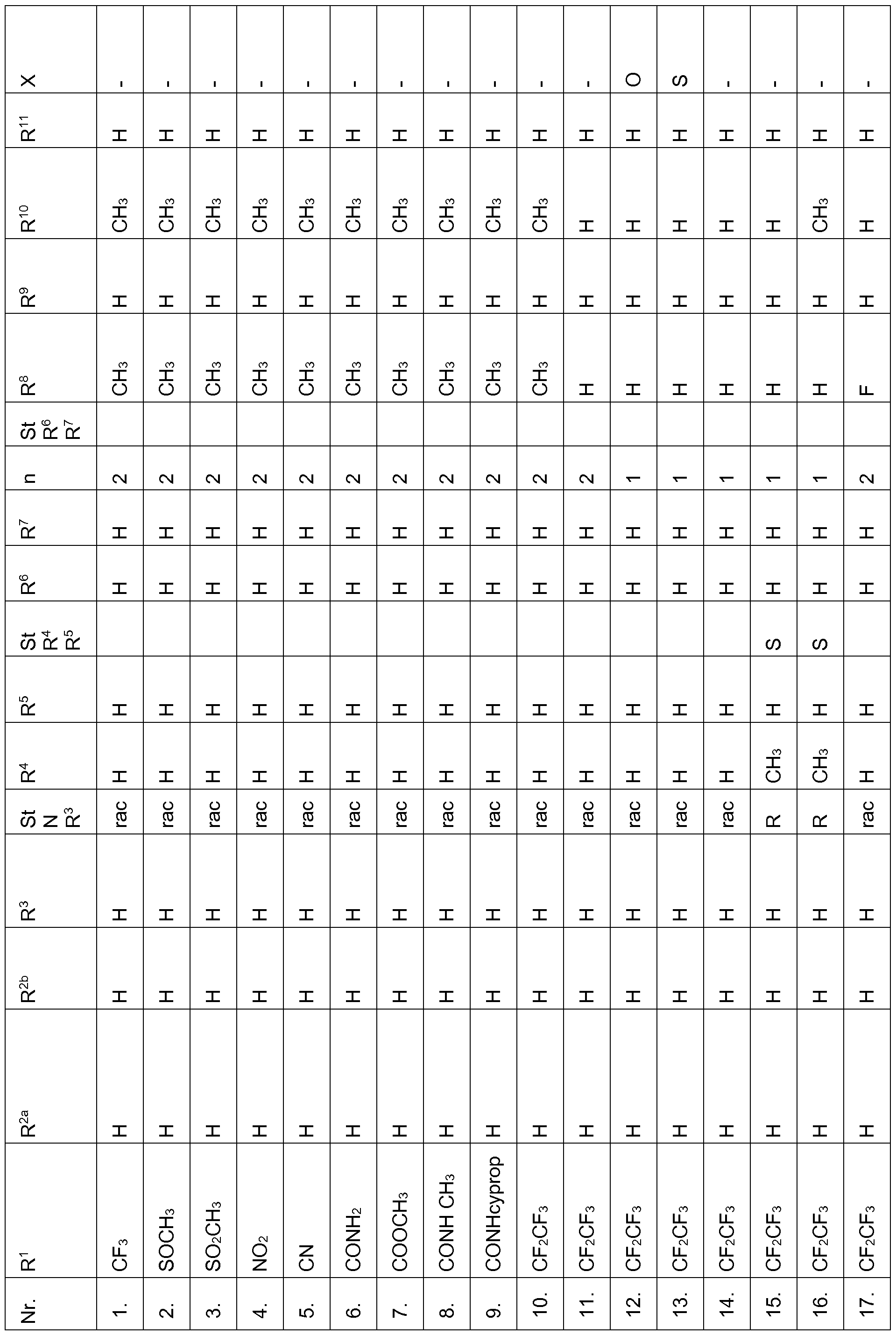


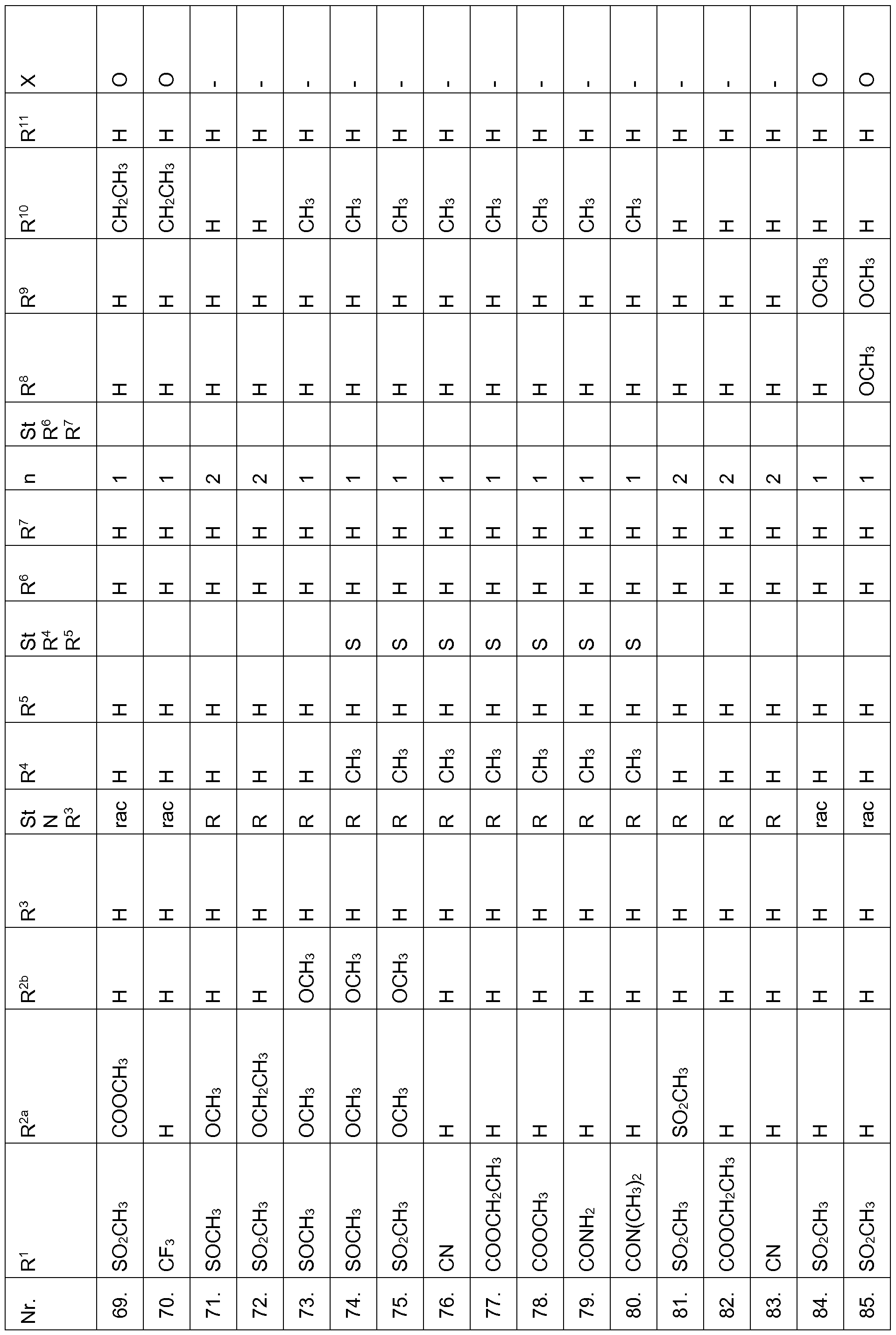
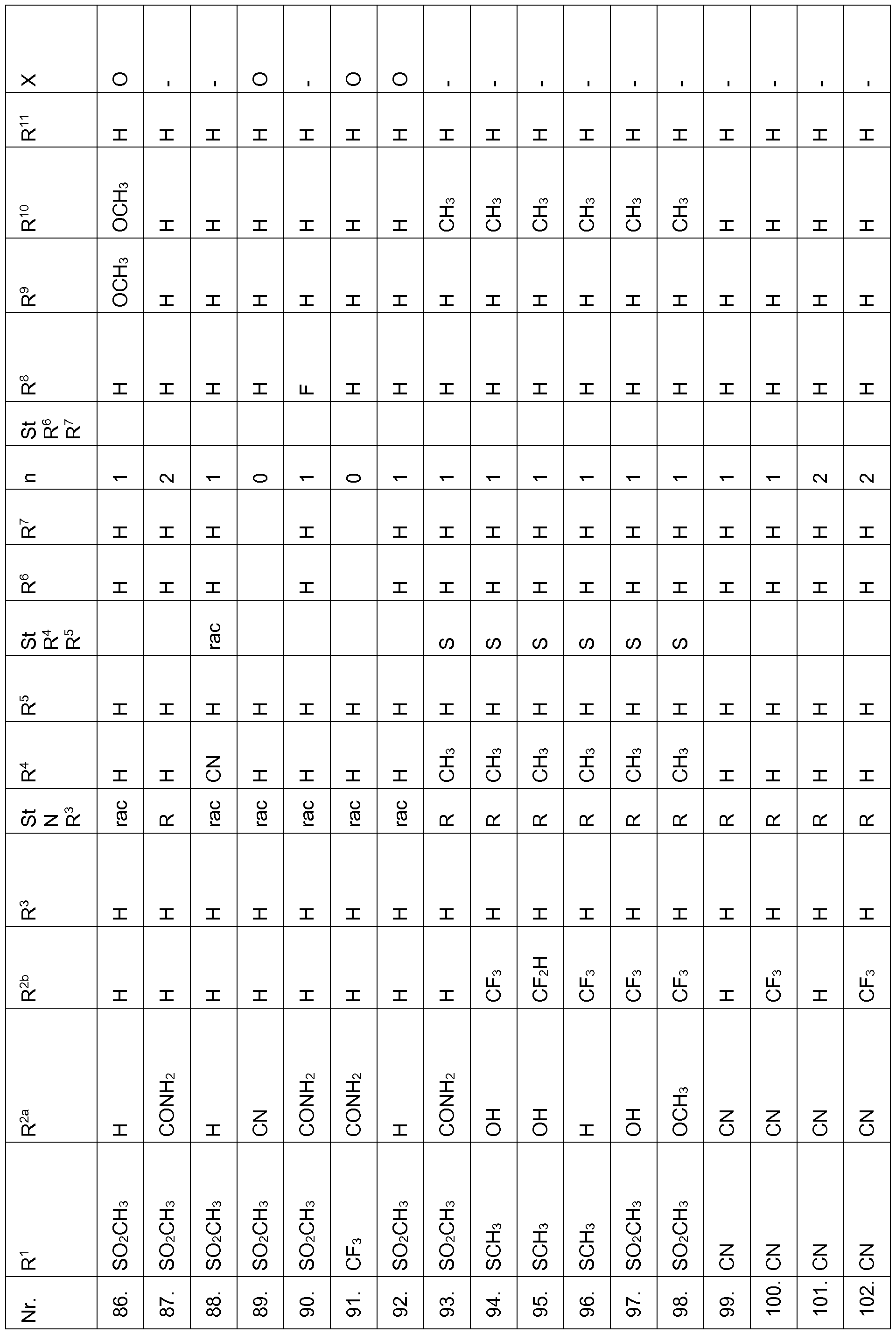
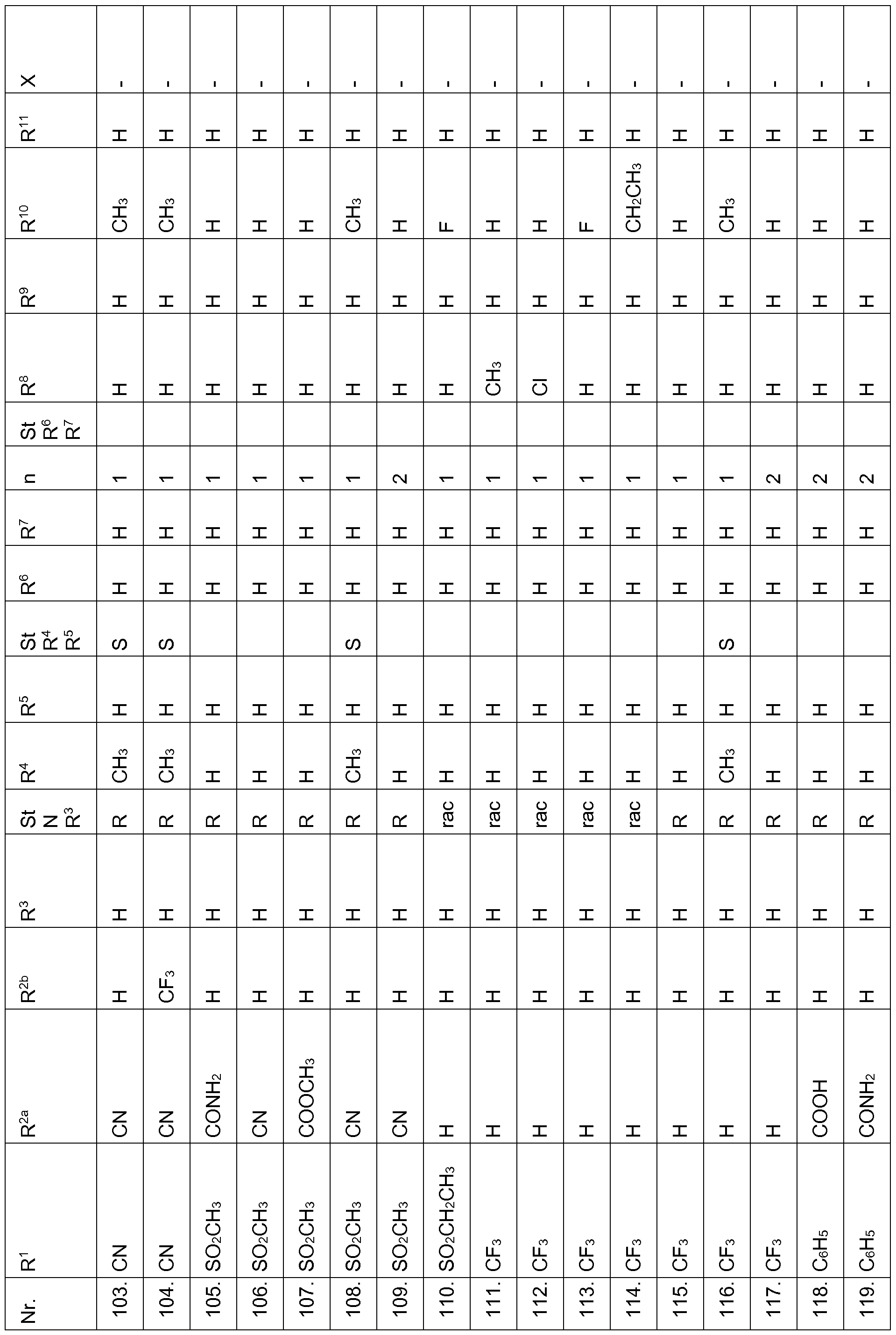
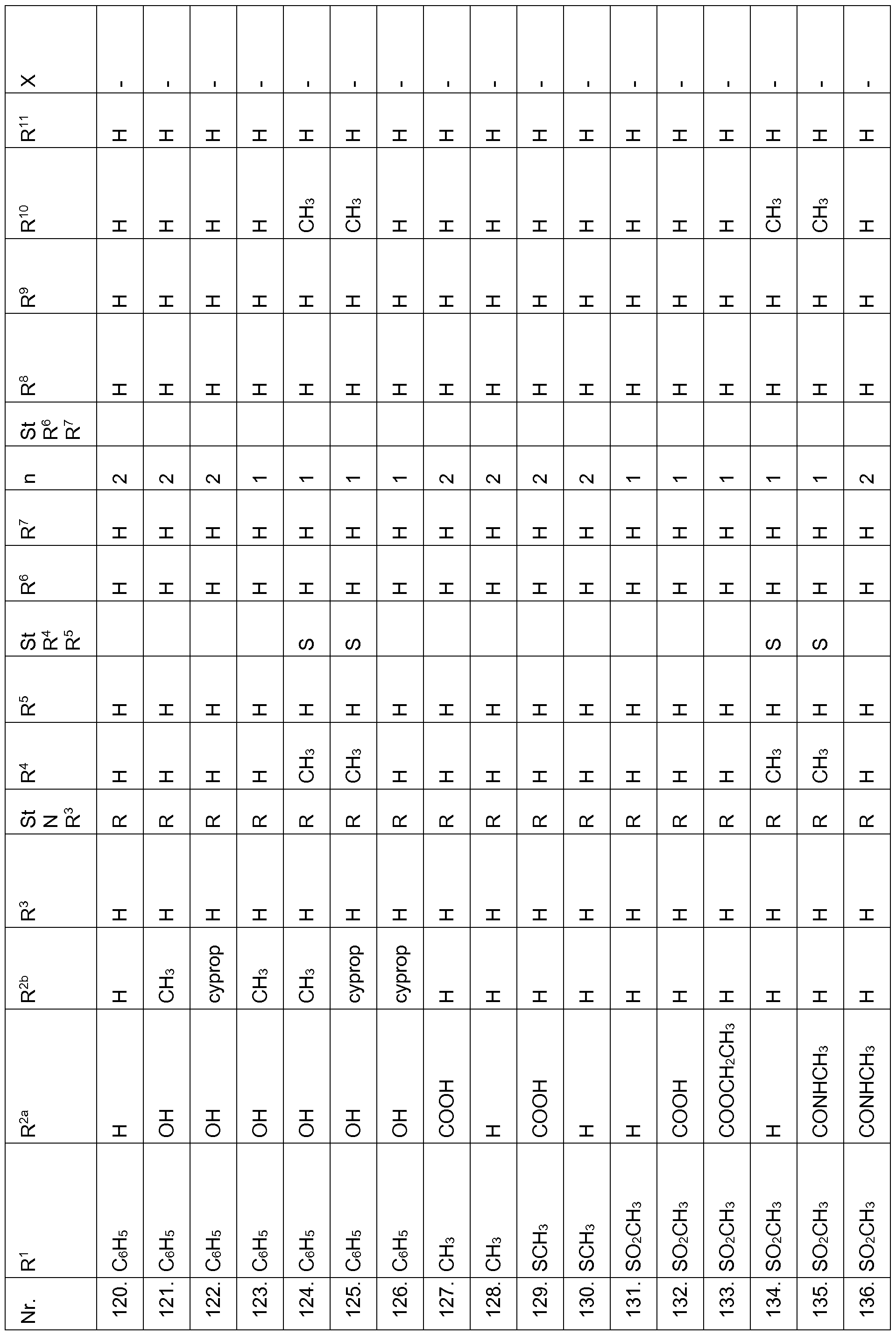
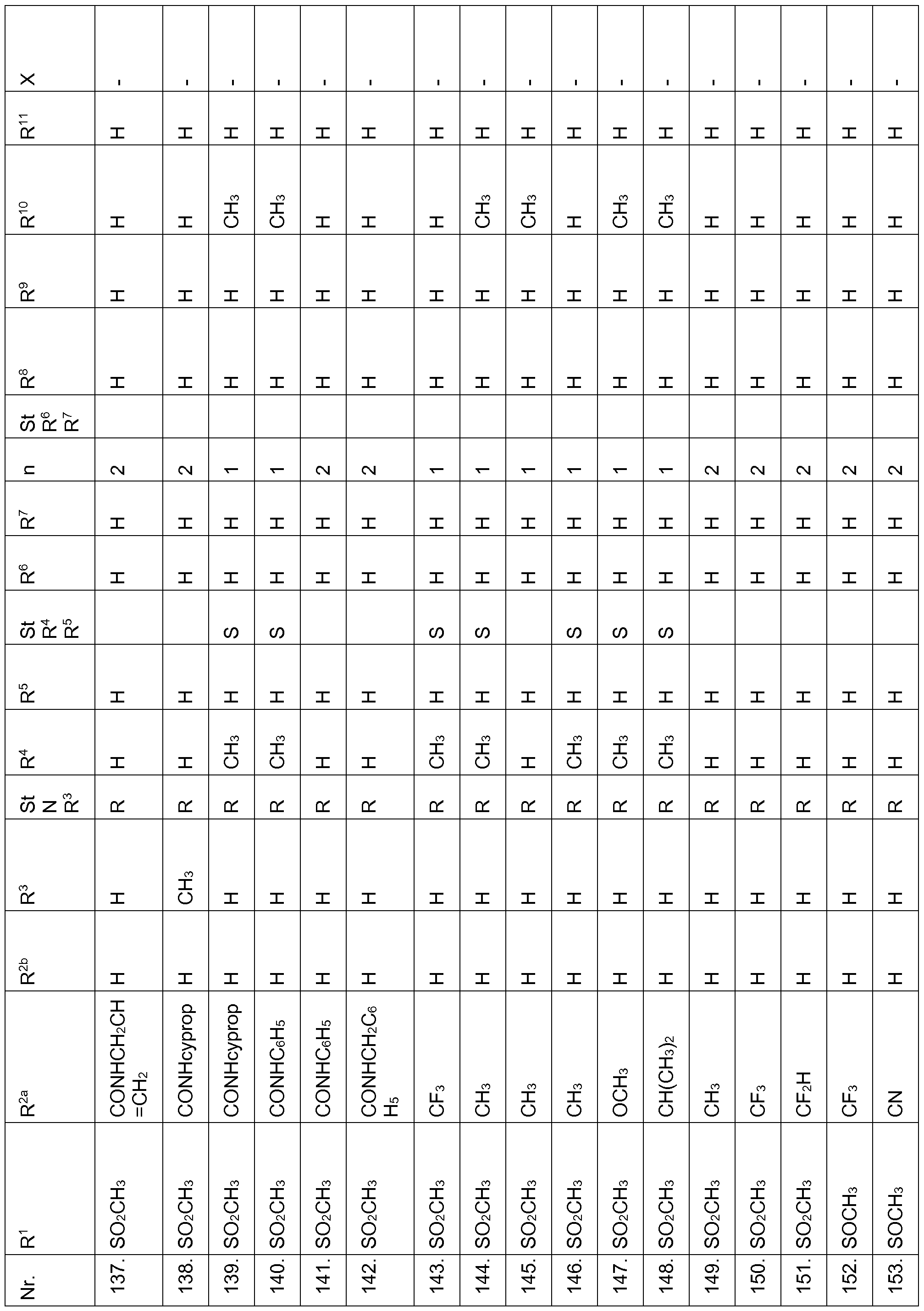
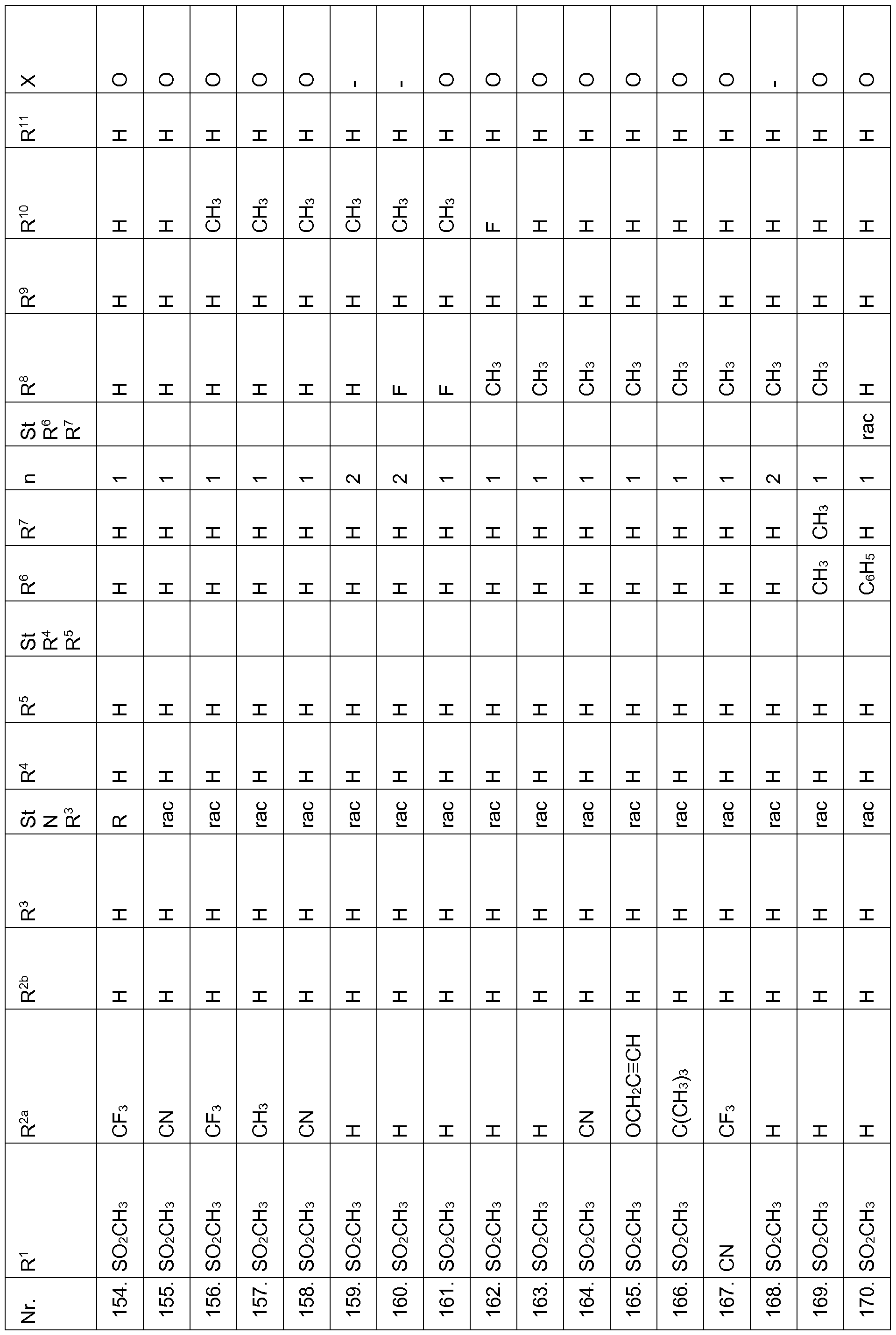


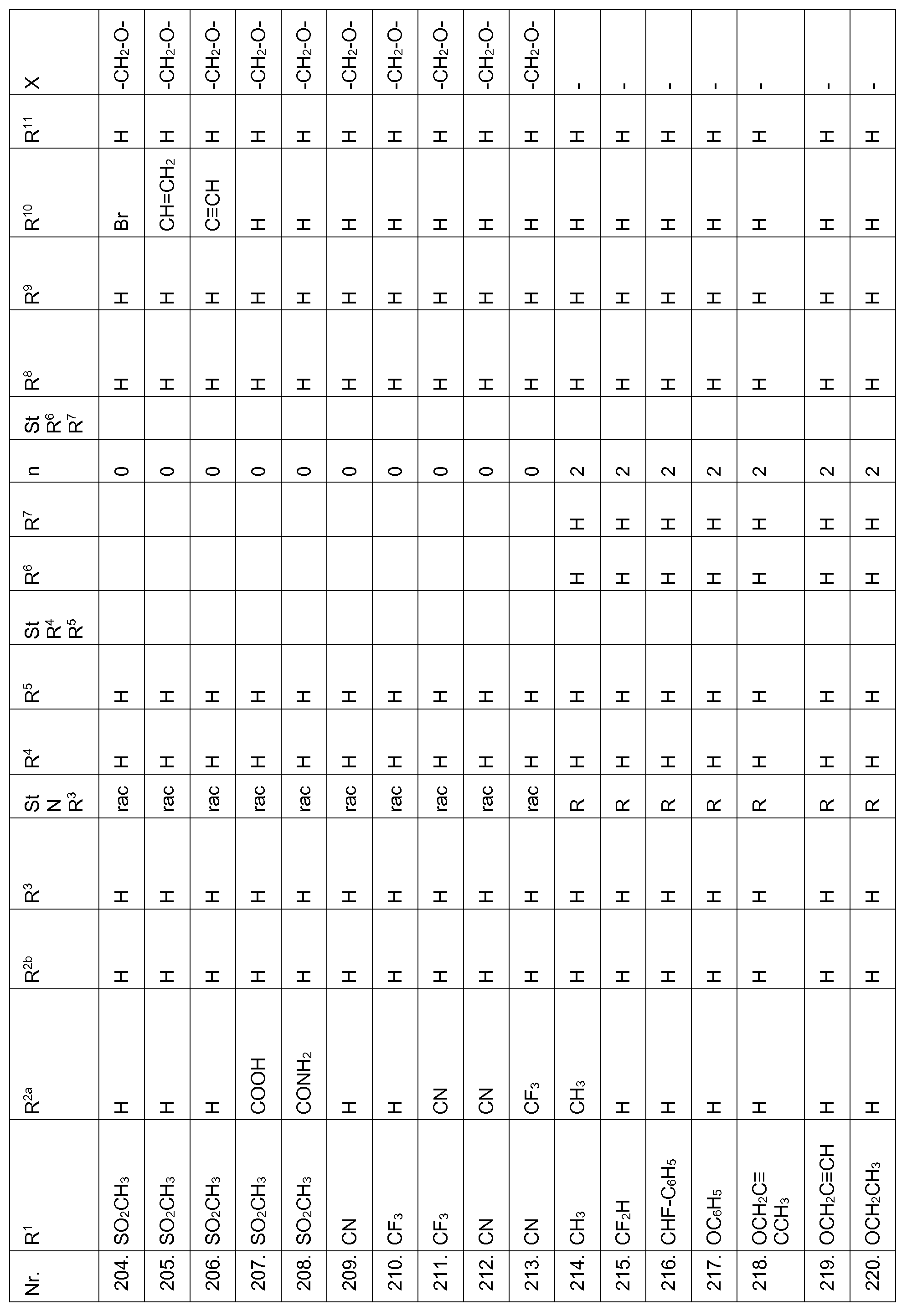

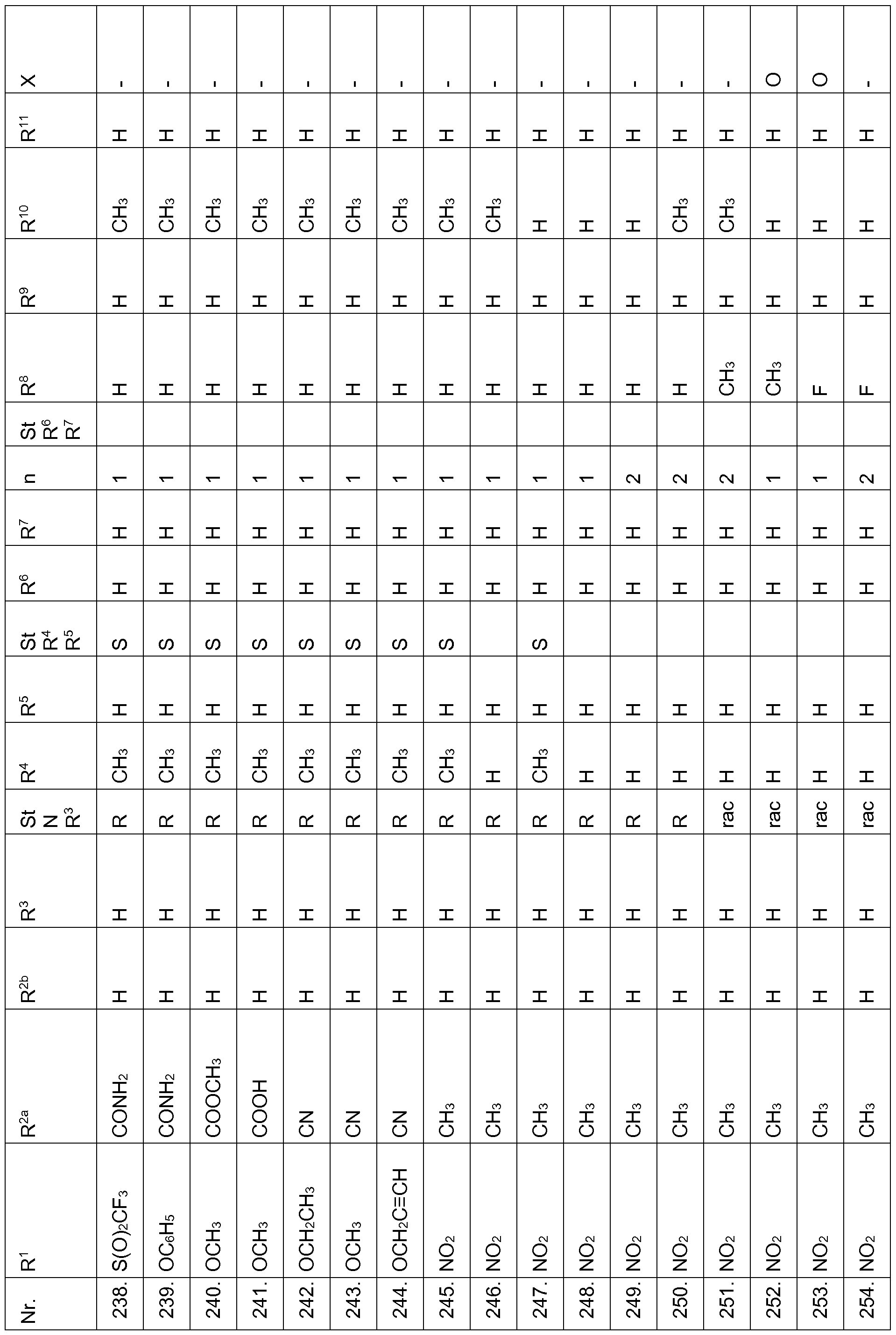
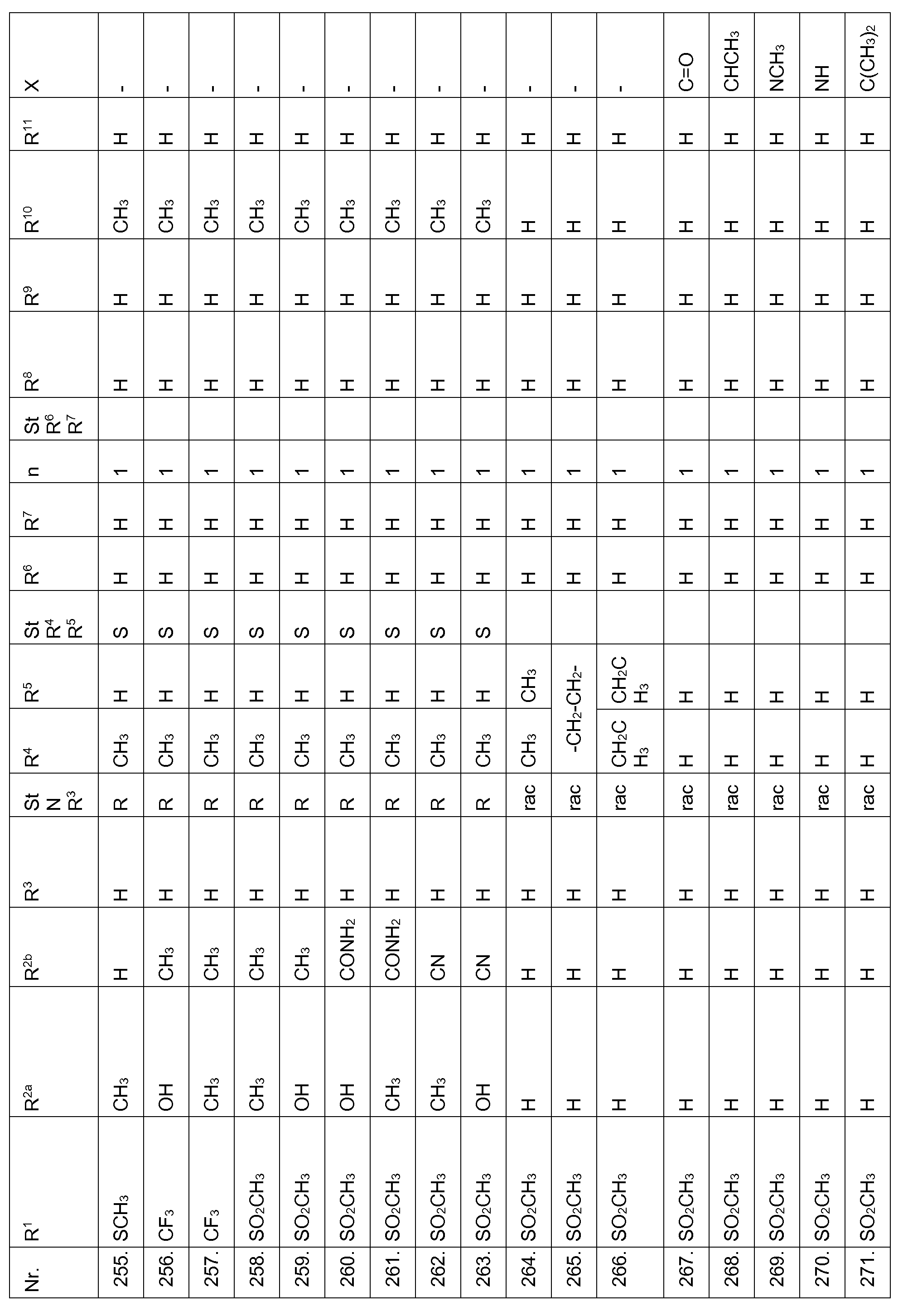

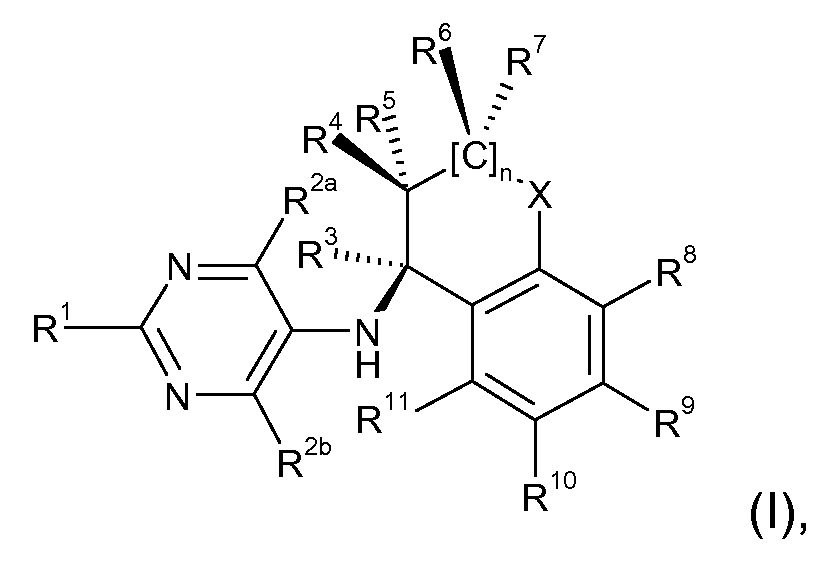
in welchen die Reste R1 bis R11 und X sowie n die vorstehenden Bedeutungen aufweisen, wird eine Verbindung der allgemeinen Formel (II) in which the radicals R 1 to R 11 and X and n have the above meanings, a compound of the general formula (II)
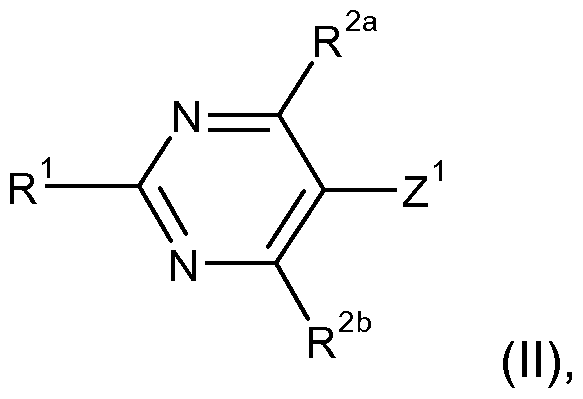
Z1 für einen austauschfähigen Rest oder eine Abgangsgruppe steht, Z 1 represents an exchangeable radical or a leaving group,
mit einem Amin der allgemeinen Formel (III) oder einem Säureadditionssalz des Amins der allgemeinen Formel (III) with an amine of the general formula (III) or an acid addition salt of the amine of the general formula (III)
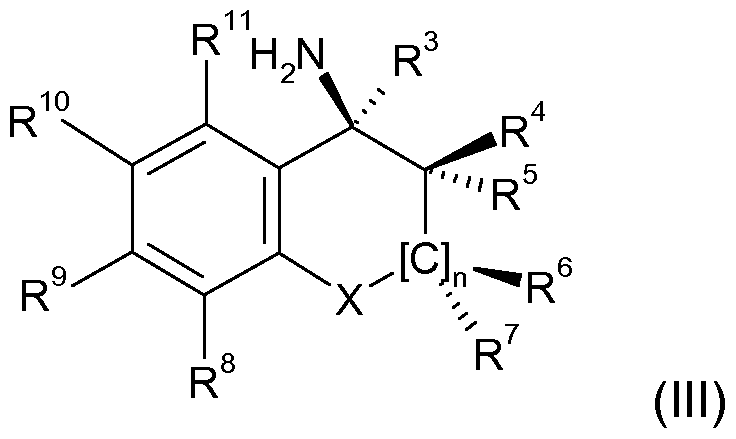
Bedeutung aufweisen. Der austauschfähige Rest Z1, bzw. die Abgangsgruppe Z1 steht insbesondere für Fluor, Chlor, Brom, Jod, ein (Ci-C4)-Alkylsulfonyl, ein unsubstituiertes oder ein substituiertes Phenyl-(Ci-C4)-alkylsulfonyl oder ein (Ci-C4)-Alkylphenyl- sulfonyl. Have meaning. The exchangeable radical Z 1 or the leaving group Z 1 is in particular fluorine, chlorine, bromine, iodine, a (C 1 -C 4 ) -alkylsulfonyl, an unsubstituted or a substituted phenyl- (C 1 -C 4 ) -alkylsulfonyl or a (C 1 -C 4 ) -alkylphenylsulfonyl.
Besonders bevorzugt als Abgangsgruppen für Z1 sind Brom, Chlor oder Fluor (siehe A. Synthesebeispiele, insbesondere Bsp. 64, Bsp. 92, Bsp. 1 15 und Bsp. 273). Die Verbindungen der allgemeinen Formel (II) sind kommerziell verfügbar oder können nach bekannten Verfahren hergestellt werden. Gegebenenfalls können auch Verbindungen der Formel (II) mit R2agleich COOH eingesetzt werden, wobei dann unter den gewählten Reaktionsbedingungen die COOH Bromine, chlorine or fluorine are particularly preferred as leaving groups for Z 1 (see A. Synthesis Examples, in particular Ex. 64, Ex. 92, Ex. 1 15 and Ex. 273). The compounds of the general formula (II) are commercially available or can be prepared by known methods. Optionally, it is also possible to use compounds of the formula (II) where R 2a is COOH, in which case the COOH
decarboxyliert und in Wasserstoff überführt wird. Gegebenenfalls können auch Verbindungen der Formel (II) mit R2a gleich COOR2aa eingesetzt werden, wobeidecarboxylated and converted to hydrogen. Optionally, it is also possible to use compounds of the formula (II) where R 2a is COOR 2aa , where
R2aa für (Ci-C4)-Alkyl, (Ci-C4)-Alkylphenyl oder andere esterbildende Gruppen steht und dann unter den gewählten Reaktionsbedingungen die COOR2aa in situ verseift oder anschließend verseift in R2a gleich COOH überführt wird, dann die COOH-Gruppe decarboxyliert und in Wasserstoff überführt wird. R 2aa represents (C 1 -C 4 ) -alkyl, (C 1 -C 4 ) -alkylphenyl or other ester-forming groups and then, under the chosen reaction conditions, the COOR 2aa is saponified in situ or subsequently saponified in R 2a is converted to COOH, then the COOH group is decarboxylated and converted into hydrogen.
Gegebenenfalls kann die Umsetzung auch durch unterschiedliche Hilfsstoffe katalysiert werden, wie beispielswiese durch die Reagenzien Kaliumphosphat, Kupfer(l)iodid und N,N-diethyl-2-hydroxybenzamide oder im Sinne der Buchwald- Hartwig-Kupplung durch spezielle Übergangsmetallkatalysatorsysteme. Optionally, the reaction can also be catalyzed by different excipients, such as by the reagents potassium phosphate, copper (I) iodide and N, N-diethyl-2-hydroxybenzamide or in the sense of Buchwald Hartwig coupling by special transition metal catalyst systems.
Beispielsweise können 2-Methylthio-5-chlor-pyrimidine-4carbonsäuren aus Mucochloric Säure und S-Methylthiuronium sulphate (Liang, Yong-min , Luo, Sheng-jun , Zhang, Zhao-xin and Yong-xiang(2002) 'EFFICIENT SYNTHESIS OF A NEW PYRIMIDINE DERIVATIVE', Synthetic Communications, 32: 1 , 153 — 157, http://dx.doi.org/10.1081/SCC-120001523) hergestellt werden und nachfolgend zum Methansulfonyl-Derivat oxidiert werden. Analog kann auch Mucobromic Säure eingesetzt werden (Collect. Czech. Chem. Commun. 1949, 14, 223; Tetrahedron. Lett. 1976, 693). Die Amine der allgemeinen Formel (III) oder die Säureadditionssalz davon sind kommerziell verfügbar oder deren Synthese ist in WO2004/069814 A1 beschrieben. b.) Gegebenenfalls können analog dem in WO2004/92166 A2, Seite 68, For example, 2-methylthio-5-chloro-pyrimidines-4-carboxylic acids from mucochloric acid and S-methylthiuronium sulphates (Liang, Yong-min, Luo, Sheng-jun, Zhang, Zhao-xin and Yong-xiang (2002) 'EFFICIENT SYNTHESIS OF A NEW PYRIMIDINE DERIVATIVES ', Synthetic Communications, 32: 1, 153-157, http://dx.doi.org/10.1081/SCC-120001523) and subsequently oxidized to the methanesulfonyl derivative. Analogously, it is also possible to use mucobromic acid (Collect., Czech, Chem. Commun., 1949, 14, 223, Tetrahedron, Lett., 1976, 693). The amines of the general formula (III) or the acid addition salt thereof are commercially available or their synthesis is described in WO2004 / 069814 A1. b.) Optionally, analogously to WO2004 / 92166 A2, page 68,
beschriebenen Verfahren 5-Aminopyrimidine mit kommerziell verfügbaren oder nach bekannten Methoden herstellbaren Ketonen umgesetzt und beispielswiese mit Natriumtriacetoxyborhydrid zu Verbindungen entsprechend der Formel (I) hydriert werden. 5-aminopyrimidines are reacted with commercially available or prepared by known methods ketones and example meadow with sodium triacetoxyborohydride to compounds according to formula (I) hydrogenated.
Gegebenenfalls kann die Reaktion auch in zwei voneinander getrennten Optionally, the reaction can also be in two separate
Teilschritten durchgeführt werden, indem zunächst das Amin mit kommerziell verfügbaren oder nach bekannten Methoden herstellbaren Ketonen zu einem Imin umgesetzt wird und dann das so erhaltene Intermediat hydriert wird. c. ) Zur Herstellung von Verbindungen der allgemeinen Formel (I) können Sub-steps are carried out by first the amine is reacted with commercially available or prepared by known methods ketones to an imine and then the intermediate thus obtained is hydrogenated. c. ) For the preparation of compounds of general formula (I) can
Verbindungen als Vorstufen verwendet werden und in andere Compounds are used as precursors and others
erfindungsgemäße Verbindungen umgewandelt werden. compounds of the invention are converted.
(1 ) Beispielsweise können Derivate der Formel (I) mit R1, R2a, R2b oder R10 = Hai, insbesondere Jod oder Brom mit Acetylenen oder (1) For example, derivatives of formula (I) with R 1 , R 2a , R 2b or R 10 = shark, in particular iodine or bromine with acetylenes or
Trimethylsilylgeschützten Acetylen unter Übergangsmetallkatalyse z.B. mit Bis-(triphenylphosphin)-palladium-(ll)-chlorid in protischen oder aprotischen Lösemitteln und Basenzusatz bei Temperaturen zwischen 20 und 150 °C zu Verbindungen der Formel (I) mit R1, R2a, R2b oder R10 = Alkinyl umgesetzt werden. Trimethylsilyl protected acetylene with transition metal catalysis eg with bis (triphenylphosphine) palladium (II) chloride in protic or aprotic solvents and addition of base at temperatures between 20 and 150 ° C to compounds of formula (I) with R 1 , R 2a , R 2b or R 10 = alkynyl are reacted.
(2) Beispielsweise können Derivate der Formel (I) mit R1 oder R2a oder R2b = CN sauer oder basenkatalysiert verseift werden, die so erhaltenen Carbonsäuren können nach bekannten Verfahren in Säurechloride und diese wiederum in Amide überführt werden. (2) For example, derivatives of the formula (I) with R 1 or R 2a or R 2b = CN can be saponified acid-base or base-catalysed, the carboxylic acids thus obtained can be converted by known methods into acid chlorides and these in turn converted into amides.
(3) Beispielsweise können Derivate der Formel (I) mit R1 oder R2a oder R2b = Hai, insbesondere Chlor oder Brom oder SO2Me oder (C1-C6)- Alkylsulfonyl oder Phenyl(Ci-C6)-Alkylsulfonyl in protischen oder aprotischen Lösemitteln und Basenzusatz bei Temperaturen zwischen 100 und 200 °C durch Reaktion mit Alkoholaten oder Aminen zu (3) For example, derivatives of the formula (I) with R 1 or R 2a or R 2b = Hal, in particular chlorine or bromine or SO 2 Me or (C 1 -C 6) - Alkylsulfonyl or phenyl (Ci-C6) alkylsulfonyl in protic or aprotic solvents and base addition at temperatures between 100 and 200 ° C by reaction with alcoholates or amines
Verbindungen der Formel (I) mit R1 oder R2a oder R2b = Alkoxyalkyl oder Aminoalkyl oder Diaminioalkyl umgesetzt werden. Compounds of formula (I) with R 1 or R 2a or R 2b = alkoxyalkyl or aminoalkyl or Diaminioalkyl be implemented.
(4) Beispielsweise können Derivate der Formel (I) mit R1 oder R2a oder R2b = COOH in Säurechloride oder gemischte Anhydride überführt werden und dann mit Alkoholen oder Aminen zur Reaktion gebracht werden, so dass man dann die entsprechenden Corabonsäureester oder Amide erhält. (4) For example, derivatives of formula (I) with R 1 or R 2a or R 2b = COOH can be converted to acid chlorides or mixed anhydrides and then reacted with alcohols or amines to yield the corresponding corabonic acid esters or amides ,
(5) Beispielsweise können Derivate der Formel (I) mit R1 oder R2a oder R2b = CONH2 durch Entwässern mit Phosphoroxychlorid in die entsprechenden Nitrile überführt werden. (5) For example, derivatives of formula (I) with R 1 or R 2a or R 2b = CONH 2 can be converted into the corresponding nitriles by dehydration with phosphorus oxychloride.
(6) Beispielsweise können Derivate der Formel (I) mit R1 oder R2a oder R2b = SO2Me oder (Ci-C6)-Alkylsulfonyl oder Phenyl(Ci-C6)-Alkylsulfonyl mit Formaniliden (vergl.: Ihara Chem Ind (TSUB) J6-2099305 and J6-(6) For example, derivatives of formula (I) with R 1 or R 2a or R 2b = SO2Me or (Ci-C6) alkylsulfonyl or phenyl (Ci-C6) alkylsulfonyl with formanilides (see: Ihara Chem Ind (TSUB ) J6-2099305 and J6-
2106084) in die entsprechenden Anilide überführt werden. 2106084) into the corresponding anilides.
Kollektionen aus Verbindungen der Formel (I) und/oder deren Salzen, die nach den oben genannten Reaktionen synthetisiert werden können, können auch in Collections of compounds of the formula (I) and / or their salts, which can be synthesized after the abovementioned reactions, can also be found in
parallelisierter Weise hergestellt werden, wobei dies in manueller, teilweise be prepared in a parallelized manner, this manual, in part
automatisierter oder vollständig automatisierter Weise geschehen kann. Dabei ist es beispielsweise möglich, die Reaktionsdurchführung, die Aufarbeitung oder die automated or completely automated way. It is possible, for example, the reaction procedure, the work-up or the
Reinigung der Produkte bzw. Zwischenstufen zu automatisieren. Insgesamt wird hierunter eine Vorgehensweise verstanden, wie sie beispielsweise durch D. Tiebes in Combinatorial Chemistry - Synthesis, Analysis, Screening (Herausgeber Günther Jung), Verlag Wiley 1999, auf den Seiten 1 bis 34 beschrieben ist. Automate cleaning of products or intermediates. Overall, this is understood to mean a procedure as described, for example, by D. Tiebes in Combinatorial Chemistry - Synthesis, Analysis, Screening (publisher Günther Jung), Verlag Wiley 1999, on pages 1 to 34.
Zur parallelisierten Reaktionsdurchführung und Aufarbeitung können eine Reihe von im Handel erhältlichen Geräten verwendet werden, beispielsweise Calpyso- Reaktionsblöcke (Caylpso reaction blocks) der Firma Barnstead International, For the parallelized reaction procedure and workup, a number of commercially available devices can be used, for example Calypyso reaction blocks (Caylpso reaction blocks) from Barnstead International,
Dubuque, Iowa 52004-0797, USA oder Reaktionsstationen (reaction stations) der Firma Radleys, Shirehill, Saffron Waiden, Essex, CB 1 1 3AZ, England oder Dubuque, Iowa 52004-0797, USA or reaction stations of the Company Radleys, Shirehill, Saffron Waiden, Essex, CB 1 1 3AZ, England or
MultiPROBE Automated Workstations der Firma Perkin Elmar, Waltham, MultiPROBE Automated Workstations from Perkin Elmar, Waltham,
Massachusetts 02451 , USA. Für die parallelisierte Aufreinigung von Verbindungen der allgemeinen Formel (I) und deren Salzen beziehungsweise von bei der Herstellung anfallenden Zwischenprodukten stehen unter anderem Chromatographieapparaturen zur Verfügung, beispielsweise der Firma ISCO, Inc., 4700 Superior Street, Lincoln, NE 68504, USA. Massachusetts 02451, United States. For the parallelized purification of compounds of the general formula (I) and their salts or of intermediates obtained during the preparation, among others, chromatography apparatuses are available, for example the company ISCO, Inc., 4700 Superior Street, Lincoln, NE 68504, USA.
Die aufgeführten Apparaturen führen zu einer modularen Vorgehensweise, bei der die einzelnen Arbeitsschritte automatisiert sind, zwischen den Arbeitsschritten jedoch manuelle Operationen durchgeführt werden müssen. Dies kann durch den Einsatz von teilweise oder vollständig integrierten Automationssystemen umgangen werden, bei denen die jeweiligen Automationsmodule beispielsweise durch Roboter bedient werden. Derartige Automationssysteme können zum Beispiel von der Firma Caliper, Hopkinton, MA 01748, USA bezogen werden. The listed equipment leads to a modular procedure, in which the individual work steps are automated, but between the work steps, manual operations must be performed. This can be circumvented by the use of partially or fully integrated automation systems in which the respective automation modules are operated, for example, by robots. Such automation systems can be obtained, for example, from Caliper, Hopkinton, MA 01748, USA.
Die Durchführung einzelner oder mehrerer Syntheseschritte kann durch den Einsatz von Polymer-supported reagents/Scavanger-Harze unterstützt werden. In der The implementation of single or multiple synthetic steps can be supported by the use of polymer-supported reagents / Scavanger resins. In the
Fachliteratur sind eine Reihe von Versuchsprotokollen beschrieben, beispielsweise in ChemFiles, Vol. 4, No. 1 , Polymer-Supported Scavengers and Reagents for Solution- Phase Synthesis (Sigma-Aldrich). Technical literature describes a number of experimental protocols, for example in ChemFiles, Vol. 1, Polymer-Supported Scavengers and Reagents for Solution-Phase Synthesis (Sigma-Aldrich).
Neben den hier beschriebenen Methoden kann die Herstellung von Verbindungen der allgemeinen Formel (I) und deren Salzen vollständig oder partiell durch Festphasen unterstützte Methoden erfolgen. Zu diesem Zweck werden einzelne Zwischenstufen oder alle Zwischenstufen der Synthese oder einer für die entsprechende In addition to the methods described herein, the preparation of compounds of general formula (I) and their salts can be carried out fully or partially by solid-phase assisted methods. For this purpose, individual intermediates or all intermediates of the synthesis or one for the corresponding
Vorgehensweise angepassten Synthese an ein Syntheseharz gebunden. Festphasen- unterstützte Synthesemethoden sind in der Fachliteratur hinreichend beschrieben, z.B. Barry A. Bunin in "The Combinatorial Index", Verlag Academic Press, 1998 und Approach adapted synthesis bound to a synthetic resin. Solid phase assisted synthetic methods are well described in the literature, e.g. Barry A. Bunin in "The Combinatorial Index", Academic Press, 1998 and
Combinatorial Chemistry - Synthesis, Analysis, Screening (Herausgeber Günther Jung), Verlag Wiley, 1999. Die Verwendung von Festphasen- unterstützten Combinatorial Chemistry - Synthesis, Analysis, Screening (published by Günther Jung), published by Wiley, 1999. The use of solid phase assisted
Synthesemethoden erlaubt eine Reihe von literaturbekannten Protokollen, die wiederum manuell oder automatisiert ausgeführt werden können. Die Reaktionen können beispielsweise mittels IRORI-Technologie in Mikroreaktoren (microreactors) der Firma Nexus Biosystems, 12140 Community Road, Poway, CA92064, USA durchgeführt werden. Synthesis methods allow a number of protocols known from the literature, which in turn can be carried out manually or automatically. The reactions can be carried out, for example, by means of IRORI technology in microreactors. Nexus Biosystems, 12140 Community Road, Poway, CA92064, USA.
Sowohl an fester als auch in flüssiger Phase kann die Durchführung einzelner oder mehrerer Syntheseschritte durch den Einsatz der Mikrowellen-Technologie unterstützt werden. In der Fachliteratur sind eine Reihe von Versuchsprotokollen beschrieben, beispielsweise in Microwaves in Organic and Medicinal Chemistry (Herausgeber C. O. Kappe und A. Stadler), Verlag Wiley, 2005. Die Herstellung gemäß der hier beschriebenen Verfahren liefert Verbindungen der Formel (I) und deren Salze in Form von Substanzkollektionen, die Bibliotheken genannt werden. Gegenstand der vorliegenden Erfindung sind auch Bibliotheken, die mindestens zwei Verbindungen der Formel (I) und deren Salzen enthalten. Weiterer Gegenstand der Erfindung ist aufgrund der herbiziden Eigenschaft der Verbindungen der allgemeinen Formel (I) auch die Verwendung der Both solid and liquid phases can be supported by the implementation of single or multiple synthetic steps through the use of microwave technology. A number of experimental protocols are described in the specialist literature, for example in Microwaves in Organic and Medicinal Chemistry (editors CO Kappe and A. Stadler), published by Wiley, 2005. The preparation according to the processes described here yields compounds of the formula (I) and their salts in the form of substance collections called libraries. The present invention also provides libraries containing at least two compounds of formula (I) and their salts. Another object of the invention is due to the herbicidal property of the compounds of general formula (I), the use of the
erfindungsgemäßen Verbindungen der allgemeinen Formel (I) als Herbizide zur Bekämpfung von Schadpflanzen. Herbizide werden in landwirtschaftlich genutzten Kulturen während verschiedener Anbauphasen eingesetzt. So erfolgt die Applikation einiger Produkte schon vor oder während der Saat. Andere werden ausgebracht, bevor die Kulturpflanze aufläuft, d.h. bevor der Keimling die Erdoberfläche durchbricht (Vorauflauf-Herbizide). Nachauflauf- Herbizide schließlich werden verwendet, wenn von der Kulturpflanze entweder bereits die Keimblätter oder Laubblätter ausgebildet sind. Compounds of the general formula (I) according to the invention as herbicides for controlling harmful plants. Herbicides are used in agricultural crops during various stages of cultivation. Thus, the application of some products already before or during the sowing. Others are applied before the crop is run up, i. before the seedling breaks through the earth's surface (pre-emergence herbicides). Postemergence herbicides are finally used when either the cotyledons or leaves are already formed from the crop.
Die erfindungsgemäßen Verbindungen können dabei sowohl im Vorlauf als auch im Nachlauf angewendet werden, wobei eine Verwendung der erfindungsgemäßen Verbindungen im Vorlauf bevorzugt ist. The compounds of the invention can be used both in the forerun and in the wake, wherein a use of the compounds of the invention in the flow is preferred.
Die Vorauflauf-Behandlung schließt sowohl die Behandlung der Anbaufläche vor der Aussaat (ppi = pre plant incorporation) als auch die Behandlung der angesäten, aber noch nicht bewachsenen Anbauflächen ein. Die erfindungsgemäßen Verbindungen der Formel (I) und deren Salze, im folgenden auch synonym zusammen auch als Verbindungen der Formel (I) bezeichnet, weisen eine ausgezeichnete herbizide Wirksamkeit gegen ein breites Spektrum wirtschaftlich wichtiger mono- und dikotyler Schadpflanzen auf. Auch schwer bekämpfbare perennierende Unkräuter, die aus Rhizomen, Wurzelstöcken oder anderen Pre-emergence treatment includes pre-sowing (ppi) pre-sowing treatment as well as treatment of sown, but not overgrown crop areas. The compounds of the formula (I) according to the invention and their salts, also referred to below together as compounds of the formula (I), have excellent herbicidal activity against a broad spectrum of economically important monocotyledonous and dicotyledonous harmful plants. Also difficult to control perennial weeds, from rhizomes, rhizomes or others
Dauerorganen austreiben, werden durch die Wirkstoffe gut erfaßt. Dabei ist es gleichgültig, ob die Substanzen im Vorsaat-, Vorauflauf- oder Nachauflaufverfahren ausgebracht werden. Im einzelnem seien beispielhaft einige Vertreter der mono- und dikotylen Unkrautflora genannt, die durch die erfindungsgemäßen Verbindungen der allgemeinen Formel (I) kontrolliert werden können, ohne daß durch die Nennung eine Beschränkung auf bestimmte Arten erfolgen soll. Auf der Seite der monokotylen Unkrautarten werden z. B. Agrostis, Alopecurus, Apera, Avena, Brachicaria, Bromus, Dactyloctenium, Digitaria, Echinochloa, Eleocharis, Eleusine, Festuca, Fimbristylis, Ischaemum, Lolium, Monochoria, Panicum, Paspalum, Phalaris, Phleum, Poa, Sagittaria, Scirpus, Setaria, Sphenoclea, sowie Cyperusarten vorwiegend aus der annuellen Gruppe und auf Seiten der perennierenden Spezies Agropyron, Cynodon, Imperata sowie Sorghum und auch ausdauernde Cyperusarten gut erfaßt. Cast out permanent organs are well detected by the active ingredients. It does not matter whether the substances are applied in the pre-sowing, pre-emergence or postemergence process. In the individual examples may be mentioned some representatives of the monocotyledonous and dicotyledonous weed flora, which can be controlled by the compounds of the general formula (I) according to the invention, without the intention of limiting them to certain species. On the side of monocotyledonous weed species, for. B. Agrostis, Alopecurus, Apera, Avena, Brachicaria, Bromus, Dactyloctenium, Digitaria, Echinochloa, Eleocharis, Eleusine, Festuca, Fimbristylis, ischemic, Lolium, Monochoria, Panicum, Paspalum, Phalaris, Phleum, Poa, Sagittaria, Scirpus, Setaria, Sphenoclea, as well as Cyperusarten mainly from the annuelle group and on the part of the perennial species Agropyron, Cynodon, Imperata and Sorghum and also perennial Cyperusarten well grasped.
Bei dikotylen Unkrautarten erstreckt sich das Wirkungsspektrum auf Arten wie z. B. Galium, Viola, Veronica, Lamium, Stellaria, Amaranthus, Sinapis, Ipomoea, Matricaria, Abutilon und Sida auf der annuellen Seite sowie Convolvulus, Cirsium, Rumex und Artemisia bei den perennierenden Unkräutern. Außerdem wird herbizide Wirkung bei dikotylen Unkräutern wie Ambrosia, Anthemis, Carduus, Centaurea, Chenopodium, Cirsium, Convolvulus, Datura, Emex, Galeopsis, Galinsoga, Lepidium, Lindernia, Papaver, Portlaca, Polygonum, Ranunculus, Rorippa, Rotala, Seneceio, Sesbania, Solanum, Sonchus, Taraxacum, Trifolium, Urtica und Xanthium beobachtet. In dicotyledonous weed species, the spectrum of activity extends to species such. Galium, Viola, Veronica, Lamium, Stellaria, Amaranthus, Sinapis, Ipomoea, Matricaria, Abutilon and Sida on the annall side as well as Convolvulus, Cirsium, Rumex and Artemisia in perennial weeds. In addition, herbicidal activity in dicotyledonous weeds such as Ambrosia, Anthemis, Carduus, Centaurea, Chenopodium, Cirsium, Convolvulus, Datura, Emex, Galeopsis, Galinsoga, Lepidium, Lindernia, Papaver, Portlaca, Polygonum, Ranunculus, Rorippa, Rotala, Seneceio, Sesbania, Solanum, Sonchus, Taraxacum, Trifolium, Urtica and Xanthium are observed.
Werden die erfindungsgemäßen Verbindungen der allgemeinen Formel (I) vor dem Keimen auf die Erdoberfläche appliziert, so wird entweder das Auflaufen der If the compounds of the general formula (I) according to the invention are applied to the surface of the earth before germination, then either the emergence of the
Unkrautkeimlinge vollständig verhindert oder die Unkräuter wachsen bis zum Keimblattstadium heran, stellen jedoch dann ihr Wachstum ein und sterben schließlich nach Ablauf von drei bis vier Wochen vollkommen ab. Weed seedlings are completely prevented or the weeds grow until Cotyledon stage, but then stop their growth and eventually die off after three to four weeks.
Bei Applikation der Wirkstoffe der allgemeinen Formel (I) auf die grünen Pflanzenteile im Nachauflaufverfahren tritt ebenfalls sehr rasch nach der Behandlung ein drastischer Wachstumsstop ein und die Unkrautpflanzen bleiben in dem zum Applikationszeitpunkt vorhandenen Wachstumsstadium stehen oder sterben nach einer gewissen Zeit ganz ab, so daß auf diese Weise eine für die Kulturpflanzen schädliche Unkrautkonkurrenz sehr früh und nachhaltig beseitigt wird. When the active compounds of the general formula (I) are applied to the green plant parts in the postemergence process, a drastic growth arrest also occurs very rapidly after the treatment and the weed plants remain in the growth stage present at the time of application or die completely after a certain time, so that This way, a weed competition that is harmful to cultivated plants is eliminated very early and sustainably.
Obgleich die erfindungsgemäßen Verbindungen der allgemeinen Formel (I) eine ausgezeichnete herbizide Aktivität gegenüber mono- und dikotylen Unkräutern aufweisen, werden Kulturpflanzen wirtschaftlich bedeutender Kulturen wie z. B. Although the compounds of general formula (I) according to the invention have excellent herbicidal activity against mono- and dicotyledonous weeds, crops of economically important crops such. B.
Weizen, Gerste, Roggen, Reis, Mais, Zuckerrübe, Baumwolle, Raps und Soja nur unwesentlich oder gar nicht geschädigt. Die vorliegenden Verbindungen eignen sich aus diesen Gründen sehr gut zur selektiven Bekämpfung von unerwünschtem Wheat, barley, rye, rice, maize, sugarbeet, cotton, oilseed rape and soya only marginally or not at all damaged. For these reasons, the present compounds are very well suited for the selective control of undesired ones
Pflanzenwuchs in landwirtschaftlichen Nutzpflanzungen. Plant growth in agricultural crops.
Darüber hinaus weisen die erfindungsgemäßen Substanzen der allgemeinen Formel (I) hervorragende wachstumsregulatorische Eigenschaften bei Kulturpflanzen auf. Sie greifen regulierend in den pflanzeneigenen Stoffwechsel ein und können damit zur gezielten Beeinflussung von Pflanzeninhaltsstoffen und zur Ernteerleichterung wie z. B. durch Auslösen von Desikkation und Wuchsstauchung eingesetzt werden. In addition, the substances of the general formula (I) according to the invention have excellent growth-regulatory properties in crop plants. They regulate the plant's metabolism and can thus be used to specifically influence plant constituents and to facilitate harvesting, such as, for example, B. be used by triggering desiccation and stunted growth.
Desweiteren eignen sie sich auch zur generellen Steuerung und Hemmung von unerwünschtem vegetativem Wachstum, ohne dabei die Pflanzen abzutöten. Eine Hemmung des vegetativen Wachstums spielt bei vielen mono- und dikotylen Kulturen eine große Rolle, da das Lagern hierdurch verringert oder völlig verhindert werden kann. Aufgrund ihrer herbiziden und pflanzenwachstumsregulatorischen Eigenschaften können die Wirkstoffe auch zur Bekämpfung von Schadpflanzen in Kulturen von bekannten oder noch zu entwickelnden gentechnisch veränderten Pflanzen eingesetzt werden. Die transgenen Pflanzen zeichnen sich in der Regel durch besondere vorteilhafte Eigenschaften aus, beispielsweise durch Resistenzen gegenüber bestimmten Pestiziden, vor allem bestimmten Herbiziden, Resistenzen gegenüber Pflanzenkrankheiten oder Erregern von Pflanzenkrankheiten wie bestimmten Insekten oder Mikroorganismen wie Pilzen, Bakterien oder Viren. Andere besondere Furthermore, they are also suitable for the general control and inhibition of unwanted vegetative growth, without killing the plants. Inhibition of vegetative growth plays an important role in many monocotyledonous and dicotyledonous cultures, as storage can be reduced or completely prevented. Due to their herbicidal and plant growth regulatory properties, the active compounds can also be used for controlling harmful plants in crops of known or yet to be developed genetically modified plants. The transgenic plants are usually characterized by particular advantageous properties, for example by resistance to certain pesticides, especially certain herbicides, resistance to plant diseases or pathogens of plant diseases such as certain insects or microorganisms such as fungi, bacteria or viruses. Other special
Eigenschaften betreffen z. B. das Erntegut hinsichtlich Menge, Qualität, Lagerfähigkeit, Zusammensetzung und spezieller Inhaltsstoffe. So sind transgene Pflanzen mit erhöhtem Stärkegehalt oder veränderter Qualität der Stärke oder solche mit anderer Fettsäurezusammensetzung des Ernteguts bekannt. Weitere besondere Properties concern z. B. the crop in terms of quantity, quality, shelf life, composition and special ingredients. Thus, transgenic plants with increased starch content or altered quality of the starch or those with other fatty acid composition of the crop are known. More special
Eigenschaften können in einer Toleranz oder Resistenz gegen abiotische Stressoren z. B. Hitze, Kälte, Trockenheit, Salz und ultraviolette Strahlung liegen. Properties may be in a tolerance or resistance to abiotic stressors z. As heat, cold, drought, salt and ultraviolet radiation.
Bevorzugt ist die Anwendung der erfindungsgemäßen Verbindungen der allgemeinen Formel (I) oder deren Salze in wirtschaftlich bedeutenden transgenen Kulturen von Nutz- und Zierpflanzen, z. B. von Getreide wie Weizen, Gerste, Roggen, Hafer, Hirse, Reis, Maniok und Mais oder auch Kulturen von Zuckerrübe, Baumwolle, Soja, Raps, Kartoffel, Tomate, Erbse und anderen Gemüsesorten. Preference is given to the use of the compounds of the general formula (I) according to the invention or salts thereof in economically important transgenic crops of useful and ornamental plants, eg. As cereals such as wheat, barley, rye, oats, millet, rice, cassava and corn or cultures of sugar beet, cotton, soy, rape, potato, tomato, pea and other vegetables.
Vorzugsweise können die Verbindungen der allgemeinen Formel (I) als Herbizide in Nutzpflanzenkulturen eingesetzt werden, welche gegenüber den phytotoxischen Wirkungen der Herbizide resistent sind bzw. gentechnisch resistent gemacht worden sind. Preferably, the compounds of general formula (I) can be used as herbicides in crops which are resistant to the phytotoxic effects of the herbicides or have been made genetically resistant.
Herkömmliche Wege zur Herstellung neuer Pflanzen, die im Vergleich zu bisher vorkommenden Pflanzen modifizierte Eigenschaften aufweisen, bestehen Conventional ways of producing new plants that have modified properties compared to previously occurring plants exist
beispielsweise in klassischen Züchtungsverfahren und der Erzeugung von Mutanten. Alternativ können neue Pflanzen mit veränderten Eigenschaften mit Hilfe for example, in classical breeding methods and the generation of mutants. Alternatively, new plants with altered properties can help
gentechnischer Verfahren erzeugt werden (siehe z. B. EP 0221044, EP 0131624). Beschrieben wurden beispielsweise in mehreren Fällen Genetic engineering methods are produced (see, for example, EP 0221044, EP 0131624). For example, several cases have been described
gentechnische Veränderungen von Kulturpflanzen zwecks Modifikation der in den Pflanzen synthetisierten Stärke (z. B. WO 92/01 1376, WO 92/014827, genetic modifications of crop plants for the purpose of modifying the starch synthesized in the plants (eg WO 92/01 1376, WO 92/014827,
WO 91/019806), WO 91/019806),
transgene Kulturpflanzen, welche gegen bestimmte Herbizide vom Typ transgenic crops which are resistant to certain herbicides of the type
Glufosinate (vgl. z. B. EP 0242236, EP 0242246) oder Glyphosate Glufosinate (cf., for example, EP 0242236, EP 0242246) or glyphosate
(WO 92/000377) oder der Sulfonylharnstoffe (EP 0257993, US 5013659) resistent sind, transgene Kulturpflanzen, beispielsweise Baumwolle, mit der Fähigkeit Bacillus thuringiensis-Toxine (Bt-Toxine) zu produzieren, welche die Pflanzen gegen bestimmte Schädlinge resistent machen (EP 0142924, EP 0193259). (WO 92/000377) or the sulfonylureas (EP 0257993, US 5013659) are resistant, Transgenic crops, such as cotton, with the ability to produce Bacillus thuringiensis toxins (Bt toxins), which make the plants resistant to certain pests (EP 0142924, EP 0193259).
transgene Kulturpflanzen mit modifizierter Fettsäurezusammensetzung Transgenic crops with modified fatty acid composition
(WO 91/013972). (WO 91/013972).
gentechnisch veränderte Kulturpflanzen mit neuen Inhalts- oder Sekundärstoffen z. B. neuen Phytoalexinen, die eine erhöhte Krankheitsresistenz verursachen (EP 0309862, EP 0464461 ) genetically modified crops with new content or secondary substances z. B. new phytoalexins that cause increased disease resistance (EP 0309862, EP 0464461)
gentechnisch veränderte Pflanzen mit reduzierter Photorespiration, die höhere Erträge und höhere Stresstoleranz aufweisen (EP 0305398) genetically modified plants with reduced photorespiration, which have higher yields and higher stress tolerance (EP 0305398)
transgene Kulturpflanzen, die pharmazeutisch oder diagnostisch wichtige Proteine produzieren („molecular pharming") transgenic crops that produce pharmaceutically or diagnostically important proteins ("molecular pharming")
transgene Kulturpflanzen, die sich durch höhere Erträge oder bessere Qualität auszeichnen Transgenic crops that are characterized by higher yields or better quality
- transgene Kulturpflanzen die sich durch eine Kombinationen z. B. der o. g. neuen Eigenschaften auszeichnen („gene stacking") - Transgenic crop plants which are characterized by a combination of z. B. the o. G. characterize new properties ("gene stacking")
Zahlreiche molekularbiologische Techniken, mit denen neue transgene Pflanzen mit veränderten Eigenschaften hergestellt werden können, sind im Prinzip bekannt; siehe z. B. I. Potrykus und G. Spangenberg (eds.) Gene Transfer to Plants, Springer Lab Manual (1995), Springer Verlag Berlin, Heidelberg oder Christou, "Trends in Plant Science" 1 (1996) 423-431 ). Numerous molecular biology techniques that can be used to produce novel transgenic plants with altered properties are known in principle; see, for. B. I. Potrykus and G. Spangenberg (eds.) Gene Transfer to Plants, Springer Lab Manual (1995), Springer Verlag Berlin, Heidelberg or Christou, "Trends in Plant Science" 1 (1996) 423-431).
Für derartige gentechnische Manipulationen können Nucleinsäuremoleküle in For such genetic manipulations, nucleic acid molecules can be used in
Plasmide eingebracht werden, die eine Mutagenese oder eine Sequenzveränderung durch Rekombination von DNA-Sequenzen erlauben. Mit Hilfe von Standardverfahren können z. B. Basenaustausche vorgenommen, Teilsequenzen entfernt oder natürliche oder synthetische Sequenzen hinzugefügt werden. Für die Verbindung der DNA- Fragmente untereinander können an die Fragmente Adaptoren oder Linker angesetzt werden, siehe z. B. Sambrook et al., 1989, Molecular Cloning, A Laboratory Manual, 2. Aufl. Cold Spring Harbor Laboratory Press, Cold Spring Harbor, NY; oder Winnacker "Gene und Klone", VCH Weinheim 2. Auflage 1996. Die Herstellung von Pflanzenzellen mit einer verringerten Aktivität eines Genprodukts kann beispielsweise erzielt werden durch die Expression mindestens einer Plasmids are introduced which allow mutagenesis or a sequence change by recombination of DNA sequences. With the help of standard methods z. For example, base substitutions are made, partial sequences are removed, or natural or synthetic sequences are added. For the connection of the DNA fragments with one another adapters or linkers can be attached to the fragments. Sambrook et al., 1989, Molecular Cloning, A Laboratory Manual, 2nd Edition Cold Spring Harbor Laboratory Press, Cold Spring Harbor, NY; or Winnacker "Genes and Clones", VCH Weinheim 2nd edition 1996. The production of plant cells having a reduced activity of a gene product can be achieved, for example, by the expression of at least one
entsprechenden antisense-RNA, einer sense-RNA zur Erzielung eines corresponding antisense RNA, a sense RNA to obtain a
Cosuppressionseffekt.es oder die Expression mindestens eines entsprechend konstruierten Ribozyms, das spezifisch Transkripte des obengenannten Genprodukts spaltet. Cosuppressionseffekt.es or the expression of at least one appropriately engineered ribozyme that specifically cleaves transcripts of the above gene product.
Hierzu können zum einen DNA-Moleküle verwendet werden, die die gesamte codierende Sequenz eines Genprodukts einschließlich eventuell vorhandener flankierender Sequenzen umfassen, als auch DNA-Moleküle, die nur Teile der codierenden Sequenz umfassen, wobei diese Teile lang genug sein müssen, um in den Zellen einen antisense-Effekt zu bewirken. Möglich ist auch die Verwendung von DNA-Sequenzen, die einen hohen Grad an Homologie zu den codiereden Sequenzen eines Genprodukts aufweisen, aber nicht vollkommen identisch sind. For this purpose, DNA molecules may be used which comprise the entire coding sequence of a gene product, including any flanking sequences that may be present, as well as DNA molecules which comprise only parts of the coding sequence, which parts must be long enough to be present in the cells to cause an antisense effect. It is also possible to use DNA sequences which have a high degree of homology to the coding sequences of a gene product, but are not completely identical.
Bei der Expression von Nucleinsäuremolekülen in Pflanzen kann das synthetisierte Protein in jedem beliebigen Kompartiment der pflanzlichen Zelle lokalisiert sein. Um aber die Lokalisation in einem bestimmten Kompartiment zu erreichen, kann z. B. die codierende Region mit DNA-Sequenzen verknüpft werden, die die Lokalisierung in einem bestimmten Kompartiment gewährleisten. Derartige Sequenzen sind demIn the expression of nucleic acid molecules in plants, the synthesized protein may be located in any compartment of the plant cell. But to achieve the localization in a particular compartment, z. For example, the coding region can be linked to DNA sequences that ensure localization in a particular compartment. Such sequences are the
Fachmann bekannt (siehe beispielsweise Braun et al., EMBO J. 1 1 (1992), 3219-3227; Wolter et al., Proc. Natl. Acad. Sei. USA 85 (1988), 846-850; Sonnewald et al., Plant J. 1 (1991 ), 95-106). Die Expression der Nukleinsäuremoleküle kann auch in den See, for example, Braun et al., EMBO J. 1 1 (1992), 3219-3227, Wolter et al., Proc Natl Acad, U.S.A. 85 (1988), 846-850, Sonnewald et al. , Plant J. 1 (1991), 95-106). Expression of the nucleic acid molecules can also be found in the
Organellen der Pflanzenzellen stattfinden. Organelles of the plant cells take place.
Die transgenen Pflanzenzellen können nach bekannten Techniken zu ganzen Pflanzen regeneriert werden. Bei den transgenen Pflanzen kann es sich prinzipiell um Pflanzen jeder beliebigen Pflanzenspezies handeln, d.h., sowohl monokotyle als auch dikotyle Pflanzen. The transgenic plant cells can be regenerated to whole plants by known techniques. The transgenic plants may, in principle, be plants of any plant species, that is, both monocotyledonous and dicotyledonous plants.
So sind transgene Pflanzen erhältlich, die veränderte Eigenschaften durch Thus, transgenic plants are available, the altered properties by
Überexpression, Suppression oder Inhibierung homologer (= natürlicher) Gene oder Gensequenzen oder Expression heterologer (= fremder) Gene oder Gensequenzen aufweisen. Vorzugsweise können die erfindungsgemäßen Verbindungen der allgemeinen Formel (I) in transgenen Kulturen eingesetzt werden, welche gegen Wuchsstoffe, wie z. B. Dicamba oder gegen Herbizide, die essentielle Pflanzenenzyme, z. B. Overexpression, suppression or inhibition of homologous (= natural) genes or gene sequences or expression of heterologous (= foreign) genes or gene sequences. Preferably, the compounds of the general formula (I) according to the invention can be used in transgenic cultures which are resistant to growth substances, such. B. Dicamba or against herbicides, the essential plant enzymes, eg. B.
Acetolactatsynthasen (ALS), EPSP Synthasen, Glutaminsynthasen (GS) oder Acetolactate synthases (ALS), EPSP synthases, glutamine synthases (GS) or
Hydoxyphenylpyruvat Dioxygenasen (HPPD) hemmen, respektive gegen Herbizide aus der Gruppe der Sulfonylharnstoffe, der Glyphosate, Glufosinate oder Hydoxyphenylpyruvate Dioxygenases (HPPD) inhibit, respectively against herbicides from the group of sulfonylureas, glyphosate, glufosinate or
Benzoylisoxazole und analogen Wirkstoffe, resistent sind. Benzoylisoxazole and analogues that are resistant.
Bei der Anwendung der erfindungsgemäßen Wirkstoffe der allgemeinen Formel (I) in transgenen Kulturen treten neben den in anderen Kulturen zu beobachtenden In the application of the active compounds of the general formula (I) according to the invention in transgenic cultures occur in addition to those observed in other cultures
Wirkungen gegenüber Schadpflanzen oftmals Wirkungen auf, die für die Applikation in der jeweiligen transgenen Kultur spezifisch sind, beispielsweise ein verändertes oder speziell erweitertes Unkrautspektrum, das bekämpft werden kann, veränderte Effects on harmful plants often have effects that are specific for application in the particular transgenic culture, for example altered or specially extended weed spectrum that can be controlled
Aufwandmengen, die für die Applikation eingesetzt werden können, vorzugsweise gute Kombinierbarkeit mit den Herbiziden, gegenüber denen die transgene Kultur resistent ist, sowie Beeinflussung von Wuchs und Ertrag der transgenen Kulturpflanzen. Application rates that can be used for the application, preferably good combinability with the herbicides to which the transgenic culture is resistant, and influencing growth and yield of the transgenic crops.
Gegenstand der Erfindung ist deshalb auch die Verwendung der erfindungsgemäßen Verbindungen der allgemeinen Formel (I) als Herbizide zur Bekämpfung von The invention therefore also relates to the use of the compounds of the general formula (I) according to the invention as herbicides for controlling
Schadpflanzen in transgenen Kulturpflanzen. Harmful plants in transgenic crops.
Die Verbindungen der allgemeinen Formel (I) können auf verschiedene Art formuliert werden, je nachdem welche biologischen und/oder chemisch-physikalischen The compounds of the general formula (I) can be formulated in various ways, depending on which biological and / or chemical-physical
Parameter vorgegeben sind. Als Formulierungsmöglichkeiten kommen beispielsweise in Frage: Spritzpulver (WP), wasserlösliche Pulver (SP), wasserlösliche Konzentrate, emulgierbare Konzentrate (EC), Emulsionen (EW), wie Öl-in-Wasser- und Wasser-in- Öl-Emulsionen, versprühbare Lösungen, Suspensionskonzentrate (SC), Dispersionen auf Öl- oder Wasserbasis, ölmischbare Lösungen, Kapselsuspensionen (CS), Parameters are specified. Possible formulation options are, for example: wettable powder (WP), water-soluble powders (SP), water-soluble concentrates, emulsifiable concentrates (EC), emulsions (EW), such as oil-in-water and water-in-oil emulsions, sprayable solutions , Suspension concentrates (SC), oil- or water-based dispersions, oil-miscible solutions, capsule suspensions (CS),
Stäubemittel (DP), Beizmittel, Granulate für die Streu- und Bodenapplikation, Dusts (DP), mordants, granules for litter and soil application,
Granulate (GR) in Form von Mikro-, Sprüh-, Aufzugs- und Adsorptionsgranulaten, wasserdispergierbare Granulate (WG), wasserlösliche Granulate (SG), ULV- Formulierungen, Mikrokapseln und Wachse. Diese einzelnen Formulierungstypen sind im Prinzip bekannt und werden beispielsweise beschrieben in: Winnacker-Küchler, "Chemische Technologie", Band 7, C. Hanser Verlag München, 4. Aufl. 1986, Wade van Valkenburg, "Pesticide Granules (GR) in the form of micro, spray, elevator and adsorption granules, water-dispersible granules (WG), water-soluble granules (SG), ULV formulations, microcapsules and waxes. These individual formulation types are known in principle and are described, for example, in: Winnacker-Kuchler, "Chemische Technologie", Volume 7, C. Hanser Verlag Munich, 4th ed. 1986, Wade van Valkenburg, "Pesticide
Formulations", Marcel Dekker, N.Y., 1973; K. Martens, "Spray Drying" Handbook, 3rd Ed. 1979, G. Goodwin Ltd. London. Formulations ", Marcel Dekker, N.Y., 1973, K. Martens," Spray Drying "Handbook, 3rd Ed., 1979, G. Goodwin Ltd. London.
Die notwendigen Formulierungshilfsmittel wie Inertmaterialien, Tenside, Lösemittel und weitere Zusatzstoffe sind ebenfalls bekannt und werden beispielsweise beschrieben in:The necessary formulation auxiliaries, such as inert materials, surfactants, solvents and other additives are likewise known and are described, for example, in:
Watkins, "Handbook of Insecticide Dust Diluents and Carriers", 2nd Ed., Darland Books, Caldwell N.J., H.v. Olphen, "Introduction to Clay Colloid Chemistry"; 2nd Ed., J.Watkins, "Handbook of Insecticide Dust Diluents and Carriers", 2nd ed., Darland Books, Caldwell N.J., H.v. Olphen, "Introduction to Clay Colloid Chemistry"; 2nd Ed., J.
Wiley & Sons, N.Y.; C. Marsden, "Solvents Guide"; 2nd Ed., Interscience, N.Y. 1963;Wiley & Sons, N.Y .; C. Marsden, "Solvents Guide"; 2nd Ed., Interscience, N.Y. 1963;
McCutcheon's "Detergents and Emulsifiers Annual", MC Publ. Corp., Ridgewood N.J.;McCutcheon's "Detergents and Emulsifiers Annual", MC Publ. Corp., Ridgewood N.J .;
Sisley and Wood, "Encyclopedia of Surface Active Agents", Chem. Publ. Co. Inc., N.Y.Sisley and Wood, "Encyclopedia of Surface Active Agents", Chem. Publ. Co. Inc., N.Y.
1964; Schönfeldt, "Grenzflächenaktive Äthylenoxidaddukte", Wiss. Verlagsgesell., Stuttgart 1976; Winnacker-Küchler, "Chemische Technologie", Band 7, C. Hanser1964; Schönfeldt, "Grenzflächenaktive Äthylenoxidaddukte", Wiss. Publishing company, Stuttgart 1976; Winnacker-Kuchler, "Chemical Technology", Volume 7, C. Hanser
Verlag München, 4. Aufl. 1986. Verlag München, 4th ed. 1986.
Auf der Basis dieser Formulierungen lassen sich auch Kombinationen mit anderen Pestizid wirksamen Stoffen, wie z. B. Insektiziden, Akariziden, Herbiziden, Fungiziden, sowie mit Safenern, Düngemitteln und/oder Wachstumsregulatoren herstellen, z. B. in Form einer Fertigformulierung oder als Tankmix. On the basis of these formulations, combinations with other pesticide-active substances such. As insecticides, acaricides, herbicides, fungicides, and with safeners, fertilizers and / or growth regulators produce, for. B. in the form of a finished formulation or as a tank mix.
Spritzpulver sind in Wasser gleichmäßig dispergierbare Präparate, die neben dem Wirkstoff außer einem Verdünnungs- oder Inertstoff noch Tenside ionischer und/oder nichtionischer Art (Netzmittel, Dispergiermittel), z. B. polyoxyethylierte Alkylphenole, polyoxethylierte Fettalkohole, polyoxethylierte Fettamine, Injection powders are preparations which are uniformly dispersible in water and, in addition to the active ingredient, also contain ionic and / or nonionic surfactants (wetting agent, dispersant) in addition to a diluent or inert substance, eg. B. polyoxyethylated alkylphenols, polyoxethylated fatty alcohols, polyoxethylated fatty amines,
Fettalkoholpolyglykolethersulfate, Alkansulfonate, Alkylbenzolsulfonate, Fatty alcohol polyglycol ether sulfates, alkanesulfonates, alkylbenzenesulfonates,
ligninsulfonsaures Natrium, 2,2'-Dinaphthylmethan-6,6'-disulfonsaures Natrium, dibutylnaphthalin-sulfonsaures Natrium oder auch oleoylmethyltaurinsaures Natrium enthalten. Zur Herstellung der Spritzpulver werden die herbiziden Wirkstoffe lignosulfonic acid sodium, 2,2'-dinaphthylmethane-6,6'-disulfonic acid sodium, dibutylnaphthalenesulfonate sodium or oleoylmethyltaurine acid. To prepare the wettable powders are the herbicidal active ingredients
beispielsweise in üblichen Apparaturen wie Hammermühlen, Gebläsemühlen und Luftstrahlmühlen feingemahlen und gleichzeitig oder anschließend mit den for example, finely ground in conventional equipment such as hammer mills, blower mills and air jet mills and at the same time or subsequently with the
Formulierungshilfsmitteln vermischt. Emulgierbare Konzentrate werden durch Auflösen des Wirkstoffes in einem organischen Lösemittel z. B. Butanol, Cyclohexanon, Dimethylformamid, Xylol oder auch höhersiedenden Aromaten oder Kohlenwasserstoffen oder Mischungen der organischen Lösemittel unter Zusatz von einem oder mehreren Tensiden ionischer und/oder nichtionischer Art (Emulgatoren) hergestellt. Als Emulgatoren können beispielsweise verwendet werden: Alkylarylsulfonsaure Calzium-Salze wie Ca- dodecylbenzolsulfonat oder nichtionische Emulgatoren wie Fettsäurepolyglykolester, Alkylarylpolyglykolether, Fettalkoholpolyglykolether, Propylenoxid-Ethylenoxid- Kondensationsprodukte, Alkylpolyether, Sorbitanester wie z. B. Sorbitanfettsaureester oder Polyoxethylensorbitanester wie z. B. Polyoxyethylensorbitanfettsäureester. Formulation aids mixed. Emulsifiable concentrates are prepared by dissolving the active ingredient in an organic solvent z. As butanol, cyclohexanone, dimethylformamide, xylene or higher-boiling aromatics or hydrocarbons or mixtures of organic solvents with the addition of one or more surfactants of ionic and / or nonionic type (emulsifiers). Examples of emulsifiers which may be used are: alkylarylsulfonic acid calcium salts such as calcium dodecylbenzenesulfonate or nonionic emulsifiers such as fatty acid polyglycol esters, alkylaryl polyglycol ethers, fatty alcohol polyglycol ethers, propylene oxide-ethylene oxide condensation products, alkyl polyethers, sorbitan esters such as, for example, B. sorbitan fatty acid ester or Polyoxethylenensorbitanester such. B. Polyoxyethylensorbitanfettsäureester.
Stäubemittel erhält man durch Vermählen des Wirkstoffes mit fein verteilten festen Stoffen, z. B. Talkum, natürlichen Tonen, wie Kaolin, Bentonit und Pyrophyllit, oder Diatomeenerde. Dusts are obtained by grinding the active ingredient with finely divided solids, eg. Talc, natural clays such as kaolin, bentonite and pyrophyllite, or diatomaceous earth.
Suspensionskonzentrate können auf Wasser- oder Ölbasis sein. Sie können beispielsweise durch Naß-Vermahlung mittels handelsüblicher Perlmühlen und gegebenenfalls Zusatz von Tensiden, wie sie z. B. oben bei den anderen Suspension concentrates may be water or oil based. You can, for example, by wet grinding using commercially available bead mills and optionally added surfactants, such as. B. above at the other
Formulierungstypen bereits aufgeführt sind, hergestellt werden. Formulation types already listed are produced.
Emulsionen, z. B. ÖI-in-Wasser-Emulsionen (EW), lassen sich beispielsweise mittels Rühren, Kolloidmühlen und/oder statischen Mischern unter Verwendung von wäßrigen organischen Lösemitteln und gegebenenfalls Tensiden, wie sie z. B. oben bei den anderen Formulierungstypen bereits aufgeführt sind, herstellen. Emulsions, eg. As oil-in-water emulsions (EW) can be, for example, by means of stirring, colloid mills and / or static mixers using aqueous organic solvents and optionally surfactants, such as. B. are listed above in the other types of formulation produced.
Granulate können entweder durch Verdüsen des Wirkstoffes auf adsorptionsfähiges, granuliertes Inertmaterial hergestellt werden oder durch Aufbringen von Granules can be prepared either by spraying the active ingredient on adsorptive, granulated inert material or by applying
Wirkstoffkonzentraten mittels Klebemitteln, z. B. Polyvinylalkohol, polyacrylsaurem Natrium oder auch Mineralölen, auf die Oberfläche von Trägerstoffen wie Sand, Kaolinite oder von granuliertem Inertmaterial. Auch können geeignete Wirkstoffe in der für die Herstellung von Düngemittelgranulaten üblichen Weise - gewünschtenfalls in Mischung mit Düngemitteln - granuliert werden. Wasserdispergierbare Granulate werden in der Regel nach den üblichen Verfahren wie Sprühtrocknung, Wirbelbett-Granulierung, Teller-Granulierung, Mischung mit Hochgeschwindigkeitsmischern und Extrusion ohne festes Inertmaterial hergestellt. Zur Herstellung von Teller-, Fließbett-, Extruder- und Sprühgranulate siehe z. B. Active substance concentrates by means of adhesives, eg. As polyvinyl alcohol, polyacrylic acid sodium or mineral oils, on the surface of carriers such as sand, kaolinites or granulated inert material. It is also possible to granulate suitable active ingredients in the manner customary for the production of fertilizer granules, if desired in admixture with fertilizers. Water-dispersible granules are generally prepared by the usual methods such as spray drying, fluidized bed granulation, plate granulation, mixing with high-speed mixers and extrusion without solid inert material. For the preparation of plate, fluidized bed, extruder and spray granules see, for. B.
Verfahren in "Spray-Drying Handbook" 3rd ed. 1979, G. Goodwin Ltd., London; J.E. Browning, "Agglomeration", Chemical and Engineering 1967, Seiten 147 ff; "Perry's Chemical Engineer's Handbook", 5th Ed., McGraw-Hill, New York 1973, S. 8-57. Process in "Spray-Drying Handbook" 3rd ed. 1979, G. Goodwin Ltd., London; J.E. Browning, "Agglomeration", Chemical and Engineering 1967, pages 147 ff; Perry's Chemical Engineer's Handbook, 5th Ed., McGraw-Hill, New York 1973, pp. 8-57.
Für weitere Einzelheiten zur Formulierung von Pflanzenschutzmitteln siehe z. B. G.C. Klingman, "Weed Control as a Science", John Wiley and Sons, Inc., New York, 1961 , Seiten 81 -96 und J.D. Freyer, S.A. Evans, "Weed Control Handbook", 5th Ed., For more details on pesticide formulation see, e.g. G.C. Klingman, "Weed Control as a Science", John Wiley and Sons, Inc., New York, 1961, pp. 81-96 and J.D. Freyer, S.A. Evans, "Weed Control Handbook," 5th Ed.,
Blackwell Scientific Publications, Oxford, 1968, Seiten 101 -103. Blackwell Scientific Publications, Oxford, 1968, pages 101-103.
Die agrochemischen Zubereitungen enthalten in der Regel 0,1 bis 99 Gew.-%, insbesondere 0,1 bis 95 Gew.-%, Wirkstoff der Formel (I). The agrochemical preparations generally contain from 0.1 to 99% by weight, in particular from 0.1 to 95% by weight, of active compound of the formula (I).
In Spritzpulvern beträgt die Wirkstoffkonzentration z. B. etwa 10 bis 90 Gew.-%, der Rest zu 100 Gew.-% besteht aus üblichen Formulierungsbestandteilen. Bei In wettable powders, the active ingredient concentration z. B. about 10 to 90 wt .-%, the remainder to 100 wt .-% consists of conventional formulation components. at
emulgierbaren Konzentraten kann die Wirkstoffkonzentration etwa 1 bis 90, emulsifiable concentrates, the active substance concentration can be about 1 to 90,
vorzugsweise 5 bis 80 Gew.-% betragen. Staubförmige Formulierungen enthalten 1 bis 30 Gew.-% Wirkstoff, vorzugsweise meistens 5 bis 20 Gew.-% an Wirkstoff, versprühbare Lösungen enthalten etwa 0,05 bis 80, vorzugsweise 2 bis 50 Gew.-% Wirkstoff. Bei wasserdispergierbaren Granulaten hängt der Wirkstoffgehalt zum Teil davon ab, ob die wirksame Verbindung flüssig oder fest vorliegt und welche preferably 5 to 80 wt .-% amount. Dusty formulations contain 1 to 30 wt .-% of active ingredient, preferably usually 5 to 20 wt .-% of active ingredient, sprayable solutions contain about 0.05 to 80, preferably 2 to 50 wt .-% of active ingredient. In the case of water-dispersible granules, the active ingredient content depends, in part, on whether the active compound is liquid or solid and which
Granulierhilfsmittel, Füllstoffe u.a. verwendet werden. Bei den in Wasser Granulation aids, fillers u.a. be used. In the water
dispergierbaren Granulaten liegt der Gehalt an Wirkstoff beispielsweise zwischen 1 und 95 Gew.-%, vorzugsweise zwischen 10 und 80 Gew.-%. dispersible granules, the content of active ingredient is for example between 1 and 95 wt .-%, preferably between 10 and 80 wt .-%.
Daneben enthalten die genannten Wirkstofformulierungen gegebenenfalls die jeweils üblichen Haft-, Netz-, Dispergier-, Emulgier-, Penetrations-, Konservierungs-, In addition, the active substance formulations mentioned optionally contain the customary adhesive, wetting, dispersing, emulsifying, penetrating, preserving,
Frostschutz- und Lösemittel, Füll-, Träger- und Farbstoffe, Entschäumer, Verdunstungshemmer und den pH-Wert und die Viskosität beeinflussende Mittel. Die Verbindungen der allgenneinen Formel (I) oder deren Salze können als solche oder in Form ihrer Zubereitungen (Formulierungen) mit anderen pestizid wirksamen Stoffen, wie z. B. Insektiziden, Akariziden, Nematiziden, Herbiziden, Fungiziden, Safenern, Düngemitteln und/oder Wachstumsregulatoren kombiniert eingesetzt werden, z. B. als Fertigformulierung oder als Tankmischungen. Antifreeze and solvents, fillers, carriers and dyes, defoamers, evaporation inhibitors and the pH and viscosity affecting agents. The compounds of the general formula (I) or salts thereof can be used as such or in the form of their formulations (formulations) with other pesticidally active substances, such as. As insecticides, acaricides, nematicides, herbicides, fungicides, safeners, fertilizers and / or growth regulators can be used in combination, eg. B. as a ready-made formulation or as tank mixes.
Als Kombinationspartner für die erfindungsgemäßen Verbindungen in As a combination partner for the compounds of the invention in
Mischungsformulierungen oder im Tank-Mix sind beispielsweise bekannte Wirkstoffe, die auf einer Inhibition von beispielsweise Acetolactat-Synthase, Acetyl-CoA- Carboxylase, Cellulose-Synthase, Enolpyruvylshikimat-3-phosphat-Synthase, Mixture formulations or in the tank mix are, for example, known active substances which are based on an inhibition of, for example, acetolactate synthase, acetyl-CoA carboxylase, cellulose synthase, enolpyruvylshikimate-3-phosphate synthase,
Glutamin-Synthetase, p-Hydroxyphenylpyruvat-Dioxygenase, Phytoendesaturase, Photosystem I, Photosystem II oder Protoporphyrinogen-Oxidase beruhen, einsetzbar, wie sie z.B. aus Weed Research 26 (1986) 441 -445 oder "The Pesticide Manual", 15th edition, The British Crop Protection Council and the Royal Soc. of Chemistry, 2006 und dort zitierter Literatur beschrieben sind. Nachfolgend werden beispielhaft bekannte Herbizide oder Pflanzenwachstumsregulatoren genannt, die mit den Glutamine synthetase, p-hydroxyphenylpyruvate dioxygenase, phytoene desaturase, photosystem I, photosystem II or protoporphyrinogen oxidase, can be used, e.g. from Weed Research 26 (1986) 441-445 or "The Pesticide Manual", 15th edition, The British Crop Protection Council and the Royal Soc. of Chemistry, 2006 and cited therein. The following are examples of known herbicides or plant growth regulators mentioned with the
erfindungsgemäßen Verbindungen kombiniert werden können, wobei diese Wirkstoffe entweder mit dem "common name" nach der International Organization for Compounds of the invention can be combined, these agents either with the "common name" according to the International Organization for
Standardization (ISO) oder mit dem chemischen Namen bzw. mit der Codenummer bezeichnet sind. Dabei sind stets sämtliche Anwendungsformen wie beispielsweise Säuren, Salze, Ester sowie auch alle isomere Formen wie Stereoisomere und optische Isomere umfaßt, auch wenn sie nicht explizit erwähnt sind. Standardization (ISO) or with the chemical name or code number. All forms of use such as acids, salts, esters as well as all isomeric forms such as stereoisomers and optical isomers are always included, even if they are not explicitly mentioned.
Beispiele für herbizide Mischungspartner sind: Examples of herbicidal mixture partners are:
Acetochlor, Acifluorfen, Acifluorfen-Natrium, Aclonifen, Alachlor, Allidochlor, Alloxydim, Alloxydim-Natrium, Ametryn, Amicarbazone, Amidochlor, Amidosulfuron, Acetochlor, acifluorfen, acifluorfen sodium, aclonifen, alachlor, allidochlor, alloxydim, alloxydim sodium, ametryn, amicarbazone, amidochlor, amidosulfuron,
Aminocyclopyrachlor, Aminocyclopyrachlor-Kalium, Aminocyclopyrachlor-methyl, Aminopyralid, Amitrole, Ammoniumsulfamat, Anilofos, Asulam, Atrazine, Azafenidin, Azimsulfuron, Beflubutamid, Benazolin, Benazolin-ethyl, Benfluralin, Benfuresat, Bensulfuron, Bensulfuron-methyl, Bensulid, Bentazon, Benzobicyclon, Benzofenap, Bicyclopyron, Bifenox, Bilanafos, Bilanafos-Natrium, Bispyribac, Bispyribac-Natrium, Bromacil, Bromobutide, Bromofenoxim, Bromoxynil, Busoxinone, Butachlor, Aminocyclopyrachlor, aminocyclopyrachlor potassium, aminocyclopyrachloromethyl, aminopyralid, amitrole, ammonium sulfamate, anilofos, asulam, atrazines, azafenidine, azimsulfuron, beflubutamide, benazolin, benazolin-ethyl, benfluralin, benfuresate, bensulfuron, bensulfuron-methyl, benzenside, bentazone, benzobicyclone, Benzofenap, Bicyclopyrone, Bifenox, Bilanafos, Bilanafos Sodium, Bispyribac, Bispyribac Sodium, Bromacil, Bromobutide, Bromofenoxime, Bromoxynil, Busoxinone, Butachlor,
Butafenacil, Butamifos, Butenachlor, Butralin, Butroxydim, Butylat, Cafenstrol, Carbetamide, Carfentrazone, Carfentrazone-ethyl, Chloramben, Chlorbromuron, Chlorfenac, Chlorfenac-Natrium, Chlorfenprop, Chlorflurenol, Chlorflurenol-methyl, Chloridazon, Chlorimuron, Chlorimuron-ethyl, Chlorophthalim, Chlorotoluron, Butafenacil, butamifos, butenachlor, butraline, butroxydim, butylate, cafenstrol, Carbetamides, Carfentrazone, Carfentrazone-ethyl, Chloramben, Chlorbromuron, Chlorfenac, Chlorfenac sodium, Chlorfenprop, Chlorflurenol, Chlorflurenol-methyl, Chloridazon, Chlorimuron, Chlorimuron-ethyl, Chlorophthalim, Chlorotoluron,
Chlorthal-dimethyl, Chlorsulfuron, Cinidon, Cinidon-ethyl, Cinmethylin, Cinosulfuron, Clethodim, Clodinafop, Clodinafop-propargyl, Clomazon, Clomeprop, Clopyralid, Cloransulam, Cloransulam-methyl, Cumyluron, Cyanamide, Cyanazine, Cycloat, Cyclosulfamuron, Cycloxydim, Cyhalofop, Cyhalofop-butyl, Cyprazin, 2,4-D, -2,4-D- butotyl, -butyl, -dimethylammonium, diolamin, -ethyl, 2-ethylhexyl, -isobutyl, -isooctyl, - Isopropylammonium, -Kalium, -Triisopropanolammonium und -Trolamine, 2,4-DB, 2,4- DB-butyl, -dimethylammonium, isooctyl, -Kalium und -Natrium, Daimuron (Dymron), Dalapon, n-Decanol, Desmedipham, Detosyl-Pyrazolate (DTP), Dicamba, Dichlobenil, Dichlorprop, Dichlorprop-P, Diclofop, Diclofop-methyl, Diclofop-P-methyl, Diclosulam, Difenzoquat, Diflufenican, Diflufenzopyr, Diflufenzopyr-Natrium, Dimefuron, Chlorthal-dimethyl, chlorsulfuron, cinidone, cinidon-ethyl, cinmethylin, cinosulfuron, clethodim, clodinafop, clodinafop-propargyl, clomazone, clomeprop, clopyralid, cloransulam, cloransulam-methyl, cumyluron, cyanamides, cyanazines, cycloate, cyclosulfamuron, cycloxydim, cyhalofop, Cyhalofop-butyl, cyprazine, 2,4-D, -2,4-D-butotyl, -butyl, -dimethylammonium, diolamine, -ethyl, 2-ethylhexyl, -isobutyl, -isooctyl, - isopropylammonium, potassium, triisopropanolammonium and -rolamines, 2,4-DB, 2,4-DB-butyl, -dimethylammonium, isooctyl, potassium and sodium, daimurone (Dymron), dalapon, n-decanol, desmedipham, detosyl-pyrazolates (DTP), dicamba , Dichlobenil, dichlorprop, dichlorprop-P, diclofop, diclofop-methyl, diclofop-P-methyl, diclosulam, difenzoquat, diflufenican, diflufenzopyr, diflufenzopyr sodium, dimefuron,
Dimepiperat, Dimethachlor, Dimethametryn, Dimethenamid, Dimethenamid-P, Dimepiperate, dimethachlor, dimethametryn, dimethenamid, dimethenamid-P,
Dimetrasulfuron, Dinitramin, Diquat, Diquat-dibromid, Dithiopyr, Diuron, DNOC,Dimetrasulfuron, dinitramine, diquat, diquat-dibromide, dithiopyr, diuron, DNOC,
Endothal, EPTC, Esprocarb, Ethalfluralin, Ethametsulfuron, Ethametsulfuron-methyl, Ethiozin, Ethofumesate, Ethoxyfen, Ethoxyfen-ethyl, Ethoxysulfuron, Etobenzanid, F- 5331 , d.h. N-[2-Chlor-4-fluor-5-[4-(3-fluorpropyl)-4,5-dihydro-5-oxo-1 H-tetrazol-1 -yl]- phenyl]-ethansulfonamid, F-7967, d. h. 3-[7-Chlor-5-fluor-2-(trifluormethyl)-1 H- benzimidazol-4-yl]-1 -methyl-6-(trifluormethyl)pyrimidin-2,4(1 H,3H)-dion, Fenoxaprop, Fenoxaprop-P, Fenoxaprop-ethyl, Fenoxaprop-P-ethyl, Fenoxasulfon, Fentrazamid, Flamprop, Flamprop-M-isopropyl, Flamprop-M-methyl, Flazasulfuron, Florasulam, Fluazifop, Fluazifop-P, Fluazifop-butyl, Fluazifop-P-butyl, Flucarbazon, Flucarbazon- Natrium, Flucetosulfuron, Fluchloralin, Flufenacet (Thiafluamide), Flufenpyr, Flufenpyr- ethyl, Flumetsulam, Flumiclorac, Flumiclorac-pentyl, Flumioxazin, Fluometuron, Fluoroglycofen, Fluoroglycofen-ethyl, Flupropanat, Flupyrsulfuron, Flupyrsulfuron- methyl-Natrium, Fluridon, Flurochloridon, Fluroxypyr, Fluroxypyr-meptyl, Flurtamon, Fluthiacet, Fluthiacet-methyl, Fluthiamide, Fomesafen, Foramsulfuron, Fosamin, Glufosinat, Glufosinat-Ammonium, Glufosinat-P, Glufosinat-P-Ammonium, Glufosinat- P-Natrium, Glyphosat, Glyphosat-Isopropylammonium, -Diammonium, -Endothal, EPTC, esprocarb, ethalfluralin, ethametsulfuron, ethametsulfuron-methyl, ethiozine, ethofumesate, ethoxyfen, ethoxyfen-ethyl, ethoxysulfuron, etobenzanide, F-5331, i. N- [2-Chloro-4-fluoro-5- [4- (3-fluoro-propyl) -4,5-dihydro-5-oxo-1H-tetrazol-1-yl] -phenyl] -ethanesulfonamide, F-7967 , d. H. 3- [7-chloro-5-fluoro-2- (trifluoromethyl) -1H-benzimidazol-4-yl] -1-methyl-6- (trifluoromethyl) pyrimidine-2,4 (1H, 3H) -dione, Fenoxaprop, fenoxaprop-P, fenoxaprop-ethyl, fenoxaprop-P-ethyl, fenoxasulfone, fentrazamide, flamprop, flamprop-M-isopropyl, flamprop-M-methyl, flazasulfuron, florasulam, fluazifop, fluazifop-P, fluazifop-butyl, fluazifop P-butyl, flucarbazone, flucarbazone sodium, flucetosulfuron, fluchloralin, flufenacet (thiafluamide), flufenpyr, flufenpyrethyl, flumetsulam, flumiclorac, flumiclorac-pentyl, flumioxazine, fluometuron, fluoroglycofen, fluoroglycofen-ethyl, flupropanate, flupyrsulfuron, flupyrsulfuron-methyl Sodium, fluridone, flurochloridone, fluroxypyr, fluroxypyr-meptyl, flurtamone, fluthiacet, fluthiacet-methyl, fluthiamide, fomesafen, foramsulfuron, fosamine, glufosinate, glufosinate-ammonium, glufosinate-P, glufosinate-P-ammonium, glufosinate-P-sodium , Glyphosate, glyphosate-isopropylammonium, -diammonium, -
Dimethylammonium, -Kalium, -Natrium und -Trimesium, H-9201 , i.e. O-(2,4-Dimethyl- 6-nitrophenyl)-O-ethyl-isopropylphosphoramidothioat, Halosafen, Halosulfuron, Halosulfuron-methyl, Haloxyfop, Haloxyfop-P, Haloxyfop-ethoxyethyl, Haloxyfop-P- ethoxyethyl, Haloxyfop-methyl, Haloxyfop-P-methyl, Harnstoff-Sulfat, Hexazinon, HW- 02, d. h. 1 -(Dimethoxyphosphoryl)-ethyl-(2,4-dichlorphenoxy)acetat, Imazamethabenz, Imazamethabenz-methyl, Imazamox, Imazamox-ammoniunn, Imazapic, Imazapyr, Imazapyr-Isopropylannnnoniunn, Imazaquin, Imazaquin-ammoniunn, Imazethapyr, Imazethapyr-Annnnoniunn, Imazosulfuron, Indanofan, Indaziflam, lodosulfuron, lodosulfuron-methyl-Natriunn, loxynil, Ipfencarbazon, Isoproturon, Isouron, Isoxaben, Isoxaflutol, KUH-043, d. h. 3-({[5-(Difluormethyl)-1 -methyl-3-(trifluormethyl)-1 H-pyrazol- 4-yl]methyl}sulfonyl)-5,5-dinnethyl-4,5-dihydro-1 ,2-oxazol, Karbutilat, Ketospiradox, Lactofen, Lenacil, Linuron, MCPA, MCPB, MCPB-methyl, -ethyl und -natrium, Dimethylammonium, potassium, sodium and trimesium, H-9201, ie O- (2,4-dimethyl-6-nitrophenyl) -O-ethyl-isopropylphosphoramidothioate, halosafen, halosulfuron, halosulfuron-methyl, haloxyfop, haloxyfop-P, Haloxyfopethoxyethyl, haloxyfop-P-ethoxyethyl, haloxyfop-methyl, haloxyfop-P-methyl, urea sulfate, hexazinone, HW 02, ie 1 - (dimethoxyphosphoryl) ethyl (2,4-dichlorophenoxy) acetate, imazamethabenz, imazamethabenz-methyl, imazamox, imazamoxammonium, imazapic, imazapyr, imazapyr-isopropylannononiunn, imazaquin, imazaquin-ammoniunn, imazethapyr, imazethapyr- Annunnoniunn, imazosulfuron, indanofan, indaziflam, lodosulfuron, iodosulfuron-methyl-natrium, loxynil, i-pentacarone, isoproturon, isourone, isoxaben, isoxaflutole, KUH-043, ie 3 - ({[5- (difluoromethyl) -1-methyl-3-one] (trifluoromethyl) -1H-pyrazol-4-yl] methyl} sulfonyl) -5,5-dinethyl-4,5-dihydro-1,2-oxazole, carbutilate, ketospiradox, lactofen, lenacil, linuron, MCPA, MCPB, MCPB-methyl, -ethyl and -sodium,
Mecoprop, Mecoprop-natrium, Mecoprop-butotyl, Mecoprop-P-butotyl, Mecoprop-P- dimethylammoniunn, Mecoprop-P-2-ethylhexyl, Mecoprop-P-Kalium, Mefenacet, Mefluidid, Mepiquat-chlorid, Mesosulfuron, Mesosulfuron-methyl, Mesotrion, Mecoprop, mecoprop-sodium, mecopropbutotyl, mecoprop-p-butotyl, mecoprop-P-dimethylammonium, mecoprop-P-2-ethylhexyl, mecoprop-P-potassium, mefenacet, mefluidide, mepiquat chloride, mesosulfuron, mesosulfuron-methyl, mesotrione,
Methabenzthiazuron, Metam, Metamifop, Metamitron, Metazachlor, Metazasulfuron, Methiopyrsulfuron, Methiozolin, Methylisothiocyanat, Metobromuron, Metolachlor, S- Metolachlor, Metosulam, Metoxuron, Metribuzin, Metsulfuron, Metsulfuron-methyl, Molinat, Monolinuron, Monosulfuron, Monosulfuron-ester, MT-128, d. h. 6-Chlor-N- [(2E)-3-chlorprop-2-en-1 -yl]-5-methyl-N-phenylpyridazin-3-amin, MT-5950, d. h. N-[3- Chlor-4-(1 -methylethyl)-phenyl]-2-nnethylpentanannid, NGGC-01 1 , Napropamid, NC- 310, d.h. 4-(2,4-Dichlorbenzoyl)-1 -methyl-5-benzyloxypyrazol, Neburon, Nicosulfuron, Nonansäure (Pelargonsäure), Norflurazon, Ölsäure (Fettsäuren), Orbencarb, Methabenzothiazuron, Metam, Metamifop, Metamitron, Metazachlor, Metazasulfuron, Methiopyrsulfuron, Methiozoline, Methylisothiocyanate, Metobromuron, Metolachlor, S-Metolachlor, Metosulam, Metoxuron, Metribuzin, Metsulfuron, Metsulfuron-methyl, Molinate, Monolinuron, Monosulfuron, Monosulfuron Ester, MT- 128, d. H. 6-Chloro- N - [(2E) -3-chloroprop-2-en-1-yl] -5-methyl-N-phenylpyridazine-3-amine, MT-5950, d. H. N- [3-chloro-4- (1-methylethyl) -phenyl] -2-methylpentanannide, NGGC-01 1, napropamide, NC-310, i. 4- (2,4-dichlorobenzoyl) -1-methyl-5-benzyloxypyrazole, neburon, nicosulfuron, nonanoic acid (pelargonic acid), norflurazon, oleic acid (fatty acids), orbencarbene,
Orthosulfamuron, Oryzalin, Oxadiargyl, Oxadiazon, Oxasulfuron, Oxaziclomefon, Oxyfluorfen, Paraquat, Paraquat-dichlorid, Pebulat, Pendimethalin, Penoxsulam, Pentachlorphenol, Pentoxazon, Pethoxamid, Petroleumole, Phenmedipham, Pidoram, Picolinafen, Pinoxaden, Piperophos, Pretilachlor, Primisulfuron, Primisulfuron-methyl, Prodiamine, Prifluraline, Profoxydim, Prometon, Prometryn, Propachlor, Propanil, Propaquizafop, Propazine, Propham, Propisochlor, Propoxycarbazon, Orthosulfamuron, oryzalin, oxadiargyl, oxadiazon, oxasulfuron, oxaziclomefon, oxyfluorfen, paraquat, paraquat-dichloride, pebulate, pendimethalin, penoxsulam, pentachlorophenol, pentoxazone, pethoxamide, petroleumols, phenmedipham, pidoram, picolinafen, pinoxaden, piperophos, pretilachlor, primisulfuron, primisulfuron methyl, Prodiamine, Prifluralin, Profoxydim, Prometon, Prometryn, Propachlor, Propanil, Propaquizafop, Propazine, Propam, Propisochlor, Propoxycarbazone,
Propoxycarbazon-Natrium, Propyrisulfuron, Propyzamide, Prosulfocarb, Prosulfuron, Pyraclonil, Pyraflufen, Pyraflufen-ethyl, Pyrasulfotol, Pyrazolynat (Pyrazolat), Propoxycarbazone sodium, propyrisulfuron, propyzamide, prosulfocarb, prosulfuron, pyraclonil, pyraflufen, pyraflufen-ethyl, pyrasulfotol, pyrazolynate (pyrazolate),
Pyrazosulfuron, Pyrazosulfuron-ethyl, Pyrazoxyfen, Pyribambenz, Pyribambenz- isopropyl, Pyribambenz-propyl, Pyribenzoxim, Pyributicarb, Pyridafol, Pyridat, Pyrazosulfuron, pyrazosulfuron-ethyl, pyrazoxyfen, pyribambenz, pyribambenz-isopropyl, pyribambenz-propyl, pyribenzoxime, pyributicarb, pyridafol, pyridate,
Pyriftalid, Pyriminobac, Pyriminobac-methyl, Pyrimisulfan, Pyrithiobac, Pyrithiobac- natrium, Pyroxasulfon, Pyroxsulam, Quindorac, Quinmerac, Quinodamin, Quizalofop, Quizalofop-ethyl, Quizalofop-P, Quizalofop-P-ethyl, Quizalofop-P-tefuryl, Rimsulfuron, Saflufenacil, Sethoxydim, Siduron, Simazin, Simetryn, Sulcotrion, Sulfentrazon, Sulfometuron, Sulfometuron-methyl, Sulfosat (Glyphosat-Trimesium), Sulfosulfuron, SW-065, SYN-523, SYP-249, d. h. 1 -Ethoxy-3-methyl-1 -oxobut-3-en-2-yl-5-[2-chlor-4- (trifluornnethyl)phenoxy]-2-nitrobenzoat, SYP-300, d. h. 1 -[7-Fluor-3-oxo-4-(prop-2-in-1 - yl)-3,4-dihydro-2H-1 ,4-benzoxazin-6-yl]-3-propyl-2-thioxoimidazolidin-4,5-dion, TCA, TCA-Natrium, Tebuthiuron, Tefuryltrion, Tembotrion, Tepraloxydim, Terbacil, Pyridalid, Pyriminobac, Pyriminobac-methyl, Pyrimisulfan, Pyrithiobac, Pyrithiobacsodium, Pyroxasulfone, Pyroxsulam, Quindorac, Quinmerac, Quinodamine, Quizalofop, Quizalofop-ethyl, Quizalofop-P, Quizalofop-P-ethyl, Quizalofop-P-tefuryl, Rimsulfuron, Saflufenacil, sethoxydim, siduron, simazine, simetryn, sulcotrione, sulfentrazone, sulfometuron, sulfometuron-methyl, sulfosate (glyphosate trimesium), sulfosulfuron, SW-065, SYN-523, SYP-249, ie 1-ethoxy-3-methyl-1-oxobut-3-en-2-yl-5- [2-chloro-4- (trifluoromethyl) phenoxy] -2- nitrobenzoate, SYP-300, ie 1 - [7-fluoro-3-oxo-4- (prop-2-yn-1-yl) -3,4-dihydro-2H-1,4-benzoxazin-6-yl] 3-propyl-2-thioxoimidazolidine-4,5-dione, TCA, TCA sodium, tebuthiuron, tefuryltrione, tembotrione, tepraloxydim, terbacil,
Terbucarb, Terbumeton, Terbuthylazin, Terbutryn, Thenylchlor, Thiazopyr, Terbucarb, terbumeton, terbuthylazine, terbutryn, thenylchlor, thiazopyr,
Thiencarbazon, Thiencarbazon-methyl, Thifensulfuron, Thifensulfuron-methyl, Thiencarbazone, thiencarbazone-methyl, thifensulfuron, thifensulfuron-methyl,
Thiobencarb, Topramezon, Tralkoxydinn, Triafamon, Triallat, Triasulfuron, Triaziflam, Tribenuron, Tribenuron-methyl, Triclopyr, Trietazin, Trifloxysulfuron, Trifloxysulfuron- natrium, Trifluralin, Triflusulfuron, Triflusulfuron-methyl, Tritosulfuron, Vernolat, ZJ- 0862, d. h. 3,4-Dichlor-N-{2-[(4,6-dimethoxypyrimidin-2-yl)oxy]benzyl}anilin, sowie die folgenden Verbindungen: Thiobencarb, topramezone, tralkoxydine, triafamon, triallate, triasulfuron, triaziflam, tribenuron, tribenuron-methyl, triclopyr, trietazine, trifloxysulfuron, trifloxysulfuron sodium, trifluralin, triflusulfuron, triflusulfuron-methyl, tritosulfuron, vernolate, ZJ-0862, d. H. 3,4-dichloro-N- {2 - [(4,6-dimethoxypyrimidin-2-yl) oxy] benzyl} aniline, and the following compounds:
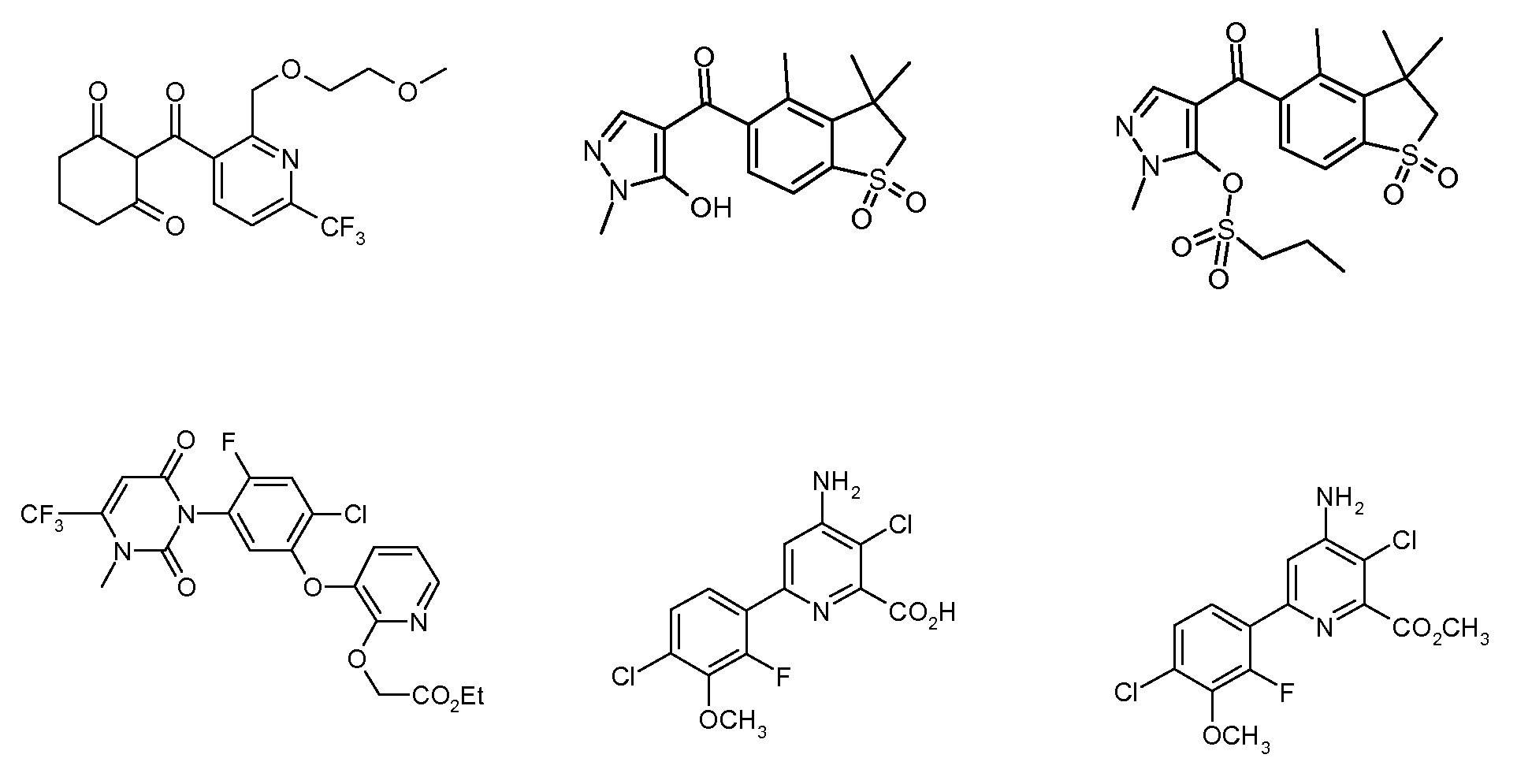
Acibenzolar, Acibenzolar-S-methyl, Ancymidol, 5-Aminolävulinsäure, 6- Benzylaminopurin, Chlormequat-chlorid, Cloprop, Cyclanilid, 3-(Cycloprop-1 - enyl)propionsäure, Daminozid, Dazomet, Dikegulac, Dikegulac-Natrium, Ethephon, Flumetralin, Flurenol, Flurenol-butyl, Flurprimidol, Förch lorfenuron, Gibberellinsäure, Inabenfide, Indolessigsäure (IAA), 4-lndol-3-ylbuttersäure, Jasmonsäure, Acibenzolar, acibenzolar-S-methyl, ancymidol, 5-aminolevulinic acid, 6-benzylaminopurine, chlormequat chloride, cloprop, cyclanilide, 3- (cycloprop-1-enyl) propionic acid, daminozide, dazomet, dikegulac, dikegulac sodium, ethephon, flumetralin , Flurenol, Flurenol-butyl, Flurprimidol, Förch lorfenuron, Gibberellinic acid, Inabenfide, Indolessigsäure (IAA), 4-indol-3-ylbutyric acid, jasmonic acid,
Jasmonsäuremethylester, Maleinsäurehydrazid, Mepiquat-chlorid, 1 - Methylcyclopropen, 2-(1 -Naphthyl)acetamid, 1 -Naphthylessigsäure, 2- Naphthyloxyessigsäure, Nitrophenolat-Natrium (Isomerengemisch), 4-Oxo-4[(2- phenylethyl)amino]buttersäure, Paclobutrazol, N-Phenylphthalsäureamind, Methyl jasmonate, maleic hydrazide, mepiquat chloride, 1-methylcyclopropene, 2- (1-naphthyl) acetamide, 1-naphthylacetic acid, 2-naphthyloxyacetic acid, nitrophenolate sodium (mixture of isomers), 4-oxo-4 [(2- phenylethyl) amino] butyric acid, paclobutrazole, N-phenylphthalic acid amine,
Prohexadion, Prohexadion-Calcium, Prohydrojasmon, Salicyclsäure, Strigolacton, Tecnazen, Thidiazuron, Triacontanol, Trinexapac, Trinexapac-ethyl, Tsitodef, Prohexadione, Prohexadione-Calcium, Prohydrojasmon, Salicyclic acid, Strigolactone, Tecnazen, Thidiazuron, Triacontanol, Trinexapac, Trinexapac-ethyl, Tsitodef,
Uniconazol, Uniconazol-P. Uniconazole, Uniconazole-P.
Von besonderem Interesse ist die selektive Bekämpfung von Schadpflanzen in Kulturen von Nutz- und Zierpflanzen. Obgleich die erfindungsgemäßen Verbindungen der allgemeinen Formel (I) bereits in vielen Kulturen sehr gute bis ausreichende Selektivität aufweisen, können prinzipiell in einigen Kulturen und vor allem auch im Falle von Mischungen mit anderen Herbiziden, die weniger selektiv sind, Phytotoxizitäten an den Kulturpflanzen auftreten. Diesbezüglich sind Kombinationen erfindungsgemäßer Verbindungen der allgemeinen Formel (I) von besonderem Interesse, welche die Verbindungen der allgemeinen Formel (I) bzw. deren Kombinationen mit anderen Herbiziden oder Pestiziden und Safenern enthalten. Die Safener, welche in einem antidotisch wirksamen Gehalt eingesetzt werden, reduzieren die phytotoxischen Nebenwirkungen der eingesetzten Herbizide/Pestizide, z. B. in wirtschaftlich Of particular interest is the selective control of harmful plants in crops of commercial and ornamental plants. Although the compounds of the general formula (I) according to the invention already have very good to sufficient selectivity in many cultures, phytotoxicities on the crop plants can in principle occur in some crops and, above all, in the case of mixtures with other herbicides which are less selective. In this connection, combinations of compounds of the general formula (I) according to the invention which are of particular interest and which contain the compounds of the general formula (I) or their combinations with other herbicides or pesticides and safeners are of particular interest. The safeners, which are used in an antidote effective content, reduce the phytotoxic side effects of the herbicides / pesticides used, eg. B. in economic
bedeutenden Kulturen wie Getreide (Weizen, Gerste, Roggen, Mais, Reis, Hirse), Zuckerrübe, Zuckerrohr, Raps, Baumwolle und Soja, vorzugswiese Getreide. Folgende Gruppen von Verbindungen kommen beispielsweise als Safener für die Verbindungen (I) alleinig oder aber in deren Kombinationen mit wieteren Pestiziden in Frage: important crops such as cereals (wheat, barley, rye, corn, rice, millet), sugar beet, sugar cane, oilseed rape, cotton and soybeans, preferably cereals. The following groups of compounds are suitable, for example, as safeners for the compounds (I), alone or in combinations thereof with other pesticides:
Die Safener sind vorzugsweise ausgewählt aus der Gruppe bestehend aus: S1 ) Verbindungen der Formel (S1 ),
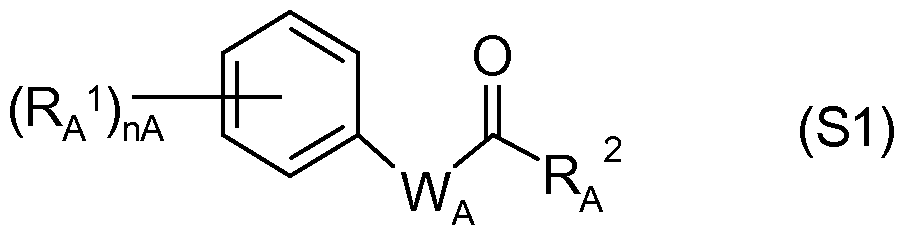
wobei die Symbole und Indizes folgende Bedeutungen haben: where the symbols and indices have the following meanings:
nA ist eine natürliche Zahl von 0 bis 5, vorzugsweise 0 bis 3; nA is a natural number of 0 to 5, preferably 0 to 3;
RA1 ist Halogen, (Ci-C )Alkyl, (Ci-C )Alkoxy, Nitro oder (Ci-C )Haloalkyl; WA ist ein unsubstituierter oder substituierter divalenter heterocyclischer Rest aus der Gruppe der teilungesättigten oder aromatischen Fünfring-Heterocyclen mit 1 bis 3 Heteronngatonnen aus der Gruppe N und O, wobei mindestens ein N-Atom und höchstens ein O-Atom im Ring enthalten ist, vorzugsweise ein Rest aus der Gruppe (WA 1) bis (WA 4), RA 1 is halogen, (Ci-C) alkyl, (Ci-C) alkoxy, nitro or (Ci-C) haloalkyl; WA is an unsubstituted or substituted divalent heterocyclic radical from the group of the pentally unsaturated or aromatic five-membered heterocycles with 1 to 3 heterogeneous sodium from the group N and O, wherein at least one N-atom and at most one O-atom is contained in the ring, preferably a radical from the group (W A 1 ) to (W A 4 ),
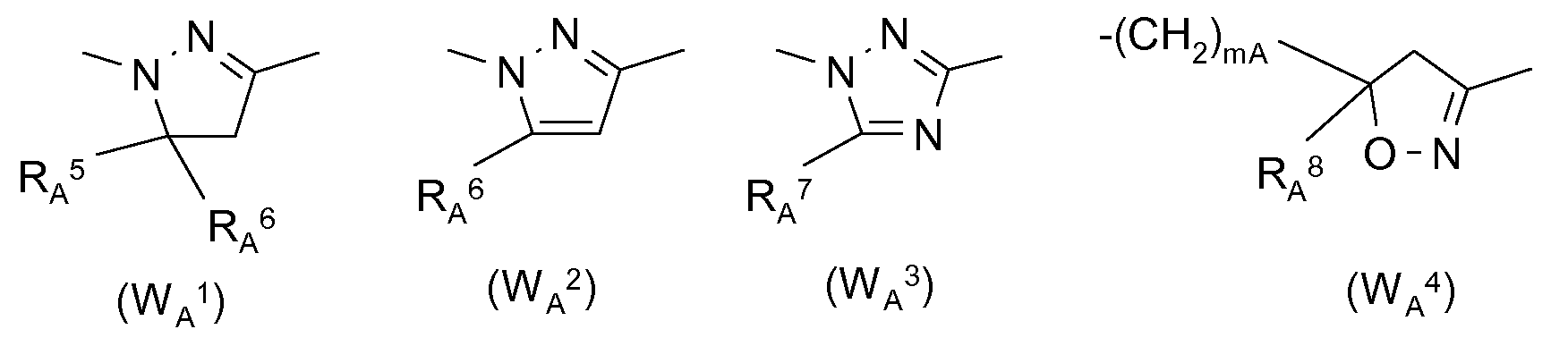
RA2 ist ORA3, SRA3 oder NRA3RA4 oder ein gesättigter oder ungesättigter 3- bis 7- gliedriger Heterocyclus mit mindestens einem N-Atom und bis zu 3 Hetero- atomen, vorzugsweise aus der Gruppe O und S, der über das N-Atom mit der Carbonylgruppe in (S1 ) verbunden ist und unsubstituiert oder durch Reste aus der Gruppe (Ci-C4)Alkyl, (Ci-C4)Alkoxy oder gegebenenfalls substituiertes Phenyl substituiert ist, vorzugsweise ein Rest der Formel ORA3, NHRA4 oder N(CH3)2, insbesondere der Formel ORA3; RA 2 is ORA 3 , SRA 3 or NRA 3 RA 4 or a saturated or unsaturated 3- to 7-membered heterocycle having at least one N atom and up to 3 heteroatoms, preferably from the group O and S, via the N atom is bonded to the carbonyl group in (S1) and is unsubstituted or substituted by radicals from the group (C 1 -C 4 ) alkyl, (C 1 -C 4 ) alkoxy or optionally substituted phenyl, preferably a radical of the formula ORA 3 , NHRA 4 or N (CH 3) 2, in particular of the formula ORA 3 ;
RA3 ist Wasserstoff oder ein unsubstituierter oder substituierter aliphatischer RA 3 is hydrogen or an unsubstituted or substituted aliphatic
Kohlenwasserstoffrest, vorzugsweise mit insgesamt 1 bis 18 C-Atomen; Hydrocarbon radical, preferably having a total of 1 to 18 carbon atoms;
RA4 ist Wasserstoff, (Ci-Ce)Alkyl, (Ci-Ce)Alkoxy oder substituiertes oder RA 4 is hydrogen, (Ci-Ce) alkyl, (Ci-Ce) alkoxy or substituted or
unsubstituiertes Phenyl; unsubstituted phenyl;
RA5 ist H, (Ci-C8)Alkyl, (Ci-C8)Haloalkyl, (Ci-C )Alkoxy(Ci-C8)Alkyl, Cyano oder COORA9, worin RA 9 Wasserstoff, (Ci-C8)Alkyl, (Ci-Cs)Haloalkyl, (Ci-C )Alkoxy- (Ci-C )alkyl, (Ci-C6)Hydroxyalkyl, (C3-Ci2)Cycloalkyl oder Tri-(Ci-C )-alkyl-silyl ist; RA 5 is H, (Ci-C 8 ) alkyl, (Ci-C 8 ) haloalkyl, (Ci-C) alkoxy (Ci-C 8 ) alkyl, cyano or COORA 9 , where R A 9 hydrogen, (Ci-C 8 ) alkyl, (Ci-Cs) haloalkyl, (Ci-C) alkoxy- (Ci-C) alkyl, (Ci-C 6 ) hydroxyalkyl, (C 3 -Ci 2 ) cycloalkyl or tri- (Ci-C) - alkyl-silyl;
RA6, RA7, RA8 sind gleich oder verschieden Wasserstoff, (Ci-Cs)Alkyl, (Ci-Cs)Haloalkyl, (C3-Ci2)Cycloalkyl oder substituiertes oder unsubstituiertes Phenyl; vorzugsweise: RA 6 , RA 7 , RA 8 are identical or different hydrogen, (Ci-Cs) alkyl, (Ci-Cs) haloalkyl, (C3-Ci2) cycloalkyl or substituted or unsubstituted phenyl; preferably:
a) Verbindungen vom Typ der Dichlorphenylpyrazolin-3-carbonsäure (S1 a), a) compounds of the type of dichlorophenylpyrazoline-3-carboxylic acid (S1 a),
vorzugsweise Verbindungen wie preferably compounds such as
1 -(2,4-Dichlorphenyl)-5-(ethoxycarbonyl)-5-methyl-2-pyrazolin-3-carbonsäure, 1 -(2,4-Dichlorphenyl)-5-(ethoxycarbonyl)-5-methyl-2-pyrazolin-3-carbonsäure- ethylester (S1 -1 ) ("Mefenpyr-diethyl"), und verwandte Verbindungen, wie sie in der WO-A-91/07874 beschrieben sind; 1- (2,4-dichlorophenyl) -5- (ethoxycarbonyl) -5-methyl-2-pyrazoline-3-carboxylic acid, 1- (2,4-dichlorophenyl) -5- (ethoxycarbonyl) -5-methyl-2- pyrazoline-3-carboxylic acid ethyl ester (S1-1) ("mefenpyr-diethyl") and related compounds as described in WO-A-91/07874;
b) Derivate der Dichlorphenylpyrazolcarbonsäure (S1 b), vorzugsweise Verbindungen wie 1 -(2,4-Dichlorphenyl)-5-methyl-pyrazol-3-carbonsäureethylester (S1 -2), 1 -(2,4-Dichlorphenyl)-5-isopropyl-pyrazol-3-carbonsäureethylester (S1 -3), 1 -(2,4-Dichlorphenyl)-5-(1 ,1 -dimethyl-ethyl)pyrazol-3-carbonsäureethyl- ester (S1 -4) und verwandte Verbindungen, wie sie in EP-A-333 131 und b) Derivatives of the dichlorophenylpyrazolecarboxylic acid (S1b), preferably compounds such as ethyl 1- (2,4-dichlorophenyl) -5-methyl-pyrazole-3-carboxylate (S1-2), 1- (2,4-dichlorophenyl) -5- isopropyl-pyrazole-3-carboxylic acid ethyl ester (S1 -3), 1- (2,4-dichlorophenyl) -5- (1, 1-dimethyl-ethyl) -pyrazole-3-carboxylic acid ethyl ester (S1 -4) and related compounds, as described in EP-A-333 131 and
EP-A-269 806 beschrieben sind; EP-A-269 806 are described;
c) Derivate der 1 ,5-Diphenylpyrazol-3-carbonsäure (Si c), vorzugsweise Verbindungen wie 1 -(2,4-Dichlorphenyl)-5-phenylpyrazol-3-carbonsäureethylester (S1 -5), 1 -(2-Chlorphenyl)-5-phenylpyrazol-3-carbonsäuremethylester (S1 -6) und verwandte Verbindungen wie sie beispielsweise in der EP-A-268554 c) derivatives of 1,5-diphenylpyrazole-3-carboxylic acid (Si c), preferably compounds such as ethyl 1- (2,4-dichlorophenyl) -5-phenylpyrazole-3-carboxylate (S1 -5), 1- (2-chlorophenyl ) -5-phenylpyrazole-3-carboxylic acid methyl ester (S1 -6) and related compounds as described, for example, in EP-A-268554
beschrieben sind; are described;
d) Verbindungen vom Typ der Triazolcarbonsäuren (S1d), vorzugsweise d) compounds of the type of the triazolecarboxylic acids (S1d), preferably
Verbindungen wie Fenchlorazol(-ethylester), d.h. Compounds such as fenchlorazole (ethyl ester), i.
1 -(2,4-Dichlorphenyl)-5-trichlormethyl-(1 H)-1 ,2,4-triazol-3-carbonsäureethylester (S1 -7), und verwandte Verbindungen wie sie in EP-A-174 562 und 1- (2,4-dichlorophenyl) -5-trichloromethyl- (1 H) -1, 2,4-triazole-3-carboxylic acid ethyl ester (S1 -7), and related compounds as described in EP-A-174 562 and US Pat
EP-A-346 620 beschrieben sind; EP-A-346 620 are described;
e) Verbindungen vom Typ der 5-Benzyl- oder 5-Phenyl-2-isoxazolin-3- carbonsäure oder der 5,5-Diphenyl-2-isoxazolin-3-carbonsäure (Si e), vorzugsweise Verbindungen wie 5-(2,4-Dichlorbenzyl)-2-isoxazolin-3-carbonsäureethylester (S1 -8) oder 5-Phenyl-2-isoxazolin-3-carbonsäureethylester (S1 -9) und verwandte Verbindungen, wie sie in WO-A-91/08202 beschrieben sind, bzw. e) compounds of the 5-benzyl- or 5-phenyl-2-isoxazoline-3-carboxylic acid or of the 5,5-diphenyl-2-isoxazoline-3-carboxylic acid (Si e), preferably compounds such as 5- (2, 4-dichlorobenzyl) -2-isoxazoline-3-carboxylic acid ethyl ester (S1 -8) or 5-phenyl-2-isoxazoline-3-carboxylic acid ethyl ester (S1 -9) and related compounds as described in WO-A-91/08202 , respectively.
5,5-Diphenyl-2-isoxazolin-carbonsäure (S1 -10) oder 5,5-Diphenyl-2-isoxazolin- carbonsäureethylester (S1 -1 1 ) ("Isoxadifen-ethyl") oder -n-propylester (S1 -12) oder der 5-(4-Fluorphenyl)-5-phenyl-2-isoxazolin-3-carbonsäureethylester (S1 -13), wie sie in der Patentanmeldung WO-A-95/07897 beschrieben sind. S2) Chinolinderivate der Formel S2), 5,5-diphenyl-2-isoxazoline-carboxylic acid (S1 -10) or ethyl 5,5-diphenyl-2-isoxazolinecarboxylate (S1-1 1) ("isoxadifen-ethyl") or n-propyl ester (S1 -12 ) or the 5- (4-fluorophenyl) -5-phenyl-2-isoxazoline-3-carboxylic acid ethyl ester (S1 -13), as described in the patent application WO-A-95/07897. S2) quinoline derivatives of the formula S2),

RB1 ist Halogen, (Ci-C )Alkyl, (Ci-C )Alkoxy, Nitro oder (Ci-C )Haloalkyl; RB 1 is halogen, (Ci-C) alkyl, (Ci-C) alkoxy, nitro or (Ci-C) haloalkyl;
nB ist eine natürliche Zahl von 0 bis 5, vorzugsweise 0 bis 3; nB is a natural number from 0 to 5, preferably 0 to 3;
RB2 ist ORB 3, SRB3 oder NRB 3RB4 oder ein gesättigter RB 2 is OR B 3 , SRB 3 or NR B 3 RB 4 or a saturated one
oder ungesättigter 3- bis 7-gliedriger Heterocyclus mit mindestens einem or unsaturated 3 to 7-membered heterocycle having at least one
N-Atom und bis zu 3 Heteroatomen, vorzugsweise aus der Gruppe O und S, der über das N-Atom mit der Carbonylgruppe in (S2) verbunden ist und N atom and up to 3 heteroatoms, preferably from the group O and S, which is connected via the N-atom with the carbonyl group in (S2) and
unsubstituiert oder durch Reste aus der Gruppe (Ci-C4)Alkyl, (Ci-C4)Alkoxy oder gegebenenfalls substituiertes Phenyl substituiert ist, vorzugsweise ein Rest der Formel ORB3, NHRB4 oder N(CH3)2, insbesondere der Formel ORB3; is unsubstituted or substituted by radicals from the group (C 1 -C 4 ) alkyl, (C 1 -C 4 ) alkoxy or optionally substituted phenyl, preferably a radical of the formula ORB 3 , NHRB 4 or N (CH 3) 2, in particular of the formula ORB 3 ;
RB3 ist Wasserstoff oder ein unsubstituierter oder substituierter aliphatischer RB 3 is hydrogen or an unsubstituted or substituted aliphatic
Kohlenwasserstoffrest, vorzugsweise mit insgesamt 1 bis 18 C-Atomen; Hydrocarbon radical, preferably having a total of 1 to 18 carbon atoms;
RB4 ist Wasserstoff, (Ci-Ce)Alkyl, (Ci-Ce)Alkoxy oder substituiertes oder RB 4 is hydrogen, (Ci-Ce) alkyl, (Ci-Ce) alkoxy or substituted or
unsubstituiertes Phenyl; unsubstituted phenyl;
TB ist eine (Ci oder C2)-Alkandiyl kette, die unsubstituiert oder mit einem oder zwei (Ci-C4)Alkylresten oder mit [(Ci-C3)-Alkoxy]-carbonyl substituiert ist; vorzugsweise: TB is a (Ci or C2) alkanediyl chain which is unsubstituted or substituted by one or two (Ci-C 4 ) alkyl radicals or by [(Ci-C3) alkoxy] carbonyl; preferably:
a) Verbindungen vom Typ der 8-Chinolinoxyessigsäure (S2a), vorzugsweise a) compounds of the type of 8-quinolinoxyacetic acid (S2a), preferably
(5-Chlor-8-chinolinoxy)essigsäure-(1 -methylhexyl)ester ("Cloquintocet-mexyl") (5-Chloro-8-quinolinoxy) acetic acid (1-methylhexyl) ester ("Cloquintocet-mexyl")
(S2-1 ), (S2-1),
(5-Chlor-8-chinolinoxy)essigsäure-(1 ,3-dimethyl-but-1 -yl)ester (S2-2), (5-chloro-8-quinolinoxy) acetic acid (1, 3-dimethylbut-1-yl) ester (S2-2),
(5-Chlor-8-chinolinoxy)essigsäure-4-allyloxy-butylester (S2-3), (5-chloro-8-quinolinoxy) acetic acid 4-allyloxy-butyl ester (S2-3),
(5-Chlor-8-chinolinoxy)essigsäure-1 -allyloxy-prop-2-ylester (S2-4), (5-chloro-8-quinolinoxy) acetic acid 1 -allyloxy-prop-2-yl ester (S2-4),
(5-Chlor-8-chinolinoxy)essigsäureethylester (S2-5), (5-chloro-8-quinolinoxy) acetic acid ethyl ester (S2-5),
(5-Chlor-8-chinolinoxy)essigsäuremethylester (S2-6), (5-chloro-8-quinolinoxy) acetic acid methyl ester (S2-6),
(5-Chlor-8-chinolinoxy)essigsäureallylester (S2-7), Allyl (5-chloro-8-quinolinoxy) acetates (S2-7),
(5-Chlor-8-chinolinoxy)essigsäure-2-(2-propyliden-iminoxy)-1 -ethylester (S2-8), (5-Chlor-8-chinolinoxy)essigsäure-2-oxo-prop-1 -ylester (S2-9) und verwandte Verbindungen, wie sie in EP-A-86 750, EP-A-94 349 und EP-A-191 736 oder (5-Chloro-8-quinolinoxy) acetic acid 2- (2-propylidene-iminoxy) -1-ethyl ester (S2-8), (5-chloro-8-quinolinoxy) -acetic acid 2-oxo-prop-1-yl-ester (S2-9) and related compounds as described in EP-A-86,750, EP-A-94,349 and EP-A-191,736 or US Pat
EP-A-0 492 366 beschrieben sind, sowie (5-Chlor-8-chinolinoxy)essigsäure (S2-10), deren Hydrate und Salze, beispielsweise deren Lithium-, Natrium- Kalium-, Kalzium-, Magnesium-, Aluminium-, Eisen-, Ammonium-, quartäre Ammonium-, Sulfonium-, oder Phosphoniumsalze wie sie in der WO-A- 2002/34048 beschrieben sind; EP-A-0 492 366 and (5-chloro-8-quinolinoxy) acetic acid (S2-10), their hydrates and salts, for example their lithium, sodium, potassium, calcium, magnesium and aluminum salts. , Iron, ammonium, quaternary Ammonium, sulfonium or phosphonium salts as described in WO-A-2002/34048;
b) Verbindungen vom Typ der (5-Chlor-8-chinolinoxy)malonsäure (S2b), b) compounds of the (5-chloro-8-quinolinoxy) malonic acid (S2b) type,
vorzugsweise Verbindungen wie (5-Chlor-8-chinolinoxy)malonsäurediethylester, (5-Chlor-8-chinolinoxy)malonsäurediallylester, (5-Chlor-8-chinolin- oxy)malonsäure-methyl-ethylester und verwandte Verbindungen, wie sie in EP- A-0 582 198 beschrieben sind. S3) Verbindungen der Formel (S3) preferably compounds such as diethyl (5-chloro-8-quinolinoxy) malonate, (5-chloro-8-quinolinoxy) malonic acid diallyl ester, (5-chloro-8-quinolineoxy) malonic acid methyl ethyl ester and related compounds as described in EP-A A-0 582 198 are described. S3) compounds of the formula (S3)
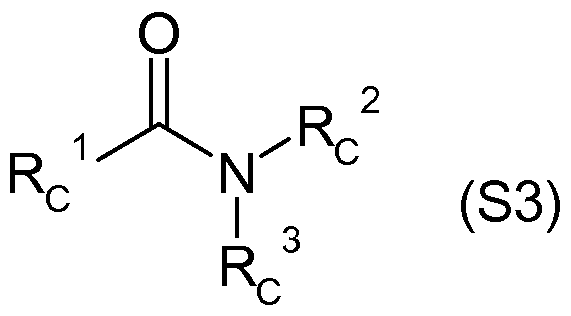
wobei die Symbole und Indizes folgende Bedeutungen haben: where the symbols and indices have the following meanings:
Rc1 ist (Ci-C4)Alkyl, (Ci-C4)Haloalkyl, (C2-C4)Alkenyl, (C2-C4)Haloalkenyl, Rc 1 is (Ci-C 4) alkyl, (Ci-C 4) haloalkyl, (C 2 -C 4) alkenyl, (C 2 -C 4) haloalkenyl,
(C3-C7)Cycloalkyl, vorzugsweise Dichlormethyl; (C3-C7) cycloalkyl, preferably dichloromethyl;
Rc2, Rc3 sind gleich oder verschieden Wasserstoff, (Ci-C4)Alkyl, (C2-C4)Alkenyl, R c 2 , R c 3 are identical or different hydrogen, (C 1 -C 4 ) alkyl, (C 2 -C 4 ) alkenyl,
(C2-C )Alkinyl, (Ci-C )Haloalkyl, (C2-C )Haloalkenyl, (Ci-C )Alkylcarbamoyl- (Ci-C )alkyl, (C2-C )Alkenylcarbamoyl-(Ci-C )alkyl, (Ci-C )Alkoxy-(Ci-C )alkyl, Dioxolanyl-(Ci-C4)alkyl, Thiazolyl, Furyl, Furylalkyl, Thienyl, Piperidyl, substituiertes oder unsubstituiertes Phenyl, oder Rc2 und Rc3 bilden zusammen einen substituierten oder unsubstituierten heterocyclischen Ring, vorzugsweise einen Oxazolidin-, Thiazolidin-, Piperidin-, Morpholin-, Hexahydropyrimidin- oder Benzoxazinring; vorzugsweise: (C 2 -C) alkynyl, (C 1 -C 6) haloalkyl, (C 2 -C) haloalkenyl, (C 1 -C 4) -alkylcarbamoyl- (C 1 -C 4 -alkyl), (C 2 -C) -alkenylcarbamoyl- (C 1 -C 4) alkyl, (Ci-C) alkoxy- (Ci-C) alkyl, dioxolanyl- (Ci-C 4 ) alkyl, thiazolyl, furyl, furylalkyl, thienyl, piperidyl, substituted or unsubstituted phenyl, or Rc 2 and Rc 3 together form one substituted or unsubstituted heterocyclic ring, preferably an oxazolidine, thiazolidine, piperidine, morpholine, hexahydropyrimidine or benzoxazine ring; preferably:
Wirkstoffe vom Typ der Dichloracetamide, die häufig als Vorauflaufsafener Active substances of the dichloroacetamide type, often as pre-emergence safeners
(bodenwirksame Safener) angewendet werden, wie z. B. (soil-active safeners) are used, such. B.
"Dichlormid" (N,N-Diallyl-2,2-dichloracetamid) (S3-1 ), "Dichloromid" (N, N-diallyl-2,2-dichloroacetamide) (S3-1),
"R-29148" (3-Dichloracetyl-2,2,5-trimethyl-1 ,3-oxazolidin) der Firma Stauffer "R-29148" (3-dichloroacetyl-2,2,5-trimethyl-1,3-oxazolidine) from Stauffer
(S3-2), (S3-2),
"R-28725" (3-Dichloracetyl-2,2,-dimethyl-1 ,3-oxazolidin) der Firma Stauffer (S3-3), "Benoxacor" (4-Dichloracetyl-3,4-dihydro-3-methyl-2H-1 ,4-benzoxazin) (S3-4), "PPG-1292" (N-Allyl-N-[(1 ,3-dioxolan-2-yl)-methyl]-dichloracetamid) der Firma PPG Industries (S3-5), "R-28725" (3-dichloroacetyl-2,2, -dimethyl-1,3-oxazolidine) from Stauffer (S3-3), "Benoxacor" (4-dichloroacetyl-3,4-dihydro-3-methyl-2H-1,4-benzoxazine) (S3-4), "PPG-1292" (N-allyl-N - [(1,3) dioxolan-2-yl) -methyl] -dichloroacetamide) from PPG Industries (S3-5),
"DKA-24" (N-Allyl-N-[(allylaminocarbonyl)methyl]-dichloracetamid) der Firma Sagro-Chem (S3-6), "DKA-24" (N-allyl-N - [(allylaminocarbonyl) methyl] -dichloroacetamide) from Sagro-Chem (S3-6),
"AD-67" oder "MON 4660" (3-Dichloracetyl-1 -oxa-3-aza-spiro[4,5]decan) der Firma Nitrokemia bzw. Monsanto (S3-7), "AD-67" or "MON 4660" (3-dichloroacetyl-1-oxa-3-aza-spiro [4,5] decane) from Nitrokemia or Monsanto (S3-7),
"TI-35" (1 -Dichloracetyl-azepan) der Firma TRI-Chemical RT (S3-8), "TI-35" (1-dichloroacetyl-azepane) from TRI-Chemical RT (S3-8),
"Diclonon" (Dicyclonon) oder "BAS145138" oder "LAB145138" (S3-9) ((RS)-1 - Dichloracetyl-3,3,8a-trimethylperhydropyrrolo[1 ,2-a]pyrimidin-6-on) der Firma "Diclonone" (dicyclonone) or "BAS145138" or "LAB145138" (S3-9) ((RS) -1-dichloroacetyl-3,3,8a-trimethyl-perhydropyrrolo [1,2-a] pyrimidin-6-one) from the company
BASF, BASF,
"Furilazol" oder "MON 13900" ((RS)-3-Dichloracetyl-5-(2-furyl)-2,2-dimethyl- oxazolidin) (S3-10); sowie dessen (R)-Isomer (S3-1 1 ). S4) N-Acylsulfonamide der Formel (S4) und ihre Salze, "Furilazole" or "MON 13900" ((RS) -3-dichloroacetyl-5- (2-furyl) -2,2-dimethyl-oxazolidine) (S3-10); and its (R) isomer (S3-1 1). S4) N-acylsulfonamides of the formula (S4) and their salts,
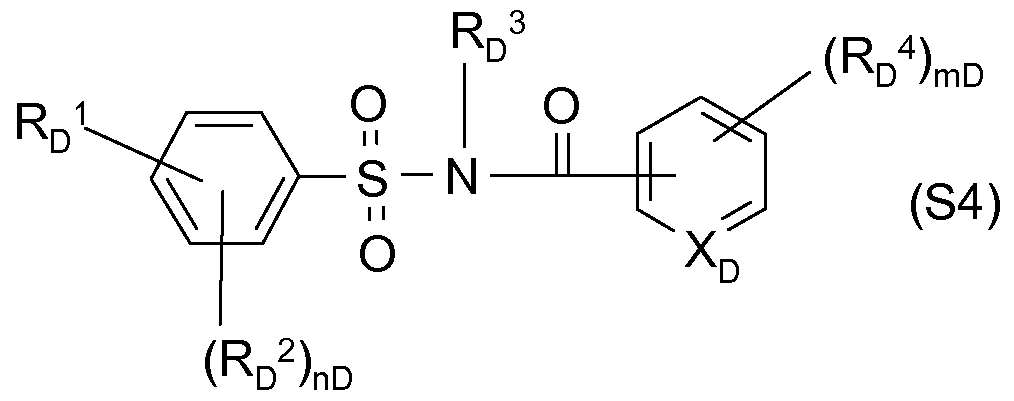
XD ist CH oder N; XD is CH or N;
RD1 ist CO-NRD 5RD6 oder NHCO-RD7; RD 1 is CO-NR D 5 RD 6 or NHCO-RD 7 ;
RD2 ist Halogen, (Ci-C )Haloalkyl, (Ci-C )Haloalkoxy, Nitro, (Ci-C )Alkyl, RD 2 is halogen, (Ci-C) haloalkyl, (Ci-C) haloalkoxy, nitro, (Ci-C) alkyl,
(Ci-C )Alkoxy, (Ci-C )Alkylsulfonyl, (Ci-C )Alkoxycarbonyl oder (Ci-C) Alkoxy, (Ci-C) Alkylsulfonyl, (Ci-C) Alkoxycarbonyl or
(Ci-C )Alkylcarbonyl; (Ci-C) alkyl carbonyl;
RD3 ist Wasserstoff, (Ci-C )Alkyl, (C2-C )Alkenyl oder (C2-C )Alkinyl; RD 3 is hydrogen, (Ci-C) alkyl, (C 2 -C) alkenyl or (C 2 -C) alkynyl;
RD 4 ist Halogen, Nitro, (Ci-C )Alkyl, (Ci-C )Haloalkyl, (Ci-C )Haloalkoxy, R D 4 is halogen, nitro, (Ci-C) alkyl, (Ci-C) haloalkyl, (Ci-C) haloalkoxy,
(C3-C6)Cycloalkyl, Phenyl, (Ci-C )Alkoxy, Cyano, (Ci-C )Alkylthio, (Ci-C )Alkyl- sulfinyl, (Ci-C4)Alkylsulfonyl, (Ci-C4)Alkoxycarbonyl oder (Ci-C4)Alkylcarbonyl; RD5 ist Wasserstoff, (Ci-C6)Alkyl, (C3-C6)Cycloalkyl, (C2-C6)Alkenyl, (C2-C6)Alkinyl, (C5-C6)Cycloalkenyl, Phenyl oder 3- bis 6-gliedriges Heterocyclyl enthaltend vD Heteroatome aus der Gruppe Stickstoff, Sauerstoff und Schwefel, wobei die sieben letztgenannten Reste durch vD Substituenten aus der Gruppe Halogen, (Ci-C6)Alkoxy, (Ci-C6)Haloalkoxy, (Ci-C2)Alkylsulfinyl, (Ci-C2)Alkylsulfonyl, (C3- C6)Cycloalkyl, (Ci-C4)Alkoxycarbonyl, (Ci-C4)Alkylcarbonyl und Phenyl und im Falle cyclischer Reste auch (Ci-C4) Alkyl und (Ci-C4)Haloalkyl substituiert sind; ist Wasserstoff, (Ci-C6)Alkyl, (C2-C6)Alkenyl oder (C2-C6)Alkinyl, wobei die drei letztgenannten Reste durch vD Reste aus der Gruppe Halogen, Hydroxy, (Ci-C4)Alkyl, (Ci-C4)Alkoxy und (Ci-C4)Alkylthio substituiert sind, oder nd RD6 gemeinsam mit dem dem sie tragenden Stickstoffatom einen Pyrrolidinyl- oder Piperidinyl-Rest bilden; (C3-C6) cycloalkyl, phenyl, (Ci-C) alkoxy, cyano, (Ci-C) alkylthio, (Ci-C) alkyl sulfinyl, (Ci-C 4) alkylsulfonyl, (Ci-C 4) alkoxycarbonyl or (C 1 -C 4 ) alkylcarbonyl; RD 5 is hydrogen, (C 1 -C 6 ) alkyl, (C 3 -C 6 ) cycloalkyl, (C 2 -C 6 ) alkenyl, (C 2 -C 6 ) alkynyl, (C 5 -C 6 ) cycloalkenyl, phenyl or 3 to 6 heterocyclyl-containing hetero-hetero-atoms from the group nitrogen, oxygen and sulfur, wherein the seven latter radicals by vD substituents selected from the group consisting of halogen, (C 1 -C 6 ) alkoxy, (C 1 -C 6 ) haloalkoxy, (C 1 -C 2 ) alkylsulfinyl, (C 1 -C 2 ) alkylsulfonyl, (C 3 -C 6 ) cycloalkyl , (Ci-C 4 ) alkoxycarbonyl, (Ci-C 4 ) alkylcarbonyl and phenyl and in the case of cyclic radicals also (Ci-C 4 ) alkyl and (Ci-C 4 ) haloalkyl are substituted; is hydrogen, (Ci-C 6) alkyl, (C 2 -C 6) alkenyl or (C2-C6) -alkynyl, where the three last-mentioned radicals are substituted by v D radicals from the group halogen, hydroxy, (Ci-C 4) alkyl , (C 1 -C 4 ) alkoxy and (C 1 -C 4 ) alkylthio, or nd RD 6 together with the nitrogen atom carrying them form a pyrrolidinyl or piperidinyl radical;
RD 7 ist Wasserstoff, (Ci-C4)Alkylamino, Di-(Ci-C4)alkylamino, (Ci-Ce)Alkyl, R D 7 is hydrogen, (Ci-C 4) alkylamino, di (Ci-C 4) alkylamino, (Ci-Ce) alkyl,
(C3-C6)Cycloalkyl, wobei die 2 letztgenannten Reste durch vD Substituenten aus der Gruppe Halogen, (Ci-C4)Alkoxy, (Ci-Ce)Haloalkoxy und (Ci-C4)Alkylthio und im Falle cyclischer Reste auch (Ci-C4)Alkyl und (Ci-C4)Haloalkyl substituiert sind; (C3-C6) cycloalkyl, where the 2 last-mentioned radicals by vD substituents selected from the group consisting of halogen, (Ci-C 4 ) alkoxy, (Ci-Ce) haloalkoxy and (Ci-C 4 ) alkylthio and in the case of cyclic radicals also (Ci -C 4) alkyl and (Ci-C4) haloalkyl groups;
nD ist 0, 1 oder 2; nD is 0, 1 or 2;
mD ist 1 oder 2; mD is 1 or 2;
vD ist 0, 1 , 2 oder 3; davon bevorzugt sind Verbindungen von Typ der N-Acylsulfonamide, z.B. der nachfolgenden Formel (S4a), die z. B. bekannt sind aus WO-A-97/45016

worin wherein
RD7 (Ci-C6)Alkyl, (C3-C6)Cycloalkyl, wobei die 2 letztgenannten Reste durch vD RD 7 (Ci-C6) alkyl, (C3-C6) cycloalkyl, where the latter two radicals by vD
Substituenten aus der Gruppe Halogen, (Ci-C4)Alkoxy, (Ci-Ce)Haloalkoxy und (Ci-C4)Alkylthio und im Falle cyclischer Reste auch (Ci-C4)Alkyl und Substituents from the group halogen, (Ci-C 4 ) alkoxy, (Ci-Ce) haloalkoxy and (Ci-C 4 ) alkylthio and in the case of cyclic radicals also (Ci-C 4 ) alkyl and
(Ci-C4)Haloalkyl substituiert sind; (C 1 -C 4 ) haloalkyl are substituted;
RD4 Halogen, (Ci-C )Alkyl, (Ci-C )Alkoxy, CF3; RD 4 is halogen, (Ci-C) alkyl, (Ci-C) alkoxy, CF 3 ;
mD 1 oder 2; mD 1 or 2;
vD ist 0, 1 , 2 oder 3 bedeutet; sowie Acylsulfamoylbenzoesäureamide, z.B. der nachfolgenden Formel (S4b), die z.B. bekannt sind aus WO-A-99/16744, vD is 0, 1, 2 or 3; such as Acylsulfamoylbenzoesäureamide, for example, the following formula (S4 b ), for example, are known from WO-A-99/16744,
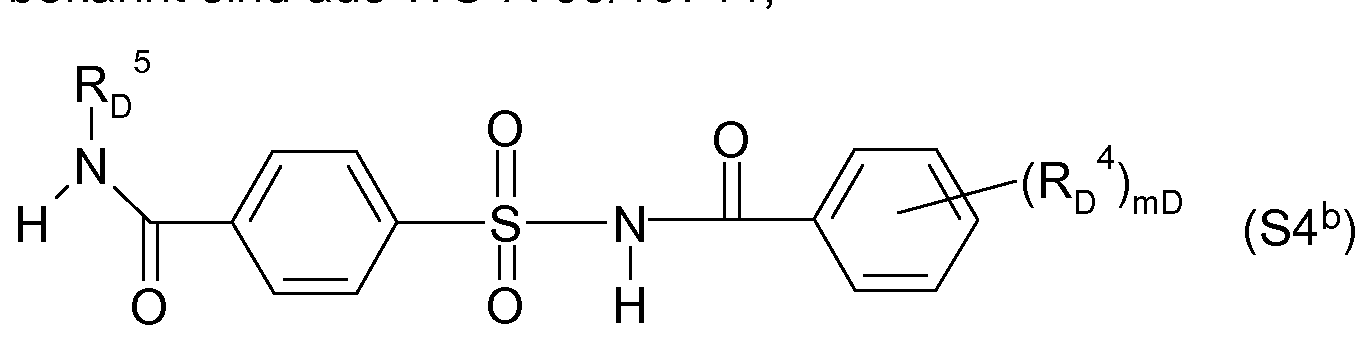
z.B. solche worin e.g. such
RD 5 = Cyclopropyl und (RD 4) = 2-OMe ist ("Cyprosulfamide", S4-1 ), R D 5 = cyclopropyl and (R D 4 ) = 2-OMe ("Cyprosulfamide", S4-1),
RD5 = Cyclopropyl und (RD 4) = 5-CI-2-OMe ist (S4-2), RD 5 = cyclopropyl and (R D 4 ) = 5-CI-2-OMe is (S4-2),
RD5 = Ethyl und (RD4) = 2-OMe ist (S4-3), RD 5 = ethyl and (RD 4 ) = 2-OMe is (S4-3),
RD5 = Isopropyl und (RD4) = 5-CI-2-OMe ist (S4-4) und RD 5 = isopropyl and (RD 4 ) = 5-CI-2-OMe is (S4-4) and
RD5 = Isopropyl und (RD4) = 2-OMe ist (S4-5). sowie RD 5 = isopropyl and (RD 4 ) = 2-OMe is (S4-5). such as
Verbindungen vom Typ der N-Acylsulfamoylphenylharnstoffe der Formel (S4C), die z.B. bekannt sind aus der EP-A-365484, Compounds of the type of N-acylsulfamoylphenylureas of the formula (S4 C ) which are known, for example, from EP-A-365484,

worin wherein
RD8 und RD9 unabhängig voneinander Wasserstoff, (Ci-C8)Alkyl, (C3-RD 8 and RD 9 are each independently hydrogen, (Ci-C8) alkyl, (C3-
C8)Cycloalkyl, (C3-C6)Alkenyl, (C3-C6)Alkinyl, C 8 ) cycloalkyl, (C 3 -C 6 ) alkenyl, (C 3 -C 6 ) alkynyl,
RD4 Halogen, (Ci-C )Alkyl, (Ci-C )Alkoxy, CF3 RD 4 halogen, (Ci-C) alkyl, (Ci-C) alkoxy, CF 3
mD 1 oder 2 bedeutet; beispielsweise mD is 1 or 2; for example
1 -[4-(N-2-Methoxybenzoylsulfamoyl)phenyl]-3-methylharnstoff, 1 - [4- (N-2-methoxybenzoylsulfamoyl) phenyl] -3-methylurea,
1 -[4-(N-2-Methoxybenzoylsulfamoyl)phenyl]-3,3-dimethylharnstoff, 1 - [4- (N-2-methoxybenzoylsulfamoyl) phenyl] -3,3-dimethylurea,
1 -[4-(N-4,5-Dimethylbenzoylsulfamoyl)phenyl]-3-methylharnstoff. 1 - [4- (N-4,5-dimethylbenzoylsulfamoyl) phenyl] -3-methylurea.
Wirkstoffe aus der Klasse der Hydroxyaromaten und der aromatisch- aliphatischen Carbonsäurederivate (S5), z.B. Active ingredients from the class of hydroxyaromatics and aromatic-aliphatic carboxylic acid derivatives (S5), e.g.
3,4,5-Triacetoxybenzoesäureethylester, 3,5-Dimethoxy-4-hydroxybenzoesäure, 3,5-Dihydroxybenzoesäure, 4-Hydroxysalicylsäure, 4-Fluorsalicyclsäure, 2- Hydroxyzimtsäure, 2,4-Dichlorzimtsäure, wie sie in der WO-A-2004/084631 , WO-A-2005/015994, WO-A-2005/016001 beschrieben sind. S6) Wirkstoffe aus der Klasse der 1 ,2-Dihydrochinoxalin-2-one (S6), z.B. Ethyl 3,4,5-triacetoxybenzoate, 3,5-dimethoxy-4-hydroxybenzoic acid, 3,5-Dihydroxybenzoic acid, 4-hydroxysalicylic acid, 4-fluorosalicyclic acid, 2-hydroxycinnamic acid, 2,4-dichlorocinnamic acid, as described in WO-A-2004/084631, WO-A-2005/015994, WO-A-2005 / 016001 are described. S6) active compounds from the class of 1, 2-dihydroquinoxalin-2-ones (S6), eg
1 -Methyl-3-(2-thienyl)-1 ,2-dihydrochinoxalin-2-on, 1 -Methyl-3-(2-thienyl)-1 ,2- dihydrochinoxalin-2-thion, 1 -(2-Aminoethyl)-3-(2-thienyl)-1 ,2-dihydro-chinoxalin- 2-on-hydrochlorid, 1 -(2-Methylsulfonylaminoethyl)-3-(2-thienyl)-1 ,2-dihydro- chinoxalin-2-οη, wie sie in der WO-A-2005/1 12630 beschrieben sind. S7) Verbindungen der Formel (S7),wie sie in der WO-A- 1998/38856 beschrieben sind 1-Methyl-3- (2-thienyl) -1,2-dihydroquinoxalin-2-one, 1-methyl-3- (2-thienyl) -1,2-dihydroquinoxaline-2-thione, 1- (2-aminoethyl ) -3- (2-thienyl) -1,2-dihydroquinoxaline-2-one hydrochloride, 1- (2-methylsulfonylaminoethyl) -3- (2-thienyl) -1,2-dihydroquinoxaline-2 οη, as described in WO-A-2005/1 12630. S7) Compounds of the formula (S7) as described in WO-A-1998/38856
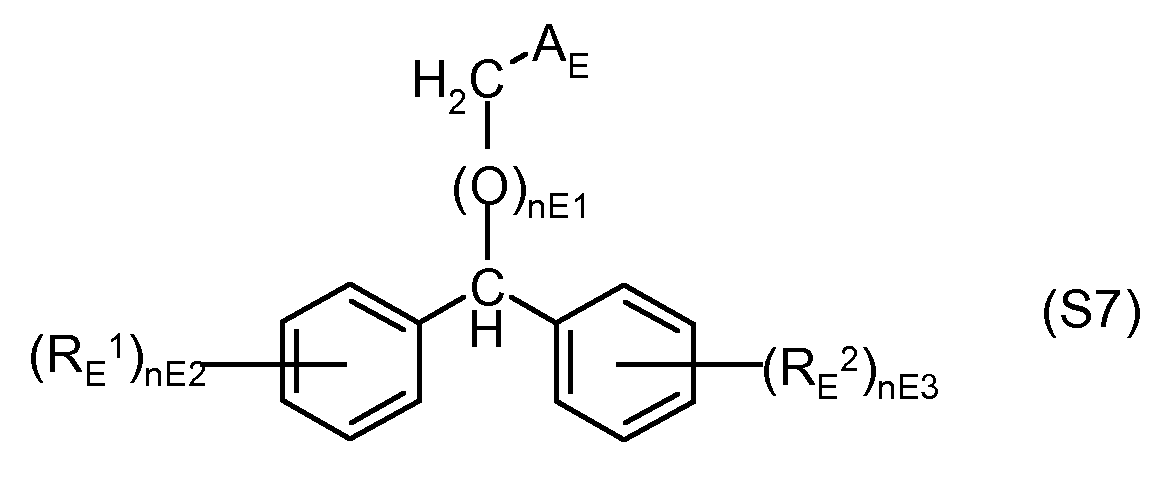
worin die Symbole und Indizes folgende Bedeutungen haben: wherein the symbols and indices have the following meanings:
RE1, RE2 sind unabhängig voneinander Halogen, (Ci-C4)Alkyl, (Ci-C4)Alkoxy, RE 1, RE 2 are independently halogen, (Ci-C 4) alkyl, (Ci-C 4) alkoxy,
(Ci-C )Haloalkyl, (Ci-C )Alkylamino, Di-(Ci-C )Alkylamino, Nitro; (Ci-C) Haloalkyl, (Ci-C) Alkylamino, Di (Ci-C) Alkylamino, Nitro;
AE ist COORE3 oder COSRE4 A E is COORE 3 or COSRE 4
RE3, RE4 sind unabhängig voneinander Wasserstoff, (Ci-C4)Alkyl, (C2-C6)Alkenyl, RE 3 , RE 4 are, independently of one another, hydrogen, (C 1 -C 4 ) -alkyl, (C 2 -C 6 ) -alkenyl,
(C2-C4)Alkinyl, Cyanoalkyl, (Ci-C4)Haloalkyl, Phenyl, Nitrophenyl, Benzyl, Halobenzyl, Pyridinylalkyl und Alkylammonium, (C 2 -C 4 ) alkynyl, cyanoalkyl, (C 1 -C 4 ) haloalkyl, phenyl, nitrophenyl, benzyl, halobenzyl, pyridinylalkyl and alkylammonium,
nE1 ist 0 oder 1 nE1 is 0 or 1
nE2, nE3 sind unabhängig voneinander 0, 1 oder 2, vorzugsweise: nE2, nE3 are independently 0, 1 or 2, preferably:
Diphenylmethoxyessigsäure, diphenylmethoxy,
Diphenylmethoxyessigsäureethylester, Diphenylmethoxyessigsäureethylester,
Diphenylmethoxyessigsäuremethylester (CAS-Reg.Nr. 41858-19-9) (S7-1 ). Methyl diphenylmethoxyacetate (CAS No. 41858-19-9) (S7-1).
Verbindungen der Formel (S8),wie sie in der WO-A-98/27049 beschrieben sind
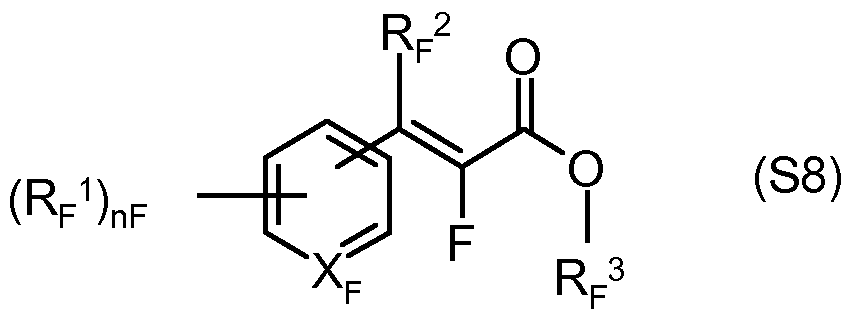
worin wherein
XF CH oder N, XF CH or N,
nF für den Fall, dass XF=N ist, eine ganze Zahl von 0 bis 4 und nF for the case that XF = N, an integer from 0 to 4 and
für den Fall, dass XF=CH ist, eine ganze Zahl von 0 bis 5 , for the case that XF = CH, an integer from 0 to 5,
RF1 Halogen, (Ci-C4)Alkyl, (Ci-C )Haloalkyl, (Ci-C )Alkoxy, (Ci-C )Haloalkoxy, Nitro, (Ci-C )Alkylthio, (Ci-C )-Alkylsulfonyl, (Ci-C )Alkoxycarbonyl, ggf. RF 1 halogen, (Ci-C 4 ) alkyl, (Ci-C) haloalkyl, (Ci-C) alkoxy, (Ci-C) haloalkoxy, nitro, (Ci-C) alkylthio, (Ci-C) -alkylsulfonyl, (Ci-C) alkoxycarbonyl, if necessary
substituiertes. Phenyl, ggf. substituiertes Phenoxy, substituted. Phenyl, optionally substituted phenoxy,
RF2 Wasserstoff oder (Ci-C )Alkyl RF 2 is hydrogen or (Ci-C) alkyl
RF 3 Wasserstoff, (Ci-C8)Alkyl, (C2-C )Alkenyl, (C2-C )Alkinyl, oder Aryl, wobei jeder der vorgenannten C-haltigen Reste unsubstituiert oder durch einen oder mehrere, vorzugsweise bis zu drei gleiche oder verschiedene Reste aus der Gruppe, bestehend aus Halogen und Alkoxy substituiert ist;bedeuten, oder deren Salze, vorzugsweise Verbindungen worin R F 3 is hydrogen, (Ci-C 8 ) alkyl, (C 2 -C) alkenyl, (C 2 -C) alkynyl, or aryl, wherein each of the aforementioned C-containing radicals unsubstituted or by one or more, preferably up to three identical or different radicals from the group consisting of halogen and alkoxy is substituted, or their salts, preferably compounds wherein
XF CH, XF CH,
nF eine ganze Zahl von 0 bis 2, nF is an integer from 0 to 2,
RF1 Halogen, (Ci-C )Alkyl, (Ci-C )Haloalkyl, (Ci-C )Alkoxy, (Ci-C )Haloalkoxy, RF 2 Wasserstoff oder (Ci-C )Alkyl, RF 1 halogen, (Ci-C) alkyl, (Ci-C) haloalkyl, (Ci-C) alkoxy, (Ci-C) haloalkoxy, R F 2 hydrogen or (Ci-C) alkyl,
RF3 Wasserstoff, (Ci-C8)Alkyl, (C2-C )Alkenyl, (C2-C )Alkinyl, oder Aryl, wobei jeder der vorgenannten C-haltigen Reste unsubstituiert oder durch einen oder mehrere, vorzugsweise bis zu drei gleiche oder verschiedene Reste aus der Gruppe, bestehend aus Halogen und Alkoxy substituiert ist, bedeuten, oder deren Salze. S9) Wirkstoffe aus der Klasse der 3-(5-Tetrazolylcarbonyl)-2-chinolone (S9), z.B. RF 3 is hydrogen, (Ci-C 8 ) alkyl, (C 2 -C) alkenyl, (C 2 -C) alkynyl, or aryl, wherein each of the aforementioned C-containing radicals unsubstituted or by one or more, preferably up to three the same or different radicals from the group consisting of halogen and alkoxy is substituted, mean, or their salts. S9) active compounds from the class of 3- (5-tetrazolylcarbonyl) -2-quinolones (S9), eg
1 ,2-Dihydro-4-hydroxy-1 -ethyl-3-(5-tetrazolylcarbonyl)-2-chinolon (CAS-Reg.Nr 219479-18-2), 1 ,2-Dihydro-4-hydroxy-1 -methyl-3-(5-tetrazolyl-carbonyl)-2- chinolon (CAS-Reg.Nr. 95855-00-8), wie sie in der WO-A-1999/000020 beschrieben sind. S10) Verbindungen der Formeln (S10a) oder (S1 Ob) 1, 2-dihydro-4-hydroxy-1-ethyl-3- (5-tetrazolylcarbonyl) -2-quinolone (CAS Reg. No. 219479-18-2), 1, 2-dihydro-4-hydroxy-1 - methyl-3- (5-tetrazolyl-carbonyl) -2-quinolone (CAS No. 95855-00-8) as described in WO-A-1999/000020. S10) Compounds of the formulas (S10 a ) or (S1 Ob)
wie sie in der WO-A-2007/023719 und WO-A-2007/023764 beschrieben sind as described in WO-A-2007/023719 and WO-A-2007/023764

worin wherein
RG1 Halogen, (Ci-C )Alkyl, Methoxy, Nitro, Cyano, CF3, OCF3 RG 1 is halogen, (C 1 -C 4) alkyl, methoxy, nitro, cyano, CF 3 , OCF 3
YG, ZG unabhängig voneinander O oder S, YG, ZG independently of one another O or S,
nG eine ganze Zahl von 0 bis 4, nG is an integer from 0 to 4,
RG 2 (Ci-Ci6)Alkyl, (C2-C6)Alkenyl, (C3-C6)Cycloalkyl, Aryl; Benzyl, Halogenbenzyl, RG3 Wasserstoff oder (Ci-Ce)Alkyl bedeutet. R G 2 is (C 1 -C 6 ) alkyl, (C 2 -C 6 ) alkenyl, (C 3 -C 6 ) cycloalkyl, aryl; Benzyl, halobenzyl, RG 3 is hydrogen or (Ci-Ce) alkyl.
S1 1 ) Wirkstoffe vom Typ der Oxyimino-Verbindungen (S1 1 ), die als Saatbeizmittel bekannt sind, wie z. B. S1 1) active ingredients of the type of oxyimino compounds (S1 1), which are known as seed dressing, such. B.
Oxabetrinil" ((Z)-1 ,3-Dioxolan-2-ylmethoxyimino(phenyl)acetonitril) (S1 1 -1 ), das als Saatbeiz-Safener für Hirse gegen Schäden von Metolachlor bekannt ist, "Fluxofenim" (1 -(4-Chlorphenyl)-2,2,2-trifluor-1 -ethanon-O-(1 ,3-dioxolan-2- ylmethyl)-oxim) (S1 1 -2), das als Saatbeiz-Safener für Hirse gegen Schäden von Metolachlor bekannt ist, und Oxabetrinil "((Z) -1, 3-dioxolan-2-ylmethoxyimino (phenyl) acetonitrile) (S1 1 -1), which is known as millet safener for millet against damage by metolachlor," Fluxofenim "(1- (4 -Chlorophenyl) -2,2,2-trifluoro-1-ethanone O- (1,3-dioxolan-2-ylmethyl) -oxime) (S1 1 -2), which was used as a seed dressing safener for millet against damage by metolachlor is known, and
"Cyometrinil" oder "CGA-43089" ((Z)-Cyanomethoxyimino(phenyl)acetonitril) "Cyometrinil" or "CGA-43089" ((Z) -cyanomethoxyimino (phenyl) acetonitrile)
(S1 1 -3), das als Saatbeiz-Safener für Hirse gegen Schäden von Metolachlor bekannt ist. (S1 1 -3), which is known as millet safener for millet against damage of metolachlor.
S12) Wirkstoffe aus der Klasse der Isothiochromanone (S12), wie z.B. Methyl-[(3- oxo-1 H-2-benzothiopyran-4(3H)-yliden)methoxy]acetate (CAS-Reg.Nr. 205121 04-6) (S12-1 ) und verwandte Verbindungen aus WO-A-1998/13361 . S12) Isothiochromanone (S12) class agents, e.g. Methyl - [(3-oxo-1H-2-benzothiopyran-4 (3H) -ylidene) methoxy] acetate (CAS No. 205121 04-6) (S12-1) and related compounds of WO-A- 1998/13361.
S13) Eine oder mehrere Verbindungen aus Gruppe (S13): "Naphthalic anhydrid" (1 ,8-Naphthalindicarbonsäureanhydrid) (S13-1 ), das als Saatbeiz-Safener für Mais gegen Schäden von Thiocarbamatherbiziden bekannt ist, S13) One or more compounds from group (S13): "Naphthalene anhydride" (1,8-naphthalenedicarboxylic anhydride) (S13-1), which is known as a seed safener for corn against damage by thiocarbamate herbicides.
"Fenclorim" (4,6-Dichlor-2-phenylpyhmidin) (S13-2), das als Safener für "Fenclorim" (4,6-dichloro-2-phenylpyhmidine) (S13-2), which is useful as a safener for
Pretilachlor in gesätem Reis bekannt ist, Pretilachlor is known in sown rice,
"Flurazole" (Benzyl-2-chlor-4-trifluormethyl-1 ,3-thiazol-5-carboxylat) (S13-3), das als Saatbeiz-Safener für Hirse gegen Schäden von Alachlor und "Flurazole" (benzyl-2-chloro-4-trifluoromethyl-1,3-thiazole-5-carboxylate) (S13-3) used as a seed dressing safener for millet against damage by alachlor and
Metolachlor bekannt ist, Metolachlor is known
"CL 304415" (CAS-Reg.Nr. 31541 -57-8) "CL 304415" (CAS No. 31541 -57-8)
(4-Carboxy-3,4-dihydro-2H-1 -benzopyran-4-essigsäure) (S13-4) der Firma American Cyanamid, das als Safener für Mais gegen Schäden von (4-carboxy-3,4-dihydro-2H-1-benzopyran-4-acetic acid) (S13-4) from American Cyanamid, used as safener for maize against damage of
Imidazolinonen bekannt ist, Imidazolinones are known
"MG 191 " (CAS-Reg.Nr. 96420-72-3) (2-Dichlormethyl-2-methyl-1 ,3-dioxolan) (S13-5) der Firma Nitrokemia, das als Safener für Mais bekannt ist, "MG 191" (CAS Reg. No. 96420-72-3) (2-dichloromethyl-2-methyl-1,3-dioxolane) (S13-5) from Nitrokemia, which is known as safener for corn,
"MG-838" (CAS-Reg.Nr. 133993-74-5) "MG-838" (CAS Reg. No. 133993-74-5)
(2-propenyl 1 -oxa-4-azaspiro[4.5]decane-4-carbodithioate) (S13-6) der Firma Nitrokemia, (2-propenyl 1 -oxa-4-azaspiro [4.5] decane-4-carbodithioate) (S13-6) from Nitrokemia,
"Disulfoton" (0,0-Diethyl S-2-ethylthioethyl phosphordithioat) (S13-7), "Disulfone" (O-diethyl S-2-ethylthioethyl phosphorodithioate) (S13-7),
"Dietholate" (O,O-Diethyl-O-phenylphosphorotioat) (S13-8), "Dietholate" (O, O-diethyl-O-phenyl phosphorotioate) (S13-8),
"Mephenate" (4-Chlorphenyl-methylcarbamat) (S13-9). "Mephenate" (4-chlorophenyl methylcarbamate) (S13-9).
S14) Wirkstoffe, die neben einer herbiziden Wirkung gegen Schadpflanzen auch S14) active substances, in addition to a herbicidal activity against harmful plants also
Safenerwirkung an Kulturpflanzen wie Reis aufweisen, wie z. B. Safenerwirkung on crop plants such as rice, such as. B.
"Dimepiperate" oder "MY-93" (S-1 -Methyl-1 -phenylethyl-piperidin-1 -carbothioat), das als Safener für Reis gegen Schäden des Herbizids Molinate bekannt ist, "Dimepiperate" or "MY-93" (S-1-methyl-1-phenylethyl-piperidine-1-carbothioate), which is known as a safener for rice against damage by the herbicide Molinate,
"Daimuron" oder "SK 23" (1 -(1 -Methyl-1 -phenylethyl)-3-p-tolyl-harnstoff), das als Safener für Reis gegen Schäden des Herbizids Imazosulfuron bekannt ist, "Cumyluron" = "JC-940" (3-(2-Chlorphenylmethyl)-1 -(1 -methyl-1 -phenyl- ethyl)harnstoff, siehe JP-A-60087254), das als Safener für Reis gegen Schäden einiger Herbizide bekannt ist, "Daimuron" or "SK 23" (1- (1-methyl-1-phenylethyl) -3-p-tolyl-urea) known as safener for rice against damage of the herbicide imazosulfuron, "cumyluron" = "JC-" 940 "(3- (2-chlorophenylmethyl) -1- (1-methyl-1-phenylethyl) urea, see JP-A-60087254) known as safener for rice against damage of some herbicides,
"Methoxyphenon" oder "NK 049" (3,3'-Dimethyl-4-methoxy-benzophenon), das als Safener für Reis gegen Schäden einiger Herbizide bekannt ist, "CSB" (1 -Brom-4-(chlormethylsulfonyl)benzol) von Kumiai, (CAS-Reg.Nr. "Methoxyphenone" or "NK 049"(3,3'-dimethyl-4-methoxy-benzophenone), which is known as safener for rice against damage of some herbicides, "COD" (1-Bromo-4- (chloromethylsulfonyl) benzene) from Kumiai, (CAS Reg.
54091 -06-4), das als Safener gegen Schäden einiger Herbizide in Reis bekannt ist. S15) Wirkstoffe, die vorrangig als Herbizide eingesetzt werden, jedoch auch 54091-06-4), which is known as safener against damage of some herbicides in rice. S15) active substances, which are primarily used as herbicides, but also
Safenerwirkung auf Kulturpflanzen aufweisen, z.B. Safeners on crops, e.g.
(2,4-Dichlorphenoxy)essigsäure (2,4-D), (2,4-dichlorophenoxy) acetic acid (2,4-D),
(4-Chlorphenoxy)essigsäure, (4-chlorophenoxy) acetic acid,
(R,S)-2-(4-Chlor-o-tolyloxy)propionsäure (Mecoprop), (R, S) -2- (4-chloro-o-tolyloxy) propionic acid (mecoprop),
4-(2,4-Dichlorphenoxy)buttersäure (2,4-DB), 4- (2,4-dichlorophenoxy) butyric acid (2,4-DB),
(4-Chlor-o-tolyloxy)essigsäure (MCPA), (4-chloro-o-tolyloxy) acetic acid (MCPA),
4-(4-Chlor-o-tolyloxy)buttersäure, 4- (4-chloro-o-tolyloxy) butyric acid,
4-(4-Chlorphenoxy)buttersäure, 4- (4-chlorophenoxy) butyric acid,
3,6-Dichlor-2-methoxybenzoesäure (Dicamba), 3,6-dichloro-2-methoxybenzoic acid (Dicamba),
1 -(Ethoxycarbonyl)ethyl-3,6-dichlor-2-methoxybenzoat (Lactidichlor-ethyl). 1 - (ethoxycarbonyl) ethyl 3,6-dichloro-2-methoxybenzoate (lactidichloroethyl).
Einige der Safener sind bereits als Herbizide bekannt und entfalten somit neben der Herbizidwirkung bei Schadpflanzen zugleich auch Schutzwirkung bei den Kulturpflanzen. Some of the safeners are already known as herbicides and therefore, in addition to the herbicidal effect on harmful plants, also have a protective effect on the crop plants.
Die Gewichtsverhältnisse von Herbizid(mischung) zu Safener hängt im Allgemeinen von der Aufwandmenge an Herbizid und der Wirksamkeit des jeweiligen Safeners ab und kann innerhalb weiter Grenzen variieren, beispielsweise im Bereich von 200:1 bis 1 :200, vorzugsweise 100:1 bis 1 :100, insbesondere 20:1 bis 1 :20. Die Safener können analog den Verbindungen der Formel (I) oder deren Mischungen mit weiteren The weight ratio of herbicide (mixture) to safener generally depends on the application rate of herbicide and the effectiveness of the particular safener and can vary within wide limits, for example in the range from 200: 1 to 1: 200, preferably 100: 1 to 1: 100, in particular 20: 1 to 1:20. The safeners can analogously to the compounds of formula (I) or mixtures thereof with others
Herbiziden/Pestiziden formuliert werden und als Fertigformulierung oder Herbicides / pesticides and as a finished formulation or
Tankmischung mit den Herbiziden bereitgestellt und angewendet werden. Tank mix with the herbicides provided and applied.
Zur Anwendung werden die in handelsüblicher Form vorliegenden Formulierungen ge- gebenenfalls in üblicher Weise verdünnt z. B. bei Spritzpulvern, emulgierbaren Konzentraten, Dispersionen und wasserdispergierbaren Granulaten mittels Wasser. For use, the formulations present in commercially available form are diluted, if appropriate, in the customary manner, for. As in wettable powders, emulsifiable concentrates, dispersions and water-dispersible granules by means of water.
Staubförmige Zubereitungen, Boden- bzw. Streugranulate sowie versprühbare Lösungen werden vor der Anwendung üblicherweise nicht mehr mit weiteren inerten Stoffen verdünnt. Mit den äußeren Bedingungen wie Temperatur, Feuchtigkeit, der Art des verwendeten Herbizids, u.a. variiert die erforderliche Aufwandmenge der Verbindungen der allgemeinen Formel (I). Sie kann innerhalb weiter Grenzen schwanken, z. B. zwischen 0,001 und 10,0 kg/ha oder mehr Aktivsubstanz, vorzugsweise liegt sie jedoch zwischen 0,005 und 5 kg/ha. Dust-like preparations, ground or scattered granules and sprayable solutions are usually no longer diluted with other inert substances before use. With the external conditions such as temperature, humidity, the nature of the herbicide used, inter alia, the required application rate of the compounds of the general formula (I) varies. It can vary within wide limits, eg. B. between 0.001 and 10.0 kg / ha or more active substance, but it is preferably between 0.005 and 5 kg / ha.
Die vorliegende Erfindung wird ahand der nachfolgenden Beispiele näher erläutert, welche die Erfindung jedoch keinesfalls beschränken. A. Synthesebeispiele The present invention will be explained in more detail by means of the following examples, which by no means limit the invention. A. Synthesis Examples
5- [(6-ethyl-3,4-dihydro-2H-chromen-4-yl)amino]pyrimidine-2-carbonitrile (Bsp.: 64): 0,20 g (1 ,09 mmol) 5-Bromo-2-cyanopyrimidine (ABCR 245244), 0,325 g (1 ,52 mmol)5- [(6-ethyl-3,4-dihydro-2H-chromen-4-yl) -amino] -pyrimidines-2-carbonitriles (Ex .: 64): 0.20 g (1.10 mmol) 5-bromo- 2-cyanopyrimidines (ABCR 245244), 0.325 g (1.52 mmol)
6- ethyl-3,4-dihydro-2H-chromen-4-aminium Chloride und 0,35 g (3,3 mmol) 6-ethyl-3,4-dihydro-2H-chromen-4-amino-chloride and 0.35 g (3.3 mmol)
Triethylamin in 1 ,5 ml Ν,Ν-Dimethylacetamid werden in einer geschlossenen Küvette in der Mikrowelle 120 Minuten auf 200 °C (Biotage Initiator, Triethylamine in 1, 5 ml of Ν, Ν-dimethylacetamide are in a closed cuvette in the microwave for 120 minutes at 200 ° C (Biotage initiator,
http://www.biotage.com/DynPage. aspx?id= 22001 ) erhitzt. Das so erhaltene http://www.biotage.com/DynPage. aspx? id = 22001). The thus obtained
Rohgemisch wird auf Kieselgel aufgezogen und säulenchromatographisch mit Heptan/Essigester als Laufmittel gereinigt. Nach Einengen werden 0.03 g 5-[(6-ethyl- 3,4-dihydro-2H-chromen-4-yl)amino]pyrimidine-2-carbonitrile (wachsartig) erhalten (Ausbeute 8 % bei 80 % Reinheit). Crude mixture is applied to silica gel and purified by column chromatography using heptane / ethyl acetate as eluent. After concentration, 0.03 g of 5 - [(6-ethyl-3,4-dihydro-2H-chromen-4-yl) -amino] -pyrimidines-2-carbonitriles (waxy) are obtained (yield 8% at 80% purity).
N-(3,4-dihydro-2H-chromen-4-yl)-2-(methylsulfonyl)pyrimidin-5-amine (Bsp.: 92): 0.25 g (1 .29 mmol) 5-chloro-2-(methylsulfonyl)pyrimidine, 0.27 g (1 .42 mmol) 3,4- dihydro-2H-chromen-4-amine hydrochlorid und 0.42 g (3.89 mmol) Triethylamin in 1 .5 ml Ν,Ν-Dimethylacetamid werden in einer geschlossenen Küvette in der Mikrowelle 125 Minuten auf 180 °C (Biotage Initiator, http://www.biotage.com/DynPage. aspx?id= 22001 ) erhitzt. Das so erhaltene Rohgemisch wird auf Kieselgel aufgezogen und säulenchromatographisch mit Heptan/Essigester als Laufmittel gereinigt. Nach Einengen werden zunächst 0.08 g 5-chloro-2-{[(1 R,2S)-2,6-dimethyl-2,3-dihydro-1 H- inden-1 -yl]amino}pyrimidine-4-carboxamide (wachsartig) und dann 0.09 g N-(3,4- dihydro-2H-chromen-4-yl)-2-(methylsulfonyl)pyrimidin-5-amine erhalten (wachsartig, Ausbeute 19 % bei 85 % Reinheit). 5-{[(1 R,2S)-2,6-dimethyl-2,3-dihydro-1 H-inden-1 -yl]amino}-2- (methylsulfonyl)pyrinnidine-4-carboxannide (Bsp.: 93): N- (3,4-dihydro-2H-chromen-4-yl) -2- (methylsulfonyl) -pyrimidin-5-amine (Ex .: 92): 0.25 g (1.29 mmol) 5-chloro-2- ( Methylsulfonyl) pyrimidines, 0.27 g (1 .42 mmol) of 3,4-dihydro-2H-chromen-4-amine hydrochloride and 0.42 g (3.89 mmol) of triethylamine in 1 .5 ml of Ν, Ν-dimethylacetamide are in a closed cuvette in The microwave is heated to 180 ° C for 125 minutes (Biotage Initiator, http://www.biotage.com/DynPage .aspx?id=22001). The crude mixture thus obtained is applied to silica gel and purified by column chromatography using heptane / ethyl acetate as eluent. After concentration, first 0.08 g of 5-chloro-2 - {[(1R, 2S) -2,6-dimethyl-2,3-dihydro-1H-inden-1-yl] amino} pyrimidines-4-carboxamides ( waxy) and then 0.09 g of N- (3,4-dihydro-2H-chromen-4-yl) -2- (methylsulfonyl) pyrimidin-5-amine (waxy, yield 19% at 85% purity). 5 - {[(1R, 2S) -2,6-dimethyl-2,3-dihydro-1H-inden-1-yl] -amino} -2- (methylsulfonyl) -pyrinnidine-4-carboxannides (Ex: 93 ):
Zu 40.8 g (25 ml, 0.34 mol) Thionychlorid und 0.47 g (0.5 ml, 6.5 mmol) N,N- Dimethylformamid gibt man unter Rühren portionsweise 15 g ( 5-chloro-2- (methylsulfanyl)pyrimidine-4-carboxylic acid und erhitzt die Reaktionsmischung anschließend solange zum Rückfluß bis keine deutliche Gasentwickung feststellbar ist. Die Mischung wird in etwas Methylenchlorid aufgenommen. Nach Einengen erhält man 15 g 5-chloro-2-(methylsulfanyl)pyrimidine-4-carbonyl Chloride, das ohne weitere Reinigung in die Folgestufe eingesetzt wurde. To 40.8 g (25 ml, 0.34 mol) of thionyl chloride and 0.47 g (0.5 ml, 6.5 mmol) of N, N-dimethylformamide are added with stirring in portions 15 g (5-chloro-2- (methylsulfanyl) pyrimidines-4-carboxylic acid and The mixture is then heated to reflux until no significant evolution of gas is detected.The mixture is taken up in a little methylene chloride and concentrated to give 15 g of 5-chloro-2- (methylsulfanyl) pyrimidines-4-carbonyl chlorides, which without further purification in the Next level was used.
15 g (67.2 mmol) 5-chloro-2-(methylsulfanyl)pyrimidine-4-carbonyl Chloride werden in 35 ml Dioxan gelöst und auf 5 ° C gekühlt. Zu der gekühlten Lösung werden 57,3 g (0.4 mol) 7n Ammoniak in Methanol (ca 12 %ige Lösung) langsam zugetropft. Die Reaktionstemperatur wurde dabei unter 15 °C gehalten. Nach beendetem Zutropfen wurde die Reaktionsmischung auf Raumtermperatur kommen gelassen und ca 15 Stunden gerührt. Dann wurde das Gemisch auf Wasser gegeben und das 15 g (67.2 mmol) of 5-chloro-2- (methylsulfanyl) pyrimidines-4-carbonyl chlorides are dissolved in 35 ml of dioxane and cooled to 5 ° C. 57.3 g (0.4 mol) of 7N ammonia in methanol (about 12% strength solution) are slowly added dropwise to the cooled solution. The reaction temperature was kept below 15 ° C. After completion of the dropping, the reaction mixture was allowed to come to room temperature and stirred for about 15 hours. Then the mixture was added to water and the
ausgefallene 5-chloro-2-(methylsulfanyl)pyrimidine-4-carboxamide isoliert (7.7 g, Ausbeute 53 % bei 95 % Reinheit). precipitated 5-chloro-2- (methylsulfanyl) pyrimidines-4-carboxamides isolated (7.7 g, 53% yield at 95% purity).
7.7 g (37.8 mmo) 5-chloro-2-(methylsulfanyl)pyrimidine-4-carboxamide und 37.2 g (60.4 mmol) Kaliumperoxomonosulfat werden in einem Gemsich aus 30 ml Wasser, 30 ml Essigsäure und 30 ml Methanol suspendiert und ca 3 Stunden gerührt. Die 7.7 g (37.8 mmol) of 5-chloro-2- (methylsulfanyl) pyrimidine-4-carboxamide and 37.2 g (60.4 mmol) of potassium peroxomonosulfate are suspended in a mixture of 30 ml of water, 30 ml of acetic acid and 30 ml of methanol and stirred for about 3 hours , The
Mischung wird dann in ca 100 ml Wasser aufgenommen und mit Essigester extrahiert. Nach Trocknen und Einengen des Essigesterextrakts wurden 1 .5 g 5-chloro-2- (methylsulfonyl)pyrimidine-4-carboxamide (Schmelzpunkt 205 °C, 17 % Ausbeute bei 95 % Reinheit) erhalten. Aus der Mutterlauge konnte weiteres 5-chloro-2- (methylsulfonyl)pyrimidine-4-carboxamide isoliert werden. 0.30 g (1 .27 mmol) 5-chloro-2-(methylsulfonyl)pyrimidine-4-carboxamide, 0.25 g (1 .53 mmol) (1 R,2S)-2,6-dimethyl-2,3-dihydro-1 H-inden-1 -amine und 0.28 g (2.54 mmol) Triethylamin in 1 ,5 ml Ν,Ν-Dimethylacetamid werden in einer geschlossenen Küvette in der Mikrowelle 45 Minuten auf 120 °C (Biotage Initiator, Mixture is then taken up in about 100 ml of water and extracted with ethyl acetate. After drying and concentration of the ethyl acetate extract, 1 .5 g of 5-chloro-2- (methylsulfonyl) pyrimidines-4-carboxamides (melting point 205 ° C, 17% yield at 95% purity) were obtained. From the mother liquor further 5-chloro-2- (methylsulfonyl) pyrimidines-4-carboxamides could be isolated. 0.30 g (1 .27 mmol) of 5-chloro-2- (methylsulfonyl) pyrimidines-4-carboxamides, 0.25 g (1 .53 mmol) of (1R, 2S) -2,6-dimethyl-2,3-dihydro- 1 H-inden-1-amine and 0.28 g (2.54 mmol) of triethylamine in 1, 5 ml of Ν, Ν-dimethylacetamide are in a closed cuvette in the microwave for 45 minutes at 120 ° C (Biotage initiator,
http://www.biotage.com/DynPage. aspx?id= 22001 ) erhitzt. Das so erhaltene Rohgemisch wird auf Kieselgel aufgezogen und säulenchromatographisch mit http://www.biotage.com/DynPage. aspx? id = 22001). The thus obtained Crude mixture is applied to silica gel and analyzed by column chromatography
Heptan/Essigester als Laufmittel gereinigt. Nach Einengen werden zunächst 0.07 g 5- chloro-2-{[(1 R,2S)-2,6-dimethyl-2,3-dihydro-1 H-inden-1 -yl]amino}pyrimidine-4- carboxamide (wachsartig) und dann 0.252 g 5-{[(1 R,2S)-2,6-dimethyl-2,3-dihydro-1 H- inden-1 -yl]amino}-2-(methylsulfonyl)pyrimidine-4-carboxamide erhalten (Ausbeute 52 % bei 95 % Reinheit). Heptane / ethyl acetate as eluent purified. After concentration, first 0.07 g of 5-chloro-2 - {[(1R, 2S) -2,6-dimethyl-2,3-dihydro-1H-inden-1-yl] amino} pyrimidines-4-carboxamides ( waxy) and then 0.252 g of 5 - {[(1R, 2S) -2,6-dimethyl-2,3-dihydro-1H-inden-1-yl] -amino} -2- (methylsulfonyl) -pyrimidines-4- carboxamides (yield 52% at 95% purity).
N-[(1 R)-2,3-dihydro-1 H-inden-1 -yl]-2-(trifluoromethyl)pyrimidin-5-amine (Bsp.: 1 15): 0.20 g (1 .20 mmol) 5-fluoro-2-(trifluoromethyl)pyrimidine, 0.225 g (1 .69 mmol) (1 R)- 2, 3-dihydro-1 H-inden-1 -amine und 0.50 g (2,41 mmol) Dicyclohexylmethylamin in 1 ,5 ml 1 -Methyl-2-pyrrolidon werden in einer geschlossenen Küvette in der Mikrowelle 120 Minuten auf 180 °C (Biotage Initiator, http://www.biotage.com/DynPage. aspx?id= 22001 ) erhitzt. Das so erhaltene Rohgemisch wird auf Kieselgel aufgezogen und säulenchromatographisch mit Heptan/Essigester als Laufmittel gereinigt. Nach N - [(1R) -2,3-dihydro-1H-inden-1-yl] -2- (trifluoromethyl) pyrimidin-5-amine (Ex.1 15): 0.20 g (1.20 mmol) 5-fluoro-2- (trifluoromethyl) pyrimidines, 0.225 g (1.69 mmol) of (1R) -2,3-dihydro-1H-indene-1-amine and 0.50 g (2.41 mmol) of dicyclohexylmethylamine in 1 , 5 ml of 1-methyl-2-pyrrolidone are heated in a closed cuvette in the microwave for 120 minutes at 180 ° C (Biotage initiator, http://www.biotage.com/DynPage.aspx?id=22001). The crude mixture thus obtained is applied to silica gel and purified by column chromatography using heptane / ethyl acetate as eluent. To
Einengen werden 0.34 g N-[(1 R)-2,3-dihydro-1 H-inden-1 -yl]-2-Concentrate 0.34 g of N - [(1R) -2,3-dihydro-1H-inden-1-yl] -2-
(trifluoromethyl)pyrimidin-5-amine (Schmelzpunkt 123.7 °C, Ausbeute 96 % bei 95 % Reinheit) erhalten. (Trifluoromethyl) pyrimidin-5-amines (mp 123.7 ° C, yield 96% at 95% purity).
2-(methylsulfonyl)-N-[(1 R)-1 ,2,3,4-tetrahydronaphthalen-1 -yl]pyrimidin-5-amine (Bsp.: 273): 2- (methylsulfonyl) -N - [(1R) -1, 2,3,4-tetrahydronaphthalen-1-yl] pyrimidin-5-amine (Ex .: 273):
0.20 g (0.84 mmol) 5-chloro-2-(methylsulfonyl)pyrimidine-4-carbonsäure, 0.15 g (1 .01 mmol) (1 R)-1 ,2,3,4-tetrahydronaphthalen-1 -amine und 0.33 g (1 .69 mmol) 0.20 g (0.84 mmol) of 5-chloro-2- (methylsulfonyl) pyrimidines-4-carboxylic acid, 0.15 g (1.01 mmol) of (1R) -1, 2,3,4-tetrahydronaphthalene-1-amines and 0.33 g (1 .69 mmol)
Dicyclohexylmethylamin in 1 .5 ml N-Methylpyrrolidone werden in einer geschlossenen Küvette in der Mikrowelle 30 Minuten auf 150 °C (Biotage Initiator, Dicyclohexylmethylamine in 1 .5 ml of N-methylpyrrolidone in a closed cuvette in the microwave for 30 minutes at 150 ° C (Biotage initiator,
http://www.biotage.com/DynPage. aspx?id= 22001 ) erhitzt. Das so erhaltene http://www.biotage.com/DynPage. aspx? id = 22001). The thus obtained
Rohgemisch wird auf Kieselgel aufgezogen und säulenchromatographisch mit Crude mixture is applied to silica gel and analyzed by column chromatography
Heptan/Essigester als Laufmittel gereinigt. Nach Einengen werden zunächst 0.024 g 5- chloro-N-[(1 R)-1 ,2,3,4-tetrahydronaphthalen-1 -yl]pyrimidin-2-amine (fest) und dann 0.08 g 2-(methylsulfonyl)-N-[(1 R)-1 ,2,3,4-tetrahydronaphthalen-1 -yl]pyrimidin-5-amine erhalten (wachsartig, Ausbeute 31 % bei 95 % Reinheit).

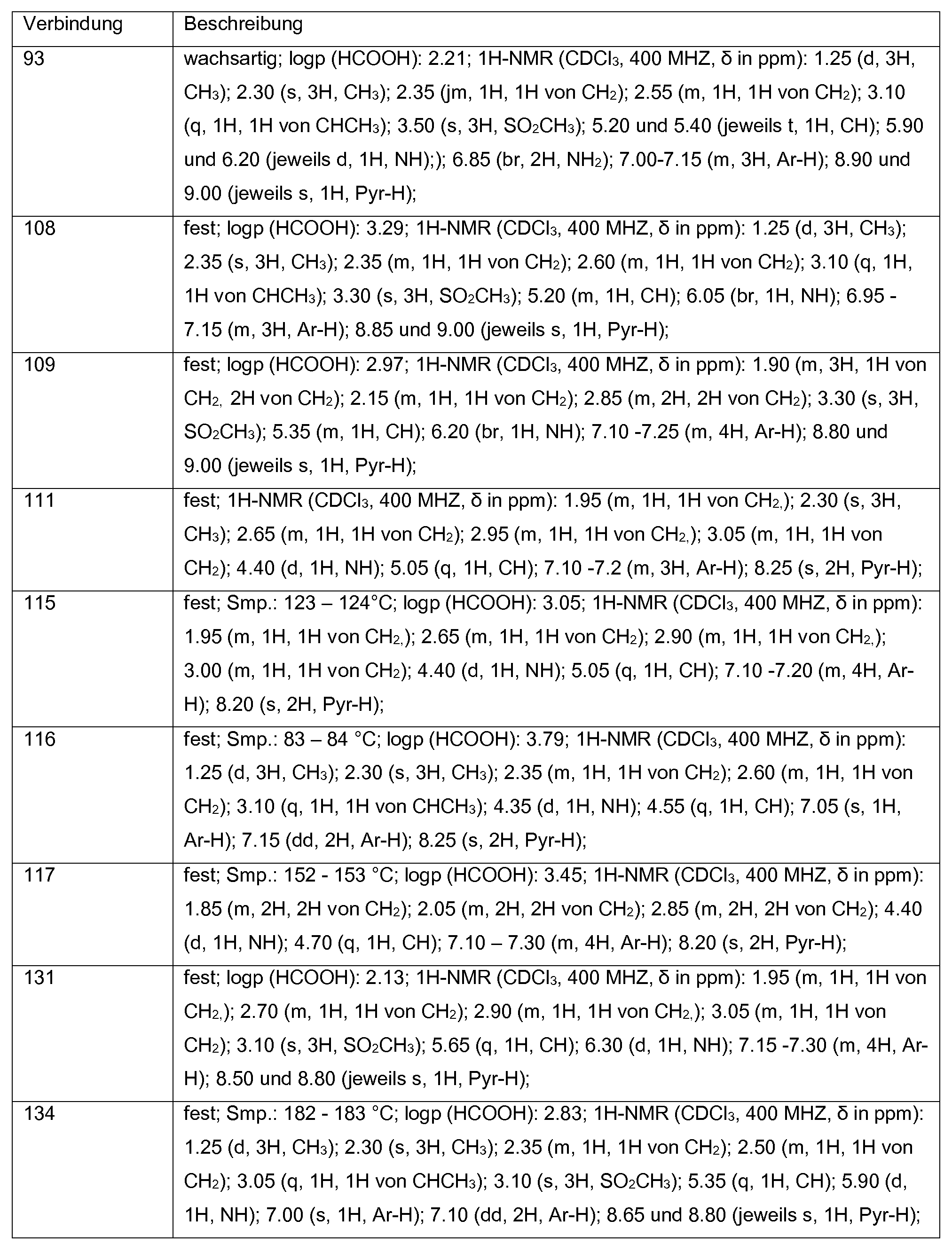
ligninsulfonsaures Kalium und 1 Gew.-Teil oleoylmethyltaurinsaures Natrium als Netz- und Dispergiermittel mischt und in einer Stiftmühle mahlt. c) Ein in Wasser leicht dispergierbares Dispersionskonzentrat wird erhalten, indem man 20 Gew.-Teile einer Verbindung der Formel (I) und/oder deren Salze mit 6 Gew.-Teilen Alkylphenolpolyglykolether (©Triton X 207), 3 Gew.-Teilen potassium lignosulfonate and 1 part by weight oleoylmethyltaurine sodium as wetting and dispersing agent and grinding in a pin mill. c) A dispersion concentrate which is readily dispersible in water is obtained by reacting 20 parts by weight of a compound of the formula (I) and / or salts thereof with 6 parts by weight of alkylphenol polyglycol ether (© Triton X 207), 3 parts by weight
Isotridecanolpolyglykolether (8 EO) und 71 Gew.-Teilen paraffinischem Isotridecanol polyglycol ether (8 EO) and 71 parts by weight paraffinic
Mineralöl (Siedebereich z.B. ca. 255 bis über 277 C) mischt und in einer Reibkugelmühle auf eine Feinheit von unter 5 Mikron vermahlt. d) Ein emulgierbares Konzentrat wird erhalten aus 15 Gew.-Teilen einer Mineral oil (boiling range, for example, about 255 to about 277 C) mixed and ground in a ball mill to a fineness of less than 5 microns. d) An emulsifiable concentrate is obtained from 15 parts by weight of a
Verbindung der Formel (I) und/oder deren Salze, 75 Gew.-Teilen Cyclohexanon als Lösungsmittel und 10 Gew.-Teilen oxethyliertes Nonylphenol als Emulgator. e) Ein in Wasser dispergierbares Granulat wird erhalten indem man Compound of the formula (I) and / or salts thereof, 75 parts by weight of cyclohexanone as solvent and 10 parts by weight of ethoxylated nonylphenol as emulsifier. e) A water-dispersible granules are obtained by
75 Gew.-Teile einer Verbindung der Formel (I) und/oder deren Salze, 75 parts by weight of a compound of the formula (I) and / or salts thereof,
10 Gew.-Teile ligninsulfonsaures Calcium, 10 parts by weight of lignosulfonic acid calcium,
5 Gew.-Teile Natriumlaurylsulfat, 5 parts by weight of sodium lauryl sulfate,
3 Gew.-Teile Polyvinylalkohol und 3 parts by weight of polyvinyl alcohol and
7 Gew.-Teile Kaolin 7 parts by weight kaolin
mischt, auf einer Stiftmühle mahlt und das Pulver in einem Wirbelbett durch Aufsprühen von Wasser als Granulierflüssigkeit granuliert. f) Ein in Wasser dispergierbares Granulat wird auch erhalten, indem man milled, ground on a pin mill and granulated the powder in a fluidized bed by spraying water as Granulierflüssigkeit. f) A water-dispersible granules are also obtained by
25 Gew.-Teile einer Verbindung der Formel (I) und/oder deren Salze, 5 Gew.-Teile 2,2'-dinaphthylnnethan-6,6'-disulfonsaures Natrium 25 parts by weight of a compound of the formula (I) and / or salts thereof, 5 parts by weight of 2,2'-dinaphthylnethan-6,6'-disulfonate sodium
2 Gew.-Teile oleoylmethyltaurinsaures Natrium, 2 parts by weight oleoylmethyltaurine acid sodium,
1 Gew.-Teil Polyvinylalkohol, 1 part by weight of polyvinyl alcohol,
17 Gew.-Teile Calciumcarbonat und 17 parts by weight of calcium carbonate and
50 Gew.-Teile Wasser 50 parts by weight of water
auf einer Kolloidmühle homogenisiert und vorzerkleinert, anschließend auf einer Perlmühle mahlt und die so erhaltene Suspension in einem Sprühturm mittels einer Einstoffdüse zerstäubt und trocknet. C. Biologische Beispiele Homogenized on a colloid mill and pre-crushed, then grinded on a bead mill and the suspension thus obtained in a spray tower by means of a Einstoffdüse atomized and dried. C. Biological examples
Versuchsbeschreibung test description
1 . Herbizide Wirkung bzw. Kulturpflanzenverträglichkeit im Vorauflauf 1 . Herbicidal action or crop plant compatibility in the pre-emergence
Samen von mono- bzw. dikotylen Unkraut- bzw. Kulturpflanzen werden in Seeds of monocotyledonous or dicotyledonous weeds are cultivated in
Holzfasertöpfen in sandiger Lehmerde ausgelegt und mit Erde abgedeckt. Die in Form von benetzbaren Pulvern (WP) oder als Emulsionskonzentrate (EC) formulierten erfindungsgemäßen Verbindungen werden dann als wässrige Suspension bzw. Wood fiber pots laid in sandy loam soil and covered with soil. The compounds according to the invention formulated in the form of wettable powders (WP) or as emulsion concentrates (EC) are then used as aqueous suspension or
Emulsion mit einer Wasseraufwandmenge von umgerechnet 600 bis 800 l/ha unter Zusatz von 0,2% Netzmittel auf die Oberfläche der Abdeckerde appliziert. Emulsion with a water application rate of 600 to 800 l / ha with the addition of 0.2% wetting agent applied to the surface of the cover soil.
Nach der Behandlung werden die Töpfe im Gewächshaus aufgestellt und unter guten Wachstumsbedingungen für die Testpflanzen gehalten. Die visuelle Bonitur der Schäden an den Versuchspflanzen erfolgt nach einer Versuchszeit von 3 Wochen im Vergleich zu unbehandelten Kontrollen (herbizide Wirkung in Prozent (%): 100% Wirkung = Pflanzen sind abgestorben, 0 % Wirkung = wie Kontrollpflanzen). In den nachfolgenden Tabellen werden folgende Abkürzungen verwendet:After the treatment, the pots are placed in the greenhouse and kept under good growth conditions for the test plants. The visual assessment of the damage to the test plants is carried out after a test period of 3 weeks in comparison to untreated controls (herbicidal action in percent (%): 100% effect = plants are dead, 0% effect = like control plants). The following abbreviations are used in the following tables:
ABUTH: Abutilon theophrasti ALOMY: Alopecurus myosuroidesABUTH: Abutilon theophrasti ALOMY: Alopecurus myosuroides
AMARE: Amaranthus retroflexus ECHCG: Echinochloa crus-galliAMARE: Amaranthus retroflexus ECHCG: Echinochloa crus-galli
LOLMU: Lolium multiflorum MATIN: Matricaria inodora LOLMU: Lolium multiflorum MATIN: Matricaria inodora
POLCO: Polygonum convolvulus SETVI: Setaria viridis POLCO: Polygonum convolvulus SETVI: Setaria viridis
STEME: Stellaria media VERPE: Veronica persica STEM: Stellaria media VERPE: Veronica persica
VIOTR: Viola tricolor Tabelle 1 VIOTR: Viola tricolor Table 1
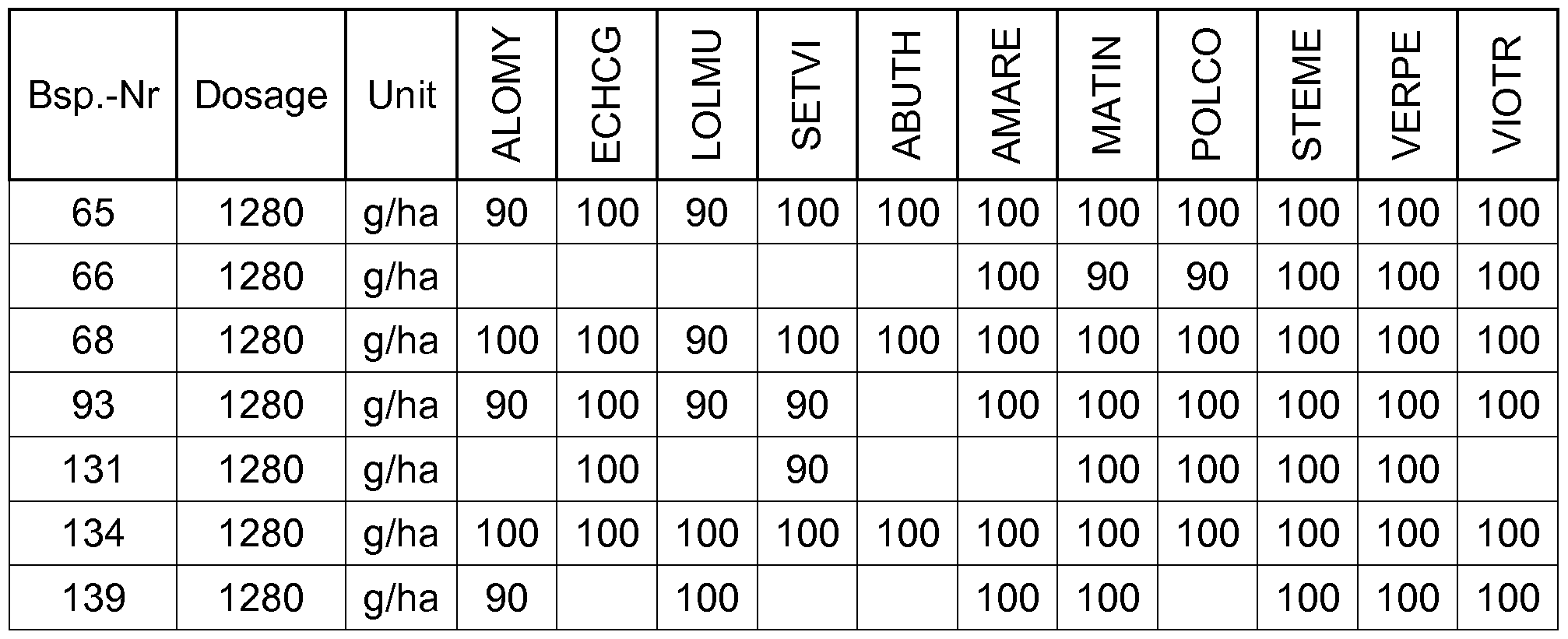
Wie die Ergebnisse zeigen, weisen erfindungsgemäße Verbindungen eine gute herbizide Vorauflaufwirksamkeit gegen ein breites Spektrum von Ungräsern und Unkräutern auf. Beispielsweise haben die Verbindungen aus Tabelle 1 sehr gute herbizide Wirkung gegen Schadpflanzen wie Avena fatua, Stellaria media, As the results show, compounds of the invention have a good herbicidal pre-emergence activity against a broad spectrum of grass weeds and weeds. For example, the compounds of Table 1 have very good herbicidal activity against harmful plants such as Avena fatua, Stellaria media,
Echinochloa crus-galli, Lolium multiflorum, Setaria viridis, Abutilon theophrasti, Amaranthus retroflexus und Alopecurus myosuroides im Vorauflaufverfahren bei einer Aufwandmenge von 1 ,28 kg und weniger Aktivsubstanz pro Hektar. Die Echinochloa crus-galli, Lolium multiflorum, Setaria viridis, Abutilon theophrasti, Amaranthus retroflexus and Alopecurus myosuroides pre-emergence at an application rate of 1, 28 kg and less active ingredient per hectare. The
erfindungsgemäßen Verbindungen eignen sich deshalb im Vorauflaufverfahren zur Bekämpfung von unerwünschtem Pflanzenwuchs. 2. Herbizide Wirkung bzw. Kulturpflanzenverträglichkeit im Nachauflauf Compounds according to the invention are therefore suitable in the pre-emergence method for controlling unwanted plant growth. 2. Herbicidal action or crop plant compatibility postemergence
Samen von mono- bzw. dikotylen Unkraut- bzw. Kulturpflanzen werden in Seeds of monocotyledonous or dicotyledonous weeds are cultivated in
Holzfasertöpfen in sandigem Lehmboden ausgelegt, mit Erde abgedeckt und im Gewächshaus unter guten Wachstumsbedingungen angezogen. 2 bis 3 Wochen nach der Aussaat werden die Versuchspflanzen im Einblattstadium behandelt. Die in Form von benetzbaren Pulvern (WP) oder als Emulsionskonzentrate (EC) formulierten erfindungsgemäßen Verbindungen werden dann als wässrige Suspension bzw. Wood fiber pots laid in sandy loam soil, covered with soil and grown in the greenhouse under good growth conditions. 2 to 3 weeks after sowing, the test plants are treated in the single leaf stage. The compounds according to the invention formulated in the form of wettable powders (WP) or as emulsion concentrates (EC) are then used as aqueous suspension or
Emulsion mit einer Wasseraufwandmenge von umgerechnet 600 bis 800 l/ha unter Zusatz von 0,2% Netzmittel auf die grünen Pflanzenteile gesprüht. Nach ca. 3 Wochen Standzeit der Versuchspflanzen im Gewächshaus unter optimalen Emulsion sprayed with an amount of water equivalent of 600 to 800 l / ha with the addition of 0.2% wetting agent on the green plant parts. After about 3 weeks life of the test plants in the greenhouse under optimal
Wachstumsbedingungen wird die Wirkung der Präparate visuell im Vergleich zu unbehandelten Kontrollen bonitiert (herbizide Wirkung in Prozent (%): 100% Wirkung = Pflanzen sind abgestorben, 0 % Wirkung = wie Kontrollpflanzen). Growth conditions, the effect of the preparations is scored visually compared to untreated controls (herbicidal action in percent (%): 100% effect = plants are dead, 0% effect = like control plants).
Tabelle 2 Table 2
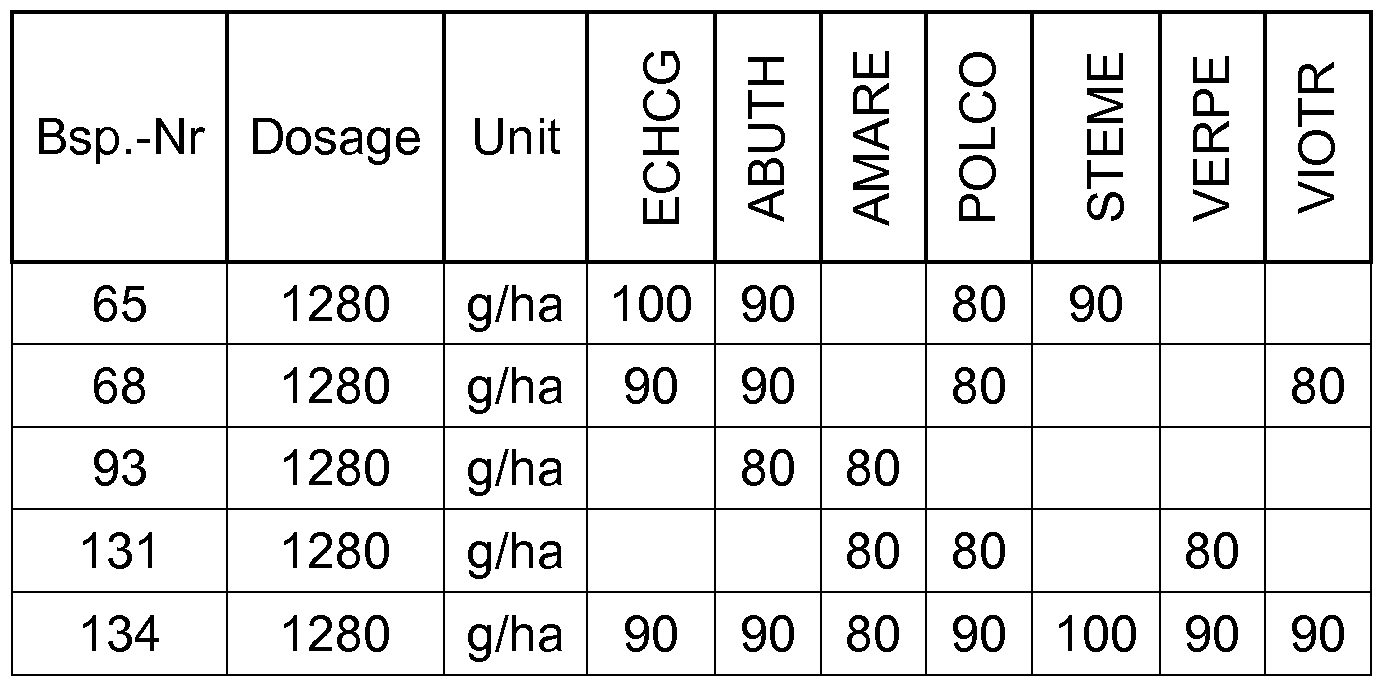
Wie die Ergebnisse zeigen, weisen erfindungsgemäße Verbindungen eine gute herbizide Nachauflaufwirksamkeit gegen ein breites Spektrum von Ungräsern und Unkräutern auf. Beispielsweise haben die Verbindungen aus Tabelle 2 sehr gute herbizide Wirkung gegen Schadpflanzen wie Avena fatua, Stellaria media, As the results show, compounds according to the invention have a good herbicidal postemergence activity against a broad spectrum of grass weeds and weeds. For example, the compounds of Table 2 have very good herbicidal activity against harmful plants such as Avena fatua, Stellaria media,
Echinochloa crus-galli, Lolium multiflorum, Setaria viridis, Abutilon theophrasti, Amaranthus retroflexus und Alopecurus myosuroides im Nachauflaufverfahren bei einer Aufwandmenge von 1 ,28 kg und weniger Aktivsubstanz pro Hektar. Die erfindungsgemäßen Verbindungen eignen sich deshalb im Nachauflaufverfahren zur Bekämpfung von unerwünschtem Pflanzenwuchs. Echinochloa crus-galli, Lolium multiflorum, Setaria viridis, Abutilon theophrasti, Amaranthus retroflexus and Alopecurus myosuroides postemergence at an application rate of 1, 28 kg and less active ingredient per hectare. The compounds according to the invention are therefore suitable postemergence for controlling unwanted plant growth.
Claims
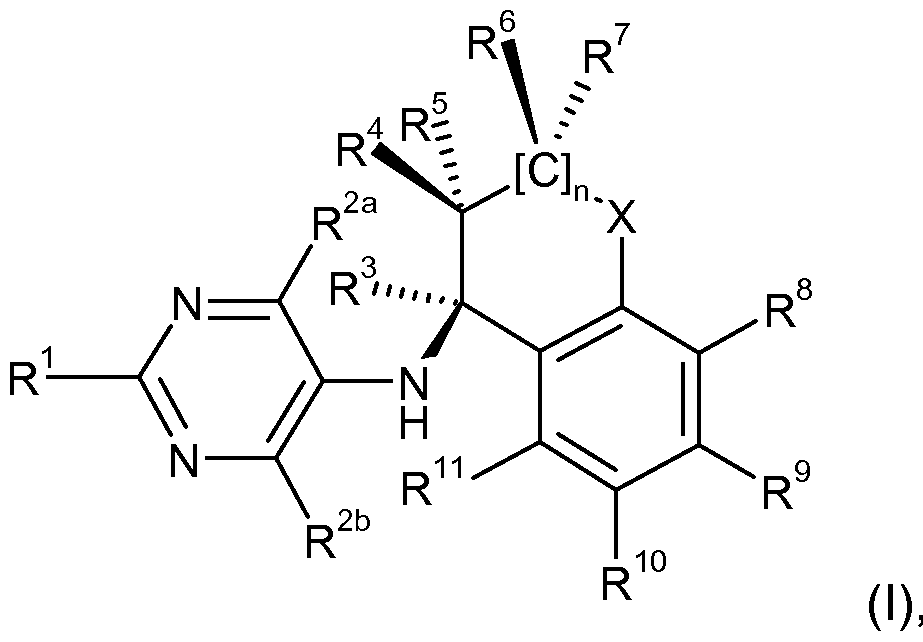
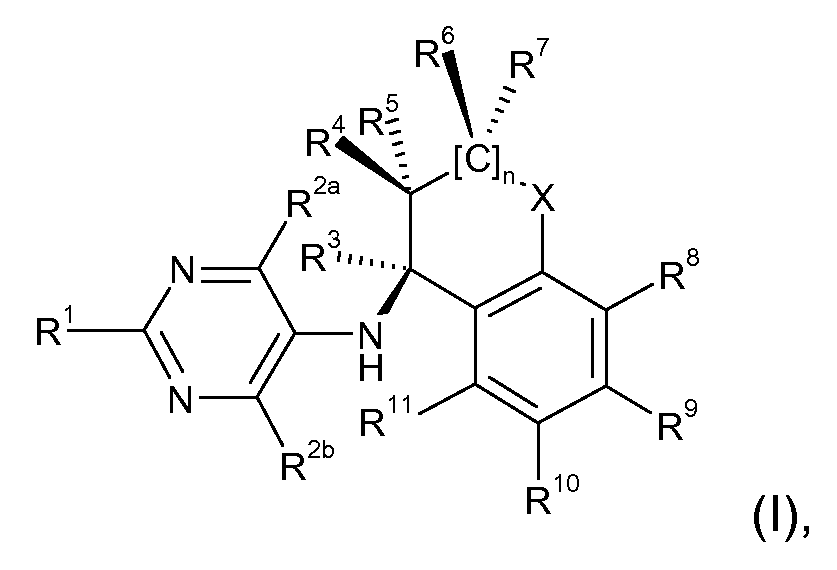
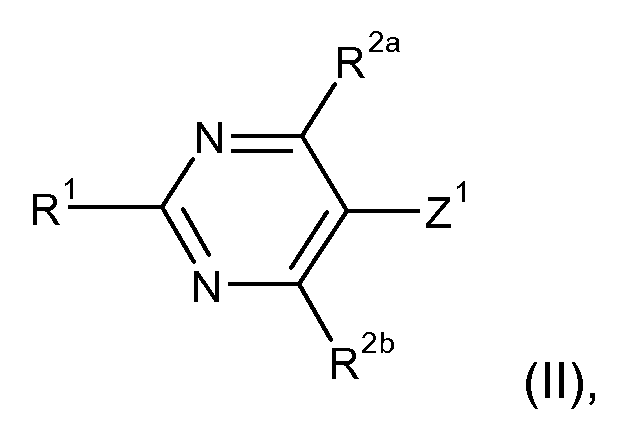

Priority Applications (5)
| Application Number | Priority Date | Filing Date | Title |
|---|---|---|---|
| US14/387,267 US9375002B2 (en) | 2012-03-29 | 2013-03-27 | 5-aminopyrimidine derivatives and use thereof for combating undesired plant growth |
| BR112014024203-8A BR112014024203B1 (en) | 2012-03-29 | 2013-03-27 | 5-aminopyrimidine derivatives and their use to control unwanted plant growth |
| EP13712777.5A EP2831050B1 (en) | 2012-03-29 | 2013-03-27 | 5-amino pyrimidine derivatives and use thereof for combating undesired plant growth |
| JP2015502318A JP6062528B2 (en) | 2012-03-29 | 2013-03-27 | 5-Aminopyrimidine derivatives and their use to control unwanted plant growth |
| CN201380017144.1A CN104203925A (en) | 2012-03-29 | 2013-03-27 | 5-aminopyrimidine derivatives and use thereof for combating undesired plant growth |
Applications Claiming Priority (2)
| Application Number | Priority Date | Filing Date | Title |
|---|---|---|---|
| EP12162187.4 | 2012-03-29 | ||
| EP12162187 | 2012-03-29 |
Publications (1)
| Publication Number | Publication Date |
|---|---|
| WO2013144187A1 true WO2013144187A1 (en) | 2013-10-03 |
Family
ID=48013994
Family Applications (1)
| Application Number | Title | Priority Date | Filing Date |
|---|---|---|---|
| PCT/EP2013/056483 Ceased WO2013144187A1 (en) | 2012-03-29 | 2013-03-27 | 5-aminopyrimidine derivatives and use thereof for combating undesired plant growth |
Country Status (6)
| Country | Link |
|---|---|
| US (1) | US9375002B2 (en) |
| EP (1) | EP2831050B1 (en) |
| JP (1) | JP6062528B2 (en) |
| CN (1) | CN104203925A (en) |
| BR (1) | BR112014024203B1 (en) |
| WO (1) | WO2013144187A1 (en) |
Cited By (7)
| Publication number | Priority date | Publication date | Assignee | Title |
|---|---|---|---|---|
| WO2017016914A1 (en) * | 2015-07-24 | 2017-02-02 | Bayer Cropscience Aktiengesellschaft | Substituierted furano-/thienocycloalkylamino-2-pyrimidine derivatives and use thereof for controlling undesired plant growth |
| WO2017108656A1 (en) * | 2015-12-21 | 2017-06-29 | Bayer Cropscience Aktiengesellschaft | 2-amino-5-ketoxime-pyrimidine derivatives and their use for controlling undesired plant growth |
| WO2017220467A1 (en) * | 2016-06-24 | 2017-12-28 | Bayer Cropscience Aktiengesellschaft | 3-amino-1,2,4-triazine derivatives and their use for controlling undesired plant growth |
| WO2018184978A1 (en) | 2017-04-05 | 2018-10-11 | Bayer Cropscience Aktiengesellschaft | 2-amino-5-oxyalkyl-pyrimidine derivatives and their use for controlling undesired plant growth |
| US10183914B2 (en) | 2014-07-01 | 2019-01-22 | Bayer Cropscience Aktiengesellschaft | 2-amino-5-keto-pyrimidine derivatives and the use thereof for controlling undesired plant growth |
| WO2020160202A1 (en) | 2019-02-01 | 2020-08-06 | Fmc Corporation | Diamino-substituted pyridines and pyrimidines as herbicides |
| WO2021183980A1 (en) | 2020-03-13 | 2021-09-16 | Fmc Corporation | Substituted pyrimidines and triazines as herbicides |
Families Citing this family (5)
| Publication number | Priority date | Publication date | Assignee | Title |
|---|---|---|---|---|
| BR112018000490A2 (en) | 2015-07-10 | 2018-09-11 | Basf Agro Bv | use of (±) -2-exo- (2-methylbenzyloxy) -1-methyl-4-isopropyl-7-oxabicyclo [2.2.1] heptane, undesirable vegetation control method, use and herbicidal composition |
| DK3319442T3 (en) * | 2015-07-10 | 2021-12-20 | Basf Agro Bv | PROCEDURE TO COMBAT HERBICID-RESISTANT OR TOLERANT WEEDS |
| IL270873B2 (en) | 2017-05-30 | 2023-04-01 | Basf Se | “derivatives of pyridine and pyrazine compounds, composition comprising them and their use as fungicides” |
| EP3927695A1 (en) * | 2019-02-20 | 2021-12-29 | Bayer Aktiengesellschaft | Herbicidally active 4-(4-trifluormethyl-6-cycloropylpyrazolyl)pyrimidines |
| CA3142286A1 (en) * | 2019-06-03 | 2020-12-10 | Bayer Aktiengesellschaft | 1-phenyl-5-azinyl pyrazolyl-3-oxyalkyl acids and their use for controlling undesired plant growth |
Citations (48)
| Publication number | Priority date | Publication date | Assignee | Title |
|---|---|---|---|---|
| EP0086750A2 (en) | 1982-02-17 | 1983-08-24 | Ciba-Geigy Ag | Use of quinoline derivatives in the protection of crop plants |
| EP0094349A2 (en) | 1982-05-07 | 1983-11-16 | Ciba-Geigy Ag | Use of quinoline derivatives for the protection of cultivated plants |
| EP0131624A1 (en) | 1983-01-17 | 1985-01-23 | Monsanto Co | PLASMIDES FOR TRANSFORMING PLANT CELLS. |
| JPS6087254A (en) | 1983-10-19 | 1985-05-16 | Japan Carlit Co Ltd:The | Novel urea compound and herbicide containing the same |
| EP0142924A2 (en) | 1983-09-26 | 1985-05-29 | Mycogen Plant Science, Inc. | Insect resistant plants |
| EP0174562A2 (en) | 1984-09-11 | 1986-03-19 | Hoechst Aktiengesellschaft | Plant protecting agents based on 1,2,4 - triazole derivatives as well as 1,2,4-triazole derivatives |
| EP0191736A2 (en) | 1985-02-14 | 1986-08-20 | Ciba-Geigy Ag | Use of quinoline derivatives for the protection of crop plants |
| EP0193259A1 (en) | 1985-01-18 | 1986-09-03 | Plant Genetic Systems N.V. | Modifying plants by genetic engineering to combat or control insects |
| EP0221044A1 (en) | 1985-10-25 | 1987-05-06 | Monsanto Company | Novel plant vectors |
| EP0242236A1 (en) | 1986-03-11 | 1987-10-21 | Plant Genetic Systems N.V. | Plant cells resistant to glutamine synthetase inhibitors, made by genetic engineering |
| EP0257993A2 (en) | 1986-08-26 | 1988-03-02 | E.I. Du Pont De Nemours And Company | Nucleic acid fragment encoding herbicide resistant plant acetolactate synthase |
| EP0268554A2 (en) | 1986-10-22 | 1988-05-25 | Ciba-Geigy Ag | 1,5-Diphenyl pyrazole-3-carbonic-acid derivatives for the protection of cultured plants |
| EP0269806A1 (en) | 1986-10-04 | 1988-06-08 | Hoechst Aktiengesellschaft | Phenylpyrazole carbonic acid derivatives, their preparation and use as plant growth regulators and antidotes |
| EP0305398A1 (en) | 1986-05-01 | 1989-03-08 | Honeywell Inc | CONNECTING ARRANGEMENT FOR MULTIPLE INTEGRATED CIRCUITS. |
| EP0309862A1 (en) | 1987-09-30 | 1989-04-05 | Bayer Ag | Stilbene synthase gene |
| EP0333131A1 (en) | 1988-03-17 | 1989-09-20 | Hoechst Aktiengesellschaft | Plant protective agent based on pyrazolecarboxylic acid derivatives |
| EP0346620A1 (en) | 1988-05-20 | 1989-12-20 | Hoechst Aktiengesellschaft | Plant protection agents containing 1,2,4-triazole derivatives, and the 1,2,4-triazole derivatives |
| EP0365484A1 (en) | 1988-10-20 | 1990-04-25 | Ciba-Geigy Ag | Sulfamoyl phenyl ureas |
| US5013659A (en) | 1987-07-27 | 1991-05-07 | E. I. Du Pont De Nemours And Company | Nucleic acid fragment encoding herbicide resistant plant acetolactate synthase |
| WO1991007874A1 (en) | 1989-11-30 | 1991-06-13 | Hoechst Aktiengesellschaft | Pyrazolines for the protection of crops against herbicides |
| WO1991008202A1 (en) | 1989-11-25 | 1991-06-13 | Hoechst Aktiengesellschaft | Isoxazolines, method of preparation thereof, and their use as plant-protection agents |
| WO1991013972A1 (en) | 1990-03-16 | 1991-09-19 | Calgene, Inc. | Plant desaturases - compositions and uses |
| WO1991019806A1 (en) | 1990-06-18 | 1991-12-26 | Monsanto Company | Increased starch content in plants |
| EP0464461A2 (en) | 1990-06-29 | 1992-01-08 | Bayer Ag | Stilbensynthase gene of grapevine |
| WO1992000377A1 (en) | 1990-06-25 | 1992-01-09 | Monsanto Company | Glyphosate tolerant plants |
| EP0492366A2 (en) | 1990-12-21 | 1992-07-01 | Hoechst Schering AgrEvo GmbH | New 5-chloroquinolin-8-oxyalkanecarbonic acid derivatives, process for their preparation and their use as antidotes for herbicides |
| WO1992011376A1 (en) | 1990-12-21 | 1992-07-09 | Amylogene Hb | Genetically engineered modification of potato to form amylopectin-type starch |
| WO1992014827A1 (en) | 1991-02-13 | 1992-09-03 | Institut Für Genbiologische Forschung Berlin Gmbh | Plasmids containing dna-sequences that cause changes in the carbohydrate concentration and the carbohydrate composition in plants, as well as plant cells and plants containing these plasmids |
| EP0523533A1 (en) | 1991-07-16 | 1993-01-20 | BASF Aktiengesellschaft | Substituted pyrimidin derivatives and their use for combatting the growth of undesirable plants |
| EP0582198A2 (en) | 1992-08-01 | 1994-02-09 | Hoechst Schering AgrEvo GmbH | Substituted (hetero-)aryle compounds, process for their preparation, those containing compositions and their use as safeners |
| WO1995007897A1 (en) | 1993-09-16 | 1995-03-23 | Hoechst Schering Agrevo Gmbh | Substituted isoxazolines, process for producing them, agents containing them and their use as safeners |
| WO1997045016A1 (en) | 1996-05-29 | 1997-12-04 | Hoechst Schering Agrevo Gmbh | Novel n-acyl sulphonamides, novel mixtures of herbicides and antidotes and their use |
| WO1998013361A1 (en) | 1996-09-26 | 1998-04-02 | Novartis Ag | Herbicidal composition |
| WO1998027049A1 (en) | 1996-12-19 | 1998-06-25 | Hoechst Schering Agrevo Gmbh | Novel 2-fluoroacrylic acid derivatives, novel mixtures of herbicides and antidotes and the use thereof |
| WO1998038856A1 (en) | 1997-03-04 | 1998-09-11 | Zeneca Limited | Compositions for safening rice against acetochlor |
| WO1999000020A1 (en) | 1997-06-27 | 1999-01-07 | Hoechst Schering Agrevo Gmbh | 3-(5-tetrazolyl carbonyl)-2-quinolones and products for protecting useful plants containing the same |
| WO1999016744A1 (en) | 1997-09-29 | 1999-04-08 | Aventis Cropscience Gmbh | Acylsulfamoyl benzoic acid amides, plant protection agents containing said acylsulfamoyl benzoic acid amides, and method for producing the same |
| WO2002034048A1 (en) | 2000-10-23 | 2002-05-02 | Syngenta Participations Ag | Agrochemical compositions with quinoline safeners |
| WO2004069814A1 (en) | 2003-02-05 | 2004-08-19 | Bayer Cropscience Gmbh | Amino 1, 3, 5-triazines n-substituted with chiral bicyclic radicals, process for their preparation, compositions thereof and their use as herbicides and plant growth regulators |
| WO2004084631A1 (en) | 2003-03-26 | 2004-10-07 | Bayer Cropscience Gmbh | Use of aromatic hydroxy compounds as safeners |
| WO2004092166A2 (en) | 2003-04-15 | 2004-10-28 | Merck & Co., Inc. | Cgrp receptor antagonists |
| WO2005015994A1 (en) | 2003-08-05 | 2005-02-24 | Bayer Cropscience Gmbh | Use of aromatic compounds as safeners |
| WO2005016001A1 (en) | 2003-08-05 | 2005-02-24 | Bayer Cropscience Gmbh | Safener based on aromatic-aliphatic carboxylic acid derivatives |
| WO2005112630A1 (en) | 2004-05-12 | 2005-12-01 | Bayer Cropscience Gmbh | Quinoxalin-2-one derivatives crop protection agents comprising the same and method for production and use therof |
| WO2007023719A1 (en) | 2005-08-22 | 2007-03-01 | Kumiai Chemical Industry Co., Ltd. | Agent for reducing chemical injury and herbicide composition with reduced chemical injury |
| WO2007023764A1 (en) | 2005-08-26 | 2007-03-01 | Kumiai Chemical Industry Co., Ltd. | Agent for reduction of harmful effect of herbicide and herbicide composition having reduced harmful effect |
| WO2010076010A1 (en) | 2008-12-30 | 2010-07-08 | Bayer Cropscience Ag | Pyrimidine derivatives and the use thereof for combating undesired plant growth |
| WO2010076009A1 (en) | 2008-12-30 | 2010-07-08 | Bayer Cropscience Ag | Pyrimidine derivatives and the use thereof for combating undesired plant growth |
Family Cites Families (5)
| Publication number | Priority date | Publication date | Assignee | Title |
|---|---|---|---|---|
| DE19802236A1 (en) * | 1998-01-22 | 1999-07-29 | Bayer Ag | New amino alkylidene-substituted triazines, useful as herbicides |
| DE102005018025A1 (en) * | 2005-04-14 | 2006-11-02 | Schering Ag | New heterocyclic compounds which are cytokine interleukin-8 inhibitors useful for treating e.g., chronic obstructive lung disease, bronchitis, rheumatoid arthritis, psoriasis, gastrointestinal disease and Crohn's disease |
| US20070015761A1 (en) * | 2005-04-14 | 2007-01-18 | Anne Mengel | Tetrahydronaphthalene derivatives, process for their production and their use as anti-inflammatory agents |
| GB0725218D0 (en) * | 2007-12-24 | 2008-02-06 | Syngenta Ltd | Chemical compounds |
| MX2012014575A (en) * | 2010-06-15 | 2013-02-07 | Bayer Ip Gmbh | NEW DERIVATIVES OF ARILAMIDA ORTO-SUBSTITUTES. |
-
2013
- 2013-03-27 EP EP13712777.5A patent/EP2831050B1/en not_active Not-in-force
- 2013-03-27 WO PCT/EP2013/056483 patent/WO2013144187A1/en not_active Ceased
- 2013-03-27 BR BR112014024203-8A patent/BR112014024203B1/en not_active IP Right Cessation
- 2013-03-27 US US14/387,267 patent/US9375002B2/en active Active
- 2013-03-27 JP JP2015502318A patent/JP6062528B2/en not_active Expired - Fee Related
- 2013-03-27 CN CN201380017144.1A patent/CN104203925A/en active Pending
Patent Citations (49)
| Publication number | Priority date | Publication date | Assignee | Title |
|---|---|---|---|---|
| EP0086750A2 (en) | 1982-02-17 | 1983-08-24 | Ciba-Geigy Ag | Use of quinoline derivatives in the protection of crop plants |
| EP0094349A2 (en) | 1982-05-07 | 1983-11-16 | Ciba-Geigy Ag | Use of quinoline derivatives for the protection of cultivated plants |
| EP0131624A1 (en) | 1983-01-17 | 1985-01-23 | Monsanto Co | PLASMIDES FOR TRANSFORMING PLANT CELLS. |
| EP0142924A2 (en) | 1983-09-26 | 1985-05-29 | Mycogen Plant Science, Inc. | Insect resistant plants |
| JPS6087254A (en) | 1983-10-19 | 1985-05-16 | Japan Carlit Co Ltd:The | Novel urea compound and herbicide containing the same |
| EP0174562A2 (en) | 1984-09-11 | 1986-03-19 | Hoechst Aktiengesellschaft | Plant protecting agents based on 1,2,4 - triazole derivatives as well as 1,2,4-triazole derivatives |
| EP0193259A1 (en) | 1985-01-18 | 1986-09-03 | Plant Genetic Systems N.V. | Modifying plants by genetic engineering to combat or control insects |
| EP0191736A2 (en) | 1985-02-14 | 1986-08-20 | Ciba-Geigy Ag | Use of quinoline derivatives for the protection of crop plants |
| EP0221044A1 (en) | 1985-10-25 | 1987-05-06 | Monsanto Company | Novel plant vectors |
| EP0242236A1 (en) | 1986-03-11 | 1987-10-21 | Plant Genetic Systems N.V. | Plant cells resistant to glutamine synthetase inhibitors, made by genetic engineering |
| EP0242246A1 (en) | 1986-03-11 | 1987-10-21 | Plant Genetic Systems N.V. | Plant cells resistant to glutamine synthetase inhibitors, made by genetic engineering |
| EP0305398A1 (en) | 1986-05-01 | 1989-03-08 | Honeywell Inc | CONNECTING ARRANGEMENT FOR MULTIPLE INTEGRATED CIRCUITS. |
| EP0257993A2 (en) | 1986-08-26 | 1988-03-02 | E.I. Du Pont De Nemours And Company | Nucleic acid fragment encoding herbicide resistant plant acetolactate synthase |
| EP0269806A1 (en) | 1986-10-04 | 1988-06-08 | Hoechst Aktiengesellschaft | Phenylpyrazole carbonic acid derivatives, their preparation and use as plant growth regulators and antidotes |
| EP0268554A2 (en) | 1986-10-22 | 1988-05-25 | Ciba-Geigy Ag | 1,5-Diphenyl pyrazole-3-carbonic-acid derivatives for the protection of cultured plants |
| US5013659A (en) | 1987-07-27 | 1991-05-07 | E. I. Du Pont De Nemours And Company | Nucleic acid fragment encoding herbicide resistant plant acetolactate synthase |
| EP0309862A1 (en) | 1987-09-30 | 1989-04-05 | Bayer Ag | Stilbene synthase gene |
| EP0333131A1 (en) | 1988-03-17 | 1989-09-20 | Hoechst Aktiengesellschaft | Plant protective agent based on pyrazolecarboxylic acid derivatives |
| EP0346620A1 (en) | 1988-05-20 | 1989-12-20 | Hoechst Aktiengesellschaft | Plant protection agents containing 1,2,4-triazole derivatives, and the 1,2,4-triazole derivatives |
| EP0365484A1 (en) | 1988-10-20 | 1990-04-25 | Ciba-Geigy Ag | Sulfamoyl phenyl ureas |
| WO1991008202A1 (en) | 1989-11-25 | 1991-06-13 | Hoechst Aktiengesellschaft | Isoxazolines, method of preparation thereof, and their use as plant-protection agents |
| WO1991007874A1 (en) | 1989-11-30 | 1991-06-13 | Hoechst Aktiengesellschaft | Pyrazolines for the protection of crops against herbicides |
| WO1991013972A1 (en) | 1990-03-16 | 1991-09-19 | Calgene, Inc. | Plant desaturases - compositions and uses |
| WO1991019806A1 (en) | 1990-06-18 | 1991-12-26 | Monsanto Company | Increased starch content in plants |
| WO1992000377A1 (en) | 1990-06-25 | 1992-01-09 | Monsanto Company | Glyphosate tolerant plants |
| EP0464461A2 (en) | 1990-06-29 | 1992-01-08 | Bayer Ag | Stilbensynthase gene of grapevine |
| EP0492366A2 (en) | 1990-12-21 | 1992-07-01 | Hoechst Schering AgrEvo GmbH | New 5-chloroquinolin-8-oxyalkanecarbonic acid derivatives, process for their preparation and their use as antidotes for herbicides |
| WO1992011376A1 (en) | 1990-12-21 | 1992-07-09 | Amylogene Hb | Genetically engineered modification of potato to form amylopectin-type starch |
| WO1992014827A1 (en) | 1991-02-13 | 1992-09-03 | Institut Für Genbiologische Forschung Berlin Gmbh | Plasmids containing dna-sequences that cause changes in the carbohydrate concentration and the carbohydrate composition in plants, as well as plant cells and plants containing these plasmids |
| EP0523533A1 (en) | 1991-07-16 | 1993-01-20 | BASF Aktiengesellschaft | Substituted pyrimidin derivatives and their use for combatting the growth of undesirable plants |
| EP0582198A2 (en) | 1992-08-01 | 1994-02-09 | Hoechst Schering AgrEvo GmbH | Substituted (hetero-)aryle compounds, process for their preparation, those containing compositions and their use as safeners |
| WO1995007897A1 (en) | 1993-09-16 | 1995-03-23 | Hoechst Schering Agrevo Gmbh | Substituted isoxazolines, process for producing them, agents containing them and their use as safeners |
| WO1997045016A1 (en) | 1996-05-29 | 1997-12-04 | Hoechst Schering Agrevo Gmbh | Novel n-acyl sulphonamides, novel mixtures of herbicides and antidotes and their use |
| WO1998013361A1 (en) | 1996-09-26 | 1998-04-02 | Novartis Ag | Herbicidal composition |
| WO1998027049A1 (en) | 1996-12-19 | 1998-06-25 | Hoechst Schering Agrevo Gmbh | Novel 2-fluoroacrylic acid derivatives, novel mixtures of herbicides and antidotes and the use thereof |
| WO1998038856A1 (en) | 1997-03-04 | 1998-09-11 | Zeneca Limited | Compositions for safening rice against acetochlor |
| WO1999000020A1 (en) | 1997-06-27 | 1999-01-07 | Hoechst Schering Agrevo Gmbh | 3-(5-tetrazolyl carbonyl)-2-quinolones and products for protecting useful plants containing the same |
| WO1999016744A1 (en) | 1997-09-29 | 1999-04-08 | Aventis Cropscience Gmbh | Acylsulfamoyl benzoic acid amides, plant protection agents containing said acylsulfamoyl benzoic acid amides, and method for producing the same |
| WO2002034048A1 (en) | 2000-10-23 | 2002-05-02 | Syngenta Participations Ag | Agrochemical compositions with quinoline safeners |
| WO2004069814A1 (en) | 2003-02-05 | 2004-08-19 | Bayer Cropscience Gmbh | Amino 1, 3, 5-triazines n-substituted with chiral bicyclic radicals, process for their preparation, compositions thereof and their use as herbicides and plant growth regulators |
| WO2004084631A1 (en) | 2003-03-26 | 2004-10-07 | Bayer Cropscience Gmbh | Use of aromatic hydroxy compounds as safeners |
| WO2004092166A2 (en) | 2003-04-15 | 2004-10-28 | Merck & Co., Inc. | Cgrp receptor antagonists |
| WO2005015994A1 (en) | 2003-08-05 | 2005-02-24 | Bayer Cropscience Gmbh | Use of aromatic compounds as safeners |
| WO2005016001A1 (en) | 2003-08-05 | 2005-02-24 | Bayer Cropscience Gmbh | Safener based on aromatic-aliphatic carboxylic acid derivatives |
| WO2005112630A1 (en) | 2004-05-12 | 2005-12-01 | Bayer Cropscience Gmbh | Quinoxalin-2-one derivatives crop protection agents comprising the same and method for production and use therof |
| WO2007023719A1 (en) | 2005-08-22 | 2007-03-01 | Kumiai Chemical Industry Co., Ltd. | Agent for reducing chemical injury and herbicide composition with reduced chemical injury |
| WO2007023764A1 (en) | 2005-08-26 | 2007-03-01 | Kumiai Chemical Industry Co., Ltd. | Agent for reduction of harmful effect of herbicide and herbicide composition having reduced harmful effect |
| WO2010076010A1 (en) | 2008-12-30 | 2010-07-08 | Bayer Cropscience Ag | Pyrimidine derivatives and the use thereof for combating undesired plant growth |
| WO2010076009A1 (en) | 2008-12-30 | 2010-07-08 | Bayer Cropscience Ag | Pyrimidine derivatives and the use thereof for combating undesired plant growth |
Non-Patent Citations (31)
| Title |
|---|
| "Combinatorial Chemistry - Synthesis, Analysis, Screening", 1999, VERLAG WILEY |
| "D. Tiebes in Combinatorial Chemistry - Synthesis, Analysis, Screening", 1999, VERLAG WILEY, pages: 1 - 34 |
| "Gene Transfer to Plants, Springer Lab Manual", 1995, SPRINGER VERLAG |
| "Microwaves in Organic and Medicinal Chemistry", 2005, VERLAG WILEY |
| "Perry's Chemical Engineer's Handbook", 1973, MCGRAW-HILL, pages: 8 - 57 |
| "Spray-Drying Handbook", 1979, G. GOODWIN LTD. |
| "The Pesticide Manual", 2006, THE BRITISH CROP PROTECTION COUNCIL AND THE ROYAL SOC. OF CHEMISTRY |
| BARRY A. BUNIN: "The Combinatorial Index", 1998, VERLAG ACADEMIC PRESS |
| BRAUN ET AL., EMBO J., vol. 11, 1992, pages 3219 - 3227 |
| C. MARSDEN: "Solvents Guide", 1963, INTERSCIENCE |
| COLLECT. CZECH. CHEM. COMMUN., vol. 14, 1949, pages 223 |
| G.C. KLINGMAN: "Weed Control as a Science", 1961, JOHN WILEY AND SONS, INC., pages: 81 - 96 |
| H.V. OLPHEN: "Introduction to Clay Colloid Chemistry", J. WILEY & SONS |
| HEIDELBERG; CHRISTOU, TRENDS IN PLANT SCIENCE, vol. 1, 1996, pages 423 - 431 |
| IHARA CHEM IND (TSUB, pages J6 - 2099305,J6-2106084 |
| J.D. FREYER; S.A. EVANS: "Weed Control Handbook", 1968, BLACKWELL SCIENTIFIC PUBLICATIONS, pages: 101 - 103 |
| J.E. BROWNING: "Agglomeration", CHEMICAL AND ENGINEERING, 1967, pages 147 FF |
| K. MARTENS: "Handbook", 1979, G. GOODWIN LTD., article "Spray Drying" |
| LIANG, YONG-MIN; LUO, SHENG-JUN; ZHANG, ZHAO-XIN; YONG-XIANG: "EFFICIENT SYNTHESIS OF A NEW PYRIMIDINE DERIVATIVE", SYNTHETIC COMMUNICATIONS, vol. 32, no. 1, 2002, pages 153 - 157, XP009068479, Retrieved from the Internet <URL:http://dx.doi.org/10.1081/SCC-120001523> DOI: doi:10.1081/SCC-120001523 |
| MCCUTCHEON'S: "Detergents and Emulsifiers Annual", MC PUBL. CORP. |
| SAMBROOK ET AL.: "Molecular Cloning, A Laboratory Manual", 1989, COLD SPRING HARBOR LABORATORY PRESS |
| SCHÖNFELDT: "Grenzflächenaktive Äthylenoxidaddukte", 1976, WISS. VERLAGSGESELL. |
| SISLEY; WOOD: "Encyclopedia of Surface Active Agents", 1964, CHEM. PUBL. CO. INC. |
| SONNEWALD ET AL., PLANT J., vol. 1, 1991, pages 95 - 106 |
| TETRAHEDRON. LETT., 1976, pages 693 |
| WADE VAN VALKENBURG: "Pesticide Formulations", 1973, MARCEL DEKKER |
| WATKINS: "Handbook of Insecticide Dust Diluents and Carriers", DARLAND BOOKS |
| WEED RESEARCH, vol. 26, 1986, pages 441 - 445 |
| WINNACKER: "Gene und Klone", 1996, VCH |
| WINNACKER-KÜCHLER: "Chemische Technologie", vol. 7, 1986, C. HANSER VERLAG |
| WOLTER ET AL., PROC. NATL. ACAD. SCI. USA, vol. 85, 1988, pages 846 - 850 |
Cited By (11)
| Publication number | Priority date | Publication date | Assignee | Title |
|---|---|---|---|---|
| US10183914B2 (en) | 2014-07-01 | 2019-01-22 | Bayer Cropscience Aktiengesellschaft | 2-amino-5-keto-pyrimidine derivatives and the use thereof for controlling undesired plant growth |
| WO2017016914A1 (en) * | 2015-07-24 | 2017-02-02 | Bayer Cropscience Aktiengesellschaft | Substituierted furano-/thienocycloalkylamino-2-pyrimidine derivatives and use thereof for controlling undesired plant growth |
| US10251395B2 (en) | 2015-07-24 | 2019-04-09 | Bayer Cropscience Aktiengesellschaft | Substituted furano-/thienocycloalkylamino-2-pyrimidine derivatives and use thereof for controlling undesired plant growth |
| WO2017108656A1 (en) * | 2015-12-21 | 2017-06-29 | Bayer Cropscience Aktiengesellschaft | 2-amino-5-ketoxime-pyrimidine derivatives and their use for controlling undesired plant growth |
| US10806142B2 (en) | 2015-12-21 | 2020-10-20 | Bayer Cropscience Aktiengesellschaft | 2-amino-5-ketoxime-pyrimidine derivatives and their use for controlling undesired plant growth |
| WO2017220467A1 (en) * | 2016-06-24 | 2017-12-28 | Bayer Cropscience Aktiengesellschaft | 3-amino-1,2,4-triazine derivatives and their use for controlling undesired plant growth |
| US10743540B2 (en) | 2016-06-24 | 2020-08-18 | Bayer Cropscience Aktiengesellschaft | 3-amino-1,2,4-triazine derivatives and their use for controlling undesired plant growth |
| WO2018184978A1 (en) | 2017-04-05 | 2018-10-11 | Bayer Cropscience Aktiengesellschaft | 2-amino-5-oxyalkyl-pyrimidine derivatives and their use for controlling undesired plant growth |
| US11477982B2 (en) | 2017-04-05 | 2022-10-25 | Bayer Cropscience Aktiengesellschaft | 2-amino-5-oxyalkyl-pyrimidine derivatives and their use for controlling undesired plant growth |
| WO2020160202A1 (en) | 2019-02-01 | 2020-08-06 | Fmc Corporation | Diamino-substituted pyridines and pyrimidines as herbicides |
| WO2021183980A1 (en) | 2020-03-13 | 2021-09-16 | Fmc Corporation | Substituted pyrimidines and triazines as herbicides |
Also Published As
| Publication number | Publication date |
|---|---|
| US20150094205A1 (en) | 2015-04-02 |
| CN104203925A (en) | 2014-12-10 |
| BR112014024203B1 (en) | 2019-09-03 |
| EP2831050A1 (en) | 2015-02-04 |
| JP2015516383A (en) | 2015-06-11 |
| EP2831050B1 (en) | 2016-03-23 |
| JP6062528B2 (en) | 2017-01-18 |
| US9375002B2 (en) | 2016-06-28 |
Similar Documents
| Publication | Publication Date | Title |
|---|---|---|
| EP2384321B1 (en) | Pyrimidine derivatives and use thereof for combating undesired plant growth | |
| US8309557B2 (en) | Pyrimidin-4-ylpropanedinitrile derivatives, processes for their preparation and their use as herbicides and plant growth regulators | |
| EP2831050B1 (en) | 5-amino pyrimidine derivatives and use thereof for combating undesired plant growth | |
| EP2384322B1 (en) | Pyrimidine derivatives and use thereof for combating undesired plant growth | |
| EP2274305A2 (en) | 2-[(1h-pyrazole-4-ylmethyl)-sulfonyl]-oxazole derivatives, 2-[(1h-pyrazole-4-ylmethyl)-sulfanyl]-oxazole derivatives, and chiral 2-[(1h-pyrazole-4-ylmethyl)-sulfinyl]-oxazole derivatives, methods for the production thereof, and use thereof as herbicides and plant growth regulators | |
| US11477982B2 (en) | 2-amino-5-oxyalkyl-pyrimidine derivatives and their use for controlling undesired plant growth | |
| WO2021028421A1 (en) | Substituted (2-heteroaryloxyphenyl)isoxazolines and salts thereof and their use as herbicidal active substances | |
| WO2021028419A1 (en) | Substituted 3-(2-heteroaryloxyphenyl)isoxazolines and salts thereof and their use as herbicidal active substances | |
| WO2010127795A1 (en) | Herbicidal compounds based on n-azinyl-n'-pyridylsulfonyl ureas | |
| EP2294058A1 (en) | 2-(benzylsulfonyl)-oxazole derivatives, chiral 2- (benzylsulfinyl) -oxazole derivatives and 2-(benzylsulfanyl)-oxazole derivatives, methods for the production thereof, and use thereof as herbicides and plant growth regulators | |
| EP3898612B1 (en) | Substituted pyridinyloxybenzenes, their salts and use of said compounds as herbicidal agents | |
| WO2025114265A1 (en) | Substituted aryl carboxamides | |
| WO2025114275A1 (en) | 3-heterocyclyl-benzamides and use thereof as herbicides | |
| WO2025103939A1 (en) | Sulfonimidoyl benzamides with herbicidal action | |
| WO2024194026A1 (en) | 4-difluoromethyl benzamides with herbicidal action | |
| EP3720853A1 (en) | 3-amino-[1,2,4]-triazole derivatives and their use for controlling undesired plant growth | |
| WO2020245097A1 (en) | Substituted pyridinyloxypyridines and salts thereof and use thereof as herbicidal agents | |
| EP3747868A1 (en) | Substituted phenoxypyridines, their salts and use of said compounds as herbicidal agents | |
| WO2011039276A1 (en) | Oxathiazinyl(het)arylsulfonylureas, processes and intermediates for preparation thereof and use thereof as crop protection agents and crop growth regulators |
Legal Events
| Date | Code | Title | Description |
|---|---|---|---|
| 121 | Ep: the epo has been informed by wipo that ep was designated in this application |
Ref document number: 13712777 Country of ref document: EP Kind code of ref document: A1 |
|
| WWE | Wipo information: entry into national phase |
Ref document number: 2013712777 Country of ref document: EP |
|
| WWE | Wipo information: entry into national phase |
Ref document number: 14387267 Country of ref document: US |
|
| ENP | Entry into the national phase |
Ref document number: 2015502318 Country of ref document: JP Kind code of ref document: A |
|
| NENP | Non-entry into the national phase |
Ref country code: DE |
|
| REG | Reference to national code |
Ref country code: BR Ref legal event code: B01A Ref document number: 112014024203 Country of ref document: BR |
|
| ENP | Entry into the national phase |
Ref document number: 112014024203 Country of ref document: BR Kind code of ref document: A2 Effective date: 20140929 |