[go: up one dir, main page]

WO2013110622A1 - Fluoromethyl-5,6-dihydro-4h-[1,3]oxazines - Google Patents

Fluoromethyl-5,6-dihydro-4h-[1,3]oxazines Download PDF

Info

Publication number
WO2013110622A1
WO2013110622A1 PCT/EP2013/051166 EP2013051166W WO2013110622A1 WO 2013110622 A1 WO2013110622 A1 WO 2013110622A1 EP 2013051166 W EP2013051166 W EP 2013051166W WO 2013110622 A1 WO2013110622 A1 WO 2013110622A1
Authority
WO
WIPO (PCT)
Prior art keywords
trifluoromethyl
amino
fluorophenyl
dihydro
oxazin
Prior art date
Legal status (The legal status is an assumption and is not a legal conclusion. Google has not performed a legal analysis and makes no representation as to the accuracy of the status listed.)
Ceased
Application number
PCT/EP2013/051166
Other languages
French (fr)
Inventor
Hans Hilpert
Roland Humm
Thomas Woltering
Current Assignee (The listed assignees may be inaccurate. Google has not performed a legal analysis and makes no representation or warranty as to the accuracy of the list.)
F Hoffmann La Roche AG
Siena Biotech SpA
Original Assignee
F Hoffmann La Roche AG
Siena Biotech SpA
Priority date (The priority date is an assumption and is not a legal conclusion. Google has not performed a legal analysis and makes no representation as to the accuracy of the date listed.)
Filing date
Publication date
Priority to SG11201403956VA priority Critical patent/SG11201403956VA/en
Priority to US14/373,697 priority patent/US9067926B2/en
Priority to EP13701072.4A priority patent/EP2807155B1/en
Priority to KR1020147023759A priority patent/KR101669349B1/en
Priority to HK14110782.5A priority patent/HK1197242B/en
Priority to EA201491321A priority patent/EA027059B1/en
Priority to JP2014553689A priority patent/JP5869151B2/en
Priority to UAA201409331A priority patent/UA113538C2/en
Priority to MX2014008446A priority patent/MX354173B/en
Priority to BR112014015630-1A priority patent/BR112014015630B1/en
Priority to AU2013211646A priority patent/AU2013211646B2/en
Application filed by F Hoffmann La Roche AG, Siena Biotech SpA filed Critical F Hoffmann La Roche AG
Priority to NZ625684A priority patent/NZ625684A/en
Priority to CA2856892A priority patent/CA2856892C/en
Priority to CN201380006717.0A priority patent/CN104066727B/en
Publication of WO2013110622A1 publication Critical patent/WO2013110622A1/en
Priority to IL232764A priority patent/IL232764A/en
Priority to PH12014501334A priority patent/PH12014501334A1/en
Priority to MA37156A priority patent/MA35748B1/en
Priority to CR20140306A priority patent/CR20140306A/en
Anticipated expiration legal-status Critical
Ceased legal-status Critical Current

Links

Classifications

    • CCHEMISTRY; METALLURGY
    • C07ORGANIC CHEMISTRY
    • C07DHETEROCYCLIC COMPOUNDS
    • C07D413/00Heterocyclic compounds containing two or more hetero rings, at least one ring having nitrogen and oxygen atoms as the only ring hetero atoms
    • C07D413/02Heterocyclic compounds containing two or more hetero rings, at least one ring having nitrogen and oxygen atoms as the only ring hetero atoms containing two hetero rings
    • C07D413/12Heterocyclic compounds containing two or more hetero rings, at least one ring having nitrogen and oxygen atoms as the only ring hetero atoms containing two hetero rings linked by a chain containing hetero atoms as chain links
    • AHUMAN NECESSITIES
    • A61MEDICAL OR VETERINARY SCIENCE; HYGIENE
    • A61PSPECIFIC THERAPEUTIC ACTIVITY OF CHEMICAL COMPOUNDS OR MEDICINAL PREPARATIONS
    • A61P1/00Drugs for disorders of the alimentary tract or the digestive system
    • AHUMAN NECESSITIES
    • A61MEDICAL OR VETERINARY SCIENCE; HYGIENE
    • A61PSPECIFIC THERAPEUTIC ACTIVITY OF CHEMICAL COMPOUNDS OR MEDICINAL PREPARATIONS
    • A61P17/00Drugs for dermatological disorders
    • AHUMAN NECESSITIES
    • A61MEDICAL OR VETERINARY SCIENCE; HYGIENE
    • A61PSPECIFIC THERAPEUTIC ACTIVITY OF CHEMICAL COMPOUNDS OR MEDICINAL PREPARATIONS
    • A61P19/00Drugs for skeletal disorders
    • A61P19/02Drugs for skeletal disorders for joint disorders, e.g. arthritis, arthrosis
    • AHUMAN NECESSITIES
    • A61MEDICAL OR VETERINARY SCIENCE; HYGIENE
    • A61PSPECIFIC THERAPEUTIC ACTIVITY OF CHEMICAL COMPOUNDS OR MEDICINAL PREPARATIONS
    • A61P21/00Drugs for disorders of the muscular or neuromuscular system
    • AHUMAN NECESSITIES
    • A61MEDICAL OR VETERINARY SCIENCE; HYGIENE
    • A61PSPECIFIC THERAPEUTIC ACTIVITY OF CHEMICAL COMPOUNDS OR MEDICINAL PREPARATIONS
    • A61P25/00Drugs for disorders of the nervous system
    • AHUMAN NECESSITIES
    • A61MEDICAL OR VETERINARY SCIENCE; HYGIENE
    • A61PSPECIFIC THERAPEUTIC ACTIVITY OF CHEMICAL COMPOUNDS OR MEDICINAL PREPARATIONS
    • A61P25/00Drugs for disorders of the nervous system
    • A61P25/14Drugs for disorders of the nervous system for treating abnormal movements, e.g. chorea, dyskinesia
    • AHUMAN NECESSITIES
    • A61MEDICAL OR VETERINARY SCIENCE; HYGIENE
    • A61PSPECIFIC THERAPEUTIC ACTIVITY OF CHEMICAL COMPOUNDS OR MEDICINAL PREPARATIONS
    • A61P25/00Drugs for disorders of the nervous system
    • A61P25/28Drugs for disorders of the nervous system for treating neurodegenerative disorders of the central nervous system, e.g. nootropic agents, cognition enhancers, drugs for treating Alzheimer's disease or other forms of dementia
    • AHUMAN NECESSITIES
    • A61MEDICAL OR VETERINARY SCIENCE; HYGIENE
    • A61PSPECIFIC THERAPEUTIC ACTIVITY OF CHEMICAL COMPOUNDS OR MEDICINAL PREPARATIONS
    • A61P29/00Non-central analgesic, antipyretic or antiinflammatory agents, e.g. antirheumatic agents; Non-steroidal antiinflammatory drugs [NSAID]
    • AHUMAN NECESSITIES
    • A61MEDICAL OR VETERINARY SCIENCE; HYGIENE
    • A61PSPECIFIC THERAPEUTIC ACTIVITY OF CHEMICAL COMPOUNDS OR MEDICINAL PREPARATIONS
    • A61P35/00Antineoplastic agents
    • AHUMAN NECESSITIES
    • A61MEDICAL OR VETERINARY SCIENCE; HYGIENE
    • A61PSPECIFIC THERAPEUTIC ACTIVITY OF CHEMICAL COMPOUNDS OR MEDICINAL PREPARATIONS
    • A61P37/00Drugs for immunological or allergic disorders
    • A61P37/02Immunomodulators
    • AHUMAN NECESSITIES
    • A61MEDICAL OR VETERINARY SCIENCE; HYGIENE
    • A61PSPECIFIC THERAPEUTIC ACTIVITY OF CHEMICAL COMPOUNDS OR MEDICINAL PREPARATIONS
    • A61P37/00Drugs for immunological or allergic disorders
    • A61P37/02Immunomodulators
    • A61P37/06Immunosuppressants, e.g. drugs for graft rejection
    • AHUMAN NECESSITIES
    • A61MEDICAL OR VETERINARY SCIENCE; HYGIENE
    • A61PSPECIFIC THERAPEUTIC ACTIVITY OF CHEMICAL COMPOUNDS OR MEDICINAL PREPARATIONS
    • A61P43/00Drugs for specific purposes, not provided for in groups A61P1/00-A61P41/00
    • AHUMAN NECESSITIES
    • A61MEDICAL OR VETERINARY SCIENCE; HYGIENE
    • A61PSPECIFIC THERAPEUTIC ACTIVITY OF CHEMICAL COMPOUNDS OR MEDICINAL PREPARATIONS
    • A61P7/00Drugs for disorders of the blood or the extracellular fluid
    • A61P7/02Antithrombotic agents; Anticoagulants; Platelet aggregation inhibitors
    • AHUMAN NECESSITIES
    • A61MEDICAL OR VETERINARY SCIENCE; HYGIENE
    • A61PSPECIFIC THERAPEUTIC ACTIVITY OF CHEMICAL COMPOUNDS OR MEDICINAL PREPARATIONS
    • A61P9/00Drugs for disorders of the cardiovascular system
    • AHUMAN NECESSITIES
    • A61MEDICAL OR VETERINARY SCIENCE; HYGIENE
    • A61PSPECIFIC THERAPEUTIC ACTIVITY OF CHEMICAL COMPOUNDS OR MEDICINAL PREPARATIONS
    • A61P9/00Drugs for disorders of the cardiovascular system
    • A61P9/10Drugs for disorders of the cardiovascular system for treating ischaemic or atherosclerotic diseases, e.g. antianginal drugs, coronary vasodilators, drugs for myocardial infarction, retinopathy, cerebrovascula insufficiency, renal arteriosclerosis
    • CCHEMISTRY; METALLURGY
    • C07ORGANIC CHEMISTRY
    • C07DHETEROCYCLIC COMPOUNDS
    • C07D401/00Heterocyclic compounds containing two or more hetero rings, having nitrogen atoms as the only ring hetero atoms, at least one ring being a six-membered ring with only one nitrogen atom
    • C07D401/02Heterocyclic compounds containing two or more hetero rings, having nitrogen atoms as the only ring hetero atoms, at least one ring being a six-membered ring with only one nitrogen atom containing two hetero rings
    • C07D401/12Heterocyclic compounds containing two or more hetero rings, having nitrogen atoms as the only ring hetero atoms, at least one ring being a six-membered ring with only one nitrogen atom containing two hetero rings linked by a chain containing hetero atoms as chain links
    • CCHEMISTRY; METALLURGY
    • C07ORGANIC CHEMISTRY
    • C07DHETEROCYCLIC COMPOUNDS
    • C07D403/00Heterocyclic compounds containing two or more hetero rings, having nitrogen atoms as the only ring hetero atoms, not provided for by group C07D401/00
    • C07D403/02Heterocyclic compounds containing two or more hetero rings, having nitrogen atoms as the only ring hetero atoms, not provided for by group C07D401/00 containing two hetero rings
    • C07D403/12Heterocyclic compounds containing two or more hetero rings, having nitrogen atoms as the only ring hetero atoms, not provided for by group C07D401/00 containing two hetero rings linked by a chain containing hetero atoms as chain links

Definitions

  • AD Alzheimer's disease
  • CNS central nervous system
  • APP Several forms of APP have been identified of which the most abundant are proteins of 695, 751 and 770 amino acids length. They all arise from a single gene through differential splicing.
  • the ⁇ -peptides are derived from the same domain of the APP but differ at their N- and C-termini, the main species are of 40 and 42 amino-acid length.
  • ⁇ -peptides are the essential molecules in the pathogenesis of AD: 1) amyloid plaques formed of ⁇ -peptides are invariably part of the AD pathology; 2) ⁇ - peptides are toxic for neurons; 3) in Familial Alzheimer's Disease (FAD) the mutations in the disease genes APP, PSN1, PSN2 lead to increased levels of ⁇ -peptides and early brain amyloidosis; 4) transgenic mice which express such FAD genes develop a pathology which bears many resemblances to the human disease.
  • ⁇ -peptides are produced from APP through the sequential action of 2 proteolytic enzymes termed ⁇ - and ⁇ -secretase.
  • ⁇ -Secretase cleaves first in the extracellular domain of APP approximately 28 amino acids outside of the trans-membrane domain (TM) to produce a C-terminal fragment of APP containing the TM- and the cytoplasmatic domain (CTFP).
  • CTF ⁇ is the substrate for ⁇ -secretase which cleaves at several adjacent positions within the TM to produce the ⁇ peptides and the cytoplasmic fragment.
  • the ⁇ -secretase is a complex of at least 4 different proteins, its catalytic subunit is very likely a presenilin protein (PSEN1, PSEN2).
  • the ⁇ -secretase (BACE1, Asp2; BACE stands for ⁇ -site APP-cleaving enzyme) is an aspartyl protease which is anchored into the membrane by a transmembrane domain (Vassar et al, Beta-secretase cleavage of Alzheimer's amyloid precursor protein by the transmembrane aspartic protease BACE, Science. 1999 Oct 22; 286(5440): 735). It is expressed in many tissues of the human organism but its level is especially high in the CNS.
  • mice which have been genetically engineered to express the human APP gene and which form extensive amyloid plaques and Alzheimer's disease like pathologies during aging fail to do so when ⁇ -secretase activity is reduced by genetic ablation of one of the BACE1 alleles (McConlogue et al, Partial reduction of BACE 1 has dramatic effects on Alzheimer plaque and synaptic pathology in APP Transgenic Mice. J Biol Chem. 2007 Sep 7;282(36):26326). It is thus presumed that inhibitors of BACE1 activity can be useful agents for therapeutic intervention in Alzheimer's disease (AD).
  • AD Alzheimer's disease
  • ⁇ -amyloid peptides in, on or around neurological tissue are inhibited by the present compounds, i.e. inhibition of the ⁇ -production from APP or an APP fragment.
  • Inhibitors of BACE1 can in addition be used to treat the following diseases: IBM (inclusion body myositis) (Vattemi G. et al, Lancet. 2001 Dec 8;358(9297): 1962-4), Down's Syndrome (Barbiero L. et al, Exp Neurol. 2003 Aug;182(2):335-45), Wilson's Disease (Sugimoto I. et al, J Biol Chem. 2007 Nov 30;282(48):34896-903), Whipple's disease (Desnues B. et al., Clin Vaccine Immunol.
  • the present invention provides novel compounds of formula I, their manufacture, medicaments based on a compound in accordance with the invention and their production as well as the use of compounds of formula I in the control or prevention of illnesses such as Alzheimer's disease. Furthermore the use of compounds of formula I in the treatment of amyotrophic lateral sclerosis (ALS), arterial thrombosis, autoimmune/inflammatory diseases, cancer such as breast cancer, cardiovascular diseases such as myocardial infarction and stroke, dermatomyositis, Down's Syndrome, gastrointestinal diseases, Glioblastoma multiforme, Graves Disease, Huntington's Disease, inclusion body myositis (IBM), inflammatory reactions, Kaposi Sarcoma, Kostmann Disease, lupus erythematosus, macrophagic myofasciitis, juvenile idiopathic arthritis, granulomatous arthritis, malignant melanoma, multiple mieloma, rheumatoid arthritis, Sjogren syndrome, Spinocere
  • the present invention provides Fluoromethyl-5,6-dihydro-4H-[l,3]oxazin-2-ylamines having BACE1 inhibitory properties, their manufacture, pharmaceutical compositions containing them and their use as therapeutically active substances. Summary of the Invention
  • the present invention provides a compound of formula I, wherein the substituents and variables are as described below and in the claims, or a pharmaceutically acceptable salt thereof.
  • the present compounds have Asp2 ( ⁇ -secretase, BACEl or Memapsin-2) inhibitory activity and may therefore be used in the therapeutic and/or prophylactic treatment of diseases and disorders characterized by elevated ⁇ -amyloid levels and/or ⁇ -amyloid oligomers and/or ⁇ -amyloid plaques and further deposits, particularly Alzheimer's disease.
  • Asp2 ⁇ -secretase, BACEl or Memapsin-2
  • the present invention provides a compound of formula I and their pharmaceutically acceptable salts thereof, the preparation of the above mentioned compounds, medicaments containing them and their manufacture as well as the use of the above mentioned compounds in the therapeutic and/or prophylactic treatment of diseases and disorders which are associated with inhibition of BACEl , such as Alzheimer's disease. Furthermore, the formation, or formation and deposition, of ⁇ -amyloid plaques in, on or around neurological tissue (e.g., the brain) are inhibited by the present compounds by inhibiting the ⁇ production from APP or an APP fragment.
  • Ci_6-alkyl stands for a hydrocarbon radical which may be linear or branched, with single or multiple branching, wherein the alkyl group in general comprises 1 to 6 carbon atoms, for example, methyl (Me), ethyl (Et), propyl, isopropyl (i-propyl), n-butyl, i-butyl (isobutyl), 2-butyl (sec-butyl), t-butyl (tert-butyl), isopentyl, 2-ethyl-propyl (2-methyl-propyl), 1 ,2-dimethyl-propyl and the like.
  • Particular "Ci_6-alkyl” are "Ci_3-alkyl”.
  • Specific groups are methyl and ethyl. Most specific is methyl.
  • halogen-Ci_6-alkyl refers to Ci_ 6 - alkyl as defined herein, which is substituted by one or multiple halogen, particularly 1-5 halogen, more particularly 1-3 halogen. Particular halogen is fluoro. Particular "halogen-Ci_6-alkyl” is fluoro-Ci_6-alkyl and a particular "halogen-Ci_3-alkyl” is fluoro-Ci_3-alkyl. Examples are trinuoromethyl, difluoromethyl, fluoromethyl and the like. A specific group is trinuoromethyl.
  • cyano-Ci_6-alkyl alone or in combination with other groups, refers to Ci_ 6 - alkyl as defined herein, which is substituted by one or multiple cyano, particularly 1 cyano. Examples are cyanomethyl, cyano ethyl and the like.
  • Ci_6-alkoxy-Ci_6-alkyi refers to Ci_ 6-alkyl as defined herein, which is substituted by one or multiple Ci_6-alkoxy, as defined herein, particularly 1 Ci_6-alkoxy.
  • Ci_6-alkoxy-Ci_6-alkyl is methoxy-Ci_6-alkyl. Examples are methoxymethyl, methoxyethyl and the like.
  • cyano alone or in combination with other groups, refers to N ⁇ C-(NC-).
  • halogen denotes chloro (CI), iodo (I), fluoro (F) and bromo (Br). Particular "halogen” is CI and F. A specific group is F.
  • heteroaryl refers to an aromatic carbocyclic group of having a single 4 to 8 membered ring, in particular 5 to 8, or multiple condensed rings comprising 6 to 14, in particular 6 to 10 ring atoms and containing 1, 2 or 3 heteroatoms individually selected from N, O and S, in particular IN or 2N, in which group at least one heterocyclic ring is aromatic.
  • heteroaryl examples include benzofuryl, benzo imidazolyl, lH-benzo imidazolyl, benzooxazinyl, benzoxazolyl, benzothiazinyl, benzothiazolyl, benzothienyl, benzotriazolyl, furyl, imidazolyl, indazolyl, lH-indazolyl, indolyl, isoquinolinyl, isothiazolyl, isoxazolyl, oxazolyl, pyrazinyl, pyrazolyl (pyrazyl), lH-pyrazolyl, pyrazolo[l,5-a]pyridinyl, pyridazinyl, pyridinyl, pyrimidinyl, pyrrolyl, quinolinyl, tetrazolyl, thiazolyl, thienyl, triazolyl, 6,7-dihydro-5H
  • heteroaryl are pyridinyl and pyrazinyl, as well as oxazolyl and lH-pyrazolyl.
  • heteroaryl are pyridin- 2-yl and pyrazin-2-yl, as well as lH-pyrazole-3-yl and oxazol-4-yl.
  • Ci_6-alkoxy stands for an -0-Ci_6-alkyl radical which may be linear or branched, with single or multiple branching, wherein the alkyl group in general comprises 1 to 6 carbon atoms, for example, methoxy (OMe, MeO), ethoxy (OEt), propoxy, isopropoxy (i-propoxy), n-butoxy, i-butoxy (iso-butoxy), 2-butoxy (sec-butoxy), t-butoxy (tert-butoxy), isopentyloxy (i-pentyloxy) and the like.
  • Particular "Ci_6-alkoxy” are groups with 1 to 4 carbon atoms. Specific is methoxy.
  • halogen-Ci_6-alkoxy refers to Ci_ 6 - alkoxy as defined herein, which is substituted by one or multiple halogens, in particular fluoro. Particular "halogen-Ci_6-alkoxy” are fluoro-Ci_6-alkoxy. Specific "halogen-Ci_6-alkoxy” is trifluoromethoxy.
  • C2-6-alkynyl-Ci_6-alkoxy alone or in combination with other groups, refers to Ci_6-alkoxy as defined herein, which is substituted by one or multiple C2_6-alkynyl as defined herein, in particular 1 C2-6-alkynyl.
  • C2-6-alkynyl denotes a monovalent linear or branched saturated hydrocarbon group of 2 to 6 carbon atoms, in particular from 2 to 4 carbon atoms, and comprising one, two or three triple bonds.
  • Examples of C2-6-alkynyl include ethynyl, propynyl, and n-butynyl.
  • aryl denotes a monovalent aromatic carbocyclic mono- or bicyclic ring system comprising 6 to 10 carbon ring atoms.
  • aryl moieties include phenyl and naphthyl. Specific "aryl” is phenyl.
  • salts refers to salts that are suitable for use in contact with the tissues of humans and animals.
  • suitable salts with inorganic and organic acids are, but are not limited to acetic acid, citric acid, formic acid, fumaric acid, hydrochloric acid, lactic acid, maleic acid, malic acid, methane-sulfonic acid, nitric acid, phosphoric acid, p-toluenesulphonic acid, succinic acid, sulfuric acid (sulphuric acid), tartaric acid, trifluoro acetic acid and the like.
  • Particular acids are formic acid, trifluoro acetic acid and hydrochloric acid.
  • Specific acids are hydrochloric acid, trifluoro acetic acid and fumaric acid.
  • pharmaceutically acceptable carrier and “pharmaceutically acceptable auxiliary substance” refer to carriers and auxiliary substances such as diluents or excipients that are compatible with the other ingredients of the formulation.
  • composition encompasses a product comprising specified ingredients in pre-determined amounts or proportions, as well as any product that results, directly or indirectly, from combining specified ingredients in specified amounts. Particularly it encompasses a product comprising one or more active ingredients, and an optional carrier comprising inert ingredients, as well as any product that results, directly or indirectly, from combination, complexation or aggregation of any two or more of the ingredients, or from dissociation of one or more of the ingredients, or from other types of reactions or interactions of one or more of the ingredients.
  • inhibitor denotes a compound which competes with, reduces or prevents the binding of a particular ligand to particular receptor or which reduces or prevents the inhibition of the function of a particular protein.
  • IC 50 half maximal inhibitory concentration
  • IC 50 values can be converted logarithmically to pIC 5 o values (-log IC 50 ), in which higher values indicate exponentially greater potency.
  • the IC 50 value is not an absolute value but depends on experimental conditions e.g. concentrations employed.
  • the IC 50 value can be converted to an absolute inhibition constant (Ki) using the Cheng-Prusoff equation (Biochem. Pharmacol. (1973) 22:3099).
  • Ki absolute inhibition constant
  • Ki values can be converted logarithmically to pKi values (-log Ki), in which higher values indicate exponentially greater potency.
  • “Therapeutically effective amount” means an amount of a compound that, when administered to a subject for treating a disease state, is sufficient to effect such treatment for the disease state.
  • the “therapeutically effective amount” will vary depending on the compound, disease state being treated, the severity or the disease treated, the age and relative health of the subject, the route and form of administration, the judgment of the attending medical or veterinary practitioner, and other factors.
  • variable incorporates by reference the broad definition of the variable as well as particularly, more particularly and most particularly definitions, if any.
  • treating when referring to a chemical reaction means adding or mixing two or more reagents under appropriate conditions to produce the indicated and/or the desired product. It should be appreciated that the reaction which produces the indicated and/or the desired product may not necessarily result directly from the combination of two reagents which were initially added, i.e., there may be one or more intermediates which are produced in the mixture which ultimately leads to the formation of the indicated and/or the desired product.
  • protecting group denotes the group which selectively blocks a reactive site in a multifunctional compound such that a chemical reaction can be carried out selectively at another unprotected reactive site in the meaning conventionally associated with it in synthetic chemistry.
  • Protecting groups can be removed at the appropriate point.
  • Exemplary protecting groups are amino -protecting groups, carboxy-protecting groups or hydroxy-protecting groups.
  • amino -protecting group denotes groups intended to protect an amino group and includes benzyl, benzyloxycarbonyl (carbobenzyloxy, CBZ), 9-Fluorenylmethyloxycarbonyl (FMOC), p-methoxybenzyloxycarbonyl, p-nitrobenzyloxycarbonyl, tert-butoxycarbonyl (BOC), and trifluoro acetyl. Further examples of these groups are found in T. W. Greene and P. G. M. Wuts, "Protective Groups in Organic Synthesis", 2nd ed., John Wiley & Sons, Inc., New York, NY, 1991, chapter 7; E.
  • protected amino group refers to an amino group substituted by an amino -protecting groups. Particular amino- protecting groups are tert-butoxycarbonyl group and dimethoxytrityl.
  • leaving group denotes the group with the meaning conventionally associated with it in synthetic organic chemistry, i.e., an atom or group displaceable under substitution reaction conditions.
  • leaving groups include halogen, in particular bromo, alkane- or arylenesulfonyloxy, such as methanesulfonyloxy, ethanesulfonyloxy, thiomethyl, benzenesulfonyloxy, tosyloxy, dihalophosphinoyloxy, optionally substituted benzyloxy, isopropyloxy, and acyloxy.
  • aromatic denotes the conventional idea of aromaticity as defined in the literature, in particular in IUPAC - Compendium of Chemical Terminology, 2nd, A. D. McNaught & A. Wilkinson (Eds). Blackwell Scientific Publications, Oxford (1997).
  • pharmaceutically acceptable excipient denotes any ingredient having no therapeutic activity and being non-toxic such as disintegrators, binders, fillers, solvents, buffers, tonicity agents, stabilizers, antioxidants, surfactants or lubricants used in formulating pharmaceutical products.
  • the invention also provides pharmaceutical compositions, methods of using, and methods of preparing the aforementioned compounds.
  • One embodiment of the invention provides a compound of formula I,
  • ft is selected from the group consisting of
  • R 2 is selected from the group consisting of
  • R J is selected from the group consisting of
  • R 4 is halogen-Ci_6-alkyl; or pharmaceutically acceptable salts thereof.
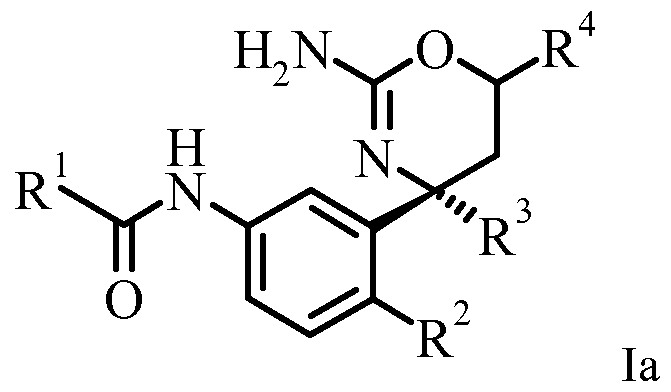
  • a certain embodiment of the invention provides a compound of formula la,
  • R 1 is selected from the group consisting of
  • R 2 is selected from the group consisting of
  • R 3 is selected from the group consisting of
  • R 4 is halogen-Ci_6-alkyl; or pharmaceutically acceptable salts thereof.
  • a certain embodiment of the invention provides a compound of formula Ic,
  • R is selected from the group consisting of
  • R 2 is selected from the group consisting of
  • R 3 is selected from the group consisting of
  • R 4 is halogen-Ci_6-alkyl; or pharmaceutically acceptable salts thereof.
  • a certain embodiment of the invention provides a compound of formula Id,
  • R is selected from the group consisting of
  • aryl ii) aryl substituted by 1-4 substituents individually selected from cyano, cyano-Ci_ 6 - alkyl, halogen, halogen-Ci_6-alkoxy, halogen-Ci_6-alkyl, Ci_6-alkoxy, Ci_6-alkoxy-Ci_6- alkyl, C2-6-alkynyl-Ci_6-alkoxy, C2_6-alkynyl and Ci_6-alkyl,
  • halogen-Ci_6-alkyl is halogen-Ci_6-alkyl; pharmaceutically acceptable salts thereof.
  • a certain embodiment of the invention provides a compound of formula Ia-1 ,
  • R 1 is selected from the group consisting of
  • R 3 is selected from the group consisting of
  • a certain embodiment of the invention provides a compound of formula Ia-1 ',
  • R 1 is heteroaryl substituted by 1-2 substituents individually selected from cyano and halogen, or pharmaceutically acceptable salts thereof.
  • a certain embodiment of the invention provides a compound as described herein, wherein R 2 is halogen.
  • a certain embodiment of the invention provides a compound as described herein, wherein R 2 is F.
  • a certain embodiment of the invention provides a compound as described herein, wherein R 2 is hydrogen.
  • a certain embodiment of the invention provides a compound as described herein, wherein R 2 is Ci-6-alkyl.
  • a certain embodiment of the invention provides a compound as described herein, wherein
  • R 2 is methyl
  • a certain embodiment of the invention provides a compound as described herein, wherein R 3 is halogen-Ci_6-alkyl.
  • a certain embodiment of the invention provides a compound as described herein, wherein R 3 is fiuoro-Ci_6-alkyl.
  • a certain embodiment of the invention provides a compound as described herein, wherein R 3 is fluoromethyl.
  • a certain embodiment of the invention provides a compound as described herein, wherein R 3 is Ci-6-alkyl.
  • a certain embodiment of the invention provides a compound as described herein, wherein
  • R 3 is methyl.
  • R 4 is fluoro-Ci_6-alkyl.
  • a certain embodiment of the invention provides a compound as described herein, wherein R 4 is trifluoromethyl.
  • a certain embodiment of the invention provides a compound as described herein, wherein
  • R 1 is heteroaryl substituted by 1-2 substituents individually selected from cyano, cyano-Ci_ 6 - alkyl, halogen, halogen-Ci_6-alkoxy, halogen-Ci_6-alkyl, Ci_6-alkoxy, Ci_6-alkoxy-Ci_6-alkyl, C 2 _ 6-alkynyl-Ci_6-alkoxy, C 2 _6-alkynyl and Ci_6-alkyl.
  • a certain embodiment of the invention provides a compound as described herein, wherein R 1 is heteroaryl substituted by 1-2 substituents individually selected from cyano, halogen, halogen-Ci_6-alkoxy, halogen-Ci_6-alkyl, Ci_6-alkoxy, C 2 _6-alkynyl-Ci_6-alkoxy and Ci_6-alkyl.
  • a certain embodiment of the invention provides a compound as described herein, wherein R 1 is heteroaryl substituted by 1-2 substituents individually selected from cyano, halogen, halogen-Ci_6-alkoxy and Ci_6-alkoxy.
  • R 1 is heteroaryl substituted by 1-2 substituents individually selected from cyano, halogen, halogen-Ci_6-alkoxy and Ci_6-alkoxy.
  • a certain embodiment of the invention provides a compound as described herein, wherein
  • R 1 is pyridinyl or pyrazinyl substituted by 1-2 substituents individually selected from cyano, halogen, halogen-Ci_6-alkoxy and Ci_6-alkoxy.
  • a certain embodiment of the invention provides a compound as described herein, wherein R 1 is pyridinyl substituted by cyano.
  • a certain embodiment of the invention provides a compound as described herein, wherein
  • R 1 is pyridinyl substituted by halogen.
  • a certain embodiment of the invention provides a compound as described herein, wherein R 1 is pyridinyl substituted by halogen-Ci_6-alkoxy.
  • a certain embodiment of the invention provides a compound as described herein, wherein R 1 is pyridinyl substituted by Ci_ 6 -alkoxy.
  • a certain embodiment of the invention provides a compound as described herein, wherein R 1 is pyridinyl substituted by cyano and Ci_6-alkyl.
  • a certain embodiment of the invention provides a compound as described herein, wherein R 1 is pyridinyl substituted by cyano and halogen.
  • a certain embodiment of the invention provides a compound as described herein, wherein
  • R 1 is pyridinyl substituted by halogen-Ci_6-alkyl.
  • a certain embodiment of the invention provides a compound as described herein, wherein R 1 is pyridinyl substituted by Ci_6-alkyl.
  • a certain embodiment of the invention provides a compound as described herein, wherein R 1 is pyrazinyl substituted by Ci_6-alkyl.
  • a certain embodiment of the invention provides a compound as described herein, wherein
  • R 1 is pyrazinyl substituted by halogen-Ci_6-alkoxy.
  • a certain embodiment of the invention provides a compound as described herein, wherein R 1 is pyrazinyl substituted by halogen-Ci_6-alkyl.
  • a certain embodiment of the invention provides a compound as described herein, wherein R 1 is pyrazinyl substituted by Ci_6-alkoxy.
  • a certain embodiment of the invention provides a compound as described herein, wherein R 1 is pyrazinyl substituted by C2-6-alkynyl-Ci_6-alkoxy.
  • a certain embodiment of the invention provides a compound as described herein, wherein R 1 is oxazolyl substituted by halogen-Ci_6-alkyl.
  • a certain embodiment of the invention provides a compound as described herein, wherein
  • R 1 is pyrazolyl substituted by halogen-Ci_6-alkyl.
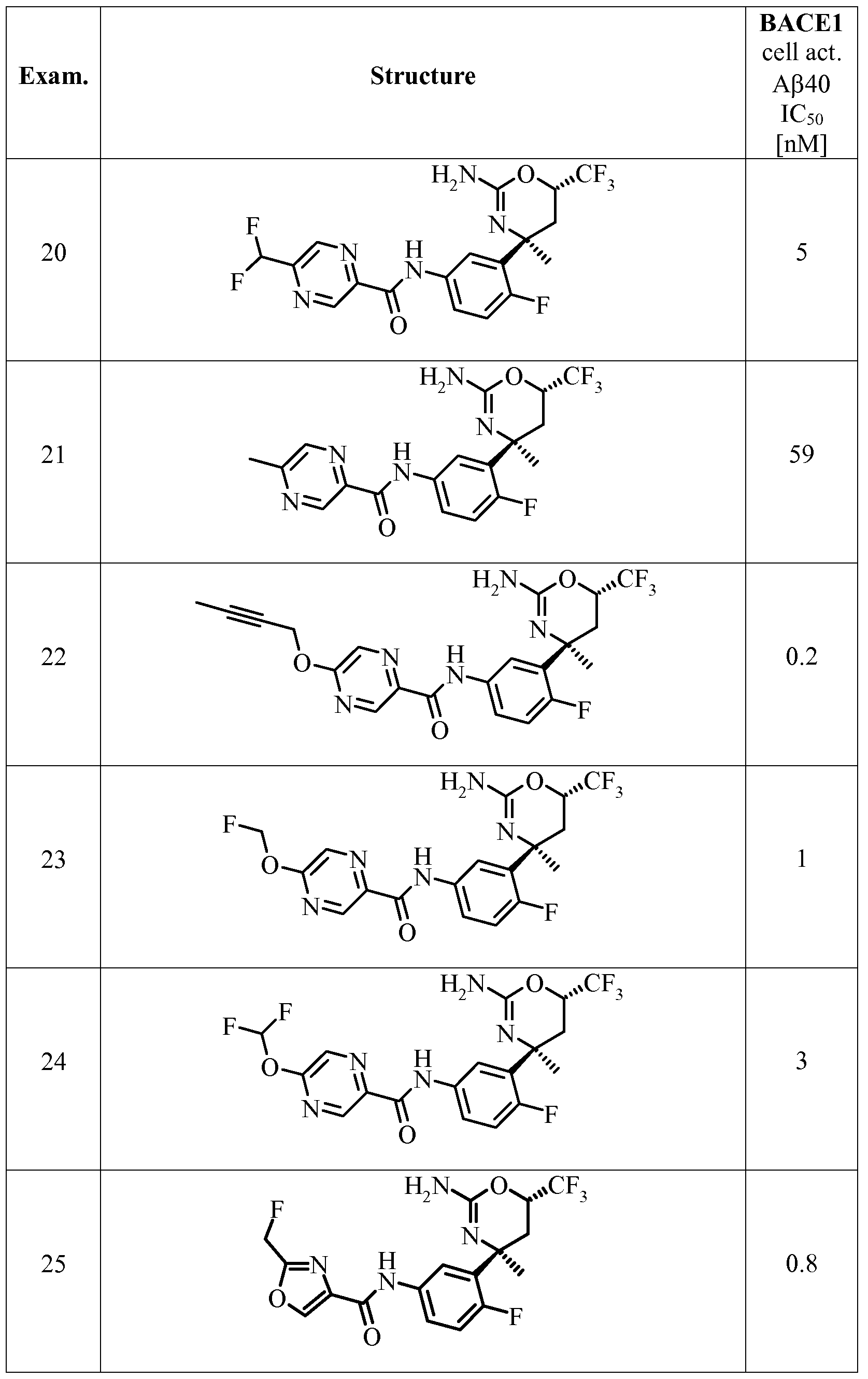
  • a certain embodiment of the invention provides a compound as described herein, wherein R 1 is l-(difluoromethyl)-lH-pyrazole-3-yl, 2-(fluoromethyl)oxazole-4-yl, 3,5-dichloro-pyridin- 2-yl, 3-chloro-5-cyanopyridin-2-yl, 3-methylpyrazine-2-yl, 4-chloro-l-(difluoromethyl)-lH- pyrazole-3-yl, 5-(2,2,2-trifluoroethoxy)pyrazine-2-yl, 5-(2,2-difluoroethoxy)pyrazine-2-yl, 5- (but-2-ynyloxy)pyrazine-2-yl, 5-(difluoromethoxy)pyrazine-2-yl, 5-(difluoromethyl)pyrazine-2- yl, 5-(fluoromethoxy)pyrazine-2-yl, 5-(fluorometh
  • a certain embodiment of the invention provides a compound as described herein, wherein R 1 is 5-cyano-pydidin-2-yl, 5-chloro-pydidin-2-yl, 5-(2,2-difluoroethoxy)pyrazine-2-yl, 5-(2,2,2- trifluoroethoxy)pyrazine-2-yl or 5-methoxypyrazine-2-yl.
  • R 1 is 5-cyano-pydidin-2-yl, 5-chloro-pydidin-2-yl, 5-(2,2-difluoroethoxy)pyrazine-2-yl, 5-(2,2,2- trifluoroethoxy)pyrazine-2-yl or 5-methoxypyrazine-2-yl.
  • R 1 is l-(difluoromethyl)-lH-pyrazole-3-yl.
  • a certain embodiment of the invention provides a compound as described herein, wherein R 1 is 2-(fluoromethyl)oxazole-4-yl.
  • a certain embodiment of the invention provides a compound as described herein, wherein R 1 is 3,5-dichloro-pyridin-2-yl.
  • a certain embodiment of the invention provides a compound as described herein, wherein
  • R 1 is 3-chloro-5-cyanopyridin-2-yl.
  • a certain embodiment of the invention provides a compound as described herein, wherein R 1 is 3-methylpyrazine-2-yl.
  • a certain embodiment of the invention provides a compound as described herein, wherein R 1 is 4-chloro-l-(difluoromethyl)-lH-pyrazole-3-yl.
  • a certain embodiment of the invention provides a compound as described herein, wherein R 1 is 5-(but-2-ynyloxy)pyrazine-2-yl.
  • a certain embodiment of the invention provides a compound as described herein, wherein R 1 is 5-(difluoromethoxy)pyrazine-2-yl.
  • a certain embodiment of the invention provides a compound as described herein, wherein
  • R 1 is 5-(difluoromethyl)pyrazine-2-yl.
  • a certain embodiment of the invention provides a compound as described herein, wherein R 1 is 5-(fluoromethoxy)pyrazine-2-yl.
  • a certain embodiment of the invention provides a compound as described herein, wherein R 1 is 5-(fluoromethyl)pyrazine-2-yl.
  • a certain embodiment of the invention provides a compound as described herein, wherein R 1 is 5-cyano-3-methyl-pyridin-2-yl.
  • a certain embodiment of the invention provides a compound as described herein, wherein R 1 is 5-difluoromethoxy-pyrazin-2-yl.
  • a certain embodiment of the invention provides a compound as described herein, wherein
  • R 1 is 5-difluoromethoxy-pyridin-2-yl.
  • a certain embodiment of the invention provides a compound as described herein, wherein R 1 is 5-difluoromethyl-pyridin-2-yl.
  • a certain embodiment of the invention provides a compound as described herein, wherein R 1 is 5-fluoromethoxy-pyridin-2-yl.
  • a certain embodiment of the invention provides a compound as described herein, wherein R 1 is 5-methoxy-pyridin-2-yl.
  • a certain embodiment of the invention provides a compound as described herein, wherein R 1 is 5-methyl-pyrazine-2-yl.
  • a certain embodiment of the invention provides a compound as described herein, wherein
  • R 1 is 5-trifluoroethoxy-pyridin-2-yl.
  • a certain embodiment of the invention provides a compound as described herein, wherein R 1 is 5-trifluoromethoxy-pyrazin-2-yl.
  • a certain embodiment of the invention provides a compound as described herein, wherein R 1 is 5-trifluoromethoxy-pyridin-2-yl.
  • a certain embodiment of the invention provides a compound as described herein, wherein R 1 is 5-cyano-pydidin-2-yl,
  • a certain embodiment of the invention provides a compound as described herein, wherein R 1 is 5-chloro-pydidin-2-yl.
  • a certain embodiment of the invention provides a compound as described herein, wherein
  • R 1 is 5-(2,2-difluoroethoxy)pyrazine-2-yl.
  • a certain embodiment of the invention provides a compound as described herein, wherein R 1 is 5-(2,2,2-trifluoroethoxy)pyrazine-2-yl.
  • a certain embodiment of the invention provides a compound as described herein, wherein R 1 is 5-methoxypyrazine-2-yl.
  • a certain embodiment of the invention provides a compound as described herein, selected from the group consisting of
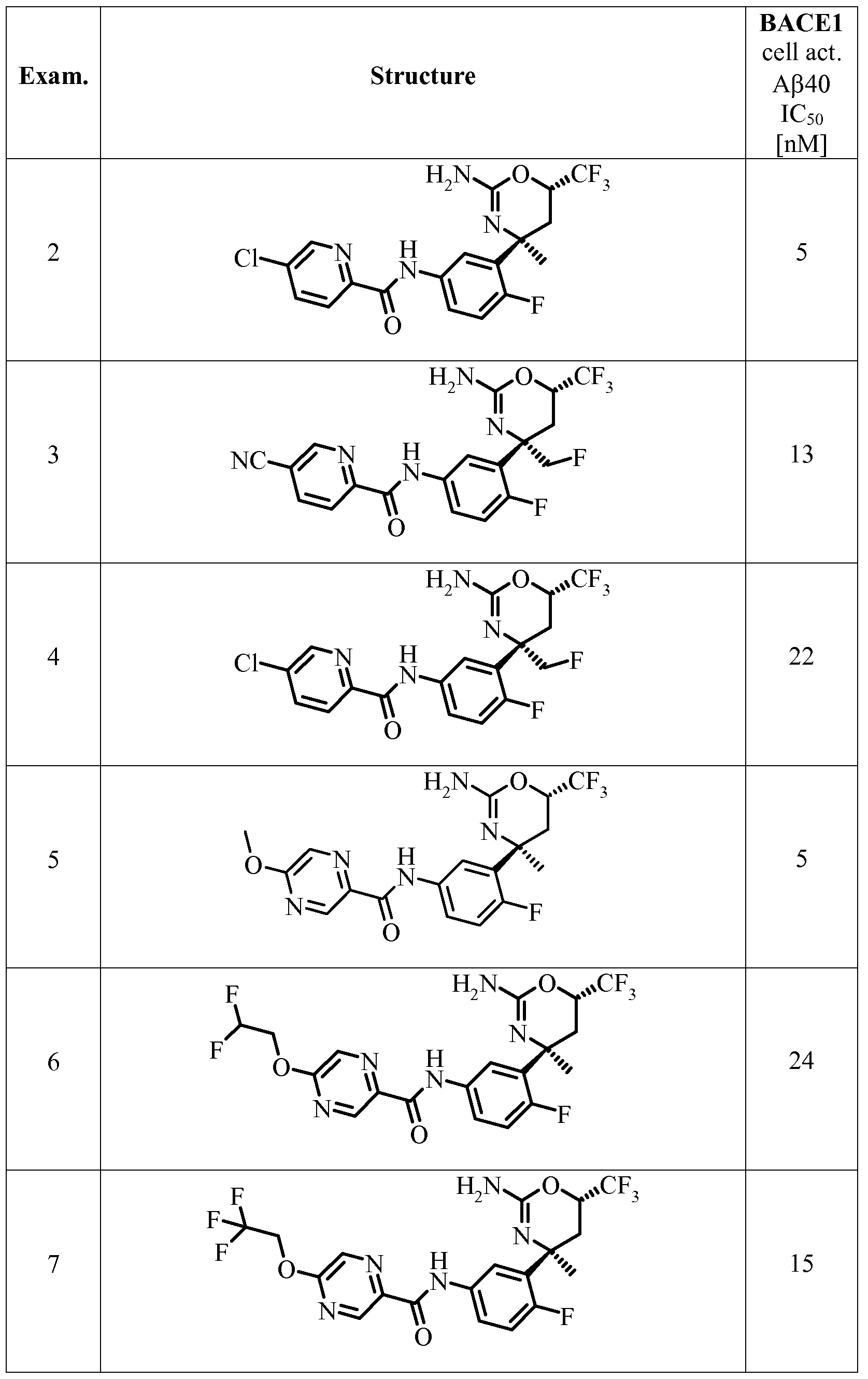
  • a certain embodiment of the invention provides a compound as described herein, selected from the group consisting of N-(3-((4S,6S)-2-amino-4-methyl-6-(trifluoromethyl)-5,6-di ydro-4H-l,3-oxazin-4-yl)-4- fluorophenyl)-5 -cyanopico linamide,
  • a certain embodiment of the invention provides a compound as described herein, which is N-(3-((4S,6S)-2-amino-4-methyl-6-(trifluoromethyl)-5,6-dihydro-4H-l,3-oxazin-4-yl)-4- fluorophenyl)-5 -cyanopico linamide.
  • a certain embodiment of the invention provides a compound as described herein, which is N-(3-((4S,6S)-2-amino-4-methyl-6-(trifluoromethyl)-5,6-dihydro-4H-l,3-oxazin-4-yl)-4- fluorophenyl)-5 -chloropico linamide.
  • a certain embodiment of the invention provides a compound as described herein, which is N-(3-((4S,6S)-2-amino-4-(fluoromethyl)-6-(trifluoromethyl)-5,6-dihydro-4H-l,3-oxazin-4-yl)-4- fluorophenyl)-5 -cyanopico linamide.
  • a certain embodiment of the invention provides a compound as described herein, which is
  • a certain embodiment of the invention provides a compound as described herein, which is N-(3-((4S,6S)-2-amino-4-methyl-6-(trifluoromethyl)-5,6-dihydro-4H-l,3-oxazin-4-yl)-4- fluorophenyl)-5-methoxypyrazine-2-carboxamide.
  • a certain embodiment of the invention provides a compound as described herein, which is N-(3-((4S,6S)-2-amino-4-methyl-6-(trifluoromethyl)-5,6-dihydro-4H-l,3-oxazin-4-yl)-4- fluorophenyl)-5-(2,2-difluoroethoxy)pyrazine-2-carboxamide, and A certain embodiment of the invention provides a compound as described herein, which is N-(3-((4S,6S)-2-amino-4-methyl-6-(trifluoromethyl)-5,6-dihydro-4H-l,3-oxazin-4-yl)-4- fluorophenyl)-5-(2,2,2-trifluoroethoxy)pyrazine-2-carboxamide.
  • a certain embodiment of the invention provides a process comprises reacting a compound of formula ⁇ with a compound of formula ⁇ to a compound of formula I.
  • a certain embodiment of the invention provides a compound of formula I as described herein, whenever prepared by a process as defined above.
  • a certain embodiment of the invention provides a compound of formula I as described herein for use as therapeutically active substance.
  • a certain embodiment of the invention provides a compound of formula I as described herein for the use as inhibitor of BACE1 activity.
  • a certain embodiment of the invention provides a compound of formula I as described herein for the use as therapeutically active substance for the therapeutic and/or prophylactic treatment of diseases and disorders characterized by elevated ⁇ -amyloid levels and/or ⁇ -amyloid oligomers and/or ⁇ -amyloid plaques and further deposits or Alzheimer's disease.
  • a certain embodiment of the invention provides a compound of formula I as described herein for the use as therapeutically active substance for the therapeutic and/or prophylactic treatment of Alzheimer's disease.
  • a certain embodiment of the invention provides a compound of formula I as described herein for the use as therapeutically active substance for the therapeutic and/or prophylactic treatment of amyotrophic lateral sclerosis (ALS), arterial thrombosis, autoimmune/inflammatory diseases, cancer such as breast cancer, cardiovascular diseases such as myocardial infarction and stroke, dermatomyositis, Down's Syndrome, gastrointestinal diseases, Glioblastoma multiforme, Graves Disease, Huntington's Disease, inclusion body myositis (IBM), inflammatory reactions, Kaposi Sarcoma, Kostmann Disease, lupus erythematosus, macrophagic myofasciitis, juvenile idiopathic arthritis, granulomatous arthritis, malignant melanoma, multiple mieloma, rheumatoid arthritis, Sjogren syndrome, Spinocerebellar Ataxia 1, Spinocerebellar Ataxia 7, Whipple's Disease or Wilson's Disease.
  • a certain embodiment of the invention provides a pharmaceutical composition
  • a pharmaceutical composition comprising a compound of formula I as described herein and a pharmaceutically acceptable carrier and/or a pharmaceutically acceptable auxiliary substance.
  • a certain embodiment of the invention provides the use of a compound of formula I as described herein for the manufacture of a medicament for the use in inhibition of BACE1 activity.
  • a certain embodiment of the invention provides the use of a compound of formula I as described herein for the manufacture of a medicament for the therapeutic and/or prophylactic treatment of diseases and disorders characterized by elevated ⁇ -amyloid levels and/or ⁇ -amyloid oligomers and/or ⁇ -amyloid plaques and further deposits or Alzheimer's disease.
  • a certain embodiment of the invention provides the use of a compound of formula I as described herein for the manufacture of a medicament for the therapeutic and/or prophylactic treatment of Alzheimer's disease.
  • a certain embodiment of the invention provides the use of a compound of formula I as described herein for the manufacture of a medicament for the therapeutic and/or prophylactic treatment of amyotrophic lateral sclerosis (ALS), arterial thrombosis, autoimmune/inflammatory diseases, cancer such as breast cancer, cardiovascular diseases such as myocardial infarction and stroke, dermatomyositis, Down's Syndrome, gastrointestinal diseases, Glioblastoma multiforme, Graves Disease, Huntington's Disease, inclusion body myositis (IBM), inflammatory reactions, Kaposi Sarcoma, Kostmann Disease, lupus erythematosus, macrophagic myofasciitis, juvenile idiopathic arthritis, granulomatous arthritis, malignant melanoma, multiple mieloma, rheumatoid arthritis, Sjogren syndrome, Spinocerebellar Ataxia 1, Spinocerebellar Ataxia 7, Whipple's Disease or Wilson's Disease.
  • a certain embodiment of the invention provides the use of a compound of formula I as described herein for the manufacture of a medicament for the therapeutic and/or prophylactic treatment of Alzheimer's disease.
  • a certain embodiment of the invention provides a compound of formula I as described herein for the use in inhibition of BACE1 activity.
  • a certain embodiment of the invention provides a compound of formula I as described herein for the use in the therapeutic and/or prophylactic treatment of diseases and disorders characterized by elevated ⁇ -amyloid levels and/or ⁇ -amyloid oligomers and/or ⁇ -amyloid plaques and further deposits or Alzheimer's disease.
  • a certain embodiment of the invention provides a compound of formula I as described herein for the use in the therapeutic and/or prophylactic treatment of Alzheimer's disease.
  • a certain embodiment of the invention provides a compound of formula I as described herein for the use in the therapeutic and/or prophylactic treatment of amyotrophic lateral sclerosis (ALS), arterial thrombosis, autoimmune/inflammatory diseases, cancer such as breast cancer, cardiovascular diseases such as myocardial infarction and stroke, dermatomyositis, Down's Syndrome, gastrointestinal diseases, Glioblastoma multiforme, Graves Disease, Huntington's Disease, inclusion body myositis (IBM), inflammatory reactions, Kaposi Sarcoma, Kostmann Disease, lupus erythematosus, macrophagic myofasciitis, juvenile idiopathic arthritis, granulomatous arthritis, malignant melanoma, multiple mieloma, rheumatoid arthritis, Sjogren syndrome, Spinocerebellar Ataxia 1, Spinocerebellar Ataxia 7, Whipple's Disease or Wilson's Disease.
  • ALS amyo
  • a certain embodiment of the invention provides a method for the use in inhibition of BACEl activity, particularly for the therapeutic and/or prophylactic treatment of diseases and disorders characterized by elevated ⁇ -amyloid levels and/or ⁇ -amyloid oligomers and/or ⁇ - amyloid plaques and further deposits or Alzheimer's disease, which method comprises administering compound of formula I as described herein to a human being or animal.
  • a certain embodiment of the invention provides a method for the use in the therapeutic and/or prophylactic treatment of Alzheimer's disease, which method comprises administering a compound of formula I as described herein to a human being or animal.
  • a certain embodiment of the invention provides a method for the use in the therapeutic and/or prophylactic treatment of amyotrophic lateral sclerosis (ALS), arterial thrombosis, autoimmune/inflammatory diseases, cancer such as breast cancer, cardiovascular diseases such as myocardial infarction and stroke, dermatomyositis, Down's Syndrome, gastrointestinal diseases, Glioblastoma multiforme, Graves Disease, Huntington's Disease, inclusion body myositis (IBM), inflammatory reactions, Kaposi Sarcoma, Kostmann Disease, lupus erythematosus, macrophagic myofasciitis, juvenile idiopathic arthritis, granulomatous arthritis, malignant melanoma, multiple mieloma, rheumatoid arthritis, Sjogren syndrome, Spinocerebellar Ataxia 1, Spinocerebellar Ataxia 7, Whipple's Disease or Wilson's Disease, which method comprises administering a compound of formula I as described here
  • the invention includes all optical isomers, i.e. diastereoisomers, diastereomeric mixtures, racemic mixtures, all their corresponding enantiomers and/or tautomers as well as their solvates of the compounds of formula I.
  • optical isomers i.e. diastereoisomers, diastereomeric mixtures, racemic mixtures, all their corresponding enantiomers and/or tautomers as well as their solvates of the compounds of formula I.
  • optical isomers i.e. diastereoisomers, diastereomeric mixtures, racemic mixtures, all their corresponding enantiomers and/or tautomers as well as their solvates of the compounds of formula I.
  • the compounds of formula I can exist in tautomeric form
  • the compounds of formula I may contain one or more asymmetric centers and can therefore occur as racemates, racemic mixtures, single enantiomers, diastereomeric mixtures and individual diastereomers. Additional asymmetric centers may be present depending upon the nature of the various substituents on the molecule. Each such asymmetric center will independently produce two optical isomers and it is intended that all of the possible optical isomers and diastereomers in mixtures and as pure or partially purified compounds are included within this invention. The present invention is meant to encompass all such isomeric forms of these compounds. The independent syntheses of these diastereomers or their chromatographic separations may be achieved as known in the art by appropriate modification of the methodology disclosed herein.
  • Stereoisomers of compounds of formula I are compounds of formula la or compounds of formula lb, in particular compounds of formula la, wherein the residues have the meaning as described in any of the embodiments.
  • optically pure enantiomer means that the compound contains > 90 % of the desired isomer by weight, particularly > 95 % of the desired isomer by weight, or more particularly > 99 % of the desired isomer by weight, said weight percent based upon the total weight of the isomer(s) of the compound.
  • Chirally pure or chirally enriched compounds may be prepared by chirally selective synthesis or by separation of enantiomers. The separation of enantiomers may be carried out on the final product or alternatively on a suitable intermediate.
  • the compounds of formula I may be prepared in accordance with the following schemes.
  • the starting material is commercially available or may be prepared in accordance with known methods. Any previously defined residues and variables will continue to have the previously defined meaning unless otherwise indicated.
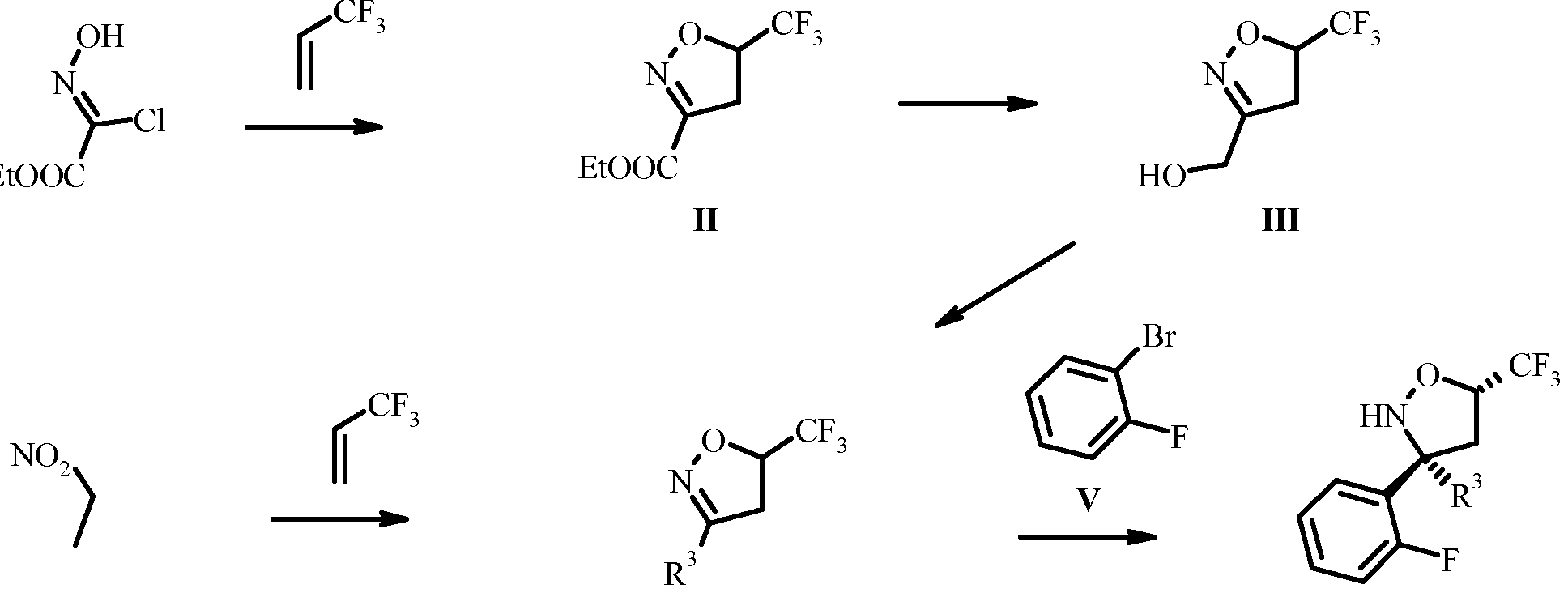
  • alkyl-2-chloro-2-(hydroxyimino)acetate is reacted with an olefin in the presence of a base such as an alkyl amine, more particular TEA (triethylamine) or an alkali carbonate, more particular NaHC0 3 (sodium hydro gencarbonate) in a solvent such as chlorinated alkanes, in particular CH 2 CI 2 (dichloromethane) or an ester, in particular AcOEt (ethyl acetate) to give the ester II.
  • a base such as an alkyl amine, more particular TEA (triethylamine) or an alkali carbonate, more particular NaHC0 3 (sodium hydro gencarbonate) in a solvent such as chlorinated alkanes, in particular CH 2 CI 2 (dichloromethane) or an ester, in particular AcOEt (ethyl acetate) to give the ester II.
  • a base such as an alkyl
  • the ester II is reduced with a hydride, in particular NaBH 4 (sodium borohydride) in a solvent such as an alcohol, in particular EtOH t(ethanol) give the alcohol III.
  • a hydride in particular NaBH 4 (sodium borohydride)
  • a solvent such as an alcohol, in particular EtOH t(ethanol)
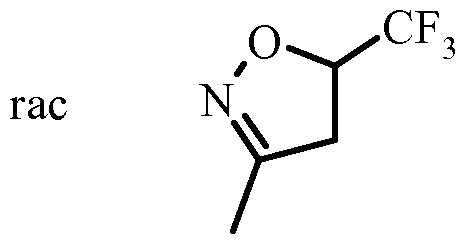
  • a nitro compound is reacted with an olefine in the presence of an activating reagent such as e.g. an isocyanate, in particular phenylisocyanate, and a catalytic amount of a base, in particular an alkyl amine, more particular TEA in a solvent such as benzene or toluene, in particular benzene, or an alkyl ether, in particular diethyl ether to give the dihydroisoxazole IV wherein R 3 is alkyl, particularly methyl.
  • an activating reagent such as e.g. an isocyanate, in particular phenylisocyanate
  • a catalytic amount of a base in particular an alkyl amine, more particular TEA in a solvent such as benzene or toluene, in particular benzene, or an alkyl ether, in particular diethyl ether
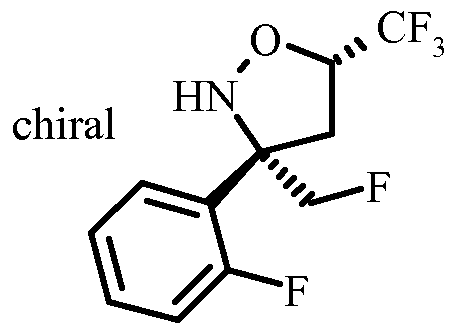
  • Dihydroisoxazoles IV wherein R 3 is halogen-alkyl, particularly fluoromethyl can be obtained from alcohols III by reaction with a fluorinating agent like e.g. morpho lino sulfur trifluoride in an inert solvent like halogenalkanes, preferably dichloromethane, at temperatures between -78 °C and ambient temperature.
  • a fluorinating agent like e.g. morpho lino sulfur trifluoride in an inert solvent like halogenalkanes, preferably dichloromethane
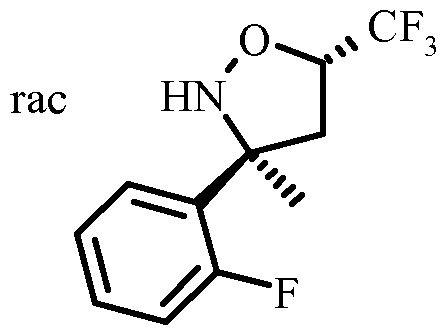
  • Arylation of the dihydroisoxazole IV with the arylbromide V to give the isoxazolidine VI is performed by reacting an arylhalogenide, in particular an arylbromide with an alkyl lithium reagent, in particular n-BuLi to give an aryllithium species, which can be reacted with the dihydroisoxazole IV in the presence of a Lewis base, preferably boron trifluoride etherate in a solvent mixture consisting of an ether, in particular THF (tetrahydrofuran) and toluene at -100°C to -20°C, in particular at -78°C.
  • a Lewis base preferably boron trifluoride etherate in a solvent mixture consisting of an ether, in particular THF (tetrahydrofuran) and toluene at -100°C to -20°C, in particular at -78°C.
  • Resolution of the racemic isoxazolidine VI to give the chiral isoxazolidine VII can be done by chiral high-performance liquid chromatography (HPLC) using a Chiralpack AD or Reprosil NR column in a mixture of n-heptane and ethanol or isopropanol as the eluent.
  • HPLC high-performance liquid chromatography
  • Hydro geno lysis of the chiral isoxazolidine VII to the aminoalcohol VIII can be accomplished best by transfer hydro geno lysis using a Pd-catalyst, in particular Pd on carbon and a hydrogen source, e.g. a salt of formic acid, in particular ammonium formate in a protic solvent such as an alcohol, in particular ethanol.
  • a Pd-catalyst in particular Pd on carbon
  • a hydrogen source e.g. a salt of formic acid, in particular ammonium formate in a protic solvent such as an alcohol, in particular ethanol.
  • Oxazine IX can be prepared by reaction of aminoalcohol VIII with cyanogen bromide in a solvent such as an alcohol, in particular ethanol at elevated temperature.
  • the reaction can be carried out in a two step sequenze using cyanogen bromide and a buffer such as e.g. sodium acetate in the presence of a solvent such as e.g. CH 3 CN followed by cyclisation of the intermediate in the presence of a mineral acid, in particular hydrochloric acid in a solvent such as an ether, in particular 1,4-dioxane.
  • a buffer such as e.g. sodium acetate
  • a solvent such as e.g. CH 3 CN
  • cyclisation of the intermediate in the presence of a mineral acid, in particular hydrochloric acid in a solvent such as an ether, in particular 1,4-dioxane.
  • the nitration of the oxazine (IX to give the nitro-oxazine X follows a standard procedure involving neat sulfuric acid and fuming nitric acid without using a solvent.
  • the reduction of the nitro group in the intermediate X to give the aniline XI can be accomplished by hydrogenation using a catalyst such as Pd on carbon in protic solvents, such as alcohols, in particular ethanol or methanol.
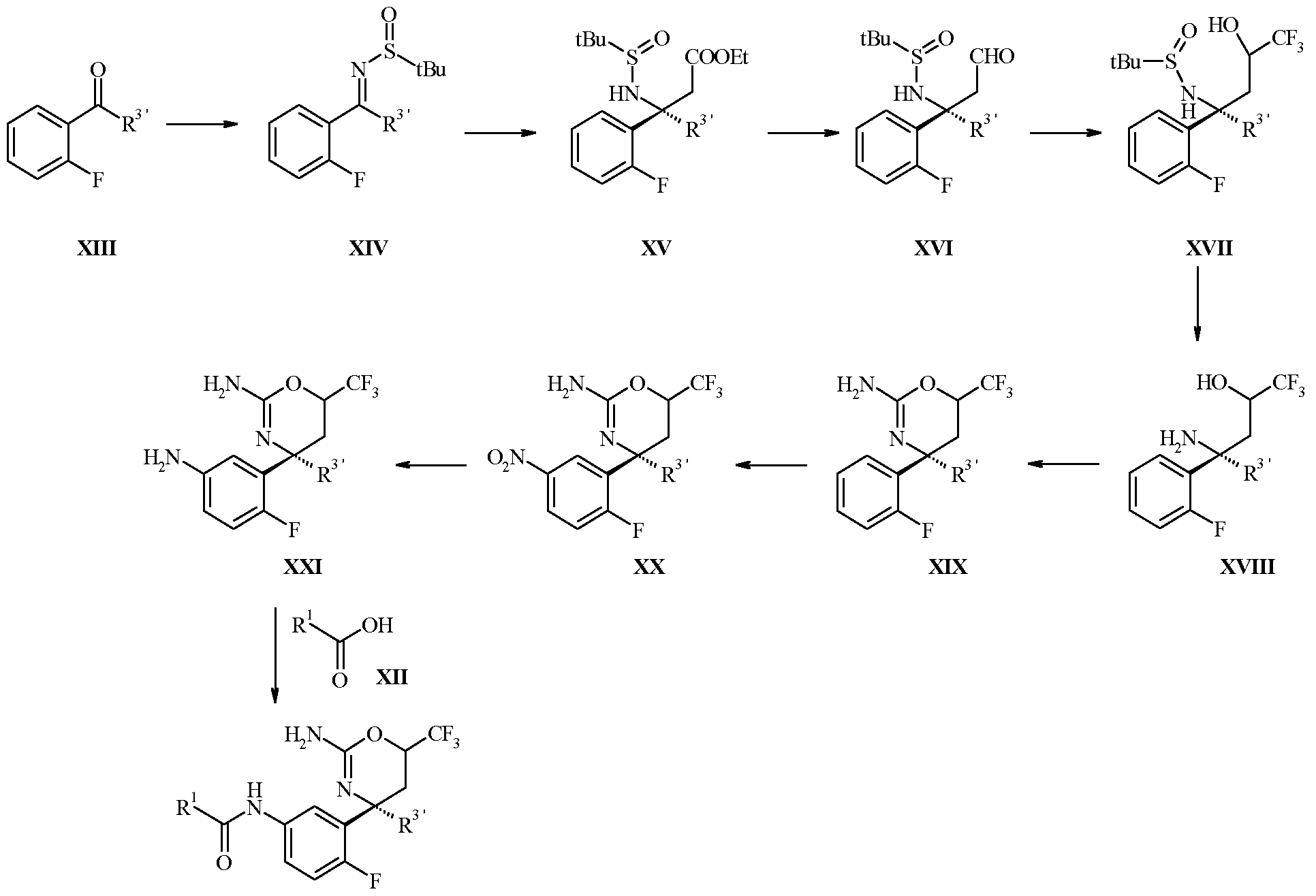
  • the conversion of the sulfmyl imine XIV to the sulfanamide ester XV proceeds stereoselectively by the chiral directing group as described by Tang & Ellman.
  • the sulfmyl imine XIV can be reacted in a Reformatsky reaction with a zinc enolate, generated from an alkyl acetate substituted by halogen, e.g. particularly ethyl bromoacetate and activated zinc powder, at ambient to elevated temperature, particularly at 23 to 60 °C in a solvent such as an ether, e.g. diethyl ether or more particularly tetrahydroiuran in presence of a copper(I) salt, preferably copper(I) chloride.
  • halogen e.g. particularly ethyl bromoacetate and activated zinc powder
  • Aldehydes of formula XVI can be prepared by the reduction of an ethylester of formula XV with an alkali hydride, e.g. lithium aluminium hydride in presence of diethylamine or sodium dihydrobis(2-methoxyethoxy)aluminate (Red-Al), preferably with diisobutylaluminum hydride (DIBAH) in an inert solvent such as an ether, e.g. diethyl ether or more particularly tetrahydroiuran or in a chlorinated solvent, such as dichloromethane, at temperatures between -78 °C and ambient temperature.
  • an alkali hydride e.g. lithium aluminium hydride in presence of diethylamine or sodium dihydrobis(2-methoxyethoxy)aluminate (Red-Al)
  • DIBAH diisobutylaluminum hydride
  • an inert solvent such as an ether,
  • Alcohols of formula XVII can be obtained by the reaction of aldehydes of formula XVI with a trifluoromethylating agent, preferably trifluoromethyltrimethylsilane (Ruppert-Prakash reagent), in presence of tetrabutylammonium fluoride in a solvent such as an ether, e.g. diethyl ether or more particularly tetrahydroiuran, at temperatures between -10 °C and ambient temperature.
  • a trifluoromethylating agent preferably trifluoromethyltrimethylsilane (Ruppert-Prakash reagent)
  • Ruppert-Prakash reagent trifluoromethyltrimethylsilane
  • Hydrolysis of the chiral directing group in the sulfanamide alcohol of formula XVII to give the aminoalcohol of formula XVIII can be accomplished with a mineral acid, e.g. sulfuric acid or particularly hydrochloric acid, in a solvent such as an ether, e.g. diethyl ether, tetrahydroiuran or more particularly 1,4-dioxane.
  • a mineral acid e.g. sulfuric acid or particularly hydrochloric acid
  • a solvent such as an ether, e.g. diethyl ether, tetrahydroiuran or more particularly 1,4-dioxane.
  • the aminooxazine of formula XIX can be prepared by reaction of an aminoalcohol of formula XVIII with cyanogen bromide in a solvent such as an alcohol, particularly ethanol.
  • the nitro derivative of formula XX can be prepared by nitration of the oxazine XIX following a standard procedure involving neat sulfuric acid and fuming nitric acid without using a solvent.
  • the reduction of the nitro group in compounds of formula XX to give anilines of formula XXI can be accomplished by hydrogenation using a catalyst, such as palladium on carbon, in protic solvents, such as alcohols, in particular ethanol or methanol.
  • a catalyst such as palladium on carbon
  • protic solvents such as alcohols, in particular ethanol or methanol.
  • M metal or ammonium cation
  • n number of hydroxide anions
  • a suitable solvent e.g. ethanol, ethanol-water mixture, tetrahydrofuran- water mixture
  • Particular salts are hydrochloride, formate and trifluoro acetate. Specific is hydrochloride.
  • the compounds of formula I as well as all intermediate products can be prepared according to analogous methods or according to the methods set forth herein. Starting materials are commercially available, known in the art or can be prepared by methods known in the art or in analogy thereto. It will be appreciated that the compounds of general formula I in this invention may be derivatised at functional groups to provide derivatives which are capable of conversion back to the parent compound in vivo.
  • Cellular ⁇ -lowering assay The Abeta 40 AlphaLISA Assay can be used.
  • the HEK293 APP cells were seeded in 96 well Microtiter plates in cell culture medium (Iscove's, plus 10% (v/v) fetal bovine serum, penicillin/streptomycin ) to about 80%> confluency and the compounds were added at a 3x concentration in 1/3 volume of culture medium ( final DMSO concentration was kept at 1 % v/v).
  • P-gp P-glycoprotein
  • the LLC-PK1 cell line (ATCC #CL-101) is a porcine kidney epithelial cell line.
  • the MDR1 (human multidrug resistance protein 1) transfected cell lines were obtained from Dr. A. Schinkel, The Netherlands Cancer Institute (Amsterdam, The Netherlands). All cell lines were cultured on permeable inserts (Costar, 0.33 cm 2 area, pore size 3.0 ⁇ , low density) at 4.5 ⁇ 10 5 cells/cm 2 . Transport measurements were performed at day 4 after seeding. Tightness of the cell monolayer was controlled via the permeability of the extracellular marker lucifer yellow (10 ⁇ ). Experiments showing lucifer yellow permeation superior to 1 %/h were rejected.
  • the method used for transport experiments were performed on a TECAN automated liquid handling system. Briefly, medium was removed from all compartments and the medium of receiver side was replaced with culture medium. The trans-cellular transport measurements were initiated by adding the substrate together with extracellular marker lucifer yellow to the donor side. Inhibitors were added to both sides (1 ⁇ elacridar). Transport experiments were performed both in the basolateral-to-apical and apical-to-baso lateral directions with 3 wells each. The plates were incubated at 37°C and 5% C0 2 in a Liconic incubator. Samples were taken from the donor and the opposite (acceptor) side after 2 hours incubation.
  • P app , A, Co, and dQIdt represent the apparent permeability, the filter surface area, the initial concentration, and the amount transported per time period, respectively.
  • P app values were calculated on the basis of a single time point (2 h).
  • P app AB Where P app BA is the permeability value in the basolateral-to-apical direction, and P app AB the permeability value in the apical-to-basolateral direction. P app were not corrected for flux of the extracellular marker lucifer yellow, which was used to assess the quality of the cell monolayers. Detection of Glutathione conjugates (GSH)
  • the hERG current measurement was performed at an automated patch clamp system following the procedure described in R.E.Martin et al. in Bioorg.Med.Chem.Lett 19 (2009), 6106-6113.
  • mice Female C57B1/6J mice were treated with different doses of the compounds, 3- 4 animals per treatment group.
  • the test compound was dissolved in 5% EtOH, 10% Solutol and was applied per os at 10 ml/kg. After 4h the animals were sacrificed and brain and plasma were collected. The brain was cut into halves and immediately frozen on dry ice. Brain was used for measurement of ⁇ 40 and plasma was used for determination of compound exposure.
  • the method for ⁇ 40 determination in brain lysates followed the known procedure (Lanz, T.A.; Schachter, J.B. Demonstration of a common artifact in immunosorbent assays of brain extracts: Development of a solid-phase extraction protocol to enable measurement of amyloid-beta from wild-type rodent brain.
  • Brain tissue was homogenized in 2% DEA buffer in a Roche MagnaLyser (20", 4000 rpm) and subsequently centrifuged for 1 h at 100'OOOg.
  • DEA was reduced to 0.2% in 50 mM NaCl and one half of the DEA lysate was passed over an Oasis Solid Phase extraction plate (Waters; Cat.Nr. 186000679) which had been activated with MeOH and equilibrated in dH 2 0 (1ml each). After washes in 10% and 30% MeOH (1 ml each) the ⁇ -peptides were eluted in 0.8 ml 2% NH 4 OH in 90% MeOH.
  • the eluate was dried over a N 2 flow and the dried sample was reconstituted in 30 ⁇ AlphaLISA assay buffer.
  • ⁇ 40 was determined by an AlphaLISA assay (Perkin Elmer).
  • 20 ⁇ of the reconstituted sample were mixed with 5 ⁇ biotinylated BAP-24 (specific for C-terminus of ⁇ 40 (Brockhaus, M.; Grunberg, J.; Rohrig, S.; Loetscher, H.; Wittenburg, N.; Bauhoff, R.; Jacobsen, FL; Haass, C.
  • the MR121 fluorescence assays described below are based on the fact that MR121 forms a non- fluorescent ground state complex with tryptophan. In solution this formation occurs at millimolar concentrations of tryptophan.
  • the mechanism can be used to design a generic biochemical assay for proteases.
  • a substrate peptide is labeled at the N-terminus with tryptophan and at the C-terminus with the fluorophore MR121 (for cathepsin D the 10 amino acid peptide WTSVLMAAPC-MR121 was used; for cathepsin E, MR121-CKLVFFAEDW was used).
  • the substrates remain intact and the MR121 fluorescence is reduced by the high local Trp-concentration. If the substrates are cleaved by the enzymes the MR121 fluorescence is recovered.
  • the fluorescent substrate cathepsin D and cathepsin E kinetic assays were performed at room temperature in 384-well micro titer plates (black with clear flat bottom, non binding surface plates from Corning) in a final volume of 51 ⁇ 1.
  • the test compounds were serially diluted in DMSO (15 concentrations, 1/3 dilution steps) and ⁇ of diluted compounds were mixed for 10 min with 40 ⁇ of cathepsin D (from human liver, Calbiochem) diluted in assay buffer (100 mM sodium acetate, 0.05% BSA, pH 5.5; final concentration: 200 nM) or with 40 ⁇ of recombinant human cathepsin E (R&D Systems) diluted in assay buffer (100 mM sodium acetate, 0.05% BSA, pH 4.5; final concentration: 0.01 nM).
  • the plates were strongly shaken for 2 minutes.
  • the enzymatic reaction was followed in a plate: vision reader (Perkin Elmer) (excitation wavelength: 630 nm; emission: 695 nm) for at least 30 minutes in a kinetic measurement detecting an increase of MR121 fluorescence during the reaction time.
  • the slope in the linear range of the kinetic was calculated and the IC 50 of the test compounds were determined using a four parameter equation for curve fitting.
  • cytochromes P450 2C9, 2D6 and 3A4 was assessed using human liver microsomes and CYP-selective substrate metabolism reactions. 50 ⁇ incubations were made up containing (finally) 0.2 mg/ml pooled human liver microsomes, 5 ⁇ substrate (diclofenac for CYP2C9 [4 'hydroxylase], dextromethorphan for CYP2D6 [O-demethylase] or midazolam for CYP3A4 [1 'hydroxylase]), 0.25 ⁇ _, DMSO containing test inhibitor and NADPH regenerating system.
  • CYPs cytochromes P450
  • Test inhibitor concentrations of 50, 16.7, 5.6, 1.9, 0.6 and 0.2 ⁇ were assessed in singlicate. Incubations were prewarmed to 37 °C for 10 minutes before initiation by addition of NADPH regenerating system. Incubations were quenched after 5 minutes (20 minutes for dextromethorphan) by addition of 50 ⁇ cold acetonitrile containing 20 ng/ml 4-OH-diclofenac- 13C6, 20 ng/mL dextrorphan-D3 and 20 ng/mL l-OH-midazolam-D4. Quenched incubates were stored at -20 °C for at least 1 hour before centrifugation (20,000x g, 20 minutes).
  • the compounds of formula I and the pharmaceutically acceptable salts can be used as therapeutically active substances, e.g. in the form of pharmaceutical preparations.
  • the pharmaceutical preparations can be administered orally, e.g. in the form of tablets, coated tablets, dragees, hard and soft gelatin capsules, solutions, emulsions or suspensions.
  • the administration can, however, also be effected rectally, e.g. in the form of suppositories, or parenterally, e.g. in the form of injection solutions.
  • the compounds of formula I and the pharmaceutically acceptable salts thereof can be processed with pharmaceutically inert, inorganic or organic carriers for the production of pharmaceutical preparations.
  • Lactose, corn starch or derivatives thereof, talc, stearic acids or its salts and the like can be used, for example, as such carriers for tablets, coated tablets, dragees and hard gelatin capsules.
  • Suitable carriers for soft gelatin capsules are, for example, vegetable oils, waxes, fats, semi-solid and liquid polyols and the like. Depending on the nature of the active substance no carriers are however usually required in the case of soft gelatin capsules.
  • Suitable carriers for the production of solutions and syrups are, for example, water, polyols, glycerol, vegetable oil and the like.
  • Suitable carriers for suppositories are, for example, natural or hardened oils, waxes, fats, semi-liquid or liquid polyols and the like.
  • the pharmaceutical preparations can, moreover, contain pharmaceutically acceptable auxiliary substances such as preservatives, solubilizers, stabilizers, wetting agents, emulsifiers, sweeteners, colorants, flavorants, salts for varying the osmotic pressure, buffers, masking agents or antioxidants. They can also contain still other therapeutically valuable substances.
  • Medicaments containing a compound of formula I or a pharmaceutically acceptable salt thereof and a therapeutically inert carrier are also provided by the present invention, as is a process for their production, which comprises bringing one or more compounds of formula I and/or pharmaceutically acceptable salts thereof and, if desired, one or more other therapeutically valuable substances into a galenical administration form together with one or more therapeutically inert carriers.
  • the dosage can vary within wide limits and will, of course, have to be adjusted to the individual requirements in each particular case.
  • the dosage for adults can vary from about 0.01 mg to about 1000 mg per day of a compound of general formula I or of the corresponding amount of a pharmaceutically acceptable salt thereof.
  • the daily dosage may be administered as single dose or in divided doses and, in addition, the upper limit can also be exceeded when this is found to be indicated.
  • compositions according to the invention are:
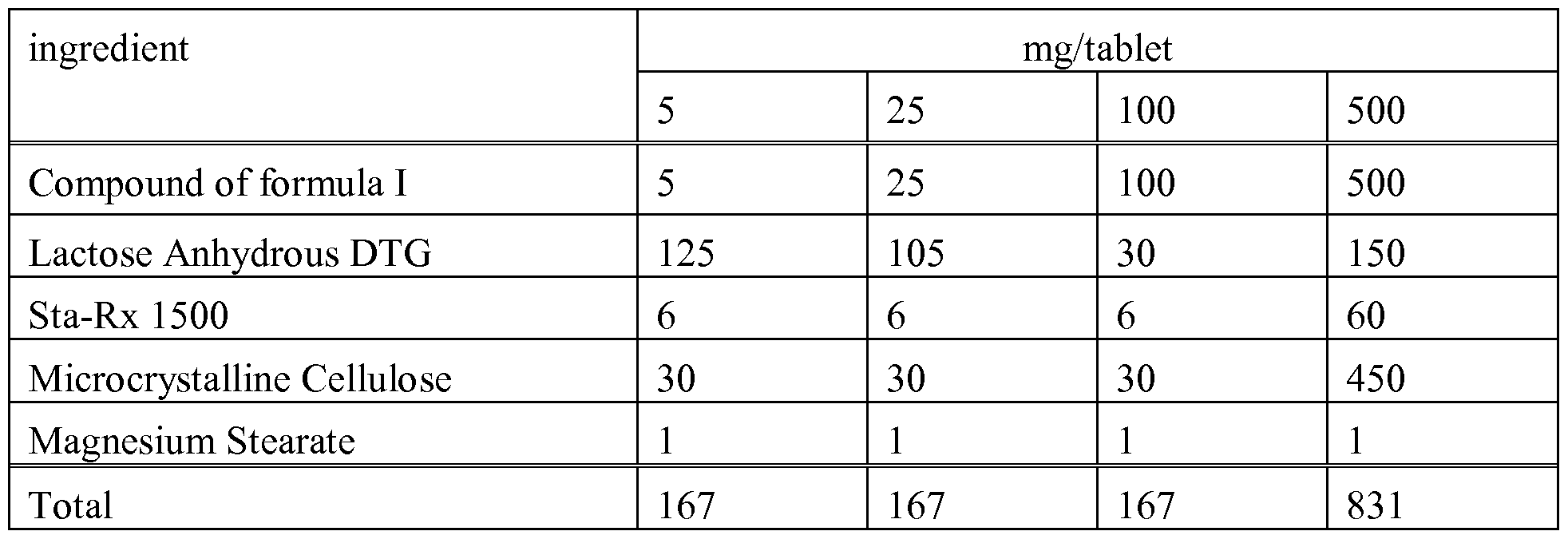
  • Example A Tablets of the following composition are manufactured in the usual manner:
  • the compound of formula I is dissolved in a warm melting of the other ingredients and the mixture is filled into soft gelatin capsules of appropriate size.
  • the filled soft gelatin capsules are treated according to the usual procedures.
  • the suppository mass is melted in a glass or steel vessel, mixed thoroughly and cooled to 45°C. Thereupon, the finely powdered compound of formula I is added thereto and stirred until it has dispersed completely. The mixture is poured into suppository moulds of suitable size, left to cool; the suppositories are then removed from the moulds and packed individually in wax paper or metal foil.
  • the compound of formula I is dissolved in a mixture of Polyethylene Glycol 400 and water for injection (part). The pH is adjusted to 5.0 by acetic acid. The volume is adjusted to 1.0 ml by addition of the residual amount of water. The solution is filtered, filled into vials using an appropriate overage and sterilized.
  • Example E
  • the compound of formula I is mixed with lactose, micro crystalline cellulose and sodium carboxymethyl cellulose and granulated with a mixture of polyvinylpyrrolidone in water.
  • the granulate is mixed with magnesium stearate and the flavoring additives and filled into sachets.
  • MS Mass spectra (MS) were measured either with ion spray positive or negative (ISP or ISN) method on a Perkin-Elmer SCIEX API 300 or with electron impact method (EI, 70 eV) on a Finnigan MAT SSQ 7000 spectrometer.
  • the thick suspension was filtered through a layer of Dicalite ® which was washed twice with DCM.
  • the filtrate was treated with a half- saturated solution of NH 4 C1 and extracted three times with DCM.
  • the combined organic layers were dried over MgS0 4 and evaporated.

Landscapes

  • Health & Medical Sciences (AREA)
  • Organic Chemistry (AREA)
  • Chemical & Material Sciences (AREA)
  • Bioinformatics & Cheminformatics (AREA)
  • Engineering & Computer Science (AREA)
  • Life Sciences & Earth Sciences (AREA)
  • Nuclear Medicine, Radiotherapy & Molecular Imaging (AREA)
  • Pharmacology & Pharmacy (AREA)
  • Medicinal Chemistry (AREA)
  • Animal Behavior & Ethology (AREA)
  • General Health & Medical Sciences (AREA)
  • Public Health (AREA)
  • Veterinary Medicine (AREA)
  • General Chemical & Material Sciences (AREA)
  • Chemical Kinetics & Catalysis (AREA)
  • Immunology (AREA)
  • Neurology (AREA)
  • Biomedical Technology (AREA)
  • Neurosurgery (AREA)
  • Orthopedic Medicine & Surgery (AREA)
  • Heart & Thoracic Surgery (AREA)
  • Physical Education & Sports Medicine (AREA)
  • Cardiology (AREA)
  • Rheumatology (AREA)
  • Psychology (AREA)
  • Hematology (AREA)
  • Hospice & Palliative Care (AREA)
  • Transplantation (AREA)
  • Diabetes (AREA)
  • Psychiatry (AREA)
  • Pain & Pain Management (AREA)
  • Dermatology (AREA)
  • Urology & Nephrology (AREA)
  • Vascular Medicine (AREA)
  • Pharmaceuticals Containing Other Organic And Inorganic Compounds (AREA)
  • Plural Heterocyclic Compounds (AREA)
  • Heterocyclic Carbon Compounds Containing A Hetero Ring Having Nitrogen And Oxygen As The Only Ring Hetero Atoms (AREA)

Abstract

The present invention provides a compound of formula (I) having BACE1 inhibitory activity, their manufacture, pharmaceutical compositions containing them and their use as therapeutically active substances. The active compounds of the present invention are useful in the therapeutic and/or prophylactic treatment of e.g. Alzheimer's disease.

Description

FLUOROMETHYL-5,6-DIHYDRO-4H-[l,3]OXAZINES
Background Art
Alzheimer's disease (AD) is a neurodegenerative disorder of the central nervous system and the leading cause of a progressive dementia in the elderly population. Its clinical symptoms are impairment of memory, cognition, temporal and local orientation, judgment and reasoning but also severe emotional disturbances. There are currently no treatments available which can prevent the disease or its progression or stably reverse its clinical symptoms. AD has become a major health problem in all societies with high life expectancies and also a significant economic burden for their health systems. AD is characterized by 2 major pathologies in the central nervous system (CNS), the occurrence of amyloid plaques and neurofibrillar tangles (Hardy et al, The amyloid hypothesis of Alzheimer's disease: progress and problems on the road to therapeutics, Science. 2002 Jul 19;297(5580):353-6, Selkoe, Cell biology of the amyloid beta-protein precursor and the mechanism of Alzheimer's disease, Annu Rev Cell Biol. 1994;10:373-403). Both pathologies are also commonly observed in patients with Down's syndrome (trisomy 21), which also develop AD-like symptoms in early life. Neurofibrillar tangles are intracellular aggregates of the microtubule-associated protein tau (MAPT). Amyloid plaques occur in the extracellular space; their principal components are Αβ-peptides. The latter are a group of proteolytic fragments derived from the β-amyloid precursor protein (APP) by a series of proteolytic cleavage steps. Several forms of APP have been identified of which the most abundant are proteins of 695, 751 and 770 amino acids length. They all arise from a single gene through differential splicing. The Αβ-peptides are derived from the same domain of the APP but differ at their N- and C-termini, the main species are of 40 and 42 amino-acid length. There are several lines of evidence which strongly suggest that aggregated Αβ-peptides are the essential molecules in the pathogenesis of AD: 1) amyloid plaques formed of Αβ-peptides are invariably part of the AD pathology; 2) Αβ- peptides are toxic for neurons; 3) in Familial Alzheimer's Disease (FAD) the mutations in the disease genes APP, PSN1, PSN2 lead to increased levels of Αβ-peptides and early brain amyloidosis; 4) transgenic mice which express such FAD genes develop a pathology which bears many resemblances to the human disease. Αβ-peptides are produced from APP through the sequential action of 2 proteolytic enzymes termed β- and γ-secretase. β-Secretase cleaves first in the extracellular domain of APP approximately 28 amino acids outside of the trans-membrane domain (TM) to produce a C-terminal fragment of APP containing the TM- and the cytoplasmatic domain (CTFP). CTFβ is the substrate for γ-secretase which cleaves at several adjacent positions within the TM to produce the Αβ peptides and the cytoplasmic fragment. The γ-secretase is a complex of at least 4 different proteins, its catalytic subunit is very likely a presenilin protein (PSEN1, PSEN2). The β-secretase (BACE1, Asp2; BACE stands for β-site APP-cleaving enzyme) is an aspartyl protease which is anchored into the membrane by a transmembrane domain (Vassar et al, Beta-secretase cleavage of Alzheimer's amyloid precursor protein by the transmembrane aspartic protease BACE, Science. 1999 Oct 22; 286(5440): 735). It is expressed in many tissues of the human organism but its level is especially high in the CNS. Genetic ablation of the BACE1 gene in mice has clearly shown that its activity is essential for the processing of APP which leads to the generation of Αβ-peptides, in the absence of BACE 1 no Αβ-peptides are produced (Luo et al, Mice deficient in BACE1, the Alzheimer's beta- secretase, have normal phenotype and abolished beta-amyloid generation, Nat Neurosci. 2001 Mar;4(3):231-2, Roberds et al, BACE knockout mice are healthy despite lacking the primary beta-secretase activity in brain: implications for Alzheimer's disease therapeutics, Hum Mol Genet. 2001 Jun 1; 10(12): 1317-24). Mice which have been genetically engineered to express the human APP gene and which form extensive amyloid plaques and Alzheimer's disease like pathologies during aging fail to do so when β-secretase activity is reduced by genetic ablation of one of the BACE1 alleles (McConlogue et al, Partial reduction of BACE 1 has dramatic effects on Alzheimer plaque and synaptic pathology in APP Transgenic Mice. J Biol Chem. 2007 Sep 7;282(36):26326). It is thus presumed that inhibitors of BACE1 activity can be useful agents for therapeutic intervention in Alzheimer's disease (AD).
Furthermore, the formation, or formation and deposition, of β-amyloid peptides in, on or around neurological tissue (e.g., the brain) are inhibited by the present compounds, i.e. inhibition of the Αβ-production from APP or an APP fragment.
Inhibitors of BACE1 can in addition be used to treat the following diseases: IBM (inclusion body myositis) (Vattemi G. et al, Lancet. 2001 Dec 8;358(9297): 1962-4), Down's Syndrome (Barbiero L. et al, Exp Neurol. 2003 Aug;182(2):335-45), Wilson's Disease (Sugimoto I. et al, J Biol Chem. 2007 Nov 30;282(48):34896-903), Whipple's disease (Desnues B. et al., Clin Vaccine Immunol. 2006 Feb;13(2): 170-8), Spinocerebellar Ataxia 1 and Spinocerebellar Ataxia 7 (Gatchel J.R. et al., Proc Natl Acad Sci U S A 2008 Jan 29;105(4): 1291-6), Dermatomyositis (Greenberg S.A. et al., Ann Neurol. 2005 May;57(5):664- 78 and Greenberg S.A. et al., Neurol 2005 May;57(5):664-78), Kaposi Sarcoma (Lagos D. et al, Blood, 2007 Feb 15; 109(4): 1550-8), Glioblastoma multiforme (E-MEXP-2576, http://www.ebi. ac.uk/microarray-as/aer/result?queryFor=PhysicalArrayDesign&aAccession=A- MEXP-258), Rheumatoid arthritis (Ungethuem U. et al, GSE2053), Amyotrophic lateral sclerosis (Koistinen H. et al., Muscle Nerve. 2006 Oct;34(4):444-50 and Li Q.X. et al, Aging Cell. 2006 Apr;5(2): 153-65), Huntington's Disease (Kim Y.J. et al., Neurobiol Dis. 2006 May;22(2):346-56. Epub 2006 Jan 19 and Hodges A. et al., Hum Mol Genet. 2006 Mar 15;15(6):965-77. Epub 2006 Feb 8), Multiple Mieloma (Kihara Y. et al, Proc Natl Acad Sci U S A. 2009 Dec 22;106(51):21807-12), Malignant melanoma (Talantov D. et al, Clin Cancer Res. 2005 Oct 15;l l(20):7234-42), Sjogren syndrome (Basset C. et al., Scand J Immunol. 2000 Mar;51(3):307-l l), Lupus erythematosus (Grewal P.K. et al, Mol Cell Biol. 2006, Jul;26(13):4970-81), Macrophagic myofasciitis, juvenile idiopathic arthritis, granulomatous arthritis, Breast cancer (Hedlund M. et al, Cancer Res. 2008 Jan 15;68(2):388-94 and Kondoh K. et al., Breast Cancer Res Treat. 2003 Mar;78(l):37-44), Gastrointestinal diseases (Hoffmeister A. et al, JOP. 2009 Sep 4;10(5):501-6), Autoimmune/inflammatory diseases (Woodard-Grice A.V. et al, J Biol Chem. 2008 Sep 26;283(39):26364-73. Epub 2008 Jul 23), Rheumatoid Arthritis (Toegel S. et al, Osteoarthritis Cartilage. 2010 Feb;18(2):240-8. Epub 2009 Sep 22), Inflammatory reactions (Lichtenthaler S.F. et al, J Biol Chem. 2003 Dec 5;278(49):48713-9. Epub 2003 Sep 24), Arterial Thrombosis (Merten M. et al, Z Kardiol. 2004 Nov;93(l l):855-63), Cardiovascular diseases such as Myocardial infarction and stroke (Maugeri N. et al, Srp Arh Celok Lek. 2010 Jan;138 Suppl 1 :50-2) and Graves disease (Kiljanski J. et al, Thyroid. 2005 Jul;15(7):645-52).
The present invention provides novel compounds of formula I, their manufacture, medicaments based on a compound in accordance with the invention and their production as well as the use of compounds of formula I in the control or prevention of illnesses such as Alzheimer's disease. Furthermore the use of compounds of formula I in the treatment of amyotrophic lateral sclerosis (ALS), arterial thrombosis, autoimmune/inflammatory diseases, cancer such as breast cancer, cardiovascular diseases such as myocardial infarction and stroke, dermatomyositis, Down's Syndrome, gastrointestinal diseases, Glioblastoma multiforme, Graves Disease, Huntington's Disease, inclusion body myositis (IBM), inflammatory reactions, Kaposi Sarcoma, Kostmann Disease, lupus erythematosus, macrophagic myofasciitis, juvenile idiopathic arthritis, granulomatous arthritis, malignant melanoma, multiple mieloma, rheumatoid arthritis, Sjogren syndrome, Spinocerebellar Ataxia 1, Spinocerebellar Ataxia 7, Whipple's Disease and Wilson's Disease. The novel compounds of formula I have improved pharmacological properties.
Field of the Invention
The present invention provides Fluoromethyl-5,6-dihydro-4H-[l,3]oxazin-2-ylamines having BACE1 inhibitory properties, their manufacture, pharmaceutical compositions containing them and their use as therapeutically active substances. Summary of the Invention
The present invention provides a compound of formula I,
Figure imgf000005_0001
wherein the substituents and variables are as described below and in the claims, or a pharmaceutically acceptable salt thereof.
The present compounds have Asp2 (β-secretase, BACEl or Memapsin-2) inhibitory activity and may therefore be used in the therapeutic and/or prophylactic treatment of diseases and disorders characterized by elevated β-amyloid levels and/or β-amyloid oligomers and/or β-amyloid plaques and further deposits, particularly Alzheimer's disease.
Detailed Description of the Invention
The present invention provides a compound of formula I and their pharmaceutically acceptable salts thereof, the preparation of the above mentioned compounds, medicaments containing them and their manufacture as well as the use of the above mentioned compounds in the therapeutic and/or prophylactic treatment of diseases and disorders which are associated with inhibition of BACEl , such as Alzheimer's disease. Furthermore, the formation, or formation and deposition, of β-amyloid plaques in, on or around neurological tissue (e.g., the brain) are inhibited by the present compounds by inhibiting the Αβ production from APP or an APP fragment.
The following definitions of the general terms used in the present description apply irrespectively of whether the terms in question appear alone or in combination with other groups.
Unless otherwise stated, the following terms used in this Application, including the specification and claims, have the definitions given below. It must be noted that, as used in the specification and the appended claims, the singular forms "a", "an," and "the" include plural referents unless the context clearly dictates otherwise.
The term "Ci_6-alkyl", alone or in combination with other groups, stands for a hydrocarbon radical which may be linear or branched, with single or multiple branching, wherein the alkyl group in general comprises 1 to 6 carbon atoms, for example, methyl (Me), ethyl (Et), propyl, isopropyl (i-propyl), n-butyl, i-butyl (isobutyl), 2-butyl (sec-butyl), t-butyl (tert-butyl), isopentyl, 2-ethyl-propyl (2-methyl-propyl), 1 ,2-dimethyl-propyl and the like. Particular "Ci_6-alkyl" are "Ci_3-alkyl". Specific groups are methyl and ethyl. Most specific is methyl.
The term "halogen-Ci_6-alkyl", alone or in combination with other groups, refers to Ci_6- alkyl as defined herein, which is substituted by one or multiple halogen, particularly 1-5 halogen, more particularly 1-3 halogen. Particular halogen is fluoro. Particular "halogen-Ci_6-alkyl" is fluoro-Ci_6-alkyl and a particular "halogen-Ci_3-alkyl" is fluoro-Ci_3-alkyl. Examples are trinuoromethyl, difluoromethyl, fluoromethyl and the like. A specific group is trinuoromethyl.
The term "cyano-Ci_6-alkyl", alone or in combination with other groups, refers to Ci_6- alkyl as defined herein, which is substituted by one or multiple cyano, particularly 1 cyano. Examples are cyanomethyl, cyano ethyl and the like.
The term "Ci_6-alkoxy-Ci_6-alkyi", alone or in combination with other groups, refers to Ci_ 6-alkyl as defined herein, which is substituted by one or multiple Ci_6-alkoxy, as defined herein, particularly 1 Ci_6-alkoxy. Particular "Ci_6-alkoxy-Ci_6-alkyl" is methoxy-Ci_6-alkyl. Examples are methoxymethyl, methoxyethyl and the like.
The term "cyano", alone or in combination with other groups, refers to N≡C-(NC-).
The term "halogen", alone or in combination with other groups, denotes chloro (CI), iodo (I), fluoro (F) and bromo (Br). Particular "halogen" is CI and F. A specific group is F.
The term "heteroaryl", alone or in combination with other groups, refers to an aromatic carbocyclic group of having a single 4 to 8 membered ring, in particular 5 to 8, or multiple condensed rings comprising 6 to 14, in particular 6 to 10 ring atoms and containing 1, 2 or 3 heteroatoms individually selected from N, O and S, in particular IN or 2N, in which group at least one heterocyclic ring is aromatic. Examples of "heteroaryl" include benzofuryl, benzo imidazolyl, lH-benzo imidazolyl, benzooxazinyl, benzoxazolyl, benzothiazinyl, benzothiazolyl, benzothienyl, benzotriazolyl, furyl, imidazolyl, indazolyl, lH-indazolyl, indolyl, isoquinolinyl, isothiazolyl, isoxazolyl, oxazolyl, pyrazinyl, pyrazolyl (pyrazyl), lH-pyrazolyl, pyrazolo[l,5-a]pyridinyl, pyridazinyl, pyridinyl, pyrimidinyl, pyrrolyl, quinolinyl, tetrazolyl, thiazolyl, thienyl, triazolyl, 6,7-dihydro-5H-[l]pyrindinyl and the like. Particular "heteroaryl" are pyridinyl and pyrazinyl, as well as oxazolyl and lH-pyrazolyl. Specific "heteroaryl" are pyridin- 2-yl and pyrazin-2-yl, as well as lH-pyrazole-3-yl and oxazol-4-yl.
The term "Ci_6-alkoxy", alone or in combination with other groups, stands for an -0-Ci_6-alkyl radical which may be linear or branched, with single or multiple branching, wherein the alkyl group in general comprises 1 to 6 carbon atoms, for example, methoxy (OMe, MeO), ethoxy (OEt), propoxy, isopropoxy (i-propoxy), n-butoxy, i-butoxy (iso-butoxy), 2-butoxy (sec-butoxy), t-butoxy (tert-butoxy), isopentyloxy (i-pentyloxy) and the like. Particular "Ci_6-alkoxy" are groups with 1 to 4 carbon atoms. Specific is methoxy.
The term "halogen-Ci_6-alkoxy", alone or in combination with other groups, refers to Ci_6- alkoxy as defined herein, which is substituted by one or multiple halogens, in particular fluoro. Particular "halogen-Ci_6-alkoxy" are fluoro-Ci_6-alkoxy. Specific "halogen-Ci_6-alkoxy" is trifluoromethoxy. The term "C2-6-alkynyl-Ci_6-alkoxy", alone or in combination with other groups, refers to Ci_6-alkoxy as defined herein, which is substituted by one or multiple C2_6-alkynyl as defined herein, in particular 1 C2-6-alkynyl.
The term "C2-6-alkynyl", alone or in combination with other groups, denotes a monovalent linear or branched saturated hydrocarbon group of 2 to 6 carbon atoms, in particular from 2 to 4 carbon atoms, and comprising one, two or three triple bonds. Examples of C2-6-alkynyl include ethynyl, propynyl, and n-butynyl.
The term "aryl" denotes a monovalent aromatic carbocyclic mono- or bicyclic ring system comprising 6 to 10 carbon ring atoms. Examples of aryl moieties include phenyl and naphthyl. Specific "aryl" is phenyl.
The term "pharmaceutically acceptable salts" refers to salts that are suitable for use in contact with the tissues of humans and animals. Examples of suitable salts with inorganic and organic acids are, but are not limited to acetic acid, citric acid, formic acid, fumaric acid, hydrochloric acid, lactic acid, maleic acid, malic acid, methane-sulfonic acid, nitric acid, phosphoric acid, p-toluenesulphonic acid, succinic acid, sulfuric acid (sulphuric acid), tartaric acid, trifluoro acetic acid and the like. Particular acids are formic acid, trifluoro acetic acid and hydrochloric acid. Specific acids are hydrochloric acid, trifluoro acetic acid and fumaric acid.
The terms "pharmaceutically acceptable carrier" and "pharmaceutically acceptable auxiliary substance" refer to carriers and auxiliary substances such as diluents or excipients that are compatible with the other ingredients of the formulation.
The term "pharmaceutical composition" encompasses a product comprising specified ingredients in pre-determined amounts or proportions, as well as any product that results, directly or indirectly, from combining specified ingredients in specified amounts. Particularly it encompasses a product comprising one or more active ingredients, and an optional carrier comprising inert ingredients, as well as any product that results, directly or indirectly, from combination, complexation or aggregation of any two or more of the ingredients, or from dissociation of one or more of the ingredients, or from other types of reactions or interactions of one or more of the ingredients.
The term "inhibitor" denotes a compound which competes with, reduces or prevents the binding of a particular ligand to particular receptor or which reduces or prevents the inhibition of the function of a particular protein.
The term "half maximal inhibitory concentration" (IC50) denotes the concentration of a particular compound required for obtaining 50% inhibition of a biological process in vitro. IC50 values can be converted logarithmically to pIC5o values (-log IC50), in which higher values indicate exponentially greater potency. The IC50 value is not an absolute value but depends on experimental conditions e.g. concentrations employed. The IC50 value can be converted to an absolute inhibition constant (Ki) using the Cheng-Prusoff equation (Biochem. Pharmacol. (1973) 22:3099). The term "inhibition constant" (Ki) denotes the absolute binding affinity of a particular inhibitor to a receptor. It is measured using competition binding assays and is equal to the concentration where the particular inhibitor would occupy 50% of the receptors if no competing ligand (e.g. a radioligand) was present. Ki values can be converted logarithmically to pKi values (-log Ki), in which higher values indicate exponentially greater potency.
"Therapeutically effective amount" means an amount of a compound that, when administered to a subject for treating a disease state, is sufficient to effect such treatment for the disease state. The "therapeutically effective amount" will vary depending on the compound, disease state being treated, the severity or the disease treated, the age and relative health of the subject, the route and form of administration, the judgment of the attending medical or veterinary practitioner, and other factors.
The term "as defined herein" and "as described herein" when referring to a variable incorporates by reference the broad definition of the variable as well as particularly, more particularly and most particularly definitions, if any.
The terms "treating", "contacting" and "reacting" when referring to a chemical reaction means adding or mixing two or more reagents under appropriate conditions to produce the indicated and/or the desired product. It should be appreciated that the reaction which produces the indicated and/or the desired product may not necessarily result directly from the combination of two reagents which were initially added, i.e., there may be one or more intermediates which are produced in the mixture which ultimately leads to the formation of the indicated and/or the desired product.
The term "protecting group" denotes the group which selectively blocks a reactive site in a multifunctional compound such that a chemical reaction can be carried out selectively at another unprotected reactive site in the meaning conventionally associated with it in synthetic chemistry. Protecting groups can be removed at the appropriate point. Exemplary protecting groups are amino -protecting groups, carboxy-protecting groups or hydroxy-protecting groups. The term "amino -protecting group" (here also P1) denotes groups intended to protect an amino group and includes benzyl, benzyloxycarbonyl (carbobenzyloxy, CBZ), 9-Fluorenylmethyloxycarbonyl (FMOC), p-methoxybenzyloxycarbonyl, p-nitrobenzyloxycarbonyl, tert-butoxycarbonyl (BOC), and trifluoro acetyl. Further examples of these groups are found in T. W. Greene and P. G. M. Wuts, "Protective Groups in Organic Synthesis", 2nd ed., John Wiley & Sons, Inc., New York, NY, 1991, chapter 7; E. Haslam, "Protective Groups in Organic Chemistry", J. G. W. McOmie, Ed., Plenum Press, New York, NY, 1973, Chapter 5, and T.W. Greene, "Protective Groups in Organic Synthesis", John Wiley and Sons, New York, NY, 1981. The term "protected amino group" refers to an amino group substituted by an amino -protecting groups. Particular amino- protecting groups are tert-butoxycarbonyl group and dimethoxytrityl.
The term "leaving group" denotes the group with the meaning conventionally associated with it in synthetic organic chemistry, i.e., an atom or group displaceable under substitution reaction conditions. Examples of leaving groups include halogen, in particular bromo, alkane- or arylenesulfonyloxy, such as methanesulfonyloxy, ethanesulfonyloxy, thiomethyl, benzenesulfonyloxy, tosyloxy, dihalophosphinoyloxy, optionally substituted benzyloxy, isopropyloxy, and acyloxy.
The term "aromatic" denotes the conventional idea of aromaticity as defined in the literature, in particular in IUPAC - Compendium of Chemical Terminology, 2nd, A. D. McNaught & A. Wilkinson (Eds). Blackwell Scientific Publications, Oxford (1997).
The term "pharmaceutically acceptable excipient" denotes any ingredient having no therapeutic activity and being non-toxic such as disintegrators, binders, fillers, solvents, buffers, tonicity agents, stabilizers, antioxidants, surfactants or lubricants used in formulating pharmaceutical products.
Whenever a chiral carbon is present in a chemical structure, it is intended that all stereoisomers associated with that chiral carbon are encompassed by the structure as pure stereoisomers as well as mixtures thereof.
The invention also provides pharmaceutical compositions, methods of using, and methods of preparing the aforementioned compounds.
All separate embodiments may be combined.
One embodiment of the invention provides a compound of formula I,
Figure imgf000009_0001
wherein
ft is selected from the group consisting of
i) aryl,
ii) aryl substituted by 1-4 substituents individually selected from cyano, cyano-Ci_6- alkyl, halogen, halogen-Ci_6-alkoxy, halogen-Ci_6-alkyl, Ci_6-alkoxy, Ci_6-alkoxy-Ci_6- alkyl, C2-6-alkynyl-Ci_6-alkoxy, C2_6-alkynyl and Ci_6-alkyl, iii) heteroaryl, and
iv) heteroaryl substituted by 1-4 substituents individually selected from cyano, cyano-Ci_6-alkyl, halogen, halogen-Ci_6-alkoxy, halogen-Ci_6-alkyl, Ci_6-alkoxy, Ci_6- alkoxy-Ci_6-alkyl, C2-6-alkynyl-Ci_6-alkoxy, C2-6-alkynyl and Ci_6-alkyl;
R2 is selected from the group consisting of
i) hydrogen,
ii) Ci_6-alkyl, and
iii) halogen;
.3
RJ is selected from the group consisting of
i) Ci_6-alkyl, and
ii) halogen-Ci_6-alkyl,
R4 is halogen-Ci_6-alkyl; or pharmaceutically acceptable salts thereof.
A certain embodiment of the invention provides a compound of formula la,
Figure imgf000010_0001
wherein
R1 is selected from the group consisting of
i) aryl,
ii) aryl substituted by 1-2 substituents individually selected from cyano, cyano-Ci_6- alkyl, halogen, halogen-Ci_6-alkoxy, halogen-Ci_6-alkyl, Ci_6-alkoxy, Ci_6-alkoxy-Ci_6- alkyl, C2-6-alkynyl-Ci_6-alkoxy, C2_6-alkynyl and Ci_6-alkyl,
iii) heteroaryl, and
iv) heteroaryl substituted by 1-2 substituents individually selected from cyano, cyano-Ci_6-alkyl, halogen, halogen-Ci_6-alkoxy, halogen-Ci_6-alkyl, Ci_6-alkoxy, Ci_6- alkoxy-Ci_6-alkyl, C2-6-alkynyl-Ci_6-alkoxy, C2_6-alkynyl and Ci_6-alkyl;
R2 is selected from the group consisting of
i) hydrogen,
ii) Ci_6-alkyl, and
iii) halogen;
R3 is selected from the group consisting of
i) Ci_6-alkyl, and
ii) halogen-Ci_6-alkyl,
R4 is halogen-Ci_6-alkyl; or pharmaceutically acceptable salts thereof.
A certain embodiment of the invention provides a compound of formula Ic,
Figure imgf000011_0001
wherein
R is selected from the group consisting of
i) aryl,
ii) aryl substituted by 1-4 substituents individually selected from cyano, cyano-Ci_6- alkyl, halogen, halogen-Ci_6-alkoxy, halogen-Ci_6-alkyl, Ci_6-alkoxy, Ci_6-alkoxy-Ci_6- alkyl, C2-6-alkynyl-Ci_6-alkoxy, C2_6-alkynyl and Ci_6-alkyl,
iii) heteroaryl, and
iv) heteroaryl substituted by 1-4 substituents individually selected from cyano, cyano-Ci_6-alkyl, halogen, halogen-Ci_6-alkoxy, halogen-Ci_6-alkyl, Ci_6-alkoxy, Ci_6- alkoxy-Ci_6-alkyl, C2-6-alkynyl-Ci_6-alkoxy, C2-6-alkynyl and Ci_6-alkyl;
R2 is selected from the group consisting of
i) hydrogen,
ii) Ci_6-alkyl, and
iii) halogen;
R3 is selected from the group consisting of
i) Ci_6-alkyl, and
ii) halogen-Ci_6-alkyl,
R4 is halogen-Ci_6-alkyl; or pharmaceutically acceptable salts thereof.
A certain embodiment of the invention provides a compound of formula Id,
Figure imgf000011_0002
wherein
R is selected from the group consisting of
i) aryl, ii) aryl substituted by 1-4 substituents individually selected from cyano, cyano-Ci_6- alkyl, halogen, halogen-Ci_6-alkoxy, halogen-Ci_6-alkyl, Ci_6-alkoxy, Ci_6-alkoxy-Ci_6- alkyl, C2-6-alkynyl-Ci_6-alkoxy, C2_6-alkynyl and Ci_6-alkyl,
iii) heteroaryl, and
iv) heteroaryl substituted by 1-4 substituents individually selected from cyano, cyano-Ci_6-alkyl, halogen, halogen-Ci_6-alkoxy, halogen-Ci_6-alkyl, Ci_6-alkoxy, Ci_6- alkoxy-Ci_6-alkyl, C2-6-alkynyl-Ci_6-alkoxy, C2-6-alkynyl and Ci_6-alkyl;
is selected from the group consisting of
i) hydrogen,
ii) Ci_6-alkyl, and
iii) halogen;
is selected from the group consisting of
i) Ci_6-alkyl, and
ii) halogen-Ci_6-alkyl,
is halogen-Ci_6-alkyl; pharmaceutically acceptable salts thereof.
A certain embodiment of the invention provides a compound of formula Ia-1 ,
Figure imgf000012_0001
wherein
R1 is selected from the group consisting of
i) aryl,
ii) aryl substituted by 1-2 substituents individually selected from cyano, cyano-Ci_6- alkyl, halogen, halogen-Ci_6-alkoxy, halogen-Ci_6-alkyl, Ci_6-alkoxy, Ci_6-alkoxy-Ci_6- alkyl, C2-6-alkynyl-Ci_6-alkoxy, C2_6-alkynyl and Ci_6-alkyl,
iii) heteroaryl, and
iv) heteroaryl substituted by 1-2 substituents individually selected from cyano, cyano-Ci_6-alkyl, halogen, halogen-Ci_6-alkoxy, halogen-Ci_6-alkyl, Ci_6-alkoxy, Ci_6- alkoxy-Ci_6-alkyl, C2-6-alkynyl-Ci_6-alkoxy, C2_6-alkynyl and Ci_6-alkyl; and
R3 is selected from the group consisting of
i) Ci_6-alkyl, and
ii) halogen-Ci_6-alkyl, or pharmaceutically acceptable salts thereof. A certain embodiment of the invention provides a compound of formula Ia-1 ',
Figure imgf000013_0001
wherein
R1 is heteroaryl substituted by 1-2 substituents individually selected from cyano and halogen, or pharmaceutically acceptable salts thereof.
A certain embodiment of the invention provides a compound as described herein, wherein R2 is halogen.
A certain embodiment of the invention provides a compound as described herein, wherein R2 is F.
A certain embodiment of the invention provides a compound as described herein, wherein R2 is hydrogen.
A certain embodiment of the invention provides a compound as described herein, wherein R2 is Ci-6-alkyl. A certain embodiment of the invention provides a compound as described herein, wherein
R2 is methyl.
A certain embodiment of the invention provides a compound as described herein, wherein R3 is halogen-Ci_6-alkyl.
A certain embodiment of the invention provides a compound as described herein, wherein R3 is fiuoro-Ci_6-alkyl.
A certain embodiment of the invention provides a compound as described herein, wherein R3 is fluoromethyl.
A certain embodiment of the invention provides a compound as described herein, wherein R3 is Ci-6-alkyl. A certain embodiment of the invention provides a compound as described herein, wherein
R3 is methyl. A certain embodiment of the invention provides a compound as described herein, wherein R4 is fluoro-Ci_6-alkyl.
A certain embodiment of the invention provides a compound as described herein, wherein R4 is trifluoromethyl. A certain embodiment of the invention provides a compound as described herein, wherein
R1 is heteroaryl substituted by 1-2 substituents individually selected from cyano, cyano-Ci_6- alkyl, halogen, halogen-Ci_6-alkoxy, halogen-Ci_6-alkyl, Ci_6-alkoxy, Ci_6-alkoxy-Ci_6-alkyl, C2_ 6-alkynyl-Ci_6-alkoxy, C2_6-alkynyl and Ci_6-alkyl.
A certain embodiment of the invention provides a compound as described herein, wherein R1 is heteroaryl substituted by 1-2 substituents individually selected from cyano, halogen, halogen-Ci_6-alkoxy, halogen-Ci_6-alkyl, Ci_6-alkoxy, C2_6-alkynyl-Ci_6-alkoxy and Ci_6-alkyl.
A certain embodiment of the invention provides a compound as described herein, wherein R1 is heteroaryl substituted by 1-2 substituents individually selected from cyano, halogen, halogen-Ci_6-alkoxy and Ci_6-alkoxy. A certain embodiment of the invention provides a compound as described herein, wherein
R1 is pyridinyl or pyrazinyl substituted by 1-2 substituents individually selected from cyano, halogen, halogen-Ci_6-alkoxy and Ci_6-alkoxy.
A certain embodiment of the invention provides a compound as described herein, wherein R1 is pyridinyl substituted by cyano. A certain embodiment of the invention provides a compound as described herein, wherein
R1 is pyridinyl substituted by halogen.
A certain embodiment of the invention provides a compound as described herein, wherein R1 is pyridinyl substituted by halogen-Ci_6-alkoxy.
A certain embodiment of the invention provides a compound as described herein, wherein R1 is pyridinyl substituted by Ci_6-alkoxy.
A certain embodiment of the invention provides a compound as described herein, wherein R1 is pyridinyl substituted by cyano and Ci_6-alkyl.
A certain embodiment of the invention provides a compound as described herein, wherein R1 is pyridinyl substituted by cyano and halogen. A certain embodiment of the invention provides a compound as described herein, wherein
R1 is pyridinyl substituted by halogen-Ci_6-alkyl. A certain embodiment of the invention provides a compound as described herein, wherein R1 is pyridinyl substituted by Ci_6-alkyl.
A certain embodiment of the invention provides a compound as described herein, wherein R1 is pyrazinyl substituted by Ci_6-alkyl. A certain embodiment of the invention provides a compound as described herein, wherein
R1 is pyrazinyl substituted by halogen-Ci_6-alkoxy.
A certain embodiment of the invention provides a compound as described herein, wherein R1 is pyrazinyl substituted by halogen-Ci_6-alkyl.
A certain embodiment of the invention provides a compound as described herein, wherein R1 is pyrazinyl substituted by Ci_6-alkoxy.
A certain embodiment of the invention provides a compound as described herein, wherein R1 is pyrazinyl substituted by C2-6-alkynyl-Ci_6-alkoxy.
A certain embodiment of the invention provides a compound as described herein, wherein R1 is oxazolyl substituted by halogen-Ci_6-alkyl. A certain embodiment of the invention provides a compound as described herein, wherein
R1 is pyrazolyl substituted by halogen-Ci_6-alkyl.
A certain embodiment of the invention provides a compound as described herein, wherein R1 is l-(difluoromethyl)-lH-pyrazole-3-yl, 2-(fluoromethyl)oxazole-4-yl, 3,5-dichloro-pyridin- 2-yl, 3-chloro-5-cyanopyridin-2-yl, 3-methylpyrazine-2-yl, 4-chloro-l-(difluoromethyl)-lH- pyrazole-3-yl, 5-(2,2,2-trifluoroethoxy)pyrazine-2-yl, 5-(2,2-difluoroethoxy)pyrazine-2-yl, 5- (but-2-ynyloxy)pyrazine-2-yl, 5-(difluoromethoxy)pyrazine-2-yl, 5-(difluoromethyl)pyrazine-2- yl, 5-(fluoromethoxy)pyrazine-2-yl, 5-(fluoromethyl)pyrazine-2-yl, 5-chloro-pyridin-2-yl, 5- cyano-3-methyl-pyridin-2-yl, 5-cyano-pyridin-2-yl, 5-difluoromethoxy-pyrazin-2-yl, 5- difluoromethoxy-pyridin-2-yl, 5-difluoromethyl-pyridin-2-yl, 5-fluoromethoxy-pyridin-2-yl, 5- methoxy-pyrazin-2-yl, 5-methoxy-pyridin-2-yl, 5-methyl-pyrazine-2-yl, 5-trifluoroethoxy- pyridin-2-yl, 5-trifluoromethoxy-pyrazin-2-yl or 5-trifluoromethoxy-pyridin-2-yl.
A certain embodiment of the invention provides a compound as described herein, wherein R1 is 5-cyano-pydidin-2-yl, 5-chloro-pydidin-2-yl, 5-(2,2-difluoroethoxy)pyrazine-2-yl, 5-(2,2,2- trifluoroethoxy)pyrazine-2-yl or 5-methoxypyrazine-2-yl. A certain embodiment of the invention provides a compound as described herein, wherein
R1 is l-(difluoromethyl)-lH-pyrazole-3-yl. A certain embodiment of the invention provides a compound as described herein, wherein R1 is 2-(fluoromethyl)oxazole-4-yl.
A certain embodiment of the invention provides a compound as described herein, wherein R1 is 3,5-dichloro-pyridin-2-yl.. A certain embodiment of the invention provides a compound as described herein, wherein
R1 is 3-chloro-5-cyanopyridin-2-yl.
A certain embodiment of the invention provides a compound as described herein, wherein R1 is 3-methylpyrazine-2-yl.
A certain embodiment of the invention provides a compound as described herein, wherein R1 is 4-chloro-l-(difluoromethyl)-lH-pyrazole-3-yl.
A certain embodiment of the invention provides a compound as described herein, wherein R1 is 5-(but-2-ynyloxy)pyrazine-2-yl.
A certain embodiment of the invention provides a compound as described herein, wherein R1 is 5-(difluoromethoxy)pyrazine-2-yl. A certain embodiment of the invention provides a compound as described herein, wherein
R1 is 5-(difluoromethyl)pyrazine-2-yl.
A certain embodiment of the invention provides a compound as described herein, wherein R1 is 5-(fluoromethoxy)pyrazine-2-yl.
A certain embodiment of the invention provides a compound as described herein, wherein R1 is 5-(fluoromethyl)pyrazine-2-yl.
A certain embodiment of the invention provides a compound as described herein, wherein R1 is 5-cyano-3-methyl-pyridin-2-yl.
A certain embodiment of the invention provides a compound as described herein, wherein R1 is 5-difluoromethoxy-pyrazin-2-yl. A certain embodiment of the invention provides a compound as described herein, wherein
R1 is 5-difluoromethoxy-pyridin-2-yl.
A certain embodiment of the invention provides a compound as described herein, wherein R1 is 5-difluoromethyl-pyridin-2-yl.
A certain embodiment of the invention provides a compound as described herein, wherein R1 is 5-fluoromethoxy-pyridin-2-yl. A certain embodiment of the invention provides a compound as described herein, wherein R1 is 5-methoxy-pyridin-2-yl.
A certain embodiment of the invention provides a compound as described herein, wherein R1 is 5-methyl-pyrazine-2-yl. A certain embodiment of the invention provides a compound as described herein, wherein
R1 is 5-trifluoroethoxy-pyridin-2-yl.
A certain embodiment of the invention provides a compound as described herein, wherein R1 is 5-trifluoromethoxy-pyrazin-2-yl.
A certain embodiment of the invention provides a compound as described herein, wherein R1 is 5-trifluoromethoxy-pyridin-2-yl.
A certain embodiment of the invention provides a compound as described herein, wherein R1 is 5-cyano-pydidin-2-yl,
A certain embodiment of the invention provides a compound as described herein, wherein R1 is 5-chloro-pydidin-2-yl. A certain embodiment of the invention provides a compound as described herein, wherein
R1 is 5-(2,2-difluoroethoxy)pyrazine-2-yl.
A certain embodiment of the invention provides a compound as described herein, wherein R1 is 5-(2,2,2-trifluoroethoxy)pyrazine-2-yl.
A certain embodiment of the invention provides a compound as described herein, wherein R1 is 5-methoxypyrazine-2-yl.
A certain embodiment of the invention provides a compound as described herein, selected from the group consisting of
N-(3-((4S,6S)-2-amino-4-methyl-6-(trifluoromethyl)-5,6-dihydro-4H-l,3-oxazin-4-yl)-4- fluorophenyl)-5-cyanopicolinamide, N-(3-((4S,6S)-2-amino-4-methyl-6-(trifluoromethyl)- 5,6-dihydro-4H-l,3-oxazin-4-yl)-4-fluorophenyl)-5-chloropicolinamide, N-(3-((4S,6S)-2- amino-4-(fluoromethyl)-6-(trifluoromethyl)-5 ,6-dihydro-4H- 1 ,3-oxazin-4-yl)-4- fluorophenyl)-5-cyanopicolinamide, N-(3-((4S,6S)-2-amino-4-(fluoromethyl)-6- (trifluoromethyl)-5,6-dihydro-4H-l,3-oxazin-4-yl)-4-fluorophenyl)-5-chloropicolinamide, N-(3-((4S,6S)-2-amino-4-methyl-6-(trifluoromethyl)-5,6-dihydro-4H-l,3-oxazin-4-yl)-4- fluorophenyl)-5-methoxypyrazine-2-carboxamide, N-(3-((4S,6S)-2-amino-4-methyl-6-
(trifluoromethyl)-5,6-dihydro-4H- l,3-o xazin-4-yl)-4-fluorophenyl)-5-(2,2- difluoroethoxy)pyrazine-2-carboxamide, N-(3-((4S,6S)-2-amino-4-methyl-6- (trifluoromethyl)-5,6-dihydro-4H-l,3-oxazin-4-yl)-4-fluorophenyl)-5-(2,2,2- trifluoroethoxy)pyrazine-2-carboxamide, N-(3-((4S,6R)-2-Amino-4-methyl-6- (trifluoromethyl)-5,6-dihydro-4H-l,3-oxazin-4-yl)-4-fluorophenyl)-5-cyanopicolinami N-(3-((4S,6R)-2-Amino-4-methyl-6-(trifluoromethyl)-5,6-dihydro-4H-l,3-oxazin-4-yl)-4- fluorophenyl)-5-chloropicolinamide, N-(3-((4S,6S)-2-Amino-4-methyl-6-(trifluoromethyl)- 5,6-dihydro-4H-l,3-oxazin-4-yl)-4-fluorophenyl)-3,5-chloropicolinamide, N-(3-((4S,6S)-2- Amino-4-methyl-6-(trifluoromethyl)-5,6-dihydro-4H-l,3-oxazin-4-yl)-4-fluorophe
(fluoromethoxy)picolinamide, N-(3-((4S,6S)-2-Amino-4-methyl-6-(trifluoromethyl)-5,6- dihydro-4H- 1 ,3-oxazin-4-yl)-4-fluorophenyl)-5-cyano-3-methylpicolinamide, N-(3- ((4S,6S)-2-Amino-4-methyl-6-(trifluoromethyl)-5,6-dihydro-4H-l,3-oxazin-4-yl)-4- fluorophenyl)-3-chloro-5-cyanopicolinamide, N-(3-((4S,6S)-2-Amino-4-methyl-6- (trifluoromethyl)-5,6-dihydro-4H- l,3-o xazin-4-yl)-4-fluorophenyl)-5- methoxypicolinamide, N-(3-((4S,6S)-2-Amino-4-methyl-6-(trifluoromethyl)-5,6-dihydro- 4H- 1 ,3-oxazin-4-yl)-4-fluorophenyl)-5-(difluoromethoxy)picolinamide, N-(3-((4S,6S)-2- Amino-4-methyl-6-(trifluoromethyl)-5,6-dihydro-4H-l,3-oxazin-4-yl)-4-fluorophe
(trifluoromethoxy)picolinamide, N-(3-((4S,6S)-2-Amino-4-methyl-6-(trifluoromethyl)-5,6- dihydro-4H- 1 ,3-oxazin-4-yl)-4-fluorophenyl)-5-(difluoromethyl)picolinamide, N-(3- ((4S,6S)-2-Amino-4-methyl-6-(trifluoromethyl)-5,6-dihydro-4H-l,3-oxazin-4-yl)-4- fluorophenyl)-5-(2,2,2-trifluoroethoxy)picolinamide, N-(3-((4S,6S)-2-Amino-4-methyl-6- (trifluoromethyl)-5,6-dihydro-4H- l,3-o xazin-4-yl)-4-fluorophenyl)-5- (fluoromethyl)pyrazine-2-carboxamide, N-(3-((4S,6S)-2-Amino-4-methyl-6- (trifluoromethyl)-5,6-dihydro-4H- l,3-o xazin-4-yl)-4-fluorophenyl)-5- (difluoromethyl)pyrazine-2-carboxamide, N-(3-((4S,6S)-2-Amino-4-methyl-6- (trifluoromethyl)-5,6-dihydro-4H-l,3-oxazin-4-yl)-4-fluorophenyl)-5-methylpyrazm carboxamide, N-(3-((4S,6S)-2-Amino-4-methyl-6-(trifluoromethyl)-5,6-dihydro-4H-l,3- oxazin-4-yl)-4-fluorophenyl)-5-(but-2-ynyloxy)pyrazine-2-carboxamide, N-(3-((4S,6S)-2- Amino-4-methyl-6-(trifluoromethyl)-5,6-dihydro-4H-l,3-oxazin-4-yl)-4-fluorophe
(fluoromethoxy)pyrazine-2-carboxamide, N-(3-((4S,6S)-2-Amino-4-methyl-6- (trifluoromethyl)-5,6-dihydro-4H- l,3-o xazin-4-yl)-4-fluorophenyl)-5- (difluoromethoxy)pyrazine-2-carboxamide, N-(3-((4S,6S)-2-Amino-4-methyl-6- (trifluoromethyl)-5,6-dihydro-4H- l,3-o xazin-4-yl)-4-fluorophenyl)-2- (fluoromethyl)oxazole-4-carboxamide, N-(3-((4S,6S)-2-Amino-4-methyl-6- (trifluoromethyl)-5,6-dihydro-4H- l,3-o xazin-4-yl)-4-fluorophenyl)-4-chloro- 1- (difluoromethyl)-lH-pyrazole-3-carboxamide, N-(3-((4S,6S)-2-Amino-4-(fluoromethyl)-6- (trifluoromethyl)-5,6-dihydro-4H- l,3-o xazin-4-yl)-4-fluorophenyl)-5-cyano-3- methylpicolinamide, N-(3-((4S,6S)-2-Amino-4-(fluoromethyl)-6-(trifluoromethyl)-5,6- dihydro-4H- 1 ,3-oxazin-4-yl)-4-fluorophenyl)-3-chloro-5-cyanopicolinamide, N-(3- ((4S,6S)-2-Amino-4-(fluoromethyl)-6-(trifluoromethyl)-5,6-dihydro-4H-l,3-oxazin^ 4-fluorophenyl)-3,5-dichloropicolinamide, N-(3-((4S,6S)-2-Amino-4-(fluoromethyl)-6- (trifluoromethyl)-5,6-dihydro-4H-l,3-oxazin-4-yl)-4-fluorophenyl)-5- methoxypicolinamide, N-(3-((4S,6S)-2-Amino-4-(fluoromethyl)-6-(trifluoromethyl)-5,6- dihydro-4H- 1 ,3-oxazin-4-yl)-4-fluorophenyl)-5-(difluoromethoxy)picolinamide, N-(3- ((4S,6S)-2-Amino-4-(fluoromethyl)-6-(trifluoromethyl)-5,6-dihydro-4H-l,3-oxaz
4-fluorophenyl)-5-(trifluoromethoxy)picolinamide, N-(3-((4S,6S)-2-Amino-4- (fluoromethyl)-6-(trifluoromethyl)-5,6-dihydro-4H-l,3-oxazin-4-yl)-4-fluoroph^
(difluoromethyl)picolinamide, N-(3-((4S,6S)-2-Amino-4-(fluoromethyl)-6- (trifluoromethyl)-5,6-dihydro-4H-l,3-oxazin-4-yl)-4-fluorophenyl)-5-(2,2,2- trifluoroethoxy)picolinamide, N-(3-((4S,6S)-2-Amino-4-(fluoromethyl)-6- (trifluoromethyl)-5,6-dihydro-4H- l,3-o xazin-4-yl)-4-fluorophenyl)-5- (fluoromethoxy)picolinamide, N-(3-((4S,6S)-2-Amino-4-(fluoromethyl)-6- (trifluoromethyl)-5,6-dihydro-4H-l,3-oxazin-4-yl)-4-fluorophenyl)-5-methoxy^
carboxamide, N-(3-((4S,6S)-2-Amino-4-(fluoromethyl)-6-(trifluoromethyl)-5,6-dihydro- 4H- 1 ,3-oxazin-4-yl)-4-fluorophenyl)-5-(fluoromethyl)ypyrazine-2-carboxamide, N-(3- ((4S,6S)-2-Amino-4-(fluoromethyl)-6-(trifluoromethyl)-5,6-dihydro-4H- l,3-oxazin-4-yl)- 4-fluorophenyl)-5-(but-2-ynyloxy)pyrazine-2-carboxamide, N-(3-((4S,6S)-2-Amino-4- (fluoromethyl)-6-(trifluoromethyl)-5,6-dihydro-4H-l,3-oxazin-4-yl)-4-fluoroph^
(difluoromethoxy)pyrazine-2-carboxamide, N-(3-((4S,6S)-2-Amino-4-(fluoromethyl)-6- (trifluoromethyl)-5,6-dihydro-4H- l,3-o xazin-4-yl)-4-fluorophenyl)-5-(2,2- difluoroethoxy)pyrazine-2-carboxamide, N-(3-((4S,6S)-2-Amino-4-(fluoromethyl)-6- (trifluoromethyl)-5,6-dihydro-4H-l,3-oxazin-4-yl)-4-fluorophenyl)-5-(2,2,2- trifluoroethoxy)pyrazine-2-carboxamide, N-(3-((4S,6S)-2-Amino-4-(fluoromethyl)-6- (trifluoromethyl)-5,6-dihydro-4H-l,3-oxazin-4-yl)-4-fluorophenyl)-5-methylpy^ carboxamide, N-(3-((4S,6S)-2-Amino-4-(fluoromethyl)-6-(trifluoromethyl)-5,6-dihydro- 4H- 1 ,3-oxazin-4-yl)-4-fluorophenyl)-5-(fluoromethoxy)pyrazine-2-carboxamide, N-(3- ((4S,6S)-2-Amino-4-(fluoromethyl)-6-(trifluoromethyl)-5,6-dihydro-4H-l,3-oxazm^ 4-fluorophenyl)-3-methylpyrazine-2-carboxamide, N-(3-((4S,6S)-2-Amino-4- (fluoromethyl)-6-(trifluoromethyl)-5,6-dihydro-4H-l,3-oxazin-4-yl)-4-fluoroph^
(difluoromethyl)pyrazine-2-carboxamide, N-(3-((4S,6S)-2-Amino-4-(fluoromethyl)-6- (trifluoromethyl)-5,6-dihydro-4H- l,3-o xazin-4-yl)-4-fluorophenyl)-4-chloro- 1- (difluoromethyl)-lH-pyrazole-3-carboxamide, N-(3-((4S,6S)-2-Amino-4-(fluoromethyl)-6- (trifluoromethyl)-5,6-dihydro-4H- l,3-o xazin-4-yl)-4-fluorophenyl)-2- (fluoromethyl)oxazole-4-carboxamide, N-(3-((4S,6R)-2-Amino-4-(difluoromethyl)-6- (trifluoromethyl)-5,6-dihydro-4H-l,3-oxazin-4-yl)-4-fluorophenyl)-5-cyanopicolinam and N-(3-((4S,6S)-2-Amino-4-(difluoromethyl)-6-(trifluoromethyl)-5,6-dihydro-4H-l,3- oxazin-4-yl)-4-fluorophenyl)-5 -cyanopico linamide . or a pharmaceutically acceptable salt thereof.
A certain embodiment of the invention provides a compound as described herein, selected from the group consisting of N-(3-((4S,6S)-2-amino-4-methyl-6-(trifluoromethyl)-5,6-di ydro-4H-l,3-oxazin-4-yl)-4- fluorophenyl)-5 -cyanopico linamide,
N-(3-((4S,6S)-2-amino-4-methyl-6-(trifluoromethyl)-5,6-di ydro-4H-l,3-oxazin-4-yl)-4 fluorophenyl)-5 -chloropico linamide,
N-(3-((4S,6S)-2-amino-4-(fluorometh^
fluorophenyl)-5 -cyanopico linamide,
N-(3-((4S,6S)-2-amino-4-(fluoromethyl)-6-(trifluoromethyl)-5,6-dihydro-4H ,3-oxazin-4-yl)-4- fluorophenyl)-5 -chloropico linamide,
N-(3-((4S,6S)-2-amino-4-methyl-6-(trifluoromethyl)-5,6-dihydro-4H-l,3-oxazin-4-yl)-4- fluorophenyl)-5-methoxypyrazine-2-carboxamide,
N-(3-((4S,6S)-2-amino-4-methyl-6-(trifluoromethyl)-5,6-dihydro-4H-l,3-oxazin-4-yl)-4- fluorophenyl)-5-(2,2-difluoroethoxy)pyrazine-2-carboxamide, and
N-(3-((4S,6S)-2-amino-4-methyl-6-(trifluoromethyl)-5,6-dihydro-4H-l,3-oxazin-4-yl)-4- fluorophenyl)-5-(2,2,2-trifluoroethoxy)pyrazine-2-carboxamide,
or a pharmaceutically acceptable salt thereof.
A certain embodiment of the invention provides a compound as described herein, which is N-(3-((4S,6S)-2-amino-4-methyl-6-(trifluoromethyl)-5,6-dihydro-4H-l,3-oxazin-4-yl)-4- fluorophenyl)-5 -cyanopico linamide.
A certain embodiment of the invention provides a compound as described herein, which is N-(3-((4S,6S)-2-amino-4-methyl-6-(trifluoromethyl)-5,6-dihydro-4H-l,3-oxazin-4-yl)-4- fluorophenyl)-5 -chloropico linamide.
A certain embodiment of the invention provides a compound as described herein, which is N-(3-((4S,6S)-2-amino-4-(fluoromethyl)-6-(trifluoromethyl)-5,6-dihydro-4H-l,3-oxazin-4-yl)-4- fluorophenyl)-5 -cyanopico linamide. A certain embodiment of the invention provides a compound as described herein, which is
N-(3-((4S,6S)-2-amino-4-(fluoromethyl)-6-(trifluoromethyl)-5,6-dihydro-4H-l,3-oxazin-4-yl)-4- fluorophenyl)-5 -chloropico linamide.
A certain embodiment of the invention provides a compound as described herein, which is N-(3-((4S,6S)-2-amino-4-methyl-6-(trifluoromethyl)-5,6-dihydro-4H-l,3-oxazin-4-yl)-4- fluorophenyl)-5-methoxypyrazine-2-carboxamide.
A certain embodiment of the invention provides a compound as described herein, which is N-(3-((4S,6S)-2-amino-4-methyl-6-(trifluoromethyl)-5,6-dihydro-4H-l,3-oxazin-4-yl)-4- fluorophenyl)-5-(2,2-difluoroethoxy)pyrazine-2-carboxamide, and A certain embodiment of the invention provides a compound as described herein, which is N-(3-((4S,6S)-2-amino-4-methyl-6-(trifluoromethyl)-5,6-dihydro-4H-l,3-oxazin-4-yl)-4- fluorophenyl)-5-(2,2,2-trifluoroethoxy)pyrazine-2-carboxamide.
A certain embodiment of the invention provides a process comprises reacting a compound of formula ΧΓ with a compound of formula ΧΙΓ to a compound of formula I.
Figure imgf000021_0001
XI' ΧΙΓ wherein R1, R2, R3 and R4 are as defined herein.
A certain embodiment of the invention provides a compound of formula I as described herein, whenever prepared by a process as defined above. A certain embodiment of the invention provides a compound of formula I as described herein for use as therapeutically active substance.
A certain embodiment of the invention provides a compound of formula I as described herein for the use as inhibitor of BACE1 activity.
A certain embodiment of the invention provides a compound of formula I as described herein for the use as therapeutically active substance for the therapeutic and/or prophylactic treatment of diseases and disorders characterized by elevated β-amyloid levels and/or β-amyloid oligomers and/or β-amyloid plaques and further deposits or Alzheimer's disease.
A certain embodiment of the invention provides a compound of formula I as described herein for the use as therapeutically active substance for the therapeutic and/or prophylactic treatment of Alzheimer's disease.
A certain embodiment of the invention provides a compound of formula I as described herein for the use as therapeutically active substance for the therapeutic and/or prophylactic treatment of amyotrophic lateral sclerosis (ALS), arterial thrombosis, autoimmune/inflammatory diseases, cancer such as breast cancer, cardiovascular diseases such as myocardial infarction and stroke, dermatomyositis, Down's Syndrome, gastrointestinal diseases, Glioblastoma multiforme, Graves Disease, Huntington's Disease, inclusion body myositis (IBM), inflammatory reactions, Kaposi Sarcoma, Kostmann Disease, lupus erythematosus, macrophagic myofasciitis, juvenile idiopathic arthritis, granulomatous arthritis, malignant melanoma, multiple mieloma, rheumatoid arthritis, Sjogren syndrome, Spinocerebellar Ataxia 1, Spinocerebellar Ataxia 7, Whipple's Disease or Wilson's Disease.
A certain embodiment of the invention provides a pharmaceutical composition comprising a compound of formula I as described herein and a pharmaceutically acceptable carrier and/or a pharmaceutically acceptable auxiliary substance.
A certain embodiment of the invention provides the use of a compound of formula I as described herein for the manufacture of a medicament for the use in inhibition of BACE1 activity.
A certain embodiment of the invention provides the use of a compound of formula I as described herein for the manufacture of a medicament for the therapeutic and/or prophylactic treatment of diseases and disorders characterized by elevated β-amyloid levels and/or β-amyloid oligomers and/or β-amyloid plaques and further deposits or Alzheimer's disease.
A certain embodiment of the invention provides the use of a compound of formula I as described herein for the manufacture of a medicament for the therapeutic and/or prophylactic treatment of Alzheimer's disease.
A certain embodiment of the invention provides the use of a compound of formula I as described herein for the manufacture of a medicament for the therapeutic and/or prophylactic treatment of amyotrophic lateral sclerosis (ALS), arterial thrombosis, autoimmune/inflammatory diseases, cancer such as breast cancer, cardiovascular diseases such as myocardial infarction and stroke, dermatomyositis, Down's Syndrome, gastrointestinal diseases, Glioblastoma multiforme, Graves Disease, Huntington's Disease, inclusion body myositis (IBM), inflammatory reactions, Kaposi Sarcoma, Kostmann Disease, lupus erythematosus, macrophagic myofasciitis, juvenile idiopathic arthritis, granulomatous arthritis, malignant melanoma, multiple mieloma, rheumatoid arthritis, Sjogren syndrome, Spinocerebellar Ataxia 1, Spinocerebellar Ataxia 7, Whipple's Disease or Wilson's Disease.
A certain embodiment of the invention provides the use of a compound of formula I as described herein for the manufacture of a medicament for the therapeutic and/or prophylactic treatment of Alzheimer's disease.
A certain embodiment of the invention provides a compound of formula I as described herein for the use in inhibition of BACE1 activity.
A certain embodiment of the invention provides a compound of formula I as described herein for the use in the therapeutic and/or prophylactic treatment of diseases and disorders characterized by elevated β-amyloid levels and/or β-amyloid oligomers and/or β-amyloid plaques and further deposits or Alzheimer's disease. A certain embodiment of the invention provides a compound of formula I as described herein for the use in the therapeutic and/or prophylactic treatment of Alzheimer's disease.
A certain embodiment of the invention provides a compound of formula I as described herein for the use in the therapeutic and/or prophylactic treatment of amyotrophic lateral sclerosis (ALS), arterial thrombosis, autoimmune/inflammatory diseases, cancer such as breast cancer, cardiovascular diseases such as myocardial infarction and stroke, dermatomyositis, Down's Syndrome, gastrointestinal diseases, Glioblastoma multiforme, Graves Disease, Huntington's Disease, inclusion body myositis (IBM), inflammatory reactions, Kaposi Sarcoma, Kostmann Disease, lupus erythematosus, macrophagic myofasciitis, juvenile idiopathic arthritis, granulomatous arthritis, malignant melanoma, multiple mieloma, rheumatoid arthritis, Sjogren syndrome, Spinocerebellar Ataxia 1, Spinocerebellar Ataxia 7, Whipple's Disease or Wilson's Disease.
A certain embodiment of the invention provides a method for the use in inhibition of BACEl activity, particularly for the therapeutic and/or prophylactic treatment of diseases and disorders characterized by elevated β-amyloid levels and/or β-amyloid oligomers and/or β- amyloid plaques and further deposits or Alzheimer's disease, which method comprises administering compound of formula I as described herein to a human being or animal.
A certain embodiment of the invention provides a method for the use in the therapeutic and/or prophylactic treatment of Alzheimer's disease, which method comprises administering a compound of formula I as described herein to a human being or animal.
A certain embodiment of the invention provides a method for the use in the therapeutic and/or prophylactic treatment of amyotrophic lateral sclerosis (ALS), arterial thrombosis, autoimmune/inflammatory diseases, cancer such as breast cancer, cardiovascular diseases such as myocardial infarction and stroke, dermatomyositis, Down's Syndrome, gastrointestinal diseases, Glioblastoma multiforme, Graves Disease, Huntington's Disease, inclusion body myositis (IBM), inflammatory reactions, Kaposi Sarcoma, Kostmann Disease, lupus erythematosus, macrophagic myofasciitis, juvenile idiopathic arthritis, granulomatous arthritis, malignant melanoma, multiple mieloma, rheumatoid arthritis, Sjogren syndrome, Spinocerebellar Ataxia 1, Spinocerebellar Ataxia 7, Whipple's Disease or Wilson's Disease, which method comprises administering a compound of formula I as described herein to a human being or animal.
Furthermore, the invention includes all optical isomers, i.e. diastereoisomers, diastereomeric mixtures, racemic mixtures, all their corresponding enantiomers and/or tautomers as well as their solvates of the compounds of formula I. The skilled person in the art will recognize that the compounds of formula I can exist in tautomeric form
Figure imgf000024_0001
All tautomeric forms are encompassed in the present invention.
The compounds of formula I may contain one or more asymmetric centers and can therefore occur as racemates, racemic mixtures, single enantiomers, diastereomeric mixtures and individual diastereomers. Additional asymmetric centers may be present depending upon the nature of the various substituents on the molecule. Each such asymmetric center will independently produce two optical isomers and it is intended that all of the possible optical isomers and diastereomers in mixtures and as pure or partially purified compounds are included within this invention. The present invention is meant to encompass all such isomeric forms of these compounds. The independent syntheses of these diastereomers or their chromatographic separations may be achieved as known in the art by appropriate modification of the methodology disclosed herein. Their absolute stereochemistry may be determined by the x-ray crystallography of crystalline products or crystalline intermediates which are derivatized, if necessary, with a reagent containing an asymmetric center of known absolute configuration. If desired, racemic mixtures of the compounds may be separated so that the individual enantiomers are isolated. The separation can be carried out by methods well known in the art, such as the coupling of a racemic mixture of compounds to an enantiomerically pure compound to form a diastereomeric mixture, followed by separation of the individual diastereomers by standard methods, such as fractional crystallization or chromatography. Stereoisomers of compounds of formula I are compounds of formula la or compounds of formula lb, in particular compounds of formula la, wherein the residues have the meaning as described in any of the embodiments.
Figure imgf000024_0002
Ia lb In the embodiments, where optically pure enantiomers are provided, optically pure enantiomer means that the compound contains > 90 % of the desired isomer by weight, particularly > 95 % of the desired isomer by weight, or more particularly > 99 % of the desired isomer by weight, said weight percent based upon the total weight of the isomer(s) of the compound. Chirally pure or chirally enriched compounds may be prepared by chirally selective synthesis or by separation of enantiomers. The separation of enantiomers may be carried out on the final product or alternatively on a suitable intermediate.
The compounds of formula I may be prepared in accordance with the following schemes. The starting material is commercially available or may be prepared in accordance with known methods. Any previously defined residues and variables will continue to have the previously defined meaning unless otherwise indicated.
An alkyl-2-chloro-2-(hydroxyimino)acetate is reacted with an olefin in the presence of a base such as an alkyl amine, more particular TEA (triethylamine) or an alkali carbonate, more particular NaHC03 (sodium hydro gencarbonate) in a solvent such as chlorinated alkanes, in particular CH2CI2 (dichloromethane) or an ester, in particular AcOEt (ethyl acetate) to give the ester II.
The ester II is reduced with a hydride, in particular NaBH4 (sodium borohydride) in a solvent such as an alcohol, in particular EtOH t(ethanol) give the alcohol III.
A nitro compound is reacted with an olefine in the presence of an activating reagent such as e.g. an isocyanate, in particular phenylisocyanate, and a catalytic amount of a base, in particular an alkyl amine, more particular TEA in a solvent such as benzene or toluene, in particular benzene, or an alkyl ether, in particular diethyl ether to give the dihydroisoxazole IV wherein R3 is alkyl, particularly methyl.
Dihydroisoxazoles IV wherein R3 is halogen-alkyl, particularly fluoromethyl can be obtained from alcohols III by reaction with a fluorinating agent like e.g. morpho lino sulfur trifluoride in an inert solvent like halogenalkanes, preferably dichloromethane, at temperatures between -78 °C and ambient temperature.
Arylation of the dihydroisoxazole IV with the arylbromide V to give the isoxazolidine VI is performed by reacting an arylhalogenide, in particular an arylbromide with an alkyl lithium reagent, in particular n-BuLi to give an aryllithium species, which can be reacted with the dihydroisoxazole IV in the presence of a Lewis base, preferably boron trifluoride etherate in a solvent mixture consisting of an ether, in particular THF (tetrahydrofuran) and toluene at -100°C to -20°C, in particular at -78°C. Resolution of the racemic isoxazolidine VI to give the chiral isoxazolidine VII can be done by chiral high-performance liquid chromatography (HPLC) using a Chiralpack AD or Reprosil NR column in a mixture of n-heptane and ethanol or isopropanol as the eluent.
Hydro geno lysis of the chiral isoxazolidine VII to the aminoalcohol VIII can be accomplished best by transfer hydro geno lysis using a Pd-catalyst, in particular Pd on carbon and a hydrogen source, e.g. a salt of formic acid, in particular ammonium formate in a protic solvent such as an alcohol, in particular ethanol.
Oxazine IX can be prepared by reaction of aminoalcohol VIII with cyanogen bromide in a solvent such as an alcohol, in particular ethanol at elevated temperature. Alternatively, the reaction can be carried out in a two step sequenze using cyanogen bromide and a buffer such as e.g. sodium acetate in the presence of a solvent such as e.g. CH3CN followed by cyclisation of the intermediate in the presence of a mineral acid, in particular hydrochloric acid in a solvent such as an ether, in particular 1,4-dioxane.
The nitration of the oxazine (IX to give the nitro-oxazine X follows a standard procedure involving neat sulfuric acid and fuming nitric acid without using a solvent.
The reduction of the nitro group in the intermediate X to give the aniline XI can be accomplished by hydrogenation using a catalyst such as Pd on carbon in protic solvents, such as alcohols, in particular ethanol or methanol.
Selective amide coupling of the aniline XI and a carboxylic acid XII to give the amide I can be effected with 4-(4,6-dimethoxy[1.3.5]triazin-2-yl)-4-methylmorpholinium chloride (DMTMM) hydrate as the condensating agent in a solvent such as an alcohol, in particular methanol.
Figure imgf000027_0001
Figure imgf000027_0002
Figure imgf000027_0003
Scheme 1 : Synthesis of compounds of formula Ia-1
Compounds of formula Ia'-l can be prepared in accordance with the following Scheme 2. Sulfinyl imines of general formula XIV can be prepared in analogy to T.P. Tang & J.A.
Ellman, J. Org. Chem. 1999, 64, 12, by condensation of an aryl ketone XIII and a sulfmamide, e.g. an alkyl sulfmamide, most particularly (R)-tert-butylsulfinamide or (S)-tert-butylsulfinamide, in the presence of a Lewis acid such as e.g. a titanium(IV)alkoxide, more particularly titanium(IV)ethoxide, in a solvent such as an ether, e.g. diethyl ether or more particularly tetrahydro furan. The conversion of the sulfmyl imine XIV to the sulfanamide ester XV proceeds stereoselectively by the chiral directing group as described by Tang & Ellman. The sulfmyl imine XIV can be reacted in a Reformatsky reaction with a zinc enolate, generated from an alkyl acetate substituted by halogen, e.g. particularly ethyl bromoacetate and activated zinc powder, at ambient to elevated temperature, particularly at 23 to 60 °C in a solvent such as an ether, e.g. diethyl ether or more particularly tetrahydroiuran in presence of a copper(I) salt, preferably copper(I) chloride.
Aldehydes of formula XVI can be prepared by the reduction of an ethylester of formula XV with an alkali hydride, e.g. lithium aluminium hydride in presence of diethylamine or sodium dihydrobis(2-methoxyethoxy)aluminate (Red-Al), preferably with diisobutylaluminum hydride (DIBAH) in an inert solvent such as an ether, e.g. diethyl ether or more particularly tetrahydroiuran or in a chlorinated solvent, such as dichloromethane, at temperatures between -78 °C and ambient temperature.
Alcohols of formula XVII can be obtained by the reaction of aldehydes of formula XVI with a trifluoromethylating agent, preferably trifluoromethyltrimethylsilane (Ruppert-Prakash reagent), in presence of tetrabutylammonium fluoride in a solvent such as an ether, e.g. diethyl ether or more particularly tetrahydroiuran, at temperatures between -10 °C and ambient temperature.
Hydrolysis of the chiral directing group in the sulfanamide alcohol of formula XVII to give the aminoalcohol of formula XVIII can be accomplished with a mineral acid, e.g. sulfuric acid or particularly hydrochloric acid, in a solvent such as an ether, e.g. diethyl ether, tetrahydroiuran or more particularly 1,4-dioxane.
The aminooxazine of formula XIX can be prepared by reaction of an aminoalcohol of formula XVIII with cyanogen bromide in a solvent such as an alcohol, particularly ethanol. The nitro derivative of formula XX can be prepared by nitration of the oxazine XIX following a standard procedure involving neat sulfuric acid and fuming nitric acid without using a solvent.
The reduction of the nitro group in compounds of formula XX to give anilines of formula XXI can be accomplished by hydrogenation using a catalyst, such as palladium on carbon, in protic solvents, such as alcohols, in particular ethanol or methanol.
Selective reaction of anilines of formula XXI with carboxylic acids of formula XII to give amides of formula Ia'-l can be effected with 4-(4,6-dimethoxy[1.3.5]triazin-2-yl)-4- methylmorpholinium chloride hydrate (DMTMM) as the condensating agent in a solvent such as methanol at temperatures between 0 °C and ambient temperature. Alternatively, 2,4,6-tripropyl- l,3,5,2,4,6-trioxatriphosphorinane-2,4,6-trioxide (T3P®) can be used as the condensating agent in an inert solvent like e.g. ethyl acetate, at temperatures between 0 °C and ambient temperature.
Figure imgf000029_0001
Ia'-l
Scheme 2: Synthesis of compounds of formula Ia'-l (wherein R3 = CH3, CH2F, CHF2) The corresponding pharmaceutically acceptable salts with acids can be obtained by standard methods known to the person skilled in the art, e.g. by dissolving the compound of formula I in a suitable solvent such as e.g. dioxane or tetrahydrofuran and adding an appropriate amount of the corresponding acid. The products can usually be isolated by filtration or by chromatography. The conversion of a compound of formula I into a pharmaceutically acceptable salt with a base can be carried out by treatment of such a compound with such a base. One possible method to form such a salt is e.g. by addition of 1/n equivalents of a basic salt such as e.g. M(OH)n, wherein M = metal or ammonium cation and n = number of hydroxide anions, to a solution of the compound in a suitable solvent (e.g. ethanol, ethanol-water mixture, tetrahydrofuran- water mixture) and to remove the solvent by evaporation or lyophilisation. Particular salts are hydrochloride, formate and trifluoro acetate. Specific is hydrochloride.
Insofar as their preparation is not described in the examples, the compounds of formula I as well as all intermediate products can be prepared according to analogous methods or according to the methods set forth herein. Starting materials are commercially available, known in the art or can be prepared by methods known in the art or in analogy thereto. It will be appreciated that the compounds of general formula I in this invention may be derivatised at functional groups to provide derivatives which are capable of conversion back to the parent compound in vivo.
Pharmacological Tests The compounds of formula I and their pharmaceutically acceptable salts possess valuable pharmacological properties. It has been found that the compounds of the present invention are associated with inhibition of BACEl activity. The compounds were investigated in accordance with the test given hereinafter.
Cellular Αβ-lowering assay: The Abeta 40 AlphaLISA Assay can be used. The HEK293 APP cells were seeded in 96 well Microtiter plates in cell culture medium (Iscove's, plus 10% (v/v) fetal bovine serum, penicillin/streptomycin ) to about 80%> confluency and the compounds were added at a 3x concentration in 1/3 volume of culture medium ( final DMSO concentration was kept at 1 % v/v). After 18-20 firs incubation at 37°C and 5% C02 in a humidified incubator, the culture supernatants were harvested for the determination of Αβ 40 concentrations using Perkin-Elmer Human Amyloid beta 1-40 ( high specificity ) Kit ( Cat# AL275C ).
In a Perkin-Elmer White Optiplate-384 ( Cat# 6007290 ), 2ul culture supernatants were combined with 2μ1 of a 10X AlphaLISA Anti-ηΑβ Acceptor beads + Biotinylated Antibody Anti- Αβ 1-40 Mix ( 50 μg/mL / 5nM ). After 1 hour room temperature incubation, 16μ1 of a 1.25 X preparation of Streptavidin (SA) Donor beads (25μg/mL ) were added and incubated for 30 minutes in the Dark. Light Emission at 615 nm was then recorded using EnVision-Alpha Reader. Levels of Αβ 40 in the culture supernatants were calculated as percentage of maximum signal (cells treated with 1% DMSO without inhibitor). The IC50 values were calculated using the Excel XLfit software.
Figure imgf000030_0001
Figure imgf000031_0001
Figure imgf000032_0001
Figure imgf000033_0001
Figure imgf000034_0001
Figure imgf000035_0001
Figure imgf000036_0001
Figure imgf000037_0001
Figure imgf000038_0001
Table 1 : IC50 values of selected examples Biological Data
P-gp (P-glycoprotein) assay Cell lines and vesicles used for transport experiments
The LLC-PK1 cell line (ATCC #CL-101) is a porcine kidney epithelial cell line. The MDR1 (human multidrug resistance protein 1) transfected cell lines were obtained from Dr. A. Schinkel, The Netherlands Cancer Institute (Amsterdam, The Netherlands). All cell lines were cultured on permeable inserts (Costar, 0.33 cm2 area, pore size 3.0 μιη, low density) at 4.5· 105 cells/cm2. Transport measurements were performed at day 4 after seeding. Tightness of the cell monolayer was controlled via the permeability of the extracellular marker lucifer yellow (10 μΜ). Experiments showing lucifer yellow permeation superior to 1 %/h were rejected.
In vitro transport experiments Bidirectional transcellular transport using LLC-PK1 and L-MDR1 LLC-PK1 cells exogenously expressing the human MDR1)
The method used for transport experiments were performed on a TECAN automated liquid handling system. Briefly, medium was removed from all compartments and the medium of receiver side was replaced with culture medium. The trans-cellular transport measurements were initiated by adding the substrate together with extracellular marker lucifer yellow to the donor side. Inhibitors were added to both sides (1 μΜ elacridar). Transport experiments were performed both in the basolateral-to-apical and apical-to-baso lateral directions with 3 wells each. The plates were incubated at 37°C and 5% C02 in a Liconic incubator. Samples were taken from the donor and the opposite (acceptor) side after 2 hours incubation. Concentrations of substrate in both compartments were determined by scintillation counting (digoxin) or by LC-MS/MS. The extracellular marker (lucifer yellow) was quantified using a spectrafluor plus reader at 430/535 nm (Ex/Em). In each experiment 3 different inserts were used for each condition and a mean was calculated.
Data analysis Bidirectional transcellular transport using LLC-PK1 and L-MDR1 cells
For the transcellular transport, the following equation was used for data evaluation:
D _ 1 * Q
pp A * C0 dt
Where Papp, A, Co, and dQIdt represent the apparent permeability, the filter surface area, the initial concentration, and the amount transported per time period, respectively. Papp values were calculated on the basis of a single time point (2 h).
Pa BA
Transport efflux ratios (ER) were calculated as follows: ER =——
P app AB Where PappBA is the permeability value in the basolateral-to-apical direction, and PappAB the permeability value in the apical-to-basolateral direction. Papp were not corrected for flux of the extracellular marker lucifer yellow, which was used to assess the quality of the cell monolayers. Detection of Glutathione conjugates (GSH)
The assay conditions for the detection of glutathione conjugates follow the procedure described by C.M.Dieckhaus et al. in Chem. Res. Toxicol. 2005, 18, 630-63. hERG current measurement
The hERG current measurement was performed at an automated patch clamp system following the procedure described in R.E.Martin et al. in Bioorg.Med.Chem.Lett 19 (2009), 6106-6113.
In vivo experiments. Inhibition of Αβ40 in brain of wild-type mice.
Female C57B1/6J mice were treated with different doses of the compounds, 3- 4 animals per treatment group. The test compound was dissolved in 5% EtOH, 10% Solutol and was applied per os at 10 ml/kg. After 4h the animals were sacrificed and brain and plasma were collected. The brain was cut into halves and immediately frozen on dry ice. Brain was used for measurement of Αβ40 and plasma was used for determination of compound exposure. The method for Αβ40 determination in brain lysates followed the known procedure (Lanz, T.A.; Schachter, J.B. Demonstration of a common artifact in immunosorbent assays of brain extracts: Development of a solid-phase extraction protocol to enable measurement of amyloid-beta from wild-type rodent brain. J. Neurosci. Methods 2006, 157, 71-81). Brain tissue was homogenized in 2% DEA buffer in a Roche MagnaLyser (20", 4000 rpm) and subsequently centrifuged for 1 h at 100'OOOg. DEA was reduced to 0.2% in 50 mM NaCl and one half of the DEA lysate was passed over an Oasis Solid Phase extraction plate (Waters; Cat.Nr. 186000679) which had been activated with MeOH and equilibrated in dH20 (1ml each). After washes in 10% and 30% MeOH (1 ml each) the Αβ-peptides were eluted in 0.8 ml 2% NH4OH in 90% MeOH. The eluate was dried over a N2 flow and the dried sample was reconstituted in 30 μΐ AlphaLISA assay buffer. Αβ40 was determined by an AlphaLISA assay (Perkin Elmer). In a white 96well half- area microplate (Perkin Elmer Cat.Nr. 6005561), 20 μΐ of the reconstituted sample were mixed with 5 μΐ biotinylated BAP-24 (specific for C-terminus of Αβ40 (Brockhaus, M.; Grunberg, J.; Rohrig, S.; Loetscher, H.; Wittenburg, N.; Baumeister, R.; Jacobsen, FL; Haass, C. Caspase- mediated cleavage is not required for the activity of presenilins in amyloido genesis and NOTCH signaling. Neuroreport 1998, 9, 1481-6), stock = 4.4 mg/ml, f.c.5.5 μg/ml) and 5 μΐ 252Q6 acceptor beads (252Q6 antibody, Invitrogen AMB0062) had been previously conjugated with AlphaLISA Acceptor beads (Perkin Elmer Cat.Nr.6772002); final dilution 1 :500). The mix was incubated for lh at RT in the dark. Then 20 μΐ Streptavin-coated Donor Beads (Perkin Elmer Cat. Nr. 6760002, final dilution 1 : 125) were added and this final mix was incubated in the dark for another 30 min at r.t. before RFU was measured in an AlphaScreen Reader(Perkin Elmer Envision 2104).
Cathepsin D and cathepsin E fluorescent substrate kinetic assays
General assay principle
The MR121 fluorescence assays described below are based on the fact that MR121 forms a non- fluorescent ground state complex with tryptophan. In solution this formation occurs at millimolar concentrations of tryptophan. The mechanism can be used to design a generic biochemical assay for proteases. A substrate peptide is labeled at the N-terminus with tryptophan and at the C-terminus with the fluorophore MR121 (for cathepsin D the 10 amino acid peptide WTSVLMAAPC-MR121 was used; for cathepsin E, MR121-CKLVFFAEDW was used). In absence of protease activity, the substrates remain intact and the MR121 fluorescence is reduced by the high local Trp-concentration. If the substrates are cleaved by the enzymes the MR121 fluorescence is recovered. Assay procedure
The fluorescent substrate cathepsin D and cathepsin E kinetic assays were performed at room temperature in 384-well micro titer plates (black with clear flat bottom, non binding surface plates from Corning) in a final volume of 51μ1. The test compounds were serially diluted in DMSO (15 concentrations, 1/3 dilution steps) and Ιμΐ of diluted compounds were mixed for 10 min with 40 μΐ of cathepsin D (from human liver, Calbiochem) diluted in assay buffer (100 mM sodium acetate, 0.05% BSA, pH 5.5; final concentration: 200 nM) or with 40 μΐ of recombinant human cathepsin E (R&D Systems) diluted in assay buffer (100 mM sodium acetate, 0.05% BSA, pH 4.5; final concentration: 0.01 nM). After addition of 10 μΐ of the cathepsin D substrate WTSVLMAAPC-MR121 diluted in cathepsin D assay buffer (final concentration: 300 nM) or 10 μΐ of the cathepsin E substrate MR121-CKLVFFAEDW diluted in cathepsin E assay buffer (final concentration: 300 nM), the plates were strongly shaken for 2 minutes. The enzymatic reaction was followed in a plate: vision reader (Perkin Elmer) (excitation wavelength: 630 nm; emission: 695 nm) for at least 30 minutes in a kinetic measurement detecting an increase of MR121 fluorescence during the reaction time. The slope in the linear range of the kinetic was calculated and the IC50 of the test compounds were determined using a four parameter equation for curve fitting.
CYP inhibition assay
Inhibition of cytochromes P450 (CYPs) 2C9, 2D6 and 3A4 was assessed using human liver microsomes and CYP-selective substrate metabolism reactions. 50 μΐ incubations were made up containing (finally) 0.2 mg/ml pooled human liver microsomes, 5 μΜ substrate (diclofenac for CYP2C9 [4 'hydroxylase], dextromethorphan for CYP2D6 [O-demethylase] or midazolam for CYP3A4 [1 'hydroxylase]), 0.25 μΙ_, DMSO containing test inhibitor and NADPH regenerating system. Test inhibitor concentrations of 50, 16.7, 5.6, 1.9, 0.6 and 0.2 μΜ were assessed in singlicate. Incubations were prewarmed to 37 °C for 10 minutes before initiation by addition of NADPH regenerating system. Incubations were quenched after 5 minutes (20 minutes for dextromethorphan) by addition of 50 μΐ cold acetonitrile containing 20 ng/ml 4-OH-diclofenac- 13C6, 20 ng/mL dextrorphan-D3 and 20 ng/mL l-OH-midazolam-D4. Quenched incubates were stored at -20 °C for at least 1 hour before centrifugation (20,000x g, 20 minutes). Supernatants were removed and diluted 1 : 1 with water prior to analysis using a RapidFire sample injector system and API4000 mass spectrometer. Peak areas for substrate, metabolite and stable-labelled metabolite standard were determined using MS/MS. The peak area ratios between the metabolite generated by the enzymatic reaction and the internal standard were used in subsequent calculations. The percentage of (DMSO) control activity was calculated for each incubate and IC50 values estimated by non-linear regression. Sulfaphenazole, quinidine or ketoconazole were tested in each CYP2C9, CYP2D6 or CYP3A4 inhibition experiment, respectively, to ensure assay sensitivity and reproducibility. (Validated assays for human cytochrome P450 activities, RX.Walsky and R.S.Obach, Drug Metabolism and Disposition 32: 647-660, 2004. and S.Fowler and H.Zhang, The AAPS Journal, Vol.10, No. 2, 410-424, 2008).
Results
Figure imgf000042_0001
Table 2: Biological data of selected examples
1) Efflux ratio
2) NF = in vitro no adduct formation relative to control
3) Inhibition @ 10 μΜ
4) Percentage of control @ 10 mg/kg p.o
Pharmaceutical Compositions
The compounds of formula I and the pharmaceutically acceptable salts can be used as therapeutically active substances, e.g. in the form of pharmaceutical preparations. The pharmaceutical preparations can be administered orally, e.g. in the form of tablets, coated tablets, dragees, hard and soft gelatin capsules, solutions, emulsions or suspensions. The administration can, however, also be effected rectally, e.g. in the form of suppositories, or parenterally, e.g. in the form of injection solutions. The compounds of formula I and the pharmaceutically acceptable salts thereof can be processed with pharmaceutically inert, inorganic or organic carriers for the production of pharmaceutical preparations. Lactose, corn starch or derivatives thereof, talc, stearic acids or its salts and the like can be used, for example, as such carriers for tablets, coated tablets, dragees and hard gelatin capsules. Suitable carriers for soft gelatin capsules are, for example, vegetable oils, waxes, fats, semi-solid and liquid polyols and the like. Depending on the nature of the active substance no carriers are however usually required in the case of soft gelatin capsules. Suitable carriers for the production of solutions and syrups are, for example, water, polyols, glycerol, vegetable oil and the like. Suitable carriers for suppositories are, for example, natural or hardened oils, waxes, fats, semi-liquid or liquid polyols and the like. The pharmaceutical preparations can, moreover, contain pharmaceutically acceptable auxiliary substances such as preservatives, solubilizers, stabilizers, wetting agents, emulsifiers, sweeteners, colorants, flavorants, salts for varying the osmotic pressure, buffers, masking agents or antioxidants. They can also contain still other therapeutically valuable substances.
Medicaments containing a compound of formula I or a pharmaceutically acceptable salt thereof and a therapeutically inert carrier are also provided by the present invention, as is a process for their production, which comprises bringing one or more compounds of formula I and/or pharmaceutically acceptable salts thereof and, if desired, one or more other therapeutically valuable substances into a galenical administration form together with one or more therapeutically inert carriers. The dosage can vary within wide limits and will, of course, have to be adjusted to the individual requirements in each particular case. In the case of oral administration the dosage for adults can vary from about 0.01 mg to about 1000 mg per day of a compound of general formula I or of the corresponding amount of a pharmaceutically acceptable salt thereof. The daily dosage may be administered as single dose or in divided doses and, in addition, the upper limit can also be exceeded when this is found to be indicated.
The following examples illustrate the present invention without limiting it, but serve merely as representative thereof. The pharmaceutical preparations conveniently contain about 1- 500 mg, particularly 1-100 mg, of a compound of formula I. Examples of compositions according to the invention are: Example A Tablets of the following composition are manufactured in the usual manner:
Figure imgf000044_0001
Table 3: possible tablet composition
Manufacturing Procedure
1. Mix ingredients 1, 2, 3 and 4 and granulate with purified water.
2. Dry the granules at 50°C.
3. Pass the granules through suitable milling equipment.
4. Add ingredient 5 and mix for three minutes; compress on a suitable
Example B-l
Capsules of the following composition are manufactured:
Figure imgf000044_0002
Table 4: possible capsule ingredient composition
Manufacturing Procedure
1. Mix ingredients 1, 2 and 3 in a suitable mixer for 30 minutes.
2. Add ingredients 4 and 5 and mix for 3 minutes.
3. Fill into a suitable capsule. The compound of formula I, lactose and corn starch are firstly mixed in a mixer and then in a comminuting machine. The mixture is returned to the mixer; the talc is added thereto and mixed thoroughly. The mixture is filled by machine into suitable capsules, e.g. hard gelatin capsules.
Example B-2
Soft Gelatin Capsules of the following composition are manufactured:
Figure imgf000045_0001
Table 6: possible soft gelatin capsule composition
Manufacturing Procedure
The compound of formula I is dissolved in a warm melting of the other ingredients and the mixture is filled into soft gelatin capsules of appropriate size. The filled soft gelatin capsules are treated according to the usual procedures.
Example C
Suppositories of the following composition are manufactured:
Figure imgf000045_0002
Table 7: possible suppository composition Manufacturing Procedure
The suppository mass is melted in a glass or steel vessel, mixed thoroughly and cooled to 45°C. Thereupon, the finely powdered compound of formula I is added thereto and stirred until it has dispersed completely. The mixture is poured into suppository moulds of suitable size, left to cool; the suppositories are then removed from the moulds and packed individually in wax paper or metal foil.
Example D
Injection solutions of the following composition are manufactured:
Figure imgf000046_0001
Table 8: possible injection solution composition Manufacturing Procedure
The compound of formula I is dissolved in a mixture of Polyethylene Glycol 400 and water for injection (part). The pH is adjusted to 5.0 by acetic acid. The volume is adjusted to 1.0 ml by addition of the residual amount of water. The solution is filtered, filled into vials using an appropriate overage and sterilized. Example E
Sachets of the following composition are manufactured:
Figure imgf000046_0002
Table 9: possible sachet composition
Manufacturing Procedure The compound of formula I is mixed with lactose, micro crystalline cellulose and sodium carboxymethyl cellulose and granulated with a mixture of polyvinylpyrrolidone in water. The granulate is mixed with magnesium stearate and the flavoring additives and filled into sachets.
Experimental Part The following examples are provided for illustration of the invention. They should not be considered as limiting the scope of the invention, but merely as being representative thereof.
Abbreviations:
AcOEt, ethyl acetate; DCM, dichloromethane; DIBAH, diisobutylaluminiumhydride; EtOH, ethanol; i-PrOH, 2-propanol; MeOH, methanol; r.t., room temperature; TBME, tert- butylmethylether; TEA, triethylamine; THF, tetrahydrofuran; T3P® (2,4,6-tripropyl-l,3,5,2,4,6- trioxatriphosphorinane-2,4,6-trioxide)
General:
MS: Mass spectra (MS) were measured either with ion spray positive or negative (ISP or ISN) method on a Perkin-Elmer SCIEX API 300 or with electron impact method (EI, 70 eV) on a Finnigan MAT SSQ 7000 spectrometer.
Synthesis of the intermediate ester II
Figure imgf000047_0001
To a suspension of 3,3,3-trifluoroprop-l-ene (ca. 4.3 g, 45 mmol) in AcOEt (30 ml) and sodium bicarbonate (6.3 g, 75.0 mmol) was added at -78°C a solution of (Z)-ethyl 2-chloro-2- (hydroxyimino)acetate (2.81 g, 18.0 mmol) in AcOEt (6 ml), the suspension was allowed to warm to 22°C and stirring was continued for 60 h. The suspension was filtered, the filtrate was evaporated and the residue purified by chromatography on silica gel using heptane/ AcOEt (10: 1) to give ethyl 5-(trifluoromethyl)-4,5-dihydroisoxazole-3-carboxylate (3.2 g) as a colorless oil. MS: m/z = 211 [M]+.
Synthesis of the intermediate alcohol III
Figure imgf000047_0002
To a solution of ethyl 5-(trifluoromethyl)-4,5-dihydroisoxazole-3-carboxylate (1.0 g, 4.74 mmol) in EtOH (10 ml) was slowly added at 0°C sodium borohydride (197 mg, 5.21 mmol) and the suspension was stirred at 0°C for 4 h. The suspension was treated with half saturated aqueous NH4C1, stirring was continued for 10 minutes, the mixture was extracted with diethylether, the organic layers were dried and evaporated (70 mbar/40°C) to give crude (5-(trifluoromethyl)-4,5- dihydroisoxazol-3-yl)methanol (803 mg) as a colorless oil which was used without further purification. MS: m/z = 169 [M]+.
Synthesis of the intermediate fluoro-dihydroisoxazole IV
Figure imgf000048_0001
To a solution of crude (5-(trifluoromethyl)-4,5-dihydroisoxazol-3-yl)methanol (7.0 g,
41.4 mmol) in dichloromethane (140 ml) was added at -78°C morpho lino sulfur trifluoride (7.98 g, 45.5 mmol) and stirring was continued at -78°C for 15 min, at 0°C for 1 h and at 22°C for 30 min. The solution was treated with cold aqueous NaHC03, the organic layer was dried, evaporated (70 mbar/40°C) and the residue was distilled from bulb to bulb at 100°C/0.8 mbar to give 3-(fluoromethyl)-5-(trifluoromethyl)-4,5-dihydroisoxazole (2.54 g) as a pale yellow liquid. MS: m/z = 171 [M]+.
Synthesis of the intermediate dihydroisoxazole IV
Figure imgf000048_0002
To a solution of 3,3,3-trifluoroprop-l-ene (ca. 18 g) in diethyl ether (120 ml) was added subsequently at -78°C nitroethane (5.74 g, 76.5 mmol), TEA (76 mg, 0.75 mmol) and phenyl isocyanate (18.2 g, 153 mmol), the solution was warmed to 22°C and stirring was continued for 60 h. The suspension was filtered and the filtrate distilled from bulb to bulb at 75°C/1.0 mbar to give 3-methyl-5-(trifluoromethyl)-4,5-dihydroisoxazole (4.69 g) as a pale yellow liquid. MS: m/z = 153 [M]+. General Procedure A: Synthesis of the intermediate isoxazolidines VI and VII
To a stirred solution of the arylbromide V (8.26 mmol) in THF (5 ml) and toluene (15 ml) was added at -78°C n-BuLi (1.6 M in hexane, 4.9 ml) over 10 min and stirring was continued at - 78°C for 1 h. To a solution of the dihydroisoxazole IV (3.9 mmol) in toluene (35 ml) was added at -78°C BF3.Et20 (7.9 mmol) which was followed by the addition of the phenyllithium reagent prepared above using an insulated cannula over 10 min keeping the temperature below -70°C. The mixture was stirred at -78°C for 1 h, quenched with saturated aqueous NH4C1 and extracted with AcOEt. The organic layer was washed with brine, dried, evaporated and the residue was chromatographed on silica gel using a mixture of cyclohexane and AcOEt to afford the pure isoxazolidine VI.
Figure imgf000049_0001
Intermediate VI- 1 : Starting from 3-methyl-5-(trifluoromethyl)-4,5-dihydroisoxazole, the product (3S,5S)-rel-3-(2-fluoro-phenyl)-3-methyl-5-trifluoromethyl-isoxazolidine was obtained as a pale yellow liquid. MS: m/z = 250.4 [M+H]+.
Figure imgf000049_0002
Intermediate VII-1 : (3S,5S)-rel-3-(2-fluoro-phenyl)-3-methyl-5-trifluoromethyl-isoxazolidine was resolved on a chiral HPLC column (Chiralpack AD) using n-heptane/EtOH (95:5) to give the desired (3S,5S)-3-(2-fluoro-phenyl)-3-methyl-5-trifluoromethyl-isoxazolidine as the slower eluting enantiomer with positive optical rotation and (3R,5R)-3-(2-fluoro-phenyl)-3-methyl-5- trifluoromethyl- isoxazolidine as the faster eluting enantiomer with negative optical rotation.
Figure imgf000049_0003
Intermediate VI-2: Starting from 3-(fluoromethyl)-5-(trifluoromethyl)-4,5- dihydroisoxazole, the product (3S,5S)-rel-3-(fluoromethyl)-3-(2-fluorophenyl)-5- (trifluoromethyl)isoxazolidine was obtained as a pale yellow liquid. MS: m/z = 268.4 [M+H]+.
Figure imgf000049_0004
Intermediate VII-2: (3S,5S)-rel-3-(fluoromethyl)-3-(2-fluorophenyl)-5-
(trifluoromethyl)isoxazolidine was resolved on a chiral column (Reprosil NR) using n-heptane/i- PrOH (98:2) to give the desired (3S,5S)-3-fluoromethyl-3-(2-fluoro-phenyl)-5-trifluoromethyl- isoxazolidine as the slower eluting desired enantiomer with positive optical rotation and (3R,5R)-3-fluoromethyl-3-(2-fluoro-phenyl)-5-trifluoromethyl-isoxazolidine as the faster eluting enantiomer with negative optical rotation.
General Procedure B: Synthesis of the intermediate aminoalcohol VIII
To a solution of the isoxazolidine VII (6.4 mmol) in EtOH (40 ml) was added Pd/C (10%, 288 mg) and ammonium formate (3.2 g) and stirring of the mixture was continued at 22°C for 5 h. The suspension was filtered, the filtrate evaporated and the residue was partitioned between AcOEt and saturated aqueous NaHC03 solution. The organic layer was dried and evaporated to give the crude aminoalcohol VIII which was used without further purification.
Figure imgf000050_0001
Intermediate VIII- 1 : Starting from (3S,5S)-3-(2-fluoro-phenyl)-3-methyl-5 trifluoromethyl- isoxazolidine, the product (2S,4S)-4-amino-l,l,l-trifluoro-4-(2 fluorophenyl)pentan-2-ol was obtained as a colorless solid. MS: m/z = 252.2 [M+H]+.
Figure imgf000050_0002
Intermediate VIII-2: Starting from (3S,5S)-3-fluoromethyl-3-(2-fluoro-phenyl)-5- trifluoromethyl- isoxazolidine, the product (2S,4S)-4-amino- 1,1,1, 5-tetrafluoro-4-(2- fluorophenyl)pentan-2-ol was obtained as a colorless solid. MS: m/z = 270.4 [M+H]+.
General Procedure C: Synthesis of the intermediate oxazine IX
To a solution of the aminoalcohol VIII (7.3 mmol) in EtOH (38 ml) was added a solution of cyanogen bromide (5M in CH3CN, 11 mmol) and the mixture was stirred in a sealed tube at 85 °C for 15 h. The mixture was evaporated and the residue partitioned between AcOEt and saturated aqueous Na2C03 solution, the organic layer was dried, evaporated and the residue was purified by chromatography (Si-NH2) using a mixture of heptane/ AcOEt 5: 1 to 0: 1) to afford the pure oxazine IX.
Figure imgf000051_0001
Intermediate IX- 1 : Starting from (2S,4S)-4-amino- 1,1,1 -trifluoro-4-(2- fluorophenyl)pentan-2-ol, the product (4S,6S)-4-(2-fluorophenyl)-4-methyl-6-(trifluoromethyl)- 5,6-dihydro-4H-l,3-oxazin-2-amine was obtained as a colorless oil. MS: m/z = 277.1 [M+H]+.
Figure imgf000051_0002
Intermediate IX-2: Starting from (2S,4S)-4-amino- 1,1,1, 5-tetrafluoro-4-(2- fluorophenyl)pentan-2-ol, the product (4S,6S)-4-(fluoromethyl)-4-(2-fluorophenyl)-6- (trifluoromethyl)-5,6-dihydro-4H-l,3-oxazin-2-amine was obtained as a colorless oil. MS: m/z = 295.4 [M+H]+.
General Procedure D: Synthesis of the intermediate nitro-oxazine X
To concentrated sulfuric acid (13 ml) was added portionwise the oxazine IX (3.0 mmol) at 22 °C, the solution obtained was cooled to 0 °C and treated with red fuming HNO3 (0.19 ml) over 20 min and stirring was continued at 0 °C for 1 h. The reaction mixture was slowly added to crushed ice (60 g), the pH was adjusted to 10 using NaOH, the aqueous layer was extracted with AcOEt, the organic layer was dried, evaporated and the residue was chromatographed on silica gel using a mixture of heptane/ AcOEt 3: 1 to afford the pure nitro-oxazine X.
Figure imgf000051_0003
Intermediate X-l : Starting from (4S,6S)-4-(2-fluorophenyl)-4-methyl-6- (trifluoromethyl)-5,6-dihydro-4H-l,3-oxazin-2-amine, the product (4S,6S)-4-(2-fluoro-5- nitrophenyl)-4-methyl-6-(trifluoromethyl)-5,6-dihydro-4H-l,3-oxazin-2-amine was obtained as a pale yellow oil. MS: m z = 322.5 [M+H]+.
Figure imgf000052_0001
Intermediate X-2: Starting from (4S,6S)-4-(fluoromethyl)-4-(2-fluorophenyl)-6- (trifluoromethyl)-5,6-dihydro-4H-l,3-oxazin-2-amine, the product (4S,6S)-4-(2-fluoro-5- nitrophenyl)-4-(fluoromethyl)-6-(trifluoromethyl)-5 ,6-dihydro-4H- 1 ,3-oxazin-2-amine was obtained as a colorless foam. MS: m/z = 340.4 [M+H]+.
General Procedure E: Synthesis of the intermediate aniline XI
A suspension of the nitro-oxazine X (2.6 mmol) in EtOH (40 ml) and TEA (0.2 ml) was treated with Pd/C (10%, 80 mg) and the mixture was hydrogenated at atmospheric pressure and 22°C for 2 h. The mixture was filtered, the filtrated evaporated and the residue containing crude aniline XI was used without further purification.
Figure imgf000052_0002
Intermediate XI- 1 : Starting from (4S,6S)-4-(2-fluoro-5-nitrophenyl)-4-methyl-6- (trifluoromethyl)-5,6-dihydro-4H-l,3-oxazin-2-amine, the product (4S,6S)-4-(5-amino-2- fluorophenyl)-4-methyl-6-(trifluoromethyl)-5,6-dihydro-4H-l,3-oxazin-2-amine was obtained as a colorless foam. MS: m/z = 292.5 [M+H]+.
Figure imgf000052_0003
Intermediate XI-2: Starting from (4S,6S)-4-(2-fluoro-5-nitrophenyl)-4-(fluoromethyl)-6- (trifluoromethyl)-5,6-dihydro-4H-l,3-oxazin-2-amine, the product (4S,6S)-4-(5-amino-2- fluorophenyl)-4-(fluoromethyl)-6-(trifluoromethyl)-5 ,6-dihydro-4H- 1 ,3-oxazin-2-amine was obtained as a colorless solid. MS: m z = 310.4 [M+H]+.
Synthesis of the intermediate sulfinyl imine XIV- 1 u
Figure imgf000053_0001
Under an inert atmosphere the light yellow solution of 2,2-difluoro-l-(2- fluorophenyl)ethanone (8.0 g, 45.9 mmol) in THF (280 ml) was treated at r.t. with (S)-2- methylpropane-2-sulfinamide (5.68 g, 45.9 mmol) followed by titanium(IV)ethoxide (21.0 g, 19.3 ml, 91.9 mmol). The light yellow solution was heated to reflux and stirred for 2 hours. The reaction mixture was cooled to r.t., poured into half- saturated brine, diluted with AcOEt (100 ml) and stirred vigorously for 1 hour. After filtration through a layer of Dicalite® and washing with AcOEt the aqueous layer was separated and extracted with AcOEt (2 x 150 ml). The organic layers were dried over MgS04 and evaporated at reduced pressure. The crude product was purified by flash chromatography on silica gel (eluent: heptane/ AcOEt 10: 1) to give (S,Z)-N- (2,2-difluoro-l-(2-fluorophenyl)ethylidene)-2-methylpropane-2-sulfinamide (8.27 g, 64.9% yield) as a yellow oil. MS: m/z = 278.0 [M+H]+.
The 2,2-difluoro-l-(2-fluoro-phenyl)-ethanone was obtained as follows:
In a dry flask a suspension of magnesium (1.26 g, 52.0 mmol) in THF (100 ml) was treated at r.t. under an inert atmosphere with chloro-trimethyl silane (11.3 g, 13.3 ml, 104 mmol). The suspension was cooled to 0 °C and 2,2,2-trifluoro-l-(2-fluorophenyl)ethanone (4.99 g, 26 mmol) was added dropwise within 4 min while the internal temperature rose to 13 °C. After complete addition the internal temperature has reached 20 °C. Thereafter the suspension was cooled to 0 °C and stirred for 1 hour. For the workup, the yellow solution was allowed to warm to r.t., decanted and hydrochloric acid (37%>; 20.5 g, 17.1 ml, 208 mmol) was added dropwise within 3 minutes while cooling with an ice bath. The turbid solution was stirred at r.t. for 20 min. The mixture was treated with brine (200 ml), and the aqueous layer was separated and extracted twice with AcOEt. The organic layers were washed with a saturated solution of NaHCOs and brine, then dried and evaporated to give after standing at r.t. the 2,2-difluoro-l-(2- fluorophenyl)ethanone (4.292 g, 94.8 % yield) as a light yellow semisolid. MS: m/z = 174 [M]+.
Synthesis of the intermediate sulfmamide esters XV- 1 and XV-2
Figure imgf000053_0002
XV- 1 XV-2
In a dry flask under an inert atmosphere copper(I) chloride (2.74 g, 27.7 mmol) and activated zinc powder (14.5 g, 221 mmol) were mixed and heated to 130 °C. After cooling to r.t. dry THF (80 ml) was added and under stirring the dispersion was heated to reflux for 30 min. The external heating was removed and a solution of ethyl 2-bromoacetate (11.5 g, 7.65 ml, 69.1 mmol) in dry THF (40 ml) was added dropwise in a manner that the temperature was maintained at 55 °C. After complete addition stirring at 55 °C was continued for 30 min. Thereafter, the mixture was cooled to 5 °C and a solution of the (S,Z)-N-(2,2-difluoro-l-(2- fluorophenyl)ethylidene)-2-methylpropane-2-sulfinamide (7.67 g, 27.7 mmol) in dry THF (40 ml) was added dropwise within 10 min while the temperature was kept below 5 °C. In order to complete the reaction stirring was continued at 0 °C for lh. For the workup, the reaction mixture was filtered through a layer of Dicalite® which was washed with TBME. The filtrate was extracted with a saturated solution of NH4C1, the organic layer was dried over MgS04 and evaporated at reduced pressure. The crude product was purified by 2 consecutive chromatographies on silica gel (eluent: heptane/AcOEt 4: 1, then 3: 1 for the mixture of isomers) to give the (R)-ethyl 3-((S)-l,l-dimethylethylsulfinamido)-4,4-difluoro-3-(2- fluorophenyl)butanoate (XV- 1) (yellow oil, 5.17 g, 51.2% yield) as the first eluting isomer and the (S)-ethyl 3-((S)- 1 , 1 -dimethylethylsulfinamido)-4,4-dif uoro-3-(2-fluorophenyl)butanoate (XV-2) (orange solid, 2.59 g, 25.7%> yield) as the second eluting isomer.
Synthesis of the intermediate aldehydes XVI
Figure imgf000054_0001
XVI- 1 Intermediate XVI- 1 : In a dry flask under an inert atmosphere the light yellow solution of
(S)-ethyl 3-((S)-l,l-dimethylethylsulfinamido)-4,4-difluoro-3-(2-fluorophenyl)butanoate (XV-2) (2.59 g, 7.09 mmol) in DCM (75 ml) was treated dropwise with DIBAH (1 M in toluene; 10.6 ml, 10.6 mmol) keeping the internal temperature below -72 °C. After complete addition the reaction mixture was stirred at -78 °C for 30 min. For the workup, the mixture was quenched with a saturated solution of NH4C1 (10 ml), left to warm to room temperature and stirred for 30 min. The thick suspension was filtered through a layer of Dicalite® which was washed twice with DCM. The filtrate was treated with a half- saturated solution of NH4C1 and extracted three times with DCM. The combined organic layers were dried over MgS04 and evaporated. The crude product was purified by chromatography on silica gel (eluent: heptane/ AcOEt; gradient: 30-50%) AcOEt) to yield the (S)-N-((S)-l,l-difluoro-2-(2-fiuorophenyl)-4-oxobutan-2-yl)-2- methylpropane-2-sulfmamide (XVI- 1) (704 mg, 31% yield) as a light yellow oil and the starting ester XV-2 (1.28 g,49% yield) as a colorless oil. MS: m/z = 322.4 (M+H)+.
Figure imgf000055_0001
XVI-2
Intermediate XVI-2: Starting from (S)-ethyl 3-((R)-l,l-dimethylethylsulfinamido)-3-(2- fluorophenyl)butanoate [H.Hilpert et al. US20120225858 (2012)] and following the procedure for the synthesis of intermediate XVI- 1, the product (R)-N-((S)-2-(2-fluorophenyl)-4-oxobutan- 2-yl)-2-methylpropane-2-sulfinamide (XVI-2) was obtained as a light yellow oil (46.5% yield). MS: m/z = 286.5 (M+H)+.
Synthesis of the intermediate alcohols XVII and XVII
Figure imgf000055_0002
XVII- 1 XVII-2
Intermediates XVII- 1 and XVII-2: In a dry flask under an inert atmosphere a solution of (S)-N-((S)- 1 , 1 -difluoro-2-(2-fluorophenyl)-4-oxobutan-2-yl)-2-methylpropane-2-sulfinamide
(XVI- 1) (1.45 g, 4.51 mmol) in THF (30 ml) was treated at 0 °C with (trifluoromethyl)trimethylsilane (1.28 g, 1.33 ml, 9.02 mmol) and drowise with TBAF (1 M in THF, dried over molecular sieves 4 A; 0.451 ml, 0.451 mmol). The slightly exothermic addition was completed within 3 min, thereafter the reaction mixture was stirred at 0 °C for 3 h, then left to warm to r.t. and stirred overnight. For the workup, the reaction mixture was quenched with a saturated solution of NH4C1 and extracted three times with AcOEt. The organic layers were washed with brine, dried over MgS04 and evaporated at reduced pressure. The crude product was purified by chromatography on silica gel (eluent: heptane/ AcOEt; gradient: 0-90% AcOEt) to yield the (S)-2-methyl-N-((2S,4R)-l, 1,5,5, 5-pentafluoro-2-(2-fluorophenyl)-4-hydroxypentan- 2-yl)propane-2-sulfinamide (XVII- 1) (yellow oil, 377 mg as an approximately 7:3-mixture with its O-trimethylsilyl derivative) as the faster eluting epimer, the (S)-2-methyl-N-((2S,4S)- 1 , 1 ,5,5,5-pentafluoro-2-(2-fluorophenyl)-4-hydroxypentan-2-yl)propane-2-sulfinamide (XVII-2) (yellow solid, 209 mg, 12%> yield) as the second eluting epimer [MS: m/z = 392.5 (M+H)+], and the starting aldehyde (yellow oil, crystallized on standing, 627 mg, 36%> yield).
Figure imgf000056_0001
XVII-3 XVII-4
Intermediates XVII-3 and XVII-4: Starting from (R)-N-((S)-2-(2-fluorophenyl)-4- oxobutan-2-yl)-2-methylpropane-2-sulfinamide (XVI-2) and following the procedure for the synthesis of intermediate XVII-1 and XVII-2, the products (R)-2-methyl-N-((2S,4S)-5,5,5- trifluoro-2-(2-fluorophenyl)-4-hydroxypentan-2-yl)propane-2-sulfinamide (XVII-3) and (R)-2- methyl-N-((2S,4R)-5,5,5-trifluoro-2-(2-fluorophenyl)-4-hydroxypentan-2-yl)propane-2- sulfinamide (XVII-4) were obtained.
XVII-3: first eluting epimer as a light yellow solid (24.3% yield). MS: m/z = 354.6 (M-H)\ XVII-4: second eluting epimer as a light brown solid (8.5% yield). MS: m/z = 356.5 (M+H)+.
Synthesis of the intermediate amino alcohols XVIII
Figure imgf000056_0002
XVIII-1
Intermediate XVIII- 1 : Under an inert atmosphere a solution of (S)-2-methyl-N-((2S,4S)-
1 , 1 ,5,5,5-pentafluoro-2-(2-fluorophenyl)-4-hydroxypentan-2-yl)propane-2-sulfinamide (XVII-2)
(261 mg, 0.667 mmol) and hydrochloric acid (4 M in dioxane, 0.667 ml, 2.67 mmol) in MeOH (5 ml) was stirred at 25 °C. After 4 h the solvent was removed at reduced pressure. The residue was treated with a half- saturated solution of Na2C03 and extracted three times with AcOEt. The combined organic layers were dried over MgS04 and evaporated at reduced pressure. The crude product was purified by chromatography on silica gel (eluent: heptane/ AcOEt 10: 1) to yield the (2S,4S)-4-amino-l,l,l,5,5-pentafluoro-4-(2-fluorophenyl)pentan-2-ol (XVIII-1) (168 mg, 87.7%) as a light yellow solid. MS: m z = 288.5 (M+H)+.
Figure imgf000057_0001
XVIII-2
Intermediate XVIII-2: Starting from the mixture of (S)-2-methyl-N-((2S,4R)-l, 1,5,5,5- pentafluoro-2-(2-fluorophenyl)-4-hydroxypentan-2-yl)propane-2-sulfinamide (XVII- 1) and its O-trimethylsilyl derivative and following the procedure for the synthesis of intermediate XVIII- 1, the product (2R,4S)-4-amino- 1,1,1 ,5 ,5-pentafluoro-4-(2-fluorophenyl)pentan-2-ol (XVIII-2) was obtained as a light yellow solid (95% yield). MS: m/z = 288.5 (M+H)+.
Figure imgf000057_0002
XVIII-3
Intermediate XVIII-3: Starting (R)-2-methyl-N-((2S,4R)-5,5,5-trifluoro-2-(2-fiuorophenyl)-4- hydroxypentan-2-yl)propane-2-sulfinamide (XVII-4) and following the procedure for the synthesis of intermediate XVIII- 1 , the product (2R,4S)-4-amino- 1,1,1 -trifluoro-4-(2- fluorophenyl)pentan-2-ol (XVIII-3) was obtained as a light yellow solid (67.3% yield). MS: m/z = 252.5 (M+H)+.
Synthesis of the intermediate oxazines XIX
Figure imgf000057_0003
XIX- 1
Intermediate XIX- 1 : Starting from (2S,4S)-4-amino-l,l,l,5,5-pentafluoro-4-(2 fluorophenyl)pentan-2-ol (XVIII-1) and following General Procedure C, the product (4S,6S)-4 (difluoromethyl)-4-(2-fluorophenyl)-6-(trifluoromethyl)-5 ,6-dihydro-4H- 1 ,3-oxazin-2-amine (XIX-1) was obtained as a colorless solid (46.2% yield). MS: m z = 313.4 [M+H]+.
Figure imgf000058_0001
XIX-2
Intermediate XIX-2: Starting from (2R,4S)-4-amino-l,l,l,5,5-pentafluoro-4-(2- fluorophenyl)pentan-2-ol (XVIII-2) and following General Procedure C, the product (4S,6R)-4- (difluoromethyl)-4-(2-fluorophenyl)-6-(trifluoromethyl)-5 ,6-dihydro-4H- 1 ,3-oxazin-2-amine (XIX-2) was obtained as a colorless oil (80.2% yield; purity approx. 60%>). MS: m/z = 313.4 [M+H]+.
Figure imgf000058_0002
XIX-3
Intermediate XIX-3: Starting from (2R,4S)-4-amino- 1,1,1 -trifluoro-4-(2- fluorophenyl)pentan-2-ol (XVIII-3) and following General Procedure C, the product (4S,6R)-4- (2-fluorophenyl)-4-methyl-6-(trifluoromethyl)-5,6-dihydro-4H-l,3-oxazin-2-amine (XIX-3) was obtained as a light brown oil (60.6% yield). MS: m/z = 277.5 [M+H]+.
Synthesis of the intermediate nitro-oxazines XX
Figure imgf000058_0003
XX-1
Intermediate XX-1 : Starting from (4S,6S)-4-(difluoromethyl)-4-(2-fluorophenyl)-6- (trifluoromethyl)-5,6-dihydro-4H-l,3-oxazin-2-amine (XIX-1) and following General Procedure D, the product (4S,6S)-4-(difluoromethyl)-4-(2-fluoro-5-nitrophenyl)-6-(trifluoromethyl)-5,6- dihydro-4H-l,3-oxazin-2-amine (XX-1) was obtained as a colorless solid (73.2% yield). MS: m z = 358.4 [M+H]+.
Figure imgf000059_0001
XX-2
Intermediate XX-2: Starting from (4S,6R)-4-(difluoromethyl)-4-(2-fluorophenyl)-6- (trifluoromethyl)-5,6-dihydro-4H-l,3-oxazin-2-amine (XIX-2) and following General Procedure D, the product (4S,6R)-4-(difluoromethyl)-4-(2-fluoro-5-nitrophenyl)-6-(trifluoromethyl)-5,6- dihydro-4H-l,3-oxazin-2-amine (XX-2) was obtained as a colorless foam (45.7% yield). MS: m/z = 358.5 [M+H]+.
Figure imgf000059_0002
XX-3
Intermediate XX-3: Starting from (4S,6R)-4-(2-fluorophenyl)-4-methyl-6- (trifluoromethyl)-5,6-dihydro-4H-l,3-oxazin-2-amine (XIX-3) and following General Procedure D, the product (4S,6R)-4-(2-fluoro-5-nitrophenyl)-4-methyl-6-(trifluoromethyl)-5,6-dihydro- 4H-l,3-oxazin-2-amine (XX-3) was obtained as a light yellow viscous oil (54% yield). MS: m/z = 322.4[M+H]+.
Synthesis of the intermediate anilines XXI
Figure imgf000059_0003
XXI-1 Intermediate XXI-1 : Starting from (4S,6S)-4-(difluoromethyl)-4-(2-fluoro-5-nitrophenyl)-
6-(trifluoromethyl)-5,6-dihydro-4H-l,3-oxazin-2-amine (XX-1) and following General Procedure E, the product (4S,6S)-4-(5-amino-2-fluorophenyl)-4-(difluoromethyl)-6- (trifluoromethyl)-5,6-dihydro-4H-l,3-oxazin-2-amine (XXI-1) was obtained as a colorless solid (quant, yield). MS: m z = 328.4 [M+H]+.
Figure imgf000060_0001
XXI-2
Intermediate XXI-2: Starting from (4S,6R)-4-(difluoromethyl)-4-(2-fluoro-5-nitrophenyl)- 6-(trifluoromethyl)-5,6-dihydro-4H-l,3-oxazin-2-amine (XX-2) and following General Procedure E, the product (4S,6R)-4-(5-amino-2-fluorophenyl)-4-(difluoromethyl)-6- (trifluoromethyl)-5,6-dihydro-4H-l,3-oxazin-2-amine (XXI-2) was obtained as a light grey foam (95.4% yield). MS: m/z = 328.5 [M+H]+.
Figure imgf000060_0002
XXI-3
Intermediate XXI-3: Starting from (4S,6R)-4-(2-fluoro-5-nitrophenyl)-4-methyl-6- (trifluoromethyl)-5,6-dihydro-4H-l,3-oxazin-2-amine (XX-3) and following General Procedure E, the product (4S,6R)-4-(5-amino-2-fluorophenyl)-4-methyl-6-(trifluoromethyl)-5,6-dihydro- 4H-l,3-oxazin-2-amine (XXI-3) was obtained as a white solid (95.1% yield). MS: m/z = 292.4 [M+H]+.
General Procedure F for the synthesis of the final examples I
To a solution of the acid XII (0.16 mmol) in MeOH (1 ml) was added at 22 °C 4-(4,6- dimethoxy-l,3,5-triazin-2yl)-4-methyl-morpholiniumchloride (0.19 mmol) and stirring was continued at 0 °C for 30 min. To the mixture was added a solution of the aniline XI (0.15 mmol) in MeOH (2 ml) and stirring was continued at 0 °C for 4 h. The mixture was evaporated and the residue partitioned between saturated aqueous Na2C03 and ethyl acetate. The organic layer was dried, evaporated and the residue was purified by chromatography (Si-NH2) using a mixture of heptane/ethyl acetate 1 : 1) to afford the final examples I.
General Procedure G for the synthesis of the final examples of formula I
Under an inert atmosphere a solution suspension of the carboxylic acid (1.7 mmol) and the intermediate aniline XXI (1.62 mmol) in AcOEt (6.7 ml) was treated dropwise with T3P® (50% in AcOEt) (2.4 mmol, 1.43 ml) while keeping the temperature at 25 °C. After complete addition the reaction was stirred at 25 °C for 20 hours. For the workup, the reaction mixture was quenched with a saturated solution of NaHC03 (20 ml), the layers were separated and the aqueous phase was extracted with AcOEt (7 ml). The combined organic layers were washed with brine and dried over Na2S04. Removal of the solvent left the crude product which was purified by chromatography on silica gel using a mixture of DCM/MeOH or heptane/ AcOEt or by preparative HPLC to give the pure amides.
The following compounds were prepared following General Procedure F or G and, depending on the reaction and purification conditions, they were isolated in either the free base form or as a salt. Examples 1-7 were prepared by General Procedure F.
Example 1
N-(3-((4S,6S)-2-amino-4-methyl-6-(trifluoromethyl)-5,6-dihydro-4H-l,3-oxazin-4-yl)-4- fluorophenyl)-5-cyanopicolinamide
The coupling of (4S,6S)-4-(5-amino-2-fluorophenyl)-4-methyl-6-(trifluoromethyl)-5,6-dihydro- 4H-l,3-oxazin-2-amine and 5-cyano-pyridine-2-carboxylic acid yielded the title compound as a colorless solid. MS: m/z = 422.5 [M+H]+.
Example 2 N-(3-((4S,6S)-2-amino-4-methyl-6-(trifluoromethyl)-5,6-dihydro-4H-l,3-oxazin-4-yl)-4- fluorophenyl)-5-chloropicolinamide
The coupling of (4S,6S)-4-(5-amino-2-fluorophenyl)-4-methyl-6-(trifluoromethyl)-5,6-dihydro- 4H-l,3-oxazin-2-amine and 5-chloro-pyridine-2-carboxylic acid yielded the title compound as a colorless solid. MS: m/z = 431.4 [M+H]+. Example 3
N-(3-((4S,6S)-2-amino-4-(fluoromethyl)-6-(trifluoromethyl)-5,6-dihydro-4H-l,3-oxazin-4- yl)-4-fluorophenyl)-5-cyanopicolinamide
The coupling of (4S,6S)-4-(5-amino-2-fluorophenyl)-4-(fluoromethyl)-6-(trifluoromethyl)-5,6- dihydro-4H-l,3-oxazin-2-amine and 5-cyano-pyridine-2-carboxylic acid yielded the title compound as a colorless solid. MS: m/z = 440.4 [M+H]+.
Example 4
N-(3-((4S,6S)-2-amino-4-(fluoromethyl)-6-(trifluoromethyl)-5,6-dihydro-4H-l,3-oxazin-4- yl)-4-fluorophenyl)-5-chloropicolinamide
The coupling of (4S,6S)-4-(5-amino-2-fluorophenyl)-4-(fluoromethyl)-6-(trifluoromethyl)-5,6- dihydro-4H-l,3-oxazin-2-amine and 5-chloro-pyridine-2-carboxylic acid yielded the title compound as a colorless solid. MS: m/z = 449.4 [M+H]+. Example 5
N-(3-((4S,6S)-2-amino-4-methyl-6-(trifluoromethyl)-5,6-dihydro-4H-l,3-oxazin-4-yl)-4- fluorophenyl)-5-methoxypyrazine-2-carboxamide
The coupling of (4S,6S)-4-(5-amino-2-fluorophenyl)-4-methyl-6-(trifluoromethyl)-5,6-dihydro- 4H-l,3-oxazin-2-amine and 5-methoxy-pyrazine-2-carboxylic acid yielded the title compound as a colorless solid. MS: m/z = 428.4 [M+H]+.
Example 6
N-(3-((4S,6S)-2-amino-4-methyl-6-(trifluoromethyl)-5,6-dihydro-4H-l,3-oxazin-4-yl)-4- fluorophenyl)-5-(2,2-difluoroethoxy)pyrazine-2-carboxamide The coupling of (4S,6S)-4-(5-amino-2-fluorophenyl)-4-methyl-6-(trifluoromethyl)-5,6-dihydro- 4H-l,3-oxazin-2-amine and 5-(2,2-difluoro-ethoxy)-pyrazine-2-carboxylic acid (prepared as described in in Suzuki Y. et al., WO 2009/091 016) yielded the title compound as a colorless solid. MS: m/z = 428.4 [M+H]+.
Example 7 N-(3-((4S,6S)-2-amino-4-methyl-6-(trifluoromethyl)-5,6-dihydro-4H-l,3-oxazin-4-yl)-4- fluorophenyl)-5-(2,2,2-trifluoroethoxy)pyrazine-2-carboxamide
The coupling of (4S,6S)-4-(5-amino-2-fluorophenyl)-4-methyl-6-(trifluoromethyl)-5,6-dihydro- 4H-l,3-oxazin-2-amine and 5-(2,2,2-trifluoro-ethoxy)-pyrazine-2-carboxylic acid (prepared as described in Suzuki Y. et al., WO 2009/091 016) yielded the title compound as a colorless solid. MS: m/z = 496.4 [M+H]+.
Example 8
N-(3-((4S,6R)-2-Amino-4-methyl-6-(trifluoromethyl)-5,6-dihydro-4H-l,3-oxazin-4-yl)-4- fluorophenyl)-5-cyanopicolinamide
The coupling of (4S,6R)-4-(5-amino-2-fluorophenyl)-4-methyl-6-(trifluoromethyl)-5,6-dihydro- 4H-l,3-oxazin-2-amine (XXI-3) and 5-cyano-pyridine-2-carboxylic acid following General Procedure F yielded the title compound as a light yellow foam. MS: m/z = 422.4 [M+H]+.
Example 9
N-(3-((4S,6R)-2-Amino-4-methyl-6-(trifluoromethyl)-5,6-dihydro-4H-l,3-oxazin-4-yl)-4- fluorophenyl)-5-chloropicolinamide The coupling of (4S,6R)-4-(5-amino-2-fluorophenyl)-4-methyl-6-(trifluoromethyl)-5,6-dihydro- 4H-l,3-oxazin-2-amine (XXI-3) and 5-chloro-pyridine-2-carboxylic acid following General Procedure F yielded the title compound as a white foam. MS: m/z = 431.4 [M+H]+.
Example 10
N-(3-((4S,6S)-2-Amino-4-methyl-6-(trifluoromethyl)-5,6-dihydro-4H-l,3-oxazin-4-yl)-4- fluorophenyl)-3,5-chloropicolinamide
The coupling of (4S,6S)-4-(5-amino-2-fluorophenyl)-4-methyl-6-(trifluoromethyl)-5,6-dihydro- 4H-l,3-oxazin-2-amine (XI-1) and 3,5-chloro-pyridine-2-carboxylic acid following General Procedure F yielded the title compound as a colorless solid. MS: m/z = 465.4 [M+H]+, 467.4 [M+2+H]+, 469.4 [M+4+H]+. Example 11
N-(3-((4S,6S)-2-Amino-4-methyl-6-(trifluoromethyl)-5,6-dihydro-4H-l,3-oxazin-4-yl)-4- fluorophenyl)-5-(fluoromethoxy)picolinamide
The coupling of (4S,6S)-4-(5-amino-2-fluorophenyl)-4-methyl-6-(trifluoromethyl)-5,6-dihydro- 4H-l,3-oxazin-2-amine (XI-1) and 5-(fluoromethoxy)picolinic acid [CAS 1174321-03-9; J.M.Ellard et al. WO2011009898 (2011)] following General Procedure F yielded the title compound as a colorless solid. MS: m z = 445.4 [M+H]+.
Example 12
N-(3-((4S,6S)-2-Amino-4-methyl-6-(trifluoromethyl)-5,6-dihydro-4H-l,3-oxazin-4-yl)-4- fluorophenyl)-5-cyano-3-methylpicolinamide The coupling of (4S,6S)-4-(5-amino-2-fluorophenyl)-4-methyl-6-(trifluoromethyl)-5,6-dihydro- 4H-l,3-oxazin-2-amine (XI-1) and 5-cyano-3-methylpicolinic acid [S.Badiger et al. WO2011009943 (2011)] following General Procedure G yielded the title compound as a colorless amorphous solid. MS: m/z = 436.5 [M+H]+.
Example 13 N-(3-((4S,6S)-2-Amino-4-methyl-6-(trifluoromethyl)-5,6-dihydro-4H-l,3-oxazin-4-yl)-4- fluorophenyl)-3-chloro-5-cyanopicolinamide
The coupling of (4S,6S)-4-(5-amino-2-fluorophenyl)-4-methyl-6-(trifluoromethyl)-5,6-dihydro- 4H-l,3-oxazin-2-amine (XI-1) and 3-chloro-5-cyanopicolinic acid following General Procedure G yielded the title compound as a colorless amorphous solid. MS: m/z = 456.4 [M+H]+.
Example 14 N-(3-((4S,6S)-2-Amino-4-methyl-6-(trifluoromethyl)-5,6-dihydro-4H-l,3-oxazin-4-yl)-4- fluorophenyl)-5-methoxypicolinamide
The coupling of (4S,6S)-4-(5-amino-2-fluorophenyl)-4-methyl-6-(trifluoromethyl)-5,6-dihydro- 4H-l,3-oxazin-2-amine (XI-1) and 5-methoxy-picolinic acid following General Procedure G yielded the title compound as a colorless amorphous solid. MS: m/z = 427.5 [M+H]+.
Example 15
N-(3-((4S,6S)-2-Amino-4-methyl-6-(trifluoromethyl)-5,6-dihydro-4H-l,3-oxazin-4-yl)-4- fluorophenyl)-5-(difluoromethoxy)picolinamide
The coupling of (4S,6S)-4-(5-amino-2-fluorophenyl)-4-methyl-6-(trifluoromethyl)-5,6-dihydro- 4H-l,3-oxazin-2-amine (XI-1) and 5-(difluoromethoxy)picolinic acid [J.D.Scott et al. WO2011044181 (2011)] following General Procedure G yielded the title compound as a colorless amorphous solid. MS: m/z = 463.4 [M+H]+.
Example 16
N-(3-((4S,6S)-2-Amino-4-methyl-6-(trifluoromethyl)-5,6-dihydro-4H-l,3-oxazin-4-yl)-4- fluorophenyl)-5-(trifluoromethoxy)picolinamide
The coupling of (4S,6S)-4-(5-amino-2-fluorophenyl)-4-methyl-6-(trifluoromethyl)-5,6-dihydro- 4H-l,3-oxazin-2-amine (XI-1) and 5-(trifluoromethoxy)picolinic acid [J.D.Scott et al. WO2011044181 (2011)] following General Procedure G yielded the title compound as a colorless amorphous solid. MS: m z = 481.4 [M+H]+. Example 17
N-(3-((4S,6S)-2-Amino-4-methyl-6-(trifluoromethyl)-5,6-dihydro-4H-l,3-oxazin-4-yl)-4- fluorophenyl)-5-(difluoromethyl)picolinamide
The coupling of (4S,6S)-4-(5-amino-2-fluorophenyl)-4-methyl-6-(trifluoromethyl)-5,6-dihydro- 4H-l,3-oxazin-2-amine (XI-1) and 5-(difluoromethyl)picolinic acid [J.D.Scott et al. WO2011044181 (2011)] following General Procedure G yielded the title compound as a colorless amorphous solid. MS: m/z = 447.5 [M+H]+.
Example 18
N-(3-((4S,6S)-2-Amino-4-methyl-6-(trifluoromethyl)-5,6-dihydro-4H-l,3-oxazin-4-yl)-4- fluorophenyl)-5-(2,2,2-trifluoroethoxy)picolinamide The coupling of (4S,6S)-4-(5-amino-2-fluorophenyl)-4-methyl-6-(trifluoromethyl)-5,6-dihydro- 4H-l,3-oxazin-2-amine (XI-1) and 5-(2,2,2-trifluoroethoxy)picolinic acid [D.Banner et al. WO2010128058 (2010)] following General Procedure G yielded the title compound as a colorless amorphous solid. MS: m/z = 495.4 [M+H]+.
Example 19
N-(3-((4S,6S)-2-Amino-4-methyl-6-(trifluoromethyl)-5,6-dihydro-4H-l,3-oxazin-4-yl)-4- fluorophenyl)-5-(fluoromethyl)pyrazine-2-carboxamide
The coupling of (4S,6S)-4-(5-amino-2-fluorophenyl)-4-methyl-6-(trifluoromethyl)-5,6-dihydro- 4H-l,3-oxazin-2-amine (XI-1) and 5-(fluoromethyl)pyrazine-2-carboxylic acid [J.M.EUard et al. WO2011009898 (2011)] following General Procedure F yielded the title compound as a colorless amorphous solid. MS: m/z = 430.5 [M+H]+. Example 20
N-(3-((4S,6S)-2-Amino-4-methyl-6-(trifluoromethyl)-5,6-dihydro-4H-l,3-oxazin-4-yl)-4- fluorophenyl)-5-(difluoromethyl)pyrazine-2-carboxamide
The coupling of (4S,6S)-4-(5-amino-2-fluorophenyl)-4-methyl-6-(trifluoromethyl)-5,6-dihydro- 4H-l,3-oxazin-2-amine (XI-1) and 5-(difluoromethyl)pyrazine-2-carboxylic acid [J.M.EUard et al. WO2011009898 (2011)] following General Procedure F yielded the title compound as a colorless solid. MS: m z = 448.5 [M+H]+.
Example 21
N-(3-((4S,6S)-2-Amino-4-methyl-6-(trifluoromethyl)-5,6-dihydro-4H-l,3-oxazin-4-yl)-4- fluorophenyl)-5-methylpyrazine-2-carboxamide The coupling of (4S,6S)-4-(5-amino-2-fluorophenyl)-4-methyl-6-(trifluoromethyl)-5,6-dihydro- 4H-l,3-oxazin-2-amine (XI-1) and 5-methylpyrazine-2-carboxylic acid following General Procedure F yielded the title compound as a colorless amorphous solid. MS: m/z = 412.5 [M+H]+.
Example 22 N-(3-((4S,6S)-2-Amino-4-methyl-6-(trifluoromethyl)-5,6-dihydro-4H-l,3-oxazin-4-yl)-4- fluorophenyl)-5-(but-2-ynyloxy)pyrazine-2-carboxamide
The coupling of (4S,6S)-4-(5-amino-2-fluorophenyl)-4-methyl-6-(trifluoromethyl)-5,6-dihydro- 4H-l,3-oxazin-2-amine (XI-1) and 5-(but-2-ynyloxy)pyrazine-2-carboxylic acid [G.Csjernyik et al. WO2012087237 (2012)] following General Procedure F yielded the title compound as a white solid. MS: m/z = 466.5 [M+H]+.
Example 23 N-(3-((4S,6S)-2-Amino-4-methyl-6-(trifluoromethyl)-5,6-dihydro-4H-l,3-oxazin-4-yl)-4- fluorophenyl)-5-(fluoromethoxy)pyrazine-2-carboxamide
The coupling of (4S,6S)-4-(5-amino-2-fluorophenyl)-4-methyl-6-(trifluoromethyl)-5,6-dihydro- 4H-l,3-oxazin-2-amine (XI-1) and 5-(fluoromethoxy)pyrazine-2-carboxylic acid [J.M.EUard et al. WO2011009898 (2011)] following General Procedure G yielded the title compound as a colorless amorphous solid. MS: m/z = 446.5 [M+H]+.
Example 24
N-(3-((4S,6S)-2-Amino-4-methyl-6-(trifluoromethyl)-5,6-dihydro-4H-l,3-oxazin-4-yl)-4- fluorophenyl)-5-(difluoromethoxy)pyrazine-2-carboxamide The coupling of (4S,6S)-4-(5-amino-2-fluorophenyl)-4-methyl-6-(trifluoromethyl)-5,6-dihydro- 4H-l,3-oxazin-2-amine (XI-1) and 5-(difluoromethoxy)pyrazine-2-carboxylic acid [J.M.EUard et al. WO2011009898 (2011)] following General Procedure G yielded the title compound as a colorless amorphous solid. MS: m/z = 446.5 [M+H]+.
Example 25 N-(3-((4S,6S)-2-Amino-4-methyl-6-(trifluoromethyl)-5,6-dihydro-4H-l,3-oxazin-4-yl)-4- fluorophenyl)-2-(fluoromethyl)oxazole-4-carboxamide
The coupling of (4S,6S)-4-(5-amino-2-fluorophenyl)-4-methyl-6-(trifluoromethyl)-5,6-dihydro- 4H-l,3-oxazin-2-amine (XI-1) and 2-(fluoromethyl)oxazole-4-carboxylic acid [D.Banner et al. WO2011069934 (2011)] following General Procedure F yielded the title compound as a colorless solid. MS: m z = 419.5 [M+H]+.
Example 26
N-(3-((4S,6S)-2-Amino-4-methyl-6-(trifluoromethyl)-5,6-dihydro-4H-l,3-oxazin-4-yl)-4- fluorophenyl)-4-chloro-l-(difluoromethyl)-lH-pyrazole-3-carboxamide
The coupling of (4S,6S)-4-(5-amino-2-fluorophenyl)-4-methyl-6-(trifluoromethyl)-5,6-dihydro- 4H-l,3-oxazin-2-amine (XI-1) and 4-chloro-l-(difluoromethyl)-lH-pyrazole-3-carboxylic acid [D.Banner et al. WO2011069934 (2011)] following General Procedure F yielded the title compound as an off-white solid. MS: m/z = 470.4 [M+H]+.
Example 27
N-(3-((4S,6S)-2-Amino-4-(fluoromethyl)-6-(trifluoromethyl)-5,6-dihydro-4H-l,3-oxazin-4- yl)-4-fluorophenyl)-5-cyano-3-methylpicolinamide
The coupling of (4S,6S)-4-(5-amino-2-fluorophenyl)-4-(fluoromethyl)-6-(trifluoromethyl)-5,6- dihydro-4H-l,3-oxazin-2-amine (XI-2) and 5-cyano-3-methylpicolinic acid [S.Badiger et al. WO2011009943 (2011)] following General Procedure G yielded the title compound as a light yellow solid. MS: m/z = 454.4 [M+H]+.
Example 28 N-(3-((4S,6S)-2-Amino-4-(fluoromethyl)-6-(trifluoromethyl)-5,6-dihydro-4H-l,3-oxazin-4- yl)-4-fluorophenyl)-3-chloro-5-cyanopicolinamide
The coupling of (4S,6S)-4-(5-amino-2-fluorophenyl)-4-(fluoromethyl)-6-(trifluoromethyl)-5,6- dihydro-4H-l,3-oxazin-2-amine (XI-2) and 3-chloro-5-cyanopicolinic acid following General Procedure G yielded the title compound as a light yellow solid. MS: m/z = 474.4 [M+H]+. Example 29
N-(3-((4S,6S)-2-Amino-4-(fluoromethyl)-6-(trifluoromethyl)-5,6-dihydro-4H-l,3-oxazin-4- yl)-4-fluorophenyl)-3,5-dichloropicolinamide
The coupling of (4S,6S)-4-(5-amino-2-fluorophenyl)-4-(fluoromethyl)-6-(trifluoromethyl)-5,6- dihydro-4H-l,3-oxazin-2-amine (XI-2) and 3,5-dichloropicolinic acid following General Procedure G yielded the title compound as a colorless solid. MS: m z = 483.3 [M+H]+, 485.3 [M+2+H]+, 487.2 [M+4+H]+.
Example 30
N-(3-((4S,6S)-2-Amino-4-(fluoromethyl)-6-(trifluoromethyl)-5,6-dihydro-4H-l,3-oxazin-4- yl)-4-fluorophenyl)-5-methoxypicolinamide The coupling of (4S,6S)-4-(5-amino-2-fluorophenyl)-4-(fluoromethyl)-6-(trifluoromethyl)-5,6- dihydro-4H-l,3-oxazin-2-amine (XI-2) and 5-methoxypicolinic acid following General Procedure G yielded the title compound as an amorphous colorless solid. MS: m/z = 445.5 [M+H]+.
Example 31 N-(3-((4S,6S)-2-Amino-4-(fluoromethyl)-6-(trifluoromethyl)-5,6-dihydro-4H-l,3-oxazin-4- yl)-4-fluorophenyl)-5-(difluoromethoxy)picolinamide
The coupling of (4S,6S)-4-(5-amino-2-fluorophenyl)-4-(fluoromethyl)-6-(trifluoromethyl)-5,6- dihydro-4H-l,3-oxazin-2-amine (XI-2) and 5-(difluoromethoxy)picolinic acid following General Procedure G yielded the title compound as an amorphous colorless solid. MS: m/z = 481.4 [M+H]+.
Example 32 N-(3-((4S,6S)-2-Amino-4-(fluoromethyl)-6-(trifluoromethyl)-5,6-dihydro-4H-l,3-oxazin-4- yl)-4-fluorophenyl)-5-(trifluoromethoxy)picolinamide
The coupling of (4S,6S)-4-(5-amino-2-fluorophenyl)-4-(fiuoromethyl)-6-(trifiuoromethyl)-5,6- dihydro-4H-l,3-oxazin-2-amine (XI-2) and 5-(trifluoromethoxy)picolinic acid following General Procedure G yielded the title compound as an amorphous colorless solid. MS: m/z = 499.4 [M+H]+.
Example 33
N-(3-((4S,6S)-2-Amino-4-(fluoromethyl)-6-(trifluoromethyl)-5,6-dihydro-4H-l,3-oxazin-4- yl)-4-fluorophenyl)-5-(difluoromethyl)picolinamide The coupling of (4S,6S)-4-(5-amino-2-fluorophenyl)-4-(fluoromethyl)-6-(trifluoromethyl)-5,6- dihydro-4H-l,3-oxazin-2-amine (XI-2) and 5-(difluoromethyl)picolinic acid following General Procedure G yielded the title compound as an amorphous colorless solid. MS: m/z = 465.4 [M+H]+.
Example 34 N-(3-((4S,6S)-2-Amino-4-(fluoromethyl)-6-(trifluoromethyl)-5,6-dihydro-4H-l,3-oxazin-4- yl)-4-fluorophenyl)-5-(2,2,2-trifluoroethoxy)picolinamide
The coupling of (4S,6S)-4-(5-amino-2-fluorophenyl)-4-(fluoromethyl)-6-(trifluoromethyl)-5,6- dihydro-4H-l,3-oxazin-2-amine (XI-2) and 5-(2,2,2-trifluoroethoxy)picolinic acid following General Procedure G yielded the title compound as an amorphous colorless solid. MS: m z = 513.4 [M+H]+.
Example 35
N-(3-((4S,6S)-2-Amino-4-(fluoromethyl)-6-(trifluoromethyl)-5,6-dihydro-4H-l,3-oxazin-4- yl)-4-fluorophenyl)-5-(fluoromethoxy)picolinamide
The coupling of (4S,6S)-4-(5-amino-2-fluorophenyl)-4-(fluoromethyl)-6-(trifluoromethyl)-5,6- dihydro-4H-l,3-oxazin-2-amine (XI-2) and 5-(fluoromethoxy)picolinic acid following General Procedure G yielded the title compound as a white solid. MS: m/z = 463.6 [M+H]+.
Example 36
N-(3-((4S,6S)-2-Amino-4-(fluoromethyl)-6-(trifluoromethyl)-5,6-dihydro-4H-l,3-oxazin-4- yl)-4-fluorophenyl)-5-methoxypyrazine-2-carboxamide The coupling of (4S,6S)-4-(5-amino-2-fluorophenyl)-4-(fluoromethyl)-6-(trifluoromethyl)-5,6- dihydro-4H-l,3-oxazin-2-amine (XI-2) and 5-methoxypyrazine-2-carboxylic acid following General Procedure F yielded the title compound as a colorless solid. MS: m/z = 446.4 [M+H] .
Example 37
N-(3-((4S,6S)-2-Amino-4-(fluoromethyl)-6-(trifluoromethyl)-5,6-dihydro-4H-l,3-oxazin-4- yl)-4-fluorophenyl)-5-(fluoromethyl)ypyrazine-2-carboxamide The coupling of (4S,6S)-4-(5-amino-2-fiuorophenyl)-4-(fiuoromethyl)-6-(trifiuoromethyl)-5,6- dihydro-4H-l,3-oxazin-2-amine (XI-2) and 5-(fluoromethyl)pyrazine-2-carboxylic acid following General Procedure F yielded the title compound as a white solid. MS: m/z = 448.6 [M+H]+.
Example 38 N-(3-((4S,6S)-2-Amino-4-(fluoromethyl)-6-(trifluoromethyl)-5,6-dihydro-4H-l,3-oxazin-4- yl)-4-fluorophenyl)-5-(but-2-ynyloxy)pyrazine-2-carboxamide
The coupling of (4S,6S)-4-(5-amino-2-fluorophenyl)-4-(fluoromethyl)-6-(trifluoromethyl)-5,6- dihydro-4H-l,3-oxazin-2-amine (XI-2) and 5-(but-2-ynyloxy)pyrazine-2-carboxylic acid following General Procedure F yielded the title compound as a white solid. MS: m z = 484.4 [M+H]+.
Example 39
N-(3-((4S,6S)-2-Amino-4-(fluoromethyl)-6-(trifluoromethyl)-5,6-dihydro-4H-l,3-oxazin-4- yl)-4-fluorophenyl)-5-(difluoromethoxy)pyrazine-2-carboxamide
The coupling of (4S,6S)-4-(5-amino-2-fluorophenyl)-4-(fluoromethyl)-6-(trifluoromethyl)-5,6- dihydro-4H-l,3-oxazin-2-amine (XI-2) and 5-(difluoromethoxy)pyrazine-2-carboxylic acid following General Procedure G yielded the title compound as a colorless solid. MS: m/z = 482.6 [M+H]+.
Example 40
N-(3-((4S,6S)-2-Amino-4-(fluoromethyl)-6-(trifluoromethyl)-5,6-dihydro-4H-l,3-oxazin-4- yl)-4-fluorophenyl)-5-(2,2-difluoroethoxy)pyrazine-2-carboxamide
The coupling of (4S,6S)-4-(5-amino-2-fluorophenyl)-4-(fluoromethyl)-6-(trifluoromethyl)-5,6- dihydro-4H-l,3-oxazin-2-amine (XI-2) and 5-(2,2-difluoroethoxy)pyrazine-2-carboxylic acid [Y.Suzuki et al. WO2009091016 (2009)] following General Procedure G yielded the title compound as a colorless solid. MS: m/z = 496.6 [M+H]+.
Example 41 N-(3-((4S,6S)-2-Amino-4-(fluoromethyl)-6-(trifluoromethyl)-5,6-dihydro-4H-l,3-oxazin-4- yl)-4-fluorophenyl)-5-(2,2,2-trifluoroethoxy)pyrazine-2-carboxamide
The coupling of (4S,6S)-4-(5-amino-2-fluorophenyl)-4-(fluoromethyl)-6-(trifluoromethyl)-5,6- dihydro-4H-l,3-oxazin-2-amine (XI-2) and 5-(2,2,2-trifluoroethoxy)pyrazine-2-carboxylic acid following General Procedure G yielded the title compound as a colorless solid. MS: m/z = 514.6 [M+H]+.
Example 42
N-(3-((4S,6S)-2-Amino-4-(fluoromethyl)-6-(trifluoromethyl)-5,6-dihydro-4H-l,3-oxazin-4- yl)-4-fluorophenyl)-5-methylpyrazine-2-carboxamide The coupling of (4S,6S)-4-(5-amino-2-fiuorophenyl)-4-(fiuoromethyl)-6-(trifiuoromethyl)-5,6- dihydro-4H-l,3-oxazin-2-amine (XI-2) and 5-methylpyrazine-2-carboxylic acid following General Procedure G yielded the title compound as a colorless solid. MS: m/z = 430.6 [M+H]+.
Example 43
N-(3-((4S,6S)-2-Amino-4-(fluoromethyl)-6-(trifluoromethyl)-5,6-dihydro-4H-l,3-oxazin-4- yl)-4-fluorophenyl)-5-(fluoromethoxy)pyrazine-2-carboxamide
The coupling of (4S,6S)-4-(5-amino-2-fluorophenyl)-4-(fluoromethyl)-6-(trifluoromethyl)-5,6- dihydro-4H-l,3-oxazin-2-amine (XI-2) and 5-(fluoromethoxy)pyrazine-2-carboxylic acid following General Procedure G yielded the title compound as a colorless amorphous solid. MS: m z = 464.4 [M+H]+. Example 44
N-(3-((4S,6S)-2-Amino-4-(fluoromethyl)-6-(trifluoromethyl)-5,6-dihydro-4H-l,3-oxazin-4- yl)-4-fluorophenyl)-3-methylpyrazine-2-carboxamide
The coupling of (4S,6S)-4-(5-amino-2-fluorophenyl)-4-(fluoromethyl)-6-(trifluoromethyl)-5,6- dihydro-4H-l,3-oxazin-2-amine (XI-2) and 3-methylpyrazine-2-carboxylic acid following General Procedure G yielded the title compound as a light yellow oil. MS: m/z = 430.4 [M+H]+.
Example 45
N-(3-((4S,6S)-2-Amino-4-(fluoromethyl)-6-(trifluoromethyl)-5,6-dihydro-4H-l,3-oxazin-4- yl)-4-fluorophenyl)-5-(difluoromethyl)pyrazine-2-carboxamide
The coupling of (4S,6S)-4-(5-amino-2-fluorophenyl)-4-(fluoromethyl)-6-(trifluoromethyl)-5,6- dihydro-4H-l,3-oxazin-2-amine (XI-2) and 5-(difluoromethyl)pyrazine-2-carboxylic acid following General Procedure F yielded the title compound as a colorless solid. MS: m/z = 466.4 [M+H]
Example 46
N-(3-((4S,6S)-2-Amino-4-(fluoromethyl)-6-(trifluoromethyl)-5,6-dihydro-4H-l,3-oxazin-4- yl)-4-fluorophenyl)-4-chloro-l-(difluoromethyl)-lH-pyrazole-3-carboxamide The coupling of (4S,6S)-4-(5-amino-2-fluorophenyl)-4-(fiuoromethyl)-6-(trifiuoromethyl)-5,6- dihydro-4H-l,3-oxazin-2-amine (XI-2) and 4-chloro-l-(difluoromethyl)-lH-pyrazole-3- carboxylic acid following General Procedure G yielded the title compound as a colorless solid. MS: m/z = 488.5 [M+H]+.
Example 47 N-(3-((4S,6S)-2-Amino-4-(fluoromethyl)-6-(trifluoromethyl)-5,6-dihydro-4H-l,3-oxazin-4- yl)-4-fluorophenyl)-2-(fluoromethyl)oxazole-4-carboxamide
The coupling of (4S,6S)-4-(5-amino-2-fiuorophenyl)-4-(fiuoromethyl)-6-(trifiuoromethyl)-5,6- dihydro-4H-l,3-oxazin-2-amine (XI-2) and 2-(fluoromethyl)oxazole-4-carboxylic acid following General Procedure G yielded the title compound as an off-white solid. MS: m/z = 437.4 [M+H]+. Example 48
N-(3-((4S,6R)-2-Amino-4-(difluoromethyl)-6-(trifluoromethyl)-5,6-dihydro-4H-l,3-oxazin- 4-yl)-4-fluorophenyl)-5-cyanopicolinamide
The coupling of (4S,6R)-4-(5-amino-2-fluorophenyl)-4-(difluoromethyl)-6-(trifluoromethyl)-5,6- dihydro-4H-l,3-oxazin-2-amine (XXI-2) and 5-cyanopicolinic acid following General Procedure F yielded the title compound as a white solid. MS: m/z = 458.6 [M+H]+.
Example 49
N-(3-((4S,6S)-2-Amino-4-(difluoromethyl)-6-(trifluoromethyl)-5,6-dihydro-4H-l,3-oxazin- 4-yl)-4-fluorophenyl)-5-cyanopicolinamide
The coupling of (4S,6S)-4-(5-amino-2-fluorophenyl)-4-(difluoromethyl)-6-(trifluoromethyl)-5,6- dihydro-4H-l,3-oxazin-2-amine (XXI-1) and 5-cyanopicolinic acid following General Procedure G yielded the title compound as a colorless solid. MS: m z = 458.4 [M+H]+

Claims

Claims
1. A compound of formula I,
Figure imgf000072_0001
wherein
R is selected from the group consisting of
i) aryl,
ii) aryl substituted by 1-4 substituents individually selected from cyano, cyano-Ci_6- alkyl, halogen, halogen-Ci_6-alkoxy, halogen-Ci_6-alkyl, Ci_6-alkoxy, Ci_6-alkoxy-Ci_6- alkyl, C2-6-alkynyl-Ci_6-alkoxy, C2_6-alkynyl and Ci_6-alkyl,
iii) heteroaryl, and
iv) heteroaryl substituted by 1-4 substituents individually selected from cyano, cyano-Ci_6-alkyl, halogen, halogen-Ci_6-alkoxy, halogen-Ci_6-alkyl, Ci_6-alkoxy, Ci_6- alkoxy-Ci_6-alkyl, C2-6-alkynyl-Ci_6-alkoxy, C2-6-alkynyl and Ci_6-alkyl;
R2 is selected from the group consisting of
i) hydrogen,
ii) Ci_6-alkyl, and
iii) halogen;
R3 is selected from the group consisting of
i) Ci_6-alkyl, and
ii) halogen-Ci_6-alkyl,
R4 is halogen-Ci_6-alkyl; or pharmaceutically acceptable salts thereof.
2. A compound according to claim 1 , wherein R1 is heteroaryl substituted by 1-2 substituents individually selected from cyano, cyano-Ci_6-alkyl, halogen, halogen-Ci_6-alkoxy, halogen- Ci_6-alkyl, Ci_6-alkoxy, Ci_6-alkoxy-Ci_6-alkyl, C2-6-alkynyl-Ci_6-alkoxy, C2-6-alkynyl and Ci_6-alkyl.
3. A compound according to any of claims 1-2, wherein R2 is halogen.
4. A compound according to any of claims 1-3, wherein R2 is F.
5. A compound according to any of claims 1-4, wherein R3 is fluoro-Ci_6-alkyl.
6. A compound according to any of claims 1-5, wherein R3 is fluoromethyl.
7. A compound according to any of claims 1-4, wherein R3 is Ci_6-alkyl.
8. A compound according to any of claims 1-4 and 7, wherein R3 is methyl.
9. A compound according to any of claims 1-8, wherein R4 is fluoro-Ci_6-alkyl.
10. A compound according to any of claims 1-9, wherein R4 is trifluoromethyl.
1 1. A compound according to any of claims 1-10, which is of formula Ia-1
Figure imgf000073_0001
wherein
R is selected from the group consisting of
i) aryl,
ii) aryl substituted by 1-2 substituents individually selected from cyano, cyano-Ci_6- alkyl, halogen, halogen-Ci_6-alkoxy, halogen-Ci_6-alkyl, Ci_6-alkoxy, Ci_6-alkoxy-Ci_6- alkyl, C2-6-alkynyl-Ci_6-alkoxy, C2_6-alkynyl and Ci_6-alkyl,
iii) heteroaryl, and
iv) heteroaryl substituted by 1-2 substituents individually selected from cyano, cyano-Ci_6-alkyl, halogen, halogen-Ci_6-alkoxy, halogen-Ci_6-alkyl, Ci_6-alkoxy, Ci_6- alkoxy-Ci_6-alkyl, C2-6-alkynyl-Ci_6-alkoxy, C2_6-alkynyl and Ci_6-alkyl; and
R3 is selected from the group consisting of
i) Ci_6-alkyl, and
ii) halogen-Ci_6-alkyl, or pharmaceutically acceptable salts thereof.
12. A compound according to any of claims 1-1 1 , wherein R1 is heteroaryl substituted by 1-2 substituents individually selected from cyano, halogen, halogen-Ci_6-alkoxy, halogen-Ci_6- alkyl, Ci_6-alkoxy, C2-6-alkynyl-Ci_6-alkoxy and Ci_6-alkyl.
13. A compound according to any of claims 1-12, wherein R1 is heteroaryl substituted by 1-2 substituents individually selected from cyano, halogen, halogen-Ci_6-alkoxy and Ci_6- alkoxy.
14. A compound according to any of claims 1-13, wherein R1 is l-(difluoromethyl)-lH- pyrazole-3-yl, 2-(fluoromethyl)oxazole-4-yl, 3,5-dichloro-pyridin-2-yl, 3-chloro-5- cyanopyridin-2-yl, 3-methylpyrazine-2-yl, 4-chloro- 1 -(difluoromethyl)- lH-pyrazole-3-yl, 5-(2,2,2-trifluoroethoxy)pyrazine-2-yl, 5-(2,2-difluoroethoxy)pyrazine-2-yl, 5-(but-2- ynyloxy)pyrazine-2-yl, 5-(difluoromethoxy)pyrazine-2-yl, 5-(difluoromethyl)pyrazine-2-yl, 5-(fluoromethoxy)pyrazine-2-yl, 5-(fluoromethyl)pyrazine-2-yl, 5-chloro-pyridin-2-yl, 5- cyano-3-methyl-pyridin-2-yl, 5-cyano-pyridin-2-yl, 5-difluoromethoxy-pyrazin-2-yl, 5- difluoromethoxy-pyridin-2-yl, 5-difluoromethyl-pyridin-2-yl, 5-fluoromethoxy-pyridin-2- yl, 5-methoxy-pyrazin-2-yl, 5-methoxy-pyridin-2-yl, 5-methyl-pyrazine-2-yl, 5- trifluoroethoxy-pyridin-2-yl, 5-trifluoromethoxy-pyrazin-2-yl or 5-trifluoromethoxy- pyridin-2-yl.
15. A compound according to any of claims 1-14, wherein R1 is 5-cyano-pydidin-2-yl, 5- chloro-pydidin-2-yl, 5-(2,2-difluoroethoxy)pyrazine-2-yl, 5-(2,2,2- trifluoroethoxy)pyrazine-2-yl or 5-methoxypyrazine-2-yl.
16. A compound according to any of claims 1-15, wherein R1 is 5-cyano-pyridin-2-yl.
17. A compound according to any of claims 1-16, selected from the group consisting of
N-(3-((4S,6S)-2-amino-4-methyl-6-(trifluoromethyl)-5,6-dihydro-4H-l,3-oxazin-4-yl)-4- fluorophenyl)-5-cyanopicolinamide, N-(3-((4S,6S)-2-amino-4-methyl-6-(trifluoromethyl)- 5,6-dihydro-4H-l,3-oxazin-4-yl)-4-fluorophenyl)-5-chloropicolinamide, N-(3-((4S,6S)-2- amino-4-(fluoromethyl)-6-(trifluoromethyl)-5 ,6-dihydro-4H- 1 ,3-oxazin-4-yl)-4- fluorophenyl)-5-cyanopicolinamide, N-(3-((4S,6S)-2-amino-4-(fluoromethyl)-6- (trifluoromethyl)-5,6-dihydro-4H-l,3-oxazin-4-yl)-4-fluorophenyl)-5-chloropicolinamide, N-(3-((4S,6S)-2-amino-4-methyl-6-(trifluoromethyl)-5,6-dihydro-4H-l,3-oxazin-4-yl)-4- fluorophenyl)-5-methoxypyrazine-2-carboxamide, N-(3-((4S,6S)-2-amino-4-methyl-6- (trifluoromethyl)-5,6-dihydro-4H- l,3-o xazin-4-yl)-4-fluorophenyl)-5-(2,2- difluoroethoxy)pyrazine-2-carboxamide, N-(3-((4S,6S)-2-amino-4-methyl-6- (trifluoromethyl)-5,6-dihydro-4H-l,3-oxazin-4-yl)-4-fluorophenyl)-5-(2,2,2- trifluoroethoxy)pyrazine-2-carboxamide, N-(3-((4S,6R)-2-Amino-4-methyl-6- (trifluoromethyl)-5,6-dihydro-4H-l,3-oxazin-4-yl)-4-fluorophenyl)-5-cyanopicolinamide, N-(3-((4S,6R)-2-Amino-4-methyl-6-(trifluoromethyl)-5,6-dihydro-4H-l,3-oxazin-4-yl)-4- fluorophenyl)-5-chloropicolinamide, N-(3-((4S,6S)-2-Amino-4-methyl-6-(trifluoromethyl)- 5,6-dihydro-4H-l,3-oxazin-4-yl)-4-fluorophenyl)-3,5-chloropicolinamide, N-(3-((4S,6S)-2- Amino-4-methyl-6-(trifluoromethyl)-5,6-dihydro-4H- l,3-o xazin-4-yl)-4-fluorophenyl)-5- (fluoromethoxy)picolinamide, N-(3-((4S,6S)-2-Amino-4-methyl-6-(trifluoromethyl)-5,6- dihydro-4H- 1 ,3-oxazin-4-yl)-4-fluorophenyl)-5-cyano-3-methylpicolinamide, N-(3- ((4S,6S)-2-Amino-4-methyl-6-(trifluoromethyl)-5,6-dihydro-4H-l,3-oxazin-4-yl)-4- fluorophenyl)-3-chloro-5-cyanopicolinamide, N-(3-((4S,6S)-2-Amino-4-methyl-6- (trifluoromethyl)-5,6-dihydro-4H- 1,3-0 xazin-4-yl)-4-fluorophenyl)-5- methoxypicolinamide, N-(3-((4S,6S)-2-Amino-4-methyl-6-(trifluoromethyl)-5,6-dihydro- 4H- 1 ,3-oxazin-4-yl)-4-fluorophenyl)-5-(difluoromethoxy)picolinamide, N-(3-((4S,6S)-2- Amino-4-methyl-6-(trifluoromethyl)-5,6-dihydro-4H-l,3-oxazin-4-yl)-4-fluorophenyl^ (trifluoromethoxy)picolinamide, N-(3-((4S,6S)-2-Amino-4-methyl-6-(trifluoromethyl)-5,6- dihydro-4H- 1 ,3-oxazin-4-yl)-4-fluorophenyl)-5-(difluoromethyl)picolinamide, N-(3- ((4S,6S)-2-Amino-4-methyl-6-(trifluoromethyl)-5,6-dihydro-4H-l,3-oxazin-4-yl)-4- fluorophenyl)-5-(2,2,2-trifluoroethoxy)picolinamide, N-(3-((4S,6S)-2-Amino-4-methyl-6- (trifluoromethyl)-5,6-dihydro-4H- l,3-o xazin-4-yl)-4-fluorophenyl)-5- (fluoromethyl)pyrazine-2-carboxamide, N-(3-((4S,6S)-2-Amino-4-methyl-6- (trifluoromethyl)-5,6-dihydro-4H- l,3-o xazin-4-yl)-4-fluorophenyl)-5- (difluoromethyl)pyrazine-2-carboxamide, N-(3-((4S,6S)-2-Amino-4-methyl-6- (trifluoromethyl)-5,6-dihydro-4H-l,3-oxazin-4-yl)-4-fluorophenyl)-5-methylpyrazm carboxamide, N-(3-((4S,6S)-2-Amino-4-methyl-6-(trifluoromethyl)-5,6-dihydro-4H-l,3- oxazin-4-yl)-4-fluorophenyl)-5-(but-2-ynyloxy)pyrazine-2-carboxamide, N-(3-((4S,6S)-2- Amino-4-methyl-6-(trifluoromethyl)-5,6-dihydro-4H-l,3-oxazin-4-yl)-4-fluorophe
(fluoromethoxy)pyrazine-2-carboxamide, N-(3-((4S,6S)-2-Amino-4-methyl-6- (trifluoromethyl)-5,6-dihydro-4H- l,3-o xazin-4-yl)-4-fluorophenyl)-5- (difluoromethoxy)pyrazine-2-carboxamide, N-(3-((4S,6S)-2-Amino-4-methyl-6- (trifluoromethyl)-5,6-dihydro-4H- l,3-o xazin-4-yl)-4-fluorophenyl)-2- (fluoromethyl)oxazole-4-carboxamide, N-(3-((4S,6S)-2-Amino-4-methyl-6- (trifluoromethyl)-5,6-dihydro-4H- l,3-o xazin-4-yl)-4-fluorophenyl)-4-chloro- 1- (difluoromethyl)-lH-pyrazole-3-carboxamide, N-(3-((4S,6S)-2-Amino-4-(fluoromethyl)-6- (trifluoromethyl)-5,6-dihydro-4H- l,3-o xazin-4-yl)-4-fluorophenyl)-5-cyano-3- methylpicolinamide, N-(3-((4S,6S)-2-Amino-4-(fluoromethyl)-6-(trifluoromethyl)-5,6- dihydro-4H- 1 ,3-oxazin-4-yl)-4-fluorophenyl)-3-chloro-5-cyanopicolinamide, N-(3- ((4S,6S)-2-Amino-4-(fluoromethyl)-6-(tri^
4-fluorophenyl)-3,5-dichloropicolinamide, N-(3-((4S,6S)-2-Amino-4-(fluoromethyl)-6- (trifluoromethyl)-5,6-dihydro-4H- l,3-o xazin-4-yl)-4-fluorophenyl)-5- methoxypicolinamide, N-(3-((4S,6S)-2-Amino-4-(fluoromethyl)-6-(trifluoromethyl)-5,6- dihydro-4H- 1 ,3-oxazin-4-yl)-4-fluorophenyl)-5-(difluoromethoxy)picolinamide, N-(3- ((4S,6S)-2-Amino-4-(fluoromethyl)-6-(tri^
4-fluorophenyl)-5-(trifluoromethoxy)picolinamide, N-(3-((4S,6S)-2-Amino-4- (fluoromethyl)-6-(trifluoromethyl)-5^
(difluoromethyl)picolinamide, N-(3-((4S,6S)-2-Amino-4-(fluoromethyl)-6- (trifluoromethyl)-5,6-dihydro-4H-l,3-oxazin-4-yl)-4-fluorophenyl)-5-(2,2,2- trifluoroethoxy)picolinamide, N-(3-((4S,6S)-2-Amino-4-(fluoromethyl)-6- (trifluoromethyl)-5,6-dihydro-4H- l,3-o xazin-4-yl)-4-fluorophenyl)-5- (fluoromethoxy)picolinamide, N-(3-((4S,6S)-2-Amino-4-(fluoromethyl)-6- (trifluoromethyl)-5,6-dihydro-4H-l,3-oxazin-4-yl)-4-fluorophenyl)-5-methoxypy^ carboxamide, N-(3-((4S,6S)-2-Amino-4-(fluoromethyl)-6-(trifluoromethyl)-5,6-dihydro- 4H- 1 ,3-oxazin-4-yl)-4-fluorophenyl)-5-(fluoromethyl)ypyrazine-2-carboxamide, N-(3- ((4S,6S)-2-Amino-4-(fluoromethyl)-6-(trifluoromethyl)-5,6-dihydro-4H-l,3-oxazin-4 4-fluorophenyl)-5-(but-2-ynyloxy)pyrazine-2-carboxamide, N-(3-((4S,6S)-2-Amino-4- (fluoromethyl)-6-(trifluoromethyl)-5,6-dihydro-4H- l,3-o xazin-4-yl)-4-fluorophenyl)-5-
(difluoromethoxy)pyrazine-2-carboxamide, N-(3-((4S,6S)-2-Amino-4-(fluoromethyl)-6- (trifluoromethyl)-5,6-dihydro-4H- l,3-o xazin-4-yl)-4-fluorophenyl)-5-(2,2- difluoroethoxy)pyrazine-2-carboxamide, N-(3-((4S,6S)-2-Amino-4-(fluoromethyl)-6- (trifluoromethyl)-5,6-dihydro-4H-l,3-oxazin-4-yl)-4-fluorophenyl)-5-(2,2,2- trifluoroethoxy)pyrazine-2-carboxamide, N-(3-((4S,6S)-2-Amino-4-(fluoromethyl)-6-
(trifluoromethyl)-5,6-dihydro-4H-l,3-oxazin-4-yl)-4-fluorophenyl)-5-methylpyrazin carboxamide, N-(3-((4S,6S)-2-Amino-4-(fluoromethyl)-6-(trifluoromethyl)-5,6-dihydro- 4H- 1 ,3-oxazin-4-yl)-4-fluorophenyl)-5-(fluoromethoxy)pyrazine-2-carboxamide, N-(3- ((4S,6S)-2-Amino-4-(fluoromethyl)-6-(trifluoromethyl)-5,6-dihydro-4H-l,3-ox
4-fluorophenyl)-3-methylpyrazine-2-carboxamide, N-(3-((4S,6S)-2-Amino-4-
(fluoromethyl)-6-(trifluoromethyl)-5,6-dihydro-4H-l,3-oxazin-4-yl)-4-fluoroph^
(difluoromethyl)pyrazine-2-carboxamide, N-(3-((4S,6S)-2-Amino-4-(fluoromethyl)-6- (trifluoromethyl)-5,6-dihydro-4H- l,3-o xazin-4-yl)-4-fluorophenyl)-4-chloro- 1- (difluoromethyl)-lH-pyrazole-3-carboxamide, N-(3-((4S,6S)-2-Amino-4-(fluoromethyl)-6- (trifluoromethyl)-5,6-dihydro-4H- l,3-o xazin-4-yl)-4-fluorophenyl)-2-
(fluoromethyl)oxazole-4-carboxamide, N-(3-((4S,6R)-2-Amino-4-(difluoromethyl)-6- (trifluoromethyl)-5,6-dihydro-4H-l,3-oxazin-4-yl)-4-fluorophenyl)-5-cyanopicolinam and N-(3-((4S,6S)-2-Amino-4-(difluoromethyl)-6-(trifluoromethyl)-5,6-dihydro-4H-l,3- oxazin-4-yl)-4-fluorophenyl)-5 -cyanopico linamide . or a pharmaceutically acceptable salt thereof.
18. A compound according to any of claims 1-17, selected from the group consisting of
N-(3-((4S,6S -2-amino-4-methyl-6-(trifluoromethyl)-5 ,6-dihydro-4H- 1 ,3-oxazin-4-yl)-4- fluorophenyl 5 -cyanopico linamide,
N-(3-((4S,6S -2-amino-4-methyl-6-(trifluoromethyl)-5 ,6-dihydro-4H- 1 ,3-oxazin-4-yl)-4- fluorophenyl 5 -chloropico linamide,
N-(3-((4S,6S -2-amino-4-(fluoromethyl)-6-(trifluoromethyl)-5, 6-dihydro-4H- l,3-o xazin-4-yl)-4- fluorophenyl 5 -cyanopico linamide,
N-(3-((4S,6S -2-amino-4-(fluoromethyl)-6-(trifluoromethyl)-5, 6-dihydro-4H- l,3-o xazin-4-yl)-4- fluorophenyl 5 -chloropico linamide,
N-(3-((4S,6S -2-amino-4-methyl-6-(trifluoromethyl)-5 ,6-dihydro-4H- 1 ,3-oxazin-4-yl)-4- fluorophenyl 5-methoxypyrazine-2-carboxamide,
N-(3-((4S,6S -2-amino-4-methyl-6-(trifluoromethyl)-5 ,6-dihydro-4H- 1 ,3-oxazin-4-yl)-4- fluorophenyl 5-(2,2-difluoroethoxy)pyrazine-2-carboxamide, and N-(3-((4S,6S)-2-amino-4-methyl-6-(trifluoromethyl)-5,6-dihydro-4H-l,3-oxazin-4-yl)-4- fluorophenyl)-5-(2,2,2-trifluoroethoxy)pyrazine-2-carboxamide, or a pharmaceutically acceptable salt thereof.
19. A process for preparing a compound of formula I as defined in any of claims 1 to 18, which process comprises reacting a compound of formula ΧΓ with a compound of formula ΧΓ to a compound of formula I.
Figure imgf000077_0001
XI' wherein R1, R2, R3 and R4 are as defined in any of claim 1 to 16.
20. A compound of formula I according to any of claims 1-18, whenever prepared by a process as defined in claim 19.
21. A compound of formula I according to any of claims 1-18 for use as therapeutically active substance.
22. A compound of formula I according to claims 1-18 for the use as therapeutically active substance for the therapeutic and/or prophylactic treatment of diseases and disorders characterized by elevated β-amyloid levels and/or β-amyloid oligomers and/or β-amyloid plaques and further deposits or Alzheimer's disease.
23. A compound of formula I according to claims 1-18 for the use as therapeutically active substance for the therapeutic and/or prophylactic treatment of amyotrophic lateral sclerosis (ALS), arterial thrombosis, autoimmune/inflammatory diseases, cancer such as breast cancer, cardiovascular diseases such as myocardial infarction and stroke, dermatomyositis, Down's Syndrome, gastrointestinal diseases, Glioblastoma multiforme, Graves Disease, Huntington's Disease, inclusion body myositis (IBM), inflammatory reactions, Kaposi Sarcoma, Kostmann Disease, lupus erythematosus, macrophagic myofasciitis, juvenile idiopathic arthritis, granulomatous arthritis, malignant melanoma, multiple mieloma, rheumatoid arthritis, Sjogren syndrome, Spinocerebellar Ataxia 1, Spinocerebellar Ataxia 7, Whipple's Disease or Wilson's Disease.
24. A pharmaceutical composition comprising a compound of formula I according to any of claims 1-18 and a pharmaceutically acceptable carrier and/or a pharmaceutically acceptable auxiliary substance.
25. Use of a compound of formula I according to any of claims 1-18 for the manufacture of a medicament for the therapeutic and/or prophylactic treatment of Alzheimer's disease.
26. Use of a compound of formula I according to any of claims 1-18 for the manufacture of a medicament for the therapeutic and/or prophylactic treatment of amyotrophic lateral sclerosis (ALS), arterial thrombosis, autoimmune/inflammatory diseases, cancer such as breast cancer, cardiovascular diseases such as myocardial infarction and stroke, dermatomyositis, Down's Syndrome, gastrointestinal diseases, Glioblastoma multiforme, Graves Disease, Huntington's Disease, inclusion body myositis (IBM), inflammatory reactions, Kaposi Sarcoma, Kostmann Disease, lupus erythematosus, macrophagic myo fasciitis, juvenile idiopathic arthritis, granulomatous arthritis, malignant melanoma, multiple mieloma, rheumatoid arthritis, Sjogren syndrome, Spinocerebellar Ataxia 1, Spinocerebellar Ataxia 7, Whipple's Disease or Wilson's Disease.
27. A method for the use in the therapeutic and/or prophylactic treatment of Alzheimer's disease or amyotrophic lateral sclerosis (ALS), arterial thrombosis, autoimmune/inflammatory diseases, cancer such as breast cancer, cardiovascular diseases such as myocardial infarction and stroke, dermatomyositis, Down's Syndrome, gastrointestinal diseases, Glioblastoma multiforme, Graves Disease, Huntington's Disease, inclusion body myositis (IBM), inflammatory reactions, Kaposi Sarcoma, Kostmann Disease, lupus erythematosus, macrophagic myofasciitis, juvenile idiopathic arthritis, granulomatous arthritis, malignant melanoma, multiple mieloma, rheumatoid arthritis, Sjogren syndrome, Spinocerebellar Ataxia 1, Spinocerebellar Ataxia 7, Whipple's Disease or Wilson's Disease, which method comprises administering a compound of formula I according to any of claims 1-18 to a human being or animal.
28. The invention as described hereinabove.
PCT/EP2013/051166 2012-01-26 2013-01-23 Fluoromethyl-5,6-dihydro-4h-[1,3]oxazines Ceased WO2013110622A1 (en)

Priority Applications (18)

Application Number Priority Date Filing Date Title
AU2013211646A AU2013211646B2 (en) 2012-01-26 2013-01-23 Fluoromethyl-5,6-dihydro-4h-[1,3]oxazines
EP13701072.4A EP2807155B1 (en) 2012-01-26 2013-01-23 Fluoromethyl-5,6-dihydro-4h-[1,3]oxazines
KR1020147023759A KR101669349B1 (en) 2012-01-26 2013-01-23 Fluoromethyl-5,6-dihydro-4h-[1,3]oxazines
HK14110782.5A HK1197242B (en) 2012-01-26 2013-01-23 Fluoromethyl-5,6-dihydro-4h-[1,3]oxazines
EA201491321A EA027059B1 (en) 2012-01-26 2013-01-23 Fluoromethyl-5,6-dihydro-4h-[1,3]oxazines
JP2014553689A JP5869151B2 (en) 2012-01-26 2013-01-23 Fluoromethyl-5,6-dihydro-4H- [1,3] oxazine
UAA201409331A UA113538C2 (en) 2012-01-26 2013-01-23 FLUOROMETHYL-5,6-DIHYDRO-4H- $ 1,3] OXAZINES
MX2014008446A MX354173B (en) 2012-01-26 2013-01-23 Fluoromethyl-5,6-dihydro-4h-[1,3]oxazines.
NZ625684A NZ625684A (en) 2012-01-26 2013-01-23 Fluoromethyl-5,6-dihydro-4h-[1,3]oxazines
SG11201403956VA SG11201403956VA (en) 2012-01-26 2013-01-23 Fluoromethyl-5,6-dihydro-4h-[1,3]oxazines
US14/373,697 US9067926B2 (en) 2012-01-26 2013-01-23 Fluoromethyl-5,6-dihydro-4H-[1,3]OXAZINES
BR112014015630-1A BR112014015630B1 (en) 2012-01-26 2013-01-23 Fluoromethyl-5,6-dihydro-4h-[1,3]oxazines, their uses, and pharmaceutical composition
CA2856892A CA2856892C (en) 2012-01-26 2013-01-23 Fluoromethyl-5,6-dihydro-4h-[1,3]oxazines
CN201380006717.0A CN104066727B (en) 2012-01-26 2013-01-23 Fluoromethyl-5,6-dihydro-4H-[1,3]oxazines
IL232764A IL232764A (en) 2012-01-26 2014-05-22 Fluoromethyl-5,6-dihydro-4h-[1,3]oxazines, pharmaceutical compositions comprising them and use thereof in the manufacture of medicaments for the treatment of alzheimer's disease
PH12014501334A PH12014501334A1 (en) 2012-01-26 2014-06-11 Fluoromethyl-5,6-dihydro-4h-[1,3]oxazines
MA37156A MA35748B1 (en) 2012-01-26 2014-06-25 Fluoromethyl-5,6-dihydro-4H- [1,3] oxazine
CR20140306A CR20140306A (en) 2012-01-26 2014-06-25 FLUORMETIL -5,6-DIHIDRO-4H- [1,3] OXAZINES

Applications Claiming Priority (2)

Application Number Priority Date Filing Date Title
EP12152686.7 2012-01-26
EP12152686 2012-01-26

Publications (1)

Publication Number Publication Date
WO2013110622A1 true WO2013110622A1 (en) 2013-08-01

Family

ID=47603713

Family Applications (1)

Application Number Title Priority Date Filing Date
PCT/EP2013/051166 Ceased WO2013110622A1 (en) 2012-01-26 2013-01-23 Fluoromethyl-5,6-dihydro-4h-[1,3]oxazines

Country Status (23)

Country Link
US (1) US9067926B2 (en)
EP (1) EP2807155B1 (en)
JP (1) JP5869151B2 (en)
KR (1) KR101669349B1 (en)
CN (1) CN104066727B (en)
AR (1) AR089781A1 (en)
AU (1) AU2013211646B2 (en)
BR (1) BR112014015630B1 (en)
CA (1) CA2856892C (en)
CL (1) CL2014001838A1 (en)
CO (1) CO6960553A2 (en)
CR (1) CR20140306A (en)
EA (1) EA027059B1 (en)
IL (1) IL232764A (en)
MA (1) MA35748B1 (en)
MX (1) MX354173B (en)
NZ (1) NZ625684A (en)
PE (1) PE20142376A1 (en)
PH (1) PH12014501334A1 (en)
SG (1) SG11201403956VA (en)
TW (1) TWI472528B (en)
UA (1) UA113538C2 (en)
WO (1) WO2013110622A1 (en)

Cited By (15)

* Cited by examiner, † Cited by third party
Publication number Priority date Publication date Assignee Title
WO2014065434A1 (en) * 2012-10-24 2014-05-01 Shionogi & Co., Ltd. Dihydrooxazine or oxazepine derivatives having bace1 inhibitory activity
WO2014114532A1 (en) * 2013-01-22 2014-07-31 F. Hoffmann-La Roche Ag Fluoro-[1,3]oxazines as bace1 inhibitors
WO2014134341A1 (en) * 2013-03-01 2014-09-04 Amgen Inc. Perfluorinated 5,6-dihydro-4h-1,3-oxazin-2-amine compounds as beta-secretase inhibitors and methods of use
US9085576B2 (en) 2013-03-08 2015-07-21 Amgen Inc. Perfluorinated cyclopropyl fused 1,3-oxazin-2-amine compounds as beta-secretase inhibitors and methods of use
WO2015156421A1 (en) 2014-04-11 2015-10-15 Shionogi & Co., Ltd. Dihydrothiazine and dihydrooxazine derivatives having bace1 inhibitory activity
WO2016001266A1 (en) 2014-07-04 2016-01-07 F. Hoffmann-La Roche Ag Fluoro-[1,3]oxazines as bace1 inhibitors
US9273053B2 (en) 2008-06-13 2016-03-01 Shionogi & Co., Ltd. Sulfur-containing heterocyclic derivative having Beta secretase inhibitory activity
US9290466B2 (en) 2009-12-11 2016-03-22 Shionogi & Co., Ltd. Oxazine derivatives
WO2016150785A1 (en) 2015-03-20 2016-09-29 F. Hoffmann-La Roche Ag Bace1 inhibitors
US9550762B2 (en) 2014-08-08 2017-01-24 Amgen, Inc. Cyclopropyl fused thiazin-2-amine compounds as beta-secretase inhibitors and methods of use
JP2017071603A (en) * 2015-10-09 2017-04-13 塩野義製薬株式会社 Pharmaceutical composition comprising dihydrothiazine or dihydrooxazine derivative
WO2017061534A1 (en) 2015-10-08 2017-04-13 Shionogi & Co., Ltd. Dihydrothiazine derivatives
JP2017538753A (en) * 2014-12-18 2017-12-28 ヤンセン ファーマシューティカ エヌ.ベー. Β-secretase inhibitors of 2,3,4,5-tetrahydropyridin-6-amine and 3,4-dihydro-2H-pyrrol-5-amine compounds
US11447478B2 (en) 2013-04-11 2022-09-20 Hoffmann-La Roche Inc. BACE1 inhibitors
US11629154B2 (en) 2018-04-27 2023-04-18 Shionogi & Co., Ltd. Tetrahydropyranooxazine derivatives having selective BACE1 inhibitory activity

Families Citing this family (1)

* Cited by examiner, † Cited by third party
Publication number Priority date Publication date Assignee Title
CN111892550B (en) * 2020-08-25 2022-07-19 苏州大学 4-phenyl-6H-1, 3-oxazine-6-one derivatives, preparation and application thereof

Citations (9)

* Cited by examiner, † Cited by third party
Publication number Priority date Publication date Assignee Title
WO2009091016A1 (en) 2008-01-18 2009-07-23 Eisai R & D Management Co., Ltd. Condensed aminodihydrothiazine derivative
WO2010128058A1 (en) 2009-05-08 2010-11-11 F. Hoffmann-La Roche Ag Dihydropyrimidinones for use as bace2 inhibitors
WO2011009943A1 (en) 2009-07-24 2011-01-27 Novartis Ag Oxazine derivatives and their use as bace inhibitors for the treatment of neurological disorders
WO2011009898A1 (en) 2009-07-22 2011-01-27 Eisai R&D Management Co., Ltd Fused aminodihydro-oxazine derivatives
WO2011020806A1 (en) * 2009-08-19 2011-02-24 F. Hoffmann-La Roche Ag 3-amino-5-phenyl-5,6-dihydro-2h-[1,4]oxazine derivatives
WO2011044181A1 (en) 2009-10-08 2011-04-14 Schering Corporation Iminothiadiazine dioxide compounds as bace inhibitors, compositions, and their use
WO2011069934A1 (en) 2009-12-11 2011-06-16 F. Hoffmann-La Roche Ag 2-amino-5, 5-difluoro-5, 6-dihydro-4h-oxazines as bace 1 and/or bace 2 inhibitors
WO2012087237A1 (en) 2010-12-22 2012-06-28 Astrazeneca Ab Compounds and their use as bace inhibitors
US20120225858A1 (en) 2011-03-04 2012-09-06 Hans Hilpert 1,4 thiazepines/sulfones as bace1 and/or bace2 inhibitors

Family Cites Families (8)

* Cited by examiner, † Cited by third party
Publication number Priority date Publication date Assignee Title
EP1942105B8 (en) * 2005-10-25 2014-08-13 Shionogi&Co., Ltd. Aminodihydrothiazine derivative
EP2142505A1 (en) * 2007-04-03 2010-01-13 Pfizer, Inc. Sulfonamides and pharmaceutical compositions thereof
EP2147914B1 (en) * 2007-04-24 2014-06-04 Shionogi&Co., Ltd. Aminodihydrothiazine derivatives substituted with cyclic groups
WO2008133273A1 (en) * 2007-04-24 2008-11-06 Shionogi & Co., Ltd. Pharmaceutical composition for treatment of alzheimer's disease
WO2011058763A1 (en) * 2009-11-13 2011-05-19 塩野義製薬株式会社 Aminothiazine or aminooxazine derivative having amino linker
MX2012006491A (en) * 2009-12-11 2012-07-03 Shionogi & Co OXAZINE DERIVATIVES
JPWO2011071109A1 (en) * 2009-12-11 2013-04-22 塩野義製薬株式会社 Fused heterocyclic compounds having an amino group
US8754075B2 (en) * 2011-04-11 2014-06-17 Hoffmann-La Roche Inc. 1,3-oxazines as BACE1 and/or BACE2 inhibitors

Patent Citations (9)

* Cited by examiner, † Cited by third party
Publication number Priority date Publication date Assignee Title
WO2009091016A1 (en) 2008-01-18 2009-07-23 Eisai R & D Management Co., Ltd. Condensed aminodihydrothiazine derivative
WO2010128058A1 (en) 2009-05-08 2010-11-11 F. Hoffmann-La Roche Ag Dihydropyrimidinones for use as bace2 inhibitors
WO2011009898A1 (en) 2009-07-22 2011-01-27 Eisai R&D Management Co., Ltd Fused aminodihydro-oxazine derivatives
WO2011009943A1 (en) 2009-07-24 2011-01-27 Novartis Ag Oxazine derivatives and their use as bace inhibitors for the treatment of neurological disorders
WO2011020806A1 (en) * 2009-08-19 2011-02-24 F. Hoffmann-La Roche Ag 3-amino-5-phenyl-5,6-dihydro-2h-[1,4]oxazine derivatives
WO2011044181A1 (en) 2009-10-08 2011-04-14 Schering Corporation Iminothiadiazine dioxide compounds as bace inhibitors, compositions, and their use
WO2011069934A1 (en) 2009-12-11 2011-06-16 F. Hoffmann-La Roche Ag 2-amino-5, 5-difluoro-5, 6-dihydro-4h-oxazines as bace 1 and/or bace 2 inhibitors
WO2012087237A1 (en) 2010-12-22 2012-06-28 Astrazeneca Ab Compounds and their use as bace inhibitors
US20120225858A1 (en) 2011-03-04 2012-09-06 Hans Hilpert 1,4 thiazepines/sulfones as bace1 and/or bace2 inhibitors

Non-Patent Citations (39)

* Cited by examiner, † Cited by third party
Title
"IUPAC - Compendium of Chemical Terminology", 1997, BLACKWELL SCIENTIFIC PUBLICATIONS
BARBIERO L. ET AL., EXP NEUROL., vol. 182, no. 2, August 2003 (2003-08-01), pages 335 - 45
BASSET C. ET AL., SCAND J IMMUNOL., vol. 51, no. 3, March 2000 (2000-03-01), pages 307 - 11
BIOCHEM. PHARMACOL., vol. 22, 1973, pages 3099
BROCKHAUS, M.; GRUNBERG, J.; ROHRIG, S.; LOETSCHER, H.; WITTENBURG, N.; BAUMEISTER, R.; JACOBSEN, H.; HAASS, C.: "Caspase- mediated cleavage is not required for the activity of presenilins in amyloidogenesis and NOTCH signaling", NEUROREPORT, vol. 9, 1998, pages 1481 - 6
C.M.DIECKHAUS ET AL., CHEM.RES. TOXICOL., vol. 18, 2005, pages 630 - 63
DESNUES B. ET AL., CLIN VACCINE IMMUNOL., vol. 13, no. 2, February 2006 (2006-02-01), pages 170 - 8
GATCHEL J.R. ET AL., PROC NATL ACAD SCI USA, vol. 105, no. 4, 29 January 2008 (2008-01-29), pages 1291 - 6
GREENBERG S.A. ET AL., ANN NEUROL., vol. 57, no. 5, May 2005 (2005-05-01), pages 664 - 78
GREENBERG S.A. ET AL., NEUROL, vol. 57, no. 5, May 2005 (2005-05-01), pages 664 - 78
GREWAL P.K. ET AL., MOL CELL BIOL., vol. 26, no. 13, July 2006 (2006-07-01), pages 4970 - 81
HARDY ET AL.: "The amyloid hypothesis of Alzheimer's disease: progress and problems on the road to therapeutics", SCIENCE, vol. 297, no. 5580, 19 July 2002 (2002-07-19), pages 353 - 356
HEDLUND M. ET AL., CANCER RES., vol. 68, no. 2, 15 January 2008 (2008-01-15), pages 388 - 94
HODGES A. ET AL., HUM MOL GENET., vol. 15, no. 6, 8 February 2006 (2006-02-08), pages 965 - 77
HOFFMEISTER A. ET AL., JOP, vol. 10, no. 5, 4 September 2009 (2009-09-04), pages 501 - 6
KIHARA Y. ET AL., PROC NATL ACAD SCI U S A., vol. 106, no. 51, 22 December 2009 (2009-12-22), pages 21807 - 12
KILJANSKI J. ET AL., THYROID, vol. 15, no. 7, July 2005 (2005-07-01), pages 645 - 52
KIM Y.J. ET AL., NEUROBIOL DIS., vol. 22, no. 2, 19 January 2006 (2006-01-19), pages 346 - 56
KOISTINEN H. ET AL., MUSCLE NERVE, vol. 34, no. 4, October 2006 (2006-10-01), pages 444 - 50
KONDOH K. ET AL., BREAST CANCER RES TREAT., vol. 78, no. 1, March 2003 (2003-03-01), pages 37 - 44
LAGOS D. ET AL., BLOOD, vol. 109, no. 4, 15 February 2007 (2007-02-15), pages 1550 - 8
LANZ, T.A.; SCHACHTER, J.B.: "Demonstration of a common artifact in immunosorbent assays of brain extracts: Development of a solid-phase extraction protocol to enable measurement of amyloid-beta from wild-type rodent brain", J. NEUROSCI. METHODS, vol. 157, 2006, pages 71 - 81, XP024997128, DOI: doi:10.1016/j.jneumeth.2006.03.023
LI Q.X. ET AL., AGING CELL, vol. 5, no. 2, April 2006 (2006-04-01), pages 153 - 65
LICHTENTHALER S.F. ET AL., J BIOL CHEM., vol. 278, no. 49, 24 September 2003 (2003-09-24), pages 48713 - 9
LUO ET AL.: "Mice deficient in BACEl, the Alzheimer's beta-secretase, have normal phenotype and abolished beta-amyloid generation", NAT NEUROSCI., vol. 4, no. 3, March 2001 (2001-03-01), pages 231 - 232, XP002350002, DOI: doi:10.1038/85059
MAUGERI N. ET AL., SRP ARH CELOK LEK., vol. 138, no. 1, January 2010 (2010-01-01), pages 50 - 2
MCCONLOGUE ET AL.: "Partial reduction of BACE1 has dramatic effects on Alzheimer plaque and synaptic pathology in APP Transgenic Mice", J BIOL CHEM., vol. 282, no. 36, 7 September 2007 (2007-09-07), pages 26326, XP055244703, DOI: doi:10.1074/jbc.M611687200
MERTEN M. ET AL., Z KARDIOL., vol. 93, no. 11, November 2004 (2004-11-01), pages 855 - 63
R.E.MARTIN ET AL., BIOORG.MED.CHEM.LETT, vol. 19, 2009, pages 6106 - 6113
R.L.WALSKY; R.S.OBACH, DRUG METABOLISM AND DISPOSITION, vol. 32, 2004, pages 647 - 660
ROBERDS ET AL.: "BACE knockout mice are healthy despite lacking the primary beta-secretase activity in brain: implications for Alzheimer's disease therapeutics", HUM MOL GENET., vol. 10, no. 12, 1 June 2001 (2001-06-01), pages 1317 - 24, XP002228077, DOI: doi:10.1093/hmg/10.12.1317
S.FOWLER; H.ZHANG, THE AAPS JOURNAL, vol. 10, no. 2, 2008, pages 410 - 424
SELKOE: "Cell biology of the amyloid beta-protein precursor and the mechanism of Alzheimer's disease", ANNU REV CELL BIOL., vol. 10, 1994, pages 373 - 403
SUGIMOTO 1. ET AL., J BIOL CHEM., vol. 282, no. 48, 30 November 2007 (2007-11-30), pages 34896 - 903
TALANTOV D. ET AL., CLIN CANCER RES., vol. 11, no. 20, 15 October 2005 (2005-10-15), pages 7234 - 42
TOEGEL S. ET AL., OSTEOARTHRITIS CARTILAGE., vol. 18, no. 2, 22 September 2009 (2009-09-22), pages 240 - 8
VASSAR ET AL.: "Beta-secretase cleavage of Alzheimer's amyloid precursor protein by the transmembrane aspartic protease BACE", SCIENCE, vol. 286, no. 5440, 22 October 1999 (1999-10-22), pages 735, XP000914811, DOI: doi:10.1126/science.286.5440.735
VATTEMI G. ET AL., LANCET, vol. 358, no. 9297, 8 December 2001 (2001-12-08), pages 1962 - 4
WOODARD-GRICE A.V. ET AL., J BIOL CHEM., vol. 283, no. 39, 23 July 2008 (2008-07-23), pages 26364 - 73

Cited By (28)

* Cited by examiner, † Cited by third party
Publication number Priority date Publication date Assignee Title
US9273053B2 (en) 2008-06-13 2016-03-01 Shionogi & Co., Ltd. Sulfur-containing heterocyclic derivative having Beta secretase inhibitory activity
US9650371B2 (en) 2008-06-13 2017-05-16 Shionogi & Co., Ltd. Sulfur-containing heterocyclic derivative having beta secretase inhibitory activity
EP2511268B2 (en) 2009-12-11 2021-02-17 Shionogi & Co., Ltd. Oxazine derivative
US9656974B2 (en) 2009-12-11 2017-05-23 Shionogi & Co., Ltd. Oxazine derivatives
US9290466B2 (en) 2009-12-11 2016-03-22 Shionogi & Co., Ltd. Oxazine derivatives
US9758513B2 (en) 2012-10-24 2017-09-12 Shionogi & Co., Ltd. Dihydrooxazine or oxazepine derivatives having BACE1 inhibitory activity
JP2016501827A (en) * 2012-10-24 2016-01-21 塩野義製薬株式会社 Dihydrooxazine or oxazepine derivative having BACE1 inhibitory action
WO2014065434A1 (en) * 2012-10-24 2014-05-01 Shionogi & Co., Ltd. Dihydrooxazine or oxazepine derivatives having bace1 inhibitory activity
US9540359B2 (en) 2012-10-24 2017-01-10 Shionogi & Co., Ltd. Dihydrooxazine or oxazepine derivatives having BACE1 inhibitory activity
WO2014114532A1 (en) * 2013-01-22 2014-07-31 F. Hoffmann-La Roche Ag Fluoro-[1,3]oxazines as bace1 inhibitors
AU2014223334C1 (en) * 2013-03-01 2018-10-18 Amgen Inc. Perfluorinated 5,6-dihydro-4H-1,3-oxazin-2-amine compounds as beta-secretase inhibitors and methods of use
US9296734B2 (en) 2013-03-01 2016-03-29 Amgen Inc. Perfluorinated 5,6-dihydro-4H-1,3-oxazin-2-amine compounds as beta-secretase inhibitors and methods of use
JP2016511258A (en) * 2013-03-01 2016-04-14 アムジエン・インコーポレーテツド Perfluorinated 5,6-dihydro-4H-1,3-oxazin-2-amine compounds as beta-secretase inhibitors and methods of use
AU2014223334B2 (en) * 2013-03-01 2018-04-05 Amgen Inc. Perfluorinated 5,6-dihydro-4H-1,3-oxazin-2-amine compounds as beta-secretase inhibitors and methods of use
WO2014134341A1 (en) * 2013-03-01 2014-09-04 Amgen Inc. Perfluorinated 5,6-dihydro-4h-1,3-oxazin-2-amine compounds as beta-secretase inhibitors and methods of use
US9611261B2 (en) 2013-03-08 2017-04-04 Amgen Inc. Perfluorinated cyclopropyl fused 1,3-oxazin-2-amine compounds as beta-secretase inhibitors and methods of use
US9085576B2 (en) 2013-03-08 2015-07-21 Amgen Inc. Perfluorinated cyclopropyl fused 1,3-oxazin-2-amine compounds as beta-secretase inhibitors and methods of use
US11447478B2 (en) 2013-04-11 2022-09-20 Hoffmann-La Roche Inc. BACE1 inhibitors
CN106414431A (en) * 2014-04-11 2017-02-15 盐野义制药株式会社 Dihydrothiazine and dihydrooxazine derivatives having BACE1 inhibitory activity
KR20160141849A (en) 2014-04-11 2016-12-09 시오노기세이야쿠가부시키가이샤 Dihydrothiazine and dihydrooxazine derivatives having bace1 inhibitory activity
WO2015156421A1 (en) 2014-04-11 2015-10-15 Shionogi & Co., Ltd. Dihydrothiazine and dihydrooxazine derivatives having bace1 inhibitory activity
WO2016001266A1 (en) 2014-07-04 2016-01-07 F. Hoffmann-La Roche Ag Fluoro-[1,3]oxazines as bace1 inhibitors
US9550762B2 (en) 2014-08-08 2017-01-24 Amgen, Inc. Cyclopropyl fused thiazin-2-amine compounds as beta-secretase inhibitors and methods of use
JP2017538753A (en) * 2014-12-18 2017-12-28 ヤンセン ファーマシューティカ エヌ.ベー. Β-secretase inhibitors of 2,3,4,5-tetrahydropyridin-6-amine and 3,4-dihydro-2H-pyrrol-5-amine compounds
WO2016150785A1 (en) 2015-03-20 2016-09-29 F. Hoffmann-La Roche Ag Bace1 inhibitors
WO2017061534A1 (en) 2015-10-08 2017-04-13 Shionogi & Co., Ltd. Dihydrothiazine derivatives
JP2017071603A (en) * 2015-10-09 2017-04-13 塩野義製薬株式会社 Pharmaceutical composition comprising dihydrothiazine or dihydrooxazine derivative
US11629154B2 (en) 2018-04-27 2023-04-18 Shionogi & Co., Ltd. Tetrahydropyranooxazine derivatives having selective BACE1 inhibitory activity

Also Published As

Publication number Publication date
CA2856892C (en) 2020-05-12
PH12014501334B1 (en) 2014-09-15
SG11201403956VA (en) 2014-10-30
BR112014015630A2 (en) 2017-06-13
KR20140117625A (en) 2014-10-07
TW201335153A (en) 2013-09-01
MA35748B1 (en) 2014-12-01
EP2807155B1 (en) 2017-04-12
UA113538C2 (en) 2017-02-10
MX2014008446A (en) 2015-02-24
AU2013211646B2 (en) 2017-09-14
IL232764A0 (en) 2014-07-31
CO6960553A2 (en) 2014-05-30
NZ625684A (en) 2016-02-26
BR112014015630A8 (en) 2021-03-16
KR101669349B1 (en) 2016-10-25
IL232764A (en) 2015-10-29
CN104066727A (en) 2014-09-24
MX354173B (en) 2018-02-16
CR20140306A (en) 2014-11-17
BR112014015630B1 (en) 2022-05-17
TWI472528B (en) 2015-02-11
EP2807155A1 (en) 2014-12-03
AU2013211646A1 (en) 2014-06-05
CL2014001838A1 (en) 2014-11-07
CN104066727B (en) 2019-04-26
JP5869151B2 (en) 2016-02-24
US9067926B2 (en) 2015-06-30
HK1197242A1 (en) 2015-01-09
PE20142376A1 (en) 2015-01-17
EA201491321A1 (en) 2014-11-28
CA2856892A1 (en) 2013-08-01
US20150031690A1 (en) 2015-01-29
PH12014501334A1 (en) 2014-09-15
JP2015504906A (en) 2015-02-16
EA027059B1 (en) 2017-06-30
AR089781A1 (en) 2014-09-17

Similar Documents

Publication Publication Date Title
AU2013211646B2 (en) Fluoromethyl-5,6-dihydro-4h-[1,3]oxazines
US8399459B2 (en) 1,4 oxazines as BACE1 and/or BACE2 inhibitors
US8476264B2 (en) N-(3-(2-amino-6,6-difluoro-4,4A,5,6,7,7A-hexahydro-cyclopenta[E][1,3]oxazin-4-yl)-phenylamides as BACE1 inhibitors
US11447478B2 (en) BACE1 inhibitors
WO2014114532A1 (en) Fluoro-[1,3]oxazines as bace1 inhibitors
AU2013283524B2 (en) Difluoro-hexahydro-cyclopentaoxazinyls and difluoro-hexahydro-benzooxazinyls as BACE1 inhibitors
US11034687B2 (en) BACE1 inhibitors
HK1197242B (en) Fluoromethyl-5,6-dihydro-4h-[1,3]oxazines

Legal Events

Date Code Title Description
121 Ep: the epo has been informed by wipo that ep was designated in this application
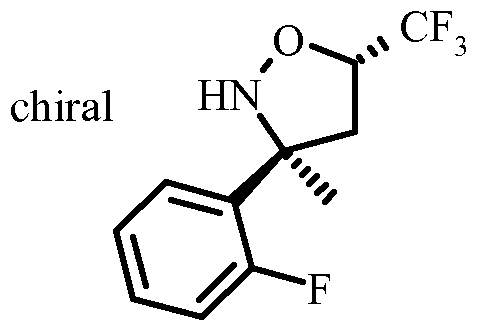
Ref document number: 13701072

Country of ref document: EP

Kind code of ref document: A1

WWE Wipo information: entry into national phase

Ref document number: 14108723

Country of ref document: CO

WWE Wipo information: entry into national phase

Ref document number: 232764

Country of ref document: IL

ENP Entry into the national phase

Ref document number: 2856892

Country of ref document: CA

ENP Entry into the national phase

Ref document number: 2013211646

Country of ref document: AU

Date of ref document: 20130123

Kind code of ref document: A

WWE Wipo information: entry into national phase

Ref document number: CR2014-000306

Country of ref document: CR

REEP Request for entry into the european phase

Ref document number: 2013701072

Country of ref document: EP

WWE Wipo information: entry into national phase

Ref document number: 2013701072

Country of ref document: EP

WWE Wipo information: entry into national phase

Ref document number: MX/A/2014/008446

Country of ref document: MX

WWE Wipo information: entry into national phase

Ref document number: 2014001838

Country of ref document: CL

WWE Wipo information: entry into national phase

Ref document number: DZP2014000397

Country of ref document: DZ

WWE Wipo information: entry into national phase

Ref document number: IDP00201404323

Country of ref document: ID

WWE Wipo information: entry into national phase

Ref document number: 14373697

Country of ref document: US

ENP Entry into the national phase

Ref document number: 2014553689

Country of ref document: JP

Kind code of ref document: A

WWE Wipo information: entry into national phase

Ref document number: 001177-2014

Country of ref document: PE

NENP Non-entry into the national phase

Ref country code: DE

WWE Wipo information: entry into national phase

Ref document number: 201491321

Country of ref document: EA

REG Reference to national code

Ref country code: BR

Ref legal event code: B01A

Ref document number: 112014015630

Country of ref document: BR

WWE Wipo information: entry into national phase

Ref document number: A201409331

Country of ref document: UA

ENP Entry into the national phase

Ref document number: 20147023759

Country of ref document: KR

Kind code of ref document: A

ENP Entry into the national phase

Ref document number: 112014015630

Country of ref document: BR

Kind code of ref document: A2

Effective date: 20140624