WO2012027214A1 - Synbiotic product - Google Patents
Synbiotic product Download PDFInfo
- Publication number
- WO2012027214A1 WO2012027214A1 PCT/US2011/048392 US2011048392W WO2012027214A1 WO 2012027214 A1 WO2012027214 A1 WO 2012027214A1 US 2011048392 W US2011048392 W US 2011048392W WO 2012027214 A1 WO2012027214 A1 WO 2012027214A1
- Authority
- WO
- WIPO (PCT)
- Prior art keywords
- product
- synbiotic
- synbiotic product
- amount
- spore
- Prior art date
- Legal status (The legal status is an assumption and is not a legal conclusion. Google has not performed a legal analysis and makes no representation as to the accuracy of the status listed.)
- Ceased
Links
Classifications
-
- A—HUMAN NECESSITIES
- A23—FOODS OR FOODSTUFFS; TREATMENT THEREOF, NOT COVERED BY OTHER CLASSES
- A23K—FODDER
- A23K10/00—Animal feeding-stuffs
- A23K10/10—Animal feeding-stuffs obtained by microbiological or biochemical processes
- A23K10/16—Addition of microorganisms or extracts thereof, e.g. single-cell proteins, to feeding-stuff compositions
- A23K10/18—Addition of microorganisms or extracts thereof, e.g. single-cell proteins, to feeding-stuff compositions of live microorganisms
-
- A—HUMAN NECESSITIES
- A61—MEDICAL OR VETERINARY SCIENCE; HYGIENE
- A61K—PREPARATIONS FOR MEDICAL, DENTAL OR TOILETRY PURPOSES
- A61K35/00—Medicinal preparations containing materials or reaction products thereof with undetermined constitution
- A61K35/66—Microorganisms or materials therefrom
- A61K35/74—Bacteria
-
- A—HUMAN NECESSITIES
- A23—FOODS OR FOODSTUFFS; TREATMENT THEREOF, NOT COVERED BY OTHER CLASSES
- A23K—FODDER
- A23K10/00—Animal feeding-stuffs
-
- A—HUMAN NECESSITIES
- A23—FOODS OR FOODSTUFFS; TREATMENT THEREOF, NOT COVERED BY OTHER CLASSES
- A23K—FODDER
- A23K10/00—Animal feeding-stuffs
- A23K10/40—Mineral licks, e.g. salt blocks
-
- A—HUMAN NECESSITIES
- A23—FOODS OR FOODSTUFFS; TREATMENT THEREOF, NOT COVERED BY OTHER CLASSES
- A23K—FODDER
- A23K20/00—Accessory food factors for animal feeding-stuffs
- A23K20/10—Organic substances
- A23K20/163—Sugars; Polysaccharides
-
- A—HUMAN NECESSITIES
- A23—FOODS OR FOODSTUFFS; TREATMENT THEREOF, NOT COVERED BY OTHER CLASSES
- A23L—FOODS, FOODSTUFFS OR NON-ALCOHOLIC BEVERAGES, NOT OTHERWISE PROVIDED FOR; PREPARATION OR TREATMENT THEREOF
- A23L33/00—Modifying nutritive qualities of foods; Dietetic products; Preparation or treatment thereof
- A23L33/10—Modifying nutritive qualities of foods; Dietetic products; Preparation or treatment thereof using additives
- A23L33/125—Modifying nutritive qualities of foods; Dietetic products; Preparation or treatment thereof using additives containing carbohydrate syrups; containing sugars; containing sugar alcohols; containing starch hydrolysates
-
- A—HUMAN NECESSITIES
- A23—FOODS OR FOODSTUFFS; TREATMENT THEREOF, NOT COVERED BY OTHER CLASSES
- A23L—FOODS, FOODSTUFFS OR NON-ALCOHOLIC BEVERAGES, NOT OTHERWISE PROVIDED FOR; PREPARATION OR TREATMENT THEREOF
- A23L33/00—Modifying nutritive qualities of foods; Dietetic products; Preparation or treatment thereof
- A23L33/10—Modifying nutritive qualities of foods; Dietetic products; Preparation or treatment thereof using additives
- A23L33/135—Bacteria or derivatives thereof, e.g. probiotics
-
- A—HUMAN NECESSITIES
- A23—FOODS OR FOODSTUFFS; TREATMENT THEREOF, NOT COVERED BY OTHER CLASSES
- A23L—FOODS, FOODSTUFFS OR NON-ALCOHOLIC BEVERAGES, NOT OTHERWISE PROVIDED FOR; PREPARATION OR TREATMENT THEREOF
- A23L33/00—Modifying nutritive qualities of foods; Dietetic products; Preparation or treatment thereof
- A23L33/20—Reducing nutritive value; Dietetic products with reduced nutritive value
- A23L33/21—Addition of substantially indigestible substances, e.g. dietary fibres
-
- A—HUMAN NECESSITIES
- A61—MEDICAL OR VETERINARY SCIENCE; HYGIENE
- A61K—PREPARATIONS FOR MEDICAL, DENTAL OR TOILETRY PURPOSES
- A61K35/00—Medicinal preparations containing materials or reaction products thereof with undetermined constitution
- A61K35/66—Microorganisms or materials therefrom
- A61K35/74—Bacteria
- A61K35/741—Probiotics
- A61K35/742—Spore-forming bacteria, e.g. Bacillus coagulans, Bacillus subtilis, clostridium or Lactobacillus sporogenes
-
- A—HUMAN NECESSITIES
- A61—MEDICAL OR VETERINARY SCIENCE; HYGIENE
- A61P—SPECIFIC THERAPEUTIC ACTIVITY OF CHEMICAL COMPOUNDS OR MEDICINAL PREPARATIONS
- A61P1/00—Drugs for disorders of the alimentary tract or the digestive system
-
- A—HUMAN NECESSITIES
- A61—MEDICAL OR VETERINARY SCIENCE; HYGIENE
- A61P—SPECIFIC THERAPEUTIC ACTIVITY OF CHEMICAL COMPOUNDS OR MEDICINAL PREPARATIONS
- A61P31/00—Antiinfectives, i.e. antibiotics, antiseptics, chemotherapeutics
- A61P31/04—Antibacterial agents
-
- A—HUMAN NECESSITIES
- A61—MEDICAL OR VETERINARY SCIENCE; HYGIENE
- A61P—SPECIFIC THERAPEUTIC ACTIVITY OF CHEMICAL COMPOUNDS OR MEDICINAL PREPARATIONS
- A61P43/00—Drugs for specific purposes, not provided for in groups A61P1/00-A61P41/00
-
- A—HUMAN NECESSITIES
- A23—FOODS OR FOODSTUFFS; TREATMENT THEREOF, NOT COVERED BY OTHER CLASSES
- A23V—INDEXING SCHEME RELATING TO FOODS, FOODSTUFFS OR NON-ALCOHOLIC BEVERAGES AND LACTIC OR PROPIONIC ACID BACTERIA USED IN FOODSTUFFS OR FOOD PREPARATION
- A23V2002/00—Food compositions, function of food ingredients or processes for food or foodstuffs
Definitions
- the present invention relates to novel synbiotic products comprising a combination of spore-forming probiotic bacteria with prebiotic compounds capable of providing nutrients to the probiotic bacteria and/or capable of encouraging the growth of resident beneficial bacteria, such as Lactobacillus or Bifodobacterium, present in the gastro-intestinal tract.
- Such synbiotic product compositions may enhance the health benefits of food products containing such synbiotic compositions.
- prebiotic compounds that are currently used in food products include a wide variety of carbohydrates, such as various sugars and starches. Many carbohydrates that have caloric value are digested to monosaccharides or short-chain oligosaccharides in the human upper gastro-intestinal tract (e.g., the mouth, the stomach, and the small intestine) and are readily absorbed into the blood stream. In addition to such readily metabolized
- Fiber compounds are generally not broken down, or only partially digested, in the upper gastro-intestinal tract and substantial amounts pass into the colon relatively intact.
- the benefits of fiber to human health are well established and recognized by nutrition scientists worldwide, such as, for example, in US government dietary recommendations. Studies have suggested that diets rich in dietary fiber can reduce the risk of cardiovascular disease, cancer, gastrointestinal problems, and obesity. See Campos et al., Nutr Hosp. 2005 Jan-Feb;20(l):18-25 (suggesting a link between the occurrence of colorectal cancer and low fiber diet); Kendall et al., Curr Atheroscler Rep.
- dietary fiber carbohydrates with established prebiotic activity are inulin and fructo- oligosaccharides (Roberfroid, et al., "The Bifidogenic Nature of Chicory Inulin and Its Hydrolysis Products," Journal of Nutrition, 128, 1, 11-19, 1998. Gibson, "Dietary
- probiotic bacteria In addition to “prebiotic” ingredients, there is a growing market for foodstuffs and animal feeds that are formulated with “probiotic” bacteria. For example, there is increasing interest in the use of probiotic organisms as feed additives for animals, primarily as possible replacements for antibiotics. Many bacteria that are considered to have beneficial probiotic properties are normal commensal bacteria present in the healthy human or animal gut microflora. The most frequently used human probiotics include the Lactobacilli and
- B. subtilis is sold over-the-counter for a variety of intestinal problems (Casula and Cutting (2002), Applied Environmental Microbiology, May 2002, pp. 2344-2352; Green, DH, et al. (1999) Appl. Env. Microbiol. 65, pp. 4288-4291) and for the treatment of diarrhea (Mazza, P (1994) Boll. Chim. Farm. 133, pp. 3-18).
- the present invention relates to certain symbiotic products comprising at least one prebiotic carbohydrate and at least one probiotic spore-forming Bacillus bacteria.
- the present invention can also be described as a symbiotic product comprising a prebiotic carbohydrate component comprising a prebiotic carbohydrate and a probiotic spore component comprising a probiotic spore-forming Bacillus bacteria.
- suitable prebiotic carbohydrates include arabinoxylan, arabinoxylan oligosaccharides, xylose, soluble fiber dextrin, soluble corn fiber, and polydextrose.
- the prebiotic carbohydrate is arabinoxylan, arabinoxylan oligosaccharides, xylose, soluble fiber dextrin, soluble corn fiber, polydextrose, or mixtures of these carbohydrates.
- suitable spore-forming Bacillus bacteria include B. subtilis, B. coagulans, B. licheniformis, B. clausii, and B. pumilis.
- the spore-forming Bacillus bacteria is B. subtilis, B. coagulans, B.
- the synbiotic product of the invention can be used as an ingredient or component in food products.
- a food product comprises the synbiotic product of the invention.
- the present invention also relates to a method of increasing the titer of spore-forming
- Bacillus bacteria in the intestinal tract of a mammal by administering the synbiotic product may provide certain health benefits.
- the synbiotic product is administered by consuming a food product comprising the synbiotic product.
- the mammal is a human and in certain embodiments, the mammal is a non-human mammal.
- Figure 1 shows the growth of four commercial spore-forming probiotic
- Bacillus strains on prebiotic carbohydrates Bacillus strains on prebiotic carbohydrates.
- Figure 2 shows a comparison of the maximum growth of B. Coagulans probiotic strain, GBI-30, on arabinoxylan, xylose, and dextrose.
- a “prebiotic” compound is defined as: "... a non-viable food
- a “probiotic” bacterium is a: “... viable microbial food (or feed)
- a "food product” refers to an edible product, including a beverage, meant for human or animal consumption. Where specified, a “foodstuff is meant for human consumption and a “feed” is meant for animal consumption.
- a “synbiotic product” is a composition comprising a combination of prebiotic and probiotic components.
- Novel synbiotic product compositions comprising combinations of probiotic spore- forming bacteria and prebiotic compounds are provided herein that may enhance the health benefits of food ingredients, foodstuffs, feed additives, animal feed, etc., containing such synbiotic compositions.
- Synbiotic products of the invention enhance the germination, growth, and activity of probiotics, thus increasing the titer of spore-forming probiotic bacteria in the intestinal tract of a host.
- the synbiotic product compositions are believed to provide improved benefits in human and animal health, well- being, and productivity, specifically through reduced stress due to lower morbidity, improved immune status, improved feed conversion efficiency, and enhanced ease of formulation of foodstuffs/feeds, foodstuffs/feed handling and storage, and flexibility of foodstuffs/feed delivery.
- the compositions may also be effective at smaller dosages in comparison to presently known probiotic products.
- Bacillus strains come from spores surviving passage through the manufacturing process and through the stomach and that they germinate in the intestines, where they are active and beneficial. These strains of Bacillus grow vegetatively on glucose and amino acids in vitro, but in vivo are required to compete in the upper gastro-intestinal tract with the host animal's need for these nutrients.
- probiotic spore powders are packaged with maltodextrin, which is no better than glucose as a potential food source for germinating spores in the upper intestine as host animals also rapidly digest and absorb maltodextrin.
- AX arabinoxylan
- AXOS arabinoxylan oligosaccharides
- X xylose
- a prebiotic carbohydrate is selected from the group consisting of arabinoxylan, arabinoxylan oligosaccharides, xylose, and mixtures thereof.
- Other prebiotic carbohydrates useful in the invention include soluble fiber dextrin (SFD), soluble corn fiber (SCF), and/or polydextrose (PDX).
- a prebiotic carbohydrate compound is selected from the group consisting of arabinoxylan, arabinoxylan oligosaccharides, xylose, soluble fiber dextrin, soluble corn fiber, polydextrose, and mixtures thereof.
- AX is the hemicellulose that can be solubilized from corn fiber by aqueous extraction.
- Xylose is the monosaccharide that makes up the xylan polymer backbone of the corn fiber hemicellulose polymer, arabinoxylan. It is produced by acid or enzymatic hydrolysis of hemicellulose. Xylose is a highly soluble, crystalline, dry powder. It is an abundant, relatively inexpensive, sweet-tasting, natural compound that is sold in some countries as a low calorie sweetener.
- AXOS Arabinoxylan oligosaccharides
- AX is the hemicellose that can be solubilized from corn fiber by aqueous extraction.
- AX is a collection of high molecular weight polymers than can be converted to
- AXOS oligosaccharides
- xylose and/or arabinoxylan oligosaccharides can be obtained by chemical and/or enzymatic processing of hemicellulose from wood and other plant materials.
- lignocellulosic substrates comprise cellulose, hemicellulose, and lignin. These types of substrates may be made accessible for hydrolysis by steam and/or mild acid or alkali treatment.
- hemicellulose is generally easier to hydrolyze to sugars than cellulose, it is preferable to first pre-hydrolyze the hemicellulose material and separate the soluble pentose sugars and soluble arabinoxylan oligosaccharides from the insoluble cellulose-containing residue. Hydrolysis may be done using enzymes (hemicellulase(s)), for example, or chemical treatments (e.g., by acid treatment) or a combination of the two.
- enzymes hemicellulase(s)
- chemical treatments e.g., by acid treatment
- xylooligosaccharides are produced from a lignocellulose pulp by enzyme treating with hemicellulase, filtering the resultant reaction mixture to separate a liquid fraction from the enzyme-treated pulp, subjecting the separated liquid fraction to a permeation treatment through a separation membrane to separate a non-permeated fraction containing xylooligosaccharide-lignin complex with an increased concentration from a permeated fraction, collecting the non- permeated fraction, and separating and recovering xylooligosaccharide from the collected non-permeated fraction.
- monocotyledonous plants can be obtained by mild acid hydrolysis of plant material as described in Shibanuma, K., et al. (1999) J. Appl. Glycosci. 46, 249-56.
- the resulting soluble fraction of the hydrolysate can be fractionated, using methods described above, to give the monosaccharides and a mixture of arabinoxylan oligomers.
- Probiotics are living microbes that have beneficial effects on humans and/or animals when ingested.
- probiotics are most often species of either Lactobacillus or Bifidobacterium. Neither of these types of bacteria forms spores.
- certain microorganisms with probiotic properties include bacteria capable of forming heat-resistant and extremely stable spores.
- Representative examples of such spore-forming bacteria include various spore-forming Bacillus species including, but not limited to, B. subtilis, B. coagulans, B. licheniformis, B. pumilis, and B. clausii. The spores, in many cases, survive exposure to heat exceeding 100° C.
- spores can be produced in good yield in industrial-scale pure-culture fermentations. Spores tend to be much more heat and oxygen resistant than vegetative bacteria and thus survive processing conditions better than bacteria that do not form spores. In dry, powdered form, spores can survive for decades. In general, there is only a slight loss of viability in the dry spore commercial products over a two year period in a sealed package. It has been reported that Bacillus spores can survive passage through the stomach, are resistant to bile salt exposure, and germinate in the ileum. Casula, G, and Cutting, SM (2002) Applied
- the bacterium is a spore-forming Bacillus species with probiotic effects.
- the probiotic spore-forming Bacillus is selected from the group consisting of B. subtilis, B.
- the spore-forming probiotic Bacillus species of the invention do not require any special methods of production such as manufacture, handling, packaging and the like that go beyond what is well known to one of skill in the art.
- Methods for production of the probiotic spores use fermentation and recovery methods well known in the art.
- the respective bacterial species are seeded from standard stock into a reactor and grown in standardized media until a predetermined CFU/gram concentration is reached and sporulation has occurred.
- the bulk material is then drained from the reactor and dried by one of a variety of standard methods, such as spray drying.
- Other representative examples of such art known methods include submerged fermentation, recovery & concentration by filtration, and packaging in moisture-proof systems.
- a symbiotic product is a combination of at least one probiotic spore-forming Bacillus bacteria and at least one prebiotic
- the synbiotic product comprises at least one probiotic spore- forming Bacillus bacteria selected from the group consisting of B. subtilis, B. coagulans, B. licheniformis, B. clausii, B. pumilis, and mixtures thereof.
- the synbiotic product comprises at least one prebiotic carbohydrate selected from the group consisting of arabinoxylan ("AX”), arabinoxylan oligosaccharides (“AXOS”), xylose (“X”), soluble fiber dextrin (“SFD”), soluble corn fiber (“SCF”), polydextrose (“PDX”), and mixtures thereof.
- the symbiotic product also comprises inulin, fructo-oligosaccharide, lactulose, glucose, and maltodextrin.
- inulin fructo-oligosaccharide
- lactulose lactulose
- glucose glucose
- maltodextrin maltodextrin
- the synbiotic product composition of spore-forming Bacillus bacteria and prebiotic carbohydrate is a dry powder.
- the dry powder is a flowable powder, as measured by ASTM Standard D6128-97 (1998) American Soc. for testing and materials: "Standard shear-testing method for bulk solids using the Jenike shear cell.”
- the synbiotic product has less than about 10% moisture content.
- the synbiotic product has less than about 9% moisture content.
- the synbiotic product has less than about 8% moisture content.
- the synbiotic product has less than about 7% moisture content.
- the synbiotic product has less than about 6% moisture content.
- the synbiotic product has less than about 5% moisture content. In certain embodiments, the synbiotic product has from about 1% to about 10% moisture content. In certain embodiments, the synbiotic product has from about 5% to about 10% moisture content. As used herein, moisture content is measured by ASTM standard D6869 American Society for testing and materials: "Karl Fisher" titration.
- the synbiotic product of the invention that is a combination of at least one probiotic spore-forming Bacillus bacteria and at least one prebiotic carbohydrate can also be described as comprising a prebiotic carbohydrate component and a probiotic spore component wherein the prebiotic carbohydrate component comprises at least one prebiotic carbohydrate and the probiotic spore component comprises at least one probiotic spore-forming Bacillus bacteria.
- the synbiotic product composition can be prepared by blending an amount of a dry spore component with an amount of a dry prebiotic component.
- liquid forms of prebiotic components can be mixed with liquid forms of probiotic spore components and the mixture can be dried, such as by spray drying.
- spray drying One of skill in the art will recognize other alternative methods common to commercial manufacture are practical and useful.
- Additional ingredients such as, but not limited to, inert fillers, dispersing materials, preservatives, colorants, and nutrients as are appropriate and known to the industry for food and feed products may be added to achieve desired product characteristics and the desired final range of living spores in the final product.
- the probiotic spore component of the synbiotic product will contain up to about 10 11 viable spores per gram dry weight. In certain embodiments, the probiotic spore component will contain more than about 10 9 viable spores per gram dry weight. In certain embodiments, the probiotic spore component will contain from about 10 9 to about 10 11 viable spores per gram dry weight. In certain embodiments, the probiotic spore component will contain from about 10 9 to about 10 10 viable spores per gram dry weight. In certain embodiments, the probiotic spore component will contain from about 10 10 to about 10 11 viable spores per gram dry weight. As used herein, viable spores are counted using the commonly used "pour plate" method, an illustrative example of which is described in Example 3.
- the final synbiotic product composition will comprise more than about 10 5 viable probiotic spores per gram dry product weight. In certain embodiments, the final symbiotic product composition will comprise up to about 10 7 viable probiotic spores per gram dry product weight. In certain embodiments, the final synbiotic product
- composition will contain from about 10 5 to about 10 7 viable probiotic spores per gram dry product weight. In certain embodiments, the final synbiotic product composition will contain from about 10 5 to about 10 6 viable probiotic spores per gram dry product weight. In certain embodiments, the final synbiotic product composition will contain from about 10 6 to about ⁇
- a probiotic spore component with a viable titer of 10 9 probiotic spores per gram dry weight is blended with other dry ingredients to achieve a final titer of, for example, 10 7 viable spores per gram dry product weight by blending 1 gram of the dry spore component with 100 grams of other dry ingredients including the prebiotic carbohydrate.
- the synbiotic products of the invention may be used as an ingredient or component of food products such as human foodstuffs or animal feed. Such food products contain an amount of the synbiotic product such that the food products can be consumed in amount that provides an effective amount of the synbiotic product. Incorporation of ingredients into food products is known in the art and will vary according to the type of food product prepared. Although there are certain food products that have been traditionally marketed as containing prebiotics or probiotics, the types of food products contemplated herein are not limited to a particular type of food product. Representative, non-limiting examples of certain
- embodiments of food products containing the synbiotic product include supplements, nutritional bars, eternal clinical nutrition preparations, baby food, and coatings for dry foodstuffs, such as coating bakery goods or chewing gum.
- Such foodstuffs are provided in the Examples.
- Certain embodiments of the invention are directed to methods of increasing the titer of spore-forming Bacillus bacteria in the intestinal tracts of a mammal. It is believed that administration of an effective amount of the synbiotic product may provide certain health benefits to humans and non-human mammals such that their health is improved.
- probiotics are helpful in the maintenance and regulation of the gastrointestinal tract in normal, healthy individuals. Consumption of probiotics may also help alleviate certain ailments of the gastrointestinal tract, for example, diarrhea. Controlled trials have suggested that probiotics can shorten the course of infectious diarrhea in infants and children. Consumption of probiotics may also help people with Crohn's disease and irritable bowel syndrome. Some studies suggest that certain probiotics may help maintain remission of ulcerative colitis and prevent relapse of Crohn's disease and the recurrence of pouchitis (a complication of surgery to treat ulcerative colitis). Probiotics may also be of use in maintaining urogenital health.
- the vagina is a finely balanced ecosystem.
- the system can be thrown out of balance by a number of factors, including antibiotics, spermicides, and birth control pills.
- Probiotic treatment that restores the balance of microflora may be helpful for such common female urogenital problems as bacterial vaginosis, yeast infection, and urinary tract infection.
- oral and vaginal administration of probiotics may help in the treatment of bacterial vaginosis and urinary tract infection. Consumption of probiotics by animals may provide similar benefits and may be especially beneficial as a cost effective and "natural" alternative to treating animals with antibiotics.
- non-human mammals include animals generally
- non-human mammals include rodents such as, but not limited to: mice, rats, rabbits, hamsters, gerbils, and guinea pigs.
- rodents such as, but not limited to: mice, rats, rabbits, hamsters, gerbils, and guinea pigs.
- non-human mammals also include mammalian companion animals such as, but not limited to: cats and dogs.
- Antibiotics are routinely administered to mammals such as livestock to improve their health. In certain embodiments, administration of the synbiotic product of the invention may provide health benefits to non-human mammals in the absence of administering antibiotics to such mammals.
- the synbiotic product is administered in an effective amount that increases the titer of spore-forming Bacillus bacteria in the intestinal tract containing a sufficient amount of the prebiotic carbohydrate and probiotic bacteria component to provide prebiotic and/or probiotic activity with the limitation that the amount not greatly exceed the tolerance limitations due to the osmotic effects of non-digestible carbohydrates.
- dosages of more than about 20 g/day of prebiotic carbohydrate can have unpleasant effects.
- one of skill in the art will recognize that amount of synbiotic product
- administered is adjusted, such as proportional to body weight, to achieve an effective amount of prebiotic carbohydrate and/or probiotic bacteria.
- the synbiotic product may be administered infrequently, such as only one day a week, or month, or every several months, or year, etc.
- the synbiotic product may be administered more frequently, such as from 2 to 6 days a week, or with similar frequency over longer periods of time.
- the synbiotic product may be administered daily, meaning on consecutive days over at least five days time.
- the synbiotic product is administered such that the amount of prebiotic carbohydrate is from about 1 g to about 25 g carbohydrate in any single day. In certain embodiments, the synbiotic product is administered daily in such amounts. In certain embodiments, the synbiotic product is administered such that the amount of prebiotic carbohydrate is from about 1 g to about 10 g carbohydrate in any single day. In certain embodiments, the synbiotic product is administered daily in such amounts. In certain embodiments, the synbiotic product is administered such that the amount of prebiotic carbohydrate is from about 1 g to about 20 g carbohydrate in any single day. In certain embodiments, the synbiotic product is administered daily in such amounts.
- the synbiotic product is administered such that the amount of prebiotic carbohydrate is from about 2.5 g to about 10 g carbohydrate in any single day. In certain embodiments, the synbiotic product is administered daily in such amounts. In certain embodiments, the synbiotic product is administered such that the amount of prebiotic carbohydrate is from about 2.5 g to about 20 g carbohydrate in any single day. In certain embodiments, the synbiotic product is administered daily in such amounts. In certain embodiments, the synbiotic product is administered such that the amount of prebiotic carbohydrate is from about 5 g to about 10 g carbohydrate in any single day. In certain embodiments, the synbiotic product is administered daily in such amounts.
- the synbiotic product is administered such that the amount of prebiotic carbohydrate is from about 5 g to about 20 g carbohydrate in any single day. In certain embodiments, the synbiotic product is administered daily in such amounts. In certain embodiments, the synbiotic product is administered such that the amount of prebiotic carbohydrate is from about 2.5 g to about 25 g carbohydrate in any single day. In certain embodiments, the synbiotic product is administered daily in such amounts. In certain embodiments, the synbiotic product is administered such that the amount of prebiotic carbohydrate is from about 5 g to about 25 g carbohydrate in any single day. In certain embodiments, the synbiotic product is administered daily in such amounts.
- the synbiotic product is administered such that the amount of prebiotic carbohydrate is from about 10 g to about 25 g carbohydrate in any single day. In certain embodiments, the synbiotic product is administered daily in such amounts. In certain embodiments, the synbiotic product is administered such that the amount of prebiotic carbohydrate is from about 10 g to about 20 g carbohydrate in any single day. In certain embodiments, the synbiotic product is administered daily in such amounts.
- the synbiotic product is administered such that the amount of probiotic bacteria is from about 10 4 CFU to about 10 10 CFU in any single day. In certain embodiments, the synbiotic product is administered daily in such amounts. In certain embodiments, the synbiotic product is administered such that the amount of probiotic bacteria is from about 10 6 CFU to about 10 8 CFU in any single day. In certain embodiments, the synbiotic product is administered daily in such amounts. In certain embodiments, the synbiotic product is administered such that the amount of probiotic bacteria is from about 10 4 CFU per day to about 10 6 CFU in any single day. In certain embodiments, the synbiotic product is administered daily in such amounts.
- the synbiotic product is administered such that the amount of probiotic bacteria is from about 10 4 CFU per day to about 10 CFU in any single day. In certain embodiments, the synbiotic product is administered daily in such amounts. In certain embodiments, the synbiotic product is administered such that the amount of probiotic bacteria is from about 10 6 CFU per day to about 10 10 CFU in any single day. In certain embodiments, the synbiotic product is administered daily in such amounts. In certain embodiments, the synbiotic product is administered such that the amount of probiotic bacteria is from about 10 8 CFU per day to about 10 10 CFU in any single day. In certain embodiments, the synbiotic product is administered daily in such amounts.
- administration of the synbiotic product may involve administration wherein the synbiotic product is exposed to the gastro-intestinal tract.
- the synbiotic product is an ingredient or component of an edible food product such as a foodstuff or animal feed.
- Administration of the synbiotic product is through the consumption of a food product comprising the synbiotic product.
- the amount of food product comprising the synbiotic product consumed is an amount containing an effective amount of the synbiotic product.
- the amount of food product consumed is an amount
- the food product is consumed daily in such amounts.
- the amount of food product consumed is an amount containing an amount of synbiotic product such that the amount of prebiotic carbohydrate is from about 1 g to about 10 g carbohydrate in any single day.
- the food product is consumed daily in such amounts.
- the amount of food product consumed is an amount containing an amount of synbiotic product such that the amount of prebiotic carbohydrate is from about 1 g to about 20 g carbohydrate in any single day.
- the food product is consumed daily in such amounts.
- the amount of food product consumed is an amount containing an amount of synbiotic product such that the amount of prebiotic carbohydrate component is from about 2.5 g to about 10 g carbohydrate in a single day. In certain embodiments, the food product is consumed daily in such amounts. In certain embodiments, the amount of food product consumed is an amount containing an amount of synbiotic product such that the amount of prebiotic carbohydrate component is from about 2.5 g to about 20 g carbohydrate in a single day. In certain embodiments, the food product is consumed daily in such amounts. In certain embodiments, the amount of food product consumed is an amount containing an amount of synbiotic product such that the amount of prebiotic carbohydrate is from about 5 g to about 10 g carbohydrate in any single day.
- the food product is consumed daily in such amounts.
- the amount of food product consumed is an amount containing an amount of synbiotic product such that the amount of prebiotic carbohydrate is from about 5 g to about 20 g carbohydrate in any single day.
- the food product is consumed daily in such amounts.
- the amount of food product consumed is an amount containing an amount of synbiotic product such that the amount of prebiotic carbohydrate is from about 2.5 g to about 25 g carbohydrate in any single day.
- the food product is consumed daily in such amounts.
- the amount of food product consumed is an amount containing an amount of synbiotic product such that the amount of prebiotic carbohydrate component is from about 5 g to about 25 g carbohydrate in any single day. In certain embodiments, the food product is consumed daily in such amounts. In certain embodiments, the amount of food product consumed is an amount containing an amount of synbiotic product such that the amount of prebiotic carbohydrate is from about 10 g to about 25 g carbohydrate in any single day. In certain embodiments, the food product is consumed daily in such amounts. In certain embodiments, the amount of food product consumed is an amount containing an amount of synbiotic product such that the amount of prebiotic carbohydrate is from about 10 g to about 20 g carbohydrate in any single day.
- the food product is consumed daily in such amounts.
- the amount of food product consumed is an amount containing an amount of synbiotic product such that the amount of probiotic bacteria is from about 10 4 CFU to about 10 10 CFU in any single day. In certain embodiments, the food product is consumed daily in such amounts. In certain embodiments, the amount of food product consumed is an amount containing an amount of synbiotic product such that the amount of probiotic bacteria is from about 10 CFU to about 10 CFU in any single day. In certain embodiments, the food product is consumed daily in such amounts. In certain embodiments, the amount of food product consumed is an amount containing an amount of synbiotic product such that the amount of probiotic bacteria is from about 10 4 CFU to about 10 6 CFU in any single day.
- the food product is consumed daily in such amounts. In certain embodiments, the amount of food product consumed is an amount containing an amount of synbiotic product such that the amount of probiotic bacteria is from about 10 CFU to about 10 CFU in any single day. In certain embodiments, the food product is consumed daily in such amounts. In certain embodiments, the amount of food product consumed is an amount containing an amount of synbiotic product such that the amount of probiotic bacteria is from about 10 6 CFU to about 10 10 CFU in any single day. In certain embodiments, the food product is consumed daily in such amounts. In certain embodiments, the amount of food product consumed is an amount containing an amount of synbiotic product such that the amount of probiotic bacteria is from about 10 8 CFU to about 1010 CFU in any single day. In certain embodiments, the food product is consumed daily in such amounts.
- Example 1 Growth of Probiotic Bacillus on Various Prebiotic Carbohydrates
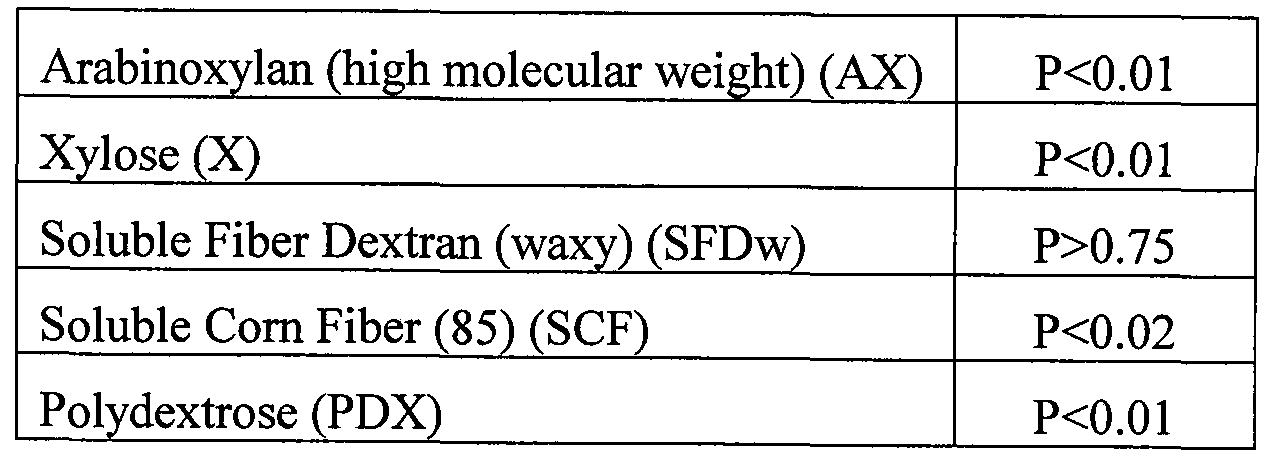
- Soluble fiber dextran (SFDw). The three commercial probiotic Bacillus strains from SFDw. The three commercial probiotic Bacillus strains from SFDw.
- Envera (Coatesville, PA) - B. pumilus, B. licheniformis, and B. subtilis -grew strongly on
- Soluble corn fiber SCF
- polydextrose PDX
- Arabinoxylan (AX). All four probiotic Bacillus strains tested - B. pumilus, B.
- arabinosidase and ferulic acid esterase activities that might trim sugars and/or ferulic acid from the high molecular weight AX polymers as nutrients.
- Example 1 illustrates that known spore-forming probiotic bacteria are capable of growth on prebiotic carbohydrates such as soluble fiber dextrin, soluble corn fiber, polydextrose, high molecular weight arabinoxylan, and xylose.
- prebiotic carbohydrates such as soluble fiber dextrin, soluble corn fiber, polydextrose, high molecular weight arabinoxylan, and xylose.
- Each of the probiotic Bacillus strains showed a somewhat different substrate preference. However, none appear limited to only a single one of the tested prebiotic candidates.
- Example 3 Pour Plate Method for Determining the Viable Spore Count
- spore counts In not less than three samples of spore concentrate because spores have a tendency to clump together and settle. Clumps should be dispersed by thorough agitation, such as shaking, before drawing samples for counting.
- test tubes Put 8 test tubes in a test rack, number them, and add 9 ml of physiological saline solution to each tube.
- tuberculin syringe tuberculin syringe
- G Count the colonies in all five plates of a particular dilution. Multiply the average number per plate by the dilution factor to obtain the viable count per ml in original suspension. Calculate the average count for each dilution from 10 "6 to 10 "8 . To obtain the average viable count in original stock suspension, take the average of three dilutions.
- Example 4 Start with a suspension of Bacillus coagulans (BC) freeze-dried spore powder which contains at least 10 9 viable spores per gram powder.
- BC Bacillus coagulans
- Xylose powder (X) can be obtained from Sigma-Aldrich (St. Louis, MO, USA). The two powders are mixed in an X/BC ratio of 100/1 until a homogeneous product is obtained. Sachets are filled with 2-5 g of this mixture, depending on the dosage regime (e.g., 5 g for one sachet per day or 3 g for two sachets per day). The contents of one sachet can, for example, be taken mixed in a glass of orange juice or milk.
- a 23 g bar is prepared from 4.0 g oat flakes, 4.0 g wheat flakes, 3.0 g puffed rice, 1.0 g crushed hazelnuts, 0.25 g honey, 3.0 g raisins, 1.5 g maltodextrin, 1.0 g freeze-dried Bacillus coagulans (BC; >10 9 viable spores per gram powder), and 5.0 g Xylose powder.
- Example 6 Synbiotic Mixture for Mixing With a Complete Enteral Clinical Nutrition
- a synbiotic product, powder mixture is prepared in accordance with the method of
- Example 4 5 g of the powder mixture is placed in a sachet.
- the contents of this sachet can be added to a standard enteral clinical nutrition. For best results, it is preferable that the contents of the sachet are added not more than 30 minutes before use.
- Example 7 Synbiotic Powder Mixture for Fortifying Baby Food
- a synbiotic product, powder mixture is prepared in accordance with the method of
- Example 4 5 g of the powder mixture is placed in a sachet.
- the contents of this sachet can be added to a standard baby formula or baby food. For best results, it is preferable that the contents of the sachet are added not more than 30 minutes before use.
- a sweet powder coating may be prepared, such as for a powdered coating for dry foodstuffs including bakery goods, etc.
- Another example is a chewing gum with a dry powdered coating of the synbiotic mixture that is prepared with the synbiotic product, powder mixture prepared in accordance with Example 4.
- the mildly sweet, non-cariogenic powder is used to coat sticks of chewing gum.
- the sticks of chewing gum may be packaged using standard packaging methods as individually wrapped gum sticks.
Landscapes
- Life Sciences & Earth Sciences (AREA)
- Health & Medical Sciences (AREA)
- Chemical & Material Sciences (AREA)
- Polymers & Plastics (AREA)
- Engineering & Computer Science (AREA)
- Microbiology (AREA)
- Food Science & Technology (AREA)
- Mycology (AREA)
- Zoology (AREA)
- Molecular Biology (AREA)
- Animal Husbandry (AREA)
- Pharmacology & Pharmacy (AREA)
- Medicinal Chemistry (AREA)
- Public Health (AREA)
- Veterinary Medicine (AREA)
- Animal Behavior & Ethology (AREA)
- General Health & Medical Sciences (AREA)
- Nutrition Science (AREA)
- Epidemiology (AREA)
- Biochemistry (AREA)
- Biotechnology (AREA)
- Organic Chemistry (AREA)
- Physiology (AREA)
- Nuclear Medicine, Radiotherapy & Molecular Imaging (AREA)
- Biomedical Technology (AREA)
- General Chemical & Material Sciences (AREA)
- Chemical Kinetics & Catalysis (AREA)
- Bioinformatics & Cheminformatics (AREA)
- Oncology (AREA)
- Communicable Diseases (AREA)
- Medicines Containing Material From Animals Or Micro-Organisms (AREA)
- Coloring Foods And Improving Nutritive Qualities (AREA)
- Pharmaceuticals Containing Other Organic And Inorganic Compounds (AREA)
- Fodder In General (AREA)
- Micro-Organisms Or Cultivation Processes Thereof (AREA)
- Feed For Specific Animals (AREA)
Abstract
Description
Claims
Priority Applications (9)
| Application Number | Priority Date | Filing Date | Title |
|---|---|---|---|
| BR112013004194A BR112013004194A2 (en) | 2010-08-25 | 2011-08-19 | symbiotic product |
| JP2013526038A JP2013537431A (en) | 2010-08-25 | 2011-08-19 | Symbiotic products |
| EP11749673.7A EP2608678A1 (en) | 2010-08-25 | 2011-08-19 | Synbiotic product |
| MX2013002171A MX348937B (en) | 2010-08-25 | 2011-08-19 | Synbiotic product. |
| CN2011800396484A CN103068254A (en) | 2010-08-25 | 2011-08-19 | Synbiotic product |
| KR1020137004175A KR20130102541A (en) | 2010-08-25 | 2011-08-19 | Synbiotic product |
| CA2808495A CA2808495A1 (en) | 2010-08-25 | 2011-08-19 | Synbiotic product |
| AU2011293625A AU2011293625B2 (en) | 2010-08-25 | 2011-08-19 | Synbiotic product |
| IL224833A IL224833A (en) | 2010-08-25 | 2013-02-20 | Synbiotic product |
Applications Claiming Priority (2)
| Application Number | Priority Date | Filing Date | Title |
|---|---|---|---|
| US37688810P | 2010-08-25 | 2010-08-25 | |
| US61/376,888 | 2010-08-25 |
Publications (1)
| Publication Number | Publication Date |
|---|---|
| WO2012027214A1 true WO2012027214A1 (en) | 2012-03-01 |
Family
ID=44533204
Family Applications (1)
| Application Number | Title | Priority Date | Filing Date |
|---|---|---|---|
| PCT/US2011/048392 Ceased WO2012027214A1 (en) | 2010-08-25 | 2011-08-19 | Synbiotic product |
Country Status (11)
| Country | Link |
|---|---|
| US (2) | US9237763B2 (en) |
| EP (1) | EP2608678A1 (en) |
| JP (2) | JP2013537431A (en) |
| KR (1) | KR20130102541A (en) |
| CN (2) | CN103068254A (en) |
| AU (2) | AU2011293625B2 (en) |
| BR (1) | BR112013004194A2 (en) |
| CA (1) | CA2808495A1 (en) |
| IL (1) | IL224833A (en) |
| MX (1) | MX348937B (en) |
| WO (1) | WO2012027214A1 (en) |
Cited By (10)
| Publication number | Priority date | Publication date | Assignee | Title |
|---|---|---|---|---|
| WO2014083177A1 (en) * | 2012-11-29 | 2014-06-05 | Nestec S.A. | Synbiotic composition and use thereof |
| WO2015061789A2 (en) | 2013-10-25 | 2015-04-30 | Nch Corporation | Delivery system and probiotic composition for animals and plants |
| JP2016506735A (en) * | 2013-02-06 | 2016-03-07 | エンヴェラ エルエルシー | Mixture of dried spore germinating compounds |
| JP2016515388A (en) * | 2013-03-22 | 2016-05-30 | テイト アンド ライル イングリーディエンツ アメリカス エルエルシーTate & Lyle Ingredients Americas LLC | Use of soluble corn fiber to increase colonic bacterial population and increase mineral absorption |
| CN106689798A (en) * | 2016-11-17 | 2017-05-24 | 大连理工大学 | Marine synbiotic additive, its preparation method and its application in sea cucumber cultivation |
| US9908799B2 (en) | 2014-05-23 | 2018-03-06 | Nch Corporation | Method for improving quality of aquaculture pond water |
| US10766799B2 (en) | 2014-05-23 | 2020-09-08 | Nch Corporation | Method for improving quality of aquaculture pond water using a nutrient germinant composition and spore incubation method |
| US11311569B2 (en) * | 2017-05-23 | 2022-04-26 | Beijing Ruiqianjing Science And Technology Development Co. Ltd. | Anti-inflammatory composition for improving intestinal nutritional metabolism functions and intestinal microecology, food containing same, and application thereof |
| US11401500B2 (en) | 2018-08-29 | 2022-08-02 | Nch Corporation | System, method, and composition for incubating spores for use in aquaculture, agriculture, wastewater, and environmental remediation applications |
| US11805800B2 (en) | 2016-04-05 | 2023-11-07 | Nch Corporation | Composition and method for germinative compounds in probiotic food and beverage products for human consumption |
Families Citing this family (19)
| Publication number | Priority date | Publication date | Assignee | Title |
|---|---|---|---|---|
| US8465788B2 (en) * | 2008-08-18 | 2013-06-18 | Bioactor B.V. | Arabinoxylans for modulating the barrier function of the intestinal surface |
| US9125935B1 (en) | 2011-05-31 | 2015-09-08 | Nutech Ventures | Probiotics and methods of obtaining same |
| EP2769626A1 (en) * | 2013-02-25 | 2014-08-27 | Cargill, Incorporated | Chewing gum composition |
| EP2769625A1 (en) * | 2013-02-25 | 2014-08-27 | Cargill, Incorporated | Confectionery compositions |
| EP2805630A1 (en) * | 2014-09-25 | 2014-11-26 | Cargill, Incorporated | Carbohydrate compositions |
| WO2017063909A1 (en) | 2015-10-13 | 2017-04-20 | Unilever N.V. | A process for preparing metabolites by reaction of a prebiotic component with a probiotic component |
| WO2017176872A1 (en) | 2016-04-05 | 2017-10-12 | Nch Corporation | Nutrient rich germinant composition and spore incubation method |
| US12097226B2 (en) | 2016-04-05 | 2024-09-24 | Nch Corporation | System and method for using a single-serve nutrient spore composition for small scale farm applications |
| JP6923741B2 (en) * | 2017-04-10 | 2021-08-25 | キボー バイオテック、インクKibow Biotech, Inc. | Multi-fiber prebiotic composition for digestive health, weight management, immunity enhancement and health improvement |
| MX2020007706A (en) | 2018-01-24 | 2020-09-14 | Omnigen Res Llc | BACILLUS COMBINATION FOR ADMINISTRATION TO ANIMALS. |
| EP3749106A1 (en) * | 2018-02-06 | 2020-12-16 | Sutherland, Duncan-Bruce | Method of preparing prebiotic dietary fiber and probiotic-fibre complexes |
| EP3931395A1 (en) * | 2019-02-25 | 2022-01-05 | Servophil Ag | Deposition reduction |
| CN114423442B (en) * | 2019-09-16 | 2024-12-03 | 诺维信公司 | Spore-based probiotic supplementation and control of endotoxemia in dogs |
| US11576937B2 (en) | 2020-02-06 | 2023-02-14 | Nch Corporation | Method of reducing gut inflammation reduction in humans by consuming a heated probiotic composition |
| PH12022552689A1 (en) | 2020-04-09 | 2024-03-25 | Prabhakaran Pandurangan | A therapeutic composition |
| CA3184420A1 (en) * | 2020-06-30 | 2022-01-06 | Mark C. Faulkner | Compositions and methods for treatment of vaginal infections |
| CN112753988A (en) * | 2021-01-22 | 2021-05-07 | 上海沛藤生物工程有限公司 | Small-package sweetener utilizing bacillus and preparation method thereof |
| TR2022004759A2 (en) * | 2022-03-28 | 2022-04-21 | Sayar Organik Biyolojik Ueruenler Imalat Sanayi Ve Ticaret Ltd Sirketi | BACILLUS SUBTILIS BACTERIA FAMILY BIOTECHNOLOGICAL PRODUCT |
| KR20250105751A (en) | 2023-12-29 | 2025-07-09 | 매일유업 주식회사 | Synbiotic composition comprising mother's milk oligosaccharide mixture and probiotics |
Citations (5)
| Publication number | Priority date | Publication date | Assignee | Title |
|---|---|---|---|---|
| US6811786B1 (en) * | 1999-04-01 | 2004-11-02 | Ganeden Biotech, Inc. | Methods for reducing cholesterol using Bacillus coagulans spores, systems and compositions |
| US6849256B1 (en) | 1999-11-08 | 2005-02-01 | Ganeden Biotech Incorporated | Inhibition of pathogens by probiotic bacteria |
| US6942754B2 (en) | 1999-03-23 | 2005-09-13 | Oji Paper Co., Ltd. | Process for producing xylooligosaccharide from lignocellulose pulp |
| US20080199444A1 (en) * | 2006-06-26 | 2008-08-21 | Yunlong Cui | Composition and method for reducing feces toxins and treating digestive disorders |
| US12436408B2 (en) | 2022-11-11 | 2025-10-07 | Htc Corporation | Wearable device |
Family Cites Families (21)
| Publication number | Priority date | Publication date | Assignee | Title |
|---|---|---|---|---|
| US4110477A (en) | 1977-05-13 | 1978-08-29 | Kabushiki Kaisha Naruse Fermentation Laboratory | Method for producing natto containing lactic acid bacteria |
| JP2779963B2 (en) | 1989-02-09 | 1998-07-23 | 株式会社林原生物化学研究所 | Bifidobacterium growth promoter |
| US6645506B1 (en) * | 1997-04-18 | 2003-11-11 | Ganeden Biotech, Inc. | Topical compositions containing extracellular products of Pseudomonas lindbergii and Emu oil |
| US6203797B1 (en) | 1998-01-06 | 2001-03-20 | Stephen C. Perry | Dietary supplement and method for use as a probiotic, for alleviating the symptons associated with irritable bowel syndrome |
| ES2258841T3 (en) * | 1998-04-01 | 2006-09-01 | Ganeden Biotech, Inc. | PROCEDURES TO REDUCE CHOLESTEROL WITH SPACES OF BACILLUS COAGULANS, SYSTEMS AND ASSOCIATED COMPOSITIONS. |
| EP1243273A1 (en) * | 2001-03-22 | 2002-09-25 | Societe Des Produits Nestle S.A. | Composition comprising a prebiotic for decreasing infammatory process and abnormal activation of non-specific immune parameters |
| US20030077255A1 (en) | 2001-04-16 | 2003-04-24 | Sabharwal Hemant K. | Compositions of bacteria and alpha-lactalbumin and uses thereof |
| GB2382528B (en) | 2001-11-12 | 2004-05-05 | Mars Inc | A consumable composition for the development of a healthy gastrointestinal tract |
| GB0229015D0 (en) | 2002-12-12 | 2003-01-15 | Novartis Nutrition Ag | New Compound |
| AU2004267383A1 (en) * | 2003-08-14 | 2005-03-03 | The Bio Balance Corporation | Bacterial strains, compositions including same and probiotic use thereof |
| US7759105B2 (en) | 2003-08-29 | 2010-07-20 | Cobb & Company, Llp | Probiotic composition useful for dietary augmentation and/or combating disease states and adverse physiological conditions |
| GB0414655D0 (en) | 2004-06-30 | 2004-08-04 | Leuven K U Res & Dev | Prebiotic |
| DK1940243T3 (en) | 2005-10-24 | 2011-11-14 | Nestec Sa | Dietary fiber formulation and method of administration |
| CN100360658C (en) * | 2006-02-17 | 2008-01-09 | 哈尔滨美华生物技术股份有限公司 | Enteral microecological formulation and its preparation process |
| AU2008256938B2 (en) | 2007-05-23 | 2013-02-28 | Tate & Lyle Ingredients Americas Llc | Edible composition comprising a slowly digestible or digestion resistant oligosaccharide composition |
| CN101558824B (en) * | 2008-04-15 | 2011-09-21 | 北京大北农科技集团股份有限公司 | A kind of compound probiotics |
| CN102170791B (en) * | 2008-08-04 | 2015-09-09 | 帝斯曼知识产权资产管理有限公司 | Preparation of beads containing probiotic complex |
| CN101744239A (en) * | 2008-12-01 | 2010-06-23 | 青岛东海药业有限公司 | Application of dietary fibers in the preparation of pharmaceutical preparations for preventing and curing excrement smelling or excrement smelling poisoning syndrome |
| CN101449830B (en) * | 2008-12-29 | 2012-01-11 | 山东龙力生物科技股份有限公司 | Mid-aged milk powder added with biostime and preparation method thereof |
| CN101537020B (en) | 2009-04-24 | 2012-05-02 | 东北制药集团公司沈阳第一制药厂 | Synbiotic of bacillus licheniformis and oligosaccharide class prebiotics and composition and preparation thereof |
| AU2010245761B2 (en) * | 2009-05-07 | 2014-10-02 | Tate & Lyle Ingredients France SAS | Compositions and methods for making alpha-(1,2)-branched alpha-(1,6) oligodextrans |
-
2011
- 2011-08-19 WO PCT/US2011/048392 patent/WO2012027214A1/en not_active Ceased
- 2011-08-19 CN CN2011800396484A patent/CN103068254A/en active Pending
- 2011-08-19 CN CN201710403213.2A patent/CN107251988A/en active Pending
- 2011-08-19 US US13/213,663 patent/US9237763B2/en active Active
- 2011-08-19 MX MX2013002171A patent/MX348937B/en active IP Right Grant
- 2011-08-19 JP JP2013526038A patent/JP2013537431A/en active Pending
- 2011-08-19 KR KR1020137004175A patent/KR20130102541A/en not_active Ceased
- 2011-08-19 CA CA2808495A patent/CA2808495A1/en not_active Abandoned
- 2011-08-19 AU AU2011293625A patent/AU2011293625B2/en not_active Ceased
- 2011-08-19 BR BR112013004194A patent/BR112013004194A2/en not_active IP Right Cessation
- 2011-08-19 EP EP11749673.7A patent/EP2608678A1/en not_active Withdrawn
-
2013
- 2013-02-20 IL IL224833A patent/IL224833A/en active IP Right Grant
-
2015
- 2015-12-11 US US14/966,590 patent/US20160095343A1/en not_active Abandoned
- 2015-12-18 AU AU2015271936A patent/AU2015271936A1/en not_active Abandoned
-
2017
- 2017-02-24 JP JP2017033618A patent/JP2017113022A/en not_active Withdrawn
Patent Citations (5)
| Publication number | Priority date | Publication date | Assignee | Title |
|---|---|---|---|---|
| US6942754B2 (en) | 1999-03-23 | 2005-09-13 | Oji Paper Co., Ltd. | Process for producing xylooligosaccharide from lignocellulose pulp |
| US6811786B1 (en) * | 1999-04-01 | 2004-11-02 | Ganeden Biotech, Inc. | Methods for reducing cholesterol using Bacillus coagulans spores, systems and compositions |
| US6849256B1 (en) | 1999-11-08 | 2005-02-01 | Ganeden Biotech Incorporated | Inhibition of pathogens by probiotic bacteria |
| US20080199444A1 (en) * | 2006-06-26 | 2008-08-21 | Yunlong Cui | Composition and method for reducing feces toxins and treating digestive disorders |
| US12436408B2 (en) | 2022-11-11 | 2025-10-07 | Htc Corporation | Wearable device |
Non-Patent Citations (18)
| Title |
|---|
| CAMPOS ET AL., NUTR HOSP., vol. 20, no. 1, January 2005 (2005-01-01), pages 18 - 25 |
| CANANI, RB ET AL., BMJ, vol. 335, no. 7615, 18 August 2007 (2007-08-18), pages 340 |
| CASULA, CUTTING, APPLIED ENVIRONMENTAL MICROBIOLOGY, May 2002 (2002-05-01), pages 2344 - 2352 |
| CASULA, G, CUTTING, SM, APPLIED ENVIRONMENTAL MICROBIOLOGY, May 2002 (2002-05-01), pages 2344 - 2352 |
| CEMEA ET AL., ACTA DIABETOL., vol. 40, no. 2, 2003, pages 389 - 400 |
| DEVECHIHI, E., DRAGO, L., INT. J. PROBIOTICS PREBIOTICS, vol. 1, 2006, pages 3 - 10 |
| DUC, LH ET AL., APPL. ENVIRON. MICROBIOL., vol. 70, 2004, pages 2161 - 2171 |
| GIBSON, GLENN: "Dietary modulation of the human gut microflora using prebiotics", JOURNAL OF NUTRITION, vol. 80, no. 2, 1998, pages S209 - S212 |
| GIBSON: "Dietary Modulation of the Human Gut Microflora Using the Prebiotics Oligofructose and Inulin", JOURNAL OF NUTRITION, vol. 129, no. 7, 1999, pages 1438S - 1441S |
| GREEN, DH ET AL., APPL. ENV. MICROBIOL., vol. 65, 1999, pages 4288 - 4291 |
| KENDALL ET AL., CURR ATHEROSCLER REP, vol. 6, no. 6, November 2004 (2004-11-01), pages 492 - 498 |
| KENDALL ET AL., J AOAC INT., vol. 87, no. 3, May 2004 (2004-05-01), pages 769 - 774 |
| LESER, TD ET AL., J. APPL. MICROBIOL., vol. 104, 2008, pages 1025 - 1033 |
| MARSEGLIA, GL ET AL., THER. CLIN. RISK MANAG, vol. 3, 1997, pages 13 - 17 |
| MAZZA, P, BOLL. CHIM. FARM., vol. 133, 1994, pages 3 - 18 |
| ROBERFROID ET AL.: "The Bifidogenic Nature of Chicory Inulin and Its Hydrolysis Products", JOURNAL OF NUTRITION, vol. 128, no. 1, 1998, pages 11 - 19, XP002194167 |
| SHIBANUMA, K. ET AL., J. APPL. GLYCOSCI., vol. 46, 1999, pages 249 - 256 |
| TUOHY ET AL.: "A human volunteer study to determine the prebiotic effect of lactulose on human colonic microbiota", MICRO. ECOL. HEALTH DISEASE, vol. 14, 2002, pages 165 - 173 |
Cited By (16)
| Publication number | Priority date | Publication date | Assignee | Title |
|---|---|---|---|---|
| WO2014083177A1 (en) * | 2012-11-29 | 2014-06-05 | Nestec S.A. | Synbiotic composition and use thereof |
| US10308909B2 (en) | 2013-02-06 | 2019-06-04 | Envera Lic, Llc | Dried spore germinative compound mixtures |
| JP2016506735A (en) * | 2013-02-06 | 2016-03-07 | エンヴェラ エルエルシー | Mixture of dried spore germinating compounds |
| JP2016515388A (en) * | 2013-03-22 | 2016-05-30 | テイト アンド ライル イングリーディエンツ アメリカス エルエルシーTate & Lyle Ingredients Americas LLC | Use of soluble corn fiber to increase colonic bacterial population and increase mineral absorption |
| JP2020120675A (en) * | 2013-03-22 | 2020-08-13 | テイト アンド ライル イングリーディエンツ アメリカス エルエルシーTate & Lyle Ingredients Americas LLC | Use of soluble corn fiber to increase colonic bacterial population and increase mineral uptake |
| US11129403B2 (en) | 2013-03-22 | 2021-09-28 | Tate & Lyle Ingredients Americas Llc | Uses of soluble corn fiber for increasing colonic bacteria populations and increasing mineral absorption |
| JP7055162B2 (en) | 2013-03-22 | 2022-04-15 | テイト アンド ライル イングリーディエンツ アメリカス エルエルシー | Uses of soluble corn fiber to increase colonic bacterial population and increase mineral absorption |
| WO2015061789A2 (en) | 2013-10-25 | 2015-04-30 | Nch Corporation | Delivery system and probiotic composition for animals and plants |
| US10653729B2 (en) | 2013-10-25 | 2020-05-19 | Nch Corporation | Delivery system and probiotic composition for animals and plants |
| US12115199B2 (en) | 2013-10-25 | 2024-10-15 | Nch Corporation | Delivery system and probiotic composition for animals and plants |
| US9908799B2 (en) | 2014-05-23 | 2018-03-06 | Nch Corporation | Method for improving quality of aquaculture pond water |
| US10766799B2 (en) | 2014-05-23 | 2020-09-08 | Nch Corporation | Method for improving quality of aquaculture pond water using a nutrient germinant composition and spore incubation method |
| US11805800B2 (en) | 2016-04-05 | 2023-11-07 | Nch Corporation | Composition and method for germinative compounds in probiotic food and beverage products for human consumption |
| CN106689798A (en) * | 2016-11-17 | 2017-05-24 | 大连理工大学 | Marine synbiotic additive, its preparation method and its application in sea cucumber cultivation |
| US11311569B2 (en) * | 2017-05-23 | 2022-04-26 | Beijing Ruiqianjing Science And Technology Development Co. Ltd. | Anti-inflammatory composition for improving intestinal nutritional metabolism functions and intestinal microecology, food containing same, and application thereof |
| US11401500B2 (en) | 2018-08-29 | 2022-08-02 | Nch Corporation | System, method, and composition for incubating spores for use in aquaculture, agriculture, wastewater, and environmental remediation applications |
Also Published As
| Publication number | Publication date |
|---|---|
| CN103068254A (en) | 2013-04-24 |
| AU2015271936A1 (en) | 2016-02-11 |
| MX2013002171A (en) | 2013-04-05 |
| US9237763B2 (en) | 2016-01-19 |
| JP2017113022A (en) | 2017-06-29 |
| AU2011293625B2 (en) | 2015-09-24 |
| IL224833A (en) | 2017-03-30 |
| EP2608678A1 (en) | 2013-07-03 |
| AU2011293625A1 (en) | 2013-02-21 |
| KR20130102541A (en) | 2013-09-17 |
| MX348937B (en) | 2017-07-03 |
| US20120052152A1 (en) | 2012-03-01 |
| US20160095343A1 (en) | 2016-04-07 |
| JP2013537431A (en) | 2013-10-03 |
| BR112013004194A2 (en) | 2016-05-10 |
| CN107251988A (en) | 2017-10-17 |
| CA2808495A1 (en) | 2012-03-01 |
Similar Documents
| Publication | Publication Date | Title |
|---|---|---|
| AU2011293625B2 (en) | Synbiotic product | |
| JP7273725B2 (en) | Novel bifidobacterium bacterium and composition containing the bacterium | |
| CN101415342B (en) | dietary composition | |
| CN106619743A (en) | Probiotic solid drink with hypoglycaemic effect and preparation method of probiotic solid drink | |
| JP7240327B2 (en) | Novel bifidobacterium bacterium and composition containing the bacterium | |
| CN117918532A (en) | Prebiotic composition with regulation of bowel movement and improvement of intestinal flora and preparation method thereof | |
| CN117204573B (en) | Composite prebiotic concentrate with effect of improving intestinal health and preparation method and application thereof | |
| CN111374255A (en) | Probiotic solid beverage with bidirectional regulation effect and preparation method thereof | |
| Paseephol | Characterisation of prebiotic compounds from plant sources and food industry wastes: inulin from Jerusalem artichoke and lactulose from milk concentration permeate | |
| Patel et al. | Biological properties of xylooligosaccharides as an emerging prebiotic and future perspective | |
| Wiese | The potential of pectin to impact pig nutrition and health: feeding the animal and its microbiome | |
| CN101297679A (en) | Feedstuff additive for improving immunity of livestock and poultry and preparation thereof | |
| CN111955741B (en) | Composition for weight control and application thereof | |
| CN119947600A (en) | Synbiotic treatments to improve health | |
| CN110710627A (en) | Functional probiotic solid beverage and preparation method thereof | |
| WO2018169011A1 (en) | Food composition for improving intestinal flora balance, and intestinal flora balance improving agent | |
| JP2018154612A (en) | F / B ratio lowering food composition, F / B ratio lowering agent, Ackermansia muciniphila occupancy increasing food composition and Ackermansia muciniphila occupancy increasing agent | |
| CN107693547A (en) | A kind of Preparation method and use of probiotic composition | |
| González-Ávila et al. | Evaluation of prebiotic potential of agave fructans from different regions of Colima and Zacatecas, Mexico. | |
| Oyetayo et al. | Preliminary study of the health promoting potentials of Lactobacillus fermentum OVL and plerotus Sajor caju administered to rats | |
| Masoud et al. | Effect of synbiotics fortification in specific baby food formulas on iron, calcium and zinc absorption | |
| JP2026002748A (en) | Composition for improving intestinal environment using Blautia bacteria | |
| CN108236043A (en) | A kind of symphysis unit feed addictive containing stachyose | |
| CN120570389A (en) | A probiotic composition with fat-reducing effect, preparation method and application thereof | |
| Elbostany | EFFECT OF PRO AND PRE–BIOTIC SUPPLEMENTATIONS IN WEANING FOODS ON SOME MINERAL ABSORPTION |
Legal Events
| Date | Code | Title | Description |
|---|---|---|---|
| WWE | Wipo information: entry into national phase |
Ref document number: 201180039648.4 Country of ref document: CN |
|
| 121 | Ep: the epo has been informed by wipo that ep was designated in this application |
Ref document number: 11749673 Country of ref document: EP Kind code of ref document: A1 |
|
| ENP | Entry into the national phase |
Ref document number: 2808495 Country of ref document: CA |
|
| ENP | Entry into the national phase |
Ref document number: 20137004175 Country of ref document: KR Kind code of ref document: A |
|
| ENP | Entry into the national phase |
Ref document number: 2011293625 Country of ref document: AU Date of ref document: 20110819 Kind code of ref document: A Ref document number: 2013526038 Country of ref document: JP Kind code of ref document: A |
|
| WWE | Wipo information: entry into national phase |
Ref document number: MX/A/2013/002171 Country of ref document: MX |
|
| NENP | Non-entry into the national phase |
Ref country code: DE |
|
| WWE | Wipo information: entry into national phase |
Ref document number: 2011749673 Country of ref document: EP |
|
| REG | Reference to national code |
Ref country code: BR Ref legal event code: B01A Ref document number: 112013004194 Country of ref document: BR |
|
| ENP | Entry into the national phase |
Ref document number: 112013004194 Country of ref document: BR Kind code of ref document: A2 Effective date: 20130222 |