WO2011149749A1 - Crystalline form of 4- [5 - [3 -chloro-5 - (trifluoromethyl) phenyl] -4, 5 - dihydro - 5 - (trifluoromethyl) -3 - isoxazolyl] -n- [2-0x0-2- [ ( 2, 2, 2 - trifluoroethyl) amino] ethyl] -1- naphthalenecarboxamide - Google Patents
Crystalline form of 4- [5 - [3 -chloro-5 - (trifluoromethyl) phenyl] -4, 5 - dihydro - 5 - (trifluoromethyl) -3 - isoxazolyl] -n- [2-0x0-2- [ ( 2, 2, 2 - trifluoroethyl) amino] ethyl] -1- naphthalenecarboxamide Download PDFInfo
- Publication number
- WO2011149749A1 WO2011149749A1 PCT/US2011/037083 US2011037083W WO2011149749A1 WO 2011149749 A1 WO2011149749 A1 WO 2011149749A1 US 2011037083 W US2011037083 W US 2011037083W WO 2011149749 A1 WO2011149749 A1 WO 2011149749A1
- Authority
- WO
- WIPO (PCT)
- Prior art keywords
- compound
- solid
- spp
- animal
- composition
- Prior art date
- Legal status (The legal status is an assumption and is not a legal conclusion. Google has not performed a legal analysis and makes no representation as to the accuracy of the status listed.)
- Ceased
Links
Classifications
-
- C—CHEMISTRY; METALLURGY
- C07—ORGANIC CHEMISTRY
- C07D—HETEROCYCLIC COMPOUNDS
- C07D261/00—Heterocyclic compounds containing 1,2-oxazole or hydrogenated 1,2-oxazole rings
- C07D261/02—Heterocyclic compounds containing 1,2-oxazole or hydrogenated 1,2-oxazole rings not condensed with other rings
- C07D261/04—Heterocyclic compounds containing 1,2-oxazole or hydrogenated 1,2-oxazole rings not condensed with other rings having one double bond between ring members or between a ring member and a non-ring member
-
- A—HUMAN NECESSITIES
- A01—AGRICULTURE; FORESTRY; ANIMAL HUSBANDRY; HUNTING; TRAPPING; FISHING
- A01N—PRESERVATION OF BODIES OF HUMANS OR ANIMALS OR PLANTS OR PARTS THEREOF; BIOCIDES, e.g. AS DISINFECTANTS, AS PESTICIDES OR AS HERBICIDES; PEST REPELLANTS OR ATTRACTANTS; PLANT GROWTH REGULATORS
- A01N25/00—Biocides, pest repellants or attractants, or plant growth regulators, characterised by their forms, or by their non-active ingredients or by their methods of application, e.g. seed treatment or sequential application; Substances for reducing the noxious effect of the active ingredients to organisms other than pests
- A01N25/12—Powders or granules
-
- A—HUMAN NECESSITIES
- A01—AGRICULTURE; FORESTRY; ANIMAL HUSBANDRY; HUNTING; TRAPPING; FISHING
- A01N—PRESERVATION OF BODIES OF HUMANS OR ANIMALS OR PLANTS OR PARTS THEREOF; BIOCIDES, e.g. AS DISINFECTANTS, AS PESTICIDES OR AS HERBICIDES; PEST REPELLANTS OR ATTRACTANTS; PLANT GROWTH REGULATORS
- A01N43/00—Biocides, pest repellants or attractants, or plant growth regulators containing heterocyclic compounds
- A01N43/72—Biocides, pest repellants or attractants, or plant growth regulators containing heterocyclic compounds having rings with nitrogen atoms and oxygen or sulfur atoms as ring hetero atoms
- A01N43/80—Biocides, pest repellants or attractants, or plant growth regulators containing heterocyclic compounds having rings with nitrogen atoms and oxygen or sulfur atoms as ring hetero atoms five-membered rings with one nitrogen atom and either one oxygen atom or one sulfur atom in positions 1,2
-
- A—HUMAN NECESSITIES
- A61—MEDICAL OR VETERINARY SCIENCE; HYGIENE
- A61K—PREPARATIONS FOR MEDICAL, DENTAL OR TOILETRY PURPOSES
- A61K31/00—Medicinal preparations containing organic active ingredients
- A61K31/33—Heterocyclic compounds
- A61K31/395—Heterocyclic compounds having nitrogen as a ring hetero atom, e.g. guanethidine or rifamycins
- A61K31/41—Heterocyclic compounds having nitrogen as a ring hetero atom, e.g. guanethidine or rifamycins having five-membered rings with two or more ring hetero atoms, at least one of which being nitrogen, e.g. tetrazole
- A61K31/42—Oxazoles
-
- A—HUMAN NECESSITIES
- A61—MEDICAL OR VETERINARY SCIENCE; HYGIENE
- A61P—SPECIFIC THERAPEUTIC ACTIVITY OF CHEMICAL COMPOUNDS OR MEDICINAL PREPARATIONS
- A61P33/00—Antiparasitic agents
-
- A—HUMAN NECESSITIES
- A61—MEDICAL OR VETERINARY SCIENCE; HYGIENE
- A61P—SPECIFIC THERAPEUTIC ACTIVITY OF CHEMICAL COMPOUNDS OR MEDICINAL PREPARATIONS
- A61P33/00—Antiparasitic agents
- A61P33/10—Anthelmintics
-
- A—HUMAN NECESSITIES
- A61—MEDICAL OR VETERINARY SCIENCE; HYGIENE
- A61P—SPECIFIC THERAPEUTIC ACTIVITY OF CHEMICAL COMPOUNDS OR MEDICINAL PREPARATIONS
- A61P33/00—Antiparasitic agents
- A61P33/14—Ectoparasiticides, e.g. scabicides
-
- C—CHEMISTRY; METALLURGY
- C07—ORGANIC CHEMISTRY
- C07B—GENERAL METHODS OF ORGANIC CHEMISTRY; APPARATUS THEREFOR
- C07B2200/00—Indexing scheme relating to specific properties of organic compounds
- C07B2200/13—Crystalline forms, e.g. polymorphs
Definitions
- This invention relates to a solid form of 4-[5-[3-chloro-5-(trifluoromethyl)phenyl]-4,5- dihydro-5-(trifluoromethyl)-3-isoxazolyl]-N-[2-oxo-2-[(2,2,2-trifluoroethyl)amino]ethyl]-l- naphthalenecarboxamide.
- the solid state of chemical compounds can be amorphous (i.e. no long-range order in the positions of atoms) or crystalline (i.e. atoms arranged in an orderly repeating pattern). While only one crystal form is known for the solid state of many compounds, polymorphs have been discovered for some compounds.
- the term "polymorph” refers to a particular crystal form (i.e. structure of crystal lattice) of a chemical compound that can exist in more than one crystal form in the solid state. Polymorphs can differ in such chemical and physical (i.e. physiochemical) properties as crystal shape, density, hardness, color, chemical stability, melting point, hydroscopicity, suspensibility and dissolution rate, and such biological properties as biological availability.
- PCT Patent Publication WO 09/002809 discloses 4-[5-[3-chloro-5- (trifluoromethyl)phenyl]-4,5-dihydro-5-(trifluoromethyl)-3-isoxazolyl]-N-[2-oxo-2-[(2,2,2- trifluoroethyl)amino]ethyl]-l-naphthalenecarboxamide and methods for its preparation, as well as the utility of this compound as an invertebrate pest control agent. A new solid form of this compound has now been discovered.
- This invention relates to a solid form of 4-[5-[3-chloro-5-(trifluoromethyl)phenyl]-4,5- dihydro-5-(trifluoromethyl)-3-isoxazolyl]-N-[2-oxo-2-[(2,2,2-trifluoroethyl)amino]ethyl]-l- naphthalenecarboxamide (Compound 1). More particularly, this invention is directed to a crystalline polymorph of Compound 1 designated Form B characterized by a powder X-ray diffraction pattern having at least the 2 ⁇ reflection positions 17.433, 18.586, 20.207, 20.791, 21.41, 22.112, 23.182, 24.567 and 27.844.
- This invention also relates to compositions containing a solid form of Compound 1 and methods for controlling an invertebrate pest comprising contacting the invertebrate pest or its environment with a biologically effective amount of a solid form of Compound 1 or a composition containing a solid form of Compound 1.
- FIGURE 1 is the powder X-ray diffraction patterns of polymorph and pseudopolymorph crystal forms of Compound 1 showing absolute intensity count graphed against 2 ⁇ reflection positions.
- compositions comprising, “comprising,” “includes,” “including,” “has,” “having”, “contains” or “containing” or any other variation thereof, are intended to cover a non-exclusive inclusion.
- a composition, process, method, article, or apparatus that comprises a list of elements is not necessarily limited to only those elements but may include other elements not expressly listed or inherent to such composition, process, method, article, or apparatus.
- “or” refers to an inclusive or and not to an exclusive or. For example, a condition A or B is satisfied by any one of the following: A is true (or present) and B is false (or not present), A is false (or not present) and B is true (or present), and both A and B are true (or present).
- Embodiment 1 The crystalline solid form of 4-[5-[3-chloro-5-(trifluoromethyl)phenyl]- 4,5-dihydro-5-(trifluoromethyl)-3-isoxazolyl]-N-[2-oxo-2-[(2,2,2- trifluoroethyl)amino]ethyl]-l-naphthalenecarboxamide wherein at least 90% of the solid form is polymorph Form B.
- Embodiment 2 The crystalline solid form of 4-[5-[3-chloro-5-(trifluoromethyl)phenyl]- 4,5-dihydro-5-(trifluoromethyl)-3-isoxazolyl]-N-[2-oxo-2-[(2,2,2- trifluoroethyl)amino]ethyl]-l-naphthalenecarboxamide wherein at least 80% of the solid form is polymorph Form B.
- Embodiment 3 The crystalline solid form of 4-[5-[3-chloro-5-(trifluoromethyl)phenyl]- 4,5-dihydro-5-(trifluoromethyl)-3-isoxazolyl]-N-[2-oxo-2-[(2,2,2- trifluoroethyl)amino]ethyl]-l-naphthalenecarboxamide wherein at least 70% of the solid form is polymorph Form B.
- Embodiment 4 The crystalline solid form of 4-[5-[3-chloro-5-(trifluoromethyl)phenyl]- 4,5-dihydro-5-(trifluoromethyl)-3-isoxazolyl]-N-[2-oxo-2-[(2,2,2- trifluoroethyl)amino]ethyl]-l-naphthalenecarboxamide wherein at least 60% of the solid form is polymorph Form B.
- composition comprising Compound 1, wherein Compound 1 is present in at least 90% polymorph Form B, and at least one additional component selected from the group consisting of surfactants, solid diluents and liquid diluents, said composition optionally further comprising at least one additional biologically active compound or agent.
- Embodiment 6 A composition comprising Compound 1, wherein Compound 1 is
- composition present in at least 80% polymorph Form B, and at least one additional component selected from the group consisting of surfactants, solid diluents and liquid diluents, said composition optionally further comprising at least one additional biologically active compound or agent.
- Embodiment 7 A composition comprising Compound 1, wherein Compound 1 is
- composition optionally further comprising at least one additional biologically active compound or agent.
- Embodiment 8 A composition comprising Compound 1, wherein Compound 1 is
- composition optionally further comprising at least one additional biologically active compound or agent.
- the crystalline polymorph of Compound 1 designated Form B, and any embodiments of the invention can be used for the protection of an animal from an invertebrate pest by administration of the compound to the animal.
- the invention is understood to include the crystalline polymorph of Compound 1 designated Form B, or any embodiments of the invention for use as an animal medicament, or more particularly a parasiticidal animal medicament.
- the medicament may be in any art recognized dosage forms including oral, topical or parenteral dosage forms.
- the invention is also understood to include the use of the crystalline polymorph of Compound 1 designated Form B, or any embodiments of the invention for the manufacture of a medicament for the protection of an animal from an invertebrate pest.
- the medicament may be in any art recognized dosage forms including oral, topical or parenteral dosage forms.
- the invention is also understood to include the crystalline polymorph of Compound 1 designated Form B, or any embodiments of the invention, packaged and presented for the protection of an animal from an invertebrate pest.
- the compounds of the invention may be packaged and presented as oral, topical or parenteral dosage forms.
- the invention is also understood to include a process for manufacturing a composition for protecting an animal from an invertebrate parasitic pest characterized in that the crystalline polymorph of Compound 1 designated Form B, or any embodiments of the invention, are admixed with at least one carrier.
- the compounds of the invention may be packaged and presented in any art recognized dosage forms including oral, topical or parenteral dosage forms.
- Compound 1 is 4-[5-[3-chloro-5-(trifluoromethyl)phenyl]-4,5-dihydro-5- (trifluoromethyl)-3-isoxazolyl]-N-[2-oxo-2-[(2,2,2-trifluoroethyl)amino]ethyl]-l-
- Compound 1 can exist in more than one crystal form (i.e. polymorph).
- polymorph i.e., suitability for preparation of useful formulations, improved biological performance
- a polymorph of Compound 1 can exhibit beneficial effects (e.g., suitability for preparation of useful formulations, improved biological performance) relative to another polymorph or a mixture of polymorphs of the same Compound 1.
- Differences with respect to chemical stability, filterability, solubility, hygroscopicity, melting point, solid density and flowability can have a significant effect on the development of production methods and formulations, and the quality and efficacy of plant treatment agents.
- the molecular structure of Compound 1 can exist as two distinct stereoisomers (i.e. enantiomers).
- the present invention encompasses a racemic mixture of Compound 1 comprising equal amounts of the two possible enantiomers.
- the solid state of Compound 1 has now been discovered to be preparable in more than one solid form.
- These solid forms include an amorphous solid form, in which there is no long-range order in the positions of molecules (e.g., foams and glasses).
- These solid forms also include crystalline forms, in which constituent molecules are arranged in an orderly repeating pattern extending in all three spatial dimensions.
- the term "polymorph” refers to a particular crystalline form of a chemical compound that can exist in more than one crystal structure (e.g., lattice type) in the solid state.
- Crystalline forms of Compound 1 in this invention relate to embodiments which include a single polymorph (i.e. single crystalline form) and to embodiments which include a mixture of polymorphs (i.e. different crystalline forms).
- Polymorphs can differ in such chemical, physical and biological properties as crystal shape, density, hardness, color, chemical stability, melting point, hygroscopicity, suspensibility, dissolution rate and biological availability.
- a polymorph of Compound 1 can exhibit beneficial effects (e.g., suitability for preparation of useful formulations, improved biological performance) relative to another polymorph or a mixture of polymorphs of Compound 1.
- Differences with respect to chemical stability, filterability, solubility, hygroscopicity, melting point, solid density and flowability can have a significant effect on the development of production methods and formulations, and the quality and efficacy of plant treatment agents. Preparation and isolation of particular polymorphs of Compound 1 has now been achieved.
- a solvate is a crystal form with either a stoichiometric or non- stoichiometric amount of solvent.
- a hydrate is a solvate with water as the solvent.
- ACN solvate Compound 1 can exist as an amorphous solid.
- the XRPD pattern for amorphous solid Compound 1 shows no significant signals and thus is readily distinguished from the patterns of crystalline Compound 1.
- the amorphous form of Compound 1 can also be characterized by cyclic Differential Scanning Calorimetry. As described in Characterization Example 2 the glass transition temperature of an amorphous form of Compound 1 was determined to be about 72 °C. The amorphous form of Compound 1 is physically unstable and readily crystallized in its pure solid form (shown in Characterization Example 3).
- the amorphous solid form was prepared by melting polymorph Form A and then quickly quenching in a dry ice/acetone bath.
- Form A One crystalline polymorph form of Compound 1 is designated as Form A.
- This solid form is a desolvated solvate.
- a desolvated solvate is formed from a solvate crystal form (containing Compound 1 and solvent molecules) losing the solvent molecules via channels in the crystal under vacuum and heating conditions resulting in a desolvated crystal form with the same molecular packing as the parent solvate crystal form.
- Form A can be characterized by X-Ray powder diffraction (XRPD) and Differential Scanning Calorimetry (DSC).
- Polymorph Form A of Compound 1 can be identified by a powder X-ray diffraction pattern having at least the 2 ⁇ reflection positions
- Polymorph Form A of Compound 1 can also be characterized by Differential Scanning Calorimetry. DSC indicates the melting point of polymorph Form A is about 113 °C. The details of a DSC experiment are provided in Characterization Example 2. Polymorph Form A is non-hygroscopic and a desolvated solvate related to Pattern G solid which is the acetonitrile solvate of Form A (shown in Characterization Example 3 and 5).
- Polymorph Form A of Compound 1 can be prepared by the procedure described in PCT Patent Publication WO 09/025983 (for example, see Synthesis Example 7). Recrystallization of the crude solid product from acetonitrile usually yields a mixture of Pattern G solid and Form A of Compound 1. Conversion of the mixed solvate/desolvate recrystallized product to Form A can be achieved by vacuum drying (50 °C, 4-24 hours).
- a second crystalline polymorph form of Compound 1 is designated as Form B. This solid form is a hydrate.
- polymorph Form B of Compound 1 The powder X-ray diffraction pattern of polymorph Form B of Compound 1 is shown in Figure 1. The corresponding 2 ⁇ values are tabulated in Table 2 of Characterization Example 1. Polymorph Form B of Compound 1 can be identified by a powder X-ray diffraction pattern having at least the 2 ⁇ reflection positions
- Polymorph Form B of Compound 1 can also be characterized by Differential Scanning Calorimetry. DSC indicates the melting point of polymorph Form B is about 147 °C. The details of a DSC experiment are provided in Characterization Example 2. Polymorph Form B is physically stable and hydrated in its pure solid form (shown in Characterization Example 3). The higher melting point of polymorph Form B is advantageous for use in formulations that involve milling of the active ingredient or a slurry of the active ingredient in liquid carriers.
- the relative stability of polymorphic Forms A and B of Compound 1 was characterized with interconversion slurry experiments (see Characterization Example 4). The relative physical stability of Compound 1 solid forms is dependent on the solvent used in the slurry experiment.
- Pattern G solid is the most stable solid form in acetonitrile.
- Polymorph Form A is a metastable solid form with respect to Pattern G solid in acetonitrile and is sometimes formed in a mixture with Pattern G solid from acetonitrile. Pattern G solid can be converted to polymorph Form A by desolvation via vacuum drying.
- Polymorph Form B is the most stable solid form in organic solvent/water mixtures especially in methanol/water.
- Pattern C solid Another crystalline solid form of Compound 1 was designated Pattern C solid.
- Pattern C solid was characterized by X-Ray powder diffraction and Differential Scanning Calorimetry. The powder X-ray diffraction pattern of Pattern C of Compound 1 is shown in Figure 1.
- DSC Pattern C solid exhibited a single endotherm at 101 °C accompanied by a 9.4% weight loss. Ethyl acetate was detected in the l H NMR of the material indicating that the solid is an ethyl acetate solvate.
- Pattern C solid was prepared by dissolving Compound 1 in ethyl acetate at 80 °C and then slow cooling to 22 °C and filtration.
- Pattern D solid Another crystalline solid form of Compound 1 was designated Pattern D solid.
- Pattern D solid was characterized by X-Ray powder diffraction and Differential Scanning Calorimetry. The powder X-ray diffraction pattern of Pattern D of Compound 1 is shown in Figure 1.
- DSC Pattern D solid exhibited a single endotherm at 105 °C accompanied by a 5.1% weight loss.
- Dioxane was detected in the l H NMR of the material indicating that the solid is a dioxane solvate.
- Pattern D solid was prepared by dissolving Compound 1 in dioxane and then fast evaporation under a stream of nitrogen gas at 22 °C.
- Pattern E solid Another crystalline solid form of Compound 1 was designated Pattern E solid.
- Pattern E solid was characterized only by X-Ray powder diffraction ( Figure 1). Pattern E solid was prepared by dissolving Compound 1 in isopropyl alcohol and then fast evaporation under a stream of nitrogen gas at 22 °C.
- Pattern F solid Another crystalline solid form of Compound 1 was designated Pattern F solid.
- Pattern F solid was characterized by X-Ray powder diffraction and Differential Scanning Calorimetry. The powder X-ray diffraction pattern of Pattern F of Compound 1 is shown in Figure 1.
- DSC Pattern F solid exhibited a single endotherm at 87 °C accompanied by a 10% weight loss.
- 1-Propanol was detected in the l H NMR of the material indicating that the solid is a 1-propanol solvate.
- Pattern F solid was prepared by slurring Compound 1 in 1- propanol/water (9: 1) at 40 °C for 4 days and then cooling to 22 °C and filtration.
- Pattern G solid Another crystalline solid form of Compound 1 was designated Pattern G solid.
- Pattern G solid was characterized by X-Ray powder diffraction and Differential Scanning Calorimetry. The powder X-ray diffraction pattern of Pattern G of Compound 1 is shown in Figure 1.
- DSC Pattern G solid exhibited a single endotherm at 73 °C accompanied by a 7% weight loss. Acetonitrile was detected in the l H NMR of the material indicating that the solid is an acetonitrile solvate.
- Pattern G solid was prepared by slurring Compound 1 in acetonitrile/water (1 : 1) at 40 °C and then slow cooling to 22 °C and filtration. Pattern G solid was consistently prepared from acetonitrile under a variety of recrystallization conditions.
- Pattern H solid Another crystalline solid form of Compound 1 was designated Pattern H solid.
- Pattern H solid was characterized by X-Ray powder diffraction and Differential Scanning Calorimetry. The powder X-ray diffraction pattern of Pattern H of Compound 1 is shown in Figure 1.
- DSC Pattern H solid exhibited a single endotherm at 97 °C accompanied by a 3.5% weight loss. Iso-propanol was detected in the l H NMR of the material indicating that the solid is a iso-propanol solvate.
- Pattern H solid was prepared by slurring Compound 1 in iso-propanol/water (1 : 1) at 40 °C for 4 days and then cooling to 22 °C and filtration.
- Powder X-ray diffraction was used to identify the crystallized phases of Compound 1.
- X-ray Powder Diffraction (XRPD) analysis were preformed using an Inel XRG-3000 diffractometer equipped with a CPS (Curved Position Sensitive) detector with a 2 ⁇ range of 120°. Slits used were 5 mm by 160 ⁇ .
- the radiation was Cu (Ka), 40 kV, 30 mA. Samples were packed powders in an spinning capillary. Data were collected at 2 ⁇ angles with an equivalent step size of 0.03 degrees and acquisition time was 300 seconds.
- Differential scanning calorimetry was performed on a Thermal Analysis Q2000 Differential Scanning Calorimeter.
- a sample was placed in an aluminum DSC pan and the weight accurately recorded.
- the sample cell was equilibrated at 25 °C or -30 °C and heated under a nitrogen purge at a rate of 10 °C/minute up to a final temperature of 250 °C.
- Indium metal was used as the calibration standard.
- a cyclic DSC experiment was also preformed using a Thermal Analysis Q2000 Differential Scanning Calorimeter.
- a sample was placed in an aluminum DSC pan and the weight accurately recorded.
- the sample cell was equilibrated at 25 °C and heated under a nitrogen purge at a rate of 10 °C/minute up to a final temperature of 140 °C, rapidly cooled to -40 °C and reheated to a final temperature of 250 °C.
- Indium metal was used as the calibration standard.
- the glass transition temperature (T g ) of amorphous Compound 1 was determined to be 72 °C at half-height.
- Amorphous Compound 1 was vapor stressed under acetonitrile at 25 °C for 2 days resulting in the formation of irregular fragments of crystals which were determined to be Pattern G material by XRPD.
- Amorphous Compound 1 was also slurried in methanol ⁇ water (1 : 1) for 5 days at 60 °C resulting in irregular fragments of crystals determined to be Form B by XRPD. This indicates that the amorphous solid was physically unstable and readily crystallized.
- Pattern G solid Conversion of Pattern G solid to Form A was achieved by vacuum drying (36-68 mtorr) Pattern G solid at 50 °C for 4 hours. Vacuum drying (51 mtorr) at 70 °C for 5 hours caused Pattern G solid to become a solid glass.
- Compound 1 can be prepared according to the procedures disclosed in PCT Patent Publications WO 09/025983) and WO 09/126668.
- a compound of this invention will generally be used as an invertebrate pest control active ingredient in a composition, i.e. formulation, with at least one additional component selected from the group consisting of surfactants, solid diluents and liquid diluents, which serves as a carrier.
- a composition i.e. formulation
- additional component selected from the group consisting of surfactants, solid diluents and liquid diluents, which serves as a carrier.
- the formulation or composition ingredients are selected to be consistent with the physical properties of the active ingredient, mode of application and environmental factors such as soil type, moisture and temperature.
- Liquid compositions include solutions (including emulsifiable concentrates), suspensions, emulsions (including microemulsions and/or suspoemulsions) and the like, which optionally can be thickened into gels.
- aqueous liquid compositions are soluble concentrate, suspension concentrate, capsule suspension, concentrated emulsion, microemulsion and suspo-emulsion.
- nonaqueous liquid compositions are emulsifiable concentrate, microemulsifiable concentrate, dispersible concentrate and oil dispersion.
- compositions are dusts, powders, granules, pellets, prills, pastilles, tablets, filled films (including seed coatings) and the like, which can be water-dispersible ("wettable") or water-soluble. Films and coatings formed from film- forming solutions or flowable suspensions are particularly useful for seed treatment.
- Active ingredient can be (micro)encapsulated and further formed into a suspension or solid formulation; alternatively the entire formulation of active ingredient can be encapsulated (or "overcoated”). Encapsulation can control or delay release of the active ingredient.
- An emulsifiable granule combines the advantages of both an emulsifiable concentrate formulation and a dry granular formulation. High-strength compositions are primarily used as intermediates for further formulation.
- Sprayable formulations are typically extended in a suitable medium before spraying. Such liquid and solid formulations are formulated to be readily diluted in the spray medium, usually water. Spray volumes can range from about one to several thousand liters per hectare, but more typically are in the range from about ten to several hundred liters per hectare. Sprayable formulations can be tank mixed with water or another suitable medium for foliar treatment by aerial or ground application, or for application to the growing medium of the plant. Liquid and dry formulations can be metered directly into drip irrigation systems or metered into the furrow during planting. Liquid and solid formulations can be applied onto seeds of crops and other desirable vegetation as seed treatments before planting to protect developing roots and other subterranean plant parts and/or foliage through systemic uptake.
- the formulations will typically contain effective amounts of active ingredient, diluent and surfactant within the following approximate ranges which add up to 100 percent by weight.
- Solid diluents include, for example, clays such as bentonite, montmorillonite, attapulgite and kaolin, gypsum, cellulose, titanium dioxide, zinc oxide, starch, dextrin, sugars (e.g., lactose, sucrose), silica, talc, mica, diatomaceous earth, urea, calcium carbonate, sodium carbonate and bicarbonate, and sodium sulfate.
- Typical solid diluents are described in Watkins et al., Handbook of Insecticide Dust Diluents and Carriers, 2nd Ed., Dorland Books, Caldwell, New Jersey.
- Liquid diluents include, for example, water, N,N-dimethylalkanamides (e.g., N,N-dimethylformamide), limonene, dimethyl sulfoxide, N-alkylpyrrolidones (e.g., N-methylpyrrolidinone), ethylene glycol, triethylene glycol, propylene glycol, dipropylene glycol, polypropylene glycol, propylene carbonate, butylene carbonate, paraffins (e.g., white mineral oils, normal paraffins, isoparaffins), alkylbenzenes, alkylnaphthalenes, glycerine, glycerol triacetate, sorbitol, aromatic hydrocarbons, dearomatized aliphatics, alkylbenzenes, alkylnaphthalenes, ketones such as cyclohexanone, 2-heptanone, isophorone and 4-hydroxy- 4-methyl-2-pentan
- Liquid diluents also include glycerol esters of saturated and unsaturated fatty acids (typically C6-C22X such as plant seed and fruit oils (e.g., oils of olive, castor, linseed, sesame, corn (maize), peanut, sunflower, grapeseed, safflower, cottonseed, soybean, rapeseed, coconut and palm kernel), animal-sourced fats (e.g., beef tallow, pork tallow, lard, cod liver oil, fish oil), and mixtures thereof.
- plant seed and fruit oils e.g., oils of olive, castor, linseed, sesame, corn (maize), peanut, sunflower, grapeseed, safflower, cottonseed, soybean, rapeseed, coconut and palm kernel
- animal-sourced fats e.g., beef tallow, pork tallow, lard, cod liver oil, fish oil
- Liquid diluents also include alkylated fatty acids (e.g., methylated, ethylated, butylated) wherein the fatty acids may be obtained by hydrolysis of glycerol esters from plant and animal sources, and can be purified by distillation.
- alkylated fatty acids e.g., methylated, ethylated, butylated
- Typical liquid diluents are described in Marsden, Solvents Guide, 2nd Ed., Interscience, New York, 1950.
- the solid and liquid compositions of the present invention often include one or more surfactants.
- surfactants also known as “surface-active agents”
- surface-active agents generally modify, most often reduce, the surface tension of the liquid.
- surfactants can be useful as wetting agents, dispersants, emulsifiers or defoaming agents.
- Nonionic surfactants useful for the present compositions include, but are not limited to: alcohol alkoxylates such as alcohol alkoxylates based on natural and synthetic alcohols (which may be branched or linear) and prepared from the alcohols and ethylene oxide, propylene oxide, butylene oxide or mixtures thereof; amine ethoxylates, alkanolamides and ethoxylated alkanolamides; alkoxylated triglycerides such as ethoxylated soybean, castor and rapeseed oils; alkylphenol alkoxylates such as octylphenol ethoxylates, nonylphenol ethoxylates, dinonyl phenol ethoxylates and dodecyl phenol ethoxylates (prepared from the phenols and ethylene oxide, propylene oxide, butylene oxide or mixtures thereof); block polymers prepared from ethylene oxide or propylene
- Useful anionic surfactants include, but are not limited to: alkylaryl sulfonic acids and their salts; carboxylated alcohol or alkylphenol ethoxylates; diphenyl sulfonate derivatives; lignin and lignin derivatives such as lignosulfonates; maleic or succinic acids or their anhydrides; olefin sulfonates; phosphate esters such as phosphate esters of alcohol alkoxylates, phosphate esters of alkylphenol alkoxylates and phosphate esters of styryl phenol ethoxylates; protein-based surfactants; sarcosine derivatives; styryl phenol ether sulfate; sulfates and sulfonates of oils and fatty acids; sulfates and sulfonates of ethoxylated alkylphenols; sulfates of alcohols; sulfates of e
- Useful cationic surfactants include, but are not limited to: amides and ethoxylated amides; amines such as N-alkyl propanediamines, tripropylenetriamines and dipropylenetetramines, and ethoxylated amines, ethoxylated diamines and propoxylated amines (prepared from the amines and ethylene oxide, propylene oxide, butylene oxide or mixtures thereof); amine salts such as amine acetates and diamine salts; quaternary ammonium salts such as quaternary salts, ethoxylated quaternary salts and diquaternary salts; and amine oxides such as alkyldimethylamine oxides and bis-(2-hydroxyethyl)-alkylamine oxides.
- amines such as N-alkyl propanediamines, tripropylenetriamines and dipropylenetetramines, and ethoxylated amine
- Nonionic, anionic and cationic surfactants and their recommended uses are disclosed in a variety of published references including McCutcheon 's Emulsifiers and Detergents, annual American and International Editions published by McCutcheon's Division, The Manufacturing Confectioner Publishing Co.; Sisely and Wood, Encyclopedia of Surface Active Agents, Chemical Publ. Co., Inc., New York, 1964; and A. S. Davidson and B. Milwidsky, Synthetic Detergents, Seventh Edition, John Wiley and Sons, New York, 1987.
- compositions of this invention may also contain formulation auxiliaries and additives, known to those skilled in the art as formulation aids (some of which may be considered to also function as solid diluents, liquid diluents or surfactants).
- formulation auxiliaries and additives may control: pH (buffers), foaming during processing (antifoams such polyorganosiloxanes), sedimentation of active ingredients (suspending agents), viscosity (thixotropic thickeners), in-container microbial growth (antimicrobials), product freezing (antifreezes), color (dyes/pigment dispersions), wash-off (film formers or stickers), evaporation (evaporation retardants), and other formulation attributes.
- Film formers include, for example, polyvinyl acetates, polyvinyl acetate copolymers, polyvinylpyrrolidone-vinyl acetate copolymer, polyvinyl alcohols, polyvinyl alcohol copolymers and waxes.
- formulation auxiliaries and additives include those listed in McCutcheon's Volume 2: Functional Materials, annual International and North American editions published by McCutcheon's Division, The Manufacturing Confectioner Publishing Co.; and PCT Publication WO 03/024222.
- the compound of Formula 1 and any other active ingredients are typically incorporated into the present compositions by dissolving the active ingredient in a solvent or by grinding in a liquid or dry diluent.
- Solutions, including emulsifiable concentrates can be prepared by simply mixing the ingredients. If the solvent of a liquid composition intended for use as an emulsifiable concentrate is water-immiscible, an emulsifier is typically added to emulsify the active-containing solvent upon dilution with water.
- Active ingredient slurries, with particle diameters of up to 2,000 ⁇ can be wet milled using media mills to obtain particles with average diameters below 3 ⁇ .
- Aqueous slurries can be made into finished suspension concentrates (see, for example, U.S. 3,060,084) or further processed by spray drying to form water-dispersible granules. Dry formulations usually require dry milling processes, which produce average particle diameters in the 2 to 10 ⁇ range. Dusts and powders can be prepared by blending and usually grinding (such as with a hammer mill or fluid-energy mill). Granules and pellets can be prepared by spraying the active material upon preformed granular carriers or by agglomeration techniques.
- Pellets can be prepared as described in U.S. 4, 172,714.
- Water-dispersible and water-soluble granules can be prepared as taught in U.S. 4, 144,050, U.S. 3,920,442 and DE 3,246,493.
- Tablets can be prepared as taught in U.S. 5, 180,587, U.S. 5,232,701 and U.S. 5,208,030.
- Films can be prepared as taught in GB 2,095,558 and U.S. 3,299,566.
- Compound 1 65.0% dodecylphenol polyethylene glycol ether 2.0% sodium ligninsulfonate 4.0% sodium silicoaluminate 6.0% montmorillonite (calcined) 23.0%
- Compound 1 10.0% attapulgite granules (low volatile matter, 0.71/0.30 mm; 90.0% U.S.S. No. 25-50 sieves)
- Compound 1 10.0% polyoxy ethylene sorbitol hexoleate 20.0%
- Compound 1 20.00% polyvinylpyrrolidone-vinyl acetate copolymer 5.00% montan acid wax 5.00% calcium ligninsulfonate 1.00% polyoxy ethylene/polyoxypropylene block copolymers 1.00 % stearyl alcohol (POE 20) 2.00% polyorganosilane 0.20% colorant red dye 0.05% water 65.75%
- Compound 1 10.0% butyl polyoxyethylene/polypropylene block copolymer 4.0% stearic acid/polyethylene glycol copolymer 1.0% styrene acrylic polymer 1.0% xanthan gum 0.1% propylene glycol 5.0% silicone based defoamer 0.1%
- Compound 1 10.0% fipronil (second active ingredient) 5.0% butyl polyoxyethylene/polypropylene block copolymer 4.0% stearic acid/polyethylene glycol copolymer 1.0% styrene acrylic polymer 1.0% xanthan gum 0.1% propylene glycol 5.0% silicone based defoamer 0.1%
- invertebrate pests include invertebrates inhabiting a variety of environments such as, for example, plant foliage, roots, soil, harvested crops or other foodstuffs, building structures or animal integuments.
- insects include, for example, invertebrates feeding on foliage (including leaves, stems, flowers and fruits), seeds, wood, textile fibers or animal blood or tissues, and thereby causing injury or damage to, for example, growing or stored agronomic crops, forests, greenhouse crops, ornamentals, nursery crops, stored foodstuffs or fiber products, or houses or other structures or their contents, or being harmful to animal health or public health.
- foliage including leaves, stems, flowers and fruits
- seeds wood, textile fibers or animal blood or tissues
- present compounds and compositions are thus useful agronomically for protecting field crops from phytophagous invertebrate pests, and also nonagronomically for protecting other horticultural crops and plants from phytophagous invertebrate pests.
- This utility includes protecting crops and other plants (i.e. both agronomic and nonagronomic) that contain genetic material introduced by genetic engineering (i.e. transgenic) or modified by mutagenesis to provide advantageous traits.
- traits include tolerance to herbicides, resistance to phytophagous pests (e.g., insects, mites, aphids, spiders, nematodes, snails, plant-pathogenic fungi, bacteria and viruses), improved plant growth, increased tolerance of adverse growing conditions such as high or low temperatures, low or high soil moisture, and high salinity, increased flowering or fruiting, greater harvest yields, more rapid maturation, higher quality and/or nutritional value of the harvested product, or improved storage or process properties of the harvested products.
- Transgenic plants can be modified to express multiple traits.
- plants containing traits provided by genetic engineering or mutagenesis include varieties of corn, cotton, soybean and potato expressing an insecticidal Bacillus thuringiensis toxin such as YIELD GARD ® , KNOCKOUT ® , STARLINK ® , BOLLGARD ® , NuCOTN ® and NEWLEAF ® , and herbicide-tolerant varieties of corn, cotton, soybean and rapeseed such as ROUNDUP READY ® , LIBERTY LINK ® ,
- the present compounds and compositions may interact synergistically with traits introduced by genetic engineering or modified by mutagenesis, thus enhancing phenotypic expression or effectiveness of the traits or increasing the invertebrate pest control effectiveness of the present compounds and compositions.
- the present compounds and compositions may interact synergistically with the phenotypic expression of proteins or other natural products toxic to invertebrate pests to provide greater-than-additive control of these pests.
- compositions of this invention can also optionally comprise plant nutrients, e.g., a fertilizer composition comprising at least one plant nutrient selected from nitrogen, phosphorus, potassium, sulfur, calcium, magnesium, iron, copper, boron, manganese, zinc, and molybdenum.
- a fertilizer composition comprising at least one plant nutrient selected from nitrogen, phosphorus, potassium, sulfur, calcium, magnesium, iron, copper, boron, manganese, zinc, and molybdenum.
- compositions comprising at least one fertilizer composition comprising at least one plant nutrient selected from nitrogen, phosphorus, potassium, sulfur, calcium and magnesium.
- Compositions of the present invention which further comprise at least one plant nutrient can be in the form of liquids or solids.
- Solid formulations comprising a fertilizer composition can be prepared by mixing the compound or composition of the present invention with the fertilizer composition together with formulating ingredients and then preparing the formulation by methods such as granulation or extrusion.
- solid formulations can be prepared by spraying a solution or suspension of a compound or composition of the present invention in a volatile solvent onto a previous prepared fertilizer composition in the form of dimensionally stable mixtures, e.g., granules, small sticks or tablets, and then evaporating the solvent.
- Examples of agronomic or nonagronomic invertebrate pests include eggs, larvae and adults of the order Lepidoptera, such as army worms, cutworms, loopers, and heliothines in the family Noctuidae (e.g., pink stem borer (Sesamia injerens Walker), corn stalk borer (Sesamia nonagrioides Lefebvre), southern armyworm (Spodoptera eridania Cramer), fall army worm (Spodoptera fugiperda J. E.
- Noctuidae e.g., pink stem borer (Sesamia injerens Walker), corn stalk borer (Sesamia nonagrioides Lefebvre), southern armyworm (Spodoptera eridania Cramer), fall army worm (Spodoptera fugiperda J. E.
- agronomic and nonagronomic pests include: eggs, adults and larvae of the order Dermaptera including earwigs from the family Forficulidae (e.g., European earwig (Forficula auricularia Linnaeus), black earwig (Chelisoches morio Fabricius)); eggs, immatures, adults and nymphs of the orders Hemiptera and Homoptera such as, plant bugs from the family Miridae, cicadas from the family Cicadidae, leafhoppers (e.g.
- eggs, larvae, nymphs and adults of the order Acari such as spider mites and red mites in the family Tetranychidae (e.g., European red mite (Panonychus ulmi Koch), two spotted spider mite (Tetranychus urticae Koch), McDaniel mite (Tetranychus mcdanieli McGregor)); flat mites in the family Tenuipalpidae (e.g., citrus flat mite (Brevipalpus lewisi McGregor)); rust and bud mites in the family Eriophyidae and other foliar feeding mites and mites important in human and animal health, i.e.
- Tetranychidae e.g., European red mite (Panonychus ulmi Koch), two spotted spider mite (Tetranychus urticae Koch), McDaniel mite (Tetranychus mcdanieli
- ticks in the family Ixodidae commonly known as hard ticks (e.g., deer tick (Ixodes scapularis Say), Australian paralysis tick (Ixodes holocyclus Neumann), American dog tick (Dermacentor variabilis Say), lone star tick (Amblyomma americanum Linnaeus)) and ticks in the family Argasidae, commonly known as soft ticks (e.g., relapsing fever tick (Ornithodoros turicata), common fowl tick (Argas radiatus)); scab and itch mites in the families Psoroptidae, Pyemotidae, and Sarcoptidae; eggs, adults and immatures of the order Orthoptera including grasshoppers, locus
- serpentine vegetable leafminer Liriomyza sativae Blanchard
- midges fruit flies
- frit flies e.g., Oscinella frit Linnaeus
- soil maggots e.g., house flies (e.g., Musca domestica Linnaeus), lesser house flies (e.g., Fannia canicularis Linnaeus, F.
- femoralis Stein stable flies (e.g., Stomoxys calcitrans Linnaeus), face flies, horn flies, blow flies (e.g., Chrysomya spp., Phormia spp.), and other muscoid fly pests, horse flies (e.g., Tabanus spp.), bot flies (e.g., Gastrophilus spp., Oestrus spp.), cattle grubs (e.g., Hypoderma spp.), deer flies (e.g., Chrysops spp.), keds (e.g., Melophagus ovinus Linnaeus) and other Brachycera, mosquitoes (e.g., Aedes spp., Anopheles spp., Culex spp.), black flies (e.g., Prosimulium spp., Simulium s
- Hymenoptera including bees (including carpenter bees), hornets, yellow jackets, wasps, and sawflies ⁇ Neodiprion spp.; Cephus spp.); insect pests of the order Isoptera including termites in the Termitidae (e.g., Macrotermes sp., Odontotermes obesus Rambur), Kalotermitidae (e.g., Cryptotermes sp.), and Rhinotermitidae (e.g., Reticulitermes sp., Coptotermes sp., Heterotermes tenuis Hagen) families, the eastern subterranean termite ⁇ Reticulitermes flavipes Kollar), western subterranean termite ⁇ Reticulitermes hesperus Banks), Formosan subterranean termite ⁇ Coptotermes formosanus Shiraki), West Indian drywood termite ⁇ Incis
- insect pests of the order Thysanura such as silverfish ⁇ Lepisma saccharina Linnaeus) and firebrat ⁇ Thermobia domestica Packard
- Additional arthropod pests covered include: spiders in the order Araneae such as the brown recluse spider (Loxosceles reclusa Gertsch & Mulaik) and the black widow spider (Latrodectus mactans Fabricius), and centipedes in the order Scutigeromorpha such as the house centipede (Scutigera coleoptrata Linnaeus).
- spiders in the order Araneae such as the brown recluse spider (Loxosceles reclusa Gertsch & Mulaik) and the black widow spider (Latrodectus mactans Fabricius)
- centipedes in the order Scutigeromorpha such as the house centipede (Scutigera coleoptrata Linnaeus).
- Compounds of the present invention also have activity on members of the Classes Nematoda, Cestoda, Trematoda, and Acanthocephala including economically important members of the orders Strongylida, Ascaridida, Oxyurida, Rhabditida, Spirurida, and Enoplida such as but not limited to economically important agricultural pests (i.e. root knot nematodes in the genus Meloidogyne, lesion nematodes in the genus Pratylenchus, stubby root nematodes in the genus Trichodorus, etc.) and animal and human health pests (i.e.
- Compound 1 of the invention show particularly high activity against pests in the order Lepidoptera (e.g., Alabama argillacea Hiibner (cotton leaf worm), Archips argyrospila Walker (fruit tree leaf roller), A. rosana Linnaeus (European leaf roller) and other Archips species, Chilo suppressalis Walker (rice stem borer), Cnaphalocrosis medinalis Guenee (rice leaf roller), Crambus caliginosellus Clemens (corn root webworm), Crambus teterrellus Zincken (bluegrass webworm), Cydia pomonella Linnaeus (codling moth), Earias insulana Boisduval (spiny bollworm), Earias vittella Fabricius (spotted bollworm), Helicoverpa armigera Hiibner (American bollworm), Helicoverpa zea Boddie (corn earworm), Heliothis virescens Fabricius (tobacco bud
- Compound 1 of the invention also have activity on members from the order Homoptera including: Acyrthosiphon pisum Harris (pea aphid), Aphis craccivora Koch (cowpea aphid), Aphis fabae Scopoli (black bean aphid), Aphis gossypii Glover (cotton aphid, melon aphid), Aphis pomi De Geer (apple aphid), Aphis spiraecola Patch (spirea aphid), Aulacorthum solani Kaltenbach (foxglove aphid), Chaetosiphon fragaefolii Cockerell (strawberry aphid), Diuraphis noxia Kurdjumov/Mordvilko (Russian wheat aphid), Dysaphis plantaginea Paaserini (rosy apple aphid), Eriosoma lanigerum Hausmann (woolly apple aphid), Hyalopterus
- Compound 1 of this invention also have activity on members from the order Hemiptera including: Acrosternum hilare Say (green stink bug), Anasa tristis De Geer (squash bug), Blissus leucopterus leucopterus Say (chinch bug), Cimex lectularius Linnaeus (bed bug) Corythuca gossypii Fabricius (cotton lace bug), Cyrtopeltis modesta Distant (tomato bug), Dysdercus suturellus Herrich-Schaffer (cotton stainer), Euchistus servus Say (brown stink bug), Euchistus variolarius Palisot de Beauvois (one-spotted stink bug), Graptosthetus spp.
- Thysanoptera e.g., Frankliniella occidentalis Pergande (western flower thrips), Scirthothrips citri Moulton (citrus thrips), Sericothrips variabilis Beach (soybean thrips), and Thrips tabaci Lindeman (onion thrips); and the order Coleoptera (e.g., Leptinotarsa decemlineata Say (Colorado potato beetle), Epilachna varivestis Mulsant (Mexican bean beetle) and wireworms of the genera Agriotes, Athous or Limonius). Note that some contemporary classification systems place Homoptera as a suborder within the order Hemiptera.
- Compound 1 of this invention for controlling silverleaf whitefly (Bemisia argentifolii). Of note is use of Compound 1 of this invention for controlling western flower thrip (Frankliniella occidentalis). Of note is use of Compound 1 of this invention for controlling potato leafhopper (Empoasca fabae). Of note is use of Compound 1 of this invention for controlling diamondback moth (Plutella xylostella). Of note is use of Compound 1 of this invention for controlling fall armyworm (Spodoptera frugiperda).
- Compounds of this invention can also be mixed with one or more other biologically active compounds or agents including insecticides, fungicides, nematocides, bactericides, acaricides, herbicides, herbicide safeners, growth regulators such as insect molting inhibitors and rooting stimulants, chemosterilants, semiochemicals, repellents, attractants, pheromones, feeding stimulants, other biologically active compounds or entomopathogenic bacteria, virus or fungi to form a multi-component pesticide giving an even broader spectrum of agronomic and nonagronomic utility.
- insecticides fungicides, nematocides, bactericides, acaricides, herbicides, herbicide safeners
- growth regulators such as insect molting inhibitors and rooting stimulants, chemosterilants, semiochemicals, repellents, attractants, pheromones, feeding stimulants, other biologically active compounds or entomopath
- the present invention also pertains to a composition
- a composition comprising a biologically effective amount of a compound of Formula 1 and an effective amount of at least one additional biologically active compound or agent and can further comprise at least one of surfactants, solid diluents or liquid diluents.
- the other biologically active compounds or agents can be formulated together with the present compounds, including the compound of Formula 1, to form a premix, or the other biologically active compounds or agents can be formulated separately from the present compounds, including the compound of Formula 1, and the two formulations combined together before application (e.g., in a spray tank) or, alternatively, applied in succession.
- Compound 1 of this invention can also be mixed with one or more other biologically active compounds or agents including insecticides, fungicides, nematocides, bactericides, acaricides, herbicides, herbicide safeners, growth regulators such as insect molting inhibitors and rooting stimulants, chemosterilants, semiochemicals, repellents, attractants, pheromones, feeding stimulants, other biologically active compounds or entomopathogenic bacteria, virus or fungi to form a multi-component pesticide giving an even broader spectrum of agronomic and nonagronomic utility.
- insecticides fungicides, nematocides, bactericides, acaricides, herbicides, herbicide safeners
- growth regulators such as insect molting inhibitors and rooting stimulants, chemosterilants, semiochemicals, repellents, attractants, pheromones, feeding stimulants, other biologically active compounds or entomopath
- the present invention also pertains to a composition
- a composition comprising a biologically effective amount of a compound of Formula 1, at least one additional component selected from the group consisting of surfactants, solid diluents and liquid diluents, and at least one additional biologically active compound or agent.
- the other biologically active compounds or agents can be formulated together with the present compounds, including the compound of Formula 1, to form a premix, or the other biologically active compounds or agents can be formulated separately from the present compounds, including the compound of Formula 1, and the two formulations combined together before application (e.g., in a spray tank) or, alternatively, applied in succession.
- insecticides such as abamectin, acephate, acequinocyl, acetamiprid, acrinathrin, amidoflumet, amitraz, avermectin, azadirachtin, azinphos-methyl, bifenthrin, bifenazate, bistrifluron, borate, 3-bromo-l-(3-chloro-2-pyridinyl)-N-[4-cyano-2- methyl-6-[(methylamino)carbonyl]phenyl]-lH-pyrazole-5-carboxamide, buprofezin, cadusafos, carbaryl, carbofuran, cartap, carzol, chlorantraniliprole, chlorfenapyr, chlorfluazuron, chlorpyrifos, chlorpyrifos-methyl, chromafenozide,
- insecticides such as abamectin, acephate,
- insecticides such as abamectin, acetamiprid, acrinathrin, amitraz, avermectin, azadirachtin, bifenthrin, 3-bromo-l-(3-chloro-2-pyridinyl)-N-[4-cyano-2- methyl-6-[(methylamino)carbonyl]phenyl]-lH-pyrazole-5-carboxamide, buprofezin, cadusafos, carbaryl, cartap, chlorantraniliprole, chlorfenapyr, chlorpyrifos, clothianidin, cyfluthrin, beta-cyfluthrin, cyhalothrin, gamma-cyhalothrin, lambda-cyhalothrin, cypermethrin, alpha-cypermethrin, zeta-cypermethrin, cyroma
- One embodiment of biological agents for mixing with compounds of this invention include entomopathogenic bacteria such as Bacillus thuringiensis, and the encapsulated delta-endotoxins of Bacillus thuringiensis (e.g., Cellcap, MPV, MPVII); entomopathogenic fungi such as green muscardine fungus; and entomopathogenic (both naturally occurring and genetically modified) viruses including baculovirus, nucleopolyhedro virus (NPV) such as Helicoverpa zea nucleopolyhedrovirus (HzNPV), Anagrapha falcifera nucleopolyhedrovirus (AfNPV); and granulosis virus (GV) such as Cydia pomonella granulosis virus (CpGV).
- NPV nucleopolyhedro virus
- HzNPV Helicoverpa zea nucleopolyhedrovirus
- AfNPV Anagrapha
- a composition of the present invention can further comprise a biologically effective amount of at least one additional invertebrate pest control active ingredient having a similar spectrum of control but belonging to a different chemical class or having a different site of action.
- additional biologically active compounds or agents include, but are not limited to, sodium channel modulators such as bifenthrin, cypermethrin, cyhalothrin, lambda- cyhalothrin, cyfluthrin, beta-cyfluthrin, deltamethrin, dimefluthrin, esfenvalerate, fenvalerate, indoxacarb, metofluthrin, profluthrin, pyrethrin and tralomethrin; cholinesterase inhibitors such as chlorpyrifos, methomyl, oxamyl, thiodicarb and triazamate; neonicotinoids such as acetamiprid, clothianidin, dinotefuran, imidacloprid, nitenpyram, nithiazine, thiacloprid and thiamethoxam; insecticidal macrocyclic lactones such as spinetoram,
- Patent 6,747,047, PCT Publications WO 2003/015518 and WO 2004/067528) and flubendiamide see U.S. Patent 6,603,044; nereistoxin analogs such as cartap; mitochondrial electron transport inhibitors such as chlorfenapyr, hydramethylnon and pyridaben; lipid biosynthesis inhibitors such as spirodiclofen and spiromesifen; cyclodiene insecticides such as dieldrin or endosulfan; pyrethroids; carbamates; insecticidal ureas; and biological agents including nucleopolyhedro viruses (NPV), members of Bacillus thuringiensis, encapsulated delta-endotoxins of Bacillus thuringiensis, and other naturally occurring or genetically modified insecticidal viruses.
- NPV nucleopolyhedro viruses
- biologically active compounds or agents with which compounds of this invention can be formulated are: fungicides such as acibenzolar, aldimorph, ametoctradin, amisulbrom, azaconazole, azoxystrobin, benalaxyl, benomyl, benthiavalicarb, benthiavalicarb-isopropyl, binomial, biphenyl, bitertanol, blasticidin-S, Bordeaux mixture (Tribasic copper sulfate), boscalid/nicobifen, bromuconazole, bupirimate, buthiobate, carboxin, carpropamid, captafol, captan, carbendazim, chloroneb, chlorothalonil, chlozolinate, clotrimazole, copper oxychloride, copper salts such as copper sulfate and copper hydroxide, cyazofamid, cyflunamid, c
- combinations of a compound of this invention with other biologically active (particularly invertebrate pest control) compounds or agents can result in a greater-than-additive (i.e. synergistic) effect. Reducing the quantity of active ingredients released in the environment while ensuring effective pest control is always desirable.
- synergism of invertebrate pest control active ingredients occurs at application rates giving agronomically satisfactory levels of invertebrate pest control, such combinations can be advantageous for reducing crop production cost and decreasing environmental load.
- Compounds of this invention and compositions thereof can be applied to plants genetically transformed to express proteins toxic to invertebrate pests (such as Bacillus thuringiensis delta-endotoxins). Such an application may provide a broader spectrum of plant protection and be advantageous for resistance management.
- the effect of the exogenously applied invertebrate pest control compounds of this invention may be synergistic with the expressed toxin proteins.
- the weight ratio of these various mixing partners (in total) to the compound of Formula 1 is typically between about 1 :3000 and about 3000: 1. Of note are weight ratios between about 1 :300 and about 300: 1 (for example ratios between about 1 :30 and about 30: 1).
- weight ratios between about 1 :300 and about 300: 1 for example ratios between about 1 :30 and about 30: 1).
- One skilled in the art can easily determine through simple experimentation the biologically effective amounts of active ingredients necessary for the desired spectrum of biological activity. It will be evident that including these additional components can expand the spectrum of invertebrate pests controlled beyond the spectrum controlled by the compound of Formula 1 alone.
- Table A lists specific combinations of a compound of Formula 1 with other invertebrate pest control agents illustrative of the mixtures, compositions and methods of the present invention.
- the first column of Table A lists the specific invertebrate pest control agents (e.g., "Abamectin" in the first line).
- the second column of Table A lists the mode of action (if known) or chemical class of the invertebrate pest control agents.
- the third column of Table A lists embodiment(s) of ranges of weight ratios for rates at which the invertebrate pest control agent can be applied relative to a compound of Formula 1 (e.g., "50:1 to 1:50" of abamectin relative to a compound of Formula 1 by weight).
- the first line of Table A specifically discloses the combination of a compound of Formula 1 with abamectin can be applied in a weight ratio between 50:1 to 1:50.
- the remaining lines of Table A are to be construed similarly.
- Table A lists specific combinations of a compound of Formula 1 with other invertebrate pest control agents illustrative of the mixtures, compositions and methods of the present invention and includes additional embodiments of weight ratio ranges for application rates.
- Azadirachtin ecdysone agonists 100:1 to 1:120
- Buprofezin chitin synthesis inhibitors 500:1 to 1:50
- Chlorantraniliprole ryanodine receptor ligands 100:1 to 1:120
- Fenoxycarb juvenile hormone mimics 500:1 to 1:100
- Hydramethylnon mitochondrial electron transport inhibitors 150:1 to 1:250 are Hydramethylnon mitochondrial electron transport inhibitors 150:1 to 1:250
- Methoprene juvenile hormone mimics 500:1 to 1:100
- Tebufenozide ecdysone agonists 500:1 to 1:250 Invertebrate Pest Mode of Action or Chemical Class Typical Control Agent Weight Ratio
- Thiosultap-sodium 150 1 to 1 100
- NPV e.g., Gemstar biological agents 50: 1 to 1 : 10
- composition of the present invention wherein the at least one additional biologically active compound or agent is selected from the Invertebrate Pest Control Agents listed in Table A above.
- the weight ratios of a compound, including a compound of Formula 1 to the additional invertebrate pest control agent typically are between 1000: 1 and 1 : 1000, with one embodiment being between 500: 1 and 1 :500, another embodiment being between 250: 1 and 1 :200 and another embodiment being between 100: 1 and 1 :50.
- Table B Listed below in Table B are embodiments of specific compositions comprising a compound of Formula 1 and an additional invertebrate pest control agent.
- A-67 1 and NPV e.g., Gemstar
- Invertebrate pests are controlled in agronomic and nonagronomic applications by applying the compound of this invention, typically in the form of a composition, in a biologically effective amount, to the environment of the pests, including the agronomic and/or nonagronomic locus of infestation, to the area to be protected, or directly on the pests to be controlled.
- the present invention comprises a method for controlling an invertebrate pest in agronomic and/or nonagronomic applications, comprising contacting the invertebrate pest or its environment with a biologically effective amount of one or more of the compounds of the invention, or with a composition comprising at least one such compound or a composition comprising at least one such compound and a biologically effective amount of at least one additional biologically active compound or agent.
- suitable compositions comprising a compound of the invention and a biologically effective amount of at least one additional biologically active compound or agent include granular compositions wherein the additional active compound is present on the same granule as the compound of the invention or on granules separate from those of the compound of the invention.
- the compound or composition is typically applied to the seed of the crop before planting, to the foliage (e.g., leaves, stems, flowers, fruits) of crop plants, or to the soil or other growth medium before or after the crop is planted.
- foliage e.g., leaves, stems, flowers, fruits
- a method of contact is by spraying.
- a granular composition comprising a compound of the invention can be applied to the plant foliage or the soil.
- the compound of this invention can also be effectively delivered through plant uptake by contacting the plant with a composition comprising a compound of this invention applied as a soil drench of a liquid formulation, a granular formulation to the soil, a nursery box treatment or a dip of transplants.
- a composition of the present invention in the form of a soil drench liquid formulation.
- a method for controlling an invertebrate pest comprising contacting the invertebrate pest or its environment with a biologically effective amount of a compound of the present invention or with a composition comprising a biologically effective amount of a compound of the present invention.
- this method wherein the environment is soil and the composition is applied to the soil as a soil drench formulation.
- compounds of this invention are also effective by localized application to the locus of infestation.
- Other methods of contact include application of a compound or a composition of the invention by direct and residual sprays, aerial sprays, gels, seed coatings, microencapsulations, systemic uptake, baits, ear tags, boluses, foggers, fumigants, aerosols, dusts and many others.
- One embodiment of a method of contact is a dimensionally stable fertilizer granule, stick or tablet comprising a compound or composition of the invention.
- the compound of this invention can also be impregnated into materials for fabricating invertebrate control devices (e.g., insect netting).
- Compound 1 of this invention is also useful in seed treatments for protecting seeds from invertebrate pests.
- treating a seed means contacting the seed with a biologically effective amount of a compound of this invention, which is typically formulated as a composition of the invention.
- This seed treatment protects the seed from invertebrate soil pests and generally can also protect roots and other plant parts in contact with the soil of the seedling developing from the germinating seed.
- the seed treatment may also provide protection of foliage by translocation of the compound of this invention or a second active ingredient within the developing plant. Seed treatments can be applied to all types of seeds, including those from which plants genetically transformed to express specialized traits will germinate.
- Representative examples include those expressing proteins toxic to invertebrate pests, such as Bacillus thuringiensis toxin or those expressing herbicide resistance such as glyphosate acetyltransferase, which provides resistance to glyphosate.
- compositions formulated for seed treatment generally comprise a film former or adhesive agent. Therefore typically a seed coating composition of the present invention comprises a biologically effective amount of a compound of Formula 1 and a film former or adhesive agent. Seed can be coated by spraying a flowable suspension concentrate directly into a tumbling bed of seeds and then drying the seeds. Alternatively, other formulation types such as wetted powders, solutions, suspoemulsions, emulsifiable concentrates and emulsions in water can be sprayed on the seed. This process is particularly useful for applying film coatings on seeds. Various coating machines and processes are available to one skilled in the art. Suitable processes include those listed in P. Kosters et al., Seed Treatment: Progress and Prospects, 1994 BCPC Mongraph No. 57, and references listed therein.
- the treated seed typically comprises a compound of the present invention in an amount from about 0.1 g to 1 kg per 100 kg of seed (i.e. from about 0.0001 to 1 % by weight of the seed before treatment).
- a flowable suspension formulated for seed treatment typically comprises from about 0.5 to about 70% of the active ingredient, from about 0.5 to about 30% of a film-forming adhesive, from about 0.5 to about 20% of a dispersing agent, from 0 to about 5% of a thickener, from 0 to about 5% of a pigment and/or dye, from 0 to about 2% of an antifoaming agent, from 0 to about 1 % of a preservative, and from 0 to about 75% of a volatile liquid diluent.
- Compound 1 of this invention can be incorporated into a bait composition that is consumed by an invertebrate pest or used within a device such as a trap, bait station, and the like.
- a bait composition can be in the form of granules which comprise (a) active ingredients, namely a biologically effective amount of a compound of Formula 1, an N-oxide, or salt thereof; (b) one or more food materials; optionally (c) an attractant, and optionally (d) one or more humectants.
- granules or bait compositions which comprise between about 0.001-5% active ingredients, about 40-99% food material and/or attractant; and optionally about 0.05-10% humectants, which are effective in controlling soil invertebrate pests at very low application rates, particularly at doses of active ingredient that are lethal by ingestion rather than by direct contact.
- Some food materials can function both as a food source and an attractant.
- Food materials include carbohydrates, proteins and lipids. Examples of food materials are vegetable flour, sugar, starches, animal fat, vegetable oil, yeast extracts and milk solids.
- attractants are odorants and flavorants, such as fruit or plant extracts, perfume, or other animal or plant component, pheromones or other agents known to attract a target invertebrate pest.
- humectants i.e. moisture retaining agents, are glycols and other polyols, glycerine and sorbitol.
- a bait composition (and a method utilizing such a bait composition) used to control at least one invertebrate pest selected from the group consisting of ants, termites and cockroaches.
- a device for controlling an invertebrate pest can comprise the present bait composition and a housing adapted to receive the bait composition, wherein the housing has at least one opening sized to permit the invertebrate pest to pass through the opening so the invertebrate pest can gain access to the bait composition from a location outside the housing, and wherein the housing is further adapted to be placed in or near a locus of potential or known activity for the invertebrate pest.
- Compound 1 of this invention can be applied without other adjuvants, but most often application will be of a formulation comprising one or more active ingredients with suitable carriers, diluents, and surfactants and possibly in combination with a food depending on the contemplated end use.
- One method of application involves spraying a water dispersion or refined oil solution of a compound of the present invention. Combinations with spray oils, spray oil concentrations, spreader stickers, adjuvants, other solvents, and synergists such as piperonyl butoxide often enhance compound efficacy.
- Such sprays can be applied from spray containers such as a can, a bottle or other container, either by means of a pump or by releasing it from a pressurized container, e.g., a pressurized aerosol spray can.
- Such spray compositions can take various forms, for example, sprays, mists, foams, fumes or fog.
- Such spray compositions thus can further comprise propellants, foaming agents, etc. as the case may be.
- a spray composition comprising a biologically effective amount of a compound or a composition of the present invention and a carrier.
- a spray composition comprises a biologically effective amount of a compound or a composition of the present invention and a propellant.
- propellants include, but are not limited to, methane, ethane, propane, butane, isobutane, butene, pentane, isopentane, neopentane, pentene, hydrofluorocarbons, chlorofluorocarbons, dimethyl ether, and mixtures of the foregoing.
- a spray composition (and a method utilizing such a spray composition dispensed from a spray container) used to control at least one invertebrate pest selected from the group consisting of mosquitoes, black flies, stable flies, deer flies, horse flies, wasps, yellow jackets, hornets, ticks, spiders, ants, gnats, and the like, including individually or in combinations.
- Nonagronomic uses refer to invertebrate pest control in the areas other than fields of crop plants.
- Nonagronomic uses of the present compounds and compositions include control of invertebrate pests in stored grains, beans and other foodstuffs, and in textiles such as clothing and carpets.
- Nonagronomic uses of the present compounds and compositions also include invertebrate pest control in ornamental plants, forests, in yards, along roadsides and railroad rights of way, and on turf such as lawns, golf courses and pastures.
- Nonagronomic uses of the present compounds and compositions also include invertebrate pest control in houses and other buildings which may be occupied by humans and/or companion, farm, ranch, zoo or other animals.
- Nonagronomic uses of the present compound and compositions also include the control of pests such as termites that can damage wood or other structural materials used in buildings.
- Nonagronomic uses of the present Compound 1 and compositions also include protecting human and animal health by controlling invertebrate pests that are parasitic or transmit infectious diseases.
- the controlling of animal parasites includes controlling external parasites that are parasitic to the surface of the body of the host animal (e.g., shoulders, armpits, abdomen, inner part of the thighs) and internal parasites that are parasitic to the inside of the body of the host animal (e.g., stomach, intestine, lung, veins, under the skin, lymphatic tissue).
- External parasitic or disease transmitting pests include, for example, chiggers, ticks, lice, mosquitoes, flies, mites and fleas.
- Internal parasites include heartworms, hookworms and helminths.
- Compounds and compositions of the present invention are particularly suitable for combating external parasitic or disease transmitting pests.
- Compound 1 and compositions of the present invention are suitable for systemic and/or non-systemic control of infestation or infection
- Compound 1 and compositions of the present invention are suitable for combating parasites that infest animal subjects including those in the wild, livestock and agricultural working animals such as cattle, sheep, goats, horses, pigs, donkeys, camels, buffalos, rabbits, hens, turkeys, ducks, geese and bees (e.g., raised for meat, milk, butter, eggs, fur, leather, feathers and/or wool).
- livestock and agricultural working animals such as cattle, sheep, goats, horses, pigs, donkeys, camels, buffalos, rabbits, hens, turkeys, ducks, geese and/or wool.
- Compound 1 and compositions of the present invention are especially suitable for combating parasites that infest companion animals and pets (e.g., dogs, cats, pet birds and aquarium fish), research and experimental animals (e.g., hamsters, guinea pigs, rats and mice), as well as animals raised for/in zoos, wild habitats and/or circuses.
- companion animals and pets e.g., dogs, cats, pet birds and aquarium fish
- research and experimental animals e.g., hamsters, guinea pigs, rats and mice
- the animal is preferably a vertebrate, and more preferably a mammal, avian or fish.
- the animal subject is a mammal (including great apes, such as humans).
- Other mammalian subjects include primates (e.g., monkeys), bovine (e.g., cattle or dairy cows), porcine (e.g., hogs or pigs), ovine (e.g., goats or sheep), equine (e.g., horses), canine (e.g., dogs), feline (e.g., house cats), camels, deer, donkeys, buffalos, antelopes, rabbits, and rodents (e.g., guinea pigs, squirrels, rats, mice, gerbils, and hamsters).
- primates e.g., monkeys
- bovine e.g., cattle or dairy cows
- porcine e.g., hogs or pigs
- ovine
- Avians include Anatidae (swans, ducks and geese), Columbidae (e.g., doves and pigeons), Phasianidae (e.g., partridges, grouse and turkeys), Thesienidae (e.g., domestic chickens), Psittacines (e.g., parakeets, macaws, and parrots), game birds, and ratites (e.g., ostriches).
- Anatidae swans, ducks and geese
- Columbidae e.g., doves and pigeons
- Phasianidae e.g., partridges, grouse and turkeys
- Thesienidae e.g., domestic chickens
- Psittacines e.g., parakeets, macaws, and parrots
- game birds e.g.,
- Birds treated or protected by the inventive compounds can be associated with either commercial or noncommercial aviculture. These include Anatidae, such as swans, geese, and ducks, Columbidae, such as doves and domestic pigeons, Phasianidae, such as partridge, grouse and turkeys, Thesienidae, such as domestic chickens, and Psittacines, such as parakeets, macaws, and parrots raised for the pet or collector market, among others.
- Anatidae such as swans, geese, and ducks
- Columbidae such as doves and domestic pigeons
- Phasianidae such as partridge, grouse and turkeys
- Thesienidae such as domestic chickens
- Psittacines such as parakeets, macaws, and parrots raised for the pet or collector market, among others.
- fish shall be understood to include without limitation, the Teleosti grouping of fish, i.e., teleosts. Both the Salmoniformes order (which includes the Salmonidae family) and the Perciformes order (which includes the Centrarchidae family) are contained within the Teleosti grouping. Examples of potential fish recipients include the Salmonidae, Serranidae, Sparidae, Cichlidae, and Centrarchidae, among others.
- inventions are also contemplated to benefit from the inventive methods, including marsupials (such as kangaroos), reptiles (such as farmed turtles), and other economically important domestic animals for which the inventive methods are safe and effective in treating or preventing parasite infection or infestation.
- marsupials such as kangaroos
- reptiles such as farmed turtles
- other economically important domestic animals for which the inventive methods are safe and effective in treating or preventing parasite infection or infestation.
- invertebrate parasitic pests controlled by administering a parasiticidally effective amount of a compound of this invention to an animal to be protected include ectoparasites (arthropods, acarines, etc) and endoparasites (helminths, e.g., nematodes, trematodes, cestodes, acanthocephalans, etc.).
- ectoparasites arthropods, acarines, etc
- endoparasites helminths, e.g., nematodes, trematodes, cestodes, acanthocephalans, etc.
- helminthiasis The disease or group of diseases described generally as helminthiasis is due to infection of an animal host with parasitic worms known as helminths.
- helminths The term 'helminths' is meant to include nematodes, trematodes, cestodes and acanthocephalans.
- Helminthiasis is a prevalent and serious economic problem with domesticated animals such as swine, sheep, horses, cattle, goats, dogs, cats and poultry.
- Nematodes that are contemplated to be treated by the compounds of this invention and by the inventive methods include, without limitation, the following genera: Acanthocheilonema, Aelurostrongylus,
- Trichinella Trichonema, Trichostrongylus, Trichuris, Uncinaria, and Wuchereria.
- the most common genera of nematodes infecting the animals referred to above are Haemonchus, Trichostrongylus, Ostertagia, Nematodirus, Cooperia, Ascaris, Bunostomum, Oesophagostomum, Chabertia, Trichuris, Strongylus, Trichonema, Dictyocaulus, Capillaria, Heterakis, Toxocara, Ascaridia, Oxyuris, Ancylostoma, Uncinaria, Toxascaris and Parascaris.
- Nematodirus such as Nematodirus, Cooperia and Oesophagostomum attack primarily the intestinal tract while others, such as Haemonchus and Ostertagia, are more prevalent in the stomach while others such as Dictyocaulus are found in the lungs.
- Still other parasites may be located in other tissues such as the heart and blood vessels, subcutaneous and lymphatic tissue and the like.
- Trematodes that are contemplated to be treated by the Compound 1 of this invention and by the inventive methods include, without limitation, the following genera: Alaria, Fasciola, Nanophyetus, Opisthorchis, Paragonimus and Schistosoma.
- Cestodes that are contemplated to be treated by the Compound 1 of this invention and by the inventive methods include, without limitation, the following genera: Diphyllobothrium, Diplydium, Spirometra and Taenia.
- the most common genera of parasites of the gastrointestinal tract of humans are Ancylostoma, Necator, Ascaris, Strongyloides, Trichinella, Capillaria, Trichuris, and Enterobius.
- Other medically important genera of parasites which are found in the blood or other tissues and organs outside the gastrointestinal tract are the filarial worms such as Wuchereria, Brugia, Onchocerca and Loa, as well as Dracunculus and extra intestinal stages of the intestinal worms Strongyloides and Trichinella.
- inventive compound is effective against a number of ectoparasites of animals, e.g., arthropod ectoparasites of mammals and birds although it is also recognized that some arthropods can be endoparasites as well.
- insect and acarine pests include, e.g., biting insects, such as flies and mosquitoes, mites, ticks, lice, fleas, true bugs, parasitic maggots, and the like.
- Adult flies include, e.g., the horn fly or Haematobia irritans, the horse fly or Tabanus spp., the stable fly or Stomoxys calcitrans, the black fly or Simulium spp., the deer fly or Chrysops spp., the louse fly or Melophagus ovinus, the tsetse fly or Glossina spp.
- Parasitic fly maggots include, e.g., the bot fly (Oestrus ovis and Cuterebra spp.), the blow fly or Phaenicia spp., the screwworm or Cochliomyia hominivorax, the cattle grub or Hypoderma spp., the fleeceworm and the Gastrophilus of horses.
- Mosquitoes include, for example, Culex spp., Anopheles spp., and Aedes spp.
- Mites include Mesostigmata spp. e.g., mesostigmatids such as the chicken mite, Dermanyssus gallinae; itch or scab mites such as Sarcoptidae spp. for example, Sarcoptes scabiei; mange mites such as Psoroptidae spp. including Chorioptes bovis and Psoroptes ovis; chiggers e.g., Trombiculidae spp. for example the North American chigger, Trombicula alfreddugesi.
- mesostigmatids such as the chicken mite, Dermanyssus gallinae
- itch or scab mites such as Sarcoptidae spp. for example, Sarcoptes scabiei
- mange mites such as Psoroptidae spp. including Chorioptes bovis and Psoroptes ovis
- Ticks include, e.g., soft-bodied ticks including Argasidae spp. for example Argas spp. and Ornithodoros spp.; hard-bodied ticks including Ixodidae spp., for example Rhipicephalus sanguineus, Dermacentor variabilis, Dermacentor andersoni, Amblyomma americanum, Ixodes scapularis and Boophilus spp.
- soft-bodied ticks including Argasidae spp. for example Argas spp. and Ornithodoros spp.
- hard-bodied ticks including Ixodidae spp., for example Rhipicephalus sanguineus, Dermacentor variabilis, Dermacentor andersoni, Amblyomma americanum, Ixodes scapularis and Boophilus spp.
- Lice include, e.g., sucking lice, e.g., Menopon spp. and Bovicola spp. ; biting lice, e.g., Haematopinus spp., Linognathus spp. and Solenopotes spp.
- Fleas include, e.g., Ctenocephalides spp., such as dog flea (Ctenocephalides canis) and cat flea (Ctenocephalides felis); Xenopsylla spp. such as oriental rat flea (Xenopsylla cheopis); and Pulex spp. such as human flea (Pulex irritans).
- Ctenocephalides spp. such as dog flea (Ctenocephalides canis) and cat flea (Ctenocephalides felis); Xenopsylla spp. such as oriental rat flea (Xenopsylla cheopis); and Pulex spp. such as human flea (Pulex irritans).
- True bugs include, e.g., Cimicidae or e.g., the common bed bug (Cimex lectularius); Triatominae spp. including triatomid bugs also known as kissing bugs; for example Rhodnius prolixus and Triatoma spp.
- flies, fleas, lice, mosquitoes, gnats, mites, ticks and helminths cause tremendous losses to the livestock and companion animal sectors.
- Arthropod parasites also are a nuisance to humans and can vector disease-causing organisms in humans and animals.
- arthropod pests and ectoparasites are known to the art, and are also contemplated to be treated by Compound 1 of the invention. These are enumerated in great detail in Medical and Veterinary Entomology, D. S. Kettle, John Wiley & Sons, New York and Toronto; Control of Arthropod Pests of Livestock: A Review of Technology, R. O. Drummand, J. E. George, and S. E. Kunz, CRC Press, Boca Raton, Fla.
- Compound 1 and compositions of this invention may be effective against a number of protozoa endoparasites of animals, including those summarized by Table 3, as follows.
- Compound 1 of this invention is effective against ectoparasites including: flies such as Haematobia (Lyperosia) irritans (horn fly), Stomoxys calcitrans (stable fly), Simulium spp. (blackfly), Glossina spp. (tsetse flies), Hydrotaea irritans (head fly), Musca autumnalis (face fly), Musca domestica (house fly), Morellia simplex (sweat fly), Tabanus spp. (horse fly), Hypoderma bovis, Hypoderma lineatum, Lucilia sericata, Lucilia cuprina (green blowfly), Calliphora spp.
- flies such as Haematobia (Lyperosia) irritans (horn fly), Stomoxys calcitrans (stable fly), Simulium spp. (blackfly), Glossina spp. (tsetse flies),
- cyanotis ear mites
- ticks such as Ixodes spp., Boophilus spp., Rhipicephalus spp., Amblyomma spp., Dermacentor spp., Hyalomma spp. and Haemaphysalis spp.
- fleas such as Ctenocephalides felis (cat flea) and Ctenocephalides canis (dog flea).
- Biologically active Compound 1 or agents useful in the compositions of the present invention include the organophosphate pesticides.
- This class of pesticides has very broad activity as insecticides and, in certain instances, anthelminitic activity.
- Organophosphate pesticides include, e.g., dicrotophos, terbufos, dimethoate, diazinon, disulfoton, trichlorfon, azinphos-methyl, chlorpyrifos, malathion, oxydemeton-methyl, methamidophos, acephate, ethyl parathion, methyl parathion, mevinphos, phorate, carbofenthion and phosalone.
- carbamate type pesticides including, e.g., carbaryl, carbofuran, aldicarb, molinate, methomyl, carbofuran, etc., as well as combinations with the organochlorine type pesticides.
- biological pesticides including repellents, the pyrethrins (as well as synthetic variations thereof, e.g., allethrin, resmethrin, permethrin, tralomethrin), and nicotine, that is often employed as an acaricide.
- miscellaneous pesticides including: bacillus thuringensis, chlorobenzilate, formamidines (e.g., amitraz), copper compounds (e.g., copper hydroxide and cupric oxychloride sulfate), cyfluthrin, cypermethrin, dicofol, endosulfan, esenfenvalerate, fenvalerate, lambda-cyhalothrin, methoxychlor and sulfur.
- miscellaneous pesticides including: bacillus thuringensis, chlorobenzilate, formamidines (e.g., amitraz), copper compounds (e.g., copper hydroxide and cupric oxychloride sulfate), cyfluthrin, cypermethrin, dicofol, endosulfan, esenfenvalerate, fenvalerate, lambda-cyhalothr
- avermectins e.g., ivermectin, moxidectin, milbemycin
- benzimidazoles e.g., albendazole, triclabendazole
- salicylanilides e.g., closantel, oxyclozanide
- substituted phenols e.g., nitroxynil
- pyrimidines e.g., pyrantel
- imidazothiazoles e.g., levamisole
- IGRs Insect Growth Regulators
- JHAs Juvenile Hormone Analogues
- diflubenzuron, triflumuron, fluazuron, cyromazine, methoprene, etc. thereby providing both initial and sustained control of parasites (at all stages of insect development, including eggs) on the animal subject, as well as within the environment of the animal subject.
- biologically active compounds or agents useful in the compositions of the present invention selected from the antiparasitic class of avermectin compounds.
- the avermectin family of compounds is a series of very potent antiparasitic agents known to be useful against a broad spectrum of endoparasites and ectoparasites in mammals.
- a preferred compound for use within the scope of the present invention is ivermectin.
- Ivermectin is a semi- synthetic derivative of avermectin and is generally produced as a mixture of at least 80% 22,23-Dihydroavermectin B la and less than 20% 22,23- Dihydroavermectin B ⁇ . Ivermectin is disclosed in U.S. 4,199,569. Abamectin is an avermectin that is disclosed as Avermectin B ⁇ /B ⁇ in U.S. 4,310,519. Abamectin contains at least 80% of avermectin B la and not more than 20% of avermectin
- Doramectin also known as 25-Cyclohexyl-avermectin B .
- the structure and preparation of Doramectin is disclosed in U.S. 5,089,480.
- Moxidectin also known as LL-F28249 alpha, is known from U.S. 4,916, 154.
- Another preferred avermectin is Selamectin.
- Selamectin is 25-Cyclohexyl-25-de(l- methylpropyl)-5-deoxy-22,23-dihydro-5-(hydroxyimino)-avermectin B 1 monosaccharide.
- Milbemycin is a substance which is isolated from the fermentation broth of a
- Emamectin (4"-deoxy-4"-epi-Methylaminoavermectin B ⁇ ), which can be prepared as described in U.S. 5,288,710 or U.S. 5,399,717, is a mixture of two homologues, 4"-deoxy- 4"-epi-methylaminoavermectin B la and 4"-deoxy-4"-epi-methylaminoavermectin B ⁇ .
- a salt of Emamectin is used.
- Non- limiting examples of salts of Emamectin which may be used in the present invention include the salts described in U.S.
- Emamectin salt used in the present invention is Emamectin benzoate.
- Eprinomectin is chemically known as 4"-epi-acetylamino-4"-deoxy-avermectin B ⁇ Eprinomectin was specifically developed to be used in all cattle classes and age groups. It was the first avermectin to show broad- spectrum activity against both endo- and ecto- parasites while also leaving minimal residues in meat and milk. It has the additional advantage of being highly potent when delivered topically.
- composition of the present invention optionally comprises combinations of one or more of the following antiparasite compounds: imidazo[l,2-b]pyridazine compounds as described by U.S. application Ser. No. 11/019,597, filed on Dec. 22, 2004; l-(4-mono and di-halomethylsulphonylphenyl)-2-acylamino-3-fluoropropanol compounds, as described by U.S. application Ser. No. 11/018,156, filed on Dec. 21, 2004; trifluoromethanesulfonanilide oxime ether derivatives, as described by U.S. application Ser. No. 11/231,423, filed on Sep.
- compositions of the present invention may also further comprise a flukicide.
- Suitable flukicides include, for example, Triclabendazole, Fenbendazole, Albendazole, Clorsulon and Oxibendazole. It will be appreciated that the above combinations may further include combinations of antibiotic, antiparasitic and anti-fluke active compounds.
- such antinfectives include one or more antibiotics that are optionally coadministered during treatment using the inventive compounds or methods, e.g., in a combined composition and/or in separate dosage forms.
- antibiotics suitable for this purpose include, for example, those listed herein below.
- Florfenicol also known as D-(threo)-l-(4- methylsulfonylphenyl)-2-dichloroacetamido-3-fluoro-l-propanol.
- Another preferred antibiotic compound is D-(threo)-l-(4-methylsulfonyphenyl)-2-difluoroacetamido-3-fluoro- 1-propanol.
- Another useful antibiotic is Thiamphenicol. Processes for the manufacture of these antibiotic compounds, and intermediates useful in such processes, are described in U.S. 4,311,857; U.S. 4,582,918; U.S. 4,973,750; U.S. 4,876,352; U.S.
- Tilmicosin is a macrolide antibiotic that is chemically defined as 20-dihydro-20-deoxy-20-(cw-3,5-dimethylpiperidin-l-yl)- desmycosin and which is reportedly disclosed in U.S. 4,820,695.
- Another useful antibiotic for use in the present invention is Tulathromycin.
- Tulathromycin may be identified as l-oxa-6-azacyclopentadecan-15-one, 13-[(2,6-dideoxy- 3-C-methyl-3-0-methyl-4-C-[(propylamino)methyl]-alpha-L— ribo-hexopyranosyl]oxy]-2- ethyl-3,4,10-trihydroxy-3,5,8,10,12,14-hexamethy- 1-11 -[[3,4, 6-trideoxy-3-(dimethylamino)- beta-D-xylo-hexopyranosyl]oxy]-, (2R, 3S, 4R, 5R, 8R, 10R, 11R, 12S, 13S, 14R). Tulathromycin may be prepared in accordance with the procedures set forth in U.S. Patent Publication No. 2003/0064939 Al.
- antibiotics for use in the present invention include the cephalosporins such as, for example, Ceftiofur, Cefquinome, etc.
- concentration of the cephalosporin in the formulation of the present invention optionally varies between about 1 mg/ml to 500 mg/ml.
- Another useful antibiotic includes the fluoroquinolones, such as, for example,
- Enrofloxacin Danofloxacin, Difloxacin, Orbifloxacin and Marbofloxacin.
- Enrofloxacin it may be administered in a concentration of about 100 mg/ml.
- Danofloxacin may be present in a concentration of about 180 mg/ml.
- Other useful macrolide antibiotics include compounds from the class of ketolides, or, more specifically, the azalides. Such compounds are described in, for example, U.S. 6,514,945, U.S. 6,472,371, U.S. 6,270,768, U.S. 6,437,151, U.S. 6,271,255, U.S. 6,239,112, U.S. 5,958,888, U.S. 6,339,063 and U.S. 6,054,434.
- antibiotics include the tetracyclines, particularly Chlortetracycline and
- antibiotics may include ⁇ -lactams such as penicillins, e.g., Penicillin, Ampicillin, Amoxicillin, or a combination of Amoxicillin with Clavulanic acid or other beta lactamase inhibitors.
- Nonagronomic applications in the veterinary sector are by conventional means such as by enteral administration in the form of, for example, tablets, capsules, drinks, drenching preparations, granulates, pastes, boli, feed-through procedures, or suppositories; or by parenteral administration, such as by injection (including intramuscular, subcutaneous, intravenous, intraperitoneal) or implants; by nasal administration; by topical administration, for example, in the form of immersion or dipping, spraying, washing, coating with powder, or application to a small area of the animal, and through articles such as neck collars, ear tags, tail bands, limb bands or halters which comprise compounds or compositions of the present invention.
- Compound 1 of the present invention may be administered directly to the animal subject and/or indirectly by applying it to the local environment in which the animal dwells (such as bedding, enclosures, or the like).
- Direct administration includes contacting the skin, fur or feathers of a subject animal with the compound, or by feeding or injecting the compound into the animal.
- Compound 1 of the present invention may be administered in a controlled release form, e.g., in a subcutaneous slow release formulation, or in the form of a controlled release device affixed to an animal such as a fleacollar.
- Collars for the controlled release of an insecticide agent for long term protection against flea infestation in a companion animal are art-known, and are described, for example, by U.S. 3,852,416, U.S. 4,224,901, U.S. 5,555,848 and U.S. 5,184,573.
- a parasiticidal composition comprises a mixture of a compound of Formula 1 with one or more pharmaceutically or veterinarily acceptable carriers comprising excipients and auxiliaries selected with regard to the intended route of administration (e.g., oral, topical or parenteral administration such as injection) and in accordance with standard practice.
- a suitable carrier is selected on the basis of compatibility with the one or more active ingredients in the composition, including such considerations as stability relative to pH and moisture content. Therefore of note is a composition for protecting an animal from an invertebrate parasitic pest comprising a parasitically effective amount of a compound of the invention and at least one carrier.
- a compound of the present invention can be formulated in suspension, solution or emulsion in oily or aqueous vehicles, and may contain adjuncts such as suspending, stabilizing and/or dispersing agents.
- the compounds of the present invention may also be formulated for bolus injection or continuous infusion.
- Pharmaceutical compositions for injection include aqueous solutions of water-soluble forms of active ingredients (e.g., a salt of an active compound), preferably in physiologically compatible buffers containing other excipients or auxiliaries as are known in the art of pharmaceutical formulation. Additionally, suspensions of the active compound may be prepared in a lipophilic vehicle.
- Suitable lipophilic vehicles include fatty oils such as sesame oil, synthetic fatty acid esters such as ethyl oleate and triglycerides, or materials such as liposomes.
- Aqueous injection suspensions may contain substances that increase the viscosity of the suspension, such as sodium carboxymethyl cellulose, sorbitol, or dextran.
- Formulations for injection may be presented in unit dosage form, e.g., in ampoules or in multi-dose containers.
- the active ingredient may be in powder form for constitution with a suitable vehicle, e.g., sterile, pyrogen-free water, before use.
- Compound 1 of the present invention may also be formulated as a depot preparation. Such long acting formulations may be administered by implantation (for example, subcutaneously or intramuscularly) or by intramuscular or subcutaneous injection. Compound 1 of the present invention may be formulated for this route of administration with suitable polymeric or hydrophobic materials (for instance, in an emulsion with a pharmacologically acceptable oil), with ion exchange resins, or as a sparingly soluble derivative such as, without limitation, a sparingly soluble salt.
- suitable polymeric or hydrophobic materials for instance, in an emulsion with a pharmacologically acceptable oil
- ion exchange resins for instance, in an emulsion with a pharmacologically acceptable oil
- sparingly soluble derivative such as, without limitation, a sparingly soluble salt.
- Compound 1 of the present invention can be delivered in the form of an aerosol spray using a pressurized pack or a nebulizer and a suitable propellant, e.g., without limitation, dichlorodifluoromethane, trichlorofluoromethane, dichlorotetrafluoroethane or carbon dioxide.
- a suitable propellant e.g., without limitation, dichlorodifluoromethane, trichlorofluoromethane, dichlorotetrafluoroethane or carbon dioxide.
- the dosage unit may be controlled by providing a valve to deliver a metered amount.
- Capsules and cartridges of, for example, gelatin for use in an inhaler or insufflator may be formulated containing a powder mix of the compound and a suitable powder base such as lactose or starch.
- Compound 1 of the present invention has been discovered to have favorable pharmacokinetic and pharmacodynamic properties providing systemic availability from oral administration and ingestion. Therefore after ingestion by the animal to be protected, parasiticidally effective concentrations of compounds of the invention in the bloodstream protect the treated animal from blood-sucking pests such as fleas, ticks and lice. Therefore of note is a composition for protecting an animal from an invertebrate parasite pest in a form for oral administration (i.e. comprising, in addition to a parasiticidally effective amount of a compound of the invention, one or more carriers selected from binders and fillers suitable for oral administration and feed concentrate carriers).
- a compound of the present invention can be formulated with binders/fillers known in the art to be suitable for oral administration compositions, such as sugars and sugar derivatives (e.g., lactose, sucrose, mannitol, sorbitol), starch (e.g., maize starch, wheat starch, rice starch, potato starch), cellulose and derivatives (e.g., methylcellulose, carboxymethylcellulose, ethylhydroxycellulose), protein derivatives (e.g., zein, gelatin), and synthetic polymers (e.g., polyvinyl alcohol, polyvinylpyrrolidone).
- sugars and sugar derivatives e.g., lactose, sucrose, mannitol, sorbitol
- starch e.g., maize starch, wheat starch, rice starch, potato starch
- cellulose and derivatives e.g., methylcellulose, carboxymethylcellulose, ethylhydroxycellulose
- protein derivatives
- lubricants e.g., magnesium stearate
- disintegrating agents e.g., cross-linked polyvinylpyrrolidinone, agar, alginic acid
- dyes or pigments can be added.
- Pastes and gels often also contain adhesives (e.g., acacia, alginic acid, bentonite, cellulose, xanthan gum, colloidal magnesium aluminum silicate) to aid in keeping the composition in contact with the oral cavity and not being easily ejected.
- the carrier is typically selected from high-performance feed, feed cereals or protein concentrates.
- feed concentrate-containing compositions can, in addition to the parasiticidal active ingredients, comprise additives promoting animal health or growth, improving quality of meat from animals for slaughter or otherwise useful to animal husbandry.
- additives can include, for example, vitamins, antibiotics, chemotherapeutics, bacteriostats, fungistats, coccidiostats and hormones.
- the compound of Formula 1 may also be formulated in rectal compositions such as suppositories or retention enemas, using, e.g., conventional suppository bases such as cocoa butter or other glycerides.
- Formulations for topical administration are typically in the form of a powder, cream, suspension, spray, emulsion, foam, paste, aerosol, ointment, salve or gel. More typically a topical formulation is a water-soluble solution, which can be in the form of a concentrate that is diluted before use.
- Parasiticidal compositions suitable for topical administration typically comprise a compound of the present invention and one or more topically suitable carriers. In applications of a parasiticidal composition topically to the exterior of an animal as a line or spot (i.e. "spot-on" treatment), the active ingredient migrates over the surface of the animal to cover most or all of its external surface area.
- formulations for topical localized administration often comprise at least one organic solvent to facilitate transport of the active ingredient over the skin and/or penetration into the epidermis of the animal.
- Carriers in such formulations include propylene glycol, paraffins, aromatics, esters such as isopropyl myristate, glycol ethers, alcohols such as ethanol, n-propanol, 2-octyl dodecanol or oleyl alcohol; solutions in esters of monocarboxylic acids, such as isopropyl myristate, isopropyl palmitate, lauric acid oxalic ester, oleic acid oleyl ester, oleic acid decyl ester, hexyl laurate, oleyl oleate, decyl oleate, caproic acid esters of saturated fatty alcohols of chain length C ⁇ -C j g; solutions of esters of dicarboxylic acids, such as dibutyl phthalate, diisopropyl isophthalate, adipic acid diisopropyl ester, di-n-butyl adipate or solutions of est
- a pour-on formulation may also be prepared for control of parasites in an animal of agricultural worth.
- the pour-on formulations of this invention can be in the form of a liquid, powder, emulsion, foam, paste, aerosol, ointment, salve or gel.
- the pour-on formulation is liquid.
- These pour-on formulations can be effectively applied to sheep, cattle, goats, other ruminants, camelids, pigs and horses.
- the pour-on formulation is typically applied by pouring in one or several lines or in a spot-on the dorsal midline (back) or shoulder of an animal. More typically, the formulation is applied by pouring it along the back of the animal, following the spine.
- the formulation can also be applied to the animal by other conventional methods, including wiping an impregnated material over at least a small area of the animal, or applying it using a commercially available applicator, by means of a syringe, by spraying or by using a spray race.
- the pour-on formulations include a carrier and can also include one or more additional ingredients. Examples of suitable additional ingredients are stabilizers such as antioxidants, spreading agents, preservatives, adhesion promoters, active solubilisers such as oleic acid, viscosity modifiers, UV blockers or absorbers, and colourants.
- Surface active agents including anionic, cationic, non-ionic and ampholytic surface active agents, can also be included in these formulations.
- the formulations of this invention typically include an antioxidant, such as BHT (butylated hydroxy toluene).
- the antioxidant is generally present in amounts of at 0.1-5% (wt/vol).
- Some of the formulations require a solubilizer, such as oleic acid, to dissolve the active agent, particularly if spinosad is used.
- Common spreading agents used in these pour- on formulations are: IPM, IPP, caprylic/capric acid esters of saturated C ⁇ -C j g fatty alcohols, oleic acid, oleyl ester, ethyl oleate, triglycerides, silicone oils and DPM.
- the pour-on formulations of this invention are prepared according to known techniques.
- the parasiticide/insecticide is mixed with the carrier or vehicle, using heat and stirring where required.
- Auxiliary or additional ingredients can be added to the mixture of active agent and carrier, or they can be mixed with the active agent prior to the addition of the carrier.
- the pour-on is an emulsion or suspension, these formulations are similarly prepared using known techniques.
- Other delivery systems for relatively hydrophobic pharmaceutical compounds may be employed. Liposomes and emulsions are well-known examples of delivery vehicles or carriers for hydrophobic drugs.
- organic solvents such as dimethylsulfoxide may be used, if needed.
- biologically effective amount will depend on such factors as the species of invertebrate to be controlled, the pest's life cycle, life stage, its size, location, time of year, host crop or animal, feeding behavior, mating behavior, ambient moisture, temperature, and the like. Under normal circumstances, application rates of about 0.01 to 2 kg of active ingredients per hectare are sufficient to control pests in agronomic ecosystems, but as little as 0.0001 kg/hectare may be sufficient or as much as 8 kg/hectare may be required. For nonagronomic applications, effective use rates will range from about 1.0 to 50 mg/square meter but as little as 0.1 mg/square meter may be sufficient or as much as 150 mg/square meter may be required. One skilled in the art can easily determine the biologically effective amount necessary for the desired level of invertebrate pest control.
- a compound of Formula 1 is administered in a parasiticidally effective amount to an animal to be protected from invertebrate parasite pests.
- a parasiticidally effective amount is the amount of active ingredient needed to achieve an observable effect diminishing the occurrence or activity of the target invertebrate parasite pest.
- the parasitically effective dose can vary for the various compounds and compositions of the present invention, the desired parasitical effect and duration, the target invertebrate pest species, the animal to be protected, the mode of application and the like, and the amount needed to achieve a particular result can be determined through simple experimentation.
- the daily dosage of Compound 1 of the present invention typically ranges from about 0.01 mg/kg to about 100 mg/kg, more typically from about 0.5 mg/kg to about 100 mg/kg, of animal body weight.
- dips and sprays typically contain from about 0.5 ppm to about 5000 ppm, more typically from about 1 ppm to about 3000 ppm, of Compound 1 of the present invention.
Landscapes
- Health & Medical Sciences (AREA)
- Life Sciences & Earth Sciences (AREA)
- Chemical & Material Sciences (AREA)
- Organic Chemistry (AREA)
- General Health & Medical Sciences (AREA)
- Veterinary Medicine (AREA)
- Public Health (AREA)
- Medicinal Chemistry (AREA)
- Animal Behavior & Ethology (AREA)
- Pharmacology & Pharmacy (AREA)
- Zoology (AREA)
- Dentistry (AREA)
- Environmental Sciences (AREA)
- Wood Science & Technology (AREA)
- Agronomy & Crop Science (AREA)
- Pest Control & Pesticides (AREA)
- Plant Pathology (AREA)
- Engineering & Computer Science (AREA)
- Nuclear Medicine, Radiotherapy & Molecular Imaging (AREA)
- Chemical Kinetics & Catalysis (AREA)
- Tropical Medicine & Parasitology (AREA)
- General Chemical & Material Sciences (AREA)
- Epidemiology (AREA)
- Toxicology (AREA)
- Agricultural Chemicals And Associated Chemicals (AREA)
- Heterocyclic Carbon Compounds Containing A Hetero Ring Having Nitrogen And Oxygen As The Only Ring Hetero Atoms (AREA)
- Pharmaceuticals Containing Other Organic And Inorganic Compounds (AREA)
- Medicinal Preparation (AREA)
Abstract
Description
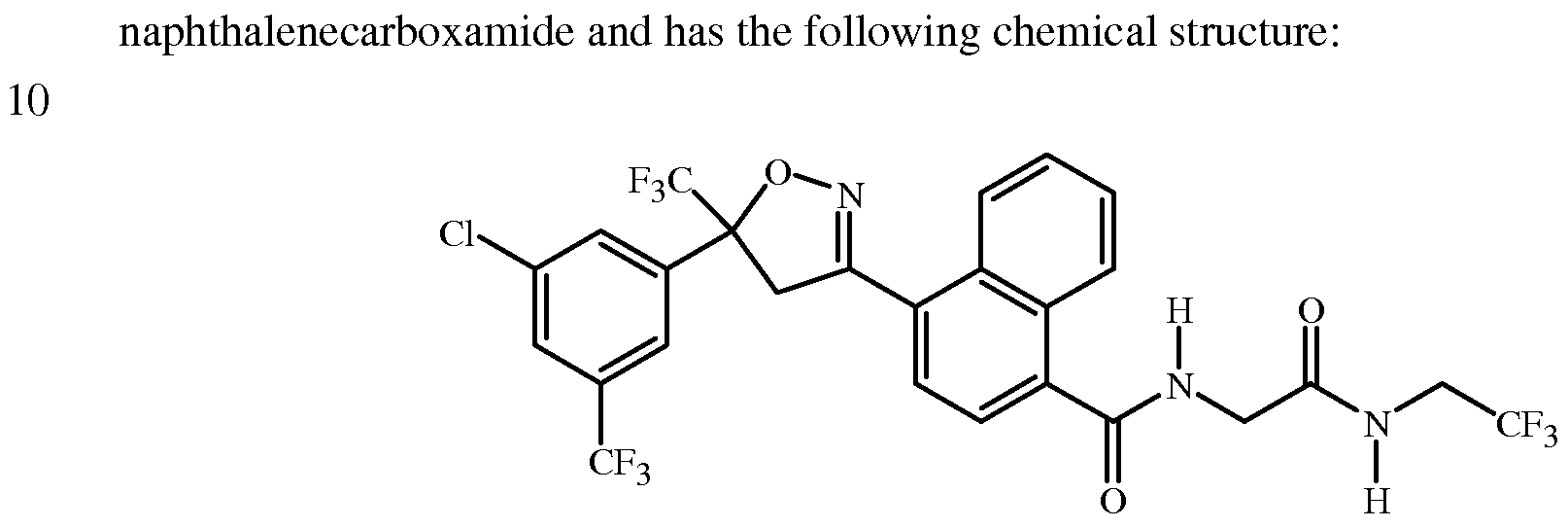

Claims
Priority Applications (27)
| Application Number | Priority Date | Filing Date | Title |
|---|---|---|---|
| AU2011258621A AU2011258621B2 (en) | 2010-05-27 | 2011-05-19 | Crystalline form of 4- [5 - [3 -chloro-5 - (trifluoromethyl) phenyl] -4, 5 - dihydro - 5 - (trifluoromethyl) -3 - isoxazolyl] -N- [2-0x0-2- [ ( 2, 2, 2 - trifluoroethyl) amino] ethyl] -1- naphthalenecarboxamide |
| ES11727834.1T ES2566402T3 (en) | 2010-05-27 | 2011-05-19 | Crystalline form of 4- [5- [3-Chloro-5- (trifluoromethyl) phenyl] -4,5-dihydro-5- (trifluoromethyl) -3-isoxazolyl] -N- [2-oxo-2 - [(2 , 2,2-trifluoroethyl) amino] ethyl] -1-naphthalenecarboxamide |
| JP2013512088A JP5933530B2 (en) | 2010-05-27 | 2011-05-19 | 4- [5- [3-Chloro-5- (trifluoromethyl) phenyl] -4,5-dihydro-5- (trifluoromethyl) -3-isoxazolyl] -N- [2-oxo-2-[( Crystalline form of 2,2,2-trifluoroethyl) amino] ethyl] -1-naphthalenecarboxamide |
| DK11727834.1T DK2576523T3 (en) | 2010-05-27 | 2011-05-19 | A crystalline form of 4- [5- [3-chloro-5- (trifluoromethyl) phenyl] -4,5-dihydro-5- (trifluoromethyl) -3-isoxazolyl] -N- [2-oxo-2 - [( 2,2,2-trifluoroethyl) amino] ethyl] - 1-naphthalenecarboxamide |
| CN201180026183.9A CN102947278B (en) | 2010-05-27 | 2011-05-19 | 4-[5-[the chloro-5-of 3-(trifluoromethyl) phenyl]-4,5-dihydro-5-(trifluoromethyl)-3-isoxazolyl]-N-[2-oxo-2-[(2,2,2-trifluoroethyl) amino] ethyl] crystalline form of-1-naphthoamide |
| UAA201213547A UA108881C2 (en) | 2010-05-27 | 2011-05-19 | CRYSTAL FORM 4- $ 5- $ 3-CHLORINE-5- (TRIFLUOROMETHYL) PHENYL] -4,5-DIHYDRO-5- (TRIFLUORMETHYL) -3-ISOXAZOLYL] -N- $ 2-OXO-2 - $ 2,2 -TRIFLUOROTHYL) AMINO] ETHYL] -1-NAPHTHALINE CARBOXAMIDE |
| HK13111446.2A HK1183875B (en) | 2010-05-27 | 2011-05-19 | Crystalline form of 4- [5 - [3 -chloro-5 - (trifluoromethyl) phenyl]-4, 5 - dihydro - 5 - (trifluoromethyl) -3 - isoxazolyl]-n- [2-oxo-2- [ ( 2, 2, 2 - trifluoroethyl) amino]ethyl]-1- naphthalenecarboxamide |
| PH1/2012/502333A PH12012502333A1 (en) | 2010-05-27 | 2011-05-19 | Crystalline form of 4- [5 - [3 -chloro-5 - (trifluoromethyl) phenyl] -4, 5 - dihydro - 5 - (trifluoromethyl) -3 - isoxazolyl] -n- [2-0x0-2- [ ( 2, 2, 2 - trifluoroethyl) amino] ethyl] -1- naphthalenecarboxamide |
| MDA20120125A MD4363C1 (en) | 2010-05-27 | 2011-05-19 | Crystalline form of 4-[5-[3-chloro-5-(trifluoromethyl)phenyl]-4,5-dihydro-5-(trifluoromethyl)-3-isoxazolyl]-N-[2-oxo-2-[(2,2,2-trifluoroethyl)amino]ethyl]-1-naphthalenecarboxamide and uses thereof |
| KR1020187023053A KR102060464B1 (en) | 2010-05-27 | 2011-05-19 | Crystalline form of 4-[5-[3-chloro-5-(trifluoromethyl)phenyl]-4,5-dihydro-5-(trifluoromethyl)-3-isoxazolyl]-n-[2-0x0-2-[(2,2,2-trifluoroethyl)amino]ethyl]-1-naphthalenecarboxamide |
| PL11727834T PL2576523T3 (en) | 2010-05-27 | 2011-05-19 | Crystalline form of 4-[5 - [3 -chloro-5 -(trifluoromethyl)phenyl] -4,5 -dihydro-5 -(trifluoromethyl)-3 - isoxazolyl]-n-[2-oxo-2-[(2,2,2-trifluoroethyl)amino]ethyl]-1- naphthalenecarboxamide |
| CA2799963A CA2799963C (en) | 2010-05-27 | 2011-05-19 | Crystalline form of 4- [5 - [3 -chloro-5 - (trifluoromethyl) phenyl] -4,5 -dihydro-5 - (trifluoromethyl) -3 - isoxazolyl] -n- [2-0x0-2- [(2,2,2-trifluoroethyl)amino]ethyl] -1-naphthalenecarboxamide |
| HRP20160355TT HRP20160355T1 (en) | 2010-05-27 | 2011-05-19 | CRYSTAL FORMS 4- [5- [3-CHLORO-5- (TRIFLUOROMETHYL) PHENYL] -4,5-Dihydro-5- (TRIFLUOROMETHYL) -3-ISOXAZOLYL] -N- [2-OXO-2 - [(2, 2,2-trifluoroethyl) amino] ethyl] -1-naphthalenecarboxamide |
| KR1020127033822A KR20130124458A (en) | 2010-05-27 | 2011-05-19 | Crystalline form of 4-[5-[3-chloro-5-(trifluoromethyl)phenyl]-4,5-dihydro-5-(trifluoromethyl)-3-isoxazolyl]-n-[2-0x0-2-[(2,2,2-trifluoroethyl)amino]ethyl]-1-naphthalenecarboxamide |
| MX2012013758A MX2012013758A (en) | 2010-05-27 | 2011-05-19 | Crystalline form of 4- [5 - [3 -chloro-5 - (trifluoromethyl) phenyl] -4, 5 - dihydro - 5 - (trifluoromethyl) -3 - isoxazolyl] -n- [2-0x0-2- [ ( 2, 2, 2 - trifluoroethyl) amino] ethyl] -1- naphthalenecarboxamide. |
| RS20160215A RS54677B1 (en) | 2010-05-27 | 2011-05-19 | Crystalline Forms 4- [5- [3-Chloro-5- (Trifluoromethyl) phenyl] -4,5-dihydro-5- (trifluoromethyl) -3-isoxazolyl] -N- [2-oxo-2 - [(2, 2,2-TRIFLUOROETHYL) AMINO] ETHYL] -1-NAPHTHALENCARBOXAMIDE |
| NZ603584A NZ603584A (en) | 2010-05-27 | 2011-05-19 | Crystalline form of 4-[5-[3-chloro-5-(trifluoromethyl)phenyl]-4,5-dihydro-5-(trifluoromethyl)-3-isoxazolyl]-n-[2-oxo-2-[(2,2,2-trifluoroethyl)amino]ethyl]-1-naphthalenecarboxamide |
| MA35389A MA34247B1 (en) | 2010-05-27 | 2011-05-19 | 4- [5- [3-CHLORO-5- (TRIFLUOROMETHYL) PHENYL] -4,5-DIHYDRO-5- (TRIFLUOROMETHYL) -3-ISOXAZOLYL] -N- [2-OXO-2 - [(2)) CRYSTALLINE FORM , 2,2-TRIFLUOROETHYL) AMINO] ETHYL] -1-NAPHTHALENECARBOXAMIDE |
| KR1020177002571A KR20170015549A (en) | 2010-05-27 | 2011-05-19 | Crystalline form of 4-[5-[3-chloro-5-(trifluoromethyl)phenyl]-4,5-dihydro-5-(trifluoromethyl)-3-isoxazolyl]-n-[2-0x0-2-[(2,2,2-trifluoroethyl)amino]ethyl]-1-naphthalenecarboxamide |
| US13/700,222 US8598087B2 (en) | 2010-05-27 | 2011-05-19 | Crystalline form of 4-[5-[3-chloro-5-(trifluoromethyl)phenyl]-4, 5-dihydro-5-(trifluoromethyl)-3-isoxazolyl]-N-[2-0X0-2-[(2,2,2-trifluoroethyl)amino]ethyl]-1- naph-thalenecarboxamide |
| SI201130744A SI2576523T1 (en) | 2010-05-27 | 2011-05-19 | Crystalline form of 4-(5 - (3 -chloro-5 -(trifluoromethyl)phenyl) -4,5 -dihydro-5 -(trifluoromethyl)-3 - isoxazolyl)-n-(2-oxo-2-((2,2,2-trifluoroethyl)amino)ethyl)-1- naphthalenecarboxamide |
| RU2012157267/04A RU2575121C2 (en) | 2010-05-27 | 2011-05-19 | Crystalline form of 4-[5-[3-chloro-5-(trifluoromethyl)phenyl]-4,5-dihydro-5-(trifluoromethyl)-3-isoxazolyl]-n-[2-oxo-2-[(2,2,2-trifluoroethyl)amino]ethyl]-1-naphthalenecarboxamide |
| EP11727834.1A EP2576523B1 (en) | 2010-05-27 | 2011-05-19 | Crystalline form of 4-[5 - [3 -chloro-5 -(trifluoromethyl)phenyl] -4,5 -dihydro-5 -(trifluoromethyl)-3 - isoxazolyl]-n-[2-oxo-2-[(2,2,2-trifluoroethyl)amino]ethyl]-1- naphthalenecarboxamide |
| BR112012030151A BR112012030151B8 (en) | 2010-05-27 | 2011-05-19 | crystalline polymorph, composition, method for controlling an invertebrate pest and use of the polymorph |
| IL223002A IL223002A (en) | 2010-05-27 | 2012-11-12 | Crystalline form of 4-[5-[3-chloro-5 -(trifluoromethyl) phenyl]-4, 5- dihydro - 5 -(trifluoromethyl)-3-isoxazolyl]-n-[2-oxo-2- [(2, 2, 2-trifluoroethyl)amino] ethyl]-1- naphthalenecarboxamide |
| ZA2012/08760A ZA201208760B (en) | 2010-05-27 | 2012-11-21 | Crystalline polymorph of 4-[5-[3-chloro-5-(trifluoromethyl)phenyl]-4,5-dihydro-5-(trifluoromethyl)-3-isoxazolyl]-n-[2-oxo-2-[(2,2,2-trifluoroethyl)amino]ethyl]-1-naphthalenecarboxamide |
| TNP2012000557A TN2012000557A1 (en) | 2010-05-27 | 2012-11-27 | Crystalline form of 4- [5 - [3 -chloro-5 - (trifluoromethyl) phenyl] -4, 5 - dihydro - 5 - (trifluoromethyl) -3 - isoxazolyl] -n- [2-0x0-2- [ ( 2, 2, 2 - trifluoroethyl) amino] ethyl] -1- naphthalenecarboxamide |
Applications Claiming Priority (2)
| Application Number | Priority Date | Filing Date | Title |
|---|---|---|---|
| US34895810P | 2010-05-27 | 2010-05-27 | |
| US61/348,958 | 2010-05-27 |
Publications (1)
| Publication Number | Publication Date |
|---|---|
| WO2011149749A1 true WO2011149749A1 (en) | 2011-12-01 |
Family
ID=44359642
Family Applications (1)
| Application Number | Title | Priority Date | Filing Date |
|---|---|---|---|
| PCT/US2011/037083 Ceased WO2011149749A1 (en) | 2010-05-27 | 2011-05-19 | Crystalline form of 4- [5 - [3 -chloro-5 - (trifluoromethyl) phenyl] -4, 5 - dihydro - 5 - (trifluoromethyl) -3 - isoxazolyl] -n- [2-0x0-2- [ ( 2, 2, 2 - trifluoroethyl) amino] ethyl] -1- naphthalenecarboxamide |
Country Status (30)
| Country | Link |
|---|---|
| US (1) | US8598087B2 (en) |
| EP (1) | EP2576523B1 (en) |
| JP (1) | JP5933530B2 (en) |
| KR (3) | KR20130124458A (en) |
| CN (1) | CN102947278B (en) |
| AR (2) | AR081226A1 (en) |
| AU (1) | AU2011258621B2 (en) |
| BR (1) | BR112012030151B8 (en) |
| CA (1) | CA2799963C (en) |
| CL (1) | CL2012003272A1 (en) |
| DK (1) | DK2576523T3 (en) |
| ES (1) | ES2566402T3 (en) |
| GT (1) | GT201200316A (en) |
| HR (1) | HRP20160355T1 (en) |
| HU (1) | HUE028501T2 (en) |
| IL (1) | IL223002A (en) |
| MA (1) | MA34247B1 (en) |
| MD (1) | MD4363C1 (en) |
| MX (1) | MX2012013758A (en) |
| MY (1) | MY156670A (en) |
| NZ (1) | NZ603584A (en) |
| PH (1) | PH12012502333A1 (en) |
| PL (1) | PL2576523T3 (en) |
| RS (1) | RS54677B1 (en) |
| SI (1) | SI2576523T1 (en) |
| TN (1) | TN2012000557A1 (en) |
| UA (1) | UA108881C2 (en) |
| UY (1) | UY33397A (en) |
| WO (1) | WO2011149749A1 (en) |
| ZA (1) | ZA201208760B (en) |
Cited By (42)
| Publication number | Priority date | Publication date | Assignee | Title |
|---|---|---|---|---|
| WO2013039948A1 (en) * | 2011-09-12 | 2013-03-21 | Merial Limited | Parasiticidal compositions comprising an isoxazoline active agent, methods and uses thereof |
| WO2013119442A1 (en) * | 2012-02-06 | 2013-08-15 | Merial Limited | Parasiticidal oral veterinary compositions comprising systemically-acting active agents, methods and uses thereof |
| WO2014053404A1 (en) | 2012-10-01 | 2014-04-10 | Basf Se | Pesticidally active mixtures comprising anthranilamide compounds |
| WO2014053395A1 (en) | 2012-10-01 | 2014-04-10 | Basf Se | Use of n-thio-anthranilamide compounds on cultivated plants |
| WO2014053407A1 (en) | 2012-10-01 | 2014-04-10 | Basf Se | N-thio-anthranilamide compounds and their use as pesticides |
| WO2014053405A1 (en) | 2012-10-01 | 2014-04-10 | Basf Se | Pesticidally active mixtures comprising anthranilamide compounds |
| WO2014053401A2 (en) | 2012-10-01 | 2014-04-10 | Basf Se | Method of improving plant health |
| WO2014053406A1 (en) | 2012-10-01 | 2014-04-10 | Basf Se | Method of controlling ryanodine-modulator insecticide resistant insects |
| WO2014053403A1 (en) | 2012-10-01 | 2014-04-10 | Basf Se | Method of controlling insecticide resistant insects |
| US8735362B2 (en) | 2009-12-01 | 2014-05-27 | Syngenta Crop Protection, Llc | Insecticidal compounds based on isoxazoline derivatives |
| WO2014079820A1 (en) | 2012-11-22 | 2014-05-30 | Basf Se | Use of anthranilamide compounds for reducing insect-vectored viral infections |
| WO2014090700A1 (en) | 2012-12-14 | 2014-06-19 | Basf Se | Malononitrile compounds for controlling animal pests |
| WO2014102244A1 (en) | 2012-12-27 | 2014-07-03 | Basf Se | 2-(pyridin-3-yl)-5-hetaryl-thiazole compounds carrying an imine or imine-derived substituent for combating invertebrate pests |
| WO2014122083A1 (en) | 2013-02-06 | 2014-08-14 | Bayer Cropscience Ag | Halogen-substituted pyrazol derivatives as pest-control agents |
| WO2014170300A1 (en) | 2013-04-19 | 2014-10-23 | Basf Se | N-substituted acyl-imino-pyridine compounds and derivatives for combating animal pests |
| WO2014202751A1 (en) | 2013-06-21 | 2014-12-24 | Basf Se | Methods for controlling pests in soybean |
| WO2015007682A1 (en) | 2013-07-15 | 2015-01-22 | Basf Se | Pesticide compounds |
| WO2015040116A1 (en) | 2013-09-19 | 2015-03-26 | Basf Se | N-acylimino heterocyclic compounds |
| WO2015055757A1 (en) | 2013-10-18 | 2015-04-23 | Basf Se | Use of pesticidal active carboxamide derivative in soil and seed application and treatment methods |
| WO2015055497A1 (en) | 2013-10-16 | 2015-04-23 | Basf Se | Substituted pesticidal pyrazole compounds |
| WO2015091645A1 (en) | 2013-12-18 | 2015-06-25 | Basf Se | Azole compounds carrying an imine-derived substituent |
| WO2015091649A1 (en) | 2013-12-18 | 2015-06-25 | Basf Se | N-substituted imino heterocyclic compounds |
| WO2015101622A1 (en) | 2014-01-03 | 2015-07-09 | Bayer Cropscience Ag | Novel pyrazolyl-heteroarylamides as pesticides |
| WO2015104422A1 (en) | 2014-01-13 | 2015-07-16 | Basf Se | Dihydrothiophene compounds for controlling invertebrate pests |
| WO2016008830A1 (en) | 2014-07-15 | 2016-01-21 | Bayer Cropscience Aktiengesellschaft | Aryl-triazolyl pyridines as pest control agents |
| US9314478B2 (en) | 2013-03-15 | 2016-04-19 | Argenta Manufacturing Limited | Method of making an anhydrous, fat soluble, chewable drug delivery formulation |
| WO2016138339A1 (en) | 2015-02-26 | 2016-09-01 | Merial, Inc. | Long-acting injectable formulations comprising an isoxazoline active agent, methods and uses thereof |
| WO2016164487A1 (en) | 2015-04-08 | 2016-10-13 | Merial, Inc. | Extended release injectable formulations comprising an isoxazoline active agent, methods and uses thereof |
| JPWO2014126208A1 (en) * | 2013-02-14 | 2017-02-02 | 日産化学工業株式会社 | Crystalline polymorph of isoxazoline-substituted benzamide compound and process for producing the same |
| WO2017147352A1 (en) | 2016-02-24 | 2017-08-31 | Merial, Inc. | Antiparasitic isoxazoline compounds, long-acting injectable formulations comprising them, methods and uses thereof |
| WO2018039508A1 (en) | 2016-08-25 | 2018-03-01 | Merial, Inc. | Method for reducing unwanted effects in parasiticidal treatments |
| WO2018071535A1 (en) | 2016-10-14 | 2018-04-19 | Merial, Inc. | Pesticidal and parasiticidal vinyl isoxazoline compounds |
| WO2018187623A1 (en) * | 2017-04-05 | 2018-10-11 | Merial, Inc. | Crystalline forms of (s)-afoxolaner |
| WO2019036407A1 (en) | 2017-08-14 | 2019-02-21 | Merial, Inc. | Pesticidal and parasiticidal pyrazole-isoxazoline compounds |
| WO2019091940A1 (en) * | 2017-11-07 | 2019-05-16 | Intervet International B.V. | Process for preparing large size isoxazoline particles |
| WO2019091936A1 (en) * | 2017-11-07 | 2019-05-16 | Intervet International B.V. | Injectable isoxazoline pharmaceutical compositions and their use against parasite infestation |
| RU2695360C2 (en) * | 2012-11-20 | 2019-07-23 | Интервет Интернэшнл Б.В. | Production of semi-plastic pharmaceutical preparations |
| WO2021242481A1 (en) | 2020-05-28 | 2021-12-02 | Boehringer Ingelheim Animal Health USA Inc. | Bi-modal release intra-ruminal capsule device and methods of use thereof |
| US11285101B2 (en) | 2012-04-04 | 2022-03-29 | Intervet Inc. | Soft chewable pharmaceutical products |
| WO2022140728A1 (en) | 2020-12-21 | 2022-06-30 | Boehringer Ingelheim Animam Health Usa Inc. | Parasiticidal collar comprising isoxazoline compounds |
| WO2025257633A1 (en) | 2024-06-12 | 2025-12-18 | Boehringer Ingelheim Vetmedica Gmbh | Long-acting castor oil-containing injectable formulations and methods of use thereof |
| WO2026024600A1 (en) | 2024-07-22 | 2026-01-29 | Zoetis Services Llc | Isoxazoline and macrocyclic lactone microspheres |
Families Citing this family (2)
| Publication number | Priority date | Publication date | Assignee | Title |
|---|---|---|---|---|
| KR101988442B1 (en) * | 2017-06-30 | 2019-06-12 | 주식회사 삼양사 | Crystalline functional sweetener |
| WO2021254445A1 (en) * | 2020-06-19 | 2021-12-23 | 东莞市东阳光仿制药研发有限公司 | Crystal form of gaba inhibitor and preparation method therefor |
Citations (59)
| Publication number | Priority date | Publication date | Assignee | Title |
|---|---|---|---|---|
| US1679404A (en) | 1926-02-04 | 1928-08-07 | Rockwood Sprinkler Co Massachusetts | Constant-alarm device for alarm valves |
| US1815604A (en) | 1922-10-31 | 1931-07-21 | Winthrop Chem Co | Organic mercury compound |
| US1959704A (en) | 1931-12-08 | 1934-05-22 | Bugatti Jean | Suspension of railway cars and other vehicles |
| US2891855A (en) | 1954-08-16 | 1959-06-23 | Geigy Ag J R | Compositions and methods for influencing the growth of plants |
| US3060084A (en) | 1961-06-09 | 1962-10-23 | Du Pont | Improved homogeneous, readily dispersed, pesticidal concentrate |
| US3235361A (en) | 1962-10-29 | 1966-02-15 | Du Pont | Method for the control of undesirable vegetation |
| US3299566A (en) | 1964-06-01 | 1967-01-24 | Olin Mathieson | Water soluble film containing agricultural chemicals |
| US3309192A (en) | 1964-12-02 | 1967-03-14 | Du Pont | Method of controlling seedling weed grasses |
| US3852416A (en) | 1971-05-27 | 1974-12-03 | L Grubb | Tick and flea collar of solid solution plasticized vinylic resin-carbamate insecticide |
| US3920442A (en) | 1972-09-18 | 1975-11-18 | Du Pont | Water-dispersible pesticide aggregates |
| US3950360A (en) | 1972-06-08 | 1976-04-13 | Sankyo Company Limited | Antibiotic substances |
| US3984564A (en) | 1972-06-08 | 1976-10-05 | Sankyo Company Limited | Antibiotic substances B-41, their production and their use as insecticides and acaricides |
| US4144050A (en) | 1969-02-05 | 1979-03-13 | Hoechst Aktiengesellschaft | Micro granules for pesticides and process for their manufacture |
| US4172714A (en) | 1976-12-20 | 1979-10-30 | E. I. Du Pont De Nemours And Company | Dry compactible, swellable herbicidal compositions and pellets produced therefrom |
| US4199569A (en) | 1977-10-03 | 1980-04-22 | Merck & Co., Inc. | Selective hydrogenation products of C-076 compounds and derivatives thereof |
| US4224901A (en) | 1979-04-16 | 1980-09-30 | Carey Jr Sam H | Combination inner flea-tick collar and outer protective collar, for animals |
| US4310519A (en) | 1976-04-19 | 1982-01-12 | Merck & Co., Inc. | Novel substances and process for their production |
| US4311857A (en) | 1979-02-05 | 1982-01-19 | Schering Corporation | 1-Aryl-2-acylamido-3-fluoro-1-propanol acylates, methods for their manufacture and intermediates useful therein, methods for their use as antibacterial agents and compositions useful therefor |
| GB2095558A (en) | 1981-03-30 | 1982-10-06 | Avon Packers Ltd | Formulation of agricultural chemicals |
| DE3246493A1 (en) | 1982-12-16 | 1984-06-20 | Bayer Ag, 5090 Leverkusen | METHOD FOR PRODUCING WATER-DISPERSIBLE GRANULES |
| US4582918A (en) | 1984-09-19 | 1986-04-15 | Schering Corporation | Preparation of intermediates for (threo)-1-aryl-2-acylamido-3-fluoro-1-propanols |
| US4743700A (en) | 1984-02-03 | 1988-05-10 | Zambon S.P.A. | Process for fluorinating 1-phenyl-2-amino-1,3-propanediol compounds |
| US4820695A (en) | 1982-09-13 | 1989-04-11 | Eli Lilly And Company | C-20-dihydro-deoxy-(cyclic amino)-derivatives of macrolide antibiotics |
| US4876352A (en) | 1988-09-14 | 1989-10-24 | Schering Corporation | Pressurized fluorination of hydroxy alkyl groups |
| US4916154A (en) | 1986-09-12 | 1990-04-10 | American Cyanamid Company | 23-Imino derivatives of LL-F28249 compounds |
| US4973750A (en) | 1984-09-19 | 1990-11-27 | Schering Corporation | Preparation of (threo)-1-aryl-2-acylamido-3-fluoro-1-propanols |
| WO1991013546A1 (en) | 1990-03-12 | 1991-09-19 | E.I. Du Pont De Nemours And Company | Water-dispersible or water-soluble pesticide granules from heat-activated binders |
| US5089480A (en) | 1985-07-27 | 1992-02-18 | Pfizer Inc. | Antiparasitic agents |
| US5105009A (en) | 1983-06-02 | 1992-04-14 | Zambon S.P.A. | Intermediates for the preparation of 1-(phenyl)-1-hydroxy-2-amino-3-fluoropropane derivatives |
| US5180587A (en) | 1988-06-28 | 1993-01-19 | E. I. Du Pont De Nemours And Company | Tablet formulations of pesticides |
| US5184573A (en) | 1992-02-21 | 1993-02-09 | Stevens Jr John L | Animal collar |
| US5208030A (en) | 1989-08-30 | 1993-05-04 | Imperial Chemical Industries Plc | Active ingredient dosage device |
| US5227494A (en) | 1988-09-14 | 1993-07-13 | Schering Corporation | Process for preparing oxazoline compounds |
| US5232701A (en) | 1990-10-11 | 1993-08-03 | Sumitomo Chemical Company, Limited | Boron carbonate and solid acid pesticidal composition |
| US5288710A (en) | 1990-06-28 | 1994-02-22 | Merck & Co., Inc. | Stable salts of 4"-deoxy-4"-epi-methylamino avermectin Bla/Blb |
| US5352832A (en) | 1992-12-18 | 1994-10-04 | Schering Corporation | Asymmetric process for preparing florfenicol, thiamphenicol chloramphenicol and oxazoline intermediates |
| US5382673A (en) | 1990-10-25 | 1995-01-17 | Schering Corporation | Process for preparing florfenicol, its analogs and oxazoline intermediates thereto |
| US5399717A (en) | 1993-09-29 | 1995-03-21 | Merck & Co., Inc. | Glycosidation route to 4"-epi-methylamino-4"-deoxyavermectin B1 |
| US5555848A (en) | 1995-05-17 | 1996-09-17 | Trujillo; Wendy J. | Pet/flea collar |
| US5567844A (en) | 1984-02-03 | 1996-10-22 | Zambon S.P.A. | Process for preparing 1-phenyl-2-amino-3-fluoro-1-propanols |
| US5663361A (en) | 1996-08-19 | 1997-09-02 | Schering Corporation | Process for preparing intermediates to florfenicol |
| US5958888A (en) | 1996-07-02 | 1999-09-28 | Merial, Inc. | Water miscible macrolide solutions |
| US6054434A (en) | 1997-09-10 | 2000-04-25 | Merck & Co., Inc. | 8a-azalides as veterinary antimicrobal agents |
| US6239112B1 (en) | 1998-07-09 | 2001-05-29 | Merial, Inc. | Water miscible macrolide solutions |
| US6271255B1 (en) | 1996-07-05 | 2001-08-07 | Biotica Technology Limited | Erythromycins and process for their preparation |
| US6270768B1 (en) | 1999-01-28 | 2001-08-07 | Pfizer Inc | Azalides and methods of making same |
| US6339063B1 (en) | 1997-09-10 | 2002-01-15 | Merck & Co., Inc. | 9a-azalides as veterinary antimicrobial agents |
| US6472371B1 (en) | 1998-01-02 | 2002-10-29 | Pfizer, Inc. | Macrolides |
| US6514945B1 (en) | 2000-01-27 | 2003-02-04 | Pfizer Inc. | Azalide antibiotic compositions |
| WO2003015518A1 (en) | 2001-08-13 | 2003-02-27 | E.I. Du Pont De Nemours And Company | Method for controlling particular insect pests by applying anthranilamide compounds |
| WO2003024222A1 (en) | 2001-09-21 | 2003-03-27 | E. I. Du Pont De Nemours And Company | Anthranilamide arthropodicide treatment |
| US20030064939A1 (en) | 2001-04-27 | 2003-04-03 | Constantine Sklavounos | Process for preparing 4"-substituted-9-deoxo-9a-aza-9a-homoerythromycin a derivatives |
| US6603044B1 (en) | 1998-11-30 | 2003-08-05 | Nihon Nohyaku Co., Ltd. | Phthalamide derivatives, or salt thereof agrohorticultural insecticide, and method for using the same |
| US20040082553A1 (en) | 2002-03-08 | 2004-04-29 | Boojamra Constantine G. | Novel florfenicol-type antibiotics |
| US6747047B2 (en) | 2000-03-22 | 2004-06-08 | E.I. Du Pont De Nemours And Company | Insecticidal anthranilamides |
| WO2004067528A1 (en) | 2003-01-28 | 2004-08-12 | E.I. Du Pont De Nemours And Company | Cyano anthranilamide insecticides |
| WO2009002809A2 (en) | 2007-06-26 | 2008-12-31 | E. I. Du Pont De Nemours And Company | Naphthalene isoxazoline invertebrate pest control agents |
| WO2009025983A2 (en) | 2007-08-17 | 2009-02-26 | E. I. Du Pont De Nemours And Company | Method for preparing 5-haloalkyl-4,5-dihydroisoxazole derivatives |
| WO2009126668A2 (en) | 2008-04-09 | 2009-10-15 | E. I. Du Pont De Nemours And Company | Method for preparing 3-trifluoromethyl chalcones |
Family Cites Families (37)
| Publication number | Priority date | Publication date | Assignee | Title |
|---|---|---|---|---|
| US3854216A (en) | 1973-05-14 | 1974-12-17 | Owatonna Tool Co | Disc brake tool |
| US3879532A (en) | 1974-01-18 | 1975-04-22 | Shell Oil Co | Control by isoxazoles of endoparasitic nematodes |
| US4129568A (en) | 1977-05-12 | 1978-12-12 | Monsanto Company | 2-[3-Aryl-2-isoxazolin-5-yl]benzoates |
| US5849736A (en) | 1993-11-24 | 1998-12-15 | The Dupont Merck Pharmaceutical Company | Isoxazoline and isoxazole fibrinogen receptor antagonists |
| GB9505651D0 (en) | 1995-03-21 | 1995-05-10 | Agrevo Uk Ltd | AgrEvo UK Limited |
| DE69728761T2 (en) | 1996-04-26 | 2004-08-12 | Nippon Soda Co. Ltd. | HETEROCYCLICALLY SUBSTITUTED BENZENE DERIVATIVES AND HERBICIDES |
| CA2206151A1 (en) | 1996-06-06 | 1997-12-06 | Rohm And Haas Company | Benzyloxy substituted aromatics and their use as fungicides and insecticides |
| HRP980291A2 (en) * | 1997-06-16 | 1999-04-30 | Lin-Hua Zhang | Crystalline roxifiban |
| GB2351081A (en) | 1999-06-18 | 2000-12-20 | Lilly Forschung Gmbh | Pharmaceutically active imidazoline compounds and analogues thereof |
| DE10114597A1 (en) | 2001-03-23 | 2002-10-02 | Bayer Cropscience Gmbh | Arylisoxazoline derivatives, process for their preparation and their use as pesticides |
| AU2003261713A1 (en) | 2002-08-26 | 2004-03-11 | Nissan Chemical Industries, Ltd. | Substituted benzanilide compound and pest control agent |
| DE10320782A1 (en) | 2003-05-09 | 2004-11-25 | Bayer Cropscience Ag | Substituted oxyarenes |
| JP2005272452A (en) | 2004-02-23 | 2005-10-06 | Nissan Chem Ind Ltd | Substituted benzanilide compound and pesticide |
| CN102558082B (en) | 2004-03-05 | 2015-09-30 | 日产化学工业株式会社 | Isoxazoline-substituted benzamide compound prepare intermediate |
| WO2005094329A2 (en) | 2004-03-26 | 2005-10-13 | Cytokine Pharmasciences, Inc. | Compouns, compositions, processes of making, and methods of use related to inhibiting macrophage migration inhibitory factor |
| JP5051340B2 (en) | 2005-06-06 | 2012-10-17 | 日産化学工業株式会社 | Substituted isoxazoline compounds and pest control agents |
| MY146795A (en) | 2005-06-09 | 2012-09-28 | Novartis Ag | Process for the synthesis of organic compounds |
| AU2006285613B2 (en) | 2005-09-02 | 2011-11-17 | Nissan Chemical Corporation | Isoxazoline-substituted benzamide compound and harmful organism-controlling agent |
| JP2007106756A (en) | 2005-09-14 | 2007-04-26 | Nissan Chem Ind Ltd | Substituted isoxazoline compound and pesticide |
| US20090143410A1 (en) | 2005-12-14 | 2009-06-04 | Kanu Maganbhai Patel | Isoxazolines for Controlling Invertebrate Pests |
| TW200803740A (en) | 2005-12-16 | 2008-01-16 | Du Pont | 5-aryl isoxazolines for controlling invertebrate pests |
| JP5304981B2 (en) | 2005-12-26 | 2013-10-02 | 日産化学工業株式会社 | 1,3-bis (substituted phenyl) -3-hydroxypropan-1-one and 2-propen-1-one compounds and salts thereof |
| TWI412322B (en) | 2005-12-30 | 2013-10-21 | Du Pont | Isoxazolines for controlling invertebrate pests |
| DE602007006288D1 (en) | 2006-03-10 | 2010-06-17 | Nissan Chemical Ind Ltd | SUBSTITUTED ISOXAZOLIN COMPOUND AND PESTICIDES |
| AU2007240954A1 (en) | 2006-04-20 | 2007-11-01 | E. I. Du Pont De Nemours And Company | Pyrazolines for controlling invertebrate pests |
| JPWO2007125984A1 (en) | 2006-04-28 | 2009-09-10 | 日本農薬株式会社 | Isoxazoline derivatives, pest control agents and methods of use |
| JP2008044880A (en) | 2006-08-15 | 2008-02-28 | Bayer Cropscience Ag | Insecticidal isooxazolines |
| JP5206993B2 (en) | 2007-03-07 | 2013-06-12 | 日産化学工業株式会社 | Isoxazoline-substituted benzamide compounds and pest control agents |
| BRPI0810196A2 (en) | 2007-04-10 | 2011-12-06 | Bayer Cropscience Ag | aryl isoxazoline derivatives insecticides |
| BRPI0809770B8 (en) | 2007-06-13 | 2022-12-06 | Du Pont | COMPOUND AND COMPOSITION TO CONTROL AN INVERTEBRATE PEST |
| US8952175B2 (en) | 2007-06-27 | 2015-02-10 | Nissan Chemical Industries, Ltd. | Method for production of 3-hydroxypropan-1-one compound, method for production of 2-propen-1-one compound and method for production of isoxazoline compound |
| KR101769728B1 (en) | 2007-06-27 | 2017-08-18 | 이 아이 듀폰 디 네모아 앤드 캄파니 | Animal pest control method |
| TWI556741B (en) | 2007-08-17 | 2016-11-11 | 英特威特國際股份有限公司 | Isoxazoline compositions and their use as antiparasitics |
| EP2199287A4 (en) | 2007-09-10 | 2011-04-27 | Nissan Chemical Ind Ltd | Substituted isoxazoline compound and pest control agent |
| KR20100075996A (en) | 2007-10-03 | 2010-07-05 | 이 아이 듀폰 디 네모아 앤드 캄파니 | Naphthalene isoxazoline compounds for control of invertebrate pests |
| US8389738B2 (en) * | 2008-07-09 | 2013-03-05 | Nissan Chemical Industries, Ltd. | Production method of isoxazoline-substituted benzoic acid amide compound |
| EP2424347A1 (en) * | 2009-04-28 | 2012-03-07 | BASF Corporation | Pesticide compositions and applicators |
-
2011
- 2011-05-19 PL PL11727834T patent/PL2576523T3/en unknown
- 2011-05-19 UA UAA201213547A patent/UA108881C2/en unknown
- 2011-05-19 MY MYPI2012005011A patent/MY156670A/en unknown
- 2011-05-19 MD MDA20120125A patent/MD4363C1/en active IP Right Grant
- 2011-05-19 KR KR1020127033822A patent/KR20130124458A/en not_active Ceased
- 2011-05-19 AU AU2011258621A patent/AU2011258621B2/en active Active
- 2011-05-19 MX MX2012013758A patent/MX2012013758A/en active IP Right Grant
- 2011-05-19 ES ES11727834.1T patent/ES2566402T3/en active Active
- 2011-05-19 CA CA2799963A patent/CA2799963C/en active Active
- 2011-05-19 UY UY0001033397A patent/UY33397A/en not_active Application Discontinuation
- 2011-05-19 PH PH1/2012/502333A patent/PH12012502333A1/en unknown
- 2011-05-19 BR BR112012030151A patent/BR112012030151B8/en active IP Right Grant
- 2011-05-19 MA MA35389A patent/MA34247B1/en unknown
- 2011-05-19 JP JP2013512088A patent/JP5933530B2/en active Active
- 2011-05-19 HU HUE11727834A patent/HUE028501T2/en unknown
- 2011-05-19 WO PCT/US2011/037083 patent/WO2011149749A1/en not_active Ceased
- 2011-05-19 CN CN201180026183.9A patent/CN102947278B/en active Active
- 2011-05-19 DK DK11727834.1T patent/DK2576523T3/en active
- 2011-05-19 EP EP11727834.1A patent/EP2576523B1/en active Active
- 2011-05-19 US US13/700,222 patent/US8598087B2/en active Active
- 2011-05-19 HR HRP20160355TT patent/HRP20160355T1/en unknown
- 2011-05-19 NZ NZ603584A patent/NZ603584A/en active IP Right Revival
- 2011-05-19 KR KR1020187023053A patent/KR102060464B1/en active Active
- 2011-05-19 KR KR1020177002571A patent/KR20170015549A/en not_active Ceased
- 2011-05-19 SI SI201130744A patent/SI2576523T1/en unknown
- 2011-05-19 RS RS20160215A patent/RS54677B1/en unknown
- 2011-05-26 AR ARP110101795A patent/AR081226A1/en not_active Application Discontinuation
-
2012
- 2012-11-12 IL IL223002A patent/IL223002A/en active IP Right Grant
- 2012-11-21 ZA ZA2012/08760A patent/ZA201208760B/en unknown
- 2012-11-23 CL CL2012003272A patent/CL2012003272A1/en unknown
- 2012-11-23 GT GT201200316A patent/GT201200316A/en unknown
- 2012-11-27 TN TNP2012000557A patent/TN2012000557A1/en unknown
-
2020
- 2020-01-08 AR ARP200100043A patent/AR117778A2/en unknown
Patent Citations (60)
| Publication number | Priority date | Publication date | Assignee | Title |
|---|---|---|---|---|
| US1815604A (en) | 1922-10-31 | 1931-07-21 | Winthrop Chem Co | Organic mercury compound |
| US1679404A (en) | 1926-02-04 | 1928-08-07 | Rockwood Sprinkler Co Massachusetts | Constant-alarm device for alarm valves |
| US1959704A (en) | 1931-12-08 | 1934-05-22 | Bugatti Jean | Suspension of railway cars and other vehicles |
| US2891855A (en) | 1954-08-16 | 1959-06-23 | Geigy Ag J R | Compositions and methods for influencing the growth of plants |
| US3060084A (en) | 1961-06-09 | 1962-10-23 | Du Pont | Improved homogeneous, readily dispersed, pesticidal concentrate |
| US3235361A (en) | 1962-10-29 | 1966-02-15 | Du Pont | Method for the control of undesirable vegetation |
| US3299566A (en) | 1964-06-01 | 1967-01-24 | Olin Mathieson | Water soluble film containing agricultural chemicals |
| US3309192A (en) | 1964-12-02 | 1967-03-14 | Du Pont | Method of controlling seedling weed grasses |
| US4144050A (en) | 1969-02-05 | 1979-03-13 | Hoechst Aktiengesellschaft | Micro granules for pesticides and process for their manufacture |
| US3852416A (en) | 1971-05-27 | 1974-12-03 | L Grubb | Tick and flea collar of solid solution plasticized vinylic resin-carbamate insecticide |
| US3950360A (en) | 1972-06-08 | 1976-04-13 | Sankyo Company Limited | Antibiotic substances |
| US3984564A (en) | 1972-06-08 | 1976-10-05 | Sankyo Company Limited | Antibiotic substances B-41, their production and their use as insecticides and acaricides |
| US3920442A (en) | 1972-09-18 | 1975-11-18 | Du Pont | Water-dispersible pesticide aggregates |
| US4310519A (en) | 1976-04-19 | 1982-01-12 | Merck & Co., Inc. | Novel substances and process for their production |
| US4172714A (en) | 1976-12-20 | 1979-10-30 | E. I. Du Pont De Nemours And Company | Dry compactible, swellable herbicidal compositions and pellets produced therefrom |
| US4199569A (en) | 1977-10-03 | 1980-04-22 | Merck & Co., Inc. | Selective hydrogenation products of C-076 compounds and derivatives thereof |
| US4311857A (en) | 1979-02-05 | 1982-01-19 | Schering Corporation | 1-Aryl-2-acylamido-3-fluoro-1-propanol acylates, methods for their manufacture and intermediates useful therein, methods for their use as antibacterial agents and compositions useful therefor |
| US4224901A (en) | 1979-04-16 | 1980-09-30 | Carey Jr Sam H | Combination inner flea-tick collar and outer protective collar, for animals |
| GB2095558A (en) | 1981-03-30 | 1982-10-06 | Avon Packers Ltd | Formulation of agricultural chemicals |
| US4820695A (en) | 1982-09-13 | 1989-04-11 | Eli Lilly And Company | C-20-dihydro-deoxy-(cyclic amino)-derivatives of macrolide antibiotics |
| DE3246493A1 (en) | 1982-12-16 | 1984-06-20 | Bayer Ag, 5090 Leverkusen | METHOD FOR PRODUCING WATER-DISPERSIBLE GRANULES |
| US5105009A (en) | 1983-06-02 | 1992-04-14 | Zambon S.P.A. | Intermediates for the preparation of 1-(phenyl)-1-hydroxy-2-amino-3-fluoropropane derivatives |
| US4743700A (en) | 1984-02-03 | 1988-05-10 | Zambon S.P.A. | Process for fluorinating 1-phenyl-2-amino-1,3-propanediol compounds |
| US5567844A (en) | 1984-02-03 | 1996-10-22 | Zambon S.P.A. | Process for preparing 1-phenyl-2-amino-3-fluoro-1-propanols |
| US4582918A (en) | 1984-09-19 | 1986-04-15 | Schering Corporation | Preparation of intermediates for (threo)-1-aryl-2-acylamido-3-fluoro-1-propanols |
| US4973750A (en) | 1984-09-19 | 1990-11-27 | Schering Corporation | Preparation of (threo)-1-aryl-2-acylamido-3-fluoro-1-propanols |
| US5089480A (en) | 1985-07-27 | 1992-02-18 | Pfizer Inc. | Antiparasitic agents |
| US4916154A (en) | 1986-09-12 | 1990-04-10 | American Cyanamid Company | 23-Imino derivatives of LL-F28249 compounds |
| US5180587A (en) | 1988-06-28 | 1993-01-19 | E. I. Du Pont De Nemours And Company | Tablet formulations of pesticides |
| US4876352A (en) | 1988-09-14 | 1989-10-24 | Schering Corporation | Pressurized fluorination of hydroxy alkyl groups |
| US5227494A (en) | 1988-09-14 | 1993-07-13 | Schering Corporation | Process for preparing oxazoline compounds |
| US5208030A (en) | 1989-08-30 | 1993-05-04 | Imperial Chemical Industries Plc | Active ingredient dosage device |
| WO1991013546A1 (en) | 1990-03-12 | 1991-09-19 | E.I. Du Pont De Nemours And Company | Water-dispersible or water-soluble pesticide granules from heat-activated binders |
| US5288710A (en) | 1990-06-28 | 1994-02-22 | Merck & Co., Inc. | Stable salts of 4"-deoxy-4"-epi-methylamino avermectin Bla/Blb |
| US5232701A (en) | 1990-10-11 | 1993-08-03 | Sumitomo Chemical Company, Limited | Boron carbonate and solid acid pesticidal composition |
| US5382673A (en) | 1990-10-25 | 1995-01-17 | Schering Corporation | Process for preparing florfenicol, its analogs and oxazoline intermediates thereto |
| US5184573A (en) | 1992-02-21 | 1993-02-09 | Stevens Jr John L | Animal collar |
| US5352832A (en) | 1992-12-18 | 1994-10-04 | Schering Corporation | Asymmetric process for preparing florfenicol, thiamphenicol chloramphenicol and oxazoline intermediates |
| US5399717A (en) | 1993-09-29 | 1995-03-21 | Merck & Co., Inc. | Glycosidation route to 4"-epi-methylamino-4"-deoxyavermectin B1 |
| US5555848A (en) | 1995-05-17 | 1996-09-17 | Trujillo; Wendy J. | Pet/flea collar |
| US5958888A (en) | 1996-07-02 | 1999-09-28 | Merial, Inc. | Water miscible macrolide solutions |
| US6271255B1 (en) | 1996-07-05 | 2001-08-07 | Biotica Technology Limited | Erythromycins and process for their preparation |
| US6437151B2 (en) | 1996-07-05 | 2002-08-20 | Biotica Technology Limited | Erythromycins and process for their preparation |
| US5663361A (en) | 1996-08-19 | 1997-09-02 | Schering Corporation | Process for preparing intermediates to florfenicol |
| US6339063B1 (en) | 1997-09-10 | 2002-01-15 | Merck & Co., Inc. | 9a-azalides as veterinary antimicrobial agents |
| US6054434A (en) | 1997-09-10 | 2000-04-25 | Merck & Co., Inc. | 8a-azalides as veterinary antimicrobal agents |
| US6472371B1 (en) | 1998-01-02 | 2002-10-29 | Pfizer, Inc. | Macrolides |
| US6239112B1 (en) | 1998-07-09 | 2001-05-29 | Merial, Inc. | Water miscible macrolide solutions |
| US6603044B1 (en) | 1998-11-30 | 2003-08-05 | Nihon Nohyaku Co., Ltd. | Phthalamide derivatives, or salt thereof agrohorticultural insecticide, and method for using the same |
| US6270768B1 (en) | 1999-01-28 | 2001-08-07 | Pfizer Inc | Azalides and methods of making same |
| US6514945B1 (en) | 2000-01-27 | 2003-02-04 | Pfizer Inc. | Azalide antibiotic compositions |
| US6747047B2 (en) | 2000-03-22 | 2004-06-08 | E.I. Du Pont De Nemours And Company | Insecticidal anthranilamides |
| US20030064939A1 (en) | 2001-04-27 | 2003-04-03 | Constantine Sklavounos | Process for preparing 4"-substituted-9-deoxo-9a-aza-9a-homoerythromycin a derivatives |
| WO2003015518A1 (en) | 2001-08-13 | 2003-02-27 | E.I. Du Pont De Nemours And Company | Method for controlling particular insect pests by applying anthranilamide compounds |
| WO2003024222A1 (en) | 2001-09-21 | 2003-03-27 | E. I. Du Pont De Nemours And Company | Anthranilamide arthropodicide treatment |
| US20040082553A1 (en) | 2002-03-08 | 2004-04-29 | Boojamra Constantine G. | Novel florfenicol-type antibiotics |
| WO2004067528A1 (en) | 2003-01-28 | 2004-08-12 | E.I. Du Pont De Nemours And Company | Cyano anthranilamide insecticides |
| WO2009002809A2 (en) | 2007-06-26 | 2008-12-31 | E. I. Du Pont De Nemours And Company | Naphthalene isoxazoline invertebrate pest control agents |
| WO2009025983A2 (en) | 2007-08-17 | 2009-02-26 | E. I. Du Pont De Nemours And Company | Method for preparing 5-haloalkyl-4,5-dihydroisoxazole derivatives |
| WO2009126668A2 (en) | 2008-04-09 | 2009-10-15 | E. I. Du Pont De Nemours And Company | Method for preparing 3-trifluoromethyl chalcones |
Non-Patent Citations (20)
| Title |
|---|
| "Developments in formulation technology", 2000, PJB PUBLICATIONS |
| "Helminths, Arthropods and Protozoa", THE WILLIAMS AND WILKINS CO. |
| "McCutcheon's Emulsifiers and Detergents", MCCUTCHEON'S DIVISION, THE MANUFACTURING CONFECTIONER PUBLISHING CO. |
| "Proceedings of the 9th International Congress on Pesticide Chemistry", 1999, THE ROYAL SOCIETY OF CHEMISTRY, pages: 120 - 133 |
| "The BioPesticide Manual", 2001, BRITISH CROP PROTECTION COUNCIL |
| "The Pesticide Manual", 2003, BRITISH CROP PROTECTION COUNCIL |
| A. S. DAVIDSON, B. MILWIDSKY: "Synthetic Detergents", 1987, JOHN WILEY AND SONS |
| BROWNING: "Agglomeration", CHEMICAL ENGINEERING, 4 December 1967 (1967-12-04), pages 147 - 48 |
| D. S. KETTLE: "Medical and Veterinary Entomology", JOHN WILEY & SONS |
| HANCE ET AL.: "Weed Control Handbook", 1989, BLACKWELL SCIENTIFIC PUBLICATIONS |
| HELMINTHS, E. J. L., SOULSBY, F. A.: "Textbook of Veterinary Clinical Parasitology", vol. I, DAVIS CO. |
| KLINGMAN: "Weed Control as a Science", 1961, JOHN WILEY AND SONS, INC., pages: 81 - 96 |
| MARSDEN: "Solvents Guide", 1950, INTERSCIENCE |
| MCCUTCHEON'S: "Functional Materials", vol. 2, MCCUTCHEON'S DIVISION, THE MANUFACTURING CONFECTIONER PUBLISHING CO. |
| P. KOSTERS ET AL., SEED TREATMENT: PROGRESS AND PROSPECTS, 1994 |
| PERRY'S: "Chemical Engineer's Handbook", 1963, MCGRAW-HILL, pages: 8 - 57 |
| R. O. DRUMMAND, J. E. GEORGE, S. E. KUNZ: "Control of Arthropod Pests of Livestock: A Review of Technology", CRC PRESS |
| SISELY, WOOD: "Encyclopedia of Surface Active Agents", 1964, CHEMICAL PUBL. CO., INC. |
| T. S. WOODS: "Pesticide Chemistry and Bioscience, The Food-Environment Challenge", article "The Formulator's Toolbox - Product Forms for Modem Agriculture" |
| WATKINS ET AL.: "Handbook of Insecticide Dust Diluents and Carriers", DORLAND BOOKS |
Cited By (105)
| Publication number | Priority date | Publication date | Assignee | Title |
|---|---|---|---|---|
| US9609869B2 (en) | 2009-12-01 | 2017-04-04 | Syngenta Crop Protection, Llc | Insecticidal compounds based on isoxazoline derivatives |
| US10750745B2 (en) | 2009-12-01 | 2020-08-25 | Syngenta Crop Protection, Llc | Insecticidal compounds based on isoxazoline derivatives |
| US11357231B2 (en) | 2009-12-01 | 2022-06-14 | Syngenta Crop Protection Llc | Insecticidal compounds based on isoxazoline derivatives |
| US8735362B2 (en) | 2009-12-01 | 2014-05-27 | Syngenta Crop Protection, Llc | Insecticidal compounds based on isoxazoline derivatives |
| US10206400B2 (en) | 2009-12-01 | 2019-02-19 | Syngenta Participations Ag | Insecticidal compounds based on isoxazoline derivatives |
| EA026947B1 (en) * | 2011-09-12 | 2017-06-30 | Мериал, Инк. | Pesticidal compositions comprising an isoxazoline active agent and methods of use thereof |
| EA038853B1 (en) * | 2011-09-12 | 2021-10-28 | БЁРИНГЕР ИНГЕЛЬХАЙМ ЭНИМАЛ ХЕЛТ ЮЭсЭй ИНК. | Pesticidal compositions comprising an isoxazoline active agent and methods of use thereof |
| US9877950B2 (en) | 2011-09-12 | 2018-01-30 | Merial Inc. | Parasiticidal compositions comprising an isoxazoline active agent, methods and uses thereof |
| US10383854B2 (en) | 2011-09-12 | 2019-08-20 | Boehringer Ingelheim Animal Health USA Inc. | Parasiticidal compositions comprising an isoxazoline active agent, methods and uses thereof |
| US10786487B2 (en) | 2011-09-12 | 2020-09-29 | Boehringer Ingelheim Animal Health USA Inc. | Parasiticidal compositions comprising an isoxazoline active agent, methods and uses thereof |
| AU2017228622B2 (en) * | 2011-09-12 | 2019-02-28 | Boehringer Ingelheim Animal Health USA Inc. | Parasiticidal compositions comprising an isoxazoline active agent, methods and uses thereof |
| EP3172964A1 (en) * | 2011-09-12 | 2017-05-31 | Merial Inc. | Parasiticidal compositions comprising an isoxazoline active agent, method and uses thereof |
| WO2013039948A1 (en) * | 2011-09-12 | 2013-03-21 | Merial Limited | Parasiticidal compositions comprising an isoxazoline active agent, methods and uses thereof |
| US11464763B2 (en) | 2011-09-12 | 2022-10-11 | Boehringer Ingelheim Animal Health USA Inc. | Parasiticidal compositions comprising an isoxazoline active agent, methods and uses thereof |
| EA032162B1 (en) * | 2011-09-12 | 2019-04-30 | Мериал, Инк. | PESTICIDAL COMPOSITIONS CONTAINING ISOXASOLINE ACTIVE INGREDIENT AND METHODS OF THEIR USE |
| AU2012308776B2 (en) * | 2011-09-12 | 2016-04-14 | Boehringer Ingelheim Animal Health USA Inc. | Parasiticidal compositions comprising an isoxazoline active agent, methods and uses thereof |
| US9180121B2 (en) | 2011-09-12 | 2015-11-10 | Merial, Inc. | Parasiticidal compositions comprising an isoxazoline active agent, methods and uses thereof |
| EP3788874A1 (en) * | 2011-09-12 | 2021-03-10 | Boehringer Ingelheim Animal Health USA Inc. | Parasiticidal compositions comprising an isoxazoline active agent, method and uses thereof |
| AU2019203419B2 (en) * | 2011-09-12 | 2021-04-08 | Boehringer Ingelheim Animal Health USA Inc. | Parasiticidal compositions comprising an isoxazoline active agent, methods and uses thereof |
| AU2019200201B9 (en) * | 2012-02-06 | 2021-02-18 | Boehringer Ingelheim Animal Health USA Inc. | Parasiticidal oral veterinary compositions comprising systemically-acting active agents, methods and uses thereof |
| AU2017200362B2 (en) * | 2012-02-06 | 2018-10-18 | Boehringer Ingelheim Animal Health USA Inc. | Parasiticidal oral veterinary compositions comprising systemically-acting active agents, methods and uses thereof |
| RU2763496C2 (en) * | 2012-02-06 | 2021-12-29 | БЁРИНГЕР ИНГЕЛЬХАЙМ ЭНИМАЛ ХЕЛТ ЮЭсЭй ИНК. | Parasiticidal oral veterinary compositions including systematically acting active agents, methods and application of these compositions and methods |
| MD20140093A2 (en) * | 2012-02-06 | 2015-02-28 | Merial Limited | Chewable compositions for veterinary use containing an isoxazoline active agent and their use for the treatment or prevention of parasitic infestation or infection |
| GB2569249A (en) * | 2012-02-06 | 2019-06-12 | Boehringer Ingelheim Animal Health Usa Inc | Parasiticidal oral veterinary compositions comprising systemically-acting active agents, methods and uses thereof |
| WO2013119442A1 (en) * | 2012-02-06 | 2013-08-15 | Merial Limited | Parasiticidal oral veterinary compositions comprising systemically-acting active agents, methods and uses thereof |
| EP3061454B1 (en) | 2012-02-06 | 2021-03-10 | Boehringer Ingelheim Animal Health USA Inc. | Parasiticidal oral veterinary compositions comprising systemically-acting active agents, methods and uses thereof |
| NO344062B1 (en) * | 2012-02-06 | 2019-08-26 | Boehringer Ingelheim Animal Health Usa Inc | ANTIPARASITIC ORAL VETERINARY COMPOSITIONS COMPREHENSIVE SYSTEMIC EFFECTIVE ACTIVE AGENTS, PROCEDURES AND APPLICATIONS THEREOF |
| GB2514951A (en) * | 2012-02-06 | 2014-12-10 | Merial Ltd | Parasiticidal oral veterinary compositions comprising systemically-acting active agents, methods and uses thereof |
| US9233100B2 (en) | 2012-02-06 | 2016-01-12 | Merial, Inc. | Parasiticidal oral veterinary compositions comprising systemically-acting active agents, methods and uses thereof |
| GB2514951B (en) * | 2012-02-06 | 2019-11-06 | Boehringer Ingelheim Animal Health Usa Inc | Parasiticidal oral veterinary compositions comprising systemically-acting active agents, methods and uses thereof |
| US9259417B2 (en) | 2012-02-06 | 2016-02-16 | Merial, Inc. | Parasiticidal oral veterinary compositions comprising systemically-acting active agents, methods and uses thereof |
| CN104168900A (en) * | 2012-02-06 | 2014-11-26 | 梅里亚有限公司 | Parasiticidal oral veterinary compositions comprising active agents acting systemically, methods and uses thereof |
| EP3766491A1 (en) * | 2012-02-06 | 2021-01-20 | Boehringer Ingelheim Animal Health USA Inc. | Parasiticidal oral veterinary compositions comprising systemically-acting active agents, methods and uses thereof |
| EP3061454A1 (en) * | 2012-02-06 | 2016-08-31 | Merial, Inc. | Parasiticidal oral veterinary compositions comprising systemically-acting active agents, methods and uses thereof |
| EA036899B1 (en) * | 2012-02-06 | 2021-01-13 | БЁРИНГЕР ИНГЕЛЬХАЙМ ЭНИМАЛ ХЕЛТ ЮЭсЭй ИНК. | PARASITICIDAL PERORAL VETERINARY COMPOSITIONS INCLUDING SYSTEMICALLY ACTING ACTIVE AGENTS, METHODS AND APPLICATION OF THESE COMPOSITIONS AND METHODS |
| AU2019200201B2 (en) * | 2012-02-06 | 2020-10-08 | Boehringer Ingelheim Animal Health USA Inc. | Parasiticidal oral veterinary compositions comprising systemically-acting active agents, methods and uses thereof |
| AU2013217633B2 (en) * | 2012-02-06 | 2017-01-12 | Boehringer Ingelheim Animal Health USA Inc. | Parasiticidal oral veterinary compositions comprising systemically-acting active agents, methods and uses thereof |
| CZ308507B6 (en) * | 2012-02-06 | 2020-10-07 | Boehringer Ingelheim Animal Health USA Inc. | Parasitic oral veterinary compositions containing systemically active agents, methods and uses thereof |
| GB2569249B (en) * | 2012-02-06 | 2019-11-13 | Boehringer Ingelheim Animal Health Usa Inc | Parasiticidal oral veterinary compositions comprising systemically-acting active agents and uses thereof |
| HRP20140841B1 (en) * | 2012-02-06 | 2022-02-04 | Boehringer Ingelheim Animal Health USA Inc. | ANTI-PARASITIC ORAL VETERINARY COMPOSITIONS CONTAINING SYSTEMATIC ACTIVE ACTIVE AGENTS, METHODS AND THEIR USES |
| US10596156B2 (en) | 2012-02-06 | 2020-03-24 | Boehringer Ingelheim Animal Health USA Inc. | Parasiticidal oral veterinary compositions comprising systemically-acting active agents, methods and uses thereof |
| EA030398B1 (en) * | 2012-02-06 | 2018-07-31 | Мериал, Инк. | PARASITICIDAL ORAL VETERINARY COMPOSITIONS, INCLUDING SYSTEMALLY ACTING ACTIVE AGENTS, METHODS AND APPLICATION OF THESE COMPOSITIONS AND METHODS |
| EP3216448A1 (en) * | 2012-02-06 | 2017-09-13 | Merial, Inc. | Parasiticidal oral veterinary compositions comprising systemically-acting active agents, methods and uses thereof |
| RU2660346C1 (en) * | 2012-02-06 | 2018-07-05 | Мериал, Инк. | Parasiticidal oral veterinary compositions comprising systemically active agents, methods and use of these compositions and methods |
| NO345058B1 (en) * | 2012-02-06 | 2020-09-14 | Boehringer Ingelheim Animal Health Usa Inc | ANTIPARASITIC ORAL VETERINARY COMPOSITIONS INCLUDING SYSTEMICALLY ACTIVE ACTIVITIES, PROCEDURES AND USES |
| US9931320B2 (en) | 2012-02-06 | 2018-04-03 | Merial Inc. | Parasiticidal oral veterinary compositions comprising systemically-acting active agents, methods and uses thereof |
| US11285101B2 (en) | 2012-04-04 | 2022-03-29 | Intervet Inc. | Soft chewable pharmaceutical products |
| US12396945B2 (en) | 2012-04-04 | 2025-08-26 | Intervet Inc. | Soft chewable pharmaceutical products |
| US11337917B2 (en) | 2012-04-04 | 2022-05-24 | Intervet Inc. | Soft chewable pharmaceutical products |
| WO2014053404A1 (en) | 2012-10-01 | 2014-04-10 | Basf Se | Pesticidally active mixtures comprising anthranilamide compounds |
| WO2014053406A1 (en) | 2012-10-01 | 2014-04-10 | Basf Se | Method of controlling ryanodine-modulator insecticide resistant insects |
| WO2014053403A1 (en) | 2012-10-01 | 2014-04-10 | Basf Se | Method of controlling insecticide resistant insects |
| WO2014053405A1 (en) | 2012-10-01 | 2014-04-10 | Basf Se | Pesticidally active mixtures comprising anthranilamide compounds |
| WO2014053407A1 (en) | 2012-10-01 | 2014-04-10 | Basf Se | N-thio-anthranilamide compounds and their use as pesticides |
| WO2014053395A1 (en) | 2012-10-01 | 2014-04-10 | Basf Se | Use of n-thio-anthranilamide compounds on cultivated plants |
| WO2014053401A2 (en) | 2012-10-01 | 2014-04-10 | Basf Se | Method of improving plant health |
| RU2695360C2 (en) * | 2012-11-20 | 2019-07-23 | Интервет Интернэшнл Б.В. | Production of semi-plastic pharmaceutical preparations |
| US11911503B2 (en) | 2012-11-20 | 2024-02-27 | Intervet Inc. | Manufacturing of semi-plastic pharmaceutical dosage units |
| US10973759B2 (en) | 2012-11-20 | 2021-04-13 | Intervet Inc. | Manufacturing of semi-plastic pharmaceutical dosage units |
| WO2014079820A1 (en) | 2012-11-22 | 2014-05-30 | Basf Se | Use of anthranilamide compounds for reducing insect-vectored viral infections |
| US10117430B2 (en) | 2012-12-14 | 2018-11-06 | Basf Se | Malononitrile compounds for controlling animal pests |
| WO2014090700A1 (en) | 2012-12-14 | 2014-06-19 | Basf Se | Malononitrile compounds for controlling animal pests |
| WO2014102244A1 (en) | 2012-12-27 | 2014-07-03 | Basf Se | 2-(pyridin-3-yl)-5-hetaryl-thiazole compounds carrying an imine or imine-derived substituent for combating invertebrate pests |
| WO2014122083A1 (en) | 2013-02-06 | 2014-08-14 | Bayer Cropscience Ag | Halogen-substituted pyrazol derivatives as pest-control agents |
| JPWO2014126208A1 (en) * | 2013-02-14 | 2017-02-02 | 日産化学工業株式会社 | Crystalline polymorph of isoxazoline-substituted benzamide compound and process for producing the same |
| US9314478B2 (en) | 2013-03-15 | 2016-04-19 | Argenta Manufacturing Limited | Method of making an anhydrous, fat soluble, chewable drug delivery formulation |
| WO2014170300A1 (en) | 2013-04-19 | 2014-10-23 | Basf Se | N-substituted acyl-imino-pyridine compounds and derivatives for combating animal pests |
| WO2014202751A1 (en) | 2013-06-21 | 2014-12-24 | Basf Se | Methods for controlling pests in soybean |
| WO2015007682A1 (en) | 2013-07-15 | 2015-01-22 | Basf Se | Pesticide compounds |
| WO2015040116A1 (en) | 2013-09-19 | 2015-03-26 | Basf Se | N-acylimino heterocyclic compounds |
| WO2015055497A1 (en) | 2013-10-16 | 2015-04-23 | Basf Se | Substituted pesticidal pyrazole compounds |
| WO2015055757A1 (en) | 2013-10-18 | 2015-04-23 | Basf Se | Use of pesticidal active carboxamide derivative in soil and seed application and treatment methods |
| EP3456201A1 (en) | 2013-10-18 | 2019-03-20 | BASF Agrochemical Products B.V. | Use of pesticidal active carboxamide derivative in soil and seed application and treatment meth-ods |
| WO2015091645A1 (en) | 2013-12-18 | 2015-06-25 | Basf Se | Azole compounds carrying an imine-derived substituent |
| WO2015091649A1 (en) | 2013-12-18 | 2015-06-25 | Basf Se | N-substituted imino heterocyclic compounds |
| WO2015101622A1 (en) | 2014-01-03 | 2015-07-09 | Bayer Cropscience Ag | Novel pyrazolyl-heteroarylamides as pesticides |
| WO2015104422A1 (en) | 2014-01-13 | 2015-07-16 | Basf Se | Dihydrothiophene compounds for controlling invertebrate pests |
| WO2016008830A1 (en) | 2014-07-15 | 2016-01-21 | Bayer Cropscience Aktiengesellschaft | Aryl-triazolyl pyridines as pest control agents |
| WO2016138339A1 (en) | 2015-02-26 | 2016-09-01 | Merial, Inc. | Long-acting injectable formulations comprising an isoxazoline active agent, methods and uses thereof |
| WO2016164487A1 (en) | 2015-04-08 | 2016-10-13 | Merial, Inc. | Extended release injectable formulations comprising an isoxazoline active agent, methods and uses thereof |
| WO2017147352A1 (en) | 2016-02-24 | 2017-08-31 | Merial, Inc. | Antiparasitic isoxazoline compounds, long-acting injectable formulations comprising them, methods and uses thereof |
| EP3763211A1 (en) | 2016-02-24 | 2021-01-13 | Boehringer Ingelheim Animal Health USA Inc. | Antiparasitic isoxazoline compounds, long-acting injectable formulations comprising them, methods and uses thereof |
| US11497732B2 (en) | 2016-02-24 | 2022-11-15 | Boehringer Ingelheim Animal Health USA Inc. | Antiparasitic isoxazoline compounds, long-acting injectable formulations comprising them, methods and uses thereof |
| US12083100B1 (en) | 2016-02-24 | 2024-09-10 | Boehringer Ingelheim Animal Health USA Inc. | Antiparasitic isoxazoline compounds, long-acting injectable formulations comprising them, methods and uses thereof |
| EA036716B1 (en) * | 2016-02-24 | 2020-12-11 | БЁРИНГЕР ИНГЕЛЬХАЙМ ЭНИМАЛ ХЕЛТ ЮЭсЭй ИНК. | Antiparasitic isoxazoline compounds, long-acting injectable formulations comprising them, methods and uses thereof |
| WO2018039508A1 (en) | 2016-08-25 | 2018-03-01 | Merial, Inc. | Method for reducing unwanted effects in parasiticidal treatments |
| WO2018071535A1 (en) | 2016-10-14 | 2018-04-19 | Merial, Inc. | Pesticidal and parasiticidal vinyl isoxazoline compounds |
| US10662163B2 (en) | 2017-04-05 | 2020-05-26 | Boehringer Ingelheim Animal Health USA Inc. | Crystalline forms of (S)-afoxolaner |
| WO2018187623A1 (en) * | 2017-04-05 | 2018-10-11 | Merial, Inc. | Crystalline forms of (s)-afoxolaner |
| US11130739B2 (en) | 2017-04-05 | 2021-09-28 | Boehringer Ingelheim Animal Health USA Inc. | Crystalline forms of (S)-afoxolaner |
| TWI782976B (en) * | 2017-04-05 | 2022-11-11 | 美商百靈佳殷格翰動物保健美國有限公司 | Crystalline forms of (s)-afoxolaner |
| WO2019036407A1 (en) | 2017-08-14 | 2019-02-21 | Merial, Inc. | Pesticidal and parasiticidal pyrazole-isoxazoline compounds |
| IL274065B2 (en) * | 2017-11-07 | 2023-09-01 | Intervet Int Bv | Injectable isoxazoline pharmaceutical compositions and their use against parasite infestation |
| IL274065B1 (en) * | 2017-11-07 | 2023-05-01 | Intervet Int Bv | Injectable isoxazoline pharmaceutical compositions and their use against parasite infestation |
| WO2019091936A1 (en) * | 2017-11-07 | 2019-05-16 | Intervet International B.V. | Injectable isoxazoline pharmaceutical compositions and their use against parasite infestation |
| AU2018363682B2 (en) * | 2017-11-07 | 2023-11-23 | Intervet International B.V. | Injectable isoxazoline pharmaceutical compositions and their use against parasite infestation |
| AU2018363686B2 (en) * | 2017-11-07 | 2023-11-23 | Intervet International B.V. | Process for preparing large size isoxazoline particles |
| US11858904B2 (en) | 2017-11-07 | 2024-01-02 | Intervet Inc. | Process for preparing large size isoxazoline particles |
| EP4316522A3 (en) * | 2017-11-07 | 2024-04-03 | Intervet International B.V. | Injectable isoxazoline pharmaceutical compositions and their use against parasite infestation |
| WO2019091940A1 (en) * | 2017-11-07 | 2019-05-16 | Intervet International B.V. | Process for preparing large size isoxazoline particles |
| WO2021242481A1 (en) | 2020-05-28 | 2021-12-02 | Boehringer Ingelheim Animal Health USA Inc. | Bi-modal release intra-ruminal capsule device and methods of use thereof |
| WO2022140728A1 (en) | 2020-12-21 | 2022-06-30 | Boehringer Ingelheim Animam Health Usa Inc. | Parasiticidal collar comprising isoxazoline compounds |
| US12161089B2 (en) | 2020-12-21 | 2024-12-10 | Boehringer Ingelheim Animal Health USA Inc. | Parasiticidal collar comprising isoxazoline compounds |
| WO2025257633A1 (en) | 2024-06-12 | 2025-12-18 | Boehringer Ingelheim Vetmedica Gmbh | Long-acting castor oil-containing injectable formulations and methods of use thereof |
| WO2026024600A1 (en) | 2024-07-22 | 2026-01-29 | Zoetis Services Llc | Isoxazoline and macrocyclic lactone microspheres |
Also Published As
Similar Documents
| Publication | Publication Date | Title |
|---|---|---|
| CA2799963C (en) | Crystalline form of 4- [5 - [3 -chloro-5 - (trifluoromethyl) phenyl] -4,5 -dihydro-5 - (trifluoromethyl) -3 - isoxazolyl] -n- [2-0x0-2- [(2,2,2-trifluoroethyl)amino]ethyl] -1-naphthalenecarboxamide | |
| EP2158188B1 (en) | Naphthalene isoxazoline invertebrate pest control agents | |
| CA2768702C (en) | Mixtures of mesoionic pesticides | |
| AU2008308907B2 (en) | Naphthalene isoxazoline compounds for control of invertebrate pests | |
| US20120122680A1 (en) | Mesoionic pesticides | |
| CA2684671A1 (en) | Isoxazoline insecticides | |
| WO2009051956A2 (en) | Pyrazole-substituted isoxazoline insecticides | |
| WO2012087630A1 (en) | Pyridine and pyrimidine compounds for controlling invertebrate | |
| WO2012012366A1 (en) | Pesticidal 3-(aryloxy)azacycloalkanes | |
| RU2575121C2 (en) | Crystalline form of 4-[5-[3-chloro-5-(trifluoromethyl)phenyl]-4,5-dihydro-5-(trifluoromethyl)-3-isoxazolyl]-n-[2-oxo-2-[(2,2,2-trifluoroethyl)amino]ethyl]-1-naphthalenecarboxamide | |
| AU2014262192A1 (en) | Crystalline form of 4-[5-[3-chloro-5-(trifluoromethyl)phenyl]-4,5-dihydro-5-(trifluoromethyl)-3-isoxazolyl]-n-[2-oxo-2-[(2,2,2-trifluoroethyl)amino]ethyl]-1-naphthalenecarboxamide | |
| HK1183875B (en) | Crystalline form of 4- [5 - [3 -chloro-5 - (trifluoromethyl) phenyl]-4, 5 - dihydro - 5 - (trifluoromethyl) -3 - isoxazolyl]-n- [2-oxo-2- [ ( 2, 2, 2 - trifluoroethyl) amino]ethyl]-1- naphthalenecarboxamide | |
| AU2018202270A1 (en) | Naphthalene isoxazoline invertebrate pest control agents | |
| HK1238245B (en) | Napthalene isoxazoline invertebrate pest control agents | |
| HK1142063B (en) | Naphthalene isoxazoline invertebrate pest control agents | |
| HK1142063A (en) | Naphthalene isoxazoline invertebrate pest control agents | |
| HK1238245A (en) | Napthalene isoxazoline invertebrate pest control agents | |
| HK1238245A1 (en) | Napthalene isoxazoline invertebrate pest control agents |
Legal Events
| Date | Code | Title | Description |
|---|---|---|---|
| WWE | Wipo information: entry into national phase |
Ref document number: 201180026183.9 Country of ref document: CN |
|
| 121 | Ep: the epo has been informed by wipo that ep was designated in this application |
Ref document number: 11727834 Country of ref document: EP Kind code of ref document: A1 |
|
| WWE | Wipo information: entry into national phase |
Ref document number: 223002 Country of ref document: IL |
|
| ENP | Entry into the national phase |
Ref document number: 2799963 Country of ref document: CA |
|
| WWE | Wipo information: entry into national phase |
Ref document number: 2011727834 Country of ref document: EP |
|
| WWE | Wipo information: entry into national phase |
Ref document number: 2012003272 Country of ref document: CL |
|
| WWE | Wipo information: entry into national phase |
Ref document number: 1201006125 Country of ref document: TH |
|
| ENP | Entry into the national phase |
Ref document number: 2013512088 Country of ref document: JP Kind code of ref document: A |
|
| WWE | Wipo information: entry into national phase |
Ref document number: 10277/DELNP/2012 Country of ref document: IN Ref document number: 12012502333 Country of ref document: PH |
|
| NENP | Non-entry into the national phase |
Ref country code: DE |
|
| WWE | Wipo information: entry into national phase |
Ref document number: MX/A/2012/013758 Country of ref document: MX |
|
| ENP | Entry into the national phase |
Ref document number: 2011258621 Country of ref document: AU Date of ref document: 20110519 Kind code of ref document: A |
|
| ENP | Entry into the national phase |
Ref document number: 20120125 Country of ref document: MD Kind code of ref document: A |
|
| WWE | Wipo information: entry into national phase |
Ref document number: A 2012 0125 Country of ref document: MD |
|
| ENP | Entry into the national phase |
Ref document number: 20127033822 Country of ref document: KR Kind code of ref document: A |
|
| ENP | Entry into the national phase |
Ref document number: 2012157267 Country of ref document: RU Kind code of ref document: A |
|
| WWE | Wipo information: entry into national phase |
Ref document number: 13700222 Country of ref document: US |
|
| REG | Reference to national code |
Ref country code: BR Ref legal event code: B01A Ref document number: 112012030151 Country of ref document: BR |
|
| ENP | Entry into the national phase |
Ref document number: 112012030151 Country of ref document: BR Kind code of ref document: A2 Effective date: 20121127 |
|
| WWE | Wipo information: entry into national phase |
Ref document number: P-2016/0215 Country of ref document: RS |