WO2011148886A1 - Noxious organism control agent - Google Patents
Noxious organism control agent Download PDFInfo
- Publication number
- WO2011148886A1 WO2011148886A1 PCT/JP2011/061730 JP2011061730W WO2011148886A1 WO 2011148886 A1 WO2011148886 A1 WO 2011148886A1 JP 2011061730 W JP2011061730 W JP 2011061730W WO 2011148886 A1 WO2011148886 A1 WO 2011148886A1
- Authority
- WO
- WIPO (PCT)
- Prior art keywords
- group
- optionally substituted
- alkyloxy
- hydrogen atom
- compound
- Prior art date
- Legal status (The legal status is an assumption and is not a legal conclusion. Google has not performed a legal analysis and makes no representation as to the accuracy of the status listed.)
- Ceased
Links
Classifications
-
- A—HUMAN NECESSITIES
- A01—AGRICULTURE; FORESTRY; ANIMAL HUSBANDRY; HUNTING; TRAPPING; FISHING
- A01N—PRESERVATION OF BODIES OF HUMANS OR ANIMALS OR PLANTS OR PARTS THEREOF; BIOCIDES, e.g. AS DISINFECTANTS, AS PESTICIDES OR AS HERBICIDES; PEST REPELLANTS OR ATTRACTANTS; PLANT GROWTH REGULATORS
- A01N43/00—Biocides, pest repellants or attractants, or plant growth regulators containing heterocyclic compounds
- A01N43/90—Biocides, pest repellants or attractants, or plant growth regulators containing heterocyclic compounds having two or more relevant hetero rings, condensed among themselves or with a common carbocyclic ring system
-
- C—CHEMISTRY; METALLURGY
- C07—ORGANIC CHEMISTRY
- C07D—HETEROCYCLIC COMPOUNDS
- C07D491/00—Heterocyclic compounds containing in the condensed ring system both one or more rings having oxygen atoms as the only ring hetero atoms and one or more rings having nitrogen atoms as the only ring hetero atoms, not provided for by groups C07D451/00 - C07D459/00, C07D463/00, C07D477/00 or C07D489/00
- C07D491/02—Heterocyclic compounds containing in the condensed ring system both one or more rings having oxygen atoms as the only ring hetero atoms and one or more rings having nitrogen atoms as the only ring hetero atoms, not provided for by groups C07D451/00 - C07D459/00, C07D463/00, C07D477/00 or C07D489/00 in which the condensed system contains two hetero rings
- C07D491/04—Ortho-condensed systems
-
- C—CHEMISTRY; METALLURGY
- C07—ORGANIC CHEMISTRY
- C07D—HETEROCYCLIC COMPOUNDS
- C07D493/00—Heterocyclic compounds containing oxygen atoms as the only ring hetero atoms in the condensed system
- C07D493/02—Heterocyclic compounds containing oxygen atoms as the only ring hetero atoms in the condensed system in which the condensed system contains two hetero rings
- C07D493/04—Ortho-condensed systems
-
- C—CHEMISTRY; METALLURGY
- C07—ORGANIC CHEMISTRY
- C07D—HETEROCYCLIC COMPOUNDS
- C07D498/00—Heterocyclic compounds containing in the condensed system at least one hetero ring having nitrogen and oxygen atoms as the only ring hetero atoms
- C07D498/02—Heterocyclic compounds containing in the condensed system at least one hetero ring having nitrogen and oxygen atoms as the only ring hetero atoms in which the condensed system contains two hetero rings
- C07D498/04—Ortho-condensed systems
Definitions
- the present invention relates to a pest control agent comprising a Pyripyropene analog as an active ingredient.
- Non-Patent Document 1 As described in JP-A-4-360895 (Patent Document 1) and Journal of Antibiotics (1993), 46 (7), 1168-9 (Non-Patent Document 1), (Acyl CoA: cholesterol acyltransferase) inhibitory activity, and is expected to be applied to the treatment of diseases caused by, for example, cholesterol accumulation.
- Non-Patent Document 2 Journal of Synthetic Organic Chemistry (1998), Vol. 56, No. 6, pp. 478-488 (Non-Patent Document 2), WO 94/09417 (Patent Document 2), JP-A-8-259568 (Patent Document 3) JP-A-8-269062 (Patent Document 4) and WO2009 / 081957 (Patent Document 5) describe pyripyropene analogs and derivatives and their ACAT inhibitory activity.
- Non-patent Document 3 describes that pyripyropene A has insecticidal activity against American tobacco larvae
- Patent Document 6 describes that pyripyropene A has an insecticidal activity against white moth larvae and white rice worms.
- these documents do not specifically describe the insecticidal activity of pyripyropene A against pests other than those described above.
- WO2006 / 129714 Patent Document 7
- WO2008 / 066153 Patent Document 8
- WO2009 / 081851 Patent Document 9
- ester groups at positions 1, 7, and 11 of a pyripyropene derivative It has been described that the derivatives it has have insecticidal activity.
- the present inventors have now found that a new pyripyropene analogue has a remarkable pest control effect.
- the present invention is based on such knowledge.
- composition as a pest control agent comprising a pyripyropene analog.
- composition used as a pest control agent has the following formula (I) as an active ingredient:
- Het is an optionally substituted heterocyclic group, An optionally substituted phenyl group, Represents an optionally substituted C 1-18 alkyl group, or an optionally substituted C 2-18 alkenyl group
- X represents an oxygen atom or NR 9
- R 9 represents a hydrogen atom, a C 1-6 alkyl group or an aryl C 1-6 alkyl group
- R 1 , R 2 , R 3 , R 4 , R 5 , R 6 , R 7 , R 10a , R 10b , R 11 and R 12 may be the same or different and each independently represents a hydrogen atom, Hydroxyl group, An optionally substituted C 1-6 alkylaminocarbonyloxy group, An optionally substituted C 1-18 alkylcarbonyloxy group, An adamantylcarbonyloxy group, An optionally substituted aryl C 1-6 alkylcarbony
- R 1 and R 2 , R 3 and R 4 , R 6 and R 7 , R 11 and R 12 are each independently combined or a hydrogen atom substituted on the 11th carbon atom And R 5 together
- An oxo group, C-Y2 (where Y2 is a nitro group, a cyano group, an optionally substituted imino group, a hydroxymethyl group, a hydroxycarbonyl group, an optionally substituted C 1-6 alkoxycarbonyl group, a substituted Optionally substituted phenyl group, optionally substituted benzyl group, optionally substituted phenoxymethyl group, optionally substituted aryloxymethyl group, optionally substituted pyridyloxymethyl group, substituted which may be pyrimidinyloxy methyl group, an optionally substituted C 1-6 alkylcarbonyl group, an optionally substituted C 1-6 alkyloxycarbonyl group, an optionally C 1-4 alkylamino optionally substituted A carbonyl group, an optional
- R 5 , R 6 and R 7 represent a hydrogen atom
- R 4 represents a hydroxyl group, an acetyloxy group or a propionyloxy group
- R 6 and R 7 represent a hydrogen atom
- R 4 represents an acetyloxy group and R 5 represents a propionyloxy group
- R 6 and R 7 represent a hydrogen atom
- R 4 and R 5 represent a compound that represents an acetyloxy group
- R 6 and R 7 represent a hydrogen atom
- R 4 represents a propionyloxy group and R 5 represents an acetyloxy group
- R 4 and R 5 represent an acetyloxy group
- R 6 represents a propionyloxy group
- R 7 excludes a compound representing a hydrogen atom] or a salt thereof.
- the following formula (Ib) which can be an active ingredient of a pest control agent: (Where Het represents an optionally substituted pyridyl group, X represents an oxygen atom, R 4 represents a hydroxyl group or an optionally substituted C 3-6 cycloalkylcarbonyloxy group, R 5 represents a hydrogen atom, a hydroxyl group, or an optionally substituted C 3-6 cycloalkylcarbonyloxy group, R 6 represents a hydrogen atom, a hydroxyl group, or an optionally substituted C 3-6 cycloalkylcarbonyloxy group, R 7 represents a hydrogen atom, or In the absence of R 6 or R 7 , one hydrogen atom substituted for the carbon atom at the 8-position is lost, and a double bond is represented between the 7-position and the 8-position, R 8 represents a hydrogen atom. However, when R 5 and R 6 represent a hydrogen atom at the same time, R 4 does not represent a hydroxyl group
- the following formula (Ic) that can be an active ingredient of a pest control agent (Where Het is a 3-pyridyl group, X is an oxygen atom, R 1 is a linear, branched, or cyclic C 1-6 alkylcarbonyloxy group, or a C 1-6 alkyloxy group, R 4 is a C 3-6 cycloalkylcarbonyloxy group, R 5 is a C 3-6 cycloalkylcarbonyloxy group, R 6 is a hydroxyl group, an acetyloxy group or a C 3-6 cycloalkylcarbonyloxy group, R 7 and R 8 are hydrogen atoms) Or a salt thereof is provided.
- composition for use as a pest control agent comprising a veterinary acceptable carrier.
- the compound represented by the formula (I), the formula (Ia), the formula (Ia ′), the formula (Ib), or the formula (Ic) according to the present invention is an agricultural and horticultural pest, It exhibits an excellent control effect against sanitary pests, animal parasites, stored grain pests, clothing pests, house pests, and a composition containing the above compound as an active ingredient is advantageously used as a pest control agent be able to.
- the composition containing the above compound as an active ingredient can be suitably used as a drug used for pest control, that is, an anti-pesticide drug.
- halogen means fluorine, chlorine, bromine and iodine, preferably fluorine, chlorine and bromine.
- alkyl alkenyl
- alkynyl as a group or part of a group, respectively, unless otherwise defined, the group is linear, branched, cyclic Or a combination thereof of alkyl, alkenyl or alkynyl.
- C 1-6 as "C 1-6 alkyl” as a group or part of a group means that the number of 1 to 6 carbon atoms within the alkyl group. In the case of cycloalkyl, it means that the number of carbon atoms is at least 3.
- aryl as a group or part of a group represents a phenyl group or a naphthyl group.
- the “heterocycle” is the same or different and is a 5- to 7-membered member having one or more, preferably 1 to 4, heteroatoms selected from the group consisting of nitrogen, oxygen, and sulfur.
- an alkyl group may be “substituted” by the fact that one or more hydrogen atoms on the alkyl group are substituted by one or more substituents (which may be the same or different). It means that it may be substituted. It will be apparent to those skilled in the art that the maximum number of substituents can be determined depending on the number of substitutable hydrogen atoms on the alkyl. The same applies to functional groups other than alkyl groups.
- heterocyclic group and “phenyl group” represented by Het may be substituted, and examples of the substituent include a halogen atom, a C 1-4 alkyl group, a C 1-4 alkyloxy group, a nitro group, and a cyano group.
- substituent include a halogen atom, a C 1-4 alkyl group, a C 1-4 alkyloxy group, a nitro group, and a cyano group.
- the “C 1-18 alkyl group” represented by Het is preferably a C 1-6 alkyl group, and the “C 2-18 alkenyl group” represented by Het is preferably a C 2-6 alkenyl group.
- the “C 1-18 alkyl group” and the “C 2-18 alkenyl group” represented by Het may be substituted, and examples of the substituent include a halogen atom and a C 1-4 optionally substituted by halogen.
- Alkyloxy group, cyano group, phenyl group, heterocyclic group, phenyloxy group, heterocyclic oxy group (these phenyl group, heterocyclic group, phenyloxy group, and heterocyclic oxy group are a halogen atom, C 1-4 alkyl Group, C 1-4 alkyloxy group, nitro group, cyano group, formyl group, trifluoromethyl group, trifluoromethoxy group, trifluoromethylthio group, trifluoromethylsulfinyl group, trifluoromethylsulfonyl group, acetyl group, and And may be substituted with a group selected from the group consisting of acetyloxy groups).
- the heterocyclic group, phenyl group, C 1-18 alkyl group, or C 2-18 alkenyl group represented by Het is preferably a heterocyclic group, a phenyl group, more preferably a pyridyl group, and particularly preferably 3-pyridyl group.
- the oxygen atom represented by X or NR 9 is preferably an oxygen atom.
- the ⁇ C 1-6 alkylaminocarbonyloxy group '' represented by R 1 , R 2 , R 3 , R 4 , R 5 , R 6 , R 7 , R 10a , R 10b , R 11 and R 12 is preferably C 1-3 is an alkylaminocarbonyloxy group.
- the ⁇ C 1-6 alkylaminocarbonyloxy group '' represented by R 1 , R 2 , R 3 , R 4 , R 5 , R 6 , R 7 , R 10a , R 10b , R 11 and R 12 is substituted.
- the substituent may be a halogen atom, a cyano group, a phenyl group, a trifluoromethoxy group, or a trifluoromethylthio group.
- the “C 1-18 alkylcarbonyloxy group” represented by R 1 and R 2 is preferably a C 1-6 alkylcarbonyloxy group, which may be substituted.
- substituents include a halogen atom, cyano Group, phenyl group, trifluoromethoxy group or trifluoromethylthio group.
- the “C 1-18 alkylcarbonyloxy group” represented by R 3 , R 4 , R 5 , R 6 , R 7 , R 10a , R 10b , R 11 and R 12 is preferably a C 1-6 alkylcarbonyloxy group. And more preferably a propionyloxy group or a C 3-6 cycloalkylcarbonyloxy group.
- This C 1-18 alkylcarbonyloxy group may be substituted, and examples of the substituent include a halogen atom, a cyano group, a C 3-6 cycloalkyl, a C 1-6 alkyloxy-C 1-6 alkyloxy group.
- the “C 2-6 alkenylcarbonyloxy group” represented by R 1 , R 2 , R 3 , R 4 , R 5 , R 6 , R 7 , R 10a , R 10b , R 11 and R 12 may be substituted.
- the substituent include a halogen atom, a cyano group, a phenyl group, a trifluoromethoxy group, and a trifluoromethylthio group.
- the “C 2-6 alkynylcarbonyloxy group” represented by R 1 , R 2 , R 3 , R 4 , R 5 , R 6 , R 7 , R 10a , R 10b , R 11 and R 12 may be substituted.
- the substituent include a halogen atom, a cyano group, a phenyl group, a trifluoromethoxy group, or a trifluoromethylthio group.
- C 1-6 alkyloxy group represented by R 1 , R 2 , R 3 , R 4 , R 5 , R 6 , R 7 , R 10a , R 10b , R 11 and R 12 , and “C 1-6
- the “alkyl group” may be substituted, and examples of the substituent include a halogen atom, a cyano group, an aryl group optionally substituted with C 1-6 alkyloxy, a trifluoromethoxy group, a trifluoromethylthio group, and a halogen atom.
- the “C 2-6 alkenyloxy group” represented by R 1 , R 2 , R 3 , R 4 , R 5 , R 6 , R 7 , R 10a , R 10b , R 11 and R 12 may be substituted.
- a halogen atom, a cyano group, a phenyl group, a trifluoromethoxy group, a trifluoromethylthio group, a C 1-6 alkylcarbonyl group which may be substituted with a halogen atom or a halogen atom may be substituted.
- a good C 1-6 alkylcarbonyloxy group is mentioned.
- the “C 2-6 alkynyloxy group” represented by R 1 , R 2 , R 3 , R 4 , R 5 , R 6 , R 7 , R 10a , R 10b , R 11 and R 12 may be substituted.
- a halogen atom, a cyano group, a phenyl group, a trifluoromethoxy group, a trifluoromethylthio group, a C 1-6 alkylcarbonyl group which may be substituted with a halogen atom or a halogen atom may be substituted.
- a good C 1-6 alkylcarbonyloxy group is mentioned.
- R 1, R 2, R 3 , R 4, R 5, R 6, R 7, R 10a, R 10b, R 11 and R 12 represent "aryloxy group", and "aryl C 1-6 alkyl group
- the phenyl group may be substituted, and examples of the substituent include a halogen atom, a C 1-6 alkyloxy group optionally substituted with a halogen atom, and a C 1- optionally substituted with a halogen atom.
- R 1 , R 2 , R 3 , R 4 , R 5 , R 6 , R 7 , R 10a , R 10b , R 11 and R 12 represent an “arylcarbonyloxy group”, “aryl C 1-6 alkylcarbonyloxy”
- the phenyl group and alkyl group of the “group”, “aryloxycarbonyloxy group”, and “arylaminocarbonyloxy group” may be substituted, and the substituent may be a halogen atom or a halogen atom.
- a C 1-6 alkyl group optionally substituted by a halogen atom C 1-6 alkyl group, C 2-6 alkenyl group, a C 1-6 alkylcarbonyl group optionally substituted by a halogen atom, a halogen optionally substituted with atoms C 1-6 alkylcarbonyloxy, optionally substituted by a halogen atom C 1-6 alkylcarbonylamino group, a C 1-6 alkylamino optionally substituted by a halogen atom Carbo Niruokishi group, optionally substituted by a halogen atom C 1-6 alkylaminocarbonyl group, optionally substituted by a halogen atom C 1-6 alkylsulfonyloxy group, optionally substituted with a halogen atom C 1 -6 alkylthio group, optionally substituted by a halogen atom C 1-6 alkylsulfinyl group, an optionally substituted C 1-6
- R 1 , R 2 , R 3 , R 4 , R 5 , R 6 , R 7 , R 10a , R 10b , R 11 and R 12 represent an “arylsulfonyloxy group”, “arylsulfonyl group”, and “aryl”
- the phenyl group of the “sulfanyl group” may be substituted.
- R 1 , R 2 , R 3 , R 4 , R 5 , R 6 , R 7 , R 10a , R 10b , R 11 and R 12 represent a “C 1-6 alkylsulfonyloxy group” and “C 1-6
- the “alkylsulfonyl group” is preferably a C 1-3 alkylsulfonyloxy group and a C 1-3 alkylsulfonyl group, respectively.
- C 1-6 alkylsulfonyloxy group represented by R 1 , R 2 , R 3 , R 4 , R 5 , R 6 , R 7 , R 10a , R 10b , R 11 and R 12 , and C 1-
- the “6 alkylsulfonyl group” may be substituted, and examples of the substituent include a halogen atom, a cyano group, a phenyl group, a trifluoromethoxy group, and a trifluoromethylthio group.
- the “phosphate group” represented by R 1 , R 2 , R 3 , R 4 , R 5 , R 6 , R 7 , R 10a , R 10b , R 11 and R 12 may be substituted, and as a substituent Includes C 1-6 alkyl or C 1-6 alkyl, and a phenyl group optionally substituted by a halogen atom.
- C 1-6 alkyloxycarbonyloxy group '' represented by R 1 , R 2 , R 3 , R 4 , R 5 , R 6 , R 7 , R 10a , R 10b , R 11 and R 12 is substituted.
- substituents include a halogen atom, a cyano group, a phenyl group, a C 1-6 alkyloxy group which may be substituted with halogen, or a C 1-6 alkylthio group which may be substituted with halogen.
- R 1 , R 2 , R 3 , R 4 , R 5 , R 6 , R 7 , R 10a , R 10b , R 11 and R 12 represent ⁇ carbamoyloxy group '', ⁇ carbamoyl group '', ⁇ amino group '',
- the “imino group” and the “hydrazino group” may be substituted.
- C 1 may be substituted with a halogen atom, a cyano group, a phenyl group, a trifluoromethoxy group, or a trifluoromethylthio group. -6 alkyl group.
- the phenyl group in the “aryl group” and the “aryl C 1-6 alkyl group” represented by R 3 ′ and R 4 ′ may be substituted.
- a halogen atom, a C 1-4 alkyl group may be used.
- R 1 , R 2 , R 3 , R 4 , R 5 , R 6 , R 7 , R 10a , R 10b , R 11 and R 12 represent a “saturated or unsaturated heterocyclic group”, “saturated or unsaturated A heterocyclic oxy group ",” saturated or unsaturated heterocyclic carbonyloxy group ",” saturated or unsaturated heterocyclic-C 1-6alkylcarbonyloxy group ",” saturated or unsaturated heterocyclic-C 2 "-6 alkenylcarbonyloxy group”, “saturated or unsaturated heterocyclic thiocarbonyloxy group", “saturated or unsaturated heterocyclic thio group", or “saturated or unsaturated heterocyclic sulfanyl group”
- “unsaturated heterocycle” is preferably a saturated or unsaturated 5- to 6-membered heterocycle containing 1 to 3 heteroatoms selected from the group consisting of nitrogen, oxygen, and sulfur; Preferably nitrogen, oxygen and sulfur A saturated or uns
- the “saturated or unsaturated heterocycle” includes thienyl group, furyl group, pyrrolyl group, imidazolyl group, pyrazolyl group, isothiazolyl group, isoxazolyl group, thiazolyl group, oxazolyl group, pyridyl group, pyrimidinyl Group, pyrazinyl group, pyranyl group, pyridazinyl group, tetrahydropyranyl group, piperidinyl group, piperazinyl group, morpholinyl group, tetrazolyl group, tetrabenzylmannosyl group, mannosyl group, benzo [b] thienyl group, 2,2-difluorobenzo [ d] [1,3] dioxole group, indolyl group or thienopyridyl group, preferably pyridyl group, furanyl group, thiazolyl group, imidazo
- the heterocyclic ring may be substituted, and the substituent may be a halogen atom, C 1-4 Alkyl group, C 1-4 alkyloxy group, phenyl group optionally substituted by C 1-4 alkyloxy, C 1-4 alkylthio group, nitro group, cyano group, formyl group, trifluoromethoxy group, trifluoro Methyl group, trifluoromethylthio group, trifluoromethylsulfinyl group, trifluoromethylsulfonyl group, acetyl group, acetyl group, acetyl
- heterocyclic ring in the above “saturated or unsaturated heterocyclic oxy group”, “saturated or unsaturated heterocyclic group”, and “saturated or unsaturated heterocyclic thio group” may be substituted.
- a hydroxyl group a benzyloxy group, a halogen atom, a C 1-4 alkyl group, a C 1-4 alkyloxy group, a phenyl group optionally substituted with a C 1-4 alkyloxy, a nitro group, a cyano group, formyl Group, trifluoromethoxy group, trifluoromethyl group, trifluoromethylthio group, trifluoromethylsulfinyl group, trifluoromethylsulfonyl group, acetyl group or acetyloxy group, preferably hydroxyl group or benzyloxy group.
- C 1-4 alkyloxy group optionally substituted by halogen C 1-4 alkylthio group, an optionally C 1-4 alkylsulfamoyl optionally substituted by halogen arylsulfinyl group, optionally substituted by halogen C 1-4 Alkyl sul Honiru group, an optionally substituted C 1-4 alkyl group by halogen, halogen optionally substituted C 1-4 also be alkoxycarbonyl groups, and C 3-6 is selected from the group consisting of trialkylsilyl groups Group.
- the atom or nitrogen atom may be substituted, and examples of the substituent include C 1-8 alkyl, hydroxy-C 1-8 alkyl, C 3-8 cycloalkyl, C 2-8 alkenyl, C 2-8 And a group selected from the group consisting of alkynyl, phenyl, benzyl, C 1-6 alkylcarbonyl group, C 2-6 alkenylcarbonyl group, C 1-6 alkylcarbonylmethyl group, and C 2-6 alkenylcarbonylmethyl group. It is done.
- Cycloalkyl C 2-8 alkenyl, C 2-8 alkynyl, phenyl, benzyl, C 1-6 alkylcarbonyl group, C 2-6 alkenylcarbonyl group, C 1-6 alkylcarbonylmethyl group, or C 2-6 alkenyl Examples include groups selected from the group consisting of carbonylmethyl groups.
- the “C 1-6 alkyl group” and the “C 2-6 alkenyl group” represented by R 13a , R 13b , and R 13c may be substituted.
- the substituent include a hydroxyl group, a halogen atom, or a cyano group. Is mentioned.
- Het 1 is an optionally substituted pyridyl group or a phenyl group, and more A pyridyl group is preferable, and a 3-pyridyl group is particularly preferable.
- X is an oxygen atom.
- R 1 is a hydrogen atom, a hydroxyl group, an optionally substituted C 1-18 alkylcarbonyloxy group, or optionally substituted.
- R 2 , R 3 , R 10a , R 10b , R 11 and R 12 are hydrogen atoms.
- R 4 is a hydroxyl group, an optionally substituted C 1-18 alkylcarbonyloxy group, a substituted Optionally substituted arylcarbonyloxy group, optionally substituted C 1-18 alkylsulfonyloxy group, optionally substituted arylsulfonyloxy group, C 1-6 alkyloxy-C 1-6 alkyloxy group, C 1-6 alkyloxy-C 1-6 alkyloxy-C 1-6 alkyloxy group or an optionally substituted saturated or unsaturated heterocyclic oxy group, more preferably a hydroxyl group, substituted which may be C 1-18 alkylcarbonyloxy group, an optionally substituted arylcarbonyloxy group, an optionally substituted arylsulfonyloxy group, C 1-6 alkyloxy -C 1-6 Arukiruo Shi group, a heterocyclic oxy group C 1-6 alkylcarbonyloxy group, a substituted Optionally substituted arylcarbonyloxy group, optional
- R 5 is a hydrogen atom, a hydroxyl group or an optionally substituted C 1-18 alkylcarbonyloxy group.
- An optionally substituted arylcarbonyloxy group, an optionally substituted C 1-18 alkylsulfonyloxy group, an optionally substituted arylsulfonyloxy group, an optionally substituted aryl C 1-6 alkyl An oxy group, a C 1-6 alkyloxy-C 1-6 alkyloxy group, a C 1-6 alkyloxy-C 1-6 alkyloxy-C 1-6 alkyloxy group, or an optionally substituted phosphate group by weight, more preferably, a hydrogen atom, a hydroxyl group, an optionally substituted C 1-18 alkylcarbonyloxy group, an optionally substituted arylsulfonyloxy group, an aryl C 1-6 alkyl optionally substituted
- R 6 is a hydrogen atom, a hydroxyl group or an optionally substituted C 1-18 alkylcarbonyloxy group.
- R 7 is a hydrogen atom, a hydroxyl group or an optionally substituted C 1-18 alkylcarbonyloxy group.
- a halogen atom more preferably a hydrogen atom.
- R 1 and R 2 are each independently an oxo group, or R 1 or R 2 is Loss the hydrogen atom that replaces the carbon atom at the 5-position without being present and loses one hydrogen atom between the 5-position and the 13-position, or replaces the carbon atom at the 8-position without R 6 or R 7 7-8 positions are double bonds, or R 4 and R 5 together form —O—CR 3 ′ (R 4 ′) — O— (R 3 ′ and R 4 ′ are the same Or differently, a hydrogen atom, a C 1-6 alkyl group, or R 3 ′ and R 4 ′ together represent a thioxo group) or R 6 and R 7 are each independently together It is an oxo group.
- R 8 is a hydrogen atom or a halogen atom, and more preferably a hydrogen atom.
- R 13a , R 13b and R 13c are methyl groups.
- Het is an optionally substituted pyridyl group, phenyl group
- X is an oxygen atom or NR 9
- R 9 represents a hydrogen atom, a C 1-6 alkyl group or an aryl C 1-6 alkyl group
- R 2 , R 3 , R 10a , R 10b , R 11 and R 12 are hydrogen atoms
- R 1 is a hydrogen atom, a hydroxyl group, an optionally substituted C 1-18 alkylcarbonyloxy group, an optionally substituted carbamoyloxy group, a C 1-6 alkyloxy-C 1-6 alkyloxy group, or An optionally substituted saturated or unsaturated heterocyclic oxy group
- R 4 is a hydroxyl group, an optionally substituted C 1-18 alkylcarbonyloxy group, an optionally substituted arylcarbonyloxy group, an optionally substituted C 1-18 alkylsulfonyl
- R 1 , R 2 , R 3 , R 7 , R 10a , R 10b , R 11 and R 12 are A hydrogen atom, R 13a , R 13b , and R 13c are methyl groups.
- Het is an optionally substituted pyridyl group
- X is an oxygen atom or NR 9
- R 9 represents a hydrogen atom, a C 1-6 alkyl group or an aryl C 1-6 alkyl group
- R 1 , R 2 , R 3 , R 7 , R 10a , R 10b , R 11 and R 12 are hydrogen atoms
- R 4 represents a hydroxyl group, an optionally substituted C 1-18 alkylcarbonyloxy group, an optionally substituted arylsulfonyloxy group, a C 1-6 alkyloxy-C 1-6 alkyloxy group, a C 1- 6 alkyloxy-C 1-6 alkyloxy-C 1-6 alkyloxy group or an optionally substituted saturated or unsaturated heterocyclic oxy group
- R 5 is a hydrogen atom, a hydroxyl group, an optionally substituted C 1-18 alkylcarbonyloxy group
- Het is an optionally substituted pyridyl group
- X is an oxygen atom
- R 1 , R 2 , R 3 , R 7 , R 8 , R 10a , R 10b , R 11 and R 12 are hydrogen atoms
- R 4 is a hydroxyl group or an optionally substituted C 3-6 cycloalkylcarbonyloxy group
- R 5 is a hydrogen atom or an optionally substituted C 3-6 cycloalkylcarbonyloxy group
- R 6 is a hydrogen atom, a hydroxyl group, or an optionally substituted C 3-6 cycloalkylcarbonyloxy group
- R 6 or R 7 is a double bond between the 7th and 8th positions by losing one hydrogen atom replacing the carbon atom at the 8th position without being present
- R 13a , R 13b , and R 13c are methyl groups.
- Het is an optionally substituted pyridyl group, phenyl group
- X is an oxygen atom or NR 9
- R 9 represents a hydrogen atom, a C 1-6 alkyl group or an aryl C 1-6 alkyl group
- R 1 is a hydrogen atom, a hydroxyl group, an optionally substituted C 1-18 alkylcarbonyloxy group, an optionally substituted carbamoyloxy group, a C 1-6 alkyloxy-C 1-6 alkyloxy group, or An optionally substituted saturated or unsaturated heterocyclic oxy group
- R 2 is a hydrogen atom, or R 1 and R 2 are each independently taken together to form an oxo group, or R 1 or R 2 is not present
- R 4 is a hydroxyl group, an optionally substituted C 1-18 alkylcarbonyloxy group, an
- Het is an optionally substituted pyridyl group
- X is an oxygen atom or NR 9
- R 9 represents a hydrogen atom, a C 1-6 alkyl group or an aryl C 1-6 alkyl group
- R 1 , R 2 , R 3 , R 10a , R 10b , R 11 and R 12 are hydrogen atoms
- R 4 represents a hydroxyl group, an optionally substituted C 1-18 alkylcarbonyloxy group, an optionally substituted arylsulfonyloxy group, a C 1-6 alkyloxy-C 1-6 alkyloxy group, a C 1- 6 alkyloxy-C 1-6 alkyloxy-C 1-6 alkyloxy group, or an optionally substituted saturated or unsaturated heterocyclic oxy group
- R 5 is a hydrogen atom, a hydroxyl group, an optionally substituted C 1-18 alkylcarbonyloxy group, an optionally substituted ary
- Het is an optionally substituted pyridyl group
- X is an oxygen atom
- R 1 , R 2 , R 3 , R 8 , R 10a , R 10b , R 11 and R 12 are hydrogen atoms
- R 4 is a hydroxyl group or an optionally substituted C 3-6 cycloalkylcarbonyloxy group
- R 5 is a hydrogen atom or an optionally substituted C 3-6 cycloalkylcarbonyloxy group
- R 6 is a hydrogen atom, a hydroxyl group, or an optionally substituted C 3-6 cycloalkylcarbonyloxy group
- R 7 is a hydrogen atom, or R 6 or R 7 is a double bond between the 7th and 8th positions by losing one hydrogen atom replacing the carbon atom at the 8th position without being present
- R 13a , R 13b , and R 13c are methyl groups.
- Het represents an optionally substituted pyridyl group
- X represents an oxygen atom
- R 1 represents a hydrogen atom, a hydroxyl group, an optionally substituted C 1-18 alkylcarbonyloxy group, an optionally substituted saturated or unsaturated heterocyclic oxy group, or an optionally substituted C 1-6
- R 2 represents a hydrogen atom, or R 1 and R 2 together form an oxo group, or R 1 or R 2 is absent, and the hydrogen atom substituted for the 5-position carbon atom is lost.
- R 3 represents a hydrogen atom
- R 4 represents a hydroxyl group, an optionally substituted C 1-18 alkylcarbonyloxy, optionally substituted arylcarbonyloxy group, an optionally substituted C 1-6 alkylsulfonyloxy group or a substituted
- R 5 is a hydrogen atom, a hydroxyl group, an optionally substituted C 1-18 alkylcarbonyloxy group, an optionally substituted arylcarbonyloxy group, an optionally substituted C 1-6 alkylsulfonyloxy group, Or a saturated or unsaturated heterocyclic carbonyloxy group which may be substituted
- R 6 is a hydrogen atom, a hydroxyl group, an optionally substituted C 1-18 alkylcarbonyloxy group, an optionally substituted arylcarbonyloxy group, an optionally substituted C 1-6 alkyl
- Het represents an optionally substituted pyridyl group
- X represents an oxygen atom
- R 1 represents 1 to 3 heteroatoms selected from the group consisting of a hydrogen atom, a hydroxyl group, an optionally substituted C 1-6 alkylcarbonyloxy group, an optionally substituted nitrogen, oxygen, and sulfur
- R 2 represents a hydrogen atom, or R 1 and R 2 together form an oxo group, or
- R 3 represents a hydrogen atom
- R 4 represents a hydroxyl group, an optionally substituted C 1-6 alkylcarbonyloxy, optionally substituted phenylcarbonyl
- Het represents a 3-pyridyl group
- X represents an oxygen atom
- R 1 is a hydrogen atom, a hydroxyl group, a C 1-6 alkylcarbonyloxy group, a C 1-6 alkylaminocarbonyloxy group, or a group consisting of nitrogen, oxygen, and sulfur that may be substituted with a trifluoromethyl group
- a saturated or unsaturated 5-6 membered heterocyclic oxy group containing 1 to 3 heteroatoms selected from R 2 represents a hydrogen atom, or R 1 and R 2 together form an oxo group, or R 1 or R 2 is absent, and the hydrogen atom substituted for the 5-position carbon atom is lost.
- R 3 represents a hydrogen atom
- R 4 consists of a hydroxyl group, a C 1-6 alkylcarbonyloxy group, a phenylcarbonyloxy group, a C 1-3 alkylsulfonyloxy group, or nitrogen, oxygen, and sulfur optionally substituted with a trifluoromethyl group
- R 5 is a hydrogen atom, a hydroxyl group, a C 1-6 alkylcarbonyloxy group, a phenylcarbonyloxy group, a C 1-3 alkylsulfonyloxy group, or nitrogen, oxygen optionally substituted with a trifluoromethyl group
- R 4 consists of a hydroxyl group, a C 1-6 alkylcarbonyloxy group, a phenylcarbonyloxy group, a C 1-3 alkylsulf
- Het represents an optionally substituted pyridyl group
- X represents an oxygen atom
- R 4 represents a hydroxyl group or an optionally substituted C 1-18 alkylcarbonyloxy group
- R 5 represents a hydrogen atom, a hydroxyl group, or an optionally substituted C 1-18 alkylcarbonyloxy group
- R 4 and R 5 together represent —O—CR 3 ′ (R 4 ′) — O—
- R 3 ′ and R 4 ′ are the same or different and represent a hydrogen atom or a C 1-6 alkyl group, Or R 3 'and R 4 ' together represent a thioxo group
- R 6 represents a hydrogen atom, a hydroxyl group, or an optionally substituted C 1-18 alkylcarbonyloxy group
- R 7 represents a hydrogen atom
- Het represents an optionally substituted pyridyl group
- X represents an oxygen atom
- R 4 represents a hydroxyl group or an optionally substituted C 1-18 alkylcarbonyloxy group
- R 5 represents a hydrogen atom or an optionally substituted C 1-18 alkylcarbonyloxy group
- R 6 , R 7 and R 8 represent a hydrogen atom
- Het represents an optionally substituted pyridyl group
- X represents an oxygen atom
- R 4 represents a hydroxyl group or an optionally substituted C 1-6 alkylcarbonyloxy group
- R 5 represents a hydrogen atom or an optionally substituted C 1-6 alkylcarbonyloxy group
- R 6 , R 7 and R 8 represent a hydrogen atom.
- Het represents a 3-pyridyl group
- X represents an oxygen atom
- R 4 represents a hydroxyl group or a C 1-6 alkylcarbonyloxy group
- R 5 represents a hydrogen atom or a C 1-6 alkylcarbonyloxy group
- R 6 represents a hydrogen atom
- R 7 and R 8 represent a hydrogen atom.
- Het is a 3-pyridyl group
- X is an oxygen atom
- R 4 is a hydroxyl group or a C 1-6 alkylcarbonyloxy group
- R 5 is a hydrogen atom, a hydroxyl group or a C 1-6 alkylcarbonyloxy group
- R 4 and R 5 together represent —O—CR 3 ′ (R 4 ′) —O— (R 3 'And R 4 ' are the same or different and each represents a hydrogen atom or a C 1-6 alkyl group)
- R 6 is a hydrogen atom, a hydroxyl group, or a C 1-6 alkylcarbonyloxy group
- R 7 and R 8 are hydrogen atoms.
- Het represents an optionally substituted pyridyl group
- X represents an oxygen atom
- R 4 represents a hydroxyl group or an optionally substituted C 3-6 cycloalkylcarbonyloxy group
- R 5 represents a hydrogen atom or an optionally substituted C 3-6 cycloalkylcarbonyloxy group
- R 6 , R 7 and R 8 represent a hydrogen atom.
- Het is a 3-pyridyl group
- X is an oxygen atom
- R 4 is a hydroxyl group or a C 3-6 cycloalkylcarbonyloxy group
- R 5 is a hydrogen atom or a C 3-6 cycloalkylcarbonyloxy group
- R 6 is a hydrogen atom or a hydroxyl group
- R 7 and R 8 are hydrogen atoms.
- Het is a 3-pyridyl group
- X is an oxygen atom
- R 1 is an acetyloxy group, a C 3-6 cycloalkylcarbonyloxy group or a methoxy group
- R 4 is a C 3-6 cycloalkylcarbonyloxy group
- R 5 is a C 3-6 cycloalkylcarbonyloxy group
- R 6 is a hydroxyl group, an acetyloxy group or a C 3-6 cycloalkylcarbonyloxy group
- R 7 and R 8 are hydrogen atoms.
- Het is a 3-pyridyl group
- X is an oxygen atom
- R 1 is an acetyloxy group, a C 3-6 cycloalkylcarbonyloxy group or a methoxy group
- R 4 and R 5 are cyclopropanecarbonyloxy groups
- R 6 is a hydroxyl group, an acetyloxy group or a cyclopropanecarbonyloxy group
- R 7 and R 8 are hydrogen atoms.
- salts for example, acid addition salts such as hydrochloride, nitrate, sulfate, phosphate, or acetate.
- an even more preferable compound is that Het is a 3-pyridyl group, X is an oxygen atom, R 4 is a C 3-6 cycloalkylcarbonyloxy group, R 5 is a hydrogen atom or a C 3-6 cycloalkylcarbonyloxy group, R 6 is a hydrogen atom or a hydroxyl group, R 7 and R 8 include compounds is a hydrogen atom, particularly preferably Compound No. 43-260,43-262 or, compounds of 43-713.
- R 1a is a hydroxyl group, An optionally substituted C 1-18 alkylcarbonyloxy group, An adamantylcarbonyloxy group, An optionally substituted aryl C 1-6 alkylcarbonyloxy group, An optionally substituted C 2-6 alkenylcarbonyloxy group, An optionally substituted C 2-6 alkynylcarbonyloxy group, A saturated or unsaturated heterocyclic C 1-6 alkylcarbonyloxy group which may be substituted, A saturated or unsaturated heterocyclic C 2-6 alkenylcarbonyloxy group which may be substituted, An optionally substituted arylcarbonyloxy group, An optionally substituted carbamoyloxy group, An optionally substituted carbamoyl group, An optionally substituted C 1-6 alkylsulfonyloxy group, An optionally substituted C 1-6 alkylsulfonyl group,
- a compound represented by the formula (I), the formula (Ia), the formula (Ia ′), the formula (Ib) or the formula (Ic) or a salt thereof shows a controlling effect as an active ingredient.
- Insect species include lepidopterous pests (eg, Spodoptera litura, Coleoptera, Awayotou, Aomushi, Konaga, Shirochimomodyoto, Nikaigai, Kanomeigaga, Pterodum, Sinkiga, Prunus, Agrotis spp, p.
- Hemiptera pests eg, peach aphid, cotton aphid, Aphis fabae, corn aphid, pea aphid, potato aphid, bean aphid, tulip aphid, Macrosiphum avenae, Methopolophium dirhodum, barley beetle, mu Aphids (Aphididae, Adelgidae, or Phy11oxeridae) such as green aphids, radish aphids, fake aphids, snowy aphids, Rosy apple aphid, apple aphids, rice aphids, or citrus aphids, leafhoppers such as leafhoppers Leafhoppers such as leafhoppers, leafhoppers such as leafhoppers, leafhoppers such as leafhoppers, leafhoppers such as leafhoppers, leafhoppers, or leafhoppers, white-winged beetles, southern stink
- Scale insects such as red scale insects or red scale insects (Diaspididae, Margarodidae, Ortheziidae, Ac1erdiae, Dacty1opiidae, Kerridae, Pseudococcidae, Coccidae, Eriococcidae, Asterolecaniidae, Beesonidae, Lecanodiaspididae, or Cerococcidea) Worms, Douganebuybu, Himekogane, Kishikomi potato beetle, cucumber potato beetle, Colorado potato beetle, rice beetle, stag beetle, or longhorn beetle, etc.
- red scale insects such as red scale insects or red scale insects (Diaspididae, Margarodidae, Ortheziidae, Ac1erdiae, Dacty1opiidae, Kerridae, Pseudococcidae, Coccidae,
- Diptera pests eg grasshoppers
- Diptera pests eg houseflies or leafhoppers
- Thrips pests eg Southern thrips or Citrus azalea) Mias, etc.
- plant parasitic nematodes eg, root-knot nematodes, nepheles nematodes, rice nesting nematodes, or pinewood nematodes
- animal parasites such as fleas (eg, cat fleas, human fleas, etc.), lice ( For example, human lice, white lice, etc.), mites (for example, mites, mites, mites, mites, mites, mites, wing mites, mites, mites, mites, etc.) (E.g., Aedes albopictus, Culex mosquito, etc.), flyfish, nukaka, nematodes (e.g.
- faecal nematodes e.g. papillae nematode, feline nematodes
- helminths e.g. dog worms, cat helminths
- Bizuni worms etc.
- torsion stomachworms roundworms (eg, murine roundworms), ciliate nematodes, metamorphic roundworms (eg, swine lungworms, S.
- helminths eg, roundworms of chickens
- caecals eg, roundworms of chickens
- anisakis nematodes eg, roundworms of horses, horse roundworms, roundworms of dogs, roundworms of cats
- Caudate nematodes eg spiny-mouthed mouthworms, cat stomachworms, round pig stomachworms, large-mouth horse stomachworms, chicken stomachworms, and Ostertag stomachworms
- filamentous worms eg, dog threadworm, neck)
- Nematodes trichinidae (eg, Trichinella, Trichinella), etc.
- flukes eg, schistosomiasis (eg, Schistosoma japonicum, liver cirrhosis), etc.
- bald worms eg, Large beetle, chain beetle, etc.
- tapeworms for example, pseudo-leaves (for example, Manson fissured), etc. C
- Hemiptera pests are preferably aphids (Aphididae, Adelgidae, or Phy11oxeridae, particularly preferably Aphididae), leafhoppers, whiteflies, stink bugs, or scale insects (Diaspididae, Margarodidae, Ac1diae, Actidiaop, Ac1diae , Kerridae, Pseudococcidae, Coccidae, Eriococcidae, Asterolecaniidae, Beesonidae, Lecanodiaspididae, or Cerococcidae), and more preferably, peach aphid, cotton aphid, chamodium mosquito, Alternatively, there may be mentioned Kuwakona scale insects, red spot scales, and citrus bugs.
- the formula (I ), Formula (Ia), formula (Ia ′), formula (Ib) or formula (Ic) may be used as they are.
- the compound represented by Ia), formula (Ia ′), formula (Ib) or formula (Ic) is a suitable solid carrier, liquid carrier, gaseous form acceptable in terms of agricultural and veterinary medicine.
- solid carrier examples include talc, bennite, clay, kaolin, diatomaceous earth, vermiculite, white carbon, calcium carbonate, and the like.
- liquid carrier examples include alcohols such as methanol, n-hexanol, or ethylene glycol, ketones such as acetone, methyl ethyl ketone, or cyclohexanone, aliphatic hydrocarbons such as n-hexane, kerosene, or kerosene, toluene, Aromatic hydrocarbons such as xylene or methylnaphthalene, ethers such as diethyl ether, dioxane, or tetrahydrofuran, esters such as ethyl acetate, nitriles such as acetonitrile or isobutyronitrile, dimethylformamide or dimethylacetamide Examples include acid amides, soybean oil, vegetable oils such as cotton seed drops, dimethyl sulfoxide, or water.
- alcohols such as methanol, n-hexanol, or ethylene glycol
- ketones such as acetone, methyl ethyl
- gaseous carrier examples include LPG, air, nitrogen, carbon dioxide, dimethyl ether, and the like.
- surfactants and dispersants for emulsification, dispersion, or spreading include alkyl sulfates, alkyl (aryl) sulfonates, polyoxyalkylene alkyl (aryl) ethers, and polyhydric alcohol esters. Or lignin sulfonate.
- alkyl sulfates alkyl (aryl) sulfonates
- polyoxyalkylene alkyl (aryl) ethers polyhydric alcohol esters.
- lignin sulfonate lignin sulfonate.
- carboxymethylcellulose, gum arabic, polyethylene glycol, or calcium stearate is used, for example.
- the content of the active ingredient in the preparation is not particularly limited, but is preferably 1 to 75% by weight for an emulsion, 0.3 to 25% by weight for a powder, 1 to 90% by weight for a wettable powder, and 1% to 90% by weight for a granule. 0.5-10% by weight.
- the compound represented by the formula (I), formula (Ia), formula (Ia ′), formula (Ib) or formula (Ic) is applied to a target selected from the group consisting of water surface, soil, nutrient solution in hydroponics, solid medium in hydroponics, plant seeds, roots, tubers, bulbs, and rhizomes.
- a target selected from the group consisting of water surface, soil, nutrient solution in hydroponics, solid medium in hydroponics, plant seeds, roots, tubers, bulbs, and rhizomes.
- the present invention it is represented by the formula (I), formula (Ia), formula (Ia ′), formula (Ib) or formula (Ic).
- a method for controlling pests comprising applying an effective amount of a compound or salt thereof to the pests or their habitat.
- the compound of the above formula (I), formula (Ia), formula (Ia ′), formula (Ib) or formula (Ic) or a salt thereof A method of controlling pests comprising applying an effective amount to a plant or soil is provided.
- the compound represented by the formula (I), the formula (Ia), the formula (Ia ′), the formula (Ib) or the formula (Ic) or a salt thereof itself is not harmful to pests. However, when used in combination with other pesticidal agents, it can be expected that the control effect is superior to that of using them individually. Therefore, according to the present invention, at least the compound represented by the formula (I), the formula (Ia), the formula (Ia ′), the formula (Ib) or the formula (Ic) or a salt thereof.
- a composition for controlling pests comprising one kind and at least one other pesticide.
- use of the said composition for pest control is provided in order to protect a useful plant from a pest.
- use of the said composition for pest control in manufacture of the agent for protecting a useful plant from a pest is provided.
- the composition, compound, and mixture of these and other pest control agents used as the pest control agent of the present invention are used for various pest control on various plants.
- the target plants include wheat such as rice, wheat and barley, corn, whey, acne, millet, cereals such as edible sorghum, fruit trees such as citrus, apples and grapes, cucumbers, pumpkins, melons, cabbages, Vegetables such as eggplant, tomato, strawberry, potatoes such as potato, sweet potato, sweet potato, beans such as azuki bean, beans, soybeans, oil crops such as rapeseed, feed crops such as grass, sorghum and corn for feed, flowers
- Examples include plants, foliage plants, trees, tea, sugar beet, sugar cane, sunflower, hop, cotton, tobacco, coffee tree, turf, and mushrooms.
- compositions, compounds, and mixtures of them with other pest control agents of the present invention include pests, plants, plant propagation materials, specifically, for example, It can be used by applying it to seeds, plant foliage, roots, soil, water surface, cultivation materials, and rooms that need to prevent the invasion of pests.
- the treatment of the compounds, mixtures and compositions according to the invention can take place before and after the infestation of pests.
- the present invention also includes pest control against animal parasitic pests, where the animal parasitic pests grow or are expected to grow, animal breeding grounds, food, plants, seeds, soil, materials And can be applied to breeding environments, or materials, plants, seeds, soil, and water surfaces that need to prevent the invasion of animal parasitic pests.
- the plant propagation material (plant propagation materials) to be applied in the present invention means a plant having a propagation ability used for the growth of the plant, for example, a seed, a twig, a part of a tuber extracted, Specific examples include, but are not limited to, seeds, roots, fruits, tubers, bulbs, corms, rhizomes, shoots and shoots. This includes seedlings and seedlings that have been replanted after germination or rooting. For these plant propagation materials, agents that protect plants are applied preventively during planting or transplanting.
- the useful plants (cultivated plants) to be adapted in the present invention include those whose genes have been modified by plant breeding, mutation and / or genetic engineering methods.
- Genetically modified plants (GMOs) are plants obtained using genetically modified DNA technology that cannot be obtained by breeding by natural mutation or hybridization.
- a typical example is a plant into which one or more genes have been introduced in order to impart a certain trait.
- GMOs include post-translational modifications of target proteins (including oligos and polypeptides) such as glycosylation, or prenylation, acetylation, farnesylation, addition of polyethylene glucosyl structures (eg as disclosed) in Biotechnol Prog. 2001 Jul-Aug; 17 (4): 720-8., Protein Eng Des Sel.
- the useful plants (cultivated plants) to be applied in the present invention have resistance to certain herbicides, for example, hydroxy-phenylpyruvate dioxygenase (HPPD) inhibitors ;
- HPPD hydroxy-phenylpyruvate dioxygenase
- an acetolactate synthase (ALS) inhibitor specifically a sulfonylurea herbicide (sulfonylureas (see e. G.
- crops that have been given tolerance to herbicides by conventional methods of breeding include Clearfield® summer rape made resistant to imidazolinone herbicides such as imazamox (Rapeseed).
- crops that have been given tolerance to herbicides by genetic engineering include soybeans, cotton, corn, beet, rapeseed, etc. that have been given tolerance to glyphosate and glufosinate.
- R RoundupReady
- LibertyLink R
- the useful plants targeted for adaptation in the present invention include those that are capable of synthesizing one or more insecticidal proteins by recombinant DNA techniques.
- ⁇ -endotoxin specifically CryIA (b), CryIA (c), CryIF, CryIF (a2), CryIIA (b), CryIIIA, CryIIIB (b1), Cry9c, etc .
- plant insecticidal protein (VIP) Specifically VIP1, VIP2, VIP3 or VIP3A
- insecticidal protein derived from bacteria that parasitize nematodes specifically Photorhabdus spp.
- Toxins produced by animals specifically scorpion poison (Scorpion toxins), arachnid toxins, wasp toxins, and other insect-specific neurotoxins
- toxins produced by fungi specifically Streptomycetes plant lectins: specifically pea lectins, barley lectins; agglutinins
- proteinase inhibitors specifically trypsin inhibitors (toxins) trypsin inhibitors), serine protease inhibitors Serine protease inhibitors, patatin, cystatin, papain inhibitors
- steroid metabolism enzymes specifically 3-hydroxysteroid oxidase, ecdysteroid -UDP-glycosyl-transferase, cholesterol oxidases, ecdysone inhibitors, HMG-COA
- Insecticidal proteins or toxins that can be introduced into useful plants to which the present invention is applied include pre-toxins, hybrid proteins, truncated toxins, and modified proteins. .
- Hybrid toxins are produced recombinantly by a novel combination of different domains of these proteins (see, for example WO 02/015701).
- Examples of such toxins or genetically modified plants capable of synthesizing such toxins are for example EP-A 374 753, WO 93/007278, WO 95/34656, EP-A 427 529, EP-A 451 878. , WO 03/018810 und WO 03/052073.
- Insecticidal proteins contained in such genetically modified plants can be synthesized in the plant, allowing any taxonomic group of insects, especially beetles (Coleopotera), flies (Diptera) )), Butterfly moth (Lepidoptera), and plant parasitic nematodes (Nematoda).
- the useful plants (cultivated plants) to be adapted in the present invention can synthesize one or more proteins that enhance resistance or resistance to bacteria, viruses and pathogenic filamentous fungi by means of recombinant DNA.
- proteins include, for example, so-called “pathogenicity related proteins” (PR proteins, such as described in EP-A 0 392 22); plant disease resistance genes (plant disease resistance genes) such as the Mexican wild potato Solanum bulbocastanum Examples include potatoes having resistance to the obtained phytopathogenic fungus (Phytophthora infestans); T4-lyso-zym (for example, potato producing a protein with enhanced resistance to the phytopathogenic bacterium Erwinia amylvora).
- PR proteins pathogenicity related proteins
- plant disease resistance genes plant disease resistance genes
- T4-lyso-zym for example, potato producing a protein with enhanced resistance to the phytopathogenic bacterium Erwinia amylvora.
- useful plants targeted for adaptation are produced by recombinant DNA techniques (eg, biomass production, grain yield, sugar content, oil content, protein content, etc.), drought, salinity and other growth. Also included are those that are capable of synthesizing one or more proteins that improve resistance to environmental extremes, resistance to insects, fungi, bacteria, and viruses.
- the useful plants (cultivated plants) to be applied in the present invention include components that improve nutrition for humans and animals by recombinant DNA techniques, such as long-chain omega-3 fatty acids and unsaturated omega-9 fatty acids that promote health. Also included are those that are capable of synthesizing one or more proteins that alter the amount of component or the production of new components (eg, Nexera® rape).
- the useful plants (cultivated plants) to which the present invention is applied can synthesize one or more proteins that alter the amount of ingredients that improve raw material production or the production of new ingredients by recombinant DNA techniques.
- potatoes that increase the production of amylopectin such as Amflora (R) potato.
- a spraying treatment used as a compound of the above formula (I), formula (Ia), formula (Ia ′), formula (Ib) or formula (Ic), or a pest control agent containing these compounds
- a spraying treatment a soil treatment, a surface treatment, or a fumigation treatment
- the spraying treatment include spraying, spraying, misting, atomizing, dusting, and water surface application.
- the soil treatment include soil irrigation or soil mixing.
- the surface treatment include application, powder coating, or coating.
- fumigation processing covering soil with a poly film after soil injection is mentioned, for example.
- control method according to the present invention includes compounds represented by the formula (I), the formula (Ia), the formula (Ia ′), the formula (Ib) or the formula (Ic) Also included is a method of applying a formulation comprising a fumigation treatment in a sealed space.
- Pesticides include insecticides, fungicides, acaricides, herbicides, plant growth regulators, and specific agents include, for example, the Pesticide Manual (13th edition, The British Crop Protection Counci1) and Listed in Shibuya Index (SHIBUYA INDEX 14th edition, 2009, published by SHIBUYA INDEX RESEARCH GROUP). More specifically, as shown in the following M.1. To M.27. M.1.
- Organic phosphorus insecticides include acephate, azamethiphos, azinphos-ethyl, azinphos-methyl, chlorethoxyfos, chlorfenvinphos, chlormephos, chlorpyrifos, chlorpyrifos-methyl, coumaphos, cyanophos, demeton-S-methyl, diazinon, dichlorvos / DDVP, dicrotophos, dimethoate, dimethylvinphos, disulfoton, EPN, ethion, ethoprophos, famphur, fenamiphos, fenitrothion, fenthion, flupyrazophos, fosthiazate, heptenophos, isoxathion, malathion, mecarbam, methamidophos, methidathioncrome, monovinate, mevinate methyl, parathion, parathion-methyl, phenthoate, phorate,
- Carbamate insecticides include aldicarb, alanycarb, bendiocarb, benfuracarb, butocarboxim, butoxycarboxim, carbaryl, carbofuran, carbosulfan, ethiofencarb, fenobucarb, formetanate, furathiocarb, isoprocarb, methiocarb, methomyl, metolurimi, oxamyl, , thiodicarb, thiofanox, trimethacarb, XMC, xylylcarb, triazamate, M.3.
- Pyrethroid insecticides include acrinathrin, allethrin, d-cis-trans allethrin, d-trans allethrin, bifenthrin, bioallethrin, bioallethrin S-cylclopentenyl, bioresmethrin, cycloprothrin, cyfluthrin, beta-cyfluthrin, cyhalothrin, lambda- cyhalothrin, gamma-cyhalothrin, cypermethrin, alpha-cypermethrin, beta-cypermethrin, theta-cypermethrin, zeta-cypermethrin, cyphenothrin, deltamethrin, empenthrin, esfenvalerate, etofenprox, fenpropathrin, fenvalerate, flucythrinate
- Juvenile hormone-like compounds include hydroprene, kinoprene, methoprene, fenoxycarb, pyriproxyfen, M.5.
- Nicotine receptor agonists and antagonists include acetamiprid, bensultap, cartap hydrochloride, clothianidin, dinotefuran, imidacloprid, thiamethoxam, nitenpyram, nicotine, spinosad (allosteric agonist), spinetoram (allosteric agonist), thiacloprid, thiocyclam-thiosultap- sodium and AKD1022, M.6.
- GABAergic chloride channel antagonists include chlordane, endosulfan, gamma-HCH (lindane), ethiprole, fipronil, pyrafluprole, pyriprole, M.7.
- Chloride channel activating compounds include abamectin, emamectin benzoate, milbemectin, lepimectin, M.8.
- Mitochondrial respiratory chain complex I inhibitors include fenazaquin, fenpyroximate, pyrimidifen, pyridaben, tebufenpyrad, tolfenpyrad, flufenerim, rotenone, M.9.
- Mitochondrial respiratory chain complex II inhibitors include acequinocyl , fluacyprim, hydramethylnon, M.10.
- uncouplers include chlorfenapyr, DNOC, M.11.
- Other oxidative phosphorylation inhibitors include azocyclotin, cyhexatin, diafenthiuron, fenbutatin oxide, propargite, tetradifon, M.12.
- molting inhibitors include cyromazine, chromafenozide, halofenozide, methoxyfenozide, tebufenozide, M.13.
- synergists include piperonyl butoxide, tribufos, M.14.
- Sodium channel inhibitors include indoxacarb, metaflumizone, M.15.
- fumigants include methyl bromide and chloropicrin sulfuryl fluoride.
- selective feeding inhibitors include crylotie, pymetrozine and flonicamid.
- mite growth inhibitors include clofentezine, hexythiazox, etoxazole, M.18.
- Chitin biosynthesis inhibitors include buprofezin, bistrifluron, chlorfluazuron, diflubenzuron, flucycloxuron, flufenoxuron, hexaflumuron, lufenuron, novaluron, noviflumuron, teflubenzuron, triflumuron, M.19.
- Examples of lipid biosynthesis inhibitors include spirodiclofen, spiromesifen, spirotetramat, M.20.
- Octopamine-like substances include amitraz, M.21.
- Ryanodine receptor agonists include flubendiamide and the phtalamid compound (R)-, (S) -3- Chlor-N1- ⁇ 2-methyl-4- [1,2,2,2-tetrafluor- 1- (trifluormethyl) ethyl] phenyl ⁇ -N2- (1-methyl-2-methylsulfonylethyl) phthalamid (M21.1), M.22.
- Isoxazole derivatives include 4- [5- (3,5-Dichloro-phenyl) -5-trifluoromethyl-4,5-dihydro-isoxazol-3-yl] -2-methyl-N-pyridin-2 -ylmethyl-benzamide (M22.1), 4- [5- (3,5-Dichloro-phenyl) -5-trifluoromethyl-4,5-dihydro-isoxazol-3-yl] -2-methyl-N- (2,2,2-trifluoro-ethyl)- benzamide (M22.2), 4- [5- (3,5-Dichloro-phenyl) -5-trifluoromethyl-4,5-dihydro-isoxazol-3-yl] -2-methyl-N-[(2,2,2-trifluoro-ethylcarbamoyl) -methyl] -benzamide (M22.3), 4- [5- (3,5-Dichloro-phenyl) -5-
- Anthranilamide compounds include chloranthraniliprole, cyantraniliprole, 5-Bromo-2- (3-chloro-pyridin-2-yl) -2H-pyrazole-3-carboxylic acid [4-cyano-2- (1- cyclopropyl-ethylcarbamoyl) -6-methyl-phenyl] -amide (M23.1), 5-Bromo-2- (3-chloro-pyridin-2-yl) -2H-pyrazole-3-carboxylic acid [2-chloro-4-cyano-6- (1-cyclopropyl-ethylcarbamoyl) -phenyl] -amide ( M23.2), 5-Bromo-2- (3-chloro-pyridin-2-yl) -2H-pyrazole-3-carboxylic acid [2-bromo-4-cyano-6- (1-cyclopropyl-ethylcarbamoyl) -phenyl] -amide (
- Malononitrile compounds include 2- (2,2,3,3,4,4,5,5-octafluoropentyl) -2- (3,3,3-trifluoro-propyl) malononitrile (CF 2 H- CF 2 -CF 2 -CF 2 -CH 2 -C (CN) 2 -CH 2 -CH 2 -CF 3 ) (M24.1) or 2- (2,2,3,3,4,4,5,5-octafluoropentyl) -2- (3,3,4,4,4-pentafluorobutyl) -malonodinitrile (CF 2 H-CF 2 -CF 2- CF 2 -CH 2 -C (CN) 2 -CH 2 -CH 2 -CF 2 -CF 3 ) (M24.2), M.25.
- Examples of the microbial insecticide include Bacillus thuringiensis subsp. Israelensi, Bacillus sphaericus, Bacillus thuringiensis subsp. Aizawai, Bacillus thuringiensis subsp. Kurstaki, Bacillus thuringiensis subsp. Tenebrionis, M.26.
- aminofuranone compounds include 4- ⁇ [(6-Bromopyrid-3-yl) methyl] (2-fluoroethyl) amino ⁇ furan-2 (5H) -on (M26.1), 4- ⁇ [(6-Fluoropyrid-3-yl) methyl] (2,2-difluoroethyl) amino ⁇ furan-2 (5H) -on (M26.2), 4- ⁇ [(2-Chloro1,3-thiazolo-5-yl) methyl] (2-fluoroethyl) amino ⁇ furan-2 (5H) -on (M26.3), 4- ⁇ [(6-Chloropyrid-3-yl) methyl] (2-fluoroethyl) amino ⁇ furan-2 (5H) -on (M26.4), 4- ⁇ [(6-Chloropyrid-3-yl) methyl] (2,2-difluoroethyl) amino ⁇ furan-2 (5H) -on (M26.5), 4- ⁇ [[
- insecticides include aluminum phosphide, amidoflumet, benclothiaz, benzoximate, bifenazate, borax, bromopropylate, cyanide, cyenopyrafen, cyflumetofen, chinomethionate, dicofol, fluoroacetate, phosphine, pyridalyl, pyriurtar organic sulfur, pyrifluquinazon compounds emetic, sulfoxaflor, N-R'-2,2-dihalo-1-R''cyclo-propanecarboxamide-2- (2,6-dichloro- ⁇ , ⁇ , ⁇ -trifluoro-p-tolyl) hydrazone, N-R '-2,2-di (R''') propionamide-2- (2,6-dichloro- ⁇ , ⁇ , ⁇ -trifluoro-p-tolyl) -hydrazone (where R 'is methyl,
- the isoxazole compounds M 22.1 to M 22.8 are described in, for example, WO2005 / 085216, WO2007 / 079162, WO2007 / 026965, WO2009 / 126668, WO2009 / 051956 and the like.
- the aminofuranone compounds M26.1 to M26.10 are described in, for example, WO2007 / 115644.
- the pyripyropene derivative M 27.2 is described in WO 2008/66153 and WO 2008/108491.
- the pyridazine compound M 27.3 is described in JP2008 / 115155.
- Malononitrile compounds such as M24.1 and M24.2 are described in WO02 / 089579, WO02 / 090320, WO02 / 090321, WO 04/006677, WO05 / 068423, WO05 / 068432, WO05 / 063694 and the like.
- the compound represented by the formula (I), the formula (Ia) or the formula (Ia ′) or a pesticide thereof as a pest control agent is used.
- Use of an acceptable salt is provided.
- a compound represented by formula (Ib) or formula (1-c) or an agrochemically acceptable salt thereof as a pest control agent is provided.
- the formula (I), the formula (Ia), the formula (Ia ′), the formula (Ib) or the formula (I) there is provided use of a compound represented by 1-c) or an agrochemically acceptable salt thereof, or an agrochemically acceptable salt thereof.
- Synthesis Example 1 Compound 43-4 Pyripyropene O (30 mg) obtained by the method described in J. Antibiot. 1996, 49, 292 was dissolved in methanol-water (19: 1, 2 mL), and potassium carbonate (20 mg) was added. After stirring at room temperature for 22 and a half hours, acetic acid (0.1 mL) was added and concentrated. Ethyl acetate and water were added, and the mixture was extracted with ethyl acetate. The ethyl acetate layer was washed with saturated brine, dried over anhydrous sodium sulfate, and the solvent was evaporated under reduced pressure to obtain a crude product of 1.11-di-deacetylpyrpyropenene O.
- Synthesis Example 2 Compound 43-262 and Compound 43-705
- Compound 43-4 (22 mg) obtained in Synthesis Example 1 was suspended in ethyl acetate (1 mL), and pyridine (20 mg) and cyclopropanecarbonyl chloride (22 mg) were added. After stirring at room temperature for 4 hours, water was added and extracted with ethyl acetate. The ethyl acetate layer was washed with saturated brine, dried over anhydrous sodium sulfate, and the solvent was distilled off under reduced pressure to give 1,11-di-O-cyclopropanecarbonyl 1.11-di-deacetylpyri-pyropene O.
- Synthesis Example 3 Compound 43-5 Pyripyropene E (29 mg) obtained by the method described in JP-A-8-239385 was dissolved in methanol-water (19: 1, 1 mL), and potassium carbonate (53 mg) was added. After stirring at room temperature for 20 hours and a half, acetic acid (0.1 mL) was added, and the mixture was concentrated under reduced pressure. A mixed solvent of chloroform-methanol (10: 1, 1 mL) was added, insoluble materials were removed by filtration, and the solvent was evaporated under reduced pressure to give a crude product of 1-deacetylpyripyropene E. Obtained.
- Synthesis Example 4 Compound 43-713
- Compound 43-5 (10 mg) obtained in Synthesis Example 3 was suspended in ethyl acetate (1 mL), and pyridine (10 mg) and cyclopropanecarbonyl chloride (10 mg) were added. After stirring at room temperature for 4 hours, water was added and extracted with ethyl acetate. The ethyl acetate layer was washed with saturated brine, dried over anhydrous sodium sulfate, and the solvent was distilled off under reduced pressure to obtain a crude product of 1-O-cyclopropanecarbonyl 1-deacetylpyri-pyropene E. It was.
- Synthesis Example 13 Compound 1-1346 1,11-O-acetonide-1,7,11-tri-deacetylpyripyropene A (100 mg) synthesized by the method described in WO2009 / 022702 was suspended in ethyl acetate (2 mL), and pyridine ( 63 mg) and cyclopropanecarbonyl chloride (63 mg) were added. After stirring at room temperature for 9 hours, pyridine (63 mg) and cyclopropanecarbonyl chloride (63 mg) were added. After further stirring at room temperature for 14 hours, water was added and the mixture was extracted with ethyl acetate.
- Synthesis Example 14 Compound 1-703 Compound 1-1346 (42 mg) obtained in Synthesis Example 13 was dissolved in tetrahydrofuran (0.5 mL), and water (0.6 mL) and acetic acid (1.0 mL) were added at 0 ° C. After stirring at room temperature for 21 hours, the mixture was concentrated under reduced pressure. To the residue was added an aqueous sodium hydrogen carbonate solution and chloroform, and the insoluble material was collected by filtration to give compound 1-703 (16 mg).
- Synthesis Example 16 Compound 134-749 1,7,11-Trideacetylpyripyropene A (20 mg) synthesized by the method described in JP-A-8-259569 was dissolved in tetrahydrofuran (1 mL), diisopropylethylamine (56 mg), bromide Methoxymethyl (82 mg) was added. After stirring at room temperature for 3 hours, water was added and the mixture was extracted with ethyl acetate. The ethyl acetate layer was washed with saturated brine, dried over anhydrous sodium sulfate, and the solvent was distilled off under reduced pressure to obtain a crude product.
- Synthesis Example 17 Compound 135-751 1,7,11-trideacetyl-1,11-di-O-propionyl pyripyropene A (30 mg) synthesized by the method described in WO2006 / 129714 was dissolved in dichloromethane (2 mL), and 3,4 -Dihydro-2H-pyran (155 mg) and pyridine hydrochloride (18 mg) were added. After stirring at room temperature for 26 hours, water was added and the mixture was extracted with chloroform. The chloroform layer was washed with saturated brine, dried over anhydrous magnesium sulfate, and the solvent was distilled off under reduced pressure to obtain a crude product.
- Synthesis Example 18 Compound 134-752 1,7,11-trideacetyl-1,11-di-O-propionyl pyripyropene A (20 mg) synthesized by the method described in WO2006 / 129714 was dissolved in tetrahydrofuran (2 mL), and diisopropylethylamine ( 18 mg) and methoxymethyl bromide (31 mg) were added. After stirring at room temperature for 16 hours, water was added and the mixture was extracted with ethyl acetate. The ethyl acetate layer was washed with saturated brine, dried over anhydrous magnesium sulfate, and the solvent was distilled off under reduced pressure to obtain a crude product.
- Synthesis Example 19 Compounds 139-136 1,7,11-trideacetyl-1,11-di-O-propionyl pyripyropene A (30 mg) synthesized by the method described in WO2006 / 129714 was dissolved in N, N-dimethylformamide (1 mL). Triethylamine (64 mg), 4-dimethylaminopyridine (12 mg), and 1-propyl isocyanate (27 mg) were added. After stirring at room temperature for 24 hours, triethylamine (64 mg), N, N-dimethylaminopyridine (12 mg), and 1-propyl isocyanate (27 mg) were added.
- Synthesis Example 26 Compound 107-8 Compound 89-8 (20 mg) synthesized by the method described in J. Antibiot., 49 (11), 1133, 1996 was suspended in N, N-dimethylformamide (1 mL) and N-chlorosuccinimide (6 mg) was added, and the mixture was stirred for 4 days. Water was added, and the mixture was extracted with ethyl acetate. The ethyl acetate layer was washed with saturated brine, dried over anhydrous magnesium sulfate, and the solvent was distilled off under reduced pressure to obtain a crude product.
- Synthesis Example 28 Compound 109-8
- Compound 89-8 (20 mg) synthesized by the method described in J. Antibiot., 49 (11), 1133, 1996 was suspended in N, N-dimethylformamide (1 mL), and N-bromosuccinimide at room temperature. (12 mg) was added, the mixture was stirred for 22 hours, water was added, and the mixture was extracted with ethyl acetate. The ethyl acetate layer was washed with saturated brine, dried over anhydrous magnesium sulfate, and the solvent was distilled off under reduced pressure to obtain a crude product.
- Synthesis Example 29 Compound 72-113 1,7,11-trideacetyl-1,11-di-O-propionyl pyripyropene A (30 mg) synthesized by the method described in WO2006 / 129714 is dissolved in dimethyl sulfoxide (0.6 mL) to obtain acetic anhydride. (0.6 mL) and acetic acid (0.6 mL) were added. After stirring at room temperature for 24 hours, water was added and the mixture was extracted with ethyl acetate. The ethyl acetate layer was washed with saturated brine, dried over anhydrous magnesium sulfate, and the solvent was distilled off under reduced pressure to obtain a crude product.
- Synthesis Example 30 Compound 1-145 1,7,11-trideacetyl-1,11-di-O-propionyl pyripyropene A (20 mg), benzo [b] thiophene-2-carboxylic acid (19 mg) synthesized by the method described in WO2006 / 129714 ) was dissolved in N, N-dimethylformamide (1 mL), and 1-ethyl-3- (3-dimethylaminopropyl) carbodiimide hydrochloride (28 mg) and 4-dimethylaminopyridine (8 mg) were added. . After stirring at room temperature for 12 hours, water was added and the mixture was extracted with ethyl acetate.
- Synthesis Example 31 Compound 1-146 1,7,11-trideacetyl-1,11-di-O-propionyl pyripyropene A (20 mg), 3,4-methylenedioxybenzoic acid (35 mg) synthesized by the method described in WO2006 / 129714 was dissolved in N, N-dimethylformamide (1 mL), and 1-ethyl-3- (3-dimethylaminopropyl) carbodiimide hydrochloride (28 mg) and 4-dimethylaminopyridine (8 mg) were added. After stirring at room temperature for 6 hours, water was added and extracted with ethyl acetate.
- Synthesis Example 32 Compound 1-3
- Compound 1-261 (4.1 g) synthesized by the method described in WO2008 / 066153 was suspended in methanol-water (19: 1, 40 mL), potassium carbonate (5.8 g) was added at room temperature, and the mixture was stirred for 24 hours. And concentrated under reduced pressure. After adding ethyl acetate and water, the insoluble matter was obtained by suction filtration, and washed with ethyl acetate to obtain compound 1-3 (2.1 g).
- Synthesis Example 34 Compound 1-1386 Compound 1-1382 (600 mg) obtained in Synthesis Example 33 was dissolved in N, N-dimethylformamide (5 mL), and pyridine (500 mg) and cyclopropanecarbonyl chloride (550 mg) were added at 0 ° C. . After stirring at the same temperature for 4 hours, pyridine (500 mg) and cyclopropanecarbonyl chloride (550 mg) were added. After further stirring for 2 hours, water was added and the mixture was extracted with ethyl acetate. The ethyl acetate layer was washed with saturated brine, dried over anhydrous magnesium sulfate, and the solvent was distilled off under reduced pressure to obtain a crude product.
- Synthesis Example 35 Compound 1-708 Compound 1-1386 (300 mg) obtained in Synthesis Example 34 was dissolved in tetrahydrofuran (1.5 mL), and pyridine (0.45 mL) and hydrogen fluoride / pyridine complex (0.54 mL) were added at 0 ° C. After stirring at room temperature for 14 hours, the mixture was cooled to 0 ° C., aqueous sodium hydrogen carbonate solution was added, and the mixture was extracted with ethyl acetate. The ethyl acetate layer was washed with saturated brine, dried over anhydrous magnesium sulfate, and the solvent was distilled off under reduced pressure to obtain a crude product.
- Synthesis Example 36 Compound 1-707 Compound 1-3 (500 mg) obtained in Synthesis Example 32 was dissolved in N-methylpyrrolidinone (5 mL), and cyclopropanecarbonyl chloride (230 mg) was added at 0 ° C. After stirring at the same temperature for 14 hours, aqueous sodium hydrogen carbonate and saturated brine were added, and the mixture was extracted with ethyl acetate. The ethyl acetate layer was washed with saturated brine, dried over anhydrous magnesium sulfate, and the solvent was distilled off under reduced pressure to obtain a crude product.
- Synthesis Example 37 Compound 1-1381 1,7,11-trideacetyl-7- (tert-butyldimethylsilyl) pyripyropene A (500 mg) synthesized by the method described in WO2009 / 022702 was dissolved in pyridine (7 mL) to prepare tert-butyl Dimethylsilyl chloride (396 mg) was added. After stirring at room temperature for 16 hours, the mixture was concentrated under reduced pressure. Water was added and extracted with chloroform. The chloroform layer was washed with saturated brine, dried over anhydrous magnesium sulfate, and the solvent was distilled off under reduced pressure to obtain a crude product.
- Synthesis Example 38 Compound 1-1384
- Compound 1-1381 (480 mg) obtained in Synthesis Example 37 was suspended in ethyl acetate (5 mL), and pyridine (277 mg) and cyclopropanecarbonyl chloride (293 mg) were added at room temperature. After stirring at the same temperature for 4 hours, pyridine (277 mg) and cyclopropanecarbonyl chloride (293 mg) were added. After further stirring for 2 hours, water was added and the mixture was extracted with ethyl acetate. The ethyl acetate layer was washed with saturated brine, dried over anhydrous magnesium sulfate, and the solvent was distilled off under reduced pressure to obtain a crude product.
- Synthesis Example 39 Compound 1-701 Compound 1-1384 (350 mg) obtained in Synthesis Example 38 was dissolved in tetrahydrofuran (2 mL), and pyridine (0.5 mL) and hydrogen fluoride / pyridine complex (0.6 mL) were added at 0 ° C. After stirring at room temperature for 22 hours, the mixture was cooled to 0 ° C., aqueous sodium hydrogen carbonate was added, and the mixture was extracted with ethyl acetate. The ethyl acetate layer was washed with saturated brine, dried over anhydrous magnesium sulfate, and the solvent was distilled off under reduced pressure to obtain a crude product.
- Synthesis Example 40 Compound 1-1246 1,7,11-Tri-deacetylpyripyropene A (20 mg) synthesized by the method described in JP-A-8-259569 is suspended in pyridine (0.5 mL) and tert-butyldimethylsilyl is suspended at room temperature. Chloride (39 mg) was added. After stirring for 17 hours, methanol was added and the mixture was concentrated under reduced pressure. Water was added to the residue and extracted with ethyl acetate. The ethyl acetate layer was washed with saturated brine, dried over anhydrous magnesium sulfate, and the solvent was distilled off under reduced pressure to obtain a crude product.
- Synthesis Example 41 Compound 1-1385 Compound 1-1246 (12 mg) obtained in Synthesis Example 40 and cyclopropanecarboxylic acid (22 mg) were dissolved in N, N-dimethylformamide (1 mL) to give 1-ethyl-3- (3-dimethyl Aminopropyl) carbodiimide hydrochloride (36 mg) and 4-dimethylaminopyridine (4 mg) were added. After stirring at room temperature for 15 hours, water was added and the mixture was extracted with ethyl acetate. The ethyl acetate layer was washed with saturated brine, dried over anhydrous magnesium sulfate, and the solvent was distilled off under reduced pressure to obtain a crude product.
- Synthesis Example 42 Compound 1-699
- Compound 1-1385 (11 mg) obtained in Synthesis Example 41 was dissolved in tetrahydrofuran (0.5 mL), and tetra-n-butylammonium fluoride (47 ⁇ L, 1.0 M tetrahydrofuran solution) was added. After stirring at room temperature for 17 hours, water was added and the mixture was extracted with ethyl acetate. The ethyl acetate layer was washed with saturated brine, dried over anhydrous sodium sulfate, and the solvent was distilled off under reduced pressure to obtain a crude product.
- Synthesis Example 43 Compound 89-260 Compound 1-260 (20 mg) synthesized by the method described in WO2006 / 129714 was dissolved in dichloromethane (1 mL), and desmartin peroxide (21 mg) was added at 0 ° C. After stirring for 3 hours, an aqueous sodium thiosulfate solution was added, and the mixture was extracted with chloroform. The chloroform layer was washed with saturated brine, dried over anhydrous magnesium sulfate, and the solvent was distilled off under reduced pressure to obtain a crude product.
- Synthesis Example 45 Compound 1-264
- Compound 1-260 (30 mg) synthesized by the method described in WO2006 / 129714 was dissolved in N, N-dimethylformamide (1 mL), and triethylamine (46 mg), 4-dimethylaminopyridine ( 12 mg) and acetic anhydride (31 mg) were added. After stirring for 30 minutes, water was added and extracted with ethyl acetate. The ethyl acetate layer was washed with saturated brine, dried over anhydrous magnesium sulfate, and the solvent was distilled off under reduced pressure to obtain a crude product.
- Synthesis Example 46 Compound 1-265
- Compound 1-260 (20 mg) synthesized by the method described in WO2006 / 129714 was dissolved in N, N-dimethylformamide (1 mL), and triethylamine (41 mg), 4-dimethylaminopyridine ( 8 mg) and propionic anhydride (26 mg) were added. After stirring for 4 hours, water was added and extracted with ethyl acetate. The ethyl acetate layer was washed with saturated brine, dried over anhydrous magnesium sulfate, and the solvent was distilled off under reduced pressure to obtain a crude product.
- Synthesis Example 48 Compound 1-268
- Compound 1-260 (20 mg) synthesized by the method described in WO2006 / 129714 was dissolved in N, N-dimethylformamide (1 mL), and triethylamine (31 mg), 4-dimethylaminopyridine ( 8 mg) and pivalic anhydride (38 mg) were added. After stirring for 6 hours, water was added and extracted with ethyl acetate. The ethyl acetate layer was washed with saturated brine, dried over anhydrous sodium sulfate, and the solvent was distilled off under reduced pressure to obtain a crude product.
- Synthesis Example 53 Compound 1-948 1,7,11-Trideacetylpyrpyropenpen A (20 mg) (20 mg) and cyclopropanecarboxylic acid (19 mg) synthesized by the method described in JP-A-8-259569 were converted to N, N-dimethylformamide Dissolved in (1 mL), 1-ethyl-3- (3-dimethylaminopropyl) carbodiimide hydrochloride (84 mg) and 4-dimethylaminopyridine (5 mg) were added. After stirring at room temperature for 6 hours, water was added and extracted with ethyl acetate.
- Synthesis Example 54 Compound 1-356
- Compound 1-948 (30 mg) obtained in Synthesis Example 53 was dissolved in N, N-dimethylformamide (1 mL), and triethylamine (52 mg), 4-dimethylaminopyridine (14 mg), anhydrous at room temperature Acetic acid (70 mg) was added. After stirring for 20 minutes, water was added and extracted with ethyl acetate. The ethyl acetate layer was washed with saturated brine, dried over anhydrous sodium sulfate, and the solvent was distilled off under reduced pressure to obtain a crude product.
- Synthesis Example 55 Compound 1-389 Compound 1-356 (27 mg) obtained in Synthesis Example 54 was suspended in methanol-water (9: 1, 5 mL), and 1,8-diazabicyclo [5.4.0] -7-undecene (7 mg) was added. After stirring at 0 ° C. for 1.5 hours, acetic acid (0.1 mL) was added to stop the reaction, and the mixture was concentrated under reduced pressure. Water was added to the residue and extracted with ethyl acetate. The ethyl acetate layer was washed with saturated brine, dried over anhydrous sodium sulfate, and the solvent was distilled off under reduced pressure to obtain a crude product.
- Synthesis Example 56 Compound 1-357 and Compound 114-357
- Compound 1-948 (20 mg) obtained in Synthesis Example 53 was dissolved in N, N-dimethylformamide (1 mL), and triethylamine (35 mg), 4-dimethylaminopyridine (9 mg), anhydrous at room temperature Acetic acid (50 mg) was added. After stirring for 4 and a half hours, water was added and extracted with ethyl acetate. The ethyl acetate layer was washed with saturated brine, dried over anhydrous magnesium sulfate, and the solvent was distilled off under reduced pressure to obtain a crude product.
- Synthesis Example 57 Compound 1-390 Compound 1-357 (18 mg) obtained in Synthesis Example 56 was suspended in methanol-water (9: 1, 3 mL) and 1,8-diazabicyclo [5.4.0] -7-undecene (5 mg) Was added. After stirring at 0 ° C. for 1.5 hours, acetic acid (0.1 mL) was added to stop the reaction, and the mixture was concentrated under reduced pressure. Water was added to the residue and extracted with ethyl acetate. The ethyl acetate layer was washed with saturated brine, dried over anhydrous sodium sulfate, and the solvent was distilled off under reduced pressure to obtain a crude product.
- Synthesis Example 58 Compound 1-359
- Compound 1-948 (20 mg) obtained in Synthesis Example 53 was dissolved in N, N-dimethylformamide (1 mL) and triethylamine (35 mg), 4-dimethylaminopyridine (9 mg), iso Butyric anhydride (60 mg) was added. After stirring for 15 and a half hours, water was added and extracted with ethyl acetate. The ethyl acetate layer was washed with saturated brine, dried over anhydrous magnesium sulfate, and the solvent was distilled off under reduced pressure to obtain a crude product.
- Synthesis Example 59 Compound 1-360 and Compound 1-641
- Compound 1-948 (20 mg) obtained in Synthesis Example 53 was dissolved in N, N-dimethylformamide (1 mL), and triethylamine (35 mg), 4-dimethylaminopyridine (9 mg), pivalin were dissolved at room temperature. Acid anhydride (71 mg) was added. After stirring for 15 and a half hours, water was added and extracted with ethyl acetate. The ethyl acetate layer was washed with saturated brine, dried over anhydrous magnesium sulfate, and the solvent was distilled off under reduced pressure to obtain a crude product.
- Synthesis Example 60 Compound 1-364 Compound 1-948 (20 mg) obtained in Synthesis Example 53 and benzoic acid (56 mg) were dissolved in N, N-dimethylformamide (1 mL) to give 1-ethyl-3- (3-dimethylaminopropyl). ) Carbodiimide hydrochloride (73 mg) and 4-dimethylaminopyridine (5 mg) were added. After stirring at room temperature for 13 and a half hours, water was added and the mixture was extracted with ethyl acetate. The ethyl acetate layer was washed with saturated brine, dried over anhydrous magnesium sulfate, and the solvent was distilled off under reduced pressure to obtain a crude product.
- Synthesis Example 61 Compound 1-361 and Compound 1-394
- Synthesis Example 62 Compound 1-744 Dissolve 1,7,11-trideacetylpyripyropene A (20 mg) and benzoic acid (8 mg) synthesized by the method described in JP-A-8-259569 in N, N-dimethylformamide (1 mL) Then, 1-ethyl-3- (3-dimethylaminopropyl) carbodiimide hydrochloride (34 mg) and 4-dimethylaminopyridine (1 mg) were added. After stirring at room temperature for 4 hours, water was added and extracted with ethyl acetate.
- Synthesis Example 63 Compound 1-342 Compound 1-744 (11 mg) obtained in Synthesis Example 62 and cyclopropanecarboxylic acid (20 mg) were dissolved in N, N-dimethylformamide (1 mL) to give 1-ethyl-3- (3-dimethyl Aminopropyl) carbodiimide hydrochloride (34 mg) and 4-dimethylaminopyridine (4 mg) were added. After stirring at room temperature for 7 hours, water was added and the mixture was extracted with ethyl acetate. The ethyl acetate layer was washed with saturated brine, dried over anhydrous sodium sulfate, and the solvent was distilled off under reduced pressure to obtain a crude product.
- Synthesis Example 65 Compound 1-329 and Compound 1-673
- Compound 1-1176 (6 mg) obtained in Synthesis Example 64 and cyclopropanecarboxylic acid (12 mg) were dissolved in N, N-dimethylformamide (1 mL) to give 1-ethyl-3- (3-dimethyl Aminopropyl) carbodiimide hydrochloride (21 mg) and 4-dimethylaminopyridine (2 mg) were added.
- water was added and extracted with ethyl acetate.
- the ethyl acetate layer was washed with saturated brine, dried over anhydrous magnesium sulfate, and the solvent was distilled off under reduced pressure to obtain a crude product.
- Synthesis Example 66 Compound 1-1387 Compound 1-1171 (6 mg) obtained in Synthesis Example 64 and cyclopropanecarboxylic acid (6 mg) were dissolved in N, N-dimethylformamide (1 mL) to give 1-ethyl-3- (3-dimethyl Aminopropyl) carbodiimide hydrochloride (9 mg) and 4-dimethylaminopyridine (1 mg) were added. After stirring at room temperature for 4 hours, water was added and extracted with ethyl acetate. The ethyl acetate layer was washed with saturated brine, dried over anhydrous magnesium sulfate, and the solvent was distilled off under reduced pressure to obtain a crude product.
- Synthesis Example 68 Compound 1-330 Compound 1-1188 (15 mg) obtained in Synthesis Example 67 and cyclopropanecarboxylic acid (28 mg) were dissolved in N, N-dimethylformamide (1 mL) to give 1-ethyl-3- (3-dimethyl Aminopropyl) carbodiimide hydrochloride (47 mg) and 4-dimethylaminopyridine (5 mg) were added. After stirring at room temperature for 7 hours, water was added and the mixture was extracted with ethyl acetate. The ethyl acetate layer was washed with saturated brine, dried over anhydrous sodium sulfate, and the solvent was distilled off under reduced pressure to obtain a crude product.
- Synthesis Example 69 Compound 1-1388 Compound 1-1183 (11 mg) obtained in Synthesis Example 67 and cyclopropanecarboxylic acid (9 mg) were dissolved in N, N-dimethylformamide (1 mL) to give 1-ethyl-3- (3-dimethyl Aminopropyl) carbodiimide hydrochloride (13 mg) and 4-dimethylaminopyridine (2 mg) were added. After stirring at room temperature for 7 hours, water was added and the mixture was extracted with ethyl acetate. The ethyl acetate layer was washed with saturated brine, dried over anhydrous magnesium sulfate, and the solvent was distilled off under reduced pressure to obtain a crude product.
- Synthesis Example 70 Compound 1-365 Compound 1-744 (20 mg) obtained in Synthesis Example 62 and picolinic acid (56 mg) were dissolved in N, N-dimethylformamide (1 mL) to give 1-ethyl-3- (3-dimethylaminopropyl). ) Carbodiimide hydrochloride (73 mg) and 4-dimethylaminopyridine (5 mg) were added. After stirring at room temperature for 13 and a half hours, water was added and the mixture was extracted with ethyl acetate. The ethyl acetate layer was washed with saturated brine, dried over anhydrous magnesium sulfate, and the solvent was distilled off under reduced pressure to obtain a crude product.
- Synthesis Example 71 Compound 1-1440 and Compound 1-1441 Dissolve 1,7,11-trideacetylpyripyropene A (20 mg) and picolinic acid (8 mg) synthesized by the method described in JP-A-8-259569 in N, N-dimethylformamide (1 mL) Then, 1-ethyl-3- (3-dimethylaminopropyl) carbodiimide hydrochloride (34 mg) and 4-dimethylaminopyridine (1 mg) were added. After stirring at room temperature for 4 hours, water was added and extracted with ethyl acetate.
- Synthesis Example 72 Compound 1-355 Compound 1-1441 (6 mg) obtained in Synthesis Example 71 and cyclopropanecarboxylic acid (5 mg) were dissolved in N, N-dimethylformamide (1 mL) to give 1-ethyl-3- (3-dimethyl Aminopropyl) carbodiimide hydrochloride (6 mg) and 4-dimethylaminopyridine (1 mg) were added. After stirring at room temperature for 7 hours, water was added and the mixture was extracted with ethyl acetate. The ethyl acetate layer was washed with saturated brine, dried over anhydrous sodium sulfate, and the solvent was distilled off under reduced pressure to obtain a crude product.
- Synthesis Example 73 Compound 1-333 Compound 1-1440 (10 mg) obtained in Synthesis Example 71 and cyclopropanecarboxylic acid (18 mg) were dissolved in N, N-dimethylformamide (1 mL) to give 1-ethyl-3- (3-dimethyl Aminopropyl) carbodiimide hydrochloride (31 mg) and 4-dimethylaminopyridine (3 mg) were added. After stirring at room temperature for 7 hours, water was added and the mixture was extracted with ethyl acetate. The ethyl acetate layer was washed with saturated brine, dried over anhydrous sodium sulfate, and the solvent was distilled off under reduced pressure to obtain a crude product.
- Synthesis Example 74 Compound 1-716
- Compound 1-715 (44 mg) obtained by the synthesis method described in WO2006 / 129714 was suspended in methanol-water (9: 1, 1 mL), and 1,8-diazabicyclo [5.4.0] -7 -Undecene (10 mg) was added. After stirring at room temperature for 15 hours, acetic acid (0.1 mL) was added to stop the reaction, and the mixture was concentrated under reduced pressure. Water was added to the residue and extracted with ethyl acetate. The ethyl acetate layer was washed with saturated brine, dried over anhydrous magnesium sulfate, and the solvent was distilled off under reduced pressure to obtain a crude product.
- Synthesis Example 75 Compound 1-742 and Compound 1-743 1,7,11-Trideacetylpyropyropene A (20 mg) and 2,2,3,3-tetramethylcyclopropanecarboxylic acid (124 mg) synthesized by the method described in JP-A-8-259569 Dissolved in N, N-dimethylformamide (1 mL), 1-ethyl-3- (3-dimethylaminopropyl) carbodiimide hydrochloride (84 mg) and 4-dimethylaminopyridine (5 mg) were added. After stirring at room temperature for 5 hours, water was added and the mixture was extracted with ethyl acetate.
- Synthesis Example 76 Compound 1-745 Dissolve 1,7,11-trideacetylpyripyropene A (30 mg) and nicotinic acid (161 mg) synthesized by the method described in JP-A-8-259569 in N, N-dimethylformamide (2 mL) Then, 1-ethyl-3- (3-dimethylaminopropyl) carbodiimide hydrochloride (126 mg) and 4-dimethylaminopyridine (80 mg) were added. After stirring at room temperature for 14 hours, water was added and the mixture was extracted with ethyl acetate.
- Synthesis Example 77 Compound 1-746 Dissolve 1,7,11-trideacetylpyripyropene A (20 mg) and picolinic acid (32 mg) synthesized in the method described in JP-A-8-259569 in N, N-dimethylformamide (1 mL) Then, 1-ethyl-3- (3-dimethylaminopropyl) carbodiimide hydrochloride (84 mg) and 4-dimethylaminopyridine (5 mg) were added. After stirring at room temperature for 5 hours, water was added and the mixture was extracted with chloroform. The chloroform layer was washed with saturated brine, dried over anhydrous magnesium sulfate, and the solvent was distilled off under reduced pressure to obtain a crude product.
- Synthesis Example 78 Compound 1-748 1,7,11-trideacetylpyripyropene A (30 mg) and 6-trifluoromethylnicotinic acid (250 mg) synthesized by the method described in JP-A-8-259569 were mixed with N, N-dimethylformamide ( 2 mL), 1-ethyl-3- (3-dimethylaminopropyl) carbodiimide hydrochloride (126 mg) and 4-dimethylaminopyridine (80 mg) were added. After stirring for 17 and a half hours at room temperature, water was added and the mixture was extracted with ethyl acetate.
- Synthesis Example 79 Compound 1-747 1,7,11-trideacetylpyripyropene A (30 mg) and 4-trifluoromethylnicotinic acid (250 mg) synthesized by the method described in JP-A-8-259569 were converted to N, N-dimethylformamide ( 2 mL), 1-ethyl-3- (3-dimethylaminopropyl) carbodiimide hydrochloride (126 mg) and 4-dimethylaminopyridine (80 mg) were added. After stirring for 17 and a half hours at room temperature, water was added and the mixture was extracted with ethyl acetate.
- Synthesis Example 80 Compound 72-763
- Compound 1-112 (30 mg) synthesized by the method described in WO2006 / 129714 was dissolved in dimethyl sulfoxide (0.6 mL), and acetic anhydride (0.6 mL) and acetic acid (0.6 mL) were added. After stirring at room temperature for 24 hours, water was added and the mixture was extracted with ethyl acetate. The ethyl acetate layer was washed with saturated brine, dried over anhydrous magnesium sulfate, and the solvent was distilled off under reduced pressure to obtain a crude product.
- Synthesis Example 81 Compound 1-1043 1,7,11-Trideacetylpyrpyropenpen A (20 mg) synthesized by the method described in JP-A-8-259569 is dissolved in N, N-dimethylformamide (1 mL) and triethylamine ( 132 mg), 4-dimethylaminopyridine (27 mg), and ethyl isocyanate (62 mg) were added. After stirring for 12 and a half hours, ethyl isocyanate (62 mg) was added. After further stirring for 24 hours, water was added and the mixture was extracted with ethyl acetate.
- Synthesis Example 82 Compound 89-261
- Compound 1-260 (20 mg) synthesized by the method described in WO2006 / 129714 was dissolved in dichloromethane (1 mL), and desmartin peroxide (57 mg) was added at 0 ° C. After stirring for 1.5 hours, an aqueous sodium thiosulfate solution was added, and the mixture was extracted with chloroform. The chloroform layer was washed with saturated brine, dried over anhydrous magnesium sulfate, and the solvent was distilled off under reduced pressure to obtain a crude product.
- the chloroform layer was washed with saturated brine, dried over anhydrous magnesium sulfate, the solvent was distilled off under reduced pressure, and the resulting residue was converted to N, N-dimethylformamide (3 mL), hexamethylphosphoric triamide ( 3 mL) and lithium acetate (334 mg) was added. After stirring at 60 ° C. for 14 and a half hours, water was added and the mixture was extracted with ethyl acetate. The ethyl acetate layer was washed with saturated brine, dried over anhydrous magnesium sulfate, and the solvent was distilled off under reduced pressure to obtain a crude product.
- Synthesis Example 89 Compound 1-263
- Compound 1-1264 (50 mg) obtained in Synthesis Example 88 was dissolved in N, N-dimethylformamide (1 mL), and sodium azide (70 mg) and 15-crown-5 (10 mg) were added. It was. After stirring at 90 ° C. for 16 hours, the mixture was allowed to cool, water was added, and the mixture was extracted with ethyl acetate. The ethyl acetate layer was washed with saturated brine, dried over anhydrous magnesium sulfate, and the solvent was distilled off under reduced pressure to obtain a crude product.
- Synthesis Example 90 Compound 1-1258
- Compound 1-1259 (270 mg) obtained in Synthesis Example 85 was suspended in methanol-water (9: 1, 5 mL), and potassium carbonate (29 mg) was added at 0 ° C. After stirring at 0 ° C. for 1 hour, potassium carbonate (29 mg) was added. Further, after stirring for 3 and a half hours, acetic acid (0.1 mL) was added to stop the reaction, and the mixture was concentrated under reduced pressure. Water was added to the residue and extracted with chloroform. The chloroform layer was washed with saturated brine, dried over anhydrous sodium sulfate, and the solvent was distilled off under reduced pressure to obtain a crude product.
- Synthesis Example 91 Compound 1-1390 Dissolve 1,11-O-acetonide-1,7,11-tri-deacetylpyripyropene A (168 mg) synthesized by the method described in WO2009 / 022702 in N, N-dimethylformamide (2 mL). Imidazole (92 mg) and tert-butyldimethylchlorosilane (204 mg) were added. After stirring at room temperature for 22 hours, the reaction solution was poured into water and extracted with chloroform. The chloroform layer was washed with saturated brine, dried over anhydrous sodium sulfate, and the solvent was distilled off under reduced pressure to obtain a crude product.
- Synthesis Example 92 Compound 1-1389
- Compound 1-1390 (116 mg) obtained in Synthesis Example 91 was dissolved in tetrahydrofuran (1 mL), and 63% acetic acid (4 mL) was added at 0 ° C. After stirring at room temperature for 24 hours, an aqueous sodium hydrogen carbonate solution was added, and the mixture was extracted with chloroform. The chloroform layer was washed with a saturated aqueous sodium hydrogen carbonate solution and saturated brine, dried over anhydrous sodium sulfate, and the solvent was distilled off under reduced pressure to obtain a crude product.
- Synthesis Example 93 Compound 1-1244 1,7,11-Trideacetylpyrpyropenne A (20 mg) synthesized by the method described in JP-A-8-259569 is dissolved in dichloromethane (1 mL), and 2,6-lutidine ( 28 mg) and tert-butyldimethylsilyl trifluoromethanesulfonate (28 mg) were added. After stirring for 4 and a half hours, water was added and extracted with dichloromethane. The dichloromethane layer was washed with saturated brine, dried over anhydrous magnesium sulfate, and the solvent was distilled off under reduced pressure to obtain a crude product.
- Synthesis Example 100 Compound 97-8 Compound 89-8 (20 mg) synthesized by the method described in J. Antibiot., 49 (11), 1133, 1996 was dissolved in ethanol (2 mL), and 28% aqueous ammonia (114 mg) was dissolved at room temperature. The mixture was further stirred for 39 hours and then concentrated under reduced pressure. Chloroform and water were added and extracted with chloroform. The chloroform layer was washed with saturated brine, dried over anhydrous magnesium sulfate, and the solvent was evaporated under reduced pressure to give a crude product of compound 97-8.
- Formulation Example 1 wettable powder Compound 43-260 30% by weight 30% by weight of clay Diatomaceous earth 35% by weight 4% by weight calcium lignin sulfonate Sodium lauryl sulfate 1% by weight The above ingredients were mixed uniformly and pulverized to obtain a wettable powder.
- Formulation Example 2 Powder Compound 43-260 2% by weight 60% clay Talc 37% by weight Calcium stearate 1% by weight The said component was mixed uniformly and the powder agent was obtained.
- Formulation Example 3 Emulsion Compound 72-260 20% by weight N, N-dimethylformamide 20% by weight Solvesso 150 (ExxonMobil Co., Ltd.) 50% by weight 10% by weight of polyoxyethylene alkyl aryl ether The above ingredients were uniformly mixed and dissolved to obtain an emulsion.
- Formulation Example 4 Granule Compound 1-1258 5% by weight Bentonite 40% by weight Talc 10% by weight 43% by weight of clay 2% by weight calcium lignin sulfonate The above components were uniformly pulverized and mixed, water was added and kneaded well, and then granulated and dried to obtain granules.
- Formulation Example 5 Flowable Compound 1-1264 25% by weight POE polystyryl phenyl ether sulfate 5% by weight Propylene glycol 6% by weight Bentonite 1% by weight Xanthan gum 1% aqueous solution 3% by weight PRONAL EX-300 (Toho Chemical Industry Co., Ltd.) 0.05% by weight ADDAC 827 (Kay Kasei Co., Ltd.) 0.02% by weight 100% by weight of water
- the total amount excluding the 1% aqueous solution of xanthan gum and an appropriate amount of water from the above blend was premixed and then pulverized with a wet pulverizer. Thereafter, 1% aqueous solution of xanthan gum and the remaining water were added to obtain a flowable agent at 100% by weight.
- Test Example 1 Peach pea aphid control test pot A leaf disk having a diameter of 2.8 cm was cut out from cabbage grown in a pot and placed in a 5.0 cm petri dish. Four adult aphids were released here. One day later, the adults were removed. The number of first instar larvae born on the leaf disk was adjusted to 10 and 20 ppm of a chemical solution prepared to be 50% acetone water (added 0.05% Tween 20) was sprayed on this. After air drying, the petri dish was covered and left in a constant temperature room at 25 ° C. (16 hours light period-8 hours dark period). The insects were observed for life and death 3 days after the release, and the death rate was calculated according to the formula described below.
- Mortality rate (%) ⁇ Number of dead insects / (Number of living insects tens of dead insects) ⁇ x 100
- Test Example 2 Peach oyster aphid (Myzus persicae) control test A leaf disc of ⁇ 2.8 cm was cut out from cabbage grown in a pot and placed in a 5.0 cm petri dish. Four adult aphids were released here. One day later, the adults were removed. The number of the first instar larvae born on the leaf disk was adjusted to 10 and 0.156 ppm of a chemical solution prepared to be 50% acetone water (added with 0.05% Tween 20) was sprayed on this. After air drying, the petri dish was covered and left in a constant temperature room at 25 ° C. (16 hours light period-8 hours dark period). The insects were observed for life and death 3 days after the release, and the death rate was calculated according to the formula described below.
- Mortality rate (%) ⁇ number of dead insects / (number of surviving insects tens of dead) ⁇ x 100 test results, compounds 1-264, 1-265, 1-267, 1-268, 1-269, 1 -272, 1-273, 1-276, 1-330, 1-357, 1-359, 1-360, 1-389, 1-390, 1-394, 1-441, 1-716, 1-1262 Showed an insecticidal activity of 80% or more.
- Test Example 3 Cotton Aphid (Aphis gossypii) Control Test A leaf disc of ⁇ 2.0 cm was cut out from a pot-cultivated cucumber and placed in a 5.0 cm petri dish. A 5 ppm chemical solution prepared so as to be 50% acetone water (adding 0.05% Tween 20) was sprayed onto this. After air drying, 10 aphid first instar larvae were released. Thereafter, the petri dish was covered and left in a constant temperature room at 25 ° C. (16 hours light period-8 hours dark period). The insects were observed for life and death 3 days after the release, and the death rate was calculated according to the formula described below.
- Mortality rate (%) ⁇ Number of dead insects / (Number of living insects tens of dead insects) ⁇ x 100
- compounds 1-3, 1-357, 1-361, 1-389, 1-394, 1-701, 1-707, 1-708, 1-709, 1-1258, 43-260, 43 -262, 43-713, 72-260, 121-259, 121-260, 121-264, 226-259, 226-264, 227-259, 227-260, 227-264 more than 80% insecticidal activity showed that.
- Test Example 4 Trialeurodes vaporariorum control test A 1.6 cm kidney bean leaf disk is placed on absorbent cotton in a plastic petri dish and prepared to be 50% acetone water (added with 0.05% Tween 20). The 5 ppm chemical solution was sprayed. After air drying, 5 adults were released. After the release, it was left in a constant temperature room at 25 ° C. (16 hours light period, 18 hours dark period). The mortality of the larvae was observed 6 days after the release, and the mortality rate was calculated according to the following formula. 2 iterations.
- Death rate (%) ⁇ Number of dead insects / (Number of surviving insects + Number of dead insects) ⁇ ⁇ 100
- compounds 1-269, 1-389, 1-701, 1-708, and 1-1264 showed a high insecticidal effect with a death rate of 80% or more.
Landscapes
- Chemical & Material Sciences (AREA)
- Organic Chemistry (AREA)
- Life Sciences & Earth Sciences (AREA)
- Dentistry (AREA)
- Wood Science & Technology (AREA)
- Plant Pathology (AREA)
- Health & Medical Sciences (AREA)
- Engineering & Computer Science (AREA)
- Agronomy & Crop Science (AREA)
- General Health & Medical Sciences (AREA)
- Pest Control & Pesticides (AREA)
- Zoology (AREA)
- Environmental Sciences (AREA)
- Agricultural Chemicals And Associated Chemicals (AREA)
- Pharmaceuticals Containing Other Organic And Inorganic Compounds (AREA)
- Plural Heterocyclic Compounds (AREA)
- Heterocyclic Carbon Compounds Containing A Hetero Ring Having Oxygen Or Sulfur (AREA)
- Nitrogen Condensed Heterocyclic Rings (AREA)
Abstract
Description
本特許出願は、先に出願された日本国特許出願である特願2010-118397号(出願日:2010年5月24日)に基づく優先権の主張を伴うものであり、かかる先の特許出願における全開示内容は、引用することにより本明細書の開示の一部とされる。 This patent application is accompanied by a priority claim based on Japanese Patent Application No. 2010-118397 (filing date: May 24, 2010), which is a previously filed Japanese patent application. The entire disclosure in is hereby incorporated by reference into the present disclosure.
本発明はピリピロペン(Pyripyropene)類縁体を有効成分として含有してなる有害生物防除剤に関する。 The present invention relates to a pest control agent comprising a Pyripyropene analog as an active ingredient.
ピリピロペンAは、これまでに特開平4-360895号公報(特許文献1)およびJournal of Antibiotics (1993),46(7),1168-9(非特許文献1)に記載されるように、ACAT(アシルCoA:コレステロールアシルトランスフェラーゼ)阻害活性を有し、例えばコレステロール蓄積に起因する疾患の治療への応用が期待されている。 As described in JP-A-4-360895 (Patent Document 1) and Journal of Antibiotics (1993), 46 (7), 1168-9 (Non-Patent Document 1), (Acyl CoA: cholesterol acyltransferase) inhibitory activity, and is expected to be applied to the treatment of diseases caused by, for example, cholesterol accumulation.
さらに、有機合成化学協会誌(1998),56巻6号,478-488頁(非特許文献2)、WO94/09417号公報(特許文献2)、特開平8-259569号公報(特許文献3)、特開平8-269062号公報(特許文献4)、およびWO2009/081957号公報(特許文献5)には、ピリピロペン類縁体および誘導体とそれらのACAT阻害活性について記載されている。 Furthermore, Journal of Synthetic Organic Chemistry (1998), Vol. 56, No. 6, pp. 478-488 (Non-Patent Document 2), WO 94/09417 (Patent Document 2), JP-A-8-259568 (Patent Document 3) JP-A-8-269062 (Patent Document 4) and WO2009 / 081957 (Patent Document 5) describe pyripyropene analogs and derivatives and their ACAT inhibitory activity.
また、Applied and Environmental Microbiology(1995),61(12),4429-35(非特許文献3)には、ピリピロペンAがアメリカタバコガ幼虫に対し殺虫活性を有することが記載され、WO2004/060065号公報(特許文献6)にはピリピロペンAがコナガ幼虫およびチャイロコメノゴミムシダマシに対して殺虫活性を有することが記載されている。しかしながら、これら文献には前記以外の害虫に対するピリピロペンAの殺虫活性について具体的に記載されていない。 Further, AppliedAppand Environmental Microbiology (1995), 61 (12), 4429-35 (Non-patent Document 3) describes that pyripyropene A has insecticidal activity against American tobacco larvae, and WO 2004/060065 ( Patent Document 6) describes that pyripyropene A has an insecticidal activity against white moth larvae and white rice worms. However, these documents do not specifically describe the insecticidal activity of pyripyropene A against pests other than those described above.
また、WO2006/129714号公報(特許文献7)、WO2008/066153号公報(特許文献8)、WO2009/081851号公報(特許文献9)には、ピリピロペン誘導体の1、7、11位にエステル基を有する誘導体が殺虫活性を有することが記載されている。 In addition, WO2006 / 129714 (Patent Document 7), WO2008 / 066153 (Patent Document 8), and WO2009 / 081851 (Patent Document 9) include ester groups at positions 1, 7, and 11 of a pyripyropene derivative. It has been described that the derivatives it has have insecticidal activity.
現在までに多数の有害生物防除剤が報告されている。しかしながら、薬剤抵抗性虫種や難防除虫種が認められ、また人畜に対する安全性等の課題を抱えている。したがって、優れた殺虫活性を有する新規な有害生物防除剤への希求は依然として存在しているといえる。 To date, a large number of pesticides have been reported. However, drug-resistant insect species and difficult-to-control insect species are recognized, and there are problems such as safety against human livestock. Therefore, it can be said that there is still a need for new pesticides having excellent insecticidal activity.
本発明者らは、今般、新たにピリピロペン類縁体が顕著な有害生物防除効果を有することを見出した。本発明は、かかる知見に基づくものである。 The present inventors have now found that a new pyripyropene analogue has a remarkable pest control effect. The present invention is based on such knowledge.
従って、本発明の態様によれば、ピリピロペン類縁体を含んでなる有害生物防除剤としての組成物の提供をその目的としている。 Therefore, according to an aspect of the present invention, it is an object to provide a composition as a pest control agent comprising a pyripyropene analog.
本発明による有害生物防除剤として用いられる組成物は、有効成分として下式(I):
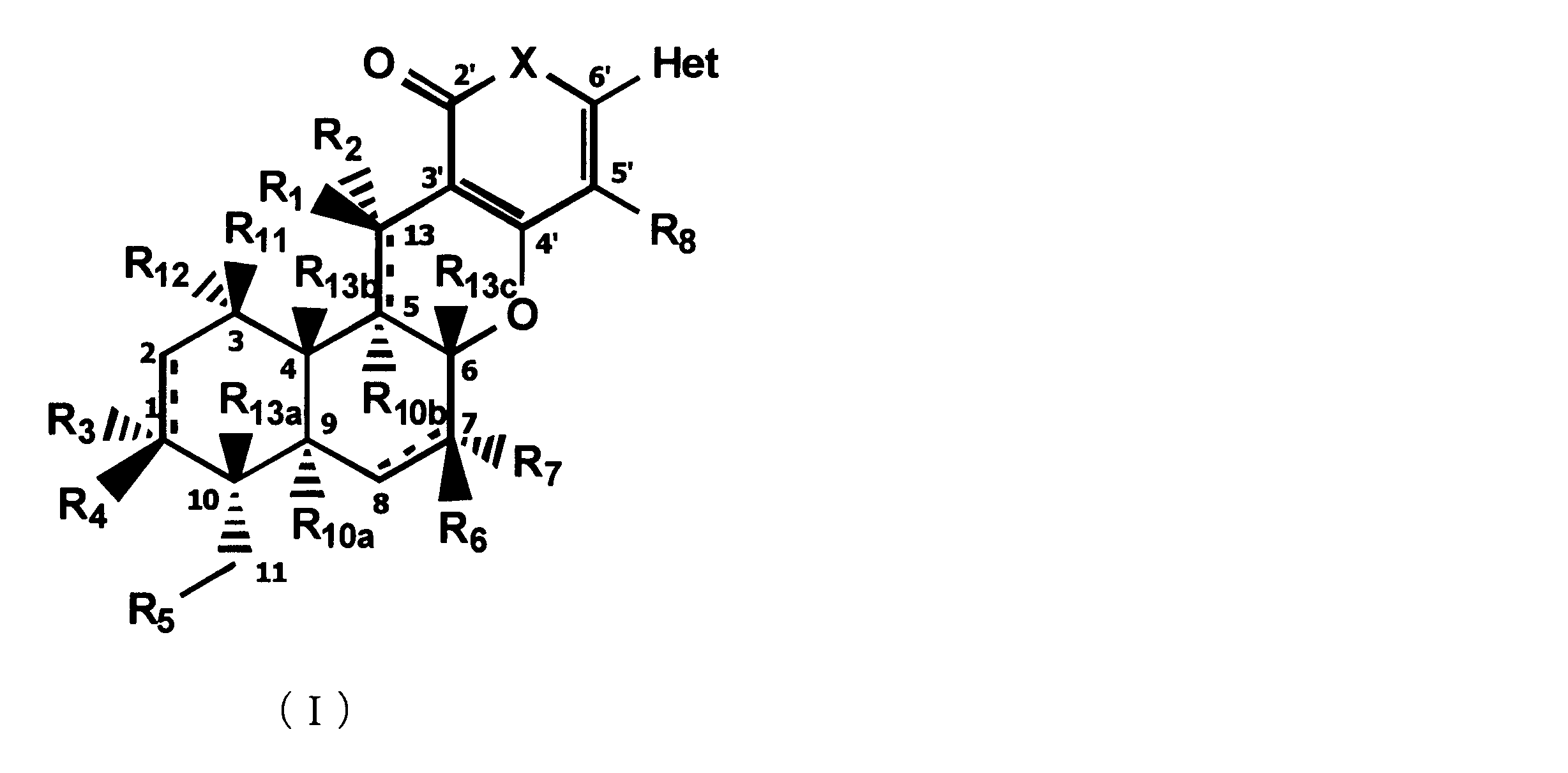
Hetは、置換されていてもよいヘテロ環基、
置換されていてもよいフェニル基、
置換されていてもよいC1-18アルキル基、または
置換されていてもよいC2-18アルケニル基、を表し、
Xは、酸素原子または、NR9(R9は水素原子、C1-6アルキル基またはアリールC1-6アルキル基を表す)を表し、
R1、R2、R3、R4、R5、R6、R7、R10a、R10b、R11およびR12は、同一または異なっていてもよく、それぞれ独立して
水素原子、
水酸基、
置換されていてもよいC1-6アルキルアミノカルボニルオキシ基、
置換されていてもよいC1-18アルキルカルボニルオキシ基、
アダマンチルカルボニルオキシ基、
置換されていてもよいアリールC1-6アルキルカルボニルオキシ基、
置換されていてもよいC2-6アルケニルカルボニルオキシ基、
置換されていてもよいC2-6アルキニルカルボニルオキシ基、
置換されていてもよい飽和または不飽和のヘテロ環C1-6アルキルカルボニルオキシ基、
置換されていてもよい飽和または不飽和のヘテロ環C2-6アルケニルカルボニルオキシ基、
置換されていてもよいアリールカルボニルオキシ基、
置換されていてもよいカルバモイルオキシ基、
置換されていてもよいカルバモイル基、
置換されていてもよいC1-6アルキルスルホニルオキシ基、
置換されていてもよいC1-6アルキルスルホニル基、
置換されていてもよいアリールスルホニルオキシ基、
置換されていてもよいアリールC1-6アルキルオキシ基、
置換されていてもよいアリールオキシカルボニルオキシ基、
置換されていてもよいアリールアミノカルボニルオキシ基、
置換されていてもよいアリールスルホニル基、
置換されていてもよいアリールスルファニル基、
置換されていてもよい飽和もしくは不飽和のヘテロ環スルファニル基、
置換されていてもよいC1-6アルキルオキシ基、
置換されていてもよいC2-6アルケニルオキシ基、
置換されていてもよいC2-6アルキニルオキシ基、
置換されていてもよいアリールオキシ基、
C1-6アルキルオキシ-C1-6アルキルオキシ基、
C1-6アルキルチオ-C1-6アルキルオキシ基、
C1-6アルキルオキシ-C1-6アルキルオキシ-C1-6アルキルオキシ基、
置換されていてもよいC1-6アルキルオキシカルボニルオキシ基、
置換されていてもよい飽和もしくは不飽和のヘテロ環オキシ基、
置換されていてもよい飽和もしくは不飽和のヘテロ環チオ基、
置換されていてもよい飽和もしくは不飽和のヘテロ環カルボニルオキシ基、
置換されていてもよい飽和もしくは不飽和のヘテロ環チオカルボニルオキシ基、
置換されていてもよいリン酸基、
置換されていてもよいC1-6アルキル基、
トリC1-6アルキルシリルオキシ基、
置換されていてもよい飽和または不飽和のヘテロ環基、
アジド基、
置換されていてもよいイミノ基、
置換されていてもよいアミノ基、
置換されていてもよいヒドラジノ基、
シアノ基、
ハロゲン原子、
-O-N=C-Y1
(ここで、Y1は、水素原子、置換されていてもよいC1-6アルキル基、置換されていてもよいC3-7シクロアルキル基、置換されていてもよいC2-6アルケニル基、置換されていてもよいC2-6アルキニル基、置換されていてもよいC1-6アルコキシ基、置換されていてもよいフェニル基、または置換されていてもよいヘテロ環基を表す)を表すか、または
R1とR2、R3とR4、R6とR7、R11とR12は、それぞれ独立して一緒になるかまたは、11位の炭素原子に置換する水素原子一原子とR5が一緒になって、
オキソ基、
=C-Y2(ここで、Y2は、ニトロ基、シアノ基、置換されていてもよいイミノ基、ヒドロキシメチル基、ヒドロキシカルボニル基、置換されていてもよいC1-6アルコキシカルボニル基、置換されていてもよいフェニル基、置換されていてもよいベンジル基、置換されていてもよいフェノキシメチル基、置換されていてもよいアリールオキシメチル基、置換されていてもよいピリジルオキシメチル基、置換されていてもよいピリミジニルオキシメチル基、置換されていてもよいC1-6アルキルカルボニル基、置換されていてもよいC1-6アルキルオキシカルボニル基、置換されていてもよいC1-4アルキルアミノカルボニル基、置換されていてもよいフェニルアミノカルボニルオキシ基、置換されていてもよいベンジルアミノカルボニルオキシ基、または置換されていてもよいヘテロ環アミノカルボニルオキシ基を表す)、または
=N-Q-Y3(ここで、Y3は、R1’、 -Z-R1’、 -Z-O -R1’、または-Z-N(R1’) (R1”)を表し、Zは、結合、-C(=O)-、-C(=S)-、-C(=O)-N-、-C(=S)-N-または-SO2-を表し、Qは、Oまたは-N-R5’を表し、R1’とR1”は、同一または異なってそれぞれ独立して、水素原子、置換されていてもよいC1-C12アルキル基、置換されていてもよいC2-C12アルケニル基、置換されていてもよいC2-C12アルキニル基、置換されていてもよいC3-C12-シクロアルキル基、置換されていてもよいC5-C12-シクロアルケニル基、置換されていてもよいアリール基、または置換されていてもよいヘテロ環基であるかまたは、R1’とR1”は一緒になって、置換されていてもよい3~7員の飽和もしくは不飽和シクロアルキル、または酸素原子、窒素原子、硫黄原子、スルホキシド基、スルホン基から選択されるものを1~2個含む3~7員のヘテロ環を形成してもよく(ここで環に含まれてもよい炭素原子、および窒素原子は、C1-8アルキル、ヒドロキシ-C1-8アルキル、C3-8シクロアルキル、C2-8アルケニル、C2-8アルキニル、フェニル、ベンジル、C1-6アルキルカルボニル基、C2-6アルケニルカルボニル基、C1-6アルキルカルボニルメチル基、またはC2-6アルケニルカルボニルメチル基で置換されていてもよい)、R5’は、水素原子、C1-8アルキル基、ヒドロキシ-C1-8アルキル基、C3-8シクロアルキル基、C2-8アルケニル基、C2-8アルキニル基、フェニル基、ベンジル基、C1-6アルキルカルボニル基、C2-6アルケニルカルボニル基、C1-6アルキルカルボニルメチル基、またはC2-6アルケニルカルボニルメチル基を表し、
Y3がR1’で、Qが-N-R5’である場合は、R1’とR5’は一緒になって、置換されていてもよい3~7員の飽和もしくは不飽和シクロアルキル、または酸素原子、窒素原子、硫黄原子、スルホキシド基、スルホン基から選択されるものを1~2個含む3~7員のヘテロ環を形成してもよく(環に含まれる炭素原子、および窒素原子は、C1-8アルキル、ヒドロキシ-C1-8アルキル、C3-8シクロアルキル、C2-8アルケニル、C2-8アルキニル、フェニル、ベンジル、C1-6アルキルカルボニル基、C2-6アルケニルカルボニル基、C1-6アルキルカルボニルメチル基、またはC2-6アルケニルカルボニルメチル基からなる群より選択される基で置換されていてもよい)、ここでR1’、R1”、およびR5’の各基に置換されていてもよい置換基とは、ハロゲン、シアノ基、ニトロ基、水酸基、ハロゲンにより置換されていてもよいC1-4アルキル基、ハロゲンにより置換されていてもよいC1-4アルキルオキシ基、ハロゲンにより置換されていてもよいC1-4アルキルチオ基、ハロゲンにより置換されていてもよいC1-4アルキルスルフィニル基、ハロゲンにより置換されていてもよいC1-4アルキルスルホニル基、ハロゲンにより置換されていてもよいC1-4アルキルカルボニル基、ハロゲンにより置換されていてもよいC1-4アルコキシカルボニル基、およびC3-6トリアルキルシリル基からなる群より選択される基を表す)
を表し、または
11位の炭素原子に置換する水素原子一原子とR5が一緒になって、さらにホルミル基、
カルボキシル基、
アリールまたは飽和もしくは不飽和のヘテロ環で置換されていてもよいC1-6アルキルオキシカルボニル基、
C1-6アルキルオキシで置換されていてもよいアリールC1-6アルキルアミノカルボニル基、
C1-6アルキルアミノカルボニル基、
飽和もしくは不飽和のヘテロ環アミノカルボニル基、
ヒドロキシC1-6アルキルアミノカルボニル基または、
C1-6アルキルオキシカルボニルおよび/またはアリール基で置換されていてもよいC1-6アルキルアミノカルボニル基を表してもよく、または
R1とR2、R3とR4、R6とR7、R11とR12は、それぞれ独立して、一緒になって、
置換されていてもよい3~7員の飽和もしくは不飽和シクロアルキル、または
酸素原子、窒素原子、硫黄原子、スルホキシド基、スルホン基から選択されるものを1~2個含む3~7員のヘテロ環を形成してもよく(環に含まれていてもよい炭素原子、および窒素原子は、C1-8アルキル、ヒドロキシ-C1-8アルキル、C3-8シクロアルキル、C2-8アルケニル、C2-8アルキニル、フェニル、ベンジル、C1-6アルキルカルボニル基、C2-6アルケニルカルボニル基、C1-6アルキルカルボニルメチル基、またはC2-6アルケニルカルボニルメチル基で置換されていてもよい)を表し、または
R1またはR2が存在せずに5位の炭素原子に置換する水素原子を失って5位-13位間で、またはR6またはR7が存在せずに8位の炭素原子に置換する水素原子を一原子失って7位-8位間で、またはR3またはR4が存在せずに2位の炭素原子に置換する水素原子を失って1位-2位間で二重結合を表し、または
R3またはR4と、R5が一緒になって-O-CR3’(R4’)-O-(R3’およびR4’は同一または異なって、水素原子、C1-6アルキル基、C1-6アルキルオキシ基、C2-6アルケニル基、置換されていてもよいアリール基または置換されていてもよいアリールC1-6アルキル基を表すかあるいは、R3’およびR4’が、一緒になってオキソ基、チオキソ基またはC2-6アルキレン基を表す)、または-O-SiR3’(R4’)-O-(R3’およびR4’は前記と同じ意味を表す)を表し、
R8は、水素原子、シアノ基、ハロゲン原子、またはベンジル基を表し、
R13a、R13b、およびR13cは、同一または異なっていてもよく、それぞれ独立して、
水酸基、ハロゲン原子および、シアノ基からなる群より選択される基で置換されていてもよいC1-6アルキル基、または
水酸基、ハロゲン原子および、シアノ基からなる群より選択される基で置換されていてもよいC2-6アルケニル基を表す]で表される化合物またはその塩を一種またはそれ以上と農畜薬上許容可能な担体とを含有するものである。
The composition used as a pest control agent according to the present invention has the following formula (I) as an active ingredient:
Het is an optionally substituted heterocyclic group,
An optionally substituted phenyl group,
Represents an optionally substituted C 1-18 alkyl group, or an optionally substituted C 2-18 alkenyl group,
X represents an oxygen atom or NR 9 (R 9 represents a hydrogen atom, a C 1-6 alkyl group or an aryl C 1-6 alkyl group),
R 1 , R 2 , R 3 , R 4 , R 5 , R 6 , R 7 , R 10a , R 10b , R 11 and R 12 may be the same or different and each independently represents a hydrogen atom,
Hydroxyl group,
An optionally substituted C 1-6 alkylaminocarbonyloxy group,
An optionally substituted C 1-18 alkylcarbonyloxy group,
An adamantylcarbonyloxy group,
An optionally substituted aryl C 1-6 alkylcarbonyloxy group,
An optionally substituted C 2-6 alkenylcarbonyloxy group,
An optionally substituted C 2-6 alkynylcarbonyloxy group,
A saturated or unsaturated heterocyclic C 1-6 alkylcarbonyloxy group which may be substituted,
A saturated or unsaturated heterocyclic C 2-6 alkenylcarbonyloxy group which may be substituted,
An optionally substituted arylcarbonyloxy group,
An optionally substituted carbamoyloxy group,
An optionally substituted carbamoyl group,
An optionally substituted C 1-6 alkylsulfonyloxy group,
An optionally substituted C 1-6 alkylsulfonyl group,
Arylsulfonyloxy group which may be substituted,
An optionally substituted aryl C 1-6 alkyloxy group,
Aryloxycarbonyloxy group which may be substituted,
An optionally substituted arylaminocarbonyloxy group,
An optionally substituted arylsulfonyl group,
An optionally substituted arylsulfanyl group,
An optionally substituted saturated or unsaturated heterocyclic sulfanyl group,
An optionally substituted C 1-6 alkyloxy group,
An optionally substituted C 2-6 alkenyloxy group,
An optionally substituted C 2-6 alkynyloxy group,
An optionally substituted aryloxy group,
C 1-6 alkyloxy-C 1-6 alkyloxy group,
C 1-6 alkylthio-C 1-6 alkyloxy group,
C 1-6 alkyloxy-C 1-6 alkyloxy-C 1-6 alkyloxy group,
An optionally substituted C 1-6 alkyloxycarbonyloxy group,
An optionally substituted saturated or unsaturated heterocyclic oxy group,
An optionally substituted saturated or unsaturated heterocyclic thio group,
An optionally substituted saturated or unsaturated heterocyclic carbonyloxy group,
An optionally substituted saturated or unsaturated heterocyclic thiocarbonyloxy group,
An optionally substituted phosphate group,
An optionally substituted C 1-6 alkyl group,
Tri-C 1-6 alkylsilyloxy group,
An optionally substituted saturated or unsaturated heterocyclic group,
Azido group,
An optionally substituted imino group,
An optionally substituted amino group,
An optionally substituted hydrazino group,
A cyano group,
Halogen atoms,
-ON = C-Y1
(Where Y1 is a hydrogen atom, an optionally substituted C 1-6 alkyl group, an optionally substituted C 3-7 cycloalkyl group, an optionally substituted C 2-6 alkenyl group, Represents an optionally substituted C 2-6 alkynyl group, an optionally substituted C 1-6 alkoxy group, an optionally substituted phenyl group, or an optionally substituted heterocyclic group). Or R 1 and R 2 , R 3 and R 4 , R 6 and R 7 , R 11 and R 12 are each independently combined or a hydrogen atom substituted on the 11th carbon atom And R 5 together
An oxo group,
= C-Y2 (where Y2 is a nitro group, a cyano group, an optionally substituted imino group, a hydroxymethyl group, a hydroxycarbonyl group, an optionally substituted C 1-6 alkoxycarbonyl group, a substituted Optionally substituted phenyl group, optionally substituted benzyl group, optionally substituted phenoxymethyl group, optionally substituted aryloxymethyl group, optionally substituted pyridyloxymethyl group, substituted which may be pyrimidinyloxy methyl group, an optionally substituted C 1-6 alkylcarbonyl group, an optionally substituted C 1-6 alkyloxycarbonyl group, an optionally C 1-4 alkylamino optionally substituted A carbonyl group, an optionally substituted phenylaminocarbonyloxy group, an optionally substituted benzylaminocarbonyloxy group, or Are representative of which may heterocyclic amino carbonyl group optionally), or = NQ-Y3 (wherein, Y3 is, R 1 ', -ZR 1' , -ZO -R 1 ', or -ZN (R 1' ) (R 1 ' ') and Z is a bond, -C (= O)-, -C (= S)-, -C (= O) -N-, -C (= S) -N- or —SO 2 —, Q represents O or —NR 5 ′, R 1 ′ and R 1 ″ are the same or different and are each independently a hydrogen atom, optionally substituted C 1 -C 12 alkyl group, optionally substituted C 2 -C 12 alkenyl group, optionally substituted C 2 -C 12 alkynyl group, an optionally substituted C 3 -C 12 - cycloalkyl radical, substituted An optionally substituted C 5 -C 12 -cycloalkenyl group, an optionally substituted aryl group, or an optionally substituted heterocyclic group, or R 1 ′ and R 1 ″ are taken together Optionally substituted 3-7 membered saturated or unsaturated cycloalkyl, or acid A 3- to 7-membered heterocyclic ring containing 1 to 2 members selected from an atom, a nitrogen atom, a sulfur atom, a sulfoxide group, and a sulfone group may be formed (here, carbon atoms that may be included in the ring, And nitrogen atom is C 1-8 alkyl, hydroxy-C 1-8 alkyl, C 3-8 cycloalkyl, C 2-8 alkenyl, C 2-8 alkynyl, phenyl, benzyl, C 1-6 alkylcarbonyl group, C 2-6 alkenylcarbonyl group, C 1-6 alkylcarbonylmethyl group, or C 2-6 alkenylcarbonylmethyl group may be substituted), R 5 ′ is a hydrogen atom, C 1-8 alkyl group, Hydroxy-C 1-8 alkyl group, C 3-8 cycloalkyl group, C 2-8 alkenyl group, C 2-8 alkynyl group, phenyl group, benzyl group, C 1-6 alkylcarbonyl group, C 2-6 alkenyl group Carbonyl group, C 1-6 alkylcarbonylmethyl group, or C 2-6 alkeni Represents a rucarbonylmethyl group,
When Y3 is R 1 ′ and Q is —NR 5 ′, R 1 ′ and R 5 ′ are taken together to form an optionally substituted 3- to 7-membered saturated or unsaturated cycloalkyl, or A 3- to 7-membered heterocyclic ring containing 1 to 2 members selected from an oxygen atom, a nitrogen atom, a sulfur atom, a sulfoxide group, and a sulfone group may be formed (the carbon atom and nitrogen atom included in the ring are , C 1-8 alkyl, hydroxy-C 1-8 alkyl, C 3-8 cycloalkyl, C 2-8 alkenyl, C 2-8 alkynyl, phenyl, benzyl, C 1-6 alkylcarbonyl group, C 2-6 Optionally substituted with a group selected from the group consisting of an alkenylcarbonyl group, a C 1-6 alkylcarbonylmethyl group, or a C 2-6 alkenylcarbonylmethyl group), wherein R 1 ′, R 1 ″, and The substituents that may be substituted on each group of R 5 ′ are halogen, cyano group, nitro group, water An acid group, a C 1-4 alkyl group which may be substituted by halogen, a C 1-4 alkyloxy group which may be substituted by halogen, a C 1-4 alkylthio group which may be substituted by halogen, a halogen substituted optionally substituted C 1-4 alkylsulfinyl group, optionally substituted by halogen C 1-4 alkylsulfonyl group, an optionally substituted C 1-4 alkyl group by halogen, the halogen Represents a group selected from the group consisting of an optionally substituted C 1-4 alkoxycarbonyl group and a C 3-6 trialkylsilyl group)
Or a hydrogen atom substituted with a carbon atom at the 11-position and R 5 together, and further a formyl group,
Carboxyl group,
A C 1-6 alkyloxycarbonyl group optionally substituted by aryl or a saturated or unsaturated heterocycle,
An aryl C 1-6 alkylaminocarbonyl group optionally substituted with C 1-6 alkyloxy,
A C 1-6 alkylaminocarbonyl group,
A saturated or unsaturated heterocyclic aminocarbonyl group,
A hydroxy C 1-6 alkylaminocarbonyl group, or
It may represent a C 1-6 alkylaminocarbonyl group optionally substituted by a C 1-6 alkyloxycarbonyl and / or aryl group, or R 1 and R 2 , R 3 and R 4 , R 6 and R 7 , R 11 and R 12 are each independently and together
Optionally substituted 3- to 7-membered saturated or unsaturated cycloalkyl, or 3- to 7-membered heteroalkyl containing 1 to 2 selected from oxygen atom, nitrogen atom, sulfur atom, sulfoxide group, sulfone group Rings may be formed (carbon atoms and nitrogen atoms that may be included in the ring are C 1-8 alkyl, hydroxy-C 1-8 alkyl, C 3-8 cycloalkyl, C 2-8 alkenyl. C 2-8 alkynyl, phenyl, benzyl, C 1-6 alkylcarbonyl group, C 2-6 alkenylcarbonyl group, C 1-6 alkylcarbonylmethyl group, or C 2-6 alkenylcarbonylmethyl group 8) without the presence of R 1 or R 2 and the loss of a hydrogen atom substituting for the carbon atom at the 5-position between the 5-position and the 13-position, or without the presence of R 6 or R 7 Between the 7th and 8th positions by losing one hydrogen atom replacing the carbon atom Or losing a hydrogen atom R 3 or R 4 is substituted at the 2-position carbon atoms of the absent between position 1 position -2 represents a double bond, or with R 3 or R 4, R 5 are together -O-CR 3 '(R 4 ') -O- (R 3 'and R 4 ' are the same or different and represent a hydrogen atom, a C 1-6 alkyl group, a C 1-6 alkyloxy group, C 2 -6 alkenyl group, an optionally substituted aryl group or an optionally substituted aryl C 1-6 alkyl group, or R 3 ′ and R 4 ′ together represent an oxo group, a thioxo group Or represents a C 2-6 alkylene group), or —O—SiR 3 ′ (R 4 ′) —O— (R 3 ′ and R 4 ′ represent the same meaning as described above),
R 8 represents a hydrogen atom, a cyano group, a halogen atom, or a benzyl group,
R 13a , R 13b , and R 13c may be the same or different and are each independently
C 1-6 alkyl group optionally substituted with a group selected from the group consisting of a hydroxyl group, a halogen atom and a cyano group, or a group selected from the group consisting of a hydroxyl group, a halogen atom and a cyano group A C 2-6 alkenyl group which may optionally be present] or a salt thereof, and an agrochemical acceptable carrier.
また、本発明によれば、有害生物防除剤の有効成分になり得る次式(I-a)

また、本発明によれば、有害生物防除剤の有効成分になり得る下式(I-a’):
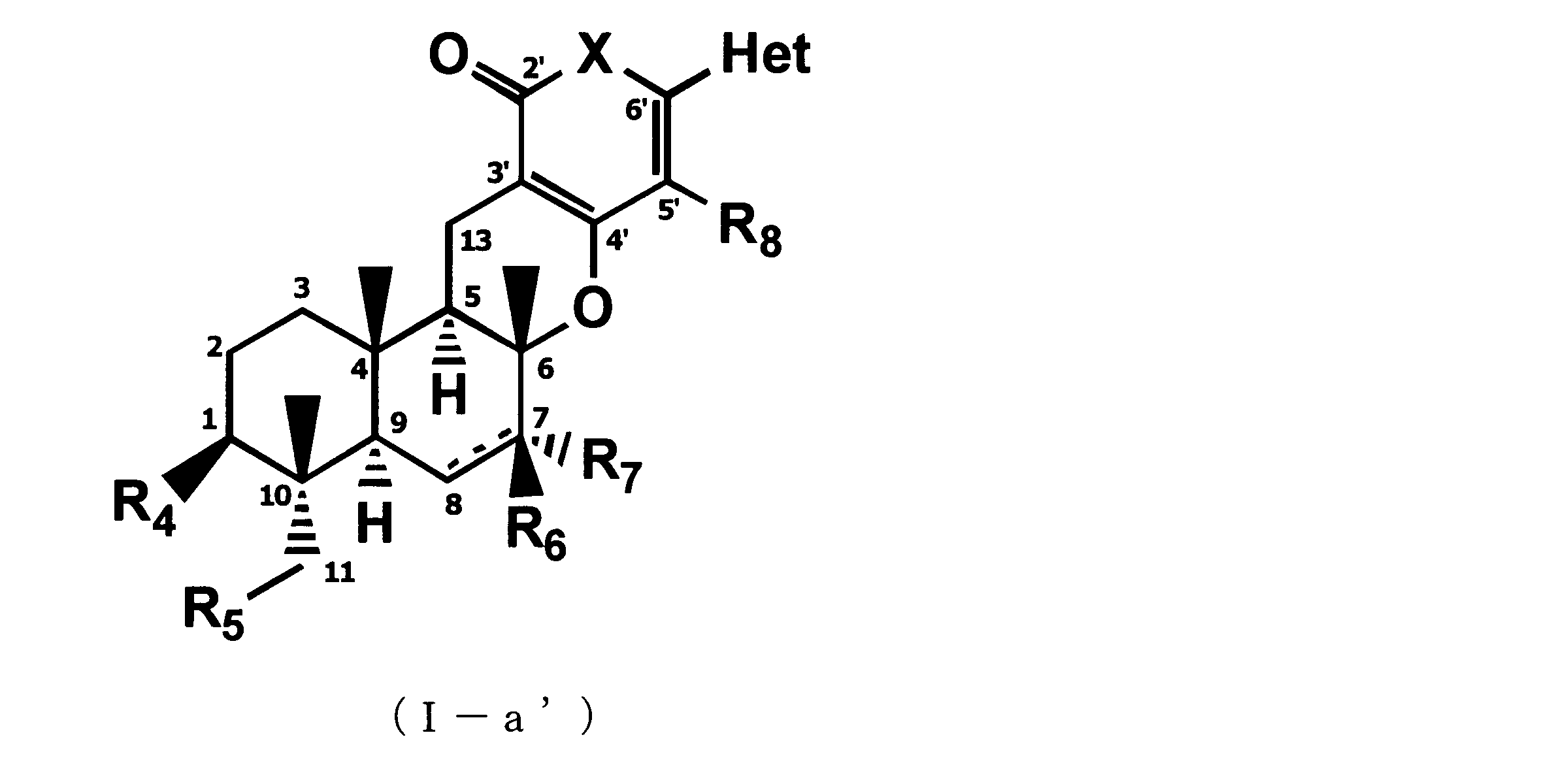
Hetは、置換されていてもよいピリジル基を表し、
Xは、酸素原子を表し、
R4は、水酸基または、置換されていてもよいC1-18アルキルカルボニルオキシ基を表し、
R5は、水素原子、水酸基または、置換されていてもよいC1-18アルキルカルボニルオキシ基を表すかまたは、
R4とR5が一緒になって-O-CR3’(R4’)-O-(R3’およびR4’は同一または異なって、水素原子、C1-6アルキル基を表すかあるいは、R3’およびR4’が、一緒になってチオキソ基を表す)を表し、
R6は、水素原子、水酸基または、置換されていてもよいC1-18アルキルカルボニルオキシ基を表し、
R7およびR8は、水素原子を表すかまたは、
R6またはR7が存在せずに8位の炭素原子に置換する水素原子を一原子失って7位-8位間で二重結合を表すがただし、
以下の化合物:
R5、R6およびR7が水素原子を表し、R4は水酸基、アセチルオキシ基、またはプロピオニルオキシ基を表す化合物、
R6およびR7は水素原子を表し、R4はアセチルオキシ基を表しかつR5はプロピオニルオキシ基を表す化合物、
R6およびR7は水素原子を表し、R4およびR5はアセチルオキシ基を表す化合物、
R6およびR7は水素原子を表し、R4はプロピオニルオキシ基を表しかつR5がアセチルオキシ基を表す化合物、
R4およびR5はアセチルオキシ基を表し、R6はプロピオニルオキシ基を表しかつR7は水素原子を表す化合物
を除く] で表される化合物またはその塩が提供される。
Further, according to the present invention, the following formula (Ia ′), which can be an active ingredient of a pest control agent:
Het represents an optionally substituted pyridyl group,
X represents an oxygen atom,
R 4 represents a hydroxyl group or an optionally substituted C 1-18 alkylcarbonyloxy group,
R 5 represents a hydrogen atom, a hydroxyl group, or an optionally substituted C 1-18 alkylcarbonyloxy group, or
R 4 and R 5 together represent —O—CR 3 ′ (R 4 ′) —O— (R 3 ′ and R 4 ′ are the same or different and represent a hydrogen atom or a C 1-6 alkyl group; Or R 3 'and R 4 ' together represent a thioxo group)
R 6 represents a hydrogen atom, a hydroxyl group, or an optionally substituted C 1-18 alkylcarbonyloxy group,
R 7 and R 8 represent a hydrogen atom or
In the absence of R 6 or R 7, a hydrogen atom that substitutes for the carbon atom at the 8-position is lost and a double bond is represented between the 7- and 8-positions.
The following compounds:
R 5 , R 6 and R 7 represent a hydrogen atom, R 4 represents a hydroxyl group, an acetyloxy group or a propionyloxy group,
R 6 and R 7 represent a hydrogen atom, R 4 represents an acetyloxy group and R 5 represents a propionyloxy group,
R 6 and R 7 represent a hydrogen atom, R 4 and R 5 represent a compound that represents an acetyloxy group,
R 6 and R 7 represent a hydrogen atom, R 4 represents a propionyloxy group and R 5 represents an acetyloxy group,
R 4 and R 5 represent an acetyloxy group, R 6 represents a propionyloxy group, and R 7 excludes a compound representing a hydrogen atom] or a salt thereof.
また、本発明によれば、有害生物防除剤の有効成分になり得る次式(I-b):
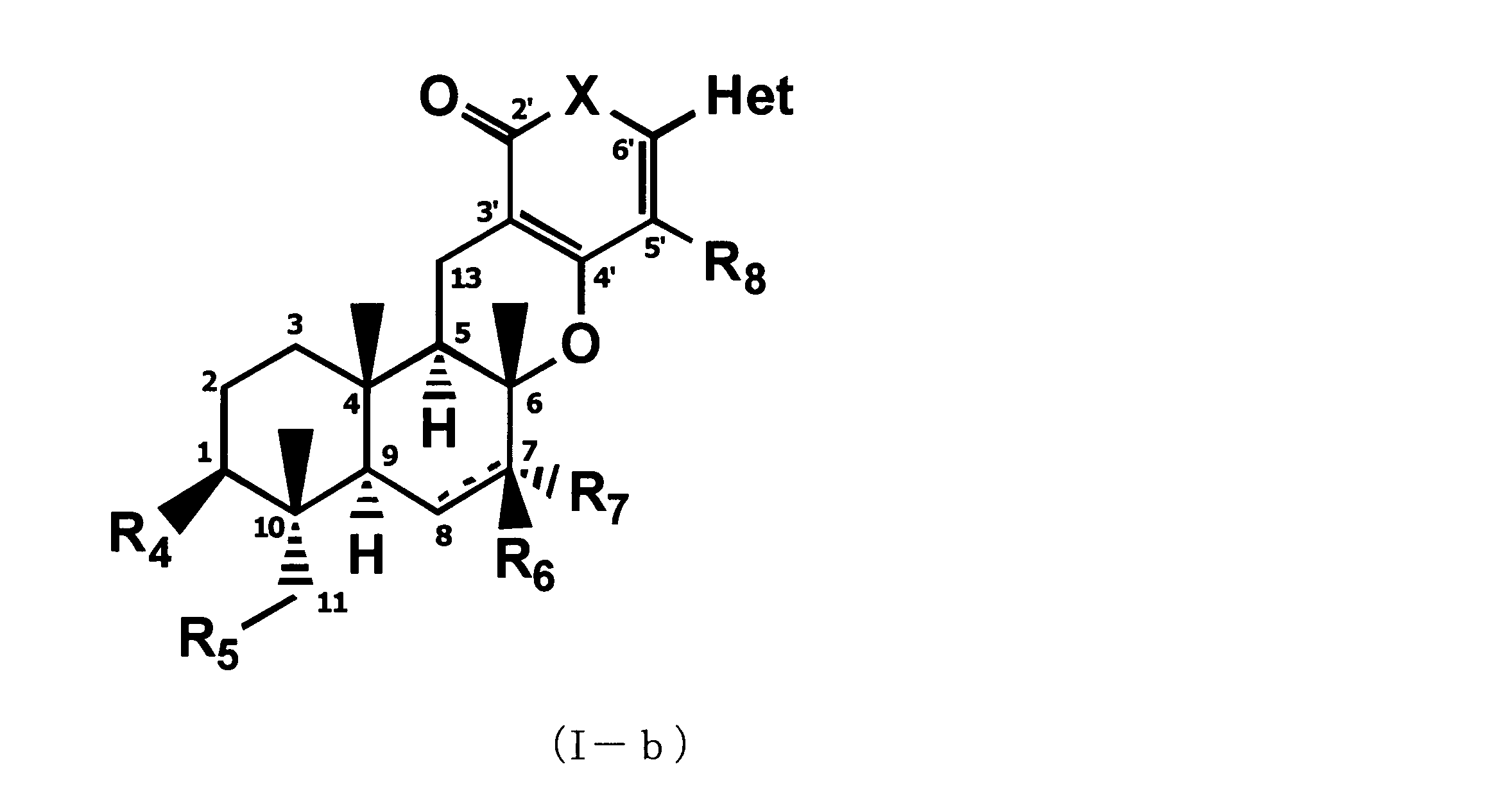
Hetは、置換されていてもよいピリジル基を表し、
Xは、酸素原子を表し、
R4は、水酸基または、置換されていてもよいC3-6シクロアルキルカルボニルオキシ基を表し、
R5は、水素原子、水酸基または、置換されていてもよいC3-6シクロアルキルカルボニルオキシ基を表し、
R6は、水素原子、水酸基または、置換されていてもよいC3-6シクロアルキルカルボニルオキシ基を表し、
R7は、水素原子を表すか、または、
R6またはR7が存在せずに8位の炭素原子に置換する水素原子を一原子失って7位-8位間で二重結合を表し、
R8は、水素原子を表すが、ただし、R5、R6が同時に水素原子を表すとき、R4は水酸基を表すことはない)
で表される化合物またはその塩が提供される。
Further, according to the present invention, the following formula (Ib) which can be an active ingredient of a pest control agent:
Het represents an optionally substituted pyridyl group,
X represents an oxygen atom,
R 4 represents a hydroxyl group or an optionally substituted C 3-6 cycloalkylcarbonyloxy group,
R 5 represents a hydrogen atom, a hydroxyl group, or an optionally substituted C 3-6 cycloalkylcarbonyloxy group,
R 6 represents a hydrogen atom, a hydroxyl group, or an optionally substituted C 3-6 cycloalkylcarbonyloxy group,
R 7 represents a hydrogen atom, or
In the absence of R 6 or R 7 , one hydrogen atom substituted for the carbon atom at the 8-position is lost, and a double bond is represented between the 7-position and the 8-position,
R 8 represents a hydrogen atom. However, when R 5 and R 6 represent a hydrogen atom at the same time, R 4 does not represent a hydroxyl group.
Or a salt thereof is provided.
また、本発明によれば、有害生物防除剤の有効成分になり得る次式(I-c):

Hetは、3-ピリジル基であり、
Xは、酸素原子であり、
R1は、直鎖、分岐鎖、もしくは環状のC1-6アルキルカルボニルオキシ基、またはC1-6アルキルオキシ基、
R4は、C3-6シクロアルキルカルボニルオキシ基であり、
R5は、C3-6シクロアルキルカルボニルオキシ基であり、
R6は、水酸基、アセチルオキシ基またはC3-6シクロアルキルカルボニルオキシ基であり、
R7およびR8は、水素原子である)
で表される化合物またはその塩が提供される。
Further, according to the present invention, the following formula (Ic) that can be an active ingredient of a pest control agent:
Het is a 3-pyridyl group,
X is an oxygen atom,
R 1 is a linear, branched, or cyclic C 1-6 alkylcarbonyloxy group, or a C 1-6 alkyloxy group,
R 4 is a C 3-6 cycloalkylcarbonyloxy group,
R 5 is a C 3-6 cycloalkylcarbonyloxy group,
R 6 is a hydroxyl group, an acetyloxy group or a C 3-6 cycloalkylcarbonyloxy group,
R 7 and R 8 are hydrogen atoms)
Or a salt thereof is provided.
そして本発明によれば、有効成分として、前記式(I-a)、式(I-a’)式(I-b)または式(I-c)で表される化合物またはその塩と、農畜薬上許容可能な担体とを含有する、有害生物防除剤として用いられる組成物が提供される。 According to the present invention, as an active ingredient, a compound represented by the formula (Ia), formula (Ia ′), formula (Ib) or formula (Ic) or a salt thereof, There is provided a composition for use as a pest control agent comprising a veterinary acceptable carrier.
本発明による式(I)、式(I-a)、式(I-a’)、式(I-b)、または式(I-c)で表される化合物は、農園芸上の害虫、衛生害虫、動物の寄生虫、貯穀害虫、衣類害虫、家屋害虫に対して優れた防除効果を示すものであり、上記化合物を有効成分として含有する組成物は、有害生物防除剤として有利に利用することができる。また、一つの態様によれば、上記化合物を有効成分として含有する組成物は、有害生物防除に用いられる薬剤、すなわち抗有害生物薬剤として好適に用いることができる。 The compound represented by the formula (I), the formula (Ia), the formula (Ia ′), the formula (Ib), or the formula (Ic) according to the present invention is an agricultural and horticultural pest, It exhibits an excellent control effect against sanitary pests, animal parasites, stored grain pests, clothing pests, house pests, and a composition containing the above compound as an active ingredient is advantageously used as a pest control agent be able to. Moreover, according to one aspect, the composition containing the above compound as an active ingredient can be suitably used as a drug used for pest control, that is, an anti-pesticide drug.
本明細書において「ハロゲン」とは、フッ素、塩素、臭素、ヨウ素を意味し、好ましくはフッ素、塩素、臭素である。
また、本明細書において、基または基の一部としての「アルキル」、「アルケニル」、または「アルキニル」という語はそれぞれ、特に定義されていない限り、基が直鎖状、分岐鎖状、環状あるいはそれらの組み合わせのアルキル、アルケニルまたはアルキニルを意味する。また例えば、基または基の一部としての「C1-6アルキル」という場合の「C1-6」とは、該アルキル基の炭素数1~6個であることを意味する。さらにシクロアルキルの場合はその炭素数は少なくとも3個であることを意味する。
また、本明細書において、基または基の一部としての「アリール」とは、フェニル基、またはナフチル基を表す。
また、本明細書において「ヘテロ環」とは、同一または異なって、窒素、酸素、および硫黄からなる群から選択されるヘテロ原子を1または複数個、好ましくは1~4個有する5~7員の飽和、不飽和または芳香族のヘテロ環、または窒素、酸素、および硫黄からなる群から選択されるヘテロ原子を1または複数個、好ましくは1~4個有する5~7員の飽和、不飽和または芳香族のヘテロ環、および5~7員の飽和、不飽和または芳香族の炭化水素環から選抜される2~4環が縮合したヘテロ環を意味し、好ましくは5~7員環のものを示す。
また、本明細書において、アルキル基が「置換されていてもよい」とは、アルキル基上の1またはそれ以上の水素原子が1またはそれ以上の置換基(同一または異なっていてもよい)により置換されていてもよいことを意味する。置換基の最大数はアルキル上の置換可能な水素原子の数に依存して決定できることは当業者に明らかであろう。これらはアルキル基以外の官能基についても同様である。
In the present specification, “halogen” means fluorine, chlorine, bromine and iodine, preferably fluorine, chlorine and bromine.
Also, in this specification, the term “alkyl”, “alkenyl”, or “alkynyl” as a group or part of a group, respectively, unless otherwise defined, the group is linear, branched, cyclic Or a combination thereof of alkyl, alkenyl or alkynyl. Further, for example, "C 1-6" as "C 1-6 alkyl" as a group or part of a group means that the number of 1 to 6 carbon atoms within the alkyl group. In the case of cycloalkyl, it means that the number of carbon atoms is at least 3.
In this specification, “aryl” as a group or part of a group represents a phenyl group or a naphthyl group.
In the present specification, the “heterocycle” is the same or different and is a 5- to 7-membered member having one or more, preferably 1 to 4, heteroatoms selected from the group consisting of nitrogen, oxygen, and sulfur. 5-7 membered saturated, unsaturated, having 1 or more, preferably 1 to 4 heteroatoms selected from the group consisting of saturated, unsaturated or aromatic heterocycles, or nitrogen, oxygen and sulfur Or an aromatic heterocycle and a heterocycle in which 2 to 4 rings selected from 5 to 7-membered saturated, unsaturated or aromatic hydrocarbon rings are condensed, preferably 5 to 7-membered Indicates.
In the present specification, an alkyl group may be “substituted” by the fact that one or more hydrogen atoms on the alkyl group are substituted by one or more substituents (which may be the same or different). It means that it may be substituted. It will be apparent to those skilled in the art that the maximum number of substituents can be determined depending on the number of substitutable hydrogen atoms on the alkyl. The same applies to functional groups other than alkyl groups.
Hetが表す「ヘテロ環基」および、「フェニル基」は、置換されていてもよく、置換基としてはハロゲン原子、C1-4アルキル基、C1-4アルキルオキシ基、ニトロ基、シアノ基、ホルミル基、トリフルオロメチル基、トリフルオロメトキシ基、トリフルオロメチルチオ基、トリフルオロメチルスルフィニル基、トリフルオロメチルスルホニル基、アセチル基またはアセチルオキシ基が挙げられ、好ましくはハロゲン原子またはトリフルオロメチル基であり、より好ましくは塩素原子またはトリフルオロメチル基である。
Hetが表す「C1-18アルキル基」は、好ましくは、C1-6アルキル基であり、Hetが表す「C2-18アルケニル基」は、好ましくは、C2-6アルケニル基である。
Hetが表す「C1-18アルキル基」および、「C2-18アルケニル基」は、置換されていてもよく、置換基としては、ハロゲン原子、ハロゲンにより置換されていてもよいC1-4アルキルオキシ基、シアノ基、フェニル基、ヘテロ環基、フェニルオキシ基、ヘテロ環オキシ基(これらフェニル基、ヘテロ環基、フェニルオキシ基、およびヘテロ環オキシ基は、ハロゲン原子、C1-4アルキル基、C1-4アルキルオキシ基、ニトロ基、シアノ基、ホルミル基、トリフルオロメチル基、トリフルオロメトキシ基、トリフルオロメチルチオ基、トリフルオロメチルスルフィニル基、トリフルオロメチルスルホニル基、アセチル基、およびアセチルオキシ基からなる群より選択される基によって置換されていてもよい)が挙げられる。
Hetが表すヘテロ環基、フェニル基、C1-18アルキル基、またはC2-18アルケニル基は、好ましくは、ヘテロ環基、フェニル基であり、より好ましくはピリジル基であり、特に好ましくは、3-ピリジル基である。
The “heterocyclic group” and “phenyl group” represented by Het may be substituted, and examples of the substituent include a halogen atom, a C 1-4 alkyl group, a C 1-4 alkyloxy group, a nitro group, and a cyano group. , Formyl group, trifluoromethyl group, trifluoromethoxy group, trifluoromethylthio group, trifluoromethylsulfinyl group, trifluoromethylsulfonyl group, acetyl group or acetyloxy group, preferably halogen atom or trifluoromethyl group And more preferably a chlorine atom or a trifluoromethyl group.
The “C 1-18 alkyl group” represented by Het is preferably a C 1-6 alkyl group, and the “C 2-18 alkenyl group” represented by Het is preferably a C 2-6 alkenyl group.
The “C 1-18 alkyl group” and the “C 2-18 alkenyl group” represented by Het may be substituted, and examples of the substituent include a halogen atom and a C 1-4 optionally substituted by halogen. Alkyloxy group, cyano group, phenyl group, heterocyclic group, phenyloxy group, heterocyclic oxy group (these phenyl group, heterocyclic group, phenyloxy group, and heterocyclic oxy group are a halogen atom, C 1-4 alkyl Group, C 1-4 alkyloxy group, nitro group, cyano group, formyl group, trifluoromethyl group, trifluoromethoxy group, trifluoromethylthio group, trifluoromethylsulfinyl group, trifluoromethylsulfonyl group, acetyl group, and And may be substituted with a group selected from the group consisting of acetyloxy groups).
The heterocyclic group, phenyl group, C 1-18 alkyl group, or C 2-18 alkenyl group represented by Het is preferably a heterocyclic group, a phenyl group, more preferably a pyridyl group, and particularly preferably 3-pyridyl group.
Xが表す酸素原子または、NR9(R9は水素原子、C1-6アルキル基またはアリールC1-6アルキル基を表す)は、好ましくは酸素原子である。 The oxygen atom represented by X or NR 9 (R 9 represents a hydrogen atom, a C 1-6 alkyl group or an aryl C 1-6 alkyl group) is preferably an oxygen atom.
R1、R2、R3、R4、R5、R6、R7、R10a、R10b、R11およびR12が表す「C1-6アルキルアミノカルボニルオキシ基」は、好ましくはC1-3アルキルアミノカルボニルオキシ基である。
R1、R2、R3、R4、R5、R6、R7、R10a、R10b、R11およびR12が表す「C1-6アルキルアミノカルボニルオキシ基」は、置換されていてもよく、置換基としては、ハロゲン原子、シアノ基、フェニル基、トリフルオロメトキシ基またはトリフルオロメチルチオ基が挙げられる。
The `` C 1-6 alkylaminocarbonyloxy group '' represented by R 1 , R 2 , R 3 , R 4 , R 5 , R 6 , R 7 , R 10a , R 10b , R 11 and R 12 is preferably C 1-3 is an alkylaminocarbonyloxy group.
The `` C 1-6 alkylaminocarbonyloxy group '' represented by R 1 , R 2 , R 3 , R 4 , R 5 , R 6 , R 7 , R 10a , R 10b , R 11 and R 12 is substituted. The substituent may be a halogen atom, a cyano group, a phenyl group, a trifluoromethoxy group, or a trifluoromethylthio group.
R1、およびR2が表す「C1-18アルキルカルボニルオキシ基」は、好ましくは、C1-6アルキルカルボニルオキシ基であり、置換されていてもよく、置換基としては、ハロゲン原子、シアノ基、フェニル基、トリフルオロメトキシ基またはトリフルオロメチルチオ基が挙げられる。 The “C 1-18 alkylcarbonyloxy group” represented by R 1 and R 2 is preferably a C 1-6 alkylcarbonyloxy group, which may be substituted. Examples of the substituent include a halogen atom, cyano Group, phenyl group, trifluoromethoxy group or trifluoromethylthio group.
R3、R4、R5、R6、R7、R10a、R10b、R11およびR12が表す「C1-18アルキルカルボニルオキシ基」は、好ましくはC1-6アルキルカルボニルオキシ基であり、より好ましくは、プロピオニルオキシ基またはC3-6シクロアルキルカルボニルオキシ基である。このC1-18アルキルカルボニルオキシ基は、置換されていてもよく、置換基としては、ハロゲン原子、シアノ基、C3-6シクロアルキル、C1-6アルキルオキシ-C1-6アルキルオキシ基、フェニル基、ハロゲンで置換されていてもよいC1-6アルキルオキシ基、ハロゲンで置換されていてもよいC1-6アルキルチオ基、C1-6アルキル基で置換されていてもよいオキシム基、ピリジル基またはピリジルチオ基が挙げられ、好ましくは、ハロゲン原子、C3-6シクロアルキルまたはピリジル基である。 The “C 1-18 alkylcarbonyloxy group” represented by R 3 , R 4 , R 5 , R 6 , R 7 , R 10a , R 10b , R 11 and R 12 is preferably a C 1-6 alkylcarbonyloxy group. And more preferably a propionyloxy group or a C 3-6 cycloalkylcarbonyloxy group. This C 1-18 alkylcarbonyloxy group may be substituted, and examples of the substituent include a halogen atom, a cyano group, a C 3-6 cycloalkyl, a C 1-6 alkyloxy-C 1-6 alkyloxy group. , Phenyl group, C 1-6 alkyloxy group optionally substituted with halogen, C 1-6 alkylthio group optionally substituted with halogen, oxime group optionally substituted with C 1-6 alkyl group A pyridyl group or a pyridylthio group, preferably a halogen atom, a C 3-6 cycloalkyl or a pyridyl group.
R1、R2、R3、R4、R5、R6、R7、R10a、R10b、R11およびR12が表す「C2-6アルケニルカルボニルオキシ基」は置換されていてもよく、置換基としては、ハロゲン原子、シアノ基、フェニル基またはトリフルオロメトキシ基またはトリフルオロメチルチオ基が挙げられる。 The “C 2-6 alkenylcarbonyloxy group” represented by R 1 , R 2 , R 3 , R 4 , R 5 , R 6 , R 7 , R 10a , R 10b , R 11 and R 12 may be substituted. Often, examples of the substituent include a halogen atom, a cyano group, a phenyl group, a trifluoromethoxy group, and a trifluoromethylthio group.
R1、R2、R3、R4、R5、R6、R7、R10a、R10b、R11およびR12が表す「C2-6アルキニルカルボニルオキシ基」は置換されていてもよく、置換基としては、ハロゲン原子、シアノ基、フェニル基またはトリフルオロメトキシ基またはトリフルオロメチルチオ基が挙げられる。 The “C 2-6 alkynylcarbonyloxy group” represented by R 1 , R 2 , R 3 , R 4 , R 5 , R 6 , R 7 , R 10a , R 10b , R 11 and R 12 may be substituted. Often, examples of the substituent include a halogen atom, a cyano group, a phenyl group, a trifluoromethoxy group, or a trifluoromethylthio group.
R1、R2、R3、R4、R5、R6、R7、R10a、R10b、R11およびR12が表す「C1-6アルキルオキシ基」、および「C1-6アルキル基」は置換されていてもよく、置換基としては、ハロゲン原子、シアノ基、C1-6アルキルオキシで置換されていてもよいアリール基、トリフルオロメトキシ基、トリフルオロメチルチオ基、ハロゲン原子で置換されていてもよいC1-6アルキルカルボニル基、C1-6アルキルオキシ基、C1-6アルキルオキシ-C1-6アルキルオキシ基、またはハロゲン原子で置換されていてもよいC1-6アルキルカルボニルオキシ基が挙げられる。 “C 1-6 alkyloxy group” represented by R 1 , R 2 , R 3 , R 4 , R 5 , R 6 , R 7 , R 10a , R 10b , R 11 and R 12 , and “C 1-6 The “alkyl group” may be substituted, and examples of the substituent include a halogen atom, a cyano group, an aryl group optionally substituted with C 1-6 alkyloxy, a trifluoromethoxy group, a trifluoromethylthio group, and a halogen atom. C 1-6 alkylcarbonyl group, C 1-6 alkyloxy group, C 1-6 alkyloxy-C 1-6 alkyloxy group, or C 1 optionally substituted with a halogen atom -6 alkylcarbonyloxy group.
R1、R2、R3、R4、R5、R6、R7、R10a、R10b、R11およびR12が表す「C2-6アルケニルオキシ基」は置換されていてもよく、置換基としては、ハロゲン原子、シアノ基、フェニル基、トリフルオロメトキシ基、トリフルオロメチルチオ基、ハロゲン原子で置換されていてもよいC1-6アルキルカルボニル基またはハロゲン原子で置換されていてもよいC1-6アルキルカルボニルオキシ基が挙げられる。 The “C 2-6 alkenyloxy group” represented by R 1 , R 2 , R 3 , R 4 , R 5 , R 6 , R 7 , R 10a , R 10b , R 11 and R 12 may be substituted. As the substituent, a halogen atom, a cyano group, a phenyl group, a trifluoromethoxy group, a trifluoromethylthio group, a C 1-6 alkylcarbonyl group which may be substituted with a halogen atom or a halogen atom may be substituted. A good C 1-6 alkylcarbonyloxy group is mentioned.
R1、R2、R3、R4、R5、R6、R7、R10a、R10b、R11およびR12が表す「C2-6アルキニルオキシ基」は置換されていてもよく、置換基としては、ハロゲン原子、シアノ基、フェニル基、トリフルオロメトキシ基、トリフルオロメチルチオ基、ハロゲン原子で置換されていてもよいC1-6アルキルカルボニル基またはハロゲン原子で置換されていてもよいC1-6アルキルカルボニルオキシ基が挙げられる。 The “C 2-6 alkynyloxy group” represented by R 1 , R 2 , R 3 , R 4 , R 5 , R 6 , R 7 , R 10a , R 10b , R 11 and R 12 may be substituted. As the substituent, a halogen atom, a cyano group, a phenyl group, a trifluoromethoxy group, a trifluoromethylthio group, a C 1-6 alkylcarbonyl group which may be substituted with a halogen atom or a halogen atom may be substituted. A good C 1-6 alkylcarbonyloxy group is mentioned.
R1、R2、R3、R4、R5、R6、R7、R10a、R10b、R11およびR12が表す「アリールオキシ基」、および「アリールC1-6アルキルオキシ基」のフェニル基は、置換されていてもよく、置換基としては、ハロゲン原子、ハロゲン原子で置換されていてもよいC1-6アルキルオキシ基、ハロゲン原子で置換されていてもよいC1-6アルキル基、ハロゲン原子で置換されていてもよいC1-6アルキルカルボニル基、ハロゲン原子で置換されていてもよいC1-6アルキルカルボニルオキシ基、ハロゲン原子で置換されていてもよいC1-6アルキルカルボニルアミノ基、ハロゲン原子で置換されていてもよいC1-6アルキルアミノカルボニルオキシ基、ハロゲン原子で置換されていてもよいC1-6アルキルアミノカルボニル基、ハロゲン原子で置換されていてもよいC1-6アルキルスルホニルオキシ基、ハロゲン原子で置換されていてもよいC1-6アルキルチオ基、ハロゲン原子で置換されていてもよいC1-6アルキルスルフィニル基、ハロゲン原子で置換されていてもよいC1-6アルキルスルホニル基、シアノ基、ホルミル基、アジド基、グアニジル基、基-C(=NH)-NH2または基-CH=N-O-CH3が挙げられる。 R 1, R 2, R 3 , R 4, R 5, R 6, R 7, R 10a, R 10b, R 11 and R 12 represent "aryloxy group", and "aryl C 1-6 alkyl group The phenyl group may be substituted, and examples of the substituent include a halogen atom, a C 1-6 alkyloxy group optionally substituted with a halogen atom, and a C 1- optionally substituted with a halogen atom. 6 alkyl group, C 1-6 alkylcarbonyl group optionally substituted with halogen atom, C 1-6 alkylcarbonyloxy group optionally substituted with halogen atom, C 1 optionally substituted with halogen atom -6 alkylcarbonylamino group, C 1-6 alkylaminocarbonyloxy group optionally substituted with a halogen atom, C 1-6 alkylaminocarbonyl group optionally substituted with a halogen atom, substituted with a halogen atom It is a C 1-6 alkyl Ruhoniruokishi group, optionally substituted by a halogen atom C 1-6 alkylthio group, optionally substituted by a halogen atom C 1-6 alkylsulfinyl group, C 1-6 alkyl optionally substituted by a halogen atom A sulfonyl group, a cyano group, a formyl group, an azide group, a guanidyl group, a group —C (═NH) —NH 2 or a group —CH═NO—CH 3 may be mentioned.
R1、R2、R3、R4、R5、R6、R7、R10a、R10b、R11およびR12が表す「アリールカルボニルオキシ基」、「アリールC1-6アルキルカルボニルオキシ基」、「アリールオキシカルボニルオキシ基」、および「アリールアミノカルボニルオキシ基」のフェニル基、アルキル基は、置換されていてもよく、置換基としては、ハロゲン原子、ハロゲン原子で置換されていてもよいC1-6アルキルオキシ基、ハロゲン原子で置換されていてもよいC1-6アルキル基、C2-6アルケニル基、ハロゲン原子で置換されていてもよいC1-6アルキルカルボニル基、ハロゲン原子で置換されていてもよいC1-6アルキルカルボニルオキシ基、ハロゲン原子で置換されていてもよいC1-6アルキルカルボニルアミノ基、ハロゲン原子で置換されていてもよいC1-6アルキルアミノカルボニルオキシ基、ハロゲン原子で置換されていてもよいC1-6アルキルアミノカルボニル基、ハロゲン原子で置換されていてもよいC1-6アルキルスルホニルオキシ基、ハロゲン原子で置換されていてもよいC1-6アルキルチオ基、ハロゲン原子で置換されていてもよいC1-6アルキルスルフィニル基、ハロゲン原子で置換されていてもよいC1-6アルキルスルホニル基、シアノ基、ニトロ基、ホルミル基、カルバモイル基、アミノ基、トリアルキルシリルオキシ基、ヒドロキシ基、フェニル基、アジド基、グアニジル基、C1-6アルキル基で置換されていてもよいオキシム基、-OCF2O-、OCH2O-、-C(=NH)-NH2または基-CH=N-O-CH3が挙げられ、好ましくは、ハロゲン原子、ハロゲン原子で置換されたC1-6アルキル基、シアノ基またはニトロ基が挙げられる。 R 1 , R 2 , R 3 , R 4 , R 5 , R 6 , R 7 , R 10a , R 10b , R 11 and R 12 represent an “arylcarbonyloxy group”, “aryl C 1-6 alkylcarbonyloxy” The phenyl group and alkyl group of the “group”, “aryloxycarbonyloxy group”, and “arylaminocarbonyloxy group” may be substituted, and the substituent may be a halogen atom or a halogen atom. a C 1-6 alkyl group, optionally substituted by a halogen atom C 1-6 alkyl group, C 2-6 alkenyl group, a C 1-6 alkylcarbonyl group optionally substituted by a halogen atom, a halogen optionally substituted with atoms C 1-6 alkylcarbonyloxy, optionally substituted by a halogen atom C 1-6 alkylcarbonylamino group, a C 1-6 alkylamino optionally substituted by a halogen atom Carbo Niruokishi group, optionally substituted by a halogen atom C 1-6 alkylaminocarbonyl group, optionally substituted by a halogen atom C 1-6 alkylsulfonyloxy group, optionally substituted with a halogen atom C 1 -6 alkylthio group, optionally substituted by a halogen atom C 1-6 alkylsulfinyl group, an optionally substituted C 1-6 alkylsulfonyl group by a halogen atom, a cyano group, a nitro group, a formyl group, a carbamoyl group , Amino group, trialkylsilyloxy group, hydroxy group, phenyl group, azide group, guanidyl group, oxime group optionally substituted by C 1-6 alkyl group, -OCF 2 O-, OCH 2 O-,- C (═NH) —NH 2 or a group —CH═NO—CH 3 is preferable, and a halogen atom, a C 1-6 alkyl group substituted with a halogen atom, a cyano group, or a nitro group is preferable.
R1、R2、R3、R4、R5、R6、R7、R10a、R10b、R11およびR12が表す「アリールスルホニルオキシ基」、「アリールスルホニル基」、および「アリールスルファニル基」のフェニル基は置換されていてもよく、置換基としてはハロゲン原子、ハロゲン原子で置換されていてもよいC1-6アルキルオキシ基、ハロゲン原子で置換されていてもよいC1-6アルキル基、ハロゲン原子で置換されていてもよいC1-6アルキルカルボニル基、ハロゲン原子で置換されていてもよいC1-6アルキルカルボニルオキシ基、ハロゲン原子で置換されていてもよいC1-6アルキルカルボニルアミノ基、ハロゲン原子で置換されていてもよいC1-6アルキルアミノカルボニルオキシ基、ハロゲン原子で置換されていてもよいC1-6アルキルアミノカルボニル基、ハロゲン原子で置換されていてもよいC1-6アルキルスルホニルオキシ基、ハロゲン原子で置換されていてもよいC1-6アルキルチオ基、ハロゲン原子で置換されていてもよいC1-6アルキルスルフィニル基、ハロゲン原子で置換されていてもよいC1-6アルキルスルホニル基、シアノ基、ホルミル基、アジド基、グアニジル基または基-C(=NH)-NH2または基-CH=N-O-CH3が挙げられる。 R 1 , R 2 , R 3 , R 4 , R 5 , R 6 , R 7 , R 10a , R 10b , R 11 and R 12 represent an “arylsulfonyloxy group”, “arylsulfonyl group”, and “aryl” The phenyl group of the “sulfanyl group” may be substituted. As the substituent, a halogen atom, a C 1-6 alkyloxy group which may be substituted with a halogen atom, or a C 1- group which may be substituted with a halogen atom. 6 alkyl group, C 1-6 alkylcarbonyl group optionally substituted with halogen atom, C 1-6 alkylcarbonyloxy group optionally substituted with halogen atom, C 1 optionally substituted with halogen atom -6 alkylcarbonylamino group, optionally substituted by a halogen atom C 1-6 alkylaminocarbonyl group, a C 1-6 alkylaminocarbonyl group which may be substituted with a halogen atom, substituted with a halogen atom Is a C 1-6 alkylsulfonyloxy group optionally may be substituted by a halogen atom C 1-6 alkylthio group, an optionally substituted C 1-6 alkylsulfinyl group by a halogen atom, a halogen atom An optionally substituted C 1-6 alkylsulfonyl group, cyano group, formyl group, azide group, guanidyl group or group —C (═NH) —NH 2 or group —CH═NO—CH 3 may be mentioned.
R1、R2、R3、R4、R5、R6、R7、R10a、R10b、R11およびR12が表す「C1-6アルキルスルホニルオキシ基」および「C1-6アルキルスルホニル基」はそれぞれ、好ましくはC1-3アルキルスルホニルオキシ基およびC1-3アルキルスルホニル基である。
R1、R2、R3、R4、R5、R6、R7、R10a、R10b、R11およびR12が表す「C1-6アルキルスルホニルオキシ基」、および「C1-6アルキルスルホニル基」は、置換されていてもよく、置換基としては、ハロゲン原子、シアノ基、フェニル基、トリフルオロメトキシ基またはトリフルオロメチルチオ基が挙げられる。
R 1 , R 2 , R 3 , R 4 , R 5 , R 6 , R 7 , R 10a , R 10b , R 11 and R 12 represent a “C 1-6 alkylsulfonyloxy group” and “C 1-6 The “alkylsulfonyl group” is preferably a C 1-3 alkylsulfonyloxy group and a C 1-3 alkylsulfonyl group, respectively.
"C 1-6 alkylsulfonyloxy group" represented by R 1 , R 2 , R 3 , R 4 , R 5 , R 6 , R 7 , R 10a , R 10b , R 11 and R 12 , and C 1- The “6 alkylsulfonyl group” may be substituted, and examples of the substituent include a halogen atom, a cyano group, a phenyl group, a trifluoromethoxy group, and a trifluoromethylthio group.
R1、R2、R3、R4、R5、R6、R7、R10a、R10b、R11およびR12が表す「リン酸基」は置換されていてもよく、置換基としては、C1-6アルキルまたはC1-6アルキル、ハロゲン原子に置換されていてもよいフェニル基が挙げられる。 The “phosphate group” represented by R 1 , R 2 , R 3 , R 4 , R 5 , R 6 , R 7 , R 10a , R 10b , R 11 and R 12 may be substituted, and as a substituent Includes C 1-6 alkyl or C 1-6 alkyl, and a phenyl group optionally substituted by a halogen atom.
R1、R2、R3、R4、R5、R6、R7、R10a、R10b、R11およびR12が表す「C1-6アルキルオキシカルボニルオキシ基」は置換されていてもよく、置換基としては、ハロゲン原子、シアノ基、フェニル基、ハロゲンで置換されていてもよいC1-6アルキルオキシ基またはハロゲンで置換されていてもよいC1-6アルキルチオ基が挙げられる。 `` C 1-6 alkyloxycarbonyloxy group '' represented by R 1 , R 2 , R 3 , R 4 , R 5 , R 6 , R 7 , R 10a , R 10b , R 11 and R 12 is substituted. Examples of the substituent include a halogen atom, a cyano group, a phenyl group, a C 1-6 alkyloxy group which may be substituted with halogen, or a C 1-6 alkylthio group which may be substituted with halogen. .
R1、R2、R3、R4、R5、R6、R7、R10a、R10b、R11およびR12が表す「カルバモイルオキシ基」、「カルバモイル基」、「アミノ基」、「イミノ基」、および「ヒドラジノ基」は置換されていてもよく、置換基としては、ハロゲン原子、シアノ基、フェニル基、トリフルオロメトキシ基またはトリフルオロメチルチオ基で置換されていてもよいC1-6アルキル基が挙げられる。 R 1 , R 2 , R 3 , R 4 , R 5 , R 6 , R 7 , R 10a , R 10b , R 11 and R 12 represent `` carbamoyloxy group '', `` carbamoyl group '', `` amino group '', The “imino group” and the “hydrazino group” may be substituted. As the substituent, C 1 may be substituted with a halogen atom, a cyano group, a phenyl group, a trifluoromethoxy group, or a trifluoromethylthio group. -6 alkyl group.
R3’およびR4’が表す、「アリール基」、および「アリールC1-6アルキル基」におけるフェニル基は置換されていてもよく、置換基としては、ハロゲン原子、C1-4アルキル基、C1-4アルキルオキシ基、ニトロ基、シアノ基、ホルミル基、トリフルオロメトキシ基、アセチル基、アセチルオキシ基、またはジC1-4アルキルアミノ基が挙げられる。 The phenyl group in the “aryl group” and the “aryl C 1-6 alkyl group” represented by R 3 ′ and R 4 ′ may be substituted. As the substituent, a halogen atom, a C 1-4 alkyl group may be used. C 1-4 alkyloxy group, nitro group, cyano group, formyl group, trifluoromethoxy group, acetyl group, acetyloxy group, or di-C 1-4 alkylamino group.
R1、R2、R3、R4、R5、R6、R7、R10a、R10b、R11およびR12が表す「飽和または不飽和のヘテロ環基」、「飽和または不飽和のヘテロ環オキシ基」、「飽和または不飽和のヘテロ環カルボニルオキシ基」、「飽和または不飽和のヘテロ環-C1-6アルキルカルボニルオキシ基」、「飽和または不飽和のヘテロ環-C2-6アルケニルカルボニルオキシ基」、「飽和または不飽和のヘテロ環チオカルボニルオキシ基」、「飽和または不飽和のヘテロ環チオ基」、または「飽和または不飽和のヘテロ環スルファニル基」において、「飽和または不飽和のヘテロ環」としては、好ましくは、窒素、酸素、および硫黄からなる群から選択される1~3個のヘテロ原子を含む飽和または不飽和の5-6員ヘテロ環であり、より好ましくは、窒素、酸素、および硫黄からなる群から選択される1~2個のヘテロ原子を含む飽和または不飽和の5-6員ヘテロ環であり、さらに好ましくは、1~2個の窒素を含む飽和または不飽和の5-6員ヘテロ環、1~2個の酸素を含む飽和または不飽和の5-6員ヘテロ環、1~2個の硫黄を含む飽和または不飽和の5-6員ヘテロ環、1個の窒素と1個の酸素とを含む飽和または不飽和の5-6員ヘテロ環あるいは1個の窒素と1個の硫黄とを含む飽和または不飽和の5-6員ヘテロ環である。
より具体的には、上記「飽和または不飽和のヘテロ環」としては、チエニル基、フリル基、ピロリル基、イミダゾリル基、ピラゾリル基、イソチアゾリル基、イソキサゾリル基、チアゾリル基、オキサゾリル基、ピリジル基、ピリミジニル基、ピラジニル基、ピラニル基、ピリダジニル基、テトラヒドロピラニル基、ピペリジニル基、ピペラジニル基、モルホリニル基、テトラゾリル基、テトラベンジルマンノシル基、マンノシル基、ベンゾ[b]チエニル基、2,2-ジフルオロベンゾ[d][1,3]ジオキソール基、インドリル基または、チエノピリジル基が挙げられ、好ましくはピリジル基、フラニル基、チアゾリル基、イミダゾリル基、テトラヒドロピラニル基またはマンノシル基であり、より具体的には(2-または3-)チエニル基、(2-または3-)フリル基、(1-、2-または3-)ピロリル基、(1-、2-、4-または5-)イミダゾリル基、(1-、3-、4-または5-)ピラゾリル基、(3-、4-または5-)イソチアゾリル基、(3-、4-または5-)イソキサゾリル基、(2-、4-または5-)チアゾリル基、(2-、4-または5-)オキサゾリル基、(2-、3-または4-)ピリジル基または、(2-、4-、5-または6-)ピリミジニル基、(2-または3-)ピラジニル基、(3-または4-)ピリダジニル基、(2-、3-または4-)テトラヒドロピラニル基、(1-、2-、3-または4-)ピペリジニル基、(1-、2-または3-)ピペラジニル基、(2-、3-または4-)モルホリニル基が挙げられ、好ましくは、3-ピリジル基、2-フラニル基、5-チアゾリル基、1-イミダゾリル基、5-イミダゾリル基または2-テトラヒドロピラニル基が挙げられ、好ましくは2-テトラヒドロピラニル基、2-ピラジニル基または3-ピリジル基が挙げられ、より好ましくは3-ピリジル基である。
R 1 , R 2 , R 3 , R 4 , R 5 , R 6 , R 7 , R 10a , R 10b , R 11 and R 12 represent a “saturated or unsaturated heterocyclic group”, “saturated or unsaturated A heterocyclic oxy group "," saturated or unsaturated heterocyclic carbonyloxy group "," saturated or unsaturated heterocyclic-C 1-6alkylcarbonyloxy group "," saturated or unsaturated heterocyclic-C 2 "-6 alkenylcarbonyloxy group", "saturated or unsaturated heterocyclic thiocarbonyloxy group", "saturated or unsaturated heterocyclic thio group", or "saturated or unsaturated heterocyclic sulfanyl group" Or “unsaturated heterocycle” is preferably a saturated or unsaturated 5- to 6-membered heterocycle containing 1 to 3 heteroatoms selected from the group consisting of nitrogen, oxygen, and sulfur; Preferably nitrogen, oxygen and sulfur A saturated or unsaturated 5-6 membered heterocycle containing 1 to 2 heteroatoms selected from the group consisting of 1 to 2 nitrogen atoms, more preferably a saturated or unsaturated 5-6 membered containing 1 to 2 nitrogen atoms Heterocycle, saturated or unsaturated 5-6 membered heterocycle containing 1-2 oxygens, saturated or unsaturated 5-6 membered heterocycle containing 1-2 sulfurs, one nitrogen and one Or a saturated or unsaturated 5-6 membered heterocyclic ring containing one oxygen and a saturated or unsaturated 5-6 membered heterocyclic ring containing one nitrogen and one sulfur.
More specifically, the “saturated or unsaturated heterocycle” includes thienyl group, furyl group, pyrrolyl group, imidazolyl group, pyrazolyl group, isothiazolyl group, isoxazolyl group, thiazolyl group, oxazolyl group, pyridyl group, pyrimidinyl Group, pyrazinyl group, pyranyl group, pyridazinyl group, tetrahydropyranyl group, piperidinyl group, piperazinyl group, morpholinyl group, tetrazolyl group, tetrabenzylmannosyl group, mannosyl group, benzo [b] thienyl group, 2,2-difluorobenzo [ d] [1,3] dioxole group, indolyl group or thienopyridyl group, preferably pyridyl group, furanyl group, thiazolyl group, imidazolyl group, tetrahydropyranyl group or mannosyl group, and more specifically ( 2- or 3-) thienyl group, (2- or 3-) free Group, (1-, 2- or 3-) pyrrolyl group, (1-, 2-, 4- or 5-) imidazolyl group, (1-, 3-, 4- or 5-) pyrazolyl group, (3- , 4- or 5-) isothiazolyl group, (3-, 4- or 5-) isoxazolyl group, (2-, 4- or 5-) thiazolyl group, (2-, 4- or 5-) oxazolyl group, ( 2-, 3- or 4-) pyridyl group or (2-, 4-, 5- or 6-) pyrimidinyl group, (2- or 3-) pyrazinyl group, (3- or 4-) pyridazinyl group, ( 2-, 3- or 4-) tetrahydropyranyl group, (1-, 2-, 3- or 4-) piperidinyl group, (1-, 2- or 3-) piperazinyl group, (2-, 3- or 4-) A morpholinyl group is exemplified, preferably a 3-pyridyl group, a 2-furanyl group, a 5-thiazolyl group, a 1-imidazolyl group, a 5-imidazolyl group, or a 2-tetrahydropyranyl group, preferably 2 -Tetrahydropyranyl group 2-pyrazinyl group or 3-pyridyl group, more preferably 3-pyridyl group.
上記「飽和または不飽和のヘテロ環カルボニルオキシ基」、「飽和または不飽和のヘテロ環チオカルボニルオキシ基」、「飽和または不飽和のヘテロ環スルファニル基」、「飽和または不飽和のヘテロ環C1-6アルキルカルボニルオキシ基」、および「飽和または不飽和のヘテロ環C2-6アルケニルカルボニルオキシ基」における、ヘテロ環は置換されていてもよく、置換基としては、ハロゲン原子、C1-4アルキル基、C1-4アルキルオキシ基、C1-4アルキルオキシで置換されていてもよいフェニル基、C1-4アルキルチオ基、ニトロ基、シアノ基、ホルミル基、トリフルオロメトキシ基、トリフルオロメチル基、トリフルオロメチルチオ基、トリフルオロメチルスルフィニル基、トリフルオロメチルスルホニル基、アセチル基、アセチルオキシ基、ベンゾイル基、C1-4アルキルオキシカルボニル基、オキソ基が挙げられ、好ましくはハロゲン原子、C1-4アルキル基、C1-4アルキルオキシ基またはトリフルオロメチル基である。 The above “saturated or unsaturated heterocyclic carbonyloxy group”, “saturated or unsaturated heterocyclic thiocarbonyloxy group”, “saturated or unsaturated heterocyclic sulfanyl group”, “saturated or unsaturated heterocyclic C 1 -6 alkylcarbonyloxy group "and" saturated or unsaturated heterocyclic C 2-6 alkenylcarbonyloxy group ", the heterocyclic ring may be substituted, and the substituent may be a halogen atom, C 1-4 Alkyl group, C 1-4 alkyloxy group, phenyl group optionally substituted by C 1-4 alkyloxy, C 1-4 alkylthio group, nitro group, cyano group, formyl group, trifluoromethoxy group, trifluoro Methyl group, trifluoromethylthio group, trifluoromethylsulfinyl group, trifluoromethylsulfonyl group, acetyl group, acetyloxy group, Yl group, C 1-4 alkyloxycarbonyl group, and an oxo group, preferably a halogen atom, C 1-4 alkyl, C 1-4 alkyloxy group or a trifluoromethyl group.
上記「飽和または不飽和のヘテロ環オキシ基」、「飽和または不飽和のヘテロ環基」、および「飽和または不飽和のヘテロ環チオ基」におけるヘテロ環は、置換されていてもよく、置換基としては、水酸基、ベンジルオキシ基、ハロゲン原子、C1-4アルキル基、C1-4アルキルオキシ基、C1-4アルキルオキシで置換されていてもよいフェニル基、ニトロ基、シアノ基、ホルミル基、トリフルオロメトキシ基、トリフルオロメチル基、トリフルオロメチルチオ基、トリフルオロメチルスルフィニル基、トリフルオロメチルスルホニル基、アセチル基またはアセチルオキシ基が挙げられ、好ましくは水酸基またはベンジルオキシ基である。 The heterocyclic ring in the above “saturated or unsaturated heterocyclic oxy group”, “saturated or unsaturated heterocyclic group”, and “saturated or unsaturated heterocyclic thio group” may be substituted. As a hydroxyl group, a benzyloxy group, a halogen atom, a C 1-4 alkyl group, a C 1-4 alkyloxy group, a phenyl group optionally substituted with a C 1-4 alkyloxy, a nitro group, a cyano group, formyl Group, trifluoromethoxy group, trifluoromethyl group, trifluoromethylthio group, trifluoromethylsulfinyl group, trifluoromethylsulfonyl group, acetyl group or acetyloxy group, preferably hydroxyl group or benzyloxy group.
R1、R2、R3、R4、R5、R6、R7、R10a、R10b、R11およびR12が表す-O-N=C-Y1におけるY1が表す「C1-6アルキル基」、「C3-7シクロアルキル基」、「C2-6アルケニル基」、「C2-6アルキニル基」、「C1-6アルコキシ基」、「フェニル基」、「ヘテロ環基」、R1とR2、R3とR4、R6とR7、R11とR12が、それぞれ独立して一緒になるかまたは、11位の炭素原子に置換する水素原子一原子とR5が一緒になって表す=C-Y2におけるY2が表す「イミノ基」、「C1-6アルコキシカルボニル基」、「フェニル基」、「ベンジル基」、「フェノキシメチル基」、「アリールオキシメチル基」、「ピリジルオキシメチル基」、「ピリミジニルオキシメチル基」、「C1-6アルキルカルボニル基」、「C1-6アルキルオキシカルボニル基」、「C1-4アルキルアミノカルボニル基」、「フェニルアミノカルボニルオキシ基」、「ベンジルアミノカルボニルオキシ基」、または「ヘテロ環アミノカルボニルオキシ基」、および=N-Q-Y3におけるY3おいてR1’、 R1”が表す、「C1-12アルキル基」、「C2-12アルケニル基」、「C2-12アルキニル基」、「C3-12シクロアルキル基」、「C5-12シクロアルケニル基」、「アリール基」、および「ヘテロ環基」は、置換されていてもよく、置換基としては、ハロゲン、シアノ基、ニトロ基、水酸基、ハロゲンにより置換されていてもよいC1-4アルキル基、ハロゲンにより置換されていてもよいC1-4アルキルオキシ基、ハロゲンにより置換されていてもよいC1-4アルキルチオ基、ハロゲンにより置換されていてもよいC1-4アルキルスルフィニル基、ハロゲンにより置換されていてもよいC1-4アルキルスルホニル基、ハロゲンにより置換されていてもよいC1-4アルキルカルボニル基、ハロゲンにより置換されていてもよいC1-4アルコキシカルボニル基、およびC3-6トリアルキルシリル基からなる群より選択される基が挙げられる。 R 1 , R 2 , R 3 , R 4 , R 5 , R 6 , R 7 , R 10a , R 10b , R 11 and R 12 represent —ON = C—Y1 represents Y1 represents “C 1-6 alkyl Group "," C 3-7 cycloalkyl group "," C 2-6 alkenyl group "," C 2-6 alkynyl group "," C 1-6 alkoxy group "," phenyl group "," heterocyclic group " , R 1 and R 2 , R 3 and R 4 , R 6 and R 7 , R 11 and R 12 are each independently combined, or one hydrogen atom substituted with a carbon atom at the 11th position and R 5 represents together = “imino group”, “C 1-6 alkoxycarbonyl group”, “phenyl group”, “benzyl group”, “phenoxymethyl group”, “aryloxymethyl” represented by Y2 in C—Y2 group "," pyridyloxymethyl group "," pyrimidinyloxy methyl group "," C 1-6 alkylcarbonyl group "," C 1-6 alkyloxycarbonyl group "," C 1-4 alkylaminocarbonyl group " Phenylaminocarbonyl group "," benzyl aminocarbonyl group ", or" heterocyclic aminocarbonyl group ", and = Y3 Oite in NQ-Y3 R 1 ', represented by R 1", "C 1-12 alkyl Group, “C 2-12 alkenyl group”, “C 2-12 alkynyl group”, “C 3-12 cycloalkyl group”, “C 5-12 cycloalkenyl group”, “aryl group”, and “heterocycle” The “group” may be substituted, and examples of the substituent include a halogen, a cyano group, a nitro group, a hydroxyl group, a C 1-4 alkyl group that may be substituted with halogen, and a C that may be substituted with halogen. 1-4 alkyloxy group, optionally substituted by halogen C 1-4 alkylthio group, an optionally C 1-4 alkylsulfamoyl optionally substituted by halogen arylsulfinyl group, optionally substituted by halogen C 1-4 Alkyl sul Honiru group, an optionally substituted C 1-4 alkyl group by halogen, halogen optionally substituted C 1-4 also be alkoxycarbonyl groups, and C 3-6 is selected from the group consisting of trialkylsilyl groups Group.
R1とR2、R3とR4、R6とR7、R11とR12が、それぞれ独立して一緒になるかまたは、11位の炭素原子に置換する水素原子一原子とR5が一緒になって表す=N-Q-Y3におけるY3おいてR1’、 R1”が一緒になって表す「3~7員の飽和もしくは不飽和シクロアルキル」、および「ヘテロ環」を構成する炭素原子、または窒素原子は、置換されていてもよく、置換基としては、C1-8アルキル、ヒドロキシ-C1-8アルキル、C3-8シクロアルキル、C2-8アルケニル、C2-8アルキニル、フェニル、ベンジル、C1-6アルキルカルボニル基、C2-6アルケニルカルボニル基、C1-6アルキルカルボニルメチル基、およびC2-6アルケニルカルボニルメチル基からなる群より選択される基が挙げられる。 R 1 and R 2 , R 3 and R 4 , R 6 and R 7 , R 11 and R 12 are each independently combined, or one hydrogen atom substituted on the 11th carbon atom and R 5 Are represented together = carbons constituting “3- to 7-membered saturated or unsaturated cycloalkyl” represented by R 1 ′ and R 1 ”together at Y3 in NQ-Y3, and“ heterocycle ” The atom or nitrogen atom may be substituted, and examples of the substituent include C 1-8 alkyl, hydroxy-C 1-8 alkyl, C 3-8 cycloalkyl, C 2-8 alkenyl, C 2-8 And a group selected from the group consisting of alkynyl, phenyl, benzyl, C 1-6 alkylcarbonyl group, C 2-6 alkenylcarbonyl group, C 1-6 alkylcarbonylmethyl group, and C 2-6 alkenylcarbonylmethyl group. It is done.
R1とR2、R3とR4、R6とR7、R11とR12が、それぞれ独立して一緒になるかまたは、11位の炭素原子に置換する水素原子一原子とR5が一緒になって表す=N-Q-Y3においてY3がR1’で、Qが-N-R5’である場合にR1’とR5’が一緒になって表す「3~7員の飽和もしくは不飽和シクロアルキル」、および「ヘテロ環」を構成する炭素原子、または窒素原子は、置換されていてもよく、置換基としてはC1-8アルキル、ヒドロキシ-C1-8アルキル、C3-8シクロアルキル、C2-8アルケニル、C2-8アルキニル、フェニル、ベンジル、C1-6アルキルカルボニル基、C2-6アルケニルカルボニル基、C1-6アルキルカルボニルメチル基、またはC2-6アルケニルカルボニルメチル基からなる群より選択される基が挙げられる。 R 1 and R 2 , R 3 and R 4 , R 6 and R 7 , R 11 and R 12 are each independently combined, or one hydrogen atom substituted on the 11th carbon atom and R 5 = When N3 is R 1 'and Q is -NR 5 ' in NQ-Y3, R 1 'and R 5 ' are Carbon atoms or nitrogen atoms constituting “saturated cycloalkyl” and “heterocycle” may be substituted, and substituents include C 1-8 alkyl, hydroxy-C 1-8 alkyl, C 3-8. Cycloalkyl, C 2-8 alkenyl, C 2-8 alkynyl, phenyl, benzyl, C 1-6 alkylcarbonyl group, C 2-6 alkenylcarbonyl group, C 1-6 alkylcarbonylmethyl group, or C 2-6 alkenyl Examples include groups selected from the group consisting of carbonylmethyl groups.
R1とR2、R3とR4、R6とR7、R11とR12が、それぞれ独立して一緒になって表す「3~7員の飽和もしくは不飽和シクロアルキル」、および「ヘテロ環」を構成する炭素原子、または窒素原子は、置換されていてもよく、置換基としては、C1-8アルキル、ヒドロキシ-C1-8アルキル、C3-8シクロアルキル、C2-8アルケニル、C2-8アルキニル、フェニル、ベンジル、C1-6アルキルカルボニル基、C2-6アルケニルカルボニル基、C1-6アルキルカルボニルメチル基、およびC2-6アルケニルカルボニルメチル基からなる群より選択される基が挙げられる。 “3-7 membered saturated or unsaturated cycloalkyl” in which R 1 and R 2 , R 3 and R 4 , R 6 and R 7 , R 11 and R 12 are each independently taken together, and “ The carbon atom constituting the "heterocycle" or the nitrogen atom may be substituted, and examples of the substituent include C 1-8 alkyl, hydroxy-C 1-8 alkyl, C 3-8 cycloalkyl, C 2- The group consisting of 8 alkenyl, C 2-8 alkynyl, phenyl, benzyl, C 1-6 alkylcarbonyl group, C 2-6 alkenylcarbonyl group, C 1-6 alkylcarbonylmethyl group, and C 2-6 alkenylcarbonylmethyl group And more selected groups.
R13a、R13b、およびR13cが表す「C1-6アルキル基」、および「C2-6アルケニル基」は置換されていてもよく、置換基としては、水酸基、ハロゲン原子、またはシアノ基が挙げられる。 The “C 1-6 alkyl group” and the “C 2-6 alkenyl group” represented by R 13a , R 13b , and R 13c may be substituted. Examples of the substituent include a hydroxyl group, a halogen atom, or a cyano group. Is mentioned.
式(I)、式(I-a)、式(I-a’)式(I-b)または式(I-c)で表される化合物、またはそれを含有する、有害生物防除剤として用いられる組成物
本発明の好ましい態様によれば、式(I)または式(I-a)で表される化合物において、Het1は、置換されていてもよいピリジル基、またはフェニル基であり、より好ましくはピリジル基であり、特に好ましくは3-ピリジル基である。本発明の好ましい態様によれば、式(I)または式(I-a)で表される化合物において、Xは、酸素原子である。
A compound represented by formula (I), formula (Ia), formula (Ia ′), formula (Ib) or formula (Ic), or a pest control agent containing the same According to a preferred embodiment of the present invention, in the compound represented by the formula (I) or the formula (Ia), Het 1 is an optionally substituted pyridyl group or a phenyl group, and more A pyridyl group is preferable, and a 3-pyridyl group is particularly preferable. According to a preferred embodiment of the present invention, in the compound represented by formula (I) or formula (Ia), X is an oxygen atom.
本発明の好ましい態様によれば、式(I)で表される化合物において、R1は、水素原子、水酸基、置換されていてもよいC1-18アルキルカルボニルオキシ基、置換されていてもよいカルバモイルオキシ基、C1-6アルキルオキシ-C1-6アルキルオキシ基、または置換されていてもよい飽和もしくは不飽和のヘテロ環オキシ基であり、より好ましくは、水素原子である。 According to a preferred embodiment of the present invention, in the compound represented by the formula (I), R 1 is a hydrogen atom, a hydroxyl group, an optionally substituted C 1-18 alkylcarbonyloxy group, or optionally substituted. A carbamoyloxy group, a C 1-6 alkyloxy-C 1-6 alkyloxy group, or an optionally substituted saturated or unsaturated heterocyclic oxy group, more preferably a hydrogen atom.
本発明の好ましい態様によれば、式(I)で表される化合物において、R2、R3、R10a、R10b、R11およびR12は、水素原子である。 According to a preferred embodiment of the present invention, in the compound represented by the formula (I), R 2 , R 3 , R 10a , R 10b , R 11 and R 12 are hydrogen atoms.
本発明の好ましい態様によれば、式(I)または式(I-a)で表される化合物において、R4は、水酸基、置換されていてもよいC1-18アルキルカルボニルオキシ基、置換されていてもよいアリールカルボニルオキシ基、置換されていてもよいC1-18アルキルスルホニルオキシ基、置換されていてもよいアリールスルホニルオキシ基、C1-6アルキルオキシ-C1-6アルキルオキシ基、C1-6アルキルオキシ-C1-6アルキルオキシ-C1-6アルキルオキシ基、または置換されていてもよい飽和もしくは不飽和のヘテロ環オキシ基であり、より好ましくは、水酸基、置換されていてもよいC1-18アルキルカルボニルオキシ基、置換されていてもよいアリールカルボニルオキシ基、置換されていてもよいアリールスルホニルオキシ基、C1-6アルキルオキシ-C1-6アルキルオキシ基、C1-6アルキルオキシ-C1-6アルキルオキシ-C1-6アルキルオキシ基、または置換されていてもよい飽和もしくは不飽和のヘテロ環オキシ基であり、より好ましくは、水酸基、置換されていてもよいC1-18アルキルカルボニルオキシ基であり、さらにより好ましくは、水酸基、置換されていてもよいC3-6シクロアルキルカルボニルオキシ基であり、特に好ましくは、水酸基、C3-6シクロアルキルカルボニルオキシ基である。 According to a preferred embodiment of the present invention, in the compound represented by formula (I) or formula (Ia), R 4 is a hydroxyl group, an optionally substituted C 1-18 alkylcarbonyloxy group, a substituted Optionally substituted arylcarbonyloxy group, optionally substituted C 1-18 alkylsulfonyloxy group, optionally substituted arylsulfonyloxy group, C 1-6 alkyloxy-C 1-6 alkyloxy group, C 1-6 alkyloxy-C 1-6 alkyloxy-C 1-6 alkyloxy group or an optionally substituted saturated or unsaturated heterocyclic oxy group, more preferably a hydroxyl group, substituted which may be C 1-18 alkylcarbonyloxy group, an optionally substituted arylcarbonyloxy group, an optionally substituted arylsulfonyloxy group, C 1-6 alkyloxy -C 1-6 Arukiruo Shi group, a heterocyclic oxy group C 1-6 alkyloxy -C 1-6 alkyloxy -C 1-6 alkyl group or a saturated optionally substituted or unsaturated, and more preferably, a hydroxyl group, An optionally substituted C 1-18 alkylcarbonyloxy group, still more preferably a hydroxyl group, and an optionally substituted C 3-6 cycloalkylcarbonyloxy group, particularly preferably a hydroxyl group, C 3 -6 cycloalkylcarbonyloxy group.
本発明の好ましい態様によれば、式(I)または式(I-a)で表される化合物において、R5は、水素原子、水酸基、置換されていてもよいC1-18アルキルカルボニルオキシ基、置換されていてもよいアリールカルボニルオキシ基、置換されていてもよいC1-18アルキルスルホニルオキシ基、置換されていてもよいアリールスルホニルオキシ基、置換されていてもよいアリールC1-6アルキルオキシ基、C1-6アルキルオキシ-C1-6アルキルオキシ基、C1-6アルキルオキシ-C1-6アルキルオキシ-C1-6アルキルオキシ基、または置換されていてもよいリン酸基であり、より好ましくは、水素原子、水酸基、置換されていてもよいC1-18アルキルカルボニルオキシ基、置換されていてもよいアリールスルホニルオキシ基、置換されていてもよいアリールC1-6アルキルオキシ基、C1-6アルキルオキシ-C1-6アルキルオキシ基、C1-6アルキルオキシ-C1-6アルキルオキシ-C1-6アルキルオキシ基、または置換されていてもよいリン酸基であり、さらに好ましくは、水素原子、水酸基、置換されていてもよいC1-18アルキルカルボニルオキシ基であり、さらにより好ましくは、水素原子、置換されていてもよいC3-6シクロアルキルカルボニルオキシ基であり、特に好ましくは、水素原子、C3-6シクロアルキルカルボニルオキシ基である。 According to a preferred embodiment of the present invention, in the compound represented by the formula (I) or the formula (Ia), R 5 is a hydrogen atom, a hydroxyl group or an optionally substituted C 1-18 alkylcarbonyloxy group. An optionally substituted arylcarbonyloxy group, an optionally substituted C 1-18 alkylsulfonyloxy group, an optionally substituted arylsulfonyloxy group, an optionally substituted aryl C 1-6 alkyl An oxy group, a C 1-6 alkyloxy-C 1-6 alkyloxy group, a C 1-6 alkyloxy-C 1-6 alkyloxy-C 1-6 alkyloxy group, or an optionally substituted phosphate group by weight, more preferably, a hydrogen atom, a hydroxyl group, an optionally substituted C 1-18 alkylcarbonyloxy group, an optionally substituted arylsulfonyloxy group, an aryl C 1-6 alkyl optionally substituted Oxy group, C 1-6 alkyloxy -C 1-6 alkyl group, C 1-6 alkyloxy -C 1-6 alkyloxy -C 1-6 alkyl group or an optionally substituted phosphate group, More preferably, it is a hydrogen atom, a hydroxyl group, or an optionally substituted C 1-18 alkylcarbonyloxy group, and even more preferably, a hydrogen atom, an optionally substituted C 3-6 cycloalkylcarbonyl group An oxy group, particularly preferably a hydrogen atom or a C 3-6 cycloalkylcarbonyloxy group.
本発明の好ましい態様によれば、式(I)または式(I-a)で表される化合物において、R6は、水素原子、水酸基、置換されていてもよいC1-18アルキルカルボニルオキシ基、置換されていてもよいアリールカルボニルオキシ基、置換されていてもよいアリールチオカルボニルオキシ基、置換されていてもよいC1-18アルキルスルホニルオキシ基、置換されていてもよいカルバモイルオキシ基、C1-6アルキルオキシ-C1-6アルキルオキシ基、C1-6アルキルオキシ-C1-6アルキルオキシ-C1-6アルキルオキシ基、置換されていてもよい飽和もしくは不飽和のヘテロ環オキシ基または、置換されていてもよい飽和もしくは不飽和のヘテロ環チオカルボニルオキシ基であり、より好ましくは、水素原子、水酸基、置換されていてもよいC1-18アルキルカルボニルオキシ基、置換されていてもよいカルバモイルオキシ基、C1-6アルキルオキシ-C1-6アルキルオキシ基、C1-6アルキルオキシ-C1-6アルキルオキシ-C1-6アルキルオキシ基、置換されていてもよい飽和もしくは不飽和のヘテロ環オキシ基または、置換されていてもよい飽和もしくは不飽和のヘテロ環チオカルボニルオキシ基であり、さらに好ましくは、水素原子、水酸基、置換されていてもよいC1-18アルキルカルボニルオキシ基であり、さらにより好ましくは、水素原子、水酸基、置換されていてもよいC3-6シクロアルキルカルボニルオキシ基であり、特に好ましくは、水素原子、水酸基である。 According to a preferred embodiment of the present invention, in the compound represented by the formula (I) or the formula (Ia), R 6 is a hydrogen atom, a hydroxyl group or an optionally substituted C 1-18 alkylcarbonyloxy group. An optionally substituted arylcarbonyloxy group, an optionally substituted arylthiocarbonyloxy group, an optionally substituted C 1-18 alkylsulfonyloxy group, an optionally substituted carbamoyloxy group, C 1-6 alkyloxy-C 1-6 alkyloxy group, C 1-6 alkyloxy-C 1-6 alkyloxy-C 1-6 alkyloxy group, optionally substituted saturated or unsaturated heterocyclic oxy Group or an optionally substituted saturated or unsaturated heterocyclic thiocarbonyloxy group, more preferably a hydrogen atom, a hydroxyl group, or an optionally substituted C 1-18 alkylcarbonyl group. An oxy group, an optionally substituted carbamoyloxy group, a C 1-6 alkyloxy-C 1-6 alkyloxy group, a C 1-6 alkyloxy-C 1-6 alkyloxy-C 1-6 alkyloxy group, A saturated or unsaturated heterocyclic oxy group which may be substituted, or a saturated or unsaturated heterocyclic thiocarbonyloxy group which may be substituted, more preferably a hydrogen atom, a hydroxyl group or a substituted group; A C 1-18 alkylcarbonyloxy group, more preferably a hydrogen atom, a hydroxyl group, and an optionally substituted C 3-6 cycloalkylcarbonyloxy group, and particularly preferably a hydrogen atom, a hydroxyl group. is there.
本発明の好ましい態様によれば、式(I)または式(I-a)で表される化合物において、R7は、水素原子、水酸基、置換されていてもよいC1-18アルキルカルボニルオキシ基、ハロゲン原子であり、より好ましくは水素原子である。 According to a preferred embodiment of the present invention, in the compound represented by formula (I) or formula (Ia), R 7 is a hydrogen atom, a hydroxyl group or an optionally substituted C 1-18 alkylcarbonyloxy group. , A halogen atom, more preferably a hydrogen atom.
また本発明の好ましい態様によれば、式(I)で表される化合物において、R1とR2は、それぞれ独立して一緒になって、オキソ基であるかまた、R1またはR2が存在せずに5位の炭素原子に置換する水素原子を失って5位-13位間で、またはR6またはR7が存在せずに8位の炭素原子に置換する水素原子を一原子失って7位-8位間で二重結合であるかまたは、R4とR5が一緒になって-O-CR3’(R4’)-O-(R3’およびR4’は同一または異なって、水素原子、C1-6アルキル基であるか、R3’およびR4’が、一緒になってチオキソ基を表す)または、R6とR7が、それぞれ独立して一緒になって、オキソ基である。 According to a preferred embodiment of the present invention, in the compound represented by formula (I), R 1 and R 2 are each independently an oxo group, or R 1 or R 2 is Loss the hydrogen atom that replaces the carbon atom at the 5-position without being present and loses one hydrogen atom between the 5-position and the 13-position, or replaces the carbon atom at the 8-position without R 6 or R 7 7-8 positions are double bonds, or R 4 and R 5 together form —O—CR 3 ′ (R 4 ′) — O— (R 3 ′ and R 4 ′ are the same Or differently, a hydrogen atom, a C 1-6 alkyl group, or R 3 ′ and R 4 ′ together represent a thioxo group) or R 6 and R 7 are each independently together It is an oxo group.
本発明の好ましい態様によれば、式(I)または式(I-a)で表される化合物において、R8は、水素原子または、ハロゲン原子であり、より好ましくは、水素原子である。 According to a preferred embodiment of the present invention, in the compound represented by formula (I) or formula (Ia), R 8 is a hydrogen atom or a halogen atom, and more preferably a hydrogen atom.
本発明の好ましい態様によれば、式(I)で表される化合物において、R13a、R13b、およびR13cは、メチル基である。 According to a preferred embodiment of the present invention, in the compound represented by the formula (I), R 13a , R 13b and R 13c are methyl groups.
また、本発明の別の好ましい態様によれば、式(I)で表される化合物において、
Hetは、置換されていてもよいピリジル基、フェニル基であり、
Xは、酸素原子または、NR9(R9は水素原子、C1-6アルキル基またはアリールC1-6アルキル基を表す)であり、
R2、R3、R10a、R10b、R11およびR12は、水素原子であり、
R1は、水素原子、水酸基、置換されていてもよいC1-18アルキルカルボニルオキシ基、置換されていてもよいカルバモイルオキシ基、C1-6アルキルオキシ-C1-6アルキルオキシ基または、置換されていてもよい飽和もしくは不飽和のヘテロ環オキシ基であり、
R4は、水酸基、置換されていてもよいC1-18アルキルカルボニルオキシ基、置換されていてもよいアリールカルボニルオキシ基、置換されていてもよいC1-18アルキルスルホニルオキシ基、置換されていてもよいアリールスルホニルオキシ基、C1-6アルキルオキシ-C1-6アルキルオキシ基、C1-6アルキルオキシ-C1-6アルキルオキシ-C1-6アルキルオキシ基または、置換されていてもよい飽和もしくは不飽和のヘテロ環オキシ基であり、
R5は、水素原子、水酸基、置換されていてもよいC1-18アルキルカルボニルオキシ基、置換されていてもよいアリールカルボニルオキシ基、置換されていてもよいC1-18アルキルスルホニルオキシ基、置換されていてもよいアリールスルホニルオキシ基、置換されていてもよいアリールC1-6アルキルオキシ基、C1-6アルキルオキシ-C1-6アルキルオキシ基、C1-6アルキルオキシ-C1-6アルキルオキシ-C1-6アルキルオキシ基または、置換されていてもよいリン酸基であり、
R6は、水素原子、水酸基、置換されていてもよいC1-18アルキルカルボニルオキシ基、置換されていてもよいアリールカルボニルオキシ基、置換されていてもよいアリールチオカルボニルオキシ基、置換されていてもよいC1-18アルキルスルホニルオキシ基、置換されていてもよいカルバモイルオキシ基、C1-6アルキルオキシ-C1-6アルキルオキシ基、C1-6アルキルオキシ-C1-6アルキルオキシ-C1-6アルキルオキシ基、置換されていてもよい飽和もしくは不飽和のヘテロ環オキシ基または、置換されていてもよい飽和もしくは不飽和のヘテロ環チオカルボニルオキシ基であり、
R7は、水素原子、水酸基、置換されていてもよいC1-18アルキルカルボニルオキシ基、ハロゲン原子であるかまたは、
R1とR2は、それぞれ独立して一緒になって、オキソ基であるか、または、
R1またはR2が存在せずに5位の炭素原子に置換する水素原子を失って5位-13位間で、またはR6またはR7が存在せずに8位の炭素原子に置換する水素原子を一原子失って7位-8位間で二重結合であるかまたは、
R4とR5は一緒になって-O-CR3’(R4’)-O-(R3’およびR4’は同一または異なって、水素原子、C1-6アルキル基を表すかあるいは、R3’およびR4’が、一緒になってチオキソ基を表す)、または、
R6とR7は、それぞれ独立して一緒になって、オキソ基であり、
R8は、水素原子または、ハロゲン原子であり、
R13a、R13b、およびR13cは、メチル基である。
According to another preferred embodiment of the present invention, in the compound represented by formula (I):
Het is an optionally substituted pyridyl group, phenyl group,
X is an oxygen atom or NR 9 (R 9 represents a hydrogen atom, a C 1-6 alkyl group or an aryl C 1-6 alkyl group),
R 2 , R 3 , R 10a , R 10b , R 11 and R 12 are hydrogen atoms,
R 1 is a hydrogen atom, a hydroxyl group, an optionally substituted C 1-18 alkylcarbonyloxy group, an optionally substituted carbamoyloxy group, a C 1-6 alkyloxy-C 1-6 alkyloxy group, or An optionally substituted saturated or unsaturated heterocyclic oxy group,
R 4 is a hydroxyl group, an optionally substituted C 1-18 alkylcarbonyloxy group, an optionally substituted arylcarbonyloxy group, an optionally substituted C 1-18 alkylsulfonyloxy group, a substituted Arylsulfonyloxy group, C 1-6 alkyloxy-C 1-6 alkyloxy group, C 1-6 alkyloxy-C 1-6 alkyloxy-C 1-6 alkyloxy group, or substituted A saturated or unsaturated heterocyclic oxy group,
R 5 is a hydrogen atom, a hydroxyl group, an optionally substituted C 1-18 alkylcarbonyloxy group, an optionally substituted arylcarbonyloxy group, an optionally substituted C 1-18 alkylsulfonyloxy group, Optionally substituted arylsulfonyloxy group, optionally substituted aryl C 1-6 alkyloxy group, C 1-6 alkyloxy-C 1-6 alkyloxy group, C 1-6 alkyloxy-C 1 -6 alkyloxy-C 1-6 alkyloxy group or an optionally substituted phosphate group,
R 6 is a hydrogen atom, a hydroxyl group, an optionally substituted C 1-18 alkylcarbonyloxy group, an optionally substituted arylcarbonyloxy group, an optionally substituted arylthiocarbonyloxy group, a substituted C 1-18 alkylsulfonyloxy group, optionally substituted carbamoyloxy group, C 1-6 alkyloxy-C 1-6 alkyloxy group, C 1-6 alkyloxy-C 1-6 alkyloxy -C 1-6 alkyloxy group, an optionally substituted saturated or unsaturated heterocyclic oxy group or an optionally substituted saturated or unsaturated heterocyclic thiocarbonyloxy group,
R 7 is a hydrogen atom, a hydroxyl group, an optionally substituted C 1-18 alkylcarbonyloxy group, a halogen atom, or
R 1 and R 2 are each independently taken together to form an oxo group, or
R 1 or R 2 does not exist, loses the hydrogen atom that substitutes the carbon atom at the 5-position, and substitutes the carbon atom at the 8-position between the 5-position and the 13-position, or without the presence of R 6 or R 7 Either lose one hydrogen atom and have a double bond between positions 7-8, or
R 4 and R 5 together represent —O—CR 3 ′ (R 4 ′) — O— (R 3 ′ and R 4 ′ are the same or different and represent a hydrogen atom or a C 1-6 alkyl group, Or R 3 'and R 4 ' together represent a thioxo group), or
R 6 and R 7 are each independently an oxo group,
R 8 is a hydrogen atom or a halogen atom,
R 13a , R 13b , and R 13c are methyl groups.
さらにまた、本発明の別の好ましい態様によれば、式(I)で表される化合物において、R1、R2、R3、R7、R10a、R10b、R11およびR12は、水素原子であり、
R13a、R13b、およびR13cは、メチル基である。
Furthermore, according to another preferred embodiment of the present invention, in the compound represented by the formula (I), R 1 , R 2 , R 3 , R 7 , R 10a , R 10b , R 11 and R 12 are A hydrogen atom,
R 13a , R 13b , and R 13c are methyl groups.
また、本発明の別の好ましい態様によれば、式(I)で表される化合物において、Hetは、置換されていてもよいピリジル基であり、
Xは、酸素原子または、NR9(R9は水素原子、C1-6アルキル基またはアリールC1-6アルキル基を表す)であり、
R1、R2、R3、R7、R10a、R10b、R11およびR12は、水素原子であり、
R4は、水酸基、置換されていてもよいC1-18アルキルカルボニルオキシ基、置換されていてもよいアリールスルホニルオキシ基、C1-6アルキルオキシ-C1-6アルキルオキシ基、C1-6アルキルオキシ-C1-6アルキルオキシ-C1-6アルキルオキシ基または、置換されていてもよい飽和もしくは不飽和のヘテロ環オキシ基であり、
R5は、水素原子、水酸基、置換されていてもよいC1-18アルキルカルボニルオキシ基、置換されていてもよいアリールスルホニルオキシ基、置換されていてもよいアリールC1-6アルキルオキシ基、C1-6アルキルオキシ-C1-6アルキルオキシ基、C1-6アルキルオキシ-C1-6アルキルオキシ-C1-6アルキルオキシ基または、置換されていてもよいリン酸基であるかまたは、
R4とR5は一緒になって-O-CR3’(R4’)-O-(R3’およびR4’は同一または異なって、水素原子、C1-6アルキル基を表すかあるいは、R3’およびR4’が、一緒になってチオキソ基を表す)であり、
R6は、水素原子、水酸基、置換されていてもよいC1-18アルキルカルボニルオキシ基、置換されていてもよいカルバモイルオキシ基、C1-6アルキルオキシ-C1-6アルキルオキシ基、C1-6アルキルオキシ-C1-6アルキルオキシ-C1-6アルキルオキシ基、置換されていてもよい飽和もしくは不飽和のヘテロ環オキシ基または、置換されていてもよい飽和もしくは不飽和のヘテロ環チオカルボニルオキシ基であるかまたは、
R6またはR7は存在せずに8位の炭素原子に置換する水素原子を一原子失って7位-8位間で二重結合であり、
R8は、水素原子または、ハロゲン原子であり、
R13a、R13b、およびR13cは、メチル基である。
According to another preferred embodiment of the present invention, in the compound represented by formula (I), Het is an optionally substituted pyridyl group,
X is an oxygen atom or NR 9 (R 9 represents a hydrogen atom, a C 1-6 alkyl group or an aryl C 1-6 alkyl group),
R 1 , R 2 , R 3 , R 7 , R 10a , R 10b , R 11 and R 12 are hydrogen atoms;
R 4 represents a hydroxyl group, an optionally substituted C 1-18 alkylcarbonyloxy group, an optionally substituted arylsulfonyloxy group, a C 1-6 alkyloxy-C 1-6 alkyloxy group, a C 1- 6 alkyloxy-C 1-6 alkyloxy-C 1-6 alkyloxy group or an optionally substituted saturated or unsaturated heterocyclic oxy group,
R 5 is a hydrogen atom, a hydroxyl group, an optionally substituted C 1-18 alkylcarbonyloxy group, an optionally substituted arylsulfonyloxy group, an optionally substituted aryl C 1-6 alkyloxy group, C 1-6 alkyloxy-C 1-6 alkyloxy group, C 1-6 alkyloxy-C 1-6 alkyloxy-C 1-6 alkyloxy group or an optionally substituted phosphate group Or
R 4 and R 5 together represent —O—CR 3 ′ (R 4 ′) — O— (R 3 ′ and R 4 ′ are the same or different and represent a hydrogen atom or a C 1-6 alkyl group, Or R 3 'and R 4 ' together represent a thioxo group)
R 6 represents a hydrogen atom, a hydroxyl group, an optionally substituted C 1-18 alkylcarbonyloxy group, an optionally substituted carbamoyloxy group, a C 1-6 alkyloxy-C 1-6 alkyloxy group, C 1-6 alkyloxy-C 1-6 alkyloxy-C 1-6 alkyloxy group, optionally substituted saturated or unsaturated heterocyclic oxy group or optionally substituted saturated or unsaturated hetero A ring thiocarbonyloxy group, or
R 6 or R 7 is a double bond between the 7th and 8th positions by losing one hydrogen atom replacing the carbon atom at the 8th position without being present,
R 8 is a hydrogen atom or a halogen atom,
R 13a , R 13b , and R 13c are methyl groups.
さらにまた、本発明の別の好ましい態様によれば、式(I)で表される化合物において、
Hetは、置換されていてもよいピリジル基であり、
Xは、酸素原子であり、
R1、R2、R3、R7、R8、R10a、R10b、R11およびR12は、水素原子であり、
R4は、水酸基または、置換されていてもよいC3-6シクロアルキルカルボニルオキシ基であり、
R5は、水素原子または、置換されていてもよいC3-6シクロアルキルカルボニルオキシ基であり、
R6は、水素原子、水酸基または、置換されていてもよいC3-6シクロアルキルカルボニルオキシ基であるかまたは、
R6またはR7は存在せずに8位の炭素原子に置換する水素原子を一原子失って7位-8位間で二重結合であり、
R13a、R13b、およびR13cは、メチル基である。
Furthermore, according to another preferred embodiment of the present invention, in the compound represented by formula (I):
Het is an optionally substituted pyridyl group,
X is an oxygen atom,
R 1 , R 2 , R 3 , R 7 , R 8 , R 10a , R 10b , R 11 and R 12 are hydrogen atoms;
R 4 is a hydroxyl group or an optionally substituted C 3-6 cycloalkylcarbonyloxy group,
R 5 is a hydrogen atom or an optionally substituted C 3-6 cycloalkylcarbonyloxy group,
R 6 is a hydrogen atom, a hydroxyl group, or an optionally substituted C 3-6 cycloalkylcarbonyloxy group, or
R 6 or R 7 is a double bond between the 7th and 8th positions by losing one hydrogen atom replacing the carbon atom at the 8th position without being present,
R 13a , R 13b , and R 13c are methyl groups.
また、一つの態様によれば、式(I)で表される化合物において、
Hetは、置換されていてもよいピリジル基、フェニル基であり、
Xは、酸素原子または、NR9(R9は水素原子、C1-6アルキル基またはアリールC1-6アルキル基を表す)であり、
R1は、水素原子、水酸基、置換されていてもよいC1-18アルキルカルボニルオキシ基、置換されていてもよいカルバモイルオキシ基、C1-6アルキルオキシ-C1-6アルキルオキシ基または、置換されていてもよい飽和もしくは不飽和のヘテロ環オキシ基であり、
R2は、水素原子であるか、または
R1とR2は、それぞれ独立して一緒になって、オキソ基であるか、または
R1またはR2は存在せずに5位の炭素原子に置換する水素原子を失って5位-13位間で二重結合であり、
R4は、水酸基、置換されていてもよいC1-18アルキルカルボニルオキシ基、置換されていてもよいアリールカルボニルオキシ基、置換されていてもよいC1-18アルキルスルホニルオキシ基、置換されていてもよいアリールスルホニルオキシ基、C1-6アルキルオキシ-C1-6アルキルオキシ基、C1-6アルキルオキシ-C1-6アルキルオキシ-C1-6アルキルオキシ基、または置換されていてもよい飽和もしくは不飽和のヘテロ環オキシ基であり、
R5は、水素原子、水酸基、置換されていてもよいC1-18アルキルカルボニルオキシ基、置換されていてもよいアリールカルボニルオキシ基、置換されていてもよいC1-18アルキルスルホニルオキシ基、置換されていてもよいアリールスルホニルオキシ基、置換されていてもよいアリールC1-6アルキルオキシ基、C1-6アルキルオキシ-C1-6アルキルオキシ基、C1-6アルキルオキシ-C1-6アルキルオキシ-C1-6アルキルオキシ基または、置換されていてもよいリン酸基であるか、または
R4とR5は一緒になって-O-CR3’(R4’)-O-(R3’およびR4’は同一または異なって、水素原子、C1-6アルキル基を表すかあるいは、R3’およびR4’が、一緒になってチオキソ基を表す)であり、
R6は、水素原子、水酸基、置換されていてもよいC1-18アルキルカルボニルオキシ基、置換されていてもよいアリールカルボニルオキシ基、置換されていてもよいアリールチオカルボニルオキシ基、置換されていてもよいC1-18アルキルスルホニルオキシ基、置換されていてもよいカルバモイルオキシ基、C1-6アルキルオキシ-C1-6アルキルオキシ基、C1-6アルキルオキシ-C1-6アルキルオキシ-C1-6アルキルオキシ基、置換されていてもよい飽和もしくは不飽和のヘテロ環オキシ基、または置換されていてもよい飽和もしくは不飽和のヘテロ環チオカルボニルオキシ基であり、
R7は、水素原子、水酸基、置換されていてもよいC1-18アルキルカルボニルオキシ基、ハロゲン原子であるか、または
R6またはR7が存在せずに8位の炭素原子に置換する水素原子を一原子失って7位-8位間で二重結合であるか、または
R6とR7は、一緒になって、オキソ基であり、
R8は、水素原子またはハロゲン原子であり、
R3、R10a、R10b、R11およびR12が、水素原子であり、
R13a、R13b、およびR13cが、メチル基である。
According to one embodiment, in the compound represented by formula (I):
Het is an optionally substituted pyridyl group, phenyl group,
X is an oxygen atom or NR 9 (R 9 represents a hydrogen atom, a C 1-6 alkyl group or an aryl C 1-6 alkyl group),
R 1 is a hydrogen atom, a hydroxyl group, an optionally substituted C 1-18 alkylcarbonyloxy group, an optionally substituted carbamoyloxy group, a C 1-6 alkyloxy-C 1-6 alkyloxy group, or An optionally substituted saturated or unsaturated heterocyclic oxy group,
R 2 is a hydrogen atom, or R 1 and R 2 are each independently taken together to form an oxo group, or R 1 or R 2 is not present, Losing the hydrogen atom to replace, it is a double bond between the 5-position and the 13-position,
R 4 is a hydroxyl group, an optionally substituted C 1-18 alkylcarbonyloxy group, an optionally substituted arylcarbonyloxy group, an optionally substituted C 1-18 alkylsulfonyloxy group, a substituted Arylsulfonyloxy group, C 1-6 alkyloxy-C 1-6 alkyloxy group, C 1-6 alkyloxy-C 1-6 alkyloxy-C 1-6 alkyloxy group, or substituted A saturated or unsaturated heterocyclic oxy group,
R 5 is a hydrogen atom, a hydroxyl group, an optionally substituted C 1-18 alkylcarbonyloxy group, an optionally substituted arylcarbonyloxy group, an optionally substituted C 1-18 alkylsulfonyloxy group, Optionally substituted arylsulfonyloxy group, optionally substituted aryl C 1-6 alkyloxy group, C 1-6 alkyloxy-C 1-6 alkyloxy group, C 1-6 alkyloxy-C 1 -6 alkyloxy-C 1-6 alkyloxy group, an optionally substituted phosphate group, or R 4 and R 5 taken together —O—CR 3 ′ (R 4 ′) — O— (R 3 ′ and R 4 ′ are the same or different and each represents a hydrogen atom, a C 1-6 alkyl group, or R 3 ′ and R 4 ′ together represent a thioxo group) ,
R 6 is a hydrogen atom, a hydroxyl group, an optionally substituted C 1-18 alkylcarbonyloxy group, an optionally substituted arylcarbonyloxy group, an optionally substituted arylthiocarbonyloxy group, a substituted C 1-18 alkylsulfonyloxy group, optionally substituted carbamoyloxy group, C 1-6 alkyloxy-C 1-6 alkyloxy group, C 1-6 alkyloxy-C 1-6 alkyloxy -C 1-6 alkyloxy group, an optionally substituted saturated or unsaturated heterocyclic oxy group, or an optionally substituted saturated or unsaturated heterocyclic thiocarbonyloxy group,
R 7 is a hydrogen atom, a hydroxyl group, an optionally substituted C 1-18 alkylcarbonyloxy group, a halogen atom, or a hydrogen atom that substitutes for a carbon atom at the 8-position without R 6 or R 7 present Either loses one atom and is a double bond between positions 7 and 8, or R 6 and R 7 together are an oxo group;
R 8 is a hydrogen atom or a halogen atom,
R 3 , R 10a , R 10b , R 11 and R 12 are hydrogen atoms,
R 13a , R 13b , and R 13c are methyl groups.
また、別の態様によれば、式(I)で表される化合物において、
Hetは、置換されていてもよいピリジル基であり、
Xが、酸素原子または、NR9(R9は水素原子、C1-6アルキル基またはアリールC1-6アルキル基を表す)であり、
R1、R2、R3、R10a、R10b、R11およびR12は、水素原子であり、
R4は、水酸基、置換されていてもよいC1-18アルキルカルボニルオキシ基、置換されていてもよいアリールスルホニルオキシ基、C1-6アルキルオキシ-C1-6アルキルオキシ基、C1-6アルキルオキシ-C1-6アルキルオキシ-C1-6アルキルオキシ基、または置換されていてもよい飽和もしくは不飽和のヘテロ環オキシ基であり、
R5は、水素原子、水酸基、置換されていてもよいC1-18アルキルカルボニルオキシ基、置換されていてもよいアリールスルホニルオキシ基、置換されていてもよいアリールC1-6アルキルオキシ基、C1-6アルキルオキシ-C1-6アルキルオキシ基、C1-6アルキルオキシ-C1-6アルキルオキシ-C1-6アルキルオキシ基または、置換されていてもよいリン酸基であるか、または
R4とR5は一緒になって-O-CR3’(R4’)-O-(R3’およびR4’は同一または異なって、水素原子またはC1-6アルキル基を表すか、あるいはR3’およびR4’が、一緒になってチオキソ基を表す)であり、
R6は、水素原子、水酸基、置換されていてもよいC1-18アルキルカルボニルオキシ基、置換されていてもよいカルバモイルオキシ基、C1-6アルキルオキシ-C1-6アルキルオキシ基、C1-6アルキルオキシ-C1-6アルキルオキシ-C1-6アルキルオキシ基、置換されていてもよい飽和もしくは不飽和のヘテロ環オキシ基、または、置換されていてもよい飽和もしくは不飽和のヘテロ環チオカルボニルオキシ基であり、
R7は、水素原子であるか、または
R6またはR7が存在せずに8位の炭素原子に置換する水素原子を一原子失って7位-8位間で二重結合であり、
R8は、水素原子またはハロゲン原子であり、
R13a、R13b、およびR13cは、メチル基である。
According to another aspect, in the compound represented by formula (I):
Het is an optionally substituted pyridyl group,
X is an oxygen atom or NR 9 (R 9 represents a hydrogen atom, a C 1-6 alkyl group or an aryl C 1-6 alkyl group),
R 1 , R 2 , R 3 , R 10a , R 10b , R 11 and R 12 are hydrogen atoms;
R 4 represents a hydroxyl group, an optionally substituted C 1-18 alkylcarbonyloxy group, an optionally substituted arylsulfonyloxy group, a C 1-6 alkyloxy-C 1-6 alkyloxy group, a C 1- 6 alkyloxy-C 1-6 alkyloxy-C 1-6 alkyloxy group, or an optionally substituted saturated or unsaturated heterocyclic oxy group,
R 5 is a hydrogen atom, a hydroxyl group, an optionally substituted C 1-18 alkylcarbonyloxy group, an optionally substituted arylsulfonyloxy group, an optionally substituted aryl C 1-6 alkyloxy group, C 1-6 alkyloxy-C 1-6 alkyloxy group, C 1-6 alkyloxy-C 1-6 alkyloxy-C 1-6 alkyloxy group or an optionally substituted phosphate group Or R 4 and R 5 together represent —O—CR 3 ′ (R 4 ′) —O— (R 3 ′ and R 4 ′ are the same or different and represent a hydrogen atom or a C 1-6 alkyl group, Or R 3 ′ and R 4 ′ together represent a thioxo group),
R 6 represents a hydrogen atom, a hydroxyl group, an optionally substituted C 1-18 alkylcarbonyloxy group, an optionally substituted carbamoyloxy group, a C 1-6 alkyloxy-C 1-6 alkyloxy group, C 1-6 alkyloxy-C 1-6 alkyloxy-C 1-6 alkyloxy group, saturated or unsaturated heterocyclic oxy group which may be substituted, or saturated or unsaturated group which may be substituted A heterocyclic thiocarbonyloxy group,
R 7 is a hydrogen atom, or R 6 or R 7 is a double bond between the 7th and 8th positions by losing one hydrogen atom replacing the carbon atom at the 8th position in the absence of R 6 or R 7 ;
R 8 is a hydrogen atom or a halogen atom,
R 13a , R 13b , and R 13c are methyl groups.
また、別の態様によれば、式(I)で表される化合物において、
Hetは、置換されていてもよいピリジル基であり、
Xは、酸素原子であり、
R1、R2、R3、R8、R10a、R10b、R11およびR12は、水素原子であり、
R4は、水酸基または、置換されていてもよいC3-6シクロアルキルカルボニルオキシ基であり、
R5は、水素原子または、置換されていてもよいC3-6シクロアルキルカルボニルオキシ基であり、
R6は、水素原子、水酸基、または置換されていてもよいC3-6シクロアルキルカルボニルオキシ基であり、
R7は、水素原子であるか、または
R6またはR7は存在せずに8位の炭素原子に置換する水素原子を一原子失って7位-8位間で二重結合であり、
R13a、R13b、およびR13cが、メチル基である。
According to another aspect, in the compound represented by formula (I):
Het is an optionally substituted pyridyl group,
X is an oxygen atom,
R 1 , R 2 , R 3 , R 8 , R 10a , R 10b , R 11 and R 12 are hydrogen atoms;
R 4 is a hydroxyl group or an optionally substituted C 3-6 cycloalkylcarbonyloxy group,
R 5 is a hydrogen atom or an optionally substituted C 3-6 cycloalkylcarbonyloxy group,
R 6 is a hydrogen atom, a hydroxyl group, or an optionally substituted C 3-6 cycloalkylcarbonyloxy group,
R 7 is a hydrogen atom, or R 6 or R 7 is a double bond between the 7th and 8th positions by losing one hydrogen atom replacing the carbon atom at the 8th position without being present,
R 13a , R 13b , and R 13c are methyl groups.
また、本発明の一つの態様によれば、式(I)で表される化合物において、
Hetは、置換されていてもよいピリジル基を表し、
Xは、酸素原子を表し、
R1は、水素原子、水酸基、置換されていてもよいC1-18アルキルカルボニルオキシ基、置換されていてもよい飽和もしくは不飽和のヘテロ環オキシ基または置換されていてもよいC1-6アルキルアミノカルボニルオキシ基を表し、
R2は、水素原子を表し、または
R1とR2は一緒になってオキソ基を形成し、または
R1またはR2が存在せずに5位の炭素原子に置換する水素原子を失って5位-13位間で二重結合を表し、
R3は、水素原子を表し、
R4は、水酸基、置換されていてもよいC1-18アルキルカルボニルオキシ基、置換されていてもよいアリールカルボニルオキシ基、置換されていてもよいC1-6アルキルスルホニルオキシ基、または、置換されていてもよい飽和もしくは不飽和のヘテロ環カルボニルオキシ基を表し、
R5は、水素原子、水酸基、置換されていてもよいC1-18アルキルカルボニルオキシ基、置換されていてもよいアリールカルボニルオキシ基、置換されていてもよいC1-6アルキルスルホニルオキシ基、または、置換されていてもよい飽和もしくは不飽和のヘテロ環カルボニルオキシ基を表し、
R6は、水素原子、水酸基、置換されていてもよいC1-18アルキルカルボニルオキシ基、置換されていてもよいアリールカルボニルオキシ基、置換されていてもよいC1-6アルキルスルホニルオキシ基、置換されていてもよい飽和もしくは不飽和のヘテロ環カルボニルオキシ基、置換されていてもよい飽和もしくは不飽和のヘテロ環チオカルボニルオキシ基、C1-6アルキルチオ-C1-6アルキルオキシ基、または置換されていてもよいC1-6アルキルアミノカルボニルオキシ基を表し、
R7は、水素原子、水酸基またはハロゲン原子を表し、または
R6とR7は一緒になってオキソ基を形成し、
R8は、水素原子を表し、
R10a、R10b、R11およびR12は、水素原子を表し、
R13a、R13bおよびR13cは、水酸基、ハロゲン原子およびシアノ基からなる群より選択される基で置換されていてもよいC1-6アルキル基を表す。
Moreover, according to one aspect of the present invention, in the compound represented by the formula (I):
Het represents an optionally substituted pyridyl group,
X represents an oxygen atom,
R 1 represents a hydrogen atom, a hydroxyl group, an optionally substituted C 1-18 alkylcarbonyloxy group, an optionally substituted saturated or unsaturated heterocyclic oxy group, or an optionally substituted C 1-6 Represents an alkylaminocarbonyloxy group,
R 2 represents a hydrogen atom, or R 1 and R 2 together form an oxo group, or R 1 or R 2 is absent, and the hydrogen atom substituted for the 5-position carbon atom is lost. Represents a double bond between the 5th and 13th positions,
R 3 represents a hydrogen atom,
R 4 represents a hydroxyl group, an optionally substituted C 1-18 alkylcarbonyloxy, optionally substituted arylcarbonyloxy group, an optionally substituted C 1-6 alkylsulfonyloxy group or a substituted Represents a saturated or unsaturated heterocyclic carbonyloxy group which may be
R 5 is a hydrogen atom, a hydroxyl group, an optionally substituted C 1-18 alkylcarbonyloxy group, an optionally substituted arylcarbonyloxy group, an optionally substituted C 1-6 alkylsulfonyloxy group, Or a saturated or unsaturated heterocyclic carbonyloxy group which may be substituted,
R 6 is a hydrogen atom, a hydroxyl group, an optionally substituted C 1-18 alkylcarbonyloxy group, an optionally substituted arylcarbonyloxy group, an optionally substituted C 1-6 alkylsulfonyloxy group, A saturated or unsaturated heterocyclic carbonyloxy group which may be substituted, a saturated or unsaturated heterocyclic thiocarbonyloxy group which may be substituted, a C 1-6 alkylthio-C 1-6 alkyloxy group, or Represents an optionally substituted C 1-6 alkylaminocarbonyloxy group,
R 7 represents a hydrogen atom, a hydroxyl group or a halogen atom, or R 6 and R 7 together form an oxo group,
R 8 represents a hydrogen atom,
R 10a , R 10b , R 11 and R 12 represent a hydrogen atom,
R 13a , R 13b and R 13c represent a C 1-6 alkyl group which may be substituted with a group selected from the group consisting of a hydroxyl group, a halogen atom and a cyano group.
また、本発明の別の態様によれば、式(I)で表される化合物において、
Hetは、置換されていてもよいピリジル基を表し、
Xは、酸素原子を表し、
R1は、水素原子、水酸基、置換されていてもよいC1-6アルキルカルボニルオキシ基、置換されていてもよい窒素、酸素、および硫黄からなる群から選択される1~3個のヘテロ原子を含む飽和または不飽和の5-6員ヘテロ環オキシ基、または、C1-6アルキルアミノカルボニルオキシ基を表し、
R2は、水素原子を表し、または
R1とR2は一緒になってオキソ基を形成し、または、
R1またはR2が存在せずに5位の炭素原子に置換する水素原子を失って5位-13位間で二重結合を表し、
R3は、水素原子を表し、
R4は、水酸基、置換されていてもよいC1-6アルキルカルボニルオキシ基、置換されていてもよいフェニルカルボニルオキシ基、置換されていてもよいC1-3アルキルスルホニルオキシ基、または、置換されていてもよい窒素、酸素、および硫黄からなる群から選択される1~3個のヘテロ原子を含む飽和または不飽和の5-6員ヘテロ環カルボニルオキシ基を表し、
R5は、水素原子、水酸基、置換されていてもよいC1-6アルキルカルボニルオキシ基、置換されていてもよいフェニルカルボニルオキシ基、置換されていてもよいC1-3アルキルスルホニルオキシ基、または置換されていてもよい窒素、酸素、および硫黄からなる群から選択される1~3個のヘテロ原子を含む飽和または不飽和の5-6員ヘテロ環カルボニルオキシ基を表し、
R6は、水素原子、水酸基、置換されていてもよいC1-6アルキルカルボニルオキシ基、置換されていてもよいフェニルカルボニルオキシ基、置換されていてもよいC1-3アルキルスルホニルオキシ基、置換されていてもよい窒素、酸素、および硫黄からなる群から選択される1~3個のヘテロ原子を含む飽和または不飽和の5-6員ヘテロ環カルボニルオキシ基、置換されていてもよい窒素、酸素、および硫黄からなる群から選択される1~3個のヘテロ原子を含む飽和または不飽和の5-6員ヘテロ環チオカルボニルオキシ基、C1-3アルキルチオ-C1-3アルキルオキシ基、または、C1-6アルキルアミノカルボニルオキシ基を表し、
R7は、水素原子、水酸基またはハロゲン原子を表し、または
R6とR7は一緒になってオキソ基を形成し、
R8は、水素原子を表し、
R10a、R10b、R11およびR12は、水素原子を表し、
R13a、R13bおよびR13cは、C1-6アルキル基を表す。
According to another aspect of the present invention, in the compound represented by formula (I):
Het represents an optionally substituted pyridyl group,
X represents an oxygen atom,
R 1 represents 1 to 3 heteroatoms selected from the group consisting of a hydrogen atom, a hydroxyl group, an optionally substituted C 1-6 alkylcarbonyloxy group, an optionally substituted nitrogen, oxygen, and sulfur Represents a saturated or unsaturated 5-6 membered heterocyclic oxy group containing or a C 1-6 alkylaminocarbonyloxy group,
R 2 represents a hydrogen atom, or R 1 and R 2 together form an oxo group, or
In the absence of R 1 or R 2, the hydrogen atom substituting for the carbon atom at the 5-position is lost, and a double bond is represented between the 5-position and the 13-position,
R 3 represents a hydrogen atom,
R 4 represents a hydroxyl group, an optionally substituted C 1-6 alkylcarbonyloxy, optionally substituted phenylcarbonyl group, an optionally substituted C 1-3 alkylsulfonyloxy group or a substituted A saturated or unsaturated 5-6 membered heterocyclic carbonyloxy group containing 1 to 3 heteroatoms selected from the group consisting of nitrogen, oxygen, and sulfur,
R 5 is a hydrogen atom, a hydroxyl group, an optionally substituted C 1-6 alkylcarbonyloxy group, an optionally substituted phenylcarbonyloxy group, an optionally substituted C 1-3 alkylsulfonyloxy group, Or a saturated or unsaturated 5-6 membered heterocyclic carbonyloxy group containing 1 to 3 heteroatoms selected from the group consisting of optionally substituted nitrogen, oxygen, and sulfur;
R 6 is a hydrogen atom, a hydroxyl group, an optionally substituted C 1-6 alkylcarbonyloxy group, an optionally substituted phenylcarbonyloxy group, an optionally substituted C 1-3 alkylsulfonyloxy group, A saturated or unsaturated 5- to 6-membered heterocyclic carbonyloxy group containing 1 to 3 heteroatoms selected from the group consisting of optionally substituted nitrogen, oxygen, and sulfur, optionally substituted nitrogen A saturated or unsaturated 5- or 6-membered heterocyclic thiocarbonyloxy group containing 1 to 3 heteroatoms selected from the group consisting of oxygen, sulfur, and sulfur; a C 1-3 alkylthio-C 1-3 alkyloxy group Or represents a C 1-6 alkylaminocarbonyloxy group,
R 7 represents a hydrogen atom, a hydroxyl group or a halogen atom, or R 6 and R 7 together form an oxo group,
R 8 represents a hydrogen atom,
R 10a , R 10b , R 11 and R 12 represent a hydrogen atom,
R 13a , R 13b and R 13c represent a C 1-6 alkyl group.
また、本発明の別の好ましい態様によれば、式(I)で表される化合物において、Hetは、3-ピリジル基を表し、
Xは、酸素原子を表し、
R1は、水素原子、水酸基、C1-6アルキルカルボニルオキシ基、C1-6アルキルアミノカルボニルオキシ基、または、トリフルオロメチル基で置換されていてもよい窒素、酸素、および硫黄からなる群から選択される1~3個のヘテロ原子を含む飽和または不飽和の5-6員ヘテロ環オキシ基を表し、
R2は、水素原子を表し、または
R1とR2は一緒になってオキソ基を形成し、または
R1またはR2が存在せずに5位の炭素原子に置換する水素原子を失って5位-13位間で二重結合を表し、
R3は、水素原子を表し、
R4は、水酸基、C1-6アルキルカルボニルオキシ基、フェニルカルボニルオキシ基、C1-3アルキルスルホニルオキシ基、または、トリフルオロメチル基で置換されていてもよい窒素、酸素、および硫黄からなる群から選択される1~3個のヘテロ原子を含む飽和または不飽和の5-6員ヘテロ環カルボニルオキシ基を表し、
R5は、水素原子、水酸基、C1-6アルキルカルボニルオキシ基、フェニルカルボニルオキシ基、C1-3アルキルスルホニルオキシ基、または、トリフルオロメチル基で置換されていてもよい窒素、酸素、および硫黄からなる群から選択される1~3個のヘテロ原子を含む飽和または不飽和の5-6員ヘテロ環カルボニルオキシ基を表し、
R6は、水素原子、水酸基、C1-6アルキルカルボニルオキシ基、フェニルカルボニルオキシ基、C1-3アルキルスルホニルオキシ基、C1-3アルキルチオ-C1-3アルキルオキシ基、C1-6アルキルアミノカルボニルオキシ基、トリフルオロメチル基で置換されていてもよい窒素、酸素、および硫黄からなる群から選択される1~3個のヘテロ原子を含む飽和または不飽和の5-6員ヘテロ環カルボニルオキシ基、または、トリフルオロメチル基で置換されていてもよい窒素、酸素、および硫黄からなる群から選択される1~3個のヘテロ原子を含む飽和または不飽和の5-6員ヘテロ環チオカルボニルオキシ基を表し、
R7は、水素原子、水酸基またはハロゲン原子を表し、または
R6とR7は一緒になってオキソ基を形成し、
R8は、水素原子を表し、
R10a、R10b、R11およびR12は、水素原子を表し、
R13a、R13bおよびR13cは、C1-6アルキル基を表す。
According to another preferred embodiment of the present invention, in the compound represented by the formula (I), Het represents a 3-pyridyl group,
X represents an oxygen atom,
R 1 is a hydrogen atom, a hydroxyl group, a C 1-6 alkylcarbonyloxy group, a C 1-6 alkylaminocarbonyloxy group, or a group consisting of nitrogen, oxygen, and sulfur that may be substituted with a trifluoromethyl group A saturated or unsaturated 5-6 membered heterocyclic oxy group containing 1 to 3 heteroatoms selected from
R 2 represents a hydrogen atom, or R 1 and R 2 together form an oxo group, or R 1 or R 2 is absent, and the hydrogen atom substituted for the 5-position carbon atom is lost. Represents a double bond between the 5th and 13th positions,
R 3 represents a hydrogen atom,
R 4 consists of a hydroxyl group, a C 1-6 alkylcarbonyloxy group, a phenylcarbonyloxy group, a C 1-3 alkylsulfonyloxy group, or nitrogen, oxygen, and sulfur optionally substituted with a trifluoromethyl group Represents a saturated or unsaturated 5-6 membered heterocyclic carbonyloxy group containing 1 to 3 heteroatoms selected from the group;
R 5 is a hydrogen atom, a hydroxyl group, a C 1-6 alkylcarbonyloxy group, a phenylcarbonyloxy group, a C 1-3 alkylsulfonyloxy group, or nitrogen, oxygen optionally substituted with a trifluoromethyl group, and Represents a saturated or unsaturated 5-6 membered heterocyclic carbonyloxy group containing 1 to 3 heteroatoms selected from the group consisting of sulfur;
R 6 represents a hydrogen atom, a hydroxyl group, a C 1-6 alkylcarbonyloxy group, a phenylcarbonyloxy group, a C 1-3 alkylsulfonyloxy group, a C 1-3 alkylthio-C 1-3 alkyloxy group, a C 1-6 Saturated or unsaturated 5-6 membered heterocycle containing 1 to 3 heteroatoms selected from the group consisting of nitrogen, oxygen and sulfur optionally substituted with alkylaminocarbonyloxy group, trifluoromethyl group Saturated or unsaturated 5-6 membered heterocycle containing 1 to 3 heteroatoms selected from the group consisting of carbonyloxy group or nitrogen, oxygen, and sulfur optionally substituted with trifluoromethyl group Represents a thiocarbonyloxy group,
R 7 represents a hydrogen atom, a hydroxyl group or a halogen atom, or R 6 and R 7 together form an oxo group,
R 8 represents a hydrogen atom,
R 10a , R 10b , R 11 and R 12 represent a hydrogen atom,
R 13a , R 13b and R 13c represent a C 1-6 alkyl group.
また、一つの態様によれば、式(I-a’)で表される化合物において、
Hetは、置換されていてもよいピリジル基を表し、
Xは、酸素原子を表し、
R4は、水酸基、または置換されていてもよいC1-18アルキルカルボニルオキシ基を表し、
R5は、水素原子、水酸基、または置換されていてもよいC1-18アルキルカルボニルオキシ基を表すか、または、
R4とR5は一緒になって-O-CR3’(R4’)-O-(R3’およびR4’は同一または異なって、水素原子またはC1-6アルキル基を表すか、あるいはR3’およびR4’が、一緒になってチオキソ基を表す)を表し、
R6は、水素原子、水酸基または、置換されていてもよいC1-18アルキルカルボニルオキシ基を表し、
R7は、水素原子を表すか、または、
R6またはR7が存在せずに8位の炭素原子に置換する水素原子を一原子失って7位-8位間で二重結合を表すを表し、かつ
R8は水素原子を表すが、ただし、
R5、R6、R7が同時に水素原子を表すとき、R4は水酸基、アセチルオキシ基、またはプロピオニルオキシ基を表すことはなく、
R6、R7が同時に水素原子を表すとき、R4がアセチルオキシ基を表しかつR5がプロピオニルオキシ基を表すことはなく、
R6、R7が同時に水素原子を表すとき、R4およびR5がアセチルオキシ基を表すことはなく、
R6、R7が同時に水素原子を表すとき、R4がプロピオニルオキシ基を表しかつR5がアセチルオキシ基を表すことはなく、
R4およびR5がアセチルオキシ基を表すとき、R6がプロピオニルオキシ基を表しかつR7が水素原子を表すことはない。
Further, according to one embodiment, in the compound represented by the formula (Ia ′):
Het represents an optionally substituted pyridyl group,
X represents an oxygen atom,
R 4 represents a hydroxyl group or an optionally substituted C 1-18 alkylcarbonyloxy group,
R 5 represents a hydrogen atom, a hydroxyl group, or an optionally substituted C 1-18 alkylcarbonyloxy group, or
R 4 and R 5 together represent —O—CR 3 ′ (R 4 ′) — O— (R 3 ′ and R 4 ′ are the same or different and represent a hydrogen atom or a C 1-6 alkyl group, Or R 3 'and R 4 ' together represent a thioxo group)
R 6 represents a hydrogen atom, a hydroxyl group, or an optionally substituted C 1-18 alkylcarbonyloxy group,
R 7 represents a hydrogen atom, or
Represents a hydrogen atom R 6 or R 7 is substituted on the 8-position carbon atom of the absent between one atom losing position 7 -8 position represents a double bond, and R 8 each represents a hydrogen atom, However,
When R 5 , R 6 , and R 7 simultaneously represent a hydrogen atom, R 4 does not represent a hydroxyl group, an acetyloxy group, or a propionyloxy group,
When R 6 and R 7 simultaneously represent a hydrogen atom, R 4 represents an acetyloxy group and R 5 does not represent a propionyloxy group,
When R 6 and R 7 simultaneously represent a hydrogen atom, R 4 and R 5 do not represent an acetyloxy group,
When R 6 and R 7 simultaneously represent a hydrogen atom, R 4 represents a propionyloxy group and R 5 does not represent an acetyloxy group,
When R 4 and R 5 represent an acetyloxy group, R 6 represents a propionyloxy group and R 7 does not represent a hydrogen atom.
また、本発明の一つの態様によれば、式(I-a’)で表される化合物において、Hetは、置換されていてもよいピリジル基を表し、
Xは、酸素原子を表し、
R4は、水酸基または、置換されていてもよいC1-18アルキルカルボニルオキシ基を表し、
R5は、水素原子、または、置換されていてもよいC1-18アルキルカルボニルオキシ基を表し、
R6、R7およびR8は、水素原子を表し、
Further, according to one embodiment of the present invention, in the compound represented by the formula (Ia ′), Het represents an optionally substituted pyridyl group,
X represents an oxygen atom,
R 4 represents a hydroxyl group or an optionally substituted C 1-18 alkylcarbonyloxy group,
R 5 represents a hydrogen atom or an optionally substituted C 1-18 alkylcarbonyloxy group,
R 6 , R 7 and R 8 represent a hydrogen atom,
また、本発明の好ましい態様によれば、式(I-a’)で表される化合物において、Hetは、置換されていてもよいピリジル基を表し、
Xは、酸素原子を表し、
R4は、水酸基または、置換されていてもよいC1-6アルキルカルボニルオキシ基を表し、
R5は、水素原子、または、置換されていてもよいC1-6アルキルカルボニルオキシ基を表し、
R6、R7およびR8は、水素原子を表す。
According to a preferred aspect of the present invention, in the compound represented by the formula (Ia ′), Het represents an optionally substituted pyridyl group,
X represents an oxygen atom,
R 4 represents a hydroxyl group or an optionally substituted C 1-6 alkylcarbonyloxy group,
R 5 represents a hydrogen atom or an optionally substituted C 1-6 alkylcarbonyloxy group,
R 6 , R 7 and R 8 represent a hydrogen atom.
また、本発明のさらに好ましい別の態様によれば、式(I-a’)で表される化合物において、Hetは、3-ピリジル基を表し、
Xは、酸素原子を表し、
R4は、水酸基またはC1-6アルキルカルボニルオキシ基を表し、
R5は、水素原子またはC1-6アルキルカルボニルオキシ基を表し、
R6は、水素原子を表し、
R7およびR8は水素原子を表す。
According to still another preferred embodiment of the present invention, in the compound represented by the formula (Ia ′), Het represents a 3-pyridyl group,
X represents an oxygen atom,
R 4 represents a hydroxyl group or a C 1-6 alkylcarbonyloxy group,
R 5 represents a hydrogen atom or a C 1-6 alkylcarbonyloxy group,
R 6 represents a hydrogen atom,
R 7 and R 8 represent a hydrogen atom.
また、本発明の別の好ましい態様によれば、式(I-a’)で表される化合物において、Hetが、3-ピリジル基であり、
Xが、酸素原子であり、
R4が、水酸基または、C1-6アルキルカルボニルオキシ基であり、
R5が、水素原子、水酸基または、C1-6アルキルカルボニルオキシ基であるかまたは、R4とR5が一緒になって-O-CR3’(R4’)-O-(R3’およびR4’は同一または異なって、水素原子、C1-6アルキル基を表す)であり、
R6が、水素原子、水酸基または、C1-6アルキルカルボニルオキシ基であり、
R7およびR8が、水素原子である。
According to another preferred embodiment of the present invention, in the compound represented by the formula (Ia ′), Het is a 3-pyridyl group,
X is an oxygen atom,
R 4 is a hydroxyl group or a C 1-6 alkylcarbonyloxy group,
R 5 is a hydrogen atom, a hydroxyl group or a C 1-6 alkylcarbonyloxy group, or R 4 and R 5 together represent —O—CR 3 ′ (R 4 ′) —O— (R 3 'And R 4 ' are the same or different and each represents a hydrogen atom or a C 1-6 alkyl group),
R 6 is a hydrogen atom, a hydroxyl group, or a C 1-6 alkylcarbonyloxy group,
R 7 and R 8 are hydrogen atoms.
また、本発明の一つの態様によれば、式(I-b)で表される化合物において、Hetは、置換されていてもよいピリジル基を表し、
Xは、酸素原子を表し、
R4は、水酸基または、置換されていてもよいC3-6シクロアルキルカルボニルオキシ基を表し、
R5は、水素原子、または、置換されていてもよいC3-6シクロアルキルカルボニルオキシ基を表し、
R6、R7およびR8は、水素原子を表す。
Further, according to one embodiment of the present invention, in the compound represented by the formula (Ib), Het represents an optionally substituted pyridyl group,
X represents an oxygen atom,
R 4 represents a hydroxyl group or an optionally substituted C 3-6 cycloalkylcarbonyloxy group,
R 5 represents a hydrogen atom or an optionally substituted C 3-6 cycloalkylcarbonyloxy group,
R 6 , R 7 and R 8 represent a hydrogen atom.
また、本発明の別の好ましい態様によれば、式(I-b)で表される化合物において、Hetが、3-ピリジル基であり、
Xが、酸素原子であり、
R4が、水酸基または、C3-6シクロアルキルカルボニルオキシ基であり、
R5が、水素原子または、C3-6シクロアルキルカルボニルオキシ基であり、
R6が、水素原子または水酸基であり、
R7およびR8が、水素原子である。
According to another preferred embodiment of the present invention, in the compound represented by the formula (Ib), Het is a 3-pyridyl group,
X is an oxygen atom,
R 4 is a hydroxyl group or a C 3-6 cycloalkylcarbonyloxy group,
R 5 is a hydrogen atom or a C 3-6 cycloalkylcarbonyloxy group,
R 6 is a hydrogen atom or a hydroxyl group,
R 7 and R 8 are hydrogen atoms.
また、本発明の別の好ましい態様によれば、式(I-c)で表される化合物において、Hetが、3-ピリジル基であり、Xが、酸素原子であり、
R1が、アセチルオキシ基、C3-6シクロアルキルカルボニルオキシ基またはメトキシ基であり、
R4が、C3-6シクロアルキルカルボニルオキシ基であり、
R5が、C3-6シクロアルキルカルボニルオキシ基であり、
R6が、水酸基、アセチルオキシ基またはC3-6シクロアルキルカルボニルオキシ基であり、
R7およびR8が、水素原子である。
According to another preferred embodiment of the present invention, in the compound represented by the formula (Ic), Het is a 3-pyridyl group, X is an oxygen atom,
R 1 is an acetyloxy group, a C 3-6 cycloalkylcarbonyloxy group or a methoxy group,
R 4 is a C 3-6 cycloalkylcarbonyloxy group,
R 5 is a C 3-6 cycloalkylcarbonyloxy group,
R 6 is a hydroxyl group, an acetyloxy group or a C 3-6 cycloalkylcarbonyloxy group,
R 7 and R 8 are hydrogen atoms.
また、本発明の別のより好ましい態様によれば、式(I-c)で表される化合物において、Hetが、3-ピリジル基であり、Xが、酸素原子であり、
R1が、アセチルオキシ基、C3-6シクロアルキルカルボニルオキシ基またはメトキシ基であり、
R4およびR5が、シクロプロパンカルボニルオキシ基であり、
R6が、水酸基、アセチルオキシ基またはシクロプロパンカルボニルオキシ基であり、
R7およびR8が、水素原子である。
According to another more preferable aspect of the present invention, in the compound represented by the formula (Ic), Het is a 3-pyridyl group, X is an oxygen atom,
R 1 is an acetyloxy group, a C 3-6 cycloalkylcarbonyloxy group or a methoxy group,
R 4 and R 5 are cyclopropanecarbonyloxy groups,
R 6 is a hydroxyl group, an acetyloxy group or a cyclopropanecarbonyloxy group,
R 7 and R 8 are hydrogen atoms.
式(I)、式(I-a)、式(I-a’)、式(I-b)または式(I-c)で表される化合物の塩としては、農畜薬上許容可能な塩が挙げられ、例えば、塩酸塩、硝酸塩、硫酸塩、リン酸塩、または酢酸塩などの酸付加塩が挙げられる。 As a salt of the compound represented by the formula (I), the formula (Ia), the formula (Ia ′), the formula (Ib) or the formula (Ic), it is acceptable in terms of agricultural and veterinary medicine. Salts, for example, acid addition salts such as hydrochloride, nitrate, sulfate, phosphate, or acetate.
上記式(I)、式(I-a)、式(I-a’)または式(I-c)で表される化合物の具体例としては、例えば、以下の表1~30に示される化合物が挙げられる。なお、以下の表において、H(=)とは、R1またはR2の一方の水素原子および5位の水素原子、またはR6またはR7の一方の水素原子および8位の水素原子が存在せず5位-13位間が、または7位-8位間が二重結合であることを意味する。 Specific examples of the compound represented by the above formula (I), formula (Ia), formula (Ia ′) or formula (Ic) include, for example, compounds shown in the following Tables 1 to 30 Is mentioned. In the following table, H (=) means one hydrogen atom of R 1 or R 2 and the hydrogen atom at the 5-position, or one hydrogen atom of R 6 or R 7 and the hydrogen atom at the 8-position. It means that between 5th and 13th positions or between 7th and 8th positions is a double bond.
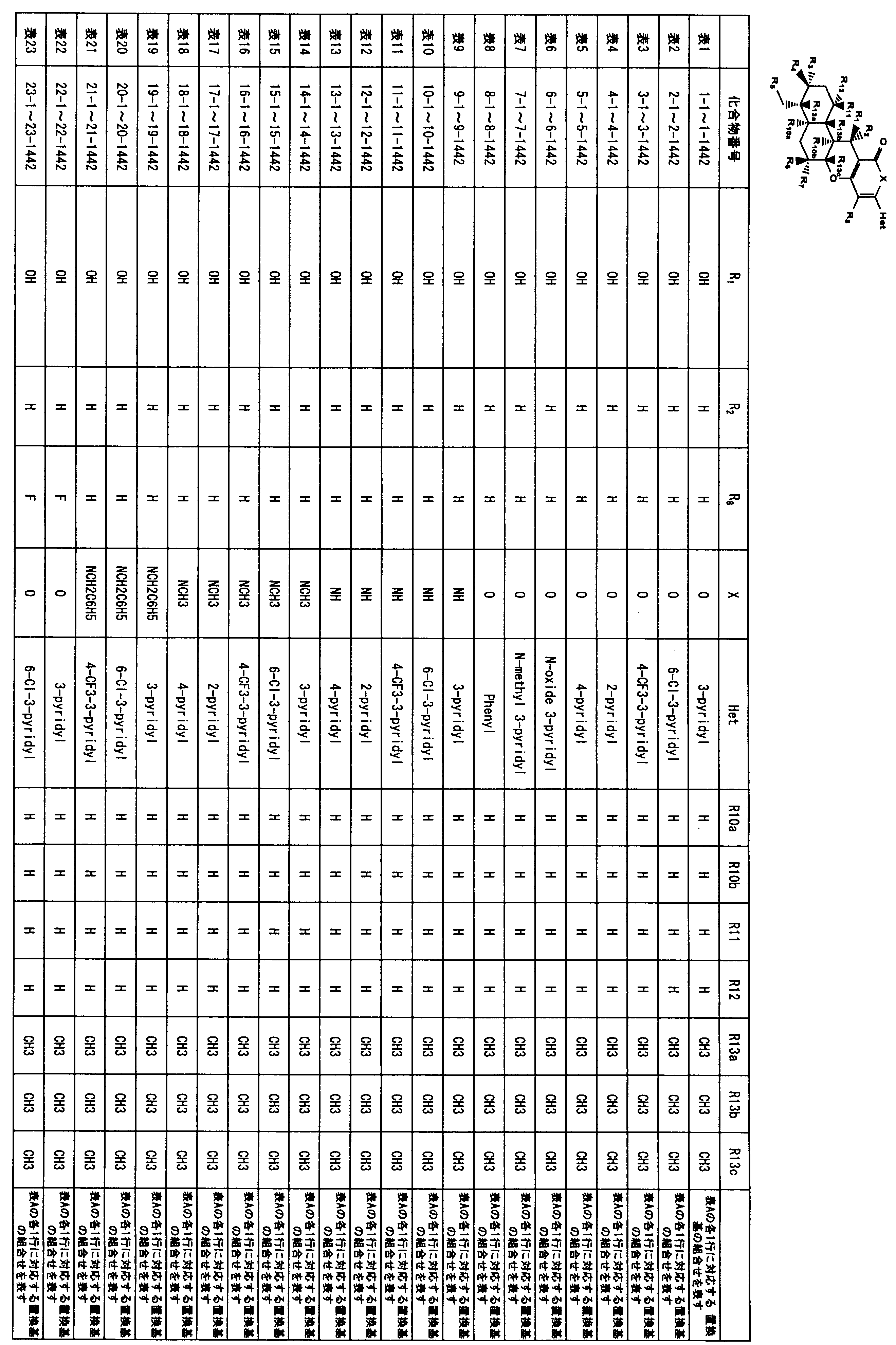


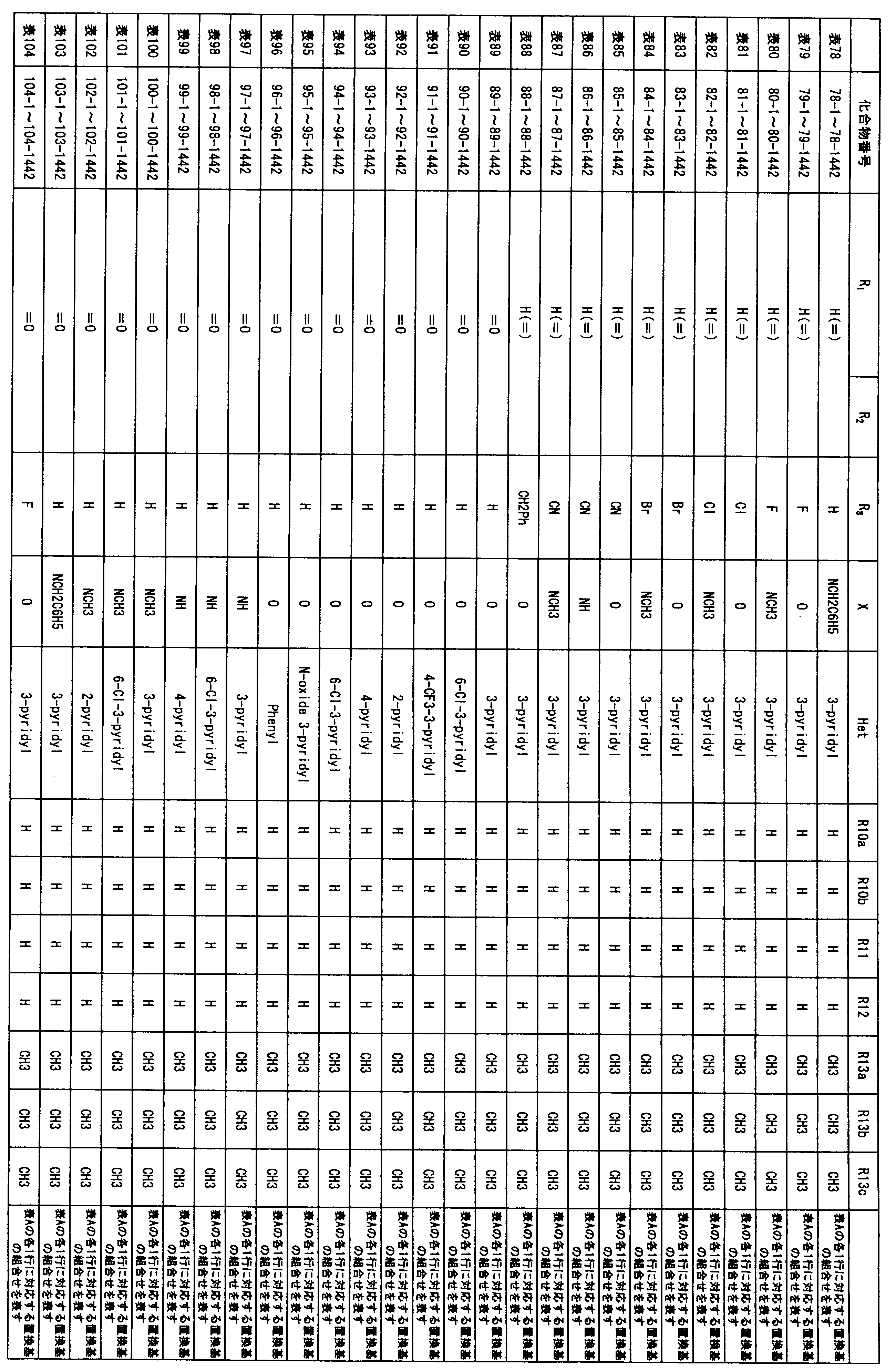


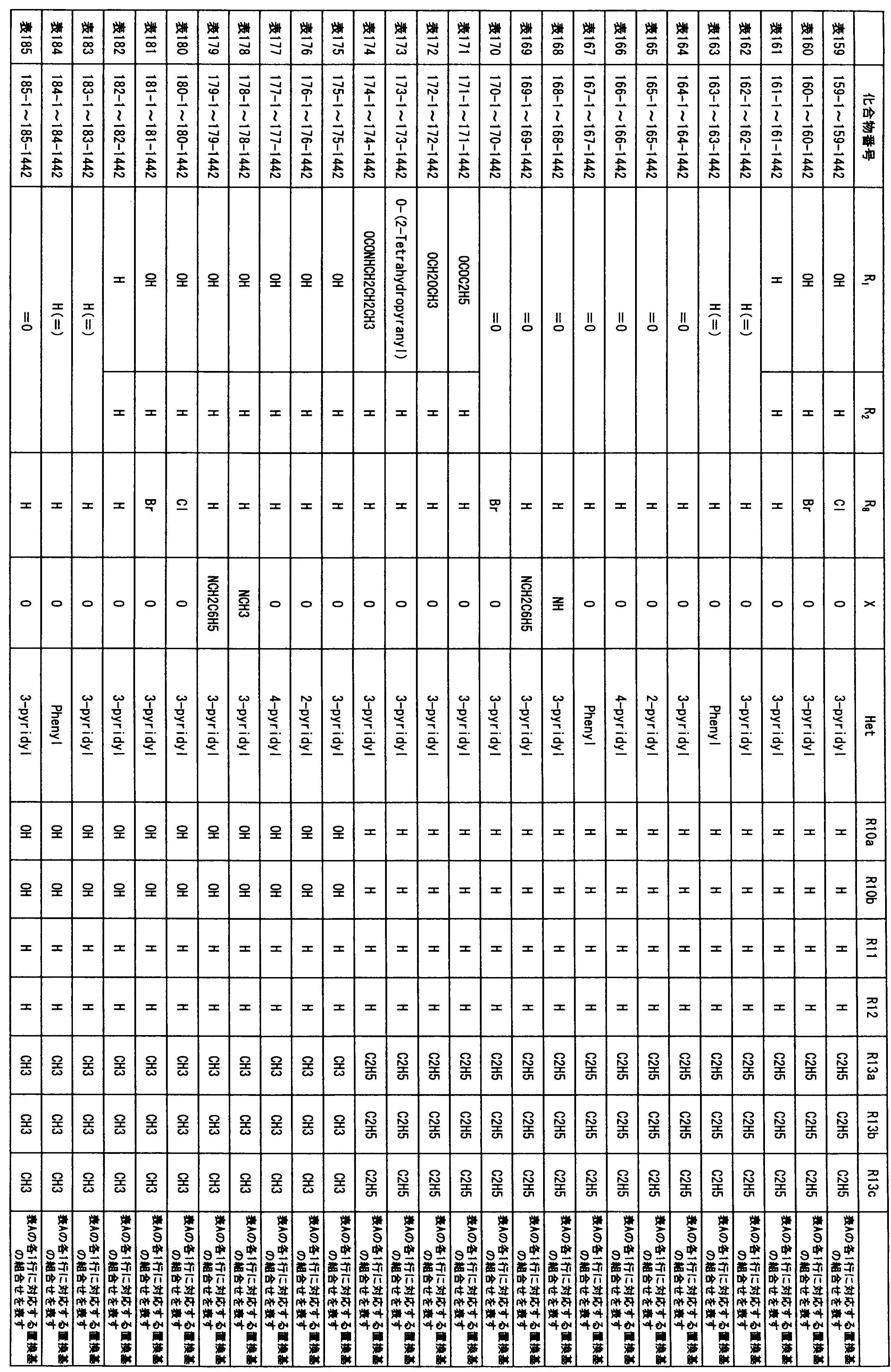


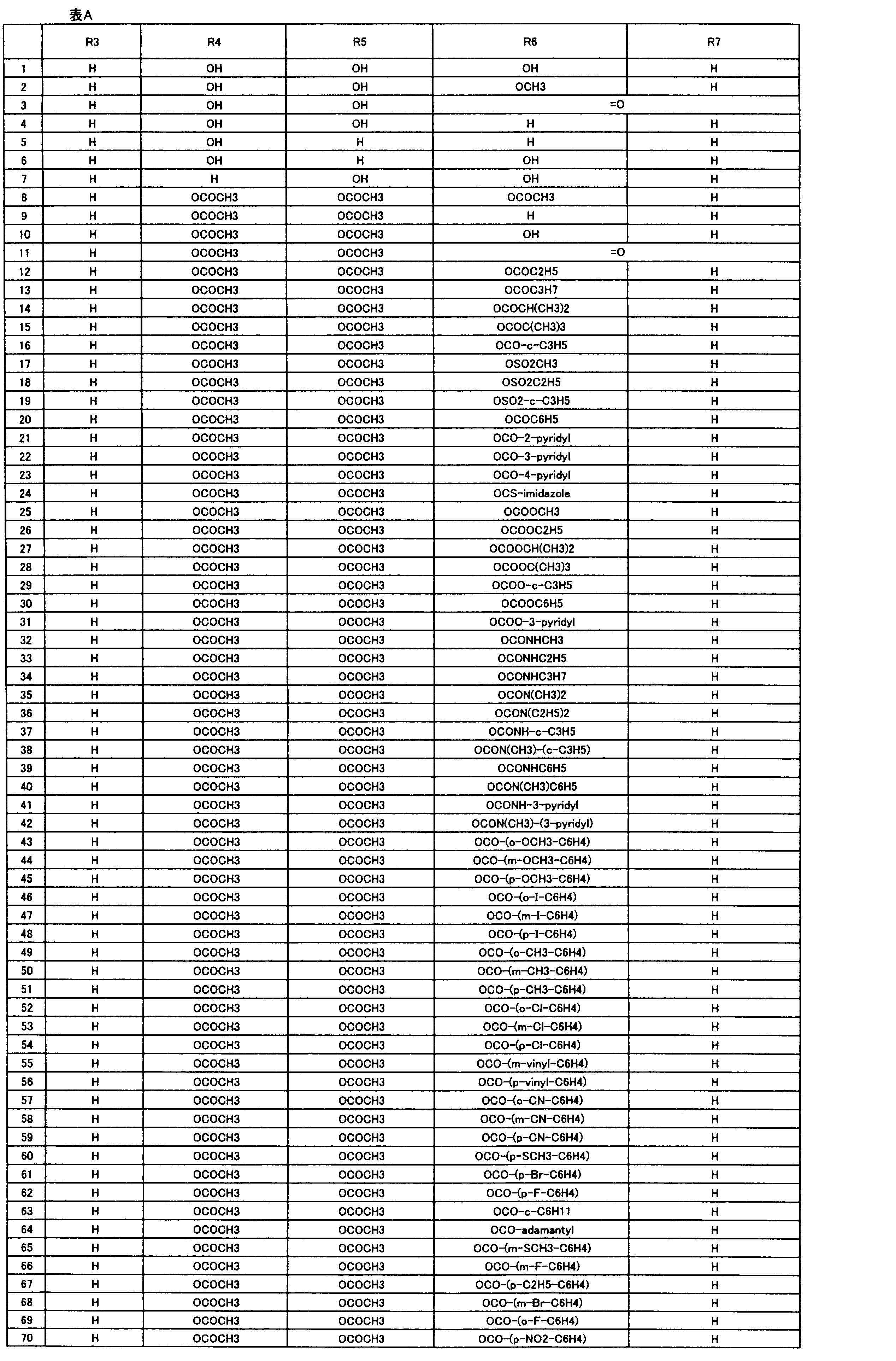

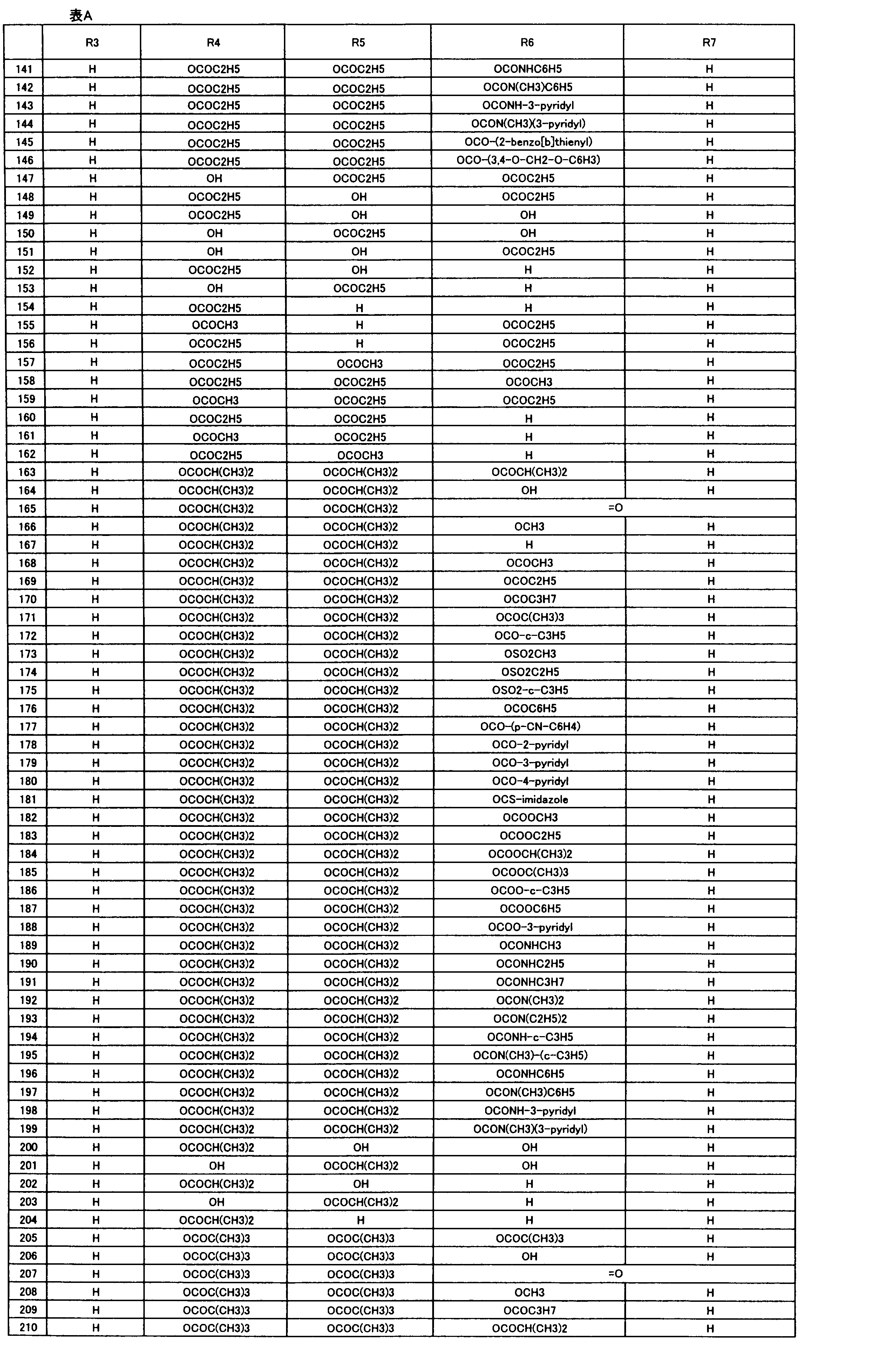


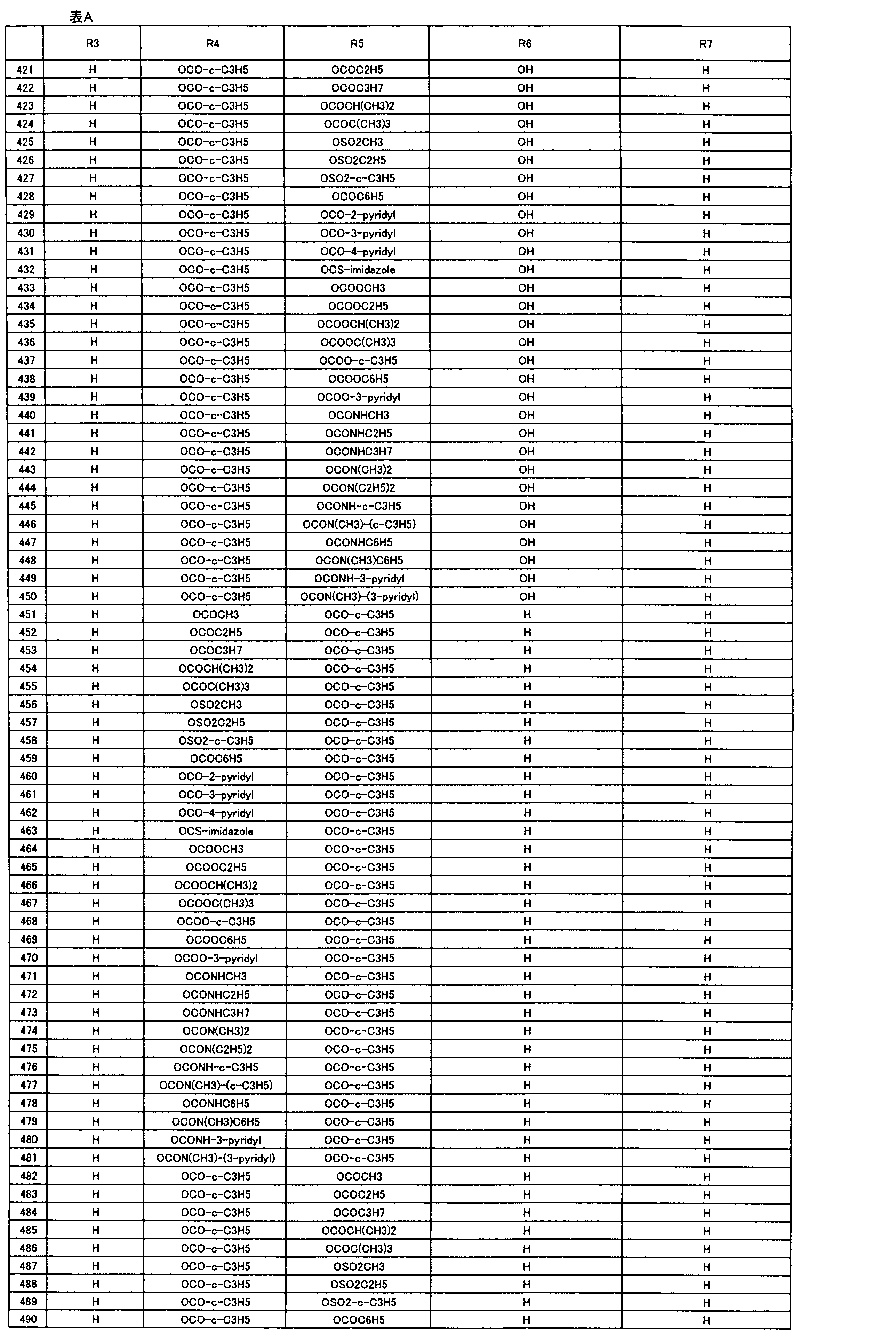


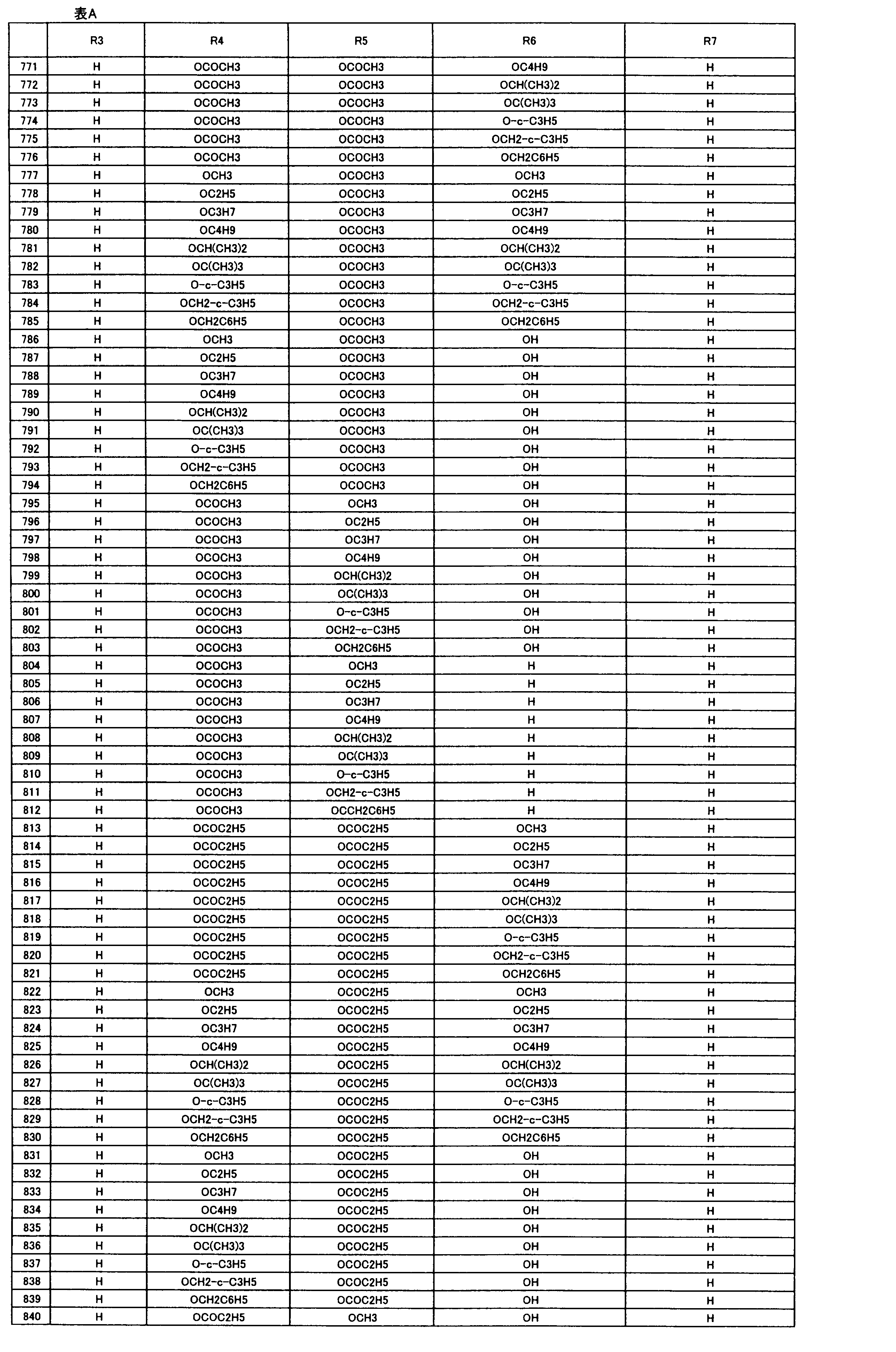


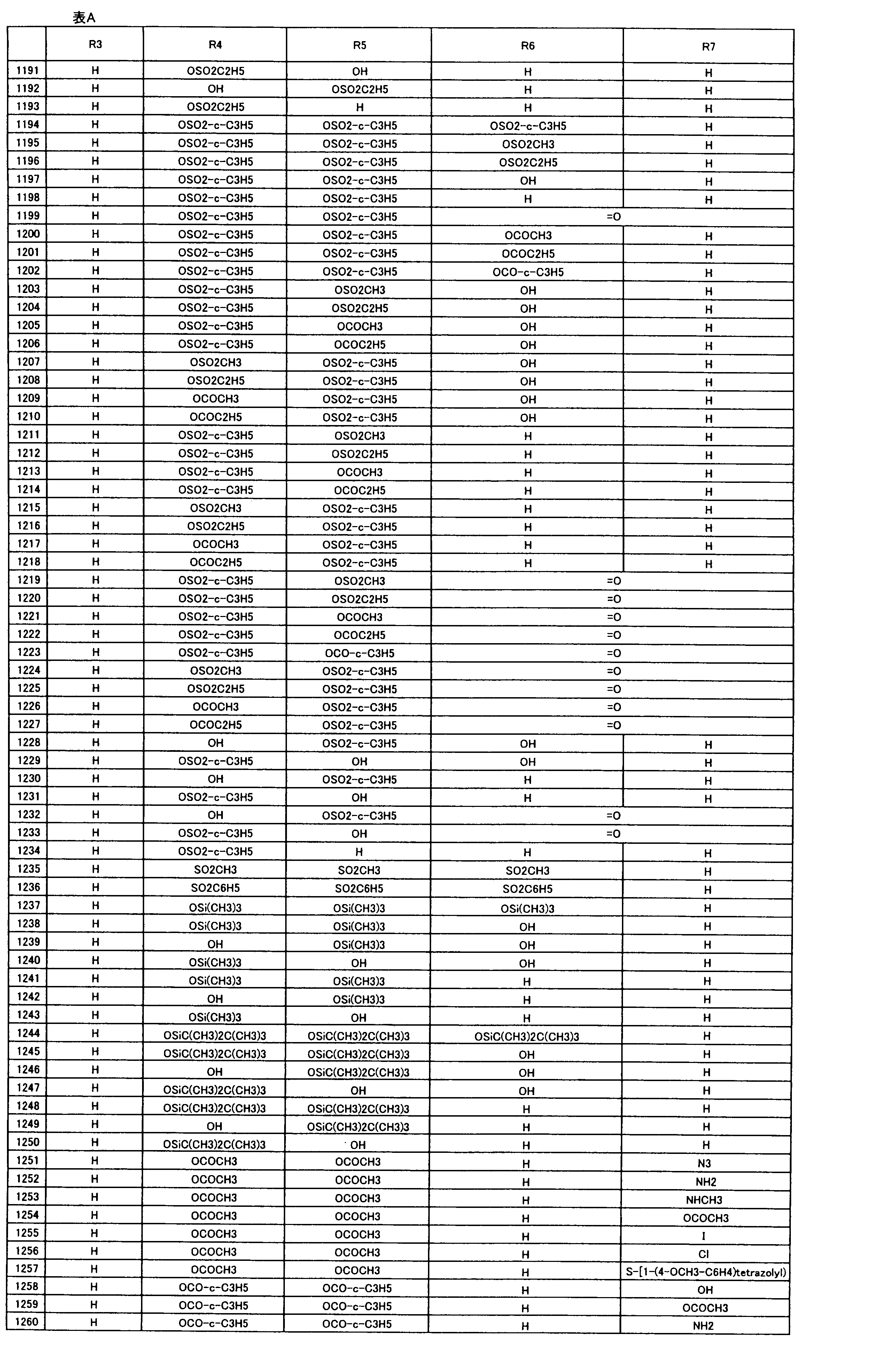

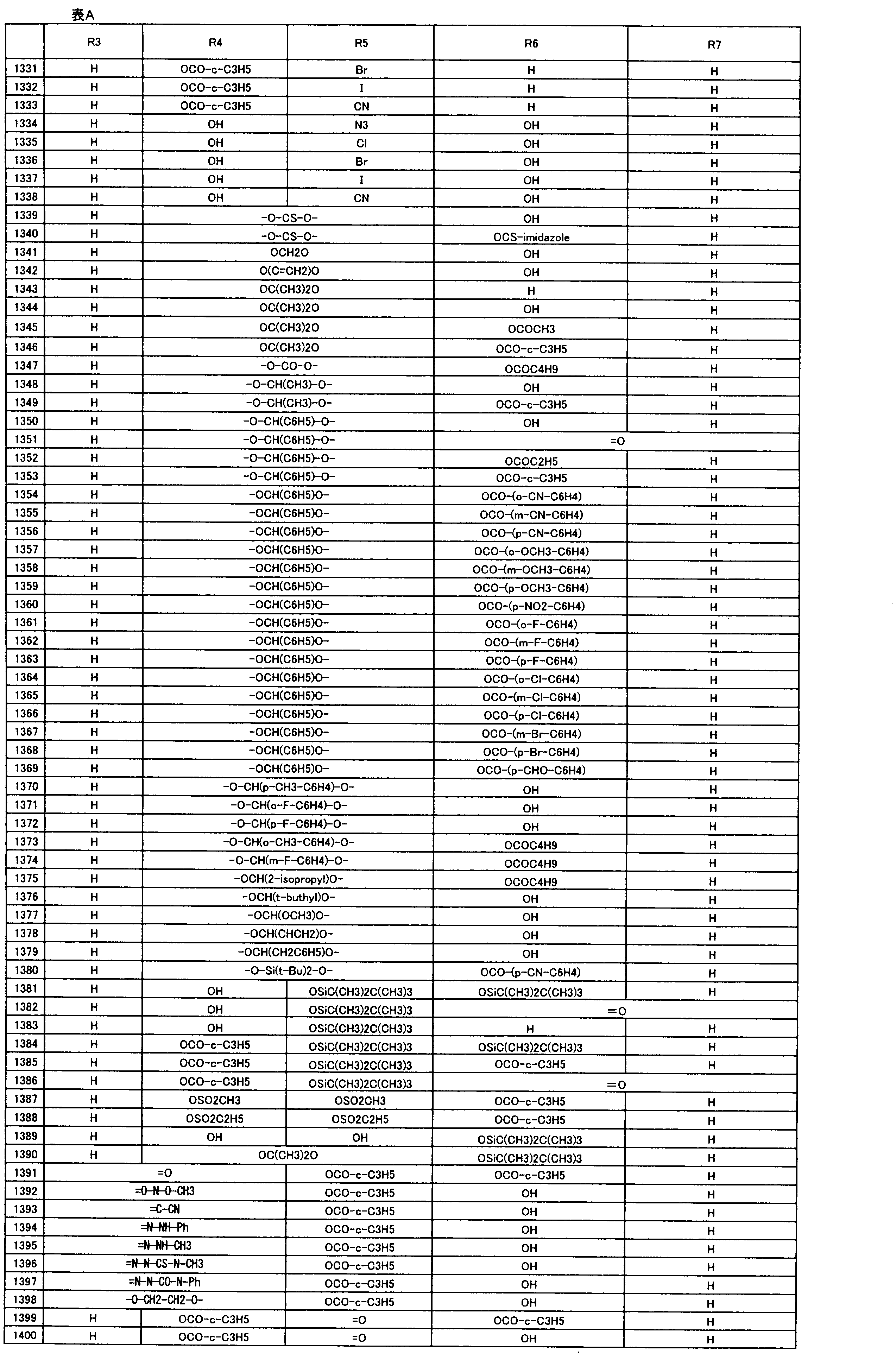

上記式(I-b)で表される化合物の具体例としては、例えば、以下の表31に示される化合物が挙げられる。
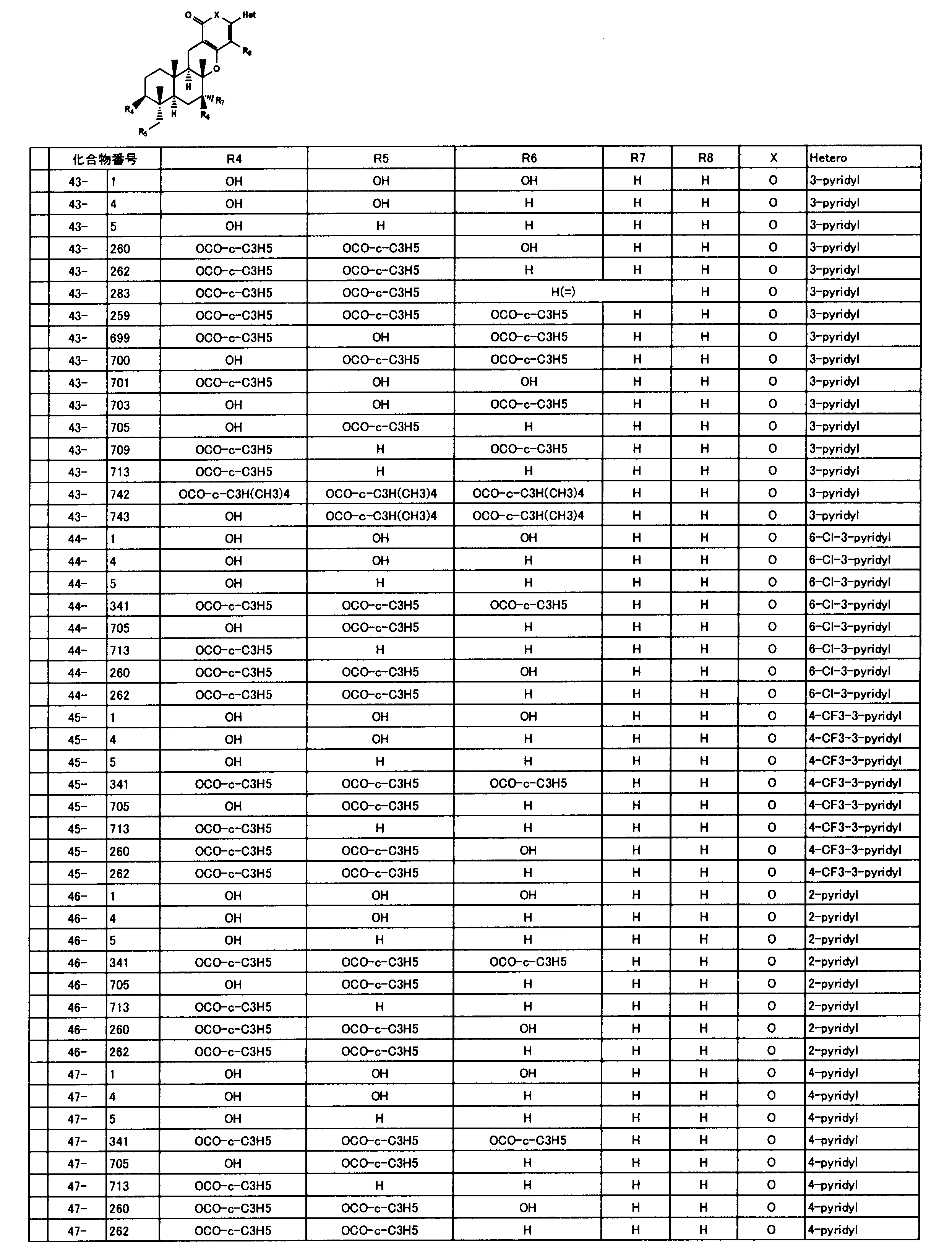
式(I-a’)または式(I-b)で表される化合物のうちより一層好ましい化合物としては、Hetが、3-ピリジル基であり、
Xが、酸素原子であり、
R4が、C3-6シクロアルキルカルボニルオキシ基であり、
R5が、水素原子または、C3-6シクロアルキルカルボニルオキシ基であり、
R6が、水素原子または水酸基であり、
R7およびR8が、水素原子である化合物が挙げられ、特に好ましくは化合物番号43-260、43-262または、43-713の化合物である。
Among the compounds represented by the formula (Ia ′) or the formula (Ib), an even more preferable compound is that Het is a 3-pyridyl group,
X is an oxygen atom,
R 4 is a C 3-6 cycloalkylcarbonyloxy group,
R 5 is a hydrogen atom or a C 3-6 cycloalkylcarbonyloxy group,
R 6 is a hydrogen atom or a hydroxyl group,
R 7 and R 8 include compounds is a hydrogen atom, particularly preferably Compound No. 43-260,43-262 or, compounds of 43-713.
製造方法
式(I)で表される化合物のうち、
(1)次式(I-1):

置換されていてもよいC1-18アルキルカルボニルオキシ基、
アダマンチルカルボニルオキシ基、
置換されていてもよいアリールC1-6アルキルカルボニルオキシ基、
置換されていてもよいC2-6アルケニルカルボニルオキシ基、
置換されていてもよいC2-6アルキニルカルボニルオキシ基、
置換されていてもよい飽和または不飽和のヘテロ環C1-6アルキルカルボニルオキシ基、
置換されていてもよい飽和または不飽和のヘテロ環C2-6アルケニルカルボニルオキシ基、
置換されていてもよいアリールカルボニルオキシ基、
置換されていてもよいカルバモイルオキシ基、
置換されていてもよいカルバモイル基、
置換されていてもよいC1-6アルキルスルホニルオキシ基、
置換されていてもよいC1-6アルキルスルホニル基、
置換されていてもよいアリールスルホニルオキシ基、
置換されていてもよいアリールC1-6アルキルオキシ基、
置換されていてもよいアリールオキシカルボニルオキシ基、
置換されていてもよいアリールアミノカルボニルオキシ基、
置換されていてもよいアリールスルホニル基、
置換されていてもよいアリールスルファニル基、
置換されていてもよい飽和もしくは不飽和のヘテロ環スルファニル基、
置換されていてもよいC1-6アルキルオキシ基、
置換されていてもよいC2-6アルケニルオキシ基、
置換されていてもよいC2-6アルキニルオキシ基、
置換されていてもよいアリールオキシ基、
C1-6アルキルオキシ-C1-6アルキルオキシ基、
C1-6アルキルチオ-C1-6アルキルオキシ基、
C1-6アルキルオキシ-C1-6アルキルオキシ-C1-6アルキルオキシ基、
置換されていてもよいC1-6アルキルオキシカルボニルオキシ基、
置換されていてもよい飽和もしくは不飽和のヘテロ環オキシ基、
置換されていてもよい飽和もしくは不飽和のヘテロ環チオ基、
置換されていてもよい飽和もしくは不飽和のヘテロ環カルボニルオキシ基、
置換されていてもよい飽和もしくは不飽和のヘテロ環チオカルボニルオキシ基、
置換されていてもよいリン酸基、
置換されていてもよいC1-6アルキル基、
トリC1-6アルキルシリルオキシ基、
置換されていてもよい飽和または不飽和のヘテロ環基、または
-O-N=C-Y1(ここでY1は、水素原子、置換されていてもよいC1-6アルキル基、置換されていてもよいC3-7シクロアルキル基、置換されていてもよいC2-6アルケニル基、置換されていてもよいC2-6アルキニル基、置換されていてもよいC1-6アルコキシ基、置換されていてもよいフェニル基、置換されていてもよいヘテロ環基を表す)を表し、
R4、R5、R6、R7は前記式(I)で定義したことと同じ意味である)で表される化合物は、ピリピロペンAを原料として、特開平8-259569号公報、WO2009/081957号公報、WO2006/129714号公報、WO2008/066153号公報に記載の方法で合成することができる。製造原料であるピリピロペンAは、有機合成化学協会誌(1998),56巻6号,478-488頁またはWO94/09417号公報に記載される方法によって製造できる。
Among the compounds represented by the manufacturing method formula (I), the
(1) The following formula (I-1):
An optionally substituted C 1-18 alkylcarbonyloxy group,
An adamantylcarbonyloxy group,
An optionally substituted aryl C 1-6 alkylcarbonyloxy group,
An optionally substituted C 2-6 alkenylcarbonyloxy group,
An optionally substituted C 2-6 alkynylcarbonyloxy group,
A saturated or unsaturated heterocyclic C 1-6 alkylcarbonyloxy group which may be substituted,
A saturated or unsaturated heterocyclic C 2-6 alkenylcarbonyloxy group which may be substituted,
An optionally substituted arylcarbonyloxy group,
An optionally substituted carbamoyloxy group,
An optionally substituted carbamoyl group,
An optionally substituted C 1-6 alkylsulfonyloxy group,
An optionally substituted C 1-6 alkylsulfonyl group,
Arylsulfonyloxy group which may be substituted,
An optionally substituted aryl C 1-6 alkyloxy group,
Aryloxycarbonyloxy group which may be substituted,
An optionally substituted arylaminocarbonyloxy group,
An optionally substituted arylsulfonyl group,
An optionally substituted arylsulfanyl group,
An optionally substituted saturated or unsaturated heterocyclic sulfanyl group,
An optionally substituted C 1-6 alkyloxy group,
An optionally substituted C 2-6 alkenyloxy group,
An optionally substituted C 2-6 alkynyloxy group,
An optionally substituted aryloxy group,
C 1-6 alkyloxy-C 1-6 alkyloxy group,
C 1-6 alkylthio-C 1-6 alkyloxy group,
C 1-6 alkyloxy-C 1-6 alkyloxy-C 1-6 alkyloxy group,
An optionally substituted C 1-6 alkyloxycarbonyloxy group,
An optionally substituted saturated or unsaturated heterocyclic oxy group,
An optionally substituted saturated or unsaturated heterocyclic thio group,
An optionally substituted saturated or unsaturated heterocyclic carbonyloxy group,
An optionally substituted saturated or unsaturated heterocyclic thiocarbonyloxy group,
An optionally substituted phosphate group,
An optionally substituted C 1-6 alkyl group,
Tri-C 1-6 alkylsilyloxy group,
A saturated or unsaturated heterocyclic group which may be substituted, or -ON = C-Y1 (where Y1 is a hydrogen atom, an optionally substituted C 1-6 alkyl group, which may be substituted) C 3-7 cycloalkyl group, an optionally substituted C 2-6 alkenyl group, an optionally substituted C 2-6 alkynyl group, an optionally substituted C 1-6 alkoxy group, substituted Represents an optionally substituted phenyl group, an optionally substituted heterocyclic group),
R 4 , R 5 , R 6 and R 7 have the same meaning as defined in the above formula (I)), and the compound represented by JP-A-8-259568, WO2009 / It can be synthesized by the methods described in JP081957, WO2006 / 129714, and WO2008 / 066153. Pyripyropene A, which is a raw material for production, can be produced by a method described in Journal of Synthetic Organic Chemistry (1998), Vol. 56, No. 6, pages 478-488 or WO 94/09417.
また、式(I)で表される化合物のうち、(2)次式(I-2):

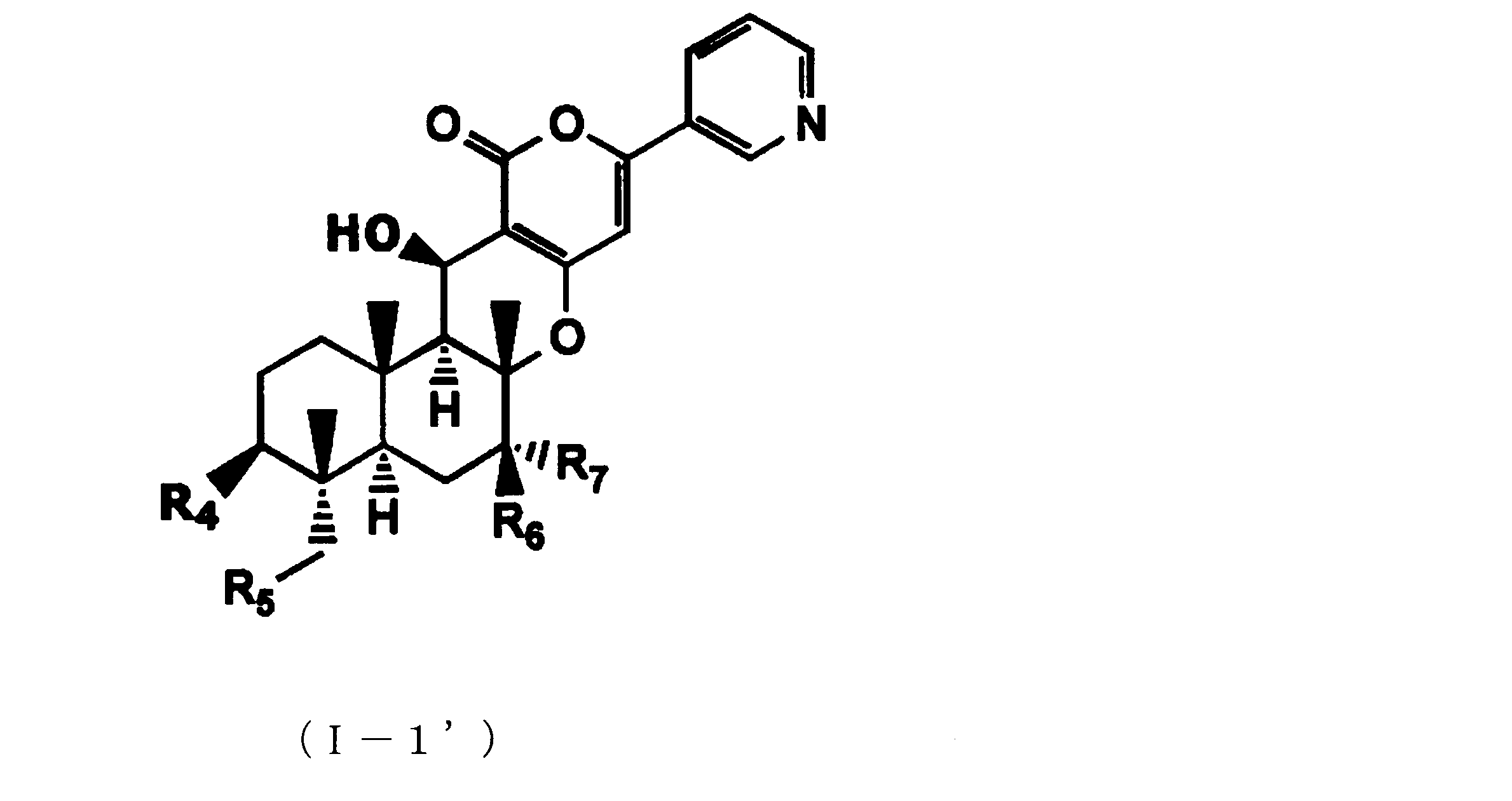
また、式(I)で表される化合物のうち、(3)次式(I-3):

また、式(I)で表される化合物のうち、(4)次式(I-4):
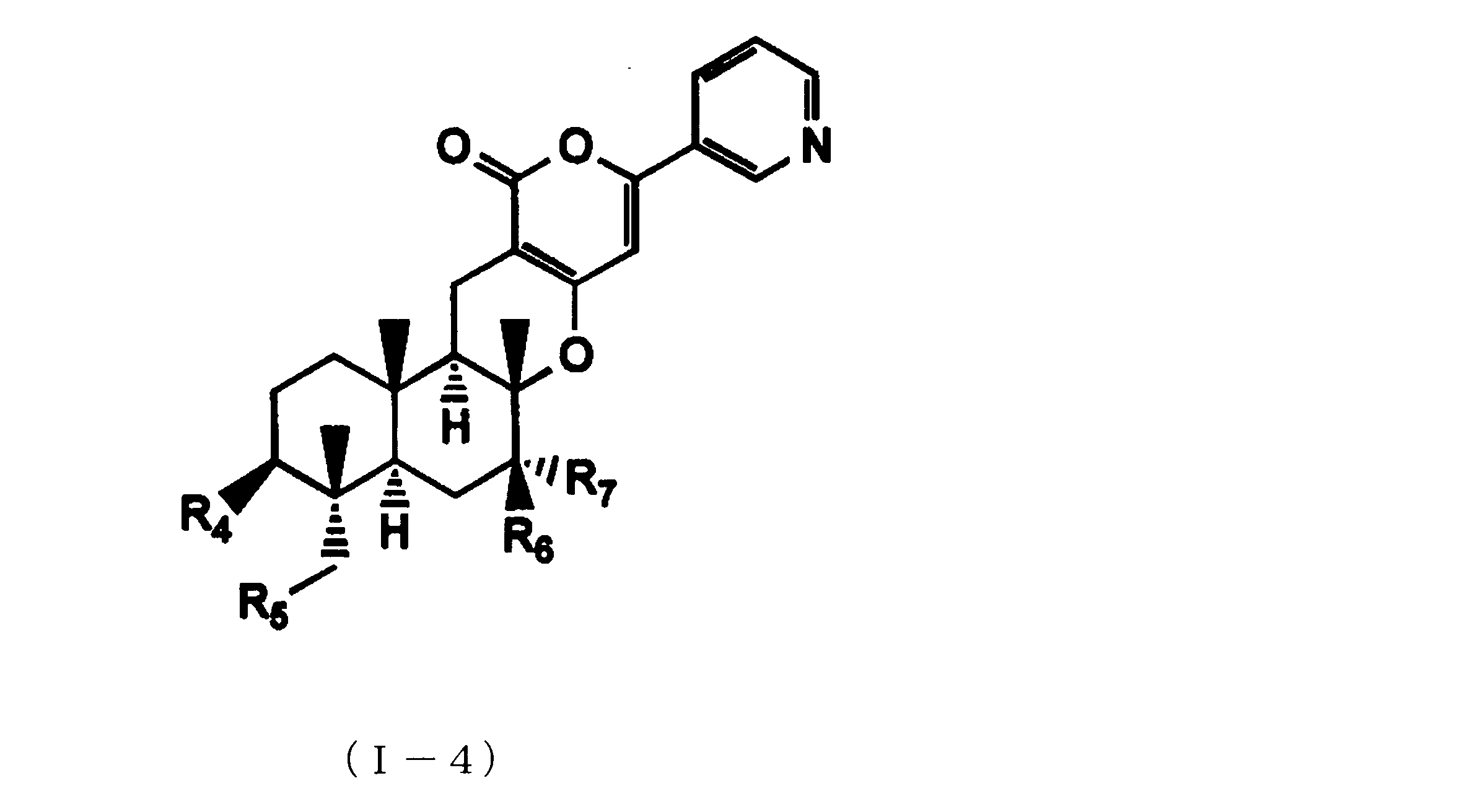

また、式(I)で表される化合物のうち、(5)次式(I-5):
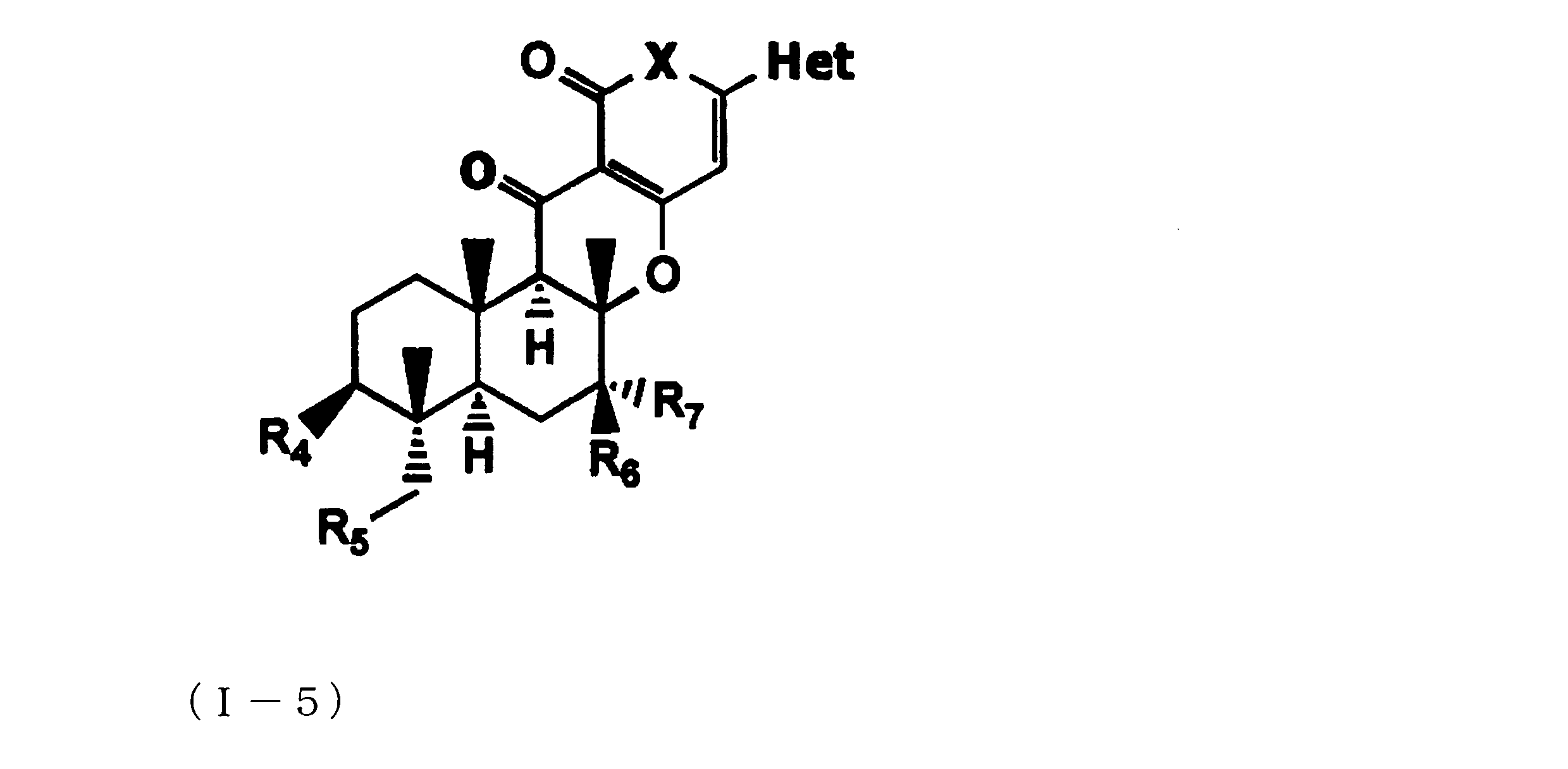
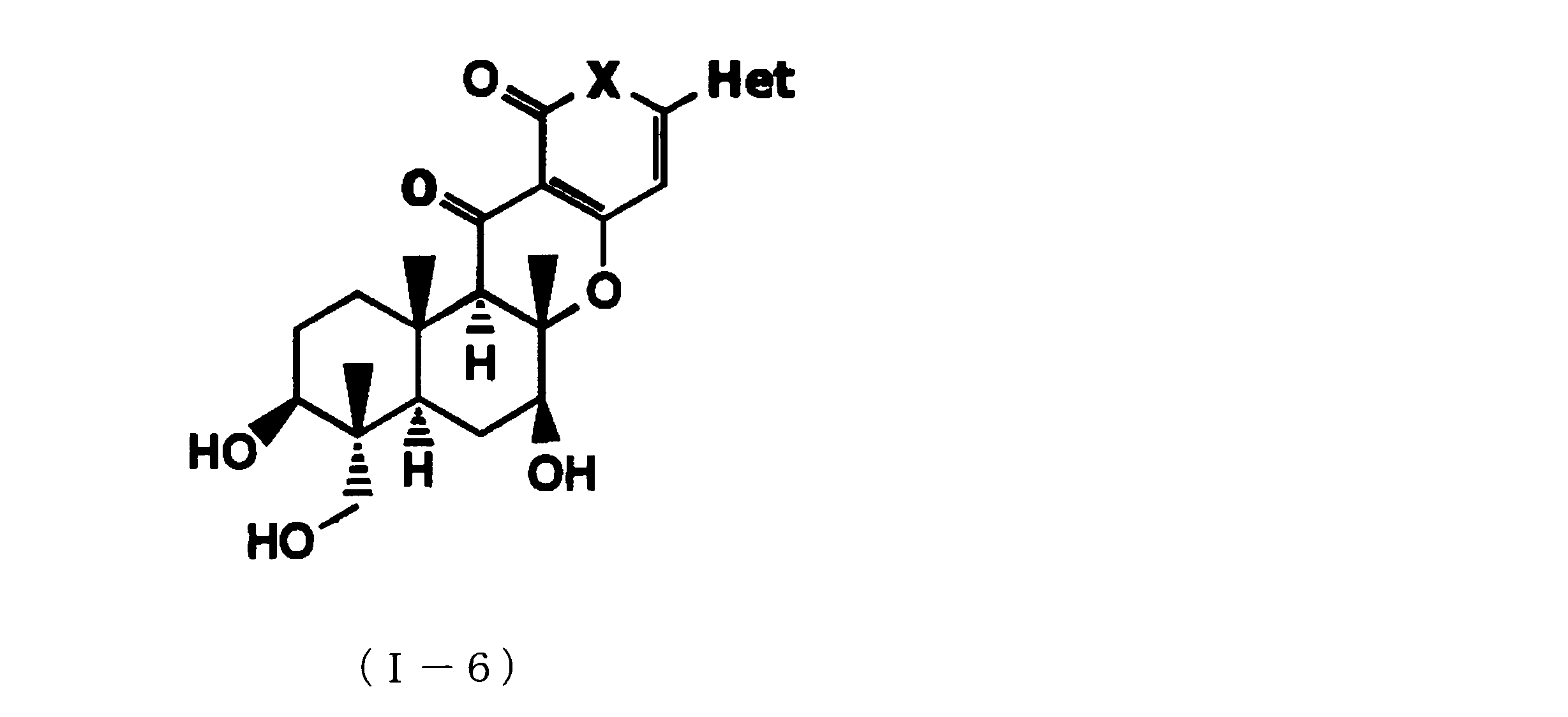
また、式(I)で表される化合物のうち、(6)次式(I-7):


また、式(I)で表される化合物のうち、(7)次式(I-9):

また、式(I)で表される化合物のうち、(8)次式(I-10):
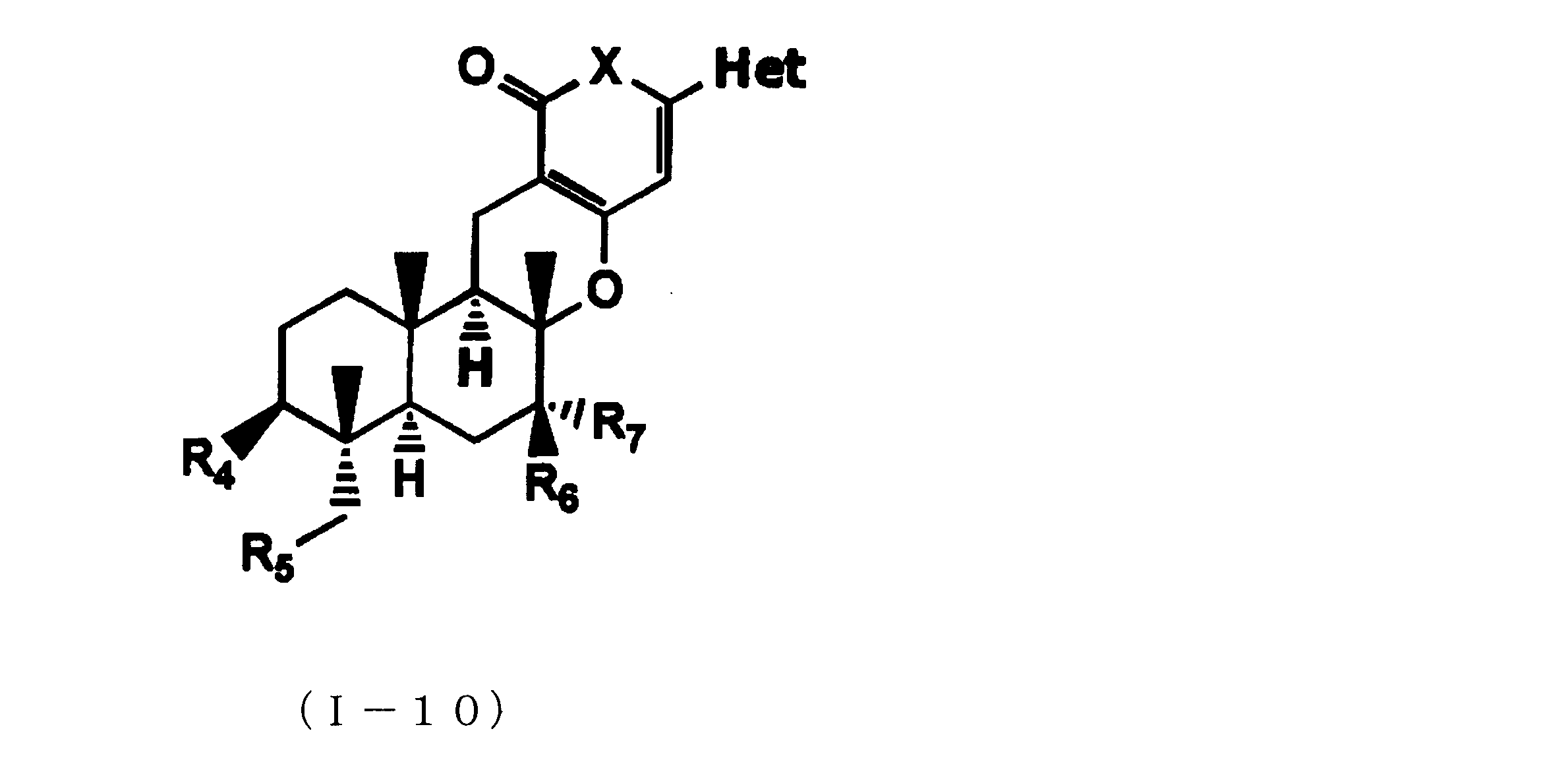
また、式(I)で表される化合物のうち、(9)次式(I-11):

また、式(I)で表される化合物のうち、(10)次式(I-12):

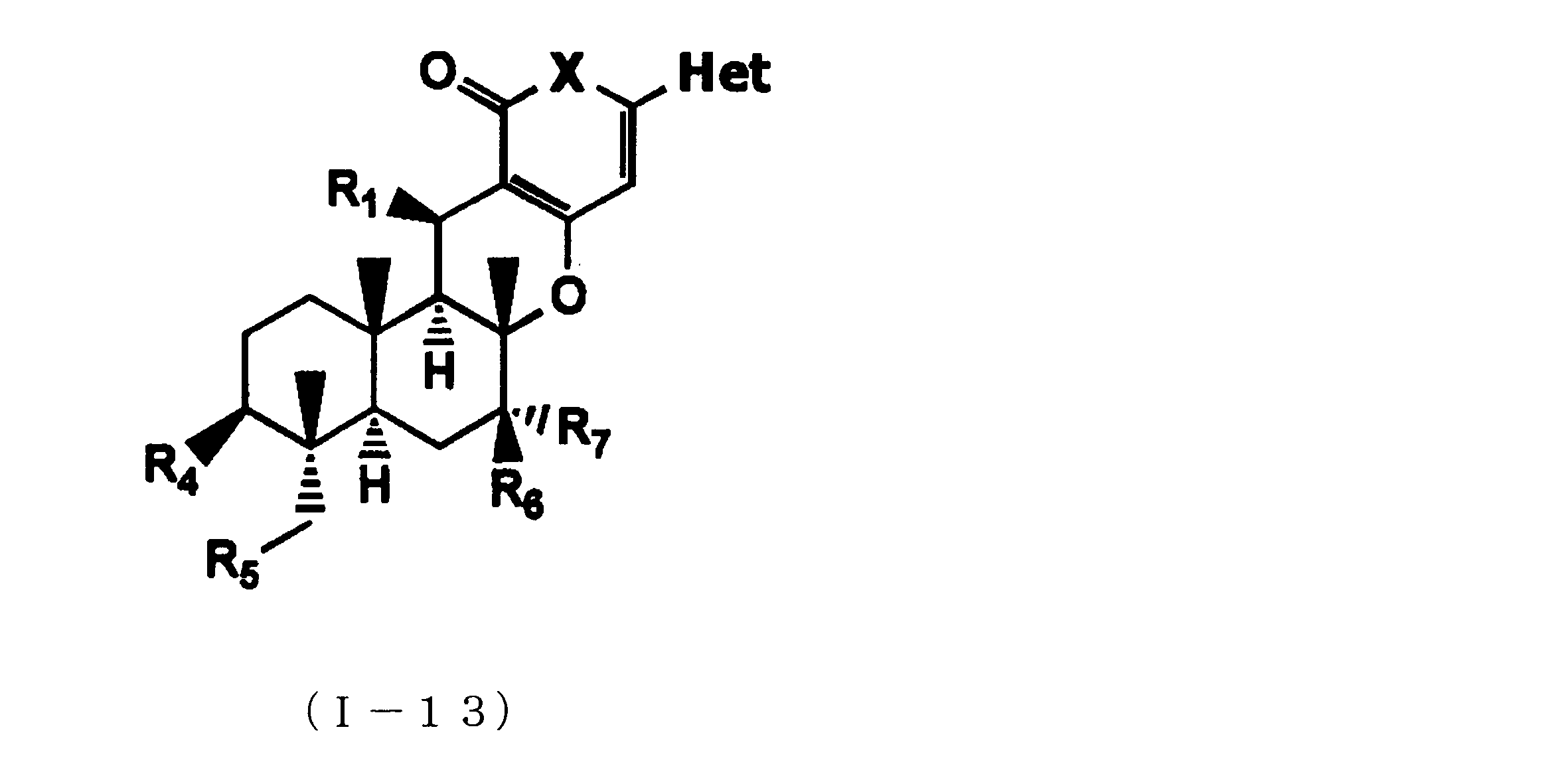
また、式(I)で表される化合物のうち、(11)次式(I-14):


式(I)、式(I-a)、式(I-a’)、式(I-b)または式(I-c)で表される化合物またはそれらの塩が有効成分として防除効果を示す虫種としては、鱗翅目害虫(例えば、ハスモンヨトウ、ヨトウガ、アワヨトウ、アオムシ、コナガ、シロイチモジヨトウ、ニカメイガ、コブノメイガ、ハマキガ、シンクイガ、ハモグリガ、ドクガ、アグロティス属害虫(Agrotis spp)、ヘリコベルパ属害虫(Helicoverpa spp)、またはヘリオティス属害虫(Heliothis spp)など)、半翅目害虫(例えば、モモアカアブラムシ、ワタアブラムシ、Aphis fabae、トウモロコシアブラムシ、エンドウヒゲナガアブラムシ、ジヤガイモヒゲナガアブラムシ、マメアブラムシ、チューリップヒゲナガアブラムシ、Macrosiphum avenae、Methopolophium dirhodum、ムギクビレアブラムシ、ムギミドリアブラムシ、ダイコンアブラムシ、ニセダイコンアブラムシ、ユキヤナギアブラムシ、Rosy apple aphid、リンゴワタムシ、コミカンアブラムシ、またはミカンクロアブラムシなどのアブラムシ類(Aphididae、Adelgidae、またはPhy11oxeridae)、ツマグロヨコバイなどのヨコバイ類、チャノミドリヒメヨコバイなどのヒメヨコバイ類、ヒメトビウンカ、トビイロウンカ、またはセジロウンカなどのウンカ類、シラホシカメムシ、ミナミアオカメムシ、またはアカヒゲホソミドリカスミカメなどのカメムシ類、タバココナジラミ、またはオンシツコナジラミなどのコナジラミ類(A1eyrodidae)、クワコナカイガラムシ、ミカンコナカイガラムシ、または、アカマルカイガラムシなどのカイガラムシ類(Diaspididae、Margarodidae、Ortheziidae、Ac1erdiae、Dacty1opiidae、Kerridae、Pseudococcidae、Coccidae、Eriococcidae、Asterolecaniidae、Beesonidae、Lecanodiaspididae、またはCerococcidea)など)、ミカンキジラミなどのキジラミ類、鞘翅目害虫(例えば、イネミズゾウムシ、アズキゾウムシ、チヤイロコメノゴミムシダマシ、ウェスタンコーンルートワーム、サザンコーンルー
トワーム、ドウガネブイブイ、ヒメコガネ、キスジノミハムシ、ウリハムシ、コロラドポテトハムシ、イネドロオイムシ、シンクイムシ類、またはカミキリムシ類など)、ダニ目(例えば、ナミハダニ、カンザワハダニ、またはミカンハダニなど)、膜翅目害虫(例えば、ハバチ類)、直翅目害虫(例えば、バッタ類)、双翅目害虫(例えば、イエバエまたはハモグリバエ類)、アザミウマ目害虫(例えば、ミナミキイロアザミウマまたはミカンキイロアザミウマなど)、植物寄生性線虫(例えば、ネコブセンチュウ、ネグサレセンチュウ、イネシンガレセンチュウ、またはマツノザイセンチュウなど)、動物の寄生虫として、ノミ類(例えば、ネコノミ、ヒトノミ等)、シラミ類(例えば、ヒトジラミ、ケジラミ等)、ダニ類(例えば、オウシマダニ、フタトゲチマダニ、クリイロコイタマダニ、キチマダニ、ヒゼンダニ、ワクモ、トリサシダニ、イエダニ、ツツガムシ等)、アブ類、ハエ類(例えば、キンバエ等)、カ類(例えば、ヒトスジシマカ、アカイエカ等)、ブユ類、ヌカカ類、線虫類(例えば、糞線虫類(例えば乳頭糞線虫、糞線虫など)、鈎虫類(例えばイヌ鈎虫、ネコ鈎虫、ビズニ鈎虫など)、捻転胃虫、円虫類(例えばネズミ円虫)、毛様線虫類、変円虫類(例えば豚肺虫、広東住血線虫、猫肺虫など)、蟯虫類、盲腸虫類(例えば鶏回虫)、アニサキス線虫、回虫類(例えば豚回虫、馬回虫、犬回虫、猫回虫など)、スブルラ類、旋尾線虫類(例えば有棘顎口虫、猫胃虫、類円豚胃虫、大口馬胃虫、鶏胃虫、オステルターグ胃虫など)、糸条虫類(例えば犬糸条虫、頸部糸状虫など)、腎虫類、旋毛虫類(例えば犬鞭虫、旋毛虫など))など、吸虫類(例えば住血吸虫類(例えば日本住血吸虫、肝蛭)など)、鉤頭虫類(例えば大鉤頭虫、鎖状鉤頭虫など)、条虫類(例えば、擬葉類(例えばマンソン裂頭条虫など)、円葉類(例えば瓜実条虫、 縮小条虫など)、多包条虫、単包条虫など)、原虫類などが挙げられ、好ましくい虫種としては、半翅目、双翅目、アザミウマ目害虫が挙げられ、特に好ましくは、半翅目害虫が挙げられる。
A compound represented by the formula (I), the formula (Ia), the formula (Ia ′), the formula (Ib) or the formula (Ic) or a salt thereof shows a controlling effect as an active ingredient. Insect species include lepidopterous pests (eg, Spodoptera litura, Coleoptera, Awayotou, Aomushi, Konaga, Shirochimomodyoto, Nikaigai, Kanomeigaga, Pterodum, Sinkiga, Prunus, Agrotis spp, p. , Or Heliothis spp), Hemiptera pests (eg, peach aphid, cotton aphid, Aphis fabae, corn aphid, pea aphid, potato aphid, bean aphid, tulip aphid, Macrosiphum avenae, Methopolophium dirhodum, barley beetle, mu Aphids (Aphididae, Adelgidae, or Phy11oxeridae) such as green aphids, radish aphids, fake aphids, snowy aphids, Rosy apple aphid, apple aphids, rice aphids, or citrus aphids, leafhoppers such as leafhoppers Leafhoppers such as leafhoppers, leafhoppers such as leafhoppers, leafhoppers, or leafhoppers, white-winged beetles, southern stink bugs, or stink bugs such as red-headed beetles, e. , Scale insects such as red scale insects or red scale insects (Diaspididae, Margarodidae, Ortheziidae, Ac1erdiae, Dacty1opiidae, Kerridae, Pseudococcidae, Coccidae, Eriococcidae, Asterolecaniidae, Beesonidae, Lecanodiaspididae, or Cerococcidea) Worms, Douganebuybu, Himekogane, Kishikomi potato beetle, cucumber potato beetle, Colorado potato beetle, rice beetle, stag beetle, or longhorn beetle, etc. Diptera pests (eg grasshoppers), Diptera pests (eg houseflies or leafhoppers), Thrips pests (eg Southern thrips or Citrus azalea) Mias, etc.), plant parasitic nematodes (eg, root-knot nematodes, nepheles nematodes, rice nesting nematodes, or pinewood nematodes), animal parasites such as fleas (eg, cat fleas, human fleas, etc.), lice ( For example, human lice, white lice, etc.), mites (for example, mites, mites, mites, mites, mites, mites, wing mites, mites, mites, mites, etc.) (E.g., Aedes albopictus, Culex mosquito, etc.), flyfish, nukaka, nematodes (e.g. faecal nematodes (e.g. papillae nematode, feline nematodes), helminths (e.g. dog worms, cat helminths) , Bizuni worms, etc.), torsion stomachworms, roundworms (eg, murine roundworms), ciliate nematodes, metamorphic roundworms (eg, swine lungworms, S. elegans, cat pneumonia, etc.), helminths, caecals (eg, roundworms of chickens), anisakis nematodes, roundworms (eg, roundworms of horses, horse roundworms, roundworms of dogs, roundworms of cats) Caudate nematodes (eg spiny-mouthed mouthworms, cat stomachworms, round pig stomachworms, large-mouth horse stomachworms, chicken stomachworms, and Ostertag stomachworms), filamentous worms (eg, dog threadworm, neck) ), Nematodes, trichinidae (eg, Trichinella, Trichinella), etc., flukes (eg, schistosomiasis (eg, Schistosoma japonicum, liver cirrhosis), etc.), bald worms (eg, Large beetle, chain beetle, etc.), tapeworms (for example, pseudo-leaves (for example, Manson fissured), etc. C. elegans, protozoa, etc., and preferable insect species include Hemiptera, Diptera, Thripidae, particularly preferably Hemiptera Insects are mentioned.
半翅目害虫としては、好ましくはアブラムシ類(Aphididae、Adelgidae、またはPhy11oxeridaeが挙げられ、特にAphididaeが好ましい)、ヒメヨコバイ類、コナジラミ類、カメムシ類、またはカイガラムシ類(Diaspididae、Margarodidae、Ortheziidae、Ac1erdiae,Dacty1opiidae、Kerridae、Pseudococcidae、Coccidae、Eriococcidae、Asterolecaniidae、Beesonidae、Lecanodiaspididae、またはCerococcidae)、キジラミ類が挙げられ、より好ましくはモモアカアブラムシ、ワタアブラムシ、チャノミドリヒメヨコバイ、タバココナジラミ、オンシツコナジラミ、アカヒゲホソミドリカスミカメ、またはクワコナカイガラムシ、アカマルカイガラムシ、ミカンキジラミが挙げられる。 Hemiptera pests are preferably aphids (Aphididae, Adelgidae, or Phy11oxeridae, particularly preferably Aphididae), leafhoppers, whiteflies, stink bugs, or scale insects (Diaspididae, Margarodidae, Ac1diae, Actidiaop, Ac1diae , Kerridae, Pseudococcidae, Coccidae, Eriococcidae, Asterolecaniidae, Beesonidae, Lecanodiaspididae, or Cerococcidae), and more preferably, peach aphid, cotton aphid, chamodium mosquito, Alternatively, there may be mentioned Kuwakona scale insects, red spot scales, and citrus bugs.
式(I)、式(I-a)、式(I-a’)、式(I-b)または式(I-c)で表される化合物を有害生物防除剤として用いる場合、式(I)、式(I-a)、式(I-a’)、式(I-b)または式(I-c)で表される化合物をそのまま用いても良いが、式(I)、式(I-a)、式(I-a’)、式(I-b)または式(I-c)で表される化合物は、農畜薬上許容可能な適当な固体担体、液体担体、ガス状担体等、界面活性剤、分散剤、またはその他の製剤用補助剤とともに混合して、乳剤、EW剤、液剤、懸濁剤、水和剤、顆粒水和剤、粉剤、DL粉剤、粉粒剤、粒剤、錠剤、油剤、エアゾル、フロアブル剤、ドライフロアブル剤、またはマイクロカプセル剤等の任意の剤型として用いることができる。 When a compound represented by the formula (I), the formula (Ia), the formula (Ia ′), the formula (Ib) or the formula (Ic) is used as a pest control agent, the formula (I ), Formula (Ia), formula (Ia ′), formula (Ib) or formula (Ic) may be used as they are. The compound represented by Ia), formula (Ia ′), formula (Ib) or formula (Ic) is a suitable solid carrier, liquid carrier, gaseous form acceptable in terms of agricultural and veterinary medicine. Emulsions, EW agents, solutions, suspensions, wettable powders, granule wettable powders, powders, DL powders, and powders by mixing with carriers, surfactants, dispersants, or other formulation adjuvants , Granules, tablets, oils, aerosols, flowables, dry flowables, or microcapsules.
固体担体としては、例えば、タルク、ベンナイト、クレー、カオリン、ケイソウ土、バーミキュライト、ホワイトカーボン、または炭酸カルシウムなどが挙げられる。 Examples of the solid carrier include talc, bennite, clay, kaolin, diatomaceous earth, vermiculite, white carbon, calcium carbonate, and the like.
液体担体としては、例えば、メタノール、n一ヘキサノール、またはエチレングリコール等のアルコール類、アセトン、メチルエチルケトン、またはシクロヘキサノン等のケトン類、n一ヘキサン、ケロシン、または灯油等の脂肪族炭化水素類、トルエン、キシレン、またはメチルナフタレンなどの芳香族炭化水素類、ジエチルエーテル、ジオキサン、またはテトラヒドロフランなどのエーテル類、酢酸エチルなどのエステル類、アセトニトリルまたはイソブチロニトリルなどのニトリル類、ジメチルホルムアミドまたはジメチルアセトアミドなどの酸アミド類、ダイズ油、綿実滴等の植物油類、ジメチルスルホキシド、または水などが挙げられる。 Examples of the liquid carrier include alcohols such as methanol, n-hexanol, or ethylene glycol, ketones such as acetone, methyl ethyl ketone, or cyclohexanone, aliphatic hydrocarbons such as n-hexane, kerosene, or kerosene, toluene, Aromatic hydrocarbons such as xylene or methylnaphthalene, ethers such as diethyl ether, dioxane, or tetrahydrofuran, esters such as ethyl acetate, nitriles such as acetonitrile or isobutyronitrile, dimethylformamide or dimethylacetamide Examples include acid amides, soybean oil, vegetable oils such as cotton seed drops, dimethyl sulfoxide, or water.
また、ガス状担体としてはLPG、空気、窒素、炭酸ガス、またはジメチルエーテルなどが挙げられる。 In addition, examples of the gaseous carrier include LPG, air, nitrogen, carbon dioxide, dimethyl ether, and the like.
乳化、分散、または展着などのための界面活性剤、分散剤としては、例えば、アルキル硫酸エステル類、アルキル(アリール)スルホン酸塩類、ポリオキシアルキレンアルキル(アリール)エーテル類、多価アルコールエステル類、またはリグニンスルホン酸塩などが用いられる。また、製剤の性状を改善するための補助剤としては、例えば、カルボキシメチルセルロース、アラビアガム、ポリエチレングリコール、またはステアリン酸カルシウム等が用いられる。 Examples of surfactants and dispersants for emulsification, dispersion, or spreading include alkyl sulfates, alkyl (aryl) sulfonates, polyoxyalkylene alkyl (aryl) ethers, and polyhydric alcohol esters. Or lignin sulfonate. Moreover, as an adjuvant for improving the property of a formulation, carboxymethylcellulose, gum arabic, polyethylene glycol, or calcium stearate is used, for example.
前記の担体、界面活性剤、分散剤、およびその他の製剤用補助剤は、必要に応じて各々単独で、あるいは組み合わせて用いることができる。 The above carriers, surfactants, dispersants, and other formulation adjuvants can be used alone or in combination as necessary.
前記製剤中の有効成分の含有量は、特に限定されないが、好ましくは、乳剤で1-75重量%、粉剤では0.3-25重量%、水和剤では1-90重量%、粒剤では0.5-10重量%である。 The content of the active ingredient in the preparation is not particularly limited, but is preferably 1 to 75% by weight for an emulsion, 0.3 to 25% by weight for a powder, 1 to 90% by weight for a wettable powder, and 1% to 90% by weight for a granule. 0.5-10% by weight.
また本発明の別の態様によれば、前記式(I)、式(I-a)、式(I-a’)、式(I-b)または式(I-c)で表される化合物またはその塩の有効量を、水面、土壌、養液栽培における養液、養液栽培における固形培地、植物の種子、根、塊茎、球根、および根茎からなる群から選択される対象に適用することを含んでなる有害生物の防除方法が提供される。 According to another aspect of the present invention, the compound represented by the formula (I), formula (Ia), formula (Ia ′), formula (Ib) or formula (Ic) Or an effective amount of the salt is applied to a target selected from the group consisting of water surface, soil, nutrient solution in hydroponics, solid medium in hydroponics, plant seeds, roots, tubers, bulbs, and rhizomes. A method for controlling pests is provided.
また、本発明の一つの態様によれば、前記式(I)、式(I-a)、式(I-a’)、式(I-b)または式(I-c)で表される化合物またはその塩の有効量を、有害生物またはその生育場所に適用することを含んでなる有害生物の防除方法が提供される。さらに好ましい態様によれば、前記式(I)、式(I-a)、式(I-a’)、式(I-b)または式(I-c)で表される化合物またはその塩の有効量を、植物または土壌に適用することを含んでなる有害生物の防除方法が提供される。 Further, according to one embodiment of the present invention, it is represented by the formula (I), formula (Ia), formula (Ia ′), formula (Ib) or formula (Ic). There is provided a method for controlling pests comprising applying an effective amount of a compound or salt thereof to the pests or their habitat. According to a further preferred embodiment, the compound of the above formula (I), formula (Ia), formula (Ia ′), formula (Ib) or formula (Ic) or a salt thereof A method of controlling pests comprising applying an effective amount to a plant or soil is provided.
前記式(I)、式(I-a)、式(I-a’)、式(I-b)または式(I-c)で表される化合物またはその塩はそれ自体でも有害生物に対して優れた防除効果を示すのもであるが、他の有害生物防除剤と混合して用いることによって、それぞれ単独で使用するよりも優れた防除効果を示すことが期待できる。従って本発明によれば、式(I)、式(I-a)、式(I-a’)、式(I-b)または式(I-c)で表される化合物またはその塩の少なくとも一種と、他の有害生物防除剤の少なくとも一種とを含んでなる有害生物防除用組成物が提供される。また、本発明の別の態様によれば、有用植物を有害生物から保護するため、前記有害生物防除用組成物の使用が提供される。また、別の態様によれば、有用植物を有害生物から保護するための剤の製造における、前記有害生物防除用組成物の使用が提供される。 The compound represented by the formula (I), the formula (Ia), the formula (Ia ′), the formula (Ib) or the formula (Ic) or a salt thereof itself is not harmful to pests. However, when used in combination with other pesticidal agents, it can be expected that the control effect is superior to that of using them individually. Therefore, according to the present invention, at least the compound represented by the formula (I), the formula (Ia), the formula (Ia ′), the formula (Ib) or the formula (Ic) or a salt thereof There is provided a composition for controlling pests comprising one kind and at least one other pesticide. Moreover, according to another aspect of this invention, in order to protect a useful plant from a pest, use of the said composition for pest control is provided. Moreover, according to another aspect, use of the said composition for pest control in manufacture of the agent for protecting a useful plant from a pest is provided.
本発明の有害生物防除剤として用いられる組成物、化合物、およびそれらと他の有害生物防除剤との混合剤は、様々な植物に対して、多くの害虫防除のために用いられる。対象とする植物としては、米、コムギ、オオムギなどの麦類、トウモロコシ、あわ、きび、ひえ、食用ソルガム等の雑穀類、かんきつ、りんご、ぶどうなどの果樹類、きゅうり、かぼちゃ、メロン、キャベツ、なす、トマト、いちご等の野菜類、ばれいしょ、かんしょ、さといも等の芋類、あずき、いんげんまめ、大豆等の豆類、菜種などの油糧作物、牧草、ソルガム、飼料用トウモロコシ等の飼料作物、花き類・観葉植物、樹木類、茶、てんさい、さとうきび、ひまわり、ホップ、ワタ、タバコ、コーヒーノキ、芝、きのこ等が挙げられる。 The composition, compound, and mixture of these and other pest control agents used as the pest control agent of the present invention are used for various pest control on various plants. The target plants include wheat such as rice, wheat and barley, corn, whey, acne, millet, cereals such as edible sorghum, fruit trees such as citrus, apples and grapes, cucumbers, pumpkins, melons, cabbages, Vegetables such as eggplant, tomato, strawberry, potatoes such as potato, sweet potato, sweet potato, beans such as azuki bean, beans, soybeans, oil crops such as rapeseed, feed crops such as grass, sorghum and corn for feed, flowers Examples include plants, foliage plants, trees, tea, sugar beet, sugar cane, sunflower, hop, cotton, tobacco, coffee tree, turf, and mushrooms.
本発明の有害生物防除剤として用いられる組成物、化合物、およびそれらと他の有害生物防除剤との混合剤は、有害昆虫、植物、植物繁殖体(plant propagation materials)、具体的には、例えば種子、植物茎葉部、根部、土壌、水面、栽培用資材、および害虫の侵入を妨げることを必要とする部屋等に適用することにより利用することができる。
本発明による化合物、混合物および組成物の処理は、害虫の侵入の前および後に行うことができる。
Compositions, compounds, and mixtures of them with other pest control agents of the present invention include pests, plants, plant propagation materials, specifically, for example, It can be used by applying it to seeds, plant foliage, roots, soil, water surface, cultivation materials, and rooms that need to prevent the invasion of pests.
The treatment of the compounds, mixtures and compositions according to the invention can take place before and after the infestation of pests.
本発明は、動物に寄生する有害生物に対する駆除も含んでおり、動物寄生性有害生物が生育しているまたは生育が予想される生育場所、動物の飼育地、餌、植物、種、土壌、資材および飼育環境、あるいは動物寄生性有害生物の侵入を妨げることを必要とする資材、植物、種子、土壌、水面に適用して行うことができる。 The present invention also includes pest control against animal parasitic pests, where the animal parasitic pests grow or are expected to grow, animal breeding grounds, food, plants, seeds, soil, materials And can be applied to breeding environments, or materials, plants, seeds, soil, and water surfaces that need to prevent the invasion of animal parasitic pests.
本発明において適用の対象とする植物繁殖体(plant propagation materials)とは、植物の増殖に使用される繁殖能力を有する植物、例えば、種子、切り枝、塊茎の一部分を取り出したものを意味し、具体的には、種、根、果実、塊茎、鱗茎、球茎、根茎、シュート、新芽など(これらに限定されるものではない)である。発芽あるいは出根の後、植え替えられた苗や幼植物も含まれる。これらの植物繁殖体(plant propagation materials)に対して、植物を保護する薬剤は、定植時あるいは移植時に予防的に適応される。 The plant propagation material (plant propagation materials) to be applied in the present invention means a plant having a propagation ability used for the growth of the plant, for example, a seed, a twig, a part of a tuber extracted, Specific examples include, but are not limited to, seeds, roots, fruits, tubers, bulbs, corms, rhizomes, shoots and shoots. This includes seedlings and seedlings that have been replanted after germination or rooting. For these plant propagation materials, agents that protect plants are applied preventively during planting or transplanting.
本発明において適応の対象とする有用植物(cultivated plants)には、植物育種、突然変異及び/又は遺伝子工学的方法によって遺伝子が修飾されたものを含んでいる。遺伝子組み換え植物(GMO)とは、自然界の変異、交雑による育種では得られない、遺伝子組み換えDNAの技術を用いて得た植物である。典型的な例としては、ある種の形質を付するために、1または複数の遺伝子を導入した植物である。例えば、このような遺伝子修飾には、標的タンパク(オリゴおよびポリペプチドも含む)の翻訳後修飾、例えばグリコシレーション、またはプレニル化、アセチル化、ファルネシル化、ポリエチレングルコシル構造の付加など(e.g. as disclosed in Biotechnol Prog. 2001 Jul-Aug;17(4):720-8., Protein Eng Des Sel. 2004 Jan;17(1):57-66, Nat Protoc. 2007;2(5):1225-35., Curr Opin Chem Biol. 2006 Oct;10(5):487-91. Epub 2006 Aug 28., Biomaterials. 2001 Mar;22(5):405-17, Bioconjug Chem. 2005 Jan-Feb;16(1):113-21)を含むがこの限りではない
。
The useful plants (cultivated plants) to be adapted in the present invention include those whose genes have been modified by plant breeding, mutation and / or genetic engineering methods. Genetically modified plants (GMOs) are plants obtained using genetically modified DNA technology that cannot be obtained by breeding by natural mutation or hybridization. A typical example is a plant into which one or more genes have been introduced in order to impart a certain trait. For example, such genetic modifications include post-translational modifications of target proteins (including oligos and polypeptides) such as glycosylation, or prenylation, acetylation, farnesylation, addition of polyethylene glucosyl structures (eg as disclosed) in Biotechnol Prog. 2001 Jul-Aug; 17 (4): 720-8., Protein Eng Des Sel. 2004 Jan; 17 (1): 57-66, Nat Protoc. 2007; 2 (5): 1225-35. , Curr Opin Chem Biol. 2006 Oct; 10 (5): 487-91.Epub 2006 Aug 28., Biomaterials.2001 Mar; 22 (5): 405-17, Bioconjug Chem. 2005 Jan-Feb; 16 (1) : 113-21), but not limited to this.
本発明において適応の対象とする、有用植物(cultivated plants)には、ある種の除草剤に対する耐性を有するものであり、例えば、ヒドロキシフェニルピルビン酸ジオキシゲナーゼ(hydroxy-phenylpyruvate dioxygenase (HPPD))阻害剤; 例えばアセト乳酸合成酵素(acetolactate synthase (ALS) )阻害剤、具体的にはスルホニルウレア系除草剤(sulfonyl ureas (see e. g. US 6,222,100, WO 01/82685, WO 00/26390, WO 97/41218,WO 98/02526, WO 98/02527, WO 04/106529, WO 05/20673, WO 03/14357, WO 03/13225, WO 03/14356, WO 04/16073) )またはイミダゾリノン 系除草剤(imidazolinones (see e. g. US 6,222,100, WO 01/82685, WO 00/26390, WO 97/41218, WO 98/02526, WO 98/02527, WO 04/106529, WO 05/20673, WO 03/14357, WO 03/13225, WO 03/14356, WO 04/16073))など; enolpyruvylshikimate-3-phosphate synthase (EPSPS) 阻害剤inhibitors, such as glyphosate (see e. g. WO 92/00377); グルタミン合成阻害剤(glutamine synthetase (GS) inhibitors)例えばグルホシネート(glufosinate (see e. g. EP-A-0242236,EP-A-242246))またはオキシニル除草剤(oxynil herbicides (see e. g. US 5,559,024))などである。これらの除草剤の耐性植物は、従来の育種の方法あるいは遺伝子組み換えの手法により得ることができる。 The useful plants (cultivated plants) to be applied in the present invention have resistance to certain herbicides, for example, hydroxy-phenylpyruvate dioxygenase (HPPD) inhibitors ; For example, an acetolactate synthase (ALS) inhibitor, specifically a sulfonylurea herbicide (sulfonylureas (see e. G. US 6,222,100, WO01 / 82685, WO 00/26390, WO97 / 41218) , WO 98/02526, WO 98/02527, WO 04/106529, WO 05/20673, WO 03/14357, WO 03/13225, WO 03/14356, WO 04/16073)) or imidazolinones herbicides (imidazolinones) (see e. g. US 6,222,100, WO 01/82685, WO 00/26390, WO 97/41218, WO 98/02526, WO 98/02527, WO 04/106529, WO 05/20673, WO 03/14357, WO 03/13225, WO 03/14356, WO 04/16073)), etc .; enolpyruvylshikimate-3-phosphate synthase (EPSPS) inhibitors, such as glyphosate (see e. g. WO 92/00377); glutamine synthesis inhibitors (glutamine synthetase (GS) inhibitors) such as glufosinate (see e. g. EP-A-0242236, EP-A-242246)) Or oxynil herbicides (see e. G. US 5,559,024). Plants resistant to these herbicides can be obtained by conventional breeding methods or genetic recombination techniques.
従来の育種の方法により除草剤に対する耐性が付与された作物の例としては、例えばイマザモックスなどのイミダゾリノン系除草剤に対して耐性にされたClearfield(R)(登録商標)サマーレイプ(summer rape)(ナタネ)があげられる。遺伝子組み換え法により除草剤に対して耐性が付与された作物としては、例えばグリホサート(glyphosate)および グルホシネート(glufosinate)に対する耐性を付与されたダイズ、ワタ、トウモロコシ、ビート、ナタネなどが挙げられ、具体的にはそれぞれRoundupReady(R) (登録商標)および LibertyLink(R) (登録商標)の商標名で商業的に入手可能である。 Examples of crops that have been given tolerance to herbicides by conventional methods of breeding include Clearfield® summer rape made resistant to imidazolinone herbicides such as imazamox (Rapeseed). Examples of crops that have been given tolerance to herbicides by genetic engineering include soybeans, cotton, corn, beet, rapeseed, etc. that have been given tolerance to glyphosate and glufosinate. Are commercially available under the trade names of RoundupReady (R) (R) and LibertyLink (R) (R) respectively.
本発明において適応の対象とする有用植物(cultivated plants)には、組み換えDNAの手法により1つまたはそれ以上の殺虫性タンパクを合成できるようにされたものも含まれる。例えばδ―エンドトキシン:具体的には CryIA(b), CryIA(c), CryIF, CryIF(a2), CryIIA(b), CryIIIA, CryIIIB(b1),Cry9cなど;植物性殺虫性タンパク (VIP):具体的には VIP1, VIP2, VIP3 or VIP3A;線虫に寄生するバクテリア由来の殺虫性タンパク:具体的にはPhotorhabdus spp. or Xenorhabdus spp.; 動物により産生される毒素:具体的には、サソリ毒(scorpion toxins)、クモ毒(arachnid toxins)、カリバチ毒(wasp toxins)、及び他の昆虫特異的神経毒(insect-specific neurotoxins);真菌により産生される毒素:具体的には放線菌毒素(Streptomycetes toxins);植物レクチン(plant lectins):具体的にはエンドウレクチン(pea lectins)、オオムギレクチン(barley lectins); 凝集素(agglutinins);プロテイナーゼ阻害剤(proteinase inhibitors):具体的にはトリプシン阻害剤(trypsin inhibitors)、セリンプロテアーゼ阻害剤(serine protease inhibitors)、パタチン(patatin,)、シスタチン(cystatin)、パパイン阻害剤(papain inhibitors);リボソーム不活性化タンパク質(ribosome-inactivating proteins (RIP)):具体的にはリシン、トウモロコシ-RIP、アブリン(abrin)、ルフィン
(luffin)、サポリン(saporin)、ブリオジン(bryodin);ステロイド代謝酵素(steroid metabolism enzymes):具体的には3-ヒドロキシステロイド-オキシダーゼ(3-hydroxysteroid oxidase)、エクジステロイド-UDP-グリコシル-トランスフェラーゼ(ecdysteroid-IDP-glycosyl-transferase)、コレステロールオキシダーゼ(cholesterol oxidases)、エクジソン阻害剤(ecdysone inhibitors)、HMG-COA-レダクターゼ(HMG-CoA-reductase);イオンチャンネル遮断剤(ion channel blockers):具体的にはナトリウムおよびカルシウムチャネル;幼若ホルモンエステラーゼ(juvenile hormone esterase);利尿ホルモン受容体(diuretic hormone receptors (helicokinin receptors));スチルベンシンターゼ(stilben synthase);ビベンジルシンターゼ(bibenzyl synthase);キチナーゼ(chitinases);グルカナーゼ(glucanases)などが挙げられる。
The useful plants targeted for adaptation in the present invention include those that are capable of synthesizing one or more insecticidal proteins by recombinant DNA techniques. For example, δ-endotoxin: specifically CryIA (b), CryIA (c), CryIF, CryIF (a2), CryIIA (b), CryIIIA, CryIIIB (b1), Cry9c, etc .; plant insecticidal protein (VIP): Specifically VIP1, VIP2, VIP3 or VIP3A; insecticidal protein derived from bacteria that parasitize nematodes: specifically Photorhabdus spp. Or Xenorhabdus spp .; Toxins produced by animals: specifically scorpion poison (Scorpion toxins), arachnid toxins, wasp toxins, and other insect-specific neurotoxins; toxins produced by fungi: specifically Streptomycetes plant lectins: specifically pea lectins, barley lectins; agglutinins; proteinase inhibitors: specifically trypsin inhibitors (toxins) trypsin inhibitors), serine protease inhibitors Serine protease inhibitors, patatin, cystatin, papain inhibitors; ribosome-inactivating proteins (RIP): lysine, corn-RIP , Abrin, luffin, saporin, bryodin; steroid metabolism enzymes: specifically 3-hydroxysteroid oxidase, ecdysteroid -UDP-glycosyl-transferase, cholesterol oxidases, ecdysone inhibitors, HMG-COA-reductase; ion channel blocker (ion channel blockers): specifically sodium and calcium Juvenile hormone esterase; diuretic hormone receptors (helicokinin receptors); stilben synthase; bibenzyl synthase; chitinases; glucanases Etc.
本発明において適用の対象とする有用植物に導入されうる殺虫性タンパクまたは毒素には、プレトキシン(pre-toxins)、ハイブリッドタンパク(hybrid proteins), トランケートトキシン(truncated toxins)および修飾されたタンパクも含まれる。
ハイブリッド毒素は、それらのタンパク質の異なるドメインの新規な組み合わせにより組み換え技術によって産生される (see, for example WO 02/015701)。このような毒素又はこのような毒素を合成することの出来る遺伝子組み換え植物の例は、例えばEP-A 374 753, WO 93/007278, WO 95/34656, EP-A 427 529, EP-A 451 878, WO 03/018810 und WO 03/052073に開示されている。このような遺伝子組み換え植物の産生の方法は、一般的に当業者により知られており、例えば上記の刊行物中に記載されている。
このような遺伝子組み換え植物中に含まれる殺虫性タンパクは、植物内で合成されることにより、昆虫の任意の分類群、特に甲虫(鞘翅目昆虫(Coleopotera))、ハエ(双翅目昆虫(Diptera))、チョウ・ガ(鱗翅目(Lepidoptera))、および植物寄生性線虫(Nematoda)に対する耐性を有する。
Insecticidal proteins or toxins that can be introduced into useful plants to which the present invention is applied include pre-toxins, hybrid proteins, truncated toxins, and modified proteins. .
Hybrid toxins are produced recombinantly by a novel combination of different domains of these proteins (see, for example WO 02/015701). Examples of such toxins or genetically modified plants capable of synthesizing such toxins are for example EP-A 374 753, WO 93/007278, WO 95/34656, EP-A 427 529, EP-A 451 878. , WO 03/018810 und WO 03/052073. Methods for the production of such genetically modified plants are generally known by those skilled in the art and are described, for example, in the publications mentioned above.
Insecticidal proteins contained in such genetically modified plants can be synthesized in the plant, allowing any taxonomic group of insects, especially beetles (Coleopotera), flies (Diptera) )), Butterfly moth (Lepidoptera), and plant parasitic nematodes (Nematoda).
本発明において適応の対象とする有用植物(cultivated plants)には、組み換えDNAの手法によりバクテリア、ウイルス、病原性糸状菌に対する抵抗性または耐性を増強するタンパクを、1つまたはそれ以上の合成できるようにされたものも含まれる。そのようなタンパクとしては、例えばいわゆる「病原性関連タンパク質」(PR proteins, 例えば EP-A 0 392 22に記載);植物病害抵抗性遺伝子(plant disease resistance genes)例えばメキシコの野性のバレイショSolanum bulbocastanumから得られた疫病菌(Phytophthora infestans)に対する抵抗性を有するバレイショ;T4-lyso-zym (例えば植物病原性バクテリアErwinia amylvoraに対する抵抗性が増強されたタンパクを生産するバレイショ)などが挙げられる。このようなタンパクを合成することの出来る遺伝子組み換え植物の産生の方法は、一般的に当業者により知られており、上記文献中に記載されている。 The useful plants (cultivated plants) to be adapted in the present invention can synthesize one or more proteins that enhance resistance or resistance to bacteria, viruses and pathogenic filamentous fungi by means of recombinant DNA. Also included. Such proteins include, for example, so-called “pathogenicity related proteins” (PR proteins, such as described in EP-A 0 392 22); plant disease resistance genes (plant disease resistance genes) such as the Mexican wild potato Solanum bulbocastanum Examples include potatoes having resistance to the obtained phytopathogenic fungus (Phytophthora infestans); T4-lyso-zym (for example, potato producing a protein with enhanced resistance to the phytopathogenic bacterium Erwinia amylvora). Methods for producing genetically modified plants capable of synthesizing such proteins are generally known by those skilled in the art and are described in the above references.
本発明において適応の対象とする有用植物(cultivated plants)には、組み換えDNAの手法により生産性(例えばバイオマス生産、穀物収量、糖含量、オイル含量、またはタンパク含量等)、干ばつ・塩分その他の生育環境の極限に対する耐性、昆虫、菌、バクテリア、ウイルスに対する耐性を向上させるタンパクを、1つまたはそれ以上の合成できるようにされたものも含まれる。 In the present invention, useful plants (cultivated plants) targeted for adaptation are produced by recombinant DNA techniques (eg, biomass production, grain yield, sugar content, oil content, protein content, etc.), drought, salinity and other growth. Also included are those that are capable of synthesizing one or more proteins that improve resistance to environmental extremes, resistance to insects, fungi, bacteria, and viruses.
本発明において適応の対象とする有用植物(cultivated plants)には、組み換えDNAの手法によりヒトや動物にとっての栄養を改善させる成分、例えば、健康を増進させる長鎖オメガ3脂肪酸や不飽和オメガ9脂肪酸、の成分量または新しい成分の生産を変化させるタンパクを、1つまたはそれ以上の合成できるようにされたものも含まれる(例えばNexera(R) rapeなど)。 The useful plants (cultivated plants) to be applied in the present invention include components that improve nutrition for humans and animals by recombinant DNA techniques, such as long-chain omega-3 fatty acids and unsaturated omega-9 fatty acids that promote health. Also included are those that are capable of synthesizing one or more proteins that alter the amount of component or the production of new components (eg, Nexera® rape).
本発明が適応の対象とする有用植物(cultivated plants)には、組み換えDNAの手法により原料生産を改善する成分の成分量または新しい成分の生産を変化させるタンパクを、1つまたはそれ以上の合成できるようにされたものも含まれる(例えばアミロペクチンを増産するバレイショ Amflora(R) potato など)。 The useful plants (cultivated plants) to which the present invention is applied can synthesize one or more proteins that alter the amount of ingredients that improve raw material production or the production of new ingredients by recombinant DNA techniques. (For example, potatoes that increase the production of amylopectin, such as Amflora (R) potato).
前記式(I)、式(I-a)、式(I-a’)、式(I-b)または式(I-c)の化合物、またはそれらの化合物を含有する有害生物防除剤として用いられる組成物を植物または土壌に適用する手法としては、好ましくは散布処理、土壌処理、表面処理、または薫蒸処理などが挙げられる。散布処理としては、例えば、散布、噴霧、ミスティング、アトマイジング、散粒、または水面施用が挙げられる。また、土壌処理としては、例えば、土壌潅注または土壌混和が挙げられる。また、表面処理としては、例えば、塗布、粉衣、または被覆することが挙げられる。さらに、薫蒸処理としては、例えば、土壌注入後、ポリフィルムで土壌を覆うことが挙げられる。したがって、本発明による防除方法には、式(I)、式(I-a)、式(I-a’)、式(I-b)または式(I-c)で表される化合物またはそれらを含む製剤を、密閉された空間において薫蒸処理によって適用する方法も含まれる。 Used as a compound of the above formula (I), formula (Ia), formula (Ia ′), formula (Ib) or formula (Ic), or a pest control agent containing these compounds As a technique for applying the obtained composition to a plant or soil, a spraying treatment, a soil treatment, a surface treatment, or a fumigation treatment is preferably used. Examples of the spraying treatment include spraying, spraying, misting, atomizing, dusting, and water surface application. Examples of the soil treatment include soil irrigation or soil mixing. Examples of the surface treatment include application, powder coating, or coating. Furthermore, as fumigation processing, covering soil with a poly film after soil injection is mentioned, for example. Therefore, the control method according to the present invention includes compounds represented by the formula (I), the formula (Ia), the formula (Ia ′), the formula (Ib) or the formula (Ic) Also included is a method of applying a formulation comprising a fumigation treatment in a sealed space.
式(I)、式(I-a)、式(I-a’)、式(I-b)または式(I-c)の化合物で表される化合物もしくはそれらの塩に混合可能な他の有害生物防除剤としては、殺虫剤、殺菌剤、殺ダニ剤、除草剤、植物成長調節剤であり、具体的な薬剤としては、例えば、ペスティサイド マニュアル(第13版 The British Crop Protection Counci1発行)およびシブヤインデックス(SHIBUYA INDEX 第14版、2009年、SHIBUYA INDEX RESEARCH GROUP発行)に記載のものが挙げられる。より具体的には、次のM.1.~M.27.に示されるとおり、
M.1. 有機リン系殺虫剤としては、acephate, azamethiphos, azinphos-ethyl, azinphos-methyl, chlorethoxyfos, chlorfenvinphos, chlormephos, chlorpyrifos, chlorpyrifos-methyl, coumaphos, cyanophos, demeton-S-methyl, diazinon, dichlorvos/ DDVP, dicrotophos, dimethoate, dimethylvinphos, disulfoton, EPN, ethion, ethoprophos, famphur, fenamiphos, fenitrothion, fenthion, flupyrazophos, fosthiazate, heptenophos, isoxathion, malathion, mecarbam, methamidophos, methidathion, mevinphos, monocrotophos, naled, omethoate, oxydemeton-methyl, parathion, parathion-methyl, phenthoate, phorate, phosalone, phosmet, phosphamidon, phoxim, pirimiphos-methyl, profenofos, propetamphos, prothiofos, pyraclofos, pyridaphenthion, quinalphos, sulfotep, tebupirimfos, temephos, terbufos, tetrachlorvinphos, thiometon, triazophos, trichlorfon, vamidothionが挙げられ、
M.2. カーバメート系殺虫剤としては、 aldicarb, alanycarb, bendiocarb, benfuracarb, butocarboxim, butoxycarboxim, carbaryl, carbofuran, carbosulfan, ethiofencarb,fenobucarb, formetanate, furathiocarb, isoprocarb, methiocarb, methomyl, metolcarb, oxamyl, pirimicarb, propoxur, thiodicarb, thiofanox, trimethacarb, XMC, xylylcarb, triazamateが挙げられ、
M.3. ピレスロイド系殺虫剤としては、acrinathrin, allethrin, d-cis-trans allethrin, d-trans allethrin, bifenthrin, bioallethrin, bioallethrin S-cylclopentenyl, bioresmethrin, cycloprothrin, cyfluthrin, beta-cyfluthrin, cyhalothrin, lambda-cyhalothrin, gamma-cyhalothrin, cypermethrin, alpha-cypermethrin, beta-cypermethrin, theta-cypermethrin, zeta-cypermethrin, cyphenothrin, deltamethrin, empenthrin,
esfenvalerate, etofenprox, fenpropathrin, fenvalerate, flucythrinate, flumethrin, tau-fluvalinate, halfenprox, imiprothrin, metofluthrin, permethrin, phenothrin, prallethrin, profluthrin, pyrethrin (pyrethrum), resmethrin, silafluofen, tefluthrin, tetramethrin, tralomethrin, transfluthrinが挙げられ、
M.4. 幼若ホルモン様化合物としては、 hydroprene, kinoprene, methoprene, fenoxycarb, pyriproxyfenが挙げられ、
M.5. ニコチン受容体アゴニストおよびアンタゴニストとしては、acetamiprid, bensultap, cartap hydrochloride, clothianidin, dinotefuran, imidacloprid, thiamethoxam, nitenpyram, nicotine, spinosad (allosteric agonist), spinetoram (allosteric agonist), thiacloprid, thiocyclam, thiosultap-sodium and AKD1022が挙げられ、
M.6. GABA作動性クロリドチャンネルアンタゴニストとしては、chlordane, endosulfan, gamma-HCH (lindane), ethiprole, fipronil, pyrafluprole, pyriproleが挙げられ、
M.7. クロリドチャンネル活性化化合物としては、abamectin, emamectin benzoate, milbemectin, lepimectinが挙げられ、
M.8. ミトコンドリア呼吸鎖複合体I阻害物質としては、fenazaquin, fenpyroximate, pyrimidifen, pyridaben, tebufenpyrad, tolfenpyrad, flufenerim, rotenoneが挙げられ、M.9. ミトコンドリア呼吸鎖複合体II阻害物質としては、acequinocyl, fluacyprim, hydramethylnonが挙げられ、
M.10. 脱共役剤としては、chlorfenapyr, DNOCが挙げられ、
M.11. その他酸化的リン酸化阻害物質としては、azocyclotin, cyhexatin, diafenthiuron, fenbutatin oxide, propargite, tetradifonが挙げられ、
M.12. 脱皮阻害物質としては、cyromazine, chromafenozide, halofenozide, methoxyfenozide, tebufenozideが挙げられ、
M.13. 協力剤としては、piperonyl butoxide, tribufosが挙げられ、
M.14. ナトリウムチャンネル阻害剤としては、indoxacarb, metaflumizoneが挙げられ、
M.15. 燻蒸剤としては、methyl bromide, chloropicrin sulfuryl fluorideが挙げられ、M.16. 選択的摂食阻害剤としては、crylotie, pymetrozine, flonicamidが挙げられ、
M.17. ダニ成長阻害剤としては、clofentezine, hexythiazox, etoxazoleが挙げられ、
M.18. キチン生合成阻害剤としては、buprofezin, bistrifluron, chlorfluazuron, diflubenzuron, flucycloxuron, flufenoxuron, hexaflumuron, lufenuron, novaluron, noviflumuron, teflubenzuron, triflumuronが挙げられ、
M.19. 脂質生合成阻害剤としては、spirodiclofen, spiromesifen, spirotetramatが挙げられ、
M.20. オクトパミン様物質としては、amitrazが挙げられ、
M.21. リアノジン受容体作用物質としては、flubendiamide and the phtalamid compound(R)-, (S)- 3- Chlor-N1-{2-methyl-4-[1,2,2,2 -tetrafluor-1-(trifluormethyl)ethyl]phenyl}-N2-(1-methyl-2-methylsulfonylethyl)phthalamid(M21.1)が挙げられ、
M.22. イソキサゾール誘導体としては、 4-[5-(3,5-Dichloro-phenyl)-5-trifluoromethyl-4,5-dihydro-isoxazol-3-yl]-2-methyl-N-pyridin-2-ylmethyl-benzamide (M22.1),
4-[5-(3,5-Dichloro-phenyl)-5-trifluoromethyl-4,5-dihydro-isoxazol-3-yl]-2-methyl-N-(2,2,2-trifluoro-ethyl)-benzamide (M22.2),
4-[5-(3,5-Dichloro-phenyl)-5-trifluoromethyl-4,5-dihydro-isoxazol-3-yl]-2-methyl-N-[(2,2,2-trifluoro-ethylcarbamoyl)-methyl]-benzamide (M22.3),
4-[5-(3,5-Dichloro-phenyl)-5-trifluoromethyl-4,5-dihydro-isoxazol-3-yl]-naphthalene-1-carboxylic acid [(2,2,2-trifluoro-ethylcarbamoyl)-methyl]-amide (M22.4),
4-[5-(3,5-Dichlorophenyl)-5-trifluoromethyl-4,5-dihydro-isoxazol-3-yl]-N-[(methoxyimino)methyl]-2-methylbenzamide (M22.5) ,
4-[5-(3-Chloro-5-trifluoromethyl-phenyl)-5-trifluoromethyl-4,5-dihydro-isoxazol-3-yl]-2-methyl-N-[(2,2,2-trifluoro-ethylcarbamoyl)-methyl]-benzamide (M22.6),
4-[5-(3-Chloro-5-trifluoromethyl-phenyl)-5-trifluoromethyl-4,5-dihydro-isoxazol-3-yl]-naphthalene-1-carboxylic acid [(2,2,2-trifluoro-ethylcarbamoyl)-methyl]-amide (M22.7),または
5-[5-(3,5-Dichloro-4-fluoro-phenyl)-5-trifluoromethyl-4,5-dihydro-isoxazol-3-yl]-2-[1,2,4]triazol-1-yl-benzonitrile (M22.8)が挙げられ、
M.23. アントラニルアミド化合物としては、chloranthraniliprole, cyantraniliprole, 5-Bromo-2-(3-chloro-pyridin-2-yl)-2H-pyrazole-3-carboxylic acid [4-cyano-2-(1-cyclopropyl-ethylcarbamoyl)-6-methyl-phenyl]-amide (M23.1),
5-Bromo-2-(3-chloro-pyridin-2-yl)-2H-pyrazole-3-carboxylic acid [2-chloro-4-cyano-6-(1-cyclopropyl-ethylcarbamoyl)-phenyl]-amide (M23.2),
5-Bromo-2-(3-chloro-pyridin-2-yl)-2H-pyrazole-3-carboxylic acid [2-bromo-4-cyano-6-(1-cyclopropyl-ethylcarbamoyl)-phenyl]-amide(M23.3),
5-Bromo-2-(3-chloro-pyridin-2-yl)-2H-pyrazole-3-carboxylic acid [2-bromo-4-chloro-6-(1-cyclopropyl-ethylcarbamoyl)-phenyl]-amide(M23.4),
5-Bromo-2-(3-chloro-pyridin-2-yl)-2H-pyrazole-3-carboxylic acid [2,4-dichloro-6-(1-cyclopropyl-ethylcarbamoyl)-phenyl]-amide (M23.5),
5-Bromo-2-(3-chloro-pyridin-2-yl)-2H-pyrazole-3-carboxylic acid [4-chloro-2-(1-cyclopropyl-ethylcarbamoyl)-6-methyl-phenyl]-amide (M23.6),
N'-(2-{[5-Bromo-2-(3-chloro-pyridin-2-yl)-2H-pyrazole-3-carbonyl]-amino}-5-chloro-3-methyl-benzoyl)-hydrazinecarboxylic acid methyl ester (M23.7),
N'-(2-{[5-Bromo-2-(3-chloro-pyridin-2-yl)-2H-pyrazole-3-carbonyl]-amino}-5-chloro-3-methyl-benzoyl)-N'-methyl-hydrazinecarboxylic acid methyl ester (M23.8),
N'-(2-{[5-Bromo-2-(3-chloro-pyridin-2-yl)-2H-pyrazole-3-carbonyl]-amino}-5-chloro-3-methyl-benzoyl)-N,N'-dimethyl-hydrazinecarboxylic acid methyl ester (M23.9),
N'-(3,5-Dibromo-2-{[5-bromo-2-(3-chloro-pyridin-2-yl)-2H-pyrazole-3-carbonyl]-amino}-benzoyl)-hydrazinecarboxylic acid methyl ester (M23.10),N'-(3,5-Dibromo-2-{[5-bromo-2-(3-chloro-pyridin-2-yl)-2H-pyrazole-3-carbonyl]-amino}-benzoyl)-N'-methyl-hydrazinecarboxylic acid methyl ester (M23.11)、または
N'-(3,5-Dibromo-2-{[5-bromo-2-(3-chloro-pyridin-2-yl)-2H-pyrazole-3-carbonyl]-amino}-benzoyl)-N,N'-dimethyl-hydrazinecarboxylic acid methyl ester (M23.12)が挙げられ、
M.24. マロノニトリル化合物としては、 2-(2,2,3,3,4,4,5,5-octafluoropentyl)-2-(3,3,3-trifluoro-propyl)malononitrile (CF2H-CF2-CF2-CF2-CH2-C(CN)2-CH2-CH2-CF3) (M24.1) または、
2-(2,2,3,3,4,4,5,5-octafluoropentyl)-2-(3,3,4,4,4-pentafluorobutyl)-malonodinitrile (CF2H-CF2-CF2-CF2-CH2-C(CN)2-CH2-CH2-CF2-CF3) (M24.2)が挙げられ、
M.25. 微生物殺虫剤としては、Bacillus thuringiensis subsp. Israelensi, Bacillus sphaericus, Bacillus thuringiensis subsp. Aizawai, Bacillus thuringiensis subsp. Kurstaki, Bacillus thuringiensis subsp. Tenebrionisが挙げられ、
M.26. アミノフラノン化合物としては、4-{[(6-Bromopyrid-3-yl)methyl](2-fluoroethyl)amino}furan-2(5H)-on (M26.1),
4-{[(6-Fluoropyrid-3-yl)methyl](2,2-difluoroethyl)amino}furan-2(5H)-on (M26.2),
4-{[(2-Chloro1,3-thiazolo-5-yl)methyl](2-fluoroethyl)amino}furan-2(5H)-on (M26.3),
4-{[(6-Chloropyrid-3-yl)methyl](2-fluoroethyl)amino}furan-2(5H)-on (M26.4),
4-{[(6-Chloropyrid-3-yl)methyl](2,2-difluoroethyl)amino}furan-2(5H)-on (M26.5),
4-{[(6-Chloro-5-fluoropyrid-3-yl)methyl](methyl)amino}furan-2(5H)-on (M26.6),
4-{[(5,6-Dichloropyrid-3-yl)methyl](2-fluoroethyl)amino}furan-2(5H)-on (M26.7),
4-{[(6-Chloro-5-fluoropyrid-3-yl)methyl](cyclopropyl)amino}furan-2(5H)-on (M26.8),
4-{[(6-Chloropyrid-3-yl)methyl](cyclopropyl)amino}furan-2(5H)-on (M26.9) または、
4-{[(6-Chloropyrid-3-yl)methyl](methyl)amino}furan-2(5H)-on (M26.10)が挙げられ、
M.27. その他殺虫剤としては、 aluminium phosphide, amidoflumet, benclothiaz, benzoximate, bifenazate, borax, bromopropylate, cyanide, cyenopyrafen, cyflumetofen,chinomethionate, dicofol, fluoroacetate, phosphine, pyridalyl, pyrifluquinazon,sulfur, organic sulfur compounds, tartar emetic, sulfoxaflor, N-R'-2,2-dihalo-1-R''cyclo-propanecarboxamide-2-(2,6-dichloro-α,α,α-trifluoro-p-tolyl)hydrazone, N-R'-2,2-di(R''')propionamide-2-(2,6-dichloro-α,α,α-trifluoro-p-tolyl)-hydrazone(ここで R' は メチル、エチル、またはクロロかブロモから選択されるハロゲン, R''は水素原子またはメチル、 R''' は メチル またはエチルを表す), 4-But-2-ynyloxy-6-(3,5-dimethyl-piperidin-1-yl)-2-fluoro-pyrimidine (M27.1), Cyclopropaneacetic acid, 1,1'-[(3S,4R,4aR,6S,6aS,12R,12aS,12bS)-4-[[(2-cyclopropylacetyl)oxy]methyl]-1,3,4,4a,5,6,6a,12,12a,12b-decahydro-12-hydroxy-4,6a,12b-trimethyl-11-oxo-9-(3-pyridinyl)-2H,11H-naphtho[2,1-b]pyrano[3,4-e]pyran-3,6-diyl] ester(M27.2) 、または8-(2-Cyclopropylmethoxy-4-trifluoromethyl-phenoxy)-3-(6-trifluoromethyl-pyridazin-3-yl)-3-aza-bicyclo[3.2.1]octane(M27.3)などがが挙げられる。
なお、パラオキソンおよびその入手については、Farm Chemicals Handbook, Volume 88,(Meister Publishing Company, 2001)に記載されている。 Flupyrazofos については、Pesticide Science 54, 1988, p.237-243および US 4822779に記載されている。AKD 1022とその入手については US 6300348に記載されている。アントラニルアミド化合物 M23.1から M23.6 については、WO2008/72743 および WO 200872783に、 M23.7 から M23.12については、WO2007/043677に記載されている。 フタルアミド化合物 M 21.1 については、WO2007/101540に記載されている。アルキニルエーテル化合物M27.1 については例えばJP 2006131529等に記載されている。有機サルファ化合物については、WO 2007060839に記載されている。イソキサゾール化合物 M 22.1 からM 22.8については、例えば WO2005/085216, WO2007/079162, WO2007/026965, WO2009/126668 , WO2009/051956等に記載されている。 アミノフラノン化合物 M26.1 から M26.10については、例えば、WO2007/115644等に記載されている。 ピリピロペン誘導体 M 27.2については、WO 2008/66153 および WO 2008/108491に記載されている。ピリダジン化合物 M 27.3 については、JP2008/115155に記載されている。M24.1およびM24.2のようなマロノニトリル化合物は、 WO02/089579, WO02/090320, WO02/090321, WO 04/006677, WO05/068423, WO05/068432 , WO05/063694等に記載されている。
Other compounds that can be mixed with the compound represented by the compound of formula (I), formula (Ia), formula (Ia ′), formula (Ib), or formula (Ic) or a salt thereof Pesticides include insecticides, fungicides, acaricides, herbicides, plant growth regulators, and specific agents include, for example, the Pesticide Manual (13th edition, The British Crop Protection Counci1) and Listed in Shibuya Index (SHIBUYA INDEX 14th edition, 2009, published by SHIBUYA INDEX RESEARCH GROUP). More specifically, as shown in the following M.1. To M.27.
M.1. Organic phosphorus insecticides include acephate, azamethiphos, azinphos-ethyl, azinphos-methyl, chlorethoxyfos, chlorfenvinphos, chlormephos, chlorpyrifos, chlorpyrifos-methyl, coumaphos, cyanophos, demeton-S-methyl, diazinon, dichlorvos / DDVP, dicrotophos, dimethoate, dimethylvinphos, disulfoton, EPN, ethion, ethoprophos, famphur, fenamiphos, fenitrothion, fenthion, flupyrazophos, fosthiazate, heptenophos, isoxathion, malathion, mecarbam, methamidophos, methidathioncrome, monovinate, mevinate methyl, parathion, parathion-methyl, phenthoate, phorate, phosalone, phosmet, phosphamidon, phoxim, pirimiphos-methyl, profenofos, propetamphos, prothiofos, pyraclofos, pyridaphenthion, quinalphos, sulfotep, tebupirimfos, tebupirimfos, tebupirimfos, tebupirimfos, temepis, tetrabos trichlorfon, vamidothion,
M.2. Carbamate insecticides include aldicarb, alanycarb, bendiocarb, benfuracarb, butocarboxim, butoxycarboxim, carbaryl, carbofuran, carbosulfan, ethiofencarb, fenobucarb, formetanate, furathiocarb, isoprocarb, methiocarb, methomyl, metolurimi, oxamyl, , thiodicarb, thiofanox, trimethacarb, XMC, xylylcarb, triazamate,
M.3. Pyrethroid insecticides include acrinathrin, allethrin, d-cis-trans allethrin, d-trans allethrin, bifenthrin, bioallethrin, bioallethrin S-cylclopentenyl, bioresmethrin, cycloprothrin, cyfluthrin, beta-cyfluthrin, cyhalothrin, lambda- cyhalothrin, gamma-cyhalothrin, cypermethrin, alpha-cypermethrin, beta-cypermethrin, theta-cypermethrin, zeta-cypermethrin, cyphenothrin, deltamethrin, empenthrin,
esfenvalerate, etofenprox, fenpropathrin, fenvalerate, flucythrinate, flumethrin, tau-fluvalinate, halfenprox, imiprothrin, metofluthrin, permethrin, phenothrin, prallethrin, profluthrin, pyrethrin (pyrethrum), resmethrin, silafluthrin, meth
M.4. Juvenile hormone-like compounds include hydroprene, kinoprene, methoprene, fenoxycarb, pyriproxyfen,
M.5. Nicotine receptor agonists and antagonists include acetamiprid, bensultap, cartap hydrochloride, clothianidin, dinotefuran, imidacloprid, thiamethoxam, nitenpyram, nicotine, spinosad (allosteric agonist), spinetoram (allosteric agonist), thiacloprid, thiocyclam-thiosultap- sodium and AKD1022,
M.6. GABAergic chloride channel antagonists include chlordane, endosulfan, gamma-HCH (lindane), ethiprole, fipronil, pyrafluprole, pyriprole,
M.7. Chloride channel activating compounds include abamectin, emamectin benzoate, milbemectin, lepimectin,
M.8. Mitochondrial respiratory chain complex I inhibitors include fenazaquin, fenpyroximate, pyrimidifen, pyridaben, tebufenpyrad, tolfenpyrad, flufenerim, rotenone, M.9. Mitochondrial respiratory chain complex II inhibitors include acequinocyl , fluacyprim, hydramethylnon,
M.10. Examples of uncouplers include chlorfenapyr, DNOC,
M.11. Other oxidative phosphorylation inhibitors include azocyclotin, cyhexatin, diafenthiuron, fenbutatin oxide, propargite, tetradifon,
M.12. Examples of molting inhibitors include cyromazine, chromafenozide, halofenozide, methoxyfenozide, tebufenozide,
M.13. Examples of synergists include piperonyl butoxide, tribufos,
M.14. Sodium channel inhibitors include indoxacarb, metaflumizone,
M.15. Examples of fumigants include methyl bromide and chloropicrin sulfuryl fluoride. M.16. Examples of selective feeding inhibitors include crylotie, pymetrozine and flonicamid.
M.17. Examples of mite growth inhibitors include clofentezine, hexythiazox, etoxazole,
M.18. Chitin biosynthesis inhibitors include buprofezin, bistrifluron, chlorfluazuron, diflubenzuron, flucycloxuron, flufenoxuron, hexaflumuron, lufenuron, novaluron, noviflumuron, teflubenzuron, triflumuron,
M.19. Examples of lipid biosynthesis inhibitors include spirodiclofen, spiromesifen, spirotetramat,
M.20. Octopamine-like substances include amitraz,
M.21. Ryanodine receptor agonists include flubendiamide and the phtalamid compound (R)-, (S) -3- Chlor-N1- {2-methyl-4- [1,2,2,2-tetrafluor- 1- (trifluormethyl) ethyl] phenyl} -N2- (1-methyl-2-methylsulfonylethyl) phthalamid (M21.1),
M.22. Isoxazole derivatives include 4- [5- (3,5-Dichloro-phenyl) -5-trifluoromethyl-4,5-dihydro-isoxazol-3-yl] -2-methyl-N-pyridin-2 -ylmethyl-benzamide (M22.1),
4- [5- (3,5-Dichloro-phenyl) -5-trifluoromethyl-4,5-dihydro-isoxazol-3-yl] -2-methyl-N- (2,2,2-trifluoro-ethyl)- benzamide (M22.2),
4- [5- (3,5-Dichloro-phenyl) -5-trifluoromethyl-4,5-dihydro-isoxazol-3-yl] -2-methyl-N-[(2,2,2-trifluoro-ethylcarbamoyl) -methyl] -benzamide (M22.3),
4- [5- (3,5-Dichloro-phenyl) -5-trifluoromethyl-4,5-dihydro-isoxazol-3-yl] -naphthalene-1-carboxylic acid [(2,2,2-trifluoro-ethylcarbamoyl) -methyl] -amide (M22.4),
4- [5- (3,5-Dichlorophenyl) -5-trifluoromethyl-4,5-dihydro-isoxazol-3-yl] -N-[(methoxyimino) methyl] -2-methylbenzamide (M22.5),
4- [5- (3-Chloro-5-trifluoromethyl-phenyl) -5-trifluoromethyl-4,5-dihydro-isoxazol-3-yl] -2-methyl-N-[(2,2,2-trifluoro- ethylcarbamoyl) -methyl] -benzamide (M22.6),
4- [5- (3-Chloro-5-trifluoromethyl-phenyl) -5-trifluoromethyl-4,5-dihydro-isoxazol-3-yl] -naphthalene-1-carboxylic acid [(2,2,2-trifluoro- ethylcarbamoyl) -methyl] -amide (M22.7), or
5- [5- (3,5-Dichloro-4-fluoro-phenyl) -5-trifluoromethyl-4,5-dihydro-isoxazol-3-yl] -2- [1,2,4] triazol-1-yl -benzonitrile (M22.8)
M.23. Anthranilamide compounds include chloranthraniliprole, cyantraniliprole, 5-Bromo-2- (3-chloro-pyridin-2-yl) -2H-pyrazole-3-carboxylic acid [4-cyano-2- (1- cyclopropyl-ethylcarbamoyl) -6-methyl-phenyl] -amide (M23.1),
5-Bromo-2- (3-chloro-pyridin-2-yl) -2H-pyrazole-3-carboxylic acid [2-chloro-4-cyano-6- (1-cyclopropyl-ethylcarbamoyl) -phenyl] -amide ( M23.2),
5-Bromo-2- (3-chloro-pyridin-2-yl) -2H-pyrazole-3-carboxylic acid [2-bromo-4-cyano-6- (1-cyclopropyl-ethylcarbamoyl) -phenyl] -amide ( M23.3),
5-Bromo-2- (3-chloro-pyridin-2-yl) -2H-pyrazole-3-carboxylic acid [2-bromo-4-chloro-6- (1-cyclopropyl-ethylcarbamoyl) -phenyl] -amide ( M23.4),
5-Bromo-2- (3-chloro-pyridin-2-yl) -2H-pyrazole-3-carboxylic acid [2,4-dichloro-6- (1-cyclopropyl-ethylcarbamoyl) -phenyl] -amide (M23. Five),
5-Bromo-2- (3-chloro-pyridin-2-yl) -2H-pyrazole-3-carboxylic acid [4-chloro-2- (1-cyclopropyl-ethylcarbamoyl) -6-methyl-phenyl] -amide ( M23.6),
N '-(2-{[5-Bromo-2- (3-chloro-pyridin-2-yl) -2H-pyrazole-3-carbonyl] -amino} -5-chloro-3-methyl-benzoyl) -hydrazinecarboxylic acid acid methyl ester (M23.7),
N '-(2-{[5-Bromo-2- (3-chloro-pyridin-2-yl) -2H-pyrazole-3-carbonyl] -amino} -5-chloro-3-methyl-benzoyl) -N '-methyl-hydrazinecarboxylic acid methyl ester (M23.8),
N '-(2-{[5-Bromo-2- (3-chloro-pyridin-2-yl) -2H-pyrazole-3-carbonyl] -amino} -5-chloro-3-methyl-benzoyl) -N , N'-dimethyl-hydrazinecarboxylic acid methyl ester (M23.9),
N '-(3,5-Dibromo-2-{[5-bromo-2- (3-chloro-pyridin-2-yl) -2H-pyrazole-3-carbonyl] -amino} -benzoyl) -hydrazinecarboxylic acid methyl ester (M23.10), N '-(3,5-Dibromo-2-{[5-bromo-2- (3-chloro-pyridin-2-yl) -2H-pyrazole-3-carbonyl] -amino} -benzoyl) -N'-methyl-hydrazinecarboxylic acid methyl ester (M23.11), or
N '-(3,5-Dibromo-2-{[5-bromo-2- (3-chloro-pyridin-2-yl) -2H-pyrazole-3-carbonyl] -amino} -benzoyl) -N, N '-dimethyl-hydrazinecarboxylic acid methyl ester (M23.12)
M.24. Malononitrile compounds include 2- (2,2,3,3,4,4,5,5-octafluoropentyl) -2- (3,3,3-trifluoro-propyl) malononitrile (CF 2 H- CF 2 -CF 2 -CF 2 -CH 2 -C (CN) 2 -CH 2 -CH 2 -CF 3 ) (M24.1) or
2- (2,2,3,3,4,4,5,5-octafluoropentyl) -2- (3,3,4,4,4-pentafluorobutyl) -malonodinitrile (CF 2 H-CF 2 -CF 2- CF 2 -CH 2 -C (CN) 2 -CH 2 -CH 2 -CF 2 -CF 3 ) (M24.2),
M.25. Examples of the microbial insecticide include Bacillus thuringiensis subsp. Israelensi, Bacillus sphaericus, Bacillus thuringiensis subsp. Aizawai, Bacillus thuringiensis subsp. Kurstaki, Bacillus thuringiensis subsp. Tenebrionis,
M.26. Examples of aminofuranone compounds include 4-{[(6-Bromopyrid-3-yl) methyl] (2-fluoroethyl) amino} furan-2 (5H) -on (M26.1),
4-{[(6-Fluoropyrid-3-yl) methyl] (2,2-difluoroethyl) amino} furan-2 (5H) -on (M26.2),
4-{[(2-Chloro1,3-thiazolo-5-yl) methyl] (2-fluoroethyl) amino} furan-2 (5H) -on (M26.3),
4-{[(6-Chloropyrid-3-yl) methyl] (2-fluoroethyl) amino} furan-2 (5H) -on (M26.4),
4-{[(6-Chloropyrid-3-yl) methyl] (2,2-difluoroethyl) amino} furan-2 (5H) -on (M26.5),
4-{[(6-Chloro-5-fluoropyrid-3-yl) methyl] (methyl) amino} furan-2 (5H) -on (M26.6),
4-{[(5,6-Dichloropyrid-3-yl) methyl] (2-fluoroethyl) amino} furan-2 (5H) -on (M26.7),
4-{[(6-Chloro-5-fluoropyrid-3-yl) methyl] (cyclopropyl) amino} furan-2 (5H) -on (M26.8),
4-{[(6-Chloropyrid-3-yl) methyl] (cyclopropyl) amino} furan-2 (5H) -on (M26.9) or
4-{[(6-Chloropyrid-3-yl) methyl] (methyl) amino} furan-2 (5H) -on (M26.10),
M.27. Other insecticides include aluminum phosphide, amidoflumet, benclothiaz, benzoximate, bifenazate, borax, bromopropylate, cyanide, cyenopyrafen, cyflumetofen, chinomethionate, dicofol, fluoroacetate, phosphine, pyridalyl, pyriurtar organic sulfur, pyrifluquinazon compounds emetic, sulfoxaflor, N-R'-2,2-dihalo-1-R''cyclo-propanecarboxamide-2- (2,6-dichloro-α, α, α-trifluoro-p-tolyl) hydrazone, N-R '-2,2-di (R''') propionamide-2- (2,6-dichloro-α, α, α-trifluoro-p-tolyl) -hydrazone (where R 'is methyl, ethyl or chloro Or halogen selected from bromo, R ″ represents a hydrogen atom or methyl, R ′ ″ represents methyl or ethyl), 4-But-2-ynyloxy-6- (3,5-dimethyl-piperidin-1- yl) -2-fluoro-pyrimidine (M27.1), Cyclopropaneacetic acid, 1,1 '-[(3S, 4R, 4aR, 6S, 6aS, 12R, 12aS, 12bS) -4-[[(2-cyclopropylacetyl) oxy] methyl] -1,3,4,4a, 5,6,6a, 12,12a, 12b-decahydro-12-hydroxy-4,6a, 12b-trimethyl-11-oxo-9- (3-pyridinyl) -2H, 11H-naphtho [2,1-b] pyrano [3,4-e] p yran-3,6-diyl] ester (M27.2) or 8- (2-Cyclopropylmethoxy-4-trifluoromethyl-phenoxy) -3- (6-trifluoromethyl-pyridazin-3-yl) -3-aza-bicyclo [ 3.2.1] octane (M27.3).
Paraoxon and its availability are described in Farm Chemicals Handbook, Volume 88, (Meister Publishing Company, 2001). Flupyrazofos is described in Pesticide Science 54, 1988, p.237-243 and US 4822779. AKD 1022 and its availability are described in US 6300348. Anthranilamide compounds M23.1 to M23.6 are described in WO2008 / 72743 and WO 200872783, and M23.7 to M23.12 are described in WO2007 / 043677. The phthalamide compound M 21.1 is described in WO2007 / 101540. The alkynyl ether compound M27.1 is described in JP 2006131529, for example. The organic sulfa compound is described in WO 2007060839. The isoxazole compounds M 22.1 to M 22.8 are described in, for example, WO2005 / 085216, WO2007 / 079162, WO2007 / 026965, WO2009 / 126668, WO2009 / 051956 and the like. The aminofuranone compounds M26.1 to M26.10 are described in, for example, WO2007 / 115644. The pyripyropene derivative M 27.2 is described in WO 2008/66153 and WO 2008/108491. The pyridazine compound M 27.3 is described in JP2008 / 115155. Malononitrile compounds such as M24.1 and M24.2 are described in WO02 / 089579, WO02 / 090320, WO02 / 090321, WO 04/006677, WO05 / 068423, WO05 / 068432, WO05 / 063694 and the like.
また、本発明の別の態様によれば、有害生物防除剤としての、式(I)、式(I-a)または、式(I-a’)で表される化合物またはその農畜薬上許容可能な塩の使用が提供される。さらに、本発明の別の態様によれば、有害生物防除剤としての、式(I-b)または式(1-c)で表される化合物またはその農畜薬上許容可能な塩の使用が提供される。また、本発明のさらに別の態様によれば、有害生物防除剤の製造における、式(I)、式(I-a)、式(I-a’)、式(I-b)または式(1-c)で表される化合物またはその農畜薬上許容可能な塩で表される化合物またはその農畜薬上許容可能な塩の使用が提供される。 According to another aspect of the present invention, the compound represented by the formula (I), the formula (Ia) or the formula (Ia ′) or a pesticide thereof as a pest control agent is used. Use of an acceptable salt is provided. Furthermore, according to another aspect of the present invention, there is provided use of a compound represented by formula (Ib) or formula (1-c) or an agrochemically acceptable salt thereof as a pest control agent. Provided. According to still another aspect of the present invention, in the manufacture of a pest control agent, the formula (I), the formula (Ia), the formula (Ia ′), the formula (Ib) or the formula (I There is provided use of a compound represented by 1-c) or an agrochemically acceptable salt thereof, or an agrochemically acceptable salt thereof.
以下、実施例を挙げて本発明を具体的に説明するが、本発明はこれらの実施例に限定されるものではない。 Hereinafter, the present invention will be specifically described by way of examples, but the present invention is not limited to these examples.
合成例1:化合物43-4
J. Antibiot. 1996, 49, 292に記載の方法で得たピリピロペンO(30 mg) をメタノール-水(19:1、2 mL)に溶解して、炭酸カリウム(20 mg)を加えた。室温で22時間半撹拌した後
、酢酸(0.1 mL)を加え、濃縮した。酢酸エチル、水を加えた後、酢酸エチルで抽出した。酢酸エチル層を飽和食塩水で洗浄し、無水硫酸ナトリウムで乾燥後、減圧下で溶媒を留去することで、1.11-ジ-デアセチルピリピロペンOの粗生成物を得た。粗生成物を分取薄層クロマトグラフィー(Merck シリカゲル60F254 0.5mm、ヘキサン:アセトン=1:1)にて精製して、化合物43-4(23 mg)を得た。
ESI-MS;426 m/z (M+H)+; 1H-NMR (CDCl3) δ 0.89 (3H, s), 0.97 (3H, s), 1.14 (1H,dt, J = 4.2, 12.8 Hz), 1.20-1.25 (1H, m), 1.28 (3H, s), 1.45-1.59 (3H, m), 1.64-1.75 (3H, m), 1.82 (1H, dt, J = 3.5, 9.6 Hz), 2.11-2.14 (1H, m), 2.25 (1H, dd, J = 12.8, 17.1 Hz), 2.54 (1H, dd, J = 4.6, 17.1 Hz), 3.45 (1H, d, J = 10.3 Hz), 3.68 (1H, dd, J = 5.0, 11.2 Hz), 3.75 (1H, d, J = 10.3 Hz), 6.42 (1H, s), 7.39 (1H, dd, J = 4.8, 8.0 Hz), 8.10 (1H, ddd, J = 1.6, 2.0, 8.0 Hz), 8.65 (1H, dd, J = 1.6, 4.8 Hz), 8.99 (1H, d, J = 2.0 Hz)
Synthesis Example 1: Compound 43-4
Pyripyropene O (30 mg) obtained by the method described in J. Antibiot. 1996, 49, 292 was dissolved in methanol-water (19: 1, 2 mL), and potassium carbonate (20 mg) was added. After stirring at room temperature for 22 and a half hours, acetic acid (0.1 mL) was added and concentrated. Ethyl acetate and water were added, and the mixture was extracted with ethyl acetate. The ethyl acetate layer was washed with saturated brine, dried over anhydrous sodium sulfate, and the solvent was evaporated under reduced pressure to obtain a crude product of 1.11-di-deacetylpyrpyropenene O. The crude product was purified by preparative thin layer chromatography (Merck Silica Gel 60F254 0.5 mm, hexane: acetone = 1: 1) to give compound 43-4 (23 mg).
ESI-MS; 426 m / z (M + H) + ; 1 H-NMR (CDCl 3 ) δ 0.89 (3H, s), 0.97 (3H, s), 1.14 (1H, dt, J = 4.2, 12.8 Hz ), 1.20-1.25 (1H, m), 1.28 (3H, s), 1.45-1.59 (3H, m), 1.64-1.75 (3H, m), 1.82 (1H, dt, J = 3.5, 9.6 Hz), 2.11-2.14 (1H, m), 2.25 (1H, dd, J = 12.8, 17.1 Hz), 2.54 (1H, dd, J = 4.6, 17.1 Hz), 3.45 (1H, d, J = 10.3 Hz), 3.68 (1H, dd, J = 5.0, 11.2 Hz), 3.75 (1H, d, J = 10.3 Hz), 6.42 (1H, s), 7.39 (1H, dd, J = 4.8, 8.0 Hz), 8.10 (1H, ddd, J = 1.6, 2.0, 8.0 Hz), 8.65 (1H, dd, J = 1.6, 4.8 Hz), 8.99 (1H, d, J = 2.0 Hz)
合成例2:化合物43-262および化合物43-705
合成例1で得られた化合物43-4 (22 mg) を酢酸エチル(1 mL)に懸濁して、ピリジン(20 mg)、シクロプロパンカルボニルクロリド(22 mg)を加えた。室温で4時間撹拌した後、水を加え、酢酸エチルで抽出した。酢酸エチル層を飽和食塩水で洗浄し、無水硫酸ナトリウムで乾燥後、減圧下で溶媒を留去することで、1,11-ジ-O-シクロプロパンカルボニル1.11-ジ-デアセチルピリピロペンOおよび11-O-シクロプロパンカルボニル1.11-ジ-デアセチルピリピロペンOの粗生成物を得た。粗生成物を分取薄層クロマトグラフィー(Merck シリカゲル60F254 0.5 mm、クロロホルム:メタノール=10:1)にて精製して、化合物43-262(17 mg)および化合物43-705(4 mg)を得た。
化合物43-262
ESI-MS;562 m/z (M+H)+; 1H-NMR (CDCl3) δ 0.88 (3H, s), 0.99 (3H, s), 0.84-1.08(8H, m), 1.21 (1H, dt, J = 3.6, 13.4 Hz), 1.28 (3H, s), 1.43-1.48 (2H, m), 1.56-1.73 (6H, m), 1.81-1.85 (2H, m), 2.13-2.16 (1H, m), 2.26 (1H, dd, J = 12.8, 17.1 Hz), 2.55 (1H, dd, J = 4.6, 17.1 Hz), 3.71 (1H, d, J = 11.7 Hz), 3.93 (1H, d, J = 11.7 Hz), 4.82 (1H, dd, J = 4.7, 12.0 Hz), 6.44 (1H, s), 7.41 (1H, dd, J = 4.8, 8.0 Hz), 8.12 (1H, ddd, J = 1.4, 2.0, 8.0 Hz), 8.66 (1H, dd, J = 1.4, 4.8 Hz), 9.00 (1H, d, J = 2.0 Hz)
Synthesis Example 2: Compound 43-262 and Compound 43-705
Compound 43-4 (22 mg) obtained in Synthesis Example 1 was suspended in ethyl acetate (1 mL), and pyridine (20 mg) and cyclopropanecarbonyl chloride (22 mg) were added. After stirring at room temperature for 4 hours, water was added and extracted with ethyl acetate. The ethyl acetate layer was washed with saturated brine, dried over anhydrous sodium sulfate, and the solvent was distilled off under reduced pressure to give 1,11-di-O-cyclopropanecarbonyl 1.11-di-deacetylpyri-pyropene O. And a crude product of 11-O-cyclopropanecarbonyl 1.11-di-deacetylpyrpyropen O. The crude product was purified by preparative thin layer chromatography (Merck silica gel 60F254 0.5 mm, chloroform: methanol = 10: 1) to give compound 43-262 (17 mg) and compound 43-705 (4 mg). It was.
Compound 43-262
ESI-MS; 562 m / z (M + H) + ; 1 H-NMR (CDCl 3 ) δ 0.88 (3H, s), 0.99 (3H, s), 0.84-1.08 (8H, m), 1.21 (1H , dt, J = 3.6, 13.4 Hz), 1.28 (3H, s), 1.43-1.48 (2H, m), 1.56-1.73 (6H, m), 1.81-1.85 (2H, m), 2.13-2.16 (1H , m), 2.26 (1H, dd, J = 12.8, 17.1 Hz), 2.55 (1H, dd, J = 4.6, 17.1 Hz), 3.71 (1H, d, J = 11.7 Hz), 3.93 (1H, d, J = 11.7 Hz), 4.82 (1H, dd, J = 4.7, 12.0 Hz), 6.44 (1H, s), 7.41 (1H, dd, J = 4.8, 8.0 Hz), 8.12 (1H, ddd, J = 1.4 , 2.0, 8.0 Hz), 8.66 (1H, dd, J = 1.4, 4.8 Hz), 9.00 (1H, d, J = 2.0 Hz)
化合物43-705
ESI-MS;494 m/z (M+H)+; 1H-NMR (CDCl3) δ 0.80 (3H, s), 0.89-0.94 (2H, m), 0.96(3H, s), 1.00-1.04 (2H, m), 1.13 (1H, dt, J = 4.2, 12.8 Hz), 1.29 (3H, s), 1.30-1.33 (1H, m), 1.42-1.52 (1H, m), 1.57 (1H, dd, J = 4.8, 12.8 Hz), 1.60-1.65 (1H, m), 1.66-1.70 (1H, m), 1.73-1.76 (3H, m), 1.83 (1H, dt, J = 3.2, 13.2 Hz), 2.14-2.18 (1H, m), 2.26 (1H, dd, J = 12.8, 17.2 Hz), 2.56 (1H, dd, J = 4.8, 17.2 Hz), 3.42 (1H, dd, J = 5.6, 10.4 Hz), 3.79 (1H, d, J = 11.2 Hz), 4.28 (1H, d, J = 11.2 Hz), 6.43 (1H, s), 7.40 (1H, dd, J = 5.2, 8.0 Hz), 8.11 (1H, ddd, J = 1.6, 2.0, 8.4 Hz), 8.66 (1H, m), 9.00 (1H, m)
Compound 43-705
ESI-MS; 494 m / z (M + H) + ; 1 H-NMR (CDCl 3 ) δ 0.80 (3H, s), 0.89-0.94 (2H, m), 0.96 (3H, s), 1.00-1.04 (2H, m), 1.13 (1H, dt, J = 4.2, 12.8 Hz), 1.29 (3H, s), 1.30-1.33 (1H, m), 1.42-1.52 (1H, m), 1.57 (1H, dd , J = 4.8, 12.8 Hz), 1.60-1.65 (1H, m), 1.66-1.70 (1H, m), 1.73-1.76 (3H, m), 1.83 (1H, dt, J = 3.2, 13.2 Hz), 2.14-2.18 (1H, m), 2.26 (1H, dd, J = 12.8, 17.2 Hz), 2.56 (1H, dd, J = 4.8, 17.2 Hz), 3.42 (1H, dd, J = 5.6, 10.4 Hz) , 3.79 (1H, d, J = 11.2 Hz), 4.28 (1H, d, J = 11.2 Hz), 6.43 (1H, s), 7.40 (1H, dd, J = 5.2, 8.0 Hz), 8.11 (1H, ddd, J = 1.6, 2.0, 8.4 Hz), 8.66 (1H, m), 9.00 (1H, m)
合成例3:化合物43-5
特開平8-239385に記載の方法で得たピリピロペンE(29 mg) をメタノール-水(19:1、1 mL)に溶解して、炭酸カリウム(53 mg)を加えた。室温で20時間半撹拌した後、酢酸(0.1 mL)を加え、減圧下濃縮した。クロロホルム-メタノール(10:1、1 mL)の混合溶媒を加え、濾過により不溶物を除去した後、減圧下で溶媒を留去することで、1-デアセチルピリピロペンEの粗生成物を得た。粗生成物を分取薄層クロマトグラフィー(Merck シリカゲル60F254 0.5mm、クロロホルム:メタノール=10:1)にて精製して、化合物43-5(18 mg)を
得た。
ESI-MS;410 m/z (M+H)+; 1H-NMR (CDCl3) δ 0.82 (3H, s), 0.92 (3H, s), 0.99-1.02(1H, m), 1.03 (3H, s), 1.12 (1H, dt, J = 4.0, 12.8 Hz), 1.27 (3H, s), 1.40-1.46(1H, m), 1.50 (1H, dd, J = 4.4, 12.8 Hz), 1.62-1.74 (3H, m), 1.79-1.83 (2H, m),2.14 (1H, dt, J = 3.2, 12.4 Hz), 2.24 (1H, dd, J = 12.4, 16.8 Hz), 2.53 (1H, dd, J = 4.8, 16.8 Hz), 3.25 (1H, dd, J = 4.0, 11.2 Hz), 6.42 (1H, s), 7.38 (1H, dd, J = 4.8, 8.0 Hz), 8.10 (1H, ddd, J = 1.6, 2.0, 8.0 Hz), 8.65 (1H, dd, J = 1.6, 4.8 Hz), 8.99 (1H, d, J = 2.0 Hz)
Synthesis Example 3: Compound 43-5
Pyripyropene E (29 mg) obtained by the method described in JP-A-8-239385 was dissolved in methanol-water (19: 1, 1 mL), and potassium carbonate (53 mg) was added. After stirring at room temperature for 20 hours and a half, acetic acid (0.1 mL) was added, and the mixture was concentrated under reduced pressure. A mixed solvent of chloroform-methanol (10: 1, 1 mL) was added, insoluble materials were removed by filtration, and the solvent was evaporated under reduced pressure to give a crude product of 1-deacetylpyripyropene E. Obtained. The crude product was purified by preparative thin layer chromatography (Merck Silica Gel 60F254 0.5 mm, chloroform: methanol = 10: 1) to give compound 43-5 (18 mg).
ESI-MS; 410 m / z (M + H) + ; 1 H-NMR (CDCl 3 ) δ 0.82 (3H, s), 0.92 (3H, s), 0.99-1.02 (1H, m), 1.03 (3H , s), 1.12 (1H, dt, J = 4.0, 12.8 Hz), 1.27 (3H, s), 1.40-1.46 (1H, m), 1.50 (1H, dd, J = 4.4, 12.8 Hz), 1.62- 1.74 (3H, m), 1.79-1.83 (2H, m), 2.14 (1H, dt, J = 3.2, 12.4 Hz), 2.24 (1H, dd, J = 12.4, 16.8 Hz), 2.53 (1H, dd, J = 4.8, 16.8 Hz), 3.25 (1H, dd, J = 4.0, 11.2 Hz), 6.42 (1H, s), 7.38 (1H, dd, J = 4.8, 8.0 Hz), 8.10 (1H, ddd, J = 1.6, 2.0, 8.0 Hz), 8.65 (1H, dd, J = 1.6, 4.8 Hz), 8.99 (1H, d, J = 2.0 Hz)
合成例4:化合物43-713
合成例3で得られた化合物43-5 (10 mg) を酢酸エチル(1 mL)に懸濁して、ピリジン(10 mg)、シクロプロパンカルボニルクロリド(10 mg)を加えた。室温で4時間撹拌した後、水を加え、酢酸エチルで抽出した。酢酸エチル層を飽和食塩水で洗浄し、無水硫酸ナトリウムで乾燥後、減圧下で溶媒を留去することで、1-O-シクロプロパンカルボニル1-デアセチルピリピロペンEの粗生成物を得た。粗生成物を分取薄層クロマトグラフィー(Merck シリカゲル60F254 0.5 mm、クロロホルム:メタノール=10:1)にて精製して、化合物43-713(8mg)を得た。
ESI-MS;478 m/z (M+H)+; 1H-NMR (CDCl3) δ 0.84-0.88 (2H, m), 0.91 (3H, s), 0.92(3H, s), 0.95 (3H, s), 0.98-1.01 (2H, m), 1.07-1.11 (1H, m), 1.18 (1H, dt, J = 3.6, 13.1 Hz), 1.27 (3H, s), 1.40-1.48 (1H, m), 1.52 (1H, dd, J = 4.8, 12.8 Hz), 1.59-1.74 (4H, m), 1.79-1.83 (2H, m), 2.14 (1H, dt, J = 3.1, 12.6 Hz), 2.24 (1H, dd, J = 13.0, 17.2 Hz), 2.52 (1H, dd, J = 4.7, 17.2 Hz), 4.51 (1H, dd, J = 4.8, 11.6 Hz), 6.43 (1H, s), 7.39 (1H, dd, J = 4.8, 8.0 Hz), 8.11 (1H, ddd, J = 1.6, 1.6, 8.0 Hz), 8.66 (1H, dd, J = 1.6, 4.8 Hz), 9.00 (1H, d, J = 1.6 Hz)
Synthesis Example 4: Compound 43-713
Compound 43-5 (10 mg) obtained in Synthesis Example 3 was suspended in ethyl acetate (1 mL), and pyridine (10 mg) and cyclopropanecarbonyl chloride (10 mg) were added. After stirring at room temperature for 4 hours, water was added and extracted with ethyl acetate. The ethyl acetate layer was washed with saturated brine, dried over anhydrous sodium sulfate, and the solvent was distilled off under reduced pressure to obtain a crude product of 1-O-cyclopropanecarbonyl 1-deacetylpyri-pyropene E. It was. The crude product was purified by preparative thin layer chromatography (Merck Silica Gel 60F254 0.5 mm, chloroform: methanol = 10: 1) to give compound 43-713 (8 mg).
ESI-MS; 478 m / z (M + H) + ; 1 H-NMR (CDCl 3 ) δ 0.84-0.88 (2H, m), 0.91 (3H, s), 0.92 (3H, s), 0.95 (3H , s), 0.98-1.01 (2H, m), 1.07-1.11 (1H, m), 1.18 (1H, dt, J = 3.6, 13.1 Hz), 1.27 (3H, s), 1.40-1.48 (1H, m ), 1.52 (1H, dd, J = 4.8, 12.8 Hz), 1.59-1.74 (4H, m), 1.79-1.83 (2H, m), 2.14 (1H, dt, J = 3.1, 12.6 Hz), 2.24 ( 1H, dd, J = 13.0, 17.2 Hz), 2.52 (1H, dd, J = 4.7, 17.2 Hz), 4.51 (1H, dd, J = 4.8, 11.6 Hz), 6.43 (1H, s), 7.39 (1H , dd, J = 4.8, 8.0 Hz), 8.11 (1H, ddd, J = 1.6, 1.6, 8.0 Hz), 8.66 (1H, dd, J = 1.6, 4.8 Hz), 9.00 (1H, d, J = 1.6 Hz)
合成例5:化合物43-1
培養ブロスの酢酸エチル抽出液に水酸化ナトリウム水溶液を加え、一晩撹拌した後、不溶物を濾過により分離した。濾液を減圧下で濃縮して、化合物43-1の粗生成物(5.0 g)を得た。粗生成物をシリカゲルカラムクロマトグラフィー(ワコーゲルC300, ジクロロメタン:メタノール = 90:10→0:100)にて精製し、さらにHPLC分取(アセトニトリル:水=20:80、L-column 4.6×150 mm)にて精製して、化合物43-1(440 mg)を得た。
ESI-MS;442 m/z (M+H)+; 1H-NMR (DMSO-d6) δ0.55 (3H, s), 0.85 (3H, s), 0.97-1.03 (1H, m), 1.14 (3H, s), 1.26-1.34 (1H, m), 1.37-1.44 (2H, m), 1.53-1.57 (3H, m), 1.72 (1H, m), 2.19 (1H, dd, J = 12.6, 17.0 Hz), 2.31 (1H, dd, J = 4.8, 17.0 Hz), 3.06 (1H, dd, J = 4.8, 10.5 Hz), 3.35-3.38 (1H, m), 3.43-3.47 (1H, m), 3.60 (1H, m), 4.24 (1H, d, J = 5.1 Hz), 4.51 (1H, t, J = 5.0 Hz), 4.99 (1H, d, J = 5.2 Hz), 6.91 (1H, s), 7.51 (1H, dd, J = 4.8, 7.9 Hz), 8.21 (1H, ddd, J = 1.8, 2.0, 7.9 Hz), 8.65 (1H, dd, J = 1.8, 4.8 Hz), 9.03 (1H, d, J = 2.0 Hz)
Synthesis Example 5: Compound 43-1
A sodium hydroxide aqueous solution was added to the ethyl acetate extract of the culture broth, and the mixture was stirred overnight, and then insolubles were separated by filtration. The filtrate was concentrated under reduced pressure to obtain a crude product of compound 43-1 (5.0 g). The crude product was purified by silica gel column chromatography (Wakogel C300, dichloromethane: methanol = 90: 10 → 0: 100), and HPLC fractionation (acetonitrile: water = 20: 80, L-column 4.6 × 150 mm) To give compound 43-1 (440 mg).
ESI-MS; 442 m / z (M + H) + ; 1 H-NMR (DMSO-d 6 ) δ 0.55 (3H, s), 0.85 (3H, s), 0.97-1.03 (1H, m), 1.14 (3H, s), 1.26-1.34 (1H, m), 1.37-1.44 (2H, m), 1.53-1.57 (3H, m), 1.72 (1H, m), 2.19 (1H, dd, J = 12.6 , 17.0 Hz), 2.31 (1H, dd, J = 4.8, 17.0 Hz), 3.06 (1H, dd, J = 4.8, 10.5 Hz), 3.35-3.38 (1H, m), 3.43-3.47 (1H, m) , 3.60 (1H, m), 4.24 (1H, d, J = 5.1 Hz), 4.51 (1H, t, J = 5.0 Hz), 4.99 (1H, d, J = 5.2 Hz), 6.91 (1H, s) , 7.51 (1H, dd, J = 4.8, 7.9 Hz), 8.21 (1H, ddd, J = 1.8, 2.0, 7.9 Hz), 8.65 (1H, dd, J = 1.8, 4.8 Hz), 9.03 (1H, d , J = 2.0 Hz)
合成例6:化合物43-259
化合物43-1 (100 mg) を酢酸エチル(2 mL)に懸濁して、ピリジン(0.4 mL)、シクロプロパンカルボニルクロリド(237 mg)を加えた。室温で14時間撹拌した後、水を加え、酢酸エチルで抽出した。酢酸エチル層を飽和食塩水で洗浄し、無水硫酸ナトリウムで乾燥後、減圧下で溶媒を留去することで粗生成物を得た。粗生成物を分取薄層クロマトグラフィー(Merck シリカゲル60F254 0.5 mm、ヘキサン:アセトン=1:1)にて精製して、化合物43-259(19 mg)を得た。
ESI-MS;646 m/z (M+H)+; 1H-NMR (CDCl3) δ 0.84-0.89 (4H, m), 0.89 (3H, s), 0.91-0.99 (4H, m), 1.02 (3H, s), 1.03-1.11 (4H, m), 1.16-1.24 (1H, m), 1.34 (3H, s), 1.50-1.77 (7H, m), 1.81-1.91 (3H, m), 2.34 (1H, dd, J = 12.8, 17.2 Hz), 2.58 (1H, dd, J = 4.8, 17.2 Hz), 3.73 (1H, d, J = 11.6 Hz), 3.84 (1H, d, J = 11.6 Hz), 4.79 (1H, dd, J = 4.8, 11.6 Hz), 5.04 (1H, dd, J = 4.8, 11.6 Hz), 6.43 (1H, s), 7.38 (1H, dd, J = 4.8, 8.0 Hz), 8.10 (1H, ddd, J = 2.0, 2.0, 8.0 Hz), 8.65 (1H, dd, J = 2.0, 4.8 Hz), 9.00 (1H, d, J = 2.0 Hz)
Synthesis Example 6: Compounds 43-259
Compound 43-1 (100 mg) was suspended in ethyl acetate (2 mL), and pyridine (0.4 mL) and cyclopropanecarbonyl chloride (237 mg) were added. After stirring at room temperature for 14 hours, water was added and the mixture was extracted with ethyl acetate. The ethyl acetate layer was washed with saturated brine, dried over anhydrous sodium sulfate, and the solvent was distilled off under reduced pressure to obtain a crude product. The crude product was purified by preparative thin layer chromatography (Merck Silica Gel 60F254 0.5 mm, hexane: acetone = 1: 1) to give compound 43-259 (19 mg).
ESI-MS; 646 m / z (M + H) + ; 1 H-NMR (CDCl 3 ) δ 0.84-0.89 (4H, m), 0.89 (3H, s), 0.91-0.99 (4H, m), 1.02 (3H, s), 1.03-1.11 (4H, m), 1.16-1.24 (1H, m), 1.34 (3H, s), 1.50-1.77 (7H, m), 1.81-1.91 (3H, m), 2.34 (1H, dd, J = 12.8, 17.2 Hz), 2.58 (1H, dd, J = 4.8, 17.2 Hz), 3.73 (1H, d, J = 11.6 Hz), 3.84 (1H, d, J = 11.6 Hz) , 4.79 (1H, dd, J = 4.8, 11.6 Hz), 5.04 (1H, dd, J = 4.8, 11.6 Hz), 6.43 (1H, s), 7.38 (1H, dd, J = 4.8, 8.0 Hz), 8.10 (1H, ddd, J = 2.0, 2.0, 8.0 Hz), 8.65 (1H, dd, J = 2.0, 4.8 Hz), 9.00 (1H, d, J = 2.0 Hz)
合成例7:化合物43-260
化合物43-259 (340 mg) をメタノール-水(9:1、10 mL)に懸濁して、1,8-ジアザビシクロ[5.4.0]-7-ウンデセン (40 mg)を加えた。室温で1時間撹拌した後、1,8-ジアザビシクロ[5.4.0]-7-ウンデセン (40 mg)を追加した。さらに4.5時間撹拌した後、酢酸(0.1 mL)を加え反応を止め、減圧下濃縮した。残渣に水を加え、酢酸エチルで抽出した。酢酸エチル層を飽和食塩水で洗浄し、無水硫酸マグネシウムで乾燥後、減圧下で溶媒を留去することで粗生成物を得た。粗生成物をシリカゲルカラムクロマトグラフィー(Mega Bond Elut (Varian)、ヘキサン:アセトン=5:2→1:1)および分取薄層クロマトグラフィー(Merck シリカゲル60F254 0.5 mm、クロロホルム:メタノール=10:1)にて精製して、化合物43-260(57 mg)を得た。
ESI-MS;578 m/z (M+H)+; 1H-NMR (CDCl3) δ 0.83-0.90 (4H, m), 0.89 (3H, s), 0.96-1.04 (4H, m), 1.00 (3H, s), 1.15-1.22 (1H, m), 1.29 (3H, s), 1.50-1.62 (5H, m), 1.65-1.76 (1H, m), 1.80-1.89 (3H, m), 2.34 (1H, dd, J = 13.2, 16.8 Hz), 2.56 (1H, dd, J = 4.8, 16.8 Hz), 3.77 (1H, d, J = 11.6 Hz), 3.81-3.84 (1H, m), 3.87 (1H, d, J = 11.6 Hz), 4.81 (1H, dd, J = 4.8, 11.6 Hz), 6.49 (1H, s), 7.40 (1H, dd, J = 4.8, 8.0 Hz), 8.11 (1H, ddd, J = 1.6, 1.6, 8.0 Hz), 8.67 (1H, dd, J = 1.6, 4.8 Hz), 8.99 (1H, d, J = 1.6 Hz)
Synthesis Example 7: Compound 43-260
Compound 43-259 (340 mg) was suspended in methanol-water (9: 1, 10 mL), and 1,8-diazabicyclo [5.4.0] -7-undecene (40 mg) was added. After stirring at room temperature for 1 hour, 1,8-diazabicyclo [5.4.0] -7-undecene (40 mg) was added. After further stirring for 4.5 hours, acetic acid (0.1 mL) was added to stop the reaction, and the mixture was concentrated under reduced pressure. Water was added to the residue and extracted with ethyl acetate. The ethyl acetate layer was washed with saturated brine, dried over anhydrous magnesium sulfate, and the solvent was distilled off under reduced pressure to obtain a crude product. The crude product was subjected to silica gel column chromatography (Mega Bond Elut (Varian), hexane: acetone = 5: 2 → 1: 1) and preparative thin layer chromatography (Merck silica gel 60F254 0.5 mm, chloroform: methanol = 10: 1). To give compound 43-260 (57 mg).
ESI-MS; 578 m / z (M + H) + ; 1 H-NMR (CDCl 3 ) δ 0.83-0.90 (4H, m), 0.89 (3H, s), 0.96-1.04 (4H, m), 1.00 (3H, s), 1.15-1.22 (1H, m), 1.29 (3H, s), 1.50-1.62 (5H, m), 1.65-1.76 (1H, m), 1.80-1.89 (3H, m), 2.34 (1H, dd, J = 13.2, 16.8 Hz), 2.56 (1H, dd, J = 4.8, 16.8 Hz), 3.77 (1H, d, J = 11.6 Hz), 3.81-3.84 (1H, m), 3.87 ( 1H, d, J = 11.6 Hz), 4.81 (1H, dd, J = 4.8, 11.6 Hz), 6.49 (1H, s), 7.40 (1H, dd, J = 4.8, 8.0 Hz), 8.11 (1H, ddd , J = 1.6, 1.6, 8.0 Hz), 8.67 (1H, dd, J = 1.6, 4.8 Hz), 8.99 (1H, d, J = 1.6 Hz)
合成例8:化合物1-6
合成例5と同様の方法により化合物1-6(20 mg)を得た。
ESI-MS;442 m/z (M+H)+; 1H-NMR (DMSO-d6) δ0.70 (3H, s), 0.90 (3H, s), 0.97 (1H, m), 1.14-1.19 (1H, m), 1.23 (3H, s), 1.25 (1H, d, J = 3.3 Hz), 1.42-1.49 (1H, m), 1.52 (3H, s), 1.55-1.61 (2H, m), 1.73 (1H, dd, J = 4.2, 13.0 Hz), 1.95 (1H, m), 3.03 (1H, ddd, J = 4.8, 5.7, 11.1 Hz), 3.57 (1H, ddd, J = 5.0, 5.9, 11.6 Hz), 4.38 (1H, d, J = 5.1 Hz), 4.75 (1H, dd, J = 3.4, 5.5 Hz), 4.98 (1H, d, J = 5.2Hz), 5.26 (1H, d, J = 5.7 Hz), 6.90 (1H, s), 7.53 (1H, dd, J = 4.8, 8.0 Hz), 8.22 (1H, ddd, J = 1.9, 1.9, 8.3 Hz), 8.67 (1H, dd, J = 1.4, 4.8 Hz), 9.05 (1H, d,
J = 1.8 Hz)
Synthesis Example 8: Compound 1-6
Compound 1-6 (20 mg) was obtained in the same manner as in Synthesis Example 5.
ESI-MS; 442 m / z (M + H) + ; 1 H-NMR (DMSO-d 6 ) δ 0.70 (3H, s), 0.90 (3H, s), 0.97 (1H, m), 1.14- 1.19 (1H, m), 1.23 (3H, s), 1.25 (1H, d, J = 3.3 Hz), 1.42-1.49 (1H, m), 1.52 (3H, s), 1.55-1.61 (2H, m) , 1.73 (1H, dd, J = 4.2, 13.0 Hz), 1.95 (1H, m), 3.03 (1H, ddd, J = 4.8, 5.7, 11.1 Hz), 3.57 (1H, ddd, J = 5.0, 5.9, 11.6 Hz), 4.38 (1H, d, J = 5.1 Hz), 4.75 (1H, dd, J = 3.4, 5.5 Hz), 4.98 (1H, d, J = 5.2 Hz), 5.26 (1H, d, J = 5.7 Hz), 6.90 (1H, s), 7.53 (1H, dd, J = 4.8, 8.0 Hz), 8.22 (1H, ddd, J = 1.9, 1.9, 8.3 Hz), 8.67 (1H, dd, J = 1.4 , 4.8 Hz), 9.05 (1H, d,
(J = 1.8 Hz)
合成例9:化合物8-260
J. Antibiot. 50(3), 229,1997に記載されているフェニルピロペンAを含む粗生成物を原料として、WO2009/022702に記載されている方法と同様の方法により化合物8-260 (10 mg)を得た。
ESI-MS;615 m/z (M+Na)+; 1H-NMR (CDCl3) δ 0.83-0.89 (4H, m), 0.91 (3H, s), 0.96-1.01 (4H, m), 1.35 (1H, dt, J = 4.7, 13.4 Hz), 1.42 (3H, s), 1.45 (1H, m), 1.49 (1H, m), 1.55-1.63 (3H, m), 1.65 (3H, s), 1.81-1.91 (3H, m), 2.16 (1H, dt, J =3.5, 13.2 Hz), 3.75 (1H, d, J = 11.8 Hz), 3.77-3.81 (1H, m), 3.86 (1H, d, J = 11.8 Hz), 4.82 (1H, dd, J = 5.0, 11.5 Hz), 4.99 (1H, d, J = 4.2 Hz), 6.45 (1H, s), 7.42-7.48 (3H, m), 7.78-7.81 (2H, m)
Synthesis Example 9: Compound 8-260
Using a crude product containing phenylpyropen A described in J. Antibiot. 50 (3), 229, 1997, as a starting material, compound 8-260 (10 mg).
ESI-MS; 615 m / z (M + Na) + ; 1 H-NMR (CDCl 3 ) δ 0.83-0.89 (4H, m), 0.91 (3H, s), 0.96-1.01 (4H, m), 1.35 (1H, dt, J = 4.7, 13.4 Hz), 1.42 (3H, s), 1.45 (1H, m), 1.49 (1H, m), 1.55-1.63 (3H, m), 1.65 (3H, s), 1.81-1.91 (3H, m), 2.16 (1H, dt, J = 3.5, 13.2 Hz), 3.75 (1H, d, J = 11.8 Hz), 3.77-3.81 (1H, m), 3.86 (1H, d, J = 11.8 Hz), 4.82 (1H, dd, J = 5.0, 11.5 Hz), 4.99 (1H, d, J = 4.2 Hz), 6.45 (1H, s), 7.42-7.48 (3H, m), 7.78- 7.81 (2H, m)
合成例10:化合物1-709
化合物1-6(28 mg) をN,N-ジメチルホルムアミド(1 mL)に懸濁して、ピリジン(45 mg)、シクロプロパンカルボニルクロリド(40 mg)を加えた。0℃で2時間撹拌した後、水を加え、酢酸エチルで抽出した。酢酸エチル層を飽和食塩水で洗浄し、無水硫酸マグネシウムで乾燥後、減圧下で溶媒を留去し、乾燥した後に、酢酸エチル(1 mL)に懸濁して、ピリジン(100 mg)、シクロプロパンカルボニルクロリド(100 mg)を加えた。室温で19時間撹拌した後、水を加え、酢酸エチルで抽出した。酢酸エチル層を飽和食塩水で洗浄し、無水硫酸マグネシウムで乾燥後、減圧下で溶媒を留去することで、化合物1-709の粗生成物を得た。粗生成物を分取薄層クロマトグラフィー(Merck シリカゲル60F254 0.5 mm、ヘキサン:アセトン=1:1)にて精製して、化合物1-709(12 mg)を得た。
ESI-MS;578 m/z (M+H)+; 1H-NMR (CDCl3) δ 0.85-0.87 (4H, m), 0.91 (3H, s), 0.93(3H, s), 0.95-1.00 (4H, m), 1.09-1.19 (1H, m), 1.29-1.38 (1H, m), 1.41 (3H, s),1.46 (1H, d, J = 4.0 Hz), 1.58-1.67 (3H, m), 1.72 (3H, s), 1.77-1.81 (2H, m), 1.99 (1H, dd, J = 4.0, 13.2 Hz), 2.14 (1H, m), 4.51 (1H, t, J = 8.4 Hz), 4.92-5.03 (2H, m), 6.51 (1H, s), 7.53 (1H, m), 8.23 (1H, m), 8.72 (1H, m), 9.06 (1H, m)
Synthesis Example 10: Compound 1-709
Compound 1-6 (28 mg) was suspended in N, N-dimethylformamide (1 mL), and pyridine (45 mg) and cyclopropanecarbonyl chloride (40 mg) were added. After stirring at 0 ° C. for 2 hours, water was added and the mixture was extracted with ethyl acetate. The ethyl acetate layer was washed with saturated brine, dried over anhydrous magnesium sulfate, evaporated under reduced pressure, dried, suspended in ethyl acetate (1 mL), pyridine (100 mg), cyclopropane Carbonyl chloride (100 mg) was added. After stirring at room temperature for 19 hours, water was added and the mixture was extracted with ethyl acetate. The ethyl acetate layer was washed with saturated brine, dried over anhydrous magnesium sulfate, and the solvent was evaporated under reduced pressure to give a crude product of compound 1-709. The crude product was purified by preparative thin layer chromatography (Merck Silica Gel 60F254 0.5 mm, hexane: acetone = 1: 1) to give compound 1-709 (12 mg).
ESI-MS; 578 m / z (M + H) + ; 1 H-NMR (CDCl 3 ) δ 0.85-0.87 (4H, m), 0.91 (3H, s), 0.93 (3H, s), 0.95-1.00 (4H, m), 1.09-1.19 (1H, m), 1.29-1.38 (1H, m), 1.41 (3H, s), 1.46 (1H, d, J = 4.0 Hz), 1.58-1.67 (3H, m ), 1.72 (3H, s), 1.77-1.81 (2H, m), 1.99 (1H, dd, J = 4.0, 13.2 Hz), 2.14 (1H, m), 4.51 (1H, t, J = 8.4 Hz) , 4.92-5.03 (2H, m), 6.51 (1H, s), 7.53 (1H, m), 8.23 (1H, m), 8.72 (1H, m), 9.06 (1H, m)
合成例11:化合物1-700
特開平8-259569に記載されている方法により合成した1,7,11-トリ-デアセチルピリピロペンA (20 mg)、シクロプロパンカルボン酸(19 mg)をN,N-ジメチルホルムアミド(1 mL)に溶解して、1-エチル-3-(3-ジメチルアミノプロピル)カルボジイミド塩酸塩(84 mg)、4-ジメチルアミノピリジン(5 mg)を加えた。室温で6時間撹拌した後、水を加え、酢酸エチルで抽出した。酢酸エチル層を飽和食塩水で洗浄し、無水硫酸マグネシウムで乾燥後、減圧下で溶媒を留去することで粗生成物を得た。粗生成物を分取薄層クロマトグラフィー(Merck シリカゲル60F254 0.5 mm、クロロホルム:メタノール=10:1)にて精製して、化合物1-700(8 mg)を得た。
ESI-MS;594 m/z (M+H)+; 1H-NMR (CDCl3) δ 0.82 (3H, s), 0.89-0.98 (4H, m), 1.02-1.13 (4H, m), 1.28 (1H, dt, J = 4.4, 12.0 Hz), 1.39-1.42 (1H, m), 1.42 (3H, s),1.51 (1H, d, J = 4.0 Hz), 1.61-1.73 (3H, m), 1.72 (3H, s), 1.81-1.84 (2H, m), 1.90 (1H, m), 2.16 (1H, m), 3.37 (1H, dd, J = 5.2, 11.2 Hz), 3.62 (1H, d, J = 12.0 Hz), 4.35 (1H, d, J = 12.0 Hz), 5.00 (1H, d, J = 4.4 Hz), 5.02-5.06 (1H, m), 6.46 (1H, s), 7.42 (1H, m), 8.11 (1H, d, J = 8.0 Hz), 8.70 (1H, m), 9.02 (1H, m)
Synthesis Example 11 Compound 1-700
1,7,11-Tri-deacetylpyripyropene A (20 mg) and cyclopropanecarboxylic acid (19 mg) synthesized by the method described in JP-A-8-259569 were converted to N, N-dimethylformamide (1 1-ethyl-3- (3-dimethylaminopropyl) carbodiimide hydrochloride (84 mg) and 4-dimethylaminopyridine (5 mg) were added. After stirring at room temperature for 6 hours, water was added and extracted with ethyl acetate. The ethyl acetate layer was washed with saturated brine, dried over anhydrous magnesium sulfate, and the solvent was distilled off under reduced pressure to obtain a crude product. The crude product was purified by preparative thin layer chromatography (Merck Silica Gel 60F254 0.5 mm, chloroform: methanol = 10: 1) to give compound 1-700 (8 mg).
ESI-MS; 594 m / z (M + H) + ; 1 H-NMR (CDCl 3 ) δ 0.82 (3H, s), 0.89-0.98 (4H, m), 1.02-1.13 (4H, m), 1.28 (1H, dt, J = 4.4, 12.0 Hz), 1.39-1.42 (1H, m), 1.42 (3H, s), 1.51 (1H, d, J = 4.0 Hz), 1.61-1.73 (3H, m), 1.72 (3H, s), 1.81-1.84 (2H, m), 1.90 (1H, m), 2.16 (1H, m), 3.37 (1H, dd, J = 5.2, 11.2 Hz), 3.62 (1H, d, J = 12.0 Hz), 4.35 (1H, d, J = 12.0 Hz), 5.00 (1H, d, J = 4.4 Hz), 5.02-5.06 (1H, m), 6.46 (1H, s), 7.42 (1H, m), 8.11 (1H, d, J = 8.0 Hz), 8.70 (1H, m), 9.02 (1H, m)
合成例12:化合物1-948
特開平8-259569に記載されている方法により合成した1,7,11-トリ-デアセチルピリピロペンA(20 mg)とシクロプロパンカルボン酸(19 mg)を無水N, N-ジメチルホルムアミド(1 ml)に溶解し、1-エチル-3-(3-ジメチルアミノプロピル)-カルボジイミド 塩酸塩(84 mg)、4-ジメチルアミノピリジン(5 mg)を加えた。室温で6時間撹拌後、反応溶液を水にあけ、酢酸エチルで抽出した。酢酸エチル層を飽和食塩水で洗浄し、無水硫酸マグネシウムで乾燥後、減圧下で溶媒を留去して粗生成物を得た。これを分取薄層カラムクロマトグラフィー(Merck シリカゲル60F254 0.5 mm、クロロホルム:メタノール=10:1)にて精製して、化合物1-948(9.0 mg)を得た。
ESI-MS;m/z 526 (M+H)+; 1H-NMR (CDCL3) δ 0.83 (3H, s), 0.88-0.95 (2H, m), 1.00-1.08 (2H, m), 1.26 (1H, m), 1.33 (1H, m), 1.40 (3H, s), 1.43 (1H, m), 1.57-1.74(2H, m), 1.67 (3H, s), 1.79-1.88 (2H, m), 1.93 (1H, m), 2.15 (1H, m), 2.97 (1H, s), 3.41 (1H, dd, J = 5.2, 11.2 Hz), 3.75 (1H, d, J = 11.6 Hz), 3.82 (1H, dd, J= 5.2, 11.6 Hz), 4.28 (1H, d, J = 11.6 Hz), 5.00 (1H, d, J = 4.0 Hz), 6.53 (1H, s), 7.43 (1H, dd, J = 4.4, 8.0 Hz), 8.12 (1H, dt, J = 8.4 Hz), 8.70 (1H, m), 9.02 (1H, m)
Synthesis Example 12 Compound 1-948
1,7,11-Tri-deacetylpyripyropene A (20 mg) and cyclopropanecarboxylic acid (19 mg) synthesized by the method described in JP-A-8-259569 are mixed with anhydrous N, N-dimethylformamide ( 1-ml), 1-ethyl-3- (3-dimethylaminopropyl) -carbodiimide hydrochloride (84 mg) and 4-dimethylaminopyridine (5 mg) were added. After stirring at room temperature for 6 hours, the reaction solution was poured into water and extracted with ethyl acetate. The ethyl acetate layer was washed with saturated brine, dried over anhydrous magnesium sulfate, and the solvent was distilled off under reduced pressure to obtain a crude product. This was purified by preparative thin layer column chromatography (Merck Silica Gel 60F 254 0.5 mm, chloroform: methanol = 10: 1) to give compound 1-948 (9.0 mg).
ESI-MS; m / z 526 (M + H) + ; 1 H-NMR (CDCL 3 ) δ 0.83 (3H, s), 0.88-0.95 (2H, m), 1.00-1.08 (2H, m), 1.26 (1H, m), 1.33 (1H, m), 1.40 (3H, s), 1.43 (1H, m), 1.57-1.74 (2H, m), 1.67 (3H, s), 1.79-1.88 (2H, m ), 1.93 (1H, m), 2.15 (1H, m), 2.97 (1H, s), 3.41 (1H, dd, J = 5.2, 11.2 Hz), 3.75 (1H, d, J = 11.6 Hz), 3.82 (1H, dd, J = 5.2, 11.6 Hz), 4.28 (1H, d, J = 11.6 Hz), 5.00 (1H, d, J = 4.0 Hz), 6.53 (1H, s), 7.43 (1H, dd, J = 4.4, 8.0 Hz), 8.12 (1H, dt, J = 8.4 Hz), 8.70 (1H, m), 9.02 (1H, m)
合成例13:化合物1-1346
WO2009/022702に記載の方法で合成した1,11-O-アセトナイド-1,7,11-トリ-デアセチルピリピロペンA(100 mg)を酢酸エチル(2 mL)に懸濁して、ピリジン(63 mg)、シクロプロパンカルボニルクロリド(63 mg)を加えた。室温で9時間撹拌した後、ピリジン(63 mg)、シクロプロパンカルボニルクロリド(63 mg)を追加した。さらに室温で14時間撹拌した後、水を加え、酢酸エチルで抽出した。酢酸エチル層を飽和食塩水で洗浄し、無水硫酸マグネシウムで乾燥後、減圧下で溶媒を留去することで粗生成物を得た。粗生成物を分取薄層クロマトグラフィー(Merck シリカゲル60F254 0.5 mm、ヘキサン:アセトン=1:1)にて精製して、化合物1-1346(10 mg)を得た。
ESI-MS;566 m/z (M+H)+; 1H-NMR (CDCl3) δ 0.95-0.98 (2H, m), 1.10 (3H, s), 1.04-1.15 (3H, m), 1.37 (1H, dt, J = 3.2, 13.2 Hz), 1.43 (3H, s), 1.44 (6H, s), 1.50(1H, d, J = 4.0 Hz), 1.58-1.66 (3H, m), 1.71 (3H, s), 1.68-1.74 (1H, m), 1.76-1.83 (1H, m), 2.22 (1H, m), 3.04 (1H, brs), 3.48 (2H, s), 3.54 (1H, dd, J = 3.6, 12.0 Hz), 4.97-5.01 (2H, m), 6.47 (1H, s), 7.42 (1H, dd, J = 4.8, 8.0 Hz), 8.11 (1H, ddd, J = 2.0, 2.0, 8.0 Hz), 8.69 (1H, dd, J = 2.0, 4.8 Hz), 9.02 (1H, d, J = 2.0 Hz)
Synthesis Example 13: Compound 1-1346
1,11-O-acetonide-1,7,11-tri-deacetylpyripyropene A (100 mg) synthesized by the method described in WO2009 / 022702 was suspended in ethyl acetate (2 mL), and pyridine ( 63 mg) and cyclopropanecarbonyl chloride (63 mg) were added. After stirring at room temperature for 9 hours, pyridine (63 mg) and cyclopropanecarbonyl chloride (63 mg) were added. After further stirring at room temperature for 14 hours, water was added and the mixture was extracted with ethyl acetate. The ethyl acetate layer was washed with saturated brine, dried over anhydrous magnesium sulfate, and the solvent was distilled off under reduced pressure to obtain a crude product. The crude product was purified by preparative thin layer chromatography (Merck Silica Gel 60F254 0.5 mm, hexane: acetone = 1: 1) to give compound 1-1346 (10 mg).
ESI-MS; 566 m / z (M + H) + ; 1 H-NMR (CDCl 3 ) δ 0.95-0.98 (2H, m), 1.10 (3H, s), 1.04-1.15 (3H, m), 1.37 (1H, dt, J = 3.2, 13.2 Hz), 1.43 (3H, s), 1.44 (6H, s), 1.50 (1H, d, J = 4.0 Hz), 1.58-1.66 (3H, m), 1.71 ( 3H, s), 1.68-1.74 (1H, m), 1.76-1.83 (1H, m), 2.22 (1H, m), 3.04 (1H, brs), 3.48 (2H, s), 3.54 (1H, dd, J = 3.6, 12.0 Hz), 4.97-5.01 (2H, m), 6.47 (1H, s), 7.42 (1H, dd, J = 4.8, 8.0 Hz), 8.11 (1H, ddd, J = 2.0, 2.0, 8.0 Hz), 8.69 (1H, dd, J = 2.0, 4.8 Hz), 9.02 (1H, d, J = 2.0 Hz)
合成例14:化合物1-703
合成例13で得られた化合物1-1346 (42 mg)をテトラヒドロフラン(0.5 mL)に溶解し、0℃で水(0.6 mL)、酢酸(1.0 mL)を加えた。室温で21時間撹拌した後、減圧下濃縮した。残渣に炭酸水素ナトリウム水溶液、クロロホルムを加え、不溶物を濾取することで化合物1-703(16 mg)を得た。
ESI-MS;526 m/z (M+H)+; 1H-NMR (DMSO-d6) δ 0.57 (3H, s), 0.89-0.99 (4H, m), 1.14-1.25 (1H, m), 1.30 (3H, s), 1.40-1.70 (6H, m), 1.67 (3H, s), 1.78 (1H, m), 1.94 (1H, m), 2.99 (1H, m), 3.34 (1H, m), 3.46 (1H, m), 4.27 (1H, d, J = 4.8 Hz), 4.51 (1H, t, J = 4.8 Hz), 4.78 (1H, m), 4.88 (1H, dd, J = 5.2, 11.2 Hz), 5.43 (1H, d, J = 5.6 Hz), 6.88 (1H, s), 7.52 (1H, dd, J = 4.8, 8.0 Hz), 8.27 (1H, d, J = 8.0 Hz), 8.66 (1H, d, J = 4.8 Hz), 9.08 (1H, s)
Synthesis Example 14: Compound 1-703
Compound 1-1346 (42 mg) obtained in Synthesis Example 13 was dissolved in tetrahydrofuran (0.5 mL), and water (0.6 mL) and acetic acid (1.0 mL) were added at 0 ° C. After stirring at room temperature for 21 hours, the mixture was concentrated under reduced pressure. To the residue was added an aqueous sodium hydrogen carbonate solution and chloroform, and the insoluble material was collected by filtration to give compound 1-703 (16 mg).
ESI-MS; 526 m / z (M + H) + ; 1 H-NMR (DMSO-d 6 ) δ 0.57 (3H, s), 0.89-0.99 (4H, m), 1.14-1.25 (1H, m) , 1.30 (3H, s), 1.40-1.70 (6H, m), 1.67 (3H, s), 1.78 (1H, m), 1.94 (1H, m), 2.99 (1H, m), 3.34 (1H, m ), 3.46 (1H, m), 4.27 (1H, d, J = 4.8 Hz), 4.51 (1H, t, J = 4.8 Hz), 4.78 (1H, m), 4.88 (1H, dd, J = 5.2, 11.2 Hz), 5.43 (1H, d, J = 5.6 Hz), 6.88 (1H, s), 7.52 (1H, dd, J = 4.8, 8.0 Hz), 8.27 (1H, d, J = 8.0 Hz), 8.66 (1H, d, J = 4.8 Hz), 9.08 (1H, s)
合成例15:化合物43-1343
化合物43-4(1.0 g)をN,N-ジメチルホルムアミド(15 mL)に懸濁して、2,2-ジメトキシプロパン(1.5 g)、p-トルエンスルホン酸1水和物(150 mg)を加えた。室温で17時間撹拌した後、トリエチルアミンで反応を止め、水を加え、酢酸エチルで抽出した。酢酸エチル層を飽和食塩水で洗浄し、無水硫酸ナトリウムで乾燥後、減圧下で溶媒を留去することで粗生成物を得た。粗生成物をシリカゲルカラムクロマトグラフィー(Mega Bond Elut (Varian)、ヘキサン:アセトン=4:1→1:1)にて精製して、化合物43-1343(58 mg)を得た。
ESI-MS;466 m/z (M+H)+; 1H-NMR (CDCl3) δ 0.97 (3H, s), 1.08 (3H, s), 1.19 (1H,dt, J = 3.6, 13.2 Hz), 1.27 (3H, s), 1.41-1.46 (2H, m), 1.43 (3H, s), 1.45 (3H,s), 1.49-1.58 (3H, m), 1.64-1.71 (2H, m), 1.87 (1H, dt, J = 3.6, 13.2 Hz), 2.12(1H, dt, J = 3.2, 12.4 Hz), 2.25 (1H, dd, J = 13.2, 17.2 Hz), 2.53 (1H, dd, J =4.8, 17.2 Hz), 3.48 (1H, d, J = 10.8 Hz), 3.51 (1H, m), 3.55 (1H, d, J = 10.8 Hz), 6.42 (1H, s), 7.39 (1H, dd, J = 4.8, 8.0 Hz), 8.10 (1H, ddd, J = 1.6, 2.0, 8.0 Hz), 8.66 (1H, dd, J = 1.6, 4.8 Hz), 8.99 (1H, d, J = 2.0 Hz)
Synthesis Example 15: Compound 43-1343
Compound 43-4 (1.0 g) was suspended in N, N-dimethylformamide (15 mL), and 2,2-dimethoxypropane (1.5 g) and p-toluenesulfonic acid monohydrate (150 mg) were added. It was. After stirring at room temperature for 17 hours, the reaction was quenched with triethylamine, water was added, and the mixture was extracted with ethyl acetate. The ethyl acetate layer was washed with saturated brine, dried over anhydrous sodium sulfate, and the solvent was distilled off under reduced pressure to obtain a crude product. The crude product was purified by silica gel column chromatography (Mega Bond Elut (Varian), hexane: acetone = 4: 1 → 1: 1) to obtain Compound 43-1343 (58 mg).
ESI-MS; 466 m / z (M + H) + ; 1 H-NMR (CDCl 3 ) δ 0.97 (3H, s), 1.08 (3H, s), 1.19 (1H, dt, J = 3.6, 13.2 Hz ), 1.27 (3H, s), 1.41-1.46 (2H, m), 1.43 (3H, s), 1.45 (3H, s), 1.49-1.58 (3H, m), 1.64-1.71 (2H, m), 1.87 (1H, dt, J = 3.6, 13.2 Hz), 2.12 (1H, dt, J = 3.2, 12.4 Hz), 2.25 (1H, dd, J = 13.2, 17.2 Hz), 2.53 (1H, dd, J = 4.8, 17.2 Hz), 3.48 (1H, d, J = 10.8 Hz), 3.51 (1H, m), 3.55 (1H, d, J = 10.8 Hz), 6.42 (1H, s), 7.39 (1H, dd, J = 4.8, 8.0 Hz), 8.10 (1H, ddd, J = 1.6, 2.0, 8.0 Hz), 8.66 (1H, dd, J = 1.6, 4.8 Hz), 8.99 (1H, d, J = 2.0 Hz)
合成例16:化合物134-749
特開平8-259569に記載されている方法により合成した1,7,11-トリデアセチルピリピロペンA(20 mg)をテトラヒドロフラン(1 mL)に溶解して、ジイソプロピルエチルアミン(56 mg)、臭化メトキシメチル(82 mg)を加えた。室温で3時間撹拌した後、水を加え、酢酸エチルで抽出した。酢酸エチル層を飽和食塩水で洗浄し、無水硫酸ナトリウムで乾燥後、減圧下で溶媒を留去することで粗生成物を得た。粗生成物を分取薄層クロマトグラフィー(Merck シリカゲル60F254 0.5 mm、ヘキサン:アセトン=1:1)にて精製して、化合物134-749(7 mg)を得た。
ESI-MS;634 m/z (M+H)+
Synthesis Example 16: Compound 134-749
1,7,11-Trideacetylpyripyropene A (20 mg) synthesized by the method described in JP-A-8-259569 was dissolved in tetrahydrofuran (1 mL), diisopropylethylamine (56 mg), bromide Methoxymethyl (82 mg) was added. After stirring at room temperature for 3 hours, water was added and the mixture was extracted with ethyl acetate. The ethyl acetate layer was washed with saturated brine, dried over anhydrous sodium sulfate, and the solvent was distilled off under reduced pressure to obtain a crude product. The crude product was purified by preparative thin layer chromatography (Merck Silica Gel 60F254 0.5 mm, hexane: acetone = 1: 1) to give compound 134-749 (7 mg).
ESI-MS; 634 m / z (M + H) +
合成例17:化合物135-751
WO2006/129714に記載されている方法により合成した1,7,11-トリデアセチル-1,11-ジ-O-プロピオニル ピリピロペンA(30 mg)をジクロロメタン(2 mL)に溶解して、3,4-ジヒドロ-2H-ピラン(155 mg)、ピリジン塩酸塩(18 mg)を加えた。室温で26時間撹拌した後、水を加え、クロロホルムで抽出した。クロロホルム層を飽和食塩水で洗浄し、無水硫酸マグネシウムで乾燥後、減圧下で溶媒を留去することで粗生成物を得た。粗生成物を分取薄層クロマトグラフィー(Merck シリカゲル60F254 0.5 mm、ヘキサン:アセトン=1:1)にて精製して、化合物135-751(9 mg)を得た。
ESI-MS;738 m/z (M+H)+
Synthesis Example 17: Compound 135-751
1,7,11-trideacetyl-1,11-di-O-propionyl pyripyropene A (30 mg) synthesized by the method described in WO2006 / 129714 was dissolved in dichloromethane (2 mL), and 3,4 -Dihydro-2H-pyran (155 mg) and pyridine hydrochloride (18 mg) were added. After stirring at room temperature for 26 hours, water was added and the mixture was extracted with chloroform. The chloroform layer was washed with saturated brine, dried over anhydrous magnesium sulfate, and the solvent was distilled off under reduced pressure to obtain a crude product. The crude product was purified by preparative thin layer chromatography (Merck Silica Gel 60F254 0.5 mm, hexane: acetone = 1: 1) to give compound 135-751 (9 mg).
ESI-MS; 738 m / z (M + H) +
合成例18:化合物134-752
WO2006/129714に記載されている方法により合成した1,7,11-トリデアセチル-1,11-ジ-O-プロピオニル ピリピロペンA(20 mg)をテトラヒドロフラン(2 mL)に溶解して、ジイソプロピルエチルアミン(18 mg)、臭化メトキシメチル(31 mg)を加えた。室温で16時間撹拌した後、水を加え、酢酸エチルで抽出した。酢酸エチル層を飽和食塩水で洗浄し、無水硫酸マグネシウムで乾燥後、減圧下で溶媒を留去することで粗生成物を得た。粗生成物を分取薄層クロマトグラフィー(Merck シリカゲル60F254 0.5 mm、ヘキサン:アセトン=1:1)にて精製して、化合物134-752(10 mg)を得た。
ESI-MS;658 m/z (M+H)+
Synthesis Example 18: Compound 134-752
1,7,11-trideacetyl-1,11-di-O-propionyl pyripyropene A (20 mg) synthesized by the method described in WO2006 / 129714 was dissolved in tetrahydrofuran (2 mL), and diisopropylethylamine ( 18 mg) and methoxymethyl bromide (31 mg) were added. After stirring at room temperature for 16 hours, water was added and the mixture was extracted with ethyl acetate. The ethyl acetate layer was washed with saturated brine, dried over anhydrous magnesium sulfate, and the solvent was distilled off under reduced pressure to obtain a crude product. The crude product was purified by preparative thin layer chromatography (Merck Silica Gel 60F254 0.5 mm, hexane: acetone = 1: 1) to give compound 134-752 (10 mg).
ESI-MS; 658 m / z (M + H) +
合成例19:化合物139-136
WO2006/129714に記載されている方法により合成した1,7,11-トリデアセチル-1,11-ジ-O-プロピオニル ピリピロペンA(30 mg)をN,N-ジメチルホルムアミド(1 mL)に溶解して、トリエチルアミン(64 mg)、4-ジメチルアミノピリジン(12 mg)、1-プロピルイソシアナート(27 mg)を加えた。室温で24時間撹拌した後、トリエチルアミン(64 mg)、N,N-ジメチルアミノピリジン(12 mg)、1-プロピルイソシアナート(27 mg)を追加した。さらに室温で4日間撹拌した後、水を加え、酢酸エチルで抽出した。酢酸エチル層を飽和食塩水で洗浄し、無水硫酸ナトリウムで乾燥後、減圧下で溶媒を留去することで粗生成物を得た。粗生成物を分取薄層クロマトグラフィー(Merck シリカゲル60F254 0.5 mm、ヘキサン:アセトン=1:1)にて精製して、化合物139-136(25 mg)を得た。
ESI-MS;740 m/z (M+H)+
Synthesis Example 19: Compounds 139-136
1,7,11-trideacetyl-1,11-di-O-propionyl pyripyropene A (30 mg) synthesized by the method described in WO2006 / 129714 was dissolved in N, N-dimethylformamide (1 mL). Triethylamine (64 mg), 4-dimethylaminopyridine (12 mg), and 1-propyl isocyanate (27 mg) were added. After stirring at room temperature for 24 hours, triethylamine (64 mg), N, N-dimethylaminopyridine (12 mg), and 1-propyl isocyanate (27 mg) were added. The mixture was further stirred at room temperature for 4 days, water was added, and the mixture was extracted with ethyl acetate. The ethyl acetate layer was washed with saturated brine, dried over anhydrous sodium sulfate, and the solvent was distilled off under reduced pressure to obtain a crude product. The crude product was purified by preparative thin layer chromatography (Merck Silica Gel 60F254 0.5 mm, hexane: acetone = 1: 1) to give compound 139-136 (25 mg).
ESI-MS; 740 m / z (M + H) +
合成例20:化合物92-111
J. Antibiot. ,50(3),229,1997に記載されている方法により合成した化合物92-1(18 mg)をN,N-ジメチルホルムアミド(1 mL)に溶解して、トリエチルアミン(37 mg)、4-ジメチルアミノピリジン(0.5 mg)、プロピオン酸無水物(16 mg)を加えた。室温で6時間撹拌した後、水を加え、酢酸エチルで抽出した。酢酸エチル層を飽和食塩水で洗浄し、無水硫酸マグネシウムで乾燥後、減圧下で溶媒を留去することで粗生成物を得た。粗生成物を分取薄層クロマトグラフィー(Merck シリカゲル60F254 0.5 mm、ヘキサン:アセトン=1:1)にて精製して、化合物92-111(7 mg)を得た。
ESI-MS;624 m/z (M+H)+
Synthesis Example 20: Compound 92-111
Compound 92-1 (18 mg) synthesized by the method described in J. Antibiot., 50 (3), 229, 1997 was dissolved in N, N-dimethylformamide (1 mL) and triethylamine (37 mg ), 4-dimethylaminopyridine (0.5 mg) and propionic anhydride (16 mg) were added. After stirring at room temperature for 6 hours, water was added and extracted with ethyl acetate. The ethyl acetate layer was washed with saturated brine, dried over anhydrous magnesium sulfate, and the solvent was distilled off under reduced pressure to obtain a crude product. The crude product was purified by preparative thin layer chromatography (Merck Silica Gel 60F254 0.5 mm, hexane: acetone = 1: 1) to give compound 92-111 (7 mg).
ESI-MS; 624 m / z (M + H) +
合成例21:化合物4-111
化合物92-111 (7 mg)をエタノール(0.5 mL)に懸濁して、室温で塩化セリウム7水和物(42 mg)を加え、0℃に冷却した後、水素化ホウ素ナトリウム(4 mg)を加えた。6時間撹拌した後、水を加え、酢酸エチルで抽出した。酢酸エチル層を飽和食塩水で洗浄し、無水硫酸ナトリウムで乾燥後、減圧下で溶媒を留去することで粗生成物を得た。粗生成物を分取薄層クロマトグラフィー(Merck シリカゲル60F254 0.5 mm、ヘキサン:アセトン=1:1)にて精製して、化合物4-111(5 mg)を得た。
ESI-MS;626 m/z (M+H)+
Synthesis Example 21: Compound 4-111
Compound 92-111 (7 mg) was suspended in ethanol (0.5 mL), cerium chloride heptahydrate (42 mg) was added at room temperature, and the mixture was cooled to 0 ° C. added. After stirring for 6 hours, water was added and extracted with ethyl acetate. The ethyl acetate layer was washed with saturated brine, dried over anhydrous sodium sulfate, and the solvent was distilled off under reduced pressure to obtain a crude product. The crude product was purified by preparative thin layer chromatography (Merck Silica Gel 60F254 0.5 mm, hexane: acetone = 1: 1) to give compound 4-111 (5 mg).
ESI-MS; 626 m / z (M + H) +
合成例22:化合物93-111
J. Antibiot. ,50(3),229,1997に記載されている方法により合成した化合物93-1 (28 mg)をN,N-ジメチルホルムアミド(1 mL)に溶解して、トリエチルアミン(55 mg)、4-ジメチルアミノピリジン(0.7 mg)、プロピオン酸無水物(24 mg)を加えた。室温で6時間撹拌した後、水を加え、酢酸エチルで抽出した。酢酸エチル層を飽和食塩水で洗浄し、無水硫酸マグネシウムで乾燥後、減圧下で溶媒を留去することで粗生成物を得た。粗生成物を分取薄層クロマトグラフィー(Merck シリカゲル60F254 0.5 mm、ヘキサン:アセトン=1:1)にて精製して、化合物93-111(7 mg)を得た。
ESI-MS;624 m/z (M+H)+
Synthesis Example 22: Compound 93-111
Compound 93-1 (28 mg) synthesized by the method described in J. Antibiot., 50 (3), 229, 1997 was dissolved in N, N-dimethylformamide (1 mL) and triethylamine (55 mg ), 4-dimethylaminopyridine (0.7 mg) and propionic anhydride (24 mg) were added. After stirring at room temperature for 6 hours, water was added and extracted with ethyl acetate. The ethyl acetate layer was washed with saturated brine, dried over anhydrous magnesium sulfate, and the solvent was distilled off under reduced pressure to obtain a crude product. The crude product was purified by preparative thin layer chromatography (Merck Silica Gel 60F254 0.5 mm, hexane: acetone = 1: 1) to give compound 93-111 (7 mg).
ESI-MS; 624 m / z (M + H) +
合成例23:化合物5-111
化合物93-111 (7 mg)をエタノール(0.5 mL)に懸濁して、室温で塩化セリウム7水和物(42 mg)を加え、0℃に冷却した後、水素化ホウ素ナトリウム(4 mg)を加えた。6時間撹拌した後、水を加え、酢酸エチルで抽出した。酢酸エチル層を飽和食塩水で洗浄し、無水硫酸ナトリウムで乾燥後、減圧下で溶媒を留去することで粗生成物を得た。粗生成物を分取薄層クロマトグラフィー(Merck シリカゲル60F254 0.5 mm、ヘキサン:アセトン=1:1)にて精製して、化合物5-111(1 mg)を得た。
ESI-MS;626 m/z (M+H)+
Synthesis Example 23: Compound 5-111
Compound 93-111 (7 mg) was suspended in ethanol (0.5 mL), cerium chloride heptahydrate (42 mg) was added at room temperature, and the mixture was cooled to 0 ° C. added. After stirring for 6 hours, water was added and extracted with ethyl acetate. The ethyl acetate layer was washed with saturated brine, dried over anhydrous sodium sulfate, and the solvent was distilled off under reduced pressure to obtain a crude product. The crude product was purified by preparative thin layer chromatography (Merck Silica Gel 60F254 0.5 mm, hexane: acetone = 1: 1) to give compound 5-111 (1 mg).
ESI-MS; 626 m / z (M + H) +
合成例24:化合物103-8
J. Antibiot. ,49(11),1133,1996に記載の方法で合成した化合物89-8(20 mg)をエタノール-水(10:1、2 mL)に懸濁して、室温でベンジルアミン(184 mg)を加え、38時間撹拌した後、減圧下で濃縮した。クロロホルムと水を加え、クロロホルムで抽出した。クロロホルム層を飽和食塩水で洗浄し、無水硫酸マグネシウムで乾燥後、減圧下で溶媒を留去することで粗生成物を得た。粗生成物を分取薄層クロマトグラフィー(Merck シリカゲル60F2540.5 mm、ヘキサン:アセトン=1:1)にて精製して、化合物103-8(14 mg)を得た。
ESI-MS;671 m/z (M+H)+
Synthesis Example 24: Compound 103-8
Compound 89-8 (20 mg) synthesized by the method described in J. Antibiot., 49 (11), 1133, 1996 was suspended in ethanol-water (10: 1, 2 mL), and benzylamine ( 184 mg) was added, and the mixture was stirred for 38 hours and then concentrated under reduced pressure. Chloroform and water were added and extracted with chloroform. The chloroform layer was washed with saturated brine, dried over anhydrous magnesium sulfate, and the solvent was distilled off under reduced pressure to obtain a crude product. The crude product was purified by preparative thin layer chromatography (Merck silica gel 60F2540.5 mm, hexane: acetone = 1: 1) to give compound 103-8 (14 mg).
ESI-MS; 671 m / z (M + H) +
合成例25:化合物19-8
化合物103-8(36 mg)をメタノール(1 mL)に懸濁して、室温で塩化セリウム7水和物(36 mg)を加えた。0℃に冷却した後、水素化ホウ素ナトリウム(20 mg)を加えた。1時間撹拌した後、減圧下で濃縮した。クロロホルムと水を加え、クロロホルムで抽出した。クロロホルム層を飽和食塩水で洗浄し、無水硫酸マグネシウムで乾燥後、減圧下で溶媒を留去することで粗生成物を得た。粗生成物を分取薄層クロマトグラフィー(Merck シリカゲル60F254 0.5 mm、ヘキサン:アセトン=1:1)にて精製して、化合物19-8(3 mg)を得た。
ESI-MS;673 m/z (M+H)+
Synthesis Example 25: Compound 19-8
Compound 103-8 (36 mg) was suspended in methanol (1 mL), and cerium chloride heptahydrate (36 mg) was added at room temperature. After cooling to 0 ° C., sodium borohydride (20 mg) was added. After stirring for 1 hour, the mixture was concentrated under reduced pressure. Chloroform and water were added and extracted with chloroform. The chloroform layer was washed with saturated brine, dried over anhydrous magnesium sulfate, and the solvent was distilled off under reduced pressure to obtain a crude product. The crude product was purified by preparative thin layer chromatography (Merck Silica Gel 60F254 0.5 mm, hexane: acetone = 1: 1) to give compound 19-8 (3 mg).
ESI-MS; 673 m / z (M + H) +
合成例26:化合物107-8
J. Antibiot. ,49(11),1133,1996に記載の方法で合成した化合物89-8 (20 mg)をN,N-ジメチルホルムアミド(1 mL)に懸濁して、室温でN-クロロスクシンイミド(6 mg)を加え、4日間撹拌した後、水を加え、酢酸エチルで抽出した。酢酸エチル層を飽和食塩水で洗浄し、無水硫酸マグネシウムで乾燥後、減圧下で溶媒を留去することで粗生成物を得た。粗生成物を粗生成物を分取薄層クロマトグラフィー(Merck シリカゲル60F254 0.5 mm、ヘキサン:アセトン=1:1)にて精製して、化合物107-8(3 mg)を得た。
ESI-MS;616 m/z (M+H)+
Synthesis Example 26: Compound 107-8
Compound 89-8 (20 mg) synthesized by the method described in J. Antibiot., 49 (11), 1133, 1996 was suspended in N, N-dimethylformamide (1 mL) and N-chlorosuccinimide (6 mg) was added, and the mixture was stirred for 4 days. Water was added, and the mixture was extracted with ethyl acetate. The ethyl acetate layer was washed with saturated brine, dried over anhydrous magnesium sulfate, and the solvent was distilled off under reduced pressure to obtain a crude product. The crude product was purified by preparative thin layer chromatography (Merck silica gel 60F254 0.5 mm, hexane: acetone = 1: 1) to give compound 107-8 (3 mg).
ESI-MS; 616 m / z (M + H) +
合成例27:化合物32-8
ピリピロペンA(30 mg)をN,N-ジメチルホルムアミド(2 mL)に溶解して、室温でN-ブロモスクシンイミド(18 mg)を加え、14時間撹拌した後、水を加え、酢酸エチルで抽出した。酢酸エチル層を飽和食塩水で洗浄し、無水硫酸マグネシウムで乾燥後、減圧下で溶媒を留去することで粗生成物を得た。粗生成物を分取薄層クロマトグラフィー(Merck シリカゲル60F254 0.5 mm、ヘキサン:アセトン=1:1)にて精製して、化合物32-8(18 mg)を得た。
ESI-MS;662 m/z (M+H)+
Synthesis Example 27: Compound 32-8
Pyripyropene A (30 mg) was dissolved in N, N-dimethylformamide (2 mL), N-bromosuccinimide (18 mg) was added at room temperature, stirred for 14 hours, water was added, and the mixture was extracted with ethyl acetate. . The ethyl acetate layer was washed with saturated brine, dried over anhydrous magnesium sulfate, and the solvent was distilled off under reduced pressure to obtain a crude product. The crude product was purified by preparative thin layer chromatography (Merck Silica Gel 60F254 0.5 mm, hexane: acetone = 1: 1) to give compound 32-8 (18 mg).
ESI-MS; 662 m / z (M + H) +
合成例28:化合物109-8
J. Antibiot. ,49(11),1133,1996に記載の方法で合成した化合物89-8 (20 mg)をN,N-ジメチルホルムアミド(1 mL)に懸濁して、室温でN-ブロモスクシンイミド(12 mg)を加え、22時間撹拌した後、水を加え、酢酸エチルで抽出した。酢酸エチル層を飽和食塩水で洗浄し、無水硫酸マグネシウムで乾燥後、減圧下で溶媒を留去することで粗生成物を得た。粗生成物を分取薄層クロマトグラフィー(Merck シリカゲル60F254 0.5 mm、ヘキサン:アセトン=1:1)にて精製して、化合物109-8(4 mg)を得た。
ESI-MS;660 m/z (M+H)+
Synthesis Example 28: Compound 109-8
Compound 89-8 (20 mg) synthesized by the method described in J. Antibiot., 49 (11), 1133, 1996 was suspended in N, N-dimethylformamide (1 mL), and N-bromosuccinimide at room temperature. (12 mg) was added, the mixture was stirred for 22 hours, water was added, and the mixture was extracted with ethyl acetate. The ethyl acetate layer was washed with saturated brine, dried over anhydrous magnesium sulfate, and the solvent was distilled off under reduced pressure to obtain a crude product. The crude product was purified by preparative thin layer chromatography (Merck Silica Gel 60F254 0.5 mm, hexane: acetone = 1: 1) to give compound 109-8 (4 mg).
ESI-MS; 660 m / z (M + H) +
合成例29:化合物72-113
WO2006/129714に記載されている方法により合成した1,7,11-トリデアセチル-1,11-ジ-O-プロピオニル ピリピロペンA(30 mg)をジメチルスルホキシド(0.6 mL)に溶解して、無水酢酸(0.6 mL)、酢酸(0.6 mL)を加えた。室温で24時間撹拌した後、水を加え、酢酸エチルで抽出した。酢酸エチル層を飽和食塩水で洗浄し、無水硫酸マグネシウムで乾燥後、減圧下で溶媒を留去することで粗生成物を得た。粗生成物を分取薄層クロマトグラフィー(Merck シリカゲル60F254 0.5 mm、ヘキサン:アセトン=1:1)にて精製して、化合物72-113(5 mg)を得た。
ESI-MS;550 m/z (M+H)+
Synthesis Example 29: Compound 72-113
1,7,11-trideacetyl-1,11-di-O-propionyl pyripyropene A (30 mg) synthesized by the method described in WO2006 / 129714 is dissolved in dimethyl sulfoxide (0.6 mL) to obtain acetic anhydride. (0.6 mL) and acetic acid (0.6 mL) were added. After stirring at room temperature for 24 hours, water was added and the mixture was extracted with ethyl acetate. The ethyl acetate layer was washed with saturated brine, dried over anhydrous magnesium sulfate, and the solvent was distilled off under reduced pressure to obtain a crude product. The crude product was purified by preparative thin layer chromatography (Merck Silica Gel 60F254 0.5 mm, hexane: acetone = 1: 1) to give compound 72-113 (5 mg).
ESI-MS; 550 m / z (M + H) +
合成例30:化合物1-145
WO2006/129714に記載されている方法により合成した1,7,11-トリデアセチル-1,11-ジ-O-プロピオニル ピリピロペンA (20 mg)、ベンゾ[b]チオフェン-2-カルボン酸(19 mg)をN,N-ジメチルホルムアミド(1 mL)に溶解して、1-エチル-3-(3-ジメチルアミノプロピル)カルボジイミド塩酸塩(28 mg)、4-ジメチルアミノピリジン(8 mg)を加えた。室温で12時間撹拌した後、水を加え、酢酸エチルで抽出した。酢酸エチル層を飽和食塩水で洗浄し、無水硫酸マグネシウムで乾燥後、減圧下で溶媒を留去することで粗生成物を得た。粗生成物を分取薄層クロマトグラフィー(Merck シリカゲル60F254 0.5 mm、ヘキサン:アセトン=1:1)にて精製して、化合物1-145(24 mg)を得た。
ESI-MS;730 m/z (M+H)+
Synthesis Example 30: Compound 1-145
1,7,11-trideacetyl-1,11-di-O-propionyl pyripyropene A (20 mg), benzo [b] thiophene-2-carboxylic acid (19 mg) synthesized by the method described in WO2006 / 129714 ) Was dissolved in N, N-dimethylformamide (1 mL), and 1-ethyl-3- (3-dimethylaminopropyl) carbodiimide hydrochloride (28 mg) and 4-dimethylaminopyridine (8 mg) were added. . After stirring at room temperature for 12 hours, water was added and the mixture was extracted with ethyl acetate. The ethyl acetate layer was washed with saturated brine, dried over anhydrous magnesium sulfate, and the solvent was distilled off under reduced pressure to obtain a crude product. The crude product was purified by preparative thin layer chromatography (Merck Silica Gel 60F254 0.5 mm, hexane: acetone = 1: 1) to give compound 1-145 (24 mg).
ESI-MS; 730 m / z (M + H) +
合成例31:化合物1-146
WO2006/129714に記載されている方法により合成した1,7,11-トリデアセチル-1,11-ジ-O-プロピオニル ピリピロペンA (20 mg)、3,4-メチレンジオキシ安息香酸(35 mg)をN,N-ジメチルホルムアミド(1 mL)に溶解して、1-エチル-3-(3-ジメチルアミノプロピル)カルボジイミド塩酸塩(28 mg)、4-ジメチルアミノピリジン(8 mg)を加えた。室温で6時間撹拌した後、水を加え、酢酸エチルで抽出した。酢酸エチル層を飽和食塩水で洗浄し、無水硫酸マグネシウムで乾燥後、減圧下で溶媒を留去することで粗生成物を得た。粗生成物を分取薄層クロマトグラフィー(Merck シリカゲル60F254 0.5 mm、ヘキサン:アセトン=1:1)にて精製して、化合物1-146(8 mg)を得た。
ESI-MS;718 m/z (M+H)+
Synthesis Example 31: Compound 1-146
1,7,11-trideacetyl-1,11-di-O-propionyl pyripyropene A (20 mg), 3,4-methylenedioxybenzoic acid (35 mg) synthesized by the method described in WO2006 / 129714 Was dissolved in N, N-dimethylformamide (1 mL), and 1-ethyl-3- (3-dimethylaminopropyl) carbodiimide hydrochloride (28 mg) and 4-dimethylaminopyridine (8 mg) were added. After stirring at room temperature for 6 hours, water was added and extracted with ethyl acetate. The ethyl acetate layer was washed with saturated brine, dried over anhydrous magnesium sulfate, and the solvent was distilled off under reduced pressure to obtain a crude product. The crude product was purified by preparative thin layer chromatography (Merck Silica Gel 60F254 0.5 mm, hexane: acetone = 1: 1) to give compound 1-146 (8 mg).
ESI-MS; 718 m / z (M + H) +
合成例32:化合物1-3
WO2008/066153に記載の方法で合成した化合物1-261(4.1 g)をメタノール-水(19:1、40mL)に懸濁して、室温で炭酸カリウム(5.8 g)を加え、24時間撹拌した後、減圧下で濃縮した。酢酸エチルと水を加えた後、不溶物を吸引濾過により取得し、酢酸エチルで洗浄することで、化合物1-3(2.1 g)を得た。
ESI-MS;456 m/z (M+H)+ ; 1H-NMR (DMSO-d6) δ 0.61 (3H, s), 1.20-1.26 (1H, m), 1.47 (3H, s), 1.53-1.62 (2H, m), 1.69 (3H, s), 1.72 (2H, m), 2.01-2.05 (1H, m), 2.33 (1H, d, J = 13.2 Hz), 2.82 (1H, dd, J = 4.6, 4.7 Hz), 2.97 (1H, dd, J = 4.9, 10.5 Hz), 3.36 (1H, m), 3.43-3.48 (1H, m), 4.34 (1H, d, J = 5.1 Hz), 4.54 (1H, dd, J = 4.6, 4.7 Hz), 4.82 (1H, dd, J = 3.2, 5.6 Hz), 5.57 (1H, d, J = 5.8 Hz), 7.10 (1H, s), 7.54 (1H, dd, J = 4.9, 8.1 Hz), 8.26 (1H, ddd, J = 1.2, 2.2, 8.0 Hz), 8.67 (1H, dd, J = 1.2, 4.9 Hz), 9.09 (1H, d, J = 2.2 Hz)
Synthesis Example 32: Compound 1-3
Compound 1-261 (4.1 g) synthesized by the method described in WO2008 / 066153 was suspended in methanol-water (19: 1, 40 mL), potassium carbonate (5.8 g) was added at room temperature, and the mixture was stirred for 24 hours. And concentrated under reduced pressure. After adding ethyl acetate and water, the insoluble matter was obtained by suction filtration, and washed with ethyl acetate to obtain compound 1-3 (2.1 g).
ESI-MS; 456 m / z (M + H) +; 1 H-NMR (DMSO-d 6 ) δ 0.61 (3H, s), 1.20-1.26 (1H, m), 1.47 (3H, s), 1.53 -1.62 (2H, m), 1.69 (3H, s), 1.72 (2H, m), 2.01-2.05 (1H, m), 2.33 (1H, d, J = 13.2 Hz), 2.82 (1H, dd, J = 4.6, 4.7 Hz), 2.97 (1H, dd, J = 4.9, 10.5 Hz), 3.36 (1H, m), 3.43-3.48 (1H, m), 4.34 (1H, d, J = 5.1 Hz), 4.54 (1H, dd, J = 4.6, 4.7 Hz), 4.82 (1H, dd, J = 3.2, 5.6 Hz), 5.57 (1H, d, J = 5.8 Hz), 7.10 (1H, s), 7.54 (1H, dd, J = 4.9, 8.1 Hz), 8.26 (1H, ddd, J = 1.2, 2.2, 8.0 Hz), 8.67 (1H, dd, J = 1.2, 4.9 Hz), 9.09 (1H, d, J = 2.2 Hz )
合成例33:化合物1-1382
合成例32で得られた化合物1-3(700 mg)をピリジン(9 mL)に溶解して、tert-ブチルジメチルシリルクロリド(700 mg)を加えた。室温で16時間撹拌した後、減圧下で濃縮した。水を加え、酢酸エチルで抽出した。酢酸エチルを飽和食塩水で洗浄し、無水硫酸マグネシウムで乾燥後、減圧下で溶媒を留去することで粗生成物を得た。粗生成物をシリカゲルカラムクロマトグラフィー(Mega Bond Elut (Varian)、ヘキサン:アセトン=3:1)にて精製して、化合物1-1382(525 mg)を得た。
ESI-MS;570 m/z (M+H)+
Synthesis Example 33: Compound 1-1382
Compound 1-3 (700 mg) obtained in Synthesis Example 32 was dissolved in pyridine (9 mL), and tert-butyldimethylsilyl chloride (700 mg) was added. After stirring at room temperature for 16 hours, the mixture was concentrated under reduced pressure. Water was added and extracted with ethyl acetate. Ethyl acetate was washed with saturated brine, dried over anhydrous magnesium sulfate, and the solvent was distilled off under reduced pressure to obtain a crude product. The crude product was purified by silica gel column chromatography (Mega Bond Elut (Varian), hexane: acetone = 3: 1) to give compound 1-1382 (525 mg).
ESI-MS; 570 m / z (M + H) +
合成例34:化合物1-1386
合成例33で得られた化合物1-1382(600 mg)をN,N-ジメチルホルムアミド(5 mL)に溶解し、0℃でピリジン(500 mg)、シクロプロパンカルボニルクロリド(550 mg)を加えた。同温で4時間撹拌した後、ピリジン(500 mg)、シクロプロパンカルボニルクロリド(550mg)を追加した。さらに2時間撹拌した後、水を加え、酢酸エチルで抽出した。酢酸エチル層を飽和食塩水で洗浄し、無水硫酸マグネシウムで乾燥後、減圧下で溶媒を留去することで粗生成物を得た。粗生成物をシリカゲルカラムクロマトグラフィー(Mega Bond Elut(Varian)、ヘキサン:アセトン=10:3)にて精製して、化合物1-1386(627 mg)を得た。
ESI-MS;638 m/z (M+H)+
Synthesis Example 34: Compound 1-1386
Compound 1-1382 (600 mg) obtained in Synthesis Example 33 was dissolved in N, N-dimethylformamide (5 mL), and pyridine (500 mg) and cyclopropanecarbonyl chloride (550 mg) were added at 0 ° C. . After stirring at the same temperature for 4 hours, pyridine (500 mg) and cyclopropanecarbonyl chloride (550 mg) were added. After further stirring for 2 hours, water was added and the mixture was extracted with ethyl acetate. The ethyl acetate layer was washed with saturated brine, dried over anhydrous magnesium sulfate, and the solvent was distilled off under reduced pressure to obtain a crude product. The crude product was purified by silica gel column chromatography (Mega Bond Elut (Varian), hexane: acetone = 10: 3) to give compound 1-1386 (627 mg).
ESI-MS; 638 m / z (M + H) +
合成例35:化合物1-708
合成例34で得られた化合物1-1386(300 mg)をテトラヒドロフラン(1.5 mL)に溶解し、0℃でピリジン(0.45 mL)、フッ化水素・ピリジンコンプレックス(0.54 mL)を加えた。室温で14時間撹拌した後、0℃に冷却し、炭酸水素ナトリウム水を加え、酢酸エチルで抽出した。酢酸エチル層を飽和食塩水で洗浄し、無水硫酸マグネシウムで乾燥後、減圧下で溶媒を留去することで粗生成物を得た。粗生成物をシリカゲルカラムクロマトグラフィー(Mega Bond Elut (Varian)、クロロホルム:メタノール=100:1)にて精製して、化合物1-708(140 mg)を得た。
ESI-MS;524 m/z (M+H)+ ; 1H-NMR (CDCL3) δ 0.80 (3H, s), 0.87-0.95 (2H, m), 1.00-1.04 (2H, m), 1.41 (1H, m), 1.61 (3H, s), 1.63-1.71 (2H, m), 1.79 (3H, s), 1.80-1.83 (1H, m), 2.00-2.05 (2H, m), 2.28 (1H, m), 2.61-2.73 (2H, m), 2.80 (1H, m), 2.96 (2H, m), 3.22 (1H, m), 4.93 (1H, dd, J = 4.6, 12.2 Hz), 5.04 (1H, m), 6.71 (1H, s), 7.42 (1H, dd, J = 4.9, 8.1 Hz), 8.11 (1H, ddd, J = 1.8, 2.2, 8.1 Hz),8.69 (1H, dd, J = 1.4, 4.9 Hz), 9.01 (1H, d, J = 2.4 Hz)
Synthesis Example 35: Compound 1-708
Compound 1-1386 (300 mg) obtained in Synthesis Example 34 was dissolved in tetrahydrofuran (1.5 mL), and pyridine (0.45 mL) and hydrogen fluoride / pyridine complex (0.54 mL) were added at 0 ° C. After stirring at room temperature for 14 hours, the mixture was cooled to 0 ° C., aqueous sodium hydrogen carbonate solution was added, and the mixture was extracted with ethyl acetate. The ethyl acetate layer was washed with saturated brine, dried over anhydrous magnesium sulfate, and the solvent was distilled off under reduced pressure to obtain a crude product. The crude product was purified by silica gel column chromatography (Mega Bond Elut (Varian), chloroform: methanol = 100: 1) to give compound 1-708 (140 mg).
ESI-MS; 524 m / z (M + H) + ; 1 H-NMR (CDCL 3 ) δ 0.80 (3H, s), 0.87-0.95 (2H, m), 1.00-1.04 (2H, m), 1.41 (1H, m), 1.61 (3H, s), 1.63-1.71 (2H, m), 1.79 (3H, s), 1.80-1.83 (1H, m), 2.00-2.05 (2H, m), 2.28 (1H , m), 2.61-2.73 (2H, m), 2.80 (1H, m), 2.96 (2H, m), 3.22 (1H, m), 4.93 (1H, dd, J = 4.6, 12.2 Hz), 5.04 ( 1H, m), 6.71 (1H, s), 7.42 (1H, dd, J = 4.9, 8.1 Hz), 8.11 (1H, ddd, J = 1.8, 2.2, 8.1 Hz), 8.69 (1H, dd, J = 1.4, 4.9 Hz), 9.01 (1H, d, J = 2.4 Hz)
合成例36:化合物1-707
合成例32で得られた化合物1-3(500 mg)をN-メチルピロリジノン(5 mL)に溶解し、0℃でシクロプロパンカルボニルクロリド(230 mg)を加えた。同温で14時間撹拌した後、炭酸水素ナトリウム水、飽和食塩水を加え、酢酸エチルで抽出した。酢酸エチル層を飽和食塩水で洗浄し、無水硫酸マグネシウムで乾燥後、減圧下で溶媒を留去することで粗生成物を得た。粗生成物をシリカゲルカラムクロマトグラフィー(Mega Bond Elut (Varian)、ヘキサン:アセトン=5:1→2:1)にて精製して、化合物1-707(324 mg)を得た。
ESI-MS;524 m/z (M+H)+ ; 1H-NMR (CDCL3) δ 0.88 (3H, s), 0.88-0.91 (2H, m), 0.98-1.02 (2H, m), 1.35 (1H, m), 1.55-1.60 (1H, m), 1.61 (3H, s), 1.69 (1H, m), 1.75(1H, d, J = 3.7 Hz), 1.82 (3H, s), 1.85-1.94 (2H, m), 2.26 (1H, m), 2.58-2.66 (2H, m), 2.80 (1H, dd, J = 4.6, 4.7 Hz), 3.04 (1H, d, J = 1.9 Hz), 3.36-3.41 (1H, m), 3.57 (1H, d, J = 1.9 Hz), 4.35 (1H, d, J = 2.0 Hz), 5.07 (1H, m), 6.71 (1H, s), 7.43 (1H, dd, J = 4.8, 8.3 Hz), 8.12 (1H, ddd, J = 1.8, 2.2, 8.1 Hz), 8.70 (1H, dd, J = 1.8, 4.8 Hz), 9.02 (1H, d, J = 2.2 Hz)
Synthesis Example 36: Compound 1-707
Compound 1-3 (500 mg) obtained in Synthesis Example 32 was dissolved in N-methylpyrrolidinone (5 mL), and cyclopropanecarbonyl chloride (230 mg) was added at 0 ° C. After stirring at the same temperature for 14 hours, aqueous sodium hydrogen carbonate and saturated brine were added, and the mixture was extracted with ethyl acetate. The ethyl acetate layer was washed with saturated brine, dried over anhydrous magnesium sulfate, and the solvent was distilled off under reduced pressure to obtain a crude product. The crude product was purified by silica gel column chromatography (Mega Bond Elut (Varian), hexane: acetone = 5: 1 → 2: 1) to give compound 1-707 (324 mg).
ESI-MS; 524 m / z (M + H) + ; 1 H-NMR (CDCL 3 ) δ 0.88 (3H, s), 0.88-0.91 (2H, m), 0.98-1.02 (2H, m), 1.35 (1H, m), 1.55-1.60 (1H, m), 1.61 (3H, s), 1.69 (1H, m), 1.75 (1H, d, J = 3.7 Hz), 1.82 (3H, s), 1.85- 1.94 (2H, m), 2.26 (1H, m), 2.58-2.66 (2H, m), 2.80 (1H, dd, J = 4.6, 4.7 Hz), 3.04 (1H, d, J = 1.9 Hz), 3.36 -3.41 (1H, m), 3.57 (1H, d, J = 1.9 Hz), 4.35 (1H, d, J = 2.0 Hz), 5.07 (1H, m), 6.71 (1H, s), 7.43 (1H, dd, J = 4.8, 8.3 Hz), 8.12 (1H, ddd, J = 1.8, 2.2, 8.1 Hz), 8.70 (1H, dd, J = 1.8, 4.8 Hz), 9.02 (1H, d, J = 2.2 Hz )
合成例37:化合物1-1381
WO2009/022702に記載されている方法で合成した 1,7,11-トリデアセチル-7- (tert-ブチルジメチルシリル) ピリピロペンA(500 mg)をピリジン(7 mL)に溶解して、tert-ブチルジメチルシリルクロリド(396 mg)を加えた。室温で16時間撹拌した後、減圧下で濃縮した。水を加え、クロロホルムで抽出した。クロロホルム層を飽和食塩水で洗浄し、無水硫酸マグネシウムで乾燥後、減圧下で溶媒を留去することで粗生成物を得た。粗生成物をシリカゲルカラムクロマトグラフィー(Mega Bond Elut (Varian)、ヘキサン:アセトン=10:1→3:1)にて精製して、化合物1-1381(480 mg)を得た。
ESI-MS;686 m/z (M+H)+
Synthesis Example 37: Compound 1-1381
1,7,11-trideacetyl-7- (tert-butyldimethylsilyl) pyripyropene A (500 mg) synthesized by the method described in WO2009 / 022702 was dissolved in pyridine (7 mL) to prepare tert-butyl Dimethylsilyl chloride (396 mg) was added. After stirring at room temperature for 16 hours, the mixture was concentrated under reduced pressure. Water was added and extracted with chloroform. The chloroform layer was washed with saturated brine, dried over anhydrous magnesium sulfate, and the solvent was distilled off under reduced pressure to obtain a crude product. The crude product was purified by silica gel column chromatography (Mega Bond Elut (Varian), hexane: acetone = 10: 1 → 3: 1) to give compound 1-1381 (480 mg).
ESI-MS; 686 m / z (M + H) +
合成例38:化合物1-1384
合成例37で得られた化合物1-1381(480 mg)を酢酸エチル(5 mL)に懸濁して、室温でピリジン(277 mg)、シクロプロパンカルボニルクロリド(293 mg)を加えた。同温で4時間撹拌した後、ピリジン(277 mg)、シクロプロパンカルボニルクロリド(293 mg)を追加した。さらに2時間撹拌後、水を加え、酢酸エチルで抽出した。酢酸エチル層を飽和食塩水で洗浄し、無水硫酸マグネシウムで乾燥後、減圧下で溶媒を留去することで粗生成物を得た。粗生成物をシリカゲルカラムクロマトグラフィー(Mega Bond Elut (Varian)、ヘキサン:アセトン=20:1)にて精製して、化合物1-1384(499 mg)を得た。
ESI-MS;754 m/z (M+H)+
Synthesis Example 38: Compound 1-1384
Compound 1-1381 (480 mg) obtained in Synthesis Example 37 was suspended in ethyl acetate (5 mL), and pyridine (277 mg) and cyclopropanecarbonyl chloride (293 mg) were added at room temperature. After stirring at the same temperature for 4 hours, pyridine (277 mg) and cyclopropanecarbonyl chloride (293 mg) were added. After further stirring for 2 hours, water was added and the mixture was extracted with ethyl acetate. The ethyl acetate layer was washed with saturated brine, dried over anhydrous magnesium sulfate, and the solvent was distilled off under reduced pressure to obtain a crude product. The crude product was purified by silica gel column chromatography (Mega Bond Elut (Varian), hexane: acetone = 20: 1) to give compound 1-1384 (499 mg).
ESI-MS; 754 m / z (M + H) +
合成例39:化合物1-701
合成例38で得られた化合物1-1384(350 mg)をテトラヒドロフラン(2 mL)に溶解し、0℃でピリジン(0.5 mL)、フッ化水素・ピリジンコンプレックス(0.6 mL)を加えた。
室温で22時間撹拌した後、0℃に冷却し、炭酸水素ナトリウム水を加え、酢酸エチルで抽出した。酢酸エチル層を飽和食塩水で洗浄し、無水硫酸マグネシウムで乾燥後、減圧下で溶媒を留去することで粗生成物を得た。粗生成物をシリカゲルカラムクロマトグラフィー(Mega Bond Elut (Varian)、クロロホルム:メタノール=40:1)にて精製して、化合物1-701(146 mg)を得た。
ESI-MS;m/z 526 (M+H)+; 1H-NMR (CDCL3) δ 0.75 (3H, s), 0.87-0.95 (2H, m), 1.01-1.05 (2H, m), 1.24-1.35 (2H, m), 1.41 (3H, s), 1.49 (1H, m), 1.59-1.74 (3H, m),1.65 (3H, s), 1.95-2.06 (2H, m), 2.18 (1H, m), 2.45 (1H, brs), 2.90 (1H, s), 2.93 (1H, d, J = 12.7 Hz), 3.34 (1H, m), 3.91 (1H, dd, J = 5.2, 11.6 Hz), 4.89 (1H, dd, J = 4.6, 12.2 Hz), 4.97 (1H, d, J = 4.0 Hz), 6.54 (1H, s), 7.41 (1H, dd, J = 4.4, 8.0 Hz), 8.11 (1H, ddd, J = 1.4, 1.6, 8.4 Hz), 8.69 (1H, dd, J = 1.6, 4.6 Hz), 9.01 (1H, d, J = 1.7 Hz)
Synthesis Example 39: Compound 1-701
Compound 1-1384 (350 mg) obtained in Synthesis Example 38 was dissolved in tetrahydrofuran (2 mL), and pyridine (0.5 mL) and hydrogen fluoride / pyridine complex (0.6 mL) were added at 0 ° C.
After stirring at room temperature for 22 hours, the mixture was cooled to 0 ° C., aqueous sodium hydrogen carbonate was added, and the mixture was extracted with ethyl acetate. The ethyl acetate layer was washed with saturated brine, dried over anhydrous magnesium sulfate, and the solvent was distilled off under reduced pressure to obtain a crude product. The crude product was purified by silica gel column chromatography (Mega Bond Elut (Varian), chloroform: methanol = 40: 1) to give compound 1-701 (146 mg).
ESI-MS; m / z 526 (M + H) + ; 1 H-NMR (CDCL 3 ) δ 0.75 (3H, s), 0.87-0.95 (2H, m), 1.01-1.05 (2H, m), 1.24 -1.35 (2H, m), 1.41 (3H, s), 1.49 (1H, m), 1.59-1.74 (3H, m), 1.65 (3H, s), 1.95-2.06 (2H, m), 2.18 (1H , m), 2.45 (1H, brs), 2.90 (1H, s), 2.93 (1H, d, J = 12.7 Hz), 3.34 (1H, m), 3.91 (1H, dd, J = 5.2, 11.6 Hz) , 4.89 (1H, dd, J = 4.6, 12.2 Hz), 4.97 (1H, d, J = 4.0 Hz), 6.54 (1H, s), 7.41 (1H, dd, J = 4.4, 8.0 Hz), 8.11 ( 1H, ddd, J = 1.4, 1.6, 8.4 Hz), 8.69 (1H, dd, J = 1.6, 4.6 Hz), 9.01 (1H, d, J = 1.7 Hz)
合成例40:化合物1-1246
特開平8-259569に記載されている方法により合成した1,7,11-トリ-デアセチルピリピロペンA(20 mg)をピリジン(0.5 mL)に懸濁して、室温でtert-ブチルジメチルシリルクロリド(39 mg)を加えた。17時間撹拌した後、メタノール加え、減圧下で濃縮した。残渣に水を加え、酢酸エチルで抽出した。酢酸エチル層を飽和食塩水で洗浄し、無水硫酸マグネシウムで乾燥後、減圧下で溶媒を留去することで粗生成物を得た。粗生成物を分取薄層クロマトグラフィー(Merck シリカゲル60F254 0.5 mm、ヘキサン:アセトン=1:1)にて精製して、化合物1-1246(16 mg)を得た。
ESI-MS;572 m/z (M+H)+
Synthesis Example 40: Compound 1-1246
1,7,11-Tri-deacetylpyripyropene A (20 mg) synthesized by the method described in JP-A-8-259569 is suspended in pyridine (0.5 mL) and tert-butyldimethylsilyl is suspended at room temperature. Chloride (39 mg) was added. After stirring for 17 hours, methanol was added and the mixture was concentrated under reduced pressure. Water was added to the residue and extracted with ethyl acetate. The ethyl acetate layer was washed with saturated brine, dried over anhydrous magnesium sulfate, and the solvent was distilled off under reduced pressure to obtain a crude product. The crude product was purified by preparative thin layer chromatography (Merck Silica Gel 60F254 0.5 mm, hexane: acetone = 1: 1) to give compound 1-1246 (16 mg).
ESI-MS; 572 m / z (M + H) +
合成例41:化合物1-1385
合成例40で得られた化合物1-1246(12 mg)、シクロプロパンカルボン酸(22 mg)をN,N-ジメチルホルムアミド(1 mL)に溶解して、1-エチル-3-(3-ジメチルアミノプロピル)カルボジイミド塩酸塩(36 mg)、4-ジメチルアミノピリジン(4 mg)を加えた。室温で15時間撹拌した後、水を加え、酢酸エチルで抽出した。酢酸エチル層を飽和食塩水で洗浄し、無水硫酸マグネシウムで乾燥後、減圧下で溶媒を留去することで粗生成物を得た。粗生成物を分取薄層クロマトグラフィー(Merck シリカゲル60F254 0.5 mm、クロロホルム:メタノール=10:1)にて精製して、化合物1-1385(11 mg)を得た。
ESI-MS;708 m/z (M+H)+
Synthesis Example 41: Compound 1-1385
Compound 1-1246 (12 mg) obtained in Synthesis Example 40 and cyclopropanecarboxylic acid (22 mg) were dissolved in N, N-dimethylformamide (1 mL) to give 1-ethyl-3- (3-dimethyl Aminopropyl) carbodiimide hydrochloride (36 mg) and 4-dimethylaminopyridine (4 mg) were added. After stirring at room temperature for 15 hours, water was added and the mixture was extracted with ethyl acetate. The ethyl acetate layer was washed with saturated brine, dried over anhydrous magnesium sulfate, and the solvent was distilled off under reduced pressure to obtain a crude product. The crude product was purified by preparative thin layer chromatography (Merck Silica Gel 60F254 0.5 mm, chloroform: methanol = 10: 1) to give compound 1-1385 (11 mg).
ESI-MS; 708 m / z (M + H) +
合成例42:化合物1-699
合成例41で得られた化合物1-1385 (11 mg)をテトラヒドロフラン(0.5 mL)に溶解して、テトラ-n-ブチルアンモニウムフルオリド(47 μL, 1.0M テトラヒドロフラン溶液)を加えた。室温で17時間撹拌した後、水を加え、酢酸エチルで抽出した。酢酸エチル層を飽和食塩水で洗浄し、無水硫酸ナトリウムで乾燥後、減圧下で溶媒を留去することで粗生成物を得た。粗生成物を分取薄層クロマトグラフィー(Merck シリカゲル60F254 0.5 mm、
ヘキサン:アセトン=1:1)にて精製して、化合物1-699(1.5 mg)を得た。
ESI-MS;594 m/z (M+H)+
Synthesis Example 42: Compound 1-699
Compound 1-1385 (11 mg) obtained in Synthesis Example 41 was dissolved in tetrahydrofuran (0.5 mL), and tetra-n-butylammonium fluoride (47 μL, 1.0 M tetrahydrofuran solution) was added. After stirring at room temperature for 17 hours, water was added and the mixture was extracted with ethyl acetate. The ethyl acetate layer was washed with saturated brine, dried over anhydrous sodium sulfate, and the solvent was distilled off under reduced pressure to obtain a crude product. The crude product was purified by preparative thin layer chromatography (Merck Silica Gel 60F254 0.5 mm,
Purification with hexane: acetone = 1: 1) gave compound 1-699 (1.5 mg).
ESI-MS; 594 m / z (M + H) +
合成例43:化合物89-260
WO2006/129714に記載されている方法で合成した化合物1-260(20 mg)をジクロロメタン(1 mL)に溶解して、0℃でデスマーチンペルオージナン(21 mg)を加えた。3時間撹拌した後、チオ硫酸ナトリウム水溶液を加え、クロロホルムで抽出した。クロロホルム層を飽和食塩水で洗浄し、無水硫酸マグネシウムで乾燥後、減圧下で溶媒を留去することで粗生成物を得た。粗生成物を分取薄層クロマトグラフィー(Merck シリカゲル60F254 0.5 mm、ヘキサン:アセトン=1:1)にて精製して、化合物89-260(4 mg)を得た。
ESI-MS;592 m/z (M+H)+
Synthesis Example 43: Compound 89-260
Compound 1-260 (20 mg) synthesized by the method described in WO2006 / 129714 was dissolved in dichloromethane (1 mL), and desmartin peroxide (21 mg) was added at 0 ° C. After stirring for 3 hours, an aqueous sodium thiosulfate solution was added, and the mixture was extracted with chloroform. The chloroform layer was washed with saturated brine, dried over anhydrous magnesium sulfate, and the solvent was distilled off under reduced pressure to obtain a crude product. The crude product was purified by preparative thin layer chromatography (Merck Silica Gel 60F254 0.5 mm, hexane: acetone = 1: 1) to give compound 89-260 (4 mg).
ESI-MS; 592 m / z (M + H) +
合成例44:化合物72-260
WO2006/129714に記載されている方法で合成した化合物1-260(100 mg)をテトラヒドロフラン(1 mL)に溶解して、室温でp-トルエンスルホン酸1水和物(64 mg)を加えた。24時間撹拌した後、炭酸水素ナトリウム水溶液を加え、酢酸エチルで抽出した。酢酸エチル層を飽和食塩水で洗浄し、無水硫酸マグネシウムで乾燥後、減圧下で溶媒を留去することで粗生成物を得た。粗生成物を分取薄層クロマトグラフィー(Merck シリカゲル60F254 0.5 mm、ヘキサン:アセトン=1:1)にて精製して、化合物72-260(95 mg)を得た。
ESI-MS;576 m/z (M+H)+ ; 1H-NMR (CD3OD) δ 0.88-0.92 (8H, m), 0.94 (3H, s), 1.28(3H, s), 1.30-1.34 (1H, m), 1.54 (3H, s), 1.56-1.70 (4H, m), 1.83-1.89 (3H, m),2.07 (1H, t, J = 3.4, 13.1 Hz), 3.80 (1H, d, J = 11.9 Hz), 3.91 (1H, d, J = 11.9 Hz), 3.95 (1H, dd, J = 4.9, 11.5 Hz), 4.75-4.80 (1H, m), 6.28 (1H, s), 6.95 (1H, s), 7.56 (1H, dd, J = 4.8, 8.1 Hz), 8.27 (1H, ddd, J = 1.6, 2.3, 8.1 Hz), 8.63 (1H, dd, J = 1.6, 4.8 Hz), 9.04 (1H, d, J = 2.3 Hz)
Synthesis Example 44: Compound 72-260
Compound 1-260 (100 mg) synthesized by the method described in WO2006 / 129714 was dissolved in tetrahydrofuran (1 mL), and p-toluenesulfonic acid monohydrate (64 mg) was added at room temperature. After stirring for 24 hours, an aqueous sodium hydrogen carbonate solution was added, and the mixture was extracted with ethyl acetate. The ethyl acetate layer was washed with saturated brine, dried over anhydrous magnesium sulfate, and the solvent was distilled off under reduced pressure to obtain a crude product. The crude product was purified by preparative thin layer chromatography (Merck Silica Gel 60F254 0.5 mm, hexane: acetone = 1: 1) to give compound 72-260 (95 mg).
ESI-MS; 576 m / z (M + H) + ; 1 H-NMR (CD 3 OD) δ 0.88-0.92 (8H, m), 0.94 (3H, s), 1.28 (3H, s), 1.30- 1.34 (1H, m), 1.54 (3H, s), 1.56-1.70 (4H, m), 1.83-1.89 (3H, m), 2.07 (1H, t, J = 3.4, 13.1 Hz), 3.80 (1H, d, J = 11.9 Hz), 3.91 (1H, d, J = 11.9 Hz), 3.95 (1H, dd, J = 4.9, 11.5 Hz), 4.75-4.80 (1H, m), 6.28 (1H, s), 6.95 (1H, s), 7.56 (1H, dd, J = 4.8, 8.1 Hz), 8.27 (1H, ddd, J = 1.6, 2.3, 8.1 Hz), 8.63 (1H, dd, J = 1.6, 4.8 Hz) , 9.04 (1H, d, J = 2.3 Hz)
合成例45:化合物1-264
WO2006/129714に記載されている方法で合成した化合物1-260(30 mg)をN,N-ジメチルホルムアミド(1 mL)に溶解して、室温でトリエチルアミン(46 mg)、4-ジメチルアミノピリジン(12 mg)、無水酢酸(31 mg)を加えた。30分間撹拌した後、水を加え、酢酸エチルで抽出した。酢酸エチル層を飽和食塩水で洗浄し、無水硫酸マグネシウムで乾燥後、減圧下で溶媒を留去することで粗生成物を得た。粗生成物を分取薄層クロマトグラフィー(Merck シリカゲル60F254 0.5 mm、ヘキサン:アセトン=1:1)にて精製して、化合物1-264(30 mg)を得た。ESI-MS;636 m/z (M+H)+ ; 1H-NMR (CDCl3) δ 0.84-0.89 (4H, m), 0.89 (3H, s), 0.90-1.06 (4H, m), 1.37 (1H, dt, J = 3.8, 13.2 Hz), 1.45 (3H, s), 1.53 (1H, d, J = 4.0 Hz), 1.55-1.67 (4H, m), 1.70 (3H, s), 1.79-1.87 (2H, m), 1.89-1.94 (2H, m), 2.14-2.18 (1H, m), 2.16 (3H, s), 2.97 (1H, d, J = 2.0 Hz), 3.77 (2H, s), 4.81 (1H, dd, J = 4.8, 11.7 Hz), 5.00 (1H, m), 5.02 (1H, dd, J = 5.0, 11.4 Hz), 6.46 (1H, s), 7.40 (1H, dd, J = 4.9, 8.0 Hz), 8.09 (1H, dt, J = 1.9, 8.1 Hz), 8.68 (1H,
dd, J = 1.6, 4.8 Hz), 9.00 (1H, d, J = 2.0 Hz)
Synthesis Example 45: Compound 1-264
Compound 1-260 (30 mg) synthesized by the method described in WO2006 / 129714 was dissolved in N, N-dimethylformamide (1 mL), and triethylamine (46 mg), 4-dimethylaminopyridine ( 12 mg) and acetic anhydride (31 mg) were added. After stirring for 30 minutes, water was added and extracted with ethyl acetate. The ethyl acetate layer was washed with saturated brine, dried over anhydrous magnesium sulfate, and the solvent was distilled off under reduced pressure to obtain a crude product. The crude product was purified by preparative thin layer chromatography (Merck Silica Gel 60F254 0.5 mm, hexane: acetone = 1: 1) to give compound 1-264 (30 mg). ESI-MS; 636 m / z (M + H) + ; 1 H-NMR (CDCl 3 ) δ 0.84-0.89 (4H, m), 0.89 (3H, s), 0.90-1.06 (4H, m), 1.37 (1H, dt, J = 3.8, 13.2 Hz), 1.45 (3H, s), 1.53 (1H, d, J = 4.0 Hz), 1.55-1.67 (4H, m), 1.70 (3H, s), 1.79- 1.87 (2H, m), 1.89-1.94 (2H, m), 2.14-2.18 (1H, m), 2.16 (3H, s), 2.97 (1H, d, J = 2.0 Hz), 3.77 (2H, s) , 4.81 (1H, dd, J = 4.8, 11.7 Hz), 5.00 (1H, m), 5.02 (1H, dd, J = 5.0, 11.4 Hz), 6.46 (1H, s), 7.40 (1H, dd, J = 4.9, 8.0 Hz), 8.09 (1H, dt, J = 1.9, 8.1 Hz), 8.68 (1H,
dd, J = 1.6, 4.8 Hz), 9.00 (1H, d, J = 2.0 Hz)
合成例46:化合物1-265
WO2006/129714に記載されている方法で合成した化合物1-260(20 mg)をN,N-ジメチルホルムアミド(1 mL)に溶解して、室温でトリエチルアミン(41 mg)、4-ジメチルアミノピリジン(8 mg)、プロピオン酸無水物(26 mg)を加えた。4時間撹拌した後、水を加え、酢酸エチルで抽出した。酢酸エチル層を飽和食塩水で洗浄し、無水硫酸マグネシウムで乾燥後、減圧下で溶媒を留去することで粗生成物を得た。粗生成物を分取薄層クロマトグラフィー(Merck シリカゲル60F254 0.5 mm、ヘキサン:アセトン=1:1)にて精製して、化合物1-265(14 mg)を得た。
ESI-MS;650 m/z (M+H)+
Synthesis Example 46: Compound 1-265
Compound 1-260 (20 mg) synthesized by the method described in WO2006 / 129714 was dissolved in N, N-dimethylformamide (1 mL), and triethylamine (41 mg), 4-dimethylaminopyridine ( 8 mg) and propionic anhydride (26 mg) were added. After stirring for 4 hours, water was added and extracted with ethyl acetate. The ethyl acetate layer was washed with saturated brine, dried over anhydrous magnesium sulfate, and the solvent was distilled off under reduced pressure to obtain a crude product. The crude product was purified by preparative thin layer chromatography (Merck Silica Gel 60F254 0.5 mm, hexane: acetone = 1: 1) to give compound 1-265 (14 mg).
ESI-MS; 650 m / z (M + H) +
合成例47:化合物1-267
WO2006/129714に記載されている方法で合成した化合物1-260(20 mg)をN,N-ジメチルホルムアミド(1 mL)に溶解して、室温でトリエチルアミン(31 mg)、4-ジメチルアミノピリジン(8 mg)、イソ酪酸無水物(32 mg)を加えた。6時間撹拌した後、水を加え、酢酸エチルで抽出した。酢酸エチル層を飽和食塩水で洗浄し、無水硫酸ナトリウムで乾燥後、減圧下で溶媒を留去することで粗生成物を得た。粗生成物を分取薄層クロマトグラフィー(Merck シリカゲル60F254 0.5 mm、ヘキサン:アセトン=1:1)にて精製して、化合物1-267(18 mg)を得た。
ESI-MS;664 m/z (M+H)+
Synthesis Example 47: Compound 1-267
Compound 1-260 (20 mg) synthesized by the method described in WO2006 / 129714 was dissolved in N, N-dimethylformamide (1 mL), and triethylamine (31 mg), 4-dimethylaminopyridine ( 8 mg) and isobutyric anhydride (32 mg) were added. After stirring for 6 hours, water was added and extracted with ethyl acetate. The ethyl acetate layer was washed with saturated brine, dried over anhydrous sodium sulfate, and the solvent was distilled off under reduced pressure to obtain a crude product. The crude product was purified by preparative thin layer chromatography (Merck Silica Gel 60F254 0.5 mm, hexane: acetone = 1: 1) to give compound 1-267 (18 mg).
ESI-MS; 664 m / z (M + H) +
合成例48:化合物1-268
WO2006/129714に記載されている方法で合成した化合物1-260(20 mg)をN,N-ジメチルホルムアミド(1 mL)に溶解して、室温でトリエチルアミン(31 mg)、4-ジメチルアミノピリジン(8 mg)、ピバリン酸無水物(38 mg)を加えた。6時間撹拌した後、水を加え、酢酸エチルで抽出した。酢酸エチル層を飽和食塩水で洗浄し、無水硫酸ナトリウムで乾燥後、減圧下で溶媒を留去することで粗生成物を得た。粗生成物を分取薄層クロマトグラフィー(Merck シリカゲル60F254 0.5 mm、ヘキサン:アセトン=1:1)にて精製して、化合物1-268(3 mg)を得た。
ESI-MS;678 m/z (M+H)+
Synthesis Example 48: Compound 1-268
Compound 1-260 (20 mg) synthesized by the method described in WO2006 / 129714 was dissolved in N, N-dimethylformamide (1 mL), and triethylamine (31 mg), 4-dimethylaminopyridine ( 8 mg) and pivalic anhydride (38 mg) were added. After stirring for 6 hours, water was added and extracted with ethyl acetate. The ethyl acetate layer was washed with saturated brine, dried over anhydrous sodium sulfate, and the solvent was distilled off under reduced pressure to obtain a crude product. The crude product was purified by preparative thin layer chromatography (Merck Silica Gel 60F254 0.5 mm, hexane: acetone = 1: 1) to give compound 1-268 (3 mg).
ESI-MS; 678 m / z (M + H) +
合成例49:化合物1-269および化合物72-269
WO2006/129714に記載されている方法で合成した化合物1-260(40 mg)をピリジン(1 mL)に溶解して、0℃でメタンスルホニルクロリド(23 mg)を加えた。1時間撹拌した後、減圧下で濃縮することで粗生成物を得た。粗生成物を分取薄層クロマトグラフィー(Merck シリカゲル60F254 0.5 mm、ヘキサン:アセトン=1:1)にて精製して、化合物1-269(7 mg)および化合物72-269(2 mg)を得た。
化合物1-269 : ESI-MS;672 m/z (M+H)+
化合物72-269 : ESI-MS;654 m/z (M+H)+
Synthesis Example 49: Compound 1-269 and Compound 72-269
Compound 1-260 (40 mg) synthesized by the method described in WO2006 / 129714 was dissolved in pyridine (1 mL), and methanesulfonyl chloride (23 mg) was added at 0 ° C. After stirring for 1 hour, the crude product was obtained by concentrating under reduced pressure. The crude product was purified by preparative thin layer chromatography (Merck silica gel 60F254 0.5 mm, hexane: acetone = 1: 1) to give compound 1-269 (7 mg) and compound 72-269 (2 mg). It was.
Compound 1-269: ESI-MS; 672 m / z (M + H) +
Compound 72-269: ESI-MS; 654 m / z (M + H) +
合成例50:化合物1-272
WO2006/129714に記載されている方法で合成した化合物1-260(20 mg)、安息香酸(25 mg)をN,N-ジメチルホルムアミド(1 mL)に溶解して、1-エチル-3-(3-ジメチルアミノプロピル)カルボジイミド塩酸塩(26 mg)、4-ジメチルアミノピリジン(4 mg)を加えた。室温で6時間撹拌した後、水を加え、酢酸エチルで抽出した。酢酸エチル層を飽和食塩水で洗浄し、無水硫酸ナトリウムで乾燥後、減圧下で溶媒を留去することで粗生成物を得た。粗生成物を分取薄層クロマトグラフィー(Merck シリカゲル60F254 0.5 mm、ヘキサン:アセトン=1:1)にて精製して、化合物1-272(21 mg)を得た。
ESI-MS;698 m/z (M+H)+
Synthesis Example 50: Compound 1-272
Compound 1-260 (20 mg) and benzoic acid (25 mg) synthesized by the method described in WO2006 / 129714 were dissolved in N, N-dimethylformamide (1 mL), and 1-ethyl-3- ( 3-Dimethylaminopropyl) carbodiimide hydrochloride (26 mg) and 4-dimethylaminopyridine (4 mg) were added. After stirring at room temperature for 6 hours, water was added and extracted with ethyl acetate. The ethyl acetate layer was washed with saturated brine, dried over anhydrous sodium sulfate, and the solvent was distilled off under reduced pressure to obtain a crude product. The crude product was purified by preparative thin layer chromatography (Merck Silica Gel 60F254 0.5 mm, hexane: acetone = 1: 1) to give compound 1-272 (21 mg).
ESI-MS; 698 m / z (M + H) +
合成例51:化合物1-273
WO2006/129714に記載されている方法で合成した化合物1-260(20 mg)、ピコリン酸(25 mg)をN,N-ジメチルホルムアミド(1 mL)に溶解して、1-エチル-3-(3-ジメチルアミノプロピル)カルボジイミド塩酸塩(26 mg)、4-ジメチルアミノピリジン(4 mg)を加えた。室温で6時間撹拌した後、水を加え、酢酸エチルで抽出した。酢酸エチル層を飽和食塩水で洗浄し、無水硫酸ナトリウムで乾燥後、減圧下で溶媒を留去することで粗生成物を得た。粗生成物を分取薄層クロマトグラフィー(Merck シリカゲル60F254 0.5 mm、ヘキサン:アセトン=1:1)にて精製して、化合物1-273(22 mg)を得た。
ESI-MS;699 m/z (M+H)+
Synthesis Example 51: Compound 1-273
Compound 1-260 (20 mg) and picolinic acid (25 mg) synthesized by the method described in WO2006 / 129714 were dissolved in N, N-dimethylformamide (1 mL), and 1-ethyl-3- ( 3-Dimethylaminopropyl) carbodiimide hydrochloride (26 mg) and 4-dimethylaminopyridine (4 mg) were added. After stirring at room temperature for 6 hours, water was added and extracted with ethyl acetate. The ethyl acetate layer was washed with saturated brine, dried over anhydrous sodium sulfate, and the solvent was distilled off under reduced pressure to obtain a crude product. The crude product was purified by preparative thin layer chromatography (Merck Silica Gel 60F254 0.5 mm, hexane: acetone = 1: 1) to give compound 1-273 (22 mg).
ESI-MS; 699 m / z (M + H) +
合成例52:化合物1-276
WO2006/129714に記載されている方法で合成した化合物1-260(50 mg)をトルエン(3 mL)に溶解して、1,1’-チオカルボニルジイミダゾール(90 mg)を加えた。2時間半加熱還流した後、室温まで放冷して水を加え、酢酸エチルで抽出した。酢酸エチル層を飽和食塩水で洗浄し、無水硫酸マグネシウムで乾燥後、減圧下で溶媒を留去することで粗生成物を得た。粗生成物を分取薄層クロマトグラフィー(Merck シリカゲル60F254 0.5 mm、ヘキサン:アセトン=1:1)にて精製して、化合物1-276(41 mg)を得た。
ESI-MS;704 m/z (M+H)+
Synthesis Example 52: Compound 1-276
Compound 1-260 (50 mg) synthesized by the method described in WO2006 / 129714 was dissolved in toluene (3 mL), and 1,1′-thiocarbonyldiimidazole (90 mg) was added. After refluxing for 2 hours and a half, the mixture was allowed to cool to room temperature, water was added, and the mixture was extracted with ethyl acetate. The ethyl acetate layer was washed with saturated brine, dried over anhydrous magnesium sulfate, and the solvent was distilled off under reduced pressure to obtain a crude product. The crude product was purified by preparative thin layer chromatography (Merck Silica Gel 60F254 0.5 mm, hexane: acetone = 1: 1) to give compound 1-276 (41 mg).
ESI-MS; 704 m / z (M + H) +
合成例53:化合物1-948
特開平8-259569に記載されている方法により合成した1,7,11-トリデアセチルピリピロペンA(20 mg)(20 mg)、シクロプロパンカルボン酸(19 mg)をN,N-ジメチルホルムアミド(1 mL)に溶解して、1-エチル-3-(3-ジメチルアミノプロピル)カルボジイミド塩酸塩(84 mg)、4-ジメチルアミノピリジン(5 mg)を加えた。室温で6時間撹拌した後、水を加え、酢酸エチルで抽出した。酢酸エチル層を飽和食塩水で洗浄し、無水硫酸マグネシウムで乾燥後、減圧下で溶媒を留去することで粗生成物を得た。粗生成物を分取薄層クロマトグラフィー(Merck シリカゲル60F254 0.5 mm、クロロホルム:メタノール=10:1)にて精製して
、化合物1-948(9 mg)を得た。
ESI-MS;526 m/z (M+H)+
Synthesis Example 53: Compound 1-948
1,7,11-Trideacetylpyrpyropenpen A (20 mg) (20 mg) and cyclopropanecarboxylic acid (19 mg) synthesized by the method described in JP-A-8-259569 were converted to N, N-dimethylformamide Dissolved in (1 mL), 1-ethyl-3- (3-dimethylaminopropyl) carbodiimide hydrochloride (84 mg) and 4-dimethylaminopyridine (5 mg) were added. After stirring at room temperature for 6 hours, water was added and extracted with ethyl acetate. The ethyl acetate layer was washed with saturated brine, dried over anhydrous magnesium sulfate, and the solvent was distilled off under reduced pressure to obtain a crude product. The crude product was purified by preparative thin layer chromatography (Merck Silica Gel 60F254 0.5 mm, chloroform: methanol = 10: 1) to give compound 1-948 (9 mg).
ESI-MS; 526 m / z (M + H) +
合成例54:化合物1-356
合成例53で得られた化合物1-948(30 mg)をN,N-ジメチルホルムアミド(1 mL)に溶解して、室温でトリエチルアミン(52 mg)、4-ジメチルアミノピリジン(14 mg)、無水酢酸(70 mg)を加えた。20分間撹拌した後、水を加え、酢酸エチルで抽出した。酢酸エチル層を飽和食塩水で洗浄し、無水硫酸ナトリウムで乾燥後、減圧下で溶媒を留去することで粗生成物を得た。粗生成物を分取薄層クロマトグラフィー(Merck シリカゲル60F254 0.5 mm、ヘキサン:アセトン=1:1)にて精製して、化合物1-356(27 mg)を得た。
ESI-MS;610 m/z (M+H)+
Synthesis Example 54: Compound 1-356
Compound 1-948 (30 mg) obtained in Synthesis Example 53 was dissolved in N, N-dimethylformamide (1 mL), and triethylamine (52 mg), 4-dimethylaminopyridine (14 mg), anhydrous at room temperature Acetic acid (70 mg) was added. After stirring for 20 minutes, water was added and extracted with ethyl acetate. The ethyl acetate layer was washed with saturated brine, dried over anhydrous sodium sulfate, and the solvent was distilled off under reduced pressure to obtain a crude product. The crude product was purified by preparative thin layer chromatography (Merck Silica Gel 60F254 0.5 mm, hexane: acetone = 1: 1) to give compound 1-356 (27 mg).
ESI-MS; 610 m / z (M + H) +
合成例55:化合物1-389
合成例54で得られた化合物1-356 (27 mg) をメタノール-水(9:1、5 mL)に懸濁して、1,8-ジアザビシクロ[5.4.0]-7-ウンデセン (7 mg)を加えた。0℃で1時間半撹拌した後、酢酸(0.1 mL)を加え反応を止め、減圧下濃縮した。残渣に水を加え、酢酸エチルで抽出した。酢酸エチル層を飽和食塩水で洗浄し、無水硫酸ナトリウムで乾燥後、減圧下で溶媒を留去することで粗生成物を得た。粗生成物を分取薄層クロマトグラフィー(Merck シリカゲル60F254 0.5 mm、ヘキサン:アセトン=1:1)にて精製して、化合物1-389(7 mg)を得た。
ESI-MS;568 m/z (M+H)+
Synthesis Example 55: Compound 1-389
Compound 1-356 (27 mg) obtained in Synthesis Example 54 was suspended in methanol-water (9: 1, 5 mL), and 1,8-diazabicyclo [5.4.0] -7-undecene (7 mg) Was added. After stirring at 0 ° C. for 1.5 hours, acetic acid (0.1 mL) was added to stop the reaction, and the mixture was concentrated under reduced pressure. Water was added to the residue and extracted with ethyl acetate. The ethyl acetate layer was washed with saturated brine, dried over anhydrous sodium sulfate, and the solvent was distilled off under reduced pressure to obtain a crude product. The crude product was purified by preparative thin layer chromatography (Merck Silica Gel 60F254 0.5 mm, hexane: acetone = 1: 1) to give compound 1-389 (7 mg).
ESI-MS; 568 m / z (M + H) +
合成例56:化合物1-357および化合物114-357
合成例53で得られた化合物1-948(20 mg)をN,N-ジメチルホルムアミド(1 mL)に溶解して、室温でトリエチルアミン(35 mg)、4-ジメチルアミノピリジン(9 mg)、無水酢酸(50 mg)を加えた。4時間半撹拌した後、水を加え、酢酸エチルで抽出した。酢酸エチル層を飽和食塩水で洗浄し、無水硫酸マグネシウムで乾燥後、減圧下で溶媒を留去することで粗生成物を得た。粗生成物を分取薄層クロマトグラフィー(Merck シリカゲル60F254 0.5mm、ヘキサン:アセトン=1:1)にて精製して、化合物1-357(12 mg)および化合物114-357(6 mg)を得た。
化合物1-357 : ESI-MS;638 m/z (M+H)+
化合物114-357 : ESI-MS;694 m/z (M+H)+
Synthesis Example 56: Compound 1-357 and Compound 114-357
Compound 1-948 (20 mg) obtained in Synthesis Example 53 was dissolved in N, N-dimethylformamide (1 mL), and triethylamine (35 mg), 4-dimethylaminopyridine (9 mg), anhydrous at room temperature Acetic acid (50 mg) was added. After stirring for 4 and a half hours, water was added and extracted with ethyl acetate. The ethyl acetate layer was washed with saturated brine, dried over anhydrous magnesium sulfate, and the solvent was distilled off under reduced pressure to obtain a crude product. The crude product was purified by preparative thin layer chromatography (Merck Silica Gel 60F254 0.5 mm, hexane: acetone = 1: 1) to give compound 1-357 (12 mg) and compound 114-357 (6 mg). It was.
Compound 1-357: ESI-MS; 638 m / z (M + H) +
Compound 114-357: ESI-MS; 694 m / z (M + H) +
合成例57:化合物1-390
合成例56で得られた化合物1-357(18 mg) をメタノール-水(9:1、3 mL)に懸濁して、1,8-ジアザビシクロ[5.4.0]-7-ウンデセン (5 mg)を加えた。0℃で1時間半撹拌した後、酢酸(0.1 mL)を加え反応を止め、減圧下濃縮した。残渣に水を加え、酢酸エチルで抽出した。酢酸エチル層を飽和食塩水で洗浄し、無水硫酸ナトリウムで乾燥後、減圧下で溶媒を留去することで粗生成物を得た。粗生成物を分取薄層クロマトグラフィー(Merck シリカゲル60F254 0.5 mm、ヘキサン:アセトン=1:1)にて精製して、化合物1-390(6 mg)を得た。
ESI-MS;582 m/z (M+H)+
Synthesis Example 57: Compound 1-390
Compound 1-357 (18 mg) obtained in Synthesis Example 56 was suspended in methanol-water (9: 1, 3 mL) and 1,8-diazabicyclo [5.4.0] -7-undecene (5 mg) Was added. After stirring at 0 ° C. for 1.5 hours, acetic acid (0.1 mL) was added to stop the reaction, and the mixture was concentrated under reduced pressure. Water was added to the residue and extracted with ethyl acetate. The ethyl acetate layer was washed with saturated brine, dried over anhydrous sodium sulfate, and the solvent was distilled off under reduced pressure to obtain a crude product. The crude product was purified by preparative thin layer chromatography (Merck Silica Gel 60F254 0.5 mm, hexane: acetone = 1: 1) to give compound 1-390 (6 mg).
ESI-MS; 582 m / z (M + H) +
合成例58:化合物1-359
合成例53で得られた化合物1-948(20 mg)をN,N-ジメチルホルムアミド(1 mL)に溶解して、室温でトリエチルアミン(35 mg)、4-ジメチルアミノピリジン(9 mg)、イソ酪酸無水物(60 mg)を加えた。15時間半撹拌した後、水を加え、酢酸エチルで抽出した。酢酸エチル層を飽和食塩水で洗浄し、無水硫酸マグネシウムで乾燥後、減圧下で溶媒を留去することで粗生成物を得た。粗生成物を分取薄層クロマトグラフィー(Merck シリカゲル60F254 0.5 mm、ヘキサン:アセトン=1:1)にて精製して、化合物1-359(21 mg)を得た。
ESI-MS;666 m/z (M+H)+
Synthesis Example 58: Compound 1-359
Compound 1-948 (20 mg) obtained in Synthesis Example 53 was dissolved in N, N-dimethylformamide (1 mL) and triethylamine (35 mg), 4-dimethylaminopyridine (9 mg), iso Butyric anhydride (60 mg) was added. After stirring for 15 and a half hours, water was added and extracted with ethyl acetate. The ethyl acetate layer was washed with saturated brine, dried over anhydrous magnesium sulfate, and the solvent was distilled off under reduced pressure to obtain a crude product. The crude product was purified by preparative thin layer chromatography (Merck Silica Gel 60F254 0.5 mm, hexane: acetone = 1: 1) to give compound 1-359 (21 mg).
ESI-MS; 666 m / z (M + H) +
合成例59:化合物1-360および化合物1-641
合成例53で得られた化合物1-948(20 mg)をN,N-ジメチルホルムアミド(1 mL)に溶解して、室温でトリエチルアミン(35 mg)、4-ジメチルアミノピリジン(9 mg)、ピバリン酸無水物(71 mg)を加えた。15時間半撹拌した後、水を加え、酢酸エチルで抽出した。酢酸エチル層を飽和食塩水で洗浄し、無水硫酸マグネシウムで乾燥後、減圧下で溶媒を留去することで粗生成物を得た。粗生成物を分取薄層クロマトグラフィー(Merck シリカゲル60F254 0.5 mm、ヘキサン:アセトン=1:1)にて精製して、化合物1-360(3 mg)および化合物1-641(11 mg)を得た。
化合物1-360 : ESI-MS;694 m/z (M+H)+
化合物1-641 : ESI-MS;610 m/z (M+H)+
Synthesis Example 59: Compound 1-360 and Compound 1-641
Compound 1-948 (20 mg) obtained in Synthesis Example 53 was dissolved in N, N-dimethylformamide (1 mL), and triethylamine (35 mg), 4-dimethylaminopyridine (9 mg), pivalin were dissolved at room temperature. Acid anhydride (71 mg) was added. After stirring for 15 and a half hours, water was added and extracted with ethyl acetate. The ethyl acetate layer was washed with saturated brine, dried over anhydrous magnesium sulfate, and the solvent was distilled off under reduced pressure to obtain a crude product. The crude product was purified by preparative thin layer chromatography (Merck Silica Gel 60F254 0.5 mm, hexane: acetone = 1: 1) to give compound 1-360 (3 mg) and compound 1-641 (11 mg). It was.
Compound 1-360: ESI-MS; 694 m / z (M + H) +
Compound 1-641: ESI-MS; 610 m / z (M + H) +
合成例60:化合物1-364
合成例53で得られた化合物1-948(20 mg)、安息香酸(56 mg)をN,N-ジメチルホルムアミド(1 mL)に溶解して、1-エチル-3-(3-ジメチルアミノプロピル)カルボジイミド塩酸塩(73 mg)、4-ジメチルアミノピリジン(5 mg)を加えた。室温で13時間半撹拌した後、水を加え、酢酸エチルで抽出した。酢酸エチル層を飽和食塩水で洗浄し、無水硫酸マグネシウムで乾燥後、減圧下で溶媒を留去することで粗生成物を得た。粗生成物を分取薄層クロマトグラフィー(Merck シリカゲル60F254 0.5 mm、クロロホルム:メタノール=10:1)にて精製して、化合物1-364(17 mg)を得た。
ESI-MS;734 m/z (M+H)+
Synthesis Example 60: Compound 1-364
Compound 1-948 (20 mg) obtained in Synthesis Example 53 and benzoic acid (56 mg) were dissolved in N, N-dimethylformamide (1 mL) to give 1-ethyl-3- (3-dimethylaminopropyl). ) Carbodiimide hydrochloride (73 mg) and 4-dimethylaminopyridine (5 mg) were added. After stirring at room temperature for 13 and a half hours, water was added and the mixture was extracted with ethyl acetate. The ethyl acetate layer was washed with saturated brine, dried over anhydrous magnesium sulfate, and the solvent was distilled off under reduced pressure to obtain a crude product. The crude product was purified by preparative thin layer chromatography (Merck Silica Gel 60F254 0.5 mm, chloroform: methanol = 10: 1) to give compound 1-364 (17 mg).
ESI-MS; 734 m / z (M + H) +
合成例61:化合物1-361および化合物1-394
合成例53で得られた化合物1-948(20 mg)をピリジン(1 mL)に溶解して、0℃でメタンスルホニルクロリド(15 mg)を加えた。1時間撹拌した後、減圧下で濃縮することで粗生成物を得た。粗生成物を分取薄層クロマトグラフィー(Merck シリカゲル60F254 0.5 mm、ヘキサン:アセトン=1:1)にて精製して、化合物1-361(6 mg)および化合物1-394(17 mg)を得た。
化合物1-361 : ESI-MS;682 m/z (M+H)+
化合物1-394 : ESI-MS;604 m/z (M+H)+
Synthesis Example 61: Compound 1-361 and Compound 1-394
Compound 1-948 (20 mg) obtained in Synthesis Example 53 was dissolved in pyridine (1 mL), and methanesulfonyl chloride (15 mg) was added at 0 ° C. After stirring for 1 hour, the crude product was obtained by concentrating under reduced pressure. The crude product was purified by preparative thin layer chromatography (Merck silica gel 60F254 0.5 mm, hexane: acetone = 1: 1) to give compound 1-361 (6 mg) and compound 1-394 (17 mg). It was.
Compound 1-361: ESI-MS; 682 m / z (M + H) +
Compound 1-394: ESI-MS; 604 m / z (M + H) +
合成例62:化合物1-744
特開平8-259569に記載されている方法により合成した1,7,11-トリデアセチルピリピロペンA(20 mg)、安息香酸(8 mg)をN,N-ジメチルホルムアミド(1 mL)に溶解して、1-エチル-3-(3-ジメチルアミノプロピル)カルボジイミド塩酸塩(34 mg)、4-ジメチルアミノピリジン(1 mg)を加えた。室温で4時間撹拌した後、水を加え、酢酸エチルで抽出した。酢酸エチル層を飽和食塩水で洗浄し、無水硫酸マグネシウムで乾燥後、減圧下で溶媒を留去することで粗生成物を得た。粗生成物を分取薄層クロマトグラフィー(Merck シリカゲル60F254 0.5 mm、クロロホルム:メタノール=10:1)にて精製して、化合物1-744 (11 mg)を得た。
ESI-MS;562 m/z (M+H)+
Synthesis Example 62: Compound 1-744
Dissolve 1,7,11-trideacetylpyripyropene A (20 mg) and benzoic acid (8 mg) synthesized by the method described in JP-A-8-259569 in N, N-dimethylformamide (1 mL) Then, 1-ethyl-3- (3-dimethylaminopropyl) carbodiimide hydrochloride (34 mg) and 4-dimethylaminopyridine (1 mg) were added. After stirring at room temperature for 4 hours, water was added and extracted with ethyl acetate. The ethyl acetate layer was washed with saturated brine, dried over anhydrous magnesium sulfate, and the solvent was distilled off under reduced pressure to obtain a crude product. The crude product was purified by preparative thin layer chromatography (Merck Silica Gel 60F254 0.5 mm, chloroform: methanol = 10: 1) to give compound 1-744 (11 mg).
ESI-MS; 562 m / z (M + H) +
合成例63:化合物1-342
合成例62で得られた化合物1-744(11 mg)、シクロプロパンカルボン酸(20 mg)をN,N-ジメチルホルムアミド(1 mL)に溶解して、1-エチル-3-(3-ジメチルアミノプロピル)カルボジイミド塩酸塩(34 mg)、4-ジメチルアミノピリジン(4 mg)を加えた。室温で7時間撹拌した後、水を加え、酢酸エチルで抽出した。酢酸エチル層を飽和食塩水で洗浄し、無水硫酸ナトリウムで乾燥後、減圧下で溶媒を留去することで粗生成物を得た。粗生成物を分取薄層クロマトグラフィー(Merck シリカゲル60F254 0.5 mm、クロロホルム:メタノール=10:1)にて精製して、化合物1-342(8 mg)を得た。
ESI-MS;698 m/z (M+H)+
Synthesis Example 63: Compound 1-342
Compound 1-744 (11 mg) obtained in Synthesis Example 62 and cyclopropanecarboxylic acid (20 mg) were dissolved in N, N-dimethylformamide (1 mL) to give 1-ethyl-3- (3-dimethyl Aminopropyl) carbodiimide hydrochloride (34 mg) and 4-dimethylaminopyridine (4 mg) were added. After stirring at room temperature for 7 hours, water was added and the mixture was extracted with ethyl acetate. The ethyl acetate layer was washed with saturated brine, dried over anhydrous sodium sulfate, and the solvent was distilled off under reduced pressure to obtain a crude product. The crude product was purified by preparative thin layer chromatography (Merck Silica Gel 60F254 0.5 mm, chloroform: methanol = 10: 1) to give compound 1-342 (8 mg).
ESI-MS; 698 m / z (M + H) +
合成例64:化合物1-1176および化合物1-1171
特開平8-259569に記載されている方法により合成した1,7,11-トリデアセチルピリピロペンA(20 mg)をピリジン(1 mL)に溶解して、0℃でメタンスルホニルクロリド(5 mg)を加えた。30分間撹拌した後、減圧下で濃縮することで粗生成物を得た。粗生成物を分取薄層クロマトグラフィー(Merck シリカゲル60F254 0.5 mm、クロロホルム:メタノール=10:1)にて精製して、化合物1-1176(6 mg)および 化合物1-1171(6 mg)を得た。
化合物1-1176 : ESI-MS;536 m/z (M+H)+
化合物1-1171 : ESI-MS;614 m/z (M+H)+
Synthesis Example 64: Compound 1-1176 and Compound 1-1171
1,7,11-Trideacetylpyripyropene A (20 mg) synthesized by the method described in JP-A-8-259569 was dissolved in pyridine (1 mL), and methanesulfonyl chloride (5 mg) was dissolved at 0 ° C. ) Was added. After stirring for 30 minutes, the crude product was obtained by concentrating under reduced pressure. The crude product was purified by preparative thin layer chromatography (Merck Silica Gel 60F254 0.5 mm, chloroform: methanol = 10: 1) to give compound 1-1176 (6 mg) and compound 1-1171 (6 mg). It was.
Compound 1-1176: ESI-MS; 536 m / z (M + H) +
Compound 1-1171: ESI-MS; 614 m / z (M + H) +
合成例65:化合物1-329および化合物1-673
合成例64で得られた化合物1-1176(6 mg)、シクロプロパンカルボン酸(12 mg)をN,N-ジメチルホルムアミド(1 mL)に溶解して、1-エチル-3-(3-ジメチルアミノプロピル)カルボジイミド塩酸塩(21 mg)、4-ジメチルアミノピリジン(2 mg)を加えた。室温で4時間撹拌した後、水を加え、酢酸エチルで抽出した。酢酸エチル層を飽和食塩水で洗浄し、無水硫酸マグネシウムで乾燥後、減圧下で溶媒を留去することで粗生成物を得た。粗生成物を分取薄層クロマトグラフィー(Merck シリカゲル60F254 0.5 mm、クロロホルム:メタノール=10:1)にて精製して、化合物1-329(1 mg)および化合物1-673 (2 mg)を得た。
化合物1-329 : ESI-MS;672 m/z (M+H)+
化合物1-673 : ESI-MS;604 m/z (M+H)+
Synthesis Example 65: Compound 1-329 and Compound 1-673
Compound 1-1176 (6 mg) obtained in Synthesis Example 64 and cyclopropanecarboxylic acid (12 mg) were dissolved in N, N-dimethylformamide (1 mL) to give 1-ethyl-3- (3-dimethyl Aminopropyl) carbodiimide hydrochloride (21 mg) and 4-dimethylaminopyridine (2 mg) were added. After stirring at room temperature for 4 hours, water was added and extracted with ethyl acetate. The ethyl acetate layer was washed with saturated brine, dried over anhydrous magnesium sulfate, and the solvent was distilled off under reduced pressure to obtain a crude product. The crude product was purified by preparative thin layer chromatography (Merck silica gel 60F254 0.5 mm, chloroform: methanol = 10: 1) to give compound 1-329 (1 mg) and compound 1-673 (2 mg). It was.
Compound 1-329: ESI-MS; 672 m / z (M + H) +
Compound 1-673: ESI-MS; 604 m / z (M + H) +
合成例66:化合物1-1387
合成例64で得られた化合物1-1171(6 mg)、シクロプロパンカルボン酸(6 mg)をN,N-ジメチルホルムアミド(1 mL)に溶解して、1-エチル-3-(3-ジメチルアミノプロピル)カルボジイミド塩酸塩(9 mg)、4-ジメチルアミノピリジン(1 mg)を加えた。室温で4時間撹拌した後、水を加え、酢酸エチルで抽出した。酢酸エチル層を飽和食塩水で洗浄し、無水硫酸マグネシウムで乾燥後、減圧下で溶媒を留去することで粗生成物を得た。粗生成物を分取薄層クロマトグラフィー(Merck シリカゲル60F254 0.5 mm、クロロホルム:メタノール=10:1)にて精製して、化合物1-1387 (3 mg)を得た。
ESI-MS;682 m/z (M+H)+
Synthesis Example 66: Compound 1-1387
Compound 1-1171 (6 mg) obtained in Synthesis Example 64 and cyclopropanecarboxylic acid (6 mg) were dissolved in N, N-dimethylformamide (1 mL) to give 1-ethyl-3- (3-dimethyl Aminopropyl) carbodiimide hydrochloride (9 mg) and 4-dimethylaminopyridine (1 mg) were added. After stirring at room temperature for 4 hours, water was added and extracted with ethyl acetate. The ethyl acetate layer was washed with saturated brine, dried over anhydrous magnesium sulfate, and the solvent was distilled off under reduced pressure to obtain a crude product. The crude product was purified by preparative thin layer chromatography (Merck Silica Gel 60F254 0.5 mm, chloroform: methanol = 10: 1) to give compound 1-1387 (3 mg).
ESI-MS; 682 m / z (M + H) +
合成例67:化合物1-1188および化合物1-1183
特開平8-259569に記載されている方法により合成した1,7,11-トリデアセチルピリピロペンA(30 mg)をピリジン(1 mL)に溶解して、0℃でエタンスルホニルクロリド(5 mg)を加えた。4時間撹拌した後、減圧下で濃縮することで粗生成物を得た。粗生成物を分取薄層クロマトグラフィー(Merck シリカゲル60F254 0.5 mm、クロロホルム:メタノール=10:1)にて精製して、化合物1-1188(15 mg)および化合物1-1183(11 mg)を得た。
化合物1-1188 : ESI-MS;550 m/z (M+H)+
化合物1-1183 : ESI-MS;642 m/z (M+H)+
Synthesis Example 67: Compound 1-1188 and Compound 1-1183
1,7,11-Trideacetylpyripyropene A (30 mg) synthesized by the method described in JP-A-8-259569 is dissolved in pyridine (1 mL), and ethanesulfonyl chloride (5 mg) is dissolved at 0 ° C. ) Was added. After stirring for 4 hours, the crude product was obtained by concentrating under reduced pressure. The crude product was purified by preparative thin layer chromatography (Merck Silica Gel 60F254 0.5 mm, chloroform: methanol = 10: 1) to give compound 1-1188 (15 mg) and compound 1-1183 (11 mg). It was.
Compound 1-1188: ESI-MS; 550 m / z (M + H) +
Compound 1-1183: ESI-MS; 642 m / z (M + H) +
合成例68:化合物1-330
合成例67で得られた化合物1-1188(15 mg)、シクロプロパンカルボン酸(28 mg)をN,N-ジメチルホルムアミド(1 mL)に溶解して、1-エチル-3-(3-ジメチルアミノプロピル)カルボジイミド塩酸塩(47 mg)、4-ジメチルアミノピリジン(5 mg)を加えた。室温で7時間撹拌した後、水を加え、酢酸エチルで抽出した。酢酸エチル層を飽和食塩水で洗浄し、無水硫酸ナトリウムで乾燥後、減圧下で溶媒を留去することで粗生成物を得た。粗生成物を分取薄層クロマトグラフィー(Merck シリカゲル60F254 0.5 mm、クロロホルム:メタノール=10:1)にて精製して、化合物1-330 (12 mg)を得た。
ESI-MS;686 m/z (M+H)+
Synthesis Example 68: Compound 1-330
Compound 1-1188 (15 mg) obtained in Synthesis Example 67 and cyclopropanecarboxylic acid (28 mg) were dissolved in N, N-dimethylformamide (1 mL) to give 1-ethyl-3- (3-dimethyl Aminopropyl) carbodiimide hydrochloride (47 mg) and 4-dimethylaminopyridine (5 mg) were added. After stirring at room temperature for 7 hours, water was added and the mixture was extracted with ethyl acetate. The ethyl acetate layer was washed with saturated brine, dried over anhydrous sodium sulfate, and the solvent was distilled off under reduced pressure to obtain a crude product. The crude product was purified by preparative thin layer chromatography (Merck Silica Gel 60F254 0.5 mm, chloroform: methanol = 10: 1) to give compound 1-330 (12 mg).
ESI-MS; 686 m / z (M + H) +
合成例69:化合物1-1388
合成例67で得られた化合物1-1183(11 mg)、シクロプロパンカルボン酸(9 mg)をN,N-ジメチルホルムアミド(1 mL)に溶解して、1-エチル-3-(3-ジメチルアミノプロピル)カルボジイミド塩酸塩(13 mg)、4-ジメチルアミノピリジン(2 mg)を加えた。室温で7時間撹拌した後、水を加え、酢酸エチルで抽出した。酢酸エチル層を飽和食塩水で洗浄し、無水硫酸マグネシウムで乾燥後、減圧下で溶媒を留去することで粗生成物を得た。粗生成物を分取薄層クロマトグラフィー(Merck シリカゲル60F254 0.5 mm、クロロホルム:メタノール=10:1)にて精製して、化合物1-1388(7 mg)を得た。
ESI-MS;710 m/z (M+H)+
Synthesis Example 69: Compound 1-1388
Compound 1-1183 (11 mg) obtained in Synthesis Example 67 and cyclopropanecarboxylic acid (9 mg) were dissolved in N, N-dimethylformamide (1 mL) to give 1-ethyl-3- (3-dimethyl Aminopropyl) carbodiimide hydrochloride (13 mg) and 4-dimethylaminopyridine (2 mg) were added. After stirring at room temperature for 7 hours, water was added and the mixture was extracted with ethyl acetate. The ethyl acetate layer was washed with saturated brine, dried over anhydrous magnesium sulfate, and the solvent was distilled off under reduced pressure to obtain a crude product. The crude product was purified by preparative thin layer chromatography (Merck Silica Gel 60F254 0.5 mm, chloroform: methanol = 10: 1) to give compound 1-1388 (7 mg).
ESI-MS; 710 m / z (M + H) +
合成例70:化合物1-365
合成例62で得られた化合物1-744(20 mg)、ピコリン酸(56 mg)をN,N-ジメチルホルムアミド(1 mL)に溶解して、1-エチル-3-(3-ジメチルアミノプロピル)カルボジイミド塩酸塩(73 mg)、4-ジメチルアミノピリジン(5 mg)を加えた。室温で13時間半撹拌した後、水を加え、酢酸エチルで抽出した。酢酸エチル層を飽和食塩水で洗浄し、無水硫酸マグネシウムで乾燥後、減圧下で溶媒を留去することで粗生成物を得た。粗生成物を分取薄層クロマトグラフィー(Merck シリカゲル60F254 0.5 mm、クロロホルム:メタノール=10:1)
にて精製して、化合物1-365(14 mg)を得た。
ESI-MS;736 m/z (M+H)+
Synthesis Example 70: Compound 1-365
Compound 1-744 (20 mg) obtained in Synthesis Example 62 and picolinic acid (56 mg) were dissolved in N, N-dimethylformamide (1 mL) to give 1-ethyl-3- (3-dimethylaminopropyl). ) Carbodiimide hydrochloride (73 mg) and 4-dimethylaminopyridine (5 mg) were added. After stirring at room temperature for 13 and a half hours, water was added and the mixture was extracted with ethyl acetate. The ethyl acetate layer was washed with saturated brine, dried over anhydrous magnesium sulfate, and the solvent was distilled off under reduced pressure to obtain a crude product. Preparative thin layer chromatography of the crude product (Merck Silica Gel 60F254 0.5 mm, chloroform: methanol = 10: 1)
To give compound 1-365 (14 mg).
ESI-MS; 736 m / z (M + H) +
合成例71:化合物1-1440および化合物1-1441
特開平8-259569に記載されている方法により合成した1,7,11-トリデアセチルピリピロペンA(20 mg)、ピコリン酸(8 mg)をN,N-ジメチルホルムアミド(1 mL)に溶解して、1-エチル-3-(3-ジメチルアミノプロピル)カルボジイミド塩酸塩(34 mg)、4-ジメチルアミノピリジン(1 mg)を加えた。室温で4時間撹拌した後、水を加え、酢酸エチルで抽出した。酢酸エチル層を飽和食塩水で洗浄し、無水硫酸マグネシウムで乾燥後、減圧下で溶媒を留去することで粗生成物を得た。粗生成物を分取薄層クロマトグラフィー(Merck シリカゲル60F254 0.5 mm、クロロホルム:メタノール=10:1)にて精製して、化合物1-1440(10 mg)
および化合物1-1441 (6 mg)を得た。
化合物1-1440 : ESI-MS;563 m/z (M+H)+
化合物1-1441 : ESI-MS;668 m/z (M+H)+
Synthesis Example 71: Compound 1-1440 and Compound 1-1441
Dissolve 1,7,11-trideacetylpyripyropene A (20 mg) and picolinic acid (8 mg) synthesized by the method described in JP-A-8-259569 in N, N-dimethylformamide (1 mL) Then, 1-ethyl-3- (3-dimethylaminopropyl) carbodiimide hydrochloride (34 mg) and 4-dimethylaminopyridine (1 mg) were added. After stirring at room temperature for 4 hours, water was added and extracted with ethyl acetate. The ethyl acetate layer was washed with saturated brine, dried over anhydrous magnesium sulfate, and the solvent was distilled off under reduced pressure to obtain a crude product. The crude product was purified by preparative thin layer chromatography (Merck Silica Gel 60F254 0.5 mm, chloroform: methanol = 10: 1) to give compound 1-1440 (10 mg)
And compound 1-1441 (6 mg) was obtained.
Compound 1-1440: ESI-MS; 563 m / z (M + H) +
Compound 1-1441: ESI-MS; 668 m / z (M + H) +
合成例72:化合物1-355
合成例71で得られた化合物1-1441(6 mg)、シクロプロパンカルボン酸(5 mg)をN,N-ジメチルホルムアミド(1 mL)に溶解して、1-エチル-3-(3-ジメチルアミノプロピル)カルボジイミド塩酸塩(6 mg)、4-ジメチルアミノピリジン(1 mg)を加えた。室温で7時間撹拌した後、水を加え、酢酸エチルで抽出した。酢酸エチル層を飽和食塩水で洗浄し、無水硫酸ナトリウムで乾燥後、減圧下で溶媒を留去することで粗生成物を得た。粗生成物を分取薄層クロマトグラフィー(Merck シリカゲル60F254 0.5 mm、クロロホルム:メタノール=10:1)にて精製して、化合物1-355(2 mg)を得た。
ESI-MS;736 m/z (M+H)+
Synthesis Example 72: Compound 1-355
Compound 1-1441 (6 mg) obtained in Synthesis Example 71 and cyclopropanecarboxylic acid (5 mg) were dissolved in N, N-dimethylformamide (1 mL) to give 1-ethyl-3- (3-dimethyl Aminopropyl) carbodiimide hydrochloride (6 mg) and 4-dimethylaminopyridine (1 mg) were added. After stirring at room temperature for 7 hours, water was added and the mixture was extracted with ethyl acetate. The ethyl acetate layer was washed with saturated brine, dried over anhydrous sodium sulfate, and the solvent was distilled off under reduced pressure to obtain a crude product. The crude product was purified by preparative thin layer chromatography (Merck Silica Gel 60F254 0.5 mm, chloroform: methanol = 10: 1) to give compound 1-355 (2 mg).
ESI-MS; 736 m / z (M + H) +
合成例73:化合物1-333
合成例71で得られた化合物1-1440(10 mg)、シクロプロパンカルボン酸(18 mg)をN,N-ジメチルホルムアミド(1 mL)に溶解して、1-エチル-3-(3-ジメチルアミノプロピル)カルボジイミド塩酸塩(31 mg)、4-ジメチルアミノピリジン(3 mg)を加えた。室温で7時間撹拌した後、水を加え、酢酸エチルで抽出した。酢酸エチル層を飽和食塩水で洗浄し、無水硫酸ナトリウムで乾燥後、減圧下で溶媒を留去することで粗生成物を得た。粗生成物を分取薄層クロマトグラフィー(Merck シリカゲル60F254 0.5 mm、クロロホルム:メタノール=10:1)にて精製して化合物1-333 (4 mg)を得た。
ESI-MS;699 m/z (M+H)+
Synthesis Example 73: Compound 1-333
Compound 1-1440 (10 mg) obtained in Synthesis Example 71 and cyclopropanecarboxylic acid (18 mg) were dissolved in N, N-dimethylformamide (1 mL) to give 1-ethyl-3- (3-dimethyl Aminopropyl) carbodiimide hydrochloride (31 mg) and 4-dimethylaminopyridine (3 mg) were added. After stirring at room temperature for 7 hours, water was added and the mixture was extracted with ethyl acetate. The ethyl acetate layer was washed with saturated brine, dried over anhydrous sodium sulfate, and the solvent was distilled off under reduced pressure to obtain a crude product. The crude product was purified by preparative thin layer chromatography (Merck Silica Gel 60F254 0.5 mm, chloroform: methanol = 10: 1) to give compound 1-333 (4 mg).
ESI-MS; 699 m / z (M + H) +
合成例74:化合物1-716
WO2006/129714に記載されている合成法により得た化合物1-715 (44 mg) をメタノール-水(9:1、1 mL)に懸濁して、1,8-ジアザビシクロ[5.4.0]-7-ウンデセン (10 mg)を加えた。室温で15時間撹拌した後、酢酸(0.1 mL)を加え反応を止め、減圧下濃縮した。残渣に水を加え、酢酸エチルで抽出した。酢酸エチル層を飽和食塩水で洗浄し、無水硫酸マグネシウムで乾燥後、減圧下で溶媒を留去することで粗生成物を得た。粗生成物を分取薄層クロマトグラフィー(Merck シリカゲル60F254 0.5 mm、ヘキサン:アセトン=1:1)にて精製して、化合物1-716(15 mg)を得た。
ESI-MS;622 m/z (M+H)+
Synthesis Example 74: Compound 1-716
Compound 1-715 (44 mg) obtained by the synthesis method described in WO2006 / 129714 was suspended in methanol-water (9: 1, 1 mL), and 1,8-diazabicyclo [5.4.0] -7 -Undecene (10 mg) was added. After stirring at room temperature for 15 hours, acetic acid (0.1 mL) was added to stop the reaction, and the mixture was concentrated under reduced pressure. Water was added to the residue and extracted with ethyl acetate. The ethyl acetate layer was washed with saturated brine, dried over anhydrous magnesium sulfate, and the solvent was distilled off under reduced pressure to obtain a crude product. The crude product was purified by preparative thin layer chromatography (Merck Silica Gel 60F254 0.5 mm, hexane: acetone = 1: 1) to give compound 1-716 (15 mg).
ESI-MS; 622 m / z (M + H) +
合成例75:化合物1-742および化合物1-743
特開平8-259569に記載されている方法により合成した1,7,11-トリデアセチルピリピロペンA(20 mg)、2,2,3,3-テトラメチルシクロプロパンカルボン酸(124 mg)をN,N-ジメチルホルムアミド(1 mL)に溶解して、1-エチル-3-(3-ジメチルアミノプロピル)カルボジイミド塩酸塩(84 mg)、4-ジメチルアミノピリジン(5 mg)を加えた。室温で5時間撹拌した後、水を加え、酢酸エチルで抽出した。酢酸エチル層を飽和食塩水で洗浄し、無水硫酸ナトリウムで乾燥後、減圧下で溶媒を留去することで粗生成物を得た。粗生成物を分取薄層クロマトグラフィー(Merck シリカゲル60F254 0.5 mm、アセトン:ヘキサン=1:1)にて精製して、化合物1-742(17 mg)および化合物1-743 (1 mg)を得た。
化合物1-742 : ESI-MS;830 m/z (M+H)+
化合物1-743 : ESI-MS;706 m/z (M+H)+
Synthesis Example 75: Compound 1-742 and Compound 1-743
1,7,11-Trideacetylpyropyropene A (20 mg) and 2,2,3,3-tetramethylcyclopropanecarboxylic acid (124 mg) synthesized by the method described in JP-A-8-259569 Dissolved in N, N-dimethylformamide (1 mL), 1-ethyl-3- (3-dimethylaminopropyl) carbodiimide hydrochloride (84 mg) and 4-dimethylaminopyridine (5 mg) were added. After stirring at room temperature for 5 hours, water was added and the mixture was extracted with ethyl acetate. The ethyl acetate layer was washed with saturated brine, dried over anhydrous sodium sulfate, and the solvent was distilled off under reduced pressure to obtain a crude product. The crude product was purified by preparative thin layer chromatography (Merck silica gel 60F254 0.5 mm, acetone: hexane = 1: 1) to give compound 1-742 (17 mg) and compound 1-743 (1 mg). It was.
Compound 1-742: ESI-MS; 830 m / z (M + H) +
Compound 1-743: ESI-MS; 706 m / z (M + H) +
合成例76:化合物1-745
特開平8-259569に記載されている方法により合成した1,7,11-トリデアセチルピリピロペンA(30 mg)、ニコチン酸(161 mg)をN,N-ジメチルホルムアミド(2 mL)に溶解して、1-エチル-3-(3-ジメチルアミノプロピル)カルボジイミド塩酸塩(126 mg)、4-ジメチルアミノピリジン(80 mg)を加えた。室温で14時間撹拌した後、水を加え、酢酸エチルで抽出した。酢酸エチル層を飽和食塩水で洗浄し、無水硫酸ナトリウムで乾燥後、減圧下で溶媒を留去することで粗生成物を得た。粗生成物を分取薄層クロマトグラフィー(Merck シリカゲル60F254 0.5 mm、クロロホルム:メタノール=10:1)にて精製して、化合物1-745(34 mg)を得た。
ESI-MS;773 m/z (M+H)+
Synthesis Example 76: Compound 1-745
Dissolve 1,7,11-trideacetylpyripyropene A (30 mg) and nicotinic acid (161 mg) synthesized by the method described in JP-A-8-259569 in N, N-dimethylformamide (2 mL) Then, 1-ethyl-3- (3-dimethylaminopropyl) carbodiimide hydrochloride (126 mg) and 4-dimethylaminopyridine (80 mg) were added. After stirring at room temperature for 14 hours, water was added and the mixture was extracted with ethyl acetate. The ethyl acetate layer was washed with saturated brine, dried over anhydrous sodium sulfate, and the solvent was distilled off under reduced pressure to obtain a crude product. The crude product was purified by preparative thin layer chromatography (Merck Silica Gel 60F254 0.5 mm, chloroform: methanol = 10: 1) to give compound 1-745 (34 mg).
ESI-MS; 773 m / z (M + H) +
合成例77:化合物1-746
特開平8-259569に記載されている方法により合成した1,7,11-トリデアセチルピリピロペンA(20 mg)、ピコリン酸(32 mg)をN,N-ジメチルホルムアミド(1 mL)に溶解して、1-エチル-3-(3-ジメチルアミノプロピル)カルボジイミド塩酸塩(84 mg)、4-ジメチルアミノピリジン(5 mg)を加えた。室温で5時間撹拌した後、水を加え、クロロホルムで抽出した。クロロホルム層を飽和食塩水で洗浄し、無水硫酸マグネシウムで乾燥後、減圧下で溶媒を留去することで粗生成物を得た。粗生成物を分取薄層クロマトグラフィー(Merck シリカゲル60F254 0.5 mm、クロロホルム:メタノール=10:1)にて精製して、化合物1-746(28 mg)を得た。
ESI-MS;773 m/z (M+H)+
Synthesis Example 77: Compound 1-746
Dissolve 1,7,11-trideacetylpyripyropene A (20 mg) and picolinic acid (32 mg) synthesized in the method described in JP-A-8-259569 in N, N-dimethylformamide (1 mL) Then, 1-ethyl-3- (3-dimethylaminopropyl) carbodiimide hydrochloride (84 mg) and 4-dimethylaminopyridine (5 mg) were added. After stirring at room temperature for 5 hours, water was added and the mixture was extracted with chloroform. The chloroform layer was washed with saturated brine, dried over anhydrous magnesium sulfate, and the solvent was distilled off under reduced pressure to obtain a crude product. The crude product was purified by preparative thin layer chromatography (Merck Silica Gel 60F254 0.5 mm, chloroform: methanol = 10: 1) to give compound 1-746 (28 mg).
ESI-MS; 773 m / z (M + H) +
合成例78:化合物1-748
特開平8-259569に記載されている方法により合成した1,7,11-トリデアセチルピリピロペンA(30 mg)、6-トリフルオロメチルニコチン酸(250 mg)をN,N-ジメチルホルムアミド(2 mL)に溶解して、1-エチル-3-(3-ジメチルアミノプロピル)カルボジイミド塩酸塩(126 mg)、4-ジメチルアミノピリジン(80 mg)を加えた。室温で17時間半撹拌した後、水を加え、酢酸エチルで抽出した。酢酸エチル層を飽和食塩水で洗浄し、無水硫酸マグネシウムで乾燥後、減圧下で溶媒を留去することで粗生成物を得た。粗生成物を分取薄層クロマトグラフィー(Merck シリカゲル60F254 0.5 mm、クロロホルム:メタノール=10:1)にて精製
して、化合物1-748(31 mg)を得た。
ESI-MS;977 m/z (M+H)+
Synthesis Example 78: Compound 1-748
1,7,11-trideacetylpyripyropene A (30 mg) and 6-trifluoromethylnicotinic acid (250 mg) synthesized by the method described in JP-A-8-259569 were mixed with N, N-dimethylformamide ( 2 mL), 1-ethyl-3- (3-dimethylaminopropyl) carbodiimide hydrochloride (126 mg) and 4-dimethylaminopyridine (80 mg) were added. After stirring for 17 and a half hours at room temperature, water was added and the mixture was extracted with ethyl acetate. The ethyl acetate layer was washed with saturated brine, dried over anhydrous magnesium sulfate, and the solvent was distilled off under reduced pressure to obtain a crude product. The crude product was purified by preparative thin layer chromatography (Merck Silica Gel 60F254 0.5 mm, chloroform: methanol = 10: 1) to give compound 1-748 (31 mg).
ESI-MS; 977 m / z (M + H) +
合成例79:化合物1-747
特開平8-259569に記載されている方法により合成した1,7,11-トリデアセチルピリピロペンA(30 mg)、4-トリフルオロメチルニコチン酸(250 mg)をN,N-ジメチルホルムアミド(2 mL)に溶解して、1-エチル-3-(3-ジメチルアミノプロピル)カルボジイミド塩酸塩(126 mg)、4-ジメチルアミノピリジン(80 mg)を加えた。室温で17時間半撹拌した後、水を加え、酢酸エチルで抽出した。酢酸エチル層を飽和食塩水で洗浄し、無水硫酸マグネシウムで乾燥後、減圧下で溶媒を留去することで粗生成物を得た。粗生成物を分取薄層クロマトグラフィー(Merck シリカゲル60F254 0.5 mm、クロロホルム:メタノール=10:1)にて精製して、化合物1-747(36 mg)を得た。
ESI-MS;977 m/z (M+H)+
Synthesis Example 79: Compound 1-747
1,7,11-trideacetylpyripyropene A (30 mg) and 4-trifluoromethylnicotinic acid (250 mg) synthesized by the method described in JP-A-8-259569 were converted to N, N-dimethylformamide ( 2 mL), 1-ethyl-3- (3-dimethylaminopropyl) carbodiimide hydrochloride (126 mg) and 4-dimethylaminopyridine (80 mg) were added. After stirring for 17 and a half hours at room temperature, water was added and the mixture was extracted with ethyl acetate. The ethyl acetate layer was washed with saturated brine, dried over anhydrous magnesium sulfate, and the solvent was distilled off under reduced pressure to obtain a crude product. The crude product was purified by preparative thin layer chromatography (Merck Silica Gel 60F254 0.5 mm, chloroform: methanol = 10: 1) to give compound 1-747 (36 mg).
ESI-MS; 977 m / z (M + H) +
合成例80:化合物72-763
WO2006/129714に記載されている方法により合成した化合物1-112 (30 mg) をジメチルスルホキシド(0.6 mL)に溶解して、無水酢酸(0.6 mL)、酢酸 (0.6 mL)を加えた。室温で24時間撹拌した後、水を加え、酢酸エチルで抽出した。酢酸エチル層を飽和食塩水で洗浄し、無水硫酸マグネシウムで乾燥後、減圧下で溶媒を留去することで粗生成物を得た。粗生成物を分取薄層クロマトグラフィー(Merck シリカゲル60F254 0.5 mm、ヘキサン:アセトン=1:1)にて精製して、化合物72-763(13 mg)を得た。
ESI-MS;612 m/z (M+H)+
Synthesis Example 80: Compound 72-763
Compound 1-112 (30 mg) synthesized by the method described in WO2006 / 129714 was dissolved in dimethyl sulfoxide (0.6 mL), and acetic anhydride (0.6 mL) and acetic acid (0.6 mL) were added. After stirring at room temperature for 24 hours, water was added and the mixture was extracted with ethyl acetate. The ethyl acetate layer was washed with saturated brine, dried over anhydrous magnesium sulfate, and the solvent was distilled off under reduced pressure to obtain a crude product. The crude product was purified by preparative thin layer chromatography (Merck Silica Gel 60F254 0.5 mm, hexane: acetone = 1: 1) to give compound 72-763 (13 mg).
ESI-MS; 612 m / z (M + H) +
合成例81:化合物1-1043
特開平8-259569に記載されている方法により合成した1,7,11-トリデアセチルピリピロペンA(20 mg)をN,N-ジメチルホルムアミド(1 mL)に溶解して、室温でトリエチルアミン(132 mg)、4-ジメチルアミノピリジン(27 mg)、エチルイソシアナート(62 mg)を加えた。12時間半撹拌した後、エチルイソシアナート(62 mg)を追加した。さらに24時間撹拌した後、水を加え、酢酸エチルで抽出した。酢酸エチル層を飽和食塩水で洗浄し、無水硫酸ナトリウムで乾燥後、減圧下で溶媒を留去することで粗生成物を得た。粗生成物を分取薄層クロマトグラフィー(Merck シリカゲル60F254 0.5 mm、クロロホルム:メタノール=10:1)にて精製して、化合物1-1043(7 mg)を得た。
ESI-MS;671 m/z (M+H)+
Synthesis Example 81: Compound 1-1043
1,7,11-Trideacetylpyrpyropenpen A (20 mg) synthesized by the method described in JP-A-8-259569 is dissolved in N, N-dimethylformamide (1 mL) and triethylamine ( 132 mg), 4-dimethylaminopyridine (27 mg), and ethyl isocyanate (62 mg) were added. After stirring for 12 and a half hours, ethyl isocyanate (62 mg) was added. After further stirring for 24 hours, water was added and the mixture was extracted with ethyl acetate. The ethyl acetate layer was washed with saturated brine, dried over anhydrous sodium sulfate, and the solvent was distilled off under reduced pressure to obtain a crude product. The crude product was purified by preparative thin layer chromatography (Merck Silica Gel 60F254 0.5 mm, chloroform: methanol = 10: 1) to give compound 1-1043 (7 mg).
ESI-MS; 671 m / z (M + H) +
合成例82:化合物89-261
WO2006/129714に記載の方法で合成した化合物1-260(20 mg)をジクロロメタン(1 mL)に溶解して、0℃でデスマーチンペルオージナン(57 mg)を加えた。1時間半撹拌した後、チオ硫酸ナトリウム水溶液を加え、クロロホルムで抽出した。クロロホルム層を飽和食塩水で洗浄し、無水硫酸マグネシウムで乾燥後、減圧下で溶媒を留去することで粗生成物を得た。粗生成物を分取薄層クロマトグラフィー(Merck シリカゲル60F254 0.5 mm、ヘキサン:アセトン=1:1)にて精製して、化合物89-261(18 mg)を得た。
ESI-MS;590 m/z (M+H)+
Synthesis Example 82: Compound 89-261
Compound 1-260 (20 mg) synthesized by the method described in WO2006 / 129714 was dissolved in dichloromethane (1 mL), and desmartin peroxide (57 mg) was added at 0 ° C. After stirring for 1.5 hours, an aqueous sodium thiosulfate solution was added, and the mixture was extracted with chloroform. The chloroform layer was washed with saturated brine, dried over anhydrous magnesium sulfate, and the solvent was distilled off under reduced pressure to obtain a crude product. The crude product was purified by preparative thin layer chromatography (Merck Silica Gel 60F254 0.5 mm, hexane: acetone = 1: 1) to give compound 89-261 (18 mg).
ESI-MS; 590 m / z (M + H) +
合成例83:化合物1-1182
特開平8-259569に記載されている方法により合成した1,7,11-トリデアセチルピリピロペンA(20 mg)をピリジン(1 mL)に溶解して、0℃でエタンスルホニルクロリド(10 mg)を加えた。9時間撹拌した後、減圧下で濃縮することで粗生成物を得た。粗生成物を分取薄層クロマトグラフィー(Merck シリカゲル60F254 0.5 mm、クロロホルム:メタノール=10:1)にて精製して、化合物1-1182(7 mg)を得た。
ESI-MS;734 m/z (M+H)+
Synthesis Example 83: Compound 1-1182
1,7,11-Trideacetylpyripyropene A (20 mg) synthesized by the method described in JP-A-8-259569 was dissolved in pyridine (1 mL), and ethanesulfonyl chloride (10 mg) was dissolved at 0 ° C. ) Was added. After stirring for 9 hours, the crude product was obtained by concentrating under reduced pressure. The crude product was purified by preparative thin layer chromatography (Merck Silica Gel 60F254 0.5 mm, chloroform: methanol = 10: 1) to give compound 1-1182 (7 mg).
ESI-MS; 734 m / z (M + H) +
合成例84:化合物72-1228および化合物1-1228
特開平8-259569に記載されている方法により合成した1,7,11-トリデアセチルピリピロペンA(20 mg)をピリジン(1 mL)に溶解して、0℃でシクロプロパンスルホニルクロリド(10 mg)を加えた。30分間撹拌した後、減圧下で濃縮することで粗生成物を得た。粗生成物を分取薄層クロマトグラフィー(Merck シリカゲル60F254 0.5 mm、クロロホルム:メタノール=10:1)にて精製して、化合物72-1228(5 mg)および化合物1-1228 (4 mg)を得た。
化合物72-1228 : ESI-MS;544 m/z (M+H)+
化合物1-1228 : ESI-MS;562 m/z (M+H)+
Synthesis Example 84: Compound 72-1228 and Compound 1-1228
1,7,11-Trideacetylpyrpyropenpen A (20 mg) synthesized by the method described in JP-A-8-259569 is dissolved in pyridine (1 mL) and cyclopropanesulfonyl chloride (10 mg). After stirring for 30 minutes, the crude product was obtained by concentrating under reduced pressure. The crude product was purified by preparative thin layer chromatography (Merck silica gel 60F254 0.5 mm, chloroform: methanol = 10: 1) to give compound 72-1228 (5 mg) and compound 1-1228 (4 mg). It was.
Compound 72-1228: ESI-MS; 544 m / z (M + H) +
Compound 1-1228: ESI-MS; 562 m / z (M + H) +
合成例85:化合物1-1259
WO2006/129714に記載の方法で合成した化合物1-260(300 mg)をジクロロメタン(5 mL)に溶解して、室温で4-ジメチルアミノピリジン(246 mg)を加え、0℃に冷却した後、トリフルオロメタンスルホン酸無水物(285 mg)を加えた。2時間半撹拌した後、水を加え、クロロホルムで抽出した。クロロホルム層を飽和食塩水で洗浄し、無水硫酸マグネシウムで乾燥後、減圧下で溶媒を留去して、得られた残渣をN,N-ジメチルホルムアミド(3 mL)、ヘキサメチルホスホリックトリアミド(3 mL)に溶解して、酢酸リチウム(334 mg)を加えた。60℃で14時間半撹拌した後、水を加え、酢酸エチルで抽出した。酢酸エチル層を飽和食塩水で洗浄し、無水硫酸マグネシウムで乾燥後、減圧下で溶媒を留去することで粗生成物を得た。粗生成物をシリカゲルカラムクロマトグラフィー(Mega Bond Elut (Varian)、ヘキサン:アセトン=9:1→2:1)にて精製して、化合物1-1259(274 mg)を得た。
ESI-MS;636 m/z (M+H)+
Synthesis Example 85: Compound 1-1259
Compound 1-260 (300 mg) synthesized by the method described in WO2006 / 129714 was dissolved in dichloromethane (5 mL), 4-dimethylaminopyridine (246 mg) was added at room temperature, and the mixture was cooled to 0 ° C. Trifluoromethanesulfonic anhydride (285 mg) was added. After stirring for 2.5 hours, water was added and the mixture was extracted with chloroform. The chloroform layer was washed with saturated brine, dried over anhydrous magnesium sulfate, the solvent was distilled off under reduced pressure, and the resulting residue was converted to N, N-dimethylformamide (3 mL), hexamethylphosphoric triamide ( 3 mL) and lithium acetate (334 mg) was added. After stirring at 60 ° C. for 14 and a half hours, water was added and the mixture was extracted with ethyl acetate. The ethyl acetate layer was washed with saturated brine, dried over anhydrous magnesium sulfate, and the solvent was distilled off under reduced pressure to obtain a crude product. The crude product was purified by silica gel column chromatography (Mega Bond Elut (Varian), hexane: acetone = 9: 1 → 2: 1) to give compound 1-1259 (274 mg).
ESI-MS; 636 m / z (M + H) +
合成例86:化合物1-1262
WO2006/129714に記載の方法で合成した化合物1-260(200 mg)をジクロロメタン(3 mL)に溶解して、室温で4-ジメチルアミノピリジン(123 mg)を加え、0℃に冷却した後、トリフルオロメタンスルホン酸無水物(142 mg)を加えた。3時間撹拌した後、水を加え、クロロホルムで抽出した。クロロホルム層を飽和食塩水で洗浄し、無水硫酸マグネシウムで乾燥後、減圧下で溶媒を留去することで残渣(329 mg)を得た。得られた残渣(82 mg)をN,N-ジメチルホルムアミド(1 mL)に溶解して、塩化リチウム(130 mg)を加えた。室温で20時間撹拌した後、水を加え、酢酸エチルで抽出した。酢酸エチル層を飽和食塩水で洗浄
し、無水硫酸マグネシウムで乾燥後、減圧下で溶媒を留去することで粗生成物を得た。粗生成物を分取薄層クロマトグラフィー(Merck シリカゲル60F254 0.5 mm、ヘキサン:アセトン=1:1)にて精製して、化合物1-1262(38 mg)を得た。
ESI-MS;612 m/z (M+H)+ ; 1H-NMR (CDCL3) δ 0.81-0.87 (4H, m), 0.90 (3H, s), 0.98-1.03 (4H, m), 1.45 (3H, s), 1.45-1.54 (1H, m), 1.56-1.64 (2H, m), 1.78 (3H, s),1.80-1.88 (1H, m), 1.92-1.96 (1H, m), 1.99-2.00 (2H, m), 2.10-2.22 (3H, m), 2.88 (1H, d, J = 3.5 Hz), 3.61 (1H, d, J = 11.9 Hz), 3.95 (1H, d, J = 11.9 Hz), 4.43 (1H, t, J = 2.7 Hz), 4.93 (1H, dd, J = 4.8, 11.7 Hz), 5.05 (1H, dd, J = 3.2, 3.4 Hz), 6.53 (1H, s), 7.41 (1H, dd, J = 4.8, 8.0 Hz), 8.10 (1H, ddd, J = 1.2, 1.8, 8.0 Hz), 8.69 (1H, dd, J = 1.2, 4.8 Hz), 9.02 (1H, d, J = 1.8 Hz)
Synthesis Example 86: Compound 1-1262
Compound 1-260 (200 mg) synthesized by the method described in WO2006 / 129714 was dissolved in dichloromethane (3 mL), 4-dimethylaminopyridine (123 mg) was added at room temperature, and the mixture was cooled to 0 ° C. Trifluoromethanesulfonic anhydride (142 mg) was added. After stirring for 3 hours, water was added and extracted with chloroform. The chloroform layer was washed with saturated brine, dried over anhydrous magnesium sulfate, and the solvent was evaporated under reduced pressure to give a residue (329 mg). The obtained residue (82 mg) was dissolved in N, N-dimethylformamide (1 mL), and lithium chloride (130 mg) was added. After stirring at room temperature for 20 hours, water was added and the mixture was extracted with ethyl acetate. The ethyl acetate layer was washed with saturated brine, dried over anhydrous magnesium sulfate, and the solvent was distilled off under reduced pressure to obtain a crude product. The crude product was purified by preparative thin layer chromatography (Merck Silica Gel 60F254 0.5 mm, hexane: acetone = 1: 1) to give compound 1-1262 (38 mg).
ESI-MS; 612 m / z (M + H) + ; 1 H-NMR (CDCL 3 ) δ 0.81-0.87 (4H, m), 0.90 (3H, s), 0.98-1.03 (4H, m), 1.45 (3H, s), 1.45-1.54 (1H, m), 1.56-1.64 (2H, m), 1.78 (3H, s), 1.80-1.88 (1H, m), 1.92-1.96 (1H, m), 1.99 -2.00 (2H, m), 2.10-2.22 (3H, m), 2.88 (1H, d, J = 3.5 Hz), 3.61 (1H, d, J = 11.9 Hz), 3.95 (1H, d, J = 11.9 Hz), 4.43 (1H, t, J = 2.7 Hz), 4.93 (1H, dd, J = 4.8, 11.7 Hz), 5.05 (1H, dd, J = 3.2, 3.4 Hz), 6.53 (1H, s), 7.41 (1H, dd, J = 4.8, 8.0 Hz), 8.10 (1H, ddd, J = 1.2, 1.8, 8.0 Hz), 8.69 (1H, dd, J = 1.2, 4.8 Hz), 9.02 (1H, d, (J = 1.8 Hz)
合成例87:化合物1-1263
WO2006/129714に記載の方法で合成した化合物1-260(200 mg)をジクロロメタン(3 mL)に溶解して、室温で4-ジメチルアミノピリジン(123 mg)を加え、0℃に冷却した後、トリフルオロメタンスルホン酸無水物(142 mg)を加えた。3時間撹拌した後、水を加え、クロロホルムで抽出した。クロロホルム層を飽和食塩水で洗浄し、無水硫酸マグネシウムで乾燥後、減圧下で溶媒を留去することで残渣(329 mg)を得た。得られた残渣(80 mg)をN,N-ジメチルホルムアミド(1 mL)に溶解して、臭化リチウム(170 mg)を加えた。室温で20時間撹拌した後、水を加え、酢酸エチルで抽出した。酢酸エチル層を飽和食塩水で洗浄
し、無水硫酸マグネシウムで乾燥後、減圧下で溶媒を留去することで粗生成物を得た。粗生成物を分取薄層クロマトグラフィー(Merck シリカゲル60F254 0.5 mm、ヘキサン:アセトン=1:1)にて精製して、化合物1-1263(26 mg)を得た。
ESI-MS;656 m/z (M+H)+ ; 1H-NMR (CDCL3) δ 0.80-0.88 (4H, m), 0.91 (3H, s), 0.98-1.03 (4H, m), 1.46 (3H, s), 1.49 (1H, m), 1.56-1.64 (2H, m), 1.81 (3H, s), 1.84-1.96 (2H, m), 2.03 (1H, d, J = 4.0 Hz), 2.07 (1H, m), 2.13-2.18 (2H, m), 2.27 (1H, m), 2.91 (1H, d, J = 2.0 Hz), 3.64 (1H, d, J = 12.0 Hz), 3.91 (1H, d, J = 12.0 Hz), 4.62 (1H, t, J = 2.4 Hz), 4.94 (1H, dd, J = 4.8, 12.0 Hz), 5.05 (1H, dd,J = 3.2, 3.6 Hz), 6.52 (1H, s), 7.41 (1H, dd, J = 4.8, 8.0 Hz), 8.11 (1H, ddd, J = 1.2, 2.0, 8.0 Hz), 8.69 (1H, dd, J = 1.2, 4.8 Hz), 9.02 (1H, d, J = 2.0 Hz)
Synthesis Example 87: Compound 1-1263
Compound 1-260 (200 mg) synthesized by the method described in WO2006 / 129714 was dissolved in dichloromethane (3 mL), 4-dimethylaminopyridine (123 mg) was added at room temperature, and the mixture was cooled to 0 ° C. Trifluoromethanesulfonic anhydride (142 mg) was added. After stirring for 3 hours, water was added and extracted with chloroform. The chloroform layer was washed with saturated brine, dried over anhydrous magnesium sulfate, and the solvent was evaporated under reduced pressure to give a residue (329 mg). The obtained residue (80 mg) was dissolved in N, N-dimethylformamide (1 mL), and lithium bromide (170 mg) was added. After stirring at room temperature for 20 hours, water was added and the mixture was extracted with ethyl acetate. The ethyl acetate layer was washed with saturated brine, dried over anhydrous magnesium sulfate, and the solvent was distilled off under reduced pressure to obtain a crude product. The crude product was purified by preparative thin layer chromatography (Merck Silica Gel 60F254 0.5 mm, hexane: acetone = 1: 1) to give compound 1-1263 (26 mg).
ESI-MS; 656 m / z (M + H) + ; 1 H-NMR (CDCL 3 ) δ 0.80-0.88 (4H, m), 0.91 (3H, s), 0.98-1.03 (4H, m), 1.46 (3H, s), 1.49 (1H, m), 1.56-1.64 (2H, m), 1.81 (3H, s), 1.84-1.96 (2H, m), 2.03 (1H, d, J = 4.0 Hz), 2.07 (1H, m), 2.13-2.18 (2H, m), 2.27 (1H, m), 2.91 (1H, d, J = 2.0 Hz), 3.64 (1H, d, J = 12.0 Hz), 3.91 (1H , d, J = 12.0 Hz), 4.62 (1H, t, J = 2.4 Hz), 4.94 (1H, dd, J = 4.8, 12.0 Hz), 5.05 (1H, dd, J = 3.2, 3.6 Hz), 6.52 (1H, s), 7.41 (1H, dd, J = 4.8, 8.0 Hz), 8.11 (1H, ddd, J = 1.2, 2.0, 8.0 Hz), 8.69 (1H, dd, J = 1.2, 4.8 Hz), 9.02 (1H, d, J = 2.0 Hz)
合成例88:化合物1-1264
WO2006/129714に記載の方法で合成した化合物1-260(200 mg)をジクロロメタン(3 mL)に溶解して、室温で4-ジメチルアミノピリジン(123 mg)を加え、0℃に冷却した後、トリフルオロメタンスルホン酸無水物(142 mg)を加えた。3時間撹拌した後、水を加え、クロロホルムで抽出した。クロロホルム層を飽和食塩水で洗浄し、無水硫酸マグネシウムで乾燥後、減圧下で溶媒を留去することで残渣(329 mg)を得た。得られた残渣(80 mg)をN,N-ジメチルホルムアミド(1 mL)に溶解して、ヨウ化ナトリウム(180 mg)を加えた。室温で20時間撹拌した後、水を加え、酢酸エチルで抽出した。酢酸エチル層を飽和食塩水で洗浄し、無水硫酸マグネシウムで乾燥後、減圧下で溶媒を留去することで粗生成物を得た。粗生成物を分取薄層クロマトグラフィー(Merck シリカゲル60F254 0.5 mm、ヘキサン:アセトン=1:1)にて精製して、化合物1-1264(16 mg)を得た。
ESI-MS;704 m/z (M+H)+ ; 1H-NMR (CDCL3) δ 0.81-0.90 (4H, m), 0.92 (3H, s), 0.97-1.06 (4H, m), 1.47 (3H, s), 1.51-1.60 (3H, m), 1.83 (3H, s), 1.85-1.99 (3H, m),2.05-2.10 (1H, m), 2.13-2.17 (2H, m), 2.22-2.25 (1H, m), 2.84 (1H, d, J = 2.0 Hz), 3.71 (1H, d, J = 12.0 Hz), 3.84 (1H, d, J = 12.0 Hz), 4.84 (1H, t, J = 2.1 Hz), 4.96 (1H, dd, J = 4.8, 12.0 Hz), 5.03 (1H, dd, J = 2.4, 4.0 Hz), 6.51 (1H, s), 7.41 (1H, dd, J = 4.8, 8.0 Hz), 8.11 (1H, ddd, J = 1.2, 1.6, 8.0 Hz), 8.69 (1H, dd, J = 1.2, 4.8 Hz), 9.03 (1H, d, J = 1.6 Hz)
Synthesis Example 88: Compound 1-1264
Compound 1-260 (200 mg) synthesized by the method described in WO2006 / 129714 was dissolved in dichloromethane (3 mL), 4-dimethylaminopyridine (123 mg) was added at room temperature, and the mixture was cooled to 0 ° C. Trifluoromethanesulfonic anhydride (142 mg) was added. After stirring for 3 hours, water was added and extracted with chloroform. The chloroform layer was washed with saturated brine, dried over anhydrous magnesium sulfate, and the solvent was evaporated under reduced pressure to give a residue (329 mg). The obtained residue (80 mg) was dissolved in N, N-dimethylformamide (1 mL), and sodium iodide (180 mg) was added. After stirring at room temperature for 20 hours, water was added and the mixture was extracted with ethyl acetate. The ethyl acetate layer was washed with saturated brine, dried over anhydrous magnesium sulfate, and the solvent was distilled off under reduced pressure to obtain a crude product. The crude product was purified by preparative thin layer chromatography (Merck Silica Gel 60F254 0.5 mm, hexane: acetone = 1: 1) to give compound 1-1264 (16 mg).
ESI-MS; 704 m / z (M + H) + ; 1 H-NMR (CDCL 3 ) δ 0.81-0.90 (4H, m), 0.92 (3H, s), 0.97-1.06 (4H, m), 1.47 (3H, s), 1.51-1.60 (3H, m), 1.83 (3H, s), 1.85-1.99 (3H, m), 2.05-2.10 (1H, m), 2.13-2.17 (2H, m), 2.22 -2.25 (1H, m), 2.84 (1H, d, J = 2.0 Hz), 3.71 (1H, d, J = 12.0 Hz), 3.84 (1H, d, J = 12.0 Hz), 4.84 (1H, t, J = 2.1 Hz), 4.96 (1H, dd, J = 4.8, 12.0 Hz), 5.03 (1H, dd, J = 2.4, 4.0 Hz), 6.51 (1H, s), 7.41 (1H, dd, J = 4.8 , 8.0 Hz), 8.11 (1H, ddd, J = 1.2, 1.6, 8.0 Hz), 8.69 (1H, dd, J = 1.2, 4.8 Hz), 9.03 (1H, d, J = 1.6 Hz)
合成例89:化合物1-263
合成例88で得られた化合物1-1264(50 mg)をN,N-ジメチルホルムアミド(1 mL)に溶解して、アジ化ナトリウム(70 mg)、15-クラウン-5(10 mg)を加えた。90℃で16時間撹拌した後、放冷して水を加え、酢酸エチルで抽出した。酢酸エチル層を飽和食塩水で洗浄し、無水硫酸マグネシウムで乾燥後、減圧下で溶媒を留去することで粗生成物を得た。粗生成物を分取薄層クロマトグラフィー(Merck シリカゲル60F254 0.5 mm、ヘキサン:アセトン=1:1)にて精製して、化合物1-263(37 mg)を得た。
ESI-MS;576 m/z (M+H)+ ; 1H-NMR (CDCL3) δ 0.82-0.88 (4H, m), 0.93 (3H, s), 0.95-1.02 (4H, m), 1.33 (3H, s), 1.49-1.53 (1H, m), 1.55-1.62 (2H, m), 1.70 (3H, s),1.83-1.91 (1H, m), 1.95 (1H, d, J = 3.8 Hz), 1.96-1.98 (1H, m), 2.11 (1H, dt, J= 3.3, 11.9 Hz), 2.34 (1H, s), 2.82 (1H, brs), 3.79 (1H, d, J = 11.9 Hz), 3.93 (1H, d, J = 11.9 Hz), 4.88 (1H, dd, J = 5.0, 11.7 Hz), 4.99 (1H, d, J = 3.4 Hz), 5.85 (1H, dd, J = 2.6, 10.4 Hz), 5.88 (1H, d, J = 11.4 Hz), 6.48 (1H, s), 7.41 (1H, dd, J = 4.8, 8.0 Hz), 8.11 (1H, ddd, J = 1.6, 2.3, 8.0 Hz), 8.69 (1H, dd, J
= 1.6, 4.8 Hz), 9.03 (1H, d, J = 2.3 Hz)
Synthesis Example 89: Compound 1-263
Compound 1-1264 (50 mg) obtained in Synthesis Example 88 was dissolved in N, N-dimethylformamide (1 mL), and sodium azide (70 mg) and 15-crown-5 (10 mg) were added. It was. After stirring at 90 ° C. for 16 hours, the mixture was allowed to cool, water was added, and the mixture was extracted with ethyl acetate. The ethyl acetate layer was washed with saturated brine, dried over anhydrous magnesium sulfate, and the solvent was distilled off under reduced pressure to obtain a crude product. The crude product was purified by preparative thin layer chromatography (Merck Silica Gel 60F254 0.5 mm, hexane: acetone = 1: 1) to give compound 1-263 (37 mg).
ESI-MS; 576 m / z (M + H) + ; 1 H-NMR (CDCL 3 ) δ 0.82-0.88 (4H, m), 0.93 (3H, s), 0.95-1.02 (4H, m), 1.33 (3H, s), 1.49-1.53 (1H, m), 1.55-1.62 (2H, m), 1.70 (3H, s), 1.83-1.91 (1H, m), 1.95 (1H, d, J = 3.8 Hz ), 1.96-1.98 (1H, m), 2.11 (1H, dt, J = 3.3, 11.9 Hz), 2.34 (1H, s), 2.82 (1H, brs), 3.79 (1H, d, J = 11.9 Hz) , 3.93 (1H, d, J = 11.9 Hz), 4.88 (1H, dd, J = 5.0, 11.7 Hz), 4.99 (1H, d, J = 3.4 Hz), 5.85 (1H, dd, J = 2.6, 10.4 Hz), 5.88 (1H, d, J = 11.4 Hz), 6.48 (1H, s), 7.41 (1H, dd, J = 4.8, 8.0 Hz), 8.11 (1H, ddd, J = 1.6, 2.3, 8.0 Hz ), 8.69 (1H, dd, J
= 1.6, 4.8 Hz), 9.03 (1H, d, J = 2.3 Hz)
合成例90:化合物1-1258
合成例85で得られた化合物1-1259(270 mg)をメタノール-水(9:1、5 mL)に懸濁して、0℃で炭酸カリウム(29 mg)を加えた。0℃で1時間撹拌した後、炭酸カリウム(29 mg)を追加した。さらに、3時間半撹拌した後、酢酸(0.1 mL)を加え反応を止め、減圧下濃縮した。残渣に水を加え、クロロホルムで抽出した。クロロホルム層を飽和食塩水で洗浄し、無水硫酸ナトリウムで乾燥後、減圧下で溶媒を留去することで粗生成物を得た。粗生成物を分取薄層クロマトグラフィー(Merck シリカゲル60F254 0.5 mm、ヘキサン:アセトン=1:1)にて精製して、化合物1-1258(51 mg)を得た。
ESI-MS;594 m/z (M+H)+
Synthesis Example 90: Compound 1-1258
Compound 1-1259 (270 mg) obtained in Synthesis Example 85 was suspended in methanol-water (9: 1, 5 mL), and potassium carbonate (29 mg) was added at 0 ° C. After stirring at 0 ° C. for 1 hour, potassium carbonate (29 mg) was added. Further, after stirring for 3 and a half hours, acetic acid (0.1 mL) was added to stop the reaction, and the mixture was concentrated under reduced pressure. Water was added to the residue and extracted with chloroform. The chloroform layer was washed with saturated brine, dried over anhydrous sodium sulfate, and the solvent was distilled off under reduced pressure to obtain a crude product. The crude product was purified by preparative thin layer chromatography (Merck Silica Gel 60F254 0.5 mm, hexane: acetone = 1: 1) to give compound 1-1258 (51 mg).
ESI-MS; 594 m / z (M + H) +
合成例91:化合物1-1390
WO2009/022702に記載の方法で合成した1,11-O-アセトナイド-1,7,11-トリ-デアセチルピリピロペンA(168 mg)をN, N-ジメチルホルムアミド(2 mL)に溶解し、イミダゾール(92 mg)、tert-ブチルジメチルクロロシラン(204 mg)を加えた。室温で22時間撹拌後、反応溶液を水にあけ、クロロホルムで抽出した。クロロホルム層を飽和食塩水で洗浄し、無水硫酸ナトリウムで乾燥後、減圧下で溶媒を留去して粗生成物を得た。これを分取薄層カラムクロマトグラフィー(Merck シリカゲル60F254 0.5 mm、クロロホルム:メタノール=20:1)にて精製して、化合物1-1390(187 mg)を得た。
ESI-MS;m/z 612 (M+H)+; 1H-NMR (CDCl3) δ 0.11 (3H, s), 0.16 (3H, s), 0.96 (9H, s), 1.03 (1H, m), 1.10 (3H, s), 1.33 (1H, dt, J = 3.6, 12.8 Hz), 1.40 (3H, s), 1.43 (3H, s), 1.44 (3H, s), 1.39-1.44 (1H, m), 1.55-1.58 (2H, m), 1.58 (3H, s), 1.64 (1H, q, J = 12.0 Hz), 1.81 (1H, dq, J = 3.6, 12.8 Hz), 2.20 (1H, dt, J = 3.2, 12.8 Hz), 2.81 (1H, d, J = 1.6 Hz), 3.42 (1H, d, J = 10.8 Hz), 3.51 (1H, d, J= 10.4 Hz), 3.50-3.53 (1H, m), 3.72 (1H, dd, J = 4.8, 11.2 Hz), 4.97 (1H, m), 6.35 (1H, s), 7.41 (1H, dd, J = 4.8, 8.0 Hz), 8.10 (1H, dt, J = 1.6, 8.0 Hz), 8.69 (1H, dd, J = 1.6, 4.8 Hz), 9.00 (1H, d, J = 2.0 Hz)
Synthesis Example 91: Compound 1-1390
Dissolve 1,11-O-acetonide-1,7,11-tri-deacetylpyripyropene A (168 mg) synthesized by the method described in WO2009 / 022702 in N, N-dimethylformamide (2 mL). Imidazole (92 mg) and tert-butyldimethylchlorosilane (204 mg) were added. After stirring at room temperature for 22 hours, the reaction solution was poured into water and extracted with chloroform. The chloroform layer was washed with saturated brine, dried over anhydrous sodium sulfate, and the solvent was distilled off under reduced pressure to obtain a crude product. This was purified by preparative thin layer column chromatography (Merck Silica Gel 60F 254 0.5 mm, chloroform: methanol = 20: 1) to obtain Compound 1-1390 (187 mg).
ESI-MS; m / z 612 (M + H) + ; 1 H-NMR (CDCl 3 ) δ 0.11 (3H, s), 0.16 (3H, s), 0.96 (9H, s), 1.03 (1H, m ), 1.10 (3H, s), 1.33 (1H, dt, J = 3.6, 12.8 Hz), 1.40 (3H, s), 1.43 (3H, s), 1.44 (3H, s), 1.39-1.44 (1H, m), 1.55-1.58 (2H, m), 1.58 (3H, s), 1.64 (1H, q, J = 12.0 Hz), 1.81 (1H, dq, J = 3.6, 12.8 Hz), 2.20 (1H, dt , J = 3.2, 12.8 Hz), 2.81 (1H, d, J = 1.6 Hz), 3.42 (1H, d, J = 10.8 Hz), 3.51 (1H, d, J = 10.4 Hz), 3.50-3.53 (1H , m), 3.72 (1H, dd, J = 4.8, 11.2 Hz), 4.97 (1H, m), 6.35 (1H, s), 7.41 (1H, dd, J = 4.8, 8.0 Hz), 8.10 (1H, dt, J = 1.6, 8.0 Hz), 8.69 (1H, dd, J = 1.6, 4.8 Hz), 9.00 (1H, d, J = 2.0 Hz)
合成例92:化合物1-1389
合成例91で得られた化合物1-1390(116 mg)をテトラヒドロフラン(1 mL)に溶解し、0℃で63%酢酸(4 mL)を加えた。室温で24時間撹拌後、炭酸水素ナトリウム水溶液を加え、クロロホルムで抽出した。クロロホルム層を飽和炭酸水素ナトリウム水溶液、飽和食塩水で洗浄し、無水硫酸ナトリウムで乾燥後、減圧下で溶媒を留去して粗生成物を得た。これを分取薄層カラムクロマトグラフィー(Merck シリカゲル60F254 0.5 mm、クロロホルム:メタノール=10:1)にて精製して、化合物1-1389(91 mg)を得た。
ESI-MS;m/z 572 (M+H)+; 1H-NMR (CD3OD) δ 0.08 (3H, s), 0.13 (3H, s), 0.64 (3H, s), 0.90 (9H, s), 1.19 (1H, dt, J = 3.6, 12.8 Hz), 1.31 (3H, s), 1.33-1.36 (2H, m), 1.48 (1H, t, J = 12.0 Hz), 1.53 (3H, s), 1.62-1.80 (3H, m), 1.99-2.03 (1H, m), 3.16 (1H, d, J = 10.8 Hz), 3.44 (1H, d, J = 10.8 Hz), 3.56 (1H, dd, J = 4.8, 11.6 Hz), 3.76 (1H, dd, J = 5.2, 11.2 Hz), 4.86 (1H, d, J = 3.2 Hz), 6.47 (1H, s), 7.47 (1H, ddd, J = 0.8, 4.8, 8.0 Hz), 8.17 (1H, dt, J = 2.0, 8.4 Hz), 8.55 (1H, dd, J = 2.0, 4.8 Hz), 8.91 (1H, dd, J = 0.8, 2.4 Hz)
Synthesis Example 92: Compound 1-1389
Compound 1-1390 (116 mg) obtained in Synthesis Example 91 was dissolved in tetrahydrofuran (1 mL), and 63% acetic acid (4 mL) was added at 0 ° C. After stirring at room temperature for 24 hours, an aqueous sodium hydrogen carbonate solution was added, and the mixture was extracted with chloroform. The chloroform layer was washed with a saturated aqueous sodium hydrogen carbonate solution and saturated brine, dried over anhydrous sodium sulfate, and the solvent was distilled off under reduced pressure to obtain a crude product. This was purified by preparative thin layer column chromatography (Merck Silica Gel 60F 254 0.5 mm, chloroform: methanol = 10: 1) to give compound 1-1389 (91 mg).
ESI-MS; m / z 572 (M + H) + ; 1 H-NMR (CD 3 OD) δ 0.08 (3H, s), 0.13 (3H, s), 0.64 (3H, s), 0.90 (9H, s), 1.19 (1H, dt, J = 3.6, 12.8 Hz), 1.31 (3H, s), 1.33-1.36 (2H, m), 1.48 (1H, t, J = 12.0 Hz), 1.53 (3H, s ), 1.62-1.80 (3H, m), 1.99-2.03 (1H, m), 3.16 (1H, d, J = 10.8 Hz), 3.44 (1H, d, J = 10.8 Hz), 3.56 (1H, dd, J = 4.8, 11.6 Hz), 3.76 (1H, dd, J = 5.2, 11.2 Hz), 4.86 (1H, d, J = 3.2 Hz), 6.47 (1H, s), 7.47 (1H, ddd, J = 0.8 , 4.8, 8.0 Hz), 8.17 (1H, dt, J = 2.0, 8.4 Hz), 8.55 (1H, dd, J = 2.0, 4.8 Hz), 8.91 (1H, dd, J = 0.8, 2.4 Hz)
合成例93:化合物1-1244
特開平8-259569に記載されている方法により合成した1,7,11-トリデアセチルピリピロペンA(20 mg)をジクロロメタン(1 mL)に溶解して、0℃で2,6-ルチジン(28 mg)、トリフルオロメタンスルホン酸tert-ブチルジメチルシリル(28 mg)を加えた。4時間半撹拌した後、水を加え、ジクロロメタンで抽出した。ジクロロメタン層を飽和食塩水で洗浄し、無水硫酸マグネシウムで乾燥後、減圧下で溶媒を留去することで粗生成物を得た。粗生成物を分取薄層クロマトグラフィー(Merck シリカゲル60F254 0.5 mm、酢酸エチル:ヘキサン=1:2)にて精製して、化合物1-1244(32 mg)を得た。
ESI-MS;800 m/z (M+H)+
Synthesis Example 93: Compound 1-1244
1,7,11-Trideacetylpyrpyropenne A (20 mg) synthesized by the method described in JP-A-8-259569 is dissolved in dichloromethane (1 mL), and 2,6-lutidine ( 28 mg) and tert-butyldimethylsilyl trifluoromethanesulfonate (28 mg) were added. After stirring for 4 and a half hours, water was added and extracted with dichloromethane. The dichloromethane layer was washed with saturated brine, dried over anhydrous magnesium sulfate, and the solvent was distilled off under reduced pressure to obtain a crude product. The crude product was purified by preparative thin layer chromatography (Merck Silica Gel 60F254 0.5 mm, ethyl acetate: hexane = 1: 2) to give compound 1-1244 (32 mg).
ESI-MS; 800 m / z (M + H) +
合成例94:化合物226-264
WO2009/022702に記載の方法で得られた化合物1-264(1.0 g) をN,N-ジメチルホルムアミド(10 mL)に溶解して、トリエチルアミン(1.6 g)、N-ジメチルアミノピリジン(191 mg)を加えた。0℃に冷却して無水酢酸(1.6 g)を加えた。室温で4時間半撹拌した後、水を加え、酢酸エチルで抽出した。酢酸エチル層を飽和食塩水で洗浄し、無水硫酸ナトリウムで乾燥後、減圧下で溶媒を留去することで、化合物226-264 の粗生成物を得た。シリカゲルカラムクロマトグラフィー(Mega Bond Elut (Varian)、ヘキサン:アセトン=3:1)にて精製して、化合物226-264 (877 mg)を得た。
ESI-MS;678 m/z (M+H)+; 1H-NMR (CDCl3) δ 0.83-0.90 (4H, m), 0.87 (3H, s), 0.96-1.06 (4H, m), 1.13 (3H, s), 1.25-1.32 (1H, m), 1.54-1.66 (4H, m), 1.74 (3H, s), 1.68-1.90 (4H, m), 2.11 (3H, s), 2.18 (3H, s), 2.40-2.44 (1H, m), 3.74 (1H, d, J = 12.0 Hz), 3.78 (1H, d, J = 12.0 Hz), 4.82 (1H, dd, J = 4.8, 11.6 Hz), 5.02-5.06 (1H, m), 6.38 (1H, d, J = 3.6 Hz), 6.42 (1H, s), 7.40 (1H, dd, J = 4.8, 8.0 Hz), 8.11 (1H, ddd, J = 1.6, 1.6, 8.0 Hz), 8.69 (1H, dd, J = 1.6, 4.8 Hz), 9.00 (1H, d, J = 1.6 Hz)
Synthesis Example 94: Compound 226-264
Compound 1-264 (1.0 g) obtained by the method described in WO2009 / 022702 was dissolved in N, N-dimethylformamide (10 mL), triethylamine (1.6 g), N-dimethylaminopyridine (191 mg) Was added. After cooling to 0 ° C., acetic anhydride (1.6 g) was added. After stirring at room temperature for 4 and a half hours, water was added and the mixture was extracted with ethyl acetate. The ethyl acetate layer was washed with saturated brine, dried over anhydrous sodium sulfate, and the solvent was evaporated under reduced pressure to give a crude product of compounds 226-264. Purification by silica gel column chromatography (Mega Bond Elut (Varian), hexane: acetone = 3: 1) gave Compound 226-264 (877 mg).
ESI-MS; 678 m / z (M + H) + ; 1 H-NMR (CDCl3) δ 0.83-0.90 (4H, m), 0.87 (3H, s), 0.96-1.06 (4H, m), 1.13 ( 3H, s), 1.25-1.32 (1H, m), 1.54-1.66 (4H, m), 1.74 (3H, s), 1.68-1.90 (4H, m), 2.11 (3H, s), 2.18 (3H, s), 2.40-2.44 (1H, m), 3.74 (1H, d, J = 12.0 Hz), 3.78 (1H, d, J = 12.0 Hz), 4.82 (1H, dd, J = 4.8, 11.6 Hz), 5.02-5.06 (1H, m), 6.38 (1H, d, J = 3.6 Hz), 6.42 (1H, s), 7.40 (1H, dd, J = 4.8, 8.0 Hz), 8.11 (1H, ddd, J = 1.6, 1.6, 8.0 Hz), 8.69 (1H, dd, J = 1.6, 4.8 Hz), 9.00 (1H, d, J = 1.6 Hz)
合成例95:化合物121-264
化合物226-264 (100 mg) をメタノール(1 mL)に溶解して、5%塩酸(82 mg)を加えた。室温で47時間撹拌した後、トリエチルアミンを加え、減圧下で溶媒を留去することで、化合物121-264の粗生成物を得た。粗生成物を分取薄層クロマトグラフィー(Merck シリカゲル60F254 0.5 mm、ヘキサン:アセトン=2:1)にて精製して、化合物121-264(10 mg)を得た。
ESI-MS;650 m/z (M+H)+; 1H-NMR (CDCl3) δ 0.85-0.88 (4H, m), 0.90 (3H, s), 0.96-1.05 (4H, m), 1.38 (3H, s), 1.31-1.40 (1H, m), 1.47 (1H, d, J = 3.2 Hz), 1.54-1.64 (4H, m), 1.71 (3H, s), 1.79 (1H, dd, J = 3.6, 12.6 Hz), 1.83-1.95 (2H, m), 2.01-2.05 (1H, m), 2.17 (3H, s), 3.59 (3H, s), 3.76 (2H, s), 4.68 (1H, d, J = 2.8 Hz), 4.81 (1H, dd, J = 4.8, 12.0 Hz), 4.97 (1H, dd, J = 4.8, 12.0 Hz), 6.39 (1H, s), 7.40 (1H, dd, J = 4.8, 8.0 Hz), 8.10 (1H, ddd, J = 1.6, 1.6, 8.0 Hz), 8.68 (1H, dd, J = 1.6, 4.8 Hz), 9.01 (1H, d, J = 1.6 Hz)
Synthesis Example 95: Compound 121-264
Compound 226-264 (100 mg) was dissolved in methanol (1 mL), and 5% hydrochloric acid (82 mg) was added. After stirring at room temperature for 47 hours, triethylamine was added, and the solvent was distilled off under reduced pressure to obtain a crude product of compound 121-264. The crude product was purified by preparative thin layer chromatography (Merck Silica Gel 60F254 0.5 mm, hexane: acetone = 2: 1) to give compound 121-264 (10 mg).
ESI-MS; 650 m / z (M + H) + ; 1 H-NMR (CDCl3) δ 0.85-0.88 (4H, m), 0.90 (3H, s), 0.96-1.05 (4H, m), 1.38 ( 3H, s), 1.31-1.40 (1H, m), 1.47 (1H, d, J = 3.2 Hz), 1.54-1.64 (4H, m), 1.71 (3H, s), 1.79 (1H, dd, J = 3.6, 12.6 Hz), 1.83-1.95 (2H, m), 2.01-2.05 (1H, m), 2.17 (3H, s), 3.59 (3H, s), 3.76 (2H, s), 4.68 (1H, d , J = 2.8 Hz), 4.81 (1H, dd, J = 4.8, 12.0 Hz), 4.97 (1H, dd, J = 4.8, 12.0 Hz), 6.39 (1H, s), 7.40 (1H, dd, J = 4.8, 8.0 Hz), 8.10 (1H, ddd, J = 1.6, 1.6, 8.0 Hz), 8.68 (1H, dd, J = 1.6, 4.8 Hz), 9.01 (1H, d, J = 1.6 Hz)
合成例96:化合物121-260
化合物121-264 (10 mg) をメタノール-水(10:1、1.1 mL)に溶解して、炭酸カリウム(6 mg)を加えた。0℃で9時間撹拌した後、酢酸(0.1 mL)を加え、減圧下濃縮した。残渣に水を加え、酢酸エチルで抽出した。酢酸エチル層を飽和食塩水で洗浄し、無水硫酸マグネシウムで乾燥後、減圧下で溶媒を留去することで、化合物121-260 の粗生成物を得た。粗生成物を分取薄層クロマトグラフィー(Merck シリカゲル60F254 0.5 mm、クロロホルム:アセトン=2:1)にて精製して、化合物121-260 (4.5 mg)を得た。
ESI-MS;608 m/z (M+H)+; 1H-NMR (CDCl3) δ 0.85-0.87 (4H, m), 0.91 (3H, s), 0.97-0.98 (4H, m), 1.36 (3H, s), 1.31-1.45 (3H, m), 1.55-1.64 (3H, m), 1.69 (3H, s), 1.79-1.93 (3H, m), 2.01-2.04 (1H, m), 2.73 (1H, brs), 3.61 (3H, s), 3.73-3.76 (1H, m), 3.74 (1H, d, J = 11.6 Hz), 3.85 (1H, d, J = 11.6 Hz), 4.67 (1H, d, J = 2.8 Hz), 4.81 (1H, dd, J = 4.8, 11.6 Hz), 6.47 (1H, s), 7.42 (1H, dd, J = 4.8, 8.0 Hz), 8.11 (1H, d, J = 8.0 Hz), 8.68 (1H, d, J = 4.0 Hz), 8.99 (1H, s)
Synthesis Example 96: Compound 121-260
Compound 121-264 (10 mg) was dissolved in methanol-water (10: 1, 1.1 mL), and potassium carbonate (6 mg) was added. After stirring at 0 ° C. for 9 hours, acetic acid (0.1 mL) was added, and the mixture was concentrated under reduced pressure. Water was added to the residue and extracted with ethyl acetate. The ethyl acetate layer was washed with saturated brine, dried over anhydrous magnesium sulfate, and the solvent was evaporated under reduced pressure to give a crude product of compound 121-260. The crude product was purified by preparative thin layer chromatography (Merck Silica Gel 60F 254 0.5 mm, chloroform: acetone = 2: 1) to give compound 121-260 (4.5 mg).
ESI-MS; 608 m / z (M + H) + ; 1 H-NMR (CDCl3) δ 0.85-0.87 (4H, m), 0.91 (3H, s), 0.97-0.98 (4H, m), 1.36 ( 3H, s), 1.31-1.45 (3H, m), 1.55-1.64 (3H, m), 1.69 (3H, s), 1.79-1.93 (3H, m), 2.01-2.04 (1H, m), 2.73 ( 1H, brs), 3.61 (3H, s), 3.73-3.76 (1H, m), 3.74 (1H, d, J = 11.6 Hz), 3.85 (1H, d, J = 11.6 Hz), 4.67 (1H, d , J = 2.8 Hz), 4.81 (1H, dd, J = 4.8, 11.6 Hz), 6.47 (1H, s), 7.42 (1H, dd, J = 4.8, 8.0 Hz), 8.11 (1H, d, J = 8.0 Hz), 8.68 (1H, d, J = 4.0 Hz), 8.99 (1H, s)
合成例97:化合物227-264
WO2009/022702に記載の方法で得られた化合物1-264(1.0 g) を酢酸エチル(10 mL)に懸濁して、ピリジン(3.7 g)、シクロプロパンカルボニルクロリド(4.9 g)を加えた。40℃で8時間半撹拌した後、メタノールを加えて減圧下濃縮した。残渣に水を加え、酢酸エチルで抽出した。酢酸エチル層を飽和食塩水で洗浄し、無水硫酸ナトリウムで乾燥後、減圧下で溶媒を留去することで、化合物227-264 の粗生成物を得た。粗生成物をシリカゲルカラムクロマトグラフィー(Mega Bond Elut (Varian)、ヘキサン:アセトン=5:1)にて精製して、化合物227-264(220 mg)を得た。
ESI-MS;704 m/z (M+H)+;1H-NMR (CDCl3) δ 0.84-0.90 (6H, m), 0.87 (3H, s), 0.95-1.06 (6H, m), 1.14 (3H, s), 1.23-1.33 (1H, m), 1.54-1.65 (5H, m), 1.73 (3H, s), 1.69-1.90 (4H, m), 2.18 (3H, s), 2.42-2.45 (1H, m), 3.74 (1H, d, J = 12.0 Hz), 3.78 (1H, d, J = 12.0 Hz), 4.82 (1H, dd, J = 4.4, 12.0 Hz), 5.02-5.08 (1H, m), 6.39 (1H, d, J = 3.2 Hz), 6.42 (1H, s), 7.40 (1H, dd, J = 4.8, 8.0 Hz), 8.10 (1H, ddd, J = 2.0, 2.0, 8.0 Hz), 8.68 (1H, dd, J = 2.0, 4.8 Hz), 9.00 (1H, d, J = 2.0 Hz)
Synthesis Example 97: Compounds 227-264
Compound 1-264 (1.0 g) obtained by the method described in WO2009 / 022702 was suspended in ethyl acetate (10 mL), and pyridine (3.7 g) and cyclopropanecarbonyl chloride (4.9 g) were added. After stirring at 40 ° C. for 8 and a half hours, methanol was added and the mixture was concentrated under reduced pressure. Water was added to the residue and extracted with ethyl acetate. The ethyl acetate layer was washed with saturated brine, dried over anhydrous sodium sulfate, and the solvent was evaporated under reduced pressure to give a crude product of compounds 227-264. The crude product was purified by silica gel column chromatography (Mega Bond Elut (Varian), hexane: acetone = 5: 1) to give compound 227-264 (220 mg).
ESI-MS; 704 m / z (M + H) + ; 1 H-NMR (CDCl3) δ 0.84-0.90 (6H, m), 0.87 (3H, s), 0.95-1.06 (6H, m), 1.14 ( 3H, s), 1.23-1.33 (1H, m), 1.54-1.65 (5H, m), 1.73 (3H, s), 1.69-1.90 (4H, m), 2.18 (3H, s), 2.42-2.45 ( 1H, m), 3.74 (1H, d, J = 12.0 Hz), 3.78 (1H, d, J = 12.0 Hz), 4.82 (1H, dd, J = 4.4, 12.0 Hz), 5.02-5.08 (1H, m ), 6.39 (1H, d, J = 3.2 Hz), 6.42 (1H, s), 7.40 (1H, dd, J = 4.8, 8.0 Hz), 8.10 (1H, ddd, J = 2.0, 2.0, 8.0 Hz) , 8.68 (1H, dd, J = 2.0, 4.8 Hz), 9.00 (1H, d, J = 2.0 Hz)
合成例98:化合物227-260
化合物227-264 (220 mg) をメタノール-水(10:1、2.2 mL)に溶解して、炭酸カリウム(18 mg)を加えた。0℃で4時間半撹拌した後、酢酸を加え、減圧下濃縮した。残渣に水を加え、酢酸エチルで抽出した。酢酸エチル層を飽和食塩水で洗浄し、無水硫酸ナトリウムで乾燥後、減圧下で溶媒を留去することで、化合物227-260の粗生成物を得た。粗生成物をシリカゲルカラムクロマトグラフィー(Mega Bond Elut (Varian)、ヘキサン:アセトン=3:1)にて精製して、化合物227-260(100 mg)を得た。
ESI-MS;662 m/z (M+H)+;1H-NMR (CDCl3) δ 0.81-0.92 (6H, m), 0.89 (3H, s), 0.93-1.07 (6H, m), 1.13 (3H, s), 1.22-1.26 (1H, m), 1.47 (1H, d, J = 12.0 Hz), 1.57-1.66 (6H, m), 1.70 (3H, s), 1.84-1.87 (2H, m), 2.42 (1H, d, J = 13.2 Hz), 2.84 (1H, brs), 3.71 (1H, d, J = 11.6 Hz), 3.80-3.82 (1H, m), 3.87 (1H, d, J = 11.6 Hz), 4.82 (1H, dd, J = 4.0, 11.6 Hz), 6.38 (1H, s), 6.50 (1H, s), 7.42 (1H, dd, J = 5.2, 7.2 Hz), 8.12 (1H, d, J = 7.6 Hz), 8.68 (1H, d, J = 4.0 Hz), 9.00 (1H, s)
Synthesis Example 98: Compound 227-260
Compound 227-264 (220 mg) was dissolved in methanol-water (10: 1, 2.2 mL), and potassium carbonate (18 mg) was added. After stirring at 0 ° C. for 4 and a half hours, acetic acid was added and the mixture was concentrated under reduced pressure. Water was added to the residue and extracted with ethyl acetate. The ethyl acetate layer was washed with saturated brine, dried over anhydrous sodium sulfate, and the solvent was evaporated under reduced pressure to give a crude product of compounds 227-260. The crude product was purified by silica gel column chromatography (Mega Bond Elut (Varian), hexane: acetone = 3: 1) to give compound 227-260 (100 mg).
ESI-MS; 662 m / z (M + H) + ; 1 H-NMR (CDCl3) δ 0.81-0.92 (6H, m), 0.89 (3H, s), 0.93-1.07 (6H, m), 1.13 ( 3H, s), 1.22-1.26 (1H, m), 1.47 (1H, d, J = 12.0 Hz), 1.57-1.66 (6H, m), 1.70 (3H, s), 1.84-1.87 (2H, m) , 2.42 (1H, d, J = 13.2 Hz), 2.84 (1H, brs), 3.71 (1H, d, J = 11.6 Hz), 3.80-3.82 (1H, m), 3.87 (1H, d, J = 11.6 Hz), 4.82 (1H, dd, J = 4.0, 11.6 Hz), 6.38 (1H, s), 6.50 (1H, s), 7.42 (1H, dd, J = 5.2, 7.2 Hz), 8.12 (1H, d , J = 7.6 Hz), 8.68 (1H, d, J = 4.0 Hz), 9.00 (1H, s)
合成例99:化合物72-263
WO2006/129714に記載の方法で得られた化合物1-260(20 mg)をトルエン(2 ml)に溶解し、室温で1,1’-チオカルボニルジイミダゾール(36 mg)を加え、14時間加熱還流した。室温まで冷却した反応液に、水を加え、酢酸エチルで抽出した。酢酸エチル層を飽和食塩水で洗浄し、無水硫酸マグネシウムで乾燥後、減圧下で溶媒を留去することで、化合物72-263 の粗生成物を得た。粗生成物を分取薄層クロマトグラフィー(Merck シリカゲル60F254 0.5 mm、アセトン:ヘキサン=1:1)にて精製することで、化合物72-263(1.4 mg)を得た。
ESI-MS;558 m/z (M+H)+
Synthesis Example 99: Compound 72-263
Compound 1-260 (20 mg) obtained by the method described in WO2006 / 129714 is dissolved in toluene (2 ml), 1,1′-thiocarbonyldiimidazole (36 mg) is added at room temperature, and the mixture is heated for 14 hours. Refluxed. Water was added to the reaction solution cooled to room temperature, and the mixture was extracted with ethyl acetate. The ethyl acetate layer was washed with saturated brine, dried over anhydrous magnesium sulfate, and the solvent was evaporated under reduced pressure to give a crude product of compound 72-263. The crude product was purified by preparative thin layer chromatography (Merck Silica Gel 60F 254 0.5 mm, acetone: hexane = 1: 1) to obtain Compound 72-263 (1.4 mg).
ESI-MS; 558 m / z (M + H) +
合成例100:化合物97-8
J. Antibiot., 49(11), 1133, 1996に記載の方法で合成した化合物89-8(20 mg)をエタノール(2 mL)に溶解して、室温で28%アンモニア水(114 mg)を加え、39時間撹拌した後、減圧下で濃縮した。クロロホルムと水を加え、クロロホルムで抽出した。クロロホルム層を飽和食塩水で洗浄し、無水硫酸マグネシウムで乾燥後、減圧下で溶媒を留去することで、化合物97-8の粗生成物を得た。粗生成物を粗生成物を分取薄層クロマトグラフィー(Merck シリカゲル60F254 0.5 mm、ヘキサン:アセトン=1:1)にて精製して、化合物97-8(11 mg)を得た。
ESI-MS;581 m/z (M+H)+
Synthesis Example 100: Compound 97-8
Compound 89-8 (20 mg) synthesized by the method described in J. Antibiot., 49 (11), 1133, 1996 was dissolved in ethanol (2 mL), and 28% aqueous ammonia (114 mg) was dissolved at room temperature. The mixture was further stirred for 39 hours and then concentrated under reduced pressure. Chloroform and water were added and extracted with chloroform. The chloroform layer was washed with saturated brine, dried over anhydrous magnesium sulfate, and the solvent was evaporated under reduced pressure to give a crude product of compound 97-8. The crude product was purified by preparative thin layer chromatography (Merck silica gel 60F254 0.5 mm, hexane: acetone = 1: 1) to give compound 97-8 (11 mg).
ESI-MS; 581 m / z (M + H) +
合成例101:化合物227-259
化合物227-260 (30 mg) をN,N-ジメチルホルムアミド(1 mL)に溶解して、ピリジン(21 mg)、シクロプロパンカルボニルクロリド(14 mg)を加えた。0℃で4時間撹拌した後、水を加え、酢酸エチルで抽出した。酢酸エチル層を飽和食塩水で洗浄し、無水硫酸ナトリウムで乾燥後、減圧下で溶媒を留去することで、化合物227-259の粗生成物を得た。粗生成物を分取薄層クロマトグラフィー(Merck シリカゲル60F254 0.5 mm、ヘキサン:アセトン=1:1)にて精製して、化合物227-259(9.8 mg)を得た。
ESI-MS;730 m/z (M+H)+; 1H-NMR (CDCl3) δ 0.83-0.91 (8H, m), 0.87 (3H, s), 0.95-1.12 (8H, m), 1.14 (3H, s), 1.21-1.26 (1H, m), 1.54-1.64 (5H, m), 1.75 (3H, s), 1.67-1.89 (5H, m), 2.42-2.45 (1H, m), 3.72 (1H, d, J = 11.6 Hz), 3.79 (1H, d, J = 11.6 Hz), 4.80 (1H, dd, J = 4.8, 11.6 Hz), 5.01-5.07 (1H, m), 6.38 (1H, d, J = 3.2 Hz), 6.41 (1H, s), 7.40 (1H, dd, J = 4.8, 8.0 Hz), 8.11 (1H, ddd, J = 1.6, 2.0, 8.0 Hz), 8.68 (1H, dd, J = 1.6, 4.8 Hz), 9.01 (1H, d, J = 2.0 Hz)
Synthesis Example 101: Compounds 227-259
Compound 227-260 (30 mg) was dissolved in N, N-dimethylformamide (1 mL), and pyridine (21 mg) and cyclopropanecarbonyl chloride (14 mg) were added. After stirring at 0 ° C. for 4 hours, water was added and the mixture was extracted with ethyl acetate. The ethyl acetate layer was washed with saturated brine, dried over anhydrous sodium sulfate, and the solvent was evaporated under reduced pressure to give a crude product of compounds 227-259. The crude product was purified by preparative thin layer chromatography (Merck Silica Gel 60F254 0.5 mm, hexane: acetone = 1: 1) to give compound 227-259 (9.8 mg).
ESI-MS; 730 m / z (M + H) + ; 1 H-NMR (CDCl3) δ 0.83-0.91 (8H, m), 0.87 (3H, s), 0.95-1.12 (8H, m), 1.14 ( 3H, s), 1.21-1.26 (1H, m), 1.54-1.64 (5H, m), 1.75 (3H, s), 1.67-1.89 (5H, m), 2.42-2.45 (1H, m), 3.72 ( 1H, d, J = 11.6 Hz), 3.79 (1H, d, J = 11.6 Hz), 4.80 (1H, dd, J = 4.8, 11.6 Hz), 5.01-5.07 (1H, m), 6.38 (1H, d , J = 3.2 Hz), 6.41 (1H, s), 7.40 (1H, dd, J = 4.8, 8.0 Hz), 8.11 (1H, ddd, J = 1.6, 2.0, 8.0 Hz), 8.68 (1H, dd, J = 1.6, 4.8 Hz), 9.01 (1H, d, J = 2.0 Hz)
合成例102:化合物121-259
化合物121-260 (20 mg) をN,N-ジメチルホルムアミド(1 mL)に溶解して、ピリジン(16 mg)、シクロプロパンカルボニルクロリド(10 mg)を加えた。0℃で2時間半撹拌した後、水を加え、酢酸エチルで抽出した。酢酸エチル層を飽和食塩水で洗浄し、無水硫酸ナトリウムで乾燥後、減圧下で溶媒を留去することで、化合物121-259の粗生成物を得た。粗生成物を分取薄層クロマトグラフィー(Merck シリカゲル60F254 0.5 mm、ヘキサン:アセトン=1:1)にて精製して、化合物121-259(9.1 mg)を得た。
ESI-MS;676 m/z (M+H)+; 1H-NMR (CDCl3) δ 0.84-1.11 (12H, m), 0.90 (3H, s), 1.31-1.40 (1H, m), 1.38 (3H, s), 1.46 (1H, d, J = 3.2 Hz), 1.55-1.64 (4H, m), 1.68-1.73 (1H, m), 1.73 (3H, s), 1.79-1.95 (3H, m), 2.01-2.05 (1H, m), 3.61 (3H, s), 3.71 (1H, d, J = 11.6 Hz), 3.81 (1H, d, J = 11.6 Hz), 4.67 (1H, d, J = 2.8 Hz), 4.79 (1H, dd, J = 4.8, 11.6 Hz), 4.96 (1H, dd, J = 4.8, 11.6 Hz), 6.39 (1H, s), 7.41 (1H, dd, J = 4.8, 8.0 Hz), 8.11 (1H, d, J = 8.0 Hz), 8.68 (1H, d, J = 4.8 Hz), 9.01 (1H, s)
Synthesis Example 102: Compound 121-259
Compound 121-260 (20 mg) was dissolved in N, N-dimethylformamide (1 mL), and pyridine (16 mg) and cyclopropanecarbonyl chloride (10 mg) were added. After stirring at 0 ° C. for 2.5 hours, water was added and the mixture was extracted with ethyl acetate. The ethyl acetate layer was washed with saturated brine, dried over anhydrous sodium sulfate, and the solvent was evaporated under reduced pressure to give a crude product of compounds 121-259. The crude product was purified by preparative thin layer chromatography (Merck Silica Gel 60F254 0.5 mm, hexane: acetone = 1: 1) to give compound 121-259 (9.1 mg).
ESI-MS; 676 m / z (M + H) + ; 1 H-NMR (CDCl3) δ 0.84-1.11 (12H, m), 0.90 (3H, s), 1.31-1.40 (1H, m), 1.38 ( 3H, s), 1.46 (1H, d, J = 3.2 Hz), 1.55-1.64 (4H, m), 1.68-1.73 (1H, m), 1.73 (3H, s), 1.79-1.95 (3H, m) , 2.01-2.05 (1H, m), 3.61 (3H, s), 3.71 (1H, d, J = 11.6 Hz), 3.81 (1H, d, J = 11.6 Hz), 4.67 (1H, d, J = 2.8 Hz), 4.79 (1H, dd, J = 4.8, 11.6 Hz), 4.96 (1H, dd, J = 4.8, 11.6 Hz), 6.39 (1H, s), 7.41 (1H, dd, J = 4.8, 8.0 Hz ), 8.11 (1H, d, J = 8.0 Hz), 8.68 (1H, d, J = 4.8 Hz), 9.01 (1H, s)
合成例103:化合物226-259
WO2006/129714に記載の方法で得られた化合物1-259(30 mg) をジクロロメタン(1 mL)に溶解して、トリエチルアミン(46 mg)、N-ジメチルアミノピリジン(5 mg)、無水酢酸(46 mg)を加えた。室温で13時間撹拌した後、水を加え、酢酸エチルで抽出した。酢酸エチル層を飽和食塩水で洗浄し、無水硫酸ナトリウムで乾燥後、減圧下で溶媒を留去することで、化合物226-259の粗生成物を得た。粗生成物を分取薄層クロマトグラフィー(Merck シリカゲル60F254 0.5 mm、ヘキサン:アセトン=1:1)にて精製して、化合物226-259(23 mg)を得た。
ESI-MS;704 m/z (M+H)+;1H-NMR (CDCl3) δ 0.83-0.89 (6H, m), 0.87 (3H, s), 0.95-1.10 (6H, m), 1.13 (3H, s), 1.25-1.32 (1H, m), 1.54-1.64 (5H, m), 1.72 (3H, s), 1.67-1.90 (4H, m), 2.11 (3H, s), 2.40-2.43 (1H, m), 3.72 (1H, d, J = 11.6 Hz), 3.79 (1H, d, J = 11.6 Hz), 4.80 (1H, dd, J = 4.8, 11.6 Hz), 5.01-5.07 (1H, m), 6.37 (1H, d, J = 3.2 Hz), 6.41 (1H, s), 7.40 (1H, dd, J = 4.8, 8.0 Hz), 8.11 (1H, ddd, J = 1.6, 2.0, 8.0 Hz), 8.68 (1H, dd, J = 1.6, 4.8 Hz), 9.00 (1H, d, J = 2.0 Hz)
Synthesis Example 103: Compound 226-259
Compound 1-259 (30 mg) obtained by the method described in WO2006 / 129714 was dissolved in dichloromethane (1 mL), triethylamine (46 mg), N-dimethylaminopyridine (5 mg), acetic anhydride (46 mg) was added. After stirring at room temperature for 13 hours, water was added and the mixture was extracted with ethyl acetate. The ethyl acetate layer was washed with saturated brine, dried over anhydrous sodium sulfate, and the solvent was evaporated under reduced pressure to give a crude product of compounds 226-259. The crude product was purified by preparative thin layer chromatography (Merck Silica Gel 60F254 0.5 mm, hexane: acetone = 1: 1) to give compound 226-259 (23 mg).
ESI-MS; 704 m / z (M + H) + ; 1 H-NMR (CDCl3) δ 0.83-0.89 (6H, m), 0.87 (3H, s), 0.95-1.10 (6H, m), 1.13 ( 3H, s), 1.25-1.32 (1H, m), 1.54-1.64 (5H, m), 1.72 (3H, s), 1.67-1.90 (4H, m), 2.11 (3H, s), 2.40-2.43 ( 1H, m), 3.72 (1H, d, J = 11.6 Hz), 3.79 (1H, d, J = 11.6 Hz), 4.80 (1H, dd, J = 4.8, 11.6 Hz), 5.01-5.07 (1H, m ), 6.37 (1H, d, J = 3.2 Hz), 6.41 (1H, s), 7.40 (1H, dd, J = 4.8, 8.0 Hz), 8.11 (1H, ddd, J = 1.6, 2.0, 8.0 Hz) , 8.68 (1H, dd, J = 1.6, 4.8 Hz), 9.00 (1H, d, J = 2.0 Hz)
製剤例1:水和剤
化合物43-260 30重量%
クレー 30重量%
ケイソウ土 35重量%
リグニンスルホン酸カルシウム 4重量%
ラウリル硫酸ナトリウム 1重量%
上記成分を均一に混合し、粉砕して水和剤を得た。
Formulation Example 1: wettable powder
Compound 43-260 30% by weight
30% by weight of clay
Diatomaceous earth 35% by weight
4% by weight calcium lignin sulfonate
Sodium lauryl sulfate 1% by weight
The above ingredients were mixed uniformly and pulverized to obtain a wettable powder.
製剤例2:粉剤
化合物43-260 2重量%
クレー 60重量%
タルク 37重量%
ステアリン酸カルシウム 1重量%
上記成分を均一に混合して粉剤を得た。
Formulation Example 2: Powder
Compound 43-260 2% by weight
60% clay
Talc 37% by weight
Calcium stearate 1% by weight
The said component was mixed uniformly and the powder agent was obtained.
製剤例3:乳剤
化合物72-260 20重量%
N,N-ジメチルホルムアミド 20重量%
ソルベッソ150(エクソンモービル有限会社) 50重量%
ポリオキシエチレンアルキルアリールエーテル 10重量%
上記成分を均一に混合、溶解して乳剤を得た。
Formulation Example 3: Emulsion
Compound 72-260 20% by weight
N, N-dimethylformamide 20% by weight
Solvesso 150 (ExxonMobil Co., Ltd.) 50% by weight
10% by weight of polyoxyethylene alkyl aryl ether
The above ingredients were uniformly mixed and dissolved to obtain an emulsion.
製剤例4:粒剤
化合物1-1258 5重量%
ベントナイト 40重量%
タルク 10重量%
クレー 43重量%
リグニンスルホン酸カルシウム 2重量%
上記成分を均一に粉砕混合し、水を加えてよく練合した後、造粒乾燥して粒剤を得た。
Formulation Example 4: Granule
Compound 1-1258 5% by weight
Bentonite 40% by weight
Talc 10% by weight
43% by weight of clay
2% by weight calcium lignin sulfonate
The above components were uniformly pulverized and mixed, water was added and kneaded well, and then granulated and dried to obtain granules.
製剤例5:フロアブル剤
化合物1-1264 25重量%
POEポリスチリルフェニルエーテル硫酸塩 5重量%
プロピレングリコール 6重量%
ベントナイト 1重量%
キサンタンガム1%水溶液 3重量%
PRONAL EX-300(東邦化学工業株式会社)0.05重量%
ADDAC 827(ケイ・アイ化成株式会社) 0.02重量%
水 加えて100重量%
上記配合からキサンタンガム1%水溶液と適当量の水を除いた全量を予備混合した後、湿式粉砕機にて粉砕した。その後、キサンタンガム1%水溶液と残りの水を加え100重量%としてフロアブル剤を得た。
Formulation Example 5: Flowable
Compound 1-1264 25% by weight
POE polystyryl phenyl ether sulfate 5% by weight
Propylene glycol 6% by weight
Bentonite 1% by weight
Xanthan gum 1% aqueous solution 3% by weight
PRONAL EX-300 (Toho Chemical Industry Co., Ltd.) 0.05% by weight
ADDAC 827 (Kay Kasei Co., Ltd.) 0.02% by weight
100% by weight of water
The total amount excluding the 1% aqueous solution of xanthan gum and an appropriate amount of water from the above blend was premixed and then pulverized with a wet pulverizer. Thereafter, 1% aqueous solution of xanthan gum and the remaining water were added to obtain a flowable agent at 100% by weight.
試験例1:モモアカアブラムシ防除試験
ポット栽培したキャベツからΦ2.8cmのリーフディスクを切り抜き、5.0cmシャーレに入れた。これにアブラムシ成虫を4頭放飼した。その1日後、成虫を取り除いた。リーフディスクに産まれた1令幼虫の数を10頭に調整し、これに50%アセトン水(0.05%Tween20加用)となるように調製した20ppmの薬液を散布した。風乾後、シャーレに蓋をして、25℃の恒温室(16時間明期-8時間暗期)に放置した。放飼3日後に虫の生死を観察し、後記する式に従って死虫率を算出した。
死虫率(%)={死亡虫数 /(生存虫数十死亡虫数)}×100
試験の結果、化合物1-145、1-146、1-264、1-265、1-267、1-268、1-269、1-272、1-273、1-276、1-329、1-330、1-333、1-342、1-355、1-356、1-357、1-359、1-360、1-361、1-364、1-365、1-389、1-390、1-394、1-641、1-700、1-716、1-745、1-746、1-748、1-1262、1-1263、1-1264、72-763、72-113、72-260、89-260、114-357、135-751、139-136が、80%以上の殺虫活性を示した。
Test Example 1: Peach pea aphid control test pot A leaf disk having a diameter of 2.8 cm was cut out from cabbage grown in a pot and placed in a 5.0 cm petri dish. Four adult aphids were released here. One day later, the adults were removed. The number of first instar larvae born on the leaf disk was adjusted to 10 and 20 ppm of a chemical solution prepared to be 50% acetone water (added 0.05% Tween 20) was sprayed on this. After air drying, the petri dish was covered and left in a constant temperature room at 25 ° C. (16 hours light period-8 hours dark period). The insects were observed for life and death 3 days after the release, and the death rate was calculated according to the formula described below.
Mortality rate (%) = {Number of dead insects / (Number of living insects tens of dead insects)} x 100
As a result of the test, compounds 1-145, 1-146, 1-264, 1-265, 1-267, 1-268, 1-269, 1-272, 1-273, 1-276, 1-329, 1 -330, 1-333, 1-342, 1-355, 1-356, 1-357, 1-359, 1-360, 1-361, 1-364, 1-3365, 1-389, 1-390 , 1-394, 1-641, 1-700, 1-716, 1-745, 1-746, 1-748, 1-1262, 1-1263, 1-1264, 72-763, 72-113, 72 -260, 89-260, 114-357, 135-751, 139-136 showed more than 80% insecticidal activity.
試験例2:モモアカアブラムシ(Myzus persicae)防除試験
ポット栽培したキャベツからΦ2.8cmのリーフディスクを切り抜き、5.0cmシャーレに入れた。これにアブラムシ成虫を4頭放飼した。その1日後、成虫を取り除いた。リーフディスクに産まれた1令幼虫の数を10頭に調整し、これに50%アセトン水(0.05%Tween20加用)となるように調製した0.156ppmの薬液を散布した。風乾後、シャーレに蓋をして、25℃の恒温室(16時間明期-8時間暗期)に放置した。放飼3日後に虫の生死を観察し、後記する式に従って死虫率を算出した。
死虫率(%)={死亡虫数 /(生存虫数十死亡虫数)}×100試験の結果、化合物1-264、1-265、1-267、1-268、1-269、1-272、1-273、1-276、1-330、1-357、1-359、1-360、1-389、1-390、1-394、1-641、1-716、1-1262が、80%以上の殺虫活性を示した。
Test Example 2: Peach oyster aphid (Myzus persicae) control test A leaf disc of Φ2.8 cm was cut out from cabbage grown in a pot and placed in a 5.0 cm petri dish. Four adult aphids were released here. One day later, the adults were removed. The number of the first instar larvae born on the leaf disk was adjusted to 10 and 0.156 ppm of a chemical solution prepared to be 50% acetone water (added with 0.05% Tween 20) was sprayed on this. After air drying, the petri dish was covered and left in a constant temperature room at 25 ° C. (16 hours light period-8 hours dark period). The insects were observed for life and death 3 days after the release, and the death rate was calculated according to the formula described below.
Mortality rate (%) = {number of dead insects / (number of surviving insects tens of dead)} x 100 test results, compounds 1-264, 1-265, 1-267, 1-268, 1-269, 1 -272, 1-273, 1-276, 1-330, 1-357, 1-359, 1-360, 1-389, 1-390, 1-394, 1-441, 1-716, 1-1262 Showed an insecticidal activity of 80% or more.
試験例3:ワタアブラムシ(Aphis gossypii)防除試験
ポット栽培したキュウリからΦ2.0cmのリーフディスクを切り抜き、5.0cmシャーレに入れた。これに50%アセトン水(0.05%Tween20加用)となるように調製した5ppmの薬液を散布した。風乾後、これにアブラムシ1令幼虫を10頭放飼した。その後、シャーレに蓋をして、25℃の恒温室(16時間明期-8時間暗期)に放置した。放飼3日後に虫の生死を観察し、後記する式に従って死虫率を算出した。
死虫率(%)={死亡虫数 /(生存虫数十死亡虫数)}×100
試験の結果、化合物1-3、1-357、1-361、1-389、1-394、1-701、1-707、1-708、1-709、1-1258、43-260、43-262、43-713、72-260、121-259、121-260、121-264、226-259、226-264、227-259、227-260、227-264が、80%以上の殺虫活性を示した。
Test Example 3: Cotton Aphid (Aphis gossypii) Control Test A leaf disc of Φ2.0 cm was cut out from a pot-cultivated cucumber and placed in a 5.0 cm petri dish. A 5 ppm chemical solution prepared so as to be 50% acetone water (adding 0.05% Tween 20) was sprayed onto this. After air drying, 10 aphid first instar larvae were released. Thereafter, the petri dish was covered and left in a constant temperature room at 25 ° C. (16 hours light period-8 hours dark period). The insects were observed for life and death 3 days after the release, and the death rate was calculated according to the formula described below.
Mortality rate (%) = {Number of dead insects / (Number of living insects tens of dead insects)} x 100
As a result of the test, compounds 1-3, 1-357, 1-361, 1-389, 1-394, 1-701, 1-707, 1-708, 1-709, 1-1258, 43-260, 43 -262, 43-713, 72-260, 121-259, 121-260, 121-264, 226-259, 226-264, 227-259, 227-260, 227-264 more than 80% insecticidal activity showed that.
試験例4:オンシツコナジラミ(Trialeurodes vaporariorum)防除試験
Φ1.6cmのインゲンリーフディスクを、プラスチックシャーレに入れた脱脂綿上にのせ、これに50%アセトン水(0.05%Tween20加用)となるように調製した5ppmの薬液を散布した。風乾後、これに成虫を5頭ずつ放飼した。放飼後、25℃の恒温室(16時間明期一8時間暗期)に放置した。放飼6日後に幼虫の生死を観察し、次式に従って死虫率を算出した。2反復。
死虫率(%)={死亡虫数/(生存虫数+死亡虫数)}×100
その結果、化合物1-269、1-389、1-701、1-708、1-1264が、死虫率80%以上の高い殺虫効果を示した。
Test Example 4: Trialeurodes vaporariorum control test A 1.6 cm kidney bean leaf disk is placed on absorbent cotton in a plastic petri dish and prepared to be 50% acetone water (added with 0.05% Tween 20). The 5 ppm chemical solution was sprayed. After air drying, 5 adults were released. After the release, it was left in a constant temperature room at 25 ° C. (16 hours light period, 18 hours dark period). The mortality of the larvae was observed 6 days after the release, and the mortality rate was calculated according to the following formula. 2 iterations.
Death rate (%) = {Number of dead insects / (Number of surviving insects + Number of dead insects)} × 100
As a result, compounds 1-269, 1-389, 1-701, 1-708, and 1-1264 showed a high insecticidal effect with a death rate of 80% or more.
Claims (20)

Hetは、置換されていてもよいヘテロ環基または、
置換されていてもよいフェニル基、
置換されていてもよいC1-18アルキル基、または
置換されていてもよいC2-18アルケニル基、を表し、
Xは、酸素原子または、NR9(R9は水素原子、C1-6アルキル基またはアリールC1-6アルキル基を表す)を表し、
R1、R2、R3、R4、R5、R6、R7、R10a、R10b、R11およびR12は、同一または異なっていてもよく、それぞれ独立して
水素原子、
水酸基、
置換されていてもよいC1-6アルキルアミノカルボニルオキシ基、
置換されていてもよいC1-18アルキルカルボニルオキシ基、
アダマンチルカルボニルオキシ基、
置換されていてもよいアリールC1-6アルキルカルボニルオキシ基、
置換されていてもよいC2-6アルケニルカルボニルオキシ基、
置換されていてもよいC2-6アルキニルカルボニルオキシ基、
置換されていてもよい飽和または不飽和のヘテロ環C1-6アルキルカルボニルオキシ基、
置換されていてもよい飽和または不飽和のヘテロ環C2-6アルケニルカルボニルオキシ基、
置換されていてもよいアリールカルボニルオキシ基、
置換されていてもよいカルバモイルオキシ基、
置換されていてもよいカルバモイル基、
置換されていてもよいC1-6アルキルスルホニルオキシ基、
置換されていてもよいC1-6アルキルスルホニル基、
置換されていてもよいアリールスルホニルオキシ基、
置換されていてもよいアリールC1-6アルキルオキシ基、
置換されていてもよいアリールオキシカルボニルオキシ基、
置換されていてもよいアリールアミノカルボニルオキシ基、
置換されていてもよいアリールスルホニル基、
置換されていてもよいアリールスルファニル基、
置換されていてもよい飽和もしくは不飽和のヘテロ環スルファニル基、
置換されていてもよいC1-6アルキルオキシ基、
置換されていてもよいC2-6アルケニルオキシ基、
置換されていてもよいC2-6アルキニルオキシ基、
置換されていてもよいアリールオキシ基、
C1-6アルキルオキシ-C1-6アルキルオキシ基、
C1-6アルキルチオ-C1-6アルキルオキシ基、
C1-6アルキルオキシ-C1-6アルキルオキシ-C1-6アルキルオキシ基、
置換されていてもよいC1-6アルキルオキシカルボニルオキシ基、
置換されていてもよい飽和もしくは不飽和のヘテロ環オキシ基、
置換されていてもよい飽和もしくは不飽和のヘテロ環チオ基、
置換されていてもよい飽和もしくは不飽和のヘテロ環カルボニルオキシ基、
置換されていてもよい飽和もしくは不飽和のヘテロ環チオカルボニルオキシ基、
置換されていてもよいリン酸基、
置換されていてもよいC1-6アルキル基、
トリC1-6アルキルシリルオキシ基、
置換されていてもよい飽和または不飽和のヘテロ環基、
アジド基、
置換されていてもよいイミノ基、
置換されていてもよいアミノ基、
置換されていてもよいヒドラジノ基、
シアノ基、
ハロゲン原子、
-O-N=C-Y1
(ここで、Y1は、水素原子、置換されていてもよいC1-6アルキル基、置換されていてもよいC3-7シクロアルキル基、置換されていてもよいC2-6アルケニル基、置換されていてもよいC2-6アルキニル基、置換されていてもよいC1-6アルコキシ基、または置換されていてもよいフェニル基、置換されていてもよいヘテロ環基を表す)を表すか、または
R1とR2、R3とR4、R6とR7、R11とR12は、それぞれ独立して一緒になるかまたは、11位の炭素原子に置換する水素原子一原子とR5が一緒になって、
オキソ基、
=C-Y2(ここで、Y2は、ニトロ基、シアノ基、置換されていてもよいイミノ基、ヒドロキシメチル基、ヒドロキシカルボニル基、置換されていてもよいC1-6アルコキシカルボニル基、置換されていてもよいフェニル基、置換されていてもよいベンジル基、置換されていてもよいフェノキシメチル基、置換されていてもよいアリールオキシメチル基、置換されていてもよいピリジルオキシメチル基、置換されていてもよいピリミジニルオキシメチル基、置換されていてもよいC1-6アルキルカルボニル基、置換されていてもよいC1-6アルキルオキシカルボニル基、置換されていてもよいC1-4アルキルアミノカルボニル基、置換されていてもよいフェニルアミノカルボニルオキシ基、置換されていてもよいベンジルアミノカルボニルオキシ基、または置換されていてもよいヘテロ環アミノカルボニルオキシ基を表す)、または
=N-Q-Y3(ここで、Y3は、R1’、-Z-R1’、 -Z-O -R1’、または-Z-N(R1’) (R1”)を表し、Zは、結合、-C(=O)-、-C(=S)-、-C(=O)-N-、-C(=S)-N-または-SO2-を表し、Qは、Oまたは-N-R5’を表し、R1’とR1”は、同一または異なってそれぞれ独立して、水素原子、置換されていてもよいC1-C12アルキル基、置換されていてもよいC2-C12アルケニル基、置換されていてもよいC2-C12アルキニル基、置換されていてもよいC3-C12-シクロアルキル基、置換されていてもよいC5-C12-シクロアルケニル基、置換されていてもよいアリール基、または置換されていてもよいヘテロ環基であるかまたは、R1’とR1”は一緒になって、置換されていてもよい3~7員の飽和もしくは不飽和シクロアルキル、または酸素原子、窒素原子、硫黄原子、スルホキシド基、スルホン基から選択されるものを1~2個含む3~7員のヘテロ環を形成してもよく(ここで環に含まれてもよい炭素原子、および窒素原子は、C1-C8アルキル、ヒドロキシ-C1-C8アルキル、C3-C8シクロアルキル、C2-C8アルケニル、C2-C8アルキニル、フェニル、ベンジル、C1-6アルキルカルボニル基、C2-6アルケニルカルボニル基、C1-6アルキルカルボニルメチル基、またはC2-6アルケニルカルボニルメチル基で置換されていてもよい)、R5’は、水素原子、C1-8アルキル基、ヒドロキシ-C1-8アルキル基、C3-8シクロアルキル基、C2-8アルケニル基、C2-8アルキニル基、フェニル基、ベンジル基、C1-6アルキルカルボニル基、C2-6アルケニルカルボニル基、C1-6アルキルカルボニルメチル基、またはC2-6アルケニルカルボニルメチル基を表し、
Y3がR1’で、Qが-N-R5’である場合は、R1’とR5’は一緒になって、置換されていてもよい3~7員の飽和もしくは不飽和シクロアルキル、または酸素原子、窒素原子、硫黄原子、スルホキシド基、スルホン基から選択されるものを1~2個含む3~7員のヘテロ環を形成してもよく(環に含まれる炭素原子、および窒素原子は、C1-8アルキル、ヒドロキシ-C1-8アルキル、C3-8シクロアルキル、C2-8アルケニル、C2-8アルキニル、フェニル、ベンジル、C1-6アルキルカルボニル基、C2-6アルケニルカルボニル基、C1-6アルキルカルボニルメチル基、またはC2-6アルケニルカルボニルメチル基からなる群より選択される基で置換されていてもよい)、ここでR1’、R1”、およびR5’の各基に置換されていてもよい置換基とは、ハロゲン、シアノ基、ニトロ基、水酸基、ハロゲンにより置換されていてもよいC1-4アルキル基、ハロゲンにより置換されていてもよいC1-4アルキルオキシ基、ハロゲンにより置換されていてもよいC1-4アルキルチオ基、ハロゲンにより置換されていてもよいC1-4アルキルスルフィニル基、ハロゲンにより置換されていてもよいC1-4アルキルスルホニル基、ハロゲンにより置換されていてもよいC1-4アルキルカルボニル基、ハロゲンにより置換されていてもよいC1-4アルコキシカルボニル基、およびC3-6トリアルキルシリル基からなる群より選択される基を表す)
を表し、または
11位の炭素原子に置換する水素原子一原子とR5が一緒になって、さらにホルミル基、
カルボキシル基、
アリールまたは飽和もしくは不飽和のヘテロ環で置換されていてもよいC1-6アルキルオキシカルボニル基、
C1-6アルキルオキシで置換されていてもよいアリールC1-6アルキルアミノカルボニル基、
C1-6アルキルアミノカルボニル基、
飽和もしくは不飽和のヘテロ環アミノカルボニル基、
ヒドロキシC1-6アルキルアミノカルボニル基、または
C1-6アルキルオキシカルボニルおよび/またはアリール基で置換されていてもよいC1-6アルキルアミノカルボニル基
を表してもよく、または
R1とR2、R3とR4、R6とR7、R11とR12は、それぞれ独立して、一緒になって、
置換されていてもよい3~7員の飽和もしくは不飽和シクロアルキル、または
酸素原子、窒素原子、硫黄原子、スルホキシド基、スルホン基から選択されるものを1~2個含む3~7員のヘテロ環を形成してもよく(環に含まれていてもよい炭素原子、および窒素原子は、C1-8アルキル、ヒドロキシ-C1-8アルキル、C3-8シクロアルキル、C2-8アルケニル、C2-8アルキニル、フェニル、ベンジル、C1-6アルキルカルボニル基、C2-6アルケニルカルボニル基、C1-6アルキルカルボニルメチル基、またはC2-6アルケニルカルボニルメチル基で置換されていてもよい)を表し、または
R1またはR2が存在せずに5位の炭素原子に置換する水素原子を失って5位-13位間で、またはR6またはR7が存在せずに8位の炭素原子に置換する水素原子を一原子失って7位-8位間で、またはR3またはR4が存在せずに2位の炭素原子に置換する水素原子を失って1位-2位間で二重結合を表し、または
R3またはR4と、R5が一緒になって-O-CR3’(R4’)-O-(R3’およびR4’は同一または異なって、水素原子、C1-6アルキル基、C1-6アルキルオキシ基、C2-6アルケニル基、置換されていてもよいアリール基または置換されていてもよいアリールC1-6アルキル基を表すかあるいは、R3’およびR4’が、一緒になってオキソ基、チオキソ基またはC2-6アルキレン基を表す)、または-O-SiR3’(R4’)-O-(R3’およびR4’は前記と同じ意味を表す)を表し、
R8は、水素原子、シアノ基、ハロゲン原子、またはベンジル基を表し、
R13a、R13b、およびR13cは、同一または異なっていてもよく、それぞれ独立して、
水酸基、ハロゲン原子および、シアノ基からなる群より選択される基で置換されていてもよいC1-6アルキル基、または
水酸基、ハロゲン原子および、シアノ基からなる群より選択される基で置換されていてもよいC2-6アルケニル基を表す]。 A composition used as a pest control agent, which contains one or more compounds represented by the following formula (I) or a salt thereof as an active ingredient and an agronomically acceptable carrier:
Het is an optionally substituted heterocyclic group, or
An optionally substituted phenyl group,
Represents an optionally substituted C 1-18 alkyl group, or an optionally substituted C 2-18 alkenyl group,
X represents an oxygen atom or NR 9 (R 9 represents a hydrogen atom, a C 1-6 alkyl group or an aryl C 1-6 alkyl group),
R 1 , R 2 , R 3 , R 4 , R 5 , R 6 , R 7 , R 10a , R 10b , R 11 and R 12 may be the same or different and each independently represents a hydrogen atom,
Hydroxyl group,
An optionally substituted C 1-6 alkylaminocarbonyloxy group,
An optionally substituted C 1-18 alkylcarbonyloxy group,
An adamantylcarbonyloxy group,
An optionally substituted aryl C 1-6 alkylcarbonyloxy group,
An optionally substituted C 2-6 alkenylcarbonyloxy group,
An optionally substituted C 2-6 alkynylcarbonyloxy group,
A saturated or unsaturated heterocyclic C 1-6 alkylcarbonyloxy group which may be substituted,
A saturated or unsaturated heterocyclic C 2-6 alkenylcarbonyloxy group which may be substituted,
An optionally substituted arylcarbonyloxy group,
An optionally substituted carbamoyloxy group,
An optionally substituted carbamoyl group,
An optionally substituted C 1-6 alkylsulfonyloxy group,
An optionally substituted C 1-6 alkylsulfonyl group,
Arylsulfonyloxy group which may be substituted,
An optionally substituted aryl C 1-6 alkyloxy group,
Aryloxycarbonyloxy group which may be substituted,
An optionally substituted arylaminocarbonyloxy group,
An optionally substituted arylsulfonyl group,
An optionally substituted arylsulfanyl group,
An optionally substituted saturated or unsaturated heterocyclic sulfanyl group,
An optionally substituted C 1-6 alkyloxy group,
An optionally substituted C 2-6 alkenyloxy group,
An optionally substituted C 2-6 alkynyloxy group,
An optionally substituted aryloxy group,
C 1-6 alkyloxy-C 1-6 alkyloxy group,
C 1-6 alkylthio-C 1-6 alkyloxy group,
C 1-6 alkyloxy-C 1-6 alkyloxy-C 1-6 alkyloxy group,
An optionally substituted C 1-6 alkyloxycarbonyloxy group,
An optionally substituted saturated or unsaturated heterocyclic oxy group,
An optionally substituted saturated or unsaturated heterocyclic thio group,
An optionally substituted saturated or unsaturated heterocyclic carbonyloxy group,
An optionally substituted saturated or unsaturated heterocyclic thiocarbonyloxy group,
An optionally substituted phosphate group,
An optionally substituted C 1-6 alkyl group,
Tri-C 1-6 alkylsilyloxy group,
An optionally substituted saturated or unsaturated heterocyclic group,
Azido group,
An optionally substituted imino group,
An optionally substituted amino group,
An optionally substituted hydrazino group,
A cyano group,
Halogen atoms,
-ON = C-Y1
(Where Y1 is a hydrogen atom, an optionally substituted C 1-6 alkyl group, an optionally substituted C 3-7 cycloalkyl group, an optionally substituted C 2-6 alkenyl group, A C 2-6 alkynyl group which may be substituted, a C 1-6 alkoxy group which may be substituted, a phenyl group which may be substituted, or a heterocyclic group which may be substituted). Or R 1 and R 2 , R 3 and R 4 , R 6 and R 7 , R 11 and R 12 are each independently combined or a hydrogen atom substituted on the 11th carbon atom And R 5 together
An oxo group,
= C-Y2 (where Y2 is a nitro group, a cyano group, an optionally substituted imino group, a hydroxymethyl group, a hydroxycarbonyl group, an optionally substituted C 1-6 alkoxycarbonyl group, a substituted Optionally substituted phenyl group, optionally substituted benzyl group, optionally substituted phenoxymethyl group, optionally substituted aryloxymethyl group, optionally substituted pyridyloxymethyl group, substituted which may be pyrimidinyloxy methyl group, an optionally substituted C 1-6 alkylcarbonyl group, an optionally substituted C 1-6 alkyloxycarbonyl group, an optionally C 1-4 alkylamino optionally substituted A carbonyl group, an optionally substituted phenylaminocarbonyloxy group, an optionally substituted benzylaminocarbonyloxy group, or Are representative of which may heterocyclic amino carbonyl group optionally), or = NQ-Y3 (wherein, Y3 is, R 1 ', -ZR 1' , -ZO -R 1 ', or -ZN (R 1' ) (R 1 ' ') and Z is a bond, -C (= O)-, -C (= S)-, -C (= O) -N-, -C (= S) -N- or —SO 2 —, Q represents O or —NR 5 ′, R 1 ′ and R 1 ″ are the same or different and are each independently a hydrogen atom, optionally substituted C 1 -C 12 alkyl group, optionally substituted C 2 -C 12 alkenyl group, optionally substituted C 2 -C 12 alkynyl group, an optionally substituted C 3 -C 12 - cycloalkyl radical, substituted An optionally substituted C 5 -C 12 -cycloalkenyl group, an optionally substituted aryl group, or an optionally substituted heterocyclic group, or R 1 ′ and R 1 ″ are taken together Optionally substituted 3-7 membered saturated or unsaturated cycloalkyl, or acid A 3- to 7-membered heterocyclic ring containing 1 to 2 members selected from an atom, a nitrogen atom, a sulfur atom, a sulfoxide group, and a sulfone group may be formed (here, carbon atoms that may be included in the ring, And nitrogen atoms are C 1 -C 8 alkyl, hydroxy-C 1 -C 8 alkyl, C 3 -C 8 cycloalkyl, C 2 -C 8 alkenyl, C 2 -C 8 alkynyl, phenyl, benzyl, C 1- 6 alkylcarbonyl group, C 2-6 alkenylcarbonyl group, C 1-6 alkylcarbonylmethyl group, or C 2-6 alkenylcarbonylmethyl group may be substituted), R 5 ′ is a hydrogen atom, C 1 -8 alkyl group, hydroxy-C 1-8 alkyl group, C 3-8 cycloalkyl group, C 2-8 alkenyl group, C 2-8 alkynyl group, phenyl group, benzyl group, C 1-6 alkylcarbonyl group, C 2-6 alkenylcarbonyl group, C 1-6 alkylcarbonylmethyl group, or C 2 -6 represents an alkenylcarbonylmethyl group,
When Y3 is R 1 ′ and Q is —NR 5 ′, R 1 ′ and R 5 ′ are taken together to form an optionally substituted 3- to 7-membered saturated or unsaturated cycloalkyl, or A 3- to 7-membered heterocyclic ring containing 1 to 2 members selected from an oxygen atom, a nitrogen atom, a sulfur atom, a sulfoxide group, and a sulfone group may be formed (the carbon atom and nitrogen atom included in the ring are , C 1-8 alkyl, hydroxy-C 1-8 alkyl, C 3-8 cycloalkyl, C 2-8 alkenyl, C 2-8 alkynyl, phenyl, benzyl, C 1-6 alkylcarbonyl group, C 2-6 Optionally substituted with a group selected from the group consisting of an alkenylcarbonyl group, a C 1-6 alkylcarbonylmethyl group, or a C 2-6 alkenylcarbonylmethyl group), wherein R 1 ′, R 1 ″, and The substituents that may be substituted on each group of R 5 ′ are halogen, cyano group, nitro group, water An acid group, a C 1-4 alkyl group which may be substituted by halogen, a C 1-4 alkyloxy group which may be substituted by halogen, a C 1-4 alkylthio group which may be substituted by halogen, a halogen substituted optionally substituted C 1-4 alkylsulfinyl group, optionally substituted by halogen C 1-4 alkylsulfonyl group, an optionally substituted C 1-4 alkyl group by halogen, the halogen Represents a group selected from the group consisting of an optionally substituted C 1-4 alkoxycarbonyl group and a C 3-6 trialkylsilyl group)
Or a hydrogen atom substituted with a carbon atom at the 11-position and R 5 together, and further a formyl group,
Carboxyl group,
A C 1-6 alkyloxycarbonyl group optionally substituted by aryl or a saturated or unsaturated heterocycle,
An aryl C 1-6 alkylaminocarbonyl group optionally substituted with C 1-6 alkyloxy,
A C 1-6 alkylaminocarbonyl group,
A saturated or unsaturated heterocyclic aminocarbonyl group,
Hydroxy C 1-6 alkylaminocarbonyl group, or C 1-6 alkyloxycarbonyl and / or aryl group may represent a optionally substituted C 1-6 alkylaminocarbonyl group, or R 1 and R 2 , R 3 and R 4 , R 6 and R 7 , R 11 and R 12 are each independently and together,
Optionally substituted 3- to 7-membered saturated or unsaturated cycloalkyl, or 3- to 7-membered heteroalkyl containing 1 to 2 selected from oxygen atom, nitrogen atom, sulfur atom, sulfoxide group, sulfone group Rings may be formed (carbon atoms and nitrogen atoms that may be included in the ring are C 1-8 alkyl, hydroxy-C 1-8 alkyl, C 3-8 cycloalkyl, C 2-8 alkenyl. C 2-8 alkynyl, phenyl, benzyl, C 1-6 alkylcarbonyl group, C 2-6 alkenylcarbonyl group, C 1-6 alkylcarbonylmethyl group, or C 2-6 alkenylcarbonylmethyl group 8) without the presence of R 1 or R 2 and the loss of a hydrogen atom substituting for the carbon atom at the 5-position between the 5-position and the 13-position, or without the presence of R 6 or R 7 Between the 7th and 8th positions by losing one hydrogen atom replacing the carbon atom Or losing a hydrogen atom R 3 or R 4 is substituted at the 2-position carbon atoms of the absent between position 1 position -2 represents a double bond, or with R 3 or R 4, R 5 are together -O-CR 3 '(R 4 ') -O- (R 3 'and R 4 ' are the same or different and represent a hydrogen atom, a C 1-6 alkyl group, a C 1-6 alkyloxy group, C 2 -6 alkenyl group, an optionally substituted aryl group or an optionally substituted aryl C 1-6 alkyl group, or R 3 ′ and R 4 ′ together represent an oxo group, a thioxo group Or represents a C 2-6 alkylene group), or —O—SiR 3 ′ (R 4 ′) —O— (R 3 ′ and R 4 ′ represent the same meaning as described above),
R 8 represents a hydrogen atom, a cyano group, a halogen atom, or a benzyl group,
R 13a , R 13b , and R 13c may be the same or different and are each independently
C 1-6 alkyl group optionally substituted with a group selected from the group consisting of a hydroxyl group, a halogen atom and a cyano group, or a group selected from the group consisting of a hydroxyl group, a halogen atom and a cyano group Represents an optionally substituted C 2-6 alkenyl group].
Hetが、置換されていてもよいピリジル基、フェニル基であり、
Xが、酸素原子または、NR9(R9は水素原子、C1-6アルキル基またはアリールC1-6アルキル基を表す)であり、
R2、R3、R10a、R10b、R11およびR12が、水素原子であり、
R1が、水素原子、水酸基、置換されていてもよいC1-18アルキルカルボニルオキシ基、置換されていてもよいカルバモイルオキシ基、C1-6アルキルオキシ-C1-6アルキルオキシ基または、置換されていてもよい飽和もしくは不飽和のヘテロ環オキシ基であり、
R4が、水酸基、置換されていてもよいC1-18アルキルカルボニルオキシ基、置換されていてもよいアリールカルボニルオキシ基、置換されていてもよいC1-18アルキルスルホニルオキシ基、置換されていてもよいアリールスルホニルオキシ基、C1-6アルキルオキシ-C1-6アルキルオキシ基、C1-6アルキルオキシ-C1-6アルキルオキシ-C1-6アルキルオキシ基または、置換されていてもよい飽和もしくは不飽和のヘテロ環オキシ基であり、
R5が、水素原子、水酸基、置換されていてもよいC1-18アルキルカルボニルオキシ基、置換されていてもよいアリールカルボニルオキシ基、置換されていてもよいC1-18アルキルスルホニルオキシ基、置換されていてもよいアリールスルホニルオキシ基、置換されていてもよいアリールC1-6アルキルオキシ基、C1-6アルキルオキシ-C1-6アルキルオキシ基、C1-6アルキルオキシ-C1-6アルキルオキシ-C1-6アルキルオキシ基または、置換されていてもよいリン酸基であり、
R6が、水素原子、水酸基、置換されていてもよいC1-18アルキルカルボニルオキシ基、置換されていてもよいアリールカルボニルオキシ基、置換されていてもよいアリールチオカルボニルオキシ基、置換されていてもよいC1-18アルキルスルホニルオキシ基、置換されていてもよいカルバモイルオキシ基、C1-6アルキルオキシ-C1-6アルキルオキシ基、C1-6アルキルオキシ-C1-6アルキルオキシ-C1-6アルキルオキシ基、置換されていてもよい飽和もしくは不飽和のヘテロ環オキシ基または、置換されていてもよい飽和もしくは不飽和のヘテロ環チオカルボニルオキシ基であり、
R7が、水素原子、水酸基、置換されていてもよいC1-18アルキルカルボニルオキシ基、ハロゲン原子であるかまたは、
R1とR2が、それぞれ独立して一緒になって、オキソ基であるか、または、
R1またはR2が存在せずに5位の炭素原子に置換する水素原子を失って5位-13位間で、またはR6またはR7が存在せずに8位の炭素原子に置換する水素原子を一原子失って7位-8位間で二重結合であるかまたは、
R4とR5が一緒になって-O-CR3’(R4’)-O-(R3’およびR4’は同一または異なって、水素原子、C1-6アルキル基を表すかあるいは、R3’およびR4’が、一緒になってチオキソ基を表す)であり、または
R6とR7が、それぞれ独立して一緒になって、オキソ基であり、
R8が、水素原子または、ハロゲン原子であり、
R13a、R13b、およびR13cが、メチル基である化合物またはそれらの塩を一種またはそれ以上含んでなる、請求項1に記載の組成物。 Het in formula (I) is an optionally substituted pyridyl group, phenyl group,
X is an oxygen atom or NR 9 (R 9 represents a hydrogen atom, a C 1-6 alkyl group or an aryl C 1-6 alkyl group),
R 2 , R 3 , R 10a , R 10b , R 11 and R 12 are hydrogen atoms,
R 1 is a hydrogen atom, a hydroxyl group, an optionally substituted C 1-18 alkylcarbonyloxy group, an optionally substituted carbamoyloxy group, a C 1-6 alkyloxy-C 1-6 alkyloxy group, or An optionally substituted saturated or unsaturated heterocyclic oxy group,
R 4 is a hydroxyl group, an optionally substituted C 1-18 alkylcarbonyloxy group, an optionally substituted arylcarbonyloxy group, an optionally substituted C 1-18 alkylsulfonyloxy group, a substituted Arylsulfonyloxy group, C 1-6 alkyloxy-C 1-6 alkyloxy group, C 1-6 alkyloxy-C 1-6 alkyloxy-C 1-6 alkyloxy group, or substituted A saturated or unsaturated heterocyclic oxy group,
R 5 is a hydrogen atom, a hydroxyl group, an optionally substituted C 1-18 alkylcarbonyloxy group, an optionally substituted arylcarbonyloxy group, an optionally substituted C 1-18 alkylsulfonyloxy group, Optionally substituted arylsulfonyloxy group, optionally substituted aryl C 1-6 alkyloxy group, C 1-6 alkyloxy-C 1-6 alkyloxy group, C 1-6 alkyloxy-C 1 -6 alkyloxy-C 1-6 alkyloxy group or an optionally substituted phosphate group,
R 6 is a hydrogen atom, a hydroxyl group, an optionally substituted C 1-18 alkylcarbonyloxy group, an optionally substituted arylcarbonyloxy group, an optionally substituted arylthiocarbonyloxy group, a substituted C 1-18 alkylsulfonyloxy group, optionally substituted carbamoyloxy group, C 1-6 alkyloxy-C 1-6 alkyloxy group, C 1-6 alkyloxy-C 1-6 alkyloxy -C 1-6 alkyloxy group, an optionally substituted saturated or unsaturated heterocyclic oxy group or an optionally substituted saturated or unsaturated heterocyclic thiocarbonyloxy group,
R 7 is a hydrogen atom, a hydroxyl group, an optionally substituted C 1-18 alkylcarbonyloxy group, a halogen atom, or
R 1 and R 2 are each independently taken together to form an oxo group, or
R 1 or R 2 does not exist, loses the hydrogen atom that substitutes the carbon atom at the 5-position, and substitutes the carbon atom at the 8-position between the 5-position and the 13-position, or without the presence of R 6 or R 7 Either lose one hydrogen atom and have a double bond between positions 7-8, or
R 4 and R 5 together represent —O—CR 3 ′ (R 4 ′) —O— (R 3 ′ and R 4 ′ are the same or different and represent a hydrogen atom or a C 1-6 alkyl group; Or R 3 ′ and R 4 ′ together represent a thioxo group), or R 6 and R 7 are each independently taken together to form an oxo group,
R 8 is a hydrogen atom or a halogen atom,
The composition according to claim 1, comprising one or more compounds wherein R 13a , R 13b and R 13c are methyl groups or salts thereof.
R1、R2、R3、R7、R10a、R10b、R11およびR12が、水素原子であり、
R13a、R13b、およびR13cが、メチル基である化合物またはそれらの塩を一種またはそれ以上含んでなる、請求項1または2に記載の組成物。 R 1 , R 2 , R 3 , R 7 , R 10a , R 10b , R 11 and R 12 in formula (I) are hydrogen atoms;
The composition according to claim 1 or 2, comprising one or more compounds wherein R 13a , R 13b , and R 13c are methyl groups or salts thereof.
Hetが、置換されていてもよいピリジル基であり、
Xが、酸素原子または、NR9(R9は水素原子、C1-6アルキル基またはアリールC1-6アルキル基を表す)であり、
R1、R2、R3、R7、R10a、R10b、R11およびR12が、水素原子であり、
R4が、水酸基、置換されていてもよいC1-18アルキルカルボニルオキシ基、置換されていてもよいアリールスルホニルオキシ基、C1-6アルキルオキシ-C1-6アルキルオキシ基、C1-6アルキルオキシ-C1-6アルキルオキシ-C1-6アルキルオキシ基または、置換されていてもよい飽和もしくは不飽和のヘテロ環オキシ基であり、
R5が、水素原子、水酸基、置換されていてもよいC1-18アルキルカルボニルオキシ基、置換されていてもよいアリールスルホニルオキシ基、置換されていてもよいアリールC1-6アルキルオキシ基、C1-6アルキルオキシ-C1-6アルキルオキシ基、C1-6アルキルオキシ-C1-6アルキルオキシ-C1-6アルキルオキシ基または、置換されていてもよいリン酸基であるかまたは、
R4とR5が一緒になって-O-CR3’(R4’)-O-(R3’およびR4’は同一または異なって、水素原子、C1-6アルキル基を表すかあるいは、R3’およびR4’が、一緒になってチオキソ基を表す)であり、
R6が、水素原子、水酸基、置換されていてもよいC1-18アルキルカルボニルオキシ基、置換されていてもよいカルバモイルオキシ基、C1-6アルキルオキシ-C1-6アルキルオキシ基、C1-6アルキルオキシ-C1-6アルキルオキシ-C1-6アルキルオキシ基、置換されていてもよい飽和もしくは不飽和のヘテロ環オキシ基または、置換されていてもよい飽和もしくは不飽和のヘテロ環チオカルボニルオキシ基であるかまたは、
R6またはR7が存在せずに8位の炭素原子に置換する水素原子を一原子失って7位-8位間で二重結合であり、
R8が、水素原子または、ハロゲン原子であり、
R13a、R13b、およびR13cが、メチル基である化合物またはそれらの塩を一種またはそれ以上含んでなる、請求項1に記載の組成物。 Het in formula (I) is an optionally substituted pyridyl group,
X is an oxygen atom or NR 9 (R 9 represents a hydrogen atom, a C 1-6 alkyl group or an aryl C 1-6 alkyl group),
R 1 , R 2 , R 3 , R 7 , R 10a , R 10b , R 11 and R 12 are hydrogen atoms;
R 4 is a hydroxyl group, an optionally substituted C 1-18 alkylcarbonyloxy group, an optionally substituted arylsulfonyloxy group, a C 1-6 alkyloxy-C 1-6 alkyloxy group, C 1- 6 alkyloxy-C 1-6 alkyloxy-C 1-6 alkyloxy group or an optionally substituted saturated or unsaturated heterocyclic oxy group,
R 5 is a hydrogen atom, a hydroxyl group, an optionally substituted C 1-18 alkylcarbonyloxy group, an optionally substituted arylsulfonyloxy group, an optionally substituted aryl C 1-6 alkyloxy group, C 1-6 alkyloxy-C 1-6 alkyloxy group, C 1-6 alkyloxy-C 1-6 alkyloxy-C 1-6 alkyloxy group or an optionally substituted phosphate group Or
R 4 and R 5 together represent —O—CR 3 ′ (R 4 ′) —O— (R 3 ′ and R 4 ′ are the same or different and represent a hydrogen atom or a C 1-6 alkyl group; Or R 3 'and R 4 ' together represent a thioxo group)
R 6 is a hydrogen atom, a hydroxyl group, an optionally substituted C 1-18 alkylcarbonyloxy group, an optionally substituted carbamoyloxy group, a C 1-6 alkyloxy-C 1-6 alkyloxy group, C 1-6 alkyloxy-C 1-6 alkyloxy-C 1-6 alkyloxy group, optionally substituted saturated or unsaturated heterocyclic oxy group or optionally substituted saturated or unsaturated hetero A ring thiocarbonyloxy group, or
R 6 or R 7 is not present and a hydrogen atom that substitutes for the carbon atom at the 8-position is lost and a double bond is formed between the 7-position and the 8-position,
R 8 is a hydrogen atom or a halogen atom,
The composition according to claim 1, comprising one or more compounds wherein R 13a , R 13b and R 13c are methyl groups or salts thereof.
Hetが、置換されていてもよいピリジル基であり、
Xが酸素原子であり、
R1、R2、R3、R7、R8、R10a、R10b、R11およびR12が、水素原子であり、
R4が、水酸基または、置換されていてもよいC3-6シクロアルキルカルボニルオキシ基であり、
R5が、水素原子または、置換されていてもよいC3-6シクロアルキルカルボニルオキシ基であり、
R6が、水素原子、水酸基または、置換されていてもよいC3-6シクロアルキルカルボニルオキシ基であるかまたは、
R6またはR7が存在せずに8位の炭素原子に置換する水素原子を一原子失って7位-8位間で二重結合であり、
R13a、R13b、およびR13cが、メチル基である化合物またはそれらの塩を一種またはそれ以上含んでなる、請求項1に記載の組成物。 Het in formula (I) is an optionally substituted pyridyl group,
X is an oxygen atom,
R 1 , R 2 , R 3 , R 7 , R 8 , R 10a , R 10b , R 11 and R 12 are hydrogen atoms,
R 4 is a hydroxyl group or an optionally substituted C 3-6 cycloalkylcarbonyloxy group,
R 5 is a hydrogen atom or an optionally substituted C 3-6 cycloalkylcarbonyloxy group,
R 6 is a hydrogen atom, a hydroxyl group, or an optionally substituted C 3-6 cycloalkylcarbonyloxy group, or
R 6 or R 7 is not present and a hydrogen atom that substitutes for the carbon atom at the 8-position is lost and a double bond is formed between the 7-position and the 8-position,
The composition according to claim 1, comprising one or more compounds wherein R 13a , R 13b and R 13c are methyl groups or salts thereof.

Hetは、置換されていてもよいピリジル基を表し、
Xは、酸素原子を表し、
R4は、水酸基または、置換されていてもよいC1-18アルキルカルボニルオキシ基を表し、
R5は、水素原子、水酸基または、置換されていてもよいC1-18アルキルカルボニルオキシ基を表すかまたは、
R4とR5が一緒になって-O-CR3’(R4’)-O-(R3’およびR4’は同一または異なって、水素原子、C1-6アルキル基を表すかあるいは、R3’およびR4’が、一緒になってチオキソ基を表す)を表し、
R6は、水素原子、水酸基または、置換されていてもよいC1-18アルキルカルボニルオキシ基を表し、
R7およびR8は、水素原子を表すかまたは、
R6またはR7が存在せずに8位の炭素原子に置換する水素原子を一原子失って7位-8位間で二重結合を表すを表すが、ただし、
以下の化合物:
R5、R6およびR7が水素原子を表し、R4は水酸基、アセチルオキシ基、またはプロピオニルオキシ基を表す化合物、
R6およびR7は水素原子を表し、R4はアセチルオキシ基を表しかつR5はプロピオニルオキシ基を表す化合物、
R6およびR7は水素原子を表し、R4およびR5はアセチルオキシ基を表す化合物、
R6およびR7は水素原子を表し、R4はプロピオニルオキシ基を表しかつR5がアセチルオキシ基を表す化合物、
R4およびR5はアセチルオキシ基を表し、R6はプロピオニルオキシ基を表しかつR7は水素原子を表す化合物
を除く]。 A compound represented by the following formula (Ia ′) or a salt thereof:
Het represents an optionally substituted pyridyl group,
X represents an oxygen atom,
R 4 represents a hydroxyl group or an optionally substituted C 1-18 alkylcarbonyloxy group,
R 5 represents a hydrogen atom, a hydroxyl group, or an optionally substituted C 1-18 alkylcarbonyloxy group, or
R 4 and R 5 together represent —O—CR 3 ′ (R 4 ′) —O— (R 3 ′ and R 4 ′ are the same or different and represent a hydrogen atom or a C 1-6 alkyl group; Or R 3 'and R 4 ' together represent a thioxo group)
R 6 represents a hydrogen atom, a hydroxyl group, or an optionally substituted C 1-18 alkylcarbonyloxy group,
R 7 and R 8 represent a hydrogen atom or
R 6 or R 7 does not exist and represents a double bond between the 7th and 8th positions by losing one hydrogen atom replacing the carbon atom at the 8th position,
The following compounds:
R 5 , R 6 and R 7 represent a hydrogen atom, R 4 represents a hydroxyl group, an acetyloxy group or a propionyloxy group,
R 6 and R 7 represent a hydrogen atom, R 4 represents an acetyloxy group and R 5 represents a propionyloxy group,
R 6 and R 7 represent a hydrogen atom, R 4 and R 5 represent a compound that represents an acetyloxy group,
R 6 and R 7 represent a hydrogen atom, R 4 represents a propionyloxy group and R 5 represents an acetyloxy group,
R 4 and R 5 represent an acetyloxy group, R 6 represents a propionyloxy group, and R 7 represents a hydrogen atom.]

Hetは、置換されていてもよいピリジル基を表し、
Xは、酸素原子を表し、
R4は、水酸基または、置換されていてもよいC3-6シクロアルキルカルボニルオキシ基を表し、
R5は、水素原子、水酸基、または置換されていてもよいC3-6シクロアルキルカルボニルオキシ基を表し、
R6は、水素原子、水酸基または、置換されていてもよいC3-6シクロアルキルカルボニルオキシ基を表し、
R7は、水素原子を表すか、または
R6またはR7が存在せずに8位の炭素原子に置換する水素原子を一原子失って7位-8位間で二重結合を表し、
R8は、水素原子を表すが、ただし、R5、R6が同時に水素原子を表すとき、R4は水酸基を表すことはない]。 A compound represented by the following formula (Ib) or a salt thereof
Het represents an optionally substituted pyridyl group,
X represents an oxygen atom,
R 4 represents a hydroxyl group or an optionally substituted C 3-6 cycloalkylcarbonyloxy group,
R 5 represents a hydrogen atom, a hydroxyl group, or an optionally substituted C 3-6 cycloalkylcarbonyloxy group,
R 6 represents a hydrogen atom, a hydroxyl group, or an optionally substituted C 3-6 cycloalkylcarbonyloxy group,
R 7 represents a hydrogen atom, or represents a double bond between the 7- and 8-positions by losing one hydrogen atom replacing the carbon atom at the 8-position without the presence of R 6 or R 7 ;
R 8 represents a hydrogen atom, provided that when R 5 and R 6 simultaneously represent a hydrogen atom, R 4 does not represent a hydroxyl group.
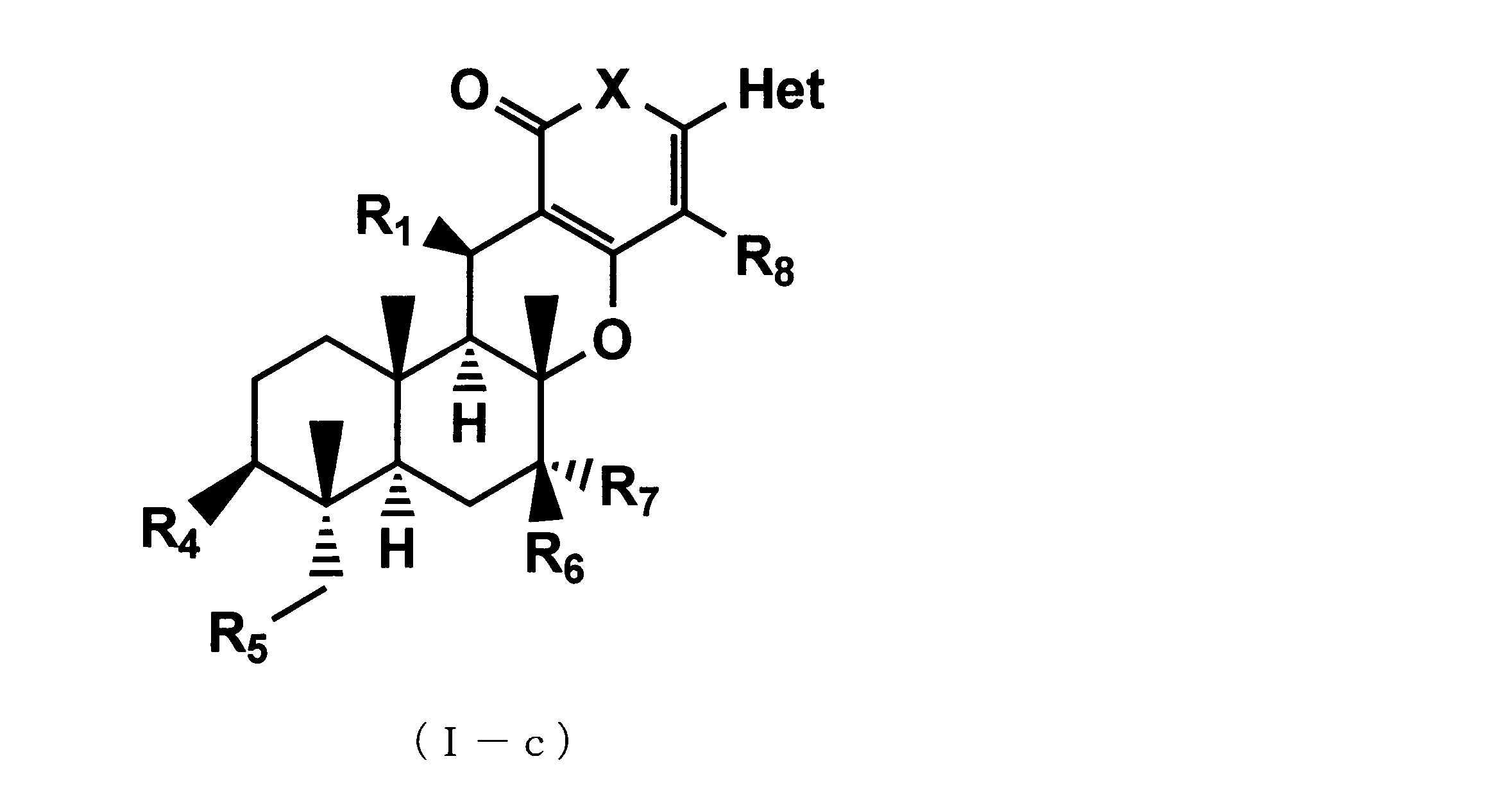
Hetは、3-ピリジル基であり、
Xは、酸素原子であり、
R1は、直鎖、分岐鎖、もしくは環状のC1-6アルキルカルボニルオキシ基またはC1-6アルキルオキシ基を表し、
R4は、C3-6シクロアルキルカルボニルオキシ基であり、
R5は、C3-6シクロアルキルカルボニルオキシ基であり、
R6は、水酸基、アセチルオキシ基またはC3-6シクロアルキルカルボニルオキシ基であり、
R7およびR8は、水素原子である]。 A compound represented by the following formula (Ic) or a salt thereof:
Het is a 3-pyridyl group,
X is an oxygen atom,
R 1 represents a linear, branched, or cyclic C 1-6 alkylcarbonyloxy group or a C 1-6 alkyloxy group,
R 4 is a C 3-6 cycloalkylcarbonyloxy group,
R 5 is a C 3-6 cycloalkylcarbonyloxy group,
R 6 is a hydroxyl group, an acetyloxy group or a C 3-6 cycloalkylcarbonyloxy group,
R 7 and R 8 are hydrogen atoms].
Priority Applications (5)
| Application Number | Priority Date | Filing Date | Title |
|---|---|---|---|
| US13/699,367 US20130131091A1 (en) | 2010-05-24 | 2011-05-23 | Harmful organism control agent |
| JP2012517247A JPWO2011148886A1 (en) | 2010-05-24 | 2011-05-23 | Pest control agent |
| BR112012028760A BR112012028760A2 (en) | 2010-05-24 | 2011-05-23 | harmful organism control agent |
| EP11786585.7A EP2578084A4 (en) | 2010-05-24 | 2011-05-23 | AGENT TO FIGHT HARMFUL ORGANISMS |
| CN2011800259059A CN103025161A (en) | 2010-05-24 | 2011-05-23 | pest control agent |
Applications Claiming Priority (2)
| Application Number | Priority Date | Filing Date | Title |
|---|---|---|---|
| JP2010-118397 | 2010-05-24 | ||
| JP2010118397 | 2010-05-24 |
Publications (1)
| Publication Number | Publication Date |
|---|---|
| WO2011148886A1 true WO2011148886A1 (en) | 2011-12-01 |
Family
ID=45003876
Family Applications (1)
| Application Number | Title | Priority Date | Filing Date |
|---|---|---|---|
| PCT/JP2011/061730 Ceased WO2011148886A1 (en) | 2010-05-24 | 2011-05-23 | Noxious organism control agent |
Country Status (7)
| Country | Link |
|---|---|
| US (1) | US20130131091A1 (en) |
| EP (1) | EP2578084A4 (en) |
| JP (1) | JPWO2011148886A1 (en) |
| CN (1) | CN103025161A (en) |
| AR (1) | AR082268A1 (en) |
| BR (1) | BR112012028760A2 (en) |
| WO (1) | WO2011148886A1 (en) |
Cited By (4)
| Publication number | Priority date | Publication date | Assignee | Title |
|---|---|---|---|---|
| CN104168770A (en) * | 2012-03-13 | 2014-11-26 | 巴斯夫欧洲公司 | Liquid concentrate formulation III containing a pyripyropene insecticide |
| CN104185421A (en) * | 2012-03-12 | 2014-12-03 | 巴斯夫欧洲公司 | Liquid concentrate formulation containing a pyripyropene insecticide II |
| JP2015511596A (en) * | 2012-03-12 | 2015-04-20 | ビーエーエスエフ ソシエタス・ヨーロピアBasf Se | Process for the preparation of concentrated aqueous suspension formulations of pyripyropene insecticides |
| JP2018138579A (en) * | 2013-01-16 | 2018-09-06 | ビーエーエスエフ ソシエタス・ヨーロピアBasf Se | Method for producing pyripyropene compound |
Families Citing this family (2)
| Publication number | Priority date | Publication date | Assignee | Title |
|---|---|---|---|---|
| CN110495470A (en) * | 2019-08-29 | 2019-11-26 | 上海明德立达生物科技有限公司 | A kind of insecticide composition and its application |
| CN119613426B (en) * | 2023-09-14 | 2025-12-09 | 青岛清原化合物有限公司 | Pyripyropene derivative, composition and application thereof |
Citations (59)
| Publication number | Priority date | Publication date | Assignee | Title |
|---|---|---|---|---|
| EP0039222A1 (en) | 1980-04-25 | 1981-11-04 | Yeda Research And Development Company, Ltd. | Electrical storage systems |
| EP0242246A1 (en) | 1986-03-11 | 1987-10-21 | Plant Genetic Systems N.V. | Plant cells resistant to glutamine synthetase inhibitors, made by genetic engineering |
| US4822779A (en) | 1988-03-26 | 1989-04-18 | Korea Research Institute Of Chemical Technology | Phosphoric and thiophosphonic acid derivatives of 5-hydroxypyrazoles, compositions and use |
| EP0374753A2 (en) | 1988-12-19 | 1990-06-27 | American Cyanamid Company | Insecticidal toxines, genes coding therefor, antibodies binding them, transgenic plant cells and plants expressing these toxines |
| EP0427529A1 (en) | 1989-11-07 | 1991-05-15 | Pioneer Hi-Bred International, Inc. | Larvicidal lectins and plant insect resistance based thereon |
| EP0451878A1 (en) | 1985-01-18 | 1991-10-16 | Plant Genetic Systems, N.V. | Modifying plants by genetic engineering to combat or control insects |
| WO1992000377A1 (en) | 1990-06-25 | 1992-01-09 | Monsanto Company | Glyphosate tolerant plants |
| JPH04360895A (en) | 1991-06-06 | 1992-12-14 | Kitasato Inst:The | Fo-1289a substance and production thereof |
| WO1993007278A1 (en) | 1991-10-04 | 1993-04-15 | Ciba-Geigy Ag | Synthetic dna sequence having enhanced insecticidal activity in maize |
| WO1994009417A1 (en) | 1992-10-14 | 1994-04-28 | Allergan, Inc. | Foot pedal control with user-selectable operational ranges |
| WO1995034656A1 (en) | 1994-06-10 | 1995-12-21 | Ciba-Geigy Ag | Novel bacillus thuringiensis genes coding toxins active against lepidopteran pests |
| JPH08239385A (en) | 1995-03-03 | 1996-09-17 | Kitasato Inst:The | FO-1289 substance and its production method |
| US5559024A (en) | 1988-03-23 | 1996-09-24 | Rhone-Poulenc Agrochimie | Chimeric nitrilase-encoding gene for herbicidal resistance |
| JPH08259569A (en) | 1995-03-27 | 1996-10-08 | Kitasato Inst:The | Pyripyropene derivative |
| JPH08269062A (en) | 1995-03-30 | 1996-10-15 | Kitasato Inst:The | Pyripyropene derivative |
| JPH08269063A (en) | 1995-03-28 | 1996-10-15 | Kitasato Inst:The | Pyripyropene derivative |
| JPH08269064A (en) | 1995-04-03 | 1996-10-15 | Kitasato Inst:The | Pyripyropene derivative |
| WO1997041218A1 (en) | 1996-04-29 | 1997-11-06 | Board Of Supervisors Of Louisiana State University And Agricultural And Mechanical College | Herbicide resistant rice |
| WO1998002527A1 (en) | 1996-07-17 | 1998-01-22 | Michigan State University | Imidazolinone herbicide resistant sugar beet plants |
| WO1998002526A1 (en) | 1996-07-17 | 1998-01-22 | Michigan State University | Imidazolinone herbicide resistant sugar beet plants |
| WO2000026390A2 (en) | 1998-10-29 | 2000-05-11 | American Cyanamid Company | Genes and vectors for conferring herbicide resistance in plants |
| US6222100B1 (en) | 1984-03-06 | 2001-04-24 | Mgi Pharma, Inc. | Herbicide resistance in plants |
| US6300348B1 (en) | 1996-04-03 | 2001-10-09 | Bayer Aktiengesellschaft | Pesticide for parasitic insects and acarids on humans |
| WO2001082685A1 (en) | 2000-04-28 | 2001-11-08 | Basf Aktiengesellschaft | Use of the maize x112 mutant ahas 2 gene and imidazolinone herbicides for selection of transgenic monocots, maize, rice and wheat plants resistant to the imidazolinone herbicides |
| WO2002015701A2 (en) | 2000-08-25 | 2002-02-28 | Syngenta Participations Ag | Bacillus thuringiensis crystal protein hybrids |
| WO2002090320A2 (en) | 2001-05-09 | 2002-11-14 | Sumitomo Chemical Company, Limited | Malononitrile compounds and their use as pesticides |
| WO2003014357A1 (en) | 2001-08-09 | 2003-02-20 | University Of Saskatchewan | Wheat plants having increased resistance to imidazolinone herbicides |
| WO2003014356A1 (en) | 2001-08-09 | 2003-02-20 | University Of Saskatchewan | Wheat plants having increased resistance to imidazolinone herbicides |
| WO2003013225A2 (en) | 2001-08-09 | 2003-02-20 | Northwest Plant Breeding Company | Wheat plants having increased resistance to imidazolinone herbicides |
| WO2003018810A2 (en) | 2001-08-31 | 2003-03-06 | Syngenta Participations Ag | Modified cry3a toxins and nucleic acid sequences coding therefor |
| WO2003052073A2 (en) | 2001-12-17 | 2003-06-26 | Syngenta Participations Ag | Novel corn event |
| WO2004006677A1 (en) | 2002-07-17 | 2004-01-22 | Sumitomo Chemical Company, Limited | Malononitrile compounds and their use as pesticides |
| WO2004016073A2 (en) | 2002-07-10 | 2004-02-26 | The Department Of Agriculture, Western Australia | Wheat plants having increased resistance to imidazolinone herbicides |
| WO2004060065A1 (en) | 2003-01-07 | 2004-07-22 | Korea Research Institute Of Bioscience And Biotechnology | Insecticidal compositions comprising compounds having inhibitory activity versus acyl coa: cholesterol acyltransferase or salts thereof as effective ingredients |
| WO2004106529A2 (en) | 2003-05-28 | 2004-12-09 | Basf Aktiengesellschaft | Wheat plants having increased tolerance to imidazolinone herbicides |
| WO2005020673A1 (en) | 2003-08-29 | 2005-03-10 | Instituto Nacional De Technologia Agropecuaria | Rice plants having increased tolerance to imidazolinone herbicides |
| WO2005063694A1 (en) | 2003-12-26 | 2005-07-14 | Sumitomo Chemical Company, Limited | Nitrile compound and its use in pest control |
| WO2005068432A1 (en) | 2004-01-16 | 2005-07-28 | Sumitomo Chemical Company, Limited | Malononitrile compound as pesticides |
| WO2005068423A1 (en) | 2004-01-16 | 2005-07-28 | Sumitomo Chemical Company, Limited | Malononitrile compound and use thereof |
| WO2005085216A1 (en) | 2004-03-05 | 2005-09-15 | Nissan Chemical Industries, Ltd. | Isoxazoline-substituted benzamide compound and noxious organism control agent |
| WO2006012971A1 (en) | 2004-07-28 | 2006-02-09 | Henkel Kommanditgesellschaft Auf Aktien | Low-residue deodorant or antiperspirant stick based on an oil-in-water dispersion |
| JP2006131529A (en) | 2004-11-05 | 2006-05-25 | Sumitomo Chemical Co Ltd | Pest control composition |
| WO2006129714A1 (en) | 2005-06-01 | 2006-12-07 | Meiji Seika Kaisha, Ltd. | Pest control agent |
| WO2007026965A1 (en) | 2005-09-02 | 2007-03-08 | Nissan Chemical Industries, Ltd. | Isoxazoline-substituted benzamide compound and harmful organism-controlling agent |
| WO2007043677A1 (en) | 2005-10-14 | 2007-04-19 | Sumitomo Chemical Company, Limited | Hydrazide compound and pesticidal use of the same |
| WO2007060839A1 (en) | 2005-11-22 | 2007-05-31 | Sumitomo Chemical Company, Limited | Organic sulfur compounds and use thereof as arthropodicides |
| WO2007079162A1 (en) | 2005-12-30 | 2007-07-12 | E. I. Du Pont De Nemours And Company | Isoxazolines for controlling invertebrate pests |
| WO2007101540A1 (en) | 2006-03-06 | 2007-09-13 | Bayer Cropscience Ag | Combinations of active ingredients with insecticidal properties |
| WO2007115644A1 (en) | 2006-03-31 | 2007-10-18 | Bayer Cropscience Ag | Substituted enaminocarbonyl compounds |
| JP2008115155A (en) | 2007-04-06 | 2008-05-22 | Nippon Soda Co Ltd | Pest-controlling agent composition and pest-controlling method |
| WO2008066153A1 (en) | 2006-11-30 | 2008-06-05 | Meiji Seika Kaisha, Ltd. | Pest control agent |
| WO2008072743A1 (en) | 2006-12-15 | 2008-06-19 | Ishihara Sangyo Kaisha, Ltd. | Method for producing anthranilamide compound by using novel pyrazole compound as intermediate |
| WO2008072783A1 (en) | 2006-12-14 | 2008-06-19 | Ishihara Sangyo Kaisha, Ltd. | Pesticidal compositions |
| WO2008108491A1 (en) | 2007-03-08 | 2008-09-12 | Meiji Seika Kaisha, Ltd. | Pest control composition |
| WO2009022702A1 (en) | 2007-08-13 | 2009-02-19 | Meiji Seika Kaisha, Ltd. | Method for producing pyripyropene derivative and production intermediate thereof |
| WO2009051956A2 (en) | 2007-10-16 | 2009-04-23 | E. I. Du Pont De Nemours And Company | Pyrazole-substituted isoxazoline insecticides |
| WO2009081851A1 (en) | 2007-12-21 | 2009-07-02 | Meiji Seika Kaisha, Ltd. | Novel systemic pesticide |
| WO2009081957A1 (en) | 2007-12-25 | 2009-07-02 | The Kitasato Institute | Pyripyropene derivative having acat2-inhibiting activity |
| WO2009126668A2 (en) | 2008-04-09 | 2009-10-15 | E. I. Du Pont De Nemours And Company | Method for preparing 3-trifluoromethyl chalcones |
Family Cites Families (8)
| Publication number | Priority date | Publication date | Assignee | Title |
|---|---|---|---|---|
| JP3233476B2 (en) * | 1992-10-22 | 2001-11-26 | 社団法人北里研究所 | FO-1289 substance and method for producing the same |
| KR0125129B1 (en) * | 1993-10-08 | 1997-11-28 | 김은영 | Novel acyl-CoA: Cholesterol acyltransferase (ACAT) activity inhibitor and preparation method thereof |
| US7491738B2 (en) * | 2005-06-01 | 2009-02-17 | Meiji Seika Kaisha, Ltd. | Pest control agents |
| WO2010150739A1 (en) * | 2009-06-23 | 2010-12-29 | 学校法人北里研究所 | Hydroxyl-containing pyripyropene derivatives exhibiting acat2-inhibitory activity |
| US8962524B2 (en) * | 2010-05-28 | 2015-02-24 | Basf Se | Pesticidal mixtures |
| AU2011257163B2 (en) * | 2010-05-28 | 2014-07-24 | Basf Se | Pesticidal mixtures |
| WO2011161132A1 (en) * | 2010-06-25 | 2011-12-29 | Basf Se | Pesticidal mixtures |
| KR101938020B1 (en) * | 2010-09-14 | 2019-01-11 | 바스프 에스이 | Composition containing a pyripyropene insecticide and a base |
-
2011
- 2011-05-23 US US13/699,367 patent/US20130131091A1/en not_active Abandoned
- 2011-05-23 JP JP2012517247A patent/JPWO2011148886A1/en active Pending
- 2011-05-23 BR BR112012028760A patent/BR112012028760A2/en not_active IP Right Cessation
- 2011-05-23 EP EP11786585.7A patent/EP2578084A4/en not_active Withdrawn
- 2011-05-23 CN CN2011800259059A patent/CN103025161A/en active Pending
- 2011-05-23 WO PCT/JP2011/061730 patent/WO2011148886A1/en not_active Ceased
- 2011-05-24 AR ARP110101783A patent/AR082268A1/en unknown
Patent Citations (63)
| Publication number | Priority date | Publication date | Assignee | Title |
|---|---|---|---|---|
| EP0039222A1 (en) | 1980-04-25 | 1981-11-04 | Yeda Research And Development Company, Ltd. | Electrical storage systems |
| US6222100B1 (en) | 1984-03-06 | 2001-04-24 | Mgi Pharma, Inc. | Herbicide resistance in plants |
| EP0451878A1 (en) | 1985-01-18 | 1991-10-16 | Plant Genetic Systems, N.V. | Modifying plants by genetic engineering to combat or control insects |
| EP0242246A1 (en) | 1986-03-11 | 1987-10-21 | Plant Genetic Systems N.V. | Plant cells resistant to glutamine synthetase inhibitors, made by genetic engineering |
| EP0242236A1 (en) | 1986-03-11 | 1987-10-21 | Plant Genetic Systems N.V. | Plant cells resistant to glutamine synthetase inhibitors, made by genetic engineering |
| US5559024A (en) | 1988-03-23 | 1996-09-24 | Rhone-Poulenc Agrochimie | Chimeric nitrilase-encoding gene for herbicidal resistance |
| US4822779A (en) | 1988-03-26 | 1989-04-18 | Korea Research Institute Of Chemical Technology | Phosphoric and thiophosphonic acid derivatives of 5-hydroxypyrazoles, compositions and use |
| EP0374753A2 (en) | 1988-12-19 | 1990-06-27 | American Cyanamid Company | Insecticidal toxines, genes coding therefor, antibodies binding them, transgenic plant cells and plants expressing these toxines |
| EP0427529A1 (en) | 1989-11-07 | 1991-05-15 | Pioneer Hi-Bred International, Inc. | Larvicidal lectins and plant insect resistance based thereon |
| WO1992000377A1 (en) | 1990-06-25 | 1992-01-09 | Monsanto Company | Glyphosate tolerant plants |
| JPH04360895A (en) | 1991-06-06 | 1992-12-14 | Kitasato Inst:The | Fo-1289a substance and production thereof |
| WO1993007278A1 (en) | 1991-10-04 | 1993-04-15 | Ciba-Geigy Ag | Synthetic dna sequence having enhanced insecticidal activity in maize |
| WO1994009417A1 (en) | 1992-10-14 | 1994-04-28 | Allergan, Inc. | Foot pedal control with user-selectable operational ranges |
| WO1995034656A1 (en) | 1994-06-10 | 1995-12-21 | Ciba-Geigy Ag | Novel bacillus thuringiensis genes coding toxins active against lepidopteran pests |
| JPH08239385A (en) | 1995-03-03 | 1996-09-17 | Kitasato Inst:The | FO-1289 substance and its production method |
| JPH08259569A (en) | 1995-03-27 | 1996-10-08 | Kitasato Inst:The | Pyripyropene derivative |
| JPH08269063A (en) | 1995-03-28 | 1996-10-15 | Kitasato Inst:The | Pyripyropene derivative |
| JPH08269062A (en) | 1995-03-30 | 1996-10-15 | Kitasato Inst:The | Pyripyropene derivative |
| JPH08269064A (en) | 1995-04-03 | 1996-10-15 | Kitasato Inst:The | Pyripyropene derivative |
| US6300348B1 (en) | 1996-04-03 | 2001-10-09 | Bayer Aktiengesellschaft | Pesticide for parasitic insects and acarids on humans |
| WO1997041218A1 (en) | 1996-04-29 | 1997-11-06 | Board Of Supervisors Of Louisiana State University And Agricultural And Mechanical College | Herbicide resistant rice |
| WO1998002527A1 (en) | 1996-07-17 | 1998-01-22 | Michigan State University | Imidazolinone herbicide resistant sugar beet plants |
| WO1998002526A1 (en) | 1996-07-17 | 1998-01-22 | Michigan State University | Imidazolinone herbicide resistant sugar beet plants |
| WO2000026390A2 (en) | 1998-10-29 | 2000-05-11 | American Cyanamid Company | Genes and vectors for conferring herbicide resistance in plants |
| WO2001082685A1 (en) | 2000-04-28 | 2001-11-08 | Basf Aktiengesellschaft | Use of the maize x112 mutant ahas 2 gene and imidazolinone herbicides for selection of transgenic monocots, maize, rice and wheat plants resistant to the imidazolinone herbicides |
| WO2002015701A2 (en) | 2000-08-25 | 2002-02-28 | Syngenta Participations Ag | Bacillus thuringiensis crystal protein hybrids |
| WO2002090320A2 (en) | 2001-05-09 | 2002-11-14 | Sumitomo Chemical Company, Limited | Malononitrile compounds and their use as pesticides |
| WO2002090321A1 (en) | 2001-05-09 | 2002-11-14 | Sumitomo Chemical Company, Limited | Malononitrile compounds and their use as pesticides |
| WO2002089579A1 (en) | 2001-05-09 | 2002-11-14 | Sumitomo Chemical Company, Limited | Pesticide composition comprising malononitrile compounds |
| WO2003014356A1 (en) | 2001-08-09 | 2003-02-20 | University Of Saskatchewan | Wheat plants having increased resistance to imidazolinone herbicides |
| WO2003013225A2 (en) | 2001-08-09 | 2003-02-20 | Northwest Plant Breeding Company | Wheat plants having increased resistance to imidazolinone herbicides |
| WO2003014357A1 (en) | 2001-08-09 | 2003-02-20 | University Of Saskatchewan | Wheat plants having increased resistance to imidazolinone herbicides |
| WO2003018810A2 (en) | 2001-08-31 | 2003-03-06 | Syngenta Participations Ag | Modified cry3a toxins and nucleic acid sequences coding therefor |
| WO2003052073A2 (en) | 2001-12-17 | 2003-06-26 | Syngenta Participations Ag | Novel corn event |
| WO2004016073A2 (en) | 2002-07-10 | 2004-02-26 | The Department Of Agriculture, Western Australia | Wheat plants having increased resistance to imidazolinone herbicides |
| WO2004006677A1 (en) | 2002-07-17 | 2004-01-22 | Sumitomo Chemical Company, Limited | Malononitrile compounds and their use as pesticides |
| JP2006513233A (en) * | 2003-01-07 | 2006-04-20 | コリア リサーチ インスティチュート オブ バイオサイエンス アンド バイオテクノロジー | Insecticide containing acyl CoA: cholesterol acyltransferase inhibitory compound or salt thereof as an active ingredient |
| WO2004060065A1 (en) | 2003-01-07 | 2004-07-22 | Korea Research Institute Of Bioscience And Biotechnology | Insecticidal compositions comprising compounds having inhibitory activity versus acyl coa: cholesterol acyltransferase or salts thereof as effective ingredients |
| WO2004106529A2 (en) | 2003-05-28 | 2004-12-09 | Basf Aktiengesellschaft | Wheat plants having increased tolerance to imidazolinone herbicides |
| WO2005020673A1 (en) | 2003-08-29 | 2005-03-10 | Instituto Nacional De Technologia Agropecuaria | Rice plants having increased tolerance to imidazolinone herbicides |
| WO2005063694A1 (en) | 2003-12-26 | 2005-07-14 | Sumitomo Chemical Company, Limited | Nitrile compound and its use in pest control |
| WO2005068432A1 (en) | 2004-01-16 | 2005-07-28 | Sumitomo Chemical Company, Limited | Malononitrile compound as pesticides |
| WO2005068423A1 (en) | 2004-01-16 | 2005-07-28 | Sumitomo Chemical Company, Limited | Malononitrile compound and use thereof |
| WO2005085216A1 (en) | 2004-03-05 | 2005-09-15 | Nissan Chemical Industries, Ltd. | Isoxazoline-substituted benzamide compound and noxious organism control agent |
| WO2006012971A1 (en) | 2004-07-28 | 2006-02-09 | Henkel Kommanditgesellschaft Auf Aktien | Low-residue deodorant or antiperspirant stick based on an oil-in-water dispersion |
| JP2006131529A (en) | 2004-11-05 | 2006-05-25 | Sumitomo Chemical Co Ltd | Pest control composition |
| WO2006129714A1 (en) | 2005-06-01 | 2006-12-07 | Meiji Seika Kaisha, Ltd. | Pest control agent |
| WO2007026965A1 (en) | 2005-09-02 | 2007-03-08 | Nissan Chemical Industries, Ltd. | Isoxazoline-substituted benzamide compound and harmful organism-controlling agent |
| WO2007043677A1 (en) | 2005-10-14 | 2007-04-19 | Sumitomo Chemical Company, Limited | Hydrazide compound and pesticidal use of the same |
| WO2007060839A1 (en) | 2005-11-22 | 2007-05-31 | Sumitomo Chemical Company, Limited | Organic sulfur compounds and use thereof as arthropodicides |
| WO2007079162A1 (en) | 2005-12-30 | 2007-07-12 | E. I. Du Pont De Nemours And Company | Isoxazolines for controlling invertebrate pests |
| WO2007101540A1 (en) | 2006-03-06 | 2007-09-13 | Bayer Cropscience Ag | Combinations of active ingredients with insecticidal properties |
| WO2007115644A1 (en) | 2006-03-31 | 2007-10-18 | Bayer Cropscience Ag | Substituted enaminocarbonyl compounds |
| WO2008066153A1 (en) | 2006-11-30 | 2008-06-05 | Meiji Seika Kaisha, Ltd. | Pest control agent |
| WO2008072783A1 (en) | 2006-12-14 | 2008-06-19 | Ishihara Sangyo Kaisha, Ltd. | Pesticidal compositions |
| WO2008072743A1 (en) | 2006-12-15 | 2008-06-19 | Ishihara Sangyo Kaisha, Ltd. | Method for producing anthranilamide compound by using novel pyrazole compound as intermediate |
| WO2008108491A1 (en) | 2007-03-08 | 2008-09-12 | Meiji Seika Kaisha, Ltd. | Pest control composition |
| JP2008115155A (en) | 2007-04-06 | 2008-05-22 | Nippon Soda Co Ltd | Pest-controlling agent composition and pest-controlling method |
| WO2009022702A1 (en) | 2007-08-13 | 2009-02-19 | Meiji Seika Kaisha, Ltd. | Method for producing pyripyropene derivative and production intermediate thereof |
| WO2009051956A2 (en) | 2007-10-16 | 2009-04-23 | E. I. Du Pont De Nemours And Company | Pyrazole-substituted isoxazoline insecticides |
| WO2009081851A1 (en) | 2007-12-21 | 2009-07-02 | Meiji Seika Kaisha, Ltd. | Novel systemic pesticide |
| WO2009081957A1 (en) | 2007-12-25 | 2009-07-02 | The Kitasato Institute | Pyripyropene derivative having acat2-inhibiting activity |
| WO2009126668A2 (en) | 2008-04-09 | 2009-10-15 | E. I. Du Pont De Nemours And Company | Method for preparing 3-trifluoromethyl chalcones |
Non-Patent Citations (20)
| Title |
|---|
| "Farm Chemicals Handbook", vol. 88, 2001, MEISTER PUBLISHING COMPANY |
| "Jikken Kagaku Koza (Experimental Chemistry", 1992, MARUZEN COMPANY, LIMITED |
| "SHIBUYA INDEX", 2009, SHIBUYA INDEX RESEARCH GROUP |
| "The Pesticide Manual", THE BRITISH CROP PROTECTION COUNCI |
| APPLIED AND ENVIRONMENTAL MICROBIOLOGY, vol. 61, no. 12, 1995, pages 4429 - 35 |
| BIOCONJUG CHEM., vol. L6, no. 1, January 2005 (2005-01-01), pages 113 - 21 |
| BIOMATERIALS., vol. 22, no. 5, March 2001 (2001-03-01), pages 405 - 1 7 |
| BIOTECHNOL PROG., vol. 17, no. 4, July 2001 (2001-07-01), pages 720 - 8 |
| CURR OPIN CHEM BIO!., vol. 10, no. 5, October 2006 (2006-10-01), pages 487 - 91 |
| FURTHERMORE, APPLIED AND ENVIRONMENTAL MICROBIOLOGY, vol. 61, no. 12, 1995, pages 4429 - 35 |
| J. ANTIBIOT., vol. 49, 1996, pages 292 |
| J. ANTIBIOT., vol. 49, no. 11, 1996, pages 1133 |
| J. ANTIBIOT., vol. 50, no. 3, 1997, pages 229 |
| JOURNAL OF ANTIBIOTICS, vol. 46, no. 7, 1993, pages 1168 - 9 |
| JOURNAL OF ANTIBIOTICS, vol. 50, no. 3, 1997, pages 229 - 36 |
| JOURNAL OF SOCIETY OF SYNTHETIC ORGANIC CHEMISTRY, vol. 56, no. 6, 1998, pages 478 - 488 |
| JOURNAL OF TECHNICCAL DISCLOSURE, no. 500997, 2008 |
| NAT PROTOC., vol. 2, no. 5, 2007, pages 1225 - 35 |
| PESTICIDE SCIENCE, vol. 54, 1988, pages 237 - 243 |
| PROTEIN ENG DES SEL., vol. 17, no. 1, pages 57 - 66 |
Cited By (6)
| Publication number | Priority date | Publication date | Assignee | Title |
|---|---|---|---|---|
| CN104185421A (en) * | 2012-03-12 | 2014-12-03 | 巴斯夫欧洲公司 | Liquid concentrate formulation containing a pyripyropene insecticide II |
| JP2015511596A (en) * | 2012-03-12 | 2015-04-20 | ビーエーエスエフ ソシエタス・ヨーロピアBasf Se | Process for the preparation of concentrated aqueous suspension formulations of pyripyropene insecticides |
| CN104185421B (en) * | 2012-03-12 | 2016-06-01 | 巴斯夫欧洲公司 | Liquid concentrate preparaton II containing pyridine Nan Ping sterilant |
| CN104168770A (en) * | 2012-03-13 | 2014-11-26 | 巴斯夫欧洲公司 | Liquid concentrate formulation III containing a pyripyropene insecticide |
| CN104168770B (en) * | 2012-03-13 | 2016-06-01 | 巴斯夫欧洲公司 | Liquid concentrate preparaton III containing pyridine Nan Ping sterilant |
| JP2018138579A (en) * | 2013-01-16 | 2018-09-06 | ビーエーエスエフ ソシエタス・ヨーロピアBasf Se | Method for producing pyripyropene compound |
Also Published As
| Publication number | Publication date |
|---|---|
| US20130131091A1 (en) | 2013-05-23 |
| JPWO2011148886A1 (en) | 2013-07-25 |
| CN103025161A (en) | 2013-04-03 |
| AR082268A1 (en) | 2012-11-28 |
| BR112012028760A2 (en) | 2018-02-06 |
| EP2578084A1 (en) | 2013-04-10 |
| EP2578084A4 (en) | 2014-04-23 |
Similar Documents
| Publication | Publication Date | Title |
|---|---|---|
| JP5575831B2 (en) | Pest control agent | |
| JP5313869B2 (en) | Pest control composition | |
| CN111132549B (en) | Long-term control agent for ectoparasites for animals | |
| ES2710701T3 (en) | Pyrazole compounds for the control of invertebrate pests | |
| KR100963370B1 (en) | Anthranilamide compounds, preparation method thereof and harmful biocontrol agents | |
| KR101430891B1 (en) | Nitrogen-containing heterocyclic compound and pest control agent | |
| UA127063C2 (en) | N-(CYCLOPROPYLMETHYL)-5-(METHYLSULFONYL)-N-{1-[1-(PYRIMIDIN-2-YL)-1H-1,2,4-TRIAZOL-5-YL]ETHYL}BENZAMIDE DERIVATIVES AND CORRESPONDING PYRIDINECARBOXAMIDE DERIVATIVES AS PESTICIDES | |
| UA128452C2 (en) | Microbiocidal thiazole derivatives | |
| CN109996799B (en) | Fused bicyclic heterocyclic derivatives as pest control agents | |
| ES2827477T3 (en) | Antiparasitic compounds | |
| UA128352C2 (en) | (HETERO)ARYLYMIDAZOLE COMPOUND AND PEST CONTROL AGENT | |
| KR20090018657A (en) | Noxious biological control agents containing novel pyridyl-methanamine derivatives or salts thereof | |
| WO2011148886A1 (en) | Noxious organism control agent | |
| JP6508540B2 (en) | Pyridine compound and use thereof | |
| JP2009029787A (en) | N-phenyl-methanamine derivative and pest control agent containing the same | |
| EP4644388A1 (en) | Five-membered heteroaryl compound and agricultural and horticultural bactericide | |
| JP7389750B2 (en) | Composition for controlling mites of the suborder Mesospirata | |
| JP2012077078A (en) | Novel triazolone derivative and pest control agent containing the same as active constituent | |
| WO2016039048A1 (en) | Pyridine compound and use thereof | |
| US20110263608A1 (en) | 16-keto aspergillimides and harmful organism control agent comprising the same as active ingredient | |
| JP5037164B2 (en) | Pest control agent | |
| CN119613426B (en) | Pyripyropene derivative, composition and application thereof | |
| JP6221189B2 (en) | Pyridine compounds and uses thereof | |
| WO2011158879A1 (en) | Composition for pest control | |
| JP2021008438A (en) | Harmful arthropod-control composition containing cyclaniliprole |
Legal Events
| Date | Code | Title | Description |
|---|---|---|---|
| WWE | Wipo information: entry into national phase |
Ref document number: 201180025905.9 Country of ref document: CN |
|
| 121 | Ep: the epo has been informed by wipo that ep was designated in this application |
Ref document number: 11786585 Country of ref document: EP Kind code of ref document: A1 |
|
| WWE | Wipo information: entry into national phase |
Ref document number: 2012517247 Country of ref document: JP |
|
| NENP | Non-entry into the national phase |
Ref country code: DE |
|
| WWE | Wipo information: entry into national phase |
Ref document number: 2011786585 Country of ref document: EP |
|
| WWE | Wipo information: entry into national phase |
Ref document number: 11127/DELNP/2012 Country of ref document: IN |
|
| WWE | Wipo information: entry into national phase |
Ref document number: 13699367 Country of ref document: US |
|
| REG | Reference to national code |
Ref country code: BR Ref legal event code: B01A Ref document number: 112012028760 Country of ref document: BR |
|
| ENP | Entry into the national phase |
Ref document number: 112012028760 Country of ref document: BR Kind code of ref document: A2 Effective date: 20121109 |