WO2011142715A1 - Methods and apparatus for measurement configuration support - Google Patents
Methods and apparatus for measurement configuration support Download PDFInfo
- Publication number
- WO2011142715A1 WO2011142715A1 PCT/SE2011/050587 SE2011050587W WO2011142715A1 WO 2011142715 A1 WO2011142715 A1 WO 2011142715A1 SE 2011050587 W SE2011050587 W SE 2011050587W WO 2011142715 A1 WO2011142715 A1 WO 2011142715A1
- Authority
- WO
- WIPO (PCT)
- Prior art keywords
- measurement
- measurements
- positioning
- network node
- user equipment
- Prior art date
- Legal status (The legal status is an assumption and is not a legal conclusion. Google has not performed a legal analysis and makes no representation as to the accuracy of the status listed.)
- Ceased
Links
Classifications
-
- H—ELECTRICITY
- H04—ELECTRIC COMMUNICATION TECHNIQUE
- H04W—WIRELESS COMMUNICATION NETWORKS
- H04W24/00—Supervisory, monitoring or testing arrangements
- H04W24/10—Scheduling measurement reports ; Arrangements for measurement reports
-
- H—ELECTRICITY
- H04—ELECTRIC COMMUNICATION TECHNIQUE
- H04B—TRANSMISSION
- H04B7/00—Radio transmission systems, i.e. using radiation field
- H04B7/02—Diversity systems; Multi-antenna system, i.e. transmission or reception using multiple antennas
- H04B7/022—Site diversity; Macro-diversity
- H04B7/024—Co-operative use of antennas of several sites, e.g. in co-ordinated multipoint or co-operative multiple-input multiple-output [MIMO] systems
-
- H—ELECTRICITY
- H04—ELECTRIC COMMUNICATION TECHNIQUE
- H04W—WIRELESS COMMUNICATION NETWORKS
- H04W24/00—Supervisory, monitoring or testing arrangements
- H04W24/02—Arrangements for optimising operational condition
-
- H—ELECTRICITY
- H04—ELECTRIC COMMUNICATION TECHNIQUE
- H04W—WIRELESS COMMUNICATION NETWORKS
- H04W4/00—Services specially adapted for wireless communication networks; Facilities therefor
- H04W4/02—Services making use of location information
- H04W4/021—Services related to particular areas, e.g. point of interest [POI] services, venue services or geofences
-
- H—ELECTRICITY
- H04—ELECTRIC COMMUNICATION TECHNIQUE
- H04W—WIRELESS COMMUNICATION NETWORKS
- H04W64/00—Locating users or terminals or network equipment for network management purposes, e.g. mobility management
Definitions
- This present disclosure relates in general to measurements in wireless communication networks and in particular to supporting configuration of such measurements in wireless network architectures that utilize signal measurements from multiple cells for e.g. positioning, location, and location-based services.
- the Universal Mobile Telecommunication System is one of the third generation mobile communication technologies designed to succeed GSM.
- 3GPP Long Term Evolution LTE is a project within the 3 rd Generation Partnership Project (3GPP) to improve the UMTS standard to cope with future requirements in terms of improved services such as higher data rates, improved efficiency, and lowered costs.
- the Universal Terrestrial Radio Access Network (UTRAN) is the radio access network of a UMTS and Evolved UTRAN (E-UTRAN) is the radio access network of an LTE system.
- a wireless device such as a user equipment (UE) 150a is wirelessly connected to a radio base station (RBS) 1 10a commonly referred to as an evolved NodeB (eNodeB), as illustrated in Fig. 1 a.
- RBS radio base station
- eNodeB evolved NodeB
- Each eNodeB 1 10a, 1 10b serves one or more areas each referred to as cells 120a, 120b, and are connected to the core network.
- the eNodeBs 1 10a, 1 10b are connected to a Mobility Management Entity (MME) (not shown) in the core network.
- MME Mobility Management Entity
- a positioning server 140 also called a location server, in the control plane architecture in Fig. 1 a is connected to the MME.
- the positioning server 140 is a physical or logical entity that manages positioning for a so called target device, i.e. a wireless device that is being positioned.
- the positioning server is in the control plane architecture also referred to as an Evolved Serving Mobile Location Center (E-SMLC).
- E-SMLC Evolved Serving Mobile Location Center
- the E-SMLC 140 may be a separate network node, but it may also be a functionality integrated in some other network node.
- the positioning is a part of a Secure User Plane Location (SUPL) Location Platform (SLP).
- the positioning server may be connected to radio network nodes via logical links while using one or more physical connections via other network nodes e.g., the MME.
- a Network Management (NM) or Operations and Maintenance (O&M) node 141 may be provided to perform different network management operations and activities in the network.
- Three key network elements in an LTE positioning architecture are a Location Services (LCS) Client, an LCS target and an LCS Server.
- the LCS Server is a physical or logical entity managing positioning for a LCS target device by collecting measurements and other location information, assisting the terminal in measurements when necessary, and estimating the LCS target location.
- the LCS Client is a software and/or hardware entity that interacts with the LCS Server for the purpose of obtaining location information for one or more LCS targets, i.e. the entities being positioned.
- the LCS Clients may reside in the LCS targets themselves.
- An LCS Client sends a request to the LCS Server to obtain location information, and the LCS Server processes and serves the received requests and sends the positioning result and optionally a velocity estimate to the LCS Client.
- a positioning request can be originated from a terminal or the network.
- Two positioning protocols operating via the radio network exist in LTE, LTE Positioning Protocol (LPP) and LPP Annex (LPPa).
- LPP is a point-to-point protocol between a LCS Server and a LCS target device, used in order to position the target device.
- LPP can be used both in the user and control plane, and multiple LPP procedures are allowed in series and/or in parallel thereby reducing latency.
- LPP uses RRC protocol as a transport.
- LPPa is a protocol between eNodeB and LCS Server specified mainly for control-plane positioning procedures, although it still can assist user-plane positioning by querying eNodeBs for information and eNodeB measurements.
- Secure User Plane (SUPL) protocol is used as a transport for LPP in the user plane.
- LPP has also a possibility to convey LPP extension messages inside LPP messages, e.g., currently Open Mobile Alliance (OMA)
- LPP extensions (LPPe) are being specified to allow, e.g., for operator- or manufacturer-specific assistance data or assistance data that cannot be provided with LPP or to support other position reporting formats or new positioning methods.
- LPPe may also be embedded into messages of other positioning protocol, which is not necessarily LPP.
- FIG. 2 A high-level architecture, as it is currently standardized in LTE, is illustrated in Fig. 2, where the LCS target is a terminal 200, and the LCS Server is an E-SMLC 201 or an SLP 202.
- the control plane positioning protocols with E-SMLC as the terminating point are shown by arrows 203, 204 and 205, and the user plane positioning protocol is shown by arrows 206 and 207.
- the SLP 202 may comprise two components, SUPL Positioning Centre (SPC) and SUPL Location Centre (SLC), which may also reside in different nodes.
- SPC SUPL Positioning Centre
- SLC SUPL Location Centre
- the SPC has a proprietary interface with the E-SMLC 201 , and an Lip interface with SLC, and the SLC part of SLP communicates with a PDN-Gateway (P-GW) (not shown) and an external LCS Client 208.
- P-GW PDN-Gateway
- Additional positioning architecture elements may also be deployed to further enhance performance of specific positioning methods. For example, deploying radio beacons is a cost-efficient solution which may significantly improve positioning performance indoors and also outdoors by allowing more accurate positioning, for example, with proximity location techniques.
- UE positioning is a process of determining UE coordinates in space. Once the coordinates are available, they may be mapped to a certain place or location. The mapping function and delivery of the location information on request are parts of a location service which is required for basic emergency services. Services that further exploit a location knowledge or that are based on the location knowledge to offer customers some added value are referred to as location-aware and location- based services.
- the LTE network will deploy a range of complementary positioning methods characterized by different performance in different environments. Depending on where the measurements are conducted and where the final position is calculated, the methods can be UE-based, UE-assisted or network-based, each with own advantages.
- the following methods are available in the LTE standard for both the control plane and the user plane:
- UE-assisted and network-based E-CID including network-based angle of arrival (AoA),
- A-GNSS including A-GPS
- OTDOA Observed Time Difference of Arrival
- LTE long term evolution
- UE-based GNSS e.g., GPS
- OTDOA UE-based OTDOA
- proximity based location e.g., GPS
- UTDOA may also be standardized in a later LTE release, since it is currently under discussion in 3GPP. More methods, LTE and non-LTE, are supported with LPPe.
- RATs radio-access technologies
- CDMA Code Division Multiple Access
- WCDMA Wideband Code Division Multiple Access
- GSM Global System for Mobile communications
- a wireless device position can be accurately estimated by using positioning methods based on Global Positioning System (GPS).
- GPS Global Positioning System
- networks also often have a possibility to assist wireless devices in order to improve the device receiver sensitivity and GPS start-up performance, as for example in an Assisted-GPS (A-GPS) positioning method.
- GPS or A-GPS receivers may not necessarily be available in all wireless devices.
- GPS is known to often fail in indoor environments and urban canyons.
- OTDOA The complementary terrestrial positioning method OTDOA, has therefore been standardized by 3GPP.
- a wireless device such as a UE measures the timing differences for downlink reference signals received from multiple distinct locations, such as eNodeBs. For each measured neighbor cell, the UE measures Reference Signal Time Difference (RSTD) which is the relative timing difference between a neighbor cell and the reference cell. The UE measures the timing of the received downlink reference signals using assistance data received from the LCS server, and the resulting measurements are used to locate the UE in relation to the neighboring cells. As illustrated in Fig.3, the UE position estimate is found as the intersection 430 of hyperbolas 440 corresponding to the measured RSTDs. At least three measurements from geographically dispersed RBSs 410a-c with a good geometry are needed to solve for two coordinates of the UE.
- RSTD Reference Signal Time Difference
- Position calculations may be conducted, for example by a positioning node such as the E-SMLC or the SLP in LTE, or by the UE.
- a positioning node such as the E-SMLC or the SLP in LTE
- the former approach corresponds to the UE-assisted positioning mode
- the latter corresponds to the UE-based positioning mode.
- an SFN-SFN type 2 measurement (SFN stands for System Frame Number) performed by the UE is used for the OTDOA positioning method. This measurement is the relative timing difference between cell j and cell i based on the primary Common Pilot Channel (CPICH) from cell j and cell i.
- CPICH primary Common Pilot Channel
- the UE reported SFN-SFN type 2 is used by the network to estimate the UE position.
- PRS positioning reference signals
- a frequency shift which is a function of a Physical Cell Identity (PCI)
- PCI Physical Cell Identity
- PRS Physical Cell Identity
- PRS have been specifically designed for positioning measurements and in general are characterized by better signal quality than other reference signals, the standard does not mandate using PRS.
- Other reference signals e.g., cell-specific reference signals (CRS) may also be used for positioning measurements.
- PRS are transmitted according to a pre-defined pattern and following one of the predefined PRS configurations. PRS are transmitted in pre-defined positioning subframes grouped by a number N_prs of consecutive subframes, i.e.
- Positioning occasions occur periodically with a certain periodicity of N subframes, corresponding to a time interval T_prs between two positioning occasions.
- the standardized time intervals T_prs are 160, 320, 640, and 1280 ms, and the number of consecutive subframes N_prs are 1 , 2, 4, and 6.
- Each pre-defined PRS configuration comprises at least PRS transmission bandwidth, N_prs and T_prs.
- assistance information also referred to as assistance data, is transmitted to the UE, which includes e.g. reference cell information, a neighbor cell list containing PCIs of neighbor cells, the number of consecutive downlink subframes N-prs, PRS transmission bandwidth, and frequency.
- the assistance information is signaled over LPP from the positioning server, e.g., an E-SMLC in the control plane for an LTE system, to the UE.
- the positioning server e.g., an E-SMLC in the control plane for an LTE system
- the UE measures Reference Signal Time Difference (RSTD) which has been defined in the standard as the relative timing difference between cell j and cell i, defined as TsubframeRxj - T Su bframeRxi, where: TsubframeRxj is the time when the UE receives the start of one subframe from cell j, T Su bframeRxi is the time when the UE receives the corresponding start of one subframe from cell i that is closest in time to the subframe received from cell j.
- the reference point for the observed subframe time difference shall be the antenna connector of the UE.
- the measurements are specified for both intra-frequency and inter-frequency and conducted in the RRC_CONNECTED state.
- the inter-frequency measurements, including RSTD are conducted during periodic inter-frequency measurement gaps which are configured in such a way that each gap starts at an SFN and subframe meeting the following condition:
- subframe gapOffset mod 10
- T MGRP/10, where MGRP stands for "measurement gap repetition period” and mod is the modulo function.
- the E-UTRAN is required according to the standard to provide a single measurement gap pattern with constant gap duration for concurrent monitoring of all frequency layers and Radio Access Technologies (RATs).
- RATs Radio Access Technologies
- Two configurations are according to the standard required to be supported by the UE, with MGRP of 40 and 80 milliseconds (ms), both with a measurement gap length of 6 ms. In practice, due to switching time, this leaves less than 6 but at least 5 full subframes for measurements within each such measurement gap.
- measurement gaps are configured by the network, i.e. the eNodeB, to enable measurements on different LTE frequencies and/or different RATs such as e.g., UTRA, GSM and CDMA2000.
- a measurement is configured using the Radio Resource Control (RRC) protocol to signal a measurement configuration to the UE.
- RRC Radio Resource Control
- the gap configuration is signaled to the UE as part of the measurement configuration. Only one gap pattern can be configured at a time. The same pattern is used for all types of configured measurements, e.g. inter-frequency neighbor cell measurements, inter-frequency positioning measurements, inter-RAT neighbor cell measurements, inter-RAT positioning measurements, etc.
- the inter-frequency measurement gaps are so far intended mainly for performing cell identification and mobility measurements, such as Reference Signal Receiver Power (RSRP) and Reference Signal Received Quality (RSRQ).
- RSRP Reference Signal Receiver Power
- RSRQ Reference Signal Received Quality
- PSS primary synchronization signals
- SSS secondary synchronization signals
- CRS cell-specific reference signals
- Synchronization signals are transmitted over 62 resource elements in the center of the allocated bandwidth in subframes 0 and 5.
- the PSS is transmitted in the last OFDM symbol and the SSS is transmitted in the second to last OFDM symbol of the first slot of a subframe.
- CRS symbols are transmitted every subframe and over the entire bandwidth according to one of the standardized time-frequency patterns. Different cells can use 6 different shifts in frequency, and 504 different signals exist.
- TX transmit
- both synchronization signals and CRS are transmitted relatively often, although PSS and SSS are transmitted less frequently than CRS. This leaves enough freedom when deciding the exact timing of measurement gaps so that a gap can cover enough symbols with the signals of interest, i.e., PSS/SSS and/or CRS.
- PSS/SSS and/or CRS With a 6 ms measurement gap, at most two SSS and two PSS symbols are possible with very precise timing, while capturing one SSS symbol and one PSS symbol is possible almost without any timing restriction on the measurement gaps since the minimum required effective measurement time is 5 ms on average.
- the network i.e. the eNodeB, can signal a list of cells operating on up to three frequency layers, including the serving cell frequency.
- the 3GPP RAN4 requirements for RSTD inter-frequency measurements are defined for two frequency layers, including the serving cell frequency. Furthermore, the measurement gaps are to be defined such that they do not overlap with PRS occasions of the serving cell layer, which would otherwise increase the effective measurement time for both the serving and the inter-frequency cell. Since the measurement gaps configured for the UE are used for RSTD measurements and also for mobility measurements, it has been agreed that the pre-defined "Gap Pattern #0", which specifies relatively dense and frequent measurement gaps, can be used only when inter-frequency RSTD measurements are configured. According to the pre-defined Gap Pattern #0 a measurement gap of 6 ms occurs every 40 ms.
- the enhanced cell ID (E-CID) positioning method determines the UE location based on UE and/or BS reporting measurements.
- UE measurements are UE Rx-Tx time difference measurement, signal strength e.g., RSRP and signal quality e.g., RSRQ.
- BS measurements are BS Rx-Tx time difference measurement, angle of arrival etc.
- the UE Rx-Tx time difference measurement is performed by the UE from the serving cell. It is reported to both the eNodeB and the E-SMLC.
- E-CID measurements may be inter- frequency, inter-band or inter-RAT measurements, e.g., RSRP or RSRQ.
- inter-RAT E-CID measurements are UTRA CPICH measurements, GSM carrier RSSI, etc.
- the current set of reporting criteria comprises three measurement categories used for mobility: intra-frequency, inter-frequency and inter-RAT measurements.
- the intra-frequency category measurements for up to 9 E-UTRAN intra-frequency cells may be configured in parallel.
- measurements of up to 7 E-UTRAN inter-frequency cells may be configured in parallel.
- inter-RAT up to 5 parallel measurements per supported RAT are supported in 3GPP TS 36.133 V9.3.0.
- the maximum total number of reporting criteria is thus 21 in 3GPP TS 36.133 V9.3.0. This means depending upon the UE capability, e.g., inter-RAT capabilities, the eNodeB can configure the UE to perform up to 21 measurements in parallel.
- the UE is required to meet the relevant performance requirements, e.g., measurement reporting delay, measurement accuracy of the configured measurements, etc.
- the above requirements cover mobility related measurements which are configured by the serving eNodeB.
- UE requirements in terms of the maximum number of reporting criteria for the mobility measurements are defined. This ensures that the UE is able to perform and report certain number of measurements in parallel, e.g., event triggered RSRP reporting, periodic RSRP reporting, event triggered RSRQ reporting etc.
- the total number of parallel measurement reporting criteria is 21 including inter-RAT measurements.
- the requirements were introduced in Release 8 of the 3GPP standards and do not take into account the positioning measurements, such as OTDOA and E-CID, which were introduced in Release 9.
- the positioning measurements are configured by a positioning server, such as the E- SMLC. Accordingly measurements to be performed by the UE may be configured by different network nodes. Therefore there is a need for coordination with respect to parallel reporting criteria requirements.
- An object of at least some embodiments in this disclosure is to provide methods and devices for controlling UE measurement configuration when a positioning service is used.
- the above stated object is achieved by means of methods and devices according to the independent claims.
- a first embodiment provides a method in a network node of controlling configuration of measurements to be performed by a user equipment operating in a wireless communication system.
- a configured measurement corresponds to at least one reporting criteria and the user equipment is able to support a limited number of parallel reporting criteria.
- the method comprises obtaining information on a plurality of measurements requested by a plurality of different network nodes.
- the measurements are to be performed by the user equipment in parallel and include at least one positioning measurement.
- the method comprises a further step of using the obtained information to configure the user equipment with a set of measurements that does not exceed a predetermined threshold for parallel reporting criteria.
- a second embodiment provides a network node for controlling configuration of measurements to be performed by a user equipment operating in a wireless communication system.
- a configured measurement corresponds to at least one reporting criteria and the user equipment is able to support a limited number of parallel reporting criteria.
- the network node comprises a receiver, a transmitter and a processor (74).
- the receiver and the processor are adapted to obtain information on a plurality of measurements requested by a plurality of different network nodes.
- the measurements are to be performed by the user equipment in parallel and include at least one positioning measurement.
- the processor and the transmitter of the network node are adapted to use the obtained information to configure the user equipment with a set of measurements that does not exceed a predetermined threshold for parallel reporting criteria.
- An advantage of some of the embodiments described herein is that it is made possible for a node of the wireless communication system to monitor and control that UE requirements and/or capabilities with respect to parallel reporting criteria are not exceeded in when positioning is used.
- the network node is able to control that the UE is configured with measurements that do not exceed one or several predetermined thresholds for parallel reporting criteria.
- a predetermined threshold may e.g. be a standardized UE requirement regarding a total number of parallel reporting criteria or a UE capability with respect to a specific measurement category, such as the UEs capability of parallel positioning measurements.
- Fig. 1 is a schematic block diagram of a cellular communication system in which embodiments described herein may be implemented.
- Fig. 1 a is a schematic block diagram of wireless communication system, including a positioning server, in which embodiments described herein may be implemented.
- Fig. 2 is a schematic block diagram illustrating an LTE system with positioning functionality.
- Fig. 3 is a schematic block diagram illustrating positioning of a user equipment (UE) by determining an intersection of hyperbolas corresponding to measured Reference Signal Time Differences (RSTDs).
- UE user equipment
- RSTDs Reference Signal Time Differences
- Fig. 4 is a schematic block diagram illustrating a measurement gap pattern.
- Fig. 5 is a schematic block diagram illustrating a Positioning Reference Signal pattern when one or two antennas are used for a Physical Broadcast Channel
- Fig. 6 is a flow diagram illustrating an exemplary method of controlling configuration of measurements to be performed by the UE.
- Fig. 7 is a schematic block diagram illustrating an embodiment of a network node.
- UE is used throughout this description as a non-limiting term which means any wireless device or node, e.g. PDA, laptop, mobile, sensor, fixed relay, mobile relay or even a small base station that is being positioned when timing measurements for positioning are considered, i.e. a LCS target in general.
- the UE may also be an advanced UE capable of such advanced features as carrier aggregation.
- a cell is associated with a radio network node, where a radio network node comprise in a general sense any node capable of transmitting and/or receiving radio signals that may be used for positioning and/or measurements, such as e.g., an eNodeB, macro/micro/pico base station, home eNodeB, relay, beacon device, or repeater.
- the radio network node may be a single-RAT or multi-RAT or multi-standard radio base station. Note that downlink and uplink transmissions do not need to be between the UE and the same radio network node.
- a positioning server described in different embodiments is a node with positioning functionality.
- the terms "positioning server” and "positioning node” are used synonymously herein.
- LTE it may be understood as a positioning platform in the user plane, e.g., SLP in LTE, or a positioning server in the control plane, e.g., E-SMLC in LTE.
- SLP may also consist of SLC and SPC, as explained above, where SPC may also have a proprietary interface with E-SMLC.
- at least the positioning server may be simulated or emulated by test equipment.
- the signalling described in the different embodiments is either via direct links or logical links, e.g. via higher layer protocols such as RRC and/or via one or more network nodes.
- the positioning result may be transferred via multiple nodes, at least via MME and Gateway Mobile Location Centre GMLC.
- the term "measurement indication" will be used to refer to a message which provides information related to a measurement to allow for monitoring of a predetermined threshold with respect to parallel reporting criteria of a UE.
- the measurement indication may comprise different types of information.
- the measurement indication may be a simple message indicating that the UE is requested to perform a measurement. However, if the predetermined threshold relates to a specific category of measurement the measurement indication will need to include enough information to determine the measurement category to which the measurement indication relates.
- the measurement indication may also contain additional information such as information specifying a frequency to which the measurement relates, information relating to timing of reference signals to be used for the measurement and other parameters which may be required for configuration of the measurement.
- Specific measurement indications may be used for specific types of measurements, such as mobility measurements and different types of position measurements e.g. OTDOA measurement and E-CID measurements.
- inter-frequency measurements in the current invention shall be understood in a general sense comprising, e.g., inter-frequency, inter-band, or inter-RAT measurements.
- inter-frequency positioning measurements are inter-frequency E-CID measurements such as UE Rx-Tx time difference, RSRP and RSRQ, and inter-frequency RSTD measurements for OTDOA positioning.
- E-CID measurements such as UE Rx-Tx time difference, RSRP and RSRQ
- inter-frequency RSTD measurements for OTDOA positioning At least some embodiments described herein are not limited to LTE, but may apply with any RAN, single- or multi-RAT.
- Some other RAT examples are LTE-Advanced, UMTS, GSM, cdma2000, WiMAX, and WiFi.
- Fig. 1 a shows a positioning architecture. As illustrated in Fig.
- the positioning node or positioning server 140 is here assumed to be an E-SMLC server in E-UTRAN.
- the protocol for messaging between the E-SMLC 140 and the eNodeBs 1 10a is called LPPa.
- the radio interface protocol between the E-SMLC 140 and the UE 150a, 150b is called LPP.
- a link between different network entities may be a physical or a logical link.
- a path for higher layer protocols is a logical link which may comprise one or several physical links.
- methods of obtaining information regarding measurements requested by different network nodes such as methods in a network node of determining the total number of configured parallel measurement reporting criteria for the UE which is capable of supporting the positioning measurements.
- methods in the network node of configuring i.e., increasing or decreasing, the number of parallel measurement reporting criteria when at least one positioning measurement reporting category is used.
- This configuration may include increasing or decreasing the total number of parallel reporting criteria.
- pre-defined rules enabling the UE to configure measurements that fulfill requirements on parallel reporting criteria.
- the UE may e.g. apply pre-defined rules according to which certain specific measurements, e.g., OTDOA measurements, are always perfornned when the total number of parallel measurement reporting criteria exceeds a certain threshold.
- the UE requirements in terms of performing parallel intra- frequency, inter-frequency and inter-RAT measurements in E-UTRAN are specified in 3GPP TS 36.133, which lists the minimum number of reporting criteria that the UE shall be able to support in parallel per measurement category.
- 21 parallel reporting criteria which are primarily related to the mobility measurements and which are configured by the eNodeB.
- the UE is not required to support more than 21 reporting criteria in parallel. Accordingly the UE has a limited capability for parallel reporting criteria, i.e. it is capable to support a limited number of reporting criteria in parallel.
- the UEs capability of parallel reporting criteria may be higher than the requirements according to 3GPP TS 36.133.
- the above UE requirements enable the eNodeB to configure an appropriate number of parallel measurements. Otherwise, if the configured criteria are larger than 21 then the UE cannot meet the desired performance for the configured measurements.
- the positioning measurements may be configured by the positioning node.
- the E-CID measurement e.g., UE Rx-Tx time difference measurement may also be configured by the eNodeB. This means the UE can be configured to report the UE Rx-Tx time difference measurement to the eNodeB and the E-SMLC in parallel.
- positioning measurements may also be intra-frequency, inter-frequency, and inter-RAT measurements.
- UL positioning measurements which are not UE measurements, but for which other UE measurements may also be needed.
- UE UL Tx power and power headroom may also be useful for estimating UL path loss or for properly configuring the UL measurements while taking UE power into account.
- the UE power can provide information about, for example, the cell coverage or changes in coverage when power changes for the given transport format.
- a first network node to acquire information about the configured parallel measurement reporting criteria for the UE which is capable of performing positioning measurements
- first, second, and/or third network nodes/nodes which for this disclosure are defined as follows:
- First network node This is a network node that is capable of configuring the UE to perform at least one measurement.
- the measurement can be of any type, e.g., mobility, positioning, etc. It is also the network node that acquires the information about any measurement configured by another node.
- Examples of the first network node are: base station (e.g., eNodeB), network controller (e.g., BSC, RNC etc), relay node, donor node serving relay, SON node, measurement unit (e.g., LMU), etc.
- Second network node This is a node that can only configure one or more positioning measurements, e.g., RSTD, E-CID etc.
- Examples of a second node are: positioning nodes e.g., E-SMLC or SLP.
- Third (network) node This is a network node that can provide information to the first network node or to the second network node about at least one measurement, which can be configured by any other node.
- the third node may also be the user equipment and will therefore be referred to as 'the third node' rather than 'the third network node' in the following.
- the third node and the first network node can be the same.
- the third node and the second network node can be the same.
- Examples of the third node are: user equipment, base station (e.g., eNodeB), core network (e.g., MME/access gateway) positioning node (e.g., E-SMLC), network controller (e.g., BSC, RNC etc), relay node, donor node serving relay node, SON node, minimization of drive test (MDT) node etc.
- base station e.g., eNodeB
- core network e.g., MME/access gateway
- positioning node e.g., E-SMLC
- network controller e.g., BSC, RNC etc
- relay node donor node serving relay node
- SON node e.g., minimization of drive test (MDT) node etc.
- MDT minimization of drive test
- a network node determines configured parallel reporting criteria.
- the network node which may be the first network node or the second network node, determines the configured parallel measurement reporting criteria based on information obtained from the third node, Several examples described below.
- the first network node determines configured parallel reporting criteria by explicit signaling from one or several third nodes.
- the first node may be a radio network node, e.g., eNodeB, relay node, donor eNodeB etc. as described above.
- the first node acquires information or an indication about configured positioning measurements from the third node.
- the third note sends an explicit measurement indication to the first network node.
- the third node is a positioning node such as an E-SMLC in LTE.
- the positioning node configures the UE to perform the positioning measurements (e.g., RSTD) it also signals a measurement indication with relevant information about the positioning measurement to the radio network node (e.g., eNodeB) i.e.
- the measurement indication may be sent to the eNodeB using the LPPa protocol.
- the measurement indication may comprise information on types of configured positioning measurements, e.g., intra-frequency RSTD, inter-frequency RSTD, E- CID UE Rx-Tx time difference etc.
- the E-SMLC sends the assistance data to the UE for performing the positioning measurements.
- the E- SMLC may also forward this information element (IE) containing the assistance data or any information about the positioning measurement to the eNodeB as the measurement indication.
- IE information element
- the positioning node indicates to the eNodeB the type of positioning measurements, which have been requested by the positioning node to be performed by the UE.
- the eNodeB can then use the received information to configure the UE with appropriate number of measurements.
- the third node is a the core network node e.g. a MME.
- the MME requests the E-SMLC to initiate the positioning session
- the indication about the possible positioning measurements is also signaled to the radio network node e.g., over the S1 interface to the eNodeB from the MME.
- the third node is the network management node, e.g., a Self Organizing Network (SON) node or a Minimizing Drive Test (MDT) node, which might be aware of the ongoing positioning measurements.
- the network management node may signal this information or any indication to the radio network node as the measurement indication.
- SON Self Organizing Network
- MDT Minimizing Drive Test
- the third node is the user equipment (e.g., user terminal, target device etc), which is configured by the positioning node to perform one or more positioning measurements.
- the UE can therefore signal the information about the configured positioning measurements (e.g., intra-frequency RSTD, inter- frequency RSTD, E-CID etc) to its serving radio network node (e.g., eNodeB).
- the measurement indication can be a simple indication, e.g., identifiers of the configured measurement.
- the UE may also forward the received positioning measurement configuration IE or part of it to the serving radio network node.
- the UE may also send an indication when the total number of parallel measurement reporting criteria exceeds a threshold.
- the threshold may correspond to the minimum requirements pre-defined in the standard or any suitable pre-determined or configured value.
- the parallel measurements may correspond to all types of configured measurements (e.g., mobility, positioning etc) or they may correspond to a specific type of measurements, e.g., only positioning measurements configured by the positioning node.
- the first network node e.g., eNodeB
- the first network node can determine the parallel positioning measurements configured by the positioning node.
- the first network node is thus aware of the measurements that the UE is requested to perform, both positioning measurements requested by the positioning node as well as measurements requested by the first network node.
- the radio network node can then take appropriate action as will be described below.
- the second network node determines parallel reporting criteria by explicit signaling from the third node.
- This embodiment is similar to the previously described embodiment in which the first network node determined the parallel reporting criteria.
- the second node e.g., positioning node
- the configured measurements correspond to any measurements which are configured by the first network node, e.g., eNodeB.
- the configured measurements may be e.g. mobility or positioning measurements.
- the second network node may determine the number of configured parallel measurements by receiving the measurement indication or relevant information from one or more of the following third nodes:
- radio network node e.g., eNodeB, which may send the measurement indication using LPPa,
- - core network node e.g., MME
- network management node e.g., SON node
- the UE e.g., terminal, target device etc, using e.g. the LPP or LPPe protocol. It is also possible that the UE signals the maximum number of supported reporting criteria, in total or per carrier, e.g., over LPP, LPPe or RRC to the second network node (e.g. E-SMLC) so that the second network node is made aware of one or several relevant thresholds related to supported parallel reporting criteria. Alternatively or additionally the UE may also signal the number of frequencies available for OTDOA.
- the second network node takes the received information into account when creating neighbor cell lists for the UE.
- the second network node e.g., E-SMLC
- the second network node can determine the parallel measurements configured by the first network node. The second network node can then take appropriate action as will be described below.
- alternative exemplary embodiments use packet sniffing. These alternative embodiments are useful in the event that e.g. the eNodeB does not have explicit information about the positioning measurements to be carried out by the UE.
- the eNodeB sniffs packets with LPP or similar messages, or information elements that are sent to the UE by the positioning sever (e.g., E-SMLC).
- the eNodeB may also read the messages or measurement reports sent by the UE to the positioning sever.
- the messages from the E-SMLC to the UE contain the assistance information to be used by the UE for performing the positioning measurements (e.g., intra-, inter-frequency RSTD, carrier aggregation RSTD etc).
- the messages from the UE contain the measurement results about the positioning measurements. These messages pass over the eNodeB transparently. Hence the eNodeB can sniff these messages by reading and inspecting the headers of these messages. The acquired assistance information by the virtue of sniffing enables the eNodeB to know about the configured positioning measurements.
- the eNodeB counts separately the number of higher-layer protocol sessions associated with the UE, where the higher-layer protocol sessions may be parallel LPP sessions that use RRC as transport.
- the eNodeB also tracks the total number of parallel sessions for the UE, including those associated with positioning and compares to the maximum pre-defined limit.
- the first or second network node obtains information about UE measurements which are requested or configured by different network nodes. Once the information about the measurements is obtained, this information can be used to control that the UE is configured with appropriate number of measurements with respect to limits on parallel reporting criteria.
- the first network node or the second network node or both nodes reconfigure the parallel measurements.
- the reconfiguration of the parallel measurement reporting criteria depends upon the pre-defined requirements of parallel reporting criteria.
- the requirements of parallel reporting criteria may be unchanged, i.e. as defined in 3GPP TS 36.133 V9.3.0 as explained above, or may be extended with specific requirements for e.g. positioning measurements.
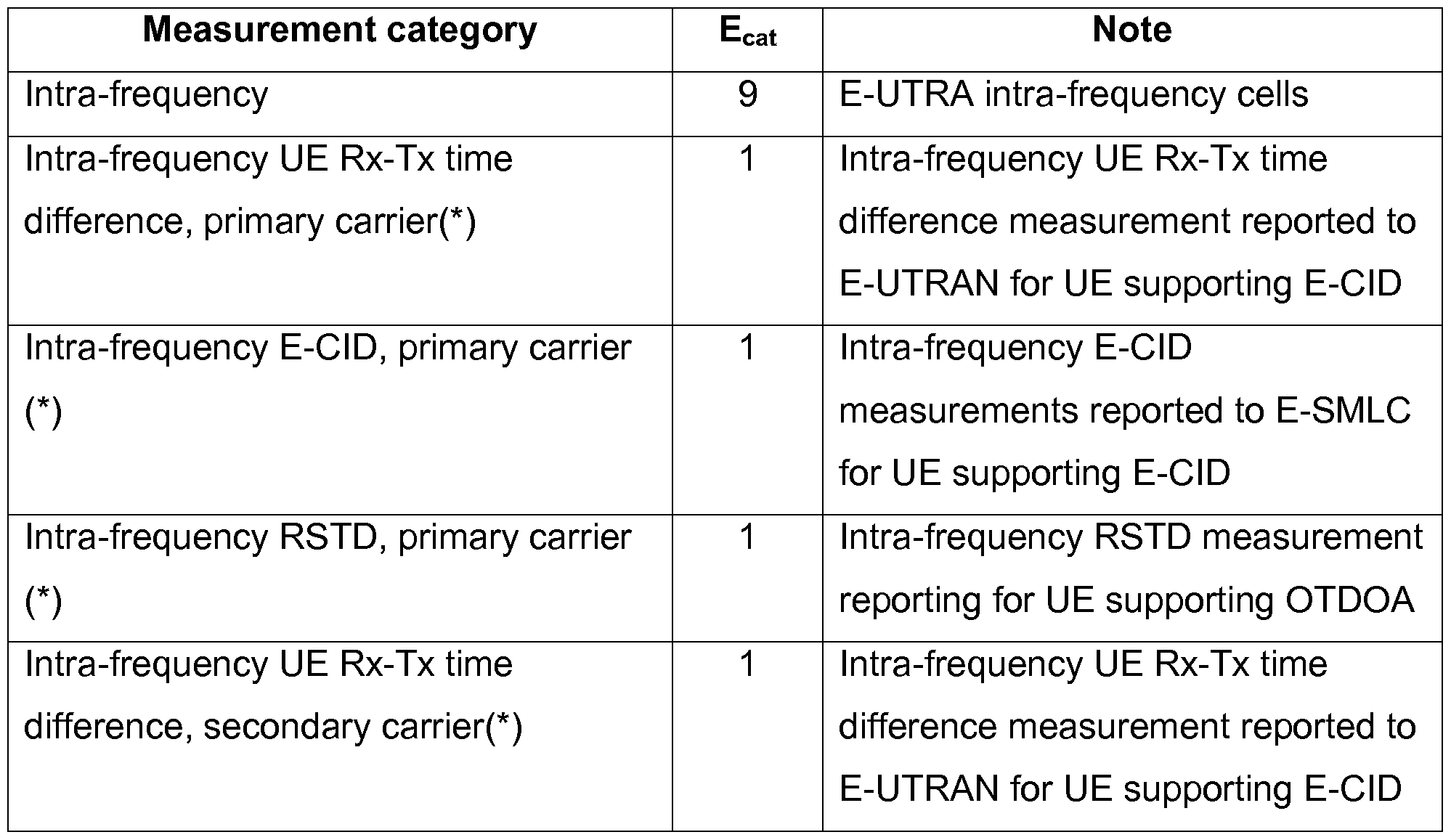
- One embodiment extends the list of reporting criteria by introducing additional reporting criteria, specifically for LTE positioning for the UE which supports this positioning capability. This means, for example, extending the pre-defined criteria from 21 to 21 + N, where the additional N criteria are for positioning measurements.
- N may for example be 4 to accommodate a UE Rx-Tx time difference measurement configured by E-SMLC, a UE Rx-Tx (or E-CID in general) time difference measurement configured by eNodeB, an intra-frequency RSTD measurement and an inter-frequency RSTD measurement.
- the table above indicates that the UE shall be able to support in parallel per category up to E ca t reporting criteria.
- N is 3 and additional measurement reporting categories are UE Rx-Tx time difference, intra-frequency RSTD and inter-frequency RSTD.
- N is 3 and additional measurement reporting categories are intra-frequency E-CID measurements configured by eNodeB, intra-frequency positioning measurements (E-CID or OTDOA) configured by positioning node and inter-frequency RSTD (or OTDOA) measurements.
- E-CID intra-frequency positioning measurements
- OTDOA inter-frequency RSTD
- inter-frequency E-CID measurements may also be added to the list of reporting criteria categories.
- Rx-Tx difference measurements are defined for a non-serving/non-primary carrier in LTE, e.g., intra- frequency UE Rx-Tx for neighbor cells and inter-frequency Rx-Tx measurements for neighbor cells, where inter-frequency Rx-Tx may further be UE Rx-Tx and E-UTRAN Rx-Tx.
- This may also apply for carrier aggregation (CA) networks and CA-capable UEs.
- CA carrier aggregation
- At least one new reporting criterion is added for inter-RAT positioning measurements, which may also be specified for different positioning methods separately or by the initiating node, e.g., the positioning node or the eNodeB.
- the set of reporting criteria for positioning may be further defined for primary and non-primary (i.e. secondary) carriers, e.g., as in the table below:
- Intra-frequency E-CID secondary 1 Intra-frequency E-CID carrier ( * ) measurements reported to E-SMLC for UE supporting E-CID
- Intra-frequency RSTD secondary 1 Intra-frequency RSTD measurement carrier ( * ) reporting for UE supporting OTDOA
- Inter-frequency RSTD primary carrier 1 Inter-frequency RSTD measurement ( * ) reporting for UE supporting OTDOA
- Inter-frequency RSTD secondary 1 Inter-frequency RSTD measurement carrier ( * ) reporting for UE supporting OTDOA
- Inter-RAT E-UTRAN FDD or TDD, 5 Only applicable for UE with this UTRAN FDD, UTRAN TDD, GSM, (inter-RAT) capability.
- the total measurement reporting criteria requirement is unchanged, i.e. as specified in 3GPP TS 36.133 V9.3.0, even for the UE which supports the positioning feature.
- the node which is to control that requirements on parallel reporting criteria are not exceeded, is able to reconfigure the parallel measurements in the case that the total measurement reporting criteria including positioning measurements are the same as without positioning measurements. Assuming that the eNodeB is to control that limits on parallel reporting criteria are not exceeded it is important that the eNodeB is made aware of the UE positioning capabilities and also when the UE performs a particular positioning measurement.
- the positioning node e.g. E-SMLC
- any other network node may indicate to the eNodeB the UE positioning measurement capabilities of the UE. The positioning node also indicates which type of positioning related measurements are currently requested to be performed by the UE.
- the UE itself reports its measurement capability (e.g., enhanced cell ID etc) to the eNodeB.
- the eNodeB can use this information to configure the UE with the appropriate number of measurements without exceeding a desired limit, such as the capability requirement, supported parallel reporting criteria or other lower limit.
- the E-SMLC may acquire the UE measurement capability and use it to set appropriate parameters in the assistance data to be used by the UE for performing the positioning measurements.
- the eNodeB can for example reduce the number of parallel measurements for mobility in the event that the positioning node configures the UE to perform positioning measurements, thereby giving the positioning measurements priority over the mobility measurements.
- the positioning node configures the UE to perform intra-frequency RSTD measurements, while the eNodeB has also configured UE to perform and report 21 parallel measurements.
- the eNodeB may de-configure one of the mobility measurements e.g., periodic RSRP reporting.
- the positioning node configures the UE to perform intra- and inter-frequency RSTD measurements while the eNodeB has configured 21 parallel measurements for mobility purposes.
- the positioning node may de-configure the inter-frequency RSTD measurement.
- the positioning node may also explicitly request the eNodeB to de- configure one of the mobility measurements to make sure that total configured measurements do not exceed the UE measurement capability requirement with respect to parallel reporting criteria.
- the network may still benefit from the acquired information about the requested parallel UE measurements.
- the total UE parallel measurement capability is 25 including positioning measurements.
- the positioning measurements are not used all the time for all UEs.
- the eNodeB does not receive any measurement indication that the UE is currently doing any positioning measurements.
- the eNodeB can configure the UE to perform additional parallel measurements for mobility or for any other purpose such as for network planning, SON, MDT etc i.e., more than 21 measurements. In this way the performance of the mobility or other network operation can be enhanced by dynamically adjusting/configuring the parallel measurement reporting criteria.
- the network node i.e., first and/or second network node uses the following set of information to configure or reconfigure appropriate number of measurements, without exceeding the desired limit:
- Information related to the desired limit such as requirements for the parallel measurement reporting criteria or other predetermined threshold relating to the total number of parallel measurements or to one or several specific categories of measurements.
- the above described measurement indication is used to convey information to a network node about UE measurements requested or configured by another network node.
- a measurement indication may not be needed if the UE itself is able to control that the configured measurements do not exceed the predetermined threshold(s) of parallel reporting criteria.
- the UE itself controls the configuration of parallel measurements to ensure that one or several predetermined thresholds for parallel reporting criteria are not exceeded. This control is based on a pre-defined rule in the UE.
- the UE autonomously decides which of the measurements should be prioritized or performed and which one should not be performed or delayed.
- the autonomous decision in the UE is based on the pre-defined rule. For instance it can be predefined that a particular type of measurement shall always be performed. This means that the UE may have to stop reporting another low priority measurement, e.g., periodical RSRP.
- an OTDOA measurement shall always be performed by the UE in case the total number of parallel reporting criteria exceeds the threshold. It may even be predefined that a particular type of OTDOA measurement (e.g., intra-frequency RSTD) shall always be performed by the UE in case the total number of parallel reporting criteria exceeds the threshold.
- a particular type of OTDOA measurement e.g., intra-frequency RSTD
- Another exemplary rule could be that at least two positioning measurements are always performed by the UE. This is to make sure that the emergency call requirements are met or at least the emergency calls are furnished.
- Another exemplary rule could be that measurements tagged with a higher priority are always performed by the UE. The priority tag can be signaled for the configured measurement, or it can be predefined in a standard. Fig.
- a first step 61 of the method involves obtaining information on a plurality of measurements requested by a plurality of different network nodes to be performed by the user equipment in parallel.
- the plurality of measurements includes at least one positioning measurement.
- the step 61 may involve receiving a measurement indication from one or several of the network nodes that request measurements as explained above.
- the obtained information may include information on type of positioning measurement and the number of positioning measurements of each type of requested positioning measurement.
- Information on type of positioning measurement may e.g. specify is the positioning measurement is an OTDOA or E- CID measurement.
- the type of OTDOA or E-CID measurement is specified, such as intra-frequency UE Rx-Tx time difference for a serving cell, intra-frequency RSTD and inter-frequency RSTD for OTDOA measurement, or intra-frequency UE Rx-Tx time difference for a neighbor cell, inter- frequency UE Rx-Tx measurement, and inter-frequency E-UTRAN Rx-Tx measurement, and inter-RAT positioning measurement for E-CID measurement.
- the obtained information is used to configure the user equipment with a set of measurements that does not exceed at least one predetermined threshold for parallel reporting criteria.
- the set of measurements comprises all or a subset of the plurality of measurements requested by the plurality of different network nodes.
- the step 62 may involve reconfiguration to reduce or delay previously configured measurements of a specific type as explained above.
- the one or several predetermined thresholds for parallel reporting criteria may specify a maximum total number of parallel reporting criteria and/or a maximum number of parallel reporting criteria per measurement category.
- the measurements requested to be performed by the user equipment maybe measurements to be performed on a primary carrier and/or a secondary carrier.
- obtaining the information on the requested measurements may e.g. involve sniffing messages transmitted between the UE and a positioning server or receiving measurement indications signaled from the third node.
- the third node will thus need to be configured to transmit the measurement indications.
- Different embodiments of the third node are possible as is apparent from the following itemized list of exemplary embodiments of the third node:
- Embodiment 1 A third node of a wireless communication system of supporting configuration of measurements to be performed by a user equipment operating in the wireless communication system, wherein a configured measurement corresponds to at least one reporting criteria, wherein the user equipment is able to support a limited number of parallel reporting criteria, wherein a plurality of different network nodes are adapted to request a plurality of measurements to be performed by the user equipment in parallel, and wherein said plurality of measurements includes at least one positioning measurement, the third node comprising a transmitter configured to transmit to another network node information on at least one measurement requested by at least one of said plurality of different network nodes to be performed by the user equipment to enable said another network node to monitor that the user equipment is not configured with a set of measurements that exceeds at least one predetermined threshold for parallel reporting criteria.
- Embodiment 2 The third node according to embodiment 1 , wherein the third node is a positioning server, which is one of said plurality of different network nodes and wherein said another network node is an eNodeB.
- Embodiment 3 The third node according to embodiment 2, wherein said transmitter is configured to include, in the information sent to the eNodeB, information on any positioning measurements that the positioning server is requesting the user equipment to perform in parallel.
- Embodiment 4 The third node according to embodiment 3, wherein said information on the positioning measurements includes information on any positioning measurements of type intra-frequency UE Rx-Tx time difference for a serving cell, intra-frequency RSTD, inter-frequency RSTD, intra-frequency UE Rx-Tx time difference for a neighbor cell, inter-frequency UE Rx-Tx measurement, inter- frequency E-UTRAN Rx-Tx measurement, and inter-RAT positioning measurement that the user equipment is requested to perform.
- said information on the positioning measurements includes information on any positioning measurements of type intra-frequency UE Rx-Tx time difference for a serving cell, intra-frequency RSTD, inter-frequency RSTD, intra-frequency UE Rx-Tx time difference for a neighbor cell, inter-frequency UE Rx-Tx measurement, inter- frequency E-UTRAN Rx-Tx measurement, and inter-RAT positioning measurement that the user equipment is requested to perform.
- Embodiment s The third node according to embodiment 1 , wherein said third node is the user equipment.
- Embodiment 6 The third node according to embodiment 1 , wherein said third node is an eNodeB, which is one of said plurality of different network nodes and wherein said another network node is a positioning server.
- Fig. 7 is a schematic block diagram of a network node 71 for controlling configuration of measurements to be performed by the user equipment.
- the network node 71 may be the first network node or the second network node.
- the network node 71 comprises a receiver 73, a transmitter 72 and a processor 74, which are particularly configured for carrying out the method illustrated in Fig. 6.
- the receiver is particularly configured to obtain information regarding requested UE measurements e.g. in the form of the above described measurement indication, which is illustrated here as an arrow indicated by reference numeral 76.
- the processor may obtain information regarding measurements that the network node 71 itself configures or requests.
- the processor is also configured to use the obtained information to configure a set of measurements that does not exceed the predetermined threshold(s) for parallel reporting criteria and the transmitter is configured to transmit configuration information 75 to the UE to initiate the UE to perform the configured set of measurements.
- the functional blocks depicted in Fig. 7 can be combined and re-arranged in a variety of equivalent ways, and many of the functions can be performed by one or more suitably programmed digital signal processors and other known electronic circuits e.g., discrete logic gates interconnected to perform a specialized function, or application-specific integrated circuits. Moreover, connections among and information provided or exchanged by the functional blocks depicted in Fig.
- Embodiment 7 can be altered in various ways to enable the network node 71 to implement the methods described above and other methods involved in the operation of the network node in a wireless communication system.
- the UE may be configured to use predefined rules to control that one or several predetermined thresholds for parallel reporting criteria are not exceeded.
- Embodiment 7 A method in a user equipment of controlling configuration of measurements to be performed by the user equipment operating in a wireless communication system, wherein a configured measurement corresponds to at least one reporting criteria and wherein the user equipment is able to support a limited number of parallel reporting criteria, the method comprising
- Embodiment 8 The method according to embodiment 7, wherein the obtained information includes information on any type of positioning measurement that the user equipment is requested to perform.
- Embodiment 9 The method according to embodiment 8, wherein the obtained information includes information on any positioning measurements of type intra-frequency UE Rx-Tx time difference for a serving cell, intra-frequency RSTD, inter-frequency RSTD, intra-frequency UE Rx-Tx time difference for a neighbor cell, inter-frequency UE Rx-Tx measurement, inter-frequency E-UTRAN Rx-Tx measurement, and inter-RAT positioning measurement that the user equipment is requested to perform.
- Embodiment 10 The method according to any of embodiments 7-9, wherein the user equipment uses the obtained information to configure the user equipment with the set of measurements based on a predefined rule.
- Embodiment 1 1 The method according to embodiment 10, wherein according to the predefined rule a type and/or number of positioning measurements is prioritized to be configured.
- Embodiment 12 A user equipment for operating in a wireless communication system which includes a transmitter, receiver and processor which are configured to carry out the method according to any of embodiments 7-1 1 .
- Some embodiments above generally provide a number of technical advantages, each of which are achieved by at least some embodiments.
- some embodiments of methods described above enable the network node to be aware of the configured total parallel measurements including positioning measurements.
- some embodiments enable the positioning node to be aware of the configured total parallel measurements, including non-positioning measurements.
- some embodiments described herein enable the network node ensure that requirements on parallel reporting criteria of the UE are not exceeded.
- some embodiments enable the positioning node to ensure that requirements on parallel reporting criteria of the UE are not exceeded.
- Embodiments of UEs include, for example, mobile telephones, pagers, headsets, laptop computers and other mobile terminals, and the like.
- some embodiments described herein can additionally be considered to be embodied entirely within any form of computer-readable storage medium having stored therein an appropriate set of instructions for use by or in connection with an instruction-execution system, apparatus, or device, such as a computer- based system, processor-containing system, or other system that can fetch instructions from a medium and execute the instructions.
- a "computer-readable medium” can be any means that can contain, store, or transport the program for use by or in connection with the instruction-execution system, apparatus, or device.
- the computer-readable medium can be, for example but not limited to, an electronic, magnetic, optical, electromagnetic, infrared, or semiconductor system, apparatus, or device. More specific examples (a non- exhaustive list) of the computer-readable medium include an electrical connection having one or more wires, a portable computer diskette, a random-access memory (RAM), a read-only memory (ROM), an erasable programmable read-only memory (EPROM or Flash memory), and an optical fiber.
- RAM random-access memory
- ROM read-only memory
- EPROM or Flash memory erasable programmable read-only memory
- embodiments described above can be incorporated in user- and/or control-plane positioning solutions, although the latter is currently believed to be more common, and in other positioning methods and their hybrids, in addition to OTDOA and E-CID. It will be understood that this description is given in terms of an eNodeB as the radio network node, but the invention can be embodied in other types of radio network nodes, e.g., pico BSs, home NodeBs, etc.
- LTE standard specifications can be seen as an evolution of the current wideband code division multiple access (WCDMA) specifications.
- WCDMA wideband code division multiple access
- An LTE system uses orthogonal frequency division multiplex (OFDM) as a multiple access technique (called OFDMA) in a downlink (DL) from system nodes to user equipments (UEs).
- OFDMA orthogonal frequency division multiplex
- An LTE system has channel bandwidths ranging from about 1 .4 MHz to 20 MHz, and supports throughputs of more than 100 megabits per second (Mb/s) on the largest-bandwidth channels.
- One type of physical channel defined for the LTE downlink is the physical downlink shared channel (PDSCH), which conveys information from higher layers in the LTE protocol stack and to which one or more specific transport channels are mapped. Control information is conveyed by a physical uplink control channel (PUCCH) and by a physical downlink control channel (PDCCH).
- PUCCH physical uplink control channel
- PDCCH physical downlink control channel
- LTE channels are described in 3GPP Technical Specification (TS) 36.21 1 V9.1 .0, Physical Channels and Modulation (
- An IMT-Advanced communication system uses an internet protocol (IP) multimedia subsystem (IMS) of an LTE, HSPA, or other communication system for IMS multimedia telephony (IMT).
- IP internet protocol
- IMS IMS multimedia subsystem
- 4G fourth generation
- the 3GPP promulgates the LTE, HSPA, WCDMA, and IMT specifications, and specifications that standardize other kinds of cellular wireless communication systems.
- the data stream to be transmitted is portioned among a number of narrowband subcarriers that are transmitted in parallel.
- a resource block devoted to a particular UE is a particular number of particular subcarriers used for a particular period of time. Different groups of subcarriers can be used at different times for different users. Because each subcarrier is narrowband, each carrier experiences mainly flat fading, which makes it easier for a UE to demodulate each subcarrier.
- FIG. 1 depicts a typical cellular communication system 10.
- Radio network controllers (RNCs) 12, 14 control various radio network functions, including for example radio access bearer setup, diversity handover, etc.
- each RNC directs calls to and from a UE, such as a mobile station (MS), mobile phone, or other remote terminal, via appropriate base station(s) (BSs), which communicate with each other through DL (or forward) and uplink (UL, or reverse) channels.
- BSs 16 base station
- RNC 14 is shown coupled to BSs 22, 24, 26.
- Each BS, or eNodeB which is a BS in an LTE system, serves a geographical area that is divided into one or more cell(s).
- FIG. 1 depicts a typical cellular communication system 10.
- BS 26 is shown as having five antenna sectors S1 -S5, which can be said to make up the cell of the BS 26, although a sector or other area served by signals from a BS can also be called a cell.
- a BS may use more than one antenna to transmit signals to a UE.
- the BSs are typically coupled to their corresponding RNCs by dedicated telephone lines, optical fiber links, microwave links, etc.
- the RNCs 12, 14 are connected with external networks such as the public switched telephone network (PSTN), the internet, etc. through one or more core network nodes, such as a mobile switching center (not shown) and/or a packet radio service node (not shown).
- PSTN public switched telephone network
- core network nodes such as a mobile switching center (not shown) and/or a packet radio service node (not shown).
- FIG. 1 the arrangement of functionalities depicted in FIG. 1 can be modified in LTE and other communication systems.
- the functionality of the RNCs 12, 14 can be moved to the eNodeBs 22, 24, 26, and other functionalities can be moved to other nodes in the network.
- a base station can use multiple transmit antennas to transmit information into a cell/sector/area, and those different transmit antennas can send respective, different pilot signals.
- the use of multiple antennas plays an important role in modern wireless communication systems, such as LTE systems, to achieve improved system performance, including capacity and coverage, and service provisioning. Acquisition of channel state information (CSI) at the transmitter or the receiver is important to proper implementation of multi-antenna techniques.
- CSI channel state information
- channel characteristics are estimated by sending and receiving one or more predefined training sequences, which can also be called reference signals.
- a BS transmits reference signals to UEs, which use the received versions of the known reference signals to estimate the DL channel.
- the UEs can then use the estimated channel matrix for coherent demodulation of the received DL signal, and obtain the potential beam-forming gain, spatial diversity gain, and spatial multiplexing gain available with multiple antennas.
- the reference signals can be used to do channel quality measurement to support link adaptation.
- OFDM transmission a straightforward design of a reference signal is to transmit known reference symbols in the OFDM frequency-vs.-time grid.
- Cell-specific reference signals and symbols are described in Clauses 6.10 and 6.1 1 of 3GPP TS 36.21 1 V9.0.0, Evolved Universal Terrestrial Radio Access (E-UTRA), Physical Channels and Modulation (Release 9) (Dec. 2009).
- E-UTRA Evolved Universal Terrestrial Radio Access
- Physical Channels and Modulation Release 9
- Up to four cell-specific reference signals corresponding to up to four transmit antennas of an eNodeB are specified.
- Such reference signals are used by the eNodeB for codebook-based, multiple-stream, spatial multiplex transmission.
- a codebook is a predefined finite set of a number of precoding matrices having different ranks.
- the UE estimates the channel matrix based on the cell-specific reference signals, carries out an exhaustive search over all precoding matrices, and reports a preferred precoding matrix indicator (PMI) to the eNodeB according to certain criteria, thereby maximizing system throughput, etc.
- PMI precoding matrix indicator
- 3GPP TS 36.21 1 also defines a UE-specific reference signal on an antenna port 5 that is transmitted only on resource blocks upon which a corresponding physical downlink shared channel (PDSCH) is mapped.
- the UE-specific reference signal supports non-codebook based, single-stream beamforming transmission.
- the precoding weight matrix applied both on UE-specific reference symbols and the data symbols is not from the codebook set but is directly calculated by the eNodeB in terms of various criteria, e.g., the weight matrix can be calculated based on eigen decomposition or on direction of arrival.
- the weight matrix can be calculated based on eigen decomposition or on direction of arrival.
- TDD time-division duplex
- the DL of a LTE system can use both codebook-based precoding and non- codebook based beamforming/precoding for up to four transmit antennas.
- the transmission mode switch between codebook-based, multiple-stream spatial multiplexing transmission and non-codebook-based, single-stream beamforming transmission is semi-statical ly configured via higher layer signaling.
- Some communication systems such as LTE-Advanced that is currently being specified by 3GPP, can employ more than four transmit antennas in order to reach more aggressive performance targets.
- LTE-Advanced that is currently being specified by 3GPP
- a system having eNodeBs with eight transmit antennas need extension of current LTE codebook-based precoding from precoder and reference signal perspectives.
- PRS are transmitted from one antenna port (R6) according to a pre-defined pattern, as described for example in Clause 6.10.4 of 3GPP TS 36.21 1 V9.0.0, Evolved Universal Terrestrial Radio Access (E-UTRA), Physical Channels and Modulation (Release 9) (Dec. 2009).
- E-UTRA Evolved Universal Terrestrial Radio Access
- Fig. 5 One of the currently agreed PRS patterns is shown in Fig. 5, which corresponds to the left-hand side of Figure 6.10.4.2-1 of 3GPP TS 36.21 1 , where the squares containing R 6 indicate PRS resource elements within a block of twelve subcarriers over fourteen OFDM symbols (i.e., a 1 -ms subframe with normal cyclic prefix).
- a set of frequency shifts can be applied to the pre-defined PRS patterns to obtain a set of orthogonal patterns which can be used in neighbor cells to reduce interference on the PRS and thus improve positioning measurements.
- the effective frequency reuse of six can be modelled in this way.
- the frequency shift is defined as a function of Physical Cell ID (PCI) as follows:
- the PRS can also be transmitted with zero power, or muted.
- positioning subframes have been designed as low-interference subframes, i.e., it has also been agreed that no data transmissions are allowed in general in positioning subframes.
- synchronous networks' PRS are ideally interfered with only by PRS from other cells having the same PRS pattern index, i.e., the same vertical shift (v_shift), and not by data transmissions.
- PRS can still be interfered with by transmissions over data channels, control channels, and any physical signals when positioning subframes collide with normal subframes, although the interference is reduced by the partial alignment, i.e., by aligning the beginnings of positioning subframes in multiple cells within one-half of a subframe with respect to some time base.
- PRS are transmitted in pre-defined positioning subframes grouped by several consecutive subframes (N PRS ), i.e., one positioning occasion, which occur periodically with a certain periodicity of N subframes, i.e., the time interval between two positioning occasions.
- the currently agreed periods N are 160, 320, 640, and 1280 ms, and the number of consecutive subframes N PRS can be 1 , 2, 4, or 6, as described in 3GPP TS 36.21 1 cited above.
Landscapes
- Engineering & Computer Science (AREA)
- Computer Networks & Wireless Communication (AREA)
- Signal Processing (AREA)
- Mobile Radio Communication Systems (AREA)
Abstract
Description

Claims
Priority Applications (6)
| Application Number | Priority Date | Filing Date | Title |
|---|---|---|---|
| EP20110722624 EP2569974B1 (en) | 2010-05-10 | 2011-05-10 | Method and apparatus for measurement configuration support |
| BR112012028758A BR112012028758A2 (en) | 2010-05-10 | 2011-05-10 | methods and apparatus for measuring configuration support |
| CN201180034219.8A CN103125133B (en) | 2010-05-10 | 2011-05-10 | Methods and equipment for measuring configuration support |
| US13/696,837 US9131404B2 (en) | 2010-05-10 | 2011-05-10 | Methods and apparatus for measurement configuration support |
| MX2012012953A MX2012012953A (en) | 2010-05-10 | 2011-05-10 | Methods and apparatus for measurement configuration support. |
| US14/844,888 US20160007222A1 (en) | 2010-05-10 | 2015-09-03 | Methods and Apparatus for Measurement Configuration Support |
Applications Claiming Priority (4)
| Application Number | Priority Date | Filing Date | Title |
|---|---|---|---|
| US33300710P | 2010-05-10 | 2010-05-10 | |
| US61/333,007 | 2010-05-10 | ||
| US201161442998P | 2011-02-15 | 2011-02-15 | |
| US61/442,998 | 2011-02-15 |
Related Child Applications (2)
| Application Number | Title | Priority Date | Filing Date |
|---|---|---|---|
| US13/696,837 A-371-Of-International US9131404B2 (en) | 2010-05-10 | 2011-05-10 | Methods and apparatus for measurement configuration support |
| US14/844,888 Continuation US20160007222A1 (en) | 2010-05-10 | 2015-09-03 | Methods and Apparatus for Measurement Configuration Support |
Publications (1)
| Publication Number | Publication Date |
|---|---|
| WO2011142715A1 true WO2011142715A1 (en) | 2011-11-17 |
Family
ID=44914586
Family Applications (1)
| Application Number | Title | Priority Date | Filing Date |
|---|---|---|---|
| PCT/SE2011/050587 Ceased WO2011142715A1 (en) | 2010-05-10 | 2011-05-10 | Methods and apparatus for measurement configuration support |
Country Status (7)
| Country | Link |
|---|---|
| US (2) | US9131404B2 (en) |
| EP (1) | EP2569974B1 (en) |
| CN (1) | CN103125133B (en) |
| BR (1) | BR112012028758A2 (en) |
| MX (1) | MX2012012953A (en) |
| PT (1) | PT2843989T (en) |
| WO (1) | WO2011142715A1 (en) |
Cited By (22)
| Publication number | Priority date | Publication date | Assignee | Title |
|---|---|---|---|---|
| WO2013021297A1 (en) * | 2011-08-05 | 2013-02-14 | Telefonaktiebolaget L M Ericsson (Publ) | Prioritization of wireless terminal measurements |
| WO2013115694A1 (en) * | 2012-02-03 | 2013-08-08 | Telefonaktiebolaget L M Ericsson (Publ) | Node and method for adapting parallel measurements with respect to an enhanced receiver |
| WO2014025343A1 (en) * | 2012-08-07 | 2014-02-13 | Nokia Corporation | User-plane (supl) based positioning method for minimization of drive test (mdt) in mobile networks |
| WO2014078552A1 (en) * | 2012-11-14 | 2014-05-22 | Huawei Technologies Co., Ltd. | Systems and methods for adaptation and reconfiguration in a wireless network |
| US9026140B2 (en) | 2012-10-12 | 2015-05-05 | Telefonaktiebolaget L M Ericsson (Publ) | Second node, positioning node and methods therein |
| US9055453B2 (en) | 2012-02-03 | 2015-06-09 | Telefonaktiebolaget L M Ericsson (Publ) | Node and method for adapting parallel measurements with respect to an enhanced receiver |
| US20150223095A1 (en) * | 2014-01-31 | 2015-08-06 | Telefonaktiebolaget L M Ericsson (Publ) | Method for Configuring a Dual Connectivity User Equipment |
| US9119102B2 (en) | 2011-04-04 | 2015-08-25 | Telefonaktiebolaget Lm Ericsson (Publ) | Radio network node and method for using positioning gap indication for enhancing positioning performance |
| US9185670B2 (en) | 2011-06-13 | 2015-11-10 | Telefonaktiebolaget L M Ericsson (Publ) | Method and apparatus for configuring enhanced timing measurements involving multifarious radio links |
| WO2016056991A1 (en) * | 2014-10-08 | 2016-04-14 | Telefonaktiebolaget L M Ericsson (Publ) | System and method providing parallel multicast measurements |
| WO2016122368A1 (en) * | 2015-01-30 | 2016-08-04 | Telefonaktiebolaget Lm Ericsson (Publ) | Providing location information to a radio network node or a network node |
| EP2936869A4 (en) * | 2012-12-20 | 2016-08-17 | Nokia Technologies Oy | Handling of different types of thresholds in measurement reporting |
| WO2016191126A1 (en) * | 2015-05-22 | 2016-12-01 | Qualcomm Incorporated | Wlan and wwan cooperative support of wwan functionality |
| US9560613B1 (en) | 2013-04-25 | 2017-01-31 | Google Inc. | Validating synchronization compliance using network measurements |
| CN107820329A (en) * | 2013-01-25 | 2018-03-20 | Lg电子株式会社 | Method and base station for send configuration in a wireless communication system |
| EP2664176B1 (en) * | 2011-01-10 | 2018-06-27 | Nokia Solutions and Networks Oy | Terminal measurement configuration in carrier aggregation |
| JP2018170808A (en) * | 2012-04-27 | 2018-11-01 | 日本電気株式会社 | Wireless terminal, wireless base station, and control method thereof |
| CN111758274A (en) * | 2018-03-01 | 2020-10-09 | 株式会社Ntt都科摩 | user device |
| CN112314021A (en) * | 2018-06-25 | 2021-02-02 | 高通股份有限公司 | Low Power Periodic and Triggered Location of Mobile Devices Using Early Data Transmission |
| WO2022054002A1 (en) * | 2020-09-10 | 2022-03-17 | Lenovo (Singapore) Pte. Ltd. | Configuring positioning measurements and reports |
| US11388657B2 (en) | 2018-08-13 | 2022-07-12 | Qualcomm Incorporated | Methods and systems for supporting unified location of a mobile device in a 5G network |
| US11924702B2 (en) | 2018-09-14 | 2024-03-05 | Qualcomm Incorporated | Systems and methods for deferred 5G location of a mobile device using a combined AMF and LMF based location solution |
Families Citing this family (58)
| Publication number | Priority date | Publication date | Assignee | Title |
|---|---|---|---|---|
| KR101644881B1 (en) * | 2009-04-10 | 2016-08-03 | 엘지전자 주식회사 | Apparatus and metheod for positioing a user equipment |
| CN102595450B (en) * | 2011-01-10 | 2014-12-24 | 华为技术有限公司 | Configuration method and communication device for measurement gap |
| US9014169B2 (en) * | 2011-03-10 | 2015-04-21 | Telefonaktiebolaget L M Ericsson (Publ) | Cell search procedure for heterogeneous networks |
| US9674724B2 (en) * | 2012-01-20 | 2017-06-06 | Lg Electronics Inc. | Method and apparatus for transmitting measurement report in a wireless communication system |
| WO2014082227A1 (en) * | 2012-11-28 | 2014-06-05 | 华为技术有限公司 | Cell measurement method, user equipment and base station |
| CN104247492B (en) * | 2013-03-27 | 2020-08-07 | 华为技术有限公司 | A method, apparatus and device for measuring radio resource management information |
| US9392512B2 (en) * | 2013-07-11 | 2016-07-12 | Apple Inc. | Multiple cell measurement and data reception in a wireless communication device |
| CN104737602A (en) * | 2013-07-24 | 2015-06-24 | 华为技术有限公司 | User equipment positioning method, device and system |
| DK3053371T3 (en) * | 2013-09-30 | 2019-10-21 | Ericsson Telefon Ab L M | Configuring Mobility Management Approach |
| CN105940708B (en) * | 2014-03-20 | 2020-02-14 | 夏普株式会社 | Terminal device, base station device, communication method, and integrated circuit |
| US9877216B2 (en) * | 2014-07-25 | 2018-01-23 | Nokia Solutions And Networks Oy | Minimization of drive tests in dual connectivity scenario |
| EP3435581B1 (en) * | 2014-11-07 | 2021-05-05 | Telefonaktiebolaget LM Ericsson (publ) | Network node and method in a wireless telecommunications network |
| MX367061B (en) * | 2014-12-17 | 2019-08-05 | Ericsson Telefon Ab L M | Methods for transmitting mobility signals and related network nodes and wireless devices. |
| US10219261B2 (en) | 2015-12-08 | 2019-02-26 | At&T Mobility Ii Llc | Method and apparatus for transmitting a control signal to a self organizing network controller |
| EP3414934B1 (en) * | 2016-02-08 | 2021-09-08 | Apple Inc. | Rx-tx time difference report for tdd systems and associated devices |
| WO2017162287A1 (en) | 2016-03-24 | 2017-09-28 | Telefonaktiebolaget Lm Ericsson (Publ) | Configuration and reporting of mobility measurements |
| AU2017281411A1 (en) | 2016-06-21 | 2019-01-24 | Telefonaktiebolaget Lm Ericsson (Publ) | Systems and methods of determining a reporting configuration associated with a coverage level of a wireless device |
| US11102693B1 (en) * | 2016-08-11 | 2021-08-24 | T-Mobile Innovations Llc | Systems and methods for assigning a mobility parameter to a wireless device operating in connected mode |
| EP3282276A1 (en) * | 2016-08-12 | 2018-02-14 | Nokia Technologies Oy | Position detection of user equipment within a network |
| CN113630215B (en) | 2016-08-22 | 2024-04-16 | 三星电子株式会社 | Method and apparatus for providing various parameters of initial access procedure in a wireless cellular communication system |
| US10028096B2 (en) * | 2016-09-06 | 2018-07-17 | Qualcomm Incorporated | Robust reference signal time difference measurements |
| EP4220215A1 (en) * | 2016-11-18 | 2023-08-02 | Telefonaktiebolaget LM Ericsson (publ) | Detection of a narrowband positioning reference signal (nprs) location in a radio frame |
| BR112019020945A2 (en) * | 2017-04-07 | 2020-05-05 | Ntt Docomo Inc | user device and radio communication method |
| US11212715B2 (en) * | 2017-05-02 | 2021-12-28 | Guangdong Oppo Mobile Telecommunications Corp., Ltd. | Methods and apparatus for radio resource measurement between wireless communication systems |
| FI3488660T3 (en) * | 2017-06-16 | 2023-09-14 | Ericsson Telefon Ab L M | Methods and apparatuses for measurement report and computer-readable medium |
| KR102475187B1 (en) | 2017-11-16 | 2022-12-06 | 텔레폰악티에볼라겟엘엠에릭슨(펍) | User equipment, network nodes and methods in a wireless communications network |
| CN109819468B (en) * | 2017-11-22 | 2021-01-08 | 维沃移动通信有限公司 | Method for configuring minimization of drive tests, method and device for measuring minimization of drive tests |
| WO2019106536A1 (en) | 2017-11-29 | 2019-06-06 | Telefonaktiebolaget Lm Ericsson (Publ) | Measurement reporting configuration for aiding the sorting of beam/cell level measurements |
| CN110022523B (en) * | 2018-01-05 | 2022-04-12 | 华为技术有限公司 | Method, device and system for positioning terminal equipment |
| US10547979B2 (en) * | 2018-01-21 | 2020-01-28 | Qualcomm Incorporated | Systems and methods for locating a user equipment using generic position methods for a 5G network |
| US11601911B2 (en) * | 2018-05-25 | 2023-03-07 | Qualcomm Incorporated | Determining timing resolution and range of reported timing measurements used for position estimation |
| US20210392498A1 (en) * | 2018-10-26 | 2021-12-16 | Telefonaktiebolaget LM Ericsson (gubl) | Methods, user equipment and network node, for detection of communication with a non-legitimate device |
| CN111314952B (en) * | 2018-12-11 | 2021-11-09 | 成都华为技术有限公司 | Method and device for reporting measurement |
| EP3681217A1 (en) * | 2019-01-10 | 2020-07-15 | Fraunhofer Gesellschaft zur Förderung der angewandten Forschung e.V. | Methods and apparatuses for rtt measurement procedure in a telecomunications network |
| WO2020167073A1 (en) * | 2019-02-14 | 2020-08-20 | Samsung Electronics Co., Ltd. | Position of user equipment |
| WO2020164609A1 (en) * | 2019-02-15 | 2020-08-20 | Mediatek Inc. | Rsrp reporting methods for nr high resolution angle-based downlink positioning |
| US11576060B2 (en) * | 2019-05-30 | 2023-02-07 | Qualcomm Incorporated | Maximum number of path loss or uplink spatial transmit beam reference signals for downlink or uplink positioning reference signals |
| US10715951B1 (en) * | 2019-06-11 | 2020-07-14 | Nokia Technologies Oy | Positioning support for wireless devices such as NR-IoT devices and useful for geofencing |
| US11337033B2 (en) * | 2019-07-10 | 2022-05-17 | Kingstar Technologies, Inc. | Positioning resource measurement feedback in wireless communication system |
| US11368931B2 (en) * | 2019-08-02 | 2022-06-21 | Parallel Wireless, Inc. | Blind fast network synchronization algorithm for reducing LTE public safety product costs |
| US11523364B2 (en) * | 2019-08-13 | 2022-12-06 | Qualcomm Incorporated | Computation complexity framework for positioning reference signal processing |
| EP4055921B1 (en) * | 2019-11-07 | 2023-04-19 | Telefonaktiebolaget Lm Ericsson (Publ) | User equipment, core network node, radio network node and methods in a wireless communications network |
| CN112788656A (en) * | 2019-11-07 | 2021-05-11 | 北京三星通信技术研究有限公司 | Reporting method, configuration method, device, electronic equipment and medium for MDT measurement |
| CN115136675B (en) | 2020-02-21 | 2024-12-24 | 高通股份有限公司 | Positioning reference signal processing |
| CN115136673B (en) * | 2020-02-24 | 2025-01-14 | 高通股份有限公司 | Two-part Uplink Control Information (UCI) coding for Positioning State Information (PSI) reporting for low latency positioning |
| JP7712282B2 (en) * | 2020-03-03 | 2025-07-23 | クゥアルコム・インコーポレイテッド | Lower layer radio access technology (RAT) independent measurement reporting |
| BR112022018481A2 (en) * | 2020-03-26 | 2023-01-17 | Qualcomm Inc | METHODS AND APPARATUS FOR DELAYED REPORTING OF AT LEAST ONE POSITIONING STATUS INFORMATION (PSI) REPORTING ELEMENT |
| BR112022019869A2 (en) * | 2020-04-02 | 2022-11-22 | Nokia Technologies Oy | CONDITIONAL MEASUREMENT REPORT MODE FOR POSITIONING |
| US11770791B2 (en) | 2020-04-03 | 2023-09-26 | Qualcomm Incorporated | Positioning measurement data reported via L1 or L2 signaling |
| US11924801B2 (en) * | 2020-05-15 | 2024-03-05 | Qualcomm Incorporated | Determining factors for splitting positioning state information (PSI) between uplink control information (UCI) and medium access control control elements (MAC-CE) |
| CN115836551A (en) * | 2020-07-10 | 2023-03-21 | 株式会社Ntt都科摩 | wireless base station |
| WO2022030488A1 (en) * | 2020-08-05 | 2022-02-10 | 三菱電機株式会社 | Communication system and base station |
| WO2022027670A1 (en) * | 2020-08-07 | 2022-02-10 | Zte Corporation | Method for positioning state information report |
| JP2023547763A (en) * | 2020-10-16 | 2023-11-14 | クアルコム,インコーポレイテッド | Phase characteristic capability reporting for positioning |
| KR20230086679A (en) * | 2020-10-16 | 2023-06-15 | 퀄컴 인코포레이티드 | Report phase characteristic capability for sounding reference signal (SRS) stitching |
| CN112544098A (en) * | 2020-11-13 | 2021-03-23 | 北京小米移动软件有限公司 | Angle measurement processing method and device and communication equipment |
| US12523736B2 (en) | 2021-05-10 | 2026-01-13 | Qualcomm Incorporated | On-demand positioning reference signal configuration |
| WO2024230187A1 (en) * | 2023-12-22 | 2024-11-14 | Zte Corporation | Systems and methods for sensing and positioning assisted mobility management |
Citations (3)
| Publication number | Priority date | Publication date | Assignee | Title |
|---|---|---|---|---|
| US6446028B1 (en) * | 1998-11-25 | 2002-09-03 | Keynote Systems, Inc. | Method and apparatus for measuring the performance of a network based application program |
| US20080031368A1 (en) | 2005-11-29 | 2008-02-07 | Bengt Lindoff | Efficient cell selection |
| EP2020823A1 (en) * | 2006-05-23 | 2009-02-04 | Sharp Kabushiki Kaisha | Mobile communication method, mobile station device, base station device, and mobile communication system |
Family Cites Families (33)
| Publication number | Priority date | Publication date | Assignee | Title |
|---|---|---|---|---|
| US5839071A (en) | 1993-09-21 | 1998-11-17 | Telstra Corporation Limited | Base station for a mobile telecommunications system |
| US6184829B1 (en) | 1999-01-08 | 2001-02-06 | Trueposition, Inc. | Calibration for wireless location system |
| AU4037499A (en) * | 1999-05-05 | 2000-11-21 | Nokia Corporation | A method for positioning a mobile station |
| US6861982B2 (en) | 2001-08-16 | 2005-03-01 | Itt Manufacturing Enterprises, Inc. | System for determining position of an emitter |
| US7233800B2 (en) * | 2004-10-14 | 2007-06-19 | Qualcomm, Incorporated | Wireless terminal location using apparatus and methods employing carrier diversity |
| US20080026733A1 (en) * | 2006-07-27 | 2008-01-31 | Jussi Jaatinen | Method and system for improving positioning accuracy in cellular networks |
| US8175613B2 (en) | 2006-08-04 | 2012-05-08 | Misonimo Chi Acquisitions L.L.C. | Systems and methods for determining location of devices within a wireless network |
| US7797000B2 (en) | 2006-12-01 | 2010-09-14 | Trueposition, Inc. | System for automatically determining cell transmitter parameters to facilitate the location of wireless devices |
| US8344949B2 (en) | 2008-03-31 | 2013-01-01 | Golba Llc | Wireless positioning approach using time-delay of signals with a known transmission pattern |
| JP2010516185A (en) | 2007-01-08 | 2010-05-13 | インターデイジタル テクノロジー コーポレーション | Measurement gap pattern scheduling to support mobility |
| US8295859B1 (en) | 2007-01-23 | 2012-10-23 | University Of South Florida | System and method of exploiting location awareness to improve wireless cognitive radio |
| CN101035380B (en) * | 2007-04-12 | 2012-02-08 | 中兴通讯股份有限公司 | Method for the user plane to enhance the cell positioning |
| US8249616B2 (en) | 2007-08-23 | 2012-08-21 | Texas Instruments Incorporated | Satellite (GPS) assisted clock apparatus, circuits, systems and processes for cellular terminals on asynchronous networks |
| WO2009065012A1 (en) | 2007-11-15 | 2009-05-22 | Andrew Llc | System and method for locating umts user equipment using measurement reports |
| US8447319B2 (en) | 2007-11-15 | 2013-05-21 | Andrew Llc | System and method for locating UMTS user equipment using measurement reports |
| US8712439B2 (en) * | 2008-01-11 | 2014-04-29 | Qualcomm Incorporated | Method and apparatus for using service capability information for user plane location |
| US8180368B2 (en) | 2008-11-11 | 2012-05-15 | Trueposition, Inc. | Femto-cell location by direct methods |
| GB2467351B (en) | 2009-01-30 | 2012-05-16 | Samsung Electronics Co Ltd | User equipment and method of its operation |
| WO2010107356A1 (en) | 2009-03-17 | 2010-09-23 | Telefonaktiebolaget Lm Ericsson (Publ) | An arrangement and a method in a communication network node, an arrangement and a method in a user equipment in a radio communications system |
| US9435874B2 (en) | 2009-04-21 | 2016-09-06 | Qualcomm Incorporated | Method and apparatus for supporting positioning for terminals in a wireless network |
| TWI455626B (en) | 2009-06-22 | 2014-10-01 | Htc Corp | Method of handling positioning measurement |
| PL3139674T3 (en) | 2009-06-26 | 2020-07-27 | Telefonaktiebolaget Lm Ericsson (Publ) | Methods and arrangements in a telecommunications network |
| US20100331012A1 (en) | 2009-06-29 | 2010-12-30 | Yang Zhang | TDOA-Based Reconstruction of Base Station Location Data |
| WO2011016804A1 (en) | 2009-08-05 | 2011-02-10 | Andrew Llc | System and method for hybrid location in an lte network |
| US20110117926A1 (en) | 2009-11-17 | 2011-05-19 | Mediatek Inc. | Network-based positioning mechanism and reference signal design in OFDMA systems |
| KR20120123434A (en) | 2010-02-11 | 2012-11-08 | 텔레폰악티에볼라겟엘엠에릭슨(펍) | Methods and apparatuses for positioning in a wireless communications system |
| KR101191215B1 (en) | 2010-07-16 | 2012-10-15 | 엘지전자 주식회사 | Method and apparatus of positioning in a wireless communication system |
| US8929826B2 (en) | 2010-08-20 | 2015-01-06 | Telefonaktiebolaget L M Ericsson (Publ) | Method and node for reduced transmission activity pattern configuration |
| CN102573050B (en) | 2010-12-31 | 2015-12-02 | 国民技术股份有限公司 | A kind of system and method for indoor mobile terminal positioning |
| US9462563B2 (en) | 2011-01-17 | 2016-10-04 | Optis Cellular Technology, Llc | Method and apparatus for compensating signal timing measurements for differences in signal frequencies |
| EP2666327B1 (en) | 2011-01-17 | 2015-01-21 | Optis Cellular Technology, LLC | Method and apparatus for compensating signal timing measurements for differences in signal frequencies |
| WO2012154106A1 (en) | 2011-05-11 | 2012-11-15 | Telefonaktiebolaget L M Ericsson (Publ) | A radio network node, a node and methods therein for enabling enhanced cell id timing measurement for positioning of a user equipment |
| GB2491218B (en) | 2011-12-22 | 2013-06-26 | Renesas Mobile Corp | Timing-based positioning |
-
2011
- 2011-05-10 WO PCT/SE2011/050587 patent/WO2011142715A1/en not_active Ceased
- 2011-05-10 MX MX2012012953A patent/MX2012012953A/en active IP Right Grant
- 2011-05-10 US US13/696,837 patent/US9131404B2/en active Active
- 2011-05-10 BR BR112012028758A patent/BR112012028758A2/en not_active Application Discontinuation
- 2011-05-10 PT PT141859421T patent/PT2843989T/en unknown
- 2011-05-10 CN CN201180034219.8A patent/CN103125133B/en active Active
- 2011-05-10 EP EP20110722624 patent/EP2569974B1/en active Active
-
2015
- 2015-09-03 US US14/844,888 patent/US20160007222A1/en not_active Abandoned
Patent Citations (3)
| Publication number | Priority date | Publication date | Assignee | Title |
|---|---|---|---|---|
| US6446028B1 (en) * | 1998-11-25 | 2002-09-03 | Keynote Systems, Inc. | Method and apparatus for measuring the performance of a network based application program |
| US20080031368A1 (en) | 2005-11-29 | 2008-02-07 | Bengt Lindoff | Efficient cell selection |
| EP2020823A1 (en) * | 2006-05-23 | 2009-02-04 | Sharp Kabushiki Kaisha | Mobile communication method, mobile station device, base station device, and mobile communication system |
Non-Patent Citations (4)
| Title |
|---|
| "3rd Generation Partnership Project; Technical Specification Group Radio Access Network; Requirements for support of radio resource management (FDD) (Release 9)", 3GPP STANDARD; 3GPP TS 25.133, 3RD GENERATION PARTNERSHIP PROJECT (3GPP), MOBILE COMPETENCE CENTRE ; 650, ROUTE DES LUCIOLES ; F-06921 SOPHIA-ANTIPOLIS CEDEX ; FRANCE, no. V9.3.0, 2 April 2010 (2010-04-02), pages 1 - 243, XP050402340 * |
| ERICSSON: "Event Triggering and Reporting Criteria Capability Requirements", 3GPP DRAFT; R4-081976_REPORTING_CRITERIA, 3RD GENERATION PARTNERSHIP PROJECT (3GPP), MOBILE COMPETENCE CENTRE ; 650, ROUTE DES LUCIOLES ; F-06921 SOPHIA-ANTIPOLIS CEDEX ; FRANCE, vol. RAN WG4, no. Jeju; 20080814, 14 August 2008 (2008-08-14), XP050180482 * |
| HERMANN S D ET AL: "Enhancing the Accuracy of Position Information through Superposition of Location Server Data", PROCEEDINGS OF THE 2007 IEEE INTERNATIONAL CONFERENCE ON COMMUNICATIONS (ICC 2007), 24-28 JUNE 2007, GLASGOW, UK, IEEE, PISCATAWAY, NJ, USA, 1 June 2007 (2007-06-01), pages 2030 - 2037, XP031125970, ISBN: 978-1-4244-0353-0 * |
| SIEMENS: "Measurement requirements for LTE", 3GPP DRAFT; R4-061245, 3RD GENERATION PARTNERSHIP PROJECT (3GPP), MOBILE COMPETENCE CENTRE ; 650, ROUTE DES LUCIOLES ; F-06921 SOPHIA-ANTIPOLIS CEDEX ; FRANCE, vol. RAN WG4, no. Riga, Latvia; 20061031, 31 October 2006 (2006-10-31), XP050176337 * |
Cited By (48)
| Publication number | Priority date | Publication date | Assignee | Title |
|---|---|---|---|---|
| EP2664176B1 (en) * | 2011-01-10 | 2018-06-27 | Nokia Solutions and Networks Oy | Terminal measurement configuration in carrier aggregation |
| US10397820B2 (en) | 2011-04-04 | 2019-08-27 | Telefonaktiebolaget Lm Ericsson (Publ) | Radio network node and method for using positioning gap indication for enhancing positioning performance |
| US9743307B2 (en) | 2011-04-04 | 2017-08-22 | Telefonaktiebolaget L M Ericsson (Publ) | Radio network node and method for using positioning gap indication for enhancing positioning performance |
| US10764778B2 (en) | 2011-04-04 | 2020-09-01 | Telefonaktiebolaget Lm Ericsson (Publ) | Radio network node and method for using positioning gap indication for enhancing positioning performance |
| US9119102B2 (en) | 2011-04-04 | 2015-08-25 | Telefonaktiebolaget Lm Ericsson (Publ) | Radio network node and method for using positioning gap indication for enhancing positioning performance |
| US9185670B2 (en) | 2011-06-13 | 2015-11-10 | Telefonaktiebolaget L M Ericsson (Publ) | Method and apparatus for configuring enhanced timing measurements involving multifarious radio links |
| US9648575B2 (en) | 2011-06-13 | 2017-05-09 | Telefonaktiebolaget Lm Ericsson (Publ) | Method and apparatus for configuring enhanced timing measurements involving multifarious radio links |
| US9020488B2 (en) | 2011-08-05 | 2015-04-28 | Telefonaktiebolaget Lm Ericsson (Publ) | Prioritization of wireless terminal measurements |
| WO2013021297A1 (en) * | 2011-08-05 | 2013-02-14 | Telefonaktiebolaget L M Ericsson (Publ) | Prioritization of wireless terminal measurements |
| US9055453B2 (en) | 2012-02-03 | 2015-06-09 | Telefonaktiebolaget L M Ericsson (Publ) | Node and method for adapting parallel measurements with respect to an enhanced receiver |
| CN104067658B (en) * | 2012-02-03 | 2018-11-06 | 瑞典爱立信有限公司 | The node and method of horizontal survey are adapted to relative to enhancing receiver |
| KR20140132721A (en) * | 2012-02-03 | 2014-11-18 | 텔레폰악티에볼라겟엘엠에릭슨(펍) | Node and method for adapting parallel measurements with respect to an enhanced receiver |
| CN104067658A (en) * | 2012-02-03 | 2014-09-24 | 瑞典爱立信有限公司 | Node and method for adapting parallel measurements with respect to an enhanced receiver |
| KR101895108B1 (en) | 2012-02-03 | 2018-09-04 | 텔레폰악티에볼라겟엘엠에릭슨(펍) | Node and method for adapting parallel measurements with respect to an enhanced receiver |
| WO2013115694A1 (en) * | 2012-02-03 | 2013-08-08 | Telefonaktiebolaget L M Ericsson (Publ) | Node and method for adapting parallel measurements with respect to an enhanced receiver |
| US11012876B2 (en) | 2012-04-27 | 2021-05-18 | Nec Corporation | Radio terminal, radio station, radio communication system, and methods implemented therein |
| US12207116B2 (en) | 2012-04-27 | 2025-01-21 | Nec Corporation | Radio terminal, radio station, radio communication system, and methods implemented therein |
| US11528627B2 (en) | 2012-04-27 | 2022-12-13 | Nec Corporation | Radio terminal, radio station, radio communication system, and methods implemented therein |
| US10750389B2 (en) | 2012-04-27 | 2020-08-18 | Nec Corporation | Radio terminal, radio station, radio communication system, and methods implemented therein |
| JP2018170808A (en) * | 2012-04-27 | 2018-11-01 | 日本電気株式会社 | Wireless terminal, wireless base station, and control method thereof |
| US10524146B2 (en) | 2012-04-27 | 2019-12-31 | Nec Corporation | Radio terminal, radio station, radio communication system, and methods implemented therein |
| WO2014025343A1 (en) * | 2012-08-07 | 2014-02-13 | Nokia Corporation | User-plane (supl) based positioning method for minimization of drive test (mdt) in mobile networks |
| US9026140B2 (en) | 2012-10-12 | 2015-05-05 | Telefonaktiebolaget L M Ericsson (Publ) | Second node, positioning node and methods therein |
| WO2014078552A1 (en) * | 2012-11-14 | 2014-05-22 | Huawei Technologies Co., Ltd. | Systems and methods for adaptation and reconfiguration in a wireless network |
| US9326177B2 (en) | 2012-11-14 | 2016-04-26 | Futurewei Technologies, Inc. | Systems and methods for adaptation and reconfiguration in a wireless network |
| USRE48161E1 (en) | 2012-11-14 | 2020-08-11 | Futurewei Technologies, Inc. | Systems and methods for adaption and reconfiguration in a wireless network |
| EP2936869A4 (en) * | 2012-12-20 | 2016-08-17 | Nokia Technologies Oy | Handling of different types of thresholds in measurement reporting |
| CN107820329A (en) * | 2013-01-25 | 2018-03-20 | Lg电子株式会社 | Method and base station for send configuration in a wireless communication system |
| US10869356B2 (en) | 2013-01-25 | 2020-12-15 | Lg Electronics Inc. | Method and apparatus for performing initial access procedure in wireless communication system |
| CN107820329B (en) * | 2013-01-25 | 2021-02-26 | Lg电子株式会社 | Method and base station for transmitting configuration in wireless communication system |
| US9560613B1 (en) | 2013-04-25 | 2017-01-31 | Google Inc. | Validating synchronization compliance using network measurements |
| US20150223095A1 (en) * | 2014-01-31 | 2015-08-06 | Telefonaktiebolaget L M Ericsson (Publ) | Method for Configuring a Dual Connectivity User Equipment |
| US10341893B2 (en) | 2014-10-08 | 2019-07-02 | Telefonaktiebolaget Lm Ericsson (Publ) | System and method providing parallel multicast measurements |
| WO2016056991A1 (en) * | 2014-10-08 | 2016-04-14 | Telefonaktiebolaget L M Ericsson (Publ) | System and method providing parallel multicast measurements |
| US9883341B2 (en) | 2015-01-30 | 2018-01-30 | Telefonaktiebolaget Lm Ericsson (Publ) | Wireless device, a radio network node, a network node and methods therein |
| WO2016122368A1 (en) * | 2015-01-30 | 2016-08-04 | Telefonaktiebolaget Lm Ericsson (Publ) | Providing location information to a radio network node or a network node |
| WO2016191126A1 (en) * | 2015-05-22 | 2016-12-01 | Qualcomm Incorporated | Wlan and wwan cooperative support of wwan functionality |
| CN111758274A (en) * | 2018-03-01 | 2020-10-09 | 株式会社Ntt都科摩 | user device |
| US11419085B2 (en) | 2018-03-01 | 2022-08-16 | Ntt Docomo, Inc. | User apparatus |
| EP3761697A4 (en) * | 2018-03-01 | 2021-11-24 | Ntt Docomo, Inc. | USER DEVICE |
| CN111758274B (en) * | 2018-03-01 | 2023-05-30 | 株式会社Ntt都科摩 | Terminal and communication method of terminal |
| CN112314021B (en) * | 2018-06-25 | 2022-09-13 | 高通股份有限公司 | Low power periodic and triggered positioning of mobile devices using early data transmission |
| CN112314021A (en) * | 2018-06-25 | 2021-02-02 | 高通股份有限公司 | Low Power Periodic and Triggered Location of Mobile Devices Using Early Data Transmission |
| US11388657B2 (en) | 2018-08-13 | 2022-07-12 | Qualcomm Incorporated | Methods and systems for supporting unified location of a mobile device in a 5G network |
| US12256319B2 (en) | 2018-08-13 | 2025-03-18 | Qualcomm Incorporated | Methods and systems for supporting unified location of a mobile device in a 5G network |
| US11924702B2 (en) | 2018-09-14 | 2024-03-05 | Qualcomm Incorporated | Systems and methods for deferred 5G location of a mobile device using a combined AMF and LMF based location solution |
| WO2022054002A1 (en) * | 2020-09-10 | 2022-03-17 | Lenovo (Singapore) Pte. Ltd. | Configuring positioning measurements and reports |
| US12418877B2 (en) | 2020-09-10 | 2025-09-16 | Lenovo (Singapore) Pte. Ltd. | Configuring positioning measurements and reports |
Also Published As
| Publication number | Publication date |
|---|---|
| US20130065612A1 (en) | 2013-03-14 |
| EP2569974B1 (en) | 2014-09-24 |
| BR112012028758A2 (en) | 2016-07-19 |
| US9131404B2 (en) | 2015-09-08 |
| US20160007222A1 (en) | 2016-01-07 |
| CN103125133B (en) | 2016-03-23 |
| CN103125133A (en) | 2013-05-29 |
| PT2843989T (en) | 2017-11-21 |
| MX2012012953A (en) | 2012-12-17 |
| EP2569974A1 (en) | 2013-03-20 |
Similar Documents
| Publication | Publication Date | Title |
|---|---|---|
| EP2843989B1 (en) | Methods and apparatus for measurement configuration support | |
| EP2569974B1 (en) | Method and apparatus for measurement configuration support | |
| US9119036B2 (en) | Enhanced measurement gap configuration support for positioning | |
| US9066262B2 (en) | Methods and nodes for handling measurements | |
| EP2664202B1 (en) | Methods and network nodes for signalling of complementary assistance data | |
| JP6231573B2 (en) | Method of positioning in a system comprising a measurement node having a plurality of reception points | |
| US9185670B2 (en) | Method and apparatus for configuring enhanced timing measurements involving multifarious radio links | |
| WO2012112104A1 (en) | Methods and systems for enabling user activity-aware positioning | |
| EP2676499A1 (en) | Configuration of reference signal transmission bandwidth | |
| HK1184010B (en) | Methods and apparatus for supporting inter-frequency measurements | |
| HK1184010A (en) | Methods and apparatus for supporting inter-frequency measurements |
Legal Events
| Date | Code | Title | Description |
|---|---|---|---|
| WWE | Wipo information: entry into national phase |
Ref document number: 201180034219.8 Country of ref document: CN |
|
| 121 | Ep: the epo has been informed by wipo that ep was designated in this application |
Ref document number: 11722624 Country of ref document: EP Kind code of ref document: A1 |
|
| DPE1 | Request for preliminary examination filed after expiration of 19th month from priority date (pct application filed from 20040101) | ||
| WWE | Wipo information: entry into national phase |
Ref document number: 2011722624 Country of ref document: EP |
|
| ENP | Entry into the national phase |
Ref document number: 0169712 Country of ref document: KE |
|
| WWE | Wipo information: entry into national phase |
Ref document number: DZP2012000759 Country of ref document: DZ Ref document number: MX/A/2012/012953 Country of ref document: MX |
|
| WWE | Wipo information: entry into national phase |
Ref document number: 13696837 Country of ref document: US |
|
| NENP | Non-entry into the national phase |
Ref country code: DE |
|
| WWE | Wipo information: entry into national phase |
Ref document number: 3763/KOLNP/2012 Country of ref document: IN |
|
| REG | Reference to national code |
Ref country code: BR Ref legal event code: B01A Ref document number: 112012028758 Country of ref document: BR |
|
| ENP | Entry into the national phase |
Ref document number: 112012028758 Country of ref document: BR Kind code of ref document: A2 Effective date: 20121109 |