WO2011104213A2 - Herbicide compositions containing the hydrates of saflufenacil and glyphosates or glufosinates - Google Patents
Herbicide compositions containing the hydrates of saflufenacil and glyphosates or glufosinates Download PDFInfo
- Publication number
- WO2011104213A2 WO2011104213A2 PCT/EP2011/052558 EP2011052558W WO2011104213A2 WO 2011104213 A2 WO2011104213 A2 WO 2011104213A2 EP 2011052558 W EP2011052558 W EP 2011052558W WO 2011104213 A2 WO2011104213 A2 WO 2011104213A2
- Authority
- WO
- WIPO (PCT)
- Prior art keywords
- methyl
- component
- chloro
- plants
- herbicide
- Prior art date
- Legal status (The legal status is an assumption and is not a legal conclusion. Google has not performed a legal analysis and makes no representation as to the accuracy of the status listed.)
- Ceased
Links
- 0 CC1(*)OC(C(C=CSC=N2)=C2S(=O)=O)=NOC1(*)* Chemical compound CC1(*)OC(C(C=CSC=N2)=C2S(=O)=O)=NOC1(*)* 0.000 description 1
Classifications
-
- A—HUMAN NECESSITIES
- A01—AGRICULTURE; FORESTRY; ANIMAL HUSBANDRY; HUNTING; TRAPPING; FISHING
- A01N—PRESERVATION OF BODIES OF HUMANS OR ANIMALS OR PLANTS OR PARTS THEREOF; BIOCIDES, e.g. AS DISINFECTANTS, AS PESTICIDES OR AS HERBICIDES; PEST REPELLANTS OR ATTRACTANTS; PLANT GROWTH REGULATORS
- A01N43/00—Biocides, pest repellants or attractants, or plant growth regulators containing heterocyclic compounds
- A01N43/48—Biocides, pest repellants or attractants, or plant growth regulators containing heterocyclic compounds having rings with two nitrogen atoms as the only ring hetero atoms
- A01N43/54—1,3-Diazines; Hydrogenated 1,3-diazines
-
- A—HUMAN NECESSITIES
- A01—AGRICULTURE; FORESTRY; ANIMAL HUSBANDRY; HUNTING; TRAPPING; FISHING
- A01N—PRESERVATION OF BODIES OF HUMANS OR ANIMALS OR PLANTS OR PARTS THEREOF; BIOCIDES, e.g. AS DISINFECTANTS, AS PESTICIDES OR AS HERBICIDES; PEST REPELLANTS OR ATTRACTANTS; PLANT GROWTH REGULATORS
- A01N57/00—Biocides, pest repellants or attractants, or plant growth regulators containing organic phosphorus compounds
- A01N57/18—Biocides, pest repellants or attractants, or plant growth regulators containing organic phosphorus compounds having phosphorus-to-carbon bonds
- A01N57/20—Biocides, pest repellants or attractants, or plant growth regulators containing organic phosphorus compounds having phosphorus-to-carbon bonds containing acyclic or cycloaliphatic radicals
Definitions
- the present invention relates to a herbicide combination comprising
- Glufosinate A2 and its agrochemically acceptable salts
- a herbicide B) containing a hydrate of the compound 2-chloro-5- [3,6-dihydro-3-methyl-2,6-dioxo-4 (trifluoromethyl) -1- (2H) -pyrimidinyl] -4-fluoro-N - [[methyl- (1-methylethyl) amino] sulfonyl] benzamide.
- WO 2008/043836 discloses that the hydrates of the phenyluracil of the formula (I) do not have the stability problems of the amorphous form and that the hydrates also have better herbicidal properties
- the hydrates of the phenyluracil of the formula (I) are crystalline substances which are crystallized in a more compact form than those from WO
- 01/083459 known amorphous forms of phenyluracil of the formula (I).
- the hydrates of the phenyluracil of the formula (I) are crystalline substances which, depending on the formation of the crystals, have about 0.8 to 1.2 mol of water,
- compositions having herbicidal activity in addition to glyphosate and glufosinate or their salts contain at least two other herbicidal active ingredients, wherein it is one of the active ingredients is pyroxasulfone.
- WO 2009/141367 also discloses the use of the phenyluracil of the formula (I) (saflufenacil) as the third combination active ingredient (see the saflufenacil Examples 260 to 321, in particular Example 273).
- Phenyluracil including safululacetic acid, in combination with glyphosate, the phenyluracil component intended to improve the rainfastness of the glyphosate component.
- the object of the present invention is to provide further herbicidal compositions containing one or more hydrates of the phenyluracil of the formula (I) and thereby having advantages over the compositions known from the prior art.
- the object is achieved by containing a herbicide combination
- Glufosinate (A2) and its agrochemically acceptable salts and b) a herbicide (B) containing a hydrate of the compound 2-chloro-5- [3,6-dihydro-3-methyl-2,6-dioxo-4 (trifluoromethyl) -1- (2H) -pyrimidinyl] -4-fluoro-N - [[methyl- (1-methylethyl) amino] sulfonyl] benzamide.
- Glyphosate (common name of the compound with the IUPAC name N- (phosphonomethyl) glycine) is a non-selective herbicide described in US 3,799,758 and US 4,405,531. Glyphosate is under the trade names
- Glyphosate is also provided as a salt with various cations.
- Herbicidal salts of glyphosate used are e.g. Glyphosate-diammonium
- Glyphosate which is used as component (A1) in the present invention is preferably used in the form of diammonium (A1a), isopropylammonium (A1b), monoammonium (A1c) or trimesium salt (Alf).
- Glufosinate (common name of the compound with the IUPAC name
- Glufosinates and its salts such as glufosinate-ammonium [CAS RN 77 182-82-2], and its herbicidal action have been described by F. Schwerdtle et al. Z. convincedr. Plant Protection, 1981, Special Issue IX, pp. 431 -440.
- glufosinate is used as component (A2)
- particularly interesting glufosinate salts are glufosinate-ammoniunn (A2a), glufosinate-sodium (A2b), L-glufosinate-ammoniunn (A2c), and L-glufosinate-sodium ( A2d).
- glufosinate-ammonium (A2a).
- Glufosinates and its salts are known under trade names such as e.g.
- Component (B) in the state before mixing component (B) with the further components and components of the herbicide combination, that the hydrates of the compound 2-chloro-5- [3,6-dihydro-3-methyl-2, 6-dioxo-4- (trifluoromethyl) -1- (2H) -pyrimidinyl] -4-fluoro-N - [[methyl- (1-methylethyl) amino] sulfonyl] benzamide 0.8 to 1.2 moles of water to 1 mole of 2-chloro-5- [3,6-dihydro-3-methyl-2,6-dioxo-4- (trifluoromethyl) -1 - (2H) -pyrimidinyl] -4-fluoro-N - [[methyl - (1-methylethyl) amino] sulfonyl] benzamide.
- the abovementioned hydrates of component (B) have a melting point in the range from 100 to 140.degree.
- component (B) in the state before the mixing of component (B) with the other components and constituents of the herbicide combination has a content of 2-chloro-5- [3,6-dihydro-3-methyl-2 , 6-dioxo-4- (trifluoromethyl) -1- (2H) -pyrimidinyl] -4-fluoro-N - [[methyl- (1-methylethyl) amino] sulfonyl] benzamide of at least 94% by weight, based on comprising the total amount of the organic constituents contained in the hydrate.
- the component (B), in the state before mixing the component (B) with the other components and components of the herbicide combination in one
- component (B) is in this particular crystal form, it is referred to as component (Ba) (as distinct from other possible crystal forms of component (B)).
- component (Ba) in the state prior to mixing component (Ba) with the further components and ingredients of the herbicide combination, additionally exhibits at least three of the following in an X-ray powder diffraction pattern Values indicated reflections: 5.1 ⁇ 0.2 °, 10.1 ⁇ 0.2 °, 10.8 ⁇ 0.2 °, 13.9 ⁇ 0.2 °, 15.1 ⁇ 0.2 ° , 16.1 ⁇ 0.2 °, 17.9 ⁇ 0.2 °, 20.2 ⁇ 0.2 °, 24.5 ⁇ 0.2 °.
- component (B) in the state before the mixing of component (B) with the other components and constituents of the herbicide combination, in an X-ray powder diffractogram at 25 ° C. and Cu-Ka shows Radiation at least one reflex at the 20 value 12.1 ⁇ 0.2 ° C.
- component (Bb) This particular crystal form of component (B) is referred to as component (Bb) (as distinct from other possible crystal forms of component (B)).
- component (Bb) in the state before the mixing of component (Bb) with the other components and constituents of the herbicide combination, in an X-ray powder diffractogram shows at least three of the following, as Values indicated reflections: 5.2 ⁇ 0.2 °, 10.2 ⁇ 0.2 °, 10.9 ⁇ 0.2 °, 14.0 ⁇ 0.2 °, 14.6 ⁇ 0.2 °, 15 , 3 ⁇ 0.2 °, 19.2 ⁇ 0.2 °, 19.9 ⁇ 0.2 °, 20.5 ⁇ 0.2 °, 24.7 ⁇ 0.2 °, 26.7 ⁇ 0, 2 °, 27.8 ⁇ 0.2 °.
- the weight ratio of components (A) to components (B) in the herbicide combination may each be in the range of 1600: 1 to 1:10.
- Component (B) in the range between 800: 1 to 1: 5.
- the herbicidal combination according to the invention contains as additional component (C) one or more components which are selected from the group of agrochemical active compounds of a different kind and customary additives and formulation auxiliaries in crop protection.
- agrochemicals include herbicides, fungicides, insecticides, acaricides, nematicides, miticides and related substances
- Components (A) and (B) also include compounds which are used as crop protection agents.
- herbicides (C) which differ structurally from the herbicides (A) and (B), ie are not indentisch with these, are preferably herbicidal active substances in question, which are based on an inhibition of, for example, acetolactate synthase, acetyl-coenzyme A-carboxylase, PS I, PS II, HPPDO, phytoene desaturase, protoporphyrinogen oxidase, glutamine synthetase,
- ammocyclopyrachlor aminopyralid; amitrol; Ammoniumpelargonate; AMS, i.
- ammonium sulfamate ancimidol
- asulam ancimidol
- atrazine aviglycine
- azafenidin ancimidol
- bicyclopyrone bifenox
- bispyribac (-sodium) KIH-2023
- borax bromacil
- bromobutide bromofenoxim; bromoxynil; bromuron; buminafos; busoxinone;
- butachlor butafenacil; butenachlor (KH-218); buthidazole; butraline; butroxydim;
- CDAA 2-chloro-N, N-di-2-propenylacetamide
- CDEC i.
- chloramben chlorazifop-butyl; chlorbromuron; chlorbufam; chlorfenac; chlorfenprop; chlorflurecol (-methyl); chlorflurenol (-methyl); chloridazon; chlorimuron (-ethyl); chlormequat (chlorides); chlornitrofen; chlorophthalim (MK-616); chlorotoluron;
- chloroxuron chlorpropham; chlorsulfuron; chlorthal-dimethyl; chlorthiamid;
- chlorotoluron cinidone (-methyl and -ethyl); cinmethylin; cinosulfuron; clefoxydim;
- clethodim clethodim
- clodinafop and its ester derivatives e.g., clodinafop-propargyl
- clofencet clomazone; clomeprop; cloprop; cloproxydim; clopyralid; clopyrasulfuron (- methyl); cloransulam (-nnethyl); cumyluron (JC 940); cyanamide; cyanazine; cycloate; Cyclosulfamuron (AC 104); cycloxydim; cycluron; cyhalofop and its
- Ester derivatives e.g., butyl ester, DEH-1 12); cyperquat; cyprazine; cyprazole; daimuron;
- Esters such as diclofop-methyl; diclofop-P (methyl); diclosulam; diethatyl (-ethyl);
- difenoxuron difenzoquat (-metilsulfate); diflufenican; diflufenzopyr (-sodium);
- dimefuron dimepiperate; dimethachlor; dimethametryn; dimethazone; dimethenamid
- SAN-582H dimethenamide-P; dimethylarsinic acid; dimethipin; dimetrasulfuron; dimexyflam; dinitramine; dinoseb; dinoterb; diphenamid; dipropetryn; diquat salts; dithiopyr; diuron; DNOC; eglinazine-ethyl; EL 77, i.
- epoprodan EPTC; esprocarb; ethalfluralin; ethametsulfuron-methyl; Ethidimuron; ethiozin; ethofumesate; ethoxyfen and its esters (e.g., ethyl ester, HN-252);
- fenchlorazole (-ethyl); fenclo m; fenoprop; fenoxan, fenoxaprop and fenoxaprop-P and their esters, e.g. fenoxaprop-P-ethyl and fenoxaprop-ethyl; fenoxydim;
- fluazifop-butyl and fluazifop-p-butyl fluazolate; flucarbazone (-sodium); flucetosulfuron; fluchloralin; flufenacet; flufenpyr (-ethyl); flumetralin; flumetsulam; flumeturon; flumiclorac (-pentyl); flumioxazine (S-482); flumipropyn; fluometuron; fluorochloridone; fluorodifen;
- fluoroglycofen (-ethyl); flupoxam (KNW-739); flupropacil (UBIC-4243); flupropanoate; flupyrsulfuron (-methyl) (- sodium); flurenol (-butyl); fluridone; flurochloridone;
- fluroxypyr (-meptyl); flurprimidol; flurtamone; fluthiacet (-methyl) (KIH-9201); fluthiamide; fluxofenim; fomesafen; foramsulfuron; forchlorfenuron; furyloxyfen;
- gibberillic acid halo safen; halosulfuron (-methyl); haloxyfop and its esters;
- inabenfide indanofan; indaziflam; iodosulfuron-methyl (-sodium); ioxynil;
- mesosulfuron (-methyl); mesot one; metam; metamifop; metamitron; metazachlor; methabenzthiazuron; metham; methazole; methoxyphenone; methylarsonic acid; methyl-cyclopropene; methyldymron; methylisothiocyanate; metschizthiazuron; metobenzuron; metobromuron; (Alpha-) metolachlor; metosulam (XRD 51 1);
- 310 i. 4- (2,4-dichlorobenzoyl) -1-methyl-5-benzyloxypyrazole; neburon; nicosulfuron; nipyraclofen; nitralin; nitrofen; nitrophenolate mixture; nitrofluorfen; nonanoic acid; norflurazon; orbencarb; orthosulfamuron; oxabetrinil; oryzalin; oxadiargyl
- Pentachlorophenol Pentanochlor
- pentoxazone pentoxazone
- perfluidone pethoxamid
- phenisopham phenmedipham; picloram; picolinafen; pinoxaden; piributicarb;
- pirifenop-butyl pretilachlor; primisulfuron (-methyl); probenazole; procarbazone-
- propoxycarbazone (-sodium) (MKH-6561); Propyzamide; prosulfalin; prosulfocarb; prosulfuron (CGA-152005); prynachlor; pyraclonil; pyraflufen (-ethyl) (ET-751);
- pyrasulfotole pyrazolynate; pyrazon; pyrazosulfuron (-ethyl); pyrazoxyfen; pyribambenz isopropyl (ZJ 0702); pyrimbenzopropyl (ZJ 0273); pyribenzoxim; pyributicarb; pyridafol; pyridate; pyriftalid; pyriminobac (-nethyl) (KIH-6127);
- pyrimisulfan (KIH-5996); pyrithiobac (-sodium) (KIH-2031); pyroxasulfones (KIH-485); pyroxofop and its esters (e.g., propargyl esters); pyroxsulam; quinclorac;
- quinmerac quinmerac; quinoclamine; quinofop and its ester derivatives, quizalofop and quizalofop-P and their ester derivatives e.g. quizalofop-ethyl; quizalofop-P-tefuryl and
- ICI-A0224 sulfosulfuron
- TCA sodium
- tebutam GCP-5544
- tebuthiuron
- tecnacene tefuryltrione; tembotrione; tepraloxydim; terbacil; terbucarb; terbuchlor; terbumeton; Terbuthylazine; terbutryn; TFH 450, i. N, N -diethyl-3 - [(2-ethyl-6-methylphenyl) sulfonyl] -1 H-1, 2,4-triazole-1-carboxamide; thenylchlor (NSK-850);
- thiencarbazone (-methyl); thifensulfuron (-methyl); thiobencarb; Ti 35; tiocarbazil; topramezone; tralkoxydim; tri-allate; triasulfuron; triaziflam;
- triazofenamide t benuron (-methyl); triclopyr; tridiphane; trietazine; trifloxysulfuron (- sodium); trifluralin; triflusulfuron and esters (e.g., methyl ester, DPX-66037);
- KIH-485 pyrosysulfone
- KPP-300 KPP-300
- LS 82-556 NC-324
- NC-330 NC-330
- Nitrogen is a CR group
- R 11 is hydrogen, alkyl, halogen or haloalkyl
- R 7 is independently of one another hydrogen, halogen, cyano, thiocyanato or in each case optionally halogen-substituted alkyl, alkoxy, alkylthio, alkylsulfinyl, alkylsulfonyl, alkylamino, alkylcarbonyl, alkoxycarbonyl,
- Alkylaminocarbonyl each having 1 to 3 carbon atoms
- the respective name comprises several forms of the active ingredient
- the name of the commercially available form is preferably defined.
- Herbicides (A) and (B) distinguish amicarbazone, amidosulfuron; benzobicyclon; bicyclopyrone; bromoxynil; carfentrazone (-ethyl); chlorimuron (-ethyl); clefoxydim; clethodim; clomazone; clopyralid; cloransulam (-methyl); 2,4-D; desmedipham;
- dimethenamide-P dimethoxysulfuron; fenoxaprop-P; fenoxaprop-P-ethyl; flucarbazone (- sodium); flufenacet; fluroxypyr (-meptyl); foramsulfuron; imazamox; imazapic;
- imazapyr imazaquin; imazethapyr; indaziflam; iodosulfuron-methyl (-sodium); ioxynil; isoproturon; isoxaben; isoxaflutole; lactofen; mefenacet; mesosulfuron (-methyl); mesotrione; metazachlor; metolachlor; metribuzin; metsulfuron-methyl; nicosulfuron; oxadiargyl (RP-020630); oxyfluorfen; pendimethalin; phenmedipham; picolinafen; pinoxaden; profoxydim; propanil; propoxycarbazone (-sodium) (MKH-6561);
- prosulfocarb pyrazosulfuron (-ethyl); pyridate; pyroxsulam; rimsulfuron (DPX-E
- herbicides (C) structurally different from herbicides (A) and (B) are amicarbazone (C1), amidosulfuron (C2), bicyclopyrone (C3), carfentrazone (C4), chlorimuron (C5) , clefoxydim (C6), clethodim (C7), 2,4 D (C8), dicamba (C9), diflufenzopyr (C10), dimethenamid-P (DNTA-P) (C1 1), dimethenamid (C12), ethoxysulfuron (C13 ), fenoxaprop-P-ethyl (C14), flufenacet (C15), flucarbazone (C16), foramsulfuron (C17), imazamox (C18), imazapic (C19), imazaquin (C20), imazethapyr (C21), indaziflam (C22) .
- iodosulfuron-methyl (-sodium) C23
- isoxaflutole (IFT) C24
- mesotrione C25
- metazachlor C26
- mesosulfuron C27
- nicosulfuron C28
- pendimethalin C29
- picolinafen C30
- profoxydim C31
- propoxycarbazone C32
- pyroxasulfone C33
- sulfentrazone C35
- tembotrione C36
- thifensulfuron C37
- thiencarbazone C38
- topramezone C39
- tribenuron C40
- Each of the further active ingredients according to components (C) can then preferably be reacted with one of the two-membered combinations according to the formula (A) + (B) + (C * ) or also according to the scheme (A) + (B) + (C1) + (C2) etc.
- a two-combination are herbicide combinations of one or more herbicides (A), ie (A1) and / or (A2) with one or more herbicides (B), ie (Ba) and / or (Bb).
- the weight ratio of the component (A) and component (B) portion of the herbicide combination to the proportion of component (C) is in the range of 1600: 1: 1600 to 1:10: 0.05.
- the combinations can be both pre-emergence and
- Post-emergence procedures are applied. This applies both to pre-emergence and post-emergence with respect to the harmful plants, ie also in the selective control of harmful plants for the pre- or post-emergence of crops. There are also mixed forms in question, z. B. in postemergence of crops the
- Fenchlorazole (-ethyl), Fenclorim, Flurazole, Fluxofenim, Furilazole,
- Isoxadifen (-ethyl), mefenpyr (-diethyl), naphthalic anhydride, oxabetrinil,
- TI-35 1-dichloroacetyl-azepane
- dimepiperate dimepiperate
- daimurone cumyluron
- Each of the said safeners may be combined as further active compound (C), preferably with one of the said two-member combinations, which contains a compound (B) structurally different from the respective compound (C), according to the formula (A) + (B) + (C) become.
- the herbicide combinations of the invention may contain other components, for. B. other active substances against harmful organisms such as harmful plants, phytopathogenic animals or plant-damaging fungi, in particular while active ingredients from the group fungicides, insecticides, acaricides, nematicides, miticides and related substances.
- Fungicidally active compounds which can be used in combination with the herbicide combinations according to the invention are preferably commercially available active compounds, for example (analogously to the herbicides, the compounds are generally designated by their common names, here in the usual English notation):
- aldimorph aldimorph; amidoflumet; ampropylfos; ampropylfos-potassium; andoprim; anilazine; azaconazole; azoxystrobin; benalaxyl; benodanil; benomyl; benthiavalicarb isopropyl; benzamacril; benzamacril-isobutyl; binapacryl; biphenyl; bitertanol;
- cyprofuram Dagger G; debacarb; dichlofluanid; dichlone; dichlorophen; didocymet; diclomezine; dicloran; diethofencarb; Difenoconazole; diflumetorim; dimethirimol; dimethomorph; dimoxystrobin; diniconazole; Diniconazole-M; dinocap;
- diphenylamine dipyrithione; ditalimfos; dithianon; dodine; drazoxolon; edifenphos; epoxiconazole; ethaboxam; ethirimol; etridiazole; famoxadone; fenamidone;
- fenapanil fenarimol; fenbuconazole; fenfuram; fenhexamid; fenitropan; fenoxanil; fenpidonil; fenpropidin; fenpropimorph; ferbam; fluazinam; flubenzimine; fludioxonil; flumetover; flumorph; fluoromides; fluoxastrobin; fluquinconazole; flurprimidol;
- flusilazole flusulfamide; flutolanil; flutriafol; folpet; fosetyl-AI; fosetyl-sodium;
- fuberidazole furalaxyl; furametpyr; furcarbanil; furmecyclox; guazatine;
- iminoctadine triacetate iminoctadine triacetate
- iminoctadine tris albesilate
- iodocarb iminoctadine tris (albesilate)
- ipconazole iminoctadine triacetate
- polyoxins polyoxorim; probenazole; prochloraz; procymidone; propamocarb;
- propanosine-sodium propiconazole; propineb; proquinazid; prothioconazole;
- pyraclostrobin Pyrazohos; pyrifenox; pyrimethanil; pyroquilon; pyroxyfur; pyrrolnitrine; quinconazole; quinoxyfen; quintozene; silthiofam; simeconazole;
- Preferred fungicides are selected from the group consisting of benalaxyl, bitertanol, bromuconazole, captafol, carbendazim, carpropamid, cyazofamid, cyproconazole, diethofencarb, edifenphos, fenpropimorph, fentine, fluquinconazole, fosetyl, fluoroimide, folpet, iminoctadine, iprodionem, iprovalicarb, kasugamycin, maneb , nabam, pencycuron, prochloraz, propamocarb, propineb, pyrimethanil, sprioxamine, quintozene, tebuconazole, tolylfluanid, triadimefon, triadimenol, trifloxystrobin, zineb.
- Insecticides acaricides, nematicides, miticides and related agents are, for example (analogous to the herbicides and fungicides, the compounds are referred to where possible by their common names, here in the usual English spelling):
- iodofenphos iprobenfos, isazofos, isofenphos, isopropyl O-salicylates, isoxathione, malathion, mecarbam, methacrifos, methamidophos, methidathione, mevinphos, monocrotophos, naled, omethoate, oxydemeton-methyl, parathion (-methyl / -ethyl), phenthoate, phorate, phosalone, phosmet, phosphamidon, phosphocarb, phoxime, pirimiphos (-methyl / -ethyl), profenofos, propaphos, propetamphos, prothiofos, prothoate, pyraclofos, pyridaphenthione, pyridathion, quinalphos, sebufos, sulfotep, s
- transfluthrin ZXI 8901, pyrethrin (pyrethrum), DDT, indoxaearb, acetamiprid, clothianidin, dinotefuran, imidacloprid, nitenpyram, nithiazine, thiacloprid,
- thiamethoxam nicotine, bensultap, cartap, camphechlor, chlordane, endosulfan, gamma-HCH, HCH, heptachlor, lindane, methoxychlor spinosad, acetoprole, ethiprole, fipronil, vaniliprole, avermectin, emamectin, emannectin benzoate, ivermectin, milbennycin, diofenolan, epofenonane, fenoxycarb, hydroprene, kinoprene, methoprene, pyriproxifen, triprene, chromafenozide , halofenozide, methoxyfenozide, tebufenozide, bisturfluron, chlorofluazuron, diflubenzuron, fluazuron, flucycloxuron, flu
- acetamiprid acrinathrin, aldicarb, amitraz, acinphos-methyl, cyfluthrin, carbaryl, Cypermethrin, deltamethrin, endosulfan, ethoprophos, fenamiphos, fenthion, fipronil, imidacloprid, methamidophos, methiocarb, niclosamide, oxydemeton-methyl, prothiophos, silafluofen, thiacloprid, thiodicarb, tralomethrin, triazophos, trichlorfon, triflumuron, terbufos, fonofos, phorate, chlorpyriphos, carbofuran, tefluthrin.
- the active compound combinations according to the invention are suitable for controlling a broad spectrum of weeds in non-crop land, on paths, railway tracks, industrial areas ("industrial weed control") or in plantation crops such as temperate, subtropical and tropical climates or geographies.
- plantation crops are oil palm, nuts (eg almonds, hazelnuts, walnuts, macademia),
- Tangerine bananas, pineapple, cotton, sugarcane, tea, coffee, cocoa and the like. They are also suitable for use in fruit growing (eg pome fruit such as apple, pear, cherry, mango, kiwi) and viticulture.
- compositions may also be used for seed preparation ("burn-down”, “no-till” or “zero-tiH” or pre-emergence (direct seed)) or for chemical treatment ("chemical fallow”). be used.
- Uses of the drug combinations also extend to weed control in tree crops, eg. B. young Christmas tree or eucalyptus plants, each before the implantation or after transplanting (also with
- the agents can be used in selected crops of economically important crops such as cereals (wheat, barley, rye, oats, millet, corn and rice), sugar beet, sugarcane, rapeseed, cotton, soybean, potato, tomato, pea and other vegetables.
- cereals wheat, barley, rye, oats, millet, corn and rice
- sugar beet sugarcane
- rapeseed cotton, soybean, potato, tomato, pea and other vegetables.
- herbicidal agent have synergies in terms of Herbicidal action and selectivity and beneficial effect on the
- Mechanisms of action such as ALS, EPSP, ACCase et al. have developed single or multiple (cross) resistances). They also have excellent herbicidal activity against a broad spectrum economically important
- the drug combinations may be applied to the plants (e.g.
- Harmful plants such as mono- or dicotyledonous weeds or unwanted
- Crops e.g., grains, seeds or vegetative
- Propagating organs such as tubers or sprouts with buds
- the area on which the plants grow for example, the acreage
- the substances can be applied in pre-sowing (possibly also by incorporation into the soil), pre-emergence or postemergence process.
- pre-sowing possibly also by incorporation into the soil
- pre-emergence postemergence process.
- the application in the early after-seed pre-emergence method or in
- the application can also be in
- Called weed flora which can be controlled by the active compound combinations according to the invention, without that by naming a restriction to certain species is to take place.
- weeds e.g. Aegilops, Agropyron, Agrostis, Alopecurus, Apera, Avena, Brachicaria, Bromus, Cynodon, Dactyloctenium, Digitaria, Echinochloa, Eleocharis, Eleusine, Eragrostis, Eriochloa, Festuca,
- the spectrum of activity extends to species such as e.g. Abutilon, Amaranthus, Ambrosia, Anoda, Anthemis, Aphanes, Artemisia, Atriplex, Bellis, Bidens, Capsella, Carduus, Cassia, Centaurea, Chenopodium, Cirsium, Convolvulus, Datura, Desmodium, Emex, Erodium, Erysimum, Euphorbia,
- Galeopsis Galinsoga, Galium, Geranium, Hibiscus, Ipomoea, Kochia, Lamium, Lepidium, Lindernia, Matricaria, Mentha, Mercurialis, Mullugo, Myosotis, Papaver, Pharbitis, Plantago, Polygonum, Portulaca, Ranunculus, Raphanus, Rorippa, Rotala, Rumex, Salsola, Senecio, Sesbania, Sida, Sinapis, Solanum, Sonchus, Sphenoclea, Stellaria, Taraxacum, Thlaspi, Trifolium, Urtica, Veronica, Viola, Xanthium.
- the active compound combinations according to the invention are applied to the surface of the earth before germination, either the emergence of the weed seedlings is completely prevented or the weeds grow up to the cotyledon stage, but then cease their growth and finally die completely after three to four weeks.
- a stop of growth occurs after the treatment and the harmful plants remain in the stage of growth existing at the time of application or die completely after a certain time, so that in this way harmful to the crop weed competition very early and sustainably eliminated.
- the herbicidal compositions according to the invention are distinguished by a rapidly onset and long-lasting herbicidal action.
- the rainfastness of the active ingredients in the combinations according to the invention is generally favorable.
- a particular advantage is the fact that the effective and used in combinations combinations of compounds (A) and (B) can be set so low that their soil effect is optimally low. Thus, their
- Extrapolation method can be estimated.
- synergistic effects therefore allow, for example, a reduction in the application rates of the individual active ingredients, a higher potency at the same application rate, the control of hitherto unrecognized species of harmful plants
- the combinations according to the invention have excellent herbicidal activity against monocotyledonous and dicotyledonous weeds, depending on the structure of the respective active compound combinations according to the invention and their application rate, many economically important crop plants are only insignificantly or not at all damaged.
- compositions according to the invention in some cases have excellent growth-regulatory properties in the crop plants.
- Plant cultures or to be developed, modified by conventional mutagenesis or genetically modified, tolerant crops are used.
- the transgenic plants are usually characterized by particular advantageous properties, in addition to the resistance to the
- inventive agents for example, by resistances
- Plant diseases or pathogens of plant diseases such as certain insects or microorganisms such as fungi, bacteria or viruses.
- Other special properties relate to z. B. the crop in terms of quantity, quality,
- transgenic plants with increased starch content or altered quality of the starch or those with other fatty acid composition of the crop are known.
- Other special properties may be in a tolerance or resistance to abiotic stressors z. As heat, cold, drought, salt and ultraviolet radiation.
- the active compound combinations according to the invention can be used as herbicides in crops which are resistant to the phytotoxic effects of the herbicides or have been made genetically resistant.
- Bacillus thuringiensis toxins Bacillus thuringiensis toxins (Bt toxins) to produce, which the
- transgenic crops characterized by a combination z.
- transgenic crops may be tolerant to both glufosinate, glyphosate and / or imidazolinone, as appropriate.
- Numerous molecular biology techniques that can be used to produce novel transgenic plants with altered properties are known in principle; see, for. BI Potrykus and G. Spangenberg (eds.) Gene Transfer to Plants, Springer Lab Manual (1995), Springer Verlag Berlin, Heidelberg, or Christou, "Trends in Plant Science” 1 (1996) 423-431).
- nucleic acid molecules can be introduced into plasmids that allow mutagenesis or sequence alteration by recombination of DNA sequences.
- Standard methods can z. For example, base substitutions are made, partial sequences are removed, or natural or synthetic sequences are added.
- adapters or linkers can be attached to the fragments, see, for example, US Pat. Sambrook et al., 1989, Molecular Cloning, A Laboratory Manual, 2nd Edition Cold Spring Harbor Laboratory Press, Cold Spring Harbor, NY; or Winnacker "Genes and Clones", VCH Weinheim 2nd edition 1996.
- Gene product can be obtained, for example, by the expression of at least one corresponding antisense RNA, a sense RNA to obtain a
- DNA molecules may be used which comprise the entire coding sequence of a gene product, including any flanking sequences that may be present, as well as DNA molecules which comprise only parts of the coding sequence, which parts must be long enough to be present in the cells to cause an antisense effect. Also possible is the use of DNA sequences that encode a high degree of homology to those
- the synthesized protein may be located in any compartment of the plant cell. But to achieve the localization in a particular compartment, z.
- the coding region can be linked to DNA sequences that ensure localization in a particular compartment.
- sequences are known to those of skill in the art (see, for example, Braun et al., EMBO J. 11 (1992), 3219-3227; Wolter et al., Proc. Natl. Acad., U.S.A. 85 (1988), 846-850; Sonnewald et al., Plant J. 1 (1991), 95-106).
- the expression of the nucleic acid molecules can also take place in the organelles of the plant cells.
- the transgenic plant cells can be regenerated to whole plants by known techniques.
- the transgenic plants may in principle be plants of any plant species, i. both monocotyledonous and dicotyledonous plants. Thus, transgenic plants are available that changed
- the active compound combinations according to the invention can be used in transgenic cultures which are tolerant to the active ingredients used or have been tolerated.
- the active compound combinations according to the invention can also be used in transgenic cultures which are resistant to growth substances, such as. B.
- Dicamba and 2,4-D or against herbicides containing essential plant enzymes e.g. Acetyl-CoA carboxylases, acetolactate synthases (ALS), EPSP synthases,
- Glutamine synthases (GS) or hydroxyphenylpyruvate dioxygenases (HPPD) inhibit, respectively against herbicides from the group of
- Phenoxyphenoxyacetic acids sulfonylureas, the glyphosate
- Glufosinate or benzoylisoxazole and analogues that are resistant are resistant.
- the active compound combinations according to the invention can be used in transgenic crop plants which are resistant to a combination of Glyphosates and glufosinates, glyphosates and sulfonylureas or
- Imidazolinonen are resistant. Very particularly preferably, the
- Optimum TM GAT TM Glyphosate ALS Tolerant
- Herbicide Tolerance Trait as well as a combination of this resistance with glyphosate resistance.
- the invention therefore also provides a method for controlling undesired plant growth, optionally in crops of useful plants, preferably in non-crop land or in plantation crops
- herbicides of the type (A) with one or more herbicides of the type (B) are applied to the harmful plants, plant parts or plant seeds (seeds) thereof or to the cultivated area.
- the invention also provides the use of the novel combinations of compounds (A) + (B) for controlling harmful plants, optionally in crops, preferably in non-crop land and plantation crops.
- the active compound combinations according to the invention can be used both as
- Active ingredients, additives and / or customary formulation auxiliaries are present, which are then diluted in a customary manner with water used, or as so-called tank mixes by common dilution of the separated formulated or partially separately formulated components are prepared with water.
- the compounds (A) and (B) or their combinations can be formulated in various ways, depending on which biological and / or chemical-physical parameters are given. As a general
- Formulation options are, for example: wettable powder (WP), water-soluble powders (SP), emulsifiable concentrates (EC), water-soluble
- SL aqueous solutions
- EW emulsions
- sprayable solutions or emulsions oil or water-based dispersions
- OD oil dispersions
- suspoemulsions suspoemulsions
- SC Suspension concentrates
- CS capsule suspensions
- DP dusts
- mordants granules for soil or litter application
- granules in the form of micro, spray, elevator and adsorption granules
- WG water-dispersible granules
- SG water-soluble granules
- ULV formulations microcapsules or waxes.
- the invention therefore also herbicidal and
- the necessary formulation auxiliaries such as inert materials, surfactants,
- Solvents and other additives are also known and are described in, for example, Watkins, Handbook of Insecticides Dust Diluents and Carriers, 2nd ed., Darland Books, Caldwell NJ; Hv Olphen, "Introduction to Clay Colloid Chemistry”; 2nd Ed., J. Wiley & Sons, NY Marsden, “Solvents Guide”, 2nd Ed., Interscience, NY 1963; McCutcheon's, “Detergents and Emulsifiers Annual", MC Publ. Corp., Ridegewood NJ; Sisley and Wood, “Encyclopedia of Surface Active Egents", Chem. Publ. Co.
- pesticide-active substances such as other herbicides, fungicides, insecticides or other pesticides (for example acaricides, nematicides, molluscicides, rodenticides, aphicides, avicides, larvicides, ovicides, bactericides, virucides, etc.), as well as safeners, fertilizers and / or growth regulators produce, eg in the form of a ready-made formulation or as a tank mix.
- other pesticide-active substances such as other herbicides, fungicides, insecticides or other pesticides (for example acaricides, nematicides, molluscicides, rodenticides, aphicides, avicides, larvicides, ovicides, bactericides, virucides, etc.)
- safeners for example acaricides, nematicides, molluscicides, rodenticides, aphicides, avic
- Injectable powders are preparations which are uniformly dispersible in water and contain surfactants of the ionic and / or nonionic type (wetting agents, dispersants) in addition to the active ingredient except a diluent or inert substance.
- surfactants of the ionic and / or nonionic type wetting agents, dispersants
- the herbicidal active ingredients are finely ground, for example, in conventional apparatus such as hammer mills, blower mills and air-jet mills and simultaneously or subsequently with the
- Formulation aids mixed.
- Emulsifiable concentrates are made by dissolving the active ingredient in one
- organic solvents for example butanol, cyclohexanone, dimethylformamide, xylene or else higher-boiling aromatics or hydrocarbons or mixtures of the organic solvents with the addition of one or more ionic and / or nonionic surfactants (emulsifiers).
- ionic and / or nonionic surfactants emulsifiers
- emulsifiers which can be used are: alkylarylsulfonic acid calcium salts such as calcium dodecylbenzenesulfonate or nonionic emulsifiers such as Fatty acid polyglycol esters, alkylaryl polyglycol ethers, fatty alcohol polyglycol ethers, propylene oxide-ethylene oxide condensation products, alkyl polyethers, sorbitan esters such as sorbitan fatty acid esters or such.
- Suspension concentrates may be water or oil based. They can be prepared, for example, by wet grinding using commercially available bead mills and, if appropriate, addition of surfactants, as described, for example, in US Pat. upstairs with the others
- Emulsions e.g. Oil-in-water emulsions (EW) can be prepared, for example, by means of stirrers, colloid mills and / or static mixers using aqueous organic solvents and optionally surfactants, as described e.g. listed above for the other formulation types.
- EW Oil-in-water emulsions
- Granules can be prepared either by spraying the active ingredient on adsorptive, granulated inert material or by applying
- Active substance concentrates by means of adhesives, e.g. Polyvinyl alcohol, polyacrylic acid sodium or mineral oils, on the surface of carriers such as sand, kaolinites or granulated inert material. It is also possible to granulate suitable active ingredients in the manner customary for the production of fertilizer granules, if desired in admixture with fertilizers.
- adhesives e.g. Polyvinyl alcohol, polyacrylic acid sodium or mineral oils
- carriers such as sand, kaolinites or granulated inert material. It is also possible to granulate suitable active ingredients in the manner customary for the production of fertilizer granules, if desired in admixture with fertilizers.
- Water-dispersible granules are usually prepared by methods such as
- the agrochemical preparations usually contain from 0.1 to 99
- the active compound concentration is e.g. about 10 to 95 wt .-%, the balance to 100 wt .-% consists of conventional formulation ingredients.
- the active ingredient concentration may be about 1 to 90% by weight, preferably 5 to 80% by weight.
- Dusty formulations usually contain 5 to 20 wt .-% of active ingredient, sprayable solutions contain about 0.05 to 80, preferably 2 to 50
- the active ingredient content depends in part on whether the active compound is liquid or solid and which
- Granulierhilsstoff and fillers are used.
- the content of the water-dispersible granules is between 1 and 95% by weight
- the active substance formulations mentioned optionally contain the customary adhesion, wetting, dispersing, emulsifying, penetrating, preserving, antifreeze and solvent, fillers, colorants and carriers, defoamers,
- Evaporation inhibitors and agents that affect the pH or viscosity are Evaporation inhibitors and agents that affect the pH or viscosity.
- the formulations present in commercially available form are optionally diluted in the customary manner, for example in the case of wettable powders, emulsifiable concentrates, dispersions and water-dispersible granules by means of water. Dust-like preparations, soil or scattering granules, as well as sprayable solutions are usually no longer diluted with other inert substances before use.
- the active substances can be applied to the plants, plant parts, plant seeds or the acreage (field soil), preferably to the green plants and plant parts and optionally additionally to the field soil.
- One possibility of application is the joint application of the active ingredients in the form of tank mixes, with the optimally formulated concentrated
- Formulations of the individual active ingredients are mixed together in the tank with water and the resulting spray mixture is discharged.
- a common herbicidal formulation of the combination of active ingredients (A) and (B) according to the invention has the advantage of easier applicability because the amounts of the components are already set in the correct ratio to each other.
- the adjuvants in the formulation can be optimally matched to each other, while a tank mix of different formulations can give undesirable combinations of adjuvants.
- a readily dispersible, water-wettable powder is obtained by adding 25 parts by weight of an active substance / active substance mixture, 64 parts by weight of kaolin ambiencen
- a dispersion concentrate which is readily dispersible in water is obtained by mixing 20 parts by weight of an active substance / active substance mixture with 6 parts by weight of alkylphenol polyglycol ether ( ⁇ Triton X 207), 3 parts by weight
- Isotridecanol polyglycol ether (8 EO) and 71 parts by weight paraffinic mineral oil (boiling range, for example, about 255 to 277 ° C) mixed and ground in a ball mill to a fineness of less than 5 microns.
- An emulsifiable concentrate is obtained from 15 parts by weight of a
- Active ingredient / active substance mixture 75 parts by weight of cyclohexanone as solvent and 10 parts by weight of ethoxylated nonylphenol as emulsifier.
- e) A water-dispersible granules are obtained by
- a water-dispersible granule is also obtained by mixing 25 parts by weight of an active substance / active substance mixture,
- Seeds or rhizome pieces of monocotyledonous and dicotyledonous weed plants are placed in pots in sandy loam soil and covered with soil.
- Emulsionskonzentraten formulated agents are then applied as an aqueous solution, suspension or emulsion with a water application amount of the equivalent of 300 to 800 l / ha in different dosages on the surface of the cover soil. After treatment, the pots are placed in the greenhouse and kept under good growth conditions for the weeds. The visual assessment of the plant or run-in damage occurs after emergence of the
- agents according to the invention have a good herbicidal pre-emergence activity against a broad spectrum of grass weeds and weeds. Evaluation and evaluation of synergistic herbicidal effects:
- herbicidal actions are often observed on a Schadessespezies that exceed the formal sum of the effects of the contained herbicides when used alone. alternative In some cases it can be observed that a lower application rate for the herbicide combination is needed in order to achieve the same effect on a harmful plant species compared to the individual preparations.
- Seeds or rhizome pieces of monocotyledonous and dicotyledonous weeds are placed in pots in sandy loam soil, covered with soil and grown in a greenhouse under good growth conditions (temperature, humidity, water supply). Three weeks after sowing, the test plants in the
- Trefoil stage treated with the agents of the invention The formulations according to the invention formulated as wettable powders or as emulsion concentrates are sprayed onto the green parts of the plant in various dosages with a water application rate of 300 to 800 l / ha. After about 3 to 4 weeks
- Means of the invention also have a good herbicidal postemergence
- the treatment with the agents according to the invention was carried out after emergence of harmful plants and crops usually in the 2- to 4-leaf stage; partially (as indicated), the application of individual drugs or drug combinations preemergent or as a sequence treatment was partially pre-emptied and / or postemergence.
- Table 1 Herbicidal action of saflufenacil - amorphous form vs. Hydrate form - in combination with glufosinate-ammonium
- Table 1 shows that the effect of the combination of glufosinate and amorphous saflufenacil in the control of weeds is merely additive.
- the herbicide combination which contains the hydrates of saflufenacil (Ba) and glufosinate in the same dosage shows a clear
- Table 2a Herbicidal effect of saflufenacil (amorphous) vs. Saflufenacil (hydrate form), in each case in combination with glyphosate isopropylammonium
- Table 2a summarizes the herbicidal activity of a combination containing glyphosate isopropylammonium (A1b) and a hydrate of saflufenacil (Ba).
- A1b glyphosate isopropylammonium
- Ba hydrate of saflufenacil
- Table 2b summarizes the herbicidal activity of a combination containing glyphosate isopropylammonium (A1b) and a hydrate of saflufenacil (Ba) for other dicotyledonous weed species.
- E A The expected value, designated E A and calculated according to the addition method, is in all examples below the actually determined value of the herbicides
- Table 2c summarizes the herbicidal activity of a combination containing glyphosate isopropylammonium (A1b) and a hydrate of saflufenacil (Ba) for monkotyle weed species (grass weeds) together.
- the procedure corresponds to the information in section B.
- Biological examples wherein the drug application was carried out in the 1 -2-leaf stage and the evaluation was carried out 28 days after application.
- E A The expected value, designated E A and calculated according to the addition method, is in all examples below the actually determined value of the herbicides
- Table 3 summarizes the herbicidal activity of a combination of three drugs namely glyphosate isopropylammonium (A1b), a hydrate of saflufenacil (Ba) and imazamox (C18).
- A1b glyphosate isopropylammonium
- Ba hydrate of saflufenacil
- C18 imazamox
- Table 4a summarizes preferred mixing ratios for combinations (A) + (B) and the corresponding dosages in g AS / ha.
- Table 4b summarizes preferred mixing ratios for the combinations (A) + (B) + (C) and the corresponding dosages in g AS / ha.
Landscapes
- Life Sciences & Earth Sciences (AREA)
- Agronomy & Crop Science (AREA)
- Pest Control & Pesticides (AREA)
- Plant Pathology (AREA)
- Health & Medical Sciences (AREA)
- Engineering & Computer Science (AREA)
- Dentistry (AREA)
- General Health & Medical Sciences (AREA)
- Wood Science & Technology (AREA)
- Zoology (AREA)
- Environmental Sciences (AREA)
- Agricultural Chemicals And Associated Chemicals (AREA)
Abstract
Description
Herbizide Zusammensetzung enthaltend die Hydrate von Saflufenacil und A herbicidal composition containing the hydrates of saflufenacil and
Glyphosate oder Glufosinate Glyphosate or glufosinate
Beschreibung Die vorliegende Erfindung betrifft eine Herbizid-Kombination enthaltend Description The present invention relates to a herbicide combination comprising
a) mindestens ein Herbizid (A) ausgewählt aus der Gruppe bestehend ausa) at least one herbicide (A) selected from the group consisting of
- Glyphosate (A1 ) sowie dessen agrochemisch verträglichen Salze, und- Glyphosate (A1) and its agrochemically acceptable salts, and
- Glufosinate (A2) sowie dessen agrochemisch verträglichen Salze, und b) ein Herbizid (B), das ein Hydrat der Verbindung 2-Chlor-5-[3,6-dihydro-3- methyl-2,6-dioxo-4-(trifluormethyl)-1 -(2H)-pyrimidinyl]-4-fluor-N-[[methyl-(1 - methylethyl)amino]sulfonyl]benzamid ist. Glufosinate (A2) and its agrochemically acceptable salts, and b) a herbicide (B) containing a hydrate of the compound 2-chloro-5- [3,6-dihydro-3-methyl-2,6-dioxo-4 (trifluoromethyl) -1- (2H) -pyrimidinyl] -4-fluoro-N - [[methyl- (1-methylethyl) amino] sulfonyl] benzamide.
Das der Komponente (B) entsprechende Phenyluracil der Formel (I) The phenyluracil of the formula (I) corresponding to component (B)
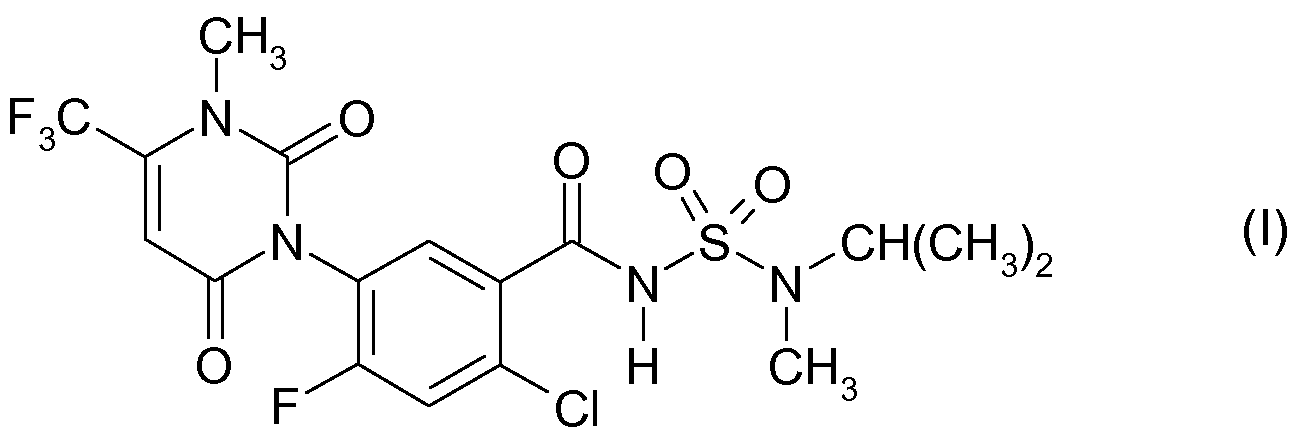
Verfahren zur Herstellung des Phenyluracil der Formel (I) als amorphe Substanz sind aus WO 01/083459, WO 03/097589, WO 05/054208 und WO 06/097509 bekannt. Das amorphe Phenyluracil der Formel (I) erwies sich jedoch aufgrund von Process for the preparation of the phenyluracil of the formula (I) as amorphous substance are known from WO 01/083459, WO 03/097589, WO 05/054208 and WO 06/097509. However, the amorphous phenyluracil of the formula (I) was found to be due to
Stabilitätsproblemen als nur eingeschränkt geeignet für die Herstellung von Stability problems as only limited suitable for the production of
Formulierungen. Stabilitätsprobleme treten It. WO 2008/043836 bei Verwendung der im amorphen Zustand vorliegenden Verbindung der Formel (I) insbesondere bei mehrphasigen Formulierungen auf. Formulations. Stability problems occur It. WO 2008/043836 when using the compound of the formula (I) present in the amorphous state, in particular in multiphase formulations.
Bezüglich der vorgenannten Schwierigkeiten offenbart die WO 2008/043836, dass die Hydrate des Phenyluracils der Formel (I) die Stabilitätsprobleme der amorphen Form nicht aufweisen und dass die Hydrate zudem eine bessere herbizide With respect to the aforementioned difficulties, WO 2008/043836 discloses that the hydrates of the phenyluracil of the formula (I) do not have the stability problems of the amorphous form and that the hydrates also have better herbicidal properties
Wirksamkeit sowie in einer Reihe von Kulturen auch eine bessere Selektivität aufweisen. Effectiveness and in a number of cultures also have a better selectivity.
Auf den Offenbarungsgehalt der WO 2008/043836 wird im Hinblick auf die The disclosure content of WO 2008/043836 is referred to with regard to
Charakterisierung der darin offenbarten Hydrate des Phenyluracils der Formel (I) mit Hilfe von chemischen und physikalischen Methoden hier in vollem Umfang Bezug genommen. Characterization of the hydrates of the phenyluracil of formula (I) disclosed therein with the aid of chemical and physical methods.
Bei den Hydraten des Phenyluracils der Formel (I) handelt es sich um kristalline Substanzen, die in kompakterer Form kristallisiert sind als die aus der WO The hydrates of the phenyluracil of the formula (I) are crystalline substances which are crystallized in a more compact form than those from WO
01/083459 bekannten amorphen Formen des Phenyluracils der Formel (I). 01/083459 known amorphous forms of phenyluracil of the formula (I).
Die Hydrate des Phenyluracils der Formel (I) sind kristalline Substanzen, die abhängig von der Ausbildung der Kristalle etwa 0,8 bis 1 ,2 mol Wasser, The hydrates of the phenyluracil of the formula (I) are crystalline substances which, depending on the formation of the crystals, have about 0.8 to 1.2 mol of water,
insbesondere 0,9 bis 1 ,1 mol und speziell 0,95 bis 1 ,05 mol/mol Phenyluracil enthalten und daher als Monohydrate aufzufassen sind. in particular 0.9 to 1, 1 mol and especially 0.95 to 1, 05 mol / mol of phenyluracil and therefore are to be regarded as monohydrates.
Als zentraler Schritt für die Herstellung der Hydrate des Phenyluracils der Formel (I) erwies sich eine Kristallisation aus einer Lösung des Phenyluracils der Formel (I) in einem organischen Lösungsmittel in Gegenwart von Wasser. Auf den Offenbarungsgehalt der WO 2008/043836 bezüglich der Herstellung der Hydrate der Verbindung gemäß Formel (I) wird hier in vollem Umfang Bezug genommen. Weiterhin sind aus dem Stand der Technik (WO 2009/141367) Zusammensetzungen mit herbizider Wirkung bekannt, welche neben Glyphosate und Glufosinate oder deren Salze mindestens zwei weitere herbizide Wirkstoffe enthalten, wobei es sich bei einem der Wirkstoffe um Pyroxasulfon handelt. Als dritter Kombinationswirkstoff ist in der WO 2009/141367 auch die Verwendung des Phenyluracils der Formel (I) (Saflufenacil) offenbart (siehe die Saflufenacil- Beispiele 260 bis 321 , insbesondere Beispiel 273). As a central step for the preparation of the hydrates of the phenyluracil of the formula (I), crystallization from a solution of the phenyluracil of the formula (I) in an organic solvent in the presence of water has been found. The disclosure of WO 2008/043836 with regard to the preparation of the hydrates of the compound of the formula (I) is hereby incorporated by reference in its entirety. Furthermore, known from the prior art (WO 2009/141367) compositions having herbicidal activity, in addition to glyphosate and glufosinate or their salts contain at least two other herbicidal active ingredients, wherein it is one of the active ingredients is pyroxasulfone. WO 2009/141367 also discloses the use of the phenyluracil of the formula (I) (saflufenacil) as the third combination active ingredient (see the saflufenacil Examples 260 to 321, in particular Example 273).
In WO 2009/156322 betrifft eine weitere Herbizidkombination, welche das In WO 2009/156322 relates to a further herbicide combination which the
Phenyluracil, darunter auch Saflulfenacil, in Kombination mit Glyphosate enthalten kann, wobei die Phenyluracilkomponente dazu dienen soll, die Regenfestigkeit der Glyphosate-Komponente zu verbessern. Phenyluracil, including safululacetic acid, in combination with glyphosate, the phenyluracil component intended to improve the rainfastness of the glyphosate component.
Die Verwendung der Hydrate des Phenyluracils der Formel (I) als Komponente in einem Kombinationspräparat ist bislang nicht bekannt. The use of the hydrates of the phenyluracil of the formula (I) as a component in a combination preparation is hitherto unknown.
Die Aufgabe der vorliegenden Erfindung besteht in der Bereitstellung weiterer Zusammensetzungen mit herbizider Wirkung, welche ein oder mehrere Hydrate des Phenyluracils der Formel (I) enthält, und dabei Vorteile gegenüber den aus dem Stand der Technik bekannten Zusammensetzungen aufweist. The object of the present invention is to provide further herbicidal compositions containing one or more hydrates of the phenyluracil of the formula (I) and thereby having advantages over the compositions known from the prior art.
Die Aufgabe wird gelöst durch eine Herbizid-Kombination enthaltend The object is achieved by containing a herbicide combination
a) mindestens ein Herbizid (A) ausgewählt aus der Gruppe bestehend aus a) at least one herbicide (A) selected from the group consisting of
- Glyphosate (A1 ) sowie dessen agrochemisch verträglichen Salze, und - Glyphosate (A1) and its agrochemically acceptable salts, and
- Glufosinate (A2) sowie dessen agrochemisch verträglichen Salze, und b) ein Herbizid (B), das ein Hydrat der Verbindung 2-Chlor-5-[3,6-dihydro-3- methyl-2,6-dioxo-4-(trifluormethyl)-1 -(2H)-pyrimidinyl]-4-fluor-N-[[methyl-(1 - methylethyl)amino]sulfonyl]benzamid ist. Glyphosate (common name der Verbindung mit dem IUPAC name N- (phoshonmethyl)glycine) ist ein nichtselektives Herbizid, das in US 3,799,758 und US 4,405,531 beschrieben wird. Glyphosate ist unter den Handelsnamen Glufosinate (A2) and its agrochemically acceptable salts, and b) a herbicide (B) containing a hydrate of the compound 2-chloro-5- [3,6-dihydro-3-methyl-2,6-dioxo-4 (trifluoromethyl) -1- (2H) -pyrimidinyl] -4-fluoro-N - [[methyl- (1-methylethyl) amino] sulfonyl] benzamide. Glyphosate (common name of the compound with the IUPAC name N- (phosphonomethyl) glycine) is a non-selective herbicide described in US 3,799,758 and US 4,405,531. Glyphosate is under the trade names
Roundup™ und Touchdown™ bekannt. Roundup ™ and Touchdown ™ known.
Glyphosate wird auch als Salz mit verschiedenen Kationen bereitgestellt. Als Glyphosate is also provided as a salt with various cations. When
Herbizide eingesetzte Salze von Glyphosate sind z.B. Glyphosate-diammonium Herbicidal salts of glyphosate used are e.g. Glyphosate-diammonium
[CAS RN 69254-40-6] (A1 a), Glyphosate-isopropylammonium [38641 -94-0] (A1 b), Glyphosate-monoammonium [40465-66-5] (A1 c), Glyphosate-potassium [70901 -20- 1 ] (A1 d), Glyphosate-sesquisodium [70393-85-0] (A1 e) und als Glyphosate- trimesium [81591 -81 -3] (Alf). [CAS RN 69254-40-6] (A1a), glyphosate isopropylammonium [38641 -94-0] (A1b), glyphosate monoammonium [40465-66-5] (A1c), glyphosate potassium [70901 - 20- 1] (A1d), glyphosate sesquisodium [70393-85-0] (A1e) and as glyphosate trimesium [81591 -81-3] (Alf).
Bevorzugt wird Glyphosate, das in der vorliegenden Erfindung als Komponente (A1 ) eingesetzt wird, in Form von Diammonium (A1 a), Isopropylammonium (A1 b), Monoammonium (A1 c) oder Trimesiumsalz (Alf) eingesetzt. Glyphosate which is used as component (A1) in the present invention is preferably used in the form of diammonium (A1a), isopropylammonium (A1b), monoammonium (A1c) or trimesium salt (Alf).
Weitere spezifische Glyphosate-Einsatzformen sind die durch nachfolgend genannte Handelsnamen geschützten Formulierungen Round up Original™, Round up Other specific glyphosate insert forms are Round Up Original ™, Round up formulations protected by the trade names below
Transarb™ und Round up WG™. Transarb ™ and Round up WG ™.
Glufosinate (common name der Verbindung mit dem IUPAC name Glufosinate (common name of the compound with the IUPAC name
4[hydroxyl(methyl)phosphinoyl]-DL-homoalanine) [CAS RN 53369-07-6] ist ein weiteres nicht selektives Herbizid. Vom racemischen Gemisch des herbiziden Wirkstoffs wird das L-Isomer [CAS RN 35597-44-5] unterschieden, das sich ebenfalls durch herbizide Wirkung auszeichnet. 4 [hydroxyl (methyl) phosphinoyl] -DL-homoalanine) [CAS RN 53369-07-6] is another non-selective herbicide. The racemic mixture of the herbicidal active ingredient is the L-isomer [CAS RN 35597-44-5] distinguished, which is also characterized by herbicidal activity.
Glufosinate und dessen Salze, wie z.B. Glufosinate-ammonium [CAS RN 77 182-82- 2], und seine herbizide Wirkung wurden beschrieben von F. Schwerdtle et al. Z. Pflanzenkr. Pflanzenschutz, 1981 , Sonderheft IX, pp. 431 -440. Für die vorliegende Erfindung, in der Glufosinate als Komponente (A2) eingesetzt wird, besonders interessante Glufosinatesalze sind Glufosinate-ammoniunn (A2a), Glufosinate-sodium (A2b), L-Glufosinate-ammoniunn (A2c), und L-Glufosinate- sodium (A2d). Glufosinates and its salts, such as glufosinate-ammonium [CAS RN 77 182-82-2], and its herbicidal action have been described by F. Schwerdtle et al. Z. Pflanzenkr. Plant Protection, 1981, Special Issue IX, pp. 431 -440. For the present invention in which glufosinate is used as component (A2), particularly interesting glufosinate salts are glufosinate-ammoniunn (A2a), glufosinate-sodium (A2b), L-glufosinate-ammoniunn (A2c), and L-glufosinate-sodium ( A2d).
Am meisten bevorzugt ist Glufosinate-ammonium (A2a). Most preferred is glufosinate-ammonium (A2a).
Glufosinate und dessen Salze sind bekannt unter den Handelsnamen wie z.B. Glufosinates and its salts are known under trade names such as e.g.
Basta™, Liberty™, Ignite™, Rely™ und Finale™. Basta ™, Liberty ™, Ignite ™, Rely ™ and Finale ™.
In einer bevorzugten Ausführungsform der Herbizid-Kombination gilt für die In a preferred embodiment of the herbicide combination applies to the
Komponente (B) in dem Zustand vor dem Mischen der Komponente (B) mit den weiteren Komponenten und Bestandteilen der Herbizid-Kombination, dass die Hydrate der Verbindung 2-Chlor-5-[3,6-dihydro-3-methyl-2,6-dioxo-4-(trifluormethyl)- 1 -(2H)-pyrimidinyl]-4-fluor-N-[[methyl-(1 -methylethyl)amino]sulfonyl]benzamid 0,8 bis 1 ,2 mol Wasser, bezogen auf 1 Mol 2-Chlor-5-[3,6-dihydro-3-methyl-2,6-dioxo-4- (trifluormethyl)-l -(2H)-pyrimidinyl]-4-fluor-N-[[methyl-(1 - methylethyl)amino]sulfonyl]benzamid, enthalten. Die vorgenannten Hydrate der Komponente (B) weisen dabei einen Schmelzpunkt im Bereich von 100 bis 140°C auf. Component (B) in the state before mixing component (B) with the further components and components of the herbicide combination, that the hydrates of the compound 2-chloro-5- [3,6-dihydro-3-methyl-2, 6-dioxo-4- (trifluoromethyl) -1- (2H) -pyrimidinyl] -4-fluoro-N - [[methyl- (1-methylethyl) amino] sulfonyl] benzamide 0.8 to 1.2 moles of water to 1 mole of 2-chloro-5- [3,6-dihydro-3-methyl-2,6-dioxo-4- (trifluoromethyl) -1 - (2H) -pyrimidinyl] -4-fluoro-N - [[methyl - (1-methylethyl) amino] sulfonyl] benzamide. The abovementioned hydrates of component (B) have a melting point in the range from 100 to 140.degree.
Die vorgenannten Hydrate der Komponente (B) sind weiterhin, dadurch The aforementioned hydrates of component (B) are still, thereby
gekennzeichnet, dass die Komponente (B) in dem Zustand vor dem Mischen der Komponente (B) mit den weiteren Komponenten und Bestandteilen der Herbizid- Kombination einen Gehalt an 2-Chlor-5-[3,6-dihydro-3-methyl-2,6-dioxo-4- (trifluormethyl)-l -(2H)-pyrimidinyl]-4-fluor-N-[[methyl-(1 - methylethyl)amino]sulfonyl]benzamid von wenigstens 94 Gew.-%, bezogen auf die Gesamtmenge der im Hydrat enthaltenen organischen Bestandteile aufweist. In einer besonders bevorzugten Ausführungsform der Herbizid-Kombination zeigt die Komponente (B), in dem Zustand vor dem Mischen der Komponente (B) mit den weiteren Komponenten und Bestandteilen der Herbizid-Kombination, in einem in that component (B) in the state before the mixing of component (B) with the other components and constituents of the herbicide combination has a content of 2-chloro-5- [3,6-dihydro-3-methyl-2 , 6-dioxo-4- (trifluoromethyl) -1- (2H) -pyrimidinyl] -4-fluoro-N - [[methyl- (1-methylethyl) amino] sulfonyl] benzamide of at least 94% by weight, based on comprising the total amount of the organic constituents contained in the hydrate. In a particularly preferred embodiment of the herbicide combination, the component (B), in the state before mixing the component (B) with the other components and components of the herbicide combination, in one
Röntgenpulverdiffraktogramm bei 25°C und Cu-Ka-Strahlung zumindest einen Reflex bei dem 29-Wert 1 1 ,6 ± 0,2°. Falls Komponente (B) in dieser besonderen Kristallform vorliegt, wird sie (in Abgrenzung zu anderen möglichen Kristallformen der Komponente (B)) als Komponente (Ba) bezeichnet. X-ray powder diffractogram at 25 ° C and Cu-Ka radiation at least one reflex at the 29 value 1 1, 6 ± 0.2 °. If component (B) is in this particular crystal form, it is referred to as component (Ba) (as distinct from other possible crystal forms of component (B)).
In einer ganz besonders bevorzugten Ausführungsform der Herbizid-Kombination zeigt die Komponente (Ba), in dem Zustand vor dem Mischen der Komponente (Ba) mit den weiteren Komponenten und Bestandteilen der Herbizid-Kombination, in einem Röntgenpulverdiffraktogramm zusätzlich wenigstens drei der folgenden, als 20-Werte angegebenen Reflexe zeigt: 5,1 ± 0,2°, 10,1 ± 0,2°, 10,8 ± 0,2°, 13,9 ± 0,2°, 15,1 ± 0,2°, 16,1 ± 0,2°, 17,9 ± 0,2°, 20,2 ± 0,2°, 24,5 ± 0,2°. In a most preferred embodiment of the herbicide combination, component (Ba), in the state prior to mixing component (Ba) with the further components and ingredients of the herbicide combination, additionally exhibits at least three of the following in an X-ray powder diffraction pattern Values indicated reflections: 5.1 ± 0.2 °, 10.1 ± 0.2 °, 10.8 ± 0.2 °, 13.9 ± 0.2 °, 15.1 ± 0.2 ° , 16.1 ± 0.2 °, 17.9 ± 0.2 °, 20.2 ± 0.2 °, 24.5 ± 0.2 °.
In einer weiteren besonders bevorzugten Ausführungsform der Herbizid-Kombination zeigt die Komponente (B), in dem Zustand vor dem Mischen der Komponente (B) mit den weiteren Komponenten und Bestandteilen der Herbizid-Kombination, in einem Röntgenpulverdiffraktogrammbei 25°C und Cu-Ka-Strahlung zumindest einen Reflex bei dem 20-Wert 12,1 ± 0,2°C. Diese besondere Kristallform der Komponente (B) wird (in Abgrenzung zu anderen möglichen Kristallformen der Komponente (B)) als Komponente (Bb) bezeichnet. In a further particularly preferred embodiment of the herbicide combination, component (B), in the state before the mixing of component (B) with the other components and constituents of the herbicide combination, in an X-ray powder diffractogram at 25 ° C. and Cu-Ka shows Radiation at least one reflex at the 20 value 12.1 ± 0.2 ° C. This particular crystal form of component (B) is referred to as component (Bb) (as distinct from other possible crystal forms of component (B)).
In einer ganz besonders bevorzugten Ausführungsform der Herbizid-Kombination zeigt die Komponente (Bb), in dem Zustand vor dem Mischen der Komponente (Bb) mit den weiteren Komponenten und Bestandteilen der Herbizid-Kombination, in einem Röntgenpulverdiffraktogramm wenigstens drei der folgenden, als 29-Werte angegebenen Reflexe: 5,2 ± 0,2°, 10,2 ± 0,2°, 10,9 ± 0,2°, 14,0 ± 0,2°, 14,6 ± 0,2°, 15,3 ± 0,2°, 19,2 ± 0,2°, 19,9 ± 0,2°, 20,5 ± 0,2°, 24,7 ± 0,2°, 26,7 ± 0,2°, 27,8 ± 0,2°. Bevorzugte Mischungsverhältnisse der Komponenten (A):(B), für die In a very particularly preferred embodiment of the herbicide combination, component (Bb), in the state before the mixing of component (Bb) with the other components and constituents of the herbicide combination, in an X-ray powder diffractogram shows at least three of the following, as Values indicated reflections: 5.2 ± 0.2 °, 10.2 ± 0.2 °, 10.9 ± 0.2 °, 14.0 ± 0.2 °, 14.6 ± 0.2 °, 15 , 3 ± 0.2 °, 19.2 ± 0.2 °, 19.9 ± 0.2 °, 20.5 ± 0.2 °, 24.7 ± 0.2 °, 26.7 ± 0, 2 °, 27.8 ± 0.2 °. Preferred mixing ratios of components (A) :( B), for which
erfindungsgemäßen Kombinationen sind im Folgenden aufgeführt: combinations according to the invention are listed below:
Das Gewichtsverhältnis der Komponenten (A) zu den Komponenten (B) in der Herbizid-Kombination kann jeweils in dem Bereich zwischen 1600:1 bis 1 :10 liegen. The weight ratio of components (A) to components (B) in the herbicide combination may each be in the range of 1600: 1 to 1:10.
Besonders bevorzugt ist das Gewichtsverhältnis von Komponente (A) zu Particularly preferred is the weight ratio of component (A) to
Komponente (B) in dem Bereich zwischen 800:1 bis 1 :5. In den erfindungsgemäßen Kombinationen können die Aufwandmengen, im Component (B) in the range between 800: 1 to 1: 5. In the combinations according to the invention, the application rates, in
Vergleich zu den Aufwandmengen der Einzelstoffe in der Regel reduziert werden. Compared to the application rates of the individual substances are usually reduced.
In einer bevorzugten Ausführungsform erfindungsgemäße Herbizid-Kombination als zusätzliche Komponente (C) ein oder mehrere Komponenten enthalten, die ausgewählt sind aus der Gruppe agrochemischer Wirkstoffe anderer Art sowie im Pflanzenschutz übliche Zusatzstoffe und Formulierungshilfsmittel. In a preferred embodiment, the herbicidal combination according to the invention contains as additional component (C) one or more components which are selected from the group of agrochemical active compounds of a different kind and customary additives and formulation auxiliaries in crop protection.
Agrochemische Wirkstoff anderer Art umfassen neben Herbiziden, Fungiziden, Insektiziden, Akariziden, Nematiziden, Mitiziden und verwandten Stoffen Other agrochemicals include herbicides, fungicides, insecticides, acaricides, nematicides, miticides and related substances
insbesondere Herbizide, die nicht identisch sind mit den Wirkstoffen der in particular herbicides which are not identical to the active substances of
Komponenten (A) und (B). Agrochemische Wirkstoff anderer Art umfassen außerdem auch Verbindungen, die als kulturpflanzenschützende Wirkstoffe Components (A) and (B). Agrochemical active substances of another type also include compounds which are used as crop protection agents
("Safener" oder "Antidots" genannt) oder Wachstumsregulatoren wirken. Als weitere Herbizide (C), die sich strukturell von den Herbiziden (A) und (B) unterscheiden, also nicht indentisch sind mit diesen, kommen vorzugsweise herbizide Wirkstoffe in Frage, die auf einer Inhibition von beispielsweise Acetolactat- Synthase, Acetyl-Coenzym-A-Carboxylase, PS I, PS II, HPPDO, Phytoene- Desaturase, Protoporphyrinogen-Oxidase, Glutamine-Synthetase, (Called "safeners" or "antidotes") or growth regulators. As further herbicides (C), which differ structurally from the herbicides (A) and (B), ie are not indentisch with these, are preferably herbicidal active substances in question, which are based on an inhibition of, for example, acetolactate synthase, acetyl-coenzyme A-carboxylase, PS I, PS II, HPPDO, phytoene desaturase, protoporphyrinogen oxidase, glutamine synthetase,
Cellulosebiosynthese, 5-Enolpyruvylshikimat-3-phosphat-Synthetase beruhen, wie sie z.B. in Weed Research 26, 441 -445 (1986), oder "The Pesticide Manual", 13th edition, The British Crop Protection Council, 2003, oder 14. Auflage 2006/2007, oder in dem entsprechenden„e-Pesticide Manual", Version 4 (2006), jeweils herausgegeben vom British Crop Protection Council, (im Folgenden auch kurz "PM"), und dort zitierter Literatur beschrieben sind. Listen von„Common names" sind auch in„The Compendium of Pesticide Common Names" im Internet verfügbar. Die Herbizide sind dabei entweder mit dem "common name" nach der International Organization for Standardization (ISO) oder mit dem chemischen Namen, ggf. zusammen mit einer üblichen Codenummer bezeichnet und umfassen stets sämtliche Anwendungsformen wie Säuren, Salze, Ester und Isomere wie Stereoisomere und optische Isomere. Cellulose biosynthesis, 5-enolpyruvylshikimate-3-phosphate synthetase, as described, for example, in Weed Research 26, 441-445 (1986), or The Pesticide Manual, 13th edition, The British Crop Protection Council, 2003, or 14th Edition 2006/2007, or in the corresponding "e-Pesticide Manual", version 4 (2006), each published by the British Crop Protection Council, (hereinafter also referred to as "PM"), and literature cited therein. Lists of "common names" are also in "The Compendium of Pesticide Common Names" are available on the Internet, the herbicides are either with the "common name" according to the International Organization for Standardization (ISO) or with the chemical name, possibly together with a common code number and always include all Use forms such as acids, salts, esters and isomers such as stereoisomers and optical isomers.
Dabei sind eine und zum Teil auch mehrere Anwendungsformen genannt, wobei die folgenden Verbindungen alle als Komponente (C) in der vorliegenden Erfindung in Frage kommen: One and in some cases also several application forms are mentioned, wherein the following compounds are all suitable as component (C) in the present invention:
acetochlor; acibenzolar-S-methyl; acifluorfen(-sodium); aclonifen; AD-67; AKH 7088, d.h. [[[1 -[5-[2-Chloro-4-(trifluoromethyl)-phenoxy]-2-nitrophenyl]-acetochlor; acibenzolar-S-methyl; acifluorfen (-sodium); aclonifen; AD-67; AKH 7088, i. [[[1 - [5- [2-chloro-4- (trifluoromethyl) -phenoxy] -2-nitrophenyl] -
2-methoxyethylidene]-amino]-oxy]-essigsäure und -essigsäuremethylester; alachlor; alloxydim(-sodium); ametryn; amicarbazone, amidochlor, amidosulfuron; 2-methoxyethylidene] amino] oxy] acetic acid and acetic acid methyl ester; alachlor; alloxydim (-sodium); ametryn; amicarbazone, amidochlor, amidosulfuron;
aminocyclopyrachlor; aminopyralid; amitrol; Ammoniumpelargonate; AMS, d.h. ammocyclopyrachlor; aminopyralid; amitrol; Ammoniumpelargonate; AMS, i.
Ammoniumsulfamat; ancimidol; asulam; atrazine; aviglycine; azafenidin, ammonium sulfamate; ancimidol; asulam; atrazine; aviglycine; azafenidin,
azimsulfuron (DPX-A8947); aziprotryn; barban; BAS 516 H, d.h. 5-Fluor-2-phenyl-azimsulfuron (DPX-A8947); aziprotryn; barban; BAS 516H, i. 5-fluoro-2-phenyl-
4H-3,1 -benzoxazin-4-on; beflubutamid (UBH-509), benazolin(-ethyl); bencarbazone; benfluralin; benfuresate; bensulfuron(-methyl); bentazone; benzfendizone; 4H-3,1-benzoxazin-4-one; beflubutamide (UBH-509), benazoline (-ethyl); bencarbazone; benfluralin; benfuresate; bensulfuron (-methyl); bentazone; benzfendizone;
benzobicyclon, benzofenap; benzofluor; benzoylprop(-ethyl); benzthiazuron; benzobicyclone, benzofenap; benzofluor; benzoylprop (-ethyl); benzthiazuron;
bicyclopyrone; bifenox; bispyribac(-sodium) (KIH-2023); borax; bromacil; bicyclopyrone; bifenox; bispyribac (-sodium) (KIH-2023); borax; bromacil;
bromobutide; bromofenoxim; bromoxynil; bromuron; buminafos; busoxinone; bromobutide; bromofenoxim; bromoxynil; bromuron; buminafos; busoxinone;
butachlor; butafenacil; butenachlor (KH-218); buthidazole; butralin; butroxydim; butachlor; butafenacil; butenachlor (KH-218); buthidazole; butraline; butroxydim;
butylate; cafenstrole (CH-900); caloxydim; carbetamide; carfentrazone(-ethyl); butylate; cafenstrole (CH-900); caloxydim; carbetamide; carfentrazone (-ethyl);
catechin; CDAA, d.h. 2-Chlor-N,N-di-2-propenylacetamid; CDEC, d.h. catechin; CDAA, i. 2-chloro-N, N-di-2-propenylacetamide; CDEC, i.
Diethyldithiocarbaminsäure-2-chlorallylester; chlormesulon; chlomethoxyfen; Diethyldithiocarbamic acid 2-chlorallylester; chlormesulone; chlomethoxyfen;
chloramben; chlorazifop-butyl; chlorbromuron; chlorbufam; chlorfenac; chlorfenprop; chlorflurecol(-methyl); chlorflurenol(-methyl); chloridazon; chlorimuron(-ethyl); chlormequat(-chloride); chlornitrofen; chlorophthalim (MK-616); chlorotoluron; chloramben; chlorazifop-butyl; chlorbromuron; chlorbufam; chlorfenac; chlorfenprop; chlorflurecol (-methyl); chlorflurenol (-methyl); chloridazon; chlorimuron (-ethyl); chlormequat (chlorides); chlornitrofen; chlorophthalim (MK-616); chlorotoluron;
chloroxuron; chlorpropham; chlorsulfuron; chlorthal-dimethyl; chlorthiamid; chloroxuron; chlorpropham; chlorsulfuron; chlorthal-dimethyl; chlorthiamid;
chlortoluron; cinidon(-methyl und -ethyl); cinmethylin; cinosulfuron; clefoxydim; chlorotoluron; cinidone (-methyl and -ethyl); cinmethylin; cinosulfuron; clefoxydim;
clethodim; clodinafop und dessen Esterdehvate (z.B. clodinafop-propargyl); clethodim; clodinafop and its ester derivatives (e.g., clodinafop-propargyl);
clofencet; clomazone; clomeprop; cloprop; cloproxydim; clopyralid; clopyrasulfuron(- methyl); cloransulam(-nnethyl); cumyluron (JC 940); cyanamide; cyanazine; cycloate; cyclosulfamuron (AC 104); cycloxydim; cycluron; cyhalofop und dessen clofencet; clomazone; clomeprop; cloprop; cloproxydim; clopyralid; clopyrasulfuron (- methyl); cloransulam (-nnethyl); cumyluron (JC 940); cyanamide; cyanazine; cycloate; Cyclosulfamuron (AC 104); cycloxydim; cycluron; cyhalofop and its
Esterdenvate (z.B. Butylester, DEH-1 12); cyperquat; cyprazine; cyprazole; daimuron; Ester derivatives (e.g., butyl ester, DEH-1 12); cyperquat; cyprazine; cyprazole; daimuron;
2,4-D; 2,4-DB; dalapon; daminozide; dazomet; n-decanol; desmedipham; desmetryn; di-allate; dicamba; dichlobenil; dichlornnid; dichlorprop(-P)-salze; diclofop und dessen2,4-D; 2,4-DB; dalapon; daminozide; dazomet; n-decanol; desmedipham; Desmetryn; di-allate; dicamba; dichlobenil; dichlornnid; dichlorprop (-P) salts; diclofop and its
Ester wie diclofop-methyl; diclofop-P(-methyl); diclosulam; diethatyl(-ethyl); Esters such as diclofop-methyl; diclofop-P (methyl); diclosulam; diethatyl (-ethyl);
difenoxuron; difenzoquat(-metilsulfate); diflufenican; diflufenzopyr(-sodium); difenoxuron; difenzoquat (-metilsulfate); diflufenican; diflufenzopyr (-sodium);
dimefuron; dimepiperate; dimethachlor; dimethametryn; dimethazone; dimethenamiddimefuron; dimepiperate; dimethachlor; dimethametryn; dimethazone; dimethenamid
(SAN-582H); dimethenamide-P; dimethylarsinic acid; dimethipin; dimetrasulfuron; dimexyflam; dinitramine; dinoseb; dinoterb; diphenamid; dipropetryn; diquat-salze; dithiopyr; diuron; DNOC; eglinazine-ethyl; EL 77, d.h. (SAN-582H); dimethenamide-P; dimethylarsinic acid; dimethipin; dimetrasulfuron; dimexyflam; dinitramine; dinoseb; dinoterb; diphenamid; dipropetryn; diquat salts; dithiopyr; diuron; DNOC; eglinazine-ethyl; EL 77, i.
5-Cyano-1 -(1 ,1 -dimethylethyl)-N-methyl-1 H-pyrazole-4-carboxamid; endothal; 5-cyano-1 - (1, 1-dimethylethyl) -N-methyl-1H-pyrazole-4-carboxamide; endothal;
epoprodan; EPTC; esprocarb; ethalfluralin; ethametsulfuron-methyl; ethidimuron; ethiozin; ethofumesate; ethoxyfen und dessen Ester (z.B. Ethylester, HN-252); epoprodan; EPTC; esprocarb; ethalfluralin; ethametsulfuron-methyl; Ethidimuron; ethiozin; ethofumesate; ethoxyfen and its esters (e.g., ethyl ester, HN-252);
ethoxysulfuron; etobenzanid (HW 52); F5231 , d.h. N-[2-Chlor-4-fluor-5-[4-(3- fluorpropyl)-4,5-dihydro-5-oxo-1 H-tetrazol-1 -yl]-phenyl]-ethansulfonamid; ethoxysulfuron; etobenzanide (HW 52); F5231, i. N- [2-chloro-4-fluoro-5- [4- (3-fluoro-propyl) -4,5-dihydro-5-oxo-1H-tetrazol-1-yl] -phenyl] -ethanesulfonamide;
fenchlorazole(-ethyl); fenclo m; fenoprop; fenoxan, fenoxaprop und fenoxaprop-P sowie deren Ester, z.B. fenoxaprop-P-ethyl und fenoxaprop-ethyl; fenoxydim; fenchlorazole (-ethyl); fenclo m; fenoprop; fenoxan, fenoxaprop and fenoxaprop-P and their esters, e.g. fenoxaprop-P-ethyl and fenoxaprop-ethyl; fenoxydim;
fentrazamide; fenuron; ferrous sulfate; flamprop(-nnethyl oder -isopropyl oder fentrazamide; fenuron; ferrous sulfate; flamprop (-nethyl or -isopropyl or
-isopropyl-L); flamprop-M(-nnethyl oder -isopropyl); flazasulfuron; floazulate (JV-485); florasulam; fluazifop und fluazifop-P und deren Ester, z.B. fluazifop-butyl und fluazifop-P-butyl; fluazolate; flucarbazone(-sodium); flucetosulfuron; fluchloralin; flufenacet; flufenpyr(-ethyl); flumetralin; flumetsulam; flumeturon; flumiclorac(-pentyl); flumioxazin (S-482); flumipropyn; fluometuron; fluorochloridone; fluorodifen; -isopropyl-L); flamprop-M (-nethyl or -isopropyl); flazasulfuron; floatsulate (JV-485); florasulam; fluazifop and fluazifop-P and their esters, e.g. fluazifop-butyl and fluazifop-p-butyl; fluazolate; flucarbazone (-sodium); flucetosulfuron; fluchloralin; flufenacet; flufenpyr (-ethyl); flumetralin; flumetsulam; flumeturon; flumiclorac (-pentyl); flumioxazine (S-482); flumipropyn; fluometuron; fluorochloridone; fluorodifen;
fluoroglycofen(-ethyl); flupoxam (KNW-739); flupropacil (UBIC-4243); flupropanoate; flupyrsulfuron(-methyl)(-sodium); flurenol(-butyl); fluridone; flurochloridone; fluoroglycofen (-ethyl); flupoxam (KNW-739); flupropacil (UBIC-4243); flupropanoate; flupyrsulfuron (-methyl) (- sodium); flurenol (-butyl); fluridone; flurochloridone;
fluroxypyr(-meptyl); flurprimidol; flurtamone; fluthiacet(-methyl) (KIH-9201 ); fluthiamide; fluxofenim; fomesafen; foramsulfuron; forchlorfenuron; furyloxyfen; fluroxypyr (-meptyl); flurprimidol; flurtamone; fluthiacet (-methyl) (KIH-9201); fluthiamide; fluxofenim; fomesafen; foramsulfuron; forchlorfenuron; furyloxyfen;
gibberillic acid; halosafen; halosulfuron(-methyl); haloxyfop und dessen Ester; gibberillic acid; halo safen; halosulfuron (-methyl); haloxyfop and its esters;
haloxyfop-P (= R-haloxyfop) und dessen Ester; HC-252; hexazinone; HNPC-C9908, d.h. 2-[[[[[4-Methoxy-6-(methylthio)-2-pyrimidinyl]amino]carbonyl]amino]sulfonyl]- benzoesäuremethylester; imazamethabenz(-methyl); imazamox; imazapic; imazapyr; imazaquin und Salze Wie das Ammoniumsalz; imazethapyr; imazosulfuron; haloxyfop-P (= R-haloxyfop) and its esters; HC-252; hexazinone; HNPC-C9908, i. 2 - [[[[[4-methoxy-6- (methylthio) -2-pyrimidinyl] amino] carbonyl] amino] sulfonyl] benzoic acid methyl ester; imazamethabenz (-methyl); imazamox; imazapic; imazapyr; imazaquin and salts such as the ammonium salt; imazethapyr; imazosulfuron;
inabenfide; indanofan; indaziflam; iodosulfuron-methyl(-sodium); ioxynil; inabenfide; indanofan; indaziflam; iodosulfuron-methyl (-sodium); ioxynil;
isocarbamid; isopropalin; isoproturon; isouron; isoxaben; isoxachlortole; isoxaflutole; isoxapyrifop; karbutilate; lactofen; lenacil; linuron; Maleinsäurehydrazid (MH); MBTA; MCPA; MCPB; mecoprop(-P); mefenacet; mefluidide; mepiquat(-chlo de); isocarbamid; isopropalin; isoproturon; isouron; isoxaben; isoxachlortole; isoxaflutole; isoxapyrifop; karbutilate; lactofen; lenacil; linuron; Maleic hydrazide (MH); MBTA; MCPA; MCPB; mecoprop (-P); mefenacet; mefluidide; mepiquat (-chlo de);
mesosulfuron(-methyl); mesot one; metam; metamifop; metamitron; metazachlor; methabenzthiazuron; metham; methazole; methoxyphenone; methylarsonic acid; methyl-cyclopropene; methyldymron; methylisothiocyanate; methabenzthiazuron; metobenzuron; metobromuron; (alpha-)metolachlor; metosulam (XRD 51 1 ); mesosulfuron (-methyl); mesot one; metam; metamifop; metamitron; metazachlor; methabenzthiazuron; metham; methazole; methoxyphenone; methylarsonic acid; methyl-cyclopropene; methyldymron; methylisothiocyanate; methabenzthiazuron; metobenzuron; metobromuron; (Alpha-) metolachlor; metosulam (XRD 51 1);
metoxuron; metribuzin; metsulfuron-methyl; molinate; monalide; monocarbamide dihydrogensulfate; monolinuron; monuron; monosulfuron; MT 128, d.h. 6-Chlor-N-(3- chlor-2-propenyl)-5-methyl-N-phenyl-3-pyhdazinannin; MT 5950, d.h. N-[3-Chlor-4-(1 - methylethyl)-phenyl]-2-methylpentanamid; naproanilide; napropamide; naptalam; NCmetoxuron; metribuzin; metsulfuron-methyl; molinate; monalide; monocarbamide dihydrogen sulfates; monolinuron; monuron; monosulfuron; MT 128, i. 6-chloro-N- (3-chloro-2-propenyl) -5-methyl-N-phenyl-3-pyhdazinannine; MT 5950, i. N- [3-chloro-4- (1-methylethyl) phenyl] -2-methylpentanamide; naproanilide; napropamide; naptalam; NC
310, d.h. 4-(2,4-dichlorbenzoyl)-1 -methyl-5-benzyloxypyrazol; neburon; nicosulfuron; nipyraclofen; nitralin; nitrofen; nitrophenolate mixture; nitrofluorfen; nonanoic acid; norflurazon; orbencarb; orthosulfamuron; oxabetrinil; oryzalin; oxadiargyl 310, i. 4- (2,4-dichlorobenzoyl) -1-methyl-5-benzyloxypyrazole; neburon; nicosulfuron; nipyraclofen; nitralin; nitrofen; nitrophenolate mixture; nitrofluorfen; nonanoic acid; norflurazon; orbencarb; orthosulfamuron; oxabetrinil; oryzalin; oxadiargyl
(RP-020630); oxadiazon; oxasulfuron; oxaziclomefone; oxyfluorfen; paclobutrazol; paraquat(-dichloride); pebulate; pelargonic acid; pendimethalin; penoxulam; (RP-020630); oxadiazon; oxasulfuron; oxaziclomefone; oxyfluorfen; paclobutrazol; paraquat (dichlorides); pebulate; pelargonic acid; pendimethalin; penoxulam;
pentachlorophenol; pentanochlor; pentoxazone; perfluidone; pethoxamid; pentachlorophenol; Pentanochlor; pentoxazone; perfluidone; pethoxamid;
phenisopham; phenmedipham; picloram; picolinafen; pinoxaden; piributicarb; phenisopham; phenmedipham; picloram; picolinafen; pinoxaden; piributicarb;
pirifenop-butyl; pretilachlor; primisulfuron(-methyl); probenazole; procarbazone-pirifenop-butyl; pretilachlor; primisulfuron (-methyl); probenazole; procarbazone-
(sodium); procyazine; prodiamine; profluralin; profoxydim; prohexadione(-calcium); prohydrojasmon; proglinazine(-ethyl); prometon; prometryn; propachlor; propanil; propaquizafop und dessen Ester; propazine; propham; propisochlor; (Sodium); procyazine; prodi amines; profluralin; profoxydim; Prohexadione (-Calcium); prohydrojasmon; proglinazine (-ethyl); prometon; prometryne; propachlor; propanil; propaquizafop and its esters; propazine; propham; propisochlor;
propoxycarbazone(-sodium) (MKH-6561 ); propyzamide; prosulfalin; prosulfocarb; prosulfuron (CGA-152005); prynachlor; pyraclonil; pyraflufen(-ethyl) (ET-751 ); propoxycarbazone (-sodium) (MKH-6561); Propyzamide; prosulfalin; prosulfocarb; prosulfuron (CGA-152005); prynachlor; pyraclonil; pyraflufen (-ethyl) (ET-751);
pyrasulfotole; pyrazolynate; pyrazon; pyrazosulfuron(-ethyl); pyrazoxyfen; pyribambenz-isopropyl (ZJ 0702); pyrimbambenz-propyl (ZJ 0273); pyribenzoxim; pyributicarb; pyridafol; pyridate; pyriftalid; pyriminobac(-nnethyl) (KIH-6127); pyrasulfotole; pyrazolynate; pyrazon; pyrazosulfuron (-ethyl); pyrazoxyfen; pyribambenz isopropyl (ZJ 0702); pyrimbenzopropyl (ZJ 0273); pyribenzoxim; pyributicarb; pyridafol; pyridate; pyriftalid; pyriminobac (-nethyl) (KIH-6127);
pyrimisulfan (KIH-5996); pyrithiobac(-sodium) (KIH-2031 ); pyroxasulfone (KIH-485); pyroxofop und dessen Ester (z.B. Propargylester); pyroxsulam; quinclorac; pyrimisulfan (KIH-5996); pyrithiobac (-sodium) (KIH-2031); pyroxasulfones (KIH-485); pyroxofop and its esters (e.g., propargyl esters); pyroxsulam; quinclorac;
quinmerac; quinoclamine; quinofop und dessen Esterderivate, quizalofop und quizalofop-P und deren Esterderivate z.B. quizalofop-ethyl; quizalofop-P-tefuryl undquinmerac; quinoclamine; quinofop and its ester derivatives, quizalofop and quizalofop-P and their ester derivatives e.g. quizalofop-ethyl; quizalofop-P-tefuryl and
-ethyl; renriduron; rimsulfuron (DPX-E 9636); S 275, d.h. 2-[4-Chlor-2-fluor-5-(2- propynyloxy)-phenyl]-4,5,6,7-tetrahydro-2H-indazol; secbumeton; sethoxydim; ethyl; renriduron; rimsulfuron (DPX-E 9636); S 275, i. 2- [4-chloro-2-fluoro-5- (2-propynyloxy) -phenyl] -4,5,6,7-tetrahydro-2H-indazole; secbumeton; sethoxydim;
siduron; simazine; simetryn; sintofen; SN 106279, d.h. 2-[[7-[2-Chlor-4-(trifluor- methyl)-phenoxy]-2-naphthalenyl]-oxy]-propansäure und -methylester; sulcotrione; sulfentrazone (FMC-97285, F-6285); sulfazuron; sulfometuron(-nnethyl); sulfosatesiduron; simazine; simetryn; sintofen; SN 106279, i. 2 - [[7- [2-chloro-4- (trifluoromethyl) phenoxy] -2-naphthalenyl] oxy] -propanoic acid and methyl ester; sulcotrione; sulfentrazone (FMC-97285, F-6285); sulfazuron; sulfometuron (-nnethyl); sulfosate
(ICI-A0224); sulfosulfuron; TCA(-sodium); tebutam (GCP-5544); tebuthiuron; (ICI-A0224); sulfosulfuron; TCA (-sodium); tebutam (GCP-5544); tebuthiuron;
tecnacene; tefuryltrione; tembotrione; tepraloxydim; terbacil; terbucarb; terbuchlor; terbumeton; terbuthylazine; terbutryn; TFH 450, d.h. N,N-Diethyl-3-[(2-ethyl-6- methylphenyl)-sulfonyl]-1 H-1 ,2,4-triazol-1 -carboxamid; thenylchlor (NSK-850); tecnacene; tefuryltrione; tembotrione; tepraloxydim; terbacil; terbucarb; terbuchlor; terbumeton; Terbuthylazine; terbutryn; TFH 450, i. N, N -diethyl-3 - [(2-ethyl-6-methylphenyl) sulfonyl] -1 H-1, 2,4-triazole-1-carboxamide; thenylchlor (NSK-850);
thiafluamide, thiazafluron; thiazopyr (Mon-13200); thidiazimin (SN-24085); thiafluamide, thiazafluron; thiazopyr (Mon-13200); thidiazimin (SN-24085);
thidiazuron; thiencarbazone(-methyl); thifensulfuron(-methyl); thiobencarb; Ti 35; tiocarbazil; topramezone; tralkoxydim; tri-allate; triasulfuron; triaziflam; thidiazuron; thiencarbazone (-methyl); thifensulfuron (-methyl); thiobencarb; Ti 35; tiocarbazil; topramezone; tralkoxydim; tri-allate; triasulfuron; triaziflam;
triazofenamide; t benuron(-methyl); triclopyr; tridiphane; trietazine; trifloxysulfuron(- sodium); trifluralin; triflusulfuron und Ester (z.B. Methylester, DPX-66037); triazofenamide; t benuron (-methyl); triclopyr; tridiphane; trietazine; trifloxysulfuron (- sodium); trifluralin; triflusulfuron and esters (e.g., methyl ester, DPX-66037);
trimeturon; trinexapac; tritosulfuron; tsitodef; uniconazole; vernolate; WL 1 10547, d.h. 5-Phenoxy-1 -[3-(trifluormethyl)-phenyl]-1 H-tetrazol; D-489; ET-751 ; KIH-218;trimeturon; trinexapac; tritosulfuron; tsitodef; Uniconazole; vernolate; WL 1 10547, i. 5-phenoxy-1 - [3- (trifluoromethyl) phenyl] -1H-tetrazole; D-489; ET-751; KIH-218;
KIH-485 (pyrosysulfone); KIH-509; KPP-300; LS 82-556; NC-324; NC-330; DPX-KIH-485 (pyrosysulfone); KIH-509; KPP-300; LS 82-556; NC-324; NC-330; DPX
N8189; SC-0774; DOWCO-535; DK-8910; V-53482; PP-600; MBH-001 ; TH-547; SYN-523; IDH-100; SYP-249; HOK-201 ; IR-6396; MTB-951 ; NC-620; N8189; SC-0774; Dowco-535; DK-8910; V-53482; PP-600; MBH-001; TH-547; SYN-523; IDH-100; SYP-249; HOK-201; IR 6396; MTB-951; NC-620;
methyl 4-amino-3-chloro-6-(4-chloro-2-fluoro-3-methoxyphenyl)pyridine-2- carboxylate [CAS RN 943831 -98-9]; methyl 4-amino-3-chloro-6- (4-chloro-2-fluoro-3-methoxyphenyl) pyridine-2-carboxylate [CAS RN 943831 -98-9];
4-amino-3-chloro-6-(4-chloro-2-fluoro-3-nnethoxyphenyl)pyhdine-2-carboxylic acid [CAS RN 943832-60-8]; 4-amino-3-chloro-6- (4-chloro-2-fluoro-3-n-methoxyphenyl) -phdine-2-carboxylic acid [CAS RN 943832-60-8];
ein agrochennisch verträgliches Salz der Verbindung 2-iodo-N-[(4-methoxy-6-methyl- 1 ,3,5-thazin-2-yl)carbonyl]benzensulfonamid; und an agrochemically acceptable salt of the compound 2-iodo-N - [(4-methoxy-6-methyl-1,3,5-thazin-2-yl) carbonyl] benzenesulfonamide; and
ein agrochennisch verträgliches Salz von den Verbindungen der Formel (II): an agrochemically acceptable salt of the compounds of the formula (II):
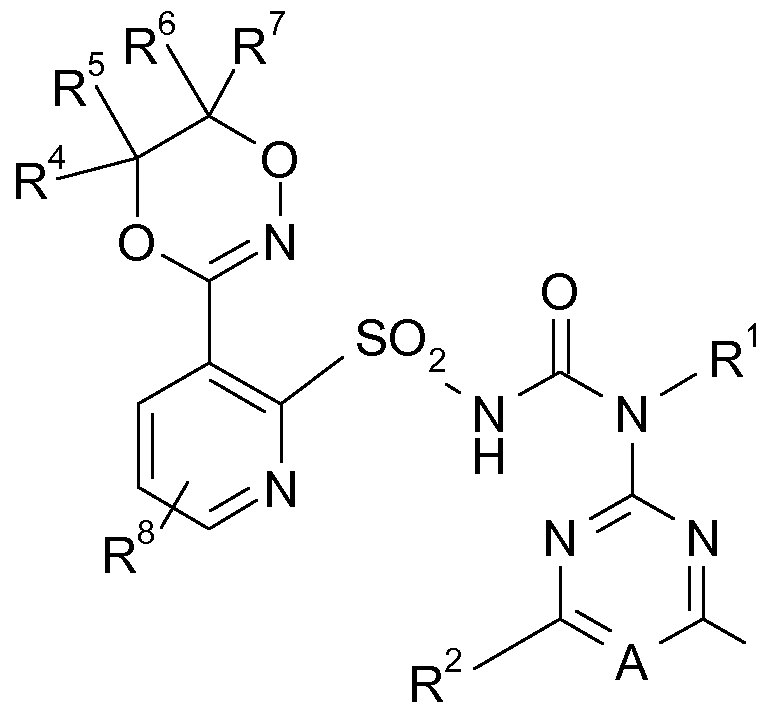
Stickstoff der eine CR Gruppe ist, Nitrogen is a CR group,
wobei in which
R11 Wasserstoff, Alkyl, Halogen oder Haloalkyl ist, R 11 is hydrogen, alkyl, halogen or haloalkyl,
Wasserstoff oder ein jeweils gegebenenfalls substituierter Rest ausgwählt aus der Gruppe aus Alkyl, Alkoxy, Alkoxyalkyl, Alkenyl, Alkynyl, Cycloalkyl, Cycloalkylalkyl, Aralkyl und Aryl ist, Is hydrogen or an optionally optionally substituted radical selected from the group consisting of alkyl, alkoxy, alkoxyalkyl, alkenyl, alkynyl, cycloalkyl, cycloalkylalkyl, aralkyl and aryl,
Wasserstoff, Halogen oder ein jeweils gegebenenfalls halogen-substituiertes Alkyl, Alkoxy, Alkylthio, Alkylamino oder Dialkylamino mit jeweils 1 bis 6 Kohlenstoffatomen ist, Is hydrogen, halogen or in each case optionally halogen-substituted alkyl, alkoxy, alkylthio, alkylamino or dialkylamino having in each case 1 to 6 carbon atoms,
Wasserstoff, Halogen oder ein jeweils gegebenenfalls Halogen-substituiertes Alkyl, Alkoxy, Alkylthio, Alkylamino oder Dialkylamino mit jeweils 1 bis 6 Kohlenstoffatomen ist, Is hydrogen, halogen or in each case optionally halogen-substituted alkyl, alkoxy, alkylthio, alkylamino or dialkylamino having in each case 1 to 6 carbon atoms,
R7 unabhängig voneinander Wasserstoff, Halogen, Cyano, Thiocyanato oder jeweils gegebenenfalls Halogen-substituiertes Alkyl, Alkoxy, Alkylthio, Alkylsulfinyl, Alkylsulfonyl, Alkylamino, Alkylcarbonyl, Alkoxycarbonyl, R 7 is independently of one another hydrogen, halogen, cyano, thiocyanato or in each case optionally halogen-substituted alkyl, alkoxy, alkylthio, alkylsulfinyl, alkylsulfonyl, alkylamino, alkylcarbonyl, alkoxycarbonyl,
Alkylaminocarbonyl mit jeweils 1 bis 3 Kohlenstoffatomen sind, Alkylaminocarbonyl each having 1 to 3 carbon atoms,
Wasserstoff, Halogen, Cyano, Thiocyanato oder jeweils gegebenenfalls Halogen-substituiertes Alkyl, Alkoxy, Alkylthio, Alkylsulfinyl, Alkylsulfonyl, Alkylamino, Alkylcarbonyl, Alkoxycarbonyl, Alkylaminocarbonyl mit jeweils 1 bis 3 Kohlenstoffatomen ist, wobei in den oben genannten Radikalen die Alkyl und Alkylen-Gruppen jeweils 1 - 6 Kohlenstoffatome, die Alkyl und Alkynyl-Gruppen jeweils 2 bis 6 Kohlenstoffatome, die Cycloalkyl-Gruppen jeweils 3 - 6 Kohlenstoffatome und die Aryl-Gruppen jeweils 6 oder 10 aufweisen. Hydrogen, halogen, cyano, thiocyanato or in each case optionally halogen-substituted alkyl, alkoxy, alkylthio, alkylsulfinyl, alkylsulfonyl, Alkylamino, alkylcarbonyl, alkoxycarbonyl, alkylaminocarbonyl each having 1 to 3 carbon atoms, wherein in the abovementioned radicals, the alkyl and alkylene groups each 1-6 carbon atoms, the alkyl and alkynyl groups each 2 to 6 carbon atoms, the cycloalkyl groups each 3-6 carbon atoms and the aryl groups each have 6 or 10.
Wenn die jeweilige Bezeichnung (common name) mehrere Formen des Wirkstoffes umfasst, ist mit der Bezeichnung die kommerziell erhältliche Form bevorzugt definiert. If the respective name (common name) comprises several forms of the active ingredient, the name of the commercially available form is preferably defined.
Besonders bevorzugt sind als weitere Herbizide (C), die sich strukturell von denParticularly preferred as further herbicides (C), structurally different from the
Herbiziden (A) und (B) unterscheiden, amicarbazone, amidosulfuron; benzobicyclon; bicyclopyrone; bromoxynil; carfentrazone(-ethyl); chlorimuron(-ethyl); clefoxydim; clethodim; clomazone; clopyralid; cloransulam(-methyl); 2,4-D; desmedipham; Herbicides (A) and (B) distinguish amicarbazone, amidosulfuron; benzobicyclon; bicyclopyrone; bromoxynil; carfentrazone (-ethyl); chlorimuron (-ethyl); clefoxydim; clethodim; clomazone; clopyralid; cloransulam (-methyl); 2,4-D; desmedipham;
dicamba; diflufenican; diflufenzopyr(-sodium); dimethenamid (SAN-582H); dicamba; diflufenican; diflufenzopyr (-sodium); dimethenamid (SAN-582H);
dimethenamide-P; ethoxysulfuron; fenoxaprop-P; fenoxaprop-P-ethyl; flucarbazone(- sodium); flufenacet; fluroxypyr(-meptyl); foramsulfuron; imazamox; imazapic; dimethenamide-P; ethoxysulfuron; fenoxaprop-P; fenoxaprop-P-ethyl; flucarbazone (- sodium); flufenacet; fluroxypyr (-meptyl); foramsulfuron; imazamox; imazapic;
imazapyr; imazaquin; imazethapyr; indaziflam; iodosulfuron-methyl(-sodium); ioxynil; isoproturon; isoxaben; isoxaflutole; lactofen; mefenacet; mesosulfuron(-methyl); mesotrione; metazachlor; metolachlor; metribuzin; metsulfuron-methyl; nicosulfuron; oxadiargyl (RP-020630); oxyfluorfen; pendimethalin; phenmedipham; picolinafen; pinoxaden; profoxydim; propanil; propoxycarbazone(-sodium) (MKH-6561 ); imazapyr; imazaquin; imazethapyr; indaziflam; iodosulfuron-methyl (-sodium); ioxynil; isoproturon; isoxaben; isoxaflutole; lactofen; mefenacet; mesosulfuron (-methyl); mesotrione; metazachlor; metolachlor; metribuzin; metsulfuron-methyl; nicosulfuron; oxadiargyl (RP-020630); oxyfluorfen; pendimethalin; phenmedipham; picolinafen; pinoxaden; profoxydim; propanil; propoxycarbazone (-sodium) (MKH-6561);
prosulfocarb; pyrazosulfuron(-ethyl); pyridate; pyroxsulam; rimsulfuron (DPX-Eprosulfocarb; pyrazosulfuron (-ethyl); pyridate; pyroxsulam; rimsulfuron (DPX-E
9636); simazine; sulcotrione; sulfentrazone (FMC-97285, F-6285); sulfosate (ICI-9636); simazine; sulcotrione; sulfentrazone (FMC-97285, F-6285); sulfosate (ICI
A0224); tefuryltrione; tembotrione; thiencarbazone(-methyl); thifensulfuron(-methyl); topramezone; tribenuron(-methyl); triclopyr; trifloxysulfuron(-sodium); KIH-485A0224); tefuryltrione; tembotrione; thiencarbazone (-methyl); thifensulfuron (-methyl); topramezone; tribenuron (-methyl); triclopyr; trifloxysulfuron (-sodium); KIH-485
(pyrosysulfone); HOK-201 und (Pyrosysulfone); HOK-201 and
methyl 4-amino-3-chloro-6-(4-chloro-2-fluoro-3-methoxyphenyl)pyridine-2- carboxylate [CAS RN 943831 -98-9]; 4-amino-3-chloro-6-(4-chloro-2-fluoro-3-methoxyphenyl)pyridine-2-carboxylic acid [CAS RN 943832-60-8]; methyl 4-amino-3-chloro-6- (4-chloro-2-fluoro-3-methoxyphenyl) pyridine-2-carboxylate [CAS RN 943831 -98-9]; 4-amino-3-chloro-6- (4-chloro-2-fluoro-3-methoxyphenyl) -pyridine-2-carboxylic acid [CAS RN 943832-60-8];
ein agrochemisch verträgliches Salz der Verbindung 2-iodo-N-[(4-methoxy-6-methyl- 1 ,3,5-thazin-2-yl)carbonyl]benzensulfonamid; und an agrochemically acceptable salt of the compound 2-iodo-N - [(4-methoxy-6-methyl-1,3,5-thazin-2-yl) carbonyl] benzenesulfonamide; and
ein agrochemisch verträgliches Salz von den Verbindungen der Formel (II). an agrochemically acceptable salt of the compounds of formula (II).
Ganz besonders bevorzugt sind als weitere Herbizide (C), die sich strukturell von den Herbiziden (A) und (B) unterscheiden, amicarbazone (C1 ), amidosulfuron (C2), bicyclopyrone (C3), carfentrazone (C4), chlorimuron (C5), clefoxydim (C6), clethodim (C7), 2,4 D (C8), dicamba (C9), diflufenzopyr (C10), dimethenamid-P (DNTA-P) (C1 1 ), dimethenamid (C12), ethoxysulfuron (C13), fenoxaprop-P-ethyl (C14), flufenacet (C15), flucarbazone (C16), foramsulfuron (C17), imazamox (C18), imazapic (C19), imazaquin (C20), imazethapyr (C21 ), indaziflam (C22), Very particularly preferred as further herbicides (C) structurally different from herbicides (A) and (B) are amicarbazone (C1), amidosulfuron (C2), bicyclopyrone (C3), carfentrazone (C4), chlorimuron (C5) , clefoxydim (C6), clethodim (C7), 2,4 D (C8), dicamba (C9), diflufenzopyr (C10), dimethenamid-P (DNTA-P) (C1 1), dimethenamid (C12), ethoxysulfuron (C13 ), fenoxaprop-P-ethyl (C14), flufenacet (C15), flucarbazone (C16), foramsulfuron (C17), imazamox (C18), imazapic (C19), imazaquin (C20), imazethapyr (C21), indaziflam (C22) .
iodosulfuron-methyl (-sodium) (C23), isoxaflutole (IFT) (C24), mesotrione (C25), metazachlor (C26), mesosulfuron (C27), nicosulfuron (C28), pendimethalin (C29), picolinafen (C30), profoxydim (C31 ), propoxycarbazone (C32), pyroxasulfone (C33), rimsulfuron (C34), sulfentrazone (C35), tembotrione (C36), thifensulfuron (C37), thiencarbazone (C38), topramezone (C39), tribenuron (C40), iodosulfuron-methyl (-sodium) (C23), isoxaflutole (IFT) (C24), mesotrione (C25), metazachlor (C26), mesosulfuron (C27), nicosulfuron (C28), pendimethalin (C29), picolinafen (C30), profoxydim (C31), propoxycarbazone (C32), pyroxasulfone (C33), rimsulfuron (C34), sulfentrazone (C35), tembotrione (C36), thifensulfuron (C37), thiencarbazone (C38), topramezone (C39), tribenuron (C40),
methyl 4-amino-3-chloro-6-(4-chloro-2-fluoro-3-methoxyphenyl)pyridine-2- carboxylate [CAS RN 943831 -98-9] (C41 ); methyl 4-amino-3-chloro-6- (4-chloro-2-fluoro-3-methoxyphenyl) pyridine-2-carboxylate [CAS RN 943831 -98-9] (C41);
4-amino-3-chloro-6-(4-chloro-2-fluoro-3-methoxyphenyl)pyridine-2-carboxylic acid [CAS RN 943832-60-8] (C42); 4-amino-3-chloro-6- (4-chloro-2-fluoro-3-methoxyphenyl) -pyridine-2-carboxylic acid [CAS RN 943832-60-8] (C42);
ein agrochemisch verträgliches Salz der Verbindung 2-iodo-N-[(4-methoxy-6-methyl- 1 ,3,5-triazin-2-yl)carbonyl]benzensulfonamid (C43); und an agrochemically acceptable salt of the compound 2-iodo-N - [(4-methoxy-6-methyl-1,3,5-triazin-2-yl) carbonyl] benzenesulfonamide (C43); and
ein agrochemisch verträgliches Salz von den Verbindungen der Formel (II). an agrochemically acceptable salt of the compounds of formula (II).
Jeder der genannten weiteren Wirkstoffe gemäß Komponenete (C) (= Wirkstoffe (C1 ), (C2), (C*) etc.) kann dann vorzugsweise mit einer der Zweierkombinationen, nach dem Schema (A)+(B)+(C*) oder auch nach dem Schema (A)+(B)+(C1 )+(C2) etc. kombiniert werden. Als Zweier-Kombination sind Herbizid-Kombinationen aus einem oder mehreren Herbiziden (A), d.h. (A1) und/oder (A2) mit einem oder mehreren Herbiziden (B), d.h. (Ba) und/oder (Bb). Insbesondere die Zweier-Kombination aus (A1b) und (Ba) sowie die Zweier-Kombination aus (A2a) und (Ba). Each of the further active ingredients according to components (C) (= active ingredients (C1), (C2), (C * ) etc.) can then preferably be reacted with one of the two-membered combinations according to the formula (A) + (B) + (C * ) or also according to the scheme (A) + (B) + (C1) + (C2) etc. As a two-combination are herbicide combinations of one or more herbicides (A), ie (A1) and / or (A2) with one or more herbicides (B), ie (Ba) and / or (Bb). In particular, the two-membered combination of (A1b) and (Ba) and the two-membered combination of (A2a) and (Ba).
Von besonderem Interesse ist die Anwendung der nachfolgenden Drei- Kombinationen: Of particular interest is the application of the following three combinations:
(A1b + (Ba) + (C17) (A1b + (Ba) + (C17)
(A1b + (Ba) + (C18) (A1b + (Ba) + (C18)
(A1b + (Bb) + (C17) (A1b + (Bb) + (C17)
(A1b + (Bb) + (C18) (A1b + (Bb) + (C18)
(A2a + (Ba) + (C17) (A2a + (Ba) + (C17)
(A2a + (Ba) + (C18) (A2a + (Ba) + (C18)
(A2a + (Bb) + (C17) (A2a + (Bb) + (C17)
(A2a + (Bb) + (C18) (A2a + (Bb) + (C18)
(A1b + (Ba) + (C20) (A1b + (Ba) + (C20)
(A1b + (Ba) + (C21) (A1b + (Ba) + (C21)
(A1b + (Bb) + (C20) (A1b + (Bb) + (C20)
(A1b + (Bb) + (C21) (A1b + (Bb) + (C21)
(A2a + (Ba) + (C20) (A2a + (Ba) + (C20)
(A2a + (Ba) + (C21) (A2a + (Ba) + (C21)
(A2a + (Bb) + (C20) (A2a + (Bb) + (C20)
(A2a + (Bb) + (C21) (A2a + (Bb) + (C21)
(A1b + (Ba) + (C23) (A1b + (Ba) + (C23)
(A1b + (Ba) + (C27) (A1b + (Ba) + (C27)
(A1b + (Bb) + (C23) (A1b + (Bb) + (C23)
(A1b + (Bb) + (C27) (A2a) + (Ba) + (C23), (A1b + (Bb) + (C27) (A2a) + (Ba) + (C23),
(A2a) + (Ba) + (C27), (A2a) + (Ba) + (C27),
(A2a) + (Bb) + (C23), (A2a) + (Bb) + (C23),
(A2a) + (Bb) + (C27), (A2a) + (Bb) + (C27),
(A1b) + (Ba) + (C28), (A1b) + (Ba) + (C28),
(A1b) + (Ba) + (C34), (A1b) + (Ba) + (C34),
(A1b) + (Bb) + (C28), (A1b) + (Bb) + (C28),
(A1b) + (Bb) + (C34), (A1b) + (Bb) + (C34),
(A2b) + (Ba) + (C28), (A2b) + (Ba) + (C28),
(A2b) + (Ba) + (C34), (A2b) + (Ba) + (C34),
(A2b) + (Bb) + (C28), (A2b) + (Bb) + (C28),
(A2b) + (Bb) + (C34). (A2b) + (Bb) + (C34).
Von ganz besonderem Interesse ist die Anwendung der nachfolgenden Vierer- Kombinationen: Of particular interest is the application of the following quad combinations:
(A1b) + (Ba) + (C17) + (C23), (A1b) + (Ba) + (C17) + (C23),
(A1b) + (Bb) + (C17) + (C23), (A1b) + (Bb) + (C17) + (C23),
(A2a) + (Ba) + (C17) + (C23), (A2a) + (Ba) + (C17) + (C23),
(A2a) + (Bb) + (C17) + (C23), (A2a) + (Bb) + (C17) + (C23),
(A1b) + (Ba) + (C27) + (C23), (A1b) + (Ba) + (C27) + (C23),
(A1b) + (Bb) + (C27) + (C23), (A1b) + (Bb) + (C27) + (C23),
(A2a) + (Ba) + (C27) + (C23), (A2a) + (Ba) + (C27) + (C23),
(A2a) + (Bb) + (C27) + (C23), (A2a) + (Bb) + (C27) + (C23),
(A1b) + (Ba) + (C18) + (C21), (A1b) + (Ba) + (C18) + (C21),
(A1b) + (Bb) + (C18) + (C21), (A1b) + (Bb) + (C18) + (C21),
(A2a) + (Ba) + (C18) + (C21), (A2a) + (Ba) + (C18) + (C21),
(A2a) + (Bb) + (C18) + (C21), (A1 b) + (Ba) + (C18) + (C20) (A2a) + (Bb) + (C18) + (C21), (A1b) + (Ba) + (C18) + (C20)
(A1 b) + (Bb) + (C18) + (C20) (A1b) + (Bb) + (C18) + (C20)
(A2a) + (Ba) + (C18) + (C20) (A2a) + (Ba) + (C18) + (C20)
(A2a) + (Bb) + (C18) + (C20) (A2a) + (Bb) + (C18) + (C20)
(A1 b) + (Ba) + (C28) + (C34) (A1b) + (Ba) + (C28) + (C34)
(A1 b) + (Bb) + (C28) + (C34) (A1b) + (Bb) + (C28) + (C34)
(A2a) + (Ba) + (C28) + (C34) (A2a) + (Ba) + (C28) + (C34)
(A2a) + (Bb) + (C28) + (C34) (A2a) + (Bb) + (C28) + (C34)
Besonders bevorzugt ist das Gewichtsverhältnis des aus Komponente (A) und Komponente (B) bestehenden Anteils an der Herbizid-Kombination zu dem Anteil der Komponente (C) in dem Bereich zwischen 1600 : 1 : 1600 bis 1 : 10 : 0,05. More preferably, the weight ratio of the component (A) and component (B) portion of the herbicide combination to the proportion of component (C) is in the range of 1600: 1: 1600 to 1:10: 0.05.
Ganz besonders bevorzugt ist das Gewichtsverhältnis des aus Komponente (A) und Komponente (B) bestehenden Anteils an der Herbizid-Kombination zu dem Anteil der Komponente (C) in dem Bereich zwischen 800 : 1 : 0,4 bis 1 : 5 : 200. Very particular preference is given to the weight ratio of the proportion of component (A) and component (B) in the herbicide combination to the proportion of component (C) in the range between 800: 1: 0.4 to 1: 5: 200.
Die Mengenangaben sind Aufwandmengen (g AS/ha = Gramm Aktivsubstanz pro Hektar) und definieren somit auch die Mengenverhältnisse in einer Koformulierung, einem Pre-mix, einem Tank-mix oder einer sequentiellen Applikation der The quantities are application rates (g AS / ha = grams of active ingredient per hectare) and thus also define the proportions in a coformulation, a pre-mix, a tank mix or a sequential application of
kombinierten Wirkstoffe. combined active ingredients.
Die Kombinationen können sowohl im Vorauflaufverfahren als auch The combinations can be both pre-emergence and
Nachauflaufverfahren angewendet werden. Dies gilt sowohl für Vor- und Nachauflauf in Bezug auf die Schadpflanzen also auch bei der selektiven Bekämpfung der Schadpflanzen für den Vor- oder Nachauflauf der Kulturpflanzen. Es kommen dabei auch Mischformen in Frage, z. B. beim Nachauflauf der Kulturpflanzen die Post-emergence procedures are applied. This applies both to pre-emergence and post-emergence with respect to the harmful plants, ie also in the selective control of harmful plants for the pre- or post-emergence of crops. There are also mixed forms in question, z. B. in postemergence of crops the
Bekämpfung der Schadpflanzen in deren Vor- oder Nachauflaufstadium. Als weitere Kombinationspartner kommen auch kulturpflanzenschützende Wirkstoffe ("Safener" oder "Antidots" genannt) in Frage, welche phytotoxische Wirkungen der Herbizide an Kulturpflanzen reduzieren oder verhindern können. Control of harmful plants in their pre- or post-emergence stage. As a further combination partners also crop protection active ingredients ("safeners" or "antidotes" called) in question, which can reduce or prevent phytotoxic effects of herbicides on crops.
Folgende Gruppen von Verbindungen sind beispielsweise als Safener für die oben erwähnten herbiziden Wirkstoffe (A) bzw. Kombinationen von Herbiziden (A) und (B) bzw. allgemein in den erfindungsgemäßen Kombinationen geeignet; die The following groups of compounds are suitable, for example, as safeners for the abovementioned herbicidal active compounds (A) or combinations of herbicides (A) and (B) or, more generally, in the combinations according to the invention; the
Verbindungen sind mit dem jeweiligen "Common Name" oder Codenummern mit Struktur bezeichnet (Fundstellen der Common Names: siehe das oben genannte "Pesticide Manual" oder "Compendium of Pesticide Common Names"): Compounds are denoted by the respective "common name" or code numbers with structure (references of common names: see the above-mentioned "Pesticide Manual" or "Compendium of Pesticide Common Names"):
Benoxacor, Cloquintocet(-mexyl), Cyometrinil, Cyprosulfamide, Dichlormid, Benoxacor, Cloquintocet (-mexyl), Cyometrinil, Cyprosulfamide, Dichlormid,
Dicyclonon, Dietholate, Disulfoton (= O,O-Diethyl S-2-ethylthioethyl Dicyclonone, dietholate, disulfone (= O, O-diethyl S-2-ethylthioethyl
phosphordithioat), Fenchlorazole(-ethyl), Fenclorim, Flurazole, Fluxofenim, phosphorodithioate), fenchlorazoles (-ethyl), fenclorim, flurazoles, fluxofenim,
Furilazole, Isoxadifen(-ethyl), Mefenpyr(-diethyl), Mephenate, Naphthalic anhydride, Oxabetrinil, "R-29148" (= 3-Dichloracetyl-2,2,5-trimethyl-1 ,3-oxazolidin), "R-28725" (= 3-Dichloracetyl-2,2,-dimethyl-1 ,3-oxazolidin), "PPG-1292" (= N-Allyl-N-[(1 ,3- dioxolan-2-yl)-methyl]-dichloracetamid), "DKA-24" (= N-Allyl-N-[(allylaminocarbonyl)- methyl]-dichloracetamid), "AD-67" oder "MON 4660" (= 3-Dichloracetyl-1 -oxa-3-aza- spiro[4,5]decan), "TI-35" (= 1 -Dichloracetyl-azepan), "Dimepiperate" oder "MY-93" (= Piperidin-1 -thiocarbonsäure-S-1 -methyl-1 -phenylethylester), "Daimuron" oder "SK 23" (= 1 -(1 -Methyl-1 -phenylethyl)-3-p-tolyl-harnstoff), "Cumyluron" = "JC-940" (= 3-(2-Chlorphenylmethyl)-1 -(1 -methyl-1 -phenyl-ethyl)harnstoff), "Methoxyphenon", oder "NK 049" (= 3,3'-Dimethyl-4-methoxy-benzophenon), "CSB" (= 1 -Brom-4- (chlormethylsulfonyl)benzol), "CL-304415" (=4-Carboxy-3,4-dihydro-2H-1 - benzopyran-4-essigsäure; CAS-Regno: 31541 -57-8), "MG-191 " (= 2-Dichlormethyl- 2-methyl-1 ,3-dioxolan), "MG-838" (=2-propenyl 1 -oxa-4-azaspiro[4.5]decane-4- carbodithioate; CAS-Regno: 133993-74-5), Methyl-(diphenylmethoxy)acetat (CAS- Regno: 41858-19-9 aus WO-A-1998/38856), Methyl-[(3-oxo-1 Η-2-benzothiopyran- 4(3H)-yliden)methoxy]acetate (CAS-Regno: 205121 -04-6 aus WO-A-1998/13361 ), 1 ,2-Dihydro-4-hydroxy-1 -methyl-3-(5-tetrazolyl-carbonyl)-2-chinolon (CAS-Regno: 95855-00-8 aus WO-A-1999/000020). Furilazoles, isoxadifen (-ethyl), mefenpyr (-diethyl), mephenate, naphthalic anhydrides, oxabetrinil, "R-29148" (= 3-dichloroacetyl-2,2,5-trimethyl-1,3-oxazolidine), "R" 28725 "(= 3-dichloroacetyl-2,2, -dimethyl-1,3-oxazolidine)," PPG-1292 "(= N-allyl-N - [(1,3-dioxolan-2-yl) -methyl] dichloroacetamide), "DKA-24" (= N-allyl-N - [(allylaminocarbonyl) -methyl] -dichloroacetamide), "AD-67" or "MON 4660" (= 3-dichloroacetyl-1-oxa-3- azaspiro [4,5] decane), "TI-35" (= 1-dichloroacetyl-azepane), "dimepiperate" or "MY-93" (= piperidine-1-thiocarboxylic acid S-1-methyl-1 - phenylethyl ester), "daimurone" or "SK 23" (= 1 - (1-methyl-1-phenylethyl) -3-p-tolyl-urea), "cumyluron" = "JC-940" (= 3- (2- Chlorophenylmethyl) -1- (1-methyl-1-phenylethyl) urea), "methoxyphenone", or "NK 049" (= 3,3'-dimethyl-4-methoxy-benzophenone), "COD" (= 1 -Brom-4- (chloromethylsulphonyl) benzene), "CL-304415" (= 4-carboxy-3,4-dihydro-2H-1-benzopyran-4-acetic acid, CAS Regno: 31541-57-8), " MG-191 "(= 2-dichloromethyl-2-methyl-1 , 3-dioxolane), "MG-838" (= 2-propenyl 1 -oxa-4-azaspiro [4.5] decane-4-carbodithioate; CAS Regno: 133993-74-5), methyl (diphenylmethoxy) acetate (CAS Regno: 41858-19-9 from WO-A-1998/38856), methyl - [(3-oxo-1Η-2- benzothiopyran-4 (3H) -ylidene) methoxy] acetate (CAS Regno: 205121 -04-6 from WO-A-1998/13361), 1,2-dihydro-4-hydroxy-1-methyl-3- (5 tetrazolyl-carbonyl) -2-quinolone (CAS Regno: 95855-00-8 from WO-A-1999/000020).
Von besonderem Interesse unter den genannten Safenern sind Benoxacor, Cloquintocet(-mexyl), Cyometrinil, Cyprosulfamide, Dichlormid, Of particular interest among the said safeners are Benoxacor, Cloquintocet (-mexyl), Cyometrinil, Cyprosulfamide, Dichlormid,
Fenchlorazole(-ethyl), Fenclorim, Flurazole, Fluxofenim, Furilazole, Fenchlorazole (-ethyl), Fenclorim, Flurazole, Fluxofenim, Furilazole,
Isoxadifen(-ethyl), Mefenpyr(-diethyl), Naphthalinsäureanhydrid, Oxabetrinil, Isoxadifen (-ethyl), mefenpyr (-diethyl), naphthalic anhydride, oxabetrinil,
"AD-67" (= "MON 4660" = 3-Dichloracetyl-1 -oxa-3-aza-spiro[4,5]decan), "AD-67" (= "MON 4660" = 3-dichloroacetyl-1-oxa-3-aza-spiro [4,5] decane),
"TI-35" (= 1 -Dichloracetyl-azepan), Dimepiperate, Daimuron, Cumyluron, "TI-35" (= 1-dichloroacetyl-azepane), dimepiperate, daimurone, cumyluron,
Einige der Safener sind bereits als Herbizide genannt und entfalten somit neben der Herbizidwirkung bei Schadpflanzen zugleich auch Schutzwirkung bei den Some of the safeners are already mentioned as herbicides and thus, in addition to the herbicidal effect on harmful plants, also have a protective effect on the plants
Kulturpflanzen. Crops.
Jeder der genannten Safener kann als weiterer Wirkstoff (C) vorzugsweise mit einer der genannten Zweierkombinationen, welche eine von der jeweiligen Verbindung (C) strukturell verschiedene Verbindung (B) enthält, nach dem Schema (A)+(B)+(C) kombiniert werden. Each of the said safeners may be combined as further active compound (C), preferably with one of the said two-member combinations, which contains a compound (B) structurally different from the respective compound (C), according to the formula (A) + (B) + (C) become.
Die erfindungsgemäßen Herbizid-Kombinationen können weitere Komponenten enthalten, z. B. andere Wirkstoffe gegen Schadorganismen wie Schadpflanzen, pflanzenschädliche Tiere oder pflanzenschädliche Pilze, insbesondere dabei Wirkstoffe aus der Gruppe Fungizide, Insektizide, Akarizide, Nematizide, Mitizide und verwandte Stoffe. The herbicide combinations of the invention may contain other components, for. B. other active substances against harmful organisms such as harmful plants, phytopathogenic animals or plant-damaging fungi, in particular while active ingredients from the group fungicides, insecticides, acaricides, nematicides, miticides and related substances.
Fungizid wirksame Verbindungen, die in Kombination mit den erfindungsgemäßen Herbizidkombinationen eingesetzt werden können, sind bevorzugt handelsübliche Wirkstoffe, beispielsweise (analog zu den Herbiziden werden die Verbindungen generell mit ihren Common names bezeichnet, hier in der üblichen englischen Schreibweise): Fungicidally active compounds which can be used in combination with the herbicide combinations according to the invention are preferably commercially available active compounds, for example (analogously to the herbicides, the compounds are generally designated by their common names, here in the usual English notation):
2-phenylphenol; 8-hydroxyquinoline sulfate; acibenzolar-S-methyl; actinovate; 2-phenylphenol; 8-hydroxyquinoline sulfate; acibenzolar-S-methyl; actinovate;
aldimorph; amidoflumet; ampropylfos; ampropylfos-potassium; andoprim; anilazine; azaconazole; azoxystrobin; benalaxyl; benodanil; benomyl; benthiavalicarb- isopropyl; benzamacril; benzamacril-isobutyl; binapacryl; biphenyl; bitertanol; aldimorph; amidoflumet; ampropylfos; ampropylfos-potassium; andoprim; anilazine; azaconazole; azoxystrobin; benalaxyl; benodanil; benomyl; benthiavalicarb isopropyl; benzamacril; benzamacril-isobutyl; binapacryl; biphenyl; bitertanol;
blasticidin-S; boscalid; bromuconazole; bupirimate; buthiobate; butylamine; calcium polysulfide; capsimycin; captafol; captan; carbendazim; carboxin; carpropamid; carvone; chinomethionat; chlobenthiazone; chlorfenazole; chloroneb; chlorothalonil; chlozolinate; cis-1 -(4-chlorophenyl)-2-(1 H-1 ,2,4-triazol-1 -yl)cycloheptanol; blasticidin-S; boscalid; bromuconazole; bupirimate; buthiobate; butylamine; calcium polysulfides; capsimycin; captafol; captan; carbendazim; carboxin; carpropamid; carvones; chinomethionat; chlobenthiazone; chlorfenazole; chloroneb; chlorothalonil; chlozolinate; cis -1- (4-chlorophenyl) -2- (1H-1, 2,4-triazol-1-yl) cycloheptanol;
clozylacon; cyazofamid; cyflufenamid; cymoxanil; cyproconazole; cyprodinil; clozylacon; cyazofamid; cyflufenamid; cymoxanil; cyproconazole; cyprodinil;
cyprofuram; Dagger G; debacarb; dichlofluanid; dichlone; dichlorophen; didocymet; diclomezine; dicloran; diethofencarb; difenoconazole; diflumetorim; dimethirimol; dimethomorph; dimoxystrobin; diniconazole; diniconazole-M; dinocap; cyprofuram; Dagger G; debacarb; dichlofluanid; dichlone; dichlorophen; didocymet; diclomezine; dicloran; diethofencarb; Difenoconazole; diflumetorim; dimethirimol; dimethomorph; dimoxystrobin; diniconazole; Diniconazole-M; dinocap;
diphenylamine; dipyrithione; ditalimfos; dithianon; dodine; drazoxolon; edifenphos; epoxiconazole; ethaboxam; ethirimol; etridiazole; famoxadone; fenamidone; diphenylamine; dipyrithione; ditalimfos; dithianon; dodine; drazoxolon; edifenphos; epoxiconazole; ethaboxam; ethirimol; etridiazole; famoxadone; fenamidone;
fenapanil; fenarimol; fenbuconazole; fenfuram; fenhexamid; fenitropan; fenoxanil; fenpidonil; fenpropidin; fenpropimorph; ferbam; fluazinam; flubenzimine; fludioxonil; flumetover; flumorph; fluoromide; fluoxastrobin; fluquinconazole; flurprimidol; fenapanil; fenarimol; fenbuconazole; fenfuram; fenhexamid; fenitropan; fenoxanil; fenpidonil; fenpropidin; fenpropimorph; ferbam; fluazinam; flubenzimine; fludioxonil; flumetover; flumorph; fluoromides; fluoxastrobin; fluquinconazole; flurprimidol;
flusilazole; flusulfamide; flutolanil; flutriafol; folpet; fosetyl-AI; fosetyl-sodium; flusilazole; flusulfamide; flutolanil; flutriafol; folpet; fosetyl-AI; fosetyl-sodium;
fuberidazole; furalaxyl; furametpyr; furcarbanil; furmecyclox; guazatine; fuberidazole; furalaxyl; furametpyr; furcarbanil; furmecyclox; guazatine;
hexachlorobenzene; hexaconazole; hymexazol; imazalil; imibenconazole; hexachlorobenzene; hexaconazole; hymexazol; imazalil; imibenconazole;
iminoctadine triacetate; iminoctadine tris(albesilate); iodocarb; ipconazole; iminoctadine triacetate; iminoctadine tris (albesilate); iodocarb; ipconazole;
iprobenfos; iprodione; iprovalicarb; irumamycin; isoprothiolane; isovaledione; iprobenfos; iprodione; iprovalicarb; irumamycin; isoprothiolane; isovaledione;
kasugamycin; kresoxim-methyl; mancozeb; maneb; meferimzone; mepanipyrim; mepronil; metalaxyl; metalaxyl-M; metconazole; methasulfocarb; methfuroxam; methyl 1 -(2,3-dihydro-2,2-dimethyl-1 H-inden-1 -yl)-1 H-imidazole-5-carboxylate; kasugamycin; kresoxim-methyl; mancozeb; maneb; meferimzone; mepanipyrim; mepronil; metalaxyl; metalaxyl-M; metconazole; methasulfocarb; methfuroxam; methyl 1 - (2,3-dihydro-2,2-dimethyl-1H-inden-1-yl) -1H-imidazole-5-carboxylate;
methyl 2-[[[cyclopropyl[(4-methoxyphenyl)imino]methyl]thio]methyl]-. alpha. -methyl 2 - [[[cyclopropyl [(4-methoxyphenyl) imino] methyl] thio] methyl] -. alpha. -
(methoxymethylene)benzeneacetate; methyl 2-[2-[3-(4-chlorophenyl)-1 -methyl- allylideneaminooxymethyl]phenyl]-3-methoxyacrylate; metiram; metominostrobin; metrafenone; metsulfovax; mildiomycin; monopotassium carbonate; myclobutanil; myclozolin; nabam, N-(3-ethyl-3,5,5-trimethylcyclohexyl)-3-formylamino-2-hydroxy- benzamide; N-(6-methoxy-3-pyridinyl)cyclopropanecarboxamide; N-butyl-8-(1 ,1 - dimethylethyl)-1 -oxaspiro[4.5]decan-3-amine; natamycin; nitrothal-isopropyl; (Methoxymethylene) benzeneacetate; methyl 2- [2- [3- (4-chlorophenyl) -1-methyl-allylideneaminooxymethyl] phenyl] -3-methoxyacrylate; metiram; metominostrobin; metrafenone; metsulfovax; mildiomycin; monopotassium carbonate; myclobutanil; myclozoline; nabam, N- (3-ethyl-3,5,5-trimethylcyclohexyl) -3-formylamino-2-hydroxybenzamide; N- (6-methoxy-3-pyridinyl) cyclopropanecarboxamide; N-butyl-8- (1, 1-dimethylethyl) -1-oxaspiro [4.5] decane-3-amine; natamycin; nitrothal-isopropyl;
noviflumuron; nuarimol; ofurace; orysastrobin; oxadixyl; oxolinic acid; oxpoconazole; oxycarboxin; oxyfenthiin; paclobutrazol; pefurazoate; penconazole; pencycuron; penthiopyrad; phosdiphen; phthalide; picobenzamid; picoxystrobin; piperalin; noviflumuron; nuarimol; ofurace; orysastrobin; oxadixyl; oxolinic acid; oxpoconazole; oxycarboxin; oxyfenthiin; paclobutrazol; pefurazoate; penconazole; pencycuron; penthiopyrad; phosdiphen; phthalide; picobenzamid; picoxystrobin; piperalin;
polyoxins; polyoxorim; probenazole; prochloraz; procymidone; propamocarb; polyoxins; polyoxorim; probenazole; prochloraz; procymidone; propamocarb;
propanosine-sodium; propiconazole; propineb; proquinazid; prothioconazole; propanosine-sodium; propiconazole; propineb; proquinazid; prothioconazole;
pyraclostrobin; pyrazophos; pyrifenox; pyrimethanil; pyroquilon; pyroxyfur; pyrrolnitrine; quinconazole; quinoxyfen; quintozene; silthiofam; simeconazole; pyraclostrobin; Pyrazohos; pyrifenox; pyrimethanil; pyroquilon; pyroxyfur; pyrrolnitrine; quinconazole; quinoxyfen; quintozene; silthiofam; simeconazole;
sodium tetrathiocarbonate; spiroxamine; sulfur; tebuconazole; tecloftalam; sodium tetrathiocarbonate; spiroxamine; sulfur; tebuconazole; tecloftalam;
tecnazene; tetcyclacis; tetraconazole; thiabendazole; thicyofen; thifluzamide; tecnazene; tetcyclacis; tetraconazole; thiabendazole; thicyofen; thifluzamide;
thiophanate-methyl; thiram; tiadinil; tioxymid; tolclofos-methyl; tolylfluanid; thiophanate-methyl; thiram; tiadinil; tioxymid; tolclofos-methyl; tolylfluanid;
triadimefon; triadimenol; triazbutil; triazoxide; tricyclamide; tricyclazole; tridemorph; trifloxystrobin; triflumizole; triforine; triticonazole; uniconazole; validamycin A; triadimefon; triadimenol; triazbutil; triazoxide; tricyclamide; Tricyclazole; tridemorph; trifloxystrobin; triflumizole; triforine; triticonazole; Uniconazole; validamycin A;
vinclozolin; zineb; ziram; zoxamide; (2S)-N-[2-[4-[[3-(4-chlorophenyl)-2- propynyl]oxy]-3-methoxyphenyl]ethyl]-3-nnethyl- 2-[(methylsulfonyl)amino]- butanamide; 1 -(1 -naphthalenyl)-1 H-pyrrole-2,5-dione; 2,3,5,6-tetrachloro-4- (methylsulfonyl)pyridine; 2,4-dihydro-5-methoxy-2-nnethyl-4-[[[[1 -[3-(trifluoro- methyl)phenyl]ethylidene]amino]oxy]methyl]phenyl]-3H-1 ,2,3-triazol-3-one; 2-amino- 4-methyl-N-phenyl-5-thiazolecarboxannide; 2-chloro-N-(2,3-dihydro-1 ,1 ,3-trimethyl- 1 H-inden-4-yl)-3-pyridinecarboxannide; 3,4,5-trichloro-2,6-pyridinedicarbonitrile; 3- [(3-bromo-6-fluoro-2-methyl-1 H-indol-1 -yl)sulfonyl]-N,N-dimethyl-1 H-1 ,2,4-triazole-l - Sulfonamide; copper salts and copper preparations, such as Bordeaux mixture; copper hydroxide; copper naphthenate; copper oxychloride; copper sulfate; vinclozolin; zineb; ziram; zoxamide; (2S) -N- [2- [4 - [[3- (4-chlorophenyl) -2-propynyl] oxy] -3-methoxyphenyl] ethyl] -3-methyl-2 - [(methylsulfonyl) amino] butanamide ; 1 - (1-naphthalenyl) -1H-pyrrole-2,5-dione; 2,3,5,6-tetrachloro-4- (methylsulfonyl) pyridines; 2,4-dihydro-5-methoxy-2-methyl-4 - [[[[1 - [3- (trifluoromethyl) phenyl] ethylidene] amino] oxy] methyl] phenyl] -3H-1,2,3 triazol-3-one; 2-amino-4-methyl-N-phenyl-5-thiazolecarboxannides; 2-chloro-N- (2,3-dihydro-1,1,3-trimethyl-1H-inden-4-yl) -3-pyridinecarboxannides; 3,4,5-trichloro-2,6-pyridinedicarbonitrile; 3- [(3-bromo-6-fluoro-2-methyl-1H-indol-1-yl) sulfonyl] -N, N-dimethyl-1H-1, 2,4-triazole-1-sulfonamide; Copper salts and copper preparations, such as Bordeaux mixture; copper hydroxide; copper naphthenates; copper oxychloride; copper sulfate;
cufraneb; copper(l) oxide; mancopper; oxine-copper. cufraneb; copper (I) oxides; mancopper; oxine-copper.
Bevorzugte Fungizide sind ausgewählt aus der Gruppe bestehend aus benalaxyl, bitertanol, bromuconazol, captafol, carbendazim, carpropamid, cyazofamid, cyproconazol, diethofencarb, edifenphos, fenpropimorph, fentine, fluquinconazol, fosetyl, fluoroimide, folpet, iminoctadine, iprodionem, iprovalicarb, kasugamycin, maneb, nabam, pencycuron, prochloraz, propamocarb, propineb, pyrimethanil, sprioxamine, quintozene, tebuconazole, tolylfluanid, triadimefon, triadimenol, trifloxystrobin, zineb. Preferred fungicides are selected from the group consisting of benalaxyl, bitertanol, bromuconazole, captafol, carbendazim, carpropamid, cyazofamid, cyproconazole, diethofencarb, edifenphos, fenpropimorph, fentine, fluquinconazole, fosetyl, fluoroimide, folpet, iminoctadine, iprodionem, iprovalicarb, kasugamycin, maneb , nabam, pencycuron, prochloraz, propamocarb, propineb, pyrimethanil, sprioxamine, quintozene, tebuconazole, tolylfluanid, triadimefon, triadimenol, trifloxystrobin, zineb.
Insektizide, akarizide, nematizide, mitizide und verwandte Wirkstoffe sind, beispielsweise (analog zu den Herbiziden und Fungiziden werden die Verbindungen nach Möglichkeit mit ihren Common names bezeichnet, hier in der üblichen englischen Schreibweise): Insecticides, acaricides, nematicides, miticides and related agents are, for example (analogous to the herbicides and fungicides, the compounds are referred to where possible by their common names, here in the usual English spelling):
alanycarb, aldicarb, aldoxycarb, allyxycarb, aminocarb, bendiocarb, benfuracarb, bufencarb, butacarb, butocarboxim, butoxycarboxim, carbaryl, carbofuran, carbosulfan, cloethocarb, dimetilan, ethiofencarb, fenobucarb, fenothiocarb, formetanate, furathiocarb, isoprocarb, metam-sodiunn, methiocarb, methomyl, metolcarb, oxamyl, pirimicarb, promecarb, propoxur, thiodicarb, thiofanox, trimethacarb, XMC, xylylcarb, acephate, azamethiphos, azinphos (-methyl, -ethyl), bromophos-ethyl, bromfenvinfos(-methyl), butathiofos, cadusafos, carbophenothion, chlorethoxyfos, chlorfenvinphos, chlormephos, chlorpyrifos(-methyl/-ethyl), coumaphos, cyanofenphos, cyanophos, chlorfenvinphos, demeton-S-methyl, demeton-S-methylsulphon, dialifos, diazinon, dichlofenthion, dichlorvos/DDVP, dicrotophos, dimethoate, dimethylvinphos, dioxabenzofos, disulfoton, EPN, ethion, ethoprophos, ethmfos, famphur, fenamiphos, fenitrothion, fensulfothion, fenthion, flupyrazofos, fonofos, formothion, fosmethilan, fosthiazate, heptenophos, alanycarb, aldicarb, aldoxycarb, allyxycarb, aminocarb, bendiocarb, benfuracarb, bufencarb, butacarb, butocarboxime, butoxycarboxim, carbaryl, carbofuran, carbosulfan, cloethocarb, dimetilane, ethiofencarb, fenobucarb, fenothiocarb, formetanate, furathiocarb, isoprocarb, metam-sodiunn, methiocarb, methomyl, metolcarb, oxamyl, pirimicarb, promecarb, propoxur, thiodicarb, thiofanox, trimethacarb, XMC, xylylcarb, acephate, azamethiphos, azinphos (-methyl, -ethyl), bromophos-ethyl, bromfenvinfos (-methyl), butathiofos, cadusafos, carbophenothion, chloroethoxyfos, chlorfenvinphos, chloroformes, chlorpyrifos (-methyl / -ethyl), coumaphos, cyanofenphos, cyanophos, chlorfenvinphos, demeton- S-methyl, demeton-S-methylsulphon, dialifos, diazinon, dichlofenthione, dichlorvos / DDVP, dicrotophos, dimethoate, dimethylvinphos, dioxabenzofos, disulfonot, EPN, ethion, ethoprophos, ethmfos, famphur, fenamiphos, fenitrothion, fensulfothion, fenthion, flupyrazofos, fonofos, formothion, fosmethilan, fosthiazate, heptenophos,
iodofenphos, iprobenfos, isazofos, isofenphos, isopropyl O-salicylate, isoxathion, malathion, mecarbam, methacrifos, methamidophos, methidathion, mevinphos, monocrotophos, naled, omethoate, oxydemeton-methyl, parathion(-methyl/-ethyl), phenthoate, phorate, phosalone, phosmet, phosphamidon, phosphocarb, phoxim, pirimiphos(-methyl/-ethyl), profenofos, propaphos, propetamphos, prothiofos, prothoate, pyraclofos, pyridaphenthion, pyridathion, quinalphos, sebufos, sulfotep, sulprofos, tebupirimfos, temephos, terbufos, tetrachlorvinphos, thiometon, triazophos, triclorfon, vamidothion, acrinathrin, allethrin (d-cis-trans, d-trans), beta- cyfluthrin, bifenthrin, bioallethrin, bioallethrin-S-cyclopentyl-isomer, iodofenphos, iprobenfos, isazofos, isofenphos, isopropyl O-salicylates, isoxathione, malathion, mecarbam, methacrifos, methamidophos, methidathione, mevinphos, monocrotophos, naled, omethoate, oxydemeton-methyl, parathion (-methyl / -ethyl), phenthoate, phorate, phosalone, phosmet, phosphamidon, phosphocarb, phoxime, pirimiphos (-methyl / -ethyl), profenofos, propaphos, propetamphos, prothiofos, prothoate, pyraclofos, pyridaphenthione, pyridathion, quinalphos, sebufos, sulfotep, sulprofos, tebupirimfos, temephos, terbufos, tetrachlorvinphos , thiometone, triazophos, triclorfon, vamidothion, acrinathrin, allethrin (d-cis-trans, d-trans), beta-cyfluthrin, bifenthrin, bioallethrin, bioallethrin S-cyclopentyl isomer,
bioethanomethrin, biopermethrin, bioresmethrin, chlovaporthrin, cis-cypermethrin, cis-resmethrin, cis-permethrin, clocythrin, cycloprothrin, cyfluthrin, cyhalothrin, Cypermethrin (alpha-, beta-, theta-, zeta-), cyphenothrin, deltamethrin, empenthrin (1 R-isomer), esfenvalerate, etofenprox, fenfluthrin, fenpropathrin, fenpyrithrin, fenvalerate, flubrocythrinate, flucythrinate, flufenprox, flumethrin, fluvalinate, fubfenprox, gamma-cyhalothrin, imiprothrin, kadethrin, lambda-cyhalothrin, metofluthrin, permethrin (eis-, trans-), phenothrin (1 R-trans isomer), prallethrin, profluthrin, protrifenbute, pyresmethrin, resmethrin, RU 15525, silafluofen, tau- fluvalinate, tefluthrin, terallethrin, tetramethrin (-1 R- isomer), tralomethrin, bioethanomethrin, biopermethrin, bioresmethrin, chlovaporthrin, cis-cypermethrin, cis-resmethrin, cis-permethrin, clocythrin, cycloprothrin, cyfluthrin, cyhalothrin, cypermethrin (alpha-, beta-, theta-, ceta-), cyphenothrin, deltamethrin, empenthrin (1 R-isomer), esfenvalerate, etofenprox, fenfluthrin, fenpropathrin, fenpyrithrin, fenvalerate, flubrocythrinate, flucythrinate, flufenprox, flumethrin, fluvalinate, fubfenprox, gamma-cyhalothrin, imiprothrin, kadethrin, lambda-cyhalothrin, metofluthrin, permethrin (cis-, trans- ), phenothrin (1R-trans isomer), prallethrin, profluthrin, protifenebutene, pyresmethrin, resmethrin, RU 15525, silafluofen, taufluvalinate, tefluthrin, terallethrin, tetramethrin (-1R- isomer), tralomethrin,
transfluthrin, ZXI 8901 , Pyrethrins (pyrethrum), DDT, indoxaearb, acetamiprid, clothianidin, dinotefuran, imidacloprid, nitenpyram, nithiazine, thiacloprid, transfluthrin, ZXI 8901, pyrethrin (pyrethrum), DDT, indoxaearb, acetamiprid, clothianidin, dinotefuran, imidacloprid, nitenpyram, nithiazine, thiacloprid,
thiamethoxam, nicotine, bensultap, cartap, camphechlor, chlordane, endosulfan, gamma-HCH, HCH, heptachlor, lindane, methoxychlor spinosad, acetoprole, ethiprole, fipronil, vaniliprole, avermectin, emamectin, emannectin-benzoate, ivermectin, milbennycin, diofenolan, epofenonane, fenoxycarb, hydroprene, kinoprene, methoprene, pyriproxifen, triprene, chromafenozide, halofenozide, methoxyfenozide, tebufenozide, bistnfluron, chlofluazuron, diflubenzuron, fluazuron, flucycloxuron, flufenoxuron, hexaflumuron, lufenuron, novaluron, noviflumuron, penfluron, teflubenzuron, triflumuron, buprofezin, cyromazine, diafenthiuron, azocyclotin, cyhexatin, fenbutatin-oxide, chlorfenapyr, binapacyrl, dinobuton, dinocap, DNOC, fenazaquin, fenpyroximate, pyrimidifen, pyridaben, tebufenpyrad, tolfenpyrad, hydramethylnon, dicofol, rotenone, acequinocyl, fluacrypyrim, Bacillus thuringiensis strains, spirodiclofen, spiromesifen, 3-(2,5-dimethylphenyl)-8-methoxy- 2-OXO-1 -azaspiro[4.5]dec-3-en-4-yl ethyl carbonate (alias: carbonic acid, 3-(2,5- dimethylphenyl)-8-nnethoxy-2-oxo-1 -azaspiro[4.5]dec-3-en-4-yl ethyl ester, CAS- Reg.-No.: 382608-10-8) and carbonic acid, cis-3-(2,5-dimethylphenyl)-8-methoxy-2- oxo-1 -azaspiro[4.5]dec-3-en-4-yl ethyl ester (CAS-Reg.-No.: 203313-25-1 ) thiamethoxam, nicotine, bensultap, cartap, camphechlor, chlordane, endosulfan, gamma-HCH, HCH, heptachlor, lindane, methoxychlor spinosad, acetoprole, ethiprole, fipronil, vaniliprole, avermectin, emamectin, emannectin benzoate, ivermectin, milbennycin, diofenolan, epofenonane, fenoxycarb, hydroprene, kinoprene, methoprene, pyriproxifen, triprene, chromafenozide , halofenozide, methoxyfenozide, tebufenozide, bisturfluron, chlorofluazuron, diflubenzuron, fluazuron, flucycloxuron, flufenoxuron, hexaflumuron, lufenuron, novaluron, noviflumuron, penfluron, teflubenzuron, triflumuron, buprofezin, cyromazine, diafenthiuron, azocyclotin, cyhexatin, fenbutatin-oxide, chlorfenapyr, binapacyrl , dinobuton, dinocap, DNOC, fenazaquin, fenpyroximate, pyrimidifen, pyridaben, tebufenpyrad, tolfenpyrad, hydramethylnon, dicofol, rotenone, acequinocyl, fluacrypyrim, Bacillus thuringiensis strains, spirodiclofen, spiromesifen, 3- (2,5-dimethylphenyl) -8-methoxy 2-OXO-1-azaspiro [4.5] dec-3-en-4-yl ethyl carbonate (alias: carbonic acid, 3- (2,5-dimethylphenyl) -8-nethoxy-2-oxo-1-azaspiro [ 4.5] dec-3-en-4-yl ethyl ester, CAS Reg. No .: 382608-10-8) and carbonic acid, cis-3- (2,5-dimethylphenyl) -8-methoxy-2- oxo-1-azaspiro [4.5] dec-3-en-4-yl ethyl ester (CAS Reg. No .: 203313-25-1)
(spirotetramat), flonicamid, amitraz, propargite, N2-[1 ,1 -dimethyl-2- (methylsulfonyl)ethyl]-3-iodo-N1 -[2-methyl-4-[1 ,2,2,2-tetrafluoro-1 - (trifluoromethyl)ethyl]phenyl]-1 ,2-benzenedicarboxamide (CAS-Reg.-No.: 272451 - 65-7), thiocyclam Wasserstoff Oxalate, thiosultap-sodium, azadirachtin, Bacillus spec, Beauveria spec, codlemone, Metarrhizium spec, Paecilomyces spec, thuringiensin, Verticillium spec, aluminum phosphide, methyl bromide, sulfuryl fluoride, cryolite, flonicamid, pymetrozine, clofentezine, etoxazole, hexythiazox, amidoflumet, benclothiaz, benzoximate, bifenazate, bromopropylate, buprofezin, chinomethionat, chlordimeform, chlorobenzilate, chloropicrin, clothiazoben, cycloprene, dicyclanil, fenoxacrim, fentrifanil, flubenzimine, flufenerim, flutenzin, gossyplure, hydramethylnone, japonilure, metoxadiazone, petroleum, piperonyl butoxide, potassium oleate, pyridalyl, sulfluramid, tetradifon, tetrasul, triarathene, verbutin. Bevorzugte Insektizide, die gemeinsam mit den Herbiziden eingesetzt werden können, sind ausgewählt aus der Gruppe bestehend aus: (spirotetramat), flonicamid, amitraz, propargite, N2- [1,1-dimethyl-2- (methylsulfonyl) ethyl] -3-iodo-N1 - [2-methyl-4- [1,2,2,2-tetrafluoro 1 - (trifluoromethyl) ethyl] phenyl] -1, 2-benzenedicarboxamide (CAS Reg. No .: 272451-65-7), thiocyclam hydrogen oxalate, thiosultap-sodium, azadirachtin, Bacillus spec, Beauveria spec, codlemone, Metarrhizium spec, Paecilomyces spec, thuringiensin, Verticillium spec, aluminum phosphide, methyl bromide, sulfuryl fluoride, cryolite, flonicamid, pymetrozine, clofentezine, etoxazole, hexythiazox, amidoflumet, benclothiaz, benzoximate, bifenazate, bromopropylate, buprofezin, quinomethionate, chlorodimeform, chlorobenzilate, chloropicrin, clothiazoben, cycloprene, dicyclanil, fenoxacrim, fentrifanil, flubenzimine, flufenerim, flotenzin, gossyplure, hydramethylnone, japonilure, metoxadiazone, petroleum, piperonyl butoxide, potassium oleate, pyralidyl, sulfluramid, tetradifon, tetrasul, triarathene, verbutin. Preferred insecticides which can be used together with the herbicides are selected from the group consisting of:
acetamiprid, acrinathrin, aldicarb, amitraz, acinphos-methyl, cyfluthrin, carbaryl, Cypermethrin, deltamethrin, endosulfan, ethoprophos, fenamiphos, fenthion, fipronil, imidacloprid, methamidophos, methiocarb, niclosamide, oxydemeton-methyl, prothiophos, silafluofen, thiacloprid, thiodicarb, tralomethrin, triazophos, trichlorfon, triflumuron, terbufos, fonofos, phorate, chlorpyriphos, carbofuran, tefluthrin. acetamiprid, acrinathrin, aldicarb, amitraz, acinphos-methyl, cyfluthrin, carbaryl, Cypermethrin, deltamethrin, endosulfan, ethoprophos, fenamiphos, fenthion, fipronil, imidacloprid, methamidophos, methiocarb, niclosamide, oxydemeton-methyl, prothiophos, silafluofen, thiacloprid, thiodicarb, tralomethrin, triazophos, trichlorfon, triflumuron, terbufos, fonofos, phorate, chlorpyriphos, carbofuran, tefluthrin.
Die erfindungsgemäßen Wirkstoffkombinationen sind zur Bekämpfung eines breiten Unkrautspektrums im Nichtkulturland, auf Wegen, Gleisanlagen, Industrieflächen ("industrial weed control") oder in Plantagenkulturen wie gemäßigten, subtropischen und tropischen Klimaten oder Geographien geeignet. Beispiele für Plantagenkulturen sind Ölpalme, Nüsse (z. B. Mandeln, Haselnüsse, Walnüsse, Macademia), The active compound combinations according to the invention are suitable for controlling a broad spectrum of weeds in non-crop land, on paths, railway tracks, industrial areas ("industrial weed control") or in plantation crops such as temperate, subtropical and tropical climates or geographies. Examples of plantation crops are oil palm, nuts (eg almonds, hazelnuts, walnuts, macademia),
Kokosnuss, Beeren, Ölpalme, Gummibaum, Citrus (z. B. Orange, Zitrone, Coconut, berries, oil palm, gum tree, citrus (eg orange, lemon,
Mandarine), Bananen, Ananas, Baumwolle, Zuckerrohr, Tee, Kaffee, Kakao und Ähnliches. Ebenso sind sie für die Anwendung im Obstbau (z. B. Kernobst wie Apfel, Birne, Kirsche, Mango, Kiwi) und Weinbau geeignet. Tangerine), bananas, pineapple, cotton, sugarcane, tea, coffee, cocoa and the like. They are also suitable for use in fruit growing (eg pome fruit such as apple, pear, cherry, mango, kiwi) and viticulture.
Die Mittel können vor allem auch zur Saatvorbereitung ("burn-down-" "no-till"- oder "zero-tiH"-Methode oder im Vorauflaufverfahren (Direkt-Saat)) oder zur Behandlung nach der Ernte ("chemical fallow") eingesetzt werden. Die In particular, the compositions may also be used for seed preparation ("burn-down", "no-till" or "zero-tiH" or pre-emergence (direct seed)) or for chemical treatment ("chemical fallow"). be used. The
Anwendungsmöglichkeiten der Wirkstoffkombinationen erstrecken sich auch zur Unkrautkontrolle in Baumkulturen, z. B. jungen Christbaumkulturen oder Eukalyptus- Anlagen, jeweils vor der Einpflanzung oder nach der Verpflanzung (auch mit Uses of the drug combinations also extend to weed control in tree crops, eg. B. young Christmas tree or eucalyptus plants, each before the implantation or after transplanting (also with
Überkopfbehandlung, "over-top"). Overhead treatment, "over-top").
Auch können die Mittel in ausgewählten Kulturen wirtschaftlich wirtschaftlich bedeutenden Kulturen wie Getreide (Weizen, Gerste, Roggen, Hafer, Hirse, Mais und Reis), Zuckerrübe, Zuckerrohr, Raps, Baumwolle, Soja, Kartoffel, Tomate, Erbse und anderen Gemüsesorten eingesetzt werden. Bei Anwendung der Wirkstoffe (A) und (B) in Pflanzenkulturen wie Getreide und Mais ist es je nach Pflanzenkultur zweckmäßig, ab bestimmter Aufwandmengen einen Safener zu applizieren, um Schäden an der Kulturpflanze zu reduzieren oder zu vermeiden. Also, the agents can be used in selected crops of economically important crops such as cereals (wheat, barley, rye, oats, millet, corn and rice), sugar beet, sugarcane, rapeseed, cotton, soybean, potato, tomato, pea and other vegetables. When using the active compounds (A) and (B) in crops such as corn and maize, it is appropriate, depending on the crop, to apply a safener from certain application rates in order to reduce or avoid damage to the crop.
Die erfindungsgemäßen herbiziden Wirkstoffkombinationen in den jeweiligen The herbicidal active substance combinations according to the invention in the respective
Anwendungsformen (= herbiziden Mittel) weisen Synergien hinsichtlich der Herbizidwirkung und Selektivität und günstige Wirkung bezüglich des Use forms (= herbicidal agent) have synergies in terms of Herbicidal action and selectivity and beneficial effect on the
Unkrautspektums (einschließlich Arten, die gegen verschiedene Weed pectrum (including species that are against various
Wirkungsmechanismen wie ALS, EPSP, ACCase u.a. einfache oder mehrfache (Kreuz-) Resistenzen entwickelt haben) auf. Sie weisen auch eine ausgezeichnete herbizide Wirksamkeit gegen ein breites Spektrum wirtschaftlich wichtiger Mechanisms of action such as ALS, EPSP, ACCase et al. have developed single or multiple (cross) resistances). They also have excellent herbicidal activity against a broad spectrum economically important
monokotyler und dikotyler annueller Schadpflanzen auf. Auch schwer bekämpfbare perennierende Schadpflanzen, die aus Rhizomen, Wurzelstöcken oder anderen Dauerorganen austreiben, werden durch die Wirkstoffe gut erfaßt. Zur Anwendung können die Wirkstoffkombinationen auf die Pflanzen (z.B. monocotyledonous and dicotyledonous harmful plants. Also difficult to control perennial harmful plants that expel from rhizomes, rhizomes or other permanent organs are well detected by the active ingredients. For use, the drug combinations may be applied to the plants (e.g.
Schadpflanzen wie mono- oder dikotyle Unkräuter oder unerwünschte Harmful plants such as mono- or dicotyledonous weeds or unwanted
Kulturpflanzen), das Saatgut (z.B. Körner, Samen oder vegetative Crops), the seeds (e.g., grains, seeds or vegetative
Vermehrungsorgane wie Knollen oder Sprossteile mit Knospen) oder die Fläche, auf der die Pflanzen wachsen (z.B. die Anbaufläche), ausgebracht werden. Propagating organs such as tubers or sprouts with buds) or the area on which the plants grow (for example, the acreage) are applied.
Dabei können die Substanzen im Vorsaat- (ggf. auch durch Einarbeitung in den Boden), Vorauflauf- oder Nachauflaufverfahren ausgebracht werden. Bevorzugt ist die Anwendung im frühen Nachsaat-Vorauflaufverfahren oder im The substances can be applied in pre-sowing (possibly also by incorporation into the soil), pre-emergence or postemergence process. Preferably, the application in the early after-seed pre-emergence method or in
Nachauflaufverfahren von Plantagenkulturen gegen noch nicht aufgelaufene oder bereits aufgelaufene Schadpflanzen. Die Anwendung kann auch in Post-emergence of plantation crops against sprouted or already accrued harmful plants. The application can also be in
Unkrautmanagment-Systemen (weed-management) mit geteilten mehrfachen Anwendungen (Sequenzanwendungen, "sequentials") integriert werden. Weed-management systems with shared multiple applications (sequential applications, "sequentials").
Im Einzelnen seien beispielhaft einige Vertreter der mono- und dikotylen In particular, some representatives of mono- and dicots are
Unkrautflora genannt, die durch die erfindungsgemäßen Wirkstoffkombinationen kontrolliert werden können, ohne dass durch die Nennung eine Beschränkung auf bestimmte Arten erfolgen soll. Called weed flora, which can be controlled by the active compound combinations according to the invention, without that by naming a restriction to certain species is to take place.
Auf der Seite der monokotylen Unkrautarten werden z.B. Aegilops, Agropyron, Agrostis, Alopecurus, Apera, Avena, Brachicaria, Bromus, Cynodon, Dactyloctenium, Digitaria, Echinochloa, Eleocharis, Eleusine, Eragrostis, Eriochloa, Festuca, On the side of the monocotyledonous weeds, e.g. Aegilops, Agropyron, Agrostis, Alopecurus, Apera, Avena, Brachicaria, Bromus, Cynodon, Dactyloctenium, Digitaria, Echinochloa, Eleocharis, Eleusine, Eragrostis, Eriochloa, Festuca,
Fimbristylis, Imperata, Ischaemum, Heteranthera, Imperata, Ischaemum, Leptochloa, Lolium, Monochoria, Panicum, Paspalum, Phalaris, Phleum, Poa, Rottboellia, Sagittaria, Scirpus, Setaria, Sorghum, Sphenoclea und Cyperus-arten von der annuellen Gruppe erfasst. Fimbristylis, Imperata, Ischaemum, Heteranthera, Imperata, Ischaemum, Leptochloa, Lolium, Monochoria, Panicum, Paspalum, Phalaris, Phleum, Poa, Rottboellia, Sagittaria, Scirpus, Setaria, Sorghum, Sphenoclea, and Cyperus species from the annuelle group.
Bei dikotylen Unkrautarten erstreckt sich das Wirkungsspektrum auf Arten wie z.B. Abutilon, Amaranthus, Ambrosia, Anoda, Anthemis, Aphanes, Artemisia, Atriplex, Bellis, Bidens, Capsella, Carduus, Cassia, Centaurea, Chenopodium, Cirsium, Convolvulus, Datura, Desmodium, Emex, Erodium, Erysimum, Euphorbia, In dicotyledonous weed species, the spectrum of activity extends to species such as e.g. Abutilon, Amaranthus, Ambrosia, Anoda, Anthemis, Aphanes, Artemisia, Atriplex, Bellis, Bidens, Capsella, Carduus, Cassia, Centaurea, Chenopodium, Cirsium, Convolvulus, Datura, Desmodium, Emex, Erodium, Erysimum, Euphorbia,
Galeopsis, Galinsoga, Galium, Geranium, Hibiscus, Ipomoea, Kochia, Lamium, Lepidium, Lindernia, Matricaria, Mentha, Mercurialis, Mullugo, Myosotis, Papaver, Pharbitis, Plantago, Polygonum, Portulaca, Ranunculus, Raphanus, Rorippa, Rotala, Rumex, Salsola, Senecio, Sesbania, Sida, Sinapis, Solanum, Sonchus, Sphenoclea, Stellaria, Taraxacum, Thlaspi, Trifolium, Urtica, Veronica, Viola, Xanthium. Galeopsis, Galinsoga, Galium, Geranium, Hibiscus, Ipomoea, Kochia, Lamium, Lepidium, Lindernia, Matricaria, Mentha, Mercurialis, Mullugo, Myosotis, Papaver, Pharbitis, Plantago, Polygonum, Portulaca, Ranunculus, Raphanus, Rorippa, Rotala, Rumex, Salsola, Senecio, Sesbania, Sida, Sinapis, Solanum, Sonchus, Sphenoclea, Stellaria, Taraxacum, Thlaspi, Trifolium, Urtica, Veronica, Viola, Xanthium.
Werden die erfindungsgemäßen Wirkstoffkombinationen vor dem Keimen auf die Erdoberfläche appliziert, so wird entweder das Auflaufen der Unkrautkeimlinge vollständig verhindert oder die Unkräuter wachsen bis zum Keimblattstadium heran, stellen jedoch dann ihr Wachstum ein und sterben schließlich nach Ablauf von drei bis vier Wochen vollkommen ab. Bei Applikation der Wirkstoffe auf die grünen Pflanzenteile im Nachauflaufverfahren tritt nach der Behandlung ein Wachstumsstop ein und die Schadpflanzen bleiben in dem zum Applikationszeitpunkt vorhandenen Wachstumsstadium stehen oder sterben nach einer gewissen Zeit ganz ab, so dass auf diese Weise eine für die Kulturpflanzen schädliche Unkrautkonkurrenz sehr früh und nachhaltig beseitigt wird. If the active compound combinations according to the invention are applied to the surface of the earth before germination, either the emergence of the weed seedlings is completely prevented or the weeds grow up to the cotyledon stage, but then cease their growth and finally die completely after three to four weeks. Upon application of the active ingredients to the green parts of the plants postemergence, a stop of growth occurs after the treatment and the harmful plants remain in the stage of growth existing at the time of application or die completely after a certain time, so that in this way harmful to the crop weed competition very early and sustainably eliminated.
Die erfindungsgemäßen herbiziden Mittel zeichnen sich durch eine schnell einsetzende und lang andauernde herbizide Wirkung aus. Die Regenfestigkeit der Wirkstoffe in den erfindungsgemäßen Kombinationen ist in der Regel günstig. Als besonderer Vorteil fällt ins Gewicht, dass die in den Kombinationen verwendeten und wirksamen Dosierungen von Verbindungen (A) und (B) so gering eingestellt werden können, dass ihre Bodenwirkung optimal niedrig ist. Somit wird deren The herbicidal compositions according to the invention are distinguished by a rapidly onset and long-lasting herbicidal action. The rainfastness of the active ingredients in the combinations according to the invention is generally favorable. A particular advantage is the fact that the effective and used in combinations combinations of compounds (A) and (B) can be set so low that their soil effect is optimally low. Thus, their
Einsatz nicht nur in empfindlichen Kulturen erst möglich, sondern Grundwasser- Kontaminationen werden praktisch vermieden. Durch die erfindungsgemäße Use not only in sensitive crops, but groundwater Contaminations are virtually avoided. By the invention
Kombination von Wirkstoffen wird eine erhebliche Reduzierung der nötigen Combination of active ingredients will require a significant reduction
Aufwandmenge der Wirkstoffe ermöglicht. Mit dem kombinierten Einsatz der Herbizide (A) und (B) und ggf. (C) werden anwendungstechnische Eigenschaften erreicht, die über das hinausgehen, was aufgrund der bekannten Eigenschaften der Einzelherbizide für deren Kombination zu erwarten war. Beispielsweise übertreffen die herbiziden Wirkungen bei einer bestimmten Schadpflanzenspezies den Erwartungswert, wie er nach Application rate of the active ingredients allows. With the combined use of the herbicides (A) and (B) and optionally (C) performance properties are achieved that go beyond what was expected due to the known properties of the individual herbicides for their combination. For example, the herbicidal effects in a particular pest species exceed the expected value as it is
Standardverfahren, z. B. gemäß Colby (siehe weiter unten) oder anderen Standard method, e.g. B. Colby (see below) or others
Extrapolationsverfahren, abgeschätzt werden kann. Extrapolation method, can be estimated.
Die synergistischen Effekte erlauben daher beispielsweise eine Reduktion der Aufwandmengen der Einzelwirkstoffe, eine höhere Wirkungsstärke bei gleicher Aufwandmenge, die Kontrolle bislang nicht erfasster Arten von SchadpflanzenThe synergistic effects therefore allow, for example, a reduction in the application rates of the individual active ingredients, a higher potency at the same application rate, the control of hitherto unrecognized species of harmful plants
(Lücken), eine erhöhte Residualwirkung, eine erhöhte Langzeitwirkung, eine erhöhte Wirkungsgeschwindigkeit, eine Ausdehnung des Anwendungszeitraums und/oder eine Reduzierung der Anzahl notwendiger Einzelanwendungen und - als Resultat für den Anwender - ökonomisch und ökologisch vorteilhaftere (Gaps), an increased residual effect, an increased long-term effect, an increased speed of action, an extension of the period of application and / or a reduction in the number of necessary individual applications and - as a result for the user - economically and ecologically more advantageous
Unkrautbekämpfungssysteme. Weed control systems.
Obgleich die erfindungsgemäßen Kombinationen eine ausgezeichnete herbizide Aktivität gegenüber mono- und dikotylen Unkräutern aufweisen, werden viele wirtschaftlich bedeutende Kulturpflanzen abhängig von der Struktur der jeweiligen erfindungsgemäßen Wirkstoffkombinationen und deren Aufwandmenge nur unwesentlich oder gar nicht geschädigt. Wirtschaftlich bedeutende Kulturen sind dabei z.B. dikotyle Kulturen der Gattungen Arachis, Beta, Brassica, Cucumis, Cucurbita, Helianthus, Daucus, Glycine, Gossypium, Ipomoea, Lactuca, Linum, Lycopersicon, Nicotiana, Phaseolus, Pisum, Solanum, Vicia, oder monokotyle Kulturen der Gattungen Allium, Ananas, Asparagus, Avena, Hordeum, Oryza, Panicum, Saccharum, Seeale, Sorghum, Triticale, Triticum und Zea. Darüberhinaus weisen die erfindungsgemaßen Mittel teilweise hervorragende wachstumsregulatorische Eigenschaften bei den Kulturpflanzen auf. Sie greifen regulierend in den pflanzeneigenen Stoffwechsel ein und können damit zur gezielten Beeinflussung von Pflanzeninhaltsstoffen und zur Ernteerleichterung wie z.B. durch Auslösen von Desikkation und Wuchsstauchung eingesetzt werden. Desweiteren eignen sie sich auch zur generellen Steuerung und Hemmung von unerwünschtem vegetativem Wachstum, ohne dabei die Pflanzen abzutöten. Eine Hemmung des vegetativen Wachstums spielt bei vielen mono- und dikotylen Kulturen eine große Rolle, da das Lagern hierdurch verringert oder völlig verhindert werden kann. Although the combinations according to the invention have excellent herbicidal activity against monocotyledonous and dicotyledonous weeds, depending on the structure of the respective active compound combinations according to the invention and their application rate, many economically important crop plants are only insignificantly or not at all damaged. Economically important cultures are eg dicotyledonous cultures of the genera Arachis, Beta, Brassica, Cucumis, Cucurbita, Helianthus, Daucus, Glycine, Gossypium, Ipomoea, Lactuca, Linum, Lycopersicon, Nicotiana, Phaseolus, Pisum, Solanum, Vicia, or monocotyledonous cultures Genera Allium, Pineapple, Asparagus, Avena, Hordeum, Oryza, Panicum, Saccharum, Seeale, Sorghum, Triticale, Triticum and Zea. Moreover, the compositions according to the invention in some cases have excellent growth-regulatory properties in the crop plants. They regulate the plant's metabolism and can thus be used to specifically influence plant ingredients and facilitate harvesting, eg by triggering desiccation and stunted growth. Furthermore, they are also suitable for the general control and inhibition of unwanted vegetative growth, without killing the plants. Inhibition of vegetative growth plays an important role in many monocotyledonous and dicotyledonous cultures, as storage can be reduced or completely prevented.
Aufgrund ihrer herbiziden und pflanzenwachstumsregulatorischen Eigenschaften können die Mittel zur Bekämpfung von Schadpflanzen in bekannten Due to their herbicidal and plant growth regulatory properties, the agents for combating harmful plants can be known in the art
Pflanzenkulturen oder noch zu entwickelnden, durch konventionelle Mutagenese veränderten oder gentechnisch veränderten, toleranten Kulturpflanzen eingesetzt werden. Die transgenen Pflanzen zeichnen sich in der Regel durch besondere vorteilhafte Eigenschaften aus, neben den Resistenzen gegenüber den Plant cultures or to be developed, modified by conventional mutagenesis or genetically modified, tolerant crops are used. The transgenic plants are usually characterized by particular advantageous properties, in addition to the resistance to the
erfindungsgemäßen Mitteln beispielsweise durch Resistenzen gegenüber inventive agents, for example, by resistances
Pflanzenkrankheiten oder Erregern von Pflanzenkrankheiten wie bestimmten Insekten oder Mikroorganismen wie Pilzen, Bakterien oder Viren. Andere besondere Eigenschaften betreffen z. B. das Erntegut hinsichtlich Menge, Qualität, Plant diseases or pathogens of plant diseases such as certain insects or microorganisms such as fungi, bacteria or viruses. Other special properties relate to z. B. the crop in terms of quantity, quality,
Lagerfähigkeit, Zusammensetzung und spezieller Inhaltsstoffe. So sind transgene Pflanzen mit erhöhtem Stärkegehalt oder veränderter Qualität der Stärke oder solche mit anderer Fettsäurezusammensetzung des Ernteguts bekannt. Weitere besondere Eigenschaften können in einer Toleranz oder Resistenz gegen abiotische Stressoren z. B. Hitze, Kälte, Trockenheit, Salz und ultraviolette Strahlung liegen. Shelf life, composition and special ingredients. Thus, transgenic plants with increased starch content or altered quality of the starch or those with other fatty acid composition of the crop are known. Other special properties may be in a tolerance or resistance to abiotic stressors z. As heat, cold, drought, salt and ultraviolet radiation.
Vorzugsweise können die erfindungsgemäßen Wirkstoffkombinationen als Herbizide in Nutzpflanzenkulturen eingesetzt werden, welche gegenüber den phytotoxischen Wirkungen der Herbizide resistent sind bzw. gentechnisch resistent gemacht worden sind. Herkömmliche Wege zur Herstellung neuer Pflanzen, die im Vergleich zu bisher vorkommenden Pflanzen modifizierte Eigenschaften aufweisen, bestehen Preferably, the active compound combinations according to the invention can be used as herbicides in crops which are resistant to the phytotoxic effects of the herbicides or have been made genetically resistant. Conventional ways of producing new plants that have modified properties compared to previously occurring plants exist
beispielsweise in klassischen Züchtungsverfahren und der Erzeugung von Mutanten. Alternativ können neue Pflanzen mit veränderten Eigenschaften mit Hilfe for example, in classical breeding methods and the generation of mutants. Alternatively, new plants with altered properties can help
gentechnischer Verfahren erzeugt werden (siehe z. B. EP-A-0221044, EP-A- 0131624). Beschrieben wurden beispielsweise in mehreren Fällen Genetic engineering methods are produced (see, for example, EP-A-0221044, EP-A-0131624). For example, several cases have been described
gentechnische Veränderungen von Kulturpflanzen zwecks Modifikation der in den Pflanzen synthetisierten Stärke (z. B. WO 92/1 1376, WO 92/14827, WO 91/19806), genetic engineering of crops for modification of the starch synthesized in the plants (eg WO 92/1 1376, WO 92/14827, WO 91/19806),
- transgene Kulturpflanzen, welche Resistenzen gegen andere Herbizide - Transgenic crops, which resistance to other herbicides
aufweisen, beispielsweise gegen Sulfonylharnstoffe (EP-A-0257993, US-A- 5013659), have, for example, against sulfonylureas (EP-A-0257993, US-A-5013659),
transgene Kulturpflanzen, mit der Fähigkeit transgenic crops, with the ability
Bacillus thuringiensis-Toxine (Bt-Toxine) zu produzieren, welche die Bacillus thuringiensis toxins (Bt toxins) to produce, which the
Pflanzen gegen bestimmte Schädlinge resistent machen (EP-A-0142924, Make plants resistant to certain pests (EP-A-0142924,
EP-A-0193259). EP-A-0193259).
transgene Kulturpflanzen mit modifizierter Fettsäurezusammensetzung (WO 91/13972). Transgenic crop plants with modified fatty acid composition (WO 91/13972).
gentechnisch veränderte Kulturpflanzen mit neuen Inhalts- oder genetically modified crops with new content or
Sekundärstoffen z. B. neuen Phytoalexinen, die eine erhöhte Secondary materials z. B. new phytoalexins, which increased one
Krankheitsresistenz verursachen (EPA 309862, EPA0464461 ) Disease resistance cause (EPA 309862, EPA0464461)
gentechnisch veränderte Pflanzen mit reduzierter Photorespiration, die höhere Erträge und höhere Stresstoleranz aufweisen (EPA 0305398). genetically modified plants with reduced photorespiration, which have higher yields and higher stress tolerance (EPA 0305398).
Transgene Kulturpflanzen, die pharmazeutisch oder diagnostisch wichtige Proteine produzieren („molecular pharming") Transgenic crop plants that produce pharmaceutically or diagnostically important proteins ("molecular pharming")
transgene Kulturpflanzen, die sich durch höhere Erträge oder bessere transgenic crops characterized by higher yields or better
Qualität auszeichnen To distinguish quality
transgene Kulturpflanzen die sich durch eine Kombinationen z. B. der o. g. neuen Eigenschaften auszeichnen („gene stacking") transgenic crops characterized by a combination z. B. the o. G. characterize new properties ("gene stacking")
Multiple transgene Kulturpflanzen können je nach Erfordernissen sowohl gegenüber Glufosinate, Glyphosate und/oder Imidazolinonen tolerant sein. Zahlreiche molekularbiologische Techniken, mit denen neue transgene Pflanzen mit veränderten Eigenschaften hergestellt werden können, sind im Prinzip bekannt; siehe z. B. I. Potrykus und G. Spangenberg (eds.) Gene Transfer to Plants, Springer Lab Manual (1995), Springer Verlag Berlin, Heidelberg, oder Christou, "Trends in Plant Science" 1 (1996) 423-431 ). Multiple transgenic crops may be tolerant to both glufosinate, glyphosate and / or imidazolinone, as appropriate. Numerous molecular biology techniques that can be used to produce novel transgenic plants with altered properties are known in principle; see, for. BI Potrykus and G. Spangenberg (eds.) Gene Transfer to Plants, Springer Lab Manual (1995), Springer Verlag Berlin, Heidelberg, or Christou, "Trends in Plant Science" 1 (1996) 423-431).
Für derartige gentechnische Manipulationen können Nucleinsäuremoleküle in Plasmide eingebracht werden, die eine Mutagenese oder eine Sequenzveränderung durch Rekombination von DNA-Sequenzen erlauben. Mit Hilfe von For such genetic engineering, nucleic acid molecules can be introduced into plasmids that allow mutagenesis or sequence alteration by recombination of DNA sequences. With the help of
Standardverfahren können z. B. Basenaustausche vorgenommen, Teilsequenzen entfernt oder natürliche oder synthetische Sequenzen hinzugefügt werden. Für die Verbindung der DNA-Fragmente untereinander können an die Fragmente Adaptoren oder Linker angesetzt werden, siehe z. B. Sambrook et al., 1989, Molecular Cloning, A Laboratory Manual, 2. Aufl. Cold Spring Harbor Laboratory Press, Cold Spring Harbor, NY; oder Winnacker "Gene und Klone", VCH Weinheim 2. Auflage 1996. Standard methods can z. For example, base substitutions are made, partial sequences are removed, or natural or synthetic sequences are added. For the connection of the DNA fragments with one another adapters or linkers can be attached to the fragments, see, for example, US Pat. Sambrook et al., 1989, Molecular Cloning, A Laboratory Manual, 2nd Edition Cold Spring Harbor Laboratory Press, Cold Spring Harbor, NY; or Winnacker "Genes and Clones", VCH Weinheim 2nd edition 1996.
Die Herstellung von Pflanzenzellen mit einer verringerten Aktivität eines The production of plant cells with a reduced activity of a
Genprodukts kann beispielsweise erzielt werden durch die Expression mindestens einer entsprechenden antisense-RNA, einer sense-RNA zur Erzielung eines Gene product can be obtained, for example, by the expression of at least one corresponding antisense RNA, a sense RNA to obtain a
Cosuppressionseffekt.es oder die Expression mindestens eines entsprechend konstruierten Ribozyms, das spezifisch Transkripte des obengenannten Cosuppressionseffekt.es or the expression of at least one appropriately engineered ribozyme, specifically transcripts of the above
Genprodukts spaltet. Hierzu können zum einen DNA-Moleküle verwendet werden, die die gesamte codierende Sequenz eines Genprodukts einschließlich eventuell vorhandener flankierender Sequenzen umfassen, als auch DNA-Moleküle, die nur Teile der codierenden Sequenz umfassen, wobei diese Teile lang genug sein müssen, um in den Zellen einen antisense-Effekt zu bewirken. Möglich ist auch die Verwendung von DNA-Sequenzen, die einen hohen Grad an Homologie zu den codiereden Gene product splits. For this purpose, DNA molecules may be used which comprise the entire coding sequence of a gene product, including any flanking sequences that may be present, as well as DNA molecules which comprise only parts of the coding sequence, which parts must be long enough to be present in the cells to cause an antisense effect. Also possible is the use of DNA sequences that encode a high degree of homology to those
Sequenzen eines Genprodukts aufweisen, aber nicht vollkommen identisch sind. Bei der Expression von Nucleinsäuremolekülen in Pflanzen kann das synthetisierte Protein in jedem beliebigen Kompartiment der pflanzlichen Zelle lokalisiert sein. Um aber die Lokalisation in einem bestimmten Kompartiment zu erreichen, kann z. B. die codierende Region mit DNA-Sequenzen verknüpft werden, die die Lokalisierung in einem bestimmten Kompartiment gewährleisten. Derartige Sequenzen sind dem Fachmann bekannt (siehe beispielsweise Braun et al., EMBO J. 1 1 (1992), 3219- 3227; Wolter et al., Proc. Natl. Acad. Sei. USA 85 (1988), 846-850; Sonnewald et al., Plant J. 1 (1991 ), 95-106). Die Expression der Nukleinsäuremoleküle kann auch in den Organellen der Pflanzenzellen stattfinden. Have sequences of a gene product but are not completely identical. In the expression of nucleic acid molecules in plants, the synthesized protein may be located in any compartment of the plant cell. But to achieve the localization in a particular compartment, z. For example, the coding region can be linked to DNA sequences that ensure localization in a particular compartment. Such sequences are known to those of skill in the art (see, for example, Braun et al., EMBO J. 11 (1992), 3219-3227; Wolter et al., Proc. Natl. Acad., U.S.A. 85 (1988), 846-850; Sonnewald et al., Plant J. 1 (1991), 95-106). The expression of the nucleic acid molecules can also take place in the organelles of the plant cells.
Die transgenen Pflanzenzellen können nach bekannten Techniken zu ganzen Pflanzen regeneriert werden. Bei den transgenen Pflanzen kann es sich prinzipiell um Pflanzen jeder beliebigen Pflanzenspezies handeln, d.h. sowohl monokotyle als auch dikotyle Pflanzen. So sind transgene Pflanzen erhältlich, die veränderte The transgenic plant cells can be regenerated to whole plants by known techniques. The transgenic plants may in principle be plants of any plant species, i. both monocotyledonous and dicotyledonous plants. Thus, transgenic plants are available that changed
Eigenschaften durch Überexpression, Suppression oder Inhibierung homologer (= natürlicher) Gene oder Gensequenzen oder Expression heterologer (= fremder) Gene oder Gensequenzen aufweisen. Have properties by overexpression, suppression or inhibition of homologous (= natural) genes or gene sequences or expression of heterologous (= foreign) genes or gene sequences.
Vorzugsweise können die erfindungsgemäßen Wirkstoffkombinationen in transgenen Kulturen eingesetzt werden, welche gegen die eingesetzten Wirkstoffe tolerant sind bzw. tolerant gemacht worden sind. Preferably, the active compound combinations according to the invention can be used in transgenic cultures which are tolerant to the active ingredients used or have been tolerated.
Vorzugsweise können die erfindungsgemäßen Wirkstoffkombinationen auch in transgenen Kulturen eingesetzt werden, welche gegen Wuchsstoffe, wie z. B. Preferably, the active compound combinations according to the invention can also be used in transgenic cultures which are resistant to growth substances, such as. B.
Dicamba und 2,4-D oder gegen Herbizide, die essentielle Pflanzenenzyme, z. B. Acetyl-CoA Carboxylasen, Acetolactatsynthasen (ALS), EPSP Synthasen, Dicamba and 2,4-D or against herbicides containing essential plant enzymes, e.g. Acetyl-CoA carboxylases, acetolactate synthases (ALS), EPSP synthases,
Glutaminsynthasen (GS) oder Hydoxyphenylpyruvat Dioxygenasen (HPPD) hemmen, respektive gegen Herbizide aus der Gruppe der Glutamine synthases (GS) or hydroxyphenylpyruvate dioxygenases (HPPD) inhibit, respectively against herbicides from the group of
Phenoxyphenoxyessigsäuren (FOPs) Sulfonylharnstoffe, der Glyphosate, Phenoxyphenoxyacetic acids (FOPs) sulfonylureas, the glyphosate,
Glufosinate oder Benzoylisoxazole und analogen Wirkstoffe, resistent sind. Glufosinate or benzoylisoxazole and analogues that are resistant.
Besonders bevorzugt können die erfindungsgemäßen Wirkstoffkombinationen in transgenen Kulturpflanzen eingesetzt werden, die gegen eine Kombination von Glyphosaten und Glufosinaten, Glyphosaten und Sulfonylharnstoffen oder With particular preference, the active compound combinations according to the invention can be used in transgenic crop plants which are resistant to a combination of Glyphosates and glufosinates, glyphosates and sulfonylureas or
Imidazolinonen resistent sind. Ganz besonders bevorzugt können die Imidazolinonen are resistant. Very particularly preferably, the
erfindungsgemäßen Verbindungen in transgenen Kulturpflanzen wie z. B. Mais oder Soja mit dem Handelsnamen oder der Bezeichnung Optimum™ GAT™ (Glyphosate ALS Tolerant) eingesetzt werden. compounds of the invention in transgenic crops such. As corn or soybean with the trade name or the name Optimum ™ GAT ™ (Glyphosate ALS Tolerant) are used.
Des weiteren und besonders bevorzugt können die erfindungsgemäßen Furthermore, and particularly preferably, the inventive
Verbindungen in transgenen Pflanzen, die gegen synthetische Auxine (z. B 2,4 D) mit„HRAC mode of action Class O" und Aryloxy-phenoxy Propionate (fops) mit „HRAC mode of action Class A" resistent sind (z. B. DHT, Dow Agroscience Compounds in transgenic plants which are resistant to synthetic auxins (e.g., 2.4D) with HRAC mode of action class O and aryloxyphenoxy propionates (fops) with HRAC mode of action class A (e.g. DHT, Dow Agroscience
Herbicide Tolerance Trait) eingesetzt werden, sowie eine Kombination dieser Resistenz mit Glyphosateresistenz. Herbicide Tolerance Trait), as well as a combination of this resistance with glyphosate resistance.
Weiterhin besonders bevorzugt ist der Einsatz der erfindungsgemäßen Furthermore, particularly preferred is the use of the invention
Wirkstoffkombinationen in Glyphosate und Dicamba resistenten Kulturpflanzen. Gegenstand der Erfindung ist deshalb auch ein Verfahren zur Bekämpfung von unerwünschtem Pflanzenwuchs, gegebenenfalls in Nutzpflanzenkulturen, vorzugsweise im Nichtkulturland oder in Plantagenkulturen, dadurch Drug combinations in glyphosate and dicamba resistant crops. The invention therefore also provides a method for controlling undesired plant growth, optionally in crops of useful plants, preferably in non-crop land or in plantation crops
gekennzeichnet, dass man ein oder mehrere Herbizide des Typs (A) mit einem oder mehreren Herbiziden des Typs (B) auf die Schadpflanzen, Pflanzenteile oder Pflanzensamen (Saatgut) davon oder die Anbaufläche appliziert. in that one or more herbicides of the type (A) with one or more herbicides of the type (B) are applied to the harmful plants, plant parts or plant seeds (seeds) thereof or to the cultivated area.
Gegenstand der Erfindung ist auch die Verwendung der neuen Kombinationen aus Verbindungen (A)+(B) zur Bekämpfung von Schadpflanzen, gegebenenfalls in Nutzpflanzenkulturen, vorzugsweise in Nichtkulturland und Plantagenkulturen. The invention also provides the use of the novel combinations of compounds (A) + (B) for controlling harmful plants, optionally in crops, preferably in non-crop land and plantation crops.
Die erfindungsgemäßen Wirkstoffkombinationen können sowohl als The active compound combinations according to the invention can be used both as
Mischformulierungen der zwei Komponenten, gegebenenfalls mit weiteren Mixed formulations of the two components, optionally with others
Wirkstoffen, Zusatzstoffen und/oder üblichen Formulierungshilfsmitteln vorliegen, die dann in üblicher Weise mit Wasser verdünnt zur Anwendung gebracht werden, oder als sogenannte Tankmischungen durch gemeinsame Verdünnung der getrennt formulierten oder partiell getrennt formulierten Komponenten mit Wasser hergestellt werden. Active ingredients, additives and / or customary formulation auxiliaries are present, which are then diluted in a customary manner with water used, or as so-called tank mixes by common dilution of the separated formulated or partially separately formulated components are prepared with water.
Die Verbindungen (A) und (B) oder deren Kombinationen können auf verschiedene Art formuliert werden, je nachdem welche biologischen und/oder chemischphysikalischen Parameter vorgegeben sind. Als allgemeine The compounds (A) and (B) or their combinations can be formulated in various ways, depending on which biological and / or chemical-physical parameters are given. As a general
Formulierungsmöglichkeiten kommen beispielsweise in Frage: Spritzpulver (WP), wasserlösliche Pulver (SP), emulgierbare Konzentrate (EC), wasserlösliche Formulation options are, for example: wettable powder (WP), water-soluble powders (SP), emulsifiable concentrates (EC), water-soluble
Konzentrate, wäßrige Lösungen (SL), Emulsionen (EW) wie Öl-in-Wasser- und Wasser-in-ÖI-Emulsionen, versprühbare Lösungen oder Emulsionen, Dispersionen auf Öl- oder Wasserbasis, Öldispersionen (OD), Suspoemulsionen, Concentrates, aqueous solutions (SL), emulsions (EW) such as oil-in-water and water-in-oil emulsions, sprayable solutions or emulsions, oil or water-based dispersions, oil dispersions (OD), suspoemulsions,
Suspensionskonzentrate (SC), ölmischbare Lösungen, Kapselsuspensionen (CS), Stäubemittel (DP), Beizmittel, Granulate zur Boden- oder Streuapplikation, Granulate (GR) in Form von Mikro-, Sprüh-, Aufzugs- und Adsorptionsgranulaten, Suspension concentrates (SC), oil-miscible solutions, capsule suspensions (CS), dusts (DP), mordants, granules for soil or litter application, granules (GR) in the form of micro, spray, elevator and adsorption granules,
wasserdispergierbare Granulate (WG), wasserlösliche Granulate (SG), ULV- Formulierungen, Mikrokapseln oder Wachse. water-dispersible granules (WG), water-soluble granules (SG), ULV formulations, microcapsules or waxes.
Gegenstand der Erfindung sind deshalb auch herbizide und The invention therefore also herbicidal and
pflanzenwachstumsregulierende Mittel, welche die erfindungsgemäßen plant growth regulating agents comprising the invention
Wirkstoffkombinationen enthalten. Contain active ingredient combinations.
Die einzelnen Formulierungstypen sind im Prinzip bekannt und werden The individual formulation types are known in principle and will be
beispielsweise beschrieben in: Winnacker-Küchler, "Chemische Technologie", Band 7, C. Hanser Verlag München, 4. Aufl. 1986; van Valkenburg, "Pesticides for example, described in: Winnacker-Kuchler, "Chemical Technology", Volume 7, C. Hanser Verlag Munich, 4th ed., 1986; van Valkenburg, "Pesticides
Formulations", Marcel Dekker N.Y., 1973; K. Martens, "Spray Drying Handbook", 3rd Ed. 1979, G. Goodwin Ltd. London. Formulations ", Marcel Dekker N.Y., 1973, K. Martens," Spray Drying Handbook ", 3rd Ed., 1979, G. Goodwin Ltd. London.
Die notwendigen Formulierungshilfsmittel wie Inertmaterialien, Tenside, The necessary formulation auxiliaries such as inert materials, surfactants,
Lösungsmittel und weitere Zusatzstoffe sind ebenfalls bekannt und werden beispielsweise beschrieben in: Watkins, "Handbook of Insecticide Dust Diluents and Carriers", 2nd Ed., Darland Books, Caldwell N.J.; H.v. Olphen, "Introduction to Clay Colloid Chemistry"; 2nd Ed., J. Wiley & Sons, N.Y. Marsden, "Solvents Guide", 2nd Ed., Interscience, N.Y. 1963; McCutcheon's, "Detergents and Emulsifiers Annual", MC Publ. Corp., Ridegewood N.J.; Sisley and Wood, "Encyclopedia of Surface Active Egents", Chem. Publ. Co. Inc., N.Y. 1964; Schönfeldt, "Grenzflächenaktive Äthylenoxidaddukte", Wiss. Verlagsgesellschaft, Stuttgart 1976, Winnacker-Küchler, "Chemische Technologie", Band 7, C. Hanser Verlag München, 4. Aufl. 1986. Solvents and other additives are also known and are described in, for example, Watkins, Handbook of Insecticides Dust Diluents and Carriers, 2nd ed., Darland Books, Caldwell NJ; Hv Olphen, "Introduction to Clay Colloid Chemistry"; 2nd Ed., J. Wiley & Sons, NY Marsden, "Solvents Guide", 2nd Ed., Interscience, NY 1963; McCutcheon's, "Detergents and Emulsifiers Annual", MC Publ. Corp., Ridegewood NJ; Sisley and Wood, "Encyclopedia of Surface Active Egents", Chem. Publ. Co. Inc., NY 1964; Schönfeldt, "Grenzflächenaktive Äthylenoxidaddukte", Wiss. Verlagsgesellschaft, Stuttgart 1976, Winnacker-Kuchler, "Chemical Technology", Volume 7, C. Hanser Verlag Munich, 4th ed. 1986.
Auf der Basis dieser Formulierungen lassen sich auch Kombinationen mit anderen Pestizid wirksamen Stoffen, wie anderen Herbiziden, Fungiziden, Insektiziden oder anderen Schädlingsbekämpfungsmitteln (z. B. Akarizide, Nematizide, Molluskizide, Rodentizide, Aphizide, Avizide, Larvizide, Ovizide, Bakterizide, Viruzide, etc.), sowie Safenern, Düngemitteln und/oder Wachstumsregulatoren herstellen, z.B. in Form einer Fertigformulierung oder als Tankmix. On the basis of these formulations it is also possible to use combinations with other pesticide-active substances, such as other herbicides, fungicides, insecticides or other pesticides (for example acaricides, nematicides, molluscicides, rodenticides, aphicides, avicides, larvicides, ovicides, bactericides, virucides, etc.), as well as safeners, fertilizers and / or growth regulators produce, eg in the form of a ready-made formulation or as a tank mix.
Spritzpulver sind in Wasser gleichmäßig dispergierbare Präparate, die neben dem Wirkstoff außer einem Verdünnungs- oder Inertstoff noch Tenside ionischer und/oder nichtionischer Art (Netzmittel, Dispergiermittel), z.B. polyoxethylierte Alkylphenole, polyoxethylierte Fettalkohole, polyoxethylierte Fettamine, Injectable powders are preparations which are uniformly dispersible in water and contain surfactants of the ionic and / or nonionic type (wetting agents, dispersants) in addition to the active ingredient except a diluent or inert substance. polyoxethylated alkylphenols, polyoxethylated fatty alcohols, polyoxethylated fatty amines,
Fettalkoholpolyglykolethersulfate, Alkansulfonate, Alkylbenzolsulfonate, Fatty alcohol polyglycol ether sulfates, alkanesulfonates, alkylbenzenesulfonates,
ligninsulfonsaures Natrium, 2,2'-dinaphthylmethan-6,6'-disulfonsaures Natrium, dibutylnaphthalin-sulfonsaures Natrium oder auch oleoylmethyltaurinsaures Natrium enthalten. Zur Herstellung der Spritzpulver werden die herbiziden Wirkstoffe beispielsweise in üblichen Apparaturen wie Hammermühlen, Gebläsemühlen und Luftstrahlmühlen feingemahlen und gleichzeitig oder anschließend mit den lignosulfonic acid sodium, 2,2'-dinaphthylmethane-6,6'-disulfonic acid sodium, dibutylnaphthalene-sulfonic acid sodium or oleoylmethyltaurine acid. For the preparation of the wettable powders, the herbicidal active ingredients are finely ground, for example, in conventional apparatus such as hammer mills, blower mills and air-jet mills and simultaneously or subsequently with the
Formulierungshilfsmitteln vermischt. Formulation aids mixed.
Emulgierbare Konzentrate werden durch Auflösen des Wirkstoffs in einem Emulsifiable concentrates are made by dissolving the active ingredient in one
organischen Lösungsmittel, z.B. Butanol, Cyclohexanon, Dimethylformamid, Xylol oder auch höhersiedenden Aromaten oder Kohlenwasserstoffe oder Mischungen der organischen Lösungsmittel unter Zusatz von einem oder mehreren Tensiden ionischer und/oder nichtionischer Art (Emulgatoren) hergestellt. Als Emulgatoren können beispielsweise verwendet werden: Alkylarylsulfonsaure Calcium-Salze wie Ca-Dodecylbenzolsulfonat oder nichtionische Emulgatoren wie Fettsäurepolyglykolester, Alkylarylpolyglykolether, Fettalkoholpolyglykolether, Propylenoxid-Ethylenoxid-Kondensationsprodukte, Alkylpolyether, Sorbitanester wie z.B. Sorbitanfettsäureester oder wie z. B. Polyoxyethylensorbitanfettsäureester. Stäubemittel erhält man durch Vermählen des Wirkstoffs mit fein verteilten festen Stoffen, z.B. Talkum, natürlichen Tonen, wie Kaolin, Bentonit und Pyrophyllit, oder Diatomeenerde. organic solvents, for example butanol, cyclohexanone, dimethylformamide, xylene or else higher-boiling aromatics or hydrocarbons or mixtures of the organic solvents with the addition of one or more ionic and / or nonionic surfactants (emulsifiers). Examples of emulsifiers which can be used are: alkylarylsulfonic acid calcium salts such as calcium dodecylbenzenesulfonate or nonionic emulsifiers such as Fatty acid polyglycol esters, alkylaryl polyglycol ethers, fatty alcohol polyglycol ethers, propylene oxide-ethylene oxide condensation products, alkyl polyethers, sorbitan esters such as sorbitan fatty acid esters or such. B. Polyoxyethylensorbitanfettsäureester. Dusts are obtained by grinding the active substance with finely divided solid substances, for example talc, natural clays, such as kaolin, bentonite and pyrophyllite, or diatomaceous earth.
Suspensionskonzentrate können auf Wasser- oder Ölbasis sein. Sie können beispielsweise durch Naß-Vermahlung mittels handelsüblicher Perlmühlen und gegebenenfalls Zusatz von Tensiden, wie sie z.B. oben bei den anderen Suspension concentrates may be water or oil based. They can be prepared, for example, by wet grinding using commercially available bead mills and, if appropriate, addition of surfactants, as described, for example, in US Pat. upstairs with the others
Formulierungstypen bereits aufgeführt sind, hergestellt werden. Formulation types already listed are produced.
Emulsionen, z.B. ÖI-in-Wasser-Emulsionen (EW), lassen sich beispielsweise mittels Rührern, Kolloidmühlen und/oder statischen Mischern unter Verwendung von wäßrigen organischen Lösungsmitteln und gegebenenfalls Tensiden, wie sie z.B. oben bei den anderen Formulierungstypen bereits aufgeführt sind, herstellen. Emulsions, e.g. Oil-in-water emulsions (EW) can be prepared, for example, by means of stirrers, colloid mills and / or static mixers using aqueous organic solvents and optionally surfactants, as described e.g. listed above for the other formulation types.
Granulate können entweder durch Verdüsen des Wirkstoffes auf adsorptionsfähiges, granuliertes Inertmaterial hergestellt werden oder durch Aufbringen von Granules can be prepared either by spraying the active ingredient on adsorptive, granulated inert material or by applying
Wirkstoffkonzentraten mittels Klebemitteln, z.B. Polyvinylalkohol, polyacrylsaurem Natrium oder auch Mineralölen, auf die Oberfläche von Trägerstoffen wie Sand, Kaolinite oder von granuliertem Inertmaterial. Auch können geeignete Wirkstoffe in der für die Herstellung von Düngemittelgranulaten üblichen Weise - gewünschtenfalls in Mischung mit Düngemitteln - granuliert werden. Active substance concentrates by means of adhesives, e.g. Polyvinyl alcohol, polyacrylic acid sodium or mineral oils, on the surface of carriers such as sand, kaolinites or granulated inert material. It is also possible to granulate suitable active ingredients in the manner customary for the production of fertilizer granules, if desired in admixture with fertilizers.
Wasserdispergierbare Granulate werden in der Regel nach Verfahren wie Water-dispersible granules are usually prepared by methods such as
Sprühtrocknung, Wirbelbett-Granulierung, Teller-Granulierung, Mischung mit Spray drying, fluidized bed granulation, plate granulation, mixture with
Hochgeschwindigkeitsmischern und Extrusion ohne festes Inertmaterial hergestellt. Die agrochemischen Zubereitungen enthalten in der Regel 0,1 bis 99 High-speed mixers and extrusion produced without solid inert material. The agrochemical preparations usually contain from 0.1 to 99
Gewichtsprozent, insbesondere 0,2 bis 95 Gew.-%, Wirkstoffe der Typen (A) und/oder (B), wobei je nach Formulierungsart folgende Konzentrationen üblich sind: In Spritzpulvern beträgt die Wirkstoffkonzentration z.B. etwa 10 bis 95 Gew.-%, der Rest zu 100 Gew.-% besteht aus üblichen Formulierungsbestandteilen. Bei emulgierbaren Konzentraten kann die Wirkstoff konzentration etwa 1 bis 90 Gew.-%, betragen, vorzugsweise 5 bis 80 Gewichtsprozent. Percent by weight, in particular from 0.2 to 95% by weight, of active compounds of types (A) and / or (B), the following concentrations being customary depending on the type of formulation: In wettable powders, the active compound concentration is e.g. about 10 to 95 wt .-%, the balance to 100 wt .-% consists of conventional formulation ingredients. In the case of emulsifiable concentrates, the active ingredient concentration may be about 1 to 90% by weight, preferably 5 to 80% by weight.
Staubförmige Formulierungen enthalten meistens 5 bis 20 Gew.-% an Wirkstoff, versprühbare Lösungen enthalten etwa 0.05 bis 80, vorzugsweise 2 bis 50 Dusty formulations usually contain 5 to 20 wt .-% of active ingredient, sprayable solutions contain about 0.05 to 80, preferably 2 to 50
Gewichtsprozent (Gew.-%) Wirkstoff. Percent by weight (wt.%) Of active ingredient.
Bei Granulaten wie dispergierbaren Granulaten hängt der Wirkstoffgehalt zum Teil davon ab, ob die wirksame Verbindung flüssig oder fest vorliegt und welche For granules such as dispersible granules, the active ingredient content depends in part on whether the active compound is liquid or solid and which
Granulierhilsmittel und Füllstoffe verwendet werden. In der Regel liegt der Gehalt bei den in Wasser dispergierbaren Granulaten zwischen 1 und 95 Gew.-%, Granulierhilsmittel and fillers are used. As a rule, the content of the water-dispersible granules is between 1 and 95% by weight,
vorzugsweise zwischen 10 und 80 Gew.-%. preferably between 10 and 80% by weight.
Daneben enthalten die genannten Wirkstofformulierungen gegebenenfalls die jeweils üblichen Haft-, Netz-, Dispergier-, Emulgier-, Penetrations-, Konservierungs-, Frostschutz- und Lösungsmittel, Füll-, Färb- und Trägerstoffe, Entschäumer, In addition, the active substance formulations mentioned optionally contain the customary adhesion, wetting, dispersing, emulsifying, penetrating, preserving, antifreeze and solvent, fillers, colorants and carriers, defoamers,
Verdunstungshemmer und Mittel, die den pH-Wert oder die Viskosität beeinflussen. Evaporation inhibitors and agents that affect the pH or viscosity.
Zur Anwendung werden die in handelsüblicher Form vorliegenden Formulierungen gegebenenfalls in üblicher weise verdünnt, z.B. bei Spritzpulvern, emulgierbaren Konzentraten, Dispersionen und wasserdispergierbaren Granulaten mittels Wasser. Staubförmige Zubereitungen, Boden- bzw. Streugranulate, sowie versprühbare Lösungen werden vor der Anwendung üblicherweise nicht mehr mit weiteren inerten Stoffen verdünnt. Die Wirkstoffe können auf die Pflanzen, Pflanzenteile, Pflanzensamen oder die Anbaufläche (Ackerboden) ausgebracht werden, vorzugsweise auf die grünen Pflanzen und Pflanzenteile und gegebenenfalls zusätzlich auf den Ackerboden. Eine Möglichkeit der Anwendung ist die gemeinsame Ausbringung der Wirkstoffe in Form von Tankmischungen, wobei die optimal formulierten konzentrierten For use, the formulations present in commercially available form are optionally diluted in the customary manner, for example in the case of wettable powders, emulsifiable concentrates, dispersions and water-dispersible granules by means of water. Dust-like preparations, soil or scattering granules, as well as sprayable solutions are usually no longer diluted with other inert substances before use. The active substances can be applied to the plants, plant parts, plant seeds or the acreage (field soil), preferably to the green plants and plant parts and optionally additionally to the field soil. One possibility of application is the joint application of the active ingredients in the form of tank mixes, with the optimally formulated concentrated
Formulierungen der Einzelwirkstoffe gemeinsam im Tank mit Wasser gemischt und die erhaltene Spritzbrühe ausgebracht wird. Formulations of the individual active ingredients are mixed together in the tank with water and the resulting spray mixture is discharged.
Eine gemeinsame herbizide Formulierung der erfindungsgemäßen Kombination an Wirkstoffen (A) und (B) hat den Vorteil der leichteren Anwendbarkeit, weil die Mengen der Komponenten bereits im richtigen Verhältnis zueinander eingestellt sind. Außerdem können die Hilfsmittel in der Formulierung aufeinander optimal abgestimmt werden, während ein Tank-mix von unterschiedlichen Formulierungen unerwünschte Kombinationen von Hilfstoffen ergeben kann. A common herbicidal formulation of the combination of active ingredients (A) and (B) according to the invention has the advantage of easier applicability because the amounts of the components are already set in the correct ratio to each other. In addition, the adjuvants in the formulation can be optimally matched to each other, while a tank mix of different formulations can give undesirable combinations of adjuvants.
A. Formulierungsbeispiele allgemeiner Art a) Ein Stäubemittel wird erhalten, indem man 10 Gewichsteile (= Gew.-Teile) eines Wirkstoffs (A) oder (B) oder eines Wirkstoffgemischs (A) + (B) (und A. Formulation Examples of General Type a) A dusting agent is obtained by mixing 10 parts by weight (= parts by weight) of an active ingredient (A) or (B) or of an active ingredient mixture (A) + (B) (and
gegebenenfalls weiterer Wirkstoffkomponenten) und/oder deren Salze und 90 Gew.- Teile Talkum als Inertstoff mischt und in einer Schlagmühle zerkleinert. b) Ein in Wasser leicht dispergierbares, benetzbares Pulver wird erhalten, indem man 25 Gew.-Teile eines Wirkstoffs/Wirkstoffgemischs, 64 Gew.-Teile kaolinhaltigenoptionally further active ingredient components) and / or salts thereof and 90 parts by weight of talc as inert material and comminuted in a hammer mill. b) A readily dispersible, water-wettable powder is obtained by adding 25 parts by weight of an active substance / active substance mixture, 64 parts by weight of kaolinhaltigen
Quarz als Inertstoff, 10 Gew.-Teile ligninsulfonsaures Kalium und 1 Gew.-Teil oleoylmethyltaurinsaures Natrium als Netz- und Dispergiermittel mischt und in einer Stiftmühle mahlt. c) Ein in Wasser leicht dispergierbares Dispersionskonzentrat wird erhalten, indem man 20 Gew.-Teile eines Wirkstoffs/Wirkstoffgemischs mit 6 Gew.-Teilen Alkylphenolpolyglykolether (©Triton X 207), 3 Gew.-Teilen Quartz as inert material, 10 parts by weight of potassium lignosulfonate and 1 part by weight of oleoylmethyltaurine sodium as wetting and dispersing agent and ground in a pin mill. c) A dispersion concentrate which is readily dispersible in water is obtained by mixing 20 parts by weight of an active substance / active substance mixture with 6 parts by weight of alkylphenol polyglycol ether (© Triton X 207), 3 parts by weight
Isotridecanolpolyglykolether (8 EO) und 71 Gew.-Teilen paraffinischem Mineralöl (Siedebereich z.B. ca. 255 bis 277 °C) mischt und in einer Reibkugelmühle auf eine Feinheit von unter 5 Mikron vermahlt. d) Ein emulgierbares Konzentrat wird erhalten aus 15 Gew.-Teilen eines Isotridecanol polyglycol ether (8 EO) and 71 parts by weight paraffinic mineral oil (boiling range, for example, about 255 to 277 ° C) mixed and ground in a ball mill to a fineness of less than 5 microns. d) An emulsifiable concentrate is obtained from 15 parts by weight of a
Wirkstoffs/Wirkstoffgemischs, 75 Gew.-Teilen Cyclohexanon als Lösemittel und 10 Gew.-Teilen oxethyliertem Nonylphenol als Emulgator. e) Ein in Wasser dispergierbares Granulat wird erhalten indem man Active ingredient / active substance mixture, 75 parts by weight of cyclohexanone as solvent and 10 parts by weight of ethoxylated nonylphenol as emulsifier. e) A water-dispersible granules are obtained by
75 Gew.-Teile eines Wirkstoffs/Wirkstoffgemischs, 75 parts by weight of an active ingredient / active substance mixture,
10 Gew.-Teile ligninsulfonsaures Calcium, 10 parts by weight of lignosulfonic acid calcium,
5 Gew.-Teile Natriumlaurylsulfat, 5 parts by weight of sodium lauryl sulfate,
3 Gew.-Teile Polyvinylalkohol und 3 parts by weight of polyvinyl alcohol and
7 Gew.-Teile Kaolin mischt, auf einer Stiftmühle mahlt und das Pulver in einem Wirbelbett durch 7 parts by weight kaolin mixed, ground on a pin mill and the powder in a fluidized bed by
Aufsprühen von Wasser als Granulierflüssigkeit granuliert. f) Ein in Wasser dispergierbares Granulat wird auch erhalten, indem man 25 Gew.-Teile eines Wirkstoffs/Wirkstoffgemischs, Spraying of water as granulating liquid granulated. f) A water-dispersible granule is also obtained by mixing 25 parts by weight of an active substance / active substance mixture,
5 Gew.-Teile 2,2'-dinaphthylmethan-6,6'-disulfonsaures Natrium, 5 parts by weight of sodium 2,2'-dinaphthylmethane-6,6'-disulfonate,
2 Gew.-Teile oleoylmethyltaurinsaures Natrium, 2 parts by weight oleoylmethyltaurine acid sodium,
1 Gew.-Teil Polyvinylalkohol, 1 part by weight of polyvinyl alcohol,
17 Gew.-Teile Calciumcarbonat und 17 parts by weight of calcium carbonate and
50 Gew.-Teile Wasser 50 parts by weight of water
auf einer Kolloidmühle homogenisiert und vorzerkleinert, anschließend auf einer Perlmühle mahlt und die so erhaltene Suspension in einem Sprühturm mittels einer Einstoffdüse zerstäubt und trocknet. Homogenized on a colloid mill and pre-crushed, then grinded on a bead mill and the suspension thus obtained in a spray tower by means of a Einstoffdüse atomized and dried.
B. Biologische Beispiele B. Biological Examples
1 . Unkrautwirkung im Vorauflauf 1 . Weed effect in pre-emergence
Samen bzw. Rhizomstücke von mono- und dikotylen Unkrautpflanzen werden in Töpfen in sandiger Lehmerde ausgelegt und mit Erde abgedeckt. Die in Form von konzentrierten wäßrigen Lösungen, benetzbaren Pulvern oder Seeds or rhizome pieces of monocotyledonous and dicotyledonous weed plants are placed in pots in sandy loam soil and covered with soil. In the form of concentrated aqueous solutions, wettable powders or
Emulsionskonzentraten formulierten Mittel werden dann als wäßrige Lösung, Suspension bzw. Emulsion mit einer Wasseraufwandmenge von umgerechnet 300 bis 800 l/ha in unterschiedlichen Dosierungen auf die Oberfläche der Abdeckerde appliziert. Nach der Behandlung werden die Töpfe im Gewächshaus aufgestellt und unter guten Wachstumsbedingungen für die Unkräuter gehalten. Die optische Bonitur der Pflanzen- bzw. Auflaufschäden erfolgt nach dem Auflaufen der Emulsionskonzentraten formulated agents are then applied as an aqueous solution, suspension or emulsion with a water application amount of the equivalent of 300 to 800 l / ha in different dosages on the surface of the cover soil. After treatment, the pots are placed in the greenhouse and kept under good growth conditions for the weeds. The visual assessment of the plant or run-in damage occurs after emergence of the
Versuchspflanzen nach einer Versuchszeit von 3 bis 4 Wochen im Vergleich zu unbehandelten Kontrollen. Wie die Testergebnisse zeigen, weisen die Test plants after a test period of 3 to 4 weeks compared to untreated controls. As the test results show, the
erfindungsgemäßen Mittel eine gute herbizide Vorauflaufwirksamkeit gegen ein breites Spektrum von Ungräsern und Unkräutern auf. Bonitur und Bewertung der synergistischen Herbizidwirkungen: agents according to the invention have a good herbicidal pre-emergence activity against a broad spectrum of grass weeds and weeds. Evaluation and evaluation of synergistic herbicidal effects:
Die herbizide Wirksamkeit der Wirkstoffe bzw. Wirkstoffmischungen wurde anhand der behandelten Töpfe (Böden) im Vergleich zu unbehandelten Kontrollen visuell bonitiert. Dabei wurde Schädigung und Entwicklung aller oberirdischen Pflanzenteile erfaßt. Die Bonitierung erfolgte nach einer Prozentskala (Beispielwerte: 100% Wirkung = alle Pflanzen abgestorben bzw. nicht aufgelaufen; 50 % Wirkung = 50% der Pflanzen und grünen Pflanzenteile abgestorben bzw. nicht aufgelaufen; 0 % Wirkung = keine erkennbare Wirkung = wie Kontrollparzelle). Die Boniturwerte von jeweils 2 Wiederholungen (Töpfen) wurden gemittelt. Bei der Anwendung der erfindungsgemäßen Kombinationen werden häufig herbizide Wirkungen an einer Schadpflanzenspezies beobachtet, die die formale Summe der Wirkungen der enthaltenen Herbizide bei alleiniger Applikation übertreffen. Alternativ kann in manchen Fällen beobachtet werden, dass eine geringere Aufwandmenge für die Herbizid-Kombination benötigt wird, um im Vergleich zu den Einzelpräparaten dieselbe Wirkung bei einer Schadpflanzenspezies zu erzielen. Derartige The herbicidal activity of the active compounds or active substance mixtures was scored visually on the basis of the treated pots (trays) in comparison to untreated controls. Damage and development of all above-ground parts of plants were detected. The rating was based on a percentage scale (example values: 100% effect = all plants died or not accumulated, 50% effect = 50% of the plants and green plant parts died or not accumulated, 0% effect = no discernible effect = like control plot). The rating values of 2 repetitions (pots) were averaged. When applying the combinations according to the invention herbicidal actions are often observed on a Schadpflanzenspezies that exceed the formal sum of the effects of the contained herbicides when used alone. alternative In some cases it can be observed that a lower application rate for the herbicide combination is needed in order to achieve the same effect on a harmful plant species compared to the individual preparations. such
Wirkungssteigerungen bzw. Effektivitätssteigerungen oder Einsparungen an Increases in effectiveness or increases in efficiency or savings
Aufwandmenge sind ein starker Hinweis auf synergistische Wirkung. Application rate is a strong indication of synergistic effect.
Wenn die beobachteten Wirkungswerte bereits die formale Summe der Werte zu den Versuchen mit Einzelapplikationen übertreffen, dann übertreffen sie den If the observed efficiencies already exceed the formal sum of the values for the single-application experiments, they surpass that
Erwartungswert nach Colby ebenfalls, der sich nach folgender Formel errechnet und ebenfalls als Hinweis auf Synergismus angesehen wird (vgl. S. R. Colby; in Weeds 15 (1967) S. 20 bis 22): Expected value according to Colby also, which is calculated according to the following formula and is also regarded as an indication of synergism (see S. Colby Col, in Weeds 15 (1967) p 20 to 22):
E = A+B-(A-B/100) E = A + B- (A-B / 100)
Dabei bedeuten: Where:
A = Wirkung des Wirkstoffs (A) in % bei einer Aufwandmenge von a g AS/ha; B = Wirkung des Wirkstoffs (B) in % bei einer Aufwandmenge von b g AS/ha; E = Erwartungswert der Wirkung der Kombination (A)+(B) in % bei der A = action of the active ingredient (A) in% at an application rate of a g AS / ha; B = effect of the active ingredient (B) in% at an application rate of b g AS / ha; E = Expected value of the effect of combination (A) + (B) in% at
kombinierten Aufwandmenge a+b g AS/ha. combined application rate a + b g AS / ha.
Die beobachteten Werte der Versuche zeigen bei geeigneten niedrigen Dosierungen eine Wirkung der Kombinationen, die über den Erwartungswerten nach Colby liegen. The observed values of the experiments show, at suitable low dosages, an effect of the combinations that are above the Colby Expected Values.
2. Unkrautwirkung im Nachauflauf 2. weed effect postemergence
Samen bzw. Rhizomstücke von mono- und dikotylen Unkräutern werden in Töpfen in sandigem Lehmboden ausgelegt, mit Erde abgedeckt und im Gewächshaus unter guten Wachstumsbedingungen (Temperatur, Luftfeuchtigkeit, Wasserversorgung) angezogen. Drei Wochen nach der Aussaat werden die Versuchspflanzen im Seeds or rhizome pieces of monocotyledonous and dicotyledonous weeds are placed in pots in sandy loam soil, covered with soil and grown in a greenhouse under good growth conditions (temperature, humidity, water supply). Three weeks after sowing, the test plants in the
Dreiblattstadium mit den erfindungsgemäßen Mitteln behandelt. Die als Spritzpulver bzw. als Emulsionskonzentrate formulierten erfindungsgemäßen Mittel werden in verschiedenen Dosierungen mit einer Wasseraufwandmenge von umgerechnet 300 bis 800 l/ha auf die grünen Pflanzenteile gesprüht. Nach ca. 3 bis 4 Wochen Trefoil stage treated with the agents of the invention. The formulations according to the invention formulated as wettable powders or as emulsion concentrates are sprayed onto the green parts of the plant in various dosages with a water application rate of 300 to 800 l / ha. After about 3 to 4 weeks
Standzeit der Versuchspflanzen im Gewächshaus unter optimalen Life of the test plants in the greenhouse under optimal
Wachstumsbedingungen wird die Wirkung der Präparate optisch im Vergleich zu unbehandelten Kontrollen bonitiert (Bonitur wie in Beispiel 1 ). Die Growth conditions, the effect of the preparations visually compared to untreated controls scored (Bonitur as in Example 1). The
erfindungsgemäßen Mittel weisen auch im Nachauflauf eine gute herbizide Means of the invention also have a good herbicidal postemergence
Wirksamkeit gegen ein breites Spektrum wirtschaftlich wichtiger Ungräser und Unkräuter auf. Effectiveness against a broad spectrum of economically important grass weeds and weeds.
Dabei werden häufig Wirkungen der erfindungsgemäßen Kombinationen beobachtet, die die formale Summe der Wirkungen bei Einzelapplikation der Herbizide Frequently, effects of the combinations according to the invention are observed, which are the formal sum of the effects in single application of the herbicides
übertreffen. Die beobachteten Werte der Versuche zeigen bei geeigneten niedrigen Dosierungen eine Wirkung der Kombinationen, die über den Erwartungswerten nach Colby (vgl. Bonitur in Beispiel 1 ) liegen. outperform. The observed values of the experiments show, at suitable low dosages, an effect of the combinations which are above the Colby expectation values (see rating in Example 1).
3. Herbizide Wirkung im Vor- und Nachauflauf (Feldversuche) 3. Herbicidal action in pre-emergence and post-emergence (field trials)
Entsprechend den Gewächshausversuchen der Abschnitte 1 und 2 wurden die Versuche auf Parzellen in Freiland durchgeführt. Die Bonitur erfolgte analog den Versuchen in Abschnitten 1 und 2. According to the greenhouse experiments of Sections 1 and 2, the experiments were carried out on open field plots. The scoring was carried out analogously to the experiments in sections 1 and 2.
4. Herbizide Wirkung und Kulturpflanzenverträglichkeit (Feldversuche) Kulturpflanzen wurden im Freiland auf Parzellen unter natürlichen 4. Herbicidal action and crop plant compatibility (field trials) Cultivated plants were cultivated outdoors on plots under natural
Freilandbedingungen herangezogen, wobei Samen oder Rhizomstücke von typischen Schadpflanzen ausgelegt worden waren bzw. die natürliche Used field conditions, with seeds or rhizome pieces were designed by typical harmful plants or the natural
Verunkrautung genutzt wurde. Die Behandlung mit den erfindungsgemäßen Mitteln erfolgte nach dem Auflaufen der Schadpflanzen und der Kulturpflanzen in der Regel im 2 bis 4-Blattstadium; teilweise (wie angegeben) erfolgte die Applikation einzelner Wirkstoffe oder Wirkstoffkombinationen preemergent oder als Sequenzbehandlung teilweise preemergent und/oder postemergent. Weeds were used. The treatment with the agents according to the invention was carried out after emergence of harmful plants and crops usually in the 2- to 4-leaf stage; partially (as indicated), the application of individual drugs or drug combinations preemergent or as a sequence treatment was partially pre-emptied and / or postemergence.
Im Falle von Plantagenkulturen wurde in der Regel nur der Boden zwischen den einzelnen Kulturpflanzen mit den Wirkstoffen behandelt. Nach der Anwendung, z. B. 2, 4, 6 und 8 Wochen nach Applikation wurde die Wirkung der Präparate optisch im Vergleich zu unbehandelten Kontrollen bonitiert (vgl. Bonitur in Beispiel 1 ). Die erfindungsgemäßen Mittel weisen auch im In the case of plantation crops, only the soil between the crops was treated with the active ingredients. After the application, for. B. 2, 4, 6 and 8 weeks after application, the effect of the preparations was scored visually in comparison to untreated controls (see Bonitur in Example 1). The agents according to the invention are also known in the art
Feldversuch eine synergistische herbizide Wirksamkeit gegen ein breites Spektrum wirtschaftlich wichtiger Ungräser und Unkräuter auf. Der Vergleich zeigte, dass die erfindungsgemäßen Kombinationen meist mehr, teilweise erheblich mehr herbizide Wirkung aufweisen als die Summe der Wirkungen der Einzelherbizide und weist deshalb auf einen Synergismus hin. Außerdem lagen die Wirkungen in wesentlichen Abschnitten des Boniturzeitraums über den Erwartungswerten nach Colby (vgl. Bonitur in Beispiel 1 ) und weisen deshalb ebenfalls auf einen Synergismus hin. Die Kulturpflanzen dagegen wurden infolge der Behandlungen mit den herbiziden Mitteln nicht oder nur unwesentlich geschädigt. Field trial shows a synergistic herbicidal activity against a broad spectrum of economically important grass weeds and weeds. The comparison showed that the combinations according to the invention usually more, sometimes considerably more herbicidal activity than the sum of the effects of the individual herbicides and therefore indicates a synergism. In addition, the effects in significant periods of the rating period were above Colby's expectation (see score in Example 1) and therefore also indicate synergism. The crops, however, were not or only slightly damaged as a result of the treatments with the herbicidal agents.
5. Spezielle Versuchsbeispiele 5. Special experimental examples
Folgenden Abkürzungen werden in der Beschreibung und den nachfolgenden Tabellen verwendet: The following abbreviations are used in the description and the following tables:
g AS/ha = Gramm Aktivsubstanz (= 100% Wirkstoff) pro Hektar; g AS / ha = grams of active ingredient (= 100% active ingredient) per hectare;
Die Summe der Wirkungen der Einzelapplikationen ist unter EA angegeben; The sum of the effects of the individual applications is indicated under E A ;
Erwartungswerte nach Colby wären unter Ec anzugeben; Expected values according to Colby should be stated under E c ;
5.1 Beispiele 5.1 examples
Tabelle 1 : Herbizide Wirkung von Saflufenacil - amorphe Form vs. Hydrat-Form - in Kombination mit Glufosinate-ammonium Table 1: Herbicidal action of saflufenacil - amorphous form vs. Hydrate form - in combination with glufosinate-ammonium
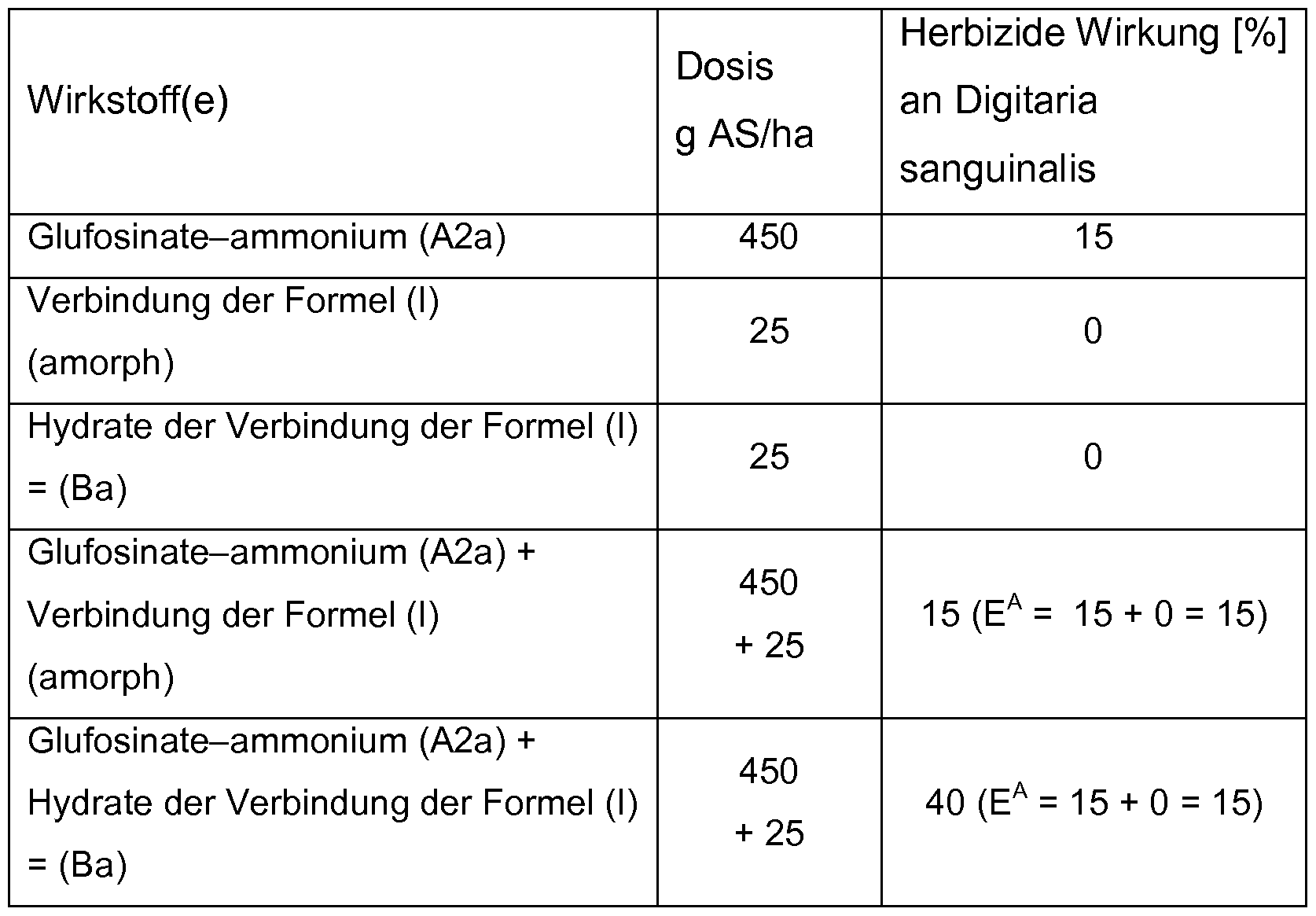
Das in Tabelle 1 zusammengefasste Beispiel zeigt, dass die Kombination aus Glufosinate und amorphen Saflufenacil bei der Bekämpfung von Unkräutern in ihrer Wirkung lediglich additiv sind. Dagegen zeigt die Herbizid-Kombination, welche die Hydrate von Saflufenacil (Ba) und Glufosinate in der jeweils gleichen Dosierung enthält einen deutlich The example summarized in Table 1 shows that the effect of the combination of glufosinate and amorphous saflufenacil in the control of weeds is merely additive. In contrast, the herbicide combination, which contains the hydrates of saflufenacil (Ba) and glufosinate in the same dosage shows a clear
synergistischen Effekt. Während die Addition der Einzelwirkungen der synergistic effect. While the addition of the individual effects of
entsprechenden Dosierung bei der Anwendung zur Bekämpfung von Digitaria sanguinalis deren Kontrolle zu 15 % erreichen, führt die kombinierte Anwendung von Glufosinate und einem Hydrat von Saflufenacil (Ba) zu einem Bekämpfungserfolg des Unkrauts von 40 %, d.h. die erfindungsgemäße Kombination führt im Vergleich zur Addition der Einzelwirkung zu einer synergistischen Wirkungssteigerung von 25 %. the combined use of glufosinate and a hydrate of saflufenacil (Ba) leads to a weed control success of 40%, ie the combination according to the invention leads in comparison with the addition of the Individual effect to a synergistic increase in activity of 25%.
Tabelle 2a: Herbizide Wirkung von Saflufenacil (amorph) vs. Saflufenacil (Hydrat- Form) jeweils in Kombination mit Glyphosate-isopropylammonium Table 2a: Herbicidal effect of saflufenacil (amorphous) vs. Saflufenacil (hydrate form), in each case in combination with glyphosate isopropylammonium
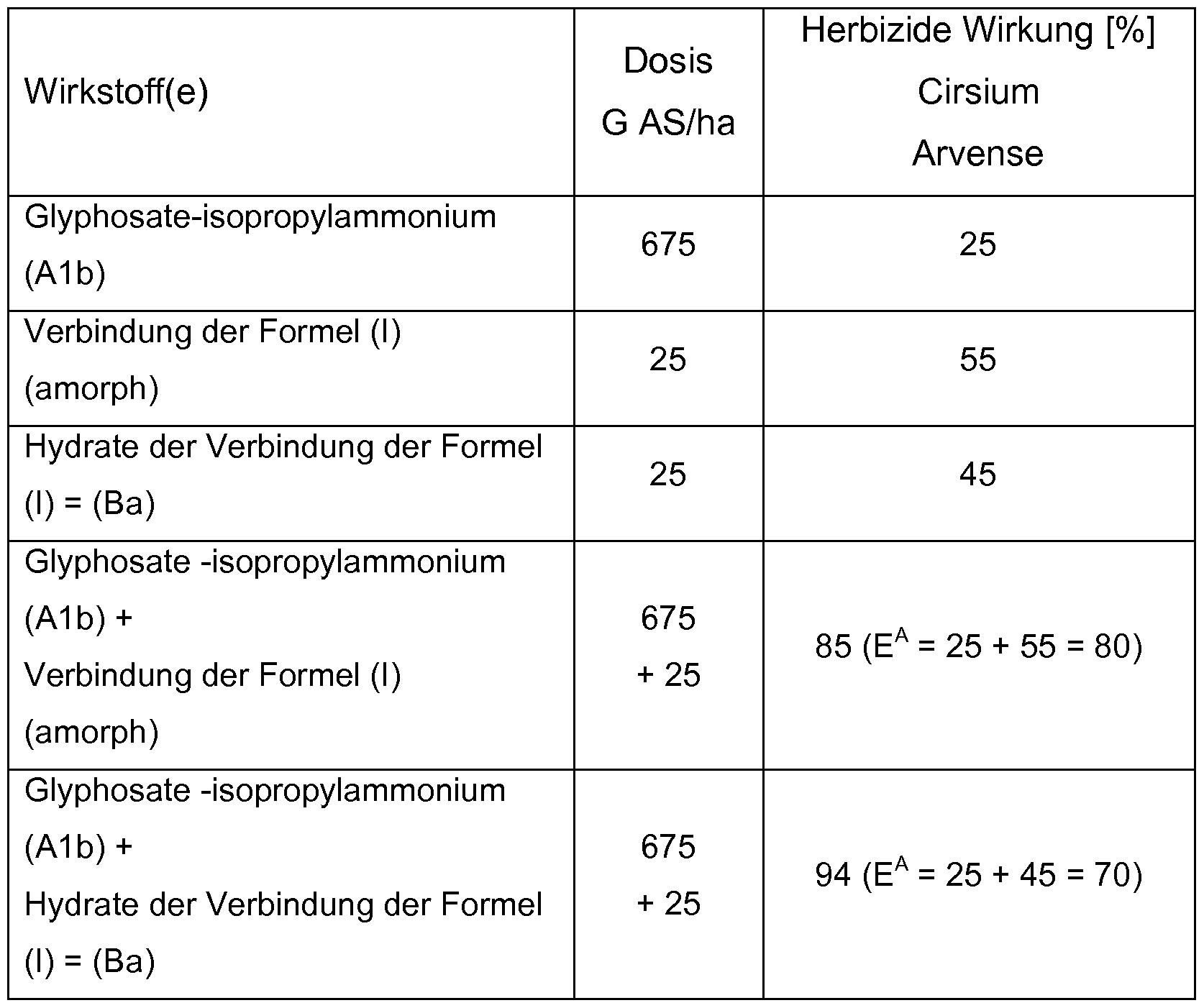
Einzelwirkungen bei der entsprechenden Dosierung. Individual effects at the appropriate dosage.
Dagegen zeigt die Glyphosate und ein Hydrat von Saflufenacil (Ba) enthaltende Zusammensetzung eine Wirkungssteigerung von 24 % im Vergleich zu der zu erwartenden Summe der Einzelwirkungen. Tabelle 2b: Herbizide Wirkung gegen dikotyle Unkrautarten - Saflufenacil (Hydrat- Form) in Kombination mit Glyphosate-isopropylammonium In contrast, the glyphosate and a hydrate of saflufenacil (Ba) containing composition shows an increase in activity of 24% compared to the expected sum of the individual effects. Table 2b: Herbicidal activity against dicotyledonous weed species - saflufenacil (hydrate form) in combination with glyphosate isopropylammonium

Tabelle 2b fasst die herbizide Wirkung einer Kombination, die Glyphosate- isopropylammonium (A1 b) und ein Hydrat von Saflufenacil (Ba) enthält, für weitere dikotyle Unkrautarten zusammen. Table 2b summarizes the herbicidal activity of a combination containing glyphosate isopropylammonium (A1b) and a hydrate of saflufenacil (Ba) for other dicotyledonous weed species.
Die Durchführung entspricht den Angaben in dem Abschnitt B. Biologische Beispiele, wobei die Wirkstoffapplikation im 2-3-Blattstadium erfolgte und die Auswertung 28 Tage nach Applikation durchgeführt wurde. The procedure corresponds to the information in Section B. Biological examples, wherein the drug application was in the 2-3-leaf stage and the evaluation was carried out 28 days after application.
Der mit EA bezeichnete, nach der Additionsmethode berechnete, Erwartungswert liegt in allen Beispielen unter dem tatsächlich ermittelten Wert der herbizden The expected value, designated E A and calculated according to the addition method, is in all examples below the actually determined value of the herbicides
Wirkung. Effect.
Am höchsten ist die synergistische Wirkungssteigung der aus den Wirkstoffen (A1 b) + (Ba) bestehenden Wirkstoffkombination im Falle von Euphorbia heterophylla. Tabelle 2c: Herbizide Wirkung gegen monokotyle Unkrautarten - Saflufenacil (Hydrat-Form) in Kombination mit Glyphosate-isopropylammonium The highest is the synergistic effect of increasing the active ingredient (A1 b) + (Ba) combination of active ingredients in the case of Euphorbia heterophylla. Table 2c: Herbicidal action against monocotyledonous weed species - saflufenacil (hydrate form) in combination with glyphosate isopropylammonium
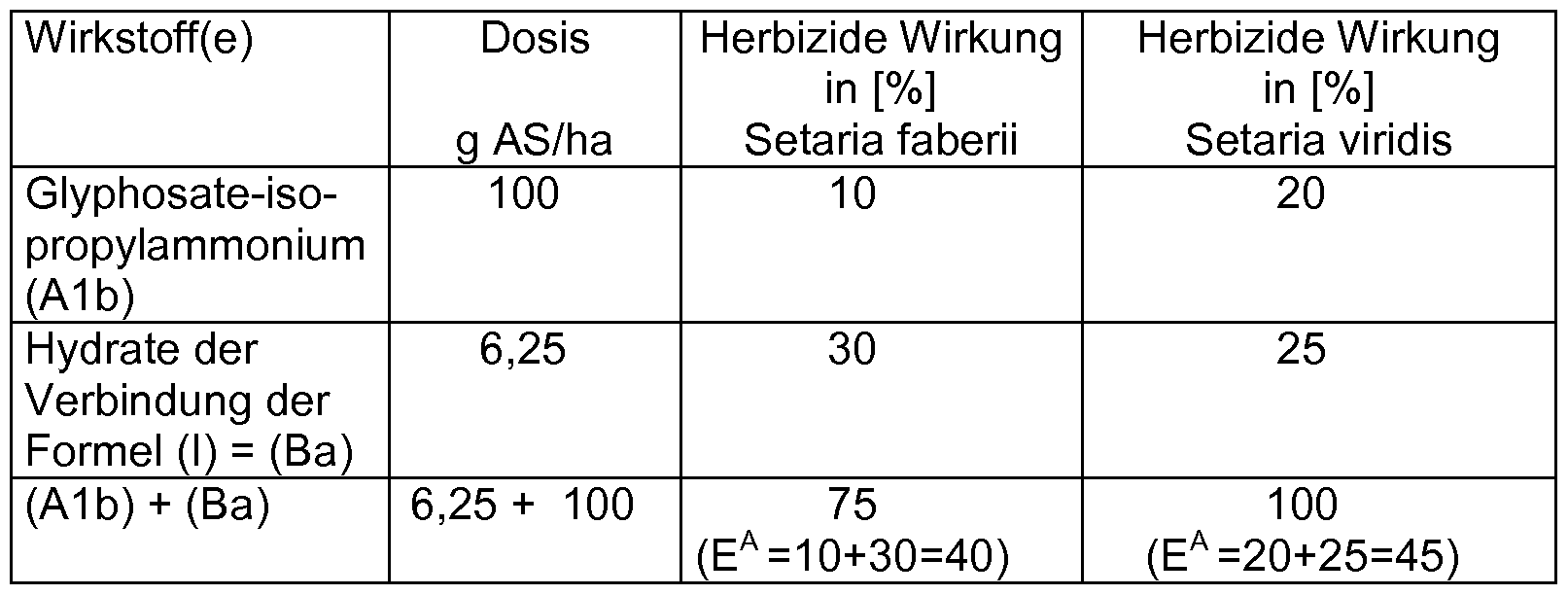
Tabelle 2c fasst die herbizide Wirkung einer Kombination, die Glyphosate- isopropylammonium (A1 b) und ein Hydrat von Saflufenacil (Ba) enthält, für monkotyle Unkrautarten (Ungräser) zusammen. Table 2c summarizes the herbicidal activity of a combination containing glyphosate isopropylammonium (A1b) and a hydrate of saflufenacil (Ba) for monkotyle weed species (grass weeds) together.
Die Durchführung entspricht den Angaben in dem Abschnitt B. Biologische Beispiele, wobei die Wirkstoffapplikation im 1 -2-Blattstadium erfolgte und die Auswertung 28 Tage nach Applikation durchgeführt wurde. The procedure corresponds to the information in section B. Biological examples, wherein the drug application was carried out in the 1 -2-leaf stage and the evaluation was carried out 28 days after application.
Der mit EA bezeichnete, nach der Additionsmethode berechnete, Erwartungswert liegt in allen Beispielen unter dem tatsächlich ermittelten Wert der herbizden The expected value, designated E A and calculated according to the addition method, is in all examples below the actually determined value of the herbicides
Wirkung. Die synergistische Wirkungssteigung der aus den Wirkstoffen (A1 b) + (Ba) bestehenden Wirkstoffkombination ist in beiden Beispielen hoch. Tabelle 3: Herbizide Wirkung einer Kombination aus drei Wirkstoffen Effect. The synergistic effect increase of the active substance combination consisting of the active substances (A1 b) + (Ba) is high in both examples. Table 3: Herbicidal effect of a combination of three active substances
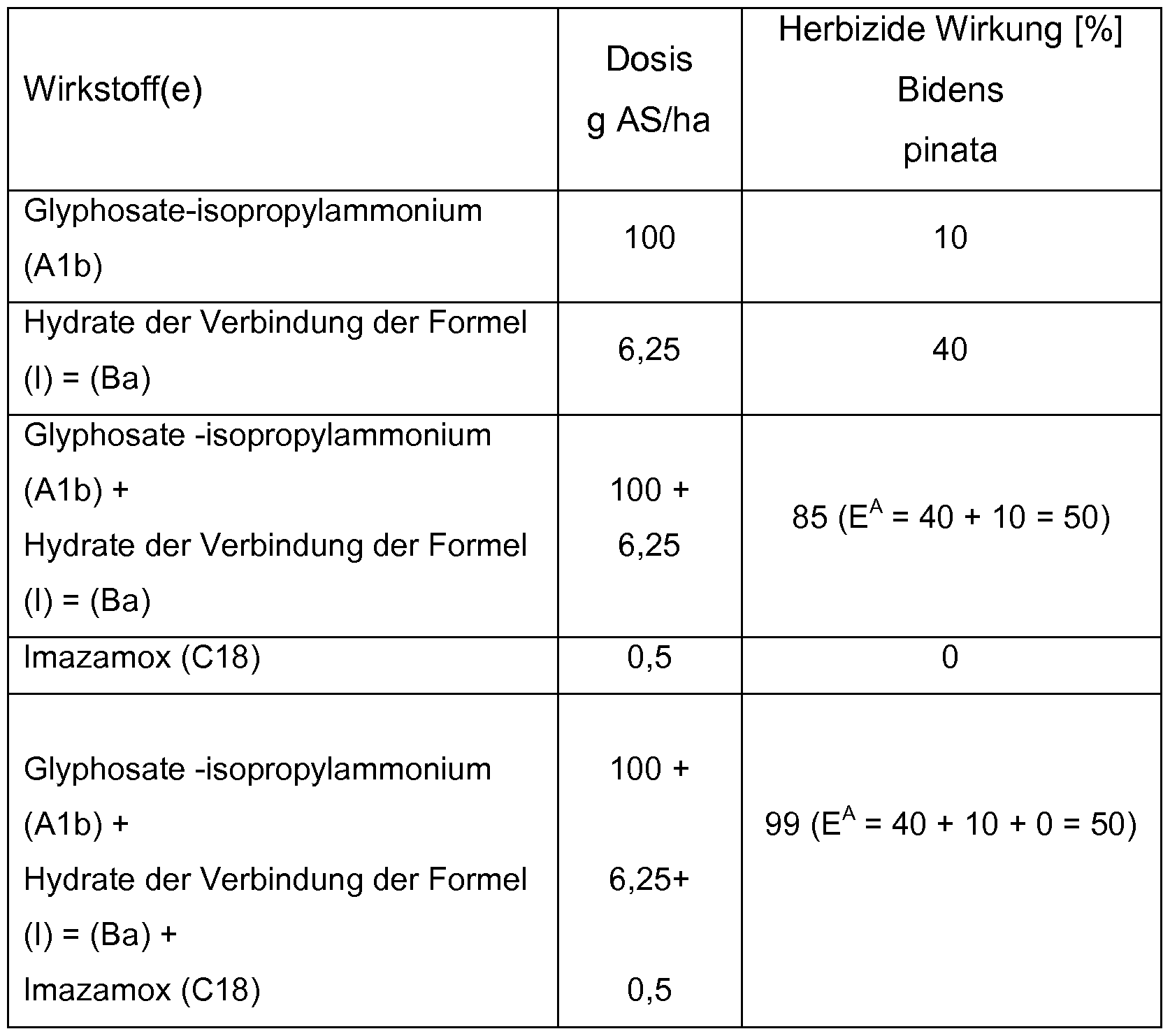
Tabelle 3 fasst die herbizide Wirkung einer Kombination aus drei Wirkstoffen, nämlich Glyphosate-isopropylammonium (A1 b), ein Hydrat von Saflufenacil (Ba) und Imazamox (C18) zusammen. Bei der Anwendung zur Bekämpfung von Bidens pinata zeigt die Kombination, die Glyphosate und die amorphe Form von Saflufenacil enthält, eine synergistische Wirkungssteigerung von 35 % im Vergleich zur Addition der Einzelwirkungen bei der entsprechenden Dosierung, während der Wirkstoff Imazamox (C18) alleine keine herbizide Wirkung zeigt. Table 3 summarizes the herbicidal activity of a combination of three drugs namely glyphosate isopropylammonium (A1b), a hydrate of saflufenacil (Ba) and imazamox (C18). In the application to combat Biden pinata, the combination containing glyphosate and the amorphous form of saflufenacil shows a synergistic increase in activity of 35% compared to the addition of individual effects at the appropriate dosage, while the active ingredient imazamox (C18) alone has no herbicidal activity shows.
Dagegen zeigt die Glyphosate, ein Hydrate von Saflufenacil (Ba) und zusätzlich Imazamox (C18) enthaltende Zusammensetzung eine Wirkungssteigerung von sogar 49 % im Vergleich zu der zu erwartenden Summe der Einzelwirkungen. Tabelle 4a: Dosierung und Gewichtsverhältnisse der Komponenten für die Kombinationen (A) + (B) In contrast, the glyphosate, a hydrates of Saflufenacil (Ba) and additionally containing Imazamox (C18) composition shows an increase in activity of even 49% compared to the expected sum of the individual effects. Table 4a: Dosage and weight ratios of components for combinations (A) + (B)
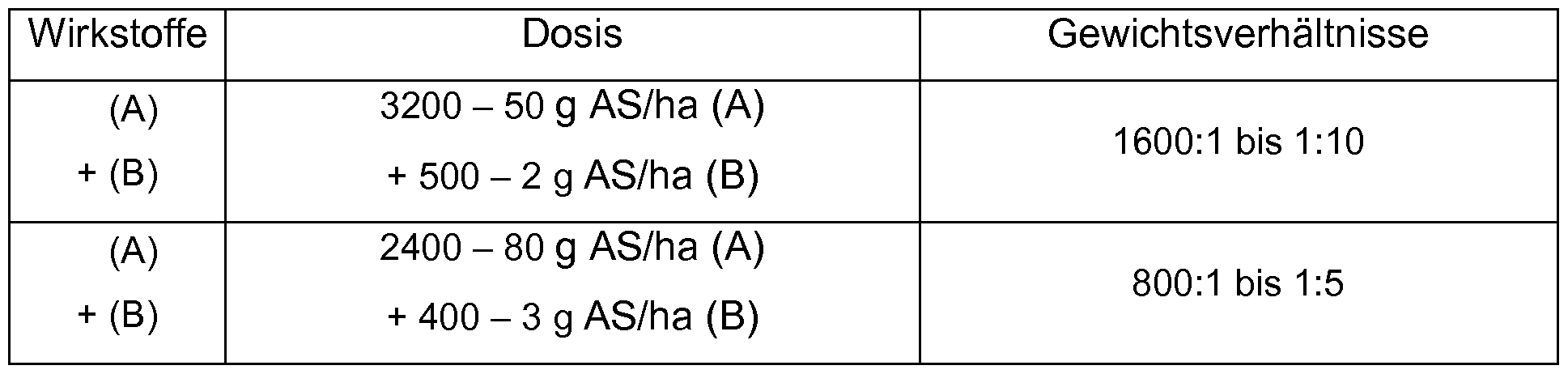
Tabelle 4a fasst bevorzugte Mischungsverhältnisse für die Kombinationen (A) + (B) und die entsprechenden Dosierungen in g AS/ha zusammen. Table 4a summarizes preferred mixing ratios for combinations (A) + (B) and the corresponding dosages in g AS / ha.
Tabelle 4b: Dosierung und Gewichtsverhältnisse der Komponenten für die Table 4b: Dosage and weight ratios of the components for the
Kombinationen (A) + (B) + (C) Combinations (A) + (B) + (C)

Tabelle 4b fasst bevorzugte Mischungsverhältnisse für die Kombinationen (A) + (B) + (C) und die entsprechenden Dosierungen in g AS/ha zusammen. Table 4b summarizes preferred mixing ratios for the combinations (A) + (B) + (C) and the corresponding dosages in g AS / ha.
Claims
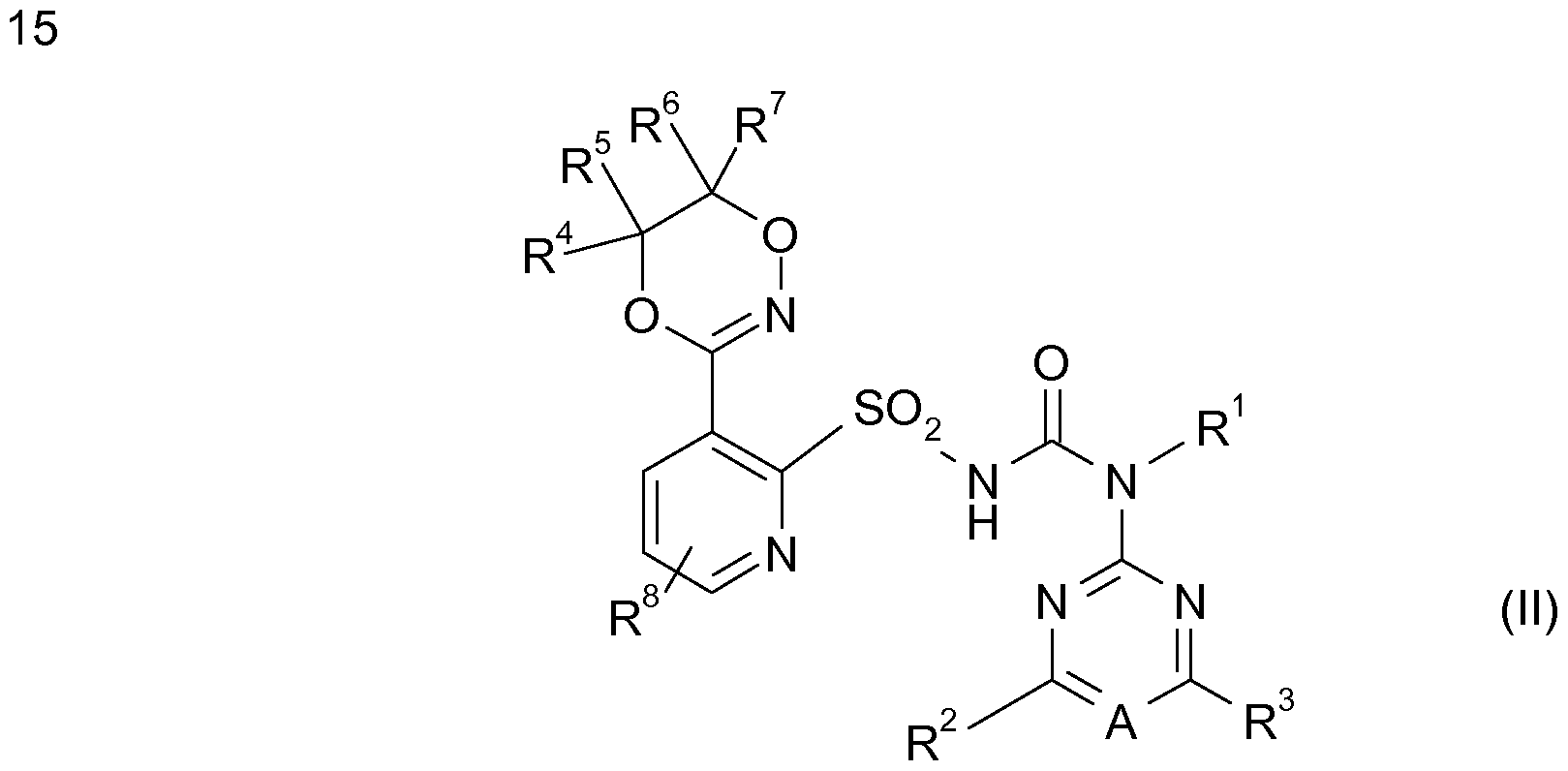
Priority Applications (2)
| Application Number | Priority Date | Filing Date | Title |
|---|---|---|---|
| EP11704457A EP2538786A2 (en) | 2010-02-26 | 2011-02-22 | Herbicide compositions containing the hydrates of saflufenacil and glyphosates or glufosinates |
| BR112012021495A BR112012021495B1 (en) | 2010-02-26 | 2011-02-22 | herbicidal combination containing saflufenacil and glyphosate or glufosinate hydrates and their uses |
Applications Claiming Priority (2)
| Application Number | Priority Date | Filing Date | Title |
|---|---|---|---|
| EP10001998 | 2010-02-26 | ||
| EP10001998.3 | 2010-02-26 |
Publications (2)
| Publication Number | Publication Date |
|---|---|
| WO2011104213A2 true WO2011104213A2 (en) | 2011-09-01 |
| WO2011104213A3 WO2011104213A3 (en) | 2011-11-10 |
Family
ID=42174582
Family Applications (1)
| Application Number | Title | Priority Date | Filing Date |
|---|---|---|---|
| PCT/EP2011/052558 Ceased WO2011104213A2 (en) | 2010-02-26 | 2011-02-22 | Herbicide compositions containing the hydrates of saflufenacil and glyphosates or glufosinates |
Country Status (5)
| Country | Link |
|---|---|
| US (1) | US8716184B2 (en) |
| EP (1) | EP2538786A2 (en) |
| AR (1) | AR081724A1 (en) |
| BR (1) | BR112012021495B1 (en) |
| WO (1) | WO2011104213A2 (en) |
Cited By (41)
| Publication number | Priority date | Publication date | Assignee | Title |
|---|---|---|---|---|
| CN103828838A (en) * | 2012-11-27 | 2014-06-04 | 浙江天丰生物科学有限公司 | Weedicide composition |
| WO2019030098A1 (en) | 2017-08-09 | 2019-02-14 | Basf Se | Herbicidal mixtures comprising l-glufosinate or its salt and at least one protoporphyrinogen-ix oxidase inhibitor |
| US10506809B2 (en) | 2015-01-15 | 2019-12-17 | Basf Se | Herbicidal combination comprising saflufenacil and glufosinate |
| CN110583678A (en) * | 2015-04-24 | 2019-12-20 | 江苏龙灯化学有限公司 | Compound herbicide composition |
| US10813356B2 (en) | 2015-07-10 | 2020-10-27 | BASF Agro B.V. | Herbicidal composition comprising cinmethylin and dimethenamid |
| US10897898B2 (en) | 2015-07-10 | 2021-01-26 | BASF Agro B.V. | Herbicidal composition comprising cinmethylin and acetochlor or pretilachlor |
| US10980232B2 (en) | 2015-07-10 | 2021-04-20 | BASF Agro B.V. | Herbicidal composition comprising cinmethylin and pyroxasulfone |
| WO2021148303A1 (en) | 2020-01-23 | 2021-07-29 | Basf Se | Glufosinate formulations containing amines or ammonium salts |
| WO2021151752A1 (en) | 2020-01-31 | 2021-08-05 | Basf Se | Herbicide combinations comprising glufosinate and selected ppo inhibitors |
| WO2021151733A1 (en) | 2020-01-31 | 2021-08-05 | Basf Se | Herbicide combinations comprising glufosinate and saflufenacil |
| WO2021151734A1 (en) | 2020-01-31 | 2021-08-05 | Basf Se | Herbicide combinations comprising glufosinate and flumiclorac-pentyl |
| WO2021151735A1 (en) | 2020-01-31 | 2021-08-05 | Basf Se | Herbicide combinations comprising glufosinate and carfentrazone-ethyl |
| WO2021151743A1 (en) | 2020-01-31 | 2021-08-05 | Basf Se | Herbicide combinations comprising glufosinate and trifludimoxazin |
| WO2021151736A1 (en) | 2020-01-31 | 2021-08-05 | Basf Se | Herbicide combinations comprising glufosinate and fluthiacet-methyl |
| WO2021151745A1 (en) | 2020-01-31 | 2021-08-05 | Basf Se | Herbicide combinations comprising glufosinate and oxadiazon |
| WO2021151739A1 (en) | 2020-01-31 | 2021-08-05 | Basf Se | Herbicide combinations comprising glufosinate and pyraflufen-ethyl |
| WO2021151753A1 (en) | 2020-01-31 | 2021-08-05 | Basf Se | Herbicide combinations comprising glufosinate and selected ppo inhibitors |
| WO2021151738A1 (en) | 2020-01-31 | 2021-08-05 | Basf Se | Herbicide combinations comprising glufosinate and epyrifenacil |
| WO2021151737A1 (en) | 2020-01-31 | 2021-08-05 | Basf Se | Herbicide combinations comprising glufosinate and flumioxazin |
| WO2021151740A1 (en) | 2020-01-31 | 2021-08-05 | Basf Se | Herbicide combinations comprising glufosinate and sulfentrazone |
| WO2021151744A1 (en) | 2020-01-31 | 2021-08-05 | Basf Se | Herbicide combinations comprising glufosinate and oxyfluorfen |
| WO2021151741A1 (en) | 2020-01-31 | 2021-08-05 | Basf Se | Herbicide combinations comprising glufosinate and tiafenacil |
| US11116213B2 (en) | 2015-07-10 | 2021-09-14 | BASF Agro B.V. | Herbicidal composition comprising cinmethylin and pethoxamid |
| US11206827B2 (en) | 2015-07-10 | 2021-12-28 | BASF Agro B.V. | Herbicidal composition comprising cinmethylin and specific quinolinecarboxylic acids |
| US11219212B2 (en) | 2015-07-10 | 2022-01-11 | BASF Agro B.V. | Herbicidal composition comprising cinmethylin and imazamox |
| US11219215B2 (en) | 2015-07-10 | 2022-01-11 | BASF Agro B.V. | Herbicidal composition comprising cinmethylin and specific inhibitors of protoporphyrinogen oxidase |
| US11291206B2 (en) | 2015-07-10 | 2022-04-05 | BASF Agro B.V. | Herbicidal composition comprising cinmethylin and specific pigment synthesis inhibitors |
| WO2022078972A1 (en) | 2020-10-12 | 2022-04-21 | Basf Se | Herbicide combination comprising glufosinate, saflufenacil and trifludimoxazin |
| WO2022090214A1 (en) | 2020-10-27 | 2022-05-05 | Basf Se | Pesticide microemulsion compositions |
| EP4000400A1 (en) | 2020-11-17 | 2022-05-25 | Basf Se | Herbicide combination comprising glufosinate, saflufenacil and trifludimoxazin |
| WO2022167577A1 (en) | 2021-02-05 | 2022-08-11 | Basf Se | Liquid herbicidal compositions |
| WO2022243546A1 (en) | 2021-05-21 | 2022-11-24 | Basf Se | Computer-implemented method for applying a glutamine synthetase inhibitor on an agricultural field |
| US11517018B2 (en) | 2015-07-10 | 2022-12-06 | BASF Agro B.V. | Herbicidal composition comprising cinmethylin and saflufenacil |
| WO2023084075A1 (en) | 2021-11-15 | 2023-05-19 | Basf Se | Method for increasing the efficacy of a herbicide |
| EP4338592A1 (en) | 2022-09-15 | 2024-03-20 | Basf Se | Use of compound for improving the efficacy of herbicides |
| WO2024056517A1 (en) | 2022-09-14 | 2024-03-21 | Basf Se | Use of an alkylether sulfate for improving the efficacy of herbicides |
| US11980187B2 (en) | 2017-11-28 | 2024-05-14 | Upl Ltd | Herbicidal combinations |
| WO2025061721A1 (en) | 2023-09-21 | 2025-03-27 | Specialty Operations France | Herbicidal compositions comprising specific surfactants |
| WO2025061719A1 (en) | 2023-09-21 | 2025-03-27 | Specialty Operations France | Emulsion in water concentrate comprising glufosinate, vlcfa inhibitor and specific surfactants |
| US12262715B2 (en) | 2020-02-05 | 2025-04-01 | Basf Se | Herbicidal mixtures comprising L-glufosinate or its salt and at least one protoporphyrinogen-IX oxidase inhibitor |
| US12336536B2 (en) | 2015-07-10 | 2025-06-24 | BASF Agro B.V. | Method for controlling herbicide resistant or tolerant weeds |
Families Citing this family (16)
| Publication number | Priority date | Publication date | Assignee | Title |
|---|---|---|---|---|
| KR101131038B1 (en) * | 2011-12-01 | 2012-03-29 | 주식회사 영일케미컬 | Herbicidal composition containing glyphosate in the form of a stable aqueous suspension |
| CN103283778A (en) * | 2013-06-08 | 2013-09-11 | 肇庆市真格生物科技有限公司 | Weeding composition comprising glufosinate and saflufenacil |
| CN103392732B (en) * | 2013-06-30 | 2016-05-11 | 广东中迅农科股份有限公司 | The Herbicidal combinations that contains careless ammonium phosphine and benzene flumetsulam |
| HUE038856T2 (en) | 2013-07-12 | 2018-12-28 | Bayer Cropscience Ag | Herbicide combination comprising pelargonic acid and als-inhibitors |
| WO2016083277A1 (en) * | 2014-11-24 | 2016-06-02 | BASF Agro B.V. | Herbicidal mixtures for controlling herbicide-resistant dicotyledonous plants |
| CN106135226B (en) * | 2015-04-24 | 2021-05-18 | 江苏龙灯化学有限公司 | Weeding composition |
| KR102632658B1 (en) * | 2015-05-11 | 2024-02-01 | 바스프 에스이 | Herbicide combinations comprising l-glufosinate and indaziflam |
| EP3325464B1 (en) | 2015-07-24 | 2022-04-20 | Basf Se | Pyridine compounds useful for combating phytopathogenic fungi |
| UA121417C2 (en) * | 2015-09-03 | 2020-05-25 | Басф Агро Б.В. | MICROPARTICLES COMPOSITION CONTAINING SAFLUFENACIL |
| KR20250156185A (en) | 2016-03-02 | 2025-10-31 | 바스프 에스이 | Methods for making l-glufosinate |
| UY37588A (en) * | 2017-01-31 | 2018-11-30 | Upl Ltd | HERBICIDE COMBINATIONS CONTAINING SAFLUFENACILO |
| BR112020002666A2 (en) | 2017-08-09 | 2020-07-28 | Basf Se | use of herbicide mixture, pesticide mixture, pesticide composition and vegetation control method |
| EP3440939A1 (en) | 2017-08-09 | 2019-02-13 | Basf Se | Herbicidal mixtures comprising l-glufosinate |
| CN111417308A (en) * | 2017-11-28 | 2020-07-14 | Upl有限公司 | weeding combination |
| MX2020005502A (en) * | 2017-11-28 | 2020-08-31 | Upl Ltd | Herbicidal combinations. |
| CN110437276A (en) * | 2019-08-20 | 2019-11-12 | 山东省农药科学研究院 | A kind of essence glufosinate-ammonium hydrate monocrystalline and preparation method thereof |
Citations (22)
| Publication number | Priority date | Publication date | Assignee | Title |
|---|---|---|---|---|
| US3799758A (en) | 1971-08-09 | 1974-03-26 | Monsanto Co | N-phosphonomethyl-glycine phytotoxicant compositions |
| US4405531A (en) | 1975-11-10 | 1983-09-20 | Monsanto Company | Salts of N-phosphonomethylglycine |
| EP0131624A1 (en) | 1983-01-17 | 1985-01-23 | Monsanto Co | PLASMIDES FOR TRANSFORMING PLANT CELLS. |
| EP0142924A2 (en) | 1983-09-26 | 1985-05-29 | Mycogen Plant Science, Inc. | Insect resistant plants |
| EP0193259A1 (en) | 1985-01-18 | 1986-09-03 | Plant Genetic Systems N.V. | Modifying plants by genetic engineering to combat or control insects |
| EP0221044A1 (en) | 1985-10-25 | 1987-05-06 | Monsanto Company | Novel plant vectors |
| EP0257993A2 (en) | 1986-08-26 | 1988-03-02 | E.I. Du Pont De Nemours And Company | Nucleic acid fragment encoding herbicide resistant plant acetolactate synthase |
| US5013659A (en) | 1987-07-27 | 1991-05-07 | E. I. Du Pont De Nemours And Company | Nucleic acid fragment encoding herbicide resistant plant acetolactate synthase |
| WO1991013972A1 (en) | 1990-03-16 | 1991-09-19 | Calgene, Inc. | Plant desaturases - compositions and uses |
| WO1991019806A1 (en) | 1990-06-18 | 1991-12-26 | Monsanto Company | Increased starch content in plants |
| WO1992011376A1 (en) | 1990-12-21 | 1992-07-09 | Amylogene Hb | Genetically engineered modification of potato to form amylopectin-type starch |
| WO1992014827A1 (en) | 1991-02-13 | 1992-09-03 | Institut Für Genbiologische Forschung Berlin Gmbh | Plasmids containing dna-sequences that cause changes in the carbohydrate concentration and the carbohydrate composition in plants, as well as plant cells and plants containing these plasmids |
| WO1998013361A1 (en) | 1996-09-26 | 1998-04-02 | Novartis Ag | Herbicidal composition |
| WO1998038856A1 (en) | 1997-03-04 | 1998-09-11 | Zeneca Limited | Compositions for safening rice against acetochlor |
| WO1999000020A1 (en) | 1997-06-27 | 1999-01-07 | Hoechst Schering Agrevo Gmbh | 3-(5-tetrazolyl carbonyl)-2-quinolones and products for protecting useful plants containing the same |
| WO2001083459A2 (en) | 2000-05-04 | 2001-11-08 | Basf Aktiengesellschaft | Uracil substituted phenyl sulfamoyl carboxamides |
| WO2003097589A1 (en) | 2002-05-16 | 2003-11-27 | Basf Aktiengesellschaft | Method for the production of sulphamic acid halogenides |
| WO2005054208A1 (en) | 2003-12-03 | 2005-06-16 | Basf Aktiengesellschaft | Method for producing 3-phenyl(thio)uracils and 3-phenyldithiouracils |
| WO2006097509A2 (en) | 2005-03-17 | 2006-09-21 | Basf Aktiengesellschaft | Herbicidal compositions based on 3-phenyluracils and 3-sulfonylisoxazolines |
| WO2008043836A1 (en) | 2006-10-13 | 2008-04-17 | Basf Se | Hydrates of 2-chloro-5-[3,6-dihydro-3-methyl-2,6-dioxo-4-(trifluoro-methyl)-1-(2h)-pyrimidinyl]-4-fluoro-n-[[methyl-(1-methylethyl)-amino]sulphonyl]benzamide |
| WO2009141367A2 (en) | 2008-05-21 | 2009-11-26 | Basf Se | Herbicidal composition comprising glyphosate, glufosinate or their salts |
| WO2009156322A1 (en) | 2008-06-26 | 2009-12-30 | Basf Se | A method for enhancing the rainfastness of glyphosate |
Family Cites Families (2)
| Publication number | Priority date | Publication date | Assignee | Title |
|---|---|---|---|---|
| TW471950B (en) * | 1997-09-17 | 2002-01-11 | American Cyanamid Co | Concentrated, aqueous herbicidal compositions containing an imidazolinyl acid salt and a glyphosate salt |
| DE60218707T2 (en) * | 2001-09-14 | 2007-06-28 | Basf Ag | HERBICIDAL MIXTURES ON 3 PHENYLURACIL BASIS |
-
2011
- 2011-02-22 BR BR112012021495A patent/BR112012021495B1/en active IP Right Grant
- 2011-02-22 WO PCT/EP2011/052558 patent/WO2011104213A2/en not_active Ceased
- 2011-02-22 EP EP11704457A patent/EP2538786A2/en not_active Withdrawn
- 2011-02-24 US US13/034,631 patent/US8716184B2/en active Active
- 2011-02-24 AR ARP110100568A patent/AR081724A1/en active IP Right Grant
Patent Citations (22)
| Publication number | Priority date | Publication date | Assignee | Title |
|---|---|---|---|---|
| US3799758A (en) | 1971-08-09 | 1974-03-26 | Monsanto Co | N-phosphonomethyl-glycine phytotoxicant compositions |
| US4405531A (en) | 1975-11-10 | 1983-09-20 | Monsanto Company | Salts of N-phosphonomethylglycine |
| EP0131624A1 (en) | 1983-01-17 | 1985-01-23 | Monsanto Co | PLASMIDES FOR TRANSFORMING PLANT CELLS. |
| EP0142924A2 (en) | 1983-09-26 | 1985-05-29 | Mycogen Plant Science, Inc. | Insect resistant plants |
| EP0193259A1 (en) | 1985-01-18 | 1986-09-03 | Plant Genetic Systems N.V. | Modifying plants by genetic engineering to combat or control insects |
| EP0221044A1 (en) | 1985-10-25 | 1987-05-06 | Monsanto Company | Novel plant vectors |
| EP0257993A2 (en) | 1986-08-26 | 1988-03-02 | E.I. Du Pont De Nemours And Company | Nucleic acid fragment encoding herbicide resistant plant acetolactate synthase |
| US5013659A (en) | 1987-07-27 | 1991-05-07 | E. I. Du Pont De Nemours And Company | Nucleic acid fragment encoding herbicide resistant plant acetolactate synthase |
| WO1991013972A1 (en) | 1990-03-16 | 1991-09-19 | Calgene, Inc. | Plant desaturases - compositions and uses |
| WO1991019806A1 (en) | 1990-06-18 | 1991-12-26 | Monsanto Company | Increased starch content in plants |
| WO1992011376A1 (en) | 1990-12-21 | 1992-07-09 | Amylogene Hb | Genetically engineered modification of potato to form amylopectin-type starch |
| WO1992014827A1 (en) | 1991-02-13 | 1992-09-03 | Institut Für Genbiologische Forschung Berlin Gmbh | Plasmids containing dna-sequences that cause changes in the carbohydrate concentration and the carbohydrate composition in plants, as well as plant cells and plants containing these plasmids |
| WO1998013361A1 (en) | 1996-09-26 | 1998-04-02 | Novartis Ag | Herbicidal composition |
| WO1998038856A1 (en) | 1997-03-04 | 1998-09-11 | Zeneca Limited | Compositions for safening rice against acetochlor |
| WO1999000020A1 (en) | 1997-06-27 | 1999-01-07 | Hoechst Schering Agrevo Gmbh | 3-(5-tetrazolyl carbonyl)-2-quinolones and products for protecting useful plants containing the same |
| WO2001083459A2 (en) | 2000-05-04 | 2001-11-08 | Basf Aktiengesellschaft | Uracil substituted phenyl sulfamoyl carboxamides |
| WO2003097589A1 (en) | 2002-05-16 | 2003-11-27 | Basf Aktiengesellschaft | Method for the production of sulphamic acid halogenides |
| WO2005054208A1 (en) | 2003-12-03 | 2005-06-16 | Basf Aktiengesellschaft | Method for producing 3-phenyl(thio)uracils and 3-phenyldithiouracils |
| WO2006097509A2 (en) | 2005-03-17 | 2006-09-21 | Basf Aktiengesellschaft | Herbicidal compositions based on 3-phenyluracils and 3-sulfonylisoxazolines |
| WO2008043836A1 (en) | 2006-10-13 | 2008-04-17 | Basf Se | Hydrates of 2-chloro-5-[3,6-dihydro-3-methyl-2,6-dioxo-4-(trifluoro-methyl)-1-(2h)-pyrimidinyl]-4-fluoro-n-[[methyl-(1-methylethyl)-amino]sulphonyl]benzamide |
| WO2009141367A2 (en) | 2008-05-21 | 2009-11-26 | Basf Se | Herbicidal composition comprising glyphosate, glufosinate or their salts |
| WO2009156322A1 (en) | 2008-06-26 | 2009-12-30 | Basf Se | A method for enhancing the rainfastness of glyphosate |
Non-Patent Citations (21)
| Title |
|---|
| "e-Pesticide Manual", 2006, BRITISH CROP PROTECTION COUNCIL |
| "Gene Transfer to Plants", 1995, SPRINGER VERLAG BERLIN |
| "The Pesticide Manual", 2003, THE BRITISH CROP PROTECTION COUNCIL |
| BRAUN ET AL., EMBO J., vol. 11, 1992, pages 3219 - 3227 |
| CHRISTOU, TRENDS IN PLANT SCIENCE, vol. 1, 1996, pages 423 - 431 |
| F. SCHWERDTLE ET AL., Z. PFLANZENKR. PFLANZENSCHUTZ, 1981, pages 431 - 440 |
| K. MARTENS: "Spray Drying Handbook", 1979, G. GOODWIN LTD. |
| MARSDEN: "Solvents Guide", 1963, INTERSCIENCE |
| MCCUTCHEON'S: "Detergents and Emulsifiers Annual", MC PUBL. CORP. |
| OLPHEN: "Introduction to Clay Colloid Chemistry", J. WILEY & SONS |
| S. R. COLBY, WEEDS, vol. 15, 1967, pages 20 - 22 |
| SAMBROOK ET AL.: "Molecular Cloning, A Laboratory Manual", 1989, COLD SPRING HARBOR LABORATORY PRESS |
| SCHÖNFELDT: "Grenzflächenaktive Äthylenoxidaddukte", 1976, WISS. VERLAGSGESELLSCHAFT |
| SISLEY; WOOD: "Encyclopedia of Surface Active Egents", 1964, CHEM. PUBL. CO. INC. |
| SONNEWALD ET AL., PLANT J., vol. 1, 1991, pages 95 - 106 |
| VALKENBURG: "Pesticides Formulations", 1973, MARCEL DEKKER |
| WATKINS: "Handbook of Insecticide Dust Diluents and Carriers", DARLAND BOOKS |
| WEED RESEARCH, vol. 26, 1986, pages 441 - 445 |
| WINNACKER: "Gene und Klone", 1996, VCH WEINHEIM |
| WINNACKER-KÜCHLER: "Chemische Technologie", vol. 7, 1986, C. HANSER VERLAG |
| WOLTER ET AL., PROC. NATL. ACAD. SCI. USA, vol. 85, 1988, pages 846 - 850 |
Cited By (44)
| Publication number | Priority date | Publication date | Assignee | Title |
|---|---|---|---|---|
| CN103828838A (en) * | 2012-11-27 | 2014-06-04 | 浙江天丰生物科学有限公司 | Weedicide composition |
| US10506809B2 (en) | 2015-01-15 | 2019-12-17 | Basf Se | Herbicidal combination comprising saflufenacil and glufosinate |
| CN110583678A (en) * | 2015-04-24 | 2019-12-20 | 江苏龙灯化学有限公司 | Compound herbicide composition |
| US10980232B2 (en) | 2015-07-10 | 2021-04-20 | BASF Agro B.V. | Herbicidal composition comprising cinmethylin and pyroxasulfone |
| US10813356B2 (en) | 2015-07-10 | 2020-10-27 | BASF Agro B.V. | Herbicidal composition comprising cinmethylin and dimethenamid |
| US10897898B2 (en) | 2015-07-10 | 2021-01-26 | BASF Agro B.V. | Herbicidal composition comprising cinmethylin and acetochlor or pretilachlor |
| US11219215B2 (en) | 2015-07-10 | 2022-01-11 | BASF Agro B.V. | Herbicidal composition comprising cinmethylin and specific inhibitors of protoporphyrinogen oxidase |
| US11116213B2 (en) | 2015-07-10 | 2021-09-14 | BASF Agro B.V. | Herbicidal composition comprising cinmethylin and pethoxamid |
| US11206827B2 (en) | 2015-07-10 | 2021-12-28 | BASF Agro B.V. | Herbicidal composition comprising cinmethylin and specific quinolinecarboxylic acids |
| US11219212B2 (en) | 2015-07-10 | 2022-01-11 | BASF Agro B.V. | Herbicidal composition comprising cinmethylin and imazamox |
| US12336536B2 (en) | 2015-07-10 | 2025-06-24 | BASF Agro B.V. | Method for controlling herbicide resistant or tolerant weeds |
| US11517018B2 (en) | 2015-07-10 | 2022-12-06 | BASF Agro B.V. | Herbicidal composition comprising cinmethylin and saflufenacil |
| US11291206B2 (en) | 2015-07-10 | 2022-04-05 | BASF Agro B.V. | Herbicidal composition comprising cinmethylin and specific pigment synthesis inhibitors |
| US12041935B2 (en) | 2017-08-09 | 2024-07-23 | Basf Se | Herbicidal mixtures comprising L-glufosinate or its salt and at least one protoporphyrinogen-IX oxidase inhibitor |
| WO2019030098A1 (en) | 2017-08-09 | 2019-02-14 | Basf Se | Herbicidal mixtures comprising l-glufosinate or its salt and at least one protoporphyrinogen-ix oxidase inhibitor |
| US11980187B2 (en) | 2017-11-28 | 2024-05-14 | Upl Ltd | Herbicidal combinations |
| WO2021148302A1 (en) | 2020-01-23 | 2021-07-29 | Basf Se | Novel additives for agrochemical formulations |
| WO2021148304A1 (en) | 2020-01-23 | 2021-07-29 | Basf Se | Ppo formulations containing ether sulfates |
| WO2021148303A1 (en) | 2020-01-23 | 2021-07-29 | Basf Se | Glufosinate formulations containing amines or ammonium salts |
| WO2021151744A1 (en) | 2020-01-31 | 2021-08-05 | Basf Se | Herbicide combinations comprising glufosinate and oxyfluorfen |
| WO2021151734A1 (en) | 2020-01-31 | 2021-08-05 | Basf Se | Herbicide combinations comprising glufosinate and flumiclorac-pentyl |
| WO2021151740A1 (en) | 2020-01-31 | 2021-08-05 | Basf Se | Herbicide combinations comprising glufosinate and sulfentrazone |
| WO2021151738A1 (en) | 2020-01-31 | 2021-08-05 | Basf Se | Herbicide combinations comprising glufosinate and epyrifenacil |
| WO2021151741A1 (en) | 2020-01-31 | 2021-08-05 | Basf Se | Herbicide combinations comprising glufosinate and tiafenacil |
| WO2021151753A1 (en) | 2020-01-31 | 2021-08-05 | Basf Se | Herbicide combinations comprising glufosinate and selected ppo inhibitors |
| WO2021151739A1 (en) | 2020-01-31 | 2021-08-05 | Basf Se | Herbicide combinations comprising glufosinate and pyraflufen-ethyl |
| WO2021151745A1 (en) | 2020-01-31 | 2021-08-05 | Basf Se | Herbicide combinations comprising glufosinate and oxadiazon |
| WO2021151736A1 (en) | 2020-01-31 | 2021-08-05 | Basf Se | Herbicide combinations comprising glufosinate and fluthiacet-methyl |
| WO2021151743A1 (en) | 2020-01-31 | 2021-08-05 | Basf Se | Herbicide combinations comprising glufosinate and trifludimoxazin |
| WO2021151752A1 (en) | 2020-01-31 | 2021-08-05 | Basf Se | Herbicide combinations comprising glufosinate and selected ppo inhibitors |
| WO2021151733A1 (en) | 2020-01-31 | 2021-08-05 | Basf Se | Herbicide combinations comprising glufosinate and saflufenacil |
| WO2021151737A1 (en) | 2020-01-31 | 2021-08-05 | Basf Se | Herbicide combinations comprising glufosinate and flumioxazin |
| WO2021151735A1 (en) | 2020-01-31 | 2021-08-05 | Basf Se | Herbicide combinations comprising glufosinate and carfentrazone-ethyl |
| US12262715B2 (en) | 2020-02-05 | 2025-04-01 | Basf Se | Herbicidal mixtures comprising L-glufosinate or its salt and at least one protoporphyrinogen-IX oxidase inhibitor |
| WO2022078972A1 (en) | 2020-10-12 | 2022-04-21 | Basf Se | Herbicide combination comprising glufosinate, saflufenacil and trifludimoxazin |
| WO2022090214A1 (en) | 2020-10-27 | 2022-05-05 | Basf Se | Pesticide microemulsion compositions |
| EP4000400A1 (en) | 2020-11-17 | 2022-05-25 | Basf Se | Herbicide combination comprising glufosinate, saflufenacil and trifludimoxazin |
| WO2022167577A1 (en) | 2021-02-05 | 2022-08-11 | Basf Se | Liquid herbicidal compositions |
| WO2022243546A1 (en) | 2021-05-21 | 2022-11-24 | Basf Se | Computer-implemented method for applying a glutamine synthetase inhibitor on an agricultural field |
| WO2023084075A1 (en) | 2021-11-15 | 2023-05-19 | Basf Se | Method for increasing the efficacy of a herbicide |
| WO2024056517A1 (en) | 2022-09-14 | 2024-03-21 | Basf Se | Use of an alkylether sulfate for improving the efficacy of herbicides |
| EP4338592A1 (en) | 2022-09-15 | 2024-03-20 | Basf Se | Use of compound for improving the efficacy of herbicides |
| WO2025061721A1 (en) | 2023-09-21 | 2025-03-27 | Specialty Operations France | Herbicidal compositions comprising specific surfactants |
| WO2025061719A1 (en) | 2023-09-21 | 2025-03-27 | Specialty Operations France | Emulsion in water concentrate comprising glufosinate, vlcfa inhibitor and specific surfactants |
Also Published As
| Publication number | Publication date |
|---|---|
| BR112012021495A2 (en) | 2015-09-22 |
| US8716184B2 (en) | 2014-05-06 |
| AR081724A1 (en) | 2012-10-17 |
| BR112012021495B1 (en) | 2018-08-28 |
| WO2011104213A3 (en) | 2011-11-10 |
| EP2538786A2 (en) | 2013-01-02 |
| US20110212837A1 (en) | 2011-09-01 |
Similar Documents
| Publication | Publication Date | Title |
|---|---|---|
| US8716184B2 (en) | Herbicidal composition comprising the hydrates of saflufenacil and glyphosate or glufosinate | |
| CN105248428B (en) | Herbicide combinations comprising a herbicide of the class of the diaminos-triazines | |
| CN101677529B (en) | Active ingredient suspensions in glycerine | |
| EP1771071B1 (en) | Herbicidal agents | |
| EP1653804A1 (en) | Use of aromatic compounds as safeners | |
| EP2052616A1 (en) | Herbicide safener combination | |
| US20070021303A1 (en) | Safening method | |
| EP3238540A1 (en) | Timed-release-type granular agrochemical composition and method for manufacturing same | |
| AU2014201131B2 (en) | Herbicide combinations containing a herbicide from the class of diamino-s-triazines |
Legal Events
| Date | Code | Title | Description |
|---|---|---|---|
| 121 | Ep: the epo has been informed by wipo that ep was designated in this application |
Ref document number: 11704457 Country of ref document: EP Kind code of ref document: A2 |
|
| WWE | Wipo information: entry into national phase |
Ref document number: 2011704457 Country of ref document: EP |
|
| NENP | Non-entry into the national phase |
Ref country code: DE |
|
| REG | Reference to national code |
Ref country code: BR Ref legal event code: B01A Ref document number: 112012021495 Country of ref document: BR |
|
| ENP | Entry into the national phase |
Ref document number: 112012021495 Country of ref document: BR Kind code of ref document: A2 Effective date: 20120827 |