WO2010049984A1 - 無線通信装置 - Google Patents
無線通信装置 Download PDFInfo
- Publication number
- WO2010049984A1 WO2010049984A1 PCT/JP2008/069433 JP2008069433W WO2010049984A1 WO 2010049984 A1 WO2010049984 A1 WO 2010049984A1 JP 2008069433 W JP2008069433 W JP 2008069433W WO 2010049984 A1 WO2010049984 A1 WO 2010049984A1
- Authority
- WO
- WIPO (PCT)
- Prior art keywords
- conductor
- wireless communication
- capacitive coupling
- coupling means
- slot
- Prior art date
- Legal status (The legal status is an assumption and is not a legal conclusion. Google has not performed a legal analysis and makes no representation as to the accuracy of the status listed.)
- Ceased
Links
Images




Classifications
-
- H—ELECTRICITY
- H04—ELECTRIC COMMUNICATION TECHNIQUE
- H04B—TRANSMISSION
- H04B5/00—Near-field transmission systems, e.g. inductive or capacitive transmission systems
- H04B5/20—Near-field transmission systems, e.g. inductive or capacitive transmission systems characterised by the transmission technique; characterised by the transmission medium
- H04B5/22—Capacitive coupling
-
- G—PHYSICS
- G06—COMPUTING OR CALCULATING; COUNTING
- G06K—GRAPHICAL DATA READING; PRESENTATION OF DATA; RECORD CARRIERS; HANDLING RECORD CARRIERS
- G06K19/00—Record carriers for use with machines and with at least a part designed to carry digital markings
- G06K19/06—Record carriers for use with machines and with at least a part designed to carry digital markings characterised by the kind of the digital marking, e.g. shape, nature, code
- G06K19/067—Record carriers with conductive marks, printed circuits or semiconductor circuit elements, e.g. credit or identity cards also with resonating or responding marks without active components
- G06K19/07—Record carriers with conductive marks, printed circuits or semiconductor circuit elements, e.g. credit or identity cards also with resonating or responding marks without active components with integrated circuit chips
- G06K19/077—Constructional details, e.g. mounting of circuits in the carrier
- G06K19/07749—Constructional details, e.g. mounting of circuits in the carrier the record carrier being capable of non-contact communication, e.g. constructional details of the antenna of a non-contact smart card
- G06K19/07771—Constructional details, e.g. mounting of circuits in the carrier the record carrier being capable of non-contact communication, e.g. constructional details of the antenna of a non-contact smart card the record carrier comprising means for minimising adverse effects on the data communication capability of the record carrier, e.g. minimising Eddy currents induced in a proximate metal or otherwise electromagnetically interfering object
-
- G—PHYSICS
- G06—COMPUTING OR CALCULATING; COUNTING
- G06K—GRAPHICAL DATA READING; PRESENTATION OF DATA; RECORD CARRIERS; HANDLING RECORD CARRIERS
- G06K19/00—Record carriers for use with machines and with at least a part designed to carry digital markings
- G06K19/06—Record carriers for use with machines and with at least a part designed to carry digital markings characterised by the kind of the digital marking, e.g. shape, nature, code
- G06K19/067—Record carriers with conductive marks, printed circuits or semiconductor circuit elements, e.g. credit or identity cards also with resonating or responding marks without active components
- G06K19/07—Record carriers with conductive marks, printed circuits or semiconductor circuit elements, e.g. credit or identity cards also with resonating or responding marks without active components with integrated circuit chips
- G06K19/077—Constructional details, e.g. mounting of circuits in the carrier
- G06K19/07749—Constructional details, e.g. mounting of circuits in the carrier the record carrier being capable of non-contact communication, e.g. constructional details of the antenna of a non-contact smart card
- G06K19/07773—Antenna details
- G06K19/07786—Antenna details the antenna being of the HF type, such as a dipole
-
- H—ELECTRICITY
- H01—ELECTRIC ELEMENTS
- H01Q—ANTENNAS, i.e. RADIO AERIALS
- H01Q1/00—Details of, or arrangements associated with, antennas
- H01Q1/12—Supports; Mounting means
- H01Q1/22—Supports; Mounting means by structural association with other equipment or articles
- H01Q1/2208—Supports; Mounting means by structural association with other equipment or articles associated with components used in interrogation type services, i.e. in systems for information exchange between an interrogator/reader and a tag/transponder, e.g. in Radio Frequency Identification [RFID] systems
- H01Q1/2225—Supports; Mounting means by structural association with other equipment or articles associated with components used in interrogation type services, i.e. in systems for information exchange between an interrogator/reader and a tag/transponder, e.g. in Radio Frequency Identification [RFID] systems used in active tags, i.e. provided with its own power source or in passive tags, i.e. deriving power from RF signal
-
- H—ELECTRICITY
- H01—ELECTRIC ELEMENTS
- H01Q—ANTENNAS, i.e. RADIO AERIALS
- H01Q5/00—Arrangements for simultaneous operation of antennas on two or more different wavebands, e.g. dual-band or multi-band arrangements
- H01Q5/30—Arrangements for providing operation on different wavebands
- H01Q5/307—Individual or coupled radiating elements, each element being fed in an unspecified way
- H01Q5/314—Individual or coupled radiating elements, each element being fed in an unspecified way using frequency dependent circuits or components, e.g. trap circuits or capacitors
- H01Q5/335—Individual or coupled radiating elements, each element being fed in an unspecified way using frequency dependent circuits or components, e.g. trap circuits or capacitors at the feed, e.g. for impedance matching
-
- H—ELECTRICITY
- H01—ELECTRIC ELEMENTS
- H01Q—ANTENNAS, i.e. RADIO AERIALS
- H01Q5/00—Arrangements for simultaneous operation of antennas on two or more different wavebands, e.g. dual-band or multi-band arrangements
- H01Q5/30—Arrangements for providing operation on different wavebands
- H01Q5/378—Combination of fed elements with parasitic elements
-
- H—ELECTRICITY
- H01—ELECTRIC ELEMENTS
- H01Q—ANTENNAS, i.e. RADIO AERIALS
- H01Q9/00—Electrically-short antennas having dimensions not more than twice the operating wavelength and consisting of conductive active radiating elements
- H01Q9/04—Resonant antennas
- H01Q9/0407—Substantially flat resonant element parallel to ground plane, e.g. patch antenna
-
- H—ELECTRICITY
- H01—ELECTRIC ELEMENTS
- H01Q—ANTENNAS, i.e. RADIO AERIALS
- H01Q9/00—Electrically-short antennas having dimensions not more than twice the operating wavelength and consisting of conductive active radiating elements
- H01Q9/04—Resonant antennas
- H01Q9/0407—Substantially flat resonant element parallel to ground plane, e.g. patch antenna
- H01Q9/045—Substantially flat resonant element parallel to ground plane, e.g. patch antenna with particular feeding means
- H01Q9/0457—Substantially flat resonant element parallel to ground plane, e.g. patch antenna with particular feeding means electromagnetically coupled to the feed line
Definitions
- the present invention relates to a wireless communication apparatus, and more particularly to an RFID (Radio Frequency IDentification) tag using a radiated electromagnetic field.
- RFID Radio Frequency IDentification
- the RFID tag may be used by being attached to a metal object (conductive object).
- RFID tags that can be installed regardless of a conductive object or a non-conductive object by providing a slot in a radiation conductor of a microstrip antenna and mounting an RFID IC chip have been proposed (for example, , See Patent Document 1).
- the microstrip antenna is used in the antenna using the RFID tag described in Patent Document 1, the operating frequency band is narrow because it does not include means for widening the impedance characteristic.
- the UHF band RFID system uses “952-954 MHz” in Japan, “902-928 MHz” in the United States, and “865-868 MHz” in Europe. The frequency used is different.
- the operating frequency band is narrow, so the RFID system user can attach an RFID tag suitable for each region. There was a problem that it had to be used.
- the present invention has been made in order to solve the above-described problems, and obtains an RFID tag that can be used in common regardless of region by widening the operating frequency of an antenna used for the RFID tag.
- An object of the present invention is to obtain a wireless communication device that can be matched to an arbitrary load impedance and can widen the operating frequency band even when the input impedance of the IC chip cannot be freely selected.
- a wireless communication device includes a first conductor, a second conductor disposed substantially parallel to the first conductor, a hole formed in the second conductor, and a capacitor disposed in proximity to the hole. And a communication circuit having at least one of a radio wave transmission function and a reception function, and the communication circuit has a capacitance between two parts on the conductor in the vicinity of the boundary between the second conductor and the hole. It is connected via a sexual coupling means.
- the present invention it is possible to obtain a wireless communication device that can be matched to an arbitrary load impedance and can widen the operating frequency band even when the input impedance of the IC chip cannot be freely selected.
- Example 1 is a plan view and a cross-sectional view showing a wireless communication apparatus according to Embodiment 1 of the present invention.
- Example 1 It is the top view and sectional drawing which show the microstrip antenna to which Example 1 of this invention is applied.
- FIG. 3 is an equivalent circuit diagram of the microstrip antenna of FIG. 2.
- Example 1 It is a Smith chart which shows the difference of the impedance characteristic according to slot length by Example 1 of this invention.
- Example 1 It is an equivalent circuit diagram for demonstrating the operation
- Example 1 It is a top view for demonstrating the coupling
- Example 1 It is a Smith chart figure which shows the difference in the impedance characteristic according to the magnetic field coupling length by Example 1 of this invention.
- Example 1 It is a Smith chart figure which shows the difference in the impedance characteristic according to the offset space
- Example 1 It is a top view which shows the other structural example of the radio
- Example 1 It is a top view which shows the other structural example of the radio
- Example 1 It is a top view which shows the other structural example of the slot by Example 1 of this invention.
- Example 1 It is a top view which shows the radio
- Example 2 It is an enlarged plan view which shows the specific structural example of the radio
- Example 2 It is an enlarged plan view which shows the other specific structural example of the radio
- Example 2 It is sectional drawing which shows the radio
- Example 3 It is sectional drawing which shows the radio
- Example 4) It is a top view which shows the radio
- Example 5 It is an enlarged plan view which shows the specific structural example of the radio
- Example 2 It is an enlarged plan view which shows the other specific structural example of the radio
- Example 2 It is sectional drawing which shows the radio
- Example 3 It is sectional drawing which shows the radio
- Example 1 1A and 1B are a plan view and a cross-sectional view showing a wireless communication apparatus according to Embodiment 1 of the present invention, and show the configuration of an RFID tag that functions as the wireless communication apparatus.
- 1A is a plan view
- FIG. 1B is a cross-sectional view taken along the line GG ′ in FIG.
- an RFID tag includes a ground conductor 1, a radiating conductor (hereinafter simply referred to as “conductor”) 2, a slot line (hereinafter simply referred to as “slot”) 3, capacitive coupling means 4a and 4b, IC chip 5 is provided.
- the ground conductor 1 is a conductor having a finite size and has, for example, a rectangular shape as shown in FIG.
- the conductor 2 is a plate-like conductor, and has a rectangular shape, for example, like the ground conductor 1.
- the conductor 2 is disposed substantially parallel to the ground conductor 1 with a space therebetween, and constitutes a microstrip antenna together with the ground conductor 1.
- the size of the conductor 2 is selected so as to resonate with a predetermined operating frequency.
- the shape of the conductor 2 is not limited to a rectangle and can be freely selected as long as the shape resonates with respect to a predetermined operating frequency.
- the conductor 2 is provided with a slot 3 configured by removing a part of the conductor 2.
- the shape of the slot 3 is, for example, “inverted U-shaped” as shown in FIG.
- the capacitive coupling means 4a and 4b are, for example, plate-like conductors having a rectangular shape, and are arranged substantially parallel to the conductor 2 with an interval d as shown in FIG. Note that the shape of the capacitive coupling means 4a and 4b is not limited to a rectangle, and a free shape such as a circle or a triangle can be selected as long as a predetermined capacitive coupling is obtained with respect to the conductor 2.
- the capacitive coupling means 4 a and 4 b are individually arranged to face each other via the slot 3.
- the IC chip 5 is an integrated circuit having functions such as storage, calculation and transmission / reception, and is inserted between the capacitive coupling means 4a and 4b so that the capacitive coupling means 4a and 4b straddle the slot 3. And connected to the capacitive coupling means 4a, 4b.
- the power of the received radio wave by the microstrip antenna composed of the ground conductor 1 and the conductor 2 is supplied to the IC chip 5 through the capacitive coupling means 4a and 4b, and the IC chip 5 is driven.
- FIG. 1 the operation and effect of the RFID tag according to the first embodiment of the present invention shown in FIG. 1 will be described while showing numerical calculation results by electromagnetic field analysis. Due to the reversibility of the antenna, the operation at the time of transmission and reception of the antenna is the same, so the case where voltage is supplied to the position where the IC chip 5 is connected will be described below.
- FIG. 2 shows a structure in which the capacitive coupling means 4a and 4b and the IC chip 5 in FIG. 1 are removed.
- FIG. 2 (a) is a plan view
- FIG. 2 (b) is an H- It is sectional drawing which follows a H 'line.
- a slot length Ls from the center of the slot 3 to one end of the slot 3 and a feeding point F where a voltage is applied to the slot 3 are shown.
- slot 3 When slot 3 is excited by a voltage applied to slot 3, a magnetic field is generated in slot 3, and this magnetic field is magnetically coupled to the internal magnetic field of the microstrip antenna composed of ground conductor 1 and conductor 2. As a result, the microstrip antenna composed of the ground conductor 1 and the conductor 2 is excited by the slot 3.
- FIG. 3A is an equivalent circuit diagram described in the above-mentioned publicly known document, and is represented using a transformer (turn ratio is “1: N”).
- the input impedance Zin viewed from the feeding point F (FIG. 2)
- the impedance Za of the microstrip antenna composed of the ground conductor 1 and the conductor 2 (FIG. 2)
- the inductance L obtained by the slot 3 It is shown.
- FIG. 3 (a) when the impedance on the secondary side of the transformer is converted to the primary side, the circuit in FIG. 3 (a) is transformed into an equivalent circuit in FIG. 3 (b).
- FIG. 4 is a Smith chart showing the difference in impedance characteristics depending on the slot length Ls, and shows an example of a change in impedance characteristics viewed from the feeding point F (FIG. 2).
- ⁇ is a free space wavelength with respect to the center frequency of the operating frequency of the wireless communication device.
- the impedance trajectories Z07 ⁇ , Z09 ⁇ , and Z11 ⁇ move to the inductive reactance side as the slot length Ls increases. That is, it can be seen that the slot 3 operates as an inductance L inserted in series with respect to the microstrip antenna composed of the ground conductor 1 and the conductor 2.
- the capacitive coupling means 4a and 4b Since the capacitive coupling means 4a and 4b are arranged substantially in parallel with the conductor 2 at a distance d, a parallel plate capacitor is formed at the portion where the capacitive coupling means 4a and 4b face each other. , Capacitively coupled to each other in high frequency.
- the capacitive coupling means 4 a and 4 b are arranged so as to straddle the slot 3, they operate as a capacitance C inserted in series with respect to the slot 3.
- the capacitance C of the capacitive coupling means 4a and 4b is calculated as a capacitance, the relationship is as shown in the following formula (1).
- S is an area of the location facing the conductor 2 of the capacitive coupling means 4a or the capacitive coupling means 4b.
- D is the distance between the capacitive coupling means 4a or capacitive coupling means 4b and the conductor 2
- ⁇ is the dielectric constant between the capacitive coupling means 4a or capacitive coupling means 4b and the conductor 2. It is.
- FIG. 5 a capacitance C obtained by the capacitive coupling means 4a and 4b is added to the circuit described above (FIG. 3B). That is, the circuit of FIG. 5 has a configuration in which a capacitance C is added in series with the inductance L.
- the wireless communication apparatus is equivalent to a configuration in which an LC series resonance circuit is connected to a microstrip antenna having parallel resonance characteristics, so that the operating frequency band is widened. .
- the degree of coupling between the microstrip antenna and the slot 3 is closely related to the magnitude of “twist” in the impedance locus on the Smith chart, and is an important parameter in widening the operating frequency.
- FIG. 6 is a plan view for explaining the degree of coupling between the microstrip antenna and the slot 3 and shows the magnetic current flowing on the slot 3 at a certain moment and the internal magnetic field of the microstrip antenna composed of the ground conductor 1 and the conductor 2. The direction (broken arrow B) is shown.
- the magnetic field coupling between the microstrip antenna composed of the ground conductor 1 and the conductor 2 and the slot 3 occurs at a portion (length Ws) corresponding to the broken line arrow A parallel to the direction of the internal magnetic field (broken line arrow B). They are not coupled in the direction perpendicular to the direction of the internal magnetic field.
- the length Ws of the portion causing the magnetic field coupling is referred to as “magnetic field coupling length”. Therefore, the coupling degree can be changed by changing the magnetic field coupling length Ws in FIG.
- FIG. 7 is a Smith chart showing the difference in impedance characteristics according to the magnetic field coupling length Ws.
- the slot length Ls (FIG. 2) is fixed to 0.11 ⁇ and the magnetic field coupling length Ws is changed. 2 shows an example of a change in impedance characteristics viewed from the feeding point F (FIG. 2).
- the internal magnetic field of the microstrip antenna is maximized at the center in the resonance direction of the radiating element.
- the center of the conductor 2 is the origin O
- the surface of the conductor 2 is the xy plane
- the resonance direction of the conductor 2 is the x-axis
- the axis orthogonal to the resonance direction is the y-axis
- the internal magnetic field Hy in the basic mode (TM 10 mode) is given by the following equation (2).
- a is the length of the conductor 2 in the resonance direction
- ⁇ is the angular frequency
- ⁇ is the dielectric constant between the ground conductor 1 and the conductor 2
- k is the wave number in the dielectric
- Vo is the conductor. 2 is the voltage at the end. Therefore, the smaller the offset distance D between the portion corresponding to the broken line arrow A in FIG. 6 and the central portion (origin O) in the resonance direction of the conductor 2, the more the internal magnetic field of the microstrip antenna composed of the ground conductor 1 and the conductor 2 becomes. It can be considered that the magnetic field coupling with the slot 3 becomes stronger.
- FIG. 8 is a Smith chart showing the difference in impedance characteristics depending on the offset interval D.
- the slot length Ls (FIG. 2) is fixed at 0.11 ⁇ , and the magnetic field coupling length Ws (FIG. 6) is 0.021 ⁇ .
- FIG. 2 shows an example of a change in impedance characteristics viewed from the feeding point F (FIG. 2) when the offset interval D is changed.
- FIG. The impedance locus Z097 ⁇ in the case of 0.097 ⁇ is shown.
- the inductance L is adjusted by the slot length Ls
- the capacitance C is adjusted by the capacitive coupling means 4a and 4b.
- the degree of coupling between the slot 3 and the microstrip antenna can be adjusted by the magnetic field coupling length Ws of the slot 3 or the offset interval D of the slot 3.
- the capacitive coupling means 4 a and 4 b are configured to straddle the center position of the slot 3, but the position where the capacitive coupling means 4 a and 4 b straddle the slot 3 is limited to the center of the slot 3. There is no.
- capacitive coupling means 4 a and 4 b may be arranged at positions shifted from the center of the slot 3.
- the slot 3 is formed in an “inverted U shape”. However, if an appropriate magnetic field coupling is obtained between the microstrip antenna composed of the ground conductor 1 and the conductor 2 and the slot 3, the slot 3 is formed.
- the direction of 3 may be changed. For example, as shown in FIG. 10, even if the slot 3 is formed in an “upward U shape”, the magnetic field coupling is performed in a part of the slot 3 that is parallel to the direction of the internal magnetic field. Can be played.
- the capacitive coupling means 4 a and 4 b and the IC chip 5 are disposed above the conductor 2, but may be disposed between the ground conductor 1 and the conductor 2.
- the IC chip 5 can be protected from the outside world, an unnecessary protruding structure can be avoided, and the appearance can be improved.
- the shape of the slot 3 is not limited to the “inverted U-shape” shown in FIG. 1, and an appropriate magnetic field coupling can be obtained between the microstrip antenna composed of the ground conductor 1 and the conductor 2 and the slot 3. It is possible to select an appropriate shape as appropriate.
- the shape of the slot 3 can be selected from various shapes such as a linear shape, a circular shape, a triangular shape, or a combined shape of a circular shape and a linear shape. .
- the ground conductor 1, the conductor 2, and the capacitive coupling means 4a, 4b A dielectric (not shown) is interposed (filled) between (or around) each of the two conductors, and the conductor 2 is supported from the ground conductor 1 via the dielectric, and the capacitive coupling means 4a, 4b from the conductor 2. May be supported.
- the relative dielectric constant of the dielectric interposed between the ground conductor 1, the conductor 2, and the capacitive coupling means 4a, 4b may be set to a different value at each location.
- the capacitive coupling means 4a and 4b can be formed on a film substrate and attached to the conductor 2.
- the ground conductor 1 (first conductor) 1 and the conductor (second conductor) 2 disposed substantially parallel to the ground conductor 1 are provided.
- a slot (hole) 3 formed in the conductor 2 capacitive coupling means 4 a and 4 b disposed close to the slot 3, and an IC chip (communication circuit) 5 having at least one of a radio wave transmission function and a reception function
- the IC chip 5 is connected between two portions on the conductor 2 near the boundary between the conductor 2 and the slot 3 via capacitive coupling means 4a and 4b.
- the two parts that connect the IC chip 5 via the capacitive coupling means 4 a and 4 b are selected so as to straddle the slot 3. Thereby, optimal impedance matching can be realized with respect to the input impedance of the IC chip 5, and a broadband wireless communication device can be obtained.
- the capacitive coupling means 4a and 4b are formed in a laminated structure with respect to the slot 3 of the conductor 2, but as shown in FIG. 12, on the same plane as the slot 3A. It may be formed.
- 12 is a plan view showing an RFID tag that constitutes a wireless communication apparatus according to Embodiment 2 of the present invention. Components similar to those described above (see FIG. 1) are denoted by the same reference numerals as those described above, and will be described in detail. Omitted.
- the difference from the first embodiment is that the capacitive coupling means 4A and 4B are provided on a common plane with the slot 3A.
- each of the capacitive coupling means 4A and 4B is made of a third conductor
- the capacitive coupling means 4A is disposed so as to be close to one side of the slot 3A
- the capacitive coupling means 4B is provided in addition to the slot 3A. It is arranged so as to be close to the side.
- the capacitive coupling means 4A, 4B are configured to be capacitively coupled to the side of the slot 3A, and are made of, for example, a linear conductor.
- interdigital capacitors 6a and 6b may be used as the capacitive coupling means 4A and 4B, for example, as shown in FIG. 13, instead of a linear conductor.
- the interdigital capacitors 6a and 6b are constituted by comb-shaped sides of the capacitive coupling means 4A and 4B and comb-shaped sides of the slot 3A facing the capacitive coupling means 4A and 4B. Has been.
- the capacitive coupling means 4A and 4B can be manufactured simultaneously with the conductor 2 by a method of etching a conductor pattern on the dielectric substrate, the manufacturing becomes easy.
- the capacitive coupling means 4a and 4b are constituted by chip capacitors (capacitors) 7a and 7b and third conductors 8a and 8b. May be.
- the chip capacitors 7a and 7b is connected to each inner end of the slot 3B, and the other end of each of the chip capacitors 7a and 7b is connected to the IC chip 5 via the third conductors 8a and 8b.
- the same operational effects as those of the first embodiment can be obtained, and the chip capacitors 7 a and 7 b can be mounted at the same time when the IC chip 5 is mounted. Easy to manufacture.
- the capacitive coupling means 4A and 4B include the third conductor connected to the terminal of the IC chip (communication circuit) 5, and the capacitance
- the sex coupling means 4A and 4B are configured by capacitively coupling the conductor 2 (each side of the slot 3A) with the third conductor.
- the capacitive coupling means 4A and 4B are made of a third conductor, and are constituted by interdigital capacitors 6a and 6b together with the slot 3A.
- the capacitive coupling means is constituted by chip capacitors 7a and 7b and third conductors 8a and 8b.
- the capacitive coupling means 4A and 4B formed in the same plane as the slot 3A can be manufactured simultaneously with the conductor 2 by a method of etching the conductor pattern on the dielectric substrate, and therefore, the manufacture becomes easy.
- FIG. 15 is a cross-sectional view showing an RFID tag constituting a wireless communication apparatus according to Embodiment 3 of the present invention. Components similar to those described above (see FIG. 1) are denoted by the same reference numerals as those described above, and are described in detail. Omitted.
- the parasitic element 9 is installed between the ground conductor 1 and the conductor 2 by taking the case where the present invention is applied to the wireless communication apparatus shown in FIG.
- the parasitic element 9 is disposed at a position where magnetic resonance is generated with the conductor 2 to cause double resonance, and is near the resonance frequency in the operating frequency band of the wireless communication device (within the operating frequency band or within the operating frequency range). It has an electrical length that resonates in the vicinity of the band.
- Other configurations and operations are the same as those of the first embodiment.
- a microstrip antenna provided with a parasitic element 9
- double resonance characteristics can be obtained by coupling an excitation element that is a radiation conductor and the parasitic element 9.
- the operating frequency band can be widened by appropriately selecting the shape of the parasitic element 9 and the positional relationship between the excitation element and the parasitic element 9.
- the parasitic element 9 is disposed between the ground conductor 1 and the conductor 2.
- the parasitic element 9 is magnetically coupled to the conductor (radiating conductor) 2 to obtain a double resonance characteristic
- the arrangement configuration of the parasitic element 9 is not limited to the example of FIG.
- the parasitic element 9 may be disposed on the opposite side of the ground conductor 1 as viewed from the conductor 2, and the parasitic element 9 may be disposed at a location close to the conductor 2 in the x direction or the y direction. Also good.
- the parasitic element 9 is added to the wireless communication apparatus of the first embodiment (FIG. 1).
- the configuration is not limited to this example, and the second embodiment (FIG. Needless to say, the parasitic element 9 may be added to the wireless communication device of FIGS. 12 to 14), and the same effects can be obtained.
- FIG. 16 is a cross-sectional view showing an RFID tag that constitutes a wireless communication apparatus according to Embodiment 4 of the present invention.
- the same components as those described above (see FIG. 1) are denoted by the same reference numerals as those described above, and are described in detail. Omitted.
- the length of the conductor 10 in the resonance direction is set to approximately half that of the conductor 2 described above (FIG. 1).
- a short-circuit conductor 11 is short-circuited between a part (one end) of the outer periphery of the conductor 10 and the ground conductor 1. This constitutes a so-called short patch antenna.
- the current on the radiation conductor becomes zero at both ends in the resonance direction. It is well known that when the radiating conductor resonates at about half the wavelength of the signal wave and a standing wave current appears on the radiating conductor, the current is maximized at the center of the radiating conductor. Yes. In the standing wave, the electric field at the center in the resonance direction of the radiation conductor becomes zero because the phase of the voltage is shifted by 90 degrees from the phase of the current.
- the electromagnetic field distribution inside the microstrip antenna does not change.
- the short patch antenna is a miniaturized antenna whose length in the resonance direction of the radiation conductor corresponds to about 1 ⁇ 4 wavelength of the signal wave.
- An antenna composed of the conductor 1, the conductor 10, and the short-circuit conductor 11 corresponds to this.
- the impedance characteristic of the short patch antenna also has parallel resonance characteristics as in the case of a normal microstrip antenna
- the equivalent circuit of the wireless communication device in FIG. 16 is the same as the circuit shown in FIG. Other configurations and operations are the same as those of the first embodiment.
- the wireless communication apparatus includes a short-circuit conductor (fourth conductor) 11 connected to one end corresponding to a portion where the electric field at the center in the resonance direction of the conductor 10 is zero.
- the conductor 10 is configured so that the length in the resonance direction is substantially halved, and one end of the conductor 10 is short-circuited to the ground conductor (first conductor) 1 via the short-circuit conductor 11.
- the conductor 10 having a length in the resonance direction that is approximately half that of the conductor 2 described above (FIG. 1) is used.
- the length in the resonance direction can be halved and the ground conductor 1 can be made smaller.
- the size of the wireless communication device can be reduced to about half that of the first embodiment.
- FIG. 16 the configuration in which the conductor 2 of the first embodiment (FIG. 1) is replaced with the conductor 10 having about half the length has been described as an example.
- the configuration of the short patch antenna wireless communication device is as follows.
- the present invention is not limited to the example of FIG. 16, and for example, the conductor 2 of Example 2 or Example 3 (FIGS. 12 to 15) may be replaced with the conductor 10.
- FIG. 17 is a plan view and a cross-sectional view showing an RFID tag that constitutes a wireless communication apparatus according to Embodiment 5 of the present invention. Components similar to those described above (see FIG. 1) are denoted by the same reference numerals. Detailed description is omitted. 17A is a plan view, and FIG. 17B is a cross-sectional view taken along the line KK ′ of FIG. 17A.
- the capacitive coupling means 4 a and 4 b in FIG. 1 are removed, and an IC chip 5 C including the circuit function of the capacitive coupling means 4 a and 4 b is connected to the slot 3.
- the IC chip 5C is an integrated circuit having functions such as storage, calculation, and transmission / reception, and includes a series LC resonance circuit including an inductance L and a capacitance C of the circuit shown in FIG.
- the capacitive coupling means is constituted by a series capacitance circuit or a series LC circuit in the IC chip 5C.
- the IC chip 5C is connected to the slot 3 via the series LC resonance circuit.
- the magnetic field generated in the slot 3 is magnetically coupled to the internal magnetic field of the microstrip antenna composed of the ground conductor 1 and the conductor 2 as in the first embodiment. Therefore, the equivalent circuit of the wireless communication apparatus in FIG. 17 is substantially the same as the circuit shown in FIG.
- the wireless communication apparatus of FIG. 17 can also be matched to an arbitrary load impedance. That is, optimal impedance matching can be realized with respect to the input impedance of the IC chip 5C, and a broadband wireless communication apparatus can be obtained. Further, since it is not necessary to attach the capacitive coupling means 4a and 4b, the manufacturing becomes easy and the cost can be reduced.
- the inductance L and the capacitance C are configured in the IC chip 5C.
- the inductance L is obtained by adjusting the slot length Ls without incorporating the inductance L in the IC chip 5C. You may do it.
- FIG. 17 illustrates the case where the IC chip 5C is applied to the configuration of FIG. 1 (Embodiment 1).
- the configuration is not limited to the configuration example of FIG. 17, and FIGS. 12 to 16 (Embodiment 2).
- the present invention can be similarly applied to the configurations (4) to (4).
Landscapes
- Engineering & Computer Science (AREA)
- Physics & Mathematics (AREA)
- Electromagnetism (AREA)
- Computer Hardware Design (AREA)
- Microelectronics & Electronic Packaging (AREA)
- General Physics & Mathematics (AREA)
- Theoretical Computer Science (AREA)
- Computer Networks & Wireless Communication (AREA)
- Signal Processing (AREA)
- Waveguide Aerials (AREA)
Abstract
任意の負荷インピーダンスに対して整合を取ることができ、ICチップの入力インピーダンスが自由に選定できない場合でも動作周波数帯の広帯域化が可能な無線通信装置を得る。 第1の導体(地導体1)と、第1の導体1とほぼ平行に配置された第2の導体2と、第2の導体2に形成された穴(スロット3)と、穴に近接配置された容量性結合手段4a、4bと、電波の送信機能および受信機能の少なくとも一方を有する通信回路(ICチップ5)とを備えている。通信回路は、第2の導体2と穴との境界線の近傍の導体上の2つの部位間に、容量性結合手段4a、4bを介して接続されている。
Description
この発明は、無線通信装置に関し、より詳細には放射電磁界を使用するRFID(Radio Frequency IDentification:電波による個体識別)タグに関する。
従来から、UHF帯を使用するRFIDシステムは、HF帯を使用する誘導電磁方式のRFIDシステムに比べて通信距離が長いことから、主に物流の分野で利用されている。したがって、RFIDタグは、金属物(導電性物体)に取り付けられて使用されることがある。
このとき、ダイポールアンテナを用いた従来のRFIDタグにおいては、金属物に貼り付けられたり、金属物の近傍に設置されたりした場合に、金属物の影響により、アンテナが動作しなくなったり、通信距離が大幅に低下したりするという問題がある。そこで、RFIDタグが金属物に取り付けられても、性能の劣化を抑制することのできるRFIDタグの実現が要求されている。
上記要求に鑑み、従来から、マイクロストリップアンテナの放射導体にスロットを設けてRFIDのICチップを実装し、導電性物体や非導電性物体に関わらず設置可能なRFIDタグが提案されている(たとえば、特許文献1参照)。
上記特許文献1に記載のRFIDタグを用いたアンテナにおいては、マイクロストリップアンテナが用いられているが、そのインピーダンス特性を広帯域化する手段を備えていないので、動作周波数帯は狭帯域である。
なお、現在のところ、UHF帯のRFIDシステムは、日本では「952-954MHz」が使用され、米国では「902-928MHz」が使用され、欧州では「865-868MHz」が使用されており、地域によって使用周波数が異なっている。
従来の無線通信装置は、たとえば特許文献1に記載のRFIDタグを用いたアンテナの場合、動作周波数帯は狭帯域であることから、RFIDシステムの利用者が、それぞれの地域に適合したRFIDタグを使用しなければならないという課題があった。
また、従来の狭帯域RFIDタグを、そのまま他の周波数帯域で使用されるRFIDシステムで使用しても、インピーダンスの不整合により受信できる電力が低下するので、RFIDのリーダライタとの通信距離が短くなるという課題があった。
この発明は上記のような課題を解決するためになされたものであり、RFIDタグに使用されるアンテナの動作周波数を広帯域化して、地域によらず共通に使用することのできるRFIDタグを得るとともに、任意の負荷インピーダンスに対して整合を取ることができ、ICチップの入力インピーダンスが自由に選定できない場合でも、動作周波数帯の広帯域化が可能な無線通信装置を得ることを目的とする。
この発明に係る無線通信装置は、第1の導体と、第1の導体とほぼ平行に配置された第2の導体と、第2の導体に形成された穴と、穴に近接配置された容量性結合手段と、電波の送信機能および受信機能の少なくとも一方を有する通信回路とを備え、通信回路は、第2の導体と穴との境界線の近傍の導体上の2つの部位間に、容量性結合手段を介して接続されたものである。
この発明によれば、任意の負荷インピーダンスに対して整合を取ることができ、ICチップの入力インピーダンスが自由に選定できない場合でも動作周波数帯の広帯域化が可能な無線通信装置を得ることができる。
(実施例1)
図1はこの発明の実施例1に係る無線通信装置を示す平面図および断面図であり、無線通信装置として機能するRFIDタグの構成を示している。
図1(a)は平面図、図1(b)は図1(a)内のG-G’線に沿う断面図である。
図1はこの発明の実施例1に係る無線通信装置を示す平面図および断面図であり、無線通信装置として機能するRFIDタグの構成を示している。
図1(a)は平面図、図1(b)は図1(a)内のG-G’線に沿う断面図である。
図1において、RFIDタグは、地導体1と、放射導体(以下、単に「導体」という)2と、スロット線路(以下、単に「スロット」という)3と、容量性結合手段4a、4bと、ICチップ5とを備えている。
地導体1は、有限の大きさからなる導体であり、たとえば図1(a)に示すように矩形形状を有している。導体2は、板状の導体であり、地導体1と同様に、たとえば矩形形状を有している。
地導体1は、有限の大きさからなる導体であり、たとえば図1(a)に示すように矩形形状を有している。導体2は、板状の導体であり、地導体1と同様に、たとえば矩形形状を有している。
導体2は、地導体1に対して、間隔をおいてほぼ平行に配置され、地導体1と合わせてマイクロストリップアンテナを構成している。導体2の大きさは、所定の動作周波数に対して共振するように選定されている。なお、導体2の形状は、所定の動作周波数に対して共振する大きさであれば、矩形に限らず、自由に選定することが可能である。
導体2には、導体2の一部の導体を除去することにより構成されたスロット3が設けられている。スロット3の形状は、たとえば図1(a)に示すように「逆コの字型」である。
容量性結合手段4a、4bは、たとえば矩形形状を有する板状の導体であり、図1(b)に示すように、導体2に対して、間隔dをおいてほぼ平行に配置されている。なお、容量性結合手段4a、4bの形状は、導体2に対して所定の容量性結合が得られれば、矩形に限らず、円形や三角形などの自由な形状を選定することが可能である。
容量性結合手段4a、4bは、スロット3を介して、個別に対向配置されている。
容量性結合手段4a、4bは、スロット3を介して、個別に対向配置されている。
ICチップ5は、記憶、演算および送受信などの機能を有する集積回路であり、容量性結合手段4a、4bがスロット3をまたぐように、容量性結合手段4a、4bの相互間に挿入配置されており、容量性結合手段4a、4bに接続されている。
図1の構成により、地導体1および導体2からなるマイクロストリップアンテナによる受信電波の電力は、容量性結合手段4a、4bを介して、ICチップ5に供給され、ICチップ5が駆動される。
次に、図1に示したこの発明の実施例1に係るRFIDタグの動作および効果について、電磁界解析による数値計算結果を示しながら説明する。
アンテナの可逆性により、アンテナの送信時および受信時の動作は同じなので、以下においては、ICチップ5が接続される位置に電圧が供給された場合について説明する。
アンテナの可逆性により、アンテナの送信時および受信時の動作は同じなので、以下においては、ICチップ5が接続される位置に電圧が供給された場合について説明する。
まず、スロット3の動作について説明するために、地導体1、導体2およびスロット3からなる構造について考える。
図2は図1内の容量性結合手段4a、4bおよびICチップ5を除去した構造を示しており、図2(a)は平面図、図2(b)は図2(a)のH-H’線に沿う断面図である。
図2においては、スロット3の中央からスロット3の片側の端までのスロット長さLsと、スロット3に電圧が印加される給電点Fとが示されている。
図2は図1内の容量性結合手段4a、4bおよびICチップ5を除去した構造を示しており、図2(a)は平面図、図2(b)は図2(a)のH-H’線に沿う断面図である。
図2においては、スロット3の中央からスロット3の片側の端までのスロット長さLsと、スロット3に電圧が印加される給電点Fとが示されている。
スロット3に印加される電圧によってスロット3が励振されると、スロット3に磁界が生じ、この磁界は、地導体1および導体2からなるマイクロストリップアンテナの内部磁界と磁界結合する。
この結果、スロット3により、地導体1と導体2からなるマイクロストリップアンテナが励振される。
この結果、スロット3により、地導体1と導体2からなるマイクロストリップアンテナが励振される。
このようなスロット励振マイクロストリップアンテナの等価回路は、公知文献(たとえば、Apisak Ittipiboon,et al.,「A Modal Expansion Method of Analysis and Measurement on Aperture-Coupled Microstrip Antenna」IEEE Trans.Antennas and Propagat.,vol.39,no.11,pp.1567-1574,1991年)に示されている。
図3(a)は上記公知文献に記載の等価回路図であり、変圧器(巻数比が「1:N」)を用いて表している。
図3(a)においては、給電点F(図2)からみた入力インピーダンスZinと、地導体1および導体2(図2)からなるマイクロストリップアンテナのインピーダンスZaと、スロット3によって得られるインダクタンスLとが示されている。
図3(a)においては、給電点F(図2)からみた入力インピーダンスZinと、地導体1および導体2(図2)からなるマイクロストリップアンテナのインピーダンスZaと、スロット3によって得られるインダクタンスLとが示されている。
図3(a)において、変圧器の2次側のインピーダンスを1次側に変換すると、図3(a)の回路は、図3(b)の等価回路のように変形される。
すなわち、「Nの2乗」倍を乗じたマイクロストリップアンテナのインピーダンスZa(=N^2・Za)に対して、直列にインダクタンスLが接続された回路構成となる。
すなわち、「Nの2乗」倍を乗じたマイクロストリップアンテナのインピーダンスZa(=N^2・Za)に対して、直列にインダクタンスLが接続された回路構成となる。
図4はスロット長さLsに応じたインピーダンス特性の違いを示すスミスチャート図であり、給電点F(図2)から見たインピーダンス特性の変化の一例を示している。
図4において、図4(a)は、Ls=0.07λの場合のインピーダンス軌跡Z07λ、図4(b)は、Ls=0.09λの場合のインピーダンス軌跡Z09λ、図4(c)は、Ls=0.11λの場合のインピーダンス軌跡Z11λ、をそれぞれ示している。なお、λは無線通信装置の動作周波数の中心周波数に対する自由空間波長である。
図4において、図4(a)は、Ls=0.07λの場合のインピーダンス軌跡Z07λ、図4(b)は、Ls=0.09λの場合のインピーダンス軌跡Z09λ、図4(c)は、Ls=0.11λの場合のインピーダンス軌跡Z11λ、をそれぞれ示している。なお、λは無線通信装置の動作周波数の中心周波数に対する自由空間波長である。
図4(a)、図4(b)および図4(c)を比較すると、スロット長さLsが長くなるにしたがって、インピーダンス軌跡Z07λ、Z09λ、Z11λが誘導性リアクタンス側に移動している。
すなわち、スロット3は、地導体1および導体2からなるマイクロストリップアンテナに対して、直列に挿入されるインダクタンスLとして動作していることが分かる。
すなわち、スロット3は、地導体1および導体2からなるマイクロストリップアンテナに対して、直列に挿入されるインダクタンスLとして動作していることが分かる。
次に、容量性結合手段4a、4bの動作について説明する。
容量性結合手段4a、4bは、導体2に対して、間隔dをおいてほぼ平行に配置されていることから、容量性結合手段4a、4bが対向する部分においては、平行平板コンデンサが形成され、高周波的に互いに容量結合する。
容量性結合手段4a、4bは、導体2に対して、間隔dをおいてほぼ平行に配置されていることから、容量性結合手段4a、4bが対向する部分においては、平行平板コンデンサが形成され、高周波的に互いに容量結合する。
また、容量性結合手段4a、4bは、スロット3をまたぐように配置されているので、スロット3に対して直列に挿入されたキャパシタンスCとして動作する。容量性結合手段4a、4bのキャパシタンスCは、静電容量として算出する場合、以下の式(1)に示すような関係となる。

ただし、式(1)において、Sは、容量性結合手段4aまたは容量性結合手段4bの導体2に対する対向箇所の面積である。
また、dは、容量性結合手段4aまたは容量性結合手段4bと導体2との間の間隔であり、εは、容量性結合手段4aまたは容量性結合手段4bと導体2との間の誘電率である。
また、dは、容量性結合手段4aまたは容量性結合手段4bと導体2との間の間隔であり、εは、容量性結合手段4aまたは容量性結合手段4bと導体2との間の誘電率である。
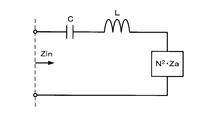
以上のことから、図1に示したこの発明の実施例1に係る無線通信装置の動作は、図5の等価回路図に基づいて説明される。
図5においては、前述(図3(b))の回路に、容量性結合手段4a、4bによって得られるキャパシタンスCが追加されている。すなわち、図5の回路は、インダクタンスLに対して直列にキャパシタンスCが追加された構成となる。
図5においては、前述(図3(b))の回路に、容量性結合手段4a、4bによって得られるキャパシタンスCが追加されている。すなわち、図5の回路は、インダクタンスLに対して直列にキャパシタンスCが追加された構成となる。
したがって、この発明の実施例1に係る無線通信装置は、並列共振特性を有するマイクロストリップアンテナにLC直列共振回路を接続した構成と等価であることから、動作周波数帯域が広帯域化されることが分かる。
次に、地導体1および導体2からなるマイクロストリップアンテナと、スロット3との結合度の調整方法について述べる。
マイクロストリップアンテナとスロット3との結合度は、スミスチャート上のインピーダンス軌跡における「ねじれ」の大きさと密接な関係があり、動作周波数の広帯域化において重要なパラメータとなる。
マイクロストリップアンテナとスロット3との結合度は、スミスチャート上のインピーダンス軌跡における「ねじれ」の大きさと密接な関係があり、動作周波数の広帯域化において重要なパラメータとなる。
図6はマイクロストリップアンテナとスロット3との結合度を説明するための平面図であり、ある瞬間におけるスロット3上を流れる磁流と、地導体1および導体2からなるマイクロストリップアンテナの内部磁界の向き(破線矢印B)とを示している。
図6において、地導体1および導体2からなるマイクロストリップアンテナとスロット3の磁界結合は、内部磁界の向き(破線矢印B)と平行な破線矢印Aに該当する部分(長さWs)で生じ、内部磁界の向きに直交する方向では結合しない。以下、磁界結合を生じさせる部分の長さWsを「磁界結合長さ」という。
したがって、図6内の磁界結合長さWsを変えることによって、結合度を変化させることができる。
したがって、図6内の磁界結合長さWsを変えることによって、結合度を変化させることができる。
図7は磁界結合長さWsに応じたインピーダンス特性の違いを示すスミスチャート図であり、スロット長さLs(図2)を0.11λに固定して磁界結合長さWsを変化させた場合における、給電点F(図2)から見たインピーダンス特性の変化の一例を示している。
図7において、図7(a)は、Ws=0.021λの場合のインピーダンス軌跡Z21λ、図7(b)は、Ws=0.036λの場合のインピーダンス軌跡Z36λ、図7(c)は、Ws=0.051λの場合のインピーダンス軌跡Z51λ、をそれぞれ示している。
図7(a)、図7(b)および図7(c)を比較すると、磁界結合長さWsが大きくなるほど、スミスチャート上のインピーダンス軌跡の「ねじれ」が大きくなっていることが分かる。
また、一般に、マイクロストリップアンテナの内部磁界は、放射素子の共振方向の中央において最大となることが知られている。
図6において、導体2の中心を原点Oとし、導体2の表面をx-y平面とし、導体2の共振方向をx軸とし、共振方向に直交する軸をy軸とすると、マイクロストリップアンテナの基本モード(TM10モード)における内部磁界Hyは、以下の式(2)で与えられる。
図6において、導体2の中心を原点Oとし、導体2の表面をx-y平面とし、導体2の共振方向をx軸とし、共振方向に直交する軸をy軸とすると、マイクロストリップアンテナの基本モード(TM10モード)における内部磁界Hyは、以下の式(2)で与えられる。

ただし、式(2)において、aは導体2の共振方向の長さ、ωは角周波数、εは地導体1と導体2との間の誘電率、kは誘電体中の波数、Voは導体2の端における電圧である。
したがって、図6内の破線矢印Aに該当する部分と導体2の共振方向の中央部(原点O)とのオフセット間隔Dが小さいほど、地導体1および導体2からなるマイクロストリップアンテナの内部磁界とスロット3との磁界結合は強くなると考えることができる。
したがって、図6内の破線矢印Aに該当する部分と導体2の共振方向の中央部(原点O)とのオフセット間隔Dが小さいほど、地導体1および導体2からなるマイクロストリップアンテナの内部磁界とスロット3との磁界結合は強くなると考えることができる。
図8はオフセット間隔Dに応じたインピーダンス特性の違いを示すスミスチャート図であり、スロット長さLs(図2)を0.11λに固定し、磁界結合長さWs(図6)を0.021λに固定して、オフセット間隔Dを変化させた場合における、給電点F(図2)から見たインピーダンス特性の変化の一例を示している。
図8において、図8(a)は、D=0.127λの場合のインピーダンス軌跡Z127λ、図8(b)は、D=0.112λの場合のインピーダンス軌跡Z112λ、図8(c)は、D=0.097λの場合のインピーダンス軌跡Z097λ、をそれぞれ示している。
図8(a)、図8(b)および図8(c)を比較すると、オフセット間隔Dが小さくなるほど、スミスチャート上のインピーダンス軌跡の「ねじれ」が大きくなっていることが分かる。
以上のように、図5に示したこの発明の実施例1の等価回路において、インダクタンスLは、スロット長さLsによって調整され、キャパシタンスCは、容量性結合手段4a、4bによって調整される。
また、スロット3とマイクロストリップアンテナとの結合度は、スロット3の磁界結合長さWs、またはスロット3のオフセット間隔Dによって調整することができる。
また、スロット3とマイクロストリップアンテナとの結合度は、スロット3の磁界結合長さWs、またはスロット3のオフセット間隔Dによって調整することができる。
これらのインダクタンスL、キャパシタンスCおよび結合度は、独立した調整が可能であることから、任意の負荷インピーダンスに対して整合を取ることができる。
つまり、ICチップ5の入力インピーダンスに対して、最適なインピーダンス整合を実現することができ、広帯域な無線通信装置を得ることができる。
つまり、ICチップ5の入力インピーダンスに対して、最適なインピーダンス整合を実現することができ、広帯域な無線通信装置を得ることができる。
なお、図1においては、容量性結合手段4a、4bがスロット3の中央位置をまたぐ構成としたが、容量性結合手段4a、4bがスロット3をまたぐ位置は、スロット3の中央に限られることはない。
たとえば図9に示すように、スロット3の中央からずらした位置に容量性結合手段4a、4bを配置してもよい。
たとえば図9に示すように、スロット3の中央からずらした位置に容量性結合手段4a、4bを配置してもよい。
また、図1においては、スロット3を「逆コの字型」に形成したが、地導体1および導体2からなるマイクロストリップアンテナとスロット3との間に適切な磁界結合が得られれば、スロット3の向きを変えてもよい。
たとえば図10のように、スロット3を「上向きコの字型」に形成しても、内部磁界の向きに対して平行となるスロット3の一部分において磁界結合されるので、前述と同様の作用効果を奏することができる。
たとえば図10のように、スロット3を「上向きコの字型」に形成しても、内部磁界の向きに対して平行となるスロット3の一部分において磁界結合されるので、前述と同様の作用効果を奏することができる。
また、図1においては、容量性結合手段4a、4bおよびICチップ5を、導体2の上方に配置したが、地導体1と導体2の間に配置してもよい。
この場合、ICチップ5を外界から保護することができるとともに、不要な突出構造を回避することができ、外観を向上させることができる。
この場合、ICチップ5を外界から保護することができるとともに、不要な突出構造を回避することができ、外観を向上させることができる。
また、スロット3の形状は、図1に示した「逆コの字型」に限らず、地導体1および導体2からなるマイクロストリップアンテナとスロット3との間に適切な磁界結合が得られれば、適切な形状を適宜選ぶことが可能である。
たとえば図11(a)~図11(f)に示すように、スロット3の形状は、線状、円形、三角形、または、円形と線状との複合形状など、種々の形状が選択可能である。
たとえば図11(a)~図11(f)に示すように、スロット3の形状は、線状、円形、三角形、または、円形と線状との複合形状など、種々の形状が選択可能である。
なお、上記実施例1(図1)では、地導体1、導体2および容量性結合手段4a、4bの支持関係を特に示していないが、地導体1、導体2および容量性結合手段4a、4bのそれぞれの間(または、周囲)に誘電体(図示せず)を介在(充填)させ、誘電体を介して、地導体1から導体2が支持され、導体2から容量性結合手段4a、4bが支持されていてもよい。
この場合、地導体1、導体2および容量性結合手段4a、4bのそれぞれの間に介在されている誘電体の比誘電率が、各箇所で異なる値に設定されてもよい。
この場合、地導体1、導体2および容量性結合手段4a、4bのそれぞれの間に介在されている誘電体の比誘電率が、各箇所で異なる値に設定されてもよい。
さらに、容量性結合手段4a、4bをフィルム基板などに構成して、導体2に貼付することもできる。
また、誘電体を用いる場合、誘電体多層基板に導体パターンをエッチングする方法、樹脂成形品と板金とを組み合わせる方法、樹脂成形品にメッキを施す方法などを適用して、容易に無線通信装置を製造することができる。
また、誘電体を用いる場合、誘電体多層基板に導体パターンをエッチングする方法、樹脂成形品と板金とを組み合わせる方法、樹脂成形品にメッキを施す方法などを適用して、容易に無線通信装置を製造することができる。
以上のように、この発明の実施例1(図1)によれば、地導体1(第1の導体)1と、地導体1とほぼ平行に配置された導体(第2の導体)2と、導体2に形成されたスロット(穴)3と、スロット3に近接配置された容量性結合手段4a、4bと、電波の送信機能および受信機能の少なくとも一方を有するICチップ(通信回路)5とを備えており、ICチップ5は、導体2とスロット3との境界線の近傍の導体2上の2つの部位間に、容量性結合手段4a、4bを介して接続されている。
また、容量性結合手段4a、4bを介してICチップ5を接続する2つの部位は、スロット3をまたぐように選択されている。
これにより、ICチップ5の入力インピーダンスに対して、最適なインピーダンス整合を実現することができ、広帯域な無線通信装置を得ることができる。
これにより、ICチップ5の入力インピーダンスに対して、最適なインピーダンス整合を実現することができ、広帯域な無線通信装置を得ることができる。
(実施例2)
なお、上記実施例1(図1)では、容量性結合手段4a、4bを、導体2のスロット3に対して積層構造により形成したが、図12のように、スロット3Aと同一の平面上に形成してもよい。
図12はこの発明の実施例2に係る無線通信装置を構成するRFIDタグを示す平面図であり、前述(図1参照)と同様のものについては、前述と同一符号を付して詳述を省略する。
なお、上記実施例1(図1)では、容量性結合手段4a、4bを、導体2のスロット3に対して積層構造により形成したが、図12のように、スロット3Aと同一の平面上に形成してもよい。
図12はこの発明の実施例2に係る無線通信装置を構成するRFIDタグを示す平面図であり、前述(図1参照)と同様のものについては、前述と同一符号を付して詳述を省略する。
図12において、前述の実施例1との相違点は、容量性結合手段4A、4Bをスロット3Aと共通平面に設けた点にある。
この場合、容量性結合手段4A、4Bは、それぞれ第3の導体からなり、容量性結合手段4Aは、スロット3Aの一辺に近接するように配置され、容量性結合手段4Bは、スロット3Aの他辺に近接するように配置されている。
また、容量性結合手段4A、4Bは、スロット3Aの辺に対して、容量結合するように構成されており、たとえば線状の導体からなる。
この場合、容量性結合手段4A、4Bは、それぞれ第3の導体からなり、容量性結合手段4Aは、スロット3Aの一辺に近接するように配置され、容量性結合手段4Bは、スロット3Aの他辺に近接するように配置されている。
また、容量性結合手段4A、4Bは、スロット3Aの辺に対して、容量結合するように構成されており、たとえば線状の導体からなる。
さらに、結合容量を大きく確保するために、容量性結合手段4A、4Bとして、線状の導体に代えて、たとえば図13に示すように、インターディジタルキャパシタ6a、6bが用いられてもよい。
図13において、インターディジタルキャパシタ6a、6bは、容量性結合手段4A、4Bの櫛歯状の各辺と、容量性結合手段4A、4Bに対向するスロット3Aの櫛歯状の各辺とにより構成されている。
図13において、インターディジタルキャパシタ6a、6bは、容量性結合手段4A、4Bの櫛歯状の各辺と、容量性結合手段4A、4Bに対向するスロット3Aの櫛歯状の各辺とにより構成されている。
図12または図13のように構成しても、前述と同様に、容量性結合手段4A、4Bによって直列のキャパシタンスCが形成される。
また、図12、図13において、他の構成および動作については、前述の実施例1と同様なので、実施例2に係る無線通信装置の等価回路は、図5で示した回路と実質的に同様のものとなる。
また、図12、図13において、他の構成および動作については、前述の実施例1と同様なので、実施例2に係る無線通信装置の等価回路は、図5で示した回路と実質的に同様のものとなる。
したがって、図12または図13に示した実施例2に係る無線通信装置においても、任意の負荷インピーダンスに対して整合を取ることができる。
つまり、ICチップ5の入力インピーダンスに対して最適なインピーダンス整合を実現することができ、広帯域な無線通信装置を得ることができる。
また、容量性結合手段4A、4Bは、誘電体基板に導体パターンをエッチングする方法などにより、導体2と同時に製造できるため製造が容易となる。
つまり、ICチップ5の入力インピーダンスに対して最適なインピーダンス整合を実現することができ、広帯域な無線通信装置を得ることができる。
また、容量性結合手段4A、4Bは、誘電体基板に導体パターンをエッチングする方法などにより、導体2と同時に製造できるため製造が容易となる。
また、インターディジタルキャパシタ6a、6b(図13)に代えて、図14に示すように、容量性結合手段4a、4bを、チップキャパシタ(コンデンサ)7a、7bおよび第3の導体8a、8bで構成してもよい。
図14において、チップキャパシタ7a、7bの各一端は、スロット3Bの各内端に接続され、チップキャパシタ7a、7bの各他端は、第3の導体8a、8bを介してICチップ5に接続されている。
図14において、チップキャパシタ7a、7bの各一端は、スロット3Bの各内端に接続され、チップキャパシタ7a、7bの各他端は、第3の導体8a、8bを介してICチップ5に接続されている。
図14のように構成しても、前述の実施例1と同様の作用効果を奏することができるうえ、ICチップ5を実装する際に、同時にチップキャパシタ7a、7bを実装することもできるので、製造が容易である。
以上のように、この発明の実施例2に係る無線通信装置によれば、容量性結合手段4A、4Bが、ICチップ(通信回路)5の端子に接続された第3の導体を含み、容量性結合手段4A、4Bは、導体2(スロット3Aの各辺)を第3の導体と容量結合させることにより構成されている。
また、図13のように、容量性結合手段4A、4Bは、第3の導体からなり、スロット3Aとともにインターディジタルキャパシタ6a、6bにより構成されている。
または、図14のように、容量性結合手段は、チップキャパシタ7a、7bおよび第3の導体8a、8bにより構成されている。
または、図14のように、容量性結合手段は、チップキャパシタ7a、7bおよび第3の導体8a、8bにより構成されている。
これにより、前述と同様に、ICチップ5の入力インピーダンスに対して最適なインピーダンス整合を実現することができ、広帯域な無線通信装置を得ることができる。
さらに、スロット3Aと同一平面に形成された容量性結合手段4A、4Bは、誘電体基板に導体パターンをエッチングする方法などにより、導体2と同時に製造できるため製造が容易となる。
さらに、スロット3Aと同一平面に形成された容量性結合手段4A、4Bは、誘電体基板に導体パターンをエッチングする方法などにより、導体2と同時に製造できるため製造が容易となる。
(実施例3)
なお、上記実施例1、2では、特に言及しなかったが、図15のように、導体2と磁界結合して複共振を生じる位置に無給電素子9を追加配置してもよい。
図15はこの発明の実施例3に係る無線通信装置を構成するRFIDタグを示す断面図であり、前述(図1参照)と同様のものについては、前述と同一符号を付して詳述を省略する。
なお、上記実施例1、2では、特に言及しなかったが、図15のように、導体2と磁界結合して複共振を生じる位置に無給電素子9を追加配置してもよい。
図15はこの発明の実施例3に係る無線通信装置を構成するRFIDタグを示す断面図であり、前述(図1参照)と同様のものについては、前述と同一符号を付して詳述を省略する。
ここでは、図1に示した無線通信装置に適用した場合を例にとり、地導体1と導体2との間に無給電素子9を設置した例を示している。
図15において、無給電素子9は、導体2と磁界結合して複共振を生じる位置に配置されており、無線通信装置の動作周波数帯の共振周波数付近(動作周波数帯の範囲内、または動作周波数帯の近傍)で共振する電気長を有する。他の構成および動作は、前述の実施例1と同様である。
図15において、無給電素子9は、導体2と磁界結合して複共振を生じる位置に配置されており、無線通信装置の動作周波数帯の共振周波数付近(動作周波数帯の範囲内、または動作周波数帯の近傍)で共振する電気長を有する。他の構成および動作は、前述の実施例1と同様である。
一般的に、無給電素子9が設けられたマイクロストリップアンテナにおいては、放射導体である励振素子と無給電素子9との結合によって複共振特性が得られることが知られている。また、無給電素子9の形状と、励振素子と無給電素子9との位置関係とを適切に選定することによって、動作周波数帯域を広帯域化できることが知られている。
したがって、図15のように構成することにより、前述(図1)の無線通信装置に比べて、動作周波数帯域をさらに広帯域化することができる。
なお、図15においては、地導体1と導体2との間に無給電素子9を配置したが、無給電素子9が導体(放射導体)2と磁界結合して複共振特性が得られれば、無給電素子9の配置構成は、図15の例に限定されるものではない。
たとえば、導体2から見て、地導体1の反対側に無給電素子9を配置してもよく、導体2に対してx方向またはy方向に近接した箇所などに無給電素子9を配置してもよい。
なお、図15においては、地導体1と導体2との間に無給電素子9を配置したが、無給電素子9が導体(放射導体)2と磁界結合して複共振特性が得られれば、無給電素子9の配置構成は、図15の例に限定されるものではない。
たとえば、導体2から見て、地導体1の反対側に無給電素子9を配置してもよく、導体2に対してx方向またはy方向に近接した箇所などに無給電素子9を配置してもよい。
また、図15においては、前述の実施例1(図1)の無線通信装置に無給電素子9を追加した構成としたが、この例に限定されるものではなく、前述の実施例2(図12~図14)の無線通信装置に無給電素子9を追加した構成としてもよく、同様の作用効果を奏することは言うまでもない。
(実施例4)
なお、上記実施例1~3では、特に言及しなかったが、図16に示すように、導体(第2の導体)10の一端に短絡導体(第4の導体)11を接続し、短絡導体11を介して、導体10を地導体(第1の導体)1に短絡接続してもよい。
図16はこの発明の実施例4に係る無線通信装置を構成するRFIDタグを示す断面図であり、前述(図1参照)と同様のものについては、前述と同一符号を付して詳述を省略する。
なお、上記実施例1~3では、特に言及しなかったが、図16に示すように、導体(第2の導体)10の一端に短絡導体(第4の導体)11を接続し、短絡導体11を介して、導体10を地導体(第1の導体)1に短絡接続してもよい。
図16はこの発明の実施例4に係る無線通信装置を構成するRFIDタグを示す断面図であり、前述(図1参照)と同様のものについては、前述と同一符号を付して詳述を省略する。
図16において、導体10は、共振方向の長さ寸法が、前述(図1)の導体2のほぼ半分に設定されている。
導体10の外周の一部(一端)と地導体1との間は、短絡導体11によって短絡接続されている。これにより、いわゆるショートパッチアンテナを構成している。
導体10の外周の一部(一端)と地導体1との間は、短絡導体11によって短絡接続されている。これにより、いわゆるショートパッチアンテナを構成している。
一般的に、マイクロストリップアンテナにおいて、放射導体上の電流は、共振方向の両端で零になることが良く知られている。また、放射導体が信号波の約1/2波長で共振して、放射導体上に定在波の電流が現れているときには、放射導体の中央において、電流が最大になることが良く知られている。
また、定在波では、電圧の位相が電流の位相と90度ずれていることにより、放射導体の共振方向の中央の電界は零となる。
また、定在波では、電圧の位相が電流の位相と90度ずれていることにより、放射導体の共振方向の中央の電界は零となる。
したがって、放射導体の中央において、放射導体と地導体1とを短絡して、放射導体の大きさを半分に設定しても、マイクロストリップアンテナ内部の電磁界分布は変わらない。
この原理を利用して、放射導体の共振方向の長さを信号波の約1/4波長に対応させて小型化したものがショートパッチアンテナであり、図16に示した無線通信装置において、地導体1、導体10および短絡導体11からなるアンテナがこれに該当する。
また、ショートパッチアンテナのインピーダンス特性も、通常のマイクロストリップアンテナと同様に、並列共振特性となるので、図16の無線通信装置の等価回路は、図5に示した回路と同様のものとなる。他の構成および動作は、前述の実施例1と同様である。
また、ショートパッチアンテナのインピーダンス特性も、通常のマイクロストリップアンテナと同様に、並列共振特性となるので、図16の無線通信装置の等価回路は、図5に示した回路と同様のものとなる。他の構成および動作は、前述の実施例1と同様である。
この発明の実施例4(図16)に係る無線通信装置は、導体10の共振方向の中央部の電界が零となる部位に該当する一端に接続された短絡導体(第4の導体)11を備え、導体10は、共振方向の長さがほぼ半分に構成されるとともに、導体10の一端が短絡導体11を介して地導体(第1の導体)1に短絡接続されている。
上記のような無線通信装置では、共振方向の長さ寸法が、前述(図1)の導体2の約半分の導体10が用いられているので、実施例1のものに比べて、導体10の共振方向の長さを半分にすることができるとともに、地導体1を小さくすることもできる。
この結果、無線通信装置の大きさを、実施例1の場合に比べて、約半分に小型化することができる。
この結果、無線通信装置の大きさを、実施例1の場合に比べて、約半分に小型化することができる。
なお、図16においては、実施例1(図1)の導体2を、約半分の長さの導体10に代えた構成を例にとって説明したが、ショートパッチアンテナ方式の無線通信装置の構成は、図16の例に限定されるものではなく、たとえば、実施例2または実施例3(図12~図15)の導体2を導体10に代えた構成としてもよい。
(実施例5)
なお、上記実施例1~4(図1、図12~図16)では、ICチップ5とは別に容量性結合手段を設けたが、図17に示すように、ICチップ5C内に容量性結合手段を構成してもよい。
図17はこの発明の実施例5に係る無線通信装置を構成するRFIDタグを示す平面図および断面図であり、前述(図1参照)と同様のものについては、前述と同一符号を付して詳述を省略する。
図17において、図17(a)は平面図、図17(b)は図17(a)のK-K’線に沿う断面図である。
なお、上記実施例1~4(図1、図12~図16)では、ICチップ5とは別に容量性結合手段を設けたが、図17に示すように、ICチップ5C内に容量性結合手段を構成してもよい。
図17はこの発明の実施例5に係る無線通信装置を構成するRFIDタグを示す平面図および断面図であり、前述(図1参照)と同様のものについては、前述と同一符号を付して詳述を省略する。
図17において、図17(a)は平面図、図17(b)は図17(a)のK-K’線に沿う断面図である。
前述の実施例1~4では、図5(等価回路)のインダクタンスLおよびキャパシタンスCを得るために、スロット長さLsを調節したうえで、容量性結合手段4a、4bの取り付けを必要としていたが、図5のインダクタンスLとキャパシタンスCに相当する回路は、IC回路の集積化技術向上により、図17のように、ICチップ5C(通信回路)内に内蔵させることが可能である。
図17に示したこの発明の実施例5においては、図1内の容量性結合手段4a、4bが除去され、容量性結合手段4a、4bの回路機能を含むICチップ5Cがスロット3に接続されている。
ここで、ICチップ5Cは記憶、演算、送受信などの機能を有する集積回路であり、図5に示す回路のインダクタンスLおよびキャパシタンスCからなる直列LC共振回路を含んだ構成となっている。
ここで、ICチップ5Cは記憶、演算、送受信などの機能を有する集積回路であり、図5に示す回路のインダクタンスLおよびキャパシタンスCからなる直列LC共振回路を含んだ構成となっている。
この場合、容量性結合手段は、ICチップ5C内の直列キャパシタンス回路または直列LC回路により構成されている。
図17のように構成することにより、ICチップ5Cは、直列LC共振回路を介してスロット3に接続される。
図17のように構成することにより、ICチップ5Cは、直列LC共振回路を介してスロット3に接続される。
このとき、スロット3に生じる磁界が、地導体1および導体2からなるマイクロストリップアンテナの内部磁界と磁界結合することは、前述の実施例1と同様である。
したがって、図17の無線通信装置の等価回路は、図5に示す回路と実質的に同様となる。
したがって、図17の無線通信装置の等価回路は、図5に示す回路と実質的に同様となる。
したがって、図17の無線通信装置においても、任意の負荷インピーダンスに対して整合を取ることができる。
つまり、ICチップ5Cの入力インピーダンスに対して最適なインピーダンス整合を実現することができ、広帯域な無線通信装置を得ることができる。
また、容量性結合手段4a、4bの取り付けが不要となるので、製造が容易となり、低コスト化を図ることができる。
つまり、ICチップ5Cの入力インピーダンスに対して最適なインピーダンス整合を実現することができ、広帯域な無線通信装置を得ることができる。
また、容量性結合手段4a、4bの取り付けが不要となるので、製造が容易となり、低コスト化を図ることができる。
なお、上記無線通信装置では、ICチップ5Cの中にインダクタンスLおよびキャパシタンスCを構成したが、インダクタンスLをICチップ5C内に内蔵させずに、スロット長さLsを調整することによってインダクタンスLを得るようにしてもよい。
また、図17では、図1(実施例1)の構成にICチップ5Cを適用した場合について説明したが、図17の構成例に限定されるものではなく、図12~図16(実施例2~4)の構成に対しても同様に適用可能なことは言うまでもない。
また、図17では、図1(実施例1)の構成にICチップ5Cを適用した場合について説明したが、図17の構成例に限定されるものではなく、図12~図16(実施例2~4)の構成に対しても同様に適用可能なことは言うまでもない。
Claims (10)
- 第1の導体と、
前記第1の導体とほぼ平行に配置された第2の導体と、
前記第2の導体に形成された穴と、
前記穴に近接配置された容量性結合手段と、
電波の送信機能および受信機能の少なくとも一方を有する通信回路とを備え、
前記通信回路は、前記第2の導体と前記穴との境界線の近傍の導体上の2つの部位間に、前記容量性結合手段を介して接続されたことを特徴とする無線通信装置。 - 前記穴は、スロット線路により形成されたことを特徴とする請求項1に記載の無線通信装置。
- 前記容量性結合手段を介して前記通信回路を接続する前記2つの部位は、前記スロット線路をまたぐように選択されたことを特徴とする請求項2に記載の無線通信装置。
- 前記容量性結合手段は、前記通信回路の端子に接続された第3の導体を含み、
前記容量性結合手段は、前記第2の導体を前記第3の導体と容量結合させることにより構成されたことを特徴とする請求項1から請求項3までのいずれか1項に記載の無線通信装置。 - 前記容量性結合手段は、インターディジタルキャパシタにより構成されたことを特徴とする請求項4に記載の無線通信装置。
- 前記容量性結合手段は、チップキャパシタにより構成されたことを特徴とする請求項4に記載の無線通信装置。
- 前記第2の導体と磁界結合して複共振を生じる位置に配置された無給電素子を備え、
前記無給電素子は、前記無線通信装置の動作周波数帯の範囲内または近傍で共振する電気長を有することを特徴とする請求項1から請求項6までのいずれか1項に記載の無線通信装置。 - 前記第2の導体の共振方向の中央部の電界が零となる部位に該当する一端に接続された第4の導体を備え、
前記第2の導体は、共振方向の長さがほぼ半分に構成されるとともに、前記第2の導体の前記一端は、前記第4の導体を介して前記第1の導体に短絡接続されたことを特徴とする請求項1から請求項7までのいずれか1項に記載の無線通信装置。 - 前記容量性結合手段は、前記通信回路内の直列キャパシタンス回路により構成されたことを特徴とする請求項1から請求項8までのいずれか1項に記載の無線通信装置。
- 前記容量性結合手段は、前記通信回路内の直列LC回路により構成されたことを特徴とする請求項1から請求項8までのいずれか1項に記載の無線通信装置。
Priority Applications (6)
| Application Number | Priority Date | Filing Date | Title |
|---|---|---|---|
| PCT/JP2008/069433 WO2010049984A1 (ja) | 2008-10-27 | 2008-10-27 | 無線通信装置 |
| CN200980142585.8A CN102204112B (zh) | 2008-10-27 | 2009-07-22 | 无线通信装置 |
| US13/122,025 US8659495B2 (en) | 2008-10-27 | 2009-07-22 | Wireless communication device |
| EP09823391.9A EP2343834A4 (en) | 2008-10-27 | 2009-07-22 | RADIO COMMUNICATION DEVICE |
| JP2010535708A JP5328803B2 (ja) | 2008-10-27 | 2009-07-22 | 無線通信装置 |
| PCT/JP2009/063100 WO2010050278A1 (ja) | 2008-10-27 | 2009-07-22 | 無線通信装置 |
Applications Claiming Priority (1)
| Application Number | Priority Date | Filing Date | Title |
|---|---|---|---|
| PCT/JP2008/069433 WO2010049984A1 (ja) | 2008-10-27 | 2008-10-27 | 無線通信装置 |
Publications (1)
| Publication Number | Publication Date |
|---|---|
| WO2010049984A1 true WO2010049984A1 (ja) | 2010-05-06 |
Family
ID=42128363
Family Applications (2)
| Application Number | Title | Priority Date | Filing Date |
|---|---|---|---|
| PCT/JP2008/069433 Ceased WO2010049984A1 (ja) | 2008-10-27 | 2008-10-27 | 無線通信装置 |
| PCT/JP2009/063100 Ceased WO2010050278A1 (ja) | 2008-10-27 | 2009-07-22 | 無線通信装置 |
Family Applications After (1)
| Application Number | Title | Priority Date | Filing Date |
|---|---|---|---|
| PCT/JP2009/063100 Ceased WO2010050278A1 (ja) | 2008-10-27 | 2009-07-22 | 無線通信装置 |
Country Status (4)
| Country | Link |
|---|---|
| US (1) | US8659495B2 (ja) |
| EP (1) | EP2343834A4 (ja) |
| CN (1) | CN102204112B (ja) |
| WO (2) | WO2010049984A1 (ja) |
Cited By (4)
| Publication number | Priority date | Publication date | Assignee | Title |
|---|---|---|---|---|
| CN102750566A (zh) * | 2011-04-21 | 2012-10-24 | 中国钢铁股份有限公司 | 具有平面式圆极化天线的无线识别卷标 |
| CN112038750A (zh) * | 2020-09-04 | 2020-12-04 | 合肥工业大学 | 一种应用于uhf频段的抗金属标签天线 |
| US12176631B1 (en) * | 2020-08-06 | 2024-12-24 | Bae Systems Space & Mission Systems Inc. | Electrically small wideband resonant loop antenna systems and methods |
| US12316013B1 (en) | 2021-05-27 | 2025-05-27 | Bae Systems Space & Mission Systems Inc. | Ultra-broadband current sheet array |
Families Citing this family (17)
| Publication number | Priority date | Publication date | Assignee | Title |
|---|---|---|---|---|
| US9455489B2 (en) | 2011-08-30 | 2016-09-27 | Apple Inc. | Cavity antennas |
| JP6065455B2 (ja) * | 2012-08-16 | 2017-01-25 | 株式会社リコー | Rfidタグ及びrfidシステム |
| KR20140096326A (ko) | 2011-12-09 | 2014-08-05 | 가부시키가이샤 리코 | Rfid 태그, rfid 시스템, 및 rfid 태그를 포함한 패키지 |
| US9318793B2 (en) * | 2012-05-02 | 2016-04-19 | Apple Inc. | Corner bracket slot antennas |
| CN102694249B (zh) * | 2012-05-10 | 2015-10-07 | 深圳光启创新技术有限公司 | 一种cmmb天线及移动多媒体广播装置 |
| CN102694251B (zh) * | 2012-05-10 | 2015-10-07 | 深圳光启创新技术有限公司 | 一种cmmb天线及移动多媒体广播装置 |
| US9186828B2 (en) | 2012-06-06 | 2015-11-17 | Apple Inc. | Methods for forming elongated antennas with plastic support structures for electronic devices |
| CN104718711B (zh) * | 2012-06-28 | 2018-10-19 | 芬兰国家技术研究中心股份公司 | 近场uhf识别系统和使用近场识别来识别作为导电材料或包含导电材料的对象或类似对象的方法 |
| KR102152074B1 (ko) | 2014-07-22 | 2020-09-07 | 삼성전자주식회사 | 근거리 무선 통신 안테나 |
| TWI539679B (zh) * | 2014-11-25 | 2016-06-21 | 財團法人金屬工業研究發展中心 | 微帶天線結構及應用其之微波成像系統 |
| EP3367505B1 (en) * | 2017-02-27 | 2019-06-26 | ProAnt AB | Antenna arrangement and a device comprising such an antenna arrangement |
| CN109524783A (zh) * | 2017-09-20 | 2019-03-26 | 西安四海达通信科技有限公司 | 减小天线耦合的方法及相关的多天线系统、无线通讯设备 |
| GB2571279B (en) | 2018-02-21 | 2022-03-09 | Pet Tech Limited | Antenna arrangement and associated method |
| US10734714B2 (en) * | 2018-05-29 | 2020-08-04 | Apple Inc. | Electronic device wide band antennas |
| CN109888483A (zh) * | 2019-01-03 | 2019-06-14 | 南京南瑞微电子技术有限公司 | 一种rfid标签印制天线结构 |
| US11276942B2 (en) * | 2019-12-27 | 2022-03-15 | Industrial Technology Research Institute | Highly-integrated multi-antenna array |
| CN114861850B (zh) * | 2022-07-05 | 2022-09-02 | 南京隼眼电子科技有限公司 | 一种电子标签 |
Citations (7)
| Publication number | Priority date | Publication date | Assignee | Title |
|---|---|---|---|---|
| JPH09232854A (ja) * | 1996-02-20 | 1997-09-05 | Matsushita Electric Ind Co Ltd | 移動無線機用小型平面アンテナ装置 |
| JP2000332523A (ja) * | 1999-05-24 | 2000-11-30 | Hitachi Ltd | 無線タグ、その製造方法及びその配置方法 |
| JP2003179426A (ja) * | 2001-12-13 | 2003-06-27 | Matsushita Electric Ind Co Ltd | アンテナ装置及び携帯無線装置 |
| WO2007102360A1 (ja) * | 2006-03-06 | 2007-09-13 | Mitsubishi Electric Corporation | Rfidタグ、rfidタグの製造方法及びrfidタグの設置方法 |
| JP2007243296A (ja) * | 2006-03-06 | 2007-09-20 | Mitsubishi Electric Corp | Rfidタグ及びその製造方法 |
| JP2008066838A (ja) * | 2006-09-05 | 2008-03-21 | Mitsubishi Electric Corp | アンテナ装置 |
| JP2008072740A (ja) * | 2001-04-11 | 2008-03-27 | Kyocera Wireless Corp | チューナブルマルチプレクサ |
Family Cites Families (16)
| Publication number | Priority date | Publication date | Assignee | Title |
|---|---|---|---|---|
| JP3180683B2 (ja) | 1996-09-20 | 2001-06-25 | 株式会社村田製作所 | 表面実装型アンテナ |
| US7098850B2 (en) * | 2000-07-18 | 2006-08-29 | King Patrick F | Grounded antenna for a wireless communication device and method |
| JP2002358494A (ja) * | 2001-06-01 | 2002-12-13 | Hitachi Kokusai Electric Inc | 移動体識別用無線タグ |
| JP4776165B2 (ja) | 2001-11-30 | 2011-09-21 | アクレオ アーベー | 電気化学的デバイス |
| CN1669182A (zh) * | 2002-09-10 | 2005-09-14 | 弗拉克托斯股份有限公司 | 耦合多频带天线 |
| US7324061B1 (en) * | 2003-05-20 | 2008-01-29 | Alien Technology Corporation | Double inductor loop tag antenna |
| WO2005045755A2 (en) * | 2003-11-04 | 2005-05-19 | Avery Dennison Corporation | Rfid tag with enhanced readability |
| US7274297B2 (en) * | 2004-07-01 | 2007-09-25 | Intermec Ip Corp. | RFID tag and method of manufacture |
| EP1864266A2 (en) * | 2005-03-29 | 2007-12-12 | Symbol Technologies, Inc. | Smart radio frequency identification (rfid) items |
| AT7781U3 (de) * | 2005-04-21 | 2006-05-15 | Piezocryst Advanced Sensorics | Messwertaufnehmer mit zumindest einem saw-element |
| JP4487977B2 (ja) * | 2006-06-27 | 2010-06-23 | 三菱電機株式会社 | Rfidタグ及びその製造方法 |
| JP5057786B2 (ja) | 2006-08-09 | 2012-10-24 | 富士通株式会社 | タグ |
| JP2008061158A (ja) | 2006-09-04 | 2008-03-13 | Seiko Epson Corp | アンテナ装置 |
| JP4874035B2 (ja) | 2006-09-05 | 2012-02-08 | 均 北吉 | キャビティ付き薄型スロットアンテナ及びアンテナ給電方法並びにこれらを用いたrfidタグ装置 |
| US8009101B2 (en) | 2007-04-06 | 2011-08-30 | Murata Manufacturing Co., Ltd. | Wireless IC device |
| TWI423519B (zh) * | 2007-09-04 | 2014-01-11 | Mitsubishi Electric Corp | Radio frequency identification tag |
-
2008
- 2008-10-27 WO PCT/JP2008/069433 patent/WO2010049984A1/ja not_active Ceased
-
2009
- 2009-07-22 CN CN200980142585.8A patent/CN102204112B/zh not_active Expired - Fee Related
- 2009-07-22 US US13/122,025 patent/US8659495B2/en not_active Expired - Fee Related
- 2009-07-22 WO PCT/JP2009/063100 patent/WO2010050278A1/ja not_active Ceased
- 2009-07-22 EP EP09823391.9A patent/EP2343834A4/en not_active Withdrawn
Patent Citations (7)
| Publication number | Priority date | Publication date | Assignee | Title |
|---|---|---|---|---|
| JPH09232854A (ja) * | 1996-02-20 | 1997-09-05 | Matsushita Electric Ind Co Ltd | 移動無線機用小型平面アンテナ装置 |
| JP2000332523A (ja) * | 1999-05-24 | 2000-11-30 | Hitachi Ltd | 無線タグ、その製造方法及びその配置方法 |
| JP2008072740A (ja) * | 2001-04-11 | 2008-03-27 | Kyocera Wireless Corp | チューナブルマルチプレクサ |
| JP2003179426A (ja) * | 2001-12-13 | 2003-06-27 | Matsushita Electric Ind Co Ltd | アンテナ装置及び携帯無線装置 |
| WO2007102360A1 (ja) * | 2006-03-06 | 2007-09-13 | Mitsubishi Electric Corporation | Rfidタグ、rfidタグの製造方法及びrfidタグの設置方法 |
| JP2007243296A (ja) * | 2006-03-06 | 2007-09-20 | Mitsubishi Electric Corp | Rfidタグ及びその製造方法 |
| JP2008066838A (ja) * | 2006-09-05 | 2008-03-21 | Mitsubishi Electric Corp | アンテナ装置 |
Cited By (5)
| Publication number | Priority date | Publication date | Assignee | Title |
|---|---|---|---|---|
| CN102750566A (zh) * | 2011-04-21 | 2012-10-24 | 中国钢铁股份有限公司 | 具有平面式圆极化天线的无线识别卷标 |
| TWI478438B (zh) * | 2011-04-21 | 2015-03-21 | China Steel Corp | 具有平面式圓極化天線之無線識別標籤 |
| US12176631B1 (en) * | 2020-08-06 | 2024-12-24 | Bae Systems Space & Mission Systems Inc. | Electrically small wideband resonant loop antenna systems and methods |
| CN112038750A (zh) * | 2020-09-04 | 2020-12-04 | 合肥工业大学 | 一种应用于uhf频段的抗金属标签天线 |
| US12316013B1 (en) | 2021-05-27 | 2025-05-27 | Bae Systems Space & Mission Systems Inc. | Ultra-broadband current sheet array |
Also Published As
| Publication number | Publication date |
|---|---|
| US20110175790A1 (en) | 2011-07-21 |
| WO2010050278A1 (ja) | 2010-05-06 |
| US8659495B2 (en) | 2014-02-25 |
| EP2343834A1 (en) | 2011-07-13 |
| EP2343834A4 (en) | 2013-08-21 |
| CN102204112A (zh) | 2011-09-28 |
| CN102204112B (zh) | 2014-03-12 |
Similar Documents
| Publication | Publication Date | Title |
|---|---|---|
| WO2010049984A1 (ja) | 無線通信装置 | |
| JP6465109B2 (ja) | マルチアンテナ及びそれを備える無線装置 | |
| JP3735635B2 (ja) | アンテナ装置とそれを用いた無線通信装置 | |
| JP4333821B2 (ja) | 無線icデバイス | |
| US9825361B2 (en) | Antenna with multifrequency capability for miniaturized applications | |
| WO2010001469A1 (ja) | 無線通信装置 | |
| JP6253588B2 (ja) | アンテナ構造体、及びアンテナ構造体を備えるrfidトランスポンダシステム | |
| US8207895B2 (en) | Shorted monopole antenna | |
| KR20060042232A (ko) | 역 에프 안테나 | |
| JP5482964B2 (ja) | 無線icデバイス及び無線通信端末 | |
| JPWO2015068430A1 (ja) | アンテナ、プリント基板、及び電子装置 | |
| JP6229814B2 (ja) | 通信端末装置 | |
| JP5051211B2 (ja) | 無線通信装置 | |
| JP2019009581A (ja) | アンテナモジュールおよび通信モジュール | |
| JP5328803B2 (ja) | 無線通信装置 | |
| JP2010136114A (ja) | 無線通信装置 | |
| JP5404731B2 (ja) | 無線通信装置 | |
| WO2014203967A1 (ja) | アンテナ装置及びそれを備える無線装置 | |
| JP4843103B2 (ja) | 無線通信装置 | |
| WO2016152662A1 (ja) | アンテナ装置および電子機器 | |
| EP3295518B1 (en) | Antenna with reversing current elements |
Legal Events
| Date | Code | Title | Description |
|---|---|---|---|
| 121 | Ep: the epo has been informed by wipo that ep was designated in this application |
Ref document number: 08877696 Country of ref document: EP Kind code of ref document: A1 |
|
| NENP | Non-entry into the national phase |
Ref country code: DE |
|
| 122 | Ep: pct application non-entry in european phase |
Ref document number: 08877696 Country of ref document: EP Kind code of ref document: A1 |
|
| NENP | Non-entry into the national phase |
Ref country code: JP |