WO2009154132A1 - Spirodiamine-diarylketoxime derivative - Google Patents
Spirodiamine-diarylketoxime derivative Download PDFInfo
- Publication number
- WO2009154132A1 WO2009154132A1 PCT/JP2009/060687 JP2009060687W WO2009154132A1 WO 2009154132 A1 WO2009154132 A1 WO 2009154132A1 JP 2009060687 W JP2009060687 W JP 2009060687W WO 2009154132 A1 WO2009154132 A1 WO 2009154132A1
- Authority
- WO
- WIPO (PCT)
- Prior art keywords
- pyridinyl
- methyl
- diazaspiro
- difluorophenyl
- group
- Prior art date
- Legal status (The legal status is an assumption and is not a legal conclusion. Google has not performed a legal analysis and makes no representation as to the accuracy of the status listed.)
- Ceased
Links
- 0 N*1CCC2(C*CC2)CC1 Chemical compound N*1CCC2(C*CC2)CC1 0.000 description 32
- DQBJTBQHROHVKI-UHFFFAOYSA-N CC1C2=CC1CC2 Chemical compound CC1C2=CC1CC2 DQBJTBQHROHVKI-UHFFFAOYSA-N 0.000 description 1
Classifications
-
- C—CHEMISTRY; METALLURGY
- C07—ORGANIC CHEMISTRY
- C07D—HETEROCYCLIC COMPOUNDS
- C07D471/00—Heterocyclic compounds containing nitrogen atoms as the only ring hetero atoms in the condensed system, at least one ring being a six-membered ring with one nitrogen atom, not provided for by groups C07D451/00 - C07D463/00
- C07D471/12—Heterocyclic compounds containing nitrogen atoms as the only ring hetero atoms in the condensed system, at least one ring being a six-membered ring with one nitrogen atom, not provided for by groups C07D451/00 - C07D463/00 in which the condensed system contains three hetero rings
- C07D471/20—Spiro-condensed systems
-
- A—HUMAN NECESSITIES
- A61—MEDICAL OR VETERINARY SCIENCE; HYGIENE
- A61K—PREPARATIONS FOR MEDICAL, DENTAL OR TOILETRY PURPOSES
- A61K31/00—Medicinal preparations containing organic active ingredients
- A61K31/13—Amines
-
- A—HUMAN NECESSITIES
- A61—MEDICAL OR VETERINARY SCIENCE; HYGIENE
- A61P—SPECIFIC THERAPEUTIC ACTIVITY OF CHEMICAL COMPOUNDS OR MEDICINAL PREPARATIONS
- A61P1/00—Drugs for disorders of the alimentary tract or the digestive system
- A61P1/16—Drugs for disorders of the alimentary tract or the digestive system for liver or gallbladder disorders, e.g. hepatoprotective agents, cholagogues, litholytics
-
- A—HUMAN NECESSITIES
- A61—MEDICAL OR VETERINARY SCIENCE; HYGIENE
- A61P—SPECIFIC THERAPEUTIC ACTIVITY OF CHEMICAL COMPOUNDS OR MEDICINAL PREPARATIONS
- A61P25/00—Drugs for disorders of the nervous system
- A61P25/14—Drugs for disorders of the nervous system for treating abnormal movements, e.g. chorea, dyskinesia
-
- A—HUMAN NECESSITIES
- A61—MEDICAL OR VETERINARY SCIENCE; HYGIENE
- A61P—SPECIFIC THERAPEUTIC ACTIVITY OF CHEMICAL COMPOUNDS OR MEDICINAL PREPARATIONS
- A61P25/00—Drugs for disorders of the nervous system
- A61P25/22—Anxiolytics
-
- A—HUMAN NECESSITIES
- A61—MEDICAL OR VETERINARY SCIENCE; HYGIENE
- A61P—SPECIFIC THERAPEUTIC ACTIVITY OF CHEMICAL COMPOUNDS OR MEDICINAL PREPARATIONS
- A61P25/00—Drugs for disorders of the nervous system
- A61P25/24—Antidepressants
-
- A—HUMAN NECESSITIES
- A61—MEDICAL OR VETERINARY SCIENCE; HYGIENE
- A61P—SPECIFIC THERAPEUTIC ACTIVITY OF CHEMICAL COMPOUNDS OR MEDICINAL PREPARATIONS
- A61P3/00—Drugs for disorders of the metabolism
- A61P3/04—Anorexiants; Antiobesity agents
-
- A—HUMAN NECESSITIES
- A61—MEDICAL OR VETERINARY SCIENCE; HYGIENE
- A61P—SPECIFIC THERAPEUTIC ACTIVITY OF CHEMICAL COMPOUNDS OR MEDICINAL PREPARATIONS
- A61P3/00—Drugs for disorders of the metabolism
- A61P3/06—Antihyperlipidemics
-
- A—HUMAN NECESSITIES
- A61—MEDICAL OR VETERINARY SCIENCE; HYGIENE
- A61P—SPECIFIC THERAPEUTIC ACTIVITY OF CHEMICAL COMPOUNDS OR MEDICINAL PREPARATIONS
- A61P3/00—Drugs for disorders of the metabolism
- A61P3/08—Drugs for disorders of the metabolism for glucose homeostasis
- A61P3/10—Drugs for disorders of the metabolism for glucose homeostasis for hyperglycaemia, e.g. antidiabetics
-
- A—HUMAN NECESSITIES
- A61—MEDICAL OR VETERINARY SCIENCE; HYGIENE
- A61P—SPECIFIC THERAPEUTIC ACTIVITY OF CHEMICAL COMPOUNDS OR MEDICINAL PREPARATIONS
- A61P43/00—Drugs for specific purposes, not provided for in groups A61P1/00-A61P41/00
-
- C—CHEMISTRY; METALLURGY
- C07—ORGANIC CHEMISTRY
- C07D—HETEROCYCLIC COMPOUNDS
- C07D487/00—Heterocyclic compounds containing nitrogen atoms as the only ring hetero atoms in the condensed system, not provided for by groups C07D451/00 - C07D477/00
- C07D487/02—Heterocyclic compounds containing nitrogen atoms as the only ring hetero atoms in the condensed system, not provided for by groups C07D451/00 - C07D477/00 in which the condensed system contains two hetero rings
- C07D487/10—Spiro-condensed systems
-
- C—CHEMISTRY; METALLURGY
- C07—ORGANIC CHEMISTRY
- C07D—HETEROCYCLIC COMPOUNDS
- C07D519/00—Heterocyclic compounds containing more than one system of two or more relevant hetero rings condensed among themselves or condensed with a common carbocyclic ring system not provided for in groups C07D453/00 or C07D455/00
Definitions
- the present invention relates to a novel spirodiamine-diarylketoxime derivative.
- the compound acts as a melanin-concentrating hormone receptor antagonist and is useful as a preventive or therapeutic agent for various cardiovascular diseases, nervous system diseases, metabolic diseases, reproductive diseases, respiratory diseases, gastrointestinal diseases and the like. is there.
- MCH Melanin concentrating hormone
- MCH In mammals, the cell bodies of neurons containing MCH are localized in the hypothalamic lateral cortex and uncertain zone, but their nerve fibers are projected to a very wide area in the brain [The Journal of. Comparative Neurology, Vol. 319, 218 (1992)], MCH is considered to control various central functions in the living body.
- the hypothalamic lateral field has long been known as a feeding center, and in recent years, much molecular biological and pharmacological knowledge suggesting its involvement in the control of MCH energy homeostasis has been accumulated. That is, it has been reported that mRNA expression of MCH precursor is enhanced in the brains of genetic obesity model animals such as ob / ob mice, db / db mice, KKAy mice, Zucker fatty rats and fasted mice. [Nature, Vol. 380, 243 (1996); Diabetes, Vol. 47, 294 (1998); Biochemical and Biophysical Research Communications, Vol. 268, 88 (2000); Molecular Brain Research, Vol. 92, 43 (2001)].
- MCH is an important factor in the formation of obesity and suggests its involvement in metabolic disorders and respiratory diseases in which obesity is also a risk factor.
- anxiety-inducing action, epilepsy, memory / learning, diuretic action, sodium / potassium excretion action, oxytocin secretion action, and reproductive / sexual function involvement are known for MCH [Peptides, Vol. 17, 171 (1996); Peptides, Vol. 18, 1095 (1997); Peptides, Vol. 15, 757 (1994); Journal of Neuroendocrinology, Vol. 8, 57 (1996); Critical Reviews in Neurobiology, Vol. 8, 221 (1994)].
- MCH induces various pharmacological actions mainly through MCH receptors present in the central nervous system.
- MCH receptors at least two types of receptors, type 1 receptor (MCH-1R or SLC-1) and type 2 receptor (MCH-2R or SLT), are known [Nature, Vol. 400, 261 (1999); Nature, Vol. 400, 265 (1999); Biochemical and Biophysical Research Communications, Vol. 261, 622 (1999); Nature Cell Biology, Vol. 1,267 (1999); FEBS Letters, Vol. 457, 522 (1999); Biochemical and Biophysical Research Communications, vol. 283, 1013 (2001); The Journal of Biological Chemistry, Vol. 276, 20125 (2001); Proceedings of the National Academy of Sciences of The United States of America, Vol.
- MCH-1R the pharmacological action observed in rodents is mainly induced through MCH-1R [see Genomics, Vol, 79, 785 (2002)]. It is known that overeating and obesity are not observed even when chronic administration of MCH is carried out to MCH-1R gene-deficient mice, so that energy metabolism control by MCH is induced via MCH-1R. Furthermore, MCH-1R deficiency is known to increase the amount of activity in mice [Proceedings of the National Academy of Sciences of the United States of America, Vol. 99, 3240 (2002)], and is strongly suggested to be involved in central diseases accompanied by behavioral abnormalities such as attention deficit / hyperactivity disorder, schizophrenia depression, etc. [Molecular Medicine Today, Vol. 6, 43 (2000); see Trends in Neuroscience, Vol, 24, 527 (2001)].
- MCH-1R autoantibodies against MCH-1R exist in the serum of patients with vitiligo vulgaris [see The Journal of Clinical Investigation, Vol, 109, 923 (2002)]. Furthermore, the expression of MCH-1R in certain cancer cells has been reported. From the expression site of MCH and MCH-1R in vivo, MCH cancer, sleep / wake, drug dependence, and gastrointestinal diseases [Biochemical and Biophysical Research Communications, Vol. 289, 44 (2001); Neuroendocrinology, Vol. 61, 348 (1995); Endocrinology, Vol. 137, 561 (1996); The Journal of Comparative Neurology, Vol. 435, 26 (2001)].
- MCH The function of MCH is expressed when MCH binds to the MCH receptor. Therefore, inhibition of MCH receptor binding can prevent the expression of MCH action. Therefore, a substance that antagonizes MCH receptor binding may be used for various diseases involving MCH, such as obesity, diabetes, hormone secretion abnormalities, hyperlipidemia, gout, fatty liver, and other metabolic diseases; Cardiovascular diseases such as hyperphagia, affective disorder, depression, anxiety, hemorrhoids, delirium, dementia, integration, etc., such as hypertension, acute congestive heart failure, myocardial infarction, atherosclerosis, hypertension, kidney disease, electrolyte abnormalities Central and peripheral nervous system diseases such as ataxia, attention deficit / hyperactivity disorder, memory disorder, sleep disorder, cognitive disorder, movement disorder, sensory abnormalities, olfactory disturbance, morphine tolerance, drug dependence, alcoholism; Reproductive system diseases such as infertility, premature birth, and sexual dysfunction; in addition, it is expected to be useful as a preventive or
- Patent Document 1 discloses a number of 4-phenylpiperidine derivatives. However, this specification does not disclose any compound having a spiro ring.
- WO96 / 26196 discloses benzylpiperidine derivatives as muscarinic antagonists. However, this specification does not disclose a compound having a spiro ring which is a point of the present invention. Furthermore, this specification does not describe MCH receptor antagonism. WO03 / 004027 pamphlet WO96 / 26196 pamphlet
- the present inventors have found that two aryls are bonded to the carbon atom forming the oxime, and a spirodiamine skeleton is further bonded to one aryl via methylene.
- the compound is a novel compound unknown in the literature, has MCH receptor antagonism, and is effective for the prevention or treatment of various diseases related to MCH receptor.
- the invention has been completed.
- R 1a and R 1b independently represent a hydrogen atom, or C 1-6 alkyl optionally substituted with halogen or hydroxy, or R 1a and R 1b together represent cyclopropyl
- the R 2 represents a hydrogen atom, C 1-6 alkyl or C 3-6 cycloalkyl, which alkyl or cycloalkyl is optionally halogen, hydroxy, C 1-6 alkyloxy, C 1-6 alkyloxycarbonyl, C 1-6 alkylsulfonyl, mono (C 1-6 alkyl) amino, di (C 1-6 alkyl) amino, carbamoyl, mono (C 1-6 alkyl) carbamoyl, di (C 1-6 alkyl) carbamoyl and cyano
- Ar 1 is a 6-membered aromatic carbocyclic group optionally substituted with 1 to 4 substituents optionally selected from the group consisting of group ⁇ , or optionally selected
- 6-membered aromatic carbocyclic ring, 6-membered aromatic nitrogen-containing heterocyclic ring, 5-membered aromatic heterocyclic ring or pyridone ring is optionally a substituent selected from the group consisting of group ⁇ May be replaced with
- Ar 3 represents a monocyclic or bicyclic aromatic carbocyclic group or aromatic heterocyclic group, or pyridone, and the aromatic carbocyclic ring or aromatic heterocyclic ring is a non-aromatic cyclic hydrocarbon or non-aromatic heterocyclic group.
- the ring may be condensed, and the aromatic carbocyclic group, aromatic heterocyclic group or pyridone may optionally be halogen, C 1-6 alkyl, halo C 1-6 alkyl, hydroxy C 1-6 alkyl , C 1-6 alkyloxy, halo C 1-6 alkyloxy, C 3-6 cycloalkyl, hydroxy C 3-6 cycloalkyl, cyano, carbamoyl, mono C 1-6 alkylcarbamoyl, di-C 1-6 alkylcarbamoyl , C 1-6 alkylsulfonyl and sulfonylamide may be substituted by 1 to 4 substituents, m1, m2, m3 and m4 each independently represent 0, 1, 2, 3 or 4, provided that the sum of m1 and m2 is 2 or more and 6 or less, and the sum of m3 and m4 is 2. Any of —CH 2 — which is 6 or more and forms a spir
- Substituent group consisting of group ⁇ , halogen, cyano, hydroxy, amino, mono C 1-6 alkylamino, di-C 1-6 alkylamino, C 1-6 alkyl, halo C 1-6 alkyl, C 1-6 alkyloxy Halo C 1-6 alkyloxy, C 1-6 alkyloxy C 1-6 alkyl, C 1-6 alkyloxycarbonyl, C 1-6 alkyloxycarbonylamino, C 1-6 alkyloxycarbonyl (C 1-6 Alkyl) amino, C 1-6 alkylcarbonyl, C 1-6 alkylcarbonyloxy, C 1-6 alkylcarbonylamino, C 1-6 alkylcarbonyl (C 1-6 alkyl) amino, carbamoyl, mono C 1-6 alkyl Carbamoyl, di-C 1-6 alkylcarbamoyl, carbamoylamino, mono-C 1-6 alkyl Carbamoylamino, di-C
- the present invention provides (2) A melanin-concentrating hormone receptor antagonist comprising the compound according to (1) or a pharmaceutically acceptable salt thereof as an active ingredient, (3) A pharmaceutical composition comprising a medically acceptable additive and the compound according to (1) or a pharmaceutically acceptable salt thereof, (4) Represented by obesity, diabetes, hormonal secretion abnormalities, hyperlipidemia, gout, fatty liver, hepatitis and cirrhosis, comprising the compound according to (1) or a pharmaceutically acceptable salt as an active ingredient
- Metabolic diseases Angina pectoris, acute / congestive heart failure, myocardial infarction, annular arteriosclerosis, hypertension, kidney disease and electrolyte disorders; bulimia, affective disorder, depression, anxiety, epilepsy , Delirium, dementia, schizophrenia, attention deficit / hyperactivity disorder, memory disorder, sleep disorder, cognitive disorder, movement disorder, sensory abnormality, olfactory disorder, morphine tolerance, drug dependence and alcohol dependence And peripheral nervous system diseases; reproductive system diseases represented by infertility, premature birth
- the term “lower” means that the group or compound to which the word is attached has 6 or less carbon atoms, preferably 4 or less.
- C 1-6 alkyl includes straight-chain alkyl having 1 to 6 carbon atoms or branched alkyl having 3 to 6 carbon atoms, specifically, for example, methyl, ethyl, n-propyl, isopropyl , N-butyl, isobutyl, sec-butyl, tert-butyl, n-pentyl, isopentyl, neopentyl, tert-amyl, 2-propyl, 2-methylbutyl, 1,2-dimethylpropyl, 1-ethylpropyl, n-hexyl , Isohexyl, 1-methylpentyl, 2-methylpentyl, 3-methylpentyl, 1,1-dimethylbutyl, 1,2-dimethylbutyl, 2,2-dimethylbutyl, 1-ethylbutyl, 1,1,2-trimethyl Examples include propyl, 1,2,2-trimethylpropyl, 1-ethyl-2-methyl
- halogen atom examples include a fluorine atom, a chlorine atom, a bromine atom, and an iodine atom.
- C 3-6 cycloalkyl means cycloalkyl having 3 to 6 carbon atoms, and examples thereof include cyclopropyl, cyclobutyl, cyclopentyl, cyclohexyl and the like.
- Halo C 1-6 alkyl includes C 1-6 alkyl in which part or all of the hydrogen atoms of C 1-6 alkyl are replaced by halogen, for example, fluoromethyl, difluoromethyl, trifluoro Examples include methyl, 2-fluoroethyl, 1,2-difluoroethyl and the like.
- Hydro C 1-6 alkyl includes C 1-6 alkyl in which part of the hydrogen atom of C 1-6 alkyl is substituted with hydroxy, preferably substituted with 1-2 hydroxy, , Hydroxymethyl, dihydroxymethyl, 2-hydroxyethyl, 2-hydroxymethylpropyl and the like.
- Hydro C 3-6 cycloalkyl includes cycloalkyl in which some of the hydrogen atoms of the cycloalkyl are substituted with hydroxy, preferably with 1 to 2 hydroxy, eg, hydroxycyclopropyl And hydroxycyclobutyl.
- C 1-6 alkyl optionally substituted with halogen or hydroxy includes the C 1-6 alkyl, the halo C 1-6 alkyl, and the hydroxy C 1-6 alkyl.
- C 1-6 alkyloxy includes a group in which C 1-6 alkyl is bonded to an oxygen atom. Specific examples include methoxy, ethoxy, n-propyloxy, isopropyloxy, n-butoxy, and n-pentyloxy.
- Halo C 1-6 alkyloxy includes a group in which halo C 1-6 alkyl is bonded to an oxygen atom. Specifically, for example, fluoromethoxy, difluoromethoxy, trifluoromethoxy, 1,2- And difluoroethoxy.
- “Mono C 1-6 alkylamino” is a group in which one of the hydrogen atoms of amino (—NH 2 ) is substituted with C 1-6 alkyl. Specifically, for example, methylamino, ethylamino, n- Examples include propylamino, isopropylamino, n-butylamino and the like.
- “DiC 1-6 alkylamino” is a group in which two hydrogen atoms of amino are substituted with C 1-6 alkyl. Specifically, for example, dimethylamino, diethylamino, ethylmethylamino, di (n— Propyl) amino, methyl (n-propyl) amino, diisopropylamino and the like.
- C 1-6 alkyloxy C 1-6 alkyl is C 1-6 alkyl substituted with C 1-6 alkyloxy, specifically, for example, methoxymethyl, ethoxymethyl, n-propyloxy Examples thereof include methyl, isopropyloxymethyl, 1-methoxyethyl, 2-methoxyethyl and the like.
- C 1-6 alkyloxycarbonyl is a group in which C 1-6 alkyloxy is bonded to carbonyl (—CO—), and includes alkyloxycarbonyl having 1 to 6 carbon atoms. Methoxycarbonyl, ethoxycarbonyl, n-propyloxycarbonyl, isopropyloxycarbonyl, n-butoxycarbonyl and the like.
- C 1-6 alkyloxycarbonylamino is a group in which one of the hydrogen atoms of amino is replaced with C 1-6 alkyloxycarbonyl, and includes alkyloxycarbonylamino having 1 to 6 carbon atoms, specifically Examples include methoxycarbonylamino, ethoxycarbonylamino, n-propyloxycarbonylamino, isopropyloxycarbonylamino, n-butoxycarbonylamino, n-pentyloxycarbonylamino and the like.
- C 1-6 alkyloxycarbonyl (C 1-6 alkyl) amino is a group in which a C 1-6 alkyloxycarbonyl is bonded instead of a hydrogen atom on the nitrogen atom of mono-C 1-6 alkylamino; Specific examples include methoxycarbonyl (methyl) amino, ethoxycarbonyl (methyl) amino, n-propyloxycarbonyl (methyl) amino and the like.
- C 1-6 alkylcarbonyl is a group in which C 1-6 alkyl is bonded to carbonyl, and includes alkylcarbonyl having 1 to 6 carbon atoms, and specifically includes, for example, acetyl, propionyl, butyryl, isobutyryl. , Valeryl, isovaleryl, pivaloyl and the like.
- C 1-6 alkylcarbonyloxy is a group in which C 1-6 alkylcarbonyl is bonded to an oxygen atom. Specific examples include acetoxy, propionyloxy, valeryloxy, isovaleryloxy, pivaloyloxy and the like. It is done.
- C 1-6 alkylcarbonylamino is a group in which one of the hydrogen atoms of amino is replaced with C 1-6 alkylcarbonyl, and specifically includes, for example, acetylamino, propionylamino, isobutyrylamino, valerylamino. , Isovalerylamino, pivaloylamino and the like.
- C 1-6 alkylcarbonyl (C 1-6 alkyl) amino is a group in which a hydrogen atom on the nitrogen atom of mono C 1-6 alkylamino is substituted with C 1-6 alkylcarbonyl. (Methyl) amino, ethylcarbonyl (methyl) amino, n-propylcarbonyl (methyl) amino and the like.
- “Mono C 1-6 alkylcarbamoyl” is a group in which one hydrogen atom of carbamoyl (—CONH 2 ) is substituted with C 1-6 alkyl. Specifically, for example, methylcarbamoyl, ethylcarbamoyl, n- And propylcarbamoyl, isopropylcarbamoyl, n-butylcarbamoyl and the like.
- “DiC 1-6 alkylcarbamoyl” is a group in which two hydrogen atoms of carbamoyl are substituted with C 1-6 alkyl. Specifically, for example, dimethylcarbamoyl, diethylcarbamoyl, ethylmethylcarbamoyl, di (n -Propyl) carbamoyl, methyl (n-propyl) carbamoyl, diisopropylcarbamoyl and the like.
- “Mono C 1-6 alkylcarbamoylamino” is a group in which one hydrogen atom of amino is substituted with mono C 1-6 alkylcarbamoyl. Specifically, for example, methylcarbamoylamino, ethylcarbamoylamino, n- Examples thereof include propylcarbamoylamino, isopropylcarbamoylamino, n-butylcarbamoylamino and the like.
- Di-C 1-6 alkylcarbamoyl amino is 1 Tsugaji C 1-6 alkylcarbamoyl and substituted groups of the hydrogen atom of an amino, specifically, for example, dimethylcarbamoylamino, diethylcarbamoyl, di ( n-propyl) carbamoylamino, diisopropylcarbamoylamino and the like.
- “Mono C 1-6 alkylcarbamoyl (C 1-6 alkyl) amino” means a group in which a hydrogen atom on the nitrogen atom of mono-C 1-6 alkylamino is substituted with a mono C 1-6 alkylcarbamoyl, specific Examples include monomethylcarbamoyl (methyl) amino, monoethylcarbamoyl (methyl) amino, [mono (n-propyl) carbamoyl] (methyl) amino, and the like.
- “Di-C 1-6 alkylcarbamoyl (C 1-6 alkyl) amino” is a group in which a hydrogen atom on a nitrogen atom of mono-C 1-6 alkylamino is substituted with di-C 1-6 alkylcarbamoyl. Examples include dimethylcarbamoyl (methyl) amino, diethylcarbamoyl (methyl) amino, [di (n-propyl) carbamoyl] (methyl) amino, and the like.
- “Mono C 1-6 alkylcarbamoyloxy” is a group in which mono C 1-6 alkylcarbamoyl is bonded to an oxygen atom. Specifically, for example, methylcarbamoyloxy, ethylcarbamoyloxy, n-propylcarbamoyloxy, Examples thereof include isopropylcarbamoyloxy and n-butylcarbamoyloxy.
- DiC 1-6 alkylcarbamoyloxy is a group in which diC 1-6 alkylcarbamoyl is bonded to an oxygen atom. Specifically, for example, dimethylcarbamoyloxy, diethylcarbamoyloxy, ethylmethylcarbamoyloxy, di- (N-propyl) carbamoyloxy, methyl (n-propyl) carbamoyloxy, diisopropylcarbamoyloxy and the like.
- C 1-6 alkylsulfonyl is a group in which C 1-6 alkyl is bonded to sulfonyl (—SO 2 —). Specifically, for example, methanesulfonyl, ethanesulfonyl, n-propanesulfonyl, isopropane Examples include sulfonyl and n-butanesulfonyl.
- C 1-6 alkylsulfonylamino is a group in which one of the hydrogen atoms of amino is substituted with C 1-6 alkylsulfonyl, and examples thereof include methanesulfonylamino, ethanesulfonylamino, n-propanesulfonyl. Amino, isopropanesulfonylamino, n-butanesulfonylamino and the like can be mentioned.
- C 1-6 alkylsulfonyl (C 1-6 alkyl) amino is a group in which a hydrogen atom on a nitrogen atom of mono C 1-6 alkylamino is substituted with C 1-6 alkylsulfonyl, specifically Examples thereof include methanesulfonyl (methyl) amino, ethanesulfonyl (methyl) amino, n-propanesulfonyl (methyl) amino, isopropanesulfonyl (methyl) amino and the like.
- “Mono C 1-6 alkylsulfamoyl” is a group in which one of the hydrogen atoms of sulfamoyl (—SO 2 NH 2 ) is substituted with C 1-6 alkyl. Specifically, for example, monomethylsulfamoyl Monoethylsulfamoyl, mono (n-propyl) sulfamoyl, monoisopropylsulfamoyl, mono (n-butyl) sulfamoyl and the like.
- Di-C 1-6 alkylsulfamoyl is a group in which two hydrogen atoms of a sulfamoyl group are substituted with C 1-6 alkyl. Specifically, for example, dimethylsulfamoyl, diethylsulfamoyl, Examples thereof include di (n-propyl) sulfamoyl, diisopropylsulfamoyl, di (n-butyl) sulfamoyl and the like.
- “Mono C 1-6 alkylsulfamoylamino” is a group in which one of the amino hydrogen atoms is substituted with mono C 1-6 alkylsulfamoyl.
- (monomethylsulfamoyl) Examples include amino, (monoethylsulfamoyl) amino, [mono (n-propyl) sulfamoyl] amino, (monoisopropylsulfamoyl) amino, [mono (n-butyl) sulfamoyl] amino, and the like.
- (Di-C 1-6 alkylsulfamoyl) amino is a 1 Tsugaji C 1-6 alkylsulfamoyl and substituted groups of the hydrogen atom of an amino, specifically, for example, (dimethylsulfamoyl Moyl) amino, (diethylsulfamoyl) amino, (ethylmethylsulfamoyl) amino, [di (n-propyl) sulfamoyl] amino, [methyl (n-propyl) sulfamoyl] amino, (diisopropylsulfamoyl) amino Etc.
- “Mono C 1-6 alkylsulfamoyl (C 1-6 alkyl) amino” a group in which a hydrogen atom on the nitrogen atom of mono-C 1-6 alkylamino is substituted with a mono C 1-6 alkylsulfamoyl
- Specific examples include monomethylsulfamoyl (methyl) amino, monoethylsulfamoyl (methyl) amino, [mono (n-propyl) sulfamoyl] (methyl) amino, and the like.
- “Di-C 1-6 alkylsulfamoyl (C 1-6 alkyl) amino” is a group in which the hydrogen atom on the nitrogen atom of mono-C 1-6 alkylamino is replaced with di-C 1-6 alkylsulfamoyl. Specific examples include dimethylsulfamoyl (methyl) amino, diethylsulfamoyl (methyl) amino, [di (n-propyl) sulfamoyl] (methyl) amino, and the like.
- the “pharmaceutically acceptable salt” of the compound represented by the formula (I) includes a pharmaceutically acceptable ordinary salt, and an acid addition salt or a nitrogen-containing complex at the amine site of the compound of the formula (I). Examples include acid addition salts in the ring, or base addition salts in the group where the compound of formula (I) has an acidic substituent.
- the acid addition salt examples include inorganic acid salts such as hydrochloride, sulfate, nitrate, phosphate, perchlorate, maleate, fumarate, tartrate, citrate, ascorbate, trifluoro Organic acid salts such as acetates; sulfonates such as methane sulfonates, isothiocyanates, benzene sulfonates, and p-toluene sulfonates.
- inorganic acid salts such as hydrochloride, sulfate, nitrate, phosphate, perchlorate, maleate, fumarate, tartrate, citrate, ascorbate, trifluoro Organic acid salts such as acetates
- sulfonates such as methane sulfonates, isothiocyanates, benzene sulfonates, and p-toluene sulfonates.
- the base addition salt examples include alkali metal salts such as sodium salt and potassium salt; alkaline earth metal salts such as calcium salt and magnesium salt; ammonium salt, trimethylamine salt, triethylamine salt, dicyclohexylamine salt, ethanolamine salt, And organic amine salts such as diethanolamine salt, triethanolamine salt, procaine salt, and N, N′-dibenzylethylenediamine salt.
- alkali metal salts such as sodium salt and potassium salt
- alkaline earth metal salts such as calcium salt and magnesium salt
- ammonium salt trimethylamine salt, triethylamine salt, dicyclohexylamine salt, ethanolamine salt
- organic amine salts such as diethanolamine salt, triethanolamine salt, procaine salt, and N, N′-dibenzylethylenediamine salt.
- R 1a and R 1b independently represent a hydrogen atom, or C 1-6 alkyl optionally substituted with halogen or hydroxy, or R 1a and R 1b together represent a cyclo Propyl is formed.
- R 1a and R 1b include independently a hydrogen atom, methyl, ethyl, n-propyl, hydroxymethyl, chloromethyl, fluoromethyl, etc., preferably a hydrogen atom or methyl is recommended. .
- R 2 represents a hydrogen atom, C 1-6 alkyl or C 3-6 cycloalkyl, which alkyl or cycloalkyl is optionally halogen, hydroxy, C 1-6 alkyloxy, C 1-6 alkyloxycarbonyl, C 1-6 alkylsulfonyl, mono (C 1-6 alkyl) amino, di (C 1-6 alkyl) amino, carbamoyl, mono (C 1-6 alkyl) carbamoyl, di (C 1-6 alkyl) carbamoyl and cyano It may be substituted with a substituent selected from the group consisting of: In addition, these substituents may be independently substituted with 1 to 2 or preferably 1 to 3 with respect to C 1-6 alkyl or C 3-6 cycloalkyl.
- R 2 include a hydrogen atom, methyl, ethyl, n-propyl, isopropyl, fluoromethyl, difluoromethyl, trifluoromethyl, 2-fluoroethyl, 2-chloroethyl, 2,2-difluoroethyl, and 2-methoxy.
- R 2 include a hydrogen atom, methyl, ethyl, n-propyl, isopropyl, fluoromethyl, difluoromethyl, trifluoromethyl, 2-fluoroethyl, 2-chloroethyl, 2,2-difluoroethyl, and 2-methoxy.
- Examples include ethyl, 2-hydroxyethyl, 2-hydroxy-2-methylpropyl, methoxycarbonylmethyl, carbamoylmethyl, methylcarbamoylmethyl, dimethylcarbamoylmethyl, 2-dimethylaminoethyl, cyanomethyl, cyanoethy
- R 2 is preferably, for example, a hydrogen atom, methyl, ethyl, n-propyl, isopropyl, 2-fluoroethyl, 2,2-difluoroethyl, 2-hydroxyethyl, dimethylcarbamoylmethyl, difluoromethyl, 2-hydroxy-2- Examples include methylpropyl, methanesulfonylmethyl or cyanomethyl, and more preferably a hydrogen atom, methyl, ethyl, 2-fluoroethyl, difluoromethyl, 2-hydroxy-2-methylpropyl, methanesulfonylmethyl or cyanomethyl.
- m1, m2, m3 and m4 independently represent 0, 1, 2, 3 or 4, provided that the total of m1 and m2 is 2 or more and 6 or less, and the total of m3 and m4 is 2.
- Any of —CH 2 — which is 6 or more and forms a spiro ring may be replaced with —O— and / or —C (O) —. That is, any —CH 2 — when m1, m2, m3, or m4 is 1 to 4 may be replaced with —O— and / or —C (O) —.
- the sum of m1 and m2 is preferably 2 to 4, and the sum of m3 and m4 is preferably 2 to 3.
- Ar 1 is optionally substituted with a 6-membered aromatic carbocyclic group optionally substituted with a substituent selected from the group consisting of group ⁇ or optionally with a substituent selected from the group consisting of group ⁇ .
- a 6-membered aromatic nitrogen-containing heterocyclic group which may be substituted.
- Ar 1 may be substituted with a substituent selected from the group consisting of 1 to 4, preferably 1 to 3 groups ⁇ that are the same or different.
- Examples of the 6-membered aromatic carbon ring in Ar 1 include a benzene ring, and examples of the 6-membered aromatic nitrogen-containing heterocycle include a pyridine ring, a pyrazine ring, a pyrimidine ring, and a pyridazine ring.
- the substituent selected from the group consisting of group ⁇ in Ar 1 is preferably a halogen, particularly a fluorine atom or a chlorine atom.
- Ar 1 examples include phenyl, 4-fluorophenyl, 3,4-difluorophenyl, 4-chloro-3,5-difluorophenyl, 3,4,5-triphenyl as a 6-membered aromatic carbocyclic group.
- 6-membered aromatic nitrogen-containing heterocyclic groups include pyridyl, 5-fluoropyridin-2-yl, 5-chloropyridin-2-yl, and preferably 1 to 3
- 3,4-difluorophenyl or 5-chloropyridin-2-yl is recommended.
- Ar 2 represents a group formed by removing two hydrogen atoms from a 6-membered aromatic carbocyclic ring, a 6-membered aromatic nitrogen-containing heterocyclic ring, a 5-membered aromatic heterocyclic ring or a pyridone ring.
- the 6-membered aromatic carbocyclic ring, 6-membered aromatic nitrogen-containing heterocyclic ring, 5-membered aromatic heterocyclic ring or pyridone ring is optionally a substituent selected from the group consisting of group ⁇ May be substituted.
- Ar 2 may be substituted with a substituent selected from the group consisting of 1 to 4, preferably 1 to 2 groups ⁇ that are the same or different.
- Examples of the 6-membered aromatic carbon ring in Ar 2 include a benzene ring, examples of the 6-membered aromatic nitrogen-containing heterocyclic group include a pyridine ring, a pyrazine ring, a pyrimidine ring, and a pyridazine ring.
- Examples of the aromatic heterocycle include a thiophene ring, a thiazole ring, an oxazole ring, a thiadiazole ring, an oxadiazole ring, and the like, which may be optionally substituted with a substituent selected from the group consisting of group ⁇ . .
- the substituent selected from the group consisting of group ⁇ in Ar 2 is preferably halogen such as fluorine and chlorine, C 1-6 alkyl such as methyl and ethyl, C 1-6 alkyloxy such as methoxy and ethoxy, methanesulfonyl And C 1-6 alkylsulfonyl such as ethanesulfonyl.
- Ar 2 includes 1,4-phenylenediyl, 3-methoxyphenylene-1,4-diyl, 3-methanesulfonylphenylene-1,4-diyl, 2-fluorophenylene-1,4-diyl, 3-fluorophenylene-1,4-diyl, 2-methylphenylene-1,4-diyl, pyridine-2,5-diyl, pyrimidine-2,5-diyl, pyrazine-2,5-diyl, pyridazine-3, 6-diyl, thiophene-2,5-diyl, pyridonediyl (especially pyridone-3,6-diyl) and the like are recommended.
- Ar 3 represents a monocyclic or bicyclic aromatic carbocyclic group or aromatic heterocyclic group, or pyridone, and the aromatic carbocyclic ring or aromatic heterocyclic ring is a non-aromatic cyclic hydrocarbon or non-aromatic heterocyclic group.
- the ring may be condensed, and the aromatic carbocyclic group, aromatic heterocyclic group or pyridone may optionally be halogen, C 1-6 alkyl, halo C 1-6 alkyl, hydroxy C 1-6 alkyl , C 1-6 alkyloxy, halo C 1-6 alkyloxy, C 3-6 cycloalkyl, hydroxy C 3-6 cycloalkyl, cyano, carbamoyl, mono C 1-6 alkylcarbamoyl, di-C 1-6 alkylcarbamoyl , C 1-6 alkylsulfonyl and sulfonylamide may be the same or different and may be substituted by 1 to 4 substituents. Yes.
- Ar 3 includes a substituent such as halogen such as fluorine and chlorine; C 1-6 alkyl such as methyl, ethyl, n-propyl, isopropyl, n-butyl and t-butyl; chloromethyl, trichloromethyl, fluoromethyl, tri hydroxymethyl, hydroxy C 1-6 alkyl such as hydroxyethyl; halo C 1-6 alkyl such as fluoromethyl, methoxy, ethoxy, n- propyloxy, C 1-6 alkyloxy, such as isopropyloxy, chloromethoxy, fluoromethoxy Halo C 1-6 alkyloxy such as trifluoromethoxy; C 3-6 cycloalkyl such as cyclopropyl, cyclobutyl, cyclopentyl; hydroxy C 3-6 cycloalkyl such as hydroxycyclopropyl, hydroxycyclobutyl; cyano; carbamoyl; Methy
- C 1-6 alkylsulfonyl such as ethanesulfonyl, and sulfonyl amide exemplified May be substituted with 1 to 4, preferably 1 to 2 substituents which are the same or different.
- Examples of the monocyclic or bicyclic aromatic carbocycle include a benzene ring and a naphthalene ring.
- Examples of the monocyclic aromatic heterocycle include pyridine ring, pyrazine ring, pyridazine ring, pyrimidine ring, thiadiazole ring, isothiazole ring and the like.
- bicyclic aromatic heterocycles that may be condensed with non-aromatic cyclic hydrocarbons or non-aromatic heterocycles include imidazopyridine rings, naphthyridine rings, quinoxaline rings, quinazoline rings, and the following: Is done.
- Preferred examples of Ar 3 include the following:
- the compound represented by the formula (I) of the present invention can give geometric isomers at the ⁇ N—OR 2 moiety as described below.
- any isomers are included.
- the structure represented by (I) is meant to include both.
- the notations (E) and (Z) can be used, but the notations (E) and (Z) are not uniform depending on the types of Ar 1 and Ar 2 . Therefore, for convenience, the case where Ar 1 and the oxime substituent are on the same side of the double bond is defined as “syn”, and the case where they are on the opposite side is defined as “anti”.
- the compound represented by formula (I) can be prepared, for example, by the following production method, but is not limited thereto.
- Manufacturing method 1-1 is a method for producing a compound represented by formula (I) using a compound represented by formula (II) as a raw material.
- X 1 represents a leaving group such as methanesulfonyloxy, p-toluenesulfonyloxy, halogen, etc., and other symbols are the same as defined above.
- Process 1 The compound represented by the formula (II) and the compound represented by the formula (III) are reacted in a reaction solvent, preferably in the presence of a base, to obtain a compound represented by the formula (I).
- Examples of the amount of the compound represented by the formula (III) include 1.0 to 1.5 mol, preferably 1.0 to 1.3 mol with respect to 1 mol of the compound represented by the formula (II). Mole is recommended.
- the base examples include inorganic bases such as sodium carbonate, sodium hydrogen carbonate, potassium carbonate, potassium hydrogen carbonate, and lithium carbonate; organic bases such as triethylamine, diisopropylethylamine, pyridine, and the like. ) Is exemplified by 1.0 to 5.0 mol, preferably 1.1 to 1.5 mol based on 1 mol of the compound represented by (II).
- reaction solvent examples include halogenated hydrocarbons such as methylene chloride, chloroform and carbon tetrachloride; ethers such as diethyl ether, tetrahydrofuran (hereinafter referred to as “THF”) and dioxane; N, N-dimethylformamide (hereinafter referred to as “DMF”). And dimethyl sulfoxide (hereinafter referred to as “DMSO”) and the like.
- halogenated hydrocarbons such as methylene chloride, chloroform and carbon tetrachloride
- ethers such as diethyl ether, tetrahydrofuran (hereinafter referred to as “THF”) and dioxane
- THF diethyl ether, tetrahydrofuran
- DMF N, N-dimethylformamide
- DMSO dimethyl sulfoxide
- reaction temperature 0 to 100 ° C. is exemplified, preferably 10 to 40 ° C. is recommended, and the reaction is usually completed in 1 to 24 hours.
- the compound represented by the formula (II) can be prepared by the method described in WO2008 / 038692, and the compound represented by the formula (III) can be prepared by the method described below.
- Manufacturing method 1-2 is a separate method for preparing the compound represented by formula (I).
- Examples of the amount of the compound represented by the formula (V) include 1 to 5 mol, preferably 1 to 3 mol per mol of the compound represented by the formula (IV).
- Examples of the basic catalyst include potassium carbonate, cesium carbonate, potassium phosphate, potassium acetate, sodium t-butoxide, lithium hexamethyldisilazane, etc., preferably sodium t-butoxide, cesium carbonate and the like are recommended.
- the amount of is exemplified by 1 to 5 mol, preferably 1 to 1.5 mol, per 1 mol of the compound represented by the formula (IV).
- the ligand examples include BINAP, tri-t-butylphosphine, N, N′-dimethylcyclohexanediamine, proline, etc., preferably BINAP, N, N′-dimethylcyclohexanediamine, proline, etc. are recommended, and the use of the ligand
- the amount is, for example, 1 to 0.01 mol, preferably 0.1 to 0.01 mol, per 1 mol of the compound represented by the formula (IV).
- the metal catalyst examples include Pd 2 dba 3 , Pd (dba) 2 , Pd (OAc) 2 , CuI and the like, preferably Pd 2 dba 3, Pd (OAc) 2 , CuI and the like are recommended, and the metal catalyst Is used in an amount of 1 to 0.01 mol, preferably 0.1 to 0.01 mol, per mol of the compound represented by the formula (IV).
- reaction solvent examples include dioxane, THF, toluene, xylene, benzene, DMSO and the like.
- the reaction temperature is room temperature to 160 ° C., preferably room temperature to 100 ° C., and the reaction is usually completed in 1 to 24 hours.
- microwaves may be irradiated during the reaction.
- the compound represented by the formula (IV) can be prepared by the method described later, and examples of the compound represented by the formula (V) include bromobenzene, 1-bromo-2-fluorobenzene, 4- Bromobenzonitrile, 4-bromopyridine, 3-bromo-5- (methyloxy) pyridine, 3-bromo-5- (difluoromethyl) pyridine, 3-bromo-5- (trifluoromethyl) pyridine, 3-bromo- 5-cyclopropylpyridine, 3-bromo-5- (1- ⁇ [(1,1-dimethylethyl) (dimethyl) silyl] oxy ⁇ cyclopropyl) pyridine, 2-iodopyrazine, 4-bromopyridazine, 5-bromo Pyrimidine, 6-bromo-1-methyl-2 (1H) -pyridone, 4-iodo-2 (1H) -pyridone, 4-bromo-2-methylpyridine, 2-bromide -5
- Production method 1-3 is a method for further separately synthesizing the compound represented by formula (I).
- Process 3 The compound represented by the formula (IIa) and the compound represented by the formula (III) are reacted according to Step 1 to obtain a compound represented by the formula (VI).
- a compound represented by the formula (IIa) a compound described in WO2008 / 386721 or a conventionally known compound can be used.
- Process 4 The compound represented by the formula (I) is obtained by oximation of the compound represented by the formula (VI) using the compound represented by the formula (VII) by a known method (for example, WO2008 / 386721).
- Examples of the amount of the compound represented by the formula (VII) include 1.0 to 5.0 mol, preferably 1.0 to 1.5 mol per 1 mol of the compound represented by the formula (VI). Recommended.
- reaction solvent examples include lower alcohols such as methanol, ethanol, n-butanol and isopropyl alcohol, pyridine and the like.
- reaction temperature 0 to 100 ° C. is exemplified, preferably 10 to 30 ° C. is recommended, and the reaction is usually completed in 0.5 to 24 hours.
- Examples of the compound represented by the formula (VII) include hydroxylamine hydrochloride, O-methylhydroxylamine hydrochloride, O-ethylhydroxylamine hydrochloride, O-cyclopropylhydroxylamine hydrochloride, O-methylsulfonylhydroxylamine hydrochloride 2-fluoroethylhydroxylamine hydrochloride, O- (2-hydroxy-2-methylpropyl) hydroxylamine hydrochloride and the like.
- Production method 2-1 is a method for producing a compound represented by formula (III).
- Process 5 The compound represented by the formula (VIII) and the compound represented by the formula (V) are reacted according to Step 2 to obtain the compound represented by the formula (III-a).
- the compound represented by the formula (VIII) can be prepared by introducing a protecting group P1 into a corresponding known spirodiamine in addition to using a conventionally known compound.
- Step 6 The protecting group of the compound represented by (III-a) is removed to obtain the compound represented by formula (III). Deprotection is carried out by a method described in the literature [Protective Groups in Organic Synthesis, T.A. W. See Greene, John Wiley & Sons (1981)] or a similar method.
- P1 is a tert-butyloxycarbonyl (t-Boc) group
- trifluoroacetic acid, hydrochloric acid or the like is used at room temperature to 100 ° C., preferably at room temperature to 60 ° C., for 10 minutes to 6 hours, preferably at 0. Deprotection is possible by carrying out the reaction for 5 to 2 hours.
- Manufacturing method 2-2 is a method for producing a compound represented by formula (II) or a compound represented by formula (IV).
- Step 7 A leaving group is introduced into the hydroxyl group of the compound represented by the formula (IX) to obtain the compound represented by the formula (II).
- X 2 is a methanesulfonyloxy group
- the compound represented by the formula (IX) is reacted with methanesulfonyl chloride in an organic solvent in the presence of a base catalyst, and represented by the formula (II).
- a compound is obtained.
- the amount of methanesulfonyl chloride used is, for example, 1.0 to 1.5 mol, preferably 1.0 to 1.3 mol based on 1 mol of the compound represented by the formula (IX).
- Examples of the base include triethylamine, diisopropylethylamine, pyridine and the like.
- the amount of the base used is, for example, 1.0 to 3 mol with respect to 1 mol of the compound represented by the formula (IX). 0-2.0 mol is recommended.
- reaction solvent examples include ethyl acetate, methylene chloride, chloroform, THF, DMF and the like.
- reaction temperature 0 to 100 ° C. is exemplified, preferably 10 to 40 ° C. is recommended, and the reaction is usually completed in 1 to 24 hours.
- Process 8 The compound represented by formula (II) and the compound represented by formula (VI-b) are condensed to obtain a compound represented by formula (IV-a). This reaction can be carried out according to Step 1.
- the compound represented by the formula (VI-b) can be prepared by introducing a protecting group P2 into a corresponding known spirodiamine in addition to using a conventionally known compound.
- a t-Boc group is recommended as the protecting group in consideration of the stability of the compound in deprotection.
- Step 9 By deprotecting the amino protecting group of the compound represented by the formula (IV-a), the compound represented by the formula (IV) is obtained.
- Deprotection can be performed according to step 6.
- Production method 3-1 is a stereoselective production method of the compound represented by formula (II).
- Compound 2 is obtained by protecting the hydroxy group of Compound 1 by a known method (Protective Groups in Organic Synthesis).
- the protective group include an acetyl group and a t-butyldimethylsilyl group.
- the compound 2 and the compound represented by the formula (VII) are reacted in an alcohol such as methanol and ethanol at 0 to 100 ° C., preferably 10 to 30 ° C., to obtain the compound 3 .
- compound 3 is reacted under reflux in the presence of tetrabromomethane and triphenylphosphine in a solvent such as acetonitrile to obtain compound 4 .
- the amount of tetrabromomethane used is, for example, 1.5 to 3.0 moles per mole of Compound 3 , and preferably 1.5 moles, while the amount of triphenylphosphine used is An amount of 1.5 to 2.0 mol per 1 mol of Compound 3 is exemplified, and preferably 2.0 mol is recommended.
- the obtained compound 4 and compound 5 are reacted in a solvent such as toluene in the presence of tetrakis (triphenylphosphine) palladium and a base to obtain a compound represented by the formula (VI-a).
- a solvent such as toluene
- tetrakis (triphenylphosphine) palladium and a base to obtain a compound represented by the formula (VI-a).
- the compound represented by the formula (VI-a) is obtained while maintaining the stereochemistry of the compound 4 (imidoyl bromide 4 ).
- Examples of the base include sodium carbonate, potassium carbonate, sodium hydrogen carbonate, sodium hydroxide, potassium hydroxide and the like.
- the amount of compound 5 used is, for example, 1.5 to 2.0 moles per mole of compound 4 , preferably 2.0 moles.
- the amount of tetrakis (triphenylphosphine) palladium and base used is exemplified by 0.05 to 0.10 moles per mole of Compound 4 and preferably 0.05 moles per mole of tetrakis (triphenylphosphine) palladium.
- 1.5 to 2.0 moles of the base are exemplified, and 2.0 moles are recommended.
- the protecting group P3 of the hydroxy group of the compound represented by the formula (VI-a) is removed by a known method to obtain a compound represented by the formula (VI), and then the compound represented by the formula (VI) Is converted to a leaving group X2 (for example, methanesulfonyloxy group, p-toluenesulfonyloxy group, halogen atom, etc.) by a known method to obtain a compound represented by the formula (II).
- a leaving group X2 for example, methanesulfonyloxy group, p-toluenesulfonyloxy group, halogen atom, etc.
- Manufacturing method 3-2 is a stereoselective production method of the compound represented by formula (IX).
- the compound 6 and the compound represented by the formula (VII) are reacted in an organic solvent in the presence of a base and a metal catalyst to obtain the compound represented by the formula (II) syn-selectively.
- the amount of the compound represented by formula (VII) to be used is exemplified by 1.0 to 5.0 mol, preferably 2.0 to 3.0 mol based on 1 mol of compound 6 .
- the base is exemplified sodium methoxide, used amount of a base, relative to 1 mol of the compound 6, 1.0-5.0 mole is exemplified, preferably 2.0-3.0 Mole is recommended.
- the metal catalyst examples include copper triflate-toluene complex (I), copper (I) oxide, zinc triflate (II), etc.
- the amount of the metal catalyst used is 5.0 with respect to 1 mol of compound 6 . ⁇ 0.001 mol is exemplified, and preferably 1.0 to 0.005 mol is recommended.
- organic solvent examples include methanol and ethanol.
- the reaction temperature is 0 to 100 ° C., preferably 10 to 50 ° C., preferably 20 to 30 ° C., and the reaction is usually completed in 24 to 72 hours.
- a protecting group varies depending on the type of protecting group and the stability of the target compound.
- a base ie, for example, 0.01 mole to large excess of acid, preferably trifluoroacetic acid, formic acid, hydrochloric acid, etc., or equimolar to large excess of base, preferably potassium hydroxide, calcium hydroxide
- a metal hydride complex or the like a catalytic reduction using a palladium-carbon catalyst, a Raney nickel catalyst, or the like.
- the protecting group for amino and imino is not particularly limited as long as it has the function, and examples thereof include aralkyl such as benzyl, p-methoxybenzyl, 3,4-dimethoxybenzyl, benzhydryl, and trityl; Lower alkanoyl such as acetyl and pivaloyl; benzoyl; aryl alkanoyl such as phenylacetyl; lower alkyloxycarbonyl such as methoxycarbonyl, ethoxycarbonyl and tert-butoxycarbonyl; alkyloxycarbonyl such as benzyloxycarbonyl; trimethylsilyl, tert-butyldimethylsilyl Lower alkylsilyl such as tetrahydropyranyl; trimethylsilylethoxymethyl; lower alkylsulfonyl such as methylsulfonyl, ethylsulfonyl; benzenesulf
- the hydroxy protecting group is not particularly limited as long as it has the function, and examples thereof include lower alkyl such as methyl, ethyl and tert-butyl; lower alkylsilyl such as trimethylsilyl and tert-butyldimethylsilyl; Lower alkyloxymethyl such as methoxymethyl and 2-methoxyethoxymethyl; tetrahydropyranyl; trimethylsilylethoxymethyl; aralkyl such as benzyl, p-methoxybenzyl, 2,3-dimethoxybenzyl and trityl; acyl such as formyl and acetyl In particular, methyl, methoxymethyl, tetrahydropyranyl, trityl, trimethylsilylethoxymethyl, tert-butyldimethylsilyl, acetyl and the like are preferable.
- the carboxyl protecting group is not particularly limited as long as it has the function, and examples thereof include lower alkyl such as methyl, ethyl and tert-butyl; halo lower alkyl such as 2,2,2-trichloroethyl and the like. Lower alkenyl such as 2-propenyl group; aralkyl such as benzyl, p-methoxybenzyl, benzhydryl, trityl and the like, and in particular, methyl, ethyl, tert-butyl, 2-propenyl, benzyl, p-methoxybenzyl, benzhydryl Etc. are preferred.
- the carbonyl protecting group is not particularly limited as long as it has the function, and examples thereof include acetals such as ethylene ketal, dimethyl ketal, and S, S′-dimethyl ketal, and ketals.
- the compound represented by the formula (I) thus obtained can be easily isolated and purified by ordinary separation means such as solvent extraction, recrystallization, column chromatography, preparative thin layer chromatography and the like.
- MCH binding inhibition test cDNA sequence encoding human MCH-1R [FEBS Letters, Vol. 398, 253 (1996); Biochimica et Biophisica Acta, Vol. 1401,216 (1998)] was cloned into the plasmid vector pEF / myc / cyto (Invitrogen). The obtained expression vector was transfected into host cell CHO-K1 (American Type Culture Collection) using Lipofectamine Plus reagent (Life Technology) to obtain MCH-1R expressing cells.
- Membrane preparations prepared from cells expressing MCH-1R were combined with a test compound and 50 pM [ 125 I] MCH (manufactured by NEN) together with assay buffer (10 mM magnesium chloride, 2 mM ethylenediaminetetraacetic acid, 0.01 After incubation in 50 mM Tris buffer (pH 7.4) containing 1% bacitracin and 0.2% bovine serum albumin at 25 ° C. for 1 hour, the mixture was filtered with a glass filter GF / C (Whatman).
- the glass filter was washed with 50 mM Tris buffer containing 10 mM magnesium chloride, 2 mM ethylenediaminetetraacetic acid and 0.04% Tween-20, pH 7.4, and then the radioactivity on the glass filter was determined. Non-specific binding was measured in the presence of 1 ⁇ M human MCH, and the 50% inhibitory concentration (IC 50 value) of the test compound for specific [ 125 I] MCH binding was determined. The results are shown in Table 1.
- the compound of the present invention strongly inhibited the binding of MCH to MCH-1R and exhibited an excellent action as an MCH-1R antagonist.
- the compound of the present invention can be used for various diseases involving MCH, such as obesity, diabetes, abnormal hormone secretion, hyperlipidemia, gout, fatty liver, etc .; for example, angina pectoris, acute / congestion Cardiovascular diseases such as congenital heart failure, myocardial infarction, arteriosclerosis, hypertension, kidney disease, electrolyte abnormalities; eg, bulimia, affective disorder, depression, anxiety, epilepsy, delirium, dementia, schizophrenia, attention deficit ⁇ Central and peripheral nervous system diseases such as hyperactivity disorder, memory disorder, sleep disorder, cognitive disorder, movement disorder, sensory abnormality, olfactory disorder, morphine tolerance, drug dependence, alcoholism; for example, infertility, premature birth, Reproductive system diseases such as sexual dysfunction; Other gastrointestinal diseases; Respiratory diseases, cancer or skin pigmentation preventive or therapeutic agents, especially for bulimia, obesity, diabetes, fatty liver, depression, anxiety As a preventive or therapeutic agent It is a use.
- MCH diseases involving
- composition Containing Compound Represented by Formula (I) The compound of the present invention can be administered orally or parenterally, and is formulated into a form suitable for its administration, thereby preventing or treating the diseases described above. Can be used as a pharmaceutical composition.
- additives generally used in the pharmaceutical field can be used. Specifically, for example, gelatin, lactose, sucrose, titanium oxide, starch, crystalline cellulose, hydroxypropylmethylcellulose, carboxy Methyl cellulose, corn starch, microcrystalline wax, white petrolatum, magnesium aluminate metasilicate, anhydrous calcium phosphate, citric acid, trisodium citrate, hydroxypropyl cellulose, sorbitol, sorbitan fatty acid ester, polysorbate, sucrose fatty acid ester, polyoxy Ethylene, hydrogenated castor oil, polyvinylpyrrolidone, magnesium stearate, light anhydrous silicic acid, talc, vegetable oil, benzyl alcohol, gum arabic, propylene glycol, poly Ruki glycol, cyclodextr
- Examples of the dosage form formulated with these additives include solid preparations such as tablets, capsules, granules, powders, suppositories; and liquid preparations such as syrups, elixirs, injections, and the like. These can be prepared according to the usual methods in the pharmaceutical field.
- the form dissolved or suspended in water or another suitable medium may be sufficient at the time of use.
- they may be dissolved or suspended in physiological saline or glucose solution as necessary, and buffering agents and preservatives may be added.
- compositions can contain the compound of the present invention in a proportion of 1 to 99.9% by weight, preferably 1 to 60% by weight, based on the pharmaceutical composition. These formulations may further contain other therapeutically effective compounds.
- the present invention provides a pharmaceutical composition
- a pharmaceutical composition comprising a medically acceptable additive and a therapeutically effective amount of a compound of the present invention or a pharmaceutically acceptable salt thereof.
- a therapeutically effective amount refers to a drug that induces a biological or medical event in a tissue, system, animal or human that is found by a researcher, veterinarian, physician or other clinician. Means quantity.
- the dose and the number of administrations are the patient's sex, age, body weight, degree of symptoms, and the type and range of the desired therapeutic effect.
- the dose is usually 0.001 to 50 mg / kg body weight per day, and can be administered once or multiple times.
- the dosage is preferably about 0.01 to about 25 mg / kg per day, more preferably about 0.05 to about 10 mg / kg per day.
- the compound of the present invention is used as a combination therapy as a drug effective for hypertension, obesity-related hypertension, hypertension-related diseases, cardiac hypertrophy, left ventricular hypertrophy, metabolic disease, obesity, obesity-related diseases, etc. Can be used in combination. Such agents can be administered simultaneously, separately or sequentially in the prevention or treatment of the above diseases.
- the compound of the present invention is used simultaneously with one or more concomitant drugs, it can be made into a pharmaceutical composition in a single dosage form.
- the composition containing the compound of the present invention and the concomitant drug may be administered to the administration subject in different packages simultaneously, separately or sequentially. They may be administered at a time lag.
- the dose of the concomitant drug may be determined according to the dose used clinically, and can be appropriately selected depending on the administration subject, administration route, disease, combination and the like.
- the administration form of the concomitant drug is not particularly limited, as long as the compound of the present invention and the concomitant drug are combined at the time of administration.
- Examples of the dosage form include 1) administration of a single preparation obtained by simultaneously formulating the compound of the present invention and a concomitant drug, and 2) obtained by separately formulating the compound of the present invention and the concomitant drug. Simultaneous administration of two preparations by the same administration route, 3) Administration of the two preparations obtained by separately formulating the compound of the present invention and the concomitant drug at different time intervals by the same administration route, 4) Simultaneous administration of two types of preparations obtained by separately formulating the compound of the present invention and a concomitant drug by different administration routes, 5) Two types of compounds obtained by separately formulating the compound of the present invention and a concomitant drug Administration of the preparation at different time intervals in different administration routes (for example, administration in the order of the compound of the present invention ⁇ concomitant drug, or administration in the reverse order) and the like.
- the ratio of the compound of the present invention and the concomitant drug can be appropriately selected depending on the administration subject, administration route, disease and the like
- concomitant drug used in the present invention examples include antidiabetic drugs, hyperlipidemia drugs, antihypertensive drugs, anti-obesity drugs and the like. Two or more of these concomitant drugs may be used in combination at an appropriate ratio.
- Examples of the therapeutic agent for diabetes include 1) glidazones (for example, ciglitazone, darglitazone, englitazone, isaglitazone (MCC-555), etc.), pioglitazone (pioglitazone), PPAR ⁇ agonists such as rosiglitazone, troglitazone, BRL49653, CLX-0921, 5-BTZD, GW-0207, LG-100641, LY-300512; 2) metformin, buformin, phenformin Biguanides such as (phenformin); 3) protein tyrosine phosphatase-1B inhibitors; 4) acetohexamide, chlorpropamide, diabinese, glibenclamide, glipizide, glyburide, glimepiride ( glimepiride), gliclazide, grippenge Sulfonylureas such as glipentide, gliquidone, glisolamide, to
- antihyperlipidemic drug examples include 1) bile acids such as cholesterylamine, colesevelem, colestipol, cross-dextran dialkylaminoalkyl derivatives, Colestid registered trademark, LoCholest registered trademark, Questran registered trademark, etc.
- Absorption enhancer 2) atorvastatin, itavastatin, fluvastatin, lovastatin, pravastatin, rivastatin, rosuvastatin, simvastatin, ZD- HMG-CoA reductase inhibitors such as 4522; 3) HMG-CoA synthesis inhibitors; 4) cholesterol absorption inhibitors such as snatol ester, ⁇ -sitosterol, sterol glucoside, ezetimibe; 5) avasimibe , Ehur Acylcoenzyme A cholesterol acyltransferase inhibitors such as eflucimibe, KY-505, SMP-709; 6) JTT705, torcetrapib, CP532632, BAY-63-2149, SC-591, SC-795, etc.
- CETP inhibitors 7) Squalene synthesis inhibitors, 8) Antioxidants such as probucol, 9) Beclofibrate, benzafibrate, ciprofibrate, clofibrate, etofibrate, fenofibrate, gemcabene, gemfibrozil ( gemfibrozil), GW-7647, BM-170744, LY-518674, PPAR ⁇ agonists such as fibric acid derivatives (eg, Atromid registered trademark, Rapid registered trademark, Tricor registered trademark, etc.); 10) GW-4064, SR-103912, etc.
- fibric acid derivatives eg, Atromid registered trademark, Rapid registered trademark, Tricor registered trademark, etc.
- FXR receptor antagonist 11
- LXR receptor agonist such as GW3965, T9013137, XTCO-179628
- Lipoprotein synthesis inhibitor such as niacin
- 14 microsomal triglyceride transport inhibitor
- 15 bile acid reabsorption inhibitor such as BARA1453, SC435, PHA384640, S-435, AZD7706
- 16 PPAR ⁇ agonist such as GW501516, GW590735; 17)
- 18) MTTP inhibitors such as LAB687 and CP346086
- 21 Platelet aggregation inhibitor
- 22) 5 such as MK-591 -Lipoxygenase activating protein inhibitors and the like.
- antihypertensive agent examples include 1) thiazides such as chlorothiaridone, chlorothiazide, dichlorophenamide, hydrofluorothiazide, indapamide, hydrochlorothiazide; bumetanide, ethacrynic acid, Diuretics such as loops such as furosemide and torsemide, sodiums such as amiloride and triamterene, aldosterone antagonists such as spironolactone and epilenone; 2) acebutolol, atenolol, betaxolol, bevantolol, bisoprolol ( bisoprolol), bopindolol, carteolol, carvedilol, celiprolol, esmolol, indenolol, metapro ⁇ -adrenergic blockers such as metaprolol, nadolol, nebivolol, penbuto
- Vasodilators such as hydralazine, clonidine, minoxidil, nicotinyl alcohol; 8) candesartan, eprosartan, irbesartan, losartan, pratosartan, tasosartan, telmisartan, telmisartan, valsartan, EXP -3137, FI6828K, RNH6270 and other angiotensin II antagonists; 9) ⁇ / ⁇ -adrenergic blockers such as nipradilol, arotinolol, amosulalol; 10) Terazosin, urapidil, prazosin, bunazosin, trimmer ⁇ 1 blockers such as syn, doxazosin, naphthopidyl, indolamine, WHIP164, XEN010; 11) ⁇ 2 agonists such as lofexidine
- anti-obesity drugs examples include 1) 5HT (serotonin) transporter inhibitors such as paroxetine, fluoxetine, fenfluramine, fluvoxamine, sertraline, imipramine; 2) Norepinephrine transporter inhibitors such as GW320659, desipramine, talsupram, nomifensine; 3) rimonabant (Sanofi Synthelabo), SR-147778 (Sanofi Synthelabo), BAY-65-2520 (Bayer), SLV-319 (Solvay) ), USP5,532,237, USP4,973,587, USP5,013,837, USP5,081,122, USP5,112,820, USP5,292,736, USP5,624,941, USP6,028,084, WO96 / 33159, WO98 / 33765, WO98 / 43636, WO98 / 43635 , WO01 / 09120, WO01
- MCH-1R antagonists 7) MCH-2R agonist / antagonist; 8) 3- Chloro-5- (1- (6- [2- (5-ethyl-4-methyl-thiazol-2-yl) -ethyl] -4-morpholinyl-4-yl-pyridin-2-ylamino) -ethyl) phenyl ] Carbamate isopropyl ester, BIBP3226, BIBO3304, LY-357897, CP-671906, GI-264879, other USP6001836, WO96 / 14307, WO01 / 23387, WO99 / 51600, WO01 / 85690, WO01 / 85098, WO01 / 85173 and WO01 9) 152804, GW-569180A, GW-594884A, GW-587081X, GW-548118X, FR235,208, FR226928, FR240662, FR2523
- the combination drug is obtained by combining one or more of the compound of the present invention and the combination drug.
- the above combination drug is useful for prevention or treatment of metabolic diseases by combining with one or more drugs selected from the group consisting of antidiabetic drugs and hyperlipidemia drugs.
- the combination containing a hypertension drug and an anti-obesity drug is useful for the prevention or treatment of metabolic diseases with a synergistic effect by adding a diabetes drug and / or a hyperlipidemia drug.
- the compound of the present invention can also be used in combination with an antipsychotic drug.
- Antipsychotic drugs particularly atypical antipsychotic drugs, are known to have the side effect of weight gain, and the combined use of the compound of the present invention and the antipsychotic drug is useful for suppressing such side effects.
- antipsychotic drugs include olanzapine, risperidone, quetiapine, ziprasidone, aripiprazole, paliperidone, and the like.
- Wakogel TM C-200 (Wako Pure Chemical Industries, Ltd.) is used as the silica gel for the column, and the FLASH + TM cartridge, KP-Sil or FPNH, FLASH12 + M, FLASH25 + S, FLASH25 + M, FLASH40 + M, etc. Biotage Japan Co., Ltd.), TC-C18 (Agilent) or Extended-C18 (Zorbax) were used, and Kieselgel 60F254 (Merck) was used as a preparative thin layer chromatograph.
- the mass spectrum was measured using Quattro II (manufactured by Micromass).
- 1 HNMR was measured using JNM-AL400 (manufactured by JEOL) or MERCURYvx400 (manufactured by VARIAN) and UNITY INOVA400 (manufactured by VARIAN), and mass spectrum was measured using ZQ2000 (manufactured by Waters).
- Reference Example 1 Synthesis of Compound Represented by Formula (IX) by Stereoselective Oxidation Using a Metal Catalyst (hereinafter referred to as “oxime (IX)”)
- Reference Example 1-1 (E)-(3,4-Difluorophenyl) [5- (hydroxymethyl) -2-pyridinyl] methanone O- (2-hydroxy-2-methylpropyl) oxime O- (2-hydroxy-2-methylpropyl) hydroxyl
- a 25% sodium methoxide methanol solution 50 mL
- a methanol solution 500 mL
- amine / hydrochloride 28.8 g
- Reference Example 5-1 of a Compound Represented by Formula (II) (hereinafter referred to as “Compound (II)”) (6- ⁇ (E)-(3,4-difluorophenyl) [(ethyloxy) imino] methyl ⁇ -3-pyridinyl) methyl methanesulfonate (E)-(3,4-difluorophenyl) [5- (hydroxy Methylsulfonyl chloride (0.64 mL) was added to a solution of methyl) -2-pyridinyl] methanone O-ethyloxime (7.46 g) and triethylamine (2.17 mL) in ethyl acetate (75 mL) at 0 ° C., and then at room temperature for 1 hour.
- Compound (II) 6- ⁇ (E)-(3,4-difluorophenyl) [(ethyloxy) imino] methyl ⁇
- Reference Example 6-1 of a Compound Represented by Formula (IV-a) (hereinafter referred to as “Compound (IV-a)”) 1,1-dimethylethyl 7-[(6- ⁇ (E)-(3,4-difluorophenyl) [(ethyloxy) imino] methyl ⁇ -3-pyridinyl) methyl] -2,7-diazaspiro [4.4
- Reference Example 7-1 of a Compound Represented by Formula (IV) (E)-[5- (2,7-diazaspiro [4.4] non-2-ylmethyl) -2-pyridinyl] (3,4-difluorophenyl) methanone obtained in Reference Example 6-1
- To a chloroform solution (5.0 mL) of the compound (273 mg) was added trifluoroacetic acid (5.0 mL) at 0 ° C., and the mixture was stirred at room temperature for 30 minutes.
- the reaction solution was distilled off using toluene, a saturated sodium hydrogen carbonate solution was added to the residue, and the mixture was extracted with ethyl acetate.
- Example 1-1 (E)-(3,4-difluorophenyl) (5- ⁇ [7- (6-fluoro-3-pyridinyl) -2,7-diazaspiro [4.4] non-2-yl] methyl ⁇ -2- Pyridinyl ) methanone O- ethyloxime
- diisopropylethylamine ( 186.0 uL) and sodium iodide (96.0 mg) were added, and the mixture was stirred at 120 ° C. for 5 minutes under microwave irradiation.
- Example 1-2 (E)-(3,4-Difluorophenyl) ⁇ 5-[(7-phenyl-2,7-diazaspiro [4.4] non-2-yl) methyl] -2-pyridinyl ⁇ methanone O-ethyloxime Reference The title compound was obtained in the same manner as in Example 1-1 using the compound obtained in Example 5-1 and 2-phenyl-2,7-diazaspiro [4.4] nonane.
- Example 1-3 (E)-(5- ⁇ [7- (2-chlorophenyl) -2,7-diazaspiro [4.4] non-2-yl] methyl ⁇ -2-pyridinyl) (3,4-difluorophenyl) methanone O
- the title compound was obtained in the same manner as in Example 1-1, using the compound obtained in Ethyloxime Reference Example 5-1 and 2- (2-chlorophenyl) -2,7-diazaspiro [4.4] nonane. It was.
- Example 1-4 (E)-(5- ⁇ [7- (3-Chlorophenyl) -2,7-diazaspiro [4.4] non-2-yl] methyl ⁇ -2-pyridinyl) (3,4-difluorophenyl) methanone O - in the same manner as in example 1-1 by using the compound obtained in ethyl oxime reference example 5-1 and 2- (3-chlorophenyl) -2,7-diazaspiro [4.4] nonane, to give the title compound It was.
- Example 1-5 (E)-(5- ⁇ [7- (4-Chlorophenyl) -2,7-diazaspiro [4.4] non-2-yl] methyl ⁇ -2-pyridinyl) (3,4-difluorophenyl) methanone O - in the same manner as in example 1-1 by using the compound obtained in ethyl oxime reference example 5-1 and 2- (4-chlorophenyl) -2,7-diazaspiro [4.4] nonane, to give the title compound It was.
- Example 1-6 (E)-(3,4-Difluorophenyl) [5-( ⁇ 7- [4- (methyloxy) phenyl] -2,7-diazaspiro [4.4] non-2-yl ⁇ methyl) -2- Pyridinyl] methanone
- Example 1-1 using the compound obtained in Reference Example 5-1 and 2- [4- (methyloxy) phenyl] -2,7-diazaspiro [4.4] nonane The title compound was obtained by this method.
- Example 1-7 5- ⁇ 6-[(6- ⁇ (E)-(3,4-difluorophenyl) [(ethyloxy) imino] methyl ⁇ -3-pyridinyl) methyl] -2,6-diazaspiro [3.3] hepta 2-Il ⁇ -3-pyridinecarbonitrile
- the title compound was obtained in the same manner as in Example 1-1 using the compound obtained in Reference Example 5-1 and the compound obtained in Reference Example 4-5. Got as.
- Example 1-8 5- ⁇ 6-[(6- ⁇ (E)-(3,4-difluorophenyl) [(ethyloxy) imino] methyl ⁇ -3-pyridinyl) methyl] -2,6-diazaspiro [3.3] hepta 2-yl ⁇ -3-pyridinecarboxamide
- the title compound was obtained as a trifluoroacetate salt as a byproduct of Example 1-7.
- Example 1-9 (E)-(5- ⁇ [6- (2-Cyclopropyl-4-pyridinyl) -2,6-diazaspiro [3.3] hept-2-yl] methyl ⁇ -2-pyridinyl) (3,4 Difluorophenyl) methanone
- the title compound was obtained as the trifluoroacetate salt in the same manner as in Example 1-1 using the compound obtained in O-ethyloxime Reference Example 5-1 and the compound obtained in Reference Example 4-4. It was.
- Example 1-10 (E)-(3,4-difluorophenyl) (5- ⁇ [6- (6-fluoro-3-pyridinyl) -2,6-diazaspiro [3.4] oct-2-yl] methyl ⁇ -2- Pyridinyl) methanone
- the title compound was obtained as the trifluoroacetate salt in the same manner as in Example 1-1 using the compound obtained in O-ethyloxime Reference Example 5-1 and the compound obtained in Reference Example 4-2. .
- Example 1-11 (E)-(3,4-difluorophenyl) (5- ⁇ [2- (6-fluoro-3-pyridinyl) -2,6-diazaspiro [3.4] oct-6-yl] methyl ⁇ -2- Pyridinyl) methanone
- the title compound was obtained as the trifluoroacetate salt in the same manner as in Example 1-1 using the compound obtained in O-ethyloxime Reference Example 5-1 and the compound obtained in Reference Example 4-3. .
- Example 1-12 5- (6- ⁇ [6-((E)-(3,4-difluorophenyl) ⁇ [(2-hydroxy-2-methylpropyl) oxy] imino ⁇ methyl) -3-pyridinyl] methyl ⁇ -2, 6-Diazaspiro [3.3] hept-2-yl) -3-pyridinecarbonitrile Similar to Example 1-1 using the compound obtained in Reference Example 5-2 and the compound obtained in Reference Example 4-5 The method yielded the title compound as the trifluoroacetate salt.
- 1 H-NMR 400 MHz, MeOD, ⁇ ppm): 1.25 (6H, s), 4.15 (4H, s), 4.45 (4H, brs), 4.50 (2H, s), 7.
- Example 1-13 (E)-(3,4-difluorophenyl) (5- ⁇ [6- (2-methyl-4-pyridinyl) -2,6-diazaspiro [3.3] hept-2-yl] methyl ⁇ -2- Pyridinyl) methanone O- (2-hydroxy-2-methylpropyl) oxime
- the compound obtained in Reference Example 5-2 and the compound obtained in Reference Example 4-6 in the same manner as in Example 1-1 The compound was obtained as the trifluoroacetate salt.
- Example 1-14 (E)-(3,4-difluorophenyl) ⁇ 5-[(6-imidazo [1,2-a] pyridin-7-yl-2,6-diazaspiro [3.3] hept-2-yl) methyl ] -2-Pyridinyl ⁇ methanone O- (2-hydroxy-2-methylpropyl) oxime Similar to Example 1-1 using the compound obtained in Reference Example 5-2 and the compound obtained in Reference Example 4-7 The method yielded the title compound as the trifluoroacetate salt.
- Example 2-1 (E)-(3,4-Difluorophenyl) ⁇ 5-[(7-pyrazolo [1,5-b] pyridazin-3-yl-2,7-diazaspiro [4.4] non-2-yl) methyl ] -2 -Pyridinyl ⁇ methanone
- Compound obtained in O- ethyloxime Reference Example 7-1 (53.4 mg), 3-bromopyrazolo [1,5-b] pyridazine (31.7 mg), (R)-(+) -BINAP (12.5 mg) and sodium tert-butoxide (18.0 mg) were dissolved in toluene (10.0 mL), Pd 2 (dba) 3 (6.1 mg) was added, and the mixture was heated to reflux under a nitrogen atmosphere.
- Example 2-2 (E)-(3,4-difluorophenyl) (5- ⁇ [7- (2-pyrazinyl) -2,7-diazaspiro [4.4] non-2-yl] methyl ⁇ -2-pyridinyl) methanone O - in the same manner as in example 2-1 by using the compound and 2-iodo-pyrazine was obtained with ethyl oxime reference example 7-1, to give the title compound as the trifluoroacetate salt.
- Example 2-3 (E)-(3,4-difluorophenyl) (5- ⁇ [7- (4-pyridazinyl) -2,7-diazaspiro [4.4] non-2-yl] methyl ⁇ -2-pyridinyl) methanone O - in the same manner as in example 2-1 by using the compound and 4-bromo-pyridazine was obtained with ethyl oxime reference example 7-1, to give the title compound as the trifluoroacetate salt.
- Example 2-4 (E)-(3,4-Difluorophenyl) ⁇ 5-[(7- [1,2,4] triazolo [4,3-b] pyridazin-6-yl-2,7-diazaspiro [4.4] Nona-2-yl) methyl] -2-pyridinyl ⁇ methanone Using the compound obtained in O-ethyloxime Reference Example 7-1 and 6-chloro [1,2,4] triazolo [4,3-b] pyridazine The title compound was obtained as a trifluoroacetate salt by a method similar to that in Example 2-1.
- Example 2-5 (E)-(5- ⁇ [7- (5-Cyclopropyl-1,3,4-thiadiazol-2-yl) -2,7-diazaspiro [4.4] non-2-yl] methyl ⁇ -2 -Pyridinyl) (3,4-difluorophenyl) methanone
- Example 2-1 using the compound obtained in Reference Example 7-1 and 2-bromo-5-cyclopropyl-1,2,3-thiadiazole The title compound was obtained as a trifluoroacetate salt by a method similar to that described above.
- Example 2-6 (E)-(3,4-difluorophenyl) (5- ⁇ [6- (6-fluoro-3-pyridinyl) -2,6-diazaspiro [3.3] hept-2-yl] methyl ⁇ -2- Pyridinyl) methanone
- the title compound was obtained in the same manner as in Example 2-1 using the compound obtained in O-ethyloxime Reference Example 7-2 and 5-bromo-2-fluoropyridine.
- Example 2-7 (E)-(3,4-difluorophenyl) ⁇ 5-[(6-phenyl-2,6-diazaspiro [3.3] hept-2-yl) methyl] -2-pyridinyl ⁇ methanone O-ethyloxime reference
- the title compound was obtained as a trifluoroacetate salt by the same method as in Example 2-1 using the compound obtained in Example 7-2 and bromobenzene.
- Example 2-8 (E)-(3,4-difluorophenyl) (5- ⁇ [6- (2-fluorophenyl) -2,6-diazaspiro [3.3] hept-2-yl] methyl ⁇ -2-pyridinyl) methanone
- the title compound was obtained as a trifluoroacetate salt by the same method as in Example 2-1 using the compound obtained in O-ethyloxime Reference Example 7-2 and 1-bromo-2-fluorobenzene.
- Example 2-9 (E)-(3,4-difluorophenyl) (5- ⁇ [6- (3-fluorophenyl) -2,6-diazaspiro [3.3] hept-2-yl] methyl ⁇ -2-pyridinyl) methanone
- the title compound was obtained as a trifluoroacetate salt by the same method as in Example 2-1 using the compound obtained in O-ethyloxime Reference Example 7-2 and 1-bromo-3-fluorobenzene.
- Example 2-10 (E)-(3,4-difluorophenyl) (5- ⁇ [6- (4-fluorophenyl) -2,6-diazaspiro [3.3] hept-2-yl] methyl ⁇ -2-pyridinyl) methanone
- the title compound was obtained as a trifluoroacetate salt by the same method as in Example 2-1 using the compound obtained in O-ethyloxime Reference Example 7-2 and 1-bromo-4-fluorobenzene.
- Example 2-11 (E)-(3,4-Difluorophenyl) (5- ⁇ [6- (2-pyridinyl) -2,6-diazaspiro [3.3] hept-2-yl] methyl ⁇ -2-pyridinyl) methanone O -Ethyloxime
- the title compound was obtained in the same manner as in Example 2-1, using the compound obtained in Reference Example 7-2 and 2-bromopyridine.
- Example 2-12 (E)-(3,4-Difluorophenyl) (5- ⁇ [6- (3-pyridinyl) -2,6-diazaspiro [3.3] hept-2-yl] methyl ⁇ -2-pyridinyl) methanone O -Ethyloxime
- the title compound was obtained in the same manner as in Example 2-1, using the compound obtained in Reference Example 7-2 and 3-bromopyridine.
- Example 2-13 (E)-(3,4-difluorophenyl) (5- ⁇ [6- (4-pyridinyl) -2,6-diazaspiro [3.3] hept-2-yl] methyl ⁇ -2-pyridinyl) methanone O -Ethyloxime
- the title compound was obtained in the same manner as in Example 2-1, using the compound obtained in Reference Example 7-2 and 4-bromopyridine.
- Example 2-14 4- ⁇ 6-[(6- ⁇ (E)-(3,4-difluorophenyl) [(ethyloxy) imino] methyl ⁇ -3-pyridinyl) methyl] -2,6-diazaspiro [3.3] hepta 2-yl ⁇ benzonitrile
- the title compound was obtained in the same manner as in Example 2-1 using the compound obtained in Reference Example 7-2 and 4-bromobenzonitrile.
- Example 2-15 (E)-(3,4-difluorophenyl) (5- ⁇ [6- (3-fluoro-2-pyridinyl) -2,6-diazaspiro [3.3] hept-2-yl] methyl ⁇ -2- Pyridinyl) methanone
- the title compound was obtained in the same manner as in Example 2-1 using the compound obtained in O-ethyloxime Reference Example 7-2 and 2-bromo-3-fluoropyridine.
- Example 2-16 (E)-(3,4-difluorophenyl) (5- ⁇ [6- (3-fluoro-4-pyridinyl) -2,6-diazaspiro [3.3] hept-2-yl] methyl ⁇ -2- Pyridinyl) methanone
- the title compound was obtained in the same manner as in Example 2-1 using the compound obtained in O-ethyloxime Reference Example 7-2 and 4-bromo-3-fluoropyridine.
- Example 2-17 (E)-(3,4-difluorophenyl) (5- ⁇ [6- (2-fluoro-4-pyridinyl) -2,6-diazaspiro [3.3] hept-2-yl] methyl ⁇ -2- Pyridinyl) methanone
- the title compound was obtained as a trifluoroacetate salt by the same method as in Example 2-1 using the compound obtained in O-ethyloxime Reference Example 7-2 and 4-bromo-2-fluoropyridine.
- Example 2-18 (E)-(3,4-difluorophenyl) (5- ⁇ [6- (5-fluoro-3-pyridinyl) -2,6-diazaspiro [3.3] hept-2-yl] methyl ⁇ -2- Pyridinyl) methanone
- the title compound was obtained as a trifluoroacetate salt by the same method as in Example 2-1 using the compound obtained in O-ethyloxime Reference Example 7-2 and 3-bromo-5-fluoropyridine.
- Example 2-19 (E)-(3,4-difluorophenyl) [5-( ⁇ 6- [5- (methyloxy) -3-pyridinyl] -2,6-diazaspiro [3.3] hept-2-yl ⁇ methyl) -2-Pyridinyl] methanone
- the title compound was obtained in the same manner as in Example 2-1 using the compound obtained in O-ethyloxime Reference Example 7-2 and 3-bromo-5- (methyloxy) pyridine. .
- Example 2-20 (E)-[5-( ⁇ 6- [5- (Difluoromethyl) -3-pyridinyl] -2,6-diazaspiro [3.3] hept-2-yl ⁇ methyl) -2-pyridinyl] (3 4-Difluorophenyl) methanone
- the title compound was obtained in the same manner as in Example 2-1, using the compound obtained in Reference Example 7-2 and 3-bromo-5- (difluoromethyl) pyridine. Obtained as the acetate salt.
- Example 2-21 (E)-(3,4-Difluorophenyl) [5-( ⁇ 6- [5- (trifluoromethyl) -3-pyridinyl] -2,6-diazaspiro [3.3] hept-2-yl ⁇ methyl ) -2-Pyridinyl] methanone Using the compound obtained in Reference Example 7-2 and 3-bromo-5- (trifluoromethyl) pyridine, the title compound was prepared in the same manner as in Example 2-1. Obtained as the trifluoroacetate salt.
- Example 2-22 (E)-(5- ⁇ [6- (5-Cyclopropyl-3-pyridinyl) -2,6-diazaspiro [3.3] hept-2-yl] methyl ⁇ -2-pyridinyl) (3,4 Difluorophenyl) methanone
- the title compound was obtained as the trifluoroacetate salt in the same manner as in Example 2-1, using the compound obtained in Reference Example 7-2 and 3-bromo-5-cyclopropylpyridine. It was.
- Example 2-23 (E)-(3,4-Difluorophenyl) [5-( ⁇ 6- [5- (1-hydroxycyclopropyl) -3-pyridinyl] -2,6-diazaspiro [3.3] hept-2-yl ⁇ Methyl) -2-pyridinyl] methanone O-ethyloxime
- the compound obtained in Reference Example 7-2 and 3-bromo-5- (1- ⁇ [(1,1-dimethylethyl) (dimethyl) silyl] oxy ⁇ cyclo Propyl) pyridine was used to carry out the same method as in Example 2-1, followed by the action of hydrogen fluoride in acetonitrile to obtain the title compound as a trifluoroacetate salt.
- Example 2-24 (E)-(3,4-difluorophenyl) (5- ⁇ [6- (2-methyl-4-pyridinyl) -2,6-diazaspiro [3.3] hept-2-yl] methyl ⁇ -2- Pyridinyl) methanone
- the title compound was obtained in the same manner as in Example 2-1 using the compound obtained in O-ethyloxime Reference Example 7-2 and 4-bromo-2-methylpyridine.
- Example 2-25 (E)-(3,4-difluorophenyl) [5-( ⁇ 6- [2- (methyloxy) -4-pyridinyl] -2,6-diazaspiro [3.3] hept-2-yl ⁇ methyl) -2-Pyridinyl] methanone
- the title compound was obtained in the same manner as in Example 2-1 using the compound obtained in O-ethyloxime Reference Example 7-2 and 4-bromo-2- (methyloxy) pyridine. Obtained as the acetate salt.
- Example 2-26 (E)-(3,4-difluorophenyl) (5- ⁇ [6- (5-pyrimidinyl) -2,6-diazaspiro [3.3] hept-2-yl] methyl ⁇ -2-pyridinyl) methanone O -Ethyloxime
- the title compound was obtained in the same manner as in Example 2-1, using the compound obtained in Reference Example 7-2 and 5-bromopyrimidine.
- Example 2-27 (E)-(3,4-difluorophenyl) (5- ⁇ [6- (3-pyridazinyl) -2,6-diazaspiro [3.3] hept-2-yl] methyl ⁇ -2-pyridinyl) methanone O - in the same manner as in example 2-1 by using the compound and 3-bromo pyridazine obtained in ethyl oxime reference example 7-2, to give the title compound as the trifluoroacetate salt.
- Example 2-28 4- ⁇ 6-[(6- ⁇ (E)-(3,4-difluorophenyl) [(ethyloxy) imino] methyl ⁇ -3-pyridinyl) methyl] -2,6-diazaspiro [3.3] hepta 2-Il ⁇ -2 (1H) -pyridinone
- the title compound was converted to trifluoro Obtained as the acetate salt.
- Example 2-29 6- ⁇ 6-[(6- ⁇ (E)-(3,4-difluorophenyl) [(ethyloxy) imino] methyl ⁇ -3-pyridinyl) methyl] -2,6-diazaspiro [3.3] hepta 2-yl ⁇ -1-methyl-2 (1H) -pyridinone Similar to Example 2-1 using the compound obtained in Reference Example 7-2 and 6-bromo-1-methyl-2 (1H) -pyridinone The method yielded the title compound as the trifluoroacetate salt.
- Example 2-30 (E)-(3,4-difluorophenyl) (5- ⁇ [6- (3-isothiazolyl) -2,6-diazaspiro [3.3] hept-2-yl] methyl ⁇ -2-pyridinyl) methanone O -The title compound was obtained as a trifluoroacetate salt in the same manner as in Example 2-1, using the compound obtained in Reference Example 7-2 and 2-bromoisothiazole.
- Example 2-31 (E)-(3,4-Difluorophenyl) (5- ⁇ [6- (1,2,5-thiadiazol-3-yl) -2,6-diazaspiro [3.3] hept-2-yl] methyl ⁇ -2-Pyridinyl) methanone
- the title compound was obtained in the same manner as in Example 2-1 using the compound obtained in O-ethyloxime Reference Example 7-2 and 3-bromo-1,2,5-thiadiazole. It was.
- Example 2-32 (E)-(3,4-Difluorophenyl) (5- ⁇ [6- (1,5-naphthyridin-4-yl) -2,6-diazaspiro [3.3] hept-2-yl] methyl ⁇ - 2-Pyridinyl) methanone
- the title compound was obtained in the same manner as in Example 2-1 using the compound obtained in O-ethyloxime Reference Example 7-2 and 4-bromo-1,5-naphthyridine.
- Example 2-33 (E)-(3,4-Difluorophenyl) (5- ⁇ [6- (5-quinoxalinyl) -2,6-diazaspiro [3.3] hept-2-yl] methyl ⁇ -2-pyridinyl) methanone O - in the same manner as in example 2-1 by using the compound and 5-bromo-Quinoxaline was obtained with ethyl oxime reference example 7-2, to give the title compound.
- Example 2-34 (E)-(3,4-difluorophenyl) (5- ⁇ [6- (7-quinazolinyl) -2,6-diazaspiro [3.3] hept-2-yl] methyl ⁇ -2-pyridinyl) methanone O - in the same manner as in example 2-1 by using the compound and 7-bromoquinazolin obtained with ethyl oxime reference example 7-2, to give the title compound.
- Example 2-35 (E)-(3,4-difluorophenyl) ⁇ 5-[(6-imidazo [1,2-a] pyrimidin-6-yl-2,6-diazaspiro [3.3] hept-2-yl) methyl ] -2-Pyridinyl ⁇ methanone
- the title compound was prepared in the same manner as in Example 2-1, using the compound obtained in Reference Example 7-2 and 6-bromoimidazo [1,2-a] pyrimidine. Obtained as the trifluoroacetate salt.
- Example 2-36 (E)-(3,4-Difluorophenyl) ⁇ 5-[(6- [1,2,4] triazolo [4,3-a] pyridin-7-yl-2,6-diazaspiro [3.3] Hept-2-yl) methyl] -2-pyridinyl ⁇ methanone Using the compound obtained in O-ethyloxime Reference Example 7-2 and 7-bromo [1,2,4] triazolo [4,3-a] pyridine The title compound was obtained as a trifluoroacetate salt by a method similar to that in Example 2-1.
- Example 2-38 (E)-(3,4-difluorophenyl) (5- ⁇ [6- (2-methylimidazo [1,2-a] pyridin-6-yl) -2,6-diazaspiro [3.3] hepta- 2-yl] methyl ⁇ -2-pyridinyl) methanone
- Example 2-1 using the compound obtained in Reference Example 7-2 and 6-bromo-2-methylimidazo [1,2-a] pyridine The title compound was obtained as a trifluoroacetate salt by a method similar to that described above.
- Example 2-39 (E)-(3,4-Difluorophenyl) (5- ⁇ [6- (2,3-dimethylimidazo [1,2-a] pyridin-6-yl) -2,6-diazaspiro [3.3] Hept-2-yl] methyl ⁇ -2-pyridinyl) methanone Using the compound obtained in O-ethyloxime Reference Example 7-2 and 6-bromo-2,3-dimethylimidazo [1,2-a] pyridine In the same manner as in Example 2-1, the title compound was obtained as a trifluoroacetate salt.
- Example 2-40 (E)-(3,4-difluorophenyl) ⁇ 5-[(6-imidazo [1,2-a] pyridin-7-yl-2,6-diazaspiro [3.3] hept-2-yl) methyl ] -2-Pyridinyl ⁇ methanone Using the compound obtained in Reference Example 7-2 and 7-bromoimidazo [1,2-a] pyridine, the title compound was prepared in the same manner as in Example 2-1. Obtained as the trifluoroacetate salt.
- Example 2-41 (E)-(3,4-difluorophenyl) (5- ⁇ [6- (2-methylimidazo [1,2-a] pyridin-7-yl) -2,6-diazaspiro [3.3] hepta- 2-yl] methyl ⁇ -2-pyridinyl) methanone
- Example 2-1 using the compound obtained in Reference Example 7-2 and 7-bromo-2-methylimidazo [1,2-a] pyridine The title compound was obtained as a trifluoroacetate salt by a method similar to that described above.
- Example 2-42 (E)-(3,4-difluorophenyl) (5- ⁇ [6- (2-ethylimidazo [1,2-a] pyridin-7-yl) -2,6-diazaspiro [3.3] hepta- 2-yl] methyl ⁇ -2-pyridinyl) methanone
- Example 2-1 using the compound obtained in Reference Example 7-2 and 7-bromo-2-ethylimidazo [1,2-a] pyridine The title compound was obtained as a trifluoroacetate salt by a method similar to that described above.
- Example 2-43 (E)-(3,4-difluorophenyl) (5- ⁇ [6- (3-ethylimidazo [1,2-a] pyridin-7-yl) -2,6-diazaspiro [3.3] hepta- 2-yl] methyl ⁇ -2-pyridinyl) methanone
- Example 2-1 using the compound obtained in Reference Example 7-2 and 7-bromo-3-ethylimidazo [1,2-a] pyridine The title compound was obtained as a trifluoroacetate salt by a method similar to that described above.
- Example 2-44 (E)-(3,4-Difluorophenyl) (5- ⁇ [6- (3-propylimidazo [1,2-a] pyridin-7-yl) -2,6-diazaspiro [3.3] hepta- 2-yl] methyl ⁇ -2-pyridinyl) methanone
- Example 2-1 using the compound obtained in Reference Example 7-2 and 7-bromo-3-propylimidazo [1,2-a] pyridine The title compound was obtained as a trifluoroacetate salt by a method similar to that described above.
- Example 2-45 (E)-(3,4-Difluorophenyl) (5- ⁇ [6- (2,3-dimethylimidazo [1,2-a] pyridin-7-yl) -2,6-diazaspiro [3.3] Hept-2-yl] methyl ⁇ -2-pyridinyl) methanone Conducted using the compound obtained in O-ethyloxime Reference Example 7-2 and 7-bromo-2,3-dimethylimidazo [1,2-a] pyridine In the same manner as in Example 2-1, the title compound was obtained as a trifluoroacetate salt.
- Example 2-46 (E)-(3,4-difluorophenyl) (5- ⁇ [6- (6,7,8,9-tetrahydropyrido [1,2-a] benzimidazol-3-yl) -2,6- Diazaspiro [3.3] hept-2-yl] methyl ⁇ -2-pyridinyl) methanone
- Example 2-47 (E)-[5-( ⁇ 6- [2- (Difluoromethyl) imidazo [1,2-a] pyridin-7-yl] -2,6-diazaspiro [3.3] hept-2-yl ⁇ methyl ) -2-Pyridinyl] (3,4-difluorophenyl) methanone Using the compound obtained in O-ethyloxime Reference Example 7-2 and 7-bromo-2- (difluoromethyl) imidazo [1,2-a] pyridine In the same manner as in Example 2-1, the title compound was obtained as a trifluoroacetate salt.
- Example 2-48 (E)-(3,4-difluorophenyl) (5- ⁇ [7- (6-fluoro-3-pyridinyl) -2,7-diazaspiro [3.5] non-2-yl] methyl ⁇ -2- Pyridinyl) methanone O-ethyloxime
- the compound obtained in Reference Example 6-3 was subjected to the same reaction conditions as in Reference Example 7-1, and then 5-bromo-2-fluoropyridine was used as in Example 2-1.
- the title compound was obtained as a trifluoroacetate salt by the above method.
- Example 2-49 (E)-(3,4-difluorophenyl) (5- ⁇ [6- (6-fluoro-3-pyridinyl) -2,6-diazaspiro [3.5] non-2-yl] methyl ⁇ -2- Pyridinyl) methanone
- the compound obtained in O-ethyloxime Reference Example 6-4 was subjected to the same reaction conditions as Reference Example 7-1, and then 5-bromo-2-fluoropyridine was used as in Example 2-1.
- the title compound was obtained as a trifluoroacetate salt by the above method.
- Example 2-50 (E)-(3,4-difluorophenyl) (5- ⁇ [8- (6-fluoro-3-pyridinyl) -2,8-diazaspiro [4.5] dec-2-yl] methyl ⁇ -2- Pyridinyl) methanone O-ethyloxime
- the compound obtained in Reference Example 6-5 was subjected to the same reaction conditions as in Reference Example 7-1, and then 5-bromo-2-fluoropyridine was used as in Example 2-1.
- the title compound was obtained as a trifluoroacetate salt by the above method.
- Example 2-51 (E)-(3,4-difluorophenyl) (5- ⁇ [2- (6-fluoro-3-pyridinyl) -2,7-diazaspiro [3.5] non-7-yl] methyl ⁇ -2- Pyridinyl) methanone O-ethyloxime
- the compound obtained in Reference Example 6-6 was subjected to the same reaction conditions as in Reference Example 7-1, and then 5-bromo-2-fluoropyridine was used as in Example 2-1.
- the title compound was obtained as a trifluoroacetate salt by the above method.
- Example 2-54 5- (6- ⁇ (1R) or (1S) -1- [6-((E)-(4-chloro-3,5-difluorophenyl) ⁇ (2-hydroxy-2-methylpropyl) oxy] Imino ⁇ methyl) -3-pyridinyl] ethyl ⁇ -2,6-diazaspiro [3.3] pept-2-yl) -3-pyridinecarbonitrile After the racemic compound was prepared, optical resolution was performed under the following conditions, and both mirror images Obtained each body.
- the compounds of the present invention have MCH-1R antagonistic activity, and are, for example, obesity, diabetes, abnormal hormone secretion, hyperlipidemia, gout, fatty liver, hepatitis, cirrhosis, etc., such as angina pectoris, acute -Cardiovascular diseases such as congestive heart failure, myocardial infarction, atherosclerosis, hypertension, kidney disease, electrolyte abnormalities, such as bulimia, affective disorder, depression, anxiety, epilepsy, delirium, dementia, schizophrenia, attention Central and peripheral nervous system diseases such as deficit / hyperactivity disorder, memory disorder, sleep disorder, cognitive disorder, movement disorder, sensory abnormality, olfactory disorder, morphine tolerance, drug dependence, alcoholism, such as infertility, premature birth, It is useful as a preventive or therapeutic agent for reproductive system diseases such as sexual dysfunction, in addition to gastrointestinal diseases, respiratory diseases, cancer, and skin pigmentation.
- reproductive system diseases such as sexual dysfunction, in addition to gastrointestinal diseases, respiratory diseases,
Landscapes
- Health & Medical Sciences (AREA)
- Chemical & Material Sciences (AREA)
- Organic Chemistry (AREA)
- General Health & Medical Sciences (AREA)
- Medicinal Chemistry (AREA)
- Pharmacology & Pharmacy (AREA)
- Life Sciences & Earth Sciences (AREA)
- Animal Behavior & Ethology (AREA)
- Public Health (AREA)
- Veterinary Medicine (AREA)
- Chemical Kinetics & Catalysis (AREA)
- General Chemical & Material Sciences (AREA)
- Nuclear Medicine, Radiotherapy & Molecular Imaging (AREA)
- Bioinformatics & Cheminformatics (AREA)
- Engineering & Computer Science (AREA)
- Diabetes (AREA)
- Hematology (AREA)
- Biomedical Technology (AREA)
- Neurosurgery (AREA)
- Obesity (AREA)
- Neurology (AREA)
- Epidemiology (AREA)
- Child & Adolescent Psychology (AREA)
- Psychiatry (AREA)
- Pain & Pain Management (AREA)
- Endocrinology (AREA)
- Psychology (AREA)
- Emergency Medicine (AREA)
- Gastroenterology & Hepatology (AREA)
- Pharmaceuticals Containing Other Organic And Inorganic Compounds (AREA)
- Nitrogen Condensed Heterocyclic Rings (AREA)
- Nitrogen And Oxygen Or Sulfur-Condensed Heterocyclic Ring Systems (AREA)
Abstract
Description
本発明は、新規なスピロジアミン-ジアリールケトオキシム誘導体に関する。該化合物はメラニン凝集ホルモン受容体拮抗物質として作用し、各種の循環器系疾患、神経系疾患、代謝系疾患、生殖系疾患、呼吸器疾患、消化管疾患等の予防剤又は治療剤として有用である。 The present invention relates to a novel spirodiamine-diarylketoxime derivative. The compound acts as a melanin-concentrating hormone receptor antagonist and is useful as a preventive or therapeutic agent for various cardiovascular diseases, nervous system diseases, metabolic diseases, reproductive diseases, respiratory diseases, gastrointestinal diseases and the like. is there.
メラニン凝集ホルモン(Melanin Concentrating Hormone;以下「MCH」と称する)は、1983年、川内らにより鮭の下垂体より初めて単離された環状のペプチドホルモン/神経ペプチドである。[Nature,Vol.305,321(1983)参照]。魚類では、メラニン細胞刺激ホルモンと機能的に拮抗して、黒色素胞内のメラニン顆粒の凝集を引き起こし、体色の変化に関与することが知られている[International Review of Cytology,Vol.126,1(1991);Trends in Endocrinology and Metabolism,Vol.5,120(1994)参照]。また、哺乳動物においては、MCHを含有するニューロンの細胞体は視床下部外側野および不確帯に局在するが、その神経線維は脳内の非常に広い範囲に投射しており[The Journal of Comparative Neurology,Vol.319,218(1992)参照]、MCHは生体において種々の中枢機能を司っているものと考えられる。 Melanin concentrating hormone (hereinafter referred to as “MCH”) is a cyclic peptide hormone / neuropeptide first isolated from the pituitary gland by Kawauchi et al. [Nature, Vol. 305, 321 (1983)]. In fish, it is known to be functionally antagonized with melanocyte-stimulating hormone to cause aggregation of melanin granules in melanophores and participate in body color changes [International Review of Cytology, Vol. 126, 1 (1991); Trends in Endocrinology and Metabolism, Vol. 5, 120 (1994)]. In mammals, the cell bodies of neurons containing MCH are localized in the hypothalamic lateral cortex and uncertain zone, but their nerve fibers are projected to a very wide area in the brain [The Journal of. Comparative Neurology, Vol. 319, 218 (1992)], MCH is considered to control various central functions in the living body.
視床下部外側野は、古くより摂食中枢として知られており、さらに近年、MCHのエネルギー恒常性制御への関与を示唆する分子生物学的・薬理学的知見が多く蓄積されてきている。すなわち、遺伝的肥満モデル動物であるob/obマウス、db/dbマウス、KKAyマウス、Zucker fattyラットや絶食したマウスの脳内において、MCH前駆体のmRNAの発現が亢進することが報告されている[Nature,Vol.380,243(1996);Diabetes,Vol.47,294(1998);Biochemical and Biophysical Research Communications,Vol.268,88(2000);Molecular Brain Research,Vol.92,43(2001)参照]。 The hypothalamic lateral field has long been known as a feeding center, and in recent years, much molecular biological and pharmacological knowledge suggesting its involvement in the control of MCH energy homeostasis has been accumulated. That is, it has been reported that mRNA expression of MCH precursor is enhanced in the brains of genetic obesity model animals such as ob / ob mice, db / db mice, KKAy mice, Zucker fatty rats and fasted mice. [Nature, Vol. 380, 243 (1996); Diabetes, Vol. 47, 294 (1998); Biochemical and Biophysical Research Communications, Vol. 268, 88 (2000); Molecular Brain Research, Vol. 92, 43 (2001)].
MCHをラットの脳室内に急性投与すると、摂食の亢進が観察され[Nature,Vol.380,243(1996)]、慢性投与すると、過食を伴って肥満を呈する[Proceedings of the National Academy of Sciences of the United States of America,Vol.99,3240(2002)参照]。さらに、MCH前駆体遺伝子を欠失したマウスでは、野生型マウスに比べて摂食量の低下や体重当たりの酸素消費量の上昇が見られ、体脂肪の減少による低体重が観察されている[Nature,Vol.396,670(1998)参照]。 Increased feeding was observed when MCH was acutely administered into the rat ventricle [Nature, Vol. 380, 243 (1996)], obese with overeating when chronically administered [Proceedings of the National Academy of Sciences of United States of America, Vol. 99, 3240 (2002)]. Furthermore, in mice lacking the MCH precursor gene, a decrease in food intake and an increase in oxygen consumption per body weight were observed compared to wild-type mice, and low body weight due to a decrease in body fat was observed [Nature. , Vol. 396, 670 (1998)].
反対に、MCH前駆体を過剰に発現するトランスジェニックマウスは、過食を伴う肥満とインスリン抵抗性を呈する[The Journal of Clinical Investigation,Vol.107,379(2001)参照]。その結果、MCHは、肥満形成における重要な因子であると共に、肥満をもリスク・ファクターとする代謝異常疾患や呼吸器疾患への関与が示唆される。その他、MCHには、不安惹起作用、癲癇、記憶・学習、利尿作用、ナトリウム・カリウムの排泄作用、オキシトシン分泌作用や、生殖・性機能への関与などが知られている[Peptides,Vol.17,171(1996);Peptides,Vol.18,1095(1997);Peptides,Vol.15,757(1994);Journal of Neuroendocrinology,Vol.8,57(1996);Critical Reviews in Neurobiology,Vol.8,221(1994)参照]。 On the other hand, transgenic mice that overexpress the MCH precursor exhibit obesity accompanied by overeating and insulin resistance [The Journal of Clinical Investigation, Vol. 107, 379 (2001)]. As a result, MCH is an important factor in the formation of obesity and suggests its involvement in metabolic disorders and respiratory diseases in which obesity is also a risk factor. In addition, anxiety-inducing action, epilepsy, memory / learning, diuretic action, sodium / potassium excretion action, oxytocin secretion action, and reproductive / sexual function involvement are known for MCH [Peptides, Vol. 17, 171 (1996); Peptides, Vol. 18, 1095 (1997); Peptides, Vol. 15, 757 (1994); Journal of Neuroendocrinology, Vol. 8, 57 (1996); Critical Reviews in Neurobiology, Vol. 8, 221 (1994)].
MCHは、主として中枢神経系に存在するMCH受容体を介して多様な薬理作用を惹起する。MCHの受容体としては、1型受容体(MCH-1R又はSLC-1)及び2型受容体(MCH-2R又はSLT)の少なくとも2種類の受容体が知られている[Nature,Vol.400,261(1999);Nature,Vol.400,265(1999);Biochemical and Biophysical Research Communications,Vol.261,622(1999);Nature Cell Biology,Vol.1,267(1999);FEBS Letters,Vol.457,522(1999);Biochemical and Biophysical Research Communications,vol.283,1013(2001);The Journal of Biological Chemistry,Vol.276,20125(2001);Proceedings of the National Academy of Sciences of the United States of America,Vol.98,7564(2001);Proceedings of the National Academy of Sciences of the United States of America,Vol.98,7576(2001);The Journal of Biological Chemistry,Vol.276,34664(2001);Molecular Pharmacology,Vol.60,632(2001)参照]。 MCH induces various pharmacological actions mainly through MCH receptors present in the central nervous system. As MCH receptors, at least two types of receptors, type 1 receptor (MCH-1R or SLC-1) and type 2 receptor (MCH-2R or SLT), are known [Nature, Vol. 400, 261 (1999); Nature, Vol. 400, 265 (1999); Biochemical and Biophysical Research Communications, Vol. 261, 622 (1999); Nature Cell Biology, Vol. 1,267 (1999); FEBS Letters, Vol. 457, 522 (1999); Biochemical and Biophysical Research Communications, vol. 283, 1013 (2001); The Journal of Biological Chemistry, Vol. 276, 20125 (2001); Proceedings of the National Academy of Sciences of The United States of America, Vol. 98,7564 (2001); Proceedings of the National Academy of Sciences of The United States of America, Vol. 98, 7576 (2001); The Journal of Biological Chemistry, Vol. 276, 34664 (2001); Molecular Pharmacology, Vol. 60, 632 (2001)].
なかでも齧歯類に観察される薬理作用は、主としてMCH-1Rを介して惹起される[Genomics,Vol,79,785(2002)参照]。MCH-1Rの遺伝子欠損マウスにMCHを慢性投与しても過食及び肥満が観察されないことから、MCHによるエネルギー代謝制御はMCH-1Rを介して惹起されることが知られている。さらに、MCH-1Rの欠損は、マウスの活動量を亢進することが知られており[Proceedings of the National Academy of Sciences of the United States of America,Vol.99,3240(2002)参照]、行動異常を伴う中枢性疾患、例えば、注意欠陥・多動性障害、統合失調症うつ病等への関与も強く示唆される[Molecular Medicine Today,Vol.6,43(2000);Trends in Neuroscience,Vol,24,527(2001)参照]。 Among them, the pharmacological action observed in rodents is mainly induced through MCH-1R [see Genomics, Vol, 79, 785 (2002)]. It is known that overeating and obesity are not observed even when chronic administration of MCH is carried out to MCH-1R gene-deficient mice, so that energy metabolism control by MCH is induced via MCH-1R. Furthermore, MCH-1R deficiency is known to increase the amount of activity in mice [Proceedings of the National Academy of Sciences of the United States of America, Vol. 99, 3240 (2002)], and is strongly suggested to be involved in central diseases accompanied by behavioral abnormalities such as attention deficit / hyperactivity disorder, schizophrenia depression, etc. [Molecular Medicine Today, Vol. 6, 43 (2000); see Trends in Neuroscience, Vol, 24, 527 (2001)].
また、尋常性白斑患者の血清中にMCH-1Rに対する自己抗体が存在することが報告されている[The Journal of Clinical Investigation,Vol,109,923(2002)参照]。更に、ある種の癌細胞におけるMCH-1Rの発現が報告されており、MCH及びMCH-1Rの生体内の発現部位からして、MCHの癌、睡眠・覚醒、薬物依存症、消化管疾患への関与も示唆されている[Biochemical and Biophysical Research Communications,Vol.289,44(2001);Neuroendocrinology,Vol.61,348(1995);Endocrinology,Vol.137,561(1996);The Jounal of Comparative Neurology,Vol.435,26(2001)参照]。 It has also been reported that autoantibodies against MCH-1R exist in the serum of patients with vitiligo vulgaris [see The Journal of Clinical Investigation, Vol, 109, 923 (2002)]. Furthermore, the expression of MCH-1R in certain cancer cells has been reported. From the expression site of MCH and MCH-1R in vivo, MCH cancer, sleep / wake, drug dependence, and gastrointestinal diseases [Biochemical and Biophysical Research Communications, Vol. 289, 44 (2001); Neuroendocrinology, Vol. 61, 348 (1995); Endocrinology, Vol. 137, 561 (1996); The Journal of Comparative Neurology, Vol. 435, 26 (2001)].
MCHの機能は、MCHがMCH受容体に結合することにより発現される。したがって、MCHの受容体結合を阻害すれば、MCHの作用発現を阻止することができる。したがって、MCHの受容体結合に拮抗する物質は、MCHが関与する各種疾患、例えば、肥満症、糖尿病、ホルモン分泌異常、高脂血症、痛風、脂肪肝等の代謝系疾患;例えば、狭心症、急性・うっ血性心不全、心筋梗塞、環状動脈硬化症、高血圧、腎臓病、電解質異常等の循環器系疾患;例えば、過食症、情動障害、うつ病、不安、癲癇、譫妄、痴呆、統合失調症、注意欠陥・多動性障害、記憶障害、睡眠障害、認知障害、運動障害、感覚異常、嗅覚障害、モルヒネ耐性、麻薬依存症、アルコール依存症等の中枢及び末梢神経系疾患;例えば、不妊症、早産、性機能障害等の生殖系疾患;その他、消化管疾患、呼吸器疾患、癌又は皮膚色素沈着等の予防剤又は治療剤として有用であると期待される。 The function of MCH is expressed when MCH binds to the MCH receptor. Therefore, inhibition of MCH receptor binding can prevent the expression of MCH action. Therefore, a substance that antagonizes MCH receptor binding may be used for various diseases involving MCH, such as obesity, diabetes, hormone secretion abnormalities, hyperlipidemia, gout, fatty liver, and other metabolic diseases; Cardiovascular diseases such as hyperphagia, affective disorder, depression, anxiety, hemorrhoids, delirium, dementia, integration, etc., such as hypertension, acute congestive heart failure, myocardial infarction, atherosclerosis, hypertension, kidney disease, electrolyte abnormalities Central and peripheral nervous system diseases such as ataxia, attention deficit / hyperactivity disorder, memory disorder, sleep disorder, cognitive disorder, movement disorder, sensory abnormalities, olfactory disturbance, morphine tolerance, drug dependence, alcoholism; Reproductive system diseases such as infertility, premature birth, and sexual dysfunction; in addition, it is expected to be useful as a preventive or therapeutic agent for digestive tract diseases, respiratory diseases, cancer, or skin pigmentation.
MCH受容体拮抗作用をもつ化合物として、例えばWO03/004027号(特許文献1)には数多くの4-フェニルピペリジン誘導体が開示されている。しかしながらこの明細書ではスピロ環を有する化合物は全く開示されていない。 As a compound having an MCH receptor antagonistic action, for example, WO 03/004027 (Patent Document 1) discloses a number of 4-phenylpiperidine derivatives. However, this specification does not disclose any compound having a spiro ring.
またWO96/26196号(特許文献2)には、ムスカリンアンタゴニストとしてベンジルピペリジン誘導体が開示されている。しかしながらこの明細書には、本発明のポイントであるスピロ環を有する化合物の開示はない。更にこの明細書にはMCH受容体拮抗作用については記載されていない。
本発明者らは、MCH受容体拮抗作用をもつ化合物につき鋭意検討を行った結果、オキシムを形成する炭素原子に二つのアリールが結合し、一方のアリールにさらにメチレンを介してスピロジアミン骨格が結合している化合物が、文献未知の新規化合物であり、且つ、MCH受容体拮抗作用を有しており、MCH受容体に関連する各種疾患の予防又は治療のために有効であることを見出し、本発明を完成するに至った。 As a result of intensive studies on compounds having an MCH receptor antagonistic activity, the present inventors have found that two aryls are bonded to the carbon atom forming the oxime, and a spirodiamine skeleton is further bonded to one aryl via methylene. The compound is a novel compound unknown in the literature, has MCH receptor antagonism, and is effective for the prevention or treatment of various diseases related to MCH receptor. The invention has been completed.
即ち、本発明は、
(1) 式(I)
That is, the present invention
(1) Formula (I)

R1a及びR1bは、独立して、水素原子、又は場合によりハロゲン若しくはヒドロキシで置換されていてもよいC1-6アルキルを表すか、或いはR1a及びR1bが一緒になって、シクロプロピルを形成し、
R2は、水素原子、C1-6アルキル又はC3-6シクロアルキルを表し、該アルキル又はシクロアルキルは、場合によりハロゲン、ヒドロキシ、C1-6アルキルオキシ、C1-6アルキルオキシカルボニル、C1-6アルキルスルホニル、モノ(C1-6アルキル)アミノ、ジ(C1-6アルキル)アミノ、カルバモイル、モノ(C1-6アルキル)カルバモイル、ジ(C1-6アルキル)カルバモイル及びシアノよりなる群から選択される置換基で置換されていてもよく、
Ar1は、場合によりグループαよりなる群から選択される置換基で1乃至4置換されていてもよい6員環の芳香族炭素環基、又は場合によりグループαよりなる群から選択される置換基で1乃至4置換されていてもよい6員環の芳香族含窒素複素環基を表し、
Ar2は、6員環の芳香族炭素環、6員環の芳香族含窒素複素環、5員環の芳香族複素環又はピリドン環から2個の水素原子を除いて形成される基を表し、ここで、6員環の芳香族炭素環、6員環の芳香族含窒素複素環、5員環の芳香族複素環又はピリドン環は、場合によりグループαよりなる群から選択される置換基で置換されていてもよく、
Ar3は、1又は2環性の芳香族炭素環基若しくは芳香族複素環基、又はピリドンを表し、該芳香族炭素環又は芳香族複素環は、非芳香族環状炭化水素又は非芳香族複素環が縮環してもよく、更に、該芳香族炭素環基、芳香族複素環基又はピリドンは、場合によりハロゲン、C1-6アルキル、ハロC1-6アルキル、ヒドロキシC1-6アルキル、C1-6アルキルオキシ、ハロC1-6アルキルオキシ、C3-6シクロアルキル、ヒドロキシC3-6シクロアルキル、シアノ、カルバモイル、モノC1-6アルキルカルバモイル、ジC1-6アルキルカルバモイル、C1-6アルキルスルホニル及びスルホニルアミドからなる置換基で1乃至4置換されていてもよく、
m1、m2、m3及びm4は、各々独立して、0、1、2、3又は4を表し、但し、m1及びm2の合計は、2以上6以下であり、かつm3及びm4の合計は2以上6以下であり、そして、スピロ環を形成する任意の-CH2-は、-O-及び/又は-C(O)-と置き換わってもよい]
で表される化合物又は薬学的に許容されるその塩、を提供する。
R 1a and R 1b independently represent a hydrogen atom, or C 1-6 alkyl optionally substituted with halogen or hydroxy, or R 1a and R 1b together represent cyclopropyl Form the
R 2 represents a hydrogen atom, C 1-6 alkyl or C 3-6 cycloalkyl, which alkyl or cycloalkyl is optionally halogen, hydroxy, C 1-6 alkyloxy, C 1-6 alkyloxycarbonyl, C 1-6 alkylsulfonyl, mono (C 1-6 alkyl) amino, di (C 1-6 alkyl) amino, carbamoyl, mono (C 1-6 alkyl) carbamoyl, di (C 1-6 alkyl) carbamoyl and cyano Optionally substituted with a substituent selected from the group consisting of:
Ar 1 is a 6-membered aromatic carbocyclic group optionally substituted with 1 to 4 substituents optionally selected from the group consisting of group α, or optionally selected from the group consisting of group α A 6-membered aromatic nitrogen-containing heterocyclic group which may be substituted by 1 to 4 groups,
Ar 2 represents a group formed by removing two hydrogen atoms from a 6-membered aromatic carbocyclic ring, a 6-membered aromatic nitrogen-containing heterocyclic ring, a 5-membered aromatic heterocyclic ring or a pyridone ring. Wherein the 6-membered aromatic carbocyclic ring, 6-membered aromatic nitrogen-containing heterocyclic ring, 5-membered aromatic heterocyclic ring or pyridone ring is optionally a substituent selected from the group consisting of group α May be replaced with
Ar 3 represents a monocyclic or bicyclic aromatic carbocyclic group or aromatic heterocyclic group, or pyridone, and the aromatic carbocyclic ring or aromatic heterocyclic ring is a non-aromatic cyclic hydrocarbon or non-aromatic heterocyclic group. The ring may be condensed, and the aromatic carbocyclic group, aromatic heterocyclic group or pyridone may optionally be halogen, C 1-6 alkyl, halo C 1-6 alkyl, hydroxy C 1-6 alkyl , C 1-6 alkyloxy, halo C 1-6 alkyloxy, C 3-6 cycloalkyl, hydroxy C 3-6 cycloalkyl, cyano, carbamoyl, mono C 1-6 alkylcarbamoyl, di-C 1-6 alkylcarbamoyl , C 1-6 alkylsulfonyl and sulfonylamide may be substituted by 1 to 4 substituents,
m1, m2, m3 and m4 each independently represent 0, 1, 2, 3 or 4, provided that the sum of m1 and m2 is 2 or more and 6 or less, and the sum of m3 and m4 is 2. Any of —CH 2 — which is 6 or more and forms a spiro ring may be replaced with —O— and / or —C (O) —.
Or a pharmaceutically acceptable salt thereof.
グループαよりなる置換基群
ハロゲン、シアノ、ヒドロキシ、アミノ、モノC1-6アルキルアミノ、ジC1-6アルキルアミノ、C1-6アルキル、ハロC1-6アルキル、C1-6アルキルオキシ、ハロC1-6アルキルオキシ、C1-6アルキルオキシC1-6アルキル、C1-6アルキルオキシカルボニル、C1-6アルキルオキシカルボニルアミノ、C1-6アルキルオキシカルボニル(C1-6アルキル)アミノ、C1-6アルキルカルボニル、C1-6アルキルカルボニルオキシ、C1-6アルキルカルボニルアミノ、C1-6アルキルカルボニル(C1-6アルキル)アミノ、カルバモイル、モノC1-6アルキルカルバモイル、ジC1-6アルキルカルバモイル、カルバモイルアミノ、モノC1-6アルキルカルバモイルアミノ、ジC1-6アルキルカルバモイルアミノ、モノC1-6アルキルカルバモイル(C1-6アルキル)アミノ、ジC1-6アルキルカルバモイル(C1-6アルキル)アミノ、カルバモイルオキシ、モノC1-6アルキルカルバモイルオキシ、ジC1-6アルキルカルバモイルオキシ、C1-6アルキルスルホニル、C1-6アルキルスルホニルアミノ、C1-6アルキルスルホニル(C1-6アルキル)アミノ、スルファモイル、モノC1-6アルキルスルファモイル、ジC1-6アルキルスルファモイル、スルファモイルアミノ、モノC1-6アルキルスルファモイルアミノ、ジC1-6アルキルスルファモイルアミノ、モノC1-6アルキルスルファモイル(C1-6アルキル)アミノ及びジC1-6アルキルスルファモイル(C1-6アルキル)アミノ。
Substituent group consisting of group α, halogen, cyano, hydroxy, amino, mono C 1-6 alkylamino, di-C 1-6 alkylamino, C 1-6 alkyl, halo C 1-6 alkyl, C 1-6 alkyloxy Halo C 1-6 alkyloxy, C 1-6 alkyloxy C 1-6 alkyl, C 1-6 alkyloxycarbonyl, C 1-6 alkyloxycarbonylamino, C 1-6 alkyloxycarbonyl (C 1-6 Alkyl) amino, C 1-6 alkylcarbonyl, C 1-6 alkylcarbonyloxy, C 1-6 alkylcarbonylamino, C 1-6 alkylcarbonyl (C 1-6 alkyl) amino, carbamoyl, mono C 1-6 alkyl Carbamoyl, di-C 1-6 alkylcarbamoyl, carbamoylamino, mono-C 1-6 alkyl Carbamoylamino, di-C 1-6 alkylcarbamoylamino, mono-C 1-6 alkylcarbamoyl (C 1-6 alkyl) amino, di-C 1-6 alkylcarbamoyl (C 1-6 alkyl) amino, carbamoyloxy, mono-C 1 -6 alkylcarbamoyloxy, diC 1-6 alkylcarbamoyloxy, C 1-6 alkylsulfonyl, C 1-6 alkylsulfonylamino, C 1-6 alkylsulfonyl (C 1-6 alkyl) amino, sulfamoyl, mono C 1 -6 alkylsulfamoyl, di-C 1-6 alkylsulfamoyl, sulfamoylamino, mono-C 1-6 alkylsulfamoylamino, di-C 1-6 alkylsulfamoylamino, mono-C 1-6 alkyl sulfamoyl (C 1-6 alkyl) amino and di C 1-6 Ruki Rusuru sulfamoyl (C 1-6 alkyl) amino.
更に本発明は、
(2) (1)に記載の化合物又は薬学的に許容されるその塩を有効成分とするメラニン凝集ホルモン受容体拮抗剤、
(3) 医学的に許容される添加剤及び(1)に記載の化合物又は薬学的に許容されるその塩を含む医薬組成物、
(4) (1)に記載の化合物又は薬学的に許容されうる塩を有効成分とする、肥満症、糖尿病、ホルモン分泌異常、高脂血症、痛風、脂肪肝、肝炎及び肝硬変に代表される代謝系疾患;狭心症、急性・うっ血性心不全、心筋梗塞、環状動脈硬化症、高血圧、腎臓病及び電解質異常に代表される循環器系疾患;過食症、情動障害、うつ病、不安、癲癇、譫妄、痴呆、統合失調症、注意欠陥・多動性障害、記憶障害、睡眠障害、認知障害、運動障害、感覚異常、嗅覚障害、モルヒネ耐性、麻薬依存症及びアルコール依存症に代表される中枢及び末梢神経系疾患;不妊症、早産及び性機能障害に代表される生殖系疾患;消化管疾患;呼吸器疾患;癌又は皮膚色素沈着;特に過食症、肥満症、糖尿病、脂肪肝、うつ病又は不安症の予防剤又は治療剤、
(5) (1)に記載の化合物又は薬学的に許容されるその塩を有効成分とする、MCH1R受容体拮抗作用に基づく医薬、を提供する。
Furthermore, the present invention provides
(2) A melanin-concentrating hormone receptor antagonist comprising the compound according to (1) or a pharmaceutically acceptable salt thereof as an active ingredient,
(3) A pharmaceutical composition comprising a medically acceptable additive and the compound according to (1) or a pharmaceutically acceptable salt thereof,
(4) Represented by obesity, diabetes, hormonal secretion abnormalities, hyperlipidemia, gout, fatty liver, hepatitis and cirrhosis, comprising the compound according to (1) or a pharmaceutically acceptable salt as an active ingredient Metabolic diseases: Angina pectoris, acute / congestive heart failure, myocardial infarction, annular arteriosclerosis, hypertension, kidney disease and electrolyte disorders; bulimia, affective disorder, depression, anxiety, epilepsy , Delirium, dementia, schizophrenia, attention deficit / hyperactivity disorder, memory disorder, sleep disorder, cognitive disorder, movement disorder, sensory abnormality, olfactory disorder, morphine tolerance, drug dependence and alcohol dependence And peripheral nervous system diseases; reproductive system diseases represented by infertility, premature birth and sexual dysfunction; gastrointestinal diseases; respiratory diseases; cancer or skin pigmentation; especially bulimia, obesity, diabetes, fatty liver, depression Or a prophylactic or therapeutic agent for anxiety,
(5) A medicament based on MCH1R receptor antagonism, comprising the compound according to (1) or a pharmaceutically acceptable salt thereof as an active ingredient.
以下、本発明についてさらに詳細に説明する。 Hereinafter, the present invention will be described in more detail.
本明細書において、「低級」なる語は、この語が付された基又は化合物の炭素数が6以下、好ましくは4以下であることを意味する。 In the present specification, the term “lower” means that the group or compound to which the word is attached has 6 or less carbon atoms, preferably 4 or less.
「C1-6アルキル」には、炭素数1~6の直鎖状又は炭素数3~6の分岐状のアルキルが包含され、具体的には、例えば、メチル、エチル、n-プロピル、イソプロピル、n-ブチル、イソブチル、sec-ブチル、tert-ブチル、n-ペンチル、イソペンチル、ネオペンチル、tert-アミル、2-プロピル、2-メチルブチル、1,2-ジメチルプロピル、1-エチルプロピル、n-ヘキシル、イソヘキシル、1-メチルペンチル、2-メチルペンチル、3-メチルペンチル、1,1-ジメチルブチル、1,2-ジメチルブチル、2,2-ジメチルブチル、1-エチルブチル、1,1,2-トリメチルプロピル、1,2,2-トリメチルプロピル、1-エチル-2-メチルプロピル、1-エチル-1-メチルプロピル等が挙げられる。 “C 1-6 alkyl” includes straight-chain alkyl having 1 to 6 carbon atoms or branched alkyl having 3 to 6 carbon atoms, specifically, for example, methyl, ethyl, n-propyl, isopropyl , N-butyl, isobutyl, sec-butyl, tert-butyl, n-pentyl, isopentyl, neopentyl, tert-amyl, 2-propyl, 2-methylbutyl, 1,2-dimethylpropyl, 1-ethylpropyl, n-hexyl , Isohexyl, 1-methylpentyl, 2-methylpentyl, 3-methylpentyl, 1,1-dimethylbutyl, 1,2-dimethylbutyl, 2,2-dimethylbutyl, 1-ethylbutyl, 1,1,2-trimethyl Examples include propyl, 1,2,2-trimethylpropyl, 1-ethyl-2-methylpropyl, 1-ethyl-1-methylpropyl, and the like.
上記の置換基の定義において、「ハロゲン原子」としてはフッ素原子、塩素原子、臭素原子及びヨウ素原子が挙げられる。 In the above definition of substituent, examples of the “halogen atom” include a fluorine atom, a chlorine atom, a bromine atom, and an iodine atom.
「C3-6シクロアルキル」とは、炭素数3ないし6のシクロアルキルを意味し、シクロプロピル、シクロブチル、シクロペンチル、シクロヘキシル等が挙げられる。 “C 3-6 cycloalkyl” means cycloalkyl having 3 to 6 carbon atoms, and examples thereof include cyclopropyl, cyclobutyl, cyclopentyl, cyclohexyl and the like.
「ハロC1-6アルキル」には、C1-6アルキルの水素原子の一部若しくは全部がハロゲンで置換されているC1-6アルキルが包含され、例えば、フルオロメチル、ジフルオロメチル、トリフルオロメチル、2-フルオロエチル、1,2-ジフルオロエチル等が挙げられる。 “Halo C 1-6 alkyl” includes C 1-6 alkyl in which part or all of the hydrogen atoms of C 1-6 alkyl are replaced by halogen, for example, fluoromethyl, difluoromethyl, trifluoro Examples include methyl, 2-fluoroethyl, 1,2-difluoroethyl and the like.
「ヒドロキシC1-6アルキル」には、C1-6アルキルの水素原子の一部がヒドロキシで置換されているC1-6アルキルが包含され、好ましくは1乃至2のヒドロキシで置換され、例えば、ヒドロキシメチル、ジヒドロキシメチル、2-ヒドロキシエチル、2-ヒドロキシメチルプロピル等が挙げられる。 “Hydroxy C 1-6 alkyl” includes C 1-6 alkyl in which part of the hydrogen atom of C 1-6 alkyl is substituted with hydroxy, preferably substituted with 1-2 hydroxy, , Hydroxymethyl, dihydroxymethyl, 2-hydroxyethyl, 2-hydroxymethylpropyl and the like.
「ヒドロキシC3-6シクロアルキル」には、前記シクロアルキルの水素原子の一部がヒドロキシで置換されているシクロアルキルが包含され、好ましくは1乃至2のヒドロキシで置換され、例えば、ヒドロキシシクロプロピル、ヒドロキシシクロブチル等が挙げられる。 “Hydroxy C 3-6 cycloalkyl” includes cycloalkyl in which some of the hydrogen atoms of the cycloalkyl are substituted with hydroxy, preferably with 1 to 2 hydroxy, eg, hydroxycyclopropyl And hydroxycyclobutyl.
「ハロゲン若しくはヒドロキシで置換されていてもよいC1-6アルキル」には、前記C1-6アルキル、前記ハロC1-6アルキル、及び前記ヒドロキシC1-6アルキルが包含される。 “C 1-6 alkyl optionally substituted with halogen or hydroxy” includes the C 1-6 alkyl, the halo C 1-6 alkyl, and the hydroxy C 1-6 alkyl.
「C1-6アルキルオキシ」には、酸素原子にC1-6アルキルが結合した基が包含され、具体的には、例えば、メトキシ、エトキシ、n-プロピルオキシ、イソプロピルオキシ、n-ブトキシ、n-ペンチルオキシ等が挙げられる。 “C 1-6 alkyloxy” includes a group in which C 1-6 alkyl is bonded to an oxygen atom. Specific examples include methoxy, ethoxy, n-propyloxy, isopropyloxy, n-butoxy, and n-pentyloxy.
「ハロC1-6アルキルオキシ」には、酸素原子にハロC1-6アルキルが結合した基が包含され、具体的には、例えば、フルオロメトキシ、ジフルオロメトキシ、トリフルオロメトキシ、1,2-ジフルオロエトキシ等が挙げられる。 “Halo C 1-6 alkyloxy” includes a group in which halo C 1-6 alkyl is bonded to an oxygen atom. Specifically, for example, fluoromethoxy, difluoromethoxy, trifluoromethoxy, 1,2- And difluoroethoxy.
「モノC1-6アルキルアミノ」は、アミノ(-NH2)の水素原子の1つがC1-6アルキルと置換した基であり、具体的には、例えば、メチルアミノ、エチルアミノ、n-プロピルアミノ、イソプロピルアミノ、n-ブチルアミノ等が挙げられる。 “Mono C 1-6 alkylamino” is a group in which one of the hydrogen atoms of amino (—NH 2 ) is substituted with C 1-6 alkyl. Specifically, for example, methylamino, ethylamino, n- Examples include propylamino, isopropylamino, n-butylamino and the like.
「ジC1-6アルキルアミノ」は、アミノの2つの水素原子がC1-6アルキルと置換した基であり、具体的には、例えば、ジメチルアミノ、ジエチルアミノ、エチルメチルアミノ、ジ(n-プロピル)アミノ、メチル(n-プロピル)アミノ、ジイソプロピルアミノ等が挙げられる。 “DiC 1-6 alkylamino” is a group in which two hydrogen atoms of amino are substituted with C 1-6 alkyl. Specifically, for example, dimethylamino, diethylamino, ethylmethylamino, di (n— Propyl) amino, methyl (n-propyl) amino, diisopropylamino and the like.
「C1-6アルキルオキシC1-6アルキル」は、C1-6アルキルオキシで置換されたC1-6アルキルであり、具体的には、例えば、メトキシメチル、エトキシメチル、n-プロピルオキシメチル、イソプロピルオキシメチル、1-メトキシエチル、2-メトキシエチル等が挙げられる。 “C 1-6 alkyloxy C 1-6 alkyl” is C 1-6 alkyl substituted with C 1-6 alkyloxy, specifically, for example, methoxymethyl, ethoxymethyl, n-propyloxy Examples thereof include methyl, isopropyloxymethyl, 1-methoxyethyl, 2-methoxyethyl and the like.
「C1-6アルキルオキシカルボニル」は、カルボニル(-CO-)にC1-6アルキルオキシが結合した基であり、炭素数1~6のアルキルオキシカルボニルを包含し、具体的には、例えば、メトキシカルボニル、エトキシカルボニル、n-プロピルオキシカルボニル、イソプロピルオキシカルボニル、n-ブトキシカルボニル等が挙げられる。 “C 1-6 alkyloxycarbonyl” is a group in which C 1-6 alkyloxy is bonded to carbonyl (—CO—), and includes alkyloxycarbonyl having 1 to 6 carbon atoms. Methoxycarbonyl, ethoxycarbonyl, n-propyloxycarbonyl, isopropyloxycarbonyl, n-butoxycarbonyl and the like.
「C1-6アルキルオキシカルボニルアミノ」は、アミノの水素原子の1つがC1-6アルキルオキシカルボニルと置換した基であり、炭素数1~6のアルキルオキシカルボニルアミノを包含し、具体的には、例えば、メトキシカルボニルアミノ、エトキシカルボニルアミノ、n-プロピルオキシカルボニルアミノ、イソプロピルオキシカルボニルアミノ、n-ブトキシカルボニルアミノ、n-ペンチルオキシカルボニルアミノ等が挙げられる。 “C 1-6 alkyloxycarbonylamino” is a group in which one of the hydrogen atoms of amino is replaced with C 1-6 alkyloxycarbonyl, and includes alkyloxycarbonylamino having 1 to 6 carbon atoms, specifically Examples include methoxycarbonylamino, ethoxycarbonylamino, n-propyloxycarbonylamino, isopropyloxycarbonylamino, n-butoxycarbonylamino, n-pentyloxycarbonylamino and the like.
「C1-6アルキルオキシカルボニル(C1-6アルキル)アミノ」は、モノC1-6アルキルアミノの窒素原子上の水素原子の代わりにC1-6アルキルオキシカルボニルが結合した基であり、具体的には、例えば、メトキシカルボニル(メチル)アミノ、エトキシカルボニル(メチル)アミノ、n-プロピルオキシカルボニル(メチル)アミノ等が挙げられる。 “C 1-6 alkyloxycarbonyl (C 1-6 alkyl) amino” is a group in which a C 1-6 alkyloxycarbonyl is bonded instead of a hydrogen atom on the nitrogen atom of mono-C 1-6 alkylamino; Specific examples include methoxycarbonyl (methyl) amino, ethoxycarbonyl (methyl) amino, n-propyloxycarbonyl (methyl) amino and the like.
「C1-6アルキルカルボニル」は、カルボニルにC1-6アルキルが結合した基であり、炭素数1~6のアルキルカルボニルを包含し、具体的には、例えば、アセチル、プロピオニル、ブチリル、イソブチリル、バレリル、イソバレリル、ピバロイル等が挙げられる。 “C 1-6 alkylcarbonyl” is a group in which C 1-6 alkyl is bonded to carbonyl, and includes alkylcarbonyl having 1 to 6 carbon atoms, and specifically includes, for example, acetyl, propionyl, butyryl, isobutyryl. , Valeryl, isovaleryl, pivaloyl and the like.
「C1-6アルキルカルボニルオキシ」は、酸素原子にC1-6アルキルカルボニルが結合した基であり、具体的には、例えば、アセトキシ、プロピオニルオキシ、バレリルオキシ、イソバレリルオキシ、ピバロイルオキシ等が挙げられる。 “C 1-6 alkylcarbonyloxy” is a group in which C 1-6 alkylcarbonyl is bonded to an oxygen atom. Specific examples include acetoxy, propionyloxy, valeryloxy, isovaleryloxy, pivaloyloxy and the like. It is done.
「C1-6アルキルカルボニルアミノ」は、アミノの水素原子の1つがC1-6アルキルカルボニルと置換した基であり、具体的には、例えば、アセチルアミノ、プロピオニルアミノ、イソブチリルアミノ、バレリルアミノ、イソバレリルアミノ、ピバロイルアミノ等が挙げられる。 “C 1-6 alkylcarbonylamino” is a group in which one of the hydrogen atoms of amino is replaced with C 1-6 alkylcarbonyl, and specifically includes, for example, acetylamino, propionylamino, isobutyrylamino, valerylamino. , Isovalerylamino, pivaloylamino and the like.
「C1-6アルキルカルボニル(C1-6アルキル)アミノ」は、モノC1-6アルキルアミノの窒素原子上の水素原子がC1-6アルキルカルボニルと置換した基であり、例えば、メチルカルボニル(メチル)アミノ、エチルカルボニル(メチル)アミノ、n-プロピルカルボニル(メチル)アミノ等が挙げられる。 “C 1-6 alkylcarbonyl (C 1-6 alkyl) amino” is a group in which a hydrogen atom on the nitrogen atom of mono C 1-6 alkylamino is substituted with C 1-6 alkylcarbonyl. (Methyl) amino, ethylcarbonyl (methyl) amino, n-propylcarbonyl (methyl) amino and the like.
「モノC1-6アルキルカルバモイル」は、カルバモイル(-CONH2)の水素原子の1つがC1-6アルキルと置換した基であり、具体的には、例えば、メチルカルバモイル、エチルカルバモイル、n-プロピルカルバモイル、イソプロピルカルバモイル、n-ブチルカルバモイル等が挙げられる。 “Mono C 1-6 alkylcarbamoyl” is a group in which one hydrogen atom of carbamoyl (—CONH 2 ) is substituted with C 1-6 alkyl. Specifically, for example, methylcarbamoyl, ethylcarbamoyl, n- And propylcarbamoyl, isopropylcarbamoyl, n-butylcarbamoyl and the like.
「ジC1-6アルキルカルバモイル」は、カルバモイルの2つの水素原子がC1-6アルキルと置換した基であり、具体的には、例えば、ジメチルカルバモイル、ジエチルカルバモイル、エチルメチルカルバモイル、ジ(n-プロピル)カルバモイル、メチル(n-プロピル)カルバモイル、ジイソプロピルカルバモイル等が挙げられる。 “DiC 1-6 alkylcarbamoyl” is a group in which two hydrogen atoms of carbamoyl are substituted with C 1-6 alkyl. Specifically, for example, dimethylcarbamoyl, diethylcarbamoyl, ethylmethylcarbamoyl, di (n -Propyl) carbamoyl, methyl (n-propyl) carbamoyl, diisopropylcarbamoyl and the like.
「モノC1-6アルキルカルバモイルアミノ」は、アミノの水素原子の1つがモノC1-6アルキルカルバモイルと置換した基であり、具体的には、例えば、メチルカルバモイルアミノ、エチルカルバモイルアミノ、n-プロピルカルバモイルアミノ、イソプロピルカルバモイルアミノ、n-ブチルカルバモイルアミノ等が挙げられる。 “Mono C 1-6 alkylcarbamoylamino” is a group in which one hydrogen atom of amino is substituted with mono C 1-6 alkylcarbamoyl. Specifically, for example, methylcarbamoylamino, ethylcarbamoylamino, n- Examples thereof include propylcarbamoylamino, isopropylcarbamoylamino, n-butylcarbamoylamino and the like.
「ジC1-6アルキルカルバモイルアミノ」は、アミノの水素原子の1つがジC1-6アルキルカルバモイルと置換した基であり、具体的には、例えば、ジメチルカルバモイルアミノ、ジエチルカルバモイルアミノ、ジ(n-プロピル)カルバモイルアミノ、ジイソプロピルカルバモイルアミノ等が挙げられる。 "Di-C 1-6 alkylcarbamoyl amino" is 1 Tsugaji C 1-6 alkylcarbamoyl and substituted groups of the hydrogen atom of an amino, specifically, for example, dimethylcarbamoylamino, diethylcarbamoyl, di ( n-propyl) carbamoylamino, diisopropylcarbamoylamino and the like.
「モノC1-6アルキルカルバモイル(C1-6アルキル)アミノ」は、モノC1-6アルキルアミノの窒素原子上の水素原子がモノC1-6アルキルカルバモイルと置換した基であり、具体的には、例えば、モノメチルカルバモイル(メチル)アミノ、モノエチルカルバモイル(メチル)アミノ、[モノ(n-プロピル)カルバモイル](メチル)アミノ等が挙げられる。 "Mono C 1-6 alkylcarbamoyl (C 1-6 alkyl) amino" means a group in which a hydrogen atom on the nitrogen atom of mono-C 1-6 alkylamino is substituted with a mono C 1-6 alkylcarbamoyl, specific Examples include monomethylcarbamoyl (methyl) amino, monoethylcarbamoyl (methyl) amino, [mono (n-propyl) carbamoyl] (methyl) amino, and the like.
「ジC1-6アルキルカルバモイル(C1-6アルキル)アミノ」は、モノC1-6アルキルアミノの窒素原子上の水素原子がジC1-6アルキルカルバモイルと置換した基であり、具体的には、例えば、ジメチルカルバモイル(メチル)アミノ、ジエチルカルバモイル(メチル)アミノ、[ジ(n-プロピル)カルバモイル](メチル)アミノ等が挙げられる。 “Di-C 1-6 alkylcarbamoyl (C 1-6 alkyl) amino” is a group in which a hydrogen atom on a nitrogen atom of mono-C 1-6 alkylamino is substituted with di-C 1-6 alkylcarbamoyl. Examples include dimethylcarbamoyl (methyl) amino, diethylcarbamoyl (methyl) amino, [di (n-propyl) carbamoyl] (methyl) amino, and the like.
「モノC1-6アルキルカルバモイルオキシ」は、酸素原子にモノC1-6アルキルカルバモイルが結合した基であり、具体的には、例えば、メチルカルバモイルオキシ、エチルカルバモイルオキシ、n-プロピルカルバモイルオキシ、イソプロピルカルバモイルオキシ、n-ブチルカルバモイルオキシ等が挙げられる。 “Mono C 1-6 alkylcarbamoyloxy” is a group in which mono C 1-6 alkylcarbamoyl is bonded to an oxygen atom. Specifically, for example, methylcarbamoyloxy, ethylcarbamoyloxy, n-propylcarbamoyloxy, Examples thereof include isopropylcarbamoyloxy and n-butylcarbamoyloxy.
「ジC1-6アルキルカルバモイルオキシ」は、酸素原子にジC1-6アルキルカルバモイルが結合した基であり、具体的には、例えば、ジメチルカルバモイルオキシ、ジエチルカルバモイルオキシ、エチルメチルカルバモイルオキシ、ジ(n-プロピル)カルバモイルオキシ、メチル(n-プロピル)カルバモイルオキシ、ジイソプロピルカルバモイルオキシ等が挙げられる。 “DiC 1-6 alkylcarbamoyloxy” is a group in which diC 1-6 alkylcarbamoyl is bonded to an oxygen atom. Specifically, for example, dimethylcarbamoyloxy, diethylcarbamoyloxy, ethylmethylcarbamoyloxy, di- (N-propyl) carbamoyloxy, methyl (n-propyl) carbamoyloxy, diisopropylcarbamoyloxy and the like.
「C1-6アルキルスルホニル」は、スルホニル(-SO2-)にC1-6アルキルが結合した基であり、具体的には、例えば、メタンスルホニル、エタンスルホニル、n-プロパンスルホニル、イソプロパンスルホニル、n-ブタンスルホニル等が挙げられる。 “C 1-6 alkylsulfonyl” is a group in which C 1-6 alkyl is bonded to sulfonyl (—SO 2 —). Specifically, for example, methanesulfonyl, ethanesulfonyl, n-propanesulfonyl, isopropane Examples include sulfonyl and n-butanesulfonyl.
「C1-6アルキルスルホニルアミノ」は、アミノの水素原子の1つがC1-6アルキルスルホニルと置換した基であり、具体的には、例えば、メタンスルホニルアミノ、エタンスルホニルアミノ、n-プロパンスルホニルアミノ、イソプロパンスルホニルアミノ、n-ブタンスルホニルアミノ等が挙げられる。 “C 1-6 alkylsulfonylamino” is a group in which one of the hydrogen atoms of amino is substituted with C 1-6 alkylsulfonyl, and examples thereof include methanesulfonylamino, ethanesulfonylamino, n-propanesulfonyl. Amino, isopropanesulfonylamino, n-butanesulfonylamino and the like can be mentioned.
「C1-6アルキルスルホニル(C1-6アルキル)アミノ」は、モノC1-6アルキルアミノの窒素原子上の水素原子がC1-6アルキルスルホニルと置換した基であり、具体的には、例えば、メタンスルホニル(メチル)アミノ、エタンスルホニル(メチル)アミノ、n-プロパンスルホニル(メチル)アミノ、イソプロパンスルホニル(メチル)アミノ等が挙げられる。 “C 1-6 alkylsulfonyl (C 1-6 alkyl) amino” is a group in which a hydrogen atom on a nitrogen atom of mono C 1-6 alkylamino is substituted with C 1-6 alkylsulfonyl, specifically Examples thereof include methanesulfonyl (methyl) amino, ethanesulfonyl (methyl) amino, n-propanesulfonyl (methyl) amino, isopropanesulfonyl (methyl) amino and the like.
「モノC1-6アルキルスルファモイル」は、スルファモイル(-SO2NH2)の水素原子の1つがC1-6アルキルと置換した基であり、具体的には、例えば、モノメチルスルファモイル、モノエチルスルファモイル、モノ(n-プロピル)スルファモイル、モノイソプロピルスルファモイル、モノ(n-ブチル)スルファモイル等が挙げられる。 “Mono C 1-6 alkylsulfamoyl” is a group in which one of the hydrogen atoms of sulfamoyl (—SO 2 NH 2 ) is substituted with C 1-6 alkyl. Specifically, for example, monomethylsulfamoyl Monoethylsulfamoyl, mono (n-propyl) sulfamoyl, monoisopropylsulfamoyl, mono (n-butyl) sulfamoyl and the like.
「ジC1-6アルキルスルファモイル」は、スルファモイル基の2つの水素原子がC1-6アルキルと置換した基であり、具体的には、例えば、ジメチルスルファモイル、ジエチルスルファモイル、ジ(n-プロピル)スルファモイル、ジイソプロピルスルファモイル、ジ(n-ブチル)スルファモイル等が挙げられる。 “Di-C 1-6 alkylsulfamoyl” is a group in which two hydrogen atoms of a sulfamoyl group are substituted with C 1-6 alkyl. Specifically, for example, dimethylsulfamoyl, diethylsulfamoyl, Examples thereof include di (n-propyl) sulfamoyl, diisopropylsulfamoyl, di (n-butyl) sulfamoyl and the like.
「モノC1-6アルキルスルファモイルアミノ」は、アミノの水素原子の1つがモノC1-6アルキルスルファモイルと置換した基であり、具体的には、例えば、(モノメチルスルファモイル)アミノ、(モノエチルスルファモイル)アミノ、[モノ(n-プロピル)スルファモイル]アミノ、(モノイソプロピルスルファモイル)アミノ、[モノ(n-ブチル)スルファモイル]アミノ等が挙げられる。 “Mono C 1-6 alkylsulfamoylamino” is a group in which one of the amino hydrogen atoms is substituted with mono C 1-6 alkylsulfamoyl. Specifically, for example, (monomethylsulfamoyl) Examples include amino, (monoethylsulfamoyl) amino, [mono (n-propyl) sulfamoyl] amino, (monoisopropylsulfamoyl) amino, [mono (n-butyl) sulfamoyl] amino, and the like.
「(ジC1-6アルキルスルファモイル)アミノ」は、アミノの水素原子の1つがジC1-6アルキルスルファモイルと置換した基であり、具体的には、例えば、(ジメチルスルファモイル)アミノ、(ジエチルスルファモイル)アミノ、(エチルメチルスルファモイル)アミノ、[ジ(n-プロピル)スルファモイル]アミノ、[メチル(n-プロピル)スルファモイル]アミノ、(ジイソプロピルスルファモイル)アミノ等が挙げられる。 "(Di-C 1-6 alkylsulfamoyl) amino" is a 1 Tsugaji C 1-6 alkylsulfamoyl and substituted groups of the hydrogen atom of an amino, specifically, for example, (dimethylsulfamoyl Moyl) amino, (diethylsulfamoyl) amino, (ethylmethylsulfamoyl) amino, [di (n-propyl) sulfamoyl] amino, [methyl (n-propyl) sulfamoyl] amino, (diisopropylsulfamoyl) amino Etc.
「モノC1-6アルキルスルファモイル(C1-6アルキル)アミノ」は、モノC1-6アルキルアミノの窒素原子上の水素原子がモノC1-6アルキルスルファモイルと置換した基であり、具体的には、例えば、モノメチルスルファモイル(メチル)アミノ、モノエチルスルファモイル(メチル)アミノ、[モノ(n-プロピル)スルファモイル](メチル)アミノ等が挙げられる。 "Mono C 1-6 alkylsulfamoyl (C 1-6 alkyl) amino", a group in which a hydrogen atom on the nitrogen atom of mono-C 1-6 alkylamino is substituted with a mono C 1-6 alkylsulfamoyl Specific examples include monomethylsulfamoyl (methyl) amino, monoethylsulfamoyl (methyl) amino, [mono (n-propyl) sulfamoyl] (methyl) amino, and the like.
「ジC1-6アルキルスルファモイル(C1-6アルキル)アミノ」は、モノC1-6アルキルアミノの窒素原子上の水素原子がジC1-6アルキルスルファモイルと置換した基であり、具体的には、例えば、ジメチルスルファモイル(メチル)アミノ、ジエチルスルファモイル(メチル)アミノ、[ジ(n-プロピル)スルファモイル](メチル)アミノ等が挙げられる。 “Di-C 1-6 alkylsulfamoyl (C 1-6 alkyl) amino” is a group in which the hydrogen atom on the nitrogen atom of mono-C 1-6 alkylamino is replaced with di-C 1-6 alkylsulfamoyl. Specific examples include dimethylsulfamoyl (methyl) amino, diethylsulfamoyl (methyl) amino, [di (n-propyl) sulfamoyl] (methyl) amino, and the like.
式(I)で示される化合物の「薬学的に許容され得る塩」としては、医薬として許容され得る通常の塩が包含され、式(I)の化合物のアミン部位における酸付加塩若しくは含窒素複素環における酸付加塩、又は式(I)の化合物が酸性置換基を有する場合の当該基における塩基付加塩などが例示される。 The “pharmaceutically acceptable salt” of the compound represented by the formula (I) includes a pharmaceutically acceptable ordinary salt, and an acid addition salt or a nitrogen-containing complex at the amine site of the compound of the formula (I). Examples include acid addition salts in the ring, or base addition salts in the group where the compound of formula (I) has an acidic substituent.
該酸付加塩としては、塩酸塩、硫酸塩、硝酸塩、りん酸塩、過塩素酸塩等の無機酸塩、マレイン酸塩、フマル酸塩、酒石酸塩、クエン酸塩、アスコルビン酸塩、トリフルオロ酢酸塩等の有機酸塩;メタンスルホン酸塩、イソチオシアン酸塩、ベンゼンスルホン酸塩、p-トルエンスルホン酸塩等のスルホン酸塩等が挙げられる。 Examples of the acid addition salt include inorganic acid salts such as hydrochloride, sulfate, nitrate, phosphate, perchlorate, maleate, fumarate, tartrate, citrate, ascorbate, trifluoro Organic acid salts such as acetates; sulfonates such as methane sulfonates, isothiocyanates, benzene sulfonates, and p-toluene sulfonates.
また、該塩基付加塩としては、ナトリウム塩、カリウム塩等のアルカリ金属塩;カルシウム塩、マグネシウム塩等のアルカリ土類金属塩;アンモニウム塩、トリメチルアミン塩、トリエチルアミン塩、ジシクロヘキシルアミン塩、エタノールアミン塩、ジエタノールアミン塩、トリエタノールアミン塩、プロカイン塩、N,N’-ジベンジルエチレンジアミン塩等の有機アミン塩等が挙げられる。 Examples of the base addition salt include alkali metal salts such as sodium salt and potassium salt; alkaline earth metal salts such as calcium salt and magnesium salt; ammonium salt, trimethylamine salt, triethylamine salt, dicyclohexylamine salt, ethanolamine salt, And organic amine salts such as diethanolamine salt, triethanolamine salt, procaine salt, and N, N′-dibenzylethylenediamine salt.
以下、本発明の化合物を更に具体的に開示するため、式(I)において用いられる各種記号につき、具体例を挙げて詳細に説明する。 Hereinafter, in order to more specifically disclose the compound of the present invention, various symbols used in formula (I) will be described in detail with specific examples.
R1a及びR1bとしては、独立して、水素原子、又は場合によりハロゲン若しくはヒドロキシで置換されていてもよいC1-6アルキルを表すか、或いはR1a及びR1bが一緒になって、シクロプロピルを形成する。 R 1a and R 1b independently represent a hydrogen atom, or C 1-6 alkyl optionally substituted with halogen or hydroxy, or R 1a and R 1b together represent a cyclo Propyl is formed.
R1a及びR1bとして具体的には、独立して、水素原子、メチル、エチル、n-プロピル、ヒドロキシメチル、クロロメチル、フルオロメチル等が挙げられ、好ましくは、水素原子又はメチルが推奨される。 Specific examples of R 1a and R 1b include independently a hydrogen atom, methyl, ethyl, n-propyl, hydroxymethyl, chloromethyl, fluoromethyl, etc., preferably a hydrogen atom or methyl is recommended. .
R2は、水素原子、C1-6アルキル又はC3-6シクロアルキルを表し、該アルキル又はシクロアルキルは、場合によりハロゲン、ヒドロキシ、C1-6アルキルオキシ、C1-6アルキルオキシカルボニル、C1-6アルキルスルホニル、モノ(C1-6アルキル)アミノ、ジ(C1-6アルキル)アミノ、カルバモイル、モノ(C1-6アルキル)カルバモイル、ジ(C1-6アルキル)カルバモイル及びシアノよりなる群から選択される置換基で置換されていてもよい。又、これらの置換基は、C1-6アルキル又はC3-6シクロアルキルに対して、独立して1乃至複数個、好ましくは1乃至3個置換してもよい。 R 2 represents a hydrogen atom, C 1-6 alkyl or C 3-6 cycloalkyl, which alkyl or cycloalkyl is optionally halogen, hydroxy, C 1-6 alkyloxy, C 1-6 alkyloxycarbonyl, C 1-6 alkylsulfonyl, mono (C 1-6 alkyl) amino, di (C 1-6 alkyl) amino, carbamoyl, mono (C 1-6 alkyl) carbamoyl, di (C 1-6 alkyl) carbamoyl and cyano It may be substituted with a substituent selected from the group consisting of: In addition, these substituents may be independently substituted with 1 to 2 or preferably 1 to 3 with respect to C 1-6 alkyl or C 3-6 cycloalkyl.
R2として具体的には、水素原子、メチル、エチル、n-プロピル、イソプロピル、フルオロメチル、ジフルオロメチル、トリフルオロメチル、2-フルオロエチル、2-クロロエチル、2、2-ジフルオロエチル、2-メトキシエチル、2-ヒドロキシエチル、2-ヒドロキシ-2-メチルプロピル、メトキシカルボニルメチル、カルバモイルメチル、メチルカルバモイルメチル、ジメチルカルバモイルメチル、2-ジメチルアミノエチル、シアノメチル、シアノエチル、シクロプロピル等が例示される。 Specific examples of R 2 include a hydrogen atom, methyl, ethyl, n-propyl, isopropyl, fluoromethyl, difluoromethyl, trifluoromethyl, 2-fluoroethyl, 2-chloroethyl, 2,2-difluoroethyl, and 2-methoxy. Examples include ethyl, 2-hydroxyethyl, 2-hydroxy-2-methylpropyl, methoxycarbonylmethyl, carbamoylmethyl, methylcarbamoylmethyl, dimethylcarbamoylmethyl, 2-dimethylaminoethyl, cyanomethyl, cyanoethyl, cyclopropyl and the like.
R2として好ましくは、例えば水素原子、メチル、エチル、n-プロピル、イソプロピル、2-フルオロエチル、2、2-ジフルオロエチル、2-ヒドロキシエチル、ジメチルカルバモイルメチル、ジフルオロメチル、2-ヒドロキシ-2-メチルプロピル、メタンスルホニルメチル又はシアノメチが例示され、より好ましくは、水素原子、メチル、エチル、2-フルオロエチル、ジフルオロメチル、2-ヒドロキシ-2-メチルプロピル、メタンスルホニルメチル又はシアノメチルが推奨される。 R 2 is preferably, for example, a hydrogen atom, methyl, ethyl, n-propyl, isopropyl, 2-fluoroethyl, 2,2-difluoroethyl, 2-hydroxyethyl, dimethylcarbamoylmethyl, difluoromethyl, 2-hydroxy-2- Examples include methylpropyl, methanesulfonylmethyl or cyanomethyl, and more preferably a hydrogen atom, methyl, ethyl, 2-fluoroethyl, difluoromethyl, 2-hydroxy-2-methylpropyl, methanesulfonylmethyl or cyanomethyl.
m1、m2、m3及びm4としては、独立して、0、1、2、3又は4を表し、但し、m1及びm2の合計は、2以上6以下であり、かつm3及びm4の合計は2以上6以下であり、そして、スピロ環を形成する任意の-CH2-は、-O-及び/又は-C(O)-と置き換わってもよい。即ち、m1、m2、m3又はm4が、1~4の場合の任意の-CH2-は、-O-及び/又は-C(O)-と置き換わってもよい。 m1, m2, m3 and m4 independently represent 0, 1, 2, 3 or 4, provided that the total of m1 and m2 is 2 or more and 6 or less, and the total of m3 and m4 is 2. Any of —CH 2 — which is 6 or more and forms a spiro ring may be replaced with —O— and / or —C (O) —. That is, any —CH 2 — when m1, m2, m3, or m4 is 1 to 4 may be replaced with —O— and / or —C (O) —.
m1及びm2の合計は、好ましくは2~4であり、又、m3及びm4の合計は、好ましくは2~3である。 The sum of m1 and m2 is preferably 2 to 4, and the sum of m3 and m4 is preferably 2 to 3.
本発明の式(A) Formula (A) of the present invention

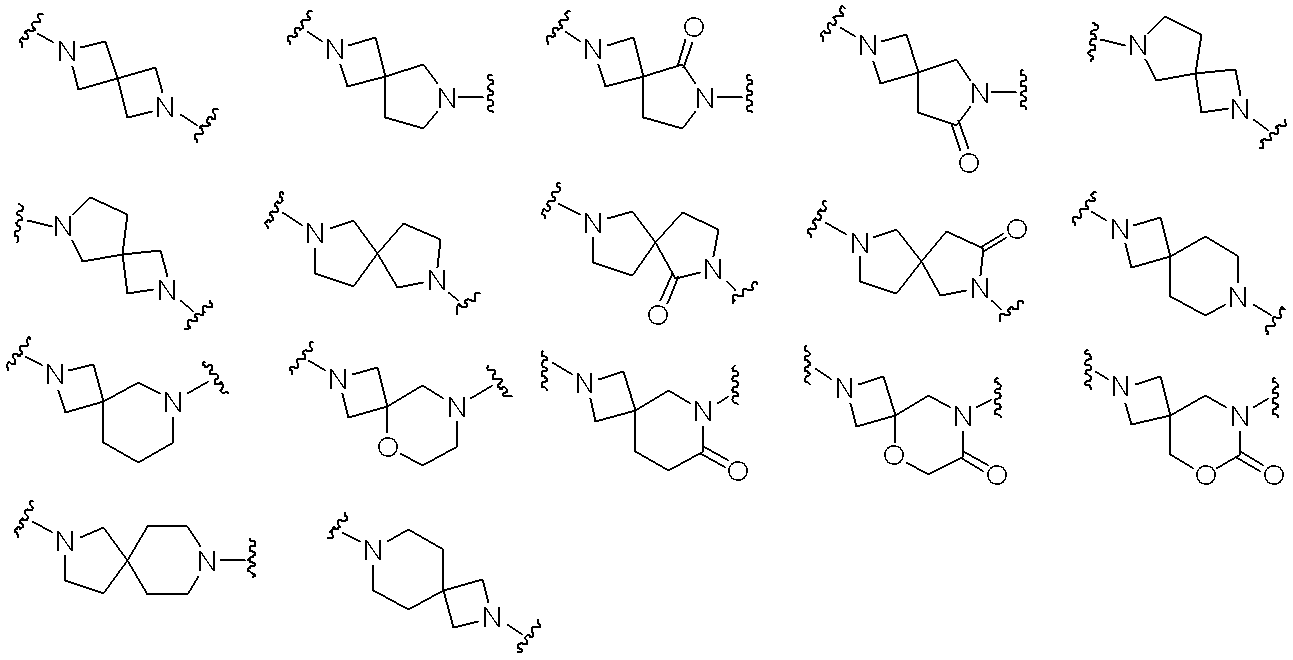
なかでも好ましくは、以下のものが推奨される。 Among these, the following are recommended.
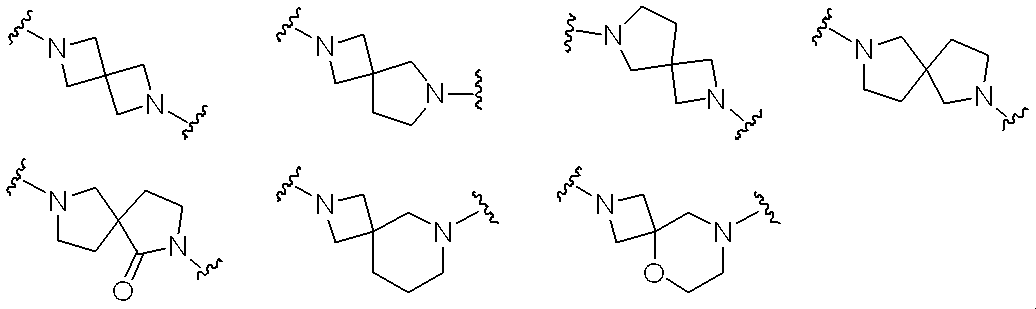
Ar1は、場合によりグループαよりなる群から選択される置換基で置換されていてもよい6員環の芳香族炭素環基又は場合によりグループαよりなる群から選択される置換基で置換されていてもよい6員環の芳香族含窒素複素環基を表す。又、Ar1は、同一または異なった1乃至4個、好ましくは1乃至3個のグループαよりなる群から選択される置換基で置換されていてもよい。 Ar 1 is optionally substituted with a 6-membered aromatic carbocyclic group optionally substituted with a substituent selected from the group consisting of group α or optionally with a substituent selected from the group consisting of group α. Represents a 6-membered aromatic nitrogen-containing heterocyclic group which may be substituted. Ar 1 may be substituted with a substituent selected from the group consisting of 1 to 4, preferably 1 to 3 groups α that are the same or different.
Ar1における6員環の芳香族炭素環としては、ベンゼン環が例示され、6員環の芳香族含窒素複素環としては、ピリジン環、ピラジン環、ピリミジン環、ピリダジン環等が例示される。 Examples of the 6-membered aromatic carbon ring in Ar 1 include a benzene ring, and examples of the 6-membered aromatic nitrogen-containing heterocycle include a pyridine ring, a pyrazine ring, a pyrimidine ring, and a pyridazine ring.
Ar1におけるグループαよりなる群から選択される置換基として好ましくは、ハロゲン、特にフッ素原子又は塩素原子が例示される。 The substituent selected from the group consisting of group α in Ar 1 is preferably a halogen, particularly a fluorine atom or a chlorine atom.
具体的なAr1としては、6員環の芳香族炭素環基としてフェニル、4-フルオロフェニル、3,4-ジフルオロフェニル、4-クロロ-3,5-ジフルオロフェニル、3,4,5-トリフルオロフェニル等が挙げられ、6員環の芳香族含窒素複素環基として、ピリジル、5-フルオロピリジン-2-イル、5-クロロピリジン-2-イル等が挙げられ、好ましくは、1乃至3個のフッ素原子若しくは塩素原子で置換されている6員環の芳香族炭素環基又は1乃至3個のフッ素原子若しくは塩素原子で置換されている6員環の芳香族含窒素複素環基が挙げられ、特に3,4-ジフルオロフェニル又は5-クロロピリジン-2-イルが推奨される。 Specific examples of Ar 1 include phenyl, 4-fluorophenyl, 3,4-difluorophenyl, 4-chloro-3,5-difluorophenyl, 3,4,5-triphenyl as a 6-membered aromatic carbocyclic group. And 6-membered aromatic nitrogen-containing heterocyclic groups include pyridyl, 5-fluoropyridin-2-yl, 5-chloropyridin-2-yl, and preferably 1 to 3 A 6-membered aromatic carbocyclic group substituted with 1 fluorine atom or chlorine atom or a 6-membered aromatic nitrogen-containing heterocyclic group substituted with 1 to 3 fluorine atoms or chlorine atom. In particular, 3,4-difluorophenyl or 5-chloropyridin-2-yl is recommended.
Ar2は、6員環の芳香族炭素環、6員環の芳香族含窒素複素環、5員環の芳香族複素環又はピリドン環から2個の水素原子を除いて形成される基を表し、ここで、6員環の芳香族炭素環、6員環の芳香族含窒素複素環、5員環の芳香族複素環又はピリドン環は、場合によりグループαよりなる群から選択される置換基で置換されていてもよい。又、Ar2は、同一または異なった1乃至4個、好ましくは1乃至2個のグループαよりなる群から選択される置換基で置換されていてもよい。 Ar 2 represents a group formed by removing two hydrogen atoms from a 6-membered aromatic carbocyclic ring, a 6-membered aromatic nitrogen-containing heterocyclic ring, a 5-membered aromatic heterocyclic ring or a pyridone ring. Wherein the 6-membered aromatic carbocyclic ring, 6-membered aromatic nitrogen-containing heterocyclic ring, 5-membered aromatic heterocyclic ring or pyridone ring is optionally a substituent selected from the group consisting of group α May be substituted. Ar 2 may be substituted with a substituent selected from the group consisting of 1 to 4, preferably 1 to 2 groups α that are the same or different.
Ar2における6員の芳香族炭素環としてベンゼン環が例示され、6員環の芳香族含窒素複素環基として、ピリジン環、ピラジン環、ピリミジン環、ピリダジン環が例示され、又、5員の芳香族複素環として、チオフェン環、チアゾール環、オキサゾール環、チアジアゾール環、オキサジアゾール環等が例示され、これらは、場合によりグループαよりなる群から選択される置換基で置換されていてもよい。 Examples of the 6-membered aromatic carbon ring in Ar 2 include a benzene ring, examples of the 6-membered aromatic nitrogen-containing heterocyclic group include a pyridine ring, a pyrazine ring, a pyrimidine ring, and a pyridazine ring. Examples of the aromatic heterocycle include a thiophene ring, a thiazole ring, an oxazole ring, a thiadiazole ring, an oxadiazole ring, and the like, which may be optionally substituted with a substituent selected from the group consisting of group α. .
Ar2におけるグループαよりなる群から選択される置換基として好ましくは、フッ素、塩素等のハロゲン、メチル、エチル等のC1-6アルキル、メトキシ、エトキシ等のC1-6アルキルオキシ、メタンスルホニル、エタンスルホニル等のC1-6アルキルスルホニル等が例示される。 The substituent selected from the group consisting of group α in Ar 2 is preferably halogen such as fluorine and chlorine, C 1-6 alkyl such as methyl and ethyl, C 1-6 alkyloxy such as methoxy and ethoxy, methanesulfonyl And C 1-6 alkylsulfonyl such as ethanesulfonyl.
より具体的なAr2としては、1,4-フェニレンジイル、3-メトキシフェニレン-1,4-ジイル、3-メタンスルホニルフェニレン-1,4-ジイル、2-フルオロフェニレン-1,4-ジイル、3-フルオロフェニレン-1,4-ジイル、2-メチルフェニレン-1,4-ジイル、ピリジン-2,5-ジイル、ピリミジン-2,5-ジイル、ピラジン-2,5-ジイル、ピリダジン-3,6-ジイル、チオフェン-2,5-ジイル、ピリドンジイル(特にピリドン-3,6-ジイル)等が推奨される。 More specific Ar 2 includes 1,4-phenylenediyl, 3-methoxyphenylene-1,4-diyl, 3-methanesulfonylphenylene-1,4-diyl, 2-fluorophenylene-1,4-diyl, 3-fluorophenylene-1,4-diyl, 2-methylphenylene-1,4-diyl, pyridine-2,5-diyl, pyrimidine-2,5-diyl, pyrazine-2,5-diyl, pyridazine-3, 6-diyl, thiophene-2,5-diyl, pyridonediyl (especially pyridone-3,6-diyl) and the like are recommended.
Ar3は、1又は2環性の芳香族炭素環基若しくは芳香族複素環基、又はピリドンを表し、該芳香族炭素環又は芳香族複素環は、非芳香族環状炭化水素又は非芳香族複素環が縮環してもよく、更に、該芳香族炭素環基、芳香族複素環基又はピリドンは、場合によりハロゲン、C1-6アルキル、ハロC1-6アルキル、ヒドロキシC1-6アルキル、C1-6アルキルオキシ、ハロC1-6アルキルオキシ、C3-6シクロアルキル、ヒドロキシC3-6シクロアルキル、シアノ、カルバモイル、モノC1-6アルキルカルバモイル、ジC1-6アルキルカルバモイル、C1-6アルキルスルホニル及びスルホニルアミドからなる置換基で、同一又は異なって、1乃至4置換されていてもよい。
い。
Ar 3 represents a monocyclic or bicyclic aromatic carbocyclic group or aromatic heterocyclic group, or pyridone, and the aromatic carbocyclic ring or aromatic heterocyclic ring is a non-aromatic cyclic hydrocarbon or non-aromatic heterocyclic group. The ring may be condensed, and the aromatic carbocyclic group, aromatic heterocyclic group or pyridone may optionally be halogen, C 1-6 alkyl, halo C 1-6 alkyl, hydroxy C 1-6 alkyl , C 1-6 alkyloxy, halo C 1-6 alkyloxy, C 3-6 cycloalkyl, hydroxy C 3-6 cycloalkyl, cyano, carbamoyl, mono C 1-6 alkylcarbamoyl, di-C 1-6 alkylcarbamoyl , C 1-6 alkylsulfonyl and sulfonylamide may be the same or different and may be substituted by 1 to 4 substituents.
Yes.
Ar3における置換基としては、フッ素、塩素等のハロゲン;メチル、エチル、n-プロピル、イソプロピル、n-ブチル、t-ブチル等のC1-6アルキル;クロロメチル、トリクロロメチル、フルオロメチル、トリフルオロメチル等のハロC1-6アルキル;ヒドロキシメチル、ヒドロキシエチル等のヒドロキシC1-6アルキル;メトキシ、エトキシ、n-プロピルオキシ、イソプロピルオキシ等のC1-6アルキルオキシ;クロロメトキシ、フルオロメトキシ、トリフルオロメトキシ等のハロC1-6アルキルオキシ;シクロプロピル、シクロブチル、シクロペンチル等のC3-6シクロアルキル;ヒドロキシシクロプロピル、ヒドロキシシクロブチル等のヒドロキシC3-6シクロアルキル;シアノ;カルバモイル;メチルカルバモイル、エチルカルバモイル等のモノC1-6アルキルカルバモイル;ジメチルカルバモイル、ジエチルカルバモイル等のジC1-6アルキルカルバモイル;及びメタンスルホニル、エタンスルホニル等のC1-6アルキルスルホニル、及びスルホニルアミドが例示され、同一または異なった1乃至4個、好ましくは1乃至2個の置換基で置換されていてもよい。 Ar 3 includes a substituent such as halogen such as fluorine and chlorine; C 1-6 alkyl such as methyl, ethyl, n-propyl, isopropyl, n-butyl and t-butyl; chloromethyl, trichloromethyl, fluoromethyl, tri hydroxymethyl, hydroxy C 1-6 alkyl such as hydroxyethyl; halo C 1-6 alkyl such as fluoromethyl, methoxy, ethoxy, n- propyloxy, C 1-6 alkyloxy, such as isopropyloxy, chloromethoxy, fluoromethoxy Halo C 1-6 alkyloxy such as trifluoromethoxy; C 3-6 cycloalkyl such as cyclopropyl, cyclobutyl, cyclopentyl; hydroxy C 3-6 cycloalkyl such as hydroxycyclopropyl, hydroxycyclobutyl; cyano; carbamoyl; Methylka Dimethylcarbamoyl, C 1-6 alkylcarbamoyl of diethylcarbamoyl etc.; Bamoiru, mono C 1-6 alkylcarbamoyl of ethylcarbamoyl etc. and methanesulfonyl, C 1-6 alkylsulfonyl such as ethanesulfonyl, and sulfonyl amide exemplified May be substituted with 1 to 4, preferably 1 to 2 substituents which are the same or different.
1又は2環性の芳香族炭素環としては、ベンゼン環、ナフタレン環等が例示される。 Examples of the monocyclic or bicyclic aromatic carbocycle include a benzene ring and a naphthalene ring.
1環性の芳香族複素環としては、ピリジン環、ピラジン環、ピリダジン環、ピリミジン環、チアジアゾール環、イソチアゾール環等が例示される。 Examples of the monocyclic aromatic heterocycle include pyridine ring, pyrazine ring, pyridazine ring, pyrimidine ring, thiadiazole ring, isothiazole ring and the like.
非芳香族環状炭化水素又は非芳香族複素環が縮環してもよい2環性の芳香族複素環としては、イミダゾピリジン環、ナフチリジン環、キノキサリン環、キナゾリン環等、及び以下のものが例示される。 Examples of bicyclic aromatic heterocycles that may be condensed with non-aromatic cyclic hydrocarbons or non-aromatic heterocycles include imidazopyridine rings, naphthyridine rings, quinoxaline rings, quinazoline rings, and the following: Is done.
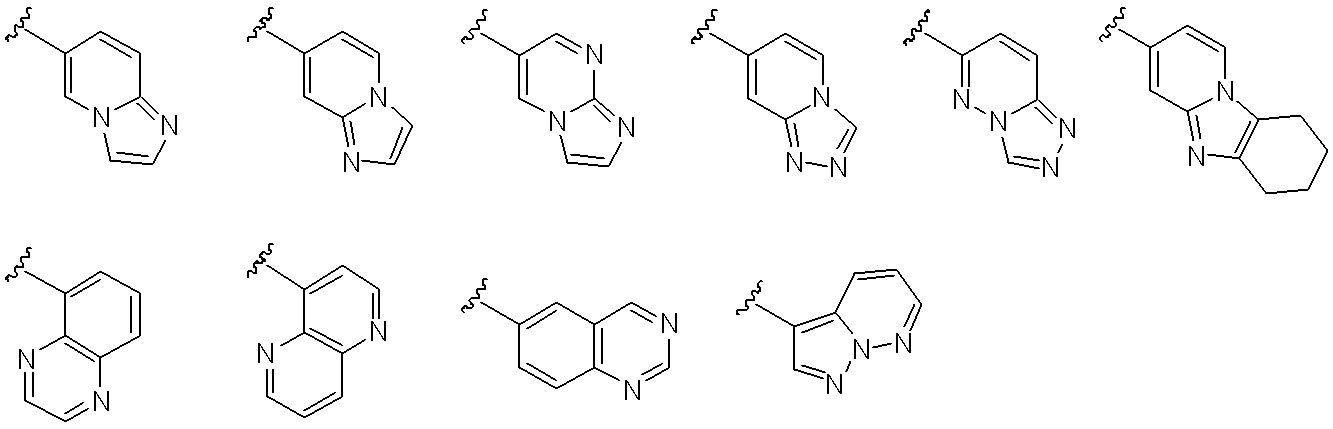
Ar3として好ましくは、以下のものが例示され、 Preferred examples of Ar 3 include the following:
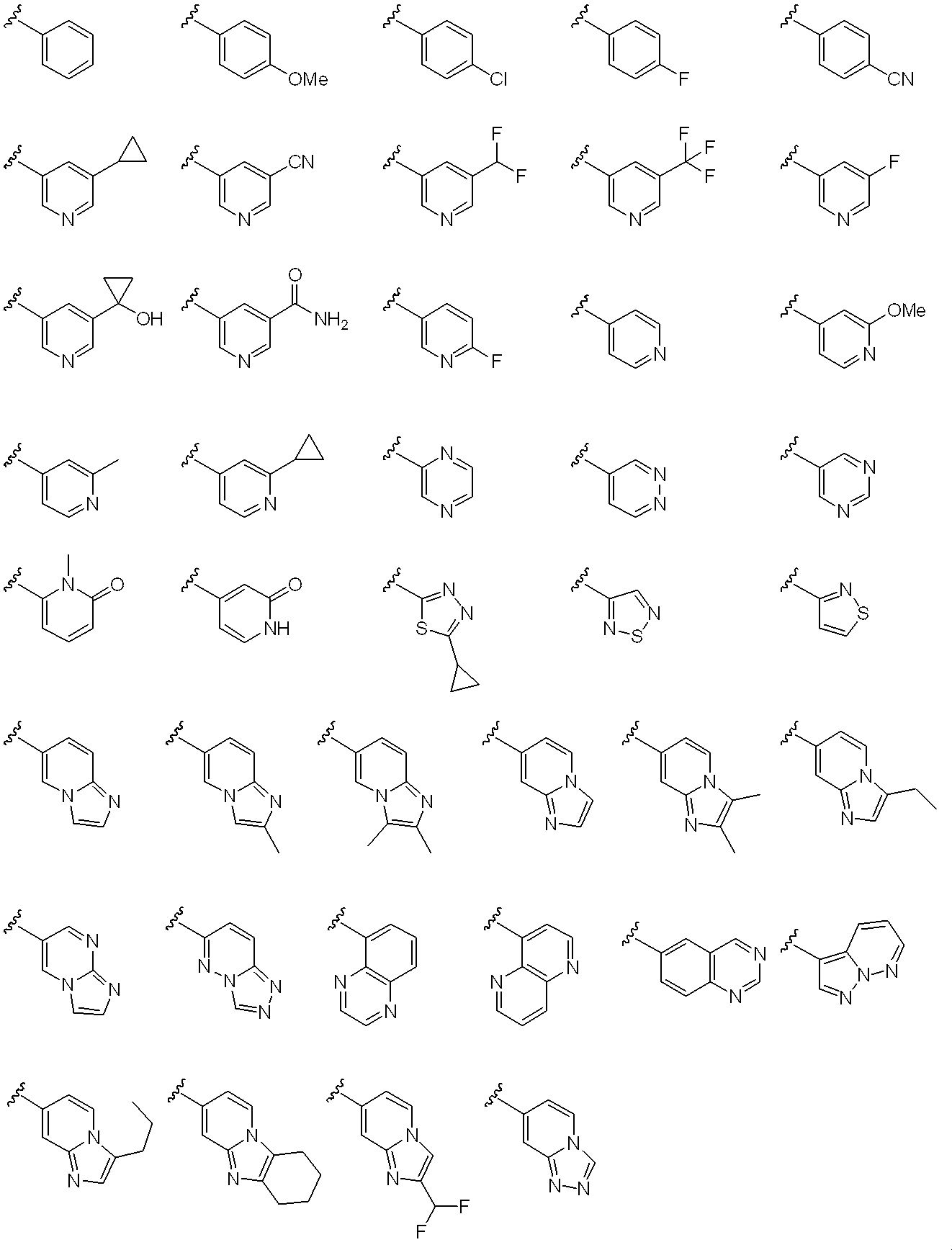
なかでも特に好ましくは、 Especially preferably,
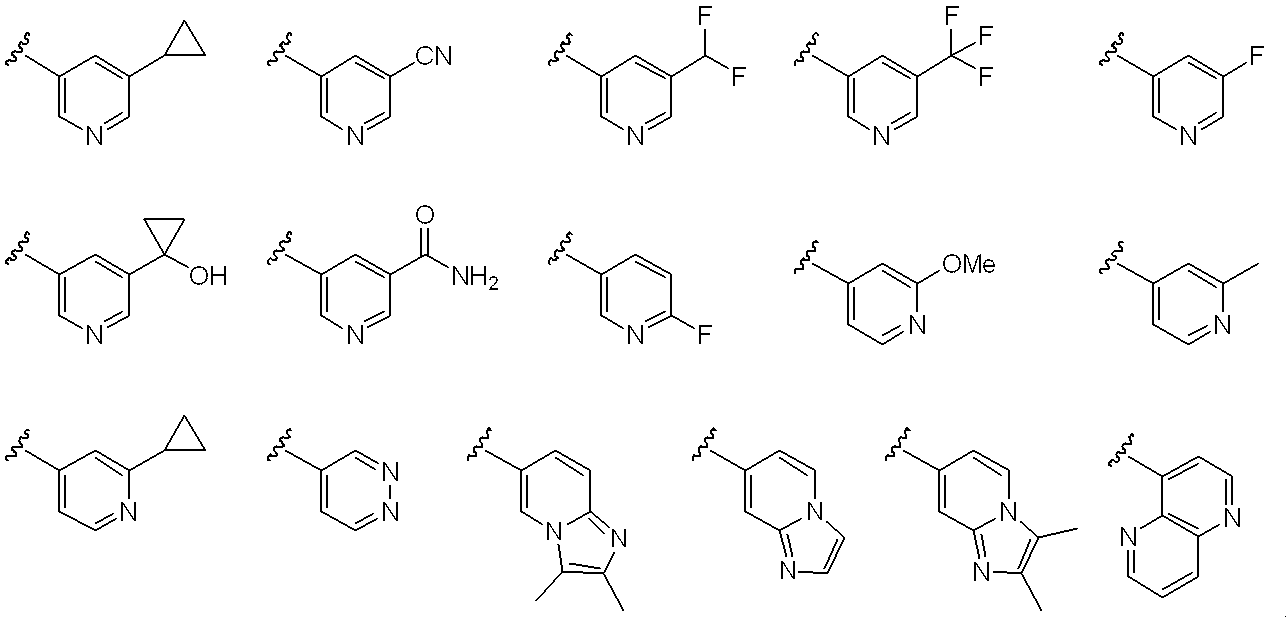
尚、本発明の式(I)で表される化合物は、下記のように、=N-OR2の部分で幾何異性体を生じ得るが、本発明では、何れの異性体も包含し、式(I)で表される構造は、その両方を包含することを意味する。尚、幾何異性体については、(E)及び(Z)の表記を用いることも可能であるが、Ar1及びAr2の種類により(E)、(Z)表記が一様ではない。従って、ここでは便宜上Ar1とオキシム置換基が二重結合の同じ側にある場合をシン、反対側にある場合をアンチと定義する。 In addition, the compound represented by the formula (I) of the present invention can give geometric isomers at the ═N—OR 2 moiety as described below. However, in the present invention, any isomers are included. The structure represented by (I) is meant to include both. For geometric isomers, the notations (E) and (Z) can be used, but the notations (E) and (Z) are not uniform depending on the types of Ar 1 and Ar 2 . Therefore, for convenience, the case where Ar 1 and the oxime substituent are on the same side of the double bond is defined as “syn”, and the case where they are on the opposite side is defined as “anti”.

更に、本発明は、式(I-x) Furthermore, the present invention provides a compound of formula (Ix)
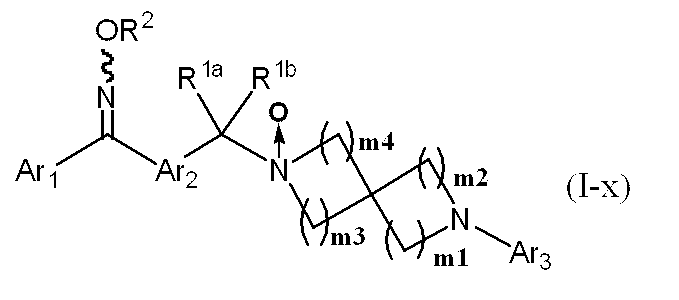
で表される化合物を提供する。式(I-x)で表される化合物は、式(I)で表される化合物を酸化することにより、容易に調製することができる。
The compound represented by these is provided. The compound represented by the formula (Ix) can be easily prepared by oxidizing the compound represented by the formula (I).
式(I)で表される化合物の中でも、
(E)-(3,4-ジフルオロフェニル){5-[(7-フェニル-2,7-ジアザスピロ[4.4]ノナ-2-イル)メチル]-2-ピリジニル}メタノン O-エチルオキシム、
5-{6-[(6-{(E)-(3,4-ジフルオロフェニル)[(エトキシ)イミノ]メチル}-3-ピリジニル)メチル]-2,6-ジアザスピロ[3.3]ヘプタ-2-イル}-3-ピリジンカルボニトリル、
(E)-(5-{[6-(2-シクロプロピル-4-ピリジニル)-2,6-ジアザスピロ[3.3]ヘプタ-2-イル]メチル}-2-ピリジニル)(3,4-ジフルオロフェニル)メタノン O-エチルオキシム、
(E)-(3,4-ジフルオロフェニル)(5-{[6-(6-フルオロ-3-ピリジニル)-2,6-ジアザスピロ[3.4]オクタ-2-イル]メチル}-2-ピリジニル)メタノン O-エチルオキシム、
(E)-(3,4-ジフルオロフェニル)(5-{[2-(6-フルオロ-3-ピリジニル)-2,6-ジアザスピロ[3.4]オクタ-6-イル]メチル}-2-ピリジニル)メタノン O-エチルオキシム、
5-(6-{[6-((E)-(3,4-ジフルオロフェニル){[(2-ヒドロキシ-2-メチルプロピル)オキシ]イミノ}メチル)-3-ピリジニル]メチル}-2,6-ジアザスピロ[3.3]ヘプタ-2-イル)-3-ピリジンカルボニトリル、
(E)-(3,4-ジフルオロフェニル){5-[(6-イミダゾ[1,2-a]ピリジン-7-イル-2,6-ジアザスピロ[3.3]ヘプタ-2-イル)メチル]-2-ピリジニル}メタノン O-(2-ヒドロキシ-2-メチルプロピル)オキシム、
(E)-(3,4-ジフルオロフェニル){5-[(7-ピラゾロ[1,5-b]ピリダジン-3-イル-2,7-ジアザスピロ[4.4]ノナ-2-イル)メチル]-2-ピリジニル}メタノン O-エチルオキシム、
(E)-(3,4-ジフルオロフェニル)(5-{[7-(4-ピリダジニル)-2,7-ジアザスピロ[4.4]ノナ-2-イル]メチル}-2-ピリジニル)メタノン O-エチルオキシム、
(E)-(3,4-ジフルオロフェニル)(5-{[6-(3-ピリジニル)-2,6-ジアザスピロ[3.3]ヘプタ-2-イル]メチル}-2-ピリジニル)メタノン O-エチルオキシム、
(E)-(3,4-ジフルオロフェニル)(5-{[6-(4-ピリジニル)-2,6-ジアザスピロ[3.3]ヘプタ-2-イル]メチル}-2-ピリジニル)メタノン O-エチルオキシム、
(E)-(3,4-ジフルオロフェニル)(5-{[6-(5-フルオロ-3-ピリジニル)-2,6-ジアザスピロ[3.3]ヘプタ-2-イル]メチル}-2-ピリジニル)メタノン O-エチルオキシム、
(E)-[5-({6-[5-(ジフルオロメチル)-3-ピリジニル]-2,6-ジアザスピロ[3.3]ヘプタ-2-イル}メチル)-2-ピリジニル](3,4-ジフルオロフェニル)メタノン O-エチルオキシム、
(E)-(5-{[6-(5-シクロプロピル-3-ピリジニル)-2,6-ジアザスピロ[3.3]ヘプタ-2-イル]メチル}-2-ピリジニル)(3,4-ジフルオロフェニル)メタノン O-エチルオキシム、
(E)-(3,4-ジフルオロフェニル)[5-({6-[5-(1-ヒドロキシシクロプロピル)-3-ピリジニル]-2,6-ジアザスピロ[3.3]ヘプタ-2-イル}メチル)-2-ピリジニル]メタノン O-エチルオキシム、
(E)-(3,4-ジフルオロフェニル)(5-{[6-(2-メチル-4-ピリジニル)-2,6-ジアザスピロ[3.3]ヘプタ-2-イル]メチル}-2-ピリジニル)メタノン O-エチルオキシム、
(E)-(3,4-ジフルオロフェニル)[5-({6-[2-(メチルオキシ)-4-ピリジニル]-2,6-ジアザスピロ[3.3]ヘプタ-2-イル}メチル)-2-ピリジニル]メタノン O-エチルオキシム、
(E)-(3,4-ジフルオロフェニル)(5-{[6-(3-イソチアゾリル)-2,6-ジアザスピロ[3.3]ヘプタ-2-イル]メチル}-2-ピリジニル)メタノン O-エチルオキシム、
(E)-(3,4-ジフルオロフェニル)(5-{[6-(1,5-ナフチリジン-4-イル)-2,6-ジアザスピロ[3.3]ヘプタ-2-イル]メチル}-2-ピリジニル)メタノン O-エチルオキシム、
(E)-(3,4-ジフルオロフェニル){5-[(6-イミダゾ[1,2-a]ピリジン-6-イル-2,6-ジアザスピロ[3.3]ヘプタ-2-イル)メチル]-2-ピリジニル}メタノン O-エチルオキシム、
(E)-(3,4-ジフルオロフェニル)(5-{[6-(2,3-ジメチルイミダゾ[1,2-a]ピリジン-6-イル)-2,6-ジアザスピロ[3.3]ヘプタ-2-イル]メチル}-2-ピリジニル)メタノン O-エチルオキシム、
(E)-(3,4-ジフルオロフェニル){5-[(6-イミダゾ[1,2-a]ピリジン-7-イル-2,6-ジアザスピロ[3.3]ヘプタ-2-イル)メチル]-2-ピリジニル}メタノン O-エチルオキシム、
(E)-(3,4-ジフルオロフェニル)(5-{[6-(3-プロピルイミダゾ[1,2-a]ピリジン-7-イル)-2,6-ジアザスピロ[3.3]ヘプタ-2-イル]メチル}-2-ピリジニル)メタノン O-エチルオキシム、
(E)-(3,4-ジフルオロフェニル)(5-{[6-(6,7,8,9-テトラヒドロピリド[1,2-a]ベンズイミダゾール-3-イル)-2,6-ジアザスピロ[3.3]ヘプタ-2-イル]メチル}-2-ピリジニル)メタノン O-エチルオキシム、
5-(6-{[6-((E)-(4-クロロ-3,5-ジフルオロフェニル){[(2-ヒドロキシ-2-メチルプロピル)オキシ]イミノ}メチル)-3-ピリジニル]メチル}-2,6-ジアザスピロ[3.3]ペプタ-2-イル)-3-ピリジンカルボニトリル、
(E)-(3,4-ジフルオロフェニル)(5-{[(5R)又は(5S)-7-(2-メチル-4-ピリジニル)-2,7-ジアザスピロ[4.4]ノナ-2-イル]メチル}-2-ピリジニル)メタノン O-(2-ヒドロキシ-2-メチルプロピル)オキシム、
及び(E)-(3,4-ジフルオロフェニル)(5-{[6-(6-フルオロ-3-ピリジニル)-2,6-ジアザスピロ[3.5]ノナ-2-イル]メチル}-2-ピリジニル)メタノン O-エチルオキシムよりなる群から選択される化合物が推奨される。
Among the compounds represented by formula (I),
(E)-(3,4-difluorophenyl) {5-[(7-phenyl-2,7-diazaspiro [4.4] non-2-yl) methyl] -2-pyridinyl} methanone O-ethyloxime,
5- {6-[(6-{(E)-(3,4-difluorophenyl) [(ethoxy) imino] methyl} -3-pyridinyl) methyl] -2,6-diazaspiro [3.3] hepta 2-yl} -3-pyridinecarbonitrile,
(E)-(5-{[6- (2-Cyclopropyl-4-pyridinyl) -2,6-diazaspiro [3.3] hept-2-yl] methyl} -2-pyridinyl) (3,4 Difluorophenyl) methanone O-ethyloxime,
(E)-(3,4-difluorophenyl) (5-{[6- (6-fluoro-3-pyridinyl) -2,6-diazaspiro [3.4] oct-2-yl] methyl} -2- Pyridinyl) methanone O-ethyl oxime,
(E)-(3,4-difluorophenyl) (5-{[2- (6-fluoro-3-pyridinyl) -2,6-diazaspiro [3.4] oct-6-yl] methyl} -2- Pyridinyl) methanone O-ethyl oxime,
5- (6-{[6-((E)-(3,4-difluorophenyl) {[(2-hydroxy-2-methylpropyl) oxy] imino} methyl) -3-pyridinyl] methyl} -2, 6-diazaspiro [3.3] hept-2-yl) -3-pyridinecarbonitrile,
(E)-(3,4-difluorophenyl) {5-[(6-imidazo [1,2-a] pyridin-7-yl-2,6-diazaspiro [3.3] hept-2-yl) methyl ] -2-pyridinyl} methanone O- (2-hydroxy-2-methylpropyl) oxime,
(E)-(3,4-Difluorophenyl) {5-[(7-pyrazolo [1,5-b] pyridazin-3-yl-2,7-diazaspiro [4.4] non-2-yl) methyl ] -2-Pyridinyl} methanone O-ethyl oxime,
(E)-(3,4-difluorophenyl) (5-{[7- (4-pyridazinyl) -2,7-diazaspiro [4.4] non-2-yl] methyl} -2-pyridinyl) methanone O -Ethyl oxime,
(E)-(3,4-Difluorophenyl) (5-{[6- (3-pyridinyl) -2,6-diazaspiro [3.3] hept-2-yl] methyl} -2-pyridinyl) methanone O -Ethyl oxime,
(E)-(3,4-difluorophenyl) (5-{[6- (4-pyridinyl) -2,6-diazaspiro [3.3] hept-2-yl] methyl} -2-pyridinyl) methanone O -Ethyl oxime,
(E)-(3,4-difluorophenyl) (5-{[6- (5-fluoro-3-pyridinyl) -2,6-diazaspiro [3.3] hept-2-yl] methyl} -2- Pyridinyl) methanone O-ethyl oxime,
(E)-[5-({6- [5- (Difluoromethyl) -3-pyridinyl] -2,6-diazaspiro [3.3] hept-2-yl} methyl) -2-pyridinyl] (3 4-difluorophenyl) methanone O-ethyloxime,
(E)-(5-{[6- (5-Cyclopropyl-3-pyridinyl) -2,6-diazaspiro [3.3] hept-2-yl] methyl} -2-pyridinyl) (3,4 Difluorophenyl) methanone O-ethyloxime,
(E)-(3,4-Difluorophenyl) [5-({6- [5- (1-hydroxycyclopropyl) -3-pyridinyl] -2,6-diazaspiro [3.3] hept-2-yl } Methyl) -2-pyridinyl] methanone O-ethyloxime,
(E)-(3,4-difluorophenyl) (5-{[6- (2-methyl-4-pyridinyl) -2,6-diazaspiro [3.3] hept-2-yl] methyl} -2- Pyridinyl) methanone O-ethyl oxime,
(E)-(3,4-difluorophenyl) [5-({6- [2- (methyloxy) -4-pyridinyl] -2,6-diazaspiro [3.3] hept-2-yl} methyl) -2-pyridinyl] methanone O-ethyl oxime,
(E)-(3,4-difluorophenyl) (5-{[6- (3-isothiazolyl) -2,6-diazaspiro [3.3] hept-2-yl] methyl} -2-pyridinyl) methanone O -Ethyl oxime,
(E)-(3,4-Difluorophenyl) (5-{[6- (1,5-naphthyridin-4-yl) -2,6-diazaspiro [3.3] hept-2-yl] methyl}- 2-pyridinyl) methanone O-ethyl oxime,
(E)-(3,4-difluorophenyl) {5-[(6-imidazo [1,2-a] pyridin-6-yl-2,6-diazaspiro [3.3] hept-2-yl) methyl ] -2-Pyridinyl} methanone O-ethyl oxime,
(E)-(3,4-Difluorophenyl) (5-{[6- (2,3-dimethylimidazo [1,2-a] pyridin-6-yl) -2,6-diazaspiro [3.3] Hept-2-yl] methyl} -2-pyridinyl) methanone O-ethyloxime,
(E)-(3,4-difluorophenyl) {5-[(6-imidazo [1,2-a] pyridin-7-yl-2,6-diazaspiro [3.3] hept-2-yl) methyl ] -2-Pyridinyl} methanone O-ethyl oxime,
(E)-(3,4-Difluorophenyl) (5-{[6- (3-propylimidazo [1,2-a] pyridin-7-yl) -2,6-diazaspiro [3.3] hepta- 2-yl] methyl} -2-pyridinyl) methanone O-ethyloxime,
(E)-(3,4-difluorophenyl) (5-{[6- (6,7,8,9-tetrahydropyrido [1,2-a] benzimidazol-3-yl) -2,6- Diazaspiro [3.3] hept-2-yl] methyl} -2-pyridinyl) methanone O-ethyloxime,
5- (6-{[6-((E)-(4-Chloro-3,5-difluorophenyl) {[(2-hydroxy-2-methylpropyl) oxy] imino} methyl) -3-pyridinyl] methyl } -2,6-diazaspiro [3.3] pept-2-yl) -3-pyridinecarbonitrile,
(E)-(3,4-difluorophenyl) (5-{[(5R) or (5S) -7- (2-methyl-4-pyridinyl) -2,7-diazaspiro [4.4] nona-2 -Yl] methyl} -2-pyridinyl) methanone O- (2-hydroxy-2-methylpropyl) oxime,
And (E)-(3,4-difluorophenyl) (5-{[6- (6-fluoro-3-pyridinyl) -2,6-diazaspiro [3.5] non-2-yl] methyl} -2 -Pyridinyl) methanone A compound selected from the group consisting of O-ethyloxime is recommended.
式(I)で表される化合物の製造方法
式(I)で表される化合物は、例えば以下の製造方法により調製可能であるが、これらに限定されるものではない。
Method for Producing Compound Represented by Formula (I) The compound represented by formula (I) can be prepared, for example, by the following production method, but is not limited thereto.
製造方法1-1
製造方法1-1は、式(II)で表される化合物を原料とした式(I)で表される化合物の製造方法である。
Manufacturing method 1-1
Production method 1-1 is a method for producing a compound represented by formula (I) using a compound represented by formula (II) as a raw material.
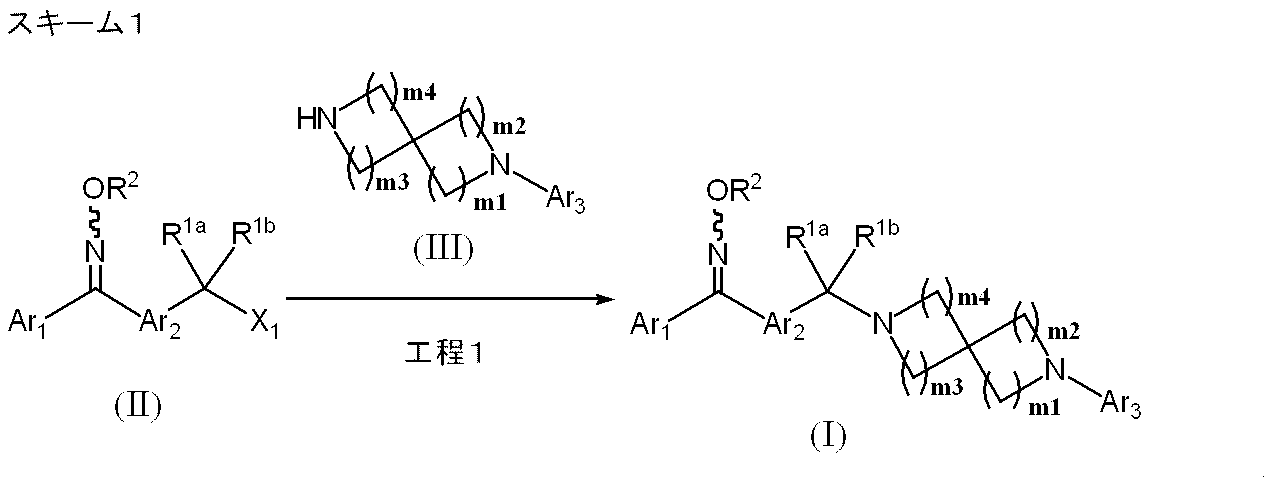
工程1
式(II)で表される化合物と式(III)で表される化合物を、反応溶媒中、好ましくは塩基の存在下で反応させ、式(I)で表される化合物を得る。
Process 1
The compound represented by the formula (II) and the compound represented by the formula (III) are reacted in a reaction solvent, preferably in the presence of a base, to obtain a compound represented by the formula (I).
式(III)で表される化合物の使用量としては、式(II)で表される化合物1モルに対して1.0~1.5モルが例示され、好ましくは1.0~1.3モルが推奨される。 Examples of the amount of the compound represented by the formula (III) include 1.0 to 1.5 mol, preferably 1.0 to 1.3 mol with respect to 1 mol of the compound represented by the formula (II). Mole is recommended.
塩基としては、炭酸ナトリウム、炭酸水素ナトリウム、炭酸カリウム、炭酸水素カリウム、炭酸リチウム等の無機塩基;トリエチルアミン、ジイソプロピルエチルアミン、ピリジン等の有機塩基等が例示され、塩基の使用量としては、式(II)で表される化合物1モルに対して1.0~5.0モルが例示され、好ましくは1.1~1.5モルが推奨される。 Examples of the base include inorganic bases such as sodium carbonate, sodium hydrogen carbonate, potassium carbonate, potassium hydrogen carbonate, and lithium carbonate; organic bases such as triethylamine, diisopropylethylamine, pyridine, and the like. ) Is exemplified by 1.0 to 5.0 mol, preferably 1.1 to 1.5 mol based on 1 mol of the compound represented by (II).
反応溶媒としては塩化メチレン、クロロホルム、四塩化炭素等のハロゲン化炭化水素;ジエチルエーテル、テトラヒドロフラン(以下、「THF」という)、ジオキサン等のエーテル類;N,N-ジメチルホルムアミド(以下、「DMF」という)、ジメチルスルホキシド(以下、「DMSO」という)等が例示される。 Examples of the reaction solvent include halogenated hydrocarbons such as methylene chloride, chloroform and carbon tetrachloride; ethers such as diethyl ether, tetrahydrofuran (hereinafter referred to as “THF”) and dioxane; N, N-dimethylformamide (hereinafter referred to as “DMF”). And dimethyl sulfoxide (hereinafter referred to as “DMSO”) and the like.
反応温度としては0~100℃が例示され、好ましくは10~40℃が推奨され、通常、1~24時間で反応が完結する。 As the reaction temperature, 0 to 100 ° C. is exemplified, preferably 10 to 40 ° C. is recommended, and the reaction is usually completed in 1 to 24 hours.
式(II)で表される化合物は、WO2008/038692号に記載の方法で調製可能であり、式(III)で表される化合物は、以降に記載する方法で調製可能である。 The compound represented by the formula (II) can be prepared by the method described in WO2008 / 038692, and the compound represented by the formula (III) can be prepared by the method described below.
製造方法1-2
製造方法1-2は、式(I)で表される化合物の別途調製方法である。
Manufacturing method 1-2
Production method 1-2 is a separate method for preparing the compound represented by formula (I).

工程2
塩基性触媒、リガンド及び金属触媒の存在下、式(IV)で表される化合物と、式(V)で表される化合物とを、反応溶媒中で縮合し、式(I)で表される化合物を得る。
Process 2
In the presence of a basic catalyst, a ligand and a metal catalyst, the compound represented by the formula (IV) and the compound represented by the formula (V) are condensed in a reaction solvent and represented by the formula (I). A compound is obtained.
式(V)で表される化合物の使用量としては、式(IV)で表される化合物1モルにつき、1~5モルが例示され、好ましくは1~3モルが推奨される。 Examples of the amount of the compound represented by the formula (V) include 1 to 5 mol, preferably 1 to 3 mol per mol of the compound represented by the formula (IV).
塩基性触媒としては、炭酸カリウム、炭酸セシウム、リン酸カリウム、酢酸カリウム、ナトリウムt-ブトキシド、リチウム ヘキサメチルジシラザン等が例示され、好ましくは、ナトリウムt-ブトキシド、炭酸セシウム等が推奨され、塩基の使用量としては、式(IV)で表される化合物1モルにつき、1~5モルが例示され、好ましくは1~1.5モルが推奨される。 Examples of the basic catalyst include potassium carbonate, cesium carbonate, potassium phosphate, potassium acetate, sodium t-butoxide, lithium hexamethyldisilazane, etc., preferably sodium t-butoxide, cesium carbonate and the like are recommended. The amount of is exemplified by 1 to 5 mol, preferably 1 to 1.5 mol, per 1 mol of the compound represented by the formula (IV).
リガンドとしては、BINAP、トリt-ブチルホスフィン、N,N’-ジメチルシクロヘキサンジアミン、プロリン等が例示され、好ましくは、BINAP、N,N’-ジメチルシクロヘキサンジアミン、プロリン等が推奨され、リガンドの使用量としては、式(IV)で表される化合物1モルにつき、1~0.01モルが例示され、好ましくは0.1~0.01モルが推奨される。 Examples of the ligand include BINAP, tri-t-butylphosphine, N, N′-dimethylcyclohexanediamine, proline, etc., preferably BINAP, N, N′-dimethylcyclohexanediamine, proline, etc. are recommended, and the use of the ligand The amount is, for example, 1 to 0.01 mol, preferably 0.1 to 0.01 mol, per 1 mol of the compound represented by the formula (IV).
金属触媒としては、Pd2dba3、Pd(dba)2、Pd(OAc)2、CuI等が例示され、好ましくは、Pd2dba3、Pd(OAc)2、CuI等が推奨され、金属触媒の使用量としては、式(IV)で表される化合物1モルにつき、1~0.01モルが例示され、好ましくは0.1~0.01モルが推奨される。 Examples of the metal catalyst include Pd 2 dba 3 , Pd (dba) 2 , Pd (OAc) 2 , CuI and the like, preferably Pd 2 dba 3, Pd (OAc) 2 , CuI and the like are recommended, and the metal catalyst Is used in an amount of 1 to 0.01 mol, preferably 0.1 to 0.01 mol, per mol of the compound represented by the formula (IV).
反応溶媒としては、ジオキサン、THF、トルエン、キシレン、ベンゼン、DMSO等が例示される。 Examples of the reaction solvent include dioxane, THF, toluene, xylene, benzene, DMSO and the like.
反応温度としては、室温~160℃、好ましくは室温~100℃が例示され、通常、1~24時間で反応が完結する。 The reaction temperature is room temperature to 160 ° C., preferably room temperature to 100 ° C., and the reaction is usually completed in 1 to 24 hours.
尚、反応促進のため、反応時にマイクロウェーブを照射してもよい。 In order to accelerate the reaction, microwaves may be irradiated during the reaction.
尚、式(IV)で表される化合物は、後述する方法で調製可能であり、又、式(V)で表される化合物としては、ブロモベンゼン、1-ブロモ-2-フルオロベンゼン、4-ブロモベンゾニトリル、4-ブロモピリジン、3-ブロモ-5-(メチルオキシ)ピリジン、3-ブロモ-5-(ジフルオロメチル)ピリジン、3-ブロモ-5-(トリフルオロメチル)ピリジン、3-ブロモ-5-シクロプロピルピリジン、3-ブロモ-5-(1-{[(1,1-ジメチルエチル)(ジメチル)シリル]オキシ}シクロプロピル)ピリジン、2-ヨードピラジン、4-ブロモピリダジン、5-ブロモピリミジン、6-ブロモ-1-メチル-2(1H)-ピリドン、4-ヨード-2(1H)-ピリドン、4-ブロモ-2-メチルピリジン、2-ブロモ-5-シクロプロピル-1,3,4-チアジアゾール、3-ブロモ-1,2,5-チアジアゾール、3-ブロモ-イソチアゾール、4-ブロモ-1,5-ナフチリジン、5-ブロモキノキサリン、7-ブロモキナゾリン、6-ブロモイミダゾ[1,2-a]ピリジン、7-ブロモイミダゾ[1,2-a]ピリジン、7-ブロモ-2,3-ジメチルイミダゾ[1,2-a]ピリジン、3-ブロモ-6,7,8,9-テトラヒドロピリド[1,2-a]ベンズイミダゾール、7-ブロモ-2-(ジフルオロメチル)イミダゾ[1,2-a]ピリジン、6-ブロモイミダゾ[1,2-a]ピリミジン、3-ブロモピラゾロ[1,5-b]ピリダジン等が例示される。 The compound represented by the formula (IV) can be prepared by the method described later, and examples of the compound represented by the formula (V) include bromobenzene, 1-bromo-2-fluorobenzene, 4- Bromobenzonitrile, 4-bromopyridine, 3-bromo-5- (methyloxy) pyridine, 3-bromo-5- (difluoromethyl) pyridine, 3-bromo-5- (trifluoromethyl) pyridine, 3-bromo- 5-cyclopropylpyridine, 3-bromo-5- (1-{[(1,1-dimethylethyl) (dimethyl) silyl] oxy} cyclopropyl) pyridine, 2-iodopyrazine, 4-bromopyridazine, 5-bromo Pyrimidine, 6-bromo-1-methyl-2 (1H) -pyridone, 4-iodo-2 (1H) -pyridone, 4-bromo-2-methylpyridine, 2-bromide -5-cyclopropyl-1,3,4-thiadiazole, 3-bromo-1,2,5-thiadiazole, 3-bromo-isothiazole, 4-bromo-1,5-naphthyridine, 5-bromoquinoxaline, 7- Bromoquinazoline, 6-bromoimidazo [1,2-a] pyridine, 7-bromoimidazo [1,2-a] pyridine, 7-bromo-2,3-dimethylimidazo [1,2-a] pyridine, 3- Bromo-6,7,8,9-tetrahydropyrido [1,2-a] benzimidazole, 7-bromo-2- (difluoromethyl) imidazo [1,2-a] pyridine, 6-bromoimidazo [1, Examples include 2-a] pyrimidine and 3-bromopyrazolo [1,5-b] pyridazine.
製造方法1-3
製造方法1-3は、式(I)で表される化合物の更なる別途合成方法である。
Manufacturing method 1-3
Production method 1-3 is a method for further separately synthesizing the compound represented by formula (I).
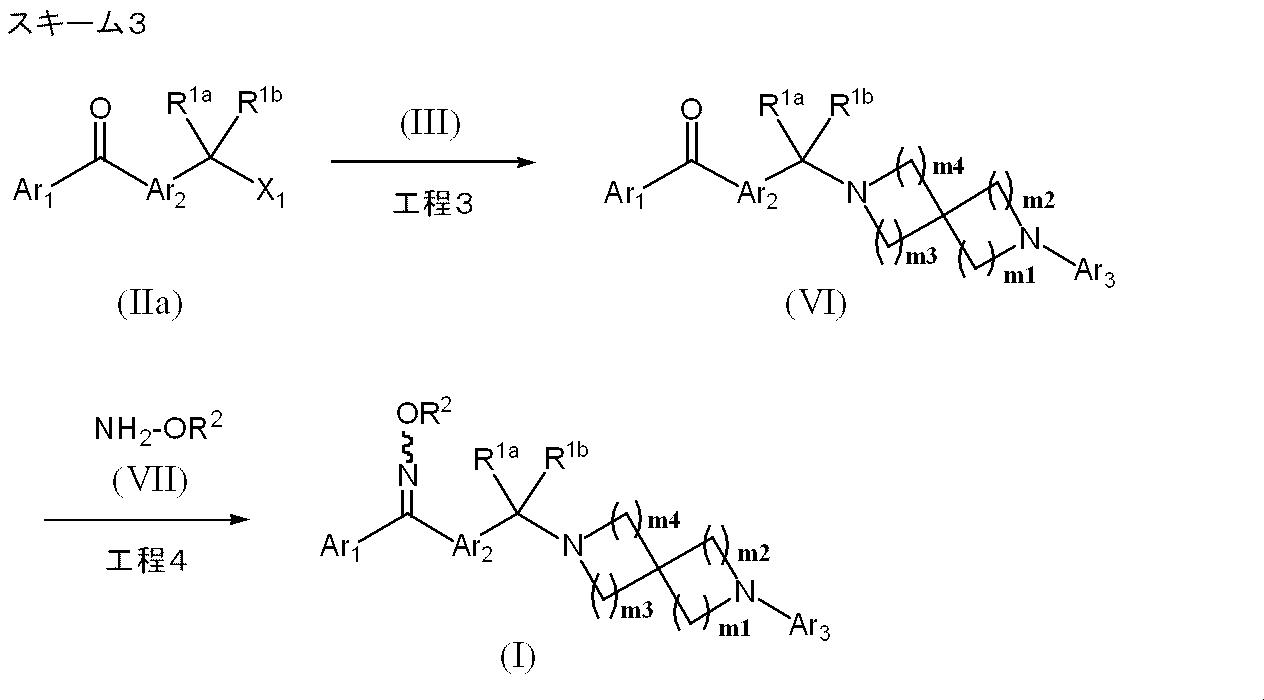
工程3
式(IIa)で表される化合物と式(III)で表される化合物とを、工程1に準じて反応を行い、式(VI)で表される化合物を得る。尚、式(IIa)で表される化合物は、WO2008/386921に記載の化合物又は従来公知の化合物が使用可能である。
Process 3
The compound represented by the formula (IIa) and the compound represented by the formula (III) are reacted according to Step 1 to obtain a compound represented by the formula (VI). In addition, as the compound represented by the formula (IIa), a compound described in WO2008 / 386721 or a conventionally known compound can be used.
工程4
式(VI)で表される化合物を式(VII)で表される化合物を用いて公知の方法(例えばWO2008/386921)によりオキシム化することにより、式(I)で表される化合物を得る。
Process 4
The compound represented by the formula (I) is obtained by oximation of the compound represented by the formula (VI) using the compound represented by the formula (VII) by a known method (for example, WO2008 / 386721).
式(VII)で表される化合物の使用量としては、式(VI)で表される化合物1モルにつき1.0~5.0モルが例示され、好ましくは1.0~1.5モルが推奨される。 Examples of the amount of the compound represented by the formula (VII) include 1.0 to 5.0 mol, preferably 1.0 to 1.5 mol per 1 mol of the compound represented by the formula (VI). Recommended.
反応溶媒としては、メタノール、エタノール、n-ブタノール、イソプロピルアルコール等の低級アルコール又はピリジン等が例示される。 Examples of the reaction solvent include lower alcohols such as methanol, ethanol, n-butanol and isopropyl alcohol, pyridine and the like.
反応温度としては、0~100℃が例示され、好ましくは10~30℃が推奨され、通常、0.5~24時間で反応が完結する。 As the reaction temperature, 0 to 100 ° C. is exemplified, preferably 10 to 30 ° C. is recommended, and the reaction is usually completed in 0.5 to 24 hours.
式(VII)で表される化合物としては、ヒドロキシルアミン塩酸塩、O-メチルヒドロキシルアミン塩酸塩、O-エチルヒドロキシルアミン塩酸塩、O-シクロプロピルヒドロキシルアミン塩酸塩、O-メチルスルホニルヒドロキシルアミン塩酸塩、2-フルオロエチルヒドロキシルアミン塩酸塩、O-(2-ヒドロキシ-2-メチルプロピル)ヒドロキシルアミン塩酸塩等が例示される。 Examples of the compound represented by the formula (VII) include hydroxylamine hydrochloride, O-methylhydroxylamine hydrochloride, O-ethylhydroxylamine hydrochloride, O-cyclopropylhydroxylamine hydrochloride, O-methylsulfonylhydroxylamine hydrochloride 2-fluoroethylhydroxylamine hydrochloride, O- (2-hydroxy-2-methylpropyl) hydroxylamine hydrochloride and the like.
製造方法2-1
製造方法2-1は、式(III)で表される化合物の製造方法である。
Manufacturing method 2-1
Production method 2-1 is a method for producing a compound represented by formula (III).
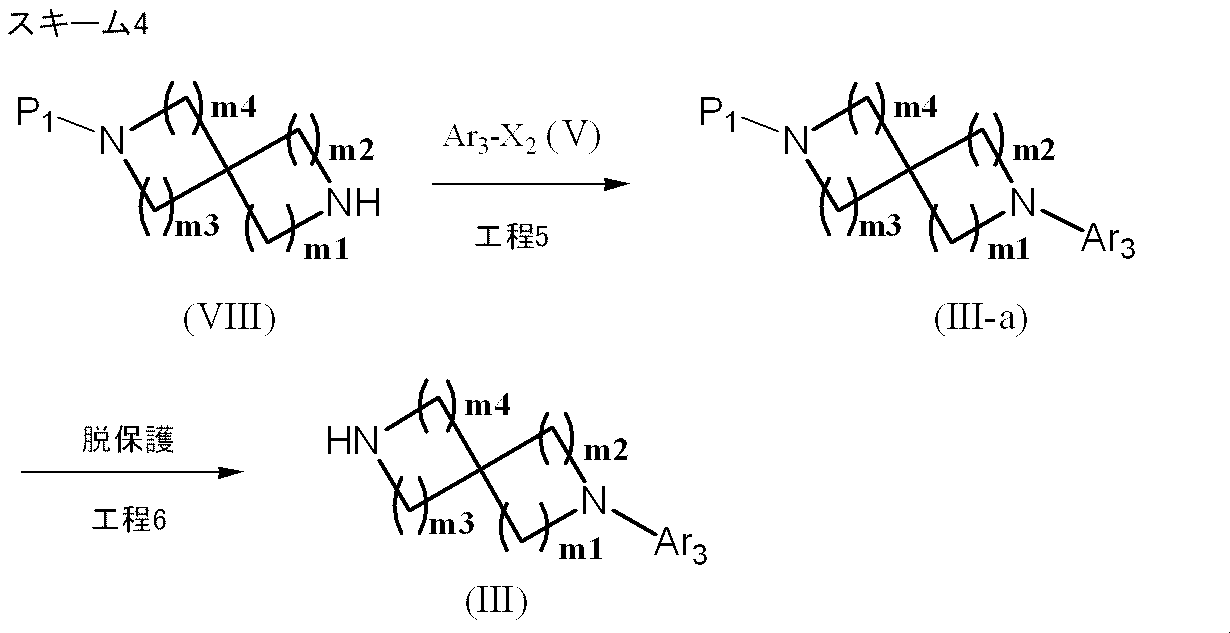
工程5
式(VIII)で表される化合物と、式(V)で表される化合物とを工程2に準じて反応を行い、式(III-a)で表される化合物を得る。尚、式(VIII)で表される化合物は、従来公知の化合物を使用できる他、対応する公知のスピロジアミンに保護基P1を導入することにより調製可能である。
Process 5
The compound represented by the formula (VIII) and the compound represented by the formula (V) are reacted according to Step 2 to obtain the compound represented by the formula (III-a). In addition, the compound represented by the formula (VIII) can be prepared by introducing a protecting group P1 into a corresponding known spirodiamine in addition to using a conventionally known compound.
工程6
(III-a)で表される化合物の保護基を除去し、式(III)で表される化合物を得る。脱保護は、文献記載の方法[プロテクティブ・グループス・イン・オーガニック・シンセシス,T.W.Greene,John Wiley & Sons(1981年)参照]又はそれに準じる方法に従って、行うことができる。
Step 6
The protecting group of the compound represented by (III-a) is removed to obtain the compound represented by formula (III). Deprotection is carried out by a method described in the literature [Protective Groups in Organic Synthesis, T.A. W. See Greene, John Wiley & Sons (1981)] or a similar method.
例えば、P1がtert-ブチルオキシカルボニル(t-Boc)基の場合は、トリフルオロ酢酸、塩酸等により、室温~100℃、好ましくは室温~60℃で、10分~6時間、好ましくは0.5~2時間反応を行うことにより、脱保護が可能である。 For example, when P1 is a tert-butyloxycarbonyl (t-Boc) group, trifluoroacetic acid, hydrochloric acid or the like is used at room temperature to 100 ° C., preferably at room temperature to 60 ° C., for 10 minutes to 6 hours, preferably at 0. Deprotection is possible by carrying out the reaction for 5 to 2 hours.
製造方法2-2
製造方法2-2は、式(II)で表される化合物又は式(IV)で表される化合物の製造方法である。
Manufacturing method 2-2
Production method 2-2 is a method for producing a compound represented by formula (II) or a compound represented by formula (IV).
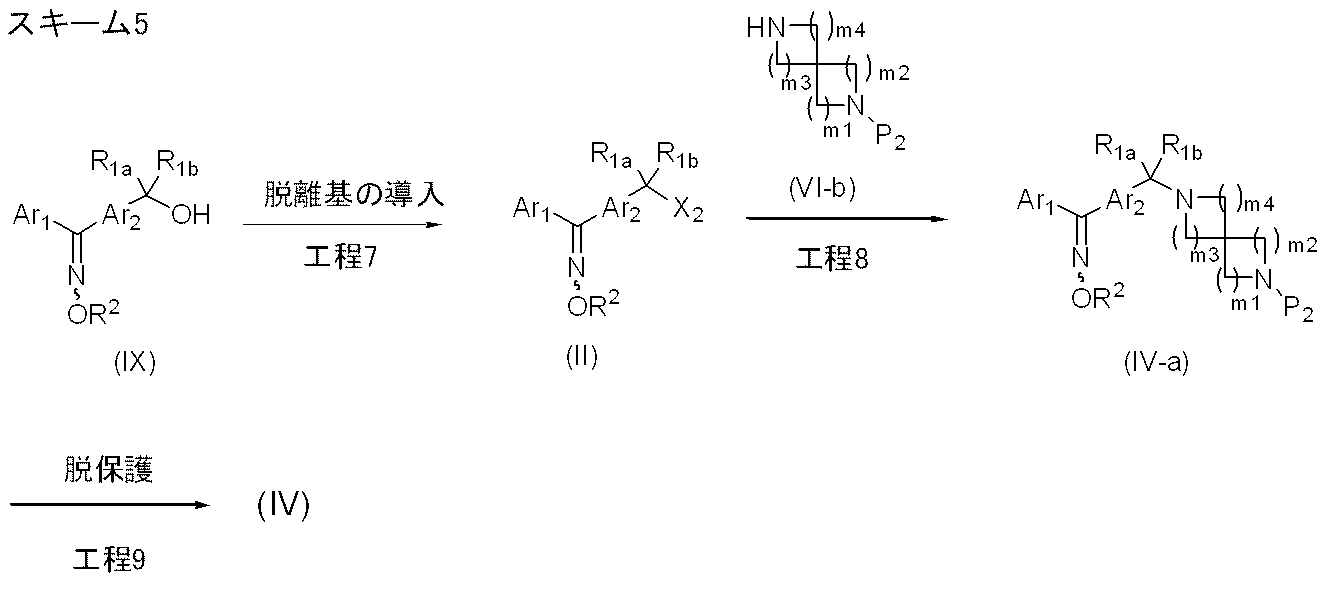
工程7
式(IX)で表される化合物の水酸基に脱離基を導入し、式(II)で表される化合物を得る。例えば、X2がメタンスルホニルオキシ基の場合は、式(IX)で表される化合物を有機溶媒中、塩基触媒の存在下で、メタンスルホニルクロリドと反応を行い、式(II)で表される化合物を得る。
Step 7
A leaving group is introduced into the hydroxyl group of the compound represented by the formula (IX) to obtain the compound represented by the formula (II). For example, when X 2 is a methanesulfonyloxy group, the compound represented by the formula (IX) is reacted with methanesulfonyl chloride in an organic solvent in the presence of a base catalyst, and represented by the formula (II). A compound is obtained.
メタンスルホニルクロリドの使用量としては、式(IX)で表される化合物1モルに対して1.0~1.5モルが例示され、好ましくは1.0~1.3モルが推奨される。 The amount of methanesulfonyl chloride used is, for example, 1.0 to 1.5 mol, preferably 1.0 to 1.3 mol based on 1 mol of the compound represented by the formula (IX).
塩基としては、トリエチルアミン、ジイソプロピルエチルアミン、ピリジン等が例示され、塩基の使用量としては、式(IX)で表される化合物1モルに対して1.0~3モルが例示され、好ましくは1.0~2.0モルが推奨される。 Examples of the base include triethylamine, diisopropylethylamine, pyridine and the like. The amount of the base used is, for example, 1.0 to 3 mol with respect to 1 mol of the compound represented by the formula (IX). 0-2.0 mol is recommended.
反応溶媒としては、酢酸エチル、塩化メチレン、クロロホルム、THF、DMF等が例示される。 Examples of the reaction solvent include ethyl acetate, methylene chloride, chloroform, THF, DMF and the like.
反応温度としては0~100℃が例示され、好ましくは10~40℃が推奨され、通常、1~24時間で反応が完結する。 As the reaction temperature, 0 to 100 ° C. is exemplified, preferably 10 to 40 ° C. is recommended, and the reaction is usually completed in 1 to 24 hours.
工程8
式(II)で表される化合物と式(VI-b)で表される化合物を縮合し、式(IV-a)で表される化合物を得る。この反応は、工程1に準じて行うことができる。尚、式(VI-b)で表される化合物は、従来公知の化合物を使用できる他、対応する公知のスピロジアミンに保護基P2を導入することにより調製可能である。ここで、保護基としては、脱保護における化合物の安定性を考慮するとt-Boc基が推奨される。
Process 8
The compound represented by formula (II) and the compound represented by formula (VI-b) are condensed to obtain a compound represented by formula (IV-a). This reaction can be carried out according to Step 1. The compound represented by the formula (VI-b) can be prepared by introducing a protecting group P2 into a corresponding known spirodiamine in addition to using a conventionally known compound. Here, a t-Boc group is recommended as the protecting group in consideration of the stability of the compound in deprotection.
工程9
式(IV-a)で表される化合物のアミノ保護基を脱保護することにより、式(IV)で表される化合物を得る。
Step 9
By deprotecting the amino protecting group of the compound represented by the formula (IV-a), the compound represented by the formula (IV) is obtained.
脱保護は、工程6に準じて行うことができる。 Deprotection can be performed according to step 6.
製造方法3-1
製造方法3-1は、式(II)で表される化合物の立体選択的製造方法である。
Manufacturing method 3-1
Production method 3-1 is a stereoselective production method of the compound represented by formula (II).
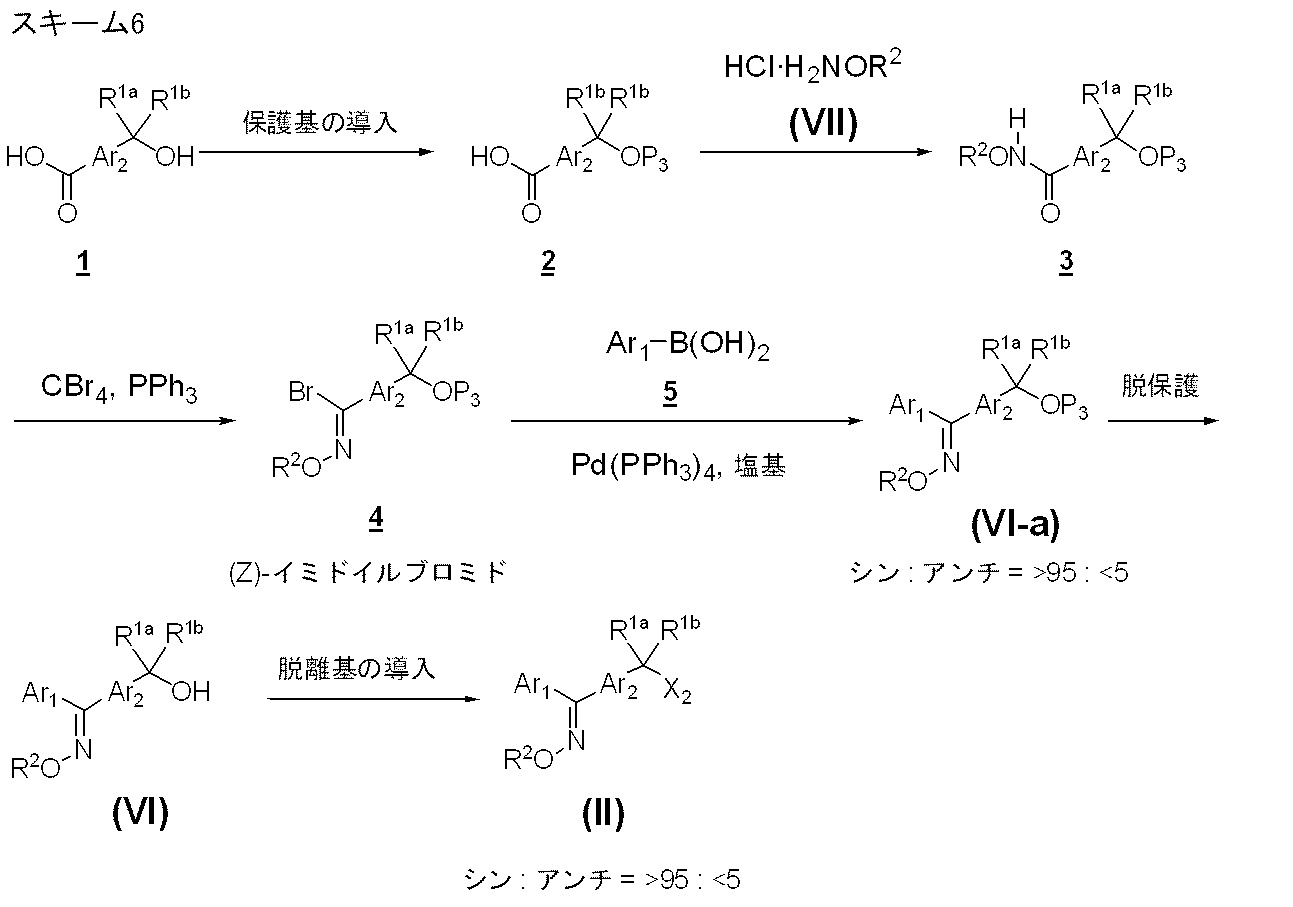
化合物1のヒドロキシ基を公知の方法(プロテクティブ・グループス・イン・オーガニック・シンセシス)により保護して化合物2を得る。保護基の種類としては、アセチル基、t-ブチルジメチルシリル基等が例示される。 Compound 2 is obtained by protecting the hydroxy group of Compound 1 by a known method (Protective Groups in Organic Synthesis). Examples of the protective group include an acetyl group and a t-butyldimethylsilyl group.
続いて化合物2と式(VII)で表される化合物とを、メタノール、エタノール等のアルコール中、0~100℃、好ましくは10~30℃で反応させ、化合物3を得る。続いて化合物3をアセトニトリル等の溶媒中、テトラブロモメタン及びトリフェニルホスフィンの存在下で還流下反応を行い、化合物4を得る。 Subsequently, the compound 2 and the compound represented by the formula (VII) are reacted in an alcohol such as methanol and ethanol at 0 to 100 ° C., preferably 10 to 30 ° C., to obtain the compound 3 . Subsequently, compound 3 is reacted under reflux in the presence of tetrabromomethane and triphenylphosphine in a solvent such as acetonitrile to obtain compound 4 .
ここで、テトラブロモメタンの使用量としては、1モルの化合物3につき1.5~3.0モルが例示され、好ましくは1.5モルが推奨され、一方、トリフェニルホスフィンの使用量としては、1モルの化合物3につき1.5~2.0モルが例示され、好ましくは2.0モルが推奨される。 Here, the amount of tetrabromomethane used is, for example, 1.5 to 3.0 moles per mole of Compound 3 , and preferably 1.5 moles, while the amount of triphenylphosphine used is An amount of 1.5 to 2.0 mol per 1 mol of Compound 3 is exemplified, and preferably 2.0 mol is recommended.
得られた化合物4と化合物5をトルエン等の溶媒中、テトラキス(トリフェニルホスフィン) パラジウム及び塩基の存在下で反応させ、式(VI-a)で表される化合物を得る。ここで、式(VI-a)で表される化合物は、化合物4(イミドイルブロミド4)の立体化学を保持して得られる。 The obtained compound 4 and compound 5 are reacted in a solvent such as toluene in the presence of tetrakis (triphenylphosphine) palladium and a base to obtain a compound represented by the formula (VI-a). Here, the compound represented by the formula (VI-a) is obtained while maintaining the stereochemistry of the compound 4 (imidoyl bromide 4 ).
塩基としては、炭酸ナトリウム、炭酸カリウム、炭酸水素ナトリウム、水酸化ナトリウム、水酸化カリウム等が例示される。 Examples of the base include sodium carbonate, potassium carbonate, sodium hydrogen carbonate, sodium hydroxide, potassium hydroxide and the like.
化合物5の使用量としては、1モルの化合物4につき、1.5~2.0モルが例示され、好ましくは2.0モルが推奨される。 The amount of compound 5 used is, for example, 1.5 to 2.0 moles per mole of compound 4 , preferably 2.0 moles.
テトラキス(トリフェニルホスフィン)パラジウム及び塩基の使用量としては、1モルの化合物4につきテトラキス(トリフェニルホスフィン)パラジウムについて0.05~0.10モルが例示され、好ましくは0.05モルが推奨され、又、塩基について1.5~2.0モルが例示され、好ましくは2.0モルが推奨される。 The amount of tetrakis (triphenylphosphine) palladium and base used is exemplified by 0.05 to 0.10 moles per mole of Compound 4 and preferably 0.05 moles per mole of tetrakis (triphenylphosphine) palladium. In addition, 1.5 to 2.0 moles of the base are exemplified, and 2.0 moles are recommended.
続いて、式(VI-a)で表される化合物のヒドロキシ基の保護基P3を公知方法で除去し、式(VI)で表される化合物としたのち、式(VI)で表される化合物のヒドロキシ基を公知の方法で脱離基X2(例えば、メタンスルホニルオキシ基、p-トルエンスルホニルオキシ基、ハロゲン原子等)に変換することにより、式(II)で表される化合物を得る。 Subsequently, the protecting group P3 of the hydroxy group of the compound represented by the formula (VI-a) is removed by a known method to obtain a compound represented by the formula (VI), and then the compound represented by the formula (VI) Is converted to a leaving group X2 (for example, methanesulfonyloxy group, p-toluenesulfonyloxy group, halogen atom, etc.) by a known method to obtain a compound represented by the formula (II).
ここで、化合物1としては、 Examples of the compound 1,


製造方法3-2
製造方法3-2は、式(IX)で表される化合物の立体選択的製造方法である。
Manufacturing method 3-2
Production method 3-2 is a stereoselective production method of the compound represented by formula (IX).
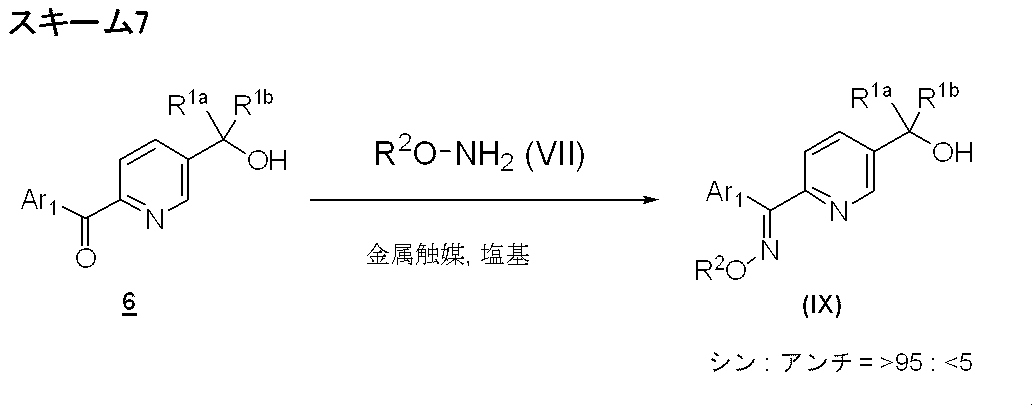
化合物6と式(VII)で表される化合物を、有機溶媒中、塩基及び金属触媒の存在下で反応を行い、式(II)で表される化合物をシン選択的に得る。 The compound 6 and the compound represented by the formula (VII) are reacted in an organic solvent in the presence of a base and a metal catalyst to obtain the compound represented by the formula (II) syn-selectively.
式(VII)で表される化合物の使用量としては、1モルの化合物6に対して、1.0~5.0モルが例示され、好ましくは、2.0~3.0モルが推奨される。 The amount of the compound represented by formula (VII) to be used is exemplified by 1.0 to 5.0 mol, preferably 2.0 to 3.0 mol based on 1 mol of compound 6 . The
塩基としては、ナトリウムメトキシド等が例示され、塩基の使用量としては、1モルの化合物6に対して、1.0~5.0モルが例示され、好ましくは、2.0~3.0モルが推奨される。
る。
The base is exemplified sodium methoxide, used amount of a base, relative to 1 mol of the compound 6, 1.0-5.0 mole is exemplified, preferably 2.0-3.0 Mole is recommended.
The
金属触媒としては、銅トリフラート-トルエン錯体(I)、酸化銅(I)、亜鉛トリフラート(II)等が例示され、金属触媒の使用量としては、1モルの化合物6に対して、5.0~0.001モルが例示され、好ましくは、1.0~0.005モルが推奨される。 Examples of the metal catalyst include copper triflate-toluene complex (I), copper (I) oxide, zinc triflate (II), etc. The amount of the metal catalyst used is 5.0 with respect to 1 mol of compound 6 . ˜0.001 mol is exemplified, and preferably 1.0 to 0.005 mol is recommended.
有機溶媒としては、メタノール、エタノール等が例示される。 Examples of the organic solvent include methanol and ethanol.
反応温度としては、0~100℃、好ましくは10~50℃が例示され、好ましくは20~30℃が推奨され、通常24~72時間で反応が完結する。 The reaction temperature is 0 to 100 ° C., preferably 10 to 50 ° C., preferably 20 to 30 ° C., and the reaction is usually completed in 24 to 72 hours.
化合物6としては、市販されているものが使用可能である。 As the compound 6 , a commercially available product can be used.
上記製造方法において、反応物質中に反応に関与しないアミノ、イミノ、ヒドロキシ、カルボキシル、オキソ、カルボニル等が存在する場合、当該アミノ、ヒドロキシ、カルボキシル、オキソ、カルボニルは、適宜、アミノ保護基、ヒドロキシ保護基、カルボキシル保護基又はオキソ若しくはカルボニルの保護基で保護した後に上記製造方法の各反応を行い、反応後に当該保護基を除去することができる。 In the above production method, when amino, imino, hydroxy, carboxyl, oxo, carbonyl, etc. that are not involved in the reaction are present in the reactant, the amino, hydroxy, carboxyl, oxo, carbonyl are appropriately protected with an amino protecting group, hydroxy protecting group. After protecting with a group, a carboxyl protecting group, or an oxo or carbonyl protecting group, each reaction of the above production method is carried out, and the protecting group can be removed after the reaction.
保護基の導入及び除去は、保護基の種類や目的化合物の安定性等により異なるが、例えば、前記のプロテクティブ・グループス・イン・オーガニック・シンセシスに記載の方法又はそれに準じる方法に従って、例えば、酸又は塩基を用いる加溶媒分解、すなわち、例えば0.01モルないし大過剰の酸、好ましくはトリフルオロ酢酸、ギ酸、塩酸等、又は等モルないし大過剰の塩基、好ましくは水酸化カリウム、水酸化カルシウム等を作用させる方法;水素化金属錯体等を用いる化学的還元;パラジウム-炭素触媒、ラネーニッケル触媒等を用いる接触還元等により行うことができる。 The introduction and removal of a protecting group varies depending on the type of protecting group and the stability of the target compound.For example, according to the method described in the above-mentioned Protective Groups in Organic Synthesis or a method analogous thereto, for example, acid Or solvolysis with a base, ie, for example, 0.01 mole to large excess of acid, preferably trifluoroacetic acid, formic acid, hydrochloric acid, etc., or equimolar to large excess of base, preferably potassium hydroxide, calcium hydroxide A chemical reduction using a metal hydride complex or the like; a catalytic reduction using a palladium-carbon catalyst, a Raney nickel catalyst, or the like.
アミノ及びイミノの保護基としては、その機能を有するものであれば特に限定されるものではなく、例えば、ベンジル、p-メトキシベンジル、3,4-ジメトキシベンジル、ベンズヒドリル、トリチル等のアラルキル;ホルミル、アセチル、ピバロイル等の低級アルカノイル;ベンゾイル;フェニルアセチル等のアリールアルカノイル;メトキシカルボニル、エトキシカルボニル、tert-ブトキシカルボニル等の低級アルキルオキシカルボニル;ベンジルオキシカルボニル等のアルキルオキシカルボニル;トリメチルシリル、tert-ブチルジメチルシリル等の低級アルキルシリル;テトラヒドロピラニル;トリメチルシリルエトキシメチル;メチルスルホニル、エチルスルホニル等の低級アルキルスルホニル;ベンゼンスルホニル、トルエンスルホニル等のアリールスルホニル等が挙げられ、特に、アセチル、ベンゾイル、tert-ブトキシカルボニル、トリメチルシリルエトキシメチル、メチルスルホニル等が好ましい。 The protecting group for amino and imino is not particularly limited as long as it has the function, and examples thereof include aralkyl such as benzyl, p-methoxybenzyl, 3,4-dimethoxybenzyl, benzhydryl, and trityl; Lower alkanoyl such as acetyl and pivaloyl; benzoyl; aryl alkanoyl such as phenylacetyl; lower alkyloxycarbonyl such as methoxycarbonyl, ethoxycarbonyl and tert-butoxycarbonyl; alkyloxycarbonyl such as benzyloxycarbonyl; trimethylsilyl, tert-butyldimethylsilyl Lower alkylsilyl such as tetrahydropyranyl; trimethylsilylethoxymethyl; lower alkylsulfonyl such as methylsulfonyl, ethylsulfonyl; benzenesulfonyl, tolue Include such arylsulfonyl sulfonyl etc., in particular, acetyl, benzoyl, tert- butoxycarbonyl, trimethylsilylethoxymethyl, and methyl sulfonyl are preferred.
ヒドロキシの保護基としては、その機能を有するものであれば特に限定されるものではなく、例えば、メチル、エチル、tert-ブチル等の低級アルキル;トリメチルシリル、tert-ブチルジメチルシリル等の低級アルキルシリル;メトキシメチル、2-メトキシエトキシメチル等の低級アルキルオキシメチル;テトラヒドロピラニル;トリメチルシリルエトキシメチル;ベンジル、p-メトキシベンジル、2,3-ジメトキシベンジル、トリチル等のアラルキル;ホルミル、アセチル等のアシル等が挙げられ、特に、メチル、メトキシメチル、テトラヒドロピラニル、トリチル、トリメチルシリルエトキシメチル、tert-ブチルジメチルシリル、アセチル等が好ましい。 The hydroxy protecting group is not particularly limited as long as it has the function, and examples thereof include lower alkyl such as methyl, ethyl and tert-butyl; lower alkylsilyl such as trimethylsilyl and tert-butyldimethylsilyl; Lower alkyloxymethyl such as methoxymethyl and 2-methoxyethoxymethyl; tetrahydropyranyl; trimethylsilylethoxymethyl; aralkyl such as benzyl, p-methoxybenzyl, 2,3-dimethoxybenzyl and trityl; acyl such as formyl and acetyl In particular, methyl, methoxymethyl, tetrahydropyranyl, trityl, trimethylsilylethoxymethyl, tert-butyldimethylsilyl, acetyl and the like are preferable.
カルボキシルの保護基としては、その機能を有するものであれば特に限定されるものではなく、例えば、メチル、エチル、tert-ブチル等の低級アルキル;2,2,2-トリクロロエチル等のハロ低級アルキル;2-プロペニル基等の低級アルケニル;ベンジル、p-メトキシベンジル、ベンズヒドリル、トリチル等のアラルキル等が挙げられ、特に、メチル、エチル、tert-ブチル、2-プロペニル、ベンジル、p-メトキシベンジル、ベンズヒドリル等が好ましい。 The carboxyl protecting group is not particularly limited as long as it has the function, and examples thereof include lower alkyl such as methyl, ethyl and tert-butyl; halo lower alkyl such as 2,2,2-trichloroethyl and the like. Lower alkenyl such as 2-propenyl group; aralkyl such as benzyl, p-methoxybenzyl, benzhydryl, trityl and the like, and in particular, methyl, ethyl, tert-butyl, 2-propenyl, benzyl, p-methoxybenzyl, benzhydryl Etc. are preferred.
カルボニルの保護基としては、その機能を有するものであれば特に限定されるものではなく、例えば、エチレンケタール、ジメチルケタール、S,S’-ジメチルケタール等のアセタール、ケタール等が挙げられる。 The carbonyl protecting group is not particularly limited as long as it has the function, and examples thereof include acetals such as ethylene ketal, dimethyl ketal, and S, S′-dimethyl ketal, and ketals.
かくして得られる式(I)で表される化合物は、通常の分離手段、例えば、溶媒抽出、再結晶、カラムクロマトグラフィー、分取薄層クロマトグラフィー等により容易に単離精製することができる。 The compound represented by the formula (I) thus obtained can be easily isolated and purified by ordinary separation means such as solvent extraction, recrystallization, column chromatography, preparative thin layer chromatography and the like.
これらの化合物は、常法により医薬として許容されうる塩とすることができ、また逆に、塩から遊離化合物への変換も常法に従って行うことができる。 These compounds can be converted into pharmaceutically acceptable salts by a conventional method, and conversely, conversion from a salt to a free compound can also be performed according to a conventional method.
本発明化合物のMCH受容体拮抗物質としての作用は、例えば以下に述べる薬理試験例により証明される。 The action of the compound of the present invention as an MCH receptor antagonist is proved by, for example, the following pharmacological test examples.
薬理試験例:MCH結合阻害試験
ヒトMCH-1RをコードするcDNA配列[FEBS Letters,Vol.398,253(1996);Biochimica et Biophisica Acta,Vol.1401,216(1998)]を、プラスミドベクターpEF/myc/cyto(インビトロジェン社製)にクローニングした。得られた発現ベクターをリポフェクトアミン・プラス試薬(ライフ・テクノロジー社製)を用いて宿主細胞CHO-K1(アメリカン・タイプ・カルチャー・コレクション)にトランスフェクトし、MCH-1R発現細胞を得た。
Pharmacological test example: MCH binding inhibition test cDNA sequence encoding human MCH-1R [FEBS Letters, Vol. 398, 253 (1996); Biochimica et Biophisica Acta, Vol. 1401,216 (1998)] was cloned into the plasmid vector pEF / myc / cyto (Invitrogen). The obtained expression vector was transfected into host cell CHO-K1 (American Type Culture Collection) using Lipofectamine Plus reagent (Life Technology) to obtain MCH-1R expressing cells.
このMCH-1Rを発現させた細胞から調製した膜標品を被検化合物及び50pMの[125I]MCH(NEN社製)とともに、アッセイ緩衝液(10mM 塩化マグネシウム、2mM エチレンジアミン四酢酸、0.01%バシトラシン及び0.2% ウシ血清アルブミンを含む50mM Tris緩衝液、pH7.4)中で25℃、1時間インキュベーションした後、グラスフィルターGF/C(ワットマン社製)にて濾過した。グラスフィルターを10mM 塩化マグネシウム、2mM エチレンジアミン四酢酸及び0.04% Tween-20を含む50mM Tris緩衝液、pH7.4にて洗浄後、グラスフィルター上の放射活性を求めた。非特異的結合は1μM ヒトMCH存在下で測定し、特異的[125I]MCH結合に対する被験化合物の50%阻害濃度(IC50値)を求めた。その結果を表1に示す。 Membrane preparations prepared from cells expressing MCH-1R were combined with a test compound and 50 pM [ 125 I] MCH (manufactured by NEN) together with assay buffer (10 mM magnesium chloride, 2 mM ethylenediaminetetraacetic acid, 0.01 After incubation in 50 mM Tris buffer (pH 7.4) containing 1% bacitracin and 0.2% bovine serum albumin at 25 ° C. for 1 hour, the mixture was filtered with a glass filter GF / C (Whatman). The glass filter was washed with 50 mM Tris buffer containing 10 mM magnesium chloride, 2 mM ethylenediaminetetraacetic acid and 0.04% Tween-20, pH 7.4, and then the radioactivity on the glass filter was determined. Non-specific binding was measured in the presence of 1 μM human MCH, and the 50% inhibitory concentration (IC 50 value) of the test compound for specific [ 125 I] MCH binding was determined. The results are shown in Table 1.

上記のとおり、本発明の化合物は、MCH-1Rに対するMCHの結合を強力に阻害し、MCH-1R拮抗剤として優れた作用を示した。 As described above, the compound of the present invention strongly inhibited the binding of MCH to MCH-1R and exhibited an excellent action as an MCH-1R antagonist.
したがって、本発明の化合物は、MCHが関与する各種疾患、例えば、肥満症、糖尿病、ホルモン分泌異常、高脂血症、痛風、脂肪肝等の代謝系疾患;例えば、狭心症、急性・うっ血性心不全、心筋梗塞、環状動脈硬化症、高血圧、腎臓病、電解質異常等の循環器系疾患;例えば、過食症、情動障害、うつ病、不安、癲癇、譫妄、痴呆、統合失調症、注意欠陥・多動性障害、記憶障害、睡眠障害、認知障害、運動障害、感覚異常、嗅覚障害、モルヒネ耐性、麻薬依存症、アルコール依存症等の中枢及び末梢神経系疾患;例えば、不妊症、早産、性機能障害等の生殖系疾患;その他、消化管疾患;呼吸器疾患、癌又は皮膚色素沈着の予防剤又は治療剤として、特に過食症、肥満症、糖尿病、脂肪肝、うつ病、不安症の予防剤又は治療剤として有用である。 Therefore, the compound of the present invention can be used for various diseases involving MCH, such as obesity, diabetes, abnormal hormone secretion, hyperlipidemia, gout, fatty liver, etc .; for example, angina pectoris, acute / congestion Cardiovascular diseases such as congenital heart failure, myocardial infarction, arteriosclerosis, hypertension, kidney disease, electrolyte abnormalities; eg, bulimia, affective disorder, depression, anxiety, epilepsy, delirium, dementia, schizophrenia, attention deficit・ Central and peripheral nervous system diseases such as hyperactivity disorder, memory disorder, sleep disorder, cognitive disorder, movement disorder, sensory abnormality, olfactory disorder, morphine tolerance, drug dependence, alcoholism; for example, infertility, premature birth, Reproductive system diseases such as sexual dysfunction; Other gastrointestinal diseases; Respiratory diseases, cancer or skin pigmentation preventive or therapeutic agents, especially for bulimia, obesity, diabetes, fatty liver, depression, anxiety As a preventive or therapeutic agent It is a use.
式(I)で表される化合物を含む医薬組成物
本発明の化合物は、経口又は非経口投与することができ、その投与に適する形態に製剤化することにより、上記の如き疾患の予防又は治療のための医薬組成物として使用することができる。
Pharmaceutical Composition Containing Compound Represented by Formula (I) The compound of the present invention can be administered orally or parenterally, and is formulated into a form suitable for its administration, thereby preventing or treating the diseases described above. Can be used as a pharmaceutical composition.
本発明の化合物は、実際に臨床的に使用する場合、通常、その投与形態に合わせて医学的に許容される添加剤と共に各種剤形に製剤化した後投与することができる。その際の添加剤としては、製剤分野において通常用いられる各種の添加剤を使用することができ、具体的には例えば、ゼラチン、乳糖、白糖、酸化チタン、デンプン、結晶セルロース、ヒドロキシプロピルメチルセルロース、カルボキシメチルセルロース、トウモロコシデンプン、マイクロクリスタリンワックス、白色ワセリン、メタケイ酸アルミン酸マグネシウム、無水りん酸カルシウム、クエン酸、クエン酸三ナトリウム、ヒドロキシプロピルセルロース、ソルビトール、ソルビタン脂肪酸エステル、ポリソルベート、ショ糖脂肪酸エステル、ポリオキシエチレン、硬化ヒマシ油、ポリビニルピロリドン、ステアリン酸マグネシウム、軽質無水ケイ酸、タルク、植物油、ベンジルアルコール、アラビアゴム、プロピレングリコール、ポリアルキレングリコール、シクロデキストリン又はヒドロキシプロピルシクロデキストリン等が挙げられる。 When the compound of the present invention is actually used clinically, it can usually be administered after being formulated into various dosage forms together with medically acceptable additives according to the dosage form. As the additive at that time, various additives generally used in the pharmaceutical field can be used. Specifically, for example, gelatin, lactose, sucrose, titanium oxide, starch, crystalline cellulose, hydroxypropylmethylcellulose, carboxy Methyl cellulose, corn starch, microcrystalline wax, white petrolatum, magnesium aluminate metasilicate, anhydrous calcium phosphate, citric acid, trisodium citrate, hydroxypropyl cellulose, sorbitol, sorbitan fatty acid ester, polysorbate, sucrose fatty acid ester, polyoxy Ethylene, hydrogenated castor oil, polyvinylpyrrolidone, magnesium stearate, light anhydrous silicic acid, talc, vegetable oil, benzyl alcohol, gum arabic, propylene glycol, poly Ruki glycol, cyclodextrin or hydroxypropyl cyclodextrin and the like.
これらの添加剤を用いて製剤化される剤形としては、例えば、錠剤、カプセル剤、顆粒剤、散剤、坐剤等の固形製剤;例えばシロップ剤、エリキシル剤、注射剤等の液体製剤等が挙げられ、これらは、製剤分野における通常の方法に従って調製することができる。なお、液体製剤としては、用時に水又は他の適当な媒体に溶解又は懸濁させる形であってもよい。また、特に注射剤の場合、必要に応じて生理食塩水又はブドウ糖液に溶解又は懸濁させてもよく、更に緩衝剤や保存剤を添加してもよい。 Examples of the dosage form formulated with these additives include solid preparations such as tablets, capsules, granules, powders, suppositories; and liquid preparations such as syrups, elixirs, injections, and the like. These can be prepared according to the usual methods in the pharmaceutical field. In addition, as a liquid formulation, the form dissolved or suspended in water or another suitable medium may be sufficient at the time of use. In particular, in the case of injections, they may be dissolved or suspended in physiological saline or glucose solution as necessary, and buffering agents and preservatives may be added.
これらの製剤は、本発明の化合物を医薬組成物を基準にして1~99.9重量%、好ましくは1~60重量%の割合で含有することができる。これらの製剤は、さらに、治療上有効な他の化合物を含んでいてもよい。 These preparations can contain the compound of the present invention in a proportion of 1 to 99.9% by weight, preferably 1 to 60% by weight, based on the pharmaceutical composition. These formulations may further contain other therapeutically effective compounds.
即ち、本発明は、医学的に許容される添加剤、及び治療的に有効な量の本発明化合物又は薬学的に許容されるその塩を含む医薬組成物を提供する。 That is, the present invention provides a pharmaceutical composition comprising a medically acceptable additive and a therapeutically effective amount of a compound of the present invention or a pharmaceutically acceptable salt thereof.
ここで、治療的に有効な量とは、研究者、獣医師、医師又は他の臨床家によって見出された、組織、システム、動物又はヒトの生物学的又は医学的事象を誘発する医薬の量を意味する。 Here, a therapeutically effective amount refers to a drug that induces a biological or medical event in a tissue, system, animal or human that is found by a researcher, veterinarian, physician or other clinician. Means quantity.
即ち、本発明の化合物を上記の如き疾患の予防又は治療のために使用する場合の投与量及び投与回数は、患者の性別、年齢、体重、症状の程度及び目的とする治療効果の種類や範囲等により変えることができるが、一般には、経口投与の場合、投与量は、通常、1日あたり体重1kgにつき0.001から50mgであり、単回または複数回で投与することができる。投与量は、1日あたり約0.01から約25mg/kgであるのが好ましく、1日あたり約0.05から約10mg/kgであるのがより好ましい。 That is, when the compound of the present invention is used for the prevention or treatment of the above-mentioned diseases, the dose and the number of administrations are the patient's sex, age, body weight, degree of symptoms, and the type and range of the desired therapeutic effect. In general, in the case of oral administration, the dose is usually 0.001 to 50 mg / kg body weight per day, and can be administered once or multiple times. The dosage is preferably about 0.01 to about 25 mg / kg per day, more preferably about 0.05 to about 10 mg / kg per day.
本発明の化合物は、コンビネーション療法として、高血圧、肥満に関連する高血圧、高血圧関連疾病、心臓肥大、左心室肥大、代謝性疾患、肥満、肥満関連疾病等に有効な薬剤(以下、「併用薬剤」という)と組み合わせて使用することができる。かかる薬剤は、上記疾病の予防又は治療において、同時に、別々に、又は順次に投与することが可能である。本発明の化合物を1又は2以上の併用薬剤と同時に使用する場合、単一の投与形態である医薬組成物とすることができる。しかしながら、コンビネーション療法においては、本発明の化合物を含む組成物と併用薬剤とを、投与対象に対し、異なった包装として、同時に、別々に、または順次に投与してもよい。それらは、時間差をおいて投与してもよい。 The compound of the present invention is used as a combination therapy as a drug effective for hypertension, obesity-related hypertension, hypertension-related diseases, cardiac hypertrophy, left ventricular hypertrophy, metabolic disease, obesity, obesity-related diseases, etc. Can be used in combination. Such agents can be administered simultaneously, separately or sequentially in the prevention or treatment of the above diseases. When the compound of the present invention is used simultaneously with one or more concomitant drugs, it can be made into a pharmaceutical composition in a single dosage form. However, in combination therapy, the composition containing the compound of the present invention and the concomitant drug may be administered to the administration subject in different packages simultaneously, separately or sequentially. They may be administered at a time lag.
併用薬剤の投与量は、臨床上用いられている投与量に準ずればよく、投与対象、投与ルート、疾患、組み合わせ等により適宜選択することができる。併用薬剤の投与形態は、特に限定されず、投与時に、本発明の化合物と併用薬剤とが組み合わされていればよい。 The dose of the concomitant drug may be determined according to the dose used clinically, and can be appropriately selected depending on the administration subject, administration route, disease, combination and the like. The administration form of the concomitant drug is not particularly limited, as long as the compound of the present invention and the concomitant drug are combined at the time of administration.
その投与形態としては、例えば、1)本発明の化合物と併用薬剤とを同時に製剤化して得られる単一の製剤の投与、2)本発明の化合物と併用薬剤とを別々に製剤化して得られる2種の製剤の同一投与経路での同時投与、3)本発明の化合物と併用薬剤とを別々に製剤化して得られる2種の製剤の同一投与経路での時間差をおいての投与、4)本発明の化合物と併用薬剤とを別々に製剤化して得られる2種の製剤の異なる投与経路での同時投与、5)本発明の化合物と併用薬剤とを別々に製剤化して得られる2種の製剤の異なる投与経路での時間差をおいての投与(例えば、本発明の化合物→併用薬剤の順序での投与、あるいは逆の順序での投与)等が挙げられる。本発明の化合物と併用薬剤との使用割合は、投与対象、投与ルート、疾患等に応じて適宜選択することができる。 Examples of the dosage form include 1) administration of a single preparation obtained by simultaneously formulating the compound of the present invention and a concomitant drug, and 2) obtained by separately formulating the compound of the present invention and the concomitant drug. Simultaneous administration of two preparations by the same administration route, 3) Administration of the two preparations obtained by separately formulating the compound of the present invention and the concomitant drug at different time intervals by the same administration route, 4) Simultaneous administration of two types of preparations obtained by separately formulating the compound of the present invention and a concomitant drug by different administration routes, 5) Two types of compounds obtained by separately formulating the compound of the present invention and a concomitant drug Administration of the preparation at different time intervals in different administration routes (for example, administration in the order of the compound of the present invention → concomitant drug, or administration in the reverse order) and the like. The ratio of the compound of the present invention and the concomitant drug can be appropriately selected depending on the administration subject, administration route, disease and the like.
本発明で用いられる併用薬剤としては、例えば、糖尿病治療薬、高脂血症治療薬、高血圧治療薬、抗肥満薬等が挙げられる。これらの併用薬剤は、2種以上を適宜の割合で組合わせて用いてもよい。 Examples of the concomitant drug used in the present invention include antidiabetic drugs, hyperlipidemia drugs, antihypertensive drugs, anti-obesity drugs and the like. Two or more of these concomitant drugs may be used in combination at an appropriate ratio.
上記糖尿病治療薬としては、例えば、1)グリダゾン類(glitazones)[例えばシグリダゾン(ciglitazone)、ダルグリダゾン(darglitazone)、エングリダゾン(englitazone)、イサグリダゾン(isaglitazone)(MCC-555)等]、ピオグリタゾン(pioglitazone)、ロシグリダゾン(rosiglitazone)、トログリタゾン(troglitazone)、BRL49653、CLX-0921、5-BTZD、GW-0207、LG-100641、LY-300512等のPPARγアゴニスト;2)メトホルミン(metformin)、ブホルミン(buformin)、フェンホルミン(phenformin)等のビグアナイド剤;3)プロテインチロシンホスファターゼ-1B阻害剤;4)アセトヘキサミド、クロルプロパミド、ジアビネス(diabinese)、グリベンクラミド(glibenclamide)、グリピジド(glipizide)、グリブリド(glyburide)、グリメピリド(glimepiride)、グリクラジド(gliclazide)、グリペンジド(glipentide)、グリキドン(gliquidone)、グリソラミド(glisolamide)、トラザミド、トルブタミド等のスルホニルウレア;5)レパグリニド(repaglinide)、ナテグリニド(nateglinide)等のメグリチニド(meglitinides)類;6)アカルボース(acarbose)、アジポシン(adiposine)、カミグリボース(camiglibose)、エミグリテート(emiglitate)、ミグリトール(miglitol)、ボグリボース(voglibose)、プラジミシン-Q(pradimicin-Q)、サルボスタチン(salbostatin)、CKD-711、MDL-25,673、MDL-73,945、MOR14等のα-グルコシドヒドロキシラーゼ阻害薬;7)テンダミスタット(tendamistat)、トレスタチン(trestatin)、Al3688等のα-アミラーゼ阻害剤;8)リノグリリド(linogliride)、A-4166等のインスリン分泌促進剤;9)クロモキシル(clomoxir)、エトモキシル(etomoxir)等の脂肪酸酸化抑制剤;10)ミダグリゾール(midaglizole)、イサグリドール(isaglidole)、デリグリドール(deriglidole)、イダゾキサン(idazoxan)、エラロキサン(earoxan)、フルパロキサン(fluparoxan)等のA2アンタゴニスト;11)ビオタ(biota)、LP-100、ノバラピド、insulindetemir、insulin lispro、insulin glargine、インスリン亜鉛、Lys-Pro-インスリン、GLP-1(73-7)、GLP1アミド(7-36)等のインスリンまたはインスリンミメティックス;12)JT-501、ファルグリタゾール(farglitazar)等の非チアゾリジンジオン;13)MK-0767、CLX-0940、GW-1536、GW-1929、GW-2433、KRP-297、L-796449、LR-90及びSB219994等のPPARα/γ双アゴニスト等が挙げられる。 Examples of the therapeutic agent for diabetes include 1) glidazones (for example, ciglitazone, darglitazone, englitazone, isaglitazone (MCC-555), etc.), pioglitazone (pioglitazone), PPARγ agonists such as rosiglitazone, troglitazone, BRL49653, CLX-0921, 5-BTZD, GW-0207, LG-100641, LY-300512; 2) metformin, buformin, phenformin Biguanides such as (phenformin); 3) protein tyrosine phosphatase-1B inhibitors; 4) acetohexamide, chlorpropamide, diabinese, glibenclamide, glipizide, glyburide, glimepiride ( glimepiride), gliclazide, grippenge Sulfonylureas such as glipentide, gliquidone, glisolamide, tolazamide, tolbutamide; 5) meglitinides such as repaglinide, nateglinide; 6) acarbose, adiposine adiposine, camiglibose, emiglitate, miglitol, voglibose, pradimicin-Q, salbostatin, CKD-711, MDL-25,673, MDL-73,945, Α-glucoside hydroxylase inhibitors such as MOR14; 7) α-amylase inhibitors such as tendamistat, trestatin and Al3688; 8) insulin secretagogues such as linogliride and A-4166 ; 9) Fatty acids such as clomoxir and etomoxir 10) A2 antagonists such as midaglizole, isaglidole, deriglidole, idazoxan, earoxan, fluparoxan; 11) biota, LP-100 , Novarapide, insulindetemir, insulin lispro, insulin glargine, insulin zinc, Lys-Pro-insulin, GLP-1 (73-7), GLP1 amide (7-36) and other insulin or insulin mimetics; 12) JT-501 , Non-thiazolidinediones such as farglitazar; 13) MK-0767, CLX-0940, GW-1536, GW-1929, GW-2433, KRP-297, L-796449, LR-90, SB219994, etc. PPARα / γ biagonist and the like.
上記高脂血症治療薬としては、例えば、1)コレステリルアミン、コレセヴェレム(colesevelem)、コレスチポール(colestipol)、交差デキストランのジアルキルアミノアルキル誘導体、Colestid登録商標、LoCholest登録商標、Questran登録商標等の胆汁酸吸収促進剤;2)アトルバスタチン(atorvastatin)、イタバスタチン(itavastatin)、フルバスタチン(fluvastatin)、ロバスタチン(lovastatin)、プラバスタチン(pravastatin)、リバスタチン(rivastatin)、ロスバスタチン(rosuvastatin)、シンバスタチン(simvastatin)、ZD-4522等のHMG-CoA還元酵素阻害薬;3)HMG-CoA合成阻害剤;4)スナトールエステル、β-シトステロール、ステロールグルコシド、エゼチミベ(ezetimibe)等のコレステロール吸収阻害剤;5)アバシミベ(avasimibe)、エフルシミベ(eflucimibe)、KY-505、SMP-709等のアシルコエンザイムAコレステロールアシル転移酵素阻害剤;6)JTT705、トルセトラピブ(torcetrapib)、CP532632、BAY-63-2149、SC-591、SC-795等のCETP阻害剤;7)スクワレン合成阻害剤、8)プロブコール等の抗酸化剤、9)ベクロフィブラート、ベンザフィブラート、シプロフィブラート、クロフィブラート、エトフィブラート、フェノフィブラート、ジェンカベン(gemcabene)、ジェンフィブロジル(gemfibrozil)、GW-7647、BM-170744、LY-518674、フィブリック酸誘導体(例えばAtromid登録商標、Lopid登録商標、Tricor登録商標等)等のPPARαアゴニスト;10)GW-4064、SR-103912等のFXRレセプターアンタゴニスト;11)GW3965、T9013137、XTCO-179628等のLXRレセプターアゴニスト;12)ナイアシン等のリポプロテイン合成阻害剤;13)レニン-アンジオテンシン系阻害剤;14)ミクロゾーム性トリグリセリド輸送阻害剤;15)BARA1453、SC435、PHA384640、S-435、AZD7706等の胆汁酸再吸収阻害剤;16)GW501516、GW590735等のPPARδアゴニスト;17)トリグリセリド合成阻害剤;18)LAB687、CP346086等のMTTP阻害剤;19)低密度リポプロテイン受容体インデューサー;20)スクワレンエポキシダーゼ阻害剤;21)血小板凝集阻害剤;22)MK-591等の5-リポキシゲナーゼ活性化タンパク阻害剤等が挙げられる。 Examples of the antihyperlipidemic drug include 1) bile acids such as cholesterylamine, colesevelem, colestipol, cross-dextran dialkylaminoalkyl derivatives, Colestid registered trademark, LoCholest registered trademark, Questran registered trademark, etc. Absorption enhancer; 2) atorvastatin, itavastatin, fluvastatin, lovastatin, pravastatin, rivastatin, rosuvastatin, simvastatin, ZD- HMG-CoA reductase inhibitors such as 4522; 3) HMG-CoA synthesis inhibitors; 4) cholesterol absorption inhibitors such as snatol ester, β-sitosterol, sterol glucoside, ezetimibe; 5) avasimibe , Ehur Acylcoenzyme A cholesterol acyltransferase inhibitors such as eflucimibe, KY-505, SMP-709; 6) JTT705, torcetrapib, CP532632, BAY-63-2149, SC-591, SC-795, etc. CETP inhibitors; 7) Squalene synthesis inhibitors, 8) Antioxidants such as probucol, 9) Beclofibrate, benzafibrate, ciprofibrate, clofibrate, etofibrate, fenofibrate, gemcabene, gemfibrozil ( gemfibrozil), GW-7647, BM-170744, LY-518674, PPARα agonists such as fibric acid derivatives (eg, Atromid registered trademark, Rapid registered trademark, Tricor registered trademark, etc.); 10) GW-4064, SR-103912, etc. FXR receptor antagonist; 11) LXR receptor agonist such as GW3965, T9013137, XTCO-179628; 12) Lipoprotein synthesis inhibitor such as niacin; 14) microsomal triglyceride transport inhibitor; 15) bile acid reabsorption inhibitor such as BARA1453, SC435, PHA384640, S-435, AZD7706; 16) PPARδ agonist such as GW501516, GW590735; 17) 18) MTTP inhibitors such as LAB687 and CP346086; 19) Low density lipoprotein receptor inducer; 20) Squalene epoxidase inhibitor; 21) Platelet aggregation inhibitor; 22) 5 such as MK-591 -Lipoxygenase activating protein inhibitors and the like.
上記高血圧治療薬としては、例えば、1)クロロチアリドン、クロロチアジド、ジクロロフェナミド、ヒドロフルオロチアジド、インダパミド(indapamide)、ヒドロクロロチアジド等のチアジド系;ブメタニド(bumetanide)、エサクリニック酸(ethacrynic acid)、フロセミド、トルセミド等のループ系、アミロリド、トリアムテレン等のナトリウム系、スピロノラクトン、エピレノン等のアルドステロンアンタゴニスト系等の利尿剤;2)アセブトロール(acebutolol)、アテノロール、ベタゾロール(betaxolol)、ベバントロール(bevantolol)、ビソプロロール(bisoprolol)、ボピンドロール(bopindolol)、カルテオロール(carteolol)、カルベジロール(carvedilol)、セリプロロール(celiprolol)、エスモロール(esmolol)、インデノロール(indenolol)、メタプロロール(metaprolol)、ナドロール(nadolol)、ネビボロール(nebivolol)、ペンブトロール(penbutolol)、ピンドロール、プロパノロール、ソタロール、タータトロール(tertatolol)、チリソロール(tilisolol)、チモロール等のβ-アドレナリンブロッカー;3)アムロジピン(amlodipine)、アラニジピン(aranidipine)、アゼルニジピン(azelnidipine)、バルニジピン(barnidipine)、ベニジピン(benidipine)、ベプリジル(bepridil)、シナルジピン(cinaldipine)、クレビジピン(clevidipine)、ジルチアゼム(diltiazem)、エホニジピン(efonidipine)、フェロジピン(felodipine)、ガロパミル(gallopamil)、イスラジピン(isradipine)、ラシジピン(lacidipine)、レミルジピン(lemildipine)、レルカニジピン(lercanidipine)、ニカルジピン(nicardipine)、ニフェジピン(nifedipine)、ニルヴァジピン(nilvadipine)、ニモデピン(nimodepine)、ニソルジピン(nisoldipine)、ニトレジピン(nitrendipine)、マニジピン(manidipine)、プラニジピン(pranidipine)、バラパミル(verapamil)等のカルシウムチャンネルブロッカー;4)ベナゼプリル、カプトプリル、シラザプリル(cilazapril)、デラプリル(delapril)、エナラプリル、フォシノプリル(fosinopril)、イミダプリル、ロシノプリル、モエキシプリル(moexipril)、キナプリル(quinapril)、キナプリラット(quinapril)、ラミプリル(ramipril)、ペリンドプリル(perindopril)、ペリンドロプリル(perindropri)、カニプリル(quanipril)、スピラプリル(spirapril)、テノカプリル(tenocapril)、トランドラプリル(trandolapril)、ゾフェノプリル(zofenopril)等のアンジオテンシン変換酵素阻害薬;5)オマパトリラット(omapatrilat)、カドキサトリル(cadoxatril)、エカドトリル、フォシドトリル(fosidotril)、サンパトリラット(sampatrilat)、AVE7688、ER4030等の中性エンドペプチダーゼ阻害剤;6)テゾセンタン(tezosentan)、A308165、YM62899等のエンドセリンアンタゴニスト;7)ヒドララジン、クロニジン、ミノキシジル、ニコチニルアルコール等の血管拡張剤;8)カンデサルタン、エプロサルタン、イルベサルタン、ロサルタン、プラトサルタン(pratosartan)、タソサルタン(tasosartan)、テルミサルタン(telmisartan)、バルサルタン、EXP-3137、FI6828K、RNH6270等のアンジオテンシンII拮抗薬;9)ニプラジロール、アロチノロール、アモスラロール等のα/βアドレナリンブロッカー;10)テラゾシン、ウラピジル(urapidil)、プラゾシン、ブナゾシン、トリマゾシン、ドキサゾシン、ナフトピジル、インドラミン、WHIP164、XEN010等のα1ブロッカー;11)ロフェキシジン(lofexidine)、チアメニジン(tiamenidine)、モキソニジン(moxonidine)、リレメニジン(rilmenidine)、グアノベン(guanobenz)等のα2アゴニスト;12)アルドステロン阻害剤等が挙げられる。 Examples of the antihypertensive agent include 1) thiazides such as chlorothiaridone, chlorothiazide, dichlorophenamide, hydrofluorothiazide, indapamide, hydrochlorothiazide; bumetanide, ethacrynic acid, Diuretics such as loops such as furosemide and torsemide, sodiums such as amiloride and triamterene, aldosterone antagonists such as spironolactone and epilenone; 2) acebutolol, atenolol, betaxolol, bevantolol, bisoprolol ( bisoprolol), bopindolol, carteolol, carvedilol, celiprolol, esmolol, indenolol, metapro Β-adrenergic blockers such as metaprolol, nadolol, nebivolol, penbutolol, pindolol, propanolol, sotalol, tertatolol, tilisolol, timolol; 3) amlodipine ( amlodipine, alanidipine, azelnidipine, barnidipine, benidipine, bepridil, cinaldipine, clevidipine, diltiazepin, efidipine felodipine, gallopamil, isradipine, lacidipine, lemildipine, lercanidipine, nicardipine, nifedipine ), Nilvadipine, nimodepine, nioldipine, nitrendipine, manidipine, pranidipine, verapamil calcium channel blockers; 4) benazepril, captopril, zapril cilazapril), delapril, enalapril, fosinopril (fosinopril), imidapril, rosinopril, moexipril (moexipril), quinapril (quinapril), quinapril (quinapril), ramipril (ramipril), perindopril (perindopril), perindopril (perindopril) Angiotensin converting enzyme inhibitors such as quanipril, spirapril, tenocapril, trandolapril, zofenopril; 5) Omapatrilat, cadoxatril, cadoxatril, efodotril, fosidotril, sampatrilat, AVE7688, ER4030 and other neutral endopeptidase inhibitors; 6) tezosentan, A308165, YM62899, etc. Endothelin antagonists; 7) Vasodilators such as hydralazine, clonidine, minoxidil, nicotinyl alcohol; 8) candesartan, eprosartan, irbesartan, losartan, pratosartan, tasosartan, telmisartan, telmisartan, valsartan, EXP -3137, FI6828K, RNH6270 and other angiotensin II antagonists; 9) α / β-adrenergic blockers such as nipradilol, arotinolol, amosulalol; 10) Terazosin, urapidil, prazosin, bunazosin, trimmer Α1 blockers such as syn, doxazosin, naphthopidyl, indolamine, WHIP164, XEN010; 11) α2 agonists such as lofexidine, tiamenidine, moxonidine, rilmenidine, guanobenz; 12) And aldosterone inhibitors.
上記抗肥満薬としては、例えば、1)パロセチン(paroxetine)、フルオキセチン(fluoxetine)、フェンフルラミン(fenfluramine)、フルボキサミン(fluvoxamine)、セルトラリン(sertraline)、イミプラミン等の5HT(セロトニン)トランスポーター阻害剤;2)GW320659、デシプラミン、タルスプラム(talsupram)、ノミフェンシン等のノルエピネフリントランスポーター阻害剤;3)リモナバント(Sanofi Synthelabo)、SR-147778(Sanofi Synthelabo)、BAY-65-2520(バイエル)、SLV-319(ソルベイ)、その他USP5,532,237、USP4,973,587、USP5,013,837、USP5,081,122、USP5,112,820、USP5,292,736、USP5,624,941、USP6,028,084、WO96/33159、WO98/33765、WO98/43636、WO98/43635、WO01/09120、WO01/96330、WO98/31227、WO98/41519、WO98/37061、WO00/10967、WO00/10968、WO97/29079、WO99/02499、WO01/58869、WO02/076949、WO01/64632、WO01/64633、WO01/64634、WO03/006007、WO03/007887及びEP-658546に開示化合物等のカンナビノイド1受容体1(CB-1)アンタゴニスト/インバースアゴニスト;4)WO01/87355、WO02/08250等に開示化合物等のグレリンアンタゴニスト;5)チオペラミド、3-(1Hイミダゾール-4-イル)プロピル N-(ペンテニル)カーボネート、クロベンプロピット(clobenpropit)、ヨードフェンプロピット、イモプロキシフェン、GT2395、A331440、WO02/15905に開示化合物、O-[3-(1H-イミダゾ-4-イル)プロパノール]カーバメート、ピペラジン含有H3受容体アンタゴニスト(Lazewska,D. et al., Pharmazie, 56:927-32 (2001)、ベンゾフェノン誘導体(Sasse, A. et al., Arch.Pharm.(Weinheim) 334:45-52 (2001))、置換N-フェニルカーバメート(Reidemeister, S. et al., Pharmazie,55:83-6(2000))、プロキシフェン誘導体(Sasse, A. et al., J. Med. Chem..43:3335-43(2000))等のヒスタミン(H3)アンタゴニスト/インバースアゴニスト;6)T-226296(Takeda)、SNP-7941(Synaptic)、その他WO01/82925、WO01/87834、WO02/051809、WO02/06245、WO02/076929、WO02/076947、WO02/04433、WO02/51809、WO02/083134、WO02/094799、WO03/004027及び特開2001-226269号に開示の化合物等のMCH-1Rアンタゴニスト;7)MCH-2Rアゴニスト/アンタゴニスト;8)3-クロロ-5-(1-(6-[2-(5-エチル-4-メチル-チアゾール-2-イル)-エチル]-4-モルホリニル-4-イル-ピリジン-2-イルアミノ)-エチル)フェニル]カルバミン酸イソプロピルエステル、BIBP3226、BIBO3304、LY-357897、CP-671906、GI-264879、その他USP6001836、WO96/14307、WO01/23387、WO99/51600、WO01/85690、WO01/85098、WO01/85173及びWO01/89528に開示化合物等のNPY1アンタゴニスト;9)152804、GW-569180A、GW-594884A、GW-587081X、GW-548118X、FR235,208、FR226928、FR240662、FR252384、1229U91、GI-264879A、CGP71683A、LY-377897、LY366377、PD-160170、SR-120562A、SR-120819A、JCF-104、H409/22、その他USP6,140,354、USP6,191,160、USP6,258,837、USP6,313,298、USP6,337,332、USP6,329,395、USP340,683、USP6,326,375、USP6,329,395、USP6,337,332、USP6,335,345、EP-01010691、EP-01044970、WO97/19682、WO97/20820、WO97/20821、WO97/20822、WO97/20823、WO98/27063、WO00/107409、WO00/185714、WO00/185730、WO00/64880、WO00/68197、WO00/69849、WO01/09120、WO01/14376、WO01/85714、WO1/85730、WO01/07409、WO01/02379、WO01/02379、WO01/23388、WO01/23389、WO01/44201、WO01/62737、WO01/62738、WO01/09120、WO02/20488、WO02/22592、WO02/48152、WO02/49648、WO02/094789及びNormanet al., J. Med. Chem. 43:4288-4312 (2000)に開示の化合物等のNPY5アンタゴニスト;10)ヒト組換えレプチン(PEG-OB,HoffmanLa Roche)、組換えメチオニルレプチン(アムゲン)等のレプチン;11)USP5,552,524、USP5,552,523、USP5,552,522、USP5,521,283、WO96/23513、WO96/23514、WO96/23515、WO96/23516、WO96/23517、WO96/23518、WO96/23519及びWO96/23520に開示化合物等のレプチン誘導体;12)ナルメフェン(Revex登録商標)、3-メトキシナルトレキソン、ナロキソン、ナルトレキソン、WO00/21509の開示化合物等のオピオイドアンタゴニスト;13)SB-334867A、その他WO01/96302、WO01/68609、WO02/51232、WO02/51838及びWO03/023561に開示化合物等のオーレキシンンタゴニスト;14)ボンベシン受容体サブタイプ3アゴニスト;15)AR-R15849、GI-181771、JMV-180、A-71378、A-71623、SR-146131、その他USP-5739106に開示化合物等のコレシストキニンA(CCK-A)アゴニスト;16)GI-181771(Glaxo-Smith Kline)、SR146131(Sanofi Synthelabo)、ブタビンダイド(butabindide)、PD170,292、PD149164(ファイザー)等のCNTF(ciliary neurotrophic factors);17)axokine(Regeneron)、その他WO94/09134、WO98/22128、WO99/43813に開示の化合物等のCNTF誘導体;18)NN703、ヘキサレリン(hexarelin)、MK-0677、SM-130686、CP-424,391、L-692,429、L-163,255、USP6358951、米国特許出願第2002/049196号、同第2002/022637号、WO01/56592、WO02/32888に開示の化合物等の成長ホルモン分泌受容体アゴニスト;19)BVT933、DPCA37215、IK264、PNU22394、WAY161503、R-1065、YM348、その他USP3,914,250、WO02/36596、WO02/48124、WO02/10169、WO01/66548、WO02/44152、WO02/51844、WO02/40456及びWO02/40457に開示の化合物等のセロトニンレセプター2Cアゴニスト;20)メラノコルチン3受容体アゴニスト;21)CHIR86036(Chiron)、ME-10142、ME-10145(Melacure)、その他WO99/64002、WO00/74679、WO01/991752、WO01/74844、WO01/70708、WO01/70337、WO01/91752、WO02/059095、WO02/059107、WO02/059108、WO02/059117、WO02/12166、WO02/11715、WO02/12178、WO02/15909、WO02/068387、WO02/068388、WO02/067869、WO03/007949及びWO03/009847に開示の化合物等のメラノコルチン4受容体アゴニスト;22)シブトラミン(Meridia登録商標/Reductil登録商標)及びその塩、その他USP4,746,680、USP4,806,570、USP5,436,272、米国特許出願第2002/0006964号、WO01/27068及びWO01/62341に開示の誘導体等のモノアミン再吸収阻害剤;23)デキシフェンフルラミン(dexfenfluramine)、フルオレチン(fluoxetine)、その他USP6,365,633、WO01/27060及びWO01/162341に開示のセロトニン再取り込み阻害剤;24)グルカゴン様ペプチド1(glucagon-likepeptide1)アゴニスト;25)トピラメート(Topiramate)(Topimax登録商標);26)フィトファーム化合物57(phytopharm)(例えば、CP644,673);27)アセチルCoAカルボキシラーゼ2(ACC2)阻害剤;28)AD9677/TAK677(大日本製薬/武田薬品)、CL-316,243、SB418790、BRL-37344、L-796568、BMS-196085、BRL-35135A、CGP12177A、BTA-243、W427353、トレカドリン(Trecadrine)、ZenecaD7114、SR59119A、その他USP5705515、USP5451677、WO01/74782及びWO02/32897、に開示化合物等のβアドレナリンレセプター3アゴニスト;29)ジアシルグリセロールアシルトランスフェラーゼ1阻害剤;30)ジアシルグリセロールアシルトランスフェラーゼ2阻害剤;31)カルレニン(Cerulenin)、C75等の脂肪酸合成阻害剤;32)テオフィリン、ペントキシフィレン(pentoxifylline)、ザプリナスト(zaprinast)、シルデナフィル(sildenafil)、アミリノン(amrinone)、ミルリノン(milrinone)、シルスタミド(cilostamide)、ロピプラム(rolipram)、及びシロミラスト(cilomilast)等のホスホジエステラーゼ阻害剤;33)KB-2611(KaroBioBMS)、その他WO02/15845、特開2000-256190に開示の化合物等のサイロイドホルモンβアゴニスト;34)フィタニン酸、4-[(E)-2-(5,6,7,8-テトラヒドロ-5,5,8,8-テトラメチル-2-ナフタレニル)-1-プロペニル]安息香酸(TTNPB)、レチノイック酸(retinoicacid)、その他WO99/00123に開示の化合物等のUCP(uncoupling protein)-1,2又は3活性化物質; 35)オレオイルエストロン、その他delMar-Grasa, M. et al., Obesity Research, 9:202-9 (2001)に開示の化合物等のアシルエストロゲン;36)グルココルチコイドアンタゴニスト;37)BVT3498、BVT2733、その他WO01/90091、WO01/90090、WO01/90092に開示化合物等の11-βヒドロキシステロイドデヒドロゲナーゼ1型阻害剤;38)ステアリルcoA脱飽和剤1阻害剤(stearoyl-CoA desaturase-1);39)イソロイシンチアゾリジド(isoleucine thiazolidide)、バリンピロリジド(valinepyrrolidide)、NVP-DPP728、AF237、P93/01、TSL225、TMC-2A/2B/2C、FE999011、P9310/K364、VIP0177、SDZ274-444、その他WO03/004498、WO03/004496、EP1258476、WO02/083128、WO02/062764、WO03/000250、WO03/002530、WO03/002531、WO03/002553、WO03/002593、WO03/000180及びWO03/000181に開示の化合物等のジペプチジルペプチダーゼIV阻害剤;40)テトラヒドロリプタチン(orlistat/Xenical登録商標)、TritonWR1339、RHC80267、リプスタチン、テアサポニン(teasaponin)、ジエチルウンベリフェリルホスフェート(diethylumbelliferyl phosphate)、FL-386、WAY-121898、Bay-N-3176、バリラクトン(valilactone)、エステラシン(esteracin)、エベラクトンA(ebelactone A)、エベラクトンB(ebelactone B)、RHC80267、その他WO01/77094、USP4,598,089、USP4,452,813、USP5,512,565、USP5,391,571、USP5,602,151、USP4,405,644、USP4,189,438及びUSP4,242,453に開示の化合物等のリパーゼ阻害剤;41)脂肪酸トランスポーター阻害剤;42)ジカルボキシレートトランスポータ阻害剤;43)グルコーストランスポーター阻害剤;44)ホスフェートトランスポーター阻害剤等が挙げられる。 Examples of the anti-obesity drugs include 1) 5HT (serotonin) transporter inhibitors such as paroxetine, fluoxetine, fenfluramine, fluvoxamine, sertraline, imipramine; 2) Norepinephrine transporter inhibitors such as GW320659, desipramine, talsupram, nomifensine; 3) rimonabant (Sanofi Synthelabo), SR-147778 (Sanofi Synthelabo), BAY-65-2520 (Bayer), SLV-319 (Solvay) ), USP5,532,237, USP4,973,587, USP5,013,837, USP5,081,122, USP5,112,820, USP5,292,736, USP5,624,941, USP6,028,084, WO96 / 33159, WO98 / 33765, WO98 / 43636, WO98 / 43635 , WO01 / 09120, WO01 / 96330, WO98 / 31227, WO98 / 41519, WO98 / 37061, WO00 / 10967, WO00 / 10968, WO97 / 29079, WO99 / 02499, WO01 / 58869, WO02 / 076949, WO01 / 64632, WO01 / 64633, WO01 / 64634, WO03 / 006007, WO03 / Cannabinoid 1 receptor 1 (CB-1) antagonists / inverse agonists such as compounds disclosed in EP-658546 and EP-658546; 4) Ghrelin antagonists such as compounds disclosed in WO01 / 87355, WO02 / 08250, etc .; 5) Thioperamide, 3- ( 1H imidazol-4-yl) propyl N- (pentenyl) carbonate, clobenpropit, iodophenpropit, imomoproxyfen, GT2395, A331440, compounds disclosed in WO02 / 15905, O- [3- (1H -Imidazo-4-yl) propanol] carbamate, piperazine-containing H3 receptor antagonist (Lazewska, D. et al., Pharmazie, 56: 927-32 (2001), benzophenone derivatives (Sasse, A. et al., Arch. Pharm. (Weinheim) 334: 45-52 (2001)), substituted N-phenyl carbamate (Reidemeister, S. et al., Pharmazie, 55: 83-6 (2000)), proxyphene derivatives (Sasse, A. et al., J. Med. Chem..43: 3335-43 (2000)) etc. Histamine (H3) antagonist / inverse agonist; 6) T-226296 (Takeda), SNP-7941 (Synaptic), others WO01 / 82925, WO01 / 87834, WO02 / 051809, WO02 / 06245, WO02 / 076929, WO02 / 076947, WO02 / 04433, WO02 / 51809, WO02 / 083134, WO02 / 094799, WO03 / 004027 and JP2001-226269, etc. MCH-1R antagonists; 7) MCH-2R agonist / antagonist; 8) 3- Chloro-5- (1- (6- [2- (5-ethyl-4-methyl-thiazol-2-yl) -ethyl] -4-morpholinyl-4-yl-pyridin-2-ylamino) -ethyl) phenyl ] Carbamate isopropyl ester, BIBP3226, BIBO3304, LY-357897, CP-671906, GI-264879, other USP6001836, WO96 / 14307, WO01 / 23387, WO99 / 51600, WO01 / 85690, WO01 / 85098, WO01 / 85173 and WO01 9) 152804, GW-569180A, GW-594884A, GW-587081X, GW-548118X, FR235,208, FR226928, FR240662, FR2523 84, 1229U91, GI-264879A, CGP71683A, LY-377897, LY366377, PD-160170, SR-120562A, SR-120819A, JCF-104, H409 / 22, Other USP6,140,354, USP6,191,160, USP6,258,837, USP6 , 313,298, USP6,337,332, USP6,329,395, USP340,683, USP6,326,375, USP6,329,395, USP6,337,332, USP6,335,345, EP-01010691, EP-01044970, WO97 / 19682, WO97 / 20820, WO97 / 20821 , WO97 / 20822, WO97 / 20823, WO98 / 27063, WO00 / 107409, WO00 / 185714, WO00 / 185730, WO00 / 64880, WO00 / 68197, WO00 / 69849, WO01 / 09120, WO01 / 14376, WO01 / 85714, WO1 / 85730, WO01 / 07409, WO01 / 02379, WO01 / 02379, WO01 / 23388, WO01 / 23389, WO01 / 44201, WO01 / 62737, WO01 / 62738, WO01 / 09120, WO02 / 20488, WO02 / 22592, WO02 / 48152 NPY5 antagonists such as compounds disclosed in WO02 / 49648, WO02 / 094789 and Normanet al., J. Med. Chem. 43: 4288-4312 (2000); 10) human recombinant leptin (PEG-OB, HoffmanLa Roche) Leptin such as recombinant methionyl leptin (Amgen); 11) USP 5,552,524, USP 5,552,523, USP 5, Leptin derivatives such as compounds disclosed in 552,522, USP 5,521,283, WO96 / 23513, WO96 / 23514, WO96 / 23515, WO96 / 23516, WO96 / 23517, WO96 / 23518, WO96 / 23519 and WO96 / 23520; 12) nalmefene (Revex (Registered trademark), 3-methoxynaltrexone, naloxone, naltrexone, opioid antagonists such as disclosed compounds of WO00 / 21509; 13) SB-334867A, other WO01 / 96302, WO01 / 68609, WO02 / 51232, WO02 / 51838 and WO03 / 023561 14) Bombesin receptor subtype 3 agonists; 15) AR-R15849, GI-181771, JMV-180, A-71378, A-71623, SR-146131, others USP-5739106 16) GI-181771 (Glaxo-Smith 開 示 Kline), SR146131 (Sanofi Synthelabo), butabindide, PD170,292, PD149164 (Pfizer), etc. (ciliary neurotrophic factors); 17) axokine (Regeneron), others WO94 / 09134, WO CNTF derivatives such as compounds disclosed in 98/22128, WO99 / 43813; 18) NN703, hexarelin, MK-0677, SM-130686, CP-424,391, L-692,429, L-163,255, USP6358951, US patent application Growth hormone secretion receptor agonists such as compounds disclosed in 2002/049196, 2002/022637, WO01 / 56592, WO02 / 32888; 19) BVT933, DPCA37215, IK264, PNU22394, WAY161503, R-1065, YM348 And other serotonin receptor 2C agonists such as compounds disclosed in USP 3,914,250, WO02 / 36596, WO02 / 48124, WO02 / 10169, WO01 / 66548, WO02 / 44152, WO02 / 51844, WO02 / 40456 and WO02 / 40457; 20) Melanocortin 3 receptor agonist; 21) CHIR86036 (Chiron), ME-10142, ME-10145 (Melacure), others WO99 / 64002, WO00 / 74679, WO01 / 991752, WO01 / 74844, WO01 / 70708, WO01 / 70337, WO01 / 91752, WO02 / 059095, WO02 / 059107, WO02 / 059108, WO02 / 059117, WO02 / 12166, WO02 / 11715, WO02 / 12178, WO02 / 15909, WO02 / 068387, WO02 / 068388, WO02 / 067869, WO03 / 007949 And WO03 / Melanocortin 4 receptor agonists such as the compounds disclosed in 009847; 22) Sibutramine (Meridia registered trademark / Reductil registered trademark) and salts thereof, USP 4,746,680, USP 4,806,570, USP 5,436,272, US Patent Application No. 2002/0006964 , Monoamine reabsorption inhibitors such as derivatives disclosed in WO01 / 27068 and WO01 / 62341; 23) dexfenfluramine, fluoxetine, others USP6,365,633, WO01 / 27060 and WO01 / 162341 Serotonin reuptake inhibitor; 24) Glucagon-like peptide 1 agonist; 25) Topiramate (Topimax®); 26) Phytofarm compound 57 (eg, CP644,673); 27) Acetyl CoA carboxylase 2 (ACC2) inhibitor; 28) AD9677 / TAK677 (Dainippon Pharmaceutical / Takeda Pharmaceutical), CL-316,243, SB418790, BRL-37344, L-796568, BMS-196085, BRL-35135A, CGP12177A, BTA- 243, W427353, Trecadrine Trecadrine), Zeneca D7114, SR59119A, other USP5705515, USP5451677, WO01 / 74782 and WO02 / 32897, β-adrenergic receptor 3 agonists such as compounds disclosed in the above; 29) diacylglycerol acyltransferase 1 inhibitors; 30) diacylglycerol acyltransferase 2 inhibitors ; 31) Fatty acid synthesis inhibitors such as Cerulenin and C75; 32) Theophylline, pentoxifylline, zaprinast, sildenafil, amrinone, milrinone, cilostamide ), Phosphodiesterase inhibitors such as rolipram and cilomilast; 33) KB-2611 (KaroBioBMS), other thyroid hormone β agonists such as compounds disclosed in WO02 / 15845 and JP 2000-256190; 34 ) Phytanic acid, 4-[(E) -2- (5,6,7,8-tetrahydro-5,5,8,8-tetramethyl) L-2-naphthalenyl) -1-propenyl] benzoic acid (TTNPB), retinoic acid, and other UCP (uncoupling protein) -1,2 or 3 activators such as compounds disclosed in WO99 / 00123; 35) Oleoyl Estrone, other delMar-Grasa, M. et al., Obesity Research, 9: 202-9 (2001) and the like acyl estrogens; 36) glucocorticoid antagonists; 37) BVT3498, BVT2733, others 90091, 11-β hydroxysteroid dehydrogenase type 1 inhibitors such as compounds disclosed in WO01 / 90090, WO01 / 90092; 38) stearyl coA desaturase 1 inhibitor (stearoyl-CoA desaturase-1); 39) isoleucine thiazolidide (Isoleucine thiazolidide), valinepyrrolidide, NVP-DPP728, AF237, P93 / 01, TSL225, TMC-2A / 2B / 2C, FE999011, P9310 / K364, VIP0177, SDZ274-444, others WO03 / 004498, WO03 / 004496 , EP1258476, WO02 / 083128, WO02 / 062764, WO03 / 000250, WO03 / 002530 Dipeptidyl peptidase IV inhibitors such as compounds disclosed in WO03 / 002531, WO03 / 002553, WO03 / 002593, WO03 / 000180 and WO03 / 000181; 40) Tetrahydroliptin (orlistat / Xenical®), TritonWR1339, RHC80267, Lipstatin , Teasaponin, diethylumbelliferyl phosphate, FL-386, WAY-121898, Bay-N-3176, valilactone, esteracin, ebelactone A, ebelactone B (Ebelactone B), RHC80267, other lipases such as compounds disclosed in WO01 / 77094, USP4,598,089, USP4,452,813, USP5,512,565, USP5,391,571, USP5,602,151, USP4,405,644, USP4,189,438 and USP4,242,453 Inhibitors; 41) Fatty acid transporter inhibitors; 42) Dicarboxylate transporter inhibitors; 43) Glucose transporter inhibitors; 44) Phosphate transporter inhibitors And the like.
上記組み合わせ薬剤は、本発明の化合物と上記併用薬剤との1種又は2種以上を組み合わせることにより得られる。また、上記組み合わせ薬剤は、糖尿病治療薬及び高脂血症治療薬よりなる群から選択される1種又は2種以上の薬剤と組み合わせることにより、代謝性疾患の予防又は治療に有用である。そして特に高血圧治療薬及び抗肥満薬を含有する組み合わせは、糖尿病治療薬及び/又は高脂血症治療薬を加えることにより、相乗的効果をもって代謝性疾患の予防又は治療に有用である。 The combination drug is obtained by combining one or more of the compound of the present invention and the combination drug. In addition, the above combination drug is useful for prevention or treatment of metabolic diseases by combining with one or more drugs selected from the group consisting of antidiabetic drugs and hyperlipidemia drugs. In particular, the combination containing a hypertension drug and an anti-obesity drug is useful for the prevention or treatment of metabolic diseases with a synergistic effect by adding a diabetes drug and / or a hyperlipidemia drug.
一方、本発明化合物は、抗精神病薬と組み合わせて使用することもできる。抗精神病薬、特に非定型抗精神病薬は、体重の増加という副作用が知られており、本発明化合物と抗精神病薬の併用は、当該副作用の抑制に有用である。かかる抗精神病薬としては、例えば、オランザピン(olanzapine)、リスペリドン(Risperidone)、クエチアピン(quetiapine)、ジプラシドン(Ziprasidone)、アリピプラゾール(aripiprazole)、パリペリドン(Paliperidone)、クロザピン(Clozapine)等が挙げられる。そして、本発明化合物と抗精神病薬と組み合わせて使用することにより、抗精神病薬により誘発される血圧、グルコース及び脂質の上昇等の代謝パラメーターが改善される。尚、投与量、投与対象、投与ルート、投与形態等の条件は前記記載の方法が適用可能である。 On the other hand, the compound of the present invention can also be used in combination with an antipsychotic drug. Antipsychotic drugs, particularly atypical antipsychotic drugs, are known to have the side effect of weight gain, and the combined use of the compound of the present invention and the antipsychotic drug is useful for suppressing such side effects. Examples of such antipsychotic drugs include olanzapine, risperidone, quetiapine, ziprasidone, aripiprazole, paliperidone, and the like. By using the compound of the present invention in combination with an antipsychotic drug, metabolic parameters such as blood pressure, glucose and lipid elevation induced by the antipsychotic drug are improved. The above-described methods can be applied to conditions such as dosage, administration subject, administration route, and administration form.
以下に実施例を挙げて本発明をさらに具体的に説明するが、本発明は実施例のみに限定されるものではなく、WO2008/038692記載の方法及び公知技術を参照し合成可能である。なお、カラム用シリカゲルとしては、WakogelTM C-200(和光純薬工業株式会社)を用い、充填済シリカゲルカラムとしては、FLASH+TM用カートリッジ、KP-Sil又はFPNH、 FLASH12+M、FLASH25+S、FLASH25+M、FLASH40+M等(バイオタージ・ジャパン株式会社)、TC-C18(アジレント社)またはExtend-C18(ゾルバックス社)を用い、分取用薄層クラマトグラフィーとしてはKieselgel60F254(メルク社)を用いた。また、マススペクトルはQuattroII(マイクロマス社製)を用いて測定した。1HNMRはJNM-AL400(JEOL社製)またはMERCURYvx400(VARIAN社製)およびUNITYINOVA400(VARIAN社製)を、マススペクトルはZQ2000(Waters社製)をそれぞれ用いて測定した。 The present invention will be described more specifically with reference to the following examples. However, the present invention is not limited only to the examples, and can be synthesized with reference to the methods described in WO2008 / 038692 and known techniques. Wakogel ™ C-200 (Wako Pure Chemical Industries, Ltd.) is used as the silica gel for the column, and the FLASH + TM cartridge, KP-Sil or FPNH, FLASH12 + M, FLASH25 + S, FLASH25 + M, FLASH40 + M, etc. Biotage Japan Co., Ltd.), TC-C18 (Agilent) or Extended-C18 (Zorbax) were used, and Kieselgel 60F254 (Merck) was used as a preparative thin layer chromatograph. The mass spectrum was measured using Quattro II (manufactured by Micromass). 1 HNMR was measured using JNM-AL400 (manufactured by JEOL) or MERCURYvx400 (manufactured by VARIAN) and UNITY INOVA400 (manufactured by VARIAN), and mass spectrum was measured using ZQ2000 (manufactured by Waters).
参考例1 金属触媒を用いた立体選択的オキシム化による式(IX)で表される化合物(以下、「オキシム(IX)」という)の合成
参考例1-1
(E)-(3,4-ジフルオロフェニル)[5-(ヒドロキシメチル)-2-ピリジニル]メタノン O-(2-ヒドロキシ-2-メチルプロピル)オキシム
O-(2-ヒドロキシー2-メチルプロピル)ヒドロキシルアミン・塩酸塩(28.8g)のメタノール溶液(500mL)に25%ナトリウムメトキシドメタノール溶液(50mL)を加え、30分攪拌した。これに(3,4-ジフルオロフェニル)[5-(ヒドロキシメチル) 2-フェニル]メタノン(25.4g)と銅(I)トリフラート-トルエン錯体(274mg)をメタノール(500mL)に溶解し、あらかじめ30分攪拌したものを加えて室温で13時間攪拌したのち、反応液に28%アンモニア水を加えて減圧下でメタノールを留去した。これを酢酸エチルで抽出後、28%アンモニア水で2回、水、そして飽和食塩水で順次洗浄し硫酸ナトリウムで乾燥させた後、減圧下で濃縮し、さらに真空下で乾燥させることにより表題化合物(32.3g)を無色油状物として得た。
ESI-MS Found:m/z 337[M+H]+
Reference Example 1 Synthesis of Compound Represented by Formula (IX) by Stereoselective Oxidation Using a Metal Catalyst (hereinafter referred to as “oxime (IX)”) Reference Example 1-1
(E)-(3,4-Difluorophenyl) [5- (hydroxymethyl) -2-pyridinyl] methanone O- (2-hydroxy-2-methylpropyl) oxime O- (2-hydroxy-2-methylpropyl) hydroxyl A 25% sodium methoxide methanol solution (50 mL) was added to a methanol solution (500 mL) of amine / hydrochloride (28.8 g), and the mixture was stirred for 30 minutes. To this, (3,4-difluorophenyl) [5- (hydroxymethyl) 2-phenyl] methanone (25.4 g) and copper (I) triflate-toluene complex (274 mg) were dissolved in methanol (500 mL). After stirring for 13 minutes and stirring at room temperature for 13 hours, 28% aqueous ammonia was added to the reaction solution, and methanol was distilled off under reduced pressure. This was extracted with ethyl acetate, washed twice with 28% aqueous ammonia, water and saturated brine successively, dried over sodium sulfate, concentrated under reduced pressure, and further dried under vacuum to give the title compound. (32.3 g) was obtained as a colorless oil.
ESI-MS Found: m / z 337 [M + H] +
式(VII)で表される化合物を用いて上記参考例1で示した条件で反応を行うことにより、下記のオキシム(IX)を得た。 The following oxime (IX) was obtained by performing the reaction under the conditions shown in Reference Example 1 using the compound represented by the formula (VII).
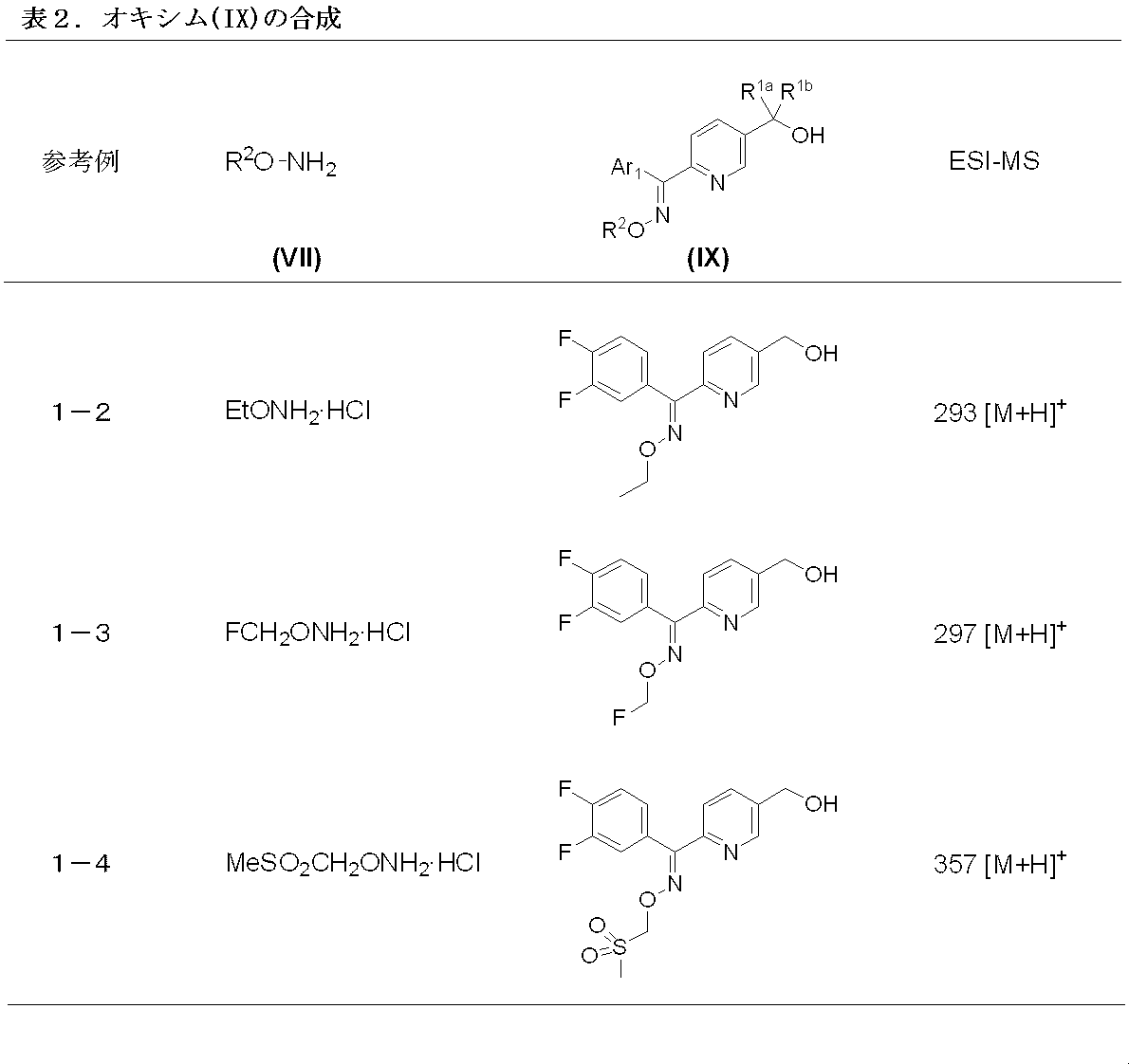
参考例2 式(VIII)で表される化合物(以下、「アミン(VIII)」という)の合成 Reference Example 2 Synthesis of a compound represented by the formula (VIII) (hereinafter referred to as “amine (VIII)”)
参考例2-1
1,1-ジメチルエチル 7-(フェニルメチル)-2,7-ジアザスピロ[4.4]ノナン-2-カルボキシラート
2-(フェニルメチル)-2,7-ジアザスピロ[4.4]ノナン(500mg)、ジイソプロピルエチルアミン(0.64mL)及びDMAP(28.2mg)のクロロホルム溶液(2.0mL)に0℃でジ-tert-ブチルジカルボナート(0.64mL)を加え、室温で18時間攪拌した。反応液に炭酸水素ナトリウム水溶液を加えた後、クロロホルムで抽出した。有機層を飽和食塩水で洗浄し、硫酸ナトリウムで乾燥させた後、減圧下濃縮した。得られた残渣をシリカゲルクロマトグラフィー(クロロホルム:メタノール=100:0~95:5)で精製することにより、表題化合物(635mg)を茶色油状物として得た。
ESI-MS Found:m/z 317[M+H]+
Reference Example 2-1
1,1-dimethylethyl 7- (phenylmethyl) -2,7-diazaspiro [4.4] nonane-2-carboxylate 2- (phenylmethyl) -2,7-diazaspiro [4.4] nonane (500 mg) To a chloroform solution (2.0 mL) of diisopropylethylamine (0.64 mL) and DMAP (28.2 mg) was added di-tert-butyl dicarbonate (0.64 mL) at 0 ° C., and the mixture was stirred at room temperature for 18 hours. A sodium bicarbonate aqueous solution was added to the reaction solution, and the mixture was extracted with chloroform. The organic layer was washed with saturated brine, dried over sodium sulfate, and concentrated under reduced pressure. The obtained residue was purified by silica gel chromatography (chloroform: methanol = 100: 0 to 95: 5) to give the title compound (635 mg) as a brown oil.
ESI-MS Found: m / z 317 [M + H] +
参考例2-2
1,1-ジメチルエチル 2,7-ジアザスピロ[4.4]ノナン-2-カルボキシラート
参考例2-1で得た化合物(635mg)のメタノール溶液(10mL)に20%水酸化パラジウム-炭素(141mg)を加え、水素雰囲気下、室温で18時間攪拌した。反応液をセライト濾過した後、濾液を減圧下濃縮することにより、表題化合物(458mg)を淡黄色油状物として得た。
ESI-MS Found:m/z 227[M+H]+
Reference Example 2-2
1,1-dimethylethyl 2,7-diazaspiro [4.4] nonane-2-carboxylate To a methanol solution (10 mL) of the compound (635 mg) obtained in Reference Example 2-1, 20% palladium hydroxide-carbon (141 mg) ) And stirred at room temperature for 18 hours under a hydrogen atmosphere. The reaction mixture was filtered through celite, and the filtrate was concentrated under reduced pressure to give the title compound (458 mg) as a pale yellow oil.
ESI-MS Found: m / z 227 [M + H] +
参考例2-3
1,1-ジメチルエチル 2,6-ジアザスピロ[3.4]オクタン-6-カルボキシラート
1,1-ジメチルエチル 2-(フェニルメチル)-2,6-ジアザスピロ[3.4]オクタン-カルボキシラートを用いて参考例2-2と同様な操作を行うことにより、表題化合物を得た。
ESI-MS Found:m/z 213[M+H]+
Reference Example 2-3
1,1-dimethylethyl 2,6-diazaspiro [3.4] octane-6-carboxylate 1,1-dimethylethyl 2- (phenylmethyl) -2,6-diazaspiro [3.4] octane-carboxylate And the title compound was obtained by the same procedures as in Reference Example 2-2.
ESI-MS Found: m / z 213 [M + H] +
参考例2-4
2-(フェニルメチル)-2,6-ジアザスピロ[3.4]オクタン
1,1-ジメチルエチル 2-(フェニルメチル)-2,6-ジアザスピロ[3.4]オクタン-カルボキシラート(300mg)のクロロホルム溶液(3.0mL)に0℃でトリフルオロ酢酸(3.0mL)を加え、室温で30分間撹拌した。反応溶液をトルエンを用いて留去した後、残渣に2規定水酸化ナトリウム水溶液を加え、クロロホルムで抽出した。有機層を硫酸ナトリウムで乾燥させた後、減圧下濃縮することにより、表題化合物(100mg)を得た。
ESI-MS Found:m/z 203[M+H]+
Reference Example 2-4
2- (Phenylmethyl) -2,6-diazaspiro [3.4] octane 1,1-dimethylethyl 2- (phenylmethyl) -2,6-diazaspiro [3.4] octane-carboxylate (300 mg) in chloroform Trifluoroacetic acid (3.0 mL) was added to the solution (3.0 mL) at 0 ° C., and the mixture was stirred at room temperature for 30 minutes. The reaction solution was evaporated using toluene, 2N aqueous sodium hydroxide solution was added to the residue, and the mixture was extracted with chloroform. The organic layer was dried over sodium sulfate and concentrated under reduced pressure to obtain the title compound (100 mg).
ESI-MS Found: m / z 203 [M + H] +
参考例3 式(III-a)で表される化合物(以下、「アリールアミン保護体(III-a)」という)の合成 Reference Example 3 Synthesis of a compound represented by the formula (III-a) (hereinafter referred to as “arylamine protected product (III-a)”)
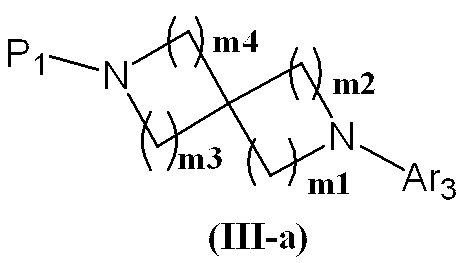
参考例3-1
2-(6-フルオロ-3-ピリジニル)-7-(フェニルメチル)-2,7-ジアザスピロ[4.4]ノナン
2-(フェニルメチル)-2,7-ジアザスピロ[4.4]ノナン(100.0mg)、5-ブロモ-2-フルオロピリジン(81.0mg)、(R)-(+)-BINAP(43.2mg)及びナトリウムtert-ブトキシド(62.2mg)のトルエン(2.0mL)溶液に、Pd2(dba)3(43.2mg)を加え、マイクロ波照射下、130℃で30分間攪拌した。反応液に炭酸水素ナトリウム水溶液を加えた後、酢酸エチルで抽出した。有機層を飽和食塩水で洗浄し、硫酸ナトリウムで乾燥させた後、減圧下濃縮した。得られた残渣をシリカゲルクロマトグラフィー(ヘキサン:酢酸エチル=10:1~7:3)で精製することにより表題化合物(67.1mg)を淡緑色油状物として得た。
ESI-MS Found:m/z 312[M+H]+
Reference Example 3-1
2- (6-Fluoro-3-pyridinyl) -7- (phenylmethyl) -2,7-diazaspiro [4.4] nonane 2- (phenylmethyl) -2,7-diazaspiro [4.4] nonane (100 Solution of 5-bromo-2-fluoropyridine (81.0 mg), (R)-(+)-BINAP (43.2 mg) and sodium tert-butoxide (62.2 mg) in toluene (2.0 mL) Was added with Pd 2 (dba) 3 (43.2 mg) and stirred at 130 ° C. for 30 minutes under microwave irradiation. An aqueous sodium hydrogen carbonate solution was added to the reaction mixture, and the mixture was extracted with ethyl acetate. The organic layer was washed with saturated brine, dried over sodium sulfate, and concentrated under reduced pressure. The obtained residue was purified by silica gel chromatography (hexane: ethyl acetate = 10: 1-7: 3) to give the title compound (67.1 mg) as a pale-green oil.
ESI-MS Found: m / z 312 [M + H] +
各種アミン(VIII)及び式(V)で表される化合物を用いて上記参考例3-1で示した条件で反応を行うことにより、下記のアリールアミン保護体(III-a)を得た。 The following protected arylamine (III-a) was obtained by performing the reaction using the various amines (VIII) and the compound represented by the formula (V) under the conditions shown in Reference Example 3-1.

参考例4 式(III)で表される化合物(以下、「アリールアミン(III)」という)の合成 Reference Example 4 Synthesis of a compound represented by the formula (III) (hereinafter referred to as “arylamine (III)”)
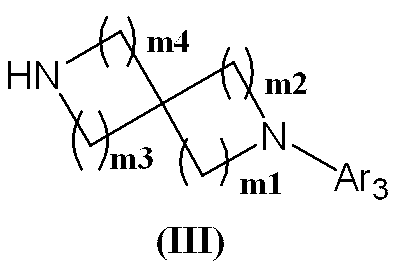
2-(6-フルオロ-3-ピリジニル)-2,7-ジアザスピロ[4.4]ノナン
参考例3-1で得た化合物(67.1mg)のメタノール溶液(5.0mL)に20%水酸化パラジウム-炭素(50.0mg)を加えた後、水素雰囲気下、室温で18時間攪拌した。反応液をセライト濾過した後、濾液を減圧濃縮した。得られた残渣を乾燥させることにより、表題化合物(47.0mg)を無色アモルファスとして得た。
ESI-MS Found:m/z 222[M+H]+
2- (6-Fluoro-3-pyridinyl) -2,7-diazaspiro [4.4] nonane To a methanol solution (5.0 mL) of the compound obtained in Reference Example 3-1 (67.1 mg) with 20% hydroxylation After adding palladium-carbon (50.0 mg), the mixture was stirred at room temperature for 18 hours under a hydrogen atmosphere. The reaction mixture was filtered through celite, and the filtrate was concentrated under reduced pressure. The obtained residue was dried to give the titled compound (47.0 mg) as a colorless amorphous.
ESI-MS Found: m / z 222 [M + H] +
各種アリールアミン保護体(III-a)を用いて上記参考例2-4または4-1と同様の条件で脱保護反応を行うことにより、下記のアリールアミン(III)を得た。 The following arylamine (III) was obtained by performing a deprotection reaction under the same conditions as in Reference Example 2-4 or 4-1 using various protected arylamines (III-a).

参考例5 式(II)で表される化合物(以下、「化合物(II)」という)の合成
参考例5-1
(6-{(E)-(3,4-ジフルオロフェニル)[(エチルオキシ)イミノ]メチル}-3-ピリジニル)メチル メタンスルホナート
(E)-(3,4-ジフルオロフェニル)[5-(ヒドロキシメチル)-2-ピリジニル]メタノンO-エチルオキシム(7.46g)及びトリエチルアミン(2.17mL)の酢酸エチル溶液(75mL)に0℃でメタンスルホニルクロリド(0.64mL)を加え、室温で1時間攪拌した。反応液をセライト濾過した後、濾液を減圧濃縮した。得られた残渣をシリカゲルクロマトグラフィー(ヘキサン:酢酸エチル=100:0~60:40)で精製することにより、表題化合物(7.06g)を褐色固体として得た。
ESI-MS Found:m/z 371[M+H]+
Reference Example 5 Synthesis Reference Example 5-1 of a Compound Represented by Formula (II) (hereinafter referred to as “Compound (II)”)
(6-{(E)-(3,4-difluorophenyl) [(ethyloxy) imino] methyl} -3-pyridinyl) methyl methanesulfonate (E)-(3,4-difluorophenyl) [5- (hydroxy Methylsulfonyl chloride (0.64 mL) was added to a solution of methyl) -2-pyridinyl] methanone O-ethyloxime (7.46 g) and triethylamine (2.17 mL) in ethyl acetate (75 mL) at 0 ° C., and then at room temperature for 1 hour. Stir. The reaction mixture was filtered through celite, and the filtrate was concentrated under reduced pressure. The obtained residue was purified by silica gel chromatography (hexane: ethyl acetate = 100: 0-60: 40) to give the title compound (7.06 g) as a brown solid.
ESI-MS Found: m / z 371 [M + H] +
参考例5-2
[6-((E)-(3,4-ジフルオロフェニル){[(2-ヒドロキシ-2-メチルプロピル)オキシ]イミノ}メチル)-3-ピリジニル]メチル メタンスルホナート
参考例1-1で得たアルコール(814mg)を用いて参考例5-1と同様の方法により、表題合物の粗生成物(1.01g)を褐色油状物質として得た。
ESI-MS Found:m/z 415[M+H]+
Reference Example 5-2
[6 - ((E) - (3,4-difluorophenyl) {[(2-hydroxy-2-methylpropyl) oxy] imino} methyl) -3-pyridinyl] obtained with methyl methanesulfonate Reference Example 1-1 A crude product of the title compound (1.01 g) was obtained as a brown oil by the same method as in Reference Example 5-1 using alcohol (814 mg).
ESI-MS Found: m / z 415 [M + H] +
参考例6 式(IV-a)で表される化合物(以下、「化合物(IV-a)」という)の合成
参考例6-1
1,1-ジメチルエチル 7-[(6-{(E)-(3,4-ジフルオロフェニル)[(エチルオキシ)イミノ]メチル}-3-ピリジニル)メチル]-2,7-ジアザスピロ[4.4]ノナン-2-カルボキシラート
参考例2-2で得た化合物(200mg)と参考例5-1で得た化合物(316mg)及びジイソプロピルエチルアミン(0.77mL)のジメチルホルムアミド溶液(5.0mL)に対してヨウ化ナトリウム(397mg)を加え、80℃で15時間攪拌した。反応液に飽和炭酸水素ナトリウム溶液を加え、酢酸エチルで抽出した。有機層を飽和食塩水で洗浄し、硫酸ナトリウムで乾燥した後、減圧濃縮した。得られた残渣をシリカゲルクロマトグラフィー(クロロホルム:メタノール=100:0~97:3)で精製することにより、表題化合物(237mg)を褐色油状物として得た。
ESI-MS Found:m/z 501[M+H]+
Reference Example 6 Synthesis Reference Example 6-1 of a Compound Represented by Formula (IV-a) (hereinafter referred to as “Compound (IV-a)”)
1,1-dimethylethyl 7-[(6-{(E)-(3,4-difluorophenyl) [(ethyloxy) imino] methyl} -3-pyridinyl) methyl] -2,7-diazaspiro [4.4 Nonane-2-carboxylate Compound (200 mg) obtained in Reference Example 2-2, Compound obtained in Reference Example 5-1 (316 mg) and diisopropylethylamine (0.77 mL) in dimethylformamide solution (5.0 mL) Sodium iodide (397 mg) was added to the solution, followed by stirring at 80 ° C. for 15 hours. A saturated sodium hydrogen carbonate solution was added to the reaction solution, and the mixture was extracted with ethyl acetate. The organic layer was washed with saturated brine, dried over sodium sulfate, and concentrated under reduced pressure. The obtained residue was purified by silica gel chromatography (chloroform: methanol = 100: 0 to 97: 3) to give the title compound (237 mg) as a brown oil.
ESI-MS Found: m / z 501 [M + H] +
参考例5で得た化合物(II)及び式(VI-b)で表される化合物を用いて上記参考例6-1と同様の方法により、式(IV-a)で表される化合物を得た。 Using the compound (II) obtained in Reference Example 5 and the compound represented by Formula (VI-b), the compound represented by Formula (IV-a) was obtained in the same manner as in Reference Example 6-1. It was.
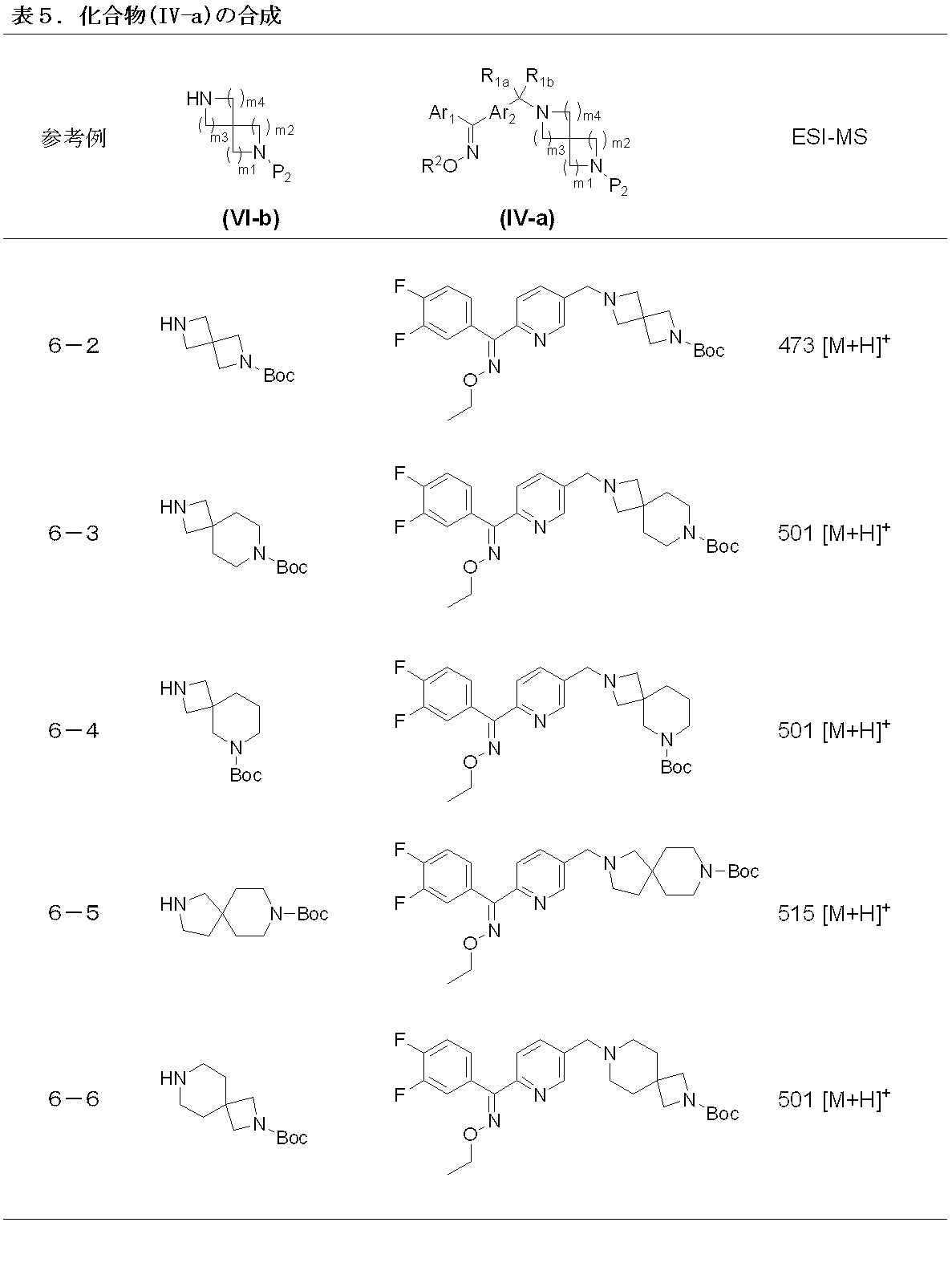
参考例7 式(IV)で表される化合物の合成
参考例7-1
(E)-[5-(2,7-ジアザスピロ[4.4]ノナ-2-イルメチル)-2-ピリジニル](3,4-ジフルオロフェニル)メタノン O-エチルオキシム
参考例6-1で得た化合物(273mg)のクロロホルム溶液(5.0mL)に0℃でトリフルオロ酢酸(5.0mL)を加え、室温で30分間撹拌した。反応溶液をトルエンを用いて留去した後、残渣に飽和炭酸水素ナトリウム溶液を加え、酢酸エチルで抽出した。有機層を飽和食塩水で洗浄し、硫酸ナトリウムで乾燥した後、減圧濃縮した。得られた残渣をシリカゲルクロマトグラフィー(クロロホルム:メタノール=100:0~97:3)で精製することにより、表題化合物(118mg)を褐色油状物として得た。
ESI-MS Found:m/z 401[M+H]+
Reference Example 7 Synthesis Reference Example 7-1 of a Compound Represented by Formula (IV)
(E)-[5- (2,7-diazaspiro [4.4] non-2-ylmethyl) -2-pyridinyl] (3,4-difluorophenyl) methanone obtained in Reference Example 6-1 To a chloroform solution (5.0 mL) of the compound (273 mg) was added trifluoroacetic acid (5.0 mL) at 0 ° C., and the mixture was stirred at room temperature for 30 minutes. The reaction solution was distilled off using toluene, a saturated sodium hydrogen carbonate solution was added to the residue, and the mixture was extracted with ethyl acetate. The organic layer was washed with saturated brine, dried over sodium sulfate, and concentrated under reduced pressure. The obtained residue was purified by silica gel chromatography (chloroform: methanol = 100: 0 to 97: 3) to give the title compound (118 mg) as a brown oil.
ESI-MS Found: m / z 401 [M + H] +
参考例7-2
(E)-[5-(2,6-ジアザスピロ[3.3]ヘプタ-2-イルメチル)-2-ピリジニル](3,4-ジフルオロフェニル)メタノン O-エチルオキシム
参考例6-2で得た化合物(75.0mg)を用いて参考例7-1と同様の方法により、表題合物(68.0mg)を淡黄色油状物質として得た。
ESI-MS Found:m/z 373[M+H]+
Reference Example 7-2
(E)-[5- (2,6-diazaspiro [3.3] hept-2-ylmethyl) -2-pyridinyl] (3,4-difluorophenyl) methanone obtained in O-ethyloxime Reference Example 6-2 The title compound (68.0 mg) was obtained as a pale-yellow oil by a method similar to that in Reference Example 7-1 using the compound (75.0 mg).
ESI-MS Found: m / z 373 [M + H] +
実施例1 Example 1
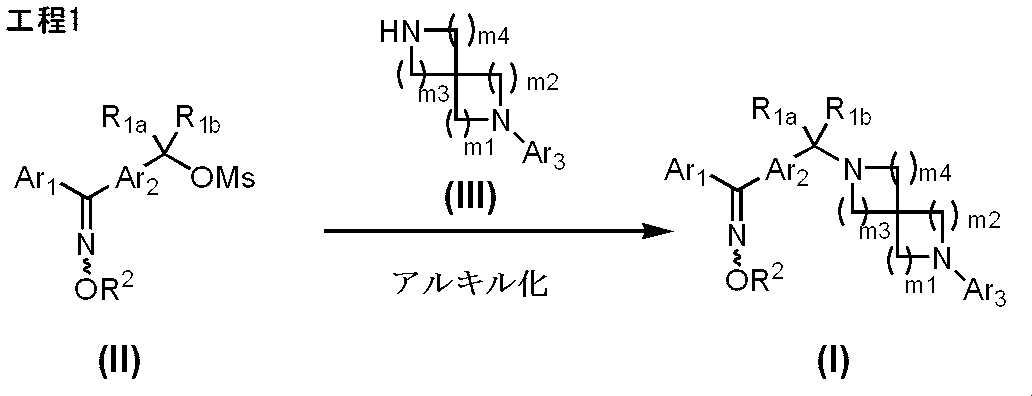
実施例1-1
(E)-(3,4-ジフルオロフェニル)(5-{[7-(6-フルオロ-3-ピリジニル)-2,7-ジアザスピロ[4.4]ノナ-2-イル]メチル}-2-ピリジニル)メタノン O-エチルオキシム
参考例5-1で得た化合物(79.0mg)と参考例4-1で得た化合物(47.1mg)のDMF(2.0mL)溶液に対し、ジイソプロピルエチルアミン(186.0uL)及びヨウ化ナトリウム(96.0mg)を加え、マイクロ波照射下、120℃で5分間攪拌した。反応液に炭酸水素ナトリウム水溶液を加えた後、酢酸エチルで抽出した。有機層を飽和食塩水で洗浄し、硫酸ナトリウムで乾燥させた後、減圧下濃縮した。得られた残渣を高速液体クロマトグラフィー(YMC-PackTM pro C-18、水(0.1%TFA):アセトニトリル(0.1%TFA)=90:10~50:50)で精製することにより、表題化合物(37.4mg)を単黄色油状物として得た。
1H-NMR(400MHz,CDCl3,δppm):1.32(3H,t,J=7.1Hz),1.85-2.04(4H,m),2.46(1H,d,J=8.8Hz),2.55-2.77(3H,m),3.17(1H,d,J=8.8Hz),3.25-3.33(3H,m),3.65(2H,s),4.30(2H,q,J=7.1Hz),6.77(1H,dd,J=3.2,9.0Hz),6.86-6.92(1H,m),7.10-7.35(3H,m),7.38-7.40(1H,m),7.71(1H,dd,J=7.9,1.9Hz),7.78(1H,d,J=7.9Hz),8.51(1H,d,J=1.9Hz).
ESI-MS Found:m/z 496[M+H]+
Example 1-1
(E)-(3,4-difluorophenyl) (5-{[7- (6-fluoro-3-pyridinyl) -2,7-diazaspiro [4.4] non-2-yl] methyl} -2- Pyridinyl ) methanone O- ethyloxime To a DMF (2.0 mL) solution of the compound (79.0 mg) obtained in Reference Example 5-1 and the compound (47.1 mg) obtained in Reference Example 4-1, diisopropylethylamine ( 186.0 uL) and sodium iodide (96.0 mg) were added, and the mixture was stirred at 120 ° C. for 5 minutes under microwave irradiation. An aqueous sodium hydrogen carbonate solution was added to the reaction mixture, and the mixture was extracted with ethyl acetate. The organic layer was washed with saturated brine, dried over sodium sulfate, and concentrated under reduced pressure. By purifying the obtained residue by high performance liquid chromatography (YMC-Pack ™ pro C-18, water (0.1% TFA): acetonitrile (0.1% TFA) = 90: 10 to 50:50). To give the title compound (37.4 mg) as a single yellow oil.
1 H-NMR (400 MHz, CDCl 3 , δ ppm): 1.32 (3H, t, J = 7.1 Hz), 1.85-2.04 (4H, m), 2.46 (1H, d, J = 8.8 Hz), 2.55-2.77 (3H, m), 3.17 (1 H, d, J = 8.8 Hz), 3.25-3.33 (3H, m), 3.65 (2H, s), 4.30 (2H, q, J = 7.1 Hz), 6.77 (1H, dd, J = 3.2, 9.0 Hz), 6.86-6.92 (1H, m), 7.10-7.35 (3H, m), 7.38-7.40 (1H, m), 7.71 (1H, dd, J = 7.9, 1.9 Hz), 7. 78 (1H, d, J = 7.9 Hz), 8.51 (1H, d, J = 1.9 Hz).
ESI-MS Found: m / z 496 [M + H] +
実施例1-2
(E)-(3,4-ジフルオロフェニル){5-[(7-フェニル-2,7-ジアザスピロ[4.4]ノナ-2-イル)メチル]-2-ピリジニル}メタノン O-エチルオキシム
参考例5-1で得た化合物及び2-フェニル-2,7-ジアザスピロ[4.4]ノナンを用いて実施例1-1と同様の方法により、表題化合物を得た。
1H-NMR(400MHz,CDCl3,δppm):1.32(3H,t,J=7.2Hz),1.80-2.05(4H,m),2.48(1H,d,J=9.6Hz),2.55-2.80(3H,m),3.19(1H,d,J=9.2Hz)3.26-3.40(3H,m),3.65(2H,s),4.29(2H,q,J=7.2Hz),6.48-6.55(2H,m),6.62-6.68(1H,m),7.10-7.35(5H,m),7.72(1H,dd,J=1.8,7.6Hz),7.78(1H,d,J=7.6Hz),8.51(1H,d,J=1.8Hz).
ESI-MS Found:m/z 477[M+H]+
Example 1-2
(E)-(3,4-Difluorophenyl) {5-[(7-phenyl-2,7-diazaspiro [4.4] non-2-yl) methyl] -2-pyridinyl} methanone O-ethyloxime Reference The title compound was obtained in the same manner as in Example 1-1 using the compound obtained in Example 5-1 and 2-phenyl-2,7-diazaspiro [4.4] nonane.
1 H-NMR (400 MHz, CDCl 3 , δ ppm): 1.32 (3H, t, J = 7.2 Hz), 1.80-2.05 (4H, m), 2.48 (1H, d, J = 9.6 Hz), 2.55-2.80 (3H, m), 3.19 (1H, d, J = 9.2 Hz) 3.26-3.40 (3H, m), 3.65 ( 2H, s), 4.29 (2H, q, J = 7.2 Hz), 6.48-6.55 (2H, m), 6.62-6.68 (1H, m), 7.10- 7.35 (5H, m), 7.72 (1H, dd, J = 1.8, 7.6 Hz), 7.78 (1H, d, J = 7.6 Hz), 8.51 (1H, d , J = 1.8 Hz).
ESI-MS Found: m / z 477 [M + H] +
実施例1-3
(E)-(5-{[7-(2-クロロフェニル)-2,7-ジアザスピロ[4.4]ノナ-2-イル]メチル}-2-ピリジニル)(3,4-ジフルオロフェニル)メタノン O-エチルオキシム
参考例5-1で得た化合物及び2-(2-クロロフェニル)-2,7-ジアザスピロ[4.4]ノナンを用いて実施例1-1と同様の方法により、表題化合物を得た。
1H-NMR(400MHz,CDCl3,δppm):1.33(3H,t,J=7.1Hz),1.79-2.00(4H,m),2.45-2.51(1H,m),2.58-2.73(3H,m),3.28-3.32(1H,m),3.36-3.51(3H,m),3.64(2H,s),4.30(2H,q,J=7.1Hz),6.72-6.82(2H,m),7.09-7.34(5H,m),7.68-7.80(2H,m),8.51(1H,s).
ESI-MS Found:m/z 512[M+H]+
Example 1-3
(E)-(5-{[7- (2-chlorophenyl) -2,7-diazaspiro [4.4] non-2-yl] methyl} -2-pyridinyl) (3,4-difluorophenyl) methanone O The title compound was obtained in the same manner as in Example 1-1, using the compound obtained in Ethyloxime Reference Example 5-1 and 2- (2-chlorophenyl) -2,7-diazaspiro [4.4] nonane. It was.
1 H-NMR (400 MHz, CDCl 3 , δ ppm): 1.33 (3H, t, J = 7.1 Hz), 1.79-2.00 (4H, m), 2.45-2.51 (1H , M), 2.58-2.73 (3H, m), 3.28-3.32 (1H, m), 3.36-3.51 (3H, m), 3.64 (2H, s) ), 4.30 (2H, q, J = 7.1 Hz), 6.72-6.82 (2H, m), 7.09-7.34 (5H, m), 7.68-7.80 (2H, m), 8.51 (1H, s).
ESI-MS Found: m / z 512 [M + H] +
実施例1-4
(E)-(5-{[7-(3-クロロフェニル)-2,7-ジアザスピロ[4.4]ノナ-2-イル]メチル}-2-ピリジニル)(3,4-ジフルオロフェニル)メタノン O-エチルオキシム
参考例5-1で得た化合物及び2-(3-クロロフェニル)-2,7-ジアザスピロ[4.4]ノナンを用いて実施例1-1と同様の方法により、表題化合物を得た。
1H-NMR(400MHz,CDCl3,δppm):1.32(3H,t,J=7.1Hz),1.80-2.05(4H,m),2.43-2.48(1H,m),2.54-2.75(3H,m),3.16-3.20(1H,m),3.23-3.37(3H,m),3.64(2H,s),4.30(2H,q,J=7.1Hz),6.35-6.39(1H,m),6.47-6.48(1H,m),6.59-6.63(1H,m),7.07-7.34(4H,m),7.68-7.80(2H,m),8.51(1H,s).
ESI-MS Found:m/z 512[M+H]+
Example 1-4
(E)-(5-{[7- (3-Chlorophenyl) -2,7-diazaspiro [4.4] non-2-yl] methyl} -2-pyridinyl) (3,4-difluorophenyl) methanone O - in the same manner as in example 1-1 by using the compound obtained in ethyl oxime reference example 5-1 and 2- (3-chlorophenyl) -2,7-diazaspiro [4.4] nonane, to give the title compound It was.
1 H-NMR (400 MHz, CDCl 3 , δ ppm): 1.32 (3H, t, J = 7.1 Hz), 1.80-2.05 (4H, m), 2.43-2.48 (1H M), 2.54-2.75 (3H, m), 3.16-3.20 (1H, m), 3.23-3.37 (3H, m), 3.64 (2H, s) ), 4.30 (2H, q, J = 7.1 Hz), 6.35-6.39 (1H, m), 6.47-6.48 (1H, m), 6.59-6.63. (1H, m), 7.07-7.34 (4H, m), 7.68-7.80 (2H, m), 8.51 (1H, s).
ESI-MS Found: m / z 512 [M + H] +
実施例1-5
(E)-(5-{[7-(4-クロロフェニル)-2,7-ジアザスピロ[4.4]ノナ-2-イル]メチル}-2-ピリジニル)(3,4-ジフルオロフェニル)メタノン O-エチルオキシム
参考例5-1で得た化合物及び2-(4-クロロフェニル)-2,7-ジアザスピロ[4.4]ノナンを用いて実施例1-1と同様の方法により、表題化合物を得た。
1H-NMR(400MHz,CDCl3,δppm):1.32(3H,t,J=7.1Hz),1.78-2.07(4H,m),2.43-2.48(1H,m),2.54-2.75(3H,m),3.14-3.18(1H,m),3.22-3.34(3H,m),3.64(2H,s),4.30(2H,q,J=7.1Hz),6.41(2H,d,J=9.3Hz),7.11-7.34(5H,m),7.67-7.79(2H,m),8.51(1H,s).
ESI-MS Found:m/z 512[M+H]+
Example 1-5
(E)-(5-{[7- (4-Chlorophenyl) -2,7-diazaspiro [4.4] non-2-yl] methyl} -2-pyridinyl) (3,4-difluorophenyl) methanone O - in the same manner as in example 1-1 by using the compound obtained in ethyl oxime reference example 5-1 and 2- (4-chlorophenyl) -2,7-diazaspiro [4.4] nonane, to give the title compound It was.
1 H-NMR (400 MHz, CDCl 3 , δ ppm): 1.32 (3H, t, J = 7.1 Hz), 1.78-2.07 (4H, m), 2.43-2.48 (1H , M), 2.54-2.75 (3H, m), 3.14-3.18 (1H, m), 3.22-3.34 (3H, m), 3.64 (2H, s) ), 4.30 (2H, q, J = 7.1 Hz), 6.41 (2H, d, J = 9.3 Hz), 7.11-7.34 (5H, m), 7.67-7 .79 (2H, m), 8.51 (1H, s).
ESI-MS Found: m / z 512 [M + H] +
実施例1-6
(E)-(3,4-ジフルオロフェニル)[5-({7-[4-(メチルオキシ)フェニル]-2,7-ジアザスピロ[4.4]ノナ-2-イル}メチル)-2-ピリジニル]メタノン O-エチルオキシム
参考例5-1で得た化合物及び2-[4-(メチルオキシ)フェニル]-2,7-ジアザスピロ[4.4]ノナンを用いて実施例1-1と同様の方法により、表題化合物を得た。
1H-NMR(400MHz,CDCl3,δppm):1.32(3H,t,J=7.1Hz),1.78-2.05(4H,m),2.43-2.49(1H,m),2.55-2.75(3H,m),3.13-3.17(1H,m),3.22-3.32(3H,m),3.64(2H,s),3.75(3H,s),4.30(2H,q,J=7.1Hz),6.47(2H,d,J=8.3Hz),6.84(2H,d,J=8.3Hz),7.11-7.34(3H,m),7.68-7.79(2H,m),8.51(1H,s).
ESI-MS Found:m/z 507[M+H]+
Example 1-6
(E)-(3,4-Difluorophenyl) [5-({7- [4- (methyloxy) phenyl] -2,7-diazaspiro [4.4] non-2-yl} methyl) -2- Pyridinyl] methanone As in Example 1-1, using the compound obtained in Reference Example 5-1 and 2- [4- (methyloxy) phenyl] -2,7-diazaspiro [4.4] nonane The title compound was obtained by this method.
1 H-NMR (400 MHz, CDCl 3 , δ ppm): 1.32 (3H, t, J = 7.1 Hz), 1.78-2.05 (4H, m), 2.43-2.49 (1H M), 2.55-2.75 (3H, m), 3.13-3.17 (1H, m), 3.22-3.32 (3H, m), 3.64 (2H, s) ), 3.75 (3H, s), 4.30 (2H, q, J = 7.1 Hz), 6.47 (2H, d, J = 8.3 Hz), 6.84 (2H, d, J = 8.3 Hz), 7.11-7.34 (3H, m), 7.68-7.79 (2H, m), 8.51 (1H, s).
ESI-MS Found: m / z 507 [M + H] +
実施例1-7
5-{6-[(6-{(E)-(3,4-ジフルオロフェニル)[(エチルオキシ)イミノ]メチル}-3-ピリジニル)メチル]-2,6-ジアザスピロ[3.3]ヘプタ-2-イル}-3-ピリジンカルボニトリル
参考例5-1で得た化合物及び参考例4-5で得た化合物を用いて実施例1-1と同様の方法により、表題化合物をトリフルオロ酢酸塩として得た。
1H-NMR(400MHz,CDCl3,δppm):1.29(3H,t,J=7.6Hz),4.11-4.23(4H,m),4.25(2H,q,J=7.2Hz),4.32-4.40(4H,m),4.38(2H,s),7.11(1H,s),7.17(1H,s),7.26-7.38(2H,m),7.91-8.09(3H,m),8.21(1H,s),8.58(1H,s).
ESI-MS Found:m/z 475[M+H]+
Example 1-7
5- {6-[(6-{(E)-(3,4-difluorophenyl) [(ethyloxy) imino] methyl} -3-pyridinyl) methyl] -2,6-diazaspiro [3.3] hepta 2-Il} -3-pyridinecarbonitrile The title compound was obtained in the same manner as in Example 1-1 using the compound obtained in Reference Example 5-1 and the compound obtained in Reference Example 4-5. Got as.
1 H-NMR (400 MHz, CDCl 3 , δ ppm): 1.29 (3H, t, J = 7.6 Hz), 4.11-4.23 (4H, m), 4.25 (2H, q, J = 7.2 Hz), 4.32-4.40 (4H, m), 4.38 (2H, s), 7.11 (1H, s), 7.17 (1H, s), 7.26- 7.38 (2H, m), 7.91-8.09 (3H, m), 8.21 (1H, s), 8.58 (1H, s).
ESI-MS Found: m / z 475 [M + H] +
実施例1-8
5-{6-[(6-{(E)-(3,4-ジフルオロフェニル)[(エチルオキシ)イミノ]メチル}-3-ピリジニル)メチル]-2,6-ジアザスピロ[3.3]ヘプタ-2-イル}-3-ピリジンカルボキサミド
実施例1-7の副生成物として、表題化合物をトリフルオロ酢酸塩として得た。
1H-NMR(400MHz,MeOD,δppm):1.30(3H,t,J=7.2Hz),4.28-4.35(6H,m),4.40-4.46(4H,m),4.48(2H,s),7.12-7.18(1H,m),7.28-7.36(2H,m),7.55(1H,s),7.95-8.05(3H,m),8.40(1H,s),8.60(1H,s).
ESI-MS Found:m/z 493[M+H]+
Example 1-8
5- {6-[(6-{(E)-(3,4-difluorophenyl) [(ethyloxy) imino] methyl} -3-pyridinyl) methyl] -2,6-diazaspiro [3.3] hepta 2-yl} -3-pyridinecarboxamide The title compound was obtained as a trifluoroacetate salt as a byproduct of Example 1-7.
1 H-NMR (400 MHz, MeOD, δ ppm): 1.30 (3H, t, J = 7.2 Hz), 4.28-4.35 (6H, m), 4.40-4.46 (4H, m), 4.48 (2H, s), 7.12-7.18 (1H, m), 7.28-7.36 (2H, m), 7.55 (1H, s), 7.95. -8.05 (3H, m), 8.40 (1H, s), 8.60 (1H, s).
ESI-MS Found: m / z 493 [M + H] +
実施例1-9
(E)-(5-{[6-(2-シクロプロピル-4-ピリジニル)-2,6-ジアザスピロ[3.3]ヘプタ-2-イル]メチル}-2-ピリジニル)(3,4-ジフルオロフェニル)メタノン O-エチルオキシム
参考例5-1で得た化合物及び参考例4-4で得た化合物を用いて実施例1-1と同様の方法により、表題化合物をトリフルオロ酢酸塩として得た。
1H-NMR(400MHz,CDCl3,δppm):1.00-1.10(2H,m),1.20-1.26(2H,m),1.29(3H,t,J=7.2Hz),2.00-2.10(1H,m),4.30(2H,q,J=7.2Hz),4.38-4.47(8H,m),4.48(2H,s),6.23(1H,s),6.48(1H,dd,J=6.8,1.6Hz),7.06-7.12(1H,m),7.26-7.36(2H,m),7.90(1H,d,J=6.8Hz),8.58(1H,s).
ESI-MS Found:m/z 490[M+H]+
Example 1-9
(E)-(5-{[6- (2-Cyclopropyl-4-pyridinyl) -2,6-diazaspiro [3.3] hept-2-yl] methyl} -2-pyridinyl) (3,4 Difluorophenyl) methanone The title compound was obtained as the trifluoroacetate salt in the same manner as in Example 1-1 using the compound obtained in O-ethyloxime Reference Example 5-1 and the compound obtained in Reference Example 4-4. It was.
1 H-NMR (400 MHz, CDCl 3 , δ ppm): 1.00-1.10 (2H, m), 1.20-1.26 (2H, m), 1.29 (3H, t, J = 7 .2 Hz), 2.00-2.10 (1 H, m), 4.30 (2 H, q, J = 7.2 Hz), 4.38-4.47 (8 H, m), 4.48 (2 H) , S), 6.23 (1H, s), 6.48 (1H, dd, J = 6.8, 1.6 Hz), 7.06-7.12 (1H, m), 7.26-7 .36 (2H, m), 7.90 (1H, d, J = 6.8 Hz), 8.58 (1H, s).
ESI-MS Found: m / z 490 [M + H] +
実施例1-10
(E)-(3,4-ジフルオロフェニル)(5-{[6-(6-フルオロ-3-ピリジニル)-2,6-ジアザスピロ[3.4]オクタ-2-イル]メチル}-2-ピリジニル)メタノン O-エチルオキシム
参考例5-1で得た化合物及び参考例4-2で得た化合物を用いて実施例1-1と同様の方法により、表題化合物をトリフルオロ酢酸塩として得た。
1H-NMR(400MHz,MeOD,δppm):1.29(3H,t,J=7.6Hz),2.38(2H,d,J=6.8Hz),3.38(2H,m),3.57(2H,brs),4.30(2H,q,J=7.6Hz),4.16-4.31(4H,m),4.52(2H,s),6.89(1H,dd,J=9.2,2.8Hz),7.11-7.28(2H,m),7.25-7.35(2H,m),7.40-7.44(1H,m),7.95-8.02(2H,m),8.59(1H,d,J=1.2Hz).
ESI-MS Found:m/z 482[M+H]+
Example 1-10
(E)-(3,4-difluorophenyl) (5-{[6- (6-fluoro-3-pyridinyl) -2,6-diazaspiro [3.4] oct-2-yl] methyl} -2- Pyridinyl) methanone The title compound was obtained as the trifluoroacetate salt in the same manner as in Example 1-1 using the compound obtained in O-ethyloxime Reference Example 5-1 and the compound obtained in Reference Example 4-2. .
1 H-NMR (400 MHz, MeOD, δ ppm): 1.29 (3H, t, J = 7.6 Hz), 2.38 (2H, d, J = 6.8 Hz), 3.38 (2H, m) 3.57 (2H, brs), 4.30 (2H, q, J = 7.6 Hz), 4.16-4.31 (4H, m), 4.52 (2H, s), 6.89 (1H, dd, J = 9.2, 2.8 Hz), 7.11-7.28 (2H, m), 7.25-7.35 (2H, m), 7.40-7.44 ( 1H, m), 7.95-8.02 (2H, m), 8.59 (1H, d, J = 1.2 Hz).
ESI-MS Found: m / z 482 [M + H] +
実施例1-11
(E)-(3,4-ジフルオロフェニル)(5-{[2-(6-フルオロ-3-ピリジニル)-2,6-ジアザスピロ[3.4]オクタ-6-イル]メチル}-2-ピリジニル)メタノン O-エチルオキシム
参考例5-1で得た化合物及び参考例4-3で得た化合物を用いて実施例1-1と同様の方法により、表題化合物をトリフルオロ酢酸塩として得た。
1H-NMR(400MHz,MeOD,δppm):1.29(3H,t,J=7.6Hz),2.47-2.58(2H,m),3.39-3.73(4H,m),3.85-3.94(4H,m),4.28(2H,q,J=7.6Hz),4.50(2H,s),6.89(1H,dd,J=8.8,2.8Hz),7.07-7.16(2H,m),7.28-7.35(3H,m),8.02(2H,brs),8.62(1H,m).
ESI-MS Found:m/z 482[M+H]+
Example 1-11
(E)-(3,4-difluorophenyl) (5-{[2- (6-fluoro-3-pyridinyl) -2,6-diazaspiro [3.4] oct-6-yl] methyl} -2- Pyridinyl) methanone The title compound was obtained as the trifluoroacetate salt in the same manner as in Example 1-1 using the compound obtained in O-ethyloxime Reference Example 5-1 and the compound obtained in Reference Example 4-3. .
1 H-NMR (400 MHz, MeOD, δ ppm): 1.29 (3H, t, J = 7.6 Hz), 2.47-2.58 (2H, m), 3.39-3.73 (4H, m), 3.85-3.94 (4H, m), 4.28 (2H, q, J = 7.6 Hz), 4.50 (2H, s), 6.89 (1H, dd, J = 8.8, 2.8 Hz), 7.07-7.16 (2H, m), 7.28-7.35 (3H, m), 8.02 (2H, brs), 8.62 (1H, m).
ESI-MS Found: m / z 482 [M + H] +
実施例1-12
5-(6-{[6-((E)-(3,4-ジフルオロフェニル){[(2-ヒドロキシ-2-メチルプロピル)オキシ]イミノ}メチル)-3-ピリジニル]メチル}-2,6-ジアザスピロ[3.3]ヘプタ-2-イル)-3-ピリジンカルボニトリル
参考例5-2で得た化合物及び参考例4-5で得た化合物を用いて実施例1-1と同様の方法により、表題化合物をトリフルオロ酢酸塩として得た。
1H-NMR(400MHz,MeOD,δppm):1.25(6H,s),4.15(4H,s),4.45(4H,brs),4.50(2H,s),7.15-7.25(2H,m),7.30-7.40(2H,m),7.96-8.06(3H,m),8.20(1H,s),8.59(1H,s).
ESI-MS Found:m/z 519[M+H]+
Example 1-12
5- (6-{[6-((E)-(3,4-difluorophenyl) {[(2-hydroxy-2-methylpropyl) oxy] imino} methyl) -3-pyridinyl] methyl} -2, 6-Diazaspiro [3.3] hept-2-yl) -3-pyridinecarbonitrile Similar to Example 1-1 using the compound obtained in Reference Example 5-2 and the compound obtained in Reference Example 4-5 The method yielded the title compound as the trifluoroacetate salt.
1 H-NMR (400 MHz, MeOD, δ ppm): 1.25 (6H, s), 4.15 (4H, s), 4.45 (4H, brs), 4.50 (2H, s), 7. 15-7.25 (2H, m), 7.30-7.40 (2H, m), 7.96-8.06 (3H, m), 8.20 (1H, s), 8.59 ( 1H, s).
ESI-MS Found: m / z 519 [M + H] +
実施例1-13
(E)-(3,4-ジフルオロフェニル)(5-{[6-(2-メチル-4-ピリジニル)-2,6-ジアザスピロ[3.3]ヘプタ-2-イル]メチル}-2-ピリジニル)メタノン O-(2-ヒドロキシ-2-メチルプロピル)オキシム
参考例5-2で得た化合物及び参考例4-6で得た化合物を用いて実施例1-1と同様の方法により、表題化合物をトリフルオロ酢酸塩として得た。
1H-NMR(400MHz,MeOD,δppm):1.18(6H,s),2.48(3H,s),4.12(2H,s),4.19-4.38(10H,m),6.43-6.55(2H,m),7.12-7.21(1H,m),7.26-7.42(2H,m),7.92(1H,d,J=7.6Hz),7.98(2H,m),8.59(1H,s).
ESI-MS Found:m/z 508[M+H]+
Example 1-13
(E)-(3,4-difluorophenyl) (5-{[6- (2-methyl-4-pyridinyl) -2,6-diazaspiro [3.3] hept-2-yl] methyl} -2- Pyridinyl) methanone O- (2-hydroxy-2-methylpropyl) oxime By using the compound obtained in Reference Example 5-2 and the compound obtained in Reference Example 4-6 in the same manner as in Example 1-1, The compound was obtained as the trifluoroacetate salt.
1 H-NMR (400 MHz, MeOD, δ ppm): 1.18 (6H, s), 2.48 (3H, s), 4.12 (2H, s), 4.19-4.38 (10H, m ), 6.43-6.55 (2H, m), 7.12-7.21 (1H, m), 7.26-7.42 (2H, m), 7.92 (1H, d, J = 7.6 Hz), 7.98 (2H, m), 8.59 (1H, s).
ESI-MS Found: m / z 508 [M + H] +
実施例1-14
(E)-(3,4-ジフルオロフェニル){5-[(6-イミダゾ[1,2-a]ピリジン-7-イル-2,6-ジアザスピロ[3.3]ヘプタ-2-イル)メチル]-2-ピリジニル}メタノン O-(2-ヒドロキシ-2-メチルプロピル)オキシム
参考例5-2で得た化合物及び参考例4-7で得た化合物を用いて実施例1-1と同様の方法により、表題化合物をトリフルオロ酢酸塩として得た。
1H-NMR(400MHz,MeOD,δppm):1.18(6H,s),4.13(2H,s),4.26-4.40(4H,m),4.40-4.50(6H,m),6.33(1H,s),6.70(1H,dd,J=7.6,2.0Hz),7.13-7.19(1H,m),7.26-7.45(2H,m),7.57(1H,s),7.72(1H,d,J=2.0Hz),7.95-8.03(2H,m),8.38(1H,d,J=7.6Hz),8.59(1H,s).
ESI-MS Found:m/z 533[M+H]+
Example 1-14
(E)-(3,4-difluorophenyl) {5-[(6-imidazo [1,2-a] pyridin-7-yl-2,6-diazaspiro [3.3] hept-2-yl) methyl ] -2-Pyridinyl} methanone O- (2-hydroxy-2-methylpropyl) oxime Similar to Example 1-1 using the compound obtained in Reference Example 5-2 and the compound obtained in Reference Example 4-7 The method yielded the title compound as the trifluoroacetate salt.
1 H-NMR (400 MHz, MeOD, δ ppm): 1.18 (6H, s), 4.13 (2H, s), 4.26-4.40 (4H, m), 4.40-4.50 (6H, m), 6.33 (1H, s), 6.70 (1H, dd, J = 7.6, 2.0 Hz), 7.13-7.19 (1H, m), 7.26 -7.45 (2H, m), 7.57 (1H, s), 7.72 (1H, d, J = 2.0 Hz), 7.95-8.03 (2H, m), 8.38 (1H, d, J = 7.6 Hz), 8.59 (1H, s).
ESI-MS Found: m / z 533 [M + H] +
実施例2 Example 2
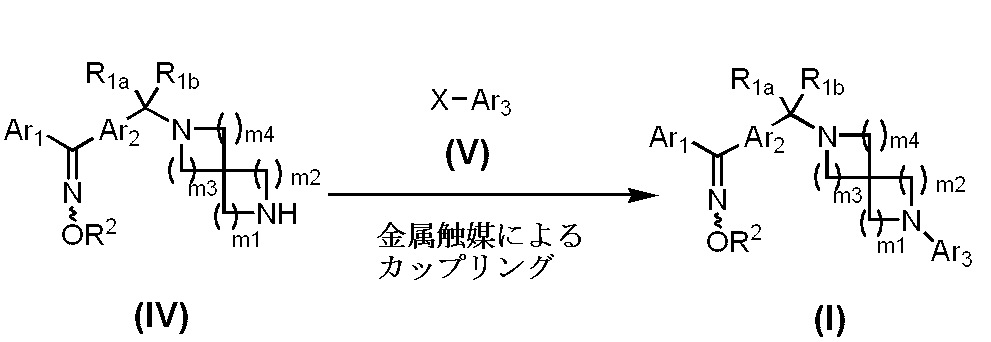
実施例2-1
(E)-(3,4-ジフルオロフェニル){5-[(7-ピラゾロ[1,5-b]ピリダジン-3-イル-2,7-ジアザスピロ[4.4]ノナ-2-イル)メチル]-2-ピリジニル}メタノン O-エチルオキシム
参考例7-1で得た化合物(53.4mg)、3-ブロモピラゾロ[1,5-b]ピリダジン(31.7mg)、(R)-(+)-BINAP(12.5mg)及びナトリウムtert-ブトキシド(18.0mg)をトルエン(10.0mL)に溶解させた後、Pd2(dba)3(6.1mg)を加え、窒素雰囲気下、加熱還流下12時間攪拌した。反応液に炭酸水素ナトリウム水溶液を加えた後、酢酸エチルで抽出した。有機層を飽和食塩水で洗浄し、硫酸ナトリウムで乾燥させた後、減圧下濃縮した。得られた残渣を高速液体クロマトグラフィー(YMC-PackTM pro C-18、水(0.1%TFA):アセトニトリル(0.1%TFA)=90:10~50:50)で精製することにより、表題化合物(3.8mg)を橙色油状物として得た。
1H-NMR(400MHz,CDCl3,δppm):1.32(3H,t,J=7.0Hz),1.98-2.05(4H,m),2.62-2.65(4H,m),3.26(1H,d,J=8.6Hz),3.35-3.44(3H,m),3.66(2H,s),4.30(2H,q,J=7.0Hz),6.58(1H,dd,J=4.1,9.2Hz),7.16-7.35(3H,m),7.42(1H,s),7.76-7.78(2H,m),7.92-7.94(1H,m),8.01-8.03(1H,m),8.52-8.52(1H,m).
ESI-MS Found:m/z 518[M+H]+
Example 2-1
(E)-(3,4-Difluorophenyl) {5-[(7-pyrazolo [1,5-b] pyridazin-3-yl-2,7-diazaspiro [4.4] non-2-yl) methyl ] -2 -Pyridinyl } methanone Compound obtained in O- ethyloxime Reference Example 7-1 (53.4 mg), 3-bromopyrazolo [1,5-b] pyridazine (31.7 mg), (R)-(+) -BINAP (12.5 mg) and sodium tert-butoxide (18.0 mg) were dissolved in toluene (10.0 mL), Pd 2 (dba) 3 (6.1 mg) was added, and the mixture was heated to reflux under a nitrogen atmosphere. The mixture was stirred for 12 hours. An aqueous sodium hydrogen carbonate solution was added to the reaction mixture, and the mixture was extracted with ethyl acetate. The organic layer was washed with saturated brine, dried over sodium sulfate, and concentrated under reduced pressure. By purifying the obtained residue by high performance liquid chromatography (YMC-Pack ™ pro C-18, water (0.1% TFA): acetonitrile (0.1% TFA) = 90: 10 to 50:50). To give the title compound (3.8 mg) as an orange oil.
1 H-NMR (400 MHz, CDCl 3 , δ ppm): 1.32 (3H, t, J = 7.0 Hz), 1.98-2.05 (4H, m), 2.62-2.65 (4H M), 3.26 (1H, d, J = 8.6 Hz), 3.35-3.44 (3H, m), 3.66 (2H, s), 4.30 (2H, q, J = 7.0 Hz), 6.58 (1H, dd, J = 4.1, 9.2 Hz), 7.16-7.35 (3H, m), 7.42 (1H, s), 7.76. -7.78 (2H, m), 7.92-7.94 (1H, m), 8.01-8.03 (1H, m), 8.52-8.52 (1H, m).
ESI-MS Found: m / z 518 [M + H] +
実施例2-2
(E)-(3,4-ジフルオロフェニル)(5-{[7-(2-ピラジニル)-2,7-ジアザスピロ[4.4]ノナ-2-イル]メチル}-2-ピリジニル)メタノン O-エチルオキシム
参考例7-1で得た化合物及び2-ヨードピラジンを用いて実施例2-1と同様の方法により、表題化合物をトリフルオロ酢酸塩として得た。
1H-NMR(400MHz,MeOD,δppm):1.31(3H,t,J=7.2Hz),2.03-2.30(4H,m),3.40-3.70(8H,m),4.30(2H,q,J=7.2Hz),4.55(2H,s),7.12-7.18(1H,m),7.29-7.34(2H,m),7.80(1H,s),7.95-8.15(4H,m),8.64(1H,s).
ESI-MS Found:m/z 479[M+H]+
Example 2-2
(E)-(3,4-difluorophenyl) (5-{[7- (2-pyrazinyl) -2,7-diazaspiro [4.4] non-2-yl] methyl} -2-pyridinyl) methanone O - in the same manner as in example 2-1 by using the compound and 2-iodo-pyrazine was obtained with ethyl oxime reference example 7-1, to give the title compound as the trifluoroacetate salt.
1 H-NMR (400 MHz, MeOD, δ ppm): 1.31 (3H, t, J = 7.2 Hz), 2.03-2.30 (4H, m), 3.40-3.70 (8H, m), 4.30 (2H, q, J = 7.2 Hz), 4.55 (2H, s), 7.12-7.18 (1H, m), 7.29-7.34 (2H, m), 7.80 (1H, s), 7.95-8.15 (4H, m), 8.64 (1H, s).
ESI-MS Found: m / z 479 [M + H] +
実施例2-3
(E)-(3,4-ジフルオロフェニル)(5-{[7-(4-ピリダジニル)-2,7-ジアザスピロ[4.4]ノナ-2-イル]メチル}-2-ピリジニル)メタノン O-エチルオキシム
参考例7-1で得た化合物及び4-ブロモピリダジンを用いて実施例2-1と同様の方法により、表題化合物をトリフルオロ酢酸塩として得た。
1H-NMR(400MHz,MeOD,δppm):1.35(3H,t,J=7.2Hz),2.13-2.50(4H,m),3.46-3.80(6H,m),3.88(2H,s),4.31(2H,q,J=7.2Hz),4.61(2H,s),6.95-7.43(4H,m),7.93-8.15(2H,m),8.51(2H,s),8.55-8.73(2H,m).
ESI-MS Found:m/z 479[M+H]+
Example 2-3
(E)-(3,4-difluorophenyl) (5-{[7- (4-pyridazinyl) -2,7-diazaspiro [4.4] non-2-yl] methyl} -2-pyridinyl) methanone O - in the same manner as in example 2-1 by using the compound and 4-bromo-pyridazine was obtained with ethyl oxime reference example 7-1, to give the title compound as the trifluoroacetate salt.
1 H-NMR (400 MHz, MeOD, δ ppm): 1.35 (3H, t, J = 7.2 Hz), 2.13-2.50 (4H, m), 3.46-3.80 (6H, m), 3.88 (2H, s), 4.31 (2H, q, J = 7.2 Hz), 4.61 (2H, s), 6.95-7.43 (4H, m), 7 .93-8.15 (2H, m), 8.51 (2H, s), 8.55-8.73 (2H, m).
ESI-MS Found: m / z 479 [M + H] +
実施例2-4
(E)-(3,4-ジフルオロフェニル){5-[(7-[1,2,4]トリアゾロ[4,3-b]ピリダジン-6-イル-2,7-ジアザスピロ[4.4]ノナ-2-イル)メチル]-2-ピリジニル}メタノン O-エチルオキシム
参考例7-1で得た化合物及び6-クロロ[1,2,4]トリアゾロ[4,3-b]ピリダジンを用いて実施例2-1と同様の方法により、表題化合物をトリフルオロ酢酸塩として得た。
1H-NMR(400MHz,CDCl3,δppm):1.35(3H,t,J=7.2Hz),2.20-2.30(4H,m),3.36-3.70(8H,m),4.31(2H,q,J=7.2Hz),4.38(2H,s),6.70(1H,s),7.23(1H,m),7.23-7.28(2H,m),8.04(2H,m),8.13(1H,s),8.58(1H,s),8.61(1H,s).
ESI-MS Found:m/z 519[M+H]+
Example 2-4
(E)-(3,4-Difluorophenyl) {5-[(7- [1,2,4] triazolo [4,3-b] pyridazin-6-yl-2,7-diazaspiro [4.4] Nona-2-yl) methyl] -2-pyridinyl} methanone Using the compound obtained in O-ethyloxime Reference Example 7-1 and 6-chloro [1,2,4] triazolo [4,3-b] pyridazine The title compound was obtained as a trifluoroacetate salt by a method similar to that in Example 2-1.
1 H-NMR (400 MHz, CDCl 3 , δ ppm): 1.35 (3H, t, J = 7.2 Hz), 2.20-2.30 (4H, m), 3.36-3.70 (8H M), 4.31 (2H, q, J = 7.2 Hz), 4.38 (2H, s), 6.70 (1H, s), 7.23 (1H, m), 7.23- 7.28 (2H, m), 8.04 (2H, m), 8.13 (1H, s), 8.58 (1H, s), 8.61 (1H, s).
ESI-MS Found: m / z 519 [M + H] +
実施例2-5
(E)-(5-{[7-(5-シクロプロピル-1,3,4-チアジアゾール-2-イル)-2,7-ジアザスピロ[4.4]ノナ-2-イル]メチル}-2-ピリジニル)(3,4-ジフルオロフェニル)メタノン O-エチルオキシム
参考例7-1で得た化合物及び2-ブロモ-5-シクロプロピル-1,2,3-チアジアゾールを用いて実施例2-1と同様の方法により、表題化合物をトリフルオロ酢酸塩として得た。
1H-NMR(400MHz,CDCl3,δppm):1.00-1.08(2H,m),1.20-1.25(2H,m),1.40(3H,t,J=7.2Hz),2.12-2.40(5H,m),3.30-4.09(8H,m),4.25-4.38(4H,m),7.02-7.31(3H,m),7.90-8.15(2H,m),8.85(1H,m).
ESI-MS Found:m/z 525[M+H]+
Example 2-5
(E)-(5-{[7- (5-Cyclopropyl-1,3,4-thiadiazol-2-yl) -2,7-diazaspiro [4.4] non-2-yl] methyl} -2 -Pyridinyl) (3,4-difluorophenyl) methanone Example 2-1 using the compound obtained in Reference Example 7-1 and 2-bromo-5-cyclopropyl-1,2,3-thiadiazole The title compound was obtained as a trifluoroacetate salt by a method similar to that described above.
1 H-NMR (400 MHz, CDCl 3 , δ ppm): 1.00-1.08 (2H, m), 1.20-1.25 (2H, m), 1.40 (3H, t, J = 7 2 Hz), 2.12-2.40 (5H, m), 3.30-4.09 (8H, m), 4.25-4.38 (4H, m), 7.02-7.31 (3H, m), 7.90-8.15 (2H, m), 8.85 (1H, m).
ESI-MS Found: m / z 525 [M + H] +
実施例2-6
(E)-(3,4-ジフルオロフェニル)(5-{[6-(6-フルオロ-3-ピリジニル)-2,6-ジアザスピロ[3.3]ヘプタ-2-イル]メチル}-2-ピリジニル)メタノン O-エチルオキシム
参考例7-2で得た化合物及び5-ブロモ-2-フルオロピリジンを用いて実施例2-1と同様の方法により、表題化合物を得た。
1H-NMR(400MHz,CDCl3,δppm):1.33(3H,t,J=7.1Hz),3.43(4H,s),3.63(2H,s),3.96(4H,s),4.30(2H,q,J=7.2Hz),6.76(1H,dd,J=2.9,8.8Hz),6.83-6.87(1H,m),7.14-7.35(4H,m),7.67(1H,dd,J=2.2,8.2Hz),7.79(1H,d,J=8.2Hz),8.46(1H,d,J=1.5Hz).
ESI-MS Found:m/z 468[M+H]+
Example 2-6
(E)-(3,4-difluorophenyl) (5-{[6- (6-fluoro-3-pyridinyl) -2,6-diazaspiro [3.3] hept-2-yl] methyl} -2- Pyridinyl) methanone The title compound was obtained in the same manner as in Example 2-1 using the compound obtained in O-ethyloxime Reference Example 7-2 and 5-bromo-2-fluoropyridine.
1 H-NMR (400 MHz, CDCl 3 , δ ppm): 1.33 (3H, t, J = 7.1 Hz), 3.43 (4H, s), 3.63 (2H, s), 3.96 ( 4H, s), 4.30 (2H, q, J = 7.2 Hz), 6.76 (1H, dd, J = 2.9, 8.8 Hz), 6.83-6.87 (1H, m ), 7.14-7.35 (4H, m), 7.67 (1H, dd, J = 2.2, 8.2 Hz), 7.79 (1H, d, J = 8.2 Hz), 8 .46 (1H, d, J = 1.5 Hz).
ESI-MS Found: m / z 468 [M + H] +
実施例2-7
(E)-(3,4-ジフルオロフェニル){5-[(6-フェニル-2,6-ジアザスピロ[3.3]ヘプタ-2-イル)メチル]-2-ピリジニル}メタノン O-エチルオキシム
参考例7-2で得た化合物及びブロモベンゼンを用いて実施例2-1と同様の方法により、表題化合物をトリフルオロ酢酸塩として得た。
1H-NMR(400MHz,CDCl3,δppm):1.35(3H,t,J=7.2Hz),4.05(4H,s),4.15-4.40(8H,m),6.48(2H,d,J=7.6Hz),6.78-6.85(1H,m),7.10(1H,s),7.25-7.36(4H,m),7.93-8.02(2H,m),8.62(1H,s).
ESI-MS Found:m/z 449[M+H]+
Example 2-7
(E)-(3,4-difluorophenyl) {5-[(6-phenyl-2,6-diazaspiro [3.3] hept-2-yl) methyl] -2-pyridinyl} methanone O-ethyloxime reference The title compound was obtained as a trifluoroacetate salt by the same method as in Example 2-1 using the compound obtained in Example 7-2 and bromobenzene.
1 H-NMR (400 MHz, CDCl 3 , δ ppm): 1.35 (3H, t, J = 7.2 Hz), 4.05 (4H, s), 4.15-4.40 (8H, m), 6.48 (2H, d, J = 7.6 Hz), 6.78-6.85 (1H, m), 7.10 (1H, s), 7.25-7.36 (4H, m), 7.93-8.02 (2H, m), 8.62 (1 H, s).
ESI-MS Found: m / z 449 [M + H] +
実施例2-8
(E)-(3,4-ジフルオロフェニル)(5-{[6-(2-フルオロフェニル)-2,6-ジアザスピロ[3.3]ヘプタ-2-イル]メチル}-2-ピリジニル)メタノン O-エチルオキシム
参考例7-2で得た化合物及び1-ブロモ-2-フルオロベンゼンを用いて実施例2-1と同様の方法により、表題化合物をトリフルオロ酢酸塩として得た。
1H-NMR(400MHz,CDCl3,δppm):1.28(3H,t,J=7.2Hz),4.10(4H,brs),4.15-4.53(8H,m),6.41-6.49(1H,m),6.70-6.85(1H,m),6.86-6.95(2H,m),7.02(1H,s),7.15-7.30(2H,m),7.84(1H,d,J=8.0Hz),8.02(1H,d,J=7.6Hz),8.72(1H,s).
ESI-MS Found:m/z 467[M+H]+
Example 2-8
(E)-(3,4-difluorophenyl) (5-{[6- (2-fluorophenyl) -2,6-diazaspiro [3.3] hept-2-yl] methyl} -2-pyridinyl) methanone The title compound was obtained as a trifluoroacetate salt by the same method as in Example 2-1 using the compound obtained in O-ethyloxime Reference Example 7-2 and 1-bromo-2-fluorobenzene.
1 H-NMR (400 MHz, CDCl 3 , δ ppm): 1.28 (3H, t, J = 7.2 Hz), 4.10 (4H, brs), 4.15-4.53 (8H, m), 6.41-6.49 (1H, m), 6.70-6.85 (1H, m), 6.86-6.95 (2H, m), 7.02 (1H, s), 7. 15-7.30 (2H, m), 7.84 (1H, d, J = 8.0 Hz), 8.02 (1H, d, J = 7.6 Hz), 8.72 (1H, s).
ESI-MS Found: m / z 467 [M + H] +
実施例2-9
(E)-(3,4-ジフルオロフェニル)(5-{[6-(3-フルオロフェニル)-2,6-ジアザスピロ[3.3]ヘプタ-2-イル]メチル}-2-ピリジニル)メタノン O-エチルオキシム
参考例7-2で得た化合物及び1-ブロモ-3-フルオロベンゼンを用いて実施例2-1と同様の方法により、表題化合物をトリフルオロ酢酸塩として得た。
1H-NMR(400MHz,CDCl3,δppm):1.26(3H,t,J=7.6Hz),4.00(4H,brs),4.30(8H,m),6.13(1H,d,J=8.0Hz),6.44(1H,dd,J=8.4,8.0Hz),7.13-7.22(5H,m),7.88(1H,d,J=8.0Hz),7.96(1H,d,J=8.4Hz),8.62(1H,s).
ESI-MS Found:m/z 467[M+H]+
Example 2-9
(E)-(3,4-difluorophenyl) (5-{[6- (3-fluorophenyl) -2,6-diazaspiro [3.3] hept-2-yl] methyl} -2-pyridinyl) methanone The title compound was obtained as a trifluoroacetate salt by the same method as in Example 2-1 using the compound obtained in O-ethyloxime Reference Example 7-2 and 1-bromo-3-fluorobenzene.
1 H-NMR (400 MHz, CDCl 3 , δ ppm): 1.26 (3H, t, J = 7.6 Hz), 4.00 (4H, brs), 4.30 (8H, m), 6.13 ( 1H, d, J = 8.0 Hz), 6.44 (1H, dd, J = 8.4, 8.0 Hz), 7.13-7.22 (5H, m), 7.88 (1H, d , J = 8.0 Hz), 7.96 (1H, d, J = 8.4 Hz), 8.62 (1H, s).
ESI-MS Found: m / z 467 [M + H] +
実施例2-10
(E)-(3,4-ジフルオロフェニル)(5-{[6-(4-フルオロフェニル)-2,6-ジアザスピロ[3.3]ヘプタ-2-イル]メチル}-2-ピリジニル)メタノン O-エチルオキシム
参考例7-2で得た化合物及び1-ブロモ-4-フルオロベンゼンを用いて実施例2-1と同様の方法により、表題化合物をトリフルオロ酢酸塩として得た。
1H-NMR(400MHz,MeOD,δppm):1.31(3H,t,J=7.6Hz),3.90-4.08(4H,m),4.29(2H,q,J=7.6Hz),4.35-4.49(4H,m),4.51(2H,s),6.46(2H,d,J=6.4Hz),6.94(2H,m),7.12-7.16(1H,m),7.31(2H,dd,J=6.4,4.0Hz),8.00(2H,m),8.59(1H,s).
ESI-MS Found:m/z 467[M+H]+
Example 2-10
(E)-(3,4-difluorophenyl) (5-{[6- (4-fluorophenyl) -2,6-diazaspiro [3.3] hept-2-yl] methyl} -2-pyridinyl) methanone The title compound was obtained as a trifluoroacetate salt by the same method as in Example 2-1 using the compound obtained in O-ethyloxime Reference Example 7-2 and 1-bromo-4-fluorobenzene.
1 H-NMR (400 MHz, MeOD, δ ppm): 1.31 (3H, t, J = 7.6 Hz), 3.90-4.08 (4H, m), 4.29 (2H, q, J = 7.6 Hz), 4.35-4.49 (4 H, m), 4.51 (2 H, s), 6.46 (2 H, d, J = 6.4 Hz), 6.94 (2 H, m) 7.12-7.16 (1H, m), 7.31 (2H, dd, J = 6.4, 4.0 Hz), 8.00 (2H, m), 8.59 (1H, s) .
ESI-MS Found: m / z 467 [M + H] +
実施例2-11
(E)-(3,4-ジフルオロフェニル)(5-{[6-(2-ピリジニル)-2,6-ジアザスピロ[3.3]ヘプタ-2-イル]メチル}-2-ピリジニル)メタノン O-エチルオキシム
参考例7-2で得た化合物及び2-ブロモピリジンを用いて実施例2-1と同様の方法により、表題化合物を得た。
1H-NMR(400MHz,DMSO-d6,δppm):1.25(3H,t,J=7.1Hz),3.33(4H,s),3.58(2H,s),3.98(4H,s),4.22(2H,q,J=7.1Hz),6.35(1H,d,J=8.3Hz),6.58-6.63(1H,m),7.12-7.18(1H,m),7.39-7.52(3H,m),7.77(1H,dd,J=8.1,2.2Hz),7.87(1H,d,J=8.1Hz),8.04(1H,dd,J=4.9,1.0Hz),8.39(1H,d,J=1.5Hz).
APCI-MS Found:m/z 450[M+H]+
Example 2-11
(E)-(3,4-Difluorophenyl) (5-{[6- (2-pyridinyl) -2,6-diazaspiro [3.3] hept-2-yl] methyl} -2-pyridinyl) methanone O -Ethyloxime The title compound was obtained in the same manner as in Example 2-1, using the compound obtained in Reference Example 7-2 and 2-bromopyridine.
1 H-NMR (400 MHz, DMSO-d 6 , δ ppm): 1.25 (3H, t, J = 7.1 Hz), 3.33 (4H, s), 3.58 (2H, s), 3. 98 (4H, s), 4.22 (2H, q, J = 7.1 Hz), 6.35 (1H, d, J = 8.3 Hz), 6.58-6.63 (1H, m), 7.12-7.18 (1H, m), 7.39-7.52 (3H, m), 7.77 (1H, dd, J = 8.1, 2.2 Hz), 7.87 (1H , D, J = 8.1 Hz), 8.04 (1H, dd, J = 4.9, 1.0 Hz), 8.39 (1H, d, J = 1.5 Hz).
APCI-MS Found: m / z 450 [M + H] +
実施例2-12
(E)-(3,4-ジフルオロフェニル)(5-{[6-(3-ピリジニル)-2,6-ジアザスピロ[3.3]ヘプタ-2-イル]メチル}-2-ピリジニル)メタノン O-エチルオキシム
参考例7-2で得た化合物及び3-ブロモピリジンを用いて実施例2-1と同様の方法により、表題化合物を得た。
1H-NMR(400MHz,DMSO-d6,δppm):1.24(3H,t,J=7.1Hz),3.34(4H,s),3.59(2H,s),3.93(4H,s),4.22(2H,q,J=7.1Hz),6.77-6.82(1H,m),7.11-7.18(1H,m),7.39-7.52(3H,m),7.77(1H,dd,J=8.1,2.0Hz),7.80(1H,d,J=3.0Hz),7.87(1H,d,J=8.1Hz),7.90(1H,dd,J=4.4,1.2Hz),8.39(1H,d,J=1.5Hz).
APCI-MS Found:m/z 450[M+H]+
Example 2-12
(E)-(3,4-Difluorophenyl) (5-{[6- (3-pyridinyl) -2,6-diazaspiro [3.3] hept-2-yl] methyl} -2-pyridinyl) methanone O -Ethyloxime The title compound was obtained in the same manner as in Example 2-1, using the compound obtained in Reference Example 7-2 and 3-bromopyridine.
1 H-NMR (400 MHz, DMSO-d 6 , δ ppm): 1.24 (3H, t, J = 7.1 Hz), 3.34 (4H, s), 3.59 (2H, s), 3. 93 (4H, s), 4.22 (2H, q, J = 7.1 Hz), 6.77-6.82 (1H, m), 7.11-7.18 (1H, m), 7. 39-7.52 (3H, m), 7.77 (1H, dd, J = 8.1, 2.0 Hz), 7.80 (1H, d, J = 3.0 Hz), 7.87 (1H , D, J = 8.1 Hz), 7.90 (1H, dd, J = 4.4, 1.2 Hz), 8.39 (1H, d, J = 1.5 Hz).
APCI-MS Found: m / z 450 [M + H] +
実施例2-13
(E)-(3,4-ジフルオロフェニル)(5-{[6-(4-ピリジニル)-2,6-ジアザスピロ[3.3]ヘプタ-2-イル]メチル}-2-ピリジニル)メタノン O-エチルオキシム
参考例7-2で得た化合物及び4-ブロモピリジンを用いて実施例2-1と同様の方法により、表題化合物を得た。
1H-NMR(400MHz,DMSO-d6,δppm):1.25(3H,t,J=7.1Hz),3.34(4H,s),3.58(2H,s),3.97(4H,s),4.22(2H,q,J=7.1Hz),6.30-6.34(2H,m),7.12-7.18(1H,m),7.39-7.52(2H,m),7.76(1H,dd,J=8.1,2.2Hz),7.87(1H,d,J=8.1Hz),7.87(1H,d,J=8.1Hz),8.08-8.12(2H,m),8.39(1H,d,J=1.45Hz).
APCI-MS Found:m/z 450[M+H]+
Example 2-13
(E)-(3,4-difluorophenyl) (5-{[6- (4-pyridinyl) -2,6-diazaspiro [3.3] hept-2-yl] methyl} -2-pyridinyl) methanone O -Ethyloxime The title compound was obtained in the same manner as in Example 2-1, using the compound obtained in Reference Example 7-2 and 4-bromopyridine.
1 H-NMR (400 MHz, DMSO-d 6 , δ ppm): 1.25 (3H, t, J = 7.1 Hz), 3.34 (4H, s), 3.58 (2H, s), 3. 97 (4H, s), 4.22 (2H, q, J = 7.1 Hz), 6.30-6.34 (2H, m), 7.12-7.18 (1H, m), 7. 39-7.52 (2H, m), 7.76 (1H, dd, J = 8.1, 2.2 Hz), 7.87 (1H, d, J = 8.1 Hz), 7.87 (1H , D, J = 8.1 Hz), 8.08-8.12 (2H, m), 8.39 (1H, d, J = 1.45 Hz).
APCI-MS Found: m / z 450 [M + H] +
実施例2-14
4-{6-[(6-{(E)-(3,4-ジフルオロフェニル)[(エチルオキシ)イミノ]メチル}-3-ピリジニル)メチル]-2,6-ジアザスピロ[3.3]ヘプタ-2-イル}ベンゾニトリル
参考例7-2で得た化合物及び4-ブロモベンゾニトリルを用いて実施例2-1と同様の方法により、表題化合物を得た。
1H-NMR(400MHz,DMSO-d6,δppm):1.24(3H,t,J=7.1Hz),3.34(4H,s),3.58(2H,s),4.01(4H,s),4.22(2H,q,J=7.1Hz),6.45(2H,d,J=8.8Hz),7.12-7.18(1H,m),7.36-7.52(2H,m),7.52(2H,d,J=8.8Hz),7.76(1H,dd,J=8.1,2.2Hz),7.87(1H,d,J=8.1Hz),8.39(1H,d,J=1.5Hz).
APCI-MS Found:m/z 474[M+H]+
Example 2-14
4- {6-[(6-{(E)-(3,4-difluorophenyl) [(ethyloxy) imino] methyl} -3-pyridinyl) methyl] -2,6-diazaspiro [3.3] hepta 2-yl} benzonitrile The title compound was obtained in the same manner as in Example 2-1 using the compound obtained in Reference Example 7-2 and 4-bromobenzonitrile.
1 H-NMR (400 MHz, DMSO-d 6 , δ ppm): 1.24 (3H, t, J = 7.1 Hz), 3.34 (4H, s), 3.58 (2H, s), 4. 01 (4H, s), 4.22 (2H, q, J = 7.1 Hz), 6.45 (2H, d, J = 8.8 Hz), 7.12-7.18 (1H, m), 7.36-7.52 (2H, m), 7.52 (2H, d, J = 8.8 Hz), 7.76 (1H, dd, J = 8.1, 2.2 Hz), 7.87 (1H, d, J = 8.1 Hz), 8.39 (1H, d, J = 1.5 Hz).
APCI-MS Found: m / z 474 [M + H] +
実施例2-15
(E)-(3,4-ジフルオロフェニル)(5-{[6-(3-フルオロ-2-ピリジニル)-2,6-ジアザスピロ[3.3]ヘプタ-2-イル]メチル}-2-ピリジニル)メタノン O-エチルオキシム
参考例7-2で得た化合物及び2-ブロモ-3-フルオロピリジンを用いて実施例2-1と同様の方法により、表題化合物を得た。
1H-NMR(400MHz,DMSO-d6,δppm):1.25(3H,t,J=7.1Hz),3.35(4H,brs),3.59(2H,brs),4.12(4H,d,J=1.7Hz),4.22(2H,q,J=7.1Hz),6.65-6.70(1H,m),7.12-7.18(1H,m),7.35-7.52(3H,m),7.77(1H,dd,J=8.1,2.0Hz),7.87(1H,d,J=8.1Hz),7.87-7.90(1H,m),8.39(1H,s).
APCI-MS Found:m/z 468[M+H]+
Example 2-15
(E)-(3,4-difluorophenyl) (5-{[6- (3-fluoro-2-pyridinyl) -2,6-diazaspiro [3.3] hept-2-yl] methyl} -2- Pyridinyl) methanone The title compound was obtained in the same manner as in Example 2-1 using the compound obtained in O-ethyloxime Reference Example 7-2 and 2-bromo-3-fluoropyridine.
1 H-NMR (400 MHz, DMSO-d 6 , δ ppm): 1.25 (3H, t, J = 7.1 Hz), 3.35 (4H, brs), 3.59 (2H, brs), 4. 12 (4H, d, J = 1.7 Hz), 4.22 (2H, q, J = 7.1 Hz), 6.65-6.70 (1H, m), 7.12-7.18 (1H M), 7.35-7.52 (3H, m), 7.77 (1H, dd, J = 8.1, 2.0 Hz), 7.87 (1H, d, J = 8.1 Hz) , 7.87-7.90 (1H, m), 8.39 (1H, s).
APCI-MS Found: m / z 468 [M + H] +
実施例2-16
(E)-(3,4-ジフルオロフェニル)(5-{[6-(3-フルオロ-4-ピリジニル)-2,6-ジアザスピロ[3.3]ヘプタ-2-イル]メチル}-2-ピリジニル)メタノン O-エチルオキシム
参考例7-2で得た化合物及び4-ブロモ-3-フルオロピリジンを用いて実施例2-1と同様の方法により、表題化合物を得た。
1H-NMR(400MHz,DMSO-d6,δppm):1.25(3H,t,J=7.1Hz),3.42(4H,brs),3.64(2H,brs),4.15(4H,d,J=1.7Hz),4.22(2H,q,J=7.1Hz),6.47(1H,dd,J=8.8,5.4Hz),7.12-7.18(1H,m),7.39-7.52(2H,m),7.77(1H,dd,J=8.1,2.0Hz),7.88(1H,d,J=8.1Hz),7.99(1H,d,J=5.4Hz),8.11(1H,d,J=4.7Hz),8.40(1H,d,J=1.5Hz).
APCI-MS Found:m/z 468[M+H]+
Example 2-16
(E)-(3,4-difluorophenyl) (5-{[6- (3-fluoro-4-pyridinyl) -2,6-diazaspiro [3.3] hept-2-yl] methyl} -2- Pyridinyl) methanone The title compound was obtained in the same manner as in Example 2-1 using the compound obtained in O-ethyloxime Reference Example 7-2 and 4-bromo-3-fluoropyridine.
1 H-NMR (400 MHz, DMSO-d 6 , δ ppm): 1.25 (3H, t, J = 7.1 Hz), 3.42 (4H, brs), 3.64 (2H, brs), 4. 15 (4H, d, J = 1.7 Hz), 4.22 (2H, q, J = 7.1 Hz), 6.47 (1H, dd, J = 8.8, 5.4 Hz), 7.12 -7.18 (1H, m), 7.39-7.52 (2H, m), 7.77 (1H, dd, J = 8.1, 2.0 Hz), 7.88 (1H, d, J = 8.1 Hz), 7.99 (1H, d, J = 5.4 Hz), 8.11 (1H, d, J = 4.7 Hz), 8.40 (1H, d, J = 1.5 Hz) ).
APCI-MS Found: m / z 468 [M + H] +
実施例2-17
(E)-(3,4-ジフルオロフェニル)(5-{[6-(2-フルオロ-4-ピリジニル)-2,6-ジアザスピロ[3.3]ヘプタ-2-イル]メチル}-2-ピリジニル)メタノン O-エチルオキシム
参考例7-2で得た化合物及び4-ブロモ-2-フルオロピリジンを用いて実施例2-1と同様の方法により、表題化合物をトリフルオロ酢酸塩として得た。
1H-NMR(400MHz,MeOD,δppm):1.32(3H,t,J=7.6Hz),4.15-4.28(4H,m),4.32(2H,q,J=7.6Hz),4.40-4.56(4H,m),4.49(2H,s),6.94-7.03(1H,m),7.10-7.18(2H,m),7.26-7.38(2H,m),7.52(1H,d,J=3.2Hz),7.99(1H,d,J=5.6Hz),8.04(1H,d,J=8.4Hz),8.59(1H,s).
ESI-MS Found:m/z 468[M+H]+
Example 2-17
(E)-(3,4-difluorophenyl) (5-{[6- (2-fluoro-4-pyridinyl) -2,6-diazaspiro [3.3] hept-2-yl] methyl} -2- Pyridinyl) methanone The title compound was obtained as a trifluoroacetate salt by the same method as in Example 2-1 using the compound obtained in O-ethyloxime Reference Example 7-2 and 4-bromo-2-fluoropyridine.
1 H-NMR (400 MHz, MeOD, δ ppm): 1.32 (3H, t, J = 7.6 Hz), 4.15-4.28 (4H, m), 4.32 (2H, q, J = 7.6 Hz), 4.40-4.56 (4H, m), 4.49 (2H, s), 6.94-7.03 (1H, m), 7.10-7.18 (2H, m), 7.26-7.38 (2H, m), 7.52 (1H, d, J = 3.2 Hz), 7.99 (1H, d, J = 5.6 Hz), 8.04 ( 1H, d, J = 8.4 Hz), 8.59 (1H, s).
ESI-MS Found: m / z 468 [M + H] +
実施例2-18
(E)-(3,4-ジフルオロフェニル)(5-{[6-(5-フルオロ-3-ピリジニル)-2,6-ジアザスピロ[3.3]ヘプタ-2-イル]メチル}-2-ピリジニル)メタノン O-エチルオキシム
参考例7-2で得た化合物及び3-ブロモ-5-フルオロピリジンを用いて実施例2-1と同様の方法により、表題化合物をトリフルオロ酢酸塩として得た。
1H-NMR(400MHz,MeOD,δppm):1.31(3H,t,J=7.6Hz),4.20-4.30(4H,m),4.32(2H,q,J=7.6Hz),4.31-4.50(4H,s),4.49(2H,s),6.91(1H,d,J=8.8Hz),7.12-7.16(1H,m),7.27-7.35(2H,m),7.72(1H,s),7.90(1H,s),7.98(1H,d,J=2.4Hz),8.02(1H,d,J=8.0Hz),8.59(1H,s).
ESI-MS Found:m/z 468[M+H]+
Example 2-18
(E)-(3,4-difluorophenyl) (5-{[6- (5-fluoro-3-pyridinyl) -2,6-diazaspiro [3.3] hept-2-yl] methyl} -2- Pyridinyl) methanone The title compound was obtained as a trifluoroacetate salt by the same method as in Example 2-1 using the compound obtained in O-ethyloxime Reference Example 7-2 and 3-bromo-5-fluoropyridine.
1 H-NMR (400 MHz, MeOD, δ ppm): 1.31 (3H, t, J = 7.6 Hz), 4.20-4.30 (4H, m), 4.32 (2H, q, J = 7.6 Hz), 4.31-4.50 (4H, s), 4.49 (2H, s), 6.91 (1H, d, J = 8.8 Hz), 7.12-7.16 ( 1H, m), 7.27-7.35 (2H, m), 7.72 (1H, s), 7.90 (1H, s), 7.98 (1H, d, J = 2.4 Hz) , 8.02 (1H, d, J = 8.0 Hz), 8.59 (1H, s).
ESI-MS Found: m / z 468 [M + H] +
実施例2-19
(E)-(3,4-ジフルオロフェニル)[5-({6-[5-(メチルオキシ)-3-ピリジニル]-2,6-ジアザスピロ[3.3]ヘプタ-2-イル}メチル)-2-ピリジニル]メタノン O-エチルオキシム
参考例7-2で得た化合物及び3-ブロモ-5-(メチルオキシ)ピリジンを用いて実施例2-1と同様の方法により、表題化合物を得た。
1H-NMR(400MHz,DMSO-d6,δppm):1.25(3H,t,J=7.1Hz),3.33(4H,s),3.59(2H,s),3.76(3H,s),3.93(4H,s),4.22(2H,d,J=7.1Hz),6.35(1H,dd,J=2.2,2.2Hz),7.12-7.18(1H,m),7.39-7.52(2H,m),7.41(1H,d,J=2.2Hz),7.63(1H,d,J=2.2Hz),7.77(1H,dd,J=8.1,2.2Hz),7.87(1H,d,J=8.1Hz),8.39(1H,d,J=1.5Hz).
APCI-MS Found:m/z 480[M+H]+
Example 2-19
(E)-(3,4-difluorophenyl) [5-({6- [5- (methyloxy) -3-pyridinyl] -2,6-diazaspiro [3.3] hept-2-yl} methyl) -2-Pyridinyl] methanone The title compound was obtained in the same manner as in Example 2-1 using the compound obtained in O-ethyloxime Reference Example 7-2 and 3-bromo-5- (methyloxy) pyridine. .
1 H-NMR (400 MHz, DMSO-d 6 , δ ppm): 1.25 (3H, t, J = 7.1 Hz), 3.33 (4H, s), 3.59 (2H, s), 3. 76 (3H, s), 3.93 (4H, s), 4.22 (2H, d, J = 7.1 Hz), 6.35 (1H, dd, J = 2.2, 2.2 Hz), 7.12-7.18 (1H, m), 7.39-7.52 (2H, m), 7.41 (1H, d, J = 2.2 Hz), 7.63 (1H, d, J = 2.2 Hz), 7.77 (1H, dd, J = 8.1, 2.2 Hz), 7.87 (1H, d, J = 8.1 Hz), 8.39 (1H, d, J = 1.5 Hz).
APCI-MS Found: m / z 480 [M + H] +
実施例2-20
(E)-[5-({6-[5-(ジフルオロメチル)-3-ピリジニル]-2,6-ジアザスピロ[3.3]ヘプタ-2-イル}メチル)-2-ピリジニル](3,4-ジフルオロフェニル)メタノン O-エチルオキシム
参考例7-2で得た化合物及び3-ブロモ-5-(ジフルオロメチル)ピリジンを用いて実施例2-1と同様の方法により、表題化合物をトリフルオロ酢酸塩として得た。
1H-NMR(300MHz,CDCl3,δppm):1.25(3H,t,J=6.9Hz),3.45-3.48(4H,m),3.55(2H,s),3.91-4.08(4H,m),4.28(2H,q,J=6.9Hz),6.53(1H,t,J=74.4Hz),6.73(1H,s),7.03-7.30(3H,m),7.60(1H,d,J=8.0Hz),7.73(1H,d,J=8.4Hz),7.83(1H,s),8.03(1H,s),8.40(1H,s).
ESI-MS Found:m/z 500[M+H]+
Example 2-20
(E)-[5-({6- [5- (Difluoromethyl) -3-pyridinyl] -2,6-diazaspiro [3.3] hept-2-yl} methyl) -2-pyridinyl] (3 4-Difluorophenyl) methanone The title compound was obtained in the same manner as in Example 2-1, using the compound obtained in Reference Example 7-2 and 3-bromo-5- (difluoromethyl) pyridine. Obtained as the acetate salt.
1 H-NMR (300 MHz, CDCl 3 , δ ppm): 1.25 (3H, t, J = 6.9 Hz), 3.45-3.48 (4H, m), 3.55 (2H, s), 3.91-4.08 (4H, m), 4.28 (2H, q, J = 6.9 Hz), 6.53 (1H, t, J = 74.4 Hz), 6.73 (1H, s ), 7.03-7.30 (3H, m), 7.60 (1H, d, J = 8.0 Hz), 7.73 (1H, d, J = 8.4 Hz), 7.83 (1H) , S), 8.03 (1H, s), 8.40 (1H, s).
ESI-MS Found: m / z 500 [M + H] +
実施例2-21
(E)-(3,4-ジフルオロフェニル)[5-({6-[5-(トリフルオロメチル)-3-ピリジニル]-2,6-ジアザスピロ[3.3]ヘプタ-2-イル}メチル)-2-ピリジニル]メタノン O-エチルオキシム
参考例7-2で得た化合物及び3-ブロモ-5-(トリフルオロメチル)ピリジンを用いて実施例2-1と同様の方法により、表題化合物をトリフルオロ酢酸塩として得た。
1H-NMR(400MHz,MeOD,δppm):1.31(3H,t,J=7.2Hz),4.27(4H,m),4.31(2H,q,J=7.2Hz),4.46(4H,m),4.50(2H,s),7.12-7.18(1H,m),7.26-7.35(3H,m),8.00-8.06(3H,m),8.22-8.26(1H,m),8.59(1H,s).
ESI-MS Found:m/z 518[M+H]+
Example 2-21
(E)-(3,4-Difluorophenyl) [5-({6- [5- (trifluoromethyl) -3-pyridinyl] -2,6-diazaspiro [3.3] hept-2-yl} methyl ) -2-Pyridinyl] methanone Using the compound obtained in Reference Example 7-2 and 3-bromo-5- (trifluoromethyl) pyridine, the title compound was prepared in the same manner as in Example 2-1. Obtained as the trifluoroacetate salt.
1 H-NMR (400 MHz, MeOD, δ ppm): 1.31 (3H, t, J = 7.2 Hz), 4.27 (4H, m), 4.31 (2H, q, J = 7.2 Hz) 4.46 (4H, m), 4.50 (2H, s), 7.12-7.18 (1H, m), 7.26-7.35 (3H, m), 8.00-8 .06 (3H, m), 8.22-8.26 (1H, m), 8.59 (1H, s).
ESI-MS Found: m / z 518 [M + H] +
実施例2-22
(E)-(5-{[6-(5-シクロプロピル-3-ピリジニル)-2,6-ジアザスピロ[3.3]ヘプタ-2-イル]メチル}-2-ピリジニル)(3,4-ジフルオロフェニル)メタノン O-エチルオキシム
参考例7-2で得た化合物及び3-ブロモ-5-シクロプロピルピリジンを用いて実施例2-1と同様の方法により、表題化合物をトリフルオロ酢酸塩として得た。
1H-NMR(400MHz,CDCl3,δppm):0.68-0.78(2H,m),1.10-1.22(2H,m),1.32(3H,t,J=7.6Hz),1.81-1.93(1H,m),4.04-4.54(12H,m),6.81(1H,s),6.95-7.05(1H,m),7.12-7.22(2H,m),7.58-7.70(2H,m),7.80-7.90(1H,m),8.05-8.20(1H,m),8.70-8.87(1H,m).
ESI-MS Found:m/z 490[M+H]+
Example 2-22
(E)-(5-{[6- (5-Cyclopropyl-3-pyridinyl) -2,6-diazaspiro [3.3] hept-2-yl] methyl} -2-pyridinyl) (3,4 Difluorophenyl) methanone The title compound was obtained as the trifluoroacetate salt in the same manner as in Example 2-1, using the compound obtained in Reference Example 7-2 and 3-bromo-5-cyclopropylpyridine. It was.
1 H-NMR (400 MHz, CDCl 3 , δ ppm): 0.68-0.78 (2H, m), 1.10-1.22 (2H, m), 1.32 (3H, t, J = 7 .6 Hz), 1.81-1.93 (1H, m), 4.04-4.54 (12H, m), 6.81 (1H, s), 6.95-7.05 (1H, m) ), 7.12-7.22 (2H, m), 7.58-7.70 (2H, m), 7.80-7.90 (1H, m), 8.05-8.20 (1H) , M), 8.70-8.87 (1H, m).
ESI-MS Found: m / z 490 [M + H] +
実施例2-23
(E)-(3,4-ジフルオロフェニル)[5-({6-[5-(1-ヒドロキシシクロプロピル)-3-ピリジニル]-2,6-ジアザスピロ[3.3]ヘプタ-2-イル}メチル)-2-ピリジニル]メタノン O-エチルオキシム
参考例7-2で得た化合物及び3-ブロモ-5-(1-{[(1,1-ジメチルエチル)(ジメチル)シリル]オキシ}シクロプロピル)ピリジンを用いて実施例2-1と同様の方法を行った後、アセトニトリル中、フッ化水素を作用させることにより、表題化合物をトリフルオロ酢酸塩として得た。
1H-NMR(400MHz,CDCl3,δppm):1.16-1.22(2H,m),1.30(3H,t,J=7.2Hz),1.33(2H,m),4.23-4.33(6H,m),4.44(4H,brs),4.48(2H,s),7.10-7.16(1H,m),7.22(1H,s),7.25-7.35(2H,m),7.75(1H,s),7.92(1H,s),7.94-8.03(2H,m),8.58(1H,s).
ESI-MS Found:m/z 506[M+H]+
Example 2-23
(E)-(3,4-Difluorophenyl) [5-({6- [5- (1-hydroxycyclopropyl) -3-pyridinyl] -2,6-diazaspiro [3.3] hept-2-yl } Methyl) -2-pyridinyl] methanone O-ethyloxime The compound obtained in Reference Example 7-2 and 3-bromo-5- (1-{[(1,1-dimethylethyl) (dimethyl) silyl] oxy} cyclo Propyl) pyridine was used to carry out the same method as in Example 2-1, followed by the action of hydrogen fluoride in acetonitrile to obtain the title compound as a trifluoroacetate salt.
1 H-NMR (400 MHz, CDCl 3 , δ ppm): 1.16-1.22 (2H, m), 1.30 (3H, t, J = 7.2 Hz), 1.33 (2H, m), 4.23-4.33 (6H, m), 4.44 (4H, brs), 4.48 (2H, s), 7.10-7.16 (1H, m), 7.22 (1H, s), 7.25-7.35 (2H, m), 7.75 (1H, s), 7.92 (1H, s), 7.94-8.03 (2H, m), 8.58 (1H, s).
ESI-MS Found: m / z 506 [M + H] +
実施例2-24
(E)-(3,4-ジフルオロフェニル)(5-{[6-(2-メチル-4-ピリジニル)-2,6-ジアザスピロ[3.3]ヘプタ-2-イル]メチル}-2-ピリジニル)メタノン O-エチルオキシム
参考例7-2で得た化合物及び4-ブロモ-2-メチルピリジンを用いて実施例2-1と同様の方法により、表題化合物を得た。
1H-NMR(400MHz,DMSO-d6,δppm):1.25(3H,t,J=7.1Hz),2.28(3H,s),2.28(3H,s),3.33(4H,s),3.58(2H,s),3.94(4H,s),4.22(2H,q,J=7.1Hz),6.15(1H,dd,J=5.6,2.2Hz),6.18(1H,d,J=2.0Hz),7.12-7.18(1H,m),7.39-7.52(2H,m),7.76(1H,dd,J=8.1,2.0Hz),7.86(1H,d,J=8.1Hz),7.97(1H,d,J=5.4Hz),8.39(1H,d,J=1.5Hz).
APCI-MS Found:m/z 464[M+H]+
Example 2-24
(E)-(3,4-difluorophenyl) (5-{[6- (2-methyl-4-pyridinyl) -2,6-diazaspiro [3.3] hept-2-yl] methyl} -2- Pyridinyl) methanone The title compound was obtained in the same manner as in Example 2-1 using the compound obtained in O-ethyloxime Reference Example 7-2 and 4-bromo-2-methylpyridine.
1 H-NMR (400 MHz, DMSO-d 6 , δ ppm): 1.25 (3H, t, J = 7.1 Hz), 2.28 (3H, s), 2.28 (3H, s), 3. 33 (4H, s), 3.58 (2H, s), 3.94 (4H, s), 4.22 (2H, q, J = 7.1 Hz), 6.15 (1H, dd, J = 5.6, 2.2 Hz), 6.18 (1H, d, J = 2.0 Hz), 7.12-7.18 (1H, m), 7.39-7.52 (2H, m), 7.76 (1H, dd, J = 8.1, 2.0 Hz), 7.86 (1H, d, J = 8.1 Hz), 7.97 (1H, d, J = 5.4 Hz), 8 .39 (1H, d, J = 1.5 Hz).
APCI-MS Found: m / z 464 [M + H] +
実施例2-25
(E)-(3,4-ジフルオロフェニル)[5-({6-[2-(メチルオキシ)-4-ピリジニル]-2,6-ジアザスピロ[3.3]ヘプタ-2-イル}メチル)-2-ピリジニル]メタノン O-エチルオキシム
参考例7-2で得た化合物及び4-ブロモ-2-(メチルオキシ)ピリジンを用いて実施例2-1と同様の方法により、表題化合物をトリフルオロ酢酸塩として得た。
1H-NMR(400MHz,MeOD,δppm):1.30(3H,t,J=7.6Hz),4.05(3H,s),4.27(2H,q,J=7.6Hz),4.38-4.53(10H,m),5.97(1H,s),6.70(1H,d,J=5.2Hz),7.08-7.16(1H,m),7.24-7.33(2H,m),7.70(1H,d,J=3.2Hz),8.02(2H,m),8.59(1H,s).
ESI-MS Found:m/z 480[M+H]+
Example 2-25
(E)-(3,4-difluorophenyl) [5-({6- [2- (methyloxy) -4-pyridinyl] -2,6-diazaspiro [3.3] hept-2-yl} methyl) -2-Pyridinyl] methanone The title compound was obtained in the same manner as in Example 2-1 using the compound obtained in O-ethyloxime Reference Example 7-2 and 4-bromo-2- (methyloxy) pyridine. Obtained as the acetate salt.
1 H-NMR (400 MHz, MeOD, δ ppm): 1.30 (3H, t, J = 7.6 Hz), 4.05 (3H, s), 4.27 (2H, q, J = 7.6 Hz) 4.38-4.53 (10H, m), 5.97 (1H, s), 6.70 (1H, d, J = 5.2 Hz), 7.08-7.16 (1H, m) 7.24-7.33 (2H, m), 7.70 (1H, d, J = 3.2 Hz), 8.02 (2H, m), 8.59 (1H, s).
ESI-MS Found: m / z 480 [M + H] +
実施例2-26
(E)-(3,4-ジフルオロフェニル)(5-{[6-(5-ピリミジニル)-2,6-ジアザスピロ[3.3]ヘプタ-2-イル]メチル}-2-ピリジニル)メタノン O-エチルオキシム
参考例7-2で得た化合物及び5-ブロモピリミジンを用いて実施例2-1と同様の方法により、表題化合物を得た。
1H-NMR(400MHz,DMSO-d6,δppm):1.25(3H,t,J=7.1Hz),3.34(4H,s),3.58(2H,s),4.01(4H,s),4.22(2H,q,J=7.1Hz),7.12-7.18(1H,m),7.39-7.52(2H,m),7.77(1H,dd,J=8.1,2.2Hz),7.87(1H,d,J=8.1Hz),8.01(2H,s),8.39(1H,d,J=1.5Hz),8.52(1H,s).
APCI-MS Found:m/z 451[M+H]+
Example 2-26
(E)-(3,4-difluorophenyl) (5-{[6- (5-pyrimidinyl) -2,6-diazaspiro [3.3] hept-2-yl] methyl} -2-pyridinyl) methanone O -Ethyloxime The title compound was obtained in the same manner as in Example 2-1, using the compound obtained in Reference Example 7-2 and 5-bromopyrimidine.
1 H-NMR (400 MHz, DMSO-d 6 , δ ppm): 1.25 (3H, t, J = 7.1 Hz), 3.34 (4H, s), 3.58 (2H, s), 4. 01 (4H, s), 4.22 (2H, q, J = 7.1 Hz), 7.12-7.18 (1H, m), 7.39-7.52 (2H, m), 7. 77 (1H, dd, J = 8.1, 2.2 Hz), 7.87 (1H, d, J = 8.1 Hz), 8.01 (2H, s), 8.39 (1H, d, J = 1.5 Hz), 8.52 (1H, s).
APCI-MS Found: m / z 451 [M + H] +
実施例2-27
(E)-(3,4-ジフルオロフェニル)(5-{[6-(3-ピリダジニル)-2,6-ジアザスピロ[3.3]ヘプタ-2-イル]メチル}-2-ピリジニル)メタノン O-エチルオキシム
参考例7-2で得た化合物及び3-ブロモピリダジンを用いて実施例2-1と同様の方法により、表題化合物をトリフルオロ酢酸塩として得た。
1H-NMR(400MHz,MeOD,δppm):1.29(3H,t,J=7.2Hz),4.30(2H,q,J=7.2Hz),4.42-4.58(10H,m),7.15(1H,m),7.28-7.39(3H,m),7.77(1H,m),7.96-8.03(2H,m),8.50(1H,s),8.60(1H,s).
ESI-MS Found:m/z 451[M+H]+
Example 2-27
(E)-(3,4-difluorophenyl) (5-{[6- (3-pyridazinyl) -2,6-diazaspiro [3.3] hept-2-yl] methyl} -2-pyridinyl) methanone O - in the same manner as in example 2-1 by using the compound and 3-bromo pyridazine obtained in ethyl oxime reference example 7-2, to give the title compound as the trifluoroacetate salt.
1 H-NMR (400 MHz, MeOD, δ ppm): 1.29 (3H, t, J = 7.2 Hz), 4.30 (2H, q, J = 7.2 Hz), 4.42-4.58 ( 10H, m), 7.15 (1H, m), 7.28-7.39 (3H, m), 7.77 (1H, m), 7.96-8.03 (2H, m), 8 .50 (1H, s), 8.60 (1H, s).
ESI-MS Found: m / z 451 [M + H] +
実施例2-28
4-{6-[(6-{(E)-(3,4-ジフルオロフェニル)[(エチルオキシ)イミノ]メチル}-3-ピリジニル)メチル]-2,6-ジアザスピロ[3.3]ヘプタ-2-イル}-2(1H)-ピリジノン
参考例7-2で得た化合物及び4-ヨード-2(1H)-ピリジノンを用いて実施例2-1と同様の方法により、表題化合物をトリフルオロ酢酸塩として得た。
1H-NMR(400MHz,MeOD,δppm):1.29(3H,t,J=7.6Hz),4.30(2H,q,J=7.6Hz),4.30-4.44(4H,m),4.40-4.55(6H,m),5.72(1H,s),6.23(1H,d,J=7.6Hz),7.10-7.16(1H,m),7.26-7.38(2H,m),7.60(1H,d,J=7.6Hz),8.00(2H,m),8.60(1H,s).
ESI-MS Found:m/z 466[M+H]+
Example 2-28
4- {6-[(6-{(E)-(3,4-difluorophenyl) [(ethyloxy) imino] methyl} -3-pyridinyl) methyl] -2,6-diazaspiro [3.3] hepta 2-Il} -2 (1H) -pyridinone In the same manner as in Example 2-1, using the compound obtained in Reference Example 7-2 and 4-iodo-2 (1H) -pyridinone, the title compound was converted to trifluoro Obtained as the acetate salt.
1 H-NMR (400 MHz, MeOD, δ ppm): 1.29 (3H, t, J = 7.6 Hz), 4.30 (2H, q, J = 7.6 Hz), 4.30-4.44 ( 4H, m), 4.40-4.55 (6H, m), 5.72 (1H, s), 6.23 (1H, d, J = 7.6 Hz), 7.10-7.16 ( 1H, m), 7.26-7.38 (2H, m), 7.60 (1H, d, J = 7.6 Hz), 8.00 (2H, m), 8.60 (1H, s) .
ESI-MS Found: m / z 466 [M + H] +
実施例2-29
6-{6-[(6-{(E)-(3,4-ジフルオロフェニル)[(エチルオキシ)イミノ]メチル}-3-ピリジニル)メチル]-2,6-ジアザスピロ[3.3]ヘプタ-2-イル}-1-メチル-2(1H)-ピリジノン
参考例7-2で得た化合物及び6-ブロモ-1-メチル-2(1H)-ピリジノンを用いて実施例2-1と同様の方法により、表題化合物をトリフルオロ酢酸塩として得た。
1H-NMR(400MHz,MeOD,δppm):1.31(3H,t,J=7.6Hz),3.44(3H,s),4.20-4.36(4H,m),4.30(2H,q,J=7.6Hz),4.35-4.52(4H,m),4.48(2H,s),7.16(1H,m),7.28-7.35(3H,m),7.37-7.43(1H,m),7.93-8.17(3H,m),8.59(1H,s).
ESI-MS Found:m/z 480[M+H]+
Example 2-29
6- {6-[(6-{(E)-(3,4-difluorophenyl) [(ethyloxy) imino] methyl} -3-pyridinyl) methyl] -2,6-diazaspiro [3.3] hepta 2-yl} -1-methyl-2 (1H) -pyridinone Similar to Example 2-1 using the compound obtained in Reference Example 7-2 and 6-bromo-1-methyl-2 (1H) -pyridinone The method yielded the title compound as the trifluoroacetate salt.
1 H-NMR (400 MHz, MeOD, δ ppm): 1.31 (3H, t, J = 7.6 Hz), 3.44 (3H, s), 4.20-4.36 (4H, m), 4 .30 (2H, q, J = 7.6 Hz), 4.35-4.52 (4H, m), 4.48 (2H, s), 7.16 (1H, m), 7.28-7 .35 (3H, m), 7.37-7.43 (1H, m), 7.93-8.17 (3H, m), 8.59 (1H, s).
ESI-MS Found: m / z 480 [M + H] +
実施例2-30
(E)-(3,4-ジフルオロフェニル)(5-{[6-(3-イソチアゾリル)-2,6-ジアザスピロ[3.3]ヘプタ-2-イル]メチル}-2-ピリジニル)メタノン O-エチルオキシム
参考例7-2で得た化合物及び2-ブロモイソチアゾールを用いて実施例2-1と同様の方法により、表題化合物をトリフルオロ酢酸塩として得た。
1H-NMR(400MHz,MeOD,δppm):1.31(3H,t,J=7.6Hz),4.15(4H,m),4.32(2H,q,J=7.6Hz),4.33-4.49(4H,m),4.48(2H,s),6.55(1H,s),7.29(1H,m),7.34(2H,m),8.00(2H,m),8.59(1H,s),8.65(1H,s).
ESI-MS Found:m/z 456[M+H]+
Example 2-30
(E)-(3,4-difluorophenyl) (5-{[6- (3-isothiazolyl) -2,6-diazaspiro [3.3] hept-2-yl] methyl} -2-pyridinyl) methanone O -The title compound was obtained as a trifluoroacetate salt in the same manner as in Example 2-1, using the compound obtained in Reference Example 7-2 and 2-bromoisothiazole.
1 H-NMR (400 MHz, MeOD, δ ppm): 1.31 (3H, t, J = 7.6 Hz), 4.15 (4H, m), 4.32 (2H, q, J = 7.6 Hz) , 4.33-4.49 (4H, m), 4.48 (2H, s), 6.55 (1H, s), 7.29 (1H, m), 7.34 (2H, m), 8.00 (2H, m), 8.59 (1 H, s), 8.65 (1 H, s).
ESI-MS Found: m / z 456 [M + H] +
実施例2-31
(E)-(3,4-ジフルオロフェニル)(5-{[6-(1,2,5-チアジアゾール-3-イル)-2,6-ジアザスピロ[3.3]ヘプタ-2-イル]メチル}-2-ピリジニル)メタノン O-エチルオキシム
参考例7-2で得た化合物及び3-ブロモ-1,2,5-チアジアゾールを用いて実施例2-1と同様の方法により、表題化合物を得た。
1H-NMR(400MHz,DMSO-d6,δppm):1.25(3H,t,J=7.1Hz),3.35(4H,brs),3.58(2H,brs),4.16(4H,s),4.22(2H,q,J=7.1Hz),7.12-7.18(1H,m),7.39-7.52(2H,m),7.73-7.81(1H,m),7.84-7.90(1H,m),8.12(1H,s),8.39(1H,s).
APCI-MS Found:m/z 457[M+H]+
Example 2-31
(E)-(3,4-Difluorophenyl) (5-{[6- (1,2,5-thiadiazol-3-yl) -2,6-diazaspiro [3.3] hept-2-yl] methyl } -2-Pyridinyl) methanone The title compound was obtained in the same manner as in Example 2-1 using the compound obtained in O-ethyloxime Reference Example 7-2 and 3-bromo-1,2,5-thiadiazole. It was.
1 H-NMR (400 MHz, DMSO-d 6 , δ ppm): 1.25 (3H, t, J = 7.1 Hz), 3.35 (4H, brs), 3.58 (2H, brs), 4. 16 (4H, s), 4.22 (2H, q, J = 7.1 Hz), 7.12-7.18 (1H, m), 7.39-7.52 (2H, m), 7. 73-7.81 (1H, m), 7.84-7.90 (1H, m), 8.12 (1H, s), 8.39 (1H, s).
APCI-MS Found: m / z 457 [M + H] +
実施例2-32
(E)-(3,4-ジフルオロフェニル)(5-{[6-(1,5-ナフチリジン-4-イル)-2,6-ジアザスピロ[3.3]ヘプタ-2-イル]メチル}-2-ピリジニル)メタノン O-エチルオキシム
参考例7-2で得た化合物及び4-ブロモ-1,5-ナフチリジンを用いて実施例2-1と同様の方法により、表題化合物を得た。
1H-NMR(400MHz,DMSO-d6,δppm):1.25(3H,t,J=7.1Hz),3.41(4H,s),3.62(2H,s),4.22(2H,q,J=7.1Hz),4.50(4H,brs),6.37(1H,d,J=5.4Hz),7.13-7.18(1H,m),7.39-7.52(2H,m),7.61(1H,dd,J=8.6,1.7Hz),8.39(1H,d,J=5.4Hz),8.41(1H,d,J=1.5Hz),8.70(1H,dd,J=4.2,1.7Hz).
APCI-MS Found:m/z 501[M+H]+
Example 2-32
(E)-(3,4-Difluorophenyl) (5-{[6- (1,5-naphthyridin-4-yl) -2,6-diazaspiro [3.3] hept-2-yl] methyl}- 2-Pyridinyl) methanone The title compound was obtained in the same manner as in Example 2-1 using the compound obtained in O-ethyloxime Reference Example 7-2 and 4-bromo-1,5-naphthyridine.
1 H-NMR (400 MHz, DMSO-d 6 , δ ppm): 1.25 (3H, t, J = 7.1 Hz), 3.41 (4H, s), 3.62 (2H, s), 4. 22 (2H, q, J = 7.1 Hz), 4.50 (4H, brs), 6.37 (1H, d, J = 5.4 Hz), 7.13-7.18 (1H, m), 7.39-7.52 (2H, m), 7.61 (1H, dd, J = 8.6, 1.7 Hz), 8.39 (1H, d, J = 5.4 Hz), 8.41 (1H, d, J = 1.5 Hz), 8.70 (1H, dd, J = 4.2, 1.7 Hz).
APCI-MS Found: m / z 501 [M + H] +
実施例2-33
(E)-(3,4-ジフルオロフェニル)(5-{[6-(5-キノキサリニル)-2,6-ジアザスピロ[3.3]ヘプタ-2-イル]メチル}-2-ピリジニル)メタノン O-エチルオキシム
参考例7-2で得た化合物及び5-ブロモキノキサリンを用いて実施例2-1と同様の方法により、表題化合物を得た。
1H-NMR(400MHz,DMSO-d6,δppm):1.25(3H,t,J=7.1Hz),3.39(4H,s),3.61(2H,s),4.22(2H,q,J=7.1Hz),4.34(4H,brs),6.58(1H,d,J=7.6Hz),7.13-7.18(1H,m),7.29(1H,d,J=8.3Hz),7.39-7.52(2H,m),7.59(1H,dd,J=8.1,8.1Hz),7.76-7.82(1H,m),7.85-7.90(1H,m),8.41(1H,brs),8.70(1H,d,J=1.7Hz),8.81(1H,d,J=1.7Hz).
APCI-MS Found:m/z 501[M+H]+
Example 2-33
(E)-(3,4-Difluorophenyl) (5-{[6- (5-quinoxalinyl) -2,6-diazaspiro [3.3] hept-2-yl] methyl} -2-pyridinyl) methanone O - in the same manner as in example 2-1 by using the compound and 5-bromo-Quinoxaline was obtained with ethyl oxime reference example 7-2, to give the title compound.
1 H-NMR (400 MHz, DMSO-d 6 , δ ppm): 1.25 (3H, t, J = 7.1 Hz), 3.39 (4H, s), 3.61 (2H, s), 4. 22 (2H, q, J = 7.1 Hz), 4.34 (4H, brs), 6.58 (1H, d, J = 7.6 Hz), 7.13-7.18 (1H, m), 7.29 (1H, d, J = 8.3 Hz), 7.39-7.52 (2H, m), 7.59 (1H, dd, J = 8.1, 8.1 Hz), 7.76 -7.82 (1H, m), 7.85-7.90 (1H, m), 8.41 (1H, brs), 8.70 (1H, d, J = 1.7 Hz), 8.81 (1H, d, J = 1.7 Hz).
APCI-MS Found: m / z 501 [M + H] +
実施例2-34
(E)-(3,4-ジフルオロフェニル)(5-{[6-(7-キナゾリニル)-2,6-ジアザスピロ[3.3]ヘプタ-2-イル]メチル}-2-ピリジニル)メタノン O-エチルオキシム
参考例7-2で得た化合物及び7-ブロモキナゾリンを用いて実施例2-1と同様の方法により、表題化合物を得た。
1H-NMR(400MHz,DMSO-d6,δppm):1.25(3H,t,J=7.1Hz),3.40(4H,brs),3.63(2H,brs),4.15(4H,s),4.22(2H,q,J=7.1Hz),6.56(1H,d,J=1.5Hz),6.95(1H,dd,J=8.8,2.2Hz),7.12-7.18(1H,m),7.38-7.52(2H,m),7.72-7.82(1H,m),7.86(2H,d,J=8.8Hz),8.35-8.45(1H,m),8.94(1H,s),9.12(1H,s).
APCI-MS Found:m/z 501[M+H]+
Example 2-34
(E)-(3,4-difluorophenyl) (5-{[6- (7-quinazolinyl) -2,6-diazaspiro [3.3] hept-2-yl] methyl} -2-pyridinyl) methanone O - in the same manner as in example 2-1 by using the compound and 7-bromoquinazolin obtained with ethyl oxime reference example 7-2, to give the title compound.
1 H-NMR (400 MHz, DMSO-d 6 , δ ppm): 1.25 (3H, t, J = 7.1 Hz), 3.40 (4H, brs), 3.63 (2H, brs), 4. 15 (4H, s), 4.22 (2H, q, J = 7.1 Hz), 6.56 (1H, d, J = 1.5 Hz), 6.95 (1H, dd, J = 8.8) 2.2 Hz), 7.12-7.18 (1H, m), 7.38-7.52 (2H, m), 7.72-7.82 (1H, m), 7.86 (2H) , D, J = 8.8 Hz), 8.35-8.45 (1H, m), 8.94 (1H, s), 9.12 (1H, s).
APCI-MS Found: m / z 501 [M + H] +
実施例2-35
(E)-(3,4-ジフルオロフェニル){5-[(6-イミダゾ[1,2-a]ピリミジン-6-イル-2,6-ジアザスピロ[3.3]ヘプタ-2-イル)メチル]-2-ピリジニル}メタノン O-エチルオキシム
参考例7-2で得た化合物及び6-ブロモイミダゾ[1,2-a]ピリミジンを用いて実施例2-1と同様の方法により、表題化合物をトリフルオロ酢酸塩として得た。
1H-NMR(400MHz,MeOD,δppm):1.30(3H,t,J=7.6Hz),4.27(2H,q,J=7.6Hz),4.29-4.50(10H,m),6.32-6.35(1H,m),7.17-7.20(1H,m),7.29-7.37(2H,m),7.88-8.05(4H,m),8.36-8.40(1H,m),8.60(1H,m).
ESI-MS Found:m/z 490[M+H]+
Example 2-35
(E)-(3,4-difluorophenyl) {5-[(6-imidazo [1,2-a] pyrimidin-6-yl-2,6-diazaspiro [3.3] hept-2-yl) methyl ] -2-Pyridinyl} methanone The title compound was prepared in the same manner as in Example 2-1, using the compound obtained in Reference Example 7-2 and 6-bromoimidazo [1,2-a] pyrimidine. Obtained as the trifluoroacetate salt.
1 H-NMR (400 MHz, MeOD, δ ppm): 1.30 (3H, t, J = 7.6 Hz), 4.27 (2H, q, J = 7.6 Hz), 4.29-4.50 ( 10H, m), 6.32-6.35 (1H, m), 7.17-7.20 (1H, m), 7.29-7.37 (2H, m), 7.88-8. 05 (4H, m), 8.36-8.40 (1H, m), 8.60 (1H, m).
ESI-MS Found: m / z 490 [M + H] +
実施例2-36
(E)-(3,4-ジフルオロフェニル){5-[(6-[1,2,4]トリアゾロ[4,3-a]ピリジン-7-イル-2,6-ジアザスピロ[3.3]ヘプタ-2-イル)メチル]-2-ピリジニル}メタノン O-エチルオキシム
参考例7-2で得た化合物及び7-ブロモ[1,2,4]トリアゾロ[4,3-a]ピリジンを用いて実施例2-1と同様の方法により、表題化合物をトリフルオロ酢酸塩として得た。
1H-NMR(400MHz,MeOD,δppm):1.29(3H,t,J=7.6Hz),4.26(2H,q,J=7.6Hz),4.37-4.46(10H,m),6.30(1H,s),6.73(1H,d,J=7.6Hz),7.10-7.16(1H,m),7.26-7.30(2H,実施例2-37m),7.95(1H,d,J=4.8Hz),7.98(1H,s),8.40(1H,d,J=7.6Hz),8.56(1H,s),8.90(1H,s).
ESI-MS Found:m/z 490[M+H]+
Example 2-36
(E)-(3,4-Difluorophenyl) {5-[(6- [1,2,4] triazolo [4,3-a] pyridin-7-yl-2,6-diazaspiro [3.3] Hept-2-yl) methyl] -2-pyridinyl} methanone Using the compound obtained in O-ethyloxime Reference Example 7-2 and 7-bromo [1,2,4] triazolo [4,3-a] pyridine The title compound was obtained as a trifluoroacetate salt by a method similar to that in Example 2-1.
1 H-NMR (400 MHz, MeOD, δ ppm): 1.29 (3H, t, J = 7.6 Hz), 4.26 (2H, q, J = 7.6 Hz), 4.37-4.46 ( 10H, m), 6.30 (1H, s), 6.73 (1H, d, J = 7.6 Hz), 7.10-7.16 (1H, m), 7.26-7.30 ( 2H, Example 2-37m), 7.95 (1H, d, J = 4.8 Hz), 7.98 (1H, s), 8.40 (1H, d, J = 7.6 Hz), 8. 56 (1H, s), 8.90 (1H, s).
ESI-MS Found: m / z 490 [M + H] +
(E)-(3,4-ジフルオロフェニル){5-[(6-イミダゾ[1,2-a]ピリジン-6-イル-2,6-ジアザスピロ[3.3]ヘプタ-2-イル)メチル]-2-ピリジニル}メタノン O-エチルオキシム
参考例7-2で得た化合物及び6-ブロモイミダゾ[1,2-a]ピリジンを用いて実施例2-1と同様の方法により、表題化合物をトリフルオロ酢酸塩として得た。
1H-NMR(400MHz,MeOD,δppm):1.26(3H,t,J=7.6Hz),4.18-4.34(4H,m),4.33(2H,q,J=7.6Hz),4.33-4.48(4H,m),4.58(2H,s),7.15(1H,m),7.24-7.35(2H,m),7.48(1H,m),7.75(1H,d,J=7.6Hz),7.80-7.93(2H,m),8.02(3H,s),8.59(1H,s).
ESI-MS Found:m/z 489[M+H]+
(E)-(3,4-difluorophenyl) {5-[(6-imidazo [1,2-a] pyridin-6-yl-2,6-diazaspiro [3.3] hept-2-yl) methyl ] -2-Pyridinyl} methanone The title compound was obtained in the same manner as in Example 2-1, using the compound obtained in O-ethyloxime Reference Example 7-2 and 6-bromoimidazo [1,2-a] pyridine. Obtained as the trifluoroacetate salt.
1 H-NMR (400 MHz, MeOD, δ ppm): 1.26 (3H, t, J = 7.6 Hz), 4.18-4.34 (4H, m), 4.33 (2H, q, J = 7.6 Hz), 4.33-4.48 (4H, m), 4.58 (2H, s), 7.15 (1H, m), 7.24-7.35 (2H, m), 7 .48 (1H, m), 7.75 (1H, d, J = 7.6 Hz), 7.80-7.93 (2H, m), 8.02 (3H, s), 8.59 (1H) , S).
ESI-MS Found: m / z 489 [M + H] +
実施例2-38
(E)-(3,4-ジフルオロフェニル)(5-{[6-(2-メチルイミダゾ[1,2-a]ピリジン-6-イル)-2,6-ジアザスピロ[3.3]ヘプタ-2-イル]メチル}-2-ピリジニル)メタノン O-エチルオキシム
参考例7-2で得た化合物及び6-ブロモ-2-メチルイミダゾ[1,2-a]ピリジンを用いて実施例2-1と同様の方法により、表題化合物をトリフルオロ酢酸塩として得た。
1H-NMR(400MHz,MeOD,δppm):1.26(3H,t,J=7.6Hz),2.56(3H,s),4.16-4.33(4H,m),4.33(2H,q,J=7.6Hz),4.50-4.64(4H,m),4.66(2H,s),7.15(1H,m),7.25-7.34(3H,m),7.65(1H,m),7.75(1H,s),7.83(1H,s),8.02(2H,m),8.59(1H,s).
ESI-MS Found:m/z 503[M+H]+
Example 2-38
(E)-(3,4-difluorophenyl) (5-{[6- (2-methylimidazo [1,2-a] pyridin-6-yl) -2,6-diazaspiro [3.3] hepta- 2-yl] methyl} -2-pyridinyl) methanone Example 2-1 using the compound obtained in Reference Example 7-2 and 6-bromo-2-methylimidazo [1,2-a] pyridine The title compound was obtained as a trifluoroacetate salt by a method similar to that described above.
1 H-NMR (400 MHz, MeOD, δ ppm): 1.26 (3H, t, J = 7.6 Hz), 2.56 (3H, s), 4.16-4.33 (4H, m), 4 .33 (2H, q, J = 7.6 Hz), 4.50-4.64 (4H, m), 4.66 (2H, s), 7.15 (1H, m), 7.25-7 .34 (3H, m), 7.65 (1H, m), 7.75 (1H, s), 7.83 (1H, s), 8.02 (2H, m), 8.59 (1H, s).
ESI-MS Found: m / z 503 [M + H] +
実施例2-39
(E)-(3,4-ジフルオロフェニル)(5-{[6-(2,3-ジメチルイミダゾ[1,2-a]ピリジン-6-イル)-2,6-ジアザスピロ[3.3]ヘプタ-2-イル]メチル}-2-ピリジニル)メタノン O-エチルオキシム
参考例7-2で得た化合物及び6-ブロモ-2、3-ジメチルイミダゾ[1,2-a]ピリジンを用いて実施例2-1と同様の方法により、表題化合物をトリフルオロ酢酸塩として得た。
1H-NMR(400MHz,MeOD,δppm):1.26(3H,t,J=7.6Hz),2.48(3H,s),2.49(3H,s),4.15-4.30(4H,m),4.33(2H,q,J=7.6Hz),4.40-4.55(4H,m),4.58(2H,s),7.15(1H,m),7.43(3H,m),7.48(1H,s),7.65(1H,s),8.02(2H,m),8.59(1H,s).
ESI-MS Found:m/z 517[M+H]+
Example 2-39
(E)-(3,4-Difluorophenyl) (5-{[6- (2,3-dimethylimidazo [1,2-a] pyridin-6-yl) -2,6-diazaspiro [3.3] Hept-2-yl] methyl} -2-pyridinyl) methanone Using the compound obtained in O-ethyloxime Reference Example 7-2 and 6-bromo-2,3-dimethylimidazo [1,2-a] pyridine In the same manner as in Example 2-1, the title compound was obtained as a trifluoroacetate salt.
1 H-NMR (400 MHz, MeOD, δ ppm): 1.26 (3H, t, J = 7.6 Hz), 2.48 (3H, s), 2.49 (3H, s), 4.15-4 .30 (4H, m), 4.33 (2H, q, J = 7.6 Hz), 4.40-4.55 (4H, m), 4.58 (2H, s), 7.15 (1H M), 7.43 (3H, m), 7.48 (1H, s), 7.65 (1H, s), 8.02 (2H, m), 8.59 (1H, s).
ESI-MS Found: m / z 517 [M + H] +
実施例2-40
(E)-(3,4-ジフルオロフェニル){5-[(6-イミダゾ[1,2-a]ピリジン-7-イル-2,6-ジアザスピロ[3.3]ヘプタ-2-イル)メチル]-2-ピリジニル}メタノン O-エチルオキシム
参考例7-2で得た化合物及び7-ブロモイミダゾ[1,2-a]ピリジンを用いて実施例2-1と同様の方法により、表題化合物をトリフルオロ酢酸塩として得た。
1H-NMR(400MHz,MeOD,δppm):1.26(3H,t,J=7.6Hz),4.43(2H,q,J=7.6Hz),4.31-4.45(4H,m),4.40-4.53(4H,m),4.58(2H,s),6.37(1H,d,J=5.6Hz),6.66(1H,d,J=5.6Hz),7.16(1H,m),7.48(2H,m),7.58(1H,s),7.75(1H,s),8.02(2H,m),8.48(1H,m),8.59(1H,s).
ESI-MS Found:m/z 489[M+H]+
Example 2-40
(E)-(3,4-difluorophenyl) {5-[(6-imidazo [1,2-a] pyridin-7-yl-2,6-diazaspiro [3.3] hept-2-yl) methyl ] -2-Pyridinyl} methanone Using the compound obtained in Reference Example 7-2 and 7-bromoimidazo [1,2-a] pyridine, the title compound was prepared in the same manner as in Example 2-1. Obtained as the trifluoroacetate salt.
1 H-NMR (400 MHz, MeOD, δ ppm): 1.26 (3H, t, J = 7.6 Hz), 4.43 (2H, q, J = 7.6 Hz), 4.31-4.45 ( 4H, m), 4.40-4.53 (4H, m), 4.58 (2H, s), 6.37 (1H, d, J = 5.6 Hz), 6.66 (1H, d, J = 5.6 Hz), 7.16 (1H, m), 7.48 (2H, m), 7.58 (1H, s), 7.75 (1H, s), 8.02 (2H, m) ), 8.48 (1H, m), 8.59 (1H, s).
ESI-MS Found: m / z 489 [M + H] +
実施例2-41
(E)-(3,4-ジフルオロフェニル)(5-{[6-(2-メチルイミダゾ[1,2-a]ピリジン-7-イル)-2,6-ジアザスピロ[3.3]ヘプタ-2-イル]メチル}-2-ピリジニル)メタノン O-エチルオキシム
参考例7-2で得た化合物及び7-ブロモ-2-メチルイミダゾ[1,2-a]ピリジンを用いて実施例2-1と同様の方法により、表題化合物をトリフルオロ酢酸塩として得た。
1H-NMR(400MHz,MeOD,δppm):1.33(3H,t,J=7.2Hz),2.36(3H,s),4.26-4.49(12H,m),6.27(1H,d,J=1.6Hz),6.60(1H,dd,J=7.2,2.0Hz),7.11-7.14(1H,m),7.27-7.34(2H,m),7.44(1H,s),7.99-8.03(2H,m),8.26(1H,d,J=7.6Hz),8.56-8.58(1H,m).
ESI-MS Found:m/z 503[M+H]+
Example 2-41
(E)-(3,4-difluorophenyl) (5-{[6- (2-methylimidazo [1,2-a] pyridin-7-yl) -2,6-diazaspiro [3.3] hepta- 2-yl] methyl} -2-pyridinyl) methanone Example 2-1 using the compound obtained in Reference Example 7-2 and 7-bromo-2-methylimidazo [1,2-a] pyridine The title compound was obtained as a trifluoroacetate salt by a method similar to that described above.
1 H-NMR (400 MHz, MeOD, δ ppm): 1.33 (3H, t, J = 7.2 Hz), 2.36 (3H, s), 4.26-4.49 (12H, m), 6 .27 (1H, d, J = 1.6 Hz), 6.60 (1H, dd, J = 7.2, 2.0 Hz), 7.11-7.14 (1H, m), 7.27- 7.34 (2H, m), 7.44 (1H, s), 7.99-8.03 (2H, m), 8.26 (1H, d, J = 7.6 Hz), 8.56- 8.58 (1H, m).
ESI-MS Found: m / z 503 [M + H] +
実施例2-42
(E)-(3,4-ジフルオロフェニル)(5-{[6-(2-エチルイミダゾ[1,2-a]ピリジン-7-イル)-2,6-ジアザスピロ[3.3]ヘプタ-2-イル]メチル}-2-ピリジニル)メタノン O-エチルオキシム
参考例7-2で得た化合物及び7-ブロモ-2-エチルイミダゾ[1,2-a]ピリジンを用いて実施例2-1と同様の方法により、表題化合物をトリフルオロ酢酸塩として得た。
1H-NMR(400MHz,MeOD,δppm):1.29-1.31(6H,m),2.67(2H,q,J=7.6Hz),4.18-4.45(12H,m),6.19(1H,s),6.53(1H,dd,J=7.2,2.0Hz),7.20-7.10(1H,m),7.19-7.26(2H,m),7.39(1H,s),7.92(2H,m),8.19(1H,d,J=7.6Hz),8.42-8.55(1H,m).
ESI-MS Found:m/z 517[M+H]+
Example 2-42
(E)-(3,4-difluorophenyl) (5-{[6- (2-ethylimidazo [1,2-a] pyridin-7-yl) -2,6-diazaspiro [3.3] hepta- 2-yl] methyl} -2-pyridinyl) methanone Example 2-1 using the compound obtained in Reference Example 7-2 and 7-bromo-2-ethylimidazo [1,2-a] pyridine The title compound was obtained as a trifluoroacetate salt by a method similar to that described above.
1 H-NMR (400 MHz, MeOD, δ ppm): 1.29-1.31 (6H, m), 2.67 (2H, q, J = 7.6 Hz), 4.18-4.45 (12H, m), 6.19 (1H, s), 6.53 (1H, dd, J = 7.2, 2.0 Hz), 7.20-7.10 (1H, m), 7.19-7. 26 (2H, m), 7.39 (1H, s), 7.92 (2H, m), 8.19 (1H, d, J = 7.6 Hz), 8.42-8.55 (1H, m).
ESI-MS Found: m / z 517 [M + H] +
実施例2-43
(E)-(3,4-ジフルオロフェニル)(5-{[6-(3-エチルイミダゾ[1,2-a]ピリジン-7-イル)-2,6-ジアザスピロ[3.3]ヘプタ-2-イル]メチル}-2-ピリジニル)メタノン O-エチルオキシム
参考例7-2で得た化合物及び7-ブロモ-3-エチルイミダゾ[1,2-a]ピリジンを用いて実施例2-1と同様の方法により、表題化合物をトリフルオロ酢酸塩として得た。
1H-NMR(400MHz,MeOD,δppm):1.29(3H,t,J=7.2Hz),1.35(3H,t,J=7.2Hz),2.88(2H,q,J=7.2Hz),4.27(2H,q,J=7.2Hz),4.31-4.48(10H,m),6.33(1H,s),6.70(1H,d,J=7.2Hz),7.10-7.18(1H,m),7.26-7.36(3H,m),7.90-8.08(2H,m),8.30(1H,d,J=7.6Hz),8.56(1H,s).
ESI-MS Found:m/z 517[M+H]+
Example 2-43
(E)-(3,4-difluorophenyl) (5-{[6- (3-ethylimidazo [1,2-a] pyridin-7-yl) -2,6-diazaspiro [3.3] hepta- 2-yl] methyl} -2-pyridinyl) methanone Example 2-1 using the compound obtained in Reference Example 7-2 and 7-bromo-3-ethylimidazo [1,2-a] pyridine The title compound was obtained as a trifluoroacetate salt by a method similar to that described above.
1 H-NMR (400 MHz, MeOD, δ ppm): 1.29 (3H, t, J = 7.2 Hz), 1.35 (3H, t, J = 7.2 Hz), 2.88 (2H, q, J = 7.2 Hz), 4.27 (2H, q, J = 7.2 Hz), 4.31-4.48 (10H, m), 6.33 (1H, s), 6.70 (1H, d, J = 7.2 Hz), 7.10-7.18 (1H, m), 7.26-7.36 (3H, m), 7.90-8.08 (2H, m), 8. 30 (1H, d, J = 7.6 Hz), 8.56 (1H, s).
ESI-MS Found: m / z 517 [M + H] +
実施例2-44
(E)-(3,4-ジフルオロフェニル)(5-{[6-(3-プロピルイミダゾ[1,2-a]ピリジン-7-イル)-2,6-ジアザスピロ[3.3]ヘプタ-2-イル]メチル}-2-ピリジニル)メタノン O-エチルオキシム
参考例7-2で得た化合物及び7-ブロモ-3-プロピルイミダゾ[1,2-a]ピリジンを用いて実施例2-1と同様の方法により、表題化合物をトリフルオロ酢酸塩として得た。
1H-NMR(400MHz,MeOD,δppm):1.05(3H,t,J=7.2Hz),1.30(3H,t,J=6.8Hz),1.75(2H,m),2.81(2H,m),4.27(2H,q,J=7.2Hz),4.35(4H,brs),4.46(4H,brs),4.49(2H,brs),6.33(1H,s),6.70(1H,d,J=7.6Hz),7.10-7.18(1H,m),7.26-7.48(3H,m),8.00(2H,m),8.29(1H,d,J=7.6Hz),8.49(1H,s).
ESI-MS Found:m/z 531[M+H]+
Example 2-44
(E)-(3,4-Difluorophenyl) (5-{[6- (3-propylimidazo [1,2-a] pyridin-7-yl) -2,6-diazaspiro [3.3] hepta- 2-yl] methyl} -2-pyridinyl) methanone Example 2-1 using the compound obtained in Reference Example 7-2 and 7-bromo-3-propylimidazo [1,2-a] pyridine The title compound was obtained as a trifluoroacetate salt by a method similar to that described above.
1 H-NMR (400 MHz, MeOD, δ ppm): 1.05 (3H, t, J = 7.2 Hz), 1.30 (3H, t, J = 6.8 Hz), 1.75 (2H, m) , 2.81 (2H, m), 4.27 (2H, q, J = 7.2 Hz), 4.35 (4H, brs), 4.46 (4H, brs), 4.49 (2H, brs) ), 6.33 (1H, s), 6.70 (1H, d, J = 7.6 Hz), 7.10-7.18 (1H, m), 7.26-7.48 (3H, m ), 8.00 (2H, m), 8.29 (1H, d, J = 7.6 Hz), 8.49 (1H, s).
ESI-MS Found: m / z 531 [M + H] +
実施例2-45
(E)-(3,4-ジフルオロフェニル)(5-{[6-(2,3-ジメチルイミダゾ[1,2-a]ピリジン-7-イル)-2,6-ジアザスピロ[3.3]ヘプタ-2-イル]メチル}-2-ピリジニル)メタノン O-エチルオキシム
参考例7-2で得た化合物及び7-ブロモ-2,3-ジメチルイミダゾ[1,2-a]ピリジンを用いて実施例2-1と同様の方法により、表題化合物をトリフルオロ酢酸塩として得た。
1H-NMR(400MHz,CDCl3,δppm):1.33(3H,t,J=7.2Hz),2.25(3H,s),2.25(3H,s),4.20(2H,q,J=7.2Hz),4.30-4.54(10H,m),6.26-6.53(2H,m),6.98-7.25(3H,m),7.63-7.75(1H,m),7.78-8.03(2H,m),8.48-8.70(1H,m).
ESI-MS Found:m/z 517[M+H]+
Example 2-45
(E)-(3,4-Difluorophenyl) (5-{[6- (2,3-dimethylimidazo [1,2-a] pyridin-7-yl) -2,6-diazaspiro [3.3] Hept-2-yl] methyl} -2-pyridinyl) methanone Conducted using the compound obtained in O-ethyloxime Reference Example 7-2 and 7-bromo-2,3-dimethylimidazo [1,2-a] pyridine In the same manner as in Example 2-1, the title compound was obtained as a trifluoroacetate salt.
1 H-NMR (400 MHz, CDCl 3 , δ ppm): 1.33 (3H, t, J = 7.2 Hz), 2.25 (3H, s), 2.25 (3H, s), 4.20 ( 2H, q, J = 7.2 Hz), 4.30-4.54 (10H, m), 6.26-6.53 (2H, m), 6.98-7.25 (3H, m), 7.63-7.75 (1H, m), 7.78-8.03 (2H, m), 8.48-8.70 (1H, m).
ESI-MS Found: m / z 517 [M + H] +
実施例2-46
(E)-(3,4-ジフルオロフェニル)(5-{[6-(6,7,8,9-テトラヒドロピリド[1,2-a]ベンズイミダゾール-3-イル)-2,6-ジアザスピロ[3.3]ヘプタ-2-イル]メチル}-2-ピリジニル)メタノン O-エチルオキシム
参考例7-2で得た化合物及び3-ブロモ-6,7,8,9-テトラヒドロピリド[1,2-a]ベンズイミダゾールを用いて実施例2-1と同様の方法により、表題化合物をトリフルオロ酢酸塩として得た。
1H-NMR(400MHz,MeOD,δppm):1.27-1.31(7H,m),1.92-2.02(3H,m),2.69-2.74(2H,m),4.26-4.48(12H,m),6.33(1H,d,J=2.4Hz),6.64-6.66(1H,m),7.11-7.15(1H,m),7.27-7.34(2H,m),7.96-8.05(2H,m),8.17(1H,d,J=7.6Hz),8.58(1H,s).
ESI-MS Found:m/z 543[M+H]+
Example 2-46
(E)-(3,4-difluorophenyl) (5-{[6- (6,7,8,9-tetrahydropyrido [1,2-a] benzimidazol-3-yl) -2,6- Diazaspiro [3.3] hept-2-yl] methyl} -2-pyridinyl) methanone The compound obtained in O-ethyloxime Reference Example 7-2 and 3-bromo-6,7,8,9-tetrahydropyrido [ The title compound was obtained as a trifluoroacetate salt in the same manner as in Example 2-1, using 1,2-a] benzimidazole.
1 H-NMR (400 MHz, MeOD, δ ppm): 1.27-1.31 (7H, m), 1.92-2.02 (3H, m), 2.69-2.74 (2H, m) 4.26-4.48 (12H, m), 6.33 (1H, d, J = 2.4 Hz), 6.64-6.66 (1 H, m), 7.11-7.15 ( 1H, m), 7.27-7.34 (2H, m), 7.96-8.05 (2H, m), 8.17 (1H, d, J = 7.6 Hz), 8.58 ( 1H, s).
ESI-MS Found: m / z 543 [M + H] +
実施例2-47
(E)-[5-({6-[2-(ジフルオロメチル)イミダゾ[1,2-a]ピリジン-7-イル]-2,6-ジアザスピロ[3.3]ヘプタ-2-イル}メチル)-2-ピリジニル](3,4-ジフルオロフェニル)メタノン O-エチルオキシム
参考例7-2で得た化合物及び7-ブロモ-2-(ジフルオロメチル)イミダゾ[1,2-a]ピリジンを用いて実施例2-1と同様の方法により、表題化合物をトリフルオロ酢酸塩として得た。
1H-NMR(400MHz,CDCl3,δppm):1.29(3H,t,J=7.2Hz),3.50(4H,brs),3.70(2H,s),4.05(4H,brs),4.26(2H,q,J=7.2Hz),6.18(1H,s),6.38(1H,dd,J=7.6,2.0Hz),6.77(1H,t,J=55.6Hz),7.08-7.18(1H,m),7.23-7.40(2H,m),8.17(1H,d,J=7.6Hz),8.20-8.35(3H,m),8.42(1H,s).
ESI-MS Found:m/z 539[M+H]+
Example 2-47
(E)-[5-({6- [2- (Difluoromethyl) imidazo [1,2-a] pyridin-7-yl] -2,6-diazaspiro [3.3] hept-2-yl} methyl ) -2-Pyridinyl] (3,4-difluorophenyl) methanone Using the compound obtained in O-ethyloxime Reference Example 7-2 and 7-bromo-2- (difluoromethyl) imidazo [1,2-a] pyridine In the same manner as in Example 2-1, the title compound was obtained as a trifluoroacetate salt.
1 H-NMR (400 MHz, CDCl 3 , δ ppm): 1.29 (3H, t, J = 7.2 Hz), 3.50 (4H, brs), 3.70 (2H, s), 4.05 ( 4H, brs), 4.26 (2H, q, J = 7.2 Hz), 6.18 (1H, s), 6.38 (1H, dd, J = 7.6, 2.0 Hz), 6. 77 (1H, t, J = 55.6 Hz), 7.08-7.18 (1H, m), 7.23-7.40 (2H, m), 8.17 (1H, d, J = 7) .6 Hz), 8.20-8.35 (3H, m), 8.42 (1H, s).
ESI-MS Found: m / z 539 [M + H] +
実施例2-48
(E)-(3,4-ジフルオロフェニル)(5-{[7-(6-フルオロ-3-ピリジニル)-2,7-ジアザスピロ[3.5]ノナ-2-イル]メチル}-2-ピリジニル)メタノン O-エチルオキシム
参考例6-3で得た化合物を参考例7-1と同様の反応条件に付した後、5-ブロモ-2-フルオロピリジンを用いて実施例2-1と同様の方法により、表題化合物をトリフルオロ酢酸塩として得た。
1H-NMR(400MHz,CDCl3,δppm):1.36(3H,t,J=7.6Hz),1.70-2.03(4H,m),2.90-3.09(4H,m),3.38-3.65(2H,m),4.00-4.33(6H,m),6.78(1H,s),6.98-7.30(4H,m),7.68(1H,s),7.73-7.95(2H,m),8.51(1H,s).
ESI-MS Found:m/z 496[M+H]+
Example 2-48
(E)-(3,4-difluorophenyl) (5-{[7- (6-fluoro-3-pyridinyl) -2,7-diazaspiro [3.5] non-2-yl] methyl} -2- Pyridinyl) methanone O-ethyloxime The compound obtained in Reference Example 6-3 was subjected to the same reaction conditions as in Reference Example 7-1, and then 5-bromo-2-fluoropyridine was used as in Example 2-1. The title compound was obtained as a trifluoroacetate salt by the above method.
1 H-NMR (400 MHz, CDCl 3 , δ ppm): 1.36 (3H, t, J = 7.6 Hz), 1.70-2.03 (4H, m), 2.90-3.09 (4H M), 3.38-3.65 (2H, m), 4.00-4.33 (6H, m), 6.78 (1H, s), 6.98-7.30 (4H, m ), 7.68 (1H, s), 7.73-7.95 (2H, m), 8.51 (1H, s).
ESI-MS Found: m / z 496 [M + H] +
実施例2-49
(E)-(3,4-ジフルオロフェニル)(5-{[6-(6-フルオロ-3-ピリジニル)-2,6-ジアザスピロ[3.5]ノナ-2-イル]メチル}-2-ピリジニル)メタノン O-エチルオキシム
参考例6-4で得た化合物を参考例7-1と同様の反応条件に付した後、5-ブロモ-2-フルオロピリジンを用いて実施例2-1と同様の方法により、表題化合物をトリフルオロ酢酸塩として得た。
1H-NMR(400MHz,CDCl3,δppm):1.29(3H,t,J=7.6Hz),1.70-1.83(4H,m),3.30(2H,m),3.33(2H,m),4.13-4.46(8H,m),6.83-6.88(1H,m),7.06-7.09(1H,m),7.19-7.28(2H,m),7.45(1H,s),7.77(1H,s),7.90(1H,d,J=8.4Hz),8.07(1H,d,J=8.4Hz),8.75(1H,s).
ESI-MS Found:m/z 496[M+H]+
Example 2-49
(E)-(3,4-difluorophenyl) (5-{[6- (6-fluoro-3-pyridinyl) -2,6-diazaspiro [3.5] non-2-yl] methyl} -2- Pyridinyl) methanone The compound obtained in O-ethyloxime Reference Example 6-4 was subjected to the same reaction conditions as Reference Example 7-1, and then 5-bromo-2-fluoropyridine was used as in Example 2-1. The title compound was obtained as a trifluoroacetate salt by the above method.
1 H-NMR (400 MHz, CDCl 3 , δ ppm): 1.29 (3H, t, J = 7.6 Hz), 1.70-1.83 (4H, m), 3.30 (2H, m), 3.33 (2H, m), 4.13-4.46 (8H, m), 6.83-6.88 (1H, m), 7.06-7.09 (1H, m), 7. 19-7.28 (2H, m), 7.45 (1H, s), 7.77 (1H, s), 7.90 (1H, d, J = 8.4 Hz), 8.07 (1H, d, J = 8.4 Hz), 8.75 (1H, s).
ESI-MS Found: m / z 496 [M + H] +
実施例2-50
(E)-(3,4-ジフルオロフェニル)(5-{[8-(6-フルオロ-3-ピリジニル)-2,8-ジアザスピロ[4.5]デカ-2-イル]メチル}-2-ピリジニル)メタノン O-エチルオキシム
参考例6-5で得た化合物を参考例7-1と同様の反応条件に付した後、5-ブロモ-2-フルオロピリジンを用いて実施例2-1と同様の方法により、表題化合物をトリフルオロ酢酸塩として得た。
1H-NMR(400MHz,CDCl3,δppm):1.29(3H,t,J=7.2Hz),1.75-1.85(4H,m),2.02-2.08(2H,m),2.95-3.18(5H,m),3.20-3.75(3H,m),4.31(2H,q,J=7.2Hz),4.48(2H,s),6.75-6.86(2H,m),6.95-7.05(2H,m),7.40-7.45(1H,m),7.75-7.80(2H,m),8.20-8.27(1H,m),9.15(1H,s).
ESI-MS Found:m/z 510[M+H]+
Example 2-50
(E)-(3,4-difluorophenyl) (5-{[8- (6-fluoro-3-pyridinyl) -2,8-diazaspiro [4.5] dec-2-yl] methyl} -2- Pyridinyl) methanone O-ethyloxime The compound obtained in Reference Example 6-5 was subjected to the same reaction conditions as in Reference Example 7-1, and then 5-bromo-2-fluoropyridine was used as in Example 2-1. The title compound was obtained as a trifluoroacetate salt by the above method.
1 H-NMR (400 MHz, CDCl 3 , δ ppm): 1.29 (3H, t, J = 7.2 Hz), 1.75-1.85 (4H, m), 2.02-2.08 (2H M), 2.95-3.18 (5H, m), 3.20-3.75 (3H, m), 4.31 (2H, q, J = 7.2 Hz), 4.48 (2H , S), 6.75-6.86 (2H, m), 6.95-7.05 (2H, m), 7.40-7.45 (1H, m), 7.75-7.80 (2H, m), 8.20-8.27 (1H, m), 9.15 (1H, s).
ESI-MS Found: m / z 510 [M + H] +
実施例2-51
(E)-(3,4-ジフルオロフェニル)(5-{[2-(6-フルオロ-3-ピリジニル)-2,7-ジアザスピロ[3.5]ノナ-7-イル]メチル}-2-ピリジニル)メタノン O-エチルオキシム
参考例6-6で得た化合物を参考例7-1と同様の反応条件に付した後、5-ブロモ-2-フルオロピリジンを用いて実施例2-1と同様の方法により、表題化合物をトリフルオロ酢酸塩として得た。
1H-NMR(400MHz,CDCl3,δppm):1.29(3H,t,J=7.6Hz),2.12(4H,m),2.61-2.94(2H,m),3.40-3.59(2H,m),3.64(4H,s),4.26(2H,q,J=7.6Hz),4.31(2H,s),6.76-6.84(2H,m),7.03(1H,d,J=4.4Hz),7.16-7.21(2H,m),7.30(1H,s),7.83(1H,d,J=8.0Hz),8.13(1H,d,J=7.6Hz),8.79(1H,s).
ESI-MS Found:m/z 496[M+H]+
上記の実施例以外にも上記方法と同様の方法により、下記の化合物を調製した。
Example 2-51
(E)-(3,4-difluorophenyl) (5-{[2- (6-fluoro-3-pyridinyl) -2,7-diazaspiro [3.5] non-7-yl] methyl} -2- Pyridinyl) methanone O-ethyloxime The compound obtained in Reference Example 6-6 was subjected to the same reaction conditions as in Reference Example 7-1, and then 5-bromo-2-fluoropyridine was used as in Example 2-1. The title compound was obtained as a trifluoroacetate salt by the above method.
1 H-NMR (400 MHz, CDCl 3 , δ ppm): 1.29 (3H, t, J = 7.6 Hz), 2.12 (4H, m), 2.61-2.94 (2H, m), 3.40-3.59 (2H, m), 3.64 (4H, s), 4.26 (2H, q, J = 7.6 Hz), 4.31 (2H, s), 6.76- 6.84 (2H, m), 7.03 (1H, d, J = 4.4 Hz), 7.16-7.21 (2H, m), 7.30 (1H, s), 7.83 ( 1H, d, J = 8.0 Hz), 8.13 (1H, d, J = 7.6 Hz), 8.79 (1H, s).
ESI-MS Found: m / z 496 [M + H] +
In addition to the above examples, the following compounds were prepared by a method similar to the above method.
実施例2-52
5-[6-({6-[(E)-{[(2-ヒドロキシ-2-メチルプロピル)オキシ]イミノ}(3,4,5-トリフルオロフェニル)メチル]-3-ピリジニル}メチル)-2,6-ジアザスピロ[3.3]ペプタ-2-イル]-3-ピリジンカルボニトリル
1H-NMR(400MHz,MeOD,δppm):1.17(6H,s),4.14(2H,s),4.20(4H,brs),4.42(4H,brs),4.47(2H,s),7.19(3H,m),7.92-8.04(2H,m),8.05-8.10(1H,m),8.18(1H,s),8.56(1H,s).
ESI-MS Found:m/z 537[M+H]+
Example 2-52
5- [6-({6-[(E)-{[(2-hydroxy-2-methylpropyl) oxy] imino} (3,4,5-trifluorophenyl) methyl] -3-pyridinyl} methyl) -2,6-Diazaspiro [3.3] pept-2-yl] -3-pyridinecarbonitrile
1 H-NMR (400 MHz, MeOD, δ ppm): 1.17 (6H, s), 4.14 (2H, s), 4.20 (4H, brs), 4.42 (4H, brs), 4. 47 (2H, s), 7.19 (3H, m), 7.92-8.04 (2H, m), 8.05-8.10 (1H, m), 8.18 (1H, s) 8.56 (1H, s).
ESI-MS Found: m / z 537 [M + H] +
実施例2-53
5-(6-{[6-((E)-(4-クロロ-3,5-ジフルオロフェニル){[(2-ヒドロキシ-2-メチルプロピル)オキシ]イミノ}メチル)-3-ピリジニル]メチル}-2,6-ジアザスピロ[3.3]ペプタ-2-イル)-3-ピリジンカルボニトリル
1H-NMR(400MHz,MeOD,δppm):1.18(6H,s),4.14(2H,s),4.22(4H,brs),4.42(4H,brs),4.49(2H,s),7.17(1H,s),7.18-7.22(2H,m),7.92-8.02(2H,m),8.05-8.10(1H,m),8.20(2H,s),8.64(1H,s).
ESI-MS Found:m/z 553[M+H]+
Example 2-53
5- (6-{[6-((E)-(4-Chloro-3,5-difluorophenyl) {[(2-hydroxy-2-methylpropyl) oxy] imino} methyl) -3-pyridinyl] methyl } -2,6-Diazaspiro [3.3] pept-2-yl) -3-pyridinecarbonitrile
1 H-NMR (400 MHz, MeOD, δ ppm): 1.18 (6H, s), 4.14 (2H, s), 4.22 (4H, brs), 4.42 (4H, brs), 4. 49 (2H, s), 7.17 (1H, s), 7.18-7.22 (2H, m), 7.92-8.02 (2H, m), 8.05-8.10 ( 1H, m), 8.20 (2H, s), 8.64 (1H, s).
ESI-MS Found: m / z 553 [M + H] +
実施例2-54
5-(6-{(1R)又は(1S)-1-[6-((E)-(4-クロロ-3,5-ジフルオロフェニル){[(2-ヒドロキシ-2-メチルプロピル)オキシ]イミノ}メチル)-3-ピリジニル]エチル}-2,6-ジアザスピロ[3.3]ペプタ-2-イル)-3-ピリジンカルボニトリル
ラセミ化合物を製造後、下記条件で光学分割を行い、両鏡像体をそれぞれ得た。
超臨界流体クロマトグラフィー(SFC),CHIRALPAK AD-H(メタノール,0.1%ジエチルアミン,40%二酸化炭素),2番目に溶出するエナンチオマー:
1HNMR(400MHz,CDCl3,δppm):1.18(9H,s),2.94(1
H,m),3.45(4H,brs),3.99(4H,brs),4.09(2H,s),6.78(1H,s),6.99(2H,d,J=7.2Hz),7.77(2H,m),7.90(1H,d,J=2.8Hz),8.16(1H,s),8.42(1H,s).
ESI-MS Found:m/z 567[M+H]+
Example 2-54
5- (6-{(1R) or (1S) -1- [6-((E)-(4-chloro-3,5-difluorophenyl) {{(2-hydroxy-2-methylpropyl) oxy] Imino} methyl) -3-pyridinyl] ethyl} -2,6-diazaspiro [3.3] pept-2-yl) -3-pyridinecarbonitrile After the racemic compound was prepared, optical resolution was performed under the following conditions, and both mirror images Obtained each body.
Supercritical fluid chromatography (SFC), CHIRALPAK AD-H (methanol, 0.1% diethylamine, 40% carbon dioxide), second eluting enantiomer:
1 HNMR (400 MHz, CDCl 3 , δ ppm): 1.18 (9H, s), 2.94 (1
H, m), 3.45 (4H, brs), 3.99 (4H, brs), 4.09 (2H, s), 6.78 (1H, s), 6.99 (2H, d, J = 7.2 Hz), 7.77 (2 H, m), 7.90 (1 H, d, J = 2.8 Hz), 8.16 (1 H, s), 8.42 (1 H, s).
ESI-MS Found: m / z 567 [M + H] +
実施例2-55
(E)-(3,4-ジフルオロフェニル)(5-{[(5R)又は(5S)-7-(2-メチル-4-ピリジニル)-2,7-ジアザスピロ[4.4]ノナ-2-イル]メチル}-2-ピリジニル)メタノン O-(2-ヒドロキシ-2-メチルプロピル)オキシム
ラセミ化合物を製造後、下記条件で光学分割を行い、両鏡像体をそれぞれ得た。
CHIRALPAK AD-H(ヘキサン:エタノール:ジエチルアミン=60:40:0.04),2番目に溶出するエナンチオマー:
1H-NMR(400MHz,MeOD,δppm):1.17(6H,s),2.21-2.28(4H,m),2.50(3H,s),3.61-3.65(8H,m),4.13(2H,s),4.54(2H,s),6.62-6.74(2H,m),7.17-7.21(3H,m),7.99(2H,m),8.05-8.63(1H,m),8.54(1H,s).
ESI-MS Found:m/z 536[M+H]+
Example 2-55
(E)-(3,4-difluorophenyl) (5-{[(5R) or (5S) -7- (2-methyl-4-pyridinyl) -2,7-diazaspiro [4.4] nona-2 -Il] methyl} -2-pyridinyl) methanone O- (2-hydroxy-2-methylpropyl) oxime After the racemic compound was prepared, optical resolution was performed under the following conditions to obtain both enantiomers.
CHIRALPAK AD-H (hexane: ethanol: diethylamine = 60: 40: 0.04), second eluting enantiomer:
1 H-NMR (400 MHz, MeOD, δ ppm): 1.17 (6H, s), 2.21-2.28 (4H, m), 2.50 (3H, s), 3.61-3.65 (8H, m), 4.13 (2H, s), 4.54 (2H, s), 6.62-6.74 (2H, m), 7.17-7.21 (3H, m), 7.9 (2H, m), 8.05-8.63 (1H, m), 8.54 (1H, s).
ESI-MS Found: m / z 536 [M + H] +
本発明の化合物は、MCH-1R拮抗作用を有し、例えば肥満症、糖尿病、ホルモン分泌異常、高脂血症、痛風、脂肪肝、肝炎、肝硬変等の代謝系疾患、例えば狭心症、急性・うっ血性心不全、心筋梗塞、環状動脈硬化症、高血圧、腎臓病、電解質異常等の循環器系疾患、例えば過食症、情動障害、うつ病、不安、癲癇、譫妄、痴呆、統合失調症、注意欠陥・多動性障害、記憶障害、睡眠障害、認知障害、運動障害、感覚異常、嗅覚障害、モルヒネ耐性、麻薬依存症、アルコール依存症等の中枢及び末梢神経系疾患、例えば不妊症、早産、性機能障害等の生殖系疾患、その他、消化管疾患、呼吸器疾患、癌又は皮膚色素沈着等の予防剤又は治療剤として有用である。 The compounds of the present invention have MCH-1R antagonistic activity, and are, for example, obesity, diabetes, abnormal hormone secretion, hyperlipidemia, gout, fatty liver, hepatitis, cirrhosis, etc., such as angina pectoris, acute -Cardiovascular diseases such as congestive heart failure, myocardial infarction, atherosclerosis, hypertension, kidney disease, electrolyte abnormalities, such as bulimia, affective disorder, depression, anxiety, epilepsy, delirium, dementia, schizophrenia, attention Central and peripheral nervous system diseases such as deficit / hyperactivity disorder, memory disorder, sleep disorder, cognitive disorder, movement disorder, sensory abnormality, olfactory disorder, morphine tolerance, drug dependence, alcoholism, such as infertility, premature birth, It is useful as a preventive or therapeutic agent for reproductive system diseases such as sexual dysfunction, in addition to gastrointestinal diseases, respiratory diseases, cancer, and skin pigmentation.
Claims (16)

R1a及びR1bは、独立して、水素原子、又は場合によりハロゲン若しくはヒドロキシで置換されていてもよいC1-6アルキルを表すか、或いはR1a及びR1bが一緒になって、シクロプロピルを形成し、
R2は、水素原子、C1-6アルキル又はC3-6シクロアルキルを表し、該アルキル又はシクロアルキルは、場合によりハロゲン、ヒドロキシ、C1-6アルキルオキシ、C1-6アルキルオキシカルボニル、C1-6アルキルスルホニル、モノ(C1-6アルキル)アミノ、ジ(C1-6アルキル)アミノ、カルバモイル、モノ(C1-6アルキル)カルバモイル、ジ(C1-6アルキル)カルバモイル及びシアノよりなる群から選択される置換基で置換されていてもよく、
Ar1は、場合によりグループαよりなる群から選択される置換基で1乃至4置換されていてもよい6員環の芳香族炭素環基、又は場合によりグループαよりなる群から選択される置換基で1乃至4置換されていてもよい6員環の芳香族含窒素複素環基を表し、
Ar2は、6員環の芳香族炭素環、6員環の芳香族含窒素複素環、5員環の芳香族複素環又はピリドン環から2個の水素原子を除いて形成される基を表し、ここで、6員環の芳香族炭素環、6員環の芳香族含窒素複素環、5員環の芳香族複素環又はピリドン環は、場合によりグループαよりなる群から選択される置換基で置換されていてもよく、
Ar3は、1又は2環性の芳香族炭素環基若しくは芳香族複素環基、又はピリドンを表し、該芳香族炭素環又は芳香族複素環は、非芳香族環状炭化水素又は非芳香族複素環が縮環してもよく、更に、該芳香族炭素環基、芳香族複素環基又はピリドンは、場合によりハロゲン、C1-6アルキル、ハロC1-6アルキル、ヒドロキシC1-6アルキル、C1-6アルキルオキシ、ハロC1-6アルキルオキシ、C3-6シクロアルキル、ヒドロキシC3-6シクロアルキル、シアノ、カルバモイル、モノC1-6アルキルカルバモイル、ジC1-6アルキルカルバモイル、C1-6アルキルスルホニル及びスルホニルアミドからなる置換基で、1乃至4置換されていてもよく、
m1、m2、m3及びm4は、各々独立して、0、1、2、3又は4を表し、但し、m1及びm2の合計は、2以上6以下であり、かつm3及びm4の合計は2以上6以下であり、そして、スピロ環を形成する任意の-CH2-は、-O-及び/又は-C(O)-と置き換わってもよい;
グループαよりなる置換基群
ハロゲン、シアノ、ヒドロキシ、アミノ、モノC1-6アルキルアミノ、ジC1-6アルキルアミノ、C1-6アルキル、ハロC1-6アルキル、C1-6アルキルオキシ、ハロC1-6アルキルオキシ、C1-6アルキルオキシC1-6アルキル、C1-6アルキルオキシカルボニル、C1-6アルキルオキシカルボニルアミノ、C1-6アルキルオキシカルボニル(C1-6アルキル)アミノ、C1-6アルキルカルボニル、C1-6アルキルカルボニルオキシ、C1-6アルキルカルボニルアミノ、C1-6アルキルカルボニル(C1-6アルキル)アミノ、カルバモイル、モノC1-6アルキルカルバモイル、ジC1-6アルキルカルバモイル、カルバモイルアミノ、モノC1-6アルキルカルバモイルアミノ、ジC1-6アルキルカルバモイルアミノ、モノC1-6アルキルカルバモイル(C1-6アルキル)アミノ、ジC1-6アルキルカルバモイル(C1-6アルキル)アミノ、カルバモイルオキシ、モノC1-6アルキルカルバモイルオキシ、ジC1-6アルキルカルバモイルオキシ、C1-6アルキルスルホニル、C1-6アルキルスルホニルアミノ、C1-6アルキルスルホニル(C1-6アルキル)アミノ、スルファモイル、モノC1-6アルキルスルファモイル、ジC1-6アルキルスルファモイル、スルファモイルアミノ、モノC1-6アルキルスルファモイルアミノ、ジC1-6アルキルスルファモイルアミノ、モノC1-6アルキルスルファモイル(C1-6アルキル)アミノ及びジC1-6アルキルスルファモイル(C1-6アルキル)アミノ]
で表される化合物又は薬学的に許容されるその塩。 Formula (I)
R 1a and R 1b independently represent a hydrogen atom, or C 1-6 alkyl optionally substituted with halogen or hydroxy, or R 1a and R 1b together represent cyclopropyl Form the
R 2 represents a hydrogen atom, C 1-6 alkyl or C 3-6 cycloalkyl, which alkyl or cycloalkyl is optionally halogen, hydroxy, C 1-6 alkyloxy, C 1-6 alkyloxycarbonyl, C 1-6 alkylsulfonyl, mono (C 1-6 alkyl) amino, di (C 1-6 alkyl) amino, carbamoyl, mono (C 1-6 alkyl) carbamoyl, di (C 1-6 alkyl) carbamoyl and cyano Optionally substituted with a substituent selected from the group consisting of:
Ar 1 is a 6-membered aromatic carbocyclic group optionally substituted with 1 to 4 substituents optionally selected from the group consisting of group α, or optionally selected from the group consisting of group α A 6-membered aromatic nitrogen-containing heterocyclic group which may be substituted by 1 to 4 groups,
Ar 2 represents a group formed by removing two hydrogen atoms from a 6-membered aromatic carbocyclic ring, a 6-membered aromatic nitrogen-containing heterocyclic ring, a 5-membered aromatic heterocyclic ring or a pyridone ring. Wherein the 6-membered aromatic carbocyclic ring, 6-membered aromatic nitrogen-containing heterocyclic ring, 5-membered aromatic heterocyclic ring or pyridone ring is optionally a substituent selected from the group consisting of group α May be replaced with
Ar 3 represents a monocyclic or bicyclic aromatic carbocyclic group or aromatic heterocyclic group, or pyridone, and the aromatic carbocyclic ring or aromatic heterocyclic ring is a non-aromatic cyclic hydrocarbon or non-aromatic heterocyclic group. The ring may be condensed, and the aromatic carbocyclic group, aromatic heterocyclic group or pyridone may optionally be halogen, C 1-6 alkyl, halo C 1-6 alkyl, hydroxy C 1-6 alkyl , C 1-6 alkyloxy, halo C 1-6 alkyloxy, C 3-6 cycloalkyl, hydroxy C 3-6 cycloalkyl, cyano, carbamoyl, mono C 1-6 alkylcarbamoyl, di-C 1-6 alkylcarbamoyl , A substituent consisting of C 1-6 alkylsulfonyl and sulfonylamide may be substituted by 1 to 4;
m1, m2, m3 and m4 each independently represent 0, 1, 2, 3 or 4, provided that the sum of m1 and m2 is 2 or more and 6 or less, and the sum of m3 and m4 is 2. And any —CH 2 — forming a spiro ring may be replaced with —O— and / or —C (O) —;
Substituent group consisting of group α, halogen, cyano, hydroxy, amino, mono C 1-6 alkylamino, di-C 1-6 alkylamino, C 1-6 alkyl, halo C 1-6 alkyl, C 1-6 alkyloxy Halo C 1-6 alkyloxy, C 1-6 alkyloxy C 1-6 alkyl, C 1-6 alkyloxycarbonyl, C 1-6 alkyloxycarbonylamino, C 1-6 alkyloxycarbonyl (C 1-6 Alkyl) amino, C 1-6 alkylcarbonyl, C 1-6 alkylcarbonyloxy, C 1-6 alkylcarbonylamino, C 1-6 alkylcarbonyl (C 1-6 alkyl) amino, carbamoyl, mono C 1-6 alkyl Carbamoyl, di-C 1-6 alkylcarbamoyl, carbamoylamino, mono-C 1-6 alkyl Carbamoylamino, di-C 1-6 alkylcarbamoylamino, mono-C 1-6 alkylcarbamoyl (C 1-6 alkyl) amino, di-C 1-6 alkylcarbamoyl (C 1-6 alkyl) amino, carbamoyloxy, mono-C 1 -6 alkylcarbamoyloxy, diC 1-6 alkylcarbamoyloxy, C 1-6 alkylsulfonyl, C 1-6 alkylsulfonylamino, C 1-6 alkylsulfonyl (C 1-6 alkyl) amino, sulfamoyl, mono C 1 -6 alkylsulfamoyl, di-C 1-6 alkylsulfamoyl, sulfamoylamino, mono-C 1-6 alkylsulfamoylamino, di-C 1-6 alkylsulfamoylamino, mono-C 1-6 alkyl sulfamoyl (C 1-6 alkyl) amino and di C 1-6 Ruki Rusuru sulfamoyl (C 1-6 alkyl) amino]
Or a pharmaceutically acceptable salt thereof.
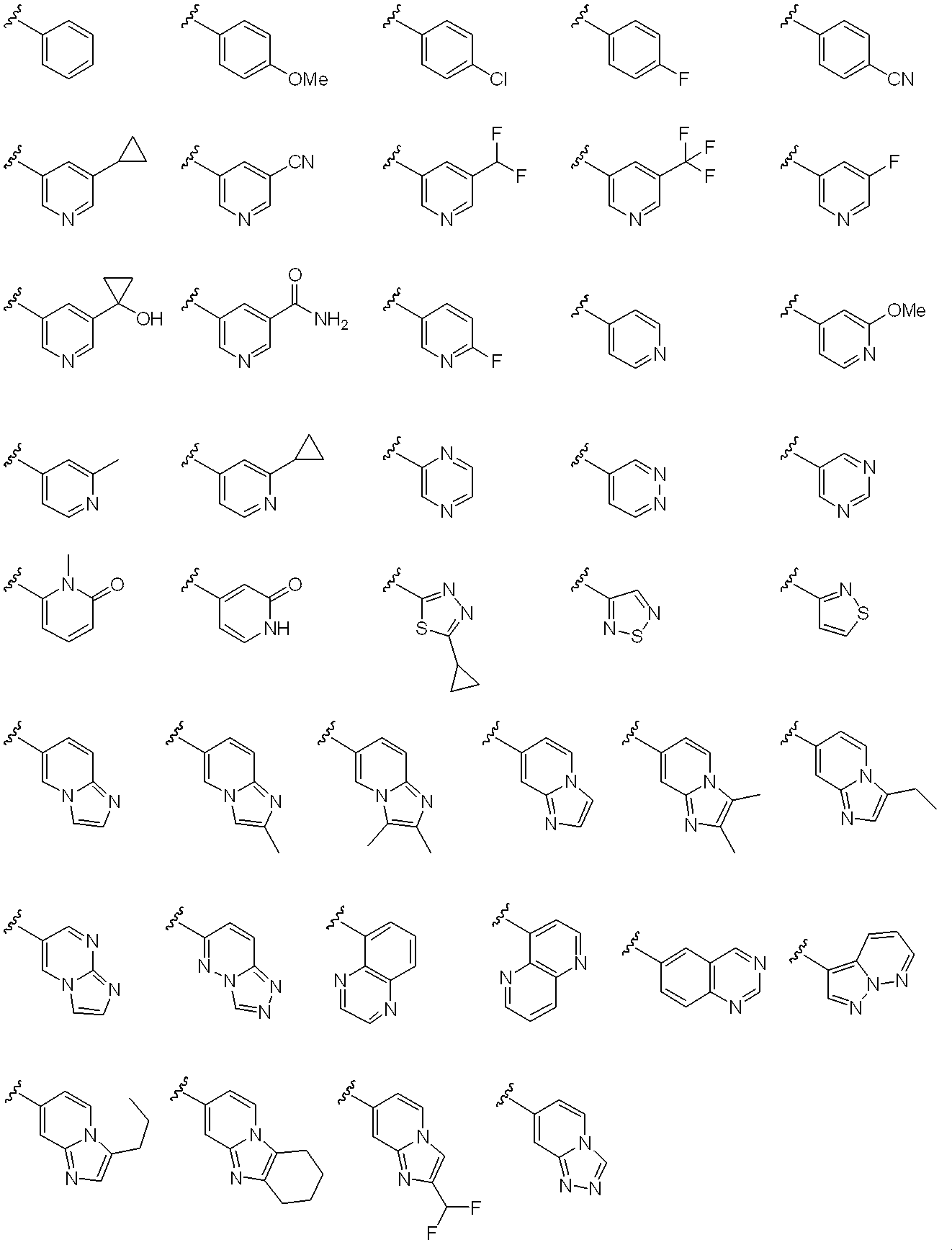


(E)-(3,4-ジフルオロフェニル){5-[(7-フェニル-2,7-ジアザスピロ[4.4]ノナ-2-イル)メチル]-2-ピリジニル}メタノン O-エチルオキシム、
5-{6-[(6-{(E)-(3,4-ジフルオロフェニル)[(エトキシ)イミノ]メチル}-3-ピリジニル)メチル]-2,6-ジアザスピロ[3.3]ヘプタ-2-イル}-3-ピリジンカルボニトリル、
(E)-(5-{[6-(2-シクロプロピル-4-ピリジニル)-2,6-ジアザスピロ[3.3]ヘプタ-2-イル]メチル}-2-ピリジニル)(3,4-ジフルオロフェニル)メタノン O-エチルオキシム、
(E)-(3,4-ジフルオロフェニル)(5-{[6-(6-フルオロ-3-ピリジニル)-2,6-ジアザスピロ[3.4]オクタ-2-イル]メチル}-2-ピリジニル)メタノン O-エチルオキシム、
(E)-(3,4-ジフルオロフェニル)(5-{[2-(6-フルオロ-3-ピリジニル)-2,6-ジアザスピロ[3.4]オクタ-6-イル]メチル}-2-ピリジニル)メタノン O-エチルオキシム、
5-(6-{[6-((E)-(3,4-ジフルオロフェニル){[(2-ヒドロキシ-2-メチルプロピル)オキシ]イミノ}メチル)-3-ピリジニル]メチル}-2,6-ジアザスピロ[3.3]ヘプタ-2-イル)-3-ピリジンカルボニトリル、
(E)-(3,4-ジフルオロフェニル){5-[(6-イミダゾ[1,2-a]ピリジン-7-イル-2,6-ジアザスピロ[3.3]ヘプタ-2-イル)メチル]-2-ピリジニル}メタノン O-(2-ヒドロキシ-2-メチルプロピル)オキシム、
(E)-(3,4-ジフルオロフェニル){5-[(7-ピラゾロ[1,5-b]ピリダジン-3-イル-2,7-ジアザスピロ[4.4]ノナ-2-イル)メチル]-2-ピリジニル}メタノン O-エチルオキシム、
(E)-(3,4-ジフルオロフェニル)(5-{[7-(4-ピリダジニル)-2,7-ジアザスピロ[4.4]ノナ-2-イル]メチル}-2-ピリジニル)メタノン O-エチルオキシム、
(E)-(3,4-ジフルオロフェニル)(5-{[6-(3-ピリジニル)-2,6-ジアザスピロ[3.3]ヘプタ-2-イル]メチル}-2-ピリジニル)メタノン O-エチルオキシム、
(E)-(3,4-ジフルオロフェニル)(5-{[6-(4-ピリジニル)-2,6-ジアザスピロ[3.3]ヘプタ-2-イル]メチル}-2-ピリジニル)メタノン O-エチルオキシム、
(E)-(3,4-ジフルオロフェニル)(5-{[6-(5-フルオロ-3-ピリジニル)-2,6-ジアザスピロ[3.3]ヘプタ-2-イル]メチル}-2-ピリジニル)メタノン O-エチルオキシム、
(E)-[5-({6-[5-(ジフルオロメチル)-3-ピリジニル]-2,6-ジアザスピロ[3.3]ヘプタ-2-イル}メチル)-2-ピリジニル](3,4-ジフルオロフェニル)メタノン O-エチルオキシム、
(E)-(5-{[6-(5-シクロプロピル-3-ピリジニル)-2,6-ジアザスピロ[3.3]ヘプタ-2-イル]メチル}-2-ピリジニル)(3,4-ジフルオロフェニル)メタノン O-エチルオキシム、
(E)-(3,4-ジフルオロフェニル)[5-({6-[5-(1-ヒドロキシシクロプロピル)-3-ピリジニル]-2,6-ジアザスピロ[3.3]ヘプタ-2-イル}メチル)-2-ピリジニル]メタノン O-エチルオキシム、
(E)-(3,4-ジフルオロフェニル)(5-{[6-(2-メチル-4-ピリジニル)-2,6-ジアザスピロ[3.3]ヘプタ-2-イル]メチル}-2-ピリジニル)メタノン O-エチルオキシム、
(E)-(3,4-ジフルオロフェニル)[5-({6-[2-(メチルオキシ)-4-ピリジニル]-2,6-ジアザスピロ[3.3]ヘプタ-2-イル}メチル)-2-ピリジニル]メタノン O-エチルオキシム、
(E)-(3,4-ジフルオロフェニル)(5-{[6-(3-イソチアゾリル)-2,6-ジアザスピロ[3.3]ヘプタ-2-イル]メチル}-2-ピリジニル)メタノン O-エチルオキシム、
(E)-(3,4-ジフルオロフェニル)(5-{[6-(1,5-ナフチリジン-4-イル)-2,6-ジアザスピロ[3.3]ヘプタ-2-イル]メチル}-2-ピリジニル)メタノン O-エチルオキシム、
(E)-(3,4-ジフルオロフェニル){5-[(6-イミダゾ[1,2-a]ピリジン-6-イル-2,6-ジアザスピロ[3.3]ヘプタ-2-イル)メチル]-2-ピリジニル}メタノン O-エチルオキシム、
(E)-(3,4-ジフルオロフェニル)(5-{[6-(2,3-ジメチルイミダゾ[1,2-a]ピリジン-6-イル)-2,6-ジアザスピロ[3.3]ヘプタ-2-イル]メチル}-2-ピリジニル)メタノン O-エチルオキシム、
(E)-(3,4-ジフルオロフェニル){5-[(6-イミダゾ[1,2-a]ピリジン-7-イル-2,6-ジアザスピロ[3.3]ヘプタ-2-イル)メチル]-2-ピリジニル}メタノン O-エチルオキシム、
(E)-(3,4-ジフルオロフェニル)(5-{[6-(3-プロピルイミダゾ[1,2-a]ピリジン-7-イル)-2,6-ジアザスピロ[3.3]ヘプタ-2-イル]メチル}-2-ピリジニル)メタノン O-エチルオキシム、
(E)-(3,4-ジフルオロフェニル)(5-{[6-(6,7,8,9-テトラヒドロピリド[1,2-a]ベンズイミダゾール-3-イル)-2,6-ジアザスピロ[3.3]ヘプタ-2-イル]メチル}-2-ピリジニル)メタノン O-エチルオキシム、
5-(6-{[6-((E)-(4-クロロ-3,5-ジフルオロフェニル){[(2-ヒドロキシ-2-メチルプロピル)オキシ]イミノ}メチル)-3-ピリジニル]メチル}-2,6-ジアザスピロ[3.3]ペプタ-2-イル)-3-ピリジンカルボニトリル、
(E)-(3,4-ジフルオロフェニル)(5-{[(5R)又は(5S)-7-(2-メチル-4-ピリジニル)-2,7-ジアザスピロ[4.4]ノナ-2-イル]メチル}-2-ピリジニル)メタノン O-(2-ヒドロキシ-2-メチルプロピル)オキシム、及び
(E)-(3,4-ジフルオロフェニル)(5-{[6-(6-フルオロ-3-ピリジニル)-2,6-ジアザスピロ[3.5]ノナ-2-イル]メチル}-2-ピリジニル)メタノン O-エチルオキシムよりなる群から選択される、請求項1に記載の化合物又は薬学的に許容されるその塩。 The compound represented by formula (I) is:
(E)-(3,4-difluorophenyl) {5-[(7-phenyl-2,7-diazaspiro [4.4] non-2-yl) methyl] -2-pyridinyl} methanone O-ethyloxime,
5- {6-[(6-{(E)-(3,4-difluorophenyl) [(ethoxy) imino] methyl} -3-pyridinyl) methyl] -2,6-diazaspiro [3.3] hepta 2-yl} -3-pyridinecarbonitrile,
(E)-(5-{[6- (2-Cyclopropyl-4-pyridinyl) -2,6-diazaspiro [3.3] hept-2-yl] methyl} -2-pyridinyl) (3,4 Difluorophenyl) methanone O-ethyloxime,
(E)-(3,4-difluorophenyl) (5-{[6- (6-fluoro-3-pyridinyl) -2,6-diazaspiro [3.4] oct-2-yl] methyl} -2- Pyridinyl) methanone O-ethyl oxime,
(E)-(3,4-difluorophenyl) (5-{[2- (6-fluoro-3-pyridinyl) -2,6-diazaspiro [3.4] oct-6-yl] methyl} -2- Pyridinyl) methanone O-ethyl oxime,
5- (6-{[6-((E)-(3,4-difluorophenyl) {[(2-hydroxy-2-methylpropyl) oxy] imino} methyl) -3-pyridinyl] methyl} -2, 6-diazaspiro [3.3] hept-2-yl) -3-pyridinecarbonitrile,
(E)-(3,4-difluorophenyl) {5-[(6-imidazo [1,2-a] pyridin-7-yl-2,6-diazaspiro [3.3] hept-2-yl) methyl ] -2-pyridinyl} methanone O- (2-hydroxy-2-methylpropyl) oxime,
(E)-(3,4-Difluorophenyl) {5-[(7-pyrazolo [1,5-b] pyridazin-3-yl-2,7-diazaspiro [4.4] non-2-yl) methyl ] -2-Pyridinyl} methanone O-ethyl oxime,
(E)-(3,4-difluorophenyl) (5-{[7- (4-pyridazinyl) -2,7-diazaspiro [4.4] non-2-yl] methyl} -2-pyridinyl) methanone O -Ethyl oxime,
(E)-(3,4-Difluorophenyl) (5-{[6- (3-pyridinyl) -2,6-diazaspiro [3.3] hept-2-yl] methyl} -2-pyridinyl) methanone O -Ethyl oxime,
(E)-(3,4-difluorophenyl) (5-{[6- (4-pyridinyl) -2,6-diazaspiro [3.3] hept-2-yl] methyl} -2-pyridinyl) methanone O -Ethyl oxime,
(E)-(3,4-difluorophenyl) (5-{[6- (5-fluoro-3-pyridinyl) -2,6-diazaspiro [3.3] hept-2-yl] methyl} -2- Pyridinyl) methanone O-ethyl oxime,
(E)-[5-({6- [5- (Difluoromethyl) -3-pyridinyl] -2,6-diazaspiro [3.3] hept-2-yl} methyl) -2-pyridinyl] (3 4-difluorophenyl) methanone O-ethyloxime,
(E)-(5-{[6- (5-Cyclopropyl-3-pyridinyl) -2,6-diazaspiro [3.3] hept-2-yl] methyl} -2-pyridinyl) (3,4 Difluorophenyl) methanone O-ethyloxime,
(E)-(3,4-Difluorophenyl) [5-({6- [5- (1-hydroxycyclopropyl) -3-pyridinyl] -2,6-diazaspiro [3.3] hept-2-yl } Methyl) -2-pyridinyl] methanone O-ethyloxime,
(E)-(3,4-difluorophenyl) (5-{[6- (2-methyl-4-pyridinyl) -2,6-diazaspiro [3.3] hept-2-yl] methyl} -2- Pyridinyl) methanone O-ethyl oxime,
(E)-(3,4-difluorophenyl) [5-({6- [2- (methyloxy) -4-pyridinyl] -2,6-diazaspiro [3.3] hept-2-yl} methyl) -2-pyridinyl] methanone O-ethyl oxime,
(E)-(3,4-difluorophenyl) (5-{[6- (3-isothiazolyl) -2,6-diazaspiro [3.3] hept-2-yl] methyl} -2-pyridinyl) methanone O -Ethyl oxime,
(E)-(3,4-Difluorophenyl) (5-{[6- (1,5-naphthyridin-4-yl) -2,6-diazaspiro [3.3] hept-2-yl] methyl}- 2-pyridinyl) methanone O-ethyl oxime,
(E)-(3,4-difluorophenyl) {5-[(6-imidazo [1,2-a] pyridin-6-yl-2,6-diazaspiro [3.3] hept-2-yl) methyl ] -2-Pyridinyl} methanone O-ethyl oxime,
(E)-(3,4-Difluorophenyl) (5-{[6- (2,3-dimethylimidazo [1,2-a] pyridin-6-yl) -2,6-diazaspiro [3.3] Hept-2-yl] methyl} -2-pyridinyl) methanone O-ethyloxime,
(E)-(3,4-difluorophenyl) {5-[(6-imidazo [1,2-a] pyridin-7-yl-2,6-diazaspiro [3.3] hept-2-yl) methyl ] -2-Pyridinyl} methanone O-ethyl oxime,
(E)-(3,4-Difluorophenyl) (5-{[6- (3-propylimidazo [1,2-a] pyridin-7-yl) -2,6-diazaspiro [3.3] hepta- 2-yl] methyl} -2-pyridinyl) methanone O-ethyloxime,
(E)-(3,4-difluorophenyl) (5-{[6- (6,7,8,9-tetrahydropyrido [1,2-a] benzimidazol-3-yl) -2,6- Diazaspiro [3.3] hept-2-yl] methyl} -2-pyridinyl) methanone O-ethyloxime,
5- (6-{[6-((E)-(4-Chloro-3,5-difluorophenyl) {[(2-hydroxy-2-methylpropyl) oxy] imino} methyl) -3-pyridinyl] methyl } -2,6-diazaspiro [3.3] pept-2-yl) -3-pyridinecarbonitrile,
(E)-(3,4-Difluorophenyl) (5-{[(5R) or (5S) -7- (2-methyl-4-pyridinyl) -2,7-diazaspiro [4.4] nona-2 -Yl] methyl} -2-pyridinyl) methanone O- (2-hydroxy-2-methylpropyl) oxime and (E)-(3,4-difluorophenyl) (5-{[6- (6-fluoro- 3. The compound or pharmaceutical according to claim 1, selected from the group consisting of 3-pyridinyl) -2,6-diazaspiro [3.5] non-2-yl] methyl} -2-pyridinyl) methanone O-ethyloxime Acceptable salts thereof.
Priority Applications (5)
| Application Number | Priority Date | Filing Date | Title |
|---|---|---|---|
| AU2009261248A AU2009261248A1 (en) | 2008-06-19 | 2009-06-11 | Spirodiamine-diarylketoxime derivative |
| EP09766580A EP2301936A1 (en) | 2008-06-19 | 2009-06-11 | Spirodiamine-diarylketoxime derivative |
| US12/993,928 US20110071129A1 (en) | 2008-06-19 | 2009-06-11 | Spirodiamine-diaryl ketoxime derivative |
| CA2727914A CA2727914A1 (en) | 2008-06-19 | 2009-06-11 | Spirodiamine-diaryl ketoxime derivative technical field |
| JP2010517880A JPWO2009154132A1 (en) | 2008-06-19 | 2009-06-11 | Spirodiamine-diarylketoxime derivatives |
Applications Claiming Priority (2)
| Application Number | Priority Date | Filing Date | Title |
|---|---|---|---|
| JP2008-160830 | 2008-06-19 | ||
| JP2008160830 | 2008-06-19 |
Publications (1)
| Publication Number | Publication Date |
|---|---|
| WO2009154132A1 true WO2009154132A1 (en) | 2009-12-23 |
Family
ID=41434047
Family Applications (1)
| Application Number | Title | Priority Date | Filing Date |
|---|---|---|---|
| PCT/JP2009/060687 Ceased WO2009154132A1 (en) | 2008-06-19 | 2009-06-11 | Spirodiamine-diarylketoxime derivative |
Country Status (6)
| Country | Link |
|---|---|
| US (1) | US20110071129A1 (en) |
| EP (1) | EP2301936A1 (en) |
| JP (1) | JPWO2009154132A1 (en) |
| AU (1) | AU2009261248A1 (en) |
| CA (1) | CA2727914A1 (en) |
| WO (1) | WO2009154132A1 (en) |
Cited By (21)
| Publication number | Priority date | Publication date | Assignee | Title |
|---|---|---|---|---|
| WO2010147234A1 (en) * | 2009-06-18 | 2010-12-23 | Banyu Pharmaceutical Co.,Ltd. | Diarylamide-spirodiamine derivative |
| JP2012525365A (en) * | 2009-05-01 | 2012-10-22 | アストラゼネカ アクチボラグ | Therapeutic drug 713 |
| US20130053363A1 (en) * | 2010-04-27 | 2013-02-28 | Astellas Pharma Inc. | IMIDAZO[1,2-a]PYRIDINE DERIVATIVE |
| JP2013522354A (en) * | 2010-03-19 | 2013-06-13 | ファイザー・インク | 2,3 Dihydro-1H-inden-1-yl-2,7-diazaspiro [3.5] nonane derivatives and their use as antagonists or inverse agonists of the ghrelin receptor |
| JP2014520839A (en) * | 2011-07-15 | 2014-08-25 | アストラゼネカ アクチボラグ | Therapeutic drugs |
| JP2015519380A (en) * | 2012-06-13 | 2015-07-09 | エフ.ホフマン−ラ ロシュ アーゲーF. Hoffmann−La Roche Aktiengesellschaft | Novel diazaspirocycloalkanes and azaspirocycloalkanes |
| US9802944B2 (en) | 2014-03-26 | 2017-10-31 | Hoffmann-La Roche Inc. | Bicyclic compounds as autotaxin (ATX) and lysophosphatidic acid (LPA) production inhibitors |
| JP2020506940A (en) * | 2017-02-06 | 2020-03-05 | ヤンセン ファーマシューティカ エヌ.ベー. | OGA inhibitory compounds |
| US10640472B2 (en) | 2015-09-04 | 2020-05-05 | Hoffman-La Roche Inc. | Phenoxymethyl derivatives |
| US10647719B2 (en) | 2015-09-24 | 2020-05-12 | Hoffmann-La Roche Inc. | Bicyclic compounds as dual ATX/CA inhibitors |
| US10669285B2 (en) | 2014-03-26 | 2020-06-02 | Hoffmann-La Roche Inc. | Condensed [1,4] diazepine compounds as autotaxin (ATX) and lysophosphatidic acid (LPA) production inhibitors |
| US10669268B2 (en) | 2012-09-25 | 2020-06-02 | Hoffmann-La Roche Inc. | Bicyclic derivatives |
| US10676446B2 (en) | 2015-04-10 | 2020-06-09 | Hoffmann-La Roche Inc. | Bicyclic quinazolinone derivatives |
| US10738053B2 (en) | 2015-09-24 | 2020-08-11 | Hoffmann-La Roche Inc. | Bicyclic compounds as dual ATX/CA inhibitors |
| US10787459B2 (en) | 2015-09-24 | 2020-09-29 | Hoffmann-La Roche Inc. | Bicyclic compounds as ATX inhibitors |
| US10800786B2 (en) | 2015-09-24 | 2020-10-13 | Hoffman-La Roche Inc. | Bicyclic compounds as ATX inhibitors |
| US10849881B2 (en) | 2013-11-26 | 2020-12-01 | Hoffmann-La Roche Inc. | Octahydro-cyclobuta[1,2-c;3,4-c′]dipyrrol-2-yl |
| US10882857B2 (en) | 2017-03-16 | 2021-01-05 | Hoffmann-La Roche Inc. | Bicyclic compounds as ATX inhibitors |
| US10913745B2 (en) | 2013-03-12 | 2021-02-09 | Hoffmann-La Roche Inc. | Octahydro-pyrrolo[3,4-c]-pyrrole derivatives and analogs thereof as autotaxin inhibitors |
| US11059794B2 (en) | 2017-03-16 | 2021-07-13 | Hoffmann-La Roche Inc. | Heterocyclic compounds useful as dual ATX/CA inhibitors |
| CN113717180A (en) * | 2021-10-15 | 2021-11-30 | 安徽大学 | Synthesis method of 2-Boc-2, 7-diaza-spiro [4,4] nonane |
Families Citing this family (12)
| Publication number | Priority date | Publication date | Assignee | Title |
|---|---|---|---|---|
| US8809552B2 (en) * | 2011-11-01 | 2014-08-19 | Hoffmann-La Roche Inc. | Azetidine compounds, compositions and methods of use |
| JP6563017B2 (en) | 2014-08-28 | 2019-08-21 | エースニューロン・ソシエテ・アノニム | Glycosidase inhibitor |
| US11261183B2 (en) | 2016-02-25 | 2022-03-01 | Asceneuron Sa | Sulfoximine glycosidase inhibitors |
| MA43677A (en) | 2016-02-25 | 2018-11-28 | Asceneuron Sa | GLYCOSIDASE INHIBITORS |
| EP3419976B1 (en) | 2016-02-25 | 2021-04-07 | Asceneuron SA | Acid addition salts of piperazine derivatives |
| MX2018010191A (en) | 2016-02-25 | 2019-05-20 | Asceneuron S A | Glycosidase inhibitors. |
| US11213525B2 (en) | 2017-08-24 | 2022-01-04 | Asceneuron Sa | Linear glycosidase inhibitors |
| WO2020039027A1 (en) | 2018-08-22 | 2020-02-27 | Asceneuron S. A. | Pyrrolidine glycosidase inhibitors |
| US11731972B2 (en) | 2018-08-22 | 2023-08-22 | Asceneuron Sa | Spiro compounds as glycosidase inhibitors |
| WO2020039028A1 (en) | 2018-08-22 | 2020-02-27 | Asceneuron S. A. | Tetrahydro-benzoazepine glycosidase inhibitors |
| BR112021003022A2 (en) | 2018-08-22 | 2021-05-11 | Asceneuron Sa | acid addition salts of succinic acid or fumaric acid, of monosuccinic acid, of monofumaric acid and of addition of succinic acid or of fumaric acid addition salt, methods of preparing an acid addition salt of succinic acid or fumaric acid, for to treat a tauopathy and to inhibit a glycosidase, and solid oral dosage form. |
| CN113214255B (en) * | 2021-04-22 | 2023-09-29 | 无锡合全药业有限公司 | Synthesis method of 2, 6-diazaspiro [3.5] nonane-6-tert-butyl formate and salt thereof |
Citations (169)
| Publication number | Priority date | Publication date | Assignee | Title |
|---|---|---|---|---|
| US340683A (en) | 1886-04-27 | Method of making split bolts | ||
| US3914250A (en) | 1974-08-01 | 1975-10-21 | American Home Prod | 1,4-Diazepino{8 6,5,4-jk{9 carbazoles |
| US4189438A (en) | 1977-02-08 | 1980-02-19 | Zaidan Hojin Biseibutsu Kagaku Kenkyu Kai | Physiologically active substance esterastin |
| US4405644A (en) | 1979-07-14 | 1983-09-20 | Bayer Aktiengesellschaft | Medicaments for the treatment of disorders of lipometabolism and their use |
| EP0101069A1 (en) | 1982-08-10 | 1984-02-22 | F. HOFFMANN-LA ROCHE & CO. Aktiengesellschaft | Phenethanol amines |
| EP0104497A2 (en) | 1982-09-28 | 1984-04-04 | INDUSTRIE ZANUSSI S.p.A. | Laundry washing machine of modular construction |
| US4452813A (en) | 1981-05-22 | 1984-06-05 | Taiho Pharmaceutical Company Limited | Sulfonate derivatives, process for preparing same and antilipemic compositions containing the derivative |
| US4598089A (en) | 1983-06-22 | 1986-07-01 | Hoffmann-La Roche Inc. | Leucine derivatives |
| US4746680A (en) | 1981-04-06 | 1988-05-24 | The Boots Company P.L.C. | Therapeutic agents |
| US4973587A (en) | 1990-03-08 | 1990-11-27 | Sterling Drug Inc. | 3-arylcarbonyl-1-aminoalkyl-1H-indole-containing antiglaucoma method |
| US5013837A (en) | 1990-03-08 | 1991-05-07 | Sterling Drug Inc. | 3-Arylcarbonyl-1H-indole-containing compounds |
| US5081122A (en) | 1990-03-05 | 1992-01-14 | Sterling Drug Inc. | Antiglaucoma compositions containing 4-arylcarbonyl-1-(4-morpholinyl)-lower-alkyl)-1H-indoles and method of use thereof |
| US5112820A (en) | 1990-03-05 | 1992-05-12 | Sterling Drug Inc. | Anti-glaucoma compositions containing 2- and 3-aminomethyl-6-arylcarbonyl- or 6-phenylthio-2,3-dihydropyrrolo-(1,2,3-de)-1,4-benzoxazines and method of use thereof |
| US5292736A (en) | 1993-02-26 | 1994-03-08 | Sterling Winthrop Inc. | Morpholinoalkylindenes as antiglaucoma agents |
| WO1994009134A2 (en) | 1992-10-09 | 1994-04-28 | Regeneron Pharmaceuticals, Inc. | Modified ciliary neurotrophic factors |
| US5391571A (en) | 1989-11-15 | 1995-02-21 | American Home Products Corporation | Cholesterol ester hydrolase inhibitors |
| EP0658546A1 (en) | 1993-12-17 | 1995-06-21 | Sanofi | Novel 3-pyrazolecarboxamide derivatives with cannabinoid receptor affinity |
| US5436272A (en) | 1988-11-29 | 1995-07-25 | The Boots Company (Usa), Inc. | Treatment of obesity |
| US5451677A (en) | 1993-02-09 | 1995-09-19 | Merck & Co., Inc. | Substituted phenyl sulfonamides as selective β 3 agonists for the treatment of diabetes and obesity |
| WO1996014307A1 (en) | 1994-11-07 | 1996-05-17 | Pfizer Inc. | Certain substituted benzylamine derivatives; a new class of neuropeptide y1 specific ligands |
| US5521283A (en) | 1995-01-31 | 1996-05-28 | Eli Lilly And Company | Anti-obesity proteins |
| US5532237A (en) | 1995-02-15 | 1996-07-02 | Merck Frosst Canada, Inc. | Indole derivatives with affinity for the cannabinoid receptor |
| WO1996023517A1 (en) | 1995-01-31 | 1996-08-08 | Eli Lilly And Company | Anti-obesity proteins |
| WO1996023518A1 (en) | 1995-01-31 | 1996-08-08 | Eli Lilly And Company | Anti-obesity proteins |
| WO1996023514A1 (en) | 1995-01-31 | 1996-08-08 | Eli Lilly And Company | Anti-obesity proteins |
| WO1996023516A1 (en) | 1995-01-31 | 1996-08-08 | Eli Lilly And Company | Anti-obesity proteins |
| WO1996023520A1 (en) | 1995-01-31 | 1996-08-08 | Eli Lilly And Company | Anti-obesity proteins |
| WO1996023519A1 (en) | 1995-01-31 | 1996-08-08 | Eli Lilly And Company | Anti-obesity proteins |
| WO1996023513A1 (en) | 1995-01-31 | 1996-08-08 | Eli Lilly And Company | Anti-obesity proteins |
| WO1996026196A2 (en) | 1995-02-23 | 1996-08-29 | Schering Corporation | Benzylpiperidines and piperazines as muscarinic antagonists |
| US5552522A (en) | 1995-01-31 | 1996-09-03 | Eli Lilly And Company | Anti-obesity proteins |
| WO1996033159A1 (en) | 1995-04-21 | 1996-10-24 | Abbott Laboratories | Cyclobutane derivatives as inhibitors of squalene synthase and protein farnesyltransferase |
| US5624941A (en) | 1992-06-23 | 1997-04-29 | Sanofi | Pyrazole derivatives, method of preparing them and pharmaceutical compositions in which they are present |
| WO1997019682A1 (en) | 1995-12-01 | 1997-06-05 | Synaptic Pharmaceutical Corporation | Aryl sulfonamide and sulfamide derivatives and uses thereof |
| WO1997020823A2 (en) | 1995-12-01 | 1997-06-12 | Novartis Ag | 2-amino quinazoline derivatives as npy receptor antagonists |
| WO1997020820A1 (en) | 1995-12-01 | 1997-06-12 | Novartis Ag | Heteroaryl compounds |
| WO1997020821A1 (en) | 1995-12-01 | 1997-06-12 | Novartis Ag | Heteroaryl derivatives |
| WO1997020822A1 (en) | 1995-12-01 | 1997-06-12 | Novartis Ag | Quinazolin-2,4-diazirines as npy receptor antagonist |
| WO1997029079A1 (en) | 1996-02-06 | 1997-08-14 | Japan Tobacco Inc. | Novel compounds and pharmaceutical use thereof |
| US5705515A (en) | 1994-04-26 | 1998-01-06 | Merck & Co., Inc. | Substituted sulfonamides as selective β-3 agonists for the treatment of diabetes and obesity |
| US5739106A (en) | 1995-06-07 | 1998-04-14 | Rink; Timothy J. | Appetite regulating compositions |
| WO1998022128A1 (en) | 1996-11-19 | 1998-05-28 | Istituto Di Ricerche Di Biologia Molecolare P. Angeletti S.P.A. | Use of cntf (ciliary neurotrophic factor) receptor activators for the treatment of obesity |
| WO1998027063A1 (en) | 1996-12-16 | 1998-06-25 | Banyu Pharmaceutical Co., Ltd. | Aminopyrazole derivatives |
| WO1998031227A1 (en) | 1997-01-21 | 1998-07-23 | Smithkline Beecham Corporation | Novel cannabinoid receptor modulators |
| WO1998033765A1 (en) | 1997-02-04 | 1998-08-06 | E.I. Du Pont De Nemours And Company | Fungicidal carboxamides |
| WO1998037061A1 (en) | 1997-02-21 | 1998-08-27 | Bayer Aktiengesellschaft | Aryl sulfonamides and analogues thereof and their use in the treatment of neurodegenerative diseases |
| WO1998041519A1 (en) | 1997-03-18 | 1998-09-24 | Smithkline Beecham Corporation | Novel cannabinoid receptor agonists |
| WO1998043635A1 (en) | 1997-03-28 | 1998-10-08 | Sanofi-Synthelabo | Pharmaceutical composition for oral administration of a n-piperidino- 3-pyrazolecarboxamide derivative, its salts and their solvates |
| WO1998043636A1 (en) | 1997-03-28 | 1998-10-08 | Sanofi-Synthelabo | Pharmaceutical composition for oral administration of a n-piperidino- 3-pyrazolecarboxamide derivative, its salts and their solvates |
| WO1999000123A1 (en) | 1997-06-26 | 1999-01-07 | Pharmacia & Upjohn Ab | Use of a drug capable of modulating the regulation of upc-2 and method for screening for potential drugs against obesity |
| WO1999002499A1 (en) | 1997-07-11 | 1999-01-21 | Japan Tobacco Inc. | Quinoline compounds and medicinal uses thereof |
| WO1999043813A1 (en) | 1998-02-27 | 1999-09-02 | Regeneron Pharmaceuticals, Inc. | Modified ciliary neurotrophic factor, method of making and methods of use thereof |
| WO1999051600A1 (en) | 1998-04-02 | 1999-10-14 | Neurogen Corporation | AMINOALKYL SUBSTITUTED 9H-PYRIDINO[2,3-b]INDOLE AND 9H-PYRIMIDINO[4,5-b]INDOLE DERIVATIVES |
| US6001836A (en) | 1997-05-28 | 1999-12-14 | Bristol-Myers Squibb Company | Dihydropyridine NPY antagonists: cyanoguanidine derivatives |
| WO1999064002A1 (en) | 1998-06-11 | 1999-12-16 | Merck & Co., Inc. | Spiropiperidine derivatives as melanocortin receptor agonists |
| US6028084A (en) | 1995-11-23 | 2000-02-22 | Sanofi-Synthelabo | Pyrazole derivatives, method for preparing same, and pharmaceutical compositions containing said derivatives |
| WO2000010968A2 (en) | 1998-08-19 | 2000-03-02 | Bayer Aktiengesellschaft | Novel aryl sulphonamide amino acid esters and analogues |
| WO2000010967A1 (en) | 1998-08-19 | 2000-03-02 | Bayer Aktiengesellschaft | Novel aryl sulphonamides and analogues |
| WO2000021509A2 (en) | 1998-10-15 | 2000-04-20 | Imperial College Innovations Limited | Methods of treatment |
| JP2000256190A (en) | 1999-03-01 | 2000-09-19 | Pfizer Prod Inc | Antiobestic medicine similar to thyroid hormone |
| US6140354A (en) | 1998-04-29 | 2000-10-31 | Ortho-Mcneil Pharmaceutical, Inc. | N-substituted aminotetralins as ligands for the neuropeptide Y Y5 receptor useful in the treatment of obesity and other disorders |
| WO2000064880A1 (en) | 1999-04-22 | 2000-11-02 | Synaptic Pharmaceutical Corporation | Selective npy (y5) antagonists |
| WO2000068197A1 (en) | 1999-05-05 | 2000-11-16 | Ortho-Mcneil Pharmaceutical, Inc. | 3a,4,5,9b-TETRAHYDRO-1H-BENZ[e]INDOL-2-YL AMINE-DERIVED NEUROPEPTIDE Y RECEPTORS LIGANDS USEFUL IN THE TREATMENT OF OBESITY AND OTHER DISORDERS |
| WO2000069849A1 (en) | 1999-05-12 | 2000-11-23 | Ortho-Mcneil Pharmaceutical, Inc. | Pyrazole carboxamides useful for the treatment of obesity and other disorders |
| WO2000074679A1 (en) | 1999-06-04 | 2000-12-14 | Merck & Co., Inc. | Substituted piperidines as melanocortin-4 receptor agonists |
| WO2001002379A1 (en) | 1999-06-30 | 2001-01-11 | Synaptic Pharmaceutical Corporation | Selective npy (y5) antagonists |
| WO2001007409A1 (en) | 1999-07-23 | 2001-02-01 | Astrazeneca Uk Limited | Carbazole derivatives and their use as neuropeptide y5 receptor ligands |
| WO2001009120A1 (en) | 1999-07-28 | 2001-02-08 | Ortho-Mcneil Pharmaceutical, Inc. | Amine and amide derivatives as ligands for the neuropeptide y y5 receptor useful in the treatment of obesity and other disorders |
| US6191160B1 (en) | 1998-11-10 | 2001-02-20 | Merck & Co., Inc. | Spiro-indolines as Y5 receptor antagonists |
| WO2001014376A1 (en) | 1999-08-20 | 2001-03-01 | Banyu Pharmaceutical Co., Ltd. | Novel spiro compounds |
| WO2001023389A2 (en) | 1999-09-30 | 2001-04-05 | Neurogen Corporation | Certain alkylene diamine-substituted heterocycles |
| WO2001023388A2 (en) | 1999-09-30 | 2001-04-05 | Neurogen Corporation | AMINO SUBSTITUTED PYRAZOLO[1,5,-a]-1,5-PYRIMIDINES AND PYRAZOLO[1,5-a]-1,3,5-TRIAZINES |
| WO2001023387A2 (en) | 1999-09-30 | 2001-04-05 | Neurogen Corporation | CERTAIN ALKYLENE DIAMINE-SUBSTITUTED PYRAZOLO[1,5,-a]-1,5-PYRIMIDINES AND PYRAZOLO[1,5-a]-1,3,5-TRIAZINES |
| WO2001027068A1 (en) | 1999-10-13 | 2001-04-19 | Pfizer Products Inc. | Biaryl ether derivatives useful as monoamine reuptake inhibitors |
| WO2001027060A1 (en) | 1999-10-13 | 2001-04-19 | Haarmann & Reimer Gmbh | Method for production of aryl alkyl ethers |
| WO2001044201A1 (en) | 1999-12-16 | 2001-06-21 | Schering Corporation | Substituted imidazole neuropeptide y y5 receptor antagonists |
| US6258837B1 (en) | 1997-04-23 | 2001-07-10 | Banyu Pharmaceutical Co., Ltd. | Neuropeptide Y receptor antagonist |
| WO2001056592A1 (en) | 2000-02-01 | 2001-08-09 | Novo Nordisk A/S | Use of compounds for the regulation of food intake |
| WO2001058869A2 (en) | 2000-02-11 | 2001-08-16 | Bristol-Myers Squibb Company | Cannabinoid receptor modulators, their processes of preparation, and use of cannabinoid receptor modulators in treating respiratory and non-respiratory diseases |
| JP2001226269A (en) | 2000-02-18 | 2001-08-21 | Takeda Chem Ind Ltd | Melanin-concentrating hormone antagonist |
| WO2001062737A2 (en) | 2000-02-24 | 2001-08-30 | Ortho-Mcneil Pharmaceutical, Inc. | Amino pyrazole derivatives useful for the treatment of obesity and other disorders |
| WO2001062738A1 (en) | 2000-02-22 | 2001-08-30 | Banyu Pharmaceutical Co., Ltd. | Novel imidazoline compounds |
| WO2001064633A1 (en) | 2000-03-03 | 2001-09-07 | Aventis Pharma S.A. | Pharmaceutical compositions containing 3-amino-azetidine derivatives, novel derivatives and preparation thereof |
| WO2001064632A1 (en) | 2000-03-03 | 2001-09-07 | Aventis Pharma S.A. | Azetidine derivatives, preparation thereof and pharmaceutical compositions containing same |
| WO2001064634A1 (en) | 2000-03-03 | 2001-09-07 | Aventis Pharma S.A. | Pharmaceutical compositions containing azetidine derivatives, novel azetidine derivatives and preparation thereof |
| WO2001066548A1 (en) | 2000-03-06 | 2001-09-13 | F. Hoffmann-La Roche Ag | New aza-indolyl derivatives |
| WO2001068609A1 (en) | 2000-03-14 | 2001-09-20 | Actelion Pharmaceuticals Ltd. | 1,2,3,4-tetrahydroisoquinoline derivatives |
| WO2001070337A1 (en) | 2000-03-23 | 2001-09-27 | Merck & Co., Inc. | Spiropiperidine derivatives as melanocortin receptor agonists |
| WO2001070708A1 (en) | 2000-03-23 | 2001-09-27 | Merck & Co., Inc. | Substituted piperidines as melanocortin receptor agonists |
| WO2001074844A2 (en) | 2000-04-04 | 2001-10-11 | F. Hoffmann-La Roche Ag | Selective linear peptides with melanocortin-4 receptor (mc4-r) agonist activity |
| WO2001077094A1 (en) | 2000-04-07 | 2001-10-18 | Aventis Pharma Deutschland Gmbh | Percyquinnin, a process for its production and its use as a pharmaceutical |
| WO2001085730A1 (en) | 2000-05-09 | 2001-11-15 | Astrazeneca Ab | Pyrido' 1,2-alpha pyrazine and piperidine derivatives as ligands for the neuropeptide y y5 receptor |
| WO2001085690A1 (en) | 2000-05-10 | 2001-11-15 | Bristol-Myers Squibb Company | 4-alkyl and 4-cycloalkyl derivatives of dihydropyridine npy antagonists |
| WO2001085098A2 (en) | 2000-05-10 | 2001-11-15 | Bristol-Myers Squibb Company | Squarate derivatives of dihydropyridine npy antagonists |
| WO2001085714A1 (en) | 2000-05-05 | 2001-11-15 | Astrazeneca Ab | Amino substituted dibenzothiophene derivatives for the treatment of disorders mediated by the np y5 receptor |
| WO2001087834A1 (en) | 2000-05-16 | 2001-11-22 | Takeda Chemical Industries, Ltd. | Melanin-concentrating hormone antagonist |
| WO2001087355A1 (en) | 2000-05-18 | 2001-11-22 | Australian Rural Group Limited | Lipophilic medicament |
| WO2001090090A1 (en) | 2000-05-22 | 2001-11-29 | Biovitrum Ab | Inhibitors of 11-beta-hydroxy steroid dehydrogenase type 1 |
| WO2001089528A1 (en) | 2000-05-19 | 2001-11-29 | Bristol-Myers Squibb Company | Thiourea derivatives of dihydropyridine npy antagonists |
| WO2001091752A1 (en) | 2000-05-30 | 2001-12-06 | Merck & Co., Inc. | Melanocortin receptor agonists |
| US6329395B1 (en) | 1998-06-08 | 2001-12-11 | Schering Corporation | Neuropeptide Y5 receptor antagonists |
| WO2001096330A2 (en) | 2000-06-15 | 2001-12-20 | Schering Corporation | Thrombin receptor antagonists |
| WO2001096302A1 (en) | 2000-06-16 | 2001-12-20 | Smithkline Beecham P.L.C. | Piperidines for use as orexin receptor antagonists |
| US6337332B1 (en) | 1998-09-17 | 2002-01-08 | Pfizer Inc. | Neuropeptide Y receptor antagonists |
| US20020006964A1 (en) | 1995-05-16 | 2002-01-17 | Young James W. | Methods of using and compositions comprising (+) sibutramine optionally in combination with other pharmacologically active compounds |
| WO2002004433A2 (en) | 2000-07-06 | 2002-01-17 | Neurogen Corporation | Melanin concentrating hormone receptor ligands |
| WO2002006245A1 (en) | 2000-07-05 | 2002-01-24 | Synaptic Pharmarceutical Corporation | Selective melanin concentrating hormone-1 (mch1) receptor antagonists and uses thereof |
| WO2002008250A2 (en) | 2000-07-24 | 2002-01-31 | Ardana Bioscience Limited | Ghrelin antagonists |
| WO2002010169A1 (en) | 2000-07-31 | 2002-02-07 | F. Hoffmann-La Roche Ag | Piperazine derivatives |
| WO2002012178A1 (en) | 2000-08-07 | 2002-02-14 | Melacure Therapeutics Ab | Compounds acting as melanocortin receptor ligands |
| WO2002012166A2 (en) | 2000-08-04 | 2002-02-14 | Lion Bioscience Ag | Triamine derivative melanocortin receptor ligands and methods of using same |
| WO2002011715A2 (en) | 2000-08-07 | 2002-02-14 | Melacure Therapeutics Ab | The use of benzylideneaminoguanidines and hydroxyguanidines as melanocortin receptor ligands |
| US20020022637A1 (en) | 2000-05-11 | 2002-02-21 | Li James J. | Tetrahydroisoquinoline analogs useful as growth hormone secretagogues |
| WO2002015905A1 (en) | 2000-08-21 | 2002-02-28 | Gliatech, Inc. | The use of histamine h3 receptor inverse agonists for the control of appetite and treatment of obesity |
| WO2002015909A1 (en) | 2000-08-23 | 2002-02-28 | Merck & Co., Inc. | Substituted piperidines as melanocortin receptor agonists |
| WO2002015845A2 (en) | 2000-08-21 | 2002-02-28 | Merck & Co., Inc. | Anti-hypercholesterolemic drug combination |
| WO2002020488A2 (en) | 2000-09-06 | 2002-03-14 | F. Hoffmann-La Roche Ag | Quinoline and quinazoline derivatives as ligands for the neuropeptide y receptor |
| US6358951B1 (en) | 1998-08-21 | 2002-03-19 | Pfizer Inc. | Growth hormone secretagogues |
| WO2002022592A2 (en) | 2000-09-14 | 2002-03-21 | Schering Corporation | Substituted urea neuropeptide y y5 receptor antagonists |
| US6365633B1 (en) | 1999-03-19 | 2002-04-02 | Knoll Pharmaceutical Company | Method of treating eating disorders |
| US20020049196A1 (en) | 1995-12-28 | 2002-04-25 | Carpino Philip A. | Growth-hormone secretagogues |
| WO2002032888A1 (en) | 2000-10-13 | 2002-04-25 | Eli Lilly And Company | Substituted dipeptides as growth hormone secretagogues |
| WO2002032897A1 (en) | 2000-10-20 | 2002-04-25 | Pfizer Products Inc. | Alpha-aryl ethanolamines and their use as beta-3 adrenergic receptor agonists |
| WO2002036596A2 (en) | 2000-11-03 | 2002-05-10 | Wyeth | CYCLOALKYL[b][1,4]DIAZEPINO[6,7,1-hi]INDOLES AND DERIVATIVES |
| WO2002040456A1 (en) | 2000-11-20 | 2002-05-23 | Biovitrum Ab | Piperazinylpyrazine compounds as agonist or antagonist of serotonin 5ht-2 receptor |
| WO2002040457A1 (en) | 2000-11-20 | 2002-05-23 | Biovitrum Ab | Piperazinylpyrazines compounds as antagonists of serotonin 5-ht2 receptor |
| WO2002044152A1 (en) | 2000-10-16 | 2002-06-06 | F. Hoffmann-La Roche Ag | Indoline derivatives and their use as 5-ht2 receptor ligands |
| WO2002048152A2 (en) | 2000-12-12 | 2002-06-20 | Neurogen Corporation | Spiro[isobenzofuran-1,4'-piperidin]-3-ones and 3h-spiroisobenzofuran-1,4'-piperidines |
| WO2002048124A2 (en) | 2000-12-15 | 2002-06-20 | F. Hoffmann-La Roche Ag | Piperazine derivatives |
| WO2002049648A1 (en) | 2000-12-21 | 2002-06-27 | Schering Corporation | Heteroaryl urea neuropeptide y y5 receptor antagonists |
| WO2002051809A1 (en) | 2000-12-22 | 2002-07-04 | Schering Corporation | Piperidine mch antagonists and their use in the treatment of obesity |
| WO2002051232A2 (en) | 2000-12-27 | 2002-07-04 | Actelion Pharmaceuticals Ltd. | Novel benzazepines and related heterocyclic derivatives |
| WO2002051844A1 (en) | 2000-12-27 | 2002-07-04 | F. Hoffmann-La Roche Ag | Indole derivatives and their use as 5-ht2b and 5-ht2c receptor ligands |
| WO2002059107A1 (en) | 2001-01-23 | 2002-08-01 | Eli Lilly And Company | Substituted piperidines/piperazines as melanocortin receptor agonists |
| WO2002059117A1 (en) | 2001-01-23 | 2002-08-01 | Eli Lilly And Company | Piperazine- and piperidine-derivatives as melanocortin receptor agonists |
| WO2002059095A1 (en) | 2001-01-23 | 2002-08-01 | Eli Lilly And Company | Melanocortin receptor agonists |
| WO2002062764A1 (en) | 2001-02-02 | 2002-08-15 | Takeda Chemical Industries, Ltd. | Fused heterocyclic compounds |
| WO2002068387A2 (en) | 2001-02-28 | 2002-09-06 | Merck & Co., Inc. | Acylated piperidine derivatives as melanocortin-4 receptor agonists |
| WO2002068388A2 (en) | 2001-02-28 | 2002-09-06 | Merck & Co., Inc. | Acylated piperidine derivatives as melanocortin-4 receptor agonists |
| WO2002067869A2 (en) | 2001-02-28 | 2002-09-06 | Merck & Co., Inc. | Acylated piperidine derivatives as melanocortin-4 receptor agonists |
| WO2002076947A1 (en) | 2001-03-21 | 2002-10-03 | Schering Corporation | Mch antagonists and their use in the treatment of obesity |
| WO2002076949A1 (en) | 2001-03-22 | 2002-10-03 | Solvay Pharmaceuticals B.V. | 4,5-dihydro-1h-pyrazole derivatives having cb1-antagonistic activity |
| WO2002076929A1 (en) | 2001-03-21 | 2002-10-03 | Pharmacopeia, Inc. | Aryl and biaryl compounds having mch modulatory activity |
| WO2002083134A1 (en) | 2001-04-12 | 2002-10-24 | Pharmacopeia, Inc. | Aryl and biaryl piperidines used as mch antagonists |
| WO2002083128A1 (en) | 2001-04-12 | 2002-10-24 | Bristol-Myers Squibb Company | 2,1-oxazoline and 1,2-pyrazoline-based inhibitors of dipeptidyl peptidase iv and method |
| WO2002088089A1 (en) * | 2001-04-19 | 2002-11-07 | Banyu Pharmaceutical Co., Ltd. | Spiropiperidine derivatives, nociceptin receptor antagonists containing the same as the active ingredient and medicinal compositions |
| EP1258476A1 (en) | 2001-05-15 | 2002-11-20 | Les Laboratoires Servier | Alpha-amino acid derivatives, method for their preparation and their use as dipeptidyl-peptidase IV inhibitors (DPP IV) |
| WO2002094799A2 (en) | 2001-05-22 | 2002-11-28 | Neurogen Corporation | Melanin concentrating hormone receptor ligands: substituted 1-benzyl-4-aryl piperazine analogues |
| WO2002094789A1 (en) | 2001-05-21 | 2002-11-28 | F. Hoffmann-La Roche Ag | Quinoline derivatives as ligands for the neuropeptide y receptor |
| WO2003000250A1 (en) | 2001-06-25 | 2003-01-03 | Ferring Bv | 3-fluoro-pyrrolidines as antidiabetic agents |
| WO2003000180A2 (en) | 2001-06-20 | 2003-01-03 | Merck & Co., Inc. | Dipeptidyl peptidase inhibitors for the treatment of diabetes |
| WO2003000181A2 (en) | 2001-06-20 | 2003-01-03 | Merck & Co., Inc. | Dipeptidyl peptidase inhibitors for the treatment of diabetes |
| WO2003002553A2 (en) | 2001-06-27 | 2003-01-09 | Smithkline Beecham Corporation | Fluoropyrrolidines as dipeptidyl peptidase inhibitors |
| WO2003002530A2 (en) | 2001-06-27 | 2003-01-09 | Smithkline Beecham Corporation | Pyrrolidines as dipeptidyl peptidase inhibitors |
| WO2003002531A2 (en) | 2001-06-27 | 2003-01-09 | Smithkline Beecham Corporation | Fluoropyrrolidines as dipeptidyl peptidase inhibitors |
| WO2003002593A2 (en) | 2001-06-27 | 2003-01-09 | Probiodrug Ag | Peptide structures useful for competitive modulation of dipeptidyl peptidase iv catalysis |
| WO2003004496A1 (en) | 2001-07-03 | 2003-01-16 | Novo Nordisk A/S | Dpp-iv-inhibiting purine derivatives for the treatment of diabetes |
| WO2003004027A1 (en) | 2001-07-05 | 2003-01-16 | Synaptic Pharmaceutical Corporation | Substituted anilinic piperidines as mch selective antagonists |
| WO2003004498A1 (en) | 2001-07-06 | 2003-01-16 | Merck & Co., Inc. | Beta-amino tetrahydroimidazo (1, 2-a) pyrazines and tetrahydrotrioazolo (4, 3-a) pyrazines as dipeptidyl peptidase inhibitors for the treatment or prevention of diabetes |
| WO2003006007A1 (en) | 2001-07-11 | 2003-01-23 | Research & Innovation Soc.Coop. A R.L. | Use of compounds as functional antagonists to the central cannabinoid receptors |
| WO2003007887A2 (en) | 2001-07-20 | 2003-01-30 | Merck & Co., Inc. | Substituted imidazoles as cannabinoid receptor modulators |
| WO2003007949A1 (en) | 2001-07-18 | 2003-01-30 | Merck & Co., Inc. | Bridged piperidine derivatives as melanocortin receptor agonists |
| WO2003009847A1 (en) | 2001-07-25 | 2003-02-06 | Amgem, Inc. | Substituted piperidines as modulators of the melanocortin receptor |
| WO2003023561A2 (en) | 2001-09-12 | 2003-03-20 | Rockwell Automation Technologies, Inc. | Network independent safety protocol for industrial controller using data manipulation techniques |
| WO2004069798A1 (en) * | 2003-02-10 | 2004-08-19 | Banyu Pharmaceutical Co.,Ltd. | Melanin-concentrating hormone receptor antagonists containing piperidine derivatives as the active ingredient |
| WO2008038692A1 (en) | 2006-09-28 | 2008-04-03 | Banyu Pharmaceutical Co., Ltd. | Diaryl ketimine derivative |
| WO2016002341A1 (en) | 2014-06-30 | 2016-01-07 | 株式会社 日立ハイテクノロジーズ | Pattern measurement method and pattern measurement device |
| WO2017004782A1 (en) | 2015-07-07 | 2017-01-12 | 吴志强 | Combined hydraulic transmission |
| WO2018005173A1 (en) | 2016-06-29 | 2018-01-04 | Schlumberger Technology Corporation | Determining multi-phasic fluid properties and hydrocarbon production information as a function thereof |
Family Cites Families (9)
| Publication number | Priority date | Publication date | Assignee | Title |
|---|---|---|---|---|
| JP4552854B2 (en) * | 2003-05-21 | 2010-09-29 | 萬有製薬株式会社 | 2-Aminoquinoline derivative |
| CN100418965C (en) * | 2003-08-15 | 2008-09-17 | 万有制药株式会社 | imidazopyridine derivatives |
| EP1741703A4 (en) * | 2004-03-05 | 2009-11-25 | Banyu Pharma Co Ltd | PYRIDONE DERIVATIVE |
| EP1748048A4 (en) * | 2004-05-10 | 2010-05-26 | Banyu Pharma Co Ltd | IMIDAZOPYRIDINE COMPOUND |
| CA2582327A1 (en) * | 2004-10-01 | 2006-04-13 | Takao Suzuki | 2-arylcarboxamide-nitrogeneous heterocycle compound |
| US20100216758A1 (en) * | 2005-08-10 | 2010-08-26 | Makoto Ando | Pyridone Compounds |
| AU2006282260A1 (en) * | 2005-08-24 | 2007-03-01 | Msd K.K. | Phenylpyridone derivative |
| EP1939194A4 (en) * | 2005-09-07 | 2010-12-08 | Banyu Pharma Co Ltd | AROMATIC SUBSTITUTED BICYLIC PYRIDONE DERIVATIVE |
| WO2009041567A1 (en) * | 2007-09-27 | 2009-04-02 | Banyu Pharmaceutical Co., Ltd. | Diaryl ketimine derivative having antagonistic activity on melanin-concentrating hormone receptor |
-
2009
- 2009-06-11 CA CA2727914A patent/CA2727914A1/en not_active Abandoned
- 2009-06-11 JP JP2010517880A patent/JPWO2009154132A1/en active Pending
- 2009-06-11 US US12/993,928 patent/US20110071129A1/en not_active Abandoned
- 2009-06-11 AU AU2009261248A patent/AU2009261248A1/en not_active Abandoned
- 2009-06-11 WO PCT/JP2009/060687 patent/WO2009154132A1/en not_active Ceased
- 2009-06-11 EP EP09766580A patent/EP2301936A1/en not_active Withdrawn
Patent Citations (184)
| Publication number | Priority date | Publication date | Assignee | Title |
|---|---|---|---|---|
| US340683A (en) | 1886-04-27 | Method of making split bolts | ||
| US3914250A (en) | 1974-08-01 | 1975-10-21 | American Home Prod | 1,4-Diazepino{8 6,5,4-jk{9 carbazoles |
| US4189438A (en) | 1977-02-08 | 1980-02-19 | Zaidan Hojin Biseibutsu Kagaku Kenkyu Kai | Physiologically active substance esterastin |
| US4242453A (en) | 1977-02-08 | 1980-12-30 | Zaidan Hojin Biseibutsu Kagaku Kenkyu Kai | Cultivating streptomyces to produce an esterase inhibitor |
| US4405644A (en) | 1979-07-14 | 1983-09-20 | Bayer Aktiengesellschaft | Medicaments for the treatment of disorders of lipometabolism and their use |
| US4806570A (en) | 1981-04-06 | 1989-02-21 | The Boots Company Plc | Therapeutic agents |
| US4746680A (en) | 1981-04-06 | 1988-05-24 | The Boots Company P.L.C. | Therapeutic agents |
| US4452813A (en) | 1981-05-22 | 1984-06-05 | Taiho Pharmaceutical Company Limited | Sulfonate derivatives, process for preparing same and antilipemic compositions containing the derivative |
| EP0101069A1 (en) | 1982-08-10 | 1984-02-22 | F. HOFFMANN-LA ROCHE & CO. Aktiengesellschaft | Phenethanol amines |
| EP0104497A2 (en) | 1982-09-28 | 1984-04-04 | INDUSTRIE ZANUSSI S.p.A. | Laundry washing machine of modular construction |
| US4598089A (en) | 1983-06-22 | 1986-07-01 | Hoffmann-La Roche Inc. | Leucine derivatives |
| US5436272A (en) | 1988-11-29 | 1995-07-25 | The Boots Company (Usa), Inc. | Treatment of obesity |
| US5602151A (en) | 1989-11-15 | 1997-02-11 | American Home Products Corporation | Cholesterol ester hydrolase inhibitors |
| US5391571A (en) | 1989-11-15 | 1995-02-21 | American Home Products Corporation | Cholesterol ester hydrolase inhibitors |
| US5512565A (en) | 1989-11-15 | 1996-04-30 | American Home Products Corporation | Cholesterol ester hydrolase inhibitors |
| US5081122A (en) | 1990-03-05 | 1992-01-14 | Sterling Drug Inc. | Antiglaucoma compositions containing 4-arylcarbonyl-1-(4-morpholinyl)-lower-alkyl)-1H-indoles and method of use thereof |
| US5112820A (en) | 1990-03-05 | 1992-05-12 | Sterling Drug Inc. | Anti-glaucoma compositions containing 2- and 3-aminomethyl-6-arylcarbonyl- or 6-phenylthio-2,3-dihydropyrrolo-(1,2,3-de)-1,4-benzoxazines and method of use thereof |
| US4973587A (en) | 1990-03-08 | 1990-11-27 | Sterling Drug Inc. | 3-arylcarbonyl-1-aminoalkyl-1H-indole-containing antiglaucoma method |
| US5013837A (en) | 1990-03-08 | 1991-05-07 | Sterling Drug Inc. | 3-Arylcarbonyl-1H-indole-containing compounds |
| US5624941A (en) | 1992-06-23 | 1997-04-29 | Sanofi | Pyrazole derivatives, method of preparing them and pharmaceutical compositions in which they are present |
| WO1994009134A2 (en) | 1992-10-09 | 1994-04-28 | Regeneron Pharmaceuticals, Inc. | Modified ciliary neurotrophic factors |
| US5451677A (en) | 1993-02-09 | 1995-09-19 | Merck & Co., Inc. | Substituted phenyl sulfonamides as selective β 3 agonists for the treatment of diabetes and obesity |
| US5292736A (en) | 1993-02-26 | 1994-03-08 | Sterling Winthrop Inc. | Morpholinoalkylindenes as antiglaucoma agents |
| EP0658546A1 (en) | 1993-12-17 | 1995-06-21 | Sanofi | Novel 3-pyrazolecarboxamide derivatives with cannabinoid receptor affinity |
| US5705515A (en) | 1994-04-26 | 1998-01-06 | Merck & Co., Inc. | Substituted sulfonamides as selective β-3 agonists for the treatment of diabetes and obesity |
| WO1996014307A1 (en) | 1994-11-07 | 1996-05-17 | Pfizer Inc. | Certain substituted benzylamine derivatives; a new class of neuropeptide y1 specific ligands |
| US5552524A (en) | 1995-01-31 | 1996-09-03 | Eli Lilly And Company | Anti-obesity proteins |
| US5552522A (en) | 1995-01-31 | 1996-09-03 | Eli Lilly And Company | Anti-obesity proteins |
| WO1996023516A1 (en) | 1995-01-31 | 1996-08-08 | Eli Lilly And Company | Anti-obesity proteins |
| WO1996023520A1 (en) | 1995-01-31 | 1996-08-08 | Eli Lilly And Company | Anti-obesity proteins |
| WO1996023515A1 (en) | 1995-01-31 | 1996-08-08 | Eli Lilly And Company | Anti-obesity proteins |
| WO1996023519A1 (en) | 1995-01-31 | 1996-08-08 | Eli Lilly And Company | Anti-obesity proteins |
| WO1996023513A1 (en) | 1995-01-31 | 1996-08-08 | Eli Lilly And Company | Anti-obesity proteins |
| US5521283A (en) | 1995-01-31 | 1996-05-28 | Eli Lilly And Company | Anti-obesity proteins |
| US5552523A (en) | 1995-01-31 | 1996-09-03 | Eli Lilly And Company | Anti-obesity proteins |
| WO1996023514A1 (en) | 1995-01-31 | 1996-08-08 | Eli Lilly And Company | Anti-obesity proteins |
| WO1996023518A1 (en) | 1995-01-31 | 1996-08-08 | Eli Lilly And Company | Anti-obesity proteins |
| WO1996023517A1 (en) | 1995-01-31 | 1996-08-08 | Eli Lilly And Company | Anti-obesity proteins |
| US5532237A (en) | 1995-02-15 | 1996-07-02 | Merck Frosst Canada, Inc. | Indole derivatives with affinity for the cannabinoid receptor |
| WO1996026196A2 (en) | 1995-02-23 | 1996-08-29 | Schering Corporation | Benzylpiperidines and piperazines as muscarinic antagonists |
| WO1996033159A1 (en) | 1995-04-21 | 1996-10-24 | Abbott Laboratories | Cyclobutane derivatives as inhibitors of squalene synthase and protein farnesyltransferase |
| US20020006964A1 (en) | 1995-05-16 | 2002-01-17 | Young James W. | Methods of using and compositions comprising (+) sibutramine optionally in combination with other pharmacologically active compounds |
| US5739106A (en) | 1995-06-07 | 1998-04-14 | Rink; Timothy J. | Appetite regulating compositions |
| US6028084A (en) | 1995-11-23 | 2000-02-22 | Sanofi-Synthelabo | Pyrazole derivatives, method for preparing same, and pharmaceutical compositions containing said derivatives |
| WO1997020822A1 (en) | 1995-12-01 | 1997-06-12 | Novartis Ag | Quinazolin-2,4-diazirines as npy receptor antagonist |
| WO1997020821A1 (en) | 1995-12-01 | 1997-06-12 | Novartis Ag | Heteroaryl derivatives |
| WO1997020820A1 (en) | 1995-12-01 | 1997-06-12 | Novartis Ag | Heteroaryl compounds |
| WO1997020823A2 (en) | 1995-12-01 | 1997-06-12 | Novartis Ag | 2-amino quinazoline derivatives as npy receptor antagonists |
| WO1997019682A1 (en) | 1995-12-01 | 1997-06-05 | Synaptic Pharmaceutical Corporation | Aryl sulfonamide and sulfamide derivatives and uses thereof |
| US20020049196A1 (en) | 1995-12-28 | 2002-04-25 | Carpino Philip A. | Growth-hormone secretagogues |
| WO1997029079A1 (en) | 1996-02-06 | 1997-08-14 | Japan Tobacco Inc. | Novel compounds and pharmaceutical use thereof |
| WO1998022128A1 (en) | 1996-11-19 | 1998-05-28 | Istituto Di Ricerche Di Biologia Molecolare P. Angeletti S.P.A. | Use of cntf (ciliary neurotrophic factor) receptor activators for the treatment of obesity |
| WO1998027063A1 (en) | 1996-12-16 | 1998-06-25 | Banyu Pharmaceutical Co., Ltd. | Aminopyrazole derivatives |
| WO1998031227A1 (en) | 1997-01-21 | 1998-07-23 | Smithkline Beecham Corporation | Novel cannabinoid receptor modulators |
| WO1998033765A1 (en) | 1997-02-04 | 1998-08-06 | E.I. Du Pont De Nemours And Company | Fungicidal carboxamides |
| WO1998037061A1 (en) | 1997-02-21 | 1998-08-27 | Bayer Aktiengesellschaft | Aryl sulfonamides and analogues thereof and their use in the treatment of neurodegenerative diseases |
| WO1998041519A1 (en) | 1997-03-18 | 1998-09-24 | Smithkline Beecham Corporation | Novel cannabinoid receptor agonists |
| WO1998043636A1 (en) | 1997-03-28 | 1998-10-08 | Sanofi-Synthelabo | Pharmaceutical composition for oral administration of a n-piperidino- 3-pyrazolecarboxamide derivative, its salts and their solvates |
| WO1998043635A1 (en) | 1997-03-28 | 1998-10-08 | Sanofi-Synthelabo | Pharmaceutical composition for oral administration of a n-piperidino- 3-pyrazolecarboxamide derivative, its salts and their solvates |
| US6258837B1 (en) | 1997-04-23 | 2001-07-10 | Banyu Pharmaceutical Co., Ltd. | Neuropeptide Y receptor antagonist |
| US6001836A (en) | 1997-05-28 | 1999-12-14 | Bristol-Myers Squibb Company | Dihydropyridine NPY antagonists: cyanoguanidine derivatives |
| WO1999000123A1 (en) | 1997-06-26 | 1999-01-07 | Pharmacia & Upjohn Ab | Use of a drug capable of modulating the regulation of upc-2 and method for screening for potential drugs against obesity |
| WO1999002499A1 (en) | 1997-07-11 | 1999-01-21 | Japan Tobacco Inc. | Quinoline compounds and medicinal uses thereof |
| WO1999043813A1 (en) | 1998-02-27 | 1999-09-02 | Regeneron Pharmaceuticals, Inc. | Modified ciliary neurotrophic factor, method of making and methods of use thereof |
| WO1999051600A1 (en) | 1998-04-02 | 1999-10-14 | Neurogen Corporation | AMINOALKYL SUBSTITUTED 9H-PYRIDINO[2,3-b]INDOLE AND 9H-PYRIMIDINO[4,5-b]INDOLE DERIVATIVES |
| US6140354A (en) | 1998-04-29 | 2000-10-31 | Ortho-Mcneil Pharmaceutical, Inc. | N-substituted aminotetralins as ligands for the neuropeptide Y Y5 receptor useful in the treatment of obesity and other disorders |
| US6329395B1 (en) | 1998-06-08 | 2001-12-11 | Schering Corporation | Neuropeptide Y5 receptor antagonists |
| WO1999064002A1 (en) | 1998-06-11 | 1999-12-16 | Merck & Co., Inc. | Spiropiperidine derivatives as melanocortin receptor agonists |
| WO2000010968A2 (en) | 1998-08-19 | 2000-03-02 | Bayer Aktiengesellschaft | Novel aryl sulphonamide amino acid esters and analogues |
| WO2000010967A1 (en) | 1998-08-19 | 2000-03-02 | Bayer Aktiengesellschaft | Novel aryl sulphonamides and analogues |
| US6358951B1 (en) | 1998-08-21 | 2002-03-19 | Pfizer Inc. | Growth hormone secretagogues |
| US6337332B1 (en) | 1998-09-17 | 2002-01-08 | Pfizer Inc. | Neuropeptide Y receptor antagonists |
| WO2000021509A2 (en) | 1998-10-15 | 2000-04-20 | Imperial College Innovations Limited | Methods of treatment |
| US6191160B1 (en) | 1998-11-10 | 2001-02-20 | Merck & Co., Inc. | Spiro-indolines as Y5 receptor antagonists |
| US6313298B1 (en) | 1998-11-10 | 2001-11-06 | Merck & Co., Inc. | Spiro-indolines as Y5 receptor antagonists |
| JP2000256190A (en) | 1999-03-01 | 2000-09-19 | Pfizer Prod Inc | Antiobestic medicine similar to thyroid hormone |
| US6365633B1 (en) | 1999-03-19 | 2002-04-02 | Knoll Pharmaceutical Company | Method of treating eating disorders |
| WO2000064880A1 (en) | 1999-04-22 | 2000-11-02 | Synaptic Pharmaceutical Corporation | Selective npy (y5) antagonists |
| WO2000068197A1 (en) | 1999-05-05 | 2000-11-16 | Ortho-Mcneil Pharmaceutical, Inc. | 3a,4,5,9b-TETRAHYDRO-1H-BENZ[e]INDOL-2-YL AMINE-DERIVED NEUROPEPTIDE Y RECEPTORS LIGANDS USEFUL IN THE TREATMENT OF OBESITY AND OTHER DISORDERS |
| WO2000069849A1 (en) | 1999-05-12 | 2000-11-23 | Ortho-Mcneil Pharmaceutical, Inc. | Pyrazole carboxamides useful for the treatment of obesity and other disorders |
| WO2000074679A1 (en) | 1999-06-04 | 2000-12-14 | Merck & Co., Inc. | Substituted piperidines as melanocortin-4 receptor agonists |
| WO2001002379A1 (en) | 1999-06-30 | 2001-01-11 | Synaptic Pharmaceutical Corporation | Selective npy (y5) antagonists |
| WO2001007409A1 (en) | 1999-07-23 | 2001-02-01 | Astrazeneca Uk Limited | Carbazole derivatives and their use as neuropeptide y5 receptor ligands |
| WO2001009120A1 (en) | 1999-07-28 | 2001-02-08 | Ortho-Mcneil Pharmaceutical, Inc. | Amine and amide derivatives as ligands for the neuropeptide y y5 receptor useful in the treatment of obesity and other disorders |
| WO2001014376A1 (en) | 1999-08-20 | 2001-03-01 | Banyu Pharmaceutical Co., Ltd. | Novel spiro compounds |
| US6335345B1 (en) | 1999-08-20 | 2002-01-01 | Banyu Pharmaceutical Co., Ltd. | Spiro compounds |
| US6326375B1 (en) | 1999-08-20 | 2001-12-04 | Banyu Pharmaceutical Co., Ltd. | Spiro compounds |
| WO2001023389A2 (en) | 1999-09-30 | 2001-04-05 | Neurogen Corporation | Certain alkylene diamine-substituted heterocycles |
| WO2001023388A2 (en) | 1999-09-30 | 2001-04-05 | Neurogen Corporation | AMINO SUBSTITUTED PYRAZOLO[1,5,-a]-1,5-PYRIMIDINES AND PYRAZOLO[1,5-a]-1,3,5-TRIAZINES |
| WO2001023387A2 (en) | 1999-09-30 | 2001-04-05 | Neurogen Corporation | CERTAIN ALKYLENE DIAMINE-SUBSTITUTED PYRAZOLO[1,5,-a]-1,5-PYRIMIDINES AND PYRAZOLO[1,5-a]-1,3,5-TRIAZINES |
| WO2001027060A1 (en) | 1999-10-13 | 2001-04-19 | Haarmann & Reimer Gmbh | Method for production of aryl alkyl ethers |
| WO2001027068A1 (en) | 1999-10-13 | 2001-04-19 | Pfizer Products Inc. | Biaryl ether derivatives useful as monoamine reuptake inhibitors |
| WO2001044201A1 (en) | 1999-12-16 | 2001-06-21 | Schering Corporation | Substituted imidazole neuropeptide y y5 receptor antagonists |
| WO2001056592A1 (en) | 2000-02-01 | 2001-08-09 | Novo Nordisk A/S | Use of compounds for the regulation of food intake |
| WO2001058869A2 (en) | 2000-02-11 | 2001-08-16 | Bristol-Myers Squibb Company | Cannabinoid receptor modulators, their processes of preparation, and use of cannabinoid receptor modulators in treating respiratory and non-respiratory diseases |
| JP2001226269A (en) | 2000-02-18 | 2001-08-21 | Takeda Chem Ind Ltd | Melanin-concentrating hormone antagonist |
| WO2001062738A1 (en) | 2000-02-22 | 2001-08-30 | Banyu Pharmaceutical Co., Ltd. | Novel imidazoline compounds |
| WO2001062737A2 (en) | 2000-02-24 | 2001-08-30 | Ortho-Mcneil Pharmaceutical, Inc. | Amino pyrazole derivatives useful for the treatment of obesity and other disorders |
| WO2001064634A1 (en) | 2000-03-03 | 2001-09-07 | Aventis Pharma S.A. | Pharmaceutical compositions containing azetidine derivatives, novel azetidine derivatives and preparation thereof |
| WO2001064632A1 (en) | 2000-03-03 | 2001-09-07 | Aventis Pharma S.A. | Azetidine derivatives, preparation thereof and pharmaceutical compositions containing same |
| WO2001064633A1 (en) | 2000-03-03 | 2001-09-07 | Aventis Pharma S.A. | Pharmaceutical compositions containing 3-amino-azetidine derivatives, novel derivatives and preparation thereof |
| WO2001066548A1 (en) | 2000-03-06 | 2001-09-13 | F. Hoffmann-La Roche Ag | New aza-indolyl derivatives |
| WO2001068609A1 (en) | 2000-03-14 | 2001-09-20 | Actelion Pharmaceuticals Ltd. | 1,2,3,4-tetrahydroisoquinoline derivatives |
| WO2001070708A1 (en) | 2000-03-23 | 2001-09-27 | Merck & Co., Inc. | Substituted piperidines as melanocortin receptor agonists |
| WO2001070337A1 (en) | 2000-03-23 | 2001-09-27 | Merck & Co., Inc. | Spiropiperidine derivatives as melanocortin receptor agonists |
| WO2001074844A2 (en) | 2000-04-04 | 2001-10-11 | F. Hoffmann-La Roche Ag | Selective linear peptides with melanocortin-4 receptor (mc4-r) agonist activity |
| WO2001077094A1 (en) | 2000-04-07 | 2001-10-18 | Aventis Pharma Deutschland Gmbh | Percyquinnin, a process for its production and its use as a pharmaceutical |
| WO2001085714A1 (en) | 2000-05-05 | 2001-11-15 | Astrazeneca Ab | Amino substituted dibenzothiophene derivatives for the treatment of disorders mediated by the np y5 receptor |
| WO2001085730A1 (en) | 2000-05-09 | 2001-11-15 | Astrazeneca Ab | Pyrido' 1,2-alpha pyrazine and piperidine derivatives as ligands for the neuropeptide y y5 receptor |
| WO2001085690A1 (en) | 2000-05-10 | 2001-11-15 | Bristol-Myers Squibb Company | 4-alkyl and 4-cycloalkyl derivatives of dihydropyridine npy antagonists |
| WO2001085098A2 (en) | 2000-05-10 | 2001-11-15 | Bristol-Myers Squibb Company | Squarate derivatives of dihydropyridine npy antagonists |
| US20020022637A1 (en) | 2000-05-11 | 2002-02-21 | Li James J. | Tetrahydroisoquinoline analogs useful as growth hormone secretagogues |
| WO2001087834A1 (en) | 2000-05-16 | 2001-11-22 | Takeda Chemical Industries, Ltd. | Melanin-concentrating hormone antagonist |
| WO2001087355A1 (en) | 2000-05-18 | 2001-11-22 | Australian Rural Group Limited | Lipophilic medicament |
| WO2001089528A1 (en) | 2000-05-19 | 2001-11-29 | Bristol-Myers Squibb Company | Thiourea derivatives of dihydropyridine npy antagonists |
| WO2001090092A1 (en) | 2000-05-22 | 2001-11-29 | Biovitrum Ab | Inhibitors of 11-beta-hydroxy steroid dehydrogenase type 1 |
| WO2001090091A1 (en) | 2000-05-22 | 2001-11-29 | Biovitrum Ab | Inhibitors of 11-beta-hydroxy steroid dehydrogenase type 1 |
| WO2001090090A1 (en) | 2000-05-22 | 2001-11-29 | Biovitrum Ab | Inhibitors of 11-beta-hydroxy steroid dehydrogenase type 1 |
| WO2001091752A1 (en) | 2000-05-30 | 2001-12-06 | Merck & Co., Inc. | Melanocortin receptor agonists |
| WO2001096330A2 (en) | 2000-06-15 | 2001-12-20 | Schering Corporation | Thrombin receptor antagonists |
| WO2001096302A1 (en) | 2000-06-16 | 2001-12-20 | Smithkline Beecham P.L.C. | Piperidines for use as orexin receptor antagonists |
| WO2002006245A1 (en) | 2000-07-05 | 2002-01-24 | Synaptic Pharmarceutical Corporation | Selective melanin concentrating hormone-1 (mch1) receptor antagonists and uses thereof |
| WO2002004433A2 (en) | 2000-07-06 | 2002-01-17 | Neurogen Corporation | Melanin concentrating hormone receptor ligands |
| WO2002008250A2 (en) | 2000-07-24 | 2002-01-31 | Ardana Bioscience Limited | Ghrelin antagonists |
| WO2002010169A1 (en) | 2000-07-31 | 2002-02-07 | F. Hoffmann-La Roche Ag | Piperazine derivatives |
| WO2002012166A2 (en) | 2000-08-04 | 2002-02-14 | Lion Bioscience Ag | Triamine derivative melanocortin receptor ligands and methods of using same |
| WO2002012178A1 (en) | 2000-08-07 | 2002-02-14 | Melacure Therapeutics Ab | Compounds acting as melanocortin receptor ligands |
| WO2002011715A2 (en) | 2000-08-07 | 2002-02-14 | Melacure Therapeutics Ab | The use of benzylideneaminoguanidines and hydroxyguanidines as melanocortin receptor ligands |
| WO2002015905A1 (en) | 2000-08-21 | 2002-02-28 | Gliatech, Inc. | The use of histamine h3 receptor inverse agonists for the control of appetite and treatment of obesity |
| WO2002015845A2 (en) | 2000-08-21 | 2002-02-28 | Merck & Co., Inc. | Anti-hypercholesterolemic drug combination |
| WO2002015909A1 (en) | 2000-08-23 | 2002-02-28 | Merck & Co., Inc. | Substituted piperidines as melanocortin receptor agonists |
| WO2002020488A2 (en) | 2000-09-06 | 2002-03-14 | F. Hoffmann-La Roche Ag | Quinoline and quinazoline derivatives as ligands for the neuropeptide y receptor |
| WO2002022592A2 (en) | 2000-09-14 | 2002-03-21 | Schering Corporation | Substituted urea neuropeptide y y5 receptor antagonists |
| WO2002032888A1 (en) | 2000-10-13 | 2002-04-25 | Eli Lilly And Company | Substituted dipeptides as growth hormone secretagogues |
| WO2002044152A1 (en) | 2000-10-16 | 2002-06-06 | F. Hoffmann-La Roche Ag | Indoline derivatives and their use as 5-ht2 receptor ligands |
| WO2002032897A1 (en) | 2000-10-20 | 2002-04-25 | Pfizer Products Inc. | Alpha-aryl ethanolamines and their use as beta-3 adrenergic receptor agonists |
| WO2002036596A2 (en) | 2000-11-03 | 2002-05-10 | Wyeth | CYCLOALKYL[b][1,4]DIAZEPINO[6,7,1-hi]INDOLES AND DERIVATIVES |
| WO2002040456A1 (en) | 2000-11-20 | 2002-05-23 | Biovitrum Ab | Piperazinylpyrazine compounds as agonist or antagonist of serotonin 5ht-2 receptor |
| WO2002040457A1 (en) | 2000-11-20 | 2002-05-23 | Biovitrum Ab | Piperazinylpyrazines compounds as antagonists of serotonin 5-ht2 receptor |
| WO2002048152A2 (en) | 2000-12-12 | 2002-06-20 | Neurogen Corporation | Spiro[isobenzofuran-1,4'-piperidin]-3-ones and 3h-spiroisobenzofuran-1,4'-piperidines |
| WO2002048124A2 (en) | 2000-12-15 | 2002-06-20 | F. Hoffmann-La Roche Ag | Piperazine derivatives |
| WO2002049648A1 (en) | 2000-12-21 | 2002-06-27 | Schering Corporation | Heteroaryl urea neuropeptide y y5 receptor antagonists |
| WO2002051809A1 (en) | 2000-12-22 | 2002-07-04 | Schering Corporation | Piperidine mch antagonists and their use in the treatment of obesity |
| WO2002051232A2 (en) | 2000-12-27 | 2002-07-04 | Actelion Pharmaceuticals Ltd. | Novel benzazepines and related heterocyclic derivatives |
| WO2002051838A1 (en) | 2000-12-27 | 2002-07-04 | Actelion Pharmaceuticals Ltd. | Novel benzazepines and related heterocyclic derivatives which are useful as orexin receptor antagonists |
| WO2002051844A1 (en) | 2000-12-27 | 2002-07-04 | F. Hoffmann-La Roche Ag | Indole derivatives and their use as 5-ht2b and 5-ht2c receptor ligands |
| WO2002059107A1 (en) | 2001-01-23 | 2002-08-01 | Eli Lilly And Company | Substituted piperidines/piperazines as melanocortin receptor agonists |
| WO2002059117A1 (en) | 2001-01-23 | 2002-08-01 | Eli Lilly And Company | Piperazine- and piperidine-derivatives as melanocortin receptor agonists |
| WO2002059095A1 (en) | 2001-01-23 | 2002-08-01 | Eli Lilly And Company | Melanocortin receptor agonists |
| WO2002059108A1 (en) | 2001-01-23 | 2002-08-01 | Eli Lilly And Company | Melanocortin receptor agonists |
| WO2002062764A1 (en) | 2001-02-02 | 2002-08-15 | Takeda Chemical Industries, Ltd. | Fused heterocyclic compounds |
| WO2002067869A2 (en) | 2001-02-28 | 2002-09-06 | Merck & Co., Inc. | Acylated piperidine derivatives as melanocortin-4 receptor agonists |
| WO2002068388A2 (en) | 2001-02-28 | 2002-09-06 | Merck & Co., Inc. | Acylated piperidine derivatives as melanocortin-4 receptor agonists |
| WO2002068387A2 (en) | 2001-02-28 | 2002-09-06 | Merck & Co., Inc. | Acylated piperidine derivatives as melanocortin-4 receptor agonists |
| WO2002076947A1 (en) | 2001-03-21 | 2002-10-03 | Schering Corporation | Mch antagonists and their use in the treatment of obesity |
| WO2002076929A1 (en) | 2001-03-21 | 2002-10-03 | Pharmacopeia, Inc. | Aryl and biaryl compounds having mch modulatory activity |
| WO2002076949A1 (en) | 2001-03-22 | 2002-10-03 | Solvay Pharmaceuticals B.V. | 4,5-dihydro-1h-pyrazole derivatives having cb1-antagonistic activity |
| WO2002083128A1 (en) | 2001-04-12 | 2002-10-24 | Bristol-Myers Squibb Company | 2,1-oxazoline and 1,2-pyrazoline-based inhibitors of dipeptidyl peptidase iv and method |
| WO2002083134A1 (en) | 2001-04-12 | 2002-10-24 | Pharmacopeia, Inc. | Aryl and biaryl piperidines used as mch antagonists |
| WO2002088089A1 (en) * | 2001-04-19 | 2002-11-07 | Banyu Pharmaceutical Co., Ltd. | Spiropiperidine derivatives, nociceptin receptor antagonists containing the same as the active ingredient and medicinal compositions |
| EP1258476A1 (en) | 2001-05-15 | 2002-11-20 | Les Laboratoires Servier | Alpha-amino acid derivatives, method for their preparation and their use as dipeptidyl-peptidase IV inhibitors (DPP IV) |
| WO2002094789A1 (en) | 2001-05-21 | 2002-11-28 | F. Hoffmann-La Roche Ag | Quinoline derivatives as ligands for the neuropeptide y receptor |
| WO2002094799A2 (en) | 2001-05-22 | 2002-11-28 | Neurogen Corporation | Melanin concentrating hormone receptor ligands: substituted 1-benzyl-4-aryl piperazine analogues |
| WO2003000181A2 (en) | 2001-06-20 | 2003-01-03 | Merck & Co., Inc. | Dipeptidyl peptidase inhibitors for the treatment of diabetes |
| WO2003000180A2 (en) | 2001-06-20 | 2003-01-03 | Merck & Co., Inc. | Dipeptidyl peptidase inhibitors for the treatment of diabetes |
| WO2003000250A1 (en) | 2001-06-25 | 2003-01-03 | Ferring Bv | 3-fluoro-pyrrolidines as antidiabetic agents |
| WO2003002530A2 (en) | 2001-06-27 | 2003-01-09 | Smithkline Beecham Corporation | Pyrrolidines as dipeptidyl peptidase inhibitors |
| WO2003002531A2 (en) | 2001-06-27 | 2003-01-09 | Smithkline Beecham Corporation | Fluoropyrrolidines as dipeptidyl peptidase inhibitors |
| WO2003002593A2 (en) | 2001-06-27 | 2003-01-09 | Probiodrug Ag | Peptide structures useful for competitive modulation of dipeptidyl peptidase iv catalysis |
| WO2003002553A2 (en) | 2001-06-27 | 2003-01-09 | Smithkline Beecham Corporation | Fluoropyrrolidines as dipeptidyl peptidase inhibitors |
| WO2003004496A1 (en) | 2001-07-03 | 2003-01-16 | Novo Nordisk A/S | Dpp-iv-inhibiting purine derivatives for the treatment of diabetes |
| WO2003004027A1 (en) | 2001-07-05 | 2003-01-16 | Synaptic Pharmaceutical Corporation | Substituted anilinic piperidines as mch selective antagonists |
| WO2003004498A1 (en) | 2001-07-06 | 2003-01-16 | Merck & Co., Inc. | Beta-amino tetrahydroimidazo (1, 2-a) pyrazines and tetrahydrotrioazolo (4, 3-a) pyrazines as dipeptidyl peptidase inhibitors for the treatment or prevention of diabetes |
| WO2003006007A1 (en) | 2001-07-11 | 2003-01-23 | Research & Innovation Soc.Coop. A R.L. | Use of compounds as functional antagonists to the central cannabinoid receptors |
| WO2003007949A1 (en) | 2001-07-18 | 2003-01-30 | Merck & Co., Inc. | Bridged piperidine derivatives as melanocortin receptor agonists |
| WO2003007887A2 (en) | 2001-07-20 | 2003-01-30 | Merck & Co., Inc. | Substituted imidazoles as cannabinoid receptor modulators |
| WO2003009847A1 (en) | 2001-07-25 | 2003-02-06 | Amgem, Inc. | Substituted piperidines as modulators of the melanocortin receptor |
| WO2003023561A2 (en) | 2001-09-12 | 2003-03-20 | Rockwell Automation Technologies, Inc. | Network independent safety protocol for industrial controller using data manipulation techniques |
| WO2004069798A1 (en) * | 2003-02-10 | 2004-08-19 | Banyu Pharmaceutical Co.,Ltd. | Melanin-concentrating hormone receptor antagonists containing piperidine derivatives as the active ingredient |
| WO2008038692A1 (en) | 2006-09-28 | 2008-04-03 | Banyu Pharmaceutical Co., Ltd. | Diaryl ketimine derivative |
| WO2008047544A1 (en) * | 2006-09-28 | 2008-04-24 | Banyu Pharmaceutical Co., Ltd. | Diaryl ketimine derivative |
| WO2016002341A1 (en) | 2014-06-30 | 2016-01-07 | 株式会社 日立ハイテクノロジーズ | Pattern measurement method and pattern measurement device |
| WO2017004782A1 (en) | 2015-07-07 | 2017-01-12 | 吴志强 | Combined hydraulic transmission |
| WO2018005173A1 (en) | 2016-06-29 | 2018-01-04 | Schlumberger Technology Corporation | Determining multi-phasic fluid properties and hydrocarbon production information as a function thereof |
Non-Patent Citations (44)
| Title |
|---|
| BIOCHEMICAL AND BIOPHYSICAL RESEARCH COMMUNICATIONS, vol. 261, 1999, pages 622 |
| BIOCHEMICAL AND BIOPHYSICAL RESEARCH COMMUNICATIONS, vol. 268, 2000, pages 88 |
| BIOCHEMICAL AND BIOPHYSICAL RESEARCH COMMUNICATIONS, vol. 283, 2001, pages 1013 |
| BIOCHEMICAL AND BIOPHYSICAL RESEARCH COMMUNICATIONS, vol. 289, 2001, pages 44 |
| BIOCHIMICA ET BIOPHISICA ACTA, vol. 1401, 1998, pages 216 |
| CRITICAL REVIEWS IN NEUROBIOLOGY, vol. 8, 1994, pages 221 |
| DIABETES, vol. 47, 1998, pages 294 |
| ENDOCRINOLOGY, vol. 137, 1996, pages 561 |
| FEBS LETTERS, vol. 398, 1996, pages 253 |
| FEBS LETTERS, vol. 457, 1999, pages 522 |
| GENOMICS, vol. 79, 2002, pages 785 |
| INTERNATIONAL REVIEW OF CYTOLOGY, vol. 126, 1991, pages 1 |
| JOURNAL OF NEUROENDOCRINOLOGY, vol. 8, 1996, pages 57 |
| LAZEWSKA, D. ET AL., PHARMAZIE, vol. 56, 2001, pages 927 - 32 |
| MAR-GRASA, M. ET AL., OBESITY RESEARCH, vol. 9, 2001, pages 202 - 9 |
| MOLECULAR BRAIN RESEARCH, vol. 92, 2001, pages 43 |
| MOLECULAR MEDICINE TODAY, vol. 6, 2000, pages 43 |
| MOLECULAR PHARMACOLOGY, vol. 60, 2001, pages 632 |
| NATURE CELL BIOLOGY, vol. 1, 1999, pages 267 |
| NATURE, vol. 305, 1983, pages 321 |
| NATURE, vol. 380, 1996, pages 243 |
| NATURE, vol. 396, 1998, pages 670 |
| NATURE, vol. 400, 1999, pages 261 |
| NATURE, vol. 400, 1999, pages 265 |
| NEUROENDOCRINOLOGY, vol. 61, 1995, pages 348 |
| NORMAN ET AL., J. MED. CHEM., vol. 43, 2000, pages 4288 - 4312 |
| PEPTIDES, vol. 15, 1994, pages 757 |
| PEPTIDES, vol. 17, 1996, pages 171 |
| PEPTIDES, vol. 18, 1997, pages 1095 |
| PROCEEDINGS OF THE NATIONAL ACADEMY OF SCIENCES OF THE UNITED STATES OF AMERICA, vol. 98, 2001, pages 7564 |
| PROCEEDINGS OF THE NATIONAL ACADEMY OF SCIENCES OF THE UNITED STATES OF AMERICA, vol. 98, 2001, pages 7576 |
| PROCEEDINGS OF THE NATIONAL ACADEMY OF SCIENCES OF THE UNITED STATES OF AMERICA, vol. 99, 2002, pages 3240 |
| REIDEMEISTER, S. ET AL., PHARMAZIE, vol. 55, 2000, pages 83 - 6 |
| SASSE, A. ET AL., ARCH. PHARM, vol. 334, 2001, pages 45 - 52 |
| SASSE, A. ET AL., J. MED. CHEM., vol. 43, 2000, pages 3335 - 43 |
| T. W. GREENE: "Protective Groups in Organic Synthesis", 1981, JOHN WILEY & SONS |
| THE JOURNAL OF BIOLOGICAL CHEMISTRY, vol. 276, 2001, pages 20125 |
| THE JOURNAL OF BIOLOGICAL CHEMISTRY, vol. 276, 2001, pages 34664 |
| THE JOURNAL OF CLINICAL INVESTIGATION, vol. 107, 2001, pages 379 |
| THE JOURNAL OF CLINICAL INVESTIGATION, vol. 109, 2002, pages 923 |
| THE JOURNAL OF COMPARATIVE NEUROLOGY, vol. 319, 1992, pages 218 |
| THE JOURNAL OF COMPARATIVE NEUROLOGY, vol. 435, 2001, pages 26 |
| TRENDS IN ENDOCRINOLOGY AND METABOLISM, vol. 5, 1994, pages 120 |
| TRENDS IN NEUROSCIENCE, vol. 24, 2001, pages 527 |
Cited By (28)
| Publication number | Priority date | Publication date | Assignee | Title |
|---|---|---|---|---|
| JP2012525365A (en) * | 2009-05-01 | 2012-10-22 | アストラゼネカ アクチボラグ | Therapeutic drug 713 |
| WO2010147234A1 (en) * | 2009-06-18 | 2010-12-23 | Banyu Pharmaceutical Co.,Ltd. | Diarylamide-spirodiamine derivative |
| JP2013522354A (en) * | 2010-03-19 | 2013-06-13 | ファイザー・インク | 2,3 Dihydro-1H-inden-1-yl-2,7-diazaspiro [3.5] nonane derivatives and their use as antagonists or inverse agonists of the ghrelin receptor |
| US20130053363A1 (en) * | 2010-04-27 | 2013-02-28 | Astellas Pharma Inc. | IMIDAZO[1,2-a]PYRIDINE DERIVATIVE |
| US8822688B2 (en) * | 2010-04-27 | 2014-09-02 | Astellas Pharma Inc. | Imidazo[1,2-a]pyridine derivative |
| JP2014520839A (en) * | 2011-07-15 | 2014-08-25 | アストラゼネカ アクチボラグ | Therapeutic drugs |
| JP2015519380A (en) * | 2012-06-13 | 2015-07-09 | エフ.ホフマン−ラ ロシュ アーゲーF. Hoffmann−La Roche Aktiengesellschaft | Novel diazaspirocycloalkanes and azaspirocycloalkanes |
| US10633384B2 (en) | 2012-06-13 | 2020-04-28 | Hoffmann-La Roche Inc. | Diazaspirocycloalkane and azaspirocycloalkane |
| US10669268B2 (en) | 2012-09-25 | 2020-06-02 | Hoffmann-La Roche Inc. | Bicyclic derivatives |
| US10913745B2 (en) | 2013-03-12 | 2021-02-09 | Hoffmann-La Roche Inc. | Octahydro-pyrrolo[3,4-c]-pyrrole derivatives and analogs thereof as autotaxin inhibitors |
| US10849881B2 (en) | 2013-11-26 | 2020-12-01 | Hoffmann-La Roche Inc. | Octahydro-cyclobuta[1,2-c;3,4-c′]dipyrrol-2-yl |
| US9802944B2 (en) | 2014-03-26 | 2017-10-31 | Hoffmann-La Roche Inc. | Bicyclic compounds as autotaxin (ATX) and lysophosphatidic acid (LPA) production inhibitors |
| US10669285B2 (en) | 2014-03-26 | 2020-06-02 | Hoffmann-La Roche Inc. | Condensed [1,4] diazepine compounds as autotaxin (ATX) and lysophosphatidic acid (LPA) production inhibitors |
| US10654857B2 (en) | 2014-03-26 | 2020-05-19 | Hoffman-La Roche Inc. | Bicyclic compounds as autotaxin (ATX) and lysophosphatidic acid (LPA) production inhibitors |
| US11098048B2 (en) | 2014-03-26 | 2021-08-24 | Hoffmann-La Roche Inc. | Bicyclic compounds as autotaxin (ATX) and lysophosphatidic acid (LPA) production inhibitors |
| US10676446B2 (en) | 2015-04-10 | 2020-06-09 | Hoffmann-La Roche Inc. | Bicyclic quinazolinone derivatives |
| US10640472B2 (en) | 2015-09-04 | 2020-05-05 | Hoffman-La Roche Inc. | Phenoxymethyl derivatives |
| US11352330B2 (en) | 2015-09-04 | 2022-06-07 | Hoffmann-La Roche Inc. | Phenoxymethyl derivatives |
| US10738053B2 (en) | 2015-09-24 | 2020-08-11 | Hoffmann-La Roche Inc. | Bicyclic compounds as dual ATX/CA inhibitors |
| US10800786B2 (en) | 2015-09-24 | 2020-10-13 | Hoffman-La Roche Inc. | Bicyclic compounds as ATX inhibitors |
| US10889588B2 (en) | 2015-09-24 | 2021-01-12 | Hoffmann-La Roche Inc. | Bicyclic compounds as dual ATX/CA inhibitors |
| US10787459B2 (en) | 2015-09-24 | 2020-09-29 | Hoffmann-La Roche Inc. | Bicyclic compounds as ATX inhibitors |
| US10647719B2 (en) | 2015-09-24 | 2020-05-12 | Hoffmann-La Roche Inc. | Bicyclic compounds as dual ATX/CA inhibitors |
| JP2020506940A (en) * | 2017-02-06 | 2020-03-05 | ヤンセン ファーマシューティカ エヌ.ベー. | OGA inhibitory compounds |
| US10882857B2 (en) | 2017-03-16 | 2021-01-05 | Hoffmann-La Roche Inc. | Bicyclic compounds as ATX inhibitors |
| US11059794B2 (en) | 2017-03-16 | 2021-07-13 | Hoffmann-La Roche Inc. | Heterocyclic compounds useful as dual ATX/CA inhibitors |
| US11673888B2 (en) | 2017-03-16 | 2023-06-13 | Hoffmann-La Roche Inc. | Bicyclic compounds as ATX inhibitors |
| CN113717180A (en) * | 2021-10-15 | 2021-11-30 | 安徽大学 | Synthesis method of 2-Boc-2, 7-diaza-spiro [4,4] nonane |
Also Published As
| Publication number | Publication date |
|---|---|
| CA2727914A1 (en) | 2009-12-23 |
| AU2009261248A1 (en) | 2009-12-23 |
| US20110071129A1 (en) | 2011-03-24 |
| JPWO2009154132A1 (en) | 2011-12-01 |
| EP2301936A1 (en) | 2011-03-30 |
Similar Documents
| Publication | Publication Date | Title |
|---|---|---|
| WO2009154132A1 (en) | Spirodiamine-diarylketoxime derivative | |
| AU2005240942B2 (en) | Imidazopyridine compound | |
| JPWO2008038692A1 (en) | Diaryl ketimine derivatives | |
| AU2004265189B2 (en) | Imidazopyridine derivatives | |
| JP4552854B2 (en) | 2-Aminoquinoline derivative | |
| JPWO2007029847A1 (en) | Bicyclic aromatic substituted pyridone derivatives | |
| JPWO2004069798A1 (en) | Melanin-concentrating hormone receptor antagonist containing piperidine derivative as active ingredient | |
| US20100324049A1 (en) | Diaryl ketimine derivative having antagonism against melanin-concentrating hormone receptor | |
| CA2494102A1 (en) | Antagonist of melanin-concentrating hormone receptor comprising benzimidazole derivative as active ingredient | |
| JPWO2007024004A1 (en) | Phenylpyridone derivatives | |
| US20110015198A1 (en) | Diarylmethylamide derivative having melanin-concentrating hormone receptor antagonism | |
| JPWO2007018248A1 (en) | Pyridone compounds | |
| WO2006038680A1 (en) | 2-arylcarboxamide-nitrogeneous heterocycle compound | |
| WO2010147234A1 (en) | Diarylamide-spirodiamine derivative | |
| WO2010050456A1 (en) | Piperidine compound having di- or tri-arylmethyl structure | |
| US20110124674A1 (en) | 5/5-or 5/6-membered condensed ring cycloalkylamine derivative | |
| CN101516890A (en) | Diaryl ketimine derivative |
Legal Events
| Date | Code | Title | Description |
|---|---|---|---|
| 121 | Ep: the epo has been informed by wipo that ep was designated in this application |
Ref document number: 09766580 Country of ref document: EP Kind code of ref document: A1 |
|
| WWE | Wipo information: entry into national phase |
Ref document number: 12993928 Country of ref document: US |
|
| WWE | Wipo information: entry into national phase |
Ref document number: 2010517880 Country of ref document: JP |
|
| WWE | Wipo information: entry into national phase |
Ref document number: 2009261248 Country of ref document: AU |
|
| WWE | Wipo information: entry into national phase |
Ref document number: 2727914 Country of ref document: CA |
|
| WWE | Wipo information: entry into national phase |
Ref document number: 2009766580 Country of ref document: EP |
|
| NENP | Non-entry into the national phase |
Ref country code: DE |
|
| ENP | Entry into the national phase |
Ref document number: 2009261248 Country of ref document: AU Date of ref document: 20090611 Kind code of ref document: A |