WO2009153960A1 - Glycosylated glp-1 peptide - Google Patents
Glycosylated glp-1 peptide Download PDFInfo
- Publication number
- WO2009153960A1 WO2009153960A1 PCT/JP2009/002709 JP2009002709W WO2009153960A1 WO 2009153960 A1 WO2009153960 A1 WO 2009153960A1 JP 2009002709 W JP2009002709 W JP 2009002709W WO 2009153960 A1 WO2009153960 A1 WO 2009153960A1
- Authority
- WO
- WIPO (PCT)
- Prior art keywords
- glp
- glycosylated
- peptide
- sugar chain
- xaa
- Prior art date
- Legal status (The legal status is an assumption and is not a legal conclusion. Google has not performed a legal analysis and makes no representation as to the accuracy of the status listed.)
- Ceased
Links
- 0 C*(CC(C1C)C1NC(C)=O)O Chemical compound C*(CC(C1C)C1NC(C)=O)O 0.000 description 13
Images


Classifications
-
- C—CHEMISTRY; METALLURGY
- C07—ORGANIC CHEMISTRY
- C07K—PEPTIDES
- C07K14/00—Peptides having more than 20 amino acids; Gastrins; Somatostatins; Melanotropins; Derivatives thereof
- C07K14/435—Peptides having more than 20 amino acids; Gastrins; Somatostatins; Melanotropins; Derivatives thereof from animals; from humans
- C07K14/575—Hormones
- C07K14/605—Glucagons
-
- A—HUMAN NECESSITIES
- A61—MEDICAL OR VETERINARY SCIENCE; HYGIENE
- A61P—SPECIFIC THERAPEUTIC ACTIVITY OF CHEMICAL COMPOUNDS OR MEDICINAL PREPARATIONS
- A61P1/00—Drugs for disorders of the alimentary tract or the digestive system
-
- A—HUMAN NECESSITIES
- A61—MEDICAL OR VETERINARY SCIENCE; HYGIENE
- A61P—SPECIFIC THERAPEUTIC ACTIVITY OF CHEMICAL COMPOUNDS OR MEDICINAL PREPARATIONS
- A61P1/00—Drugs for disorders of the alimentary tract or the digestive system
- A61P1/04—Drugs for disorders of the alimentary tract or the digestive system for ulcers, gastritis or reflux esophagitis, e.g. antacids, inhibitors of acid secretion, mucosal protectants
-
- A—HUMAN NECESSITIES
- A61—MEDICAL OR VETERINARY SCIENCE; HYGIENE
- A61P—SPECIFIC THERAPEUTIC ACTIVITY OF CHEMICAL COMPOUNDS OR MEDICINAL PREPARATIONS
- A61P1/00—Drugs for disorders of the alimentary tract or the digestive system
- A61P1/14—Prodigestives, e.g. acids, enzymes, appetite stimulants, antidyspeptics, tonics, antiflatulents
-
- A—HUMAN NECESSITIES
- A61—MEDICAL OR VETERINARY SCIENCE; HYGIENE
- A61P—SPECIFIC THERAPEUTIC ACTIVITY OF CHEMICAL COMPOUNDS OR MEDICINAL PREPARATIONS
- A61P1/00—Drugs for disorders of the alimentary tract or the digestive system
- A61P1/18—Drugs for disorders of the alimentary tract or the digestive system for pancreatic disorders, e.g. pancreatic enzymes
-
- A—HUMAN NECESSITIES
- A61—MEDICAL OR VETERINARY SCIENCE; HYGIENE
- A61P—SPECIFIC THERAPEUTIC ACTIVITY OF CHEMICAL COMPOUNDS OR MEDICINAL PREPARATIONS
- A61P3/00—Drugs for disorders of the metabolism
- A61P3/04—Anorexiants; Antiobesity agents
-
- A—HUMAN NECESSITIES
- A61—MEDICAL OR VETERINARY SCIENCE; HYGIENE
- A61P—SPECIFIC THERAPEUTIC ACTIVITY OF CHEMICAL COMPOUNDS OR MEDICINAL PREPARATIONS
- A61P3/00—Drugs for disorders of the metabolism
- A61P3/08—Drugs for disorders of the metabolism for glucose homeostasis
- A61P3/10—Drugs for disorders of the metabolism for glucose homeostasis for hyperglycaemia, e.g. antidiabetics
-
- A—HUMAN NECESSITIES
- A61—MEDICAL OR VETERINARY SCIENCE; HYGIENE
- A61P—SPECIFIC THERAPEUTIC ACTIVITY OF CHEMICAL COMPOUNDS OR MEDICINAL PREPARATIONS
- A61P7/00—Drugs for disorders of the blood or the extracellular fluid
- A61P7/12—Antidiuretics, e.g. drugs for diabetes insipidus
-
- A—HUMAN NECESSITIES
- A61—MEDICAL OR VETERINARY SCIENCE; HYGIENE
- A61P—SPECIFIC THERAPEUTIC ACTIVITY OF CHEMICAL COMPOUNDS OR MEDICINAL PREPARATIONS
- A61P9/00—Drugs for disorders of the cardiovascular system
- A61P9/10—Drugs for disorders of the cardiovascular system for treating ischaemic or atherosclerotic diseases, e.g. antianginal drugs, coronary vasodilators, drugs for myocardial infarction, retinopathy, cerebrovascula insufficiency, renal arteriosclerosis
-
- A—HUMAN NECESSITIES
- A61—MEDICAL OR VETERINARY SCIENCE; HYGIENE
- A61K—PREPARATIONS FOR MEDICAL, DENTAL OR TOILETRY PURPOSES
- A61K38/00—Medicinal preparations containing peptides
Definitions
- the present invention relates to a glycosylated GLP-1 peptide.
- GLP-1 (glucagon-like peptide-1) is a peptide of intestinal origin that is deeply involved in the regulation of sugar homeostasis. GLP-1 is synthesized in intestinal L cells by tissue-specific post-translational processing of the glucagon precursor preproglucagon and is released into the circulation in response to a diet. This peptide is the major mediator of the enteroaxial axis and acts by binding to specific receptors.
- GLP-1 is known to act mainly on the pancreas and promote insulin release by ⁇ cells in a glucose concentration-dependent manner. It has also been suggested that it may suppress glucagon secretion, delay gastric cavitation, and increase peripheral glucose processing.
- GLP-1 can normalize postprandial glucose levels in non-insulin dependent diabetic patients, suggesting the possibility of GLP-1 as a therapeutic agent.
- GLP-1 also has the effect of improving glycemic control in insulin dependent diabetic patients.
- the insulin release promoting action of GLP-1 depends on the plasma glucose concentration, GLP-1 mediated insulin release is low at low plasma glucose concentrations, and there is an advantage that serious hypoglycemia does not occur. Therefore, it is considered that highly safe treatment of diabetes can be achieved by controlling the blood GLP-1 level as necessary.
- the half-life of GLP-1 in blood is as extremely short as 2 to 6 minutes, and there is a problem that its potential as a therapeutic agent is limited.
- Patent Document 1 discloses a PEGylated GLP-1 compound comprising a GLP-1 compound conjugated to at least one polyethylene glycol (PEG) molecule.
- PEG polyethylene glycol
- each PEG is bound to the GLP-1 compound at the Cys or Lys amino acid or at the carboxy terminal amino acid.
- the PEGylated GLP-1 compound has an elimination half-life of at least 1 hour.
- Patent Document 1 a physiologically active peptide with an extended half-life and delayed clearance is obtained as compared to an unPEGylated peptide.
- PEGylated GLP-1 compounds and compositions also have diabetes, obesity, irritable bowel syndrome, and lower blood glucose, suppress stomach and / or intestinal motility, and It is disclosed that it is useful for treatment of health conditions such as suppressing intestinal excretion or suppressing food intake (eg, Non-Patent Document 1).
- Non-patent Document 1 Since PEG is a compound that is not metabolized in vivo, if PEGylated GLP-1 compound is continuously administered, PEG accumulates in the body and there is a risk of causing harm to the body (Non-patent Document 1). .
- Patent Documents 3 and 4 describe a method of introducing a glycosylated amino acid at positions 26, 34, and / or 37 of GLP-1, but the type of sugar chain and the position at which the sugar chain is added are described. However, it is not necessarily optimized.
- Patent Document 4 describes a method of binding a modified hyaluronic acid having a molecular weight of about 200 KDa to a GLP-1 analog.
- exendin-4 (exendin-4) discovered from saliva of lizard (Heloderma) as a compound having a structure similar to GLP-1, similar activity, and high blood stability (non-patent) Although literature 2) is marketed in the United States, exendin-4 is a non-human sequence, and there is concern over the emergence of neutralizing antibodies due to long-term administration and the accompanying decrease in drug efficacy (Non-patent documents 3 to 5).
- Patent Document 2 A method for obtaining a glycopeptide having a constant composition has also been tried (Patent Document 2), but it cannot be said to be a sufficient production method from the viewpoint of simplicity and mass production, and in particular, a long sugar chain existing in a living body. Is not a practical manufacturing method.
- Special table 2006-520818 Table 2005-095331 Reissue 2006-095775 International Publication No. 2007/063907 Pamphlet Toxicological Science, 42, 152-157 (1998). J Biol Chem. 267, 402-5 (1992) Vascular Health and Risk Management 2, 69-77 (2006) JAMA. 298, 194-206 (2007) Endocrine Reviews 28, 187-218 (2007)
- An object of the present invention is to provide a glycosylated GLP-1 peptide that has increased blood stability compared to GLP-1, and more preferably exhibits high blood glucose level inhibitory activity.
- the present invention may have the following features. That is, the present invention provides (a) GLP-1; (B) a peptide in which one or several amino acids have been deleted, substituted or added in GLP-1; or (C) an analog of GLP-1; And a glycosylated GLP-1 peptide having GLP-1 activity, wherein at least two amino acids are substituted with glycosylated amino acids.
- the present invention also provides: (A) GLP-1; or (B) a peptide in which one or several amino acids are deleted, substituted or added in GLP-1, and which has GLP-1 activity; And a glycosylated GLP-1 peptide having GLP-1 activity, wherein at least two amino acids are substituted with glycosylated amino acids.
- GLP-1 is a glycosylated GLP-1 peptide in which two or more amino acids are substituted with glycosylated amino acids, and at least one substitution site is 18, 20, 22, 26, 30, 34 Or a glycosylated GLP-1 peptide at position 36; or (B) a glycosylated GLP-1 peptide in which one or several amino acids other than the glycosylated amino acid are deleted, substituted or added in the glycosylated GLP-1 peptide defined in (a); And can be a glycosylated GLP-1 peptide having GLP-1 activity.
- GLP-1 is a glycosylated GLP-1 peptide in which two or more amino acids are substituted with a glycosylated amino acid, and each substitution site is 18, 20, 22, 26, 30, 34 or 36
- the glycosylated amino acid may preferably be glycosylated Asn or glycosylated Cys in some embodiments, but is not limited thereto.
- the plurality of glycosylated amino acids bonded to the glycosylated GLP-1 peptide may be the same or different in the type of sugar chain or amino acid.
- the sugar chain and the amino acid can be bound via a linker or can be bound without a linker. In some embodiments, it is preferably linked (directly) without a linker.
- the sugar chain is a sugar chain composed of 4 or more sugars. Further, in some embodiments, a sugar chain consisting of 5 to 11 sugars may be preferable.
- the sugar chain is preferably a double-stranded complex type sugar chain depending on the embodiment.
- the sugar chain is preferably selected from the group consisting of a disialo sugar chain, a monosialo sugar chain, an asialo sugar chain, a diglucnac sugar chain, and a dimannose sugar chain, but is not limited thereto.
- the sugar chain may be a sugar chain represented by the following formula in some embodiments, but is not limited thereto.
- R 1 and R 2 are the same or different, Indicates.
- Ac represents an acetyl group.
- the present invention may be a glycosylated GLP-1 peptide in which at least one amino acid is substituted with a glycosylated amino acid and the sugar chain is oligohyaluronic acid.
- oligohyaluronic acid include sugar chains of 2 units (4 sugars) or more and 8 units or less when the unit consisting of N-acetylglucosamine and glucuronic acid is 1 unit. Sugar) or 4 units (8 sugars).
- the present invention may also be a glycosylated GLP-1 peptide in which a sugar chain is bound to at least one amino acid via a linker.
- the amino acid of the GLP-1 peptide to which the linker is bound include Lys.
- the linker may contain an amino acid at the end on the sugar chain side.
- Asn can be mentioned, for example.
- the sugar chains are preferably substantially uniform, for example, preferably 90% or more, or 99% or more.
- glycosylated GLP-1 peptide of the present invention preferably has increased blood stability compared to GLP-1.
- glycosylated GLP-1 peptide of the present invention is preferably 5 times or more, more preferably 10 times or more, more preferably 20 times or more of OGTT (Oral Glucose Tolerance Test) compared with GLP-1. May have activity.
- OGTT Oral Glucose Tolerance Test
- the glycosylated GLP-1 peptide of the present invention may have a DPP-IV resistance that is preferably 20 times or more, more preferably 30 times or more, and even more preferably 50 times or more compared to GLP-1.
- glycosylated GLP-1 peptide of the present invention can be used for medical purposes as a novel active ingredient.
- Such medical uses include the treatment or prevention of diseases associated with GLP-1.
- a typical example of such a disease is, for example, diabetes.
- any combination of one or more of the above-described features of the present invention is also a glycosylated GLP-1 peptide of the present invention.
- the glycosylated GLP-1 peptide of the present invention has increased blood stability compared to GLP-1, and in one embodiment of the present invention, the glycosylated GLP-1 peptide has a blood glucose level inhibitory activity compared to GLP-1. It is increasing. Therefore, the glycosylated GLP-1 peptide of the present invention can reduce the dose and frequency of administration compared to GLP-1.
- the sugar chain added to the glycosylated GLP-1 peptide of the present invention is easily decomposed in the living body, its accumulation does not cause phytotoxicity to the living body.
- a part or all of the sugar chain added to the glycosylated GLP-1 peptide of the present invention is a sugar chain existing in a living body such as mammals including humans and birds, or a modified form thereof, and is administered into the body. Even so, it is unlikely to show side effects or antigenicity. There are few concerns about allergic reactions, antibody production, and inability to obtain medicinal effects.
- FIG. 1 shows an increase in blood glucose level due to administration of a glycosylated GLP-1 peptide (GLP-1 at positions 26 and 34, Cys-disialoglycosylated GLP-1 or 18, Cys-disialoglycosylated GLP-1 at position 36) or GLP-1.
- GLP-1 glycosylated GLP-1 peptide
- OGTT oral glucose tolerance test
- glycosylated GLP-1 peptide 22-position, 30-position Cys disialo-glycosylated GLP-1, 22-position, 36-position Cys-disialo-glycosylated GLP-1 or 30-position, 36-position Cys-disialo-glycosylated
- OGTT oral glucose tolerance test
- FIG. 3 shows the effect of suppressing the increase in blood glucose level by administration of a glycosylated GLP-1 peptide (position 36 Cys-hyaluronic acid tetrasaccharide added GLP-1 or position 36 Cys-hyaluronic acid octasaccharide added GLP-1) or GLP-1.
- OGTT oral glucose tolerance test
- FIG. 4 shows the results of measuring the inhibitory effect on the increase in blood glucose level by the administration of glycosylated GLP-1 peptide (position 26 Lys-asialoglycan Asn linker-modified GLP-1) or GLP-1 by oral glucose tolerance test (OGTT). Indicates.
- the 26th position Lys-asialo sugar chain Asn linker-modified GLP-1 and GLP-1 were administered at 9 nmol / kg.
- FIG. 5 shows the results of an oral glucose tolerance test (OGTT) conducted to examine the effect of the dose of glycosylated GLP-1 peptide on the blood glucose level increase inhibitory effect.
- OGTT oral glucose tolerance test
- GLP-1 refers to glucagon-like peptide-1 and refers to GLP-1 (7-37).
- GLP-1 (7-37) has the following amino acid sequence. His-Ala-Glu-Gly-Thr-Phe-Thr-Ser-Asp-Val-Ser-Ser-Tyr-Leu-Glu-Gly-Gln-Ala-Ala-Lys-Glu-Phe-Ile-Ala-Trp- Leu-Val-Lys-Gly-Arg-Gly (SEQ ID NO: 2)
- an analog of GLP-1 means a peptide structurally similar to GLP-1 and / or a peptide having a structure overlapping with GLP-1, such as: 1 or several amino acids in GLP-1 A peptide in which one or several amino acids of GLP-1 are conservatively substituted; a GLP-1 variant; a GLP-1 having GLP-1 activity Fragments; extended GLP-1 having GLP-1 activity; and exendin-4 (hereinafter sometimes referred to as “Ex-4”) and analogs thereof (Curr. Opin. Investig. Drugs 8, 842-8 (2007), J. Pharmacol.Exp.Ther.307, 490-496 (2003), Di. betes 50,2530-9 (2001), etc.).
- amino acid is used in its broadest sense and includes not only natural amino acids but also non-natural amino acids such as amino acid variants and derivatives.
- amino acids herein, for example, natural proteogenic L-amino acids; D-amino acids; chemically modified amino acids such as amino acid variants and derivatives; norleucine, It will be understood that natural non-proteogenic amino acids such as ⁇ -alanine, ornithine; and chemically synthesized compounds having properties known in the art that are characteristic of amino acids.
- unnatural amino acids examples include ⁇ -methyl amino acids (such as ⁇ -methylalanine), D-amino acids, histidine-like amino acids (2-amino-histidine, ⁇ -hydroxy-histidine, homohistidine, ⁇ -fluoromethyl-histidine and ⁇ -Methyl-histidine, etc.), amino acids with extra methylene in the side chain (“homo" amino acids) and amino acids in which the carboxylic acid functional amino acids in the side chain are replaced with sulfonic acid groups (such as cysteic acid).
- GLP-1 analogs with GLP-1 activity are known to contain unnatural amino acids.
- the amino acid contained in the compound of the present invention consists only of natural amino acids.
- the number of substituted amino acids is not particularly limited as long as it retains GLP-1 activity.
- the amino acid to be substituted or added can be a natural amino acid, a non-natural amino acid or an amino acid analog, and is preferably a natural amino acid.
- GLP-1 peptides in which one or several amino acids have been deleted, substituted or added include, for example, Ala at position 8 and Gly at position 35, the unnatural amino acid ⁇ -methylalanine (aminoisobutanoic acid).
- BIM51077 (Curr. Opin. Investig. Drugs 8, 842-8 (2007)) in which Gly at position 37 is deleted and Arg at position 36 is amidated.
- one or several amino acids of an amino acid are conservatively substituted means that the hydrophilicity index and / or hydrophobicity index of the amino acid substituted with the original amino acid in amino acid substitution is Similar substitutions that refer to substitutions that do not cause a clear decrease or disappearance of GLP-1 activity before and after such substitution.
- GLP-1 variant is a compound obtained by natural or artificial modification of GLP-1, and examples of such modifications include residues of one or more amino acids of GLP-1. Examples include alkylation, acylation (for example, acetylation), amidation, carboxylation, ester formation, disulfide bond formation, glycosylation, lipidation, phosphorylation, hydroxylation, label component coupling, and the like.
- a fragment of GLP-1 having GLP-1 activity means that one or more amino acids have been deleted from the N-terminus and / or C-terminus of GLP-1, and GLP-1 It is a peptide that maintains its activity.
- extended GLP-1 having GLP-1 activity means that one or more amino acids are added to the N-terminus and / or C-terminus of GLP-1 and GLP-1 activity is increased. Maintained peptides (see, eg, Endocrinology, 125, 3109-14 (1989)).
- a peptide in which one or several amino acids are further added to the C-terminus (position 37) of GLP-1 is referred to as 38 in order from the amino acid added to the C-terminus of GLP-1.
- the amino acid at the position, the amino acid at the 39th position, etc., and “the peptide in which one or several amino acids are further added to the N-terminus (position 7) of GLP-1” In order from the amino acid added to the N-terminal, the amino acid at the 6th position, the amino acid at the 5th position, etc. shall be called.
- a peptide in which one amino acid is further added to the C-terminus of GLP-1 (position 37) includes a peptide in which Asn or Cys is bound to Gly at position 37 of GLP-1.
- glycosylated GLP-1 peptide of the present invention is characterized in that at least one amino acid is substituted with a glycosylated amino acid.
- “glycosylated GLP-1 peptide” means a peptide in which at least one amino acid of GLP-1 is substituted with a glycosylated amino acid, and at least one amino acid in the above GLP-1 analog. Including a peptide substituted with a glycosylated amino acid, and each glycosylated GLP-1 peptide even if one or several amino acids other than the glycosylated amino acid are deleted, substituted or added include.
- Peptides in which the C-terminus of these peptides is amidated for example, His-Ala-Glu-Gly-Thr-Phe-Thr-Ser-Asp-Val-Ser-Ser-Tyr-Leu-Glu-Gly-Gln-Ala -Ala-Lys-Glu-Phe-Ile-Ala-Trp-Leu-Val-Lys-Gly-Arg-NH 2 (SEQ ID NO: 3) at least one of GLP-1 (7-36) NH 2
- a peptide in which one amino acid is substituted with a glycosylated amino acid is also included in the glycosylated GLP-1 peptide. Further, salts of these peptides are also included in the glycosylated GLP-1 peptide.
- the salt may be either an acid addition salt or a base addition salt.
- Acids commonly used to form acid addition salts include inorganic acids such as hydrochloric acid, hydrobromic acid, hydroiodic acid, sulfuric acid, phosphoric acid, and p-toluenesulfonic acid, methanesulfonic acid, oxalic acid, p- Organic acids such as bromophenyl sulfonic acid, carboxylic acid, succinic acid, citric acid, benzoic acid and acetic acid.
- Base addition salts include salts derived from inorganic bases such as ammonium hydroxide or alkali or alkaline earth metal hydroxides, carbonates, bicarbonates and the like. In particular, a pharmaceutically acceptable salt is preferable.
- the “glycosylated amino acid” is an amino acid to which a sugar chain is bound, and the sugar chain and the amino acid may be bound via a linker.
- the amino acid is bound to the reducing end of the sugar chain.
- the type of amino acid to which the sugar chain is bound and either a natural amino acid or a non-natural amino acid can be used.
- the glycosylated amino acid has the same or similar structure as that present as a glycopeptide (glycoprotein) in the living body
- the glycosylated amino acid is a glycosylated Asn such as an N-linked sugar chain.
- Glycosylated Ser such as O-linked glycan and Thrylated Thr are preferred, and Glycylated Asn is particularly preferred.
- the amino acid of the sugar chain-added amino acid has two or more amino acids in the molecule such as aspartic acid and glutamic acid.
- Amino acids with carboxyl groups, lysine, arginine, histidine, tryptophan, etc. amino acids with two or more amino groups in the molecule, amino acids with hydroxyl groups in molecules such as serine, threonine, tyrosine, and thiol groups in molecules such as cysteine
- amino acids having an amide group in the molecule such as asparagine and glutamine.
- aspartic acid, glutamic acid, lysine, arginine, serine, threonine, cysteine, asparagine, and glutamine are preferable.
- glycosylated GLP-1 peptide of the present invention when the sugar chain structure, the structure other than the sugar chain, the sugar chain addition site and the number of sugar chains added are the same, the glycosylated amino acid is There is no significant difference between the glycosylated Asn (not via the linker) and the glycosylated Cys (via the linker) in the activity of inhibiting the increase in blood glucose level of the glycosylated GLP-1 peptide of the present invention.
- the linker when the sugar chain and the amino acid on the GLP-1 skeleton are bonded via a linker, the linker preferably includes an amino acid at the sugar chain side end.
- the type of amino acid is not particularly limited, but a preferred example is Asn.
- glycosylated amino acid of the glycosylated GLP-1 peptide when the sugar chain and the amino acid are bound via a linker, compared to when the sugar chain and the amino acid are bound via a linker.
- the antigenicity of the glycosylated GLP-1 peptide can be reduced.
- the glycosylated amino acid of the glycosylated GLP-1 peptide when the sugar chain and the amino acid are bound via a linker, compared to when the sugar chain and the amino acid are bound without a linker.
- the blood stability of the glycosylated GLP-1 peptide can be increased.
- glycosylated GLP-1 peptide of the present invention is limited by its description (for example, the description “glycosylated GLP-1 peptide in which an amino acid is substituted with a glycosylated amino acid”). Rather, any glycosylated GLP-1 peptide produced by any of methods A to C described below is included in the “glycosylated GLP-1 peptide in which an amino acid is substituted with a glycosylated amino acid”. It is.
- a sugar chain-added GLP-1 peptide in which a sugar chain to which no amino acid is bonded is bonded to an amino acid on the peptide directly or via a linker Glycosylated GLP-1 peptide obtained by extending a sugar chain already added by adding a sugar or sugar chain; one or several amino acids are bonded to the amino group and / or carboxyl group of the glycosylated amino acid
- a glycosylated GLP-1 peptide in which this is linked to one or a plurality of GLP-1 fragments; a glycosylated GLP-1 peptide in which a sugar chain to which an amino acid is bound is bound to an amino acid on the peptide via a linker Are included in the glycosylated GLP-1 peptide of the present invention as long as the final structure is consistent.
- the number of amino acids in GLP-1 to be substituted with glycosylated amino acids depends on the physiological activity such as blood stability and blood glucose level inhibitory activity, the number of amino acids present in the final glycosylated GLP-1 peptide, and glycosylation. What is necessary is just to adjust suitably according to the molecular weight etc. of the sugar chain addition GLP-1 peptide before and behind.
- 1 to 5 are preferably substituted, and 1 to 3 are more preferably substituted.
- two or more are preferably substituted, for example, 2 to 5 are preferably substituted, and 2 to 3 are more preferably substituted. From the standpoint of simplicity, it may be preferable to select one substitution if the desired activity is obtained with one substitution.
- glycosylated GLP-1 peptide in which one amino acid of GLP-1 is substituted with a glycosylated amino acid, when one or more amino acids other than the glycosylated amino acid are further substituted with a glycosylated amino acid, The blood stability increases and the blood glucose level inhibitory activity tends to decrease (however, the increased blood stability can compensate for the decreased blood glucose level inhibitory activity).
- the site where an amino acid is substituted with a glycosylated amino acid can be appropriately adjusted depending on blood stability and blood glucose level inhibitory activity.
- the site for substituting an amino acid with a glycosylated amino acid can be selected from any site of GLP-1 from the viewpoint of blood stability of the glycosylated GLP-1 peptide,
- substitution of an amino acid at a site near the N-terminus of GLP-1 is also preferred.
- substitution at positions 18 and 36 substitution at positions 26 and 34, substitution at positions 22 and 30 of GLP-1 , substitution at positions 22 and 36, substitution at positions 30 and 36, and the like.
- the site at which an amino acid is substituted with a glycosylated amino acid is, for example, 18, 20, 22, 26, 30 of GLP-1 from the viewpoint of the blood glucose level inhibitory action of the glycosylated GLP-1 peptide.
- 34, 36 and 38 addition of a glycosylated amino acid to the 37th amino acid, preferably one or more selected from positions 18, 26, 30, 34 and 36 In particular, one or more sites selected from positions 30 and 36.
- substitution of GLP-1 at positions 18 and 36 from the viewpoint of blood glucose level inhibitory action of glycosylated GLP-1 peptide for example, substitution of GLP-1 at positions 18 and 36 from the viewpoint of blood glucose level inhibitory action of glycosylated GLP-1 peptide , Substitution at positions 26 and 34, substitution at positions 22 and 30, substitution at positions 22 and 36, substitution at positions 30 and 36, and the like.
- the site at which an amino acid is substituted with a glycosylated amino acid is preferably 22, 26, 27, from the viewpoint of the ability to synthesize cAMP among the GLP-1 activities of the glycosylated GLP-1 peptide.
- the site at which an amino acid is substituted with a glycosylated amino acid is one or more sites selected from sites other than positions 8, 9 and 12 of GLP-1. In one embodiment of the present invention, the site at which an amino acid is substituted with a glycosylated amino acid is one or more sites selected from sites other than positions 7, 10, 13, 15, 19, 21, 28, and 29 of GLP-1. In particular, one or more sites selected from sites other than positions 7, 10, 15 and 28.
- the site at which an amino acid is substituted with a glycosylated amino acid can also be determined from the binding site of GLP-1 to the GLP-1 receptor.
- any combination of the above can be adopted as the site where amino acids are substituted with glycosylated amino acids. It is not limited. For example, a combination in which one site is selected from the preferred sites and the other site is selected from any site of GLP-1; one site is selected from the preferred sites and the other site is GLP-1 Combinations selected from arbitrary sites of one or several amino acids further added to the C-terminus (position 37) of the present invention are also included in a preferred embodiment of the present invention.
- deletion, substitution or addition of one or several amino acids of amino acids other than glycosylated amino acids in GLP-1 Substitution of Ala at position 8 with any one amino acid of the group consisting of Gly, Ser, Thr, Leu, Ile, Val, Glu, Asp and Lys; Glu at position 9 is replaced with any one amino acid of the group consisting of Asp and Lys; Substitution of Thr at position 11 with any one amino acid of the group consisting of Ala, Gly, Ser, Leu, Ile, Val, Glu, Asp and Lys; Substitution of Phe at position 12 with any one amino acid of the group consisting of Trp and Tyr; Thr at position 13 replaced with Ser; Ser at position 14 is substituted with any one amino acid of the group consisting of Ala, Gly, Thr, Leu, Ile, Val, Glu, Asp and Lys; Asp at position 15 replaced with Glu; Val at position 16 is substituted with any one amino acid of the group consisting of Phe
- the site where deletion, substitution or addition of amino acids other than glycosylated amino acids occurs is from sites other than positions 7, 10, 13, 15, 19, 21, 28 and 29 of GLP-1.
- One or more sites selected, for example, one or more sites selected from sites other than positions 7, 10, 15 and 28 are preferred (Structure-Activity Studies of Glucagon-like Peptide-l, THE JOURNAL OF. BIOLOGICAL CHEMISTRY Vol.269, No. 9, Issue of March 4, pp. 6276-6278.1994).
- glycosylated GLP-1 peptide of the present invention examples include: General formula (1) His-Ala-Glu-Gly-Thr-Phe-Thr-Ser-Asp-Val-Ser-Xaa 18 -Xaa 19 -Leu-Glu-Xaa 22 -Gln-Ala-Ala-Xaa 26 -Glu-Phe-Ile- Xaa 30 -Trp-Leu-Val-Xaa 34 -Gly-Xaa 36 -Xaa 37 [Wherein Xaa 18 represents Ser, glycosylated Cys, or glycosylated Asn. Xaa 19 represents Tyr, glycosylated Cys, or glycosylated Asn.
- Xaa 22 represents Gly, glycosylated Cys, or glycosylated Asn.
- Xaa 26 represents Lys, sugar chain addition Cys, sugar chain addition Asn, or sugar chain addition Lys.
- Xaa 30 represents Ala, glycosylated Cys, or glycosylated Asn.
- Xaa 34 represents Lys, sugar chain addition Cys, sugar chain addition Asn, or sugar chain addition Lys.
- Xaa 36 represents Arg, glycosylated Cys, or glycosylated Asn.
- Xaa 37 represents Gly, NH 2 , Gly-glycosylated Cys or Gly-glycosylated Asn.
- Xaa 18 is Ser
- Xaa 19 is Tyr
- Xaa 22 is Gly
- Xaa 26 is Lys
- Xaa 30 is Ala
- Xaa 34 is Lys
- Xaa 36 is Arg
- Xaa 37 represents Gly-glycosylated Cys or Gly-glycosylated Asn.
- each of the sugar chain addition Cys, the sugar chain addition Asn, and the sugar chain addition Lys may include a linker between the sugar chain and the amino acid.
- the peptide represented by the general formula (1) is represented by SEQ ID NO: 1.
- glycosylated GLP-1 peptide of the present invention for example, (A1) In the general formula (1), Xaa 18 represents glycosylated Cys, Xaa 19 represents Tyr, Xaa 22 represents Gly, Xaa 26 represents Lys, Xaa 30 represents Ala, and Xaa 34 Represents Lys, Xaa 36 represents Arg, and Xaa 37 represents Gly (SEQ ID NO: 4); (A2) In the general formula (1), Xaa 18 represents Ser, Xaa 19 represents Tyr, Xaa 22 represents glycosylated Cys, Xaa 26 represents Lys, Xaa 30 represents Ala, and Xaa 34 A peptide in which Xaa represents Lys, Xaa 36 represents Arg, and Xaa 37 represents Gly (SEQ ID NO: 5); (A3) In the general formula (1), Xaa 18 represents Ser, Xaa 19 represents Tyr, Xaa 22 represents Gly, Xa
- a peptide wherein Xaa 36 represents glycosylated Cys and Xaa 37 represents Gly (SEQ ID NO: 9); (A7) In the general formula (1), Xaa 18 represents Ser, Xaa 19 represents Tyr, Xaa 22 represents Gly, Xaa 26 represents Lys, Xaa 30 represents Ala, and Xaa 34 represents Lys.
- a peptide wherein Xaa 36 indicates glycosylated Asn and Xaa 37 indicates Gly (SEQ ID NO: 17); (A15)
- Xaa 18 represents Ser
- Xaa 19 represents Tyr
- Xaa 22 represents Gly
- Xaa 26 represents Lys
- Xaa 30 represents Ala
- Xaa 34 represents Lys.
- Xaa 18 represents Ser
- Xaa 19 represents Tyr
- Xaa 22 represents Gly
- Xaa 26 represents Lys
- Xaa 30 represents Ala
- Xaa 34 represents Lys.
- Peptide (SEQ ID NO: 31) showing additional Asn, Xaa 36 showing Arg and Xaa 37 showing NH 2 ; (A29)
- Xaa 18 represents Ser
- Xaa 19 represents Tyr
- Xaa 22 represents Gly
- Xaa 26 represents Lys
- Xaa 30 represents Ala
- Xaa 34 represents Lys.
- the sugar chain is preferably, for example, oligohyaluronic acid or a high mannose sugar chain.
- the glycosylated GLP-1 peptide of the present invention includes (A31) In the general formula (1), Xaa 18 represents Ser, Xaa 19 represents Tyr, Xaa 22 represents Gly, Xaa 26 represents glycosylated Lys, Xaa 30 represents Ala, and Xaa 34 Is a peptide in which Xaa 36 is Arg and Xaa 37 is Gly (SEQ ID NO: 34); or (a32) in the general formula (1), Xaa 18 indicates Ser, and Xaa 19 indicates Tyr.
- Xaa 22 indicates Gly
- Xaa 26 indicates Lys
- Xaa 30 indicates Ala
- Xaa 34 indicates glycosylated Lys
- Xaa 36 indicates Arg
- Xaa 37 indicates Gly (SEQ ID NO: 35).
- the sugar chain and Lys in the glycosylated Lys are bonded via a linker.
- the glycosylated GLP-1 peptide of the present invention includes (A33) In the general formula (1), Xaa 18 represents glycosylated Cys, Xaa 19 represents Tyr, Xaa 22 represents Gly, Xaa 26 represents Lys, Xaa 30 represents Ala, and Xaa 34 Represents Lys, Xaa 36 represents glycosylated Cys, and Xaa 37 represents Gly (SEQ ID NO: 36); (A34) In the general formula (1), Xaa 18 represents Ser, Xaa 19 represents Tyr, Xaa 22 represents glycosylated Cys, Xaa 26 represents Lys, and Xaa 30 represents glycosylated Cys.
- Xaa 34 represents Lys, Xaa 36 represents Arg, and Xaa 37 represents Gly (SEQ ID NO: 37);
- Xaa 18 represents Ser, Xaa 19 represents Tyr, Xaa 22 represents glycosylated Cys, Xaa 26 represents Lys, Xaa 30 represents Ala, and Xaa 34 Represents Lys, Xaa 36 represents glycosylated Cys, and Xaa 37 represents Gly (SEQ ID NO: 38);
- A36 In the general formula (1), Xaa 18 represents Ser, Xaa 19 represents Tyr, Xaa 22 represents Gly, Xaa 26 represents glycosylated Cys, Xaa 30 represents Ala, and Xaa 34 Represents a glycosylated Cys, Xaa 36 represents Arg, and Xaa 37 represents Gly (SEQ ID NO: 39);
- Xaaa 18 represents Ser, Xaa 19 represents Tyr, Xaa
- Xaa 34 represents Lys, Xaa 36 represents Arg, and Xaa 37 represents Gly (SEQ ID NO: 42);
- Xaa 18 represents Ser, Xaa 19 represents Tyr, Xaa 22 represents glycosylated Asn, Xaa 26 represents Lys, Xaa 30 represents Ala, and Xaa 34 Represents Lys, Xaa 36 represents glycosylated Asn, and Xaa 37 represents Gly (SEQ ID NO: 43);
- Xaa 18 represents Ser, Xaa 19 represents Tyr, Xaa 22 represents Gly, Xaa 26 represents glycosylated Asn, Xaa 30 represents Ala, and Xaa 34 Represents a glycosylated Asn, Xaa 36 represents Arg, and Xaa 37 represents Gly (SEQ ID NO: 44);
- Xaa 18 represents Ser, Xaa 19 represents Tyr, Xaa 22 represents Gly, Xaa
- the glycosylated GLP-1 peptide of the present invention includes (A43) In the general formula (1), Xaa 18 represents glycosylated Cys, Xaa 19 represents Tyr, Xaa 22 represents glycosylated Cys, Xaa 26 represents Lys, and Xaa 30 represents Ala.
- Xaa 34 represents Lys
- Xaa 36 represents Arg
- Xaa 37 represents Gly-glycosylated Cys (SEQ ID NO: 46);
- Xaa 18 represents glycosylated Cys
- Xaa 19 represents Tyr
- Xaa 22 represents glycosylated Cys
- Xaa 26 represents glycosylated Cys
- Xaa 30 represents A peptide indicating Ala
- Xaa 34 indicating Lys
- Xaa 36 indicating Arg
- Xaa 37 indicating Gly (SEQ ID NO: 47);
- Xaa 18 represents Ser
- Xaa 19 represents Tyr
- Xaa 22 represents Gly
- Xaa 26 represents glycosylated Asn
- Xaa 30 represents Ala
- Xaa 36 represents glycosylated Asn
- Xaa 37 represents Gly-glycosylated Cys
- examples of the glycosylated GLP-1 peptide analog of the present invention include those obtained by adding a sugar chain to exendin-4 having the following amino acid sequence.
- Glycosylated exendin-4 is represented, for example, by the following general formula (2).
- Xaa 14 represents Met, glycosylated Cys, or glycosylated Asn.
- Xaa 16 represents Glu, glycosylated Cys, or glycosylated Asn.
- Xaa 20 represents Arg, glycosylated Cys, or glycosylated Asn.
- Xaa 24 represents Glu, glycosylated Cys, or glycosylated Asn.
- Xaa 28 represents Asn, glycosylated Cys, or glycosylated Asn.
- Xaa 30 represents Gly, glycosylated Cys, or glycosylated Asn.
- At least one of Xaa 12 , Xaa 14 , Xaa 16 , Xaa 20 , Xaa 24 , Xaa 28 and Xaa 30 is glycosylated Cys or glycosylated Asn. ] (SEQ ID NO: 51)
- Xaa 24 and / or Xaa 30 are preferably glycosylated Cys or glycosylated Asn, and in particular, Xaa 30 is preferably glycosylated Cys.
- BIM51077 having the following amino acid sequence: And those having a sugar chain added thereto. His-R2-Glu-Gly-Thr-Phe-Thr-Ser-Asp-Val-Ser-Ser-Tyr-Leu-Glu-Gly-Gln-Ala-Ala-Lys-Glu-Phe-Ile-Ala-Trp- Leu-Val-Lys-R2-Arg-NH 2 [Wherein R2 represents ⁇ -methylalanine.
- Sugar chain addition BIM51077 is represented by the following general formula (3), for example.
- General formula (3) His-R2-Glu-Gly-Thr-Phe-Thr-Ser-Asp-Val-Ser-Xaa 18 -Tyr-Xaa 20 -Glu-Xaa 22 -Gln-Ala-Ala-Xaa 26 -Glu-Phe-Ile- Xaa 30 -Trp-Leu-Val-Xaa 34 -R2-Xaa 36 -NH 2 [Wherein R2 represents ⁇ -methylalanine, Xaa 18 represents Ser, glycosylated Cys, or glycosylated Asn.
- Xaa 20 represents Leu, glycosylated Cys, or glycosylated Asn.
- Xaa 22 represents Gly, glycosylated Cys, or glycosylated Asn.
- Xaa 26 represents Lys, sugar chain addition Cys, sugar chain addition Asn, or sugar chain addition Lys.
- Xaa 30 represents Ala, glycosylated Cys, or glycosylated Asn.
- Xaa 34 represents Lys, sugar chain addition Cys, sugar chain addition Asn, or sugar chain addition Lys.
- Xaa 36 represents Arg, glycosylated Cys, or glycosylated Asn.
- At least one of Xaa 18 , Xaa 20 , Xaa 22 , Xaa 26 , Xaa 30 , Xaa 34 and Xaa 36 is glycosylated Cys or glycosylated Asn. ] (SEQ ID NO: 53)
- exendin-4 and BIM51077 peptides that are originally amidated at the C-terminus do not amidate the C-terminus when synthesizing a glycosylated amino acid in which a sugar chain is added to the C-terminal amino acid. In some cases.
- sugar chain refers to a compound in which one or more unit sugars (monosaccharides and / or derivatives thereof) are connected. When two or more unit sugars are connected, each unit sugar is bound by dehydration condensation by a glycosidic bond.
- sugar chains include monosaccharides and polysaccharides (glucose, galactose, mannose, fucose, xylose, N-acetylglucosamine, N-acetylgalactosamine, sialic acid, and complexes thereof contained in the living body.
- sugar chains that are decomposed or derived from complex biomolecules such as degraded polysaccharides, glycoproteins, proteoglycans, glycosaminoglycans, glycolipids, and the like, but are not limited thereto.
- the sugar chain may be linear or branched.
- sugar chain also includes sugar chain derivatives.
- sugar chain derivatives include sugars having a carboxyl group (for example, C-1 Oxidized aldonic acid converted to carboxylic acid (for example, D-gluconic acid oxidized D-glucose), uronic acid whose terminal C atom became carboxylic acid (D-glucose oxidized D-glucose) Glucuronic acid)), sugars having amino groups or amino group derivatives (eg acetylated amino groups) (eg N-acetyl-D-glucosamine, N-acetyl-D-galactosamine etc.), amino groups and carboxyls Sugars having both groups (eg, N-acetylneuraminic acid (sialic acid), N-acetylmuramic acid, etc.), deoxygenated sugars (eg, 2-deoxy-D-ribo Scan), sulfated sugar including a sulfuric acid group, including but sugar chains
- a preferred sugar chain when a preferred sugar chain is added to GLP-1 (when it is substituted with an amino acid of GLP-1 in the form of a glycosylated amino acid), it increases the blood stability of GLP-1. And more preferably, it is a sugar chain that does not lose its blood glucose level inhibitory activity. In one embodiment of the present invention, when a preferred sugar chain is added to GLP-1 (when it is substituted with an amino acid of GLP-1 in the form of a glycosylated amino acid), the blood sugar level inhibitory activity of GLP-1 is exhibited. It is a sugar chain to increase.
- the sugar chain in the glycosylated GLP-1 peptide of the present invention is not particularly limited, and may be a sugar chain that exists as a complex carbohydrate (glycopeptide (or glycoprotein), proteoglycan, glycolipid, etc.) in vivo. However, it may be a sugar chain that does not exist as a complex carbohydrate in vivo.
- a sugar chain that exists as a complex carbohydrate in vivo is preferable from the viewpoint that the glycosylated GLP-1 peptide of the present invention is administered to the living body.
- sugar chains include N-linked sugar chains and O-linked sugar chains that are sugar chains bound to peptides (or proteins) as glycopeptides (or glycoproteins) in vivo.
- an N-linked sugar chain is used.
- the N-linked sugar chain include a high mannose type, a complex type, and a hybrid type, and a complex type is particularly preferable.
- GLP-1 in the glycosylated GLP-1 peptide of the present invention, even if the sugar chain is a sugar chain that exists as a complex carbohydrate in vivo, GLP-1 can be obtained by a method other than the O-linked type and the N-linked type. It may be bound to a peptide. For example, as described above, those having a sugar chain bound to Cys or Lys via a linker are also included in the glycosylated GLP-1 peptide of the present invention.
- the sugar chain is a relatively low molecular weight glycosaminoglycan containing hyaluronic acid, chondroitin, chondroitin sulfate A to C, heparin, heparan sulfate, and keratan sulfate.
- these sugar chains repeating disaccharide units composed of amino sugar (N-acetylglucosamine or N-acetylgalactosamine) and uronic acid (glucuronic acid or L-iduronic acid) are linearly linked.
- the relatively low molecular weight glycosaminoglycan means, for example, that the molecular weight is about 10 kDa or less, preferably 6 kDa or less, more preferably about 4 kDa or less, or the number of sugars is about 50. Hereinafter, it is preferably 30 or less, more preferably 20 or less.
- the sugar chain in the glycosylated GLP-1 peptide of the present invention is a sugar chain composed of 4 or more, for example, 5 or more, 7 or more, particularly 9 or more, 11 or more sugars. Preferably there is.
- the sugar chain in the glycosylated GLP-1 peptide of the present invention is a sugar chain composed of 5 to 11, 9 to 11 or 11 sugars.
- the sugar chain in the glycosylated GLP-1 peptide of the present invention is a double-chain complex sugar chain.
- the complex-type sugar chain includes two or more types of monosaccharides, and has a basic structure shown below and a lactosamine structure represented by Gal ⁇ 1-4GlcNAc.
- the double-stranded complex type sugar chain refers to one in which a single-chain sugar chain composed of 0 to 3 sugars is bonded to two mannoses at the end of the basic structure.
- double-stranded complex type sugar chain for example, the following diasial sugar chain, Monosialo sugar chain, Asialo sugar chain, Ziglucnac sugar chain, Dimannose sugar chain, And the like, more preferably a dicialo sugar chain.
- dicialo sugar chain “monosialo sugar chain”, “asialo sugar chain”, “diglucnac sugar chain”, and “dimannose sugar chain” are represented by the chemical formulas shown above. Examples having different binding modes from these examples are also included, and such sugar chains are also preferably used as the sugar chains of the present invention. Examples of such sugar chains include those in which sialic acid and galactose are bonded by a ( ⁇ 2 ⁇ 3) bond in a dicialo sugar chain or an asialog sugar chain.
- the high mannose type sugar chain used in the present invention is a sugar chain in which two or more mannoses are further bonded to the basic structure of the complex type sugar chain described above. Since the high mannose type sugar chain is bulky, the stability in blood can be increased by binding the high mannose type sugar chain to the peptide.
- a sugar chain containing 5 to 9 mannose is preferable like a mammalian high mannose sugar chain, but may be a sugar chain containing more mannose like a high mannose sugar chain of yeast.
- As a high mannose type sugar chain preferably used in the present invention for example, Highman North-5 (M-5) Highman North-9 (M-9) Etc.
- preferable sugar chains include, for example, sugar chains existing as glycoproteins bound to proteins in the human body (for example, sugar chains described in “FEBS LETTERS Vol. 50, No. 3, Feb. 1975”). ) And a sugar chain having the same structure (a sugar chain having the same kind of constituent sugars and their coupling mode) or a sugar chain from which one or more sugars have been lost from the non-reducing end thereof. 4 can be mentioned.
- a preferable sugar chain is a sugar chain having a linear structure.
- sugar chains include oligohyaluronic acid.
- oligohyaluronic acid refers to a sugar chain in which N-acetylglucosamine and glucuronic acid are alternately linked to 2 to 32 sugars, preferably 2 to 16 sugars, more preferably 4 to 8 sugars, and linearly linked.
- oligohyaluronic acids used in the present invention particularly preferred are sugars having 2 units (4 sugars) or more and 8 units (16 sugars) or less when the unit consisting of N-acetylglucosamine and glucuronic acid is 1 unit.
- a chain more preferably 2 units (4 sugars) to 4 units (8 sugars), most preferably 2 units (4 sugars).
- hyaluronic acid preferably used in the present invention, for example, Tetrasaccharide oligohyaluronic acid, Octasaccharide oligohyaluronic acid Etc.
- the structure of the sugar chain in the glycopeptide of the present invention is uniform.
- the structure of a sugar chain in a glycopeptide is uniform when compared between glycopeptides, the sugar chain addition site in the peptide, the type of each sugar constituting the sugar chain, the binding order, In addition, it means that the sugars are uniformly bonded, and the sugar chain structure is at least 90% or more, preferably 95% or more, more preferably 99% or more.
- a glycopeptide having a uniform sugar chain has a constant quality and is particularly preferred in the fields of pharmaceutical production and assay.
- the uniform sugar chain ratio can be measured, for example, by a method using HPLC, capillary electrophoresis, NMR, mass spectrometry or the like.
- a preferred glycosylated GLP-1 peptide is, for example, a glycosylated GLP-1 peptide (SEQ ID NOs: 54 to 66) produced in Examples 1 to 15 described later. That is, the following GLP-1 sequence: His 7 -Ala 8 -Glu 9 -Gly 10 -Thr 11 -Phe 12 -Thr 13 -Ser 14 -Asp 15 -Val 16 -Ser 17 -Ser 18 -Tyr 19 -Leu 20 -Glu 21 -Gly 22 -Gln 23 In -Ala 24 -Ala 25 -Lys 26 -Glu 27 -Phe 28 -Ile 29 -Ala 30 -Trp 31 -Leu 32 -Val 33 -Lys 34 -Gly 35 -Arg 36 -Gly 37 (SEQ ID NO: 2): (B1) Glycosylated GLP-1 peptide in which Lys at position 26 and Lys at position 34 are
- B15 The following BIM51077 sequence: His 7 -R2 8 -Glu 9 -Gly 10 -Thr 11 -Phe 12 -Thr 13 -Ser 14 -Asp 15 -Val 16 -Ser 17 -Ser 18 -Tyr 19 -Leu 20 -Glu 21 -Gly 22 -Gln 23 -Ala 24 -Ala 25 -Lys 26 -Glu 27 -Phe 28 -Ile 29 -Ala 30 -Trp 31 -Leu 32 -Val 33 -Lys 34 -R2 35 -Arg 36 -NH 2 [wherein R2 is ⁇ - Indicates methylalanine.
- SEQ ID NO: 52 This is a glycosylated GLP-1 peptide (Example 15) (SEQ ID NO: 68) in which Lys at position 26 is substituted with dicialoglycosylated Cys. Also, (B16) A glycosylated GLP-1 peptide (Example 16) in which Gly at position 30 in the exendin-4 sequence (SEQ ID NO: 50) is substituted with a high mannose sugar chain (M5) -added Cys.
- M5 mannose sugar chain
- the glycosylated GLP-1 peptide of the present invention can be produced by incorporating a glycosylation step into a peptide synthesis method known to those skilled in the art.
- a glycosylation step a method utilizing the reverse reaction of the enzyme, represented by transglutaminase, can also be used.
- transglutaminase a method utilizing the reverse reaction of the enzyme, represented by transglutaminase
- a large amount of sugar chain to be added is required, and purification after the final step is complicated.
- it can be used for small-scale synthesis for assays, etc., but for large-scale production such as pharmaceutical production. It may not be a practical method.
- glycosylated GLP-1 peptide in which a sugar chain and an amino acid are linked via a linker in the glycosylated amino acid and the linker contains an amino acid at the sugar chain side terminal
- glycosylation is performed. After binding one end of the linker to Asn, an N-hydroxysuccinimidyl group is bound to the other end of the linker, and the N-hydroxysuccinimidyl group is reacted with the side chain amino group of the Lys residue of the GLP-1 peptide.
- Method C for producing a glycosylated GLP-1 peptide is shown below.
- glycosylated GLP-1 peptides With reference to these production methods, those skilled in the art can produce various glycosylated GLP-1 peptides.
- the resulting glycosylated GLP-1 peptide and its production method are particularly useful for pharmaceutical production. Very useful in the field.
- these methods A to C can be performed in combination of two or more. In the case of a small amount of synthesis used in an assay or the like, it is also possible to combine a sugar chain elongation reaction by a transferase with the above method.
- the method A is described in International Publication No. WO 2004/005330 pamphlet (US2005222382 (A1)), and the method B is described in International Publication No. WO2005 / 010053 pamphlet (US2007060543 (A1)).
- Method for producing glycosylated GLP-1 peptide First, (1) a hydroxyl group of a resin having a hydroxyl group (resin) is esterified with a carboxyl group of an amino acid whose amino group nitrogen is protected with a lipophilic protecting group. In this case, since the amino group nitrogen of the amino acid is protected with a fat-soluble protecting group, self-condensation between amino acids is prevented, and esterification occurs due to the reaction between the hydroxyl group of the resin and the carboxyl group of the amino acid. Next, (2) the lipophilic protecting group of the ester obtained above is eliminated to form a free amino group, and (3) any free amino group and any amino group nitrogen protected with the lipophilic protecting group.
- the resin having a hydroxyl group may be any resin (resin) having a hydroxyl group generally used in solid phase synthesis.
- resin resin having a hydroxyl group generally used in solid phase synthesis.
- Amino-PEGA resin manufactured by Merck
- Wang resin manufactured by Merck
- HMPA -PEGA resin manufactured by Merck
- amino acids all amino acids can be used.
- natural amino acids such as serine (Ser), asparagine (Asn), valine (Val), leucine (Leu), isoleucine (Ile), alanine (Ala), tyrosine (Tyr), glycine (Gly), lysine (Lys), arginine (Arg), histidine (His), aspartic acid (Asp), glutamic acid (Glu), glutamine (Gln), threonine (Thr), cysteine (Cys), Examples include methionine (Met), phenylalanine (Phe), tryptophan (Trp), and proline (Pro).
- the fat-soluble protective group examples include carbonate-based or amide groups such as 9-fluorenylmethoxycarbonyl (Fmoc) group, t-butyloxycarbonyl (Boc) group, benzyl group, allyl group, allyloxycarbonyl group, and acetyl group.
- Protecting groups of the system can be mentioned.
- the fat-soluble protecting group for example, when introducing the Fmoc group, 9-fluorenylmethyl-N-succinimidyl carbonate and sodium hydrogen carbonate can be added and reacted. The reaction is carried out at 0 to 50 ° C., preferably at room temperature, for about 1 to 5 hours.
- the above-mentioned amino acid can be produced by the above-described method.
- Commercially available products can also be used.
- Examples include Fmoc-Glu, Fmoc-Gln, Fmoc-Thr, Fmoc-Cys, Fmoc-Met, Fmoc-Phe, Fmoc-Trp, and Fmoc-Pro.
- dehydration condensing agents such as 1-mesitylenesulfonyl-3-nitro-1,2,4-triazole (MSNT), dicyclohexylcarbodiimide (DCC), diisopropylcarbodiimide (DIPCDI), and the like can be used.
- MSNT 1-mesitylenesulfonyl-3-nitro-1,2,4-triazole
- DCC dicyclohexylcarbodiimide
- DIPCDI diisopropylcarbodiimide
- the use ratio of the amino acid and the dehydration condensing agent is usually 1 to 10 parts by weight, preferably 2 to 5 parts by weight, with respect to 1 part by weight of the former.
- the esterification reaction is preferably performed, for example, by placing a resin in a solid phase column, washing the resin with a solvent, and then adding an amino acid solution.
- the cleaning solvent include dimethylformamide (DMF), 2-propanol, methylene chloride and the like.
- the solvent that dissolves amino acids include dimethyl sulfoxide (DMSO), DMF, and methylene chloride.
- the esterification reaction is carried out at 0 to 50 ° C., preferably at room temperature, for about 10 minutes to 30 hours, preferably about 15 minutes to 24 hours.
- the elimination of the lipophilic protecting group can be carried out, for example, by treatment with a base.
- a base include piperidine and morpholine.
- a solvent examples include DMSO, DMF, methanol and the like.
- amidation reaction between the free amino group and the carboxyl group of any amino acid whose amino group nitrogen is protected with a fat-soluble protecting group is preferably performed in the presence of an activator and a solvent.
- activator examples include dicyclohexylcarbodiimide (DCC), 1-ethyl-3- (3-dimethylaminopropyl) carbodiimide hydrochloride (WSC / HCl), diphenylphosphoryl azide (DPPA), carbonyldiimidazole (CDI).
- DCC dicyclohexylcarbodiimide
- WSC / HCl 1-ethyl-3- (3-dimethylaminopropyl) carbodiimide hydrochloride
- DPPA diphenylphosphoryl azide
- CDI carbonyldiimidazole
- Diethyl cyanophosphonate (DEPC), benzotriazol-1-yloxy-trispyrrolidinophosphonium (DIPCI), benzotriazol-1-yloxy-trispyrrolidinophosphonium hexafluorophosphate (PyBOP), 1-hydroxybenzotriazole (HOBt), Hydroxysuccinimide (HOSu), dimethylaminopyridine (DMAP), 1-hydroxy-7-azabenzotriazole (HOAt), hydroxyphthalimide (HOP) t), pentafluorophenol (Pfp-OH), 2- (1H-benzotriazol-1-yl) -1,1,3,3-tetramethyluronium hexafluorophosphate (HBTU), O- (7-aza Benzotriazol-1-yl) -1,1,3,3-tetramethyluronium hexafluorophosphonate (HATU), O-benzotriazol-1-yl-1,1,3,3-
- the activator is used in an amount of 1 to 20 equivalents, preferably 1 to 10 equivalents, more preferably 1 to 5 equivalents with respect to any amino acid in which the amino group nitrogen is protected with a fat-soluble protecting group. Is preferred.
- the solvent examples include DMSO, DMF, methylene chloride and the like.
- the reaction is carried out at 0 to 50 ° C., preferably at room temperature, for about 10 to 30 hours, preferably about 15 minutes to 24 hours.
- the elimination of the lipophilic protecting group can be carried out in the same manner as described above.
- the acid include trifluoroacetic acid (TFA) and hydrogen fluoride (HF).
- the carboxyl group of the asparagine moiety of the sugar chain asparagine in which the amino group nitrogen is protected with the fat-soluble protecting group in (6) above, and the free amino group of the peptide are amidated, and the fat-soluble protecting group in (7) is A glycopeptide having at least two or more sugar chain asparagines at any position of the peptide chain can be produced by appropriately adding a step of leaving to form a free amino group. Further, at this time, by using different sugar chain asparagines, glycopeptides having two or more kinds of sugar chain asparagines at arbitrary positions of the peptide chain can also be produced.
- an amidation reaction is performed with the carboxyl group of the asparagine portion of the sugar chain asparagine in which the amino group nitrogen is protected with a fat-soluble protecting group in (6) above, and then the fat-soluble protecting group in (7) is eliminated to form a free amino group.
- step (1) when performing the said process (1), it replaces with the amino acid by which the amino group nitrogen was protected by the fat-soluble protecting group, and the carboxyl group of the asparagine part of the sugar chain asparagine by which the amino group nitrogen was protected by the fat-soluble protecting group.
- step (6) By carrying out an esterification reaction with the hydroxyl group of the resin, a glycopeptide having a sugar chain asparagine at the C-terminus can be produced.
- step (6) may or may not be further performed.
- glycosylated GLP-1 peptide in which the desired position is substituted with glycosylated Asn can be obtained.
- Method for producing glycosylated GLP-1 peptide (Method B) First, a peptide containing Cys is produced by a solid phase synthesis method, a liquid phase synthesis method, cell synthesis, a method of separating and extracting naturally occurring ones, and the like. By changing the position of Cys, a sugar chain can be added to a desired position.
- the haloacetamide-conjugated complex sugar chain derivative is produced by reacting with the Cys-containing peptide obtained above.
- the above reaction is usually carried out at 0 to 80 ° C., preferably 10 to 60 ° C., more preferably 15 to 35 ° C.
- the reaction time is preferably about 30 minutes to 5 hours. After completion of the reaction, it may be appropriately purified by a known method (for example, high performance liquid column chromatography (HPLC)).
- HPLC high performance liquid column chromatography
- the haloacetamide-conjugated glycan derivative is, for example, a hydroxyl group bonded to the 1-position carbon of a conjugated asparagine-linked glycan, represented by —NH— (CO) — (CH 2 ) a —CH 2 X (X is The halogen atom, a is an integer, and is not limited as long as the desired linker function is not inhibited, but preferably represents an integer of 0 to 4.
- a haloacetamide-conjugated complex sugar chain derivative and a Cys-containing peptide are reacted in a phosphate buffer at room temperature. After completion of the reaction, a glycosylated GLP-1 peptide substituted with glycosylated Cys can be obtained by purification with HPLC.
- Method for producing glycosylated GLP-1 peptide First, a peptide containing Lys is produced by a solid phase synthesis method, a liquid phase synthesis method, cell synthesis, a method of separating and extracting naturally occurring ones, and the like. Next, glutaric acid is bound to the glycosylated amino acid. For example, a glycosylated amino acid is dissolved in a DMSO solution, and a DMSO solution in which glutaric acid-EDC is mixed is added to this solution, followed by stirring at room temperature for 1 day.
- the reaction mixture is appropriately diluted and then fractionated by molecular weight exclusion gel chromatography or the like to obtain a glycosylated amino acid in which glutaric acid is bound to an ⁇ -amino group.
- a DMSO solution of N-hydroxysuccinimide and a DMSO solution of EDC are added to a DMSO solution of a glutaric acid-linked glycosylated amino acid, and the mixture is stirred at room temperature for 6 hours.
- N-hydroxysuccinimidyl esters of glycosylated amino acids can be synthesized.
- the glycosylated amino acid at the desired site of the GLP-1 peptide By replacing the amino acid at the desired site of the GLP-1 peptide with Lys, or by replacing the Lys residue contained in the wild type of the GLP-1 peptide with another amino acid, the glycosylated amino acid at the desired site It is possible to obtain a glycosylated GLP-1 peptide to which is bound. Further, according to the method C, when a glycosylation is added to Lys contained in wild type GLP-1, a glycosylated GLP-1 peptide having the same peptide backbone as that of the wild type can be obtained.
- glycosylated GLP-1 peptide of the present invention has GLP-1 activity.
- GLP-1 activity refers to part or all of a physiological activity known for GLP-1.
- GLP-1 has, for example, insulin secretion associated with cAMP synthesis induction, islet protection (inhibition of apoptosis), islet growth, pancreatic islet action, appetite suppression, gastrointestinal motility suppression, calcitonin It is known to have secretion enhancement, cardioprotective action during ischemia, and the like. Therefore, GLP-1 activity refers to all or part of the physiological activity related to these actions, and can be measured using techniques known to those skilled in the art.
- the blood glucose level inhibitory activity is the measurement of the blood glucose level lowering effect in diabetic mice (db / db mice) and the blood glucose level inhibitory effect in the oral glucose tolerance test (OGTT: Oral Glucose Tolerance Test). It can measure using the measurement of this.
- “suppressing blood sugar level” includes both concepts of suppressing an increase in blood sugar level and lowering the blood sugar level.
- the blood glucose level inhibitory action in db / db mice is sometimes referred to as “blood glucose level lowering action”
- the blood glucose level inhibitory action in OGTT is sometimes referred to as “blood sugar level increase inhibitory action”.
- the blood glucose level inhibitory activity by OGTT can be determined by measuring the suppression of an increase in blood glucose level when a mouse is forced to drink sugar. For example, when the method of Test Example 2 described below is used, first, the test compound is administered to a mouse fasted overnight, and a glucose solution is orally administered 30 minutes later. Glucose administration increases the blood glucose level in mice, reaches a maximum about 30 minutes after administration, and gradually decreases.
- the blood glucose level inhibitory action of the glycosylated GLP-1 peptide can be measured by measuring the blood glucose level 30 minutes after glucose administration and comparing it with the blood glucose level in the case of GLP-1 administration.
- the glycosylated GLP-1 peptide of the present invention is preferably 80% or less, more preferably 60% or less, still more preferably 40%.
- the blood glucose level is particularly preferably 30% or less.
- the blood glucose level inhibiting activity of the glycosylated GLP-1 peptide is , 10 times that of GLP-1.
- the glycosylated GLP-1 peptide of the present invention has a blood glucose level inhibitory activity that is preferably 5 times or more, more preferably 10 times or more, compared to GLP-1.
- glycosylated GLP-1 peptide is obtained by adding a sugar chain to a peptide in which one or several amino acids have been deleted, substituted or added in GLP-1, or the GLP-1 analog has a sugar chain.
- GLP-1 analogs and GLP-1 peptides having the same amino acid sequence other than the glycosylated amino acid and the glycosylated GLP-1 peptide are used as targets for comparison of GLP-1 activity. It may be used.
- the blood glucose level inhibitory activity using db / db mice can be determined by measuring the blood glucose level after administering the test compound to diabetic mice. For example, the blood glucose level after administration of the test compound is measured over time. For example, if the blood glucose level for 120 minutes after administration is lower than that at the time of administration, the blood glucose level lowering effect can be confirmed. Further, for example, by measuring the blood glucose level for 300 minutes after administration, the persistence of the blood glucose level lowering action can also be determined. For example, when the blood glucose level at 120 minutes after administration is compared with the case of GLP-1 administration, the glycosylated GLP-1 peptide of the present invention is preferably 80% or less, more preferably 70% or less, particularly preferably 60%. The blood glucose level is less than%.
- the glycosylated GLP-1 peptide of the present invention is preferably 70% or less, more preferably 60% or less, particularly preferably 50%.
- the blood glucose level is% or less (for example, 45% or less).
- the glycosylated GLP-1 peptide of the present invention preferably exhibits a blood glucose level of 70% or less, more preferably 50% or less.
- the glycosylated GLP-1 peptide of the present invention preferably exhibits a blood glucose level of 70% or less, more preferably 50% or less. .
- insulin secretion activity in GLP-1 activity can be measured using an in vitro cAMP synthesis ability test or the like.
- GLP-1 increases intracellular cAMP concentration by binding to the GLP-1 receptor, and promotes insulin secretion. Therefore, for example, by stimulating mouse GLP-1 receptor-expressing CHO-K1 cells with glycosylated GLP-1 peptide, measuring the amount of cAMP synthesized in the cells, and comparing the EC50 value with GLP-1 Insulin secretion activity of the glycosylated GLP-1 peptide can be measured.
- the glycosylated GLP-1 peptide of the present invention has increased blood stability compared to GLP-1.
- Blood stability can be measured using methods known to those skilled in the art. For example, stability in plasma and resistance to DPP-IV (dipeptidyl peptidase IV) are measured, half-life, AUC (drug The blood concentration-area under the time curve) can be used as an index.
- an increase in renal clearance also contributes to an increase in blood stability.
- glycosylated GLP-1 peptide of the present invention has increased plasma stability compared to GLP-1.
- Resistance to DPP-IV can be determined by measuring the half-life in a DPP-IV solution as in Test Example 1 described later, for example.
- the glycosylated GLP-1 peptide of the present invention has increased resistance to DPP-IV compared to GLP-1, and the resistance to DPP-IV was measured using, for example, the method of Test Example 1 described below.
- the half-life is 1.2 times or more (for example, 2 times or more), preferably 5 times or more, more preferably 10 times or more, particularly preferably 20 times or more (for example, 100 times) compared with GLP-1. Above) has increased.
- the glycosylated GLP-1 peptide of the present invention preferably has a blood half-life of at least 1 hour, more preferably at least 3, 5, 7, 10, 15, 20 hours and even more preferably at least 24 hours. .
- the pharmaceutical composition containing the glycosylated GLP-1 peptide of the present invention as an active ingredient is effective for the treatment or prevention of diseases associated with GLP-1.
- GLP-1 is known to have various actions, and there are various diseases associated with these actions.
- GLP-1 has been found to cause glucose uptake by cells and lower blood glucose levels by stimulating insulin release. It has also been found to suppress stomach and / or intestinal motility, suppress stomach and / or bowel content excretion, and suppress food intake.
- diseases associated with GLP-1 include, for example, non-insulin dependent diabetes mellitus (NIDDM), insulin dependent diabetes mellitus, stroke (see International Publication No. WO00 / 16797 by Efendic), myocardial infarction (by Efendic) International Publication No. WO 98/08531), obesity (see International Publication No. WO 98/19698 by Efendic), functional dyspepsia, irritable bowel syndrome (International Publication No. WO 99/64060 by Efendic) (See brochure), including islet transplantation.
- the pharmaceutical composition containing the glycosylated GLP-1 peptide of the present invention as an active ingredient is particularly effective for the treatment or prevention of diabetes, and more specifically, for the prevention of type 1 diabetes and the treatment of type 2 diabetes. It is.
- the above pharmaceutical composition is a normal pharmaceutical composition using diluents or excipients such as fillers, extenders, binders, moisturizers, disintegrants, surfactants, lubricants and the like that are usually used. It was formulated in the form of Examples of such a pharmaceutical composition include tablets, pills, powders, solutions, suspensions, emulsions, granules, capsules, suppositories, injections, and the like.
- the amount of the glycosylated GLP-1 peptide of the present invention contained in the pharmaceutical composition is not particularly limited and can be appropriately selected from a wide range.
- the sugar chain of the present invention is contained in the pharmaceutical composition. It is preferable to contain 1 to 70% by weight of the added GLP-1 peptide.
- the pharmaceutical composition containing the glycosylated GLP-1 peptide of the present invention as an active ingredient may further contain other active ingredients, or may be used in combination with a pharmaceutical composition containing other active ingredients. it can.
- the pharmaceutical composition containing the glycosylated GLP-1 peptide of the present invention as an active ingredient can further contain one or more different glycosylated GLP-1 peptides of the present invention as an active ingredient. It can also be used in combination with a pharmaceutical composition containing one or more glycosylated GLP-1 peptides of the present invention as an active ingredient.
- the administration method of the pharmaceutical composition according to the present invention is not particularly limited, and it is administered by a method according to various preparation forms, patient age, sex, disease state, and other conditions.
- Examples of the administration method in the case of tablets, pills, liquids, suspensions, emulsions, granules and capsules include oral administration.
- it can be administered intravenously, intramuscularly, intradermally, subcutaneously or intraperitoneally alone or mixed with a normal fluid such as glucose or amino acid.
- a suppository it is administered intrarectally.
- the dosage of the above pharmaceutical composition may be appropriately selected according to the usage, patient age, sex, disease severity, and other conditions.
- the glycosylated GLP-1 peptide of the present invention per 1 kg body weight Is a dose of 0.1 to 900 nmol, preferably 1 to 90 nmol.
- the glycosylated GLP-1 peptide of the present invention has very high blood stability compared to GLP-1, and in one aspect, the glycosylated GLP-1 peptide of the present invention has a higher blood glucose level than GLP-1. Since the value suppressing activity is very high, there is an advantage that the dose can be reduced.
- the number of administrations of the pharmaceutical composition may be appropriately selected according to usage, patient age, sex, disease severity, and other conditions. For example, 3 times / 1 day, 2 times / 1 day, 1 time / A less frequent number of administrations (for example, once / week, once / month, etc.) may be selected depending on the stability of the blood in one day. Preferably, the frequency of administration of the pharmaceutical composition is not more than once / day.
- the glycosylated GLP-1 peptide of the present invention has an advantage that the number of administrations can be reduced because blood stability is much higher than that of GLP-1.
- the sugar chain added to the glycosylated GLP-1 peptide of the present invention is easily degraded in the body's metabolic system.
- the sugar chain has a structure that exists as a glycopeptide (or glycoprotein) in vivo. Therefore, the glycosylated GLP-1 peptide of the present invention and the pharmaceutical composition containing the peptide as an active ingredient do not exhibit side effects or antigenicity even when administered in vivo, and are effective due to allergic reactions or antibody production. There is an advantage that there is little worry that it cannot be obtained.
- glycosylated GLP-1 peptide of the present invention can be stably and easily supplied in large quantities, and is very useful from the viewpoint of providing a high-quality pharmaceutical product with stable quality.
- the present invention also provides a method for treating or preventing a disease associated with GLP-1, which comprises administering an effective amount of the glycosylated GLP-1 peptide of the present invention.
- Embodiments of the present invention may be described with reference to schematic diagrams, but in the case of schematic diagrams, they may be exaggerated for clarity of explanation.
- terms such as first, second, etc. are used to represent various elements, it is understood that these elements should not be limited by those terms. These terms are only used to distinguish one element from another, for example, the first element is referred to as the second element, and similarly, the second element is the first element. Can be made without departing from the scope of the present invention.
- HMPB-PEGA resin was washed thoroughly with DMF and DCM to obtain HMPB-PEGA resin and used as the solid phase for solid phase synthesis.
- Fmoc-Gly (0.50 mmol), MSNT (0.50 mmol) and N-methylimidazole (0.375 mmol) were dissolved in DCM (2 ml), placed in a column for solid phase synthesis, and stirred at 25 ° C. for 3 hours. .
- HPLC column: SHISEIDO UG-120 (C18, 5 ⁇ m), ⁇ 4.6 ⁇ 250 mm, gradient: liquid A: 0.1% TFA water, liquid B: 0.09% TFA / 10 GLP-1 obtained by purifying with% water / 90% AN 0.7 ml / min; solution B 35 ⁇ 60% 20 min linear gradient], and Lys at positions 26 and 34 of GLP-1 was replaced with glycosylated Cys 0.1 mg of -1 peptide (26, 34 Cys GLP-1-disialo) was obtained.
- Fmoc-Gly (0.50 mmol), MSNT (0.50 mmol) and N-methylimidazole (0.375 mmol) were dissolved in DCM (2 ml), placed in a column for solid phase synthesis, and stirred at 25 ° C. for 3 hours. .
- the obtained residue was HPLC [column: SHISEIDO UG-120 (C18, 5 ⁇ m), ⁇ 20 ⁇ 250 mm, gradient: A solution: 0.1% TFA water, B solution: 0.09% TFA / 10% water / 90% AN Purification with 8.0 ml / min; B solution 35 ⁇ 60% 20 min linear gradient] gave a peptide in which Ser at position 18 and Arg at position 36 of GLP-1 were substituted with Cys.
- bromoacetylated dicialosaccharide chain (a) (manufactured by Otsuka Chemical Co., Ltd.) and 2.1 mg of the peptide chain synthesized above are dissolved in 100 mM phosphate buffer pH 7.5, 210 ⁇ l, and reacted at 37 ° C. for 4 hours. I let you.
- HPLC column: SHISEIDO UG-120 (C18, 5 ⁇ m), ⁇ 4.6 ⁇ 250 mm, gradient: liquid A: 0.1% TFA water, liquid B: 0.09% TFA / 10 % Water / 90% AN 0.7 ml / min; B liquid 35 ⁇ 60% 20 min linear gradient], GLP-1 18-position Ser and 36-position Arg substituted with glycosylated Cys 0.8 mg of chain-added GLP-1 peptide (18, 36 Cys GLP-1-disialo) was obtained.
- Fmoc-Gly (0.50 mmol), MSNT (0.50 mmol) and N-methylimidazole (0.375 mmol) were dissolved in DCM (2 ml), placed in a column for solid phase synthesis, and stirred at 25 ° C. for 3 hours. .
- the obtained residue was subjected to HPLC [column: SHISEIDO UG-120 (C18, 5 ⁇ m), ⁇ 20 ⁇ 250 mm, gradient: A solution: 0.1% TFA water, B solution: 0.09% TFA / 10% water / 90% AN 8 0 ml / min, purified by B solution 35 ⁇ 60% 20 min linear gradient], and a peptide in which Gly at position 22 and Ala at position 30 of GLP-1 were substituted with Cys was obtained.
- bromoacetylated dicialosaccharide chain (a) (manufactured by Otsuka Chemical Co., Ltd.) and 1.3 mg of the peptide chain synthesized above were dissolved in 200 ⁇ l of 100 mM phosphate buffer pH 7.4 and reacted at 37 ° C. for 4 hours. I let you.
- HPLC column: SHISEIDO UG-120 (C18, 5 ⁇ m), ⁇ 4.6 ⁇ 250 mm, gradient: liquid A: 0.1% TFA water, liquid B: 0.09% TFA / 10 % Water / 90% AN 0.7 ml / min; B liquid 35 ⁇ 60% 20 min linear gradient], GLP-1 22nd position Gly and 30th position Ala substituted with glycosylated Cys 1.0 mg of chain-added GLP-1 peptide (22,30 Cys GLP-1-disialo) was obtained.
- Fmoc-Gly (0.50 mmol), MSNT (0.50 mmol) and N-methylimidazole (0.375 mmol) were dissolved in DCM (2 ml), placed in a column for solid phase synthesis, and stirred at 25 ° C. for 3 hours. .
- the obtained residue was HPLC [column: SHISEIDO UG-120 (C18, 5 ⁇ m), ⁇ 20 ⁇ 250 mm, gradient: A solution: 0.1% TFA water, B solution: 0.09% TFA / 10% water / 90% AN Purification with 8.0 ml / min; B solution 35 ⁇ 60% 20 min linear gradient] gave a peptide in which Gly at position 22 and Arg at position 36 of GLP-1 were substituted with Cys.
- HPLC column: SHISEIDO UG-120 (C18, 5 ⁇ m), ⁇ 4.6 ⁇ 250 mm, gradient: liquid A: 0.1% TFA water, liquid B: 0.09% TFA / 10 % Water / 90% AN 0.7 ml / min; B liquid 35 ⁇ 60% 20 min linear gradient], GLP-1 with Gly at position 22 and Arg at position 36 substituted with glycosylated Cys 2.9 mg of chain-added GLP-1 peptide (22,36 Cys GLP-1-disialo) was obtained.
- Fmoc-Gly (0.50 mmol), MSNT (0.50 mmol) and N-methylimidazole (0.375 mmol) were dissolved in DCM (2 ml), placed in a column for solid phase synthesis, and stirred at 25 ° C. for 3 hours. .
- the amino acids protected with the Fmoc group include Fmoc-Gly, Cys (Trt), Fmoc-Gly, Fmoc-Lys (Boc), Fmoc-Val, Fmoc-Leu, Fmoc-Trp (Boc), Cys (Trt), Fmoc- Ile, Fmoc-Phe, Fmoc-Glu (OtBu), Fmoc-Lys (Boc), Fmoc-Ala, Fmoc-Ala, Fmoc-Gln (Trt), Fmoc-Gly, Fmoc-Glu (OtBu), Fmoc-Lu Fmoc-Tyr (tBu), Fmoc-Ser (tBu), Fmoc-Ser (tBu), Fmoc-Ser (tBu), Fmoc-Val, Fmoc-Asp (OtBu), Fmoc-Ser (tBu),
- the obtained residue was HPLC [column: SHISEIDO UG-120 (C18, 5 ⁇ m), ⁇ 20 ⁇ 250 mm, gradient: A solution: 0.1% TFA water, B solution: 0.09% TFA / 10% water / 90% AN Purification with 8.0 ml / min; B solution 35 ⁇ 60% 20 min linear gradient] gave a peptide in which ALP at position 30 and Arg at position 36 of GLP-1 were substituted with Cys.
- HPLC column: SHISEIDO UG-120 (C18, 5 ⁇ m), ⁇ 4.6 ⁇ 250 mm, gradient: liquid A: 0.1% TFA water, liquid B: 0.09% TFA / 10 % Water / 90% AN 0.7 ml / min; B liquid 35 ⁇ 60% 20 min linear gradient], GLP-1 30th-position Ala and 36th-position Arg substituted with glycosylated Cys 1.6 mg of chain-added GLP-1 peptide (30, 36 Cys GLP-1-disialo) was obtained.
- Example 6 Synthesis Method of GLP-1 Peptide with Position 30 Cys-Hyaluronic Acid Tetrasaccharide (HA-4) Addition Hyaluronic acid tetrasaccharide obtained in Synthesis Example 1 (hereinafter, in the examples, oligohyaluronic acid is simply referred to as “hyaluronic acid”. It may also be called “acid”.) 22.7 ⁇ l of water and 483 ⁇ l of dimethyl sulfoxide (DMSO) were dissolved in 12.7 mg. 200 mg of ammonium bicarbonate was added to this solution, treated at 37 ° C. for 30 hours, and then lyophilized.
- DMSO dimethyl sulfoxide
- Example 8 Addition of Cys-hyaluronic acid tetrasaccharide (HA-4) at position 36 GLP-1 peptide synthesis method 15.4 mg of the hyaluronic acid tetrasaccharide obtained in Synthesis Example 1 was added to 25.4 ⁇ l of water and dimethyl sulfoxide (DMSO). 483 ⁇ l was added and dissolved. 200 mg of ammonium bicarbonate was added to this solution, treated at 37 ° C. for 30 hours, and then lyophilized.
- DMSO dimethyl sulfoxide
- Example 9 Synthesis Method of 36-position Cys-hyaluronic acid octasaccharide (HA-8) -added GLP-1 peptide 8.7 mg of hyaluronic acid octasaccharide obtained in Synthesis Example 1 was added to 17.4 ⁇ l of water and dimethyl sulfoxide (DMSO). 314 ⁇ l was added and dissolved. 100 mg of ammonium bicarbonate was added to this solution, treated at 37 ° C. for 45 hours, and then lyophilized.
- DMSO dimethyl sulfoxide
- Example 10 Synthesis Method of Cys-Hyaluronic Acid 16 Saccharide (HA-16) Addition GLP-1 Peptide at Position 30 11.6 mg of hyaluronic acid 16 saccharide obtained in Synthesis Example 1 was mixed with 35 ⁇ l of water and 680 ⁇ l of dimethyl sulfoxide (DMSO). In addition it melted. To this solution, 260 mg of ammonium bicarbonate was added, treated at 37 ° C. for 75 hours, and then lyophilized.
- DMSO dimethyl sulfoxide
- HPLC columnumn: SHISEIDO UG-120 (C18, 5 ⁇ m), ⁇ 4.6 ⁇ 250 mm, gradient: A solution: 0.1% TFA water, B solution: 0.09% TFA / 10% water / 90% AN 0.7 ml / min; B liquid 35 ⁇ 60% 20 min linear gradient], and GLP-1 substituted at 30 position Ala with hyaluronic acid 16-saccharide-added Cys 0.4 mg of added GLP-1 peptide (30Cys GLP-1-HA-16) was obtained.
- Example 11 Synthesis Method of 36-position Cys-hyaluronic acid 16 sugar (HA-16) -added GLP-1 peptide Synthesis in Synthesis Example 3 with 4.9 mg of bromoacetylated hyaluronic acid 16 sugar (III) prepared in Example 10 1.2 mg of the 36-position CysGLP-1 peptide chain (SEQ ID NO: 78) was dissolved in 190 ⁇ l of 100 mM phosphate buffer, pH 7.5, and 36 ⁇ l of 10 mM tris (2-carboxyethyl) phosphine hydrochloride aqueous solution was added. Reacted for hours.
- Example 12 Synthesis of 36-position Cys high mannose sugar chain (M5) added GLP-1 peptide 100 g of soybean powder was washed twice with 500 ml of acetone and twice with 500 ml of methanol to obtain 61.4 g of defatted soybean powder. It was. To 43.0 g of the obtained defatted soybean powder, 430 ml of water and 4.3 g of liquefied enzyme T (manufactured by HBI) were added and reacted at 70 ° C. for 19 hours with stirring. The reaction solution was centrifuged (10000 G, 10 minutes) to separate into a supernatant and a precipitate, and 800 ml of the supernatant was obtained.
- M5 Cys high mannose sugar chain
- the solution after the reaction was filtered to remove insoluble matters, and concentrated by a rotary evaporator until the amount of the solution became 400 ml.
- the obtained liquid was subjected to ultrafiltration using an ultrafiltration membrane with a molecular weight cut off of 1K (manufactured by Minimate TFF Capsule 1K membrane Paul). After 6 hours of treatment, 230 ml of liquid that did not permeate the membrane was recovered. 20 ml of 1M Tris-HCl buffer pH 8.0, 250 mg of sodium azide, and 423.5 mg of actinase E (manufactured by Kaken Pharmaceutical Co., Ltd.) were added to the collected liquid and reacted at 37 ° C. for 82 hours.
- the reaction solution was filtered to remove insolubles, and then concentrated with a rotary evaporator until the liquid volume reached 100 ml.
- the concentrated solution was divided into two halves and fractionated on a Sephadex-G25 ( ⁇ 25 mm ⁇ 100 mm) column, and only the sugar chain-containing fractions were collected and concentrated to obtain 2.22 g.
- Distilled water (21.0 ml) and ethanol (14.9 ml) were added to the resulting sugar chain-containing fraction to dissolve, and sodium hydrogen carbonate (1.13 g) and Fmoc-OSu (2.02 g) were added and reacted at room temperature for 16 hours.
- Example 13 Synthesis Method of 26th-position Lys-Asialo Sugar Chain Asn Linker Modified Arg34GLP-1 (7-37) Peptide (1) Synthesis of Asparagine-linked Asialo Sugar Chain Glutaric Acid Asparagine-linked asialo sugar chain in a 10 mL eggplant type flask (50.6 mg, 28.7 ⁇ mol) was dissolved in DMSO-water (4: 1, v / v, 1.5 mL). To this solution was added a 0.52 M glutaric acid-EDC mixture (1: 1, mol / mol) DMSO solution (100 ⁇ L, 51.7 ⁇ mol), and the mixture was stirred at room temperature for 1 day.
- reaction mixture was diluted with distilled water (1.5 mL) and then fractionated three times by molecular weight exclusion gel chromatography (Sephadex G-25, ⁇ 1.5 ⁇ 45 cm, distilled water). After lyophilization, the following asparagine-linked asialo sugar chain glutaric acid (c) (51.4 mg) was obtained.
- Example 14 Synthesis Method of 30th-Cys- Disialoglycosylated Exendin -4 12.0 mg of 39-residue peptide in which Gly at position 30 of Ex-4 synthesized in Synthesis Example 5 was substituted with Cys and bromoacetyl 36 mg of the converted dicialo sugar chain (a) (manufactured by Otsuka Chemical Co., Ltd.) was reacted at 37 ° C. for 1 hour in 1 mL of 100 mM sodium phosphate buffer pH 7.4, 5 mM triscarboxyethylphosphine.
- Example 15 Synthesis Method of 26th-Cys-Disialoglycosylated BIM51077 30-residue peptide (2.4 mg, 0.72 ⁇ mol) in which Lys at 26th position of BIM51077 synthesized in Synthetic Example 6 was substituted with Cys Guanidine (216 mg) is dissolved in distilled water (240 ⁇ L), followed by an aqueous TCEP solution (100 mM, 100 ⁇ L), a bromoacetylated disialo sugar chain (a) (10 mg / mL, 100 ⁇ L, 4.26 ⁇ mol), and 500 mM phosphoric acid. Sodium buffer (pH 7.4, 100 ⁇ L) was added. The reaction was performed at 37 ° C. for 2 hours.
- Example 16 Synthesis Method of Position 30-Cys-M5 Glycosylated Exendin -4 1.2 mg of 39-residue peptide in which Gly at position 30 of Ex-4 synthesized in Synthesis Example 5 was substituted with Cys
- the bromoacetylated M5 sugar chain (b) 3.9 mg synthesized in 12 was reacted in 0.17 mL of 35 mM sodium phosphate buffer pH 7.4 and 1 mM triscarboxyethylphosphine at 37 ° C. for 3 hours.
- Table 5 below shows MS spectrum data (MALDI-TOF mass) of the glycosylated GLP-1 peptide obtained in Examples 1 to 16.
- Fmoc-Gly (0.50 mmol), MSNT (0.50 mmol) and N-methylimidazole (0.375 mmol) were dissolved in DCM (2 ml), placed in a column for solid phase synthesis, and stirred at 25 ° C. for 3 hours. .
- Synthesis Example 1 Synthesis of Oligohyaluronic Acid Sugar Chain
- hyaluronic acid manufactured by Shiseido Co., Ltd., average molecular weight 1,200,000
- acetic acid buffer solution pH 4 and stirred well until dissolved.
- Hyaluronidase (CALBIOCHEM, manufactured by Bovine Tests) was added at 2.5 kU and reacted at 37 ° C. for 2 days.
- the obtained molecular weight 1 to 3 kDa hyaluronic acid fraction contains a plurality of types of oligohyaluronic acid
- fractionation was performed by HPLC in order to separate them.
- the oligohyaluronic acid fraction having a molecular weight of 1 to 3 kDa is dissolved in a small amount of water and purified by HPLC (column: Shodex Asahipak NH2P-90 20F 9 ⁇ m, ⁇ 20.0 ⁇ 300 mm, mobile phase: 180 mM NaH2PO4 aq), It fractionated for every elution peak.
- the obtained fraction was desalted by gel filtration and freeze-dried to obtain oligohyaluronic acid (tetrasaccharide to saccharide 18). The yield of each oligohyaluronic acid is shown below.
- Fmoc-Gly (0.50 mmol), MSNT (0.50 mmol) and N-methylimidazole (0.375 mmol) were dissolved in DCM (2 ml), placed in a column for solid phase synthesis, and stirred at 25 ° C. for 3 hours. . After stirring, the resin was washed with DCM and DMF. The Fmoc group was deprotected using a 20% piperidine / DMF solution (2 ml) for 15 minutes. After washing with DMF, subsequent peptide chain elongation was performed by sequentially condensing amino acids using the method shown below.
- the obtained residue was HPLC [column: SHISEIDO UG-120 (C18, 5 ⁇ m), ⁇ 20 ⁇ 250 mm, gradient: A solution: 0.1% TFA water, B solution: 0.09% TFA / 10% water / 90% AN Purification was performed with 8.0 ml / min, B solution 35 ⁇ 60%, 20 min linear gradient], and a 31-residue peptide in which Ala at position 30 of GLP-1 was substituted with Cys was obtained (SEQ ID NO: 76).
- Fmoc-Gly (0.50 mmol), MSNT (0.50 mmol) and N-methylimidazole (0.375 mmol) were dissolved in DCM (2 ml), placed in a column for solid phase synthesis, and stirred at 25 ° C. for 3 hours. . After stirring, the resin was washed with DCM and DMF. The Fmoc group was deprotected using a 20% piperidine / DMF solution (2 ml) for 15 minutes. After washing with DMF, subsequent peptide chain elongation was performed by sequentially condensing amino acids using the method shown below.
- the obtained residue was HPLC [column: SHISEIDO UG-120 (C18, 5 ⁇ m), ⁇ 20 ⁇ 250 mm, gradient: A solution: 0.1% TFA water, B solution: 0.09% TFA / 10% water / 90% AN Purification with 8.0 ml / min; B solution 35 ⁇ 60% 20 min linear gradient] gave a 31-residue peptide in which Arg at position 36 of GLP-1 was substituted with Cys (SEQ ID NO: 78).
- Fmoc-Gly (0.50 mmol), MSNT (0.50 mmol) and N-methylimidazole (0.375 mmol) were dissolved in DCM (2 ml), placed in a column for solid phase synthesis, and stirred at 25 ° C. for 3 hours. . After stirring, the resin was washed with DCM and DMF. The Fmoc group was deprotected using a 20% piperidine / DMF solution (2 ml) for 15 minutes. After washing with DMF, subsequent peptide chain elongation was performed by sequentially condensing amino acids using the method shown below.
- the amino acids protected with the Fmoc group include Fmoc-Gly, Fmoc-Arg (Pbf), Fmoc-Gly, Fmoc-Arg (Pbf), Fmoc-Val, Fmoc-Leu, Fmoc-Trp (Boc), Fmoc-Ala, Fmoc -Ile, Fmoc-Phe, Fmoc-Glu (OtBu), Fmoc-Lys (Boc), Fmoc-Ala, Fmoc-Ala, Fmoc-Gln (Trt), Fmoc-Gly, Fmoc-Glu (OtBu), Fmoc-Glu , Fmoc-Tyr (tBu), Fmoc-Ser (tBu), Fmoc-Ser (tBu), Fmoc-Val, Fmoc-Asp (OtBu), Fmoc-Ser (tBu), Fmoc-Thr
- the obtained residue was HPLC [column: SHISEIDO UG-120 (C18, 5 ⁇ m), ⁇ 20 ⁇ 250 mm, gradient: A solution: 0.1% TFA water, B solution: 0.09% TFA / 10% water / 90% AN Purification was performed with 8.0 ml / min, B solution 35 ⁇ 60%, 20 min linear gradient], and a 31-residue peptide in which Lys at position 34 of GLP-1 was substituted with Arg was obtained (SEQ ID NO: 80).
- Synthesis Example 6 Method for synthesizing a peptide in which position 26 of BIM51077 was substituted with Cys After washing Rink-Amido-PEGA resin (manufactured by Merck) (100 ⁇ mol) with DMF on a solid phase synthesis column, the elongation of the peptide chain was as follows: The amino acids were sequentially condensed using the method shown.
- Amino acids protected with Fmoc group include Fmoc-Arg (Pbf), Fmoc-Aminoisobutyric Acid (Aib), Fmoc-Lys (Boc), Fmoc-Val, Fmoc-Leu, Fmoc-Trp (Boc), Fmoc-Trp (Boc), -Ile, Fmoc-Phe, Fmoc-Glu (OtBu), Fmoc-Cys (Trt), Fmoc-Ala, Fmoc-Ala, Fmoc-Gln (Trt), Fmoc-Gly, Fmoc-Glu (OtBu), Fmoc-Lu , Fmoc-Tyr (tBu), Fmoc-Ser (tBu), Fmoc-Ser (tBu), Fmoc-Val, Fmoc-Asp (OtBu), Fmoc-Ser (tBu
- the glycosylated GLP-1 peptide produced in each of the above examples has the following GLP-1 sequence: His 7 -Ala 8 -Glu 9 -Gly 10 -Thr 11 -Phe 12 -Thr 13 -Ser 14 -Asp 15 -Val 16 -Ser 17 -Ser 18 -Tyr 19 -Leu 20 -Glu 21 -Gly 22 -Gln 23 In -Ala 24 -Ala 25 -Lys 26 -Glu 27 -Phe 28 -Ile 29 -Ala 30 -Trp 31 -Leu 32 -Val 33 -Lys 34 -Gly 35 -Arg 36 -Gly 37 (SEQ ID NO: 2): (B1) Glycosylated GLP-1 peptide in which Lys at position 26 and Lys at position 34 are replaced with dicialoglycosylated Cys (Example 1) (SEQ ID NO: 54); (B2) Glycosylated GLP-1 peptide in which
- (B16) A glycosylated GLP-1 peptide (Example 16) in which Gly at position 30 in the exendin-4 sequence (SEQ ID NO: 50) is substituted with a high mannose sugar chain (M5) -added Cys.
- SEQ ID NO: 50 Gly at position 30 in the exendin-4 sequence
- M5 high mannose sugar chain
- Test Example 1 (Resistance test for dipeptidyl peptidase IV (DPP-IV)) 17.7 nmol of the glycosylated GLP-1 peptide produced in the example or GLP-1 produced in Comparative Example 1 and DPP-IV (Dipeptidyl Peptidase IV from porcine kidney, manufactured by SIGMA) 2 in a 0.5 ml Eppendorf tube .2 mU was added to prepare 100 ⁇ L of the total amount of 100 mM sodium phosphate buffer and reacted at 37 ° C.
- Table 6 shows representative values evaluated for the example glycosylated GLP-1 peptides.
- glycosylated GLP-1 peptide of each Example exhibited DPP-IV resistance 2.1 to 128 times that of GLP-1 of Comparative Example 1.
- the blood glucose level inhibitory effect of 18,36 Cys GLP-1-disalo at a dose of 0.9 nmol / kg was almost the same as that of GLP-1 at a dose of 9 nmol / kg.
- the inhibitory effect of 18,36Cys GLP-1-disalo on the increase in blood glucose level was about 10 times that of GLP-1.
- SEQ ID NO: 1 is a glycosylated GLP-1 peptide represented by the general formula (1).
- SEQ ID NO: 2 is GLP-1 (7-37).
- SEQ ID NO: 3 is GLP-1 (7-36) NH 2 .
- SEQ ID NO: 4 is a glycosylated GLP-1 peptide represented by (a1).
- SEQ ID NO: 5 is a glycosylated GLP-1 peptide represented by (a2).
- SEQ ID NO: 6 is a glycosylated GLP-1 peptide represented by (a3).
- SEQ ID NO: 7 is a glycosylated GLP-1 peptide represented by (a4).
- SEQ ID NO: 8 is a glycosylated GLP-1 peptide represented by (a5).
- SEQ ID NO: 9 is a glycosylated GLP-1 peptide represented by (a6).
- SEQ ID NO: 10 is a glycosylated GLP-1 peptide represented by (a7).
- SEQ ID NO: 11 is a glycosylated GLP-1 peptide represented by (a8).
- SEQ ID NO: 12 is a glycosylated GLP-1 peptide represented by (a9).
- SEQ ID NO: 13 is a glycosylated GLP-1 peptide represented by (a10).
- SEQ ID NO: 14 is a glycosylated GLP-1 peptide represented by (a11).
- SEQ ID NO: 15 is a glycosylated GLP-1 peptide represented by (a12).
- SEQ ID NO: 16 is a glycosylated GLP-1 peptide represented by (a13).
- SEQ ID NO: 17 is a glycosylated GLP-1 peptide represented by (a14).
- SEQ ID NO: 18 is a glycosylated GLP-1 peptide represented by (a15).
- SEQ ID NO: 19 is a glycosylated GLP-1 peptide represented by (a16).
- SEQ ID NO: 20 is a glycosylated GLP-1 peptide represented by (a17).
- SEQ ID NO: 21 is a glycosylated GLP-1 peptide represented by (a18).
- SEQ ID NO: 22 is a glycosylated GLP-1 peptide represented by (a19).
- SEQ ID NO: 23 is a glycosylated GLP-1 peptide represented by (a20).
- SEQ ID NO: 24 is a glycosylated GLP-1 peptide represented by (a21).
- SEQ ID NO: 25 is a glycosylated GLP-1 peptide represented by (a22).
- SEQ ID NO: 26 is a glycosylated GLP-1 peptide represented by (a23).
- SEQ ID NO: 27 is a glycosylated GLP-1 peptide represented by (a24).
- SEQ ID NO: 28 is a glycosylated GLP-1 peptide represented by (a25).
- SEQ ID NO: 29 is a glycosylated GLP-1 peptide represented by (a26).
- SEQ ID NO: 30 is a glycosylated GLP-1 peptide represented by (a27).
- SEQ ID NO: 31 is a glycosylated GLP-1 peptide represented by (a28).
- SEQ ID NO: 32 is a glycosylated GLP-1 peptide represented by (a29).
- SEQ ID NO: 33 is a glycosylated GLP-1 peptide represented by (a30).
- SEQ ID NO: 34 is a glycosylated GLP-1 peptide represented by (a31).
- SEQ ID NO: 35 is a glycosylated GLP-1 peptide represented by (a32).
- SEQ ID NO: 36 is a glycosylated GLP-1 peptide represented by (a33).
- SEQ ID NO: 37 is a glycosylated GLP-1 peptide represented by (a34).
- SEQ ID NO: 38 is a glycosylated GLP-1 peptide represented by (a35).
- SEQ ID NO: 39 is a glycosylated GLP-1 peptide represented by (a36).
- SEQ ID NO: 40 is a glycosylated GLP-1 peptide represented by (a37).
- SEQ ID NO: 41 is a glycosylated GLP-1 peptide represented by (a38).
- SEQ ID NO: 42 is a glycosylated GLP-1 peptide represented by (a39).
- SEQ ID NO: 43 is a glycosylated GLP-1 peptide represented by (a40).
- SEQ ID NO: 44 is a glycosylated GLP-1 peptide represented by (a41).
- SEQ ID NO: 45 is a glycosylated GLP-1 peptide represented by (a42).
- SEQ ID NO: 46 is a glycosylated GLP-1 peptide represented by (a43).
- SEQ ID NO: 47 is a glycosylated GLP-1 peptide represented by (a44).
- SEQ ID NO: 48 is a glycosylated GLP-1 peptide represented by (a45).
- SEQ ID NO: 49 is a glycosylated GLP-1 peptide represented by (a46).
- SEQ ID NO: 50 is exendin-4.
- SEQ ID NO: 51 is glycosylated exendin-4 represented by the general formula (2).
- Sequence number 52 is BIM51077.
- SEQ ID NO: 53 is glycosylated BIM51077 represented by general formula (3).
- SEQ ID NO: 54 is a glycosylated GLP-1 peptide represented by (b1).
- SEQ ID NO: 55 is a glycosylated GLP-1 peptide represented by (b2).
- SEQ ID NO: 56 is a glycosylated GLP-1 peptide represented by (b3).
- SEQ ID NO: 57 is a glycosylated GLP-1 peptide represented by (b4).
- SEQ ID NO: 58 is a glycosylated GLP-1 peptide represented by (b5).
- SEQ ID NO: 59 is a glycosylated GLP-1 peptide represented by (b6).
- SEQ ID NO: 60 is a glycosylated GLP-1 peptide represented by (b7).
- SEQ ID NO: 61 is a glycosylated GLP-1 peptide represented by (b8).
- SEQ ID NO: 62 is a glycosylated GLP-1 peptide represented by (b9).
- SEQ ID NO: 63 is a glycosylated GLP-1 peptide represented by (b10).
- SEQ ID NO: 64 is a glycosylated GLP-1 peptide represented by (b11).
- SEQ ID NO: 65 is a glycosylated GLP-1 peptide represented by (b12).
- SEQ ID NO: 66 is a glycosylated GLP-1 peptide represented by (b13).
- SEQ ID NO: 67 is glycosylated exendin-4 represented by (b14).
- SEQ ID NO: 68 is glycosylated BIM51077 represented by (b15).
- SEQ ID NO: 69 is a 31-residue peptide with a protecting group synthesized in Example 1.
- SEQ ID NO: 70 is a 31-residue peptide with a protecting group synthesized in Example 2.
- SEQ ID NO: 71 is a 31-residue peptide with a protecting group synthesized in Example 3.
- SEQ ID NO: 72 is a 31-residue peptide with a protecting group synthesized in Example 4.
- SEQ ID NO: 73 is a 31-residue peptide with a protecting group synthesized in Example 5.
- SEQ ID NO: 74 is a 31-residue peptide having a protecting group synthesized in Comparative Example 1.
- SEQ ID NO: 75 is a 31-residue peptide having a protecting group synthesized in Synthesis Example 2.
- SEQ ID NO: 76 is a 31-residue peptide synthesized in Synthesis Example 2.
- SEQ ID NO: 77 is a 31-residue peptide having a protecting group synthesized in Synthesis Example 3.
- SEQ ID NO: 78 is a 31-residue peptide synthesized in Synthesis Example 3.
- SEQ ID NO: 79 is a 31-residue peptide with a protecting group synthesized in Synthesis Example 4.
- SEQ ID NO: 80 is a 31-residue peptide synthesized in Synthesis Example 4.
- SEQ ID NO: 81 is a 39-residue peptide having a protecting group synthesized in Synthesis Example 5.
- SEQ ID NO: 82 is the 39-residue peptide synthesized in Synthesis Example 5.
- SEQ ID NO: 83 is a 30-residue peptide having a protecting group synthesized in Synthesis Example 6.
- SEQ ID NO: 84 is a 30-residue peptide synthesized in Synthesis Example 6.
- the present invention provides a glycosylated GLP-1 peptide having increased blood stability and preferably increased blood glucose level inhibitory activity compared to GLP-1.
- the present invention is particularly useful in the pharmaceutical field.
Landscapes
- Health & Medical Sciences (AREA)
- Chemical & Material Sciences (AREA)
- Life Sciences & Earth Sciences (AREA)
- Organic Chemistry (AREA)
- General Health & Medical Sciences (AREA)
- Medicinal Chemistry (AREA)
- Engineering & Computer Science (AREA)
- Bioinformatics & Cheminformatics (AREA)
- Public Health (AREA)
- General Chemical & Material Sciences (AREA)
- Chemical Kinetics & Catalysis (AREA)
- Nuclear Medicine, Radiotherapy & Molecular Imaging (AREA)
- Pharmacology & Pharmacy (AREA)
- Animal Behavior & Ethology (AREA)
- Veterinary Medicine (AREA)
- Diabetes (AREA)
- Hematology (AREA)
- Endocrinology (AREA)
- Gastroenterology & Hepatology (AREA)
- Molecular Biology (AREA)
- Proteomics, Peptides & Aminoacids (AREA)
- Genetics & Genomics (AREA)
- Biophysics (AREA)
- Biochemistry (AREA)
- Obesity (AREA)
- Toxicology (AREA)
- Zoology (AREA)
- Child & Adolescent Psychology (AREA)
- Heart & Thoracic Surgery (AREA)
- Cardiology (AREA)
- Vascular Medicine (AREA)
- Emergency Medicine (AREA)
- Urology & Nephrology (AREA)
- Nutrition Science (AREA)
- Peptides Or Proteins (AREA)
- Medicines That Contain Protein Lipid Enzymes And Other Medicines (AREA)
Abstract
Description
本発明は、糖鎖付加GLP-1ペプチドに関する。 The present invention relates to a glycosylated GLP-1 peptide.
GLP-1(グルカゴン様ペプチド-1:glucagon-like peptide-1)は、糖のホメオスタシスの制御に深く関与する腸起源のペプチドである。GLP-1は、グルカゴン前駆体のプレプログルカゴンの組織特異的な翻訳後プロセシングにより腸のL細胞において合成され、食事に反応して循環中へ放出される。このペプチドは、腸島軸(enteroinsular axis)の主要メディエーターであり、特定の受容体に結合することによって作用する。 GLP-1 (glucagon-like peptide-1) is a peptide of intestinal origin that is deeply involved in the regulation of sugar homeostasis. GLP-1 is synthesized in intestinal L cells by tissue-specific post-translational processing of the glucagon precursor preproglucagon and is released into the circulation in response to a diet. This peptide is the major mediator of the enteroaxial axis and acts by binding to specific receptors.
GLP-1は、主として膵臓に作用し、β細胞によるインスリン放出をグルコース濃度依存的に促進することが知られている。また、グルカゴンの分泌を抑制し、胃の空洞化を遅らせ、末梢のグルコース処理を高める可能性が示唆されている。 GLP-1 is known to act mainly on the pancreas and promote insulin release by β cells in a glucose concentration-dependent manner. It has also been suggested that it may suppress glucagon secretion, delay gastric cavitation, and increase peripheral glucose processing.
GLP-1の投与によりインスリン非依存型糖尿病患者において食後のグルコースレベルが正常化され得ることから、GLP-1の治療薬としての可能性が示唆されている。また、GLP-1はインスリン依存型糖尿病患者において血糖コントロールを改善する作用も有している。さらに、GLP-1のインスリン放出促進作用は血漿グルコース濃度に依存しているため、低い血漿グルコース濃度ではGLP-1介在性のインスリン放出が低く、重篤な低血糖症を招かないメリットがある。従って、必要に応じ、血中GLP-1量をコントロールすることによって、安全性の高い糖尿病治療が可能になると考えられる。しかしながら、GLP-1の血中の半減期は、2~6分と極めて短く、その治療剤としての可能性が限定されるという問題がある。 The administration of GLP-1 can normalize postprandial glucose levels in non-insulin dependent diabetic patients, suggesting the possibility of GLP-1 as a therapeutic agent. GLP-1 also has the effect of improving glycemic control in insulin dependent diabetic patients. Furthermore, since the insulin release promoting action of GLP-1 depends on the plasma glucose concentration, GLP-1 mediated insulin release is low at low plasma glucose concentrations, and there is an advantage that serious hypoglycemia does not occur. Therefore, it is considered that highly safe treatment of diabetes can be achieved by controlling the blood GLP-1 level as necessary. However, the half-life of GLP-1 in blood is as extremely short as 2 to 6 minutes, and there is a problem that its potential as a therapeutic agent is limited.
このような問題を解決する手段として、GLP-1を改変する試みがなされている。例えば、特許文献1には、少なくとも1個のポリエチレングリコール(PEG)分子に共役的に結合したGLP-1化合物を含むペグ化GLP-1化合物が開示されている。当該ペグ化GLP-1化合物では、各PEGがGLP-1化合物に、Cys又はLysアミノ酸にて、もしくはカルボキシ末端アミノ酸にて結合している。当該ペグ化GLP-1化合物は、少なくとも1時間の排出半減期を有する。
An attempt has been made to modify GLP-1 as a means to solve such a problem. For example,
特許文献1によれば、非ペグ化(unPEGylated)ペプチドと比べて、半減期が延長され、クリアランスが遅延化された生理活性ペプチドが得られる。また、これらのペグ化(PEGylated)GLP-1化合物及び組成物は、糖尿病、肥満、過敏性腸症候群、ならびに血糖を低下させること、胃及び/又は腸運動性を抑制すること、及び、胃及び/又は腸内容排出を抑制すること、又は食物摂取を抑制すること等、健康状態の治療に有用であることが開示されている(例えば、非特許文献1)。
According to
しかしながら、PEGは、生体内で代謝されない化合物であるため、ペグ化GLP-1化合物の投与を続けると、PEGが生体内に蓄積され、生体に薬害を与える危険性がある(非特許文献1)。 However, since PEG is a compound that is not metabolized in vivo, if PEGylated GLP-1 compound is continuously administered, PEG accumulates in the body and there is a risk of causing harm to the body (Non-patent Document 1). .
また、半減期を延長するために、GLP-1やその改変体に糖鎖を付加する方法も提案されている(例えば、特許文献3及び4)。特許文献3には、GLP-1の26位、34位、および/又は37位に糖鎖付加アミノ酸を導入する方法等が記載されているが、糖鎖の種類や糖鎖を付加する位置が、必ずしも最適化されているとはいえない。一方、特許文献4には、分子量200KDa程度のヒアルロン酸修飾物をGLP-1アナログに結合させる方法が記載されている。しかしながら、このように巨大なヒアルロン酸分子を大量に製造する場合、長さや構造を均一にするのは困難であり、実際には各ヒアルロン酸の構造や長さにはかなりばらつきが生じているものと考えられる。医薬品として用いる場合には、長さや構造が均一な糖鎖付加ペプチドが必要とされる。 In addition, in order to extend the half-life, a method of adding a sugar chain to GLP-1 or a modified form thereof has also been proposed (for example, Patent Documents 3 and 4). Patent Document 3 describes a method of introducing a glycosylated amino acid at positions 26, 34, and / or 37 of GLP-1, but the type of sugar chain and the position at which the sugar chain is added are described. However, it is not necessarily optimized. On the other hand, Patent Document 4 describes a method of binding a modified hyaluronic acid having a molecular weight of about 200 KDa to a GLP-1 analog. However, when producing such a large amount of hyaluronic acid molecules in large quantities, it is difficult to make the length and structure uniform, and in fact, there is considerable variation in the structure and length of each hyaluronic acid. it is conceivable that. When used as a pharmaceutical, a glycosylated peptide having a uniform length and structure is required.
また、GLP-1に類似した構造で、同様の活性を有し、かつ、血中安定性の高い化合物として、トカゲ(Heloderma)の唾液から発見されたエキセンジン-4(exendin-4)(非特許文献2)が米国で上市されているが、exendin-4は非ヒト型配列であり、長期投与による中和抗体の出現やそれに伴う薬効の減弱が懸念される(非特許文献3~5)。 In addition, exendin-4 (exendin-4) discovered from saliva of lizard (Heloderma) as a compound having a structure similar to GLP-1, similar activity, and high blood stability (non-patent) Although literature 2) is marketed in the United States, exendin-4 is a non-human sequence, and there is concern over the emergence of neutralizing antibodies due to long-term administration and the accompanying decrease in drug efficacy (Non-patent documents 3 to 5).
一方、糖鎖は生体内において様々な役割を担っていることが明らかになってきており、その研究の重要性を認識されながらも、構造の複雑さや多様性によって研究が遅れている。組成が一定した糖ペプチドを得るための方法も試みられているが(特許文献2)、簡便さや大量生産の観点から充分な製造方法とは言えず、また、特に生体内に存在する長い糖鎖に関しては実用的な製造方法とはいえない。
本発明の課題は、GLP-1と比べて、血中安定性が増大しており、さらに好ましくは、高い血糖値抑制活性を示す、糖鎖付加GLP-1ペプチドを提供することにある。 An object of the present invention is to provide a glycosylated GLP-1 peptide that has increased blood stability compared to GLP-1, and more preferably exhibits high blood glucose level inhibitory activity.
以上の課題を解決するために本発明は以下の特徴を有し得る。すなわち、本発明は、(a) GLP-1;
(b) GLP-1において、1若しくは数個のアミノ酸が欠失、置換若しくは付加されたペプチド;又は、
(c) GLP-1の類縁体;
において、少なくとも2個のアミノ酸が糖鎖付加アミノ酸で置換されたことを特徴とする、GLP-1活性を有する糖鎖付加GLP-1ペプチドであり得る。
In order to solve the above problems, the present invention may have the following features. That is, the present invention provides (a) GLP-1;
(B) a peptide in which one or several amino acids have been deleted, substituted or added in GLP-1; or
(C) an analog of GLP-1;
And a glycosylated GLP-1 peptide having GLP-1 activity, wherein at least two amino acids are substituted with glycosylated amino acids.
また、本発明は、
(a) GLP-1;又は、
(b) GLP-1において、1若しくは数個のアミノ酸が欠失、置換若しくは付加されたペプチドであって、GLP-1活性を有するペプチド;
において、少なくとも2個のアミノ酸が糖鎖付加アミノ酸で置換されたことを特徴とする、GLP-1活性を有する糖鎖付加GLP-1ペプチドであり得る。
The present invention also provides:
(A) GLP-1; or
(B) a peptide in which one or several amino acids are deleted, substituted or added in GLP-1, and which has GLP-1 activity;
And a glycosylated GLP-1 peptide having GLP-1 activity, wherein at least two amino acids are substituted with glycosylated amino acids.
また、本発明は、
(a) GLP-1において、2以上のアミノ酸が糖鎖付加アミノ酸で置換された糖鎖付加GLP-1ペプチドであって、少なくとも1つの置換部位が、18、20、22、26、30、34又は36位である糖鎖付加GLP-1ペプチド;又は、
(b)(a)で定義される糖鎖付加GLP-1ペプチドにおいて、糖鎖付加アミノ酸以外のアミノ酸の1若しくは数個のアミノ酸が欠失、置換若しくは付加された糖鎖付加GLP-1ペプチド;
であって、GLP-1活性を有する糖鎖付加GLP-1ペプチドであり得る。
The present invention also provides:
(A) GLP-1 is a glycosylated GLP-1 peptide in which two or more amino acids are substituted with glycosylated amino acids, and at least one substitution site is 18, 20, 22, 26, 30, 34 Or a glycosylated GLP-1 peptide at position 36; or
(B) a glycosylated GLP-1 peptide in which one or several amino acids other than the glycosylated amino acid are deleted, substituted or added in the glycosylated GLP-1 peptide defined in (a);
And can be a glycosylated GLP-1 peptide having GLP-1 activity.
また、本発明は、
(a) GLP-1において、2以上のアミノ酸が糖鎖付加アミノ酸で置換された糖鎖付加GLP-1ペプチドであって、いずれの置換部位も18、20、22、26、30、34又は36位からなる群から選択される糖鎖付加GLP-1ペプチド;又は、
(b)(a)で定義される糖鎖付加GLP-1ペプチドにおいて、糖鎖付加アミノ酸以外のアミノ酸の1若しくは数個のアミノ酸が欠失、置換若しくは付加された糖鎖付加GLP-1ペプチド;
であって、GLP-1活性を有する糖鎖付加GLP-1ペプチドであり得る。
The present invention also provides:
(A) GLP-1 is a glycosylated GLP-1 peptide in which two or more amino acids are substituted with a glycosylated amino acid, and each substitution site is 18, 20, 22, 26, 30, 34 or 36 A glycosylated GLP-1 peptide selected from the group consisting of:
(B) a glycosylated GLP-1 peptide in which one or several amino acids other than the glycosylated amino acid are deleted, substituted or added in the glycosylated GLP-1 peptide defined in (a);
And can be a glycosylated GLP-1 peptide having GLP-1 activity.
本発明において、糖鎖付加アミノ酸は、実施態様によっては、好ましくは糖鎖付加Asn又は糖鎖付加Cysであり得るが、これらに限定されない。 In the present invention, the glycosylated amino acid may preferably be glycosylated Asn or glycosylated Cys in some embodiments, but is not limited thereto.
また、本発明において、糖鎖付加GLP-1ペプチドに結合した複数の糖鎖付加アミノ酸は、糖鎖やアミノ酸の種類において同じものであってもよいし、異なるものであってもよい。 In the present invention, the plurality of glycosylated amino acids bonded to the glycosylated GLP-1 peptide may be the same or different in the type of sugar chain or amino acid.
また、本発明において、糖鎖付加アミノ酸においては、糖鎖とアミノ酸とがリンカーを介して結合することも、リンカーを介することなく結合することもできる。実施態様によっては、好ましくは、リンカーを介することなく(直接に)結合している。 In the present invention, in the glycosylated amino acid, the sugar chain and the amino acid can be bound via a linker or can be bound without a linker. In some embodiments, it is preferably linked (directly) without a linker.
また、本発明において、糖鎖は、4個以上の糖からなる糖鎖であることが、一般には好ましい。さらに、実施態様によっては、5個~11個の糖からなる糖鎖であることが好ましい場合がある。 In the present invention, it is generally preferred that the sugar chain is a sugar chain composed of 4 or more sugars. Further, in some embodiments, a sugar chain consisting of 5 to 11 sugars may be preferable.
また、本発明において、糖鎖は、実施態様によっては、2本鎖複合型糖鎖が好ましい。また、実施態様によっては、ジシアロ糖鎖、モノシアロ糖鎖、アシアロ糖鎖、ジグルクナック糖鎖及びジマンノース糖鎖からなる群から選択される糖鎖であることが好ましい場合があるが、これらに限定されない。 In the present invention, the sugar chain is preferably a double-stranded complex type sugar chain depending on the embodiment. In some embodiments, the sugar chain is preferably selected from the group consisting of a disialo sugar chain, a monosialo sugar chain, an asialo sugar chain, a diglucnac sugar chain, and a dimannose sugar chain, but is not limited thereto.
また、本発明において、糖鎖は、実施態様によっては、以下の式で表される糖鎖が好ましい場合があるが、これらに限定されない。 In the present invention, the sugar chain may be a sugar chain represented by the following formula in some embodiments, but is not limited thereto.

[式中、R1及びR2は、同一又は異なって、

また、本発明は、少なくとも1個のアミノ酸が糖鎖付加アミノ酸で置換され、該糖鎖がオリゴヒアルロン酸である糖鎖付加GLP-1ペプチドであり得る。オリゴヒアルロン酸としては、例えば、N-アセチルグルコサミンとグルクロン酸とからなる単位を1単位とした場合に、2単位(4糖)以上8単位以下の糖鎖を挙げることができ、2単位(4糖)や4単位(8糖)とすることができる。 In addition, the present invention may be a glycosylated GLP-1 peptide in which at least one amino acid is substituted with a glycosylated amino acid and the sugar chain is oligohyaluronic acid. Examples of oligohyaluronic acid include sugar chains of 2 units (4 sugars) or more and 8 units or less when the unit consisting of N-acetylglucosamine and glucuronic acid is 1 unit. Sugar) or 4 units (8 sugars).
また、本発明は、少なくとも1個のアミノ酸にリンカーを介して糖鎖が結合している糖鎖付加GLP-1ペプチドであり得る。リンカーが結合するGLP-1ペプチドのアミノ酸としては、例えばLysを挙げることができる。この場合、リンカーが、その糖鎖側の末端にアミノ酸を含んでいてもよい。リンカーの糖鎖側末端に含まれるアミノ酸としては、例えばAsnを挙げることができる。 The present invention may also be a glycosylated GLP-1 peptide in which a sugar chain is bound to at least one amino acid via a linker. Examples of the amino acid of the GLP-1 peptide to which the linker is bound include Lys. In this case, the linker may contain an amino acid at the end on the sugar chain side. As an amino acid contained in the sugar chain side terminal of a linker, Asn can be mentioned, for example.
本発明においては、糖鎖が実質的に均一であることが好ましく、例えば、90%以上均一、あるいは99%以上均一であることが好ましい。 In the present invention, the sugar chains are preferably substantially uniform, for example, preferably 90% or more, or 99% or more.
本発明の糖鎖付加GLP-1ペプチドは、好ましくは、GLP-1と比較して増大した血中安定性を有する。 The glycosylated GLP-1 peptide of the present invention preferably has increased blood stability compared to GLP-1.
本発明の糖鎖付加GLP-1ペプチドは、GLP-1と比較して好ましくは5倍以上、さらに好ましくは10倍以上、さらに好ましくは20倍以上のOGTT(Oral Glucose Tolerance Test)における血糖値抑制活性を有し得る。 The glycosylated GLP-1 peptide of the present invention is preferably 5 times or more, more preferably 10 times or more, more preferably 20 times or more of OGTT (Oral Glucose Tolerance Test) compared with GLP-1. May have activity.
本発明の糖鎖付加GLP-1ペプチドは、GLP-1と比較して好ましくは20倍以上、より好ましくは30倍以上、さらに好ましくは50倍以上のDPP-IV耐性を有し得る。 The glycosylated GLP-1 peptide of the present invention may have a DPP-IV resistance that is preferably 20 times or more, more preferably 30 times or more, and even more preferably 50 times or more compared to GLP-1.
本発明の糖鎖付加GLP-1ペプチドを新規な有効成分として医療用途に用いることができる。そのような医療用途としては、GLP-1に関連する疾患の治療又は予防が含まれる。そのような疾患の代表例は、例えば、糖尿病である。 The glycosylated GLP-1 peptide of the present invention can be used for medical purposes as a novel active ingredient. Such medical uses include the treatment or prevention of diseases associated with GLP-1. A typical example of such a disease is, for example, diabetes.
以上述べた本発明の特徴の一又は複数を、任意に組み合わせたものも、本発明の糖鎖付加GLP-1ペプチドであることはいうまでもない。 Needless to say, any combination of one or more of the above-described features of the present invention is also a glycosylated GLP-1 peptide of the present invention.
本発明の糖鎖付加GLP-1ペプチドは、GLP-1と比較して、血中安定性が増大し、また、本発明の一態様において、GLP-1と比較して、血糖値抑制活性が増大している。よって、本発明の糖鎖付加GLP-1ペプチドは、GLP-1と比較して、その投与量及び投与回数を低減することができる。 The glycosylated GLP-1 peptide of the present invention has increased blood stability compared to GLP-1, and in one embodiment of the present invention, the glycosylated GLP-1 peptide has a blood glucose level inhibitory activity compared to GLP-1. It is increasing. Therefore, the glycosylated GLP-1 peptide of the present invention can reduce the dose and frequency of administration compared to GLP-1.
また、本発明の糖鎖付加GLP-1ペプチドに付加される糖鎖は、生体内で容易に分解されるので、その蓄積により生体に薬害を与えることはない。 In addition, since the sugar chain added to the glycosylated GLP-1 peptide of the present invention is easily decomposed in the living body, its accumulation does not cause phytotoxicity to the living body.
また、本発明の糖鎖付加GLP-1ペプチドに付加される糖鎖の一部又は全部は、ヒトを含む哺乳類、鳥類等の生体内に存在する糖鎖やその改変体であり、体内に投与しても副作用や抗原性を示す可能性が低い。アレルギー反応や、抗体産生が生じたり、それによって薬効が得られなくなったりする等の心配が少ない。 In addition, a part or all of the sugar chain added to the glycosylated GLP-1 peptide of the present invention is a sugar chain existing in a living body such as mammals including humans and birds, or a modified form thereof, and is administered into the body. Even so, it is unlikely to show side effects or antigenicity. There are few concerns about allergic reactions, antibody production, and inability to obtain medicinal effects.
さらに、本発明で用いられる糖鎖には、比較的短いものが多いので、複雑な製造工程を経ずに、均一な構造のものを得ることができる。従って、大規模かつ安定に医薬品レベルの高品質な糖鎖付加GLP-1ペプチドを得ることができる。 Furthermore, since many sugar chains used in the present invention are relatively short, a structure having a uniform structure can be obtained without a complicated manufacturing process. Therefore, a high-quality glycosylated GLP-1 peptide at a pharmaceutical level can be obtained on a large scale and stably.
本明細書において「GLP-1」とは、グルカゴン様ペプチド-1(glucagon-like peptide-1)を示し、GLP-1(7-37)を指す。 As used herein, “GLP-1” refers to glucagon-like peptide-1 and refers to GLP-1 (7-37).
GLP-1(7-37)は、下記のアミノ酸配列を有する。
His-Ala-Glu-Gly-Thr-Phe-Thr-Ser-Asp-Val-Ser-Ser-Tyr-Leu-Glu-Gly-Gln-Ala-Ala-Lys-Glu-Phe-Ile-Ala-Trp-Leu-Val-Lys-Gly-Arg-Gly(配列番号2)
GLP-1 (7-37) has the following amino acid sequence.
His-Ala-Glu-Gly-Thr-Phe-Thr-Ser-Asp-Val-Ser-Ser-Tyr-Leu-Glu-Gly-Gln-Ala-Ala-Lys-Glu-Phe-Ile-Ala-Trp- Leu-Val-Lys-Gly-Arg-Gly (SEQ ID NO: 2)
本発明において、「GLP-1の類縁体」とは、GLP-1と構造上類似したペプチド及び/又はGLP-1と重複した構造を有するペプチド、例えば:GLP-1のアミノ酸において1若しくは数個のアミノ酸が欠失、置換若しくは付加されたペプチド;GLP-1のアミノ酸の1若しくは数個のアミノ酸が保存的に置換されたペプチド;GLP-1改変体;GLP-1活性を有するGLP-1のフラグメント;GLP-1活性を有する伸長GLP-1;並びにエキセンジン-4(以下、「Ex-4」と記載する場合もある。)及びその類縁体が挙げられる(Curr.Opin.Investig.Drugs 8,842-8(2007),J.Pharmacol.Exp.Ther.307,490-496(2003),Diabetes 50,2530-9(2001)等)。
In the present invention, “an analog of GLP-1” means a peptide structurally similar to GLP-1 and / or a peptide having a structure overlapping with GLP-1, such as: 1 or several amino acids in GLP-1 A peptide in which one or several amino acids of GLP-1 are conservatively substituted; a GLP-1 variant; a GLP-1 having GLP-1 activity Fragments; extended GLP-1 having GLP-1 activity; and exendin-4 (hereinafter sometimes referred to as “Ex-4”) and analogs thereof (Curr. Opin. Investig. Drugs 8, 842-8 (2007), J. Pharmacol.Exp.Ther.307, 490-496 (2003), Di.
本明細書中において、「アミノ酸」とは、その最も広い意味で用いられ、天然のアミノ酸のみならずアミノ酸変異体及び誘導体といったような非天然アミノ酸を含む。当業者であれば、この広い定義を考慮して、本明細書におけるアミノ酸として、例えば、天然タンパク原性L-アミノ酸;D-アミノ酸;アミノ酸変異体及び誘導体などの化学修飾されたアミノ酸;ノルロイシン、β-アラニン、オルニチンなどの天然非タンパク原性アミノ酸;及びアミノ酸の特徴である当業界で公知の特性を有する化学的に合成された化合物などが挙げられることを理解するであろう。非天然アミノ酸の例として、α-メチルアミノ酸(α-メチルアラニンなど)、D-アミノ酸、ヒスチジン様アミノ酸(2-アミノ-ヒスチジン、β-ヒドロキシ-ヒスチジン、ホモヒスチジン、α-フルオロメチル-ヒスチジン及びα-メチル-ヒスチジンなど)、側鎖に余分のメチレンを有するアミノ酸(「ホモ」アミノ酸)及び側鎖中のカルボン酸官能基アミノ酸がスルホン酸基で置換されるアミノ酸(システイン酸など)が挙げられる。GLP-1活性を有するGLP-1類縁体のいくつかは、非天然アミノ酸を含むことが知られる。好ましい態様において、本発明の化合物に含まれるアミノ酸は、天然アミノ酸のみからなる。 In this specification, “amino acid” is used in its broadest sense and includes not only natural amino acids but also non-natural amino acids such as amino acid variants and derivatives. In view of this broad definition, those skilled in the art will consider, as amino acids herein, for example, natural proteogenic L-amino acids; D-amino acids; chemically modified amino acids such as amino acid variants and derivatives; norleucine, It will be understood that natural non-proteogenic amino acids such as β-alanine, ornithine; and chemically synthesized compounds having properties known in the art that are characteristic of amino acids. Examples of unnatural amino acids include α-methyl amino acids (such as α-methylalanine), D-amino acids, histidine-like amino acids (2-amino-histidine, β-hydroxy-histidine, homohistidine, α-fluoromethyl-histidine and α -Methyl-histidine, etc.), amino acids with extra methylene in the side chain ("homo" amino acids) and amino acids in which the carboxylic acid functional amino acids in the side chain are replaced with sulfonic acid groups (such as cysteic acid). Some of the GLP-1 analogs with GLP-1 activity are known to contain unnatural amino acids. In a preferred embodiment, the amino acid contained in the compound of the present invention consists only of natural amino acids.
本明細書中において、アミノ酸の1若しくは数個のアミノ酸が欠失、置換若しくは付加されたという場合、置換等されるアミノ酸の個数は、GLP-1活性を保持する限り特に限定されないが、1~9個、好ましくは1~5個、より好ましくは1~3個程度であるかあるいは全体の長さの20%以内、好ましくは10%以内である。置換又は付加されるアミノ酸は、天然のアミノ酸、非天然のアミノ酸又はアミノ酸アナログであり得、好ましくは天然のアミノ酸である。アミノ酸の1若しくは数個のアミノ酸が欠失、置換若しくは付加されたGLP-1ペプチドの例としては、例えば、8位のAlaと35位のGlyを非天然アミノ酸のα-メチルアラニン(アミノイソブタン酸、Aibとも呼ぶ)で置換し、37位のGlyを欠失させ、36位のArgがアミド化されたBIM51077(Curr.Opin.Investig.Drugs 8,842-8(2007))が挙げられる。 In the present specification, when one or several amino acids are deleted, substituted or added, the number of substituted amino acids is not particularly limited as long as it retains GLP-1 activity. Nine, preferably 1 to 5, more preferably about 1 to 3, or within 20%, preferably within 10% of the total length. The amino acid to be substituted or added can be a natural amino acid, a non-natural amino acid or an amino acid analog, and is preferably a natural amino acid. Examples of GLP-1 peptides in which one or several amino acids have been deleted, substituted or added include, for example, Ala at position 8 and Gly at position 35, the unnatural amino acid α-methylalanine (aminoisobutanoic acid). And BIM51077 (Curr. Opin. Investig. Drugs 8, 842-8 (2007)) in which Gly at position 37 is deleted and Arg at position 36 is amidated.
本明細書中において、「アミノ酸の1若しくは数個のアミノ酸が保存的に置換された」とは、アミノ酸置換において、元のアミノ酸と置換されるアミノ酸との親水性指数及び/又は疎水性指数が類似している置換であって、そのような置換の前後で、GLP-1活性の明らかな低下又は消失を生じない置換をいう。 In the present specification, “one or several amino acids of an amino acid are conservatively substituted” means that the hydrophilicity index and / or hydrophobicity index of the amino acid substituted with the original amino acid in amino acid substitution is Similar substitutions that refer to substitutions that do not cause a clear decrease or disappearance of GLP-1 activity before and after such substitution.
本明細書中において、「GLP-1改変体」とは、GLP-1を天然又は人工的に改変した化合物であり、そのような改変としては、例えば、GLP-1の1又は複数のアミノ酸残基の、アルキル化、アシル化(例えばアセチル化)、アミド化、カルボキシル化、エステル形成、ジスルフィド結合形成、グリコシル化、脂質化、リン酸化、水酸化、標識成分の結合等が挙げられる。 In the present specification, a “GLP-1 variant” is a compound obtained by natural or artificial modification of GLP-1, and examples of such modifications include residues of one or more amino acids of GLP-1. Examples include alkylation, acylation (for example, acetylation), amidation, carboxylation, ester formation, disulfide bond formation, glycosylation, lipidation, phosphorylation, hydroxylation, label component coupling, and the like.
本明細書中において、「GLP-1活性を有するGLP-1のフラグメント」とは、GLP-1のN末端及び/又はC末端から1個又はそれ以上のアミノ酸が欠失し、かつGLP-1活性を維持したペプチドである。 In the present specification, “a fragment of GLP-1 having GLP-1 activity” means that one or more amino acids have been deleted from the N-terminus and / or C-terminus of GLP-1, and GLP-1 It is a peptide that maintains its activity.
本明細書中において、「GLP-1活性を有する伸長GLP-1」とは、GLP-1のN末端及び/又はC末端に1個又はそれ以上のアミノ酸が付加され、かつGLP-1活性を維持したペプチドである(例えば、Endocrinology,125,3109-14(1989)を参照)。 In the present specification, “extended GLP-1 having GLP-1 activity” means that one or more amino acids are added to the N-terminus and / or C-terminus of GLP-1 and GLP-1 activity is increased. Maintained peptides (see, eg, Endocrinology, 125, 3109-14 (1989)).
本明細書中において、「GLP-1のC末端(37位)にさらに、1若しくは数個のアミノ酸が付加されたペプチド」という場合、GLP-1のC末端に付加されたアミノ酸から順に、38位のアミノ酸、39位のアミノ酸・・・等と呼び、また、「GLP-1のN末端(7位)にさらに、1若しくは数個のアミノ酸が付加されたペプチド」という場合、GLP-1のN末端に付加されたアミノ酸から順に、6位のアミノ酸、5位のアミノ酸・・・等と呼ぶものとする。例えば、「GLP-1のC末端(37位)にさらに、1個のアミノ酸が付加されたペプチド」として、GLP-1の37位のGlyにAsn又はCysが結合したペプチドが挙げられる。 In the present specification, “a peptide in which one or several amino acids are further added to the C-terminus (position 37) of GLP-1” is referred to as 38 in order from the amino acid added to the C-terminus of GLP-1. The amino acid at the position, the amino acid at the 39th position, etc., and “the peptide in which one or several amino acids are further added to the N-terminus (position 7) of GLP-1” In order from the amino acid added to the N-terminal, the amino acid at the 6th position, the amino acid at the 5th position, etc. shall be called. For example, “a peptide in which one amino acid is further added to the C-terminus of GLP-1 (position 37)” includes a peptide in which Asn or Cys is bound to Gly at position 37 of GLP-1.
本発明の「糖鎖付加GLP-1ペプチド」は、少なくとも1個のアミノ酸が、糖鎖付加アミノ酸で置換されたことを特徴とする。
本明細書中において、「糖鎖付加GLP-1ペプチド」には、GLP-1の少なくとも1個のアミノ酸が糖鎖付加アミノ酸で置換されたペプチド、上記GLP-1類縁体において少なくとも1個のアミノ酸が糖鎖付加アミノ酸で置換されたペプチドが含まれ、それぞれ、さらに糖鎖付加アミノ酸以外のアミノ酸の1若しくは数個のアミノ酸が欠失、置換若しくは付加されていても、糖鎖付加GLP-1ペプチドに含まれる。これらのペプチドのC末端がアミド化されたペプチド(たとえば、His-Ala-Glu-Gly-Thr-Phe-Thr-Ser-Asp-Val-Ser-Ser-Tyr-Leu-Glu-Gly-Gln-Ala-Ala-Lys-Glu-Phe-Ile-Ala-Trp-Leu-Val-Lys-Gly-Arg-NH2(配列番号3)のアミノ酸配列を有するGLP-1(7-36)NH2の少なくとも1個のアミノ酸が糖鎖付加アミノ酸で置換されたペプチド)も、糖鎖付加GLP-1ペプチドに含まれる。さらに、これらのペプチドの塩も、糖鎖付加GLP-1ペプチドに含まれる。
The “glycosylated GLP-1 peptide” of the present invention is characterized in that at least one amino acid is substituted with a glycosylated amino acid.
In the present specification, “glycosylated GLP-1 peptide” means a peptide in which at least one amino acid of GLP-1 is substituted with a glycosylated amino acid, and at least one amino acid in the above GLP-1 analog. Including a peptide substituted with a glycosylated amino acid, and each glycosylated GLP-1 peptide even if one or several amino acids other than the glycosylated amino acid are deleted, substituted or added include. Peptides in which the C-terminus of these peptides is amidated (for example, His-Ala-Glu-Gly-Thr-Phe-Thr-Ser-Asp-Val-Ser-Ser-Tyr-Leu-Glu-Gly-Gln-Ala -Ala-Lys-Glu-Phe-Ile-Ala-Trp-Leu-Val-Lys-Gly-Arg-NH 2 (SEQ ID NO: 3) at least one of GLP-1 (7-36) NH 2 A peptide in which one amino acid is substituted with a glycosylated amino acid) is also included in the glycosylated GLP-1 peptide. Further, salts of these peptides are also included in the glycosylated GLP-1 peptide.
本明細書中において、塩は、酸付加塩又は塩基付加塩のいずれであってもよい。酸付加塩を形成するために通常用いられる酸は、塩酸、臭化水素酸、ヨウ化水素酸、硫酸、リン酸等の無機酸及びp-トルエンスルホン酸、メタンスルホン酸、シュウ酸、p-ブロモフェニルスルホン酸、カルボン酸、コハク酸、クエン酸、安息香酸、酢酸等の有機酸である。塩基付加塩としては、水酸化アンモニウム又はアルカリ若しくはアルカリ土類金属水酸化物、炭酸塩、重炭酸塩等の無機塩基から誘導された塩が挙げられる。特に、薬学的に許容される塩が好ましい。 In the present specification, the salt may be either an acid addition salt or a base addition salt. Acids commonly used to form acid addition salts include inorganic acids such as hydrochloric acid, hydrobromic acid, hydroiodic acid, sulfuric acid, phosphoric acid, and p-toluenesulfonic acid, methanesulfonic acid, oxalic acid, p- Organic acids such as bromophenyl sulfonic acid, carboxylic acid, succinic acid, citric acid, benzoic acid and acetic acid. Base addition salts include salts derived from inorganic bases such as ammonium hydroxide or alkali or alkaline earth metal hydroxides, carbonates, bicarbonates and the like. In particular, a pharmaceutically acceptable salt is preferable.
本明細書中において、「糖鎖付加アミノ酸」とは、糖鎖が結合したアミノ酸であり、ここで糖鎖とアミノ酸とは、リンカーを介して結合していてもよい。糖鎖とアミノ酸との結合部位に特に制限はないが、糖鎖の還元末端にアミノ酸が結合していることが好ましい。
糖鎖が結合するアミノ酸の種類に特に限定はなく、天然アミノ酸、非天然アミノ酸のいずれを用いることもできる。糖鎖付加アミノ酸が生体内に糖ペプチド(糖たんぱく質)として存在するものと同一又は類似の構造を有するという観点からは、糖鎖付加アミノ酸は、N-結合型糖鎖のような糖鎖付加Asn、O-結合型糖鎖のような糖鎖付加Ser及び糖鎖付加Thrが好ましく、特に糖鎖付加Asnが好ましい。
In the present specification, the “glycosylated amino acid” is an amino acid to which a sugar chain is bound, and the sugar chain and the amino acid may be bound via a linker. There is no particular limitation on the binding site between the sugar chain and the amino acid, but it is preferable that the amino acid is bound to the reducing end of the sugar chain.
There is no particular limitation on the type of amino acid to which the sugar chain is bound, and either a natural amino acid or a non-natural amino acid can be used. From the viewpoint that the glycosylated amino acid has the same or similar structure as that present as a glycopeptide (glycoprotein) in the living body, the glycosylated amino acid is a glycosylated Asn such as an N-linked sugar chain. Glycosylated Ser such as O-linked glycan and Thrylated Thr are preferred, and Glycylated Asn is particularly preferred.
また、糖鎖とアミノ酸とがリンカーを介して結合している場合、リンカーとの結合容易性という観点からは、糖鎖付加アミノ酸のアミノ酸は、アスパラギン酸やグルタミン酸等の分子内に2つ以上のカルボキシル基を持つアミノ酸、リシン、アルギニン、ヒスチジン、トリプトファン等の分子内に2以上のアミノ基を持つアミノ酸、セリン、スレオニン、チロシン等の分子内に水酸基を持つアミノ酸、システイン等の分子内にチオール基を持つアミノ酸、アスパラギン、グルタミン等の分子内にアミド基を持つアミノ酸、が好ましい。特に、反応性の観点からは、アスパラギン酸、グルタミン酸、リシン、アルギニン、セリン、スレオニン、システイン、アスパラギン、グルタミンが好ましい。 In addition, when a sugar chain and an amino acid are bonded via a linker, from the viewpoint of ease of binding to the linker, the amino acid of the sugar chain-added amino acid has two or more amino acids in the molecule such as aspartic acid and glutamic acid. Amino acids with carboxyl groups, lysine, arginine, histidine, tryptophan, etc., amino acids with two or more amino groups in the molecule, amino acids with hydroxyl groups in molecules such as serine, threonine, tyrosine, and thiol groups in molecules such as cysteine And amino acids having an amide group in the molecule, such as asparagine and glutamine. In particular, from the viewpoint of reactivity, aspartic acid, glutamic acid, lysine, arginine, serine, threonine, cysteine, asparagine, and glutamine are preferable.
なお、本発明の任意の糖鎖付加GLP-1ペプチドについて、糖鎖構造、糖鎖以外の構造、糖鎖の付加部位及び糖鎖の付加数が同一である場合に、糖鎖付加アミノ酸が、糖鎖付加Asn(リンカーを介さない)の場合と糖鎖付加Cys(リンカーを介する)の場合で、本発明の糖鎖付加GLP-1ペプチドの血糖値上昇抑制活性に大きな違いはみられない。 For any glycosylated GLP-1 peptide of the present invention, when the sugar chain structure, the structure other than the sugar chain, the sugar chain addition site and the number of sugar chains added are the same, the glycosylated amino acid is There is no significant difference between the glycosylated Asn (not via the linker) and the glycosylated Cys (via the linker) in the activity of inhibiting the increase in blood glucose level of the glycosylated GLP-1 peptide of the present invention.
糖鎖とアミノ酸とがリンカーを介して結合している場合、リンカーとしては、当該分野において用いられているものを広く使用することができるが、例えば、-NH-(CO)-(CH2)a-CH2-(式中、aは整数であり、目的とするリンカー機能を阻害しない限り限定されるものではないが、好ましくは0~4の整数を示す。)、C1-10ポリメチレン、-CH2-R-(ここで、Rは、アルキル、置換されたアルキル、アルケニル、置換されたアルケニル、アルキニル、置換されたアルキニル、アリール、置換されたアリール、炭素環基、置換された炭素環基、複素環基及び置換された複素環基からなる群より選択される基から水素原子が1つ脱離して生ずる基である)、-(CO)-(CH2)a-(CO)-(式中、aは整数であり、目的とするリンカー機能を阻害しない限り限定されるものではないが、好ましくは0~4の整数を示す。)等を挙げることができる。 When the sugar chain and the amino acid are bonded via a linker, as the linker, those used in the art can be widely used. For example, —NH— (CO) — (CH 2 ) a —CH 2 — (wherein a is an integer and is not limited as long as the desired linker function is not inhibited, but preferably represents an integer of 0 to 4), C 1-10 polymethylene, —CH 2 —R—, wherein R is alkyl, substituted alkyl, alkenyl, substituted alkenyl, alkynyl, substituted alkynyl, aryl, substituted aryl, carbocyclic group, substituted carbocycle A group formed by removing one hydrogen atom from a group selected from the group consisting of a group, a heterocyclic group and a substituted heterocyclic group), — (CO) — (CH 2 ) a — (CO) — (In the formula A is an integer and is not limited as long as the desired linker function is not inhibited, but preferably represents an integer of 0 to 4.
糖鎖付加アミノ酸において糖鎖とGLP-1骨格上のアミノ酸がリンカーを介して結合している場合、リンカーが、糖鎖側の末端にアミノ酸を含むことも好ましい。アミノ酸の種類は特に限定されないが、好ましい例としてはAsnを挙げることができる。 In the case of a sugar chain-added amino acid, when the sugar chain and the amino acid on the GLP-1 skeleton are bonded via a linker, the linker preferably includes an amino acid at the sugar chain side end. The type of amino acid is not particularly limited, but a preferred example is Asn.
糖鎖付加GLP-1ペプチドの糖鎖付加アミノ酸において、糖鎖とアミノ酸とがリンカーを介することなく結合している場合、糖鎖とアミノ酸とがリンカーを介して結合している場合と比較して、糖鎖付加GLP-1ペプチドの抗原性は低くなり得る。糖鎖付加GLP-1ペプチドの糖鎖付加アミノ酸において、糖鎖とアミノ酸とがリンカーを介して結合している場合、糖鎖とアミノ酸とがリンカーを介することなく結合している場合と比較して、糖鎖付加GLP-1ペプチドの血中安定性が高くなり得る。 In the glycosylated amino acid of the glycosylated GLP-1 peptide, when the sugar chain and the amino acid are bound via a linker, compared to when the sugar chain and the amino acid are bound via a linker. The antigenicity of the glycosylated GLP-1 peptide can be reduced. In the glycosylated amino acid of the glycosylated GLP-1 peptide, when the sugar chain and the amino acid are bound via a linker, compared to when the sugar chain and the amino acid are bound without a linker. In addition, the blood stability of the glycosylated GLP-1 peptide can be increased.
なお、本発明の糖鎖付加GLP-1ペプチドは、その記載(例えば、「アミノ酸が糖鎖付加アミノ酸で置換された糖鎖付加GLP-1ペプチド」という記載)によって何ら製造方法が限定されるものではなく、後述のA法~C法のいずれの方法で製造した糖鎖付加GLP-1ペプチドであっても、「アミノ酸が糖鎖付加アミノ酸で置換された糖鎖付加GLP-1ペプチド」に含まれる。また、例えば、アミノ酸の結合していない糖鎖を、ペプチド上のアミノ酸に直接又はリンカーを介して結合した糖鎖付加GLP-1ペプチド;糖鎖付加GLP-1ペプチドにおいて、付加した糖鎖にさらに糖又は糖鎖を付加することですでに付加された糖鎖を伸長させた糖鎖付加GLP-1ペプチド;糖鎖付加アミノ酸のアミノ基及び/又はカルボキシル基に1又は数個のアミノ酸を結合させ、さらにこれを1又は複数のGLP-1フラグメントと連結させた糖鎖付加GLP-1ペプチド;アミノ酸の結合した糖鎖を、ペプチド上のアミノ酸にリンカーを介して結合した糖鎖付加GLP-1ペプチド、なども最終的な構造が一致している限り、本発明の糖鎖付加GLP-1ペプチドに含まれる。 The production method of the glycosylated GLP-1 peptide of the present invention is limited by its description (for example, the description “glycosylated GLP-1 peptide in which an amino acid is substituted with a glycosylated amino acid”). Rather, any glycosylated GLP-1 peptide produced by any of methods A to C described below is included in the “glycosylated GLP-1 peptide in which an amino acid is substituted with a glycosylated amino acid”. It is. In addition, for example, a sugar chain-added GLP-1 peptide in which a sugar chain to which no amino acid is bonded is bonded to an amino acid on the peptide directly or via a linker; Glycosylated GLP-1 peptide obtained by extending a sugar chain already added by adding a sugar or sugar chain; one or several amino acids are bonded to the amino group and / or carboxyl group of the glycosylated amino acid Furthermore, a glycosylated GLP-1 peptide in which this is linked to one or a plurality of GLP-1 fragments; a glycosylated GLP-1 peptide in which a sugar chain to which an amino acid is bound is bound to an amino acid on the peptide via a linker Are included in the glycosylated GLP-1 peptide of the present invention as long as the final structure is consistent.
GLP-1のアミノ酸を糖鎖付加アミノ酸で置換する数は、血中安定性や血糖値抑制活性等の生理活性、最終的な糖鎖付加GLP-1ペプチドに存在するアミノ酸の個数や糖鎖付加前後の糖鎖付加GLP-1ペプチドの分子量、等により適宜調節すればよい。例えば、1~5個置換することが好ましく、1~3個置換することがより好ましい。本発明の一態様においては、2個以上置換することが好ましく、例えば、2~5個置換することが好ましく、2~3個置換することがより好ましい。簡便性の観点からは、1個の置換で所望の活性が得られるのであれば、1個の置換を選択することが好ましいであろう。一般に、GLP-1の1個のアミノ酸が糖鎖付加アミノ酸で置換された糖鎖付加GLP-1ペプチドにおいて、糖鎖付加アミノ酸以外のアミノ酸の1個以上をさらに糖鎖付加アミノ酸で置換した場合、血中安定性は増大し、血糖値抑制活性は減少する傾向がある(但し、血中安定性が増大することで、減少した血糖値抑制活性を補償することが可能である)。 The number of amino acids in GLP-1 to be substituted with glycosylated amino acids depends on the physiological activity such as blood stability and blood glucose level inhibitory activity, the number of amino acids present in the final glycosylated GLP-1 peptide, and glycosylation. What is necessary is just to adjust suitably according to the molecular weight etc. of the sugar chain addition GLP-1 peptide before and behind. For example, 1 to 5 are preferably substituted, and 1 to 3 are more preferably substituted. In one embodiment of the present invention, two or more are preferably substituted, for example, 2 to 5 are preferably substituted, and 2 to 3 are more preferably substituted. From the standpoint of simplicity, it may be preferable to select one substitution if the desired activity is obtained with one substitution. Generally, in a glycosylated GLP-1 peptide in which one amino acid of GLP-1 is substituted with a glycosylated amino acid, when one or more amino acids other than the glycosylated amino acid are further substituted with a glycosylated amino acid, The blood stability increases and the blood glucose level inhibitory activity tends to decrease (however, the increased blood stability can compensate for the decreased blood glucose level inhibitory activity).
本発明の糖鎖付加GLP-1ペプチドにおいて、アミノ酸を糖鎖付加アミノ酸で置換する部位は、血中安定性や血糖値抑制活性により適宜調節することができる。 In the glycosylated GLP-1 peptide of the present invention, the site where an amino acid is substituted with a glycosylated amino acid can be appropriately adjusted depending on blood stability and blood glucose level inhibitory activity.
本発明の一態様において、GLP-1アミノ酸を糖鎖付加アミノ酸で置換する部位は、所望の活性に応じてGLP-1の任意の部位を選択することができ、例えばGLP-1の8、9、12、18、19、20、22、26、30、34、36及び38位(=37位のアミノ酸に糖鎖付加アミノ酸を付加)から選択される1以上の部位であり、好ましくは、18、20、22、26、30、34、36及び38位から選択される1以上の部位であり、例えば、18、26、30、34及び36位から選択される1以上の部位であり、特に30及び36位から選択される1以上の部位である。
In one embodiment of the present invention, as the site for substituting GLP-1 amino acid with a glycosylated amino acid, any site of GLP-1 can be selected according to the desired activity, for example, 8, 9 of GLP-1 , 12, 18, 19, 20, 22, 26, 30, 34, 36, and 38 (= addition of a glycosylated amino acid to the amino acid at position 37), preferably 18 , 20, 22, 26, 30, 34, 36 and 38, for example one or more sites selected from
本発明の一態様において、アミノ酸を糖鎖付加アミノ酸で置換する部位は、糖鎖付加GLP-1ペプチドの血中安定性という観点からは、GLP-1の任意の部位を選択することができ、例えばGLP-1の9、10、11、12、14、16、18、19、20、22、24、25、26、27、28、30、32、34、36及び38位(=37位のアミノ酸に糖鎖付加アミノ酸を付加)から選択される1以上の部位であり、好ましくは9、10、11、12、14及び28位から選択される1以上の部位であり、特に好ましくは9、10、11及び12から選択される1以上の部位である。特にGLP-1のN末端に近い部位のアミノ酸の置換も好ましい。特にGLP-1の2以上のアミノ酸を糖鎖付加アミノ酸で置換する部位の例として、例えばGLP-1の18位と36位の置換、26位と34位の置換、22位と30位の置換、22位と36位の置換、30位と36位の置換などを挙げることができる。
In one embodiment of the present invention, the site for substituting an amino acid with a glycosylated amino acid can be selected from any site of GLP-1 from the viewpoint of blood stability of the glycosylated GLP-1 peptide, For example, GLP-1, 9, 10, 11, 12, 14, 16, 18, 19, 20, 22, 24, 25, 26, 27, 28, 30, 32, 34, 36 and 38 (= 37 1 or more sites selected from (addition of sugar chain-added amino acids to amino acids), preferably one or more sites selected from positions 9, 10, 11, 12, 14 and 28, particularly preferably 9, One or more sites selected from 10, 11, and 12. In particular, substitution of an amino acid at a site near the N-terminus of GLP-1 is also preferred. In particular, as examples of sites for substituting two or more amino acids of GLP-1 with glycosylated amino acids, for example, substitution at positions 18 and 36, substitution at positions 26 and 34, substitution at
本発明の一態様において、アミノ酸を糖鎖付加アミノ酸で置換する部位は、糖鎖付加GLP-1ペプチドの血糖値抑制作用という観点からは、例えばGLP-1の18、20、22、26、30、34、36及び38位(=37位のアミノ酸に糖鎖付加アミノ酸を付加)から選択される1以上の部位であり、好ましくは18、26、30、34及び36位から選択される1以上の部位であり、特に30及び36位から選択され1以上の部位である。特にGLP-1の2以上のアミノ酸を糖鎖付加アミノ酸で置換する部位の例として、糖鎖付加GLP-1ペプチドの血糖値抑制作用という観点から、例えばGLP-1の18位と36位の置換、26位と34位の置換、22位と30位の置換、22位と36位の置換、30位と36位の置換などを挙げることができる。
In one embodiment of the present invention, the site at which an amino acid is substituted with a glycosylated amino acid is, for example, 18, 20, 22, 26, 30 of GLP-1 from the viewpoint of the blood glucose level inhibitory action of the glycosylated GLP-1 peptide. , 34, 36 and 38 (= addition of a glycosylated amino acid to the 37th amino acid), preferably one or more selected from
本発明の一態様において、アミノ酸を糖鎖付加アミノ酸で置換する部位は、糖鎖付加GLP-1ペプチドのGLP-1活性のうち、cAMP合成能に関する観点からは、好ましくは22、26、27、30、34、36及び38位(=37位のアミノ酸に糖鎖付加アミノ酸を付加)から選択される1以上の部位であり、より好ましくは22、26、30、34、36及び38位から選択される1以上の部位である。
In one embodiment of the present invention, the site at which an amino acid is substituted with a glycosylated amino acid is preferably 22, 26, 27, from the viewpoint of the ability to synthesize cAMP among the GLP-1 activities of the glycosylated GLP-1 peptide. One or more sites selected from
本発明の一態様において、アミノ酸を糖鎖付加アミノ酸で置換する部位は、GLP-1の8、9及び12位以外の部位から選択される1以上の部位である。
本発明の一態様において、アミノ酸を糖鎖付加アミノ酸で置換する部位は、GLP-1の7、10、13、15、19、21、28及び29位以外の部位から選択される1以上の部位、特に、7、10、15及び28位以外の部位から選択される1以上の部位である。
In one embodiment of the present invention, the site at which an amino acid is substituted with a glycosylated amino acid is one or more sites selected from sites other than positions 8, 9 and 12 of GLP-1.
In one embodiment of the present invention, the site at which an amino acid is substituted with a glycosylated amino acid is one or more sites selected from sites other than positions 7, 10, 13, 15, 19, 21, 28, and 29 of GLP-1. In particular, one or more sites selected from sites other than positions 7, 10, 15 and 28.
本発明の一態様において、アミノ酸を糖鎖付加アミノ酸で置換する部位は、GLP-1のGLP-1受容体への結合部位からも、決定することができる。 In one embodiment of the present invention, the site at which an amino acid is substituted with a glycosylated amino acid can also be determined from the binding site of GLP-1 to the GLP-1 receptor.
本発明の一態様において、2以上のアミノ酸が糖鎖付加アミノ酸で置換されている場合に、アミノ酸を糖鎖付加アミノ酸で置換する部位は、上記のいずれの組み合わせも採用することができるがこれに限定されない。例えば、1の部位が上記の好ましい部位から選択され、他の部位がGLP-1の任意の部位から選択される組み合わせ;1の部位が上記の好ましい部位から選択され、他の部位がGLP-1のC末端(37位)にさらに付加された1若しくは数個のアミノ酸の任意の部位から選択される組み合わせ等もまた、本発明の好ましい一態様に含まれる。 In one embodiment of the present invention, when two or more amino acids are substituted with glycosylated amino acids, any combination of the above can be adopted as the site where amino acids are substituted with glycosylated amino acids. It is not limited. For example, a combination in which one site is selected from the preferred sites and the other site is selected from any site of GLP-1; one site is selected from the preferred sites and the other site is GLP-1 Combinations selected from arbitrary sites of one or several amino acids further added to the C-terminus (position 37) of the present invention are also included in a preferred embodiment of the present invention.
本発明の一態様において、糖鎖付加アミノ酸以外のアミノ酸の1若しくは数個のアミノ酸の欠失、置換若しくは付加は、GLP-1における:
8位のAlaがGly,Ser,Thr,Leu,Ile,Val,Glu,Asp及びLysからなる群のいずれか1つのアミノ酸での置換;
9位のGluがAsp及びLys からなる群のいずれか1つのアミノ酸で置換;
11位のThrがAla,Gly,Ser,Leu,Ile,Val,Glu,Asp及びLysからなる群のいずれか1つのアミノ酸で置換;
12位のPheがTrp及びTyrからなる群のいずれか1つのアミノ酸で置換;
13位のThrがSerで置換;
14位のSerがAla,Gly,Thr,Leu,Ile,Val,Glu,Asp及びLysからなる群のいずれか1つのアミノ酸で置換;
15位のAspがGluで置換;
16位のValがPhe,Ala,Gly,Ser,Thr,Leu,Ile,Tyr,Glu,Asp及びLysからなる群のいずれか1つのアミノ酸で置換;
17位のSerがAla,Gly,Thr,Leu,Ile,Val,Glu,Asp及びLysからなる群のいずれか1つのアミノ酸で置換;
18位のSerがAla,Gly,Thr,Leu,Ile,Val,Glu,Asp及びLysからなる群のいずれか1つのアミノ酸で置換;
19位のTyrがPhe,Trp,Glu,Asp及びLysからなる群のいずれか1つのアミノ酸で置換;
20位のLeuがAla,Gly,Ser,Thr,Leu,Ile,Val,Glu,Asp及びLysからなる群のいずれか1つのアミノ酸で置換;
21位のGluがAsp及びLysからなる群のいずれか1つのアミノ酸で置換;
22位のGlyがAla,Ser,Thr,Leu,Ile,Val,Glu,Asp及びLysからなる群のいずれか1つのアミノ酸で置換;
23位のGlnがAsn,Arg,Glu,Asp及びLysからなる群のいずれか1つのアミノ酸で置換;
24位のAlaがGly,Ser,Thr,Leu,Ile,Val,Arg,Glu,Asp及びLysからなる群のいずれか1つのアミノ酸で置換;
25位のAlaが Gly,Ser,Thr,Leu,Ile,Val,Glu,Asp及びLysからなる群のいずれか1つのアミノ酸で置換;
26位のLysがArg,Gln,Glu,Asp及びHisからなる群のいずれか1つのアミノ酸で置換;
27位のGluがAsp,Ile及びLysからなる群のいずれか1つのアミノ酸で置換;
28位のPheがTrpで置換;
29位のIleがLeu,Val及びAlaからなる群のいずれか1つのアミノ酸で置換;
30位のAlaがGly,Ser,Thr,Leu,Ile,Val,Glu,Asp及びLysからなる群のいずれか1つのアミノ酸で置換;
31位のTrp がPhe,Tyr,Glu,Asp及びLysからなる群のいずれか1つのアミノ酸で置換;
32位のLeu がGly,Ala,Ser,Thr,Ile,Val,Glu,Asp及びLysからなる群のいずれか1つのアミノ酸で置換;
33位のVal がGly,Ala,Ser,Thr,Leu,Ile,Glu,Asp及びLysからなる群のいずれか1つのアミノ酸で置換;
34位のLys がArg,Glu,Asp及びHisからなる群のいずれか1つのアミノ酸で置換;
35位のGly がAla,Ser,Thr,Leu,Ile,Val,Glu,Asp及びLysからなる群のいずれか1つのアミノ酸で置換;
36位のArgがLys,Glu,Asp及びHisからなる群のいずれか1つのアミノ酸で置換;及び/又は37位のGlyがAla,Ser,Thr,Leu,Ile,Val,Glu,Asp及びLysからなる群のいずれか1つのアミノ酸で置換;
であることが好ましいが、これらに限定されるものではない。
In one embodiment of the present invention, deletion, substitution or addition of one or several amino acids of amino acids other than glycosylated amino acids in GLP-1:
Substitution of Ala at position 8 with any one amino acid of the group consisting of Gly, Ser, Thr, Leu, Ile, Val, Glu, Asp and Lys;
Glu at position 9 is replaced with any one amino acid of the group consisting of Asp and Lys;
Substitution of Thr at position 11 with any one amino acid of the group consisting of Ala, Gly, Ser, Leu, Ile, Val, Glu, Asp and Lys;
Substitution of Phe at position 12 with any one amino acid of the group consisting of Trp and Tyr;
Thr at position 13 replaced with Ser;
Ser at position 14 is substituted with any one amino acid of the group consisting of Ala, Gly, Thr, Leu, Ile, Val, Glu, Asp and Lys;
Asp at position 15 replaced with Glu;
Val at position 16 is substituted with any one amino acid of the group consisting of Phe, Ala, Gly, Ser, Thr, Leu, Ile, Tyr, Glu, Asp and Lys;
Ser at position 17 is replaced with any one amino acid of the group consisting of Ala, Gly, Thr, Leu, Ile, Val, Glu, Asp and Lys;
Ser at position 18 is substituted with any one amino acid of the group consisting of Ala, Gly, Thr, Leu, Ile, Val, Glu, Asp and Lys;
Substitution of Tyr at position 19 with any one amino acid of the group consisting of Phe, Trp, Glu, Asp and Lys;
Replacing Leu at position 20 with any one amino acid of the group consisting of Ala, Gly, Ser, Thr, Leu, Ile, Val, Glu, Asp and Lys;
Substitution of Glu at position 21 with any one amino acid of the group consisting of Asp and Lys;
Gly at position 22 is substituted with any one amino acid of the group consisting of Ala, Ser, Thr, Leu, Ile, Val, Glu, Asp and Lys;
Substitution of Gln at position 23 with any one amino acid of the group consisting of Asn, Arg, Glu, Asp and Lys;
Ala at position 24 is substituted with any one amino acid of the group consisting of Gly, Ser, Thr, Leu, Ile, Val, Arg, Glu, Asp and Lys;
Ala at position 25 is substituted with any one amino acid of the group consisting of Gly, Ser, Thr, Leu, Ile, Val, Glu, Asp and Lys;
Substitution of Lys at position 26 with any one amino acid of the group consisting of Arg, Gln, Glu, Asp and His;
Substitution of Glu at position 27 with any one amino acid of the group consisting of Asp, Ile and Lys;
Phe at position 28 is replaced with Trp;
Substitution of Ile at position 29 with any one amino acid of the group consisting of Leu, Val and Ala;
Ala at
Substitution of Trp at position 31 with any one amino acid of the group consisting of Phe, Tyr, Glu, Asp and Lys;
Substitution of Leu at position 32 with any one amino acid of the group consisting of Gly, Ala, Ser, Thr, Ile, Val, Glu, Asp and Lys;
Val at position 33 is substituted with any one amino acid of the group consisting of Gly, Ala, Ser, Thr, Leu, Ile, Glu, Asp and Lys;
Substitution of Lys at position 34 with any one amino acid of the group consisting of Arg, Glu, Asp and His;
Gly at position 35 is substituted with any one amino acid of the group consisting of Ala, Ser, Thr, Leu, Ile, Val, Glu, Asp and Lys;
Arg at position 36 is replaced with any one amino acid of the group consisting of Lys, Glu, Asp and His; and / or Gly at position 37 is from Ala, Ser, Thr, Leu, Ile, Val, Glu, Asp and Lys Substitution with any one amino acid of the group;
Although it is preferable, it is not limited to these.
本発明の一態様において、糖鎖付加アミノ酸以外のアミノ酸の欠失、置換若しくは付加が生ずる部位は、GLP-1の7、10、13、15、19、21、28及び29位以外の部位から選択される1以上の部位、例えば、7、10、15及び28位以外の部位から選択される1以上の部位であることが好ましい(Structure-Activity Studies of Glucagon-like Peptide-l,THE JOURNAL OF BIOLOGICAL CHEMISTRY Vol.269,No.9,Issue of March 4,pp.6276-6278.1994)。 In one embodiment of the present invention, the site where deletion, substitution or addition of amino acids other than glycosylated amino acids occurs is from sites other than positions 7, 10, 13, 15, 19, 21, 28 and 29 of GLP-1. One or more sites selected, for example, one or more sites selected from sites other than positions 7, 10, 15 and 28 are preferred (Structure-Activity Studies of Glucagon-like Peptide-l, THE JOURNAL OF. BIOLOGICAL CHEMISTRY Vol.269, No. 9, Issue of March 4, pp. 6276-6278.1994).
本発明の糖鎖付加GLP-1ペプチドとしては、例えば、
一般式(1)
His-Ala-Glu-Gly-Thr-Phe-Thr-Ser-Asp-Val-Ser-Xaa18-Xaa19-Leu-Glu-Xaa22-Gln-Ala-Ala-Xaa26-Glu-Phe-Ile-Xaa30-Trp-Leu-Val-Xaa34-Gly-Xaa36-Xaa37
[式中、Xaa18は、Ser、糖鎖付加Cys、又は糖鎖付加Asnを示す。
Xaa19は、Tyr、糖鎖付加Cys、又は糖鎖付加Asnを示す。
Xaa22は、Gly、糖鎖付加Cys、又は糖鎖付加Asnを示す。
Xaa26は、Lys、糖鎖付加Cys、糖鎖付加Asn、又は糖鎖付加Lysを示す。
Xaa30は、Ala、糖鎖付加Cys、又は糖鎖付加Asnを示す。
Xaa34は、Lys、糖鎖付加Cys、糖鎖付加Asn、又は糖鎖付加Lysを示す。
Xaa36は、Arg、糖鎖付加Cys、又は糖鎖付加Asnを示す。
Xaa37は、Gly、NH2、Gly-糖鎖付加Cys又はGly-糖鎖付加Asnを示す。
Xaa18がSerであり、Xaa19がTyrであり、Xaa22がGlyであり、Xaa26がLysであり、Xaa30がAlaであり、Xaa34がLysであり、かつXaa36がArgである場合、Xaa37は、Gly-糖鎖付加Cys又はGly-糖鎖付加Asnを示す。]
で表される糖鎖付加GLP-1ペプチドであって:2以上のアミノ酸が糖鎖付加アミノ酸で置換された糖鎖付加GLP-1ペプチド;糖鎖がオリゴヒアルロン酸である糖鎖付加GLP-1ペプチド;糖鎖が高マンノース型糖鎖である糖鎖付加GLP-1ペプチド等が挙げられる。尚、糖鎖付加Cys、糖鎖付加Asn及び糖鎖付加Lysは、いずれも糖鎖とアミノ酸との間にリンカーを含んでもよい。本明細書において、一般式(1)で表されるペプチドを配列番号1で示す。
Examples of the glycosylated GLP-1 peptide of the present invention include:
General formula (1)
His-Ala-Glu-Gly-Thr-Phe-Thr-Ser-Asp-Val-Ser-Xaa 18 -Xaa 19 -Leu-Glu-Xaa 22 -Gln-Ala-Ala-Xaa 26 -Glu-Phe-Ile- Xaa 30 -Trp-Leu-Val-Xaa 34 -Gly-Xaa 36 -Xaa 37
[Wherein Xaa 18 represents Ser, glycosylated Cys, or glycosylated Asn.
Xaa 19 represents Tyr, glycosylated Cys, or glycosylated Asn.
Xaa 22 represents Gly, glycosylated Cys, or glycosylated Asn.
Xaa 26 represents Lys, sugar chain addition Cys, sugar chain addition Asn, or sugar chain addition Lys.
Xaa 30 represents Ala, glycosylated Cys, or glycosylated Asn.
Xaa 34 represents Lys, sugar chain addition Cys, sugar chain addition Asn, or sugar chain addition Lys.
Xaa 36 represents Arg, glycosylated Cys, or glycosylated Asn.
Xaa 37 represents Gly, NH 2 , Gly-glycosylated Cys or Gly-glycosylated Asn.
Xaa 18 is Ser, Xaa 19 is Tyr, Xaa 22 is Gly, Xaa 26 is Lys, Xaa 30 is Ala, Xaa 34 is Lys, and Xaa 36 is Arg Xaa 37 represents Gly-glycosylated Cys or Gly-glycosylated Asn. ]
A glycosylated GLP-1 peptide represented by: a glycosylated GLP-1 peptide in which two or more amino acids are substituted with a glycosylated amino acid; a glycosylated GLP-1 in which the sugar chain is oligohyaluronic acid Peptide; glycosylated GLP-1 peptide whose sugar chain is a high mannose type sugar chain and the like. Note that each of the sugar chain addition Cys, the sugar chain addition Asn, and the sugar chain addition Lys may include a linker between the sugar chain and the amino acid. In this specification, the peptide represented by the general formula (1) is represented by SEQ ID NO: 1.
具体的には、本発明の糖鎖付加GLP-1ペプチドとしては、例えば、
(a1)前記一般式(1)においてXaa18が糖鎖付加Cysを示し、Xaa19がTyrを示し、Xaa22がGlyを示し、Xaa26がLysを示し、Xaa30がAlaを示し、Xaa34がLysを示し、Xaa36がArgを示し、かつXaa37がGlyを示すペプチド(配列番号4);
(a2)前記一般式(1)においてXaa18がSerを示し、Xaa19がTyrを示し、Xaa22が糖鎖付加Cysを示し、Xaa26がLysを示し、Xaa30がAlaを示し、Xaa34がLysを示し、Xaa36がArgを示し、かつXaa37がGlyを示すペプチド(配列番号5);
(a3)前記一般式(1)においてXaa18がSerを示し、Xaa19がTyrを示し、Xaa22がGlyを示し、Xaa26が糖鎖付加Cysを示し、Xaa30がAlaを示し、Xaa34がLysを示し、Xaa36がArgを示し、かつXaa37がGlyを示すペプチド(配列番号6);
(a4)前記一般式(1)においてXaa18がSerを示し、Xaa19がTyrを示し、Xaa22がGlyを示し、Xaa26がLysを示し、Xaa30が糖鎖付加Cysを示し、Xaa34がLysを示し、Xaa36がArgを示し、かつXaa37がGlyを示すペプチド(配列番号7)
(a5)前記一般式(1)においてXaa18がSerを示し、Xaa19がTyrを示し、Xaa22がGlyを示し、Xaa26がLysを示し、Xaa30がAlaを示し、Xaa34が糖鎖付加Cysを示し、Xaa36がArgを示し、かつXaa37がGlyを示すペプチド(配列番号8)
(a6)前記一般式(1)においてXaa18がSerを示し、Xaa19がTyrを示し、Xaa22がGlyを示し、Xaa26がLysを示し、Xaa30がAlaを示し、Xaa34がLysを示し、Xaa36が糖鎖付加Cysを示し、かつXaa37がGlyを示すペプチド(配列番号9);
(a7)前記一般式(1)においてXaa18がSerを示し、Xaa19がTyrを示し、Xaa22がGlyを示し、Xaa26がLysを示し、Xaa30がAlaを示し、Xaa34がLysを示し、Xaa36がArgを示し、かつXaa37がGly-糖鎖付加Cysを示すペプチド(配列番号10);
(a8)前記一般式(1)においてXaa18がSerを示し、Xaa19が糖鎖付加Cysを示し、Xaa22がGlyを示し、Xaa26がLysを示し、Xaa30がAlaを示し、Xaa34がLysを示し、Xaa36がArgを示し、かつXaa37がGlyを示すペプチド(配列番号11);
(a9)前記一般式(1)においてXaa18が糖鎖付加Asnを示し、Xaa19がTyrを示し、Xaa22がGlyを示し、Xaa26がLysを示し、Xaa30がAlaを示し、Xaa34がLysを示し、Xaa36がArgを示し、かつXaa37がGlyを示すペプチド(配列番号12);
(a10)前記一般式(1)においてXaa18がSerを示し、Xaa19がTyrを示し、Xaa22が糖鎖付加Asnを示し、Xaa26がLysを示し、Xaa30がAlaを示し、Xaa34がLysを示し、Xaa36がArgを示し、かつXaa37がGlyを示すペプチド(配列番号13);
(a11)前記一般式(1)においてXaa18がSerを示し、Xaa19がTyrを示し、Xaa22がGlyを示し、Xaa26が糖鎖付加Asnを示し、Xaa30がAlaを示し、Xaa34がLysを示し、Xaa36がArgを示し、かつXaa37がGlyを示すペプチド(配列番号14);
(a12)前記一般式(1)においてXaa18がSerを示し、Xaa19がTyrを示し、Xaa22がGlyを示し、Xaa26がLysを示し、Xaa30が糖鎖付加Asnを示し、Xaa34がLysを示し、Xaa36がArgを示し、かつXaa37がGlyを示すペプチド(配列番号15);
(a13)前記一般式(1)においてXaa18がSerを示し、Xaa19がTyrを示し、Xaa22がGlyを示し、Xaa26がLysを示し、Xaa30がAlaを示し、Xaa34が糖鎖付加Asnを示し、Xaa36がArgを示し、かつXaa37がGlyを示すペプチド(配列番号16);
(a14)前記一般式(1)においてXaa18がSerを示し、Xaa19がTyrを示し、Xaa22がGlyを示し、Xaa26がLysを示し、Xaa30がAlaを示し、Xaa34がLysを示し、Xaa36が糖鎖付加Asnを示し、かつXaa37がGlyを示すペプチド(配列番号17);
(a15)前記一般式(1)においてXaa18がSerを示し、Xaa19がTyrを示し、Xaa22がGlyを示し、Xaa26がLysを示し、Xaa30がAlaを示し、Xaa34がLysを示し、Xaa36がArgを示し、かつXaa37がGly-糖鎖付加Asnを示すペプチド(配列番号18);
(a16)前記一般式(1)においてXaa18がSerを示し、Xaa19が糖鎖付加Asnを示し、Xaa22がGlyを示し、Xaa26がLysを示し、Xaa30がAlaを示し、Xaa34がLysを示し、Xaa36がArgを示し、かつXaa37がGlyを示すペプチド(配列番号19);
(a17)前記一般式(1)においてXaa18が糖鎖付加Cysを示し、Xaa19がTyrを示し、Xaa22がGlyを示し、Xaa26がLysを示し、Xaa30がAlaを示し、Xaa34がLysを示し、Xaa36がArgを示し、かつXaa37がNH2を示すペプチド(配列番号20);
(a18)前記一般式(1)においてXaa18がSerを示し、Xaa19がTyrを示し、Xaa22が糖鎖付加Cysを示し、Xaa26がLysを示し、Xaa30がAlaを示し、Xaa34がLysを示し、Xaa36がArgを示し、かつXaa37がNH2を示す化合物(配列番号21);
(a19)前記一般式(1)においてXaa18がSerを示し、Xaa19がTyrを示し、Xaa22がGlyを示し、Xaa26が糖鎖付加Cysを示し、Xaa30がAlaを示し、Xaa34がLysを示し、Xaa36がArgを示し、かつXaa37がNH2を示す化合物(配列番号22);
(a20)前記一般式(1)においてXaa18がSerを示し、Xaa19がTyrを示し、Xaa22がGlyを示し、Xaa26がLysを示し、Xaa30が糖鎖付加Cysを示し、Xaa34がLysを示し、Xaa36がArgを示し、かつXaa37がNH2を示す化合物(配列番号23);
(a21)前記一般式(1)においてXaa18がSerを示し、Xaa19がTyrを示し、Xaa22がGlyを示し、Xaa26がLysを示し、Xaa30がAlaを示し、Xaa34が糖鎖付加Cysを示し、Xaa36がArgを示し、かつXaa37がNH2を示す化合物(配列番号24);
(a22)前記一般式(1)においてXaa18がSerを示し、Xaa19がTyrを示し、Xaa22がGlyを示し、Xaa26がLysを示し、Xaa30がAlaを示し、Xaa34がLysを示し、Xaa36が糖鎖付加Cysを示し、かつXaa37がNH2を示すペプチド(配列番号25);
(a23)前記一般式(1)においてXaa18がSerを示し、Xaa19が糖鎖付加Cysを示し、Xaa22がGlyを示し、Xaa26がLysを示し、Xaa30がAlaを示し、Xaa34がLysを示し、Xaa36がArgを示し、かつXaa37がNH2を示すペプチド(配列番号26);
(a24)前記一般式(1)においてXaa18が糖鎖付加Asnを示し、Xaa19がTyrを示し、Xaa22がGlyを示し、Xaa26がLysを示し、Xaa30がAlaを示し、Xaa34がLysを示し、Xaa36がArgを示し、かつXaa37がNH2を示すペプチド(配列番号27);
(a25)前記一般式(1)においてXaa18がSerを示し、Xaa19がTyrを示し、Xaa22が糖鎖付加Asnを示し、Xaa26がLysを示し、Xaa30がAlaを示し、Xaa34がLysを示し、Xaa36がArgを示し、かつXaa37がNH2を示すペプチド(配列番号28);
(a26)前記一般式(1)においてXaa18がSerを示し、Xaa19がTyrを示し、Xaa22がGlyを示し、Xaa26が糖鎖付加Asnを示し、Xaa30がAlaを示し、Xaa34がLysを示し、Xaa36がArgを示し、かつXaa37がNH2を示すペプチド(配列番号29);
(a27)前記一般式(1)においてXaa18がSerを示し、Xaa19がTyrを示し、Xaa22がGlyを示し、Xaa26がLysを示し、Xaa30が糖鎖付加Asnを示し、Xaa34がLysを示し、Xaa36がArgを示し、かつXaa37がNH2を示すペプチド(配列番号30);
(a28)前記一般式(1)においてXaa18がSerを示し、Xaa19がTyrを示し、Xaa22がGlyを示し、Xaa26がLysを示し、Xaa30がAlaを示し、Xaa34が糖鎖付加Asnを示し、Xaa36がArgを示し、かつXaa37がNH2を示すペプチド(配列番号31);
(a29)前記一般式(1)においてXaa18がSerを示し、Xaa19がTyrを示し、Xaa22がGlyを示し、Xaa26がLysを示し、Xaa30がAlaを示し、Xaa34がLysを示し、Xaa36が糖鎖付加Asnを示し、かつXaa37がNH2を示すペプチド(配列番号32);又は
(a30)前記一般式(1)においてXaa18がSerを示し、Xaa19が糖鎖付加Asnを示し、Xaa22がGlyを示し、Xaa26がLysを示し、Xaa30がAlaを示し、Xaa34がLysを示し、Xaa36がArgを示し、かつXaa37がNH2を示すペプチド(配列番号33)等が挙げられる。
以上の糖鎖付加GLP-1ペプチドの例において、糖鎖は、例えばオリゴヒアルロン酸や、高マンノース型糖鎖であることが好ましい。
Specifically, as the glycosylated GLP-1 peptide of the present invention, for example,
(A1) In the general formula (1), Xaa 18 represents glycosylated Cys, Xaa 19 represents Tyr, Xaa 22 represents Gly, Xaa 26 represents Lys, Xaa 30 represents Ala, and Xaa 34 Represents Lys, Xaa 36 represents Arg, and Xaa 37 represents Gly (SEQ ID NO: 4);
(A2) In the general formula (1), Xaa 18 represents Ser, Xaa 19 represents Tyr, Xaa 22 represents glycosylated Cys, Xaa 26 represents Lys, Xaa 30 represents Ala, and Xaa 34 A peptide in which Xaa represents Lys, Xaa 36 represents Arg, and Xaa 37 represents Gly (SEQ ID NO: 5);
(A3) In the general formula (1), Xaa 18 represents Ser, Xaa 19 represents Tyr, Xaa 22 represents Gly, Xaa 26 represents glycosylated Cys, Xaa 30 represents Ala, and Xaa 34 A peptide in which Xaa represents Lys, Xaa 36 represents Arg, and Xaa 37 represents Gly (SEQ ID NO: 6);
(A4) In the general formula (1), Xaa 18 represents Ser, Xaa 19 represents Tyr, Xaa 22 represents Gly, Xaa 26 represents Lys, Xaa 30 represents glycosylated Cys, and Xaa 34 Represents Lys, Xaa 36 represents Arg, and Xaa 37 represents Gly (SEQ ID NO: 7)
(A5) In the general formula (1), Xaa 18 represents Ser, Xaa 19 represents Tyr, Xaa 22 represents Gly, Xaa 26 represents Lys, Xaa 30 represents Ala, and Xaa 34 represents a sugar chain. Peptide showing added Cys, Xaa 36 showing Arg and Xaa 37 showing Gly (SEQ ID NO: 8)
(A6) In the general formula (1), Xaa 18 represents Ser, Xaa 19 represents Tyr, Xaa 22 represents Gly, Xaa 26 represents Lys, Xaa 30 represents Ala, and Xaa 34 represents Lys. A peptide wherein Xaa 36 represents glycosylated Cys and Xaa 37 represents Gly (SEQ ID NO: 9);
(A7) In the general formula (1), Xaa 18 represents Ser, Xaa 19 represents Tyr, Xaa 22 represents Gly, Xaa 26 represents Lys, Xaa 30 represents Ala, and Xaa 34 represents Lys. A peptide wherein Xaa 36 represents Arg and Xaa 37 represents Gly-glycosylated Cys (SEQ ID NO: 10);
(A8) In the general formula (1), Xaa 18 represents Ser, Xaa 19 represents glycosylated Cys, Xaa 22 represents Gly, Xaa 26 represents Lys, Xaa 30 represents Ala, and Xaa 34 A peptide in which Xa represents Lys, Xaa 36 represents Arg, and Xaa 37 represents Gly (SEQ ID NO: 11);
(A9) In the general formula (1), Xaa 18 represents glycosylated Asn, Xaa 19 represents Tyr, Xaa 22 represents Gly, Xaa 26 represents Lys, Xaa 30 represents Ala, and Xaa 34 A peptide in which Xaa represents Lys, Xaa 36 represents Arg, and Xaa 37 represents Gly (SEQ ID NO: 12);
(A10) In the general formula (1), Xaa 18 represents Ser, Xaa 19 represents Tyr, Xaa 22 represents glycosylated Asn, Xaa 26 represents Lys, Xaa 30 represents Ala, and Xaa 34 A peptide in which Xaa represents Lys, Xaa 36 represents Arg, and Xaa 37 represents Gly (SEQ ID NO: 13);
(A11) In the general formula (1), Xaa 18 represents Ser, Xaa 19 represents Tyr, Xaa 22 represents Gly, Xaa 26 represents glycosylated Asn, Xaa 30 represents Ala, and Xaa 34 A peptide in which Xaa represents Lys, Xaa 36 represents Arg, and Xaa 37 represents Gly (SEQ ID NO: 14);
(A12) In the general formula (1), Xaa 18 represents Ser, Xaa 19 represents Tyr, Xaa 22 represents Gly, Xaa 26 represents Lys, Xaa 30 represents glycosylated Asn, and Xaa 34 A peptide in which Xaa represents Lys, Xaa 36 represents Arg, and Xaa 37 represents Gly (SEQ ID NO: 15);
(A13) In the general formula (1), Xaa 18 represents Ser, Xaa 19 represents Tyr, Xaa 22 represents Gly, Xaa 26 represents Lys, Xaa 30 represents Ala, and Xaa 34 represents a sugar chain. Peptide (SEQ ID NO: 16) showing additional Asn, Xaa 36 showing Arg and Xaa 37 showing Gly;
(A14) In the general formula (1), Xaa 18 represents Ser, Xaa 19 represents Tyr, Xaa 22 represents Gly, Xaa 26 represents Lys, Xaa 30 represents Ala, and Xaa 34 represents Lys. A peptide wherein Xaa 36 indicates glycosylated Asn and Xaa 37 indicates Gly (SEQ ID NO: 17);
(A15) In the general formula (1), Xaa 18 represents Ser, Xaa 19 represents Tyr, Xaa 22 represents Gly, Xaa 26 represents Lys, Xaa 30 represents Ala, and Xaa 34 represents Lys. A peptide wherein Xaa 36 represents Arg and Xaa 37 represents Gly-glycosylated Asn (SEQ ID NO: 18);
(A16) In the general formula (1), Xaa 18 represents Ser, Xaa 19 represents glycosylated Asn, Xaa 22 represents Gly, Xaa 26 represents Lys, Xaa 30 represents Ala, and Xaa 34 A peptide in which Xaa represents Lys, Xaa 36 represents Arg, and Xaa 37 represents Gly (SEQ ID NO: 19);
(A17) In the general formula (1), Xaa 18 represents glycosylated Cys, Xaa 19 represents Tyr, Xaa 22 represents Gly, Xaa 26 represents Lys, Xaa 30 represents Ala, and Xaa 34 A peptide in which Xaa 36 represents Arg and Xaa 37 represents NH 2 (SEQ ID NO: 20);
(A18) In the general formula (1), Xaa 18 represents Ser, Xaa 19 represents Tyr, Xaa 22 represents glycosylated Cys, Xaa 26 represents Lys, Xaa 30 represents Ala, and Xaa 34 Wherein Lys represents Lys, Xaa 36 represents Arg, and Xaa 37 represents NH 2 (SEQ ID NO: 21);
(A19) In the general formula (1), Xaa 18 represents Ser, Xaa 19 represents Tyr, Xaa 22 represents Gly, Xaa 26 represents glycosylated Cys, Xaa 30 represents Ala, and Xaa 34 Wherein Ly represents Lys, Xaa 36 represents Arg, and Xaa 37 represents NH 2 (SEQ ID NO: 22);
(A20) In the general formula (1), Xaa 18 represents Ser, Xaa 19 represents Tyr, Xaa 22 represents Gly, Xaa 26 represents Lys, Xaa 30 represents glycosylated Cys, and Xaa 34 Wherein Ly represents Lys, Xaa 36 represents Arg, and Xaa 37 represents NH 2 (SEQ ID NO: 23);
(A21) In the general formula (1), Xaa 18 represents Ser, Xaa 19 represents Tyr, Xaa 22 represents Gly, Xaa 26 represents Lys, Xaa 30 represents Ala, and Xaa 34 represents a sugar chain. A compound (SEQ ID NO: 24) which represents an addition Cys, wherein Xaa 36 represents Arg and Xaa 37 represents NH 2 ;
(A22) In the general formula (1), Xaa 18 represents Ser, Xaa 19 represents Tyr, Xaa 22 represents Gly, Xaa 26 represents Lys, Xaa 30 represents Ala, and Xaa 34 represents Lys. A peptide wherein Xaa 36 represents glycosylated Cys and Xaa 37 represents NH 2 (SEQ ID NO: 25);
(A23) In the general formula (1), Xaa 18 represents Ser, Xaa 19 represents glycosylated Cys, Xaa 22 represents Gly, Xaa 26 represents Lys, Xaa 30 represents Ala, and Xaa 34 A peptide in which Xaa represents Lys, Xaa 36 represents Arg and Xaa 37 represents NH 2 (SEQ ID NO: 26);
(A24) In the general formula (1), Xaa 18 represents glycosylated Asn, Xaa 19 represents Tyr, Xaa 22 represents Gly, Xaa 26 represents Lys, Xaa 30 represents Ala, and Xaa 34 A peptide in which Xaa represents Lys, Xaa 36 represents Arg, and Xaa 37 represents NH 2 (SEQ ID NO: 27);
(A25) In the general formula (1), Xaa 18 represents Ser, Xaa 19 represents Tyr, Xaa 22 represents glycosylated Asn, Xaa 26 represents Lys, Xaa 30 represents Ala, and Xaa 34 A peptide in which Xaa represents Lys, Xaa 36 represents Arg, and Xaa 37 represents NH 2 (SEQ ID NO: 28);
(A26) In the general formula (1), Xaa 18 represents Ser, Xaa 19 represents Tyr, Xaa 22 represents Gly, Xaa 26 represents glycosylated Asn, Xaa 30 represents Ala, and Xaa 34 A peptide in which Xaa represents Lys, Xaa 36 represents Arg and Xaa 37 represents NH 2 (SEQ ID NO: 29);
(A27) In the general formula (1), Xaa 18 represents Ser, Xaa 19 represents Tyr, Xaa 22 represents Gly, Xaa 26 represents Lys, Xaa 30 represents glycosylated Asn, and Xaa 34 A peptide in which Xaa represents Lys, Xaa 36 represents Arg, and Xaa 37 represents NH 2 (SEQ ID NO: 30);
(A28) In the general formula (1), Xaa 18 represents Ser, Xaa 19 represents Tyr, Xaa 22 represents Gly, Xaa 26 represents Lys, Xaa 30 represents Ala, and Xaa 34 represents a sugar chain. Peptide (SEQ ID NO: 31) showing additional Asn, Xaa 36 showing Arg and Xaa 37 showing NH 2 ;
(A29) In the general formula (1), Xaa 18 represents Ser, Xaa 19 represents Tyr, Xaa 22 represents Gly, Xaa 26 represents Lys, Xaa 30 represents Ala, and Xaa 34 represents Lys. A peptide in which Xaa 36 represents glycosylated Asn and Xaa 37 represents NH 2 (SEQ ID NO: 32); or (a30) in the general formula (1), Xaa 18 represents Ser, and Xaa 19 represents a sugar chain. Peptide (addition Asn, Xaa 22 indicates Gly, Xaa 26 indicates Lys, Xaa 30 indicates Ala, Xaa 34 indicates Lys, Xaa 36 indicates Arg, and Xaa 37 indicates NH 2 SEQ ID NO: 33) and the like.
In the above-mentioned examples of the glycosylated GLP-1 peptide, the sugar chain is preferably, for example, oligohyaluronic acid or a high mannose sugar chain.
また、本発明の糖鎖付加GLP-1ペプチドとしては、
(a31)前記一般式(1)においてXaa18がSerを示し、Xaa19がTyrを示し、Xaa22がGlyを示し、Xaa26が糖鎖付加Lysを示し、Xaa30がAlaを示し、Xaa34がLysを示し、Xaa36がArgを示し、かつXaa37がGlyを示すペプチド(配列番号34);又は
(a32)前記一般式(1)においてXaa18がSerを示し、Xaa19がTyrを示し、Xaa22がGlyを示し、Xaa26がLysを示し、Xaa30がAlaを示し、Xaa34が糖鎖付加Lysを示し、Xaa36がArgを示し、かつXaa37がGlyを示すペプチド(配列番号35)等も挙げられる。
以上の糖鎖付加GLP-1ペプチドの例においては、例えば、糖鎖付加Lysにおける糖鎖とLysがリンカーを介して結合していることが好ましい。
The glycosylated GLP-1 peptide of the present invention includes
(A31) In the general formula (1), Xaa 18 represents Ser, Xaa 19 represents Tyr, Xaa 22 represents Gly, Xaa 26 represents glycosylated Lys, Xaa 30 represents Ala, and Xaa 34 Is a peptide in which Xaa 36 is Arg and Xaa 37 is Gly (SEQ ID NO: 34); or (a32) in the general formula (1), Xaa 18 indicates Ser, and Xaa 19 indicates Tyr. Xaa 22 indicates Gly, Xaa 26 indicates Lys, Xaa 30 indicates Ala, Xaa 34 indicates glycosylated Lys, Xaa 36 indicates Arg, and Xaa 37 indicates Gly (SEQ ID NO: 35).
In the above-mentioned examples of the glycosylated GLP-1 peptide, for example, it is preferable that the sugar chain and Lys in the glycosylated Lys are bonded via a linker.
また、本発明の糖鎖付加GLP-1ペプチドとしては、
(a33)前記一般式(1)においてXaa18が糖鎖付加Cysを示し、Xaa19がTyrを示し、Xaa22がGlyを示し、Xaa26がLysを示し、Xaa30がAlaを示し、Xaa34がLysを示し、Xaa36が糖鎖付加Cysを示し、かつXaa37がGlyを示すペプチド(配列番号36);
(a34)前記一般式(1)においてXaa18がSerを示し、Xaa19がTyrを示し、Xaa22が糖鎖付加Cysを示し、Xaa26がLysを示し、Xaa30が糖鎖付加Cysを示し、Xaa34がLysを示し、Xaa36がArgを示し、かつXaa37がGlyを示すペプチド(配列番号37);
(a35)前記一般式(1)においてXaa18がSerを示し、Xaa19がTyrを示し、Xaa22が糖鎖付加Cysを示し、Xaa26がLysを示し、Xaa30がAlaを示し、Xaa34がLysを示し、Xaa36が糖鎖付加Cysを示し、かつXaa37がGlyを示すペプチド(配列番号38);
(a36)前記一般式(1)においてXaa18がSerを示し、Xaa19がTyrを示し、Xaa22がGlyを示し、Xaa26が糖鎖付加Cysを示し、Xaa30がAlaを示し、Xaa34が糖鎖付加Cysを示し、Xaa36がArgを示し、かつXaa37がGlyを示すペプチド(配列番号39);
(a37)前記一般式(1)においてXaa18がSerを示し、Xaa19がTyrを示し、Xaa22がGlyを示し、Xaa26がLysを示し、Xaa30が糖鎖付加Cysを示し、Xaa34がLysを示し、Xaa36が糖鎖付加Cysを示し、かつXaa37がGlyを示すペプチド(配列番号40);
(a38)前記一般式(1)においてXaa18が糖鎖付加Asnを示し、Xaa19がTyrを示し、Xaa22がGlyを示し、Xaa26がLysを示し、Xaa30がAlaを示し、Xaa34がLysを示し、Xaa36が糖鎖付加Asnを示し、かつXaa37がGlyを示すペプチド(配列番号41);
(a39)前記一般式(1)においてXaa18がSerを示し、Xaa19がTyrを示し、Xaa22が糖鎖付加Asnを示し、Xaa26がLysを示し、Xaa30が糖鎖付加Asnを示し、Xaa34がLysを示し、Xaa36がArgを示し、かつXaa37がGlyを示すペプチド(配列番号42);
(a40)前記一般式(1)においてXaa18がSerを示し、Xaa19がTyrを示し、Xaa22が糖鎖付加Asnを示し、Xaa26がLysを示し、Xaa30がAlaを示し、Xaa34がLysを示し、Xaa36が糖鎖付加Asnを示し、かつXaa37がGlyを示すペプチド(配列番号43);
(a41)前記一般式(1)においてXaa18がSerを示し、Xaa19がTyrを示し、Xaa22がGlyを示し、Xaa26が糖鎖付加Asnを示し、Xaa30がAlaを示し、Xaa34が糖鎖付加Asnを示し、Xaa36がArgを示し、かつXaa37がGlyを示すペプチド(配列番号44);
(a42)前記一般式(1)においてXaa18がSerを示し、Xaa19がTyrを示し、Xaa22がGlyを示し、Xaa26がLysを示し、Xaa30が糖鎖付加Asnを示し、Xaa34がLysを示し、Xaa36が糖鎖付加Asnを示し、かつXaa37がGlyを示すペプチド(配列番号45)等も挙げられる。
以上の糖鎖付加GLP-1ペプチドの例において糖鎖は、例えば、2本鎖複合型糖鎖であることが好ましい。
The glycosylated GLP-1 peptide of the present invention includes
(A33) In the general formula (1), Xaa 18 represents glycosylated Cys, Xaa 19 represents Tyr, Xaa 22 represents Gly, Xaa 26 represents Lys, Xaa 30 represents Ala, and Xaa 34 Represents Lys, Xaa 36 represents glycosylated Cys, and Xaa 37 represents Gly (SEQ ID NO: 36);
(A34) In the general formula (1), Xaa 18 represents Ser, Xaa 19 represents Tyr, Xaa 22 represents glycosylated Cys, Xaa 26 represents Lys, and Xaa 30 represents glycosylated Cys. , Xaa 34 represents Lys, Xaa 36 represents Arg, and Xaa 37 represents Gly (SEQ ID NO: 37);
(A35) In the general formula (1), Xaa 18 represents Ser, Xaa 19 represents Tyr, Xaa 22 represents glycosylated Cys, Xaa 26 represents Lys, Xaa 30 represents Ala, and Xaa 34 Represents Lys, Xaa 36 represents glycosylated Cys, and Xaa 37 represents Gly (SEQ ID NO: 38);
(A36) In the general formula (1), Xaa 18 represents Ser, Xaa 19 represents Tyr, Xaa 22 represents Gly, Xaa 26 represents glycosylated Cys, Xaa 30 represents Ala, and Xaa 34 Represents a glycosylated Cys, Xaa 36 represents Arg, and Xaa 37 represents Gly (SEQ ID NO: 39);
(A37) In the general formula (1), Xaa 18 represents Ser, Xaa 19 represents Tyr, Xaa 22 represents Gly, Xaa 26 represents Lys, Xaa 30 represents glycosylated Cys, and Xaa 34 Represents Lys, Xaa 36 represents glycosylated Cys, and Xaa 37 represents Gly (SEQ ID NO: 40);
(A38) In the general formula (1), Xaa 18 represents glycosylated Asn, Xaa 19 represents Tyr, Xaa 22 represents Gly, Xaa 26 represents Lys, Xaa 30 represents Ala, and Xaa 34 Represents Lys, Xaa 36 represents glycosylated Asn, and Xaa 37 represents Gly (SEQ ID NO: 41);
(A39) In the general formula (1), Xaa 18 represents Ser, Xaa 19 represents Tyr, Xaa 22 represents glycosylated Asn, Xaa 26 represents Lys, and Xaa 30 represents glycosylated Asn. Xaa 34 represents Lys, Xaa 36 represents Arg, and Xaa 37 represents Gly (SEQ ID NO: 42);
(A40) In the general formula (1), Xaa 18 represents Ser, Xaa 19 represents Tyr, Xaa 22 represents glycosylated Asn, Xaa 26 represents Lys, Xaa 30 represents Ala, and Xaa 34 Represents Lys, Xaa 36 represents glycosylated Asn, and Xaa 37 represents Gly (SEQ ID NO: 43);
(A41) In the general formula (1), Xaa 18 represents Ser, Xaa 19 represents Tyr, Xaa 22 represents Gly, Xaa 26 represents glycosylated Asn, Xaa 30 represents Ala, and Xaa 34 Represents a glycosylated Asn, Xaa 36 represents Arg, and Xaa 37 represents Gly (SEQ ID NO: 44);
(A42) In the general formula (1), Xaa 18 represents Ser, Xaa 19 represents Tyr, Xaa 22 represents Gly, Xaa 26 represents Lys, Xaa 30 represents glycosylated Asn, and Xaa 34 Also includes a peptide (SEQ ID NO: 45) wherein Xaa 36 represents glycosylated Asn, and Xaa 37 represents Gly.
In the example of the above-mentioned glycosylated GLP-1 peptide, the sugar chain is preferably a double-stranded complex type sugar chain, for example.
また、本発明の糖鎖付加GLP-1ペプチドとしては、
(a43)前記一般式(1)においてXaa18が糖鎖付加Cysを示し、Xaa19がTyrを示し、Xaa22が糖鎖付加Cysを示し、Xaa26がLysを示し、Xaa30がAlaを示し、Xaa34がLysを示し、Xaa36がArgを示し、かつXaa37がGly-糖鎖付加Cysを示すペプチド(配列番号46);
(a44)前記一般式(1)においてXaa18が糖鎖付加Cysを示し、Xaa19がTyrを示し、Xaa22が糖鎖付加Cysを示し、Xaa26が糖鎖付加Cysを示し、Xaa30がAlaを示し、Xaa34がLysを示し、Xaa36がArgを示し、かつXaa37がGlyを示すペプチド(配列番号47);
(a45)前記一般式(1)においてXaa18がSerを示し、Xaa19がTyrを示し、Xaa22がGlyを示し、Xaa26が糖鎖付加Asnを示し、Xaa30がAlaを示し、Xaa34がLysを示し、Xaa36が糖鎖付加Asnを示し、かつXaa37がGly-糖鎖付加Asnを示すペプチド(配列番号48);
(a46)前記一般式(1)においてXaa18が糖鎖付加Asnを示し、Xaa19がTyrを示し、Xaa22が糖鎖付加Asnを示し、Xaa26が糖鎖付加Asnを示し、Xaa30がAlaを示し、Xaa34がLysを示し、Xaa36がArgを示し、かつXaa37がNH2を示すペプチド(配列番号49)等も挙げることができる。
以上の糖鎖付加GLP-1ペプチドの例において糖鎖は、例えば、2本鎖複合型糖鎖であることが好ましい。
The glycosylated GLP-1 peptide of the present invention includes
(A43) In the general formula (1), Xaa 18 represents glycosylated Cys, Xaa 19 represents Tyr, Xaa 22 represents glycosylated Cys, Xaa 26 represents Lys, and Xaa 30 represents Ala. , Xaa 34 represents Lys, Xaa 36 represents Arg, and Xaa 37 represents Gly-glycosylated Cys (SEQ ID NO: 46);
(A44) In the general formula (1), Xaa 18 represents glycosylated Cys, Xaa 19 represents Tyr, Xaa 22 represents glycosylated Cys, Xaa 26 represents glycosylated Cys, and Xaa 30 represents A peptide indicating Ala, Xaa 34 indicating Lys, Xaa 36 indicating Arg and Xaa 37 indicating Gly (SEQ ID NO: 47);
(A45) In the general formula (1), Xaa 18 represents Ser, Xaa 19 represents Tyr, Xaa 22 represents Gly, Xaa 26 represents glycosylated Asn, Xaa 30 represents Ala, and Xaa 34 Represents Lys, Xaa 36 represents glycosylated Asn, and Xaa 37 represents Gly-glycosylated Asn (SEQ ID NO: 48);
(A46) In the general formula (1), Xaa 18 represents glycosylated Asn, Xaa 19 represents Tyr, Xaa 22 represents glycosylated Asn, Xaa 26 represents glycosylated Asn, and Xaa 30 represents A peptide (SEQ ID NO: 49) in which Ala is represented, Xaa 34 represents Lys, Xaa 36 represents Arg, and Xaa 37 represents NH 2 can also be exemplified.
In the example of the above-mentioned glycosylated GLP-1 peptide, the sugar chain is preferably a double-stranded complex type sugar chain, for example.
また、本発明の糖鎖付加GLP-1ペプチド類縁体として、例えば、以下のアミノ酸配列を有するエキセンジン-4に糖鎖を付加したものを挙げることができる。
H-His-Gly-Glu-Gly-Thr-Phe-Thr-Ser-Asp-Leu-Ser-Lys-Gln-Met-Glu-Glu-Glu-Ala-Val-Arg-Leu-Phe-Ile-Glu-Trp-Leu-Lys-Asn-Gly-Gly-Pro-Ser-Ser-Gly-Ala-Pro-Pro-Pro-Ser-NH2(配列番号50)
糖鎖付加エキセンジン-4は、例えば、以下の一般式(2)で表わされる。
一般式(2)
H-His-Gly-Glu-Gly-Thr-Phe-Thr-Ser-Asp-Leu-Ser-Xaa12-Gln-Xaa14-Glu-Xaa16-Glu-Ala-Val-Xaa20-Leu-Phe-Ile-Xaa24-Trp-Leu-Lys-Xaa28-Gly-Xaa30-Pro-Ser-Ser-Gly-Ala-Pro-Pro-Pro-Ser-NH2
[式中、Xaa12は、Lys、糖鎖付加Cys、又は糖鎖付加Asnを示す。
Xaa14は、Met、糖鎖付加Cys、又は糖鎖付加Asnを示す。
Xaa16は、Glu、糖鎖付加Cys、又は糖鎖付加Asnを示す。
Xaa20は、Arg、糖鎖付加Cys、又は糖鎖付加Asnを示す。
Xaa24は、Glu、糖鎖付加Cys、又は糖鎖付加Asnを示す。
Xaa28は、Asn、糖鎖付加Cys、又は糖鎖付加Asnを示す。
Xaa30は、Gly、糖鎖付加Cys、又は糖鎖付加Asnを示す。
Xaa12、Xaa14、Xaa16、Xaa20、Xaa24、Xaa28及びXaa30の少なくとも1つは糖鎖付加Cysまたは糖鎖付加Asnである。](配列番号51)
この中でも、例えば、Xaa24及び/又はXaa30が糖鎖付加Cys又は糖鎖付加Asnであることが好ましく、特に、Xaa30が糖鎖付加Cysであることが好ましい。
In addition, examples of the glycosylated GLP-1 peptide analog of the present invention include those obtained by adding a sugar chain to exendin-4 having the following amino acid sequence.
H-His-Gly-Glu-Gly-Thr-Phe-Thr-Ser-Asp-Leu-Ser-Lys-Gln-Met-Glu-Glu-Glu-Ala-Val-Arg-Leu-Phe-Ile-Glu- Trp-Leu-Lys-Asn-Gly-Gly-Pro-Ser-Ser-Gly-Ala-Pro-Pro-Pro-Ser-NH 2 (SEQ ID NO: 50)
Glycosylated exendin-4 is represented, for example, by the following general formula (2).
General formula (2)
H-His-Gly-Glu-Gly-Thr-Phe-Thr-Ser-Asp-Leu-Ser-Xaa 12 -Gln-Xaa 14 -Glu-Xaa 16 -Glu-Ala-Val-Xaa 20 -Leu-Phe- Ile-Xaa 24 -Trp-Leu-Lys-Xaa 28 -Gly-Xaa 30 -Pro-Ser-Ser-Gly-Ala-Pro-Pro-Pro-Ser-NH 2
[Wherein Xaa 12 represents Lys, glycosylated Cys, or glycosylated Asn.
Xaa 14 represents Met, glycosylated Cys, or glycosylated Asn.
Xaa 16 represents Glu, glycosylated Cys, or glycosylated Asn.
Xaa 20 represents Arg, glycosylated Cys, or glycosylated Asn.
Xaa 24 represents Glu, glycosylated Cys, or glycosylated Asn.
Xaa 28 represents Asn, glycosylated Cys, or glycosylated Asn.
Xaa 30 represents Gly, glycosylated Cys, or glycosylated Asn.
At least one of Xaa 12 , Xaa 14 , Xaa 16 , Xaa 20 , Xaa 24 , Xaa 28 and Xaa 30 is glycosylated Cys or glycosylated Asn. ] (SEQ ID NO: 51)
Among these, for example, Xaa 24 and / or Xaa 30 are preferably glycosylated Cys or glycosylated Asn, and in particular, Xaa 30 is preferably glycosylated Cys.
また、本発明の糖鎖付加GLP-1のうち、1若しくは数個のアミノ酸が欠失、置換若しくは付加されたGLP-1に糖鎖を付加した例として、例えば、以下のアミノ酸配列を有するBIM51077に糖鎖を付加したものを挙げることができる。
His-R2-Glu-Gly-Thr-Phe-Thr-Ser-Asp-Val-Ser-Ser-Tyr-Leu-Glu-Gly-Gln-Ala-Ala-Lys-Glu-Phe-Ile-Ala-Trp-Leu-Val-Lys-R2-Arg-NH2
[式中、R2は、α-メチルアラニンを示す。](配列番号52)
糖鎖付加BIM51077は、例えば、以下の一般式(3)で表わされる。
一般式(3)
His-R2-Glu-Gly-Thr-Phe-Thr-Ser-Asp-Val-Ser-Xaa18-Tyr-Xaa20-Glu-Xaa22-Gln-Ala-Ala-Xaa26-Glu-Phe-Ile-Xaa30-Trp-Leu-Val-Xaa34-R2-Xaa36-NH2
[式中、R2は、α-メチルアラニンを示し、
Xaa18は、Ser、糖鎖付加Cys、又は糖鎖付加Asnを示す。
Xaa20は、Leu、糖鎖付加Cys、又は糖鎖付加Asnを示す。
Xaa22は、Gly、糖鎖付加Cys、又は糖鎖付加Asnを示す。
Xaa26は、Lys、糖鎖付加Cys、糖鎖付加Asn、又は糖鎖付加Lysを示す。
Xaa30は、Ala、糖鎖付加Cys、又は糖鎖付加Asnを示す。
Xaa34は、Lys、糖鎖付加Cys、糖鎖付加Asn、又は糖鎖付加Lysを示す。
Xaa36は、Arg、糖鎖付加Cys、又は糖鎖付加Asnを示す。
Xaa18、Xaa20、Xaa22、Xaa26、Xaa30、Xaa34及びXaa36のすくなくとも1つは糖鎖付加Cysまたは糖鎖付化Asnである。](配列番号53)
In addition, as an example in which a sugar chain is added to GLP-1 in which one or several amino acids are deleted, substituted or added in the glycosylated GLP-1 of the present invention, for example, BIM51077 having the following amino acid sequence: And those having a sugar chain added thereto.
His-R2-Glu-Gly-Thr-Phe-Thr-Ser-Asp-Val-Ser-Ser-Tyr-Leu-Glu-Gly-Gln-Ala-Ala-Lys-Glu-Phe-Ile-Ala-Trp- Leu-Val-Lys-R2-Arg-NH 2
[Wherein R2 represents α-methylalanine. ] (SEQ ID NO: 52)
Sugar chain addition BIM51077 is represented by the following general formula (3), for example.
General formula (3)
His-R2-Glu-Gly-Thr-Phe-Thr-Ser-Asp-Val-Ser-Xaa 18 -Tyr-Xaa 20 -Glu-Xaa 22 -Gln-Ala-Ala-Xaa 26 -Glu-Phe-Ile- Xaa 30 -Trp-Leu-Val-Xaa 34 -R2-Xaa 36 -NH 2
[Wherein R2 represents α-methylalanine,
Xaa 18 represents Ser, glycosylated Cys, or glycosylated Asn.
Xaa 20 represents Leu, glycosylated Cys, or glycosylated Asn.
Xaa 22 represents Gly, glycosylated Cys, or glycosylated Asn.
Xaa 26 represents Lys, sugar chain addition Cys, sugar chain addition Asn, or sugar chain addition Lys.
Xaa 30 represents Ala, glycosylated Cys, or glycosylated Asn.
Xaa 34 represents Lys, sugar chain addition Cys, sugar chain addition Asn, or sugar chain addition Lys.
Xaa 36 represents Arg, glycosylated Cys, or glycosylated Asn.
At least one of Xaa 18 , Xaa 20 , Xaa 22 , Xaa 26 , Xaa 30 , Xaa 34 and Xaa 36 is glycosylated Cys or glycosylated Asn. ] (SEQ ID NO: 53)
なお、エキセンジン-4やBIM51077のように、本来C末端がアミド化されているペプチドについては、当該C末端のアミノ酸に糖鎖を付加した糖鎖付加アミノ酸を合成する場合、C末端をアミド化しない場合もある。 For exendin-4 and BIM51077 peptides that are originally amidated at the C-terminus, do not amidate the C-terminus when synthesizing a glycosylated amino acid in which a sugar chain is added to the C-terminal amino acid. In some cases.
本明細書中において、「糖鎖」とは、単位糖(単糖及び/又はその誘導体)が1つ以上連なってできた化合物をいう。単位糖が2つ以上連なる場合、各々の単位糖同士の間は、グリコシド結合による脱水縮合によって結合する。このような糖鎖としては、例えば、生体中に含有される単糖類及び多糖類(グルコース、ガラクトース、マンノース、フコース、キシロース、N-アセチルグルコサミン、N-アセチルガラクトサミン、シアル酸並びにそれらの複合体及び誘導体)の他、分解された多糖、糖タンパク質、プロテオグリカン、グリコサミノグリカン、糖脂質などの複合生体分子から分解又は誘導された糖鎖など広範囲なものが挙げられるがそれらに限定されない。糖鎖は直鎖型であっても分岐鎖型であってもよい。 In this specification, the term “sugar chain” refers to a compound in which one or more unit sugars (monosaccharides and / or derivatives thereof) are connected. When two or more unit sugars are connected, each unit sugar is bound by dehydration condensation by a glycosidic bond. Examples of such sugar chains include monosaccharides and polysaccharides (glucose, galactose, mannose, fucose, xylose, N-acetylglucosamine, N-acetylgalactosamine, sialic acid, and complexes thereof contained in the living body. Derivatives) and a wide variety of sugar chains that are decomposed or derived from complex biomolecules such as degraded polysaccharides, glycoproteins, proteoglycans, glycosaminoglycans, glycolipids, and the like, but are not limited thereto. The sugar chain may be linear or branched.
また、本明細書中において、「糖鎖」には糖鎖の誘導体も含まれ、糖鎖の誘導体としては、例えば、糖鎖を構成する糖が、カルボキシル基を有する糖(例えば、C-1位が酸化されてカルボン酸となったアルドン酸(例えば、D-グルコースが酸化されたD-グルコン酸)、末端のC原子がカルボン酸となったウロン酸(D-グルコースが酸化されたD-グルクロン酸))、アミノ基又はアミノ基の誘導体(例えば、アセチル化されたアミノ基)を有する糖(例えば、N-アセチル-D-グルコサミン、N-アセチル-D-ガラクトサミンなど)、アミノ基及びカルボキシル基を両方とも有する糖(例えば、N-アセチルノイラミン酸(シアル酸)、N-アセチルムラミン酸など)、デオキシ化された糖(例えば、2-デオキシ-D-リボース)、硫酸基を含む硫酸化糖、リン酸基を含むリン酸化糖などである糖鎖が挙げられるがこれらに限定されない。 In this specification, “sugar chain” also includes sugar chain derivatives. Examples of sugar chain derivatives include sugars having a carboxyl group (for example, C-1 Oxidized aldonic acid converted to carboxylic acid (for example, D-gluconic acid oxidized D-glucose), uronic acid whose terminal C atom became carboxylic acid (D-glucose oxidized D-glucose) Glucuronic acid)), sugars having amino groups or amino group derivatives (eg acetylated amino groups) (eg N-acetyl-D-glucosamine, N-acetyl-D-galactosamine etc.), amino groups and carboxyls Sugars having both groups (eg, N-acetylneuraminic acid (sialic acid), N-acetylmuramic acid, etc.), deoxygenated sugars (eg, 2-deoxy-D-ribo Scan), sulfated sugar including a sulfuric acid group, including but sugar chains are such phosphorylated sugar containing a phosphate group is not limited thereto.
本発明において、好ましい糖鎖は、GLP-1に付加された場合(糖鎖付加アミノ酸の形でGLP-1のアミノ酸と置換された場合)に、GLP-1の血中安定性を増大させ、かつ、より好ましくは血糖値抑制活性を消失させない糖鎖である。本発明のある態様において、好ましい糖鎖は、GLP-1に付加された場合(糖鎖付加アミノ酸の形でGLP-1のアミノ酸と置換された場合)に、GLP-1の血糖値抑制活性を増大させる糖鎖である。 In the present invention, when a preferred sugar chain is added to GLP-1 (when it is substituted with an amino acid of GLP-1 in the form of a glycosylated amino acid), it increases the blood stability of GLP-1. And more preferably, it is a sugar chain that does not lose its blood glucose level inhibitory activity. In one embodiment of the present invention, when a preferred sugar chain is added to GLP-1 (when it is substituted with an amino acid of GLP-1 in the form of a glycosylated amino acid), the blood sugar level inhibitory activity of GLP-1 is exhibited. It is a sugar chain to increase.
本発明の糖鎖付加GLP-1ペプチドにおける糖鎖は特に限定されず、生体内で複合糖質(糖ペプチド(又は糖タンパク質)、プロテオグリカン、糖脂質等)として存在する糖鎖であってもよいし、生体内では複合糖質として存在しない糖鎖であってもよい。 The sugar chain in the glycosylated GLP-1 peptide of the present invention is not particularly limited, and may be a sugar chain that exists as a complex carbohydrate (glycopeptide (or glycoprotein), proteoglycan, glycolipid, etc.) in vivo. However, it may be a sugar chain that does not exist as a complex carbohydrate in vivo.
生体内で複合糖質として存在する糖鎖は、本発明の糖鎖付加GLP-1ペプチドが生体に投与されるという観点から好ましい。かかる糖鎖としては、生体内で糖ペプチド(又は糖タンパク質)としてペプチド(又はタンパク質)に結合している糖鎖であるN-結合型糖鎖、O-結合型糖鎖等が挙げられる。好ましくは、N-結合型糖鎖が用いられる。N結合型糖鎖としては、例えば、高マンノース(ハイマンノース)型、複合(コンプレックス)型、混成(ハイブリッド)型を挙げることができ、特に好ましくは、複合型が良い。 A sugar chain that exists as a complex carbohydrate in vivo is preferable from the viewpoint that the glycosylated GLP-1 peptide of the present invention is administered to the living body. Examples of such sugar chains include N-linked sugar chains and O-linked sugar chains that are sugar chains bound to peptides (or proteins) as glycopeptides (or glycoproteins) in vivo. Preferably, an N-linked sugar chain is used. Examples of the N-linked sugar chain include a high mannose type, a complex type, and a hybrid type, and a complex type is particularly preferable.
本発明で使用する好ましい複合型糖鎖としては、例えば、下記一般式


で表される糖鎖等が挙げられる。
As a preferable complex type sugar chain used in the present invention, for example, the following general formula
And the like.
尚、本発明の糖鎖付加GLP-1ペプチドにおいては、糖鎖が生体内で複合糖質として存在する糖鎖であっても、O-結合型及びN-結合型以外の方法でGLP-1ペプチドに結合していてもよい。例えば、上述のとおり、糖鎖がリンカーを介してCysやLysに結合しているものも、本発明の糖鎖付加GLP-1ペプチドに含まれる。 In addition, in the glycosylated GLP-1 peptide of the present invention, even if the sugar chain is a sugar chain that exists as a complex carbohydrate in vivo, GLP-1 can be obtained by a method other than the O-linked type and the N-linked type. It may be bound to a peptide. For example, as described above, those having a sugar chain bound to Cys or Lys via a linker are also included in the glycosylated GLP-1 peptide of the present invention.
本発明の好ましい一態様において、糖鎖は、ヒアルロン酸、コンドロイチン、コンドロイチン硫酸A~C、ヘパリン、へパラン硫酸、ケラタン硫酸を含む、比較的低分子のグリコサミノグリカンである。これらの糖鎖は、アミノ糖(N-アセチルグルコサミン又はN-アセチルガラクトサミン)と、ウロン酸(グルクロン酸又はL-イズロン酸)とからなる二糖単位の繰り返しが直鎖状に連なっている。なお、本明細書において、比較的低分子のグリコサミノグリカンとは、例えば分子量が約10kDa以下、好ましくは6kDa以下、さらに好ましくは約4kDa以下であること、あるいは、糖の数が約50個以下、好ましくは30個以下、さらに好ましくは20個以下であることをいう。 In a preferred embodiment of the present invention, the sugar chain is a relatively low molecular weight glycosaminoglycan containing hyaluronic acid, chondroitin, chondroitin sulfate A to C, heparin, heparan sulfate, and keratan sulfate. In these sugar chains, repeating disaccharide units composed of amino sugar (N-acetylglucosamine or N-acetylgalactosamine) and uronic acid (glucuronic acid or L-iduronic acid) are linearly linked. In the present specification, the relatively low molecular weight glycosaminoglycan means, for example, that the molecular weight is about 10 kDa or less, preferably 6 kDa or less, more preferably about 4 kDa or less, or the number of sugars is about 50. Hereinafter, it is preferably 30 or less, more preferably 20 or less.
本発明の一態様において、本発明の糖鎖付加GLP-1ペプチドにおける糖鎖は、4個以上、例えば5個以上、7個以上、特に9個以上、11個以上の糖からなる糖鎖であることが好ましい。 In one embodiment of the present invention, the sugar chain in the glycosylated GLP-1 peptide of the present invention is a sugar chain composed of 4 or more, for example, 5 or more, 7 or more, particularly 9 or more, 11 or more sugars. Preferably there is.
本発明の好ましい一態様において、本発明の糖鎖付加GLP-1ペプチドにおける糖鎖は、5~11個、9~11個又は11個の糖からなる糖鎖である。 In a preferred embodiment of the present invention, the sugar chain in the glycosylated GLP-1 peptide of the present invention is a sugar chain composed of 5 to 11, 9 to 11 or 11 sugars.
本発明の好ましい一態様において、本発明の糖鎖付加GLP-1ペプチドにおける糖鎖は、2本鎖の複合型糖鎖である。複合型糖鎖とは、2種類以上の単糖を含み、以下に示す基本構造と、Galβ1-4GlcNAcで示されるラクトサミン構造を有することを特徴とする。


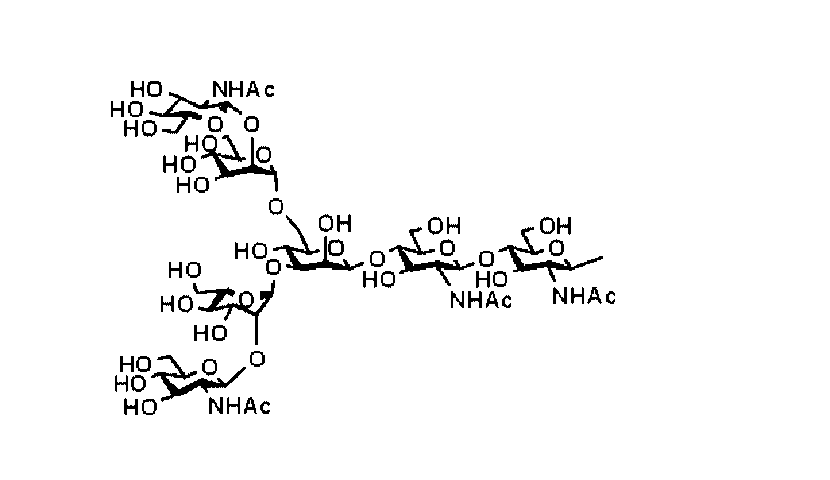

また、本明細書中において「ジシアロ糖鎖」、「モノシアロ糖鎖」、「アシアロ糖鎖」、「ジグルクナック糖鎖」、「ジマンノース糖鎖」には、上記化学式で示したもののほか、化学式で示した例と結合様式の異なるものも含まれ、かかる糖鎖も本発明の糖鎖として好ましく用いられる。かかる糖鎖としては、例えば、ジシアロ糖鎖又はアシアロ糖鎖においてシアル酸とガラクトースが(α2→3)結合で結合しているもの等が挙げられる。
In a preferred embodiment of the present invention, the sugar chain in the glycosylated GLP-1 peptide of the present invention is a double-chain complex sugar chain. The complex-type sugar chain includes two or more types of monosaccharides, and has a basic structure shown below and a lactosamine structure represented by Galβ1-4GlcNAc.
In addition, in this specification, “dicialo sugar chain”, “monosialo sugar chain”, “asialo sugar chain”, “diglucnac sugar chain”, and “dimannose sugar chain” are represented by the chemical formulas shown above. Examples having different binding modes from these examples are also included, and such sugar chains are also preferably used as the sugar chains of the present invention. Examples of such sugar chains include those in which sialic acid and galactose are bonded by a (α2 → 3) bond in a dicialo sugar chain or an asialog sugar chain.
また、本発明で用いられる高マンノース型糖鎖は、上述した複合型糖鎖の基本構造に、さらにマンノースが2個以上結合している糖鎖である。高マンノース型糖鎖は嵩高いので、ペプチドに高マンノース型糖鎖を結合させることにより血中安定性がより高くなりうる。哺乳類の高マンノース型糖鎖のように、5~9個のマンノースを含む糖鎖が好ましいが、酵母の高マンノース型糖鎖のように、より多くのマンノースを含む糖鎖であってもよい。本発明に好ましく用いられる高マンノース型糖鎖としては、例えば、
ハイマンノース-5(M-5)


Highman North-5 (M-5)
本発明において、好ましい糖鎖としては、例えば、ヒト体内において、タンパク質と結合した糖タンパク質として存在する糖鎖(例えば、「FEBS LETTERS Vol.50,No.3,Feb.1975」に記載の糖鎖)と、同一の構造を有する糖鎖(構成糖の種類及びそれらの結合様式が同一の糖鎖)又はこれの非還元末端から1又は複数の糖を失った糖鎖である、下記表1~4に記載の糖鎖を挙げることができる。 In the present invention, preferable sugar chains include, for example, sugar chains existing as glycoproteins bound to proteins in the human body (for example, sugar chains described in “FEBS LETTERS Vol. 50, No. 3, Feb. 1975”). ) And a sugar chain having the same structure (a sugar chain having the same kind of constituent sugars and their coupling mode) or a sugar chain from which one or more sugars have been lost from the non-reducing end thereof. 4 can be mentioned.


また、本発明の一態様において、好ましい糖鎖は、直鎖構造を有する糖鎖である。かかる糖鎖としては、例えば、オリゴヒアルロン酸が挙げられる。本明細書において、オリゴヒアルロン酸とは、N-アセチルグルコサミンとグルクロン酸が交互に2~32糖、好ましくは2~16糖、より好ましくは4~8糖、直鎖上に結合した糖鎖をいう。
本発明に用いられるオリゴヒアルロン酸のうち、特に好ましいものとして、N-アセチルグルコサミンとグルクロン酸とからなる単位を1単位とした場合、2単位(4糖)以上8単位(16糖)以下の糖鎖が挙げられ、さらに好ましくは、2単位(4糖)~4単位(8糖)、最も好ましくは2単位(4糖)である。
本発明に好ましく用いられるヒアルロン酸としては、例えば、
4糖のオリゴヒアルロン酸、
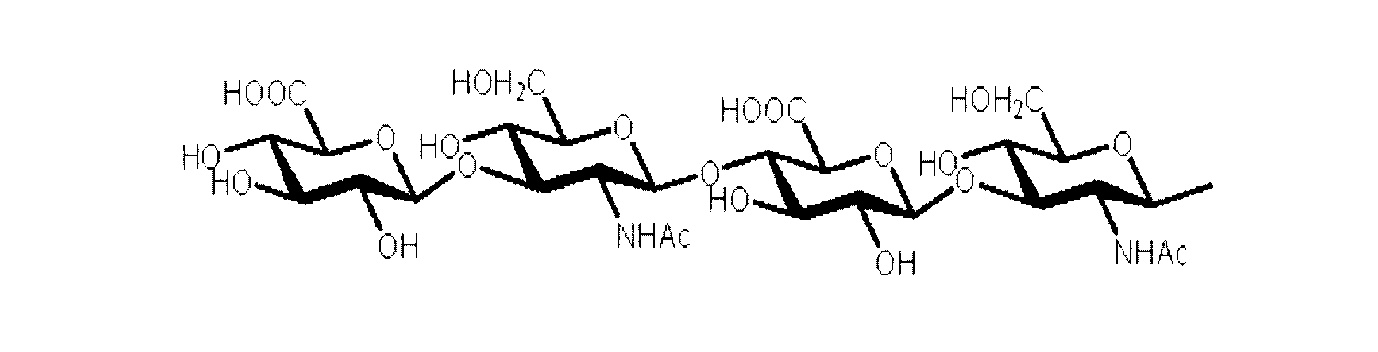

Among oligohyaluronic acids used in the present invention, particularly preferred are sugars having 2 units (4 sugars) or more and 8 units (16 sugars) or less when the unit consisting of N-acetylglucosamine and glucuronic acid is 1 unit. A chain, more preferably 2 units (4 sugars) to 4 units (8 sugars), most preferably 2 units (4 sugars).
As hyaluronic acid preferably used in the present invention, for example,
Tetrasaccharide oligohyaluronic acid,
本発明の好ましい一態様において、本発明の糖ペプチドにおける糖鎖の構造は、均一である。本明細書中において、糖ペプチドにおける糖鎖の構造が均一であるとは、糖ペプチド間で比較した場合に、ペプチド中の糖鎖付加部位、糖鎖を構成する各糖の種類、結合順序、及び糖間の結合様式が同一であることをいい、少なくとも90%以上、好ましくは95%以上、より好ましくは99%以上の糖鎖の構造が均一であることを言う。糖鎖が均一である糖ペプチドは、品質が一定であり、特に医薬品の製造や、アッセイなどの分野において好ましい。均一な糖鎖の割合は、例えば、HPLC、キャピラリー電気泳動、NMR、質量分析等を用いた方法によって測定することが可能である。 In a preferred embodiment of the present invention, the structure of the sugar chain in the glycopeptide of the present invention is uniform. In the present specification, the structure of a sugar chain in a glycopeptide is uniform when compared between glycopeptides, the sugar chain addition site in the peptide, the type of each sugar constituting the sugar chain, the binding order, In addition, it means that the sugars are uniformly bonded, and the sugar chain structure is at least 90% or more, preferably 95% or more, more preferably 99% or more. A glycopeptide having a uniform sugar chain has a constant quality and is particularly preferred in the fields of pharmaceutical production and assay. The uniform sugar chain ratio can be measured, for example, by a method using HPLC, capillary electrophoresis, NMR, mass spectrometry or the like.
本発明において、好ましい糖鎖付加GLP-1ペプチドは、例えば、後述の実施例1~15において製造した糖鎖付加GLP-1ペプチド(配列番号54~66)である。すなわち、以下のGLP-1の配列:
His7-Ala8-Glu9-Gly10-Thr11-Phe12-Thr13-Ser14-Asp15-Val16-Ser17-Ser18-Tyr19-Leu20-Glu21-Gly22-Gln23-Ala24-Ala25-Lys26-Glu27-Phe28-Ile29-Ala30-Trp31-Leu32-Val33-Lys34-Gly35-Arg36-Gly37(配列番号2)において:
(b1)26位のLys及び34位のLysがジシアロ糖鎖付加Cysに置換された糖鎖付加GLP-1ペプチド(実施例1)(配列番号54);
(b2)18位のSer及び36位のArgがジシアロ糖鎖付加Cysに置換された糖鎖付加GLP-1ペプチド(実施例2)(配列番号55);
(b3)22位のGly及び30位のAlaがジシアロ糖鎖付加Cysに置換された糖鎖付加GLP-1ペプチド(実施例3)(配列番号56);
(b4)22位のGly及び36位のArgがジシアロ糖鎖付加Cysに置換された糖鎖付加GLP-1ペプチド(実施例4)(配列番号57);
(b5)30位のAla及び36位のArgがジシアロ糖鎖付加Cysに置換された糖鎖付加GLP-1ペプチド(実施例5)(配列番号58);
(b6)30位のAlaがオリゴヒアルロン酸4糖(HA-4)付加Cysに置換された糖鎖付加GLP-1ペプチド(実施例6)(配列番号59);
(b7)30位のAlaがオリゴヒアルロン酸8糖(HA-8)付加Cysに置換された糖鎖付加GLP-1ペプチド(実施例7)(配列番号60);
(b8)36位のArgがオリゴヒアルロン酸4糖(HA-4)付加Cysに置換された糖鎖付加GLP-1ペプチド(実施例8)(配列番号61);
(b9)36位のArgがオリゴヒアルロン酸8糖(HA-8)付加Cysに置換された糖鎖付加GLP-1ペプチド(実施例9)(配列番号62);
(b10)30位のAlaがオリゴヒアルロン酸16糖(HA-16)付加Cysに置換された糖鎖付加GLP-1ペプチド(実施例10)(配列番号63);
(b11)36位のArgがオリゴヒアルロン酸16糖(HA-16)付加Cysに置換された糖鎖付加GLP-1ペプチド(実施例11)(配列番号64);
(b12)36位のArgが高マンノース型糖鎖(M5)付加Cysに置換された糖鎖付加GLP-1ペプチド(実施例12)(配列番号65);
(b13)26位のLysに、リンカーを介してアシアロ糖鎖付加Asnが結合した糖鎖付加GLP-1ペプチド(実施例13)(配列番号66)である。
また、
(b14)以下のエキセンジン-4の配列:
H-His1-Gly2-Glu3-Gly4-Thr5-Phe6-Thr7-Ser8-Asp9-Leu10-Ser11-Lys12-Gln13-Met14-Glu15-Glu16-Glu17-Ala18-Val19-Arg20-Leu21-Phe22-Ile23-Glu24-Trp25-Leu26-Lys27-Asn28-Gly29-Gly30-Pro31-Ser32-Ser33-Gly34-Ala35-Pro36-Pro37-Pro38-Ser39-NH2(配列番号50)において:
30位のGlyがジシアロ糖鎖付加Cysに置換された糖鎖付加GLP-1ペプチド(実施例14)(配列番号67)である。
さらに、
(b15)以下のBIM51077の配列:
His7-R28-Glu9-Gly10-Thr11-Phe12-Thr13-Ser14-Asp15-Val16-Ser17-Ser18-Tyr19-Leu20-Glu21-Gly22-Gln23-Ala24-Ala25-Lys26-Glu27-Phe28-Ile29-Ala30-Trp31-Leu32-Val33-Lys34-R235-Arg36-NH2[式中、R2はα-メチルアラニンを示す。](配列番号52)において:
26位のLysがジシアロ糖鎖付加Cysに置換された糖鎖付加GLP-1ペプチド(実施例15)(配列番号68)である。
また、
(b16)上記エキセンジン‐4の配列(配列番号50)において、30位のGlyが高マンノース型糖鎖(M5)付加Cysに置換された糖鎖付加GLP-1ペプチド(実施例16)である。
In the present invention, a preferred glycosylated GLP-1 peptide is, for example, a glycosylated GLP-1 peptide (SEQ ID NOs: 54 to 66) produced in Examples 1 to 15 described later. That is, the following GLP-1 sequence:
His 7 -Ala 8 -Glu 9 -Gly 10 -Thr 11 -Phe 12 -Thr 13 -Ser 14 -Asp 15 -Val 16 -Ser 17 -Ser 18 -Tyr 19 -Leu 20 -Glu 21 -Gly 22 -Gln 23 In -Ala 24 -Ala 25 -Lys 26 -Glu 27 -Phe 28 -Ile 29 -Ala 30 -Trp 31 -Leu 32 -Val 33 -Lys 34 -Gly 35 -Arg 36 -Gly 37 (SEQ ID NO: 2):
(B1) Glycosylated GLP-1 peptide in which Lys at position 26 and Lys at position 34 are replaced with dicialoglycosylated Cys (Example 1) (SEQ ID NO: 54);
(B2) Glycosylated GLP-1 peptide in which Ser at position 18 and Arg at position 36 are replaced with dicialoglycosylated Cys (Example 2) (SEQ ID NO: 55);
(B3) Glycosylated GLP-1 peptide in which Gly at position 22 and Ala at
(B4) Glycosylated GLP-1 peptide in which Gly at position 22 and Arg at position 36 are replaced with dicialoglycosylated Cys (Example 4) (SEQ ID NO: 57);
(B5) Glycosylated GLP-1 peptide in which Ala at
(B6) Glycosylated GLP-1 peptide in which Ala at
(B7) Glycosylated GLP-1 peptide in which Ala at
(B8) Glycosylated GLP-1 peptide in which Arg at position 36 is substituted with oligohyaluronic acid tetrasaccharide (HA-4) -added Cys (Example 8) (SEQ ID NO: 61);
(B9) Glycosylated GLP-1 peptide in which Arg at position 36 is substituted with oligohyaluronic acid octasaccharide (HA-8) -added Cys (Example 9) (SEQ ID NO: 62);
(B10) Glycosylated GLP-1 peptide in which Ala at
(B11) Glycosylated GLP-1 peptide in which Arg at position 36 is substituted with oligohyaluronic acid 16-saccharide (HA-16) -added Cys (Example 11) (SEQ ID NO: 64);
(B12) Glycosylated GLP-1 peptide in which Arg at position 36 is substituted with a high mannose sugar chain (M5) -added Cys (Example 12) (SEQ ID NO: 65);
(B13) Glycosylated GLP-1 peptide (Example 13) (SEQ ID NO: 66) wherein Asialoglycosylated Asn is linked to Lys at position 26 via a linker.
Also,
(B14) The following exendin-4 sequence:
H-His 1 -Gly 2 -Glu 3 -Gly 4 -Thr 5 -Phe 6 -Thr 7 -Ser 8 -Asp 9 -Leu 10 -Ser 11 -Lys 12 -Gln 13 -Met 14 -Glu 15 -Glu 16- Glu 17 -Ala 18 -Val 19 -Arg 20 -Leu 21 -Phe 22 -Ile 23 -Glu 24 -Trp 25 -Leu 26 -Lys 27 -Asn 28 -Gly 29 -Gly 30 -Pro 31 -Ser 32 -Ser 33 In -Gly 34 -Ala 35 -Pro 36 -Pro 37 -Pro 38 -Ser 39 -NH 2 (SEQ ID NO: 50):
Glycosylated GLP-1 peptide (Example 14) (SEQ ID NO: 67) in which Gly at
further,
(B15) The following BIM51077 sequence:
His 7 -R2 8 -Glu 9 -Gly 10 -Thr 11 -Phe 12 -Thr 13 -Ser 14 -Asp 15 -Val 16 -Ser 17 -Ser 18 -Tyr 19 -Leu 20 -Glu 21 -Gly 22 -Gln 23 -Ala 24 -Ala 25 -Lys 26 -Glu 27 -Phe 28 -Ile 29 -Ala 30 -Trp 31 -Leu 32 -Val 33 -Lys 34 -R2 35 -Arg 36 -NH 2 [wherein R2 is α- Indicates methylalanine. ] (SEQ ID NO: 52):
This is a glycosylated GLP-1 peptide (Example 15) (SEQ ID NO: 68) in which Lys at position 26 is substituted with dicialoglycosylated Cys.
Also,
(B16) A glycosylated GLP-1 peptide (Example 16) in which Gly at
本発明の糖鎖付加GLP-1ペプチドは、当業者に公知のペプチド合成方法に、糖鎖付加工程を組み込むことで製造することができる。糖鎖付加に際しては、トランスグルタミナーゼに代表される、酵素の逆反応を利用する方法も用いることができるが、この場合、付加する糖鎖が大量に必要になる、最終工程後の精製が煩雑になる、糖鎖の付加位置及び付加可能な糖鎖が制限される、等の問題があるため、アッセイ用等の少量の合成には用いることが可能でも、医薬品製造等の大規模な製造には実用的な方法とは言えないことがある。 The glycosylated GLP-1 peptide of the present invention can be produced by incorporating a glycosylation step into a peptide synthesis method known to those skilled in the art. For glycosylation, a method utilizing the reverse reaction of the enzyme, represented by transglutaminase, can also be used. In this case, a large amount of sugar chain to be added is required, and purification after the final step is complicated. However, it can be used for small-scale synthesis for assays, etc., but for large-scale production such as pharmaceutical production. It may not be a practical method.
本発明の糖鎖付加GLP-1ペプチドの簡便な製造方法であって、かつ、糖鎖の構造が均一である糖鎖付加GLP-1ペプチドの安定した製造方法の具体例として、以下、糖鎖付加アミノ酸として糖鎖付加Asnを使用し、固相合成、液相合成等の公知のペプチド合成方法を適用することにより糖鎖付加GLP-1ペプチドを製造する方法(A法)、及びGLP-1の任意のアミノ酸をCysで置換したペプチドを公知のペプチド合成方法に従って製造し、その後、Cysに化学合成により糖鎖を付加し、糖鎖付加GLP-1ペプチドを製造する方法(B法)を例示する。さらに、糖鎖付加アミノ酸において糖鎖とアミノ酸がリンカーを介して結合しており、且つ、当該リンカーが糖鎖側末端にアミノ酸を含む糖鎖付加GLP-1ペプチドの製造例として、まず糖鎖付加Asnにリンカーの一端を結合した後、リンカーの他端にN-ヒドロキシコハク酸イミジル基を結合させ、N-ヒドロキシコハク酸イミジル基をGLP-1ペプチドのLys残基の側鎖アミノ基と反応させて、糖鎖付加GLP-1ペプチドを製造する方法(C法)を示す。これらの製造方法を参考に、当業者であれば様々な糖鎖付加GLP-1ペプチドを製造することが可能であり、得られる糖鎖付加GLP-1ペプチド及びその製造方法は、特に医薬品製造の分野において、非常に有用である。また、これらのA法~C法は、2つ以上を組み合わせて行うことも可能である。アッセイなどに用いる少量の合成であれば、さらに、上記の方法に、転移酵素による糖鎖伸長反応を組み合わせることも可能である。なお、A法は、国際公開第WO2004/005330号パンフレット(US2005222382(A1))に、B法は、国際公開第WO2005/010053号パンフレット(US2007060543(A1))に、それぞれ記載されており、その開示は全体として本明細書に参照により組み込まれる。また、A法乃至C法において用いられる糖鎖構造が均一な糖鎖の製造に関しては、第WO03/008431号パンフレット(US2004181054(A1))、第WO2004/058984号パンフレット(US2006228784(A1))、第WO2004/058824号パンフレット(US2006009421(A1))、第WO2004/070046号パンフレット(US2006205039(A1))、第WO2007/011055号パンフレット等に記載されており、その開示は全体として本明細書に参照により組み込まれる。 Specific examples of the method for producing a glycosylated GLP-1 peptide of the present invention with a simple method for producing a glycosylated GLP-1 peptide having a uniform sugar chain structure are as follows. A method for producing a glycosylated GLP-1 peptide by using a glycosylated Asn as an added amino acid and applying a known peptide synthesis method such as solid phase synthesis or liquid phase synthesis (Method A), and GLP-1 Illustrates a method (Method B) in which a peptide in which any amino acid is substituted with Cys is produced according to a known peptide synthesis method, and then a sugar chain is added to Cys by chemical synthesis to produce a glycosylated GLP-1 peptide. To do. Further, as an example of producing a glycosylated GLP-1 peptide in which a sugar chain and an amino acid are linked via a linker in the glycosylated amino acid and the linker contains an amino acid at the sugar chain side terminal, first, glycosylation is performed. After binding one end of the linker to Asn, an N-hydroxysuccinimidyl group is bound to the other end of the linker, and the N-hydroxysuccinimidyl group is reacted with the side chain amino group of the Lys residue of the GLP-1 peptide. A method (Method C) for producing a glycosylated GLP-1 peptide is shown below. With reference to these production methods, those skilled in the art can produce various glycosylated GLP-1 peptides. The resulting glycosylated GLP-1 peptide and its production method are particularly useful for pharmaceutical production. Very useful in the field. Further, these methods A to C can be performed in combination of two or more. In the case of a small amount of synthesis used in an assay or the like, it is also possible to combine a sugar chain elongation reaction by a transferase with the above method. The method A is described in International Publication No. WO 2004/005330 pamphlet (US2005222382 (A1)), and the method B is described in International Publication No. WO2005 / 010053 pamphlet (US2007060543 (A1)). Are incorporated herein by reference in their entirety. In addition, regarding the production of sugar chains having a uniform sugar chain structure used in Method A to Method C, WO03 / 008431 pamphlet (US2004181054 (A1)), WO2004 / 058984 pamphlet (US2006228784 (A1)), No. WO 2004/058824 pamphlet (US2006009421 (A1)), WO2004 / 070046 pamphlet (US2006205039 (A1)), WO2007 / 011055 pamphlet, etc., the disclosure of which is incorporated herein by reference in its entirety. It is.
糖鎖付加GLP-1ペプチドを製造する方法(A法)
先ず、(1)水酸基を有する樹脂(レジン)の水酸基と、脂溶性保護基でアミノ基窒素が保護されたアミノ酸のカルボキシル基をエステル化反応させる。この場合アミノ酸のアミノ基窒素を脂溶性保護基で保護しているので、アミノ酸同士の自己縮合は防止され、レジンの水酸基とアミノ酸のカルボキシル基が反応してエステル化が起こる。
次に(2)上記で得られたエステルの脂溶性保護基を脱離して遊離アミノ基を形成させ、(3)この遊離アミノ基と、脂溶性保護基でアミノ基窒素が保護された任意のアミノ酸のカルボキシル基とアミド化反応させ、
(4)上記脂溶性保護基を脱離して遊離アミノ基を形成させ、
(5)上記(3)及び(4)の工程を1回以上繰り返すことにより、任意の数の任意のアミノ酸が連結した、末端にレジンを結合し、他端に遊離アミノ基を有するペプチドが得られる。
(6)次に、脂溶性保護基でアミノ基窒素が保護された糖鎖アスパラギン(糖鎖付加アスパラギン)のアスパラギン部分のカルボキシル基と上記遊離アミノ基をアミド化反応させ、
(7)更に上記脂溶性保護基を脱離して遊離アミノ基を形成させ、
(8)この遊離アミノ基と、脂溶性保護基でアミノ基窒素が保護された任意のアミノ酸のカルボキシル基とアミド化反応させ、
(9)上記(7)及び(8)の工程を1回以上繰り返し、
(10)上記脂溶性保護基を脱離して遊離アミノ基を形成させることにより、任意の数の任意のアミノ酸が連結した、末端にレジンを結合し、他端に遊離アミノ基を有し、中間に糖鎖アスパラギンを有する糖ペプチドが得られる。
(11)そして、酸で樹脂(レジン)を切断することにより、糖鎖アスパラギンをペプチド鎖の任意の位置に有する糖ペプチドを製造することができる。
Method for producing glycosylated GLP-1 peptide (Method A)
First, (1) a hydroxyl group of a resin having a hydroxyl group (resin) is esterified with a carboxyl group of an amino acid whose amino group nitrogen is protected with a lipophilic protecting group. In this case, since the amino group nitrogen of the amino acid is protected with a fat-soluble protecting group, self-condensation between amino acids is prevented, and esterification occurs due to the reaction between the hydroxyl group of the resin and the carboxyl group of the amino acid.
Next, (2) the lipophilic protecting group of the ester obtained above is eliminated to form a free amino group, and (3) any free amino group and any amino group nitrogen protected with the lipophilic protecting group. Amidation reaction with carboxyl group of amino acid,
(4) The above fat-soluble protecting group is eliminated to form a free amino group,
(5) By repeating the steps (3) and (4) one or more times, a peptide having an arbitrary number of arbitrary amino acids linked, a resin bound to the terminal, and a free amino group at the other end is obtained. It is done.
(6) Next, the carboxyl group of the asparagine part of the sugar chain asparagine (sugar chain-added asparagine) in which the amino group nitrogen is protected with a fat-soluble protecting group is subjected to an amidation reaction,
(7) Further, the above fat-soluble protecting group is eliminated to form a free amino group,
(8) This free amino group is amidated with a carboxyl group of any amino acid in which the amino group nitrogen is protected with a fat-soluble protecting group,
(9) The steps (7) and (8) are repeated once or more,
(10) By removing the fat-soluble protecting group to form a free amino group, an arbitrary number of arbitrary amino acids are linked, the resin is bonded to the terminal, the other end has a free amino group, Thus, a glycopeptide having a sugar chain asparagine is obtained.
(11) A glycopeptide having a sugar chain asparagine at an arbitrary position of the peptide chain can be produced by cleaving the resin (resin) with an acid.
また、この糖鎖アスパラギンをペプチド鎖の端部に導入することもできる。 It is also possible to introduce this sugar chain asparagine into the end of the peptide chain.
水酸基を有する樹脂(レジン)としては、通常、固相合成で使用する水酸基を有する樹脂(レジン)であればよく、例えば、Amino-PEGAレジン(メルク社製)Wangレジン(メルク社製)、HMPA-PEGAレジン(メルク社製)等を用いることができる。 The resin having a hydroxyl group (resin) may be any resin (resin) having a hydroxyl group generally used in solid phase synthesis. For example, Amino-PEGA resin (manufactured by Merck) Wang resin (manufactured by Merck), HMPA -PEGA resin (manufactured by Merck) or the like can be used.
アミノ酸としては全てのアミノ酸を用いることができ、例えば、天然アミノ酸である、セリン(Ser)、アスパラギン(Asn)、バリン(Val)、ロイシン(Leu)、イソロイシン(Ile)、アラニン(Ala)、チロシン(Tyr)、グリシン(Gly)、リジン(Lys)、アルギニン(Arg)、ヒスチジン(His)、アスパラギン酸(Asp)、グルタミン酸(Glu)、グルタミン(Gln)、スレオニン(Thr)、システイン(Cys)、メチオニン(Met)、フェニルアラニン(Phe)、トリプトファン(Trp)、プロリン(Pro)を挙げることができる。 As amino acids, all amino acids can be used. For example, natural amino acids such as serine (Ser), asparagine (Asn), valine (Val), leucine (Leu), isoleucine (Ile), alanine (Ala), tyrosine (Tyr), glycine (Gly), lysine (Lys), arginine (Arg), histidine (His), aspartic acid (Asp), glutamic acid (Glu), glutamine (Gln), threonine (Thr), cysteine (Cys), Examples include methionine (Met), phenylalanine (Phe), tryptophan (Trp), and proline (Pro).
脂溶性保護基としては、例えば9-フルオレニルメトキシカルボニル(Fmoc)基、t-ブチルオキシカルボニル(Boc)基、ベンジル基、アリル基、アリルオキシカルボニル基、アセチル基等の、カーボネート系又はアミド系の保護基等を挙げることができる。脂溶性保護基を導入するには、例えばFmoc基を導入する場合には9-フルオレニルメチル-N-スクシニミジルカーボネートと炭酸水素ナトリウムを加えて反応を行うことにより導入できる。反応は0~50℃、好ましくは室温で、約1~5時間程度行うのが良い。 Examples of the fat-soluble protective group include carbonate-based or amide groups such as 9-fluorenylmethoxycarbonyl (Fmoc) group, t-butyloxycarbonyl (Boc) group, benzyl group, allyl group, allyloxycarbonyl group, and acetyl group. Protecting groups of the system can be mentioned. In order to introduce the fat-soluble protecting group, for example, when introducing the Fmoc group, 9-fluorenylmethyl-N-succinimidyl carbonate and sodium hydrogen carbonate can be added and reacted. The reaction is carried out at 0 to 50 ° C., preferably at room temperature, for about 1 to 5 hours.
脂溶性保護基で保護したアミノ酸としては、上記のアミノ酸を上記の方法で製造することができる。また、市販のものも使用することができる。例えば、Fmoc-Ser、Fmoc-Asn、Fmoc-Val、Fmoc-Leu、Fmoc-Ile、Fmoc-AIa、Fmoc-Tyr、Fmoc-Gly、Fmoc-Lys、Fmoc-Arg、Fmoc-His、Fmoc-Asp、Fmoc-Glu、Fmoc-Gln、Fmoc-Thr、Fmoc-Cys、Fmoc-Met、Fmoc-Phe、Fmoc-Trp、Fmoc-Proを挙げることができる。 As an amino acid protected with a fat-soluble protecting group, the above-mentioned amino acid can be produced by the above-described method. Commercially available products can also be used. For example, Fmoc-Ser, Fmoc-Asn, Fmoc-Val, Fmoc-Leu, Fmoc-Ile, Fmoc-AIa, Fmoc-Tyr, Fmoc-Gly, Fmoc-Lys, Fmoc-Arg, Fmoc-His, Fmoc-His, Examples include Fmoc-Glu, Fmoc-Gln, Fmoc-Thr, Fmoc-Cys, Fmoc-Met, Fmoc-Phe, Fmoc-Trp, and Fmoc-Pro.
エステル化触媒として、例えば1-メシチレンスルホニル-3-ニトロ-1,2,4-トリアゾール(MSNT)、ジシクロヘキシルカルボジイミド(DCC)、ジイソプロピルカルボジイミド(DIPCDI)等の公知の脱水縮合剤を用いることができる。アミノ酸と脱水縮合剤との使用割合は、前者1重量部に対して、後者が、通常1~10重量部、好ましくは2~5重量部である。 As the esterification catalyst, known dehydration condensing agents such as 1-mesitylenesulfonyl-3-nitro-1,2,4-triazole (MSNT), dicyclohexylcarbodiimide (DCC), diisopropylcarbodiimide (DIPCDI), and the like can be used. The use ratio of the amino acid and the dehydration condensing agent is usually 1 to 10 parts by weight, preferably 2 to 5 parts by weight, with respect to 1 part by weight of the former.
エステル化反応は、例えば、固相カラムにレジンを入れ、このレジンを溶剤で洗浄し、その後アミノ酸の溶液を加えることにより行うのが好ましい。洗浄用溶剤としては、例えばジメチルホルムアミド(DMF)、2-プロパノール、塩化メチレン等を挙げることができる。アミノ酸を溶解する溶媒としては、例えばジメチルスルホキシド(DMSO)、DMF、塩化メチレン等を挙げることができる。エステル化反応は0~50℃、好ましくは室温で、約10分~30時間程度、好ましくは15分~24時間程度行うのが良い。 The esterification reaction is preferably performed, for example, by placing a resin in a solid phase column, washing the resin with a solvent, and then adding an amino acid solution. Examples of the cleaning solvent include dimethylformamide (DMF), 2-propanol, methylene chloride and the like. Examples of the solvent that dissolves amino acids include dimethyl sulfoxide (DMSO), DMF, and methylene chloride. The esterification reaction is carried out at 0 to 50 ° C., preferably at room temperature, for about 10 minutes to 30 hours, preferably about 15 minutes to 24 hours.
この時固相上の未反応の水酸基を無水酢酸等を用いてアセチル化してキャッピングすることも好ましい。 At this time, it is also preferable to capped the unreacted hydroxyl group on the solid phase by acetylation using acetic anhydride or the like.
脂溶性保護基の脱離は、例えば塩基で処理することにより行うことができる。塩基としては、例えばピペリジン、モルホリン等を挙げることができる。その際、溶媒の存在下行うのが好ましい。溶媒としては、例えばDMSO、DMF、メタノール等を挙げることができる。 The elimination of the lipophilic protecting group can be carried out, for example, by treatment with a base. Examples of the base include piperidine and morpholine. In that case, it is preferable to carry out in the presence of a solvent. Examples of the solvent include DMSO, DMF, methanol and the like.
遊離アミノ基と、脂溶性保護基でアミノ基窒素が保護された任意のアミノ酸のカルボキシル基とのアミド化反応は、活性化剤及び溶媒の存在下行うのが好ましい。 The amidation reaction between the free amino group and the carboxyl group of any amino acid whose amino group nitrogen is protected with a fat-soluble protecting group is preferably performed in the presence of an activator and a solvent.
活性化剤としては、例えば、ジシクロヘキシルカルボジイミド(DCC)、1-エチル-3-(3-ジメチルアミノプロピル)カルボジイミド・塩酸塩(WSC/HCl)、ジフェニルホスホリルアジド(DPPA)、カルボニルジイミダゾール(CDI)、ジエチルシアノホスホネート(DEPC)、ベンゾトリアゾール-1-イルオキシ-トリスピロリジノホスホニウム(DIPCI)、ベンゾトリアゾール-1-イルオキシ-トリスピロリジノホスホニウムヘキサフルオロホスフェート(PyBOP)、1-ヒドロキシベンゾトリアゾール(HOBt)、ヒドロキシスクシンイミド(HOSu)、ジメチルアミノピリジン(DMAP)、1-ヒドロキシ-7-アザベンゾトリアゾール(HOAt)、ヒドロキシフタルイミド(HOPht)、ペンタフルオロフェノール(Pfp-OH)、2-(1H-ベンゾトリアゾール-1-イル)-1,1,3,3-テトラメチルウロニウムヘキサフルオロホスフェート(HBTU)、O-(7-アザベンゾトリアゾール-1-イル)-1,1,3,3-テトラメチルウロニウムヘキサフルオロホスホネート(HATU)、O-ベンゾトリアゾール-1-イル-1,1,3,3-テトラメチルウロニウムテトラフルオロボレート(TBTU)、3,4-ジヒドロ-3-ヒドロジ-4-オキサ-1,2,3-ベンゾトリアジン(Dhbt)等を挙げることができる。 Examples of the activator include dicyclohexylcarbodiimide (DCC), 1-ethyl-3- (3-dimethylaminopropyl) carbodiimide hydrochloride (WSC / HCl), diphenylphosphoryl azide (DPPA), carbonyldiimidazole (CDI). Diethyl cyanophosphonate (DEPC), benzotriazol-1-yloxy-trispyrrolidinophosphonium (DIPCI), benzotriazol-1-yloxy-trispyrrolidinophosphonium hexafluorophosphate (PyBOP), 1-hydroxybenzotriazole (HOBt), Hydroxysuccinimide (HOSu), dimethylaminopyridine (DMAP), 1-hydroxy-7-azabenzotriazole (HOAt), hydroxyphthalimide (HOP) t), pentafluorophenol (Pfp-OH), 2- (1H-benzotriazol-1-yl) -1,1,3,3-tetramethyluronium hexafluorophosphate (HBTU), O- (7-aza Benzotriazol-1-yl) -1,1,3,3-tetramethyluronium hexafluorophosphonate (HATU), O-benzotriazol-1-yl-1,1,3,3-tetramethyluronium tetrafluoro Examples thereof include borate (TBTU), 3,4-dihydro-3-hydrodi-4-oxa-1,2,3-benzotriazine (Dhbt), and the like.
活性化剤の使用量は、脂溶性の保護基でアミノ基窒素が保護された任意のアミノ酸に対して、1~20当量、好ましくは1~10当量、さらに好ましくは、1~5当量とするのが好ましい。 The activator is used in an amount of 1 to 20 equivalents, preferably 1 to 10 equivalents, more preferably 1 to 5 equivalents with respect to any amino acid in which the amino group nitrogen is protected with a fat-soluble protecting group. Is preferred.
溶媒としては、例えばDMSO、DMF、塩化メチレン等を挙げることができる。反応は0~50℃、好ましくは室温で、約10~30時間程度、好ましくは15分~24時間程度行うのが良い。脂溶性保護基の脱離は、上記と同様に行うことができる。 Examples of the solvent include DMSO, DMF, methylene chloride and the like. The reaction is carried out at 0 to 50 ° C., preferably at room temperature, for about 10 to 30 hours, preferably about 15 minutes to 24 hours. The elimination of the lipophilic protecting group can be carried out in the same manner as described above.
樹脂(レジン)からペプチド鎖を切断するには酸で処理するのが好ましい。酸としては、例えばトリフルオロ酢酸(TFA)、弗化水素(HF)等を挙げることができる。 In order to cleave the peptide chain from the resin (resin), it is preferable to treat with an acid. Examples of the acid include trifluoroacetic acid (TFA) and hydrogen fluoride (HF).
上記(6)の、脂溶性保護基でアミノ基窒素が保護された糖鎖アスパラギンのアスパラギン部分のカルボキシル基とペプチドの遊離アミノ基をアミド化反応させ、(7)の、上記脂溶性保護基を脱離して遊離アミノ基を形成させる工程を、適宜追加することにより、少なくとも2以上の糖鎖アスパラギンをペプチド鎖の任意の位置に有する糖ペプチドを製造することができる。またこの時、異なる糖鎖アスパラギンを用いることにより2種以上の糖鎖アスパラギンをペプチド鎖の任意の位置に有する糖ペプチドを製造することもできる。 The carboxyl group of the asparagine moiety of the sugar chain asparagine in which the amino group nitrogen is protected with the fat-soluble protecting group in (6) above, and the free amino group of the peptide are amidated, and the fat-soluble protecting group in (7) is A glycopeptide having at least two or more sugar chain asparagines at any position of the peptide chain can be produced by appropriately adding a step of leaving to form a free amino group. Further, at this time, by using different sugar chain asparagines, glycopeptides having two or more kinds of sugar chain asparagines at arbitrary positions of the peptide chain can also be produced.
また上記(6)の、脂溶性保護基でアミノ基窒素が保護された糖鎖アスパラギンのアスパラギン部分のカルボキシル基とアミド化反応させ、(7)の、上記脂溶性保護基を脱離して遊離アミノ基を形成させる工程を、最終工程、即ち工程(9)及び(10)に代えて行うことにより、少なくとも1以上の糖鎖アスパラギンをペプチド鎖に有する糖ペプチドを製造することができる。 In addition, an amidation reaction is performed with the carboxyl group of the asparagine portion of the sugar chain asparagine in which the amino group nitrogen is protected with a fat-soluble protecting group in (6) above, and then the fat-soluble protecting group in (7) is eliminated to form a free amino group. By performing the step of forming a group in place of the final step, that is, steps (9) and (10), a glycopeptide having at least one sugar chain asparagine in the peptide chain can be produced.
また、上記工程(1)を行う際、脂溶性保護基でアミノ基窒素が保護されたアミノ酸に代えて、脂溶性保護基でアミノ基窒素が保護された糖鎖アスパラギンのアスパラギン部分のカルボキシル基を、レジンの水酸基とエステル化反応させることにより、C末端に糖鎖アスパラギンを有する糖ペプチドを製造することができる。このとき、工程(6)をさらに行ってもよく、行わなくてもよい。 Moreover, when performing the said process (1), it replaces with the amino acid by which the amino group nitrogen was protected by the fat-soluble protecting group, and the carboxyl group of the asparagine part of the sugar chain asparagine by which the amino group nitrogen was protected by the fat-soluble protecting group. By carrying out an esterification reaction with the hydroxyl group of the resin, a glycopeptide having a sugar chain asparagine at the C-terminus can be produced. At this time, step (6) may or may not be further performed.
このようにして、所望の位置を糖鎖付加Asnで置換した糖鎖付加GLP-1ペプチドを得ることができる。 In this way, a glycosylated GLP-1 peptide in which the desired position is substituted with glycosylated Asn can be obtained.
糖鎖付加GLP-1ペプチドを製造する方法(B法)
先ず、Cysを含むペプチドを、固相合成法、液相合成法、細胞による合成、天然に存在するものを分離抽出する方法等により製造する。Cysの位置を変えることにより、所望の位置に糖鎖を付加することができる。
Method for producing glycosylated GLP-1 peptide (Method B)
First, a peptide containing Cys is produced by a solid phase synthesis method, a liquid phase synthesis method, cell synthesis, a method of separating and extracting naturally occurring ones, and the like. By changing the position of Cys, a sugar chain can be added to a desired position.
次に、ハロアセタミド化複合型糖鎖誘導体を上記で得たCysを含むペプチドと反応させることにより製造する。上記反応は、通常0~80℃、好ましくは、10~60℃、更に好ましくは15~35℃で行うのが良い。反応時間は、好ましくは、通常30分~5時間程度である。反応終了後は、適宜、公知の方法(例えば、高速液体カラムクロマトグラフィー(HPLC))で精製するのが良い。 Next, the haloacetamide-conjugated complex sugar chain derivative is produced by reacting with the Cys-containing peptide obtained above. The above reaction is usually carried out at 0 to 80 ° C., preferably 10 to 60 ° C., more preferably 15 to 35 ° C. The reaction time is preferably about 30 minutes to 5 hours. After completion of the reaction, it may be appropriately purified by a known method (for example, high performance liquid column chromatography (HPLC)).
ハロアセタミド化複合型糖鎖誘導体は、例えば、複合型アスパラギン結合型糖鎖の1位の炭素に結合している水酸基を、-NH-(CO)-(CH2)a-CH2X(Xはハロゲン原子、aは整数であり、目的とするリンカー機能を阻害しない限り限定されるものではないが、好ましくは0~4の整数を示す。)で置換した化合物である。 The haloacetamide-conjugated glycan derivative is, for example, a hydroxyl group bonded to the 1-position carbon of a conjugated asparagine-linked glycan, represented by —NH— (CO) — (CH 2 ) a —CH 2 X (X is The halogen atom, a is an integer, and is not limited as long as the desired linker function is not inhibited, but preferably represents an integer of 0 to 4.
具体的には、ハロアセタミド化複合型糖鎖誘導体とCys含有ペプチドとをリン酸緩衝液中、室温で反応させる。反応終了後、HPLCで精製することにより糖鎖付加Cysで置換した糖鎖付加GLP-1ペプチドを得ることができる。 Specifically, a haloacetamide-conjugated complex sugar chain derivative and a Cys-containing peptide are reacted in a phosphate buffer at room temperature. After completion of the reaction, a glycosylated GLP-1 peptide substituted with glycosylated Cys can be obtained by purification with HPLC.
糖鎖付加GLP-1ペプチドを製造する方法(C法)
先ず、Lysを含むペプチドを、固相合成法、液相合成法、細胞による合成、天然に存在するものを分離抽出する方法等により製造する。
次に、糖鎖付加アミノ酸に、グルタル酸を結合させる。例えば、糖鎖付加アミノ酸をDMSO溶液に溶解させ、この溶液に、グルタル酸-EDC混合のDMSO溶液を加え、室温で1日撹拌する。反応混合物を適宜希釈した後、分子量排除ゲルクロマトグラフィー等で分画することにより、α-アミノ基にグルタル酸を結合させた糖鎖付加アミノ酸を得ることができる。
次いで、グルタル酸結合糖鎖付加アミノ酸のDMSO溶液に、N-ヒドロキシコハク酸イミドのDMSO溶液およびEDCのDMSO溶液を加え、室温で6時間撹拌した後、EDCを不活化することにより、グルタル酸結合糖鎖付加アミノ酸のN-ヒドロキシコハク酸イミジルエステルを合成することができる。
続いて、GLP-1ペプチドのDMSO溶液に、DIPEA及びグルタル酸結合糖鎖付加アミノ酸のN-ヒドロキシコハク酸イミジルエステルを加え、室温で2時間撹拌した後、グリシン水溶液を加えて反応を停止し、適宜精製することにより、GLP-1ペプチドのLys残基にグルタル酸リンカーを介して糖鎖付加アミノ酸を結合させることができる。こうして、糖鎖付加アミノ酸において糖鎖とアミノ酸(Lys)がリンカーを介して結合し、該リンカーが糖鎖側の末端にアミノ酸(Asn)を含む糖鎖付加GLP-1が得られる。
GLP-1ペプチドの所望の部位のアミノ酸をLysに置換したり、GLP-1ペプチドの野生型に含まれるLys残基を他のアミノ酸で置換したりすることにより、所望の部位に糖鎖付加アミノ酸を結合させた糖鎖付加GLP-1ペプチドを得ることが可能である。また、C法によれば、野生型GLP-1に含まれるLysに糖鎖付加する場合、ペプチド骨格が野生型と同一の糖鎖付加GLP-1ペプチドを得ることができる。
Method for producing glycosylated GLP-1 peptide (Method C)
First, a peptide containing Lys is produced by a solid phase synthesis method, a liquid phase synthesis method, cell synthesis, a method of separating and extracting naturally occurring ones, and the like.
Next, glutaric acid is bound to the glycosylated amino acid. For example, a glycosylated amino acid is dissolved in a DMSO solution, and a DMSO solution in which glutaric acid-EDC is mixed is added to this solution, followed by stirring at room temperature for 1 day. The reaction mixture is appropriately diluted and then fractionated by molecular weight exclusion gel chromatography or the like to obtain a glycosylated amino acid in which glutaric acid is bound to an α-amino group.
Next, a DMSO solution of N-hydroxysuccinimide and a DMSO solution of EDC are added to a DMSO solution of a glutaric acid-linked glycosylated amino acid, and the mixture is stirred at room temperature for 6 hours. N-hydroxysuccinimidyl esters of glycosylated amino acids can be synthesized.
Subsequently, DIPEA and glutamic acid-linked glycosylated amino acid N-hydroxysuccinimidyl ester were added to a DMSO solution of GLP-1 peptide, stirred for 2 hours at room temperature, and then the reaction was stopped by adding an aqueous glycine solution. By appropriate purification, a glycosylated amino acid can be bound to the Lys residue of the GLP-1 peptide via a glutaric acid linker. In this way, in the glycosylated amino acid, a sugar chain and an amino acid (Lys) are bonded via a linker, and the glycosylated GLP-1 containing the amino acid (Asn) at the terminal of the sugar chain is obtained.
By replacing the amino acid at the desired site of the GLP-1 peptide with Lys, or by replacing the Lys residue contained in the wild type of the GLP-1 peptide with another amino acid, the glycosylated amino acid at the desired site It is possible to obtain a glycosylated GLP-1 peptide to which is bound. Further, according to the method C, when a glycosylation is added to Lys contained in wild type GLP-1, a glycosylated GLP-1 peptide having the same peptide backbone as that of the wild type can be obtained.
本発明の糖鎖付加GLP-1ペプチドは、GLP-1活性を有する。
本明細書中において、「GLP-1活性」とは、GLP-1について公知の生理活性の一部又は全部をいう。GLP-1は、血糖値抑制作用のほか、例えば、膵島作用として、cAMP合成誘導に伴うインスリン分泌、膵島保護(アポトーシス抑制)、膵島増殖、膵外作用として、食欲抑制、消化管運動抑制、カルシトニン分泌促進、虚血時の心保護作用等を有することが知られる。従って、GLP-1活性とは、これらの作用に関連する生理活性の全部又は一部を指し、それぞれ、当業者に公知の手法を用いて測定することができる。
The glycosylated GLP-1 peptide of the present invention has GLP-1 activity.
In the present specification, “GLP-1 activity” refers to part or all of a physiological activity known for GLP-1. In addition to the blood glucose level inhibitory effect, GLP-1 has, for example, insulin secretion associated with cAMP synthesis induction, islet protection (inhibition of apoptosis), islet growth, pancreatic islet action, appetite suppression, gastrointestinal motility suppression, calcitonin It is known to have secretion enhancement, cardioprotective action during ischemia, and the like. Therefore, GLP-1 activity refers to all or part of the physiological activity related to these actions, and can be measured using techniques known to those skilled in the art.
例えば、GLP-1活性のうち、血糖値抑制活性は、糖尿病マウス(db/dbマウス)における血糖値低下作用の測定や、経口耐糖能試験(OGTT: Oral Glucose Tolerance Test)における血糖値上昇抑制作用の測定などを用いて測定することができる。なお、本明細書中において、「血糖値抑制」とは、血糖値の上昇を抑制すること及び血糖値を低下させることのいずれの概念も含む。特に、本明細書中において、db/dbマウスにおける血糖値抑制作用を「血糖値低下作用」、OGTTにおける血糖値抑制作用を「血糖値上昇抑制作用」ということがある。 For example, among the GLP-1 activities, the blood glucose level inhibitory activity is the measurement of the blood glucose level lowering effect in diabetic mice (db / db mice) and the blood glucose level inhibitory effect in the oral glucose tolerance test (OGTT: Oral Glucose Tolerance Test). It can measure using the measurement of this. In the present specification, “suppressing blood sugar level” includes both concepts of suppressing an increase in blood sugar level and lowering the blood sugar level. In particular, in the present specification, the blood glucose level inhibitory action in db / db mice is sometimes referred to as “blood glucose level lowering action”, and the blood glucose level inhibitory action in OGTT is sometimes referred to as “blood sugar level increase inhibitory action”.
OGTTによる血糖値抑制活性は、マウスに強制的に糖を飲ませた際の血糖値上昇の抑制の測定によって判断することができる。例えば、後述の試験例2の手法を用いた場合、まず、被験化合物を一晩絶食させたマウスに投与し、その30分後にグルコース溶液を経口投与する。グルコース投与によりマウス血糖値は上昇し、投与後約30分後に最大となり徐々に減少する。グルコース投与後30分の血糖値を測定し、GLP-1投与の場合の血糖値と比較することで、糖鎖付加GLP-1ペプチドの血糖値抑制作用を測定することができる。この30分後の血糖値をGLP-1を投与した場合と比較した場合、本発明の糖鎖付加GLP-1ペプチドは、好ましくは80%以下、より好ましくは60%以下、さらに好ましくは40%以下、特に好ましくは30%以下の血糖値を示す。また、OGTTにおいて同程度の血糖値上昇抑制作用が確認された際の投与量を比較することで、本発明の糖鎖付加GLP-1ペプチドの血糖値抑制活性の強さを判断することができる。例えば、GLP-1を10投与した場合と、ある糖鎖付加GLP-1ペプチドを1投与した場合で同じ血糖値抑制作用が得られる場合、該糖鎖付加GLP-1ペプチドの血糖値抑制活性は、GLP-1の10倍である。本発明の糖鎖付加GLP-1ペプチドは、GLP-1と比較して、好ましくは5倍以上、より好ましくは10倍以上もしくはそれ以上の血糖値抑制活性を有する。
The blood glucose level inhibitory activity by OGTT can be determined by measuring the suppression of an increase in blood glucose level when a mouse is forced to drink sugar. For example, when the method of Test Example 2 described below is used, first, the test compound is administered to a mouse fasted overnight, and a glucose solution is orally administered 30 minutes later. Glucose administration increases the blood glucose level in mice, reaches a maximum about 30 minutes after administration, and gradually decreases. The blood glucose level inhibitory action of the glycosylated GLP-1 peptide can be measured by measuring the
なお、糖鎖付加GLP-1ペプチドが、GLP-1において1若しくは数個のアミノ酸が欠失、置換若しくは付加されたペプチドに糖鎖付加したものである場合や、GLP-1類縁体に糖鎖付加したものである場合、GLP-1活性を比較する対象として、GLP-1類縁体や、その糖鎖付加GLP-1ペプチドと糖鎖付加アミノ酸以外のアミノ酸配列が同一であるGLP-1ペプチドを用いてもよい。 It should be noted that the glycosylated GLP-1 peptide is obtained by adding a sugar chain to a peptide in which one or several amino acids have been deleted, substituted or added in GLP-1, or the GLP-1 analog has a sugar chain. In the case of addition, GLP-1 analogs and GLP-1 peptides having the same amino acid sequence other than the glycosylated amino acid and the glycosylated GLP-1 peptide are used as targets for comparison of GLP-1 activity. It may be used.
db/dbマウスを用いた血糖値抑制活性は、糖尿病マウスに被験化合物を投与後の血糖値の測定によって判断することができる。例えば、被験化合物投与後の血糖値を経時で測定し、例えば投与後120分の血糖値が投与時より低下していれば、血糖値低下作用を確認することができる。また、例えば投与後300分の血糖値を測定することで、血糖値低下作用の持続性も判断することができる。例えば、投与後120分の血糖値をGLP-1投与の場合と比較した場合、本発明の糖鎖付加GLP-1ペプチドは、好ましくは80%以下、より好ましくは70%以下、特に好ましくは60%以下、の血糖値を示す。また、投与後120分の血糖値を、投与時の血糖値と比較した場合、本発明の糖鎖付加GLP-1ペプチドは、好ましくは70%以下、より好ましくは60%以下、特に好ましくは50%以下(例えば45%以下)の血糖値を示す。投与後300分の血糖値をGLP-1投与の場合と比較した場合、本発明の糖鎖付加GLP-1ペプチドは、好ましくは70%以下、より好ましくは50%以下の血糖値を示す。また、投与後300分の血糖値を、投与時の血糖値と比較した場合、本発明の糖鎖付加GLP-1ペプチドは、好ましくは70%以下、より好ましくは50%以下の血糖値を示す。 The blood glucose level inhibitory activity using db / db mice can be determined by measuring the blood glucose level after administering the test compound to diabetic mice. For example, the blood glucose level after administration of the test compound is measured over time. For example, if the blood glucose level for 120 minutes after administration is lower than that at the time of administration, the blood glucose level lowering effect can be confirmed. Further, for example, by measuring the blood glucose level for 300 minutes after administration, the persistence of the blood glucose level lowering action can also be determined. For example, when the blood glucose level at 120 minutes after administration is compared with the case of GLP-1 administration, the glycosylated GLP-1 peptide of the present invention is preferably 80% or less, more preferably 70% or less, particularly preferably 60%. The blood glucose level is less than%. Further, when the blood glucose level at 120 minutes after administration is compared with the blood glucose level at the time of administration, the glycosylated GLP-1 peptide of the present invention is preferably 70% or less, more preferably 60% or less, particularly preferably 50%. The blood glucose level is% or less (for example, 45% or less). When the blood glucose level of 300 minutes after administration is compared with the case of GLP-1 administration, the glycosylated GLP-1 peptide of the present invention preferably exhibits a blood glucose level of 70% or less, more preferably 50% or less. Further, when the blood glucose level at 300 minutes after administration is compared with the blood glucose level at the time of administration, the glycosylated GLP-1 peptide of the present invention preferably exhibits a blood glucose level of 70% or less, more preferably 50% or less. .
なお、血糖値抑制活性がGLP-1と比較して低い場合あっても、血中安定性が増大することで、この活性の低さを補償することができる。 Even if the blood glucose level inhibitory activity is lower than that of GLP-1, this low level of activity can be compensated for by increasing the blood stability.
例えば、GLP-1活性のうち、インスリン分泌活性は、in vitroでのcAMP合成能試験などを用いて測定することができる。GLP-1はGLP-1受容体と結合することにより細胞内cAMP濃度を上昇させ、インシュリン分泌を促進させる。従って、例えば、マウスGLP-1受容体発現CHO-K1細胞を糖鎖付加GLP-1ペプチドで刺激し、細胞内で合成されるcAMP量を測定し、EC50値をGLP-1と比較することで、糖鎖付加GLP-1ペプチドのインスリン分泌活性を測定することができる。 For example, insulin secretion activity in GLP-1 activity can be measured using an in vitro cAMP synthesis ability test or the like. GLP-1 increases intracellular cAMP concentration by binding to the GLP-1 receptor, and promotes insulin secretion. Therefore, for example, by stimulating mouse GLP-1 receptor-expressing CHO-K1 cells with glycosylated GLP-1 peptide, measuring the amount of cAMP synthesized in the cells, and comparing the EC50 value with GLP-1 Insulin secretion activity of the glycosylated GLP-1 peptide can be measured.
本発明の糖鎖付加GLP-1ペプチドは、GLP-1よりも増大した血中安定性を有する。血中安定性は当業者に公知の手法を用いて測定することができ、例えば、血漿中における安定性や、DPP-IV(ジペプチジルペプチダーゼIV)に対する耐性を測定し、半減期、AUC(薬物血中濃度-時間曲線下面積)等を指標に判断することができる。また、腎クリアランスの増大も血中安定性の増大に寄与する。 The glycosylated GLP-1 peptide of the present invention has increased blood stability compared to GLP-1. Blood stability can be measured using methods known to those skilled in the art. For example, stability in plasma and resistance to DPP-IV (dipeptidyl peptidase IV) are measured, half-life, AUC (drug The blood concentration-area under the time curve) can be used as an index. Moreover, an increase in renal clearance also contributes to an increase in blood stability.
本発明の糖鎖付加GLP-1ペプチドは、GLP-1と比較して、血漿中における安定性が増大している。 The glycosylated GLP-1 peptide of the present invention has increased plasma stability compared to GLP-1.
DPP-IVに対する耐性は、例えば後述の試験例1のように、DPP-IV溶液中における半減期の測定により判断することができる。本発明の糖鎖付加GLP-1ペプチドは、GLP-1と比較して、DPP-IVに対する耐性が増大しており、例えば後述の試験例1の手法を用いてDPP-IVに対する耐性を測定した場合、その半減期は、GLP-1と比較して1.2倍以上、(例えば2倍以上)、好ましくは5倍以上、より好ましくは10倍以上、特に好ましくは20倍以上(例えば100倍以上)増大している。 Resistance to DPP-IV can be determined by measuring the half-life in a DPP-IV solution as in Test Example 1 described later, for example. The glycosylated GLP-1 peptide of the present invention has increased resistance to DPP-IV compared to GLP-1, and the resistance to DPP-IV was measured using, for example, the method of Test Example 1 described below. In this case, the half-life is 1.2 times or more (for example, 2 times or more), preferably 5 times or more, more preferably 10 times or more, particularly preferably 20 times or more (for example, 100 times) compared with GLP-1. Above) has increased.
また、本発明の糖鎖付加GLP-1ペプチドは、好ましくは少なくとも1時間、より好ましくは少なくとも3、5、7、10、15、20時間及びさらに好ましくは少なくとも24時間の血中半減期を有する。 The glycosylated GLP-1 peptide of the present invention preferably has a blood half-life of at least 1 hour, more preferably at least 3, 5, 7, 10, 15, 20 hours and even more preferably at least 24 hours. .
次に、本発明の糖鎖付加GLP-1ペプチドを有効成分として含有する医薬組成物について説明する。
本発明の糖鎖付加GLP-1ペプチドを有効成分として含有する医薬組成物は、GLP-1に関連する疾患の治療又は予防に有効である。上述の通り、GLP-1には種々の作用が知られており、これらの作用に関連する疾患も様々である。例えば、GLP-1が、インスリン放出を刺激することにより、細胞によるグルコース取り込み及び血糖値の低下を引き起こすことが見出されている。また、胃及び/又は腸運動性を抑制すること、胃及び/又は腸内容排出を抑制すること並びに食物摂取を抑制することも見出されている。従って、GLP-1に関連する疾患には、例えば、非インスリン依存性糖尿病(NIDDM)、インスリン依存性糖尿病、脳卒中(Efendicによる国際公開公報第WO00/16797号パンフレットを参照)、心筋梗塞(Efendicによる国際公開公報第WO98/08531号パンフレットを参照)、肥満(Efendicによる国際公開公報第WO98/19698号パンフレットを参照)、機能性消化不良、過敏性腸症候群(Efendicによる国際公開公報第WO99/64060号パンフレットを参照)、膵島移植が含まれる。本発明の糖鎖付加GLP-1ペプチドを有効成分として含有する医薬組成物は、特に糖尿病の治療又は予防に有効であり、より特定すれば、1型糖尿病の予防、2型糖尿病の治療に有効である。
Next, a pharmaceutical composition containing the glycosylated GLP-1 peptide of the present invention as an active ingredient will be described.
The pharmaceutical composition containing the glycosylated GLP-1 peptide of the present invention as an active ingredient is effective for the treatment or prevention of diseases associated with GLP-1. As described above, GLP-1 is known to have various actions, and there are various diseases associated with these actions. For example, GLP-1 has been found to cause glucose uptake by cells and lower blood glucose levels by stimulating insulin release. It has also been found to suppress stomach and / or intestinal motility, suppress stomach and / or bowel content excretion, and suppress food intake. Thus, diseases associated with GLP-1 include, for example, non-insulin dependent diabetes mellitus (NIDDM), insulin dependent diabetes mellitus, stroke (see International Publication No. WO00 / 16797 by Efendic), myocardial infarction (by Efendic) International Publication No. WO 98/08531), obesity (see International Publication No. WO 98/19698 by Efendic), functional dyspepsia, irritable bowel syndrome (International Publication No. WO 99/64060 by Efendic) (See brochure), including islet transplantation. The pharmaceutical composition containing the glycosylated GLP-1 peptide of the present invention as an active ingredient is particularly effective for the treatment or prevention of diabetes, and more specifically, for the prevention of
上記医薬組成物は、通常使用される充填剤、増量剤、結合剤、付湿剤、崩壊剤、表面活性剤、滑沢剤等の希釈剤あるいは賦形剤を用いて、通常の医薬組成物の形態に製剤したものである。
このような医薬組成物としては、例えば、錠剤、丸剤、散剤、液剤、懸濁剤、乳剤、顆粒剤、カプセル剤、坐剤、注射剤等が挙げられる。
The above pharmaceutical composition is a normal pharmaceutical composition using diluents or excipients such as fillers, extenders, binders, moisturizers, disintegrants, surfactants, lubricants and the like that are usually used. It was formulated in the form of
Examples of such a pharmaceutical composition include tablets, pills, powders, solutions, suspensions, emulsions, granules, capsules, suppositories, injections, and the like.
医薬組成物中に含有される本発明の糖鎖付加GLP-1ペプチドの量は、特に限定されず広い範囲内から適宜選択することができるが、通常、医薬組成物中に本発明の糖鎖付加GLP-1ペプチドを1~70重量%含有させるのが好ましい。 The amount of the glycosylated GLP-1 peptide of the present invention contained in the pharmaceutical composition is not particularly limited and can be appropriately selected from a wide range. Usually, the sugar chain of the present invention is contained in the pharmaceutical composition. It is preferable to contain 1 to 70% by weight of the added GLP-1 peptide.
本発明の糖鎖付加GLP-1ペプチドを有効成分として含有する医薬組成物は、さらに他の有効成分を含有することもできるし、他の有効成分を含有する医薬組成物と組み合わせて用いることもできる。また、本発明の糖鎖付加GLP-1ペプチドを有効成分として含有する医薬組成物は、さらに異なる1以上の本発明の糖鎖付加GLP-1ペプチドを有効成分として含有することもできるし、異なる1以上の本発明の糖鎖付加GLP-1ペプチドを有効成分として含有する医薬組成物と組み合わせて用いることもできる。 The pharmaceutical composition containing the glycosylated GLP-1 peptide of the present invention as an active ingredient may further contain other active ingredients, or may be used in combination with a pharmaceutical composition containing other active ingredients. it can. In addition, the pharmaceutical composition containing the glycosylated GLP-1 peptide of the present invention as an active ingredient can further contain one or more different glycosylated GLP-1 peptides of the present invention as an active ingredient. It can also be used in combination with a pharmaceutical composition containing one or more glycosylated GLP-1 peptides of the present invention as an active ingredient.
本発明に係る医薬組成物の投与方法としては特に制限はなく、各種製剤形態、患者の年齢、性別、疾患の状態、その他の条件に応じた方法で投与される。錠剤、丸剤、液剤、懸濁剤、乳剤、顆粒剤及びカプセル剤の場合の投与方法としては、例えば、経口投与が挙げられる。また、注射剤の場合には、単独で、又はブドウ糖、アミノ酸等の通常の補液と混合して、静脈内、筋肉内、皮内、皮下又は腹腔内に投与することができる。坐剤の場合には、直腸内に投与される。 The administration method of the pharmaceutical composition according to the present invention is not particularly limited, and it is administered by a method according to various preparation forms, patient age, sex, disease state, and other conditions. Examples of the administration method in the case of tablets, pills, liquids, suspensions, emulsions, granules and capsules include oral administration. In the case of an injection, it can be administered intravenously, intramuscularly, intradermally, subcutaneously or intraperitoneally alone or mixed with a normal fluid such as glucose or amino acid. In the case of a suppository, it is administered intrarectally.
上記医薬組成物の投与量は、用法、患者の年齢、性別、疾患の程度、その他の条件に応じて適宜選択すればよく、通常、体重1kgに対して本発明の糖鎖付加GLP-1ペプチドが0.1~900nmol、好ましくは1~90nmolとなる投与量である。本発明の糖鎖付加GLP-1ペプチドはGLP-1に比べ、血中安定性が非常に高く、また、一態様において、本発明の糖鎖付加GLP-1ペプチドはGLP-1に比べ、血糖値抑制活性が非常に高いため、投与量を減らすことができるという利点がある。 The dosage of the above pharmaceutical composition may be appropriately selected according to the usage, patient age, sex, disease severity, and other conditions. Usually, the glycosylated GLP-1 peptide of the present invention per 1 kg body weight Is a dose of 0.1 to 900 nmol, preferably 1 to 90 nmol. The glycosylated GLP-1 peptide of the present invention has very high blood stability compared to GLP-1, and in one aspect, the glycosylated GLP-1 peptide of the present invention has a higher blood glucose level than GLP-1. Since the value suppressing activity is very high, there is an advantage that the dose can be reduced.
上記医薬組成物の投与回数は、用法、患者の年齢、性別、疾患の程度、その他の条件に応じて適宜選択すればよく、例えば、3回/1日、2回/1日、1回/1日、さらにはその血中安定性に応じて、より頻度の少ない投与回数(例えば、1回/週、1回/月など)も選択しうる。好ましくは、上記医薬組成物の投与回数は、1回以下/1日である。本発明の糖鎖付加GLP-1ペプチドはGLP-1に比べ、血中安定性が非常に高いため、投与回数を減らすことができるという利点がある。 The number of administrations of the pharmaceutical composition may be appropriately selected according to usage, patient age, sex, disease severity, and other conditions. For example, 3 times / 1 day, 2 times / 1 day, 1 time / A less frequent number of administrations (for example, once / week, once / month, etc.) may be selected depending on the stability of the blood in one day. Preferably, the frequency of administration of the pharmaceutical composition is not more than once / day. The glycosylated GLP-1 peptide of the present invention has an advantage that the number of administrations can be reduced because blood stability is much higher than that of GLP-1.
本発明の糖鎖付加GLP-1ペプチドに付加された糖鎖は、体内の代謝系で容易に分解される。また、本発明の一態様において、該糖鎖は生体内で糖ペプチド(又は糖タンパク質)として結合して存在する構造を有する。従って、本発明の糖鎖付加GLP-1ペプチド及び該ペプチドを有効成分として含む医薬組成物は、生体内に投与しても副作用や抗原性を示すことがなく、アレルギー反応や、抗体産生により薬効が得られなくなる心配が少ないなどの利点を有する。 The sugar chain added to the glycosylated GLP-1 peptide of the present invention is easily degraded in the body's metabolic system. In one embodiment of the present invention, the sugar chain has a structure that exists as a glycopeptide (or glycoprotein) in vivo. Therefore, the glycosylated GLP-1 peptide of the present invention and the pharmaceutical composition containing the peptide as an active ingredient do not exhibit side effects or antigenicity even when administered in vivo, and are effective due to allergic reactions or antibody production. There is an advantage that there is little worry that it cannot be obtained.
さらに、本発明の糖鎖付加GLP-1ペプチドは安定して簡便に大量に供給することが可能であり、品質の安定した、高品質の医薬品の提供という観点からも、非常に有用である。
本発明はまた、本発明の糖鎖付加GLP-1ペプチドの有効量を投与することを特徴とする、GLP-1に関連する疾患の治療又は予防方法も提供する。
Furthermore, the glycosylated GLP-1 peptide of the present invention can be stably and easily supplied in large quantities, and is very useful from the viewpoint of providing a high-quality pharmaceutical product with stable quality.
The present invention also provides a method for treating or preventing a disease associated with GLP-1, which comprises administering an effective amount of the glycosylated GLP-1 peptide of the present invention.
なお、本明細書において用いられる用語は、特定の実施態様を説明するために用いられるのであり、発明を限定する意図ではない。
また、本明細書において用いられる「含む」との用語は、文脈上明らかに異なる理解をすべき場合を除き、記述された事項(部材、ステップ、要素、数字など)が存在することを意図するものであり、それ以外の事項(部材、ステップ、要素、数字など)が存在することを排除しない。
Note that the terms used in this specification are used to describe specific embodiments and are not intended to limit the invention.
In addition, the term “comprising” as used herein is intended to mean that there is a matter (member, step, element, number, etc.) described, unless the context clearly requires a different understanding. It does not exclude the presence of other items (members, steps, elements, numbers, etc.).
異なる定義が無い限り、ここに用いられるすべての用語(技術用語及び科学用語を含む。)は、本発明が属する技術の当業者によって広く理解されるのと同じ意味を有する。ここに用いられる用語は、異なる定義が明示されていない限り、本明細書及び関連技術分野における意味と整合的な意味を有するものとして解釈されるべきであり、理想化され、又は、過度に形式的な意味において解釈されるべきではない。 Unless otherwise defined, all terms used herein (including technical and scientific terms) have the same meaning as commonly understood by one of ordinary skill in the art to which this invention belongs. Terms used herein should be interpreted as having a meaning consistent with the meaning in this specification and the related technical field, unless otherwise defined, idealized, or overly formal. It should not be interpreted in a general sense.
本発明の実施態様は模式図を参照しつつ説明される場合があるが、模式図である場合、説明を明確にするために、誇張されて表現されている場合がある。
第一の、第二のなどの用語が種々の要素を表現するために用いられるが、これらの要素はそれらの用語によって限定されるべきではないことが理解される。これらの用語は一つの要素を他の要素と区別するためのみに用いられているのであり、 例えば、第一の要素を第二の要素と記し、同様に、第二の要素は第一の要素と記すことは、本発明の範囲を逸脱することなく可能である。
Embodiments of the present invention may be described with reference to schematic diagrams, but in the case of schematic diagrams, they may be exaggerated for clarity of explanation.
Although terms such as first, second, etc. are used to represent various elements, it is understood that these elements should not be limited by those terms. These terms are only used to distinguish one element from another, for example, the first element is referred to as the second element, and similarly, the second element is the first element. Can be made without departing from the scope of the present invention.
以下において、本発明を、実施例を参照してより詳細に説明する。しかしながら、本発明はいろいろな態様により具現化することができ、ここに記載される実施例に限定されるものとして解釈されてはならない。 In the following, the present invention will be described in more detail with reference to examples. However, the invention can be embodied in various ways and should not be construed as limited to the embodiments set forth herein.
以下、本発明を実施例に基づいて具体的に説明するが何らこれらに限定されるものではない。 Hereinafter, the present invention will be specifically described based on examples, but is not limited thereto.
実施例1 26位,34位Cys-ジシアロ糖鎖付加GLP-1ペプチドの合成法
固相合成用カラムにAmino-PEGA resin(メルク社製)(100μmol)を入れ、塩化メチレン(DCM)、DMFで十分に洗浄した後、DMFで十分に膨潤させた。4-ヒドロキシメチル-3-メトキシフェノキシ酪酸(HMPB)(0.25mmol)、TBTU(0.25mmol)及びN-エチルモルホリン(0.25mmol)をDMF(2ml)に溶解させてカラムに入れ、室温で4時間攪拌した。樹脂をDMF及びDCMで十分に洗浄し、HMPB-PEGA resinを得、固相合成の固相として用いた。
Fmoc-Gly(0.50mmol)、MSNT(0.50mmol)及びN-メチルイミダゾール(0.375mmol)をDCM(2ml)に溶解させて、固相合成用カラムに入れ、25℃で3時間攪拌した。
Example 1 Synthesis Method of 26th and 34th Cys-Disialo Glycosylated GLP-1 Peptides Amino-PEGA resin (Merck) (100 μmol) was placed in a solid phase synthesis column, and methylene chloride (DCM) and DMF were used. After thorough washing, it was sufficiently swollen with DMF. 4-hydroxymethyl-3-methoxyphenoxybutyric acid (HMPB) (0.25 mmol), TBTU (0.25 mmol) and N-ethylmorpholine (0.25 mmol) were dissolved in DMF (2 ml) and placed in a column at room temperature. Stir for 4 hours. The resin was washed thoroughly with DMF and DCM to obtain HMPB-PEGA resin and used as the solid phase for solid phase synthesis.
Fmoc-Gly (0.50 mmol), MSNT (0.50 mmol) and N-methylimidazole (0.375 mmol) were dissolved in DCM (2 ml), placed in a column for solid phase synthesis, and stirred at 25 ° C. for 3 hours. .
攪拌後、樹脂をDCM、DMFを用いて洗浄した。Fmoc基を15分20%ピペリジン/DMF溶液(2ml)を用いて脱保護した。DMFで洗浄後、その後のペプチド鎖の伸長は以下に示す方法を用いて、順次アミノ酸を縮合させた。 After stirring, the resin was washed with DCM and DMF. The Fmoc group was deprotected using a 20% piperidine / DMF solution (2 ml) for 15 minutes. After washing with DMF, subsequent peptide chain elongation was performed by sequentially condensing amino acids using the method shown below.
Fmoc基でアミノ基を保護したアミノ酸をN-メチルピロリドン(NMP)(1ml)に溶解させ、0.45M HCTU・HOBT/NMP(0.4mmol)を加えた後に、固相合成用カラムに加え、続いて0.9M DIPEA/NMP(0.8mmol)を固相合成用カラムに加えた。室温で20分間攪拌した後、樹脂をDCM及びDMFを用いて洗浄し、Fmoc基を15分20%ピペリジン/DMF溶液(2ml)を用いて脱保護した。この操作を繰り返し、Fmoc基で保護したアミノ酸(0.5mmol)を使用しアミノ酸を順次縮合させた。 An amino acid whose amino group was protected with an Fmoc group was dissolved in N-methylpyrrolidone (NMP) (1 ml), 0.45 M HCTU · HOBT / NMP (0.4 mmol) was added, and then added to the solid phase synthesis column. Subsequently, 0.9 M DIPEA / NMP (0.8 mmol) was added to the solid phase synthesis column. After stirring at room temperature for 20 minutes, the resin was washed with DCM and DMF, and the Fmoc group was deprotected with a 20% piperidine / DMF solution (2 ml) for 15 minutes. This operation was repeated, and amino acids (0.5 mmol) protected with an Fmoc group were used to sequentially condense amino acids.
Fmoc基で保護したアミノ酸にはFmoc-Gly,Fmoc-Arg(Pbf),Fmoc-Gly,Fmoc-Cys(Trt),Fmoc-Val,Fmoc-Leu,Fmoc-Trp(Boc),Fmoc-Ala,Fmoc-Ile,Fmoc-Phe,Fmoc-Glu(OtBu),Fmoc-Cys(Trt),Fmoc-Ala,Fmoc-Ala,Fmoc-Gln(Trt),Fmoc-Gly,Fmoc-Glu(OtBu),Fmoc-Leu,Fmoc-Tyr(tBu),Fmoc-Ser(tBu),Fmoc-Ser(tBu),Fmoc-Val,Fmoc-Asp(OtBu),Fmoc-Ser(tBu),Fmoc-Thr(tBu),Fmoc-Phe,Fmoc-Thr(tBu),Fmoc-Gly,Fmoc-Glu(OtBu),Fmoc-Ala,Fmoc-His(Trt)を用い、固相樹脂上にGly-Arg(Pbf)-Gly-Cys(Trt)-Val-Leu-Trp(Boc)-Ala-Ile-Phe-Glu(OtBu)-Cys(Trt)-Ala-Ala-Gln(Trt)-Gly-Glu(OtBu)-Leu-Tyr(tBu)-Ser(tBu)-Ser(tBu)-Val-Asp(OtBu)-Ser(tBu)-Thr(tBu)-Phe-Thr(tBu)-Gly-Glu(OtBu)-Ala-His(Trt)の31残基のペプチドを得た(配列番号69)。 Fmoc-Gly, Fmoc-Arg (Pbf), Fmoc-Gly, Fmoc-Cys (Trt), Fmoc-Val, Fmoc-Leu, Fmoc-Trp (Boc), Fmoc-Ala, Fmoc -Ile, Fmoc-Phe, Fmoc-Glu (OtBu), Fmoc-Cys (Trt), Fmoc-Ala, Fmoc-Ala, Fmoc-Gln (Trt), Fmoc-Gly, Fmoc-Glu (OtBu), Fmoc-Lu , Fmoc-Tyr (tBu), Fmoc-Ser (tBu), Fmoc-Ser (tBu), Fmoc-Val, Fmoc-Asp (OtBu), Fmoc-Ser (tBu), Fmoc-Thr (tBu), Fmoc-h , Fmoc-Thr (tBu), Using moc-Gly, Fmoc-Glu (OtBu), Fmoc-Ala, Fmoc-His (Trt), Gly-Arg (Pbf) -Gly-Cys (Trt) -Val-Leu-Trp (Boc) on a solid phase resin ) -Ala-Ile-Phe-Glu (OtBu) -Cys (Trt) -Ala-Ala-Gln (Trt) -Gly-Glu (OtBu) -Leu-Tyr (tBu) -Ser (tBu) -Ser (tBu) A 31-residue peptide of -Val-Asp (OtBu) -Ser (tBu) -Thr (tBu) -Phe-Thr (tBu) -Gly-Glu (OtBu) -Ala-His (Trt) was obtained (SEQ ID NO: 69).
得られたペプチドを形成した樹脂を一部固相合成用カラムにとり、トリフルオロ酢酸:水:TIPS(=95:2.5:2.5)を樹脂が十分に浸る程度に加え、3時間室温で撹拌した。樹脂をろ過して除き、反応溶液を減圧下で濃縮した。得られた残渣をHPLC[カラム:SHISEIDO UG-120(C18,5μm)、φ20 x250mm、グラジエント:A液:0.1%TFA水、B液:0.09%TFA/10%水/90%AN 8.0ml/min、;B液35→60% 20min linear gradient]で精製し、GLP-1の26位及び34位のLysがCysで置換されたペプチドが得られた。
以下に示すブロモアセチル化したジシアロ糖鎖(a)(大塚化学株式会社製)10.5mgと上記で合成したペプチド鎖2.1mgを100mMリン酸緩衝液pH7.5、210μlに溶かし、37℃で4時間反応させた。
Part of the obtained resin in which the peptide is formed is placed on a column for solid phase synthesis, and trifluoroacetic acid: water: TIPS (= 95: 2.5: 2.5) is added to the extent that the resin is sufficiently immersed for 3 hours at room temperature. Stir with. The resin was removed by filtration, and the reaction solution was concentrated under reduced pressure. The obtained residue was HPLC [column: SHISEIDO UG-120 (C18, 5 μm), φ20 × 250 mm, gradient: A liquid: 0.1% TFA water, B liquid: 0.09% TFA / 10% water / 90% AN. 8.0 ml / min; solution B 35 → 60% 20 min linear gradient] to obtain a peptide in which Lys at positions 26 and 34 of GLP-1 was substituted with Cys.
Dissolve 10.5 mg of the bromoacetylated dicialo-glycan chain (a) (manufactured by Otsuka Chemical Co., Ltd.) and 2.1 mg of the peptide chain synthesized above in 210 μl of 100 mM phosphate buffer pH 7.5 at 37 ° C. The reaction was performed for 4 hours.

HPLCで原料消失を確認した後、そのままHPLC[カラム:SHISEIDO UG-120(C18,5μm)、φ4.6x250mm、グラジエント:A液:0.1%TFA水、B液:0.09%TFA/10%水/90%AN 0.7ml/min、;B液35→60% 20min linear gradient]で精製し、GLP-1の26及び34位のLysが糖鎖付加Cysで置換された糖鎖付加GLP-1ペプチド(26,34Cys GLP-1-disialo)を0.1mg得た。 After confirming disappearance of the raw material by HPLC, HPLC [column: SHISEIDO UG-120 (C18, 5 μm), φ4.6 × 250 mm, gradient: liquid A: 0.1% TFA water, liquid B: 0.09% TFA / 10 GLP-1 obtained by purifying with% water / 90% AN 0.7 ml / min; solution B 35 → 60% 20 min linear gradient], and Lys at positions 26 and 34 of GLP-1 was replaced with glycosylated Cys 0.1 mg of -1 peptide (26, 34 Cys GLP-1-disialo) was obtained.
実施例2 18位,36位Cys-ジシアロ糖鎖付加GLP-1の合成法
固相合成用カラムにAmino-PEGA resin(メルク社製)(100μmol)を入れ、塩化メチレン(DCM)、DMFで十分に洗浄した後、DMFで十分に膨潤させた。4-ヒドロキシメチル-3-メトキシフェノキシ酪酸(HMPB)(0.25mmol)、TBTU(0.25mmol)及びN-エチルモルホリン(0.25mmol)をDMF(2ml)に溶解させてカラムに入れ、室温で4時間攪拌した。樹脂をDMF及びDCMで十分に洗浄し、HMPB-PEGA resinを得、固相合成の固相として用いた。
Example 2 Synthesis Method of 18th and 36th Cys-Disialo Glycosylated GLP-1 Amino-PEGA resin (Merck) (100 μmol) was placed in a solid phase synthesis column, and methylene chloride (DCM) and DMF were sufficient. And then sufficiently swollen with DMF. 4-hydroxymethyl-3-methoxyphenoxybutyric acid (HMPB) (0.25 mmol), TBTU (0.25 mmol) and N-ethylmorpholine (0.25 mmol) were dissolved in DMF (2 ml) and placed in a column at room temperature. Stir for 4 hours. The resin was washed thoroughly with DMF and DCM to obtain HMPB-PEGA resin and used as the solid phase for solid phase synthesis.
Fmoc-Gly(0.50mmol)、MSNT(0.50mmol)及びN-メチルイミダゾール(0.375mmol)をDCM(2ml)に溶解させて、固相合成用カラムに入れ、25℃で3時間攪拌した。 Fmoc-Gly (0.50 mmol), MSNT (0.50 mmol) and N-methylimidazole (0.375 mmol) were dissolved in DCM (2 ml), placed in a column for solid phase synthesis, and stirred at 25 ° C. for 3 hours. .
攪拌後、樹脂をDCM、DMFを用いて洗浄した。Fmoc基を15分20%ピペリジン/DMF溶液(2ml)を用いて脱保護した。DMFで洗浄後、その後のペプチド鎖の伸長は以下に示す方法を用いて、順次アミノ酸を縮合させた。 After stirring, the resin was washed with DCM and DMF. The Fmoc group was deprotected using a 20% piperidine / DMF solution (2 ml) for 15 minutes. After washing with DMF, subsequent peptide chain elongation was performed by sequentially condensing amino acids using the method shown below.
Fmoc基でアミノ基を保護したアミノ酸をN-メチルピロリドン(NMP)(1ml)に溶解させ、0.45M HCTU・HOBT/NMP(0.4mmol)を加えた後に、固相合成用カラムに加え、続いて0.9M DIPEA/NMP(0.8mmol)を固相合成用カラムに加えた。室温で20分間攪拌した後、樹脂をDCM及びDMFを用いて洗浄し、Fmoc基を15分20%ピペリジン/DMF溶液(2ml)を用いて脱保護した。この操作を繰り返し、Fmoc基で保護したアミノ酸(0.5mmol)を使用しアミノ酸を順次縮合させた。 An amino acid whose amino group was protected with an Fmoc group was dissolved in N-methylpyrrolidone (NMP) (1 ml), 0.45 M HCTU · HOBT / NMP (0.4 mmol) was added, and then added to the solid phase synthesis column. Subsequently, 0.9 M DIPEA / NMP (0.8 mmol) was added to the solid phase synthesis column. After stirring at room temperature for 20 minutes, the resin was washed with DCM and DMF, and the Fmoc group was deprotected with a 20% piperidine / DMF solution (2 ml) for 15 minutes. This operation was repeated, and amino acids (0.5 mmol) protected with an Fmoc group were used to sequentially condense amino acids.
Fmoc基で保護したアミノ酸にはFmoc-Gly,Fmoc-Cys(Trt),Fmoc-Gly,Fmoc-Lys(Boc),Fmoc-Val,Fmoc-Leu,Fmoc-Trp(Boc),Fmoc-Ala,Fmoc-Ile,Fmoc-Phe,Fmoc-Glu(OtBu),Fmoc-Lys(Boc),Fmoc-Ala,Fmoc-Ala,Fmoc-Gln(Trt),Fmoc-Gly,Fmoc-Glu(OtBu),Fmoc-Leu,Fmoc-Tyr(tBu),Fmoc-Cys(Trt),Fmoc-Ser(tBu),Fmoc-Val,Fmoc-Asp(OtBu),Fmoc-Ser(tBu),Fmoc-Thr(tBu),Fmoc-Phe,Fmoc-Thr(tBu),Fmoc-Gly,Fmoc-Glu(OtBu),Fmoc-Ala,Fmoc-His(Trt)を用い、固相樹脂にGly-Cys(Trt)-Gly-Lys(Boc)-Val-Leu-Trp(Boc)-Ala-Ile-Phe-Glu(OtBu)-Lys(Boc)-Ala-Ala-Gln(Trt)-Gly-Glu(OtBu)-Leu-Tyr(tBu)-Cys(Trt)-Ser(tBu)-Val-Asp(OtBu)-Ser(tBu)-Thr(tBu)-Phe-Thr(tBu)-Gly-Glu(OtBu)-Ala-His(Trt)の31残基ペプチドを得た(配列番号70)。 Fmoc-Gly, Fmoc-Cys (Trt), Fmoc-Gly, Fmoc-Lys (Boc), Fmoc-Val, Fmoc-Leu, Fmoc-Trp (Boc), Fmoc-Ala, Fmoc -Ile, Fmoc-Phe, Fmoc-Glu (OtBu), Fmoc-Lys (Boc), Fmoc-Ala, Fmoc-Ala, Fmoc-Gln (Trt), Fmoc-Gly, Fmoc-Glu (OtBu), Fmoc-Glu , Fmoc-Tyr (tBu), Fmoc-Cys (Trt), Fmoc-Ser (tBu), Fmoc-Val, Fmoc-Asp (OtBu), Fmoc-Ser (tBu), Fmoc-Thr (tBu), Fmoc-h , Fmoc-Thr (tBu), Using moc-Gly, Fmoc-Glu (OtBu), Fmoc-Ala, Fmoc-His (Trt), Gly-Cys (Trt) -Gly-Lys (Boc) -Val-Leu-Trp (Boc) as solid phase resin -Ala-Ile-Phe-Glu (OtBu) -Lys (Boc) -Ala-Ala-Gln (Trt) -Gly-Glu (OtBu) -Leu-Tyr (tBu) -Cys (Trt) -Ser (tBu)- A 31-residue peptide of Val-Asp (OtBu) -Ser (tBu) -Thr (tBu) -Phe-Thr (tBu) -Gly-Glu (OtBu) -Ala-His (Trt) was obtained (SEQ ID NO: 70) .
得られたペプチドを形成した樹脂を一部固相合成用カラムにとり、トリフルオロ酢酸:水:TIPS(=95:2.5:2.5)を樹脂が十分に浸る程度に加え、3時間室温で撹拌した。樹脂をろ過して除き、反応溶液を減圧下で濃縮した。得られた残渣をHPLC[カラム:SHISEIDO UG-120(C18,5μm)、φ20 x250mm、グラジエント:A液:0.1%TFA水、B液:0.09%TFA/10%水/90%AN 8.0ml/min、;B液35→60% 20min linear gradient]で精製し、GLP-1の18位のSer及び36位のArgがCysで置換されたペプチドが得られた。 Part of the obtained resin forming the peptide is placed on a solid phase synthesis column, and trifluoroacetic acid: water: TIPS (= 95: 2.5: 2.5) is added to the extent that the resin is sufficiently immersed, and the room temperature is 3 hours. Stir with. The resin was removed by filtration, and the reaction solution was concentrated under reduced pressure. The obtained residue was HPLC [column: SHISEIDO UG-120 (C18, 5 μm), φ20 × 250 mm, gradient: A solution: 0.1% TFA water, B solution: 0.09% TFA / 10% water / 90% AN Purification with 8.0 ml / min; B solution 35 → 60% 20 min linear gradient] gave a peptide in which Ser at position 18 and Arg at position 36 of GLP-1 were substituted with Cys.
ブロモアセチル化したジシアロ糖鎖(a)(大塚化学株式会社製)10.5mgと上記で合成したペプチド鎖2.1mgを100mMリン酸緩衝液pH7.5、210μlに溶かし、37℃で4時間反応させた。HPLCで原料消失を確認した後、そのままHPLC[カラム:SHISEIDO UG-120(C18,5μm)、φ4.6x250mm、グラジエント:A液:0.1%TFA水、B液:0.09%TFA/10%水/90%AN 0.7ml/min、;B液35→60% 20min linear gradient]で精製し、GLP-1の18位のSer及び36位のArgが糖鎖付加Cysで置換された糖鎖付加GLP-1ペプチド(18,36Cys GLP-1-disialo)を0.8mg得た。 10.5 mg of bromoacetylated dicialosaccharide chain (a) (manufactured by Otsuka Chemical Co., Ltd.) and 2.1 mg of the peptide chain synthesized above are dissolved in 100 mM phosphate buffer pH 7.5, 210 μl, and reacted at 37 ° C. for 4 hours. I let you. After confirming disappearance of the raw material by HPLC, HPLC [column: SHISEIDO UG-120 (C18, 5 μm), φ4.6 × 250 mm, gradient: liquid A: 0.1% TFA water, liquid B: 0.09% TFA / 10 % Water / 90% AN 0.7 ml / min; B liquid 35 → 60% 20 min linear gradient], GLP-1 18-position Ser and 36-position Arg substituted with glycosylated Cys 0.8 mg of chain-added GLP-1 peptide (18, 36 Cys GLP-1-disialo) was obtained.
実施例3 22位,30位Cys-ジシアロ糖鎖付加GLP-1の合成法
固相合成用カラムにAmino-PEGA resin(メルク社製)(100μmol)を入れ、塩化メチレン(DCM)、DMFで十分に洗浄した後、DMFで十分に膨潤させた。4-ヒドロキシメチル-3-メトキシフェノキシ酪酸(HMPB)(0.25mmol)、TBTU(0.25mmol)及びN-エチルモルホリン(0.25mmol)をDMF(2ml)に溶解させてカラムに入れ、室温で4時間攪拌した。樹脂をDMF及びDCMで十分に洗浄し、HMPB-PEGA resinを得、固相合成の固相として用いた。
Example 3 Synthesis Method of Cys-disialoglycosylated GLP-1 at
Fmoc-Gly(0.50mmol)、MSNT(0.50mmol)及びN-メチルイミダゾール(0.375mmol)をDCM(2ml)に溶解させて、固相合成用カラムに入れ、25℃で3時間攪拌した。 Fmoc-Gly (0.50 mmol), MSNT (0.50 mmol) and N-methylimidazole (0.375 mmol) were dissolved in DCM (2 ml), placed in a column for solid phase synthesis, and stirred at 25 ° C. for 3 hours. .
攪拌後、樹脂をDCM、DMFを用いて洗浄した。Fmoc基を15分20%ピペリジン/DMF溶液(2ml)を用いて脱保護した。DMFで洗浄後、その後のペプチド鎖の伸長は以下に示す方法を用いて、順次アミノ酸を縮合させた。 After stirring, the resin was washed with DCM and DMF. The Fmoc group was deprotected using a 20% piperidine / DMF solution (2 ml) for 15 minutes. After washing with DMF, subsequent peptide chain elongation was performed by sequentially condensing amino acids using the method shown below.
Fmoc基でアミノ基を保護したアミノ酸をN-メチルピロリドン(NMP)(1ml)に溶解させ、0.45M HCTU・HOBT/NMP(0.4mmol)を加えた後に、固相合成用カラムに加え、続いて0.9M DIPEA/NMP(0.8mmol)を固相合成用カラムに加えた。室温で20分間攪拌した後、樹脂をDCM及びDMFを用いて洗浄し、Fmoc基を15分20%ピペリジン/DMF溶液(2ml)を用いて脱保護した。この操作を繰り返し、Fmoc基で保護したアミノ酸(0.5mmol)を使用しアミノ酸を順次縮合させた。 An amino acid whose amino group was protected with an Fmoc group was dissolved in N-methylpyrrolidone (NMP) (1 ml), 0.45 M HCTU · HOBT / NMP (0.4 mmol) was added, and then added to the solid phase synthesis column. Subsequently, 0.9 M DIPEA / NMP (0.8 mmol) was added to the solid phase synthesis column. After stirring at room temperature for 20 minutes, the resin was washed with DCM and DMF, and the Fmoc group was deprotected with a 20% piperidine / DMF solution (2 ml) for 15 minutes. This operation was repeated, and amino acids (0.5 mmol) protected with an Fmoc group were used to sequentially condense amino acids.
Fmoc基で保護したアミノ酸にはFmoc-Gly,Fmoc-Arg(Pbf),Fmoc-Gly,Fmoc-Lys(Boc),Fmoc-Val,Fmoc-Leu,Fmoc-Trp(Boc),Fmoc-Cys(Trt),Fmoc-Ile,Fmoc-Phe,Fmoc-Glu(OtBu),Fmoc-Lys(Boc),Fmoc-Ala,Fmoc-Ala,Fmoc-Gln(Trt),Fmoc-Cys(Trt),Fmoc-Glu(OtBu),Fmoc-Leu,Fmoc-Tyr(tBu),Fmoc-Ser(Trt),Fmoc-Ser(tBu),Fmoc-Val,Fmoc-Asp(OtBu),Fmoc-Ser(tBu),Fmoc-Thr(tBu),Fmoc-Phe,Fmoc-Thr(tBu),Fmoc-Gly,Fmoc-Glu(OtBu),Fmoc-Ala,Fmoc-His(Trt)を用い、固相樹脂にGly-Arg(Pbf)-Gly-Lys(Boc)-Val-Leu-Trp(Boc)-Cys(Trt)-Ile-Phe-Glu(OtBu)-Lys(Boc)-Ala-Ala-Gln(Trt)-Cys(Trt)-Glu(OtBu)-Leu-Tyr(tBu)-Ser(tBu)-Ser(tBu)-Val-Asp(OtBu)-Ser(tBu)-Thr(tBu)-Phe-Thr(tBu)-Gly-Glu(OtBu)-Ala-His(Trt)の31残基ペプチドを得た(配列番号71)。 Fmoc-Gly, Fmoc-Arg (Pbf), Fmoc-Gly, Fmoc-Lys (Boc), Fmoc-Val, Fmoc-Leu, Fmoc-Trp (Boc), Fmoc-Cys (Trt) ), Fmoc-Ile, Fmoc-Phe, Fmoc-Glu (OtBu), Fmoc-Lys (Boc), Fmoc-Ala, Fmoc-Ala, Fmoc-Gln (Trt), Fmoc-Cys (Trt), Fmoc-Glu (Fmoc-Glu) OtBu), Fmoc-Leu, Fmoc-Tyr (tBu), Fmoc-Ser (Trt), Fmoc-Ser (tBu), Fmoc-Val, Fmoc-Asp (OtBu), Fmoc-Ser (tBu), Fmoc-Thr (Tbu) tBu), Fmoc-Phe, Fmoc Thr (tBu), Fmoc-Gly, Fmoc-Glu (OtBu), Fmoc-Ala, Fmoc-His (Trt) are used, and Gly-Arg (Pbf) -Gly-Lys (Boc) -Val-Leu is used as the solid phase resin. -Trp (Boc) -Cys (Trt) -Ile-Phe-Glu (OtBu) -Lys (Boc) -Ala-Ala-Gln (Trt) -Cys (Trt) -Glu (OtBu) -Leu-Tyr (tBu) 31 of Ser (tBu) -Ser (tBu) -Val-Asp (OtBu) -Ser (tBu) -Thr (tBu) -Phe-Thr (tBu) -Gly-Glu (OtBu) -Ala-His (Trt) A residue peptide was obtained (SEQ ID NO: 71).
得られたペプチドを形成した樹脂を一部固相合成用カラムにとり、トリフルオロ酢酸:水:TIPS(=95:2.5:2.5)を樹脂が十分に浸る程度に加え、3時間室温で撹拌した。樹脂をろ過して除き、反応溶液を減圧下で濃縮した。得られた残渣をHPLC[カラム:SHISEIDO UG-120(C18,5μm)、φ20x250mm、グラジエント:A液:0.1%TFA水、B液:0.09%TFA/10%水/90%AN 8.0ml/min、;B液35→60% 20min linear gradient]で精製し、GLP-1の22位のGly及び30位のAlaがCysで置換されたペプチドが得られた。
Part of the obtained resin forming the peptide is placed on a solid phase synthesis column, and trifluoroacetic acid: water: TIPS (= 95: 2.5: 2.5) is added to the extent that the resin is sufficiently immersed, and the room temperature is 3 hours. Stir with. The resin was removed by filtration, and the reaction solution was concentrated under reduced pressure. The obtained residue was subjected to HPLC [column: SHISEIDO UG-120 (C18, 5 μm), φ20 × 250 mm, gradient: A solution: 0.1% TFA water, B solution: 0.09% TFA / 10% water / 90% AN 8 0 ml / min, purified by B solution 35 → 60% 20 min linear gradient], and a peptide in which Gly at position 22 and Ala at
ブロモアセチル化したジシアロ糖鎖(a)(大塚化学株式会社製)7.9mgと上記で合成したペプチド鎖1.3mgを100mMリン酸緩衝液pH7.4、200μlに溶かし、37℃で4時間反応させた。HPLCで原料消失を確認した後、そのままHPLC[カラム:SHISEIDO UG-120(C18,5μm)、φ4.6x250mm、グラジエント:A液:0.1%TFA水、B液:0.09%TFA/10%水/90%AN 0.7ml/min、;B液35→60% 20min linear gradient]で精製し、GLP-1の22位のGly及び30位のAlaが糖鎖付加Cysで置換された糖鎖付加GLP-1ペプチド(22,30Cys GLP-1-disialo)を1.0mg得た。 7.9 mg of bromoacetylated dicialosaccharide chain (a) (manufactured by Otsuka Chemical Co., Ltd.) and 1.3 mg of the peptide chain synthesized above were dissolved in 200 μl of 100 mM phosphate buffer pH 7.4 and reacted at 37 ° C. for 4 hours. I let you. After confirming disappearance of the raw material by HPLC, HPLC [column: SHISEIDO UG-120 (C18, 5 μm), φ4.6 × 250 mm, gradient: liquid A: 0.1% TFA water, liquid B: 0.09% TFA / 10 % Water / 90% AN 0.7 ml / min; B liquid 35 → 60% 20 min linear gradient], GLP-1 22nd position Gly and 30th position Ala substituted with glycosylated Cys 1.0 mg of chain-added GLP-1 peptide (22,30 Cys GLP-1-disialo) was obtained.
実施例4 22位,36位Cys-ジシアロ糖鎖付加GLP-1の合成法
固相合成用カラムにAmino-PEGA resin(メルク社製)(100μmol)を入れ、塩化メチレン(DCM)、DMFで十分に洗浄した後、DMFで十分に膨潤させた。4-ヒドロキシメチル-3-メトキシフェノキシ酪酸(HMPB)(0.25mmol)、TBTU(0.25mmol)及びN-エチルモルホリン(0.25mmol)をDMF(2ml)に溶解させてカラムに入れ、室温で4時間攪拌した。樹脂をDMF及びDCMで十分に洗浄し、HMPB-PEGA resinを得、固相合成の固相として用いた。
Example 4 Synthesis Method of 22nd and 36th Cys-Disialo Glycosylated GLP-1 Amino-PEGA resin (Merck) (100 μmol) was placed in a solid phase synthesis column, and methylene chloride (DCM) and DMF were sufficient. And then sufficiently swollen with DMF. 4-hydroxymethyl-3-methoxyphenoxybutyric acid (HMPB) (0.25 mmol), TBTU (0.25 mmol) and N-ethylmorpholine (0.25 mmol) were dissolved in DMF (2 ml) and placed in a column at room temperature. Stir for 4 hours. The resin was washed thoroughly with DMF and DCM to obtain HMPB-PEGA resin and used as the solid phase for solid phase synthesis.
Fmoc-Gly(0.50mmol)、MSNT(0.50mmol)及びN-メチルイミダゾール(0.375mmol)をDCM(2ml)に溶解させて、固相合成用カラムに入れ、25℃で3時間攪拌した。 Fmoc-Gly (0.50 mmol), MSNT (0.50 mmol) and N-methylimidazole (0.375 mmol) were dissolved in DCM (2 ml), placed in a column for solid phase synthesis, and stirred at 25 ° C. for 3 hours. .
攪拌後、樹脂をDCM、DMFを用いて洗浄した。Fmoc基を15分20%ピペリジン/DMF溶液(2ml)を用いて脱保護した。DMFで洗浄後、その後のペプチド鎖の伸長は以下に示す方法を用いて、順次アミノ酸を縮合させた。 After stirring, the resin was washed with DCM and DMF. The Fmoc group was deprotected using a 20% piperidine / DMF solution (2 ml) for 15 minutes. After washing with DMF, subsequent peptide chain elongation was performed by sequentially condensing amino acids using the method shown below.
Fmoc基でアミノ基を保護したアミノ酸をN-メチルピロリドン(NMP)(1ml)に溶解させ、0.45M HCTU・HOBT/NMP(0.4mmol)を加えた後に、固相合成用カラムに加え、続いて0.9M DIPEA/NMP(0.8mmol)を固相合成用カラムに加えた。室温で20分間攪拌した後、樹脂をDCM及びDMFを用いて洗浄し、Fmoc基を15分20%ピペリジン/DMF溶液(2ml)を用いて脱保護した。この操作を繰り返し、Fmoc基で保護したアミノ酸(0.5mmol)を使用しアミノ酸を順次縮合させた。 An amino acid whose amino group was protected with an Fmoc group was dissolved in N-methylpyrrolidone (NMP) (1 ml), 0.45 M HCTU · HOBT / NMP (0.4 mmol) was added, and then added to the solid phase synthesis column. Subsequently, 0.9 M DIPEA / NMP (0.8 mmol) was added to the solid phase synthesis column. After stirring at room temperature for 20 minutes, the resin was washed with DCM and DMF, and the Fmoc group was deprotected with a 20% piperidine / DMF solution (2 ml) for 15 minutes. This operation was repeated, and amino acids (0.5 mmol) protected with an Fmoc group were used to sequentially condense amino acids.
Fmoc基で保護したアミノ酸にはFmoc-Gly,Fmoc-Cys(Trt),Fmoc-Gly,Fmoc-Lys(Boc),Fmoc-Val,Fmoc-Leu,Fmoc-Trp(Boc),Fmoc-Ala,Fmoc-Ile,Fmoc-Phe,Fmoc-Glu(OtBu),Fmoc-Lys(Boc),Fmoc-Ala,Fmoc-Ala,Fmoc-Gln(Trt),Fmoc-Cys(Trt),Fmoc-Glu(OtBu),Fmoc-Leu,Fmoc-Tyr(tBu),Fmoc-Ser(tBu),Fmoc-Ser(tBu),Fmoc-Val,Fmoc-Asp(OtBu),Fmoc-Ser(tBu),Fmoc-Thr(tBu),Fmoc-Phe,Fmoc-Thr(tBu),Fmoc-Gly,Fmoc-Glu(OtBu),Fmoc-Ala,Fmoc-His(Trt)を用い、固相樹脂にGly-Cys(Trt)-Gly-Lys(Boc)-Val-Leu-Trp(Boc)-Ala-Ile-Phe-Glu(OtBu)-Lys(Boc)-Ala-Ala-Gln(Trt)-Cys(Trt)-Glu(OtBu)-Leu-Tyr(tBu)-Ser(tBu)-Ser(tBu)-Val-Asp(OtBu)-Ser(tBu)-Thr(tBu)-Phe-Thr(tBu)-Gly-Glu(OtBu)-Ala-His(Trt)の31残基ペプチドを得た(配列番号72)。 Fmoc-Gly, Fmoc-Cys (Trt), Fmoc-Gly, Fmoc-Lys (Boc), Fmoc-Val, Fmoc-Leu, Fmoc-Trp (Boc), Fmoc-Ala, Fmoc -Ile, Fmoc-Phe, Fmoc-Glu (OtBu), Fmoc-Lys (Boc), Fmoc-Ala, Fmoc-Ala, Fmoc-Gln (Trt), Fmoc-Cys (Trt), Fmoc-Glu (OtBu) Fmoc-Leu, Fmoc-Tyr (tBu), Fmoc-Ser (tBu), Fmoc-Ser (tBu), Fmoc-Val, Fmoc-Asp (OtBu), Fmoc-Ser (tBu), Fmoc-Thr (tBu) Fmoc-Phe, Fmoc-Thr ( Bu), Fmoc-Gly, Fmoc-Glu (OtBu), Fmoc-Ala, Fmoc-His (Trt), and Gly-Cys (Trt) -Gly-Lys (Boc) -Val-Leu-Trp as the solid phase resin (Boc) -Ala-Ile-Phe-Glu (OtBu) -Lys (Boc) -Ala-Ala-Gln (Trt) -Cys (Trt) -Glu (OtBu) -Leu-Tyr (tBu) -Ser (tBu) -Ser (tBu) -Val-Asp (OtBu) -Ser (tBu) -Thr (tBu) -Phe-Thr (tBu) -Gly-Glu (OtBu) -Ala-His (Trt) 31-residue peptide (SEQ ID NO: 72).
得られたペプチドを形成した樹脂を一部固相合成用カラムにとり、トリフルオロ酢酸:水:TIPS(=95:2.5:2.5)を樹脂が十分に浸る程度に加え、3時間室温で撹拌した。樹脂をろ過して除き、反応溶液を減圧下で濃縮した。得られた残渣をHPLC[カラム:SHISEIDO UG-120(C18,5μm)、φ20 x250mm、グラジエント:A液:0.1%TFA水、B液:0.09%TFA/10%水/90%AN 8.0ml/min、;B液35→60% 20min linear gradient]で精製し、GLP-1の22位のGly及び36位のArgがCysで置換されたペプチドが得られた。 Part of the obtained resin forming the peptide is placed on a solid phase synthesis column, and trifluoroacetic acid: water: TIPS (= 95: 2.5: 2.5) is added to the extent that the resin is sufficiently immersed, and the room temperature is 3 hours. Stir with. The resin was removed by filtration, and the reaction solution was concentrated under reduced pressure. The obtained residue was HPLC [column: SHISEIDO UG-120 (C18, 5 μm), φ20 × 250 mm, gradient: A solution: 0.1% TFA water, B solution: 0.09% TFA / 10% water / 90% AN Purification with 8.0 ml / min; B solution 35 → 60% 20 min linear gradient] gave a peptide in which Gly at position 22 and Arg at position 36 of GLP-1 were substituted with Cys.
ブロモアセチル化したジシアロ糖鎖(a)(大塚化学株式会社製)11.9mgと上記で合成したペプチド鎖2.0mgを100mMリン酸緩衝液pH7.4、400μlに溶かし、37℃で1時間反応させた。HPLCで原料消失を確認した後、そのままHPLC[カラム:SHISEIDO UG-120(C18,5μm)、φ4.6x250mm、グラジエント:A液:0.1%TFA水、B液:0.09%TFA/10%水/90%AN 0.7ml/min、;B液35→60% 20min linear gradient]で精製し、GLP-1の22位のGly及び36位のArgが糖鎖付加Cysで置換された糖鎖付加GLP-1ペプチド(22,36Cys GLP-1-disialo)を2.9mg得た。 11.9 mg of bromoacetylated dicialo sugar chain (a) (manufactured by Otsuka Chemical Co., Ltd.) and 2.0 mg of the peptide chain synthesized above were dissolved in 400 μl of 100 mM phosphate buffer pH 7.4 and reacted at 37 ° C. for 1 hour. I let you. After confirming disappearance of the raw material by HPLC, HPLC [column: SHISEIDO UG-120 (C18, 5 μm), φ4.6 × 250 mm, gradient: liquid A: 0.1% TFA water, liquid B: 0.09% TFA / 10 % Water / 90% AN 0.7 ml / min; B liquid 35 → 60% 20 min linear gradient], GLP-1 with Gly at position 22 and Arg at position 36 substituted with glycosylated Cys 2.9 mg of chain-added GLP-1 peptide (22,36 Cys GLP-1-disialo) was obtained.
実施例5 30位,36位Cys-ジシアロ糖鎖付加GLP-1の合成法
固相合成用カラムにAmino-PEGA resin(メルク社製)(100μmol)を入れ、塩化メチレン(DCM)、DMFで十分に洗浄した後、DMFで十分に膨潤させた。4-ヒドロキシメチル-3-メトキシフェノキシ酪酸(HMPB)(0.25mmol)、TBTU(0.25mmol)及びN-エチルモルホリン(0.25mmol)をDMF(2ml)に溶解させてカラムに入れ、室温で4時間攪拌した。樹脂をDMF及びDCMで十分に洗浄し、HMPB-PEGA resinを得、固相合成の固相として用いた。
Example 5 Synthesis method of Cys-disialoglycosylated GLP-1 at
Fmoc-Gly(0.50mmol)、MSNT(0.50mmol)及びN-メチルイミダゾール(0.375mmol)をDCM(2ml)に溶解させて、固相合成用カラムに入れ、25℃で3時間攪拌した。 Fmoc-Gly (0.50 mmol), MSNT (0.50 mmol) and N-methylimidazole (0.375 mmol) were dissolved in DCM (2 ml), placed in a column for solid phase synthesis, and stirred at 25 ° C. for 3 hours. .
攪拌後、樹脂をDCM、DMFを用いて洗浄した。Fmoc基を15分20%ピペリジン/DMF溶液(2ml)を用いて脱保護した。DMFで洗浄後、その後のペプチド鎖の伸長は以下に示す方法を用いて、順次アミノ酸を縮合させた。 After stirring, the resin was washed with DCM and DMF. The Fmoc group was deprotected using a 20% piperidine / DMF solution (2 ml) for 15 minutes. After washing with DMF, subsequent peptide chain elongation was performed by sequentially condensing amino acids using the method shown below.
Fmoc基でアミノ基を保護したアミノ酸をN-メチルピロリドン(NMP)(1ml)に溶解させ、0.45M HCTU・HOBT/NMP(0.4mmol)を加えた後に、固相合成用カラムに加え、続いて0.9M DIPEA/NMP(0.8mmol)を固相合成用カラムに加えた。室温で20分間攪拌した後、樹脂をDCM及びDMFを用いて洗浄し、Fmoc基を15分20%ピペリジン/DMF溶液(2ml)を用いて脱保護した。この操作を繰り返し、Fmoc基で保護したアミノ酸(0.5mmol)を使用しアミノ酸を順次縮合させた。 An amino acid whose amino group was protected with an Fmoc group was dissolved in N-methylpyrrolidone (NMP) (1 ml), 0.45 M HCTU · HOBT / NMP (0.4 mmol) was added, and then added to the solid phase synthesis column. Subsequently, 0.9 M DIPEA / NMP (0.8 mmol) was added to the solid phase synthesis column. After stirring at room temperature for 20 minutes, the resin was washed with DCM and DMF, and the Fmoc group was deprotected with a 20% piperidine / DMF solution (2 ml) for 15 minutes. This operation was repeated, and amino acids (0.5 mmol) protected with an Fmoc group were used to sequentially condense amino acids.
Fmoc基で保護したアミノ酸にはFmoc-Gly,Cys(Trt),Fmoc-Gly,Fmoc-Lys(Boc),Fmoc-Val,Fmoc-Leu,Fmoc-Trp(Boc),Cys(Trt),Fmoc-Ile,Fmoc-Phe,Fmoc-Glu(OtBu),Fmoc-Lys(Boc),Fmoc-Ala,Fmoc-Ala,Fmoc-Gln(Trt),Fmoc-Gly,Fmoc-Glu(OtBu),Fmoc-Leu,Fmoc-Tyr(tBu),Fmoc-Ser(tBu),Fmoc-Ser(tBu),Fmoc-Val,Fmoc-Asp(OtBu),Fmoc-Ser(tBu),Fmoc-Thr(tBu),Fmoc-Phe,Fmoc-Thr(tBu),Fmoc-Gly,Fmoc-Glu(OtBu),Fmoc-Ala,Fmoc-His(Trt)を用い、固相樹脂にGly-Cys(Trt)-Gly-Lys(Boc)-Val-Leu-Trp(Boc)-Cys(Trt)-Ile-Phe-Glu(OtBu)-Lys(Boc)-Ala-Ala-Gln(Trt)-Gly-Glu(OtBu)-Leu-Tyr(tBu)-Ser(tBu)-Ser(tBu)-Val-Asp(OtBu)-Ser(tBu)-Thr(tBu)-Phe-Thr(tBu)-Gly-Glu(OtBu)-Ala-His(Trt)の31残基ペプチドを得た(配列番号73)。 The amino acids protected with the Fmoc group include Fmoc-Gly, Cys (Trt), Fmoc-Gly, Fmoc-Lys (Boc), Fmoc-Val, Fmoc-Leu, Fmoc-Trp (Boc), Cys (Trt), Fmoc- Ile, Fmoc-Phe, Fmoc-Glu (OtBu), Fmoc-Lys (Boc), Fmoc-Ala, Fmoc-Ala, Fmoc-Gln (Trt), Fmoc-Gly, Fmoc-Glu (OtBu), Fmoc-Lu Fmoc-Tyr (tBu), Fmoc-Ser (tBu), Fmoc-Ser (tBu), Fmoc-Val, Fmoc-Asp (OtBu), Fmoc-Ser (tBu), Fmoc-Thr (tBu), Fmoc-Ph Fmoc-Thr (tBu), Fmoc- ly, Fmoc-Glu (OtBu), Fmoc-Ala, Fmoc-His (Trt) are used, and Gly-Cys (Trt) -Gly-Lys (Boc) -Val-Leu-Trp (Boc) -Cys is used as the solid phase resin. (Trt) -Ile-Phe-Glu (OtBu) -Lys (Boc) -Ala-Ala-Gln (Trt) -Gly-Glu (OtBu) -Leu-Tyr (tBu) -Ser (tBu) -Ser (tBu) A 31-residue peptide of -Val-Asp (OtBu) -Ser (tBu) -Thr (tBu) -Phe-Thr (tBu) -Gly-Glu (OtBu) -Ala-His (Trt) was obtained (SEQ ID NO: 73) ).
得られたペプチドを形成した樹脂を一部固相合成用カラムにとり、トリフルオロ酢酸:水:TIPS(=95:2.5:2.5)を樹脂が十分に浸る程度に加え、3時間室温で撹拌した。樹脂をろ過して除き、反応溶液を減圧下で濃縮した。得られた残渣をHPLC[カラム:SHISEIDO UG-120(C18,5μm)、φ20 x250mm、グラジエント:A液:0.1%TFA水、B液:0.09%TFA/10%水/90%AN 8.0ml/min、;B液35→60% 20min linear gradient]で精製し、GLP-1の30位のAla及び36位のArgがCysで置換されたペプチドが得られた。
Part of the obtained resin forming the peptide is placed on a solid phase synthesis column, and trifluoroacetic acid: water: TIPS (= 95: 2.5: 2.5) is added to the extent that the resin is sufficiently immersed, and the room temperature is 3 hours. Stir with. The resin was removed by filtration, and the reaction solution was concentrated under reduced pressure. The obtained residue was HPLC [column: SHISEIDO UG-120 (C18, 5 μm), φ20 × 250 mm, gradient: A solution: 0.1% TFA water, B solution: 0.09% TFA / 10% water / 90% AN Purification with 8.0 ml / min; B solution 35 → 60% 20 min linear gradient] gave a peptide in which ALP at
ブロモアセチル化したジシアロ糖鎖(a)(大塚化学株式会社製)11.4mgと上記で合成したペプチド鎖2.1mgを100mMリン酸緩衝液pH7.4、400μlに溶かし、37℃で1時間反応させた。HPLCで原料消失を確認した後、そのままHPLC[カラム:SHISEIDO UG-120(C18,5μm)、φ4.6x250mm、グラジエント:A液:0.1%TFA水、B液:0.09%TFA/10%水/90%AN 0.7ml/min、;B液35→60% 20min linear gradient]で精製し、GLP-1の30位のAla及び36位のArgが糖鎖付加Cysで置換された糖鎖付加GLP-1ペプチド(30,36Cys GLP-1-disialo)を1.6mg得た。 11.4 mg of bromoacetylated dicialosaccharide chain (a) (manufactured by Otsuka Chemical Co., Ltd.) and 2.1 mg of the peptide chain synthesized above were dissolved in 400 μl of 100 mM phosphate buffer pH 7.4 and reacted at 37 ° C. for 1 hour. I let you. After confirming disappearance of the raw material by HPLC, HPLC [column: SHISEIDO UG-120 (C18, 5 μm), φ4.6 × 250 mm, gradient: liquid A: 0.1% TFA water, liquid B: 0.09% TFA / 10 % Water / 90% AN 0.7 ml / min; B liquid 35 → 60% 20 min linear gradient], GLP-1 30th-position Ala and 36th-position Arg substituted with glycosylated Cys 1.6 mg of chain-added GLP-1 peptide (30, 36 Cys GLP-1-disialo) was obtained.
実施例6 30位Cys-ヒアルロン酸4糖(HA-4)付加GLP-1ペプチドの合成法
合成例1にて得られたヒアルロン酸4糖(以下、実施例において、オリゴヒアルロン酸を単に「ヒアルロン酸」と呼ぶこともある。)12.7mgに水25.4μl、ジメチルスルホキシド(DMSO)483μlを加えて溶かした。この溶液に炭酸水素アンモニウム200mgを加え37℃で30時間処理した後、凍結乾燥した。得られた凍結乾燥品に炭酸水素ナトリウム22.4mg、水300μlを加え、予め17μlのN,N-ジメチルホルムアミド(DMF)に溶解させた無水ブロモ酢酸(アルドリッチ社製)34.9mgを加え、氷冷しながら1時間反応させた。1時間後、反応系を室温に戻しさらに1時間反応させた後、ゲルろ過にて精製を行い、以下に示すブロモアセチル化ヒアルロン酸4糖(I)11.5mgを得た。
Example 6 Synthesis Method of GLP-1 Peptide with

得られたブロモアセチル化ヒアルロン酸4糖(I)2.4mgと合成例2で合成したGLP-1の30位のAlaがCysで置換されたペプチド(配列番号76)1.3mgを100mMリン酸緩衝液pH7.5、130μlに溶かし、37℃で1.5時間反応させた。HPLCで原料消失を確認した後、そのままHPLC[カラム:SHISEIDO UG-120(C18,5μm)、φ4.6x250mm、グラジエント:A液:0.1%TFA水、B液:0.09%TFA/10%水/90%AN 0.7ml/min、;B液35→60% 20min linear gradient]にて精製し、30位のAlaがヒアルロン酸4糖付加Cysで置換された糖鎖付加GLP-1ペプチド(30Cys GLP-1-HA-4)1.0mgを得た。
2.4 mg of the obtained bromoacetylated hyaluronic acid tetrasaccharide (I) and 1.3 mg of the peptide (SEQ ID NO: 76) in which Ala at
実施例7 30位Cys-ヒアルロン酸8糖(HA-8)付加 GLP-1ペプチドの合
成法
合成例1にて得られたヒアルロン酸8糖8.7mgに水17.4μl、ジメチルスルホキシド(DMSO)314μlを加えて溶かした。この溶液に炭酸水素アンモニウム100mgを加え37℃で45時間処理した後、凍結乾燥した。得られた凍結乾燥品に炭酸水素ナトリウム7.6mg、水180μlを加え、予め7μlのN,N-ジメチルホルムアミド(DMF)に溶解させた無水ブロモ酢酸(アルドリッチ社製)13.8mgを加え、氷冷しながら1時間反応させた。1時間後、反応系を室温に戻しさらに1時間反応させた後、ゲルろ過にて精製を行い、以下に示すブロモアセチル化ヒアルロン酸8糖(II)7.3mgを得た。
Example 7 Cys-hyaluronic acid octasaccharide (HA-8) addition at
To 18.7 μl of water and 314 μl of dimethyl sulfoxide (DMSO) were dissolved in 8.7 mg of hyaluronic acid octasaccharide obtained in Synthesis Method Synthesis Example 1. 100 mg of ammonium bicarbonate was added to this solution, treated at 37 ° C. for 45 hours, and then lyophilized. To the obtained freeze-dried product, 7.6 mg of sodium bicarbonate and 180 μl of water were added, and 13.8 mg of bromoacetic anhydride (manufactured by Aldrich) previously dissolved in 7 μl of N, N-dimethylformamide (DMF) was added, and iced The reaction was allowed to proceed for 1 hour with cooling. After 1 hour, the reaction system was returned to room temperature and further reacted for 1 hour, and then purified by gel filtration to obtain 7.3 mg of bromoacetylated hyaluronic acid octasaccharide (II) shown below.

得られたブロモアセチル化ヒアルロン酸8糖(II)2.9mgと合成例2で合成したGLP-1の30位のAlaがCysで置換されたペプチド(配列番号76)1.5mgを100mMリン酸緩衝液pH7.5、150μlに溶かし、37℃で1.5時間反応させた。HPLCで原料消失を確認した後、そのままHPLC[カラム:SHISEIDO UG-120(C18,5μm)、φ4.6x250mm、グラジエント:A液:0.1%TFA水、B液:0.09%TFA/10%水/90%AN 0.7ml/min、;B液35→60% 20min linear gradient]にて精製し、30位のAlaがヒアルロン酸8糖付加Cysで置換された糖鎖付加GLP-1ペプチド(30Cys GLP-1-HA-8)0.5mgを得た。
2.9 mg of the obtained bromoacetylated hyaluronic acid octasaccharide (II) and 1.5 mg of the peptide (SEQ ID NO: 76) in which Ala at
実施例8 36位Cys-ヒアルロン酸4糖(HA-4)付加 GLP-1ペプチドの合成法
合成例1にて得られたヒアルロン酸4糖12.7mgに水25.4μl、ジメチルスルホキシド(DMSO)483μlを加えて溶かした。この溶液に炭酸水素アンモニウム200mgを加え37℃で30時間処理した後、凍結乾燥した。得られた凍結乾燥品に炭酸水素ナトリウム22.4mg、水300μlを加え、予め17μlのN,N-ジメチルホルムアミド(DMF)に溶解させた無水ブロモ酢酸(アルドリッチ社製)34.9mgを加え、氷冷しながら1時間反応させた。1時間後、反応系を室温に戻しさらに1時間反応させた後、ゲルろ過にて精製を行いブロモアセチル化ヒアルロン酸4糖(I)11.5mgを得た。
Example 8 Addition of Cys-hyaluronic acid tetrasaccharide (HA-4) at position 36 GLP-1 peptide synthesis method 15.4 mg of the hyaluronic acid tetrasaccharide obtained in Synthesis Example 1 was added to 25.4 μl of water and dimethyl sulfoxide (DMSO). 483 μl was added and dissolved. 200 mg of ammonium bicarbonate was added to this solution, treated at 37 ° C. for 30 hours, and then lyophilized. To the obtained lyophilized product, 22.4 mg of sodium hydrogen carbonate and 300 μl of water were added, and 34.9 mg of bromoacetic anhydride (manufactured by Aldrich) previously dissolved in 17 μl of N, N-dimethylformamide (DMF) was added. The reaction was allowed to proceed for 1 hour with cooling. After 1 hour, the reaction system was returned to room temperature and further reacted for 1 hour, and then purified by gel filtration to obtain 11.5 mg of bromoacetylated hyaluronic acid tetrasaccharide (I).
得られたブロモアセチル化ヒアルロン酸4糖(I)1.1mgと合成例3で合成したGLP-1の36位のArgがCysで置換されたGLP-1ペプチド(配列番号78)1.5mgを100mMリン酸緩衝液pH7.5、130μlに溶かし、37℃で1.5時間反応させた。HPLCで原料消失を確認した後、そのままHPLC[カラム:SHISEIDO UG-120(C18,5μm)、φ4.6x250mm、グラジエント:A液:0.1%TFA水、B液:0.09%TFA/10%水/90%AN 0.7ml/min、;B液35→60% 20min linear gradient]にて精製し、36位のArgがヒアルロン酸4糖付加Cysで置換された糖鎖付加GLP-1ペプチド(36Cys GLP-1-HA-4)0.9mgを得た。 1.1 mg of the obtained bromoacetylated hyaluronic acid tetrasaccharide (I) and 1.5 mg of GLP-1 peptide (SEQ ID NO: 78) in which Arg at position 36 of GLP-1 synthesized in Synthesis Example 3 was substituted with Cys were used. It was dissolved in 130 μl of 100 mM phosphate buffer pH 7.5 and reacted at 37 ° C. for 1.5 hours. After confirming disappearance of the raw material by HPLC, HPLC [column: SHISEIDO UG-120 (C18, 5 μm), φ4.6 × 250 mm, gradient: liquid A: 0.1% TFA water, liquid B: 0.09% TFA / 10 % Water / 90% AN 0.7 ml / min; B liquid 35 → 60% 20 min linear gradient] Arg at position 36 was substituted with hyaluronic acid tetrasaccharide-added Cys glycosylated GLP-1 peptide 0.9 mg of (36 Cys GLP-1-HA-4) was obtained.
実施例9 36位Cys-ヒアルロン酸8糖(HA-8)付加GLP-1ペプチドの合成法
合成例1にて得られたヒアルロン酸8糖8.7mgに水17.4μl、ジメチルスルホキシド(DMSO)314μlを加えて溶かした。この溶液に炭酸水素アンモニウム100mgを加え37℃で45時間処理した後、凍結乾燥した。得られた凍結乾燥品に炭酸水素ナトリウム7.6mg、水180μlを加え、予め7μlのN,N-ジメチルホルムアミド(DMF)に溶解させた無水ブロモ酢酸(アルドリッチ社製)13.8mgを加え、氷冷しながら1時間反応させた。1時間後、反応系を室温に戻しさらに1時間反応させた後、ゲルろ過にて精製を行いブロモアセチル化ヒアルロン酸8糖(II)7.3mgを得た。
Example 9 Synthesis Method of 36-position Cys-hyaluronic acid octasaccharide (HA-8) -added GLP-1 peptide 8.7 mg of hyaluronic acid octasaccharide obtained in Synthesis Example 1 was added to 17.4 μl of water and dimethyl sulfoxide (DMSO). 314 μl was added and dissolved. 100 mg of ammonium bicarbonate was added to this solution, treated at 37 ° C. for 45 hours, and then lyophilized. To the obtained freeze-dried product, 7.6 mg of sodium bicarbonate and 180 μl of water were added, and 13.8 mg of bromoacetic anhydride (manufactured by Aldrich) previously dissolved in 7 μl of N, N-dimethylformamide (DMF) was added, and iced The reaction was allowed to proceed for 1 hour with cooling. After 1 hour, the reaction system was returned to room temperature and further reacted for 1 hour, and then purified by gel filtration to obtain 7.3 mg of bromoacetylated hyaluronic acid octasaccharide (II).
得られたブロモアセチル化ヒアルロン酸8糖(II)2.4mgと合成例3で合成したGLP-1の36位のArgがCysで置換されたGLP-1ペプチド(配列番号78)1.5mgを100mMリン酸緩衝液pH7.5、130μlに溶かし、37℃で2時間反応させた。HPLCで原料消失を確認した後、そのままHPLC[カラム:SHISEIDO UG-120(C18,5μm)、φ4.6x250mm、グラジエント:A液:0.1%TFA水、B液:0.09%TFA/10%水/90%AN 0.7ml/min、;B液35→60% 20min linear gradient]にて精製し、36位のArgがヒアルロン酸8糖付加Cysで置換された糖鎖付加GLP-1ペプチド(36Cys GLP-1-HA-8)0.5mgを得た。 2.4 mg of the obtained bromoacetylated hyaluronic acid octasaccharide (II) and 1.5 mg of GLP-1 peptide (SEQ ID NO: 78) in which Arg at position 36 of GLP-1 synthesized in Synthesis Example 3 was substituted with Cys were used. It was dissolved in 130 mM of 100 mM phosphate buffer pH 7.5 and reacted at 37 ° C. for 2 hours. After confirming disappearance of the raw material by HPLC, HPLC [column: SHISEIDO UG-120 (C18, 5 μm), φ4.6 × 250 mm, gradient: liquid A: 0.1% TFA water, liquid B: 0.09% TFA / 10 % Water / 90% AN 0.7 ml / min; B liquid 35 → 60% 20 min linear gradient] Arg at position 36 was substituted with hyaluronic acid octasaccharide added Cys glycosylated GLP-1 peptide 0.5 mg of (36 Cys GLP-1-HA-8) was obtained.
実施例10 30位Cys-ヒアルロン酸16糖(HA-16)付加GLP-1ペプチドの合成法
合成例1にて得られたヒアルロン酸16糖11.6mgに水35μl、ジメチルスルホキシド(DMSO)680μlを加えて溶かした。この溶液に炭酸水素アンモニウム260mgを加え37℃で75時間処理した後、凍結乾燥した。得られた凍結乾燥品に炭酸水素ナトリウム5.5mg、水230μlを加え、予め5.1μlのN,N-ジメチルホルムアミド(DMF)に溶解させた無水ブロモ酢酸(アルドリッチ社製)10.2mgを加え、氷冷しながら1時間反応させた。1時間後、反応系を室温に戻しさらに1時間反応させた後、ゲルろ過にて精製を行い、以下に示すブロモアセチル化ヒアルロン酸16糖(III)8.7mgを得た。

実施例11 36位Cys-ヒアルロン酸16糖(HA-16)付加GLP-1ペプチドの合成法
実施例10にて調製したブロモアセチル化ヒアルロン酸16糖(III)4.9mgと合成例3で合成した36位CysGLP-1ペプチド鎖(配列番号78)1.2mgを100mMリン酸緩衝液pH7.5、190μlに溶かし、10mMトリス(2-カルボキシエチル)ホスフィン塩酸塩水溶液36μlを加え、37℃で4時間反応させた。HPLCで原料消失を確認した後、そのままHPLC[カラム:SHISEIDO UG-120(C18,5μm)、φ4.6x250mm、グラジエント:A液:0.1%TFA水、B液:0.09%TFA/10%水/90%AN 0.7ml/min、;B液35→60% 20min linear gradient]で精製し、GLP-1の36位のArgがヒアルロン酸16糖付加Cysで置換された糖鎖付加GLP-1ペプチド(36Cys GLP-1-HA-16)を0.3mg得た。
Example 11 Synthesis Method of 36-position Cys-hyaluronic acid 16 sugar (HA-16) -added GLP-1 peptide Synthesis in Synthesis Example 3 with 4.9 mg of bromoacetylated hyaluronic acid 16 sugar (III) prepared in Example 10 1.2 mg of the 36-position CysGLP-1 peptide chain (SEQ ID NO: 78) was dissolved in 190 μl of 100 mM phosphate buffer, pH 7.5, and 36 μl of 10 mM tris (2-carboxyethyl) phosphine hydrochloride aqueous solution was added. Reacted for hours. After confirming disappearance of the raw materials by HPLC, HPLC [column: SHISEIDO UG-120 (C18, 5 μm), φ4.6 × 250 mm, gradient: liquid A: 0.1% TFA water, liquid B: 0.09% TFA / 10 % Water / 90% AN 0.7 ml / min; B solution 35 → 60% 20 min linear gradient], Arg at position 36 of GLP-1 was substituted with hyaluronic acid 16-saccharide-added Cys 0.3 mg of -1 peptide (36 Cys GLP-1-HA-16) was obtained.
実施例12 36位Cys高マンノース型糖鎖(M5)付加GLP-1ペプチドの合成法
大豆パウダー100gを、500mlのアセトンで2回、500mlのメタノールで2回洗浄し脱脂大豆パウダー61.4gを得た。
得られた脱脂大豆パウダー43.0gに水430ml、液化酵素T(HBI社製)4.3gを加え、撹拌しながら70℃で19時間反応させた。反応液を遠心分離(10000G、10分)して上清と沈殿物に分け、上清800mlを得た。さらに沈殿物に水430ml、液化酵素T4.3gを加えて再度70℃で19時間反応させ、反応液を遠心分離(10000G、10分)して上清と沈殿物に分け、上清600mlを得た。得られた上清を合わせ(計1400ml)、500mMのリン酸緩衝液pH7.0を100ml、オリエンターゼONS(HBI社製)3.0gを加え、撹拌しながら50℃で19時間反応を行った。反応後の液をろ過して不溶物を除き、ロータリーエバポレーターにて液量が400mlになるまで濃縮した。得られた液を分画分子量1Kの限外ろ過膜(Minimate TFF Capsule 1K membrane ポール社製)を用いて限外ろ過を行った。
6時間の処理の後、膜を透過しなかった液230mlを回収した。回収した液に1Mトリス-塩酸緩衝液pH8.0を20ml、アジ化ナトリウム250mg、アクチナーゼE(科研製薬社製)423.5mgを加え37℃で82時間反応させた。反応液をろ過して不溶物を除いた後、ロータリーエバポレーターにて液量が100mlになるまで濃縮した。濃縮液を半分ずつ2回にわけてSephadex-G25(φ25mm×100mm)カラムにて分画し、糖鎖含有画分のみを集めて濃縮し2.22gを得た。
得られた糖鎖含有画分に蒸留水21.0ml、エタノール14.9mlを加えて溶かし、炭酸水素ナトリウム1.13g、Fmoc-OSu 2.02gを加え室温で16時間反応させた。反応後アセトン250mlを加え沈殿物をメンブレンフィルター(φ47mm、保持粒子経0.5μm アドバンテック東洋社製)でろ過した。膜上に残った不溶物を蒸留水に溶かして回収し、ロータリーエバポレーターにて液量が10ml以下になるまで濃縮した。濃縮液をSephadex-G25(φ25mm×100mm)カラムにて分画し、糖鎖含有画分を集めて濃縮し1.37gを得た。
これをさらに蒸留水4mlに溶かしてODSカラム(ワコーゲル100C18、φ25mm×150mm)にて分画し、糖鎖含有画分のみを集めて濃縮し、粗精製糖鎖48.6mgを得た。粗精製糖鎖をHPLC[カラム:YMC-PackODS-AM φ20×250mm、溶離液:アセトニトリル/25mM酢酸アンモニウム緩衝液=82/18、流速:8.0ml/min]にて精製し、ハイマンノース型Man5GlcNAc2糖鎖(M5糖鎖)13.0mgを得た。
得られたM5糖鎖11.0mgに水165μlを加えて溶かした。この溶液に炭酸水素アンモニウム200mgを加え室温で41時間処理した後、凍結乾燥した。得られた凍結乾燥品に炭酸水素ナトリウム12.5mg、水110μlを加え、予め10μlのN,N-ジメチルホルムアミド(DMF)に溶解させた無水ブロモ酢酸(アルドリッチ社製)19.9mgを加え、氷冷しながら1時間反応させた。1時間後、反応系を室温に戻しさらに1時間反応させた後、ゲルろ過にて精製を行い、以下に示すブロモアセチル化M5糖鎖(b)7.9mgを得た。

To 43.0 g of the obtained defatted soybean powder, 430 ml of water and 4.3 g of liquefied enzyme T (manufactured by HBI) were added and reacted at 70 ° C. for 19 hours with stirring. The reaction solution was centrifuged (10000 G, 10 minutes) to separate into a supernatant and a precipitate, and 800 ml of the supernatant was obtained. Further, 430 ml of water and 4.3 g of liquefied enzyme T were added to the precipitate and reacted again at 70 ° C. for 19 hours. The reaction solution was centrifuged (10000 G, 10 minutes) to separate the supernatant and the precipitate, and 600 ml of the supernatant was obtained. It was. The obtained supernatants were combined (1400 ml in total), 100 ml of 500 mM phosphate buffer pH 7.0 and 3.0 g of orientase ONS (HBI) were added, and the reaction was carried out at 50 ° C. for 19 hours with stirring. . The solution after the reaction was filtered to remove insoluble matters, and concentrated by a rotary evaporator until the amount of the solution became 400 ml. The obtained liquid was subjected to ultrafiltration using an ultrafiltration membrane with a molecular weight cut off of 1K (manufactured by Minimate TFF Capsule 1K membrane Paul).
After 6 hours of treatment, 230 ml of liquid that did not permeate the membrane was recovered. 20 ml of 1M Tris-HCl buffer pH 8.0, 250 mg of sodium azide, and 423.5 mg of actinase E (manufactured by Kaken Pharmaceutical Co., Ltd.) were added to the collected liquid and reacted at 37 ° C. for 82 hours. The reaction solution was filtered to remove insolubles, and then concentrated with a rotary evaporator until the liquid volume reached 100 ml. The concentrated solution was divided into two halves and fractionated on a Sephadex-G25 (φ25 mm × 100 mm) column, and only the sugar chain-containing fractions were collected and concentrated to obtain 2.22 g.
Distilled water (21.0 ml) and ethanol (14.9 ml) were added to the resulting sugar chain-containing fraction to dissolve, and sodium hydrogen carbonate (1.13 g) and Fmoc-OSu (2.02 g) were added and reacted at room temperature for 16 hours. After the reaction, 250 ml of acetone was added, and the precipitate was filtered with a membrane filter (φ47 mm, retention particle diameter: 0.5 μm, manufactured by Advantech Toyo Co., Ltd.). The insoluble matter remaining on the membrane was recovered by dissolving in distilled water, and concentrated with a rotary evaporator until the liquid volume became 10 ml or less. The concentrated solution was fractionated on a Sephadex-G25 (φ25 mm × 100 mm) column, and the sugar chain-containing fractions were collected and concentrated to obtain 1.37 g.
This was further dissolved in 4 ml of distilled water and fractionated with an ODS column (Wakogel 100C18, φ25 mm × 150 mm), and only the sugar chain-containing fractions were collected and concentrated to obtain 48.6 mg of a crude purified sugar chain. The crude sugar chain was purified by HPLC [column: YMC-PackODS-AM φ20 × 250 mm, eluent: acetonitrile / 25 mM ammonium acetate buffer = 82/18, flow rate: 8.0 ml / min], and high-mannose Man5GlcNAc 2 sugar chains (M5 sugar chain) 13.0 mg was obtained.
165 μl of water was added to 11.0 mg of the obtained M5 sugar chain to dissolve it. To this solution, 200 mg of ammonium bicarbonate was added, treated at room temperature for 41 hours, and then lyophilized. To the obtained lyophilized product, 12.5 mg of sodium hydrogen carbonate and 110 μl of water were added, and 19.9 mg of bromoacetic anhydride (manufactured by Aldrich) previously dissolved in 10 μl of N, N-dimethylformamide (DMF) was added, and iced. The reaction was allowed to proceed for 1 hour with cooling. After 1 hour, the reaction system was returned to room temperature and further reacted for 1 hour, and then purified by gel filtration to obtain 7.9 mg of bromoacetylated M5 sugar chain (b) shown below.
実施例13 26位Lys-アシアロ糖鎖Asnリンカー修飾Arg34GLP-1(7-37)ペプチドの合成法
(1)アスパラギン結合アシアロ糖鎖グルタル酸の合成
10mLのナス型フラスコにて、アスパラギン結合アシアロ糖鎖(50.6mg、28.7μmol)をDMSO-水(4:1、v/v、1.5mL)に溶解させた。この溶液に0.52Mのグルタル酸-EDC混合(1:1、mol/mol)のDMSO溶液(100μL、51.7μmol)を加え、室温にて1日間撹拌した。反応混合物を蒸留水(1.5mL)で希釈した後、分子量排除ゲルクロマトグラフィー(Sephadex G-25、φ1.5×45cm、蒸留水)で3回繰り返し分画した。凍結乾燥後、以下に示すアスパラギン結合アシアロ糖鎖グルタル酸(c)(51.4mg)を得た。(MALDI TOF Mass calculated for [M+Na]+ 1891.66,found 1891.78)

1.5mLのエッペンドルフチューブにて、アスパラギン結合アシアロ糖鎖グルタル酸(c)(17.2mg、9.2μmol)のDMSO(200μL)溶液に、0.44MのN-ヒドロキシコハク酸イミドのDMSO溶液(25μL、11.0μmol)および0.37MのEDCのDMSO溶液(75μL、27.6μmol)を加えた。室温にて6時間撹拌した後、DTT(5.7mg、36.8μmol)を加え、EDCを不活性化した(Grabarek,Z.,Gergely,J.Anal.Biochem.1990,185,131-135)。そのまま、以下に示すアスパラギン結合アシアロ糖鎖グルタル酸N-ヒドロキシコハク酸イミジルエステル(d)を含むこの混合液を糖リンカー試薬(0.03M溶液)としてペプチドとの縮合に用いた。

1.5mLのエッペンドルフチューブにて、合成例4で合成したLys26Arg34GLP-1(7-37)(配列番号80)(2.8mg、0.83μmol)のDMSO(300μL)溶液に、DIPEA(4.8μL、27.6μmol)および上記にて調製した0.03Mの糖リンカー試薬(150μL、4.5μmol)を加えた。室温にて2時間撹拌した後、グリシン(2mg、26.6μmol)の水溶液(200μL)を加え反応を停止し、そのままHPLC[カラム:Zorbax 300SB-CN、φ4.6x250mm、グラジエント:A液:0.1%TFA水、B液:0.09%TFA/10%水/90%AN 1.0ml/min、;B液10→40%(0-8min)40→50%(8-20min)linear gradient]にて保持時間15.5minのピークの画分を集め、凍結乾燥後、以下に示す26位Lys-アシアロ糖鎖Asnリンカー修飾Arg34GLP-1(7-37)(0.7mg)を得た。(MALDI TOF Mass calculated for [M(average)+H]+ 5236.35,found 5236.1)

実施例14 30位-Cys-ジシアロ糖鎖付加エキセンジン-4の合成法
合成例5にて合成したEx-4の30位のGlyがCysで置換された39残基のペプチド12.0mgとブロモアセチル化したジシアロ糖鎖(a)(大塚化学株式会社製)36mgを100mMリン酸ナトリウム緩衝液pH7.4、5mMトリスカルボキシエチルホスフィン 1mL中、37℃で1時間反応させた。そのままHPLC[カラム:SHISEIDO UG-120(C18,5μm)、φ20x250mm、グラジエント:A液:0.1%TFA水、B液:0.09%TFA/10%水/90%AN 8ml/min、;B液35→50% 20min linear gradient]で精製し、Ex-4の30位のGlyがジシアロ糖鎖付加Cysで置換された糖鎖付加Ex-4ペプチド(30Cys Ex-4-disialo)を10.6mg得た。(M:C271H422N58O123S MALDI TOF Mass calculated for [M+H]+ 6493.63,found 6494.33)
Example 14 Synthesis Method of 30th-Cys- Disialoglycosylated Exendin -4 12.0 mg of 39-residue peptide in which Gly at
実施例15 26位-Cys-ジシアロ糖鎖付加BIM51077の合成法
合成例6にて合成したBIM51077の26位のLysがCysで置換された30残基のペプチド(2.4mg,0.72μmol)およびグアニジン(216mg)を蒸留水(240μL)に溶解し、順次TCEP水溶液(100mM、100μL)、ブロモアセチル化したジシアロ糖鎖(a)(10mg/mL,100μL,4.26μmol)ならびに 、500mMのリン酸ナトリウム緩衝液(pH7.4,100μL)を加えた。37℃で2時間反応させた。そのままHPLC[カラム:SHISEIDO UG-120(C18,5μm)、φ4.6x250mm、グラジエント:A液:0.1%TFA水、B液:0.09%TFA/10%水/90%AN 0.7ml/min、;B液35→60% 20min linear gradient]で精製し、BIM51077の26位のLysがジシアロ糖鎖付加Cysで置換された糖鎖付加BIM51077ペプチド(26Cys BIM51077-disialo)を1.9 mg得た。(MALDI TOF Mass calculated for [M(average)+H]+ 5578.72,found 5578.74)
Example 15 Synthesis Method of 26th-Cys-Disialoglycosylated BIM51077 30-residue peptide (2.4 mg, 0.72 μmol) in which Lys at 26th position of BIM51077 synthesized in Synthetic Example 6 was substituted with Cys Guanidine (216 mg) is dissolved in distilled water (240 μL), followed by an aqueous TCEP solution (100 mM, 100 μL), a bromoacetylated disialo sugar chain (a) (10 mg / mL, 100 μL, 4.26 μmol), and 500 mM phosphoric acid. Sodium buffer (pH 7.4, 100 μL) was added. The reaction was performed at 37 ° C. for 2 hours. HPLC [Column: SHISEIDO UG-120 (C18, 5 μm), φ4.6 × 250 mm, Gradient: Liquid A: 0.1% TFA water, Liquid B: 0.09% TFA / 10% water / 90% AN 0.7 ml 1.9 mg of glycosylated BIM51077 peptide (26Cys BIM51077-disialo), which was purified by B liquid 35 → 60% 20 min linear gradient] and Lys at position 26 of BIM51077 was replaced with dicialoglycosylated Cys. Obtained. (MALDI TOF Mass calculated for [M (average) + H] + 5578.72, found 5578.74)
実施例16 30位-Cys-M5糖鎖付加エキセンジン-4の合成法
合成例5にて合成したEx-4の30位のGlyがCysで置換された39残基のペプチド1.2mgと実施例12で合成したブロモアセチル化したM5糖鎖(b)3.9mgを35mMリン酸ナトリウム緩衝液pH7.4、1mMトリスカルボキシエチルホスフィン 0.17mL中、37℃で3時間反応させた。そのままHPLC[カラム:SHISEIDO UG-120(C18,5μm)、φ4.6x250mm、グラジエント:A液:0.1%TFA水、B液:0.09%TFA/10%水/90%AN 0.7ml/min、;B液35→50% 20min linear gradient]で精製し、Ex-4の30位のGlyが高マンノース型M5糖鎖付加Cysで置換された糖鎖付加Ex-4ペプチド(30Cys Ex-4-M5)を0.5mg得た。( M:C233H362N54O97S MALDI TOF Mass calculated for [M(average)+H]+ 5504.74,found 5506.85)
Example 16 Synthesis Method of Position 30-Cys-M5 Glycosylated Exendin -4 1.2 mg of 39-residue peptide in which Gly at
以下の表5は、実施例1~16で得られた糖鎖付加GLP-1ペプチドのMSスペクトルデータ(MALDI-TOF mass)である。 Table 5 below shows MS spectrum data (MALDI-TOF mass) of the glycosylated GLP-1 peptide obtained in Examples 1 to 16.

比較例1
固相合成用カラムにAmino-PEGA resin(100μmol)を入れ、DCM、DMFで十分に洗浄した後、DMFで十分に膨潤させた。4-ヒドロキシメチル-3-メトキシフェノキシ酪酸(HMPB)(0.25mmol)、TBTU(0.25mmol)、N-エチルモルホリン(0.25mmol)をDMF(2ml)に溶解させてカラムに入れ、室温で4時間攪拌した。樹脂をDMF及びDCMで十分に洗浄し、HMPB-PEGA resinを得、固相合成の固相として用いた。
Comparative Example 1
Amino-PEGA resin (100 μmol) was placed in a solid phase synthesis column, washed thoroughly with DCM and DMF, and then sufficiently swollen with DMF. 4-hydroxymethyl-3-methoxyphenoxybutyric acid (HMPB) (0.25 mmol), TBTU (0.25 mmol), N-ethylmorpholine (0.25 mmol) was dissolved in DMF (2 ml) and placed in a column at room temperature. Stir for 4 hours. The resin was washed thoroughly with DMF and DCM to obtain HMPB-PEGA resin and used as the solid phase for solid phase synthesis.
Fmoc-Gly(0.50mmol)とMSNT(0.50mmol)、N-メチルイミダゾール(0.375mmol)をDCM(2ml)に溶解させて、固相合成用カラムに入れ、25℃で3時間攪拌した。 Fmoc-Gly (0.50 mmol), MSNT (0.50 mmol) and N-methylimidazole (0.375 mmol) were dissolved in DCM (2 ml), placed in a column for solid phase synthesis, and stirred at 25 ° C. for 3 hours. .
攪拌後、樹脂をDCM、DMFを用いて洗浄した。Fmoc基を15分20%ピペリジン/DMF溶液(2ml)を用いて脱保護した。DMFで洗浄後、その後のペプチド鎖の伸長は以下に示す方法を用いて、順次アミノ酸を縮合させた。 After stirring, the resin was washed with DCM and DMF. The Fmoc group was deprotected using a 20% piperidine / DMF solution (2 ml) for 15 minutes. After washing with DMF, subsequent peptide chain elongation was performed by sequentially condensing amino acids using the method shown below.
Fmoc基でアミノ基を保護したアミノ酸をNMP(1ml)に溶解させ、0.45MHCTU・HOBT/NMP(0.4mmol)を加えた後に,固相合成用カラムに加え、続いて0.9MDIPEA/NMP(0.8mmol)を固相合成用カラムに加えた。室温で20分間攪拌した後、樹脂をDCM、DMFを用いて洗浄し、Fmoc基を15分20%ピペリジン/DMF溶液(2ml)を用いて脱保護した。この操作を繰り返し、Fmoc基で保護したアミノ酸(0.5mmol)を使用しアミノ酸を順次縮合させた。 An amino acid whose amino group is protected with an Fmoc group is dissolved in NMP (1 ml), 0.45MHCTU · HOBT / NMP (0.4 mmol) is added, and then added to the column for solid phase synthesis, followed by 0.9MDIPEA / NMP. (0.8 mmol) was added to the column for solid phase synthesis. After stirring at room temperature for 20 minutes, the resin was washed with DCM and DMF, and the Fmoc group was deprotected using a 20% piperidine / DMF solution (2 ml) for 15 minutes. This operation was repeated, and amino acids (0.5 mmol) protected with an Fmoc group were used to sequentially condense amino acids.
Fmoc基で保護したアミノ酸にはFmoc-Gly,Fmoc-Arg(Pbf),Fmoc-Gly,Fmoc-Lys(Boc),Fmoc-Val,Fmoc-Leu,Fmoc-Trp(Boc),Fmoc-Ala,Fmoc-Ile,Fmoc-Phe,Fmoc-Glu(OtBu),Fmoc-Lys(Boc),Fmoc-Ala,Fmoc-Ala,Fmoc-Gln(Trt),Fmoc-Gly,Fmoc-Glu(OtBu),Fmoc-Leu,Fmoc-Tyr(tBu),Fmoc-Ser(tBu),Fmoc-Ser(tBu),Fmoc-Val,Fmoc-Asp(OtBu),Fmoc-Ser(tBu),Fmoc-Thr(tBu),Fmoc-Phe,Fmoc-Thr(tBu),Fmoc-Gly,Fmoc-Glu(OtBu),Fmoc-Ala,Fmoc-His(Trt)を用い、固相樹脂にGly-Arg(Pbf)-Gly-Lys(Boc)-Val-Leu-Trp(Boc)-Ala-Ile-Phe-Glu(OtBu)-Lys(Boc)-Ala-Ala-Gln(Trt)-Gly-Glu(OtBu)-Leu-Tyr(tBu)-Ser(tBu)-Ser(tBu)-Val-Asp(OtBu)-Ser(tBu)-Thr(tBu)-Phe-Thr(tBu)-Gly-Glu(OtBu)-Ala-His(Trt)の31残基ペプチドを得た(配列番号74)。 Fmoc-Gly, Fmoc-Arg (Pbf), Fmoc-Gly, Fmoc-Lys (Boc), Fmoc-Val, Fmoc-Leu, Fmoc-Trp (Boc), Fmoc-Ala, Fmoc -Ile, Fmoc-Phe, Fmoc-Glu (OtBu), Fmoc-Lys (Boc), Fmoc-Ala, Fmoc-Ala, Fmoc-Gln (Trt), Fmoc-Gly, Fmoc-Glu (OtBu), Fmoc-Glu , Fmoc-Tyr (tBu), Fmoc-Ser (tBu), Fmoc-Ser (tBu), Fmoc-Val, Fmoc-Asp (OtBu), Fmoc-Ser (tBu), Fmoc-Thr (tBu), Fmoc-h , Fmoc-Thr (tBu), Using moc-Gly, Fmoc-Glu (OtBu), Fmoc-Ala, Fmoc-His (Trt), Gly-Arg (Pbf) -Gly-Lys (Boc) -Val-Leu-Trp (Boc) as the solid phase resin -Ala-Ile-Phe-Glu (OtBu) -Lys (Boc) -Ala-Ala-Gln (Trt) -Gly-Glu (OtBu) -Leu-Tyr (tBu) -Ser (tBu) -Ser (tBu)- A 31-residue peptide of Val-Asp (OtBu) -Ser (tBu) -Thr (tBu) -Phe-Thr (tBu) -Gly-Glu (OtBu) -Ala-His (Trt) was obtained (SEQ ID NO: 74) .
DCM及びDMFを用いて洗浄した後、31残基のペプチド5μmol相当の樹脂をエッペンチューブに移した。 After washing with DCM and DMF, a resin corresponding to 5 μmol of 31-residue peptide was transferred to an Eppendorf tube.
得られたペプチドを形成した樹脂を一部固相合成用カラムにとり、トリフルオロ酢酸:水:TIPS(=95:2.5:2.5)を樹脂が十分に浸る程度に加え、3時間室温で撹拌した。樹脂をろ過して除き、反応溶液を減圧下で濃縮した。得られた残渣をHPLC(Cadenza column C18 100×10mm 展開溶媒A:0.1%TFA水溶液 B:0.1%TFA アセトニトリル:水=90:10 グラジエントA:B=95:5→5:95 15分 流速3.0ml/min)で精製し、GLP-1を得た。
Part of the obtained resin forming the peptide is placed on a solid phase synthesis column, and trifluoroacetic acid: water: TIPS (= 95: 2.5: 2.5) is added to the extent that the resin is sufficiently immersed, and the room temperature is 3 hours. Stir with. The resin was removed by filtration, and the reaction solution was concentrated under reduced pressure. The obtained residue was subjected to HPLC (
合成例1 オリゴヒアルロン酸糖鎖の合成
ヒアルロン酸(資生堂社製、平均分子量120万)500mgにpH4の酢酸緩衝液100mlを加え溶けるまでよく撹拌した。ヒアルロニダーゼ(CALBIOCHEM社製、Bovine Testes由来)を2.5kU加え、37℃で2日間反応させた。この溶液を濃縮後、再度45mlの酢酸緩衝液(pH4)に溶かし、ヒアルロニダーゼ(CALBIOCHEM社製、Bovine Testes由来)を4.5kU加え、37℃でさらに2日間反応させた。反応液を分子量分画3kDa、1kDa限外ろ過膜(ミリポア社製)を用いて分画し、凍結乾燥して分子量1~3kDaのヒアルロン酸画分268.4mgを得た。
得られた分子量1~3kDaヒアルロン酸画分には複数種類のオリゴヒアルロン酸が含まれているため、これを分離するためにHPLCにて分取を行った。分子量1~3kDaのオリゴヒアルロン酸画分を少量の水に溶解させHPLC[カラム:Shodex Asahipak NH2P-90 20F 9μm,φ20.0x300mm、移動相:180mM NaH2PO4 aq]にて数回に分けて精製し、溶出ピークごとに分画した。得られた画分をゲルろ過にて脱塩し、凍結乾燥してオリゴヒアルロン酸(4糖~18糖)を得た。以下に各オリゴヒアルロン酸の収量を示す。
Synthesis Example 1 Synthesis of Oligohyaluronic Acid Sugar Chain To 100 mg of hyaluronic acid (manufactured by Shiseido Co., Ltd., average molecular weight 1,200,000) was added 100 ml of an acetic acid buffer solution at pH 4 and stirred well until dissolved. Hyaluronidase (CALBIOCHEM, manufactured by Bovine Tests) was added at 2.5 kU and reacted at 37 ° C. for 2 days. After concentrating this solution, it was dissolved again in 45 ml of acetate buffer (pH 4), 4.5 kU of hyaluronidase (manufactured by CALBIOCHEM, derived from Bovine Tests) was added, and the mixture was further reacted at 37 ° C. for 2 days. The reaction solution was fractionated using a molecular weight fraction of 3 kDa and a 1 kDa ultrafiltration membrane (Millipore) and freeze-dried to obtain 268.4 mg of a hyaluronic acid fraction having a molecular weight of 1 to 3 kDa.
Since the obtained
オリゴヒアルロン酸4糖22.5mg(tR=10.0min)
オリゴヒアルロン酸6糖51.1mg(tR=11.8min)
オリゴヒアルロン酸8糖52.7mg(tR=14.0min)
オリゴヒアルロン酸10糖27.0mg(tR=17.0min)
オリゴヒアルロン酸12糖9.6mg(tR=21.4min)
オリゴヒアルロン酸14糖7.8mg(tR=27.6min)
オリゴヒアルロン酸16糖4.1mg(tR=36.0min)
オリゴヒアルロン酸18糖2.0mg(tR=47.4min)
Oligohyaluronic acid tetrasaccharide 22.5 mg (t R = 10.0 min)
Oligohyaluronic acid hexasaccharide 51.1 mg (t R = 11.8 min)
Oligohyaluronic acid octasaccharide 52.7 mg (t R = 14.0 min)
Oligohyaluronic acid 10 sugar 27.0 mg (t R = 17.0 min)
9.6 mg of oligohyaluronic acid 12 sugar (t R = 21.4 min)
Oligohyaluronic acid 14 sugar 7.8 mg (t R = 27.6 min)
Oligohyaluronic acid 16 sugar 4.1 mg (t R = 36.0 min)
Oligohyaluronic acid 18 saccharide 2.0 mg (t R = 47.4 min)
合成例2 GLP-1の30位がCysで置換されたペプチドの合成法
固相合成用カラムにAmino-PEGA resin(メルク社製)(100μmol)を入れ、塩化メチレン(DCM)、DMFで十分に洗浄した後、DMFで十分に膨潤させた。4-ヒドロキシメチル-3-メトキシフェノキシ酪酸(HMPB)(0.25mmol)、TBTU(0.25mmol)及びN-エチルモルホリン(0.25mmol)をDMF(2ml)に溶解させてカラムに入れ、室温で4時間攪拌した。樹脂をDMF及びDCMで十分に洗浄し、HMPB-PEGA resinを得、固相合成の固相として用いた。
Synthesis Example 2 Method for synthesizing a peptide in which
Fmoc-Gly(0.50mmol)、MSNT(0.50mmol)及びN-メチルイミダゾール(0.375mmol)をDCM(2ml)に溶解させて、固相合成用カラムに入れ、25℃で3時間攪拌した。
攪拌後、樹脂をDCM、DMFを用いて洗浄した。Fmoc基を15分20%ピペリジン/DMF溶液(2ml)を用いて脱保護した。DMFで洗浄後、その後のペプチド鎖の伸長は以下に示す方法を用いて、順次アミノ酸を縮合させた。
Fmoc-Gly (0.50 mmol), MSNT (0.50 mmol) and N-methylimidazole (0.375 mmol) were dissolved in DCM (2 ml), placed in a column for solid phase synthesis, and stirred at 25 ° C. for 3 hours. .
After stirring, the resin was washed with DCM and DMF. The Fmoc group was deprotected using a 20% piperidine / DMF solution (2 ml) for 15 minutes. After washing with DMF, subsequent peptide chain elongation was performed by sequentially condensing amino acids using the method shown below.
Fmoc基でアミノ基を保護したアミノ酸をN-メチルピロリドン(NMP)(1ml)に溶解させ、0.45M HCTU・HOBT/NMP(0.4mmol)を加えた後に、固相合成用カラムに加え、続いて0.9M DIPEA/NMP(0.8mmol)を固相合成用カラムに加えた。室温で20分間攪拌した後、樹脂をDCM及びDMFを用いて洗浄し、Fmoc基を15分20%ピペリジン/DMF溶液(2ml)を用いて脱保護した。この操作を繰り返し、Fmoc基で保護したアミノ酸(0.5mmol)を使用しアミノ酸を順次縮合させた。 An amino acid whose amino group was protected with an Fmoc group was dissolved in N-methylpyrrolidone (NMP) (1 ml), 0.45 M HCTU · HOBT / NMP (0.4 mmol) was added, and then added to the solid phase synthesis column. Subsequently, 0.9 M DIPEA / NMP (0.8 mmol) was added to the solid phase synthesis column. After stirring at room temperature for 20 minutes, the resin was washed with DCM and DMF, and the Fmoc group was deprotected with a 20% piperidine / DMF solution (2 ml) for 15 minutes. This operation was repeated, and amino acids (0.5 mmol) protected with an Fmoc group were used to sequentially condense amino acids.
Fmoc基で保護したアミノ酸にはFmoc-Gly,Fmoc-Arg(Pbf),Fmoc-Gly,Fmoc-Lys(Boc),Fmoc-Val,Fmoc-Leu,Fmoc-Trp(Boc),Fmoc-Cys(Trt),Fmoc-Ile,Fmoc-Phe,Fmoc-Glu(OtBu),Fmoc-Lys(Boc),Fmoc-Ala,Fmoc-Ala,Fmoc-Gln(Trt),Fmoc-Gly,Fmoc-Glu(OtBu),Fmoc-Leu,Fmoc-Tyr(tBu),Fmoc-Ser(tBu),Fmoc-Ser(tBu),Fmoc-Val,Fmoc-Asp(OtBu),Fmoc-Ser(tBu),Fmoc-Thr(tBu),Fmoc-Phe,Fmoc-Thr(tBu),Fmoc-Gly,Fmoc-Glu(OtBu),Fmoc-Ala,Fmoc-His(Trt)を用い、固相樹脂にGly-Arg(Pbf)-Gly-Lys(Boc)-Val-Leu-Trp(Boc)-Cys(Trt)-Ile-Phe-Glu(OtBu)-Lys(Boc)-Ala-Ala-Gln(Trt)-Gly-Glu(OtBu)-Leu-Tyr(tBu)-Ser(tBu)-Ser(tBu)-Val-Asp(OtBu)-Ser(tBu)-Thr(tBu)-Phe-Thr(tBu)-Gly-Glu(OtBu)-Ala-His(Trt)の31残基ペプチドを得た(配列番号75)。 Fmoc-Gly, Fmoc-Arg (Pbf), Fmoc-Gly, Fmoc-Lys (Boc), Fmoc-Val, Fmoc-Leu, Fmoc-Trp (Boc), Fmoc-Cys (Trt) ), Fmoc-Ile, Fmoc-Phe, Fmoc-Glu (OtBu), Fmoc-Lys (Boc), Fmoc-Ala, Fmoc-Ala, Fmoc-Gln (Trt), Fmoc-Gly, Fmoc-Glu (OtBu) Fmoc-Leu, Fmoc-Tyr (tBu), Fmoc-Ser (tBu), Fmoc-Ser (tBu), Fmoc-Val, Fmoc-Asp (OtBu), Fmoc-Ser (tBu), Fmoc-Thr (tBu) Fmoc-Phe, Fmoc-Thr ( Bu), Fmoc-Gly, Fmoc-Glu (OtBu), Fmoc-Ala, Fmoc-His (Trt), and Gly-Arg (Pbf) -Gly-Lys (Boc) -Val-Leu-Trp as the solid phase resin (Boc) -Cys (Trt) -Ile-Phe-Glu (OtBu) -Lys (Boc) -Ala-Ala-Gln (Trt) -Gly-Glu (OtBu) -Leu-Tyr (tBu) -Ser (tBu) -Ser (tBu) -Val-Asp (OtBu) -Ser (tBu) -Thr (tBu) -Phe-Thr (tBu) -Gly-Glu (OtBu) -Ala-His (Trt) 31-residue peptide (SEQ ID NO: 75).
得られたペプチドを形成した樹脂を一部固相合成用カラムにとり、トリフルオロ酢酸:水:TIPS(=95:2.5:2.5)を樹脂が十分に浸る程度に加え、3時間室温で撹拌した。樹脂をろ過して除き、反応溶液を減圧下で濃縮した。得られた残渣をHPLC[カラム:SHISEIDO UG-120(C18,5μm)、φ20 x250mm、グラジエント:A液:0.1%TFA水、B液:0.09%TFA/10%水/90%AN 8.0ml/min、;B液35→60% 20min linear gradient]で精製し、GLP-1の30位のAlaがCysで置換された31残基ペプチドが得られた(配列番号76)。
Part of the obtained resin forming the peptide is placed on a solid phase synthesis column, and trifluoroacetic acid: water: TIPS (= 95: 2.5: 2.5) is added to the extent that the resin is sufficiently immersed, and the room temperature is 3 hours. Stir with. The resin was removed by filtration, and the reaction solution was concentrated under reduced pressure. The obtained residue was HPLC [column: SHISEIDO UG-120 (C18, 5 μm), φ20 × 250 mm, gradient: A solution: 0.1% TFA water, B solution: 0.09% TFA / 10% water / 90% AN Purification was performed with 8.0 ml / min, B solution 35 → 60%, 20 min linear gradient], and a 31-residue peptide in which Ala at
合成例3 GLP-1の36位がCysで置換されたペプチドの合成法
固相合成用カラムにAmino-PEGA resin(メルク社製)(100μmol)を入れ、塩化メチレン(DCM)、DMFで十分に洗浄した後、DMFで十分に膨潤させた。4-ヒドロキシメチル-3-メトキシフェノキシ酪酸(HMPB)(0.25mmol)、TBTU(0.25mmol)及びN-エチルモルホリン(0.25mmol)をDMF(2ml)に溶解させてカラムに入れ、室温で4時間攪拌した。樹脂をDMF及びDCMで十分に洗浄し、HMPB-PEGA resinを得、固相合成の固相として用いた。
Synthesis Example 3 Synthesis Method of Peptide in which position 36 of GLP-1 was Substituted with Cys Amino-PEGA resin (Merck) (100 μmol) was placed in a solid phase synthesis column, and methylene chloride (DCM) and DMF were sufficiently used. After washing, it was sufficiently swollen with DMF. 4-hydroxymethyl-3-methoxyphenoxybutyric acid (HMPB) (0.25 mmol), TBTU (0.25 mmol) and N-ethylmorpholine (0.25 mmol) were dissolved in DMF (2 ml) and placed in a column at room temperature. Stir for 4 hours. The resin was washed thoroughly with DMF and DCM to obtain HMPB-PEGA resin and used as the solid phase for solid phase synthesis.
Fmoc-Gly(0.50mmol)、MSNT(0.50mmol)及びN-メチルイミダゾール(0.375mmol)をDCM(2ml)に溶解させて、固相合成用カラムに入れ、25℃で3時間攪拌した。
攪拌後、樹脂をDCM、DMFを用いて洗浄した。Fmoc基を15分20%ピペリジン/DMF溶液(2ml)を用いて脱保護した。DMFで洗浄後、その後のペプチド鎖の伸長は以下に示す方法を用いて、順次アミノ酸を縮合させた。
Fmoc-Gly (0.50 mmol), MSNT (0.50 mmol) and N-methylimidazole (0.375 mmol) were dissolved in DCM (2 ml), placed in a column for solid phase synthesis, and stirred at 25 ° C. for 3 hours. .
After stirring, the resin was washed with DCM and DMF. The Fmoc group was deprotected using a 20% piperidine / DMF solution (2 ml) for 15 minutes. After washing with DMF, subsequent peptide chain elongation was performed by sequentially condensing amino acids using the method shown below.
Fmoc基でアミノ基を保護したアミノ酸をN-メチルピロリドン(NMP)(1ml)に溶解させ、0.45M HCTU・HOBT/NMP(0.4mmol)を加えた後に、固相合成用カラムに加え、続いて0.9M DIPEA/NMP(0.8mmol)を固相合成用カラムに加えた。室温で20分間攪拌した後、樹脂をDCM及びDMFを用いて洗浄し、Fmoc基を15分20%ピペリジン/DMF溶液(2ml)を用いて脱保護した。この操作を繰り返し、Fmoc基で保護したアミノ酸(0.5mmol)を使用しアミノ酸を順次縮合させた。 An amino acid whose amino group was protected with an Fmoc group was dissolved in N-methylpyrrolidone (NMP) (1 ml), 0.45 M HCTU · HOBT / NMP (0.4 mmol) was added, and then added to the solid phase synthesis column. Subsequently, 0.9 M DIPEA / NMP (0.8 mmol) was added to the solid phase synthesis column. After stirring at room temperature for 20 minutes, the resin was washed with DCM and DMF, and the Fmoc group was deprotected with a 20% piperidine / DMF solution (2 ml) for 15 minutes. This operation was repeated, and amino acids (0.5 mmol) protected with an Fmoc group were used to sequentially condense amino acids.
Fmoc基で保護したアミノ酸にはFmoc-Gly,Fmoc-Cys(Trt),Fmoc-Gly,Fmoc-Lys(Boc),Fmoc-Val,Fmoc-Leu,Fmoc-Trp(Boc),Fmoc-Ala,Fmoc-Ile,Fmoc-Phe,Fmoc-Glu(OtBu),Fmoc-Lys(Boc),Fmoc-Ala,Fmoc-Ala,Fmoc-Gln(Trt),Fmoc-Gly,Fmoc-Glu(OtBu),Fmoc-Leu,Fmoc-Tyr(tBu),Fmoc-Ser(tBu),Fmoc-Ser(tBu),Fmoc-Val,Fmoc-Asp(OtBu),Fmoc-Ser(tBu),Fmoc-Thr(tBu),Fmoc-Phe,Fmoc-Thr(tBu),Fmoc-Gly,Fmoc-Glu(OtBu),Fmoc-Ala,Fmoc-His(Trt)を用い、固相樹脂にGly-Cys(Trt)-Gly-Lys(Boc)-Val-Leu-Trp(Boc)-Ala-Ile-Phe-Glu(OtBu)-Lys(Boc)-Ala-Ala-Gln(Trt)-Gly-Glu(OtBu)-Leu-Tyr(tBu)-Ser(tBu)-Ser(tBu)-Val-Asp(OtBu)-Ser(tBu)-Thr(tBu)-Phe-Thr(tBu)-Gly-Glu(OtBu)-Ala-His(Trt)の31残基ペプチドを得た(配列番号77)。 Fmoc-Gly, Fmoc-Cys (Trt), Fmoc-Gly, Fmoc-Lys (Boc), Fmoc-Val, Fmoc-Leu, Fmoc-Trp (Boc), Fmoc-Ala, Fmoc -Ile, Fmoc-Phe, Fmoc-Glu (OtBu), Fmoc-Lys (Boc), Fmoc-Ala, Fmoc-Ala, Fmoc-Gln (Trt), Fmoc-Gly, Fmoc-Glu (OtBu), Fmoc-Glu , Fmoc-Tyr (tBu), Fmoc-Ser (tBu), Fmoc-Ser (tBu), Fmoc-Val, Fmoc-Asp (OtBu), Fmoc-Ser (tBu), Fmoc-Thr (tBu), Fmoc-h , Fmoc-Thr (tBu), Using moc-Gly, Fmoc-Glu (OtBu), Fmoc-Ala, Fmoc-His (Trt), Gly-Cys (Trt) -Gly-Lys (Boc) -Val-Leu-Trp (Boc) as solid phase resin -Ala-Ile-Phe-Glu (OtBu) -Lys (Boc) -Ala-Ala-Gln (Trt) -Gly-Glu (OtBu) -Leu-Tyr (tBu) -Ser (tBu) -Ser (tBu)- A 31-residue peptide of Val-Asp (OtBu) -Ser (tBu) -Thr (tBu) -Phe-Thr (tBu) -Gly-Glu (OtBu) -Ala-His (Trt) was obtained (SEQ ID NO: 77) .
得られたペプチドを形成した樹脂を一部固相合成用カラムにとり、トリフルオロ酢酸:水:TIPS(=95:2.5:2.5)を樹脂が十分に浸る程度に加え、3時間室温で撹拌した。樹脂をろ過して除き、反応溶液を減圧下で濃縮した。得られた残渣をHPLC[カラム:SHISEIDO UG-120(C18,5μm)、φ20 x250mm、グラジエント:A液:0.1%TFA水、B液:0.09%TFA/10%水/90%AN 8.0ml/min、;B液35→60% 20min linear gradient]で精製し、GLP-1の36位のArgがCysで置換された31残基ペプチドが得られた(配列番号78)。 Part of the obtained resin forming the peptide is placed on a solid phase synthesis column, and trifluoroacetic acid: water: TIPS (= 95: 2.5: 2.5) is added to the extent that the resin is sufficiently immersed, and the room temperature is 3 hours. Stir with. The resin was removed by filtration, and the reaction solution was concentrated under reduced pressure. The obtained residue was HPLC [column: SHISEIDO UG-120 (C18, 5 μm), φ20 × 250 mm, gradient: A solution: 0.1% TFA water, B solution: 0.09% TFA / 10% water / 90% AN Purification with 8.0 ml / min; B solution 35 → 60% 20 min linear gradient] gave a 31-residue peptide in which Arg at position 36 of GLP-1 was substituted with Cys (SEQ ID NO: 78).
合成例4 GLP-1の34位がArgで置換されたペプチドの合成法
固相合成用カラムにAmino-PEGA resin(メルク社製)(100μmol)を入れ、塩化メチレン(DCM)、DMFで十分に洗浄した後、DMFで十分に膨潤させた。4-ヒドロキシメチル-3-メトキシフェノキシ酪酸(HMPB)(0.25mmol)、TBTU(0.25mmol)及びN-エチルモルホリン(0.25mmol)をDMF(2ml)に溶解させてカラムに入れ、室温で4時間攪拌した。樹脂をDMF及びDCMで十分に洗浄し、HMPB-PEGA resinを得、固相合成の固相として用いた。
Synthesis Example 4 Method for synthesizing peptide in which position 34 of GLP-1 was substituted with Arg Amino-PEGA resin (Merck) (100 μmol) was placed in a solid phase synthesis column, and methylene chloride (DCM) and DMF were sufficiently used. After washing, it was sufficiently swollen with DMF. 4-hydroxymethyl-3-methoxyphenoxybutyric acid (HMPB) (0.25 mmol), TBTU (0.25 mmol) and N-ethylmorpholine (0.25 mmol) were dissolved in DMF (2 ml) and placed in a column at room temperature. Stir for 4 hours. The resin was washed thoroughly with DMF and DCM to obtain HMPB-PEGA resin and used as the solid phase for solid phase synthesis.
Fmoc-Gly(0.50mmol)、MSNT(0.50mmol)及びN-メチルイミダゾール(0.375mmol)をDCM(2ml)に溶解させて、固相合成用カラムに入れ、25℃で3時間攪拌した。
攪拌後、樹脂をDCM、DMFを用いて洗浄した。Fmoc基を15分20%ピペリジン/DMF溶液(2ml)を用いて脱保護した。DMFで洗浄後、その後のペプチド鎖の伸長は以下に示す方法を用いて、順次アミノ酸を縮合させた。
Fmoc-Gly (0.50 mmol), MSNT (0.50 mmol) and N-methylimidazole (0.375 mmol) were dissolved in DCM (2 ml), placed in a column for solid phase synthesis, and stirred at 25 ° C. for 3 hours. .
After stirring, the resin was washed with DCM and DMF. The Fmoc group was deprotected using a 20% piperidine / DMF solution (2 ml) for 15 minutes. After washing with DMF, subsequent peptide chain elongation was performed by sequentially condensing amino acids using the method shown below.
Fmoc基でアミノ基を保護したアミノ酸をN-メチルピロリドン(NMP)(1ml)に溶解させ、0.45M HCTU・HOBT/NMP(0.4mmol)を加えた後に、固相合成用カラムに加え、続いて0.9M DIPEA/NMP(0.8mmol)を固相合成用カラムに加えた。室温で20分間攪拌した後、樹脂をDCM及びDMFを用いて洗浄し、Fmoc基を15分20%ピペリジン/DMF溶液(2ml)を用いて脱保護した。この操作を繰り返し、Fmoc基で保護したアミノ酸(0.5mmol)を使用しアミノ酸を順次縮合させた。 An amino acid whose amino group was protected with an Fmoc group was dissolved in N-methylpyrrolidone (NMP) (1 ml), 0.45 M HCTU · HOBT / NMP (0.4 mmol) was added, and then added to the solid phase synthesis column. Subsequently, 0.9 M DIPEA / NMP (0.8 mmol) was added to the solid phase synthesis column. After stirring at room temperature for 20 minutes, the resin was washed with DCM and DMF, and the Fmoc group was deprotected with a 20% piperidine / DMF solution (2 ml) for 15 minutes. This operation was repeated, and amino acids (0.5 mmol) protected with an Fmoc group were used to sequentially condense amino acids.
Fmoc基で保護したアミノ酸にはFmoc-Gly,Fmoc-Arg(Pbf),Fmoc-Gly,Fmoc-Arg(Pbf),Fmoc-Val,Fmoc-Leu,Fmoc-Trp(Boc),Fmoc-Ala,Fmoc-Ile,Fmoc-Phe,Fmoc-Glu(OtBu),Fmoc-Lys(Boc),Fmoc-Ala,Fmoc-Ala,Fmoc-Gln(Trt),Fmoc-Gly,Fmoc-Glu(OtBu),Fmoc-Leu,Fmoc-Tyr(tBu),Fmoc-Ser(tBu),Fmoc-Ser(tBu),Fmoc-Val,Fmoc-Asp(OtBu),Fmoc-Ser(tBu),Fmoc-Thr(tBu),Fmoc-Phe,Fmoc-Thr(tBu),Fmoc-Gly,Fmoc-Glu(OtBu),Fmoc-Ala,Fmoc-His(Trt)を用い、固相樹脂にGly-Arg(Pbf)-Gly-Arg(Pbf)-Val-Leu-Trp(Boc)-Ala-Ile-Phe-Glu(OtBu)-Lys(Boc)-Ala-Ala-Gln(Trt)-Gly-Glu(OtBu)-Leu-Tyr(tBu)-Ser(tBu)-Ser(tBu)-Val-Asp(OtBu)-Ser(tBu)-Thr(tBu)-Phe-Thr(tBu)-Gly-Glu(OtBu)-Ala-His(Trt)の31残基ペプチドを得た(配列番号79)。 The amino acids protected with the Fmoc group include Fmoc-Gly, Fmoc-Arg (Pbf), Fmoc-Gly, Fmoc-Arg (Pbf), Fmoc-Val, Fmoc-Leu, Fmoc-Trp (Boc), Fmoc-Ala, Fmoc -Ile, Fmoc-Phe, Fmoc-Glu (OtBu), Fmoc-Lys (Boc), Fmoc-Ala, Fmoc-Ala, Fmoc-Gln (Trt), Fmoc-Gly, Fmoc-Glu (OtBu), Fmoc-Glu , Fmoc-Tyr (tBu), Fmoc-Ser (tBu), Fmoc-Ser (tBu), Fmoc-Val, Fmoc-Asp (OtBu), Fmoc-Ser (tBu), Fmoc-Thr (tBu), Fmoc-h , Fmoc-Thr (tBu), moc-Gly, Fmoc-Glu (OtBu), Fmoc-Ala, Fmoc-His (Trt) are used, and Gly-Arg (Pbf) -Gly-Arg (Pbf) -Val-Leu-Trp (Boc) is used as the solid phase resin. -Ala-Ile-Phe-Glu (OtBu) -Lys (Boc) -Ala-Ala-Gln (Trt) -Gly-Glu (OtBu) -Leu-Tyr (tBu) -Ser (tBu) -Ser (tBu)- A 31-residue peptide of Val-Asp (OtBu) -Ser (tBu) -Thr (tBu) -Phe-Thr (tBu) -Gly-Glu (OtBu) -Ala-His (Trt) was obtained (SEQ ID NO: 79) .
得られたペプチドを形成した樹脂を一部固相合成用カラムにとり、トリフルオロ酢酸:水:TIPS(=95:2.5:2.5)を樹脂が十分に浸る程度に加え、3時間室温で撹拌した。樹脂をろ過して除き、反応溶液を減圧下で濃縮した。得られた残渣をHPLC[カラム:SHISEIDO UG-120(C18,5μm)、φ20 x250mm、グラジエント:A液:0.1%TFA水、B液:0.09%TFA/10%水/90%AN 8.0ml/min、;B液35→60% 20min linear gradient]で精製し、GLP-1の34位のLysがArgで置換された31残基ペプチドが得られた(配列番号80)。 Part of the obtained resin forming the peptide is placed on a solid phase synthesis column, and trifluoroacetic acid: water: TIPS (= 95: 2.5: 2.5) is added to the extent that the resin is sufficiently immersed, and the room temperature is 3 hours. Stir with. The resin was removed by filtration, and the reaction solution was concentrated under reduced pressure. The obtained residue was HPLC [column: SHISEIDO UG-120 (C18, 5 μm), φ20 × 250 mm, gradient: A solution: 0.1% TFA water, B solution: 0.09% TFA / 10% water / 90% AN Purification was performed with 8.0 ml / min, B solution 35 → 60%, 20 min linear gradient], and a 31-residue peptide in which Lys at position 34 of GLP-1 was substituted with Arg was obtained (SEQ ID NO: 80).
合成例5 エキセンジン-4の30位がCysで置換されたペプチドの合成法
固相合成用カラムにRink-Amido-PEGA resin(メルク社製)(100μmol)をDMFで洗浄後、ペプチド鎖の伸長は以下に示す方法を用いて、順次アミノ酸を縮合させた。
Fmoc基でアミノ基を保護したアミノ酸(0.5mmol)を0.45M HCTU・HOBT/NMP(2.5mmol)に溶解させ、固相合成用カラムに加え、続いて0.9M DIPEA/NMP(2.5mmol)を加えた。室温で20分間攪拌した後、樹脂をDCM及びDMFを用いて洗浄し、Fmoc基を15分20%ピペリジン/DMF溶液(2ml)を用いて脱保護した。この操作を繰り返し、アミノ酸を順次縮合させた。
Fmoc基で保護したアミノ酸にはFmoc-Ser(tBu),Fmoc-Pro,Fmoc-Pro,Fmoc-Pro,Fmoc-Ala,Fmoc-Gly,Fmoc-Ser(tBu),Fmoc-Ser(tBu),Fmoc-Pro,Fmoc-Cys(Trt),Fmoc-Gly,Fmoc-Asn(Trt),Fmoc-Lys(Boc),Fmoc-Leu,Fmoc-Trp(Boc),Fmoc-Glu(OtBu),Fmoc-Ile,Fmoc-Phe,Fomc-Leu,Fmoc-Arg(Pbf),Fmoc-Val,Fmoc-Ala,Fmoc-Glu(OtBu),Fmoc-Glu(OtBu),Fmoc-Glu(OtBu),Fmoc-Met,Fmoc-Gln(Trt),Fmoc-Lys(Boc),Fmoc-Ser(tBu)Fmoc-Leu,Fmoc-Asp(OtBu),Fmoc-Ser(tBu),Fmoc-Thr(tBu),Fmoc-Phe,Fmoc-Thr(tBu),Fmoc-Gly,Fmoc-Glu(OtBu),Fmoc-Gly,Fmoc-His(Trt)を用い、
固相樹脂にSer(tBu)-Pro-Pro-Pro-Ala-Gly-Ser(tBu)-Ser(tBu)-Pro-Cys(Trt)-Gly-Asn(Trt)-Lys(Boc)-Leu-Trp(Boc)-Glu(OtBu)-Ile-Phe-Leu-Arg(Pbf)-Val-Ala-Glu(OtBu)-Glu(OtBu)-Glu(OtBu)-Met-Gln(Trt)-Lys(Boc)-Ser(tBu)-Leu-Asp(OtBu)-Ser(tBu)-Thr(tBu)-Phe-Thr(tBu)-Gly-Glu(OtBu)-Gly-His(Trt)
の39残基ペプチドを得た(配列番号81)。
得られたペプチドを形成した樹脂を一部固相合成用カラムにとり、トリフルオロ酢酸:水:TIPS(=95:2.5:2.5)を樹脂が十分に浸る程度に加え、3時間室温で撹拌した。樹脂をろ過して除き、反応溶液を減圧下で濃縮した。得られた残渣をHPLC[カラム:SHISEIDO UG-120(C18,5μm)、φ20 x250mm、グラジエント:A液:0.1%TFA水、B液:0.09%TFA/10%水/90%AN 8.0ml/min、;B液35→60% 20min linear gradient]で精製し、Ex-4の30位のGlyがCysで置換された39残基のペプチドが得られた。(MALDI TOF Mass calculated for [M+H]+ 4230.60,found 4231.27)(配列番号82)
Synthesis Example 5 Synthesis Method of Peptide with Exendin-4 Replaced with
An amino acid (0.5 mmol) whose amino group was protected with an Fmoc group was dissolved in 0.45M HCTU.HOBT / NMP (2.5 mmol), added to the column for solid phase synthesis, and subsequently 0.9M DIPEA / NMP (2 0.5 mmol) was added. After stirring at room temperature for 20 minutes, the resin was washed with DCM and DMF, and the Fmoc group was deprotected using a 20% piperidine / DMF solution (2 ml) for 15 minutes. This operation was repeated to sequentially condense amino acids.
Fmoc-Ser (tBu), Fmoc-Ser (tBu), Fmoc-Ser (tBu), Fmoc-Ser (tBu), Fmoc-Ser (tBu), Fmoc-Ser (tBu), Fmoc-Ser (tBu), Fmoc-Ser (tBu), Fmoc-Ser (tBu), Fmoc-Ser (tBu) -Pro, Fmoc-Cys (Trt), Fmoc-Gly, Fmoc-Asn (Trt), Fmoc-Lys (Boc), Fmoc-Leu, Fmoc-Trp (Boc), Fmoc-Glu (OtBu), Fmoc-Ile, Fmoc-Phe, Fomc-Leu, Fmoc-Arg (Pbf), Fmoc-Val, Fmoc-Ala, Fmoc-Glu (OtBu), Fmoc-Glu (OtBu), Fmoc-Glu (OtBu), Fmoc-Met Gln (Trt), Fmoc- ys (Boc), Fmoc-Ser (tBu) Fmoc-Leu, Fmoc-Asp (OtBu), Fmoc-Ser (tBu), Fmoc-Thr (tBu), Fmoc-Phe, Fmoc-Thr (tBu), Imo , Fmoc-Glu (OtBu), Fmoc-Gly, Fmoc-His (Trt),
Ser (tBu) -Pro-Pro-Pro-Ala-Gly-Ser (tBu) -Ser (tBu) -Pro-Cys (Trt) -Gly-Asn (Trt) -Lys (Boc) -Leu- Trp (Boc) -Glu (OtBu) -Ile-Phe-Leu-Arg (Pbf) -Val-Ala-Glu (OtBu) -Glu (OtBu) -Glu (OtBu) -Met-Gln (Trt) -Lys (Boc) ) -Ser (tBu) -Leu-Asp (OtBu) -Ser (tBu) -Thr (tBu) -Phe-Thr (tBu) -Gly-Glu (OtBu) -Gly-His (Trt)
Of 39-residue peptide was obtained (SEQ ID NO: 81).
Part of the obtained resin in which the peptide is formed is placed on a column for solid phase synthesis, and trifluoroacetic acid: water: TIPS (= 95: 2.5: 2.5) is added to the extent that the resin is sufficiently immersed for 3 hours at room temperature. Stir with. The resin was removed by filtration, and the reaction solution was concentrated under reduced pressure. The obtained residue was HPLC [column: SHISEIDO UG-120 (C18, 5 μm), φ20 × 250 mm, gradient: A solution: 0.1% TFA water, B solution: 0.09% TFA / 10% water / 90% AN. 8.0 ml / min; B solution 35 → 60% 20 min linear gradient] to obtain a 39-residue peptide in which Gly at
合成例6 BIM51077の26位がCysで置換されたペプチドの合成法
固相合成用カラムにRink-Amido-PEGA resin(メルク社製)(100μmol)をDMFで洗浄後、ペプチド鎖の伸長は以下に示す方法を用いて、順次アミノ酸を縮合させた。
Synthesis Example 6 Method for synthesizing a peptide in which position 26 of BIM51077 was substituted with Cys After washing Rink-Amido-PEGA resin (manufactured by Merck) (100 μmol) with DMF on a solid phase synthesis column, the elongation of the peptide chain was as follows: The amino acids were sequentially condensed using the method shown.
Fmoc基でアミノ基を保護したアミノ酸(0.5mmol)を0.45M HCTU・HOBT/NMP(2.5mmol)に溶解させ、固相合成用カラムに加え、続いて0.9M DIPEA/NMP(2.5mmol)を加えた。室温で20分間攪拌した後、樹脂をDCM及びDMFを用いて洗浄し、Fmoc基を15分20%ピペリジン/DMF溶液(2ml)を用いて脱保護した。この操作を繰り返し、アミノ酸を順次縮合させた。 An amino acid (0.5 mmol) having an amino group protected with an Fmoc group was dissolved in 0.45 M HCTU / HOBT / NMP (2.5 mmol), added to the column for solid phase synthesis, and subsequently 0.9 M DIPEA / NMP (2 0.5 mmol) was added. After stirring at room temperature for 20 minutes, the resin was washed with DCM and DMF, and the Fmoc group was deprotected with a 20% piperidine / DMF solution (2 ml) for 15 minutes. This operation was repeated to sequentially condense amino acids.
Fmoc基で保護したアミノ酸にはFmoc-Arg(Pbf),Fmoc-Aminoisobutyric Acid(Aib),Fmoc-Lys(Boc),Fmoc-Val,Fmoc-Leu,Fmoc-Trp(Boc),Fmoc-Ala,Fmoc-Ile,Fmoc-Phe,Fmoc-Glu(OtBu),Fmoc-Cys(Trt),Fmoc-Ala,Fmoc-Ala,Fmoc-Gln(Trt),Fmoc-Gly,Fmoc-Glu(OtBu),Fmoc-Leu,Fmoc-Tyr(tBu),Fmoc-Ser(tBu),Fmoc-Ser(tBu),Fmoc-Val,Fmoc-Asp(OtBu),Fmoc-Ser(tBu),Fmoc-Thr(tBu),Fmoc-Phe,Fmoc-Thr(tBu),Fmoc-Gly,Fmoc-Glu(OtBu),Fmoc-Aib,Fmoc-His(Trt)を用い、固相樹脂上にArg(Pbf)-Aib-Lys(Boc)-Val-Leu-Trp(Boc)-Ala-Ile-Phe-Glu(OtBu)-Cys(Trt)-Ala-Ala-Gln(Trt)-Gly-Glu(OtBu)-Leu-Tyr(tBu)-Ser(tBu)-Ser(tBu)-Val-Asp(OtBu)-Ser(tBu)-Thr(tBu)-Phe-Thr(tBu)-Gly-Glu(OtBu)-Aib-His(Trt)の30残基ペプチドを得た(配列番号83)。 Amino acids protected with Fmoc group include Fmoc-Arg (Pbf), Fmoc-Aminoisobutyric Acid (Aib), Fmoc-Lys (Boc), Fmoc-Val, Fmoc-Leu, Fmoc-Trp (Boc), Fmoc-Trp (Boc), -Ile, Fmoc-Phe, Fmoc-Glu (OtBu), Fmoc-Cys (Trt), Fmoc-Ala, Fmoc-Ala, Fmoc-Gln (Trt), Fmoc-Gly, Fmoc-Glu (OtBu), Fmoc-Lu , Fmoc-Tyr (tBu), Fmoc-Ser (tBu), Fmoc-Ser (tBu), Fmoc-Val, Fmoc-Asp (OtBu), Fmoc-Ser (tBu), Fmoc-Thr (tBu), Fmoc-h , F Using oc-Thr (tBu), Fmoc-Gly, Fmoc-Glu (OtBu), Fmoc-Aib, Fmoc-His (Trt), Arg (Pbf) -Aib-Lys (Boc) -Val- Leu-Trp (Boc) -Ala-Ile-Phe-Glu (OtBu) -Cys (Trt) -Ala-Ala-Gln (Trt) -Gly-Glu (OtBu) -Leu-Tyr (tBu) -Ser (tBu) -Ser (tBu) -Val-Asp (OtBu) -Ser (tBu) -Thr (tBu) -Phe-Thr (tBu) -Gly-Glu (OtBu) -Aib-His (Trt) (SEQ ID NO: 83).
得られたペプチドを形成した樹脂を一部固相合成用カラムにとり、トリフルオロ酢酸:水:TIPS(=95:2.5:2.5)を樹脂が十分に浸る程度に加え、3時間室温で撹拌した。樹脂をろ過して除き、反応溶液を減圧下で濃縮した。得られた残渣をHPLC[カラム:SHISEIDO UG-120(C18,5μm)、φ20 x250mm、グラジエント:A液:0.1%TFA水、B液:0.09%TFA/10%水/90%AN 8.0ml/min、;B液35→60% 20min linear gradient]で精製し、BIM51077の26位のLysがCysで置換された30残基のペプチド12mgが得られた。(MALDI TOF Mass calculated for [M(average)+H]+ 3315.69,found 3314.72)(配列番号84) Part of the obtained resin in which the peptide is formed is placed on a column for solid phase synthesis, and trifluoroacetic acid: water: TIPS (= 95: 2.5: 2.5) is added to the extent that the resin is sufficiently immersed for 3 hours at room temperature. Stir with. The resin was removed by filtration, and the reaction solution was concentrated under reduced pressure. The obtained residue was HPLC [column: SHISEIDO UG-120 (C18, 5 μm), φ20 × 250 mm, gradient: A liquid: 0.1% TFA water, B liquid: 0.09% TFA / 10% water / 90% AN. 8.0 ml / min; B solution 35 → 60% 20 min linear gradient] to obtain 12 mg of a 30-residue peptide in which Lys at position 26 of BIM51077 was substituted with Cys. (MALDI TOF Mass calculated for [M (average) + H] + 3315.69, found 3314.72) (SEQ ID NO: 84)
以上の各実施例において製造された糖鎖付加GLP-1ペプチドは、以下のGLP-1の配列:
His7-Ala8-Glu9-Gly10-Thr11-Phe12-Thr13-Ser14-Asp15-Val16-Ser17-Ser18-Tyr19-Leu20-Glu21-Gly22-Gln23-Ala24-Ala25-Lys26-Glu27-Phe28-Ile29-Ala30-Trp31-Leu32-Val33-Lys34-Gly35-Arg36-Gly37(配列番号2)において:
(b1)26位のLys及び34位のLysがジシアロ糖鎖付加Cysに置換された糖鎖付加GLP-1ペプチド(実施例1)(配列番号54);
(b2)18位のSer及び36位のArgがジシアロ糖鎖付加Cysに置換された糖鎖付加GLP-1ペプチド(実施例2)(配列番号55);
(b3)22位のGly及び30位のAlaがジシアロ糖鎖付加Cysに置換された糖鎖付加GLP-1ペプチド(実施例3)(配列番号56);
(b4)22位のGly及び36位のArgがジシアロ糖鎖付加Cysに置換された糖鎖付加GLP-1ペプチド(実施例4)(配列番号57);
(b5)30位のAla及び36位のArgがジシアロ糖鎖付加Cysに置換された糖鎖付加GLP-1ペプチド(実施例5)(配列番号58);
(b6)30位のAlaがヒアルロン酸4糖(HA-4)付加Cysに置換された糖鎖付加GLP-1ペプチド(実施例6)(配列番号59);
(b7)30位のAlaがヒアルロン酸8糖(HA-8)付加Cysに置換された糖鎖付加GLP-1ペプチド(実施例7)(配列番号60);
(b8)36位のArgがヒアルロン酸4糖(HA-4)付加Cysに置換された糖鎖付加GLP-1ペプチド(実施例8)(配列番号61);
(b9)36位のArgがヒアルロン酸8糖(HA-8)付加Cysに置換された糖鎖付加GLP-1ペプチド(実施例9)(配列番号62);
(b10)30位のAlaがヒアルロン酸16糖(HA-16)付加Cysに置換された糖鎖付加GLP-1ペプチド(実施例10)(配列番号63);
(b11)36位のArgがヒアルロン酸16糖(HA-16)付加Cysに置換された糖鎖付加GLP-1ペプチド(実施例11)(配列番号64);
(b12)36位のArgが高マンノース型糖鎖(M5)付加Cysに置換された糖鎖付加GLP-1ペプチド(実施例12)(配列番号65);
(b13)26位のLysに、リンカーを介してアシアロ糖鎖付加Asnが結合した糖鎖付加GLP-1ペプチド(実施例13)(配列番号66);である。
また、
(b14)以下のエキセンジン-4の配列:
H-His-Gly-Glu-Gly-Thr-Phe-Thr-Ser-Asp-Leu-Ser-Lys-Gln-Met-Glu-Glu-Glu-Ala-Val-Arg-Leu-Phe-Ile-Glu-Trp-Leu-Lys-Asn-Gly-Gly-Pro-Ser-Ser-Gly-Ala-Pro-Pro-Pro-Ser-NH2(配列番号50)において:
30位のGlyがジシアロ糖鎖付加Cysに置換された糖鎖付加GLP-1ペプチド(実施例14)(配列番号67)である。
さらに
(b15)以下のBIM51077の配列:
His-R2-Glu-Gly-Thr-Phe-Thr-Ser-Asp-Val-Ser-Ser-Tyr-Leu-Glu-Gly-Gln-Ala-Ala-Lys-Glu-Phe-Ile-Ala-Trp-Leu-Val-Lys-R2-Arg-NH2[式中、R2はα-メチルアラニンを示す。](配列番号52)において:
26位のがLysがジシアロ糖鎖付加Cysに置換された糖鎖付加GLP-1ペプチド(実施例15)(配列番号68)である。
また、
(b16)上記エキセンジン‐4の配列(配列番号50)において、30位のGlyが高マンノース型糖鎖(M5)付加Cysに置換された糖鎖付加GLP-1ペプチド(実施例16)である。
実施例1~15のいくつかの例について以下の試験例1及び/又は2を行った。
The glycosylated GLP-1 peptide produced in each of the above examples has the following GLP-1 sequence:
His 7 -Ala 8 -Glu 9 -Gly 10 -Thr 11 -Phe 12 -Thr 13 -Ser 14 -Asp 15 -Val 16 -Ser 17 -Ser 18 -Tyr 19 -Leu 20 -Glu 21 -Gly 22 -Gln 23 In -Ala 24 -Ala 25 -Lys 26 -Glu 27 -Phe 28 -Ile 29 -Ala 30 -Trp 31 -Leu 32 -Val 33 -Lys 34 -Gly 35 -Arg 36 -Gly 37 (SEQ ID NO: 2):
(B1) Glycosylated GLP-1 peptide in which Lys at position 26 and Lys at position 34 are replaced with dicialoglycosylated Cys (Example 1) (SEQ ID NO: 54);
(B2) Glycosylated GLP-1 peptide in which Ser at position 18 and Arg at position 36 are replaced with dicialoglycosylated Cys (Example 2) (SEQ ID NO: 55);
(B3) Glycosylated GLP-1 peptide in which Gly at position 22 and Ala at
(B4) Glycosylated GLP-1 peptide in which Gly at position 22 and Arg at position 36 are replaced with dicialoglycosylated Cys (Example 4) (SEQ ID NO: 57);
(B5) Glycosylated GLP-1 peptide in which Ala at
(B6) Glycosylated GLP-1 peptide in which Ala at
(B7) Glycosylated GLP-1 peptide in which Ala at
(B8) Glycosylated GLP-1 peptide in which Arg at position 36 is substituted with hyaluronic acid tetrasaccharide (HA-4) -added Cys (Example 8) (SEQ ID NO: 61);
(B9) Glycosylated GLP-1 peptide in which Arg at position 36 is substituted with hyaluronic acid octasaccharide (HA-8) -added Cys (Example 9) (SEQ ID NO: 62);
(B10) Glycosylated GLP-1 peptide in which Ala at
(B11) Glycosylated GLP-1 peptide in which Arg at position 36 is substituted with hyaluronic acid 16-saccharide (HA-16) -added Cys (Example 11) (SEQ ID NO: 64);
(B12) Glycosylated GLP-1 peptide in which Arg at position 36 is substituted with a high mannose sugar chain (M5) -added Cys (Example 12) (SEQ ID NO: 65);
(B13) Glycosylated GLP-1 peptide (Example 13) (SEQ ID NO: 66) in which asialoglycosylated Asn is bound to Lys at position 26 via a linker.
Also,
(B14) The following exendin-4 sequence:
H-His-Gly-Glu-Gly-Thr-Phe-Thr-Ser-Asp-Leu-Ser-Lys-Gln-Met-Glu-Glu-Glu-Ala-Val-Arg-Leu-Phe-Ile-Glu- In Trp-Leu-Lys-Asn-Gly-Gly-Pro-Ser-Ser-Gly-Ala-Pro-Pro-Pro-Ser-NH 2 (SEQ ID NO: 50):
Glycosylated GLP-1 peptide (Example 14) (SEQ ID NO: 67) in which Gly at
Further (b15) the following BIM51077 sequence:
His-R2-Glu-Gly-Thr-Phe-Thr-Ser-Asp-Val-Ser-Ser-Tyr-Leu-Glu-Gly-Gln-Ala-Ala-Lys-Glu-Phe-Ile-Ala-Trp- Leu-Val-Lys-R2-Arg-NH 2 [wherein R2 represents α-methylalanine. ] (SEQ ID NO: 52):
Position 26 is a glycosylated GLP-1 peptide (Example 15) (SEQ ID NO: 68) in which Lys is substituted with dicialoglycosylated Cys.
Also,
(B16) A glycosylated GLP-1 peptide (Example 16) in which Gly at
The following Test Examples 1 and / or 2 were performed on some examples of Examples 1 to 15.
試験例1(ジペプチジルペプチダーゼIV(DPP-IV)に対する耐性試験)
0.5mlのエッペンチューブ中に実施例で製造した糖鎖付加GLP-1ペプチド又は比較例1で製造したGLP-1を17.7nmolとDPP-IV(Dipeptidyl PeptidaseIV from porcine kidney、SIGMA社製)2.2mUとを加え、それぞれ100mMリン酸ナトリウム緩衝液全量で100μLになるように調製し、37℃で反応させた。反応液10μLを、あらかじめ別のエッペンチューブに用意した10%トリフルオロ酢酸15μLと混和させ、HPLCに20μLインジェクションし、原料の消失をモニターした(HPLC条件:カラム:SHISEIDOCAPCELPAK C18 UG120、φ4.6x250mm、展開溶媒A:0.1%TFA水溶液、展開溶媒B:0.09%TFAアセトニトリル/水=90/10、グラジェントA/B=65/30→30/60 20分 流速0.7ml/分)。DPP-IVに対する耐性の指標となる半減期(t1/2)を、糖鎖が付加していない比較例1のGLP-1の半減期(t1/2)を基準(=1)として、各実施例の糖鎖付加GLP-1ペプチドについて評価した値の代表的なものを表6に示す。
Test Example 1 (Resistance test for dipeptidyl peptidase IV (DPP-IV))
17.7 nmol of the glycosylated GLP-1 peptide produced in the example or GLP-1 produced in Comparative Example 1 and DPP-IV (Dipeptidyl Peptidase IV from porcine kidney, manufactured by SIGMA) 2 in a 0.5 ml Eppendorf tube .2 mU was added to prepare 100 μL of the total amount of 100 mM sodium phosphate buffer and reacted at 37 ° C. 10 μL of the reaction solution was mixed with 15 μL of 10% trifluoroacetic acid prepared in a separate Eppendorf tube in advance, 20 μL was injected into HPLC, and disappearance of raw materials was monitored (HPLC conditions: column: SHISEIDOCAPEL PAK C18 UG120, φ4.6 × 250 mm, developed) Solvent A: 0.1% TFA aqueous solution, developing solvent B: 0.09% TFA acetonitrile / water = 90/10, gradient A / B = 65/30 → 30/60 20 minutes, flow rate 0.7 ml / minute). Each half-life (t1 / 2), which is an index of resistance to DPP-IV, was determined based on the half-life (t1 / 2) of GLP-1 of Comparative Example 1 to which no sugar chain was added as a reference (= 1). Table 6 shows representative values evaluated for the example glycosylated GLP-1 peptides.

各実施例の糖鎖付加GLP-1ペプチドは、比較例1のGLP-1の2.1倍~128倍のDPP-IV耐性を示した。 The glycosylated GLP-1 peptide of each Example exhibited DPP-IV resistance 2.1 to 128 times that of GLP-1 of Comparative Example 1.
試験例2 経口耐糖能試験(OGTT: Oral Glucose Tolerance Test)
実施例で製造した糖鎖付加GLP-1ペプチド又は比較例1で製造したGLP-1のPBS溶液を、一晩絶食させたC57BL/6JJclマウス(10週齢、雄)に10ml/kgの投与量で腹腔内に投与した。30分後にグルコース溶液を1mg/gの投与量で経口投与した。グルコース投与前、グルコース投与30分後、60分後、120分後に眼窩採血を行い、アキュチェックアビバ(ロッシュダイアグノスティックス社)を用いて血糖値を測定した。代表的な結果を図1~4に示す。以下の図中、例えば、GLP-1の26位と34位のアミノ酸がジシアロ糖鎖付加Cysで置換された糖鎖付加GLP-1ペプチドである「26,34Cys GLP-1-disialo」を必要に応じて「C26,C34」と記載することがある。他の糖鎖及びアミノ酸部位に関しても同様である。
Test Example 2 Oral Glucose Tolerance Test (OGTT: Oral Glucose Tolerance Test)
A dose of 10 ml / kg of C57BL / 6JJcl mice (10 weeks old, male) fasted overnight with the glycosylated GLP-1 peptide produced in the example or the PBS solution of GLP-1 produced in Comparative Example 1 Was administered intraperitoneally. Thirty minutes later, the glucose solution was orally administered at a dose of 1 mg / g. Orbital blood collection was performed before glucose administration, 30 minutes, 60 minutes, and 120 minutes after glucose administration, and blood glucose levels were measured using Accu Check Aviva (Roche Diagnostics). Representative results are shown in FIGS. In the following figure, for example, “26, 34 Cys GLP-1-disialo” which is a glycosylated GLP-1 peptide in which amino acids at positions 26 and 34 of GLP-1 are substituted with dicialoglycosylated Cys is required. Accordingly, it may be described as “C26, C34”. The same applies to other sugar chains and amino acid sites.
次に18,36Cys GLP-1-disialoについて投与量を1/10(0.9nmol/kg)とし、GLP-1について投与量を9nmol/kgとして、OGTTを行い、比較した。結果を図5に示す。 Next, OGTT was performed with a dose of 1/10 (0.9 nmol / kg) for 18,36 Cys GLP-1-disialo and a dose of 9 nmol / kg for GLP-1, and compared. The results are shown in FIG.
投与量0.9nmol/kgの18,36Cys GLP-1-disialoの血糖値上昇抑制作用は投与量9nmol/kgのGLP-1とほぼ同等であった。18,36Cys GLP-1-disialoの血糖値上昇抑制作用はGLP-1に比べ10倍程度増大していた。 The blood glucose level inhibitory effect of 18,36 Cys GLP-1-disalo at a dose of 0.9 nmol / kg was almost the same as that of GLP-1 at a dose of 9 nmol / kg. The inhibitory effect of 18,36Cys GLP-1-disalo on the increase in blood glucose level was about 10 times that of GLP-1.
配列表フリーテキスト
配列番号1は、一般式(1)で表される糖鎖付加GLP-1ペプチドである。
配列番号2は、GLP-1(7-37)である。
配列番号3は、GLP-1(7-36)NH2である。
配列番号4は、(a1)で表される糖鎖付加GLP-1ペプチドである。
配列番号5は、(a2)で表される糖鎖付加GLP-1ペプチドである。
配列番号6は、(a3)で表される糖鎖付加GLP-1ペプチドである。
配列番号7は、(a4)で表される糖鎖付加GLP-1ペプチドである。
配列番号8は、(a5)で表される糖鎖付加GLP-1ペプチドである。
配列番号9は、(a6)で表される糖鎖付加GLP-1ペプチドである。
配列番号10は、(a7)で表される糖鎖付加GLP-1ペプチドである。
配列番号11は、(a8)で表される糖鎖付加GLP-1ペプチドである。
配列番号12は、(a9)で表される糖鎖付加GLP-1ペプチドである。
配列番号13は、(a10)で表される糖鎖付加GLP-1ペプチドである。
配列番号14は、(a11)で表される糖鎖付加GLP-1ペプチドである。
配列番号15は、(a12)で表される糖鎖付加GLP-1ペプチドである。
配列番号16は、(a13)で表される糖鎖付加GLP-1ペプチドである。
配列番号17は、(a14)で表される糖鎖付加GLP-1ペプチドである。
配列番号18は、(a15)で表される糖鎖付加GLP-1ペプチドである。
配列番号19は、(a16)で表される糖鎖付加GLP-1ペプチドである。
配列番号20は、(a17)で表される糖鎖付加GLP-1ペプチドである。
配列番号21は、(a18)で表される糖鎖付加GLP-1ペプチドである。
配列番号22は、(a19)で表される糖鎖付加GLP-1ペプチドである。
配列番号23は、(a20)で表される糖鎖付加GLP-1ペプチドである。
配列番号24は、(a21)で表される糖鎖付加GLP-1ペプチドである。
配列番号25は、(a22)で表される糖鎖付加GLP-1ペプチドである。
配列番号26は、(a23)で表される糖鎖付加GLP-1ペプチドである。
配列番号27は、(a24)で表される糖鎖付加GLP-1ペプチドである。
配列番号28は、(a25)で表される糖鎖付加GLP-1ペプチドである。
配列番号29は、(a26)で表される糖鎖付加GLP-1ペプチドである。
配列番号30は、(a27)で表される糖鎖付加GLP-1ペプチドである。
配列番号31は、(a28)で表される糖鎖付加GLP-1ペプチドである。
配列番号32は、(a29)で表される糖鎖付加GLP-1ペプチドである。
配列番号33は、(a30)で表される糖鎖付加GLP-1ペプチドである。
配列番号34は、(a31)で表される糖鎖付加GLP-1ペプチドである。
配列番号35は、(a32)で表される糖鎖付加GLP-1ペプチドである。
配列番号36は、(a33)で表される糖鎖付加GLP-1ペプチドである。
配列番号37は、(a34)で表される糖鎖付加GLP-1ペプチドである。
配列番号38は、(a35)で表される糖鎖付加GLP-1ペプチドである。
配列番号39は、(a36)で表される糖鎖付加GLP-1ペプチドである。
配列番号40は、(a37)で表される糖鎖付加GLP-1ペプチドである。
配列番号41は、(a38)で表される糖鎖付加GLP-1ペプチドである。
配列番号42は、(a39)で表される糖鎖付加GLP-1ペプチドである。
配列番号43は、(a40)で表される糖鎖付加GLP-1ペプチドである。
配列番号44は、(a41)で表される糖鎖付加GLP-1ペプチドである。
配列番号45は、(a42)で表される糖鎖付加GLP-1ペプチドである。
配列番号46は、(a43)で表される糖鎖付加GLP-1ペプチドである。
配列番号47は、(a44)で表される糖鎖付加GLP-1ペプチドである。
配列番号48は、(a45)で表される糖鎖付加GLP-1ペプチドである。
配列番号49は、(a46)で表される糖鎖付加GLP-1ペプチドである。
配列番号50は、エキセンジン-4である。
配列番号51は、一般式(2)で表わされる糖鎖付加エキセンジン-4である。
配列番号52は、BIM51077である。
配列番号53は、一般式(3)で表わされる糖鎖付加BIM51077である。
配列番号54は、(b1)で表される糖鎖付加GLP-1ペプチドである。
配列番号55は、(b2)で表される糖鎖付加GLP-1ペプチドである。
配列番号56は、(b3)で表される糖鎖付加GLP-1ペプチドである。
配列番号57は、(b4)で表される糖鎖付加GLP-1ペプチドである。
配列番号58は、(b5)で表される糖鎖付加GLP-1ペプチドである。
配列番号59は、(b6)で表される糖鎖付加GLP-1ペプチドである。
配列番号60は、(b7)で表される糖鎖付加GLP-1ペプチドである。
配列番号61は、(b8)で表される糖鎖付加GLP-1ペプチドである。
配列番号62は、(b9)で表される糖鎖付加GLP-1ペプチドである。
配列番号63は、(b10)で表される糖鎖付加GLP-1ペプチドである。
配列番号64は、(b11)で表される糖鎖付加GLP-1ペプチドである。
配列番号65は、(b12)で表される糖鎖付加GLP-1ペプチドである。
配列番号66は、(b13)で表される糖鎖付加GLP-1ペプチドである。
配列番号67は、(b14)で表わされる糖鎖付加エキセンジン-4である。
配列番号68は、(b15)で表わされる糖鎖付加BIM51077である。
配列番号69は、実施例1において合成された保護基を有する31残基ペプチドである。
配列番号70は、実施例2において合成された保護基を有する31残基ペプチドである。
配列番号71は、実施例3において合成された保護基を有する31残基ペプチドである。
配列番号72は、実施例4において合成された保護基を有する31残基ペプチドである。
配列番号73は、実施例5において合成された保護基を有する31残基ペプチドである。
配列番号74は、比較例1において合成された保護基を有する31残基ペプチドである。
配列番号75は、合成例2において合成された保護基を有する31残基ペプチドである。
配列番号76は、合成例2において合成された31残基ペプチドである。
配列番号77は、合成例3において合成された保護基を有する31残基ペプチドである。
配列番号78は、合成例3において合成された31残基ペプチドである。
配列番号79は、合成例4において合成された保護基を有する31残基ペプチドである。
配列番号80は、合成例4において合成された31残基ペプチドである。
配列番号81は、合成例5において合成された保護基を有する39残基ペプチドである。
配列番号82は、合成例5において合成された39残基ペプチドである。
配列番号83は、合成例6において合成された保護基を有する30残基ペプチドである。
配列番号84は、合成例6において合成された30残基ペプチドである。
Sequence Listing Free Text SEQ ID NO: 1 is a glycosylated GLP-1 peptide represented by the general formula (1).
SEQ ID NO: 2 is GLP-1 (7-37).
SEQ ID NO: 3 is GLP-1 (7-36) NH 2 .
SEQ ID NO: 4 is a glycosylated GLP-1 peptide represented by (a1).
SEQ ID NO: 5 is a glycosylated GLP-1 peptide represented by (a2).
SEQ ID NO: 6 is a glycosylated GLP-1 peptide represented by (a3).
SEQ ID NO: 7 is a glycosylated GLP-1 peptide represented by (a4).
SEQ ID NO: 8 is a glycosylated GLP-1 peptide represented by (a5).
SEQ ID NO: 9 is a glycosylated GLP-1 peptide represented by (a6).
SEQ ID NO: 10 is a glycosylated GLP-1 peptide represented by (a7).
SEQ ID NO: 11 is a glycosylated GLP-1 peptide represented by (a8).
SEQ ID NO: 12 is a glycosylated GLP-1 peptide represented by (a9).
SEQ ID NO: 13 is a glycosylated GLP-1 peptide represented by (a10).
SEQ ID NO: 14 is a glycosylated GLP-1 peptide represented by (a11).
SEQ ID NO: 15 is a glycosylated GLP-1 peptide represented by (a12).
SEQ ID NO: 16 is a glycosylated GLP-1 peptide represented by (a13).
SEQ ID NO: 17 is a glycosylated GLP-1 peptide represented by (a14).
SEQ ID NO: 18 is a glycosylated GLP-1 peptide represented by (a15).
SEQ ID NO: 19 is a glycosylated GLP-1 peptide represented by (a16).
SEQ ID NO: 20 is a glycosylated GLP-1 peptide represented by (a17).
SEQ ID NO: 21 is a glycosylated GLP-1 peptide represented by (a18).
SEQ ID NO: 22 is a glycosylated GLP-1 peptide represented by (a19).
SEQ ID NO: 23 is a glycosylated GLP-1 peptide represented by (a20).
SEQ ID NO: 24 is a glycosylated GLP-1 peptide represented by (a21).
SEQ ID NO: 25 is a glycosylated GLP-1 peptide represented by (a22).
SEQ ID NO: 26 is a glycosylated GLP-1 peptide represented by (a23).
SEQ ID NO: 27 is a glycosylated GLP-1 peptide represented by (a24).
SEQ ID NO: 28 is a glycosylated GLP-1 peptide represented by (a25).
SEQ ID NO: 29 is a glycosylated GLP-1 peptide represented by (a26).
SEQ ID NO: 30 is a glycosylated GLP-1 peptide represented by (a27).
SEQ ID NO: 31 is a glycosylated GLP-1 peptide represented by (a28).
SEQ ID NO: 32 is a glycosylated GLP-1 peptide represented by (a29).
SEQ ID NO: 33 is a glycosylated GLP-1 peptide represented by (a30).
SEQ ID NO: 34 is a glycosylated GLP-1 peptide represented by (a31).
SEQ ID NO: 35 is a glycosylated GLP-1 peptide represented by (a32).
SEQ ID NO: 36 is a glycosylated GLP-1 peptide represented by (a33).
SEQ ID NO: 37 is a glycosylated GLP-1 peptide represented by (a34).
SEQ ID NO: 38 is a glycosylated GLP-1 peptide represented by (a35).
SEQ ID NO: 39 is a glycosylated GLP-1 peptide represented by (a36).
SEQ ID NO: 40 is a glycosylated GLP-1 peptide represented by (a37).
SEQ ID NO: 41 is a glycosylated GLP-1 peptide represented by (a38).
SEQ ID NO: 42 is a glycosylated GLP-1 peptide represented by (a39).
SEQ ID NO: 43 is a glycosylated GLP-1 peptide represented by (a40).
SEQ ID NO: 44 is a glycosylated GLP-1 peptide represented by (a41).
SEQ ID NO: 45 is a glycosylated GLP-1 peptide represented by (a42).
SEQ ID NO: 46 is a glycosylated GLP-1 peptide represented by (a43).
SEQ ID NO: 47 is a glycosylated GLP-1 peptide represented by (a44).
SEQ ID NO: 48 is a glycosylated GLP-1 peptide represented by (a45).
SEQ ID NO: 49 is a glycosylated GLP-1 peptide represented by (a46).
SEQ ID NO: 50 is exendin-4.
SEQ ID NO: 51 is glycosylated exendin-4 represented by the general formula (2).
Sequence number 52 is BIM51077.
SEQ ID NO: 53 is glycosylated BIM51077 represented by general formula (3).
SEQ ID NO: 54 is a glycosylated GLP-1 peptide represented by (b1).
SEQ ID NO: 55 is a glycosylated GLP-1 peptide represented by (b2).
SEQ ID NO: 56 is a glycosylated GLP-1 peptide represented by (b3).
SEQ ID NO: 57 is a glycosylated GLP-1 peptide represented by (b4).
SEQ ID NO: 58 is a glycosylated GLP-1 peptide represented by (b5).
SEQ ID NO: 59 is a glycosylated GLP-1 peptide represented by (b6).
SEQ ID NO: 60 is a glycosylated GLP-1 peptide represented by (b7).
SEQ ID NO: 61 is a glycosylated GLP-1 peptide represented by (b8).
SEQ ID NO: 62 is a glycosylated GLP-1 peptide represented by (b9).
SEQ ID NO: 63 is a glycosylated GLP-1 peptide represented by (b10).
SEQ ID NO: 64 is a glycosylated GLP-1 peptide represented by (b11).
SEQ ID NO: 65 is a glycosylated GLP-1 peptide represented by (b12).
SEQ ID NO: 66 is a glycosylated GLP-1 peptide represented by (b13).
SEQ ID NO: 67 is glycosylated exendin-4 represented by (b14).
SEQ ID NO: 68 is glycosylated BIM51077 represented by (b15).
SEQ ID NO: 69 is a 31-residue peptide with a protecting group synthesized in Example 1.
SEQ ID NO: 70 is a 31-residue peptide with a protecting group synthesized in Example 2.
SEQ ID NO: 71 is a 31-residue peptide with a protecting group synthesized in Example 3.
SEQ ID NO: 72 is a 31-residue peptide with a protecting group synthesized in Example 4.
SEQ ID NO: 73 is a 31-residue peptide with a protecting group synthesized in Example 5.
SEQ ID NO: 74 is a 31-residue peptide having a protecting group synthesized in Comparative Example 1.
SEQ ID NO: 75 is a 31-residue peptide having a protecting group synthesized in Synthesis Example 2.
SEQ ID NO: 76 is a 31-residue peptide synthesized in Synthesis Example 2.
SEQ ID NO: 77 is a 31-residue peptide having a protecting group synthesized in Synthesis Example 3.
SEQ ID NO: 78 is a 31-residue peptide synthesized in Synthesis Example 3.
SEQ ID NO: 79 is a 31-residue peptide with a protecting group synthesized in Synthesis Example 4.
SEQ ID NO: 80 is a 31-residue peptide synthesized in Synthesis Example 4.
SEQ ID NO: 81 is a 39-residue peptide having a protecting group synthesized in Synthesis Example 5.
SEQ ID NO: 82 is the 39-residue peptide synthesized in Synthesis Example 5.
SEQ ID NO: 83 is a 30-residue peptide having a protecting group synthesized in Synthesis Example 6.
SEQ ID NO: 84 is a 30-residue peptide synthesized in Synthesis Example 6.
本発明は、GLP-1と比べて、血中安定性が増大し、好ましくは、血糖値抑制活性の増大した、糖鎖付加GLP-1ペプチドを提供する。本発明は、特に医薬品の分野において有用である。 The present invention provides a glycosylated GLP-1 peptide having increased blood stability and preferably increased blood glucose level inhibitory activity compared to GLP-1. The present invention is particularly useful in the pharmaceutical field.
Claims (40)
(b) GLP-1において、1若しくは数個のアミノ酸が欠失、置換若しくは付加されたペプチド;又は、
(c) GLP-1の類縁体;
において、少なくとも2個のアミノ酸が糖鎖付加アミノ酸で置換されたことを特徴とする、GLP-1活性を有する糖鎖付加GLP-1ペプチド。 (A) GLP-1;
(B) a peptide in which one or several amino acids have been deleted, substituted or added in GLP-1; or
(C) an analog of GLP-1;
A glycosylated GLP-1 peptide having GLP-1 activity, wherein at least two amino acids are substituted with glycosylated amino acids.
(b) GLP-1において、1若しくは数個のアミノ酸が欠失、置換若しくは付加されたペプチド;
において、少なくとも2個のアミノ酸が糖鎖付加アミノ酸で置換されたことを特徴とする、GLP-1活性を有する糖鎖付加GLP-1ペプチド。 (A) GLP-1; or
(B) a peptide in which one or several amino acids are deleted, substituted or added in GLP-1;
A glycosylated GLP-1 peptide having GLP-1 activity, wherein at least two amino acids are substituted with glycosylated amino acids.
(b) GLP-1において、1若しくは数個のアミノ酸が欠失、置換若しくは付加されたペプチドであって、GLP-1活性を有するペプチド;
において、少なくとも2個のアミノ酸が糖鎖付加アミノ酸で置換されたことを特徴とする、GLP-1活性を有する糖鎖付加GLP-1ペプチド。 (A) GLP-1; or
(B) a peptide in which one or several amino acids are deleted, substituted or added in GLP-1, and which has GLP-1 activity;
A glycosylated GLP-1 peptide having GLP-1 activity, wherein at least two amino acids are substituted with glycosylated amino acids.


で表される糖鎖である、糖鎖付加GLP-1ペプチド。 The glycosylated GLP-1 peptide according to any one of claims 1 to 8, wherein each of the sugar chains is independently
A glycosylated GLP-1 peptide, which is a sugar chain represented by:
(b)(a)で定義される糖鎖付加GLP-1ペプチドにおいて、糖鎖付加アミノ酸以外のアミノ酸の1若しくは数個のアミノ酸が欠失、置換若しくは付加された糖鎖付加GLP-1ペプチド;
であって、GLP-1活性を有する糖鎖付加GLP-1ペプチド。 (A) GLP-1 is a glycosylated GLP-1 peptide in which two or more amino acids are substituted with glycosylated amino acids, and at least one substitution site is 18, 20, 22, 26, 30, 34 Or a glycosylated GLP-1 peptide at position 36; or
(B) a glycosylated GLP-1 peptide in which one or several amino acids other than the glycosylated amino acid are deleted, substituted or added in the glycosylated GLP-1 peptide defined in (a);
A glycosylated GLP-1 peptide having GLP-1 activity.


で表される糖鎖である、糖鎖付加GLP-1ペプチド。 The glycosylated GLP-1 peptide according to any one of claims 11 to 16, wherein each of the sugar chains is independently
A glycosylated GLP-1 peptide, which is a sugar chain represented by:
前記糖鎖付加アミノ酸が、糖鎖付加Asnであり、
前記糖鎖付加アミノ酸において、糖鎖とアミノ酸とがリンカーを介することなく結合しており、
前記糖鎖が4個以上の糖からなる糖鎖であり、
前記糖鎖がいずれも独立に、ジシアロ糖鎖、モノシアロ糖鎖、アシアロ糖鎖、ジグルクナック糖鎖及びジマンノース糖鎖からなる群から選択される糖鎖である、
前記糖鎖が実質的に均一である、糖鎖付加GLP-1ペプチド。 A glycosylated GLP-1 peptide according to claim 11,
The glycosylated amino acid is glycosylated Asn;
In the sugar chain-added amino acid, the sugar chain and the amino acid are bound without a linker,
The sugar chain is a sugar chain composed of 4 or more sugars;
Each of the sugar chains is independently a sugar chain selected from the group consisting of a dicialo sugar chain, a monosialo saccharide chain, an asialog saccharide chain, a diglucnac glycan and a dimannose glycan.
A glycosylated GLP-1 peptide, wherein the sugar chain is substantially uniform.
(b) GLP-1において、1若しくは数個のアミノ酸が欠失、置換若しくは付加されたペプチド;又は、
(c) GLP-1の類縁体;
において、少なくとも1個のアミノ酸が糖鎖付加アミノ酸で置換されたGLP-1活性を有する糖鎖付加GLP-1ペプチドであって、
前記糖鎖がオリゴヒアルロン酸である糖鎖である糖鎖付加GLP-1ペプチド。 (A) GLP-1;
(B) a peptide in which one or several amino acids have been deleted, substituted or added in GLP-1; or
(C) an analog of GLP-1;
A glycosylated GLP-1 peptide having GLP-1 activity, wherein at least one amino acid is substituted with a glycosylated amino acid,
A glycosylated GLP-1 peptide, wherein the sugar chain is a sugar chain of oligohyaluronic acid.
(b) GLP-1において、1若しくは数個のアミノ酸が欠失、置換若しくは付加されたペプチド;
において、少なくとも1個のアミノ酸が糖鎖付加アミノ酸で置換されたGLP-1活性を有する糖鎖付加GLP-1ペプチドであって、
前記糖鎖がオリゴヒアルロン酸である糖鎖付加GLP-1ペプチド。 (A) GLP-1; or
(B) a peptide in which one or several amino acids are deleted, substituted or added in GLP-1;
A glycosylated GLP-1 peptide having GLP-1 activity, wherein at least one amino acid is substituted with a glycosylated amino acid,
A glycosylated GLP-1 peptide, wherein the sugar chain is oligohyaluronic acid.
(b) GLP-1において、1若しくは数個のアミノ酸が欠失、置換若しくは付加されたペプチド;又は、
(c) GLP-1の類縁体;
において、少なくとも1個のアミノ酸が糖鎖付加アミノ酸で置換されたGLP-1活性を有する糖鎖付加GLP-1ペプチドであって、
前記糖鎖付加アミノ酸において、糖鎖とアミノ酸がリンカーを介して結合している、糖鎖付加GLP-1ペプチド。 (A) GLP-1;
(B) a peptide in which one or several amino acids have been deleted, substituted or added in GLP-1; or
(C) an analog of GLP-1;
A glycosylated GLP-1 peptide having GLP-1 activity, wherein at least one amino acid is substituted with a glycosylated amino acid,
The glycosylated GLP-1 peptide, wherein a sugar chain and an amino acid are linked via a linker.
(b) GLP-1において、1若しくは数個のアミノ酸が欠失、置換若しくは付加されたペプチド;
において、少なくとも1個のアミノ酸が糖鎖付加アミノ酸で置換されたGLP-1活性を有する糖鎖付加GLP-1ペプチドであって、
前記糖鎖付加アミノ酸において、糖鎖とアミノ酸がリンカーを介して結合している、糖鎖付加GLP-1ペプチド。 (A) GLP-1; or
(B) a peptide in which one or several amino acids are deleted, substituted or added in GLP-1;
A glycosylated GLP-1 peptide having GLP-1 activity, wherein at least one amino acid is substituted with a glycosylated amino acid,
The glycosylated GLP-1 peptide, wherein a sugar chain and an amino acid are linked via a linker.
前記リンカーに含まれるアミノ酸がAsnである、糖鎖付加GLP-1ペプチド。 A glycosylated GLP-1 peptide according to claim 35,
A glycosylated GLP-1 peptide, wherein the amino acid contained in the linker is Asn.
Priority Applications (8)
| Application Number | Priority Date | Filing Date | Title |
|---|---|---|---|
| AU2009261441A AU2009261441B2 (en) | 2008-06-17 | 2009-06-15 | Oligosaccharide chain added glp-1 peptide |
| EP09766408A EP2298801A4 (en) | 2008-06-17 | 2009-06-15 | Glycosylated glp-1 peptide |
| CA2727147A CA2727147A1 (en) | 2008-06-17 | 2009-06-15 | Glycosylated glp-1 peptide |
| CN2009801226623A CN102083854A (en) | 2008-06-17 | 2009-06-15 | Glycosylated GLP-1 peptide |
| RU2011101464/10A RU2543157C2 (en) | 2008-06-17 | 2009-06-15 | Glycated peptide glp-1 |
| JP2010517710A JP5604297B2 (en) | 2008-06-17 | 2009-06-15 | Glycosylated GLP-1 peptide |
| US12/999,654 US8765669B2 (en) | 2008-06-17 | 2009-06-15 | Glycosylated GLP-1 peptide |
| BRPI0914889A BRPI0914889A2 (en) | 2008-06-17 | 2009-06-15 | oligosaccharide chain added glp-1 peptide |
Applications Claiming Priority (4)
| Application Number | Priority Date | Filing Date | Title |
|---|---|---|---|
| JP2008157583 | 2008-06-17 | ||
| JP2008-157583 | 2008-06-17 | ||
| JP2008326609 | 2008-12-22 | ||
| JP2008-326609 | 2008-12-22 |
Publications (1)
| Publication Number | Publication Date |
|---|---|
| WO2009153960A1 true WO2009153960A1 (en) | 2009-12-23 |
Family
ID=41433882
Family Applications (1)
| Application Number | Title | Priority Date | Filing Date |
|---|---|---|---|
| PCT/JP2009/002709 Ceased WO2009153960A1 (en) | 2008-06-17 | 2009-06-15 | Glycosylated glp-1 peptide |
Country Status (11)
| Country | Link |
|---|---|
| US (1) | US8765669B2 (en) |
| EP (1) | EP2298801A4 (en) |
| JP (1) | JP5604297B2 (en) |
| KR (1) | KR101609005B1 (en) |
| CN (1) | CN102083854A (en) |
| AU (1) | AU2009261441B2 (en) |
| BR (1) | BRPI0914889A2 (en) |
| CA (1) | CA2727147A1 (en) |
| RU (1) | RU2543157C2 (en) |
| TW (1) | TWI459960B (en) |
| WO (1) | WO2009153960A1 (en) |
Cited By (39)
| Publication number | Priority date | Publication date | Assignee | Title |
|---|---|---|---|---|
| WO2011052523A1 (en) * | 2009-10-30 | 2011-05-05 | 大塚化学株式会社 | Glycosylated form of antigenic glp-1 analogue |
| DE102010015123A1 (en) | 2010-04-16 | 2011-10-20 | Sanofi-Aventis Deutschland Gmbh | New benzylamidic diphenylazetidinone compounds, useful for treating lipid disorders, hyperlipidemia, atherosclerotic manifestations or insulin resistance, and for reducing serum cholesterol levels |
| WO2011161030A1 (en) | 2010-06-21 | 2011-12-29 | Sanofi | Heterocyclic substituted methoxyphenyl derivatives having an oxo group, method for producing same, and use thereof as gpr40 receptor modulators |
| WO2012004270A1 (en) | 2010-07-05 | 2012-01-12 | Sanofi | Spirocyclically substituted 1,3-propane dioxide derivatives, methods for the production thereof and use of the same as medicament |
| WO2012004269A1 (en) | 2010-07-05 | 2012-01-12 | Sanofi | (2-aryloxy-acetylamino)-phenyl-propionic acid derivatives, method for producing same and use thereof as pharmaceuticals |
| WO2012010413A1 (en) | 2010-07-05 | 2012-01-26 | Sanofi | Aryloxy-alkylene substituted hydroxyphenyl hexynoic acids, methods for the production thereof and use of the same as medicament |
| WO2012130136A1 (en) * | 2011-03-29 | 2012-10-04 | 天津药物研究院 | Glucagon-like peptide-1 analogue monomer and dimer, preparation method therefor and application thereof |
| EP2423223A4 (en) * | 2009-04-23 | 2012-11-28 | Pegbio Co Ltd | NEW EXENDINVARIANT AND CONJUGATE THEREOF |
| WO2013032012A1 (en) * | 2011-09-04 | 2013-03-07 | 株式会社糖鎖工学研究所 | Glycosylated polypeptide and drug composition containing said polypeptide |
| WO2013032011A1 (en) * | 2011-09-04 | 2013-03-07 | 株式会社糖鎖工学研究所 | Glycosylated polypeptide and drug composition containing said polypeptide |
| EP2567959A1 (en) | 2011-09-12 | 2013-03-13 | Sanofi | 6-(4-Hydroxy-phenyl)-3-styryl-1H-pyrazolo[3,4-b]pyridine-4-carboxylic acid amide derivatives as kinase inhibitors |
| WO2013037390A1 (en) | 2011-09-12 | 2013-03-21 | Sanofi | 6-(4-hydroxy-phenyl)-3-styryl-1h-pyrazolo[3,4-b]pyridine-4-carboxylic acid amide derivatives as kinase inhibitors |
| WO2013045413A1 (en) | 2011-09-27 | 2013-04-04 | Sanofi | 6-(4-hydroxy-phenyl)-3-alkyl-1h-pyrazolo[3,4-b]pyridine-4-carboxylic acid amide derivatives as kinase inhibitors |
| WO2013047846A1 (en) * | 2011-10-01 | 2013-04-04 | 株式会社糖鎖工学研究所 | Glycosylated polypeptide and pharmaceutical composition containing same |
| WO2014064215A1 (en) | 2012-10-24 | 2014-05-01 | INSERM (Institut National de la Santé et de la Recherche Médicale) | TPL2 KINASE INHIBITORS FOR PREVENTING OR TREATING DIABETES AND FOR PROMOTING β-CELL SURVIVAL |
| WO2014080730A1 (en) | 2012-11-22 | 2014-05-30 | 株式会社糖鎖工学研究所 | Glycosylated linker, compound containing glycosylated linker moiety and physiologically active substance moiety or salt thereof, and methods for producing said compound or salt thereof |
| WO2014084110A1 (en) * | 2012-11-30 | 2014-06-05 | 株式会社糖鎖工学研究所 | Sugar chain-attached linker, compound containing sugar chain-attached linker and physiologically active substance or salt thereof, and method for producing same |
| WO2014157107A1 (en) * | 2013-03-29 | 2014-10-02 | 株式会社糖鎖工学研究所 | Polypeptide having sialylated sugar chains attached thereto |
| JP2015520193A (en) * | 2012-06-08 | 2015-07-16 | アルカーメス,インコーポレイテッド | Fusion polypeptide comprising an active protein linked to a mucin domain polypeptide |
| WO2016151018A1 (en) | 2015-03-24 | 2016-09-29 | INSERM (Institut National de la Santé et de la Recherche Médicale) | Method and pharmaceutical composition for use in the treatment of diabetes |
| US9670261B2 (en) | 2012-12-21 | 2017-06-06 | Sanofi | Functionalized exendin-4 derivatives |
| US9694053B2 (en) | 2013-12-13 | 2017-07-04 | Sanofi | Dual GLP-1/glucagon receptor agonists |
| US9750788B2 (en) | 2013-12-13 | 2017-09-05 | Sanofi | Non-acylated exendin-4 peptide analogues |
| US9751926B2 (en) | 2013-12-13 | 2017-09-05 | Sanofi | Dual GLP-1/GIP receptor agonists |
| US9758561B2 (en) | 2014-04-07 | 2017-09-12 | Sanofi | Dual GLP-1/glucagon receptor agonists derived from exendin-4 |
| US9771406B2 (en) | 2014-04-07 | 2017-09-26 | Sanofi | Peptidic dual GLP-1/glucagon receptor agonists derived from exendin-4 |
| US9775904B2 (en) | 2014-04-07 | 2017-10-03 | Sanofi | Exendin-4 derivatives as peptidic dual GLP-1/glucagon receptor agonists |
| US9789165B2 (en) | 2013-12-13 | 2017-10-17 | Sanofi | Exendin-4 peptide analogues as dual GLP-1/GIP receptor agonists |
| WO2018052094A1 (en) * | 2016-09-14 | 2018-03-22 | 生化学工業株式会社 | Method for enhancing retentivity of peptide in blood |
| US9932381B2 (en) | 2014-06-18 | 2018-04-03 | Sanofi | Exendin-4 derivatives as selective glucagon receptor agonists |
| US9982029B2 (en) | 2015-07-10 | 2018-05-29 | Sanofi | Exendin-4 derivatives as selective peptidic dual GLP-1/glucagon receptor agonists |
| US10758592B2 (en) | 2012-10-09 | 2020-09-01 | Sanofi | Exendin-4 derivatives as dual GLP1/glucagon agonists |
| US10806797B2 (en) | 2015-06-05 | 2020-10-20 | Sanofi | Prodrugs comprising an GLP-1/glucagon dual agonist linker hyaluronic acid conjugate |
| WO2022239839A1 (en) * | 2021-05-13 | 2022-11-17 | 学校法人東京理科大学 | Glycosylated neuropeptide derivative, pharmaceutical composition, intranasal/nasal drop formulation, and use of pharmaceutical composition |
| WO2024101434A1 (en) * | 2022-11-10 | 2024-05-16 | 学校法人東京理科大学 | Physiologically-active peptide derivative for treatment of eye diseases, pharmaceutical composition, nasal/nasal drop preparation, and use of physiologically-active peptide derivative |
| WO2024101433A1 (en) * | 2022-11-10 | 2024-05-16 | 学校法人東京理科大学 | Glycosylated neuropeptide derivative including neuropeptide sequence and sugar chain, pharmaceutical composition, transnasal/nasal drip formulation, and use of glycosylated neuropeptide derivative |
| US12054495B2 (en) | 2019-11-25 | 2024-08-06 | Alkermes, Inc. | Substituted macrocyclic compounds and related methods of treatment |
| US12338293B2 (en) | 2021-03-24 | 2025-06-24 | Mural Oncology, Inc. | UPAR antibodies and fusion proteins with the same |
| US12441710B2 (en) | 2020-12-21 | 2025-10-14 | Alkermes, Inc. | Substituted piperidino compounds and related methods of treatment |
Families Citing this family (4)
| Publication number | Priority date | Publication date | Assignee | Title |
|---|---|---|---|---|
| US9234023B2 (en) * | 2010-06-24 | 2016-01-12 | Biousian Biosystems, Inc. | Glucagon-like peptide-1 glycopeptides |
| CN109021093B (en) * | 2018-08-29 | 2021-09-07 | 上海生物制品研究所有限责任公司 | Polyethylene glycol modified GLP-1 derivatives and medicinal salts thereof |
| CN110713517B (en) * | 2019-10-11 | 2022-11-01 | 润辉生物技术(威海)有限公司 | Hyaluronan oligopeptide and preparation and application methods thereof |
| CN115215948B (en) * | 2022-06-02 | 2023-07-11 | 润辉生物技术(威海)有限公司 | Low-molecular hyaluronan decarboxylated carnosine derivative, preparation method and application |
Citations (18)
| Publication number | Priority date | Publication date | Assignee | Title |
|---|---|---|---|---|
| WO1998008531A1 (en) | 1996-08-30 | 1998-03-05 | Eli Lilly And Company | Use of glp-1 or analogs in treatment of myocardial infarction |
| WO1998019698A1 (en) | 1996-11-05 | 1998-05-14 | Eli Lilly And Company | Use of glp-1 analogs and derivatives administered peripherally in regulation of obesity |
| WO1999064060A1 (en) | 1998-06-11 | 1999-12-16 | Hellstroem Per | Pharmaceutical composition for the treatment of functional dyspepsia and/or irritable bowel syndrome and new use of substances therein |
| WO2000016797A2 (en) | 1998-09-24 | 2000-03-30 | Eli Lilly And Company | Use of glp-1 or analogs in treatment of stroke |
| WO2003008431A1 (en) | 2001-06-19 | 2003-01-30 | Otsuka Chemical Co.,Ltd. | Process for producing sugar chain asparagine derivative |
| WO2004005330A1 (en) | 2002-07-05 | 2004-01-15 | Otsuka Chemical Co., Ltd. | Process for producing sugar peptide having asparagine sugar chain and the sugar peptide |
| WO2004058984A1 (en) | 2002-12-24 | 2004-07-15 | Otsuka Chemical Co., Ltd. | Sugar chain asparagine derivatives, sugar chain asparagine, sugar chain, and processes for producing these |
| WO2004058824A1 (en) | 2002-12-26 | 2004-07-15 | Otsuka Chemical Co., Ltd. | Three-branched sugar-chain asparagine derivatives, the sugar-chain asparagines, the sugar chains, and processes for producing these |
| WO2004070046A1 (en) | 2003-02-04 | 2004-08-19 | Otsuka Chemical Co., Ltd. | Process for producing sugar chain asparagine derivative |
| WO2005010053A1 (en) | 2003-07-28 | 2005-02-03 | Otsuka Chemical Co., Ltd. | Aminated complex-type sugar chain derivatives and process for the production thereof |
| WO2005095331A1 (en) | 2004-03-31 | 2005-10-13 | Shionogi & Co., Ltd. | Agent for binding sugar chain to peptide |
| WO2006010143A2 (en) * | 2004-07-13 | 2006-01-26 | Neose Technologies, Inc. | Branched peg remodeling and glycosylation of glucagon-like peptide-1 [glp-1] |
| WO2006095775A1 (en) | 2005-03-08 | 2006-09-14 | Chugai Seiyaku Kabushiki Kaisha | Conjugate of water-soluble modified hyaluronic acid and glp-1 analogue |
| WO2007011055A1 (en) | 2005-07-19 | 2007-01-25 | Otsuka Chemical Co., Ltd. | Process for producing sugar chain derivative, structure analysis method, and sugar chain derivative |
| WO2007063907A1 (en) | 2005-11-30 | 2007-06-07 | Shionogi & Co., Ltd. | Sugar chain adduct of peptide and pharmaceutical comprising the same as active ingredient |
| WO2008011633A2 (en) * | 2006-07-21 | 2008-01-24 | Neose Technologies, Inc. | Glycosylation of peptides via o-linked glycosylation sequences |
| WO2008011446A2 (en) * | 2006-07-18 | 2008-01-24 | Centocor, Inc. | Human glp-1 mimetibodies, compositions, methods and uses |
| WO2008155900A1 (en) * | 2007-06-19 | 2008-12-24 | Otsuka Chemical Co., Ltd. | Glp-1 peptide having sugar chain attached thereto |
Family Cites Families (4)
| Publication number | Priority date | Publication date | Assignee | Title |
|---|---|---|---|---|
| AU4116801A (en) * | 2000-03-17 | 2001-09-24 | Ajinomoto Kk | Drugs for complications of diabetes and neuropathy and utilization thereof |
| US7265085B2 (en) * | 2001-10-10 | 2007-09-04 | Neose Technologies, Inc. | Glycoconjugation methods and proteins/peptides produced by the methods |
| US7772188B2 (en) | 2003-01-28 | 2010-08-10 | Ironwood Pharmaceuticals, Inc. | Methods and compositions for the treatment of gastrointestinal disorders |
| TWI376234B (en) * | 2005-02-01 | 2012-11-11 | Msd Oss Bv | Conjugates of a polypeptide and an oligosaccharide |
-
2009
- 2009-06-15 JP JP2010517710A patent/JP5604297B2/en active Active
- 2009-06-15 BR BRPI0914889A patent/BRPI0914889A2/en not_active Application Discontinuation
- 2009-06-15 KR KR1020117000771A patent/KR101609005B1/en not_active Expired - Fee Related
- 2009-06-15 EP EP09766408A patent/EP2298801A4/en not_active Withdrawn
- 2009-06-15 US US12/999,654 patent/US8765669B2/en active Active
- 2009-06-15 WO PCT/JP2009/002709 patent/WO2009153960A1/en not_active Ceased
- 2009-06-15 CN CN2009801226623A patent/CN102083854A/en active Pending
- 2009-06-15 RU RU2011101464/10A patent/RU2543157C2/en active
- 2009-06-15 CA CA2727147A patent/CA2727147A1/en not_active Abandoned
- 2009-06-15 AU AU2009261441A patent/AU2009261441B2/en not_active Ceased
- 2009-06-16 TW TW098120124A patent/TWI459960B/en not_active IP Right Cessation
Patent Citations (24)
| Publication number | Priority date | Publication date | Assignee | Title |
|---|---|---|---|---|
| WO1998008531A1 (en) | 1996-08-30 | 1998-03-05 | Eli Lilly And Company | Use of glp-1 or analogs in treatment of myocardial infarction |
| WO1998019698A1 (en) | 1996-11-05 | 1998-05-14 | Eli Lilly And Company | Use of glp-1 analogs and derivatives administered peripherally in regulation of obesity |
| WO1999064060A1 (en) | 1998-06-11 | 1999-12-16 | Hellstroem Per | Pharmaceutical composition for the treatment of functional dyspepsia and/or irritable bowel syndrome and new use of substances therein |
| WO2000016797A2 (en) | 1998-09-24 | 2000-03-30 | Eli Lilly And Company | Use of glp-1 or analogs in treatment of stroke |
| WO2003008431A1 (en) | 2001-06-19 | 2003-01-30 | Otsuka Chemical Co.,Ltd. | Process for producing sugar chain asparagine derivative |
| US20040181054A1 (en) | 2001-06-19 | 2004-09-16 | Yasuhiro Kajihara | Process for producing sugar chain asparagine derivative |
| WO2004005330A1 (en) | 2002-07-05 | 2004-01-15 | Otsuka Chemical Co., Ltd. | Process for producing sugar peptide having asparagine sugar chain and the sugar peptide |
| US20050222382A1 (en) | 2002-07-05 | 2005-10-06 | Yasuhiro Kajihara | Process for producing sugar peptide having asparagine sugar chain and the sugar peptide |
| WO2004058984A1 (en) | 2002-12-24 | 2004-07-15 | Otsuka Chemical Co., Ltd. | Sugar chain asparagine derivatives, sugar chain asparagine, sugar chain, and processes for producing these |
| US20060228784A1 (en) | 2002-12-24 | 2006-10-12 | Yasuhiro Kajihara | Sugar chain asparagine derivatives, sugar chain asparagine, sugar chain, and processes for producing these |
| WO2004058824A1 (en) | 2002-12-26 | 2004-07-15 | Otsuka Chemical Co., Ltd. | Three-branched sugar-chain asparagine derivatives, the sugar-chain asparagines, the sugar chains, and processes for producing these |
| US20060009421A1 (en) | 2002-12-26 | 2006-01-12 | Yasuhiro Kajihara | Three-branched sugar-chain asparagine derivatives, the sugar-chain asparagines, the sugar chains, and processes for producing these |
| WO2004070046A1 (en) | 2003-02-04 | 2004-08-19 | Otsuka Chemical Co., Ltd. | Process for producing sugar chain asparagine derivative |
| US20060205039A1 (en) | 2003-02-04 | 2006-09-14 | Kazuhiro Fukae | Process for producing sugar chain asparagine derivative |
| WO2005010053A1 (en) | 2003-07-28 | 2005-02-03 | Otsuka Chemical Co., Ltd. | Aminated complex-type sugar chain derivatives and process for the production thereof |
| US20070060543A1 (en) | 2003-07-28 | 2007-03-15 | Yasuhiro Kajihara | Aminated complex-type sugar chain derivatives and process for the production thereof |
| WO2005095331A1 (en) | 2004-03-31 | 2005-10-13 | Shionogi & Co., Ltd. | Agent for binding sugar chain to peptide |
| WO2006010143A2 (en) * | 2004-07-13 | 2006-01-26 | Neose Technologies, Inc. | Branched peg remodeling and glycosylation of glucagon-like peptide-1 [glp-1] |
| WO2006095775A1 (en) | 2005-03-08 | 2006-09-14 | Chugai Seiyaku Kabushiki Kaisha | Conjugate of water-soluble modified hyaluronic acid and glp-1 analogue |
| WO2007011055A1 (en) | 2005-07-19 | 2007-01-25 | Otsuka Chemical Co., Ltd. | Process for producing sugar chain derivative, structure analysis method, and sugar chain derivative |
| WO2007063907A1 (en) | 2005-11-30 | 2007-06-07 | Shionogi & Co., Ltd. | Sugar chain adduct of peptide and pharmaceutical comprising the same as active ingredient |
| WO2008011446A2 (en) * | 2006-07-18 | 2008-01-24 | Centocor, Inc. | Human glp-1 mimetibodies, compositions, methods and uses |
| WO2008011633A2 (en) * | 2006-07-21 | 2008-01-24 | Neose Technologies, Inc. | Glycosylation of peptides via o-linked glycosylation sequences |
| WO2008155900A1 (en) * | 2007-06-19 | 2008-12-24 | Otsuka Chemical Co., Ltd. | Glp-1 peptide having sugar chain attached thereto |
Non-Patent Citations (18)
| Title |
|---|
| "Structure-Activity Studies of Glucagon-like Peptide-1", THE JOURNAL OF BIOLOGICAL CHEMISTRY, vol. 269, no. 9, 1994, pages 6276 - 6278 |
| CEAGLIO N. ET AL.: "Novel long-lasting interferon alpha derivatives designed by glycoenginnering", BIOCHIMIE, vol. 90, March 2008 (2008-03-01), pages 437 - 449, XP022486719 * |
| CURR. OPIN. INVESTIG. DRUGS, vol. 8, 2007, pages 842 - 8 |
| DIABETES, vol. 50, 2001, pages 2530 - 9 |
| ENDOCRINE REVIEWS, vol. 28, 2007, pages 187 - 218 |
| ENDOCRINOLOGY, vol. 125, 1989, pages 3109 - 14 |
| FEBS LETTERS, vol. 50, no. 3, February 1975 (1975-02-01) |
| GRABAREK, Z.; GERGELY, J., ANAL. BIOCHEM., vol. 185, 1990, pages 131 - 135 |
| J BIOL CHEM., vol. 267, 1992, pages 7402 - 5 |
| J. PHARMACOL. EXP. THER., vol. 307, 2003, pages 490 - 496 |
| JAMA, vol. 298, 2007, pages 194 - 206 |
| MEURER A. JANET ET AL.: "Properties of Native and In Vitro Glycosylated Forms of the Glucagono-Like Peptide-1 Receptor Antagonist Exendin(9-39)", METABOLISM, vol. 48, no. 6, 1999, pages 716 - 724, XP009019813 * |
| See also references of EP2298801A4 |
| SINCLAIR M. ANGUS ET AL.: "Glycoengineering: The Effect of Glycosylation on the Properties of Therapeutic Proteins", J. PHARM. SCI., vol. 94, no. 8, 2005, pages 1626 - 1635, XP002559550 * |
| TOXICOLOGICAL SCIENCE, vol. 42, 1998, pages 152 - 157 |
| UEDA TAICHI ET AL.: "Chemoenzymatic Synthesis of Glycosylated Glucagon-like Peptide 1 : Effect of Glycosylation on Proteolytic Resistance and in Vivo Blood Glucose-Lowering Activity", J. AM. CHEM. SOC., vol. 131, May 2009 (2009-05-01), pages 6237 - 6245, XP008135821 * |
| UEDA TAICHI ET AL.: "Improved Proteolytic Stability and Blood Glucose-lowering Activity of Glycosylated Glucagon-like Peptide 1", PEPTIDE SCIENCE, March 2009 (2009-03-01), pages 293 - 296, XP008135822 * |
| VASCULAR HEALTH AND RISK MANAGEMENT, vol. 2, 2006, pages 69 - 77 |
Cited By (62)
| Publication number | Priority date | Publication date | Assignee | Title |
|---|---|---|---|---|
| EP2423223A4 (en) * | 2009-04-23 | 2012-11-28 | Pegbio Co Ltd | NEW EXENDINVARIANT AND CONJUGATE THEREOF |
| US8575097B2 (en) | 2009-04-23 | 2013-11-05 | Pegbio Co., Ltd. | Exendin variant and conjugate thereof |
| JPWO2011052523A1 (en) * | 2009-10-30 | 2013-03-21 | 株式会社糖鎖工学研究所 | Glycoadducts of antigenic GLP-1 analogs |
| WO2011052523A1 (en) * | 2009-10-30 | 2011-05-05 | 大塚化学株式会社 | Glycosylated form of antigenic glp-1 analogue |
| DE102010015123A1 (en) | 2010-04-16 | 2011-10-20 | Sanofi-Aventis Deutschland Gmbh | New benzylamidic diphenylazetidinone compounds, useful for treating lipid disorders, hyperlipidemia, atherosclerotic manifestations or insulin resistance, and for reducing serum cholesterol levels |
| WO2011161030A1 (en) | 2010-06-21 | 2011-12-29 | Sanofi | Heterocyclic substituted methoxyphenyl derivatives having an oxo group, method for producing same, and use thereof as gpr40 receptor modulators |
| WO2012004270A1 (en) | 2010-07-05 | 2012-01-12 | Sanofi | Spirocyclically substituted 1,3-propane dioxide derivatives, methods for the production thereof and use of the same as medicament |
| WO2012004269A1 (en) | 2010-07-05 | 2012-01-12 | Sanofi | (2-aryloxy-acetylamino)-phenyl-propionic acid derivatives, method for producing same and use thereof as pharmaceuticals |
| WO2012010413A1 (en) | 2010-07-05 | 2012-01-26 | Sanofi | Aryloxy-alkylene substituted hydroxyphenyl hexynoic acids, methods for the production thereof and use of the same as medicament |
| WO2012130136A1 (en) * | 2011-03-29 | 2012-10-04 | 天津药物研究院 | Glucagon-like peptide-1 analogue monomer and dimer, preparation method therefor and application thereof |
| US9802996B2 (en) | 2011-09-04 | 2017-10-31 | Glytech, Inc. | Glycosylated polypeptide and drug composition containing said polypeptide |
| CN103930441B (en) * | 2011-09-04 | 2017-11-17 | 株式会社糖锁工学研究所 | Polypeptide with added sugar chain and pharmaceutical composition containing the polypeptide |
| US9422357B2 (en) | 2011-09-04 | 2016-08-23 | Glytech, Inc. | Glycosylated polypeptide and drug composition containing said polypeptide |
| JP2017088615A (en) * | 2011-09-04 | 2017-05-25 | 株式会社糖鎖工学研究所 | Sugar chain-added polypeptide and pharmaceutical composition comprising the polypeptide |
| WO2013032011A1 (en) * | 2011-09-04 | 2013-03-07 | 株式会社糖鎖工学研究所 | Glycosylated polypeptide and drug composition containing said polypeptide |
| WO2013032012A1 (en) * | 2011-09-04 | 2013-03-07 | 株式会社糖鎖工学研究所 | Glycosylated polypeptide and drug composition containing said polypeptide |
| US9937264B2 (en) | 2011-09-04 | 2018-04-10 | Glytech, Inc. | Glycosylated polypeptide and drug composition containing said polypeptide |
| RU2624034C2 (en) * | 2011-09-04 | 2017-06-30 | Глитек, Инк. | Glycosylated polypeptides and medicinal compositions containing these polypeptides |
| US9441024B2 (en) | 2011-09-04 | 2016-09-13 | Glytech, Inc. | Glycosylated polypeptide and drug composition containing said polypeptide |
| CN103930441A (en) * | 2011-09-04 | 2014-07-16 | 株式会社糖锁工学研究所 | Polypeptide with added sugar chain and pharmaceutical composition containing the polypeptide |
| RU2627184C2 (en) * | 2011-09-04 | 2017-08-03 | Глитек, Инк. | Glycosylated polypeptides and medicinal compositions containing these polypeptides |
| JPWO2013032011A1 (en) * | 2011-09-04 | 2015-03-23 | 株式会社糖鎖工学研究所 | Glycosylated polypeptide and pharmaceutical composition containing the polypeptide |
| JPWO2013032012A1 (en) * | 2011-09-04 | 2015-03-23 | 株式会社糖鎖工学研究所 | Glycosylated polypeptide and pharmaceutical composition containing the polypeptide |
| EP2567959A1 (en) | 2011-09-12 | 2013-03-13 | Sanofi | 6-(4-Hydroxy-phenyl)-3-styryl-1H-pyrazolo[3,4-b]pyridine-4-carboxylic acid amide derivatives as kinase inhibitors |
| WO2013037390A1 (en) | 2011-09-12 | 2013-03-21 | Sanofi | 6-(4-hydroxy-phenyl)-3-styryl-1h-pyrazolo[3,4-b]pyridine-4-carboxylic acid amide derivatives as kinase inhibitors |
| WO2013045413A1 (en) | 2011-09-27 | 2013-04-04 | Sanofi | 6-(4-hydroxy-phenyl)-3-alkyl-1h-pyrazolo[3,4-b]pyridine-4-carboxylic acid amide derivatives as kinase inhibitors |
| WO2013047846A1 (en) * | 2011-10-01 | 2013-04-04 | 株式会社糖鎖工学研究所 | Glycosylated polypeptide and pharmaceutical composition containing same |
| JPWO2013047846A1 (en) * | 2011-10-01 | 2015-03-30 | 株式会社糖鎖工学研究所 | Glycosylated polypeptide and pharmaceutical composition containing the polypeptide |
| US10358470B2 (en) | 2011-10-01 | 2019-07-23 | Glytech, Inc. | Glycosylated polypeptide and pharmaceutical composition containing same |
| US10407481B2 (en) | 2012-06-08 | 2019-09-10 | Alkermes Pharma Ireland Limited | Ligands modified by circular permutation as agonists and antagonists |
| JP2015520193A (en) * | 2012-06-08 | 2015-07-16 | アルカーメス,インコーポレイテッド | Fusion polypeptide comprising an active protein linked to a mucin domain polypeptide |
| US10023623B2 (en) | 2012-06-08 | 2018-07-17 | Alkermes, Inc. | Fusion polypeptides comprising an active protein linked to a mucin-domain polypeptide |
| US10183979B2 (en) | 2012-06-08 | 2019-01-22 | Alkermes, Inc. | Fusion polypeptides comprising mucin-domain polypeptide linkers |
| US10758592B2 (en) | 2012-10-09 | 2020-09-01 | Sanofi | Exendin-4 derivatives as dual GLP1/glucagon agonists |
| WO2014064215A1 (en) | 2012-10-24 | 2014-05-01 | INSERM (Institut National de la Santé et de la Recherche Médicale) | TPL2 KINASE INHIBITORS FOR PREVENTING OR TREATING DIABETES AND FOR PROMOTING β-CELL SURVIVAL |
| WO2014080730A1 (en) | 2012-11-22 | 2014-05-30 | 株式会社糖鎖工学研究所 | Glycosylated linker, compound containing glycosylated linker moiety and physiologically active substance moiety or salt thereof, and methods for producing said compound or salt thereof |
| WO2014084110A1 (en) * | 2012-11-30 | 2014-06-05 | 株式会社糖鎖工学研究所 | Sugar chain-attached linker, compound containing sugar chain-attached linker and physiologically active substance or salt thereof, and method for producing same |
| US10202469B2 (en) | 2012-11-30 | 2019-02-12 | Glytech, Inc. | Sugar chain-attached linker, compound containing sugar chain-attached linker and physiologically active substance or salt thereof, and method for producing same |
| US9670261B2 (en) | 2012-12-21 | 2017-06-06 | Sanofi | Functionalized exendin-4 derivatives |
| US9745360B2 (en) | 2012-12-21 | 2017-08-29 | Sanofi | Dual GLP1/GIP or trigonal GLP1/GIP/glucagon agonists |
| US10253079B2 (en) | 2012-12-21 | 2019-04-09 | Sanofi | Functionalized Exendin-4 derivatives |
| WO2014157107A1 (en) * | 2013-03-29 | 2014-10-02 | 株式会社糖鎖工学研究所 | Polypeptide having sialylated sugar chains attached thereto |
| US10053499B2 (en) | 2013-03-29 | 2018-08-21 | Glytech, Inc. | Polypeptide having sialylated sugar chains attached thereto |
| JPWO2014157107A1 (en) * | 2013-03-29 | 2017-02-16 | 株式会社糖鎖工学研究所 | Polypeptides with sialylated sugar chains |
| US9750788B2 (en) | 2013-12-13 | 2017-09-05 | Sanofi | Non-acylated exendin-4 peptide analogues |
| US9751926B2 (en) | 2013-12-13 | 2017-09-05 | Sanofi | Dual GLP-1/GIP receptor agonists |
| US9694053B2 (en) | 2013-12-13 | 2017-07-04 | Sanofi | Dual GLP-1/glucagon receptor agonists |
| US9789165B2 (en) | 2013-12-13 | 2017-10-17 | Sanofi | Exendin-4 peptide analogues as dual GLP-1/GIP receptor agonists |
| US9775904B2 (en) | 2014-04-07 | 2017-10-03 | Sanofi | Exendin-4 derivatives as peptidic dual GLP-1/glucagon receptor agonists |
| US9771406B2 (en) | 2014-04-07 | 2017-09-26 | Sanofi | Peptidic dual GLP-1/glucagon receptor agonists derived from exendin-4 |
| US9758561B2 (en) | 2014-04-07 | 2017-09-12 | Sanofi | Dual GLP-1/glucagon receptor agonists derived from exendin-4 |
| US9932381B2 (en) | 2014-06-18 | 2018-04-03 | Sanofi | Exendin-4 derivatives as selective glucagon receptor agonists |
| WO2016151018A1 (en) | 2015-03-24 | 2016-09-29 | INSERM (Institut National de la Santé et de la Recherche Médicale) | Method and pharmaceutical composition for use in the treatment of diabetes |
| US10806797B2 (en) | 2015-06-05 | 2020-10-20 | Sanofi | Prodrugs comprising an GLP-1/glucagon dual agonist linker hyaluronic acid conjugate |
| US9982029B2 (en) | 2015-07-10 | 2018-05-29 | Sanofi | Exendin-4 derivatives as selective peptidic dual GLP-1/glucagon receptor agonists |
| WO2018052094A1 (en) * | 2016-09-14 | 2018-03-22 | 生化学工業株式会社 | Method for enhancing retentivity of peptide in blood |
| US12054495B2 (en) | 2019-11-25 | 2024-08-06 | Alkermes, Inc. | Substituted macrocyclic compounds and related methods of treatment |
| US12441710B2 (en) | 2020-12-21 | 2025-10-14 | Alkermes, Inc. | Substituted piperidino compounds and related methods of treatment |
| US12338293B2 (en) | 2021-03-24 | 2025-06-24 | Mural Oncology, Inc. | UPAR antibodies and fusion proteins with the same |
| WO2022239839A1 (en) * | 2021-05-13 | 2022-11-17 | 学校法人東京理科大学 | Glycosylated neuropeptide derivative, pharmaceutical composition, intranasal/nasal drop formulation, and use of pharmaceutical composition |
| WO2024101434A1 (en) * | 2022-11-10 | 2024-05-16 | 学校法人東京理科大学 | Physiologically-active peptide derivative for treatment of eye diseases, pharmaceutical composition, nasal/nasal drop preparation, and use of physiologically-active peptide derivative |
| WO2024101433A1 (en) * | 2022-11-10 | 2024-05-16 | 学校法人東京理科大学 | Glycosylated neuropeptide derivative including neuropeptide sequence and sugar chain, pharmaceutical composition, transnasal/nasal drip formulation, and use of glycosylated neuropeptide derivative |
Also Published As
| Publication number | Publication date |
|---|---|
| KR20110031458A (en) | 2011-03-28 |
| US8765669B2 (en) | 2014-07-01 |
| US20110195897A1 (en) | 2011-08-11 |
| AU2009261441B2 (en) | 2013-01-10 |
| CN102083854A (en) | 2011-06-01 |
| EP2298801A4 (en) | 2011-08-03 |
| TWI459960B (en) | 2014-11-11 |
| RU2543157C2 (en) | 2015-02-27 |
| JP5604297B2 (en) | 2014-10-08 |
| AU2009261441A1 (en) | 2009-12-23 |
| KR101609005B1 (en) | 2016-04-04 |
| CA2727147A1 (en) | 2009-12-23 |
| TW201004643A (en) | 2010-02-01 |
| EP2298801A1 (en) | 2011-03-23 |
| RU2011101464A (en) | 2012-07-27 |
| JPWO2009153960A1 (en) | 2011-11-24 |
| BRPI0914889A2 (en) | 2015-11-24 |
Similar Documents
| Publication | Publication Date | Title |
|---|---|---|
| JP5604297B2 (en) | Glycosylated GLP-1 peptide | |
| EP2172479B1 (en) | Glp-1 peptide having sugar chain attached thereto | |
| EP2495255A1 (en) | Glycosylated form of antigenic glp-1 analogue | |
| KR102175017B1 (en) | Glycosylated polypeptide and drug composition containing said polypeptide | |
| KR102031998B1 (en) | Glycosylated polypeptide and drug composition containing said polypeptide |
Legal Events
| Date | Code | Title | Description |
|---|---|---|---|
| WWE | Wipo information: entry into national phase |
Ref document number: 200980122662.3 Country of ref document: CN |
|
| 121 | Ep: the epo has been informed by wipo that ep was designated in this application |
Ref document number: 09766408 Country of ref document: EP Kind code of ref document: A1 |
|
| WWE | Wipo information: entry into national phase |
Ref document number: 2009261441 Country of ref document: AU |
|
| WWE | Wipo information: entry into national phase |
Ref document number: 2727147 Country of ref document: CA |
|
| WWE | Wipo information: entry into national phase |
Ref document number: 2010517710 Country of ref document: JP |
|
| ENP | Entry into the national phase |
Ref document number: 2009261441 Country of ref document: AU Date of ref document: 20090615 Kind code of ref document: A |
|
| NENP | Non-entry into the national phase |
Ref country code: DE |
|
| WWE | Wipo information: entry into national phase |
Ref document number: 2009766408 Country of ref document: EP |
|
| WWE | Wipo information: entry into national phase |
Ref document number: 189/CHENP/2011 Country of ref document: IN |
|
| ENP | Entry into the national phase |
Ref document number: 20117000771 Country of ref document: KR Kind code of ref document: A |
|
| WWE | Wipo information: entry into national phase |
Ref document number: 2011101464 Country of ref document: RU |
|
| WWE | Wipo information: entry into national phase |
Ref document number: 12999654 Country of ref document: US |
|
| ENP | Entry into the national phase |
Ref document number: PI0914889 Country of ref document: BR Kind code of ref document: A2 Effective date: 20101215 |