WO2009142434A2 - Hollow fiber, dope solution composition for forming a hollow fiber, and method for manufacturing a hollow fiber using the same - Google Patents
Hollow fiber, dope solution composition for forming a hollow fiber, and method for manufacturing a hollow fiber using the same Download PDFInfo
- Publication number
- WO2009142434A2 WO2009142434A2 PCT/KR2009/002645 KR2009002645W WO2009142434A2 WO 2009142434 A2 WO2009142434 A2 WO 2009142434A2 KR 2009002645 W KR2009002645 W KR 2009002645W WO 2009142434 A2 WO2009142434 A2 WO 2009142434A2
- Authority
- WO
- WIPO (PCT)
- Prior art keywords
- formula
- group
- hollow fiber
- substituted
- polyimide
- Prior art date
- Legal status (The legal status is an assumption and is not a legal conclusion. Google has not performed a legal analysis and makes no representation as to the accuracy of the status listed.)
- Ceased
Links
- 0 C*(C(*1C(*(*=O)c2c(*)cc(C(C)(C)C)c(C)c2)=O)=O)C1=O Chemical compound C*(C(*1C(*(*=O)c2c(*)cc(C(C)(C)C)c(C)c2)=O)=O)C1=O 0.000 description 7
- QEEDSPCJHOIXHC-UHFFFAOYSA-N CC(C)(C(C)(C)C(N1C)=O)C1=O Chemical compound CC(C)(C(C)(C)C(N1C)=O)C1=O QEEDSPCJHOIXHC-UHFFFAOYSA-N 0.000 description 1
Images


Classifications
-
- D—TEXTILES; PAPER
- D01—NATURAL OR MAN-MADE THREADS OR FIBRES; SPINNING
- D01D—MECHANICAL METHODS OR APPARATUS IN THE MANUFACTURE OF ARTIFICIAL FILAMENTS, THREADS, FIBRES, BRISTLES OR RIBBONS
- D01D5/00—Formation of filaments, threads, or the like
- D01D5/24—Formation of filaments, threads, or the like with a hollow structure; Spinnerette packs therefor
-
- B—PERFORMING OPERATIONS; TRANSPORTING
- B01—PHYSICAL OR CHEMICAL PROCESSES OR APPARATUS IN GENERAL
- B01D—SEPARATION
- B01D67/00—Processes specially adapted for manufacturing semi-permeable membranes for separation processes or apparatus
- B01D67/0002—Organic membrane manufacture
- B01D67/0009—Organic membrane manufacture by phase separation, sol-gel transition, evaporation or solvent quenching
- B01D67/0011—Casting solutions therefor
-
- B—PERFORMING OPERATIONS; TRANSPORTING
- B01—PHYSICAL OR CHEMICAL PROCESSES OR APPARATUS IN GENERAL
- B01D—SEPARATION
- B01D69/00—Semi-permeable membranes for separation processes or apparatus characterised by their form, structure or properties; Manufacturing processes specially adapted therefor
- B01D69/08—Hollow fibre membranes
-
- B—PERFORMING OPERATIONS; TRANSPORTING
- B01—PHYSICAL OR CHEMICAL PROCESSES OR APPARATUS IN GENERAL
- B01D—SEPARATION
- B01D69/00—Semi-permeable membranes for separation processes or apparatus characterised by their form, structure or properties; Manufacturing processes specially adapted therefor
- B01D69/08—Hollow fibre membranes
- B01D69/087—Details relating to the spinning process
-
- B—PERFORMING OPERATIONS; TRANSPORTING
- B01—PHYSICAL OR CHEMICAL PROCESSES OR APPARATUS IN GENERAL
- B01D—SEPARATION
- B01D71/00—Semi-permeable membranes for separation processes or apparatus characterised by the material; Manufacturing processes specially adapted therefor
- B01D71/06—Organic material
- B01D71/58—Other polymers having nitrogen in the main chain, with or without oxygen or carbon only
- B01D71/62—Polycondensates having nitrogen-containing heterocyclic rings in the main chain
- B01D71/64—Polyimides; Polyamide-imides; Polyester-imides; Polyamide acids or similar polyimide precursors
-
- C—CHEMISTRY; METALLURGY
- C08—ORGANIC MACROMOLECULAR COMPOUNDS; THEIR PREPARATION OR CHEMICAL WORKING-UP; COMPOSITIONS BASED THEREON
- C08G—MACROMOLECULAR COMPOUNDS OBTAINED OTHERWISE THAN BY REACTIONS ONLY INVOLVING UNSATURATED CARBON-TO-CARBON BONDS
- C08G73/00—Macromolecular compounds obtained by reactions forming a linkage containing nitrogen with or without oxygen or carbon in the main chain of the macromolecule, not provided for in groups C08G12/00 - C08G71/00
- C08G73/06—Polycondensates having nitrogen-containing heterocyclic rings in the main chain of the macromolecule
- C08G73/10—Polyimides; Polyester-imides; Polyamide-imides; Polyamide acids or similar polyimide precursors
-
- C—CHEMISTRY; METALLURGY
- C08—ORGANIC MACROMOLECULAR COMPOUNDS; THEIR PREPARATION OR CHEMICAL WORKING-UP; COMPOSITIONS BASED THEREON
- C08G—MACROMOLECULAR COMPOUNDS OBTAINED OTHERWISE THAN BY REACTIONS ONLY INVOLVING UNSATURATED CARBON-TO-CARBON BONDS
- C08G73/00—Macromolecular compounds obtained by reactions forming a linkage containing nitrogen with or without oxygen or carbon in the main chain of the macromolecule, not provided for in groups C08G12/00 - C08G71/00
- C08G73/06—Polycondensates having nitrogen-containing heterocyclic rings in the main chain of the macromolecule
- C08G73/10—Polyimides; Polyester-imides; Polyamide-imides; Polyamide acids or similar polyimide precursors
- C08G73/1042—Copolyimides derived from at least two different tetracarboxylic compounds or two different diamino compounds
-
- C—CHEMISTRY; METALLURGY
- C08—ORGANIC MACROMOLECULAR COMPOUNDS; THEIR PREPARATION OR CHEMICAL WORKING-UP; COMPOSITIONS BASED THEREON
- C08G—MACROMOLECULAR COMPOUNDS OBTAINED OTHERWISE THAN BY REACTIONS ONLY INVOLVING UNSATURATED CARBON-TO-CARBON BONDS
- C08G73/00—Macromolecular compounds obtained by reactions forming a linkage containing nitrogen with or without oxygen or carbon in the main chain of the macromolecule, not provided for in groups C08G12/00 - C08G71/00
- C08G73/06—Polycondensates having nitrogen-containing heterocyclic rings in the main chain of the macromolecule
- C08G73/18—Polybenzimidazoles
-
- C—CHEMISTRY; METALLURGY
- C08—ORGANIC MACROMOLECULAR COMPOUNDS; THEIR PREPARATION OR CHEMICAL WORKING-UP; COMPOSITIONS BASED THEREON
- C08G—MACROMOLECULAR COMPOUNDS OBTAINED OTHERWISE THAN BY REACTIONS ONLY INVOLVING UNSATURATED CARBON-TO-CARBON BONDS
- C08G73/00—Macromolecular compounds obtained by reactions forming a linkage containing nitrogen with or without oxygen or carbon in the main chain of the macromolecule, not provided for in groups C08G12/00 - C08G71/00
- C08G73/06—Polycondensates having nitrogen-containing heterocyclic rings in the main chain of the macromolecule
- C08G73/22—Polybenzoxazoles
-
- C—CHEMISTRY; METALLURGY
- C08—ORGANIC MACROMOLECULAR COMPOUNDS; THEIR PREPARATION OR CHEMICAL WORKING-UP; COMPOSITIONS BASED THEREON
- C08G—MACROMOLECULAR COMPOUNDS OBTAINED OTHERWISE THAN BY REACTIONS ONLY INVOLVING UNSATURATED CARBON-TO-CARBON BONDS
- C08G75/00—Macromolecular compounds obtained by reactions forming a linkage containing sulfur with or without nitrogen, oxygen, or carbon in the main chain of the macromolecule
- C08G75/32—Polythiazoles; Polythiadiazoles
-
- C—CHEMISTRY; METALLURGY
- C08—ORGANIC MACROMOLECULAR COMPOUNDS; THEIR PREPARATION OR CHEMICAL WORKING-UP; COMPOSITIONS BASED THEREON
- C08L—COMPOSITIONS OF MACROMOLECULAR COMPOUNDS
- C08L79/00—Compositions of macromolecular compounds obtained by reactions forming in the main chain of the macromolecule a linkage containing nitrogen with or without oxygen or carbon only, not provided for in groups C08L61/00 - C08L77/00
- C08L79/04—Polycondensates having nitrogen-containing heterocyclic rings in the main chain; Polyhydrazides; Polyamide acids or similar polyimide precursors
- C08L79/08—Polyimides; Polyester-imides; Polyamide-imides; Polyamide acids or similar polyimide precursors
-
- D—TEXTILES; PAPER
- D01—NATURAL OR MAN-MADE THREADS OR FIBRES; SPINNING
- D01D—MECHANICAL METHODS OR APPARATUS IN THE MANUFACTURE OF ARTIFICIAL FILAMENTS, THREADS, FIBRES, BRISTLES OR RIBBONS
- D01D5/00—Formation of filaments, threads, or the like
- D01D5/24—Formation of filaments, threads, or the like with a hollow structure; Spinnerette packs therefor
- D01D5/247—Discontinuous hollow structure or microporous structure
-
- D—TEXTILES; PAPER
- D01—NATURAL OR MAN-MADE THREADS OR FIBRES; SPINNING
- D01F—CHEMICAL FEATURES IN THE MANUFACTURE OF ARTIFICIAL FILAMENTS, THREADS, FIBRES, BRISTLES OR RIBBONS; APPARATUS SPECIALLY ADAPTED FOR THE MANUFACTURE OF CARBON FILAMENTS
- D01F1/00—General methods for the manufacture of artificial filaments or the like
- D01F1/02—Addition of substances to the spinning solution or to the melt
- D01F1/08—Addition of substances to the spinning solution or to the melt for forming hollow filaments
-
- D—TEXTILES; PAPER
- D01—NATURAL OR MAN-MADE THREADS OR FIBRES; SPINNING
- D01F—CHEMICAL FEATURES IN THE MANUFACTURE OF ARTIFICIAL FILAMENTS, THREADS, FIBRES, BRISTLES OR RIBBONS; APPARATUS SPECIALLY ADAPTED FOR THE MANUFACTURE OF CARBON FILAMENTS
- D01F6/00—Monocomponent artificial filaments or the like of synthetic polymers; Manufacture thereof
- D01F6/58—Monocomponent artificial filaments or the like of synthetic polymers; Manufacture thereof from homopolycondensation products
- D01F6/74—Monocomponent artificial filaments or the like of synthetic polymers; Manufacture thereof from homopolycondensation products from polycondensates of cyclic compounds, e.g. polyimides, polybenzimidazoles
-
- B—PERFORMING OPERATIONS; TRANSPORTING
- B01—PHYSICAL OR CHEMICAL PROCESSES OR APPARATUS IN GENERAL
- B01D—SEPARATION
- B01D2325/00—Details relating to properties of membranes
- B01D2325/02—Details relating to pores or porosity of the membranes
- B01D2325/025—Finger pores
-
- B—PERFORMING OPERATIONS; TRANSPORTING
- B01—PHYSICAL OR CHEMICAL PROCESSES OR APPARATUS IN GENERAL
- B01D—SEPARATION
- B01D2325/00—Details relating to properties of membranes
- B01D2325/02—Details relating to pores or porosity of the membranes
- B01D2325/026—Sponge structure
Definitions
- the present disclosure relates to a hollow fiber, a dope solution composition for forming hollow fiber, and a method for manufacturing hollow yarn using the same.
- the permeability is the rate at which the permeable material permeates through the separator
- the selectivity is defined as the ratio of the permeation rate between two different components.
- Separation membranes can be divided into reverse osmosis membranes, ultrafiltration membranes, microfiltration membranes, gas separation membranes and the like according to the separation performance, and can be divided into flat membranes and hollow fiber membranes depending on the form.
- the asymmetric hollow fiber membrane has the highest membrane area per unit volume and is widely used as a separation membrane for gas separation.
- the process of separating a particular gas component from the various gas components in the gas mixture is very important.
- a pressure swing adsorption process and a cryogenic process, as well as a membrane separation process are used.
- the pressure-variable adsorption method and the deep cooling method of the separation process have been widely used in the design and operation of the process and are widely used at present.
- the gas separation using the membrane separation method has a relatively short history.
- Gas separation membranes used in the membrane separation method are various gases such as hydrogen, helium, oxygen, nitrogen, carbon monoxide, carbon dioxide, water vapor, ammonia, sulfur compounds, methane, ethane, ethylene, propane, propylene, butane, butylene It is used to separate and concentrate light hydrocarbon gas and the like.
- gases such as hydrogen, helium, oxygen, nitrogen, carbon monoxide, carbon dioxide, water vapor, ammonia, sulfur compounds, methane, ethane, ethylene, propane, propylene, butane, butylene It is used to separate and concentrate light hydrocarbon gas and the like.
- gas separation can be applied, such as separation of oxygen or nitrogen from air and water removal from compressed air.
- the principle of gas separation using a membrane is based on the difference in permeability of each component in two or more gas mixtures that permeate the membrane. This undergoes a dissolution-diffusion process in which the gas mixture is in contact with one side of the membrane to selectively dissolve at least one of the gas components. In the interior of the membrane a selective diffusion process is carried out through which the gaseous components are passed faster than at least one gaseous component of the gas mixture. Relatively low permeability gas components penetrate the membrane more slowly than at least one or more components of the gas mixture.
- the gas mixture is separated into two streams, which are selectively permeate gas streams and those which are not permeate gas streams. Therefore, in order to properly separate the gas mixture, a technique of selecting a film-forming material having high permeability and selectivity for a specific gas component and controlling the structure to exhibit sufficient permeation performance is required.
- the membrane structure In order to selectively separate and concentrate gases through this membrane separation method, the membrane structure generally has to have an asymmetric structure composed of a dense selective separation layer on the membrane surface and a porous support having a minimum permeation resistance at the bottom of the membrane.
- the selectivity which is a characteristic of the membrane, depends on the structure of the selective separation layer, and the permeability depends on the thickness of the selective separation layer and the degree of porosity of the porous support, which is the substructure of the asymmetric membrane.
- the surface of the separation layer In order to selectively separate the mixed gas, the surface of the separation layer must be free of defects, and the pore size is 1 nm or less, that is, pico units. Should be
- the process of manufacturing the asymmetric hollow fiber membrane by the phase transition method is a wet spinning method or dry, wet spinning method.
- the typical hollow fiber manufacturing process by dry and wet spinning method includes (1) hollow fiber spinning step of polymer dope solution, (2) evaporation of volatile components by contact with air, (3) precipitation step of coagulation bath, (4 ) It can be divided into four stages of post-treatment process such as washing and drying.
- a hollow fiber membrane material for gas separation is mainly an organic polymer material, such as polysulfone, polycarbonate, polypyrrolone, polyarylate, cellulose acetate And polyimide.
- organic polymer material such as polysulfone, polycarbonate, polypyrrolone, polyarylate, cellulose acetate And polyimide.
- Various efforts have been made to give high permeability and selectivity for specific gas species from polyimide membranes having high chemical and thermal stability among these various gas separation polymer materials.
- the permeability and selectivity tend to be inversely proportional to each other.
- US Pat. No. 4,880,442 discloses a polyimide membrane that provides high free volume to polymer chains using non-rigid anhydride and improves permeation performance.
- U.S. Patent No. 4,717,393 also discloses polyimide membranes having high gas selectivity and high stability compared to conventional polyimide gas separation membranes using crosslinked polyimide.
- U.S. Patent Nos. 4,851,505 and 4,912,197 disclose polyimide gas separation membranes that have excellent solubility in common general purpose solvents, thereby reducing the difficulty of processing polymers generated in the process.
- WO2005 / 007277 proposes a defect-free asymmetric membrane comprising one polymer selected from the group consisting of polyimide and polyvinylpyrrolidone, sulfonated polyetheretherketone and mixtures thereof. .
- One embodiment of the present invention is to provide a hollow fiber having excellent gas permeability and selectivity.
- Another embodiment of the present invention is to provide a dope solution composition for forming hollow fiber for producing the hollow fiber.
- Another embodiment of the present invention is to provide a method for producing a hollow fiber using the dope solution composition for forming hollow fiber.
- One embodiment of the present invention includes a cavity located in the center of the hollow yarn, macropores present around the cavity, and mesopores and picopores present around the macropores, wherein the picopores are three-dimensionally It provides a hollow fiber having a structure connected to form a three-dimensional network.
- the hollow fiber comprises a polymer derived from a polyimide, the polyimide comprising repeating units made from aromatic diamines and dianhydrides comprising at least one functional group present at the ortho position relative to the amine group.
- the hollow yarn may include a dense layer made of picopores on the surface portion, and the dense layer may be formed in a structure in which the number of picopores increases as the surface is closer to the surface.
- the three-dimensional network structure formed by connecting two or more picopores three-dimensionally may be an hourglass shaped structure forming a narrow valley at a connection portion.
- the functional groups present at the ortho position relative to the amine group include OH, SH or NH 2 .
- the polymer derived from the polyimide may have a fractional free volume (FFV) of 0.15 to 0.40, and is measured by an X-ray diffractometer (X-Ray Diffractometer, XRD). May range from 580 pm to 800 pm.
- FMV fractional free volume
- the polymer derived from the polyimide includes picopores, and the picopores have a full width at half maximum (FWHM) of 10 pm to positron annihilation lifetime spectroscopy (PALS) measurement. Pore distribution in the range of 40 pm.
- FWHM full width at half maximum
- PALS positron annihilation lifetime spectroscopy
- the polymer derived from the polyimide may have a BET surface area of 100 to 1,000 m 2 / g.
- the polyimide may be selected from the group consisting of polyimide represented by the following Chemical Formulas 1 to 4, polyimide copolymers represented by the following Chemical Formulas 5 to 8, copolymers thereof, and blends thereof.
- Y is the same or different from each other in each repeat unit, and each independently OH, SH or NH 2 ,
- n is an integer satisfying 20 ⁇ n ⁇ 200,
- n is an integer satisfying 10 ⁇ m ⁇ 400
- l is an integer satisfying 10 ⁇ l ⁇ 400.
- the polymer may include a polymer represented by one of the following Chemical Formulas 19 to 32 or a copolymer thereof.
- Ar 1, Ar 2, Q, n, m and l are the same as described in each of the formulas (1) to Ar 1, Ar 2, Q, n, m and l in the formula (8),
- Y '' is O or S.
- the hollow fiber may be used as a gas separation membrane for at least one gas selected from the group consisting of He, H 2 , N 2 , CH 4 , O 2 , N 2 , CO 2, and combinations thereof.
- O of the hollow yarn 2 / N 2 Selectivity is 4 or more, CO 2 / CH 4 Selectivity is over 30, H 2 / N 2 Selectivity is over 30, H 2 / CH 4 Selectivity is over 50, CO 2 / N 2 Selectivity is over 20, He / N 2 The selectivity is 40 or more. More specifically, O 2 / N 2 Selectivity is 4-20, CO 2 / CH 4 Selectivity 30 to 80, H 2 / N 2 Selectivity is 30 to 80, H 2 / CH 4 Selectivity is 50-90, CO 2 / N 2 Selectivity is 20-50, He / N 2 Selectivity is 40 to 120.
- Another embodiment of the invention is a hollow fiber formation comprising polyimide, organic solvent and additives having repeating units made from aromatic diamines and dianhydrides comprising at least one functional group present at the ortho position relative to the amine group.
- the organic solvent is dimethyl sulfoxide; N-methyl-2-pyrrolidone; N-methylpyrrolidone; N, N-dimethylformamide; N, N-dimethylacetamide; ketones selected from the group consisting of ⁇ -butyrolactone, cyclohexanone, 3-hexanone, 3-heptanone and 3-octanone; And combinations thereof may be selected from the group.
- the additive is water; Alcohols selected from the group consisting of methanol, ethanol, 2-methyl-1-butanol, 2-methyl-2-butanol, glycerol, ethylene glycol, diethylene glycol and propylene glycol; Ketones selected from the group consisting of acetone and methyl ethyl ketone; A polymer compound selected from the group consisting of polyvinyl alcohol, polyacrylic acid, polyacrylamide, polyethylene glycol, polypropylene glycol, chitosan, chitin, dextran and polyvinylpyrrolidone; Salts selected from the group consisting of lithium chloride, sodium chloride, calcium chloride, lithium acetate, sodium sulfate and sodium hydroxide; Tetrahydrofuran; Trichloroethane; And it can be selected from the group consisting of a mixture thereof.
- the functional groups present at the ortho position relative to the amine group include OH, SH or NH 2 .
- the dope solution composition for hollow fiber formation may include 10 to 45 wt% of the polyimide, 25 to 70 wt% of the organic solvent, and 2 to 30 wt% of the additive.
- the dope solution composition for hollow fiber formation may have a viscosity of 2 Pa ⁇ s to 200 Pa ⁇ s.
- the polyimide may have a weight average molecular weight (Mw) of 10,000 to 200,000.
- the polyimide is made of a polyimide represented by Formula 1 to Formula 4, a polyimide copolymer represented by Formula 5 to Formula 8, copolymers thereof, and blends thereof It can be selected from the group.
- Another embodiment of the present invention by spinning the dope solution composition for forming the hollow fiber to produce a polyimide-based hollow fiber and a hollow fiber comprising a rearranged polymer obtained by heat treatment of the polyimide-based hollow fiber It provides a method for producing a hollow fiber comprising the step of obtaining.
- the hollow yarn includes a cavity located at the center of the hollow yarn, macropores present around the cavity, and mesopores and picopores present around the macropores, and the picopores are connected three-dimensionally to three-dimensionally. It has a structure that forms a network.
- the rearranged polymer may include a polymer represented by any one of Formulas 19 to 32 or a copolymer thereof.
- the polyimide represented by Chemical Formulas 1 to 8 may be obtained by imidizing the polyamic acid represented by Chemical Formulas 33 to 40 below.
- Ar 1, Ar 2, Q, Y, n, m and l are as described in each of the above formulas (1) to Ar 1, Ar 2, Q, Y, n, m and l in the formula (8).
- the imidization can be accomplished by chemical imidization or thermal solution imidization processes.
- the chemical imidization can be carried out at 20 to 180 ° C for 4 to 24 hours.
- the chemical imidization may further include protecting a functional group present at the ortho position of the polyamic acid with a protecting group before proceeding with the imidization, and removing the protecting group after the imidizing process.
- the thermal solution imidization can be carried out at 100 to 180 ° C. for 2 to 30 hours on a solution.
- the thermal solution imidization may further include protecting a functional group present at the ortho position of the polyamic acid with a protecting group before proceeding with imidization, and removing the protecting group after the imidization is proceeding.
- the thermal solution imidization can also be accomplished using an azeotrope.
- the heat treatment of the polyimide hollow yarn may be heated to 400 to 550 °C at a temperature increase rate of 10 to 30 °C / min, it can be carried out at that temperature under inert atmosphere for 1 minute to 1 hour.
- examples of Ar 1 may be selected from those represented by the following formulas.
- W 1 and W 2 are the same or different and are each independently O, S, or C ( ⁇ O),
- Z 1 is O, S, CR 1 R 2 or NR 3 , wherein R 1 , R 2 and R 3 are the same or different from each other and are each independently hydrogen or a C1 to C5 alkyl group,
- Z 2 and Z 3 are the same or different from each other and each independently N or CR 4 , wherein R 4 is hydrogen or a C 1 to C 5 alkyl group, but not CR 4 simultaneously.
- examples of Ar 2 may be selected from those represented by the following formulas.
- W 1 and W 2 are the same or different and are each independently O, S, or C ( ⁇ O),
- Z 1 is O, S, CR 1 R 2 or NR 3 , wherein R 1 , R 2 and R 3 are the same or different from each other and are each independently hydrogen or a C1 to C5 alkyl group,
- Z 2 and Z 3 are the same or different from each other and each independently N or CR 4 , wherein R 4 is hydrogen or a C 1 to C 5 alkyl group, but not CR 4 simultaneously.
- Ar 1 may be a functional group represented by Formula A, B or C
- Ar 2 may be a functional group represented by Formula D or E
- Q is C (CF 3 ) 2 Can be.
- Ar 1 may be a functional group represented by Formula A, B or C
- Ar 1 ′ may be a functional group represented by Formula F, G or H
- Ar 2 may be represented by Formula May be a functional group represented by D or E
- Q may be C (CF 3 ) 2 .
- the molar ratio between each repeating unit in the copolymer of the polyimide represented by Formula 1 to Formula 4 or the molar ratio of m: l in Formula 5 to Formula 8 may be 0.1: 9.9 to 9.9: 0.1.
- the hollow fiber of the present invention is excellent in permeability, selectivity, mechanical strength and chemical stability to gas, and can withstand even harsh conditions such as long working time, acidic conditions and high humidity.
- FIG. 1 is an electron scanning micrograph at 100 times magnification of a partial cross section of the hollow fiber prepared in Example 1.
- FIG. 1 is an electron scanning micrograph at 100 times magnification of a partial cross section of the hollow fiber prepared in Example 1.
- FIG. 2 is an electron scanning microscope photograph of a 3,000 times magnification of a partial cross section of the hollow fiber prepared in Example 1.
- FIG. 2 is an electron scanning microscope photograph of a 3,000 times magnification of a partial cross section of the hollow fiber prepared in Example 1.
- Example 3 is an electron scanning microscope photograph of a 10,000-fold magnification of a partial cross section of the hollow fiber prepared in Example 1;
- Example 4 is an electron scanning microscope photograph of a 40,000-fold magnification of a partial cross section of the hollow fiber prepared in Example 1;
- FIG. 5 is an electron scanning microscope photograph at a magnification of 100 times of a partial cross section of the hollow fiber prepared in Example 8.
- FIG. 5 is an electron scanning microscope photograph at a magnification of 100 times of a partial cross section of the hollow fiber prepared in Example 8.
- FIG. 6 is an electron scanning micrograph at 1,000 times magnification of a partial cross section of the hollow fiber prepared in Example 8.
- FIG. 7 is an electron scanning microscope photograph at 5,000 times magnification of a partial cross section of the hollow fiber prepared in Example 8.
- FIG. 7 is an electron scanning microscope photograph at 5,000 times magnification of a partial cross section of the hollow fiber prepared in Example 8.
- surface portion refers to an outer surface portion, an inner surface portion, or an outer surface portion / inner surface portion of a hollow yarn
- surface refers to an outer surface, inner surface, or hollow surface of a hollow yarn. It refers to the outer surface / inner surface.
- picopore means a pore having an average diameter of pores of several hundred picometers, specifically, 100 pm to 1000 pm
- mesopore means a pore having an average diameter of pores of 2 nm to 50 nm.
- macropores is meant pores with an average diameter of pores greater than 50 nm.
- substituted or “substituted” means that the hydrogen atom in the compound or functional group is composed of C1 to C10 alkyl group, C1 to C10 alkoxy group, C1 to C10 haloalkyl group, and C1 to C10 haloalkoxy group
- substituents selected from “hetero ring group” is a substituted or unsubstituted hetero ring containing an element selected from the group consisting of O, S, N, P, Si and combinations thereof Means a flag.
- copolymer means a block copolymer or a random copolymer.
- Hollow yarn according to an embodiment of the present invention includes a cavity located in the center, macropores present around the cavity, mesopores and picopores present around the macropores, the picopores are three-dimensional It is a hollow fiber having a structure that is connected to each other to form a three-dimensional network.
- the hollow fiber comprises a polymer derived from a polyimide, the polyimide comprising repeating units made from aromatic diamines and dianhydrides comprising at least one functional group present at the ortho position relative to the amine group.
- the hollow yarn may include a dense layer made of picopores in the surface portion. Due to the presence of this dense layer, the hollow yarns can selectively and efficiently separate gases.
- the dense layer may have a thickness of 50 nm to 1 ⁇ m, but is not limited thereto.
- the dense layer may have a structure in which the number of picopores increases as the surface is closer to the surface. This effectively allows selective gas separation at the surface of the hollow fiber and can effectively concentrate the gas at the bottom of the membrane.
- the three-dimensional network structure formed by connecting two or more picopores three-dimensionally may be an hourglass shaped structure forming a narrow valley at a connection portion.
- the gas to be separated can be selectively separated, and the separated gas can move quickly in the picopores relatively wider than the valley region.
- the functional groups present at the ortho position relative to the amine group include OH, SH or NH 2 .
- the polyimide can be prepared according to a general method. For example, the polyimide imidizes a polyhydroxyamic acid including an OH group at an ortho position relative to an amine group, a polythiolamic acid including an SH group, a polyaminoamic acid including a NH 2 group, or a copolymer of polyamic acid To prepare.
- the polyimide may be converted into a polymer such as polybenzoxazole, polybenzthiazole, and polypyrrolone having high free volume by thermal conversion through a manufacturing process to be described later.
- polyhydroxyimide having OH in the ortho-position to the amine group is polybenzoxazole
- polythiolimide having SH in the ortho-position of the amine group is polybenzthiazole
- the polyaminoimide in which the functional group present at the ortho position relative to the amine group is NH 2 is converted to polypyrrolone.
- the hollow fiber according to the exemplary embodiment of the present invention may include a polymer such as polybenzoxazole, polybenzthiazole, and polypyrrolone having a high free volume as described above.
- the polymer derived from the polyimide may have a free volume (FFV) of 0.15 to 0.40, and the interplanar distance by XRD measurement may be in the range of 580 pm to 800 pm.
- FV free volume
- the polymer derived from the polyimide may have excellent gas permeability, and the hollow fiber including the polymer derived from the polyimide may selectively separate gas.
- the polymer derived from the polyimide includes picopores, the average diameter of the picopores may be 600 pm to 800 pm.
- the picopores may have a full width at half maximum (FWHM) of 10 pm to 40 pm by positron annihilation lifetime spectroscopy (PALS) measurement. This indicates that the size of the generated picopores is fairly uniform.
- the hollow fiber including the polymer derived from the polyimide can selectively and stably separate the gas.
- the PALS is 22 1.27 MeV ⁇ generated at the time of generation by investigating positrons generated from Na isotopes 0 ⁇ of 0.511 MeV produced at the time of extinction One , ⁇ 2 Time difference of ⁇ One , ⁇ 2 , ⁇ 3 Using You can get it.
- the polymer derived from the polyimide may have a BET (Brunauer, Emmett, Teller) surface area of 100 to 1,000 m 2 / g. If the BET surface area is in the above range, it is possible to secure a suitable surface area for gas adsorption.
- the hollow yarn thereby exhibits excellent selectivity and permeability in separating gases by dissolution-diffusion mechanism.
- the polyimide may be selected from the group consisting of polyimide represented by the following Chemical Formulas 1 to 4, polyimide copolymers represented by the following Chemical Formulas 5 to 8, copolymers thereof, and blends thereof, but is not limited thereto. It is not.
- Y is the same or different from each other in each repeat unit, and each independently OH, SH or NH 2 ,
- n is an integer satisfying 20 ⁇ n ⁇ 200,
- n is an integer satisfying 10 ⁇ m ⁇ 400
- l is an integer satisfying 10 ⁇ l ⁇ 400.
- Examples of the copolymer of the polyimide represented by the above Chemical Formulas 1 to 4 include polyimide copolymers represented by the following Chemical Formulas 9 to 18.
- Ar 1 , Q, n, m and l are the same as defined in Formula 1 to Formula 8,
- Y and Y ' are different from each other, and are each independently OH, SH or NH 2 .
- examples of Ar 1 may be selected from those represented by the following formulas.
- W 1 and W 2 are the same or different and are each independently O, S, or C ( ⁇ O),
- Z 1 is O, S, CR 1 R 2 or NR 3 , wherein R 1 , R 2 and R 3 are the same or different from each other and are each independently hydrogen or a C1 to C5 alkyl group,
- Z 2 and Z 3 are the same or different from each other and each independently N or CR 4 , wherein R 4 is hydrogen or a C 1 to C 5 alkyl group, but not CR 4 simultaneously.
- Ar 2 may be selected from those represented by the following formulas, but is not limited thereto.
- W 1 and W 2 are the same or different and are each independently O, S, or C ( ⁇ O),
- Z 1 is O, S, CR 1 R 2 or NR 3 , wherein R 1 , R 2 and R 3 are the same or different from each other and are each independently hydrogen or a C1 to C5 alkyl group,
- Z 2 and Z 3 are the same or different from each other and each independently N or CR 4 , wherein R 4 is hydrogen or a C 1 to C 5 alkyl group, but not CR 4 simultaneously.
- Ar 1 may be a functional group represented by Formula A, B, or C
- Ar 2 may be a functional group represented by Formula D or E
- Q is C (CF 3 ) 2 It may be, but is not limited thereto.
- the polyimide represented by Chemical Formulas 1 to 4 is thermally converted through a manufacturing process to be described later, and is converted to polybenzoxazole, polybenzthiazole, or polypyrrolone having a high free volume.
- polybenzoxazoles derived from polyhydroxyimides of Y to OH of Formulas 1 to 4 polybenzthiazoles derived from polythiolimide of Y to SH, and polyaminoimides of Y to NH 2 Hollow yarns containing the prepared polypyrrolone are prepared.
- the polyimide copolymer represented by Chemical Formulas 5 to 8 is thermally converted through a manufacturing process to be described later, and has a high free volume poly (benzoxazole-imide) copolymer and poly (benzthiazole-imide ) Copolymers or poly (pyrrolone-imide) copolymers, thereby forming hollow fibers comprising such copolymers.
- the copolymerization ratio molar ratio
- the copolymer of the polyimide represented by Formula 9 to Formula 18 is thermally converted through a manufacturing process to be described later, and converted into a copolymer of polybenzoxazole, polybenzthiazole and polypyrrolone having a high free volume. Thereby, the hollow fiber containing the above copolymer can be formed. At this time, by controlling the copolymerization ratio (molar ratio) between the blocks that are thermally converted to polybenzoxazole, polybenzthiazole and polypyrrolone, respectively, it is possible to control the properties of the manufactured hollow yarns.
- the interblock copolymerization ratio (molar ratio) m: l of the polyimide copolymer represented by Formula 5 to Formula 18 is 0.1: 9.9 to 9.9 to 0.1, specifically 2: 8 to 8: 2, more specifically 5: Can be adjusted to 5.
- This copolymerization ratio affects the morphology of the hollow fiber produced, which is related to gas permeability and selectivity.
- the manufactured hollow yarn may have excellent gas permeability and selectivity.
- the polymer derived from the polyimide may include a polymer or a copolymer thereof represented by any one of the following Chemical Formulas 19 to 32, but is not limited thereto.
- Ar 1, Ar 2, Q, n, m and l are the same as described in each of the formulas (1) to Ar 1, Ar 2, Q, n, m and l in the formula (8),
- Y '' is O or S.
- Ar 1 may be a functional group represented by Formula A, B or C
- Ar 1 ′ may be a functional group represented by Formula F, G or H
- Ar 2 may be represented by Formula It may be a functional group represented by D or E
- Q may be C (CF 3 ) 2 , but is not limited thereto.
- the hollow fiber can be used for gas separation for one or more gases selected from the group consisting of He, H 2 , N 2 , CH 4 , O 2 , N 2 , CO 2, and combinations thereof.
- the hollow yarn may be used in the form of a gas separation membrane.
- Specific examples of the mixed gas may include O 2 / N 2 , CO 2 / CH 4 , H 2 / N 2 , H 2 / CH 4 , CO 2 / N 2, and He / N 2 , but are not limited thereto. no.
- the hollow fiber may have a selectivity of 4 or more, specifically, 4 to 20 when the mixed gas is O 2 / N 2 , and 30 or more, specifically, 30 to 80 when the mixed gas is CO 2 / CH 4 . It may have a selectivity, and when the mixed gas is H 2 / N 2 It may have a selectivity of 30 or more, specifically 30 to 80, when the mixed gas is H 2 / CH 4 50 or more, specifically It may have a selectivity of 50 to 90, 20 or more when the mixed gas is CO 2 / N 2 , specifically, may have a selectivity of 20 to 50, 40 or more when the mixed gas is He / N 2 , Specifically, it may have a selectivity of 40 to 120.
- the dope solution composition for hollow fiber formation is a polyimide having a repeating unit prepared from an aromatic diamine and dianhydride including at least one functional group present at an ortho position relative to an amine group, and an organic Solvents and additives.
- the organic solvent is dimethyl sulfoxide; N-methyl-2-pyrrolidone; N-methylpyrrolidone; N, N-dimethylformamide; N, N-dimethylacetamide; ketones selected from the group consisting of ⁇ -butyrolactone, cyclohexanone, 3-hexanone, 3-heptanone and 3-octanone; And combinations thereof may be selected from the group, but is not limited thereto. More specifically, the organic solvent is dimethyl sulfoxide; N-methyl-2-pyrrolidone; N, N-dimethylformamide; N, N-dimethylacetamide and combinations thereof.
- the organic solvent is used, the polymer can be easily dissolved, and by mixing well with the following additives, it is possible to form a meta-stable state, from which an excellent hollow fiber having a thin effective film thickness can be formed.
- the additive is water; Alcohols selected from the group consisting of methanol, ethanol, 2-methyl-1-butanol, 2-methyl-2-butanol, glycerol, ethylene glycol, diethylene glycol and propylene glycol; Ketones selected from the group consisting of acetone and methyl ethyl ketone; A polymer compound selected from the group consisting of polyvinyl alcohol, polyacrylic acid, polyacrylamide, polyethylene glycol, polypropylene glycol, chitosan, chitin, dextran and polyvinylpyrrolidone; Salts selected from the group consisting of lithium chloride, sodium chloride, calcium chloride, lithium acetate, sodium sulfate and sodium hydroxide; Tetrahydrofuran; Trichloroethane; And it may be selected from the group consisting of a mixture thereof, but is not limited thereto.
- the additive may be selected from the group consisting of water, glycerol, propylene glycol, polyethylene glycol, polyvinylpyrrolidone and combinations thereof.
- the additive may not be used alone because it does not have good solubility with the polyamic acid polymer, but if properly mixed with an organic solvent, a meta-stable dope solution composition may be prepared, and the cost in the coagulation bath when spinning the dope solution composition Non-solvents can quickly diffuse into the dope solution composition to form thin, uniform thin films, as well as to make macropores of the sub-layers much more advantageous.
- the functional group present in the ortho position relative to the amine group includes OH, SH or NH 2 .
- the dope solution composition for hollow fiber formation may include 10 to 45 wt% of the polyimide, 25 to 70 wt% of the organic solvent, and 2 to 30 wt% of the additive.
- the content of the polyimide is within the above range, it is possible to maintain the strength of the hollow fiber and the permeability of the gas excellently.
- the organic solvent serves to dissolve the polyimide.
- the content of the organic solvent is within the above range, it is possible to maintain the viscosity of the dope solution composition for hollow fiber formation to facilitate the production of hollow yarns and to improve the permeability of the hollow yarns.
- the dope solution composition for hollow fiber formation may have a viscosity of 2 Pa ⁇ s to 200 Pa ⁇ s.
- the viscosity of the dope solution composition for hollow fiber formation is in the said range, the dope solution composition for hollow fiber formation can be easily spun through a nozzle, and hollow fiber can be easily solidified through a phase transition phenomenon.
- the additive may be used for controlling the viscosity of the dope solution composition for forming the phase separation temperature or hollow fiber.
- the hollow fiber can be easily manufactured, and the dense layer can be easily formed by appropriately adjusting the size of the surface pores of the hollow yarns.
- the weight average molecular weight (Mw) of the polyimide may be 10,000 to 200,000.
- Mw weight average molecular weight
- the synthesis thereof is easy, and the viscosity of the dope solution composition for hollow fiber formation including the same is properly maintained, thereby providing excellent processability, and the polymer derived from the polyimide has mechanical strength and The property can be kept good.
- the polyimide is made of a polyimide represented by Formula 1 to Formula 4, a polyimide copolymer represented by Formula 5 to Formula 8, copolymers thereof, and blends thereof It can be selected from the group.
- Hollow fiber manufacturing method is a rearranged polymer obtained by spinning the dope solution composition for forming the hollow fiber to produce a polyimide hollow fiber and heat treatment of the polyimide hollow fiber Obtaining a hollow fiber comprising a.
- Hollow yarn prepared according to the manufacturing method includes a cavity located in the center, macropores present around the cavity, and mesopores and picopores present around the macropores, wherein the picopores are three-dimensionally It is connected to each other to form a three-dimensional network.
- the rearranged polymer may include a polymer represented by any one of Formulas 19 to 32 or a copolymer thereof, but is not limited thereto.
- the polyimide hollow yarn may include one selected from the group consisting of polyimide represented by Chemical Formulas 1 to 8, copolymers thereof, and blends thereof, but is not limited thereto.
- the polyimide represented by Chemical Formulas 1 to 8 may be obtained by imidizing the polyamic acid represented by Chemical Formulas 33 to 40 below.
- Ar 1, Ar 2, Q, Y, n, m and l are as described in each of the above formulas (1) to Ar 1, Ar 2, Q, Y, n, m and l in the formula (8).
- Examples of the copolymer of the polyamic acid represented by Chemical Formulas 33 to 36 include polyamic acid copolymers represented by the following Chemical Formulas 41 to 50.
- Ar 1, Q, Y, Y ', n, m and l are each of the formulas (1) to Ar 1, Q, Y, Y of formula 18' as previously described, n, m and l.
- the imidization may be performed by chemical imidization or thermal solution imidization, but is not limited thereto.
- the chemical imidization can be achieved by proceeding the reaction at 20 to 180 °C for 4 to 24 hours. At this time, as a catalyst, acetic anhydride may be added for removal of pyridine and generated water. If the temperature of the chemical imidization is within the above range, the imidization of the polyamic acid can be sufficiently made.
- the chemical imidization may be performed after first protecting OH, SH and NH 2 , which are functional groups present at the ortho position of the amine group in the polyamic acid. Specifically, a protecting group may be introduced into OH, SH, and NH 2 , which are functional groups, and imidization may be performed to remove the protecting group.
- the protecting group may be trimethylchlorosilane ((CH 3 ) 3 SiCl), triethylchlorosilane ((C 2 H 5 ) 3 SiCl), tributylchlorosilane ((C 4 H 9 ) 3 SiCl), tribenzylchlorosilane Chlorosilanes such as ((C 6 H 5 ) 3 SiCl), triethoxychlorosilane ((OC 2 H 5 ) 3 SiCl), and hydrofurans such as tetrahydrofurane (THF),
- tertiary amines such as trimethylamine, triethylamine, tripropylamine, pyridine and the like can be used as the base.
- Diluted hydrochloric acid, sulfuric acid, nitric acid, acetic acid, etc. may be used as the material for removing the protecting group.
- Chemical imidization using a protecting group as described above may increase the yield and molecular weight of the polymer forming the hollow fiber according to an embodiment of the present invention.
- the thermal solution imidization can be achieved by running the reaction at 100 to 180 ° C. for 2 to 30 hours on a solution. If the temperature of the thermal solution imidization is within the above range, the imidization of the polyamic acid can be sufficiently achieved.
- the thermal solution imidization may be accomplished after first protecting OH, SH and NH 2 , which are functional groups present at the ortho position of the amine group in the polyamic acid. Specifically, a protecting group may be introduced into OH, SH, and NH 2 , which are functional groups, and imidization may be performed to remove the protecting group.
- the protecting group may be introduced using chlorosilanes such as trimethylchlorosilane, triethylchlorosilane, tributylchlorosilane, tribenzylchlorosilane, triethoxychlorosilane, and hydrofuran such as tetrahydrofuran, wherein the base
- chlorosilanes such as trimethylchlorosilane, triethylchlorosilane, tributylchlorosilane, tribenzylchlorosilane, triethoxychlorosilane, and hydrofuran such as tetrahydrofuran, wherein the base
- tertiary amines such as trimethylamine, triethylamine, tripropylamine, pyridine and the like can be used.
- Diluted hydrochloric acid, sulfuric acid, nitric acid, acetic acid, etc. may be used as a material for removing the protecting group.
- the thermal solution imidization may be performed using an azeotrope made by further adding benzenes such as benzene, toluene, xylene, cresol, aliphatic organic solvents such as hexane, and alicyclic organic solvents such as cyclohexane, and the like. have.
- benzenes such as benzene, toluene, xylene, cresol
- aliphatic organic solvents such as hexane
- alicyclic organic solvents such as cyclohexane, and the like.
- the thermal solution imidization made by introducing a protecting group and using an azeotrope as described above can form a stable dope solution composition and increase the yield and molecular weight of the polymer forming the hollow fiber according to one embodiment of the present invention. Can be.
- the imidization condition is Ar, which is a functional group of the polyamic acid.
- Ar 2 is a functional group of the polyamic acid.
- One , Ar 2 It can adjust suitably according to the kind of Q, Y, and Y '.
- Ar 1 , Ar 2 , Q, Y, Y ', n, m and l are the same as defined in Chemical Formulas 1 to 18 above.
- the polyamic acid (polyhydroxyamic acid, polythiolamic acid, polyaminoamic acid) represented by Chemical Formulas 33, 34, 35, and 36 may be a cyclization reaction through imidization reaction.
- Each is formed of a polyimide represented by Formula 1, Formula 2, Formula 3, and Formula 4.
- polyamic acid copolymer represented by the formula (37), formula (38), formula (39) and formula (40) is imidated to obtain a polyimide copolymer represented by the formula (5), the formula (6), the formula (7) and the formula (8), respectively.
- the polyamic acid copolymer represented by Formula 41 to Formula 50 is imidated to obtain a polyimide copolymer represented by Formula 9 to Formula 18, respectively.
- the spinning may use a method generally used in the art, specifically dry spinning or dry-wet spinning method Can be.
- a solvent exchange method using a solution spinning method is mainly used. This is because the dope solution composition for hollow fiber formation is dissolved in a solvent and spun by a dry or dry and wet spinning method, and then the solvent and the non-solvent are exchanged in the non-solvent to form micropores. An asymmetric film or the same symmetric film is formed inside and outside.
- a drying step and a5) heat treatment of the dried polyimide hollow fiber to obtain a hollow fiber comprising a rearranged polymer a hollow fiber according to an embodiment of the present invention is prepared.
- the flow rate at which the internal coagulant is discharged through the inner nozzle may be 1 to 10 ml / min, and specifically 1 to 3 ml / min.
- the outer diameter of the double nozzle may be 0.1 to 2.5 mm. The flow rate of this internal coagulant and the outer inner diameter of the double nozzle can be adjusted within the above range according to the use and operating conditions of the hollow yarns.
- the air gap from the nozzle to the coagulation bath may be 1 cm to 100 cm, specifically 10 cm to 50 cm.
- the spinning temperature is 5 to 120 ° C., and the spinning speed is passed through the hot spinning nozzle while maintaining the range of 5 to 50 m / min, and then induces phase transition in the coagulation bath.
- Such spinning temperature and spinning speed can be changed within the above range depending on the use and operating conditions of the hollow fiber to be manufactured.
- the spinning temperature is within the above range, the viscosity of the dope solution composition for hollow fiber formation can be properly maintained to easily spin the dope solution composition for hollow fiber formation, and the evaporation of the solvent is also suppressed to continuously manufacture hollow fiber. have.
- the spinning speed is within the above range, the flow rate is properly maintained and the mechanical properties and chemical stability of the hollow fiber can be improved.
- the temperature of the coagulation bath may be 0 to 50 ° C.
- the temperature of the coagulation bath is in the above range, volatilization of the coagulation bath solvent can be suppressed, and phase transition can be sufficiently achieved, and hollow fiber can be produced smoothly.
- the external coagulant in the coagulation bath may be any solvent as long as it is non-solvent for the polymer material and is compatible with the solvent and the additive. Typically water, ethanol, methanol or mixtures thereof can be used.
- a washing process and a drying process may be performed to remove the solvent, the additive, and the coagulating solution remaining on the inside and the surface of the solidified hollow yarn.
- Water or hot water may be used as the washing liquid, and the washing time may be performed for 1 to 24 hours, but is not limited thereto.
- the drying process may be performed for 3 to 72 hours in the range of 20 to 100 °C.
- a hollow fiber including a polymer rearranged through a thermal conversion reaction may be obtained.
- the hollow fiber including the rearranged polymer has a reduced density, an increased free volume, and an increased interplanar distance as the picopores are well connected to each other as compared with the polyimide hollow fiber.
- the hollow fiber including the rearranged polymer may have excellent gas permeability and selectivity.
- the heat treatment is carried out after the imidization, the temperature is raised to 400 to 550 °C, specifically 450 to 500 °C at a temperature increase rate of 10 to 30 °C / min, at that temperature in an inert atmosphere for 1 minute to 1 hour, specifically 10 It may be performed for minutes to 30 minutes. In this case, if the temperature is within the above range, the heat conversion reaction may be sufficiently performed.
- Ar 1 , Ar 1 ′, Ar 2 , Q, Y, Y ′′, n, m, and l are the same as defined in Chemical Formulas 1 to 50 above.
- the polyimide-based hollow yarn including the polyimide represented by Chemical Formulas 1 to 4 may be polybenzoxazole, polybenzthiazole, or the like represented by Chemical Formulas 19 to 25 through the above-described heat treatment. It is made of hollow fiber containing polypyrrolone polymer. Preparation of the hollow fiber including the polymer as described above is made through the CO 2 removal reaction in the polyimide represented by the formula (1) to (4).
- the polyaminoimide in which Y of the formulas (1) to (4) is NH 2 is thermally converted to polypyrrolone represented by formulas (20), (22), and (25).
- the polyimide-based hollow yarn comprising the polyimide copolymer represented by Formula 5 to Formula 8 is represented by Formula 26 to Formula 32 through the above-described heat treatment, through the CO 2 removal reaction in the polyimide It is made of hollow fiber containing the polymer.
- the polyaminoimide in which Y of Formula 5 to Formula 8 is NH 2 is thermally converted to a poly (pyrrolone-imide) copolymer represented by Formula 27, Formula 29, and Formula 32.
- Polyimide-based hollow fiber comprising a copolymer of the polyimide represented by the formula (9) to (18) of the present invention through the heat treatment, each imide block is polybenzoxazole, polybenzthiazole, polypyrrole according to the type of Y
- the heat conversion to the ron forms a hollow fiber comprising a copolymer thereof, that is, a copolymer of polymers represented by the formulas (19) to (25).
- the hollow yarn may be manufactured in a sponge-type having a stable membrane performance by controlling the manufacturing process, and thus no macropores are present on a finger-type or a cross-section in which macropores are formed.
- the manufacturing process can be adjusted to produce symmetrical or asymmetrical forms.
- by adjusting the polymer design in consideration of the properties of Ar 1 , Ar 1 ′, Ar 2 and Q in the chemical structure it is possible to control the gas permeability and selectivity for various gas species.
- the hollow fiber thus prepared may include a polymer represented by Formula 19 to Formula 32 or a copolymer thereof, but is not limited thereto.
- Hollow yarn according to an embodiment of the present invention can withstand not only in mild conditions but also in harsh conditions such as long working time, acidic conditions and high humidity due to the rigid polymer backbone present in the polymer. That is, the hollow fiber according to the embodiment of the present invention has excellent chemical stability and mechanical properties.
- the polymers represented by Formulas 19 to 32 or copolymers thereof are designed to have an appropriate weight average molecular weight in the preparation step, and preferably, the weight average molecular weight is 10,000 to 200,000.
- the weight average molecular weight thereof is less than 10,000, the physical properties of the polymer are poor, and when the weight average molecular weight exceeds 200,000, the viscosity of the dope solution composition for hollow fiber formation is greatly increased, making it difficult to spin the dope solution composition for hollow fiber formation using a pump. There is a problem.
- the hollow fiber according to an embodiment of the present invention includes a cavity located in the center thereof, macropores present around the cavity, and mesopores and picopores present around the macropores, wherein the picopores are three-dimensional.
- the picopores are three-dimensional.
- the permeability and selectivity for at least one gas selected from the group consisting of He, H 2 , N 2 , CH 4 , O 2 , N 2 , CO 2, and combinations thereof are excellent.
- Example and comparative example of this description are described.
- the following examples are merely examples of the present disclosure, and the present disclosure is not limited by the following examples.
- a hollow fiber comprising polybenzoxazole represented by the following Chemical Formula 51 was prepared from a dope solution composition for forming hollow fibers including polyhydroxyimide as represented by Scheme 5 below.
- the prepared polyimide was added to 243 g (75 wt%) of N-methylpyrrolidone (NMP) and 10 wt% of ethanol was added as an additive, followed by mixing to prepare a uniform dope solution composition for hollow fiber formation.
- NMP N-methylpyrrolidone
- Bubbles in the prepared dope solution composition for hollow fiber formation were removed at room temperature and reduced pressure for 24 hours, and foreign materials were removed using a glass filter (60 ⁇ m in diameter). Subsequently, after maintaining at 50 °C spinning was carried out through a double annular nozzle. At this time, distilled water was used as the internal coagulating solution, and the distance of the air gap was set to 50 cm. The spun hollow fiber was coagulated in a coagulation bath having a water temperature of 25 ° C. and wound up at a speed of 20 m / min. The prepared hollow yarn was washed and then naturally dried at room temperature for 3 days. A hollow fiber including polybenzoxazole represented by Chemical Formula 51 was prepared by heating at a temperature increase rate of 15 ° C./min using a heating furnace and heat-treating at 500 ° C. for 10 minutes in an inert atmosphere.
- the free volume of the manufactured hollow fiber was 0.33, and the interplanar distance was 720 pm.
- the interplanar distance was measured by XRD.
- the XRD measurement was performed using a film sample, CuK ⁇ was used as the light source, and was measured at intervals of 0.05 degrees at 10 to 40 degrees.
- a hollow fiber including polybenzoxazole was prepared in the same manner as in Example 1, except that the polyimide was prepared by reacting without loading.
- the free volume of the manufactured hollow yarn was 0.34, and the interplanar distance was 680 pm.
- the interplanar distance was measured by XRD.
- the XRD measurement was performed using a film sample, CuK ⁇ was used as the light source, and was measured at intervals of 0.05 degrees at 10 to 40 degrees.
- the weight average molecular weight of the prepared hollow fiber was 32,290, and FT-IR analysis showed a band of 1484 cm -1 (CS) and 1404 cm -1 (CS), which were polybenzthiazole characteristic bands, which were not present in the polyimide.
- the free volume of the manufactured hollow fiber was 0.28, and the interplanar distance was 640 pm.
- the interplanar distance was measured by XRD.
- the XRD measurement was performed using a film sample, CuK ⁇ was used as the light source, and was measured at intervals of 0.05 degrees at 10 to 40 degrees.
- the free volume of the manufactured hollow fiber was 0.25, and the interplanar distance was 650 pm.
- the interplanar distance was measured by XRD.
- the XRD measurement was performed using a film sample, CuK ⁇ was used as the light source, and was measured at intervals of 0.05 degrees at 10 to 40 degrees.
- the interplanar distance was measured by XRD.
- the XRD measurement was performed using a film sample, CuK ⁇ was used as the light source, and was measured at intervals of 0.05 degrees at 10 to 40 degrees.
- the free volume of the manufactured hollow fiber was 0.27, and the interplanar distance was 650 pm.
- the interplanar distance was measured by XRD.
- the XRD measurement was performed using a film sample, CuK ⁇ was used as the light source, and was measured at intervals of 0.05 degrees at 10 to 40 degrees.
- the interplanar distance was measured by XRD.
- the XRD measurement was performed using a film sample, CuK ⁇ was used as the light source, and was measured at intervals of 0.05 degrees at 10 to 40 degrees.
- Poly (benz) represented by Formula 57 in the same manner as in Example 1, except that polyimide was prepared by reacting with 64.45 g (20 mol) of ', 4,4'-benzophenonetetracarboxylic dianhydride. Hollow fibers were prepared comprising an oxazole-imide) copolymer (m: l molar ratio of 8: 2).
- the free volume of the manufactured hollow yarn was 0.22, and the interplanar distance was 620 pm.
- the interplanar distance was measured by XRD.
- the XRD measurement was performed using a film sample, CuK ⁇ was used as the light source, and was measured at intervals of 0.05 degrees at 10 to 40 degrees.
- the free volume of the manufactured hollow fiber was 0.23, and the interplanar distance was 630 pm.
- the interplanar distance was measured by XRD.
- the XRD measurement was performed using a film sample, CuK ⁇ was used as the light source, and was measured at intervals of 0.05 degrees at 10 to 40 degrees.
- the weight average molecular weight of the prepared hollow fiber was 18,790, and the band and polyimide of 1484 cm -1 (CS) and 1404 cm -1 (CS), which are characteristic bands of polybenzthiazole, did not exist in polyimide according to FT-IR analysis.
- the free volume of the manufactured hollow fiber was 0.22, and the interplanar distance was 640 pm.
- the interplanar distance was measured by XRD.
- the XRD measurement was performed using a film sample, CuK ⁇ was used as the light source, and was measured at intervals of 0.05 degrees at 10 to 40 degrees.
- the free volume of the manufactured hollow yarn was 0.16, and the interplanar distance was 580 pm.
- the interplanar distance was measured by XRD.
- the XRD measurement was performed using a film sample, CuK ⁇ was used as the light source, and was measured at intervals of 0.05 degrees at 10 to 40 degrees.
- Poly (Pi) represented by Formula 61 in the same manner as in Example 1, except that a poly (aminoimide-aminoimide) copolymer was prepared by reacting 88.8 g (20 mmol) of propylidene) diphthalic anhydride. Hollow fibers were prepared comprising a rollon-pyrrolone) copolymer (m: l molar ratio of 8: 2).
- the free volume of the manufactured hollow fiber was 0.23, and the interplanar distance was 590 pm.
- the interplanar distance was measured by XRD.
- the XRD measurement was performed using a film sample, CuK ⁇ was used as the light source, and was measured at intervals of 0.05 degrees at 10 to 40 degrees.
- the free volume of the manufactured hollow yarn was 0.31, and the interplanar distance was 740 pm.
- the interplanar distance was measured by XRD.
- the XRD measurement was performed using a film sample, CuK ⁇ was used as the light source, and was measured at intervals of 0.05 degrees at 10 to 40 degrees.
- Example 2 5 wt% and 15 wt% of tetrahydrofuran and propylene glycol were added and mixed as an additive, and the same process as in Example 1 was performed except that a uniform solution was prepared.
- the free volume of the manufactured hollow yarn was 0.32, and the interplanar distance was 730 pm.
- the interplanar distance was measured by XRD.
- the XRD measurement was performed using a film sample, CuK ⁇ was used as the light source, and was measured at intervals of 0.05 degrees at 10 to 40 degrees.
- the free volume of the manufactured hollow yarn was 0.33, and the interplanar distance was 740 pm.
- the interplanar distance was measured by XRD.
- the XRD measurement was performed using a film sample, CuK ⁇ was used as the light source, and was measured at intervals of 0.05 degrees at 10 to 40 degrees.
- Example 2 15 wt% of an additive polyethylene glycol (Aldrich, molecular weight 2000) was added and mixed as a pore regulator, and the same procedure as in Example 1 was conducted except that a uniform solution was prepared.
- Aldrich, molecular weight 2000 an additive polyethylene glycol
- the free volume of the manufactured hollow yarn was 0.33, and the interplanar distance was 730 pm.
- the interplanar distance was measured by XRD.
- the XRD measurement was performed using a film sample, CuK ⁇ was used as the light source, and was measured at intervals of 0.05 degrees at 10 to 40 degrees.
- Example 2 The same procedure as in Example 1 was carried out except that heat treatment was performed at 450 ° C. for 30 minutes.
- the free volume of the manufactured hollow yarn was 0.29, and the interplanar distance was 680 pm.
- the interplanar distance was measured by XRD.
- the XRD measurement was performed using a film sample, CuK ⁇ was used as the light source, and was measured at intervals of 0.05 degrees at 10 to 40 degrees.
- the free volume of the manufactured hollow fiber was 0.24, and the interplanar distance was 590 pm.
- the interplanar distance was measured by XRD.
- the XRD measurement was performed using a film sample, CuK ⁇ was used as the light source, and was measured at intervals of 0.05 degrees at 10 to 40 degrees.
- polyethersulfone (Sumitomo, sumikaexcel) was dissolved in 45% by weight of NMP according to the Republic of Korea Patent Publication No. 2002-0015749, and then added 5% by weight and 15% by weight of tetrahydrofuran and ethanol as an additive. After the preparation was spun through a 10 cm air gap, double nozzle. 2 days was washed with running water and dried for 3 hours or more in a vacuum to prepare a hollow fiber.
- Hollow fiber was prepared in the same manner as in Example 1, except that the heat treatment process was not performed.
- PAA polyamic acid
- ODA 4,4'-diaminodiphenylether
- BTDA benzophenone tetracarboxylic dianhydride
- NMP methylpyrrolidone
- PVP polyvinylpyrrolidone
- NMP N-methylpyrrolidone
- the final solution contained 13/1/17/69% by weight of polyamic acid / polyvinylpyrrolidone / glycerol / N-methylpyrrolidone (PAA / PVP / GLY / NMP), respectively.
- the spinning solution was mixed for 12 hours before spinning.
- 1, 2 and 3 are electron scanning microscope images of 300 times, 1,500 times, 5,000 times magnification of a partial cross section of the hollow fiber prepared in Example 1.
- FIG. 1
- Example 4 is electron scanning microscope photographs in which a partial cross section of the hollow yarn prepared in Example 8 is enlarged by 120 times, 600 times, and 2,000 times.
- the hollow yarn of the present invention does not have a defect on the surface of the separation layer.
- Gas permeability is an index indicating the permeation rate of the gas to the membrane, to prepare a membrane module for measuring the gas permeability with the manufactured hollow fiber and to measure the permeate flow rate for the gas by the following equation (1).
- a GPU Gas Permeation Unit, 1 ⁇ 10 ⁇ 6 cm 3 / cm 2 ⁇ sec ⁇ cmHg
- Selectivity is expressed as the ratio of permeability measured by individual gases alone with the same membrane.
- P represents gas permeability
- dp / dt is the rate of pressure increase under steady state
- V is the bottom volume
- P f is the pressure difference between the top and bottom.
- T is the temperature at measurement
- a eff is the effective area
- P 0 and T 0 are the standard pressure and temperature.
- Example 1 Table 1 division H 2 transmittance (GPU) O 2 transmittance (GPU) CO 2 Permeability (GPU) O 2 / N 2 selectivity CO 2 / CH 4 selectivity
- Example 1 542 136 619 5.9 37.7
- Example 4 116 59 115 4.5 35.9
- Example 5 131 19.2 86 7.7 41.0
- Example 6 292 61 216 5.2 24.3
- Example 7 165 31 167 6.0 40.7
- Example 9 85 19 97 4.6 34.6
- Example 10 615 119 227 4.6 26.1
- Example 12 419 95 519 5.3 37.1
- Example 14 875 151 516 4.7 22.7
- Example 15 1419 227 1619 4.0 34.4
- FIG. 8 is a graph comparing oxygen permeability and oxygen / nitrogen selectivity of the GPU unit of the hollow yarns prepared in Examples 1 to 18 and Comparative Examples 1 to 3 of the present invention.
- FIG. 9 is a graph illustrating carbon dioxide permeability and carbon dioxide / methane selectivity of the GPU unit of the hollow yarns prepared in Examples 1 to 18 and Comparative Examples 1 to 3 of the present invention.
- the hollow fiber of the present invention is very excellent in permeability compared to the comparative example having a similar oxygen / nitrogen selectivity or carbon dioxide / methane selectivity.
Landscapes
- Chemical & Material Sciences (AREA)
- Chemical Kinetics & Catalysis (AREA)
- Engineering & Computer Science (AREA)
- Medicinal Chemistry (AREA)
- Organic Chemistry (AREA)
- Polymers & Plastics (AREA)
- Health & Medical Sciences (AREA)
- Textile Engineering (AREA)
- Manufacturing & Machinery (AREA)
- Mechanical Engineering (AREA)
- Dispersion Chemistry (AREA)
- General Chemical & Material Sciences (AREA)
- Macromolecular Compounds Obtained By Forming Nitrogen-Containing Linkages In General (AREA)
- Separation Using Semi-Permeable Membranes (AREA)
- Artificial Filaments (AREA)
- Polymers With Sulfur, Phosphorus Or Metals In The Main Chain (AREA)
Abstract
Description
본 기재는 중공사, 중공사 형성용 도프 용액 조성물 및 이를 이용한 중공사의 제조방법에 관한 것이다.The present disclosure relates to a hollow fiber, a dope solution composition for forming hollow fiber, and a method for manufacturing hollow yarn using the same.
분리막을 상업화하여 산업에 적용하기 위해서는 우수한 열적, 화학적, 기계적 안정성 및 높은 투과도와 높은 선택도를 가져야 한다. 이때, 투과도는 투과물질이 분리막을 통하여 투과해 나오는 속도이고, 선택도는 서로 다른 두 성분 간의 투과속도의 비로 정의된다.Commercialization of membranes for industrial applications requires good thermal, chemical and mechanical stability, high permeability and high selectivity. In this case, the permeability is the rate at which the permeable material permeates through the separator, and the selectivity is defined as the ratio of the permeation rate between two different components.
분리막은 분리 성능에 따라 역삼투막, 한외 여과막, 정밀 여과막, 기체분리막 등으로 나눌 수 있고, 형태에 따라 평막과 중공사막으로 크게 나눌 수 있다. 그 중에서 비대칭 중공사막의 경우 단위 부피당 막 면적이 가장 높아 기체 분리를 위한 분리막으로 많이 이용되고 있다.Separation membranes can be divided into reverse osmosis membranes, ultrafiltration membranes, microfiltration membranes, gas separation membranes and the like according to the separation performance, and can be divided into flat membranes and hollow fiber membranes depending on the form. Among them, the asymmetric hollow fiber membrane has the highest membrane area per unit volume and is widely used as a separation membrane for gas separation.
기체 혼합물 중 여러 가지 기체 성분들로부터 특정 기체 성분을 분리하는 공정은 매우 중요하다. 이러한 기체에 대한 분리공정에는 막 분리법(membrane process) 뿐만 아니라 압력가변식 흡착법(pressure swing adsorption process) 및 심냉법(cryogenic process) 등이 사용되고 있다. 이러한 분리 공정 중 압력가변식 흡착법과 심냉법은 그 공정에 대한 설계 및 운전법 등이 이미 개발되어 현재 널리 사용되고 있는 보편화된 기술이지만, 상대적으로 막 분리법을 이용한 기체분리는 그 역사가 상대적으로 짧다.The process of separating a particular gas component from the various gas components in the gas mixture is very important. In the separation process for such gases, a pressure swing adsorption process and a cryogenic process, as well as a membrane separation process, are used. The pressure-variable adsorption method and the deep cooling method of the separation process have been widely used in the design and operation of the process and are widely used at present. However, the gas separation using the membrane separation method has a relatively short history.
막 분리법에 이용되는 기체 분리막은 여러 가지 기체들, 예를 들면 수소, 헬륨, 산소, 질소, 일산화탄소, 이산화탄소, 수증기, 암모니아, 황화합물, 메탄, 에탄, 에틸렌, 프로판, 프로필렌, 부탄, 부틸렌과 같은 가벼운 탄화수소 기체 등을 분리, 농축하기 위하여 사용된다. 기체분리가 적용될 수 있는 분야는 공기 중의 산소 또는 질소의 분리, 압축공기 중의 수분제거 등 여러 분야가 있다.Gas separation membranes used in the membrane separation method are various gases such as hydrogen, helium, oxygen, nitrogen, carbon monoxide, carbon dioxide, water vapor, ammonia, sulfur compounds, methane, ethane, ethylene, propane, propylene, butane, butylene It is used to separate and concentrate light hydrocarbon gas and the like. There are several fields in which gas separation can be applied, such as separation of oxygen or nitrogen from air and water removal from compressed air.
막을 이용한 기체분리의 원리는 막을 투과하는 2개 이상의 기체 혼합물 중의 각 성분의 투과도 차이에 의한다. 이는 용해-확산 과정을 거치는데 기체혼합물은 막의 한쪽 면과 접촉하여 기체 성분들 중의 최소한 한 성분이 선택적으로 용해된다. 막의 내부에서는 선택적 확산과정이 진행되며 이를 통해 투과되는 기체 성분은 기체 혼합물 중 최소한 하나 이상의 기체 성분보다 더 빠르게 통과하게 된다. 상대적으로 투과도가 낮은 기체 성분들은 기체 혼합물 중 최소한 하나 이상의 성분들보다 더 느리게 막을 투과한다. 이러한 원리에 의해서 기체 혼합물은 선택적으로 투과된 기체가 많은 흐름과 투과되지 못한 기체 성분들이 많은 흐름 두 가지로 분리된다. 따라서 기체 혼합물을 적절하게 분리하기 위해서는 특정 기체 성분에 대해 높은 투과도 및 선택도를 갖는 막 형성물질을 선택하여 충분한 투과 성능을 보일 수 있는 구조로 제어하는 기술이 필요하다.The principle of gas separation using a membrane is based on the difference in permeability of each component in two or more gas mixtures that permeate the membrane. This undergoes a dissolution-diffusion process in which the gas mixture is in contact with one side of the membrane to selectively dissolve at least one of the gas components. In the interior of the membrane a selective diffusion process is carried out through which the gaseous components are passed faster than at least one gaseous component of the gas mixture. Relatively low permeability gas components penetrate the membrane more slowly than at least one or more components of the gas mixture. By this principle, the gas mixture is separated into two streams, which are selectively permeate gas streams and those which are not permeate gas streams. Therefore, in order to properly separate the gas mixture, a technique of selecting a film-forming material having high permeability and selectivity for a specific gas component and controlling the structure to exhibit sufficient permeation performance is required.
이러한 막 분리법을 통해 선택적으로 기체를 분리, 농축하기 위해서 일반적으로 분리막의 구조는 막 표면의 치밀한 선택 분리층과 막 하부에 최소의 투과저항을 갖는 다공성 지지체로 이루어지는 비대칭 구조를 가져야만 한다. 막의 특성인 선택도는 선택 분리층의 구조에 따라 결정되며, 투과도는 상기 선택 분리층의 두께 및 비대칭 막의 하부 구조인 다공성 지지체의 다공성 정도에 의존한다. 또한 혼합기체를 선택적으로 분리하기 위해서는 분리층의 표면에 결함이 없어야 하며, 기공 크기가 1nm 이하, 즉 피코단위 이어야 한다.In order to selectively separate and concentrate gases through this membrane separation method, the membrane structure generally has to have an asymmetric structure composed of a dense selective separation layer on the membrane surface and a porous support having a minimum permeation resistance at the bottom of the membrane. The selectivity, which is a characteristic of the membrane, depends on the structure of the selective separation layer, and the permeability depends on the thickness of the selective separation layer and the degree of porosity of the porous support, which is the substructure of the asymmetric membrane. In addition, in order to selectively separate the mixed gas, the surface of the separation layer must be free of defects, and the pore size is 1 nm or less, that is, pico units. Should be
고분자막을 사용한 기체 분리 공정은 1977년에 Monsanto사에서 Prism이라는 상품명의 기체 분리막 모듈을 사용한 시스템을 개발하여 최초로 상업화되기에 이르렀고, 이는 기존의 공법에 비해 에너지 소비와 설비투자가 적어 매년 기체분리시장에서 차지하는 규모가 나날이 증가하고 있다.The gas separation process using polymer membranes was first commercialized by Monsanto in 1977 by developing a system using a gas separation membrane module named Prism, which consumes less energy and invests more equipment in the gas separation market every year. The size of occupancy is increasing day by day.
미국특허 제3,133,132호에 비대칭성 구조를 가진 셀룰로오스 아세테이트 반투막이 개발된 이래로, 고분자 막에 대한 연구가 많이 이루어졌고, 상전이법(phase inversion method)을 응용하여 다양한 고분자를 중공사로 제조하고 있다.Since the development of a cellulose acetate semipermeable membrane having an asymmetric structure in US Pat. No. 3,133,132, many studies have been made on polymer membranes, and various polymers have been manufactured using hollow fibers using a phase inversion method.
일반적으로 비대칭 중공사막을 상전이법으로 제조하는 과정은 습식 방사법 또는 건·습식 방사법이 있다. 대표적인 건·습식 방사법에 의한 중공사 제조공정은 (1) 고분자 도프 용액의 중공사 방사단계, (2) 대기와의 접촉에 의한 휘발성분의 증발단계, (3) 응고조로의 침전단계, (4) 세척, 건조 등의 후처리 공정단계의 4단계로 구분할 수 있다.In general, the process of manufacturing the asymmetric hollow fiber membrane by the phase transition method is a wet spinning method or dry, wet spinning method. The typical hollow fiber manufacturing process by dry and wet spinning method includes (1) hollow fiber spinning step of polymer dope solution, (2) evaporation of volatile components by contact with air, (3) precipitation step of coagulation bath, (4 ) It can be divided into four stages of post-treatment process such as washing and drying.
현재까지 기체분리용 중공사막 소재로 폭넓게 이용된 것은, 주로 유기 고분자 재료로서 폴리술폰(polysulfone), 폴리카보네이트(polycarbonate), 폴리피롤론(polypyrrolone), 폴리아릴레이트(polyarylate), 셀룰로오스 아세테이트(cellulose acetate) 및 폴리이미드(polyimide) 등이 있다. 이러한 다양한 기체 분리용 고분자 재료들 중 높은 화학적, 열적 안정성을 갖는 폴리이미드 막으로부터 특정 기체 종에 대한 높은 투과도 및 선택도를 부여하고자 다양한 노력이 이루어져 왔다. 그러나 일반적인 고분자 막의 경우 투과도와 선택도가 서로 반비례하는 경향을 보인다.Until now, widely used as a hollow fiber membrane material for gas separation is mainly an organic polymer material, such as polysulfone, polycarbonate, polypyrrolone, polyarylate, cellulose acetate And polyimide. Various efforts have been made to give high permeability and selectivity for specific gas species from polyimide membranes having high chemical and thermal stability among these various gas separation polymer materials. However, in general polymer membranes, the permeability and selectivity tend to be inversely proportional to each other.
일 예로, 미국특허 제4,880,442호에는 비경직성 무수물을 이용하여 고분자 사슬에 높은 자유 체적도를 부여하고 투과 성능의 향상시킨 폴리이미드 막이 개시되어 있다. 또한 미국특허 제4,717,393호에는 가교 폴리이미드를 사용하여 기존의 폴리이미드 기체 분리막에 비해 높은 기체 선택도와 높은 안정성을 갖는 폴리이미드 막이 개시되어 있다. 또한 미국특허 제4,851,505호 및 제4,912,197호에는 일반적인 범용 용매에 우수한 용해성을 가져 공정상에서 발생하는 고분자 가공의 어려움을 줄인 폴리이미드 기체 분리막이 개시되어 있다. 또한 국제특허공개 제WO2005/007277호에는 폴리이미드와 폴리비닐피롤리돈, 술폰화된 폴리에테르에테르케톤 및 이들의 혼합물로 이루어진 군에서 선택된 1종의 고분자를 포함하는 결함이 없는 비대칭 막을 제안하고 있다.For example, US Pat. No. 4,880,442 discloses a polyimide membrane that provides high free volume to polymer chains using non-rigid anhydride and improves permeation performance. U.S. Patent No. 4,717,393 also discloses polyimide membranes having high gas selectivity and high stability compared to conventional polyimide gas separation membranes using crosslinked polyimide. In addition, U.S. Patent Nos. 4,851,505 and 4,912,197 disclose polyimide gas separation membranes that have excellent solubility in common general purpose solvents, thereby reducing the difficulty of processing polymers generated in the process. In addition, WO2005 / 007277 proposes a defect-free asymmetric membrane comprising one polymer selected from the group consisting of polyimide and polyvinylpyrrolidone, sulfonated polyetheretherketone and mixtures thereof. .
그러나 기체분리에 있어 상업적으로 이용 가능한 막 성능(공기분리의 경우, 산소 투과도는 1 배러(barrer) 이상, 산소/질소 선택도는 6.0 이상)을 가지는 고분자 재료는 상당히 소수에 국한되어 있다. 그 이유는 고분자의 구조를 개선하기에 상당한 제약이 따르고 투과도와 선택도 사이에 강한 양립 관계가 성립하여 어느 상한선 이상의 분리 및 투과 성능을 가지기 힘들기 때문이다.However, there are quite a few polymer materials with commercially available membrane performance for gas separation (in the case of air separation, oxygen permeability is at least 1 barrer and oxygen / nitrogen selectivity is at least 6.0). The reason is that it is difficult to have separation and permeation performance above a certain upper limit due to significant limitations in improving the structure of the polymer and strong compatibility between permeability and selectivity.
또한 기존의 고분자막 소재는 그 투과 및 분리특성에 있어 상당히 제한적이며, 또한 이러한 고분자막들은 고압 및 고온공정이나 탄화수소, 방향족 그리고 극성용매를 함유한 기체혼합물에 장기간 노출되면 분해되거나 노화(aging)되어 초기의 막 성능이 현저히 감소하는 단점이 있다. 이러한 문제점으로 인해 기체분리공정의 높은 경제적 가치에도 불구하고 그 응용이 아직까지는 상당히 제한적인 수준에 머물고 있다.In addition, conventional polymer membrane materials are considerably limited in their permeation and separation properties, and these polymer membranes are decomposed or aged after prolonged exposure to gas mixtures containing high pressure and high temperature processes or hydrocarbons, aromatics and polar solvents. The disadvantage is that the membrane performance is significantly reduced. Due to these problems, despite the high economic value of the gas separation process, the application is still at a very limited level.
따라서 높은 투과도와 높은 선택도를 동시에 만족시킬 수 있는 고분자 소재와 이러한 소재를 이용한 새로운 기체 분리막의 개발이 절실히 요구되고 있다.Therefore, there is an urgent need for the development of polymer materials that can satisfy both high permeability and high selectivity and new gas separation membranes using these materials.
이러한 요구에 따라 높은 기체 투과도 및 선택도를 갖고 소정 크기의 기공을 갖는 이상적 구조로 고분자를 개질하기 위한 많은 연구가 수행되어 왔다.In response to this demand, many studies have been conducted to modify the polymer into an ideal structure having high gas permeability and selectivity and having pores of a predetermined size.
본 발명의 일 구현예는 기체의 투과도와 선택도가 우수한 중공사를 제공하기 위한 것이다.One embodiment of the present invention is to provide a hollow fiber having excellent gas permeability and selectivity.
본 발명의 다른 일 구현예는 상기 중공사를 제조하기 위한 중공사 형성용 도프 용액 조성물을 제공하기 위한 것이다.Another embodiment of the present invention is to provide a dope solution composition for forming hollow fiber for producing the hollow fiber.
본 발명의 또 다른 일 구현예는 상기 중공사 형성용 도프 용액 조성물을 이용하는 중공사의 제조방법을 제공하기 위한 것이다.Another embodiment of the present invention is to provide a method for producing a hollow fiber using the dope solution composition for forming hollow fiber.
본 발명의 일 구현예는 중공사의 중앙부에 위치하는 공동, 상기 공동 주변에 존재하는 매크로기공, 그리고 상기 매크로기공 주변에 존재하는 메조기공 및 피코기공을 포함하고, 상기 피코기공은 3차원적으로 서로 연결되어 3차원 네트워크를 형성하고 있는 구조를 가지는 중공사를 제공한다. 상기 중공사는 폴리이미드로부터 유도되는 고분자를 포함하고, 상기 폴리이미드는 아민기에 대하여 오르쏘 위치에 존재하는 적어도 하나의 작용기를 포함하는 방향족 디아민 및 디안하이드라이드로부터 제조된 반복단위를 포함한다.One embodiment of the present invention includes a cavity located in the center of the hollow yarn, macropores present around the cavity, and mesopores and picopores present around the macropores, wherein the picopores are three-dimensionally It provides a hollow fiber having a structure connected to form a three-dimensional network. The hollow fiber comprises a polymer derived from a polyimide, the polyimide comprising repeating units made from aromatic diamines and dianhydrides comprising at least one functional group present at the ortho position relative to the amine group.
상기 중공사는 표면부에 피코기공으로 이루어지는 치밀층을 포함할 수 있고, 상기 치밀층은 표면에 가까울수록 피코기공의 수가 많아지는 구조로 형성될 수 있다.The hollow yarn may include a dense layer made of picopores on the surface portion, and the dense layer may be formed in a structure in which the number of picopores increases as the surface is closer to the surface.
상기 2개 이상의 피코기공이 3차원적으로 연결되어 형성된 3차원 네트워크 구조는 연결부위가 좁은 골을 형성하는 모래시계 모양(hourglass shaped)의 구조일 수 있다.The three-dimensional network structure formed by connecting two or more picopores three-dimensionally may be an hourglass shaped structure forming a narrow valley at a connection portion.
상기 아민기에 대하여 오르쏘 위치에 존재하는 작용기는 OH, SH 또는 NH2를 포함한다.The functional groups present at the ortho position relative to the amine group include OH, SH or NH 2 .
상기 폴리이미드로부터 유도되는 고분자는 0.15 내지 0.40의 자유 체적도(fractional free volume, FFV)를 가질 수 있으며, X-선 회절장치(X-Ray Diffractometer, XRD)로 측정한 면간 거리(d-spacing)가 580 pm 내지 800 pm 의 범위에 있을 수 있다.The polymer derived from the polyimide may have a fractional free volume (FFV) of 0.15 to 0.40, and is measured by an X-ray diffractometer (X-Ray Diffractometer, XRD). May range from 580 pm to 800 pm.
또한 상기 폴리이미드로부터 유도되는 고분자는 피코기공을 포함하고, 상기 피코기공은 양전자 소멸시간 분광분석(positron annihilation lifetime spectroscopy, PALS) 측정에 의한 반가폭(full width at half maximum, FWHM)이 10 pm 내지 40 pm의 범위에 있는 기공분포를 가진다.In addition, the polymer derived from the polyimide includes picopores, and the picopores have a full width at half maximum (FWHM) of 10 pm to positron annihilation lifetime spectroscopy (PALS) measurement. Pore distribution in the range of 40 pm.
또한 상기 폴리이미드로부터 유도되는 고분자는 100 내지 1,000 m2/g 의 BET 표면적을 가질 수 있다.In addition, the polymer derived from the polyimide may have a BET surface area of 100 to 1,000 m 2 / g.
상기 폴리이미드는 하기 화학식 1 내지 화학식 4로 표시되는 폴리이미드, 하기 화학식 5 내지 화학식 8로 표시되는 폴리이미드 공중합체, 이들의 공중합체 및 이들의 블렌드로 이루어진 군으로부터 선택될 수 있다.The polyimide may be selected from the group consisting of polyimide represented by the following
[화학식 1][Formula 1]

[화학식 2][Formula 2]

[화학식 3][Formula 3]

[화학식 4][Formula 4]

[화학식 5][Formula 5]

[화학식 6][Formula 6]

[화학식 7][Formula 7]

[화학식 8][Formula 8]

상기 화학식 1 내지 화학식 8에서,In
Ar1은 치환 또는 비치환된 4가의 C6 내지 C24 아릴렌기 및 치환 또는 비치환된 4가의 C4 내지 C24 헤테로 고리기에서 선택되는 방향족 고리기이고, 상기 방향족 고리기는 단독으로 존재하거나; 2개 이상이 서로 접합(fused)되어 축합 고리를 형성하거나; 2개 이상이 단일결합, O, S, C(=O), CH(OH), S(=O)2, Si(CH3)2, (CH2)p(여기서, 1≤p≤10), (CF2)q(여기서, 1≤q≤10), C(CH3)2, C(CF3)2 또는 C(=O)NH의 작용기에 의해 연결되어 있고,Ar 1 is an aromatic ring group selected from a substituted or unsubstituted tetravalent C6 to C24 arylene group and a substituted or unsubstituted tetravalent C4 to C24 heterocyclic group, wherein the aromatic ring group is present alone; Two or more are fused to each other to form a condensed ring; Two or more single bonds, O, S, C (= 0), CH (OH), S (= 0) 2 , Si (CH 3 ) 2 , (CH 2 ) p (where 1 ≦ p ≦ 10) , (CF 2 ) q (where 1 ≦ q ≦ 10), C (CH 3 ) 2 , C (CF 3 ) 2 or C (═O) NH, and
Ar2는 치환 또는 비치환된 2가의 C6 내지 C24 아릴렌기 및 치환 또는 비치환된 2가의 C4 내지 C24 헤테로 고리기에서 선택되는 방향족 고리기이고, 상기 방향족 고리기는 단독으로 존재하거나; 2개 이상이 서로 접합되어 축합 고리를 형성하거나; 2개 이상이 단일결합, O, S, C(=O), CH(OH), S(=O)2, Si(CH3)2, (CH2)p(여기서, 1≤p≤10), (CF2)q(여기서, 1≤q≤10), C(CH3)2, C(CF3)2 또는 C(=O)NH의 작용기에 의해 연결되어 있고,Ar 2 is an aromatic ring group selected from a substituted or unsubstituted divalent C6 to C24 arylene group and a substituted or unsubstituted divalent C4 to C24 heterocyclic group, wherein the aromatic ring group is present alone; Two or more are joined to each other to form a condensed ring; Two or more single bonds, O, S, C (= 0), CH (OH), S (= 0) 2 , Si (CH 3 ) 2 , (CH 2 ) p (where 1 ≦ p ≦ 10) , (CF 2 ) q (where 1 ≦ q ≦ 10), C (CH 3 ) 2 , C (CF 3 ) 2 or C (═O) NH, and
Q는 O, S, C(=O), CH(OH), S(=O)2, Si(CH3)2, (CH2)p(여기서, 1≤p≤10), (CF2)q(여기서, 1≤q≤10), C(CH3)2, C(CF3)2, C(=O)NH, C(CH3)(CF3), 또는 치환 또는 비치환된 페닐렌기(여기서 치환된 페닐렌기는 C1 내지 C6 알킬기 또는 C1 내지 C6 할로알킬기로 치환된다)이고, 이때 상기 Q는 양쪽 방향족 고리와 m-m, m-p, p-m, 또는 p-p 위치로 연결되고,Q is O, S, C (= O), CH (OH), S (= O) 2 , Si (CH 3 ) 2 , (CH 2 ) p (where 1 ≦ p ≦ 10), (CF 2 ) q (where 1 ≦ q ≦ 10), C (CH 3 ) 2 , C (CF 3 ) 2 , C (═O) NH, C (CH 3 ) (CF 3 ), or a substituted or unsubstituted phenylene group Wherein the substituted phenylene group is substituted with a C1 to C6 alkyl group or a C1 to C6 haloalkyl group, wherein Q is linked to both aromatic rings in the mm, mp, pm, or pp position,
Y는 각각의 반복 단위에서 동일하거나 서로 상이하며, 각각 독립적으로 OH, SH 또는 NH2이고,Y is the same or different from each other in each repeat unit, and each independently OH, SH or NH 2 ,
n은 20≤n≤200을 만족하는 정수이고,n is an integer satisfying 20 ≦ n ≦ 200,
m은 10≤m≤400을 만족하는 정수이고,m is an integer satisfying 10≤m≤400,
l은 10≤l≤400을 만족하는 정수이다.l is an integer satisfying 10 ≦ l ≦ 400.
상기 고분자는 하기 화학식 19 내지 화학식 32 중 어느 하나로 표시되는 고분자 또는 이들의 공중합체를 포함할 수 있다.The polymer may include a polymer represented by one of the following Chemical Formulas 19 to 32 or a copolymer thereof.
[화학식 19][Formula 19]

[화학식 20][Formula 20]

[화학식 21][Formula 21]

[화학식 22][Formula 22]

[화학식 23][Formula 23]

[화학식 24][Formula 24]

[화학식 25][Formula 25]

[화학식 26][Formula 26]

[화학식 27][Formula 27]

[화학식 28][Formula 28]

[화학식 29][Formula 29]

[화학식 30][Formula 30]

[화학식 31][Formula 31]

[화학식 32][Formula 32]

상기 화학식 19 내지 화학식 32에서,In Chemical Formulas 19 to 32,
Ar1, Ar2, Q, n, m 및 l은 각각 상기 화학식 1 내지 화학식 8의 Ar1, Ar2, Q, n, m 및 l에서 설명된 바와 같고, Ar 1, Ar 2, Q, n, m and l are the same as described in each of the formulas (1) to Ar 1, Ar 2, Q, n, m and l in the formula (8),
Ar1'는 치환 또는 비치환된 2가의 C6 내지 C24 아릴렌기 및 치환 또는 비치환된 2가의 C4 내지 C24 헤테로 고리기에서 선택되는 방향족 고리기이고, 상기 방향족 고리기는 단독으로 존재하거나; 2개 이상이 서로 접합되어 축합 고리를 형성하거나; 2개 이상이 단일결합, O, S, C(=O), CH(OH), S(=O)2, Si(CH3)2, (CH2)p(여기서, 1≤p≤10), (CF2)q(여기서, 1≤q≤10), C(CH3)2, C(CF3)2 또는 C(=O)NH의 작용기에 의해 연결되어 있고,Ar 1 ′ is an aromatic ring group selected from a substituted or unsubstituted divalent C6 to C24 arylene group and a substituted or unsubstituted divalent C4 to C24 heterocyclic group, wherein the aromatic ring group is present alone; Two or more are joined to each other to form a condensed ring; Two or more single bonds, O, S, C (= 0), CH (OH), S (= 0) 2 , Si (CH 3 ) 2 , (CH 2 ) p (where 1 ≦ p ≦ 10) , (CF 2 ) q (where 1 ≦ q ≦ 10), C (CH 3 ) 2 , C (CF 3 ) 2 or C (═O) NH, and
Y''는 O 또는 S 이다.Y '' is O or S.
상기 중공사는 He, H2, N2, CH4, O2, N2, CO2 및 이들의 조합으로 이루어진 군에서 선택되는 1종 이상의 기체에 대한 기체 분리막으로 사용할 수 있다.The hollow fiber may be used as a gas separation membrane for at least one gas selected from the group consisting of He, H 2 , N 2 , CH 4 , O 2 , N 2 , CO 2, and combinations thereof.
상기 중공사의 O2/N2 선택도는 4 이상이고, CO2/CH4 선택도는 30 이상이고, H2/N2 선택도는 30 이상이고, H2/CH4 선택도는 50 이상이고, CO2/N2 선택도는 20 이상이고, He/N2 선택도는 40 이상이다. 보다 구체적으로, O2/N2 선택도는 4 내지 20이고, CO2/CH4 선택도는 30 내지 80이고, H2/N2 선택도는 30 내지 80이고, H2/CH4 선택도는 50 내지 90이고, CO2/N2 선택도는 20 내지 50이고, He/N2 선택도는 40 내지 120이다.O of the hollow yarn2/ N2 Selectivity is 4 or more, CO2/ CH4Selectivity is over 30, H2/ N2 Selectivity is over 30, H2/ CH4 Selectivity is over 50, CO2/ N2 Selectivity is over 20, He / N2 The selectivity is 40 or more. More specifically, O2/ N2Selectivity is 4-20, CO2/ CH4Selectivity 30 to 80, H2/ N2 Selectivity is 30 to 80, H2/ CH4 Selectivity is 50-90, CO2/ N2 Selectivity is 20-50, He / N2 Selectivity is 40 to 120.
본 발명의 다른 일 구현예는 아민기에 대하여 오르쏘 위치에 존재하는 적어도 하나의 작용기를 포함하는 방향족 디아민 및 디안하이드라이드로부터 제조된 반복단위를 가지는 폴리이미드, 유기용매 및 첨가제를 포함하는 중공사 형성용 도프 용액 조성물을 제공한다.Another embodiment of the invention is a hollow fiber formation comprising polyimide, organic solvent and additives having repeating units made from aromatic diamines and dianhydrides comprising at least one functional group present at the ortho position relative to the amine group. To a dope solution composition.
상기 유기용매는 디메틸설폭사이드; N-메틸-2-피롤리돈; N-메틸피롤리돈; N,N-디메틸포름아미드; N,N-디메틸아세트아미드; γ-부티로락톤, 사이클로헥사논, 3-헥사논, 3-헵타논 및 3-옥타논으로 이루어진 군에서 선택된 케톤; 및 이들의 조합으로 이루어진 군에서 선택될 수 있다.The organic solvent is dimethyl sulfoxide; N-methyl-2-pyrrolidone; N-methylpyrrolidone; N, N-dimethylformamide; N, N-dimethylacetamide; ketones selected from the group consisting of γ-butyrolactone, cyclohexanone, 3-hexanone, 3-heptanone and 3-octanone; And combinations thereof may be selected from the group.
상기 첨가제는 물; 메탄올, 에탄올, 2-메틸-1-부탄올, 2-메틸-2-부탄올, 글리세롤, 에틸렌글리콜, 디에틸렌글리콜 및 프로필렌글리콜로 이루어진 군에서 선택된 알코올; 아세톤 및 메틸 에틸 케톤으로 이루어진 군에서 선택된 케톤; 폴리비닐알콜, 폴리아크릴산, 폴리아크릴아마이드, 폴리에틸렌글리콜, 폴리프로필렌글리콜, 키토산, 키틴, 덱스트란 및 폴리비닐피롤리돈으로 이루어진 군에서 선택된 고분자 화합물; 염화리튬, 염화나트륨, 염화칼슘, 리튬아세테이트, 황산나트륨 및 수산화나트륨으로 이루어진 군에서 선택된 염; 테트라하이드로퓨란; 트리클로로에탄; 및 이들의 혼합물로 이루어진 군에서 선택될 수 있다.The additive is water; Alcohols selected from the group consisting of methanol, ethanol, 2-methyl-1-butanol, 2-methyl-2-butanol, glycerol, ethylene glycol, diethylene glycol and propylene glycol; Ketones selected from the group consisting of acetone and methyl ethyl ketone; A polymer compound selected from the group consisting of polyvinyl alcohol, polyacrylic acid, polyacrylamide, polyethylene glycol, polypropylene glycol, chitosan, chitin, dextran and polyvinylpyrrolidone; Salts selected from the group consisting of lithium chloride, sodium chloride, calcium chloride, lithium acetate, sodium sulfate and sodium hydroxide; Tetrahydrofuran; Trichloroethane; And it can be selected from the group consisting of a mixture thereof.
상기 아민기에 대하여 오르쏘 위치에 존재하는 작용기는 OH, SH 또는 NH2를 포함한다.The functional groups present at the ortho position relative to the amine group include OH, SH or NH 2 .
상기 중공사 형성용 도프 용액 조성물은 상기 폴리이미드 10 내지 45 중량%, 상기 유기 용매 25 내지 70 중량% 및 상기 첨가제 2 내지 30 중량%를 포함할 수 있다.The dope solution composition for hollow fiber formation may include 10 to 45 wt% of the polyimide, 25 to 70 wt% of the organic solvent, and 2 to 30 wt% of the additive.
상기 중공사 형성용 도프 용액 조성물은 점도가 2 Pa·s 내지 200 Pa·s 일 수 있다. The dope solution composition for hollow fiber formation may have a viscosity of 2 Pa · s to 200 Pa · s.
상기 중공사 형성용 도프 용액 조성물에서, 상기 폴리이미드는 중량평균 분자량(Mw)이 10,000 내지 200,000일 수 있다.In the dope solution composition for hollow fiber formation, the polyimide may have a weight average molecular weight (Mw) of 10,000 to 200,000.
상기 중공사 형성용 도프 용액 조성물에서, 상기 폴리이미드는 상기 화학식 1 내지 화학식 4로 표시되는 폴리이미드, 상기 화학식 5 내지 화학식 8로 표시되는 폴리이미드 공중합체, 이들의 공중합체 및 이들의 블렌드로 이루어진 군으로부터 선택될 수 있다.In the dope solution composition for forming the hollow fiber, the polyimide is made of a polyimide represented by
본 발명의 또 다른 일 구현예는 상기 중공사 형성용 도프 용액 조성물을 방사하여 폴리이미드계 중공사를 제조하는 단계 및 상기 폴리이미드계 중공사를 열처리하여 얻어진 재배열된 고분자를 포함하는 중공사를 얻는 단계를 포함하는 중공사의 제조방법을 제공한다. 상기 중공사는 중공사의 중앙부에 위치하는 공동, 상기 공동 주변에 존재하는 매크로기공, 그리고 상기 매크로 기공 주변에 존재하는 메조기공 및 피코기공을 포함하고, 상기 피코기공은 3차원적으로 서로 연결되어 3차원 네트워크를 형성하고 있는 구조를 가진다.Another embodiment of the present invention by spinning the dope solution composition for forming the hollow fiber to produce a polyimide-based hollow fiber and a hollow fiber comprising a rearranged polymer obtained by heat treatment of the polyimide-based hollow fiber It provides a method for producing a hollow fiber comprising the step of obtaining. The hollow yarn includes a cavity located at the center of the hollow yarn, macropores present around the cavity, and mesopores and picopores present around the macropores, and the picopores are connected three-dimensionally to three-dimensionally. It has a structure that forms a network.
상기 재배열된 고분자는 상기 화학식 19 내지 화학식 32 중 어느 하나로 표시되는 고분자 또는 이들의 공중합체를 포함할 수 있다.The rearranged polymer may include a polymer represented by any one of Formulas 19 to 32 or a copolymer thereof.
상기 화학식 1 내지 화학식 8로 표시되는 폴리이미드는 하기 화학식 33 내지 화학식 40으로 표시되는 폴리아믹산을 이미드화하여 얻을 수 있다.The polyimide represented by
[화학식 33][Formula 33]
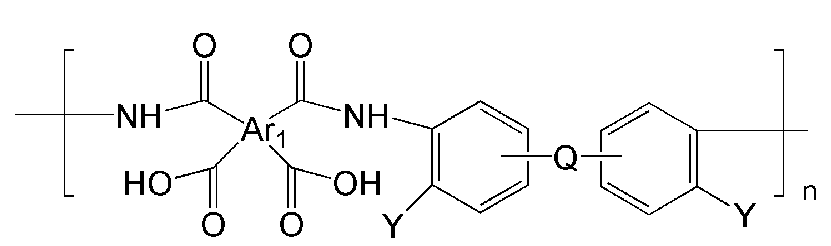
[화학식 34][Formula 34]

[화학식 35][Formula 35]

[화학식 36][Formula 36]

[화학식 37][Formula 37]

[화학식 38][Formula 38]

[화학식 39][Formula 39]

[화학식 40][Formula 40]
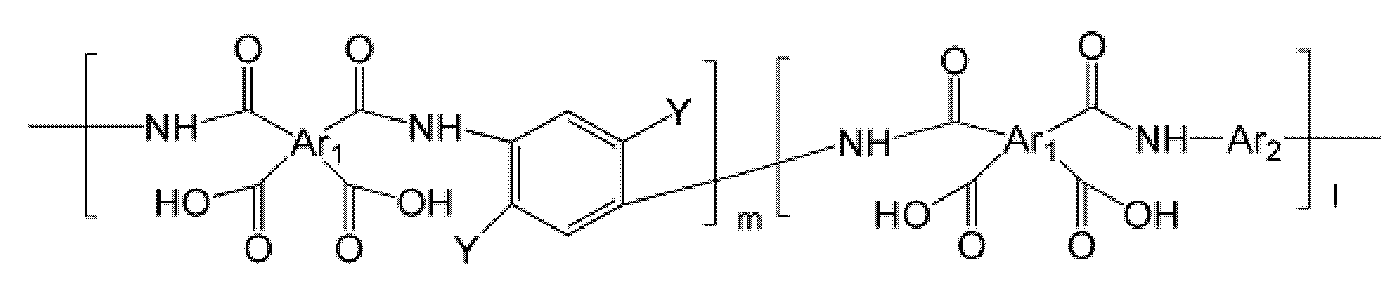
상기 화학식 33 내지 화학식 40에서,In Chemical Formulas 33 to 40,
Ar1, Ar2, Q, Y, n, m 및 l은 각각 상기 화학식 1 내지 화학식 8의 Ar1, Ar2, Q, Y, n, m 및 l에서 설명된 바와 같다. Ar 1, Ar 2, Q, Y, n, m and l are as described in each of the above formulas (1) to Ar 1, Ar 2, Q, Y, n, m and l in the formula (8).
상기 이미드화는 화학적 이미드화 또는 열적 용액 이미드화 공정으로 이루어질 수 있다.The imidization can be accomplished by chemical imidization or thermal solution imidization processes.
상기 화학적 이미드화는 20 내지 180 ℃에서 4 내지 24 시간 동안 수행할 수 있다.The chemical imidization can be carried out at 20 to 180 ° C for 4 to 24 hours.
또한 상기 화학적 이미드화는 이미드화의 진행 전에 폴리아믹산의 오르쏘 위치에 존재하는 작용기를 보호기로 보호하는 단계, 및 상기 이미드화 진행 이후에 보호기를 제거하는 단계를 더 포함할 수 있다.In addition, the chemical imidization may further include protecting a functional group present at the ortho position of the polyamic acid with a protecting group before proceeding with the imidization, and removing the protecting group after the imidizing process.
상기 열적 용액 이미드화는 용액 상에서 100 내지 180 ℃에서 2 내지 30 시간 동안 수행할 수 있다.The thermal solution imidization can be carried out at 100 to 180 ° C. for 2 to 30 hours on a solution.
상기 열적 용액 이미드화는 이미드화의 진행 전에 폴리아믹산의 오르쏘 위치에 존재하는 작용기를 보호기로 보호하는 단계, 및 상기 이미드화 진행 이후에, 보호기를 제거하는 단계를 더 포함할 수 있다.The thermal solution imidization may further include protecting a functional group present at the ortho position of the polyamic acid with a protecting group before proceeding with imidization, and removing the protecting group after the imidization is proceeding.
또한 상기 열적 용액 이미드화는 공비혼합물을 이용하여 이루어질 수 있다.The thermal solution imidization can also be accomplished using an azeotrope.
상기 중공사의 제조방법에서, 폴리이미드계 중공사의 열처리는 10 내지 30 ℃/min의 승온 속도로 400 내지 550 ℃까지 승온하고, 그 온도로 비활성 분위기 하에서 1 분 내지 1 시간 동안 수행할 수 있다.In the manufacturing method of the hollow yarn, the heat treatment of the polyimide hollow yarn may be heated to 400 to 550 ℃ at a temperature increase rate of 10 to 30 ℃ / min, it can be carried out at that temperature under inert atmosphere for 1 minute to 1 hour.
상기 화학식 1 내지 화학식 8 및 화학식 19 내지 화학식 40에서, Ar1의 예는 하기 식으로 표시된 것 중에서 선택될 수 있다.In

상기 식에서,Where
X1, X2, X3 및 X4는 동일하거나 서로 상이하며 각각 독립적으로 O, S, C(=O), CH(OH), S(=O)2, Si(CH3)2, (CH2)p(여기서, 1≤p≤10), (CF2)q(여기서, 1≤q≤10), C(CH3)2, C(CF3)2, 또는 C(=O)NH이고,X 1 , X 2 , X 3 and X 4 are the same or different from each other and each independently O, S, C (= 0), CH (OH), S (= 0) 2 , Si (CH 3 ) 2 , ( CH 2 ) p (where 1 ≦ p ≦ 10), (CF 2 ) q (where 1 ≦ q ≦ 10), C (CH 3 ) 2 , C (CF 3 ) 2 , or C (═O) NH ego,
W1 및 W2는 동일하거나 서로 상이하며 각각 독립적으로 O, S, 또는 C(=O)이고,W 1 and W 2 are the same or different and are each independently O, S, or C (═O),
Z1은 O, S, CR1R2 또는 NR3이고, 여기서 R1, R2 및 R3는 동일하거나 서로 상이하며 각각 독립적으로 수소 또는 C1 내지 C5 알킬기이고,Z 1 is O, S, CR 1 R 2 or NR 3 , wherein R 1 , R 2 and R 3 are the same or different from each other and are each independently hydrogen or a C1 to C5 alkyl group,
Z2 및 Z3는 동일하거나 서로 상이하며 각각 독립적으로 N 또는 CR4(여기서, R4는 수소 또는 C1 내지 C5 알킬기이다)이나 동시에 CR4는 아니다.Z 2 and Z 3 are the same or different from each other and each independently N or CR 4 , wherein R 4 is hydrogen or a
상기 화학식 1 내지 화학식 8 및 화학식 19 내지 화학식 40에서, Ar1의 구체적인 예는 하기 식으로 표시된 것 중에서 선택될 수 있다.In


상기 화학식 1 내지 화학식 8 및 화학식 19 내지 화학식 40에서, Ar2의 예는 하기 식으로 표시된 것 중에서 선택될 수 있다.In

상기 식에서,Where
X1, X2, X3 및 X4는 동일하거나 서로 상이하며 각각 독립적으로 O, S, C(=O), CH(OH), S(=O)2, Si(CH3)2, (CH2)p(여기서, 1≤p≤10), (CF2)q(여기서, 1≤q≤10), C(CH3)2, C(CF3)2, 또는 C(=O)NH이고,X 1 , X 2 , X 3 and X 4 are the same or different from each other and each independently O, S, C (= 0), CH (OH), S (= 0) 2 , Si (CH 3 ) 2 , ( CH 2 ) p (where 1 ≦ p ≦ 10), (CF 2 ) q (where 1 ≦ q ≦ 10), C (CH 3 ) 2 , C (CF 3 ) 2 , or C (═O) NH ego,
W1 및 W2는 동일하거나 서로 상이하며 각각 독립적으로 O, S, 또는 C(=O)이고,W 1 and W 2 are the same or different and are each independently O, S, or C (═O),
Z1은 O, S, CR1R2 또는 NR3이고, 여기서 R1, R2 및 R3는 동일하거나 서로 상이하며 각각 독립적으로 수소 또는 C1 내지 C5 알킬기이고,Z 1 is O, S, CR 1 R 2 or NR 3 , wherein R 1 , R 2 and R 3 are the same or different from each other and are each independently hydrogen or a C1 to C5 alkyl group,
Z2 및 Z3는 동일하거나 서로 상이하며 각각 독립적으로 N 또는 CR4(여기서, R4는 수소 또는 C1 내지 C5 알킬기이다)이나 동시에 CR4는 아니다.Z 2 and Z 3 are the same or different from each other and each independently N or CR 4 , wherein R 4 is hydrogen or a
상기 화학식 1 내지 화학식 8 및 화학식 19 내지 화학식 40에서, Ar2의 구체적인 예는 하기 식으로 표시된 것 중에서 선택될 수 있다.In


상기 화학식 1 내지 화학식 8 및 화학식 19 내지 화학식 40에서, Q의 예는 C(CH3)2, C(CF3)2, O, S, S(=O)2 또는 C(=O) 중에서 선택될 수 있다.In
상기 화학식 19 내지 화학식 32에서, Ar1'의 예 및 구체적인 예는 상기 화학식 1 내지 화학식 8 및 화학식 19 내지 화학식 40의 Ar2의 예 및 구체적인 예로 언급된 것과 동일하다.In Formulas 19 to 32, examples and specific examples of Ar 1 'are the same as those mentioned for the examples and specific examples of Ar 2 of
상기 화학식 1 내지 화학식 8에서, Ar1은 하기 화학식 A, B 또는 C로 표시되는 작용기일 수 있고, Ar2는 하기 화학식 D 또는 E로 표시되는 작용기일 수 있고, Q는 C(CF3)2일 수 있다.In
[화학식 A][Formula A]
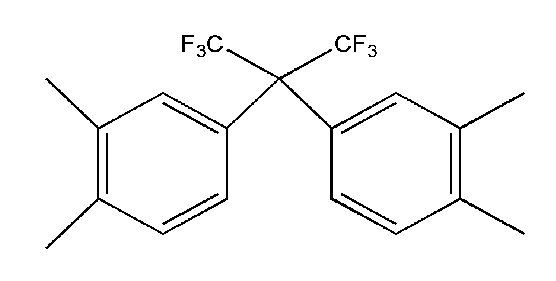
[화학식 B][Formula B]

[화학식 C][Formula C]

[화학식 D][Formula D]
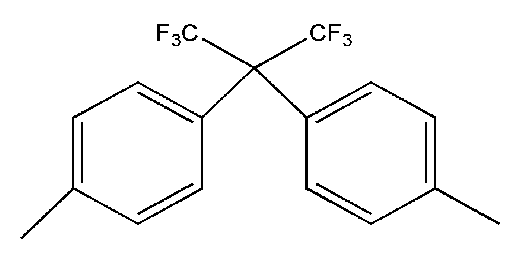
[화학식 E][Formula E]

상기 화학식 19 내지 화학식 32에서, Ar1은 상기 화학식 A, B 또는 C로 표시되는 작용기일 수 있고, Ar1'는 하기 화학식 F, G 또는 H로 표시되는 작용기일 수 있고, Ar2는 상기 화학식 D또는 E로 표시되는 작용기일 수 있고, Q는 C(CF3)2일 수 있다.In Formulas 19 to 32, Ar 1 may be a functional group represented by Formula A, B or C, Ar 1 ′ may be a functional group represented by Formula F, G or H, and Ar 2 may be represented by Formula May be a functional group represented by D or E, and Q may be C (CF 3 ) 2 .
[화학식 F]Formula F]
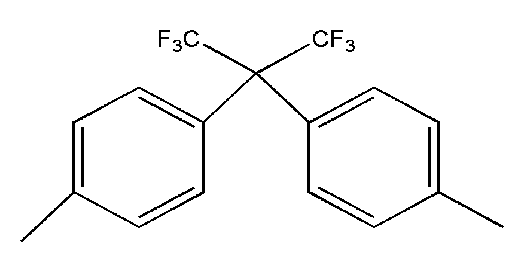
[화학식 G][Formula G]
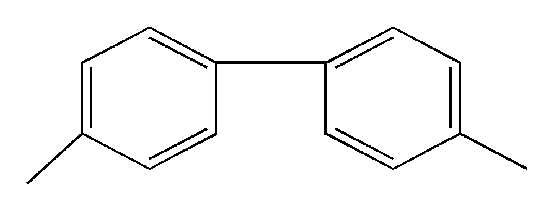
[화학식 H][Formula H]

상기 화학식 1 내지 화학식 4로 표시되는 폴리이미드의 공중합체에서의 각 반복 단위 사이의 몰비 또는 상기 화학식 5 내지 화학식 8에서 m:l의 몰비는 0.1:9.9 내지 9.9:0.1일 수 있다.The molar ratio between each repeating unit in the copolymer of the polyimide represented by
기타 본 발명의 구현예들의 구체적인 사항은 이하의 상세한 설명에 포함되어 있다.Other specific details of embodiments of the present invention are included in the following detailed description.
본 발명의 중공사는 기체에 대한 투과도, 선택도, 기계적 강도 및 화학적 안정성이 우수하고, 긴 작업 시간, 산성 조건 및 고습과 같은 가혹한 조건하에서도 견딜 수 있다.The hollow fiber of the present invention is excellent in permeability, selectivity, mechanical strength and chemical stability to gas, and can withstand even harsh conditions such as long working time, acidic conditions and high humidity.
도 1은 실시예 1에서 제조된 중공사의 일부 단면을 100배 확대한 전자주사현미경 사진이다.FIG. 1 is an electron scanning micrograph at 100 times magnification of a partial cross section of the hollow fiber prepared in Example 1. FIG.
도 2는 실시예 1에서 제조된 중공사의 일부 단면을 3,000배 확대한 전자주사현미경 사진이다.2 is an electron scanning microscope photograph of a 3,000 times magnification of a partial cross section of the hollow fiber prepared in Example 1. FIG.
도 3은 실시예 1에서 제조된 중공사의 일부 단면을 10,000배 확대한 전자주사현미경 사진이다.3 is an electron scanning microscope photograph of a 10,000-fold magnification of a partial cross section of the hollow fiber prepared in Example 1;
도 4는 실시예 1에서 제조된 중공사의 일부 단면을 40,000배 확대한 전자주사현미경 사진이다.4 is an electron scanning microscope photograph of a 40,000-fold magnification of a partial cross section of the hollow fiber prepared in Example 1;
도 5는 실시예 8에서 제조된 중공사의 일부 단면을 100배 확대한 전자주사현미경 사진이다.FIG. 5 is an electron scanning microscope photograph at a magnification of 100 times of a partial cross section of the hollow fiber prepared in Example 8. FIG.
도 6은 실시예 8에서 제조된 중공사의 일부 단면을 1,000배 확대한 전자주사현미경 사진이다.FIG. 6 is an electron scanning micrograph at 1,000 times magnification of a partial cross section of the hollow fiber prepared in Example 8. FIG.
도 7은 실시예 8에서 제조된 중공사의 일부 단면을 5,000배 확대한 전자주사현미경 사진이다.FIG. 7 is an electron scanning microscope photograph at 5,000 times magnification of a partial cross section of the hollow fiber prepared in Example 8. FIG.
도 8은 실시예 1 내지 18 및 비교예 1 내지 비교예 3에서 제조된 중공사의 GPU 단위의 산소 투과도 및 산소/질소 선택도를 비교한 그래프이다(1' 내지 3': 비교예 1 내지 3, 1 내지 18: 실시예 1 내지 18).8 is a graph comparing oxygen permeability and oxygen / nitrogen selectivity of the hollow fiber GPU units manufactured in Examples 1 to 18 and Comparative Examples 1 to 3 (1 ′ to 3 ′: Comparative Examples 1 to 3, 1 to 18: Examples 1 to 18).
도 9는 실시예 1 내지 18 및 비교예 1 내지 비교예 3에서 제조된 중공사의 GPU 단위의 이산화탄소 투과도 및 이산화탄소/메탄 선택도를 비교한 그래프이다(1' 내지 3': 비교예 1 내지 3, 1 내지 18: 실시예 1 내지 18).9 is a graph comparing carbon dioxide permeability and carbon dioxide / methane selectivity of the hollow fiber GPU units prepared in Examples 1 to 18 and Comparative Examples 1 to 3 (1 ′ to 3 ′: Comparative Examples 1 to 3, 1 to 18: Examples 1 to 18).
이하, 본 발명의 구현예를 상세히 설명하기로 한다. 다만, 이는 예시로서 제시되는 것으로, 이에 의해 본 발명이 제한되지는 않으며 본 발명은 후술할 청구항의 범주에 의해 정의될 뿐이다.Hereinafter, embodiments of the present invention will be described in detail. However, this is presented as an example, by which the present invention is not limited and the present invention is defined only by the scope of the claims to be described later.
본 명세서에서 별도의 정의가 없는 한, "표면부"는 중공사의 외측 표면부, 내측 표면부, 또는 외측 표면부/내측 표면부를 지칭하는 것이고, "표면"은 중공사의 외측 표면, 내측 표면, 또는 외측 표면/내측 표면을 지칭하는 것이다. 또한 또한 "피코기공"은 기공의 평균 직경이 수백 피코미터, 구체적으로는 100 pm 내지 1000 pm인 기공을 의미하고, "메조기공"은 기공의 평균 직경이 2 nm 내지 50 nm인 기공을 의미하고, "매크로기공"은 기공의 평균 직경이 50 nm 보다 큰 기공을 의미한다.Unless otherwise defined herein, "surface portion" refers to an outer surface portion, an inner surface portion, or an outer surface portion / inner surface portion of a hollow yarn, and "surface" refers to an outer surface, inner surface, or hollow surface of a hollow yarn. It refers to the outer surface / inner surface. In addition, "picopore" means a pore having an average diameter of pores of several hundred picometers, specifically, 100 pm to 1000 pm, "mesopore" means a pore having an average diameter of pores of 2 nm to 50 nm. By "macropores" is meant pores with an average diameter of pores greater than 50 nm.
본 명세서에서 별도의 정의가 없는 한, "치환" 또는 "치환된"이란 화합물 또는 작용기 중의 수소 원자가 C1 내지 C10 알킬기, C1 내지 C10 알콕시기, C1 내지 C10 할로알킬기 및 C1 내지 C10 할로알콕시기로 이루어진 군에서 선택되는 1종 이상의 치환기로 치환된 것을 의미하고, "헤테로 고리기"란 O, S, N, P, Si 및 이들의 조합으로 이루어진 군에서 선택되는 원소를 포함하는 치환 또는 비치환된 헤테로 고리기를 의미한다. 또한 "공중합체"란 블록 공중합체 내지 랜덤 공중합체를 의미한다.Unless otherwise defined herein, the term "substituted" or "substituted" means that the hydrogen atom in the compound or functional group is composed of C1 to C10 alkyl group, C1 to C10 alkoxy group, C1 to C10 haloalkyl group, and C1 to C10 haloalkoxy group Substituted with one or more substituents selected from "hetero ring group" is a substituted or unsubstituted hetero ring containing an element selected from the group consisting of O, S, N, P, Si and combinations thereof Means a flag. In addition, "copolymer" means a block copolymer or a random copolymer.
본 발명의 일 구현예에 따른 중공사는 그의 중앙부에 위치하는 공동, 상기 공동 주변에 존재하는 매크로기공, 그리고 상기 매크로기공 주변에 존재하는 메조기공 및 피코기공을 포함하고, 상기 피코기공은 3차원적으로 서로 연결되어 3차원 네트워크를 형성하고 있는 구조를 가지는 중공사이다. 상기 중공사는 폴리이미드로부터 유도되는 고분자를 포함하고, 상기 폴리이미드는 아민기에 대하여 오르쏘 위치에 존재하는 적어도 하나의 작용기를 포함하는 방향족 디아민 및 디안하이드라이드로부터 제조된 반복단위를 포함한다.Hollow yarn according to an embodiment of the present invention includes a cavity located in the center, macropores present around the cavity, mesopores and picopores present around the macropores, the picopores are three-dimensional It is a hollow fiber having a structure that is connected to each other to form a three-dimensional network. The hollow fiber comprises a polymer derived from a polyimide, the polyimide comprising repeating units made from aromatic diamines and dianhydrides comprising at least one functional group present at the ortho position relative to the amine group.
상기 중공사는 표면부에 피코기공으로 이루어지는 치밀층을 포함할 수 있다. 이러한 치밀층의 존재로 인해 상기 중공사는 기체를 선택적이면서도 효율적으로 분리할 수 있다. 상기 치밀층의 두께는 50㎚ 내지 1㎛일 수 있으나, 이에 한정되는 것은 아니다.The hollow yarn may include a dense layer made of picopores in the surface portion. Due to the presence of this dense layer, the hollow yarns can selectively and efficiently separate gases. The dense layer may have a thickness of 50 nm to 1 μm, but is not limited thereto.
상기 치밀층은 표면에 가까울수록 피코기공의 수가 많아지는 구조로 형성될 수 있다. 이로써 상기 중공사 표면에서의 선택적인 기체 분리가 효과적으로 이루어지고, 막 하부에서의 기체의 농축이 효과적으로 이루어질 수 있다.The dense layer may have a structure in which the number of picopores increases as the surface is closer to the surface. This effectively allows selective gas separation at the surface of the hollow fiber and can effectively concentrate the gas at the bottom of the membrane.
상기 2개 이상의 피코기공이 3차원적으로 연결되어 형성된 3차원 네트워크 구조는 연결부위가 좁은 골을 형성하는 모래시계 모양(hourglass shaped)의 구조일 수 있다. 상기 2개 이상의 피코기공의 연결부위에 좁은 골 영역이 존재함으로써, 분리하고자 하는 기체를 선택적으로 분리할 수 있고, 상기 골 영역에 비해 상대적으로 넓은 피코기공에서는 분리된 기체가 빠르게 이동할 수 있다.The three-dimensional network structure formed by connecting two or more picopores three-dimensionally may be an hourglass shaped structure forming a narrow valley at a connection portion. By the presence of the narrow valley region at the connection portion of the two or more picopores, the gas to be separated can be selectively separated, and the separated gas can move quickly in the picopores relatively wider than the valley region.
상기 아민기에 대하여 오르쏘 위치에 존재하는 작용기는 OH, SH 또는 NH2를 포함한다. 상기 폴리이미드는 일반적인 방법에 따라 제조할 수 있다. 일 예로, 상기 폴리이미드는 아민기에 대하여 오르쏘 위치에 OH기를 포함하는 폴리하이드록시아믹산, SH기를 포함하는 폴리티올아믹산, NH2기를 포함하는 폴리아미노아믹산 또는 폴리아믹산의 공중합체를 이미드화하여 제조한다.The functional groups present at the ortho position relative to the amine group include OH, SH or NH 2 . The polyimide can be prepared according to a general method. For example, the polyimide imidizes a polyhydroxyamic acid including an OH group at an ortho position relative to an amine group, a polythiolamic acid including an SH group, a polyaminoamic acid including a NH 2 group, or a copolymer of polyamic acid To prepare.
상기 폴리이미드는 후술할 제조공정을 통해 열전환되어, 높은 자유 체적도를 갖는 폴리벤즈옥사졸, 폴리벤즈티아졸, 폴리피롤론과 같은 고분자로 변화될 수 있다. 예를 들어 상기 아민기에 대하여 오르쏘 위치에 존재하는 작용기가 OH인 폴리하이드록시이미드는 폴리벤즈옥사졸로, 상기 아민기에 대하여 오르쏘 위치에 존재하는 작용기가 SH인 폴리티올이미드는 폴리벤즈티아졸로, 상기 아민기에 대하여 오르쏘 위치에 존재하는 작용기가 NH2인 폴리아미노이미드는 폴리피롤론으로 전환된다. 이로써 본 발명의 일 구현예에 따른 중공사는 상기와 같은 높은 자유 체적도를 갖는 폴리벤즈옥사졸, 폴리벤즈티아졸, 폴리피롤론과 같은 고분자를 포함할 수 있다.The polyimide may be converted into a polymer such as polybenzoxazole, polybenzthiazole, and polypyrrolone having high free volume by thermal conversion through a manufacturing process to be described later. For example, polyhydroxyimide having OH in the ortho-position to the amine group is polybenzoxazole, polythiolimide having SH in the ortho-position of the amine group is polybenzthiazole, The polyaminoimide in which the functional group present at the ortho position relative to the amine group is NH 2 is converted to polypyrrolone. As a result, the hollow fiber according to the exemplary embodiment of the present invention may include a polymer such as polybenzoxazole, polybenzthiazole, and polypyrrolone having a high free volume as described above.
상기 폴리이미드로부터 유도되는 고분자는 0.15 내지 0.40의 자유 체적도(FFV)를 가질 수 있고, XRD 측정에 의한 면간 거리가 580 pm 내지 800 pm 의 범위에 있을 수 있다. 이로써 상기 폴리이미드로부터 유도되는 고분자는 우수한 기체 투과도를 가질 수 있으며, 상기 폴리이미드로부터 유도되는 고분자를 포함하는 중공사는 기체를 선택적이며 효과적으로 분리할 수 있다.The polymer derived from the polyimide may have a free volume (FFV) of 0.15 to 0.40, and the interplanar distance by XRD measurement may be in the range of 580 pm to 800 pm. As a result, the polymer derived from the polyimide may have excellent gas permeability, and the hollow fiber including the polymer derived from the polyimide may selectively separate gas.
또한 상기 폴리이미드로부터 유도되는 고분자는 피코기공을 포함하고, 상기 피코기공의 평균 직경은 600 pm 내지 800 pm 일 수 있다. 상기 피코기공은 양전자 소멸시간 분광분석(positron annihilation lifetime spectroscopy, PALS) 측정에 의한 반가폭(full width at half maximum, FWHM)이 10 pm 내지 40 pm 의 범위에 있을 수 있다. 이는 생성되는 피코기공의 크기가 상당히 균일함을 나타내는 것이다. 이로써 상기 폴리이미드로부터 유도되는 고분자를 포함하는 중공사는 기체를 선택적이고 안정적으로 분리할 수 있다. 상기 PALS는 22Na 동위원소로부터 발생되는 양전자를 조사하여 생성시에 발생되는 1.27MeV의 γ0와 소멸시에 생성되는 0.511MeV의 γ1, γ2의 시간차이 τ1, τ2, τ3 등을 이용하여 얻을 수 있다. In addition, the polymer derived from the polyimide includes picopores, the average diameter of the picopores may be 600 pm to 800 pm. The picopores may have a full width at half maximum (FWHM) of 10 pm to 40 pm by positron annihilation lifetime spectroscopy (PALS) measurement. This indicates that the size of the generated picopores is fairly uniform. As a result, the hollow fiber including the polymer derived from the polyimide can selectively and stably separate the gas. The PALS is221.27 MeV γ generated at the time of generation by investigating positrons generated from Na isotopes0Γ of 0.511 MeV produced at the time of extinctionOne, γ2Time difference of τOne, τ2, τ3 Using You can get it.
상기 폴리이미드로부터 유도되는 고분자는 100 내지 1,000 m2/g 의 BET(Brunauer, Emmett, Teller) 표면적을 가질 수 있다. BET 표면적이 상기 범위 내이면 기체가 흡착될 수 있는 적절한 표면적을 확보할 수 있다. 이에 의해 상기 중공사는 용해-확산 메커니즘에 의해 기체를 분리함에 있어서, 우수한 선택도 및 투과도를 나타낸다.The polymer derived from the polyimide may have a BET (Brunauer, Emmett, Teller) surface area of 100 to 1,000 m 2 / g. If the BET surface area is in the above range, it is possible to secure a suitable surface area for gas adsorption. The hollow yarn thereby exhibits excellent selectivity and permeability in separating gases by dissolution-diffusion mechanism.
상기 폴리이미드는 하기 화학식 1 내지 화학식 4로 표시되는 폴리이미드, 하기 화학식 5 내지 화학식 8로 표시되는 폴리이미드 공중합체, 이들의 공중합체 및 이들의 블렌드로 이루어진 군으로부터 선택될 수 있으나, 이에 한정되는 것은 아니다.The polyimide may be selected from the group consisting of polyimide represented by the following
[화학식 1][Formula 1]

[화학식 2][Formula 2]

[화학식 3][Formula 3]

[화학식 4][Formula 4]

[화학식 5][Formula 5]

[화학식 6][Formula 6]

[화학식 7][Formula 7]

[화학식 8][Formula 8]

상기 화학식 1 내지 화학식 8에서,In
Ar1은 치환 또는 비치환된 4가의 C6 내지 C24 아릴렌기 및 치환 또는 비치환된 4가의 C4 내지 C24 헤테로 고리기에서 선택되는 방향족 고리기이고, 상기 방향족 고리기는 단독으로 존재하거나; 2개 이상이 서로 접합(fused)되어 축합 고리를 형성하거나; 2개 이상이 단일결합, O, S, C(=O), CH(OH), S(=O)2, Si(CH3)2, (CH2)p(여기서, 1≤p≤10), (CF2)q(여기서, 1≤q≤10), C(CH3)2, C(CF3)2 또는 C(=O)NH의 작용기에 의해 연결되어 있고,Ar 1 is an aromatic ring group selected from a substituted or unsubstituted tetravalent C6 to C24 arylene group and a substituted or unsubstituted tetravalent C4 to C24 heterocyclic group, wherein the aromatic ring group is present alone; Two or more are fused to each other to form a condensed ring; Two or more single bonds, O, S, C (= 0), CH (OH), S (= 0) 2 , Si (CH 3 ) 2 , (CH 2 ) p (where 1 ≦ p ≦ 10) , (CF 2 ) q (where 1 ≦ q ≦ 10), C (CH 3 ) 2 , C (CF 3 ) 2 or C (═O) NH, and
Ar2는 치환 또는 비치환된 2가의 C6 내지 C24 아릴렌기 및 치환 또는 비치환된 2가의 C4 내지 C24 헤테로 고리기에서 선택되는 방향족 고리기이고, 상기 방향족 고리기는 단독으로 존재하거나; 2개 이상이 서로 접합되어 축합 고리를 형성하거나; 2개 이상이 단일결합, O, S, C(=O), CH(OH), S(=O)2, Si(CH3)2, (CH2)p(여기서, 1≤p≤10), (CF2)q(여기서, 1≤q≤10), C(CH3)2, C(CF3)2 또는 C(=O)NH의 작용기에 의해 연결되어 있고,Ar 2 is an aromatic ring group selected from a substituted or unsubstituted divalent C6 to C24 arylene group and a substituted or unsubstituted divalent C4 to C24 heterocyclic group, wherein the aromatic ring group is present alone; Two or more are joined to each other to form a condensed ring; Two or more single bonds, O, S, C (= 0), CH (OH), S (= 0) 2 , Si (CH 3 ) 2 , (CH 2 ) p (where 1 ≦ p ≦ 10) , (CF 2 ) q (where 1 ≦ q ≦ 10), C (CH 3 ) 2 , C (CF 3 ) 2 or C (═O) NH, and
Q는 O, S, C(=O), CH(OH), S(=O)2, Si(CH3)2, (CH2)p(여기서, 1≤p≤10), (CF2)q(여기서, 1≤q≤10), C(CH3)2, C(CF3)2, C(=O)NH, C(CH3)(CF3), 또는 치환 또는 비치환된 페닐렌기(여기서 치환된 페닐렌기는 C1 내지 C6 알킬기 또는 C1 내지 C6 할로알킬기로 치환된다)이고, 이때 상기 Q는 양쪽 방향족 고리와 m-m, m-p, p-m, 또는 p-p 위치로 연결되고,Q is O, S, C (= O), CH (OH), S (= O) 2 , Si (CH 3 ) 2 , (CH 2 ) p (where 1 ≦ p ≦ 10), (CF 2 ) q (where 1 ≦ q ≦ 10), C (CH 3 ) 2 , C (CF 3 ) 2 , C (═O) NH, C (CH 3 ) (CF 3 ), or a substituted or unsubstituted phenylene group Wherein the substituted phenylene group is substituted with a C1 to C6 alkyl group or a C1 to C6 haloalkyl group, wherein Q is linked to both aromatic rings in the mm, mp, pm, or pp position,
Y는 각각의 반복 단위에서 동일하거나 서로 상이하며, 각각 독립적으로 OH, SH 또는 NH2이고,Y is the same or different from each other in each repeat unit, and each independently OH, SH or NH 2 ,
n은 20≤n≤200을 만족하는 정수이고,n is an integer satisfying 20 ≦ n ≦ 200,
m은 10≤m≤400을 만족하는 정수이고,m is an integer satisfying 10≤m≤400,
l은 10≤l≤400을 만족하는 정수이다.l is an integer satisfying 10 ≦ l ≦ 400.
상기 화학식 1 내지 화학식 4로 표시되는 폴리이미드의 공중합체의 예로는 하기 화학식 9 내지 화학식 18로 표시되는 폴리이미드 공중합체를 들 수 있다.Examples of the copolymer of the polyimide represented by the
[화학식 9][Formula 9]

[화학식 10][Formula 10]

[화학식 11][Formula 11]

[화학식 12][Formula 12]

[화학식 13][Formula 13]

[화학식 14][Formula 14]

[화학식 15][Formula 15]

[화학식 16][Formula 16]

[화학식 17][Formula 17]

[화학식 18][Formula 18]

상기 화학식 9 내지 화학식 18에서,In
Ar1, Q, n, m 및 l은 상기 화학식 1 내지 화학식 8에서 정의한 바와 같고,Ar 1 , Q, n, m and l are the same as defined in
Y 및 Y' 는 서로 상이하며, 각각 독립적으로 OH, SH 또는 NH2이다.Y and Y 'are different from each other, and are each independently OH, SH or NH 2 .
상기 화학식 1 내지 화학식 18에서, Ar1의 예는 하기 식으로 표시된 것 중에서 선택될 수 있다.In
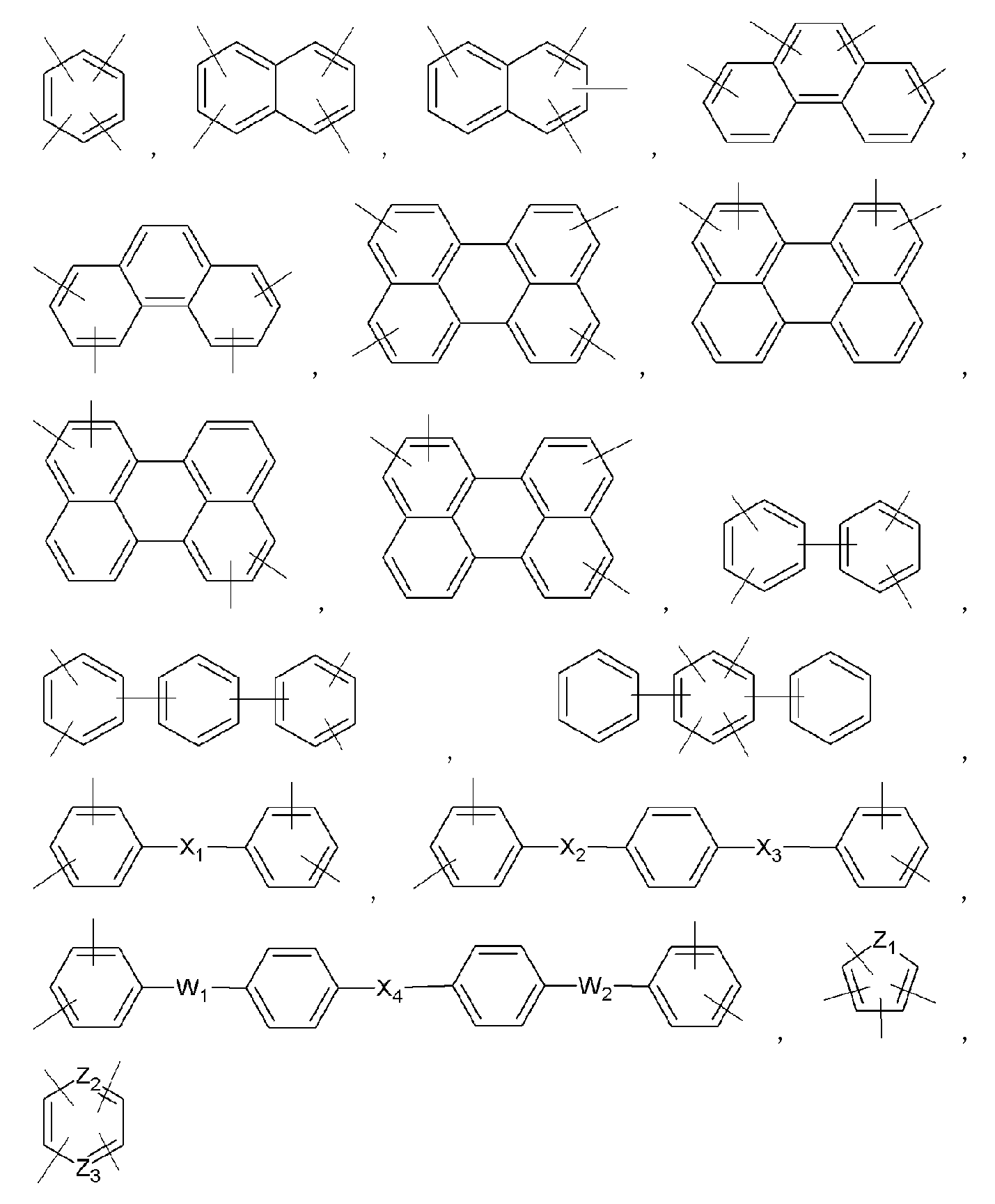
상기 식에서,Where
X1, X2, X3 및 X4는 동일하거나 서로 상이하며 각각 독립적으로 O, S, C(=O), CH(OH), S(=O)2, Si(CH3)2, (CH2)p(여기서, 1≤p≤10), (CF2)q(여기서, 1≤q≤10), C(CH3)2, C(CF3)2, 또는 C(=O)NH이고,X 1 , X 2 , X 3 and X 4 are the same or different from each other and each independently O, S, C (= 0), CH (OH), S (= 0) 2 , Si (CH 3 ) 2 , ( CH 2 ) p (where 1 ≦ p ≦ 10), (CF 2 ) q (where 1 ≦ q ≦ 10), C (CH 3 ) 2 , C (CF 3 ) 2 , or C (═O) NH ego,
W1 및 W2는 동일하거나 서로 상이하며 각각 독립적으로 O, S, 또는 C(=O)이고,W 1 and W 2 are the same or different and are each independently O, S, or C (═O),
Z1은 O, S, CR1R2 또는 NR3이고, 여기서 R1, R2 및 R3는 동일하거나 서로 상이하며 각각 독립적으로 수소 또는 C1 내지 C5 알킬기이고,Z 1 is O, S, CR 1 R 2 or NR 3 , wherein R 1 , R 2 and R 3 are the same or different from each other and are each independently hydrogen or a C1 to C5 alkyl group,
Z2 및 Z3는 동일하거나 서로 상이하며 각각 독립적으로 N 또는 CR4(여기서, R4는 수소 또는 C1 내지 C5 알킬기이다)이나 동시에 CR4는 아니다.Z 2 and Z 3 are the same or different from each other and each independently N or CR 4 , wherein R 4 is hydrogen or a
상기 화학식 1 내지 화학식 18에서, Ar1의 구체적인 예는 하기 식으로 표시된 것 중에서 선택될 수 있으나, 이에 한정되는 것은 아니다.In
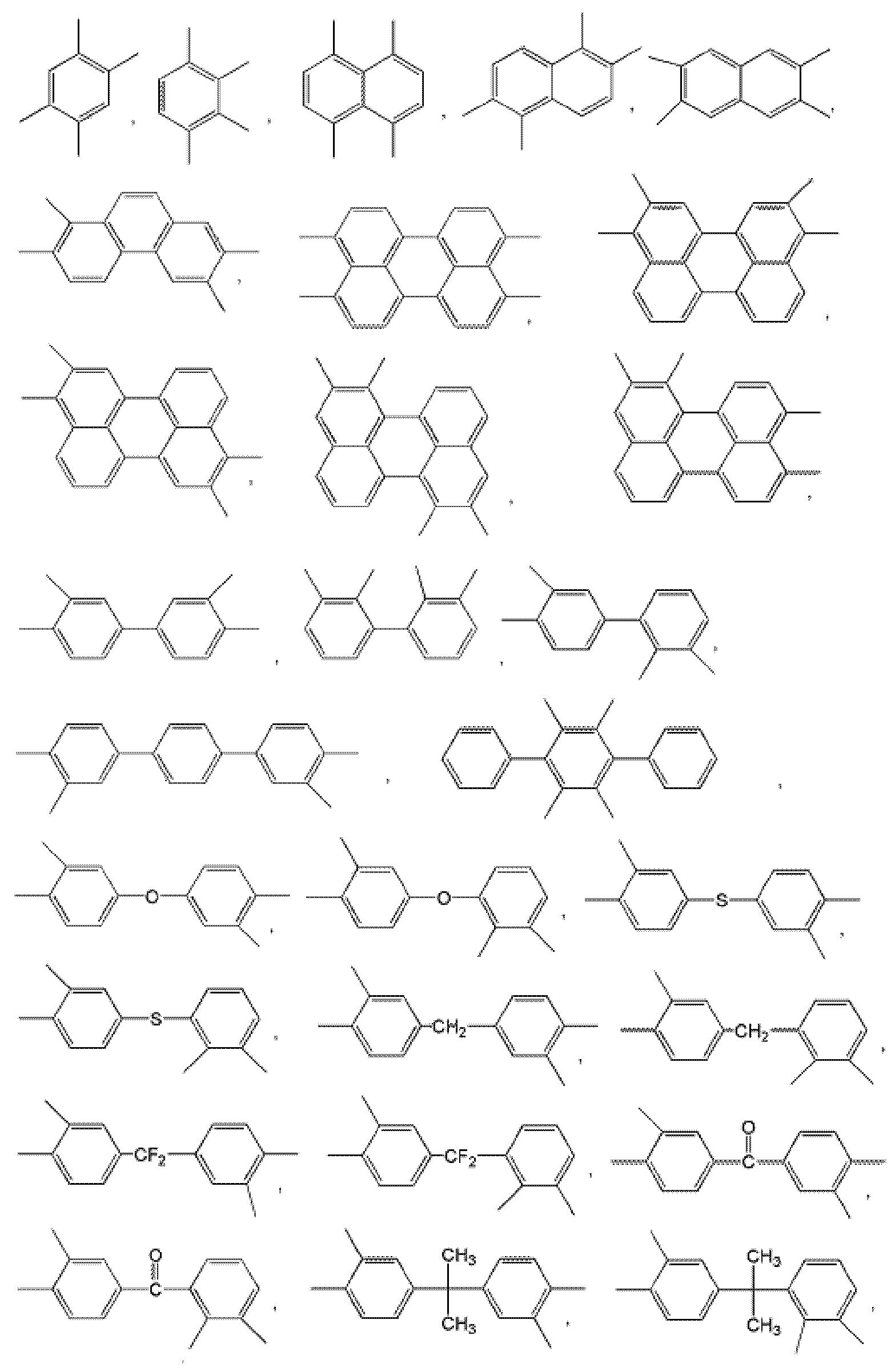

상기 화학식 1 내지 화학식 18에서, Ar2는 하기 식으로 표시된 것 중에서 선택될 수 있으나, 이에 한정되는 것은 아니다.In

상기 식에서,Where
X1, X2, X3 및 X4는 동일하거나 서로 상이하며 각각 독립적으로 O, S, C(=O), CH(OH), S(=O)2, Si(CH3)2, (CH2)p(여기서, 1≤p≤10), (CF2)q(여기서, 1≤q≤10), C(CH3)2, C(CF3)2, 또는 C(=O)NH이고,X 1 , X 2 , X 3 and X 4 are the same or different from each other and each independently O, S, C (= 0), CH (OH), S (= 0) 2 , Si (CH 3 ) 2 , ( CH 2 ) p (where 1 ≦ p ≦ 10), (CF 2 ) q (where 1 ≦ q ≦ 10), C (CH 3 ) 2 , C (CF 3 ) 2 , or C (═O) NH ego,
W1 및 W2는 동일하거나 서로 상이하며 각각 독립적으로 O, S, 또는 C(=O)이고,W 1 and W 2 are the same or different and are each independently O, S, or C (═O),
Z1은 O, S, CR1R2 또는 NR3이고, 여기서 R1, R2 및 R3는 동일하거나 서로 상이하며 각각 독립적으로 수소 또는 C1 내지 C5 알킬기이고,Z 1 is O, S, CR 1 R 2 or NR 3 , wherein R 1 , R 2 and R 3 are the same or different from each other and are each independently hydrogen or a C1 to C5 alkyl group,
Z2 및 Z3는 동일하거나 서로 상이하며 각각 독립적으로 N 또는 CR4(여기서, R4는 수소 또는 C1 내지 C5 알킬기이다)이나 동시에 CR4는 아니다.Z 2 and Z 3 are the same or different from each other and each independently N or CR 4 , wherein R 4 is hydrogen or a
상기 화학식 1 내지 화학식 18에서, Ar2의 구체적인 예는 하기 식으로 표시된 것 중에서 선택될 수 있으나, 이에 한정되는 것은 아니다.In the


상기 화학식 1 내지 화학식 18에서, Q의 예는 C(CH3)2, C(CF3)2, O, S, S(=O)2 또는 C(=O) 중에서 선택될 수 있으나, 이에 한정되는 것은 아니다.In
상기 화학식 1 내지 화학식 18에서, Ar1은 하기 화학식 A, B 또는 C로 표시되는 작용기일 수 있고, Ar2는 하기 화학식 D 또는 E로 표시되는 작용기일 수 있고, Q는 C(CF3)2 일 수 있으나 이에 한정되는 것은 아니다.In
[화학식 A][Formula A]

[화학식 B][Formula B]
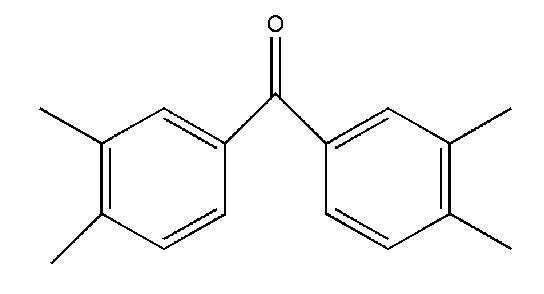
[화학식 C][Formula C]

[화학식 D][Formula D]

[화학식 E][Formula E]

상기 화학식 1 내지 화학식 4로 표시되는 폴리이미드는 후술할 제조공정을 통해 열전환되어, 높은 자유 체적도를 갖는 폴리벤즈옥사졸, 폴리벤즈티아졸 또는 폴리피롤론으로 전환된다. 이때 상기 화학식 1 내지 화학식 4의 Y가 OH인 폴리하이드록시이미드로부터 유도된 폴리벤즈옥사졸, Y가 SH인 폴리티올이미드로부터 유도된 폴리벤즈티아졸, Y가 NH2인 폴리아미노이미드로부터 유도된 폴리피롤론을 포함하는 중공사가 제조된다.The polyimide represented by
상기 화학식 5 내지 화학식 8로 표시되는 폴리이미드 공중합체는 후술할 제조공정을 통해 열전환되어, 높은 자유 체적도를 갖는 폴리(벤즈옥사졸-이미드) 공중합체, 폴리(벤즈티아졸-이미드) 공중합체 또는 폴리(피롤론-이미드) 공중합체로 전환되고, 이로써 상기와 같은 공중합체를 포함하는 중공사를 형성할 수 있다. 이때 분자내 및 분자간 재배열에 의해 폴리벤즈옥사졸, 폴리벤즈티아졸 또는 폴리피롤론으로 열전환되는 블럭과 폴리이미드로 존재하는 블럭간의 공중합비(몰비)를 조절하여, 제조된 중공사의 물성 제어가 가능하다.The polyimide copolymer represented by Chemical Formulas 5 to 8 is thermally converted through a manufacturing process to be described later, and has a high free volume poly (benzoxazole-imide) copolymer and poly (benzthiazole-imide ) Copolymers or poly (pyrrolone-imide) copolymers, thereby forming hollow fibers comprising such copolymers. At this time, by controlling the copolymerization ratio (molar ratio) between the blocks thermally converted to polybenzoxazole, polybenzthiazole or polypyrrolone by the intramolecular and intermolecular rearrangement and the polyimide block, the physical properties of the manufactured hollow fiber can be controlled. Do.
상기 화학식 9 내지 화학식 18로 표시되는 폴리이미드의 공중합체는 후술할 제조공정을 통해 열전환되어, 높은 자유 체적도를 갖는 폴리벤즈옥사졸, 폴리벤즈티아졸 및 폴리피롤론의 공중합체로 전환되고, 이로써 상기와 같은 공중합체를 포함하는 중공사를 형성할 수 있다. 이때 각각 폴리벤즈옥사졸, 폴리벤즈티아졸 및 폴리피롤론으로 열전환되는 블럭간의 공중합비(몰비)를 조절하여, 제조된 중공사의 물성 제어가 가능하다.The copolymer of the polyimide represented by
상기 화학식 5 내지 화학식 18로 표시되는 폴리이미드 공중합체의 블럭간 공중합비(몰비) m:l은 0.1:9.9 내지 9.9 내지 0.1, 구체적으로는 2:8 내지 8:2, 더욱 구체적으로는 5:5로 조절할 수 있다. 이러한 공중합비는 제조된 중공사의 모폴로지에 영향을 주는데, 이러한 모폴로지 변화는 기체 투과도 및 선택도와 관련되어 있다. 상기 블록간의 공중합비가 상기 범위 내일 경우, 제조된 중공사는 우수한 기체 투과도 및 선택도를 가질 수 있다.The interblock copolymerization ratio (molar ratio) m: l of the polyimide copolymer represented by Formula 5 to
상기 중공사에서, 상기 폴리이미드로부터 유도되는 고분자는 하기 화학식 19 내지 화학식 32 중 어느 하나로 표시되는 고분자 또는 이들의 공중합체를 포함할 수 있으나, 이에 한정되는 것은 아니다.In the hollow fiber, the polymer derived from the polyimide may include a polymer or a copolymer thereof represented by any one of the following Chemical Formulas 19 to 32, but is not limited thereto.
[화학식 19][Formula 19]

[화학식 20][Formula 20]

[화학식 21][Formula 21]

[화학식 22][Formula 22]

[화학식 23][Formula 23]

[화학식 24][Formula 24]

[화학식 25][Formula 25]

[화학식 26][Formula 26]

[화학식 27][Formula 27]
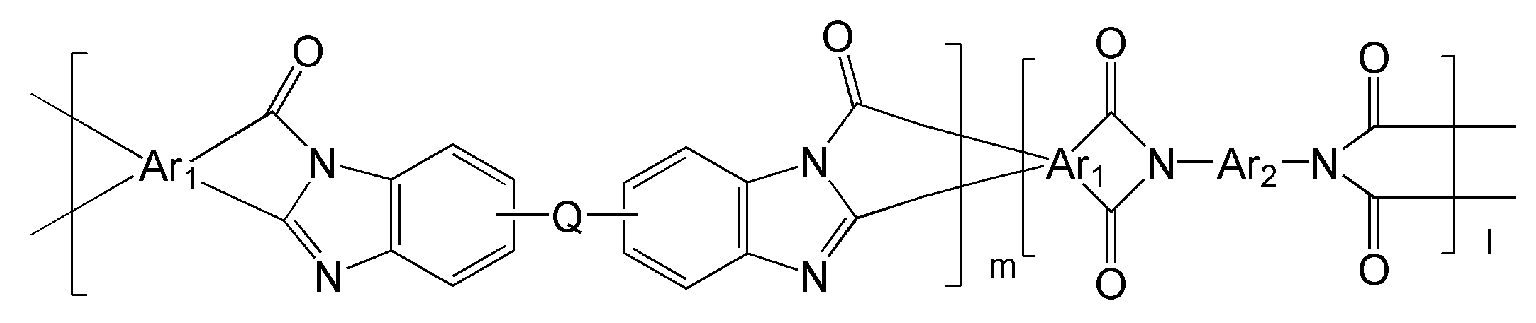
[화학식 28][Formula 28]

[화학식 29][Formula 29]

[화학식 30][Formula 30]

[화학식 31][Formula 31]
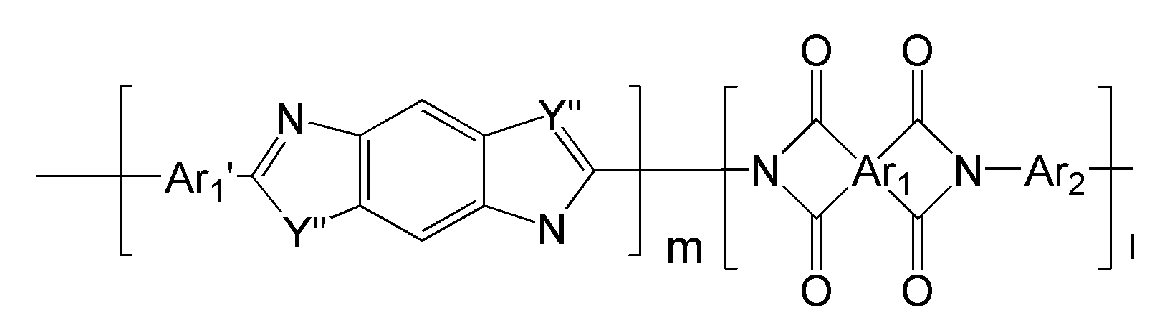
[화학식 32][Formula 32]

상기 화학식 19 내지 화학식 32에서,In Chemical Formulas 19 to 32,
Ar1, Ar2, Q, n, m 및 l은 각각 상기 화학식 1 내지 화학식 8의 Ar1, Ar2, Q, n, m 및 l에서 설명된 바와 같고, Ar 1, Ar 2, Q, n, m and l are the same as described in each of the formulas (1) to Ar 1, Ar 2, Q, n, m and l in the formula (8),
Ar1'는 치환 또는 비치환된 2가의 C6 내지 C24 아릴렌기 및 치환 또는 비치환된 2가의 C4 내지 C24 헤테로 고리기에서 선택되는 방향족 고리기이고, 상기 방향족 고리기는 단독으로 존재하거나; 2개 이상이 서로 접합되어 축합 고리를 형성하거나; 2개 이상이 단일결합, O, S, C(=O), CH(OH), S(=O)2, Si(CH3)2, (CH2)p(여기서, 1≤p≤10), (CF2)q(여기서, 1≤q≤10), C(CH3)2, C(CF3)2 또는 C(=O)NH의 작용기에 의해 연결되어 있고,Ar 1 ′ is an aromatic ring group selected from a substituted or unsubstituted divalent C6 to C24 arylene group and a substituted or unsubstituted divalent C4 to C24 heterocyclic group, wherein the aromatic ring group is present alone; Two or more are joined to each other to form a condensed ring; Two or more single bonds, O, S, C (= 0), CH (OH), S (= 0) 2 , Si (CH 3 ) 2 , (CH 2 ) p (where 1 ≦ p ≦ 10) , (CF 2 ) q (where 1 ≦ q ≦ 10), C (CH 3 ) 2 , C (CF 3 ) 2 or C (═O) NH, and
Y''는 O 또는 S 이다.Y '' is O or S.
상기 화학식 19 내지 화학식 32에서, Ar1, Ar2 및 Q의 예 및 구체적인 예는 각각 상기 화학식 1 내지 화학식 18의 Ar1, Ar2 및 Q의 예 및 구체적인 예로 언급된 것과 동일하다.In the above Chemical Formulas 19 to 32, Ar 1, for example, and specific examples of Ar 2 and Q are the same as each of the
또한 상기 화학식 19 내지 화학식 32에서, Ar1'의 예 및 구체적인 예는 상기 화학식 1 내지 화학식 18의 Ar2의 예 및 구체적인 예로 언급된 것과 동일하다.In addition, in Chemical Formulas 19 to 32, examples and specific examples of Ar 1 ′ are the same as those mentioned in Examples and specific examples of Ar 2 of
상기 화학식 19 내지 화학식 32에서, Ar1은 상기 화학식 A, B 또는 C로 표시되는 작용기일 수 있고, Ar1'는 하기 화학식 F, G 또는 H로 표시되는 작용기일 수 있고, Ar2는 상기 화학식 D또는 E로 표시되는 작용기일 수 있고, Q는 C(CF3)2일 수 있으나, 이에 한정되는 것은 아니다.In Formulas 19 to 32, Ar 1 may be a functional group represented by Formula A, B or C, Ar 1 ′ may be a functional group represented by Formula F, G or H, and Ar 2 may be represented by Formula It may be a functional group represented by D or E, Q may be C (CF 3 ) 2 , but is not limited thereto.
[화학식 F]Formula F]

[화학식 G][Formula G]

[화학식 H][Formula H]

상기 중공사는 He, H2, N2, CH4, O2, N2, CO2 및 이들의 조합으로 이루어진 군에서 선택되는 1종 이상의 기체에 대한 기체 분리용으로 사용할 수 있다. 이때 상기 중공사는 기체 분리막의 형태로 사용될 수 있다. 상기 혼합기체의 구체적인 예로는 O2/N2, CO2/CH4, H2/N2, H2/CH4, CO2/N2 및 He/N2를 들 수 있으나, 이에 한정되는 것은 아니다.The hollow fiber can be used for gas separation for one or more gases selected from the group consisting of He, H 2 , N 2 , CH 4 , O 2 , N 2 , CO 2, and combinations thereof. In this case, the hollow yarn may be used in the form of a gas separation membrane. Specific examples of the mixed gas may include O 2 / N 2 , CO 2 / CH 4 , H 2 / N 2 , H 2 / CH 4 , CO 2 / N 2, and He / N 2 , but are not limited thereto. no.
상기 중공사는 혼합기체가 O2/N2인 경우 4 이상, 구체적으로는 4 내지 20의 선택도를 가질 수 있고, 혼합기체가 CO2/CH4인 경우 30 이상, 구체적으로는 30 내지 80의 선택도를 가질 수 있고, 혼합기체가 H2/N2인 경우 30 이상, 구체적으로는 30 내지 80의 선택도를 가질 수 있고, 혼합기체가 H2/CH4인 경우 50 이상, 구체적으로는 50 내지 90의 선택도를 가질 수 있고, 혼합기체가 CO2/N2인 경우 20 이상, 구체적으로는 20 내지 50의 선택도를 가질 수 있고, 혼합기체가 He/N2인 경우 40 이상, 구체적으로는 40 내지 120의 선택도를 가질 수 있다.The hollow fiber may have a selectivity of 4 or more, specifically, 4 to 20 when the mixed gas is O 2 / N 2 , and 30 or more, specifically, 30 to 80 when the mixed gas is CO 2 / CH 4 . It may have a selectivity, and when the mixed gas is H 2 / N 2 It may have a selectivity of 30 or more, specifically 30 to 80, when the mixed gas is H 2 / CH 4 50 or more, specifically It may have a selectivity of 50 to 90, 20 or more when the mixed gas is CO 2 / N 2 , specifically, may have a selectivity of 20 to 50, 40 or more when the mixed gas is He / N 2 , Specifically, it may have a selectivity of 40 to 120.
본 발명의 다른 일 구현예에 따른 중공사 형성용 도프 용액 조성물은 아민기에 대하여 오르쏘 위치에 존재하는 적어도 하나의 작용기를 포함하는 방향족 디아민 및 디안하이드라이드로부터 제조된 반복단위를 가지는 폴리이미드, 유기용매 및 첨가제를 포함한다.The dope solution composition for hollow fiber formation according to another embodiment of the present invention is a polyimide having a repeating unit prepared from an aromatic diamine and dianhydride including at least one functional group present at an ortho position relative to an amine group, and an organic Solvents and additives.
상기 유기용매는 디메틸설폭사이드; N-메틸-2-피롤리돈; N-메틸피롤리돈; N,N-디메틸포름아미드; N,N-디메틸아세트아미드; γ-부티로락톤, 사이클로헥사논, 3-헥사논, 3-헵타논 및 3-옥타논으로 이루어진 군에서 선택된 케톤; 및 이들의 조합으로 이루어진 군에서 선택될 수 있으나, 이에 한정되는 것은 아니다. 보다 구체적으로 상기 유기용매는 디메틸설폭사이드; N-메틸-2-피롤리돈; N,N-디메틸포름아미드; N,N-디메틸아세트아미드 및 이들의 조합으로부터 선택될 수 있다. 상기 유기용매를 사용하면 고분자를 쉽게 용해시킬 수 있으며, 하기 첨가제와 잘 섞임으로써 불안정한(meta-stable) 상태를 형성할 수 있고, 이로부터 얇은 유효막 두께를 가지는 우수한 중공사를 형성할 수 있다.The organic solvent is dimethyl sulfoxide; N-methyl-2-pyrrolidone; N-methylpyrrolidone; N, N-dimethylformamide; N, N-dimethylacetamide; ketones selected from the group consisting of γ-butyrolactone, cyclohexanone, 3-hexanone, 3-heptanone and 3-octanone; And combinations thereof may be selected from the group, but is not limited thereto. More specifically, the organic solvent is dimethyl sulfoxide; N-methyl-2-pyrrolidone; N, N-dimethylformamide; N, N-dimethylacetamide and combinations thereof. When the organic solvent is used, the polymer can be easily dissolved, and by mixing well with the following additives, it is possible to form a meta-stable state, from which an excellent hollow fiber having a thin effective film thickness can be formed.
상기 첨가제는 물; 메탄올, 에탄올, 2-메틸-1-부탄올, 2-메틸-2-부탄올, 글리세롤, 에틸렌글리콜, 디에틸렌글리콜 및 프로필렌글리콜로 이루어진 군에서 선택된 알코올; 아세톤 및 메틸 에틸 케톤으로 이루어진 군에서 선택된 케톤; 폴리비닐알콜, 폴리아크릴산, 폴리아크릴아마이드, 폴리에틸렌글리콜, 폴리프로필렌글리콜, 키토산, 키틴, 덱스트란 및 폴리비닐피롤리돈으로 이루어진 군에서 선택된 고분자 화합물; 염화리튬, 염화나트륨, 염화칼슘, 리튬아세테이트, 황산나트륨 및 수산화나트륨으로 이루어진 군에서 선택된 염; 테트라하이드로퓨란; 트리클로로에탄; 및 이들의 혼합물로 이루어진 군에서 선택될 수 있으나, 이에 한정되는 것은 아니다. 보다 구체적으로, 상기 첨가제는 물, 글리세롤, 프로필렌글리콜, 폴리에틸렌글리콜, 폴리비닐피롤리돈 및 이들의 조합으로 이루어진 군에서 선택될 수 있다. 상기 첨가제는 폴리아믹산 고분자와 용해도가 우수한 것은 아니므로 홀로 사용될 수 없지만, 유기용매와 적절히 혼합되면 불안정한(meta-stable) 도프 용액 조성물을 제조할 수 있으며, 도프 용액 조성물을 방사할 때 응고조 내의 비용매(non-solvent)가 도프 용액 조성물 내로 빠르게 확산되어, 얇고 균일한 박막을 형성하는 것은 물론, 서브-레이어(sub-layer)의 매크로기공 제조에도 훨씬 유리할 수 있다.The additive is water; Alcohols selected from the group consisting of methanol, ethanol, 2-methyl-1-butanol, 2-methyl-2-butanol, glycerol, ethylene glycol, diethylene glycol and propylene glycol; Ketones selected from the group consisting of acetone and methyl ethyl ketone; A polymer compound selected from the group consisting of polyvinyl alcohol, polyacrylic acid, polyacrylamide, polyethylene glycol, polypropylene glycol, chitosan, chitin, dextran and polyvinylpyrrolidone; Salts selected from the group consisting of lithium chloride, sodium chloride, calcium chloride, lithium acetate, sodium sulfate and sodium hydroxide; Tetrahydrofuran; Trichloroethane; And it may be selected from the group consisting of a mixture thereof, but is not limited thereto. More specifically, the additive may be selected from the group consisting of water, glycerol, propylene glycol, polyethylene glycol, polyvinylpyrrolidone and combinations thereof. The additive may not be used alone because it does not have good solubility with the polyamic acid polymer, but if properly mixed with an organic solvent, a meta-stable dope solution composition may be prepared, and the cost in the coagulation bath when spinning the dope solution composition Non-solvents can quickly diffuse into the dope solution composition to form thin, uniform thin films, as well as to make macropores of the sub-layers much more advantageous.
상기 중공사 형성용 도프 용액 조성물에서, 상기 아민기에 대하여 오르쏘 위치에 존재하는 작용기는 OH, SH 또는 NH2를 포함한다.In the dope solution composition for hollow fiber formation, the functional group present in the ortho position relative to the amine group includes OH, SH or NH 2 .
상기 중공사 형성용 도프 용액 조성물은 상기 폴리이미드 10 내지 45 중량%, 상기 유기 용매 25 내지 70 중량% 및 상기 첨가제 2 내지 30 중량%를 포함할 수 있다.The dope solution composition for hollow fiber formation may include 10 to 45 wt% of the polyimide, 25 to 70 wt% of the organic solvent, and 2 to 30 wt% of the additive.
상기 폴리이미드의 함량이 상기 범위 내인 경우, 중공사의 강도 및 기체의 투과도를 우수하게 유지할 수 있다.When the content of the polyimide is within the above range, it is possible to maintain the strength of the hollow fiber and the permeability of the gas excellently.
상기 유기용매는 상기 폴리이미드를 용해하는 역할을 수행한다. 상기 유기용매의 함량이 상기 범위 내인 경우, 중공사 형성용 도프 용액 조성물의 점도를 적절히 유지하여 중공사의 제조를 용이하게 하고 중공사의 투과도를 향상시킬 수 있다.The organic solvent serves to dissolve the polyimide. When the content of the organic solvent is within the above range, it is possible to maintain the viscosity of the dope solution composition for hollow fiber formation to facilitate the production of hollow yarns and to improve the permeability of the hollow yarns.
상기 중공사 형성용 도프 용액 조성물은 점도는 2 Pa·s 내지 200 Pa·s 일 수 있다. 중공사 형성용 도프 용액 조성물의 점도가 상기 범위 내이면 중공사 형성용 도프 용액 조성물을 노즐을 통하여 용이하게 방사할 수 있고, 중공사를 상전이 현상을 통해 용이하게 고형으로 응고시킬 수 있다.The dope solution composition for hollow fiber formation may have a viscosity of 2 Pa · s to 200 Pa · s. When the viscosity of the dope solution composition for hollow fiber formation is in the said range, the dope solution composition for hollow fiber formation can be easily spun through a nozzle, and hollow fiber can be easily solidified through a phase transition phenomenon.
상기 첨가제는 상분리 온도 또는 중공사 형성용 도프 용액 조성물의 점성 조절을 위해 사용될 수 있다.The additive may be used for controlling the viscosity of the dope solution composition for forming the phase separation temperature or hollow fiber.
첨가제의 함량이 상기 범위 내인 경우, 중공사를 용이하게 제조할 수 있고, 또한 중공사의 표면 기공의 크기를 적절히 조절하여 치밀층을 용이하게 형성할 수 있다.When the content of the additive is within the above range, the hollow fiber can be easily manufactured, and the dense layer can be easily formed by appropriately adjusting the size of the surface pores of the hollow yarns.
상기 중공사 형성용 도프 용액 조성물에서, 상기 폴리이미드의 중량평균 분자량(Mw)은 10,000 내지 200,000일 수 있다. 폴리이미드의 중량평균 분자량이 상기 범위 내이면 이의 합성이 용이하고, 이를 포함하는 중공사 형성용 도프 용액 조성물의 점도가 적절하게 유지되어 가공성이 우수하며, 상기 폴리이미드로부터 유도되는 고분자는 기계적 강도 및 특성이 우수하게 유지될 수 있다.In the dope solution composition for forming hollow fibers, the weight average molecular weight (Mw) of the polyimide may be 10,000 to 200,000. When the weight average molecular weight of the polyimide is within the above range, the synthesis thereof is easy, and the viscosity of the dope solution composition for hollow fiber formation including the same is properly maintained, thereby providing excellent processability, and the polymer derived from the polyimide has mechanical strength and The property can be kept good.
상기 중공사 형성용 도프 용액 조성물에서, 상기 폴리이미드는 상기 화학식 1 내지 화학식 4로 표시되는 폴리이미드, 상기 화학식 5 내지 화학식 8로 표시되는 폴리이미드 공중합체, 이들의 공중합체 및 이들의 블렌드로 이루어진 군으로부터 선택될 수 있다.In the dope solution composition for forming the hollow fiber, the polyimide is made of a polyimide represented by
본 발명의 또 다른 일 구현예에 따른 중공사의 제조방법은 상기 중공사 형성용 도프 용액 조성물을 방사하여 폴리이미드계 중공사를 제조하는 단계 및 상기 폴리이미드계 중공사를 열처리하여 얻어진 재배열된 고분자를 포함하는 중공사를 얻는 단계를 포함한다. 상기 제조방법에 따라 제조된 중공사는 그의 중앙부에 위치하는 공동, 상기 공동 주변에 존재하는 매크로기공, 그리고 상기 매크로 기공 주변에 존재하는 메조기공 및 피코기공을 포함하고, 상기 피코기공은 3차원적으로 서로 연결되어 3차원 네트워크를 형성하고 있는 구조를 가진다.Hollow fiber manufacturing method according to another embodiment of the present invention is a rearranged polymer obtained by spinning the dope solution composition for forming the hollow fiber to produce a polyimide hollow fiber and heat treatment of the polyimide hollow fiber Obtaining a hollow fiber comprising a. Hollow yarn prepared according to the manufacturing method includes a cavity located in the center, macropores present around the cavity, and mesopores and picopores present around the macropores, wherein the picopores are three-dimensionally It is connected to each other to form a three-dimensional network.
상기 재배열된 고분자는 상기 화학식 19 내지 화학식 32 중 어느 하나로 표시되는 고분자 또는 이들의 공중합체를 포함하는 것일 수 있으나, 이에 한정되는 것은 아니다.The rearranged polymer may include a polymer represented by any one of Formulas 19 to 32 or a copolymer thereof, but is not limited thereto.
상기 폴리이미드계 중공사는 상기 화학식 1 내지 화학식 8로 표시되는 폴리이미드, 이들의 공중합체 및 이들의 블렌드로 이루어진 군으로부터 선택된 1종을 포함하는 것일 수 있으나, 이에 한정되는 것은 아니다.The polyimide hollow yarn may include one selected from the group consisting of polyimide represented by
상기 화학식 1 내지 화학식 8로 표시되는 폴리이미드는 하기 화학식 33 내지 화학식 40으로 표시되는 폴리아믹산을 이미드화하여 얻을 수 있다.The polyimide represented by
[화학식 33][Formula 33]

[화학식 34][Formula 34]

[화학식 35][Formula 35]

[화학식 36][Formula 36]

[화학식 37][Formula 37]

[화학식 38][Formula 38]

[화학식 39][Formula 39]

[화학식 40][Formula 40]
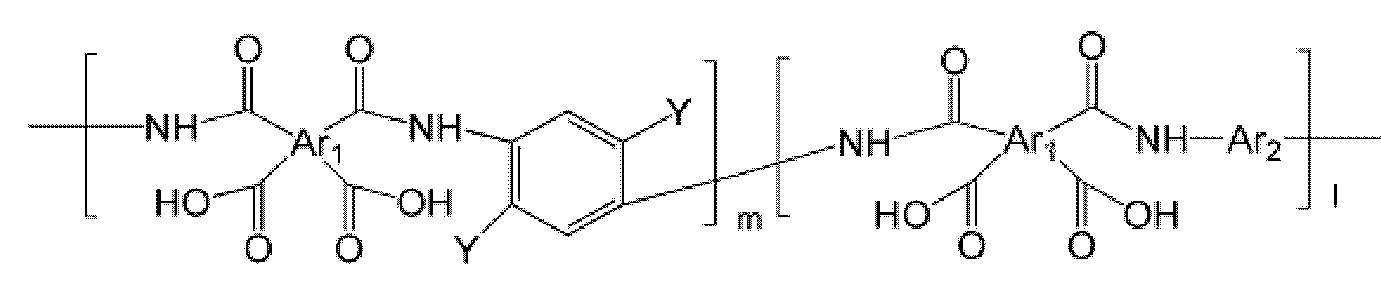
상기 화학식 33 내지 화학식 40에서,In Chemical Formulas 33 to 40,
Ar1, Ar2, Q, Y, n, m 및 l은 각각 상기 화학식 1 내지 화학식 8의 Ar1, Ar2, Q, Y, n, m 및 l에서 설명된 바와 같다. Ar 1, Ar 2, Q, Y, n, m and l are as described in each of the above formulas (1) to Ar 1, Ar 2, Q, Y, n, m and l in the formula (8).
상기 화학식 33 내지 화학식 36으로 표시되는 폴리아믹산의 공중합체의 예로는 하기 화학식 41 내지 화학식 50으로 표시되는 폴리아믹산 공중합체를 들 수 있다.Examples of the copolymer of the polyamic acid represented by Chemical Formulas 33 to 36 include polyamic acid copolymers represented by the following Chemical Formulas 41 to 50.
[화학식 41][Formula 41]

[화학식 42][Formula 42]

[화학식 43][Formula 43]

[화학식 44][Formula 44]

[화학식 45][Formula 45]

[화학식 46][Formula 46]

[화학식 47][Formula 47]

[화학식 48][Formula 48]

[화학식 49][Formula 49]

[화학식 50][Formula 50]

상기 화학식 41 내지 화학식 50에서,In Chemical Formulas 41 to 50,
Ar1, Q, Y, Y', n, m 및 l은 각각 상기 화학식 1 내지 화학식 18의 Ar1, Q, Y, Y', n, m 및 l에서 설명된 바와 같다.Ar 1, Q, Y, Y ', n, m and l are each of the formulas (1) to Ar 1, Q, Y, Y of formula 18' as previously described, n, m and l.
상기 이미드화는 화학적 이미드화 또는 열적 용액 이미드화 공정으로 이루어질 수 있으나, 이에 한정되는 것은 아니다.The imidization may be performed by chemical imidization or thermal solution imidization, but is not limited thereto.
상기 화학적 이미드화는 20 내지 180 ℃에서 4 내지 24 시간 동안 반응을 진행시킴으로써 이루어질 수 있다. 이때 촉매로 피리딘과 생성된 물의 제거를 위한 아세틱 무수물을 첨가할 수 있다. 화학적 이미드화의 온도가 상기 범위 이내이면 폴리아믹산의 이미드화가 충분히 이루어질 수 있다. The chemical imidization can be achieved by proceeding the reaction at 20 to 180 ℃ for 4 to 24 hours. At this time, as a catalyst, acetic anhydride may be added for removal of pyridine and generated water. If the temperature of the chemical imidization is within the above range, the imidization of the polyamic acid can be sufficiently made.
상기 화학적 이미드화는 먼저 상기 폴리아믹산에서 아민기의 오르쏘 위치에 존재하는 작용기인 OH, SH 및 NH2를 보호한 후, 이루어질 수 있다. 구체적으로는 상기 작용기인 OH, SH 및 NH2에 보호기를 도입하고, 이미드화를 진행한 후, 보호기를 제거하는 방법으로 이루어질 수 있다. 상기 보호기로는 트리메틸클로로실란((CH3)3SiCl), 트리에틸클로로실란((C2H5)3SiCl), 트리부틸클로로실란((C4H9)3SiCl), 트리벤질클로로실란((C6H5)3SiCl), 트리에톡시클로로실란((OC2H5)3SiCl) 등과 같은 클로로실란, 테트라하이드로퓨란(tetrahydrofurane, THF)과 같은 하이드로퓨란을 사용하여 도입할 수 있고, 이때 염기로서 트리메틸아민, 트리에틸아민, 트리프로필아민, 피리딘 등과 같은 3차 아민을 사용할 수 있다. 또한 상기 보호기를 제거하는 물질로는 희석된 염산, 황산, 질산, 아세트산 등을 사용할 수 있다. 상기와 같이 보호기를 사용한 화학적 이미드화는 본 발명의 일 구현예에 따른 중공사를 형성하는 고분자의 수율 및 분자량을 증가시킬 수 있다.The chemical imidization may be performed after first protecting OH, SH and NH 2 , which are functional groups present at the ortho position of the amine group in the polyamic acid. Specifically, a protecting group may be introduced into OH, SH, and NH 2 , which are functional groups, and imidization may be performed to remove the protecting group. The protecting group may be trimethylchlorosilane ((CH 3 ) 3 SiCl), triethylchlorosilane ((C 2 H 5 ) 3 SiCl), tributylchlorosilane ((C 4 H 9 ) 3 SiCl), tribenzylchlorosilane Chlorosilanes such as ((C 6 H 5 ) 3 SiCl), triethoxychlorosilane ((OC 2 H 5 ) 3 SiCl), and hydrofurans such as tetrahydrofurane (THF), In this case, tertiary amines such as trimethylamine, triethylamine, tripropylamine, pyridine and the like can be used as the base. Diluted hydrochloric acid, sulfuric acid, nitric acid, acetic acid, etc. may be used as the material for removing the protecting group. Chemical imidization using a protecting group as described above may increase the yield and molecular weight of the polymer forming the hollow fiber according to an embodiment of the present invention.
상기 열적 용액 이미드화는 용액 상에서 100 내지 180 ℃에서 2 내지 30 시간 동안 반응을 진행시킴으로써 이루어질 수 있다. 열적 용액 이미드화의 온도가 상기 범위 이내이면 폴리아믹산의 이미드화가 충분히 이루어질 수 있다.The thermal solution imidization can be achieved by running the reaction at 100 to 180 ° C. for 2 to 30 hours on a solution. If the temperature of the thermal solution imidization is within the above range, the imidization of the polyamic acid can be sufficiently achieved.
상기 열적 용액 이미드화는 먼저 상기 폴리아믹산에서 아민기의 오르쏘 위치에 존재하는 작용기인 OH, SH 및 NH2를 보호한 후, 이루어질 수 있다. 구체적으로는 상기 작용기인 OH, SH 및 NH2에 보호기를 도입하고, 이미드화를 진행한 후, 보호기를 제거하는 방법으로 이루어질 수 있다. 상기 보호기로는 트리메틸클로로실란, 트리에틸클로로실란, 트리부틸클로로실란, 트리벤질클로로실란, 트리에톡시클로로실란 등과 같은 클로로실란, 테트라하이드로퓨란과 같은 하이드로퓨란을 사용하여 도입할 수 있고, 이때 염기로서 트리메틸아민, 트리에틸아민, 트리프로필아민, 피리딘 등과 같은 3차 아민을 사용할 수 있다. 상기 보호기를 제거하는 물질로는 희석된 염산, 황산, 질산, 아세트산 등을 사용할 수 있다.The thermal solution imidization may be accomplished after first protecting OH, SH and NH 2 , which are functional groups present at the ortho position of the amine group in the polyamic acid. Specifically, a protecting group may be introduced into OH, SH, and NH 2 , which are functional groups, and imidization may be performed to remove the protecting group. The protecting group may be introduced using chlorosilanes such as trimethylchlorosilane, triethylchlorosilane, tributylchlorosilane, tribenzylchlorosilane, triethoxychlorosilane, and hydrofuran such as tetrahydrofuran, wherein the base As such, tertiary amines such as trimethylamine, triethylamine, tripropylamine, pyridine and the like can be used. Diluted hydrochloric acid, sulfuric acid, nitric acid, acetic acid, etc. may be used as a material for removing the protecting group.
또한 상기 열적 용액 이미드화는 벤젠, 톨루엔, 자일렌, 크레졸 등의 벤젠류, 헥산 등의 지방족 유기용매류, 시클로헥산 등의 지환족 유기용매류 등을 더 첨가하여 이루어진 공비혼합물을 이용하여 이루어질 수 있다. In addition, the thermal solution imidization may be performed using an azeotrope made by further adding benzenes such as benzene, toluene, xylene, cresol, aliphatic organic solvents such as hexane, and alicyclic organic solvents such as cyclohexane, and the like. have.
상기와 같이 보호기를 도입하고, 공비혼합물을 사용함으로써 이루어진 열적 용액 이미드화는 안정한 도프 용액 조성물을 형성시킬 수 있고, 본 발명의 일 구현예에 따른 중공사를 형성하는 고분자의 수율 및 분자량을 증가시킬 수 있다. The thermal solution imidization made by introducing a protecting group and using an azeotrope as described above can form a stable dope solution composition and increase the yield and molecular weight of the polymer forming the hollow fiber according to one embodiment of the present invention. Can be.
상기 이미드화의 조건은 상기 폴리아믹산의 작용기인 Ar1, Ar2, Q, Y 및 Y'의 종류에 따라 적절히 조절할 수 있다.The imidization condition is Ar, which is a functional group of the polyamic acid.One, Ar2, It can adjust suitably according to the kind of Q, Y, and Y '.
상기 이미드화 반응을 하기 반응식 1 및 반응식 2를 통해 구체적으로 설명한다.The imidation reaction will be described in detail through the following
[반응식 1]
[규칙 제26조에 의한 보정 23.07.2009]

[반응식 2]
[규칙 제26조에 의한 보정 23.07.2009]

상기 반응식 1 및 반응식 2에서,In
Ar1, Ar2, Q, Y, Y', n, m 및 l은 상기 화학식 1 내지 화학식 18에서 정의한 바와 같다.Ar 1 , Ar 2 , Q, Y, Y ', n, m and l are the same as defined in
상기 반응식 1을 참조하면, 상기 화학식 33, 화학식 34, 화학식 35 및 화학식 36으로 표시되는 폴리아믹산(폴리하이드록시아믹산, 폴리티올아믹산, 폴리아미노아믹산)을 고리화 반응인 이미드화 반응을 통해 각각 상기 화학식 1, 화학식 2, 화학식 3 및 화학식 4로 표시되는 폴리이미드로 형성한다.Referring to
또한 상기 화학식 37, 화학식 38, 화학식 39 및 화학식 40으로 표시되는 폴리아믹산 공중합체를 이미드화하여 각각 상기 화학식 5, 화학식 6, 화학식 7 및 화학식 8로 표시되는 폴리이미드 공중합체를 얻는다.In addition, the polyamic acid copolymer represented by the formula (37), formula (38), formula (39) and formula (40) is imidated to obtain a polyimide copolymer represented by the formula (5), the formula (6), the formula (7) and the formula (8), respectively.
상기 반응식 2를 참조하면, 상기 화학식 41 내지 화학식 50으로 표시되는 폴리아믹산 공중합체를 이미드화하여 각각 화학식 9 내지 화학식 18로 표시되는 폴리이미드 공중합체를 얻는다.Referring to
상기 중공사 형성용 도프 용액 조성물을 방사하여 폴리이미드계 중공사를 제조하는 단계에서, 상기 방사는 당해 분야에서 일반적으로 사용되는 방법을 이용할 수 있으며, 구체적으로는 건식 방사 또는 건·습식 방사법을 이용할 수 있다.In the step of preparing a polyimide-based hollow fiber by spinning the dope solution composition for forming the hollow fiber, the spinning may use a method generally used in the art, specifically dry spinning or dry-wet spinning method Can be.
일반적인 중공사 제조방법은 용액 방사법에 의한 용매교환법이 주로 사용되고 있다. 이는 중공사 형성용 도프 용액 조성물을 용매에 용해시켜 건식 또는 건·습식 방사법에 의해 방사한 후 비용매 속에서 용매와 비용매가 교환되어 미세공이 형성되도록 하며 용매가 응고조인 비용매로 확산되는 과정에서 비대칭막 또는 외부와 내부에 동일한 대칭막이 형성된다.As a general hollow fiber manufacturing method, a solvent exchange method using a solution spinning method is mainly used. This is because the dope solution composition for hollow fiber formation is dissolved in a solvent and spun by a dry or dry and wet spinning method, and then the solvent and the non-solvent are exchanged in the non-solvent to form micropores. An asymmetric film or the same symmetric film is formed inside and outside.
일 예로, 건·습식 방사법을 이용하여 중공사를 제조하는 경우, a1) 중공사 형성용 도프 용액 조성물을 제조하는 단계, a2) 제조된 중공사 형성용 도프 용액 조성물을 내부 응고제와 접촉시켜 중공사의 내부를 응고시키면서 공기 중으로 방사하여 폴리이미드계 중공사를 형성하는 단계, a3) 형성된 폴리이미드계 중공사를 응고조 내에서 응고시키는 단계, a4) 응고된 폴리이미드계 중공사를 세척액으로 세척한 후 건조하는 단계 및 a5) 건조된 폴리이미드계 중공사를 열처리하여 재배열된 고분자를 포함하는 중공사를 얻는 단계를 거침으로써, 본 발명의 일 구현예에 따른 중공사가 제조된다.For example, in the case of manufacturing hollow fiber using a dry and wet spinning method, a1) preparing a dope solution composition for hollow fiber formation, a2) contacting the prepared dope solution composition for hollow fiber formation with the internal coagulant, Forming a polyimide hollow fiber by spinning in the air while solidifying the inside, a3) solidifying the formed polyimide hollow fiber in a coagulation bath, a4) washing the solidified polyimide hollow fiber with a washing solution Through the drying step and a5) heat treatment of the dried polyimide hollow fiber to obtain a hollow fiber comprising a rearranged polymer, a hollow fiber according to an embodiment of the present invention is prepared.
이때 안쪽 노즐을 통해 내부 응고제가 토출되는 유량은 1 내지 10 ml/min일 수 있고, 구체적으로는 1 내지 3 ml/min일 수 있다. 또한 이중 노즐의 바깥쪽 내경은 0.1 내지 2.5 mm일 수 있다. 이러한 내부 응고제의 유량과 이중 노즐의 바깥쪽 내경은 중공사의 용도 및 운전 조건에 따라 상기 범위 내에서 조절될 수 있다.In this case, the flow rate at which the internal coagulant is discharged through the inner nozzle may be 1 to 10 ml / min, and specifically 1 to 3 ml / min. In addition, the outer diameter of the double nozzle may be 0.1 to 2.5 mm. The flow rate of this internal coagulant and the outer inner diameter of the double nozzle can be adjusted within the above range according to the use and operating conditions of the hollow yarns.
노즐로부터 응고조까지의 에어갭은 1 cm 내지 100 cm 일 수 있고, 구체적으로는 10 cm 내지 50 cm일 수 있다.The air gap from the nozzle to the coagulation bath may be 1 cm to 100 cm, specifically 10 cm to 50 cm.
방사 온도는 5 내지 120 ℃, 방사 속도는 5 내지 50 m/min 범위를 유지하면서 고온의 방사 노즐을 통과한 후, 응고조 내에서 상전이를 유도한다. 이러한 방사 온도와 방사 속도는 제조되는 중공사의 용도 및 운전 조건에 따라 상기 범위 내에서 변경이 가능하다.The spinning temperature is 5 to 120 ° C., and the spinning speed is passed through the hot spinning nozzle while maintaining the range of 5 to 50 m / min, and then induces phase transition in the coagulation bath. Such spinning temperature and spinning speed can be changed within the above range depending on the use and operating conditions of the hollow fiber to be manufactured.
이때 방사 온도가 상기 범위 내이면 중공사 형성용 도프 용액 조성물의 점도가 적절히 유지되어 중공사 형성용 도프 용액 조성물을 용이하게 방사할 수 있으며, 용매의 증발도 억제되어 중공사를 연속적으로 제조할 수 있다. 또한 방사 속도가 상기 범위 내이면 유량이 적절히 유지되고 제조되는 중공사의 기계적 물성 및 화학적 안정성을 향상시킬 수 있다.At this time, if the spinning temperature is within the above range, the viscosity of the dope solution composition for hollow fiber formation can be properly maintained to easily spin the dope solution composition for hollow fiber formation, and the evaporation of the solvent is also suppressed to continuously manufacture hollow fiber. have. In addition, when the spinning speed is within the above range, the flow rate is properly maintained and the mechanical properties and chemical stability of the hollow fiber can be improved.
응고조의 온도는 0 내지 50 ℃일 수 있다. 응고조의 온도가 상기 범위 내이면 응고조 용매의 휘발을 억제하고, 상전이가 충분히 이루어지게 할 수 있어 중공사를 원활하게 제조할 수 있다.The temperature of the coagulation bath may be 0 to 50 ° C. When the temperature of the coagulation bath is in the above range, volatilization of the coagulation bath solvent can be suppressed, and phase transition can be sufficiently achieved, and hollow fiber can be produced smoothly.
상기 응고조 내의 외부 응고제는 고분자 물질에 대해 비용매이고, 용매 및 첨가제와 상용성이 있는 것이라면 어느 것이든 사용 가능하다. 대표적으로 물, 에탄올, 메탄올 또는 이들의 혼합물을 사용할 수 있다.The external coagulant in the coagulation bath may be any solvent as long as it is non-solvent for the polymer material and is compatible with the solvent and the additive. Typically water, ethanol, methanol or mixtures thereof can be used.
이후에 응고된 중공사의 내부 및 표면에 잔류한 용매, 첨가제 및 응고액의 제거를 위한 세척 과정 및 건조 과정을 수행할 수 있다. 세척액으로는 물 또는 열수를 사용할 수 있으며, 세척시간은 1 시간 내지 24 시간 동안 수행할 수 있으나, 이에 한정되는 것은 아니다.Thereafter, a washing process and a drying process may be performed to remove the solvent, the additive, and the coagulating solution remaining on the inside and the surface of the solidified hollow yarn. Water or hot water may be used as the washing liquid, and the washing time may be performed for 1 to 24 hours, but is not limited thereto.
세척 후 건조 과정은 20 내지 100 ℃ 범위에서 3 내지 72 시간 동안 수행할 수 있다.After washing, the drying process may be performed for 3 to 72 hours in the range of 20 to 100 ℃.
상기 폴리이미드계 중공사를 열처리하면 열전환 반응을 통해 재배열된 고분자를 포함하는 중공사를 얻을 수 있다. 상기 재배열된 고분자를 포함하는 중공사는 상기 폴리이미드계 중공사에 비해 감소된 밀도, 피코 기공이 커지면서 서로 잘 연결됨에 따라 증가된 자유 체적도 및 증가된 면간 거리를 가진다. 이로써 상기 재배열된 고분자를 포함하는 중공사는 우수한 기체 투과도 및 선택도를 가질 수 있다.When the polyimide hollow fiber is heat treated, a hollow fiber including a polymer rearranged through a thermal conversion reaction may be obtained. The hollow fiber including the rearranged polymer has a reduced density, an increased free volume, and an increased interplanar distance as the picopores are well connected to each other as compared with the polyimide hollow fiber. As a result, the hollow fiber including the rearranged polymer may have excellent gas permeability and selectivity.
상기 열처리는 상기 이미드화 후, 10 내지 30 ℃/min의 승온 속도로 400 내지 550 ℃, 구체적으로는 450 내지 500 ℃까지 승온하고, 그 온도로 비활성 분위기 하에서 1 분 내지 1시간, 구체적으로는 10 분 내지 30분 동안 수행할 수 있다. 이때 온도가 상기 범위 내이면 열전환 반응이 충분히 이루어질 수 있다.The heat treatment is carried out after the imidization, the temperature is raised to 400 to 550 ℃, specifically 450 to 500 ℃ at a temperature increase rate of 10 to 30 ℃ / min, at that temperature in an inert atmosphere for 1 minute to 1 hour, specifically 10 It may be performed for minutes to 30 minutes. In this case, if the temperature is within the above range, the heat conversion reaction may be sufficiently performed.
이하, 상기 열처리 단계를 하기 반응식 3 및 반응식 4를 통해 구체적으로 설명한다.Hereinafter, the heat treatment step will be described in detail through
[반응식 3]
[규칙 제26조에 의한 보정 23.07.2009]

[반응식 4]Scheme 4
[규칙 제26조에 의한 보정 23.07.2009]

상기 반응식 3 및 반응식 4에서,In
Ar1, Ar1', Ar2, Q, Y, Y'', n, m, 및 l은 상기 화학식 1 내지 화학식 50에서 정의한 바와 같다.Ar 1 , Ar 1 ′, Ar 2 , Q, Y, Y ″, n, m, and l are the same as defined in
상기 반응식 3을 참조하면, 상기 화학식 1 내지 화학식 4로 표시되는 폴리이미드를 포함하는 폴리이미드계 중공사는 상술한 열처리를 통해, 화학식 19 내지 화학식 25로 표시되는 폴리벤즈옥사졸, 폴리벤즈티아졸 또는 폴리피롤론 고분자를 포함하는 중공사로 제조된다. 상기와 같은 고분자를 포함하는 중공사의 제조는 화학식 1 내지 화학식 4로 표시되는 폴리이미드 내의 CO2 제거반응을 통해 이루어진다.Referring to
이때, 상기 화학식 1 내지 화학식 4의 Y가 OH인 폴리하이드록시이미드 또는 Y가 SH인 폴리티올이미드는 각각 화학식 19, 화학식 21, 화학식 23 및 화학식 24로 표시되는 폴리벤즈옥사졸(Y''=O) 또는 폴리벤즈티아졸(Y''=S)로 열전환된다. 또한 상기 화학식 1 내지 화학식 4의 Y가 NH2인 폴리아미노이미드는 화학식 20, 화학식 22 및 화학식 25로 표시되는 폴리피롤론으로 열전환된다.In this case, the polyhydroxyimide of Y is OH or the polythiolimide of Y is SH of
상기 반응식 4를 참조하면, 상기 화학식 5 내지 화학식 8로 표시되는 폴리이미드 공중합체를 포함하는 폴리이미드계 중공사는 상술한 열처리를 통해, 폴리이미드 내의 CO2 제거반응을 통해 화학식 26 내지 화학식 32로 표시되는 고분자를 포함하는 중공사로 제조된다.Referring to Scheme 4, the polyimide-based hollow yarn comprising the polyimide copolymer represented by Formula 5 to Formula 8 is represented by Formula 26 to Formula 32 through the above-described heat treatment, through the CO 2 removal reaction in the polyimide It is made of hollow fiber containing the polymer.
이때, 상기 화학식 5 내지 화학식 8의 Y가 OH인 폴리하이드록시이미드 또는 Y가 SH인 폴리티올이미드는 화학식 26, 화학식 28, 화학식 30 및 화학식 31로 표시되는 폴리(벤즈옥사졸(Y''=O)-이미드) 공중합체 또는 폴리(벤즈티아졸(Y''=S)-이미드) 공중합체로 열전환된다. 또한 상기 화학식 5 내지 화학식 8의 Y가 NH2인 폴리아미노이미드는 화학식 27, 화학식 29 및 화학식 32로 표시되는 폴리(피롤론-이미드) 공중합체로 열전환된다.In this case, the polyhydroxyimide of Y is OH or the polythiolimide of Y is SH of Formulas 5 to 8 may be represented by poly (benzoxazole (Y '' ==) represented by Formula 26, Formula 28, Formula 30, and Formula 31. O) -imide) copolymer or poly (benzthiazole (Y '' = S) -imide) copolymer. In addition, the polyaminoimide in which Y of Formula 5 to Formula 8 is NH 2 is thermally converted to a poly (pyrrolone-imide) copolymer represented by Formula 27, Formula 29, and Formula 32.
본 발명의 상기 화학식 9 내지 화학식 18로 표시되는 폴리이미드의 공중합체를 포함하는 폴리이미드계 중공사는 열처리를 통해, 각 이미드 블록이 Y의 종류에 따라 폴리벤즈옥사졸, 폴리벤즈티아졸, 폴리피롤론으로 열전환되어 이들의 공중합체, 즉 화학식 19 내지 화학식 25로 표시되는 고분자들의 공중합체를 포함하는 중공사를 형성한다.Polyimide-based hollow fiber comprising a copolymer of the polyimide represented by the formula (9) to (18) of the present invention through the heat treatment, each imide block is polybenzoxazole, polybenzthiazole, polypyrrole according to the type of Y The heat conversion to the ron forms a hollow fiber comprising a copolymer thereof, that is, a copolymer of polymers represented by the formulas (19) to (25).
이때 중공사는 제조 공정을 조절하여, 거대기공(macrovoid)이 형성된 핑거형 또는 단면상에 거대기공이 존재하지 아니하여 안정된 막 성능을 갖는 스폰지형으로 제조할 수 있다. 또한 제조 공정을 조절하여 대칭형, 비대칭형으로도 제조할 수 있다. 또한 화학 구조 내 Ar1, Ar1', Ar2 및 Q의 특성을 고려하여 고분자 설계를 조절하여, 각종 기체 종에 대한 기체 투과도 및 선택도에 대한 제어를 할 수 있다.In this case, the hollow yarn may be manufactured in a sponge-type having a stable membrane performance by controlling the manufacturing process, and thus no macropores are present on a finger-type or a cross-section in which macropores are formed. In addition, the manufacturing process can be adjusted to produce symmetrical or asymmetrical forms. In addition, by adjusting the polymer design in consideration of the properties of Ar 1 , Ar 1 ′, Ar 2 and Q in the chemical structure, it is possible to control the gas permeability and selectivity for various gas species.
이렇게 제조된 중공사는 상기 화학식 19 내지 화학식 32로 표시되는 고분자 또는 이들의 공중합체를 포함할 수 있으나, 이에 한정되는 것은 아니다.The hollow fiber thus prepared may include a polymer represented by Formula 19 to Formula 32 or a copolymer thereof, but is not limited thereto.
본 발명의 일 구현예에 따른 중공사는 고분자 내 존재하는 딱딱한 고분자 주쇄로 인해 온화한 조건에서뿐만 아니라 긴 작업 시간, 산성 조건 및 고습과 같은 가혹한 조건하에서도 견딜 수 있다. 즉 본 발명의 일 구현예에 따른 중공사는 화학적 안정성 및 기계적 물성이 우수하다.Hollow yarn according to an embodiment of the present invention can withstand not only in mild conditions but also in harsh conditions such as long working time, acidic conditions and high humidity due to the rigid polymer backbone present in the polymer. That is, the hollow fiber according to the embodiment of the present invention has excellent chemical stability and mechanical properties.
이때 상기 화학식 19 내지 화학식 32로 표시되는 고분자 또는 이들의 공중합체는 제조 단계에서 적절한 중량평균 분자량을 갖도록 설계하며, 바람직하기로 중량평균 분자량이 10,000 내지 200,000이 되도록 한다. 이들의 중량평균 분자량이 10,000 미만인 때에는 고분자의 물성이 열악하고, 200,000을 초과하는 경우 중공사 형성용 도프 용액 조성물의 점성이 크게 증가하여 펌프를 이용하여 상기 중공사 형성용 도프 용액 조성물을 방사하기 어려운 문제점이 있다.In this case, the polymers represented by Formulas 19 to 32 or copolymers thereof are designed to have an appropriate weight average molecular weight in the preparation step, and preferably, the weight average molecular weight is 10,000 to 200,000. When the weight average molecular weight thereof is less than 10,000, the physical properties of the polymer are poor, and when the weight average molecular weight exceeds 200,000, the viscosity of the dope solution composition for hollow fiber formation is greatly increased, making it difficult to spin the dope solution composition for hollow fiber formation using a pump. There is a problem.
또한 본 발명의 일 구현예에 따른 중공사는 그의 중앙부에 위치하는 공동, 상기 공동 주변에 존재하는 매크로기공, 그리고 상기 매크로기공 주변에 존재하는 메조기공 및 피코기공을 포함하고, 상기 피코기공은 3차원적으로 서로 연결되어 3차원 네트워크를 형성하고 있는 구조로 형성됨으로써, 높은 자유 체적도를 가져 기체의 선택도 및 기체 투과도가 우수하다. 예를 들면, He, H2, N2, CH4, O2, N2, CO2 및 이들의 조합으로 이루어진 군에서 선택되는 1종 이상의 기체에 대한 투과도 및 선택도가 우수하다.In addition, the hollow fiber according to an embodiment of the present invention includes a cavity located in the center thereof, macropores present around the cavity, and mesopores and picopores present around the macropores, wherein the picopores are three-dimensional. By forming a structure that is connected to each other to form a three-dimensional network, it has a high free volume and excellent gas selectivity and gas permeability. For example, the permeability and selectivity for at least one gas selected from the group consisting of He, H 2 , N 2 , CH 4 , O 2 , N 2 , CO 2, and combinations thereof are excellent.
실시예Example
이하 본 기재의 실시예 및 비교예를 기재한다. 그러나 하기 실시예는 본 기재의 일 실시예일뿐이며, 본 기재가 하기 실시예에 의해 한정되는 것은 아니다.Hereinafter, the Example and comparative example of this description are described. However, the following examples are merely examples of the present disclosure, and the present disclosure is not limited by the following examples.
(실시예 1)(Example 1)
하기 반응식 5로 표시되는 바에 따라 폴리하이드록시이미드를 포함하는 중공사 형성용 도프 용액 조성물로부터 하기 화학식 51로 표시되는 폴리벤즈옥사졸을 포함하는 중공사를 제조하였다.A hollow fiber comprising polybenzoxazole represented by the following Chemical Formula 51 was prepared from a dope solution composition for forming hollow fibers including polyhydroxyimide as represented by Scheme 5 below.
[반응식 5]Scheme 5
[규칙 제26조에 의한 보정 23.07.2009]

(1) 폴리하이드록시이미드 제조(1) polyhydroxyimide production
질소가 퍼지되는 1000ml의 반응기에 2,2-비스(3-아미노-4-하이드록시페닐)헥사플루오로프로판 36.6 g(0.1 mol)을 넣고 용매로서 N-메틸피롤리돈(NMP)을 첨가하였다. 이때 반응기는 오일로 채워진 항온조에 넣어 일정한 반응온도인 -15 ℃를 유지할 수 있도록 하였다. 4,4'-(헥사플루오로이소프로필리덴)디프탈릭 안하이드라이드 44.4 g(0.1 mol)을 용액에 천천히 주입하고 4시간 동안 반응시켜 연노란색의 폴리하이드록시아믹산 용액을 제조하였다.36.6 g (0.1 mol) of 2,2-bis (3-amino-4-hydroxyphenyl) hexafluoropropane was added to a 1000 ml reactor in which nitrogen was purged, and N-methylpyrrolidone (NMP) was added as a solvent. . At this time, the reactor was put in a thermostatic bath filled with oil to maintain a constant reaction temperature of -15 ℃. 44.4 g (0.1 mol) of 4,4 '-(hexafluoroisopropylidene) diphthalic anhydride was slowly injected into the solution and reacted for 4 hours to prepare a pale yellow polyhydroxyamic acid solution.
이때 300 ml의 톨루엔을 상기 제조한 폴리하이드록시아믹산 용액에 첨가하고 반응기의 온도를 150 ℃까지 상승시키면서, 공비혼합물을 이용한 열적 용액 이미드화 방법을 통해 12 시간 동안 반응시켜 폴리하이드록시이미드를 제조하였다.At this time, 300 ml of toluene was added to the polyhydroxyamic acid solution prepared above, and the temperature of the reactor was raised to 150 ° C., followed by reaction for 12 hours through a thermal solution imidization method using an azeotrope to prepare polyhydroxyimide. It was.
(2) 중공사 형성용 도프 용액 조성물 제조(2) Preparation of dope solution composition for hollow fiber formation
제조된 폴리이미드를 N-메틸피롤리돈(NMP) 243 g(75 중량%)에 넣고 첨가제로서 에탄올 10 중량%를 첨가한 후 혼합하여 균일한 중공사 형성용 도프 용액 조성물을 제조하였다.The prepared polyimide was added to 243 g (75 wt%) of N-methylpyrrolidone (NMP) and 10 wt% of ethanol was added as an additive, followed by mixing to prepare a uniform dope solution composition for hollow fiber formation.
(3) 중공사 제조(3) hollow fiber manufacturing
제조된 중공사 형성용 도프 용액 조성물 내의 기포를 24 시간 동안 상온 및 감압 하에서 제거하고, 유리 필터(공경 60 ㎛)를 이용하여 이물질을 제거하였다. 이어서 50 ℃에서 유지 후 이중 환상노즐을 통해 방사를 실시하였다. 이때 내부 응고액은 증류수를 사용하였고, 에어갭의 거리는 50 cm로 설정하였다. 방사된 중공사를 물의 온도가 25 ℃인 응고조에서 응고시켜, 20 m/min의 속도로 권취하였다. 제조된 중공사는 세척 후, 상온에서 3일간 자연건조하였다. 가열로를 이용하여 15℃/min의 승온속도로 가열, 비활성 분위기에서 500 ℃, 10분 열처리하여 상기 화학식 51로 표시되는 폴리벤즈옥사졸을 포함하는 중공사를 제조하였다.Bubbles in the prepared dope solution composition for hollow fiber formation were removed at room temperature and reduced pressure for 24 hours, and foreign materials were removed using a glass filter (60 μm in diameter). Subsequently, after maintaining at 50 ℃ spinning was carried out through a double annular nozzle. At this time, distilled water was used as the internal coagulating solution, and the distance of the air gap was set to 50 cm. The spun hollow fiber was coagulated in a coagulation bath having a water temperature of 25 ° C. and wound up at a speed of 20 m / min. The prepared hollow yarn was washed and then naturally dried at room temperature for 3 days. A hollow fiber including polybenzoxazole represented by Chemical Formula 51 was prepared by heating at a temperature increase rate of 15 ° C./min using a heating furnace and heat-treating at 500 ° C. for 10 minutes in an inert atmosphere.
제조된 중공사의 중량평균 분자량은 48,960였고, FT-IR 분석결과 폴리이미드에서는 존재하지 않았던 폴리벤즈옥사졸 특성밴드인 1620 cm-1(C=N), 1058 cm-1(C-N)의 밴드가 확인되었다. 또한 제조된 중공사의 자유체적도는 0.33, 면간 거리는 720 pm였다.The weight average molecular weight of the prepared hollow fiber was 48,960, and FT-IR analysis confirmed the bands of 1620 cm -1 (C = N) and 1058 cm -1 (CN), which are polybenzoxazole characteristic bands, which were not present in the polyimide. It became. In addition, the free volume of the manufactured hollow fiber was 0.33, and the interplanar distance was 720 pm.
상기 면간 거리는 XRD로 측정하였다. XRD 측정시 필름상태의 샘플을 사용하였고, 광원으로 CuKα를 사용하였고, 10도 내지 40도에서, 0.05도 간격으로 측정하였다.The interplanar distance was measured by XRD. The XRD measurement was performed using a film sample, CuKα was used as the light source, and was measured at intervals of 0.05 degrees at 10 to 40 degrees.
(실시예 2)(Example 2)
용액상에서 180 ℃에서 24시간 동안 2,2-비스(3-아미노-4-하이드록시페닐)헥사플루오로프로판과 4,4'-(헥사플루오로이소프로필리덴)디프탈릭 안하이드라이드를 톨루엔을 넣지 않고 반응시켜 폴리이미드를 제조한 것을 제외하고, 실시예 1과 동일한 방법으로 폴리벤즈옥사졸을 포함하는 중공사를 제조하였다.Toluene was dissolved in 2,2-bis (3-amino-4-hydroxyphenyl) hexafluoropropane and 4,4 '-(hexafluoroisopropylidene) diphthalic anhydride for 24 hours at 180 ° C in solution. A hollow fiber including polybenzoxazole was prepared in the same manner as in Example 1, except that the polyimide was prepared by reacting without loading.
제조된 중공사의 중량평균 분자량은 9,240였고, FT-IR 분석결과 폴리이미드에서는 존재하지 않았던 폴리벤즈옥사졸 특성밴드인 1620 cm-1(C=N), 1058 cm-1(C-N)의 밴드가 확인되었다. 또한 제조된 중공사의 자유체적도는 0.34, 면간 거리는 680 pm였다.The weight average molecular weight of the prepared hollow fiber was 9,240, and FT-IR analysis confirmed the bands of 1620 cm -1 (C = N) and 1058 cm -1 (CN), which are polybenzoxazole characteristic bands, which were not present in the polyimide. It became. In addition, the free volume of the manufactured hollow yarn was 0.34, and the interplanar distance was 680 pm.
상기 면간 거리는 XRD로 측정하였다. XRD 측정시 필름상태의 샘플을 사용하였고, 광원으로 CuKα를 사용하였고, 10도 내지 40도에서, 0.05도 간격으로 측정하였다.The interplanar distance was measured by XRD. The XRD measurement was performed using a film sample, CuKα was used as the light source, and was measured at intervals of 0.05 degrees at 10 to 40 degrees.
(실시예 3)(Example 3)
하기 반응을 통해 하기 화학식 52로 표시되는 폴리벤즈티아졸을 포함하는 중공사를 제조하였다.Through the following reaction to prepare a hollow fiber comprising a polybenzthiazole represented by the formula (52).
[화학식 52][Formula 52]
[규칙 제26조에 의한 보정 23.07.2009]

출발물질로 2,5-디아미노-1,4-벤젠디티올 디하이드로클로라이드 20.8 g(0.1 mol)을 4,4'-(헥사플루오로이소프로필리덴)디프탈릭 안하이드라이드 44.4 g(0.1 mol)과 반응시켜 티올기(-SH)를 갖는 폴리이미드를 제조한 것을 제외하고, 실시예 1과 동일한 방법으로 상기 화학식 52로 표시되는 폴리벤즈티아졸을 포함하는 중공사를 제조하였다.20.8 g (0.1 mol) of 2,5-diamino-1,4-benzenedithiol dihydrochloride as a starting material was added to 44.4 g (0.1 mol) of 4,4 '-(hexafluoroisopropylidene) diphthalic anhydride. ), Except that a polyimide having a thiol group (-SH) was prepared, a hollow fiber including polybenzthiazole represented by Chemical Formula 52 was prepared in the same manner as in Example 1.
제조된 중공사의 중량평균 분자량은 32,290였고, FT-IR 분석결과 폴리이미드에서는 존재하지 않았던 폴리벤즈티아졸 특성밴드인 1484 cm-1(C-S), 1404 cm-1(C-S)의 밴드가 확인되었다. 또한 제조된 중공사의 자유체적도는 0.28, 면간 거리는 640 pm였다.The weight average molecular weight of the prepared hollow fiber was 32,290, and FT-IR analysis showed a band of 1484 cm -1 (CS) and 1404 cm -1 (CS), which were polybenzthiazole characteristic bands, which were not present in the polyimide. In addition, the free volume of the manufactured hollow fiber was 0.28, and the interplanar distance was 640 pm.
상기 면간 거리는 XRD로 측정하였다. XRD 측정시 필름상태의 샘플을 사용하였고, 광원으로 CuKα를 사용하였고, 10도 내지 40도에서, 0.05도 간격으로 측정하였다.The interplanar distance was measured by XRD. The XRD measurement was performed using a film sample, CuKα was used as the light source, and was measured at intervals of 0.05 degrees at 10 to 40 degrees.
(실시예 4)(Example 4)
하기 반응을 통해 하기 화학식 53으로 표시되는 폴리피롤론을 포함하는 중공사를 제조하였다.Through the following reaction to prepare a hollow fiber comprising a polypyrrolone represented by the formula (53).
[화학식 53][Formula 53]
[규칙 제26조에 의한 보정 23.07.2009]

출발물질로 3,3'-디아미노벤지딘 21.4 g(0.1 mol)을 4,4'-(헥사플루오로이소프로필리덴)디프탈릭 안하이드라이드 44.4 g(0.1 mol)과 반응시켜 아민기(-NH2)를 갖는 폴리이미드를 제조한 것을 제외하고, 실시예 1과 동일한 방법으로 상기 화학식 53으로 표시되는 폴리피롤론을 포함하는 중공사를 제조하였다.As starting material, 21.4 g (0.1 mol) of 3,3'-diaminobenzidine was reacted with 44.4 g (0.1 mol) of 4,4 '-(hexafluoroisopropylidene) diphthalic anhydride to form an amine group (-NH Except for preparing a polyimide having 2 ), a hollow fiber comprising a polypyrrolone represented by the formula (53) was prepared in the same manner as in Example 1.
제조된 중공사의 중량평균 분자량은 37,740였고, FT-IR 분석결과 폴리이미드에서는 존재하지 않았던 폴리피롤론 특성밴드인 1758 cm-1(C=O), 1625cm-1(C=N)의 밴드가 확인되었다. 또한 제조된 중공사의 자유체적도는 0.25, 면간 거리는 650 pm였다.The weight average molecular weight of the prepared hollow fiber was 37,740, and FT-IR analysis showed a band of 1758 cm -1 (C = O) and 1625cm -1 (C = N), which are polypyrrolone characteristic bands that did not exist in the polyimide. . In addition, the free volume of the manufactured hollow fiber was 0.25, and the interplanar distance was 650 pm.
상기 면간 거리는 XRD로 측정하였다. XRD 측정시 필름상태의 샘플을 사용하였고, 광원으로 CuKα를 사용하였고, 10도 내지 40도에서, 0.05도 간격으로 측정하였다.The interplanar distance was measured by XRD. The XRD measurement was performed using a film sample, CuKα was used as the light source, and was measured at intervals of 0.05 degrees at 10 to 40 degrees.
(실시예 5)(Example 5)
하기 반응을 통해 하기 화학식 54로 표시되는 폴리벤즈옥사졸을 포함하는 중공사를 제조하였다.Through the following reaction to prepare a hollow fiber comprising a polybenzoxazole represented by the formula (54).
[화학식 54][Formula 54]
[규칙 제26조에 의한 보정 23.07.2009]

출발물질로 3,3'-디하이드록시아미노벤지딘 21.6 g(0.1 mol)을 4,4'-(헥사플루오로이소프로필리덴)디프탈릭 안하이드라이드 44.4 g(0.1 mol)과 반응시켜 폴리이미드를 제조한 것을 제외하고, 실시예 1과 동일한 방법으로 상기 화학식 54로 폴리벤즈옥사졸을 포함하는 중공사를 제조하였다.As a starting material, 21.6 g (0.1 mol) of 3,3'-dihydroxyaminobenzidine was reacted with 44.4 g (0.1 mol) of 4,4 '-(hexafluoroisopropylidene) diphthalic anhydride to form a polyimide. Except for the preparation, the hollow fiber was prepared in the same manner as in Example 1 containing the polybenzoxazole as the formula 54.
제조된 중공사의 중량평균 분자량은 21,160였고, FT-IR 분석결과 폴리이미드에서는 존재하지 않았던 폴리벤즈옥사졸 특성밴드인 1595 cm-1(C=N), 1052cm-1(C=O)의 밴드가 확인되었다. 또한 제조된 중공사의 자유체적도는 0.21, 면간 거리는 610 pm였다.The weight average molecular weight of the prepared hollow yarn was 21,160, and the bands of 1595 cm -1 (C = N) and 1052cm -1 (C = O), which are polybenzoxazole characteristic bands, did not exist in polyimide according to FT-IR analysis. Confirmed. In addition, the free volume of the manufactured hollow yarn was 0.21, and the distance between planes was 610 pm.
상기 면간 거리는 XRD로 측정하였다. XRD 측정시 필름상태의 샘플을 사용하였고, 광원으로 CuKα를 사용하였고, 10도 내지 40도에서, 0.05도 간격으로 측정하였다.The interplanar distance was measured by XRD. The XRD measurement was performed using a film sample, CuKα was used as the light source, and was measured at intervals of 0.05 degrees at 10 to 40 degrees.
(실시예 6)(Example 6)
하기 반응을 통해 하기 화학식 55로 표시되는 폴리피롤론을 포함하는 중공사를 제조하였다.Through the following reaction to prepare a hollow fiber comprising a polypyrrolone represented by the formula (55).
[화학식 55][Formula 55]
[규칙 제26조에 의한 보정 23.07.2009]

출발물질로 벤젠-1,2,4,5-테트라아민 테트라하이드로클로라이드 28.4 g(0.1 mol)을 옥시디프탈릭 안하이드라이드 31.0 g(0.1 mol)과 반응시켜 폴리이미드 파우더를 제조한 것을 제외하고, 실시예 1과 동일한 방법으로 상기 화학식 55로 폴리피롤론을 포함하는 중공사를 제조하였다.Except that 28.4 g (0.1 mol) of benzene-1,2,4,5-tetraamine tetrahydrochloride as a starting material was reacted with 31.0 g (0.1 mol) of oxydiphthalic anhydride to prepare a polyimide powder. In the same manner as in Example 1 to prepare a hollow fiber comprising a polypyrrolone in the formula 55.
제조된 중공사의 중량평균 분자량은 33,120였고, FT-IR 분석결과 폴리이미드에서는 존재하지 않았던 폴리피롤론 특성밴드인 1758 cm-1(C=O), 1625 cm-1(C=N)의 밴드가 확인되었다. 또한 제조된 중공사의 자유체적도는 0.27, 면간 거리는 650 pm였다.The weight average molecular weight of the prepared hollow fiber was 33,120, and FT-IR analysis confirmed the bands of 1758 cm -1 (C = O) and 1625 cm -1 (C = N), which are polypyrrolone characteristic bands that did not exist in the polyimide. It became. In addition, the free volume of the manufactured hollow fiber was 0.27, and the interplanar distance was 650 pm.
상기 면간 거리는 XRD로 측정하였다. XRD 측정시 필름상태의 샘플을 사용하였고, 광원으로 CuKα를 사용하였고, 10도 내지 40도에서, 0.05도 간격으로 측정하였다.The interplanar distance was measured by XRD. The XRD measurement was performed using a film sample, CuKα was used as the light source, and was measured at intervals of 0.05 degrees at 10 to 40 degrees.
(실시예 7)(Example 7)
하기 반응을 통해 하기 화학식 56으로 표시되는 폴리(벤즈옥사졸-벤즈옥사졸) 공중합체를 포함하는 중공사를 제조하였다.Through the following reaction to produce a hollow fiber comprising a poly (benzoxazole-benzoxazole) copolymer represented by the formula (56).
[화학식 56][Formula 56]
[규칙 제26조에 의한 보정 23.07.2009]

출발물질로 2,2-비스(3-아미노-4-하이드록시페닐)헥사플루오로프로판 36.6 g(0.1 mol)과 3,3'-디하이드록시벤지딘 21.6 g(0.1 mol)을 4,4'-바이프탈릭 안하이드라이드 58.8 g(0.2 mol)과 반응시켜 폴리이미드 파우더를 제조한 것을 제외하고, 실시예 1과 동일한 방법으로 상기 화학식 56으로 표시되는 폴리(벤즈옥사졸-벤즈옥사졸) 공중합체(몰비인 m:l은 5:5)를 포함하는 중공사를 제조하였다.Starting materials were 36.6 g (0.1 mol) of 2,2-bis (3-amino-4-hydroxyphenyl) hexafluoropropane and 21.6 g (0.1 mol) of 3,3'-dihydroxybenzidine. Poly (benzoxazole-benzoxazole) air represented by the formula (56) in the same manner as in Example 1, except that the polyimide powder was prepared by reacting with 58.8 g (0.2 mol) of biphthalic anhydride. Hollow fibers were prepared including coalescing (m: l molar ratio of 5: 5).
제조된 중공사의 중량평균 분자량은 24,860였고, FT-IR 분석결과 폴리이미드에서는 존재하지 않았던 폴리벤즈옥사졸의 특성밴드인 1620 cm-1(C=N), 1058 cm-1(C-N)의 밴드가 확인되었다. 또한 제조된 중공사의 자유체적도는 0.24, 면간 거리는 550 pm였다.The weight average molecular weight of the prepared hollow yarn was 24,860, and the bands of 1620 cm -1 (C = N) and 1058 cm -1 (CN), which are characteristic bands of polybenzoxazole, which were not found in the polyimide, were FT-IR analysis. Confirmed. In addition, the free volume of the manufactured hollow fiber was 0.24, and the interplanar distance was 550 pm.
상기 면간 거리는 XRD로 측정하였다. XRD 측정시 필름상태의 샘플을 사용하였고, 광원으로 CuKα를 사용하였고, 10도 내지 40도에서, 0.05도 간격으로 측정하였다.The interplanar distance was measured by XRD. The XRD measurement was performed using a film sample, CuKα was used as the light source, and was measured at intervals of 0.05 degrees at 10 to 40 degrees.
(실시예 8)(Example 8)
하기 반응을 통해 하기 화학식 57로 표시되는 폴리(벤즈옥사졸-이미드) 공중합체를 포함하는 중공사를 제조하였다.Through the following reaction to prepare a hollow fiber comprising a poly (benzoxazole-imide) copolymer represented by the formula (57).
[화학식 57][Formula 57]
[규칙 제26조에 의한 보정 23.07.2009]

출발물질로 2,2-비스(3-아미노-4-하이드록시페닐)헥사플루오로프로판 58.60 g(0.16 mol)과 4,4'-디아미노디페닐에테르 8.01 g(0.04 mol)을 3,3',4,4'-벤조페논테트라카르복실릭 디안하이드라이드 64.45 g(20 mol)과 반응시켜 폴리이미드를 제조한 것을 제외하고, 실시예 1과 동일한 방법으로 상기 화학식 57로 표시되는 폴리(벤즈옥사졸-이미드) 공중합체(몰비인 m:l은 8:2)를 포함하는 중공사를 제조하였다.58.60 g (0.16 mol) of 2,2-bis (3-amino-4-hydroxyphenyl) hexafluoropropane and 8.01 g (0.04 mol) of 4,4'-diaminodiphenyl ether were added as starting materials. Poly (benz) represented by Formula 57 in the same manner as in Example 1, except that polyimide was prepared by reacting with 64.45 g (20 mol) of ', 4,4'-benzophenonetetracarboxylic dianhydride. Hollow fibers were prepared comprising an oxazole-imide) copolymer (m: l molar ratio of 8: 2).
제조된 중공사의 중량평균 분자량은 35,470이였고, FT-IR 분석결과 폴리이미드에서는 존재하지 않았던 폴리벤즈옥사졸의 특성밴드인 1620 cm-1(C=N), 1058 cm-1(C-N)의 밴드 및 폴리이미드의 특성밴드인 1720 cm-1(C=O), 1580 cm-1(C=O)가 확인되었다. 또한 제조된 중공사의 자유체적도는 0.22, 면간 거리는 620 pm였다.The weight average molecular weight of the prepared hollow fiber was 35,470, and the bands of 1620 cm -1 (C = N) and 1058 cm -1 (CN), which are characteristic bands of polybenzoxazole, did not exist in polyimide according to FT-IR analysis. And 1720 cm -1 (C = O) and 1580 cm -1 (C = O) which are characteristic bands of the polyimide. In addition, the free volume of the manufactured hollow yarn was 0.22, and the interplanar distance was 620 pm.
상기 면간 거리는 XRD로 측정하였다. XRD 측정시 필름상태의 샘플을 사용하였고, 광원으로 CuKα를 사용하였고, 10도 내지 40도에서, 0.05도 간격으로 측정하였다.The interplanar distance was measured by XRD. The XRD measurement was performed using a film sample, CuKα was used as the light source, and was measured at intervals of 0.05 degrees at 10 to 40 degrees.
(실시예 9)(Example 9)
하기 반응을 통해 하기 화학식 58로 표시되는 폴리(피롤론-이미드) 공중합체를 포함하는 중공사를 제조하였다.Through the following reaction to prepare a hollow fiber comprising a poly (pyrrolone-imide) copolymer represented by the formula (58).
[화학식 58][Formula 58]
[규칙 제26조에 의한 보정 23.07.2009]

출발물질로 3,3'-디아미노벤지딘 17.1 g(0.08 mol)과 4,4'-디아미노디페닐에테르 4.0 g(0.02 mol)을 4,4'-(헥사플루오로이소프로필리덴)디프탈릭 안하이드라이드 44.4 g(0.1 mol)과 반응시켜 폴리이미드를 제조한 것을 제외하고, 실시예 1과 동일한 방법으로 상기 화학식 58로 표시되는 폴리(피롤론-이미드) 공중합체(몰비인 m:l은 8:2)를 포함하는 중공사를 제조하였다.As starting materials, 17.1 g (0.08 mol) of 3,3'-diaminobenzidine and 4.0 g (0.02 mol) of 4,4'-diaminodiphenyl ether were added to 4,4 '-(hexafluoroisopropylidene) diphthalic. Poly (pyrrolone-imide) copolymer represented by the formula (58) in the same manner as in Example 1, except that the polyimide was prepared by reacting with 44.4 g (0.1 mol) of anhydride (m: l in molar ratio) Manufactured a hollow fiber comprising 8: 2).
제조된 중공사의 중량평균 분자량은 52,380이였고, FT-IR 분석결과 폴리이미드에서는 존재하지 않았던 폴리피롤론의 특성밴드인 1758 cm-1(C=O), 1625 cm-1(C=N)의 밴드 및 폴리이미드의 특성밴드인 1720 cm-1(C=O), 1580 cm-1(C=O)의 밴드가 확인되었다. 또한 제조된 중공사의 자유체적도는 0.23, 면간 거리는 630 pm였다.The weight average molecular weight of the prepared hollow fiber was 52,380, and the band of 1758 cm -1 (C = O) and 1625 cm -1 (C = N), which are characteristic bands of polypyrrolone, did not exist in polyimide according to FT-IR analysis. And bands of 1720 cm -1 (C = O) and 1580 cm -1 (C = O) which are characteristic bands of the polyimide. In addition, the free volume of the manufactured hollow fiber was 0.23, and the interplanar distance was 630 pm.
상기 면간 거리는 XRD로 측정하였다. XRD 측정시 필름상태의 샘플을 사용하였고, 광원으로 CuKα를 사용하였고, 10도 내지 40도에서, 0.05도 간격으로 측정하였다.The interplanar distance was measured by XRD. The XRD measurement was performed using a film sample, CuKα was used as the light source, and was measured at intervals of 0.05 degrees at 10 to 40 degrees.
(실시예 10)(Example 10)
하기 반응을 통해 하기 화학식 59로 표시되는 폴리(벤즈티아졸-이미드) 공중합체를 포함하는 중공사를 제조하였다.Through the following reaction to prepare a hollow fiber comprising a poly (benzthiazole-imide) copolymer represented by the formula (59).
[화학식 59][Formula 59]
[규칙 제26조에 의한 보정 23.07.2009]

출발물질로 2,5-디아미노-1,4-벤젠디티올 디하이드로클로라이드 33.30 g(0.16 mol)과 4,4'-디아미노디페닐에테르 8.0 g(0.04 mol)을 4,4'-(헥사플루오로이소프로필리덴)디프탈릭 안하이드라이드 88.8 g(0.1 mol)과 반응시켜 폴리이미드계 공중합체를 제조한 것을 제외하고, 실시예 1과 동일한 방법으로 상기 화학식 59로 표시되는 폴리(벤즈티아졸-이미드) 공중합체(몰비인 m:l은 8:2)를 포함하는 중공사를 제조하였다.As starting materials, 33.30 g (0.16 mol) of 2,5-diamino-1,4-benzenedithiol dihydrochloride and 8.0 g (0.04 mol) of 4,4'-diaminodiphenyl ether were added to 4,4 '-( Poly (benzthia) represented by Chemical Formula 59 in the same manner as in Example 1, except that a polyimide copolymer was prepared by reacting with 88.8 g (0.1 mol) of hexafluoroisopropylidene) diphthalic anhydride. Hollow fibers were prepared comprising a sol-imide) copolymer (m: l molar ratio of 8: 2).
제조된 중공사의 중량평균 분자량은 18,790이었고, FT-IR 분석결과 폴리이미드에서는 존재하지 않았던 폴리벤즈티아졸의 특성밴드인 1484 cm-1(C-S), 1404 cm-1(C-S)의 밴드 및 폴리이미드의 특성밴드인 1720 cm-1(C=O), 1580 cm-1(C=O)의 밴드가 확인되었다. 또한 제조된 중공사의 자유체적도는 0.22, 면간 거리는 640 pm였다.The weight average molecular weight of the prepared hollow fiber was 18,790, and the band and polyimide of 1484 cm -1 (CS) and 1404 cm -1 (CS), which are characteristic bands of polybenzthiazole, did not exist in polyimide according to FT-IR analysis. The characteristic bands of 1720 cm -1 (C = O) and 1580 cm -1 (C = O) were identified. In addition, the free volume of the manufactured hollow fiber was 0.22, and the interplanar distance was 640 pm.
상기 면간 거리는 XRD로 측정하였다. XRD 측정시 필름상태의 샘플을 사용하였고, 광원으로 CuKα를 사용하였고, 10도 내지 40도에서, 0.05도 간격으로 측정하였다.The interplanar distance was measured by XRD. The XRD measurement was performed using a film sample, CuKα was used as the light source, and was measured at intervals of 0.05 degrees at 10 to 40 degrees.
(실시예 11)(Example 11)
하기 반응을 통해 하기 화학식 60으로 표시되는 폴리(벤즈옥사졸-벤즈티아졸) 공중합체를 포함하는 중공사를 제조하였다.Through the following reaction to prepare a hollow fiber comprising a poly (benzoxazole-benzthiazole) copolymer represented by the formula (60).
[화학식 60][Formula 60]
[규칙 제26조에 의한 보정 23.07.2009]

출발물질로 3,3'-디하이드록시벤지딘 10.8 g(0.05 mol)과 2,5-디아미노-1,4-벤젠디티올 디하이드로클로라이드 10.9g(0.05 mol)을 4,4'-(헥사플루오로이소프로필리덴)디프탈릭 안하이드라이드 44.4 g(10 mmol)과 반응시켜 폴리이미드계 공중합체를 제조한 것을 제외하고, 실시예 1과 동일한 방법으로 상기 화학식 60으로 표시되는 폴리(벤즈옥사졸-벤즈티아졸) 공중합체(몰비인 m:l은 5:5)를 포함하는 중공사를 제조하였다.As starting materials, 10.8 g (0.05 mol) of 3,3'-dihydroxybenzidine and 10.9 g (0.05 mol) of 2,5-diamino-1,4-benzenedithiol dihydrochloride were added to 4,4 '-(hexa Poly (benzoxazole) represented by
제조된 중공사의 중량평균 분자량은 13,750이였고, FT-IR 분석결과 폴리이미드에서는 존재하지 않았던 폴리벤즈옥사졸의 특성밴드인 1595 cm-1(C=N), 1052 cm-1(C-N)의 밴드 및 폴리벤즈티아졸의 특성밴드인 1484 cm-1(C-S), 1404 cm-1(C-S)의 밴드가 확인되었다. 또한 제조된 중공사의 자유체적도는 0.16, 면간 거리는 580 pm였다.The weight average molecular weight of the prepared hollow fiber was 13,750, and the bands of 1595 cm -1 (C = N) and 1052 cm -1 (CN), which are characteristic bands of polybenzoxazole, did not exist in polyimide according to FT-IR analysis. And bands of 1484 cm -1 (CS) and 1404 cm -1 (CS), which are characteristic bands of polybenzthiazole, were identified. In addition, the free volume of the manufactured hollow yarn was 0.16, and the interplanar distance was 580 pm.
상기 면간 거리는 XRD로 측정하였다. XRD 측정시 필름상태의 샘플을 사용하였고, 광원으로 CuKα를 사용하였고, 10도 내지 40도에서, 0.05도 간격으로 측정하였다.The interplanar distance was measured by XRD. The XRD measurement was performed using a film sample, CuKα was used as the light source, and was measured at intervals of 0.05 degrees at 10 to 40 degrees.
(실시예 12)(Example 12)
하기 반응을 통해 하기 화학식 61로 표시되는 폴리(피롤론-피롤론) 공중합체를 포함하는 중공사를 제조하였다.Through the following reaction to prepare a hollow fiber comprising a poly (pyrrolone-pyrrolone) copolymer represented by the formula (61).
[화학식 61][Formula 61]
[규칙 제26조에 의한 보정 23.07.2009]

출발물질로 3,3'-디아미노벤지딘 34.2 g(0.16 mol)과 벤젠-1,2,4,5-테트라아민 테트라하이드로클로라이드 11.4 g(0.04 mol)을 4,4'-(헥사플루오로이소프로필리덴)디프탈릭 안하이드라이드 88.8 g(20 mmol)과 반응시켜 폴리(아미노이미드-아미노이미드) 공중합체를 제조한 것을 제외하고, 실시예 1과 동일한 방법으로 상기 화학식 61로 표시되는 폴리(피롤론-피롤론) 공중합체(몰비인 m:l은 8:2)를 포함하는 중공사를 제조하였다.34.2 g (0.16 mol) of 3,3'-diaminobenzidine and 11.4 g (0.04 mol) of benzene-1,2,4,5-tetraamine tetrahydrochloride were added as 4,4 '-(hexafluoroiso) as starting materials. Poly (Pi) represented by Formula 61 in the same manner as in Example 1, except that a poly (aminoimide-aminoimide) copolymer was prepared by reacting 88.8 g (20 mmol) of propylidene) diphthalic anhydride. Hollow fibers were prepared comprising a rollon-pyrrolone) copolymer (m: l molar ratio of 8: 2).
제조된 중공사의 중량평균 분자량은 64,820이였고, FT-IR 분석결과 폴리이미드에서는 존재하지 않았던 폴리피롤론의 특성밴드인 1758 cm-1(C=O), 1625 cm-1(C=N)가 확인되었다. 또한 제조된 중공사의 자유체적도는 0.23, 면간 거리는 590 pm였다.The weight average molecular weight of the prepared hollow fiber was 64,820, and FT-IR analysis confirmed 1758 cm -1 (C = O) and 1625 cm -1 (C = N), which are characteristic bands of polypyrrolone, which were not present in the polyimide. It became. In addition, the free volume of the manufactured hollow fiber was 0.23, and the interplanar distance was 590 pm.
상기 면간 거리는 XRD로 측정하였다. XRD 측정시 필름상태의 샘플을 사용하였고, 광원으로 CuKα를 사용하였고, 10도 내지 40도에서, 0.05도 간격으로 측정하였다.The interplanar distance was measured by XRD. The XRD measurement was performed using a film sample, CuKα was used as the light source, and was measured at intervals of 0.05 degrees at 10 to 40 degrees.
(실시예 13)(Example 13)
하기 반응을 통해 하기 화학식 62로 표시되는 폴리(벤즈옥사졸-벤즈티아졸) 공중합체를 포함하는 중공사를 제조하였다.Through the following reaction to prepare a hollow fiber comprising a poly (benzoxazole- benzthiazole) copolymer represented by the formula (62).
[화학식 62][Formula 62]
[규칙 제26조에 의한 보정 23.07.2009]

출발물질로 2,5-디아미노-1,4-벤젠디티올 디하이드로클로라이드 21.8 g(0.1 mol)과 2,2-비스(3-아미노-4-하이드록시페닐)헥사플루오로프로판 36.6 g(0.16 mol)을 4,4'-(헥사플루오로이소프로필리덴)디프탈릭 안하이드라이드 88.8g(20 mmol)와 반응시켜 폴리(하이드록시이미드-티올이미드) 공중합체를 제조한 것을 제외하고, 실시예 1과 동일한 방법으로 상기 화학식 62로 표시되는 폴리(벤즈옥사졸-벤즈티아졸) 공중합체(몰비인 m:l은 8:2)를 포함하는 중공사를 제조하였다.As starting materials, 21.8 g (0.1 mol) of 2,5-diamino-1,4-benzenedithiol dihydrochloride and 36.6 g of 2,2-bis (3-amino-4-hydroxyphenyl) hexafluoropropane ( 0.16 mol) was reacted with 88.8 g (20 mmol) of 4,4 '-(hexafluoroisopropylidene) diphthalic anhydride to prepare a poly (hydroxyimide-thiolimide) copolymer, In the same manner as in Example 1, a hollow fiber was prepared including the poly (benzoxazole-benzthiazole) copolymer represented by Formula 62 (m: l having a molar ratio of 8: 2).
제조된 중공사의 중량평균 분자량은 46,790이였고, FT-IR 분석결과 폴리이미드에서는 존재하지 않았던 폴리벤즈옥사졸의 특성밴드인 1620 cm-1(C=N), 1058 cm-1(C-N)의 밴드 및 폴리벤즈티아졸의 특성밴드인 1484 cm-1(C-S), 1404 cm-1(C-S)의 밴드가 확인되었다. 또한 제조된 중공사의 자유체적도는 0.31, 면간 거리는 740 pm였다.The weight average molecular weight of the prepared hollow fiber was 46,790, and the bands of 1620 cm -1 (C = N) and 1058 cm -1 (CN), which are characteristic bands of polybenzoxazole, did not exist in polyimide according to FT-IR analysis. And bands of 1484 cm -1 (CS) and 1404 cm -1 (CS), which are characteristic bands of polybenzthiazole, were identified. In addition, the free volume of the manufactured hollow yarn was 0.31, and the interplanar distance was 740 pm.
상기 면간 거리는 XRD로 측정하였다. XRD 측정시 필름상태의 샘플을 사용하였고, 광원으로 CuKα를 사용하였고, 10도 내지 40도에서, 0.05도 간격으로 측정하였다.The interplanar distance was measured by XRD. The XRD measurement was performed using a film sample, CuKα was used as the light source, and was measured at intervals of 0.05 degrees at 10 to 40 degrees.
(실시예 14)(Example 14)
첨가제로 테트라하이드로퓨란과 프로필렌글리콜을 5 중량%, 15 중량%를 첨가, 혼합하여 균일한 용액을 제조한 것을 제외하고는 실시예 1과 동일하게 수행하였다.5 wt% and 15 wt% of tetrahydrofuran and propylene glycol were added and mixed as an additive, and the same process as in Example 1 was performed except that a uniform solution was prepared.
제조된 중공사의 중량평균 분자량은 48,960였고, FT-IR 분석결과 폴리이미드에서는 존재하지 않았던 폴리벤즈옥사졸 특성밴드인 1620 cm-1(C=N), 1058 cm-1(C-N)의 밴드가 확인되었다. 또한 제조된 중공사의 자유체적도는 0.32, 면간 거리는 730 pm였다.The weight average molecular weight of the prepared hollow fiber was 48,960, and FT-IR analysis confirmed the bands of 1620 cm -1 (C = N) and 1058 cm -1 (CN), which are polybenzoxazole characteristic bands, which were not present in the polyimide. It became. In addition, the free volume of the manufactured hollow yarn was 0.32, and the interplanar distance was 730 pm.
상기 면간 거리는 XRD로 측정하였다. XRD 측정시 필름상태의 샘플을 사용하였고, 광원으로 CuKα를 사용하였고, 10도 내지 40도에서, 0.05도 간격으로 측정하였다.The interplanar distance was measured by XRD. The XRD measurement was performed using a film sample, CuKα was used as the light source, and was measured at intervals of 0.05 degrees at 10 to 40 degrees.
(실시예 15)(Example 15)
첨가제로 테트라하이드로퓨란 5 중량%, 에탄올 15 중량%를 첨가, 혼합하여 균일한 용액을 제조한 것을 제외하고는 실시예 1과 동일하게 수행하였다.5 wt% of tetrahydrofuran and 15 wt% of ethanol were added and mixed as an additive, except that a uniform solution was prepared.
제조된 중공사의 중량평균 분자량은 48,960였고, FT-IR 분석결과 폴리이미드에서는 존재하지 않았던 폴리벤즈옥사졸 특성밴드인 1620 cm-1(C=N), 1058 cm-1(C-N)의 밴드가 확인되었다. 또한 제조된 중공사의 자유체적도는 0.33, 면간 거리는 740 pm였다.The weight average molecular weight of the prepared hollow fiber was 48,960, and FT-IR analysis confirmed the bands of 1620 cm -1 (C = N) and 1058 cm -1 (CN), which are polybenzoxazole characteristic bands, which were not present in the polyimide. It became. In addition, the free volume of the manufactured hollow yarn was 0.33, and the interplanar distance was 740 pm.
상기 면간 거리는 XRD로 측정하였다. XRD 측정시 필름상태의 샘플을 사용하였고, 광원으로 CuKα를 사용하였고, 10도 내지 40도에서, 0.05도 간격으로 측정하였다.The interplanar distance was measured by XRD. The XRD measurement was performed using a film sample, CuKα was used as the light source, and was measured at intervals of 0.05 degrees at 10 to 40 degrees.
(실시예 16)(Example 16)
공극 조절제로서 첨가제 폴리에틸렌글리콜(Aldrich, 분자량 2000) 15 중량%를 첨가, 혼합하여 균일한 용액을 제조한 것을 제외하고는 실시예 1과 동일하게 수행하였다.15 wt% of an additive polyethylene glycol (Aldrich, molecular weight 2000) was added and mixed as a pore regulator, and the same procedure as in Example 1 was conducted except that a uniform solution was prepared.
제조된 중공사의 중량평균 분자량은 48,960였고, FT-IR 분석결과 폴리이미드에서는 존재하지 않았던 폴리벤즈옥사졸 특성밴드인 1620 cm-1(C=N), 1058 cm-1(C-N)의 밴드가 확인되었다. 또한 제조된 중공사의 자유체적도는 0.33, 면간 거리는 730 pm였다.The weight average molecular weight of the prepared hollow fiber was 48,960, and FT-IR analysis confirmed the bands of 1620 cm -1 (C = N) and 1058 cm -1 (CN), which are polybenzoxazole characteristic bands, which were not present in the polyimide. It became. In addition, the free volume of the manufactured hollow yarn was 0.33, and the interplanar distance was 730 pm.
상기 면간 거리는 XRD로 측정하였다. XRD 측정시 필름상태의 샘플을 사용하였고, 광원으로 CuKα를 사용하였고, 10도 내지 40도에서, 0.05도 간격으로 측정하였다.The interplanar distance was measured by XRD. The XRD measurement was performed using a film sample, CuKα was used as the light source, and was measured at intervals of 0.05 degrees at 10 to 40 degrees.
(실시예 17)(Example 17)
450 ℃ 30분간 열처리한 것을 제외하고는 실시예 1과 동일하게 수행하였다.The same procedure as in Example 1 was carried out except that heat treatment was performed at 450 ° C. for 30 minutes.
제조된 중공사의 중량평균 분자량은 48,960였고, FT-IR 분석결과 폴리이미드에서는 존재하지 않았던 폴리벤즈옥사졸 특성밴드인 1620 cm-1(C=N), 1058 cm-1(C-N)의 밴드가 확인되었다. 또한 제조된 중공사의 자유체적도는 0.29, 면간 거리는 680 pm였다.The weight average molecular weight of the prepared hollow fiber was 48,960, and FT-IR analysis confirmed the bands of 1620 cm -1 (C = N) and 1058 cm -1 (CN), which are polybenzoxazole characteristic bands, which were not present in the polyimide. It became. In addition, the free volume of the manufactured hollow yarn was 0.29, and the interplanar distance was 680 pm.
상기 면간 거리는 XRD로 측정하였다. XRD 측정시 필름상태의 샘플을 사용하였고, 광원으로 CuKα를 사용하였고, 10도 내지 40도에서, 0.05도 간격으로 측정하였다.The interplanar distance was measured by XRD. The XRD measurement was performed using a film sample, CuKα was used as the light source, and was measured at intervals of 0.05 degrees at 10 to 40 degrees.
(실시예 18)(Example 18)
400 ℃에서 30분간 열처리한 것을 제외하고는 실시예 1과 동일하게 수행하였다.Except that the heat treatment for 30 minutes at 400 ℃ was carried out in the same manner as in Example 1.
제조된 중공사의 중량평균 분자량은 48,960였고, FT-IR 분석결과 폴리이미드에서는 존재하지 않았던 폴리벤즈옥사졸 특성밴드인 1620 cm-1(C=N), 1058 cm-1(C-N)의 밴드가 확인되었다. 또한 제조된 중공사의 자유체적도는 0.24, 면간 거리는 590 pm였다.The weight average molecular weight of the prepared hollow fiber was 48,960, and FT-IR analysis confirmed the bands of 1620 cm -1 (C = N) and 1058 cm -1 (CN), which are polybenzoxazole characteristic bands, which were not present in the polyimide. It became. In addition, the free volume of the manufactured hollow fiber was 0.24, and the interplanar distance was 590 pm.
상기 면간 거리는 XRD로 측정하였다. XRD 측정시 필름상태의 샘플을 사용하였고, 광원으로 CuKα를 사용하였고, 10도 내지 40도에서, 0.05도 간격으로 측정하였다.The interplanar distance was measured by XRD. The XRD measurement was performed using a film sample, CuKα was used as the light source, and was measured at intervals of 0.05 degrees at 10 to 40 degrees.
(비교예 1)(Comparative Example 1)
대한민국특허공개 제2002-0015749호에 따라 폴리에테르술폰(Sumitomo, sumikaexcel) 35 중량%를 45 중량%의 NMP에 녹인 후 첨가제로 테트라하이드로퓨란과 에탄올을 5중량%, 15 중량% 첨가하여 균일한 용액을 제조한 후 10 cm 에어갭, 이중노즐을 통해 방사하였다. 흐르는 물에 2 일간 세척하고 진공에서 3 시간 이상 건조하여 중공사를 제조하였다.35% by weight of polyethersulfone (Sumitomo, sumikaexcel) was dissolved in 45% by weight of NMP according to the Republic of Korea Patent Publication No. 2002-0015749, and then added 5% by weight and 15% by weight of tetrahydrofuran and ethanol as an additive. After the preparation was spun through a 10 cm air gap, double nozzle. 2 days was washed with running water and dried for 3 hours or more in a vacuum to prepare a hollow fiber.
(비교예 2)(Comparative Example 2)
열처리 공정을 수행하지 않은 것을 제외하고, 실시예 1과 동일한 방법으로 중공사를 제조하였다.Hollow fiber was prepared in the same manner as in Example 1, except that the heat treatment process was not performed.
(비교예 3)(Comparative Example 3)
국제특허공개 제WO2005/007277호에 따라 4,4'-디아미노디페닐에테르(ODA)와 벤조페논 테트라카르복시산 디안하이드라이드(BTDA)를 반응시켜 제조된 폴리아믹산(PAA) 19중량%를 N-메틸피롤리돈(NMP)으로 용해시킨 용액을 준비하였다. N-메틸피롤리돈에 폴리비닐피롤리돈(PVP) 50 중량%로 용해된 첨가제 용액을 상기 폴리아믹산(PAA) 함유 용액에 추가하였다. 이어서 글리세롤(GLY)과 N-메틸피롤리돈(NMP)를 상기 용액에 첨가하였다. 최종 제조된 용액은 폴리아믹산/폴리비닐피롤리돈/글리세롤/N-메틸피롤리돈(PAA/PVP/GLY/NMP)을 각각 13/1/17/69 중량%로 포함하였다. 상기 방사 용액은 방사 전 12 시간 동안 혼합하였다.19 wt% of polyamic acid (PAA) prepared by reacting 4,4'-diaminodiphenylether (ODA) with benzophenone tetracarboxylic dianhydride (BTDA) according to International Patent Publication No. WO2005 / 007277 is N- A solution dissolved in methylpyrrolidone (NMP) was prepared. An additive solution dissolved in 50% by weight of polyvinylpyrrolidone (PVP) in N-methylpyrrolidone was added to the polyamic acid (PAA) containing solution. Glycerol (GLY) and N-methylpyrrolidone (NMP) were then added to the solution. The final solution contained 13/1/17/69% by weight of polyamic acid / polyvinylpyrrolidone / glycerol / N-methylpyrrolidone (PAA / PVP / GLY / NMP), respectively. The spinning solution was mixed for 12 hours before spinning.
내부 응고제로 20 ℃의 물을 사용하였고, 방사 용액은 방사 구금을 통해 방사되었다. 내부 응고제의 유량은 12 ml/min으로 조절하였다. 중공사는 에어캡에서의 체류 시간이 6 초가 되도록 4 cm/s의 방사속도로 방사되었다. 이때 막은 30 ℃, 100% 물에서 응고되었다. 이어서, 상온에서 잔류 용매 및 글리세롤의 추출이 완료될 때까지 2 내지 4 시간 동안 물로 세척하였다. 그리고 공기에서 건조하였다. 그 다음 질소 퍼지를 구비한 오븐 내에서 이미드화하였다. 3 시간 동안 150 ℃까지 승온 가열, 150 ℃에서 1 시간 동안 가열, 2 시간 동안 250 ℃까지 승온 가열, 250 ℃에서 2 시간 동안 가열하였고, 4 시간 동안 상온에서 서서히 냉각하였다. 제조된 폴리이미드/PVP 막은 외경이 2.2 mm이고, 막 두께가 0.3 mm이었다.Water at 20 ° C. was used as internal coagulant and the spinning solution was spun through spinneret. The flow rate of the internal coagulant was adjusted to 12 ml / min. The hollow yarns were spun at a spinning speed of 4 cm / s so that the residence time in the air cap was 6 seconds. The membrane was then solidified at 30 ° C. and 100% water. Subsequently, the mixture was washed with water for 2 to 4 hours until extraction of the residual solvent and glycerol was completed at room temperature. And dried in air. It was then imidized in an oven with a nitrogen purge. Heated at 150 ° C. for 3 hours, heated at 150 ° C. for 1 hour, heated at 250 ° C. for 2 hours, heated at 250 ° C. for 2 hours, and gradually cooled at room temperature for 4 hours. The polyimide / PVP film produced had an outer diameter of 2.2 mm and a film thickness of 0.3 mm.
(실험예 1) 전자주사현미경 분석Experimental Example 1 Electron Scanning Microscope Analysis
도 1, 도 2 및 도 3은 실시예 1에서 제조된 중공사의 일부 단면을 300배, 1,500배, 5,000배 확대한 전자주사현미경 사진이다.1, 2 and 3 are electron scanning microscope images of 300 times, 1,500 times, 5,000 times magnification of a partial cross section of the hollow fiber prepared in Example 1. FIG.
도 4, 도 5 및 도 6은 실시예 8에서 제조된 중공사의 일부 단면을 120배, 600배, 2,000배 확대한 전자주사현미경 사진이다.4, 5, and 6 are electron scanning microscope photographs in which a partial cross section of the hollow yarn prepared in Example 8 is enlarged by 120 times, 600 times, and 2,000 times.
도 1 내지 도 6을 참조하면, 본 발명의 중공사는 분리층의 표면에 결함이 존재하지 않음을 알 수 있다.1 to 6, it can be seen that the hollow yarn of the present invention does not have a defect on the surface of the separation layer.
(실험예 2) 기체 투과도 및 선택도 측정Experimental Example 2 Gas Permeability and Selectivity Measurement
실시예 1 내지 18 및 비교예 1 내지 3으로부터 제조된 중공사의 기체 투과도 및 선택도를 알아보기 위해 하기와 같이 수행하고, 그 결과를 표 1에 나타내었다.In order to determine the gas permeability and selectivity of the hollow fibers prepared from Examples 1 to 18 and Comparative Examples 1 to 3 were carried out as follows, the results are shown in Table 1.
기체 투과도는 막에 대한 기체의 투과속도를 나타내는 지수로, 제조된 중공사로 기체 투과도 측정용 분리막 모듈을 제조하고 하기 수학식 1에 의해 기체에 대한 투과유량을 측정하였다. 기체투과단위는 GPU(Gas Permeation Unit, 1×10⁻⁶ cm3/cm2·sec·cmHg)를 사용하였다.Gas permeability is an index indicating the permeation rate of the gas to the membrane, to prepare a membrane module for measuring the gas permeability with the manufactured hollow fiber and to measure the permeate flow rate for the gas by the following equation (1). As the gas permeation unit, a GPU (Gas Permeation Unit, 1 × 10 −6 cm 3 / cm 2 · sec · cmHg) was used.
선택도는 동일한 막으로 개별기체 단독으로 측정된 투과도의 비율로 나타내었다.Selectivity is expressed as the ratio of permeability measured by individual gases alone with the same membrane.
[수학식 1][Equation 1]

상기 수학식 1에서,In
P는 기체 투과도를 나타내고, dp/dt는 정상상태 하에서 압력 증가율이고, V는 하부 부피이고, Pf는 상부와 하부 사이의 압력차이다.P represents gas permeability, dp / dt is the rate of pressure increase under steady state, V is the bottom volume, and P f is the pressure difference between the top and bottom.
T는 측정시의 온도이고, Aeff는 유효면적이며 P0와 T0는 표준 압력과 온도이다.T is the temperature at measurement, A eff is the effective area and P 0 and T 0 are the standard pressure and temperature.
표 1
상기 표 1을 참조하면, 본 발명의 실시예 1 내지 18에 따른 중공사의 경우 비교예 1 내지 3과 비교하여 H2, O2, CO2 등의 기체 종에 대한 기체 투과도가 매우 우수하다는 것을 알 수 있다. Referring to Table 1, in the case of the hollow yarn according to Examples 1 to 18 of the present invention, it can be seen that the gas permeability for gas species such as H 2 , O 2 , CO 2 is very excellent compared to Comparative Examples 1 to 3 Can be.
도 8은 본 발명의 실시예 1 내지 18 및 비교예 1 내지 3에서 제조된 중공사의 GPU 단위의 산소 투과도 및 산소/질소 선택도를 비교하여 나타낸 그래프이다.FIG. 8 is a graph comparing oxygen permeability and oxygen / nitrogen selectivity of the GPU unit of the hollow yarns prepared in Examples 1 to 18 and Comparative Examples 1 to 3 of the present invention.
도 9는 본 발명의 실시예 1 내지 18 및 비교예 1 내지 3에서 제조된 중공사의 GPU 단위의 이산화탄소 투과도 및 이산화탄소/메탄 선택도를 비교하여 나타낸 그래프이다.FIG. 9 is a graph illustrating carbon dioxide permeability and carbon dioxide / methane selectivity of the GPU unit of the hollow yarns prepared in Examples 1 to 18 and Comparative Examples 1 to 3 of the present invention.
도 8 및 도 9를 참조하면, 본 발명의 중공사는 유사한 산소/질소 선택도 또는 이산화탄소/메탄 선택도를 갖는 비교예와 비교하여, 투과도가 매우 우수하다는 것을 알 수 있다.8 and 9, it can be seen that the hollow fiber of the present invention is very excellent in permeability compared to the comparative example having a similar oxygen / nitrogen selectivity or carbon dioxide / methane selectivity.
본 발명의 단순한 변형 또는 변경은 모두 이 분야의 통상의 지식을 가진 자에 의하여 용이하게 실시될 수 있으며 이러한 변형이나 변경은 모두 본 발명의 영역에 포함되는 것으로 볼 수 있다.All simple modifications or changes of the present invention can be easily carried out by those skilled in the art, and all such modifications or changes can be seen to be included in the scope of the present invention.
Claims (50)


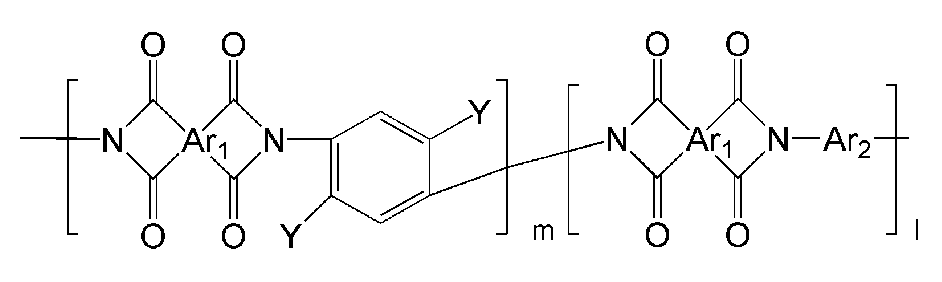


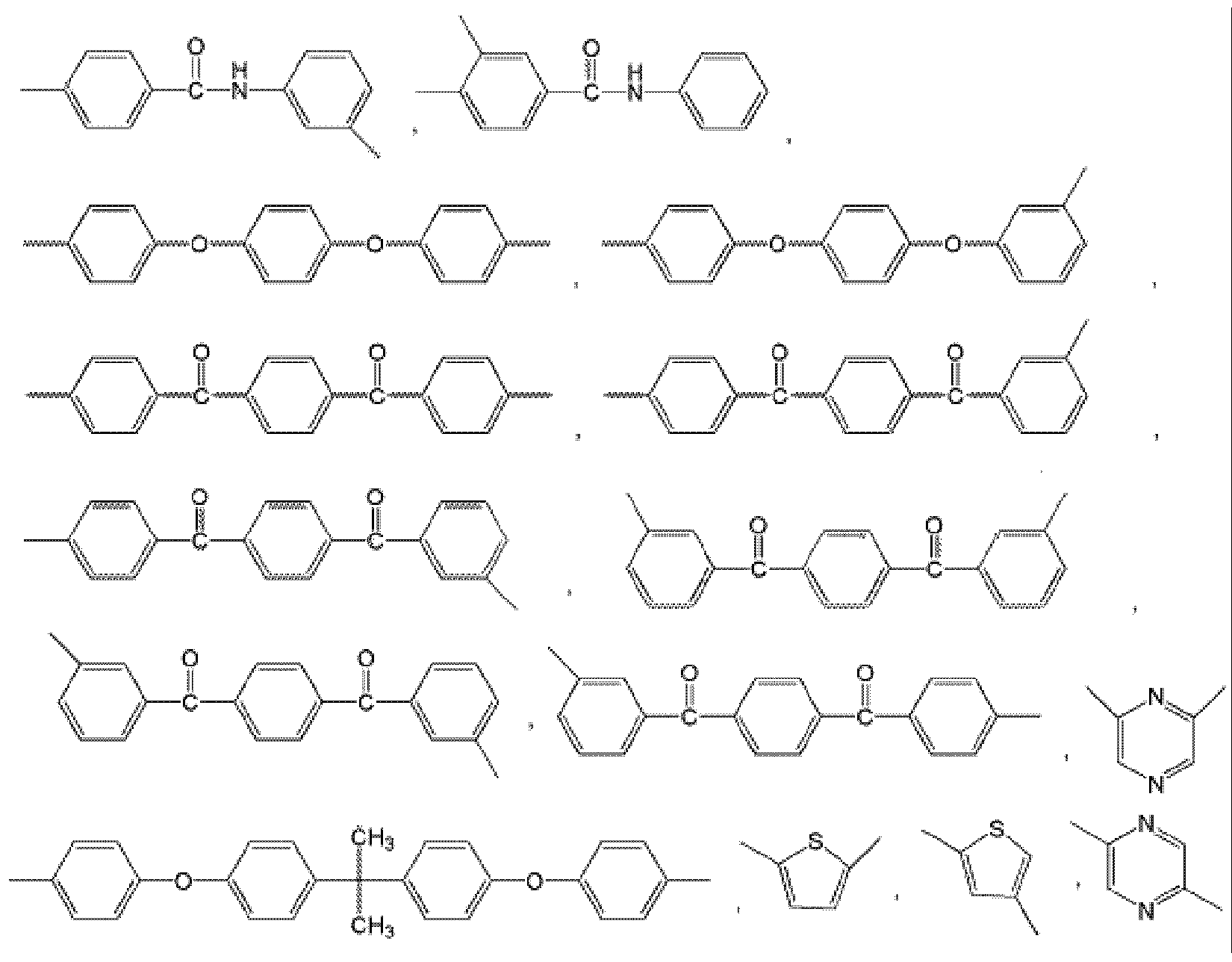
제10항에 있어서, 상기 Ar1은 하기 화학식 A, B 또는 C로 표시되는 작용기이고, 상기 Ar2는 하기 화학식 D 또는 E로 표시되는 작용기이고, 상기 Q는 C(CF3)2인 것인 중공사: [화학식 A]
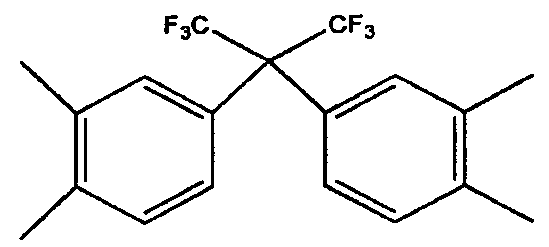
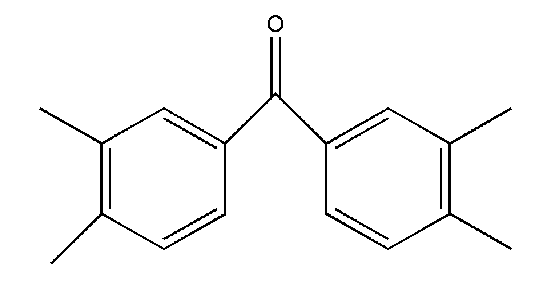


The method of claim 10, wherein Ar 1 is a functional group represented by the following formula A, B or C, Ar 2 is a functional group represented by the following formula D or E, wherein Q is C (CF 3 ) 2 Hollow fiber: [Formula A]


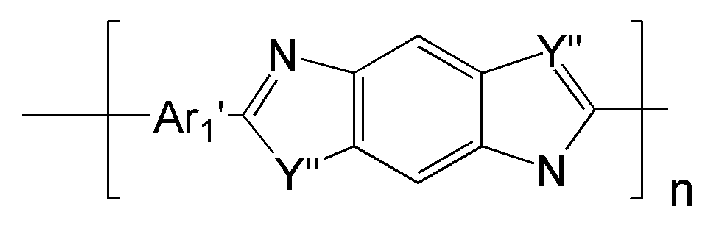


제18항에 있어서, 상기 Ar1은 하기 화학식 A, B 또는 C로 표시되는 작용기이고, 상기 Ar1'는 하기 화학식 F, G 또는 H로 표시되는 작용기이고, 상기 Ar2는 하기 화학식 D 또는 E로 표시되는 작용기이고, 상기 Q는 C(CF3)2인 것인 중공사: [화학식 A]


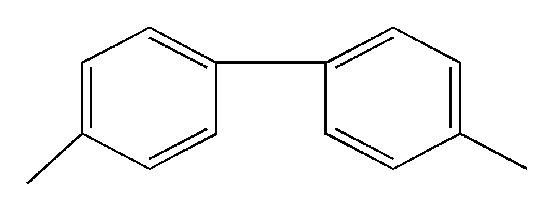
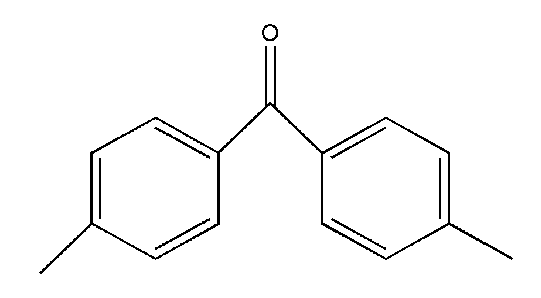
The method according to claim 18, wherein Ar 1 is a functional group represented by the formula A, B or C, Ar 1 ′ is a functional group represented by the formula F, G or H, Ar 2 is a formula D or E Is a functional group represented by, wherein Q is C (CF 3 ) 2 Hollow fiber: [Formula A]


제33항에 있어서, 상기 Ar1은 하기 화학식 A, B 또는 C로 표시되는 작용기이고, 상기 Ar2는 하기 화학식 D 또는 E로 표시되는 작용기이고, 상기 Q는 C(CF3)2인 것인 중공사 형성용 도프 용액 조성물: [화학식 A]


The method of claim 33, wherein Ar 1 is a functional group represented by the formula A, B or C, Ar 2 is a functional group represented by the formula D or E, Q is C (CF 3 ) 2 Dope solution composition for hollow fiber formation: [Formula A]


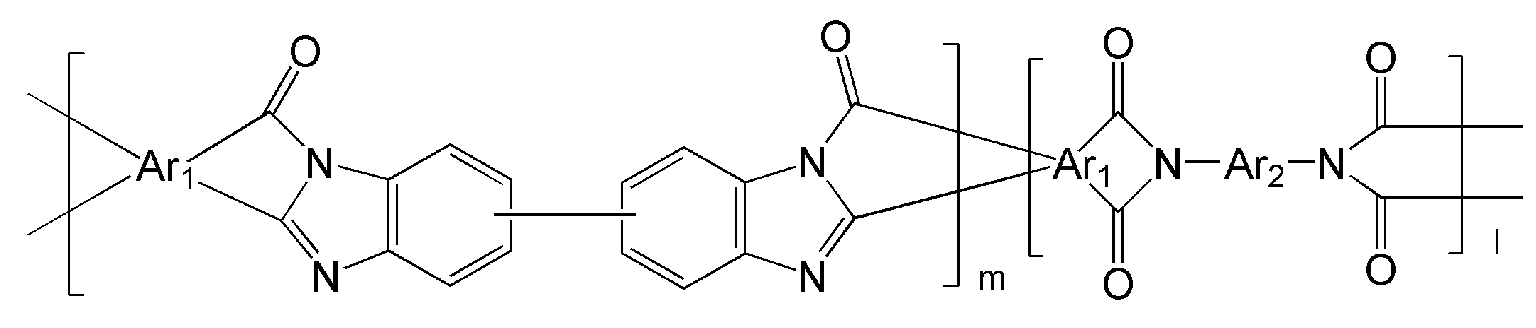




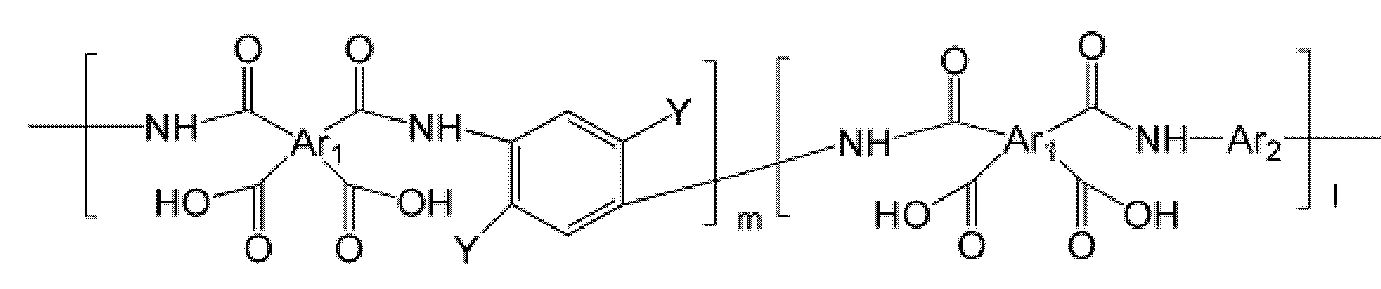
Priority Applications (4)
| Application Number | Priority Date | Filing Date | Title |
|---|---|---|---|
| CN2009801281372A CN102099512B (en) | 2008-05-19 | 2009-05-19 | Hollow fiber, dope solution composition for forming a hollow fiber, and method for manufacturing a hollow fiber using the same |
| JP2011510422A JP5265763B2 (en) | 2008-05-19 | 2009-05-19 | Hollow fiber, dope solution composition for forming hollow fiber, and method for producing hollow fiber using the same |
| EP09750756.0A EP2281926B1 (en) | 2008-05-19 | 2009-05-19 | Hollow fiber and method for manufacturing a hollow fiber |
| MX2010012599A MX2010012599A (en) | 2008-05-19 | 2009-05-19 | Hollow fiber, dope solution composition for forming a hollow fiber, and method for manufacturing a hollow fiber using the same. |
Applications Claiming Priority (4)
| Application Number | Priority Date | Filing Date | Title |
|---|---|---|---|
| KR20080046127 | 2008-05-19 | ||
| KR10-2008-0046127 | 2008-05-19 | ||
| KR2008002863 | 2008-05-22 | ||
| KRPCT/KR2008/002863 | 2008-05-22 |
Publications (2)
| Publication Number | Publication Date |
|---|---|
| WO2009142434A2 true WO2009142434A2 (en) | 2009-11-26 |
| WO2009142434A3 WO2009142434A3 (en) | 2010-03-04 |
Family
ID=41340677
Family Applications (1)
| Application Number | Title | Priority Date | Filing Date |
|---|---|---|---|
| PCT/KR2009/002645 Ceased WO2009142434A2 (en) | 2008-05-19 | 2009-05-19 | Hollow fiber, dope solution composition for forming a hollow fiber, and method for manufacturing a hollow fiber using the same |
Country Status (6)
| Country | Link |
|---|---|
| EP (1) | EP2281926B1 (en) |
| JP (1) | JP5265763B2 (en) |
| CN (1) | CN102099512B (en) |
| MX (1) | MX2010012599A (en) |
| RU (1) | RU2465380C2 (en) |
| WO (1) | WO2009142434A2 (en) |
Cited By (6)
| Publication number | Priority date | Publication date | Assignee | Title |
|---|---|---|---|---|
| WO2010041909A3 (en) * | 2008-10-09 | 2010-07-15 | 한양대학교 산학협력단 | Polymer and preparation method thereof |
| US8013103B2 (en) | 2008-10-10 | 2011-09-06 | Industry-University Cooperation Foundation, Hanyang University | Polymer compounds and a preparation method thereof |
| WO2011087344A3 (en) * | 2010-01-18 | 2012-02-02 | 한양대학교 산학협력단 | Porous support, and polymer electrolyte membrane for a fuel cell comprising same |
| US8163071B2 (en) | 2008-05-19 | 2012-04-24 | Iucf-Hyu (Industry-University Cooperation Foundation Hanyang University) | Hollow fiber, dope composition for forming hollow fiber, and method of preparing hollow fiber using the same |
| US8487064B2 (en) | 2008-10-10 | 2013-07-16 | Industry-University Cooperation Foundation, Hanyang University | Polymer compounds and a preparation method thereof |
| US8821617B2 (en) | 2008-02-28 | 2014-09-02 | Industry-University Cooperation Foundation, Hanyang University | Polyimide-co-polybenzoxazole copolymer, preparation method thereof, and gas separation membrane comprising the same |
Families Citing this family (12)
| Publication number | Priority date | Publication date | Assignee | Title |
|---|---|---|---|---|
| CN102187023B (en) * | 2008-10-17 | 2014-07-09 | 索维高级聚合物股份有限公司 | Fibers or foils from high Tg polymers and methods for their manufacture |
| WO2012148360A1 (en) * | 2011-04-29 | 2012-11-01 | National University Of Singapore | Cardo-polybenzoxazole polymer/copolymer membranes for improved permeability and method for fabricating the same |
| CN102560894A (en) * | 2011-11-17 | 2012-07-11 | 江西先材纳米纤维科技有限公司 | Production method of polybenzoxazole nanofiber nonwoven fabric and its application |
| US8753426B2 (en) * | 2012-08-03 | 2014-06-17 | Air Products And Chemicals, Inc. | Polymers, polymer membranes and methods of producing the same |
| US9751985B2 (en) * | 2013-06-06 | 2017-09-05 | King Abdullah University Of Science And Technology | Triptycene-based dianhydrides, polyimides, methods of making each, and methods of use |
| EP3010630B1 (en) * | 2013-06-21 | 2022-03-09 | Evonik Fibres GmbH | Method for manufacturing polyimide membranes |
| US9440197B2 (en) | 2013-07-01 | 2016-09-13 | ICUF-HYU (Industry-University Cooperation Foundation Hanyang University) | Crosslinked thermally rearranged poly(benzoxazole-co-imide), gas separation membranes comprising the same and preparation method thereof |
| KR101552517B1 (en) * | 2013-07-01 | 2015-09-11 | 한양대학교 산학협력단 | Crosslinked thermally rearranged poly(benzoxazole-co-imide), gas separation membranes comprising the same and preparation method thereof |
| KR101571393B1 (en) * | 2013-09-26 | 2015-11-24 | 한양대학교 산학협력단 | Thermally rearranged poly(benzoxazole-co-imide) separation membrane for membrane distillation and preparation method thereof |
| BR112016007089A2 (en) * | 2013-09-30 | 2020-05-12 | Georgia Tech Res Inst | ASYMMETRIC MODIFIED CARBON MOLECULAR SIEVE FIBER MEMBRANES WITH IMPROVED PERMEABILITY |
| CN106795285B (en) * | 2014-10-10 | 2020-06-05 | 东丽株式会社 | Polyimide solution, heat-resistant nonwoven fabric and method for producing the same |
| CN114130202B (en) * | 2021-12-15 | 2023-03-14 | 中国科学院长春应用化学研究所 | Microporous filter membrane and preparation method thereof |
Citations (7)
| Publication number | Priority date | Publication date | Assignee | Title |
|---|---|---|---|---|
| US3133132A (en) | 1960-11-29 | 1964-05-12 | Univ California | High flow porous membranes for separating water from saline solutions |
| US4717393A (en) | 1986-10-27 | 1988-01-05 | E. I. Du Pont De Nemours And Company | Polyimide gas separation membranes |
| US4851505A (en) | 1988-04-13 | 1989-07-25 | E. I. Du Pont De Nemours And Company | Highly soluble aromatic polyimides |
| US4880442A (en) | 1987-12-22 | 1989-11-14 | E. I. Du Pont De Nemours And Company | Polyimide gas separation membranes |
| US4912197A (en) | 1987-08-14 | 1990-03-27 | E. I. Du Pont De Nemours And Company | Highly soluble clear polyimides |
| KR20020015749A (en) | 2000-08-23 | 2002-03-02 | 하성용 | Membrane Formation by dual quenched method |
| WO2005007277A1 (en) | 2003-07-18 | 2005-01-27 | UNIVERSITé LAVAL | Solvent resistant asymmetric integrally skinned membranes |
Family Cites Families (18)
| Publication number | Priority date | Publication date | Assignee | Title |
|---|---|---|---|---|
| JPH01159024A (en) * | 1987-12-16 | 1989-06-22 | Central Glass Co Ltd | Gas separation membrane |
| JPH07121343B2 (en) * | 1990-03-15 | 1995-12-25 | 宇部興産株式会社 | Gas separation hollow fiber membrane and method for producing the same |
| EP0525113A4 (en) * | 1990-04-20 | 1993-04-21 | The Dow Chemical Company | Porous polybenzoxazole and polybenzothiazole membranes |
| US5558936A (en) * | 1991-08-01 | 1996-09-24 | Hoechst Celanese Corp | High selectivity hollow fibers |
| US5605627A (en) * | 1992-10-07 | 1997-02-25 | Minntech Corporation | Dialysate filter including an asymmetric microporous, hollow fiber membrane incorporating a polyimide |
| US5591250A (en) * | 1993-08-09 | 1997-01-07 | Gas Research Institute | Material and process for separating carbon dioxide from methane |
| FR2710549B1 (en) * | 1993-09-27 | 1996-06-21 | Inst Francais Du Petrole | High selectivity asymmetric membranes for the separation of gases and a process for their production. |
| JP2828001B2 (en) * | 1995-01-11 | 1998-11-25 | 財団法人韓國化學研究所 | Asymmetric hollow fiber membrane for water / organic solvent separation or gas separation and method for producing the same |
| JPH08243367A (en) * | 1995-03-13 | 1996-09-24 | Dainippon Ink & Chem Inc | Method for manufacturing polyimide composite film |
| US5635067A (en) * | 1995-03-14 | 1997-06-03 | Praxair Technology, Inc. | Fluid separation membranes prepared from blends of polyimide polymers |
| JP3361655B2 (en) * | 1995-05-10 | 2003-01-07 | エヌオーケー株式会社 | Porous ceramics composite hollow fiber membrane and method for producing the same |
| US5725769A (en) * | 1995-07-18 | 1998-03-10 | Bend Research, Inc. | Solvent-resistant microporous polymide membranes |
| US5753008A (en) * | 1995-07-12 | 1998-05-19 | Bend Research, Inc. | Solvent resistant hollow fiber vapor permeation membranes and modules |
| US6383258B1 (en) * | 2000-12-19 | 2002-05-07 | L'air Liquide Societe Anonyme Pour L'etude Et L'exploitation Des Procedes Georges Claude | Copolyimide gas separation membranes |
| JP3698078B2 (en) * | 2001-07-16 | 2005-09-21 | 宇部興産株式会社 | Method for producing asymmetric hollow fiber gas separation membrane |
| US20060011063A1 (en) * | 2004-07-16 | 2006-01-19 | Honeywell International Inc. | High temperature gas separation membrane suitable for OBIGGS applications |
| JP5061337B2 (en) * | 2005-10-21 | 2012-10-31 | 森村興産株式会社 | Fiber filtration membrane |
| JP4858160B2 (en) * | 2006-12-25 | 2012-01-18 | 宇部興産株式会社 | Gas separation membrane and method of using the same |
-
2009
- 2009-05-19 WO PCT/KR2009/002645 patent/WO2009142434A2/en not_active Ceased
- 2009-05-19 MX MX2010012599A patent/MX2010012599A/en active IP Right Grant
- 2009-05-19 JP JP2011510422A patent/JP5265763B2/en not_active Expired - Fee Related
- 2009-05-19 RU RU2010149305/04A patent/RU2465380C2/en active
- 2009-05-19 EP EP09750756.0A patent/EP2281926B1/en not_active Not-in-force
- 2009-05-19 CN CN2009801281372A patent/CN102099512B/en not_active Expired - Fee Related
Patent Citations (7)
| Publication number | Priority date | Publication date | Assignee | Title |
|---|---|---|---|---|
| US3133132A (en) | 1960-11-29 | 1964-05-12 | Univ California | High flow porous membranes for separating water from saline solutions |
| US4717393A (en) | 1986-10-27 | 1988-01-05 | E. I. Du Pont De Nemours And Company | Polyimide gas separation membranes |
| US4912197A (en) | 1987-08-14 | 1990-03-27 | E. I. Du Pont De Nemours And Company | Highly soluble clear polyimides |
| US4880442A (en) | 1987-12-22 | 1989-11-14 | E. I. Du Pont De Nemours And Company | Polyimide gas separation membranes |
| US4851505A (en) | 1988-04-13 | 1989-07-25 | E. I. Du Pont De Nemours And Company | Highly soluble aromatic polyimides |
| KR20020015749A (en) | 2000-08-23 | 2002-03-02 | 하성용 | Membrane Formation by dual quenched method |
| WO2005007277A1 (en) | 2003-07-18 | 2005-01-27 | UNIVERSITé LAVAL | Solvent resistant asymmetric integrally skinned membranes |
Non-Patent Citations (1)
| Title |
|---|
| See also references of EP2281926A4 |
Cited By (7)
| Publication number | Priority date | Publication date | Assignee | Title |
|---|---|---|---|---|
| US8821617B2 (en) | 2008-02-28 | 2014-09-02 | Industry-University Cooperation Foundation, Hanyang University | Polyimide-co-polybenzoxazole copolymer, preparation method thereof, and gas separation membrane comprising the same |
| US8163071B2 (en) | 2008-05-19 | 2012-04-24 | Iucf-Hyu (Industry-University Cooperation Foundation Hanyang University) | Hollow fiber, dope composition for forming hollow fiber, and method of preparing hollow fiber using the same |
| WO2010041909A3 (en) * | 2008-10-09 | 2010-07-15 | 한양대학교 산학협력단 | Polymer and preparation method thereof |
| US8013103B2 (en) | 2008-10-10 | 2011-09-06 | Industry-University Cooperation Foundation, Hanyang University | Polymer compounds and a preparation method thereof |
| US8232367B2 (en) | 2008-10-10 | 2012-07-31 | Industry-University Cooperation Foundation, Hanyang University | Polymer compounds and a preparation method thereof |
| US8487064B2 (en) | 2008-10-10 | 2013-07-16 | Industry-University Cooperation Foundation, Hanyang University | Polymer compounds and a preparation method thereof |
| WO2011087344A3 (en) * | 2010-01-18 | 2012-02-02 | 한양대학교 산학협력단 | Porous support, and polymer electrolyte membrane for a fuel cell comprising same |
Also Published As
| Publication number | Publication date |
|---|---|
| RU2465380C2 (en) | 2012-10-27 |
| EP2281926B1 (en) | 2018-09-05 |
| JP5265763B2 (en) | 2013-08-14 |
| CN102099512B (en) | 2013-05-15 |
| JP2011523683A (en) | 2011-08-18 |
| EP2281926A2 (en) | 2011-02-09 |
| RU2010149305A (en) | 2012-06-27 |
| MX2010012599A (en) | 2011-04-26 |
| CN102099512A (en) | 2011-06-15 |
| EP2281926A4 (en) | 2011-08-10 |
| WO2009142434A3 (en) | 2010-03-04 |
Similar Documents
| Publication | Publication Date | Title |
|---|---|---|
| WO2009142434A2 (en) | Hollow fiber, dope solution composition for forming a hollow fiber, and method for manufacturing a hollow fiber using the same | |
| WO2009142433A2 (en) | Hollow fiber, dope solution composition for forming a hollow fiber, and method for manufacturing a hollow fiber using the same | |
| WO2010041909A2 (en) | Polymer and preparation method thereof | |
| US4932982A (en) | Copolyimide gas separation membranes derived from substituted phenylene diamines and substituted methylene dianilines | |
| US4880442A (en) | Polyimide gas separation membranes | |
| US4912197A (en) | Highly soluble clear polyimides | |
| US4838900A (en) | Polyimide gas separation membranes | |
| US4932983A (en) | Copolyimide gas separation membranes derived from substituted methylene dianilines and unsubstituted diamines | |
| WO2015183056A1 (en) | Polyimide-based liquid and polyimide-based film produced using same | |
| WO2013133508A1 (en) | Diamine compound having two substituents in asymmetrical structure, and polymer prepared using same | |
| JPS63123420A (en) | Polyimide gas separating film | |
| US5178650A (en) | Polyimide gas separation membranes and process of using same | |
| WO2016175344A1 (en) | Polyimide resin and film using same | |
| WO2016032299A1 (en) | Polyimide preparation method using monomer salt | |
| JPH01263117A (en) | Highly soluble aromatic polyimide | |
| WO2015072692A1 (en) | Thermally rearranged poly(benzoxazole-imide) copolymer having cross-linked structure, gas separation membrane comprising same and preparation method therefor | |
| WO2015182925A1 (en) | Novel diamine synthesis, and liquid crystal alignment agent using same | |
| WO2013172554A1 (en) | Polymer, preparation method thereof, and molded product comprising said polymer | |
| WO2021060752A1 (en) | Polyimide-based film having excellent surface evenness and method for producing same | |
| CA2089062A1 (en) | Ocular lens material | |
| WO2020153771A1 (en) | Diamine compound, and polyimide precursor and polyimide film using same | |
| WO2015072694A1 (en) | Flue gas separation membrane comprising thermally rearranged poly(benzoxazole-imide) copolymer having cross-linked structure, and preparation method therefor | |
| WO2011040760A2 (en) | High polymer desalination membrane comprising a sulfonated poly(arylene ether) copolymer having a cross-linked structure in a chain | |
| WO2015046774A1 (en) | Thermally rearranged poly(benzoxazole-imide) copolymer separation membrane for membrane distillation and preparation method therefor | |
| WO2020130552A1 (en) | Diamine compound, polyimide precursor using same, and polyimide film |
Legal Events
| Date | Code | Title | Description |
|---|---|---|---|
| WWE | Wipo information: entry into national phase |
Ref document number: 200980128137.2 Country of ref document: CN |
|
| 121 | Ep: the epo has been informed by wipo that ep was designated in this application |
Ref document number: 09750756 Country of ref document: EP Kind code of ref document: A2 |
|
| WWE | Wipo information: entry into national phase |
Ref document number: MX/A/2010/012599 Country of ref document: MX |
|
| WWE | Wipo information: entry into national phase |
Ref document number: 2011510422 Country of ref document: JP |
|
| NENP | Non-entry into the national phase |
Ref country code: DE |
|
| WWE | Wipo information: entry into national phase |
Ref document number: 7543/CHENP/2010 Country of ref document: IN |
|
| WWE | Wipo information: entry into national phase |
Ref document number: 2009750756 Country of ref document: EP |
|
| WWE | Wipo information: entry into national phase |
Ref document number: 2010149305 Country of ref document: RU |