WO2009079645A2 - Surgical barriers having adhesion inhibiting properties - Google Patents
Surgical barriers having adhesion inhibiting properties Download PDFInfo
- Publication number
- WO2009079645A2 WO2009079645A2 PCT/US2008/087500 US2008087500W WO2009079645A2 WO 2009079645 A2 WO2009079645 A2 WO 2009079645A2 US 2008087500 W US2008087500 W US 2008087500W WO 2009079645 A2 WO2009079645 A2 WO 2009079645A2
- Authority
- WO
- WIPO (PCT)
- Prior art keywords
- polymeric coating
- flexible substrate
- surgical barrier
- enteric polymer
- surgical
- Prior art date
- Legal status (The legal status is an assumption and is not a legal conclusion. Google has not performed a legal analysis and makes no representation as to the accuracy of the status listed.)
- Ceased
Links
Classifications
-
- A—HUMAN NECESSITIES
- A61—MEDICAL OR VETERINARY SCIENCE; HYGIENE
- A61L—METHODS OR APPARATUS FOR STERILISING MATERIALS OR OBJECTS IN GENERAL; DISINFECTION, STERILISATION OR DEODORISATION OF AIR; CHEMICAL ASPECTS OF BANDAGES, DRESSINGS, ABSORBENT PADS OR SURGICAL ARTICLES; MATERIALS FOR BANDAGES, DRESSINGS, ABSORBENT PADS OR SURGICAL ARTICLES
- A61L15/00—Chemical aspects of, or use of materials for, bandages, dressings or absorbent pads
- A61L15/16—Bandages, dressings or absorbent pads for physiological fluids such as urine or blood, e.g. sanitary towels, tampons
- A61L15/22—Bandages, dressings or absorbent pads for physiological fluids such as urine or blood, e.g. sanitary towels, tampons containing macromolecular materials
- A61L15/225—Mixtures of macromolecular compounds
-
- A—HUMAN NECESSITIES
- A61—MEDICAL OR VETERINARY SCIENCE; HYGIENE
- A61L—METHODS OR APPARATUS FOR STERILISING MATERIALS OR OBJECTS IN GENERAL; DISINFECTION, STERILISATION OR DEODORISATION OF AIR; CHEMICAL ASPECTS OF BANDAGES, DRESSINGS, ABSORBENT PADS OR SURGICAL ARTICLES; MATERIALS FOR BANDAGES, DRESSINGS, ABSORBENT PADS OR SURGICAL ARTICLES
- A61L15/00—Chemical aspects of, or use of materials for, bandages, dressings or absorbent pads
- A61L15/16—Bandages, dressings or absorbent pads for physiological fluids such as urine or blood, e.g. sanitary towels, tampons
- A61L15/22—Bandages, dressings or absorbent pads for physiological fluids such as urine or blood, e.g. sanitary towels, tampons containing macromolecular materials
- A61L15/32—Proteins, polypeptides; Degradation products or derivatives thereof, e.g. albumin, collagen, fibrin, gelatin
-
- A—HUMAN NECESSITIES
- A61—MEDICAL OR VETERINARY SCIENCE; HYGIENE
- A61L—METHODS OR APPARATUS FOR STERILISING MATERIALS OR OBJECTS IN GENERAL; DISINFECTION, STERILISATION OR DEODORISATION OF AIR; CHEMICAL ASPECTS OF BANDAGES, DRESSINGS, ABSORBENT PADS OR SURGICAL ARTICLES; MATERIALS FOR BANDAGES, DRESSINGS, ABSORBENT PADS OR SURGICAL ARTICLES
- A61L15/00—Chemical aspects of, or use of materials for, bandages, dressings or absorbent pads
- A61L15/16—Bandages, dressings or absorbent pads for physiological fluids such as urine or blood, e.g. sanitary towels, tampons
- A61L15/38—Bandages, dressings or absorbent pads for physiological fluids such as urine or blood, e.g. sanitary towels, tampons containing enzymes
-
- A—HUMAN NECESSITIES
- A61—MEDICAL OR VETERINARY SCIENCE; HYGIENE
- A61L—METHODS OR APPARATUS FOR STERILISING MATERIALS OR OBJECTS IN GENERAL; DISINFECTION, STERILISATION OR DEODORISATION OF AIR; CHEMICAL ASPECTS OF BANDAGES, DRESSINGS, ABSORBENT PADS OR SURGICAL ARTICLES; MATERIALS FOR BANDAGES, DRESSINGS, ABSORBENT PADS OR SURGICAL ARTICLES
- A61L24/00—Surgical adhesives or cements; Adhesives for colostomy devices
- A61L24/04—Surgical adhesives or cements; Adhesives for colostomy devices containing macromolecular materials
- A61L24/043—Mixtures of macromolecular materials
-
- A—HUMAN NECESSITIES
- A61—MEDICAL OR VETERINARY SCIENCE; HYGIENE
- A61L—METHODS OR APPARATUS FOR STERILISING MATERIALS OR OBJECTS IN GENERAL; DISINFECTION, STERILISATION OR DEODORISATION OF AIR; CHEMICAL ASPECTS OF BANDAGES, DRESSINGS, ABSORBENT PADS OR SURGICAL ARTICLES; MATERIALS FOR BANDAGES, DRESSINGS, ABSORBENT PADS OR SURGICAL ARTICLES
- A61L31/00—Materials for other surgical articles, e.g. stents, stent-grafts, shunts, surgical drapes, guide wires, materials for adhesion prevention, occluding devices, surgical gloves, tissue fixation devices
- A61L31/04—Macromolecular materials
- A61L31/041—Mixtures of macromolecular compounds
-
- A—HUMAN NECESSITIES
- A61—MEDICAL OR VETERINARY SCIENCE; HYGIENE
- A61L—METHODS OR APPARATUS FOR STERILISING MATERIALS OR OBJECTS IN GENERAL; DISINFECTION, STERILISATION OR DEODORISATION OF AIR; CHEMICAL ASPECTS OF BANDAGES, DRESSINGS, ABSORBENT PADS OR SURGICAL ARTICLES; MATERIALS FOR BANDAGES, DRESSINGS, ABSORBENT PADS OR SURGICAL ARTICLES
- A61L2400/00—Materials characterised by their function or physical properties
- A61L2400/04—Materials for stopping bleeding
Definitions
- Adhesion formation is a well-known complication of many types of surgical procedures, particularly abdominal and bowel surgeries. Adhesion formation typically occurs as a result of the formation of a fibrin clot, which transforms into scar tissue connecting different tissues that are normally separated. Surgical intervention is frequently required in order to eliminate the adhesions, although the adhesions can, and often do, reappear following the surgery.
- the primary objective of adhesion inhibiting barriers is to interrupt the adhesion formation mechanism, which is believed to result from the diffusion of fibrinogen into the space between the tissues subject to surgical trauma, thereby causing the formation of fibrin clots in the space.
- post-surgical adhesions present a major healthcare problem of significant clinical and medical economic relevance.
- Abdominal adhesions are not only the leading cause of small bowel obstruction, but also major sources of infertility and of abdominal and pelvic pain. It has been shown that post-surgical adhesions cause at least about 20% of cases of infertility and about 40% of cases of chronic pelvic pain.
- a successful anti-adhesion formulation should be "biocompatible,” meaning that it has minimal to no medically unacceptable toxic or injurious effect on the biological function of the subject, and “bioabsorbable,” meaning that it can be absorbed by the tissue without a significant amount remaining in the subject as an implant device. It is to be understood that such bioabsorbable materials are broken down by the body, then the resulting products are excreted therefrom by various means, including passage in urine, feces or as carbon dioxide in the breath.
- the formulation should remain in the body for a sufficient period of time to be effective in separating the tissue and preventing adhesions, while being absorbed by the tissue once the danger of adhesion formation has ended, thereby minimizing any long term effects which may result from the use of an implant device.
- Perforation is the second most common complication of peptic ulcer and is often associated with NSAID use especially in the elderly population. See N Zaji, "Laparoscopic Repair of Perforated Peptic Ulcers Versus Conventional Open Surgery," Laparoscopic Hospital, New Delhi, India, July 2007. Approximately 10- 20% of patients with peptic ulcers suffer perforation of the stomach or duodenum, in which a chemical peritonitis develops initially from the gastric and duodenal secretion then bacterial contamination superimposed within hours.
- Helicobacter pylori infection plays a central role in the genesis of peptic ulcer. See Graham, D. Y., "Treatment of peptic ulcers caused by Helicobacter pylori," 328 N Engl J Med 349- 350 (1993).
- 7,198,786 proposes a method of reducing or preventing adhesions which would form in a patient during or after surgery by administering to the wound surface of a patient a fibrinogen solution in an amount of about 0.025 ml fibrinogen/cm 2 to about 0.25 ml fibrinogen/cm 2 of the surface being at risk for developing adhesions.
- fibrinogen in a preparation comprising fibrinogen at a concentration of 20 to 80 mg/ml for the reduction or prevention of post-surgical adhesion formation is also proposed.
- EP 1 ,341 ,561 proposes a layered wound dressing material comprising: a wound facing hydrogel layer and a barrier layer, wherein the barrier layer comprises a pH-sensitive material that is substantially insoluble in water at 25 0 C under acidic conditions, but substantially soluble in water at 25 0 C under neutral or alkaline conditions.
- the hydrogel layer absorbs and is gradually neutralized by wound exudate until its pH rises to a level that causes dissolution of the barrier layer, thereby allowing excess exudate to flow out from the hydrogen layer.
- wound dressings comprising barrier layers and methods of use of such dressings.
- the surgical barrier includes a wound-facing polymeric coating comprising, consisting of, and/or consisting essentially of an enteric polymer, an optional non-enteric polymer and an optional plasticizer; and at least one flexible substrate, the at least one flexible substrate having at least one exterior surface, wherein the polymeric coating is applied to the at least one flexible substrate to substantially cover the at least one exterior surface thereof.
- the enteric polymer may be selected from hydroxy propyl methylcellulose phthalate; hydroxypropyl methyicellulose acetate succinate; enteric acetate derivatives; dimethylcellulose acetate; enteric acrylate derivatives; and derivatives, salts, copolymers, and combinations thereof.
- the enteric acetate derivative is selected from polyvinylacetate phthalate, cellulose acetate butyrate, cellulose acetate trimellitate, cellulose acetate propionate and cellulose acetate phthalate.
- the enteric acrylate derivative may include a polymethacrylate-based polymer selected from (poly-(methacrylic acid) poly(methyl methacrylate) in a ratio of 1 :2; and poly(methacrylic acid) poly(methyl methacrylate) in a ratio of 1 :1.
- the enteric polymer and the optional non- enteric polymer may be present in the polymeric coating in an amount of about 60:40 to about 40:60 by weight.
- the polymeric coating may contain, based upon the total weight of the polymeric coating, from about 30 to about 60 percent of the enteric polymer; from about 30 percent to about 60 percent of the non-enteric polymer; and from about 0 percent to about 40 percent of the plasticizer.
- the at least one substrate which in some forms may be a flexible substrate, may be configured in a planar form, straw-like form, cylindrical form, fibrillar form, filament-like form, or spherical form and may include a plurality of individual substrates.
- the at least one flexible substrate may be selected from film, nonwoven fabric, or woven fabric and is comprised of collagen, oxidized polysaccharides, aliphatic polyester polymers and/or copolymers of one or more monomers selected from the group consisting of D-lactic acid, L-lactic acid, lactide (including L-, D-, meso forms), glycolic acid, glycolide, ⁇ -caprolactone, p- dioxanone, and trimethylene carbonate, and derivatives, salts, and combinations thereof.
- the at least one flexible substrate is comprised of oxidized regenerated cellulose.
- the surgical barrier may have incorporated in or adhered to the polymeric coating a substance selected from blood coagulation factors, stabilizers, fibrinolysis inhibitors, biologic active substances including antibiotics, chemotherapeutics, fibroblastic growth factors, cell growth factors and combinations thereof.
- the polymeric coating may be applied to the at least one flexible substrate by spraying, dipping, or enrobing to encapsulate the at least one flexible substrate.
- the polymeric coating may be applied to the at least one flexible substrate by lamination or coextrusion.
- the non-enteric polymer is selected from hydroxypropylcellulose, methylcellulose, hydroxypropylmethylcellulose, hydroxyethylmethylcellulose, hydroxyethylcellulose, hydroxyethylethylcellulose, cellulose acetate, carboxymethyl cellulose sodium, cellulose butyrate, acetaldehyde dimethylceiluiose acetate and derivatives, salts, copolymers and combinations thereof.
- the polymeric coating comprises a cellulose acetate phthalate and hydroxypropylcellulose
- said at least one flexible substrate comprises oxidized regenerated cellulose
- a method of inhibiting the formation of adhesions in a patient having undergone a surgical procedure comprises, consists of, and/or consists essentially of applying an adhesion inhibiting barrier to an area rendered susceptible to forming adhesions, the adhesion inhibiting barrier surgical barrier including a wound-facing polymeric coating comprising, consisting of, and/or consisting essentially of an enteric polymer, an optional non- enteric polymer and an optional plasticizer; and at least one flexible substrate, the at least one flexible substrate having at least one exterior surface, wherein the polymeric coating is applied to the at least one flexible substrate to substantially cover the at least one exterior surface thereof.
- a method of repairing perforations comprising, consisting of, and/or consisting essentially of: closing the perforation with a surgical barrier in the form of a patch, the surgical barrier comprising, consisting of, and/or consisting essentially of: i) a polymeric coating comprising an enteric polymer, an optional non-enteric polymer and an optional plasticizer; and ii) at least one flexible substrate, the at least one flexible substrate having at least one exterior surface, wherein the polymeric coating is applied to the at least one flexible substrate to substantially cover the at least one exterior surface thereof.
- substantially covered shall mean that greater than about 50%, that is, for example, greater than about 60%, greater than about 70%, greater than about 80%, greater than about 90%, greater than about 95%, greater than about 97%, or greater than about 99% percent of an exterior surface area is covered.
- enteric shall mean being able to be dissolved at a pH greater than that of the stomach (about 1.5 to about 3.0 pH), that is, for example, at a pH of greater than about 3.0 or greater than about 5.0 or greater than about 5.5 or greater than about 6.0 or that which is found in the intestines, that is, for example, greater than about 7.0, or that which is found in the small intestine duodenum, that is, for example, about 5.0 to about 6.0 pH, or that which is found in the large intestine Cecum and colon, that is, for example, about 5.5 to about 7.0 pH.
- Vandamme, T. "The Use of Polysaccharides to Target Drugs to the Colon," 48 Car Poly 219-231 (2002).
- the surgical barrier includes a polymeric coating comprising an enteric polymer, an optional non-enteric polymer and an optional plasticizer; and at least one substrate, which may be a flexible substrate, the at least one substrate having at least one exterior surface, wherein the polymeric coating is applied to the at least one flexible substrate to substantially cover the at least one exterior surface thereof.
- the polymeric coating which faces the wound, serves as an adhesion-inhibiting layer.
- enteric components include, but are not limited to, hydroxypropyl methylcellulose phthalate; hydroxypropyl methylcellulose acetate succinate; enteric acetate derivatives including, but not limited to, polyvinylacetate phthalate, cellulose acetate phthalate ("CAP"), cellulose acetate propionate, cellulose acetate butyrate, cellulose acetate trimellitate; and enteric acrylate derivatives including, but not limited to, polymethacrylate-based polymers such as poly(methacrylic acid) poly(methyl methacrylate) in a ratio of 1 :2 (commercially available from Rohm Pharma GmbH under the trademark Eudragit ® S 100, Eudragit ® L1000, Eudragit ® L-30D, Eudragit ® FS30D, and Eudragit ® L 100-55) and poly(methacrylic acid-) poly(methyl methacrylate) in a ratio of 1 :1 (commercially available from Rohm Pharma GmbH under the trademark,
- a plasticizer may be added to the polymeric coating in an amount, based upon the total weight of the polymeric coatings, from about 1 percent to about 35 percent.
- suitable plasticizers include, but are not limited to, polyethylene glycol; propylene glycol; glycerin; sorbitol; triethyl citrate; thbutyl citrate; dibutyl sebecate; diethylphthalate, dimethyl phthalate triacetin, glyceryl triacetate, tripropionin, glycerin vegetable oils, such as castor oil, rape oil, olive oil, and sesame oil; surfactants such as polysorbates, sodium lauryl sulfates, and dioctyl-sodium sulfosuccinates; mono acetate of glycerol; diacetate of glycerol; triacetate of glycerol; natural gums; triace
- the polymeric coating may also comprise additional, non- enteric components including, but not limited to, hydroxypropylcellulose ("HPC”), methylcellulose (“MC”), hydroxypropylmethylcellulose (“HPMC”), hydroxyethyimethylcellulose (“HEMC”), hydroxyethylcellulose (“HEC”) hydroxyethylethylcellulose (“HEEC”), cellulose acetate, carboxymethyl cellulose sodium, cellulose butyrate, acetaldehyde dimethylcellulose acetate, and derivatives, salts, copolymers and combinations thereof.
- HPC hydroxypropylcellulose
- MC methylcellulose
- HPMC hydroxypropylmethylcellulose
- HPMC hydroxyethyimethylcellulose
- HEC hydroxyethylcellulose
- HEEC hydroxyethylethylcellulose
- cellulose acetate carboxymethyl cellulose sodium, cellulose butyrate, acetaldehyde dimethylcellulose acetate, and derivatives, salts, copolymers and combinations thereof.
- the adhesion inhibiting polymeric coating includes a blend of cellulose acetate phthalate and HPC.
- the weight ratio of the enteric component and the non- enteric component in the polymeric coating may range from about 60:40 to about 40:60, or about 50:50.
- the adhesion inhibiting polymeric coating may be comprised of, based upon the total dry weight of the adhesion inhibiting polymeric coating, from about 30 to about 60 percent or from about 40 percent to about 50 percent of enteric component; from about 30 percent to about 60 percent or from about 40 percent to about 50 percent of a non-enteric cellulosic component; and from about 0 percent to about 40 percent or from about 1 percent to about 35 percent of plasticizer.
- the average molecular weight of the HPC may be greater than about 140,000, or greater than or equal to about 360,000 or greater than or equal to about 370,000.
- the polymeric coating can also be used as a carrier for active components known in the art, which include but are not limited to hemostatic agents, tissue healing factors and antibacterial material. Examples of such known active components, which include but are not limited to blood coagulation factors; stabilizers; fibrinolysis inhibitors; biologic active substances, including antibiotics, chemotherapeutics, fibroblastic growth factors, and cell growth factors; and combinations thereof may be dispersed within the polymeric coating or applied to the face of the polymeric coating.
- Active components contemplated herein further include those selected from the group consisting of albumin, ancrod, batroxobin, ecarin, elastin, epinephrine, Factor X/Xa, Factor VII ⁇ /lla, Factor IX/IXa, Factor Xl/Xla, Factor Xll/Xlla, calcium chloride fibrin, ficolin, fibronectin, gelatin, globin, haptoglobin, hemoglobin, heparinase, inhibin, insulin, interleukin, lamininthrombin, platelet surface glycoproteins, prothrombin, selectin, transferin, von Willebrand Factor, vasopressin, vasopressin analogs, procoagulant venom, platelet activating agents and synthetic peptides having hemostatic activity.
- these active components may be used in combination, as those skilled in the art will plainly understand.
- the at least one substrate suitable for use in the surgical barrier device disclosed herein may be in any shape or size that may suitably be substantially covered by the polymeric coating.
- the substrate may be planar, straw- like, cylindrical, fibrillar, filament-like, or spherical in shape.
- the at least one substrate may be comprised of a plurality of the substrates, which may be the same or differ with respect to composition, thickness, etc., as those skilled in the art will plainly understand.
- the at least one substrate which may be a flexible substrate, includes a first exterior surface having a first polymeric coating thereon and a second exterior surface having an optional second polymeric coating thereon.
- incorporated in or adhered to the first polymeric coating is a first substance selected from blood coagulation factors, stabilizers, fibrinolysis inhibitors, biologic active substances including antibiotics, chemotherapeutics, fibroblastic growth factors, cell growth factors and combinations thereof
- incorporated in or adhered to the second polymeric coating is a second substance selected from blood coagulation factors, stabilizers, fibrinolysis inhibitors, biologic active substances including antibiotics, chemotherapeutics, fibroblastic growth factors, cell growth factors and combinations thereof, wherein the first substance is independent of the second substance.
- the first polymeric coating and the second polymeric coating are comprised of cellulose acetate phthalate and the at least one flexible substrate is comprised of oxidized regenerated cellulose.
- the polymeric coatings may be applied to the at least one substrate by spraying, dipping, enrobing, lamination, or coextrusion to encapsulate the at least one substrate.
- the first and second polymeric coatings may differ with respect to composition, concentration, thickness, method of application, pH sensitivity, molecular weight, etc., as those skilled in the art will plainly understand.
- planar substrates may in the form of a film or a fabric.
- fabrics include, but are not limited to, a nonwoven, a woven, a knit, a matte, a batt, or a crimp.
- the polymeric coating shields at least one surface of the at least one substrate from acidic moieties that may be present in the substrate, for example in the case where carboxylic-oxidized cellulose is used as the fabric.
- the substrate may be comprised of components selected from collagen, oxidized polysaccharides, aliphatic polyester polymers and/or copolymers of one or more monomers selected from the group consisting of D-lactic acid, L-lactic acid, lactide (including L-, D-, meso forms), glycolic acid, glycolide, ⁇ -caprolactone, p- dioxanone, and trimethylene carbonate, and mixtures or blends thereof.
- the substrate may be comprised of oxidized polysaccharides, in particular oxidized cellulose and the neutralized derivatives thereof.
- the cellulose may be carboxylic-oxidized or aldehyde-oxidized cellulose.
- oxidized regenerated polysaccharides including, but without limitation, oxidized regenerated cellulose may be used to prepare the second absorbable woven or knitted fabric. Regenerated cellulose possesses a higher degree of uniformity versus cellulose that has not been regenerated. Regenerated cellulose and a detailed description of how to make oxidized regenerated cellulose are set forth in U.S. Patent No. 3,364,200, U.S. Patent No. 5,180,398 and U.S. Patent No.
- fabrics that may be utilized include, but are not limited to, Interceed ® absorbable adhesion barrier, Surgicel ® absorbable hemostat; Surgicel Nu-Knit ® absorbable hemostat; and Surgicel ® Fibrillar absorbable hemostat; each available from Johnson & Johnson Wound Management Worldwide or Gynecare Worldwide, each a division of Ethicon, Inc., Somerville, New Jersey.
- U.S. Patent 5,007,916 discloses the aforementioned Interceed ® absorbable adhesion barrier and methods for making same, the contents of which are hereby incorporated by reference for all that they disclose.
- the substrate may alternatively, or additionally, be comprised of a film or fabric of aliphatic polyester polymers, copolymers, or blends thereof.
- the aliphatic polyesters are typically synthesized in a ring opening polymerization of monomers including, but not limited to, lactide (including L-, and D-, meso forms), glycolic acid, glycolide, ⁇ -caprolactone, p-dioxanone (1 ,4-dioxan-2- one), and trimethylene carbonate (1 ,3-dioxan-2-one).
- the aliphatic polyesters in some cases, can be made by polycondensation of for instance, D-lactic acid, L-lactic acid and/or glycolic acid.
- the fabric comprises a copolymer of glycolide and lactide, in an amount ranging from about 70 to 95% by molar basis of glycolide and the remainder lactide.
- the substrate may also comprise an oxidized regenerated cellulose/ polypropylene/polydiaxanone (PDS) mesh, commercially available from Ethicon, Inc. under the tradename, Proceed ® .
- PDS oxidized regenerated cellulose/ polypropylene/polydiaxanone
- U.S. Patent Publication Nos. 2005/0113849A1 and 2008/0071300A 1 disclose the aforementioned Proceed ® oxidized regenerated cellulose/ polypropylene/PDS mesh substrate and methods for making same, the contents of which are hereby incorporated by reference for all that they disclose.
- both exterior surfaces of the oxidized regenerated cellulose/ polypropylene/PDS mesh may be substantially coated with the polymeric coating, and in another form only one exterior surface of this substrate may be substantially coated with the polymeric coating.
- the film or fabric used to form the substrate may be comprised of aliphatic polyester polymers, copolymers, or blends thereof alone or in combination with oxidized polys
- the substrate may be comprised of one or more layers, wherein at least one layer is comprised of the aforementioned components suitable for the substrate layer.
- the thickness of the at least one substrate may vary depending upon, for example, _the non woven technique used, the coating technique used, etc., but typically may range from about 200 ⁇ m to about 600 ⁇ m or about 250 ⁇ m to about 550 ⁇ m.
- the surgical barrier may be comprised of, based upon the total weight of the barrier, from about 65 percent to about 10 percent, e.g., from about 50 percent to about 30 percent of the polymeric coating and from about 35 percent to about 90 percent, e.g., from about 50 percent to about 70 percent of the substrate.
- the fabric may be made weaving, knitting, matteing, spunlaid (meltblown, flashspun, spunbounding), wetlaid, drylaid or short fiber airlaid or known methods for making nonwovens.
- the fabric utilized in the present invention may be woven or knitted, for example, as described in U.S. Patent No. 4,626,253, U.S. Patent No. 5,002,551 and U.S. Patent No. 5,007,916, the contents of which are hereby incorporated by reference herein as if set forth in its entirety.
- the fabric utilized in the present invention may be non-woven, for example, as described in U.S. Patent Publication No. 2006/0258995 A1 , the contents of which are hereby incorporated by reference herein in their entirety.
- a method of inhibiting i.e., reducing or preventing, the formation of adhesions in a patient having undergone a surgical procedure.
- the method includes the step of applying an adhesion inhibiting barrier to an area rendered susceptible to forming adhesions, the adhesion inhibiting surgical barrier including a wound-facing polymeric coating comprising an enteric polymer, an optional non-enteric polymer and an optional plasticizer; and at least one flexible substrate, the at least one flexible substrate having at least one exterior surface, wherein the polymeric coating is applied to the at least one flexible substrate to substantially cover the at least one exterior surface thereof.
- the barrier is comprised of, for example, an ORC substrate with at least one layer of cellulose acetate phthalate that is translucent in nature, inspection of the trauma site beneficially can be enabled.
- an adhesion barrier should not dissolve in the first few days, but should rather stay on the organ being treated for at least three or more days.
- a polymeric coating of the types disclosed herein onto a substrate such as oxidized regenerated cellulose (ORC)
- ORC oxidized regenerated cellulose
- an adhesion barrier should stay in place to be efficacious.
- the resultant surgical barrier disclosed herein provides a higher propensity to stay in place relative to an enteric film alone.
- the resultant adhesion barrier possesses improved handling characteristics.
- surgeons desire a barrier that retains its structure during application, so that it can be easily placed in the affected area. It has been observed that, for example, an ORC matrix typically becomes a limp gelatinous material in less than about one minute when exposed to body fluids.
- the barriers disclosed herein possess improved handling characteristics over such matrices alone.
- many mesh-type materials are not recommended for use in a bloody field due to concern that, when wetted with blood, the mesh may serve to induce adhesion formation rather than reduce their occurrence.
- the adhesion inhibiting barriers disclosed herein can be immersed in a pool of blood without inducing adhesion formation.
- the adhesion inhibiting barriers disclosed herein are also suitable for treating ulcerated areas of the digestive tract.
- the barrier may be applied directly to the desired surface location of the ulcerated area such that the polymeric coating faces the ulcerated area.
- the surgical barriers disclosed herein are suitable in repairing gastric or duodenal perforations.
- a method of repairing a gastric or duodenal perforation comprising closing the perforation with a surgical barrier in the form of a patch, the surgical barrier comprising: i) a polymeric coating comprising an enteric polymer, an optional non-enteric polymer and an optional plasticizer; and ii) at least one flexible substrate, the at least one flexible substrate having at least one exterior surface, wherein the polymeric coating is applied to the at least one flexible substrate to substantially cover the at least one exterior surface thereof.
- an adhesion inhibiting surgical barrier comprising: i) a wound-facing polymeric coating comprising an enteric polymer, an optional non-enteric polymer and an optional plasticizer; and ii) at least one flexible substrate, the at least one flexible substrate having at least one exterior surface, wherein the polymeric coating is applied to the at least one flexible substrate to substantially cover the at least one exterior surface thereof.
- the substrate is planar
- the substrate is substantially covered on one or both of its planar exterior surfaces with the polymeric coating.
- the substrate may be encapsulated with the polymeric coating.
- the polymeric coating can be applied to the substrate by a number of techniques or a combination of techniques.
- the wound-facing polymeric coating formulation prior to the formation of the polymeric coating, is liquid in nature, allowing the substrate to be coated with the polymeric coating by spraying, dipping, brushing or pouring the polymeric coating onto the surface of the substrate. As the organic solvent evaporates the formulation transforms from a gel consistency to a film.
- the polymeric coating is applied to the substrate as a gel, or with greater organic solvent evaporation, as a paste.
- the polymeric coating is applied to the substrate in the form of a film via, for example, lamination, encasing, injection molding, and the like.
- the polymeric coatings may be applied to the substrate via any other suitable method known in the art.
- suitable coating methods include high sheer granulation, fluid bed granulation, e.g. rotor granulation, fluid bed coating, wurster coating, coaccervation, spray drying, spray congealing, and the like and are described in, for example, Pharmaceutical Dosage Forms: Tablets Volume 3, edited by Herbert A. Lieberman and Leon Lachman, Chapters 2, 3, and 4 (1982). .
- the weight gain of the substrate after the addition of the polymeric coating thereto is, based upon the dry weight of the substrate alone, from about 10 percent to about 150 percent, e.g., from about 20 percent to about 130 percent or from about 30 percent to about 100 percent , from about 40 to about 80 percent.
- Example 1 Manufacture of CAP Polymeric Coating Formulation
- CAP cellulose acetate phthalate
- HPC hydroxyipropyl cellulose
- a 2 cm x 4.5 cm piece of a multilayered oxidized regenerated cellulose/ polypropylene/polydiaxanone_(PDS) mesh substrate which is commercially available from Ethicon, Inc. under the tradename, "PROCEED,” was immersed in a mixture containing 16 ml of acetone and 24 ml of ethanol under ambient conditions and vortexed at about 3000 rpm for approximately 5 minutes. The resulting substrate was then air-dried under ambient conditions.
- U.S. Patent Publication Nos. 2005/0113849A1 and 2008/0071300A1 disclose methods for making oxidized regenerated cellulose/ polypropylene/PDS mesh substrate, the contents of which are hereby incorporated by reference for such details.
- a piece of the substrate, prepared in accordance with Example 2 was coated with the polymeric coating of Example 1 by immersing the substrate in the polymeric coating mixture under ambient conditions.
- the polymeric coating mixture was spread over the surface of the resulting substrate with a blade.
- the resulting dry weight gain of polymeric coating material on the substrate was, relative to the coated substrate alone, about 50 percent.
- This procedure was repeated with 19 additional pieces of the substrate from Example 2.
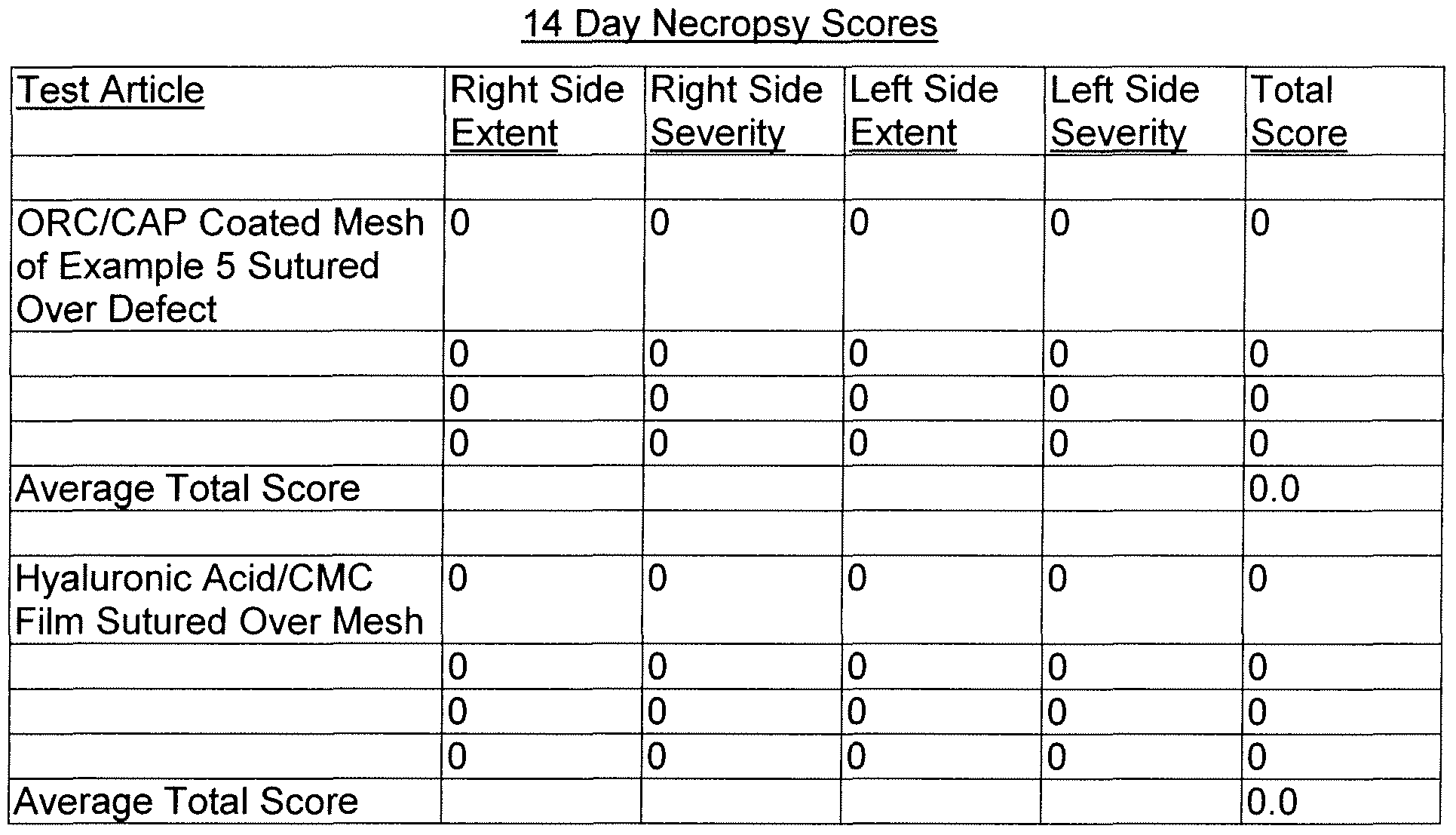
- a 14-day adhesion evaluation study of prototypes in the rabbit sidewall model was conducted to assess the extent and severity of adhesion formation of prototypes when compared to a control.
- a determination of the overall performance of each investigational test article was based on a comparison to the control with respect to the extent of adhesion formation and the severity of adhesion formation.
- test material is considered to be successful when it is shown to be superior to that of the negative control article, which, in this study, was the use of a suture alone.
- the periphery of the defect area was sutured using PROLENE ® polypropylene (4-0) suture in a continuous pattern.
- PROLENE ® polypropylene (4-0) suture in the test article group, a rectangular piece of the test article, approximately 2 x 4.5 cm was sutured over the defect area using a PROLENE ® suture (4-0) in a continuous pattern.
- the abdominal wall midline incision was closed with a simple continuous suture pattern over-sewn by several simple interrupted stitches using coated 3-0 VICRYL ® (Polyglactin 910) suture.
- Subcutaneous tissues were closed with a simple continuous suture pattern using the same suture type.
- the skin was closed with Monocryl 3-0 suture and DERMABOND ® HV Topical skin adhesive.
- Results are presented in Table 1 , wherein each line represents a test preformed with a test article on a single independent animal.
- Seprafilm ® commercially available from Genzyme of Cambridge, MA.
- a 2 cm x 4.5 cm piece of oxidized regenerated cellulose mesh substrate which is commercially available from Ethicon, Inc. under the tradename, "INTERCEED," was coated with the polymeric coating material of Example 1 by pouring the polymeric coating material onto the substrate and evenly distributing the polymeric coating material with a blade under ambient conditions. The polymeric coating mixture was spread over the flip surface of the resulting substrate with a blade. The resulting dry weight gain of polymeric coating material on the substrate was, relative to the dry substrate alone, about 50 percent.
- test material is considered to be successful when it is shown to be superior to that of the negative control article.
- Seprafilm ® commercially available from Genzyme of Cambridge, MA.
- Seprafilm ® commercially available from Genzyme of Cambridge, MA.
- Hyaluronic Acid/CMC 0 0 0 0 0 0 0 0 0 0
- Seprafilm ® commercially available from Genzyme of Cambridge, MA.
- the ORC/CAP coated mesh of Example 5 provided superior adhesion prevention performance when compared to the commercially available hyaluronic acid/CMC film.
- Example 2 An uncoated sample of the substrate of Example 2 was placed in contact within a bloody surgical field. Almost immediately, the substrate was observed to wick-up the blood and turn black in color. For comparison, the procedure was repeated with the coated substrate of Example 3. The coated substrate was observed not to cause the matrix to wet or turn black after a period of greater than 20 minutes.
Landscapes
- Health & Medical Sciences (AREA)
- Animal Behavior & Ethology (AREA)
- Veterinary Medicine (AREA)
- Public Health (AREA)
- General Health & Medical Sciences (AREA)
- Epidemiology (AREA)
- Life Sciences & Earth Sciences (AREA)
- Materials Engineering (AREA)
- Engineering & Computer Science (AREA)
- Chemical & Material Sciences (AREA)
- Hematology (AREA)
- Surgery (AREA)
- Heart & Thoracic Surgery (AREA)
- Vascular Medicine (AREA)
- Materials For Medical Uses (AREA)
- Medicinal Preparation (AREA)
- Prostheses (AREA)
- Surgical Instruments (AREA)
Abstract
Description


Claims
Priority Applications (9)
| Application Number | Priority Date | Filing Date | Title |
|---|---|---|---|
| ES08862267T ES2428000T3 (en) | 2007-12-18 | 2008-12-18 | Surgical barriers that have adhesion inhibitory properties |
| EP08862267.5A EP2219691B1 (en) | 2007-12-18 | 2008-12-18 | Surgical barriers having adhesion inhibiting properties |
| CN200880126007.0A CN101932344B (en) | 2007-12-18 | 2008-12-18 | Anti-adhesion surgical barrier film |
| CA2709464A CA2709464A1 (en) | 2007-12-18 | 2008-12-18 | Surgical barriers having adhesion inhibiting properties |
| MX2010006845A MX2010006845A (en) | 2007-12-18 | 2008-12-18 | Surgical barriers having adhesion inhibiting properties. |
| JP2010539822A JP5587207B2 (en) | 2007-12-18 | 2008-12-18 | Surgical obstacles with adhesion-inhibiting properties |
| BRPI0820804-2A2A BRPI0820804A2 (en) | 2007-12-18 | 2008-12-18 | SURGICAL BARRIERS THAT HAVE ACHIEVEMENT INHIBIT PROPERTIES |
| AU2008338309A AU2008338309A1 (en) | 2007-12-18 | 2008-12-18 | Surgical barriers having adhesion inhibiting properties |
| RU2010129494/15A RU2480246C2 (en) | 2007-12-18 | 2008-12-18 | Surgical barriers having adhesion inhibiting properties |
Applications Claiming Priority (2)
| Application Number | Priority Date | Filing Date | Title |
|---|---|---|---|
| US11/958,796 | 2007-12-18 | ||
| US11/958,796 US8299316B2 (en) | 2007-12-18 | 2007-12-18 | Hemostatic device |
Publications (2)
| Publication Number | Publication Date |
|---|---|
| WO2009079645A2 true WO2009079645A2 (en) | 2009-06-25 |
| WO2009079645A3 WO2009079645A3 (en) | 2010-06-24 |
Family
ID=40524518
Family Applications (2)
| Application Number | Title | Priority Date | Filing Date |
|---|---|---|---|
| PCT/US2008/087493 Ceased WO2009079642A2 (en) | 2007-12-18 | 2008-12-18 | A hemostatic device |
| PCT/US2008/087500 Ceased WO2009079645A2 (en) | 2007-12-18 | 2008-12-18 | Surgical barriers having adhesion inhibiting properties |
Family Applications Before (1)
| Application Number | Title | Priority Date | Filing Date |
|---|---|---|---|
| PCT/US2008/087493 Ceased WO2009079642A2 (en) | 2007-12-18 | 2008-12-18 | A hemostatic device |
Country Status (12)
| Country | Link |
|---|---|
| US (1) | US8299316B2 (en) |
| EP (2) | EP2219690B1 (en) |
| JP (1) | JP5587207B2 (en) |
| KR (1) | KR101600827B1 (en) |
| CN (1) | CN101932344B (en) |
| AU (1) | AU2008338309A1 (en) |
| BR (1) | BRPI0820804A2 (en) |
| CA (1) | CA2709464A1 (en) |
| ES (2) | ES2527949T3 (en) |
| MX (1) | MX2010006845A (en) |
| RU (1) | RU2480246C2 (en) |
| WO (2) | WO2009079642A2 (en) |
Cited By (1)
| Publication number | Priority date | Publication date | Assignee | Title |
|---|---|---|---|---|
| US11760853B2 (en) | 2020-11-30 | 2023-09-19 | Industrial Technology Research Institute | Anti-curling film |
Families Citing this family (18)
| Publication number | Priority date | Publication date | Assignee | Title |
|---|---|---|---|---|
| US8629314B2 (en) * | 2007-12-18 | 2014-01-14 | Ethicon, Inc. | Surgical barriers having adhesion inhibiting properties |
| FR2968564B1 (en) * | 2010-12-13 | 2013-06-21 | Perouse Medical | MEDICAL DEVICE FOR INPUT IN CONTACT WITH TISSUE OF A PATIENT AND ASSOCIATED MANUFACTURING METHOD. |
| LT2713972T (en) | 2011-05-24 | 2017-09-11 | Takeda As | Rolled collagen carrier |
| US20130202675A1 (en) | 2012-02-03 | 2013-08-08 | Dynasil Biomedical Corporation | Systems and methods for the fabrication of tissue patches |
| CN104000652B (en) * | 2013-02-21 | 2018-03-30 | 王世亮 | A kind of absorbent antiseize drug release bag film |
| EP3331577A4 (en) | 2015-08-07 | 2019-07-17 | Xcede Technologies, Inc. | Adhesive compositions and related methods |
| US9833538B2 (en) | 2015-08-07 | 2017-12-05 | Xcede Technologies, Inc. | Adhesive compositions and related methods |
| US9540548B1 (en) | 2015-08-07 | 2017-01-10 | Xcede Technologies, Inc. | Adhesive compositions and related methods |
| JP7143222B2 (en) * | 2016-05-09 | 2022-09-28 | ライフボンド リミテッド | Mesh-based in-situ crosslinkable composition |
| WO2018164358A1 (en) * | 2017-03-07 | 2018-09-13 | (주)진우바이오 | Method for manufacturing hyaluronate film and hyaluronate film manufactured thereby |
| CN108114327A (en) * | 2018-02-07 | 2018-06-05 | 苏州元禾医疗器械有限公司 | A kind of operation biomembrane |
| CN108042856A (en) * | 2018-02-07 | 2018-05-18 | 苏州元禾医疗器械有限公司 | A kind of preparation method of operation biomembrane |
| EP3750487A1 (en) * | 2018-02-08 | 2020-12-16 | Terumo Kabushiki Kaisha | Medical apparatus and adhesion promoting device using same |
| GB2571080A (en) * | 2018-02-14 | 2019-08-21 | Medtrade Products Ltd | Haemostatic material |
| US11826028B2 (en) * | 2020-06-10 | 2023-11-28 | Ethicon, Inc. | Two component sealing systems including synthetic matrices and biosynthetic adhesives for sealing resected surfaces of organs to control bleeding, fluid leaks and air leaks |
| CN115177782B (en) * | 2021-04-02 | 2023-07-18 | 诺一迈尔(山东)医学科技有限公司 | Liquid band-aid with high air permeability and healing promotion function and preparation method thereof |
| CN113288505B (en) * | 2021-04-30 | 2023-02-03 | 中国科学院大学温州研究院(温州生物材料与工程研究所) | PTMC-based intestinal anastomosis stent of bioabsorbable flexible elastomer and preparation method thereof |
| GB2636872A (en) * | 2023-12-29 | 2025-07-02 | Futamura Chemical Uk Ltd | Composition |
Citations (3)
| Publication number | Priority date | Publication date | Assignee | Title |
|---|---|---|---|---|
| EP0275550A1 (en) | 1986-12-24 | 1988-07-27 | Teikoku Seiyaku Kabushiki Kaisha | Adhesive device for application to body tissue |
| GB2393655A (en) | 2002-09-27 | 2004-04-07 | Johnson & Johnson Medical Ltd | Wound treatment device |
| US20040258723A1 (en) | 2001-05-01 | 2004-12-23 | Parminder Singh | Hydrogel compositions demonstrating phase separation on contact with aqueous media |
Family Cites Families (42)
| Publication number | Priority date | Publication date | Assignee | Title |
|---|---|---|---|---|
| US3364200A (en) | 1960-03-28 | 1968-01-16 | Johnson & Johnson | Oxidized cellulose product and method for preparing the same |
| DE3340270A1 (en) | 1983-11-08 | 1985-05-15 | Agfa-Gevaert Ag, 5090 Leverkusen | COLOR PHOTOGRAPHIC RECORDING MATERIAL FOR THE PRODUCTION OF COLORED SUPERVISORS |
| US4626253A (en) | 1984-10-05 | 1986-12-02 | Johnson & Johnson Products, Inc. | Surgical hemostat comprising oxidized cellulose |
| US5002551A (en) | 1985-08-22 | 1991-03-26 | Johnson & Johnson Medical, Inc. | Method and material for prevention of surgical adhesions |
| US5007916A (en) | 1985-08-22 | 1991-04-16 | Johnson & Johnson Medical, Inc. | Method and material for prevention of surgical adhesions |
| US4840626A (en) * | 1986-09-29 | 1989-06-20 | Johnson & Johnson Patient Care, Inc. | Heparin-containing adhesion prevention barrier and process |
| US5180398A (en) | 1990-12-20 | 1993-01-19 | Johnson & Johnson Medical, Inc. | Cellulose oxidation by a perfluorinated hydrocarbon solution of nitrogen dioxide |
| US5900245A (en) | 1996-03-22 | 1999-05-04 | Focal, Inc. | Compliant tissue sealants |
| CA2228118A1 (en) | 1995-07-28 | 1997-02-13 | Focal, Inc. | Multiblock biodegradable hydrogels for use as controlled release agents for drugs delivery and tissue treatments agents |
| US6833408B2 (en) | 1995-12-18 | 2004-12-21 | Cohesion Technologies, Inc. | Methods for tissue repair using adhesive materials |
| US6458889B1 (en) | 1995-12-18 | 2002-10-01 | Cohesion Technologies, Inc. | Compositions and systems for forming crosslinked biomaterials and associated methods of preparation and use |
| PT1704878E (en) | 1995-12-18 | 2013-07-17 | Angiodevice Internat Gmbh | Crosslinked polymer compositions and methods for their use |
| US6500777B1 (en) | 1996-06-28 | 2002-12-31 | Ethicon, Inc. | Bioresorbable oxidized cellulose composite material for prevention of postsurgical adhesions |
| US6541460B2 (en) | 1996-08-07 | 2003-04-01 | George D. Petito | Method for use of hyaluronic acid in wound management |
| US6063061A (en) * | 1996-08-27 | 2000-05-16 | Fusion Medical Technologies, Inc. | Fragmented polymeric compositions and methods for their use |
| US7320962B2 (en) * | 1996-08-27 | 2008-01-22 | Baxter International Inc. | Hemoactive compositions and methods for their manufacture and use |
| US5851579A (en) | 1996-10-28 | 1998-12-22 | Eastman Chemical Company | Aqueous enteric coating compositions |
| ZA987019B (en) | 1997-08-06 | 1999-06-04 | Focal Inc | Hemostatic tissue sealants |
| US6762336B1 (en) | 1998-01-19 | 2004-07-13 | The American National Red Cross | Hemostatic sandwich bandage |
| DE69941498D1 (en) * | 1998-11-12 | 2009-11-12 | Internat Mfg Group Inc | Hemostatic cross-linked dextran beads useful for rapid blood clotting and hemostasis |
| US6312725B1 (en) | 1999-04-16 | 2001-11-06 | Cohesion Technologies, Inc. | Rapid gelling biocompatible polymer composition |
| AU7084300A (en) | 1999-08-27 | 2001-03-26 | Cohesion Technologies, Inc. | Compositions that form interpenetrating polymer networks for use as high strength medical sealants |
| GB2369997B (en) | 2000-12-12 | 2004-08-11 | Johnson & Johnson Medical Ltd | Dressings for the treatment of exuding wounds |
| US6733774B2 (en) | 2001-01-25 | 2004-05-11 | Nycomed Pharma As | Carrier with solid fibrinogen and solid thrombin |
| WO2002087645A1 (en) * | 2001-05-01 | 2002-11-07 | A.V. Topchiev Institute Of Petrochemical Synthesis | Hydrogel compositions |
| US20050113510A1 (en) * | 2001-05-01 | 2005-05-26 | Feldstein Mikhail M. | Method of preparing polymeric adhesive compositions utilizing the mechanism of interaction between the polymer components |
| US20050271737A1 (en) | 2001-06-07 | 2005-12-08 | Chinea Vanessa I | Application of a bioactive agent to a substrate |
| GB2380135B (en) | 2001-09-27 | 2005-01-12 | Johnson & Johnson Medical Ltd | Therapeutic wound dressing |
| US7198786B2 (en) | 2001-10-12 | 2007-04-03 | Baxter International Inc. | Method for the reduction or prevention of post-surgical adhesion formation |
| US7666337B2 (en) | 2002-04-11 | 2010-02-23 | Monosol Rx, Llc | Polyethylene oxide-based films and drug delivery systems made therefrom |
| US20040101546A1 (en) | 2002-11-26 | 2004-05-27 | Gorman Anne Jessica | Hemostatic wound dressing containing aldehyde-modified polysaccharide and hemostatic agents |
| EP1545636B1 (en) | 2002-09-10 | 2015-01-07 | The American National Red Cross | Hemostatic dressing |
| GB2393120A (en) * | 2002-09-18 | 2004-03-24 | Johnson & Johnson Medical Ltd | Compositions for wound treatment |
| CA2513319C (en) | 2003-01-20 | 2013-03-19 | Juridical Foundation The Chemo-Sero-Therapeutic Research Institute | Hemostatic material comprising thrombin, fibrinogen and bioabsorbable synthetic nonwoven fabric |
| WO2005049105A2 (en) * | 2003-11-10 | 2005-06-02 | Angiotech International Ag | Medical implants and anti-scarring agents |
| JP2007513083A (en) * | 2003-11-10 | 2007-05-24 | アンジオテック インターナショナル アーゲー | Medical implants and fiber inducers |
| US20050113849A1 (en) | 2003-11-26 | 2005-05-26 | Nicholas Popadiuk | Prosthetic repair device |
| WO2007024972A2 (en) | 2005-08-22 | 2007-03-01 | Quick-Med Technologies, Inc. | Non-leaching absorbent wound dressing |
| CN101080246A (en) * | 2004-04-28 | 2007-11-28 | 安希奥设备国际有限责任公司 | Compositions and systems for forming crosslinked biomaterials and associated methods of preparation and use |
| US20060258995A1 (en) | 2004-10-20 | 2006-11-16 | Pendharkar Sanyog M | Method for making a reinforced absorbable multilayered fabric for use in medical devices |
| JP4953052B2 (en) * | 2005-03-23 | 2012-06-13 | 株式会社ジェイ・エム・エス | Anti-adhesion film |
| JP5037603B2 (en) | 2006-04-10 | 2012-10-03 | エシコン・インコーポレイテッド | Enhanced absorbent multi-layer hemostatic wound dressing and method of manufacture |
-
2007
- 2007-12-18 US US11/958,796 patent/US8299316B2/en active Active
-
2008
- 2008-12-18 ES ES08861869.9T patent/ES2527949T3/en active Active
- 2008-12-18 BR BRPI0820804-2A2A patent/BRPI0820804A2/en not_active IP Right Cessation
- 2008-12-18 ES ES08862267T patent/ES2428000T3/en active Active
- 2008-12-18 RU RU2010129494/15A patent/RU2480246C2/en not_active IP Right Cessation
- 2008-12-18 WO PCT/US2008/087493 patent/WO2009079642A2/en not_active Ceased
- 2008-12-18 EP EP08861869.9A patent/EP2219690B1/en not_active Not-in-force
- 2008-12-18 KR KR1020107015732A patent/KR101600827B1/en not_active Expired - Fee Related
- 2008-12-18 MX MX2010006845A patent/MX2010006845A/en active IP Right Grant
- 2008-12-18 EP EP08862267.5A patent/EP2219691B1/en not_active Not-in-force
- 2008-12-18 CN CN200880126007.0A patent/CN101932344B/en not_active Expired - Fee Related
- 2008-12-18 WO PCT/US2008/087500 patent/WO2009079645A2/en not_active Ceased
- 2008-12-18 AU AU2008338309A patent/AU2008338309A1/en not_active Abandoned
- 2008-12-18 JP JP2010539822A patent/JP5587207B2/en not_active Expired - Fee Related
- 2008-12-18 CA CA2709464A patent/CA2709464A1/en not_active Abandoned
Patent Citations (3)
| Publication number | Priority date | Publication date | Assignee | Title |
|---|---|---|---|---|
| EP0275550A1 (en) | 1986-12-24 | 1988-07-27 | Teikoku Seiyaku Kabushiki Kaisha | Adhesive device for application to body tissue |
| US20040258723A1 (en) | 2001-05-01 | 2004-12-23 | Parminder Singh | Hydrogel compositions demonstrating phase separation on contact with aqueous media |
| GB2393655A (en) | 2002-09-27 | 2004-04-07 | Johnson & Johnson Medical Ltd | Wound treatment device |
Cited By (1)
| Publication number | Priority date | Publication date | Assignee | Title |
|---|---|---|---|---|
| US11760853B2 (en) | 2020-11-30 | 2023-09-19 | Industrial Technology Research Institute | Anti-curling film |
Also Published As
| Publication number | Publication date |
|---|---|
| CN101932344A (en) | 2010-12-29 |
| KR20100113515A (en) | 2010-10-21 |
| EP2219690A2 (en) | 2010-08-25 |
| KR101600827B1 (en) | 2016-03-08 |
| JP5587207B2 (en) | 2014-09-10 |
| ES2428000T3 (en) | 2013-11-05 |
| US20090156711A1 (en) | 2009-06-18 |
| CN101932344B (en) | 2014-03-26 |
| RU2480246C2 (en) | 2013-04-27 |
| WO2009079642A3 (en) | 2010-05-06 |
| RU2010129494A (en) | 2012-01-27 |
| ES2527949T3 (en) | 2015-02-02 |
| US8299316B2 (en) | 2012-10-30 |
| CA2709464A1 (en) | 2009-06-25 |
| EP2219691B1 (en) | 2013-07-03 |
| BRPI0820804A2 (en) | 2014-11-04 |
| AU2008338309A1 (en) | 2009-06-25 |
| JP2011506049A (en) | 2011-03-03 |
| EP2219691A2 (en) | 2010-08-25 |
| WO2009079645A3 (en) | 2010-06-24 |
| WO2009079642A2 (en) | 2009-06-25 |
| EP2219690B1 (en) | 2014-10-29 |
| MX2010006845A (en) | 2010-08-02 |
Similar Documents
| Publication | Publication Date | Title |
|---|---|---|
| US9238088B2 (en) | Surgical barriers having adhesion inhibiting properties | |
| EP2219691B1 (en) | Surgical barriers having adhesion inhibiting properties | |
| EP1718147B1 (en) | Hemostatic agent for topical and internal use | |
| CN104888263B (en) | Biocompatible hemostatic prevents adhesion, promoting healing, the closed modified starch material of surgery | |
| ES2361540T3 (en) | PROCEDURE FOR MANUFACTURING A HEMOSTATIC BAND FOR WOUNDS. | |
| EP2298363A1 (en) | Novel non-toxic biodegradable biological adhesive for use in abdominal surgery | |
| WO2009018764A1 (en) | An absorbable modified starch hemostatic material and perparation thereof | |
| CN106215217A (en) | Absorbability synthetic substrate for the enhancing of hemostat application | |
| CZ59598A3 (en) | A compound biomaterial for preventing surgical adhesion of the tissue, its use and method | |
| CA2529717A1 (en) | Deployable hemostatic agent | |
| KR101735899B1 (en) | Biodegradable non-woven material for medical purposes | |
| KR20230126734A (en) | Medical devices, hydrogels and their manufacturing methods and applications | |
| Hu et al. | An asymmetric Janus membrane with anti-bacteria adhesion and rapid hemostasis properties for wound healing | |
| JP2009529374A (en) | Bioactive scaffolds for treatment and adhesion prevention | |
| KR20070026578A (en) | Tissue suture | |
| Sun et al. | A Drug-carrying, multi-scene, absorbable biological suture from fish swim bladder | |
| RU2325926C1 (en) | Wound covering for viscera | |
| HK1124268A (en) | Deployable hemostatic agent | |
| HK1102546B (en) | Hemostatic agent for topical and internal use |
Legal Events
| Date | Code | Title | Description |
|---|---|---|---|
| WWE | Wipo information: entry into national phase |
Ref document number: 200880126007.0 Country of ref document: CN |
|
| 121 | Ep: the epo has been informed by wipo that ep was designated in this application |
Ref document number: 08862267 Country of ref document: EP Kind code of ref document: A2 |
|
| WWE | Wipo information: entry into national phase |
Ref document number: 2008338309 Country of ref document: AU |
|
| WWE | Wipo information: entry into national phase |
Ref document number: 2709464 Country of ref document: CA |
|
| WWE | Wipo information: entry into national phase |
Ref document number: 2010539822 Country of ref document: JP Ref document number: 2008862267 Country of ref document: EP |
|
| WWE | Wipo information: entry into national phase |
Ref document number: MX/A/2010/006845 Country of ref document: MX |
|
| NENP | Non-entry into the national phase |
Ref country code: DE |
|
| ENP | Entry into the national phase |
Ref document number: 2008338309 Country of ref document: AU Date of ref document: 20081218 Kind code of ref document: A |
|
| ENP | Entry into the national phase |
Ref document number: 20107015732 Country of ref document: KR Kind code of ref document: A |
|
| WWE | Wipo information: entry into national phase |
Ref document number: 2010129494 Country of ref document: RU |
|
| ENP | Entry into the national phase |
Ref document number: PI0820804 Country of ref document: BR Kind code of ref document: A2 Effective date: 20100617 |