WO2007071730A2 - A method for controlling aquatic weeds - Google Patents
A method for controlling aquatic weeds Download PDFInfo
- Publication number
- WO2007071730A2 WO2007071730A2 PCT/EP2006/070009 EP2006070009W WO2007071730A2 WO 2007071730 A2 WO2007071730 A2 WO 2007071730A2 EP 2006070009 W EP2006070009 W EP 2006070009W WO 2007071730 A2 WO2007071730 A2 WO 2007071730A2
- Authority
- WO
- WIPO (PCT)
- Prior art keywords
- inhibitors
- aquatic weeds
- herbicides
- agriculturally acceptable
- herbicide
- Prior art date
- Legal status (The legal status is an assumption and is not a legal conclusion. Google has not performed a legal analysis and makes no representation as to the accuracy of the status listed.)
- Ceased
Links
Classifications
-
- A—HUMAN NECESSITIES
- A01—AGRICULTURE; FORESTRY; ANIMAL HUSBANDRY; HUNTING; TRAPPING; FISHING
- A01N—PRESERVATION OF BODIES OF HUMANS OR ANIMALS OR PLANTS OR PARTS THEREOF; BIOCIDES, e.g. AS DISINFECTANTS, AS PESTICIDES OR AS HERBICIDES; PEST REPELLANTS OR ATTRACTANTS; PLANT GROWTH REGULATORS
- A01N43/00—Biocides, pest repellants or attractants, or plant growth regulators containing heterocyclic compounds
- A01N43/34—Biocides, pest repellants or attractants, or plant growth regulators containing heterocyclic compounds having rings with one nitrogen atom as the only ring hetero atom
- A01N43/40—Biocides, pest repellants or attractants, or plant growth regulators containing heterocyclic compounds having rings with one nitrogen atom as the only ring hetero atom six-membered rings
- A01N43/42—Biocides, pest repellants or attractants, or plant growth regulators containing heterocyclic compounds having rings with one nitrogen atom as the only ring hetero atom six-membered rings condensed with carbocyclic rings
Definitions
- This invention belongs to the field of agricultural chemistry and provides to the art compounds to control aquatic weeds.
- Such weeds clog waterways, plug up water-handling equipment, and are often aesthetically unacceptable. They are cumbersome for fisherman, swimmers, and watersports.
- the economic impact for control and management in general and on recreational areas in particular is estimated to be in the millions of dollars.
- a typical representative for inventively controlled aquatic weeds is hydrilla that is known as a submersed, very prolific, mat forming species, which can dominate the aquatic system that it is present in. High densities of hydrilla interfere with various water uses.
- a typical representative is Hydrilla verticillata.
- aquatic weeds and herbicidal or biological methods for controlling them are known, for example from L.W.J. Anderson, Pest Manag. Sci. 59, pages 801-813 (online 2003) or M. D. Netherland et al., Outlooks on Pest Management (Pesticide Outlook), pages 100-104 or J. Gallagher and WT. Haller, Rev. Weed Sci., 1990, 5, 115-192.
- One of the major herbicides used for the control of Hydrilla verticillata is fluridone (1- methyl-3-phenyl-5-[3-(trifluoromethyl)phenyl]-4(1 H)-pyridinone). It is known that a number of new biotypes of hydrilla have developed increased tolerance or even resistance to fluridone. Therefore, there is a continuous demand to fur- ther develop efficient herbicides for controlling aquatic weeds in general. Thus, the need for a herbicide to control hydrilla, in particular Hydrilla verticillata, specifically their biotypes being tolerant or resistant to fluridone herbicide is warranted.
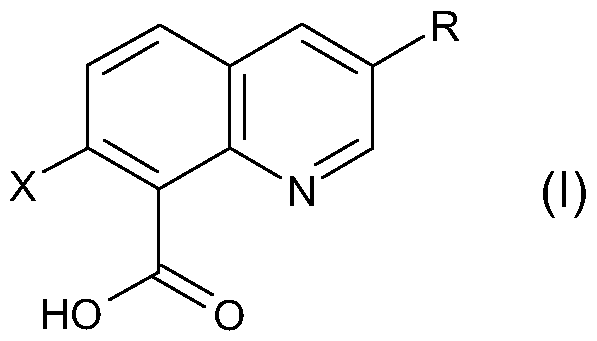
- X is halogen and R is halogen or CrC 6 alkyl, and/or agriculturally acceptable salts thereof, optionally in combination with at least one other herbicide, effectively provide growth suppression or control of submersed aquatic weeds in general and of hydrilla in particular.
- Chinoline derivatives in general, and 3,7-dichloroquinoline-8-carboxylic acid (quin- clorac) and 7-chloro-3-methylquinoline-8-carboxylic acid (quinmerac) in particular, are known herbicides, which are described for example in US 4,497,651 , US 4,632,696 and US 4,715,889.
- Quinclorac is a known herbicide to be used for the protection of grains in general and of rice in particular.
- the control of weeds in rice is described in a number of publications. J. Beck, M. Ito, S. Kashibuchi, Quinclorac (BAS 514) and its Herbicide-Combinations in Transplanted Rice in Japan in: Proc. 12th Conf. of Asia-Pacific Weed Science Society, 1989, 235-244 describe the control of several weeds which are typically present in paddy rice such as Echinachloa crus-galli, Cyperus difformis or Monochoria vaginalis by means of quinclorac either as a single herbicide or in combination with several other herbicides.
- the herbicides also fulfil one or more of the following requirements.
- the compounds must be effective and efficient. They should not be harmful to other plants than the ones to be controlled, to animals and man.
- compositions comprising the compounds used to control aquatic weeds have a slow activity and, therefore, less oxygen-depleting for the water.
- compositions may also be desirable that the compositions have a high activity which allows to eliminate fast-growing aquatic weeds in a short timeframe.
- compositions according to the invention are useful for controlling submersed aquatic weeds. They provide unexpectedly superior control of hydrilla. The compounds, therefore, provide a practical and economical method of achieving superior aquatic activity.
- the invention therefore provides a method for the control of aquatic weeds which comprises applying a herbicidally effective amount of at least one compound of formula (I)
- X is halogen and R is halogen or CrC 6 alkyl, and/or one or more agriculturally acceptable salts thereof to act on submersed aquatic weeds and/or their aqueous habitat containing seeds or other propagating organs of said aquatic weeds.
- composition comprising a herbicidally effective amount of a compound of formula (I) for controlling sub- mersed aquatic weeds.
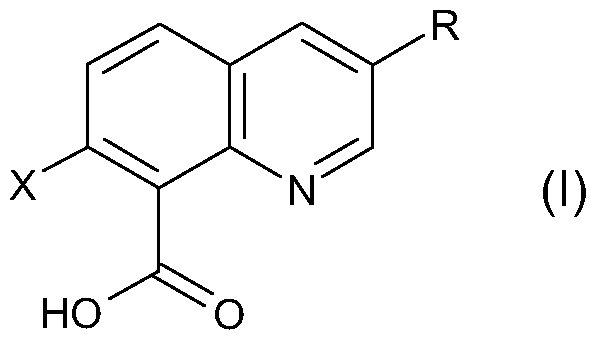
- a her- bicidal composition for controlling submersed aquatic weeds which comprises a herbicidally effective amount of at least one compound of formula (I)
- R is halogen or CrC 6 alkyl, and/or one or more agriculturally acceptable salts or derivatives thereof.
- controlling in this context means exhibiting aquatic-herbicidal action. This means that the growth of at least one aquatic weed species is reduced or suppressed concerning number and/or size of its plants yielding in e.g. limited growth or death of the weeds.
- a weed generally is an unwanted plant. A plant is described as unwanted if its pres- ence is not wanted in a particular place.
- Aquatic weeds are unwanted plants that have adapted to living in or on aquatic environments. This includes water as well as water-saturated soil. Thus, their habitat means the living space of the plants including but not limited to water environment like sweet water or salt water sources, either as moving water or still water. Examples thereof are lakes, rivers, streams, wetlands, ponds, creeks, swamps, canals, reservoirs, and ditches. Other examples are marine water environments like oceans, seas, gulfs, and straits. Examples of saturated soils are water-saturated fields, in particular paddy fields.
- Halogen denotes fluorine, chlorine, bromine or iodine.
- the alkyl moiety mentioned in the definition of radical R and possible salts is a collec- tive term for individual enumerations of the individual group members.
- the hydrocarbon chain may be straight-chain or branched.
- CrC 4 -alkyl for example: methyl, ethyl, n-propyl, 1-methylethyl, n-butyl, 1- methylpropyl, 2-methylpropyl and 1 ,1-dimethylethyl;
- CrC 6 -alkyl d-C 4 -alkyl as mentioned above and also, for example: n-pentyl, 1- methyl-butyl, 2-methylbutyl, 3-methylbutyl, 2,2-dimethylpropyl, 1-ethylpropyl, n-hexyl, 1 ,1-dimethylpropyl, 1 ,2-dimethylpropyl, 1-methylpentyl, 2-methylpentyl, 3-methylpentyl, 4-methylpentyl, 1 ,1-dimethylbutyl, 1 ,2-dimethylbutyl, 1 ,3-dimethylbutyl, 2,2-di- methylbutyl, 2,3-dimethylbutyl, 3,3-dimethylbutyl, 1-ethylbutyl, 2-ethylbutyl, 1 ,1 ,2- trimethylpropyl, 1 -ethyl-1 -methylpropyl and 1-ethyl-3-methylpropy
- the alkoxy moiety mentioned in the definition of possible salts is a collective term for individual enumerations of the individual group members.
- the hydrocarbon chain may be straight-chain or branched.
- Ci-C 4 -alkoxy for example: methoxy, ethoxy, n-propoxy, 1-methylethoxy, n-butoxy, 1-methylpropoxy, 2-methylpropoxy and 1 ,1-dimethylethoxy; CrC6-alkoxy: CrC 4 -alkoxy as mentioned above and also, for example: n-pentoxy, 1-methyl-butoxy, 2-methylbutoxy, 3-methylbutoxy, 2,2-dimethylpropoxy, 1- ethylpropoxy, n-hexoxy, 1 ,1-dimethylpropoxy, 1 ,2-dimethylpropoxy, 1-methylpentoxy, 2-methylpentoxy, 3-methylpentoxy, 4-methylpentoxy, 1 ,1-dimethylbutoxy, 1 ,2- dimethylbutoxy, 1 ,3-dimethylbutoxy, 2,2-dimethylbutoxy, 2,3-dimethylbutoxy, 3,3- dimethylbutoxy, 1-ethylbutoxy, 2-ethylbutoxy, 1 ,1
- X in compound of formula (I) is chlorine.
- R in compound of formula (I) is chlorine or Ci to C 4 alkyl.
- Particularly preferred R in compound of formula (I) is chlorine or methyl, especially preferred R is chlorine, also especially preferred R is methyl.
- Emersed aquatic weeds grow standing out of the water or in water-saturated soil.
- a typical representative for an emersed species is alligatorweed (Alternanthera philoxer- oides). Further examples are cattails, bulrushes, and purple loosestrife.
- Submersed aquatic weeds grow with all or most of their vegetative tissue below the water surface. Typical representatives for submersed species are hydrilla (Hydrilla) and milfoil (Myriophyllum). Further examples include sego pondweed, southern naiad, Egeria, and Potamogetum.
- Floating aquatic weeds float on the water surface. Examples are duckweeds, water- hyacinth, water-lettuce, water-fens, and water- lilies.
- Algae are considered 'primitive' plants but are often incorporated into the generic group of aquatic weeds.
- Controlling of submersed aquatic weeds means that at least one submersed aquatic weed is controlled.
- a preferred embodiment of the invention comprises a method of using compounds of formula (I), specifically quinclorac, for controlling hydrilla, especially preferred Hydrilla Verticillata.
- the method according to the invention may comprise
- those salts of compounds of formula (I) are suitable, wherein the acidic hydrogen of the carboxylic group is substituted by a cation and the cation has no adverse effect on the action of the active compounds.
- Preferred cations are the ions of the alkali metals, preferably of lithium, sodium and potassium, of the alkaline earth metals, preferably of calcium and magnesium, and of the transition metals, preferably of manganese, copper, zinc and iron, furthermore ammonium and substituted ammonium in which one to four hydrogen atoms are replaced by CrC 4 -alkyl, hydroxy-CrC 4 -alkyl, Ci-C 4 -alkoxy-CrC 4 -alkyl, hydroxy-Ci-C 4 -alkoxy-d- C 4 -alkyl, phenyl or benzyl, preferably ammonium, methylammonium, isopropylammo- nium, dimethylammonium, diisopropylammonium,
- Another particularly preferred embodiment of the invention comprises a method of us- ing of compound of formula (I) for controlling submersed aquatic weeds wherein the aquatic weeds are tolerant and/or resistant to the herbicide fluridone.
- Another particularly preferred embodiment of the invention comprises a method of controlling submersed aquatic weeds which comprises allowing a herbicidally effective amount of compounds of formula (I) and/or one or more agriculturally acceptable salts thereof to act on the submersed aquatic weeds and/or its aqueous habitat containing seeds or other propagating organs of said aquatic weed in the presence of rice plants.
- Compounds of formula (I) and/or one or more agriculturally acceptable salts thereof can be used in combination with one or more other herbicide(s) or an agriculturally acceptable salt or derivative thereof.
- herbicides selected from the following classes a1 ) to a15): a1 ) lipid biosynthesis inhibitors; a2) acetolactate synthase inhibitors (ALS inhibitors); a3) photosynthesis inhibitors; a4) protoporphyrinogen-IX oxidase inhibitors; a5) bleacher herbicides; a6) enolpyruvyl shikimate 3-phosphate synthase inhibitors (EPSP inhibitors); a7) glutamine synthetase inhibitors; a8) 7,8-dihydropteroate synthase inhibitors (DHP inhibitors); a9) mitose inhibitors; a10) inhibitors of the synthesis of long chain fatty acids (VLCFA inhibitors); a11 ) cellulose biosynthesis inhibitors; a12) decoupler herbicides; a13) auxin herbicides; a14) auxin transport inhibitors; a15) other herbicides selected from the following classes a1 ) to a15)
- esters, amides or N-oxides provided those herbicides have a group that can be derivatized, preferably a carboxyl group, an amino group or a nitrogen atom that can be oxidized, more preferred a carboxyl group.
- Preferred herbicides of groups a1 ) to a15) are the compounds listed below: a1 ) from the group of the lipid biosynthesis inhibitors: chlorazifop, clodinafop, clofop, cyhalofop, diclofop, fenoxaprop, fenoxaprop-p, fenthiaprop, fluazifop, fluazifop-P, haloxyfop, haloxyfop-P, isoxapyrifop, metamifop, propaquizafop, quizalofop, quizalofop-P, trifop, alloxydim, butroxydim, clethodim, cloproxydim, cycloxydim, profoxydim, sethoxydim, tepraloxydim, tralkoxydim, butylate, cycloate, diallate, dimepiperate, EPTC, espro
- WO 01/94339 4-hydroxy-3-[4-(methylsulfonyl)-2-nitrobenzoyl]bicyclo[3.2.1]-oct- 3-en-2-one, known from EP 338992, 2-[2-chloro-4-(methylsulfonyl)-3-[(2,2,2- trifluoroethoxy)methyl]benzoyl]-3-hydroxy-2-cyclohexen-1-one (known from DE 19846792), and pyrasulfotole; a6) from the group of the EPSP synthase inhibitors: glyphosate; a7) from the group of the glutamine synthase inhibitors: glufosinate and bilanaphos; a8) from the group of the DHP synthase inhibitors: asulam; a9) from the group of the mitose inhibitors: benfluralin, butralin, dinitramine, ethalfluralin, fluchloralin, isopropalin, methalpropalin,
- the herbicides of groups a1 ) to a15) are known herbicides, see the quoted literature references and, for example, The Compendium of Pesticide Common Names (http://www.hclrss.demon.co.uk/index.html); Farm Chemicals Handbook 2000 Vol. 86, Meister Publishing Company, 2000; B. Hock, C. Fedtke, R. R. Schmidt, Herbizide, Georg Thieme Verlag, Stuttgart 1995; W. H. Ahrens, Herbicide Handbook, 7 th Edition, Weed Science Society of America, 1994; K. K. Hatzios, Herbicide Handbook, Supplement to 7 th Edition, Weed Science Society of America, 1998, and C. D. S. Tomlin, The Pesticide Manual, 13 th ed., BCPC, Farnham 2003.
- the categorization of the herbicides according to their mode of action is based on cur- rent understanding. If a herbicide acts by more than one mode of action, this substance was assigned to only one mode of action.
- the compound (I) and/or one or more agriculturally acceptable salts thereof or the herbicides (a) are capable of forming geometrical isomers, for example E/Z isomers, it is possible to use both the pure isomers and mixtures thereof in the compositions according to the invention.
- the compound (I) and/or one or more agriculturally acceptable salts thereof or the herbicides (a) have one or more centers of chirality and, as a consequence, are pre- sent as enantiomers or diastereomers, it is possible to use both the pure enantiomers and diastereomers and their mixtures in the compositions according to the invention.
- herbicides (a) are in form of their anionic salts, preferred cations are the same as for the anionic salts of compounds of formula (I).
- herbicides (a) are in form of their cationic salts
- preferred anions are primarily chloride, bromide, fluoride, iodide, hydrogen sulfate, methyl sulfate, sulfate, dihydrogen phosphate, hydrogen phosphate, nitrate, dicarbonate, carbonate, hexafluorosilicate, hexafluorophosphate, benzoate and the anions of CrC 4 -alkanoic acids, preferably formate, acetate, propionate and butyrate.
- active compounds which carry a group that can be deriva- tized, preferably a carboxyl group, an amino group or a nitrogen that can be oxidized, in particular a carboxyl group can, instead of the active compounds mentioned above, also be employed in the form of an agriculturally acceptable derivative, for example as amides such as mono- or di-C-i-C6-alkylamides or arylamides, as esters, for example as allyl esters, propargyl esters, CrCio-alkyl esters or alkoxyalkyl esters, and also as thioesters, for example as d-Cio-alkyl thioesters.
- amides such as mono- or di-C-i-C6-alkylamides or arylamides
- esters for example as allyl esters, propargyl esters, CrCio-alkyl esters or alkoxyalkyl esters
- thioesters for example as d-C
- Preferred mono- and di-C-i-C6-alkylamides are the methyl- and the dimethylamides.
- Preferred arylamides are, for example, the anilidines and the 2-chloroanilides.
- Preferred alkyl esters are, for example, the methyl, ethyl, propyl, isopropyl, butyl, isobutyl, pentyl, mexyl (1-methylhexyl) or isooctyl (2-ethylhexyl) esters.
- Ci-C 4 -alkoxy- CrC 4 -alkyl esters are the straight-chain or branched d-C 4 -alkoxyethyl esters, for ex- ample the methoxyethyl, ethoxyethyl or butoxyethyl esters.
- An example of the straight- chain or branched C- ⁇ -Cio-alkyl thioesters is the ethyl thioester.
- the weight ratio of the compounds of formula (l):herbicide (a) is usually in the range from 1 :500 to 10:1 , preferably in the range from 1 :100 to 10:1 , in particular in the range from 1 :50 to 10:1 and particularly preferably in the range from 1 :25 to 5:1.
- compositions of the invention which comprise compounds of formula (I) in combination with at least one, preferably exactly one, herbicidally active compound selected from the group consisting of a2) ALS inhibitors, preferably imazapyr and imazomox; a5) bleacher herbicides, preferably fluridone; a13) auxin herbicides; a14) auxin transport inhibitors, preferably diflufenzopyr; and a15) endothal.
- herbicidally active compound selected from the group consisting of a2) ALS inhibitors, preferably imazapyr and imazomox; a5) bleacher herbicides, preferably fluridone; a13) auxin herbicides; a14) auxin transport inhibitors, preferably diflufenzopyr; and a15) endothal.
- imazomox and fluridone especially the combinations quin- clorac + imazomox, quinclorac + fluridone, quinmerac + imazomox and quinmerac + fluridone
- Compounds of formula (I) and optionally one or more herbicide(s) (a) may be present in suspended, emulsified or dissolved form and can be formulated jointly or separately.
- the application forms depend entirely on the intended use.
- the preparations can be applied, for example, in the form of directly sprayable aque- ous solutions, powders, suspensions, also highly-concentrated aqueous, oily or other suspensions or dispersions, emulsions, oil dispersions, pastes, dusts, materials for spreading or granules, by means of spraying, atomizing, dusting, broadcasting or watering.
- the use forms depend on the intended use; preferably, they should ensure the finest possible distribution of the active compounds. Coarser distribution might be de- sired e.g. when a different activity is to be achieved.
- the ready-to-use preparations comprise one or more liquid or solid carriers, if appropriate surfactants and if appropriate further auxiliaries which are customary for formulating crop protection products.
- surfactants if appropriate surfactants and if appropriate further auxiliaries which are customary for formulating crop protection products.
- further auxiliaries which are customary for formulating crop protection products.
- the person skilled in the art is sufficiently familiar with the recipes for such formulations.
- the ready-to-use preparations may comprise auxiliaries, which are customary for formulating crop protection products, which auxiliaries may also comprise a liquid carrier.
- Suitable inert additives with carrier function are essentially: mineral oil fractions of me- dium to high boiling point, such as kerosene and diesel oil, furthermore coal tar oils and oils of vegetable or animal origin, aliphatic, cyclic and aromatic hydrocarbons, e.g. paraffins, tetrahydronaphthalene, alkylated naphthalenes and their derivatives, alkylated benzenes and their derivatives, alcohols such as methanol, ethanol, propanol, butanol and cyclohexanol, ketones such as cyclohexanone, strongly polar solvents, e.g. amines such as N-methylpyrrolidone, and water.
- mineral oil fractions of me- dium to high boiling point such as kerosene and diesel oil, furthermore coal tar oils and oils of vegetable or animal origin, aliphatic, cyclic and aromatic hydrocarbons, e.g. paraffins, tetra
- Aqueous use forms can be prepared from emulsion concentrates, suspensions, pastes, wettable powders or water-dispersible granules by adding water.
- the active compound(s) as such or dissolved in an oil or solvent can be homogenized in water by means of wetting agent, tackifier, dispers- ant or emulsifier.
- concentrates consisting of active compound(s), wetting agent, tackifier, dispersant or emulsifier and, if desired, solvent or oil, and these concentrates are suitable for dilution with water.
- Suitable surfactants are the alkali metal salts, alkaline earth metal salts and ammonium salts of aromatic sulfonic acids, e.g. ligno-, phenol-, naphthalene- and dibutylnaphtha- lenesulfonic acid, and of fatty acids, of alkyl- and alkylarylsulfonates, of alkyl sulfates, lauryl ether sulfates and fatty alcohol sulfates, and salts of sulfated hexa, hepta- and octadecanols and of fatty alcohol glycol ethers, condensates of sulfonated naphthalene and its derivatives with formaldehyde, condensates of naphthalene or of the naphtha- lenesulfonic acids with phenol and formaldehyde, polyoxyethylene octylphenol ether, ethoxylated iso
- Powders, materials for spreading and dusts can be prepared by mixing or concomitant grinding of the active compounds with a solid carrier.
- Granules e.g. granules coated by active compound(s) , granules impregnated by active compound(s) and granules wherein the active compound(s) are homogenously distributed, can be prepared by binding the active compound(s) to solid carriers.
- Solid carriers are mineral earths such as silicas, silica gels, silicates, talc, kaolin, limestone, lime, chalk, bole, loess, clay, dolomite, diatomaceous earth, calcium sulfate, magnesium sulfate, magnesium oxide, ground synthetic materials, fertilizers such as ammonium sulfate, ammonium phosphate, ammonium nitrate, ureas, and products of vegetable origin such as cereal meal, tree bark meal, wood meal and nutshell meal, cellu- lose powders, or other solid carriers.
- mineral earths such as silicas, silica gels, silicates, talc, kaolin, limestone, lime, chalk, bole, loess, clay, dolomite, diatomaceous earth, calcium sulfate, magnesium sulfate, magnesium oxide, ground synthetic materials, fertilizers such as ammonium sulfate, ammonium phosphate, ammonium nitrate, ure
- the binding can be achieved e.g. by means of immersion, spraying or extrusion.
- liquid formulations and granules specifically granules, which are preferably applied to the water column with granule applicators mounted on boats.
- the concentrations of the active compound(s) in the ready-to-use preparations can be varied within wide ranges.
- the formulations comprise from 0.001 to 98% by weight, preferably 0.01 to 95% by weight, of active compound(s).
- the active compound ⁇ ) are preferably employed in a purity of from 90% to 100%, preferably 95% to 100% (according to NMR spectrum).
- the preparations can, for example, be formulated as follows:
- I 20 parts by weight of the active compound(s) in question are dissolved in a com- position composed of 80 parts by weight of alkylated benzene, 10 parts by weight of the adduct of 8 to 10 mol of ethylene oxide to 1 mol of oleic acid N- monoethanolamide, 5 parts by weight of calcium dodecylbenzenesulfonate and 5 parts by weight of the adduct of 40 mol of ethylene oxide to 1 mol of castor oil.
- Pouring the solution into 100 000 parts by weight of water and finely distributing it therein gives an aqueous dispersion which comprises 0.02% by weight of the active compound(s).
- V 3 parts by weight of the active compound(s) in question are mixed with 97 parts by weight of finely divided kaolin. This gives a dust which comprises 3% by weight of the active compound(s).
- Vl 20 parts by weight of the active compound(s) in question are mixed intimately with 2 parts by weight of calcium dodecylbenzenesulfonate, 8 parts by weight of fatty alcohol polyglycol ether, 2 parts by weight of the sodium salt of a phenol- urea-formaldehyde condensate and 68 parts by weight of a paraffinic mineral oil. This gives a stable oily dispersion.
- VIII 1 part by weight of the active compound(s) in question is dissolved in a composition composed of 80 parts by weight of cyclohexanone and 20 parts by weight of nonionic emulsifier based on ethoxylated castor oil (Wettol ® EM 31 , BASF AG). This gives a stable emulsion concentrate.
- the compounds of formula (I) and/or one or more agriculturally acceptable salts thereof and/or herbicide(s) (a) can be formulated jointly or separately.
- the compounds of formula (I) and/or one or more agriculturally acceptable salts thereof and/or herbicide(s) (a) can be applied jointly or separately, simultaneously or successively, before, during or after appearance of the aquatic weeds.
- the required application rate of the pure compounds (I) and/or one or more agriculturally acceptable salts thereof, optionally in combination with a further herbicide (a) with- out formulation auxiliary depends on the density of the undesired vegetation, on the development stage of the plants, on the water-movement, on the climatic conditions of the location where the composition is used and on the application method.
- the application rate is from 1 to 1000 ppb (parts per billion), preferably from 10 to 500 ppb and in particular from 250 to 500 ppb of active compound(s).
- the preparations are applied to the water body as either a surface or subsurface application.
- Application can be carried out by customary spraying techniques using, for example, water as carrier and spray liquid rates of from about 50 to 1 000 I/ha (for example from 300 to 400 I/ha).
- Application of the preparations by the low-volume and the ultra-low-volume method is possible. In both methods small droplets with a high solids content are formed and dispensed by means of a highly pressurized gas stream. Also possible is the application of the preparations in the form of microgranules.
- the aquatic weeds in general are controlled slowly, meaning the biomass of the aquatic weeds in aqueous systems, for example ponds, lakes, creeks, rivers or swamps is declining slowly and gradually.
- This is a big advantage compared to other herbicides for control of the aquatic weeds - for example the herbicide endothall - which is also used in controlling the aquatic weeds and which exhibits very rapid, contact control of the aquatic weeds. Rapid, contact biomass reduction under high infestation levels is in general undesirable in that it for example can lead to rapid oxygen depletion in the aqueous system, which then may lead for example to significant fish mortality.
- results showed that after the exposure period, that there was a rate response observed with quinmerac on both weed shoot length and fresh weight. Significant reduction in both shoot length and fresh weight vs. the control was observed at the 250 and 500 ppb rates of quinmerac, as well as the 250 ppb rate of quinclorac.
- visual symptomology included reduction in plant vigour and auxinic-like twisting of leaf tissue, which was similar to that observed with quinclorac. Intensity of symptoms tended to be rate responsive.
Landscapes
- Life Sciences & Earth Sciences (AREA)
- Agronomy & Crop Science (AREA)
- Pest Control & Pesticides (AREA)
- Plant Pathology (AREA)
- Health & Medical Sciences (AREA)
- Engineering & Computer Science (AREA)
- Dentistry (AREA)
- General Health & Medical Sciences (AREA)
- Wood Science & Technology (AREA)
- Zoology (AREA)
- Environmental Sciences (AREA)
- Agricultural Chemicals And Associated Chemicals (AREA)
Abstract
Description


Claims
Priority Applications (6)
| Application Number | Priority Date | Filing Date | Title |
|---|---|---|---|
| CA002634901A CA2634901A1 (en) | 2005-12-23 | 2006-12-20 | A method for controlling aquatic weeds |
| EP06841509A EP1976383A2 (en) | 2005-12-23 | 2006-12-20 | A method for controlling aquatic weeds |
| BRPI0619639-0A BRPI0619639A2 (en) | 2005-12-23 | 2006-12-20 | method for controlling aquatic weeds, and using a composition |
| AU2006327061A AU2006327061A1 (en) | 2005-12-23 | 2006-12-20 | A method for controlling aquatic weeds |
| US12/158,227 US9060516B2 (en) | 2005-12-23 | 2006-12-20 | Method for controlling aquatic weeds |
| US12/425,126 US9210930B2 (en) | 2005-12-23 | 2009-04-16 | Control of submerged aquatic vegetation |
Applications Claiming Priority (4)
| Application Number | Priority Date | Filing Date | Title |
|---|---|---|---|
| US75290605P | 2005-12-23 | 2005-12-23 | |
| US60/752,906 | 2005-12-23 | ||
| US80279106P | 2006-05-24 | 2006-05-24 | |
| US60/802,791 | 2006-05-24 |
Related Child Applications (2)
| Application Number | Title | Priority Date | Filing Date |
|---|---|---|---|
| US12/158,227 A-371-Of-International US9060516B2 (en) | 2005-12-23 | 2006-12-20 | Method for controlling aquatic weeds |
| US12/425,126 Continuation-In-Part US9210930B2 (en) | 2005-12-23 | 2009-04-16 | Control of submerged aquatic vegetation |
Publications (2)
| Publication Number | Publication Date |
|---|---|
| WO2007071730A2 true WO2007071730A2 (en) | 2007-06-28 |
| WO2007071730A3 WO2007071730A3 (en) | 2008-04-10 |
Family
ID=38057482
Family Applications (1)
| Application Number | Title | Priority Date | Filing Date |
|---|---|---|---|
| PCT/EP2006/070009 Ceased WO2007071730A2 (en) | 2005-12-23 | 2006-12-20 | A method for controlling aquatic weeds |
Country Status (8)
| Country | Link |
|---|---|
| US (1) | US9060516B2 (en) |
| EP (2) | EP1976383A2 (en) |
| KR (1) | KR20080081979A (en) |
| AU (1) | AU2006327061A1 (en) |
| BR (1) | BRPI0619639A2 (en) |
| CA (1) | CA2634901A1 (en) |
| CR (1) | CR10079A (en) |
| WO (1) | WO2007071730A2 (en) |
Cited By (4)
| Publication number | Priority date | Publication date | Assignee | Title |
|---|---|---|---|---|
| WO2009127635A1 (en) * | 2008-04-17 | 2009-10-22 | Basf Se | Control of submerged aquatic vegetation |
| US8080497B2 (en) | 2005-12-23 | 2011-12-20 | Basf Se | Method of controlling the aquatic weed Hydrilla verticillata |
| EP2745695A1 (en) | 2008-06-18 | 2014-06-25 | Basf Se | Herbicidal compositions comprising 4-amino-3,6-dichloropyridine-2-carboxylic acid |
| US8809233B2 (en) | 2008-06-18 | 2014-08-19 | Basf Se | Ternary herbicidal compositions comprising aminopyralid and imazamox |
Families Citing this family (36)
| Publication number | Priority date | Publication date | Assignee | Title |
|---|---|---|---|---|
| US9210930B2 (en) * | 2005-12-23 | 2015-12-15 | Basf Se | Control of submerged aquatic vegetation |
| US8097712B2 (en) | 2007-11-07 | 2012-01-17 | Beelogics Inc. | Compositions for conferring tolerance to viral disease in social insects, and the use thereof |
| US8962584B2 (en) | 2009-10-14 | 2015-02-24 | Yissum Research Development Company Of The Hebrew University Of Jerusalem, Ltd. | Compositions for controlling Varroa mites in bees |
| US9121022B2 (en) | 2010-03-08 | 2015-09-01 | Monsanto Technology Llc | Method for controlling herbicide-resistant plants |
| EP3434779A1 (en) * | 2011-09-13 | 2019-01-30 | Monsanto Technology LLC | Methods and compositions for weed control |
| CA2848689A1 (en) | 2011-09-13 | 2013-03-21 | Monsanto Technology Llc | Methods and compositions for weed control targeting pds |
| UA116090C2 (en) | 2011-09-13 | 2018-02-12 | Монсанто Текнолоджи Ллс | Methods and compositions for weed control |
| WO2013040116A1 (en) | 2011-09-13 | 2013-03-21 | Monsanto Technology Llc | Methods and compositions for weed control |
| US10760086B2 (en) | 2011-09-13 | 2020-09-01 | Monsanto Technology Llc | Methods and compositions for weed control |
| CN103957697B (en) | 2011-09-13 | 2017-10-24 | 孟山都技术公司 | Methods and compositions for weed control |
| US9840715B1 (en) | 2011-09-13 | 2017-12-12 | Monsanto Technology Llc | Methods and compositions for delaying senescence and improving disease tolerance and yield in plants |
| US10829828B2 (en) | 2011-09-13 | 2020-11-10 | Monsanto Technology Llc | Methods and compositions for weed control |
| US10806146B2 (en) | 2011-09-13 | 2020-10-20 | Monsanto Technology Llc | Methods and compositions for weed control |
| US9920326B1 (en) | 2011-09-14 | 2018-03-20 | Monsanto Technology Llc | Methods and compositions for increasing invertase activity in plants |
| US10240162B2 (en) | 2012-05-24 | 2019-03-26 | A.B. Seeds Ltd. | Compositions and methods for silencing gene expression |
| MX364070B (en) | 2012-10-18 | 2019-04-10 | Monsanto Technology Llc | Methods and compositions for plant pest control. |
| BR112015015975A2 (en) | 2013-01-01 | 2018-11-06 | A. B. Seeds Ltd. | isolated dsrna molecules and methods of using them for silencing target molecules of interest. |
| US10683505B2 (en) | 2013-01-01 | 2020-06-16 | Monsanto Technology Llc | Methods of introducing dsRNA to plant seeds for modulating gene expression |
| US10000767B2 (en) | 2013-01-28 | 2018-06-19 | Monsanto Technology Llc | Methods and compositions for plant pest control |
| UA121846C2 (en) | 2013-03-13 | 2020-08-10 | Монсанто Текнолоджи Ллс | METHOD AND HERBICIDAL COMPOSITION FOR CONTROL OF PLANT SPECIES OF THE GENUS LOLIUM |
| UA123082C2 (en) | 2013-03-13 | 2021-02-17 | Монсанто Текнолоджи Ллс | Methods and compositions for weed control |
| US20140283211A1 (en) | 2013-03-14 | 2014-09-18 | Monsanto Technology Llc | Methods and Compositions for Plant Pest Control |
| US10568328B2 (en) | 2013-03-15 | 2020-02-25 | Monsanto Technology Llc | Methods and compositions for weed control |
| CN105980567B (en) | 2013-07-19 | 2021-04-16 | 孟山都技术有限公司 | Compositions and methods for controlling Beetle |
| US9850496B2 (en) | 2013-07-19 | 2017-12-26 | Monsanto Technology Llc | Compositions and methods for controlling Leptinotarsa |
| ES3008698T3 (en) | 2013-11-04 | 2025-03-24 | Greenlight Biosciences Inc | Compositions and methods for controlling arthropod parasite and pest infestations |
| UA119253C2 (en) | 2013-12-10 | 2019-05-27 | Біолоджикс, Інк. | METHOD FOR VARROA TREATMENT AND VEGETABLES |
| UA121462C2 (en) | 2014-01-15 | 2020-06-10 | Монсанто Текнолоджі Елелсі | Methods and compositions for weed control using epsps polynucleotides |
| SG11201605488PA (en) * | 2014-01-31 | 2016-08-30 | Dow Agrosciences Llc | Methods for control of aquatic weeds using herbicidal 4-amino-3-chloro-6-(4-chloro-2-fluoro-3-methoxyphenyl)pyridine-2-carboxylic acids |
| EP3420809A1 (en) | 2014-04-01 | 2019-01-02 | Monsanto Technology LLC | Compositions and methods for controlling insect pests |
| EP3158067B1 (en) | 2014-06-23 | 2020-08-12 | Monsanto Technology LLC | Compositions and methods for regulating gene expression via rna interference |
| WO2015200539A1 (en) | 2014-06-25 | 2015-12-30 | Monsanto Technology Llc | Methods and compositions for delivering nucleic acids to plant cells and regulating gene expression |
| US10378012B2 (en) | 2014-07-29 | 2019-08-13 | Monsanto Technology Llc | Compositions and methods for controlling insect pests |
| WO2016118762A1 (en) | 2015-01-22 | 2016-07-28 | Monsanto Technology Llc | Compositions and methods for controlling leptinotarsa |
| WO2016196738A1 (en) | 2015-06-02 | 2016-12-08 | Monsanto Technology Llc | Compositions and methods for delivery of a polynucleotide into a plant |
| EP3302030A4 (en) | 2015-06-03 | 2019-04-24 | Monsanto Technology LLC | METHODS AND COMPOSITIONS FOR THE INTRODUCTION OF NUCLEIC ACIDS IN PLANTS |
Family Cites Families (27)
| Publication number | Priority date | Publication date | Assignee | Title |
|---|---|---|---|---|
| US4798619A (en) | 1980-06-02 | 1989-01-17 | American Cyanamid Co. | 2-(2-imidazolin-2-yl)-pyridines and quinolines and use of said compounds as herbicidal agents |
| DE3108873A1 (en) | 1981-03-09 | 1982-09-16 | Basf Ag, 6700 Ludwigshafen | DICHLORCHINOLIN DERIVATIVES, THEIR PRODUCTION, THEIR USE AS HERBICIDES AND AGENTS THEREFOR |
| US4398937A (en) | 1981-10-06 | 1983-08-16 | The University Of Southern Mississippi | Selective algaecides for control of cyanochloronta |
| US4497651A (en) | 1982-02-17 | 1985-02-05 | Basf Aktiengesellschaft | Dichloroquinoline derivatives for use as herbicides |
| IL68499A0 (en) | 1982-05-03 | 1983-07-31 | Lilly Co Eli | Use of thiadiazolylimidazolidinones to control aquatic vegetation |
| DE3233089A1 (en) | 1982-09-07 | 1984-03-08 | Basf Ag, 6700 Ludwigshafen | CHINOLINE DERIVATIVES, METHOD FOR THE PRODUCTION THEREOF AND THEIR USE FOR CONTROLLING UNWANTED PLANT GROWTH |
| GR82037B (en) | 1983-05-27 | 1984-12-12 | Lilly Co Eli | |
| US5334576A (en) | 1986-07-28 | 1994-08-02 | American Cyanamid Company | 5 (and/or 6) substituted 2-(2-imidazolin-2-yl)nicotinic acids, esters and salts, useful as herbicidal agents and novel intermediates for the preparation of said nicotinic acids, esters and salts |
| HU206242B (en) | 1988-04-18 | 1992-10-28 | Sandoz Ag | Herbicidal compositions comprising substituted benzoyl bicyclodione derivatives as active ingredient |
| DE69839310T3 (en) * | 1997-10-30 | 2015-08-06 | Nippon Soda Co. Ltd. | USE OF A BENZOYLPYRAZOL COMPOUND AS HERBICIDE. |
| ES2200527T3 (en) * | 1998-06-16 | 2004-03-01 | Basf Aktiengesellschaft | HERBICIDE BLENDS WITH SYNERGIC EFFECT. |
| DE19836684A1 (en) | 1998-08-13 | 2000-02-17 | Hoechst Schering Agrevo Gmbh | Use of a synergistic herbicidal combination including a glufosinate- or glyphosate-type, imidazolinone or protoporphyrinogen oxidase to control weeds in rice |
| DE19836726A1 (en) | 1998-08-13 | 2000-02-17 | Hoechst Schering Agrevo Gmbh | Use of a synergistic herbicide combination including glufosinate- or glyphosate-type, imidazolinone or protoporphyrinogen oxidase inhibitory azole herbicide to control weeds in oil seed rape |
| CA2341291C (en) | 1998-09-15 | 2009-11-03 | Syngenta Participations Ag | Pyridine ketones useful as herbicides |
| US6339158B1 (en) | 1999-05-03 | 2002-01-15 | American Cyanamid Co. | Process for the preparation of chiral nicotinic, quinolinic or benzoic acid imidazolinone herbicides |
| US5973154A (en) | 1999-05-03 | 1999-10-26 | American Cyanamid Company | Process for the preparation of chiral imidazolinone herbicides |
| GT200100103A (en) | 2000-06-09 | 2002-02-21 | NEW HERBICIDES | |
| US20020119891A1 (en) | 2001-01-19 | 2002-08-29 | Netherland Michael D. | Integrated methods for control of aquatic weeds |
| CN1401232A (en) * | 2001-08-10 | 2003-03-12 | 江苏省新沂中凯农用化工有限公司 | Herbicidal composition contg. fenoxaprop-P-ethyl, its preparation method and use |
| WO2005077169A1 (en) | 2004-02-16 | 2005-08-25 | Basf Aktiengesellschaft | Formulation for seed treatment |
| GB0405760D0 (en) * | 2004-03-15 | 2004-04-21 | Syngenta Participations Ag | Agrochemical formulation |
| DK1734823T3 (en) | 2004-04-01 | 2009-08-24 | Basf Se | Synergistically acting herbicide mixtures |
| PE20070534A1 (en) | 2005-08-01 | 2007-06-11 | Basf Ag | DERIVATIVES OF 3-PHENILURAACILO TO CONTROL WEEDS OR CROPS RESISTANT TO GLYPHOSATE OR ITS HABITAT |
| AR056438A1 (en) | 2005-08-01 | 2007-10-10 | Basf Ag | A METHOD FOR CONTROLLING WEEDS |
| AR055593A1 (en) | 2005-08-01 | 2007-08-29 | Basf Ag | A METHOD FOR CONTROLLING WEEDS |
| UA90757C2 (en) | 2005-10-12 | 2010-05-25 | Басф Се | Herbicidal composition, method for controlling undesired vegetation and method for protecting crops from phytotoxic action of 3-phenyluracils |
| CN101346066B (en) | 2005-12-23 | 2012-05-23 | 巴斯夫欧洲公司 | Methods of preventing and controlling waterweed black algae |
-
2006
- 2006-12-20 WO PCT/EP2006/070009 patent/WO2007071730A2/en not_active Ceased
- 2006-12-20 EP EP06841509A patent/EP1976383A2/en not_active Withdrawn
- 2006-12-20 AU AU2006327061A patent/AU2006327061A1/en not_active Abandoned
- 2006-12-20 KR KR1020087017911A patent/KR20080081979A/en not_active Withdrawn
- 2006-12-20 BR BRPI0619639-0A patent/BRPI0619639A2/en not_active Application Discontinuation
- 2006-12-20 CA CA002634901A patent/CA2634901A1/en not_active Abandoned
- 2006-12-20 US US12/158,227 patent/US9060516B2/en active Active
- 2006-12-21 EP EP10158109A patent/EP2241185A1/en not_active Withdrawn
-
2008
- 2008-06-17 CR CR10079A patent/CR10079A/en unknown
Non-Patent Citations (7)
| Title |
|---|
| "The e-Pesticide Manual (Thirteenth Edition) Version 3.0" 2003, BRITISH CROP PROTECTION COUNCIL , XP002464632 entry 712: "Quinclorac" the whole document * |
| "The e-Pesticide Manual (Thirteenth Edition) Version 3.0" 2003, BRITISH CROP PROTECTION COUNCIL , XP002464633 entry 713: "Quinmerac" the whole document * |
| "The e-Pesticide Manual (Thirteenth Edition) Version 3.0" 2003, BRITISH CROP PROTECTION COUNCIL , XP002464634 entry 211: "2,4-D" the whole document * |
| DATABASE CA [Online] CHEMICAL ABSTRACTS SERVICE, COLUMBUS, OHIO, US; XP002464636 retrieved from STN-INTERNATIONAL Database accession no. 141:84041 CA & CN 1 401 232 A (ZHONGKAI AGRICULTURAL CHEMICAL) 12 March 2003 (2003-03-12) -& DATABASE WPI Week 200349 Derwent Publications Ltd., London, GB; AN 2003-514337 XP002464652 & CN 1 401 232 A (ZHONGKAI AGRIC CHEM CO LTD) 12 March 2003 (2003-03-12) * |
| DATABASE CAB [Online] CAB INTERNATIONAL, WALLINGFORD, OXON, GB; A.ZOSCHKE ET AL.: "CGA142'464 plus BAS-514, a new timing-flexible herbicide combination for broadspectrum weed control in rice (Oryza sativa L.) in South Korea" XP002464635 retrieved from STN-INTERNATIONAL Database accession no. 91:73631 CABA & PROCEEDINGS, 12TH ASIAN-PACIFIC WEED SCIENCE SOCIETY CONFERENCE, no. 1, 1989, pages 245-253, * |
| KAY S H ET AL: "RESPONSE OF TWO ALLIGATORWEED BIOTYPES TO QUINCLORAC" JOURNAL OF AQUATIC PLANT MANAGEMENT, SOCIETY, WASHINGTON, DC,, US, vol. 30, 1992, pages 35-40, XP008086947 ISSN: 0146-6623 * |
| KLINGMAN ET AL: "AQUATIC-WEED CONTROL" WEED SCIENCE, WEED SCIENCE SOCIETY OF AMERICA, CHAMPAIGN, IL, US, 1982, pages 383-402, XP002962279 ISSN: 0043-1745 * |
Cited By (5)
| Publication number | Priority date | Publication date | Assignee | Title |
|---|---|---|---|---|
| US8080497B2 (en) | 2005-12-23 | 2011-12-20 | Basf Se | Method of controlling the aquatic weed Hydrilla verticillata |
| WO2009127635A1 (en) * | 2008-04-17 | 2009-10-22 | Basf Se | Control of submerged aquatic vegetation |
| EP2745695A1 (en) | 2008-06-18 | 2014-06-25 | Basf Se | Herbicidal compositions comprising 4-amino-3,6-dichloropyridine-2-carboxylic acid |
| EP2745694A1 (en) | 2008-06-18 | 2014-06-25 | Basf Se | Herbicidal compositions comprising 4-amino-3,6-dichloropyridine-2-carboxylic acid |
| US8809233B2 (en) | 2008-06-18 | 2014-08-19 | Basf Se | Ternary herbicidal compositions comprising aminopyralid and imazamox |
Also Published As
| Publication number | Publication date |
|---|---|
| CA2634901A1 (en) | 2007-06-28 |
| BRPI0619639A2 (en) | 2012-12-11 |
| EP1976383A2 (en) | 2008-10-08 |
| US9060516B2 (en) | 2015-06-23 |
| EP2241185A1 (en) | 2010-10-20 |
| US20090011934A1 (en) | 2009-01-08 |
| KR20080081979A (en) | 2008-09-10 |
| WO2007071730A3 (en) | 2008-04-10 |
| CR10079A (en) | 2008-10-29 |
| AU2006327061A1 (en) | 2007-06-28 |
Similar Documents
| Publication | Publication Date | Title |
|---|---|---|
| US9060516B2 (en) | Method for controlling aquatic weeds | |
| EP1965641B1 (en) | A method of controlling the aquatic weed hydrilla verticillata | |
| AU2006301309B2 (en) | Herbicidal compositions based on 3-phenyluracils and N-[[4-[(cyclopropylamino)-carbonyl]phenyl]sulfonyl]-2-methoxybenzamide | |
| WO2009127635A1 (en) | Control of submerged aquatic vegetation | |
| WO2010046268A2 (en) | A method of controlling chinese tallowtree | |
| AU2006274969A1 (en) | A method of controlling weeds | |
| SK3502003A3 (en) | Herbicidal mixtures | |
| JP2009503004A (en) | Weed control method | |
| US9210930B2 (en) | Control of submerged aquatic vegetation | |
| AU2006275055A1 (en) | A method of controlling weeds | |
| AU2017277839A1 (en) | Safening 4-amino-3-chloro-6-(4-chloro-2-fluoro-3-methoxyphenyl)-5-fluoropyridine-2-carboxylic acid compositions in Brassica species and methods of use thereof | |
| CA3027036C (en) | Safening 4-amino-3-chloro-6-(4-chloro-2-fluoro-3-methoxyphenyl)-5-fluoropyridine-2-carboxylic acid compositions in brassica species and methods of use thereof |
Legal Events
| Date | Code | Title | Description |
|---|---|---|---|
| WWE | Wipo information: entry into national phase |
Ref document number: 200680049008.0 Country of ref document: CN |
|
| 121 | Ep: the epo has been informed by wipo that ep was designated in this application | ||
| WWE | Wipo information: entry into national phase |
Ref document number: CR2008-010079 Country of ref document: CR |
|
| WWE | Wipo information: entry into national phase |
Ref document number: 2634901 Country of ref document: CA Ref document number: 2006327061 Country of ref document: AU Ref document number: 3167/CHENP/2008 Country of ref document: IN |
|
| NENP | Non-entry into the national phase |
Ref country code: DE |
|
| ENP | Entry into the national phase |
Ref document number: 2006327061 Country of ref document: AU Date of ref document: 20061220 Kind code of ref document: A |
|
| WWP | Wipo information: published in national office |
Ref document number: 2006327061 Country of ref document: AU |
|
| WWE | Wipo information: entry into national phase |
Ref document number: 2006841509 Country of ref document: EP |
|
| WWE | Wipo information: entry into national phase |
Ref document number: 08075699 Country of ref document: CO Ref document number: 1020087017911 Country of ref document: KR |
|
| WWE | Wipo information: entry into national phase |
Ref document number: 12158227 Country of ref document: US |
|
| ENP | Entry into the national phase |
Ref document number: PI0619639 Country of ref document: BR Kind code of ref document: A2 Effective date: 20080623 |