WO2007065840A1 - Method for the continuous mixing of polymer particles - Google Patents
Method for the continuous mixing of polymer particles Download PDFInfo
- Publication number
- WO2007065840A1 WO2007065840A1 PCT/EP2006/069103 EP2006069103W WO2007065840A1 WO 2007065840 A1 WO2007065840 A1 WO 2007065840A1 EP 2006069103 W EP2006069103 W EP 2006069103W WO 2007065840 A1 WO2007065840 A1 WO 2007065840A1
- Authority
- WO
- WIPO (PCT)
- Prior art keywords
- flow direction
- product flow
- polymer particles
- mixing
- mixed
- Prior art date
- Legal status (The legal status is an assumption and is not a legal conclusion. Google has not performed a legal analysis and makes no representation as to the accuracy of the status listed.)
- Ceased
Links
- 0 CC(C)CCCC(C)CCCC(C)CCCC(C)(CCc1c2*)Oc1c(*)c(*)c2O* Chemical compound CC(C)CCCC(C)CCCC(C)CCCC(C)(CCc1c2*)Oc1c(*)c(*)c2O* 0.000 description 1
Classifications
-
- B—PERFORMING OPERATIONS; TRANSPORTING
- B01—PHYSICAL OR CHEMICAL PROCESSES OR APPARATUS IN GENERAL
- B01J—CHEMICAL OR PHYSICAL PROCESSES, e.g. CATALYSIS OR COLLOID CHEMISTRY; THEIR RELEVANT APPARATUS
- B01J19/00—Chemical, physical or physico-chemical processes in general; Their relevant apparatus
- B01J19/26—Nozzle-type reactors, i.e. the distribution of the initial reactants within the reactor is effected by their introduction or injection through nozzles
-
- B—PERFORMING OPERATIONS; TRANSPORTING
- B01—PHYSICAL OR CHEMICAL PROCESSES OR APPARATUS IN GENERAL
- B01F—MIXING, e.g. DISSOLVING, EMULSIFYING OR DISPERSING
- B01F23/00—Mixing according to the phases to be mixed, e.g. dispersing or emulsifying
- B01F23/50—Mixing liquids with solids
- B01F23/53—Mixing liquids with solids using driven stirrers
-
- B—PERFORMING OPERATIONS; TRANSPORTING
- B01—PHYSICAL OR CHEMICAL PROCESSES OR APPARATUS IN GENERAL
- B01F—MIXING, e.g. DISSOLVING, EMULSIFYING OR DISPERSING
- B01F23/00—Mixing according to the phases to be mixed, e.g. dispersing or emulsifying
- B01F23/50—Mixing liquids with solids
- B01F23/54—Mixing liquids with solids wetting solids
-
- B—PERFORMING OPERATIONS; TRANSPORTING
- B01—PHYSICAL OR CHEMICAL PROCESSES OR APPARATUS IN GENERAL
- B01F—MIXING, e.g. DISSOLVING, EMULSIFYING OR DISPERSING
- B01F27/00—Mixers with rotary stirring devices in fixed receptacles; Kneaders
- B01F27/23—Mixers with rotary stirring devices in fixed receptacles; Kneaders characterised by the orientation or disposition of the rotor axis
- B01F27/232—Mixers with rotary stirring devices in fixed receptacles; Kneaders characterised by the orientation or disposition of the rotor axis with two or more rotation axes
- B01F27/2321—Mixers with rotary stirring devices in fixed receptacles; Kneaders characterised by the orientation or disposition of the rotor axis with two or more rotation axes having different inclinations, e.g. non parallel
-
- B—PERFORMING OPERATIONS; TRANSPORTING
- B01—PHYSICAL OR CHEMICAL PROCESSES OR APPARATUS IN GENERAL
- B01F—MIXING, e.g. DISSOLVING, EMULSIFYING OR DISPERSING
- B01F27/00—Mixers with rotary stirring devices in fixed receptacles; Kneaders
- B01F27/50—Pipe mixers, i.e. mixers wherein the materials to be mixed flow continuously through pipes, e.g. column mixers
-
- B—PERFORMING OPERATIONS; TRANSPORTING
- B01—PHYSICAL OR CHEMICAL PROCESSES OR APPARATUS IN GENERAL
- B01J—CHEMICAL OR PHYSICAL PROCESSES, e.g. CATALYSIS OR COLLOID CHEMISTRY; THEIR RELEVANT APPARATUS
- B01J19/00—Chemical, physical or physico-chemical processes in general; Their relevant apparatus
- B01J19/18—Stationary reactors having moving elements inside
- B01J19/1806—Stationary reactors having moving elements inside resulting in a turbulent flow of the reactants, such as in centrifugal-type reactors, or having a high Reynolds-number
-
- B—PERFORMING OPERATIONS; TRANSPORTING
- B01—PHYSICAL OR CHEMICAL PROCESSES OR APPARATUS IN GENERAL
- B01J—CHEMICAL OR PHYSICAL PROCESSES, e.g. CATALYSIS OR COLLOID CHEMISTRY; THEIR RELEVANT APPARATUS
- B01J4/00—Feed or outlet devices; Feed or outlet control devices
- B01J4/001—Feed or outlet devices as such, e.g. feeding tubes
- B01J4/002—Nozzle-type elements
-
- B—PERFORMING OPERATIONS; TRANSPORTING
- B01—PHYSICAL OR CHEMICAL PROCESSES OR APPARATUS IN GENERAL
- B01J—CHEMICAL OR PHYSICAL PROCESSES, e.g. CATALYSIS OR COLLOID CHEMISTRY; THEIR RELEVANT APPARATUS
- B01J2219/00—Chemical, physical or physico-chemical processes in general; Their relevant apparatus
- B01J2219/00002—Chemical plants
- B01J2219/00027—Process aspects
- B01J2219/00033—Continuous processes
-
- B—PERFORMING OPERATIONS; TRANSPORTING
- B01—PHYSICAL OR CHEMICAL PROCESSES OR APPARATUS IN GENERAL
- B01J—CHEMICAL OR PHYSICAL PROCESSES, e.g. CATALYSIS OR COLLOID CHEMISTRY; THEIR RELEVANT APPARATUS
- B01J2219/00—Chemical, physical or physico-chemical processes in general; Their relevant apparatus
- B01J2219/00049—Controlling or regulating processes
- B01J2219/00164—Controlling or regulating processes controlling the flow
- B01J2219/00166—Controlling or regulating processes controlling the flow controlling the residence time inside the reactor vessel
-
- B—PERFORMING OPERATIONS; TRANSPORTING
- B01—PHYSICAL OR CHEMICAL PROCESSES OR APPARATUS IN GENERAL
- B01J—CHEMICAL OR PHYSICAL PROCESSES, e.g. CATALYSIS OR COLLOID CHEMISTRY; THEIR RELEVANT APPARATUS
- B01J2219/00—Chemical, physical or physico-chemical processes in general; Their relevant apparatus
- B01J2219/00049—Controlling or regulating processes
- B01J2219/00184—Controlling or regulating processes controlling the weight of reactants in the reactor vessel
-
- B—PERFORMING OPERATIONS; TRANSPORTING
- B01—PHYSICAL OR CHEMICAL PROCESSES OR APPARATUS IN GENERAL
- B01J—CHEMICAL OR PHYSICAL PROCESSES, e.g. CATALYSIS OR COLLOID CHEMISTRY; THEIR RELEVANT APPARATUS
- B01J2219/00—Chemical, physical or physico-chemical processes in general; Their relevant apparatus
- B01J2219/00049—Controlling or regulating processes
- B01J2219/00189—Controlling or regulating processes controlling the stirring velocity
-
- B—PERFORMING OPERATIONS; TRANSPORTING
- B01—PHYSICAL OR CHEMICAL PROCESSES OR APPARATUS IN GENERAL
- B01J—CHEMICAL OR PHYSICAL PROCESSES, e.g. CATALYSIS OR COLLOID CHEMISTRY; THEIR RELEVANT APPARATUS
- B01J2219/00—Chemical, physical or physico-chemical processes in general; Their relevant apparatus
- B01J2219/00049—Controlling or regulating processes
- B01J2219/00245—Avoiding undesirable reactions or side-effects
- B01J2219/00254—Formation of unwanted polymer, such as "pop-corn"
-
- B—PERFORMING OPERATIONS; TRANSPORTING
- B01—PHYSICAL OR CHEMICAL PROCESSES OR APPARATUS IN GENERAL
- B01J—CHEMICAL OR PHYSICAL PROCESSES, e.g. CATALYSIS OR COLLOID CHEMISTRY; THEIR RELEVANT APPARATUS
- B01J2219/00—Chemical, physical or physico-chemical processes in general; Their relevant apparatus
- B01J2219/00761—Details of the reactor
- B01J2219/00763—Baffles
- B01J2219/00779—Baffles attached to the stirring means
Definitions
- the present invention relates to a method for the continuous mixing of water-absorbing polymer particles with liquids or other particles, wherein the polymer particles move in the product flow direction due to their own weight and at least a part of the mix due to the rotational movement of at least one mixing tool attached to a rotating shaft an impulse counter to the product flow direction receives.
- Water-absorbing polymers are, in particular, polymers of (co) polymerized hydrophilic monomers, graft (co) polymers of one or more hydrophilic monomers on a suitable graft base, crosslinked cellulose or starch ether, crosslinked carboxymethyl cellulose, partially crosslinked polyalkylene oxide or natural products swellable in aqueous liquids, such as guar derivatives.
- Such polymers are used as products absorbing aqueous solutions for the production of diapers, tampons, sanitary napkins and other hygiene articles, but also as water-retaining agents in agricultural horticulture.
- Water-absorbent polymers typically have a centrifuge retention capacity of 25 to 60 g / g, preferably at least 30 g / g, preferably at least 32 g / g, particularly preferably at least 34 g / g, very particularly preferably at least 35 g / g.
- the centrifuge retention capacity is determined according to test method No. 441.2-02 "Centrifuge retention capacity" recommended by EDANA (European Disposables and Nonwovens Association).
- water-absorbing polymers are generally post-crosslinked. This post-crosslinking can be carried out in the aqueous gel phase.
- ground and screened polymer particles base polymer
- Crosslinkers suitable for this purpose are compounds which contain at least two groups which can form covalent bonds with the carboxylate groups of the hydrophilic polymer or which can crosslink at least two carboxyl groups or other functional groups of at least two different polymer chains of the base polymer.
- DE-A 35 23 617 discloses a process for post-crosslinking water-absorbing polymer particles, a polyol being metered in a, preferably aqueous, solvent.
- WO 04/037900 discloses a method for mixing water-absorbing polymer particles with aqueous solutions, the formation of agglomerates during mixing being avoided by a high kinetic energy of the polymer particles.
- WO 05/080479 describes a method for post-crosslinking water-absorbing polymer particles, two separate solutions being metered in. According to the patent application, high-speed mixers are preferably used.
- the object of the present invention was to provide an improved process for mixing water-absorbing polymer particles with aqueous solutions.
- the object was achieved by a process for the continuous mixing of water-absorbing polymer particles with liquids or other particles, the polymer particles moving in the product flow direction on account of their own weight, characterized in that at least part of the mixed material was attached to a rotating shaft by the rotational movement of at least one Mixing tool receives an impulse against the product flow direction.
- Liquids are liquids at 23 ° C or solids liquefied by an increase in temperature.
- Suitable liquid substances are, for example, liquid postcrosslinkers or postcrosslinker solutions which are applied to water-absorbing polymer particles.
- particles are particulate solids that are different from the water-absorbing polymer particles.
- a suitable particulate solid is, for example, pyrogenic silica.
- the product flow direction is the direction of transport of the polymer particles through the mixer, i.e. the transport route through the mixer from the mixer inlet to the mixer outlet.
- the polymer particles move through the mixer from top to bottom. As a result, the polymer particles are accelerated by gravity in the direction of the product flow due to their own weight.
- the front edge of the mixing tool in the direction of rotation lies below its rear edge, ie the mixing tool has a positive angle of attack and transports the polymer particles against the product flow direction. Accordingly, a negative angle of attack means that the mixing tool transports the polymer particles in the product flow direction.
- the liquids or other particles are usually metered into the mixer from above, preferably sprayed on by means of suitable nozzles, particularly preferably by means of at least one two-substance nozzle, very particularly preferably by means of at least four two-substance nozzles.
- the liquid to be sprayed on and the other particles to be sprayed on can be better distributed.
- a plurality of nozzles, for example two, can advantageously also be supplied via a common feed line.
- the present invention is based on the finding that by reversing the direction of transport of the mixing tools that has been customary up to now, a residence time distribution is achieved even at moderate peripheral speeds, for which previously much higher peripheral speeds were necessary.
- Suitable mixing tools are, for example, knives or paddles.
- the number of mixing tools is preferably from 2 to 64, particularly preferably from 4 to 32, very particularly preferably from 8 to 16. It is possible for 2, 4 or 8 mixing tools to be located in a common plane.
- the mixing tools can protrude radially laterally from the shaft, i.e. the angle between the shaft axis and the connecting line from the attachment of the mixing tool to the shaft and the tip of the mixing tool is approximately 90 °.
- the mixing tools can also protrude laterally from the shaft in pairs in a V-shape, the angle enclosed by the mixing tools arranged in pairs preferably being from 30 to 120 °, particularly preferably from 45 to 105 °, very particularly preferably from 60 to 90 °.
- the shaft is preferably mounted on one or two sides.
- the peripheral speed of the mixing tools is typically from 3 to 20 m / s, preferably from 4 to 18 m / s, particularly preferably from 6 to 15 m / s, very particularly preferably from 8 to 12 m / s.
- the product flow direction is typically less than 45 °, preferably less than 30 °, particularly preferably less than 15 °, very particularly preferably less than 5 °, inclined to the vertical.
- the polymer particles fall vertically through the mixer from top to bottom, i.e. the product flow direction is vertical.
- the angle between the product flow direction and the shaft axis is preferably less than 10 °, particularly preferably less than 5 °, very particularly preferably less than 1 °.
- the product flow direction and shaft axis are preferably identical, i.e. the angle between the two is 0 °.
- the angle of attack of the at least one mixing tool is typically greater than 0 to 30 °, preferably 5 to 25 °, particularly preferably 10 to 20 °, very particularly preferably 15 to 18 °.
- the mixer preferably has a cylindrical wall.
- the diameter of the cylinder is preferably from 90 to 500 mm, particularly preferably from 120 to 400 mm, very particularly preferably from 150 to 350 mm.
- the ratio of the diameter of the orbit of the outer tip of the mixing tool to the largest possible diameter of this orbit is preferably at least 0.6, particularly preferably at least 0.7, very particularly preferably at least 0.8.
- the largest possible diameter of the orbit is the theoretical diameter of the orbit at which the tip of the mixing tool would just touch the mixer wall closest to the shaft axis. In the case of a cylindrical mixer with a centric shaft, this largest possible diameter of the orbit corresponds to the inside diameter of the mixer.
- the throughput of polymer particles per m 2 of cross-sectional area of the mixer is preferably from 10 to 250 t / h, particularly preferably from 25 to 150 t / h, very particularly preferably from 50 to 100 t / h.
- At least part of the mix is given at least one on a rotating by the rotational movement.
- an additional mixing tool attached to the shaft provides a pulse in the product flow direction.
- the mixing tools by means of which at least some of the material to be mixed receive a pulse counter to the product flow direction, are preferably arranged in the product flow direction in front of the mixing tools, by means of which at least some of the material to be mixed receives a pulse in the product flow direction.
- All mixing tools are particularly preferably located on a common path.
- the angle of attack of the additional mixing tools is typically from less than 0 to -30 °, preferably from -2 to -25 °, particularly preferably from -5 to -15 °, very particularly preferably from -8 to -12 °.
- the mixing tools in three levels, so that the mixing tools of the upper mixing tool level have a positive angle of attack and the mixing tools of the lower two mixing tool levels have a negative angle of attack.
- the method according to the invention is preferably used for the post-crosslinking of water-absorbing polymer particles.
- at least one postcrosslinker is preferably used as an aqueous solution.
- the aqueous solution can contain organic compounds, such as isopropanol, propylene glycol or 1,3-propanediol, as the cosolvent.
- the method according to the invention is suitable for mixing in further liquids, such as water and aqueous solutions, and also other particles, such as fumed silica.
- a vertical cylindrical mixer with a vertical shaft axis is used.
- the mixing tools are arranged in two or three rows one above the other, each row having four pairs of V-shaped mixing tools with a positive angle of attack.
- the water-absorbing polymer particles which can be used in the process according to the invention can be obtained by polymerizing a monomer solution containing a) at least one ethylenically unsaturated monomer bearing acid groups, b) at least one crosslinking agent,
- Suitable monomers a) are, for example, ethylenically unsaturated carboxylic acids, such as acrylic acid, methacrylic acid, maleic acid, fumaric acid and itaconic acid. Particularly preferred monomers are acrylic acid and methacrylic acid. Acrylic acid is very particularly preferred.
- the proportion of acrylic acid and / or salts thereof in the total amount of monomers a) is preferably at least 50 mol%, particularly preferably at least 90 mol%, very particularly preferably at least 95 mol%.
- hydroquinone half ethers are hydroquinone monomethyl ether (MEHQ) and / or tocopherols.
- Tocopherol means compounds of the following formula
- R 1 is hydrogen or methyl
- R 2 is hydrogen or methyl
- R 3 is hydrogen or methyl
- R 4 is hydrogen or an acid residue with 1 to 20 carbon atoms.
- R 4 Preferred radicals for R 4 are acetyl, ascorbyl, succinyl, nicotinyl and other physiologically tolerable carboxylic acids.
- the carboxylic acids can be mono-, di- or tricarboxylic acids.
- R 4 is particularly preferably hydrogen or acetyl.
- RRR-alpha-tocopherol is particularly preferred.
- the monomer solution preferably contains at most 130 ppm by weight, particularly preferably at most 70 ppm by weight, preferably at least 10 ppm by weight, particularly preferably at least 30 ppm by weight, particularly preferably by 50 ppm by weight, hydroquinone ether, in each case based on acrylic acid, whereby acrylic acid salts are also taken into account as acrylic acid.
- hydroquinone ether in each case based on acrylic acid, whereby acrylic acid salts are also taken into account as acrylic acid.
- an acrylic acid with a corresponding content of hydroquinone half ether can be used to prepare the monomer solution.
- the water absorbent polymers are cross-linked, i.e. the polymerization is carried out in the presence of compounds having at least two polymerizable groups which can be radically polymerized into the polymer network.
- Suitable crosslinkers b) are, for example, ethylene glycol dimethacrylate, diethylene glycol diacrylate, allyl methacrylate, trimethylolpropane triacrylate, triallylamine, tetraallyloxyethane, as described in EP-A 0 530 438, di- and triacrylates, as in EP-A 0 547 847,
- WO 03/104301 and DE-A 10331450 describe mixed acrylates which, in addition to acrylate groups, contain further ethylenically unsaturated groups, as in
- Suitable crosslinkers b) are in particular N, N'-methylenebisacrylamide and N 1 N'-methylenebismethacrylamide, esters of unsaturated mono- or polycarboxylic acids of polyols, such as diacrylate or triacrylate, for example butanediol or
- Allyl compounds such as allyl (meth) acrylate, triallyl cyanurate, maleic acid diallyl ester, polyallyl ester, tetraallyloxyethane, triallyl amine, tetraallyl ethylenediamine, allyl ester of phosphoric acid and vinylphosphonic acid derivatives, as described, for example, in
- Pentaerythritol di, pentaerythritol tri and pentaerythritol tetraallyl ether
- Glycerol triallyl ether polyallyl ether based on sorbitol, and ethoxylated variants thereof.
- Di (meth) acrylates of polyethylene glycols can be used in the process according to the invention, the polyethylene glycol used having a molecular weight between 300 and 1000.
- crosslinkers b) are, however, di- and triacrylates of 3 to 20 times ethoxylated glycerol, 3 to 20 times ethoxylated trimethylolpropane, 3 to 20 times ethoxylated trimethylolethane, in particular di- and triacrylates of 2- to 6-fold ethoxylated glycerol or trimethylolpropane, 3-fold propoxylated glycerol or trimethylolpropane, and 3-fold mixed ethoxylated or propoxylated glycerol or trimethylolpropane, 15-fold ethoxylated glycerol or Trimethylolpropane, and at least 40-fold ethoxylated glycerol, trimethylolethane or trimethylolpropane.
- Very particularly preferred crosslinkers b) are the multiply ethoxylated and / or propoxylated glycerols esterified with acrylic acid or methacrylic acid to give di- or triacrylates, as described, for example, in DE-A 103 19 462.
- Di- and / or triacrylates of 3- to 10-fold ethoxylated glycerol are particularly advantageous.
- Di- or triacrylates of 1- to 5-fold ethoxylated and / or propoxylated glycerol are very particularly preferred.
- Most preferred are the triacrylates of 3 to 5 times ethoxylated and / or propoxylated glycerin.
- the amount of crosslinker b) is preferably 0.001 to 10 mol%, particularly preferably 0.01 to 5 mol%, very particularly preferably 0.1 to 2 mol%, based in each case on the monomer a).
- Ethylene-unsaturated monomers c) which are copolymerizable with the monomers a) are, for example, acrylamide, methacrylamide, crotonic acid amide, dimethylaminoethyl methacrylate, dimethylaminoethyl acrylate, dimethylaminopropyl acrylate, diethylaminopropyl acrylate, dimethylaminobutyl acrylate, dimethylaminoethyl methacrylate methacrylate methacrylate methacrylate methacrylate methacrylate methacrylate methacrylate methacrylate methacrylate methacrylate methacrylate methacrylate,
- Polyvinyl alcohol, polyvinyl pyrrolidone, starch, starch derivatives, polyglycols or polyacrylic acids, preferably polyvinyl alcohol and starch, can be used as water-soluble polymers d).
- Suitable reactors are kneading reactors or belt reactors.
- the polymer gel resulting from the polymerization of an aqueous monomer solution is continuously comminuted by, for example, counter-rotating stirring shafts, as described in WO 01/38402.
- the polymerization on the belt is described for example in DE-A 38 25 366 and US 6,241,928.
- Polymerization in a belt reactor produces a polymer gel that has to be comminuted in a further process step, for example in a meat grinder, extruder or kneader.
- the hydrogel is advantageously stored at a higher temperature, preferably at least 50 ° C., particularly preferably at least 70 ° C., very particularly preferably at least 80 ° C., and preferably less than 100 ° C., for example in insulated containers. Storage, usually 2 to 12 hours, further increases the monomer conversion.
- the acid groups of the hydrogels obtained are usually partially neutralized, preferably to 25 to 95 mol%, preferably to 50 to 80 mol%, particularly preferably to 60 to 75 mol%, it being possible to use the customary neutralizing agents, preferably alkali metal hydroxides , Alkali metal oxides, alkali metal carbonates or alkali metal bicarbonates and mixtures thereof.
- the customary neutralizing agents preferably alkali metal hydroxides , Alkali metal oxides, alkali metal carbonates or alkali metal bicarbonates and mixtures thereof.
- alkali metal salts ammonium salts can also be used.
- Sodium and potassium are considered
- Alkali metals are particularly preferred, but very particularly preferred are sodium hydroxide, sodium carbonate or sodium hydrogen carbonate and mixtures thereof.
- the neutralization is preferably carried out at the monomer stage. This is usually done by mixing in the neutralizing agent as an aqueous solution, as a melt, or preferably also as a solid.
- aqueous solution as a melt
- sodium hydroxide with a water content well below 50% by weight can be present as a waxy mass with a melting point above 23 ° C. In this case, dosing as general cargo or melt at an elevated temperature is possible.
- the hydrogel stage it is also possible to carry out the neutralization after the polymerization at the hydrogel stage. Furthermore, it is possible to neutralize up to 40 mol%, preferably 10 to 30 mol%, particularly preferably 15 to 25 mol%, of the acid groups before the polymerization by adding part of the neutralizing agent to the monomer solution and only after the desired degree of final neutralization the polymerization is set at the hydrogel level. If the hydrogel is at least partially neutralized after the polymerization, the hydrogel is preferably mechanically comminuted, for example using a meat grinder, it being possible for the neutralizing agent to be sprayed on, sprinkled on or poured on and then mixed in thoroughly. For this purpose, the gel mass obtained can be minced several times for homogenization.
- the hydrogel is then preferably dried with a belt dryer until the residual moisture content is preferably below 15% by weight, in particular below 10% by weight, the water content according to test method No. 430.2 recommended by EDANA (European Disposables and Nonwovens Association). 02 "Moisture content" is determined.
- a fluidized bed dryer or a heated ploughshare mixer can also be used for drying.
- the dryer temperature must be Timing, the air supply and exhaust must be controlled, and there must be sufficient ventilation in any case. Drying is naturally all the easier and the product is all the whiter when the solids content of the gel is as high as possible.
- the solids content of the gel before drying is therefore preferably between 30 and 80% by weight.
- Aeration of the dryer with nitrogen or another non-oxidizing inert gas is particularly advantageous.
- the partial pressure of the oxygen can simply be reduced during the drying process in order to prevent oxidative yellowing processes.
- adequate ventilation and removal of the water vapor leads to a still acceptable product.
- the shortest possible drying time is advantageous with regard to color and product quality.
- the dried hydrogel is then ground and classified, it being possible to use one- or multi-stage roller mills, preferably two- or three-stage roller mills, pin mills, hammer mills or vibrating mills, for grinding.
- Postcrosslinkers suitable for this purpose are compounds which contain at least two groups which can form covalent bonds with the carboxylate groups of the polymers. Suitable compounds are, for example, alkoxysilyl compounds, polyaziridines, polyamines, polyamidoamines, di- or polyglycidyl compounds, as described in EP-A 0 083 022,
- EP-A 0 543 303 and EP-A 0 937 736 polyhydric alcohols as described in DE-C 33 14 019, DE-C 35 23 617 and EP-A 450 922, or
- ⁇ -hydroxyalkylamides as described in DE-A 102 04 938 and US 6,239,230.
- Compounds with mixed functionality such as glycidol, are also suitable.
- 3-ethyl-3-oxetanmethanol (trimethylolpropanoxetan), as described in EP-A 1 199 327, aminoethanol, diethanolamine, triethanolamine or compounds which form a further functionality after the first reaction, such as ethylene oxide, propylene oxide, isobutylene oxide, aziridine, azetidine or Oxetane.
- DE-A 40 20 780 contains cyclic carbonates, DE-A 198 07 502 2-oxazolidone and its derivatives, such as N- (2-hydroxyethyl) -2-oxazolidone, in
- DE-A 198 07 992 bis- and poly-2-oxazolidinones in DE-A 198 54 573 2-Oxotetrahydro-1, 3-oxazine and its derivatives, in DE-A 198 54 574 N-acyl-2-oxazolidones, in DE-A 102 04 937 cyclic ureas, in DE-A 103 34 584 bicyclic amide acetals, in EP -A 1 199 327 oxetanes and cyclic ureas and in WO 03/031482 morpholine-2,3-dione and its derivatives are described as suitable postcrosslinkers.
- Preferred postcrosslinkers are oxazolidone and its derivatives, in particular N- (2-hydroxyethyl) -2-oxazolidone.
- the amount of postcrosslinker is preferably 0.001 to 5% by weight, particularly preferably 0.01 to 2.5% by weight, very particularly preferably 0.1 to 1% by weight, based in each case on the polymer.
- the postcrosslinking is usually carried out in such a way that a solution, preferably an aqueous solution, of the postcrosslinker is sprayed onto the hydrogel or the dry polymer particles. Following the spraying, drying is carried out thermally, and the postcrosslinking reaction can take place both before and during the drying.
- the postcrosslinker is advantageously mixed with the polymer according to the process of the invention and then thermally dried.
- the thermal drying is preferably carried out in contact dryers, particularly preferably paddle dryers, very particularly preferably disc dryers.
- Suitable dryers include Bepex®-T rockner and Nara®-T rockner. Fluidized bed dryers can also be used.
- Drying can be done by heating the jacket or by blowing in warm air.
- a downstream dryer such as a tray dryer, a rotary kiln or a heatable screw, is also suitable.
- an azeotropic distillation can also be used as the drying process.
- Preferred drying temperatures are in the range of 50 to 250 ° C, preferably 50 to 200 ° C, and particularly preferably 50 to 150 ° C.
- the preferred residence time at this temperature in the reaction mixer or dryer is less than 30 minutes, particularly preferably less than 10 minutes.
- the mixing behavior was simulated in a Schugi® Flexomix Type 335 (Hosokawa Micron Group, Japan).
- the mixing process was calculated using the Discrete Element Method (DEM).
- the trajectory of each particle in the geometry is tracked simultaneously under the action of external forces.
- the forces that are taken into account in this case are gravity and contact forces that occur in the event of contact between two particles or between particles and standing (shell geometry) or moving walls (mixing tools). It is assumed here that only sliding friction occurs.
- a linear spring-damper model was used for all particle contacts. Interaction with a gas flow was not considered.
- the simulated particles had a diameter of 5 mm and a solid density of 1640 kg / m 3 .
- the wall friction angle and the internal friction angle of the particles is 42 °.
- the spring constant is 400 N / m and the effective restitution coefficient of the particles is set to 0.5.
- the mass flow of the particles is 8 t / h.
- the dwell time distribution was calculated for a speed of 1,800 rpm.
- the mixing tools had a negative angle of attack of 18 °, ie the particles received an impulse in the product flow direction from the rotating mixing tools.
- Example 2 The procedure was as in Example 1. The speed was reduced to 700 rpm. Tab. 2: 700 rpm, negative angle of attack
- Example 2 The procedure was as in Example 2.
- the mixing tools had a positive angle of attack of 18 °, i.e. the rotating mixing tools gave the particles an impulse against the product flow direction.
- Tab. 3 700 rpm, positive angle of attack
- Example 3 The procedure was as in Example 3. The speed was reduced to 575 rpm. Tab. 4: 575 rpm, positive angle of attack
Landscapes
- Chemical & Material Sciences (AREA)
- Chemical Kinetics & Catalysis (AREA)
- Organic Chemistry (AREA)
- Dispersion Chemistry (AREA)
- Processes Of Treating Macromolecular Substances (AREA)
Abstract
Description
VERFAHREN ZUM KONTINUIERLICHEN MISCHEN VON POLYMERPARTIKELN METHOD FOR CONTINUOUSLY MIXING POLYMER PARTICLES
Beschreibung Die vorliegende Erfindung betrifft ein Verfahren zum kontinuierlichen Mischen wasserabsorbierender Polymerpartikel mit Flüssigkeiten oder anderen Partikeln, wobei sich die Polymerpartikel aufgrund ihres Eigengewichts in Produktstromrichtung bewegen und zumindest ein Teil des Mischguts durch die Rotationsbewegung mindestens eines an einer rotierenden Welle befestigten Mischwerkzeugs einen Impuls entgegen der Produktstromrichtung erhält. The present invention relates to a method for the continuous mixing of water-absorbing polymer particles with liquids or other particles, wherein the polymer particles move in the product flow direction due to their own weight and at least a part of the mix due to the rotational movement of at least one mixing tool attached to a rotating shaft an impulse counter to the product flow direction receives.
Wasserabsorbierende Polymere sind insbesondere Polymere aus (co)polymerisierten hydrophilen Monomeren, Pfropf(co)polymere von einem oder mehreren hydrophilen Monomeren auf einer geeigneten Pfropfgrundlage, vernetzte Cellulose- oder Stärke- ether, vernetzte Carboxymethylcellulose, teilweise vernetztes Polyalkylenoxid oder in wässrigen Flüssigkeiten quellbare Naturprodukte, wie beispielsweise Guarderivate. Solche Polymere werden als wässrige Lösungen absorbierende Produkte zur Herstellung von Windeln, Tampons, Damenbinden und anderen Hygieneartikeln, aber auch als wasserzurückhaltende Mittel im landwirtschaftlichen Gartenbau verwendet. Water-absorbing polymers are, in particular, polymers of (co) polymerized hydrophilic monomers, graft (co) polymers of one or more hydrophilic monomers on a suitable graft base, crosslinked cellulose or starch ether, crosslinked carboxymethyl cellulose, partially crosslinked polyalkylene oxide or natural products swellable in aqueous liquids, such as guar derivatives. Such polymers are used as products absorbing aqueous solutions for the production of diapers, tampons, sanitary napkins and other hygiene articles, but also as water-retaining agents in agricultural horticulture.
Die Herstellung wasserabsorbierender Polymere ist vielfach beschrieben, siehe beispielsweise "Modern Superabsorbent Polymer Technology", F. L. Buchholz and AT. Graham, Wiley-VCH, 1998, Seiten 69 bis 1 17. Wasserabsorbierende Polymere haben typischerweise eine Zentrifugenretentionska- pazität von 25 bis 60 g/g, vorzugsweise von mindestens 30 g/g, bevorzugt von mindestens 32 g/g, besonders bevorzugt von mindestens 34 g/g, ganz besonders bevorzugt von mindestens 35 g/g. Die Zentrifugenretentionskapazität (CRC) wird gemäß der von der EDANA (European Disposables and Nonwovens Association) empfohlenen Test- methode Nr. 441.2-02 "Centrifuge retention capacity" bestimmt. The production of water-absorbing polymers has been described many times, see for example "Modern Superabsorbent Polymer Technology", F.L. Buchholz and AT. Graham, Wiley-VCH, 1998, pages 69 to 11 17. Water-absorbent polymers typically have a centrifuge retention capacity of 25 to 60 g / g, preferably at least 30 g / g, preferably at least 32 g / g, particularly preferably at least 34 g / g, very particularly preferably at least 35 g / g. The centrifuge retention capacity (CRC) is determined according to test method No. 441.2-02 "Centrifuge retention capacity" recommended by EDANA (European Disposables and Nonwovens Association).
Zur Verbesserung der Anwendungseigenschaften, wie beispielsweise Permeabilität, werden wasserabsorbierende Polymere im allgemeinen nachvernetzt. Diese Nachvernetzung kann in wässriger Gelphase durchgeführt werden. Vorzugsweise werden aber gemahlene und abgesiebte Polymerpartikel (Grundpolymer) an der Oberfläche mit einem Nachvernetzer beschichtet, getrocknet und thermisch nachvernetzt. Dazu geeignete Vernetzer sind Verbindungen, die mindestens zwei Gruppen enthalten, die mit den Carboxylatgruppen des hydrophilen Polymeren kovalente Bindungen bilden können oder die mindestens zwei Carboxylgruppen oder andere funktionelle Gruppen mindestens zweier verschiedener Polymerketten des Grundpolymers miteinander vernetzen können. DE-A 35 23 617 offenbart ein Verfahren zur Nachvernetzung wasserabsorbierender Polymerpartikel, wobei ein Polyol in einem, vorzugsweise wäßrigen, Lösungsmittel dosiert wird. WO 04/037900 offenbart ein Verfahren zum Mischen wasserabsorbierender Polymerpartikel mit wäßrigen Lösungen, wobei durch eine hohe Bewegungsenergie der Polymerteilchen die Bildung von Agglomeraten während des Mischens vermieden wird. To improve the application properties, such as permeability, water-absorbing polymers are generally post-crosslinked. This post-crosslinking can be carried out in the aqueous gel phase. However, ground and screened polymer particles (base polymer) are preferably coated on the surface with a postcrosslinker, dried and postcrosslinked thermally. Crosslinkers suitable for this purpose are compounds which contain at least two groups which can form covalent bonds with the carboxylate groups of the hydrophilic polymer or which can crosslink at least two carboxyl groups or other functional groups of at least two different polymer chains of the base polymer. DE-A 35 23 617 discloses a process for post-crosslinking water-absorbing polymer particles, a polyol being metered in a, preferably aqueous, solvent. WO 04/037900 discloses a method for mixing water-absorbing polymer particles with aqueous solutions, the formation of agglomerates during mixing being avoided by a high kinetic energy of the polymer particles.
WO 05/080479 beschreibt ein Verfahren zur Nachvernetzung wasserabsorbierender Polymerpartikel, wobei zwei getrennte Lösungen dosiert werden. Gemäß der Patentanmeldung werden vorzugsweise Hochgeschwindigkeitsmischer verwendet. WO 05/080479 describes a method for post-crosslinking water-absorbing polymer particles, two separate solutions being metered in. According to the patent application, high-speed mixers are preferably used.
Die Aufgabe der vorliegenden Erfindung war die Bereitstellung eines verbesserten Verfahrens zum Mischen wasserabsorbierender Polymerpartikel mit wäßrigen Lösungen. The object of the present invention was to provide an improved process for mixing water-absorbing polymer particles with aqueous solutions.
Gelöst wurde die Aufgabe durch ein Verfahren zum kontinuierlichen Mischen wasserabsorbierender Polymerpartikel mit Flüssigkeiten oder anderen Partikeln, wobei sich die Polymerpartikel aufgrund ihres Eigengewichts in Produktstromrichtung bewegen, dadurch gekennzeichnet, dass zumindest ein Teil des Mischguts durch die Rotations- bewegung mindestens eines an einer rotierenden Welle befestigten Mischwerkzeugs einen Impuls entgegen der Produktstromrichtung erhält. The object was achieved by a process for the continuous mixing of water-absorbing polymer particles with liquids or other particles, the polymer particles moving in the product flow direction on account of their own weight, characterized in that at least part of the mixed material was attached to a rotating shaft by the rotational movement of at least one Mixing tool receives an impulse against the product flow direction.
Flüssigkeiten sind bei 23°C flüssige Stoffe oder durch Temperaturerhöhung verflüssigte Feststoffe. Geeignete flüssige Stoffe sind beispielsweise flüssige Nachvernetzer oder Nachvernetzerlösungen, die auf wasserabsorbierende Polymerpartikel aufgebracht werden. Liquids are liquids at 23 ° C or solids liquefied by an increase in temperature. Suitable liquid substances are, for example, liquid postcrosslinkers or postcrosslinker solutions which are applied to water-absorbing polymer particles.
Andere Partikel sind partikuläre Feststoffe, die von den wasserabsorbierenden Polymerpartikeln verschieden sind. Ein geeigneter partikulärer Feststoff ist beispielsweise pyrogene Kieselsäure. Other particles are particulate solids that are different from the water-absorbing polymer particles. A suitable particulate solid is, for example, pyrogenic silica.
Die Produktstromrichtung ist die Transportrichtung der Polymerpartikel durch den Mischer, d.h. der Transportweg durch den Mischer vom Mischereingang zum Mischerausgang. The product flow direction is the direction of transport of the polymer particles through the mixer, i.e. the transport route through the mixer from the mixer inlet to the mixer outlet.
Die Polymerpartikel bewegen sich von oben nach unten durch den Mischer. Dadurch werden die Polymerpartikel aufgrund ihres Eigengewichts durch die Schwerkraft in Produktstromrichtung beschleunigt. Die Vorderkante des Mischwerkzeugs in Rotationsrichtung liegt unterhalb seiner Hinterkante, d.h. das Mischwerkzeug weist einen positiven Anstellwinkel auf und transportiert die Polymerpartikel entgegen der Produktstromrichtung. Demnach bedeutet ein negativer Anstellwinkel, dass das Mischwerkzeug die Polymerpartikel in Produktstromrichtung transportiert. The polymer particles move through the mixer from top to bottom. As a result, the polymer particles are accelerated by gravity in the direction of the product flow due to their own weight. The front edge of the mixing tool in the direction of rotation lies below its rear edge, ie the mixing tool has a positive angle of attack and transports the polymer particles against the product flow direction. Accordingly, a negative angle of attack means that the mixing tool transports the polymer particles in the product flow direction.
Die Flüssigkeiten oder anderen Partikel werden üblicherweise von oben in den Mischer dosiert, vorzugsweise mittels geeigneter Düsen aufgesprüht, besonders bevorzugt mittels mindestens einer Zweistoffdüse, ganz besonders bevorzugt mittels mindestens vier Zweistoffdüsen. The liquids or other particles are usually metered into the mixer from above, preferably sprayed on by means of suitable nozzles, particularly preferably by means of at least one two-substance nozzle, very particularly preferably by means of at least four two-substance nozzles.
Bei Verwendung mehrerer Düsen kann die aufzusprühende Flüssigkeit und können die aufzusprühenden anderen Partikel besser verteilt werden. Vorteilhaft können auch mehrere Düsen, beispielsweise zwei, über eine gemeinsame Zuleitung versorgt werden. If several nozzles are used, the liquid to be sprayed on and the other particles to be sprayed on can be better distributed. A plurality of nozzles, for example two, can advantageously also be supplied via a common feed line.
Durch Verwendung von Mischern, in denen das Mischgut frei fällt, kann die Agglomera- tionsneigung beim Mischen wasserabsorbierender Polymerpartikel mit wässrigen Flüssigkeiten minimiert werden. Das Mischergebnis wurde bislang über eine ausreichend hohe Umfangsgeschwindigkeit der Spitzen der Mischwerkzeuge erreicht. Dabei wurden Mischwerkzeuge mit negativem Anstellwinkel verwendet und die wasserabsorbierenden Polymerpartikel erhielten durch die Rotation der Mischwerkzeuge einen Impuls in Produktstromrichtung und quer zur Produktstromrichtung. By using mixers in which the mix falls freely, the tendency to agglomeration when mixing water-absorbing polymer particles with aqueous liquids can be minimized. The mixing result has so far been achieved via a sufficiently high peripheral speed of the tips of the mixing tools. Mixing tools with a negative angle of attack were used and the water-absorbing polymer particles received a pulse in the product flow direction and across the product flow direction due to the rotation of the mixing tools.
Der vorliegenden Erfindung liegt die Erkenntnis zugrunde, dass durch Umkehr der bislang üblichen Transportrichtung der Mischwerkzeuge bereits bei moderaten Umfangsgeschwindigkeiten eine Verweilzeitverteilung erreicht wird, für die bislang sehr viel hö- here Umfangsgeschwindigkeiten notwendig waren. The present invention is based on the finding that by reversing the direction of transport of the mixing tools that has been customary up to now, a residence time distribution is achieved even at moderate peripheral speeds, for which previously much higher peripheral speeds were necessary.
Geeignete Mischwerkzeuge sind beispielsweise Messer oder Paddel. Suitable mixing tools are, for example, knives or paddles.
Die Anzahl der Mischwerkzeuge beträgt vorzugsweise von 2 bis 64, besonders bevor- zugt von 4 bis 32, ganz besonders bevorzugt von 8 bis 16. Es ist möglich, dass sich je 2, 4 oder 8 Mischwerkzeuge in einer gemeinsamen Ebene befinden. The number of mixing tools is preferably from 2 to 64, particularly preferably from 4 to 32, very particularly preferably from 8 to 16. It is possible for 2, 4 or 8 mixing tools to be located in a common plane.
Die Mischwerkzeuge können radial seitlich von der Welle abstehen, d.h. der Winkel zwischen der Wellenachse und der Verbindungslinie von der Befestigung des Misch- Werkzeugs an der Welle und der Spitze des Mischwerkzeugs beträgt ungefähr 90°. The mixing tools can protrude radially laterally from the shaft, i.e. the angle between the shaft axis and the connecting line from the attachment of the mixing tool to the shaft and the tip of the mixing tool is approximately 90 °.
Die Mischwerkzeuge können aber auch paarweise V-förmig seitlich von der Welle abstehen, wobei der durch die paarweise angeordneten Mischwerkzeuge eingeschlossene Winkel vorzugsweise von 30 bis 120°, besonders bevorzugt von 45 bis 105°, ganz besonders bevorzugt von 60 bis 90°, beträgt. Es ist aber auch möglich beide Anordnungen von Mischwerkzeugen in einem Mischer zu verwenden. However, the mixing tools can also protrude laterally from the shaft in pairs in a V-shape, the angle enclosed by the mixing tools arranged in pairs preferably being from 30 to 120 °, particularly preferably from 45 to 105 °, very particularly preferably from 60 to 90 °. However, it is also possible to use both arrangements of mixing tools in one mixer.
Die Welle ist vorzugsweise einseitig oder zweiseitig gelagert. The shaft is preferably mounted on one or two sides.
Die Umfangsgeschwindigkeit der Mischwerkzeuge beträgt typischerweise von 3 bis 20 m/s, vorzugsweise von 4 bis 18 m/s, besonders bevorzugt von 6 bis 15 m/s, ganz besonders bevorzugt von 8 bis 12 m/s. Die Produktstromrichtung ist typischerweise weniger als 45°, vorzugsweise weniger als 30°, besonders bevorzugt weniger als 15°, ganz besonders bevorzugt weniger als 5°, gegenüber der Vertikalen geneigt. Vorzugsweise fallen die Polymerpartikel senkrecht von oben nach unten durch den Mischer, d.h. die Produktstromrichtung ist vertikal. Der Winkel zwischen Produktstromrichtung und Wellenachse beträgt vorzugsweise weniger als 10°, besonders bevorzugt weniger als 5°, ganz besonders bevorzugt weniger als 1 °. Vorzugsweise sind Produktstromrichtung und Wellenachse identisch, d.h. der Winkel zwischen beiden ist 0°. Der Anstellwinkel des mindestens einen Mischwerkzeugs beträgt typischerweise von größer 0 bis 30°, vorzugsweise von 5 bis 25°, besonders bevorzugt von 10 bis 20°, ganz besonders bevorzugt von 15 bis 18°. The peripheral speed of the mixing tools is typically from 3 to 20 m / s, preferably from 4 to 18 m / s, particularly preferably from 6 to 15 m / s, very particularly preferably from 8 to 12 m / s. The product flow direction is typically less than 45 °, preferably less than 30 °, particularly preferably less than 15 °, very particularly preferably less than 5 °, inclined to the vertical. Preferably the polymer particles fall vertically through the mixer from top to bottom, i.e. the product flow direction is vertical. The angle between the product flow direction and the shaft axis is preferably less than 10 °, particularly preferably less than 5 °, very particularly preferably less than 1 °. The product flow direction and shaft axis are preferably identical, i.e. the angle between the two is 0 °. The angle of attack of the at least one mixing tool is typically greater than 0 to 30 °, preferably 5 to 25 °, particularly preferably 10 to 20 °, very particularly preferably 15 to 18 °.
Der Mischer weist vorzugsweise eine zylindrische Wand auf. Der Durchmesser des Zylinders beträgt vorzugsweise von 90 bis 500 mm, besonders bevorzugt von 120 bis 400 mm, ganz besonders bevorzugt von 150 bis 350 mm. The mixer preferably has a cylindrical wall. The diameter of the cylinder is preferably from 90 to 500 mm, particularly preferably from 120 to 400 mm, very particularly preferably from 150 to 350 mm.
Das Verhältnis von Durchmesser der Umlaufbahn der äußeren Spitze des Mischwerkzeugs zum größtmöglichen Durchmesser dieser Umlaufbahn beträgt vorzugsweise mindestens 0,6, besonders bevorzugt mindestens 0,7, ganz besonders bevorzugt mindestens 0,8. Der größtmögliche Durchmesser der Umlaufbahn ist der theoretische Durchmesser der Umlaufbahn, bei dem die Spitze des Mischwerkzeugs die der Wellenachse nächstliegende Mischerwand gerade berühren würde. Im Falle eines zylindrischen Mischers mit zentrischer Welle entspricht dieser größtmögliche Durchmesser der Umlaufbahn dem Innendurchmesser des Mischers. The ratio of the diameter of the orbit of the outer tip of the mixing tool to the largest possible diameter of this orbit is preferably at least 0.6, particularly preferably at least 0.7, very particularly preferably at least 0.8. The largest possible diameter of the orbit is the theoretical diameter of the orbit at which the tip of the mixing tool would just touch the mixer wall closest to the shaft axis. In the case of a cylindrical mixer with a centric shaft, this largest possible diameter of the orbit corresponds to the inside diameter of the mixer.
Der Durchsatz an Polymerpartikeln pro m2 Querschnittsfläche des Mischers beträgt vorzugsweise von 10 bis 250 t/h, besonders bevorzugt von 25 bis 150 t/h, ganz besonders bevorzugt von 50 bis 100 t/h. The throughput of polymer particles per m 2 of cross-sectional area of the mixer is preferably from 10 to 250 t / h, particularly preferably from 25 to 150 t / h, very particularly preferably from 50 to 100 t / h.
In einer bevorzugten Ausführungsform der vorliegenden Erfindung erhält zumindest ein Teil des Mischguts durch die Rotationsbewegung mindestens eines an einer rotieren- den Welle befestigten zusätzlichen Mischwerkzeugs einen Impuls in Produktstromrich- tung. In a preferred embodiment of the present invention, at least part of the mix is given at least one on a rotating by the rotational movement. an additional mixing tool attached to the shaft provides a pulse in the product flow direction.
Vorzugsweise werden die Mischwerkzeuge, durch die zumindest ein Teil des Misch- guts einen Impuls entgegen der Produktstromrichtung erhält, in Produktstromrichtung vor den Mischwerkzeugen, durch die zumindest ein Teil des Mischguts einen Impuls in Produktstromrichtung erhält, angeordnet. The mixing tools, by means of which at least some of the material to be mixed receive a pulse counter to the product flow direction, are preferably arranged in the product flow direction in front of the mixing tools, by means of which at least some of the material to be mixed receives a pulse in the product flow direction.
Besonders bevorzugt befinden sich alle Mischwerkzeuge an einer gemeinsamen WeI- Ie. All mixing tools are particularly preferably located on a common path.
Der Anstellwinkel der zusätzlichen Mischwerkzeuge beträgt typischerweise von kleiner 0 bis -30°, vorzugsweise von -2 bis -25°, besonders bevorzugt von -5 bis -15°, ganz besonders bevorzugt von -8 bis -12°. The angle of attack of the additional mixing tools is typically from less than 0 to -30 °, preferably from -2 to -25 °, particularly preferably from -5 to -15 °, very particularly preferably from -8 to -12 °.
Beispielsweise ist es möglich die Mischwerkzeuge in drei Ebenen anzuordnen, so dass die Mischwerkzeuge der oberen Mischwerkzeugsebene einen positiven Anstellwinkel und die Mischwerkzeuge der unteren beiden Mischwerkzeugsebenen einen negativen Anstellwinkel aufweisen. For example, it is possible to arrange the mixing tools in three levels, so that the mixing tools of the upper mixing tool level have a positive angle of attack and the mixing tools of the lower two mixing tool levels have a negative angle of attack.
Durch diese Kombination von Mischwerkzeugen mit positivem und negativem Anstellwinkel werden der Produktstromrichtung entgegengesetzte Gasströmungen minimiert oder verhindert. Vorzugsweise wird das erfindungsgemäße Verfahren zur Nachvernetzung wasserabsorbierender Polymerpartikel verwendet. Dazu wird vorzugsweise mindestens ein Nachvernetzer als wässrige Lösung verwendet. Die wässrige Lösung kann organische Verbindungen, wie Isopropanol, Propylenglykol oder 1 ,3-Propandiol, als Cosolvens enthalten. This combination of mixing tools with a positive and negative angle of attack minimizes or prevents gas flows opposite the product flow direction. The method according to the invention is preferably used for the post-crosslinking of water-absorbing polymer particles. For this purpose, at least one postcrosslinker is preferably used as an aqueous solution. The aqueous solution can contain organic compounds, such as isopropanol, propylene glycol or 1,3-propanediol, as the cosolvent.
Weiterhin eignet sich das erfindungsgemäße Verfahren zum Einmischen weiterer Flüssigkeiten, wie Wasser und wässrigen Lösungen, sowie anderer Partikel, wie pyrogene Kieselsäure. In einer besonders bevorzugten Ausführungsform wird ein vertikaler zylindrischer Mischer mit vertikaler Wellenachse verwendet. Die Mischwerkzeuge sind in zwei oder drei Reihen übereinander angeordnet, wobei jede Reihe vier Paare V-förmig angeordneter Mischwerkzeuge mit positivem Anstellwinkel aufweist. Die im erfindungsgemäßen Verfahren einsetzbaren wasserabsorbierenden Polymerpartikel können durch Polymerisation einer Monomerlösung, enthaltend a) mindestens ein ethylenisch ungesättigtes, säuregruppentragendes Monomer, b) mindestens einen Vernetzer, Furthermore, the method according to the invention is suitable for mixing in further liquids, such as water and aqueous solutions, and also other particles, such as fumed silica. In a particularly preferred embodiment, a vertical cylindrical mixer with a vertical shaft axis is used. The mixing tools are arranged in two or three rows one above the other, each row having four pairs of V-shaped mixing tools with a positive angle of attack. The water-absorbing polymer particles which can be used in the process according to the invention can be obtained by polymerizing a monomer solution containing a) at least one ethylenically unsaturated monomer bearing acid groups, b) at least one crosslinking agent,
c) wahlweise ein oder mehrere mit a) copolymerisierbare ethylenisch und/oder ally- lisch ungesättigte Monomere und c) optionally one or more ethylenically and / or allylic unsaturated monomers copolymerizable with a) and
d) wahlweise ein oder mehrere wasserlösliche Polymere, auf die die Monomere a), b) und ggf. c) zumindest teilweise aufgepfropft werden können, wobei das dabei erhaltene Polymer getrocknet und klassiert wird, hergestellt werden. Geeignete Monomere a) sind beispielsweise ethylenisch ungesättigte Carbonsäuren, wie Acrylsäure, Methacrylsäure, Maleinsäure, Fumarsäure und Itaconsäure. Besonders bevorzugte Monomere sind Acrylsäure und Methacrylsäure. Ganz besonders bevorzugt ist Acrylsäure. Der Anteil an Acrylsäure und/oder deren Salzen an der Gesamtmenge der Monomeren a) beträgt vorzugsweise mindestens 50 mol-%, besonders bevorzugt mindestens 90 mol-%, ganz besonders bevorzugt mindestens 95 ιmol-%. d) optionally one or more water-soluble polymers onto which the monomers a), b) and optionally c) can be at least partially grafted, the polymer obtained in this way being dried and classified. Suitable monomers a) are, for example, ethylenically unsaturated carboxylic acids, such as acrylic acid, methacrylic acid, maleic acid, fumaric acid and itaconic acid. Particularly preferred monomers are acrylic acid and methacrylic acid. Acrylic acid is very particularly preferred. The proportion of acrylic acid and / or salts thereof in the total amount of monomers a) is preferably at least 50 mol%, particularly preferably at least 90 mol%, very particularly preferably at least 95 mol%.
Die Monomere a), insbesondere Acrylsäure, enthalten vorzugsweise bis zu The monomers a), in particular acrylic acid, preferably contain up to
0,025 Gew.-% eines Hydrochinonhalbethers. Bevorzugte Hydrochinonhalbether sind Hydrochinonmonomethylether (MEHQ) und/oder Tocopherole. 0.025% by weight of a hydroquinone half ether. Preferred hydroquinone half ethers are hydroquinone monomethyl ether (MEHQ) and / or tocopherols.
Unter Tocopherol werden Verbindungen der folgenden Formel verstanden Tocopherol means compounds of the following formula

Bevorzugte Reste für R4 sind Acetyl, Ascorbyl, Succinyl, Nicotinyl und andere physiologisch verträgliche Carbonsäuren. Die Carbonsäuren können Mono-, Di- oder Tricar- bonsäuren sein. Bevorzugt ist alpha-Tocopherol mit R1 = R2 = R3 = Methyl, insbesondere racemisches alpha-Tocopherol. R4 ist besonders bevorzugt Wasserstoff oder Acetyl. Insbesondere bevorzugt ist RRR-alpha-Tocopherol. Die Monomerlösung enthält bevorzugt höchstens 130 Gew.-ppm, besonders bevorzugt höchstens 70 Gew.-ppm, bevorzugt mindestens 10 Gew.-ppm, besonders bevorzugt mindestens 30 Gew.-ppm, insbesondere bevorzugt um 50 Gew.-ppm, Hydrochinonhal- bether, jeweils bezogen auf Acrylsäure, wobei Acrylsäuresalze rechnerisch als Acryl- säure mit berücksichtigt werden. Beispielsweise kann zur Herstellung der Monomerlösung eine Acrylsäure mit einem entsprechenden Gehalt an Hydrochinonhalbether verwendet werden. Preferred radicals for R 4 are acetyl, ascorbyl, succinyl, nicotinyl and other physiologically tolerable carboxylic acids. The carboxylic acids can be mono-, di- or tricarboxylic acids. Alpha-tocopherol with R 1 = R 2 = R 3 = methyl, in particular racemic alpha-tocopherol, is preferred. R 4 is particularly preferably hydrogen or acetyl. RRR-alpha-tocopherol is particularly preferred. The monomer solution preferably contains at most 130 ppm by weight, particularly preferably at most 70 ppm by weight, preferably at least 10 ppm by weight, particularly preferably at least 30 ppm by weight, particularly preferably by 50 ppm by weight, hydroquinone ether, in each case based on acrylic acid, whereby acrylic acid salts are also taken into account as acrylic acid. For example, an acrylic acid with a corresponding content of hydroquinone half ether can be used to prepare the monomer solution.
Die wasserabsorbierenden Polymere sind vernetzt, d.h. die Polymerisation wird in Ge- genwart von Verbindungen mit mindestens zwei polymerisierbaren Gruppen, die in das Polymernetzwerk radikalisch einpolymerisiert werden können, durchgeführt. Geeignete Vernetzer b) sind beispielsweise Ethylenglykoldimethacrylat, Diethylenglykoldiacrylat, Allylmethacrylat, Trimethylolpropantriacrylat, Triallylamin, Tetraallyloxyethan, wie in EP-A 0 530 438 beschrieben, Di- und Triacrylate, wie in EP-A 0 547 847, The water absorbent polymers are cross-linked, i.e. the polymerization is carried out in the presence of compounds having at least two polymerizable groups which can be radically polymerized into the polymer network. Suitable crosslinkers b) are, for example, ethylene glycol dimethacrylate, diethylene glycol diacrylate, allyl methacrylate, trimethylolpropane triacrylate, triallylamine, tetraallyloxyethane, as described in EP-A 0 530 438, di- and triacrylates, as in EP-A 0 547 847,
EP-A 0 559 476, EP-A 0 632 068, WO 93/21237, WO 03/104299, WO 03/104300,EP-A 0 559 476, EP-A 0 632 068, WO 93/21237, WO 03/104299, WO 03/104300,
WO 03/104301 und DE-A 10331450 beschrieben, gemischte Acrylate, die neben Acry- latgruppen weitere ethylenisch ungesättigte Gruppen enthalten, wie in WO 03/104301 and DE-A 10331450 describe mixed acrylates which, in addition to acrylate groups, contain further ethylenically unsaturated groups, as in
DE-A 103 31 456 und DE-A 103 55 401 beschrieben, oder Vernetzermischungen, wie beispielsweise in DE-A 195 43 368, DE-A 196 46 484, WO 90/15830 und DE-A 103 31 456 and DE-A 103 55 401, or crosslinking mixtures, as described for example in DE-A 195 43 368, DE-A 196 46 484, WO 90/15830 and
WO 02/32962 beschrieben. WO 02/32962.
Geeignete Vernetzer b) sind insbesondere N,N'-Methylenbisacrylamid und N1N'- Methylenbismethacrylamid, Ester ungesättigter Mono- oder Polycarbonsäuren von Po- lyolen, wie Diacrylat oder Triacrylat, beispielsweise Butandiol- oder Suitable crosslinkers b) are in particular N, N'-methylenebisacrylamide and N 1 N'-methylenebismethacrylamide, esters of unsaturated mono- or polycarboxylic acids of polyols, such as diacrylate or triacrylate, for example butanediol or
Ethylenglykoldiacrylat bzw. -methacrylat sowie Trimethylolpropantriacrylat und Ethylene glycol diacrylate or methacrylate and trimethylolpropane triacrylate and
Allylverbindungen, wie Allyl(meth)acrylat, Triallylcyanurat, Maleinsäurediallylester, Polyallylester, Tetraallyloxyethan, Triallylamin, Tetraallylethylendiamin, Allylester der Phosphorsäure sowie Vinylphosphonsäurederivate, wie sie beispielsweise in Allyl compounds such as allyl (meth) acrylate, triallyl cyanurate, maleic acid diallyl ester, polyallyl ester, tetraallyloxyethane, triallyl amine, tetraallyl ethylenediamine, allyl ester of phosphoric acid and vinylphosphonic acid derivatives, as described, for example, in
EP-A-O 343 427 beschrieben sind. Weiterhin geeignete Vernetzer b) sind EP-A-0 343 427 are described. Suitable crosslinkers b) are also
Pentaerythritoldi-, Pentaerythritoltri- und Pentaerythritoltetraallylether, Pentaerythritol di, pentaerythritol tri and pentaerythritol tetraallyl ether,
Polyethylenglykoldiallylether, Ethylenglykoldiallylether, Glyzerindi- und Polyethylene glycol diallyl ether, ethylene glycol diallyl ether, glycerine and
Glyzerintriallylether, Polyallylether auf Basis Sorbitol, sowie ethoxylierte Varianten davon. Im erfindungsgemäßen Verfahren einsetzbar sind Di(meth)acrylate von Po- lyethylenglykolen, wobei das eingesetzte Polyethylenglykol ein Molekulargewicht zwi- sehen 300 und 1000 aufweist. Glycerol triallyl ether, polyallyl ether based on sorbitol, and ethoxylated variants thereof. Di (meth) acrylates of polyethylene glycols can be used in the process according to the invention, the polyethylene glycol used having a molecular weight between 300 and 1000.
Besonders vorteilhafte Vernetzer b) sind jedoch Di- und Triacrylate des 3- bis 20-fach ethoxylierten Glyzerins, des 3- bis 20-fach ethoxylierten Trimethylolpropans, des 3- bis 20-fach ethoxylierten Trimethylolethans, insbesondere Di- und Triacrylate des 2- bis 6-fach ethoxylierten Glyzerins oder Trimethylolpropans, des 3-fach propoxylierten GIy- zerins oder Trimethylolpropans, sowie des 3-fach gemischt ethoxylierten oder propoxylierten Glyzerins oder Trimethylolpropans, des 15-fach ethoxylierten Glyzerins oder Trimethylolpropans, sowie des mindestens 40-fach ethoxylierten Glyzerins, Trimethylo- lethans oder Trimethylolpropans. Particularly advantageous crosslinkers b) are, however, di- and triacrylates of 3 to 20 times ethoxylated glycerol, 3 to 20 times ethoxylated trimethylolpropane, 3 to 20 times ethoxylated trimethylolethane, in particular di- and triacrylates of 2- to 6-fold ethoxylated glycerol or trimethylolpropane, 3-fold propoxylated glycerol or trimethylolpropane, and 3-fold mixed ethoxylated or propoxylated glycerol or trimethylolpropane, 15-fold ethoxylated glycerol or Trimethylolpropane, and at least 40-fold ethoxylated glycerol, trimethylolethane or trimethylolpropane.
Ganz besonders bevorzugte Vernetzer b) sind die mit Acrylsäure oder Methacrylsäure zu Di- oder Triacrylaten veresterten mehrfach ethoxylierten und/oder propoxylierten Glyzerine wie sie beispielsweise in DE-A 103 19 462 beschrieben sind. Besonders vorteilhaft sind Di- und/oder Triacrylate des 3- bis 10-fach ethoxylierten Glyzerins. Ganz besonders bevorzugt sind Di- oder Triacrylate des 1- bis 5- fach ethoxylierten und/oder propoxylierten Glyzerins. Am meisten bevorzugt sind die Triacrylate des 3- bis 5-fach ethoxylierten und/oder propoxylierten Glyzerins. Diese zeichnen sich durch besonders niedrige Restgehalte (typischerweise unter 10 Gew.-ppm) im wasserabsorbierenden Polymer aus und die wässrigen Extrakte der damit hergestellten wasserabsorbierenden Polymere weisen eine fast unveränderte Oberflächenspannung (typischerweise mindestens 0,068 N/m) im Vergleich zu Wasser gleicher Temperatur auf. Very particularly preferred crosslinkers b) are the multiply ethoxylated and / or propoxylated glycerols esterified with acrylic acid or methacrylic acid to give di- or triacrylates, as described, for example, in DE-A 103 19 462. Di- and / or triacrylates of 3- to 10-fold ethoxylated glycerol are particularly advantageous. Di- or triacrylates of 1- to 5-fold ethoxylated and / or propoxylated glycerol are very particularly preferred. Most preferred are the triacrylates of 3 to 5 times ethoxylated and / or propoxylated glycerin. These are characterized by particularly low residual contents (typically below 10 ppm by weight) in the water-absorbing polymer and the aqueous extracts of the water-absorbing polymers produced therewith have an almost unchanged surface tension (typically at least 0.068 N / m) compared to water of the same temperature.
Die Menge an Vernetzer b) beträgt vorzugsweise 0,001 bis 10 mol-%, besonders bevorzugt 0,01 bis 5 mol-%, ganz besonders bevorzugt 0,1 bis 2 ιmol-%, jeweils bezogen auf das Monomer a). Mit den Monomeren a) copolymerisierbare ethylenisch ungesättigte Monomere c) sind beispielsweise Acrylamid, Methacrylamid, Crotonsäureamid, Dimethylaminoethyl- methacrylat, Dimethylaminoethylacrylat, Dimethylaminopropylacrylat, Diethylaminopro- pylacrylat, Dimethylaminobutylacrylat, Dimethylaminoethylmethacrylat, Diethylami- noethylmethacrylat, Dimethylaminoneopentylacrylat und Dimethylaminoneopentyl- methacrylat. The amount of crosslinker b) is preferably 0.001 to 10 mol%, particularly preferably 0.01 to 5 mol%, very particularly preferably 0.1 to 2 mol%, based in each case on the monomer a). Ethylene-unsaturated monomers c) which are copolymerizable with the monomers a) are, for example, acrylamide, methacrylamide, crotonic acid amide, dimethylaminoethyl methacrylate, dimethylaminoethyl acrylate, dimethylaminopropyl acrylate, diethylaminopropyl acrylate, dimethylaminobutyl acrylate, dimethylaminoethyl methacrylate methacrylate methacrylate methacrylate methacrylate methacrylate,
Als wasserlösliche Polymere d) können Polyvinylalkohol, Polyvinylpyrrolidon, Stärke, Stärkederivate, Polyglykole oder Polyacrylsäuren, vorzugsweise Polyvinylalkohol und Stärke, eingesetzt werden. Polyvinyl alcohol, polyvinyl pyrrolidone, starch, starch derivatives, polyglycols or polyacrylic acids, preferably polyvinyl alcohol and starch, can be used as water-soluble polymers d).
Die Herstellung eines geeigneten Polymers sowie weitere geeignete hydrophile ethylenisch ungesättigte Monomere a) werden in DE-A 199 41 423, EP-A 0 686 650, WO 01/45758 und WO 03/104300 beschrieben. Geeignete Reaktoren sind Knetreaktoren oder Bandreaktoren. Im Kneter wird das bei der Polymerisation einer wässrigen Monomerlösung entstehende Polymergel durch beispielsweise gegenläufige Rührwellen kontinuierlich zerkleinert, wie in WO 01/38402 beschrieben. Die Polymerisation auf dem Band wird beispielsweise in DE-A 38 25 366 und US 6,241 ,928 beschrieben. Bei der Polymerisation in einem Bandreaktor entsteht ein Polymergel, das in einem weiteren Verfahrensschritt zerkleinert werden muss, beispielsweise in einem Fleischwolf, Extruder oder Kneter. Vorteilhaft wird das Hydrogel nach dem Verlassen des Polymerisationsreaktors noch bei höherer Temperatur, vorzugsweise mindestens 50°C, besonders bevorzugt mindestes 70°C, ganz besonders bevorzugt mindestens 80°C, sowie vorzugsweise weniger als 100°C, gelagert, beispielsweise in isolierten Behältern. Durch die Lagerung, üblicherweise 2 bis 12 Stunden, wird der Monomerumsatz weiter erhöht. The preparation of a suitable polymer and further suitable hydrophilic ethylenically unsaturated monomers a) are described in DE-A 199 41 423, EP-A 0 686 650, WO 01/45758 and WO 03/104300. Suitable reactors are kneading reactors or belt reactors. In the kneader, the polymer gel resulting from the polymerization of an aqueous monomer solution is continuously comminuted by, for example, counter-rotating stirring shafts, as described in WO 01/38402. The polymerization on the belt is described for example in DE-A 38 25 366 and US 6,241,928. Polymerization in a belt reactor produces a polymer gel that has to be comminuted in a further process step, for example in a meat grinder, extruder or kneader. After leaving the polymerization reactor, the hydrogel is advantageously stored at a higher temperature, preferably at least 50 ° C., particularly preferably at least 70 ° C., very particularly preferably at least 80 ° C., and preferably less than 100 ° C., for example in insulated containers. Storage, usually 2 to 12 hours, further increases the monomer conversion.
Die Säuregruppen der erhaltenen Hydrogele sind üblicherweise teilweise neutralisiert, vorzugsweise zu 25 bis 95 mol-%, bevorzugt zu 50 bis 80 mol-%, besonders bevorzugt zu 60 bis 75 mol-%, wobei die üblichen Neutralisationsmittel verwendet werden kön- nen, vorzugsweise Alkalimetallhydroxide, Alkalimetalloxide, Alkalimetallcarbonate oder Alkalimetallhydrogencarbonate sowie deren Mischungen. Statt Alkalimetallsalzen können auch Ammoniumsalze verwendet werden. Natrium und Kalium sind als The acid groups of the hydrogels obtained are usually partially neutralized, preferably to 25 to 95 mol%, preferably to 50 to 80 mol%, particularly preferably to 60 to 75 mol%, it being possible to use the customary neutralizing agents, preferably alkali metal hydroxides , Alkali metal oxides, alkali metal carbonates or alkali metal bicarbonates and mixtures thereof. Instead of alkali metal salts, ammonium salts can also be used. Sodium and potassium are considered
Alkalimetalle besonders bevorzugt, ganz besonders bevorzugt sind jedoch Natriumhydroxid, Natriumcarbonat oder Natriumhydrogencarbonat sowie deren Mischun- gen. Alkali metals are particularly preferred, but very particularly preferred are sodium hydroxide, sodium carbonate or sodium hydrogen carbonate and mixtures thereof.
Die Neutralisation wird vorzugsweise auf der Stufe der Monomeren durchgeführt. Dies geschieht üblicherweise durch Einmischung des Neutralisationsmittels als wässrige Lösung, als Schmelze, oder bevorzugt auch als Feststoff. Beispielsweise kann Natriumhydroxid mit einem Wasseranteil deutlich unter 50 Gew.-% als wachsartige Masse mit einem Schmelzpunkt oberhalb 23°C vorliegen. In diesem Fall ist eine Dosierung als Stückgut oder Schmelze bei erhöhter Temperatur möglich. The neutralization is preferably carried out at the monomer stage. This is usually done by mixing in the neutralizing agent as an aqueous solution, as a melt, or preferably also as a solid. For example, sodium hydroxide with a water content well below 50% by weight can be present as a waxy mass with a melting point above 23 ° C. In this case, dosing as general cargo or melt at an elevated temperature is possible.
Es ist aber auch möglich die Neutralisation nach der Polymerisation auf der Stufe des Hydrogels durchzuführen. Weiterhin ist es möglich bis zu 40 mol-%, vorzugsweise 10 bis 30 mol-%, besonders bevorzugt 15 bis 25 mol-%, der Säuregruppen vor der Polymerisation zu neutralisieren indem ein Teil des Neutralisationsmittels bereits der Monomerlösung zugesetzt und der gewünschte Endneutralisationsgrad erst nach der Polymerisation auf der Stufe des Hydrogels eingestellt wird. Wird das Hydrogel zumindest teilweise nach der Polymerisation neutralisiert, so wird das Hydrogel vorzugsweise mechanisch zerkleinert, beispielsweise mittels eines Fleischwolfes, wobei das Neutralisationsmittel aufgesprüht, übergestreut oder aufgegossen und dann sorgfältig untergemischt werden kann. Dazu kann die erhaltene Gelmasse noch mehrmals zur Homogenisierung gewolft werden. Das Hydrogel wird dann vorzugsweise mit einem Bandtrockner getrocknet bis der Restfeuchtegehalt vorzugsweise unter 15 Gew.-%, insbesondere unter 10 Gew.-% liegt, wobei der Wassergehalt gemäß der von der EDANA (European Disposables and Nonwovens Association) empfohlenen Testmethode Nr. 430.2-02 "Moisture content" bestimmt wird. Wahlweise kann zur Trocknung aber auch ein Wirbelbetttrockner oder ein beheizter Pflugscharmischer verwendet werden. Um besonders weiße Produkte zu erhalten, ist es vorteilhaft bei der Trocknung dieses Gels einen schnellen Abtransport des verdampfenden Wassers sicherzustellen. Dazu ist die Trocknertemperatur zu op- timieren, die Luftzu- und -abführung muss kontrolliert erfolgen, und es ist in jedem Fall auf ausreichende Belüftung zu achten. Die Trocknung ist naturgemäß umso einfacher und das Produkt umso weißer, wenn der Feststoffgehalt des Gels möglichst hoch ist. Bevorzugt liegt der Feststoffgehalt des Gels vor der Trocknung daher zwischen 30 und 80 Gew.-%. Besonders vorteilhaft ist die Belüftung des Trockners mit Stickstoff oder einem anderen nicht-oxidierenden Inertgas. Wahlweise kann aber auch einfach nur der Partialdruck des Sauerstoffs während der Trocknung abgesenkt werden, um oxidative Vergilbungsvorgänge zu verhindern. Im Regelfall führt aber auch eine ausreichende Belüftung und Abführung des Wasserdampfes zu einem noch akzeptablen Produkt. Vorteilhaft hinsichtlich Farbe und Produktqualität ist in der Regel eine möglichst kurze Trocknungszeit. However, it is also possible to carry out the neutralization after the polymerization at the hydrogel stage. Furthermore, it is possible to neutralize up to 40 mol%, preferably 10 to 30 mol%, particularly preferably 15 to 25 mol%, of the acid groups before the polymerization by adding part of the neutralizing agent to the monomer solution and only after the desired degree of final neutralization the polymerization is set at the hydrogel level. If the hydrogel is at least partially neutralized after the polymerization, the hydrogel is preferably mechanically comminuted, for example using a meat grinder, it being possible for the neutralizing agent to be sprayed on, sprinkled on or poured on and then mixed in thoroughly. For this purpose, the gel mass obtained can be minced several times for homogenization. The hydrogel is then preferably dried with a belt dryer until the residual moisture content is preferably below 15% by weight, in particular below 10% by weight, the water content according to test method No. 430.2 recommended by EDANA (European Disposables and Nonwovens Association). 02 "Moisture content" is determined. A fluidized bed dryer or a heated ploughshare mixer can also be used for drying. In order to obtain particularly white products, it is advantageous to ensure that the evaporating water is quickly removed when this gel dries. To do this, the dryer temperature must be Timing, the air supply and exhaust must be controlled, and there must be sufficient ventilation in any case. Drying is naturally all the easier and the product is all the whiter when the solids content of the gel is as high as possible. The solids content of the gel before drying is therefore preferably between 30 and 80% by weight. Aeration of the dryer with nitrogen or another non-oxidizing inert gas is particularly advantageous. Alternatively, the partial pressure of the oxygen can simply be reduced during the drying process in order to prevent oxidative yellowing processes. As a rule, however, adequate ventilation and removal of the water vapor leads to a still acceptable product. As a rule, the shortest possible drying time is advantageous with regard to color and product quality.
Eine weitere wichtige Funktion der Trocknung des Gels ist die hier noch stattfindende Verringerung des Restmonomerengehaltes im Superabsorber. Bei der Trocknung zer- fallen nämlich eventuell noch vorhandene Reste der Initiatoren und führen zu einer Einpolymerisation von noch vorhandenen Restmonomeren. Außerdem reißen die verdampfenden Wassermengen noch vorhandene freie wasserdampfflüchtige Monomere, wie beispielsweise Acrylsäure mit, und verringern so ebenfalls den Restmonomeren- gehalt im Superabsorber. Another important function of drying the gel is the reduction of the residual monomer content in the superabsorber which is still taking place here. When drying, any residues of the initiators that are still present disintegrate and lead to the polymerization of residual monomers still present. In addition, the evaporation of water tears away any free volatile monomers such as acrylic acid that are still present, thus also reducing the residual monomer content in the superabsorber.
Das getrocknete Hydrogel wird hiernach gemahlen und klassiert, wobei zur Mahlung üblicherweise ein- oder mehrstufige Walzenstühle, bevorzugt zwei- oder dreistufige Walzenstühle, Stiftmühlen, Hammermühlen oder Schwingmühlen eingesetzt werden können. The dried hydrogel is then ground and classified, it being possible to use one- or multi-stage roller mills, preferably two- or three-stage roller mills, pin mills, hammer mills or vibrating mills, for grinding.
Anschließend kann das erhaltene Polymer nachvernetzt werden. Hierzu geeignete Nachvernetzer sind Verbindungen, die mindestens zwei Gruppen enthalten, die mit den Carboxylatgruppen der Polymere kovalente Bindungen bilden können. Geeignete Verbindungen sind beispielsweise Alkoxysiliylverbindungen, Polyaziridine, Polyamine, Polyamidoamine, Di- oder Polyglycidylverbindungen, wie in EP-A 0 083 022, The polymer obtained can then be crosslinked. Postcrosslinkers suitable for this purpose are compounds which contain at least two groups which can form covalent bonds with the carboxylate groups of the polymers. Suitable compounds are, for example, alkoxysilyl compounds, polyaziridines, polyamines, polyamidoamines, di- or polyglycidyl compounds, as described in EP-A 0 083 022,
EP-A 0 543 303 und EP-A 0 937 736 beschrieben, mehrwertige Alkohole, wie in DE-C 33 14 019, DE-C 35 23 617 und EP-A 450 922 beschrieben, oder EP-A 0 543 303 and EP-A 0 937 736, polyhydric alcohols as described in DE-C 33 14 019, DE-C 35 23 617 and EP-A 450 922, or
ß-Hydroxyalkylamide, wie in DE-A 102 04 938 und US 6,239,230 beschrieben. Geeignet sind ferner Verbindungen mit gemischter Funktionalität, wie Glycidol, β-hydroxyalkylamides, as described in DE-A 102 04 938 and US 6,239,230. Compounds with mixed functionality, such as glycidol, are also suitable.
3-Ethyl-3-oxetanmethanol (Trimethylolpropanoxetan), wie in EP-A 1 199 327 beschrieben, Aminoethanol, Diethanolamin, Triethanolamin oder Verbindungen, die nach der ersten Reaktion eine weitere Funktionalität ausbilden, wie Ethylenoxid, Propylenoxid, Isobutylenoxid, Aziridin, Azetidin oder Oxetan. Des weiteren sind in DE-A 40 20 780 zyklische Karbonate, in DE-A 198 07 502 2-Oxazolidon und dessen Derivate, wie N-(2-Hydroxyethyl)-2-oxazolidon, in 3-ethyl-3-oxetanmethanol (trimethylolpropanoxetan), as described in EP-A 1 199 327, aminoethanol, diethanolamine, triethanolamine or compounds which form a further functionality after the first reaction, such as ethylene oxide, propylene oxide, isobutylene oxide, aziridine, azetidine or Oxetane. Furthermore, DE-A 40 20 780 contains cyclic carbonates, DE-A 198 07 502 2-oxazolidone and its derivatives, such as N- (2-hydroxyethyl) -2-oxazolidone, in
DE-A 198 07 992 Bis- und Poly-2-oxazolidinone, in DE-A 198 54 573 2-Oxotetrahydro-1 ,3-oxazin und dessen Derivate, in DE-A 198 54 574 N-Acyl-2-oxazolidone, in DE-A 102 04 937 zyklische Harnstoffe, in DE-A 103 34 584 bizyklische Amidacetale, in EP-A 1 199 327 Oxetane und zyklische Harnstoffe und in WO 03/031482 Morpholin-2,3-dion und dessen Derivate als geeignete Nachvernetzer beschrieben. DE-A 198 07 992 bis- and poly-2-oxazolidinones, in DE-A 198 54 573 2-Oxotetrahydro-1, 3-oxazine and its derivatives, in DE-A 198 54 574 N-acyl-2-oxazolidones, in DE-A 102 04 937 cyclic ureas, in DE-A 103 34 584 bicyclic amide acetals, in EP -A 1 199 327 oxetanes and cyclic ureas and in WO 03/031482 morpholine-2,3-dione and its derivatives are described as suitable postcrosslinkers.
Bevorzugte Nachvernetzer sind Oxazolidon und dessen Derivate, insbesondere N-(2-Hydroxyethyl)-2-oxazolidon. Die Menge an Nachvernetzer beträgt vorzugsweise 0,001 bis 5 Gew.-%, besonders bevorzugt 0,01 bis 2,5 Gew.-%, ganz besonders bevorzugt 0,1 bis 1 Gew.-% jeweils bezogen auf das Polymer. Preferred postcrosslinkers are oxazolidone and its derivatives, in particular N- (2-hydroxyethyl) -2-oxazolidone. The amount of postcrosslinker is preferably 0.001 to 5% by weight, particularly preferably 0.01 to 2.5% by weight, very particularly preferably 0.1 to 1% by weight, based in each case on the polymer.
Die Nachvernetzung wird üblicherweise so durchgeführt, dass eine Lösung, vorzugs- weise eine wässrige Lösung, des Nachvernetzers auf das Hydrogel oder die trockenen Polymerpartikel aufgesprüht wird. Im Anschluss an das Aufsprühen wird thermisch getrocknet, wobei die Nachvernetzungsreaktion sowohl vor als auch während der Trocknung stattfinden kann. Der Nachvernetzer wird vorteilhaft gemäß dem erfindungsgemäßen Verfahren mit dem Polymer vermischt und anschließend thermisch getrocknet. The postcrosslinking is usually carried out in such a way that a solution, preferably an aqueous solution, of the postcrosslinker is sprayed onto the hydrogel or the dry polymer particles. Following the spraying, drying is carried out thermally, and the postcrosslinking reaction can take place both before and during the drying. The postcrosslinker is advantageously mixed with the polymer according to the process of the invention and then thermally dried.
Die thermische Trocknung wird vorzugsweise in Kontakttrocknern, besonders bevorzugt Schaufeltrocknern, ganz besonders bevorzugt Scheibentrocknern, durchgeführt. Geeignete Trockner sind beispielsweise Bepex®-T rockner und Nara®-T rockner. Überdies können auch Wirbelschichttrockner eingesetzt werden. The thermal drying is preferably carried out in contact dryers, particularly preferably paddle dryers, very particularly preferably disc dryers. Suitable dryers include Bepex®-T rockner and Nara®-T rockner. Fluidized bed dryers can also be used.
Die Trocknung kann durch Beheizung des Mantels oder Einblasen von Warmluft erfolgen. Ebenso geeignet ist ein nachgeschalteter Trockner, wie beispielsweise ein Hor- dentrockner, ein Drehrohrofen oder eine beheizbare Schnecke. Es kann aber auch beispielsweise eine azeotrope Destillation als Trocknungsverfahren benutzt werden. Drying can be done by heating the jacket or by blowing in warm air. A downstream dryer, such as a tray dryer, a rotary kiln or a heatable screw, is also suitable. However, for example an azeotropic distillation can also be used as the drying process.
Bevorzugte Trocknungstemperaturen liegen im Bereich 50 bis 250°C, bevorzugt bei 50 bis 200°C, und besonders bevorzugt bei 50 bis 150°C. Die bevorzugte Verweilzeit bei dieser Temperatur im Reaktionsmischer oder Trockner beträgt unter 30 Minuten, besonders bevorzugt unter 10 Minuten. Preferred drying temperatures are in the range of 50 to 250 ° C, preferably 50 to 200 ° C, and particularly preferably 50 to 150 ° C. The preferred residence time at this temperature in the reaction mixer or dryer is less than 30 minutes, particularly preferably less than 10 minutes.
Beispiele Für die Beispiele wurde das Mischverhalten in einem Schugi® Flexomix Typ 335 (Ho- sokawa Micron Group, Japan) simuliert. Der Mischprozess wurde mittels Diskrete-Elemente-Methode (DEM) berechnet. Dabei werden die Bahnkurven jedes einzelnen in der Geometrie befindlichen Partikels unter der Wirkung äußerer Kräfte simultan verfolgt. Die Kräfte, die in diesem Fall Berücksichtigung finden, sind die Schwerkraft sowie Kontaktkräfte, die bei einem Kontakt zwi- sehen zwei Partikeln bzw. zwischen Partikeln und stehenden (Mantelgeometrie) oder bewegten Wänden (Mischwerkzeuge) auftreten. Es wird hier davon ausgegangen, dass ausschließlich Gleitreibung auftritt. Für alle Partikelkontakte wurde ein lineares Feder-Dämpfer-Modell verwendet. Eine Interaktion mit einer Gasströmung wurde nicht betrachtet. Examples For the examples, the mixing behavior was simulated in a Schugi® Flexomix Type 335 (Hosokawa Micron Group, Japan). The mixing process was calculated using the Discrete Element Method (DEM). The trajectory of each particle in the geometry is tracked simultaneously under the action of external forces. The forces that are taken into account in this case are gravity and contact forces that occur in the event of contact between two particles or between particles and standing (shell geometry) or moving walls (mixing tools). It is assumed here that only sliding friction occurs. A linear spring-damper model was used for all particle contacts. Interaction with a gas flow was not considered.
Die simulierten Partikel hatten einen Durchmesser von 5 mm und eine Feststoffdichte von 1640 kg/m3. Der Wandreibungswinkel und der innere Reibungswinkel der Partikel beträgt 42°. Die Federkonstante beträgt 400 N/m und der effektive Restitutionskoeffizient der Partikel wird zu 0,5 gesetzt. Der Massenstrom der Partikel beträgt 8t/h. Für jedes Partikel wird die Zeit zwischen dem Eintritt in die Geometrie und dem Austritt aus der Geometrie gemessen. Ein stationärer Betriebszustand stellte sich je nach Fahrweise nach 2 bis 5 Sekunden ein. Die Verweilzeitverteilung wurde erst nach Erreichen des stationären Betriebszustandes bestimmt. Beispiel 1 (Vergleichsbeispiel): The simulated particles had a diameter of 5 mm and a solid density of 1640 kg / m 3 . The wall friction angle and the internal friction angle of the particles is 42 °. The spring constant is 400 N / m and the effective restitution coefficient of the particles is set to 0.5. The mass flow of the particles is 8 t / h. For each particle, the time between entry into the geometry and exit from the geometry is measured. Depending on the driving style, a steady operating state was reached after 2 to 5 seconds. The dwell time distribution was only determined after the stationary operating state was reached. Example 1 (comparative example):
Die Verweilzeitverteilung wurde für eine Drehzahl von 1.800 Upm berechnet. Die Mischwerkzeuge wiesen einen negativen Anstellwinkel von 18° auf, d.h. die Partikel erhielten durch die rotierenden Mischwerkzeuge einem Impuls in Produktstromrichtung. The dwell time distribution was calculated for a speed of 1,800 rpm. The mixing tools had a negative angle of attack of 18 °, ie the particles received an impulse in the product flow direction from the rotating mixing tools.
Tab.1: 1.800 Upm, negativer Anstellwinkel Tab. 1: 1,800 rpm, negative angle of attack

Beispiel 2 (Vergleichsbeispiel): Example 2 (comparative example):
Es wurde verfahren wie unter Beispiel 1. Die Drehzahl wurde auf 700 Upm gesenkt. Tab. 2: 700 Upm, negativer Anstellwinkel The procedure was as in Example 1. The speed was reduced to 700 rpm. Tab. 2: 700 rpm, negative angle of attack
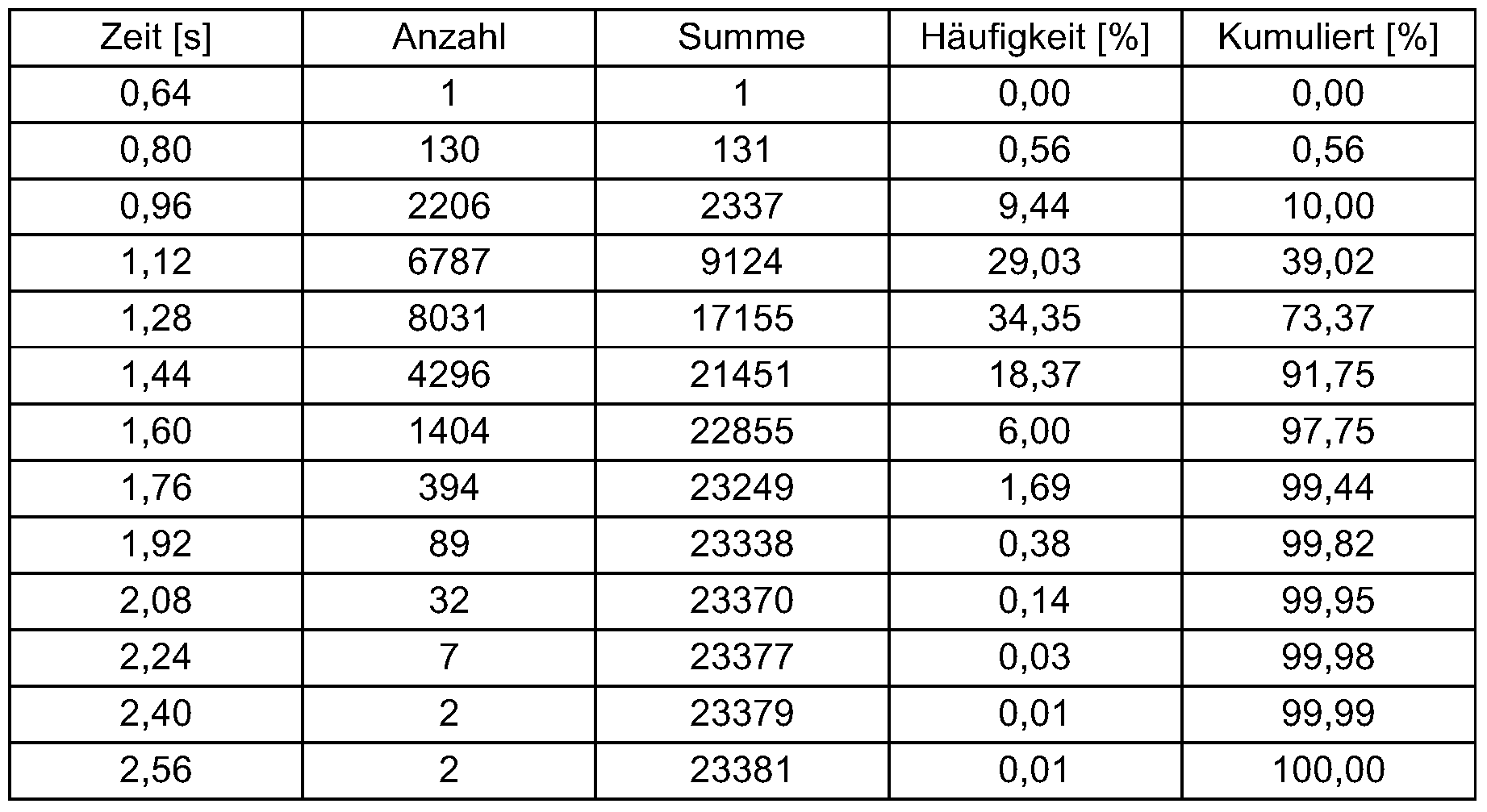
Beispiel 3: Example 3:
Es wurde verfahren wie unter Beispiel 2. Die Mischwerkzeuge wiesen einen positiven Anstellwinkel von 18° auf, d.h. die Partikel erhielten durch die rotierenden Mischwerkzeuge einem Impuls entgegen der Produktstromrichtung. Tab. 3: 700 Upm, positiver Anstellwinkel The procedure was as in Example 2. The mixing tools had a positive angle of attack of 18 °, i.e. the rotating mixing tools gave the particles an impulse against the product flow direction. Tab. 3: 700 rpm, positive angle of attack

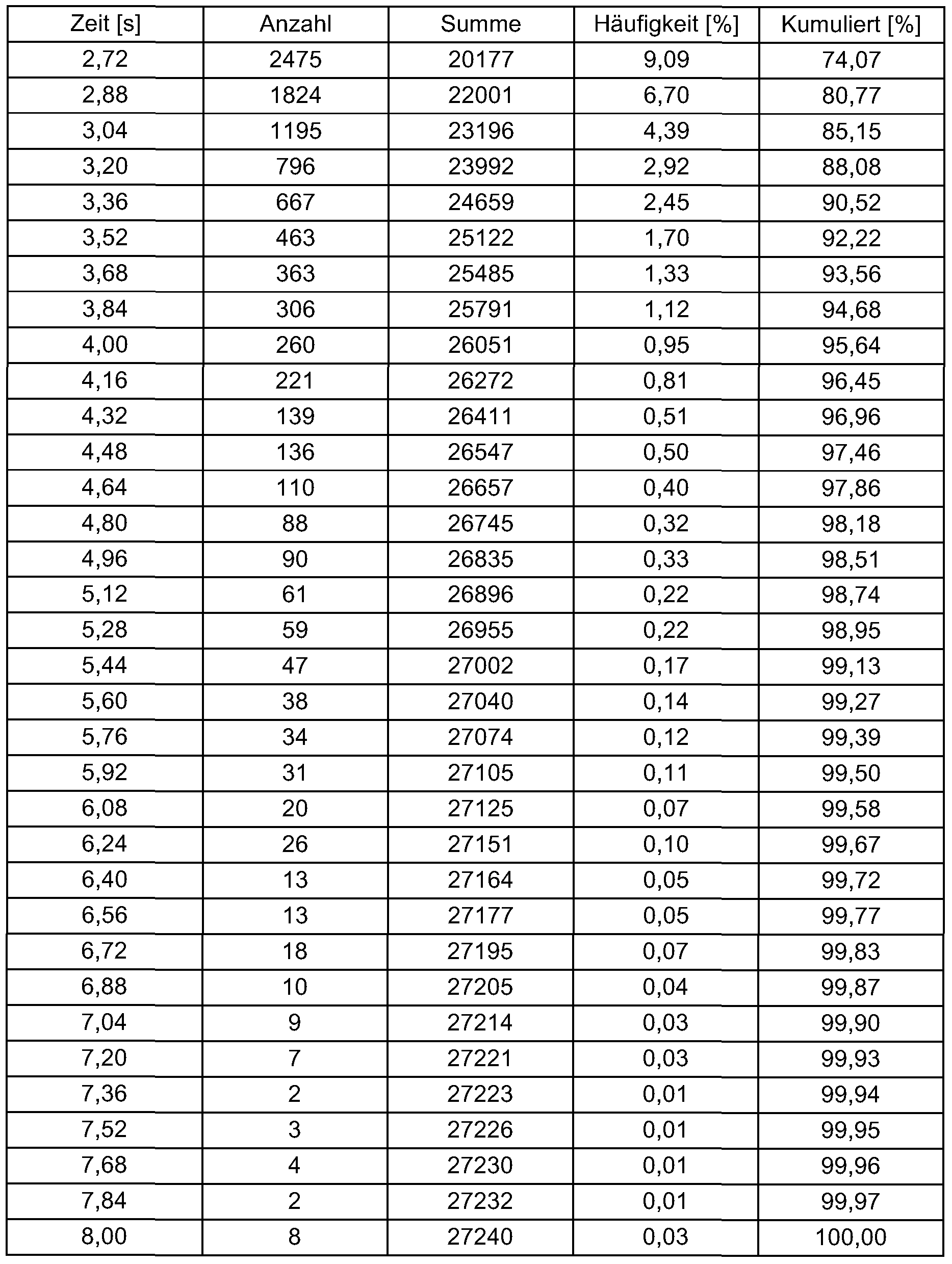
Es wurde verfahren wie unter Beispiel 3. Die Drehzahl wurde auf 575 Upm gesenkt. Tab. 4: 575 Upm, positiver Anstellwinkel The procedure was as in Example 3. The speed was reduced to 575 rpm. Tab. 4: 575 rpm, positive angle of attack

Claims
Priority Applications (4)
| Application Number | Priority Date | Filing Date | Title |
|---|---|---|---|
| CN2006800458028A CN101321583B (en) | 2005-12-07 | 2006-11-30 | Method for the continuous mixing of polymer particles |
| JP2008543787A JP5697846B2 (en) | 2005-12-07 | 2006-11-30 | Method for continuous mixing of polymer particles |
| US12/093,710 US20100140546A1 (en) | 2005-12-07 | 2006-11-30 | Method for the Continuous Mixing of Polymer Particles |
| EP06830207.4A EP1965905B1 (en) | 2005-12-07 | 2006-11-30 | Method for the continuous mixing of polymer particles |
Applications Claiming Priority (4)
| Application Number | Priority Date | Filing Date | Title |
|---|---|---|---|
| DE102005058631A DE102005058631A1 (en) | 2005-12-07 | 2005-12-07 | Continuous mixing of water-absorbent polymer with liquid, e.g. to make crosslinkable material for hygiene articles, involves using a rotating stirrer to give the particles an impetus against the product flow direction |
| DE102005058631.7 | 2005-12-07 | ||
| DE102006006539A DE102006006539A1 (en) | 2006-02-10 | 2006-02-10 | Continuously mixing water-absorbing polymer particles with liquids or other particles comprises propelling the material being mixed counter to the product flow direction by the rotation of mixing tools |
| DE102006006539.5 | 2006-02-10 |
Publications (1)
| Publication Number | Publication Date |
|---|---|
| WO2007065840A1 true WO2007065840A1 (en) | 2007-06-14 |
Family
ID=37847301
Family Applications (1)
| Application Number | Title | Priority Date | Filing Date |
|---|---|---|---|
| PCT/EP2006/069103 Ceased WO2007065840A1 (en) | 2005-12-07 | 2006-11-30 | Method for the continuous mixing of polymer particles |
Country Status (4)
| Country | Link |
|---|---|
| US (1) | US20100140546A1 (en) |
| EP (1) | EP1965905B1 (en) |
| JP (1) | JP5697846B2 (en) |
| WO (1) | WO2007065840A1 (en) |
Cited By (5)
| Publication number | Priority date | Publication date | Assignee | Title |
|---|---|---|---|---|
| WO2010133460A1 (en) | 2009-05-18 | 2010-11-25 | Basf Se | Coating process for water-absorbent polymer particles |
| WO2011024974A1 (en) | 2009-08-27 | 2011-03-03 | 株式会社日本触媒 | Water-absorbing resin based on polyacrylic acid (salt) and process for producing same |
| WO2011099586A1 (en) | 2010-02-10 | 2011-08-18 | 株式会社日本触媒 | Process for producing water-absorbing resin powder |
| WO2012102407A1 (en) | 2011-01-28 | 2012-08-02 | 株式会社日本触媒 | Manufacturing method for polyacrylic acid (salt) -based water-absorbent resin powder |
| US9233186B2 (en) | 2010-03-12 | 2016-01-12 | Nippon Shokubai Co., Ltd. | Process for producing water-absorbing resin |
Families Citing this family (2)
| Publication number | Priority date | Publication date | Assignee | Title |
|---|---|---|---|---|
| WO2014032909A1 (en) | 2012-08-29 | 2014-03-06 | Basf Se | Process for producing water-absorbing polymer particles |
| JP7257090B2 (en) * | 2018-03-29 | 2023-04-13 | Sdpグローバル株式会社 | Water-absorbing resin particles and method for producing the same |
Citations (5)
| Publication number | Priority date | Publication date | Assignee | Title |
|---|---|---|---|---|
| DE2650714A1 (en) * | 1975-05-10 | 1978-05-11 | Bayer Ag | Polychloroprene prepn. without popcorn formation - by free radical aqueous emulsion polymerisation in specific reactor |
| EP0343919A2 (en) * | 1988-05-23 | 1989-11-29 | Nippon Shokubai Co., Ltd. | Method for production of hydrophilic polymer |
| EP0648784A2 (en) * | 1993-10-15 | 1995-04-19 | BASF Aktiengesellschaft | Process for the preparation of telechelic polymers |
| WO1998043725A1 (en) * | 1997-03-27 | 1998-10-08 | Nova Chemicals (International) S.A. | Polymerization process using a dual shear mixing element |
| WO2004037900A1 (en) * | 2002-10-25 | 2004-05-06 | Stockhausen Gmbh | Two-stage mixing method for producing an absorbent polymer |
Family Cites Families (13)
| Publication number | Priority date | Publication date | Assignee | Title |
|---|---|---|---|---|
| US4125697A (en) * | 1976-05-05 | 1978-11-14 | Bayer Aktiengesellschaft | Process for the production of polychloroprene |
| JPS6055002A (en) * | 1983-09-07 | 1985-03-29 | Nippon Shokubai Kagaku Kogyo Co Ltd | Novel continuous polymerization |
| US4734478A (en) * | 1984-07-02 | 1988-03-29 | Nippon Shokubai Kagaku Kogyo Co., Ltd. | Water absorbing agent |
| JPH0790164B2 (en) * | 1989-02-03 | 1995-10-04 | 株式会社日立製作所 | Apparatus and method for producing high-viscosity substance |
| US5064582A (en) * | 1989-09-15 | 1991-11-12 | The Dow Chemical Company | Process and apparatus for recycling aqueous fluid absorbents fines |
| DE4006734C1 (en) * | 1990-03-03 | 1991-07-25 | Benckiser-Knapsack Gmbh, 6802 Ladenburg, De | |
| DE4131045C1 (en) * | 1991-09-18 | 1992-11-19 | Cassella Ag, 6000 Frankfurt, De | |
| DE19846413A1 (en) * | 1998-10-08 | 2000-04-13 | Basf Ag | Economical preparation of swellable, hydrophilic polymer having good water absorption properties, useful e.g. in hygienic articles, by polymerization, comminution, post-neutralization, drying, grinding and sieving |
| DE10016041A1 (en) * | 2000-03-31 | 2001-10-04 | Stockhausen Chem Fab Gmbh | Powdery surface crosslinked polymers |
| DE60212374T2 (en) * | 2001-04-26 | 2007-08-02 | Coöperatie Avebe U.A. | NETWORKING THE STRENGTH |
| GB0200765D0 (en) * | 2002-01-15 | 2002-03-06 | Dow Corning | Granulating mixers |
| DE10334497A1 (en) * | 2003-07-29 | 2005-02-24 | Degussa Ag | Polymer powder with phosphonate-based flame retardant, process for its preparation and moldings, made from this polymer powder |
| ATE400306T1 (en) * | 2003-10-31 | 2008-07-15 | Basf Se | POLYMER PARTICLES ABSORBING BLOOD AND/OR BODY FLUID |
-
2006
- 2006-11-30 US US12/093,710 patent/US20100140546A1/en not_active Abandoned
- 2006-11-30 EP EP06830207.4A patent/EP1965905B1/en active Active
- 2006-11-30 WO PCT/EP2006/069103 patent/WO2007065840A1/en not_active Ceased
- 2006-11-30 JP JP2008543787A patent/JP5697846B2/en active Active
Patent Citations (5)
| Publication number | Priority date | Publication date | Assignee | Title |
|---|---|---|---|---|
| DE2650714A1 (en) * | 1975-05-10 | 1978-05-11 | Bayer Ag | Polychloroprene prepn. without popcorn formation - by free radical aqueous emulsion polymerisation in specific reactor |
| EP0343919A2 (en) * | 1988-05-23 | 1989-11-29 | Nippon Shokubai Co., Ltd. | Method for production of hydrophilic polymer |
| EP0648784A2 (en) * | 1993-10-15 | 1995-04-19 | BASF Aktiengesellschaft | Process for the preparation of telechelic polymers |
| WO1998043725A1 (en) * | 1997-03-27 | 1998-10-08 | Nova Chemicals (International) S.A. | Polymerization process using a dual shear mixing element |
| WO2004037900A1 (en) * | 2002-10-25 | 2004-05-06 | Stockhausen Gmbh | Two-stage mixing method for producing an absorbent polymer |
Cited By (16)
| Publication number | Priority date | Publication date | Assignee | Title |
|---|---|---|---|---|
| CN102428146A (en) * | 2009-05-18 | 2012-04-25 | 巴斯夫欧洲公司 | Coating method of water-absorbing polymer particles |
| WO2010133460A1 (en) | 2009-05-18 | 2010-11-25 | Basf Se | Coating process for water-absorbent polymer particles |
| US8859685B2 (en) | 2009-08-27 | 2014-10-14 | Nippon Shokubai Co., Ltd. | Polyacrylic acid (salt)-type water absorbent resin and method for producing of same |
| US8907021B2 (en) | 2009-08-27 | 2014-12-09 | Nippon Shokubai Co., Ltd. | Polyacrylic acid (salt)-type water absorbent resin and method for producing of same |
| WO2011024971A1 (en) | 2009-08-27 | 2011-03-03 | 株式会社日本触媒 | Polyacrylic acid (salt) water absorbent resin and method for producing same |
| US9138505B2 (en) | 2009-08-27 | 2015-09-22 | Nippon Shokubai Co., Ltd. | Polyacrylic acid (salt)-type water absorbent resin and method for producing of same |
| WO2011024975A1 (en) | 2009-08-27 | 2011-03-03 | 株式会社日本触媒 | Polyacrylic acid (salt) water absorbent resin and method for producing same |
| US9023951B2 (en) | 2009-08-27 | 2015-05-05 | Nippon Shokubai Co., Ltd. | Polyacrylic acid (salt)-type water absorbent resin and method for producing of same |
| WO2011024974A1 (en) | 2009-08-27 | 2011-03-03 | 株式会社日本触媒 | Water-absorbing resin based on polyacrylic acid (salt) and process for producing same |
| WO2011024972A1 (en) | 2009-08-27 | 2011-03-03 | 株式会社日本触媒 | Polyacrylic acid (salt) water absorbent resin and method for producing same |
| WO2011099586A1 (en) | 2010-02-10 | 2011-08-18 | 株式会社日本触媒 | Process for producing water-absorbing resin powder |
| US9976001B2 (en) | 2010-02-10 | 2018-05-22 | Nippon Shokubai Co., Ltd. | Process for producing water-absorbing resin powder |
| US9233186B2 (en) | 2010-03-12 | 2016-01-12 | Nippon Shokubai Co., Ltd. | Process for producing water-absorbing resin |
| US9272068B2 (en) | 2010-03-12 | 2016-03-01 | Nippon Shokubai Co., Ltd. | Process for producing water-absorbing resin |
| US10307506B2 (en) | 2010-03-12 | 2019-06-04 | Nippon Shokubai Co., Ltd. | Process for producing water-absorbing resin |
| WO2012102407A1 (en) | 2011-01-28 | 2012-08-02 | 株式会社日本触媒 | Manufacturing method for polyacrylic acid (salt) -based water-absorbent resin powder |
Also Published As
| Publication number | Publication date |
|---|---|
| EP1965905A1 (en) | 2008-09-10 |
| JP2009518484A (en) | 2009-05-07 |
| US20100140546A1 (en) | 2010-06-10 |
| JP5697846B2 (en) | 2015-04-08 |
| EP1965905B1 (en) | 2014-07-02 |
Similar Documents
| Publication | Publication Date | Title |
|---|---|---|
| EP1949011B2 (en) | Process for preparing water-absorbing polymer particles | |
| EP1931616B1 (en) | Neutralization method | |
| EP1799721B1 (en) | Method for the continuous production of crosslinked particulate gel-type polymers | |
| DE102005014291A1 (en) | Process for the preparation of water-absorbing polymers | |
| EP1919609B1 (en) | Method for producing water-absorbing polymer particles | |
| DE102005001789A1 (en) | A method of classifying a particulate water-absorbent resin | |
| WO2008077780A1 (en) | Method for producing mechanically stable water-absorbent polymer particles | |
| EP1926754B2 (en) | Polymerization method | |
| EP1926756B1 (en) | Polymerization method | |
| EP1940766B1 (en) | Neutralization process | |
| EP1926758B1 (en) | Polymerization method | |
| WO2007028746A1 (en) | Neutralization method | |
| EP1965905B1 (en) | Method for the continuous mixing of polymer particles | |
| WO2009077100A1 (en) | Method for producing water-absorbing polymer particles | |
| WO2008113790A1 (en) | Method for coating water-absorbent polymer particles | |
| EP2129706A1 (en) | Method for coating water-absorbent polymer particles | |
| EP1924609A1 (en) | Method for producing water-absorbing polymers | |
| WO2007065834A1 (en) | Process for preparing water-absorbing polymers with high absorption capacity and high permeability | |
| DE102005058631A1 (en) | Continuous mixing of water-absorbent polymer with liquid, e.g. to make crosslinkable material for hygiene articles, involves using a rotating stirrer to give the particles an impetus against the product flow direction | |
| DE102006006539A1 (en) | Continuously mixing water-absorbing polymer particles with liquids or other particles comprises propelling the material being mixed counter to the product flow direction by the rotation of mixing tools |
Legal Events
| Date | Code | Title | Description |
|---|---|---|---|
| WWE | Wipo information: entry into national phase |
Ref document number: 200680045802.8 Country of ref document: CN |
|
| 121 | Ep: the epo has been informed by wipo that ep was designated in this application | ||
| WWE | Wipo information: entry into national phase |
Ref document number: 2006830207 Country of ref document: EP |
|
| WWE | Wipo information: entry into national phase |
Ref document number: 12093710 Country of ref document: US |
|
| WWE | Wipo information: entry into national phase |
Ref document number: 2008543787 Country of ref document: JP |
|
| NENP | Non-entry into the national phase |
Ref country code: DE |
|
| WWP | Wipo information: published in national office |
Ref document number: 2006830207 Country of ref document: EP |