WO2006089311A1 - Vanilloid receptor ligands and their use in treatments - Google Patents
Vanilloid receptor ligands and their use in treatments Download PDFInfo
- Publication number
- WO2006089311A1 WO2006089311A1 PCT/US2006/006987 US2006006987W WO2006089311A1 WO 2006089311 A1 WO2006089311 A1 WO 2006089311A1 US 2006006987 W US2006006987 W US 2006006987W WO 2006089311 A1 WO2006089311 A1 WO 2006089311A1
- Authority
- WO
- WIPO (PCT)
- Prior art keywords
- alkylor
- alkylnr
- substituted
- nitro
- cyano
- Prior art date
- Legal status (The legal status is an assumption and is not a legal conclusion. Google has not performed a legal analysis and makes no representation as to the accuracy of the status listed.)
- Ceased
Links
- KYXNRVIFPMGDPV-UHFFFAOYSA-N CC(C)(C)OC(N(CC1)CC1Nc(nc(C(F)(F)F)cc1)c1-c1ncnc(Oc2cccc3c2nc(NC(C)=O)[s]3)c1)=O Chemical compound CC(C)(C)OC(N(CC1)CC1Nc(nc(C(F)(F)F)cc1)c1-c1ncnc(Oc2cccc3c2nc(NC(C)=O)[s]3)c1)=O KYXNRVIFPMGDPV-UHFFFAOYSA-N 0.000 description 1
- OUGCQLKJURSCJQ-NRFANRHFSA-N CC(C)(C)OC(N(CCC1)[C@@H]1C#Cc1cc(C(F)(F)F)ccc1-c1cc(Oc2cccc3c2nc(NC(C)=O)[s]3)ncn1)=O Chemical compound CC(C)(C)OC(N(CCC1)[C@@H]1C#Cc1cc(C(F)(F)F)ccc1-c1cc(Oc2cccc3c2nc(NC(C)=O)[s]3)ncn1)=O OUGCQLKJURSCJQ-NRFANRHFSA-N 0.000 description 1
- PJYQTAJZFPRWQU-QGZVFWFLSA-N CC(C)(C)OC(N1[C@@H](CNc2nc(C(F)(F)F)ccc2-c2ncnc(Oc3c4nc(NC(C)=O)[s]c4ccc3)c2)CCC1)=O Chemical compound CC(C)(C)OC(N1[C@@H](CNc2nc(C(F)(F)F)ccc2-c2ncnc(Oc3c4nc(NC(C)=O)[s]c4ccc3)c2)CCC1)=O PJYQTAJZFPRWQU-QGZVFWFLSA-N 0.000 description 1
- HDZDJBKJCCWYHA-UHFFFAOYSA-N CC(C)(C1)NC(C)(C)CC1Nc1nc(C(F)(F)F)ccc1-c1ncnc(Oc2cccc3c2nc(NC(C)=O)[s]3)c1 Chemical compound CC(C)(C1)NC(C)(C)CC1Nc1nc(C(F)(F)F)ccc1-c1ncnc(Oc2cccc3c2nc(NC(C)=O)[s]3)c1 HDZDJBKJCCWYHA-UHFFFAOYSA-N 0.000 description 1
- DEMIRSVUSWJCFT-UHFFFAOYSA-N CC(C)(CC1)NC1C(O)=O Chemical compound CC(C)(CC1)NC1C(O)=O DEMIRSVUSWJCFT-UHFFFAOYSA-N 0.000 description 1
- FDTQJMOPWAATGD-UHFFFAOYSA-N CC(C)CN(CCCC1)C1C(Nc1cc(C(F)(F)F)ccc1-c1ncnc(Oc2c3nc(NC(C)=O)[s]c3ccc2)c1)=O Chemical compound CC(C)CN(CCCC1)C1C(Nc1cc(C(F)(F)F)ccc1-c1ncnc(Oc2c3nc(NC(C)=O)[s]c3ccc2)c1)=O FDTQJMOPWAATGD-UHFFFAOYSA-N 0.000 description 1
- GJZHTEIODPUPRD-UHFFFAOYSA-N CC(C)CN1C(CN)CCCC1 Chemical compound CC(C)CN1C(CN)CCCC1 GJZHTEIODPUPRD-UHFFFAOYSA-N 0.000 description 1
- XVWRWBMMOYPTHB-UHFFFAOYSA-N CC(C)CN1C(CNc2nc(C(F)(F)F)ccc2-c2ncnc(Oc3cccc(NC4=O)c3N=C4N)c2)CCCC1 Chemical compound CC(C)CN1C(CNc2nc(C(F)(F)F)ccc2-c2ncnc(Oc3cccc(NC4=O)c3N=C4N)c2)CCCC1 XVWRWBMMOYPTHB-UHFFFAOYSA-N 0.000 description 1
- IJLVHSQAODADQK-SFHVURJKSA-N CC(Nc([s]c1ccc2)nc1c2Oc1ncnc(-c2ccc(C(F)(F)F)cc2C#C[C@H]2NCCC2)c1)=O Chemical compound CC(Nc([s]c1ccc2)nc1c2Oc1ncnc(-c2ccc(C(F)(F)F)cc2C#C[C@H]2NCCC2)c1)=O IJLVHSQAODADQK-SFHVURJKSA-N 0.000 description 1
- YFNGOGGFEQXBTJ-UHFFFAOYSA-N CC(Nc1nc(c(Oc2cc(-c3c(NCC4OCCNC4)nc(C(F)(F)F)cc3)ncn2)ccc2)c2[s]1)=O Chemical compound CC(Nc1nc(c(Oc2cc(-c3c(NCC4OCCNC4)nc(C(F)(F)F)cc3)ncn2)ccc2)c2[s]1)=O YFNGOGGFEQXBTJ-UHFFFAOYSA-N 0.000 description 1
- 0 CCc1c(*)c(**)c(*)c(*)c1C Chemical compound CCc1c(*)c(**)c(*)c(*)c1C 0.000 description 1
- BTHWSGFWVYJZJQ-JXFKEZNVSA-N C[C@@H]([C@H](CCC1)N1C(OC(C)(C)C)=O)Nc1nc(C(F)(F)F)ccc1-c1ncnc(Oc2cccc3c2nc(NC(C)=O)[s]3)c1 Chemical compound C[C@@H]([C@H](CCC1)N1C(OC(C)(C)C)=O)Nc1nc(C(F)(F)F)ccc1-c1ncnc(Oc2cccc3c2nc(NC(C)=O)[s]3)c1 BTHWSGFWVYJZJQ-JXFKEZNVSA-N 0.000 description 1
- BTHWSGFWVYJZJQ-OXQOHEQNSA-N C[C@H]([C@@H](CCC1)N1C(OC(C)(C)C)=O)Nc(nc(C(F)(F)F)cc1)c1-c1ncnc(Oc2c3nc(NC(C)=O)[s]c3ccc2)c1 Chemical compound C[C@H]([C@@H](CCC1)N1C(OC(C)(C)C)=O)Nc(nc(C(F)(F)F)cc1)c1-c1ncnc(Oc2c3nc(NC(C)=O)[s]c3ccc2)c1 BTHWSGFWVYJZJQ-OXQOHEQNSA-N 0.000 description 1
- POMGEIUNAZSCEV-UHFFFAOYSA-N Cc(cccc1Oc2cc(-c3ccc(C(F)(F)F)nc3NCC3OCCN(Cc4ccccc4)C3)ncn2)c1/N=C(/N)\S Chemical compound Cc(cccc1Oc2cc(-c3ccc(C(F)(F)F)nc3NCC3OCCN(Cc4ccccc4)C3)ncn2)c1/N=C(/N)\S POMGEIUNAZSCEV-UHFFFAOYSA-N 0.000 description 1
Classifications
-
- C—CHEMISTRY; METALLURGY
- C07—ORGANIC CHEMISTRY
- C07D—HETEROCYCLIC COMPOUNDS
- C07D403/00—Heterocyclic compounds containing two or more hetero rings, having nitrogen atoms as the only ring hetero atoms, not provided for by group C07D401/00
- C07D403/14—Heterocyclic compounds containing two or more hetero rings, having nitrogen atoms as the only ring hetero atoms, not provided for by group C07D401/00 containing three or more hetero rings
-
- A—HUMAN NECESSITIES
- A61—MEDICAL OR VETERINARY SCIENCE; HYGIENE
- A61P—SPECIFIC THERAPEUTIC ACTIVITY OF CHEMICAL COMPOUNDS OR MEDICINAL PREPARATIONS
- A61P19/00—Drugs for skeletal disorders
- A61P19/02—Drugs for skeletal disorders for joint disorders, e.g. arthritis, arthrosis
-
- A—HUMAN NECESSITIES
- A61—MEDICAL OR VETERINARY SCIENCE; HYGIENE
- A61P—SPECIFIC THERAPEUTIC ACTIVITY OF CHEMICAL COMPOUNDS OR MEDICINAL PREPARATIONS
- A61P29/00—Non-central analgesic, antipyretic or antiinflammatory agents, e.g. antirheumatic agents; Non-steroidal antiinflammatory drugs [NSAID]
-
- A—HUMAN NECESSITIES
- A61—MEDICAL OR VETERINARY SCIENCE; HYGIENE
- A61P—SPECIFIC THERAPEUTIC ACTIVITY OF CHEMICAL COMPOUNDS OR MEDICINAL PREPARATIONS
- A61P35/00—Antineoplastic agents
-
- C—CHEMISTRY; METALLURGY
- C07—ORGANIC CHEMISTRY
- C07D—HETEROCYCLIC COMPOUNDS
- C07D401/00—Heterocyclic compounds containing two or more hetero rings, having nitrogen atoms as the only ring hetero atoms, at least one ring being a six-membered ring with only one nitrogen atom
- C07D401/14—Heterocyclic compounds containing two or more hetero rings, having nitrogen atoms as the only ring hetero atoms, at least one ring being a six-membered ring with only one nitrogen atom containing three or more hetero rings
-
- C—CHEMISTRY; METALLURGY
- C07—ORGANIC CHEMISTRY
- C07D—HETEROCYCLIC COMPOUNDS
- C07D417/00—Heterocyclic compounds containing two or more hetero rings, at least one ring having nitrogen and sulfur atoms as the only ring hetero atoms, not provided for by group C07D415/00
- C07D417/02—Heterocyclic compounds containing two or more hetero rings, at least one ring having nitrogen and sulfur atoms as the only ring hetero atoms, not provided for by group C07D415/00 containing two hetero rings
- C07D417/12—Heterocyclic compounds containing two or more hetero rings, at least one ring having nitrogen and sulfur atoms as the only ring hetero atoms, not provided for by group C07D415/00 containing two hetero rings linked by a chain containing hetero atoms as chain links
-
- C—CHEMISTRY; METALLURGY
- C07—ORGANIC CHEMISTRY
- C07D—HETEROCYCLIC COMPOUNDS
- C07D417/00—Heterocyclic compounds containing two or more hetero rings, at least one ring having nitrogen and sulfur atoms as the only ring hetero atoms, not provided for by group C07D415/00
- C07D417/14—Heterocyclic compounds containing two or more hetero rings, at least one ring having nitrogen and sulfur atoms as the only ring hetero atoms, not provided for by group C07D415/00 containing three or more hetero rings
Definitions
- VR1 The vanilloid receptor 1 (VR1) is the molecular target of capsaicin, the active ingredient in hot peppers. Julius et al. reported the molecular cloning of VR1 (Caterina et al., 1997).
- VR1 is a non-selective cation channel which is activated or sensitized by a series of different stimuli including capsaicin and resiniferatoxin (exogenous activators), heat & acid stimulation and products of lipid bilayer metabolism, anandamide (Premkumar et al., 2000, Szabo et al., 2000, Gauldie et al., 2001 , Olah et al., 2001) and lipoxygenase metabolites (Hwang et al., 2000).
- VR1 is highly expressed in primary sensory neurons (Caterina et al., 1997) in rats, mice and humans (Onozawa et al., 2000, Mezey et al., 2000, Helliwell et al., 1998, Cortright et al., 2001). These sensory neurons innervate many visceral organs including the dermis, bones, bladder, gastrointestinal tract and lungs; VR1 is also expressed in other neuronal and non-neuronal tissues including but not limited to, CNS nuclei, kidney, stomach and T-cells (Nozawa et al., 2001, Yiangou et al., 2001, Birder et al., 2001).
- Presumably expression in these various cells and organs may contribute to their basic properties such as cellular signaling and cell division.
- experimentation with capsaicin indicated the presence of a capsaicin sensitive receptor, which could increase the activity of sensory neurons in humans, rats and mice (Holzer, 1991; Dray, 1992, Szallasi and Blumberg 1996, 1999).
- the results of acute activation by capsaicin in humans was pain at injection site and in other species increased behavioral sensitivity to sensory stimuli (Szallasi and Blumberg, 1999).
- Capsaicin application to the skin in humans causes a painful reaction characterized not only by the perception of heat and pain at the site of adininistration but also by a wider area of hyperalgesia and allodynia, two characteristic symptoms of the human condition of neuropathic pain (Holzer, 1991). Taken together, it seems likely that increased activity of VR1 plays a significant role in the establishment and maintenance of pain conditions. Topical or intradermal injection of capsaicin has also been shown to produce localized vasodilation and edema production (Szallasi and Blumberg 1999, Singh et al., 2001). This evidence indicates that capsaicin through it's activation of VR1 can regulate afferent and efferent function of sensory nerves.
- VR1 gene knockout mice have been shown to have reduced sensory sensitivity to thermal and acid stimuli (Caterina et al., 2000)). This supports the concept that VR1 contributes not only to generation of pain responses (i.e. via thermal, acid or capsaicin stimuli) but also to the maintenance of basal activity of sensory nerves. This evidence agrees with studies demonstrating capsaicin sensitive nerve involvement in disease. Primary sensory nerves in humans and other species can be made inactive by continued capsaicin stimulation.
- Capsaicin sensitivity is associated with expression of the vanilloid (capsaicin) receptor (VR1) mRNA in adult rat sensory ganglia. Neuroscience Lett. 250: 3: 177-180.
- VR1 at acidic pH in dorsal root ganglia neurons and cells ectopically expressing VR1. Journal of Biological Chemistry 276: 33, 31163-31170.
- the cloned capsaicin receptor integrates multiple pain-producing stimuli. Neuron 21 : 531-543.
- the present invention comprises a new class of compounds useful in the treatment of diseases, such as vanilloid-receptor-mediated diseases and other maladies, such as inflammatory or neuropathic pain and diseases involving sensory nerve function such as asthma, rheumatoid arthritis, osteoarthritis, inflammatory bowel disorders, depression, anxiety, urinary incontinence, migraine and psoriasis.
- diseases such as vanilloid-receptor-mediated diseases and other maladies, such as inflammatory or neuropathic pain and diseases involving sensory nerve function
- diseases such as vanilloid-receptor-mediated diseases and other maladies, such as inflammatory or neuropathic pain and diseases involving sensory nerve function
- diseases such as vanilloid-receptor-mediated diseases and other maladies, such as inflammatory or neuropathic pain and diseases involving sensory nerve function
- diseases such as vanilloid-receptor-mediated diseases and other maladies, such as inflammatory or neuropathic pain and diseases involving sensory nerve function
- asthma such as asthma, r
- the compounds of the invention are useful for the treatment of acute, inflammatory and neuropathic pain, dental pain, general headache, migraine, cluster headache, mixed- vascular and non- vascular syndromes, tension headache, general mflammation, arthritis, rheumatic diseases, osteoarthritis, inflammatory bowel disorders, depression, anxiety, inflammatory eye disorders, inflammatory or unstable bladder disorders, psoriasis, skin complaints with inflammatory components, chronic inflammatory conditions, inflammatory pain and associated hyperalgesia and allodynia, neuropathic pain and associated hyperalgesia and allodynia, diabetic neuropathy pain, causalgia, sympathetically maintained pain, deafferentation syndromes, asthma, epithelial tissue damage or dysfunction, herpes simplex, disturbances of visceral motility at respiratory, genitourinary, gastrointestinal or vascular regions, wounds, burns, allergic skin reactions, pruritus, vitiligo, general gastrointestinal disorders, gastric ulceration, duodenal ulcers, diarrhea,
- the invention also comprises pharmaceutical compositions comprising the compounds, methods for the treatment of vanilloid- receptor-mediated diseases, such as inflammatory or neuropathic pain, asthma, rheumatoid arthritis, osteoarthritis, inflammatory bowel disorders, depression, anxiety, urinary incontinence, migraine and psoriasis diseases, using the compounds and compositions of the invention, and intermediates and processes useful for the preparation of the compounds of the invention.
- vanilloid- receptor-mediated diseases such as inflammatory or neuropathic pain, asthma, rheumatoid arthritis, osteoarthritis, inflammatory bowel disorders, depression, anxiety, urinary incontinence, migraine and psoriasis diseases.
- the compounds of the invention are represented by the following general structure: or a pharmaceutically acceptable salt thereof, wherein J, R i , R 4 , R d , X and Y are defined below.
- J is O or S;
- X is N or C(R 2 );
- Y is N or C(R 3 ), wherein at least one of X and Y is not N; n is independently, at each instance, 0, 1 or 2; R i is
- R 4 is independently at each instance
- R i 0 is a saturated, partially-saturated or unsaturated 5-, 6- or 7-membered monocyclic or 6-, 7-, 8-, 9-, 10- or 11-membered bicyclic ring containing 1 , 2 or 3 atoms selected from N, O and S, where
- R 10 is C 2-6 alkyl substituted by 0, 1, 2 or 3 groups selected from C 1-4 haloalkyl, halo, cyano, nitro, -OH, -
- R i 2 is a saturated, partially-saturated or unsaturated 5-, 6- or 7-membered monocyclic or 6-, 7-, 8-, 9-, 10- or 11-membered bicyclic ring containing 1, 2 or 3 atoms selected from N, O and S, wherein the ring is substituted by 0, 1 or 2 oxo or thioxo groups, wherein the ring is substituted by 0, 1, 2 or 3 groups selected from R , halo, cyano, nitro, -OH, -NH 2 ,
- R a is independently, at each instance, H, phenyl, benzyl or d. 6 alkyl, the phenyl, benzyl and C 2-6 alkyl being substituted by 0, 1, 2 or 3 substituents selected from halo, C 2-6 alkyl, C 1-3 haloalkyl, -OC 2-6 alkyl, -NH 2 , -NHC 2-6 alkyl, -N(C 2-6 alkyl)C 2-6 alkyl;
- R b is a saturated, partially saturated or unsaturated 5-, 6- or 7-membered monocyclic or 6-, 7-, 8-, 9-, 10- or 11-membered bicyclic ring containing 0, 1, 2, 3 or 4 atoms selected from N, O and S, wherein the carbon atoms of the ring are substituted by 0, 1 or 2 oxo or thioxo groups, sulfur atoms of the ring are substituted by 0, 1 or 2 oxo groups, nitrogen atoms of the ring are substituted by 0 or 1 oxo groups; R d is independently in each instance hydrogen or -CH 3 ;
- R is, independently, in each instance, C 2-6 alkyl or C 2-6 alkyl ⁇ henyl) wherein either is substituted by 0, 1, 2, 3 or 4 substituents selected from halo,
- R b is a heterocycle selected from the group of thiophene, pyrrole, 1,3-oxazole, l,3-thiazol-4-yl, 1,3,4-oxadiazole, 1,3,4-thiadiazole, 1,2,3- oxadiazole, 1,2,3-thiadiazole, IH-1 ,2,3 -triazole, isothiazole, 1,2,4-oxadiazole, 1,2,4-thiadiazole, 1,2,3,4-oxatriazole, 1,2,3,4-thiatriazole, IH-1, 2,3 ,4-tetraazole, 1,2,3,5-oxatriazole, 1,2,3,5-thiatriazole, furan, imidazol-2-yl, benzimidazole, 1 ,2,4-triazole, isoxazole, pyrazol-3-yl, pyrazol-4-yl,
- X is N or C(R 2 ); Y is N or C(R 3 ), wherein at least one of X and Y is not N.
- X is C(R 2 ); Y is C(R 3 ); and R 3 is halo, -NH 2 , -NHC 2-6 alkyl, -NtCj.galkyOQ.salkyl, or C 2-6 alkyl.
- X is C(R 2 ); Y is C(R 3 ); and R 3 is H;
- X is N; and Y is C(R 3 ). In another embodiment, in conjunction with any one of the above and below embodiments, X is C(R 2 ); and Y is N.
- Embodiment A In another embodiment, in conjunction with any one of the above and below embodiments, R i is
- Embodiment C In another embodiment, in conjunction with any one of the above and below embodiments, R i is
- R 2 is H
- R 2 is selected from H and halo.
- R 3 is H.
- Embodiment D In another embodiment, in conjunction with any one of the above and below embodiments, R is independently at each instance
- Embodiment E In another embodiment, in conjunction with any one of the above and below embodiments, R is independently at each instance
- R 5 is R k .
- R 5 is independently, at each instance, H, d ⁇ haloalkyl, halo,
- R 6 is H
- R 6 is R k .
- R 7 is independently, at each instance, H, C 1-8 alkyl, C 1-4 haloalkyl, halo, cyano -OC 1-6 alkyl, -O C 1-4 haloalkyl, -OC 2-6 alkylNR a R a , -OC 2-6 alkylOR a , -NR a R a , -NR a C 1-4 haloalkyl, -NR a C 2-6 alkylNR a R a , -NR a C 2-6 alkylOR a , -C 1-8 alkylOR a , -C 1-6 alkylNR a R a or -S(C 1-6 aIkVl); or R 7 is a saturated, partially-saturated or unsaturated 4- or 5-membered ring heterocycle containing a single nitrogen atom, wherein the ring is substituted with 0, 1 or 2 substitu
- Embodiment I In another embodiment, in conjunction with any one of the above and below embodiments, R 7 is independently, at each instance, C 3-5 alkyl or C 1-2 haloalkyl.
- R 7 is C 3-5 alkyl.
- R 7 is -C(CH 3 ) 3 . In another embodiment, in conjunction with any one of the above and below embodiments, R 7 is -CF 3 .
- R i 1 is a saturated, partially-saturated or unsaturated 5-, 6- or 7-membered monocyclic or 6-, 7-, 8-, 9-, 10- or 11-membered bicyclic ring containing 1, 2 or 3 atoms selected from N, O and S, wherein the ring is substituted by 0, 1 or 2 oxo or thioxo groups, wherein the ring is substituted by O,
- Embodiment Q In another embodiment, in conjunction with any one of the above and below embodiments, R i 2 is H.
- R 13 is H.
- R is a saturated, partially-saturated or unsaturated 5-, 6- or 7-membered monocyclic or 6-, 7-, 8-, 9-, 10- or 11-membered bicyclic ring containing 1, 2 or 3 atoms selected from N, O and S, wherein the ring is substituted by 0, 1 or 2 oxo or thioxo groups, wherein the ring is substituted by O,
- R i 4 is H.
- At least one of R i 0 , R i 1 , R i 2 , R i 3 and R i 4 is other than H.
- R i 0 , R i 1 , R i 2 , R i 3 and R i 4 is other than H.
- the above embodiments may be used in conjuction with other embodiments listed.
- the following table is a non-exclusive, non-limiting list of some of the combinations of embodiments.
- R 5 , R 6 , R i 3 and R i 4 are all H.
- X is N and Y is CH:
- Another aspect of the invention relates to a method of treating acute, inflammatory and neuropathic pain, dental pain, general headache, migraine, cluster headache, mixed-vascular and non- vascular syndromes, tension headache, general inflammation, arthritis, rheumatic diseases, osteoarthritis, inflammatory bowel disorders, depression, anxiety, inflammatory eye disorders, inflammatory or unstable bladder disorders, psoriasis, skin complaints with inflammatory components, chronic inflammatory conditions, inflammatory pain and associated hyperalgesia and allodynia, neuropathic pain and associated hyperalgesia and allodynia, diabetic neuropathy pain, causalgia, sympathetically maintained pain, deafferentation syndromes, asthma, epithelial tissue damage or dysfunction, herpes simplex, disturbances of visceral motility at respiratory, genitourinary, gastrointestinal or vascular regions, wounds, burns, allergic skin reactions, pruritus, vitiligo, general gastrointestinal disorders, gastric ulceration, duodenal ulcers, diarrhea, gastric lesions
- Another aspect of the invention relates to a pharmaceutical composition
- a pharmaceutical composition comprising a compound according to any of the above embodiments and a pharmaceutically-acceptable diluent or carrier.
- Another aspect of the invention relates to the use of a compound according to any of the above embodiments as a medicament.
- Another aspect of the invention relates to the use of a compound according to any of the above embodiments in the manufacture of a medicament for the treatment of acute, inflammatory and neuropathic pain, dental pain, general headache, migraine, cluster headache, mixed-vascular and non- vascular syndromes, tension headache, general inflammation, arthritis, rheumatic diseases, osteoarthritis, inflammatory bowel disorders, depression, anxiety, inflammatory eye disorders, inflammatory or unstable bladder disorders, psoriasis, skin complaints with inflammatory components, chronic inflammatory conditions, inflammatory pain and associated hyperalgesia and allodynia, neuropathic pain and associated hyperalgesia and allodynia, diabetic neuropathy pain, causalgia, sympathetically maintained pain, deafferentation syndromes, asthma, epithelial tissue damage or dysfunction, herpes simplex, disturbances of visceral motility at respiratory, genitourinary, gastrointestinal or vascular regions, wounds, burns, allergic skin reactions, pruritus, vitiligo, general gastrointestinal
- Another aspect of the invention relates to a method of making a compound according to the above embodiments, comprising the step of: reacting ith R 4 JH to form
- the compounds of this invention may have in general several asymmetric centers and are typically depicted in the form of racemic mixtures. This invention is intended to encompass racemic mixtures, partially racemic mixtures and separate enantiomers and diasteromers.
- C a _palkyl means an alkyl group comprising a minimum of ⁇ and a maximum of ⁇ carbon atoms in a branched, cyclical or linear relationship or any combination of the three, wherein ⁇ and ⁇ represent integers.
- the alkyl groups described in this section may also contain one or two double or triple bonds. Examples OfC 1 .
- 6 alkyl include, but are not limited to the following:
- Halo or "halogen” means a halogen atoms selected from F, Cl, Br and I.
- Cv-whaloalkyl means an alkyl group, as described above, wherein any number— at least one—of the hydrogen atoms attached to the alkyl chain are replaced by F,
- Heterocycle means a ring comprising at least one carbon atom and at least one other atom selected from N, O and S. Examples of heterocycles that may be found in the claims include, but are not limited to, the following:
- “Available nitrogen atoms” are those nitrogen atoms that are part of a heterocycle and are joined by two single bonds (e.g. piperidine), leaving an external bond available for substitution by, for example, H or CH 3 .
- “Pharmaceutically-acceptable salt” means a salt prepared by conventional means, and are well known by those skilled in the art.
- the “pharmacologically acceptable salts” include basic salts of inorganic and organic acids, including but not limited to hydrochloric acid, hydrobromic acid, sulfuric acid, phosphoric acid, methanesulfonic acid, ethanesulfonic acid, malic acid, acetic acid, oxalic acid, tartaric acid, citric acid, lactic acid, fumaric acid, succinic acid, maleic acid, salicylic acid, benzoic acid, phenylacetic acid, mandelic acid and the like.
- suitable pharmaceutically acceptable cation pairs for the carboxy group are well known to those skilled in the art and include alkaline, alkaline earth, ammonium, quaternary ammonium cations and the like.
- pharmaceutically acceptable salts see infra and Berge et al., J. Pharm. Sci. 66:1 (1977).
- “Saturated or unsaturated” includes substituents saturated with hydrogens, substituents completely unsaturated with hydrogens and substituents partially saturated with hydrogens.
- leaving group generally refers to groups readily displaceable by a nucleophile, such as an amine, a thiol or an alcohol nucleophile. Such leaving groups are well known in the art. Examples of such leaving groups include, but are not limited to, N-hydroxysuccinimide, N-hydroxybenzotriazole, halides, Inflates, tosylates and the like. Preferred leaving groups are indicated herein where appropriate.
- Protecting group generally refers to groups well known in the art which are used to prevent selected reactive groups, such as carboxy, amino, hydroxy, mercapto and the like, from undergoing undesired reactions, such as nucleophilic, electrophilic, oxidation, reduction and the like.
- amino protecting groups include, but are not limited to, aralkyl, substituted aralkyl, cycloalkenylalkyl and substituted cycloalkenyl alkyl, allyl, substituted allyl, acyl, alkoxycarbonyl, aralkoxycarbonyl, silyl and the like.
- aralkyl examples include, but are not limited to, benzyl, ortho- methylbenzyl, trityl and benzhydryl, which can be optionally substituted with halogen, alkyl, alkoxy, hydroxy, nitro, acylamino, acyl and the like, and salts, such as phosphonium and ammonium salts.
- aryl groups include phenyl, naphthyl, indanyl, anthracenyl, 9-(9-phenylfluorenyl), phenanthrenyl, durenyl and the like.
- cycloalkenylalkyl or substituted cycloalkylenylalkyl radicals preferably have 6-10 carbon atoms, include, but are not limited to, cyclohexenyl methyl and the like.
- Suitable acyl, alkoxycarbonyl and aralkoxycarbonyl groups include benzyloxycarbonyl, t-butoxycarbonyl, iso-butoxycarbonyl, benzoyl, substituted benzoyl, butyryl, acetyl, trifluoroacetyl, trichloro acetyl, phthaloyl and the like.
- a mixture of protecting groups can be used to protect the same amino group, such as a primary amino group can be protected by both an aralkyl group and an aralkoxycarbonyl group.
- Amino protecting groups can also form a heterocyclic ring with the nitrogen to which they are attached, for example, l,2-bis(methylene)benzene, phthalimidyl, succinimidyl, maleimidyl and the like and where these heterocyclic groups can further include adjoining aryl and cycloalkyl rings.
- the heterocyclic groups can be mono-, di- or tri- substituted, such as nitrophthalimidyl.
- Amino groups may also be protected against undesired reactions, such as oxidation, through the formation of an addition salt, such as hydrochloride, toluenesulfonic acid, trifluoroacetic acid and the like.
- an addition salt such as hydrochloride, toluenesulfonic acid, trifluoroacetic acid and the like.
- Many of the amino protecting groups are also suitable for protecting carboxy, hydroxy and mercapto groups.
- aralkyl groups are also suitable groups for protecting hydroxy and mercapto groups, such as tert-butyl.
- Silyl protecting groups are silicon atoms optionally substituted by one or more alkyl, aryl and aralkyl groups. Suitable silyl protecting groups include, but are not limited to, trimethylsilyl, triethylsilyl, triisopropylsilyl, tert- butyldimethylsilyl, dimethylphenylsilyl, 1 ,2-bis(dimethylsilyl)benzene, 1 ,2-bis(dimethylsilyl)ethane and diphenylmethylsilyl.
- Silylation of an amino groups provide mono- or di-silylamino groups. Silylation of aminoalcohol compounds can lead to a N,N,O-trisilyl derivative.
- silyl function from a silyl ether function is readily accomplished by treatment with, for example, a metal hydroxide or ammonium fluoride reagent, either as a discrete reaction step or in situ during a reaction with the alcohol group.
- Suitable silylating agents are, for example, trimethylsilyl chloride, tert-butyl-dimethylsilyl chloride, phenyldimethylsilyl chloride, diphenylmethyl silyl chloride or their combination products with imidazole or DMF.
- Methods for silylation of amines and removal of silyl protecting groups are well known to those skilled in the art.
- Methods of preparation of these amine derivatives from corresponding amino acids, amino acid amides or amino acid esters are also well known to those skilled in the art of organic chemistry including amino acid/amino acid ester or aminoalcohol chemistry.
- Protecting groups are removed under conditions which will not affect the remaining portion of the molecule. These methods are well known in the art and include acid hydrolysis, hydrogenolysis and the like.
- a preferred method involves removal of a protecting group, such as removal of a benzyloxycarbonyl group by hydrogenolysis utilizing palladium on carbon in a suitable solvent system such as an alcohol, acetic acid, and the like or mixtures thereof.
- a t- butoxycarbonyl protecting group can be removed utilizing an inorganic or organic acid, such as HCl or trifluoroacetic acid, in a suitable solvent system, such as dioxane or methylene chloride.
- the resulting amino salt can readily be neutralized to yield the free amine.
- Carboxy protecting group such as methyl, ethyl, benzyl, tert-butyl, 4-methoxyphenylmethyl and the like, can be removed under hydrolysis and hydrogenolysis conditions well known to those skilled in the art.
- Prodrugs of the compounds of this invention are also contemplated by this invention.
- a prodrug is an active or inactive compound that is modified chemically through in vivo physiological action, such as hydrolysis, metabolism and the like, into a compound of this invention following adininistration of the prodrug to a patient.
- the suitability and techniques involved hi making and using prodrugs are well known by those skilled in the art.
- For a general discussion of prodrugs involving esters see Svensson and Tunek Drug Metabolism Reviews 165 (1988) and Bundgaard Design of Prodrugs, Elsevier (1985).
- Examples of a masked carboxylate anion include a variety of esters, such as alkyl (for example, methyl, ethyl), cycloalkyl (for example, cyclohexyl), aralkyl (for example, benzyl, p-methoxybenzyl), and alkylcarbonyloxyalkyl (for example, pivaloyloxymethyl).
- esters such as alkyl (for example, methyl, ethyl), cycloalkyl (for example, cyclohexyl), aralkyl (for example, benzyl, p-methoxybenzyl), and alkylcarbonyloxyalkyl (for example, pivaloyloxymethyl).
- Amines have been masked as arylcarbonyloxymethyl substituted derivatives, which are cleaved by esterases in vivo releasing the free drug and formaldehyde (Bungaard J. Med. Chem. 2503 (19
- drugs containing an acidic NH group such as imidazole, imide, indole and the like, have been masked with N- acyloxymethyl groups (Bundgaard Design of Prodrugs, Elsevier (1985)). Hydroxy groups have been masked as esters and ethers.
- EP 039,051 (Sloan and Little, 4/11/81) discloses Mannich-base hydroxamic acid prodrugs, their preparation and use.
- Example 3(c) N-(4-(6-(2-(Pyrrolidin-3- ylamino)-6-(trifluoromethyl)pyridin-3-yl)pyrimidin-4-yloxy)benzo[J]thiazol-2- yl)acetamide, Example 3(c), (30 mg, 0.06 mmol) was reacted with acetone (1 niL, 136 mmol, Aldrich) under the conditions of Example 3(d) to give the title compound as a yellow solid. MS (ESI, pos. ion.) m/z: 558 (M+l). Mp: 140-141 °C.
- Example 10(c) ⁇ /-(4-(6-(2-((i?)-Pyrrolidin-2-yhnethylamino)-6-(trifluoro- methyl)pyridin-3 -yl)pyrimidin-4-yloxy)benzo [d]thiazol-2-yl)acetamide, Example 10(c), (40 mg, 0.07 mmol) was reacted with acetone (26 ⁇ L, 0.35 mmol, Aldrich) under the conditions of Example 10(d) to give the title compound as a yellow solid. MS (ESI, pos. ion.) m/z: 558 (M+l).
- Example 12
- Example l(b) (6-(2-CMoro-6-(Mfluoromethyl)pyridin-3-yl)pyrimidin-4-yloxy)benzo[ ⁇ f]thiazol- 2-amine, Example l(b), (300 mg, 0.71 mmol) was reacted with (R)-tert-butyl 2- ((i?)-1-aminoethyl)pyrrolidine-1-carboxylate from step (a) above (456 mg, 2.13 mmol) under the conditions of Example 3 (a) to give the title compound as a light- yellow solid. MS (ESI, pos. ion.) m/z: 602 (M+l).
- Example 17(b) (4-(6-(2-(2-((5)-Pyrrolidin-2-yl)ethynyl)-4-(Mfluorometh.yl)phenyl)pyrimidin-4- yloxy)benzo[d]thiazol-2-yl)acetamide, Example 17(b), (50 mg, 0.09 mmol), was reacted with acetone (20 ⁇ L, 0.27 mmol, Aldrich) under the conditions of Example 10(d) to give the title compound as a tan solid. MS (ESI, pos. ion.) m/z: 566 (M+l).
- Example 19 Example 19
- Example l(b) 4-(6-(2- chloro-6-(trifluoromethyl)pyridin-3-yl)pyrimidin-4-yloxy)benzo[J]thiazol-2- amine
- Example 25 The following examples were prepared by treating the compounds of Example 25, Example 26 and Example 27 with acetic anhydride under the conditions described for Example 29:
- Example l(b) (6-(2-Chloro-6-(trifluoromethyl)pyridin-3-yl)pyrimidin-4-yloxy)benzo[(/]thiazol- 2-amine, Example l(b), (0.20 g, 0.47 mmol) was reacted with 4-amino-2,2,6,6- tetramethylpiperidine (0.33 mL, 1.9 mmol, Aldrich) under the conditions of Example 24(d) to give the crude product.
- Example 35 (0.020 g, 0.037 mmol) and acetic anhydride (0.5 mL, Aldrich) in pyridine (2 mL). Purification by reverse phase preparative HPLC (Phenomenex Prodigy 5 ⁇ ODS-3 100 A column, gradient: 10-100% CH 3 CN (0.1% TFA)/ H 2 O (0.1% TFA) over 15 min) afforded the title compound as a pale-yellow solid. MS (ESI, pos. ion.) m/z: 586 (M+l). Mp: 253.4-254.1 °C.
- Example 37 Example 37
- Tetral ⁇ s ⁇ riphenylphosphine)- palladium(O) (0.53 g, 0.46 mmol, Strem) was added and the mixture was stirred at 75 °C for 15 h. After allowing to cool to room temperature, the mixture was concentrated in vacuum to remove the CH 3 CN and then extracted with EtOAc. The combined extracts were washed with H 2 O and brine, dried over Na 2 SO 4 , and concentrated in vacuum. Purification of the residue by silica gel chromatography with gradient from 0% to 10% solution of EtOAc in hexanes afforded the title compound as a colorless oil. MS (ESI, pos. ion.) m/z: 374 (M+l).
- Example 43 (b) N-(2-(6-(2-Acetamidobenzo[ ⁇ tMazol-4-yloxy)pyrimidin-4-yl)-5- (trifluoromethyl)phenyl)-2-methylpiperidine-2-carboxamide, Example 43 (b), (0.14 g, 0.24 mmol) was reacted with isobutyraldehyde (0.044 mL, 0.48 mmol) under the conditions of Example 3(d) to give the crude product. Purification by reverse phase preparative HPLC [Phenomenex Prodigy 5 ⁇ ODS-3 100 A column, gradient: 3-100% CH 3 CN (0.1% TFA)/H 2 O (0.1% TFA) over 15 min] afforded the title compound as a pale- yellow solid. MS (ESI, pos. ion.) m/z: 627 (M+l). Mp: ⁇ 80 °C.
- Example 45
- the reaction vials were stirred and heated by a microwave synthesizer at 100 °C for 30 min, at 110 °C for 30 min and at 115 °C for 45 min.
- the reaction vials were cooled to room temperature and additional amounts of l-(fert-butoxycarbonyl)-2- piperidinecarboxylic acid (1.3 g, 5.6 mmol, Aldrich) and chloro- dipyrrolidinocarbeniurn hexafluorophosphate (1.86 g, 5.6 mmol, Fluka) were added into each vial.
- the vials were heated at 110 °C by a microwave synthesizer for 45 min and cooled to 25 °C.
- Example 49(a) iV-(2-(6-(2-Acetamidobenzo[cf]thiazol-4-yloxy)pyrimidin-4-yl)-5-(trifluoro- methyl)phenyl)piperidine-2-carboxamide, Example 49(a), (0.50 g, 0.90 mmol) was reacted with isobutyraldehyde (0.16 mL, 1.8 mmol, Aldrich) under the conditions of Example 3(d) to give the title compound as a white solid. MS (ESI, pos. ion) m/ ⁇ : 613 (M+l). Mp: 153.4-154.9 °C.
- Example 52 and Example 53
- Example 57 (2 ⁇ -N-(2-(6-(2-Acetamidobenzo[ ⁇ f]thiazol-4-yloxy)pyrimidin-4-yl)-5-(trifluoro- methyl)phenyl)-2-methylpyrrolidine-2-carboxamide (Example 57) was reacted with acetone under the conditions of Example 3(d) to give the title compound as a white solid. MS (ESI, pos. ion.) m/z: 599 (M+l).
- Example 69 (2 ⁇ -N-(2-(6-(2-Acetamidobenzo[ ⁇ f]thiazol-4-yloxy)pyrimidin-4-yl)-5-(trifluoro- methyl)phenyl)-2-methylpyrrolidine-2-carboxamide
- Example 60 (25',5R)-iV-(2-(6-(2-Acetamidobenzo[ ⁇ ]thiazol-4-yloxy)pyrimidin-4-yl)-5- (trifluoromethyl)phenyl)-5-phenylpyrrolidine-2-carboxamide, Example 60, (62 mg, 0.1 mmol) was reacted with acetone (0.009 mL, 0.12 mmol) under the conditions of Example 3(d) to give the title compound as a white solid (51 mg, 78%). MS (ESI, pos. ion.) mlz: 661 (M+l).
- Example 74 Example 74
- Example 19(d) was reacted with (2S, 5R,$)-tert-butyl 2-((2-(6-chloropyrimidin-4-yl)-5-(trifluoro- methyl)phenyl)carbamoyl)-5 -methylpyrrolidine- 1 -carboxylate [Example 45 (a)] under the conditions of Example 39(f) to give the title compound as a mixture of diastereoisomers.
- DRG dorsal root ganglia
- the dissociated cells were pelleted at 200 x g for 5 min and re-suspended in EBSS containing 1 mg/inL ovomucoid inhibitor, 1 mg/mL ovalbumin and 0.005% DNase.
- Cell suspension was centrifuged through a gradient solution containing 10 mg/mL ovomucoid inhibitor, 10 mg/mL ovalbumin at 200 x g for 6 min to remove cell debris; and filtered through a 88- ⁇ m nylon mesh (Fisher Scientific, Pittsburgh, PA) to remove any clumps.
- Cell number was determined with a hemocytometer and cells were seeded into poly-ornithine 100 ⁇ g/mL (Sigma) and mouse laminin 1 ⁇ g/mL (Life Technologies)-coated 96-well plates at 10 x 10 3 cells/well in complete medium.
- the complete medium consists of minimal essential medium (MEM) and Ham's F 12, 1:1, penicillin (100 LVmL), and streptomycin (100 ⁇ g/mL), and nerve growth factor (10ng/mL), 10% heat inactivated horse serum (Life Technologies). The cultures were kept at 37 °C, 5% CO 2 and 100% humidity.
- Capsaicin Antagonist Assay E- 19 DRG cells at 3 days in culture are incubated with serial concentrations of VR1 antagonists, in HBSS (Hanks buffered saline solution supplemented with BSA 0.1 mg/mL and 1 mM Hepes at pH 7.4) for 15 min, room temperature. Cells are then challenged with a VR1 agonist, capsaicin (500 nM), in activation buffer containing O.lmg/mL BSA, 15 mM Hepes, pH 7.4, and 10 ⁇ Ci/mL 45 Ca 2+ (Amersham CES3-2mCi) in Ham's F12 for 2 min at room temperature.
- HBSS Hors buffered saline solution supplemented with BSA 0.1 mg/mL and 1 mM Hepes at pH 7.4
- Acid Antagonist Assay Compounds are pre-incubated with E- 19 DRG cells at room temperature for 2 minutes prior to addition of 45 Ca 2+ in 3OmM Hepes/Mes buffer (Final Assay pH 5) and then left for an additional 2 minutes prior to compound washout. Final concentration Of 45 Ca 2+ (Amersham CES3-2mCi) is 10 ⁇ Ci/mL.
- Agonist Assay Compounds are incubated with E- 19 DRG cells at room temperature for 2 minutes in the presence of 5 Ca + prior to compound washout. Final 45 Ca 2+ (Amersham CES3-2mCi) at 10 ⁇ Ci/mL.
- Compounds may be assayed using Chinese Hamster Ovary cell lines stably expressing either human VR1 or rat VR1 under a CMV promoter. Cells could be cultured in a Growth Medium, routinely passaged at 70% confluency using trypsin and plated in an assay plate 24 hours prior to compound evaluation. Possible Growth Medium:
- IX Glutamine-Pen-Strep (Gibco 10378-016). Geneticin, 450 ⁇ g/mL (Gibco 10131-035). Compounds could be diluted in 100% DMSO and tested for activity over several log units of concentration [40 ⁇ M-2pM]. Compounds may be further diluted in HBSS buffer (pH 7.4) 0.1 mg/mL BSA, prior to evaluation. Final DMSO concentration in assay would be 0.5-1%. Each assay plate could be controlled with a buffer only and a known antagonist compound (either capsazepine or one of the described VR1 antagonists).
- Activation of VR1 could be achieved in these cellular assays using either a capsaicin stimulus (ranging from 0.1 -l ⁇ M) or by an acid stimulus (addition of 3OmM Hepes/Mes buffered at pH 4.1). Compounds could also be tested in an assay format to evaluate their agonist properties at VR1.
- Capsaicin Antagonist Assay Compounds may be pre-incubated with cells (expressing either human or rat VR1) at room temperature for 2 minutes prior to addition Of 45 Ca 2+ and Capsaicin and then left for an additional 2 minutes prior to compound washout.
- Capsaicin (20OnM) can be added in HAM's F 12, 0.1 mg/mL BSA, 15 mM Hepes at pH 7.4.
- Final 45 Ca 2+ (Amersham CES3-2mCi) added could be lO ⁇ Ci/mL.
- Acid Antagonist Assay Compounds can be pre-incubated with cells (expressing either human or rat VR1) for 2 minutes prior to addition Of 45 Ca 2+ in 3OmM Hepes/Mes buffer (Final Assay pH 5) and then left for an additional 2 minutes prior to compound washout. Final 45 Ca 2+ (Amersham CES3-2mCi) added could be lO ⁇ Ci/mL.
- Agonist Assay Compounds can be incubated with cells (expressing either human or rat VR1) for 2 minutes in the presence Of 45 Ca 2+ prior to compound washout. Final 45 Ca 2+ (Amersham CES3-2mCi) added could be lO ⁇ Ci/mL.
- Compound Washout and Analysis Assay plates would be washed using an
- Treatment of diseases and disorders herein is intended to also include the prophylactic adininistration of a compound of the invention, a pharmaceutical salt thereof, or a pharmaceutical composition of either to a subject (i.e., an animal, preferably a mammal, most preferably a human) believed to be in need of preventative treatment, such as, for example, pain, inflammation and the like.
- a subject i.e., an animal, preferably a mammal, most preferably a human
- preventative treatment such as, for example, pain, inflammation and the like.
- the dosage regimen for treating vanilloid-receptor-mediated diseases, cancer, and/or hyperglycemia with the compounds of this invention and/or compositions of this invention is based on a variety of factors, including the type of disease, the age, weight, sex, medical condition of the patient, the severity of the condition, the route of adininistration, and the particular compound employed.
- the dosage regimen may vary widely, but can be determined routinely using standard methods. Dosage levels of the order from about 0.01 mg to 30 mg per kilogram of body weight per day, preferably from about 0.1 mg to 10 mg/kg, more preferably from about 0.25 mg to 1 mg/kg are useful for all methods of use disclosed herein.
- the pharmaceutically active compounds of this invention can be processed in accordance with conventional methods of pharmacy to produce medicinal agents for adininistration to patients, including humans and other mammals.
- the pharmaceutical composition may be in the form of, for example, a capsule, a tablet, a suspension, or liquid.
- the pharmaceutical composition is preferably made in the form of a dosage unit containing a given amount of the active ingredient.
- these may contain an amount of active ingredient from about 1 to 2000 mg, preferably from about 1 to 500 mg, more preferably from about 5 to 150 mg.
- a suitable daily dose for a human or other mammal may vary widely depending on the condition of the patient and other factors, but, once again, can be determined using routine methods.
- the active ingredient may also be adininistered by injection as a composition with suitable carriers including saline, dextrose, or water.
- suitable carriers including saline, dextrose, or water.
- the daily parenteral dosage regimen will be from about 0.1 to about 30 mg/kg of total body weight, preferably from about 0.1 to about 10 mg/kg, and more preferably from about 0.25 mg to 1 mg/kg.
- Injectable preparations such as sterile injectable aqueous or oleaginous suspensions, may be formulated according to the known are using suitable dispersing or wetting agents and suspending agents.
- the sterile injectable preparation may also be a sterile injectable solution or suspension in a non-toxic parenterally acceptable diluent or solvent, for example as a solution in 1,3- butanediol.
- acceptable vehicles and solvents that may be employed are water, Ringer's solution, and isotonic sodium chloride solution, hi addition, sterile, fixed oils are conventionally employed as a solvent or suspending medium.
- any bland fixed oil may be employed, including synthetic mono- or diglycerides.
- fatty acids such as oleic acid find use in the preparation of injectables.
- Suppositories for rectal adininistration of the drug can be prepared by mixing the drug with a suitable non-irritating excipient such as cocoa butter and polyethylene glycols that are solid at ordinary temperatures but liquid at the rectal temperature and will therefore melt in the rectum and release the drug.
- a suitable topical dose of active ingredient of a compound of the invention is 0.1 mg to 150 mg adininistered one to four, preferably one or two times daily.
- the active ingredient may comprise from 0.001% to 10% w/w, e.g., from 1% to 2% by weight of the formulation, although it may comprise as much as 10% w/w, but preferably not more than 5% w/w, and more preferably from 0.1 % to 1 % of the formulation.
- Formulations suitable for topical adininistration include liquid or semi- liquid preparations suitable for penetration through the skin (e.g., liniments, lotions, ointments, creams, or pastes) and drops suitable for adininistration to the eye, ear, or nose.
- the compounds of this invention are ordinarily combined with one or more adjuvants appropriate for the indicated route of adininistration.
- the compounds may be adinixed with lactose, sucrose, starch powder, cellulose esters of alkanoic acids, stearic acid, talc, magnesium stearate, magnesium oxide, sodium and calcium salts of phosphoric and sulfuric acids, acacia, gelatin, sodium alginate, polyvinyl-pyrrolidine, and/or polyvinyl alcohol, and tableted or encapsulated for conventional adininistration.
- the compounds of this invention may be dissolved in saline, water, polyethylene glycol, propylene glycol, ethanol, corn oil, peanut oil, cottonseed oil, sesame oil, tragacanth gum, and/or various buffers.
- the carrier or diluent may include time delay material, such as glyceryl monostearate or glyceryl distearate alone or with a wax, or other materials well known in the art.
- the pharmaceutical compositions may be made up in a solid form (including granules, powders or suppositories) or in a liquid form (e.g., solutions, suspensions, or emulsions).
- the pharmaceutical compositions may be subjected to conventional pharmaceutical operations such as sterilization and/or may contain conventional adjuvants, such as preservatives, stabilizers, wetting agents, emulsifiers, buffers etc.
- Solid dosage forms for oral adininistration may include capsules, tablets, pills, powders, and granules.
- the active compound may be adinixed with at least one inert diluent such as sucrose, lactose, or starch.
- Such dosage forms may also comprise, as in normal practice, additional substances other than inert diluents, e.g., lubricating agents such as magnesium stearate.
- the dosage forms may also comprise buffering agents. Tablets and pills can additionally be prepared with enteric coatings.
- Liquid dosage forms for oral adininistration may include pharmaceutically acceptable emulsions, solutions, suspensions, syrups, and elixirs containing inert diluents commonly used in the art, such as water. Such compositions may also comprise adjuvants, such as wetting, sweetening, flavoring, and perfuming agents.
- optical isomers can be obtained by resolution of the racemic mixtures according to conventional processes, e.g. , by formation of diastereoisomeric salts, by treatment with an optically active acid or base.
- appropriate acids are tartaric, diacetyltartaric, dibenzoyltartaric, ditoluoyltartaric, and camphorsulfonic acid and then separation of the mixture of diastereoisomers by crystallization followed by liberation of the optically active bases from these salts.
- a different process for separation of optical isomers involves the use of a chiral chromatography column optimally chosen to maximize the separation of the enantiomers.
- Still another available method involves synthesis of covalent diastereoisomeric molecules by reacting compounds of the invention with an optically pure acid in an activated form or an optically pure isocyanate.
- the synthesized diastereoisomers can be separated by conventional means such as chromatography, distillation, crystallization or sublimation, and then hydrolyzed to deliver the enantiomerically pure compound.
- the optically active compounds of the invention can likewise be obtained by using active starting materials. These isomers may be in the form of a free acid, a free base, an ester or a salt.
- the compounds of this invention may exist as isomers, that is compounds of the same molecular formula but in which the atoms, relative to one another, are arranged differently.
- the alkylene substituents of the compounds of this invention are normally and preferably arranged and inserted into the molecules as indicated in the definitions for each of these groups, being read from left to right.
- substituents are reversed in orientation relative to the other atoms in the molecule. That is, the substituent to be inserted may be the same as that noted above except that it is inserted into the molecule in the reverse orientation.
- the compounds of the present invention can be used in the form of salts derived from inorganic or organic acids.
- the salts include, but are not limited to, the following: acetate, adipate, alginate, citrate, aspartate, benzoate, benzenesulfonate, bisulfate, butyrate, camphorate, camphorsulfonate, digluconate, cyclopentanepropionate, dodecylsulfate, ethanesulfonate, glucoheptanoate, glycerophosphate, hemisulfate, heptanoate, hexanoate, fumarate, hydrochloride, hydrobromide, hydroiodide, 2-hydroxyethanesulfonate, lactate, maleate, methansulfonate, nicotinate
- the basic nitrogen- containing groups can be quaternized with such agents as lower alkyl halides, such as methyl, ethyl, propyl, and butyl chloride, bromides and iodides; dialkyl sulfates like dimethyl, diethyl, dibutyl, and diamyl sulfates, long chain halides such as decyl, lauryl, myristyl and stearyl chlorides, bromides and iodides, aralkyl halides like benzyl and phenethyl bromides, and others. Water or oil-soluble or dispersible products are thereby obtained.
- lower alkyl halides such as methyl, ethyl, propyl, and butyl chloride, bromides and iodides
- dialkyl sulfates like dimethyl, diethyl, dibutyl, and diamyl sulfates
- long chain halides such as
- Other examples include salts with alkali metals or alkaline earth metals, such as sodium, potassium, calcium or magnesium or with organic bases.
- pharmaceutically acceptable esters of a carboxylic acid or hydroxyl containing group including a metabolically labile ester or a prodrug form of a compound of this invention.
- a metabolically labile ester is one which may produce, for example, an increase in blood levels and prolong the efficacy of the corresponding non-esterified form of the compound.
- a prodrug form is one which is not in an active form of the molecule as adininistered but which becomes therapeutically active after some in vivo activity or biotransformation, such as metabolism, for example, enzymatic or hydrolytic cleavage.
- Examples of a masked carboxylate anion include a variety of esters, such as alkyl (for example, methyl, ethyl), cycloalkyl (for example, cyclohexyl), aralkyl (for example, benzyl, p- methoxybenzyl), and alkylcarbonyloxyalkyl (for example, pivaloyloxymethyl).
- esters such as alkyl (for example, methyl, ethyl), cycloalkyl (for example, cyclohexyl), aralkyl (for example, benzyl, p- methoxybenzyl), and alkylcarbonyloxyalkyl (for example, pivaloyloxymethyl).
- Amines have been masked as arylcarbonyloxymethyl substituted derivatives which are cleaved by esterases in vivo releasing the free drug and formaldehyde (Bungaard J. Med. Chem. 2503 (1989
- esters of a compound of this invention may include, for example, the methyl, ethyl, propyl, and butyl esters, as well as other suitable esters formed between an acidic moiety and a hydroxyl containing moiety.
- Metabolically labile esters may include, for example, methoxymethyl, ethoxymethyl, iso-propoxymethyl, ⁇ -methoxyethyl, groups such as 00-((C 1 -C 4 )- alkyloxy)ethyl, for example, methoxyethyl, ethoxyethyl, propoxyethyl, iso- propoxyethyl, etc.; 2-oxo-1,3-dioxolen-4-ylmethyl groups, such as 5-methyl-2- oxo-1,3,dioxolen-4-ylmethyl, etc.; C 1 -C 3 alkylthiomethyl groups, for example, methylthiomethyl, ethylthiomethyl, isopropylthiomethyl, etc.; acyloxymethyl groups, for example, pivaloyloxymethyl, ⁇ -acetoxymethyl, etc.; ethoxycarbonyl- 1 -methyl; or ⁇ -acyloxy
- the compounds of the invention may exist as crystalline solids which can be crystallized from common solvents such as ethanol, N,N-dimethyl- formamide, water, or the like.
- crystalline forms of the compounds of the invention may exist as polymorphs, solvates and/or hydrates of the parent compounds or their pharmaceutically acceptable salts. All of such forms likewise are to be construed as falling within the scope of the invention.
- the compounds of the invention can be adininistered as the sole active pharmaceutical agent, they can also be used in combination with one or more compounds of the invention or other agents.
- the therapeutic agents can be formulated as separate compositions that are given at the same time or different times, or the therapeutic agents can be given as a single composition.
Landscapes
- Organic Chemistry (AREA)
- Chemical & Material Sciences (AREA)
- Health & Medical Sciences (AREA)
- General Health & Medical Sciences (AREA)
- Veterinary Medicine (AREA)
- Nuclear Medicine, Radiotherapy & Molecular Imaging (AREA)
- General Chemical & Material Sciences (AREA)
- Pharmacology & Pharmacy (AREA)
- Life Sciences & Earth Sciences (AREA)
- Animal Behavior & Ethology (AREA)
- Chemical Kinetics & Catalysis (AREA)
- Public Health (AREA)
- Medicinal Chemistry (AREA)
- Rheumatology (AREA)
- Pain & Pain Management (AREA)
- Immunology (AREA)
- Orthopedic Medicine & Surgery (AREA)
- Engineering & Computer Science (AREA)
- Bioinformatics & Cheminformatics (AREA)
- Physical Education & Sports Medicine (AREA)
- Pharmaceuticals Containing Other Organic And Inorganic Compounds (AREA)
Abstract
Compounds having the general structure (I) and compositions containing them, for the treatment of acute, inflammatory and neuropathic pain, dental pain, general headache, migraine, cluster headache, mixed-vascular and non-vascular syndromes, tension headache, general inflammation, arthritis, rheumatic diseases, osteoarthritis, inflammatory bowel disorders, inflammatory eye disorders, inflammatory or unstable bladder disorders, psoriasis, skin complaints with inflammatory components, chronic inflammatory conditions, inflammatory pain and associated hyperalgesia and allodynia, neuropathic pain and associated hyperalgesia and allodynia, diabetic neuropathy pain, causalgia, sympathetically maintained pain, deafferentation syndromes, asthma, epithelial tissue damage or dysfunction, herpes simplex, disturbances of visceral motility at respiratory, genitourinary, gastrointestinal or vascular regions, wounds, burns, allergic skin reactions, pruritus, vitiligo, general gastrointestinal disorders, gastric ulceration, duodenal ulcers, diarrhea, gastric lesions induced by necrotising agents, hair growth, vasomotor or allergic rhinitis, bronchial disorders or bladder disorders.
Description
VANILLOID RECEPTOR LIGANDS AND THEIR USE IN TREATMENTS
This application claims the benefit of three (3) U.S. Provisional Applications No's. 60/653,294, filed February 15, 2005; 60/669,474, filed April 7, 2005; and 60/671,794, filed April 15, 2005, which are hereby incorporated by reference.
Background
The vanilloid receptor 1 ( VR1) is the molecular target of capsaicin, the active ingredient in hot peppers. Julius et al. reported the molecular cloning of VR1 (Caterina et al., 1997). VR1 is a non-selective cation channel which is activated or sensitized by a series of different stimuli including capsaicin and resiniferatoxin (exogenous activators), heat & acid stimulation and products of lipid bilayer metabolism, anandamide (Premkumar et al., 2000, Szabo et al., 2000, Gauldie et al., 2001 , Olah et al., 2001) and lipoxygenase metabolites (Hwang et al., 2000). VR1 is highly expressed in primary sensory neurons (Caterina et al., 1997) in rats, mice and humans (Onozawa et al., 2000, Mezey et al., 2000, Helliwell et al., 1998, Cortright et al., 2001). These sensory neurons innervate many visceral organs including the dermis, bones, bladder, gastrointestinal tract and lungs; VR1 is also expressed in other neuronal and non-neuronal tissues including but not limited to, CNS nuclei, kidney, stomach and T-cells (Nozawa et al., 2001, Yiangou et al., 2001, Birder et al., 2001). Presumably expression in these various cells and organs may contribute to their basic properties such as cellular signaling and cell division. Prior to the molecular cloning of VR1 , experimentation with capsaicin indicated the presence of a capsaicin sensitive receptor, which could increase the activity of sensory neurons in humans, rats and mice (Holzer, 1991; Dray, 1992, Szallasi and Blumberg 1996, 1999). The results of acute activation by capsaicin in humans was pain at injection site and in other species increased behavioral sensitivity to sensory stimuli (Szallasi and Blumberg, 1999). Capsaicin application to the skin in humans causes a painful reaction characterized not only by the perception of heat and pain at the site of adininistration but also by a wider
area of hyperalgesia and allodynia, two characteristic symptoms of the human condition of neuropathic pain (Holzer, 1991). Taken together, it seems likely that increased activity of VR1 plays a significant role in the establishment and maintenance of pain conditions. Topical or intradermal injection of capsaicin has also been shown to produce localized vasodilation and edema production (Szallasi and Blumberg 1999, Singh et al., 2001). This evidence indicates that capsaicin through it's activation of VR1 can regulate afferent and efferent function of sensory nerves. Sensory nerve involvement in diseases could therefore be modified by molecules which effect the function of the vanilloid receptor to increase or decrease the activity of sensory nerves. VR1 gene knockout mice have been shown to have reduced sensory sensitivity to thermal and acid stimuli (Caterina et al., 2000)). This supports the concept that VR1 contributes not only to generation of pain responses (i.e. via thermal, acid or capsaicin stimuli) but also to the maintenance of basal activity of sensory nerves. This evidence agrees with studies demonstrating capsaicin sensitive nerve involvement in disease. Primary sensory nerves in humans and other species can be made inactive by continued capsaicin stimulation. This paradigm causes receptor activation induced desensitization of the primary sensory nerve - such reduction in sensory nerve activity in vivo makes subjects less sensitive to subsequent painful stimuli. In this regard both capsaicin and resinferatoxin (exogenous activators of VR1), produce desensitization and they have been used for many proof of concept studies in in vivo models of disease (Holzer, 1991, Dray 1992, Szallasi and Blumberg 1999). Bibliography Birder-LA. Kanai-AJ. de-Groat- WC. Kiss-S. Nealen-ML. Burke-NE. Dineley- KE. Watkins-S. Reynolds-IJ. Caterina-MJ. (2001) Vanilloid receptor expression suggests a sensory role for urinary bladder epithelial cells. PNAS 98: 23: 13396- 13401. Caterina, MJ, Schumacher, M.A., Tominaga, M., Rosen, T.A., Levine, J.D., and Julius, D, (1997). The capsaicin receptor: a heat-activated ion channel in the pain pathway. Nature 389: 816-824.
Caterina-MJ. Leffler-A. Malmberg-AB. Martin- WJ. Trafton-J. Petersen-Zeitz
KR. Koltzenburg-M. Basbaum-AI. Julius-D (2000) Impaired nociception and pain sensation in mice lacking the capsaicin receptor. Science-(WASH-DC). 288:
5464: 306-313. Cortright-DN. Crandall-M. Sanchez-JF. Zou-T. Krause-JE.
White-G (2001) The tissue distribution and functional characterization of human VR1. Biochemical and Biophysical Research Communications 281: 5 : 1183-
1189
Dray, A., (1992). Therapeutic potential of capsaicin-like molecules. Life Sciences 51: 1759-1765.
Gauldie-SD. McQueen-DS. Pertwee-R. Chessell-IP. (2001) Anandamide activates peripheral nociceptors in normal and arthritic rat knee joints. British
Journal of Pharmacology 132: 3: 617-621.
Helliwell-RJA. McLatchie-LM. Clarke-M. Winter-J. Bevan-S. Mclntyre-P (1998) Capsaicin sensitivity is associated with expression of the vanilloid (capsaicin) receptor (VR1) mRNA in adult rat sensory ganglia. Neuroscience Lett. 250: 3: 177-180.
Holzer, P. (1991) Capsaicin: Cellular targets, Mechanisms of Action and selectivity for thin sensory neurons. Pharmacological reviews 43: 2: 143-201 Hwang-SW. Cho-H. Kwak-J. Lee-SY. Kang-CJ. Jung- J. Cho-S.
Min-KH. Suh-YG. Kim-D. Oh-U. (2000) Direct activation of capsaicin receptors by products of lipoxygenases: Endogenous capsaicin-like substances.
PNAS 97: 11: 6155-6160.
Mezey-E. Toth-ZE. Cortright-DN. Arzubi-MK. Krause-JE. Elde-R. Guo-A. Blumberg-PM. Szallasi- A (2000) Distribution of mRNA for vanilloid receptor subtype 1 (VR1), and VR1 -like immunoreactivity, in the central nervous system of the rat and human.
PNAS 97: 7: 3655-3660.
Nozawa-Y. Nishihara-K. Yamamoto-A. Nakano-M. Ajioka-H. Matsuura-N.(2001) Distribution and characterization of vanilloid receptors in the rat stomach. Neuroscience Letters 309: 1: 33-36.
Olah-Z. Karai-L. Iadarola-MJ. (2001) Anandamide activates vanilloid receptor 1
(VR1) at acidic pH in dorsal root ganglia neurons and cells ectopically expressing VR1. Journal of Biological Chemistry 276: 33, 31163-31170.
Onozawa-K. Nakamura-A. Tsutsumi-S. Yao-J. Ishikawa-R. Kohama-K. (2000) Tissue distribution of capsaicin receptor in the various organs of rats. Proc. Jpn. Acad. Ser. B, Phys.-Biol. Sci. 76: 5: 68-72.
Premkumar-LS. Ahern-GP. (2000) Induction of vanilloid receptor channel activity by protein kinase C. Nature (London) 408: 6815: 985-990.
Singh-LK. Pang-X. Alexacos-N. Letourneau-R. Theoharides-TC. (1999) Acute immobilization stress triggers skin mast cell degranulation via corticotropin releasing hormone, neurotensin, and substance P: A link to neurogenic skin disorders. Brain Behav. Immun. 13: 3: 225-239.
Szallasi, A. Blumberg-PM (1996) Vanilloid receptors: New insights enhance potential as a therapeutic target. Pain 68: 195-208 Szallasi- A. Blumberg-PM. (1999) Vanilloid (capsaicin) receptors and mechanisms. Pharmacol. Rev. 51: 2: 159-211.
Szabo-T. Wang- J. Gonzalez-A. Kedei-N. LiIe-J. Treanor-J. Blumberg-PM.
(2000) Pharmacological characterization of the human vanilloid receptor type-1
(hVR1). Society for Neuroscience Abstracts. 26:1-2: 634.18. Tominaga, M., Caterina, M.J., Malmberg, A.B., Rosen, T.A., Gilbert, H., Skinner,
K., Raumann, B.E., Basbaum, A.I., and Julius, D., (1998). The cloned capsaicin receptor integrates multiple pain-producing stimuli. Neuron 21 : 531-543.
Yiangou-Y. Facer-P. Dyer-NHC. Chan-CLH. Knowles-C.
Williams-NS. Anand-P. (2001) Vanilloid receptor 1 immunoreactivity in inflamed human bowel. Lancet (North American Edition) 357: 9265: 1338-1339.
Yiangou-Y. Facer-P. Ford-A. Brady-C. Wiseman-O. Fowler-CJ. Anand-P. (2001) Capsaicin receptor VR1 and ATP-gated ion channel P2X3 in human urinary bladder. BJU International 87: 9: 774-779. Wang-H. Bian-D. Zhu-D. Zajic-G. Loeloff-R. LiIe-J. WiId-K. Treanor-J. Curran-E. (2000) Inflammation-induced upregulation of VR1 in rat spinal cord and DRG correlates with enhanced nociceptive processing. Society for Neuroscience Abstracts 26:1-2: 632.15.
Summary
The present invention comprises a new class of compounds useful in the treatment of diseases, such as vanilloid-receptor-mediated diseases and other maladies, such as inflammatory or neuropathic pain and diseases involving sensory nerve function such as asthma, rheumatoid arthritis, osteoarthritis, inflammatory bowel disorders, depression, anxiety, urinary incontinence, migraine and psoriasis. In particular, the compounds of the invention are useful for the treatment of acute, inflammatory and neuropathic pain, dental pain, general headache, migraine, cluster headache, mixed- vascular and non- vascular syndromes, tension headache, general mflammation, arthritis, rheumatic diseases, osteoarthritis, inflammatory bowel disorders, depression, anxiety, inflammatory eye disorders, inflammatory or unstable bladder disorders, psoriasis, skin complaints with inflammatory components, chronic inflammatory conditions, inflammatory pain and associated hyperalgesia and allodynia, neuropathic pain and associated hyperalgesia and allodynia, diabetic neuropathy pain, causalgia, sympathetically maintained pain, deafferentation syndromes, asthma, epithelial tissue damage or dysfunction, herpes simplex, disturbances of visceral motility at respiratory, genitourinary, gastrointestinal or vascular regions, wounds, burns, allergic skin reactions, pruritus, vitiligo, general gastrointestinal disorders, gastric ulceration, duodenal ulcers, diarrhea, gastric lesions induced by necrotising agents, hair growth, vasomotor or allergic rhinitis, bronchial disorders or bladder disorders. Accordingly, the invention also comprises pharmaceutical compositions comprising the compounds, methods for the treatment of vanilloid- receptor-mediated diseases, such as inflammatory or neuropathic pain, asthma, rheumatoid arthritis, osteoarthritis, inflammatory bowel disorders, depression, anxiety, urinary incontinence, migraine and psoriasis diseases, using the compounds and compositions of the invention, and intermediates and processes useful for the preparation of the compounds of the invention. The compounds of the invention are represented by the following general structure:
 or a pharmaceutically acceptable salt thereof, wherein J, Ri, R4, Rd, X and Y are defined below.
The foregoing merely summarizes certain aspects of the invention and is not intended, nor should it be construed, as limiting the invention in any way. All patents, patent applications and other publications recited herein are hereby incorporated by reference in their entirety.
Detailed Description One aspect of the current invention relates to compounds having the general structure:
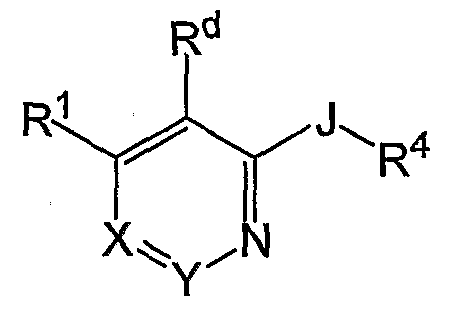
J is O or S; X is N or C(R2);
Y is N or C(R3), wherein at least one of X and Y is not N; n is independently, at each instance, 0, 1 or 2; Ri is

R2 is selected from H, halo, cyano, nitro, Ri, Rk, -OH, -ORi, -ORk, -C(=O)ORi, - C(=O)ORk, -OC(=O)Ri, -OC(=O)Rk,-S(O)nRi, -S(O)nRk, -N(Ra)S(O)nRi, -N(Ra)S(O)nRk, -S(O)nN(Ra)Ri, -S(O)nN(Ra)Rk, -NH2, -S(=O)NRaRi, - C(=O)NRaRk, -NRaC(=O)Ri and -NRaC(=O)Rk, -NRaRi and -NRaRk;
R3 is selected from H, halo, cyano, nitro, Ri, Rk, -OH, -ORi, -ORk, -C(=O)ORi, - C(=O)ORk, -OC(=O)Ri, -OC(=O)Rk, -S(O)nRi, -S(O)nRk, -N(Ra)S(O)nRi, -N(Ra)S(O)nRk, -S(0)nN(Ra)Ri, -S(O)nN(Ra)Rk, -NH2, -C(=O)NRaRi, - C(=O)NRaRk, -NRaC(=O)Ri and -NRaC(=O)Rk, -NRaRi and -NRaRk;
R4 is independently at each instance

R4 is independently at each instance a saturated, partially-saturated or unsaturated 5- or 6-membered ring heterocycle containing 1, 2 or 3 atoms selected from O, N and S that is optionally vicinally fused with a saturated, partially-
saturated or unsaturated 3-, 4- or 5-atom bridge containing 0, 1, 2 or 3 atoms selected from O, N and S with the remaining atoms being carbon, so long as the combination of O and S atoms is not greater than 2, wherein the heterocycle and bridge are substituted by 0, 1, 2 or 3 substituents independently selected from oxo, thioxo, Rk, C1-4haloalkyl, cyano, nitro, -C(=O)Ra, -C(=O)ORa, -C(=O)NRaRa, -C(=NRa)NRaRa, -ORa, -OC(=O)Ra, ~OC(=O)NRaRa, -OC(=O)N(Ra)S(=O)2Ra, -OC2-6alkylNRaRa, -OC2-6alkylORa, -SRa, -S(=O)Ra, -S(=O)2Ra, -S(=O)2NRaRa, -S(=O)2N(Ra)C(=O)Ra, -S(=O)2N(Ra)C(=O)ORa, -S(=O)2N(Ra)C(=O)NRaRa, -NRaRa, -N(Ra)C(=O)Ra, -N(Ra)C(=O)ORa, -N(Ra)C(=O)NRaRa, -N(Ra)C(=NRa)NRaRa, -N(Ra)S(=O)2Ra, -N(Ra)S(=O)2NRaRa,
-NRaC2-6alkylNRaRa and -NRaC2-6alkylORa; and wherein the heterocycle is additionally substituted by 0 or 1 groups independently selected from R1 and additionally substituted by 0, 1, 2, 3, 4 or 5 substituents independently selected from Br, Cl, F and I; or R4 is independently at each instance naphthyl substituted by 1, 2 or 3 substituents independently selected from Rk, C1-4haloalkyl, cyano, nitro, -C(=O)Ra, -C(=O)ORa, -C(=O)NRaRa, -C(=NRa)NRaRa, -ORa, -OC(=O)Ra, -OC(=O)NRaRa, -OC(=O)N(Ra)S(=O)2Ra, -OC2-6alkylNRaRa, -OC2-6alkylORa, -SRa, -S(=O)Ra, -S(=O)2Ra, -S(=O)2NRaRa, -S(=O)2N(Ra)C(=O)Ra, -S(=O)2N(Ra)C(=O)ORa, -S(=O)2N(Ra)C(-O)NRaRa, -NRaRa, -N(Ra)C(=O)Ra, -N(Ra)C(=O)ORa, -N(Ra)C(=O)NRaRa, -N(Ra)C(=NRa)NRaRa, -N(Ra)S(=O)2Ra,
-N(Ra)S(=O)2NRaRa, -NRaC2-6alkylNRaRa and -NRaC2-6alkylORa; and wherein the naphthyl is additionally substituted by 0 or 1 groups independently selected from R1 and additionally substituted by 0, 1, 2, 3, 4 or 5 substituents independently selected from Br, Cl, F and I; Ra is independently, at each instance, H, Rk, C1-4haloalkyl, halo, cyano, nitro, -C(=O)Ra, ~C(=O)ORa, -C(=O)NRaRa, -C(=NRa)NRaRa, -ORa, -OC(=O)Ra, -OC(=O)NRaRa, -OC(=O)N(Ra)S(=O)2Ra, -OC2-6alkylNRaRa, -OC2-6alkylORa, -SRa, -S(=O)Ra, -S(=O)2Ra, -S(=O)2NRaRa, -S(=O)2N(Ra)C(=O)Ra, -S(=O)2N(Ra)C(=O)ORa, -S(=O)2N(Ra)C(=O)NRaRa, -NRaRa, -N(Ra)C(=O)Ra, -N(Ra)C(=O)ORa, -N(Ra)C(=O)NRaRa, -N(Ra)C(=NRa)NRaRa, -N(Ra)S(=O)2Ra,
-N(Ra)S(=O)2NRaRa, -NRaC2-6alkylNRaRa and -NRaC2-6alkylORa;
R6 is independently, at each instance, H, Rk, C1-4haloalkyl, halo, cyano, nitro, ~C(=O)Ra, ~C(=O)ORa, -C(=O)NRaRa, -C(=NRa)NRaRa, -ORa, -OC(=O)Ra, -OC(=O)NRaRa, -OC(=O)N(Ra)S(=O)2Ra, -OC2-6alkylNRaRa, -OC2-6alkylORa, -SRa, -S(=O)Ra, -S(=O)2Ra, -S(=O)2NRaRa, -S(=O)2N(Ra)C(=O)Ra, -S(=O)2N(Ra)C(=O)ORa, -S(=O)2N(Ra)C(=O)NRaRa, -NRaRa, -N(Ra)C(=O)Ra, -N(Ra)C(=O)ORa, -N(Ra)C(=O)NRaRa, -N(Ra)C(=NRa)NRaRa, -N(Ra)S(=O)2Ra, -N(Ra)S(=O)2NRaRa, -NRaC2-6alkylNRaRa and -NRaC2-6alkylORa;
R7 is independently, at each instance, H, Rk, C1-4haloalkyl, halo, cyano, nitro, -C(=O)Ra, -C(=O)ORa, -C(=O)NRaRa, -C(=NRa)NRaRa, -ORa, -OC(=O)Ra, -OC(=O)NRaRa, -OC(=O)N(Ra)S(=O)2Ra, -OC2-6alkylNRaRa, -OC2-6alkylORa, -SRa, -S(=O)Ra, -S(=O)2Ra, -S(=O)2NRaRa, -S(=O)2N(Ra)C(=O)Ra, -S(=O)2N(Ra)C(=O)ORa, -S(=O)2N(Ra)C(=O)NRaRa, -NRaRa, -N(Ra)C(=O)Ra, -N(Ra)C(=O)ORa, -N(Ra)C(=O)NRaRa, -N(Ra)C(=NRa)NRaRa, -N(Ra)S(=O)2Ra, -N(Ra)S(=O)2NRaRa, -NRaC2-6alkylNRaRa and -NRaC2-6alkylORa; and
A)
R8 is independently, at each instance, H, Rk, C1-4haloalkyl, halo, cyano, nitro, -C(=O)Ra, -C(=O)ORa, -C(=O)NRaRa, -C(=NRa)NRaRa, -ORa, -OC(-O)Ra, -OC(=O)NRaRa, -OC(=O)N(Ra)S(=O)2Ra,
-OC2-6alkylNRaRa, -OC2-6alkylORa, -SRa, -S(=O)Ra, -S(=O)2Ra, -S(=O)2NRaRa, -S(=O)2N(Ra)C(=O)Ra, -S(=O)2N(Ra)C(=O)ORa, -S(=O)2N(Ra)C(=O)NRaRa, -NRaRa, -N(Ra)C(=O)Ra, -N(Ra)C(=O)ORa, -N(Ra)C(=O)NRaRa, -N(Ra)C(=NRa)NRaRa, -N(Ra)S(=O)2Ra, -N(Ra)S(=O)2NRaRa, -NRaC2-6alkylNRaRa and -NRaC2-6alkylORa; and
R9 is independently, at each instance, Re, Rh, -ORe, -ORh, -OC2-6alkylNRaRe, -OC2-6alkylORe, -NRaRe, -NRaRh, -NRaC2-6alkylNRaRe, -NRaC2-6alkylORe, -CO2Re, -OC(=O)Re, -C(=O)Re, -C(=O)NRaRe, -C(=O)NRaRh, -NRaC(=O)Re, -NRaC(-O)Rh, -NRaC(=O)NRaRe, -NRaCO2Re, -C2-6alkylORe, -C2-6alkylNRaRe, -S(=O)nRe, -S(=O)2NRaRe,
-NRaS(=O)2Re, -OS(=O)2Re, -OC(=O)NRaRe, -ORh, -OC2-6alkylNRaRh, -OC2-6alkylORh, -NRaC2-6alkylNRaRh, -NRhC2-6alkylNRaRa,
-NRhC2-6alkylORa, -NRaC2-6alkylORh, -CO2Rh, -OC(=O)Rh, -C(=O)Rh, -C(=O)NRaRh, -NReC(=O)Ra, -NRhC(=O)Ra, -NRhC(=O)NRaRa, -NReC(=O)NRaRa, -NRhCO2Ra, -NReCO2Ra, -C1-8alkylORh, -C1-6alkylNRaRh, -S(=O)nRh, -S(=O)2NRaRh, -NRaS(=O)2Rh, -NRhS(=O)2Ra, -OS(=O)2Rh or -OC(=O)NRaRh; or
B)
R8 is independently, at each instance, Re, Rh, -ORe, -OC2-6alkylNRaRe, -OC2-6alkylORe, -NRaRe, -NRaRh, -NRaC2-6alkylNRaRe, -NRaC2-6alkylORe, -CO2Re, -OC(=O)Re, -C(=O)Re, -C(=O)NRaRh, -NRaC(=O)Re, -NRaC(=O)Rh, -NRaC(=O)NRaRe, -NRaCO2Re,
-C1-8alkylORe, -C1-6alkylNRaRe, -S(=O)nRe, -S(=O)2NRaRe, -NRaS(=O)2Re, -OS(=O)2Re, -OC(=O)NRaRe, -ORh, -OC2-6alkylNRaRh, -OC2-6alkylORh, -NRaC2-6alkylNRaRh, -NRhC2-6alkylNRaRa, -NRhC2-6alkylORa, -NRaC2-6alkylORh, -CO2Rh, -OC(=O)Rh, -C(=O)NRaRh, -NReC(=O)Ra, -NRhC(=O)Ra, -NRhC(=O)NRaRa,
-NReC(=O)NRaRa, -NRhCO2Ra, -NReCO2Ra, -C1-8alkylORh, -C1-6alkylNRaRh, -S(=O)nRh, -S(=O)2NRaRh, -NRaS(=O)2Rh, -NRhS(=O)2Ra, -OS(=O)2Rh or -OC(=O)NRaRh; and
R9 is independently, at each instance, H, Rk, C1-4haloalkyl, halo, cyano, nitro, -C(=O)Ra, -C(=O)ORa, -C(=O)NRaRa, -C(=NRa)NRaRa,
-ORa, -OC(=O)Ra, -OC(=O)NRaRa, -OC(=O)N(Ra)S(=O)2Ra, -OC2-6alkylNRaRa, -OC2-6alkylORa, -SRa, -S(=O)Ra, -S(=O)2Ra, -S(=O)2NRaRa, -S(=O)2N(Ra)C(=O)Ra, -S(=O)2N(Ra)C(=O)ORa, -S(=O)2N(Ra)C(=O)NRaRa, -NRaRa, -N(Ra)C(=O)Ra, -N(Ra)C(=O)ORa, -N(Ra)C(=O)NRaRa, -N(Ra)C(=NRa)NRaRa, -N(Ra)S(=O)2Ra,
-N(Ra)S(=O)2NRaRa, -NRaC2-6alkylNRaRa and -NRaC2-6alkylORa;
Ri 0 is independently, at each instance, selected from H, halo, C1-8alkyl, C1-4haloalkyl, cyano, nitro, -OH, -NH2, -SH, -C(=O)Rk, -C(=O)ORk, -C(=O)NRaRk, -C(=NRa)NRaRk, -OH, -NH2, -ORk, -OC(=O)Rk, -OC(=O)NRaRk,
-OC(=O)N(Ra)S(=O)2Rk, -OC2-6aUcylNRaRk, -OC2-6alkylORk, -SRk, -S(=O)Rk, -S(=O)2Rk, -S(=O)2NRaRk, -S(=O)2N(Ra)C(=O)Rk, -S(=O)2N(Ra)C(=O)ORk,
-S(=O)2N(Ra)C(=O)NRaRk, -NRaRk, -N(Ra)C(=O)Rk, -N(Ra)C(=O)ORk, -N(Ra)C(=O)NRaRk, -N(Ra)C(=NRa)NRaRk, -N(Ra)S(=O)2Rk, -N(Ra)S(=O)2NRaRk, -NRaC2-6alkylNRaRk, -NRaC2-6alkylORk, -C(=O)Ri, -C(=O)ORi, -C(=O)NRaRi, -C(=NRa)NRaRi, -ORi, -OC(=O)Ri, -OC(=O)NRaRi, -OC(=O)N(Ra)S(=O)2Ri, -OC(=O)N(Ri)S(=O)2Rk, -OC2-6alkylNRaRi, -OC2-6alkylORi, -SRi, -S(=O)Ri, -S(=O)2Ri, -S(=O)2NR2Ri, -S(=O)2N(Ri)C(=O)Rk, -S(=O)2N(Ra)C(=O)Ri, -S(=O)2N(Ri)C(=O)ORk, -S(=O)2N(Ra)C(=O)ORi, -S(=O)2N(Ri)C(=O)NRaRk, -S(=O)2N(Ra)C(=O)NRaRi, -NRaRi, -N(Ri)C(=O)Rk, -N(Ra)C(=O)Ri, -N(Ri)C(=O)ORk, -N(Ra)C(=O)ORi, -N(Ri)C(=O)NR^, -N(Ra)C(=O)NRaRi, -N(Ri)C(=NRa)NRaRk,
-N(Ra)C(=NRa)NRaRi, -N(Ri)S(=O)2Rk, -N(Ra^=O)2Ri, -N(Ri)S(=O)2NRaRk, -N(Ra)S(=O)2NRaRi, -NRaC2-6alkylNRaRk, -NRaC2-6alkylNRaRi, -NRiC2-6alkylORk and -NRaC2-6alkylOR1; or Ri 0 is a saturated, partially-saturated or unsaturated 5-, 6- or 7-membered monocyclic or 6-, 7-, 8-, 9-, 10- or 11-membered bicyclic ring containing 1 , 2 or 3 atoms selected from N, O and S, wherein there are no more than 2 N atoms, wherein the ring is substituted by 0, 1 or 2 oxo or thioxo groups, wherein the ring is substituted by 0, 1, 2 or 3 groups selected from Rk, halo, cyano, nitro, -OH, -NH2, -SH, -C(=O)Rk, -C(=O)ORk, -C(=O)NRaRk, -C(=NRa)NRaRk, -ORk, -OC(=O)Rk, -OC(=O)NRaRk, -OC(=O)N(Ra)S(=O)2Rk, -OC2-6alkylNRaRk, -OC2-6alkylORk, -SRk, -S(=O)Rk, -S(=O)2Rk, -S(=O)2NRaRk, -S(=O)2N(Ra)C(=O)Rk, -S(=O)2N(Ra)C(=O)ORk, -S(=O)2N(Ra)C(=O)NRaRk, -NRaRk, -N(Ra)C(=O)Rk, -N(Ra)C(=O)ORk, -N(Ra)C(=O)NRaRk, -N(Ra)C(=NRa)NRaRk, -N(Ra)S(=O)2Rk, -N(Ra)S(=O)2NRaRk, -NRaC2-6alkylNRaRk, -NRaC2-6alkylORk, -C(=O)Ri, -C(=O)ORi, -C(=O)NRaRi, -C(=NRa)NRaRi, -ORi, -OC(=O)Ri, -OC(=O)NRaRi, -OC(=O)N(Ra)S(=O)2Ri,
-OC(=O)N(Ri)S(=O)2Rk, -OC2-6alkylNRaRi, -OC2-6alkylORi, -SRi, -S(=O)Ri, -S(=O)2Ri, -S(=O)2NRaRi, -S(=O)2N(Ri)C(=O)Rk, -S(=O)2N(Ra)C(=O)Ri, -S(=O)2N(Ri)C(=O)ORk, -S(=O)2N(Ra)C(=O)ORi J -S(=O)2N(Ri)C(=O)NRaRk, -S(=O)2N(Ra)C(=O)NRaRi, -NRaRi, -N(Ri)C(=O)Rk, -N(Ra)C(=O)Ri, -N(Ri)C(=O)ORk, -N(Ra)C(=O)ORi, -N(Ri)C(=O)NRaRk, -N(Ra)C(=O)NRaRi,
-N(Ri)C(=NRa)NRaRk, -N(Ra)C(=NRa)NRaRi, -N(Ri)S(=O)2Rk, -N(Ra)S(=O)2Ri, -N(Ri)S(=O)2NRaRk, -N(Ra)S(=O)2NRaRi, -NRaC2-6alkylNRaRk,
-NRaC2-6alkylNRaRi, -NRiC2-6alkylORk and -NRaC2-6alkylORi; or R10 is C2-6alkyl substituted by 0, 1, 2 or 3 groups selected from C1-4haloalkyl, halo, cyano, nitro, -OH, -NH2, -SH, -C(=O)Rk, -C(=O)ORk, -C(=O)NRaRi,, -C(=NRa)NRaRk, -ORk, -OC(=O)NRaRk, -OC(=O)N(Ra)S(=O)2Rk, -OC2-6alkylNRaRk, -OC2-6alkylORk, -SRk, -S(=O)Rk, -S(=O)2Rk, -S(=O)2NRaRk, -S(=O)2N(Ra)C(=O)Rk,
-S(=O)2N(Ra)C(=O)ORk, -S(=O)2N(Ra)C(=O)NRaRk, -NRaRk, -N(Ra)C(=O)Rk, -N(Ra)C(-O)ORk, -N(Ra)C(=O)NRaRk, -N(Ra)C(=NRa)NRaRk, -N(Ra)S(=O)2Rk, -N(Ra)S(-O)2NRaRk, -NRaC2-6alkylNRaRk, -NRaC2-6alkylORk, -C(=O)Ri, -C(=O)ORi, -C(=O)NRaRi, -C(=NRa)NRaRi, -ORi, -OC(=O)Ri, -OC(=O)NRaRi, -OC(=O)N(Ra)S(=O)2Ri, -OC(=O)N(Ri)S(=O)2Rk, -OC2-6alkylNRaRi, -OC2-6alkylORi, -SRi, -S(=O)Ri, -S(=O)2Ri, -S(=O)2NRaRi, -S(=O)2N(Ri)C(=O)Rk, -S(=O)2N(Ra)C(=O)Ri, -S(=O)2N(Ri)C(=O)OR^ -S(=O)2N(Ra)C(=O)ORi, -S(=O)2N(Ri)C(=O)NRaRk ; -S(=O)2N(Ra)C(=O)NRaRi, -NRaRi, -N(Ri)C(=O)Rk, -N(Ra)C(=O)Ri, -N(Ri)C(=O)ORk, -N(Ra)C(=O)ORi, -N(Ri)C(=O)NRaRi,, -N(Ra)C(=O)NRaRi, -N(Ri)C(=NRa)NRaRk,
-N(Ra)C(=NRa)NRaRi, -N(Ri)S(=O)2Rk, -N(Ra)S(=O)2Ri, -N(Ri)S(=O)2NRaRi,, -N(Ra)S(=O)2NRaRi, -NRaC2-6alkylNRaRk, -NRaC2-6alkylNRaRi, -NRiC2-6alkylORk and -NRaC2-6alkylORi; R1 1 is independently, at each instance, selected from H, cyano, nitro, -OH, -NH2, -SH, C2-6alkyl, C1-4haloalkyl, -C(=O)Rk, -C(=O)ORk, -C(=O)NRaRi,,
-C(=NRa)NRaRk, -ORk, -OC(=O)Rk, -OC(=O)NRaRi,, -OC(=O)N(Ra)S(=O)2Rk, -OC2-6alkylNRaRk, -OC2-6alkylORk, -SRk, -S(=O)Rk, -S(=O)2Rk, -S(=O)2NRaRi,, -S(=O)2N(Ra)C(=O)Rk, -S(=O)2N(Ra)C(=O)ORk, -S(=O)2N(Ra)C(=O)NRaRi,, -NRaRi,, -N(Ra)C(=O)Rk, -N(Ra)C(=O)ORk, -N(Ra)C(=O)NRaRk, -N(Ra)C(=NRa)NRaRk, -N(Ra)S(=O)2Rk, -N(Ra)S(=O)2NRaRk,
-NRaC2-6alkylNRaRk, -NRaC2-6alkylORk, -C(=O)Ri, -C(=O)ORi, -C(=O)NRaRi, -C(=NRa)NRaRi, -ORi, -OC(=O)Ri, -OC(=O)NRaRi, -OC(=O)N(Ra)S(=O)2Ri, -OC(=O)N(Ri)S(=O)2Rk, -OC2-6alkylNRaRi, -OC2-6alkylORi, -SRi, -S(=O)Ri, -S(=O)2Ri, -S(=O)2NRaRi, -S(=O)2N(Ri)C(=O)Rk, -S(=O)2N(Ra)C(=O)Ri, -S(=O)2N(Ri)C(=O)ORk, -S(=O)2N(Ra)C(=O)ORi, -S(=O)2N(Ri)C(=O)NRaRk,
-S(=O)2N(Ra)C(=O)NRaRi, -NRaRi, -N(Ri)C(=O)Rk, -N(Ra)C(=O)Ri, -N(Ri)C(=O)ORk, -N(Ra)C(=O)ORi, -N(Ri)C(=O)NRaRi,, -N(Ra)C(=O)NRaRi,
-N(Ri)C(=NRa)NRaRk, -N(Ra)C(=NRa)NRaRi, -N(Ri)S(=O)2Rk, -N(Ra)S(=O)2Ri, -N(Ri)S(=O)2NRaRk, -N(Ra)S(=O)2NRaRi, -NRaC2-6alkylNRaRk, -NRaC2-6alkylNRaRi, -NRiC2-6alkylORk and -NRaC2-6alkylORi; or Ri 1 is a saturated, partially-saturated or unsaturated 5-, 6- or 7-membered monocyclic or 6-, 7-, 8-, 9-, 10- or 11-membered bicyclic ring containing I, 2 or 3 atoms selected from N, O and S, wherein the ring is substituted by O, 1 or 2 oxo or thioxo groups, wherein the ring is substituted by 0, 1, 2 or 3 groups selected from R , halo, cyano, nitro, -C(=O)Rk, -C(=O)ORk, -C(=O)NRaRk, -C(=NRa)NRaRk, -OH, -NH2, -SH, -ORk, -OC(=O)Rk, -OC(=O)NRaRk, -OC(=O)N(Ra)S(=O)2Rk, -OC2-6alkylNRaRk, -OC2-6alkylORk, -SRk, -S(=O)Rk, -S(=O)2Rk, -S(=O)2NRaRk, -S(=O)2N(Ra)C(=O)Rk, -S(=O)2N(Ra)C(=O)ORk, -S(=O)2N(Ra)C(=O)NRaRk, -NRaRk, -N(Ra)C(=O)Rk, -N(Ra)C(=O)ORk, -N(Ra)C(=O)NRaRk, -N(Ra)C(=NRa)NRaRk, -N(Ra)S(=O)2Rk, -N(Ra)S(=O)2NRaRk, -NRaC2-6alkylNRaRk, -NRaC2-6alkylORk, -C(=O)Ri, -C(=O)ORi, -C(=O)NRaRi, -C(=NRa)NRaRi, -ORi, -OC(=O)Ri, -OC(=O)NRaRi, -OC(=O)N(Ra)S(=O)2Ri, -OC(=O)N(Ri)S(=O)2Rk, -OC2-6alkylNRaRi, -OC2-6alkylORi, -SRi, -S(=O)Ri, -S(=O)2Ri, -S(=O)2NRaRi, -S(=O)2N(Ri)C(=O)Rk, -S(=O)2N(Ra)C(=O)Ri, -S(=O)2N(Ri)C(=O)ORk, -S(=O)2N(Ra)C(=O)ORi, -S(=O)2N(Ri)C(=O)NRaRk, -S(=O)2N(Ra)C(=O)NRaRi, -NRaRi, -N(Ri)C(=O)Rk, -N(Ra)C(=O)Ri, -N(ROC(=O)ORi^ -N(Ra)C(=O)ORi, -N(Ri)C(=O)NRaRk, -N(Ra)C(=O)NRaRi, -N(Ri)C(=NRa)NRaRk, ^(Ra)C(=NRa)NRaRi, -N(Ri)S(=O)2Rk, -N(Ra)S(=O)2Ri, -N(Ri)S(=O)2NRaRk, -N(Ra)S(=O)2NRaRi, -NRaC2-6alkylNRaRk, -NRaC2-6alkylNRaRi, -NRiC2-6alkylORk and -NRaC2-6alkylORi; or R1 1 is C2-6alkyl substituted by 0, 1, 2 or 3 groups selected from C1-4haloalkyl, cyano, nitro, -OH, -NH2, -SH, -C(=O)Rk, -C(=O)ORk, -C(=O)NRaRk, -C(=NRa)NRaRk, -ORk,
-OC(=O)Rk, -OC(=O)NRaRk, -OC(=O)N(Ra)S(=O)2Rk, -OC2-6alkylNRaRk, -OC2-6alkylORk, -SRk, -S(=O)Rk, -S(=O)2Rk, -S(=O)2NRaRk, -S(=O)2N(Ra)C(=O)Rk, -S(=O)2N(Ra)C(=O)ORk, -S(=O)2N(Ra)C(=O)NRaRk, -NRaRk, -N(Ra)C(=O)Rk, -N(Ra)C(=O)ORk, -N(Ra)C(=O)NRaRk, -N(Ra)C(=NRa)NRaRk, -N(Ra)S(=O)2Rk, -N(Ra)S(=O)2NRaRk,
-NRaC2-6alkylNRaRk, -NRaC2-6alkylORk, -C(=O)Ri, -C(=O)ORi, -C(=O)NRaRi, -C(=NRa)NRaRi, -ORi, -OC(=O)Ri, -OC(=O)NRaRi, -OC(=O)N(Ra)S(=O)2Ri,
-OC(=O)N(Ri)S(=O)2Rk, -OC2-6alkylNRaRi, -OC2-6alkylORi, -SRi, -S(=O)Ri, -S(=O)2Ri, -S(=O)2NRaRi, -S(=O)2N(Ri)C(=O)Rk, -S(=O)2N(Ra)C(=O)Ri, -S(=O)2N(Ri)C(=O)ORk, -S(=O)2N(Ra)C(=O)ORi, -S(=O)2N(Ri)C(=O)NRaRk, -S(=O)2N(Ra)C(=O)NRaRi, -NRaRi, -N(Ri)C(=O)Rk, -N(Ra)C(=O)Ri, -N(Ri)C(=O)ORk, -N(Ra)C(=O)ORi, -N(Ri)C(=O)NRaRk, -N(Ra)C(=O)NRaRi, -N(Ri)C(=NRa)NRaRk, -N(Ra)C(=NRa)NRaRi, -N(Ri)S(=O)2Rk, -N(Ra)S(=O)2Ri, -N(Ri)S(=O)2NRaRk, -N(Ra)S(=O)2NRaRi, -NRaC2-6alkylNRaRk, -NRaC2-6alkylNRX -NRiC2-6alkylORk and -NRaC2-6alkylORi; or R10 and R11 together are a saturated, partially-saturated or unsaturated 3-, 4- or 5-atom bridge containing 1 , 2 or 3 atoms selected from O, N and S with the remaining atoms being carbon, so long as the combination of O and S atoms is not greater than 2, wherein the bridge is substituted by 0, 1 or 2 substituents selected from oxo, thioxo, Ri, Rk, halo, cyano, nitro, -OH, -NH2, -SH, -C(=O)Rk, -C(=O)ORk, -C(=O)NRaRk, -C(=NRa)NRaRk, -ORk, -OC(=O)Rk, -OC(=O)NRaRk, -OC(=O)N(Ra)S(=O)2Rk, -OC2-6alkylNRaRk, -OC2-6alkylORk, -SRk, -S(=O)Rk, -S(=O)2Rk, -S(=O)2NRaRk, -S(=O)2N(Ra)C(=O)Rk, -S(=O)2N(Ra)C(=O)ORk, -S(=O)2N(Ra)C(=O)NRaRk, -NRaRk, -N(Ra)C(=O)Rk, -N(Ra)C(=O)ORk, -N(Ra)C(=O)NRaRk, -N(Ra)C(=NRa)NRaRk, -N(Ra)S(=O)2Rk, -N(Ra)S(=O)2NRaRk, -NRaC2-6alkylNRaRk, -NRaC2-6alkylORk, -C(=O)Ri, -C(=O)ORi, -C(=O)NRaRi, -C(=NRa)NRaRi, -ORi, -OC(=O)Ri, -OC(=O)NRaRi, -OC(=O)N(Ra)S(=O)2Ri, -OC(=O)N(Ri)S(=O)2Rk, -OC2-6alkylNRaRi, -OC2-6alkylORi, -SRi, -S(=O)Ri, -S(=O)2Ri, -S(=O)2NRaRi, -S(=O)2N(Ri)C(=O)Rk, -S(=O)2N(Ra)C(=O)Ri, -S(=O)2N(Ri)C(=O)ORk, -S(=O)2N(Ra)C(=O)ORi, -S(=O)2N(Ri)C(=O)NRaRk, -S(=O)2N(Ra)C(=O)NRaRi, -NRaRi, -N(Ri)C(=O)Rk, -N(Ra)C(=O)Ri, -N(Ri)C(=O)ORk, -N(Ra)C(=O)ORi,
-N(Ri)C(=O)NRaRk, -N(Ra)C(=O)NRaRi, -N(Ri)C(=NRa)NRaRk, -N(Ra)C(=NRa)NRaRi, -N(Ri)S(=O)2Rk, -N(Ra)S(=O)2Ri, -N(Ri)S(=O)2NRaRk, -N(Ra)S(=O)2NRaRi, -NRiC2-6alkylNRaRk, -NRaC2-6alkylNRaRi, -NRiC2-6alkylORk and -NRaC2-6alkylORi; or R10 and R11 together are a saturated or partially unsaturated 3-, 4- or 5-carbon bridge, wherein the bridge is substituted by 0, 1 or 2 substituents selected from oxo, thioxo, R1, Rk, halo, cyano, nitro, -OH, -NH2, -SH, -C(=O)Rk, -C(=O)ORk, -C(=O)NRaRk, -C(=NRa)NRaRk, -ORk, -OC(=O)Rk,
-OC(=O)NRaRk, -OC(=O)N(Ra)S(=O)2Rk, -OC2-6alkylNRaRk, ~OC2-6alkylORk, -SRk, -S(=O)Rk, -S(=O)2Rk, -S(=O)2NRaRk, -S(=O)2N(Ra)C(=O)Rk, -S(=O)2N(Ra)C(=O)ORk, -S(=O)2N(Ra)C(=O)NRaRk, -NRaRk, -N(Ra)C(=O)Rk, -N(Ra)C(=O)ORk, -N(Ra)C(=O)NRaRk, -N(Ra)C(=NRa)NRaRk, -N(Ra)S(=O)2Rk, -N(Ra)S(=O)2NRaRk, -NRaC2-6alkylNRaRk, -NRaC2-6alkylORk, -C(=O)Ri,
-C(=O)ORi, -C(=O)NRaRi, -C(=NRa)NRaRi, -ORi, -OC(=O)Ri, -OC(=O)NRaRi, -OC(=O)N(Ra)S(=O)2Ri, -OC(=O)N(Ri)S(=O)2Rk, -OC2-6alkylNRaRi, -OC2-6alkylORi, -SRi, -S(=O)Ri, -S(=O)2Ri, -S(=O)2NRaRi, -S(=O)2N(Ri)C(=O)Rk, -S(=O)2N(Ra)C(=O)Ri, -S(=O)2N(Ri)C(=O)ORk -S(=O)2N(Ra)C(=O)ORi, -S(=O)2N(Ri)C(=O)NRaRk, -S(=O)2N(Ra)C(=O)NRaRi, -NRaRi, -N(Ri)C(=O)Rk, -N(Ra)C(=O)Ri, -N(Ri)C(=O)ORk, -N(Ra)C(=O)ORi, -N(Ri)C(=O)NRaRk, -N(Ra)C(=O)NRaRi, -N(Ri)C(=NRa)NRaRk, -N(Ra)C(=NRa)NRaRi, -N(Ri)S(=O)2Rk, -N(Ra)S(=O)2Ri, -N(Ri)S(=O)2NRaRk, -N(Ra)S(=O)2NRaRi, -NRiC2-6alkylNRaRk , -NRaC2-6alkylNRaRi, -NRiC2-6alkylORk and -NRaC2-6alkylORi;
R is independently, at each instance, selected from H, C2-6alkyl, C1-4haloalkyl, halo, cyano, nitro, -OH, -NH2, -SH, -C(=O)Rk, -C(=O)ORk, -C(=O)NRaRk, -C(=NRa)NRaRk, -ORk, -OC(=O)Rk, -OC(=O)NRaRk, -OC(=O)N(Ra)S(=O)2Rk, -OC2-6alkylNRaRk, -OC2-6alkylORk, -S(=O)2NRaRk, -S(=O)2N(Ra)C(=O)Rk, -S(=O)2N(Ra)C(=O)ORk, -S(=O)2N(Ra)C(=O)NRaRk, -NRaRk, -N(Ra)C(=O)Rk, -N(Ra)C(=O)ORk, -N(Ra)C(=O)NRaRk, -N(Ra)C(=NRa)NRaRk, -N(Ra)S(=O)2Rk, -N(Ra)S(=O)2NRaRk, -NRaC2-6alkylNRaRk, -NRaC2-6alkylORk, -C(=O)Ri, -C(=O)ORi, -C(=O)NRaRi, -C(=NRa)NRaRi, -ORi, -OS(=O)Ri, -OC(=O)NRaRi, -OC(=O)N(Ra)S(=O)2Ri, -OC(=O)N(Ri)S(=O)2Rk, -OC2-6alkylNRaRi, -OC2-6alkylORi, -SRi, -S(=O)Ri,
-S(=O)2Ri, -S(=O)2NRaRi, -S(=O)2N(Ri)C(=O)Rk, -S(=O)2N(Ra)C(=O)Ri, -S(=O)2N(Ri)C(=O)ORk, -S(=O)2N(Ra)C(=O)ORi, -S(=O)2N(Ri)C(=O)NRaRk, -S(=O)2N(Ra)C(=O)NRaRi, -NRaRi, -N(Ri)C(=O)Rk, -N(Ra)C(=O)Ri, -N(Ri)C(=O)ORk, -N(Ra)C(=O)ORi, -N(Ri)C(=O)NRaRk, -N(Ra)C(=O)NRaRi, -N(Ri)C(=NRa)NRaRk, -N(Ra)C(=NRa)NRaRi, -N(Ri)S(=O)2Rk, -N(Ra)S(=O)2Ri,
-N(Ri)S(=O)2NRaRk, -N(Ra)S(=O)2NRaRi, -NRiC2-6alkylNRaRi,, -NR^2-6OUCyINRaRi, -NRiC2-6alkylORk and -NRaC2-6alkylORi; or Ri 2 is a
saturated, partially-saturated or unsaturated 5-, 6- or 7-membered monocyclic or 6-, 7-, 8-, 9-, 10- or 11-membered bicyclic ring containing 1, 2 or 3 atoms selected from N, O and S, wherein the ring is substituted by 0, 1 or 2 oxo or thioxo groups, wherein the ring is substituted by 0, 1, 2 or 3 groups selected from R , halo, cyano, nitro, -OH, -NH2, -SH, -C(=O)Rk, -C(=O)ORk, -C(=O)NRaRk,
-C(=NRa)NRaRk, -ORk, -OC(=O)Rk, -OC(=O)NRaRk, -OC(=O)N(Ra)S(=O)2Rk, -OC2-6alkylNRaRk, -OC2-6alkylORk, -SRk, -S(=O)Rk, -S(=O)2Rk, -S(=O)2NRaRk, -S(=O)2N(Ra)C(=O)Rk, -S(=O)2N(Ra)C(=O)ORk, -S(-O)2N(Ra)C(=O)NRaRk, -NRaRk, -N(Ra)C(=O)Rk, -N(Ra)C(=O)ORk, -N(Ra)C(=O)NRaRk, -N(Ra)C(=NRa)NRaRk, -N(Ra)S(=O)2Rk, -N(Ra)S(=O)2NRaRk,
-NRaC2-6alkylNRaRk, -NRaC2-6alkylORk 3 -C(-O)Ri, -C(=O)ORi, -C(=O)NRaRi, -C(=NRa)NRaRi, -ORi, -OC(=O)Ri, -OC(=O)NRaRi, -OC(=O)N(Ra)S(=O)2Ri, -OC(=O)N(Ri)S(=O)2Rk ; -OC2-6alkylNRaRi, -OC2-6alkylORi, -SRi, -S(=O)Ri, -S(=O)2Ri, -S(=O)2NRaRi, -S(=O)2N(Ri)C(=O)Rk, -S(=O)2N(Ra)C(=O)Ri, -S(=O)2N(Ri)C(=O)ORk, -S(=O)2N(Ra)C(=O)ORi, -S(=O)2N(Ri)C(=O)NRaRk, -S(=O)2N(Ra)C(=O)NRaRi, -NRaRi, -N(Ri)C(=O)Rk, -N(Ra)C(=O)Ri, -N(Ri)C(=O)ORk J -N(Ra)C(=O)ORi, -N(Ri)C(=O)NRaRk, -N(Ra)C(=O)NRaRi, -N(Ri)C(=NRa)NRaRk, -N(Ra)C(=NRa)NRaRi, -N(Ri)S(=O)2Rk, -N(Ra)S(=O)2Ri, -N(Ri)S(=O)2NRaRk, -N(Ra)S(=O)2NRaRi, -NRiC2-6aIkylNRaRk, -NRaC2-6alkylNRaRi, -NRiC2-6alkylORk and -NRaC2-6alkylORi; or Ri 2 is C2-6alkyl substituted by 0, 1, 2 or 3 groups selected from C1-4haloalkyl, cyano, nitro, -OH, -NH2, -SH, -C(=O)Rk, -C(=O)ORk, -C(=O)NRaRk, -C(=NRa)NRaRk, -ORk, -OC(=O)Rk, -OC(=O)NRaRk, -OC(=O)N(Ra)S(=O)2Rk -OC2-6alkylNRaRk, -OC2-6alkylORk, -SRk, -S(=O)Rk, -S(=O)2Rk, -S(=O)2NRaRk, -S(=O)2N(Ra)C(=O)Rk, -S(=O)2N(Ra)C(=O)ORk, -S(=O)2N(Ra)C(=O)NRaRk,
-NRaRk, -N(Ra)C(=O)Rk, -N(Ra)C(=O)ORk, -N(Ra)C(=O)NRaRk, -N(Ra)C(=NRa)NRaRk, -N(Ra)S(=O)2Rk, -N(Ra)S(=O)2NRaRk, -NRaC2-6alkylNRaRk, -NRaC2-6alkylORk, -C(=O)Ri, -C(=O)ORi, -C(=O)NRaRi, -C(=NRa)NRaRi, -ORi, -OC(=O)Ri, -OC(=O)NRaRi, -OC(=O)N(Ra)S(=O)2Ri, -OC(=O)N(Ri)S(=O)2Rk, -OC2-6alkylNRaRi, -OC2-6alkylORi, -SRi, -S(=O)Ri,
-S(=O)2Ri, -S(=O)2NRaRi, -S(=O)2N(Ri)C(=O)Rk, -S(=O)2N(Ra)C(=O)Ri, -S(=O)2N(Ri)C(=O)ORk, -S(=O)2N(Ra)C(=O)ORi, -S(=O)2N(Ri)C(=O)NRaRk,
-S(=O)2N(Ra)C(=O)NRaRi, -NRaR*, -N(Ri)C(=O)R*, -N(Ra)C(=O)Ri, -N(Ri)C(=O)ORk > -N(Ra)C(=O)ORi, -N(Ri)C(=O)NRaRa) -N(Ra)C(=O)NRaRi, -N(Ri)C(=NRa)NRaRk, -N(Ra)C(=NRa)NRaRJ, -N(Ri)S(=O)2Rk, -N(Ra^=O)2Ri, -N(Ri)S(=O)2NRaRk, -N(R^=O)2NRaRi, -NRaC2-6alkylNRaRk, -NRaC2-6alkylNRaRi, -NRiC2-6alkylORk and -NRaC2-6alkylORi, and additionally substituted by 0, 1 or 2 halo groups; or Ri 1 and Ri 2 together are a saturated, partially-saturated or unsaturated 3-, 4- or 5-atom bridge containing 1, 2 or 3 atoms selected from O, N and S with the remaining atoms being carbon, so long as the combination of O and S atoms is not greater than 2, wherein the bridge is substituted by 0, 1 or 2 substituents selected from oxo, thioxo, R1, Rk, halo, cyano, nitro, -OH, -NH2, -SH, -C(=O)Rk, -C(=O)ORk, -C(=O)NRaRk, -C(=NRa)NRaRk, -ORk, -OC(=O)Rk, -OC(=O)NRaRk, -OC(=O)N(Ra)S(=O)2Rk, -OC2-6alkylNRaRk, -OC2-6alkylORk, -SRk, -S(=O)Rk, -S(=O)2Rk, -S(=O)2NRaRk, -S(=O)2N(Ra)C(=O)Rk, -S(=O)2N(Ra)C(=O)ORk, -S(=O)2N(Ra)C(=O)NRaRk, -NRaRk, -N(Ra)C(=O)Rk, -N(Ra)C(=O)ORk, -N(Ra)C(=O)NRaRk, -N(Ra)C(=NRa)NRaRk, -N(Ra)S(=O)2Rk, -N(Ra)S(=O)2NRaRk, -NRaC2-6alkylNRaRk, -NRaC2-6alkylORk, -C(=O)Ri, -C(=O)ORi, -C(=O)NRaRi, -C(=NRa)NRaRi, -ORi, -OC(=O)Ri, -OC(=O)NRaRi, -OC(=O)N(Ra)S(=O)2Ri, -OC(=O)N(Ri)S(=O)2Rk, -OC2-6alkylNRaRi, -OC2-6alkylORi, -SRi, -S(=O)Ri, -S(=O)2Ri, -S(=O)2NRaRi, -S(=O)2N(Ri)C(=O)Rk, -S(=O)2N(Ra)C(=O)Ri,
-S(=O)2N(Ri)C(=O)ORk, -S(=O)2N(Ra)C(=O)ORi, -S(=O)2N(Ri)C(=O)NRaRk, -S(=O)2N(Ra)C(=O)NRaRi, -NRaRi, -N(Ri)C(=O)Rk, -N(Ra)C(=O)Ri, -N(Ri)C(=O)ORk, -N(Ra)C(=O)ORi, -N(Ri)C(=O)NRaRk, -N(Ra)C(=O)NRaRi, -N(Ri)C(=NRa)NRaRk, -N(Ra)C(=NRa)NRaRi, -N(Ri)S(=O)2Rk, -N(Ra)S(=O)2Ri, -N(Ri)S(=O)2NRaRk, -N(Ra)S(=O)2NRaRi, -NRaC2-6alkylNRaRk,
-NRaC2-6alkylNRaRi, -NRiC2-6alkylORk and -NR^alkylORi; or Ri 1 and Ri 2 together are a saturated or partially unsaturated 3-, 4- or 5 -carbon bridge, wherein the bridge is substituted by 0, 1 or 2 substituents selected from oxo, thioxo, R1, Rk, halo, cyano, nitro, -OH, -NH2, -SH, -C(=O)Rk, -C(=O)ORk, -C(=O)NRaRk, -C(=NRa)NRaRk, -ORk, -OC(=O)Rk, -OC(=O)NRaRk, -OC(=O)N(Ra)S(=O)2Rk,
-OC2-6alkylNRaRk, -OC2-6alkylORk, -SRk, -S(=O)Rk, -S(=O)2Rk, -S(=O)2NRaRk, -S(=O)2N(Ra)CC-O)Rk, -S(=O)2N(Ra)C(=O)ORk, -S(=O)2N(Ra)C(=O)NRaRk,
-NRaRk, -N(Ra)C(=O)Rk, -N(Ra)C(=O)ORk, -N(Ra)C(=O)NRaRk, -N(Ra)C(=NRa)NRaRk, -N(Ra)S(=O)2Rk, -N(Ra)S(=O)2NRaRk, -NRaC2-6alkylNRaRk, -NRaC2-6alkylORk, -C(=O)Ri, -C(=O)ORi, -C(=O)NRaRi, -C(=NRa)NRaRi, -ORi, -OC(=O)Ri, -OC(=O)NRaRi, -OC(=O)N(Ra)S(=O)2Ri, -OC(=O)N(Ri)S(=O)2Rk, -OC2-6alkylNRaRi, -OC2-6alkylORi, -SRi, -S(=O)Ri, -S(=O)2Ri, -S(=O)2NRaRi, -S(=O)2N(Ri)C(=O)Rk, -S(=O)2N(Ra)C(=O)Ri, -S(=O)2N(Ri)C(=O)ORk, -S(=O)2N(Ra)C(=O)ORi, -S(=O)2N(Ri)C(=O)NRaRk, -S(=O)2N(Ra)C(=O)NRaRi, -NRaRi, -N(Ri)C(=O)Rk, -N(Ra)C(=O)Ri, -N(Ri)C(=O)ORk, -N(Ra)C(=O)ORi, -N(Ri)C(=O)NRaRk, -N(Ra)C(=O)NRaRi, -N(Ri)C(=NRa)NRaRk, -N(Ra)C(=NRa)NRaRi, -N(Ri)S(=O)2Ra) -N(Ra)S(=O)2Ri, -N(Ri)S(=O)2NRaRk, -N(Ra)S(=O)2NRaRi, -NRaC2-6alkylNRaRk, -NRaC2-6alkylNRaRi, -NRiC2-6alkylORk and -NRaC2-6alkylORi; R13 is independently, at each instance, selected from H, halo, cyano, nitro, C1-4haloalkyl, -OH, -NH2, -SH, C2-6alkyl, -C(=O)Rk, -C(=O)ORk, -C(=O)NRaRk, -C(=NRa)NRaRk, -ORk, -OC(=O)Rk, -OC(=O)NRaRk, -OC(=O)N(Ra)S(=O)2Rk, -OC2-6alkylNRaRk, -OC2-6alkylORk, -SRk, -S(=O)Rk, -S(=O)2Rk, -S(=O)2NRaRk, -S(=O)2N(Ra)C(=O)Rk, -S(=O)2N(Ra)C(=O)ORk, -S(=O)2N(Ra)C(=O)NRaRk, -NRaRk, -N(Ra)C(=O)Rk, -N(Ra)C(=O)ORk, -N(Ra)C(=O)NRaRk, -N(Ra)C(=NRa)NRaRk, -N(Ra)S(=O)2Rk, -N(Ra)S(=O)2NRaRk, -NRaC2-6alkylNRaRk, -NRaC2-6alkylORk, -C(=O)Ri, -C(=O)ORi, -C(=O)NRaRi, -C(=NRa)NRaRi, -ORi, -OC(=O)Ri, -OC(=O)NRaRi, -OC(=O)N(Ra)S(=O)2Ri, -OC(=O)N(Ri)S(=O)2Rk, -OC2-6alkylNRaRi, -OC2-6alkylORi, -SRi, -S(=O)Ri, -S(=O)2Ri, -S(=O)2NRaRi, -S(=O)2N(Ri)C(=O)Rk, -S(=O)2N(Ra)C(=O)Ri, -S(=O)2N(Ri)C(=O)ORk, -S(=O)2N(Ra)C(=O)ORi, -S(=O)2N(Ri)C(=O)NRaRk, -S(=O)2N(Ra)C(=O)NRaRi, -NRaRi, -N(Ri)C(=O)Rk, -N(Ra)C(=O)Ri,
-N(Ri)C(=O)ORk, -N(Ra)C(=O)ORi, -N(Ri)C(=O)NRaRk, -N(Ra)C(=O)NRaRi, -N(Ri)C(=NRa)NRaRk, -N(Ra)C(=NRa)NRaRi, -N(Ri)S(=O)2Rk, -N(Ra)S(=O)2Ri, -N(Ri)S(=O)2NRaRk, -N(Ra)S(=O)2NRaRi, -NRaC2-6alkylNRaRk, -NRaC2-6alkylNRaRi, -NRiC2-6alkylORk and -NRaC2-6alkylORi; or R13 is a saturated, partially-saturated or unsaturated 5-, 6- or 7-membered monocyclic or
6-, 7-, 8-, 9-, 10- or 11-membered bicyclic ring containing 1, 2 or 3 atoms selected from N, O and S, wherein the ring is substituted by 0, 1 or 2 oxo or thioxo groups,
wherein the ring is substituted by 0, 1, 2 or 3 groups selected from R , halo, cyano, nitro, -C(=O)Rk, -C(=O)ORk, -C(=O)NRaRk, -C(=NRa)NRaRk, -ORk, -OC(=O)Rk, -OC(=O)NRβRk, -OC(=O)N(Ra)S(=O)2Rk, -OC2-6alkylNRaRk, -OC2-6alkylORk, -SRk, -S(=O)Rk, -S(=O)2Rk, -S(=O)2NRaRk, -S(=O)2N(Ra)C(=O)Rk, -S(=O)2N(Ra)C(=O)ORk, -S(=O)2N(Ra)C(=O)NRaRk, -NRaRk, -N(Ra)C(=O)Rk, -N(Ra)C(=O)ORk, -N(Ra)C(=O)NRaRk, -N(Ra)C(=NRa)NRaRk, -N(Ra)S(=O)2Rk, -N(Ra)S(=O)2NRaRk, -NRaC2-6alkylNRaRk, -NRaC2-6alkylORk, -C(=O)Ri, -C(=O)ORi, -C(=O)NRaRi, -C(=NRa)NRaRi, -ORi, -OC(=O)Ri, -OC(=O)NRaRi, -OC(=O)N(Ra)S(=O)2Ri, -OC(=O)N(Ri)S(=O)2Rk, -OC2-6alkylNRaRi, -OC2-6alkylORi, -SRi, -S(=O)Ri, -S(=O)2Ri, -S(=O)2NRaRi, -S(=O)2N(Ri)C(=O)Rk, -S(=O)2N(Ra)C(=O)Ri, -S(=O)2N(Ri)C(=O)ORk, -S(=O)2N(Ra)C(=O)ORi, -S(=O)2N(Ri)C(=O)NRaRk, -S(=O)2N(Ra)C(=O)NRaRi, -NRaRi, -N(Ri)C(=O)Rk, -N(Ra)C(=O)Ri, -N(Ri)C(=O)ORk, -N(Ra)C(=O)ORi, -N(Ri)C(=O)NRaRk, -N(Ra)C(=O)NRaRi, -N(Ri)C(=NRa)NRaRk, -N(Ra)C(=NRa)NRaRi, -N(Ri)S(=O)2Rk , -N(Ra)S(=O)2Ri, -N(Ri)S(=O)2NRaRk, -N(Ra)S(=O)2NRaRi, -NRiC2-6alkylNRaRk, -NRaC2-6alkylNRaRi, -NRiC2-6alkylORk and -NRaC2-6alkylORi; or R13 is C2-6alkyl substituted by 0, 1, 2 or 3 groups selected from C1-4haloalkyl, cyano, nitro, -C(=O)Rk, -C(=O)ORk, -C(=O)NRaRk, -CC=NRa)NRaRk, -ORk, -OC(=O)Rk, -OC(=O)NRaRk, -OC(=O)N(Ra)S(=O)2Rk, -OC2-6alkylNRaRk, -OC2-6alkylORk, -SRk, -S(=O)Rk, -S(=O)2Rk, -S(=O)2NRaRk, -S(=O)2N(Ra)C(=O)Rk, -S(=O)2N(Ra)C(=O)ORk, -S(=O)2N(Ra)C(=O)NRaRk, -NRaRk, -N(Ra)C(=O)Rk, -N(Ra)C(=O)ORk, -N(Ra)C(=O)NRaRk, -N(Ra)C(=NRa)NRaRk, -N(Ra)S(=O)2Rk, -N(Ra)S(=O)2NRaRk, -NRaC2-6alkylNRaRk, -NRaC2-6alkylORk, -C(=O)Ri, -C(=O)ORi, -C(=O)NRaRi, -C(=NRa)NRaRi, -ORi, -OC(=O)Ri, -OC(=O)NRaRi,
-OC(=O)N(Ra)S(=O)2Ri, -OC(=O)N(Ri)S(=O)2Rk, -OC2-6alkylNRaRi, -OC2-6alkylORi, -SRi, -S(=O)Ri, -S(=O)2Ri, -S(=O)2NRaRi, -S(=O)2N(Ri)C(=O)Rk, -S(=O)2N(Ra)C(=O)Ri, -S(=O)2N(Ri)C(=O)ORk, -S(=O)2N(Ra)C(=O)ORi, -S(=O)2N(Ri)C(=O)NRaRk, -S(=O)2N(Ra)C(=O)NRaRi, -NRaRi, -N(Ri)C(=O)Rk, -N(Ra)C(=O)Ri, -N(Ri)C(=O)ORk, -N(Ra)C(=O)ORi,
-N(Ri)C(=O)NRaRk, -N(Ra)C(=O)NRaRi, -N(Ri)C(=NRa)NRaRk, -N(Ra)C(=NRa)NRaRi, -N(Ri)S(=O)2Rk, -N(Ra)S(=O)2Ri, -N(Ri)S(=O)2NRaRk,
-N(Ra)S(=O)2NRaR, -NRiC2-6alkylNRa^, -NRaC2-6alkylNRaRi, -NRiC2-6alkylORk and -NRaC2-6alkylORi; Ri 4 is independently, at each instance, selected from H, Q.salkyl, C1-4haloalkyl, halo, cyano, nitro, -OH, -NH2, -NH2, -SH, -C(=O)Rk, -C(=O)ORk, -C(=O)NRaRk, -C(=NRa)NRaRk, -ORk, -OC(=O)Rk, -OC(=O)NRaRk,
-OC(=O)N(Ra)S(=O)2Rk, -OC2-6alkylNRaRk, -OC2-6alkylORk, -SRk, -S(=O)Rk, -S(=O)2Rk, -S(=O)2NRaRk, -S(=O)2N(Ra)C(=O)Rk, -S(=O)2N(Ra)C(=O)ORk, -S(=O)2N(Ra)C(=O)NRaRk, -NRaRk, -N(Ra)C(=O)Rk, -N(Ra)C(=O)ORk, -N(Ra)C(=O)NRaRk, -N(Ra)C(=NRa)NRaRk, -N(Ra)S(=O)2Rk, -N(Ra)S(=O)2NRaRk, -NRaC2-6alkylNRaRk, -NRaC2-6alkylORk, -C(=O)Ri,
-C(=O)ORi, -C(=O)NRaRi, -C(=NRa)NRaRi, -ORi, -OC(=O)Ri, -OC(=O)NRaRi, -OC(=O)N(Ra)S(=O)2Ri, -OC(=O)N(Ri)S(=O)2Rk, -OC2-6alkylNRaRi, -OC2-6alkylORi, -SRi, -S(=O)Ri, -S(=O)2Ri, -S(=O)2NRaRi, -S(=O)2N(R)C(=O)R^ -S(=O)2N(Ra)C(=O)Ri, -S(=O)2N(Ri)C(=O)ORk, -S(=O)2N(Ra)C(=O)ORi, -S (=O)2N(R)C(=O)NR^, -S(=O)2N(Ra)C(=O)NRaRi, -NRaRi, -N(Ri)CCKTIRa) -N(Ra)C(=O)Ri, -N(Ri)C(=O)ORk, -N(Ra)C(=O)ORi, -N(R)C(=O)NR^, -N(Ra)C(=O)NRaR, ^(Ri)C(=NRa)NR^, -N(Ra)C(=NRa)NRaRi, -N(Ri)S(=O)2Rk, -N(Ra)S(=O)2Ri, -N(Ri)S(=O)2NRaRk, -N(Ra)S(=O)2NRaRi, -NRaC2-6alkylNRaRk, -NRaC2-6alkylNRaRi, -NRiC2-6alkylORk and -NRaC2-6alkylOR1; or Ri 4 is a saturated, partially-saturated or unsaturated 5-, 6- or 7-membered monocyclic or 6-, 7-, 8-, 9-, 10- or 11-membered bicyclic ring containing 1, 2 or 3 atoms selected from N, O and S, wherein there are no more than 2 N atoms, wherein the ring is substituted by 0, 1 or 2 oxo or thioxo groups, wherein the ring is substituted by 0, 1, 2 or 3 groups selected from Rk, halo, cyano, nitro, -C(=O)Rk, -C(=O)ORk, -C(=O)NRaRk, -C(=NRa)NRaRk, -ORk,
-OC(=O)Rk, -OC(=O)NRaRk, -OC(=O)N(Ra)S(=O)2Rk, -OC2-6alkylNRaRk, -OC2-6alkylORk, -SRk, -S(=O)Rk, -S(=O)2Rk, -S(=O)2NRaRk, -S(=O)2N(Ra)C(=O)Rk, -S(=O)2N(Ra)C(=O)ORk, -S(=O)2N(Ra)C(=O)NRaRk, -NRaRk, -N(Ra)C(=O)Rk, -N(Ra)C(=O)ORk, -N(Ra)C(=O)NRaRk, -N(Ra)C(=NRa)NRaRk, -N(Ra)S(=O)2Rk, -N(Ra)S(=O)2NRaRk,
-NRaC2-6alkylNRaRk, -NRaC2-6alkylORk, -C(=O)Ri, ^(=O)0^, -C(=O)NRaRi, -C(=NRa)NRaRi, -ORi, -OC(=O)Ri, -OC(=O)NRaRi, -OC(=O)N(Ra)S(=O)2Ri,
-OC(=O)N(Ri)S(=O)2Rk, -OQ^aHcyMtX -OQ-ealkylORi, -SRi, -S(=O)Ri, -S(=O)2Ri, -S(=O)2NRaRi, -S(=O)2N(Ri)C(=O)Rk, -S(=O)2N(Ra)C(=O)Ri, -S(=O)2N(Ri)C(=O)ORk, -S(=O)2N(Ra)C(=O)ORi, -S(=O)2N(Ri)C(=O)NRaRk, -S(=O)2N(Ra)C(=O)NRaRi, -NRaRi, -N(Ri)C(=O)Rk, -N(Ra)C(=O)Ri, -N(Ri)C(=O)ORk, -N(Ra)C(=O)ORi, -N(Ri)C(=O)NRaRk, -N(Ra)C(=O)NRaRi, -N(Ri)C(=NRa)NRaRk, -N(Ra)C(=NRβ)NRaRi. -N(Ri)S(=O)2Rk, -N(Ra)S(=O)2Ri, -N(Ri)S(=O)2NRaRk, -N(Ra)S(=O)2NRaRi, -NRaC2-6alkylNRaRk, -NRaC2-6alkylNRaRi, -NRiC2-6alkylORk and -NRaC2-6alkylORi; or Ri 4 is C1-4olkyl substituted by 0, 1, 2 or 3 groups selected from C1-4haloalkyl, halo, cyano, nitro, -C(=O)Rk, -C(=O)NRaRk, -C(=NRa)NRaRk, -ORk, -OC(=O)Rk, -OC(=O)NRaRk, -OC(0)N(Ra)S(=O)2Rk, -OC2-6alkylNRaRk, -OC2-6alkylORk, -SRk, -S(=O)Rk, -S(=O)2Rk, -S(=O)2NRaRk, -S(=O)2N(Ra)C(=O)Rk, -S(=O)2N(Ra)C(=O)ORk, -S(=O)2N(Ra)C(=O)NRaRk, -NRaRk, -N(Ra)C(=O)Rk, -N(Ra)C(=O)ORk, -N(Ra)C(=O)NRaRk, -N(Ra)C(=NRa)NRaRk, -N(Ra)S(=O)2Rk, -N(Ra)S(=O)2NRaRk, -NRaC2-6olkylNRaRk, -NRaC2-6olkylORk, -C(=O)Ri,
-C(=O)ORi, -C(=O)NRaRi, -C(=NRa)NRaRi, -ORi, -OC(=O)Ri, -OC(=O)NRaRi, -OC(=O)N(Ra)S(=O)2Ri, -OC(=O)N(Ri)S(=O)2Rk, -OC2-6alkylNRaRi, -OC2-6alkylORi, -SRi, -S(=O)Ri, -S(=O)2Ri, -S(=O)2NRaRi, -S(=O)2N(Ri)C(=O)Rk, -S(=O)2N(Ra)C(=O)Ri, -S(=O)2N(Ri)C(=O)ORk, -S(=O)2N(Ra)C(=O)ORi, -S(=O)2N(Ri)C(=O)NRaRk, -S(=O)2N(Ra)C(=O)NRaRi, -NRaRi, -N(Ri)C(=O)Rk, -N(Ra)C(=O)Ri, -N(Ri)C(=O)ORk, -N(Ra)C(=O)ORi, -N(Ri)C(=O)NRaRk, -N(Ra)C(=O)NRaRi, -N(Ri)C(=NRa)NRaRk, -N(Ra)C(=NRa)NRaRi, -N(Ri)S(=O)2Rk, -N(Ra)S(=O)2Ri, -N(Ri)S(=O)2NRaRk, -N(Ra)S(K))^NRaRi, -NRaC2-6alkylNRaRk, -NRaC2-6alkylNRaRi, -NRiC2-6alkylORk and -NRaC2-6alkylORi; wherein at least one of R1 0, R1 1, R12, R13 and R14 is other thon H;
Ra is independently, at each instance, H, phenyl, benzyl or d.6alkyl, the phenyl, benzyl and C2-6alkyl being substituted by 0, 1, 2 or 3 substituents selected from halo, C2-6alkyl, C1-3haloalkyl, -OC2-6alkyl, -NH2, -NHC2-6alkyl, -N(C2-6alkyl)C2-6alkyl;
Rb is a saturated, partially saturated or unsaturated 5-, 6- or 7-membered monocyclic or 6-, 7-, 8-, 9-, 10- or 11-membered bicyclic ring containing 0, 1, 2, 3
or 4 atoms selected from N, O and S, wherein the carbon atoms of the ring are substituted by 0, 1 or 2 oxo or thioxo groups, sulfur atoms of the ring are substituted by 0, 1 or 2 oxo groups, nitrogen atoms of the ring are substituted by 0 or 1 oxo groups; Rd is independently in each instance hydrogen or -CH3;
Re is, independently, in each instance, C1-9alkyl substituted by a group independently selected from R ; and wherein the C1-9alkyl is additionally substituted by 0, 1, 2 or 3 substituents selected from halo, C1-4haloalkyl, cyano, nitro, -C(=O)Ra, -C(=O)ORa, -C(=O)NRaRa, -C(=NRa)NRaRa, -ORa, -OC(=O)Ra, -OC(=O)NRaRa, -OC(=O)N(Ra)S(=O)2Ra, -OC2-6alkylNRaRa, -OC2-6alkylORa, -SRa, -S(=O)Ra, -S(=O)2Ra, -S(=O)2NRaRa, -S(=O)2N(Ra)C(=O)Ra, -S(=O)2N(Ra)C(=O)ORa, -S(=O)2N(Ra)C(=O)NRaRa, -NRaRa, -N(Ra)C(=O)Ra, -N(Ra)C(=O)ORa, -N(Ra)C(=O)NRaRa, -N(Ra)C(=NRa)NRaRa, -N(Ra)S(=O)2Ra, -N(Ra)S(=O)2NRaRa, -NRaC2-6alkylNRaRa and -NRaC2-6alkylORa; Rh is, independently, in each instance, phenyl or a saturated, partially saturated or unsaturated 5-, 6- or 7-membered monocyclic or 6-, 7-, 8-, 9-, 10- or 11-membered bicyclic ring containing 1, 2 or 3 atoms selected from N, O and S, so long as the combination of O and S atoms is not greater than 2, wherein the ring is substituted by 0 or 1 oxo or thioxo groups, wherein the phenyl and monocycle are substituted by 1 , 2 or 3 groups independently selected from C1-9alkyl substituted by 0, 1, 2 or 3 substituents selected from halo, cyano, nitro, C1-4haloalkyl, -C(=O)Ra, -C(=O)ORa, -C(=O)NRaRa, -C(=NRa)NRaRa, -ORa, ~OC(=O)Ra, -OC(=O)NRaRa, -OC(=O)N(Ra)S(=O)2Ra, -OC2-6alkylNRaRa, -OC2-6alkylORa, -SRa, -S(=O)Ra, -S(=O)2Ra, -S(=O)2NRaRa, -S(=O)2N(Ra)C(=O)Ra, -S(=O)2N(Ra)C(=O)ORa, -S(=O)2N(Ra)C(=O)NRaRa,
-NRaRa, -N(Ra)C(=O)Ra, -N(Ra)C(=O)ORa, -N(Ra)C(=O)NRaRa, -N(Ra)C(=NRa)NRaRa, -N(Ra)S(=O)2Ra, -N(Ra)S(=O)2NRaRa, -NRaC2-6alkylNRaRa and -NRaC2-6alkylORa; and wherein the phenyl and monocycle are additionally substituted by 0, 1 or 2 substituents selected from C2-6alkyl, halo, cyano, nitro, C1-4haloalkyl, -C(=O)Ra, ~C(=O)ORa, -C(=O)NRaRa,
-C(=NRa)NRaRa, -ORa, -OC(=O)Ra, -OC(-O)NRaRa, -OC(=O)N(Ra)S(=O)2Ra, -OC2-6alkylNRaRa, -OC2-6all<ylORa, -SRa, -S(=O)Ra, -S(=O)2Ra, -S(=O)2NRaRa,
-S(=O)2N(Ra)C(=O)Ra, -S(=O)2N(Ra)C(=O)ORa, -S(=O)2N(Ra)C(=O)NRaRa 3 -NRaRa, -N(Ra)C(=O)Ra, -N(Ra)C(=O)ORa, -N(Ra)C(=O)NRaRa, -N(Ra)C(=NRa)NRaRa, -N(Ra)S(=O)2Ra, -N(Ra)S(=O)2NRaRa, -NRaC2-6alkylNRaRa and -NRaC2-6alkylORa; R1 is a saturated, partially saturated or unsaturated 5-, 6- or 7-membered monocyclic or 6-, 1-, 8-, 9-, 10- or 11-membered bicyclic ring containing 0, 1, 2, 3 or 4 atoms selected from N, O and S, wherein the available carbon atoms of the ring are substituted by 0, 1 or 2 oxo or thioxo groups, wherein the ring is substituted by 0, 1, 2 or 3 substituents independently selected from C2-6alkyl, halo, cyano, nitro, C1-4haloalkyl, -C(=O)Ra, -C(=O)ORa, -C(=O)NRaRa,
-C(=NRa)NRaRa, -ORa, -OC(=O)Ra, -OC(=O)NRaRa, -OC(=O)N(Ra)S(=O)2Ra, -OC2-6alkylNRaRa, -OC2-6alkylORa, -SRa, -S(=O)Ra, -S(=O)2Ra, -S(=O)2NRaRa, -S(=O)2N(Ra)C(=O)Ra, -S(=O)2N(Ra)C(=O)ORa, -S(=O)2N(Ra)C(=O)NRaRa, -NRaRa, -N(Ra)C(=O)Ra, -N(Ra)C(=O)ORa, -N(Ra)C(=O)NRaRa, -N(Ra)C(=NRa)NRaRa, -N(Ra)S(=O)2Ra, -N(Ra)S(=O)2NRaRa,
-NRaC2-6alkylNRaRa, -NRaC2-6alkylORa, and C1-9alkyl substituted by 1, 2 or 3 substituents selected from halo, cyano, nitro, C1-4haloalkyl, -C(=O)Ra, -C(=O)ORa, -C(=O)NRaRa, -C(=NRa)NRaRa, -ORa, -OC(=O)Ra, -OC(=O)NRaRa, -OC(=O)N(Ra)S(=O)2Ra, -OC2-6alkylNRaRa, -OC2-6alkylORa, -SRa, -S(=O)Ra, -S(=O)2Ra, -S(=O)2NRaRa, -S(=O)2N(Ra)C(=O)Ra, -S(=O)2N(Ra)C(=O)ORa, -S(=O)2N(Ra)C(=O)NRaRa, -NRaRa, -N(Ra)C(=O)Ra, -N(Ra)C(=O)ORa, -N(Ra)C(=O)NRaRa, -N(Ra)C(=NRa)NRaRa, -N(Ra)S(=O)2Ra, -N(Ra)S(=O)2NRaRa, -NRaC2-6alkylNRaRa and -NRaC2-6alkylORa; and
R is, independently, in each instance, C2-6alkyl or C2-6alkylφhenyl) wherein either is substituted by 0, 1, 2, 3 or 4 substituents selected from halo,
C1-4haloalkyl, cyano, nitro, -C(=O)Ra, -C(=O)ORa, -C(=O)NRaRa, -C(=NRa)NRaRa, -ORa, -OC(=O)Ra, -OC(=O)NRaRa, -OC(=O)N(Ra)S(=O)2Ra, -OC2-6alkylNRaRa, -OC2-6alkylORa, -SRa, -S(=O)Ra, -S(=O)2Ra, -S(=O)2NRaRa, -S(=O)2N(Ra)C(=O)Ra, -S(=O)2N(Ra)C(=O)ORa, -S(=O)2N(Ra)C(=O)NRaRa, -NRaRa, -N(Ra)C(=O)Ra, -N(Ra)C(=O)ORa, -N(Ra)C(=O)NRaRa,
-N(Ra)C(=NRa)NRaRa, -N(Ra)S(=O)2Ra, -N(Ra)S(=O)2NRaRa, -NRaC2-6alkylNRaRa and -NRaC2-6alkyl ORa; and wherein the C1-9alkyl is
additionally substituted by 0 or 1 groups independently selected from Ri and additionally substituted by 0, 1, 2, 3, 4 or 5 substituents independently selected from Br, Cl, F and I.
In one embodiment, in conjunction with any one of the above and below embodiments, Rb is a heterocycle selected from the group of thiophene, pyrrole, 1,3-oxazole, l,3-thiazol-4-yl, 1,3,4-oxadiazole, 1,3,4-thiadiazole, 1,2,3- oxadiazole, 1,2,3-thiadiazole, IH-1 ,2,3 -triazole, isothiazole, 1,2,4-oxadiazole, 1,2,4-thiadiazole, 1,2,3,4-oxatriazole, 1,2,3,4-thiatriazole, IH-1, 2,3 ,4-tetraazole, 1,2,3,5-oxatriazole, 1,2,3,5-thiatriazole, furan, imidazol-2-yl, benzimidazole, 1 ,2,4-triazole, isoxazole, pyrazol-3-yl, pyrazol-4-yl, pyrazol-5-yl, tliiolane, pyrrolidine, tetrahydrofuran, 4,5-dihydrothiophene, 2-pyrroline, 4,5-dihydrofuran, pyridazine, pyrimidine, pyrazine, 1,2,3-triazine, 1,2,4-triazine, 1,3,5-triazine, pyridine, 2H-3,4,5,6-tetrahydropyran, thiane, 1,2-diazaperhydroine, 1,3- diazaperhydroine, piperazine, 1,3-oxazaperhydroine, morpholine, 1,3- thiazaperhydroine, 1,4-thiazaperhydroine, piperidine, 2H-3,4-dihydropyran, 2,3- dihydro-4H-thiin, 1,4,5,6-tetrahydropyridine, 2H-5,6-dihydropyran, 2,3-dihydro- 6H-thiin, 1,2,5,6-tetrahydropyridine, 3,4,5,6-tetrahydropyridine, 4H-pyran, 4H- thiin, 1,4-dihydropyridine, 1,4-dithiane, 1,4-dioxane, 1,4-oxathiane, 1,2-oxazolidine, 1,2-thiazolidine, pyrazolidine, 1,3-oxazolidine, 1,3-thiazolidine, imidazolidine, 1,2,4-oxadiazolidine, 1,3,4-oxadiazolidine, 1,2,4-thiadiazolidine, 1,3,4-thiadiazolidine, 1,2,4-triazolidine, 2-imidazolin-1-yl, 2-imidazolin-2-yl, 3- imidazoline, 2-pyrazoline, 4-imidazoline, 2,3-dihydroisothiazole, 4,5- dihydroisoxazole, 4,5-dihydroisotbiazole, 2,5-dihydroisoxazole, 2,5- dihydroisothiazole, 2,3-dihydroisoxazole, 4,5-dihydrooxazole, 2,3- dihydrooxazole, 2,5-dihydrooxazole, 4,5-dihydrothiazole, 2,3-dihydrothiazole,,
2,5-dihydrothiazole, 1,3,4-oxathiazolidine, 1,4,2-oxathiazolidine, 2,3-dihydro-1H- [1,2,3]triazole, 2,5-dihydro-1H-[1,2,3]triazole, 4,5-dihydro-1H-[1,2,3]triazol-1-yl, 4,5-dihydro-1H-[l ,2,3]triazol-3-yl, 4,5-dihydro-1H-[l ,2,3]triazol-5-yl, 2,3- dihydro-1H-[l ,2,4]triazole, 4,5-dihydro-1H-[l ,2,4]triazole, 2,3-dihydro- [1 ,2,4]oxadiazole, 2,5-dihydro-[l ,2,4]oxadiazole, 4,5-dihydro-[l ,2,4]thiadiazole,
2,3-dihydro-[1,2,4] thiadiazole, 2,5-dihydro-[1,2,4] thiadiazole, 4,5-dihydro- [1,2,4] thiadiazole, 2,5-dihydro-[1,2,4]oxadiazole, 2,3-dihydro-[1,2,4]oxadiazole,
4,5-dihydro-[l ,2,4]oxadiazole, 2,5-dihydro-[l ,2,4]thiadiazole, 2,3-dihydro-[l ,2,4] thiadiazole, 4,5-dihydro-[1,2,4] thiadiazole, 2,3-dihydro-[1,3,4]oxadiazole, 2,3- dihydro-[1,3,4]thiadiazole, [1,4,2]oxathiazole, [1,3,4]oxathiazole, 1,3,5- triazaperhydroine, 1,2,4-triazaperhydroine, 1,4,2-dithiazaperhydroine, 1,4,2- dioxazaperhydroine, 1,3,5-oxadiazaperhydroine, 1,2,5-oxadiazaperhydroine, 1,3,4-thiadiazaperhydroine, 1,3,5-thiadiazaperhydroine, 1,2,5- thiadiazaperhydroine, 1 ,3 ,4-oxadiazaperhydroine, 1 ,4,3 -oxathiazaperhydroine, 1,4,2-oxathiazaperhydroine, 1,4,5,6-tetrahydropyridazine, 1,2,3,4- tetrahydropyridazine, 1 ,2,3,6-tetrahydropyridazine, 1 ,2,5,6-tetrahydropyrimidine, 1,2,3,4-tetrahydropyrimidine, 1,4,5,6-tetrahydropyrimidine, 1,2,3,6- tetrahydropyrazine, 1,2,3,4-tetrahydropyrazine, 5,6-dihydro-4H-[1,2]oxazine, 5,6- dihydro-2H-[1,2]oxazine, 3,6-dihydro-2H-[1,2]oxazine, 3,4-dihydro-2H- [1,2]oxazine, 5,6-dihydro-4H-[1,2]thiazine, 5,6-dihydro-2H-[1,2] thiazine, 3,6- dihydro-2H-[1,2] thiazine, 3,4-dihydro-2H-[1,2] thiazine, 5,6-dihydro-2H- [1,3]oxazine, 5,6-dihydro-4H-[1,3]oxazine, 3,6-dihydro-2H-[1,3]oxazine, 3,4- dihydro-2H-[1,3]oxazine, 3,6-dihydro-2H-[1,4]oxazine, 3,4-dihydro-2H- [1,4]oxazine, 5,6-dihydro-2H-[1,3]thiazine, 5,6-dihydro-4H-[1,3]thiazine, 3,6- dihydro-2H-[1,3]thiazine, 3,4-dihydro-2H-[1,3]thiazine, 3,6-dihydro-2H- [1,4]thiazine, 3,4-dihydro-2H-[1,4]thiazine, l,2,3,6-tetrahydro-[1,2,4]triazine, l,2,3,4-tetrahydro-[1,2,4]triazine, l,2,3,4-tetrahydro-[1,3,5]triazme, 2,3,4,5- tetrahydro-[1,2,4]triazine, l,4,5,6-tetrahydro-[1,2,4]triazine, 5,6-dihydro- [1,4,2]dioxazine, 5,6-dihydro-[1,4,2]dithiazine, 2,3-dihydro-[1,4,2]dioxazine, 3,4- dihydro-2H- [1,3,4] oxadiazine, 3 ,6-dihydro-2H- [ 1 ,3 ,4] oxadiazine, 3 ,4-dihydro- 2H-[1,3,5]oxadiazine, 3,6-dihydro-2H-[1,3,5]oxadiazine, 5,6-dihydro-2H- [1,2,5]oxadiazine, 5,6-dihydro-4H-[1,2,5]oxadiazine, 3,4-dihydro-2H- [1,3,4]thiadiazine, 3,6-dihydro-2H-[1,3,4]thiadiazine, 3,4-dihydro-2H- [1,3,5]thiadiazine, 3,6-dihydro-2H-[1,3,5]thiadiazine, 5,6-dihydro-2H- [1,2,5]thiadiazine, 5,6-dihydro-4H-[1,2,5]thiadiazine, 5,6-dihydro-2H- [1,2,3]oxadiazine, 3,6-dihydro-2H-[1,2,5]oxadiazine, 5,6-dihydro-4H- [1,3,4]oxadiazine, 3,4-dihydro-2H-[1,2,5]oxadiazine, 5,6-dihydro-2H- [1,2,3]thiadiazine, 3,6-dihydro-2H-[1,2,5]thiadiazine, 5,6-dihydro-4H- [1,3,4]thiadiazine, 3,4-dihydro-2H-[1,2,5]thiadiazine, 5,6-dihydro-
[1,4,3]oxathiazine, 5,6-dihydro-[1,4,2]oxathiazine, 2,3-dihydro- [1,4,3]oxathiazine, 2,3-dihydro-[1,4,2]oxathiazine, 3,4-dihydropyridine, 1,2- dihydropyridine, 5,6-dihydropyridine, 2H-pyran, 2H-thiin, 3,6-dihydropyridine, 2,3-dihydropyridazine, 2,5-dihydropyridazine, 4,5-dihydropyridazine, 1,2- dihydropyridazine, 1,4-dihydropyrimidin-1-yl, l,4-dihydropyrimidin-4-yl, 1,4- dihydropyrimidin-5-yl, l,4-dihydropyrimidin-6-yl, 2,3-dinydropyrimidine, 2,5- dihydropyrimidine, 5,6-dihydropyrimidine, 3,6-dihydropyrimidine, 5,6- dihydropyrazine, 3,6-dihydropyrazine, 4,5-dihydropyrazine, 1,4-dihydropyrazine, 1,4-dithiin, 1,4-dioxin, 2H-1,2-oxazine, 6H-1,2-oxazine, 4H-1,2-oxazine, 2H- 1,3- oxazine, 4H-1,3-oxazine, 6H-1,3-oxazine, 2H-1,4-oxazine, 4H-1,4-oxazine, 2H- 1,3-thiazine, 2H-1,4-thiazine, 4H-1,2-thiazine, 6H-1,3-thiazme, 4H-1,4-thiazine, 2H-1,2-thiazine, 6H-1,2-thiazine, 1,4-oxathiin, 2H,5H-1,2,3-triazine, 1H,4H- 1,2,3-triazine, 4,5-dihydro-1,2,3-triazine, 1H,6H-1,2,3-triazine, 1,2-dihydro- 1,2,3- triazine, 2,3-dihydro-1,2,4-triazine, 3H,6H-1,2,4-triazine, 1H,6H-1,2,4-triazine, 3,4-dihydro-1,2,4-triazine, 1H,4H-1,2,4-triazine, 5,6-dihydro-1,2,4-triazine, 4,5- dihydro-1,2,4-triazine, 2H,5H-1,2,4-triazine, 1,2-dihydro- 1,2,4-triazine, 1H,4H- 1,3,5-triazine, l,2-dihydro-1,3,5-triazine, 1,4,2-dithiazine, 1,4,2-dioxazine, 2H- 1,3,4-oxadiazine, 2H-1,3,5-oxadiazine, 6H-1,2,5-oxadiazine, 4H-1,3,4- oxadiazine, 4H-1,3,5-oxadiazine, 4H-1,2,5-oxadiazine, 2H-1,3,5-thiadiazine, 6H- 1,2,5-thiadiazine, 4H-1,3,4-thiadiazine, 4H-1,3,5-thiadiazine, 4H-1,2,5- thiadiazine, 2H-1,3,4-thiadiazine, 6H-1,3,4-thiadiazine, 6H-1,3,4-oxadiazine, and 1,4,2-oxathiazine, wherein the heterocycle is optionally vicinally fused with a saturated, partially-saturated or unsaturated 5-, 6- or 7-membered ring containing 0, 1 or 2 atoms independently selected from N, O and S. In one embodiment, in conjunction with any one of the above and below embodiments, J is O.
In one embodiment, in conjunction with any one of the above and below embodiments, X is N or C(R2); Y is N or C(R3), wherein at least one of X and Y is not N. In another embodiment, in conjunction with any one of the above and below embodiments, X is C(R2); Y is C(R3); and R3 is halo, -NH2, -NHC2-6alkyl, -NtCj.galkyOQ.salkyl, or C2-6alkyl.
In another embodiment, in conjunction with any one of the above and below embodiments, X is C(R2); Y is C(R3); and R3 is H;
In another embodiment, in conjunction with any one of the above and below embodiments, X is N; and Y is C(R3). In another embodiment, in conjunction with any one of the above and below embodiments, X is C(R2); and Y is N.
Embodiment A: In another embodiment, in conjunction with any one of the above and below embodiments, Ri is

-NRaS(=O)2Re, -OS(=O)2Re, -OC(=O)NRaRe, -OC2-6alkylNRaRh, -OC2-6alkylORh, -NRaC2-6alkylNRaRh, -NRhC2-6alkylNRaRa, -NRhC2-6alkylORa, -NRaC2-6alkylORh, -CO2Rh, -OC(=O)Rh, -C(=O)Rh, -NReC(=O)Ra, -NRhC(=O)Ra, -NRhC(=O)NRaRa, -NReC(=O)NRaRa, -NRhCO2Ra, -NReCO2Ra, -C1-8alkylORh, -C1-6alkylNRaRh, -S(=O)nRh, -S(=O)2NRaRh, -NRaS(=O)2Rh, -NRhS(=O)2Ra, -OS(=O)2Rh and -OC(=O)NRaRh, and additionally substitued by 0, 1, 2 or 3 substituents independently selected from halo, cyano, nitro, C1-8alkyl, C1-4haloalkyl, R1, Rk, -ORa, -NRaRa, -OC2-6alkylNRaRa, -OC2-6alkylORa, -NRaC2-6alkylNRaRa, -NRaC2-6alkylORa, -CO2Ra, -OC(=O)Ra, -C(=O)(C1-6alkyl), -C(=O)NRaRa, -NRaC(=O)Ra, -NRaC(=O)NRaRa, -NRaCO2Ra, -C1-8alkylORa, -C1-6alkylNRaRa, -S(=O)nRa, -S(=O)2NRaRa, -NRaS(=O)2Ra, -OS(=O)2Ra and -OC(=O)NRaRe.
Embodiment C: In another embodiment, in conjunction with any one of the above and below embodiments, Ri is

In another embodiment, in conjunction with any one of the above and below embodiments, R2 is selected from H, halo, cyano, nitro, R1, Rk, -OH, -OR1, -ORk, -C(=O)ORi, - C(=O)ORk, -OC(=O)R', -OC(=O)RVS(O)nRi, -S(O)nRk, -N(Ra)S(O)nRi, -N(Ra)S(O)nRk, -S(O)nN(Ra)Ri, -S(O)nN(Ra)Rk, -NH2, -C(=O)NRaRi, - C(=O)NRaRk, -NRaC(=O)Ri and -NRaC(=O)Rk, -NRaRi and -NRaRk.
In another embodiment, in conjunction with any one of the above and below embodiments, R2 is H.
In another embodiment, in conjunction with any one of the above and below embodiments, R2 is selected from H and halo.
In another embodiment, in conjunction with any one of the above and below embodiments, R2 is selected from halo, cyano, nitro, Ri, Rk, -OH, -OR1, -ORk, -C(=O)ORi, - C(=O)ORk, -OC(=O)Ri, -OC(=O)Rk,-S(O)nRi, -S(O)nRk, -N(Ra)S(O)nRi, -N(Ra)S(O)nRk, -S(O)nN(Ra)Ri, -S(O)nN(Ra)Rk, -NH2, -C(=O)NRaRi, - C(=O)NRaRk, -NRaC(=O)Ri and -NRaC(=O)Rk, -NRaRi and -NRaRk.
In another embodiment, in conjunction with any one of the above and below embodiments, R2 is a saturated, partially saturated or unsaturated 5-, 6- or 7-membered monocyclic or 6-, 7-, 8-, 9-, 10- or 11-membered bicyclic ring containing 0, 1, 2, 3 or 4 atoms selected from N, O and S, wherein the available carbon atoms of the ring are substituted by 0, 1 or 2 oxo or thioxo groups, wherein the ring is substituted by 0, 1, 2 or 3 substituents independently selected from C1-9alkyl, halo, cyano, nitro, C1-4haloalkyl, -C(=O)Ra, -C(=O)ORa, -C(=O)NRaRa, -C(=NRa)NRaRa, -ORa, -OC(=O)Ra, -OC(=O)NRaRa, -OC(=O)N(Ra)S(=O)2Ra, -OC2-6alkylNRaRa, -OC2-6alkylORa, -SRa, -S(=O)Ra, -S(=O)2Ra, -S(=O)2NRaRa, -S(=O)2N(Ra)C(=O)Ra, -S(=O)2N(Ra)C(=O)ORa, -S(=O)2N(Ra)C(=O)NRaRa,
-NRaRa, -N(Ra)C(=O)Ra, -N(Ra)C(=O)ORa, -N(Ra)C(=O)NRaRa, -N(Ra)C(=NRa)NRaRa, -N(Ra)S(=O)2Ra, -N(Ra)S(=O)2NRaRa, -NRaC2-6alkylNRaRa, -NRaC2-6alkylORa, and C1-9alkyl substituted by 1, 2 or 3 substituents selected from halo, cyano, nitro, Ci-φhaloalkyl, -C(=O)Ra, -C(=O)ORa, -C(=O)NRaRa, -C(=NRa)NRaRa, -OR2, -OC(=O)Ra, -OC(=O)NRaRa, -OC(=O)N(Ra)S(=O)2Ra, -OC2-6alkylNRaRa, -OC2-6alkylORa, -SRa, -S(=O)Ra, -S(=O)2Ra, -S(=O)2NRaRa, -S(=O)2N(Ra)C(=O)Ra, -S(=O)2N(Ra)C(=O)ORa, -S(=O)2N(Ra)C(=O)NRaRa, -NRaRa, -N(Ra)C(=O)Ra, ~N(Ra)C(=O)ORa, -N(Ra)C(=O)NRaRa, -N(Ra)C(=NRa)NRaRa, -N(Ra)S(=O)2Ra, -N(Ra)S(=O)2NRaRa, -NRaC2-6alkylNRaRa and -NRaC2-6alkylORa.
In another embodiment, in conjunction with any one of the above and below embodiments, R is C1-9alkyl or C1-4alkyl(phenyl) wherein either is substituted by 0, 1, 2, 3 or 4 substituents selected from halo, Q-^ialoalkyl, cyano, nitro, -C(=O)Ra, -C(=O)ORa, -C(=O)NRaRa, -C(=NRa)NRaRa, -ORa, -OC(-O)Ra, -OC(=O)NRaRa, -OC(=O)N(Ra)S(=O)2Ra, -OC2-6alkylNRaRa, -OC2-6alkylORa, -SRa, -S(=O)Ra, -S(=O)2Ra, -S(=O)2NRaRa, -S(=O)2N(Ra)C(-O)Ra, -S(=O)2N(Ra)C(=O)ORa, -S(=O)2N(Ra)C(=O)NRaRa, -NRaRa, -N(Ra)C(=O)Ra, -N(Ra)C(=O)ORa, -N(Ra)C(=O)NRaRa, -N(Ra)C(=NRa)NRaRa, -N(Ra)S(=O)2Ra, -N(Ra)S(=O)2NRaRa, -NRaC2-6alkylNRaRa and -NRaC2-6alkylORa; and wherein the C1-9alkyl is additionally substituted by 0 or 1 groups independently selected from R1 and additionally substituted by 0, 1, 2, 3, 4 or 5 substituents independently selected from Br, Cl, F and I.
In another embodiment, in conjunction with any one of the above and below embodiments, R3 is selected from R3 is selected from H, halo, cyano, nitro, Ri, Rk, -OH, -ORi, -ORk, -C(=O)ORi, - C(=O)ORk, -OC(=O)Ri, -OC(=O)Rk,
-S(O)nRi, -S(O)nRk, -N(Ra)S(O)nRi, -N(Ra)S(O)nRk, -S(O)nN(Ra)Ri, -S(O)nN(Ra)Rk, -NH2, -C(=O)NRaRi, - C(=O)NRaRk, -NRaC(=O)Ri and -NRaC(=O)Rk, -NRaRi and -NRaRk.
In another embodiment, in conjunction with any one of the above and below embodiments, R3 is H.
In another embodiment, in conjunction with any one of the above and below embodiments, R3 is selected from H and halo.
In another embodiment, in conjunction with any one of the above and below embodiments, R3 is selected from R3 is selected from halo, cyano, nitro, R1, Rk, -OH, -ORi, -ORk, -C(=O)ORi, - C(=O)ORk, -OC(=O)Ri, -OC(=O)Rk, -S(O)nRi, -S(O)nRk, -N(Ra)S(O)nRi, ~N(Ra)S(O)nRk, -S(O)nN(Ra)Ri, -S(O)nN(Ra)Rk, -NH2, -C(=O)NRaRi, - C(=O)NRaRk, -NRaC(=O)Ri and -NRaC(=O)Rk, -NR81Ri and -NRaRk.
In another embodiment, in conjunction with any one of the above and below embodiments, R3 is a saturated, partially saturated or unsaturated 5-, 6- or 7-membered monocyclic or 6-, 7-, 8-, 9-, 10- or 11-membered bicyclic ring containing 0, 1, 2, 3 or 4 atoms selected from N, O and S, wherein the available carbon atoms of the ring are substituted by 0, 1 or 2 oxo or thioxo groups, wherein the ring is substituted by 0, 1, 2 or 3 substituents independently selected from C2-6alkyl, halo, cyano, nitro, C1-4haloalkyl, -C(=O)Ra, -C(=O)ORa, -C(=O)NRaRa, -C(=NRa)NRaRa, -ORa, -OC(=O)Ra, -OC(=O)NRaRa, -OC(=O)N(Ra)S(=O)2Ra, -OC2-6alkylNRaRa, -OC2-6alkylORa, -SRa, -S(=O)Ra, -S(=O)2Ra, -S(=O)2NRaRa, -S(-O)2N(Ra)C(=O)Ra, -S(=O)2N(Ra)C(=O)ORa, -S(=O)2N(Ra)C(=O)NRaRa, -NRaRa, -N(Ra)C(=O)Ra, -N(Ra)C(=O)ORa, -N(Ra)C(=O)NRaRa, -N(Ra)C(=NRa)NRaRa, -N(Ra)S(=O)2Ra, -N(Ra)S(=O)2NRaRa, -NRaC2-6alkylNRaRa, -NRaC2-6alkylORa, and C1-9aUtyl substituted by 1, 2 or 3 substituents selected from halo, cyano, nitro, C^aloalkyl, -C(=O)Ra,
-C(=O)ORa, -C(=O)NRaRa, -C(=NRa)NRaRa, -ORa, -OC(=O)Ra, -OC(=O)NRaRa, -OC(=O)N(Ra)S(=O)2Ra, -OC2-6alkylNRaRa, -OC2-6alkylORa, -SRa, -S(=O)Ra, -S(=O)2Ra, -S(=O)2NRaRa, -S(=O)2N(Ra)C(=O)Ra, -S(=O)2N(Ra)C(=O)ORa, -S(=O)2N(Ra)C(=O)NRaRa, -NRaRa, -N(Ra)C(=O)Ra, -N(Ra)C(=O)ORa, -N(Ra)C(=O)NRaRa, -N(Ra)C(=NRa)NRaRa, -N(Ra)S(=O)2Ra,
-N(Ra)S(=O)2NRaRa, -NRaC2-6alkylNRaRa and -NRaC2-6alkylORa.
In another embodiment, in conjunction with any one of the above and below embodiments, R3 is C1-9alkyl or C1-4alkyl(phenyl) wherein either is substituted by 0, 1, 2, 3 or 4 substituents selected from halo, C1-4haloalkyl, cyano, nitro, -C(=O)Ra, -C(=O)ORa, -C(=O)NRaRa, -C(=NRa)NRaRa, -ORa, -OC(=O)Ra,
-OC(=O)NRaRa, -OC(=O)N(Ra)S(=O)2Ra, -OC2-6alkylNRaRa, -OC2-6alkylORa, -SRa, -S(=O)Ra, -S(=O)2Ra, -S(=O)2NRaRa, -S(=O)2N(Ra)C(=O)Ra,
-S(=O)2N(Ra)C(=O)ORa, -S(=O)2N(Ra)C(=O)NRaRa, -NRaRa, -N(Ra)C(=O)Ra, -N(Ra)C(=O)ORa, -N(Ra)C(=O)NRaRa, -N(Ra)C(=NRa)NRaRa, -N(Ra)S(=O)2Ra, -N(Ra)S(=O)2NRaRa, -NRaC2-6alkylNRaRa and -NRaC2-6alkylORa; and wherein the C1-9alkyl is additionally substituted by 0 or 1 groups independently selected from R1 and additionally substituted by 0, 1, 2, 3, 4 or 5 substituents independently selected from Br, Cl, F and I.
Embodiment D: In another embodiment, in conjunction with any one of the above and below embodiments, R is independently at each instance

Embodiment E: In another embodiment, in conjunction with any one of the above and below embodiments, R is independently at each instance

Embodiment F: hi another embodiment, in conjunction with any one of the above and below embodiments, R4 is independently at each instance a saturated, partially-saturated or unsaturated 5- or 6-membered ring heterocycle containing 1, 2 or 3 atoms selected from O, N and S that is optionally vicinally fused with a saturated, partially-saturated or unsaturated 3-, 4- or 5-atom bridge containing 0, 1, 2 or 3 atoms selected from O, N and S with the remaining atoms being carbon, so long as the combination of O and S atoms is not greater than 2, wherein the heterocycle and bridge are substituted by 0, 1, 2 or 3 substituents independently selected from oxo, thioxo, Rk, C1-4haloalkyl, cyano, nitro, -C(=O)Ra, -C(=O)ORa, -C(=O)NRaRa, -C(=NRa)NRaRa, -ORa, -OC(=O)Ra, -OC(=O)NRaRa, -OC(=O)N(Ra)S(=O)2Ra, -OC2-6alkylNRaRa, -OC2-6alkylORa, -SRa, -S(=O)Ra, -S(=O)2Ra, -S(=O)2NRaRa, -S(=O)2N(Ra)C(=O)Ra, -S(=O)2N(Ra)C(=O)ORa, -S(=O)2N(Ra)C(=O)NRaRa, -NRaRa, ~N(Ra)C(=O)Ra, -N(Ra)C(=O)ORa, -N(Ra)C(=O)NRaRa, -N(Ra)C(=NRa)NRaRa, -N(Ra)S(=O)2Ra, -N(Ra)S(=O)2NRaRa, -NRaC2-6alkylNRaRa and -NRaC2-6alkylORa; and wherein the heterocycle is additionally substituted by 0 or 1 groups independently selected from R1 and additionally substituted by 0, 1, 2, 3, 4 or 5 substituents
independently selected from Br, Cl, F and I; or R4 is independently at each instance naphthyl substituted by 1, 2 or 3 substituents independently selected from Rk, C1-4haloalkyl, cyano, nitro, -C(=O)Ra, -C(=O)ORa, -C(=O)NRaRa, -C(=NRa)NRaRa, -ORa, -OC(=O)Ra, -OC(=O)NRaRa, ~OC(=O)N(Ra)S(=O)2Ra, -OC2-6alkylNRaRa, -OC2-6alkylORa, -SRa, -S(=O)Ra, -S(=O)2Ra, -S(=O)2NRaRa, -S(-O)2N(Ra)C(=O)Ra, -S(=O)2N(Ra)C(=O)ORa, -S(=O)2N(Ra)C(=O)NRaRa, -NRaRa, -N(Ra)C(=O)Ra, -N(Ra)C(=O)ORa, -N(Ra)C(=O)NRaRa, -N(Ra)C(=NRa)NRaRa, -N(Ra)S(=O)2Ra, -N(Ra)S(=O)2NRaRa, -NRaC2-6alkylNRaRa and -NRaC2-6alkyl ORa; and wherein the naphthyl is additionally substituted by 0 or 1 groups independently selected from R1 and additionally substituted by 0, 1, 2, 3, 4 or 5 substituents independently selected from Br, Cl, F and I.
Embodiment G: In another embodiment, in conjunction with any one of the above and below embodiments, R4 is independently at each instance a saturated, partially-saturated or unsaturated 5- or 6-membered ring heterocycle containing 1, 2 or 3 atoms selected from O, N and S that is vicinally fused with a saturated, partially-saturated or unsaturated 3-, 4- or 5-atom bridge containing 0, 1, 2 or 3 atoms selected from O, N and S with the remaining atoms being carbon, so long as the combination of O and S atoms is not greater than 2, wherein the heterocycle and bridge are substituted by 0, 1, 2 or 3 substituents independently selected from oxo, thioxo, Rk, C1-4haloalkyl, cyano, nitro, -C(=O)Ra, -C(=O)ORa, -C(=O)NRaRa, -C(=NRa)NRaRa, -ORi, -OC(=O)Ra, -OC(=O)NRaRa, -OC(=O)N(Ra)S(=O)2Ra, -OC2-6alkylNRaRa, -OC2-6alkylORa, -SRa, -S(=O)Ra, -S(=O)2Ra, -S(=O)2NRaRa, -S(=O)2N(Ra)C(=O)Ra, -S(=O)2N(Ra)C(=O)ORa, -S(=O)2N(Ra)C(=O)NRaRa, -NRaRa, -N(Ra)C(=O)Ra, -N(Ra)C(=O)ORa,
-N(Ra)C(=O)NRaRa, -N(Ra)C(=NRa)NRaRa, -N(Ra)S(=O)2Ra, -N(Ra)S(=O)2NRaRa, -NRaC2-6alkylNRaRa and -NRaC2-6alkylORa; and wherein the heterocycle is additionally substituted by 0 or 1 groups independently selected from R1 and additionally substituted by 0, 1, 2, 3, 4 or 5 substituents independently selected from Br, Cl, F and I.
In another embodiment, in conjunction with any one of the above and below embodiments, R4 is independently at each instance naphthyl substituted by
1, 2 or 3 substituents independently selected from R , C1-4haloalkyl, cyano, nitro, -C(=O)Ra, -C(=O)ORa, -C(=O)NRaRa, -C(=NRa)NRaRa, -ORa, -OC(=O)Ra, -OC(=O)NRaRa, -OC(=O)N(Ra)S(=O)2Ra, -OC2-6alkylNRaRa, -OC2-6alkylORa, -SRa, -S(=O)Ra, -S(=O)2Ra, -S(=O)2NRaRa, -S(=O)2N(Ra)C(=O)Ra, -S(=O)2N(Ra)C(=O)ORa, -S(=O)2N(Ra)C(=O)NRaRa, -NRaRa, -N(Ra)C(=O)Ra, -N(Ra)C(=O)ORa, -N(Ra)C(=O)NRaRa, -N(Ra)C(=NRa)NRaRa, -N(Ra)S(=O)2Ra, -N(Ra)S(=O)2NRaRa, -NRaC2-6alkylNRaRa and -NRaC2-6alkylORa; and wherein the naphthyl is additionally substituted by 0 or 1 groups independently selected from R1 and additionally substituted by 0, 1, 2, 3, 4 or 5 substituents independently selected from Br, Cl, F and I.
In another embodiment, in conjunction with any one of the above and below embodiments, Ra is independently, at each instance, Rk, C1-4haloalkyl, halo, cyano, nitro, -C(=O)Ra, -C(=O)ORa, -C(=O)NRaRa, -C(=NRa)NRaRa, -ORa, -OC(=O)Ra, -OC(=O)NRaRa, -OC(=O)N(Ra)S(=O)2Ra, -OC2-6alkylNRaRa, -OC2-6alkylORa, -SRa, -S(=O)Ra, -S(=O)2Ra, -S(=O)2NRaRa,
-S(=O)2N(Ra)C(=O)Ra, -S(=O)2N(Ra)C(=O)ORa, -S(=O)2N(Ra)C(=O)NRaRa, -NRaRa, -N(Ra)C(-O)Ra, -N(Ra)C(=O)ORa, -N(Ra)C(=O)NRaRa, -N(Ra)C(=NRa)NRaRa, -N(Ra)S(=O)2Ra, -N(Ra)S(=O)2NRaRa, -NRaC2-6alkylNRaRa and -NRaC2-6alkylORa. In another embodiment, in conjunction with any one of the above and below embodiments, R5 is H.
In another embodiment, in conjunction with any one of the above and below embodiments, R5 is Rk.
In another embodiment, in conjunction with any one of the above and below embodiments, R5 is independently, at each instance, H, d^haloalkyl, halo,
-ORa, -OC(=O)Ra, -NRaRa or -N(Ra)C(=O)Ra.
In another embodiment, in conjunction with any one of the above and below embodiments, R6 is independently, at each instance, Rk, C1-4haloalkyl, halo, cyano, nitro, -C(=O)Ra, -C(=O)ORa, -C(=O)NRaRa, -C(=NRa)NRaRa, -ORa, -OC(=O)Ra, -OC(=O)NRaRa, -OC(=O)N(Ra)S(=O)2Ra, -OC2-6alkylNRaRa,
-OC2-6alkylORa, -SRa, -S(=O)Ra, -S(=O)2Ra, -S(=O)2NRaRa, -S(=O)2N(Ra)C(=O)Ra, -S(=O)2N(Ra)C(=O)ORa, -S(=O)2N(Ra)C(=O)NRaRa,
-NRaRa, -N(Ra)C(=O)Ra, -N(Ra)C(=O)ORa, -N(Ra)C(=O)NRaRa, -N(Ra)C(=NRa)NRaRa, -N(Ra)S(=O)2Ra, -N(Ra)S(=O)2NRaRa, -NRaC2-6alkylNRaRa and -NRaC2-6aUcylORa.
In another embodiment, in conjunction with any one of the above and below embodiments, R6 is H.
In another embodiment, in conjunction with any one of the above and below embodiments, R6 is Rk.
In another embodiment, in conjunction with any one of the above and below embodiments, R6 is independently, at each instance, H, C1-4haloalkyl, halo, -ORa, -OC(=O)Ra, -NRaRa or -N(Ra)C(=O)Ra.
In another embodiment, in conjunction with any one of the above and below embodiments, R7 is independently, at each instance, H, C1-8alkyl, C1-4haloalkyl, halo, cyano -OC1-6alkyl, -O C1-4haloalkyl, -OC2-6alkylNRaRa, -OC2-6alkylORa, -NRaRa, -NRaC1-4haloalkyl, -NRaC2-6alkylNRaRa, -NRaC2-6alkylORa, -C1-8alkylORa, -C1-6alkylNRaRa or -S(C1-6aIkVl); or R7 is a saturated, partially-saturated or unsaturated 4- or 5-membered ring heterocycle containing a single nitrogen atom, wherein the ring is substituted with 0, 1 or 2 substituents independently selected from halo, C1-2haloalkyl and C1-3alkyl. Embodiment H: In another embodiment, in conjunction with any one of the above and below embodiments, R7 is independently, at each instance, Rk, C1-4haloalkyl, halo, cyano, nitro, -C(=O)Ra, -C(=O)ORa, -C(=O)NRaRa, -C(=NRa)NRaRa, -ORa, -OC(=O)Ra, -OC(=O)NRaRa, -OC(=O)N(Ra)S(=O)2Ra, -OC2-6alkylNRaRa, -OC2-6alkylORa, -SRa, -S(-O)Ra, -S(=O)2Ra, -S(=O)2NRaRa, -S(=O)2N(Ra)C(=O)Ra, -S(=O)2N(Ra)C(=O)ORa, -S(=O)2N(Ra)C(=O)NRaRa, -NRaRa, -N(Ra)C(=O)Ra, -N(Ra)C(=O)ORa, -N(Ra)C(=O)NRaRa, -N(Ra)C(=NRa)NRaRa, -N(Ra)S(=O)2Ra, -N(Ra)S(=O)2NRaRa, -NRaC2-6alkylNRaRa and -NRaC2-6alJiylORa. In another embodiment, in conjunction with any one of the above and below embodiments, R7 is H.
In another embodiment, in conjunction with any one of the above and below embodiments, R7 is C1-5alkyl, Cmhaloalkyl, halo.
Embodiment I: In another embodiment, in conjunction with any one of the above and below embodiments, R7 is independently, at each instance, C3-5alkyl or C1-2haloalkyl.
In another embodiment, in conjunction with any one of the above and below embodiments, R7 is C3-5alkyl.
In another embodiment, in conjunction with any one of the above and below embodiments, R7 is -C(CH3)3. In another embodiment, in conjunction with any one of the above and below embodiments, R7 is -CF3.
Embodiment J: In another embodiment, in conjunction with any one of the above and below embodiments, R8 is independently, at each instance, H, Rk, C1-4haloalkyl, halo, cyano, nitro, -C(=O)Ra, -C(=O)ORa, -C(=O)NRaRa, -C(=NRa)NRaRa, -ORa, -OC(=O)Ra, -OC(=O)NRaRa, -OC(=O)N(Ra)S(=O)2Ra, -OC2-6alkylNRaRa, -OC2-6alkylORa, -SRa, -S(=O)Ra, -S(=O)2Ra, -S(=O)2NRaRa, -S(=O)2N(Ra)C(=O)Ra, -S(=O)2N(Ra)C(=O)ORa, -S(=O)2N(Ra)C(=O)NRaRa, -NRaRa, -N(Ra)C(=O)Ra, -N(Ra)C(=O)ORa, -N(Ra)C(=O)NRaRa, -N(Ra)C(=NRa)NRaRa, -N(Ra)S(=O)2Ra, -N(Ra)S(=O)2NRaRa, -NRaC2-6alkylNRaRa and -NRaC2-6alkylORa; and R9 is independently, at each instance, Re, Rh, -ORe, -ORh, -OC2-6alkylNRaRe, -OC2-6alkylORe, -NRaRe, -NRaRh, -NRaC2-6alkylNRaRe, ~NRaC2-6alkylORe, -CO2Re, -OC(=O)Re, -C(=O)Re, -C(=O)NRaRe, -C(=O)NRaRh, -NRaC(=O)Re, -NRaC(=O)Rh, -NRaC(=O)NRaRe, -NRaCO2Re, -C2-6alkylORe, -C2-6alkylNRaRe, -S(=O)nRe, -S(=O)2NRaRe, -NRaS(=O)2Re, -OS(=O)2Re, -OC(=O)NRaRe, -ORh, -OC2-6alkylNRaRh,
-OC2-6alkylORh, -NRaC2-6alkylNRaRh, -NRhC2-6alkylNRaRa, -NRhC2-6alkylORa, -NRaC2-6alkylORh, -CO2Rh, -OC(=O)Rh, -C(=O)Rh, -C(=O)NRaRh, -NReC(=O)Ra, -NRhC(=O)Ra, -NRhC(=O)NRaRa, -NReC(=O)NRaRa, -NRhCO2Ra, -NReCO2Ra, -C2-6alkylORh, -C2-6alkylNRaRh, -S(=O)nRh, -S(=O)2NRaRh, -NRaS(=O)2Rh, -NRhS(=O)2Ra, -OS(=O)2Rh or -OC(=O)NRaRh.
Embodiment K: In another embodiment, in conjunction with any one of the above and below embodiments, R8 is H and R9 is Re, Rh, -ORe, -ORh,
-OC2-6alkylNRaRe, -OC2-6alkylORe, -NRaRe, -NRaRh, -NRaC2-6alkylNRaRe, -NRaC2-6alkylORe, -CO2Re, -OC(=O)Re, -C(=O)Re, -CC (=O)NRaRe, -C(=O)NRaRh, -NRaC(=O)Re, -NRaC(=O)Rh, -NRaC(=O)NRaRe, -NRaCO2Re, -C2-6alkylORe, -d.6alkylNRaRe, -S(=O)nRe, -S(=O)2NRaRe, -NRaS(=O)2Re, -OS(=O)2Re, -OC(=O)NRaRe, -ORh, -OC2-6alkylNRaRh, -OC2-6alkylORh, -NRaC2-6alkylNRaRh, -NRhC2-6alkylNRaRa, -NRhC2-6alkylORa, -NRaC2-6alkylORh, -CO2Rh, -OC(=O)Rh, -C(=O)Rh, -C(=O)NRaRh, -NReC(=O)Ra, -NRhC(=O)Ra, -NRhC(=O)NRaRa, -NReC(=O)NRaRa, -NRhCO2Ra, -NReCO2Ra, -C2-6alkylORh, -C2-6alkylNRaRh, -S(=O)nRh, -S(=O)2NRaRh, -NRaS(=O)2Rh, -NRhS(=O)2Ra, -OS(=O)2Rh or -OC(=O)NRaRh.
In another embodiment, in conjunction with any one of the above and below embodiments, R8 is independently, at each instance, Rk, C1-4haloalkyl, halo, cyano, nitro, -C(=O)Ra, -C(=O)ORa, -C(=O)NRaRa, -C(=NRa)NRaRa, -ORa, -OC(=O)Ra, -OC(=O)NRaRa, -OC(=O)N(Ra)S(=O)2Ra, -OC2-6alkylNRaRa, -OC2-6alkylORa, -SRa, -S(=O)Ra, -S(=O)2Ra, -S(=O)2NRaRa,
-S(=O)2N(Ra)C(=O)Ra, -S(=O)2N(Ra)C(=O)ORa, -S(=O)2N(Ra)C(=O)NRaRa, -NRaRa, -N(Ra)C(-O)Ra, -N(Ra)C(=O)ORa, -N(Ra)C(-O)NRaRa, -N(Ra)C(=NRa)NRaRa, -N(Ra)S(=O)2Ra -N(Ra)S(=O)2NRaRa, -NRaC2-6alkylNRaRa and -NRaC2-6alkyl ORa; and R9 is independently, at each instance, Re, Rh, -ORe, -ORh, -OC2-6alkylNRaRe, -OC2-6alkylORe, -NRaRe,
-NRaRh, -NRaC2-6alkylNRaRe, -NRaC2-6alkylORe, -CO2Re, -OC(=O)Re, -C(=O)Re, -C(=O)NRaRe, -C(=O)NRaRh, -NRaC(=O)Re, -NRaC(=O)Rh, -NRaC(=O)NRaRe, -NRaCO2Re, -C1-8alkylORe, -C1-6alkylNRaRe, -S(=O)nRe, -S(=O)2NRaRe, -NRaS(=O)2Re, -OS(=O)2Re, -OC(=O)NRaRe, -ORh, -OC2-6alkylNRaRh, -OC2-6alkylORh, -NRaC2-6alkylNRaRh, -NRhC2-6alkylNRaRa, -NRhC2-6alkyl ORa,
-NRaC2-6alkylORh, -CO2Rh, -OC(=O)Rh, -C(=O)Rh, -C(=O)NRaRh, -NReC(=O)Ra, -NRhC(=O)Ra, -NRhC(=O)NRaRa, -NReC(=O)NRaRa, -NRhCO2Ra, -NReCO2Ra, -C2-6alkylORh, -C2-6alkylNRaRh, -S(=O)nRh, -S(=O)2NRaRh, -NRaS(=O)2Rh, -NRhS(=O)2Ra, -OS(=O)2Rh or -OC(=O)NRaRh. Embodiment L: In another embodiment, in conjunction with any one of the above and below embodiments, R8 is independently, at each instance, Re, Rh, -ORe, -OC2-6alkylNRaRe, -OC2-6alkylORe, -NRaRe, -NRaRh, -NRaC2-6alkylNRaRe,
-NRaC2-6alkyl ORe, -CO2Re, -OC(=O)Re, -C(=O)Re, -C(=O)NRaRh, -NRaC(=O)Re, -NRaC(=O)Rh, -NRaC(=O)NRaRe, -NRaCO2Re, -Q-salkylORe, -C2-6alkylNRaRe, -S(=O)nRe, -S(=O)2NRaRe, -NRaS(=O)2Re, -OS(=O)2Re, -OC(=O)NRaRe, -ORh, -OC2-6alkylNRaRh, -OC2-6alkylORh, -NRaC2-6alkylNRaRh, -NRhC2-6alkylNRaRa, -NRhC2-6alkylORa, -NRaC2-6alkylORh, -CO2Rh, -OC(=O)Rh, -C(=O)NRaRh,
-NReC(=O)Ra, -NRhC(=O)Ra, -NRhC(=O)NRaRa, -NReC(=O)NRaRa, -NRhC02Ra, -NReCO2Ra, -C2-6alkylORh, -C2-6alkylNRaRh, -S(=O)nRh, -S(=O)2NRaRh, -NRaS(=O)2Rh, -NRhS(=O)2Ra, -OS(=O)2Rh or -OC(=O)NRaRh; and R9 is independently, at each instance, H, Rk, C1-4haloalkyl, halo, cyano, nitro, -C(=O)Ra, -C(=O)ORa, -C(=O)NRaRa, -C(=NRa)NRaRa, -ORa, -OC(=O)Ra, -OC(=O)NRaRa, -OC(=O)N(Ra)S(=O)2Ra, -OC2-6alkylNRaRa, -OC2-6alkylORa, -SRa, -S(=O)Ra, -S(=O)2Ra, -S(=O)2NRaRa, -S(=O)2N(Ra)C(=O)Ra, -S(=O)2N(Ra)C(=O)ORa, -S(=O)2N(Ra)C(=O)NRaRa, -NRaRa, -N(Ra)C(=O)Ra, -N(Ra)C(=O)ORa, -N(Ra)C(=O)NRaRa, -N(Ra)C(=NRa)NRaRa, -N(Ra)S(=O)2Ra, -N(Ra)S(=O)2NRaRa, -NRaC2-6alkylNRaRa and -NRaC2-6alkylORa.
In another embodiment, in conjunction with any one of the above and below embodiments, R8 is independently, at each instance, Re, Rh, -ORe, -OC2-6alkylNRaRe, -OC2-6alkylORe, -NRaRe, -NRaRh, -NRaC2-6alkylNRaRe, -NRaC2-6alkyl ORe, -CO2Re, -OC(=O)Re, -C(=O)Re, -C(=O)NRaRh, -NRaC(=O)Re, -NRaC(=O)Rh, -NRaC(=O)NRaRe, -NRaCO2Re, -d-salkylORe, -C2-6alkylNRaRe, -S(=O)nRe, -S(=O)2NRaRe, -NRaS(=O)2Re, -OS(=O)2Re, -OC(=O)NRaRe, -ORh, -OC2-6alkylNRaRh, -OC2-6alkylORh, -NRaC2-6alkylNRaRh, -NRhC2-6alkylNRaRa, -NRhC2-6alkylORa, -NRaC2-6alkylORh, -CO2Rh, -OC(=O)Rh, -C(=O)NRaRh, -NReC(=O)Ri, -NRhC(=O)Ra, -NRhC(=O)NRaRa, -NReC(=O)NRaRa, -NRhC02Ra, -NReCO2Ra, -C2-6alkylORh, -C2-6alkylNRaRh, -S(=O)nRh, -S(=O)2NRaRh,
-NRaS(=O)2Rh, -NRhS(=O)2Ra, -OS(=O)2Rh or -OC(=O)NRaRh; and R9 is H.
In another embodiment, in conjunction with any one of the above and below embodiments, R8 is independently, at each instance, Re, Rh, -ORe, -OC2-6alkylNRaRe, -OC2-6alkylORe, -NRaRe, -NRaRh, -NRaC2-6alkylNRaRe, -NRaC2-6alkylORe, -CO2Re, -OC(=O)Re, -C(=O)Re,
-C(=O)NRaRh, -NRaC(=O)Re, -NRaC(=O)Rh, -NRaC(=O)NRaRe, -NRaCO2Re, -C2-6alkylORe, -C2-6alkylNRaRe, -S(-O)nRe, -S(=O)2NRaRe,
-NRaS(=O)2Re, -OS(=O)2Re, -OC(=O)NRaRe, -ORh, -OC2-6alkylNRaRh, -OC2-6alkylORh, -NRaC2-6alkylNRaRh, -NRhC2-6alkylNRaRa, -NRhC2-6alkylORa, -NRaC2-6alkylORh, -CO2Rh, -OC(=O)Rh, -C(=O)NRaRh, -NReC(=O)Ra, -NRhC(=O)Ra, ~NRhC(=O)NRaRa, -NReC(=O)NRaRa, -NRhCO2Ra, -NReCO2Ra, -C2-6alkylORh, -C2-6alkylNRaRh, -S(=O)nRh, -S(=O)2NRaRh, -NRaS(=O)2Rh, -NRhS(=O)2Ra, -OS(=O)2Rh or -OC(=O)NRaRh; and R9 is Rk, C1-4haloalkyl, halo, cyano, nitro, -C(=O)Ra, -C(=O)ORi, -C(=O)NRaRa, -C(=NRa)NRaRa, -ORa, -OC(=O)Ra, -OC(=O)NRaRa, -OC(=O)N(Ra)S(=O)2Ra, -OC2-6alkylNRaRa, -OC2-6alkylORa, -SRa, -S(=O)Ra, -S(=O)2Ra, -S(=O)2NRaRa, -S(=O)2N(Ra)C(=O)Ra, -S(=O)2N(Ra)C(=O)ORa, -S(=O)2N(Ra)C(=O)NRaRa, -NRaRa, -N(Ra)C(=O)Ra, -N(Ra)C(=O)ORa, -N(Ra)C(=O)NRaRa, -N(Ra)C(=NRa)NRaRa, -N(Ra)S(=O)2Ra, -N(Ra)S(=O)2NRaRa, -NRaC2-6alkylNRaRa and -NRaC2-6alkylORa.
In another embodiment, in conjunction with any one of the above and below embodiments, at least one of R5, R6, R7, R8 and R9 is tet-butyl or CF3. In another embodiment, in conjunction with any one of the above and below embodiments, R10 is independently, at each instance, selected from H, halo, C2-6alkyl, C1-4haloalkyl, cyano, nitro, -OH, -NH2, -SH, -C(=O)Rk, -C(=O)ORk, -C(=O)NRaRk, -C(=NRa)NRaRk, -OH, -NH2, -ORk, -OC(=O)Rk, -OC(=O)NRaRk, -OC(=O)N(Ra)S(=O)2Rk, -OC2-6alkylNRaRk, -OC2-6alkylORk, -SRk, -S(=O)Rk, -S(=O)2Rk, -S(=O)2NRaRk, -S(=O)2N(Ra)C(=O)Rk, -S(=O)2N(Ra)C(=O)ORk, -S(=O)2N(Ra)C(=O)NRaRk, -NRaRk, -N(Ra)C(=O)Rk, -N(Ra)C(=O)ORk, -N(Ra)C(=O)NRaRk, -N(Ra)C(=NRa)NRaRk, -N(Ra)S(=O)2Rk,
-N(Ra)S(=O)2NRaRk, -NRaC2-6alkylNRaRk, -NRaC2-6alkylORk, -C(=O)Ri, -C(=O)ORi, -C(=O)NRaRi, -C(=NRa)NRaRi, -ORi, -OC(=O)Ri, -OC(=O)NRaRi, -OC(=O)N(Ra)S(=O)2Ri, -OC(=O)N(Ri)S(=O)2Rk, -OC2-6alkylNRaRi, -OC2-6alkylORi, -SRi, -S(=O)Ri, -S(=O)2Ri, -S(=O)2NRaRi, -S(=O)2N(Ri)C(=O)Rk, -S(=O)2N(Ra)C(=O)Ri, -S(=O)2N(Ri)C(=O)ORk,
-S(=O)2N(Ra)C(=O)ORi, -S(=O)2N(Ri)C(=O)NRaRk, -S(=O)2N(Ra)C(=O)NRaRi, -NRaRi, -N(Ri)C(=O)Rk, -N(Ra)C(=O)Ri, -N(Ri)C(=O)ORk, -N(Ra)C(=O)ORi,
-N(Ri)C(=O)NRaRk, -N(Ra)C(=O)NRaRi, -N(R')C(=lSIRβ)lSIRaRk > -N(Ra)C(=TSIRβ)lSIRaRi s -N(Ri)S(=O)2Rk, -N(Ra)S(=O)2Ri, -N(Ri)S(=O)2NRaRk, -N(Ra)S(=O)2NRaRi, -NRaC2-6alkylNRaRk, -NRaC2-6alkylNRaRi, -NRaC2-6alkylORk and -NRiC2-6alkylOR1; or Ri 0 is a saturated, partially-saturated or unsaturated 5-, 6- or 7-membered monocyclic or 6-, 7-, 8-, 9-, 10- or 11-membered bicyclic ring containing 1, 2 or 3 atoms selected from N, O and S, wherein there are no more than 2 N atoms, wherein the ring is substituted by 0, 1 or 2 oxo or thioxo groups, wherein the ring is substituted by 0, 1, 2 or 3 groups selected from Rk, halo, cyano, nitro, -OH, -NH2, -SH, -C(=O)Rk, -C(=O)ORk, -C(=O)NRaRk, -C(=NRa)NRaRk, -ORk, -OC(=O)Rk, -OC(=O)NRaRk, -OC(=O)N(Ra)S(=O)2Rk, -OC2-6alkylNRaRk, -OC2-6alkylORk, -SRk, -S(=O)Rk, -S(=O)2Rk, -S(=O)2NRaRk, -S(=O)2N(Ra)C(=O)Rk, -S(=O)2N(Ra)C(=O)ORk, -S(=O)2N(Ra)C(-O)NRaRk, -NRaRk, -N(Ra)C(=O)Rk, -N(Ra)C(=O)ORk, -N(Ra)C(=O)NRaRk, -N(Ra)C(=NRa)NRaRk, -N(Ra)S(=O)2Rk, -N(Ra)S(=O)2NRaRk, -NRaC2-6alkylNRaRk, -NRaC2-6alkylORk, -C(=O)Ri, -C(=O)ORi, -C(=O)NRaRi, -C(=NRa)NRaRi, -ORi, -OC(=O)Ri, -OC(=O)NRaRi, -OC(=O)N(Ra)S(=O)2Ri, -OC(=O)N(Ri)S(=O)2Rk, -OC2-6alkylNRaRi, -OC2-6alkylORi, -SRi, -S(=O)Ri, -S(=O)2Ri, -S(=O)2NRaRi, -S(=O)2N(Ri)C(=O)Rk, -S(=O)2N(Ra)C(=O)Ri, -S(=O)2N(Ri)C(=O)ORk, -S(=O)2N(Ra)C(=O)ORi, -S(=O)2N(Ri)C(=O)NRaRk, -S(=O)2N(Ra)C(=O)NRaRi, -NRaRi, -N(Ri)C(=O)Rk, -N(Ra)C(=O)Ri,
-N(Ri)C(=O)ORk, -N(Ra)C(=O)ORi, -N(Ri)C(=O)NRaRk, -N(Ra)C(=O)NRaRi, -N(Ri)C(=NRa)NRaRk, -N(Ra)C(=NRa)NRaRi, -N(Ri)S(=O)2Rk, -N(Ra)S(=O)2Ri, -N(Ri)S(=O)2NRaRk, -N(Ra)S(=O)2NRaRi, -NRaC2-6alkylNRaRk, -NRaC2-6alkylNRaRi, -NRiC2-6alkylORk and -NRaC2-6alkylORi; or R10 is C1-4alkyl substituted by 0, 1 , 2 or 3 groups selected from C1-4haloalkyl, halo, cyano, nitro,
-OH, -NH2, -SH, -C(=O)Rk, -C(=O)ORk, -C(=O)NRaRk, -C(=NRa)NRaRk, -ORk, -OC(=O)NRaRk, -OC(=O)N(Ra)S(=O)2Rk, -OC2-6alkylNRaRk, -OC2-6alkylORk, -SRk, -S(=O)Rk, -S(=O)2Rk, -S(=O)2NRaRk, -S(=O)2N(Ra)C(=O)Rk, -S(=O)2N(Ra)C(=O)ORk, -S(=O)2N(Ra)C(=O)NRaRk, -NRaRk, -N(Ra)C(=O)Rk, -N(Ra)C(=O)ORk, -N(Ra)C(=O)NRaRk, -N(Ra)C(=NRa)NRaRk, -N(Ra)S(=O)2Rk,
-N(Ra)S(=O)2NRaRk, -NRaC2-6alkylNRaRk, -NRaC2-6alkylORk, -C(=O)Ri, -C(=O)ORi, -C(=O)NRaRi, -C(=NRa)NRaRi, -ORi, -OC(=O)Ri, -OC(=O)NRaRi,
-OC(=O)N(Ra)S(=O)2Ri, -OC(=O)N(Ri)S(=O)2Rk, -OC2-6alkylNRaRi, -OC2-6alkylORi, -SRi, -S(=O)Ri, -S(=O)2Ri, -S(=O)2NRaRi, -S(=O)2N(Ri)C(=O)Rk, -S(=O)2N(Ra)C(=O)Ri, -S(=O)2N(Ri)C(=O)ORk, -S(=O)2N(Ra)C(=O)ORi, -S(=O)2N(Ri)C(=O)NRaRk, -S(=O)2N(Ra)C(=O)NRaRi, -NRaRi, -N(Ri)C(=O)Rk, -N(Ra)C(=O)Ri, -N(Ri)C(=O)OR", -N(Ra)C(=O)ORi, -N(Ri)C(=O)NRaRk, -N(Ra)C(=O)NRaRi, -N(Ri)C(=NRa)NRaRk, -N(Ra)C(=NRa)NRaRi, -N(Ri)S(=O)2Rk, -N(Ra)S(=O)2Ri, -N(Ri)S(=O)2NRaRk, -N(Ra)S(=O)2NRaRi, -NRaC2-6alkylNRaRk, -NRaC2-6alkylNRaRi, -NRiC2-6alkylORk and -NRaC2-6alkylORi. In another embodiment, in conjunction with any one of the above and below embodiments, Ri 0 is H.
In another embodiment, in conjunction with any one of the above and below embodiments, Ri 0 is independently, at each instance, selected from halo, C2-6alkyl, C1-4haloalkyl, cysno, nitro, -OH, -NH2, -SH, -C(=O)Rk, -C(=O)ORk, -C(=O)NRaRk, -C(=NRa)NRaRk, -OH, -NH2, -ORk, -OC(=O)Rk, -OC(=O)NRaRk, -OC(=O)N(Ra)S(=O)2Rk, -OC2-6alkylNRaRk, -OC2-6alkylORk, -SRk, -S(=O)Rk, -S(=O)2Rk, -S(=O)2NRaRk, -S(=O)2N(Ra)C(=O)Rk, -S(=O)2N(Ra)C(=O)ORk, -S(=O)2N(Ra)C(=O)NRaRk, -NRaRk, -N(Ra)C(=O)Rk, -N(Ra)C(=O)ORk, -N(Ra)C(=O)NRaRk, -N(Ra)C(=NRa)NRaRk, -N(Ra)S(=O)2Rk, -N(Ra)S(=O)2NRaRk, -NRaC2-6alkylNRaRk, -NRaC2-6alkylORk, -C(=O)Ri,
-C(=O)ORi, -S(=O)NRaRi, -C(=NRa)NRaRi, -ORi, -OC(=O)Ri, -OC(=O)NRaRi, -OC(=O)N(Ra)S(=O)2Ri, -OC(=O)N(Ri)S(=O)2Rk, -OC2-6alkylNRaRi, -OC2-6alkylORi, -SRi, -S(=O)Ri, -S(=O)2Ri, -S(^=O)2NRaRi, -S(=O)2N(Ri)C(=O)Rk, -S(=O)2N(Ra)C(=O)Ri, -S(=O)2N(Ri)C(=O)ORk, -S(=O)2N(Ra)C(=O)ORi, -S(=O)2N(Ri)C(=O)NRaRk, -S(=O)2N(Ra)C(=O)NRaRi,
-NRaRi, -N(Ri)C(=O)Rk, -N(Ra)C(=O)Ri, -N(Ri)C(=O)ORk, -N(Ra)C(=O)ORi, -N(Ri)C(=O)NRaRk, -N(Ra)C(=O)NRaRi, -N(Ri)C(=NRa)NRaRk, -N(Ra)C(=NRa)NRaRi, -N(Ri)S(=O)2Rk, -N(Ra)S(=O)2Ri, -N(Ri)S(=O)2NRaRk, -N(Ra)S(=O)2NRaRi, -NRiC2-6alkylNRaRk, -NRaC2-6alkylNRaRi, -NRiC2-6alkylORk and -NRaC2-6alkylORi; or R10 is a saturated, partiElly-saturated or unsaturated 5-,
6- or 7-membered monocyclic or 6-, 7-, 8-, 9-, 10- or 11-membered bicyclic ring containing 1, 2 or 3 atoms selected from N, O and S, wherein there are no more
than 2 N atoms, wherein the ring is substituted by 0, 1 or 2 oxo or thioxo groups, wherein the ring is substituted by 0, 1, 2 or 3 groups selected from R , halo, cyano, nitro, -OH, -NH2, -SH, -C(=O)Rk, -C(=O)ORk, -C(=O)NRaRk, -C(=NRa)NRaRk, -ORk, -OC(=O)Rk, -OC(=O)NRaRk, -OC(=O)N(Ra)S(=O)2Rk, -OC2-6alkylNRaRk, -OC2-6alkylORk, -SRk, -S(=O)Rk, -S(=O)2Rk, -S(=O)2NRaRk, -S(=O)2N(Ra)C(=O)Rk, -S(=O)2N(Ra)C(=O)ORk, -S(=O)2N(Ra)C(=O)NRaRk, -NRaRk, -N(Ra)C(=O)Rk, -N(Ra)C(=O)ORk, -N(Ra)C(=O)NRaRk, -N(Ra)C(=NRa)NRaRk, -N(Ra)S(=O)2Rk, -N(Ra)S(=O)2NRaRk, -NRaC2-6alkylNRaRk, -NRaC2-6alkylORk, -C(=O)Ri, -C(=O)ORi, -C(=O)NRaRi, -C(=NRa)NRaRi, -ORi, -OC(=O)Ri, -OC(=O)NRaRi, -OC(=O)N(Ra)S(=O)2Ri, -OC(=O)N(Ri)S(=O)2Rk, -OC2-6alkylNRaRi, -OC2-6alkylORi, -SRi, -S(=O)Ri, -S(=O)2Ri, -S(=O)2NRaRi, -S(=O)2N(Ri)C(=O)Rk, -S(=O)2N(Ra)C(=O)Ri, -S(=O)2N(Ri)C(=O)ORk, -S(=O)2N(Ra)C(=O)ORi, -S(=O)2N(Ri)C(=O)NRaRk, -S(-O)2N(Ra)C(=O)NRaRi, -NRaRi, -N(Ri)C(=O)Rk, -N(Ra)C(=O)Ri, -N(Ri)C(=O)ORk, -N(Ra)C(=O)ORi, -N(R)C(=O)NRaRi^ -N(Ra)C(=O)NRaRi, -N(Ri)C(=NRa)NRaRk, -N(Ra)C(=NRa)NRaRi, -N(R)S(=O)2Rk, -N(Ra)S(=O)2Ri, -N(Ri)S(=O)2NRaRk, -N(Ra)S(=O)2NRaRi, -NRaC2-6alkylNRaRk, -NRaC2-6alkylNRaRi, -NRiC2-6alkylORk and -NRaC2-6alkylORi; or R1 0 is C2-6alkyl substituted by 0, 1, 2 or 3 groups selected from C1-4haloalkyl, halo, cyano, nitro, -OH, -NH2, -SH, -C(=O)Rk, -C(=O)ORk, -C(=O)NRaRk, -C(=NRa)NRaRk, -ORk, -OC(=O)NRaRk, -OC(=O)N(Ra)S(=O)2Rk, -OC2-6alkylNRaRk, -OC2-6alkylORk, -SRk, -S(=O)Rk, -S(=O)2Rk, -S(=O)2NRaRk, -S(=O)2N(Ra)C(=O)Rk, -S(=O)2N(Ra)C(=O)ORk, -S(=O)2N(Ra)C(=O)NRaRk, -NRaRk, -N(Ra)C(=O)Rk, -N(Ra)C(=O)ORk, -N(Ra)C(=O)NRaRk, -N(Ra)C(=NRa)NRaRk, -N(Ra)S(=O)2Rk, -N(Ra)S(=O)2NRaRk, -NRaC2-6alkylNRaRk, -NRaC2-6alkylORk, -C(=O)Ri,
-C(=O)ORi, -C(=O)NRaRi, -C(=NRa)NRaRi, -ORi, -OC(=O)Ri, -OC(=O)NRaRi, -OC(=O)N(Ra)S(=O)2Ri, -OC(=O)N(Ri)S(=O)2Rk, -OC2-6alkylNRaRi, -OC2-6alkylORi, -SRi, -S(=O)Ri, -S(^=O)2Ri, -S(=O)2NRaRi, -S(=O)2N(Ri)C(-0)Rk, -S(=O)2N(Ra)C(=O)Ri, -S(=O)2N(Ri)C(=O)ORk, -S(=O)2N(Ra)C(=O)ORi, -S(=O)2N(Ri)C(=O)NRaRk, -S(=O)2N(Ra)C(=O)NRaRi,
-NRaRi, -N(Ri)C(=O)Rk, -N(Ra)C(=O)Ri, -N(Ri)C(=O)ORk, -N(Ra)C(=O)ORi, -N(Ri)C(=O)NRaRk, -N(Ra)C(=O)NRaRi, -N(Ri)C(=NRa)NRaRk,
-N(Ra)C(=NRa)NRaRi, -N(Ri)S(=O)2Rk, -N(Ra)S(=O)2Ri, -N(Ri)S(=O)2NRaRk, -N(Ra)S(=O)2NRaRi, -NRaC2-6alkylNRaRk, -NRaC2-6alkylNRaRi, -NRiC2-6alkylORk and -NRaC2-6alkylORi.
In another embodiment, in conjunction with any one of the above and below embodiments, Ri 1 is independently, at each instance, selected from H, cyano, nitro, -OH, -NH2, -SH, C2-6alkyl, C1-4haloalkyl, -C(=O)Rk, -C(=O)ORk, -C(=O)NRaRk, -C(=NRa)NRaRk, -ORk, -OC(=O)Rk, -OC(=O)NRaRk, -OC(=O)N(Ra)S(=O)2Rk, -OC2-6alkylNRaRk, -OC2-6alkylORk, -SRk, -S(=O)Rk, -S(=O)2Rk, -S(=O)2NRaRk, -S(=O)2N(Ra)C(=O)Rk, -S(=O)2N(Ra)C(=O)ORk, -S(=O)2N(Ra)C(=O)NRaRk, -NRaRk, -N(Ra)C(=O)Rk, -N(Ra)C(=O)ORk, -N(Ra)C(=O)NRaRk, -N(Ra)C(=NRa)NRaRk, -N(Ra)S(=O)2Rk, -N(Ra)S(=O)2NRaRk, -NRaC2-6alkylNRaRk, -NRaC2-6alkylORk, -C(=O)Ri, -C(=O)ORJ, -C(=O)NRaRi, -C(=NRa)NRaRi, -ORi, -OC(=O)Ri, -OC(=O)NRaRi, -OC(=O)N(Ra)S(=O)2Ri, -OC(=O)N(Ri)S(=O)2Rk, -OC2-6alkylNRaRi, -OC2-6alkylORi, -SRi, -S(=O)Ri, -S(=O)2Ri, -S(=O)2NRaRi,
-S(=O)2N(Ri)C(=O)Rk, -S(=O)2N(Ra)C(=O)Ri, -S(=O)2N(Ri)C(=O)ORk, -S(=O)2N(Ra)C(=O)ORi, -S(=O)2N(Ri)C(=O)NRaRk, -S(=O)2N(Ra)C(=O)NRaRi, -NRaRi, -N(Ri)C(=O)Rk, -N(Ra)C(=O)Ri, -N(Ri)C(=O)ORk, -N(Ra)C(=O)ORi, -N(R)C(=O)NR^, -N(Ra)C(=O)NRaRi, -N(Ri)C(=NRa)NRaRk, -N(Ra)C(=NRa)NRaRi, -N(Ri)S(=O)2Rk, -N(Ra)S(=O)2Ri, -N(Ri)S(=O)2NRaRk,
-N(Ra)S(=O)2NRaRi, -NRiC2-6aIkylNRaRk, -NRaC2-6alkylNRaRi, -NRiC2-6alkylORk and -NRaC2-6alkylOR1; or Ri 1 is a saturated, partially-saturated or unsaturated 5-, 6- or 7-membered monocyclic or 6-, 7-, 8-, 9-, 10- or 11-membered bicyclic ring containing 1, 2 or 3 atoms selected from N, O and S, wherein the ring is substituted by 0, 1 or 2 oxo or thioxo groups, wherein the ring is substituted by O,
1, 2 or 3 groups selected from Rk, halo, cyano, nitro -OH, -NH2, -SH,, -C(=O)Rk, -C(=O)ORk, -C(=O)NRaRk, -C(=NRa)NRaRk, -ORk, -OC(=O)Rk, -OC(=O)NRaRk, -OC(=O)N(Ra)S(=O)2Rk, -OC2-6alkylNRaRk, -OC2-6alkylORk, -SRk, -S(=O)Rk, -S(=O)2Rk, -S(=O)2NRaRk, -S(=O)2N(Ra)C(=O)Rk, -S(=O)2N(Ra)C(=O)ORk, -S(=O)2N(Ra)C(=O)NRaRk, -NRaRk, -N(Ra)C(=O)Rk, -N(Ra)C(=O)ORk,
-N(Ra)C(=O)NRaRk, -N(Ra)C(=NRa)NRaRk, -N(Ra)S(=O)2Rk, -N(Ra)S(=O)2NRaRk, -NRaC2-6alkylNRaRk, -NRiC2-6alkylORk, -C(=O)Ri,
-C(K))ORi, -C(=O)NRaR1, -C(=NRa)NRaRi, -ORi, -OC(=O)Ri, -OC(=O)NRaRi, -OC(=O)N(Ra)S(=O)2Ri, -OC(=O)N(Ri)S(=O)2Rk, -OC2-6alkylNRaRi, -OC2-6alkylORi, -SRi, -S(=O)Ri, -S(=O)2Ri, -S(=O)2NRaRi, -S(=O)2N(Ri)C(=O)Rk, -S(=O)2N(Ra)C(=O)Ri, -S(=O)2N(Ri)C(=O)ORk, -S(=O)2N(Ra)C(=O)ORi, -S(=O)2N(Ri)C(=O)NRaRk, -S(=O)2N(Ra)C(=O)NRaRi, -NRaRi, -N(Ri)C(=O)Rk, -N(Ra)C(=O)Ri, -N(Ri)C(=O)ORk, -N(Ra)C(=O)ORi, -N(Ri)CC=0)NRaRk, -N(Ra)C(=O)NRaRi, -N(Ri)C(=NRa)NRaRk, -N(Ra)C(=NRa)NRaRi, -N(Ri)S(=O)2Rk, -N(Ra)S(=O)2Ri, -N(Ri)S(=O)2NRaRk, -N(Ra)S(=O)2NRaRi, -NRiC2-6alkylNRaRk, -NRaC2-6alkylNRaRi, -NRiC2-6alkylORk and -NRaC2-6alkylORi; or R11 is C2-6alkyl substituted by 0, 1 , 2 or 3 groups selected from C1-4haloalkyl, cyano, nitro, -OH, -NH2, -SH, -C(=O)Rk, -C(=O)ORk, -C(=O)NRaRk, -C(=NRa)NRaRk, -ORk, -OC(=O)Rk, -OC(=O)NRaRk, -OC(=O)N(Ra)S(=O)2Rk, -OC2-6alkylNRaRk, -OC2-6alkylORk, -SRk, -S(=O)Rk, -S(=O)2Rk, -S(=O)2NRaRk, -S(=O)2N(Ra)C(=O)Rk, -S(=O)2N(Ra)C(=O)ORk, -S(=O)2N(Ra)C(=O)NRaRk, -NRaRk, -N(Ra)C(=O)Rk, -N(Ra)C(=O)ORk, -N(Ra)C(=O)NRaRk, -N(Ra)C(=NRa)NRaRk, -N(Ra)S(=O)2Rk, -N(Ra)S(=O)2NRaRk, -NRaC2-6alkylNRaRk, -NRaC2-6alkylORk, -C(=O)Ri, -C(K))ORi, -C(=O)NRaRi, -C(=NRa)NRaRi, -ORi, -OC(=O)Ri, -OC(=O)NRaRi, -OC(=O)N(Ra)S(=O)2Ri, -OC(=O)N(Ri)S(=O)2Rk, -OC2-6alkylNRaRi, -OC2-6alkylORi, -SRi, -S(=O)Ri, -S(=O)2Ri, -S(=O)2NRaRi,
-S(=O)2N(Ri)C(=O)Rk, -S(=O)2N(Ra)C(=O)Ri, -S(=O)2N(Ri)C(=O)ORk, -S(=O)2N(Ra)C(=O)ORi, -S(=O)2N(Ri)C(=O)NRaRk, -S(=O)2N(Ra)C(=O)NRaRi, -NRaRi, -N(Ri)C(=O)Rk, -N(Ra)C(=O)Ri, -N(Ri)C(=O)ORk, -N(Ra)C(=O)ORi, -N(Ri)C(=O)NRaRk, -N(Ra)C(=O)NRaRi, -N(Ri)C(=NRa)NRaRk, -N(Ra)C(=NRa)NRaRi, --N(Ri)S(=O)2Rk, -N(Ra)S(=O)2Ri, -N(Ri)S(K))2NRaRk,
-N(Ra)S(=O)2NRaRi, -NRaC2-6alkylNRaRk, -NRaC2-6alkylNRaRi, -NRiC2-6alkylORk and -NRaC2-6alkylORi; or R10 and R11 together are a saturated, partially-saturated or unsaturated 3-, 4- or 5 -atom bridge containing 1, 2 or 3 atoms selected from O, N and S with the remaining atoms being carbon, so long as the combination of O and S atoms is not greater than 2, wherein the bridge is substituted by 0, 1 or 2 substituents selected from oxo, thioxo, Ri, Rk, halo, cyano, nitro, -OH, -NH2, -SH, -C(=O)Rk, -C(=O)ORk, -C(=O)NRaRk, -C(=NRa)NRaRk, -ORk, -OC(=O)Rk,
-OC(=O)NRaRk, -OC(=O)N(Ra)S(=O)2Rk, -OC2-6alkylNRaRk, -OC2-6alkylORk, -SRk, -S(=O)Rk, -S(=O)2Rk, -S(=O)2NRaRk, -S(=O)2N(Ra)C(=O)Rk, -S(=O)2N(Ra)C(=O)ORk, -S(=O)2N(Ra)C(=O)NRaRk, -NRaRk, -N(Ra)C(=O)Rk, -N(Ra)C(=O)ORk, -N(Ra)C(=O)NRaRk, -N(Ra)C(=NRa)NRaRk, -N(Ra)S(=O)2Rk, -N(Ra)S(=O)2NRaRk, -NRaC2-6alkylNRaRk, -NRaC2-6alkylORk, -C(=O)Ri,
-C(=O)ORi, -C(=O)NRaRi, -Q=NRa)NRaRi, -ORi, -OC(=O)Ri, -OC(=O)NRaRi, -OC(=O)N(Ra)SC-O)2Ri, -OC(=O)N(Ri)S(=O)2Rk, -OC2-6alkylNRaRi, -OC2-6alkylORi, -SRi, -S(=O)Ri, -S(=O)2Ri, -S(=O)2NRaRi, -S(=O)2N(Ri)C(=O)Rk, -S(=O)2N(Ra)C(=O)Ri, -S(=O)2N(Ri)C(=O)ORk, -S(=O)2N(Ra)C(=O)ORi, -S(=O)2N(Ri)C(=O)NRaRk, -S(=O)2N(Ra)C(=O)NRaRi, -NR11Ri, -N(Ri)C(=O)Rk, -N(Ra)C(=O)Ri, -N(Ri)C(=O)ORk, -N(Ra)C(=O)ORi, -N(Ri)C(=O)NRaRi5, -N(Ra)C(=O)NRaRi, -N(Ri)C(=NRa)NRaRk, -N(Ra)C(=NRa)NRaRi, -N(Ri)S(=O)2Rk, -N(Ra)S(5O)2Ri, ^(Ri)S(=O)2NR^, -N(Ra)S(=O)2NRaRi, -NRiC^6alkyINRaRk, -NRaC2-6alkylNRaRi, -NRiC2-6alkylORk and -NRaC2-6alkylOR1; or Ri 0 and Ri 1 together are a saturated or partially unsaturated 3-, 4- or 5-carbon bridge, wherein the bridge is substituted by 0, 1 or 2 substituents selected from oxo, thioxo, R1, Rk, halo, cyano, nitro, -OH, -NH2, -SH, -C(=O)Rk, -C(=O)ORk, -C(=O)NRaRk, -C(=NRa)NRaRk, -ORk, -OC(=O)Rk, -OC(=O)NRaRk, -OC(=O)N(Ra)S(=O)2Rk, -OC2-6alkylNRaRk, -OC2-6alkylORk, -SRk, -S(=O)Rk, -S(=O)2Rk, -S(=O)2NRaRk, -S(=O)2N(Ra)C(=O)Rk,
-S(=O)2N(Ra)C(=O)ORk, -S(=O)2N(Ra)C(=O)NRaRk, -NRaRk, -N(Ra)C(=O)Rk, -N(Ra)C(=O)ORk, -N(Ra)C(=O)NRaRk, -N(Ra)C(=NRa)NRaRk, -N(Ra)S(=O)2Rk, -N(Ra)S(=O)2NRaRk, -NRaC2-6alkylNRaRk, -NRaC2-6alkylORk, -C(=O)Ri, -C(=O)ORi, -C(=O)NRaRi, -C(=NRa)NRaRi, -ORi, -OC(=O)Ri, -OC(=O)NRaRi, -OC(=O)N(Ra)S(=O)2Ri, -OC(=O)N(Ri)S(=O)2Rk, -OC2-6alkylNRa^,
-OC2-6alkylORi, -SRi, -S(=O)Ri, -S(=O)2Ri, -S(=O)2NRaRi, -S(=O)2N(Ri)C(=O)Rk, -S(=O)2N(Ra)C(=O)Ri, -S(=O)2N(Ri)C(=O)ORk, -S(=O)2N(Ra)C(=O)ORi, -S(=O)2N(Ri)C(=O)NRaRk, -S(=O)2N(Ra)C(=O)NRaRi, -NRaRi, -N(Ri)C(=O)Rk, -N(Ra)C(=O)Ri, -N(Ri)C(=O)ORk, -N(Ra)C(=O)ORi, -N(Ri)C(=O)NRaRk, -N(Ra)C(=O)NRaRi, -N(Ri)C(=NRa)NRaRk,
-N(Ra)C(=NRa)NRaRi, -N(RJ)S(=O)2Rk, -N(Ra)S(=O)2Ri, -N(Ri)S(=O)iNRβRk,
-N(R^=O)2NRaRi, -NRaC2-6alkylNRaRk, -NRaC2-6alkylNRa^, -NRaC2-6alkylORi' and -NRaC2-6alkylORi.
In another embodiment, in conjunction with any one of the above and below embodiments, Ri is independently, at each instance, selected from cyano, nitre, -OH, -NH2, -SH, C2-6alkyl, C1-4haloalkyl, -C(=O)Rk, -C(=O)ORk, -C(=O)NRaRk, -C(=NRa)NRaRk, -ORk, -OC(=O)Rk, -OC(=O)NRaRk, -OC(=O)N(Ra)S(=O)2Rk, -OC2-6alkylNRaRk, -OC2-6alkylORk, -SRk, -S(=O)Rk, -S(=O)2Rk, -S(=O)2NRaRk, -S(=O)2N(Ra)C(=O)Rk, -S(=O)2N(Ra)C(=O)ORk, -S(=O)2N(Ra)C(=O)NRaRk, -NRaRk, -N(Ra)C(=O)Rk, -N(Ra)C(=O)ORk, -N(Ra)C(=O)NRaRk, -N(Ra)C(=NRa)NRaRk, -N(Ra)S(=O)2Rk,
-N(Ra)S(=O)2NRaRk, -NRaC2-6alkylNRaRk ? -NRaC2-6alkylORk, -C(=O)Ri, -C(=O)ORi, -C(=O)NRaRi, -C(=NRa)NRaRi, -ORi, -OC(=O)Ri, -OC(=O)NRaRi, -OC(=O)N(Ra)S(=O)2Ri, -OC(=O)N(Ri)S(=O)2Rk, -OC2-6alkylNRaRi, -OC2-6alkylORi, -SRi, -S(=O)Ri, -S(=O)2Ri, -S(=O)2NR4Ri, -S(=O)2N(Ri)C(=O)Rk, -S(=O)2N(Ra)C(=O)Ri, -S(=O)2N(Ri)C(=O)ORk,
-S(=O)2N(Ra)C(=O)ORi, -S(=O)2N(Ri)C(=O)NRaRk, -S(=O)2N(Ra)C(=O)NR81Ri, -NRaRi, -N(Ri)C(=O)Rk, -N(Ra)C(=O)Ri, -N(Ri)C(=O)OR^ -N(Ra)C(=O)ORi, -N(Ri)C(=O)NRaRk, -N(Ra)C(=O)NRV, -N(Ri)C(=NRa)NRaRk, -N(Ra)C(=NRa)NRaRi, -N(R)S(=O)^, -N(Ra)S(=O)2Ri, -N(Ri)S(=O)2NRaRk, -N(Ra)S(=O)2NRaRi, -NRaC2-6alkylNRaRk, -NRaC2-6alkylNRaRi, -NRiC2-6alkylORk and -NRaC2-6alkylOR1; or Ri 1 is a saturated, partially-saturated or unsaturated 5-, 6- or 7-membered monocyclic or 6-, 7-, 8-, 9-, 10- or 11-membered bicyclic ring containing 1, 2 or 3 atoms selected from N, O and S, wherein the ring is substituted by 0, 1 or 2 oxo or thioxo groups, wherein the ring is substituted by O, 1 , 2 or 3 groups selected from Rk, halo, cyano, nitro, -OH, -NH2, -SH, -C(=O)Rk, -C(=O)ORk, -C(=O)NRaRk, -C(=NRa)NRaRk, -ORk, -OC(=O)Rk, -OC(=O)NRaRk, -OC(=O)N(Ra)S(=O)2Rk, -OC2-6alkylNRaRk, -OC2-6alkylORk, -SRk, -S(=O)Rk, -S(=O)2Rk, -S(=O)2NRaRk, -S(=O)2N(Ra)C(=O)Rk, -S(=O)2N(Ra)C(=O)ORk, -S(=O)2N(Ra)C(=O)NRaRk, -NRaRk, -N(Ra)C(=O)Rk, -N(Ra)C(=O)ORk, -N(Ra)C(=O)NRaRk, -N(Ra)C(=NRa)NRaRk, -N(Ra)S(=O)2Rk,
-N(Ra)S(=O)2NRaRk, -NRaC2-6alkylNRaRk, -NRaC2-6alkylORk, -C(=O)Ri, -C(=O)ORi, -C(=O)NRaRi, -C(=NRa)NRaRi, -ORi, -OC(^)Ri, -OC(=O)NRaRi,
-OC(=O)N(Ra)S(=O)2Ri, -OC(=O)N(Ri)S(=O)2Rk, -OC2-6alkylNRaRi, -OC2-6alkylORi, -SRi, -S(=O)Ri, -S(=O)2Ri, -S(=O)2NRaRi, -S(=O)2N(Ri)C(=O)Rk, -S(=O)2N(Ra)C(=O)Ri, -S(=O)2N(Ri)C(=O)ORk, -S(=O)2N(Ra)C(=O)ORi, -S(=O)2N(Ri)C(=O)NRaRk, -S(=O)2N(Ra)C(=O)NRaRi, -NRaRi, -N(Ri)C(=O)Rk, -N(Ra)C(=O)Ri, -N(Ri)C(=O)ORk, -N(Ra)C(=O)ORi, -N(Ri)C(=O)NRaRk, -N(Ra)C(=O)NRaRi, -N(Ri)C(=NRa)NRaRk, -N(Ra)C(=NRa)NRaRi, -N(R)S(=O)2Rk, -N(Ra)S(=O)2Ri, -N(R)S(=O)2NRaRk, -N(Ra)S(=O)2NRaRi, -NRiC2-6alkylNR^, -NRaC2-6alkylNRaRi, -NRiC2-6alkylORk and -NRaC2-6alkylORi; or Ri 1 is C2-6alkyl substituted by 0, 1, 2 or 3 groups selected from C1-4haloalkyl, cyano, nitro, -OH, -NH2, -SH, -C(=O)Rk,
-C(=O)ORk, -C(=O)NRaRk, -C(=NRa)NRaRk, -ORk, -OC(=O)Rk, -OC(=O)NRaRk, -OC(=O)N(Ra)S(=O)2Rk, -OC2-6alkylNRaRk, -OC2-6alkylORk, -SRk, -S(=O)Rk, -S(=O)2Rk, -S(=O)2NRaRk, -S(=O)2N(Ra)C(=O)Rk, -S(=O)2N(Ra)C(=O)ORk, -S(=O)2N(Ra)C(=O)NRaRk, -NRaRk, -N(Ra)C(=O)Rk, -N(Ra)C(=O)ORk, -N(Ra)C(=O)NRaRk, -N(Ra)C(=NRa)NRaRk, -N(Ra)S(=O)2Rk,
-N(Ra)S(=O)2NRaRk, -NRaC2-6alkylNRaRk, -NRaC2-6alkylORk, -S(=O)Ri, -C(=O)ORi, -C(=O)NRaRi, -C(=NRa)NRaRi, -ORi, -OC(=O)Ri, -OC(=O)NRaRi, -OC(=O)N(Ra)S(=O)2Ri, -OC(=O)N(Ri)S(=O)2Rk, -OC2-6alkylNRa^, -OC2-6alkylORi, -SRi, -S(=O)Ri, -S(=O)2Ri, -S(=O)2NRaRi, -S(=O)2N(Ri)C(=O)Rk, -S(=O)2N(Ra)C(=O)Ri, -S(=O)2N(Ri)C(=O)ORk,
-S(=O)2N(Ra)C(=O)ORi, -S(=O)2N(Ri)C(=O)NRaRk, -S(=O)2N(Ra)C(=O)NRaRi, -NRaRi, -N(Ri)C(=O)Rk, -N(Ra)C(=O)Ri, -N(Ri)C(=O)ORk, -N(Ra)C(=O)ORi, -N(Ri)C(=O)NRaRk, -N(Ra)C(=O)NRaRi, -N(Ri)C(=NRa)NRaRk, -N(Ra)C(=NRa)NRaRi, -N(Ri)S(=O)2Rk, -N(Ra)S(=O)2Ri, -N(Ri)S(=O)2NRaRk, -N(Ra)S(=O)2NRaRi, -NRaC2-6alkylNRaRk, -NRaC2-6alkylNRaRi, -NRiC2-6alkylORk and -NRaC2-6alkylOR1; or Ri 0 and Ri 1 together are a saturated, partially-saturated or unsaturated 3-, 4- or 5-atom bridge containing 1, 2 or 3 atoms selected from O, N and S with the remaining atoms being carbon, so long as the combination of O and S atoms is not greater than 2, wherein the bridge is substituted by 0, 1 or 2 substituents selected from oxo, thioxo, R1, Rk, halo, cyano, nitro, -OH, -NH2, -SH,
-C(=O)Rk, -C(=O)ORk, -C(=O)NRaRk, -C(=NRa)NRaRk, -ORk, -OC(=O)Rk, -OC(=O)NRaRk, -OC(=O)N(Ra)S(=O)2Rk, -OC2-6alkylNRaRk, -OC2-6alkylORk,
-SRk, -S(=O)Rk, -S(=O)2Rk, -S(=O)2NRaRk, -S(=O)2N(Ra)C(=O)Rk, -S(=O)2N(Ra)C(=O)ORk, -S(=O)2N(Ra)C(=O)NRaRk, -NRaRk, -N(Ra)C(=O)Rk, -N(Ra)C(=O)ORk, -N(Ra)C(=O)NRaRk, -N(Ra)C(=NRa)NRaRk, -N(Ra)S(=O)2Rk, -N(Ra)S(=O)2NRaRk, -NRaC2-6alkylNRaRk, -NRaC2-6alkylORk, -C(=O)Ri, -C(=O)ORi, -C(=O)NRaR*, -C(=NRa)NRaRi, -OR*, -OC(=O)Ri, -OC(=O)NRaRi, -OC(=O)N(Ra)S(=O)2Ri, -OC(=O)N(Ri)S(=O)2Rk > -OC2-6alkylNRaRi, -OC2-6alkylORi, -SRi, -S(=O)Ri, -S(=O)2Ri, -S(=O)2NRaRi, -S(=O)2N(Ri)C(=O)Rk, -S(=O)2N(Ra)C(=O)Ri, -S(=O)2N(Ri)C(=O)ORk, -S(=O)2N(Ra)C(=O)ORi, -S(=O)2N(Ri)C(=O)NRaRk, -S(=O)2N(Ra)C(=O)NRaRi, -NRaRi, -N(Ri)C(=O)Rk, -N(Ra)C(=O)Ri, -N(Ri)C(=O)ORk, -N(Ra)C(=O)ORi, -N(Ri)C(=O)NRaRk, -N(Ra)C(=O)NRaRi, -N(Ri)C(=NRa)NRaRk, -N(Ra)C(=NRa)NRaRi, -N(Ri)S(=O)2Rk, -N(Ra)S(=O)2Ri, -N(Ri)S(=O)2NRaRk, -N(Ra)S(=O)2NRaRi, -NRaC2-6alkylNRaRk, -NRaC2-6alkylNRa^, -NRiC2-6alkylORk and -NRaC2-6alkylORi; or Ri 0 and Ri 1 together are a saturated or partially unsaturated 3-, 4- or 5 -carbon bridge, wherein the bridge is substituted by 0, 1 or 2 substituents selected from oxo, thioxo, R1, Rk, halo, cyano, nitro, -OH, -NH2, -SH, -C(=O)Rk, -C(=O)ORk, -C(=O)NRaRk, -C(=NRa)NRaRk, -ORk, -OC(=O)Rk, -OC(=O)NRaRk, -OC(=O)N(Ra)S(=O)2Rk, -OC2-6alkylNRaRk, -OC2-6alkylORk, -SRk, -S(=O)Rk, -S(=O)2Rk, -S(=O)2NRaRk, -S(=O)2N(Ra)C(=O)Rk, -S(=O)2N(Ra)C(=O)ORk, -S(=O)2N(Ra)C(=O)NRaRk, -NRaRk, -N(Ra)C(=O)Rk, -N(Ra)C(=O)ORk, -N(Ra)C(=O)NRaRk, -N(Ra)C(=NRa)NRaRk, -N(Ra)S(=O)2Rk, -N(Ra)S(=O)2NRaRk, -NRaC2-6alkylNRaRk, -NRaC2-6alkylORk, -S(=O)Ri, -C(=O)ORi, -C(=O)NRaRi, -C(=NRa)NRaRi, -ORi, -OC(=O)Ri, -OC(=O)NRaRi, -OC(=O)N(Ra)S(=O)2Ri, -OC(=O)N(Ri)S(=O)2Rk, -OC2-6alkylNRaRi, -OC2-6alkylORi, -SRi, -S(=O)Ri, -S(=O)2Ri, -S(^)2NRaRi,
-S(=O)2N(Ri)C(=O)Rk J -S(=O)2N(Ra)C(=O)Ri, -S(=O)2N(Ri)C(=O)ORk, -S(=O)2N(Ra)C(=O)ORi, -S(=O)2N(Ri)C(=O)NRaRk, -S(=O)2N(Ra)C(=O)NRaRi, -NRaRi, -N(Ri)C(=O)Rk, -N(Ra)C(=O)Ri, -N(Ri)C(=O)ORk, -N(Ra)C(=O)ORi, -N(Ri)C(=O)NRaRk, -N(Ra)C(=O)NRaRi, -N(Ri)C(=NRa)NRaRk, -N(Ra)C(=NRa)NRaRi, -N(Ri)S(=O)2Rk, -N(Ra)S(=O)2Ri, -N(Ri)S(=O)2NRaRk,
-N(Ra)S(=O)2NRaRi, -NRaC2-6alkylNRaRk, -NRaC2-6alkylNRaRi, -NRiC2-6alkylORk and -NRaC2-6alkylORi.
In another embodiment, in conjunction with any one of the above and below embodiments, Ri 1 is independently, at each instance, selected from cyano, nitro, -OH, -NH2, -SH, C2-6alkyl, C1-4haloalkyl, -C(=O)Rk, -C(=O)ORk, -C(=O)NRaRk, -C(=NRa)NRaRk, -ORk, -OC(=O)Rk, -OC(=O)NRaRk, -OC(=O)N(Ra)S(=O)2Rk, -OC2-6alkylNRaRk, -OC2-6alkylORk, -SRk, -S(=O)Rk, -S(=O)2Rk, -S(=O)2NRaRk, -S(=O)2N(Ra)C(=O)Rk, -S(=O)2N(Ra)C(=O)ORk, -S(=O)2N(Ra)C(=O)NRaRk, -NRaRk, -N(Ra)C(=O)Rk, -N(Ra)C(=O)ORk, -N(Ra)C(=O)NRaRk, -N(Ra)C(=NRa)NRaRk, -N(Ra)S(=O)2Rk, -N(Ra)S(=O)2NRaRk, ~NRaC2-6alkylNRaRk, -NRaC2-6alkylORk, -C(=O)Ri, -C(=O)OR, -C(=O)NRaRi, -C(=NRa)NRaRi, -ORi, -OC(=O)Ri, -OC(=O)NRaRi, -OC(=O)N(Ra)S(=O)2Ri, -OC(=O)N(Ri)S(=O)2Rk, -OC2-6alkylNRaRi, -OC2-6alkylORi, -SRi, -S(=O)Ri, -S(=O)2Ri, -S(=O)2NRaRi, -SC=0)2N(Ri)C(=O)Rk, -S(=O)2N(Ra)C(=O)Ri, -S(=O)2N(Ri)C(=O)ORk, -S(=O)2N(Ra)C(=O)ORi, -S(=O)2N(R)C(=O)NRaRi^ -S(=O)2N(Ra)C(=O)NRaRi, -NRaRi, -N(R)C(=O)R^ -N(Ra)C(=O)Ri, -N(Ri)C(=O)ORk, -N(Ra)C(=O)ORi, -N(RJ)C(=O)NRaRk, -N(Ra)C(=O)NRaRi, -N(Ri)C(=NRa)NR^, -N(Ra)C(=NRa)NRaRi, -N(R)S(=O)^, -N(Ra)S(=O)2Ri, -N(R)S(=O)2NR^, -N(Ra)S(=O)2NRaRi, -NRaC2-6alkylNRaRk, -NRaC2-6alkylNRaRi, -NRiC2-6alkylORk and -NRaC2-6alkylORi. In another embodiment, in conjunction with any one of the above and below embodiments, Ri 1 is a saturated, partially-saturated or unsaturated 5-, 6- or 7-membered monocyclic or 6-, 7-, 8-, 9-, 10- or 11-membered bicyclic ring containing 1, 2 or 3 atoms selected from N, O and S, wherein the ring is substituted by 0, 1 or 2 oxo or thioxo groups, wherein the ring is substituted by O, 1 , 2 or 3 groups selected from Rk, halo, cyano, nitro, -OH, -NH2, -SH, -C(=O)Rk, -C(=O)ORk, -C(=O)NRaRk, -C(=NRa)NRaRk, -ORk, -OC(=O)Rk, -OC(=O)NRaRk, -OC(=O)N(Ra)S(=O)2Rk, -OC2-6alkylNRaRk, -OC2-6alkylORk, -SRk, -S(=O)Rk, -S(=O)2Rk, -S(=O)2NRaRk, -S(=O)2N(Ra)C(=O)Rk, -S(=O)2N(Ra)C(=O)ORk, -S(=O)2N(Ra)C(=O)NRaRk, -NRaRk, -N(Ra)C(=O)Rk, -N(Ra)C(=O)ORk, -N(Ra)C(=O)NRaRk, -N(Ra)C(=NRa)NRaRk, -N(Ra)S(=O)2Rk,
-N(Ra)S(=O)2NRaRk, -NRaC2-6alkylNRaRk, -NRaC2-6alkylORk, -C(=O)Ri, -C(=O)ORi, -C(=O)NRaRi, -C(=NRa)NRaRi, -ORi, -OC(=O)Ri, -OC(=O)NRaRi,
-OC(=O)N(Ra)S(=O)2RJ, -OC(=O)N(Ri)S(=O)2Rk, -OC2-6alkylNRaRi, -OC^alkylORi, -SRi, -S(=O)Ri, -S(=O)2Ri, -S(=O)2NRaRi, -S(=O)2N(Ri)C(=O)Rk, -S(=O)2N(Ra)C(=O)Ri, -S(=O)2N(Ri)C(=O)ORk, -S(=O)2N(Ra)C(=O)ORi, -S(=O)2N(Ri)C(=O)NRaRk, -S(=O)2N(Ra)C(=O)NRaRi, -NRaRi, -N(Ri)C(=O)Ra) -N(Ra)C(=O)Ri, -N(R*)C(=O)ORk, -N(R1^C(=O)ORi, -N(Ri)C(=O)NRaR*, -N(Ra)C(=O)NRaRi, -N(Ri)C(=NRa)NRaRk, -N(Ra)C(=NRa)NRaRi, -N(Ri)S(=O)2Ri*, -N(Ra)S(=O)2Ri, -N(Ri)S(=O)2NRaRk, -N(Ra)S(=O)2NRaRi, -NRaC2-6alkylNRaRk, -NRaC2-6alkylNRaRi, -NRiC2-6alkylORk and -NRaC2-6alkylORi. In another embodiment, in conjunction with any one of the above and below embodiments, Ri 1 is C2-6alkyl substituted by 0, 1, 2 or 3 groups selected from C1-4haloalkyl, cyano, nitro, -OH, -NH2, -SH, -C(=O)Rk, -C(=O)ORk, -C(=O)NRaRk, -C(=NRa)NRaRk, -ORk, -OC(=O)Rk, -OC(=O)NRaRk, -OC(=O)N(Ra)S(=O)2Rk, -OC2-6alkylNRaRk, -OC2-6alkylORk, -SRk, -S(=O)Rk, -S(=O)2Rk, -S(=O)2NRaRk, -S(=O)2N(Ra)C(=O)Rk, -S(=O)2N(Ra)C(=O)ORk, -S(=O)2N(Ra)C(=O)NRaRk, -NRaRk, -N(Ra)C(=O)Rk, -N(Ra)CC-O)ORk, -N(Ra)C(=O)NRaRk, -N(Ra)C(=NRa)NRaRk, -N(Ra)S(=O)2Rk, -N(Ra)S(=O)2NRaRk, -NRaC2-6alkylNRaRk, -NRaC2-6alkylORk, -C(=O)Ri, -C(=O)ORi, -C(=O)NRaRi, -C(=NRa)NRaRi, -ORi, -OC(=O)Ri, -OC(=O)NRaRi, -OC(=O)N(Ra)S(=O)2Ri, -OC(=O)N(Ri)S(=O)2Rk, -OC2-6alkylNRaRi, -OC2-6alkylORi, -SRi, -S(=O)Ri, -S(=O)2Ri, -S(=O)2NRaRi, -S(=O)2N(Ri)C(=O)Rk, -S(=O)2N(Ra)C(=O)Ri, -S(=O)2N(Ri)C(=O)ORk ; -S(=O)2N(Ra)C(=O)ORi, -S(=O)2N(Ri)C(=O)NR^, -S(=O)2N(Ra)C(=O)NRaRi, -NRaRi, -N(Ri)C(=O)Rk, -N(Ra)C(=O)Ri, -N(Ri)C(=O)ORk, -N(Ra)C(=O)ORi, -N(R)C(=O)NR^, -N(Ra)C(=O)NRaRi, -N(Ri)C(=NRa)NRaRk,
-N(Ra)C(=NRa)NRaRi, -N(Ri)S(=O)2Rk, -N(Ra)S(=O)2Ri, -N(Ri)S(=O)2NR^, -N(Ra)S(=O)2NRaRi, -NRaC2-6alkylNRaRi', -NRaQwalkyDS|RaRi, -NRiC2-6alkylORk and -NRaC2-6alkylORi.
Embodiment N: In another embodiment, in conjunction with any one of the above and below embodiments, Ri 0 and Ri 1 together are a saturated, partially- saturated or unsaturated 3-, 4- or 5 -atom bridge containing 1, 2 or 3 atoms selected from O, N and S with the remaining atoms being carbon, so long as the
combination of O and S atoms is not greater than 2, wherein the bridge is substituted by 0, 1 or 2 substituents selected from oxo, thioxo, R1, Rk, halo, cyano, nitro, -OH, -NH2, -SH, -C(=O)Rk, -C(=O)ORk, -C(=O)NRaRk, -C(=NRa)NRaRk, -ORk, -OC(=O)Rk, -OC(=O)NRaRk, -OC(=O)N(Ra)S(=O)2Rk, -OC2-6alkylNRaRk, -OC2-6alkylORk, -SRk, -S(=O)Rk, -S(=O)2Rk, -S(=O)2NRaRk,
-S(=O)2N(Ra)C(=O)Rk, -S(=O)2N(Ra)C(=O)ORk, -S(=O)2N(Ra)C(=O)NRaRk, -NRaRk, -N(Ra)C(=O)Rk, -N(Ra)C(=O)ORk, -N(Ra)C(=O)NRaRk, -N(Ra)C(=NRa)NRaRk, -N(Ra)S(=O)2Rk, -N(Ra)S(=O)2NRaRk, -NRaC2-6alkylNRaRk, -NRaC2-6alkylORk, -C(=O)Ri, -S(=O)ORi, -C(=O)NRaRi, -C(=NRa)NRaRi, -OR, -OC(=O)Ri, -OC(=O)NRaRi, -OC(-O)N(Ra)S(=O)2Ri, -OC(=O)N(Ri)S(=O)2Rk, -OC2-6alkylNRaRi, -OC^alkylORi, -SRi, -S(=O)Ri, -S(=O)2Ri, -S(=O)2NRaRi, -S(=O)2N(Ri)C(=O)Rk, -S(=O)2N(Ra)C(=O)Ri, -S(=O)2N(Ri)C(=O)ORk, -S(=O)2N(Ra)C(=O)ORi, -S(=O)2N(Ri)C(=O)NRaRk, -S(=O)2N(Ra)C(=O)NRaRi, -NRaRi, -N(R)C(=O)R^ -N(Ra)C(=O)Ri, -N(Ri)C(=O)ORk, -N(Ra)C(=O)ORi, -N(R)C(=O)NR^, -N(Ra)C(=O)NRaRi, -N(Ri)C(=NRa)NRaRk, -N(Ra)C(=NRa)NRaRi, ^(Ri)S^O)^, -N(Ra)S(=O)2Ri, -N(Ri)S(=O)2NRaRk, -N(Ra)S(=O)2NRaRi, -NRaC2-6alkylNRaRk, -NRaC2-6alkylNRaRi, -NRaC2-6alkylORk and -NRaC2-6alkylORi.
In another embodiment, in conjunction with any one of the above and below embodiments, Ri 0 and Ri 1 together are a saturated, partially-saturated or unsaturated 3 -atom bridge containing 1, 2 or 3 atoms selected from O, N and S with the remaining atoms being carbon, so long as the combination of O and S atoms is not greater than 2, wherein the bridge is substituted by 0, 1 or 2 substituents selected from oxo, thioxo, R1, Rk, halo, cyano, nitro, -OH, -NH2, -SH, -C(=O)Rk, -C(=O)ORk, -C(=O)NRaRk, -C(=NRa)NRaRk, -ORk, -OC(=O)Rk,
-OC(=O)NRaRk, -OC(=O)N(Ra)S(=O)2Rk, -OC2-6alkylNRaRk, -OC2-6alkylORk, -SRk, -S(=O)Rk, -S(=O)2Rk, -S(=O)2NRaRk, -S(=O)2N(Ra)C(=O)Rk, -S(=O)2N(Ra)C(=O)ORk, -S(=O)2N(Ra)C(=O)NRaRk, -NRaRk, -N(Ra)C(=O)Rk, -N(Ra)C(=O)ORk, -N(Ra)C(=O)NRaRk, -N(Ra)C(=NRa)NRaRk, -N(Ra)S(=O)2Rk, -N(Ra)S(=O)2NRaRk, -NRaC2-6alkylNRaRk, -NRaC2-6alkylORk, -C(=O)Ri,
-C(=O)ORi, -C(=O)NRaRi, -C(=NRa)NRaRi, -ORi, -OC(=O)Ri, -OC(=O)NRaRi, -OC(=O)N(Ra)S(=O)2Ri, -OC(=O)N(Ri)S(=O)2R^ -OC2-6alkylNRaRi,
-OC2-6alkylOR', -SRi, -S(=O)Ri, -S(=O)2Ri, -S(=O)2NRaR*, -S(=O)2N(Ri)C(=O)Rk, -S(=O)2N(Ra)C(=O)Ri, -S(=O)2N(R)C(=O)ORk, -S(=O)2N(Ra)C(=O)ORi, -S(=O)2N(R)C(=O)NR^, -S(=O)2N(Ra)C(=O)NRaRi, -NR11Ri, -N(R)C(=O)Rk, -N(Ra)C(=O)Ri, -N(R)C(=O)ORk, -N(Ra)C(=O)ORi, -N(R)C(=O)NRaR^ -N(Ra)C(=O)NRaRi, -N(Ri)C(=NRa)NRaRk,
-N(Ra)C(=NRa)NRaRi, -N(Ri)S(=O)2Rk, -N(Ra)S(=O)2Ri, -N(R)S(=O)2NRaRk, -N(Ra)S(=O)2NRaRi, -N^C2-6alkylNR^, -NRaC2-6alkylNRaRi, -NRiC2-6alkylORk and -NRaC2-6alkylORi.
In another embodiment, in conjunction with any one of the above and below embodiments, Ri 0 and Ri 1 together are a saturated, partially-saturated or unsaturated 4-atom bridge containing 1, 2 or 3 atoms selected from O, N and S with the remaining atoms being carbon, so long as the combination of O and S atoms is not greater than 2, wherein the bridge is substituted by 0, 1 or 2 substituents selected from oxo, thioxo, R1, Rk, halo, cyano, nitro, -OH, -NH2, -SH, -C(=O)Rk, -C(=O)ORk, -C(=O)NRaRk, -C(=NRa)NRaRk, -ORk, -OC(=O)Rk, -OC(=O)NRaRk, -OC(=O)N(Ra)S(=O)2Rk, -OC2-6alkylNRaRk, -OC2-6alkylORk, -SRk, -S(=O)Rk, -S(=O)2Rk, -S(=O)2NRaRk, -S(=O)2N(Ra)C(=O)Rk, -S(=O)2N(Ra)C(=O)ORk, -S(=O)2N(Ra)C(=O)NRaRk, -NRaRk, -N(Ra)C(=O)Rk, -N(Ra)C(=O)ORk, -N(Ra)C(=O)NRaRk, -N(Ra)C(=NRa)NRaRk, -N(Ra)S(=O)2Rk, -N(Ra)S(=O)2NRaRk, -NRaC2-6alkylNRaRk, -NRaC2-6alkylORk, -C(^)Ri,
-C(=O)ORi, -C(=O)NRaRi, -C(=NRa)NRaRi, -ORi, -OC(=O)Ri, -OC(=O)NRaRi, -OC(=O)N(Ra)S(=O)2Ri, -OC(=O)N(Ri)S(=O)2Rk, -OC2-6alkylNRaRi, -OC2-6alkylORi, -SRi, -S(=O)Ri, -S(=O)2Ri, -S(=O)2NRaRi, -S(=O)2N(Ri)C(=O)Rk, -S(=O)2N(Ra)C(=O)Ri, -S(=O)2N(Ri)C(=O)ORk, -S(=O)2N(Ra)C(=O)ORi, -S(=O)2N(Ri)C(=O)NRaRk, -S(=O)2N(Ra)C(=O)NRaRi, -NRaRi, -N(Ri)C(=O)Rk, -N(Ra)C(=O)Ri, -N(Ri)C(=O)ORk, -N(Ra)C(=O)0R, -N(Ri)C(=O)NRaRk, -N(Ra)C(=O)NRaRi, -N(Ri)C(=NRa)NRaRk, -N(Ra)C(=NRa)NRaRi, -N(Ri)S(=O)2Rk, -N(Ra)S(=O)2Ri, -N(Ri)S(=O)2NRaRk, -N(Ra)S(=O)2NRaRi, -NRaC2-6alkylNRaRk, -NRaC2-6alkylNRaRi, -NRiC2-6alkylORk and -NRaC2-6alkylORi.
In another embodiment, in conjunction with any one of the above and below embodiments, Ri 0 and Ri 1 together are a saturated, partially-saturated or
unsaturated 3-, 4- or 5-atom bridge containing 1, 2 or 3 atoms selected from O, N and S with the remaining atoms being carbon, so long as the combination of O and S atoms is not greater than 2, wherein the bridge is substituted by 1 or 2 substituents selected from oxo, thioxo, R1, R , halo, cyano, nitro, -OH, -NH2, -SH, -C(=O)Rk, -C(=O)ORk, -C(=O)NRaRk, -C(=NRa)NRaRk, -ORk, -OC(=O)Rk, -OC(=O)NRaRk s -OC(=O)N(Ra)S(=O)2Rk, -OC2-6alkylNRaRk, -OC2-6alkylORk, -SRk, -S(=O)Rk, -S(=O)2Rk, -S(=O)2NRaRk, -S(=O)2N(Ra)C(=O)Rk, -S(=O)2N(Ra)C(=O)ORk, -S(=O)2N(Ra)C(=O)NRaRk, -NRaRk, -N(Ra)C(=O)Rk, -N(Ra)C(=O)ORk, -N(Ra)C(=O)NRaRk, -N(Ra)C(=NRa)NRaRk, -N(Ra)S(=O)2Rk, -N(Ra)S(=O)2NRaRk, -NRaC2-6alkylNRaRk, -NRaC2-6alkylORk, -C(=O)Ri,
-C(=O)ORi, -C(=O)NRaRi, -C(=NRa)NRaR', -ORi, -OC(=O)Ri, -OC(=O)NRaRi, -OC(=O)N(Ra)S(=O)2Ri, -OC(=O)N(Ri)S(=O)2Rk, -OC2-6alkylNRaRi, -OC2-6alkylORi, -SRi, -S(=O)Ri, -S(=O)2Ri, -S(=O)2NR81Ri, -S(=O)2N(Ri)C(=O)Rk, -S(=O)2N(Ra)C(=O)Ri, -S(=O)2N(Ri)C(=O)ORk, -S(=O)2N(Ra)C(=O)ORi, -S(=O)2N(Ri)C(=O)NRaRk, -S(=O)2N(Ra)C(=O)NRaRi, -NRaRi, -N(Ri)C(=O)Rk, -N(Ra)C(=O)Ri, -N(Ri)C(=O)ORk, -N(Ra)C(=O)ORi, -N(Ri)C(=O)NRaRk, -N(Ra)C(=O)NRaRi, -N(Ri)C(=NRa)NRaRk, -N^C(=NRa)NRaRi, -N(Ri)S(=O)2Rk, -N(Ra)S(=O)2Ri, -N(Ri)S(=O)2NRaRk, -N(Ra)S(=O)2NRaRi, -NRiCMaIlSyINR^, -NRaC2-6alkylNRaRi, -NRiC2-6alkylORk and -NR^-βalkylORi.
Embodiment O: In another embodiment, in conjunction with any one of the above and below embodiments, R10 and R1 1 together are a saturated, partially- saturated or unsaturated 3 -atom bridge containing 1, 2 or 3 atoms selected from O, N and S with the remaining atoms being carbon, so long as the combination of O and S atoms is not greater than 2, wherein the bridge is substituted by 1 or 2 substituents selected from oxo, thioxo, R1, Rk, halo, cyano, nitro, -OH, -NH2, -SH, -C(=O)Rk, -C(=O)ORk, -C(=O)NRaRk, -C(=NRa)NRaRk, -ORk, -OC(=O)Rk, -OC(=O)NRaRk, -OC(=O)N(Ra)S(=O)2Rk, -OC2-6alkylNRaRk, -OC2-6alkylORk, -SRk, -S(=O)Rk, -S(=O)2Rk, -S(=O)2NRaRk, -S(=O)2N(Ra)C(=O)Rk, -S(=O)2N(Ra)C(=O)ORk, -S(=O)2N(Ra)C(=O)NRaRk, -NRaRk, -N(Ra)C(=O)Rk,
-N(Ra)C(=O)ORk, -N(Ra)C(=O)NRaRk, -N(Ra)C(=NRa)NRaRk, -N(Ra)S(=O)2Rk, -N(Ra)S(=O)2NRaRk, -NRaC2-6alkylNRaRk, -NRaC2-6alkylORk, -C(=O)Ri,
-C(=O)ORi, -C(=O)NRaRi, -C(=NRa)NRaRi, -ORi, -OC(=O)Ri, -OC(=O)NRaRi, -OC(=O)N(Ra)S(=O)2Ri, -OC(=O)N(Ri)S(=O)2Rk, -OC2-6alkylNRaRi, -OC2-6alkylORi, -SRi, -S(=O)Ri, -S(=O)2Ri, -S(=O)2NRaRi, -S(=O)2N(Ri)C(=O)Rk, -S(=O)2N(Ra)C(=O)Ri, -S(=O)2N(Ri)C(=O)ORk, -S(=O)2N(Ra)C(=O)ORi, -S(=O)2N(Ri)C(=O)NRaRk, -S(=O)2N(Ra)C(=O)NRaRi, -NRaRi, -N(Ri)C(=O)Rk, -N(Ra)C(=O)Ri, -N(Ri)C(=O)OR^ -N(Ra)C(=O)ORi, -N(Ri)C(=O)NRaRk, -N(Ra)C(=O)NRaRi, -N(Ri)C(=NRa)NRaRk, -N(Ra)C(=NRa)NRaRi, -N(Ri)S(=O)2Rk, -N(Ra)S(=O)2Ri, -N(Ri)S(=O)2NRaRk, -N(Ra)S(=O)2NRaRi, -NRaC2-6alkylNRaRk, -NR^-eaUcylNRa^, -NRiC2-6alkylORk and -NRaC2-6alkylORi.
Embodiment P: In another embodiment, in conjunction with any one of the above and below embodiments, Ri 0 and Ri 1 together are a saturated, partially- saturated or unsaturated 3 -atom bridge containing 1, 2 or 3 atoms selected from O, N and S with the remaining atoms being carbon, so long as the combination of O and S atoms is not greater than 2, wherein the bridge is substituted by a substituent selected from -OH, -NH2, -SH, Ri, Rk, -C(=O)Rk, -C(=O)ORk, -C(=O)NRaRk, -C(=NRa)NRaRk, -ORk, -OC(=O)Rk, -OC(=O)NRaRk, -OC(=O)N(Ra)S(=O)2Rk, -OC2-6alkylNRaRk, -OC2-6alkylORk, -SRk, -S(=O)Rk, -S(=O)2Rk, -S(=O)2NRaRk, -S(=O)2N(Ra)C(=O)Rk, -S(=O)2N(Ra)C(=O)ORk, -S(=O)2N(Ra)C(=O)NRaRk, -NRaRk, -N(Ra)C(=O)Rk, -N(Ra)C(=O)ORk, -N(Ra)C(=O)NRaRk, -N(Ra)C(=NRa)NRaRk, -N(Ra)S(=O)2Rk, -N(Ra)S(=O)2NRaRk, -NRaC2-6alkylNRaRk, -NRaC2-6alkylORk, -C(=O)Ri, -C(=O)ORi, -C(=O)NRaRi, -C(=NRa)NRaRi, -ORi, -OC(=O)Ri, -OC(=O)NRaRi, -OC(=O)N(Ra)S(=O)2Ri, -OC(=O)N(Ri)S(=O)2Rk, -OC2-6alkylNRaRi, -OC2-6alkylORi, -SRi, -S(=O)Ri, -S(=O)2Ri, -S(=O)2NRaRi,
-S(=O)2N(Ri)C(=O)Rk, -S(=O)2N(Ra)C(=O)Ri, -S(=O)2N(Ri)C(=O)ORk, -S(=O)2N(Ra)C(=O)ORi, -S(=O)2N(Ri)C(=O)NRaRk, -S(=O)2N(Ra)C(=O)NRaRi, -NRaRi, -N(RJ)C(=O)Rk, -N(Ra)C(=O)Ri, -N(Ri)C(=O)ORk, -N(Ra)C(=O)ORi, -N(Ri)C(=O)NRaRk, -N(Ra)C(=O)NRaRi, -N(Ri)C(=NRa)NRaRk, -N(Ra)C(=NRa)NRaRi, -N(Ri)S(=O)2Rk, -N(Ra)S(=O)2Ri, ^^^(^^NR^,
-N(Ra)S(=O)2NRaRi, -NRaC2-6alkylNRaRk, -NRaC2-6alkylNRa^, -NRiC2-6alkylORk and -NRaC2-6alkylORi.
In another embodiment, in conjunction with any one of the above and below embodiments, Ri 0 and Ri 1 together are a saturated or partially unsaturated 3-, 4- or 5-carbon bridge, wherein the bridge is substituted by 0, 1 or 2 substituents selected from oxo, thioxo, R1, Rk, halo, cyano, nitro, -OH, -NH2, -SH, -C(=O)Rk, -C(=0)ORk, -C(=O)NRaRk, -C(=NRa)NRaRk, -ORk, -OC(=O)Rk, -OC(=O)NRaRk, -OC(=O)N(Ra)S(=O)2Rk, -OC2-6alkylNRaRk, -OC2-6alkylORk, -SRk, -S(=O)Rk, -S(=O)2Rk, -S(=O)2NRaRk, -S(=O)2N(Ra)C(=O)Rk, -S(=O)2N(Ra)C(=O)ORk, -S(=O)2N(Ra)C(=O)NRaRk, -NRaRk, -N(Ra)C(=O)Rk, -N(Ra)C(=O)ORk, -N(Ra)C(=O)NRaRk, -N(Ra)C(=NRa)NRaRk, -N(Ra)S(=O)2Rk, -N(Ra)S(=O)2NRaRk, -NRaC2-6alkylNRaRk, -NRaC2-6alkylORk, -C(=O)Ri,
-S(=O)ORi, -C(=O)NRaRi, -C(=NRa)NRaRi, -ORi, -OC(=O)Ri, -OC(=O)NRaRi, -OC(=O)N(Ra)S(=O)2Ri, -OC(=O)N(Ri)S(=O)2Rk, -OC2-6alkylNRaRi, -OC2-6alkylORi, -SRi, -S(=O)Ri, -S(=O)2Ri, -S(=O)2NRaRi, -S(=O)2N(Ri)C(=O)Rk, -S(=O)2N(Ra)C(=O)Ri, -S(=O)2N(Ri)C(=O)ORk, -S(=O)2N(Ra)C(=O)ORi, -S(=O)2N(Ri)C(=O)NRaRk, -S(=O)2N(Ra)C(=O)NRaRi, -NRaRi, -N(Ri)C(=O)Rk, -N(Ra)C(=O)Ri, -N(Ri)C(=O)ORk, -N(Ra)C(=O)ORi, -N(Ri)C(=O)NRaRk, -N(Ra)C(=O)NRaRi, -N(Ri)C(=NRa)NRaRk, -N(Ra)C(=NRa)NRaRi, -N(Ri)S(=O)2Rk, -N(Ra)S(=O)2Ri, -N(Ri)S(=O)2NRaRk, -N(Ra)S(=O)2NRaRi, -NRaC2-6alkylNRaRk, -NRaC2-6alkylNRaRi, -NRiC2-6alkylORk and -NRaC2-6alkylORi.
In another embodiment, in conjunction with any one of the above and below embodiments, Ri 0 and Ri 1 together are a saturated or partially unsaturated 3-, 4- or 5-carbon bridge, wherein the bridge is substituted by 1 or 2 substituents selected from oxo, thioxo, Ri, Rk, halo, cyano, nitro, -OH, -NH2, -SH, -C(=O)Rk, -C(=O)ORk, -C(=O)NRaRk, -C(=NRa)NRaRk, -ORk, -OC(=O)Rk, -OC(=O)NRaRk,
-OC(=O)N(Ra)S(=O)2Rk, -OC2-6alkylNRaRk, -OC2-6alkylORk, -SRk, -S(=O)Rk, -S(=O)2Rk, -S(=O)2NRaRk, -S(=O)2N(Ra)C(=O)Rk, -S(=O)2N(Ra)C(-O)ORk, -S(=O)2N(Ra)C(=O)NRaRk, -NRaRk, -N(Ra)C(=O)Rk, -N(Ra)C(=O)ORk, -N(Ra)C(=O)NRaRk, -N(Ra)C(=NRa)NRaRk, -N(Ra)S(=O)2Rk, -N(Ra)S(=O)2NRaRk, -NRaC2-6alkylNRaRk, -NRaC2-6alkylORk, -C(=O)Ri,
-C(=O)ORi, -C(=O)NRaRi, -C(=NRa)NRaRi, -ORi, -OC(=O)Ri, -OC(=O)NRaRi, -OC(=O)N(Ra)S(=O)2Ri, -OC(=O)N(Ri)S(=O)2Rk, -OC2-6alkylNRaRi,
-OC2-6alkylORi, -SRi, -S(=O)Ri, -S(=O)2Ri, -S(=O)2NRaRi, -S(=O)2N(Ri)C(=O)Rk, -S(=O)2N(Ra)C(=O)Ri, -S(=O)2N(Ri)C(=O)ORk, -S(=O)2N(Ra)C(=O)ORi, -S(=O)2N(Ri)C(=O)NRaRk, -S(=O)2N(Ra)C(=O)NRaRi, -NRaRi, -N(Ri)C(=O)Rk, -N(Ra)C(=O)Ri, -N(Ri)C(=O)ORk, -N(Ra)C(=O)ORi, -N(Ri)C(=O)NRaRk, -N(Ra)C(=O)NRaRi, -N(Ri)C(=NRa)NRaRk,
-N(Ra)C(=NRa)NRaRi, -N(Ri)S(=O)2Rk, -N(Ra)S(=O)2Ri, -N(Ri)S(=O)2NRaRk, -N(Ra)S(=O)2NRaRi, -NRaC2-6alkylNRaRk, -NRaC2-6alkylNRaRi, -NRiC2-6alkylORk and -NRaC2-6alkylORi.
In another embodiment, in conjunction with any one of the above and below embodiments, R12 is independently, at each instance, selected from H, C1- salkyl, C1-4haloalkyl, halo, cyano, nitro, -OH, -NH2, -SH, -C(=O)Rk, -C(=O)ORk, -C(=O)NRaRk, -C(=NRa)NRaRk, -ORk, -OC(=O)Rk, -OC(=O)NRaRk, -OC(=O)N(Ra)S(=O)2Rk, -OC2-6alkylNRaRk, -OC2-6alkylORk, -S(=O)2NRaRk, -S(=O)2N(Ra)C(=O)Rk, -S(=O)2N(Ra)C(=O)ORk, -S(=O)2N(Ra)C(=O)NRaRk, -NRaRk, -N(Ra)C(=O)Rk, -N(Ra)C(=O)ORk, -N(Ra)C(=O)NRaRk, -N(Ra)C(=NRa)NRaRk, -N(Ra)S(=O)2Rk, -N(Ra)S(=O)2NRaRk, -NRaC2-6alkylNRaRk, -NRaC2-6alkylORk, -C(=O)Ri, -C(=O)ORi, -C(=O)NRaRi, -C(=NRa)NRaRi, -ORi, -OC(=O)Ri, -OC(=O)NRaRi, -OC(=O)N(Ra)S(=O)2Ri, -OC(=O)N(Ri)S(=O)2Rk, -OC2-6alkylNRaRi, -OC2-6alkylORi, -SRi, -S(=O)Ri, -S(=O)2Ri, -S(=O)2NRaRi, -S(=O)2N(Ri)C(=O)Rk, -S(=O)2N(Ra)C(=O)Ri,
-S(=O)2N(Ri)C(=O)ORk, -S(=O)2N(Ra)C(=O)ORi, -S(=O)2N(Ri)C(=O)NRaRk, -S(=O)2N(Ra)C(=O)NRaRi, -NRaRi, -N(Ri)C(=O)Rk, -N(Ra)C(=O)Ri, -N(Ri)C(=O)ORk, -N(Ra)C(=O)ORi, -N(Ri)C(=O)NRaRk, -N(Ra)C(=O)NRaRi, -N(Ri)C(=NRa)NRaRk, -N(Ra)C(=NRa)NRaRi, -N(Ri)S(=O)2Rk, -N(Ra)S(=O)2Ri, -N(Ri)S(=O)2NRaRk, -N(Ra)S(=O)2NRaRi, -NRaC2-6alkylNRaRk,
-NRaC2-6alkylNRaRi, -NRiC2-6alkylORk and -NRaC2-6alkylORi; or R12 is a saturated, partially-saturated or unsaturated 5-, 6- or 7-membered monocyclic or 6-, 7-, 8-, 9-, 10- or 11-membered bicyclic ring containing 1, 2 or 3 atoms selected from N, O and S, wherein the ring is substituted by 0, 1 or 2 oxo or thioxo groups, wherein the ring is substituted by 0, 1 , 2 or 3 groups selected from Rk, halo, cyano, nitro, -OH, -NH2, -SH, -C(=O)Rk, -C(=O)ORk, -C(=O)NRaRk, -C(=NRa)NRaRk, -ORk, -OC(=O)Rk, -OC(=O)NRaRk, -OC(=O)N(Ra)S(=O)2Ri',
-OC2-6alkylNRaRk, -OC2-6alkylORk, -SRk, -S(=O)Rk, -S(=O)2Rk, -S(=O)2NRaRk, -S(=O)2N(Ra)C(=O)Rk 3 -S(=O)2N(Ra)C(=O)ORk, -S(=O)2N(Ra)C(=O)NRaRk, -NRaRk, -N(Ra)C(=O)Rk, -N(Ra)C(=O)ORk, -N(Ra)C(=O)NRaRk, -N(Ra)C(=NRa)NRaRk, -N(Ra)S(=O)2Rk, -N(Ra)S(=O)2NRaRk, -NRaC2-6alkylNRaRk, -NRaC2-6alkylORk, -C(=O)Ri, -C(=O)ORi, -C(=O)NRaRi, -C(=NRa)NRaRi, -ORi, -OC(=O)Ri, -OC(=O)NRaRi, -OC(=O)N(Ra)S(=O)2Ri, -OC(=O)N(Ri)S(=O)2Rk, -OC2-6alkylNRaRi, -OC2-6alkylORi, -SRi, -S(=O)Ri, -S(=O)2Ri, -S(=O)2NRaRi, -S(=O)2N(Ri)C(=O)Rk, -S(=O)2N(Ra)C(=O)Ri, -S(=O)2N(Ri)C(=O)ORk, -S(=O)2N(Ra)C(=O)ORi, -S(=O)2N(Ri)C(=O)NRaRk, -S(=O)2N(Ra)C(=O)NRaRi, -NRaRi, -N(Ri)C(=O)Rk, -N(Ra)C(=O)Ri,
-N(Ri)C(=O)ORk, -N(Ra)C(=O)ORi, -N(Ri)C(=O)NRaRk, -N(Ra)C(=O)NRaRi, -N(Ri)C(=NRa)NRaRk, -N(Ra)C(=NRa)NRaRi, -N(Ri)S(=O)2Rk, -N(Ra)S(=O)2Ri, -N(Ri)S(=O)2NRaRk, -N(Ra)S(=O)2NRaRi, -NRaC2-6alkylNRaRk, -NRaC2-6alkylNRaRi, -NRiC2-6alkylORk and -NRaC2-6alkylORi; or R12 is C2-6alkyl substituted by 0, 1, 2 or 3 groups selected from C1-4haloalkyl, cyano, nitro, -OH, -NH2, -SH, -C(=O)Rk, -C(-O)ORk, -C(=O)NRaRk, -C(=NRa)NRaRk, -ORk, -OC(=O)Rk, -OC(=O)NRaRk, -OC(=O)N(Ra)S(=O)2Rk, -OC2-6alkylNRaRk, -OC2-6alkylORk, -SRk, -S(=O)Rk, -S(=O)2Rk, -S(=O)2NRaRk, -S(=O)2N(Ra)C(=O)Rk, -S(=O)2N(Ra)C(=O)ORk, -S(=O)2N(Ra)C(=O)NRaRk, -NRaRk, -N(Ra)C(=O)Rk, -N(Ra)C(=O)ORk, -N(Ra)C(=O)NRaRk, -N(Ra)C(=NRa)NRaRk, -N(Ra)S(=O)2Rk, -N(Ra)S(=O)2NRaRk, -NRaC2-6alkylNRaRk, -NRaC2-6alkylORk, -C(=O)Ri, -C(=O)ORi, -C(=O)NRaRi, -C(=NRa)NRaRi, -ORi, -OC(=O)Ri, -OC(=O)NRaRi, -OC(=O)N(Ra)S(=O)2Ri, -OC(=O)N(Ri)S(=O)2Rk, -OC2-6alkylNRaRi, -OC2-6alkylORi, -SRi, -S(=O)Ri, -S(=O)2Ri, -S(=O)2NRaRi, -S(=O)2N(Ri)C(=O)Rk, -S(=O)2N(Ra)C(=O)Ri,
-S(=O)2N(Ri)C(=O)ORk, -S(=O)2N(Ra)C(=O)ORi, -S(=O)2N(Ri)C(=O)NRaRk, -S(=O)2N(Ra)C(=O)NRaRi, -NRaRi, -N(Ri)C(=O)Rk, -N(Ra)C(=O)Ri, -N(Ri)C(=O)ORk, -N(Ra)C(=O)ORi, -N(Ri)C(=O)NRaRk, -N(Ra)C(=O)NRaRi, -N(Ri)C(=NRa)NRaRk, -N(Ra)C(=NRa)NRaRi, -N(Ri)S(=O)2Rk, -N(Ra)S(=O)2Ri, -N(Ri)S(=O)2NRaRk, -N(Ra)S(=O)2NRaRi, -NRaC2-6alkylNRaRk,
-NRaC2-6alkylNRaRi, -NRiC2-6alkylORk and -NRaC2-6alkylORi, and additionally substituted by 0, 1 or 2 halo groups; or R11 and R12 together are a saturated,
partially-saturated or unsaturated 3-, 4- or 5-atom bridge containing 1, 2 or 3 atoms selected from O, N and S with the remaining atoms being carbon, so long as the combination of O and S atoms is not greater than 2, wherein the bridge is substituted by 0, 1 or 2 substituents selected from oxo, thioxo, R1, Rk, halo, cyano, nitro, -OH, -NH2, -SH, -C(=O)Rk, -C(=O)ORk, -C(=O)NRaRk, -C(=NRa)NRaRk, -ORk, -OC(=O)Rk, -OC(=O)NRaRk, -OC(=O)N(Ra)S(=O)2Rk, -OC2-6alkylNRaRk, -OC2-6alkylORk, -SRk, -S(=O)Rk, -S(=O)2Rk, -S(=O)2NRaRk, -S(=O)2N(Ra)C(=O)Rk, -S(=O)2N(Ra)C(-O)ORk, -S(=O)2N(Ra)C(=O)NRaRk, -NRaRk, -N(Ra)C(=O)Rk, -N(Ra)C(=O)ORk, -N(Ra)C(=O)NRaRk, -N(Ra)C(=NRa)NRaRk, -N(Ra)S(=O)2Rk, -N(Ra)S(-O)2NRaRk,
-NRaC2-6alkylNRaRk, -NRaC2-6alkylORk, -C(=O)Ri, -C(=O)ORi, -C(=O)NRaRi, -C(=NRa)NRaRi, -ORi, -OC(=O)Ri, -OC(=O)NRaRi, -OC(=O)N(Ra)S(=O)2Ri, -OC(=O)N(Ri)S(=O)2Rk, -OC2-6alkylNRaRi, -OC2-6alkylORi, -SRi, -S(=O)Ri, -S(=O)2Ri, -S(=O)2NRaRi, -S(=O)2N(R)C(=O)R^ -S(=O)2N(Ra)C(=O)Ri, -S(=O)2N(Ri)C(=O)ORk, -S(=O)2N(Ra)C(=O)ORi, -S(=O)2N(Ri)C(=O)NRaRk, -S(=O)2N(Ra)C(=O)NRaRi, -NRaRi, -N(Ri)C(=O)Rk, -N(Ra)C(=O)Ri, -N(Ri)C(=O)ORk, -N(Ra)C(=O)ORi, -N(R)C(=O)NR^, -N(Ra)C(=O)NRaRi, -N(Ri)C(=NRa)NRaRk, -N(Ra)C(=NRa)NRaRi, -N(Ri)S(=O)2Rk, -N(Ra)S(=O)2Ri, -N(Ri)S(=O)2NR^, -N(Ra)S(=O)2NRaRi, -NRiC2-6alkylNR^ -NRaC2-6alkylNRaRi, -NRiC2-6alkylORk and -NRaC2-6alkylORi; or Ri 1 and Ri 2 together are a saturated or partially unsaturated 3-, 4- or 5-carbon bridge, wherein the bridge is substituted by 0, 1 or 2 substituents selected from oxo, thioxo, R1, Rk, halo, cyano, nitro, -OH, -NH2, -SH, -C(=O)Rk, -C(=O)ORk, -C(=O)NRaRk, -C(=NRa)NRaRk, -ORk, -OC(=O)Rk, -OC(=O)NRaRk, -OC(=O)N(Ra)S(=O)2Rk, -OC2-6alkylNRaRk, -OC2-6alkylORk, -SRk, -S(=O)Rk, -S(=O)2Rk, -S(=O)2NRaRk,
-S(=O)2N(Ra)C(=O)Rk, -S(=O)2N(Ra)C(=O)ORk, -S(=O)2N(Ra)C(=O)NRaRk, -NRaRk, -N(Ra)C(=O)Rk, -N(Ra)C(=O)ORk, -N(Ra)C(=O)NRaRk, -N(Ra)C(=NRa)NRaRk, -N(Ra)S(=O)2Rk, -N(Ra)S(=O)2NRaRk, -NRaC2-6alkylNRaRk, -NRaC2-6alkylORk, -C(=O)Ri, -C(=O)ORi, -C(=O)NRaRi, -C(=NRa)NRaRi, -ORi, -OC(=O)Ri, -OC(=O)NRaRi, -OC(=O)N(Ra)S(=O)2Ri,
-OC(=O)N(Ri)S(=O)2Rk, -OC2-6alkylNRa^, -OC2-6alkylORi, -SRi, -S(=O)Ri, -S(=O)2Ri, -S(=O)2NRaRi, -S(=O)2N(Ri)C(=O)Rk, -S(=O)2N(Ra)C(=O)Ri,
-S(=O)2N(Ri)C(=O)ORk, -S(=O)2N(Ra)C(=O)ORi, -S(=O)2N(Ri)C(=O)NRaRk, -S(=O)2N(Ra)C(=O)NR1Ri, -NRaRi, -N(Ri)C(=O)Rk, -N(Ra)C(=O)Ri, -N(Ri)C(=O)ORk, -N(Ra)C(=O)ORi, -N(Ri)C(=O)NRaRk, -N(Ra)C(=O)NRaRi, -N(Ri)C(=NRll)]SIRaRk, -N(Ra)C(=NRa)NRaRi, -N(Ri)S(=O)2Rk, -N(Ra)S(=O)2Ri, -N(Ri)S(=O)2NRaRk, -N(Ra)S(=O)2NRaRi, -NRaC2-6alkylNRaRk, -NRaC2-6alkylNRaRi, -NRiC2-6alkylORk and -NRaC2^aIlCyIORi.
Embodiment Q: In another embodiment, in conjunction with any one of the above and below embodiments, Ri 2 is H.
In another embodiment, in conjunction with any one of the above and below embodiments, Ri 2 is independently, at each instance, selected from C1- salkyl, C1-4haloalkyl, halo, cyano, nitro, -OH, -NH2, -SH, -C(=O)Rk, -C(=O)ORk, -C(=O)NRaRk, -C(=NRa)NRaRk, -ORk, -OC(=O)Rk, -OC(=O)NRaRk, -OC(=O)N(Ra)S(=O)2Rk, -OC2-6alkylNRaRk, -OC2-6alkylORk, -S(=O)2NRaRk, -S(=O)2N(Ra)C(-O)Rk, -S(=O)2N(Ra)C(=O)ORk, -S(=O)2N(Ra)C(=O)NRaRk, -NRaRk, -N(Ra)C(=O)Rk, -N(Ra)C(=O)ORk, -N(Ra)C(=O)NRaRk, -N(Ra)C(=NRa)NRaRk, -N(Ra)S(=O)2Rk, -N(Ra)S(=O)2NRaRk, -NRaC2-6alkylNRaRk, -NRaC2-6alkylORk, -C(=O)Ri, -C(=O)ORi, -C(=O)NRaRi, -C(=NRa)NRaRi, -ORi, -OC(=O)Ri, -OC(=O)NRaRi, -OC(=O)N(Ra)S(=O)2Ri, -OC(=O)N(Ri)S(=O)^, -OC2-6alkylNRaRi, -OC2-6alkylORi, -SRi, -S(=O)Ri, -S(=O)2Ri, -S(=O)2NRaRi, -S(=O)2N(Ri)C(=O)Rk, -S(=O)2N(Ra)C(=O)Ri,
-S(=O)2N(Ri)C(=O)ORk, -S(=O)2N(Ra)C(=O)ORi, -S(=O)2N(Ri)C(0)NRaRk, -S(=O)2N(Ra)C(=O)NR81Ri, -NRaRi, -N(Ri)C(=O)Rk, -N(Ra)C(=O)Ri, -N(Ri)C(=O)ORk, -N(Ra)C(=O)ORi, -N(R)C(=O)NR^, -N(Ra)C(=O)NRaRi, -N(Ri)C(=NRa)NRaRk, -N(Ra)C(=NRa)NRaRi, -N(Ri)S(=O)2Rk, -N(Ra)S(=O)2Ri, -N(Ri)S(=O)2NRaRk, -N(Ra)S(=O)2NRaRi, -NRaC2-6alkylNRaRk,
-NR^-ealkylNRaRi, -NRiC2-6alkylORk and -NRaC2-6alkylORi; or Ri 2 is a saturated, partially-saturated or unsaturated 5-, 6- or 7-membered monocyclic or 6-, 7-, 8-, 9-, 10- or 11-membered bicyclic ring containing 1, 2 or 3 atoms selected from N, O and S, wherein the ring is substituted by 0, 1 or 2 oxo or thioxo groups, wherein the ring is substituted by 0, 1, 2 or 3 groups selected from Rk, halo, cyano, nitro, -OH, -NH2, -SH, -C(=O)Rk, -C(=O)ORk, -C(=O)NRaRk, -C(=NRa)NRaRk, -ORk, -OC(=O)Rk, -OC(=O)NRaRk, -OC(=O)N(Ra)S(=O)2Rk,
-OC2-6alkylNRaRk, -OC2-6alkylORk, -SRk, -S(=O)Rk, -S(=O)2Rk, -S(=O)2NRaRk, -S(=O)2N(Ra)C(=O)Rk, -S(=O)2N(Ra)C(=O)ORk, -S(=O)2N(Ra)C(=O)NRaRk, -NRaRk, -N(Ra)C(=O)Rk, -N(Ra)C(=O)ORk, -N(Ra)C(=O)NRaRk, -N(Ra)C(=NRa)NRaRk, -N(Ra)S(=O)2Rk, -N(Ra)S(=O)2NRaRk, -NRaC2-6alkylNRaRk, -NRaC2-6alkylORk, -C(=O)Ri, -C(=O)ORi, -C(=O)NRaRi, -C(=NRa)NRaRi, -ORi, -OC(=O)Ri, -OC(=O)NRaRi, -OC(=O)N(Ra)S(=O)2Ri, -OC(=O)N(Ri)S(=O)2Rk, -OC2^aUCyINRaRi, -OC2-6alkylORi, -SRi, -S(=O)Ri, -S(=O)2Ri, -S(=O)2NRaRi, -S(=O)2N(Ri)C(=O)Rk, -S(=O)2N(Ra)C(=O)Ri, -S(=O)2N(Ri)C(=O)ORk, -S(=O)2N(Ra)C(=O)ORi, -S(=O)2N(Ri)C(=O)NRaRk, -S(=O)2N(Ra)C(=O)NRaRi, -NRaRi, -N(Ri)C(=O)Rk, -N(Ra)C(=O)Ri,
-N(Ri)C(=O)ORk, -N(Ra)C(=O)ORi, -N(Ri)C(=O)NRaRk, -N(Ra)C(=O)NRaRi, -N(Ri)C(=NRa)NRaRk, -N(Ra)C(=NRa)NRaRi, -N(Ri)S(=O)2Rk, -N(Ra)S(=O)2Ri, -N(R)S(=O)2NRaR^ -N(Ra)S(=O)2NRaRi, -NRaC2-6alkylNRaRk, -NRaC2-6alkylNRaRi, -NRiC2-6alkylORk and -NR^alkylORi; or Ri 2 is C2-6alkyl substituted by 0, 1, 2 or 3 groups selected from C1-4haloalkyl, cyano, nitro, -OH, -NH2, -SH, -C(=O)Rk, -C(=O)ORk, -C(=O)NRaRk, -C(=NRa)NRaRk, -ORk, -OC(=O)Rk, -OC(=O)NRaRk, -OC(=O)N(Ra)S(=O)2Rk, -OC2-6alkylNRaRk, -OC2-6alkylORk, -SRk, -S(=O)Rk, -S(=O)2Rk, -S(=O)2NRaRk, -S(=O)2N(Ra)C(=O)Rk, -S(=O)2N(Ra)C(=O)ORk -S(=O)2N(Ra)C(=O)NRaRk, -NRaRk, -N(Ra)C(=O)Rk, -N(Ra)C(=O)ORk, -N(Ra)C(=O)NRaRk, -N(Ra)C(=NRa)NRaRk, -N(Ra)S(=O)2Rk, -N(Ra)S(=O)2NRaRk, -NRaC2-6alkylNRaRk, -NRaC2-6alkylORk, -C(=O)Ri, -C(=O)ORi, -C(=O)NRaRi, -C(=NRa)NRaRi, -ORi, -OC(=O)Ri, -OC(=O)NRaRi, -OC(=O)N(Ra) S(=O)2Ri, -OC(=O)N(Ri)S(=O)2Rk, -OC2-6alkylNRaRi, -OC2-6alkylORi, -SRi, -S(=O)Ri, -S(=O)2Ri, -S(=O)2NRaRi, -S(=O)2N(Ri)C(=O)Ra) -S(=O)2N(Ra)C(=O)Ri,
-S(=O)2N(Ri)C(=O)ORk, -S(=O)2N(Ra)C(=O)ORi, -S(=O)2N(Ri)C(=O)NRaRk, -S(=O)2N(Ra)C(=O)NRaRi, -NRaRi, -N(Ri)C(=O)Rk, -N(Ra)C(=O)Ri, -N(Ri)C(=O)ORk, -NORa)Ct^O)©^, -N(Ri)C(=O)NRaRk, -N(Ra)C(=O)NRaRi, -N(Ri)C(=NRa)NRaRk, -N(Ra)C(=NRa)NRaRi, -N(Ri)S(=O)2Rk, -N(Ra)S(=O)2Ri, -N(Ri)S(=O)2NRaRk, -N(Ra)S(=O)2NRaRi, -NRaC2-6alkylNRaRk,
-NRaC2-6alkylNRa^, -NRiC2-6alkylORk and -NRaC2-6alkylORi, and additionally substituted by 0, 1 or 2 halo groups; or Ri 1 and Ri 2 together are a saturated,
partially-saturated or unsaturated 3-, 4- or 5-atom bridge containing 1, 2 or 3 atoms selected from O, N and S with the remaining atoms being carbon, so long as the combination of O and S atoms is not greater than 2, wherein the bridge is substituted by 0, 1 or 2 substituents selected from oxo, thioxo, R1, Rk, halo, cyano, nitro, -OH, -NH2, -SH, -C(=O)Rk, -C(0)ORk, -C(=O)NRaRk, -C(=NRa)NRaRk, -ORk, -OC(=O)Rk, -OC(=O)NRaRk, -OC(=O)N(Ra)S(=O)2Rk, -OC2-6alkylNRaRk, -OC2-6alkylORk, -SRk, -S(=O)Rk, -S(=O)2Rk, -S(=O)2NRaRk, -S(=O)2N(Ra)C(=O)Rk, -S(=O)2N(Ra)C(=O)ORk, -S(=O)2N(Ra)C(=O)NRaRk, -NRaRk, -N(Ra)C(=O)Rk, -N(Ra)C(=O)ORk, -N(Ra)C(=O)NRaRk, -N(Ra)C(=NRa)NRaRk, -N(Ra)S(=O)2Rk, -N(Ra)S(=O)2NRaRk,
-NRaC2-6alkylNRaRk, -NRaC2-6alkylORk, -C(=O)Ri, -C(=O)ORi, -C(=O)NRaRi, -C(=NRa)NRaRi, -ORi, -OC(=O)Ri, -OC(=O)NRaRi, -OC(=O)N(Ra)S(=O)2Ri, -OC(=O)N(Ri)S(=O)2Rk, -OC2-6alkylNRaRi, -OC2-6alkylORi, -SRi, -S(=O)Ri, -S(=O)2Ri, -S(=O)2NRaRi, -S(=O)2N(R)C(=O)R^ -SH^N^C^Ri, -S(=O)2N(Ri)C(=O)ORk, -S(=O)2N(Ra)C(=O)ORi, -S(=O)2N(R)C(=O)NR^, -S(=O)2N(Ra)C(=O)NRaRi, -NRaRi, -N(Ri)C(=O)Rk, -N(Ra)C(=O)Ri, -N(Ri)C(=O)ORk, -N(Ra)C(=O)ORi, -N(Ri)C(=O)NRaRk, -N(Ra)C(=O)NRaRi, -N(Ri)C(=NRa)NRaRk, -N(Ra)C(=NRβ)NRaRi, -N(Ri)S(=O)2Rk, -N(Ra)S(=O)2Ri, -N(R)S(=O)2NR^, -N(Ra)S(=O)2NRaRi, -N^C2-6alkylNR^, -NRaC2-6alkylNRaRi, -NRiC2-6alkylORk and -NRaC2-6alkylORi; or Ri 1 and Ri 2 together are a saturated or partially unsaturated 3-, 4- or 5-carbon bridge, wherein the bridge is substituted by 0, 1 or 2 substituents selected from oxo, thioxo, R1, Rk, halo, cyano, nitro, -OH, -NH2, -SH, -C(=O)Rk, -C(=O)ORk, -C(=O)NRaRk, -C(=NRa)NRaRk, -ORk, -OC(=O)Rk, -OC(=O)NRaRk, -OC(=O)N(Ra)S(=O)2Rk, -OC2-6alkylNRaRk, -OC2-6alkylORk, -SRk, -S(=O)Rk, -S(=O)2Rk, -S(=O)2NRaRk,
-S(=O)2N(Ra)C(=O)Rk, -S(=O)2N(Ra)C(=O)ORk, -S(=O)2N(Ra)C(=O)NRaRk, -NRaRk, -N(Ra)C(=O)Rk, -N(Ra)C(=O)ORk, -N(Ra)C(=O)NRaRk, -N(Ra)C(=NRa)NRaRk, -N(Ra)S(=O)2Rk, -N(Ra)S(=O)2NRaRk, -NRaC2-6alkylNRaRk, -NRaC2-6alkylORk, -C(=O)Ri, -C(=O)ORi, -C(=O)NRaRi, -C(=NRa)NRaRi, -ORi, -OC(=O)Ri, -OC(=O)NRaRi, -OC(=O)N(Ra)S(=O)2Ri,
-OC(=O)N(Ri)S(=O)2Rk, -OC2-6alkylNRaRi, -OC2-6alkylORi, -SRi, -S(=O)Ri, -S(=O)2Ri, -S(=O)2NRaRi, -S(=O)2N(Ri)C(=O)Rk, -S(=O)2N(Ra)C(=O)Ri,
-S(=O)2N(Ri)C(=O)ORk, -S(=O)2N(Ra)C(=O)ORi, -S(=O)2N(Ri)C(=O)NRaRk, -S(=O)2N(Ra)C(=O)NRaRi, -NRaRi, -N(Ri)C(=O)Rk, -N(Ra)C(=O)Ri, -N(Ri)C(=O)ORk, -N(Ra)C(=O)ORi, -N(Ri)C(=O)NRaRk, -N(Ra)C(=O)NRaRi, -N(Ri)C(=NRa)NRaRk, -N(Ra)C(=NRa)NRaRi, -N(Ri)S(=O)2Rk, -N(Ra)S(=O)2Ri, -N(R)S(=O)2NRaRk, -N(Ra)S(=O)2NRaRi, -NRaC2-6alkylNRaRk, -NRaC2-6alkylNRaRi, -NRiC2-6alkylORk and -NRaC2-6alkylORi.
In another embodiment, in conjunction with any one of the above and below embodiments, R12 is a saturated, partially-saturated or unsaturated 5-, 6- or 7-membered monocyclic or 6-, 7-, 8-, 9-, 10- or 11-membered bicyclic ring containing 1, 2 or 3 atoms selected from N, O and S, wherein the ring is substituted by 0, 1 or 2 oxo or thioxo groups, wherein the ring is substituted by O, 1, 2 or 3 groups selected from Rk, halo, cyano, nitro, -OH, -NH2, -SH, -C(=O)Rk, -C(=O)ORk, -C(=O)NRaRk, -C(=NRa)NRaRk, -ORk, -OC(=O)Rk, -OC(=O)NRaRk, -OC(=O)N(Ra)S(=O)2Rk, -OC2-6alkylNRaRk, -OC2-6alkylORk, -SRk, -S(=O)Rk, -S(=O)2Rk, -S(=O)2NRaRk, -S(=O)2N(Ra)C(=O)Rk, -S(=O)2N(Ra)C(=O)ORk, -S(=O)2N(Ra)C(=O)NRaRk, -NRaRk, -N(Ra)C(=O)Rk, -N(Ra)C(=O)ORk, -N(Ra)C(=O)NRaRk, -N(Ra)C(=NRa)NRaRk, -N(Ra)S(=O)2Rk, -N(Ra)S(=O)2NRaRk, -NRaC2-6alkylNRaRk, -NRaC2-6alkylORk, -C(=O)Ri, -C(=O)ORi, -C(=O)NRaRi, -C(=NRa)NRaRi, -ORi, -OC(=O)Ri, -OC(=O)NRaRi, -OC(=O)N(Ra)S(=O)2Ri, -OC(=O)N(Ri)S(=O)2Rk, -OC2-6alkylNRaRi, -OC2-6alkylORi, -SRi, -S(=O)Ri, -S(=O)2Ri, -S(=O)2NRaRi, -S(=O)2N(Ri)C(=O)Rk, -S(=O)2N(Ra)C(=O)Ri, -S(=O)2N(Ri)C(=O)ORk, -S(=O)2N(Ra)C(=O)ORi, -S(=O)2N(Ri)C(=O)NRaRk, -S(=O)2N(Ra)C(=O)NRaRi, -NRaRi, -N(Ri)C(=O)Rk, -N(Ra)C(=O)Ri, -N(Ri)C(=O)ORk, -N(Ra)C(=O)ORi, -N(R)C(=O)NRaRk) -N(Ra)C(=O)NRaRi, -N(Ri)C(=NRa)NRaRk,
-N(Ra)C(=NRa)NRaRi, -N(Ri)S(=O)2Rk, -N(Ra)S(=O)2Ri, -N(R)S(=O)2NRaR^ -N(Ra)S(=O)2NRaRi, -NRiC2^aUCyINRaRk, -NRaC2-6alkylNRaRi, -NRiC2-6alkylORk and -NRaC2-6alkylORi.
In another embodiment, in conjunction with any one of the above and below embodiments, R12 is C2-6alkyl substituted by 0, 1, 2 or 3 groups selected from C1-4haloalkyl, cyano, nitro, -OH, -NH2, -SH, -C(=O)Rk, -C(=O)ORk, -C(=O)NRaRk, -C(=NRa)NRaRk, -ORk, -OC(=O)Rk, -OC(=O)NRaRk,
-OC(=O)N(Ra)S(=O)2Rk, -OC2-6alkylNRaRk, -OC2-6alkylORk, -SRk, -S(=O)Rk, -S(=O)2Rk, -S(=O)2NRaRk, -S(=O)2N(Ra)C(=O)Rk, -S(=O)2N(Ra)C(=O)ORk, -S(=O)2N(Ra)C(=O)NRaRk, -NRaRk, -N(Ra)C(=O)Rk, -N(Ra)C(=O)ORk, -N(Ra)C(=O)NRaRk, -N(Ra)C(=NRa)NRaRk, -N(Ra)S(=O)2Rk, -N(Ra)S(=O)2NRaRk, -NRaC2-6alkylNRaRk, -NRaC2-6alkyl ORk, -C(=O)Ri,
-C(=O)ORi, -C(=O)ISIR11Ri, -C(=NRa)NRaRi, -ORi, -OC(=O)Ri, -OC(=O)NRaRi, -OC(=O)N(Ra)S(=O)2Ri, -OC(=O)N(Ri)S(=O)2Rk, -OC2-6alkylNRaRi, -OC2-6alkylORi, -SRi, -S(=O)Ri, -S(=O)2Ri, -S(=O)2NRaRi, -S(=O)2N(Ri)C(=O)Rk, -S(=O)2N(Ra)C(=O)Ri, -S(=O)2N(Ri)C(=O)ORk, -S(=O)2N(Ra)C(=O)ORi, -S(=O)2N(Ri)C(=O)NRaRk, -S(=O)2N(Ra)C(=O)NRaRi, -NRaRi, -N(Ri)C(=O)Rk, -N(Ra)C(=O)Ri, -N(Ri)C(=O)ORk, -N(Ra)C(=O)ORi, -N(Ri)C(=O)NRaRk, -N(Ra)C(=O)NRaRi, -N(Ri)C(=NRa)NRaRk, -N^C(=NRa)NRaRi, -N(Ri)S(=O)2Rk, -N(Ra)S(=O)2Ri, -N(Ri)S(=O)2NRaRk, -N(Ra)S(=O)2NRaRi, -NRaC2-6alkylNRaRk, -NRaC2-6alkylNRaRi, -NRiC2-6alkylORk and -NRaC2-6alkylOR1, and additionally substituted by 0, 1 or 2 halo groups.
R and R together are a saturated, partially-saturated or unsaturated 3-, 4- or 5- atom bridge containing 1, 2 or 3 atoms selected from O, N and S with the remaining atoms being carbon, so long as the combination of O and S atoms is not greater than 2, wherein the bridge is substituted by 0, 1 or 2 substituents selected from oxo, thioxo, Ri, Rk, halo, cyano, nitro, -OH, -NH2, -SH, -C(=O)Rk,
-C(=O)ORk, -C(=O)NRaRk, -C(=NRa)NRaRk, -ORk, -OC(=O)Rk, -OC(=O)NRaRk, -OC(=O)N(Ra)S(=O)2Rk, -OC2-6alkylNRaRk, -OC2-6alkylORk, -SRk, -S(=O)Rk, -S(=O)2Rk, -S(=O)2NRaRk, -S(=O)2N(Ra)C(=O)Rk, -S(=O)2N(Ra)C(=O)ORk, -S(=O)2N(Ra)C(=O)NRaRk, -NRaRk, -N(Ra)C(=O)Rk, -N(Ra)C(=O)ORk, -N(Ra)C(=O)NRaRk, -N(Ra)C(=NRa)NRaRk, -N(Ra)S(=O)2Rk,
-N(Ra)S(=O)2NRaRk, -NRaC2-6alkylNRaRk, -NRaC2-6alkylORk, -C(=O)Ri, -C(=O)ORi, -C(=O)NRaRi, -C(=NRa)NRaRi, -ORi, -OC(=O)Ri, -OC(=O)NRaRi, -OC(=O)N(Ra)S(=O)2Ri, -OC(=O)N(Ri)S(=O)2Rk, -OC2-6alkylNRaRi, -OC2-6alkylORi, -SRi, -S(=O)Ri, -S(=O)2Ri, -S(=O)2NRaRi, -S(=O)2N(Ri)C(=O)Rk, -S(=O)2N(Ra)C(=O)Ri, -S(=O)2N(Ri)C(=O)ORk,
-S(=O)2N(Ra)C(=O)ORi, -S(=O)2N(Ri)C(=O)NRaRk, -S(=O)2N(Ra)C(=O)NRaRi, -NRaRi, -N(Ri)C(=O)Rk, -N(Ra)C(=O)Ri, -N(Ri)C(=O)ORk, -N(Ra)C(=O)ORi,
-N(Ri)C(=O)NRaRk, -N(Ra)C(=O)NRaRi, -N(Ri)C(=NRa)NRaRk, -N(Ra)C(=NRa)NRaRi, -N(Ri)S(=O)2Rk, -N(Ra)S(=O)2Ri, -N(Ri)S(=O)2NRaRk, -N(Ra)S(=O)2NRaRi, -NRaC2-6alkylNRaRk, -NRaC2-6alkylNRaRi, -NRiC2-6alkylORk and -NRaC2-6alkylORi. Embodiment R: In another embodiment, in conjunction with any one of the above and below embodiments, Ri 1 and Ri 2 together are a saturated, partially- saturated or unsaturated 3-, 4- or 5-atom bridge containing 1, 2 or 3 atoms selected from O, N and S with the remaining atoms being carbon, so long as the combination of O and S atoms is not greater than 2, wherein the bridge is substituted by 0, 1 or 2 substituents selected from oxo, thioxo, R1, Rk, halo, cyano, nitro, -OH, -NH2, -SH, -C(=O)Rk, -C(=O)ORk, -C(=O)NRaRk, -C(=NRa)NRaRk, -ORk, -OC(=O)Rk, -OC(=O)NRaRk, -OC(=O)N(Ra)S(=O)2Rk, -OC2-6alkylNRaRk, -OC2-6alkylORk, -SRk, -S(=O)Rk, -S(=O)2Rk, -S(=O)2NRaRk, -S(=O)2N(Ra)C(=O)Rk, -S(=O)2N(Ra)C(=O)ORk, -S(=O)2N(Ra)C(=O)NRaRk, -NRaRk, -N(Ra)C(=O)Rk, -N(Ra)C(=O)ORk, -N(Ra)C(=O)NRaRk, -N(Ra)C(=NRa)NRaRk, -N(Ra)S(=O)2Rk, -N(Ra)S(=O)2NRaRk, -NRaC2-6alkylNRaRk, -NRaC2-6alkylORk, -C(=O)Ri, -C(=O)ORi, -C(=O)NRaRi, -C(=NRa)NRaRi, -ORi, -OC(=O)Ri, -OC(=O)NRaRi, -OC(=O)N(Ra)S(=O)2Ri, -OC(=O)N(Ri)S(=O)2Rk, -OC2-6alkylNRaRi, -OC2-6alkylORi, -SRi, -S(=O)Ri, -S(=O)2Ri, -S(=O)2NRaRi, -S(=O)2N(Ri)C(=O)Rk, -S(=O)2N(Ra)C(=O)Ri,
-S(=O)2N(Ri)C(=O)ORk, -S(=O)2N(Ra)C(=O)ORi, -S(=O)2N(Ri)C(=O)NRaRk, -S(=O)2N(Ra)C(=O)NRaRi, -NRaRi, -N(R)C(=O)R^ -N(Ra)C(=O)Ri, -N(Ri)C(=O)ORk, -N(Ra)C(=O)ORi, -N(Ri)C(=O)NRaRk, -N(Ra)C(=O)NRaRi, -N(Ri)C(=NRa)NRaRk, -N(Ra)C(=NRa)NRaRi, -N(Ri)S(=O)2Rk, -N(Ra)S(=O)2Ri, -N(Ri)S(=O)2NRaRk, -N(Ra)S(=O)2NRaRi, -NRaC2-6alkylNRaRk, -NRaC2-6alkylNRaRi, -NRiC2-6alkylORk and -NRaC2-6alkylORi.
Embodiment S: In another embodiment, in conjunction with any one of the above and below embodiments, Ri 1 and Ri 2 together are a saturated, partially- saturated or unsaturated 3 -atom bridge containing 1, 2 or 3 atoms selected from O, N and S with the remaining atoms being carbon, so long as the combination of O and S atoms is not greater than 2, wherein the bridge is substituted by 0, 1 or 2 substituents selected from oxo, thioxo, R1, Rk, halo, cyano, nitro, -OH, -NH2, -SH,
-C(=O)Rk, -C(=O)ORk, -C(=O)NRaRk, -C(=NRa)NRaRk, -ORk, -OC(=O)Rk, -OC(=O)NRaRk, -OC(=O)N(Ra)S(=O)2Rk, -OC2-6alkylNRaRk, -OC2-6alkylORk, -SRk, -S(=O)Rk, -S(=O)2Rk, -S(=O)2NRaRk, -S(=O)2N(Ra)C(=O)Rk, -S(=O)2N(Ra)C(=O)ORk, -S(=O)2N(Ra)C(=O)NRaRk, -NRaRk, -N(Ra)C(=O)Rk, -N(Ra)C(=O)ORk, -N(Ra)C(=O)NRaRk, -N(Ra)C(=NRa)NRaRk, -N(Ra)S(=O)2Rk, -N(Ra)S(=O)2NRaRk, -NRaC2-6alkylNRaRk, -NRaC2-6alkylORk, -C(=O)Ri, -C(=O)ORi, -C(=O)NRaRi, -C(=NRa)NRaRi, -ORi, -OC(=O)Ri, -OC(=O)NRaRi, -OC(=O)N(Ra)S(=O)2Ri, -OC(=O)N(Ri)S(=O)2Rk, -OC2-6alkylNRaRi, -OC2-6alkylORi, -SRi, -S(=O)Ri, -S(=O)2Ri, -S(=O)2NR21Ri, -S(=O)2N(Ri)C(=O)Rk, -S(=O)2N(Ra)C(=O)Ri, -S(=O)2N(Ri)C(=O)ORk,
-S(=O)2N(Ra)C(=O)ORi, -S(=O)2N(Ri)C(=O)NRaRk 3 -S(=O)2N(Ra)C(=O)NRaRi, -NRaR*, -N(R)C(=O)Ri^, -N(Ra)C(=O)Ri, -N(Ri)C(=O)ORk, -N(Ra)C(=O)ORi, -N(Ri)C(=O)NRaRk, -N(Ra)C(=O)NRaRi, -N(Ri)C(=NRa)NRaRk, -N(Ra)C(=NRa)NRaRi, -N(Ri)S(=O)2Rk, -N(Ra)S(=O)2Ri, -N(Ri)S(=O)2NRaRk, -N(Ra)S(=O)2NRaRi, -NRiC2-6alkylNRaRa) -NRaC2-6alkylNRaRi, -NRiC2-6a]JcylORk and -NRaC2-6alkylORi.
In another embodiment, in conjunction with any one of the above and below embodiments, Ri 1 and Ri 2 together are a saturated, partially-saturated or unsaturated 3 -atom bridge containing I, 2 or 3 atoms selected from O, N and S with the remaining atoms being carbon, so long as the combination of O and S atoms is not greater than 2, wherein the bridge is substituted by 1 or 2 substituents selected from oxo, thioxo, Ri, Rk, halo, cyano, nitro, -OH, -NH2, -SH, -C(=O)Rk, -C(=O)ORk, -C(=O)NRaRk, -C(=NRa)NRaRk, -ORk, -OC(=O)Rk, -OC(=O)NRaRk, -OC(=O)N(Ra)S(=O)2Rk, -OC2-6alkylNRaRk, -OC2-6alkylORk, -SRk, -S(=O)Rk, -S(=O)2Rk, -S(=O)2NRaRk, -S(=O)2N(Ra)C(=O)Rk, -S(=O)2N(Ra)C(=O)ORk,
-S(=O)2N(Ra)C(=O)NRaRk, -NRaRk, -N(Ra)C(=O)Rk, -N(Ra)C(=O)ORk, -N(Ra)C(=O)NRaRk, -N(Ra)C(=NRa)NRaRk, -N(Ra)S(=O)2Rk, -N(Ra)S(=O)2NRaRk, -NRaC2-6aIkylNRaRk, -NRaC2-6alkylORk, -C(=O)Ri, -C(=O)ORi, -C(=O)NRaRi, -C(=NRa)NRaRi, -ORi, -OC(=O)Ri, -OC(=O)NRaRi, -OC(=O)N(Ra)S(=O)2Ri, -OC(=O)N(Ri)S(=O)2Rk, -OC2^aIlCyINRaRi,
-OC2-6alkylORi, -SRi, -S(=O)Ri, -S(=O)2Ri, -S(=O)2NRaRi, -S(=O)2N(Ri)C(=O)Rk, -S(=O)2N(Ra)C(=O)Ri, -S(=O)2N(Ri)C(=O)ORk,
-S(=O)2N(Ra)C(=O)ORi, -S(=O)2N(Ri)C(=O)NRaRk, -S(=O)2N(Ra)C(=O)NRaRi, -NRaRi, -N(Ri)C(=O)Rk, -N(Ra^(=O)Ri, -N(R)C(=O)ORk, -N(Ra)C(=O)ORi, -N(Ri)C(=O)NRaRk, -N(Ra)C(=O)NRaRi, -N(Ri)C(=NRa)NRaRk, -N(Ra)C(=NRa)NRaRi, -N(Ri)S(=O)2Rk, -N(Ra)S(=O)2Ri, -N(R)S(=O)2NR^, -N(Ra)S(=O)2NRaRi, -NRiC2-6a]J<-ylNRaRk, -NRaC2-6alkylNRa^, -NRiC2-6alkylORk and -NRaC2-6alkylORi.
In another embodiment, in conjunction with any one of the above and below embodiments, Ri 1 and Ri 2 together are a saturated, partially-saturated or unsaturated 3 -atom bridge containing 1, 2 or 3 atoms selected from O, N and S with the remaining atoms being carbon, so long as the combination of O and S atoms is not greater than 2, wherein the bridge is substituted by a group selected from oxo, thioxo, Ri, Rk, halo, cyano, nitro, -OH, -NH2, -SH, -C(=O)Rk, -C(=O)ORk, -C(=O)NRaRk, -C(=NRa)NRaRk, -ORk, -OC(=O)Rk, -OC(=O)NRaRk, -OC(=O)N(Ra)S(=O)2Rk, -OC2-6alkylNRaRk, -OC2-6alkylORk, -SRk, -S(=O)Rk, -S(=O)2Rk, -S(=O)2NRaRk, -S(=O)2N(Ra)C(=O)Rk, -S(=O)2N(Ra)C(=O)ORk, -S(=O)2N(Ra)C(=O)NRaRk, -NRaRk, -N(Ra)C(=O)Rk, -N(Ra)C(=O)ORk, -N(Ra)C(=O)NRaRk, -N(Ra)C(=NRa)NRaRk, -N(Ra)S(=O)2Rk, -N(Ra)S(=O)2NRaRk -NRaC2-6alkylNRaRk, -NRaC2-6alkylORk, -C(=O)Ri, -C(=O)ORi, -C(=O)NRaRi, -C(=NRa)NRaRi, -ORi, -OC(=O)Ri, -OC(=O)NRaRi, -OC(=O)N(Ra)S(=O)2Ri, -OC(=O)N(Ri)S(=O)2Rk, -OC2-6alkylNRaRi, -OC2-6alkylORi, -SRi, -S(=O)Ri, -S(=O)2Ri, -S(=O)2NRaRi, -S(=O)2N(Ri)C(=O)Rk, -S(=O)2N(Ra)C(=O)Ri, -S(=O)2N(Ri)C(=O)ORk, -S(=O)2N(Ra)C(=O)ORi, -S(=O)2N(Ri)C(=O)NRaRk, -S(=O)2N(Ra)C(=O)NRaRi, -NRaRi, -N(Ri)C(=O)Rk, -N(Ra)C(=O)Ri, -N(Ri)C(=O)ORk, -N(Ra)C(=O)ORi, -N(Ri)C(=O)NRaRk, -N(Ra)C(=O)NRaRi, -N(Ri)C(=NRa)NRaRk,
-N(Ra)C(=NRa)NRaRi, -N(R)S(=O)2Ra) -N(Ra)S(=O)2Ri, -N(Ri)S(=O)2NRaRi1, -N(Ra)S(=O)2NRaR*, -NRaC2-6alkylNRaRk, -NRaC2-6alkylNRaRi, -NRiC2-6alkylORk and -NRaC2-6alkylORi.
In another embodiment, in conjunction with any one of the above and below embodiments, R and R together are a saturated, partially-saturated or unsaturated 4-atom bridge containing 1, 2 or 3 atoms selected from O, N and S with the remaining atoms being carbon, so long as the combination of O and S
atoms is not greater than 2, wherein the bridge is substituted by 0, 1 or 2 substituents selected from oxo, thioxo, R1, Rk, halo, cyano, nitro, -OH, -NH2, -SH, -C(=O)Rk, -C(=O)ORk, -C(=O)NRaRk, -C(=NRa)NRaRi,, -ORk, -OC(=O)Rk, -OC(=O)NRaRk, -OC(=O)N(Ra)S(=O)2Rk, -OC2-6alkylNRaRk, -OC2-6alkylORk, -SRk, -S(=O)Rk, -S(=O)2Rk, -S(=O)2NRaRk, -S(=O)2N(Ra)C(=O)Rk,
~S(=O)2N(Ra)C(=O)ORk, -S(=O)2N(Ra)C(=O)NRaRk, -NRaRk, -N(Ra)C(=O)Rk, -N(Ra)C(=O)ORk, -N(Ra)C(=O)NRaRk, -N(Ra)C(=NRa)NRaRk, -N(Ra)S(=O)2Rk, -N(Ra)S(=O)2NRaRi,, -NRaC2-6alkylNRaRk, -NRaC2-6alkylORk, -C(=O)Ri, -C(=O)ORi, -C(=O)NRaRi, -C(=NRa)NRaRi, -ORi, -OC(=O)Ri, -OC(=O)NRaRi, -OC(=O)N(Ra)S(=O)2Ri, -OC(=O)N(Ri)S(=O)2Rk, -OC2-6alkylNRaRi, -OC2-6alkylORi, -SRi, -S(=O)Ri, -S(=O)2Ri, -S(=O)2NRaRi, -S(=O)2N(Ri)C(=O)Rk, -S(=O)2N(Ra)C(=O)Ri, -S(=O)2N(Ri)C(=O)ORk, -S(=O)2N(Ra)C(=O)ORi, -S(=O)2N(Ri)C(=O)NRaRk, -S(=O)2N(Ra)C(=O)NRaRi, -NRaRi, -N(Ri)C(=O)Rk, -N(Ra)C(=O)Ri, -N(Ri)C(=O)ORk, -N(Ra)C(=O)ORi, -N(Ri)C(=O)NRaRi,, -N(Ra)C(=O)NRaRi, -N(Ri)C(=NRa)NRaRi,,
-N(Ra)C(=NRa)NRaRi, -N(Ri)S(=O)2Rk, -N(Ra)S(=O)2Ri, -N(Ri)S(=O)2NRaRi,, -N(Ra)S(=O)2NRaRi, -NRiC2-6alkylNRaRi,, -NRaC2-6alkylNRaRi, -NRiC2-6alkylORk and -NR'Q^alkylORi.
Embodiment T: In another embodiment, in conjunction with any one of the above and below embodiments, Ri 1 and Ri 2 together form a -Ri ^Ri 2- bridge selected from -O-C-C-O-, -N-C-C-C- and -N=C-C=C-, wherein the bridge is substituted by 0, 1 or 2 substituents selected from oxo, thioxo, R1, R , halo, cyano, nitro, -OH, -NH2, -SH, -C(=O)Rk, -C(=O)ORk, -C(=O)NRaRk, -C(=NRa)NRaRk, -ORk, -OC(=O)Rk, -OC(=O)NRaRi,, -OC(=O)N(Ra)S(=O)2Rk, -OC2-6alkylNRaRk, -OC2-6alkylORk, -SRk, -S(=O)Rk, -S(=O)2Rk, -S(=O)2NRaRi,,
-S(=O)2N(Ra)C(=O)Rk, -S(=O)2N(Ra)C(=O)ORk, -S(=O)2N(Ra)C(=O)NRaRk, -NRaRi,, -N(Ra)C(=O)Rk, -N(Ra)C(=O)ORk, -N(Ra)C(=O)NRaRk, -N(Ra)C(=NRa)NRaRk, -N(Ra)S(=O)2Rk, -N(Ra)S(=O)2NRaRk, -NRaC2-6alkylNRaRk, -NRaC2-6alkylORk, -C(=O)Ri, -C(=O)ORi, -C(=O)NRaRi, -C(=NRa)NRaRi, -ORi, -OC(=O)Ri, -OC(=O)NRaRi, -OC(=O)N(Ra)S(=O)2Ri,
-OC(=O)N(Ri)S(=O)2Rk, -OC2-6alkylNRaRi, -002.63Ik^ORi, -SRi, -S(=O)Ri, -S(=O)2Ri, -S(=O)2NRaRi, -S(=O)2N(Ri)C(=O)Rk, -S(=O)2N(Ra)C(=O)Ri,
-S(=O)2N(Ri)C(=O)ORk, -S(=O)2N(Ra)C(=O)ORi, -S(=O)2N(Ri)C(=O)NRaRk, -S(=O)2N(Ra)C(=O)NRaRi, -NRaRi, -N(Ri)C(=O)Rk, -N(Ra)C(=O)Ri, -N(Ri)C(=O)ORk, -N(Ra)C(=O)ORi, -N(Ri)C(=O)NRaRk, -N(Ra)C(=O)NRaRi, -N(Ri)C(=NRa)NRaRk, -N(RB)C(=NRa)NRaRi, -N(Ri)S(=O)2Rk, -N(Ra)S(=O)2Ri, -N(Ri)S(=O)2NRaRk, -N(Ra)S(=O)2NRaRi, -NRaC2-6alkylNRaRk, -NRaC2-6alkylNRaRi, -NRiC2-6alkylORk and -NRaC2-6alkylORi. Ri 1 and Ri 2 together form a -Rπ-Ri 2- bridge selected from -O-C-C-O-, -N-C-C-C- and -N=C-C=C-, wherein the bridge is substituted by 1 or 2 substituents selected from oxo, thioxo, R1, Rk, halo, cyano, nitro, -OH, -NH2, -SH, -C(=O)Rk, -C(=O)ORk, -C(=O)NRaRk, -C(=NRa)NRaRk, -ORk, -OC(=O)Rk, -OC(=O)NRaRk, -OC(=O)N(Ra)S(=O)2Rk, -OC2-6alkylNRaRk, -OC2-6alkylORk, -SRk, -S(=O)Rk, -S(=O)2Rk, -S(=O)2NRaRk, -S(=O)2N(Ra)C(=O)Rk, -S(=O)2N(Ra)C(=O)ORk, -S(=O)2N(Ra)C(=O)NRaRk, -NRaRk, -N(Ra)C(=O)Rk, -N(Ra)C(=O)ORk, -N(Ra)C(=O)NRaRk, -N(Ra)C(=NRa)NRaRk, -N(Ra)S(=O)2Rk, -N(Ra)S(=O)2NRaRk, -NRaC2-6alkylNRaRk, -NRaC2-6alkylORk, -C(=O)Ri,
-C(=O)ORi, -C(=O)NRaRi, -C(=NRa)NRaRi, -ORi, -OC(=O)Ri, -OC(=O)NRaRi, -OC(=O)N(Ra)S(=O)2Ri, -OC(=O)N(Ri)S(=O)^, -OC2-6alkylNRaRi, -OC2-6aIkylORi, -SRi, -S(=O)Ri, -S(=O)2Ri, -S(=O)2NRaRi, -S(=O)2N(Ri)C(=O)Rk, -S(=O)2N(Ra)C(=O)Ri, -S(=O)2N(Ri)C(=O)ORk, -S(=O)2N(Ra)C(=O)ORi, -S(=O)2N(Ri)C(=O)NRaRk, -S(=O)2N(Ra)C(=O)NRaRi,
-NRaRi, -N(Ri)C(=O)Rk, -N(Ra)C(=O)Ri, -N(Ri)C(=O)ORk, -N(Ra)C(=O)ORi, -N(Ri)C(=O)NRaRk, -N(Ra)C(=O)NRaRi, -N(Ri)C(=NRa)NRaRk, ^(Ra)C(=NRa)NRaRi, -N(Ri)S(=O)2Rk, -N(Ra)S(=O)2Ri, -N(Ri)S(=O)2NRaRk, -N(Ra)S(=O)2NRaRi, -NRaC2-6alkylNRaRk, -NRaC2-6alkylNRaRi, -NRiC2-6alkylORk and -NRaC2-6alkylORi.
In another embodiment, in conjunction with any one of the above and below embodiments, or Ri 1 and Ri 2 together are a saturated or partially unsaturated 3-, 4- or 5-carbon bridge, wherein the bridge is substituted by 0, 1 or 2 substituents selected from oxo, thioxo, R1, Rk, halo, cyano, nitro, -OH, -NH2, -SH, -C(=O)Rk, -C(=O)ORk, -C(=O)NRaRk, -C(=NRa)NRaRk, -ORk, -OC(=O)Rk,
-OC(=O)NRaRk, -OC(=O)N(Ra)S(=O)2Rk, -OC2-6alkylNRaRk, -OC2-6alkylORk, -SRk, -S(=O)Rk, -S(=O)2Rk, -S(=O)2NRaRk, -S(=O)2N(Ra)C(=O)Rk,
-S(=O)2N(Ra)C(=O)ORk, -S(=O)2N(Ra)C(=O)NRaRk, -NRaRk, -N(Ra)C(=O)Rk, -N(Ra)C(=O)ORk, -N(Ra)C(=O)NRaRk, -N(Ra)C(=NRa)NRaRk, -N(Ra)S(=O)2Rk, -N(Ra)S(=O)2NRaRk, -NRaC2-6alkylNRaRk, -NRaC2-6alkylORk, -C(=O)Ri, -C(=O)ORi, -C(=O)NRaRi, -C(=NRa)NRaRi, -ORi, -OC(=O)Ri, -OC(=O)NRaRi, -OC(=O)N(Ra)S(=O)2Ri, -OC(=O)N(Ri)S(=O)2Rk, -OC2-6alkylNRaRi, -OC2-6alkylORi, -SRi, -S(=O)Ri, -S(=O)2Ri, -S(=O)2NRaRi, -S(=O)2N(Ri)C(=O)Ra) -S(=O)2N(Ra)C(=O)Ri, -S(=O)2N(Ri)C(=O)ORk, -S(=O)2N(Ra)C(=O)ORi, -S(=O)2N(Ri)C(=O)NRaRk, -S(=O)2N(Ra)C(=O)NRaRi, -NRaRi, -N(Ri)C(=O)Rk, -N(Ra)C(=O)Ri, -N(Ri)C(=O)ORk, -N(Ra)C(=O)ORi, -N(R1)C(=O)NRaRk, -N(Ra)C(=O)NRaRi, -N(Ri)C(=NRa)NRaRk,
-N(Ra)C(=NRa)NRaRi, -N(Ri)S(=O)2Rk, -N(Ra)S(=O)2Ri, -N(Ri)S(=O)2NRaRk, -N(Ra)S(=O)2NRaRi, -NRaC2-6alkylNRaRk, -NRaC2-6alkylNRaRi, -NRiC2-6alkylORk and -NRaC2-6alkylORi.
In another embodiment, in conjunction with any one of the above and below embodiments, or R11 and R12 together are a saturated or partially unsaturated 3-, 4- or 5 -carbon bridge, wherein the bridge is substituted by 1 or 2 substituents selected from oxo, thioxo, R1, Rk, halo, cyano, nitro, -OH, -NH2, -SH, -C(=O)Rk, -C(=O)ORk, -C(=O)NRaRk, -C(=NRa)NRaRk, -ORk, -OC(=O)Rk, -OC(=O)NRaRk, -OC(=O)N(Ra)S(=O)2Rk, -OC2-6alkylNRaRk, -OC2-6alkylORk, -SRk, -S(=O)Rk, -S(=O)2Rk, -S(=O)2NRaRk, -S(=O)2N(Ra)C(=O)Rk,
-S(=O)2N(Ra)C(=O)ORk, -S(=O)2N(Ra)C(=O)NRaRk, -NRaRk, -N(Ra)C(=O)Rk, -N(Ra)C(=O)ORk, -N(Ra)C(=O)NRaRk, -N(Ra)C(=NRa)NRaRk, -N(Ra)S(=O)2Rk, -N(Ra)S(=O)2NRaRk, -NRaC2-6alkylNRaRk, -NRaC2-6alkylORk, -C(=O)Ri, -C(=O)ORi, -C(=O)NRaRi, -C(=NRa)NRaRi, -ORi, -OC(=O)Ri, -OC(=O)NRaRi, -OC(=O)N(Ra)S(=O)2Ri, -OC(=O)N(Ri)S(=O)2Rk, -OC2-6alkylNRaRi,
-OC2-6alkylORi, -SRi, -S(=O)Ri, -S(=O)2Ri, -S(=O)2NRaRi, -S(=O)2N(Ri)C(=O)Rk, -S(=O)2N(Ra)C(=O)Ri, -S(=O)2N(Ri)C(=O)OR^ -S(=O)2N(Ra)C(=O)ORi, -S(=O)2N(Ri)C(=O)NRaRk, -S(=O)2N(Ra)C(=O)NRaRi, -NRaRi, -N(Ri)C(=O)Rk, -N(Ra)C(=O)Ri, -N(Ri)C(=O)ORk, -N(Ra)C(=O)ORi, -N(Ri)C(=O)NRaRk, -N(Ra)C(=O)NRaRi, -N(Ri)C(=NRa)NRaRk,
-N(Ra)C(=NRa)NRaRi, -N(Ri)S(=O)2Rk, -N(Ra)S(=O)2Ri, -N(Ri)S(=O)2NRaRk,
-N(Ra)S(=O)2NRaRi, -NRaC2-6alkylNRaRk, -NRaC2-6alkylNRaR', -NRiC2-6alkylORk and -NRaC2-6alkylORi.
In another embodiment, in conjunction with any one of the above and below embodiments, Ri 3 is independently, at each instance, selected from H, halo, cyano, nitro, C1-4haloalkyl, -OH, -NH2, -SH, C2-6alkyl, -C(=O)Rk, -C(=O)ORk, -C(=O)NRaRk, -C(=NRa)NRaRk, -ORk, -OC(=O)Rk, -OC(=O)NRaRk, -OC(=O)N(Ra)S(=O)2Rk, -OC2-6alkylNRaRk, -OC2-6alkylORk, -SRk, -S(=O)Rk, -S(=O)2Rk, -S(=O)2NRaRk, -S(=O)2N(Ra)C(=O)Rk, -S(=O)2N(Ra)C(=O)ORk, -S(=O)2N(Ra)C(=O)NRaRk, -NRaRk, -N(Ra)C(=O)Rk, -N(Ra)C(=O)ORk, -N(Ra)C(=O)NRaRk, -N(Ra)C(=NRa)NRaRk, -N(Ra)S(=O)2Rk,
-N(Ra)S(=O)2NRaRk, -NRaC2-6alkylNRaRk, -NRaC2-6alkylORk, -C(=O)Ri, -C(=O)ORi, -C(=O)NRaRi, -C(=NRa)NRaRi, -ORi, -OC(=O)Ri, -OC(=O)NRaRi, -OC(=O)N(Ra)S(=O)2Ri, -OC(=O)N(Ri)S(=O)2Rk, -OC2-6alkylNRa^, -OC2-6alkylORi, -SRi, -S(=O)Ri, -S(=O)2Ri, -S(=O)2NRaRi, -S(=O)2N(Ri)C(=O)Rk, -S(=O)2N(Ra)C(=O)Ri, -S(=O)2N(Ri)C(=O)ORk,
-S(=O)2N(Ra)C(=O)ORi, -S(=O)2N(Ri)C(=O)NRaRk, -S(=O)2N(Ra)C(=O)NRaRi, -NRaRi, -N(Ri)C(=O)Rk, -N(Ra)C(=O)Ri, -N(Ri)C(=O)ORi1, -N(Ra)C(=O)ORi, -N(Ri)C(=O)NRaRk, -N(Ra)C(=O)NRaRi, -N(Ri)C(=NRa)NRaRk, -N(Ra)C(=NRa)NRaRi, -N(Ri)S(=O)2Rk, -N(Ra)S(=O)2Ri, -N(Ri)S(=O)2NRaRk, -N(Ra)S(=O)2NRaRi, -NRaC2-6alkylNRaRk, -NRaC2-6alkylNRaRi, -NRiC2-6alkylORk and -NRaC2-6alkylOR1; or Ri 3 is a saturated, partially-saturated or unsaturated 5-, 6- or 7-membered monocyclic or 6-, 7-, 8-, 9-, 10- or 11-niembered bicyclic ring containing 1, 2 or 3 atoms selected from N, O and S, wherein the ring is substituted by 0, 1 or 2 oxo or thioxo groups, wherein the ring is substituted by O, 1 , 2 or 3 groups selected from Rk, halo, cyano, nitro, -OH, -NH2, -SH, -C(=O)Rk, -C(=O)ORk, -C(=O)NRaRk, -C(=NRa)NRaRk, -ORk, -OC(=O)Rk, -OC(=O)NRaRk, -OC(=O)N(Ra)S(=O)2Rk, -OC2-6alkylNRaRk, -OC2-6alkylORk, -SRk, -S(=O)Rk, -S(=O)2Rk, -S(=O)2NRaRk, -S(=O)2N(Ra)C(=O)Rk, -S(=O)2N(Ra)C(=O)ORk, -S(=O)2N(Ra)C(=O)NRaRk, -NRaRk, -N(Ra)C(=O)Rk, -N(Ra)C(=O)ORk, -N(Ra)C(=O)NRaRk, -N(Ra)C(=NRa)NRaRk, -N(Ra)S(=O)2Rk,
-N(Ra)S(=O)2NRaRk, -NRaC2-6alkylNRaRk, -NRaC2-6alkylORk, -C(=O)Ri, -C(=O)ORi, -C(=O)NRaRi, -C(=NRa)NRa^, -ORi, -OC(=O)Ri, -OC(=O)NRaRi,
-OC(=O)N(Ra)S(=O)2Ri, -OC(=O)N(Ri)S(=O)2Rk, -OC1-4a]kyINRaRi, -OC2-6alkylORi, -SRi, -S(=O)Ri, -S(=O)2Ri, -S(=O)2NRaRi, -S(=O)2N(Ri)C(=O)Rk, -S(=O)2N(Ra)C(=O)Ri, -S(=O)2N(Ri)C(=O)ORk, -S(=O)2N(Ra)C(=O)ORi, -S(=O)2N(Ri)CC=0)NRaRk, -S(=O)2N(Ra)C(=O)NRaRi, -NRaRi, -N(Ri)C(=O)Rk, -N(Ra)C(=O)Ri, -N(Ri)C(=O)ORk, -N(Ra^=O)ORi, -N(Ri)C(=O)NRaRk, -N(Ra)C(=O)NRaRi, -N(Ri)C(=NRa)NRaRk, -N(Ra)C(=NRa)NRaRi, -N(Ri)S(=O)2Rk, -N(Ra)S(=O)2Ri, -N(Ri)S(=O)2NRaRk, -N(Ra)S(=O)2NRaRi, -NRiC2-6alkylNRaRi^, -NRaC2-6alkylNRaRi, -NRiC2-6alkylORk and -NRaC2-6alkylORi; or R13 is C2-6alkyl substituted by 0, 1, 2 or 3 groups selected from C1-4haloalkyl, cyano, nitro, -OH, -NH2, -SH, -C(=O)Rk,
-C(=O)ORk, -C(=O)NRaRk, -C(=NRa)NRaRk, -ORk, -OC(=O)Rk, -OC(=O)NRaRk, -OC(=O)N(Ra)S(=O)2Rk, -OC2-6alkylNRaRk, -OC2-6alkylORk, -SRk, -S(=O)Rk, -S(=O)2Rk, -S(=O)2NRaRk, -S(=O)2N(Ra)C(=O)Rk, -S(=O)2N(Ra)C(=O)ORk, -S(=O)2N(Ra)C(=O)NRaRk, -NRaRk, -N(Ra)C(=O)Rk, -N(Ra)C(=O)ORk, -N(Ra)C(=O)NRaRk, -N(Ra)C(=NRa)NRaRk, -N(Ra)S(=O)2Rk,
-N(Ra)S(=O)2NRaRk, -NRaC2-6alkylNRaRk, -NRaC2-6alkylORk, -C(=O)Ri, -C(=O)ORi, -C(=O)NRaRi, -C(=NRa)NRaRi, -ORi, -OC(=O)Ri, -OC(=O)NRaRi, -OC(=O)N(Ra)S(=O)2Ri, -OC(=O)N(Ri)S(=O)2Rk, OC2-6alkylNR^ -OC2-6alkylORi, -SRi, -S(=O)Ri, -S(=O)2Ri, -S(=O)2NRaRi, -S(=O)2N(Ri)C(=O)Rk, -S(=O)2N(Ra)C(=O)Ri, -S(=O)2N(Ri)C(=O)ORk,
-S(=O)2N(Ra)C(=O)ORi, -S(=O)2N(Ri)CC=0)NRaRk, -S(=O)2N(Ra)CC=0)NRaRi, -NRaRi, -N(R)C(=O)R^ -N(Ra)C(=O)Ri, -N(Ri)C(=O)ORk, -N(Ra)C(=O)ORi, -N(ROC(=O)NRaR^ -N(Ra)C(=O)NRaRi, -N(Ri)C(=NRa)NRaRk, -N(Ra)C(=NRa)NRaRi, -N(Ri)S(=O)2Rk, -N(Ra)S(=O)2Ri, -N(RJ)S(=O)2NRaRk, -N(Ra)S(=O)2NRaRi, -NRaC2-6alkylNRaRk, -NRaC2-6alkylNRaRi, -NRiC2-6alkylORk and -NRaC2-6alkylORi.
In another embodiment, in conjunction with any one of the above and below embodiments, R13 is H.
In another embodiment, in conjunction with any one of the above and below embodiments, R13 is independently, at each instance, selected from halo, cyano, nitro, C1-4haloalkyl, -OH, -NH2, -SH, C2-6alkyl, -C(=O)Rk, -C(=O)ORk, -C(=O)NRaRk, -C(=NRa)NRaRk, -ORk, -OC(=O)Rk, -OC(=O)NRaRk,
-OC(=O)N(Ra)S(=O)2Rk, -OC2-6alkylNRaRk, -OC2-6alkylORk, -SRk, -S(=O)Rk, -S(=O)2Rk, -S(=O)2NRaRk, -S(=O)2N(Ra)C(=O)Rk, -S(=O)2N(Ra)C(=O)ORk, -S(=O)2N(Ra)C(=O)NRaRk, -NRaRk, -N(Ra)C(=O)Rk, -N(Ra)C(=O)ORk, -N(Ra)C(=O)NRaRk, -N(Ra)C(=NRa)NRaRk, -N(Ra)S(=O)2Rk, -N(Ra)S(=O)2NRaRk, -NRaC2-6alkylNRaRk, -NRaC2-6alkylORk, -C(=O)Ri,
-C(=O)ORi, -C(=O)NRaRi, -C(=NRa)NRaRi, -ORi, -OC(=O)Ri, -OC(=O)NRaRi, -OC(=O)N(Ra)S(=O)2Ri, -OC(=O)N(Ri)S(=O)2Rk, -OC2-6alkylNRaRi, -OC2-6alkylORi, -SRi, -S(=O)Ri, -S(=O)2Ri, -S(=O)2NRaRi, -S(=O)2N(Ri)C(=O)Rk, -S(=O)2N(Ra)C(=O)Ri, -S(=O)2N(Ri)C(=O)ORk, -S(=O)2N(Ra)C(=O)ORi, -S(=O)2N(Ri)C(=O)NRaRk, -S(=O)2N(Ra)C(=O)NRaRi, -NRaRi, -N(Ri)C(=O)Rk, -N(Ra)C(=O)Ri, -N(Ri)C(=O)ORk, -N(Ra)C(=O)ORi, -N(Ri)C(=O)NRaRk, -N(Ra)C(=O)NRaRi, -N(Ri)C(=NRa)NRaRk, -N(Ra)C(=NRa)NRaRi, -N(Ri)S(=O)2Rk, -N(Ra)S(=O)2Ri, -N(Ri)S(=O)2NRaRk, -N(Ra)S(=O)2NRaRi, -NRaC2-6alkylNRaRk, -NRaC2^aIlCyINRaRi, -NRiC2-6alkylORk and -NRaC2-6alkylOR1; or R13 is a saturated, partially-saturated or unsaturated 5-, 6- or 7-membered monocyclic or 6-, 7-, 8-, 9-, 10- or 11-membered bicyclic ring containing 1, 2 or 3 atoms selected from N, O and S, wherein the ring is substituted by 0, 1 or 2 oxo or thioxo groups, wherein the ring is substituted by O, 1, 2 or 3 groups selected from Rk, halo, cyano, nitro, -OH, -NH2, -SH, -C(=O)Rk, -C(=O)ORk, -C(=O)NRaRk, -C(=NRa)NRaRk, -ORk, -OC(=O)Rk, -OC(=O)NRaRk, -OC(=O)N(Ra)S(=O)2Rk, -OC2-6alkylNRaRk, -OC2-6alkylORk, -SRk, -S(=O)Rk, -S(=O)2Rk, -S(=O)2NRaRk, -S(=O)2N(Ra)C(=O)Rk, -S(=O)2N(Ra)C(=O)ORk, -S(=O)2N(Ra)C(=O)NRaRk, -NRaRk, -N(Ra)C(=O)Rk, -N(Ra)C(=O)ORk, -N(Ra)C(=O)NRaRk, -N(Ra)C(=NRa)NRaRk, -N(Ra)S(=O)2Rk, -N(Ra)S(=O)2NRaRk, -NRaC2-6alkylNRaRk, -NRaC2-6alkylORk, -C(=O)Ri,
-C(=O)ORi, -C(=O)NRaRi, -C(=NRa)NRaRi, -ORi, -OC(=O)Ri, -OC(=O)NRaRi, -OC(=O)N(Ra)S(=O)2Ri, -OC(=O)N(Ri)S(=O)2Rk, -OC2-SaIk^NRaRi, -OC2-6alkylORi, -SRi, -S(=O)Ri, -S(=O)2Ri, -S(=O)2NRaRi, -S(=O)2N(Ri)C(=O)Rk, -S(=O)2N(Ra)C(=O)Ri, -S(=O)2N(Ri)C(=O)ORk, -S(=O)2N(Ra)C(=O)ORi, -S(=O)2N(Ri)C(=O)NRaRk, -S(=O)2N(Ra)C(=O)NRaRi,
-NRaRi, -N(Ri)C(=O)Rk, -N(Ra)C(=O)Ri, -N(Ri)C(=O)ORk, -N(Ra)C(=O)ORi, -N(Ri)C(=O)NRaRk, -N(Ra)C(=O)NRaRi, -N(Ri)C(=NRa)NRaRk,
-N(Ra)CC=NEONR11Ri, -N(RbS(=O)2Rk, -N(Ra)S(=O)2Ri, -N(RbS(=O)2NRaRk, -N(Ra)S(=O)2NRaRi, -NRiC2-6alkylNR'Ra) -NRaC2-6alkylNRaRi, -NRiC2-6alkylORk and -NRaC2-6alkylORi; or Ri 3 is C2-6alkyl substituted by 0, 1, 2 or 3 groups selected from C1-4haloalkyl, cyano, nitro, -OH, -NH2, -SH, -C(=O)Rk, -C(=O)ORk, -C(=O)NRaRk, -C(=NRa)NRaRk, -ORk, -OC(=O)Rk, -OC(=O)NRaRk, -OC(=O)N(Ra)S(=O)2Rk, -OC2-6alkylNRaRk, -OC2-6alkylORk, -SRk, -S(=O)Rk, -S(=O)2Rk, -S(=O)2NRaRk, -S(=O)2N(Ra)C(=O)Rk, -S(=O)2N(Ra)C(=O)ORk, -S(=O)2N(Ra)C(=O)NRaRk, -NRaRk, -N(Ra)C(=O)Rk, -N(Ra)C(=O)ORk, -N(Ra)C(=O)NRaRk, -N(Ra)C(=NRa)NRaRk, -N(Ra)S(=O)2Rk, -N(Ra)S(=O)2NRaRk, -NRaC2-6alkylNRaRk, -NRaC2-6alkylORk, -C(=O)Ri,
-S(=O)ORi, -C(=O)NRaRi, -C(=NRa)NRaRi, -ORi, -OC(=O)Ri, -OC(=O)NRaRi, -OC(=O)N(Ra)S(=O)2Ri, -OC(=O)N(Ri)S(=O)2Rk, -OC2-6alkylNRa^, -OC2-6alkylORi, -SRi, -S(=O)Ri, -S(=O)2Ri, -S(=O)2NRaRi, -S(=O)2N(Ri)C(=O)Rk, -S(=O)2N(Ra)C(=O)Ri, -S(=O)2N(Ri)C(=O)ORk, -S(=O)2N(Ra)C(=O)ORi, -S(=O)2N(Ri)C(=O)NRaRk, -S(=O)2N(Ra)C(=O)NRaRi, -NRaRi, -N(RbC(=O)Rk, -N(Ra)C(=O)Ri, -N(Ri)C(=O)ORk, -N(Ra)C(=O)ORi, -N(RbC(=O)NR^, -N(Ra)C(=O)NRaRi, -N(RbC(=NRa)NRaRk, -N(Ra)C(=NRa)NRaRi, -N(RbS(=O)2Rk, -N(Ra)S(=O)2Ri, -N(RbS(=O)2NRaRk, -N(Ra)S(=O)2NRaRi, -NRiC2^aIlCyINRaRk, -NRaC2-6alkylNRaRi, -NRiC2-6alkylORk and -NRaC2-6alkylORi.
In another embodiment, in conjunction with any one of the above and below embodiments, R is a saturated, partially-saturated or unsaturated 5-, 6- or 7-membered monocyclic or 6-, 7-, 8-, 9-, 10- or 11-membered bicyclic ring containing 1, 2 or 3 atoms selected from N, O and S, wherein the ring is substituted by 0, 1 or 2 oxo or thioxo groups, wherein the ring is substituted by O,
1, 2 or 3 groups selected from Rk, halo, cyano, nitro, -OH, -NH2, -SH, -C(=O)Rk, -C(=O)ORk, -C(=O)NRaRk, -C(=NRa)NRaRk, -ORk, -OC(=O)Rk, -OC(=O)NRaRk, -OC(=O)N(Ra)S(=O)2Rk, -OC2-6alkylNRaRk, -OC2-6alkylORk, -SRk, -S(=O)Rk, -S(=O)2Rk, -S(=O)2NRaRk, -S(=O)2N(Ra)C(=O)Rk, -S(=O)2N(Ra)C(=O)ORk, -S(=O)2N(Ra)C(=O)NRaRk, -NRaRk, -N(Ra)C(=O)Rk, -N(Ra)C(=O)ORk,
-N(Ra)C(=O)NRaRk, -N(Ra)C(=NRa)NRaRk, -N(Ra)S(=O)2Rk, -N(Ra)S(=O)2NRaRk, -NRaC2-6alkylNRaRk, -NRaC2-6alkylORk, -C(=O)Ri,
-C(=O)ORi, -C(=O)NRaRi, -C(=NRa)NRaRi, -ORi, -OC(=O)Ri, -OC(=O)NRaRi, -OC(=O)N(Ra)S(=O)2Ri, -OC(=O)N(Ri)S(=O)2Rk, -OC2-6alkylNRaRi, -OC2-6alkylORi, -SRi, -S(=O)Ri, -S(=O)2Ri, -S(=O)2NRaRi, -S(=O)2N(Ri)C(=O)Rk, -S(=O)2N(Ra)C(=O)Ri, -S(=O)2N(Ri)C(=O)ORk, -S(=O)2N(Ra)C(=O)ORi, -S(=O)2N(Ri)C(=O)NRaRk, -S(=O)2N(Ra)C(=O)NRaRi, -NRaRi, -N(Ri)C(=O)Rk, -N(Ra)C(=O)Ri, -N(R?)C(=O)ORk, -N(Ra)C(=O)ORi, -N(Ri)C(=O)NRaRk, -N(Ra)C(=O)NRaRi, -N(Ri)C(=NRa)NRaRk, -N(Ra)C(=NRa)NRaRi, -N(Ri)S(=O)2Rk, -N(Ra)S(=O)2Ri, -N(Ri)S(=O)2NRaRk, -N(Ra)S(=O)2NRaRi, -NRaC2-6alkylNRaRk, -NRaC2-6alkylNRa^, -NRiC2-6alkylORk and -NRaC2-6alkylORi.
In another embodiment, in conjunction with any one of the above and below embodiments, R is C2-6alkyl substituted by 0, 1, 2 or 3 groups selected from C1-4haloalkyl, cyano, nitro, -OH, -NH2, -SH, -C(=O)Rk, -C(=O)ORk, -C(=O)NRaRk, -C(=NRa)NRaRk, -ORk, -OC(=O)Rk, -OC(=O)NRaRk, -OC(=O)N(Ra)S(=O)2Rk, -OC2-6alkylNRaRk, -OC2-6alkylORk, -SRk, -S(=O)Rk, -S(=O)2Rk, -S(=O)2NRaRk, -S(=O)2N(Ra)C(=O)Rk, -S(=O)2N(Ra)C(=O)ORk, -S(=O)2N(Ra)C(=O)NRaRk, -NRaRk, -N(Ra)C(=O)Rk, -N(Ra)C(=O)ORk, -N(Ra)C(=O)NRaRk, -N(Ra)C(=NRa)NRaRk, -N(Ra)S(=O)2Rk, -N(Ra)S(=O)2NRaRk, -NRaC2-6alkylNRaRk, -NRaC2-6alkylORk, -C(^=O)Ri, -C(=O)ORi, -C(=O)NRaRi, -C(=NRa)NRaRi, -ORi, -OC(=O)Ri, -OC(=O)NRaRi, -OC(=O)N(Ra)S(=O)2Ri, -OC(=O)N(Ri)S(=O)2Rk, -OC2-6alkylNRaRi, -OC2-6alkylORi, -SRi, -S(=O)Ri, -S(=O)2Ri, -S(=O)2NRaRi, -S(=O)2N(Ri)C(=O)Rk, -S(=O)2N(Ra)C(=O)Ri, -S(=O)2N(Ri)C(=O)ORk, -S(=O)2N(Ra)C(=O)ORi, -S(=O)2N(Ri)C(=O)NRaRk, -S(=O)2N(Ra)C(=O)NRaRi, -NRaRi, -N(Ri)C(=O)Rk, -N(Ra)C(=O)Ri, -N(Ri)C(=O)ORk, -N(Ra)C(=O)ORi, -N(Ri)C(=O)NR^, -N(Ra)C(=O)NRaRi, -N(Ri)C(=NRa)NR^, -N(Ra)C(=NRa)NRaRi, -N(Ri)S(=O)2Ri^, -N(Ra)S(=O)2Ri, -N(R^O^NR^, -N(Ra)S(=O)2NRaRi, -NRaC2-6alkylNRaRk, -NRaC2-6alkylNRa^, -NRiC2-6aUcylORk and -NRaC2-6alkylORi. In another embodiment, in conjunction with any one of the above and below embodiments, Ri 4 is independently, at each instance, selected from H, C1. galkyl, C1-4haloalkyl, halo, cyano, nitro, -OH, -NH2, -SH, -C(=O)Rk, -C(=O)ORk,
-C(=O)NRaRk, -C(=NRa)NRaRk, -ORk, -OC(=O)Rk, -OC(=O)NRaRk, -OC(=O)N(Ra)S(=O)2Rk, -OC2-6alkylNRaRk, -OC2-6alkylORk, -SRk, -S(=O)Rk, -S(=O)2Rk, -S(=O)2NRaRk, -S(=O)2N(Ra)C(=O)Rk, -S(=O)2N(Ra)C(=O)ORk, -S(=O)2N(Ra)C(=O)NRaRk, -NRaRk, -N(Ra)C(=O)Rk, -N(Ra)C(=O)ORk, -N(Ra)C(=O)NRaRk, -N(Ra)C(=NRa)NRaRk, -N(Ra)S(=O)2Rk,
-N(Ra)S(=O)2NRaRk, -NRaC2-6alkylNRaRk, -NRaC2-6alkylORk, -C(=O)Ri, -C(=O)OR*, -C(=O)NRaRi, -C(=NRa)NRaRi, -ORi, -OC(=O)Ri, -OC(=O)NRaRi, -OC(=O)N(Ra)S(=O)2Ri, -OC(=O)N(Ri)S(=O)2Rk, -OC2-6alkylNRaRi, -OC2-6alkylORi, -SRi, -S(=O)Ri, -S(=O)2Ri, -S(=O)2NRaRi, -S(=O)2N(Ri)C(=O)Rk, -S(=O)2N(Ra)C(=O)Ri, -S(=O)2N(Ri)C(=O)ORk,
-S(=O)2N(Ra)C(=O)ORi, -S(=O)2N(Ri)C(=O)NRaRk, -S(=O)2N(Ra)C(=O)NRaRi, -NRaRi, -N(Ri)C(=O)Rk, -N(Ra)C(=O)Ri, -N(Ri)C(=O)ORk, -N(Ra)C(=O)ORi, -N(RbC(=O)NR^, -N(Ra)C(=O)NRaRi, -N(Ri)C(=NRa)NRaRk, -N(Ra)C(=NRa)NRaRi, -N(R)S(=O)^, -N(Ra)S(=O)2Ri, -N(Ri)S(=O)2NRaRk, -N(Ra)S(=O)2NRaRi, -NRaC2-6alkylNRaRk, -NRaC2-6alkylNRaRi, -NRiC2-6alkylORk and -NRaC2-6alkylOR1; or Ri 4 is a saturated, partially-saturated or unsaturated 5-, 6- or 7-membered monocyclic or 6-, 7-, 8-, 9-, 10- or 11-niembered bicyclic ring containing 1, 2 or 3 atoms selected from N, O and S, wherein there are no more than 2 N atoms, wherein the ring is substituted by 0, 1 or 2 oxo or thioxo groups, wherein the ring is substituted by 0, 1 , 2 or 3 groups selected from Rk, halo, cyano, nitro, -OH, -NH2, -SH, -C(=O)Rk, -C(=O)ORk, -C(=O)NRaRk, -C(=NRa)NRaRk, -ORk, -OC(=O)Rk, -OC(=O)NRaRk, -OC(=O)N(Ra)S(=O)2Rk, -OC2-6alkylNRaRk, -OC2-6alkylORk, -SRk, -S(=O)Rk, -S(=O)2Rk, -S(=O)2NRaRk, -S(=O)2N(Ra)C(=O)Rk, -S(=O)2N(Ra)C(=O)ORk, -S(=O)2N(Ra)C(=O)NRaRk, -NRaRk, -N(Ra)C(=O)Rk, -N(Ra)C(=O)ORk, -N(Ra)C(=O)NRaRk,
-N(Ra)C(=NRa)NRaRk, -N(Ra)S(=O)2Rk, -N(Ra)S(=O)2NRaRk, -NRaC2-6alkylNRaRk, -NRaC2-6alkylORk, -C(=O)Ri, -C(=O)ORi, -C(=O)NRaRi, -C(=NRa)NRaRi, -ORi, -OC(=O)Ri, -OC(=O)NRaRi, -OC(=O)N(Ra)S(=O)2Ri, -OC(=O)N(Ri)S(=O)2Rk, -OC2-6alkylNRaRi, -OC2-6alkylORi, -SRi, -S(=O)Ri, -S(=O)2Ri, -S(=O)2NRaRi, -S(=O)2N(Ri)C(=O)Rk, -S(=O)2N(Ra)C(=O)Ri,
-S(=O)2N(Ri)C(=O)ORk, -S(=O)2N(Ra)C(=O)ORi, -S(=O)2N(Ri)C(=O)NRaRk, -S(=O)2N(Ra)C(=O)NRaRi, -NRaRi, -N(Ri)C(=O)Rk, -N(Ra)C(=O)Ri,
-N(Ri)C(=O)ORk, -N(Ra)C(=O)ORi, -N(Rl)C(=O)NR^, -N(Ra)C(=O)NRaRi, -N(Ri)C(=NRa)NRaRk, -N(Ra)C(=NRa)NRaRi, -N(Ri)S(=O)2Rk, -N(Ra)S(=O)2Ri, -N(Ri)S(=O)2NR^, -N(Ra)S(=O)2NRaRi, -NRaC2-6alkylNRaRk, -NR^-ealkylNRaRi, -NRiC2-6alkylORk and -NR^alkylORi; or Ri 4 is C2-6alkyl substituted by 0, 1, 2 or 3 groups selected from C1-4haloalkyl, halo, cyano, nitro, -OH, -NH2, -SH, -C(=O)Rk, ~C(=O)NRaRk, -C(=NRa)NRaRk, -ORk, -OC(=O)Rk, -OC(=O)NRaRk, -OC(=O)N(Ra)S(=O)2Rk, -OC2-6alkylNRaRk, -OC2-6alkylORk, -SRk, -S(=O)Rk, -S(=O)2Rk, -S(=O)2NRaRk, -S(=O)2N(Ra)C(=O)Rk, -S(=O)2N(Ra)C(=O)ORk, -S(=O)2N(Ra)C(=O)NRaRk, -NRaRk, -N(Ra)C(=O)Rk, -N(Ra)C(=O)ORk, -N(Ra)C(=O)NRaRk, -N(Ra)C(=NRa)NRaRk, -N(Ra)S(=O)2Rk, -N(Ra)S(=O)2NRaRk, -NRaC2-6alkylNRaRk, -NRaC2-6alkylORk, -C(=O)Ri, -C(=O)ORi, -C(=O)NRaRi, -C(=NRa)NRaRi, -ORi, -OC(=O)Ri, -OC(=O)NRaRi, -OC(=O)N(Ra)S(=O)2Ri, -OC(=O)N(Ri)S(=O)2Rk, -OC2-6alkylNRaRi, -OC2-6alkylORi, -SRi, -S(=O)Ri, -S(=O)2Ri, -S(=O)2NRaRi, -S(=O)2N(Ri)C(=O)Rk, -S(=O)2N(Ra)C(=O)Ri, -S(=O)2N(Ri)C(=O)ORk,
-S(=O)2N(Ra)C(=O)ORi, -S(=O)2N(Ri)C(=O)NRaRk, -S(=O)2N(Ra)C(=O)NRaRi, -NRaRi, -N(Ri)C(=O)Rk, -N(Ra)C(=O)Ri, -N(Ri)C(=O)ORk, -N(Ra)C(=O)ORi, -N(Ri)C(=O)NRaRi^, -N(Ra)C(=O)NRaRi, -N(Ri)C(=NRa)NRaRk, -N(Ra)C(=NRa)NRaRi, -N(Ri)S(=O)2Rk, -N(Ra)S(=O)2Ri, -N(Ri)S(=O)2NRaRk, -N(Ra)S(=O)2NRaRi, -NRaC2-6alkylNRaRk, -NRaC2-6alkylNRaRi, -NRiC2-6alkylORk and -NRaC2-6alkylORi.
In another embodiment, in conjunction with any one of the above and below embodiments, Ri 4 is H.
In another embodiment, in conjunction with any one of the above and below embodiments, Ri 4 is independently, at each instance, selected from C2-6alkyl, Ci-4haloalkyl, halo, cyano, nitro, -OH, -NH2, -SH, -C(=O)Rk, -C(=O)ORk, -C(=O)NRaRk, -C(=NRa)NRaRk, -ORk, -OC(=O)Rk, -OC(=O)NRaRk, -OC(=O)N(Ra)S(=O)2Rk, -OC2-6alkylNRaRk, -OC2-6alkylORk, -SRk, -S(=O)Rk, -S(=O)2Rk, -S(=O)2NRaRk, -S(=O)2N(Ra)C(=O)Rk, -S(=O)2N(Ra)C(=O)ORk, -S(=O)2N(Ra)C(=O)NRaRk, -NRaRk, -N(Ra)C(=O)Rk, -N(Ra)C(=O)ORk,
-N(Ra)C(=O)NRaRk, -N(Ra)C(=NRa)NRaRk, -N(Ra)S(=O)2Rk, -N(Ra)S(=O)2NRaRk, -NRaC2-6alkylNRaRk, -NRaC2-6alkylORk, -C(^=O)Ri,
-S(=O)ORi, -C(=O)NRaRi, -C(=NRa)NRa^, -ORi, -OC(=O)Ri, -OC(=O)NRaRi, -OC(=O)N(Ra)S(=O)2Ri, -OC(=O)N(Ri)S(=O)2Rk, -OQ^alkylNRaRi, -OC2-6alkylORi, -SRi, -S(=O)Ri, -S(=O)2Ri, -S(=O)2NRaRi, -S(=O)2N(Ri)CC:=O)Rk, -S(=O)2N(Ra)C(=O)Ri, -S(=O)2N(Ri)C(=O)ORk, -S(=O)2N(Ra)C(=O)ORi, -S(=O)2N(Ri)C(=O)NRaRk, -S(=O)2N(Ra)C(=O)NRaRi, -NRaRi, -N(Ri)C(=O)Rk, -N(Ra)C(=O)Ri, -N(Ri)C(=O)ORk, -N(Ra)C(=O)ORi, -N(Ri)C(=O)NRaRk, -N(Ra)C(=O)NRaRi, -N(Ri)C(=NRa)NRaRk, -N(Ra)C(=NRa)NRaRi, -N(Ri)S(=O)2Rk, -N(Ra)S(=O)2Ri, -N(Ri)S(=O)2NRaRk, -N(Ra)S(=O)2NRaRi, -NRiC2-6alkylNR^, -NRaC2-6alkylNRa^, -NRiC2-6alkylORk and -NRaC2-6alkylOR1; or Ri 4 is a saturated, partially-saturated or unsaturated 5-, 6- or 7-membered monocyclic or 6-, 7-, 8-, 9-, 10- or 11-membered bicyclic ring containing 1, 2 or 3 atoms selected from N, O and S, wherein there are no more than 2 N atoms, wherein the ring is substituted by 0, 1 or 2 oxo or thioxo groups, wherein the ring is substituted by 0, 1, 2 or 3 groups selected from Rk, halo, cyano, nitro, -OH, -NH2, -SH, -C(=O)Rk, -C(=O)ORk, -C(=O)NRaRk,
-C(=NRa)NRaRk, -ORk, -OC(=O)Rk, -OC(=O)NRaRk, -OC(=O)N(Ra)S(=O)2Rk, -OC2-6alkylNRaRk, -OC2-6alkylORk, -SRk, -S(=O)Rk, -S(=O)2Rk, -S(=O)2NRaRk, -S(=O)2N(Ra)C(=O)Rk, -S(=O)2N(Ra)C(=O)ORk, -S(=O)2N(Ra)C(=O)NRaRk, -NRaRk, -N(Ra)C(=O)Rk, -N(Ra)C(=O)ORk, -N(Ra)C(=O)NRaRk, -N(Ra)C(=NRa)NRaRk, -N(Ra)S(=O)2Rk, -N(Ra)S(=O)2NRaRk,
-NRaC2-6alkylNRaRk, -NRaC2-6alkylORk, -C(=O)Ri, -C(=O)ORi, -C(=O)NRaRi, -C(=NRa)NRaRi, -ORi, -OC(=O)Ri, -OC(=O)NRaRi, -OC(=O)N(Ra)S(=O)2Ri, -OC(=O)N(Ri)S(=O)2Rk, -OC2-6alkylNRaRi, -OC2-6alkylORi, -SRi, -S(=O)Ri, -SC=O)2Ri, -S(=O)2NRaRi, -S(=O)2N(Ri)C(=O)Rk, -S(=O)2N(Ra)C(=O)Ri, -S(=O)2N(Ri)C(=O)ORk, -S(=O)2N(Ra)C(=O)ORi, -S(=O)2N(Ri)C(=O)NRaRk,
-S(=O)2N(Ra)C(=O)NRaRi, -NRaRi, -N(Ri)C(=O)Rk, -N(Ra)C(=O)Ri, -N(Ri)C(=O)ORk, -N(Ra)C(=O)ORi, -N(Ri)C(=O)NRaRk, -N(Ra)C(=O)NRaRi, -N(Ri)C(=NRa)NRaRk, -N(Ra)C(=NRa)NRaRi, -N(Ri)S(=O)2Rk, -N(Ra)S(=O)2Ri, -N(Ri)S(=O)2NRaRk, -N(Ra)S(=O)2NRaRi, -NRiC2-6alkylNRaR^ -NRaC2-6alkylNRa^, -NRiC2-6alkylORk and -NRaC2-6alkylORi; or Ri 4 is C2-6alkyl substituted by 0, 1, 2 or 3 groups selected from Ci^haloalkyl, halo, cyano, nitro, -OH, -NH2, -SH, -C(=O)Rk, -C(=O)NRaRk, -C(=NRa)NRaRk, -ORk, -OC(=O)Rk,
-OC(=O)NRaRk, -OC(=O)N(Ra)S(=O)2Rk, -OC2-6alkylNRaRk, -OC2-6alkylORk, -SRk, -S(=O)Rk, -S(=O)2Rk, -S(=O)2NRaRk, -S(=O)2N(Ra)C(=O)Rk, -S(=O)2N(Ra)C(=O)ORk, -S(=O)2N(Ra)C(=O)NRaRk, -NRaRk, -N(Ra)C(=O)Rk, -N(Ra)C(=O)ORk, -N(Ra)C(=O)NRaRk, -N(Ra)C(=NRa)NRaRk, -N(Ra)S(=O)2Rk, -N(Ra)S(=O)2NRaRk, -NRaC2-6alkylNRaRk, -NRaC2-6alkylORk, -C(=O)Ri,
-C(=O)ORi, -C(=O)NRaRi, -C(=NRa)NRaRi, -ORi, -OC(=O)Ri, -OC(=O)NRaRi, -OC(=O)N(Ra)S(=O)2Ri, -OC(=O)N(Ri)S(=O)2Rk, -OQ^alkylNRaRi, -OC2-6alkylORi, -SRi, -S(=O)Ri, -S(=O)2Ri, -S(=O)2NRaRi, -S(=O)2N(Ri)C(=O)Rk, -S(=O)2N(Ra)C(=O)Ri, -S(=O)2N(Ri)C(=O)ORk, -S(=O)2N(Ra)C(=O)ORi, -S(=O)2N(Ri)C(=O)NRaR^ -S(=O)2N(Ra)C(=O)NRaRi, -NRaRi, -N(Ri)C(=O)Rk, -N(Ra)C(=O)Ri, -N(Ri)C(=O)ORk, -N(Ra)C(=O)ORi, -N(Ri)C(=O)NRaRk, -N(Ra)C(=O)NRaRi, -N(Ri)C(=NRa)NRaRk, -N(Ra)C(=NRa)NRaRi, -N(Ri)S(=O)2Rk, -N(Ra)S(=O)2Ri, -N(Ri)S(=O)2NRaRk, -N(Ra)S(=O)2NRaRi, -NRaC2-6alkylNRaRk, -NRaC2-6alkylNRaRi, -NRiC2-6alkylORk and -NRaC2-6alkylORi.
In another embodiment, in conjunction with any one of the above and below embodiments, at least one of Ri 0, Ri 1, Ri 2, Ri 3 and Ri 4 is other than H.
In another embodiment, in conjunction with any one of the above and below embodiments, at least two of Ri 0, Ri 1, Ri 2, Ri 3 and Ri 4 is other than H. As stated above, the above embodiments may be used in conjuction with other embodiments listed. The following table is a non-exclusive, non-limiting list of some of the combinations of embodiments. Although the following embodiment sets are meant to be used with any of the above embodiments, they are also considered wherein R5, R6, Ri 3 and Ri 4 are all H. Where X is N and Y is CH:
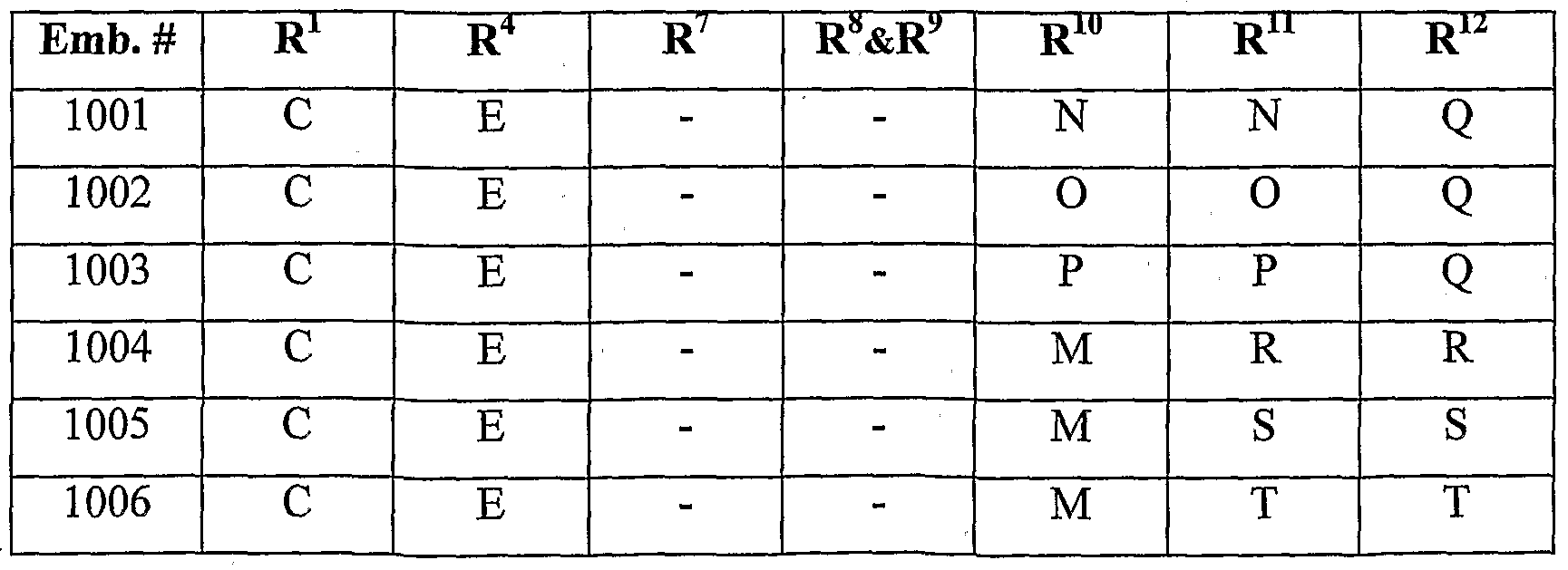

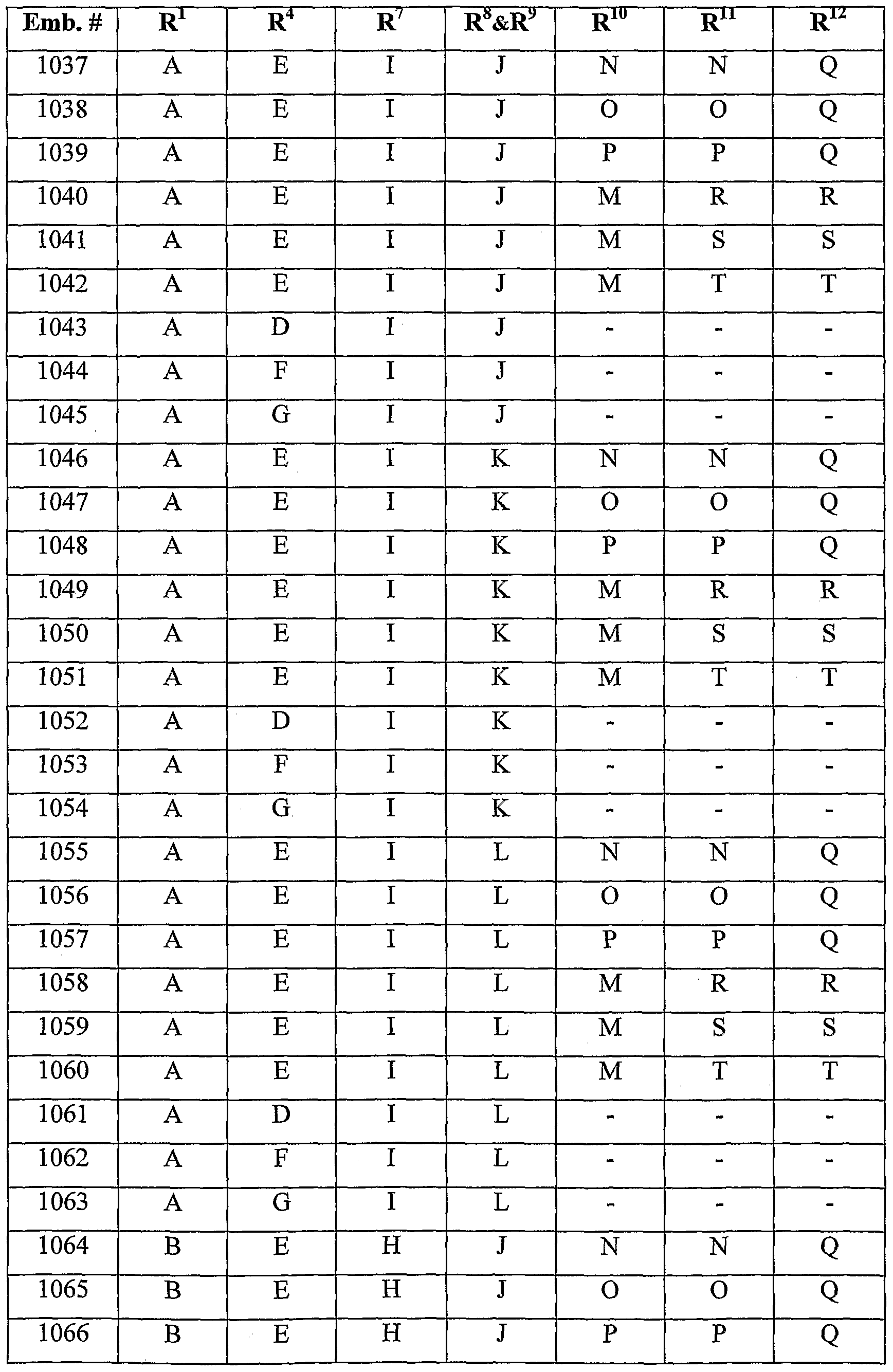
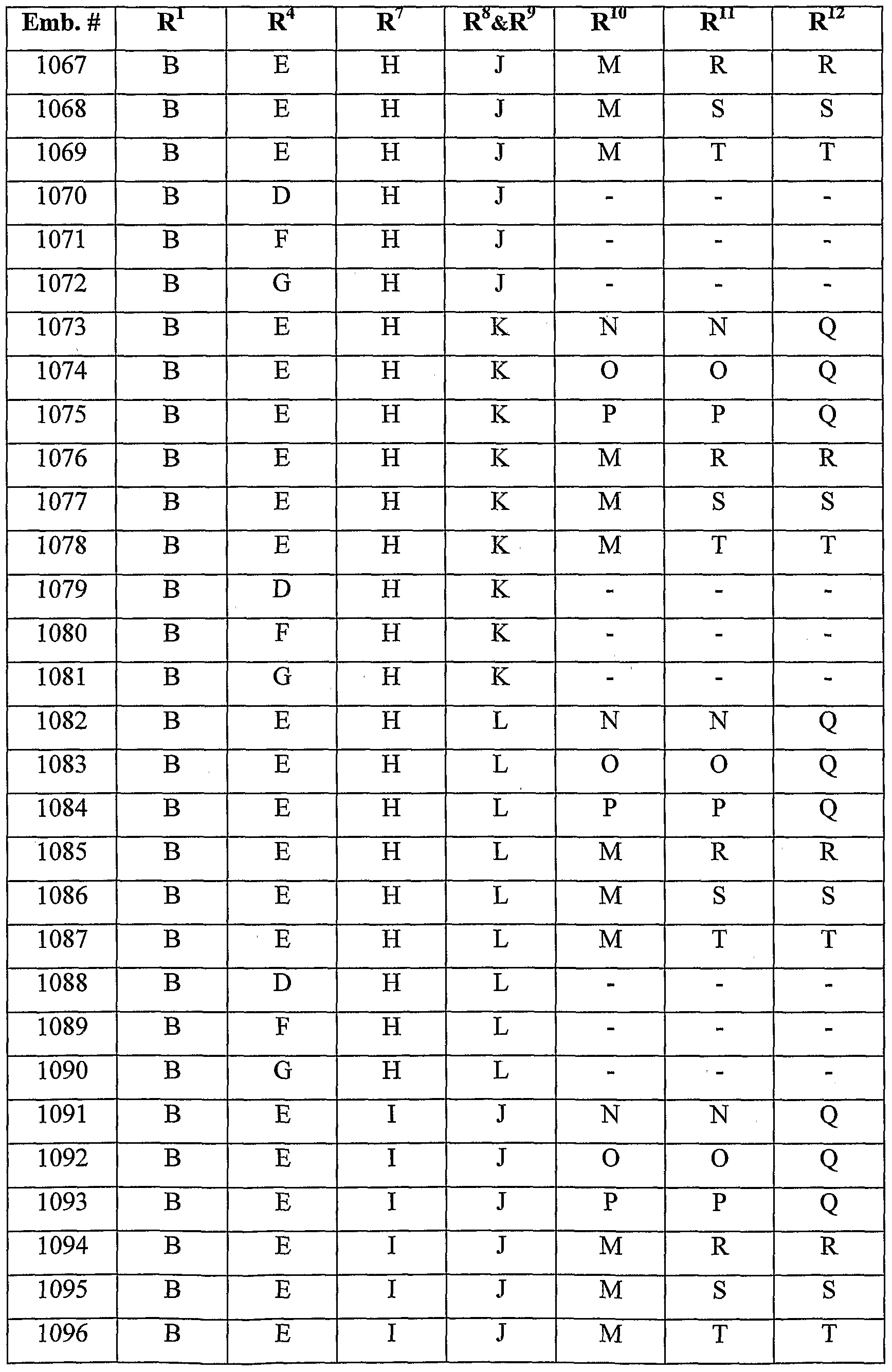
-82-

Where X is CH and Y is N:

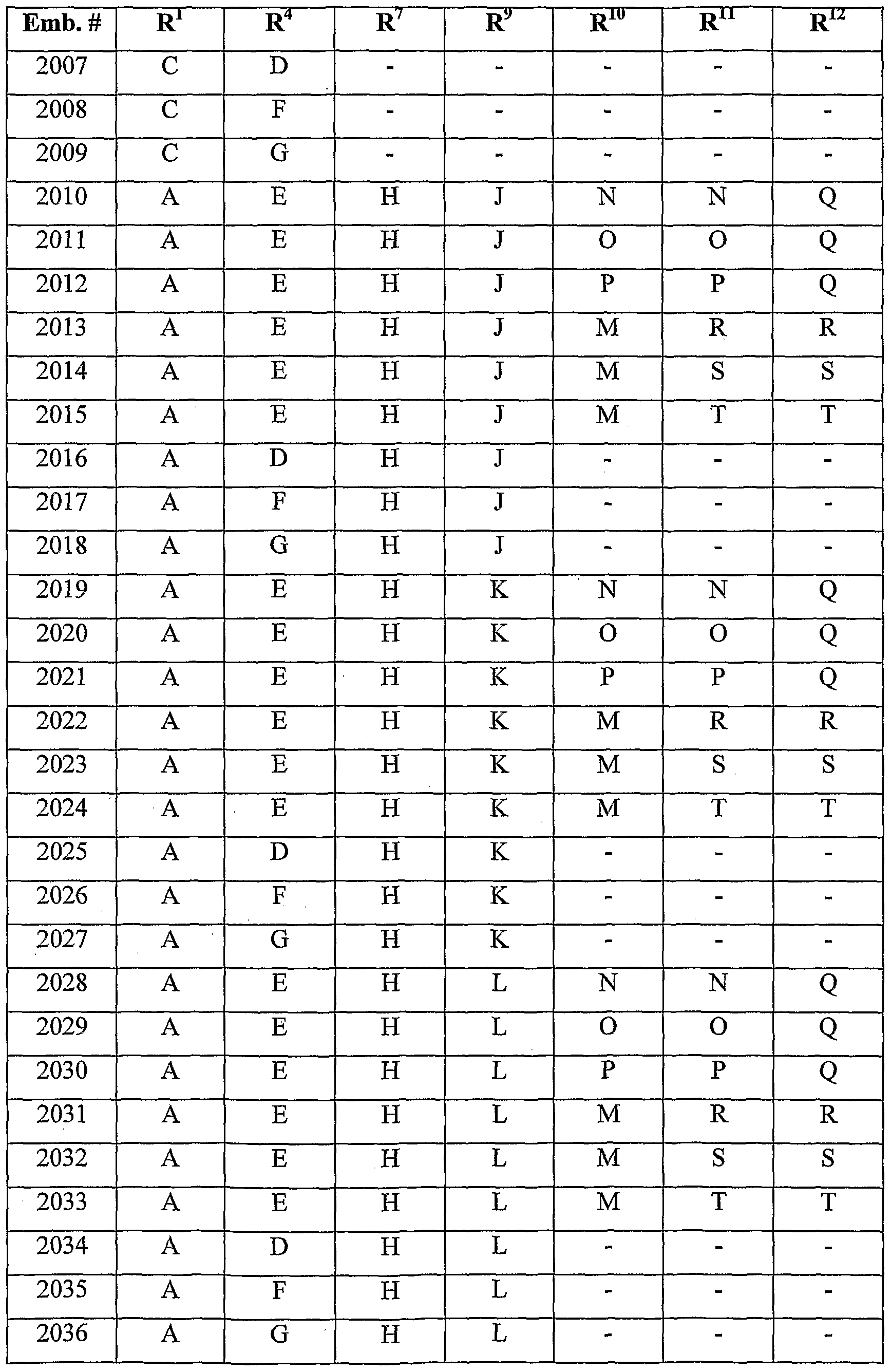
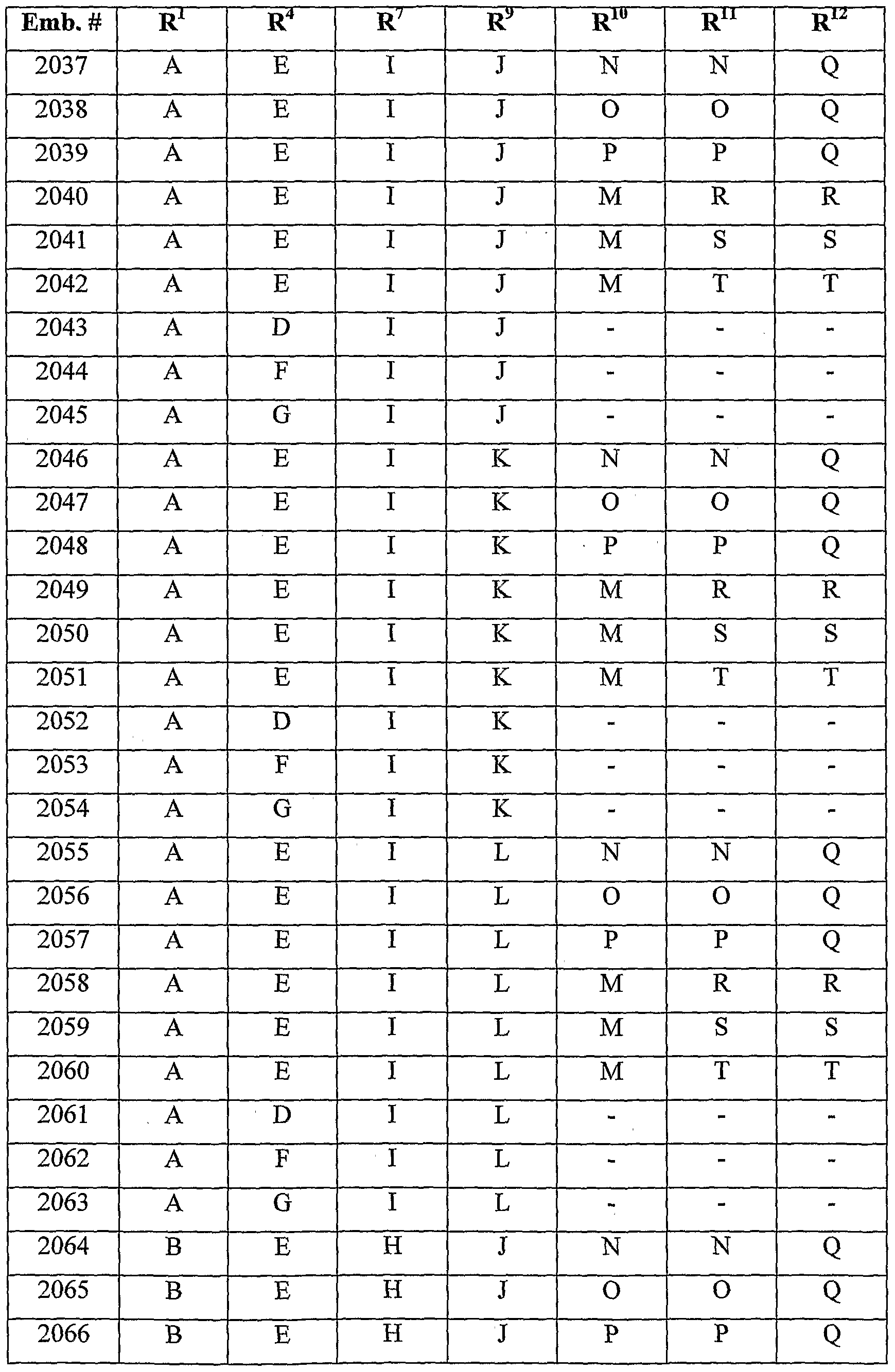


Another aspect of the invention relates to a method of treating acute, inflammatory and neuropathic pain, dental pain, general headache, migraine, cluster headache, mixed-vascular and non- vascular syndromes, tension headache, general inflammation, arthritis, rheumatic diseases, osteoarthritis, inflammatory bowel disorders, depression, anxiety, inflammatory eye disorders, inflammatory or unstable bladder disorders, psoriasis, skin complaints with inflammatory components, chronic inflammatory conditions, inflammatory pain and associated hyperalgesia and allodynia, neuropathic pain and associated hyperalgesia and allodynia, diabetic neuropathy pain, causalgia, sympathetically maintained pain,
deafferentation syndromes, asthma, epithelial tissue damage or dysfunction, herpes simplex, disturbances of visceral motility at respiratory, genitourinary, gastrointestinal or vascular regions, wounds, burns, allergic skin reactions, pruritus, vitiligo, general gastrointestinal disorders, gastric ulceration, duodenal ulcers, diarrhea, gastric lesions induced by necrotising agents, hair growth, vasomotor or allergic rhinitis, bronchial disorders or bladder disorders, comprising the step of adininistering a compound according to any of the above embodiments.
Another aspect of the invention relates to a pharmaceutical composition comprising a compound according to any of the above embodiments and a pharmaceutically-acceptable diluent or carrier.
Another aspect of the invention relates to the use of a compound according to any of the above embodiments as a medicament.
Another aspect of the invention relates to the use of a compound according to any of the above embodiments in the manufacture of a medicament for the treatment of acute, inflammatory and neuropathic pain, dental pain, general headache, migraine, cluster headache, mixed-vascular and non- vascular syndromes, tension headache, general inflammation, arthritis, rheumatic diseases, osteoarthritis, inflammatory bowel disorders, depression, anxiety, inflammatory eye disorders, inflammatory or unstable bladder disorders, psoriasis, skin complaints with inflammatory components, chronic inflammatory conditions, inflammatory pain and associated hyperalgesia and allodynia, neuropathic pain and associated hyperalgesia and allodynia, diabetic neuropathy pain, causalgia, sympathetically maintained pain, deafferentation syndromes, asthma, epithelial tissue damage or dysfunction, herpes simplex, disturbances of visceral motility at respiratory, genitourinary, gastrointestinal or vascular regions, wounds, burns, allergic skin reactions, pruritus, vitiligo, general gastrointestinal disorders, gastric ulceration, duodenal ulcers, diarrhea, gastric lesions induced by necrotising agents, hair growth, vasomotor or allergic rhinitis, bronchial disorders or bladder disorders.
Another aspect of the invention relates to a method of making a compound according to the above embodiments, comprising the step of:
reacting
 ith R4JH to form

The compounds of this invention may have in general several asymmetric centers and are typically depicted in the form of racemic mixtures. This invention is intended to encompass racemic mixtures, partially racemic mixtures and separate enantiomers and diasteromers.
Unless otherwise specified, the following definitions apply to terms found in the specification and claims:
"Ca_palkyl" means an alkyl group comprising a minimum of α and a maximum of β carbon atoms in a branched, cyclical or linear relationship or any combination of the three, wherein α and β represent integers. The alkyl groups described in this section may also contain one or two double or triple bonds. Examples OfC1.
6alkyl include, but are not limited to the following:

"Benzo group", alone or in combination, means the divalent radical C-JHU=, one representation of which is -CH=CH-CH=CH-, that when vicinally attached to another ring forms a benzene-like ring—for example tetrahydronaphthylene, indole and the like.
The terms "oxo" and "thioxo" represent the groups =0 (as in carbonyl) and =S (as in thiocarbonyl), respectively. "Halo" or "halogen" means a halogen atoms selected from F, Cl, Br and I.
"Cv-whaloalkyl" means an alkyl group, as described above, wherein any number— at least one—of the hydrogen atoms attached to the alkyl chain are replaced by F,
Cl, Br or I.
"Heterocycle" means a ring comprising at least one carbon atom and at least one other atom selected from N, O and S. Examples of heterocycles that may be found in the claims include, but are not limited to, the following:

"Available nitrogen atoms" are those nitrogen atoms that are part of a heterocycle and are joined by two single bonds (e.g. piperidine), leaving an external bond available for substitution by, for example, H or CH3.
"Pharmaceutically-acceptable salt" means a salt prepared by conventional means, and are well known by those skilled in the art. The "pharmacologically acceptable salts" include basic salts of inorganic and organic acids, including but not limited to hydrochloric acid, hydrobromic acid, sulfuric acid, phosphoric acid,
methanesulfonic acid, ethanesulfonic acid, malic acid, acetic acid, oxalic acid, tartaric acid, citric acid, lactic acid, fumaric acid, succinic acid, maleic acid, salicylic acid, benzoic acid, phenylacetic acid, mandelic acid and the like. When compounds of the invention include an acidic function such as a carboxy group, then suitable pharmaceutically acceptable cation pairs for the carboxy group are well known to those skilled in the art and include alkaline, alkaline earth, ammonium, quaternary ammonium cations and the like. For additional examples of "pharmacologically acceptable salts," see infra and Berge et al., J. Pharm. Sci. 66:1 (1977). "Saturated or unsaturated" includes substituents saturated with hydrogens, substituents completely unsaturated with hydrogens and substituents partially saturated with hydrogens.
"Leaving group" generally refers to groups readily displaceable by a nucleophile, such as an amine, a thiol or an alcohol nucleophile. Such leaving groups are well known in the art. Examples of such leaving groups include, but are not limited to, N-hydroxysuccinimide, N-hydroxybenzotriazole, halides, Inflates, tosylates and the like. Preferred leaving groups are indicated herein where appropriate. "Protecting group" generally refers to groups well known in the art which are used to prevent selected reactive groups, such as carboxy, amino, hydroxy, mercapto and the like, from undergoing undesired reactions, such as nucleophilic, electrophilic, oxidation, reduction and the like. Preferred protecting groups are indicated herein where appropriate. Examples of amino protecting groups include, but are not limited to, aralkyl, substituted aralkyl, cycloalkenylalkyl and substituted cycloalkenyl alkyl, allyl, substituted allyl, acyl, alkoxycarbonyl, aralkoxycarbonyl, silyl and the like. Examples of aralkyl include, but are not limited to, benzyl, ortho- methylbenzyl, trityl and benzhydryl, which can be optionally substituted with halogen, alkyl, alkoxy, hydroxy, nitro, acylamino, acyl and the like, and salts, such as phosphonium and ammonium salts. Examples of aryl groups include phenyl, naphthyl, indanyl, anthracenyl, 9-(9-phenylfluorenyl), phenanthrenyl, durenyl and the like. Examples of cycloalkenylalkyl or substituted cycloalkylenylalkyl radicals, preferably have 6-10 carbon atoms, include, but are not limited to, cyclohexenyl methyl and the like. Suitable acyl, alkoxycarbonyl and aralkoxycarbonyl groups
include benzyloxycarbonyl, t-butoxycarbonyl, iso-butoxycarbonyl, benzoyl, substituted benzoyl, butyryl, acetyl, trifluoroacetyl, trichloro acetyl, phthaloyl and the like. A mixture of protecting groups can be used to protect the same amino group, such as a primary amino group can be protected by both an aralkyl group and an aralkoxycarbonyl group. Amino protecting groups can also form a heterocyclic ring with the nitrogen to which they are attached, for example, l,2-bis(methylene)benzene, phthalimidyl, succinimidyl, maleimidyl and the like and where these heterocyclic groups can further include adjoining aryl and cycloalkyl rings. In addition, the heterocyclic groups can be mono-, di- or tri- substituted, such as nitrophthalimidyl. Amino groups may also be protected against undesired reactions, such as oxidation, through the formation of an addition salt, such as hydrochloride, toluenesulfonic acid, trifluoroacetic acid and the like. Many of the amino protecting groups are also suitable for protecting carboxy, hydroxy and mercapto groups. For example, aralkyl groups. Alkyl groups are also suitable groups for protecting hydroxy and mercapto groups, such as tert-butyl.
Silyl protecting groups are silicon atoms optionally substituted by one or more alkyl, aryl and aralkyl groups. Suitable silyl protecting groups include, but are not limited to, trimethylsilyl, triethylsilyl, triisopropylsilyl, tert- butyldimethylsilyl, dimethylphenylsilyl, 1 ,2-bis(dimethylsilyl)benzene, 1 ,2-bis(dimethylsilyl)ethane and diphenylmethylsilyl. Silylation of an amino groups provide mono- or di-silylamino groups. Silylation of aminoalcohol compounds can lead to a N,N,O-trisilyl derivative. Removal of the silyl function from a silyl ether function is readily accomplished by treatment with, for example, a metal hydroxide or ammonium fluoride reagent, either as a discrete reaction step or in situ during a reaction with the alcohol group. Suitable silylating agents are, for example, trimethylsilyl chloride, tert-butyl-dimethylsilyl chloride, phenyldimethylsilyl chloride, diphenylmethyl silyl chloride or their combination products with imidazole or DMF. Methods for silylation of amines and removal of silyl protecting groups are well known to those skilled in the art. Methods of preparation of these amine derivatives from corresponding amino acids, amino acid amides or amino acid esters are also well known to those skilled
in the art of organic chemistry including amino acid/amino acid ester or aminoalcohol chemistry.
Protecting groups are removed under conditions which will not affect the remaining portion of the molecule. These methods are well known in the art and include acid hydrolysis, hydrogenolysis and the like. A preferred method involves removal of a protecting group, such as removal of a benzyloxycarbonyl group by hydrogenolysis utilizing palladium on carbon in a suitable solvent system such as an alcohol, acetic acid, and the like or mixtures thereof. A t- butoxycarbonyl protecting group can be removed utilizing an inorganic or organic acid, such as HCl or trifluoroacetic acid, in a suitable solvent system, such as dioxane or methylene chloride. The resulting amino salt can readily be neutralized to yield the free amine. Carboxy protecting group, such as methyl, ethyl, benzyl, tert-butyl, 4-methoxyphenylmethyl and the like, can be removed under hydrolysis and hydrogenolysis conditions well known to those skilled in the art.
It should be noted that compounds of the invention may contain groups that may exist in tautomeric forms, such as cyclic and acyclic amidine and guanidine groups, heteroatom substituted heteroaryl groups (Y1 = O, S, NR), and the like, which are illustrated in the following examples:

Prodrugs of the compounds of this invention are also contemplated by this invention. A prodrug is an active or inactive compound that is modified chemically through in vivo physiological action, such as hydrolysis, metabolism and the like, into a compound of this invention following adininistration of the prodrug to a patient. The suitability and techniques involved hi making and using prodrugs are well known by those skilled in the art. For a general discussion of prodrugs involving esters see Svensson and Tunek Drug Metabolism Reviews 165 (1988) and Bundgaard Design of Prodrugs, Elsevier (1985). Examples of a masked carboxylate anion include a variety of esters, such as alkyl (for example, methyl, ethyl), cycloalkyl (for example, cyclohexyl), aralkyl (for example, benzyl, p-methoxybenzyl), and alkylcarbonyloxyalkyl (for example, pivaloyloxymethyl). Amines have been masked as arylcarbonyloxymethyl substituted derivatives, which are cleaved by esterases in vivo releasing the free drug and formaldehyde (Bungaard J. Med. Chem. 2503 (1989)). Also, drugs containing an acidic NH group, such as imidazole, imide, indole and the like, have been masked with N- acyloxymethyl groups (Bundgaard Design of Prodrugs, Elsevier (1985)). Hydroxy groups have been masked as esters and ethers. EP 039,051 (Sloan and Little, 4/11/81) discloses Mannich-base hydroxamic acid prodrugs, their preparation and use.
The specification and claims contain listing of species using the language "selected from . . . and . . ." and "is . . . or . . ." (sometimes referred to as Markush groups). When this language is used in this application, unless otherwise stated it is meant to include the group as a whole, or any single members thereof, or any subgroups thereof. The use of this language is merely for shorthand purposes and is not meant in any way to limit the removal of individual elements or subgroups as needed.
Experimental
Unless otherwise noted, all materials were obtained from commercial suppliers and used without further purification. AU parts are by weight and temperatures are in degrees centigrade unless otherwise indicated. All microwave-assisted reactions were conducted with a Smith Synthesizer from Personal Chemistry, Uppsala, Sweden. All compounds showed NMR spectra consistent with their assigned structures. Melting points were determined on a Buchi apparatus and are uncorrected. Mass spectral data was determined by electrospray ionization technique. All examples were purified to >90% purity as determined by high- performance liquid chromatography (HPLC). Unless otherwise stated, reactions were run at room temperature. The following abbreviations are used:
DMSO - dimethyl sulfoxide
DMF - ΛζiV-dimethylformamide
THF - tetrahydrofuran
Et2O - diethyl ether
EtOAc - ethyl acetate
MeOH - methyl alcohol
EtOH - ethyl alcohol
MeCN - acetonitrile
MeI - iodomethane
NMP - 1 -methyl-2-pyrrolidinone
DCM - dichloromethane
DCE - 1 ,2-dichloroethane
TFA - trifuoroacetic acid
MP-carbonate - macroporous polystyrene anion-exchange resin that is a resin bound equivalent of tetraalkylammonium carbonate. sat. - saturated h - hour min - minutes
Example 1

(a) l-Chloro-S-tributylstannyl-ό-trifluoromethyl-pyridine. To a solution of diisopropylamine (5.5 mL, 39 mmol, Aldrich,) in THF (30 mL) was added n-BuLi (15.6 mL, 2.5 M in hexanes, 39 mmol, Aldrich) with stirring at - 78 °C. The mixture was stirred at -78 °C for 30 min and at room temperature for 15 min. The reaction mixture was cooled again to -78 °C and a solution of 2-chloro-6- trifluoromethylpyridine (5.0 g, 27.5 mmol, Lancaster) in THF (20 mL) was added. The mixture was stirred at -78 °C for 1 h, tributyltin chloride (9 mL, 33 mmol, Aldrich) was added via a syringe, and stirring was continued for 2 h. The reaction mixture was allowed to reach 0 °C, quenched with a sat. aqueous solution of NH4Cl, and extracted with Et2O (3x). The combined organic extracts were dried over MgSO4, filtered, and concentrated under reduced pressure. Purification of the residue by flash silica gel chromatography (gradient: 0-1% EtOAc/hexane) afforded the title compound as colorless oil. MS (ESI, pos. ion.) m/z: All (M+l).

(b) 4-(6-(2-Chloro-6-(trifluoromethylpyridin-3-yl)pyrimidin-4-yloxy)benzo [rf]tb.iazol-2-amine. To a mixture of 4-(6-iodo-pyrimidin-4-yloxy)-benzothiazol- 2-ylamine (3.5 g, 9.46 mmol, prepared as described in WO04014871), Pd(PPh3)4 (1.09 g, 0.95 mmol, Strem) and copper iodide (0.36 g, 1.90 mmol, Aldrich) was added a solution of 2-chloro-3-tributylstannyl-6-trifluoromethyl-pyridine from step (a) above (6.0 g, 12.77 mmol) in DMF (40 mL) under an argon atmosphere. The mixture was heated at 90 °C with stirring for 16 h, cooled to room temperature, quenched with a sat. aqueous solution OfNH4Cl, and extracted with EtOAc (3x). The combined organic extracts were washed with sat. NaHCO3, H2O and brine, dried over Na2SO4, filtered, and concentrated under reduced pressure. Purification of the residue by silica gel column chromatography (gradient: 50-
100% EtOAc/hexane) afforded the title compound as an off-white solid. MS (ESI, pos. ion.) m/z: 424 (M+l).

(c) 4-(6-(2((4-BenzylmorphoIin-2-yl)methylamino)-6-(trifluoromethyl)- py ridin-3-yl)pyrimidin-4-yloxy)benzo [d\ thiazol-2-amine. A mixture of 4-(6-(2- chloro-β-Ctrifluoromethy^pyridin-S-y^pyrimidin^-yloxy^enzofcOthiazol-l- amine from step (b) above (400 mg, 0.95 mmol) and 4-benzyl-1,4-oxazinan-2-yl)- methyl amine (800 mg, 3.88 mmol, Maybridge) in CH3CN (0.5 mL) was heated in a microwave synthesizer at 120 °C for 15 min. The reaction mixture was evaporated in vacuo and the residue was purified by silica gel column chromatography [5% (2N NH3 in MeOH)/DCM] to give the title compound as a yellow solid. MS (ESI, pos. ion.) m/z: 594 (M+l). Example 2

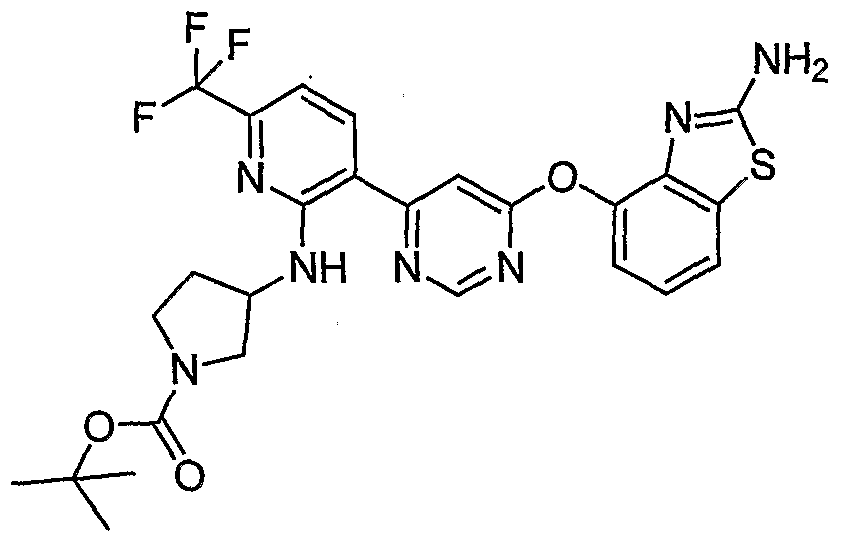
(a) tert-Butyl 3-(3-(6-(2-aminobenzo[</]thiazoI-4-yloxy)pyrimidin-4-yI)-6- (trifluoromethyl)pyridin-2-ylamino)pyrrolidine-1-carboxylate. A mixture of 4-(6-(2-chloro-6-(trifluoromethyl)pyridin-3-yl)pyrimidin-4-yloxy)- berizo[<f]trύazol-2-amine, Example l(b), (250 mg, 0.58 mmol), tert-butyl 3- aminopyrrolidine-1-carboxylate (400 mg, 2.15 mmol, Astatech) and CsF (20 mg, 0.13 mmol, Aldrich) in CH3CN (0.2 mL) was heated in a microwave synthesizer at 120 °C for 20 min. The reaction mixture was evaporated in vacuo and the residue was purified by silica gel column chromatography (gradient: 20- 30% EtOAc/hexane) to give the title compound as a yellow solid. MS (ESI, pos. ion.) m/z: 574 (M+l).

(b) tert-Butyl 3-(3-(6-(2-acetamidobenzo [d\ thiazol-4-yloxy)pyrimidin-4-yl)-6- (trifluoromethyl)pyridin-2-ylamino)pyrrolidine-1-carboxylate. tert-Butyl 3- (3-(6-(2-aminobenzo[d]thiazol-4-yloxy)pyrimidin-4-yl)-6-(trifluoromethyl)-
pyridin-2-ylamino)pyrrolidine-1-carboxylate from step (a) above (200 mg, 0.35 mmol) was reacted with acetic anhydride (100 μL, 1.06 mmol, Aldrich) under the conditions of Example 2 to give the title compound as a light- yellow solid. MS (ESI, pos. ion.) m/z: 616 (M+l).

(c) iV-(4-(6-(2-(PyrroIidin-3-ylamino)-6-(trifluoromethyl)pyridiii-3-yl)- pyrimidin-4-yloxy)benzo[rf]thiazol-2-yl)acetamide. A mixture of tert-buty\ 3- (3-(6-(2-acetamidobenzo[^thiazol-4-yloxy)pyrimidin-4-yl)-6-(trifluoromethyl)- pyridin-2-ylamino)pyrrolidine-1-carboxylate from step (b) above (120 mg, 0.19 mmol) and 1 : 1 mixture of DCM/TFA (5 rnL) was stirred at room temperature for 30 min. The reaction mixture was evaporated in vacuo and the residue was dissolved in EtOAc. The solution was washed with a sat. aqueous solution of NaHCθ3, water and brine, dried over Na2SO4,and filtered. The filtrate was evaporated in vacuo to provide the title compound as a yellow solid. MS (ESI, pos. ion.) m/z: 516 (M+l ).

(d) A'-(4-(6-(2-(l-IsobutyIpyrrolidin-3-ylammo)-6-(trifluoroinethyl)pyridin-3- yl)pyrimidin-4-yloxy)benzo[<f|thiazol-2-yl)acetamide. To a solution of iV-(4-(6- (2-(pyrrolidin-3-ylamino)-6-(trifluoromethyl)pyridin-3-yl)pyrimidin-4-yloxy)- benzo[<a]trnazol-2-yl)acetamide from step (c) above (30 mg, 0.06 mmol) in DCE (5 mL) was added isobutyraldehyde (20 mg, 0.20 mmol, Aldrich). The mixture was stirred at room temperature for 10 min, sodium triacetoxy borohydride (25
mg, 0.12 mmol, Aldrich) was added, and the stirring was continued for 1 h. The reaction mixture was evaporated in vacuo and the residue was dissolved in EtOAc. The solution was washed with sat. aqueous solution of NaHCOs, H2O and brine, dried over Na2SO4, filtered, and evaporated under reduced pressure. Purification of the residue by silica gel column chromatography [gradient: 0-2% (2N NH3 in MeOH)/DCM] afforded the title compound as a yellow solid. MS (ESI, pos. ion.) m/z: 572 (M+l). Mp: 138-139 °C. Example 4


(a) tert-Butyl 2-(l-isobutylpiperidin-2-yl)propan-2-ylcarbamate. tert-Butyl 2- (piperidin-2-yl)propan-2-yl carbamate (2.0 g, 8.3 mmol, CarboGen) was reacted with isobutyraldehyde (1.2 g, 16.5 mmol, Aldrich) under the conditions of Example 3(d) to give the title compound as a yellow oil. MS (ESI, pos. ion.) m/z: 299 (M+l).

(b) 2-(l-Isobutylpiperidin-2-yl)propan-2-amine. tert-Butyl 2-(l- isobutylpiperidin-2-yl)propan-2-ylcarbamate, (2.2 g, 7.3 mmol) was reacted with 1:1 mixture of DCM/TFA (40 rnL) under the conditions of Example 3(c) to give the title compound as TFA salt. The salt was diluted with DCM (20 niL) and MP- carbonate resin (4 g, 10.9 mmol, 2.7 mmol/g, Argonaut) was added. The mixture was stirred at room temperature for 16 h and filtered. The filtrate was evaporated and the residue was dried under vacuo to yield the title compound as a yellow oil. MS (ESI, pos. ion.) m/z: 199 (M+l).
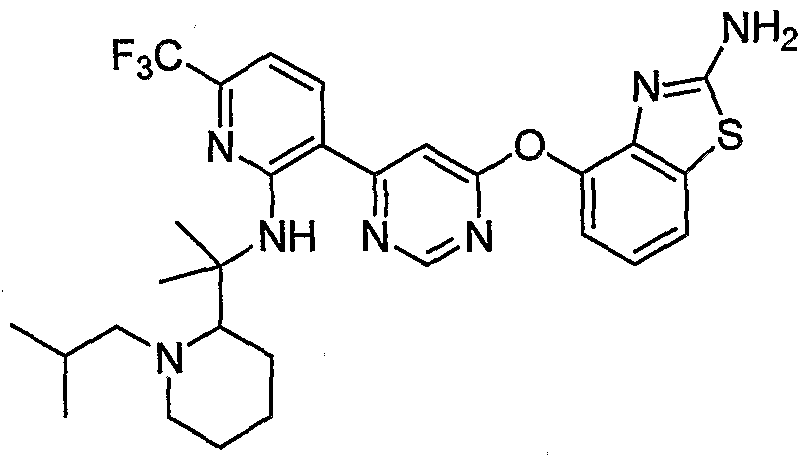
(c) 4-(6-(2-(2-(l-Isobutylpiperidin-2-yl)propan-2-yIamino)-6-(trifluorometh- yl)pyridin-3-yl)pyrimidin-4-yloxy)benzo[</jthiazol-2-amine. A mixture of 4-(6- (2-chloro-6-(Mfluoromethyl)pyridin-3-yl)pyrimidin-4-yloxy)benzo[d]thiazol-2- amine, Example l(b), (200 mg, 0.47 mmol) and 2-(l-isobutylpiperidin-2-yl)- propan-2-amine from step (b) above (200 mg, 1.0 mmol) in DMSO (1 niL) was heated in a microwave synthesizer at 160 °C for 15 min. The reaction mixture was partitioned between EtOAc and H2O. The organic phase was separated, washed with H2O and brine, dried over Na2SO4, and filtered. The filtrate was evaporated under reduced pressure and the residue was purified by silica gel column chromatography [5% (2N NH3 in MeOH)/DCM] to give the title compound as a yellow solid. MS (ESI, pos. ion.) m/z: 586 (M+l). Mp: 166-170 °C.
Example 6

(a) 3-Amino-5-(6-iodopyrimidin-4-yloxy)quinoxalin-2(lH)-one. A mixture of 3-amino-5-hydroxyquinoxalin-2(lH)-one hydrobromide (3.8 g, 15 mmol, prepared as described in WO04014871), 4,6-diiodopyrimidine (4.9 g, 15 mmol, prepared as described in WO04014871) and Cs2CO3 (9.6 g, 29 mrnol, Aldrich) in DMF (30 niL) was heated at 70 °C with stirring for 4 h. The reaction mixture was allowed to reach room temperature, diluted with EtOAc (100 mL) and water (100 mL), and filtered. The filter cake was washed with water and dried under vacuo to give the title compound as an off-white solid. MS (ESI, pos. ion.) mJz: 382 (M+l).

(b) 3-Amino-5-(6-(2-chloro-6-(trifluoromethyl)pyridin-3-yl)pyrimidin-4- yloxy)quinoxalin-2(lJH)-one. 3-Amino-5-(6-iodopyrimidin-4-yloxy)quinoxalin- 2(lH)-one from step (a) above (3.68 g, 9.66 mmol) was reacted with 2-chloro-3- (tributylstannyl)-6-(trifluoromethyl)pyridine, Example l(a), (5.45 g, 11.6 mmol) under the conditions of Example l(b) to give the title compound as a brown solid. MS (ESI, pos. ion.) m/z: 435 (M+l).

(c) l-Isobutylpiperidine-2-carboxam e. Piperidine-2-carboxamide (4.52 g, 35 mmol, Bionet-Inter) was reacted with isobutyraldehyde (9.6 mL, 106 mmol, Aldrich) under the conditions of Example 3(d) to give the title compound as yellow oil. (ESI, pos. ion.) m/z: 185 (M+l).

(d) (l-Isobutylpiperidin-2-yl)methanamine. To a solution of 1-isobutylpiperi- dine-2-carboxamide from step (a) above (5 g, 27.2 mmol) in THF (70 mL) was added LiA1H4 (1 M in THF, 53 mL, 0.053 mmol, Aldrich) dropwise with stirring at 0 °C. After the addition was complete, the reaction mixture was allowed to warm to room temperature and the stirring was continued for 20 h. The reaction mixture was quenched with MeOH (3 mL) and 20% aqueous KOH (30 mL), and filtered through Celite®. The filtrate was extracted with Et2O (2 x 250 mL) and the combined organic extracts were concentrated under reduced pressure. The residue was purified by silica gel column chromatography [5% (2N NH3 in MeOH)-
/DCM] to give the title compound as pale-yellow oil. MS (ESI, pos. ion.) m/z: 171 (M+l).

(e) 3-Amino-5-(6-(2-((l-isobutylpiperidin-2-yl)methylamino)-6-(trifluoro- methyl)pyridin-3-yl)pyrimidin-4-yloxy)quinoxaliii-2(lJ-?)-one. A mixture of 3- ammo-5-(6-(2-chloro-6-(trifluoromethyl)pyridin-3-yl)pyrimidin-4-yloxy)- quinoxalin-2(lϋ/)- one from step (b) above (300 mg, 0.70 mmol) and 1-(1-
isobutylpiperidin-2-yl) ethanamine from step (d) above (200 mg, 1.2 mmol) in DMSO (2.5 niL) was heated in a microwave synthesizer at 120 °C for 25 min. The reaction mixture was partitioned between EtOAc and H2O. The organic phase was separated, washed with H2O and brine, dried over Na2SO4, filtered and evaporated under reduced pressure. Purification of the residue by silica gel column chromatography [gradient: 0-5% (2N NH3 in MeOH)ZDCM] afforded the title compound as a yellow solid. MS (ESI, pos. ion.) m/z: 569 (M+l). Mp: 228-229 °C. Example 7


(b) 8-(6-(2-Chloro-6-(trifluoromethyI)pyridin-3-yl)pyrimidin-4-yloxy)- quinolm-2-amine. 8-(6-Iodopyrimidin-4-yloxy)quinolin-2-amine from step (a) above (1 g, 2.7 mmol) was reacted with 2-chloro-3-(tributylstannyl)-6-(trifluoro- methyl)pyridine, Example l(a), (1.6 g, 3.4 mmol) under the condition of Example
l(b) to give the title compound as a yellow solid. MS (ESI, pos. ion.) m/z: 418 (M+l).
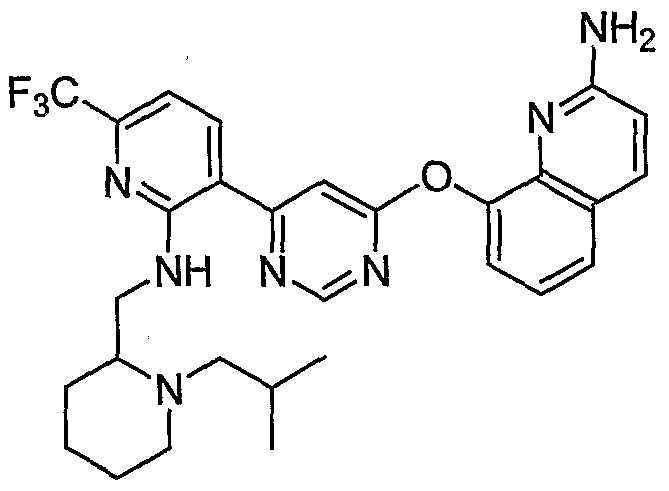
(c) 8-(6-(2-((l-Isobutylpiperidin-2-yl)methylamino)-6-(trifluoromethyl)- pyridin-3-yl)pyrimidin-4-yloxy)quinolin-2-amine. 8-(6-(2-Chloro-6-(trifluoro- niethyl)pyridin-3-yl)pyrimidin-4-yloxy)quinolin-2-amine from step (b) above (120 mg, 0.28 mmol) was reacted with l-(l-isobutylpiperidin-2-yl) methanamine, Example 6(d), (150 mg, 0.88 mmol) under the conditions of Example 6(e) to give the title compound as a yellow solid. MS (ESI, pos. ion.) m/z: 552 (M+l). Example 8

(a) ter/-ButyI 2-((3-(6-(2-aminobenzo[</Ithiazol-4-yloxy)pyriBaidin-4-yl)-6- (trifluoromethyl)pyridin-2-ylamino)methyl)morpholine-4-carboxyIate. 4-(6-
(2-Chloro-6-(trifluoromethyl)pyridin-3-yl)pyrimidin-4-yloxy)benzo[J]thiazol-2- amine, Example l(b), (380 mg, 0.90 mmol) was reacted with fert-butyl 2- (aminomethyl)morpholine-4-carboxylate (390 mg, 1.8 mmol, PharmaCore) under the conditions of Example 6(e) to give the title compound as an off-white solid. MS (ESI, pos. ion.) m/z: 604 (M+l).
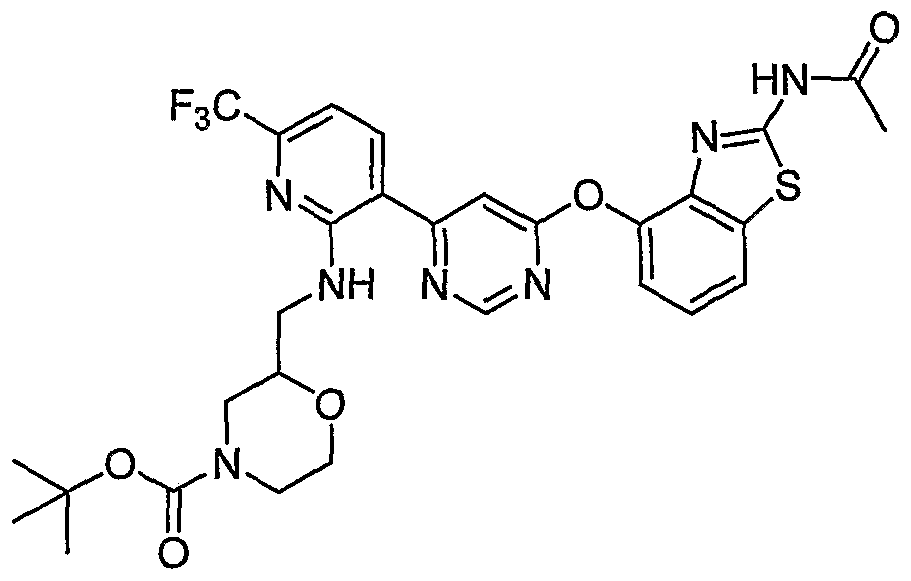
(trifluoromethyl)pyridin-2-ylamino)methyl)morpholine-4-carboxylate. tert- Butyl 2-((3 -(6-(2-aminobenzo [cdthiazol-4-yloxy)pyrimidin-4-yl)-6-(trifluoro- methyl)pyridin-2-ylamino)methyl)morpholine-4-carboxylate from step (a) above (234 mg, 0.39 mmol) was reacted with acetic anhydride (110 μL, 1.17 mmol, Aldrich) under the conditions of Example 2 to give the title compound as a light- yellow solid. MS (ESI, pos. ion.) m/z: 646 (M+l).


(d) 7V-(4-(6-(2-((4-Isobutylmorpholin-2-yl)methylammo)-6-(trifluoroinethyl)- pyridin-3-yl)pyrimidin-4-yloxy)benzo[d]thiazoI-2-yI)acetamide. N-(4-(6-(2-
(Moφholin-2-ylmethylamino)-6-(trifluoromethyl)pyridin-3-yl)pyriinidin-4- yloxy)benzo[^thiazol-2-yl)acetamide from step (c) above (78 mg, 0.14 mmol) was reacted with isobutyraldehyde (52 μL, 0.56 mmol, Aldrich) under the conditions of Example 3(d) to give the title compound as a yellow solid. MS (ESI, pos. ion.) m/z: 602 (M+l). Example 9

(a) tert-Butyl 3-((3-(6-(2-aminobenzo [d\ thiazol-4-yloxy)pyrimidin-4-yl)-6- (trifluoromethyI)pyridin-2-ylamino)methyI)pyrroIidine-1-carboxylate. 4-(6-
(2-CMoro-6-(trifluoromeώyl)pyridin-3-yl)pyrimidin-4-yloxy)benzo[(i]thiazol-2- amine, Example l(b), (320 mg, 0.76 mmol) was reacted with tert-butyl 3- (aminomethyl)pyrrolidine-1-carboxylate (450 mg, 2.3 mmol, Astatech) under the conditions of Example 3 (a) to give the title compound as a yellow solid. MS (ESI, pos. ion) m/z: 588 (M+l).

(b) teι*/-Butyl 3-((3-(6-(2-acetamidobenzo[rf|thiazoI-4-yloxy)pyriinidiii-4-yl)-6- (trifluoromethyl)pyridin-2-ylamino)methyI)pyrrolidine-1-carboxylate. ferf- Butyl 3-((3-(6-(2-aminobenzo[rf]thiazol-4-yloxy)pyrimidin-4-yl)-6-(trifluoro- methyl)pyridin-2-ylamino)methyl)pyrrolidine-1-carboxylate from step (a) above (110 mg, 0.19 mmol) was reacted with acetic anhydride (53 μL, 0.57 mmol, Aldrich) under the conditions of Example 2 to give the title compound as a yellow solid. MS (ESI, pos. ion.) m/z: 630 (M+l).

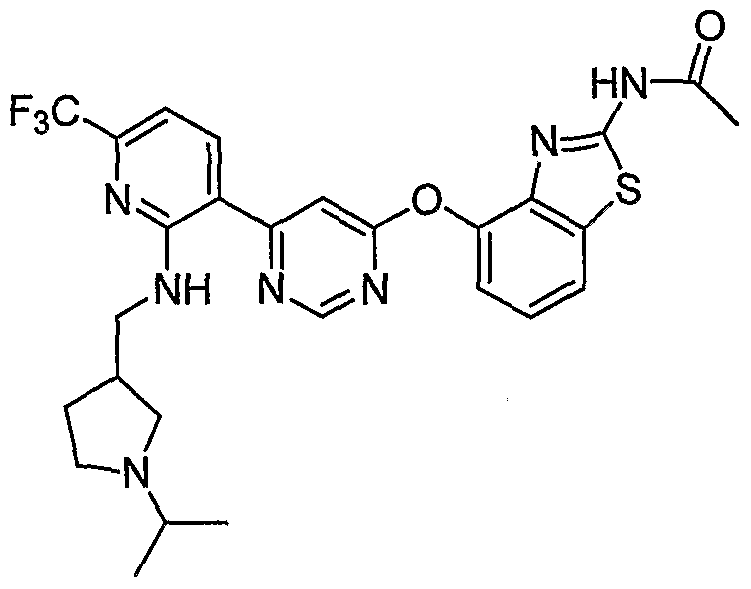
(d) iV-(4-(6-(2-((l-Isopropylpyrrolidin-3-yI)methyIamino)-6-(trifluoroinethyl)- pyridin-3-yl)pyrimidin-4-yloxy)benzo[</Jthiazol-2-yl)acetamide. N-(4-(6-(2- (Pyrrolidin-3-ylmethylamino)-6-(trifluorometliyl)pyridin-3-yl)pyrimidin-4- yloxy)benzo[cf]thiazol-2-yl)acetaniide &om step (c) above (55 mg, 0.10 mmol) was reacted with acetone (38 μL, 0.50 mmol, Aldrich) under the conditions of Example 3(d) to give the title compound as a yellow solid. MS (ESI, pos. ion.) m/z: 572 (M+ 1). Example 10

(a) (2R)-te^-Butyl 2-((3-(6-(2-aminobenzo[</]thiazol-4-yloxy)pyrimidin-4-yl)- 6-(trifluoromethyl)pyridin-2-ylamino)methyl)pyrroIidine-1-carboxylate. 4-(6- (2-Chloro-6-(trifluoromethyl)pyridin-3-yl)pyrimidin-4-yloxy)benzo[ύ(ithiazol-2- amine, Example l(b), (260 mg, 0.61 mmol) was reacted with (2i-)-tert-butyl 2- (aminomethyl)pyrrolidine-1-carbόxylate (244 mg, 1.22 mmol, Astatech) under the conditions of Example 6(e) to give the title compound as a yellow solid. MS (ESI, pos. ion.) m/z: 588 (M+l).

(b) (2R)-tert-ButyI 2-((3-(6-(2-acetamidobenzo[</]thiazol-4-yloxy)pyrimidin-4- yl)-6-(trifluoromethyl)pyridin-2-ylammo)methyl)pyrrolidine-1-carboxyIate.
(2i?)-tert-Butyl 2-((3-(6-(2-aniinobenzo[(^thiazol-4-yloxy)pyriniidin-4-yl)-6- (trifluoromethyl)pyridin-2-ylamino)meth.yl)pyrrolidine- 1 -carboxylate from step (a) above (190 mg, 0.32 mmol) was reacted with acetic anhydride (91 μL, 0.96 mmol, Aldrich) under the conditions of Example 2 to give the title compound as a yellow solid. MS (ESI, pos. ion.) m/z: 645 (M+l).


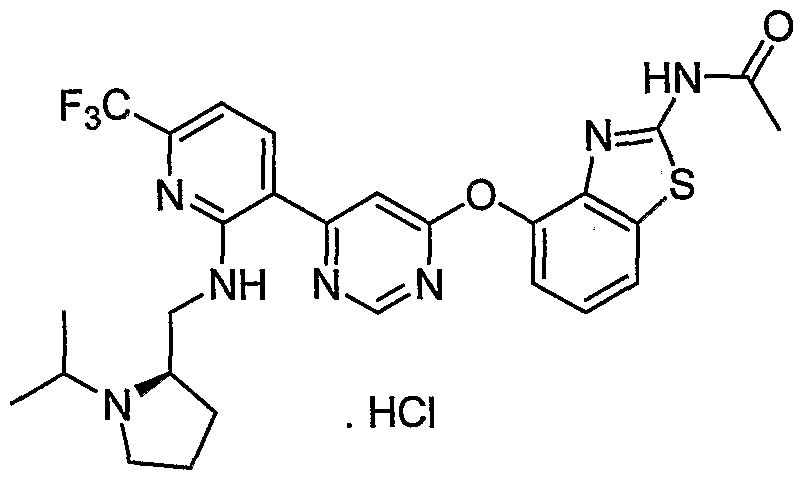

(a) (R)-tert-Butyl 2-((R)-l-aminoethyl)pyrrolidine-l-carboxylate. To a solution of (R)-tert-butyl 2-((R)- 1 -(benzylhydroxyamino)ethyl)pyrrolidine- 1 -carboxylate (910 mg, 2.84 mmol, prepared according to Merino, P.; Franco, S.; Gascon, J.M.; Merchan, F.L.; Tejero, T. Tetrahedron: Asymmetry, 1999, 10, 1867-1871) in MeOH (15 mL) was added 20% palladium hydroxide on activated charcoal (0.4 g,
- Ill -
Aldrich). The reaction mixture was stirred under a hydrogen atmosphere at room temperature for 48 h. The catalyst was filtered off through a plug of Celite® and the filter cake was washed with MeOH. The combined filtrates were evaporated and the residue was dried in vacuuo to provide the title compound as a colorless oil. MS (ESI, pos. ion.) m/z: 215 (M+l).

(b) (R)-te^-Butyl 2-((i?)-l-(3-(6-(2-aminobenzo[«fjthiazol-4-yloxy)pyrimidin-4- yl)-6-(trifluoromethyl)pyridin-2-ylammo)ethyl)pyrrolidine-1-carboxylate. 4-
(6-(2-CMoro-6-(Mfluoromethyl)pyridin-3-yl)pyrimidin-4-yloxy)benzo[<f]thiazol- 2-amine, Example l(b), (300 mg, 0.71 mmol) was reacted with (R)-tert-butyl 2- ((i?)-1-aminoethyl)pyrrolidine-1-carboxylate from step (a) above (456 mg, 2.13 mmol) under the conditions of Example 3 (a) to give the title compound as a light- yellow solid. MS (ESI, pos. ion.) m/z: 602 (M+l).


(d) iV-(4-(6-(2-((R)-l-((^)-PyrroIidin-2-yϊ)ethyIamino)-6-(trifluoromethyl)- pyridin-3-yl)pyrimidin-4-yloxy)benzo[rf]thiazol-2-yl)acetainide. (R)-tert-Butyl 2-((R)- 1 -(3 -(6-(2-acetamidobenzo [ J]thiazol-4-yloxy)pyrimidin-4-yl)-6-(trifluoro- methyl)pyridin-2-ylamino)ethyl)pyrrolidine-1-carboxylate from step (c) above (112 mg, 0.17 mmol) was reacted with 1 : 1 mixture of DCM/TFA (2 mL) under the conditions of Example 3(c) to give the title compound as a yellow solid. MS (ESI, pos. ion.) m/z: 544 (M+l).


(a) (S)-tert-Butyl 2-((S)-l-aminoethyl)pyrrolidine-l-carboxylate. (S)-tert-Butyl 2-((5)-1-(benzylhydroxyamino)ethyl)pyrrolidrne-1-carboxylate (950 mg, 3.0 mmol, prepared according to Merino, P.; Franco, S.; Gascon, J.M.; Merchan, F.L.; Tejero, T. Tetrahedron: Asymmetry, 1999, 10, 1867-1871) was hydrogenated under the conditions of Example 12(a) to provide the title compound as a colorless oil. MS (ESI, pos. ion.) m/z: 215 (M+l).
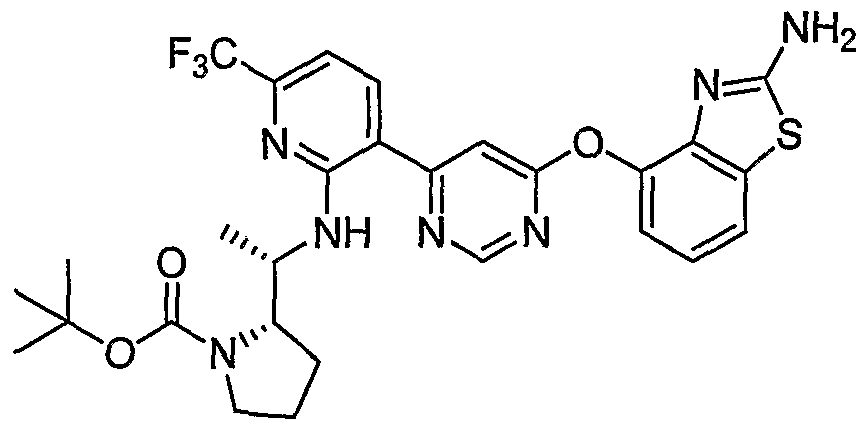
(b) (S)-tert-Butyl 2-((S)-l-(3-(6-(2-aminobenzo[rflthiazol-4-yloxy)pyrimidin-4- yl)-6-(trifluoromethyl)pyridin-2-ylammo)ethyl)pyrrolidine-l-carboxylate.
4-(6-(2-Chloro-6-(trifluoromethyl)pyridin-3-yl)pyrimidin-4-yloxy)- benzo[£fjthiazol-2-amine, Example l(b), (460 mg, 1.08 mmol) was reacted with (S)-tert-bntyl 2-((S)- l-ammoe1hyl)pyrrolidine-l -carboxylate from step (a) above (460 mg, 2.16 mmol) under the conditions of Example 3 (a) to give the title compound as a light- yellow solid. MS (ESI, pos. ion.) m/z: 602 (M+l).

(c) (5)-te^-Butyl 2-((S)-l-(3-(6-(2-acetamidobenzo[^thiazol-4-yloxy)- pyrimidin-4-yl)-6-(trifluoromethyl)pyridin-2-ylammo)ethyl)pyrrolidine-1- carboxylate. (^-te^Butyl 2-((5)-1-(3-(6-(2-aminobenzo[ώ(]thiazol-4-yloxy)- pyrimidin-4-yl)-6-(trifluoromethyl)pyridin-2-ylamino)ethyl)pyrrolidine- 1 - carboxylate from step (b) above (110 mg, 0.18 mmol) was reacted with acetic anhydride (52 μL, 0.54 mmol, Aldrich) under the conditions of Example 2 to give the title compound as a yellow solid. MS (ESI, pos. ion.) m/z: 644 (M+l).


(e) iV-(4-(6-(2-((S)-l-((S)-l-Isopropylpyrrolidin-2-yl)ethylamino)-6-(trifluoro- methyl)pyridin-3-yl)pyrimidin-4-yloxy)benzo[έflthiazol-2-yl)acetamide. JV-(4- (6-(2-((S)-I -((S)-Pyrrolidin-2-yl)ethylamino)-6-(trifluoromethyl)pyridin-3 -yl)- pyrimidin-4-yloxy)benzo[<f]thiazol-2-yl)acetamide from step (d) above (52 mg, 0.09 mmol) was reacted with acetone (35 μL, 0.45 mmol, Aldrich) under the conditions of Example 3(d) to give the title compound as a yellow solid. MS (ESI, pos. ion.) m/z: 586 (M+l). Example 15
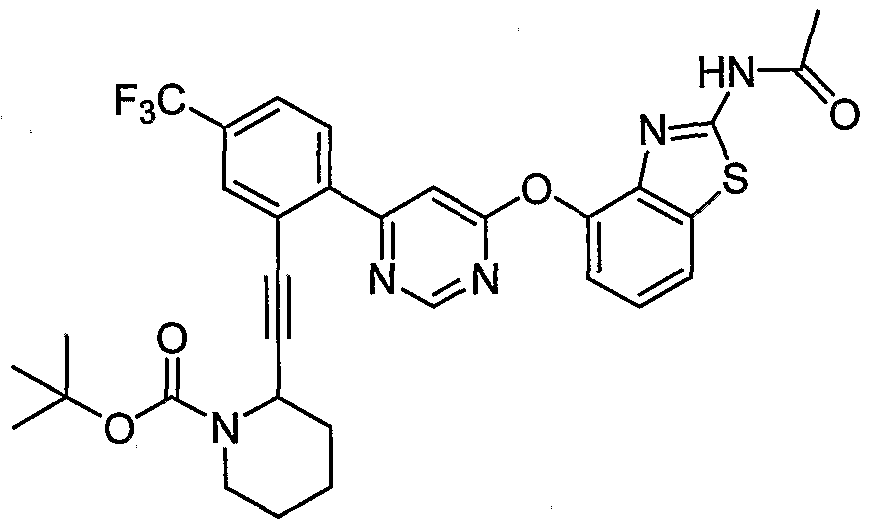
(a) tert-Butyl 2-(2-(2-(6-(2-acetamidobenzo [<f]thiazol-4-yloxy)pyrimidin-4-yl)- 5-(trifluoromethyI)phenyl)ethynyl)piperidine-1-carboxyIate. To a solution of N-(4-(6-(2-iodo-4-(trifluoromethyl)phenyl)pyrimidin-4-yloxy)benzo[<f|thiazol-2- yl)acetamide (480 mg, 0.86 mmol, prepared according to the procedure described in WO2004014871), tert-butyl 2-ethynylpiperidine-1-carboxylate ( 360 mg, 1.72 mmol, prepared according to the procedure described in WO200044728), palladium acetate (20 mg, 0.09 mmol, Aldrich) and triphenyl phosphine (45 mg, 0.17 mmol, Aldrich) in DMF (3 mL) was added triethylamine (6 mL, Aldrich) with stirring at room temperature under argon. The reaction mixture was heated at 80 °C with stirring for 18 h, a second portion of tert-butyl 2-ethynylpiperidine-1- carboxylate (300 mg, 1.42 mmol) was added, and the stirring was continued at 90
°C for an additional 18 h. The reaction mixture was allowed to reach room temperature and was partitioned between EtOAc and H2O. The organic phase was separated, washed with H2O and brine, dried over Na2SO4, filtered, and evaporated in vacuo. Purification of the residue by silica gel column chromatography [gradient: 0-1% (2N NH3 in MeOH)/DCM] afforded the title compound as a tan solid. MS (ESI, pos. ion.) m/z: 638 (M+l).

(b)iV-(4-(6-(2-(2-(Piperidin-2-yl)ethynyl)-4-(trifluoromethyl)phenyl)- pyrimidin-4-yloxy)benzo[<?jthiazoI-2-yI)acetainide. fert-Butyl 2-(2-(2-(6-(2- acetamidoberizo[^tMazol-4-yloxy)pyrimidiri-4-yl)-5-(trifluoromethyl)phenyl)- ethynyl)piperidine-1-carboxylate from step (a) above (280 mg, 0.44 mmol) was reacted with 1:1 mixture of DCM/TFA (5 mL) under the conditions of Example 3(c) to give the title compound as a tan solid. MS (ESI, pos. ion.) m/z: 538 (M+l).

(c) Λ^(4-(6-(2-(2-(l-IsobutyIpiperidin-2-yl)ethynyl)-4-(trifluoromethyl)- phenyl)pyrimidin-4-yloxy)benzo[έ/lthiazol-2-yl)acetamide hydrochloride. N-
(4-(6-(2-(2-(Piperidin-2-yl)ethynyl)-4-(trifluoromethyl)phenyl)pyrimidin-4- yloxy)benzo[cf]thiazol-2-yl)acetamide from step (b) above (140 mg, 0.26 mmol) was reacted with isobutyraldehyde (33 μL, 0.36 mmol, Aldrich) under the conditions of Example 10(d) to give the title compound. MS (ESI, pos. ion) m/z: 594 (M+l).
Example 16

/V-(4-(6-(2-(2-(l-Isobufylpiperidin-2-yl)ethyl)-4-(trifluoromethyϊ)phenyl)- pyrimidin-4-yloxy)benzo[d]thiazol-2-yl)acetamide. A solution of iV-(4-(6-(2- (2-( 1 -isobutylpiperidin-2-yl)ethynyl)-4-(trifluoromethyl)phenyl)pyrimidin-4- yloxy)benzo[c(]thiazol-2-yl)acetamide hydrochloride, Example 15(c), (221 mg, 0.37 mmol) in dioxane (5 mL) was hydrogenated under the conditions of Example 12(a) to provide the title compound as a tan solid. MS (ESI, pos. ion) m/z: 598 (M+l). Example 17

(a) (2S)-fert-Butyl 2-(2-(2-(6-(2-acetainidobenzo[^Jthiazol-4-yloxy)pyrimidin- 4-yl)-5-(trifluoromethyl)phenyl)ethynyI)pyrroIidine-1-carboxyIate. iV-(4-(6-
(2-Iodo-4-(trifluoromemyl)phenyl)pyrirrddin-4-yloxy)berizo[(i]thiazol-2-yl)- acetamide (450 mg, 0.81 mmol, prepared according to the procedure described in WO2004014871) was reacted with (S)-tert-butyl 2-ethynylpyrrolidine-1- carboxylate (314 mg, 1.62 mmol, prepared according to the procedure described on WO200044728) under the conditions of Example 15(a) to give the title compound as a tan solid. MS (ESI, pos. ion.) m/z: 624 (M+l).

(b)iV-(4-(6-(2-(2-((AS)-Pyrrolidin-2-yl)ethynyI)-4-(trifluoromethyl)phenyl)- pyrimidin-4-yIoxy)benzo[d]thiazol-2-yl)acetamide. (28)-tert-Bv.tyl 2-(2-(2-(6- (2-acetanudobenzo[d]tMazol-4-yloxy)pyrimidin-4-yl)-5-(trifluoromethyl)phenyl)- ethynyl)pyrrolidine-1-carboxylate from step (a) above (250 mg, 0.40 mmol) was reacted with 1 :1 mixture of DCM/TFA (6 mL) under the conditions of Example 3(c) to give the title compound as a brown solid. MS (ESI, pos. ion.) m/z: 524 (M+l).

(4-(6-(2-(2-((5)-Pyrrolidin-2-yl)ethynyl)-4-(trifluoromethyl)phenyl)pyrimidin-4- yloxy)benzo[d]thiazol-2-yl)acetamide from step (b) (51 mg, 0.09 mmol) was reacted with isobutyraldehyde (11 μL, 0.12 mmol, Aldrich) under the conditions of Example 10(d) to give the title compound as a brown solid. MS (ESI, pos. ion.) m/z: 580 (M+l).
Example 18

(4-(6-(2-(2-((5)-Pyrrolidin-2-yl)ethynyl)-4-(Mfluorometh.yl)phenyl)pyrimidin-4- yloxy)benzo[d]thiazol-2-yl)acetamide, Example 17(b), (50 mg, 0.09 mmol), was reacted with acetone (20 μL, 0.27 mmol, Aldrich) under the conditions of Example 10(d) to give the title compound as a tan solid. MS (ESI, pos. ion.) m/z: 566 (M+l). Example 19

(a) l-(2-Bromo-5-(trifluoromethyl)benzyl)-2-methylpyrrolidine. 2~Bromo-5- (trifluoromethyl)benzaldehyde (3.8 g, 15 mmol, prepared according to the procedure described in J Med. Chem. 1986, 29, 1142-1452. ) was reacted with 2- methylpyrrolidine (2.0 g, 23.5 mmol, Aldrich) under the conditions of Example 3(d) to give the title compound as a light-yellow oil. MS (ESI, pos. ion) m/z: 322 (M+l).


(d) JV-(4-Hydroxy-benzothiazol-2-yl)-acetamide. To the suspension of acetic acid 2-acetylamino-benzothiazol-4-yl ester from step (c) above (9.7 g, 39 mmol) in MeOH (200 mL) was added potassium carbonate (11 g, 78 mmol). The reaction mixture was stirred at 25 °C for 6 h, most of the solvent was evaporated in vacuo, and the residue was acidified with 10% HCl to pH 5. The mixture was then extracted with EtOAc (3x), the combined EtOAc extracts were washed with brine,
dried over Na2SO4, filtered, and concentrated in vacuo to give the title compound as a tan solid. MS (ESI, pos. ion.) m/z: 209 (M+l).

(e) iV-(4-(4-Iodopyridin-2-yloxy)benzo[d]thiazol-2-yl)acetainide. To a solution of iV-(4-hydroxy-benzothiazol-2-yl)-acetamide from step (d) above (4.68 g, 22 mmol) in DMF (30 mL) was added sodium hydride (60% in mineral oil, 0.96 g, 24 mmol) in small portions with stirring under nitrogen. The reaction mixture was stirred at room temperature for 10 min and 2-fluoro-4-iodopyridine (3.35 g, 15 mmol, Asymchem) was added in one portion. The reaction mixture was heated at 160 °C with stirring for 3 h. After cooling to room temperature, the mixture was diluted with water, and extracted with EtOAc (3x). The combined organic extracts were washed with brine, dried over Na2SO4, filtered, and evaporated in vacuo. The residue was purified by silica gel column chromatography (gradient 10-20% EtOAc/hexane) to give the title compound as a white solid. MS (ESI, pos. ion.) m/z: 412 (M+l).

(^ iV-(4-(6-(2-(2-(l-Methylpyrrolidin-2-yl)ethoxy)-4-(trifluoromethyl)phenyl)- pyrimidin-4-yIoxy)benzo[^thiazol-2-yl)acetamide.
A mixture of 2-((2-methylpyrrolidin-1-yl)methyl)-4-(trifluoromethyl)phenyl- boronic acid from step (b) above (72 mg, 0.25 mmol), iV-(4-(4-iodopyridin-2- yloxy)benzo[J]thiazol-2-yl)acetamide from step (e) above (103 mg, 0.25 mmol), PdCl2(PPh3)2 (18 mg, 0.025 mmol, Aldrich), Na2CO3-H2O (62 mg, 0.5 mmol), dimethoxyethane (0.7 mL), H2O (0.3 mL) and EtOH (0.2 mL) was heated in a microwave synthesizer at 120 °C with stirring for 10 min. The reaction mixture was diluted with water (5 mL) and extracted with EtOAc (2 x 10 mL). The
combined organic extracts were washed with brine, dried over Na2SO4 and filtered. The filtrate was evaporated in vacuo and the residue was purified by silica gel column chromatography (6 % MeOH/hexane) to give the title compound. MS (ESI, pos. ion) m/z: 527 (M+l). Example 20
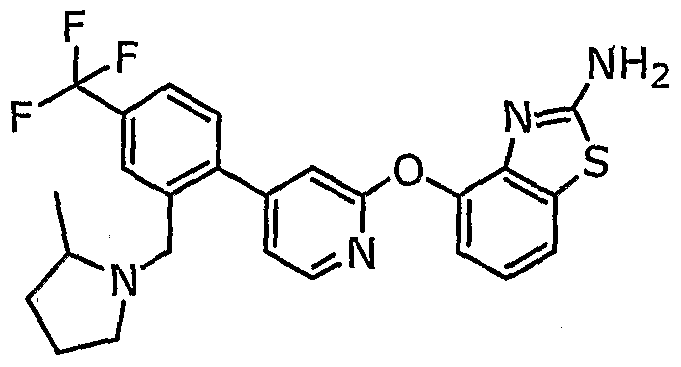
4-(6-(2-(2-(l-MethyIpyrrolidin-2-yl)ethoxy)-4-(trifluoromethyl)phenyl)- pyrimidin-4-yIoxy)benzo[fif]thiazol-2-amme. The title compound was formed as a side product of the reaction described in Example 19(f) and was isolated as an amorphous solid (12 mg, 10 %). MS (ESI, pos. ion.) m/z: 485 (M+l). Example 21

4-(6-(2-((2-Methylpyrrolidin-1-yl)methyl)-4-(trifluoromethyI)phenyl)- py rimidin-4-yloxy)benzo [d] thiazol-2-amine.2-((2-Methylpyrrolidin- 1 -yl)- methyl)-4-(trifluoromethyl)phenylboronic acid, Example 19(b), (72 mg, 0.25 mmol) and 4-(6-iodopyrimidin-4-yloxy)benzo[c(Jthiazol-2-amine (93 mg, 0.25 mmol, prepared as described in WO04014871 ) was reacted under conditions of Example 19(f) to give the title compound. MS (ESI, pos. ion.) m/z: 486 (M+l).
Example 22

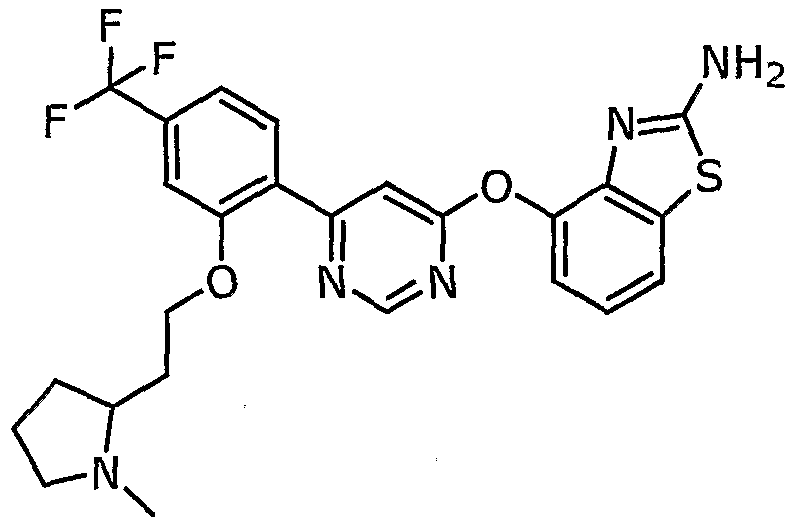
4-(6-(2-(2-(l-Methylpyrrolidin-2-yl)ethoxy)-4-(trifluoromethyl)phenyl)- pyrimidin-4-yloxy)benzo[d]thiazol-2-amine. The title compound was formed as a side product of the reaction described in Example 22 and was isolated as an amorphous solid. MS (ESI, pos. ion) m/z: 516 (M+l).
Example 24
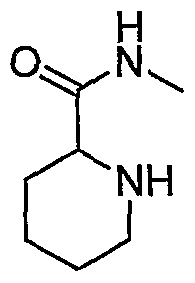
(a) N-Methylpiperidine-2-carboxamide. To methyl pipecolinate hydrochloride (5.0 g, 28 mmol, Aldrich) was added methylamine (20 mL, 40 wt. % solution in H2O, Aldrich). The mixture was stirred at 25 °C for 18 h and then evaporated under reduced pressure. The residue was dried in vacuo to give the crude title compound, which was used in the next step without additional purification.
(b) l-Isobutyl-N-methylpiperidine-2-carboxamide. The crude N- methylpiperidine-2-carboxamide from step (a) above (2 g) was reacted with isobutyraldehyde (5.5 mL, 60 mmol, Aldrich) under the conditions of Example 3(d) to give the crude title compound, which was dried in vacuo and used in the next step without additional purification.


Following the procedures described above for Example 6(c,d) and Example 24, or with slight modifications thereof, and following procedures familiar to one of ordinary skill in the art, the following examples were prepared from 4-(6-(2- chloro-6-(trifluoromethyl)pyridin-3-yl)pyrimidin-4-yloxy)benzo[J]thiazol-2- amine [Example l(b)]:
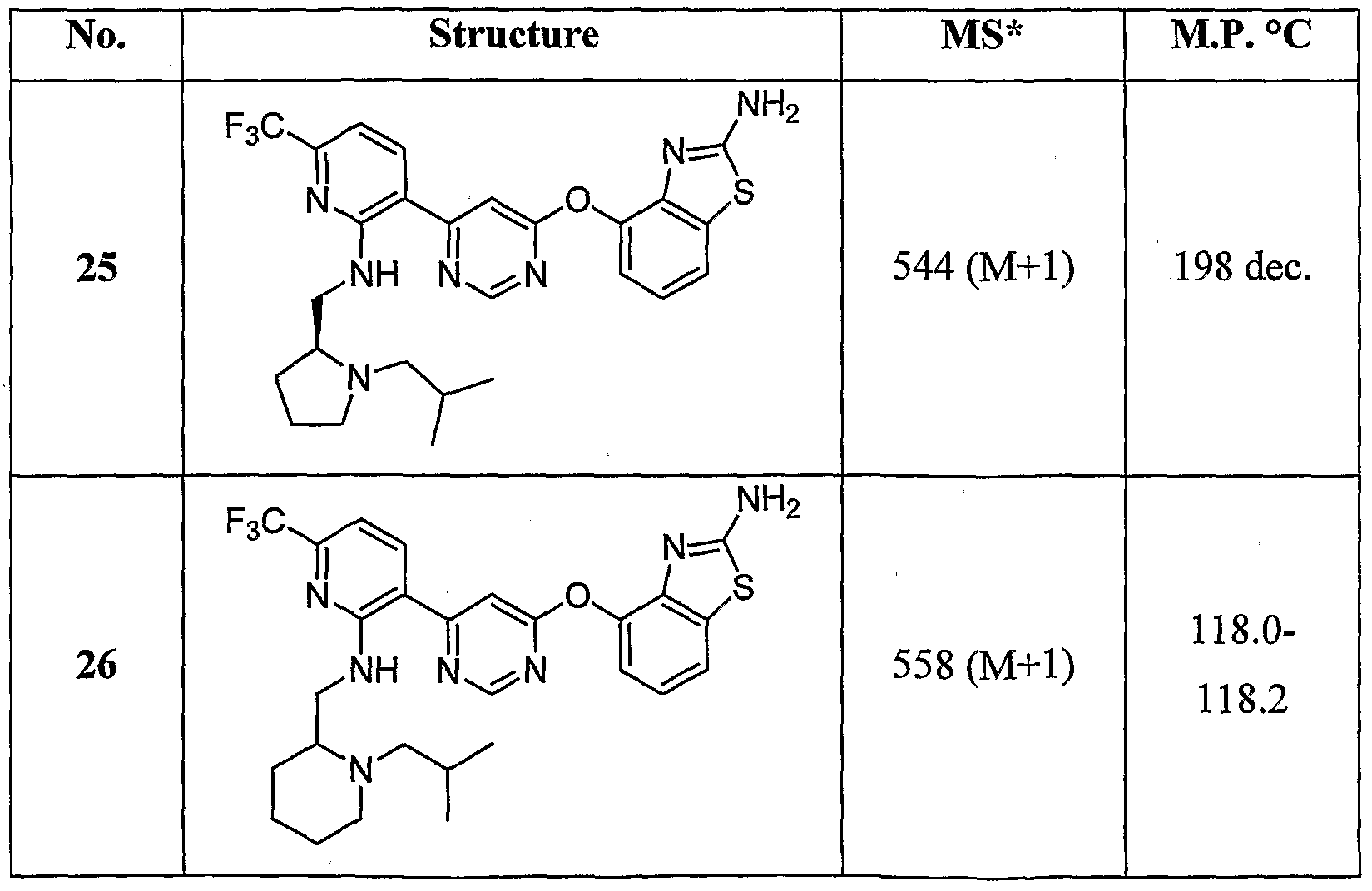

* (ESI, pos. ion) m/z Example 29

/V-(4-(6-(2-(((l-isobutylpiperidin-2-yl)methyl)(methyl)amino)-6-(trifluoro- methyl)pyridin-3-yl)pyrimidin-4-yloxy)benzo[rflthiazol-2-yl)acetamide. A mixture of 4-(6-(2-((( 1 -isobutylpiperidin-2-yl)methyl)(methyl)atnino)-6- (trifluoromethyl)pyridin-3 -yl)pyrimidin-4-yloxy)benzo [J]thiazol-2-amine, Example 24(d), (0.14 g, 0.24 mmol) and acetic anhydride (5 mL, Aldrich) in pyridine (20 mL) was stirred at 25 °C for 24 h. The reaction mixture was partitioned between aqueous solution OfNaHCO3 and EtOAc. The organic phase was separated, washed with brine, dried over Na2SO4, filtered and evaporated under reduced pressure. Purification of the residue by silica gel column
chromatography (gradient: 50-100% EtOAc/hexane) afforded the title compound as a yellow solid. MS (ESI, pos. ion.) m/z: 614 (M+l). Mp: 123.2-125.4 °C. Additional Examples
The following examples were prepared by treating the compounds of Example 25, Example 26 and Example 27 with acetic anhydride under the conditions described for Example 29:

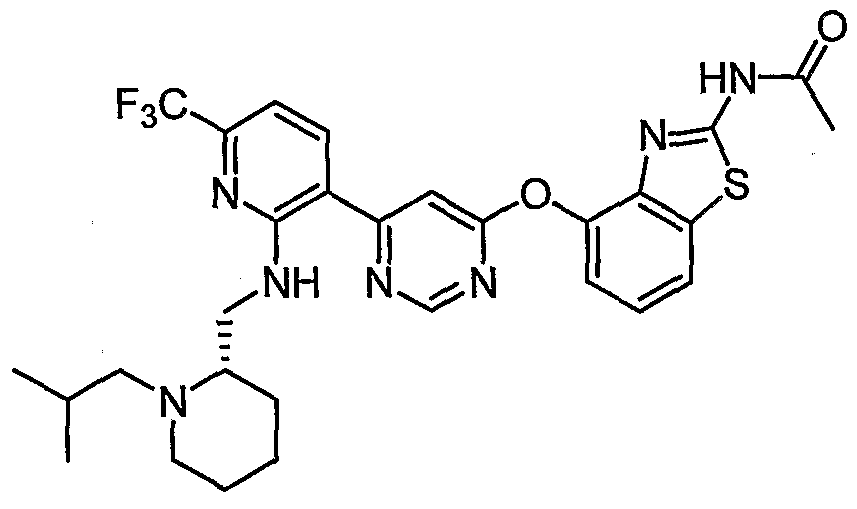

JV-(4-(6-(2-(((R)-l-Isobutylpiperidin-2-yl)methylamino)-6-(trifluoromethyl)- pyridin-3-yl)pyrimidin-4-yloxy)benzo[^thiazol-2-yl)acetamide. Chiral separation of iV-(4-(6-(2-(((i?,S)-1-isobutylpiperidin-2-yl)methylammo)-6- (trifluoromeώyl)pyridin-3-yl)pyrimidin-4-yloxy)benzo[ii]thiazol-2-yl)acetamide, Example 31, [Chiralcel OD-H (250 x 21 mm, 5 μ), A: hexane (0.2% diethylamine), B: ethanol (0.2% diethylamine), isocratic: 45:55 A:B, 20 mL/min] afforded the title compound as a pale-yellow solid. MS (ESI, pos. ion.) m/z\ 600 (M+l). The assignment of (R) configuration was based on comparison of the product with an authentic sample of the corresponding (S) enantiomer described in Example 33.
Example 35

4-(6-(2-(2,2,6,6-Tetramethylpiperidin-4-ylamino)-6-(trifluoromethyl)pyridin- 3-yl)pyrimidin-4-yloxy)benzo[<fjthiazoI-2-amme trifluoroacetic acid salt. 4-
(6-(2-Chloro-6-(trifluoromethyl)pyridin-3-yl)pyrimidin-4-yloxy)benzo[(/]thiazol- 2-amine, Example l(b), (0.20 g, 0.47 mmol) was reacted with 4-amino-2,2,6,6- tetramethylpiperidine (0.33 mL, 1.9 mmol, Aldrich) under the conditions of Example 24(d) to give the crude product. Purification of the product by reverse phase preparative HPLC (Phenomenex Prodigy 5 μ ODS-3 100 A column, gradient: 10-100% CH3CN (0.1% TFA)ZH2O (0.1% TFA) over 15 min) afforded the title compound as a pale-yellow solid. MS (ESI, pos. ion.) m/z: 544 (M+l). Mp: 264.0-265.1 °C. Example 36

Example 35, (0.020 g, 0.037 mmol) and acetic anhydride (0.5 mL, Aldrich) in pyridine (2 mL). Purification by reverse phase preparative HPLC (Phenomenex Prodigy 5 μ ODS-3 100 A column, gradient: 10-100% CH3CN (0.1% TFA)/ H2O
(0.1% TFA) over 15 min) afforded the title compound as a pale-yellow solid. MS (ESI, pos. ion.) m/z: 586 (M+l). Mp: 253.4-254.1 °C. Example 37

(a) (5)-1-(ter/-ButyIoxycarbonyl)azetidine-2-carboxylic acid. A mixture of L- azetidine-2-carboxylic acid (1.0 g, 9.9 mmol, Toronto Research), tetramethylammonium hydroxide pentahydrate (2.O g, 11 mmol, Aldrich) and di- tert-butyl dicarbonate (3.2 g, 15 mmol, Aldrich) in acetonitrile (50 mL) was stirred for 3 d at 25 °C. Additional amount of di-fer/-butyl dicarbonate (1.0 g, 4.6 mmol) was added and the mixture was stirred for 5 h at 25 °C. The reaction mixture was evaporated under reduced pressure and the residue was partitioned between aqueous solution OfK2CO3 and 1:1 mixture of EtOAc/hexane. The aqueous phase was separated, acidified with aqueous solution of citric acid, and extracted with EtOAc (3x). The combined extracts were washed with brine, dried over Na2SO4, filtered and evaporated under reduced pressure. The residue was dried under vacuo to afford the title compound as a white solid. MS (ESI, neg. ion.) m/z: 200 (M-I).

(b) (25)-tert-Butyl 2-((2-(6-(2-acetamidobenzo[<f]thiazol-4-yloxy)pyrimidin-4- yl)-5-(trifluoromethyl)phenyl)carbamoyl)azetidine-1-carboxylate. To a solution of iV-(4-(6-(2-ammo-4-(trifluoromethyl)phenyl)pyrimidin-4-yloxy)- benzo[tf|thiazol-2-yl)acetamide (1.5 g, 3.3 mmol, prepared as described in WO04014871) and (iS)-1-(ført-butyloxycarbonyl)azetidine-2-carboxylic acid from step (a) above (1.0 g, 5.0 mmol) in CH2Cl2 (10 mL) was added JV,-V-
diisopropylethylamine (0.87 mL, 5.0 mmol, Aldrich) and chloro- dipyrrolidinocarbenium hexafluorophosphate (1.7 g, 5.0 mmol, Fluka). The mixture was stirred for 4 d at 25 °C and diluted with EtOAc. The mixture was washed with aqueous solution OfNaHCO3, H2O and brine, dried OVCrNa2SO4, and filtered. The filtrate was evaporated under reduced pressure and the residue was purified by silica gel column chromatography (gradient: 5-55% EtOAc/hexane) to give the title compound as a yellow solid. MS (ESI, pos. ion.) m/z: 629 (M+l).
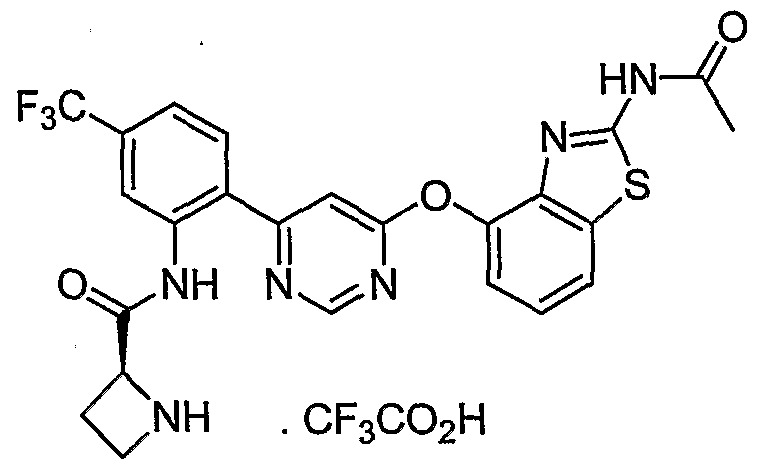
(2S)-te^Butyl 2-((2-(6-(2-acetamidobenzo[^tMazol-4-yloxy)pyrimidin-4-yl)-5- (trifluoromethyl)phenyl)carbamoyl)azetidine-1-carboxylate from step (b) above (1.5 g, 2.4 mmol) was reacted with 1:1 mixture of CH2Cl2/trifluoroacetic acid (40 mL) under the conditions of Example 3(c) to afford the title compound as a yellow solid. MS (ESI, pos. ion.) m/z\ 529 (M+l).

(d) (25)-N-(2-(6-(2-Acetamidobenzo[</]thiazol-4-yloxy)pyrimidin-4-yl)-5- (trifluoromethyl)phenyl)-l-isopropylazetidine-2-carboxamide. (2S)-7V~(2-(6- (2-Acetamidobenzo[(/ltriiazol-4-yloxy)pyrimidin-4-yl)-5-(trifluoromethyl)- phenyl)azetidine~2-carboxamide TFA salt from step (c) above (0.30 g, 0.47 mmol) was reacted with acetone (0.086 mL, 1.2 mmol) under the conditions of
Example 3(d) to give the title compound as a white solid . MS (ESI, pos. ion.) m/z: 571 (M+l). Mp: 198.8-199.4 °C. Example 38

(2S)-iV-(2-(6-(2-Acetamidobenzo[(/]thiazol-4-yloxy)pyrimidin-4-yl)-5- (trifluoromethyl)phenyl)-l-isobutylazetidine-2-carboxamide. The title compound was prepared by reacting (2S)-A^2-(6-(2-acetamidobenzo[<f]thiazol-4- yloxy)pyrimidin-4-yl)-5-(trifluoromethyl)phenyl)azetidine-2-carboxamide trifluoroacetic acid salt [Example 37(c)] with isobutyraldehyde (Aldrich) under the conditions of Example 3(d). MS (ESI, pos. ion.) m/z: 585 (M+l). Mp: 174.4- 174.9 °C.
Example 39

(a) (3-Trifluoromethylphenyl)carbamic acid tert-butyl ester. To a 250-mL, round-bottomed flask was added 3-(trifluoromethyl)aniline (5.0 g, 31 mmol, Aldrich), THF (100 mL), di-fert-butyl dicarbonate (20. g, 93 mmol, Aldrich) and 4-(dimethylamino)pyridine (0.38 g, 3.1 mmol, Aldrich). The mixture was heated at reflux for 3 h. K2CO3 (13 g, 93 mmol) and MeOH (50 mL) were added, and heating was continued for 18 h. After cooling to room temperature, the mixture was diluted with CH2Cl2, then filtered and washed with CH2Cl2. The filtrate was concentrated to afford a brown oil. The oil was dissolved in EtOAc (200 mL) and washed with H2O (2 x 100 mL), brine (1 x 100 mL), dried over Na2SO4, filtered
and concentrated in vacuum onto silica gel. Purification by silica gel chromatography with gradient from 0% to 15% solution of EtOAc in hexanes afforded the title compound as a colorless oil which solidified upon standing to a while solid. MS (ESI, neg. ion.) m/z: 260 (M-I).

(b) [2-(6-Chloropyrimidin-4-yl)-5-trifluoromethyIphenyl]carbamic acid tert- butyl ester. (Analogous to the procedures of Boisnard, S.; Carbonnelle, A. C; Zhu, J. Org. Let. 2001, 3, 2061-2064 and Hewawasam, P.; Meanwell, N. A. Tetrahedron Lett. 1994, 35, 7303). To a 500-mL, round-bottomed flask containing (3-trifluoromethylphenyl)carbamic acid tert-butyl ester from step (a) above (2.5 g, 9.6 mmol) in THF (100 mL) stirred at -40 °C was added sec-BuLi (17 mL, 1.3 M in cyclohexane, Aldrich) over 10 min. The mixture was stirred for 1 h at -40 °C and then cooled to -78 °C. Trimethyl borate (4.4 mL, 38 mmol, Aldrich) was added over 10 min. The reaction mixture was allowed to warm to room temperature and stirred for 10 min at that temperature. The mixture was quenched with aqueous solution OfKH2PO4 and concentrated to remove the THF. The aqueous mixture was extracted with EtOAc (3 x 100 mL) and the combined extracts were washed with brine, dried over Na2SO4, filtered, and concentrated to afford a yellow foam. The foam was dissolved in CH3CN (30 mL) and treated with 4,6-dichloropyrimidine (4.1 g, 28 mmol, Aldrich) followed by a solution of Na2CO3 (2.9 g, 28 mmol) in H2O (30 mL). Tetralάsøriphenylphosphine)- palladium(O) (0.53 g, 0.46 mmol, Strem) was added and the mixture was stirred at 75 °C for 15 h. After allowing to cool to room temperature, the mixture was concentrated in vacuum to remove the CH3CN and then extracted with EtOAc. The combined extracts were washed with H2O and brine, dried over Na2SO4, and concentrated in vacuum. Purification of the residue by silica gel chromatography with gradient from 0% to 10% solution of EtOAc in hexanes afforded the title compound as a colorless oil. MS (ESI, pos. ion.) m/z: 374 (M+l).

(c) 2-(6-Chloropyrimidin-4-yl)-5-(trifluoromethyI)benzenamine. [2-(6- Chloropyrimidin-4-yl)-5-trifluoromethylphenyl]carbamic acid fert-butyl ester from step (b) above was reacted with 1:1 mixture of DCM/TFA under the conditions of Example 3(c) to give the title compound.

(d) A'-(2-(6-Chloropyrimidin-4-yl)-5-(trifluoromethyl)phenyl)piperidine-2- carboxamide: To a mixture of 2-(6-chloropyrimidin-4-yl)-5-(trifluoromethyl)- benzenamine from step (c) above (2.0 g, 7.3 mmol) and l-(fert-butoxycarbonyl)- 2-piperidinecarboxylic acid (2.5 g, 11 mmol, Aldrich) in CH2Cl2 (20 mL) was added iV,iV-diisopropylethylamine (1.9 mL, 11 mmol, Aldrich) and chloro- dipyrrolidinocarbenium hexafluorophosphate (3.6 g, 11 mmol, Fluka) with stirring at 0 °C. The reaction mixture was allowed to reach 25 °C and was stirred for 20 h. The mixture was diluted with hexane (20 mL) and filtered. The filter cake was washed with 1 : 1 mixture of EtOAc/hexane and dried in vacuo to afford the title compound as a white solid. MS (ESI, pos. ion) m/z: 385 (M+l).

(e) iV-(2-(6-Chloropyrimidin-4-yl)-5-(trifluoroinethyl)phenyl)-1- isobutylpiperidine-2-carboxamide. iV-(2-(6-Chloropyrimidin-4-yl)-5-(trifluoro- methyl)phenyl)piperidine-2-carboxamide from step (d) above (0.40 g, 0.90 mmol) was reacted with isobutyraldehyde (0.28 mL, 3.1 mmol, Aldrich) under the
conditions of Example 3(d) to give the title compound as a white solid. MS (ESI, pos. ion.) m/z: 441 (M+l).

(^ iV-(2-(6-(2-Aminoquinolin-8-yloxy)pyrimidinι-4-yl)-5-(trifluoromethyl)- phenyl)-l-i$obutylpiperidine-2-carboxamide. To a stirred solution of 2-amino- 8-hydroxyquinoline (0.061 g, 0.38 mmol, Fluka) in DMF (2.0 mL) was added NaH (60% dispersion in mineral oil, 0.015 g, 0.38 mmol, Aldrich) at 25 °C. The -αixture was stirred for 10 miti and a solution of iV-(2-(6-chloropyrimidin-4-yl)-5- (trilluoi^^^y0pheny0-1-isobutylpiperidine-2-carboxamide from step (e) above (0.14 g, 0.32 It1 1110O in DMF (2.5 mL) was added. The reaction mixture was stirred for 24 h at 25 °C, diluted with aqueous solution of NaHCθ3 (100 mL), and extracted with 1:1 mixture ftf EtOAc/hexane (2 x 75 mL). The combined extracts were washed with H2O (2 x 75 mL) ffld brine (1 x 75 mL), dried over Na2SO4, filtered and evaporated under reduced pressure. Purification of the residue by silica gel column chromatography (gradient: 20- 50% E&Ac/hexane) cαϊorded the title compound as a white solid. MS (ESI, pos. ion.) m/z: 505 (M+l). Mp: 111.1- 113.9 °C. Example 40 and Example 41


(b) iV-(2-(6-(2-Acetamidobenzo[rf]thiazol-4-yloxy)pyrimidiii-4-yl)-5-(trifluoro- methyl)phenyl)-2-methylpiperidine-2-carboxamide. l-(tert-Butoxycarbonyl)-2- methylpiperidine-2-carboxylic acid from step (a) above (0.75 g, 3.1 mmol) was reacted with iV-(4-(6-(2-amino-4-(Mfluoromemyl)phenyl)pyrimidin-4-yloxy)- benzo[J]thiazol-2-yl)acetamide (0.46 g, 1.0 mmol, prepared as described in WO04014871) under the conditions of Example 39(d) to give the title compound as a yellow solid. MS (ESI, pos. ion) m/z: 571 (M+l). Mp: 146.4-148.8 °C. Example 44

ΛL(2-(6-(2-Acetamidobenzo[</]thiazoI-4-yIoxy)pyrimidin-4-yl)-5-(trifluoro- methyOpheny^-1-isobutyl^-methylpiperidine^-carboxamide trifluoroacetic acid salt. N-(2-(6-(2-Acetamidobenzo[^tMazol-4-yloxy)pyrimidin-4-yl)-5- (trifluoromethyl)phenyl)-2-methylpiperidine-2-carboxamide, Example 43 (b), (0.14 g, 0.24 mmol) was reacted with isobutyraldehyde (0.044 mL, 0.48 mmol) under the conditions of Example 3(d) to give the crude product. Purification by
reverse phase preparative HPLC [Phenomenex Prodigy 5 μ ODS-3 100 A column, gradient: 3-100% CH3CN (0.1% TFA)/H2O (0.1% TFA) over 15 min] afforded the title compound as a pale- yellow solid. MS (ESI, pos. ion.) m/z: 627 (M+l). Mp: <80 °C. Example 45

(a) (2S, 5S,R)-tert-Butyl 2-((2-(6-chloropyrimidin-4-yI)-5-(trifluoromethyl)- phenyl)carbamoyl)-5-methylpyrrolidine-1-carboxylate. To a solution of 2-(6- cWoropyriimdin-4-yl)-5-(Mfluoromemyl)benzenarnine, Example 39(c), (0.26 g, 0.96 mmol) and (2S, 5R,S)-1-(^rr-butoxycarbonyl)-5-methylpyrrolidine-2- carboxylic acid (0.20 g, 0.87 mmol, AnaSpec) in CH2Cl2 (5 mL) was added l-[3- (dimethylamino)propyl]-3-ethylcarbodiimide hydrochloride (0.18 g, 0.96 mmol, Aldrich) at 25 °C. The reaction mixture was stirred at 25 °C for 3 d and partitioned between 1 : 1 mixture of EtOAc/hexane (100 mL) and H2O (100 mL). The organic phase was separated, washed with H2O (100 mL) and brine (100 mL), dried over Na2SO4, filtered and evaporated under reduced pressure. Purification of the residue by silica gel column chromatography (gradient: 1-15% EtOAc/hexane) afforded the title compound as a mixture of diastereoisomers. MS (ESI, pos. ion.) m/z: 485 (M+l).

(b) (2S, 5S,R)-tert-Butyl 2-((2-(6-(3-amino-2-oxo-l,2-dihydroquinoxalin-5- yloxy)pyrimidin-4-yl)-5-(trifluoromethyl)phenyl)carbamoyl)-5-
methylpyrrolidine-1-carboxylate. (2S, 5S,R)-tert-Butyl 2-((2-(6- cWoropyrimidin-4-yl)-5-(trifluoromethyl)phenyl)carbanioyl)-5-methylpyrrolidine- 1-carboxylate from step (a) above (0.22 g, 0.45 numol) was reacted with 3-amino- 5-hydroxyquinoxalin-2(lH)-one (0.096 g, 0.54 mmol, prepared as described in WO04014871) under the conditions of Example 42 to afford the title compound as mixture of diastereoisomers. MS (ESI, pos. ion) m/z: 626 (M+l). Example 46

(2S, 5J?,5)-iV-(2-(6-(3-Ainmo-2-oxo-1,2-dihydroqumoxalm-5-yloxy)pyriinidin- 4-yI)-5-(trifluoromethyl)phenyl)-5-methylpyrrolidine-2-carboxamide. (2S, 55,i?)-tert-Butyl 2-((2-(6-(3-amino-2-oxo-1,2-dihydroqumoxalin-5-yloxy)- pyrimidin-4-yl)-5-(trifluoromethyl)phenyl)carbamoyl)-5-methylpyrrolidine-1- carboxylate, Example 45(b), (0.19 g, 0.30 mmol) was reacted with 1:1 mixture of DCM/TFA under the conditions of Example 3(c) to give the title compound as mixture of diastereoisomers. MS (ESI, pos. ion) m/z: 526 (M+l). Example 47

(28, 5R,S)-te/-/-Butyl 2-((2-(6-(2-aminoquinolm-8-yIoxy)pyrimidin-4-yl)-5- (trifluoromethyl)phenyl)carbamoyI)-5-methylpyrrolidine-1-carboxylate. (2S, 5R, S)-tert-BvLtyl 2-((2-(6-chloropyrimidin-4-yl)-5-(trifluoromethyl)phenyl)- carbamoyl)-5-methylpyrrolidine-l -carboxylate, Example 45(a), (0.11 g, 0.22
mmol) was reacted with 2-aniino-8-hydroxyquinoline (0.042 g, 0.26 mmol, Fluka) under the conditions of Example 39(f) to afford the title compound as a mixture of diastereoisomers. MS (ESI, pos. ion.) m/z: 609 (M+l). Example 48

(28, 5if,S)-iV-(2-(6-(2-Aminoquinolin-8-yloxy)pyrimidin-4-yl)-5-(trifluoro- methyI)phenyl)-5-methylpyrrolidine-2-carboxamide.
(2S, 5R, S)-tert-Butyl 2-((2-(6-(2-aminoquinolin-8-yloxy)pyrirnidin-4-yl)-5- (trifluoromethyl)phenyl)carbamoyl)-5-methylpyrrolidine- 1 -carboxylate, Example 47, (0.10 g, 0.16 mmol), CH2Cl2 (15 mL) was reacted with 1:1 mixture of
DCM/TFA under the conditions of Example 3(c) to give the title compound as a mixture of diastereoisomers. MS (ESI, pos. ion.) m/z: 509 (M+l). Mp: 162.9- 164.0 °C. Example 49

(a) iV-(2-(6-(2-Acetamidobenzo[<?lthiazol-4-yloxy)pyrimidiii-4-yl)-5-(trifluoro- methyl)phenyl)piperidine-2-carboxamide. A mixture of N-(4-(6-(2-amino-4- (1xifluorometiiyl)phenyl)pyrimidin-4-yloxy)benzo[cf|thiazol-2-yl)acetamide (3.0 g, 6.7 mmol, prepared as described in WO04014871), l-(tert-butoxycarbonyl)-2- piperidinecarboxylic acid (3.9 g, 17 mmol, Aldrich), JV^-diisopropylethylamine (7.0 mL, 40 mmol, Aldrich) and chloro-dipyrrolidinocarbenium
hexafluorophosphate (5.6 g, 17 mmol, Fluka) in CH2Cl2 (30 mL) was divided into three equal portions and placed into three glass reaction vials. The reaction vials were stirred and heated by a microwave synthesizer at 100 °C for 30 min, at 110 °C for 30 min and at 115 °C for 45 min. The reaction vials were cooled to room temperature and additional amounts of l-(fert-butoxycarbonyl)-2- piperidinecarboxylic acid (1.3 g, 5.6 mmol, Aldrich) and chloro- dipyrrolidinocarbeniurn hexafluorophosphate (1.86 g, 5.6 mmol, Fluka) were added into each vial. The vials were heated at 110 °C by a microwave synthesizer for 45 min and cooled to 25 °C. The reaction mixtures of the three vials were combined and partitioned between EtOAc (200 mL) and aq. NaHCO3 (100 mL). The organic phase was separated, washed with brine, dried over Na2SO4, filtered, and evaporated under reduced pressure. Purification of the residue by silica gel column chromatography [gradient: 0.5-5.0% MeOH (2 M in NH3)/CH2C12] afforded the title compound as a pale-yellow solid. MS (ESI, pos. ion.) m/z: 557 (M+l).

(b) iV-(2-(6-(2-Acetamidobenzo[rf]thiazol-4-yloxy)pyrimidin-4-yl)-5-(trifluoro- methyl)phenyl)-l-(cyclopropylmethyl)piperidine-2-carboxamide. iV-(2-(6-(2-Acetamidobenzo[d]thiazol-4-yloxy)pyrimidin-4-yl)-5-(trifluoro- methyl)phenyl)piperidine-2-carboxamide from step (a) above (0.40 g, 0.72 mmol) was reacted with cyclopropanecarboxaldehyde (0.16 mL, 2.2 mmol, Aldrich) under the conditions of Example 3(d) to give the title compound as an off-white solid. MS (ESI, pos. ion.) m/z: 611 (M+l). Mp: 212.3-213.5 °C.
Example 50

Ar-(2-(6-(2-Acetamidobenzo[</JthiazoI-4-yloxy)pyrimidiii-4-yl)-5-(trifluoro- methyl)phenyl)-1-isopropylpiperidine-2-carboxamide. iV-(2-(6-(2- Acetarmdobenzo[<^thiazol-4-yloxy)pyriniidin-4-yl)-5-(trifluoromethyl)phenyl)- piperidine-2-carboxamide, Example 49(a), (0.40 g, 0.72 mmol) was reacted with acetone under the conditions of Example 3(d) to give the title compound. MS (ESI, pos. ion.) m/z: 599 (M+l). Mp: 260 °C (with dec). Example 51


(2R)-iV-(2-(6-(2-Acetamidobenzo[£fIthiazol-4-yloxy)pyrimidin-4-yl)-5- (trifluoromethyl)phenyl)-l-isobutylpiperidine-2-carboxamide and (25)-Λr-(2- (6-(2-Acetamidobenzo[<flthiazol-4-yIoxy)pyrimidin-4-yl)-5-(trifluoromethyl)- phenyl)-l-isobutylpiperidine-2-carboxamide. Chiral separation [Chiralcel OD- H (250 x 21 mm, 5 μ), A: hexane (0.2% diethylamine), B: ethanol (0.2% diethyl- amine), isocratic: 60:40 A:B, 20 mL/min] of iV-(2-(6-(2-acetamidobenzo[d]- tm'azole-4-yloxy)pyrimidin-4-yl)-5-(trifluoromethyl)phenyl)-1-isobtιtylpiperidine- 2-carboxamide (Example 51) afforded the title compounds as amorphous solids. MS (ESI, pos. ion) m/z: 613 (M+ 1). Example 54

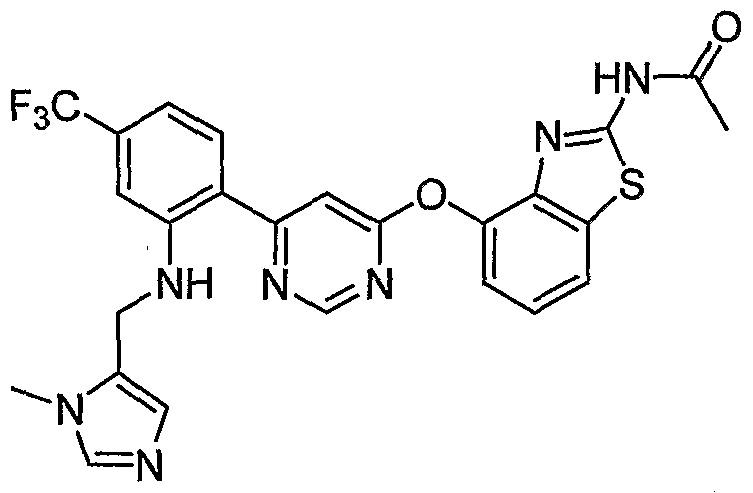
4-(trifluoromethyl)phenyl)pyrimidin-4-yloxy)benzo[iflthiazol-2-yl)acetamide (prepared as described in WO04014871) was reacted with 1-methyl-lH- imidazole-5-carbaldehyde (Acros) under the conditions of Example 54 to give the title compound. MS (ESI, pos. ion) m/z: 540 (M+l). Mp: 263.0-265.2 °C. Example 56

(a) (2S)-l-(ter/-Butoxycarbonyl)-2-methylpyrroIidine-2-carboxyIic acid, α- Methyl-L-proline (1.0 g, 7.7 mmol, Fluka) was reacted with di-tert-butyl dicarbonate (3.5 g, 16.2 mmol, Aldrich) under the conditions of Example 37(a) to give the title compound as a white solid. MS (ESI, neg. ion.) m/z: 228 (M-I).
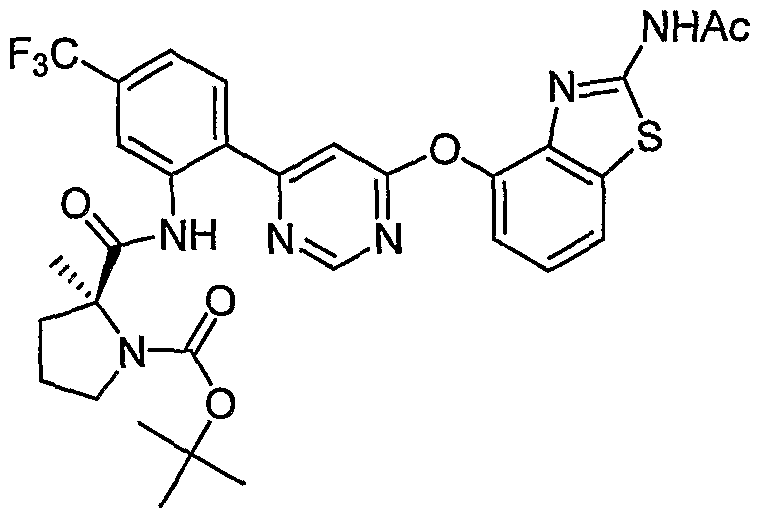
(b) tert-Butyl 2-((2-(6-(2-acetamidobenzo[rf]thiazol-4-yloxy)pyrimidin-4-yl)-5- (trifluoromethyl)phenyl)carbamoyI)-2-methylpyrrolidine-1-carboxyIate. (6)- l-(terf-Bu.toxycarbonyl)-2-methylpyrrolidine-2-carboxylic acid from step (a) above (458 mg, 2.0 mmol) was reacted withiV-(4-(6-(2-amino-4-(trifluoro- methyl)phenyl)pyrimidin-4-yloxy)benzo[(f]thiazol-2-yl)acetarnide (446 mg, 1.0 mmol, prepared as described in WO04/014871) under the conditions of Example 37(b) to give the title compound as a white solid. MS (ESI, neg. ion.) m/z: 657 (M-I). Example 57

(25)-N-(2-(6-(2-Acetamidobenzo[d]thiazol-4-yloxy)pyriinidiii-4-yl)-5- (trifluoromethyl)phenyl)-2-methylpyrrolidine-2-carboxamide. The title product was obtained as a side product of the reaction described in Example 56. MS (ESI, pos. ion.) mlz: 557 (M+l). Example 58
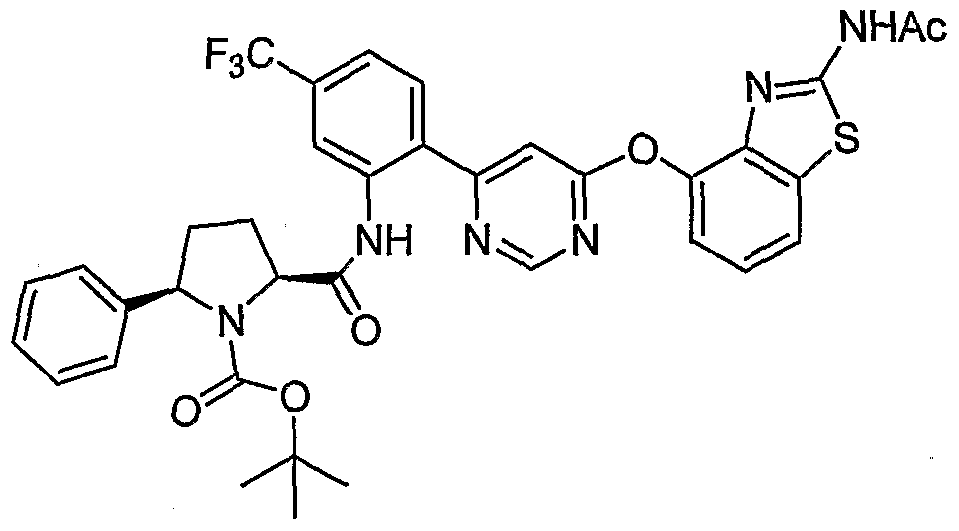
(2S, S^-1-^ert-Butoxycarbony^-S-phenylpyrrolidine^-carboxylic acid (350 mg, 1.2 mmol, Neosystem-T) was reacted withiV-(4-(6-(2-amino-4-(trifluoromethyl)- phenyl)pyrimidin-4-yloxy)benzo[t(]thiazol-2-yl)acetamide (446 mg, 1.0 mmol, prepared as described in WO04014871) under the conditions of Example 45(a) to give the title compound as a white solid. MS (ESI, neg. ion.) m/z: 719 (M-I). Example 59
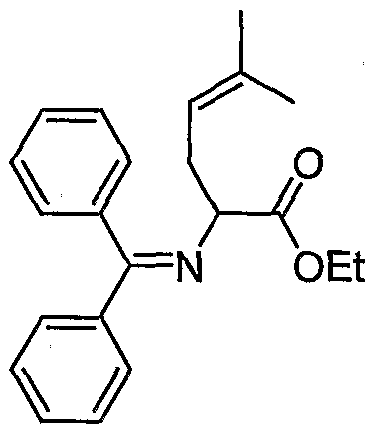
(a) Ethyl 2-(diphenylmethyleneamino)-5-methylhex-4-enoate. A mixture of ethyl 2-(diphenylmethyleneamino)acetate (2.67 g, 10 mmol, Aldrich), l-bromo-3- methylbut-2-ene (2.3 mL, 20 mmol, Aldrich), CsOHH2O (5.1 g, 30 mmol, Aldrich) and BnEt3NCl (228 mg, 1.0 mmol, Aldrich) in DCM (30 mL) was stirred at room temperature for 16 h. Water (20 mL) was added and the mixture was extracted with EtOAc (2 x 40 mL). The combined organic extracts were washed with brine, dried over Na2SO4, filtered and evaporated in vacuo. The residue was purified by silica gel column chromatography (20% EtOAc/hexane) to give the title compound. MS (ESI, pos. ion.) mlz: 336 (M+l).

(b) Ethyl 2-ammo-5-methyIhex-4-enoate. A solution of ethyl 2- (diphenylmethyleneamino)-5-methylhex-4-enoate from step (a) above (2.71 g, 8
mmol) in a 1:1:1 mixture of THF/HbO/AcOH (30 mL) was stirred at room temperature for 2 h. The reaction mixture was evaporated in vacuo and the residue was dissolved in EtOAc (50 mL). The solution was washed with saturated aqueous solution OfNaHCO3 (30 mL) and brine (20 mL), dried over Na2SO4, and filtered. The solvent was removed in vacuo and the residue was purified by silica gel column chromatography (EtOAc) to give the title compound. MS (ESI, pos. ion.) m/z: 172 (M+l).
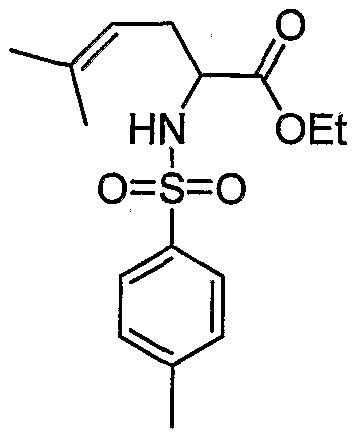


(e) S^-Dimethylpyrrolidine-^-carboxylic acid. A mixture of ethyl 5,5-dimethyl- l-tosylpyrrolidine-2-carboxylate from step (d) above (1.62 g, 5.0 mmol) and phenol ( 1.4 g, 15 mmol, Aldrich) in 50 mL of 48% HBr (Aldrich) was stirred at 70 °C for 5 h. The reaction mixture was allowed to reach room temperature and was extracted with 80% EtOAc/hexane (2 x 40 mL). The combined extracts were evaporated under reduced pressure and the residue was dried under vacuo to give the crude title compound, which was used in the next step without additional purification.
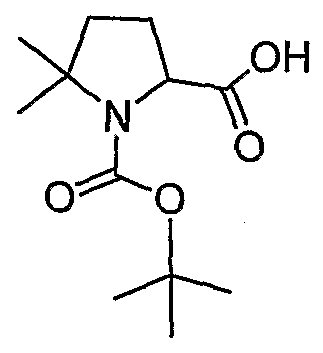
(f) l-^ert-Butoxycarbony^-SjS-dimethylpyrrolidine-l-carboxylic acid. To a mixture of 5,5-dimethylpyrrolidine-2-carboxylic acid from step (e) above (5 mmol) and 5N NaOH (4 mL) in THF (30 mL) was added di-tert-butyl dicarbonate (1.64 g, 7.5 mmol, Aldrich) portionwise with stirring at 0 °C. The reaction mixture was allowed to reach room temperature and the stirring was continued for 2 h. The reaction mixture was quenched with IN HCl (30 mL) and extracted with EtOAc (2 x 50 mL). The combined organic extracts were washed with brine (10 mL), dried over Na2SO4 and filtered. The filtrate was evaporated in vacuo and the residue was purified by silica gel column chromatography (EtOAc) to give the title compound. MS (ESI, pos. ion) mlz: 244 (M+l).
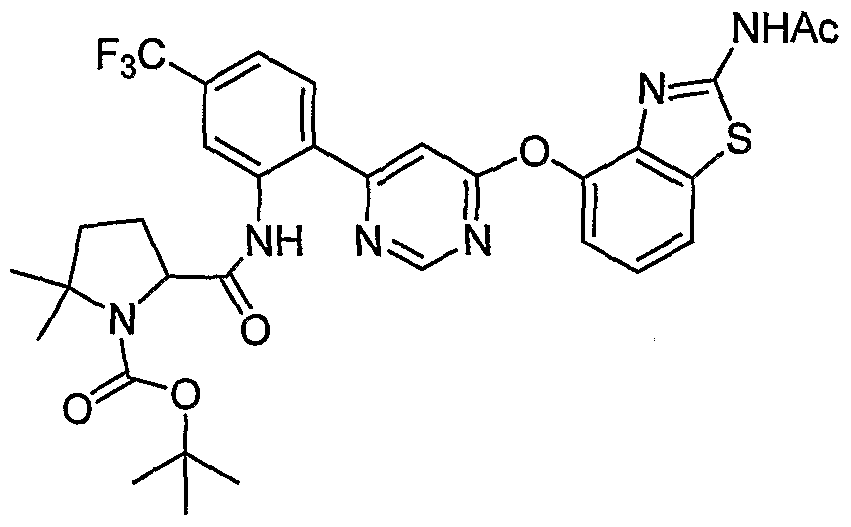
(g) fer/-Butyl 5-((2-(6-(2-acetamidobenzo[έ/lthiazol-4-yloxy)pyrimidin-4-yl)-5- (trifluoromethyI)phenyl)carbamoyl)-2,2-dimethylpyrrolidine-1-carboxylate. l-(fe?t-Butoxycarbonyl)-5,5-dimethylpyrrolidine-2-carboxylic acid from step (f) above (243 mg, 1.0 mmol) was reacted with7V-(4-(6-(2-amino-4-(trifluoro- methyl)phenyl)pyrimidin-4-yloxy)benzo[cTlthiazol-2-yl)acetamide (446 mg, 1.0 mmol, prepared as described in WO04014871) under the conditions of Example 45(a) to give the title compound as a white solid. MS (ESI, neg. ion.) mlz: 671 (M-I).
Example 60

(25,5i?)-iV-(2-(6-(2-Acetamidobenzo[£/|thiazol-4-yloxy)pyriinidin-4-yl)-5- (trifluoromethyl)phenyI)-5-phenyIpyrrolidine-2-carboxamide.
(25,5i?)-ført-Butyl 2-((2-(6-(2-acetamidobenzo[βTlthiazol-4-yloxy)pyrimidin-4- yl)-5 -(trifluoromethyl)phenyl)carbamoyl)-5 -phenylpyrrolidine- 1 -carboxylate, Example 58, (575 mg, 0.8 mmol) was reacted with TFA under the condition of Example 3(c) to give the title compound as a white solid. MS (ESI, pos. ion.) mlz: 619 (M+l).
Example 61
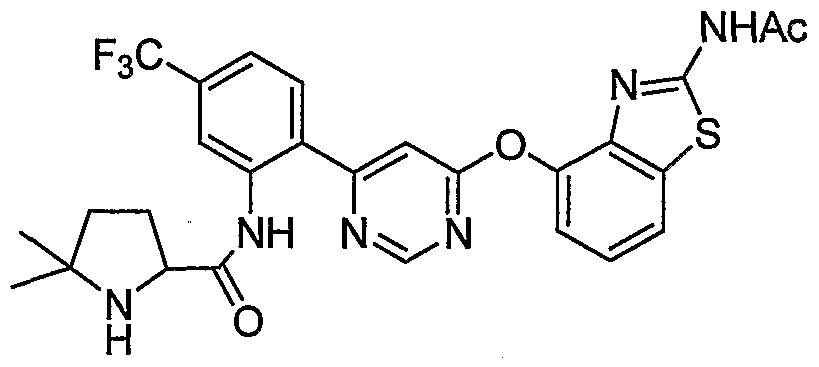
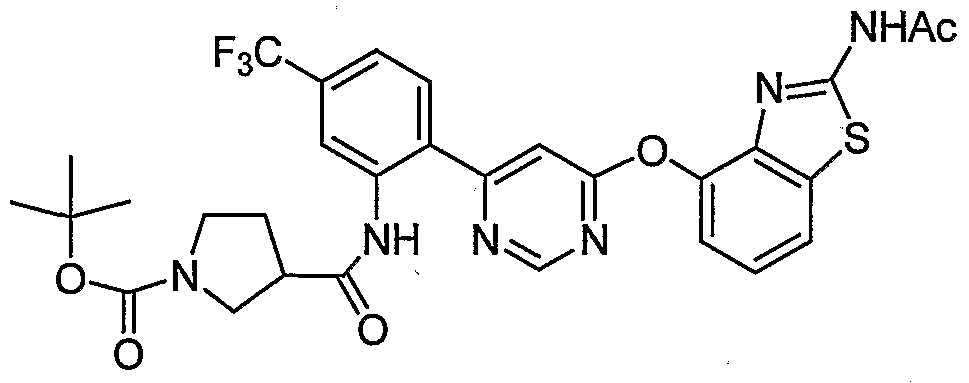
(a) terι'-Butyl 3-((2-(6-(2-acetamidobenzo[«fjthiazol-4-yloxy)pyrimidin-4-yl)-5- (trifluoromethyl)phenyl)carbamoyl)pyrrolidine-1-carboxylate. \-(tert- Butoxycarbonyl)pyrrolidine-3-carboxylic acid (258 mg, 1.2 mmol, Astatech) was reacted with N-(4-(6-(2-amino-4-(trifluoromethyl)phenyl)pyrimidin-4-yloxy)- benzo[£f|thiazol-2-yl)acetamide (446 mg, 1.0 mmol, prepared as described in WO04014871) under the conditions of Example 45(a) to give the title compound as a white solid. MS (ESI, neg. ion.) mlz: 643 (M-I).
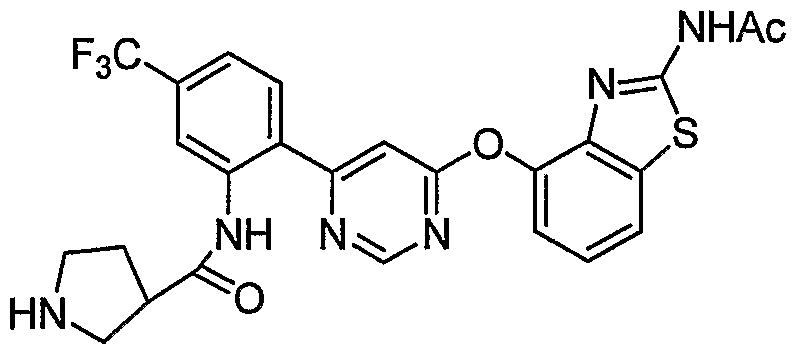
(b) iV-(2-(6-(2- Acetamidobenzo [d\ thiazol-4-yloxy)py rimidin-4-yl)-5-(trifluoro- methyl)phenyl)pyrrolidine-3-carboxamide. tert-Butyl 3-((2-(6-(2- acetamidobenzo[^tWazol-4-yloxy)pyrimidin-4-yl)-5-(trifluoromethyl)phenyl)-
carbamoyl)pyrrolidine-1-carboxylate from step (a) above (516 mg, 0.8 mmol) was reacted with 1:1 mixture of TFA/DCM (4 mL) under the conditions of Example 3(d) to give the title compound as a white solid. MS (ESI, pos. ion) mlz: 543 (M+l).

(c) N-(2-(6-(2- Acetamidobenzo [d\ thiazol-4-yloxy)pyrimidin-4-yl)-5-(trifluoro- methyl)phenyI)-1-cyclopropylpyrrolidine-3-carboxamide. A mixture of iV-(2- (6-(2-acetamidobenzo[cf]thiazol-4-yloxy)pyrimidin-4-yl)-5-(trifluoromethyl)- phenyl)pyrrolidine-3-carboxamide from step (b) above (54 mg, 0.1 mmol), (1- ethoxycyclopropoxy)trimethylsilane (0.10 mL, 0.5 mmol, Aldrich), sodium cyanoborohydride (25 mg, 0.4 mmol, Aldrich) and acetic acid (0.6 mL, Aldrich) in methanol (2 mL, Aldrich) was heated at reflux for 16 h. The reaction mixture was allowed to reach room temperature and was filtered. The filtrate was evaporated under reduced pressure and the residue was dissolved in EtOAc (20 mL). The EtOAc solution was washed with saturated aqueous solution of
NaHCO3 (10 mL) and brine (5 mL), dried over Na2SO4, and filtered. The filtrate was evaporated in vacuo and the residue was purified by silica gel column chromatography (50% EtOAc/hexane) to give the title compound as a white solid. MS (ESI, pos. ion.) mlz: 583 (M+l). Example 63


(2S)-iV-(2-(6-(2-Acetamidobenzo[-/lthiazol-4-yloxy)pyrimidiii-4-yI)-5- (trifluoromethyl)phenyl)-1-isobutyI-2-methylpyrroIidine-2-carboxamide.
(2S)-Λ/-(2-(6-(2-Acetamidobenzo[<^thiazol-4-yloxy)pyrimidin-4-yl)-5-(trifluoro- methyl)phenyl)-2-methylpyrrolidine-2-carboxamide, Example 57, (56 mg, 0.1 mmol) was reacted with 2-methyl-propionaldehyde (0.011 mL, 0.12 mmol, Aldrich) under the conditions of Example 3(d) to give the title compound as a white solid. MS (ESI, pos. ion.) mlz: 613 (M+l). Example 67

(2S)-iV-(2-(6-(2-Acetamidobenzo[έ/|thiazol-4-yloxy)pyrimidin-4-yl)-5- (trifluoromethyl)phenyl)-1-(cyclopropylmethyl)-2-methylpyrrolidine-2- carboxamide. (25)-N-(2-(6-(2-Acetamidoberizo[β(]thiazol-4-yloxy)pyrimidin-4- yl)-5-(trifluoromethyl)phenyl)-2-methylpyrrolidine-2-carboxamide (Example 57) was reacted with cyclopropanecarboxaldehyde (Aldrich) under the conditions of Example 3(d) to give the title compound as a white solid. MS (ESI, pos. ion.) mlz: 611 (M+l). Example 68
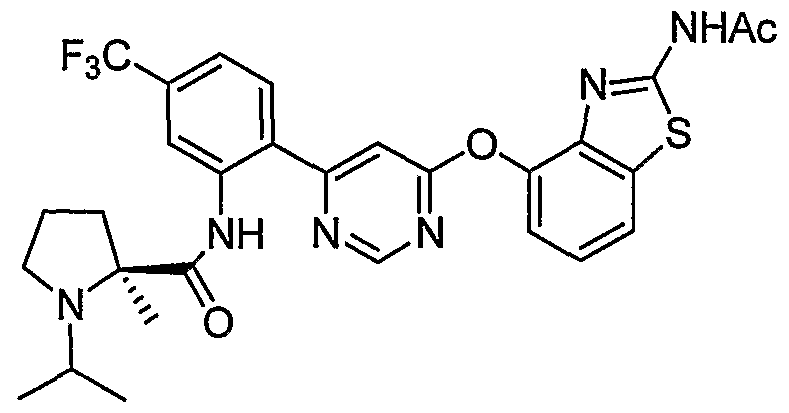
(25)-iV-(2-(6-(2-Acetainidobenzo[</|thiazol-4-yloxy)pyrimidin-4-yI)-5- (trifluoromethyI)phenyl)-1-isopropyI-2-methylpyrrolidine-2-carboxamide.
(2^-N-(2-(6-(2-Acetamidobenzo[βf]thiazol-4-yloxy)pyrimidin-4-yl)-5-(trifluoro- methyl)phenyl)-2-methylpyrrolidine-2-carboxamide (Example 57) was reacted with acetone under the conditions of Example 3(d) to give the title compound as a white solid. MS (ESI, pos. ion.) m/z: 599 (M+l). Example 69

(a) (2S)-tert-Bntyl 2-((2-(6-(2-acetamidobenzo [d\ tb.iazol-4-yloxy)pyrimidin-4- yl)-5-(trifluoromethyl)phenyl)carbamoyl)pyrrolidine-1-carboxylate. N-(tert- Butoxycarbonyl)-L-proline (Aldrich) was reacted with iV-(4-(6-(2-amino-4- (trifluoromethyl)phenyl)pyrimidin-4-yloxy)benzo[ύ(]thiazol-2-yl)acetamide (446 mg, 1.0 mmol, prepared as described in WO04/014871) under the conditions of Example 37(b) to give the title compound as a white solid. MS (ESI, pos. ion.) mlz: 643 (M+l).

(b) (2iS)-iV-(2-(6-(2-Acetamidobenzo[<?|thiazol-4-yloxy)pyrimidin-4-yl)-5- (trifluoromethyl)phenyl)pyrrolidine-2-carboxamide. (2S)-teτt-Butyl 2-((2-(6- (2-acetamidobenzo[^thiazol-4-yloxy)pyrimidin-4-yl)-5-(trifluoromethyl)phenyl)-
carbamoytypyrrolidirie-1-carboxylate from step (a) above was reacted with 1:1 mixture of TFA/DCM under the conditions of Example 3(c) to give the title compound. MS (ESI, pos. ion.) mlz: 543 (M+l).

(25)-iV-(2-(6-(2-Acetamidobenzo[£/]thiazol-4-yloxy)pyrimidin-4-yl)-5-(trifluoro- methyl)phenyl)pyrrolidine-2-carboxamide from step (b) above was reacted with cyclopropanecarboxaldehyde (Aldrich) under the conditions of Example 3(d) to give the title compound as a white solid. MS (ESI, pos. ion.) mlz: 597 (M+l). Example 70
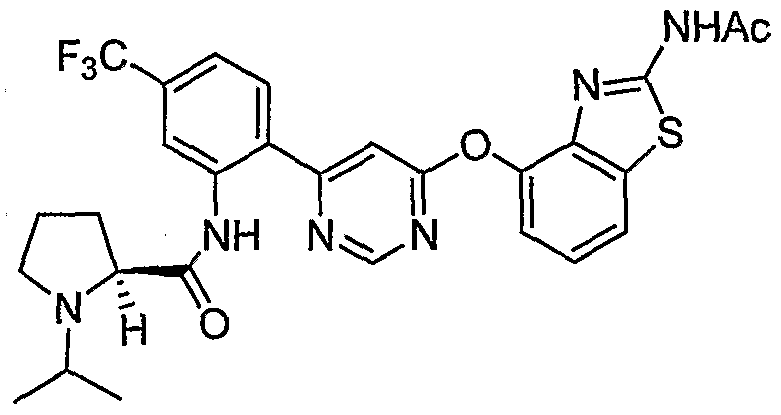
(25)-iV-(2-(6-(2-Acetamidobenzo[<fjthiazol-4-yloxy)pyrimidin-4-yl)-5- (trifluoromethyl)phenyl)-1-isopropylpyrrolidine-2-carboxamide. (2S)-N-(2-(6- (2-Acetamidobenzo[£/]thiazol-4-yloxy)pyrimidin-4-yl)-5-(trifluoromethyl)- phenyl)pyrrolidine-2-carboxamide [Example 69(b)] was reacted with acetone under the conditions of Example 3(d) to give the title compound as a white solid. MS (ESI, pos. ion.) mlz: 585 (M+l).
Example 71

(25)-iV-(2-(6-(2-Acetainidobenzo[<f|thiazol-4-yloxy)pyrimidin-4-yl)-5- (trifluoromethy^pheny^-1-cyclopropylpyrrolidine^-carboxamide. (25)-iV-(2- (6-(2-Acetamidobenzo[<f]thiazol-4-yloxy)pyrimidin-4-yl)-5-(trifluoromethyl)- phenyl)pyrrolidine-2-carboxamide [Example 69(b)] was reacted with (1- ethoxycyclopropoxy)trimethylsilane (Aldrich) under the conditions of Example 62(c) to give the title compound as a white solid. MS (ESI, pos. ion.) mlz: 583 (M+l). Example 72

(2S,5R)-iV-(2-(6-(2-Acetamidobenzo[£f]thiazol-4-yloxy)pyrimidin-4-yl)-5- (trifluoromethyl)phenyl)-1-(cyclopropylmethyl)-5-phenylpyrrolidine-2- carboxamide. (2.S',5R)-iV-(2-(6-(2-Acetamidobenzo[J]thiazol-4-yloxy)pyrimidin- 4-yl)-5-(trifiuoromethyl)phenyl)-5-phenylpyrrolidine-2-carboxamide, Example 60, (62 mg, 0.1 mmol) was reacted with cyclopropanecarboxaldehyde (0.009 mL, 0.12 mmol, Aldrich) under the conditions of Example 3(d) to give the title compound as a white solid. MS (ESI, pos. ion.) mlz: 673 (M+l).
Example 73

(25,5JΪ)-iV-(2-(6-(2-Acetamidobenzo[^|thiazol-4-yloxy)pyriinidin-4-yI)-5- (trifluoromethyl)phenyl)-1-isopropyI-5-phenyIpyrrolidine-2-carboxamide.
(25',5R)-iV-(2-(6-(2-Acetamidobenzo[<]thiazol-4-yloxy)pyrimidin-4-yl)-5- (trifluoromethyl)phenyl)-5-phenylpyrrolidine-2-carboxamide, Example 60, (62 mg, 0.1 mmol) was reacted with acetone (0.009 mL, 0.12 mmol) under the conditions of Example 3(d) to give the title compound as a white solid (51 mg, 78%). MS (ESI, pos. ion.) mlz: 661 (M+l). Example 74
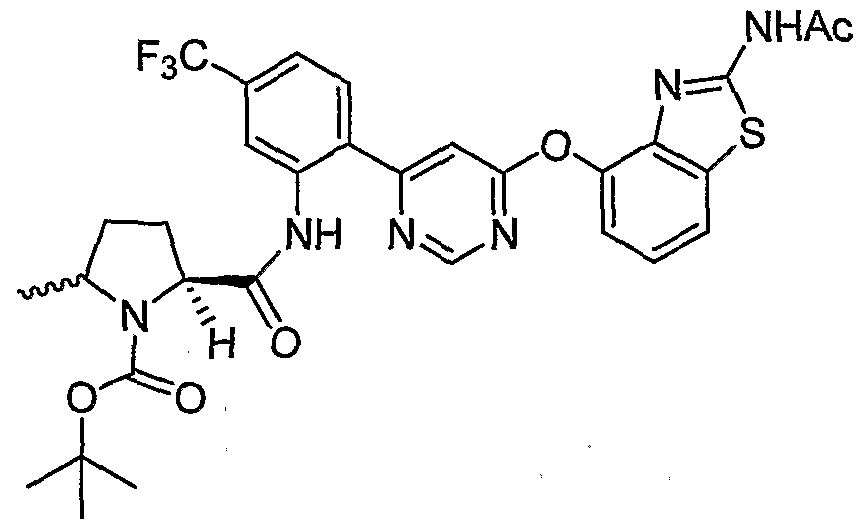
(2S, 5R^S)-te^-Butyl 2-((2-(6-(2-acetamidobenzo[έflthiazol-4-yloxy)pyrimidin- 4-yl)-5-(trifluoromethyl)phenyl)carbamoyl)-5-methylpyrrolidine-1- carboxylate. iV-(4-Hydroxy-benzothiazol-2-yl)-acetamide [Example 19(d)] was reacted with (2S, 5R,$)-tert-butyl 2-((2-(6-chloropyrimidin-4-yl)-5-(trifluoro- methyl)phenyl)carbamoyl)-5 -methylpyrrolidine- 1 -carboxylate [Example 45 (a)] under the conditions of Example 39(f) to give the title compound as a mixture of diastereoisomers. MS (ESI, pos. ion.) mlz: 657 (M+l).
Example 75

(2S, 5R^S)-iV-(2-(6-(2-Acetamidobenzo[«nthiazol-4-yloxy)pyrimidin-4-yl)-5- (trifluoromethyl)phenyl)-5-methyIpyrrolidine-2-carboxamide. (2S, 5i?,S)-tert- Butyl 2-((2-(6-(2-acetamidobenzo[^tMazol-4-yloxy)pyrimidin-4-yl)-5-(trifluoro- methyl)phenyl)carbatnoyl)-5-methylpyrrolidine-1-carboxylate (Example 74) was reacted with 1:1 mixture of TFA/DCM under the conditions of Example 3(d) to give the title compound as a mixture of diastereoisomers. MS (ESI, pos. ion) m/z: 557 (M+l). Additional Examples
The following examples were prepared by treating (2S, 5jR,S)-iV-(2-(6-(2- acetamidoberizo[(i]thiazol-4-yloxy)pyrirnidin-4-yl)-5-(trifluoromethyl)phenyl)-5- methylpyrrolidine-2-carboxamide (Example 75) with acetone or 2-methyl- propionaldehyde under the conditions of Example 3(d). The products were isolated as mixtures of diastereoisomers.

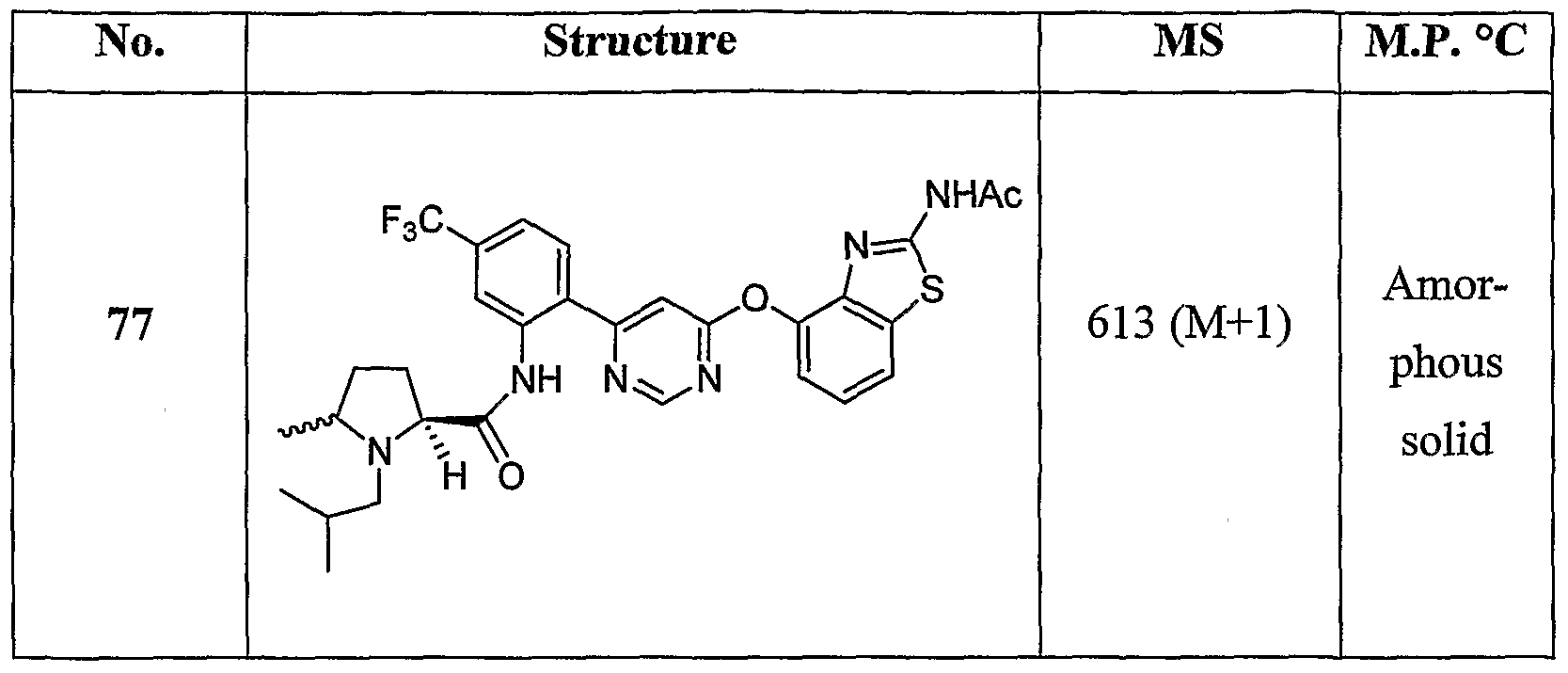
Example 78

(2S, 5i?^S)-N-(2-(6-(2-Acetamidobenzo[rf]thiazol-4-yloxy)pyrimidiii-4-yl)-5- (trifluoromethyI)phenyl)-1,5-dimethylpyrrolidine-2-carboxamide. (2S, 5i?,5)- iV"-(2-(6-(2-Acetamid.obenzo[£flthiazol-4-yloxy)pyrimidin-4-yl)-5-(trifluoro- methyl)phenyl)-5-methylpyrrolidine-2-carboxamide (Example 75) reacted with iodomethane (Aldrich) under the conditions of Example 63 to give the title compound as a mixture of diastereoisomers. MS (ESI, pos. ion) mlz: 571 (M+l). Example 79

(a) fert-Butyl 4-((2-(6-(2-acetamidobenzo[(/lthiazol-4-yloxy)pyrimidin-4-yI)-5- (trifluoromethyl)phenylamino)methyl)piperidine-1-carboxylate. JV-(4-(6-(2- amino-4-(1xifluoromethyl)phenyl)pyrimidin-4-yloxy)berizo[<5(]thiazol-2-yl)- acetamide (1.0 g, 2.2 mmol, prepared as described in WO04014871) was reacted with tert-butyl 4-formylpiperidine-1-carboxylate (1.2 g, 5.6 mmol, Aldrich) under
the conditions of Example 3(d) to give the title compound as a yellow crystalline solid. (MS (ESI, pos. ion.) m/∑: 644 (M+l).

(b) -V-(4-(6-(2-(Piperidin-4-ylmethylamino)-4-(trifluoromethyl)phenyI)- pyrimidin-4-yloxy)benzo [tfjthiazol-2-yl)acetamide. tert-Bυtyl 4-((2-(6-(2- acetamidobenzo[i/]thiazol-4-yloxy)pyrimidin-4-yl)-5-(trifluoromethyl)- phenylamino)methyl)piperidine-1-carboxylate from step (a) above(0.20 g, 0.30 mniol) was reacted with TFA under the conditions of Example 3(c) to give the title compound as a yellow crystalline solid. MS (ESI, pos. ion.) m/z: 543 (M+l).

(c) iV-(4-(6-(2-((l-IsopropyIpiperidin-4-yl)inethylamino)-4-(trifluoromethyI)- phenyl)pyrimidin-4-yloxy)ben2o[d]thiazol-2-yl)acetamide.
To a solution of iV-(4-(6-(2-(piperidin-4-ylmethylamino)-4-(trifluoromethyl)- phenyl)pyrimidin-4-yloxy)benzo[fi(|thiazol-2-yl)acetamide from step (b) above (0.20 g, 0.36 mmol) in acetone (20 mL) were added two drops of glacial acetic acid. The reaction mixture was stirred under reflux for 53 h and was allowed to reach room temperature. Sodium triacetoxy borohydride (0.16 g, 0.73 mmol, Aldrich) was added and the mixture was stirred under reflux for 5 h. The reaction mixture was allowed to reach room temperature, quenched with water (2 mL), and evaporated in vacuo. The residue was dissolved in EtOAc (10 mL) and the solution was washed with water (2 x 20 mL), dried over Na2SO4 and filtered. The filtrate was evaporated in vacuo and the residue was dissolved in MeOH (2 mL), and purified by reverse phase HPLC (Phenomenex Prodigy 5 μ ODS-3 100 A column, gradient: 20-100% CH3CN (0.1% TFA)/H2O (0.1% TFA) over 15 min) to give the title compound as TFA salt. To the salt was added sat. aqueous
solution OfNaHCO3 and the mixture was extracted with ethyl acetate (2 x 25 mL). The combined organic extracts were washed with water (2 x 20 mL), dried over Na2SO4 and filtered. The filtrate was evaporated in vacuo to afford title compound as yellow film. MS (ESI, pos. ion.) m/z: 585 (M+l). Example 80

4-(6-(2-(3-(2-Methylpiperidin-1-yl)propylamino)-6-(trifluoromethyI)pyridin- 3-yI)pyrimidin-4-yloxy)benzo[</]thiazol~2-ainine trifluoroacetic acid salt. A mixture of 4-(6-2-chloro-6-(triflouromethyl)pyridine-3 -yl)pyrimidin-4-yloxy)- benzo[d]thiazole-2-amine, Example l(b), (100 mg, 0.236 mmol), 3-(2- methylpiperidine-1-yl)propan-1-amine( 184mg, 1.179 mmol., Aldrich ) and potassium carbonate ( 59 mg, 0.424 mmol) was heated in a microwave synthesizer at 60 °C for 10 min. The reaction mixture was dissolved in DCM (10 mL), filtered, and concentrated in vacuo. The residue was purified by reverse phase HPLC (Phenomenex Prodigy 5 μ ODS-3 100 A column, gradient: 20- 100%
CH3CN (0.1% TFA)/H2O (0.1% TFA) over 15 min) to give the title compound as a bright-yellow amorphous solid. MS (ESI, pos. ion.) m/z: (M+l). Example 81

Example 82


(c) iV-(4-(5-Formyl-4- (4-(trifluoromethyl)phenyl)pyridin-2-yloxy)- benzo[</Jthiazol-2-yl)acetamide. To a suspension of iV-(4-(5-(l,2- dihydroxyethyl)-4-(4-(trifluoromethyl)phenyl)pyridin-2-yloxy)benzo[tflthiazol-2- yl)acetamide from step (b) above (0.78 g, 1.6 mmol) in DCM (12 mL) was added lead (IV) acetate (0.85 g, 1.9 mmol) with stirring at 0 °C. The reaction mixture was stirred at 0 °C for 1.5 h and filtered through a pad of Celite®. The filter cake was washed with DCM and the combined filtrates were partitioned between DCM (20 mL) and sat. aqueous solution OfNaHCO3 (15 mL). The organic layer was separated, and the aqueous layer was extracted with DCM (10 mL). The combined organic extracts were washed with brine, dried over Na2SO4, and filtered. The filtrate was evaporated under reduced pressure, and the residue was dried in vacuo to give the title compound as a tan amorphous solid. MS (ESI, pos. ion) m/z: 458 (M+l).
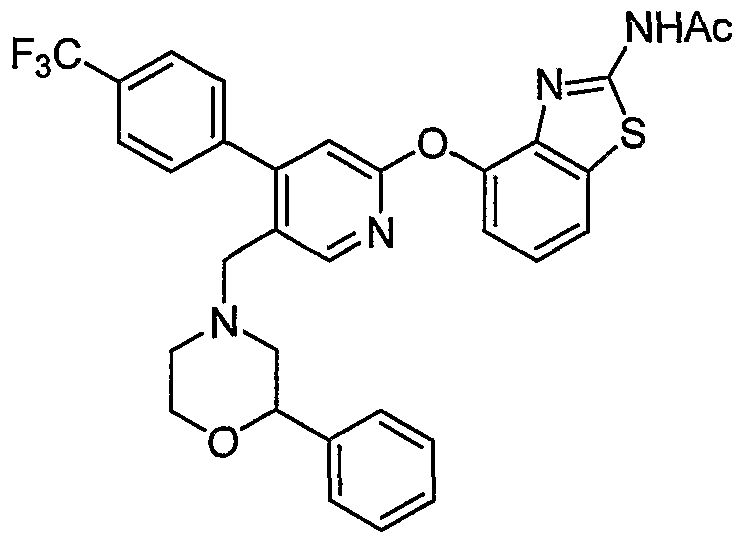
(d) iV-(4-(5-((2-Phenylmorpholino)methyl)-4-(4-(trifluoroinethyI)phenyI)- pyridin-2-yIoxy)benzo[έ/|thiazol-2-yI)acetamide. To a solution of iV-(4-(5- formyl-4- (4-(trifluoromethyl)phenyl)pyridin-2-yloxy)benzo[(i]thiazol-2-yl)- acetamide from step (c) above (92 mg, 0.20 mmol) and 2-phenylmorpholine (98 mg, 0.60 mmol, Aldrich) in DCM (2 mL) was added sodium triacetoxyborohydride (213 mg, 1 mmol, Aldrich), and the mixture was heated at 40 °C for 3 h under nitrogen atmosphere. The reaction mixture was partitioned between DCM (10 mL) and sat. aqueous solution OfNaHCO3 (10 mL), and the organic layer was separated. The aqueous layer was extracted with DCM (2x5 mL), and the combined organic extracts were washed with brine, dried over Na2SO4, and filtered. The filtrate was evaporated under reduced pressure, and the residue was purified by silica gel column chromatography (gradient: 10-50% EtOAc/hexane) to give the title compound as an off-white amorphous solid. MS (ESI, pos. ion) m/z: 605 (M+l). Example 83

(a) tert-Butyl 2-chloro-5-(trifluoromethyl)benzylcarbamate. To a 100-mL, round-bottomed flask was added THF (20 mL), (2-chloro-5-(trifluoromethyl)- phenyl)methanamine (1.045 g, 5 mmol, Lancaster), 1 N NaOH (0.3 mL, 8 mmol) and di-tert-butyl carbonate (1.0 g, 6 mmol) with stirring at 0 0C. The reaction mixture was stirred at 0 °C for 1 h, diluted with water (20 mL), and extracted with
EtOAc (2x20 mL). The combined organic extracts were washed with water (20 mL) and brine (20 mL), dried over Na2SO4, and filtered. The filtrate was evaporated under reduced pressure, and the residue was purified by silica gel column chromatography (20% EtOAc/hexane) to give the title compound as an amorphous solid. MS (ESI, pos. ion.) m/z: 310 (M+l).

(b) fert-Butyl 2-(4,4,5,5-tetramethyl-1,3,2-dioxaboroIan-2-yl)-5-(trifluoro- methyl)benzylcarbamate. To a 100-mL, round-bottomed flask were added dioxane (18 mL), bis(dibenzylideneacetone)palladium (52 mg, 0.09 mmol, Acros) and tricyclohexylphosphine (61 mg, 0.2 mmol, Aldrich) under nitrogen atmosphere, and the mixture was stirred for 30 min at room temperature. Bis(pinacolato)diboron (838 mg, 3 mmol, Aldrich), potassium acetate (281 μL, 5 mmol) and ter't-butyl 2-chloro-5-(trifluoromethyl)benzylcarbamate from step (a) above (309 mg, 3 mmol) were then added, and the reaction mixture was heated at 80 °C for 18 h with stirring under nitrogen atmosphere. The reaction mixture was left to reach room temperature, diluted with water (40 mL), and extracted with EtOAc (2x40 mL). The combined organic extracts were washed with water (20 mL) and brine (20 mL), dried over Na2SO4, and filtered. The filtrate was evaporated under reduced pressure, and the residue was purified by silica gel column chromatography (15% EtOAc/hexane) to give the title compound as an amorphous solid. MS (ESI, pos. ion.) m/z: 400 (M+l).

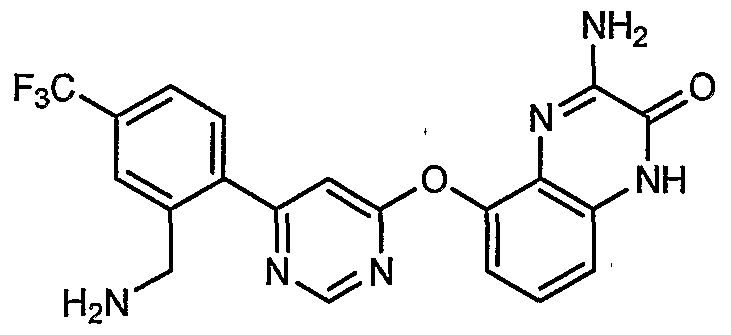
(d) 3-Amino-5-(6-(2-(aminomethyl)-4-(trifluoromethyI)phenyl)pyrimidin-4- yIoxy)qumoxalin-2(ljH)-one. tert-Butyl (2-(6-(3-amino-2-oxo-1,2- dihydroquinoxalin-5-yloxy)pyrimidin-4-yl)-5-(trifluoromethyl)phenyl)- methylcarbamate from step(c) above (105 mg, 0.2 mmol) was treated with 1:1 mixture of DCM/TFA (2 mL) under the conditions of Example 3(c). The crude reaction product was purified by silica gel column chromatography, eluting with 10% [MeOH containing 1% NH4OH (28% NH3 in H2O)] in DCM to give the title compound as an amorphous solid. MS (ESI, pos. ion.) m/z: 429 (M+l).

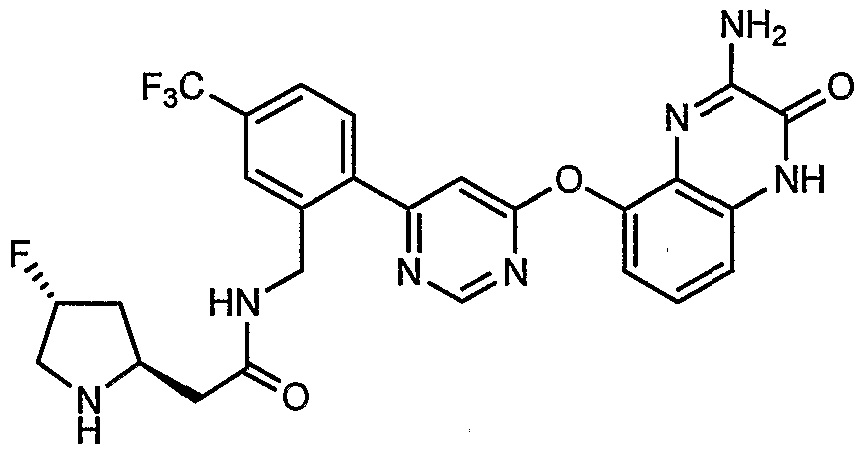
(f) (2S,4i?)-iV-((2-(6-(3-Ammo-2-oxo-l,2-dihydroquinoxaIin-5-yloxy)- pyrimidin-4-yl)-5-(trifluoromethyl)phenyI)inethyl)-4-fluoropyrrolidine-2- carboxamide. (2S,4R)-tert-Butyl 2-(((2-(6-(3-amino-2-oxo-l ,2- dihydroquinoxalm-5-yloxy)pyrimidin-4-yl)-5-(Mfl^^ carbamoyl)-4-fluoropyrrolidine-l -carboxylate from step (e) above (128 mg, 199 μmol) was treated with 1:1 mixture of DCM/TFA (2 mL) under the conditions of Example 3(c). The crude reaction product was purified by silica gel column chromatography, eluting with 10% [MeOH containing 1% NH4OH (28% NH3 in H2O)] in DCM to give the title compound as an amorphous solid. MS (ESI, pos. ion.) m/z: 544 (M+l).

(g) (2S,4R)-iV-((2-(6-(3-Amino-2-oxo-l,2-dihydroquiiioxalin-5-yloxy)- pyrimidin-4-yl)-5-(trifluoromethyl)phenyl)methyI)-4-fluoro-1-isobutyI- pyrrolidine-2-carboxamide. (2iS,4i?)-iV-((2-(6-(3-Amino-2-oxo-1,2-dihydro- quinoxalm-5-yloxy)pyrimidin-4-yl)-5-(trifluoromethyl)phenyl)methyl)-4- fluoropyrrolidine-2-carboxamide from step (f) above was reacted with isobutyr- aldehyde (1.2 g, 16.5 mmol, Aldrich) under the conditions of Example 3(d) to give the title compound as an amorphous solid. MS (ESI, pos. ion.) m/z: 600 (M+l).
Capsaicin-induced Ca2+ influx in primary dorsal root ganglion neurons. Embryonic 19 day old (E 19) dorsal root ganglia (DRG) were dissected from timed-pregnant, terminally anesthetized Sprague-Dawley rats (Charles River, Wilmington, MA) and collected in ice-cold L- 15 media (Life Technologies, Grand Island, NY) containing 5% heat inactivated horse serum (Life Technologies). The DRG were then dissociated into single cell suspension using a papain dissociation system (Worthington Biochemical Corp., Freehold, NJ). The dissociated cells were pelleted at 200 x g for 5 min and re-suspended in EBSS containing 1 mg/inL ovomucoid inhibitor, 1 mg/mL ovalbumin and 0.005% DNase. Cell suspension was centrifuged through a gradient solution containing 10 mg/mL ovomucoid inhibitor, 10 mg/mL ovalbumin at 200 x g for 6 min to remove cell debris; and filtered through a 88-μm nylon mesh (Fisher Scientific, Pittsburgh, PA) to remove any clumps. Cell number was determined with a hemocytometer and cells were seeded into poly-ornithine 100 μg/mL (Sigma) and mouse laminin 1 μg/mL (Life Technologies)-coated 96-well plates at 10 x 103 cells/well in complete medium. The complete medium consists of minimal essential medium (MEM) and Ham's F 12, 1:1, penicillin (100 LVmL), and
streptomycin (100 μg/mL), and nerve growth factor (10ng/mL), 10% heat inactivated horse serum (Life Technologies). The cultures were kept at 37 °C, 5% CO2 and 100% humidity. For controlling the growth of non-neuronal cells, 5- fluoro-2'-deoxyuridine (75μM) and uridine (180μM) were included in the medium. Activation of VR1 was achieved in these cellular assays using either a capsaicin stimulus (ranging from 0.01-10μM) or by an acid stimulus (addition of 3OmM Hepes/Mes buffered at pH 4.1). Compounds were also tested in an assay format to evaluate their agonist properties at VR1. The activation of VR1 is followed as a function of cellular uptake of radioactive calcium ( Ca + :Amersham CES3-2mCi).
Capsaicin Antagonist Assay: E- 19 DRG cells at 3 days in culture are incubated with serial concentrations of VR1 antagonists, in HBSS (Hanks buffered saline solution supplemented with BSA 0.1 mg/mL and 1 mM Hepes at pH 7.4) for 15 min, room temperature. Cells are then challenged with a VR1 agonist, capsaicin (500 nM), in activation buffer containing O.lmg/mL BSA, 15 mM Hepes, pH 7.4, and 10 μCi/mL 45Ca2+ (Amersham CES3-2mCi) in Ham's F12 for 2 min at room temperature.
The following compounds exhibit IC50 values of less than 1OmM in the Human VR1 Capsaicin Antagonist Assay:
(2R)-N-(2-(6-((2-(acetylamino)-1,3-benzothiazol-4-yl)oxy)-4-pyrimidinyl)-5- (trifluoromethyl)phenyl)-1-(cyclopropylmethyl)-2-piperidinecarboxamide; (2R)-N-(2-(6-((2-(acetylamino)-1,3-benzothiazol-4-yl)oxy)-4-pyrimidinyl)-5- (trifluoromethyl)phenyl)-1-(l-methylethyl)-2-piperidinecarboxamide; (2R)-N-(2-(6-((2-(acetylamino)- 1 ,3 -benzothiazol-4-yl)oxy)-4-pyrimidinyl)-5-
(trifluoromethyl)phenyl)-1-(2-methylpropyl)-2-piperidinecarboxamide; (2R)-N-(2-(6-((2-(acetylamino)-1,3-benzothiazol-4-yl)oxy)-4-pyrimidinyl)-5- (trifluoromethyl)phenyl)-2-methyl-2-piperidhiecarboxamide; (2R)-N-(2-(6-((2-arnino-8-quinolinyl)oxy)-4-pyrimidinyl)-5-(trifluoromethyl)- phenyl)- 1 -(2-methylpropyl)-2-piperidinecarboxamide;
(2R)-N-(2-(6-((3 -amino-2-oxo- 1 ,2-dihydro-5 -quinoxalinyl)oxy)-4-pyrimidinyl)-5- (trifluoromethyl)phenyl)- 1 -(2-methylpropyl)-2-piperidinecarboxamide;
(2S)-N-(2-(6-((2-(acetylamino)-1,3-benzotMazol-4-yl)oxy)-4-pyrimidinyl)-5-
(trifluoromethyl)phenyl)-1-(I -methylethyl)-2-azetidinecarboxamide;
(2S)-N-(2-(6-((2-(acetylamino)-1,3-benzothiazol-4-yl)oxy)-4-pyrimidinyl)-5-
(trifluoromethyl)phenyl)-1-(2-methylpropyl)-2-azetidinecarboxamide; (2S)-N-(2-(6-((2-(acetylamino)-1,3-benzotbiazol-4-yl)oxy)-4-pyrimidinyl)-5-
(trifluoromethyl)phenyl)-1-(cyclopropylmethyl)-2-piperidinecarboxamide;
(2S)-N-(2-(6-((2-(acetylamino)-1,3-benzothiazol-4-yl)oxy)-4-pyrimidinyl)-5-
(trifluoromethyl)phenyl)-1-(I -methylethyl)-2-piperidinecarboxamide;
(2S)-N-(2-(6-((2-(acetylamino)- 1 ,3 -benzotbiazol-4-yl)oxy)-4-pyrimidinyl)-5- (trijEluoromethyl)phenyl)-l -(2-methylpropyl)-2-piperidinecarboxamide;
(2S)-N-(2-(6-((2-(acetylamino)-1,3-benzotbiazol-4-yl)oxy)-4-pyrimidinyl)-5-
(trifluoromethyl)phenyl)-2-methyl-2-piperidinecarboxamide;
(2S)-N-(2-(6-((2-amino-8-quinolinyl)oxy)-4-pyrimidinyl)-5-(trifluoromethyl)- phenyl)- 1 -(2-methylpropyl)-2-piperidinecarboxamide; (2S)-N-(2-(6-((2-amino-8-quinolinyl)oxy)-4-pyrimidinyl)-5-(trifluoromethyl)- phenyl)-1-(2-methylpropyl)-2-piperidinecarboxamide;
(2S)-N-(2-(6-((3-amino-2-oxo-1,2-dihydro-5-quinoxalinyl)oxy)-4-pyrimidinyl)-5-
(trifluoromethyl)phenyl)-1-(2-methylpropyl)-2-piperidinecarboxamide;
(5R)-N-(2-(6-((2-(acetylamino)-1,3-benzotMazol-4-yl)oxy)-4-pyrimidinyl)-5- (trifluoromethyl)phenyl)-1-(cyclopropylmethy^-S-phenyl-L-prolinamide;
(5R)-N-(2-(6-((2-(acetylamino)-l33-benzotbiazol-4-yl)oxy)-4-pyrimidinyl)-5-
(trifluoromethyl)phenyl)-1-(l-methylethyl)-5-phenyl-L-prolinamide;
(5R)-N-(2-(6-((2-(acetylamino)-1,3-benzothiazol-4-yl)oxy)-4-pyrimidinyl)-5-
(trifluoromethyl)phenyl)-5-phenyl-L-prolinamide; (5R)-N-(2-(6-((2-(acetylamino)-l ,3-benzothiazol-4-yl)oxy)-4-pyrimidinyl)-5-
(trifluoromethyl)phenyl)-5-methyl-1-(I -methylethyl)-L-prolinamide; (5R)-N-(2-(6-((2-amino-8-quinolinyl)oxy)-4-pyrimidinyl)-5-(trifluoromethyl)- phenyl)-5-methyl-L-prolinamide; (5R)-N-(2-(6-((3-amino-2-oxo-1,2-dihydro-5-quinoxalinyl)oxy)-4-pyrimidinyl)-5- (trifluoromethyl)phenyl)-5 -methyl-L-prolinamide;
(5R)-N-(2-(6-((3-amino-2-oxo-1,2-dihydro-5-quinoxalinyl)oxy)-4-pyrimidinyl)-5- (trifluoromethyl)phenyl)-5-methyl-L-prolinaniide;
(5S)-N-(2-(6-((2-(acetylamino)-1,3-benzothiazol-4-yl)oxy)-4-pyrimidinyl)-5-
(trifluoromethyl)phenyl)-5 -methyl- 1 -( 1 -methylethyl)-L-prolinamide;
(5S)-N-(2-(6-((2-amino-8-quinolinyl)oxy)-4-pyrimidinyl)-5-(trifluoromethyl)- phenyl)-5-methyl-L-prolinamide; (5S)-N-(2-(6-((3-amino-2-oxo-1,2-dihydro-5-quinoxalinyl)oxy)-4-pyrimidinyl)-5-
(trifluoromethyl)phenyl)-5-methyl-L-prolinamide;
(5S)-N-(2-(6-((3-amino-2-oxo-1,2-dihydro-5-quinoxalinyl)oxy)-4-pyrimidinyl)-5-
(trifluoromethyl)phenyl)-5-methyl-L-prolinamide;
2-{2-[6-(2-acetylamino-benzothiazol-4-yloxy)-pyrimidin-4-yl]-5-trifluoromethyl- phenylcarbamoyll-S-phenyl-pyrrolidine-1-carboxylic acid tert-butyl ester;
2-{2-[6-(2-acetylamino-benzothiazol-4-yloxy)-pyrimidin-4-yl]-5-trifluoromethyl- phenylcarbamoyl^-methyl-pyrrolidine-1-carboxylic acid tert-butyl ester;
2- {2-[6-(2-amino-quinolin-8-yloxy)-pyrimidin-4-yl] -5-trifluoromethyl- phenylcarbamoyl}-5-methyl-pyrrolidine-1-carboxylic acid tert-butyl ester; 2-{2-[6-(3-amino-2-oxo-1,2-dihydro-quinoxalin-5-yloxy)-pyrimidin-4-yl]-5- ixifluoromethyl-phenylcarbamoyll-S-methyl-pyrrolidine-1-carboxylic acid tert- butyl ester;
3-amino-5-(6-{2-[(l-isobu1yl-piperidin-2-ylmethyl)-amino]-6-trifluoromethyl- pyridin-3-yl}-pyrimidin-4-yloxy)-1H-quinoxalin-2-one; 4-((4-(2-(((2R)-2-methyl- 1 -pyrrolidinyl)methyl)-4-(trifluoromethyl)phenyl)-2- pyridinyl)oxy)- 1 ,3 -benzothiazol-2-amine;
4-((4-(2-(((2S)-2-methyl-1-pyrrolidinyl)methyl)-4-(trifluoromethyl)phenyl)-2- pyridinyl)oxy)- 1 ,3 -benzothiazol-2-amine;
4-((6-(2-((((2R)-1-(l-methylethyl)-2-piperidinyl)methyl)ammo)-6-(trifluoro- methyl)-3-pyridinyl)-4-pyrimidinyl)oxy)-l ,3-benzoMazol-2-amine;
4-((6-(2-((((2R)-1-(2-methylpropyl)-2-piperidinyl)methyl)amino)-6-(trifluoro- methyl)-3-pyridinyl)-4-pyrimidinyl)oxy)- 1 ,3 -benzothiazol-2-amine; 4-((6-(2-((((2S)- 1 -(I -methylethyl)-2-piperidinyl)methyl)amino)-6-(trifluoro- methyl)-3-pyridinyl)-4-pyrimidinyl)oxy)- 1 ,3 -benzothiazol-2-amine; 4-((6-(2-((((2S)- 1 -(2-methylpropyl)-2-pyrrolidinyl)methyl)amino)-6-(trifluoro- methyl)-3-pyridinyl)-4-pyrimidinyl)oxy)-1,3-benzothiazol-2-amine;
4-((6-(2-(((2R)-2-methyl-1-pyrrolidinyl)methyl)-4-(trifluoromethyl)phenyl)-4- pyrimidinyl)oxy)- 1 ,3 -benzothiazol-2-amine;
4-((6-(2-(((2S)-2-meiJiyl-1-pyrrolidinyl)methyl)-4-(trifluoromethyl)phenyl)-4- pyrimidinyl)oxy)- 1 ,3 -benzothiazol-2-amine; 4-((6-(2-(((4-(phenylmethyl)-2-morpholinyl)meώyl)atnino)-6-(trifluoromethyl)-3- pyridinyl)-4-pyrimidinyl)oxy)- 1 ,3 -benzothiazol-2-amine;
4-((6-(2-((l -methyl- 1 -((2R)-I -(2-methylpropyl)-2-piperidinyl)ethyl)amino)-6-
(trifluoromethyl)-3-pyridinyl)-4-pyrimidinyl)oxy)-1,3-benzothiazol-2-amine;
4-((6-(2-((2-(l-methyl-2-pyrrolidinyl)ethyl)oxy)-4-(trifluoromethyl)phenyl)-4- pyrimidinyl)oxy)-1,3-benzothiazol-2-amine;
4-((6-(2-((2,2,6,6-tetramethyl-4-piperidinyl)amino)-6-(trifluoromethyl)-3- pyridinyl)-4-pyrimidinyl)oxy)- 1 ,3 -benzothiazol-2-amine;
4-((6-(2-((3 -(2-methyl- 1 -piperidinyl)propyl)amino)-6-(trifluoromethyl)-3 - pyridinyl)-4-pyrimidinyl)oxy)- 1 ,3-benzothiazol-2-amine; 4-((6-(2-(methyl(((2R)-l -(2-methylpropyl)-2-piperidinyl)methyl)amino)-6-
(trijfluoromethyl)-3-pyridinyl)-4-pyrimidinyl)oxy)-1,3-benzothiazol-2-amine;
4-((6-(2-(memyl(((2S)-1-(2-me%lpropyl)-2-piperidinyl)methyl)amino)-6-
(trifluoromethyl)-3 -pyridinyl)-4-pyrimidinyl)oxy)- 1 ,3 -benzothiazol-2-amine;
4-((6-(2-(methyl(((2S)-1-(2-methylpropyl)-2-pyrrolidinyl)methyl)amino)-6- (trifluoromethyl)-3-pyridinyl)-4-pyrimidinyl)oxy)-l ,3-benzothiazol-2-amine;
5-{2-[6-(2-acetylamino-benzothiazol-4-yloxy)-pyrimidin-4-yl]-5-trifluoromethyl- phenylcarbamoyl}-2,2-dimethyl-pyrrolidine-1-carboxylic acid tert-butyl ester;
8-(6-{2-[(l-isobutyl-piperidin-2-ylmethyl)-amino]-6-trifluoromethyl-pyridin-3- yl}-pyrimidin-4-yloxy)-quinolin-2-ylamine; N-(2-(6-((2-(acetylamino)- 1 ,3-benzothiazol-4-yl)oxy)-4-pyrimidinyl)-5-(trifluoro- methyl)phenyl)-1-cyclopropyl-L-prolinamide;
N-(2-(6-((2-(acetylamino)- 1 ,3 -benzothiazol-4-yl)oxy)-4-pyrimidinyl)-5-(trifluoro- methyl)phenyl)-2-methyl-1-(2-methylpropyl)prolinamide;
N-(2-(6-((2-(acetylamino)-1,3-benzothiazol-4-yl)oxy)-4-pyrimidinyl)-5-(trifluoro- methyl)phenyl)-2-methyl-1-(l-methylethyl)prolinamide;
N-(2-(6-((2-(acetylamino)-1,3-benzothiazol-4-yl)oxy)-4-pyrimidinyl)-5-(trifluoro- methyl)phenyl)- 1 -(cyclopropylmethyty-L-prolinamide;
N-(2-(6-((2-(acetylamino)-1,3-benzothiazol-4-yl)oxy)-4-pyrimidinyl)-5-(trifluoro- methyl)phenyl)- 1 -(cyclopropylmethyl)-2-methylprolinamide;
N-(2-(6-((2-(acetylainino)-1,3-benzothiazol-4-yl)oxy)-4-pyrimidinyl)-5-(trifluoro- methyl)phenyl)-1-(cyclopropylmethyl)-2-methyl-L-prolinamide; N-(2-(6-((2-(acetylamino)-1,3-benzothiazol-4-yl)oxy)-4-pyrimidinyl)-5-(trifluoro- methyl)phenyl)-2-methyl- 1 -(2-methylpropyl)-L-prolinamide;
N-(2-(6-((2-(acetylamino)-1,3-benzothiazol-4-yl)oxy)-4-pyrimidinyl)-5-(trifluoro- methyl)phenyl)- 1 -( 1 -methylethyl)-L-prolinamide;
N-(2-(6-((2-(acetylamino)-1,3-benzothiazol-4-yl)oxy)-4-pyrimidinyl)-5-(trifluoro- methyl)phenyl)-5,5-dime1%lprolinamide;
N-(2-(6-((2-(acetylamino)-1,3-benzothiazol-4-yl)oxy)-4-pyrimidinyl)-5-(trifluoro- methyl)phenyl)-2-methylprolinamide;
N-(2-(6-((2-(acetylamino)-1,3-benzothiazol-4-yl)oxy)-4-pyrimidinyl)-5-(trifluoro- methyl)phenyl)-2-methyl- 1 -( 1 -methylethyl)-L-prolinamide; N-(2-(6-((2-(acetylamino)- 1 ,3-benzothiazol-4-yl)oxy)-4-pyrimidinyl)-5-(trifluoro- meth.yl)phenyl)-2-methyl-L-prolinamide;
N-(2-(6-((2-(acetylamino)-1,3-benzotMazol-4-yl)oxy)-4-pyrimidinyl)-5-(trifluoro- methyl)phenyl)- 1 -cyclopropyl-3 -pyrrolidinecarboxamide;
N-(2-(6-((2-(acetylamino)-1,3-benzothiazol-4-yl)oxy)-4-pyrimidinyl)-5-(trifluoro- methyl)phenyl)- 1 -(cyclopropylmethyl)-3 -pyrrolidinecarboxamide;
N-(2-(6-((2-(acetylamino)-1,3-benzothiazol-4-yl)oxy)-4-pyrimidinyl)-5-(trifluoro- methyl)phenyl)-1-(l-methylethyl)-3-pyrrolidinecarboxamide;
N-(2-(6-((2-(acetylamino)-13-benzothiazol-4-yl)oxy)-4-pyrirnidinyl)-5-(trifluoro- methyl)phenyl)-1-methyl-3-pyrrolidinecarboxamide; N-(4-((4-(2-(((2R)-2-methyl- 1 -pyrrolidinyl)methyl)-4-(trifluoromethyl)phenyl)-2- pyridinyl)oxy)- 1 ,3 -benzothiazol-2-yl)acetamide;
N-(4-((4-(2-(((2S)-2-methyl4-pyiτolidinyl)metliyl)-4-(trifluoromethyl)phenyl)-2- pyridinyl)oxy)- 1 ,3 -benzothiazol-2-yl)acetamide;
N-(4-((6-(2-((((2R)- 1 -(I -methyletliyl)-2-piperidinyl)metliyl)amino)-6-(trifluoro- methyl)-3-pyridinyl)-4-pyrimidinyl)oxy)-l ,3-benzothiazol-2-yl)acetamide;
N-(4-((6-(2-((((2R)-1-(l-methylethyl)-2-pyrrolidinyl)methyl)amino)-6-(trifluoro- methyl)-3-pyridinyl)-4-pyrimidinyl)oxy)-13-berizothiazol-2-yl)acetamide;
N-(4-((6-(2-((((2R)-1-(2-me%lpropyl)-2-piperidinyl)methyl)amino)-6-(trifluoro- methyl)-3-pyridinyl)-4-pyrimidinyl)oxy)-1,3-benzothiazol-2-yl)acetamide; N-(4-((6-(2-((((2R)-1-(2-me%lpropyl)-2-piperidinyl)methyl)amino)-6-(trifluoro- meth.yl)-3-pyridinyl)-4-pyrimidinyl)oxy)-1,3-benzothiazol-2-yl)acetamide; N-(4-((6-(2-((((2R)-1-(2-methylpropyl)-2-pyiτolidinyl)niethyl)amino)-6- (trifluoromethyl)-3-pyridinyl)-4-pyrimidinyl)oxy)-1,3-benzothiazol-2-yl)- acetamide;
N-(4-((6-(2-((((2R)-4-(2-methylpropyl)-2-morpholinyl)methyl)amino)-6- (trifluoromethyl)-3-pyridinyl)-4-pyrimidinyl)oxy)-1,3-benzothiazol-2-yl)- acetamide;
N-(4-((6-(2-((((2S)- 1 -(I -methylethyl)-2-piperidinyl)methyl)amino)-6-(trifluoro- methyl)-3-pyridinyl)-4-pyrimidinyl)oxy)-1,3-benzotbiazol-2-yl)acetamide; N-(4-((6-(2-((((2S)-1-(2-methylpropyl)-2-piperidinyl)methyl)amino)-6-(trifluoro- methyl)-3-pyridinyl)-4-pyrimidinyl)oxy)-1,3-benzothiazol-2-yl)acetamide; N-(4-((6-(2-((((2S)- 1 -(2-methylpropyl)-2-piperidinyl)methyl)amino)-6-(trifluoro- methyl)-3 -pyridinyl)-4-pyriniidinyl)oxy)- 1 ,3 -benzothiazol-2-yl)acetamide; N-(4-((6-(2-((((2S)-1-(2-me%lpropyl)-2-pyπ-olidinyl)methyl)amino)-6-(trifluoro- methyl)-3 -pyridinyl)-4-pyrimidinyl)oxy)- 1 ,3 -benzothiazol-2-yl)acetamide; N-(4-((6-(2-((((2S)-4-(2-methylpropyl)-2-morpholinyl)methyl)amino)-6- (trifluoromethyl)-3-pyridinyl)-4-pyrimidinyl)oxy)-1,3-benzothiazol-2-yl)- acetamide;
N-(4-((6-(2-((((3R)-1-(l-methylethyl)-3-pyrrolidinyl)methyl)amino)-6-(trifluoro- methyl)-3-pyridinyl)-4-pyrimidinyl)oxy)-13-benzotbiazol-2-yl)acetamide; N-(4-((6-(2-((((3S)-1-(l-methylethyl)-3-pyrrolidinyl)methyl)amino)-6-(trifluoro- methyl)-3-pyridinyl)-4-pyrimidinyl)oxy)-1,3-benzotbiazol-2-yl)acetamide; N-(4-((6-(2-(((l-(l-methylethyl)-4-piperidinyl)me%l)amino)-4-(trifluoro- methyl)phenyl)-4-pyrimidinyl)oxy)-13-benzoiMazol-2-yl)acetamide; N-(4-((6-(2-((( 1 -(phenylmethyl)- 1 H-imidazol-5-yl)methyl)amino)-4-(trifluoro- methyl)phenyl)-4-pyrimidinyl)oxy)- 1 ,3 -benzothiazol-2-yl)acetamide; N-(4-((6-(2-(((l-me%l-1H-imidazol-5-yl)me%l)amino)-4-(trifluoromethyl)- phenyl)-4-pyrimidinyl)oxy)-1,3-benzothiazol-2-yl)acetamide;
N-(4-((6-(2-(((lR)-1-((2R)-1-(l-methylethyl)-2-pyrrolidinyl)ethyl)amino)-6-
(trifluoromethyl)-3-pyridinyl)-4-pyrimidinyl)oxy)-1,3-benzothiazol-2-yl)- acetamide;
N-(4-((6-(2-(((lR)-1-((2R)-1-(2-methylpropyl)-2-pyrrolidinyl)ethyl)amino)-6- (trifluoromethyl)-3 -pyridinyl)-4-pyrimidinyl)oxy)- 1 ,3 -benzothiazol-2-yl)- acetamide;
N-(4-((6-(2-(((lS)-1-((2S)-1-(l-methylethyl)-2-pyrrolidinyl)ethyl)amino)-6-
(trifluoromethyl)-3-pyridinyl)-4-pyrimidinyl)oxy)-1,3-benzothiazol-2-yl)- acetamide; N-(4-((6-(2-(((2R)- 1 -(2-methylpropyl)-2-piperidinyl)ethynyl)-4-(trifluoromethyl)- phenyl)-4-pyrimidinyl)oxy)- 1 ,3-benzothiazol-2-yl)acetamide;
N-(4-((6-(2-(((2S)-1-(l-methylethyl)-2-pyrrolidinyl)ethynyl)-4-(trifluorometliyl)- phenyl)-4-pyrimidinyl)oxy)-1,3-benzothiazol-2-yl)acetamide;
N-(4-((6-(2-(((2S)-1-(2-methylpropyl)-2-piperidinyl)ethynyl)-4-(trifluoromethyl)- phenyl)-4-pyrimidinyl)oxy)- 1 ,3 -benzothiazol-2-yl)acetamide;
N-(4-((6-(2-(((2S)-1-(2-methylpropyl)-2-pyrrolidinyl)ethynyl)-4-(trifluoro- methyl)phenyl)-4-pyrimidinyl)oxy)- 1 ,3-benzothiazol-2-yl)acetamide;
N-(4-((6-(2-(((3R)-1-(l-methylethyl)-3-pyrrolidinyl)amino)-6-(trifluoromethyl)-3- pyridinyl)-4-pyrimidinyl)oxy)-1,3-benzothiazol-2-yl)acetamide; N-(4-((6-(2-(((3R)- 1 -(2-methylpropyl)-3 -pyrrolidinyl)amino)-6-(trifluoromethyl)-
3 -pyridinyl)-4-pyrimidinyl)oxy)- 1 ,3 -benzothiazol-2-yl)acetamide;
N-(4-((6-(2-(((4-φhenylmethyl)-2-morpholinyl)methyl)amino)-6-(trifluoro- methyl)-3 -pyridinyl)-4-pyrimidinyl)oxy)- 1 ,3 -benzothiazol-2-yl)acetamide;
N-(4-((6-(2-((2-(l-methyl-2-pyrrolidinyl)ethyl)oxy)-4-(trifluoromethyl)phenyl)-4- pyrimidinyl)oxy)-1,3-benzothiazol-2-yl)acetamide;
N-(4-((6-(2-((2,2,6,6-tetramethyl-4-piperidinyl)amino)-6-(trifluoroniethyl)-3- pyridinyl)-4-pyrimidinyl)oxy)-1,3-benzothiazol-2-yl)acetamide;
N-(4-((6-(2-((3-((2R)-2-methyl-1-piperidinyl)propyl)amino)-6-(trifluoromethyl)-
3-pyridinyl)-4-pyrimidinyl)oxy)-1,3-benzothiazol-2-yl)acetamide; N-(4-((6-(2-(2-((2R)-1-(2-methylpropyl)-2-piperidinyl)ethyl)-4-(trifluorometliyl)- phenyl)-4-pyrimidinyl)oxy)- 1 ,3 -benzothiazol-2-yl)acetamide;
N-(4-((6-(2-(2-((2S)-1-(2-methylpropyl)-2-piperidinyl)ethyl)-4-(trifluoromethyl)- phenyl)-4-pyrimidinyl)oxy)- 1 ,3 -benzothiazol-2-yl)acetamide; N-(4-((6-(2-(methyl(((2R)-1-(2-methylpropyl)-2-piperidinyl)methyl)amino)-6- (trifluoromethyl)-3-pyridinyl)-4-pyrimidinyl)oxy)-1,3-benzothiazol-2-yl)- acetamide; and
N-(4-((6-(2-(methyl(((2S)-1-(2-methylpropyl)-2-piperidinyl)methyl)amino)-6-
(trifluoromethyl)-3-pyridinyl)-4-pyrimidinyl)oxy)-1,3-benzothiazol-2-yl)- acetamide.
Acid Antagonist Assay: Compounds are pre-incubated with E- 19 DRG cells at room temperature for 2 minutes prior to addition of 45Ca2+ in 3OmM Hepes/Mes buffer (Final Assay pH 5) and then left for an additional 2 minutes prior to compound washout. Final concentration Of45Ca2+ (Amersham CES3-2mCi) is 10 μCi/mL. Agonist Assay: Compounds are incubated with E- 19 DRG cells at room temperature for 2 minutes in the presence of 5Ca + prior to compound washout. Final 45Ca2+ (Amersham CES3-2mCi) at 10 μCi/mL. Compound Washout and Analysis: Assay plates are washed using an ELX405 plate washer (Bio-Tek Instruments Inc.) immediately after functional assay. Wash 3 X with PBS, 0.1 mg/mL BSA. Aspirate between washes. Read plates using a MicroBeta Jet (Wallac Inc.). Compound activity is then calculated using appropriate computational algorithms. 45Calcium2+ Assay Protocol
Compounds may be assayed using Chinese Hamster Ovary cell lines stably expressing either human VR1 or rat VR1 under a CMV promoter. Cells could be cultured in a Growth Medium, routinely passaged at 70% confluency using trypsin and plated in an assay plate 24 hours prior to compound evaluation. Possible Growth Medium:
DMEM, high glucose (Gibco 11965-084). 10% Dialyzed serum (Hyclone SH30079.03). IX Non-Essential Amino Acids (Gibco 11140-050).
IX Glutamine-Pen-Strep (Gibco 10378-016). Geneticin, 450μg/mL (Gibco 10131-035).
Compounds could be diluted in 100% DMSO and tested for activity over several log units of concentration [40μM-2pM]. Compounds may be further diluted in HBSS buffer (pH 7.4) 0.1 mg/mL BSA, prior to evaluation. Final DMSO concentration in assay would be 0.5-1%. Each assay plate could be controlled with a buffer only and a known antagonist compound (either capsazepine or one of the described VR1 antagonists).
Activation of VR1 could be achieved in these cellular assays using either a capsaicin stimulus (ranging from 0.1 -lμM) or by an acid stimulus (addition of 3OmM Hepes/Mes buffered at pH 4.1). Compounds could also be tested in an assay format to evaluate their agonist properties at VR1.
Capsaicin Antagonist Assay: Compounds may be pre-incubated with cells (expressing either human or rat VR1) at room temperature for 2 minutes prior to addition Of45Ca2+ and Capsaicin and then left for an additional 2 minutes prior to compound washout. Capsaicin (20OnM) can be added in HAM's F 12, 0.1 mg/mL BSA, 15 mM Hepes at pH 7.4. Final 45Ca2+ (Amersham CES3-2mCi) added could be lOμCi/mL.
Acid Antagonist Assay: Compounds can be pre-incubated with cells (expressing either human or rat VR1) for 2 minutes prior to addition Of45Ca2+ in 3OmM Hepes/Mes buffer (Final Assay pH 5) and then left for an additional 2 minutes prior to compound washout. Final 45Ca2+ (Amersham CES3-2mCi) added could be lOμCi/mL.
Agonist Assay: Compounds can be incubated with cells (expressing either human or rat VR1) for 2 minutes in the presence Of45Ca2+ prior to compound washout. Final 45Ca2+ (Amersham CES3-2mCi) added could be lOμCi/mL. Compound Washout and Analysis: Assay plates would be washed using an
ELX405 plate washer (Bio-Tek Instruments Inc.) immediately after the functional assay. One could wash 3 X with PBS, 0.1 mg/mL BSA, aspirating between washes. Plates could then be read using a MicroBeta Jet (Wallac Inc.) and compound activity calculated using appropriate computational algorithms. Useful nucleic acid sequences and proteins may be found in U.S. Patent
Nos. 6,335,180, 6, 406,908 and 6,239,267, herein incorporated by reference in their entirety.
For the treatment of vanilloid-receptor-diseases, such as acute, inflammatory and neuropathic pain, dental pain, general headache, migraine, cluster headache, mixed- vascular and non- vascular syndromes, tension headache, general inflammation, arthritis, rheumatic diseases, osteoarthritis, inflammatory bowel disorders, inflammatory eye disorders, inflammatory or unstable bladder disorders, psoriasis, skin complaints with inflammatory components, chronic inflammatory conditions, inflammatory pain and associated hyperalgesia and allodynia, neuropathic pain and associated hyperalgesia and allodynia, diabetic neuropathy pain, causalgia, sympathetically maintained pain, deafferentation syndromes, asthma, epithelial tissue damage or dysfunction, herpes simplex, disturbances of visceral motility at respiratory, genitourinary, gastrointestinal or vascular regions, wounds, burns, allergic skin reactions, pruritis, vitiligo, general gastrointestinal disorders, gastric ulceration, duodenal ulcers, diarrhea, gastric lesions induced by necrotising agents, hair growth, vasomotor or allergic rhinitis, bronchial disorders or bladder disorders, the compounds of the present invention may be adininistered orally, parentally, by inhalation spray, rectally, or topically in dosage unit formulations containing conventional pharmaceutically acceptable carriers, adjuvants, and vehicles. The term parenteral as used herein includes, subcutaneous, intravenous, intramuscular, intrasternal, infusion techniques or intraperitoneally.
Treatment of diseases and disorders herein is intended to also include the prophylactic adininistration of a compound of the invention, a pharmaceutical salt thereof, or a pharmaceutical composition of either to a subject (i.e., an animal, preferably a mammal, most preferably a human) believed to be in need of preventative treatment, such as, for example, pain, inflammation and the like.
The dosage regimen for treating vanilloid-receptor-mediated diseases, cancer, and/or hyperglycemia with the compounds of this invention and/or compositions of this invention is based on a variety of factors, including the type of disease, the age, weight, sex, medical condition of the patient, the severity of the condition, the route of adininistration, and the particular compound employed.
Thus, the dosage regimen may vary widely, but can be determined routinely using standard methods. Dosage levels of the order from about 0.01 mg to 30 mg per
kilogram of body weight per day, preferably from about 0.1 mg to 10 mg/kg, more preferably from about 0.25 mg to 1 mg/kg are useful for all methods of use disclosed herein.
The pharmaceutically active compounds of this invention can be processed in accordance with conventional methods of pharmacy to produce medicinal agents for adininistration to patients, including humans and other mammals.
For oral adininistration, the pharmaceutical composition may be in the form of, for example, a capsule, a tablet, a suspension, or liquid. The pharmaceutical composition is preferably made in the form of a dosage unit containing a given amount of the active ingredient. For example, these may contain an amount of active ingredient from about 1 to 2000 mg, preferably from about 1 to 500 mg, more preferably from about 5 to 150 mg. A suitable daily dose for a human or other mammal may vary widely depending on the condition of the patient and other factors, but, once again, can be determined using routine methods.
The active ingredient may also be adininistered by injection as a composition with suitable carriers including saline, dextrose, or water. The daily parenteral dosage regimen will be from about 0.1 to about 30 mg/kg of total body weight, preferably from about 0.1 to about 10 mg/kg, and more preferably from about 0.25 mg to 1 mg/kg.
Injectable preparations, such as sterile injectable aqueous or oleaginous suspensions, may be formulated according to the known are using suitable dispersing or wetting agents and suspending agents. The sterile injectable preparation may also be a sterile injectable solution or suspension in a non-toxic parenterally acceptable diluent or solvent, for example as a solution in 1,3- butanediol. Among the acceptable vehicles and solvents that may be employed are water, Ringer's solution, and isotonic sodium chloride solution, hi addition, sterile, fixed oils are conventionally employed as a solvent or suspending medium. For this purpose any bland fixed oil may be employed, including synthetic mono- or diglycerides. In addition, fatty acids such as oleic acid find use in the preparation of injectables.
Suppositories for rectal adininistration of the drug can be prepared by mixing the drug with a suitable non-irritating excipient such as cocoa butter and polyethylene glycols that are solid at ordinary temperatures but liquid at the rectal temperature and will therefore melt in the rectum and release the drug. A suitable topical dose of active ingredient of a compound of the invention is 0.1 mg to 150 mg adininistered one to four, preferably one or two times daily. For topical adininistration, the active ingredient may comprise from 0.001% to 10% w/w, e.g., from 1% to 2% by weight of the formulation, although it may comprise as much as 10% w/w, but preferably not more than 5% w/w, and more preferably from 0.1 % to 1 % of the formulation.
Formulations suitable for topical adininistration include liquid or semi- liquid preparations suitable for penetration through the skin (e.g., liniments, lotions, ointments, creams, or pastes) and drops suitable for adininistration to the eye, ear, or nose. For adininistration, the compounds of this invention are ordinarily combined with one or more adjuvants appropriate for the indicated route of adininistration. The compounds may be adinixed with lactose, sucrose, starch powder, cellulose esters of alkanoic acids, stearic acid, talc, magnesium stearate, magnesium oxide, sodium and calcium salts of phosphoric and sulfuric acids, acacia, gelatin, sodium alginate, polyvinyl-pyrrolidine, and/or polyvinyl alcohol, and tableted or encapsulated for conventional adininistration. Alternatively, the compounds of this invention may be dissolved in saline, water, polyethylene glycol, propylene glycol, ethanol, corn oil, peanut oil, cottonseed oil, sesame oil, tragacanth gum, and/or various buffers. Other adjuvants and modes of adininistration are well known in the pharmaceutical art. The carrier or diluent may include time delay material, such as glyceryl monostearate or glyceryl distearate alone or with a wax, or other materials well known in the art.
The pharmaceutical compositions may be made up in a solid form (including granules, powders or suppositories) or in a liquid form (e.g., solutions, suspensions, or emulsions). The pharmaceutical compositions may be subjected to conventional pharmaceutical operations such as sterilization and/or may contain
conventional adjuvants, such as preservatives, stabilizers, wetting agents, emulsifiers, buffers etc.
Solid dosage forms for oral adininistration may include capsules, tablets, pills, powders, and granules. In such solid dosage forms, the active compound may be adinixed with at least one inert diluent such as sucrose, lactose, or starch. Such dosage forms may also comprise, as in normal practice, additional substances other than inert diluents, e.g., lubricating agents such as magnesium stearate. In the case of capsules, tablets, and pills, the dosage forms may also comprise buffering agents. Tablets and pills can additionally be prepared with enteric coatings.
Liquid dosage forms for oral adininistration may include pharmaceutically acceptable emulsions, solutions, suspensions, syrups, and elixirs containing inert diluents commonly used in the art, such as water. Such compositions may also comprise adjuvants, such as wetting, sweetening, flavoring, and perfuming agents.
Compounds of the present invention can possess one or more asymmetric carbon atoms and are thus capable of existing in the form of optical isomers as well as in the form of racemic or non-racemic mixtures thereof. The optical isomers can be obtained by resolution of the racemic mixtures according to conventional processes, e.g. , by formation of diastereoisomeric salts, by treatment with an optically active acid or base. Examples of appropriate acids are tartaric, diacetyltartaric, dibenzoyltartaric, ditoluoyltartaric, and camphorsulfonic acid and then separation of the mixture of diastereoisomers by crystallization followed by liberation of the optically active bases from these salts. A different process for separation of optical isomers involves the use of a chiral chromatography column optimally chosen to maximize the separation of the enantiomers. Still another available method involves synthesis of covalent diastereoisomeric molecules by reacting compounds of the invention with an optically pure acid in an activated form or an optically pure isocyanate. The synthesized diastereoisomers can be separated by conventional means such as chromatography, distillation, crystallization or sublimation, and then hydrolyzed to deliver the enantiomerically pure compound. The optically active compounds of the invention can likewise be
obtained by using active starting materials. These isomers may be in the form of a free acid, a free base, an ester or a salt.
Likewise, the compounds of this invention may exist as isomers, that is compounds of the same molecular formula but in which the atoms, relative to one another, are arranged differently. In particular, the alkylene substituents of the compounds of this invention, are normally and preferably arranged and inserted into the molecules as indicated in the definitions for each of these groups, being read from left to right. However, in certain cases, one skilled in the art will appreciate that it is possible to prepare compounds of this invention in which these substituents are reversed in orientation relative to the other atoms in the molecule. That is, the substituent to be inserted may be the same as that noted above except that it is inserted into the molecule in the reverse orientation. One skilled in the art will appreciate that these isomeric forms of the compounds of this invention are to be construed as encompassed within the scope of the present invention. The compounds of the present invention can be used in the form of salts derived from inorganic or organic acids. The salts include, but are not limited to, the following: acetate, adipate, alginate, citrate, aspartate, benzoate, benzenesulfonate, bisulfate, butyrate, camphorate, camphorsulfonate, digluconate, cyclopentanepropionate, dodecylsulfate, ethanesulfonate, glucoheptanoate, glycerophosphate, hemisulfate, heptanoate, hexanoate, fumarate, hydrochloride, hydrobromide, hydroiodide, 2-hydroxyethanesulfonate, lactate, maleate, methansulfonate, nicotinate, 2-naphthalenesulfonate, oxalate, palmoate, pectinate, persulfate, 2-phenylpropionate, picrate, pivalate, propionate, succinate, tartrate, thiocyanate, tosylate, mesylate, and undecanoate. Also, the basic nitrogen- containing groups can be quaternized with such agents as lower alkyl halides, such as methyl, ethyl, propyl, and butyl chloride, bromides and iodides; dialkyl sulfates like dimethyl, diethyl, dibutyl, and diamyl sulfates, long chain halides such as decyl, lauryl, myristyl and stearyl chlorides, bromides and iodides, aralkyl halides like benzyl and phenethyl bromides, and others. Water or oil-soluble or dispersible products are thereby obtained.
Examples of acids that may be employed to from pharmaceutically acceptable acid addition salts include such inorganic acids as hydrochloric acid,
sulfuric acid and phosphoric acid and such organic acids as oxalic acid, maleic acid, succinic acid and citric acid. Other examples include salts with alkali metals or alkaline earth metals, such as sodium, potassium, calcium or magnesium or with organic bases. Also encompassed in the scope of the present invention are pharmaceutically acceptable esters of a carboxylic acid or hydroxyl containing group, including a metabolically labile ester or a prodrug form of a compound of this invention. A metabolically labile ester is one which may produce, for example, an increase in blood levels and prolong the efficacy of the corresponding non-esterified form of the compound. A prodrug form is one which is not in an active form of the molecule as adininistered but which becomes therapeutically active after some in vivo activity or biotransformation, such as metabolism, for example, enzymatic or hydrolytic cleavage. For a general discussion of prodrugs involving esters see Svensson and Tunek Drug Metabolism Reviews 165 (1988) and Bundgaard Design of Prodrugs, Elsevier (1985). Examples of a masked carboxylate anion include a variety of esters, such as alkyl (for example, methyl, ethyl), cycloalkyl (for example, cyclohexyl), aralkyl (for example, benzyl, p- methoxybenzyl), and alkylcarbonyloxyalkyl (for example, pivaloyloxymethyl). Amines have been masked as arylcarbonyloxymethyl substituted derivatives which are cleaved by esterases in vivo releasing the free drug and formaldehyde (Bungaard J. Med. Chem. 2503 (1989)). Also, drugs containing an acidic NH group, such as imidazole, imide, indole and the like, have been masked with N- acyloxymethyl groups (Bundgaard Design of Prodrugs, Elsevier (1985)). Hydroxy groups have been masked as esters and ethers. EP 039,051 (Sloan and Little, 4/11/81) discloses Mannich-base hydroxamic acid prodrugs, their preparation and use. Esters of a compound of this invention, may include, for example, the methyl, ethyl, propyl, and butyl esters, as well as other suitable esters formed between an acidic moiety and a hydroxyl containing moiety. Metabolically labile esters, may include, for example, methoxymethyl, ethoxymethyl, iso-propoxymethyl, α-methoxyethyl, groups such as 00-((C1-C4)- alkyloxy)ethyl, for example, methoxyethyl, ethoxyethyl, propoxyethyl, iso- propoxyethyl, etc.; 2-oxo-1,3-dioxolen-4-ylmethyl groups, such as 5-methyl-2-
oxo-1,3,dioxolen-4-ylmethyl, etc.; C1-C3 alkylthiomethyl groups, for example, methylthiomethyl, ethylthiomethyl, isopropylthiomethyl, etc.; acyloxymethyl groups, for example, pivaloyloxymethyl, α-acetoxymethyl, etc.; ethoxycarbonyl- 1 -methyl; or α-acyloxy-α-substituted methyl groups, for example α-acetoxyethyl. Further, the compounds of the invention may exist as crystalline solids which can be crystallized from common solvents such as ethanol, N,N-dimethyl- formamide, water, or the like. Thus, crystalline forms of the compounds of the invention may exist as polymorphs, solvates and/or hydrates of the parent compounds or their pharmaceutically acceptable salts. All of such forms likewise are to be construed as falling within the scope of the invention.
While the compounds of the invention can be adininistered as the sole active pharmaceutical agent, they can also be used in combination with one or more compounds of the invention or other agents. When adininistered as a combination, the therapeutic agents can be formulated as separate compositions that are given at the same time or different times, or the therapeutic agents can be given as a single composition.
The foregoing is merely illustrative of the invention and is not intended to limit the invention to the disclosed compounds. Variations and changes which are obvious to one skilled in the art are intended to be within the scope and nature of the invention which are defined in the appended claims.
From the foregoing description, one skilled in the art can easily ascertain the essential characteristics of this invention, and without departing from the spirit and scope thereof, can make various changes and modifications of the invention to adapt it to various usages and conditions.
Claims
1. A compound having the structure:

Y is N or C(R3), wherein at least one of X and Y is not N; n is independently, at each instance, 0, 1 or 2; Ri is

-S(=O)2NRaRh, -NRaS(=O)2Rh, -NRhS(=O)2Ra, -OS(=O)2Rh and -OC(=O)NRaRh, and additionally substitued by 0, 1, 2 or 3 substituents independently selected from halo, cyano, nitro, C1-8alkyl, C1-4haloalkyl, Ri, Rk, -ORa, -NRaRa, -OC2-6alkylNRaRa, -OC2-6alkylORa, -NRaC2-6alkylNRaRa, -NRaC2-6alkylORa, -CO2Ra, -OC(=O)Ra, -C(=O)(C1-6alkyl), -C(=O)NRaRa, -NRaC(=O)Ra, -NRaC(=O)NRaRa, -NRaCO2Ra, -d^alkylORa, -C1-6alkylNR^, -S(=O)nRa, -S(=O)2NRaRa, -NRaS(=O)2Ra, -OS(=O)2Ra and -OC(=O)NRaRe;
R2 is selected from H, halo, cyano, nitro, Ri, Rk, -OH, -ORi, -ORk, -C(=O)ORi, - C(=O)ORk, -OC(=O)Ri, -OC(=O)Rk,-S(O)nRi, -S(O)nRk, -N(Ra)S(O)nRi, -N(Ra)S(O)nRk, -S(O)nN(Ra)Ri, -S(O)nN(Ra)Rk, -NH2,
-C(=O)NRaRi, - C(=O)NRaRk, -NRaC(=O)Ri and -NRaC(=O)Rk, -NRaRi and -NRaRk;
R3 is selected from H, halo, cyano, nitro, Ri, Rk -OH, -OR', -ORk, -C(=O)ORi, - C(=O)ORk, -OC(=O)Ri, -OC(=O)Rk, -S(O)nRi, -S(O)nRk, -N(Ra)S(O)nRi, -N(Ra)S(O)nRk, -S(O)nN(Ra)Ri, -S(O)nN(Ra)Rk, -NH2,
-C(=O)NRaRi, - C(=O)NRaRk, -NRaC(=O)Ri and -NRaC(=O)Rk, -NRaRi and -NRaRk;
R4 is independently at each instance
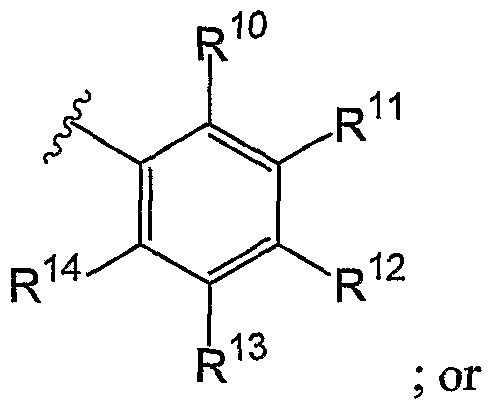
R6 is independently, at each instance, H, Rk, Ci-^ialoalkyl, halo, cyano, nitro, -C(=O)Ra, -C(=O)ORa, -C(=O)NRaRa, -C(=NRa)NRaRa, -ORa, -OC(=O)Ra, -OC(=O)NRaRa, -OC(=O)N(Ra)S(=O)2Ra, -OC2-6alkylNRaRa, -OC2-6alkylORa, -SRa, -S(-O)Ra, -S(=O)2Ra, -S(=O)2NRaRa, -S(=O)2N(Ra)C(=O)Ra, -S(=O)2N(Ra)C(=O)ORa, -S(=O)2N(Ra)C(=O)NRaRa, -NRaRa, ~N(Ra)C(=O)Ra,
-N(Ra)C(=O)ORa, -N(Ra)C(=O)NRaRa, -N(Ra)C(=NRa)NRaRa, -N(Ra)S(=O)2Ra, -N(Ra)S(=O)2NRaRa, -NRaC2-6alkylNRaRa and -NRaC2-6alkylORa;
R7 is independently, at each instance, H, Rk, C1-4haloalkyl, halo, cyano, nitro, -C(=O)Ra, -C(=O)ORa, -C(=O)NRaRa, -C(=NRa)NRaRa, -ORa, -OC(=O)Ra, -OC(=O)NRaRa, -OC(=O)N(Ra)S(=O)2Ra,
-OC2-6alkylNRaRa, -OC2-6alkylORa, -SRa, -S(=O)Ra, -S(=O)2Ra, -S(=O)2NRaRa, -S(=O)2N(Ra)C(=O)Ra, -S(=O)2N(Ra)C(=O)ORa, -S(=O)2N(Ra)C(=O)NRaRa, -NRaRa, -N(Ra)C(=O)Ra, -N(Ra)C(=O)ORa, -N(Ra)C(-O)NRaRa, -N(Ra)C(=NRa)NRaRa, -N(Ra)S(=O)2Ra, -N(Ra)S(=O)2NRaRa, -NRaC2-6alkylNRaRa and -NRaC2-6alkylORa; and
A)
R8 is independently, at each instance, H, Rk, C1-4haloalkyl, halo, cyano, nitro, -C(=O)Ra, -C(=O)ORa, -C(=O)NRaRa, -C(=NRa)NRaRa, -ORa, -OC(=O)Ra, -OC(=O)NRaRa, -OC(=O)N(Ra)S(=O)2Ra, -OC2-6alkylNRaRa, -OC2-6alkylORa, -SRa, -S(=O)Rtt, -S(=O)2Ra, -S(=O)2NRaRa, -S(=O)2N(Ra)C(=O)Ra, -S(=O)2N(Ra)C(=O)ORa,
-S(=O)2N(Ra)C(=O)NRaRa, -NRaRa, -N(Ra)C(=O)Ra, -N(Ra)C(=O)ORa, -N(Ra)C(=O)NRaRa, -N(Ra)C(=NRa)NRaRa, -N(Ra)S(=O)2Ra, -N(Ra)S(=O)2NRaRa, -NRaC2-6alkylNRaRa and -NRaC2-6alkylORa; and R9 is independently, at each instance, Re, Rh, -ORe, -ORh, -OC2-6alkylNRaRe, -OC2-6alkylORe, -NRaRe, -NRaRh, -NRaC2-6alkylNRaRe,
-NRaC2-6alkylORe, -CO2Re, -OC(=O)Re, -C(=O)Re, -C(=O)NRaRe, -C(=O)NRaRh, -NRaC(=O)Re, -NRaC(=O)Rh, -NRaC(=O)NRaRe, -NRaCO2Re, -C2-6alkylORe, -C2-6alkylNRaRe, -S(=O)nRe, -S(=O)2NRaRe, -NRaS(=O)2Re, -OS(=O)2Re, -OC(=O)NRaRe, -ORh, -OC2-6alkylNRaRh, -OC2-6alkylORh, -NRaC2-6alkylNRaRh, -NRhC2-6alkylNRaRa,
-NRhC2-6alkylORa, -NRaC2-6alkylORh, -CO2Rh, -OC(=O)Rh, -C(=O)Rh, -C(=O)NRaRh, -NReC(=O)Ra, -NRhC(=O)Ra, -NRhC(=O)NRaRa, -NReC(=O)NRaRa, -NRhCO2Ra, -NReCO2Ra, -C2-6alkylORh, -C2-6alkylNRaRh, -S(=O)nRh, -S(=O)2NRaRh, -NRaS(=O)2Rh, -NRhS(=O)2Ra, -OS(=O)2Rh or -OC(=O)NRaRh; or
B)
R8 is independently, at each instance, Re, Rh, -ORe, -OC2-6alkylNRaRe, -OC2-6alkylORe, -NRaRe, -NRaRh, -NRaC2-6alkylNRaRe, -NRaC2-6alkylORe, -CO2Re, -OC(=O)Re, -C(=O)Re, -C(=O)NRaRh, -NRaC(=O)Re, -NRaC(=O)Rh, -NRaC(=O)NRaRe, -NRaCO2Re,
-C2-6alkylORe, -C2-6alkylNRaRe, -S(=O)nRe, -S(=O)2NRaRe, -NRaS(=O)2Re, -OS(=O)2Re, -OC(=O)NRaRe, -ORh, -OC2-6alkylNRaRh, -OC2-6alkylORh, -NRaC2-6alkylNRaRh, -NRhC2-6alkylNRaRa, -NRhC2-6alkylORa, -NRaC2-6alkylORh, -CO2Rh, -OC(=O)Rh, -C(=O)NRaRh, -NReC(=O)Ra, -NRhC(=O)Ra, -NRhC(=O)NRaRa, -NReC(=O)NRaRa, -NRhCO2Ra, -NReCO2Ra, -C1-8alkylORh, -C1-6alkylNRaRh, -S(=O)nRh, -S(=O)2NRaRh, -NRaS(=O)2Rh,
-NRhS(=O)2Ra, -OS(=O)2Rh or -OC(=O)NRaRh; and
R9 is independently, at each instance, H, Rk, C1-4haloalkyl, halo, cyano, nitro, -C(=O)Ra, -C(=O)ORa, -C(=O)NRaRa, -C(=NRa)NRaRa, -ORa, -OC(=O)Ra, -OC(=O)NRaRa, -OC(=O)N(Ra)S(=O)2Ra, -OC2-6alkylNRaRa, -OC2-6alkylORa, -SRa, -S(=O)Ra, -S(=O)2Ra,
-S(=O)2NRaRa, -S(=O)2N(Ra)C(=O)Ra, -S(=O)2N(Ra)C(=O)ORa, -S(=O)2N(Ra)C(=O)NRaRa, -NRaRa, -N(Ra)C(=O)Ra, -N(Ra)C(=O)ORa, -N(Ra)C(=O)NRaRa, -N(Ra)C(=NRa)NRaRa, -N(Ra)S(=O)2Ra, -N(Ra)S(=O)2NRaRa, -NRaC2-6alkylNRaRa and -NRaC2-6alkylORa;
Ri 0 is independently, at each instance, selected from H, halo, C1-8alkyl, C1-4haloalkyl, cyano, nitro, -OH, -NH2, -SH, -C(=O)Rk, -C(=O)ORk, -C(=O)NRaRk, -C(=NRa)NRaRk, -OH, -NH2, -ORk, -OC(=O)Rk, -OC(=O)NRaRk, -OC(=O)N(Ra)S(=O)2Rk, -OC2-6alkylNRaRk, -OC2-6alkylORk, -SRk, -S(=O)Rk, -S(=O)2Rk, -S(=O)2NRaRk, -S(=O)2N(Ra)C(=O)Rk, -S(=O)2N(Ra)C(=O)ORk, -S(=O)2N(Ra)C(=O)NRaRk, -NRaRk, -N(Ra)C(=O)Rk, -N(Ra)C(=O)ORk, -N(Ra)C(=O)NRaRk, -N(Ra)C(=NRa)NRaRk, -N(Ra)S(=O)2Rk, -N(Ra)S(=O)2NRaRk, -NRaC2-6alkylNRaRk, -NRaC2-6alkylORk, -C(=O)R', -C(=O)ORi, -C(=O)NRaRi, -C(=NRa)NRaRi, -ORi, -OC(=O)Ri, -OC(=O)NRaRi, -OC(=O)N(Ra)S(=O)2Ri, -OC(=O)N(Ri)S(=O)2Rk, -OC2-6alkylNRaRi,
-OC2-6alkylORi, -SRi, -S(=O)Ri, -S(=O)2Ri, -S(=O)2NRaRi, -S(=O)2N(Ri)C(=O)Rk, -S(=O)2N(Ra)C(=O)Ri, -S(=O)2N(Ri)C(=O)ORk, -S(=O)2N(Ra)C(=O)ORi, -S(=O)2N(Ri)C(=O)NRaRk, -S(=O)2N(Ra)C(=O)NRaRi, -NRaRi, -N(Ri)C(=O)Rk, -N(Ra)C(=O)Ri, -N(Ri)C(=O)ORk, -N(Ra)C(=O)ORi, -N(Ri)C(=O)NRaRk, -N(Ra)C(=O)NRaRi, -N(Ri)C(=NRa)NRaRk,
-N(Ra)C(=NRa)NRaRi, -N(Ri)S(=O)2Rk, -N(Ra)S(=O)2Ri, -N(Ri)S(=O)2NRaRk, -N(Ra)S(=O)2NRaRi, -NRaC2-6alkylNRaRk, -NRaC2-6alkylNRa^, -NRiC2-6alkylORk and -NRaC2-6alkylOR1; or Ri 0 is a saturated, partially-saturated or unsaturated 5-, 6- or 7-membered monocyclic or 6-, 7-, 8-, 9-, 10- or 11-membered bicyclic ring containing 1, 2 or 3 atoms selected from N, O and S, wherein there are no more than 2 N atoms, wherein the ring is substituted by 0, 1 or 2 oxo or thioxo groups, wherein the ring is substituted by 0, 1, 2 or 3 groups selected from Rk, halo, cyano, nitro, -OH, -NH2, -SH, -C(=O)Rk, -C(=O)ORk, -C(=O)NRaRk, -C(=NRa)NRaRk, -ORk,'-OC(=O)Rk, -OC(=O)NRaRk, -OC(=O)N(Ra)S(=O)2Rk, -OC2-6alkylNRaRk, -OC2-6alkylORk, -SRk, -S(=O)Rk, -S(=O)2Rk, -S(=O)2NRaRk, -S(=O)2N(Ra)C(=O)Rk, -S(=O)2N(Ra)C(=O)ORk, -S(=O)2N(Ra)C(=O)NRaRk, -NRaRk, -N(Ra)C(=O)Rk, -N(Ra)C(=O)ORk, -N(Ra)C(=O)NRaRk, -N(Ra)C(=NRa)NRaRk, -N(Ra)S(=O)2Rk, -N(Ra)S(=O)2NRaRk, -NRaC2-6alkylNRaRk, -NRaC2-6alkylORk, -C(=O)Ri, -C(=O)ORi, -C(=O)NRaRi, -C(=NRa)NRaRi, -ORi, -OC(=O)Ri, -OC(=O)NRaRi, -OC(=O)N(Ra)S(=O)2Ri, -OC(=O)N(Ri)S(=O)2Rk, -OC2-6alkylNRaRi, -OC2-6alkylORi, -SRi, -S(=O)Ri, -S(=O)2Ri, -S(=O)2NRaRi, -S(=O)2N(Ri)C(=O)Rk, -S(=O)2N(Ra)C(=O)Ri,
-S(=O)2N(Ri)C(=O)ORk, -S(=O)2N(Ra)C(=O)ORi, -S(=O)2N(Ri)C(=O)NRaRk, -S(=O)2N(Ra)C(=O)NRaRi, -NRaRi, -N(Ri)C(=O)Rk, -N(Ra)C(=O)Ri, -N(Ri)C(=O)ORk, -N(Ra)C(=O)ORi, -N(Ri)C(=O)NRaRk, -N(Ra)C(=O)NRaRi, -N(Ri)C(=NRa)NRaRk, -N(Rβ)C(=NRa)NRaRi, -N(Ri)S(=O)2Rk, -N(Ra)S(=O)2Ri, -N(Ri)S(=O)2NR^, -N(Ra)S(=O)2NRaRi, -NRiC2-6alkylNR^,
-NRaC2-6alkylNRa^, -NRiC2-6alkylORk and -NR^-ealkylORi; or R1 0 is C1-4alkyl substituted by 0, 1, 2 or 3 groups selected from C1-4haloalkyl, halo, cyano, nitro, -OH, -NH2, -SH, -C(=O)Rk, -C(=O)ORk, -C(=O)NRaRk, -C(=NRa)NRaRk, -ORk, -OC(=O)NRaRk, -OC(=O)N(Ra)S(=O)2Rk, -OC2-6aUcylNRaRk, -OC2-6alkylORk, -SRk, -S(=O)Rk, -S(=O)2Rk, -S(=O)2NRaRk, -S(=O)2N(Ra)C(=O)Rk,
-S(=O)2N(Ra)C(=O)ORk, -S(=O)2N(Ra)C(=O)NRaRk, -NRaRk, -N(Ra)C(=O)Rk, -N(Ra)C(=O)ORk, -N(Ra)C(=O)NRaRk, -N(Ra)C(=NRa)NRaRk, -N(Ra)S(=O)2Rk, -N(Ra)S(=O)2NRaRk, -NRaC2-6alkylNRaRk, -NRaC2-6alkylORk, -C(=O)Ri, -C(=O)ORi, -C(=O)NRaRi, -C(=NRa)NRaRi, -ORi, -OC(=O)Ri, -OC(=O)NRaRi, -OC(=O)N(Ra)S(=O)2Ri, -OC(=O)N(Ri)S(=O)2Rk, -OC2-6alkylNRa^,
-OC2-6alkylORi, -SRi, -S(=O)Ri, -S(=O)2Ri, -S(=O)2NRaRi, -S(=O)2N(Ri)C(=O)Rk, -S(=O)2N(Ra)C(=O)Ri, -S(=O)2N(Ri)C(=O)ORk, -S(=O)2N(Ra)C(=O)ORi, -S(=O)2N(Ri)C(=O)NRaRk, -S(=O)2N(Ra)C(=O)NRaRi, -NRaRi, -N(Ri)C(=O)Rk, -N(Ra)C(=O)Ri, -N(Ri)C(=O)ORk, -N(Ra)C(=O)ORi, -N(Ri)C(=O)NRaRk, -N(Ra)C(=O)NRaRi, -N(Ri)C(=NRa)NRaRk, -N(Ra)C(=NRa)NRaRi, -N(Ri)S(=O)2Rk, -N(Ra)S(=O)2Ri, -N(Ri)S (=O)2NRaRk, -N(Ra)S(=O)2NRaRi, -NRaC2-6alkylNRaRk, -NRaC2^aIlCyINRaRi, -NRiC2-6alkylORk and -NRaC2-6alkylORi; Ri 1 is independently, at each instance, selected from H, cyano, nitro, -OH, -NH2, -SH, C2-6alkyl, C1-4haloaUcyl, -C(=O)Rk, -C(=O)ORk, -C(=O)NRaRk, -C(=NRa)NRaRk, -ORk, -OC(=O)Rk, -OC(=O)NRaRk, -OC(=O)N(Ra)S(=O)2Rk, -OC2-6alkylNRaRk, -OC2-6alkylORk, -SRk, -S(=O)Rk, -S(-O)2Rk, -S(=O)2NRaRk, -S(=O)2N(Ra)C(=O)Rk, -S(=O)2N(Ra)C(=O)ORk, -S(=O)2N(Ra)C(=O)NRaRk, -NRaRk, -N(Ra)C(=O)Rk, -N(Ra)C(=O)ORk, -N(Ra)C(=O)NRaRk, -N(Ra)C(=NRa)NRaRk, -N(Ra)S(=O)2Rk, -N(Ra)S(=O)2NRaRk, -NRaC2-6alkylNRaRk, -NRaC2-6alkylORk, -C(=O)Ri, -C(=O)ORi, -C(=O)NRaRi, -C(=NRa)NRaRi, -ORi, -OC(=O)Ri, -OC(=O)NRaRi, -OC(=O)N(Ra)S(=O)2Ri J -OC(=O)N(Ri)S(=O)2Rk 3 -OC2^aIlCyINRaRi, -OC2-6alkylORi, -SRi, -S(=O)Ri, -S(=O)2Ri, -S(=O)2NRaRi, -S(=O)2N(Ri)C(=O)Rk, -S(=O)2N(Ra)C(=O)Ri, -S(=O)2N(Ri)C(=O)ORk, -S(=O)2N(Ra)C(=O)ORi, -S(=O)2N(Ri)C(=O)NRaRk, -S(=O)2N(Ra)C(=O)NRaRi, -NRaRi, -N(Ri)C(=O)Rk, -N(Ra)C(=O)Ri, -N(Ri)C(=O)ORk, ^(Ra)C^O)©^, -N(Ri)C(=O)NRaRk, -N(Ra)C(=O)NRaRi, -N(Ri)C(=NRa)NRaRk, -N(Ra)C(=NRa)NRaRi s -N(Ri)S(=O)2Rk, -N(Ra)S(=O)2Ri, -N^S(=O)2NR^, -N(Ra)S(=O)2NRaRi, -NRaC2-6alkylNRaRk, -NRaC2-6alkylNRaRi, -NRiC2-6alkylORk and -NRaC2-6alkylORi; or Ri 1 is a saturated, partially-saturated or unsaturated 5-, 6- or 7-membered monocyclic or 6-, 7-, 8-, 9-, 10- or 11-membered bicyclic ring containing 1, 2 or 3 atoms selected from N, O and S, wherein the ring is substituted by 0, 1 or 2 oxo or thioxo groups, wherein the ring is substituted by 0, 1, 2 or 3 groups selected from Rk, halo, cyano, nitro, -C(=O)Rk, -C(=O)ORk, -C(=O)NRaRk, -C(=NRa)NRaRk, -OH, -NH2, -SH, -ORk, -OC(=O)Rk, -OC(=O)NRaRk, -OC(=O)N(Ra)S(=O)2Rk, -OC2-6alkylNRaRk, -OC2-6alkylORk, -SRk, -S(=O)Rk, -S(=O)2Rk, -S(=O)2NRaRk,
-S(=O)2N(Ra)C(=O)Rk, -S(=O)2N(Ra)C(=O)ORk, -S(=O)2N(Ra)C(=O)NRaRk, -NRaRk, -N(Ra)C(=O)Rk, -N(Ra)C(=O)ORk, -N(Ra)C(=O)NRaRk, -N(Ra)C(=NRa)NRaRk, -N(Ra)S(=O)2Rk, -N(Ra)S(=O)2NRaRk, -NRaC2-6alkylNRaRk, -NRaC2-6alkyl ORk, -C(=O)Ri, -C(=O)ORi, -C(=O)NRaRi, -C(=NRa)NRaRi, -ORi, -OC(=O)Ri, -OC(=O)NRaRi, -OC(=O)N(Ra) S (=O)2Ri, -OC(=O)N(Ri)S(=O)2Rk, -OC^ealkyiNRaRi, -OC2-6alkylORi, -SRi, -S(=O)Ri, -S(=O)2Ri, -S(=O)2NRaRi, -S(=O)2N(Ri)C(=O)Rk, -S(=O)2N(Ra)C(=O)Ri,
-S(=O)2N(Ri)C(=O)ORk, -S(=O)2N(Ra)C(=O)ORi, -S(=O)2N(Ri)C(=O)NRaRk, -S(=O)2N(Ra)C(=O)NRaRi, -NRaRi, -N(Ri)C(=O)Rk, -N(Ra)S(=O)Ri, -N(Ri)C(=O)ORk, -N(Ra)C(=O)ORi, -N(Ri)C(=O)NRaRk, -N(Ra)C(=O)NRaRi, -NQROC(=NRa)NR^, -N^C(=NRa)NRaRi, -N(Ri^=O)2Rk, -N(Ra)S(=O)2Ri, -N(Ri)S(=O)2NRaRk, -N(Ra)S(=O)2NRaRi, -NRaC2-6alkylNRaRk,
-NRaC2-6alkylNRaRi, -NRiC2-6alkylORk and -NRaC2-6alkylORi; or Ri 1 is C2-6alkyl substituted by 0, 1, 2 or 3 groups selected from C1-4haloalkyl, cyano, nitro, -OH, -NH2, -SH, -C(=O)Rk, -C(=O)ORk, -C(=O)NRaRk, -C(=NRa)NRaRk, -ORk, -OC(=O)Rk, -OC(=O)NRaRk, -OC(=O)N(Ra)S(=O)2Rk, -OC2-6alkylNRaRk, -OC2-6alkylORk, -SRk, -S(=O)Rk, -S(=O)2Rk, -S(=O)2NRaRk,
-S(=O)2N(Ra)C(=O)Rk, -S(=O)2N(Ra)C(=O)ORk, -S(=O)2N(Ra)C(=O)NRaRk, -NRaRk, -N(Ra)C(=O)Rk, -N(Ra)C(=O)ORk, -N(Ra)C(=O)NRaRk, -N(Ra)C(=NRa)NRaRk, -N(Ra)S(=O)2Rk, -N(Ra)S(=O)2NRaRk, -NRaC2-6alkylNRaRk, -NRaC2-6alkylORk, -C(=O)Ri, -C(=O)ORi, -C(=O)NRaRi, -C(=NRa)NRaRi, -ORi, -OC(=O)Ri, -OC(=O)NRaRi, -OC(=O)N(Ra)S(=O)2Ri, -OC(=O)N(Ri)S(=O)2Rk, -OC2-6alkylNRaRi, -OC2-6alkylORi, -SRi, -S(=O)Ri, -S(=O)2Ri, -S(=O)2NRaRi, -S(=O)2N(Ri)C(=O)Rk, -S(=O)2N(Ra)C(=O)Ri, -S(=O)2N(Ri)C(=O)ORk, -S(=O)2N(Ra)C(=O)ORi, -S(=O)2N(Ri)C(=O)NRaRk, -S(=O)2N(Ra)C(=O)NRaRi, -NRaRi, -N(Ri)C(=O)Rk, -N(Ra)C(=O)Ri, -N(Ri)C(=O)ORk, -N(Ra)C(=O)ORi, -N(Ri)C(=O)NRaRk, -N(Ra)C(=O)NRaRi,
-N(Ri)C(=NRa)NRaRk, -N(Ra)C(=NRa)NRaRi, -N(Ri)S(=O)2Rk, -N(Ra)S(=O)2Ri, -N(Ri)S(=O)2NRaRk, -N(Ra)S(=O)2NRaRi, -NRiCw5alky]iSRaRk, -NRaC2-6alkylNRaRi, -NRiC2-6alkylORk and -NRaC2-6alkylORi; or Ri 0 and Ri 1 together are a saturated, partially-saturated or unsaturated 3-, 4- or 5 -atom bridge containing 1, 2 or 3 atoms selected from O, N and S with the remaining atoms being carbon, so long as the combination of O and S atoms is not greater than 2, wherein the bridge is substituted by 0, 1 or 2 substituents selected from oxo, thioxo, Ri, Rk, halo, cyano, nitro, -OH, -NH2, -SH, -C(=O)Rk, -C(=O)ORk, -C(=O)NRaRk, -C(=NRa)NRaRk, -ORk, -OC(=O)Rk, -OC(=O)NRaRk, -OC(=O)N(Ra)S(=O)2Rk, -OC2-6alkylNRaRk, -OC2-6alkylORk, -SRk, -S(=O)Rk, -S(=O)2Rk, -S(=O)2NRaRk, -S(=O)2N(Ra)C(=O)Rk, -S(=O)2N(Ra)C(=O)ORk, -S(=O)2N(Ra)C(=O)NRaRk, -NRaRk, -N(Ra)C(=O)Rk, -N(Ra)C(=O)ORk, -N(Ra)C(=O)NRaRk, -N(Ra)C(=NRa)NRaRk, -N(Ra)S(=O)2Rk, -N(Ra)S(=O)2NRaRk, -NRaC2-6alkylNRaRk, -NRaC2-6alkylORk, -C(=O)Ri, -C(=O)ORi, -C(=O)NRaRi, -C(=NRa)NRaRi, -ORi, -OC(=O)Ri, -OC(=O)NRaRi, -OC(=O)N(Ra)S(=O)2Ri, -OC(=O)N(Ri)S(=O)2Rk, -OC2-6alkylNRaRi, -OC2-6alkylORi, -SRi, -S(=O)Ri, -S(=O)2Ri, -S(=O)2NRaR,
-S(=O)2N(Ri)C(=O)Rk, -S(=O)2N(Ra)C(=O)Ri, -S(=O)2N(Ri)C(=O)ORk, -S(=O)2N(Ra)C(=O)ORi, -S(=O)2N(Ri)C(=O)NRaRk, -S(=O)2N(Ra)C(=O)NRaRi, -NRaRi, -N(Ri)C(=O)Rk, -N(Ra)C(=O)Ri, -N(Ri)C(=O)ORk, -N(Ra)C(=O)ORi, -N(Ri)C(=O)NRaRk, -N(Ra)C(=O)NRaRi, -N(Ri)C(=NRa)NRaRk, -N(Ra)C(=NRa)NRaRi, -N(Ri)S(=O)2Rk, -N(Ra)S(=O)2Ri, -N(Ri)S(=O)2NRaRk,
-N(Ra)S(=O)2NRaRi, -NRaC2-6alkylNRaRk, -NRaC2-6alkylNRaRi, -NRiC2-6alkylORk and -NRaC2-6alkylORi; or Ri 0 and Ri 1 together are a saturated or partially unsaturated 3-, 4- or 5-carbon bridge, wherein the bridge is substituted by 0, 1 or 2 substituents selected from oxo, thioxo, R1, Rk, halo, cyano, nitro, -OH, -NH2, -SH, -C(=O)Rk, -C(=O)ORk, -C(=O)NRaRk, -C(=NRa)NRaRk, -ORk, -OC(=O)Rk, -OC(=O)NRaRk, -OC(=O)N(Ra)S(=O)2Rk, -OC2-6alkylNRaRk, -OC2-6alkylORk, -SRk, -S(=O)Rk, -S(=O)2Rk, -S(=O)2NRaRk, -S(=O)2N(Ra)C(=O)Rk, -S(=O)2N(Ra)C(=O)ORk, -S(=O)2N(Ra)C(=O)NRaRk, -NRaRk, -N(Ra)C(=O)Rk, -N(Ra)C(=O)ORk, -N(Ra)C(=O)NRaRk, -N(Ra)C(=NRa)NRaRk, -N(Ra)S(=O)2Rk, -N(Ra)S(=O)2NRaRk, -NRaC2-6alkylNRaRk, -NRaC2-6alkylORk, -C(=O)Ri,
-S(=O) ORi, -C(=O)NRaRi, -C(=NRa)NRaRi, -ORi, -OC(=O)Ri, -OC(=O)NRaRi, -OC(=O)N(Ra)S(=O)2Ri, -OC(=O)N(Ri)S(=O)2Rk, -OC2-6alkylNRaRi, -OC2-6alkylORi, -SRi, -S(=O)Ri, -S(=O)2Ri, -S(=O)2NRaRi, -S(=O)2N(Ri)C(=O)Rk, -S(=O)2N(Ra)C(=O)Ri, -S(=O)2N(Ri)C(=O)ORk, -S(=O)2N(Ra)C(=O)ORi, -S(=O)2N(Ri)C(=O)NRaRk, -S(=O)2N(Ra)C(=O)NRaRi,
-NRaRi, -N(Ri)C(=O)Rk, -N(Ra)C(=O)Ri, -N(Ri)C(=O)ORk, -N(Ra)C(=O)ORi, -N(Ri)C(=O)NRaRk, -N(Ra)C(=O)NRaRi, -N(Ri)C(=NRa)NRaRk, -N(Ra)C(=NRa)NRaRi, -N(Ri)S(=O)2Rk, -N(Ra)S(=O)2Ri, -N(Ri)S(=O)2NRaRk, -N(Ra)S(=O)2NRaRi, -NRaC2-6alkylNRaRk, -NRaC2-6alkylNRaRi, -NRiC2-6alkylORk and -NRaC2-6alkylORi;
R is independently, at each instance, selected from H, C2-6alkyl, C1-4haloalkyl, halo, cyano, nitro, -OH, -NH2, -SH, -C(=O)Rk, -C(=O)ORk, -C(=O)NRaRk, -C(=NRa)NRaRk, -ORk, -OC(=O)Rk, -OC(=O)NRaRk, -OC(=O)N(Ra)S(=O)2Rk, -OC2-6alkylNRaRk, -OC2-6alkylORk, -S(=O)2NRaRk, -S(=O)2N(Ra)C(=O)Rk, -S(=O)2N(Ra)C(=O)ORk, -S(=O)2N(Ra)C(=O)NRaRk, -NRaRk, -N(Ra)C(=O)Rk, -N(Ra)C(=O)ORk, -N(Ra)C(=O)NRaRk, -N(Ra)C(=NRa)NRaRk, -N(Ra)S(=O)2Rk, -N(Ra)S(=O)2NRaRk,
-NRaC2-6alkylNRaRk, -NRaC2-6alkylORk, -C(=O)Ri, -C(=O)ORi, -C(=O)NRaRi,
-C(=NRa)NRaRi, -ORi, -OC(=O)Ri, -OC(=O)NRaRi, -OC(=O)N(Ra)S(=O)2Ri,
-OC(=O)N(Ri)S(=O)2Rk, -OC2-6alkylNRaRi, -OC2-6alkylORi, -SRi, -S(=O)Ri, -S(=O)2Ri, -S(=O)2NRaRi, -S(=O)2N(Ri)C(=O)Rk, -S(=O)2N(Ra)C(=O)Ri, -S(=O)2N(Ri)C(=O)ORk, -S(=O)2N(Ra)C(=O)ORi, -S(=O)2N(Ri)C(=O)NRaRk, -S(=O)2N(Ra)C(=O)NRaRi, -NRaRi, -N(Ri)C(=O)Rk, -N(Ra)C(=O)Ri, -N(Ri)C(=O)ORk, -N(Ra)C(=O)ORi, -N(Ri)C(=O)NRaRk, -N(Ra)C(=O)NRaRi, -N(Ri)C(=NRa)NRaRk, -N(Ra)C(=NRa)NRaRi, -N(Ri)S(=O)2Rk, -N(Ra)S(=O)2Ri, -N(Ri)S(=O)2NRaRk, -N(Ra)S(=O)2NRaRi, -NRiC2-6alkylNRaR^ -NRaC2-6alkylNRaRi, -NRiC2-6alkylORk and -NRaC2-6alkylORi; or Ri 2 is a saturated, partially-saturated or unsaturated 5-, 6- or 7-membered monocyclic or 6-, 7-, 8-, 9-, 10- or 11-membered bicyclic ring containing 1, 2 or 3 atoms selected from N, O and S, wherein the ring is substituted by 0, 1 or 2 oxo or thioxo groups, wherein the ring is substituted by 0, 1, 2 or 3 groups selected from Rk, halo, cyano, nitro, -OH, -NH2, -SH, -C(=O)Rk, -C(=O)ORk, -C(=O)NRaRk,
-C(=NRa)NRaRk, -ORk, -OC(=O)Rk, -OC(=O)NRaRk, -OC(=O)N(Ra)S(=O)2Rk, -OC2-6alkylNRaRk, -OC2-6alkylORk, -SRk, -S(=O)Rk, -S(=O)2Rk, -S(=O)2NRaRk, -S(=O)2N(Ra)C(=O)Rk, -S(=O)2N(Ra)C(=O)ORk, -S(=O)2N(Ra)C(=O)NRaRk, -NRaRk, -N(Ra)C(=O)Rk, -N(Ra)C(=O)ORk, -N(Ra)C(=O)NRaRk, -N(Ra)C(=NRa)NRaRk, -N(Ra)S(=O)2Rk, -N(Ra)S(=O)2NRaRk,
-NRaC2-6alkylNRaRk, -NRaC2-6alkylORk, -C(=O)Ri, -C(=O)ORi, -C(=O)NRaRi, -C(=NRa)NRaRi, -ORi, -OC(=O)Ri, -OC(=O)NRaRi, -OC(=O)N(Ra)S(=O)2Ri, -OC(=O)N(Ri)S(=O)2Rk, -OC2-6alkylNRaRi, -OC2-6alkylORi, -SRi, -S(=O)Ri, -S(=O)2Ri, -S(=O)2NRaRi, -S(=O)2N(Ri)C(=O)Rk, -S(=O)2N(Ra)C(=O)Ri, -S(=O)2N(Ri)C(=O)ORk, -S(=O)2N(Ra)C(=O)ORi, -S(=O)2N(Ri)C(=O)NRaRk, -S(=O)2N(Ra)C(=O)NRaRi, -NRaRi, -N(Ri)C(=O)Rk, -N(Ra)C(=O)Ri, -N(Ri)C(=O)ORk, -N(Ra)C(=O)ORi, -N(Ri)C(=O)NRaRk, -N(Ra)C(=O)NRaRi, -N(Ri)C(=NRβ)NRaRk, -N(Ra)C(=NRa)NRaRi, -N(Ri)S(=O)2Rk, -N(Ra)S(=O)2Ri, -N(Ri)S(=O)2NRaRi*, -N(Ra)S(=O)2NRaRi, -NRiC2-6alkylNRaRi*, -NRaC2-6alkylNRaRi, -NRiC2-6alkylORk and -NRaC2-6alkylORi; or Ri 2 is C1-4alkyl substituted by 0, 1, 2 or 3 groups selected from C1-4haloalkyl, cyano, nitro, -OH, -NH2, -SH, -C(=O)Rk, -C(=O)ORk, -C(=O)NRaRk, -C(=NRa)NRaRk, -ORk, -OC(=O)Rk, -OC(=O)NRaRk, -OC(=O)N(Ra)S(=O)2Rk, -OC2-6alkylNRaRk, -OC2-6alkylORk, -SRk, -S(=O)Rk, -S(=O)2Rk, -S(=O)2NRaRk, -S(=O)2N(Ra)C(=O)Rk, -S(=O)2N(Ra)C(=O)ORk, -S(=O)2N(Ra)C(=O)NRaRk, -NRaRk, -N(Ra)C(=O)Rk, -N(Ra)C(=O)ORk, -N(Ra)C(=O)NRaRk, -N(Ra)C(=NRa)NRaRk, -N(Ra)S(=O)2Rk, -N(Ra)S(=O)2NRaRk,
-NRaC2-6alkylNRaRk, -NRaC2-6alkylORk, -C(=O)Ri, -C(=O)ORi, -C(=O)NRaRi, -C(=NRa)NRaRi, -ORi, -OC(=O)R*, -OC(=O)NRaRi, -OC(=O)N(Ra)S(=O)2Ri, -OC(=O)N(Ri)S(=O)2Rk, -OC2-6alkylNRaRi, -OC2-6alkylORi, -SRi, -S(=O)Ri, -S(=O)2Ri, -S(=O)2NRaRi, -S(=O)2N(Ri)C(=O)Rk, -S(=O)2N(Ra)C(=O)Ri, -S(=O)2N(Ri)C(=O)ORk, -S(=O)2N(Ra)C(=O)ORi, -S(=O)2N(Ri)C(=O)NRaRk, -S(=O)2N(Ra)C(=O)NRaRi, -NRaRi, -N(Ri)C(=O)Rk, -N(Ra)C(=O)Ri, -N(Ri)C(=O)ORk, -N(Ra)C(=O)ORi, -N(Ri)C(=O)NRaRk, -N(Ra)C(=O)NRaRi, -N(Ri)C(=NRa)NRaRk, -N(Ra)C(=NRa)NRaRi, -N(Ri)S(=O)2Ri*, -N(Ra)S(=O)2Ri, -N(Ri)S(=O)JSIRaRk, -N(Ra)S(=O)2NRaRi, -NRiC2-6alkylNR^, -NRaC2^aIlCyINRaRi, -NRiC2-6alkylORk and -NRaC2-6alkylORi, and additionally substituted by 0, 1 or 2 halo groups; or R and R together ore o saturated, partially-saturated or unsaturated 3-, 4- or 5-atom bridge containing 1, 2 or 3 otoms selected from O, N and S with the remaining atoms being carbon, so long as the combinotion of O and S atoms is not greater than 2, wherein the bridge is substituted by 0, 1 or 2 substituents selected from oxo, thioxo, R1, Rk, halo, cyano, nitro, -OH, -NH2, -SH, -C(=O)Rk, -C(=O)ORk, -C(=O)NRaRk, -C(=NRa)NRaRk, -ORk, -OC(=O)Rk, -OC(=O)NRaRk, -OC(=O)N(Ra)S(=O)2Rk, -OC2-6alkylNRaRk, -OC2-6alkylORk, -SRk, -S(=O)Rk, -S(=O)2Rk, -S(=O)2NRaRk, -S(=O)2N(Ra)C(=O)Rk, -S(=O)2N(Ra)C(=O)ORk, -S(=O)2N(Ra)C(=O)NRaRk, -NRaRk, -N(Ra)C(=O)Rk, -N(Ra)C(=O)ORk, -N(Ra)S(=O)NRaRk, -N(Ra)Q=NRa)NRaRk, -N(Ra)S(=O)2Rk, -N(Ra)S(=O)2NRaRk, -NRaC2-6alkylNRaRk, -NRaC2-6alkylORk, -C(=O)Ri, -S(=O)ORi, -C(=O)NRaRi, -C(=NRa)NRaRi, -ORi, -OC(=O)Ri, -OC(=O)NRaRi, -OC(=O)N(Ra)S(=O)2Ri, -OC(=O)N(Ri)S(=O)2Rk, -OC2-6alkylNRaRi, -OC2-6alkylORi, -SRi, -S(=O)Ri, -S(=O)2Ri, -S(=O)2NRaRi, -S(=O)2N(Ri)C(=O)Rk, -S(=O)2N^Q^Ri, -S(=O)2N(Ri)C(=O)ORk, -S(=O)2N(Ra)C(=O)ORi, -S(=O)2N(Ri)C(=O)NRaRk, -S(=O)2N(Ra)C(=O)NRaRi, -NRaRi, -N(Ri)C(=O)Rk, -N(Ra)S(=O)Ri,
-N(Ri)C(=O)ORk, -N(Ra)C(=O)ORi, -N(Ri)C(=O)NRaRk, -N(Ra)C(=O)NRaRi, -N(Ri)C(=NRa)NRaRk, -N(Ra)C(=NRa)NRaRi, -N(Ri)S(=O)2Rk, -N(Ra)S(=O)2Ri, -N(Ri)S(=O)2NRaRk, -N(Ra)S(=O)2NRaRi, -NRiC2-6alkylNR^, -NRaC2-6alkylNRaRi, -NRiC2-6alkylORk and -NRaC2-6alkylORi; or Ri 1 ond Ri 2 together ore o soturated or partially unsaturated 3-, 4- or 5 -carbon bridge, wherein the bridge is substituted by 0, 1 or 2 substiruents selected from oxo, thioxo, R1, Rk, halo, cyono, nitro, -OH, -NH2, -SH, -C(=O)Rk, -C(=O)ORk, -C(=O)NRaRk, -C(=NRa)NRaRk, -ORk, -OC(=O)Rk, -OC(=O)NRaRk, -OC(=O)N(Ra)S(=O)2Rk, -OC2-6olkylNRaRk, -OC2-6olkylORk, -SRk, -S(=O)Rk, -S(=O)2Rk, -S(=O)2NRaRk, -S(=O)2N(Ra)C(=O)Rk, -S(=O)2N(Ra)C(=O)ORk, -S(=O)2N(Ra)C(=O)NRaRk, -NRaRk, -N(Ra)C(=O)Rk, -N(Ra)C(=O)ORk, -N(Ra)C(=O)NRaRk, -N(Ra)C(=NRa)NRaRk, -N(Ra)S(=O)2Rk, -N(Ra)S(=O)2NRaRk, -NRaC2-6alkylNRaRk, -NRaC2-6alkyl ORk, -S(=O)Ri, -C(=O)ORi, -C(=O)NRaRi, -C(=NRa)NRaRi, -ORi, -OS(=O)Ri, -OS(=O)NRaRi, -OC(=O)N(Ra)S(=O)2Ri, -OC(=O)N(Ri)S(=O)2Rk, -OC2-6alkylNRa^, -OC2-6alkylORi, -SRi, -S(=O)Ri,
-S(=O)2Ri, -S(=O)2NRaRi, -S(=O)2N(Ri)C(=O)Rk, -S(=O)2N(Ra)C(=O)Ri, -S(=O)2N(Ri)C(=O)ORk, -S(=O)2N(Ra)C(=O)ORi, -S(=O)2N(Ri)C(=O)NRaRk, -S(=O)2N(Ra)C(=O)NRaRi, -NRaRi, -N(Ri)C(=O)Rk, -N(Ra)C(=O)Ri, -N(Ri)C(=O)ORk, -N(Ra)S(=O) ORi, -N(Ri)C(=O)NRaRk, -N(Ra)C(=O)NRaRi, -N(Ri)C(=NRa)NRaRk, -N(Ra)C(=NRa)NRaRi, -N(Ri)S(=O)2Rk, -N(Ra)S(=O)2Ri,
-N(Ri)S(=O)2NRaRk, -N(Ra)S(=O)2NRaRi, -NRiC2-6alkylNRaR^ -NRaC2-6alkylNRaRi, -NRiC2-6olkylORk and -NRaC2-6alkylORi; R13 is independently, at each instance, selected from H, halo, cyano, nitro, C1-4haloalkyl, -OH, -NH2, -SH, C2-6alkyl, -C(=O)Rk, -C(=O)ORk, -C(=O)NRaRk, -C(=NRa)NRaRk, -ORk, -OC(=O)Rk, -OC(=O)NRaRk, -OC(=O)N(Ra)S(=O)2Rk, -OC2-6alkylNRaRk, -OC2-6alkylORk, -SRk, -S(=O)Rk, -S(=O)2Rk, -S(=O)2NRaRk, -S(=O)2N(Ra)C(=O)Rk, -S(=O)2N(Ra)C(=O)ORk, -S(=O)2N(Ra)C(=O)NRaRk, -NRaRk, -N(Ra)C(=O)Rk, -N(Ra)C(=O)ORk, ~N(Ra)C(=O)NRaRk, -N(Ra)C(=NRa)NRaRk, -N(Ra)S(=O)2Rk, -N(Ra)S(=O)2NRaRk, -NRaC2-6alkylNRaRk, -NRaC2-6alkylORk, -C(=O)Ri, -C(=O)ORi, -C(=O)NRaRi, -C(=NRa)NRaRi, -ORi, -OC(=O)Ri, -OC(=O)NRaRi, -OC(=O)N(Ra)S(=O)2Ri, -OC(=O)N(Ri)S(=O)2Rk, -OC2-6alkylNRaRi, -OC2-6alkylORi, -SRi, -S(=O)Ri, -S(=O)2Ri, -S(=O)2NR81Ri, -S(=O)2N(Ri)C(=O)Rk, -S(=O)2N(Ra)C(=O)Ri, -S(=O)2N(Ri)C(=O)ORk, -S(=O)2N(Ra)C(=O)ORi, -S(=O)2N(R)C(=O)NR^, -S(=O)2N(Ra)C(=O)NRaRi, -NRaRi, -N(R)C(=O)R^ -N(Ra)C(=O)Ri, -N(R)C(=O)OR^ -N(Ra)C(=O)ORi, -N(RJ)C(=O)NRaRk, -N(Ra)C(=O)NRaRi, -N(Ri)C(=NRa)NRaRk, -N(Ra)C(=NRa)NRaRi, -N(R)S(=O)2R^ -N(Ra)S(=O)2Ri, -N(Ri)S(=O)2NRaRk, -N(Ra)S(=O)2NRaRi, -NRaC2-6alkylNRaRk, -NRaC2-6alkylNRaRi, -NRiC2-6alkylORfc and -NRaC2-6alkylORi; or R13 is a saturated, partially-saturated or unsaturated 5-, 6- or 7-membered monocyclic or 6-, 7-, 8-, 9-, 10- or 11-membered bicyclic ring containing 1, 2 or 3 atoms selected from N, O and S, wherein the ring is substituted by 0, 1 or 2 oxo or thioxo groups, wherein the ring is substituted by 0, 1, 2 or 3 groups selected from Rk, halo, cyano, nitro, -C(=O)Rk, -C(=O)ORk, -C(=O)NRaRk, -C(=NRa)NRaRk, -ORk, -OC(=O)Rk, -OC(=O)NRaRk, -OC(=O)N(Ra)S(=O)2Rk, -OC2-6alkylNRaRk, -OC2-6alkylORk, -SRk, -S(=O)Rk, -S(=O)2Rk, -S(=O)2NRaRk, -S(=O)2N(Ra)C(=O)Rk, -S(=O)2N(Ra)C(=O)ORk, -S(=O)2N(Ra)C(=O)NRaRk,
-NRaRk, -N(Ra)C(=O)Rk, -N(Ra)C(=O)ORk, -N(Ra)C(=O)NRaRk, -N(Ra)C(=NRa)NRaRk, -N(Ra)S(=O)2Rk, -N(Ra)S(=O)2NRaRk, -NRaC2-6alkylNRaRk, -NRaC2-6alkylORk, -C(=O)Ri, -C(=O)ORi, -C(=O)NRaRi, -C(=NRa)NRaRi, -ORi, -OC(=O)Ri, -OS(=O)NRaRi, -OC(=O)N(Ra)S(=O)2Ri, -OC(=O)N(Ri)S(=O)2Rk, -OC2-6alkylNRa^, -OC2-6alkylORi, -SRi, -S(=O)Ri,
-S(=O)2Ri, -S(=O)2NRaRi, -S(=O)2N(Ri)C(=O)Rk, -S(=O)2N(Ra)C(=O)Ri, -S(=O)2N(Ri)C(=O)ORk, -S(=O)2N(Ra)C(=O)ORi, -S(=O)2N(Ri)C(=O)NRaRk, -S(=O)2N(Ra)C(=O)NRaRi, -NRaRi, -N(Ri)C(=O)Rk, -N(Ra)C(=O)R.1, -N(Ri)C(=O)ORk, -N(Ra)C(=O)ORi, -N(Ri)S(=O)NRaR*, -N(Ra)S(=O)NRaRi, -N(Ri)C(=NRa)NRaRk, -N^C(=NRa)NRaRi, -N(Ri)S(=O)2Rk, -N(Ra)S(=O)2Ri, -N(Ri)S(=O)2NRaRk, -N(Ra^O=O)2NRaRi, -NRaC2-6alkylNRaRk, -NRaC2-6alkylNRaRi, -NRiC2-6alkylORk and -NRaC2-6alkylORi; or R13 is C2-6alkyl substituted by 0, 1, 2 or 3 groups selected from C1-4haloalkyl, cyano, nitro, -Q=0)Rk, -Q=0)ORk, -C(=O)NRaRk, -C(=NRa)NRaRk, -ORk, -OC(=O)Rk, -OC(=O)NRaRk, -OC(=O)N(Ra)S(=O)2Rk, -OC2-6alkylNRaRk, -OC2-6alkylORk, -SRk, -S(=O)Rk, -S(=O)2Rk, -S(=O)2NRaRk, -S(=O)2N(Ra)Q=0)Rk, -S(=O)2N(Ra)C(=O)ORk, -S(=O)2N(Ra)S(=O)NRaRk, -NRaRk, -N(Ra)C(=O)Rk, -N(Ra)C(=O)ORk, -N(Ra)C(=O)NRaRk, -N(Ra)C(=NRa)NRaRk, -N(Ra)S(=O)2Rk, -N(Ra)S(=O)2NRaRk, -NRaC2-6alkylNRaRk, -NRaC2-6alkylORk, -C(=O)Ri, -C(=O)ORi, -C(=O)NRaRi, -C(=NRa)NRaRi, -ORi, -OS(=O)Ri, -OC(=O)NRaRi, -OC(=O)N(Ra)S(=O)2Ri, -OC(=O)N(Ri)S(=O)2Rk, -OC2-6alkylNRaRi, -OC2-6alkylORi, -SRi, -S(=O)Ri, -S(=O)2Ri, -S(=O)2NRaRi,
-S(=O)2N(Ri)C(=O)Rk, -S(=O)2N(Ra)C(=O)Ri, -S(=O)2N(Ri)C(=O)ORk, -S(=O)2N(Ra)C(=O)ORi, -S(=O)2N(Ri)C(=O)NRaRk, -S(=O)2N(Ra)C(=O)NRaRi, -NRaRi, -N(Ri)C(=O)Rk, -N(Ra)C(=O)Ri, -N(Ri)C(=O)ORk, -N(Ra)C(=O)ORi, -N(Ri)C(=O)NRaRk, -N(Ra)C(=O)NRaRi, -N(Ri)C(=NRa)NRaRk, -N(Ra)C(=NRa)NRaRi, -N(Ri)S(=O)2Rk, -N(Ra)S(=O)2Ri, -N(Ri)S(=O)2NRaRk,
-N(Ra)S(=O)2NRaRi, -NRaC2-6alkylNRaRk, -NRaC2-6alkylNRaRi, -NRiC2-6alkylORk and -NRaC2-6alkylORi; Ri 4 is independently, at each instance, selected from H, C2-6alkyl, C1-4haloalkyl, halo, cyano, nitro, -OH, -NH2, -NH2, -SH, -C(=O)Rk, -C(=O)ORk, -C(=O)NRaRk, -C(=NRa)NRaRk, -ORk, -OC(=O)Rk, -OC(=O)NRaRk,
-OC(=O)N(Ra)S(=O)2Rk, -OC2-6alkylNRaRk, -OC2-6alkylORk, -SRk, -S(=O)Rk, -S(=O)2Rk, -S(=O)2NRaRk, -S(=O)2N(Ra)C(=O)Rk, -S(=O)2N(Ra)C(=O)ORk, -S(=O)2N(Ra)C(=O)NRaRk, -NRaRk, -N(Ra)C(=O)Rk, -N(Ra)C(=O)ORk, -N(Ra)C(=O)NRaRk, -N(Ra)C(=NRa)NRaRk, -N(Ra)S(=O)2Rk, -N(Ra)S(=O)2NRaRk, -NRaC2-6alkylNRaRk, -NRaC2-6alkylORk, -C(=O)Ri,
-S(=O)ORi, -C(=O)NRaRi, -C(=NRa)NRaRi, -ORi, -OC(=O)Ri, -OS(=O)NRaRi, -OC(=O)N(Ra)S(=O)2Ri, -OC(=O)N(Ri)S(=O)2Rk, -OC2-6alkylNRaRi, -OC2-6alkylORi, -SRi, -S(=O)Ri, -S(=O)2Ri, -S(=O)2NRaRi, -S(=O)2N(Ri)C(=O)Rk, -S(=O)2N(Ra)C(=O)Ri, -S(=O)2N(Ri)C(=O)ORk, -S(=O)2N(Ra)C(=O)ORi, -S(=O)2N(Ri)C(=O)NRaRk, -S(=O)2N(Ra)C(=O)NR21Ri, -NRaRi, -N(Ri)C(=O)Rk, -N(Ra)C(=O)Ri, -N(Ri)C(=O)ORk, -N(Ra)C(=O)ORi, -N(Ri)C(=O)NRaRk, -N(Ra)C(=O)NRaRi, -N(Ri)C(=NRa)NRaRk,
-N(Ra)C(=NRa)NRaRi, -N(Ri)S(=O)2Rk, -N(Ra)S(=O)2Ri, -N(Ri)S(=O)2NRaRk, -N(Ra)S(=O)2NRaRi, -NRaC2-6alkylNRaRk, -NRaC2-6alkylNRaRi, -NRiC2-6alkylORk and -NR^^alkylOR1; or R is a saturated, partially-saturated or unsaturated 5-, 6- or 7-membered monocyclic or 6-, 7-, 8-, 9-, 10- or 11-membered bicyclic ring containing 1 , 2 or 3 atoms selected from N, O and S, wherein there are no more than 2 N atoms, wherein the ring is substituted by 0, 1 or 2 oxo or thioxo groups, wherein the ring is substituted by 0, 1, 2 or 3 groups selected from Rk, halo, cyano, nitro, -C(=O)Rk, -C(=O)ORk, -C(=O)NRaRk, -C(=NRa)NRaRk, -ORk, -OC(=O)Rk, -OC(=O)NRaRk, -OC(=O)N(Ra)S(=O)2Rk, -OC2-6alkylNRaRk, -OC2-6alkylORk, -SRk, -S(=O)Rk, -S(=O)2Rk, -S(=O)2NRaRk,
-S(=O)2N(Ra)C(=O)Rk, -S(=O)2N(Ra)C(=O)ORk, -S(=O)2N(Ra)C(=O)NRaRk, -NRaRk, -N(Ra)C(=O)Rk, -N(Ra)C(=O)ORk, -N(Ra)C(=O)NRaRk, -N(Ra)C(=NRa)NRaRk, -N(Ra)S(=O)2Rk, -N(Ra)S(=O)2NRaRk, -NRaC2-6alkylNRaRk, -NRaC2-6alkylORk, -C(=O)Ri, -C(=O)ORi, -C(=O)NRaRi, -C(=NRa)NRaRi, -ORi, -OS(=O)Ri, -OC(=O)NRaRi, -OC(=O)N(Ra)S(=O)2Ri, -OC(=O)N(Ri)S(=O)2Rk, -OC2-6alkylNRaRi, -OC2-6alkylORi, -SRi, -S(=O)Ri, -S(=O)2Ri, -S(=O)2NRaRi, -S(=O)2N(Ri)C(=O)Rk, -S(=O)2N(Ra)C(=O)Ri, -S(=O)2N(Ri)C(=O)ORk, -S(=O)2N(Ra)C(=O)ORi, -S(=O)2N(Ri)C(=O)NRaRk, -S(=O)2N(Ra)C(=O)NRaRi, -NRaRi, -N(Ri)C(=O)Rk, -N(Ra)C(=O)Ri, -N(Ri)C(=O)ORk, -N(Ra)C(=O)ORi, -N(Ri)C(=O)NRaRk, -N(Ra)C(=O)NRaRi,
-N(Ri)C(=NRa)NRaRk, -N(Ra)C(=NRa)NRaRi, -N(Ri)S(=O)2Rk, -N(Ra)S(=O)2Ri, -N(Ri)S(=O)2NRaRk, -N(Ra)S(=O)2NRaRi, -NRaC2-6alkylNRaRk, -NRaC2-6alkylNRaRi, -NRiC2-6alkylORk and -NRaC2-6alkylORi; or R14 is C1-4alkyl substituted by 0, 1, 2 or 3 groups selected from C1-4haloalkyl, halo, cyano, nitro, -C(=O)Rk, -C(=O)NRaRk, -C(=NRa)NRaRk, -ORk, -OC(=O)Rk, -OC(=O)NRaRk,
-OC(=O)N(Ra)S(=O)2Rk, -OC2-6alkylNRaRk, -OC2-6alkylORk, -SRk, -S(=O)Rk, -S(=O)2Rk, -S(=O)2NRaRk, -S(=O)2N(Ra)C(=O)Rk, -S(=O)2N(Ra)C(=O)ORk, -S(=O)2N(Ra)C(=O)NRaRk, -NRaRk, -N(Ra)C(=O)Rk, -N(Ra)C(=O)ORk, -N(Ra)C(=O)NRaRk, -N(Ra)C(=NRa)NRaRk, -N(Ra)S(=O)2Rk, -N(Ra)S(=O)2NRaRk, -NRaC2-6alkylNRaRk, -NRaC2-6alkylORk, -C(=O)Ri, -C(=O)ORi, -S(=O)NRaRi, -C(=NRa)NRaRi, -ORi, -OC(=O)Ri, -OC(=O)NRaRi, -OC(=O)N(Ra)S(=O)2Ri, -OC(=O)N(Ri)S(=O)2Rk, -OC2-6alkylNRaRi, -OC2-6alkylORi, -SRi, -S(=O)Ri, -S(=O)2Ri, -S(=O)2NRaRi, -S(=O)2N(Ri)C(=O)Rk, -S(=O)2N(Ra)C(=O)Ri, -S(=O)2N(Ri)C(=O)ORk, -S(=O)2N(Ra)C(=O)ORi, -S(=O)2N(Ri)C(=O)NRaRk, -S(=O)2N(Ra)C(=O)NRaRi, -NRaRi, -N(Ri)C(=O)Rk, -N(Ra)C(=O)Ri, -N(R)C(=O)ORk, -N(Ra)C(=O)ORi, -N(Ri)C(=O)NRaRk, -N(Ra)C(=O)NRaRi, -N(Ri)C(=NRa)NRaRk,
-N(Ra)C(=NRa)NRaRi, -N(Ri)S(=O)2Rk, -N(Ra)S(=O)2Ri, -N(R)S(=O)2NR^, -N(Ra)S(=O)2NRaRi, -NRaC2-6alkylNRaRk, -NRaC2-6alkylNRaRi, -NRiC2-6alkylORk and -NR^alkylORi; wherein at least one of Ri 0, Ri 1, Ri 2, Ri 3 and Ri 4 is other than H; Ra is independently, at each instance, H, phenyl, benzyl or C1-6alkyl, the phenyl, benzyl and C1-6alkyl being substituted by 0, 1, 2 or 3 substituents selected from halo, C1-4alkyl, d-shaloalkyl, -OC1-4alkyl, -NH2, -NHC1-4alkyl, -N(C1-4alkyl)C1-4alkyl;
Rb is a saturated, partially saturated or unsaturated 5-, 6- or 7-membered monocyclic or 6-, 7-, 8-, 9-, 10- or 11-membered bicyclic ring containing 0, 1, 2, 3 or 4 atoms selected from N, O and S, wherein the carbon atoms of the ring are substituted by 0, 1 or 2 oxo or thioxo groups, sulfur atoms of the ring are substituted by 0, 1 or 2 oxo groups, nitrogen atoms of the ring are substituted by O or 1 oxo groups; Rd is independently in each instance hydrogen or -CH3;
Re is, independently, in each instance, C^aUcyl substituted by a group independently selected from Rh; and wherein the Q-galkyl is additionally substituted by 0, 1, 2 or 3 substituents selected from halo, C1-4haloalkyl, cyano, nitro, -C(=O)Ra, -C(=O)ORa, -C(=O)NRaRa, -C(=NRa)NRaRa, -ORa, -OC(=O)Ra, -OC(=O)NRaRa, -OC(=O)N(Ra)S(=O)2Ra, -OC2-6alkylNRaRa, -OC2-6alkylORa,
-SRa, -S(=O)Ra, -S(=O)2Ra, -S(=O)2NRaRa, -S(=O)2N(Ra)C(=O)Ra, -S(=O)2N(Ra)C(=O)ORa, -S(=O)2N(Ra)C(=O)NRaRa, -NRaRa, -N(Ra)C(=O)Ra, ,
- 201 -
-N(Ra)C(=O)ORa, -N(Ra)C(=O)NRaRa, -N(Ra)C(=NRa)NRaRa, -N(Ra)S(=O)2Ra, -N(Ra)S(-O)2NRaRa, -NRaC2-6alkylNRaRa and -NRaC2-6alkyl ORa;
Rh is, independently, in each instance, phenyl or a saturated, partially saturated or unsaturated 5-, 6- or 7-membered monocyclic or 6-, 7-, 8-, 9-, 10- or 11-membered bicyclic ring containing 1, 2 or 3 atoms selected from N, O and S, so long as the combination of O and S atoms is not greater than 2, wherein the ring is substituted by 0 or 1 oxo or thioxo groups, wherein the phenyl and monocycle are substituted by I, 2 or 3 groups independently selected from Chalky! substituted by 0, 1, 2 or 3 substituents selected from halo, cyano, nitro, C1-4haloalkyl, -C(=O)Ra, -C(=O)ORa, -C(=O)NRaRa, -C(=NRa)NRaRa, -ORa, -OC(=O)Ra, -OC(=O)NRaRa, ~OC(=O)N(Ra)S(=O)2Ra, -OC2-6alkylNRaRa, -OC2-6alkylORa, -SRa, -S(=O)Ra, -S(=O)2Ra, -S(=O)2NRaRa, -S(=O)2N(Ra)C(=O)Ra, -S(=O)2N(Ra)C(=O)ORa, -S(=O)2N(Ra)C(=O)NRaRa, -NRaRa, -N(Ra)C(=O)Ra, -N(Ra)C(=O)ORa, -N(Ra)C(=O)NRaRa, -N(Ra)C(=NRa)NRaRa, -N(Ra)S(=O)2Ra, -N(Ra)S(=O)2NRaRa,
-NRaC2-6alkylNRaRa and -NRaC2-6alkylORa; and wherein the phenyl and monocycle are additionally substituted by 0, 1 or 2 substituents selected from C2-6alkyl, halo, cyano, nitro, C1-4haloalkyl, -C(=O)Ra, -C(=O)ORa, -C(-O)NRaRa, -C(=NRa)NRaRa, -ORa, -OC(=O)Ra, -OC(=O)NRaRa, -OC(=O)N(Ra)S(=O)2Ra, -OC2-6alkylNRaRa, -OC2-6alkylORa, -SRa, -S(=O)Ra, -S(=O)2Ra, -S(=O)2NRaRa,
-S(=O)2N(Ra)C(=O)Ra, -S(=O)2N(Ra)C(=O)ORa, -S(=O)2N(Ra)C(=O)NRaRa, -NRaRa, -N(Ra)C(=O)Ra, -N(Ra)C(=O)ORa, -N(Ra)C(=O)NRaRa, -N(Ra)C(=NRa)NRaRa, -N(Ra)S(=O)2Ra, -N(Ra)S(=O)2NRaRa, -NRaC2-6alkylNRaRa and -NRaC2-6alkylORa; R1 is a saturated, partially saturated or unsaturated 5-, 6- or 7-membered monocyclic or 6-, 7-, 8-, 9-, 10- or 11-membered bicyclic ring containing 0, 1, 2, 3 or 4 atoms selected from N, O and S, wherein the available carbon atoms of the ring are substituted by 0, 1 or 2 oxo or thioxo groups, wherein the ring is substituted by 0, 1, 2 or 3 substituents independently selected from C^aUcyl, halo, cyano, nitro, C1-4haloalkyl, -C(=O)Ra, -C(=O)ORa, -C(=O)NRaRa,
-C(=NRa)NRaRa, -ORa, -OC(=O)Ra, -OC(=O)NRaRa, -OC(=O)N(Ra)S(=O)2Ra, -OC2-6alkylNRaRa, -OC2-6alkylORa, -SRa, -S(=O)Ra, -S(=O)2Ra, -S(=O)2NRaRa, -S(=O)2N(Ra)C(=O)Ra, -S(=O)2N(Ra)C(=O)ORa, -S(=O)2N(Ra)C(=O)NRaRa, -NRaRa, -N(Ra)C(=O)Ra, -N(Ra)C(=O)ORa, -N(Ra)C(=O)NRaRa, -N(Ra)C(=NRa)NRaRa, -N(Ra)S(=O)2Ra, -N(Ra)S(=O)2NRaRa, -NRaC2-6alkylNRaRa, -NRaC2-6alkylORa, and Q.palkyl substituted by I32 or 3 substituents selected from halo, cyano, nitro, C1-4haloalkyl, -C(=O)Ra,
-C(=O)ORa, -C(=O)NRaRa, -C(=NRa)NRaRa, -ORa, -OC(=O)Ra, -OC(=O)NRaRa, -OC(=O)N(Ra)S(=O)2Ra, -OC2-6alkylNRaRa, -OC2-6alkylORa, -SRa, -S(=O)Ra, -S(=O)2Ra, -S(=O)2NRaRa, -S(=O)2N(Ra)C(=O)Ra, -S(=O)2N(Ra)C(=O)ORa, -S(=O)2N(Ra)C(=O)NRaRa, -NRaRa, -N(Ra)C(=O)Ra, -N(Ra)C(=O)ORa, -N(Ra)C(=O)NRaRa, -N(Ra)C(=NRa)NRaRa, -N(Ra)S(=O)2Ra,
-N(Ra)S(=O)2NRaRa, -NRaC2-6alkylNRaRa and -NRaC2-6alkylORa; and
Rk is, independently, in each instance, C1-9alkyl or C1-4alkyl(phenyl) wherein either is substituted by 0, 1, 2, 3 or 4 substituents selected from halo, C1-4haloalkyl, cyano, nitro, -C(=O)Ra, -C(=O)ORa, -C(=O)NRaRa, -C(=NRa)NRaRa, -ORa, -OC(=O)Ra, -OC(=O)NRaRa, -OC(=O)N(Ra)S(=O)2Ra, -OC2-6alkylNRaRa, -OC2-6alkylORa, -SRa, -S(=O)Ra, -S(=O)2Ra, -S(=O)2NRaRa, -S(=O)2N(Ra)C(-O)Ra, -S(=O)2N(Ra)C(=O)ORa, -S(=O)2N(Ra)C(=O)NRaRa, -NRaRa, -N(Ra)C(=O)Ra, -N(Ra)C(=O)ORa, -N(Ra)C(=O)NRaRa, -N(Ra)C(=NRa)NRaRa, -N(Ra)S(=O)2Ra, -N(Ra)S(=O)2NRaRa, -NRaC2-6alkylNRaRa and -NRaC2-6alkylORa; and wherein the C1-9alkyl is additionally substituted by 0 or 1 groups independently selected from R1 and additionally substituted by 0, 1, 2, 3, 4 or 5 substituents independently selected from Br, Cl, F and I.
2. A compound according to Claim 1 that is selected from the group of:
(2S)-N-(2-(6-(7R)- 7-hydroxy-5,6,7,8-tetrahydronaphthalen-1-ylammo)pyrimidin- 4-yl)-5-(trifluoromethyl)phenyl)-1-isopropylpyrrolidine-2-carboxamide hydrochloride; (2S)-N-(2-(6-(7S> 7-hydroxy-5 ,6,7,8-tetrahydronaphthalen-1-ylamino)pyrimidin-
4-yl)-5-(trifluoromethyl)phenyl)-1-isopropylpyrrolidine-2-carboxamide hydrochloride; (2S)-tert-butyl 2-((2-(6-((7S)-7-hydroxy-5,6,7,8-tetrahydro-naphthalen-1- ylamino)pyrimidin-4-yl)-5-(trifluoromethyl)phenyl)-carbamoyl)-pyrrolidine-1- carboxylate;
(2S)-tert-butyl 2-((2-(6-((7S)-7-hydroxy-5,6,7,8-tetrahydro-naphthalen-1- ylaπmo)pyrimidin-4-yl)-5-(trifluoromethyl)phenyl)-carbamoyl)-pyrrolidine-1- carboxylate
(2S, 5R,S, 7R,S)-N-(2-(6-(7-hydroxy-5,6,7,8-tetrahydronapb.thalen-1- ylamino)pyrimidin-4-yl)-5-(trifluoromethyl)phenyl)-5-methylpyrrolidine-2- carboxamide hydrochloride; (2S, 5R,S, 7R,S)-N-(2-(6-(7-hydroxy-5,6,7,8-tetrahydronaphthalen-1- ylarnino)pyrirnidin-4-yl)-5-(trifluoromethyl)phenyl)- 1 -isopropyl-5- methylpyrrolidine-2-carboxamide hydrochloride;
(2S, 5R,S, 7R,S)-N-(2-(6-(7-hydroxy-5,6,7,8-tetrahydronaphthalen-1-ylamino)- pyrimidin-4-yl)-5 -(trifluoromethy l)phenyl)- 1 -isobutyl-5 -methylpyrrolidine-2- carboxamide hydrochloride; and
(2S,R)-8-({6-[2-({[(2S,R)-1-isobutylpiperidin-2-yl]methyl}amino)-6-
(trifluoromethyl)pyridin-3-yl]pyrimidin-4-yl} amino)- 1 ,2,3 ,4- tetrahydronaphthalen-2-ol; or any pharmaceutically-acceptable salts or hydrates thereof.
3. The use of a compound according to any one of Claims 1 or 2 in the manufacture of a medicament.
4. The use of a compound according to any one of Claims 1 or 2 in the manufacture of a medicament for the treatment of acute, inflammatory and neuropathic pain, dental pain, general headache, migraine, cluster headache, mixed- vascular and non- vascular syndromes, tension headache, general inflammation, arthritis, rheumatic diseases, osteoarthritis, inflammatory bowel disorders, depression, anxiety, inflammatory eye disorders, inflammatory or unstable bladder disorders, psoriasis, skin complaints with inflammatory components, chronic inflammatory conditions, inflammatory pain and associated hyperalgesia and allodynia, neuropathic pain and associated hyperalgesia and allodynia, diabetic neuropathy pain, causalgia, sympathetically maintained pain, deafferentation syndromes, asthma, epithelial tissue damage or dysfunction, herpes simplex, disturbances of visceral motility at respiratory, genitourinary, gastrointestinal or vascular regions, wounds, burns, allergic skin reactions, pruritus, vitiligo, general gastrointestinal disorders, gastric ulceration, duodenal ulcers, diarrhea, gastric lesions induced by necrotising agents, hair growth, vasomotor or allergic rhinitis, bronchial disorders or bladder disorders.
5. A pharmaceutical composition comprising a compound according to Claim 1 and a pharmaceutically-acceptable diluent or carrier.
cu appnuauon ρ.o
PCT/US2006/006987
A. CLASSIFICATION OF SUBJECT MATTER
INV. C07D417/14 C07D401/14 C07D417/12 A61K31/506 A61K31/4436 A61P29/00
According to International Patent Classification (IPC) or to both rational classification and IPC
B. FIELDS SEARCHED
Minimum documentation searched (classification system followed by classification symbols)
C07D A61K A61P
Documentation searched other than minimum documentation to the extent that such documents are included in the fields searched
Electronic data base consulted during the international search (name of data base and where practical, search terms used)
EPO-Internal, CHER ABS Data, WPI Data
C. DOCUMENTS CONSIDERED TO BE RELEVANT
Category* Citation of document, with indication where appropriate, of the relevant passages Relevant to claim No
WO 2004/014871 A (AMGEN INC; CHKRABARTI, 1-5 PARTHA, P; CHEN, NING; DOHERTY, ELISABETH, M; D) 19 February 2004 (2004-02-19) page 4, line 30 - page 25, line 3; examples 160,161
WO 03/049702 A (AMGEM INC; BO, YUNXIN, Y; 1-5 CHAKRABARTI, PARTHA, P; CHEN, NING; DOHERTY,) 19 June 2003 (2003-06-19) page 404; claim 1
US 6153619 A (WOOD ET AL) 28 November 2000 (2000-11-28) table III
-/--
Further documents are listed in the continuation of Box C See patent family annex
* Special categories of cited documents
"T" later document published after the international filing date or priority date and not in conflict with the application but
"A" document defining the general state of the art which is not cited to understand the principle or theory underlying the considered to be of particular relevance invention
"E" earlier document but published on or after the International 1X- document of particular relevance, the claimed invention filing date cannot be considered novel or cannot be considered to
"L- document which may throw doubts on pnonty claιm(s) or involve an inventive step when the document is taken alone which is cited to establish the publication date of another 1Y' document of particular relevance, the claimed invention citation or other special reason (as specified) cannot be considered to involve an inventive step when the
1O1 document referring to an oral disclosure, use, exhibition or document is combined with one or more other such docuother means ments, such combination being obvious to a person skilled
"P" document published prior to the international filing date but in the art laterthan the priority date claimed ■&" document member of the same patent family
Date of the actual completion of the international search Date of mailing of the international search report
18 July 2006 28/07/2006
Name and mailing address of the ISA/ Authorized officer
European Patent Office, P B 5818 Patentlaan 2 NL - 2280 HV Rl)SWlJk TeI (+31-70) 340-2040, Tx 31 651 epo nl, Fax (+31-70) 340-3016 Usuel H , A
Foim PCT/ISA/210 (second sheet) (April 2005) C(Continuation). DOCUMENTS CONSIDERED TO BE RELEVANT
Category* Citation of document, with indication, where appropriate, of the relevant passages Relevant to claim No
WO 96/02538 A (RHONE POULENC AGROCHIMIE; EMERIC, GILBERT; HUTT, OEAN; PEREZ, JOSEPH) 1 February 1996 (1996-02-01) compounds 19,24,31,32 p , χ WO 2005/077938 A (AMGEN INC) 1-5 25 August 2005 (2005-08-25) page 5, Tine 1 - page 31, line 34 p, x WO 2005/077944 A (AMGEN INC) 1-5 25 August 2005 (2005-08-25) page 5, line 15 - page 8, line 8
WO 2006/031852 A (AMGEN INC) 1-5
23 March 2006 (2006-03-23) page 5, line 1 - page 15, line 23 p , x WO 2005/047279 A (MERCK SHARP & DOHME 1-5 LIMITED; HOLLINGWORTH, GREGORY, JOHN; JONES, BRIAN) 26 May 2005 (2005-05-26) page 1, line 1 - page 3, line 32
Form PCT/ISA/210 (continuation of second sheet) (April 2005) Information on patent family members
PCT/US2006/006987
Patent document Publication Patent family Publication cited in search report date member(s) date
WO 2004014871 A 19-02-2004 AU 2003264047 Al 25-02-2004
BR 0313255 A 12-07-2005
CA 2493667 Al 19-02-2004
CN 1694873 A 09-11-2005
EP 1546116 Al 29-06-2005
JP 2006504670 T 09-02-2006
MX PA05001456 A 06-06-2005
WO 03049702 19-06-2003 AU 2002364549 Al 23-06-2003
CA 2468544 Al 19-06-2003
EP 1463714 A2 06-10-2004
JP 2005518371 T 23-06-2005
MX PA04005427 A 19-04-2005
US 6153619 A 28-11-2000 US 6306866 Bl 23-10-2001 US 2002045634 Al 18-04-2002
WO 9602538 A 01-02-1996 AU 2931195 A 16-02-1996 FR 2722499 Al 19-01-1996
WO 2005077938 A 25-08-2005 NONE
WO 2005077944 A 25-08-2005 NONE
WO 2006031852 A 23-03-2006 NONE
WO 2005047279 A 26-05-2005 AU 2004289518 Al 26-05-2005
WO 2005047280 Al 26-05-2005
Form PCT/ISA/210 (patenl family annex) (April 2005)
Applications Claiming Priority (6)
| Application Number | Priority Date | Filing Date | Title |
|---|---|---|---|
| US65329405P | 2005-02-15 | 2005-02-15 | |
| US60/653,294 | 2005-02-15 | ||
| US66947405P | 2005-04-07 | 2005-04-07 | |
| US60/669,474 | 2005-04-07 | ||
| US67179405P | 2005-04-15 | 2005-04-15 | |
| US60/671,794 | 2005-04-15 |
Publications (1)
| Publication Number | Publication Date |
|---|---|
| WO2006089311A1 true WO2006089311A1 (en) | 2006-08-24 |
Family
ID=36649855
Family Applications (1)
| Application Number | Title | Priority Date | Filing Date |
|---|---|---|---|
| PCT/US2006/006987 Ceased WO2006089311A1 (en) | 2005-02-15 | 2006-02-15 | Vanilloid receptor ligands and their use in treatments |
Country Status (2)
| Country | Link |
|---|---|
| US (1) | US7301022B2 (en) |
| WO (1) | WO2006089311A1 (en) |
Cited By (2)
| Publication number | Priority date | Publication date | Assignee | Title |
|---|---|---|---|---|
| WO2014163161A1 (en) * | 2013-04-04 | 2014-10-09 | 武田薬品工業株式会社 | Heterocyclic compound |
| JP2019127453A (en) * | 2018-01-24 | 2019-08-01 | 株式会社クラレ | Method for producing primary amines |
Families Citing this family (11)
| Publication number | Priority date | Publication date | Assignee | Title |
|---|---|---|---|---|
| US7534798B2 (en) * | 2004-02-11 | 2009-05-19 | Amgen Inc. | Vanilloid receptor ligands and their use in treatments |
| WO2006113769A1 (en) * | 2005-04-15 | 2006-10-26 | Amgen Inc. | Vanilloid receptor ligands and their use in treatments |
| WO2006116563A1 (en) * | 2005-04-25 | 2006-11-02 | Amgen Inc. | Vanilloid receptor ligands and their use in treatments |
| US7943666B2 (en) * | 2006-07-24 | 2011-05-17 | Trinity Laboratories, Inc. | Esters of capsaicin for treating pain |
| AU2010204118B2 (en) | 2009-01-12 | 2012-12-20 | Icagen, Inc. | Sulfonamide derivatives |
| US8349852B2 (en) | 2009-01-13 | 2013-01-08 | Novartis Ag | Quinazolinone derivatives useful as vanilloid antagonists |
| EP2531510B1 (en) | 2010-02-01 | 2014-07-23 | Novartis AG | Pyrazolo[5,1b]oxazole derivatives as crf-1 receptor antagonists |
| WO2011092293A2 (en) | 2010-02-01 | 2011-08-04 | Novartis Ag | Cyclohexyl amide derivatives as crf receptor antagonists |
| US8835444B2 (en) | 2010-02-02 | 2014-09-16 | Novartis Ag | Cyclohexyl amide derivatives as CRF receptor antagonists |
| CA2804173C (en) | 2010-07-09 | 2015-01-13 | Pfizer Limited | Sulfonamide nav1.7 inhibitors |
| EP4387956A4 (en) * | 2021-08-18 | 2025-10-22 | Univ Texas | Novel heterocyclic compounds as positive allosteric modulators of the serotonin (5-HT) 5-HT2A and 5-HT2C receptors |
Citations (8)
| Publication number | Priority date | Publication date | Assignee | Title |
|---|---|---|---|---|
| WO1996002538A1 (en) * | 1994-07-13 | 1996-02-01 | Rhone Poulenc Agrochimie | Fungicidal 2-imidazoline-5-one derivatives |
| US6153619A (en) * | 1998-03-06 | 2000-11-28 | American Cyanamid Company | Aryl-substituted pyrimidines as insecticidal and acaricidal agents |
| WO2003049702A2 (en) * | 2001-12-10 | 2003-06-19 | Amgen Inc. | Vanilloid receptor ligands and their use in treatments |
| WO2004014871A1 (en) * | 2002-08-08 | 2004-02-19 | Amgen Inc. | Vanilloid receptor ligands and their use in treatments |
| WO2005047279A1 (en) * | 2003-11-10 | 2005-05-26 | Merck Sharp & Dohme Limited | Substituted nitrogen-containing six-membered amino-heterocycles as vanilloid-1 receptor antagonists for treating pain |
| WO2005077938A1 (en) * | 2004-02-11 | 2005-08-25 | Amgen Inc. | Vanilloid receptor ligands and their use in treatments |
| WO2005077944A1 (en) * | 2004-02-11 | 2005-08-25 | Amgen Inc. | Pyrimidine derivatives for use as vanilloid receptor ligands and their use in the treatment of pain |
| WO2006031852A1 (en) * | 2004-09-13 | 2006-03-23 | Amgen Inc. | Vanilloid receptor ligands and their use in treatments |
Family Cites Families (55)
| Publication number | Priority date | Publication date | Assignee | Title |
|---|---|---|---|---|
| US4725600A (en) | 1984-07-13 | 1988-02-16 | Fujisawa Pharmaceutical Co., Ltd. | Pyrimidine compounds having activity as a cardiotonic anti-hypertensive cerebrovascular vasodilator and anti-platelet aggregation agent |
| US5272167A (en) * | 1986-12-10 | 1993-12-21 | Schering Corporation | Pharmaceutically active compounds |
| US5750532A (en) * | 1986-12-10 | 1998-05-12 | Schering Corporation | Pharmaceutically active compounds |
| US5589477A (en) | 1990-08-31 | 1996-12-31 | Nippon Shinyaku Company, Limited | Pyrimidine derivatives and drugs |
| IL118469A (en) * | 1995-06-15 | 2000-08-13 | Tanabe Seiyaku Co | Naphthalene derivatives their preparation and intermediates thereof |
| BR9609001A (en) | 1995-06-20 | 1999-06-29 | Du Pont | Method for controlling arthropods composed of fungicidal composition and method for controlling plant diseases |
| ES2100129B1 (en) | 1995-10-11 | 1998-02-16 | Medichem Sa | NEW POLYCLIC AMINOPYRIDINE COMPOUNDS ACETYLCHOLINESTERASE INHIBITORS, PROCEDURE FOR THE PREPARATION AND USE. |
| WO1997041127A1 (en) | 1996-05-01 | 1997-11-06 | Eli Lilly And Company | Halo-substituted protein kinase c inhibitors |
| CA2266639A1 (en) * | 1996-09-23 | 1998-03-26 | Rajeshwar Singh | 3,4-disubstituted azetidin-2-one derivatives useful as cysteine proteinase regulators |
| US5916887A (en) * | 1996-09-23 | 1999-06-29 | National Research Council Of Canada | 4-substituted-3-(2-amino-2-cycloalkyl methyl)-acetamido azetidin-2-one derivatives as cysteine proteinase regulators |
| JP2001506984A (en) | 1996-11-26 | 2001-05-29 | イー・アイ・デユポン・ドウ・ヌムール・アンド・カンパニー | Methyl-substituted fungicides and arthropodicides |
| WO1998023155A1 (en) | 1996-11-26 | 1998-06-04 | E.I. Du Pont De Nemours And Company | Arthropodicidal and fungicidal cyclic amides |
| US5932590A (en) | 1996-12-05 | 1999-08-03 | Merck & Co., Inc. | Inhibitors of farnesyl-protein transferase |
| US6093737A (en) * | 1996-12-30 | 2000-07-25 | Merck & Co., Inc. | Inhibitors of farnesyl-protein transferase |
| EP1003374A4 (en) | 1996-12-30 | 2000-05-31 | Merck & Co Inc | FARNESYL-PROTEIN TRANSFERASE INHIBITORS |
| US6255489B1 (en) * | 1997-09-05 | 2001-07-03 | Basf Aktiengesellschaft | Method for producing (hetero)aromatic hydroxylamines |
| CA2260499A1 (en) | 1998-01-29 | 1999-07-29 | Sumitomo Pharmaceuticals Company Limited | Pharmaceutical compositions for the treatment of ischemic brain damage |
| CA2321218A1 (en) | 1998-02-13 | 1999-08-19 | Aventis Pharma S.A. | Condensed heterocyclic system derivatives, preparation, pharmaceutical compositions containing them |
| AR014975A1 (en) | 1998-04-08 | 2001-04-11 | Nps Pharma Inc | CALCILITICAL COMPOUNDS, A PHARMACEUTICAL COMPOSITION THAT UNDERSTANDS THEM, AND THE USE OF THEM FOR THE MANUFACTURE OF A MEDICINAL PRODUCT |
| US6562847B1 (en) * | 1998-08-25 | 2003-05-13 | Ortho-Mcneil Pharmaceutical, Inc. | Pyridyl ethers and thioethers as ligands for nicotinic acetylcholine receptor and its therapeutic application |
| BR0008489A (en) * | 1999-02-24 | 2002-02-05 | Hoffmann La Roche | Phenyl- and pyridinyl derivatives |
| GB9907683D0 (en) * | 1999-04-06 | 1999-05-26 | Synphar Lab Inc | Substituted azetidin-2-ones as cysteine protease inhibitors |
| EP1219606A4 (en) | 1999-07-19 | 2005-08-31 | Shionogi & Co | Tricyclic compounds bearing acyloxymethoxycarbonyl pendants |
| AU6016000A (en) | 1999-07-23 | 2001-02-13 | Shionogi & Co., Ltd. | Tricyclic compounds and drug compositions containing the same |
| HK1046645A1 (en) | 1999-07-23 | 2003-01-24 | 盐野义制药株式会社 | Th2 differentiation inhibitors |
| WO2001014331A2 (en) | 1999-08-24 | 2001-03-01 | Regents Of The University Of California | Non-quinoline inhibitors of malaria parasites |
| EP1212319A2 (en) | 1999-09-14 | 2002-06-12 | Abbott Laboratories | 3-pyrrolidinyloxy-3'-pyridyl ether compounds useful for controlling chemical synaptic transmission |
| US20020151712A1 (en) * | 1999-09-14 | 2002-10-17 | Nan-Horng Lin | 3-pyrrolidinyloxy-3'-pyridyl ether compounds useful for controlling chemical synaptic transmission |
| KR20020063934A (en) | 2000-01-18 | 2002-08-07 | 화이자 프로덕츠 인코포레이티드 | Corticotropin releasing factor antagonists |
| WO2001054503A1 (en) | 2000-01-28 | 2001-08-02 | Akkadix Corporation | Methods for killing nematodes and nematode eggs using 4-phenoxy-6-aminopyrimidine derivatives |
| CA2404381A1 (en) | 2000-04-04 | 2002-09-26 | Shionogi & Co., Ltd. | Oily compositions containing highly fat-soluble drugs |
| WO2001076582A1 (en) | 2000-04-05 | 2001-10-18 | Shionogi & Co., Ltd. | Oil-in-water microemulsions containing tricyclic compounds or preconcentrates thereof |
| WO2002000651A2 (en) | 2000-06-27 | 2002-01-03 | Bristol-Myers Squibb Pharma Company | Factor xa inhibitors |
| TWI259180B (en) | 2000-08-08 | 2006-08-01 | Hoffmann La Roche | 4-Phenyl-pyridine derivatives |
| JP2004521077A (en) | 2000-08-30 | 2004-07-15 | ダウ アグロサイエンシィズ エルエルシー | Compounds useful as insecticides, compounds useful as acaricides, uses thereof and methods for producing the same |
| US6613776B2 (en) * | 2000-09-15 | 2003-09-02 | Vertex Pharmaceuticals Incorporated | Pyrazole compounds useful as protein kinase inhibitors |
| US6610677B2 (en) * | 2000-09-15 | 2003-08-26 | Vertex Pharmaceuticals Incorporated | Pyrazole compounds useful as protein kinase inhibitors |
| US20040067938A1 (en) | 2000-09-29 | 2004-04-08 | Penglie Zhang | Quaternary amines and related inhibitors of factor xa |
| DE60134679D1 (en) | 2000-10-20 | 2008-08-14 | Eisai R&D Man Co Ltd | Nitrogen-containing aromatic heterocycles |
| SE0004053D0 (en) | 2000-11-06 | 2000-11-06 | Astrazeneca Ab | N-type calcium channel antagonists for the treatment of pain |
| SE0004245D0 (en) * | 2000-11-20 | 2000-11-20 | Pharmacia Ab | Novel compounds and their use |
| WO2002050052A1 (en) | 2000-12-20 | 2002-06-27 | Syngenta Participations Ag | N-acyl aminoacetonitriles having pesticidal properties |
| WO2002079197A1 (en) | 2001-03-29 | 2002-10-10 | Vertex Pharmaceuticals Incorporated | Inhibitors of c-jun n-terminal kinases (jnk) and other protein kinases |
| WO2002080853A2 (en) | 2001-04-09 | 2002-10-17 | Bristol-Myers Squibb Company | Fused heterocyclic inhibitors of factor xa |
| KR20040015191A (en) | 2001-04-27 | 2004-02-18 | 미쯔비시 웰 파마 가부시키가이샤 | Novel benzylpiperidine compound |
| IL159811A0 (en) | 2001-07-13 | 2004-06-20 | Neurogen Corp | Heteroaryl substituted fused bicyclic heteroaryl compounds as gabaa receptor ligands |
| EP1482940A2 (en) | 2001-10-03 | 2004-12-08 | Pharmacia Corporation | Prodrugs of substituted polycyclic compounds useful for selective inhibition of the coagulation cascade |
| US7105559B2 (en) | 2001-10-03 | 2006-09-12 | Pharmacia Corporation | Substituted 5-membered polycyclic compounds useful for selective inhibition of the coagulation cascade |
| DE60226756D1 (en) | 2001-10-04 | 2008-07-03 | Merck & Co Inc | METABOTROPIC GLUTAMATE RECEPTOR-5 HETEROARYLSUBSTITUTED TETRAZOL MODULATORS |
| JP4343690B2 (en) | 2001-11-13 | 2009-10-14 | メルク フロスト カナダ リミテツド | Cyanoalkylamino derivatives as protease inhibitors |
| EP1554269A1 (en) | 2002-07-09 | 2005-07-20 | Vertex Pharmaceuticals Incorporated | Imidazoles, oxazoles and thiazoles with protein kinase inhibiting activities |
| US7419984B2 (en) * | 2002-10-17 | 2008-09-02 | Cell Therapeutics, Inc. | Pyrimidines and uses thereof |
| GB0226724D0 (en) | 2002-11-15 | 2002-12-24 | Merck Sharp & Dohme | Therapeutic agents |
| DE602004021558D1 (en) | 2003-01-17 | 2009-07-30 | Warner Lambert Co | 2-AMINOPYRIDINE SUBSTITUTED HETEROCYCLES AS INHIBITORS OF CELLULAR PROLIFERATION |
| US20050014753A1 (en) | 2003-04-04 | 2005-01-20 | Irm Llc | Novel compounds and compositions as protein kinase inhibitors |
-
2006
- 2006-02-15 WO PCT/US2006/006987 patent/WO2006089311A1/en not_active Ceased
- 2006-02-15 US US11/354,650 patent/US7301022B2/en not_active Expired - Fee Related
Patent Citations (8)
| Publication number | Priority date | Publication date | Assignee | Title |
|---|---|---|---|---|
| WO1996002538A1 (en) * | 1994-07-13 | 1996-02-01 | Rhone Poulenc Agrochimie | Fungicidal 2-imidazoline-5-one derivatives |
| US6153619A (en) * | 1998-03-06 | 2000-11-28 | American Cyanamid Company | Aryl-substituted pyrimidines as insecticidal and acaricidal agents |
| WO2003049702A2 (en) * | 2001-12-10 | 2003-06-19 | Amgen Inc. | Vanilloid receptor ligands and their use in treatments |
| WO2004014871A1 (en) * | 2002-08-08 | 2004-02-19 | Amgen Inc. | Vanilloid receptor ligands and their use in treatments |
| WO2005047279A1 (en) * | 2003-11-10 | 2005-05-26 | Merck Sharp & Dohme Limited | Substituted nitrogen-containing six-membered amino-heterocycles as vanilloid-1 receptor antagonists for treating pain |
| WO2005077938A1 (en) * | 2004-02-11 | 2005-08-25 | Amgen Inc. | Vanilloid receptor ligands and their use in treatments |
| WO2005077944A1 (en) * | 2004-02-11 | 2005-08-25 | Amgen Inc. | Pyrimidine derivatives for use as vanilloid receptor ligands and their use in the treatment of pain |
| WO2006031852A1 (en) * | 2004-09-13 | 2006-03-23 | Amgen Inc. | Vanilloid receptor ligands and their use in treatments |
Cited By (5)
| Publication number | Priority date | Publication date | Assignee | Title |
|---|---|---|---|---|
| WO2014163161A1 (en) * | 2013-04-04 | 2014-10-09 | 武田薬品工業株式会社 | Heterocyclic compound |
| JPWO2014163161A1 (en) * | 2013-04-04 | 2017-02-16 | 武田薬品工業株式会社 | Heterocyclic compounds |
| US9598398B2 (en) | 2013-04-04 | 2017-03-21 | Takeda Pharmaceutical Company Limited | Heterocyclic compound |
| JP2019127453A (en) * | 2018-01-24 | 2019-08-01 | 株式会社クラレ | Method for producing primary amines |
| JP7161849B2 (en) | 2018-01-24 | 2022-10-27 | 株式会社クラレ | Method for producing primary amine |
Also Published As
| Publication number | Publication date |
|---|---|
| US20060183745A1 (en) | 2006-08-17 |
| US7301022B2 (en) | 2007-11-27 |
Similar Documents
| Publication | Publication Date | Title |
|---|---|---|
| US7335672B2 (en) | Vanilloid receptor ligands and their use in treatments | |
| US8227469B2 (en) | Vanilloid receptor ligands and their use in treatments | |
| US7390907B2 (en) | Vanilloid receptor ligands and their use in treatments | |
| WO2005070929A1 (en) | Vanilloid receptor ligands and their use in treatments | |
| EP1542692A1 (en) | Amino-pyridine, -pyridine and pyridazine derivatives for use as vanilloid receptor ligands for the treatment of pain | |
| US20060160872A1 (en) | Vanilloid receptor ligands and their use in treatments | |
| WO2005077944A1 (en) | Pyrimidine derivatives for use as vanilloid receptor ligands and their use in the treatment of pain | |
| US7301022B2 (en) | Vanilloid receptor ligands and their use in treatments | |
| US20060235036A1 (en) | Vanilloid receptor ligands and their use in treatments | |
| US7709501B2 (en) | Vanilloid receptor ligands and their use in treatments | |
| US7439360B2 (en) | Vanilloid receptor ligands and their use in treatments | |
| US7314933B2 (en) | Vanilloid receptor ligands and their use in treatments | |
| WO2006116563A1 (en) | Vanilloid receptor ligands and their use in treatments | |
| EP1780211A2 (en) | Vanilloid receptor ligands and their use in treatments |
Legal Events
| Date | Code | Title | Description |
|---|---|---|---|
| 121 | Ep: the epo has been informed by wipo that ep was designated in this application | ||
| DPE1 | Request for preliminary examination filed after expiration of 19th month from priority date (pct application filed from 20040101) | ||
| NENP | Non-entry into the national phase |
Ref country code: DE |
|
| 122 | Ep: pct application non-entry in european phase |
Ref document number: 06736329 Country of ref document: EP Kind code of ref document: A1 |