US20040067938A1 - Quaternary amines and related inhibitors of factor xa - Google Patents
Quaternary amines and related inhibitors of factor xa Download PDFInfo
- Publication number
- US20040067938A1 US20040067938A1 US10/381,925 US38192503A US2004067938A1 US 20040067938 A1 US20040067938 A1 US 20040067938A1 US 38192503 A US38192503 A US 38192503A US 2004067938 A1 US2004067938 A1 US 2004067938A1
- Authority
- US
- United States
- Prior art keywords
- och
- nmech
- ome
- cooh
- cooet
- Prior art date
- Legal status (The legal status is an assumption and is not a legal conclusion. Google has not performed a legal analysis and makes no representation as to the accuracy of the status listed.)
- Abandoned
Links
- 108010074860 Factor Xa Proteins 0.000 title abstract description 36
- 150000001412 amines Chemical group 0.000 title abstract description 8
- 239000003112 inhibitor Substances 0.000 title description 29
- 150000001875 compounds Chemical class 0.000 claims abstract description 128
- 150000003839 salts Chemical class 0.000 claims abstract description 41
- 208000007536 Thrombosis Diseases 0.000 claims abstract description 34
- 239000000651 prodrug Chemical class 0.000 claims abstract description 27
- 229940002612 prodrug Drugs 0.000 claims abstract description 27
- 150000004677 hydrates Chemical class 0.000 claims abstract description 20
- 239000012453 solvate Chemical class 0.000 claims abstract description 20
- 241000124008 Mammalia Species 0.000 claims abstract description 15
- -1 —OH Chemical group 0.000 claims description 89
- 125000001246 bromo group Chemical group Br* 0.000 claims description 60
- 125000001309 chloro group Chemical group Cl* 0.000 claims description 60
- 125000000449 nitro group Chemical group [O-][N+](*)=O 0.000 claims description 52
- 125000000956 methoxy group Chemical group [H]C([H])([H])O* 0.000 claims description 45
- 229910006074 SO2NH2 Inorganic materials 0.000 claims description 43
- 125000000876 trifluoromethoxy group Chemical group FC(F)(F)O* 0.000 claims description 41
- 125000002023 trifluoromethyl group Chemical group FC(F)(F)* 0.000 claims description 38
- 125000002147 dimethylamino group Chemical group [H]C([H])([H])N(*)C([H])([H])[H] 0.000 claims description 37
- 125000000250 methylamino group Chemical group [H]N(*)C([H])([H])[H] 0.000 claims description 37
- 238000000034 method Methods 0.000 claims description 31
- 125000004093 cyano group Chemical group *C#N 0.000 claims description 28
- 125000006413 ring segment Chemical group 0.000 claims description 27
- 229910052760 oxygen Inorganic materials 0.000 claims description 26
- 125000003178 carboxy group Chemical group [H]OC(*)=O 0.000 claims description 25
- 239000003146 anticoagulant agent Substances 0.000 claims description 23
- 125000005842 heteroatom Chemical group 0.000 claims description 22
- 229910052717 sulfur Inorganic materials 0.000 claims description 22
- 125000002496 methyl group Chemical group [H]C([H])([H])* 0.000 claims description 19
- 125000004458 methylaminocarbonyl group Chemical group [H]N(C(*)=O)C([H])([H])[H] 0.000 claims description 18
- 125000003118 aryl group Chemical group 0.000 claims description 17
- 125000004432 carbon atom Chemical group C* 0.000 claims description 17
- 125000000623 heterocyclic group Chemical group 0.000 claims description 17
- 125000004433 nitrogen atom Chemical group N* 0.000 claims description 17
- 230000015271 coagulation Effects 0.000 claims description 16
- 238000005345 coagulation Methods 0.000 claims description 16
- 239000002253 acid Chemical group 0.000 claims description 15
- 125000001997 phenyl group Chemical group [H]C1=C([H])C([H])=C(*)C([H])=C1[H] 0.000 claims description 15
- 125000002619 bicyclic group Chemical group 0.000 claims description 12
- 125000000217 alkyl group Chemical group 0.000 claims description 11
- 125000004122 cyclic group Chemical group 0.000 claims description 11
- 125000001424 substituent group Chemical group 0.000 claims description 11
- 125000002950 monocyclic group Chemical group 0.000 claims description 10
- 229910052757 nitrogen Inorganic materials 0.000 claims description 10
- 229920006395 saturated elastomer Polymers 0.000 claims description 10
- 125000004178 (C1-C4) alkyl group Chemical group 0.000 claims description 9
- 229910003827 NRaRb Inorganic materials 0.000 claims description 9
- 125000005843 halogen group Chemical group 0.000 claims description 9
- 230000002401 inhibitory effect Effects 0.000 claims description 9
- 206010053567 Coagulopathies Diseases 0.000 claims description 8
- 206010047249 Venous thrombosis Diseases 0.000 claims description 8
- 208000015294 blood coagulation disease Diseases 0.000 claims description 8
- 230000004087 circulation Effects 0.000 claims description 8
- 125000001624 naphthyl group Chemical group 0.000 claims description 8
- 238000002560 therapeutic procedure Methods 0.000 claims description 7
- 230000001732 thrombotic effect Effects 0.000 claims description 7
- 125000003739 carbamimidoyl group Chemical group C(N)(=N)* 0.000 claims description 6
- 125000001072 heteroaryl group Chemical group 0.000 claims description 6
- 125000000843 phenylene group Chemical group C1(=C(C=CC=C1)*)* 0.000 claims description 6
- 125000003342 alkenyl group Chemical group 0.000 claims description 5
- 125000003545 alkoxy group Chemical group 0.000 claims description 5
- 230000029936 alkylation Effects 0.000 claims description 5
- 238000005804 alkylation reaction Methods 0.000 claims description 5
- 125000006615 aromatic heterocyclic group Chemical group 0.000 claims description 5
- 230000001404 mediated effect Effects 0.000 claims description 5
- IJGRMHOSHXDMSA-UHFFFAOYSA-N nitrogen Substances N#N IJGRMHOSHXDMSA-UHFFFAOYSA-N 0.000 claims description 5
- 230000003647 oxidation Effects 0.000 claims description 5
- 238000007254 oxidation reaction Methods 0.000 claims description 5
- 125000002924 primary amino group Chemical group [H]N([H])* 0.000 claims description 5
- 125000004434 sulfur atom Chemical group 0.000 claims description 5
- 208000011580 syndromic disease Diseases 0.000 claims description 5
- 125000006552 (C3-C8) cycloalkyl group Chemical group 0.000 claims description 4
- 206010002388 Angina unstable Diseases 0.000 claims description 4
- 208000007814 Unstable Angina Diseases 0.000 claims description 4
- 125000000304 alkynyl group Chemical group 0.000 claims description 4
- 150000001408 amides Chemical group 0.000 claims description 4
- 239000012472 biological sample Substances 0.000 claims description 4
- 230000000747 cardiac effect Effects 0.000 claims description 4
- 150000002148 esters Chemical group 0.000 claims description 4
- 201000004332 intermediate coronary syndrome Diseases 0.000 claims description 4
- 208000010125 myocardial infarction Diseases 0.000 claims description 4
- 125000004430 oxygen atom Chemical group O* 0.000 claims description 4
- 125000004169 (C1-C6) alkyl group Chemical group 0.000 claims description 3
- 125000005330 8 membered heterocyclic group Chemical group 0.000 claims description 3
- 206010051055 Deep vein thrombosis Diseases 0.000 claims description 3
- 208000010378 Pulmonary Embolism Diseases 0.000 claims description 3
- 125000002252 acyl group Chemical group 0.000 claims description 3
- 125000005055 alkyl alkoxy group Chemical group 0.000 claims description 3
- 125000003277 amino group Chemical group 0.000 claims description 3
- 239000003937 drug carrier Substances 0.000 claims description 3
- 125000002795 guanidino group Chemical group C(N)(=N)N* 0.000 claims description 3
- QJGQUHMNIGDVPM-UHFFFAOYSA-N nitrogen group Chemical group [N] QJGQUHMNIGDVPM-UHFFFAOYSA-N 0.000 claims description 3
- 239000008194 pharmaceutical composition Substances 0.000 claims description 3
- 208000004476 Acute Coronary Syndrome Diseases 0.000 claims description 2
- 206010002383 Angina Pectoris Diseases 0.000 claims description 2
- 208000033386 Buerger disease Diseases 0.000 claims description 2
- 208000006011 Stroke Diseases 0.000 claims description 2
- 206010043540 Thromboangiitis obliterans Diseases 0.000 claims description 2
- 206010043647 Thrombotic Stroke Diseases 0.000 claims description 2
- 201000007023 Thrombotic Thrombocytopenic Purpura Diseases 0.000 claims description 2
- 208000032109 Transient ischaemic attack Diseases 0.000 claims description 2
- 125000005907 alkyl ester group Chemical group 0.000 claims description 2
- 125000006222 dimethylaminomethyl group Chemical group [H]C([H])([H])N(C([H])([H])[H])C([H])([H])* 0.000 claims description 2
- 208000009190 disseminated intravascular coagulation Diseases 0.000 claims description 2
- 210000003709 heart valve Anatomy 0.000 claims description 2
- 238000010577 post-coronary angioplasty Methods 0.000 claims description 2
- 201000010875 transient cerebral ischemia Diseases 0.000 claims description 2
- 125000002887 hydroxy group Chemical group [H]O* 0.000 claims 1
- 239000000203 mixture Substances 0.000 abstract description 29
- 230000000694 effects Effects 0.000 abstract description 20
- 238000001727 in vivo Methods 0.000 abstract description 8
- 238000000338 in vitro Methods 0.000 abstract description 7
- 108090000190 Thrombin Proteins 0.000 description 39
- 229960004072 thrombin Drugs 0.000 description 37
- 0 CC1=C(C)C2=CC=CC=C2O1.CC1=C(C)C2=CC=CC=C2S1.CC1=C(C)C=C2C=CC=CC2=C1.CC1=C(C)C=C2OC=CC2=C1.CC1=C(C)C=C2SC=CC2=C1.CC1=C(C)C=CC=C1.CC1=C(C)C=NC=C1.CC1=C(C)C=NC=C1.CC1=C(C)N=CC=C1.CC1=C(C)N=CC=C1.CC1=C(C)N=CC=N1.CC1=C(C)NN=C1.CC1=C(C)OC=N1.CC1=C(C)ON=C1.CC1=C(C)SC=C1.CC1=C(C)SC=C1.CC1=C(C)SC=N1.CC1=C(C)SN=C1.CC1=C2C=CC=CC2=NN1C.CC1=CC=NN1C.[2*]N1C2=CC=CC=C2C(C)=C1C.[2*]N1C=CC(C)=C1C.[2*]N1C=CC2=CC(C)=C(C)C=C21.[2*]N1C=NC2=CC(C)=C(C)C=C21 Chemical compound CC1=C(C)C2=CC=CC=C2O1.CC1=C(C)C2=CC=CC=C2S1.CC1=C(C)C=C2C=CC=CC2=C1.CC1=C(C)C=C2OC=CC2=C1.CC1=C(C)C=C2SC=CC2=C1.CC1=C(C)C=CC=C1.CC1=C(C)C=NC=C1.CC1=C(C)C=NC=C1.CC1=C(C)N=CC=C1.CC1=C(C)N=CC=C1.CC1=C(C)N=CC=N1.CC1=C(C)NN=C1.CC1=C(C)OC=N1.CC1=C(C)ON=C1.CC1=C(C)SC=C1.CC1=C(C)SC=C1.CC1=C(C)SC=N1.CC1=C(C)SN=C1.CC1=C2C=CC=CC2=NN1C.CC1=CC=NN1C.[2*]N1C2=CC=CC=C2C(C)=C1C.[2*]N1C=CC(C)=C1C.[2*]N1C=CC2=CC(C)=C(C)C=C21.[2*]N1C=NC2=CC(C)=C(C)C=C21 0.000 description 23
- 230000015572 biosynthetic process Effects 0.000 description 23
- FMSSQOIXPHFBEH-UHFFFAOYSA-N CC(=O)N1CCN(C)CC1.CCOC(=O)C1CCN(C)CC1.CN1CCC(C(=O)O)CC1.CN1CCC(C(N)=O)CC1.CN1CCCC1.CN1CCCCC1.CN1CCN(C(=O)OC(C)(C)C)CC1.CN1CCN(C)CC1.CN1CCN(S(C)(=O)=O)CC1.CN1CCNCC1.CN1CCOCC1.CN1CCSCC1.COCCCN1CCCCC1.COCCN1CCCCC1.COCCN1CCNCC1.COCCN1CCOCC1 Chemical compound CC(=O)N1CCN(C)CC1.CCOC(=O)C1CCN(C)CC1.CN1CCC(C(=O)O)CC1.CN1CCC(C(N)=O)CC1.CN1CCCC1.CN1CCCCC1.CN1CCN(C(=O)OC(C)(C)C)CC1.CN1CCN(C)CC1.CN1CCN(S(C)(=O)=O)CC1.CN1CCNCC1.CN1CCOCC1.CN1CCSCC1.COCCCN1CCCCC1.COCCN1CCCCC1.COCCN1CCNCC1.COCCN1CCOCC1 FMSSQOIXPHFBEH-UHFFFAOYSA-N 0.000 description 19
- HQIJCIOMQSONQU-UHFFFAOYSA-N C[N+](C)(C)C.C[N+]1(C)CCCC1.C[N+]1(C)CCOCC1.C[N+]1=CC=CC=C1 Chemical compound C[N+](C)(C)C.C[N+]1(C)CCCC1.C[N+]1(C)CCOCC1.C[N+]1=CC=CC=C1 HQIJCIOMQSONQU-UHFFFAOYSA-N 0.000 description 16
- 238000003556 assay Methods 0.000 description 12
- 239000002585 base Substances 0.000 description 12
- 230000023555 blood coagulation Effects 0.000 description 12
- 229940127219 anticoagulant drug Drugs 0.000 description 11
- 239000003814 drug Substances 0.000 description 11
- 238000011282 treatment Methods 0.000 description 11
- 102000004190 Enzymes Human genes 0.000 description 10
- 108090000790 Enzymes Proteins 0.000 description 10
- 229940088598 enzyme Drugs 0.000 description 10
- 230000005764 inhibitory process Effects 0.000 description 10
- 230000003389 potentiating effect Effects 0.000 description 10
- 230000002785 anti-thrombosis Effects 0.000 description 9
- 238000006243 chemical reaction Methods 0.000 description 9
- 239000000758 substrate Substances 0.000 description 9
- 108010094028 Prothrombin Proteins 0.000 description 8
- 230000002265 prevention Effects 0.000 description 8
- 108090000765 processed proteins & peptides Proteins 0.000 description 8
- 102100027378 Prothrombin Human genes 0.000 description 7
- FAPWRFPIFSIZLT-UHFFFAOYSA-M Sodium chloride Chemical compound [Na+].[Cl-] FAPWRFPIFSIZLT-UHFFFAOYSA-M 0.000 description 7
- 102100030951 Tissue factor pathway inhibitor Human genes 0.000 description 7
- 208000037265 diseases, disorders, signs and symptoms Diseases 0.000 description 7
- 238000009472 formulation Methods 0.000 description 7
- 230000023597 hemostasis Effects 0.000 description 7
- 108010013555 lipoprotein-associated coagulation inhibitor Proteins 0.000 description 7
- 102000004196 processed proteins & peptides Human genes 0.000 description 7
- 229940039716 prothrombin Drugs 0.000 description 7
- 108010014806 prothrombinase complex Proteins 0.000 description 7
- 238000012360 testing method Methods 0.000 description 7
- 230000001225 therapeutic effect Effects 0.000 description 7
- 102000009123 Fibrin Human genes 0.000 description 6
- 108010073385 Fibrin Proteins 0.000 description 6
- BWGVNKXGVNDBDI-UHFFFAOYSA-N Fibrin monomer Chemical compound CNC(=O)CNC(=O)CN BWGVNKXGVNDBDI-UHFFFAOYSA-N 0.000 description 6
- KFZMGEQAYNKOFK-UHFFFAOYSA-N Isopropanol Chemical compound CC(C)O KFZMGEQAYNKOFK-UHFFFAOYSA-N 0.000 description 6
- 241000283973 Oryctolagus cuniculus Species 0.000 description 6
- 210000004369 blood Anatomy 0.000 description 6
- 239000008280 blood Substances 0.000 description 6
- 210000001772 blood platelet Anatomy 0.000 description 6
- 201000010099 disease Diseases 0.000 description 6
- 229950003499 fibrin Drugs 0.000 description 6
- GETQZCLCWQTVFV-UHFFFAOYSA-N trimethylamine Chemical compound CN(C)C GETQZCLCWQTVFV-UHFFFAOYSA-N 0.000 description 6
- 108010000499 Thromboplastin Proteins 0.000 description 5
- 102000002262 Thromboplastin Human genes 0.000 description 5
- 239000000872 buffer Substances 0.000 description 5
- 125000002837 carbocyclic group Chemical group 0.000 description 5
- 210000004027 cell Anatomy 0.000 description 5
- 229940079593 drug Drugs 0.000 description 5
- 238000004128 high performance liquid chromatography Methods 0.000 description 5
- 239000000463 material Substances 0.000 description 5
- 229920000642 polymer Polymers 0.000 description 5
- 239000000047 product Substances 0.000 description 5
- 239000011780 sodium chloride Substances 0.000 description 5
- 229940124597 therapeutic agent Drugs 0.000 description 5
- HZAXFHJVJLSVMW-UHFFFAOYSA-N 2-Aminoethan-1-ol Chemical compound NCCO HZAXFHJVJLSVMW-UHFFFAOYSA-N 0.000 description 4
- CDMNMIRMSGUJDW-UHFFFAOYSA-N 5-chloro-2-[[4-(chloromethyl)benzoyl]amino]-n-(5-chloropyridin-2-yl)benzamide Chemical compound C1=CC(CCl)=CC=C1C(=O)NC1=CC=C(Cl)C=C1C(=O)NC1=CC=C(Cl)C=N1 CDMNMIRMSGUJDW-UHFFFAOYSA-N 0.000 description 4
- 229940123583 Factor Xa inhibitor Drugs 0.000 description 4
- 108010049003 Fibrinogen Proteins 0.000 description 4
- 102000008946 Fibrinogen Human genes 0.000 description 4
- 206010061218 Inflammation Diseases 0.000 description 4
- WYURNTSHIVDZCO-UHFFFAOYSA-N Tetrahydrofuran Chemical compound C1CCOC1 WYURNTSHIVDZCO-UHFFFAOYSA-N 0.000 description 4
- 108090000631 Trypsin Proteins 0.000 description 4
- 102000004142 Trypsin Human genes 0.000 description 4
- 150000001299 aldehydes Chemical class 0.000 description 4
- 125000004429 atom Chemical group 0.000 description 4
- 230000004071 biological effect Effects 0.000 description 4
- RYYVLZVUVIJVGH-UHFFFAOYSA-N caffeine Chemical compound CN1C(=O)N(C)C(=O)C2=C1N=CN2C RYYVLZVUVIJVGH-UHFFFAOYSA-N 0.000 description 4
- 239000000969 carrier Substances 0.000 description 4
- 230000001419 dependent effect Effects 0.000 description 4
- 239000000032 diagnostic agent Substances 0.000 description 4
- 229940039227 diagnostic agent Drugs 0.000 description 4
- 239000003527 fibrinolytic agent Substances 0.000 description 4
- 230000006870 function Effects 0.000 description 4
- 230000002489 hematologic effect Effects 0.000 description 4
- 230000004054 inflammatory process Effects 0.000 description 4
- 238000002347 injection Methods 0.000 description 4
- 239000007924 injection Substances 0.000 description 4
- 125000006574 non-aromatic ring group Chemical group 0.000 description 4
- 231100000252 nontoxic Toxicity 0.000 description 4
- 230000003000 nontoxic effect Effects 0.000 description 4
- 239000000546 pharmaceutical excipient Substances 0.000 description 4
- 229920001184 polypeptide Polymers 0.000 description 4
- 208000037803 restenosis Diseases 0.000 description 4
- 239000000243 solution Substances 0.000 description 4
- 239000002904 solvent Substances 0.000 description 4
- 238000001356 surgical procedure Methods 0.000 description 4
- 238000003786 synthesis reaction Methods 0.000 description 4
- 230000002537 thrombolytic effect Effects 0.000 description 4
- 108010065972 tick anticoagulant peptide Proteins 0.000 description 4
- 239000012588 trypsin Substances 0.000 description 4
- 210000005166 vasculature Anatomy 0.000 description 4
- 239000003981 vehicle Substances 0.000 description 4
- QTBSBXVTEAMEQO-UHFFFAOYSA-N Acetic acid Chemical compound CC(O)=O QTBSBXVTEAMEQO-UHFFFAOYSA-N 0.000 description 3
- 101710163968 Antistasin Proteins 0.000 description 3
- 239000004475 Arginine Substances 0.000 description 3
- 241000283690 Bos taurus Species 0.000 description 3
- UQHASBXLPFVIHP-UHFFFAOYSA-N C[N]1(C)CCCC1 Chemical compound C[N]1(C)CCCC1 UQHASBXLPFVIHP-UHFFFAOYSA-N 0.000 description 3
- ICXRJCLFKVQDHQ-UHFFFAOYSA-N C[N]1(C)CCOCC1 Chemical compound C[N]1(C)CCOCC1 ICXRJCLFKVQDHQ-UHFFFAOYSA-N 0.000 description 3
- XEKOWRVHYACXOJ-UHFFFAOYSA-N Ethyl acetate Chemical compound CCOC(C)=O XEKOWRVHYACXOJ-UHFFFAOYSA-N 0.000 description 3
- 108010014173 Factor X Proteins 0.000 description 3
- 108010088842 Fibrinolysin Proteins 0.000 description 3
- DGAQECJNVWCQMB-PUAWFVPOSA-M Ilexoside XXIX Chemical compound C[C@@H]1CC[C@@]2(CC[C@@]3(C(=CC[C@H]4[C@]3(CC[C@@H]5[C@@]4(CC[C@@H](C5(C)C)OS(=O)(=O)[O-])C)C)[C@@H]2[C@]1(C)O)C)C(=O)O[C@H]6[C@@H]([C@H]([C@@H]([C@H](O6)CO)O)O)O.[Na+] DGAQECJNVWCQMB-PUAWFVPOSA-M 0.000 description 3
- 206010028980 Neoplasm Diseases 0.000 description 3
- MUBZPKHOEPUJKR-UHFFFAOYSA-N Oxalic acid Chemical compound OC(=O)C(O)=O MUBZPKHOEPUJKR-UHFFFAOYSA-N 0.000 description 3
- 102000035195 Peptidases Human genes 0.000 description 3
- 108091005804 Peptidases Proteins 0.000 description 3
- 108010001014 Plasminogen Activators Proteins 0.000 description 3
- 102000001938 Plasminogen Activators Human genes 0.000 description 3
- OFOBLEOULBTSOW-UHFFFAOYSA-N Propanedioic acid Natural products OC(=O)CC(O)=O OFOBLEOULBTSOW-UHFFFAOYSA-N 0.000 description 3
- 239000004365 Protease Substances 0.000 description 3
- 101800004937 Protein C Proteins 0.000 description 3
- 102000017975 Protein C Human genes 0.000 description 3
- RWRDLPDLKQPQOW-UHFFFAOYSA-N Pyrrolidine Chemical compound C1CCNC1 RWRDLPDLKQPQOW-UHFFFAOYSA-N 0.000 description 3
- 206010038563 Reocclusion Diseases 0.000 description 3
- 101800001700 Saposin-D Proteins 0.000 description 3
- 102000012479 Serine Proteases Human genes 0.000 description 3
- 108010022999 Serine Proteases Proteins 0.000 description 3
- 229940122388 Thrombin inhibitor Drugs 0.000 description 3
- ZMANZCXQSJIPKH-UHFFFAOYSA-N Triethylamine Chemical compound CCN(CC)CC ZMANZCXQSJIPKH-UHFFFAOYSA-N 0.000 description 3
- 108090000435 Urokinase-type plasminogen activator Proteins 0.000 description 3
- 102000003990 Urokinase-type plasminogen activator Human genes 0.000 description 3
- 230000002159 abnormal effect Effects 0.000 description 3
- 150000001413 amino acids Chemical group 0.000 description 3
- 230000000890 antigenic effect Effects 0.000 description 3
- ODKSFYDXXFIFQN-UHFFFAOYSA-N arginine Natural products OC(=O)C(N)CCCNC(N)=N ODKSFYDXXFIFQN-UHFFFAOYSA-N 0.000 description 3
- 125000003785 benzimidazolyl group Chemical group N1=C(NC2=C1C=CC=C2)* 0.000 description 3
- 230000027455 binding Effects 0.000 description 3
- 201000011510 cancer Diseases 0.000 description 3
- 239000002775 capsule Substances 0.000 description 3
- 229910052799 carbon Inorganic materials 0.000 description 3
- 239000003795 chemical substances by application Substances 0.000 description 3
- KRKNYBCHXYNGOX-UHFFFAOYSA-N citric acid Chemical compound OC(=O)CC(O)(C(O)=O)CC(O)=O KRKNYBCHXYNGOX-UHFFFAOYSA-N 0.000 description 3
- 230000035602 clotting Effects 0.000 description 3
- 230000009852 coagulant defect Effects 0.000 description 3
- 210000004351 coronary vessel Anatomy 0.000 description 3
- 229940012426 factor x Drugs 0.000 description 3
- 229940012952 fibrinogen Drugs 0.000 description 3
- 125000004435 hydrogen atom Chemical group [H]* 0.000 description 3
- 125000004356 hydroxy functional group Chemical group O* 0.000 description 3
- 238000001802 infusion Methods 0.000 description 3
- 208000014674 injury Diseases 0.000 description 3
- 238000002955 isolation Methods 0.000 description 3
- 239000002502 liposome Substances 0.000 description 3
- 239000012528 membrane Substances 0.000 description 3
- 125000000325 methylidene group Chemical group [H]C([H])=* 0.000 description 3
- 150000007522 mineralic acids Chemical class 0.000 description 3
- VLKZOEOYAKHREP-UHFFFAOYSA-N n-Hexane Chemical compound CCCCCC VLKZOEOYAKHREP-UHFFFAOYSA-N 0.000 description 3
- 150000007524 organic acids Chemical class 0.000 description 3
- 229940012957 plasmin Drugs 0.000 description 3
- 229940127126 plasminogen activator Drugs 0.000 description 3
- 239000002243 precursor Substances 0.000 description 3
- 238000002360 preparation method Methods 0.000 description 3
- 229960000856 protein c Drugs 0.000 description 3
- 235000018102 proteins Nutrition 0.000 description 3
- 102000004169 proteins and genes Human genes 0.000 description 3
- 108090000623 proteins and genes Proteins 0.000 description 3
- 125000004076 pyridyl group Chemical group 0.000 description 3
- 239000011734 sodium Substances 0.000 description 3
- 229910052708 sodium Inorganic materials 0.000 description 3
- 239000003381 stabilizer Substances 0.000 description 3
- 239000000725 suspension Substances 0.000 description 3
- CXWXQJXEFPUFDZ-UHFFFAOYSA-N tetralin Chemical compound C1=CC=C2CCCCC2=C1 CXWXQJXEFPUFDZ-UHFFFAOYSA-N 0.000 description 3
- 125000001544 thienyl group Chemical group 0.000 description 3
- 229960000103 thrombolytic agent Drugs 0.000 description 3
- 229960005356 urokinase Drugs 0.000 description 3
- PGOHTUIFYSHAQG-LJSDBVFPSA-N (2S)-6-amino-2-[[(2S)-5-amino-2-[[(2S)-2-[[(2S)-2-[[(2S)-2-[[(2S)-4-amino-2-[[(2S)-2-[[(2S)-2-[[(2S)-2-[[(2S)-2-[[(2S)-5-amino-2-[[(2S)-5-amino-2-[[(2S)-2-[[(2S)-2-[[(2S)-2-[[(2S,3R)-2-[[(2S)-5-amino-2-[[(2S)-2-[[(2S)-2-[[(2S,3R)-2-[[(2S)-2-[[(2S)-2-[[(2S)-2-[[(2S)-2-[[(2S)-5-amino-2-[[(2S)-1-[(2S,3R)-2-[[(2S)-2-[[(2S)-2-[[(2R)-2-[[(2S)-2-[[(2S)-2-[[2-[[(2S)-2-[[(2S)-2-[[(2S)-2-[[(2S)-1-[(2S)-2-[[(2S)-2-[[(2S)-2-[[(2S)-2-amino-4-methylsulfanylbutanoyl]amino]-3-(1H-indol-3-yl)propanoyl]amino]-5-carbamimidamidopentanoyl]amino]propanoyl]pyrrolidine-2-carbonyl]amino]-3-methylbutanoyl]amino]-4-methylpentanoyl]amino]-4-methylpentanoyl]amino]acetyl]amino]-3-hydroxypropanoyl]amino]-4-methylpentanoyl]amino]-3-sulfanylpropanoyl]amino]-4-methylsulfanylbutanoyl]amino]-5-carbamimidamidopentanoyl]amino]-3-hydroxybutanoyl]pyrrolidine-2-carbonyl]amino]-5-oxopentanoyl]amino]-3-hydroxypropanoyl]amino]-3-hydroxypropanoyl]amino]-3-(1H-imidazol-5-yl)propanoyl]amino]-4-methylpentanoyl]amino]-3-hydroxybutanoyl]amino]-3-(1H-indol-3-yl)propanoyl]amino]-5-carbamimidamidopentanoyl]amino]-5-oxopentanoyl]amino]-3-hydroxybutanoyl]amino]-3-hydroxypropanoyl]amino]-3-carboxypropanoyl]amino]-3-hydroxypropanoyl]amino]-5-oxopentanoyl]amino]-5-oxopentanoyl]amino]-3-phenylpropanoyl]amino]-5-carbamimidamidopentanoyl]amino]-3-methylbutanoyl]amino]-4-methylpentanoyl]amino]-4-oxobutanoyl]amino]-5-carbamimidamidopentanoyl]amino]-3-(1H-indol-3-yl)propanoyl]amino]-4-carboxybutanoyl]amino]-5-oxopentanoyl]amino]hexanoic acid Chemical compound CSCC[C@H](N)C(=O)N[C@@H](Cc1c[nH]c2ccccc12)C(=O)N[C@@H](CCCNC(N)=N)C(=O)N[C@@H](C)C(=O)N1CCC[C@H]1C(=O)N[C@@H](C(C)C)C(=O)N[C@@H](CC(C)C)C(=O)N[C@@H](CC(C)C)C(=O)NCC(=O)N[C@@H](CO)C(=O)N[C@@H](CC(C)C)C(=O)N[C@@H](CS)C(=O)N[C@@H](CCSC)C(=O)N[C@@H](CCCNC(N)=N)C(=O)N[C@@H]([C@@H](C)O)C(=O)N1CCC[C@H]1C(=O)N[C@@H](CCC(N)=O)C(=O)N[C@@H](CO)C(=O)N[C@@H](CO)C(=O)N[C@@H](Cc1cnc[nH]1)C(=O)N[C@@H](CC(C)C)C(=O)N[C@@H]([C@@H](C)O)C(=O)N[C@@H](Cc1c[nH]c2ccccc12)C(=O)N[C@@H](CCCNC(N)=N)C(=O)N[C@@H](CCC(N)=O)C(=O)N[C@@H]([C@@H](C)O)C(=O)N[C@@H](CO)C(=O)N[C@@H](CC(O)=O)C(=O)N[C@@H](CO)C(=O)N[C@@H](CCC(N)=O)C(=O)N[C@@H](CCC(N)=O)C(=O)N[C@@H](Cc1ccccc1)C(=O)N[C@@H](CCCNC(N)=N)C(=O)N[C@@H](C(C)C)C(=O)N[C@@H](CC(C)C)C(=O)N[C@@H](CC(N)=O)C(=O)N[C@@H](CCCNC(N)=N)C(=O)N[C@@H](Cc1c[nH]c2ccccc12)C(=O)N[C@@H](CCC(O)=O)C(=O)N[C@@H](CCC(N)=O)C(=O)N[C@@H](CCCCN)C(O)=O PGOHTUIFYSHAQG-LJSDBVFPSA-N 0.000 description 2
- VJZRBVVLWLEXBB-VROPFNGYSA-N (2s)-n-[(2s)-5-(diaminomethylideneamino)-1-(4-nitroanilino)-1-oxopentan-2-yl]-1-[2-[(4-methylphenyl)sulfonylamino]acetyl]pyrrolidine-2-carboxamide;hydrochloride Chemical compound Cl.C1=CC(C)=CC=C1S(=O)(=O)NCC(=O)N1[C@H](C(=O)N[C@@H](CCCN=C(N)N)C(=O)NC=2C=CC(=CC=2)[N+]([O-])=O)CCC1 VJZRBVVLWLEXBB-VROPFNGYSA-N 0.000 description 2
- 125000005955 1H-indazolyl group Chemical group 0.000 description 2
- QKNYBSVHEMOAJP-UHFFFAOYSA-N 2-amino-2-(hydroxymethyl)propane-1,3-diol;hydron;chloride Chemical compound Cl.OCC(N)(CO)CO QKNYBSVHEMOAJP-UHFFFAOYSA-N 0.000 description 2
- HBAQYPYDRFILMT-UHFFFAOYSA-N 8-[3-(1-cyclopropylpyrazol-4-yl)-1H-pyrazolo[4,3-d]pyrimidin-5-yl]-3-methyl-3,8-diazabicyclo[3.2.1]octan-2-one Chemical class C1(CC1)N1N=CC(=C1)C1=NNC2=C1N=C(N=C2)N1C2C(N(CC1CC2)C)=O HBAQYPYDRFILMT-UHFFFAOYSA-N 0.000 description 2
- QGZKDVFQNNGYKY-UHFFFAOYSA-O Ammonium Chemical compound [NH4+] QGZKDVFQNNGYKY-UHFFFAOYSA-O 0.000 description 2
- CIWBSHSKHKDKBQ-JLAZNSOCSA-N Ascorbic acid Chemical compound OC[C@H](O)[C@H]1OC(=O)C(O)=C1O CIWBSHSKHKDKBQ-JLAZNSOCSA-N 0.000 description 2
- 102000015081 Blood Coagulation Factors Human genes 0.000 description 2
- 108010039209 Blood Coagulation Factors Proteins 0.000 description 2
- FERIUCNNQQJTOY-UHFFFAOYSA-N Butyric acid Chemical compound CCCC(O)=O FERIUCNNQQJTOY-UHFFFAOYSA-N 0.000 description 2
- OQXDNRBUFSWPHG-UHFFFAOYSA-N CC(=O)N1CCN(C)CC1.CN1CC1.CN1CCC(C(=O)O)CC1.CN1CCC(C(N)=O)CC1.CN1CCC1.CN1CCCC1.CN1CCCCC1.CN1CCCCCC1.CN1CCN(C)CC1.CN1CCNCC1.CN1CCOCC1.CN1CCSCC1.COC(=O)C1CCN(C)CC1 Chemical compound CC(=O)N1CCN(C)CC1.CN1CC1.CN1CCC(C(=O)O)CC1.CN1CCC(C(N)=O)CC1.CN1CCC1.CN1CCCC1.CN1CCCCC1.CN1CCCCCC1.CN1CCN(C)CC1.CN1CCNCC1.CN1CCOCC1.CN1CCSCC1.COC(=O)C1CCN(C)CC1 OQXDNRBUFSWPHG-UHFFFAOYSA-N 0.000 description 2
- ZSTHQSLHZUZZLH-UHFFFAOYSA-N CC1=CC(Br)=C(C)C=C1.CC1=CC(Cl)=C(C)C=C1.CC1=CC(F)=C(C)C=C1.CC1=CC=C(C)C=C1.CC1=CC=C(C)S1.CC1=CC=NC=C1.CC1=CN(C)C(C)=C1.CC1=CN=C(C)C=C1.CC1=CN=C(C)N=C1.CC1=CNC(C)=C1.CC1=COC(C)=C1.CC1=CSC(C)=C1.CC1=CSC(C)=N1.CC1CCC(C)CC1.CC1CCN(C)CC1.CC1CCN(C)CC1.CN1CCN(C)CC1 Chemical compound CC1=CC(Br)=C(C)C=C1.CC1=CC(Cl)=C(C)C=C1.CC1=CC(F)=C(C)C=C1.CC1=CC=C(C)C=C1.CC1=CC=C(C)S1.CC1=CC=NC=C1.CC1=CN(C)C(C)=C1.CC1=CN=C(C)C=C1.CC1=CN=C(C)N=C1.CC1=CNC(C)=C1.CC1=COC(C)=C1.CC1=CSC(C)=C1.CC1=CSC(C)=N1.CC1CCC(C)CC1.CC1CCN(C)CC1.CC1CCN(C)CC1.CN1CCN(C)CC1 ZSTHQSLHZUZZLH-UHFFFAOYSA-N 0.000 description 2
- QQJRQLNVCYHBED-UHFFFAOYSA-O C[N+](C)(C)CC1=CC=C(C(=O)NC2=C(C(=O)NC3=CC=C(Cl)C=N3)C=C(Cl)C=C2)C=C1 Chemical compound C[N+](C)(C)CC1=CC=C(C(=O)NC2=C(C(=O)NC3=CC=C(Cl)C=N3)C=C(Cl)C=C2)C=C1 QQJRQLNVCYHBED-UHFFFAOYSA-O 0.000 description 2
- OYPRJOBELJOOCE-UHFFFAOYSA-N Calcium Chemical compound [Ca] OYPRJOBELJOOCE-UHFFFAOYSA-N 0.000 description 2
- BHPQYMZQTOCNFJ-UHFFFAOYSA-N Calcium cation Chemical compound [Ca+2] BHPQYMZQTOCNFJ-UHFFFAOYSA-N 0.000 description 2
- RYGMFSIKBFXOCR-UHFFFAOYSA-N Copper Chemical compound [Cu] RYGMFSIKBFXOCR-UHFFFAOYSA-N 0.000 description 2
- 229920002261 Corn starch Polymers 0.000 description 2
- 229920000742 Cotton Polymers 0.000 description 2
- XBPCUCUWBYBCDP-UHFFFAOYSA-N Dicyclohexylamine Chemical compound C1CCCCC1NC1CCCCC1 XBPCUCUWBYBCDP-UHFFFAOYSA-N 0.000 description 2
- 102100029727 Enteropeptidase Human genes 0.000 description 2
- 108010013369 Enteropeptidase Proteins 0.000 description 2
- 102000010911 Enzyme Precursors Human genes 0.000 description 2
- 108010062466 Enzyme Precursors Proteins 0.000 description 2
- 108010074105 Factor Va Proteins 0.000 description 2
- VZCYOOQTPOCHFL-OWOJBTEDSA-N Fumaric acid Chemical compound OC(=O)\C=C\C(O)=O VZCYOOQTPOCHFL-OWOJBTEDSA-N 0.000 description 2
- 108010010803 Gelatin Proteins 0.000 description 2
- DHMQDGOQFOQNFH-UHFFFAOYSA-N Glycine Chemical compound NCC(O)=O DHMQDGOQFOQNFH-UHFFFAOYSA-N 0.000 description 2
- AEMRFAOFKBGASW-UHFFFAOYSA-N Glycolic acid Chemical compound OCC(O)=O AEMRFAOFKBGASW-UHFFFAOYSA-N 0.000 description 2
- 102000003886 Glycoproteins Human genes 0.000 description 2
- 108090000288 Glycoproteins Proteins 0.000 description 2
- 241000237654 Haementeria ghilianii Species 0.000 description 2
- 208000032843 Hemorrhage Diseases 0.000 description 2
- VEXZGXHMUGYJMC-UHFFFAOYSA-N Hydrochloric acid Chemical compound Cl VEXZGXHMUGYJMC-UHFFFAOYSA-N 0.000 description 2
- XEEYBQQBJWHFJM-UHFFFAOYSA-N Iron Chemical compound [Fe] XEEYBQQBJWHFJM-UHFFFAOYSA-N 0.000 description 2
- LPHGQDQBBGAPDZ-UHFFFAOYSA-N Isocaffeine Natural products CN1C(=O)N(C)C(=O)C2=C1N(C)C=N2 LPHGQDQBBGAPDZ-UHFFFAOYSA-N 0.000 description 2
- 108060005987 Kallikrein Proteins 0.000 description 2
- 102000001399 Kallikrein Human genes 0.000 description 2
- ODKSFYDXXFIFQN-BYPYZUCNSA-P L-argininium(2+) Chemical compound NC(=[NH2+])NCCC[C@H]([NH3+])C(O)=O ODKSFYDXXFIFQN-BYPYZUCNSA-P 0.000 description 2
- AFVFQIVMOAPDHO-UHFFFAOYSA-N Methanesulfonic acid Chemical compound CS(O)(=O)=O AFVFQIVMOAPDHO-UHFFFAOYSA-N 0.000 description 2
- 206010053159 Organ failure Diseases 0.000 description 2
- NBIIXXVUZAFLBC-UHFFFAOYSA-N Phosphoric acid Chemical compound OP(O)(O)=O NBIIXXVUZAFLBC-UHFFFAOYSA-N 0.000 description 2
- NQRYJNQNLNOLGT-UHFFFAOYSA-N Piperidine Chemical compound C1CCNCC1 NQRYJNQNLNOLGT-UHFFFAOYSA-N 0.000 description 2
- 229920000954 Polyglycolide Polymers 0.000 description 2
- ZLMJMSJWJFRBEC-UHFFFAOYSA-N Potassium Chemical compound [K] ZLMJMSJWJFRBEC-UHFFFAOYSA-N 0.000 description 2
- JUJWROOIHBZHMG-UHFFFAOYSA-N Pyridine Chemical compound C1=CC=NC=C1 JUJWROOIHBZHMG-UHFFFAOYSA-N 0.000 description 2
- LCTONWCANYUPML-UHFFFAOYSA-N Pyruvic acid Chemical compound CC(=O)C(O)=O LCTONWCANYUPML-UHFFFAOYSA-N 0.000 description 2
- 206010040070 Septic Shock Diseases 0.000 description 2
- QAOWNCQODCNURD-UHFFFAOYSA-N Sulfuric acid Chemical compound OS(O)(=O)=O QAOWNCQODCNURD-UHFFFAOYSA-N 0.000 description 2
- 230000003187 abdominal effect Effects 0.000 description 2
- 230000009471 action Effects 0.000 description 2
- 230000001154 acute effect Effects 0.000 description 2
- 125000005073 adamantyl group Chemical group C12(CC3CC(CC(C1)C3)C2)* 0.000 description 2
- 125000001931 aliphatic group Chemical group 0.000 description 2
- 125000006193 alkinyl group Chemical group 0.000 description 2
- 230000003321 amplification Effects 0.000 description 2
- 238000002399 angioplasty Methods 0.000 description 2
- 239000003963 antioxidant agent Substances 0.000 description 2
- 235000006708 antioxidants Nutrition 0.000 description 2
- 125000003710 aryl alkyl group Chemical group 0.000 description 2
- WPYMKLBDIGXBTP-UHFFFAOYSA-N benzoic acid Chemical compound OC(=O)C1=CC=CC=C1 WPYMKLBDIGXBTP-UHFFFAOYSA-N 0.000 description 2
- 239000011230 binding agent Substances 0.000 description 2
- 229920002988 biodegradable polymer Polymers 0.000 description 2
- 239000004621 biodegradable polymer Substances 0.000 description 2
- 230000036983 biotransformation Effects 0.000 description 2
- 208000034158 bleeding Diseases 0.000 description 2
- 230000000740 bleeding effect Effects 0.000 description 2
- 230000000903 blocking effect Effects 0.000 description 2
- 230000017531 blood circulation Effects 0.000 description 2
- 239000003114 blood coagulation factor Substances 0.000 description 2
- 229910052794 bromium Inorganic materials 0.000 description 2
- 229960001948 caffeine Drugs 0.000 description 2
- VJEONQKOZGKCAK-UHFFFAOYSA-N caffeine Natural products CN1C(=O)N(C)C(=O)C2=C1C=CN2C VJEONQKOZGKCAK-UHFFFAOYSA-N 0.000 description 2
- 239000011575 calcium Substances 0.000 description 2
- 229910052791 calcium Inorganic materials 0.000 description 2
- 229910001424 calcium ion Inorganic materials 0.000 description 2
- 230000003197 catalytic effect Effects 0.000 description 2
- 238000012512 characterization method Methods 0.000 description 2
- 229910052801 chlorine Inorganic materials 0.000 description 2
- HVYWMOMLDIMFJA-DPAQBDIFSA-N cholesterol Chemical compound C1C=C2C[C@@H](O)CC[C@]2(C)[C@@H]2[C@@H]1[C@@H]1CC[C@H]([C@H](C)CCCC(C)C)[C@@]1(C)CC2 HVYWMOMLDIMFJA-DPAQBDIFSA-N 0.000 description 2
- OEYIOHPDSNJKLS-UHFFFAOYSA-N choline Chemical compound C[N+](C)(C)CCO OEYIOHPDSNJKLS-UHFFFAOYSA-N 0.000 description 2
- 229960001231 choline Drugs 0.000 description 2
- 108010018472 chromozym TH Proteins 0.000 description 2
- 238000007796 conventional method Methods 0.000 description 2
- 229920001577 copolymer Polymers 0.000 description 2
- 239000008120 corn starch Substances 0.000 description 2
- 238000007887 coronary angioplasty Methods 0.000 description 2
- NLUNLVTVUDIHFE-UHFFFAOYSA-N cyclooctylcyclooctane Chemical compound C1CCCCCCC1C1CCCCCCC1 NLUNLVTVUDIHFE-UHFFFAOYSA-N 0.000 description 2
- NNBZCPXTIHJBJL-UHFFFAOYSA-N decalin Chemical compound C1CCCC2CCCCC21 NNBZCPXTIHJBJL-UHFFFAOYSA-N 0.000 description 2
- 238000000502 dialysis Methods 0.000 description 2
- XBDQKXXYIPTUBI-UHFFFAOYSA-N dimethylselenoniopropionate Natural products CCC(O)=O XBDQKXXYIPTUBI-UHFFFAOYSA-N 0.000 description 2
- ZUOUZKKEUPVFJK-UHFFFAOYSA-N diphenyl Chemical compound C1=CC=CC=C1C1=CC=CC=C1 ZUOUZKKEUPVFJK-UHFFFAOYSA-N 0.000 description 2
- 238000004090 dissolution Methods 0.000 description 2
- 239000002552 dosage form Substances 0.000 description 2
- 239000012636 effector Substances 0.000 description 2
- 210000003414 extremity Anatomy 0.000 description 2
- 239000000796 flavoring agent Substances 0.000 description 2
- 229910052731 fluorine Inorganic materials 0.000 description 2
- 239000012458 free base Substances 0.000 description 2
- 125000002541 furyl group Chemical group 0.000 description 2
- 239000008273 gelatin Substances 0.000 description 2
- 229920000159 gelatin Polymers 0.000 description 2
- 235000019322 gelatine Nutrition 0.000 description 2
- 235000011852 gelatine desserts Nutrition 0.000 description 2
- KWIUHFFTVRNATP-UHFFFAOYSA-N glycine betaine Chemical compound C[N+](C)(C)CC([O-])=O KWIUHFFTVRNATP-UHFFFAOYSA-N 0.000 description 2
- 229940093915 gynecological organic acid Drugs 0.000 description 2
- 229910052736 halogen Inorganic materials 0.000 description 2
- 150000002367 halogens Chemical class 0.000 description 2
- 230000002439 hemostatic effect Effects 0.000 description 2
- 229960002897 heparin Drugs 0.000 description 2
- 229920000669 heparin Polymers 0.000 description 2
- 125000002883 imidazolyl group Chemical group 0.000 description 2
- 125000001041 indolyl group Chemical group 0.000 description 2
- 230000000977 initiatory effect Effects 0.000 description 2
- 239000003456 ion exchange resin Substances 0.000 description 2
- 229920003303 ion-exchange polymer Polymers 0.000 description 2
- IQZZFVDIZRWADY-UHFFFAOYSA-N isocoumarin Chemical compound C1=CC=C2C(=O)OC=CC2=C1 IQZZFVDIZRWADY-UHFFFAOYSA-N 0.000 description 2
- JJWLVOIRVHMVIS-UHFFFAOYSA-N isopropylamine Chemical compound CC(C)N JJWLVOIRVHMVIS-UHFFFAOYSA-N 0.000 description 2
- HQKMJHAJHXVSDF-UHFFFAOYSA-L magnesium stearate Chemical compound [Mg+2].CCCCCCCCCCCCCCCCCC([O-])=O.CCCCCCCCCCCCCCCCCC([O-])=O HQKMJHAJHXVSDF-UHFFFAOYSA-L 0.000 description 2
- 230000036210 malignancy Effects 0.000 description 2
- 230000007246 mechanism Effects 0.000 description 2
- 230000004048 modification Effects 0.000 description 2
- 238000012986 modification Methods 0.000 description 2
- 230000014508 negative regulation of coagulation Effects 0.000 description 2
- 238000003199 nucleic acid amplification method Methods 0.000 description 2
- 235000005985 organic acids Nutrition 0.000 description 2
- 125000000160 oxazolidinyl group Chemical group 0.000 description 2
- 238000006213 oxygenation reaction Methods 0.000 description 2
- 230000037361 pathway Effects 0.000 description 2
- 239000000137 peptide hydrolase inhibitor Substances 0.000 description 2
- 229920000747 poly(lactic acid) Polymers 0.000 description 2
- 239000004633 polyglycolic acid Substances 0.000 description 2
- 239000004626 polylactic acid Substances 0.000 description 2
- 239000011591 potassium Substances 0.000 description 2
- 229910052700 potassium Inorganic materials 0.000 description 2
- 238000011533 pre-incubation Methods 0.000 description 2
- 239000003755 preservative agent Substances 0.000 description 2
- 230000008569 process Effects 0.000 description 2
- 238000003614 protease activity assay Methods 0.000 description 2
- 238000000746 purification Methods 0.000 description 2
- 125000003226 pyrazolyl group Chemical group 0.000 description 2
- 125000000714 pyrimidinyl group Chemical group 0.000 description 2
- 125000000719 pyrrolidinyl group Chemical group 0.000 description 2
- 125000000168 pyrrolyl group Chemical group 0.000 description 2
- 150000003254 radicals Chemical class 0.000 description 2
- 108020003175 receptors Proteins 0.000 description 2
- 102000005962 receptors Human genes 0.000 description 2
- 230000002829 reductive effect Effects 0.000 description 2
- 210000003296 saliva Anatomy 0.000 description 2
- 230000036303 septic shock Effects 0.000 description 2
- 239000007858 starting material Substances 0.000 description 2
- 238000003860 storage Methods 0.000 description 2
- 239000000829 suppository Substances 0.000 description 2
- 230000009885 systemic effect Effects 0.000 description 2
- 239000003826 tablet Substances 0.000 description 2
- YLQBMQCUIZJEEH-UHFFFAOYSA-N tetrahydrofuran Natural products C=1C=COC=1 YLQBMQCUIZJEEH-UHFFFAOYSA-N 0.000 description 2
- YAPQBXQYLJRXSA-UHFFFAOYSA-N theobromine Chemical compound CN1C(=O)NC(=O)C2=C1N=CN2C YAPQBXQYLJRXSA-UHFFFAOYSA-N 0.000 description 2
- 239000003868 thrombin inhibitor Substances 0.000 description 2
- 210000001519 tissue Anatomy 0.000 description 2
- JOXIMZWYDAKGHI-UHFFFAOYSA-N toluene-4-sulfonic acid Chemical compound CC1=CC=C(S(O)(=O)=O)C=C1 JOXIMZWYDAKGHI-UHFFFAOYSA-N 0.000 description 2
- VZCYOOQTPOCHFL-UHFFFAOYSA-N trans-butenedioic acid Natural products OC(=O)C=CC(O)=O VZCYOOQTPOCHFL-UHFFFAOYSA-N 0.000 description 2
- 230000008733 trauma Effects 0.000 description 2
- 230000001810 trypsinlike Effects 0.000 description 2
- 230000007306 turnover Effects 0.000 description 2
- 239000002691 unilamellar liposome Substances 0.000 description 2
- 230000002792 vascular Effects 0.000 description 2
- XLYOFNOQVPJJNP-UHFFFAOYSA-N water Substances O XLYOFNOQVPJJNP-UHFFFAOYSA-N 0.000 description 2
- QBYIENPQHBMVBV-HFEGYEGKSA-N (2R)-2-hydroxy-2-phenylacetic acid Chemical compound O[C@@H](C(O)=O)c1ccccc1.O[C@@H](C(O)=O)c1ccccc1 QBYIENPQHBMVBV-HFEGYEGKSA-N 0.000 description 1
- WBYWAXJHAXSJNI-VOTSOKGWSA-M .beta-Phenylacrylic acid Natural products [O-]C(=O)\C=C\C1=CC=CC=C1 WBYWAXJHAXSJNI-VOTSOKGWSA-M 0.000 description 1
- 125000004502 1,2,3-oxadiazolyl group Chemical group 0.000 description 1
- 125000004511 1,2,3-thiadiazolyl group Chemical group 0.000 description 1
- 125000001399 1,2,3-triazolyl group Chemical group N1N=NC(=C1)* 0.000 description 1
- 125000004504 1,2,4-oxadiazolyl group Chemical group 0.000 description 1
- 125000004514 1,2,4-thiadiazolyl group Chemical group 0.000 description 1
- 125000001376 1,2,4-triazolyl group Chemical group N1N=C(N=C1)* 0.000 description 1
- 125000004506 1,2,5-oxadiazolyl group Chemical group 0.000 description 1
- 125000004517 1,2,5-thiadiazolyl group Chemical group 0.000 description 1
- NWUYHJFMYQTDRP-UHFFFAOYSA-N 1,2-bis(ethenyl)benzene;1-ethenyl-2-ethylbenzene;styrene Chemical compound C=CC1=CC=CC=C1.CCC1=CC=CC=C1C=C.C=CC1=CC=CC=C1C=C NWUYHJFMYQTDRP-UHFFFAOYSA-N 0.000 description 1
- TZCPCKNHXULUIY-RGULYWFUSA-N 1,2-distearoyl-sn-glycero-3-phosphoserine Chemical compound CCCCCCCCCCCCCCCCCC(=O)OC[C@H](COP(O)(=O)OC[C@H](N)C(O)=O)OC(=O)CCCCCCCCCCCCCCCCC TZCPCKNHXULUIY-RGULYWFUSA-N 0.000 description 1
- 125000001781 1,3,4-oxadiazolyl group Chemical group 0.000 description 1
- 125000004520 1,3,4-thiadiazolyl group Chemical group 0.000 description 1
- CHNPYYUIKMKOAW-UHFFFAOYSA-N 2-[[4-(chloromethyl)benzoyl]amino]-n-(5-chloropyridin-2-yl)benzamide Chemical compound C1=CC(CCl)=CC=C1C(=O)NC1=CC=CC=C1C(=O)NC1=CC=C(Cl)C=N1 CHNPYYUIKMKOAW-UHFFFAOYSA-N 0.000 description 1
- MSWZFWKMSRAUBD-IVMDWMLBSA-N 2-amino-2-deoxy-D-glucopyranose Chemical compound N[C@H]1C(O)O[C@H](CO)[C@@H](O)[C@@H]1O MSWZFWKMSRAUBD-IVMDWMLBSA-N 0.000 description 1
- ODRSBTUNOBGADL-UHFFFAOYSA-N 2-amino-5-chloro-n-(5-chloropyridin-2-yl)benzamide Chemical compound NC1=CC=C(Cl)C=C1C(=O)NC1=CC=C(Cl)C=N1 ODRSBTUNOBGADL-UHFFFAOYSA-N 0.000 description 1
- BFSVOASYOCHEOV-UHFFFAOYSA-N 2-diethylaminoethanol Chemical compound CCN(CC)CCO BFSVOASYOCHEOV-UHFFFAOYSA-N 0.000 description 1
- 229940013085 2-diethylaminoethanol Drugs 0.000 description 1
- 125000000094 2-phenylethyl group Chemical group [H]C1=C([H])C([H])=C(C([H])=C1[H])C([H])([H])C([H])([H])* 0.000 description 1
- GOLORTLGFDVFDW-UHFFFAOYSA-N 3-(1h-benzimidazol-2-yl)-7-(diethylamino)chromen-2-one Chemical compound C1=CC=C2NC(C3=CC4=CC=C(C=C4OC3=O)N(CC)CC)=NC2=C1 GOLORTLGFDVFDW-UHFFFAOYSA-N 0.000 description 1
- BMYNFMYTOJXKLE-UHFFFAOYSA-N 3-azaniumyl-2-hydroxypropanoate Chemical compound NCC(O)C(O)=O BMYNFMYTOJXKLE-UHFFFAOYSA-N 0.000 description 1
- RCOVTJVRTZGSBP-UHFFFAOYSA-N 4-(chloromethyl)benzoyl chloride Chemical compound ClCC1=CC=C(C(Cl)=O)C=C1 RCOVTJVRTZGSBP-UHFFFAOYSA-N 0.000 description 1
- GAMYYCRTACQSBR-UHFFFAOYSA-N 4-azabenzimidazole Chemical compound C1=CC=C2NC=NC2=N1 GAMYYCRTACQSBR-UHFFFAOYSA-N 0.000 description 1
- MBVFRSJFKMJRHA-UHFFFAOYSA-N 4-fluoro-1-benzofuran-7-carbaldehyde Chemical compound FC1=CC=C(C=O)C2=C1C=CO2 MBVFRSJFKMJRHA-UHFFFAOYSA-N 0.000 description 1
- TYMLOMAKGOJONV-UHFFFAOYSA-N 4-nitroaniline Chemical compound NC1=CC=C([N+]([O-])=O)C=C1 TYMLOMAKGOJONV-UHFFFAOYSA-N 0.000 description 1
- 125000002471 4H-quinolizinyl group Chemical group C=1(C=CCN2C=CC=CC12)* 0.000 description 1
- OFOGRHBZBDVSRB-UHFFFAOYSA-N 5-chloro-N-(5-chloropyridin-2-yl)-2-[[4-(pyridin-2-ylmethyl)benzoyl]amino]benzamide Chemical compound N1=CC(Cl)=CC=C1NC(=O)C1=CC(Cl)=CC=C1NC(=O)C(C=C1)=CC=C1CC1=CC=CC=N1 OFOGRHBZBDVSRB-UHFFFAOYSA-N 0.000 description 1
- IDMWQAPVLXDXIN-UHFFFAOYSA-N 5-chloro-n-(5-chloropyridin-2-yl)-2-[[4-(2,3-dihydropyrrol-1-ylmethyl)benzoyl]amino]benzamide Chemical compound N1=CC(Cl)=CC=C1NC(=O)C1=CC(Cl)=CC=C1NC(=O)C(C=C1)=CC=C1CN1C=CCC1 IDMWQAPVLXDXIN-UHFFFAOYSA-N 0.000 description 1
- QTBSBXVTEAMEQO-UHFFFAOYSA-M Acetate Chemical compound CC([O-])=O QTBSBXVTEAMEQO-UHFFFAOYSA-M 0.000 description 1
- GUBGYTABKSRVRQ-XLOQQCSPSA-N Alpha-Lactose Chemical compound O[C@@H]1[C@@H](O)[C@@H](O)[C@@H](CO)O[C@H]1O[C@@H]1[C@@H](CO)O[C@H](O)[C@H](O)[C@H]1O GUBGYTABKSRVRQ-XLOQQCSPSA-N 0.000 description 1
- 241001147657 Ancylostoma Species 0.000 description 1
- 241001465677 Ancylostomatoidea Species 0.000 description 1
- 101710081722 Antitrypsin Proteins 0.000 description 1
- QYLJIYOGHRGUIH-CIUDSAMLSA-N Arg-Ile Chemical compound CC[C@H](C)[C@@H](C(O)=O)NC(=O)[C@@H](N)CCCNC(N)=N QYLJIYOGHRGUIH-CIUDSAMLSA-N 0.000 description 1
- XNSKSTRGQIPTSE-ACZMJKKPSA-N Arg-Thr Chemical compound C[C@@H]([C@@H](C(=O)O)NC(=O)[C@H](CCCN=C(N)N)N)O XNSKSTRGQIPTSE-ACZMJKKPSA-N 0.000 description 1
- 208000031104 Arterial Occlusive disease Diseases 0.000 description 1
- BSYNRYMUTXBXSQ-UHFFFAOYSA-N Aspirin Chemical compound CC(=O)OC1=CC=CC=C1C(O)=O BSYNRYMUTXBXSQ-UHFFFAOYSA-N 0.000 description 1
- 201000001320 Atherosclerosis Diseases 0.000 description 1
- 208000037260 Atherosclerotic Plaque Diseases 0.000 description 1
- 239000005711 Benzoic acid Substances 0.000 description 1
- 108091003079 Bovine Serum Albumin Proteins 0.000 description 1
- HQPYNOGYJIBRTP-UHFFFAOYSA-N CC1=C2CN(C)(C)CC2=CS1.CC1=CC2=C(C=C1)C[N+](C)(C)C2.CC1=CC2=C(C=C1)C[N+](C)(C)CC2.CC1=CC2=C(C[N+](C)(C)C2)S1.CC1=CC2=C(C[N+](C)(C)CC2)N1.CC1=CC2=C(C[N+](C)(C)CC2)N1C.CC1=CC2=C(C[N+](C)(C)CC2)O1.CC1=CC2=C(C[N+](C)(C)CC2)S1.CC1=CC2=CC=[N+](C)C=C2C=C1.CC1=CC2=CC=[N+]([O-])C=C2C=C1.CC1=CC2=C[N+](C)(C)=CC=C2C=C1.CC1=CC2=C[N+](C)=CC=C2C=C1.CC1=CC2=C[N+]([O-])=CC=C2C=C1.CC1=CC=C(C2=CC=[N+](C)C=C2)C=C1.CC1=CC=C(C2=CC=[N+]([O-])C=C2)C=C1.CC1=CC=[N+](C)C=C1.CC1=CC=[N+]([O-])C=C1.CC1=CN(C)C2=C1CC[N+](C)(C)C2.CC1=CNC2=C1CC[N+](C)(C)C2.CC1=COC2=C1CC[N+](C)(C)C2.CC1=CSC2=C1CC[N+](C)(C)C2.CC1=CSC2=C1CN(C)(C)C2 Chemical compound CC1=C2CN(C)(C)CC2=CS1.CC1=CC2=C(C=C1)C[N+](C)(C)C2.CC1=CC2=C(C=C1)C[N+](C)(C)CC2.CC1=CC2=C(C[N+](C)(C)C2)S1.CC1=CC2=C(C[N+](C)(C)CC2)N1.CC1=CC2=C(C[N+](C)(C)CC2)N1C.CC1=CC2=C(C[N+](C)(C)CC2)O1.CC1=CC2=C(C[N+](C)(C)CC2)S1.CC1=CC2=CC=[N+](C)C=C2C=C1.CC1=CC2=CC=[N+]([O-])C=C2C=C1.CC1=CC2=C[N+](C)(C)=CC=C2C=C1.CC1=CC2=C[N+](C)=CC=C2C=C1.CC1=CC2=C[N+]([O-])=CC=C2C=C1.CC1=CC=C(C2=CC=[N+](C)C=C2)C=C1.CC1=CC=C(C2=CC=[N+]([O-])C=C2)C=C1.CC1=CC=[N+](C)C=C1.CC1=CC=[N+]([O-])C=C1.CC1=CN(C)C2=C1CC[N+](C)(C)C2.CC1=CNC2=C1CC[N+](C)(C)C2.CC1=COC2=C1CC[N+](C)(C)C2.CC1=CSC2=C1CC[N+](C)(C)C2.CC1=CSC2=C1CN(C)(C)C2 HQPYNOGYJIBRTP-UHFFFAOYSA-N 0.000 description 1
- XSXWJROBJRSHEK-UHFFFAOYSA-P CC1=CC2=CC=N([O-])C=C2N1.CC1=CC2=CC=[N+](C)C=C2N1.CC1=CC2=CC=[N+](C)C=C2N1C.CC1=CC2=CN([O-])=CC=C2N1.CC1=CC2=C[N+](C)=CC=C2N1.CC1=CC2=C[N+](C)=CC=C2N1C Chemical compound CC1=CC2=CC=N([O-])C=C2N1.CC1=CC2=CC=[N+](C)C=C2N1.CC1=CC2=CC=[N+](C)C=C2N1C.CC1=CC2=CN([O-])=CC=C2N1.CC1=CC2=C[N+](C)=CC=C2N1.CC1=CC2=C[N+](C)=CC=C2N1C XSXWJROBJRSHEK-UHFFFAOYSA-P 0.000 description 1
- VUMLVDDHKVKUBG-UHFFFAOYSA-P CC1=CC2=CC=[N+](C)C=C2N1.CC1=CC2=CC=[N+](C)C=C2N1C.CC1=CC2=CC=[N+]([O-])C=C2N1.CC1=CC2=C[N+](C)=CC=C2N1.CC1=CC2=C[N+](C)=CC=C2N1C.CC1=CC2=C[N+]([O-])=CC=C2N1 Chemical compound CC1=CC2=CC=[N+](C)C=C2N1.CC1=CC2=CC=[N+](C)C=C2N1C.CC1=CC2=CC=[N+]([O-])C=C2N1.CC1=CC2=C[N+](C)=CC=C2N1.CC1=CC2=C[N+](C)=CC=C2N1C.CC1=CC2=C[N+]([O-])=CC=C2N1 VUMLVDDHKVKUBG-UHFFFAOYSA-P 0.000 description 1
- BIWNMAJWUHHCTH-UHFFFAOYSA-O C[N+]1(CC2=CC=C(C(=O)NC3=C(C(=O)NC4=CC=C(Cl)C=N4)C=C(Cl)C=C3)C=C2)CCCC1 Chemical compound C[N+]1(CC2=CC=C(C(=O)NC3=C(C(=O)NC4=CC=C(Cl)C=N4)C=C(Cl)C=C3)C=C2)CCCC1 BIWNMAJWUHHCTH-UHFFFAOYSA-O 0.000 description 1
- UXVMQQNJUSDDNG-UHFFFAOYSA-L Calcium chloride Chemical compound [Cl-].[Cl-].[Ca+2] UXVMQQNJUSDDNG-UHFFFAOYSA-L 0.000 description 1
- 241000282472 Canis lupus familiaris Species 0.000 description 1
- WBYWAXJHAXSJNI-SREVYHEPSA-N Cinnamic acid Chemical compound OC(=O)\C=C/C1=CC=CC=C1 WBYWAXJHAXSJNI-SREVYHEPSA-N 0.000 description 1
- KRKNYBCHXYNGOX-UHFFFAOYSA-K Citrate Chemical compound [O-]C(=O)CC(O)(CC([O-])=O)C([O-])=O KRKNYBCHXYNGOX-UHFFFAOYSA-K 0.000 description 1
- 102100022641 Coagulation factor IX Human genes 0.000 description 1
- 102100023804 Coagulation factor VII Human genes 0.000 description 1
- 101710200938 Coagulation factor X inhibitor Proteins 0.000 description 1
- 208000032170 Congenital Abnormalities Diseases 0.000 description 1
- FBPFZTCFMRRESA-FSIIMWSLSA-N D-Glucitol Natural products OC[C@H](O)[C@H](O)[C@@H](O)[C@H](O)CO FBPFZTCFMRRESA-FSIIMWSLSA-N 0.000 description 1
- FBPFZTCFMRRESA-KVTDHHQDSA-N D-Mannitol Chemical compound OC[C@@H](O)[C@@H](O)[C@H](O)[C@H](O)CO FBPFZTCFMRRESA-KVTDHHQDSA-N 0.000 description 1
- FBPFZTCFMRRESA-JGWLITMVSA-N D-glucitol Chemical compound OC[C@H](O)[C@@H](O)[C@H](O)[C@H](O)CO FBPFZTCFMRRESA-JGWLITMVSA-N 0.000 description 1
- WQZGKKKJIJFFOK-QTVWNMPRSA-N D-mannopyranose Chemical compound OC[C@H]1OC(O)[C@@H](O)[C@@H](O)[C@@H]1O WQZGKKKJIJFFOK-QTVWNMPRSA-N 0.000 description 1
- 241001505404 Deinagkistrodon acutus Species 0.000 description 1
- 239000004375 Dextrin Substances 0.000 description 1
- 229920001353 Dextrin Polymers 0.000 description 1
- FEWJPZIEWOKRBE-JCYAYHJZSA-N Dextrotartaric acid Chemical compound OC(=O)[C@H](O)[C@@H](O)C(O)=O FEWJPZIEWOKRBE-JCYAYHJZSA-N 0.000 description 1
- KCXVZYZYPLLWCC-UHFFFAOYSA-N EDTA Chemical compound OC(=O)CN(CC(O)=O)CCN(CC(O)=O)CC(O)=O KCXVZYZYPLLWCC-UHFFFAOYSA-N 0.000 description 1
- 101710194146 Ecotin Proteins 0.000 description 1
- LVGKNOAMLMIIKO-UHFFFAOYSA-N Elaidinsaeure-aethylester Natural products CCCCCCCCC=CCCCCCCCC(=O)OCC LVGKNOAMLMIIKO-UHFFFAOYSA-N 0.000 description 1
- 206010014498 Embolic stroke Diseases 0.000 description 1
- 241000283086 Equidae Species 0.000 description 1
- LFQSCWFLJHTTHZ-UHFFFAOYSA-N Ethanol Chemical compound CCO LFQSCWFLJHTTHZ-UHFFFAOYSA-N 0.000 description 1
- PIICEJLVQHRZGT-UHFFFAOYSA-N Ethylenediamine Chemical compound NCCN PIICEJLVQHRZGT-UHFFFAOYSA-N 0.000 description 1
- 108010037362 Extracellular Matrix Proteins Proteins 0.000 description 1
- 102000010834 Extracellular Matrix Proteins Human genes 0.000 description 1
- 108010076282 Factor IX Proteins 0.000 description 1
- 108010048049 Factor IXa Proteins 0.000 description 1
- 108010023321 Factor VII Proteins 0.000 description 1
- 108010074864 Factor XI Proteins 0.000 description 1
- 108010080865 Factor XII Proteins 0.000 description 1
- 102000000429 Factor XII Human genes 0.000 description 1
- 241000282326 Felis catus Species 0.000 description 1
- 101710141959 Ghilanten Proteins 0.000 description 1
- WQZGKKKJIJFFOK-GASJEMHNSA-N Glucose Natural products OC[C@H]1OC(O)[C@H](O)[C@@H](O)[C@@H]1O WQZGKKKJIJFFOK-GASJEMHNSA-N 0.000 description 1
- WHUUTDBJXJRKMK-UHFFFAOYSA-N Glutamic acid Natural products OC(=O)C(N)CCC(O)=O WHUUTDBJXJRKMK-UHFFFAOYSA-N 0.000 description 1
- ZWZWYGMENQVNFU-UHFFFAOYSA-N Glycerophosphorylserin Natural products OC(=O)C(N)COP(O)(=O)OCC(O)CO ZWZWYGMENQVNFU-UHFFFAOYSA-N 0.000 description 1
- 239000004471 Glycine Substances 0.000 description 1
- 241000237664 Haementeria officinalis Species 0.000 description 1
- 208000016988 Hemorrhagic Stroke Diseases 0.000 description 1
- HTTJABKRGRZYRN-UHFFFAOYSA-N Heparin Chemical compound OC1C(NC(=O)C)C(O)OC(COS(O)(=O)=O)C1OC1C(OS(O)(=O)=O)C(O)C(OC2C(C(OS(O)(=O)=O)C(OC3C(C(O)C(O)C(O3)C(O)=O)OS(O)(=O)=O)C(CO)O2)NS(O)(=O)=O)C(C(O)=O)O1 HTTJABKRGRZYRN-UHFFFAOYSA-N 0.000 description 1
- 206010062506 Heparin-induced thrombocytopenia Diseases 0.000 description 1
- 241000545744 Hirudinea Species 0.000 description 1
- 108060003951 Immunoglobulin Proteins 0.000 description 1
- 102000008394 Immunoglobulin Fragments Human genes 0.000 description 1
- 108010021625 Immunoglobulin Fragments Proteins 0.000 description 1
- YQEZLKZALYSWHR-UHFFFAOYSA-N Ketamine Chemical compound C=1C=CC=C(Cl)C=1C1(NC)CCCCC1=O YQEZLKZALYSWHR-UHFFFAOYSA-N 0.000 description 1
- CKLJMWTZIZZHCS-REOHCLBHSA-N L-aspartic acid Chemical compound OC(=O)[C@@H](N)CC(O)=O CKLJMWTZIZZHCS-REOHCLBHSA-N 0.000 description 1
- WHUUTDBJXJRKMK-VKHMYHEASA-N L-glutamic acid Chemical compound OC(=O)[C@@H](N)CCC(O)=O WHUUTDBJXJRKMK-VKHMYHEASA-N 0.000 description 1
- HNDVDQJCIGZPNO-YFKPBYRVSA-N L-histidine Chemical compound OC(=O)[C@@H](N)CC1=CN=CN1 HNDVDQJCIGZPNO-YFKPBYRVSA-N 0.000 description 1
- KDXKERNSBIXSRK-YFKPBYRVSA-N L-lysine Chemical compound NCCCC[C@H](N)C(O)=O KDXKERNSBIXSRK-YFKPBYRVSA-N 0.000 description 1
- GUBGYTABKSRVRQ-QKKXKWKRSA-N Lactose Natural products OC[C@H]1O[C@@H](O[C@H]2[C@H](O)[C@@H](O)C(O)O[C@@H]2CO)[C@H](O)[C@@H](O)[C@H]1O GUBGYTABKSRVRQ-QKKXKWKRSA-N 0.000 description 1
- 240000007472 Leucaena leucocephala Species 0.000 description 1
- 235000010643 Leucaena leucocephala Nutrition 0.000 description 1
- WHXSMMKQMYFTQS-UHFFFAOYSA-N Lithium Chemical compound [Li] WHXSMMKQMYFTQS-UHFFFAOYSA-N 0.000 description 1
- KDXKERNSBIXSRK-UHFFFAOYSA-N Lysine Natural products NCCCCC(N)C(O)=O KDXKERNSBIXSRK-UHFFFAOYSA-N 0.000 description 1
- 239000004472 Lysine Substances 0.000 description 1
- FYYHWMGAXLPEAU-UHFFFAOYSA-N Magnesium Chemical compound [Mg] FYYHWMGAXLPEAU-UHFFFAOYSA-N 0.000 description 1
- 229930195725 Mannitol Natural products 0.000 description 1
- 102000018697 Membrane Proteins Human genes 0.000 description 1
- 108010052285 Membrane Proteins Proteins 0.000 description 1
- 229920000168 Microcrystalline cellulose Polymers 0.000 description 1
- 208000034486 Multi-organ failure Diseases 0.000 description 1
- 241000699670 Mus sp. Species 0.000 description 1
- HTLZVHNRZJPSMI-UHFFFAOYSA-N N-ethylpiperidine Chemical compound CCN1CCCCC1 HTLZVHNRZJPSMI-UHFFFAOYSA-N 0.000 description 1
- MBBZMMPHUWSWHV-BDVNFPICSA-N N-methylglucamine Chemical compound CNC[C@H](O)[C@@H](O)[C@H](O)[C@H](O)CO MBBZMMPHUWSWHV-BDVNFPICSA-N 0.000 description 1
- GRYLNZFGIOXLOG-UHFFFAOYSA-N Nitric acid Chemical compound O[N+]([O-])=O GRYLNZFGIOXLOG-UHFFFAOYSA-N 0.000 description 1
- URJLCNVNSLJDKB-UHFFFAOYSA-O O=C(NC1=C(C(=O)NC2=CC=C(Cl)C=N2)C=C(Cl)C=C1)C1=CC=C(C[N+]2=CC=CC=C2)C=C1 Chemical compound O=C(NC1=C(C(=O)NC2=CC=C(Cl)C=N2)C=C(Cl)C=C1)C1=CC=C(C[N+]2=CC=CC=C2)C=C1 URJLCNVNSLJDKB-UHFFFAOYSA-O 0.000 description 1
- REYJJPSVUYRZGE-UHFFFAOYSA-N Octadecylamine Chemical compound CCCCCCCCCCCCCCCCCCN REYJJPSVUYRZGE-UHFFFAOYSA-N 0.000 description 1
- 108010038807 Oligopeptides Proteins 0.000 description 1
- 102000015636 Oligopeptides Human genes 0.000 description 1
- 229910019142 PO4 Inorganic materials 0.000 description 1
- 208000037273 Pathologic Processes Diseases 0.000 description 1
- 241001494479 Pecora Species 0.000 description 1
- GLUUGHFHXGJENI-UHFFFAOYSA-N Piperazine Chemical compound C1CNCCN1 GLUUGHFHXGJENI-UHFFFAOYSA-N 0.000 description 1
- 239000002202 Polyethylene glycol Substances 0.000 description 1
- 229920001710 Polyorthoester Polymers 0.000 description 1
- 241000288906 Primates Species 0.000 description 1
- 229940124158 Protease/peptidase inhibitor Drugs 0.000 description 1
- 229940096437 Protein S Drugs 0.000 description 1
- 102000029301 Protein S Human genes 0.000 description 1
- 108010066124 Protein S Proteins 0.000 description 1
- IWYDHOAUDWTVEP-UHFFFAOYSA-N R-2-phenyl-2-hydroxyacetic acid Natural products OC(=O)C(O)C1=CC=CC=C1 IWYDHOAUDWTVEP-UHFFFAOYSA-N 0.000 description 1
- 241000700159 Rattus Species 0.000 description 1
- 229940124639 Selective inhibitor Drugs 0.000 description 1
- 108010071390 Serum Albumin Proteins 0.000 description 1
- 102000007562 Serum Albumin Human genes 0.000 description 1
- 108010023197 Streptokinase Proteins 0.000 description 1
- KDYFGRWQOYBRFD-UHFFFAOYSA-N Succinic acid Natural products OC(=O)CCC(O)=O KDYFGRWQOYBRFD-UHFFFAOYSA-N 0.000 description 1
- 229930006000 Sucrose Natural products 0.000 description 1
- CZMRCDWAGMRECN-UGDNZRGBSA-N Sucrose Chemical compound O[C@H]1[C@H](O)[C@@H](CO)O[C@@]1(CO)O[C@@H]1[C@H](O)[C@@H](O)[C@H](O)[C@@H](CO)O1 CZMRCDWAGMRECN-UGDNZRGBSA-N 0.000 description 1
- 241000282887 Suidae Species 0.000 description 1
- FEWJPZIEWOKRBE-UHFFFAOYSA-N Tartaric acid Natural products [H+].[H+].[O-]C(=O)C(O)C(O)C([O-])=O FEWJPZIEWOKRBE-UHFFFAOYSA-N 0.000 description 1
- 102100026966 Thrombomodulin Human genes 0.000 description 1
- 108010079274 Thrombomodulin Proteins 0.000 description 1
- 206010047139 Vasoconstriction Diseases 0.000 description 1
- 208000036142 Viral infection Diseases 0.000 description 1
- 229930003448 Vitamin K Natural products 0.000 description 1
- 208000027418 Wounds and injury Diseases 0.000 description 1
- HCHKCACWOHOZIP-UHFFFAOYSA-N Zinc Chemical compound [Zn] HCHKCACWOHOZIP-UHFFFAOYSA-N 0.000 description 1
- BBAWTPDTGRXPDG-UHFFFAOYSA-N [1,3]thiazolo[4,5-b]pyridine Chemical compound C1=CC=C2SC=NC2=N1 BBAWTPDTGRXPDG-UHFFFAOYSA-N 0.000 description 1
- SRXKIZXIRHMPFW-UHFFFAOYSA-N [4-[6-[amino(azaniumylidene)methyl]naphthalen-2-yl]oxycarbonylphenyl]-(diaminomethylidene)azanium;methanesulfonate Chemical compound CS([O-])(=O)=O.CS([O-])(=O)=O.C1=CC(N=C([NH3+])N)=CC=C1C(=O)OC1=CC=C(C=C(C=C2)C([NH3+])=N)C2=C1 SRXKIZXIRHMPFW-UHFFFAOYSA-N 0.000 description 1
- 238000010521 absorption reaction Methods 0.000 description 1
- 230000001133 acceleration Effects 0.000 description 1
- NOSIYYJFMPDDSA-UHFFFAOYSA-N acepromazine Chemical compound C1=C(C(C)=O)C=C2N(CCCN(C)C)C3=CC=CC=C3SC2=C1 NOSIYYJFMPDDSA-UHFFFAOYSA-N 0.000 description 1
- 229960005054 acepromazine Drugs 0.000 description 1
- 229960001138 acetylsalicylic acid Drugs 0.000 description 1
- 230000002378 acidificating effect Effects 0.000 description 1
- 150000007513 acids Chemical class 0.000 description 1
- 125000000641 acridinyl group Chemical group C1(=CC=CC2=NC3=CC=CC=C3C=C12)* 0.000 description 1
- 230000004913 activation Effects 0.000 description 1
- 239000004480 active ingredient Substances 0.000 description 1
- 206010000891 acute myocardial infarction Diseases 0.000 description 1
- 239000002671 adjuvant Substances 0.000 description 1
- 239000000443 aerosol Substances 0.000 description 1
- 239000000783 alginic acid Substances 0.000 description 1
- 235000010443 alginic acid Nutrition 0.000 description 1
- 229920000615 alginic acid Polymers 0.000 description 1
- 229960001126 alginic acid Drugs 0.000 description 1
- 150000004781 alginic acids Chemical class 0.000 description 1
- 229910000147 aluminium phosphate Inorganic materials 0.000 description 1
- 230000003024 amidolytic effect Effects 0.000 description 1
- 235000001014 amino acid Nutrition 0.000 description 1
- 150000003862 amino acid derivatives Chemical class 0.000 description 1
- MDFFNEOEWAXZRQ-UHFFFAOYSA-N aminyl Chemical compound [NH2] MDFFNEOEWAXZRQ-UHFFFAOYSA-N 0.000 description 1
- 238000004458 analytical method Methods 0.000 description 1
- 230000003466 anti-cipated effect Effects 0.000 description 1
- 230000002429 anti-coagulating effect Effects 0.000 description 1
- 230000002001 anti-metastasis Effects 0.000 description 1
- 230000001475 anti-trypsic effect Effects 0.000 description 1
- 229940127090 anticoagulant agent Drugs 0.000 description 1
- 230000010100 anticoagulation Effects 0.000 description 1
- 229940127218 antiplatelet drug Drugs 0.000 description 1
- 239000004019 antithrombin Substances 0.000 description 1
- 229960004676 antithrombotic agent Drugs 0.000 description 1
- 239000007864 aqueous solution Substances 0.000 description 1
- 229960003121 arginine Drugs 0.000 description 1
- 235000009697 arginine Nutrition 0.000 description 1
- 208000021328 arterial occlusion Diseases 0.000 description 1
- 210000005249 arterial vasculature Anatomy 0.000 description 1
- 210000001367 artery Anatomy 0.000 description 1
- 229960005070 ascorbic acid Drugs 0.000 description 1
- 235000010323 ascorbic acid Nutrition 0.000 description 1
- 239000011668 ascorbic acid Substances 0.000 description 1
- 235000003704 aspartic acid Nutrition 0.000 description 1
- 230000003143 atherosclerotic effect Effects 0.000 description 1
- 125000004931 azocinyl group Chemical group N1=C(C=CC=CC=C1)* 0.000 description 1
- 230000008901 benefit Effects 0.000 description 1
- 125000004604 benzisothiazolyl group Chemical group S1N=C(C2=C1C=CC=C2)* 0.000 description 1
- 125000004603 benzisoxazolyl group Chemical group O1N=C(C2=C1C=CC=C2)* 0.000 description 1
- ZYGHJZDHTFUPRJ-UHFFFAOYSA-N benzo-alpha-pyrone Natural products C1=CC=C2OC(=O)C=CC2=C1 ZYGHJZDHTFUPRJ-UHFFFAOYSA-N 0.000 description 1
- 125000000499 benzofuranyl group Chemical group O1C(=CC2=C1C=CC=C2)* 0.000 description 1
- 235000010233 benzoic acid Nutrition 0.000 description 1
- 125000001164 benzothiazolyl group Chemical group S1C(=NC2=C1C=CC=C2)* 0.000 description 1
- 125000004196 benzothienyl group Chemical group S1C(=CC2=C1C=CC=C2)* 0.000 description 1
- 125000004541 benzoxazolyl group Chemical group O1C(=NC2=C1C=CC=C2)* 0.000 description 1
- 125000005512 benztetrazolyl group Chemical group 0.000 description 1
- 125000001797 benzyl group Chemical group [H]C1=C([H])C([H])=C(C([H])=C1[H])C([H])([H])* 0.000 description 1
- MSWZFWKMSRAUBD-UHFFFAOYSA-N beta-D-galactosamine Natural products NC1C(O)OC(CO)C(O)C1O MSWZFWKMSRAUBD-UHFFFAOYSA-N 0.000 description 1
- WQZGKKKJIJFFOK-VFUOTHLCSA-N beta-D-glucose Chemical compound OC[C@H]1O[C@@H](O)[C@H](O)[C@@H](O)[C@@H]1O WQZGKKKJIJFFOK-VFUOTHLCSA-N 0.000 description 1
- OQFSQFPPLPISGP-UHFFFAOYSA-N beta-carboxyaspartic acid Natural products OC(=O)C(N)C(C(O)=O)C(O)=O OQFSQFPPLPISGP-UHFFFAOYSA-N 0.000 description 1
- 229960003237 betaine Drugs 0.000 description 1
- 125000005841 biaryl group Chemical group 0.000 description 1
- 125000002618 bicyclic heterocycle group Chemical group 0.000 description 1
- 230000033228 biological regulation Effects 0.000 description 1
- 239000004305 biphenyl Substances 0.000 description 1
- 235000010290 biphenyl Nutrition 0.000 description 1
- 229920001400 block copolymer Polymers 0.000 description 1
- 239000010836 blood and blood product Substances 0.000 description 1
- 229940125691 blood product Drugs 0.000 description 1
- 238000010241 blood sampling Methods 0.000 description 1
- 210000004204 blood vessel Anatomy 0.000 description 1
- 150000001642 boronic acid derivatives Chemical class 0.000 description 1
- 229940098773 bovine serum albumin Drugs 0.000 description 1
- KDYFGRWQOYBRFD-NUQCWPJISA-N butanedioic acid Chemical compound O[14C](=O)CC[14C](O)=O KDYFGRWQOYBRFD-NUQCWPJISA-N 0.000 description 1
- 239000001110 calcium chloride Substances 0.000 description 1
- 229910001628 calcium chloride Inorganic materials 0.000 description 1
- 125000000609 carbazolyl group Chemical group C1(=CC=CC=2C3=CC=CC=C3NC12)* 0.000 description 1
- 150000001720 carbohydrates Chemical class 0.000 description 1
- 235000014633 carbohydrates Nutrition 0.000 description 1
- 125000004623 carbolinyl group Chemical group 0.000 description 1
- 150000003857 carboxamides Chemical class 0.000 description 1
- 230000002612 cardiopulmonary effect Effects 0.000 description 1
- 210000000748 cardiovascular system Anatomy 0.000 description 1
- 230000004663 cell proliferation Effects 0.000 description 1
- 239000001913 cellulose Substances 0.000 description 1
- 229920002678 cellulose Polymers 0.000 description 1
- 235000010980 cellulose Nutrition 0.000 description 1
- 239000002738 chelating agent Substances 0.000 description 1
- 239000007795 chemical reaction product Substances 0.000 description 1
- 239000003153 chemical reaction reagent Substances 0.000 description 1
- 230000003399 chemotactic effect Effects 0.000 description 1
- 235000012000 cholesterol Nutrition 0.000 description 1
- 125000003016 chromanyl group Chemical group O1C(CCC2=CC=CC=C12)* 0.000 description 1
- 238000004587 chromatography analysis Methods 0.000 description 1
- 125000004230 chromenyl group Chemical group O1C(C=CC2=CC=CC=C12)* 0.000 description 1
- 239000003593 chromogenic compound Substances 0.000 description 1
- 235000013985 cinnamic acid Nutrition 0.000 description 1
- 229930016911 cinnamic acid Natural products 0.000 description 1
- 125000000259 cinnolinyl group Chemical group N1=NC(=CC2=CC=CC=C12)* 0.000 description 1
- 235000015165 citric acid Nutrition 0.000 description 1
- 238000003776 cleavage reaction Methods 0.000 description 1
- 238000000576 coating method Methods 0.000 description 1
- 238000004440 column chromatography Methods 0.000 description 1
- 229940125507 complex inhibitor Drugs 0.000 description 1
- 229940124301 concurrent medication Drugs 0.000 description 1
- 238000013270 controlled release Methods 0.000 description 1
- 229910052802 copper Inorganic materials 0.000 description 1
- 239000010949 copper Substances 0.000 description 1
- 235000001671 coumarin Nutrition 0.000 description 1
- 125000000332 coumarinyl group Chemical class O1C(=O)C(=CC2=CC=CC=C12)* 0.000 description 1
- 230000008878 coupling Effects 0.000 description 1
- 238000010168 coupling process Methods 0.000 description 1
- 238000005859 coupling reaction Methods 0.000 description 1
- 238000002425 crystallisation Methods 0.000 description 1
- 125000000753 cycloalkyl group Chemical group 0.000 description 1
- 125000001995 cyclobutyl group Chemical group [H]C1([H])C([H])([H])C([H])(*)C1([H])[H] 0.000 description 1
- XSYZCZPCBXYQTE-UHFFFAOYSA-N cyclodecylcyclodecane Chemical compound C1CCCCCCCCC1C1CCCCCCCCC1 XSYZCZPCBXYQTE-UHFFFAOYSA-N 0.000 description 1
- 125000000113 cyclohexyl group Chemical group [H]C1([H])C([H])([H])C([H])([H])C([H])(*)C([H])([H])C1([H])[H] 0.000 description 1
- PAFZNILMFXTMIY-UHFFFAOYSA-N cyclohexylamine Chemical class NC1CCCCC1 PAFZNILMFXTMIY-UHFFFAOYSA-N 0.000 description 1
- 125000000640 cyclooctyl group Chemical group [H]C1([H])C([H])([H])C([H])([H])C([H])([H])C([H])(*)C([H])([H])C([H])([H])C1([H])[H] 0.000 description 1
- 125000001511 cyclopentyl group Chemical group [H]C1([H])C([H])([H])C([H])([H])C([H])(*)C1([H])[H] 0.000 description 1
- 125000001559 cyclopropyl group Chemical group [H]C1([H])C([H])([H])C1([H])* 0.000 description 1
- 230000006378 damage Effects 0.000 description 1
- 125000004856 decahydroquinolinyl group Chemical group N1(CCCC2CCCCC12)* 0.000 description 1
- 230000003111 delayed effect Effects 0.000 description 1
- 230000008021 deposition Effects 0.000 description 1
- 239000007933 dermal patch Substances 0.000 description 1
- 238000013461 design Methods 0.000 description 1
- 235000019425 dextrin Nutrition 0.000 description 1
- 235000005911 diet Nutrition 0.000 description 1
- 230000037213 diet Effects 0.000 description 1
- HPNMFZURTQLUMO-UHFFFAOYSA-N diethylamine Chemical compound CCNCC HPNMFZURTQLUMO-UHFFFAOYSA-N 0.000 description 1
- 239000003085 diluting agent Substances 0.000 description 1
- 229940042399 direct acting antivirals protease inhibitors Drugs 0.000 description 1
- 150000002016 disaccharides Chemical class 0.000 description 1
- 208000035475 disorder Diseases 0.000 description 1
- 238000002224 dissection Methods 0.000 description 1
- 238000004821 distillation Methods 0.000 description 1
- 239000006196 drop Substances 0.000 description 1
- 238000009510 drug design Methods 0.000 description 1
- 239000000975 dye Substances 0.000 description 1
- 230000004064 dysfunction Effects 0.000 description 1
- 210000002889 endothelial cell Anatomy 0.000 description 1
- 230000007515 enzymatic degradation Effects 0.000 description 1
- 230000002255 enzymatic effect Effects 0.000 description 1
- CCIVGXIOQKPBKL-UHFFFAOYSA-M ethanesulfonate Chemical compound CCS([O-])(=O)=O CCIVGXIOQKPBKL-UHFFFAOYSA-M 0.000 description 1
- LVGKNOAMLMIIKO-QXMHVHEDSA-N ethyl oleate Chemical compound CCCCCCCC\C=C/CCCCCCCC(=O)OCC LVGKNOAMLMIIKO-QXMHVHEDSA-N 0.000 description 1
- 229940093471 ethyl oleate Drugs 0.000 description 1
- 229940012017 ethylenediamine Drugs 0.000 description 1
- 238000011156 evaluation Methods 0.000 description 1
- 238000001704 evaporation Methods 0.000 description 1
- 230000008020 evaporation Effects 0.000 description 1
- 238000002474 experimental method Methods 0.000 description 1
- 210000002744 extracellular matrix Anatomy 0.000 description 1
- 230000006624 extrinsic pathway Effects 0.000 description 1
- 229960004222 factor ix Drugs 0.000 description 1
- 229940012413 factor vii Drugs 0.000 description 1
- 239000010685 fatty oil Substances 0.000 description 1
- 210000003191 femoral vein Anatomy 0.000 description 1
- 230000020764 fibrinolysis Effects 0.000 description 1
- 230000003480 fibrinolytic effect Effects 0.000 description 1
- 238000001914 filtration Methods 0.000 description 1
- 235000019634 flavors Nutrition 0.000 description 1
- 239000012530 fluid Substances 0.000 description 1
- 125000003983 fluorenyl group Chemical group C1(=CC=CC=2C3=CC=CC=C3CC12)* 0.000 description 1
- 125000001153 fluoro group Chemical group F* 0.000 description 1
- 235000013355 food flavoring agent Nutrition 0.000 description 1
- 235000003599 food sweetener Nutrition 0.000 description 1
- 238000004108 freeze drying Methods 0.000 description 1
- 239000001530 fumaric acid Substances 0.000 description 1
- 235000011087 fumaric acid Nutrition 0.000 description 1
- 125000000524 functional group Chemical group 0.000 description 1
- 125000003838 furazanyl group Chemical group 0.000 description 1
- 230000008570 general process Effects 0.000 description 1
- 229960002442 glucosamine Drugs 0.000 description 1
- 239000008103 glucose Substances 0.000 description 1
- 235000013922 glutamic acid Nutrition 0.000 description 1
- 239000004220 glutamic acid Substances 0.000 description 1
- 108010013113 glutamyl carboxylase Proteins 0.000 description 1
- 239000003102 growth factor Substances 0.000 description 1
- 239000000122 growth hormone Substances 0.000 description 1
- 125000001188 haloalkyl group Chemical group 0.000 description 1
- 125000005059 halophenyl group Chemical group 0.000 description 1
- 230000002008 hemorrhagic effect Effects 0.000 description 1
- HNDVDQJCIGZPNO-UHFFFAOYSA-N histidine Natural products OC(=O)C(N)CC1=CN=CN1 HNDVDQJCIGZPNO-UHFFFAOYSA-N 0.000 description 1
- 229960002885 histidine Drugs 0.000 description 1
- 230000003054 hormonal effect Effects 0.000 description 1
- 229940088597 hormone Drugs 0.000 description 1
- XGIHQYAWBCFNPY-AZOCGYLKSA-N hydrabamine Chemical compound C([C@@H]12)CC3=CC(C(C)C)=CC=C3[C@@]2(C)CCC[C@@]1(C)CNCCNC[C@@]1(C)[C@@H]2CCC3=CC(C(C)C)=CC=C3[C@@]2(C)CCC1 XGIHQYAWBCFNPY-AZOCGYLKSA-N 0.000 description 1
- 239000000017 hydrogel Substances 0.000 description 1
- 230000007062 hydrolysis Effects 0.000 description 1
- 238000006460 hydrolysis reaction Methods 0.000 description 1
- 229920001477 hydrophilic polymer Polymers 0.000 description 1
- 125000002632 imidazolidinyl group Chemical group 0.000 description 1
- 125000002636 imidazolinyl group Chemical group 0.000 description 1
- 102000018358 immunoglobulin Human genes 0.000 description 1
- 229940072221 immunoglobulins Drugs 0.000 description 1
- 239000007943 implant Substances 0.000 description 1
- 238000000099 in vitro assay Methods 0.000 description 1
- 125000003392 indanyl group Chemical group C1(CCC2=CC=CC=C12)* 0.000 description 1
- 125000003387 indolinyl group Chemical group N1(CCC2=CC=CC=C12)* 0.000 description 1
- 125000003406 indolizinyl group Chemical group C=1(C=CN2C=CC=CC12)* 0.000 description 1
- 239000000411 inducer Substances 0.000 description 1
- 208000015181 infectious disease Diseases 0.000 description 1
- 230000036512 infertility Effects 0.000 description 1
- 150000007529 inorganic bases Chemical class 0.000 description 1
- 238000003780 insertion Methods 0.000 description 1
- 230000037431 insertion Effects 0.000 description 1
- 230000003993 interaction Effects 0.000 description 1
- 239000000543 intermediate Substances 0.000 description 1
- 208000020658 intracerebral hemorrhage Diseases 0.000 description 1
- 238000010255 intramuscular injection Methods 0.000 description 1
- 238000001990 intravenous administration Methods 0.000 description 1
- 230000006623 intrinsic pathway Effects 0.000 description 1
- 229910052740 iodine Inorganic materials 0.000 description 1
- 125000002346 iodo group Chemical group I* 0.000 description 1
- 229910052742 iron Inorganic materials 0.000 description 1
- 230000002427 irreversible effect Effects 0.000 description 1
- 125000004936 isatinoyl group Chemical group N1(C(=O)C(=O)C2=CC=CC=C12)C(=O)* 0.000 description 1
- 125000001977 isobenzofuranyl group Chemical group C=1(OC=C2C=CC=CC12)* 0.000 description 1
- 125000003384 isochromanyl group Chemical group C1(OCCC2=CC=CC=C12)* 0.000 description 1
- 125000005438 isoindazolyl group Chemical group 0.000 description 1
- 125000004594 isoindolinyl group Chemical group C1(NCC2=CC=CC=C12)* 0.000 description 1
- 125000000904 isoindolyl group Chemical group C=1(NC=C2C=CC=CC12)* 0.000 description 1
- 125000002183 isoquinolinyl group Chemical group C1(=NC=CC2=CC=CC=C12)* 0.000 description 1
- 125000001786 isothiazolyl group Chemical group 0.000 description 1
- 125000000842 isoxazolyl group Chemical group 0.000 description 1
- 229960003299 ketamine Drugs 0.000 description 1
- 239000008101 lactose Substances 0.000 description 1
- 210000000265 leukocyte Anatomy 0.000 description 1
- 239000003446 ligand Substances 0.000 description 1
- 230000000670 limiting effect Effects 0.000 description 1
- 150000002632 lipids Chemical class 0.000 description 1
- 239000007788 liquid Substances 0.000 description 1
- 239000012669 liquid formulation Substances 0.000 description 1
- 239000007791 liquid phase Substances 0.000 description 1
- 229910052744 lithium Inorganic materials 0.000 description 1
- 210000004185 liver Anatomy 0.000 description 1
- 229940127215 low-molecular weight heparin Drugs 0.000 description 1
- 210000003141 lower extremity Anatomy 0.000 description 1
- 239000000314 lubricant Substances 0.000 description 1
- 229960003646 lysine Drugs 0.000 description 1
- 239000011777 magnesium Substances 0.000 description 1
- 229910052749 magnesium Inorganic materials 0.000 description 1
- 159000000003 magnesium salts Chemical class 0.000 description 1
- 235000019359 magnesium stearate Nutrition 0.000 description 1
- 238000012423 maintenance Methods 0.000 description 1
- VZCYOOQTPOCHFL-UPHRSURJSA-N maleic acid Chemical compound OC(=O)\C=C/C(O)=O VZCYOOQTPOCHFL-UPHRSURJSA-N 0.000 description 1
- 239000011976 maleic acid Substances 0.000 description 1
- 238000007726 management method Methods 0.000 description 1
- 229960002510 mandelic acid Drugs 0.000 description 1
- 239000000594 mannitol Substances 0.000 description 1
- 235000010355 mannitol Nutrition 0.000 description 1
- 238000004519 manufacturing process Methods 0.000 description 1
- 239000011159 matrix material Substances 0.000 description 1
- 238000005259 measurement Methods 0.000 description 1
- 230000002503 metabolic effect Effects 0.000 description 1
- 229940098779 methanesulfonic acid Drugs 0.000 description 1
- WBYWAXJHAXSJNI-UHFFFAOYSA-N methyl p-hydroxycinnamate Natural products OC(=O)C=CC1=CC=CC=C1 WBYWAXJHAXSJNI-UHFFFAOYSA-N 0.000 description 1
- 235000019813 microcrystalline cellulose Nutrition 0.000 description 1
- 239000008108 microcrystalline cellulose Substances 0.000 description 1
- 229940016286 microcrystalline cellulose Drugs 0.000 description 1
- 238000002156 mixing Methods 0.000 description 1
- 239000003607 modifier Substances 0.000 description 1
- 210000001616 monocyte Anatomy 0.000 description 1
- 150000002772 monosaccharides Chemical class 0.000 description 1
- 125000002757 morpholinyl group Chemical group 0.000 description 1
- 208000029744 multiple organ dysfunction syndrome Diseases 0.000 description 1
- DUWWHGPELOTTOE-UHFFFAOYSA-N n-(5-chloro-2,4-dimethoxyphenyl)-3-oxobutanamide Chemical class COC1=CC(OC)=C(NC(=O)CC(C)=O)C=C1Cl DUWWHGPELOTTOE-UHFFFAOYSA-N 0.000 description 1
- ODNIFXLNUYPVHB-UHFFFAOYSA-N n-(5-chloropyridin-2-yl)formamide Chemical compound ClC1=CC=C(NC=O)N=C1 ODNIFXLNUYPVHB-UHFFFAOYSA-N 0.000 description 1
- 229950009865 nafamostat Drugs 0.000 description 1
- 125000004923 naphthylmethyl group Chemical group C1(=CC=CC2=CC=CC=C12)C* 0.000 description 1
- 125000004593 naphthyridinyl group Chemical group N1=C(C=CC2=CC=CN=C12)* 0.000 description 1
- 229910017604 nitric acid Inorganic materials 0.000 description 1
- 239000002736 nonionic surfactant Substances 0.000 description 1
- 125000004930 octahydroisoquinolinyl group Chemical group C1(NCCC2CCCC=C12)* 0.000 description 1
- 239000003921 oil Substances 0.000 description 1
- 239000002674 ointment Substances 0.000 description 1
- 230000000399 orthopedic effect Effects 0.000 description 1
- 125000001715 oxadiazolyl group Chemical group 0.000 description 1
- 235000006408 oxalic acid Nutrition 0.000 description 1
- 125000005968 oxazolinyl group Chemical group 0.000 description 1
- 125000002971 oxazolyl group Chemical group 0.000 description 1
- 125000001312 palmitoyl group Chemical group O=C([*])C([H])([H])C([H])([H])C([H])([H])C([H])([H])C([H])([H])C([H])([H])C([H])([H])C([H])([H])C([H])([H])C([H])([H])C([H])([H])C([H])([H])C([H])([H])C([H])([H])C([H])([H])[H] 0.000 description 1
- 230000036961 partial effect Effects 0.000 description 1
- 230000008506 pathogenesis Effects 0.000 description 1
- 230000009054 pathological process Effects 0.000 description 1
- 239000008188 pellet Substances 0.000 description 1
- 238000010647 peptide synthesis reaction Methods 0.000 description 1
- 239000000816 peptidomimetic Substances 0.000 description 1
- 230000002093 peripheral effect Effects 0.000 description 1
- 125000001792 phenanthrenyl group Chemical group C1(=CC=CC=2C3=CC=CC=C3C=CC12)* 0.000 description 1
- 125000004934 phenanthridinyl group Chemical group C1(=CC=CC2=NC=C3C=CC=CC3=C12)* 0.000 description 1
- 125000004625 phenanthrolinyl group Chemical group N1=C(C=CC2=CC=C3C=CC=NC3=C12)* 0.000 description 1
- 125000001791 phenazinyl group Chemical group C1(=CC=CC2=NC3=CC=CC=C3N=C12)* 0.000 description 1
- 125000001484 phenothiazinyl group Chemical group C1(=CC=CC=2SC3=CC=CC=C3NC12)* 0.000 description 1
- 125000005954 phenoxathiinyl group Chemical group 0.000 description 1
- 125000001644 phenoxazinyl group Chemical group C1(=CC=CC=2OC3=CC=CC=C3NC12)* 0.000 description 1
- NBIIXXVUZAFLBC-UHFFFAOYSA-K phosphate Chemical compound [O-]P([O-])([O-])=O NBIIXXVUZAFLBC-UHFFFAOYSA-K 0.000 description 1
- 239000010452 phosphate Substances 0.000 description 1
- WTJKGGKOPKCXLL-RRHRGVEJSA-N phosphatidylcholine Chemical compound CCCCCCCCCCCCCCCC(=O)OC[C@H](COP([O-])(=O)OCC[N+](C)(C)C)OC(=O)CCCCCCCC=CCCCCCCCC WTJKGGKOPKCXLL-RRHRGVEJSA-N 0.000 description 1
- 150000008105 phosphatidylcholines Chemical class 0.000 description 1
- 150000003904 phospholipids Chemical class 0.000 description 1
- 125000004592 phthalazinyl group Chemical group C1(=NN=CC2=CC=CC=C12)* 0.000 description 1
- SHUZOJHMOBOZST-UHFFFAOYSA-N phylloquinone Natural products CC(C)CCCCC(C)CCC(C)CCCC(=CCC1=C(C)C(=O)c2ccccc2C1=O)C SHUZOJHMOBOZST-UHFFFAOYSA-N 0.000 description 1
- 230000004962 physiological condition Effects 0.000 description 1
- 230000001766 physiological effect Effects 0.000 description 1
- 125000004193 piperazinyl group Chemical group 0.000 description 1
- 125000003386 piperidinyl group Chemical group 0.000 description 1
- 238000002616 plasmapheresis Methods 0.000 description 1
- 230000010118 platelet activation Effects 0.000 description 1
- 239000000106 platelet aggregation inhibitor Substances 0.000 description 1
- 229920001983 poloxamer Polymers 0.000 description 1
- 229920000724 poly(L-arginine) polymer Polymers 0.000 description 1
- 229920000768 polyamine Polymers 0.000 description 1
- 108010011110 polyarginine Proteins 0.000 description 1
- 229920001610 polycaprolactone Polymers 0.000 description 1
- 229920002721 polycyanoacrylate Polymers 0.000 description 1
- 229920001223 polyethylene glycol Polymers 0.000 description 1
- 229920000656 polylysine Polymers 0.000 description 1
- 229920006324 polyoxymethylene Polymers 0.000 description 1
- 229920001296 polysiloxane Polymers 0.000 description 1
- 229920000136 polysorbate Polymers 0.000 description 1
- 230000035935 pregnancy Effects 0.000 description 1
- 230000002335 preservative effect Effects 0.000 description 1
- 150000003141 primary amines Chemical class 0.000 description 1
- MFDFERRIHVXMIY-UHFFFAOYSA-N procaine Chemical compound CCN(CC)CCOC(=O)C1=CC=C(N)C=C1 MFDFERRIHVXMIY-UHFFFAOYSA-N 0.000 description 1
- 229960004919 procaine Drugs 0.000 description 1
- 239000003805 procoagulant Substances 0.000 description 1
- 230000002947 procoagulating effect Effects 0.000 description 1
- 230000009696 proliferative response Effects 0.000 description 1
- 230000001737 promoting effect Effects 0.000 description 1
- 238000011321 prophylaxis Methods 0.000 description 1
- 235000019260 propionic acid Nutrition 0.000 description 1
- 235000004252 protein component Nutrition 0.000 description 1
- 230000002797 proteolythic effect Effects 0.000 description 1
- 230000006337 proteolytic cleavage Effects 0.000 description 1
- 125000001042 pteridinyl group Chemical group N1=C(N=CC2=NC=CN=C12)* 0.000 description 1
- 210000003492 pulmonary vein Anatomy 0.000 description 1
- 150000003212 purines Chemical class 0.000 description 1
- 125000000561 purinyl group Chemical group N1=C(N=C2N=CNC2=C1)* 0.000 description 1
- 125000004309 pyranyl group Chemical group O1C(C=CC=C1)* 0.000 description 1
- 125000003373 pyrazinyl group Chemical group 0.000 description 1
- 125000002755 pyrazolinyl group Chemical group 0.000 description 1
- 125000002098 pyridazinyl group Chemical group 0.000 description 1
- UMJSCPRVCHMLSP-UHFFFAOYSA-N pyridine Natural products COC1=CC=CN=C1 UMJSCPRVCHMLSP-UHFFFAOYSA-N 0.000 description 1
- 125000001422 pyrrolinyl group Chemical group 0.000 description 1
- 229940107700 pyruvic acid Drugs 0.000 description 1
- 125000002294 quinazolinyl group Chemical group N1=C(N=CC2=CC=CC=C12)* 0.000 description 1
- IUVKMZGDUIUOCP-BTNSXGMBSA-N quinbolone Chemical compound O([C@H]1CC[C@H]2[C@H]3[C@@H]([C@]4(C=CC(=O)C=C4CC3)C)CC[C@@]21C)C1=CCCC1 IUVKMZGDUIUOCP-BTNSXGMBSA-N 0.000 description 1
- 125000002943 quinolinyl group Chemical group N1=C(C=CC2=CC=CC=C12)* 0.000 description 1
- 125000001567 quinoxalinyl group Chemical group N1=C(C=NC2=CC=CC=C12)* 0.000 description 1
- 125000004621 quinuclidinyl group Chemical group N12C(CC(CC1)CC2)* 0.000 description 1
- 238000011555 rabbit model Methods 0.000 description 1
- 230000009076 regulation of hemostasis Effects 0.000 description 1
- 230000010410 reperfusion Effects 0.000 description 1
- 239000011347 resin Substances 0.000 description 1
- 229920005989 resin Polymers 0.000 description 1
- 230000002441 reversible effect Effects 0.000 description 1
- YGSDEFSMJLZEOE-UHFFFAOYSA-N salicylic acid Chemical compound OC(=O)C1=CC=CC=C1O YGSDEFSMJLZEOE-UHFFFAOYSA-N 0.000 description 1
- 210000003079 salivary gland Anatomy 0.000 description 1
- 108010073863 saruplase Proteins 0.000 description 1
- 230000007017 scission Effects 0.000 description 1
- 150000003335 secondary amines Chemical class 0.000 description 1
- 239000003001 serine protease inhibitor Substances 0.000 description 1
- 229920000260 silastic Polymers 0.000 description 1
- 229920002379 silicone rubber Polymers 0.000 description 1
- 239000004945 silicone rubber Substances 0.000 description 1
- 210000000329 smooth muscle myocyte Anatomy 0.000 description 1
- 239000007790 solid phase Substances 0.000 description 1
- 238000000638 solvent extraction Methods 0.000 description 1
- 239000011877 solvent mixture Substances 0.000 description 1
- 238000003797 solvolysis reaction Methods 0.000 description 1
- 239000000600 sorbitol Substances 0.000 description 1
- 150000003413 spiro compounds Chemical class 0.000 description 1
- 230000002269 spontaneous effect Effects 0.000 description 1
- 208000010110 spontaneous platelet aggregation Diseases 0.000 description 1
- 230000006641 stabilisation Effects 0.000 description 1
- 238000011105 stabilization Methods 0.000 description 1
- 239000008174 sterile solution Substances 0.000 description 1
- 229960005202 streptokinase Drugs 0.000 description 1
- 239000000126 substance Substances 0.000 description 1
- 238000006467 substitution reaction Methods 0.000 description 1
- 239000005720 sucrose Substances 0.000 description 1
- 150000005846 sugar alcohols Chemical class 0.000 description 1
- PXQLVRUNWNTZOS-UHFFFAOYSA-N sulfanyl Chemical class [SH] PXQLVRUNWNTZOS-UHFFFAOYSA-N 0.000 description 1
- 238000013268 sustained release Methods 0.000 description 1
- 239000012730 sustained-release form Substances 0.000 description 1
- 239000003765 sweetening agent Substances 0.000 description 1
- 230000002195 synergetic effect Effects 0.000 description 1
- 230000002194 synthesizing effect Effects 0.000 description 1
- 239000012622 synthetic inhibitor Substances 0.000 description 1
- 230000008685 targeting Effects 0.000 description 1
- 235000002906 tartaric acid Nutrition 0.000 description 1
- 239000011975 tartaric acid Substances 0.000 description 1
- 150000003512 tertiary amines Chemical class 0.000 description 1
- 125000001935 tetracenyl group Chemical group C1(=CC=CC2=CC3=CC4=CC=CC=C4C=C3C=C12)* 0.000 description 1
- 125000003718 tetrahydrofuranyl group Chemical group 0.000 description 1
- 125000003039 tetrahydroisoquinolinyl group Chemical group C1(NCCC2=CC=CC=C12)* 0.000 description 1
- 125000001712 tetrahydronaphthyl group Chemical group C1(CCCC2=CC=CC=C12)* 0.000 description 1
- 125000000147 tetrahydroquinolinyl group Chemical group N1(CCCC2=CC=CC=C12)* 0.000 description 1
- 229960004559 theobromine Drugs 0.000 description 1
- 125000004627 thianthrenyl group Chemical group C1(=CC=CC=2SC3=CC=CC=C3SC12)* 0.000 description 1
- 125000000335 thiazolyl group Chemical group 0.000 description 1
- 125000005309 thioalkoxy group Chemical group 0.000 description 1
- 230000009424 thromboembolic effect Effects 0.000 description 1
- 230000002885 thrombogenetic effect Effects 0.000 description 1
- 230000036964 tight binding Effects 0.000 description 1
- 230000036962 time dependent Effects 0.000 description 1
- 239000012049 topical pharmaceutical composition Substances 0.000 description 1
- 125000004306 triazinyl group Chemical group 0.000 description 1
- 125000004385 trihaloalkyl group Chemical group 0.000 description 1
- YFTHZRPMJXBUME-UHFFFAOYSA-N tripropylamine Chemical compound CCCN(CCC)CCC YFTHZRPMJXBUME-UHFFFAOYSA-N 0.000 description 1
- 125000002221 trityl group Chemical group [H]C1=C([H])C([H])=C([H])C([H])=C1C([*])(C1=C(C(=C(C(=C1[H])[H])[H])[H])[H])C1=C([H])C([H])=C([H])C([H])=C1[H] 0.000 description 1
- 229960001322 trypsin Drugs 0.000 description 1
- 239000002753 trypsin inhibitor Substances 0.000 description 1
- 231100000216 vascular lesion Toxicity 0.000 description 1
- 230000025033 vasoconstriction Effects 0.000 description 1
- 210000003462 vein Anatomy 0.000 description 1
- 239000002435 venom Substances 0.000 description 1
- 210000001048 venom Anatomy 0.000 description 1
- 231100000611 venom Toxicity 0.000 description 1
- PXXNTAGJWPJAGM-UHFFFAOYSA-N vertaline Natural products C1C2C=3C=C(OC)C(OC)=CC=3OC(C=C3)=CC=C3CCC(=O)OC1CC1N2CCCC1 PXXNTAGJWPJAGM-UHFFFAOYSA-N 0.000 description 1
- 230000009385 viral infection Effects 0.000 description 1
- 235000019168 vitamin K Nutrition 0.000 description 1
- 239000011712 vitamin K Substances 0.000 description 1
- 150000003721 vitamin K derivatives Chemical class 0.000 description 1
- 229940046010 vitamin k Drugs 0.000 description 1
- PJVWKTKQMONHTI-UHFFFAOYSA-N warfarin Chemical compound OC=1C2=CC=CC=C2OC(=O)C=1C(CC(=O)C)C1=CC=CC=C1 PJVWKTKQMONHTI-UHFFFAOYSA-N 0.000 description 1
- 229960005080 warfarin Drugs 0.000 description 1
- 125000001834 xanthenyl group Chemical group C1=CC=CC=2OC3=CC=CC=C3C(C12)* 0.000 description 1
- BPICBUSOMSTKRF-UHFFFAOYSA-N xylazine Chemical compound CC1=CC=CC(C)=C1NC1=NCCCS1 BPICBUSOMSTKRF-UHFFFAOYSA-N 0.000 description 1
- 229960001600 xylazine Drugs 0.000 description 1
- 239000011701 zinc Substances 0.000 description 1
- 229910052725 zinc Inorganic materials 0.000 description 1
- 150000004799 α-ketoamides Chemical class 0.000 description 1
Classifications
-
- C—CHEMISTRY; METALLURGY
- C07—ORGANIC CHEMISTRY
- C07D—HETEROCYCLIC COMPOUNDS
- C07D213/00—Heterocyclic compounds containing six-membered rings, not condensed with other rings, with one nitrogen atom as the only ring hetero atom and three or more double bonds between ring members or between ring members and non-ring members
- C07D213/02—Heterocyclic compounds containing six-membered rings, not condensed with other rings, with one nitrogen atom as the only ring hetero atom and three or more double bonds between ring members or between ring members and non-ring members having three double bonds between ring members or between ring members and non-ring members
- C07D213/04—Heterocyclic compounds containing six-membered rings, not condensed with other rings, with one nitrogen atom as the only ring hetero atom and three or more double bonds between ring members or between ring members and non-ring members having three double bonds between ring members or between ring members and non-ring members having no bond between the ring nitrogen atom and a non-ring member or having only hydrogen or carbon atoms directly attached to the ring nitrogen atom
- C07D213/60—Heterocyclic compounds containing six-membered rings, not condensed with other rings, with one nitrogen atom as the only ring hetero atom and three or more double bonds between ring members or between ring members and non-ring members having three double bonds between ring members or between ring members and non-ring members having no bond between the ring nitrogen atom and a non-ring member or having only hydrogen or carbon atoms directly attached to the ring nitrogen atom with hetero atoms or with carbon atoms having three bonds to hetero atoms with at the most one bond to halogen, e.g. ester or nitrile radicals, directly attached to ring carbon atoms
- C07D213/72—Nitrogen atoms
- C07D213/74—Amino or imino radicals substituted by hydrocarbon or substituted hydrocarbon radicals
-
- A—HUMAN NECESSITIES
- A61—MEDICAL OR VETERINARY SCIENCE; HYGIENE
- A61P—SPECIFIC THERAPEUTIC ACTIVITY OF CHEMICAL COMPOUNDS OR MEDICINAL PREPARATIONS
- A61P7/00—Drugs for disorders of the blood or the extracellular fluid
-
- C—CHEMISTRY; METALLURGY
- C07—ORGANIC CHEMISTRY
- C07D—HETEROCYCLIC COMPOUNDS
- C07D213/00—Heterocyclic compounds containing six-membered rings, not condensed with other rings, with one nitrogen atom as the only ring hetero atom and three or more double bonds between ring members or between ring members and non-ring members
- C07D213/02—Heterocyclic compounds containing six-membered rings, not condensed with other rings, with one nitrogen atom as the only ring hetero atom and three or more double bonds between ring members or between ring members and non-ring members having three double bonds between ring members or between ring members and non-ring members
- C07D213/04—Heterocyclic compounds containing six-membered rings, not condensed with other rings, with one nitrogen atom as the only ring hetero atom and three or more double bonds between ring members or between ring members and non-ring members having three double bonds between ring members or between ring members and non-ring members having no bond between the ring nitrogen atom and a non-ring member or having only hydrogen or carbon atoms directly attached to the ring nitrogen atom
- C07D213/60—Heterocyclic compounds containing six-membered rings, not condensed with other rings, with one nitrogen atom as the only ring hetero atom and three or more double bonds between ring members or between ring members and non-ring members having three double bonds between ring members or between ring members and non-ring members having no bond between the ring nitrogen atom and a non-ring member or having only hydrogen or carbon atoms directly attached to the ring nitrogen atom with hetero atoms or with carbon atoms having three bonds to hetero atoms with at the most one bond to halogen, e.g. ester or nitrile radicals, directly attached to ring carbon atoms
- C07D213/78—Carbon atoms having three bonds to hetero atoms, with at the most one bond to halogen, e.g. ester or nitrile radicals
- C07D213/81—Amides; Imides
-
- C—CHEMISTRY; METALLURGY
- C07—ORGANIC CHEMISTRY
- C07D—HETEROCYCLIC COMPOUNDS
- C07D409/00—Heterocyclic compounds containing two or more hetero rings, at least one ring having sulfur atoms as the only ring hetero atoms
- C07D409/02—Heterocyclic compounds containing two or more hetero rings, at least one ring having sulfur atoms as the only ring hetero atoms containing two hetero rings
- C07D409/12—Heterocyclic compounds containing two or more hetero rings, at least one ring having sulfur atoms as the only ring hetero atoms containing two hetero rings linked by a chain containing hetero atoms as chain links
Definitions
- the invention relates to novel quaternary amine-containing compounds including their pharmaceutically acceptable isomers, salts, hydrates, solvates and prodrug derivatives, and pharmaceutically acceptable compositions thereof which are potent and highly selective inhibitors of isolated factor Xa or when assembled in the prothrombinase complex.
- These compounds show selectivity for factor Xa versus other proteases of the coagulation (e.g. thrombin, fVIIa, fIXa) or the fibrinolytic cascades (e.g. plasminogen activators, plasmin).
- the present invention relates to novel quaternary amine-containing compounds including their pharmaceutically acceptable isomers, salts, hydrates, solvates and prodrug derivatives, and pharmaceutically acceptable compositions thereof which are useful as potent and specific inhibitors of blood coagulation in mammals.
- the invention relates to methods for using these inhibitors as diagnostic or therapeutic agents for disease states in mammals characterized by undesired thrombosis or coagulation disorders.
- Hemostasis the control of bleeding, occurs by surgical means, or by the physiological properties of vasoconstriction and coagulation.
- the invention is particularly concerned with blood coagulation and ways in which it assists in maintaining the integrity of mammalian circulation after injury, inflammation, disease, congenital defect, dysfunction or other disruption. Under normal hemostatic circumstances, the body maintains an acute balance of clot formation and clot removal (fibrinolysis).
- the blood coagulation cascade involves the conversion of a variety of inactive enzymes (zymogens) into active enzymes which ultimately convert the soluble plasma protein fibrinogen into an insoluble matrix of highly cross-linked fibrin.
- zymogens inactive enzymes
- Plasma glycoprotein zymogens include Factor XII, Factor XI, Factor IX, Factor X, Factor VII, and prothrombin.
- Blood coagulation follows either the intrinsic pathway, where all of the protein components are present in blood, or the extrinsic pathway, where the cell-membrane protein tissue factor plays a critical role. Clot formation occurs when fibrinogen is cleaved by thrombin to form fibrin. Blood clots are composed of activated platelets and fibrin.
- Blood platelets which adhere to damaged blood vessels are activated and incorporated into the clot and thus play a major role in the initial formation and stabilization of hemostatic “plugs”.
- deviations from normal hemostasis push the balance of clot formation and clot dissolution towards life-threatening thrombus formation when thrombi occlude blood flow in coronary vessels (myocardial infarctions) or limb and pulmonary veins (venous thrombosis).
- myocardial infarctions myocardial infarctions
- limb and pulmonary veins venous thrombosis
- platelets and blood coagulation are both involved in thrombus formation, certain components of the coagulation cascade are primarily responsible for the amplification or acceleration of the processes involved in platelet aggregation and fibrin deposition.
- Thrombin is a key enzyme in the coagulation cascade as well as in hemostasis. Thrombin plays a central role in thrombosis through its ability to catalyze the conversion of fibrinogen into fibrin and through its potent platelet activation activity. Under normal circumstances, thrombin can also play an anticoagulant role in hemostasis through its ability to convert protein C into activated protein C (aPC) in a thrombomodulin-dependent manner.
- aPC activated protein C
- thrombin In atherosclerotic arteries these thrombin activities can initiate the formation of a thrombus, which is a major factor in pathogenesis of vasoocclusive conditions such as myocardial infarction, unstable angina, nonhemorrhagic stroke and reocclusion of coronary arteries after angioplasty or thrombolytic therapy.
- Thrombin is also a potent inducer of smooth muscle cell proliferation and may therefore be involved in a variety of proliferative responses such as restenosis after angioplasty and graft induced atherosclerosis.
- thrombin is chemotactic for leukocytes and may therefore play a role in inflammation.
- thrombin is the result of the proteolytic cleavage of its precursor prothrombin at the Arg-Thr linkage at positions 271-272 and the Arg-Ile linkage at positions 320-321. This activation is catalyzed by the prothrombinase complex, which is assembled on the membrane surfaces of platelets, monocytes, and endothelial cells.
- the complex consists of Factor Xa (a serine protease), Factor Va (a cofactor), calcium ions and the acidic phospholipid surface.
- Factor Xa is the activated form of its precursor, Factor X, which is secreted by the liver as a 58 kd precursor and is converted to the active form, Factor Xa, in both the extrinsic and intrinsic blood coagulation pathways.
- Factor X is a member of the calcium ion binding, gamma carboxyglutamyl (Gla)-containing, vitamin K dependent, blood coagulation glycoprotein family, which also includes Factors VII and IX, prothrombin, protein C and protein S (Furie, B., et al., Cell, 53, 505 (1988)).
- the activity of Factor Xa in effecting the conversion of prothrombin to thrombin is dependent on its inclusion in the prothrombinase complex.
- the prothrombinase complex converts the zymogen prothrombin into the active procoagulant thrombin. It is therefore understood that Factor Xa catalyzes the next-to-last step in the blood coagulation cascade, namely the formation of the serine protease thrombin. In turn, thrombin then acts to cleave soluble fibrinogen in the plasma to form insoluble fibrin.
- prothrombinase complex The location of the prothrombinase complex at the convergence of the intrinsic and extrinsic coagulation pathways, and the resulting significant amplification of thrombin generation (several hundred-thousand fold faster in effecting the conversion of prothrombin to thrombin than Factor Xa in soluble form) mediated by the complex at a limited number of targeted catalytic units present at vascular lesion sites, suggests that inhibition of thrombin generation is a desirable method to block uncontrolled procoagulant activity. It has been suggested that compounds which selectively inhibit factor Xa may be useful as in vitro diagnostic agents, or for therapeutic administration in certain thrombotic disorders, see e.g., WO 94/13693. Unlike thrombin, which acts on a variety of protein substrates as well as at a specific receptor, factor Xa appears to have a single physiologic substrate, namely prothrombin.
- Plasma contains an endogenous inhibitor of both the factor VIIa-tissue factor (TF) complex and factor Xa called tissue factor pathway inhibitor (TFPI).
- TFPI is a Kunitz-type protease inhibitor with three tandem Kunitz domains.
- TFPI inhibits the TF/fVIIa complex in a two-step mechanism which includes the initial interaction of the second Kunitz domain of TFPI with the active site of factor Xa, thereby inhibiting the proteolytic activity of factor Xa
- the second step involves the inhibition of the TF/fVIIa complex by formation of a quaternary complex TF/fVIIa/TFPI/fXa as described by Girard, T. J. et al., “Functional Significance of the Kunitz-type Inhibitory Domains of Lipoprotein-associated Coagulation Inhibitor”, Nature, 338, 518-520 (1989).
- tick anticoagulant peptide Another potent and highly specific inhibitor of Factor Xa, called tick anticoagulant peptide (TAP), has been isolated from the whole body extract of the soft tick Ornithidoros moubata , as reported by Waxman, L., et al., “Tick Anticoagulant Peptide (TAP) is a Novel Inhibitor of Blood Coagulation Factor Xa” Science, 248, 593-596 (1990).
- Factor Xa inhibitory compounds which are not large polypeptide-type inhibitors have also been reported including: Tidwell, R. R. et al., “Strategies for Anticoagulation With Synthetic Protease Inhibitors. Xa Inhibitors Versus Thrombin Inhibitors”, Thromb. Res., 19, 339-349 (1980); Turner, A. D. et al., “p-Amidino Esters as Irreversible Inhibitors of Factor IXa and Xa and Thrombin”, Biochemistry, 25, 4929-4935 (1986); Hitomi, Y.
- 5,380,713 describes di and tripeptide aldehydes which are useful for anti-trypsin and antithrombin activity;
- Webb et al., U.S. Pat. No. 5,371,072 describes tripeptide alpha-keto-amide derivatives as inhibitors of thrombosis and thrombin;
- Gesellchen et al., European Patent Publications 0479489 A2 and 0643073 A describe tripeptide thrombin inhibitors;
- Veber et al. European Publication WO 94/25051 describes 4-cyclohexylamine derivatives which selectively inhibit thrombin over other trypsin-like enzymes;
- Tapparelli et al., J. Biol. Chem. 268, 4734-4741 (1993) describe selective peptide boronic acid derivatives as inhibitors of thrombin.
- agents which inhibit the vitamin K-dependent carboxylase enzyme such as coumarin, have been used to treat coagulation disorders.
- the present invention provides novel quaternary amine-containing compounds including their pharmaceutically acceptable isomers, salts, hydrates, solvates and prodrug derivatives, which have particular biological properties and are useful as potent and specific inhibitors of blood coagulation in mammals.
- the invention also provides compositions containing such compounds.
- the compounds of the invention may be used as diagnostic reagents or as therapeutic agents for disease states in mammals which have coagulation disorders.
- the invention further provides methods for preventing or treating a condition in a mammal characterized by undesired thrombosis by administration of a therapeutically effective amount of a compound of the invention and a pharmaceutically acceptable carrier.
- the methods of the invention comprise administering a pharmaceutical composition of the invention in combination with an additional therapeutic agent such as an antithrombotic and/or a thrombolytic agent and/or an anticoagulant.
- an additional therapeutic agent such as an antithrombotic and/or a thrombolytic agent and/or an anticoagulant.
- such conditions include, for example, any thrombotically mediated acute coronary or cerebrovascular syndrome, any thrombotic syndrome occurring in the venous system, any coagulopathy and any thrombotic complications associated with extracorporeal circulation or instrumentation, and for the inhibition of coagulation in biological samples (e.g. stored blood products and samples).
- A is (R 1a , R 1b , R 1c )Ne ⁇ ;
- R 1a , R 1b and R 1c are independently C 1-6 alkyl, haloC 1-6 alkyl, C 3-8 cycloalkyl, C 1-6 alkylhydroxy, C 1-6 alkylalkoxy, C 1-6 alkylamine, C 1-6 alkylcarboxyl, C 1-6 alkylester or C 1-6 alkylamide; or R 1a and R 1b taken together with the nitrogen atom to which they are attached form a substituted or unsubstituted 3 to 8 membered heterocyclic or heteroaromatic quaternary amidino group, which optionally contains heteroatoms of N, O or S; R 1a or R 1b is optionally substituted with halo, alkyl, hydroxy, alkoxy, amide, ester, acid, alkylalkoxy, amino, alkenyl, alkynyl, nitro or cyano;
- Q is a direct link or —CH 2 —
- D is (a) phenyl or naphthyl substituted with 0-4 R 1 substituents; or (b) monocyclic or bicyclic hetero ring system having from 5 to 10 ring atoms, wherein 1-4 ring atoms of the ring system are selected from N, O and S, and wherein the ring system may be substituted from 0-3 R 1 substituents; the N atom of the ring may be quaternized by oxidation or alkylation with R 1a ;
- R 1 is a H, —Cl, —Br, —I, —F, —C 1-6 alkyl, haloC 1-6 alkyl, —OH, —OC 1-6 alkyl, —OhaloC 1-6 alkyl, —NO 2 , —CN, —COOH, —COOC 1-6 alkyl, —CONH 2 , —CONHC 1-6 alkyl, —CONC 1-6 alkylC 1-6 alkyl, —OC 1-6 alkylCOOH, —OC 1-6 alkylCOOC 1-6 alkyl, —OC 1-6 alkylCONR a R b , —NR a C 1-6 alkylCOOH, —NR a C 1-6 alkylCOOC 1-6 alkyl, —NR a C 1-6 alkylCONR a R b , —NR a R b , —NHSO 2 C 1-6 alkyl, —NHCOC
- R a and R b are independently H, —C 1-6 alkyl, haloC 1-6 alkyl, —C 2 6 alkenyl, —C 2-6 6 alkynyl C 3-8 cycloalkyl, C 1-6 alkylhydroxy, C 1-6 alkylalkoxy, C 1-6 alkylamine, C 1-6 alkylcarboxyl, C 1-6 alkylester or C 1-6 alkylamide; or R a and R b taken together with the nitrogen to which they are attached forms a heterocyclic or heteroaromatic amine group and which optionally contains heteroatoms of N, O or S and which is optionally substituted with —BOC, alkyl, acyl, —SO 2 C 1-6 alkyl, —CO 2 C 1-6 alkyl, —COOH or —CONR a R b ;
- E is a direct link, —CH 2 —, —O—, —N(C 1-4 alkyl)-, —N(C 1-4 alkyl)CH 2 —, —CH 2 N(C 1-4 alkyl)-, —CO—N(C 1-4 alkyl)-, —N(C 1-4 alkyl)-CO—, —CH 2 CO—NC 1-4 alkyl-, —OCO—NC 1-4 alkyl- or —NHCO—NC 1-4 alkyl-;
- G is (a) a phenylene group wherein the ring carbon atoms of the phenylene group are independently substituted with R 2 , R 3 , R 4 and R 5 groups; (b) a 3-8 membered saturated, partially unsaturated or aromatic monocyclic- hetero ring system containing 1-4 heteroatoms selected from N, O and S, wherein 0-4 ring atoms may be substituted with R 2 , R 3 , R 4 and R 5 groups; or (c) an 8-10 membered fused bicyclic ring system, containing 1-4 heteroatoms selected from N, O and S, wherein 0-4 ring atoms may be substituted with R 2 , R 3 , R 4 and R 5 groups;
- R 2 , R 3 , R 4 and R 5 groups are independently a H, —F, —Cl, —Br, —CH 3 , —CF 3 , —OH, —OMe, —OCF 3 , —NH 2 , —NHMe, —NMe 2 , —OCH 2 CH 2 OH, —OCH 2 CH 2 OMe, —OCH 2 CH 2 NH 2 , —OCH 2 CH 2 NHMe, —OCH 2 CH 2 NMe 2 , —OCH 2 CH 2 CH 2 OMe, —OCH 2 CH 2 CH 2 NMe 2 , —OCH 2 COOH, —OCH 2 COOEt, —OCH 2 CH 2 COOH, —OCH 2 CH 2 COOEt, —NHCH 2 COOH, —NHCH 2 COOEt, —NMeCH 2 COOH, —NMeCH 2 COOEt, NMeCH 2 CH 2 COOH, —OCH
- J is a direct link, —N(C 1-4 alkyl)-CO—, —CO—N(C 1-4 alkyl)-, —O—, —S—, —SO—, —SO 2 —, —CH 2 —, —N(C 1-4 alkyl)- or —N(C 1-4 alkyl)-SO 2 —;
- Z is (a) phenyl or naphthyl substituted with 0-3 R groups; (b) a 5- to 6-membered aromatic hetero ring system containing 1-3 N, O or S atoms and having 0-3 ring atoms substituted with 0-3 R groups; or (c) an 8-10 membered fused bicyclic system containing 1-4 heteroatoms selected from N, O and S and 0-3 ring atoms are substituted with 0-3 R groups;
- R is a H, —Cl, —Br, —I, —F, —C 1-6 alkyl, —OC 1-6 alkyl, —OH, —NR a R b , guanidino or amidino, where R a and R b are each as set forth above;
- alkenyl refers to a trivalent straight chain or branched chain unsaturated aliphatic radical.
- alkinyl (or “alkynyl”) refers to a straight or branched chain aliphatic radical that includes at least two carbons joined by a triple bond. If no number of carbons is specified alkenyl and alkinyl each refer to radicals having from 2-12 carbon atoms.
- alkyl refers to saturated aliphatic groups including straight-chain, branched-chain and cyclic groups having the number of carbon atoms specified, or if no number is specified, having up to 12 carbon atoms.
- cycloalkyl refers to a mono-, bi-, or tricyclic aliphatic ring having 3 to 14 carbon atoms and preferably 3 to 7 carbon atoms.
- the terms “carbocyclic ring structure” and “C 3-16 carbocyclic mono, bicyclic or tricyclic ring structure” or the like are each intended to mean stable ring structures having only carbon atoms as ring atoms wherein the ring structure is a substituted or unsubstituted member selected from the group consisting of: a stable monocyclic ring which is aromatic ring (“aryl”) having six ring atoms; a stable monocyclic non-aromatic ring having from 3 to 7 ring atoms in the ring; a stable bicyclic ring structure having a total of from 7 to 12 ring atoms in the two rings wherein the bicyclic ring structure is selected from the group consisting of ring structures in which both of the rings are aromatic, ring structures in which one of the rings is aromatic and ring structures in which both of the rings are non-aromatic; and a stable tricyclic ring structure having a total of from 10 to 16 atoms in the
- non-aromatic rings when present in the monocyclic, bicyclic or tricyclic ring structure may independently be saturated, partially saturated or fully saturated.
- carbocyclic ring structures include, but are not limited to, cyclopropyl, cyclobutyl, cyclopentyl, cyclohexyl, adamantyl, cyclooctyl, [3.3.0]bicyclooctane, [4.3.0]bicyclononane, [4.4.0]bicyclodecane (decalin), 2.2.2]bicyclooctane, fluorenyl, phenyl, naphthyl, indanyl, adamantyl, or tetrahydronaphthyl (tetralin).
- the ring structures described herein may be attached to one or more indicated pendant groups via any carbon atom which results in a stable structure.
- substituted as used in conjunction with carbocyclic ring structures means that hydrogen atoms attached to the ring carbon atoms of ring structures described herein may be substituted by one or more of the substituents indicated for that structure if such substitution(s) would result in a stable compound.
- aryl which is included with the term “carbocyclic ring structure” refers to an unsubstituted or substituted aromatic ring, substituted with one, two or three substituents selected from loweralkoxy, loweralkyl, loweralkylamino, hydroxy, halogen, cyano, hydroxyl, mercapto, nitro, thioalkoxy, carboxaldehyde, carboxyl, carboalkoxy and carboxamide, including but not limited to carbocyclic aryl, heterocyclic aryl, and biaryl groups and the like, all of which may be optionally substituted.
- Preferred aryl groups include phenyl, halophenyl, loweralkylphenyl, naphthyl, biphenyl, phenanthrenyl and naphthacenyl.
- arylalkyl which is included with the term “carbocyclic aryl” refers to one, two, or three aryl groups having the number of carbon atoms designated, appended to an alkyl group having the number of carbon atoms designated. Suitable arylalkyl groups include, but are not limited to, benzyl, picolyl, naphthylmethyl, phenethyl, benzyhydryl, trityl, and the like, all of which may be optionally substituted.
- heterocyclic ring or “heterocyclic ring system” is intended to mean a substituted or unsubstituted member selected from the group consisting of stable monocyclic ring having from 5-7 members in the ring itself and having from 1 to 4 hetero ring atoms selected from the group consisting of N, O and S; a stable bicyclic ring structure having a total of from 7 to 12 atoms in the two rings wherein at least one of the two rings has from 1 to 4 hetero atoms selected from N, O and S, including bicyclic ring structures wherein any of the described stable monocyclic heterocyclic rings is fused to a hexane or benzene ring; and a stable tricyclic heterocyclic ring structure having a total of from 10 to 16 atoms in the three rings wherein at least one of the three rings has from 1 to 4 hetero atoms selected from the group consisting of N, O and S.
- heterocyclic ring or “heterocyclic ring system” include aromatic rings, as well as non-aromatic rings which can be saturated, partially saturated or fully saturated non-aromatic rings.
- heterocyclic ring system includes ring structures wherein all of the rings contain at least one hetero atom as well as structures having less than all of the rings in the ring structure containing at least one hetero atom, for example bicyclic ring structures wherein one ring is a benzene ring and one of the rings has one or more hetero atoms are included within the term “heterocyclic ring systems” as well as bicyclic ring structures wherein each of the two rings has at least one hetero atom.
- the ring structures described herein may be attached to one or more indicated pendant groups via any hetero atom or carbon atom which results in a stable structure.
- substituted means that one or more of the hydrogen atoms on the ring carbon atom(s) or nitrogen atom(s) of the each of the rings in the ring structures described herein may be replaced by one or more of the indicated substituents if such replacement(s) would result in a stable compound.
- Nitrogen atoms in a ring structure may be quaternized, but such compounds are specifically indicated or are included within the term “a pharmaceutically acceptable salt” for a particular compound.
- the total number of O and S atoms in a single heterocyclic ring is greater than 1, it is preferred that such atoms not be adjacent to one another. Preferably, there are no more that 1 O or S ring atoms in the same ring of a given heterocyclic ring structure.
- Examples of monocyclic and bicyclic heterocyclic ring systems, in alphabetical order, are acridinyl, azocinyl, benzimidazolyl, benzofuranyl, benzothiofuranyl, benzothiophenyl, benzoxazolyl, benzthiazolyl, benztriazolyl, benztetrazolyl, benzisoxazolyl, benzisothiazolyl, benzimidazalinyl, carbazolyl, 4aH-carbazolyl, carbolinyl, chromanyl, chromenyl, cinnolinyl, decahydroquinolinyl, 2H,6H-1,5,2-dithiazinyl, dihydrofuro[2,3-b]tetrahydrofuran, furanyl, furazanyl, imidazolidinyl, imidazolinyl, imidazolyl, 1H-indazolyl, in
- Preferred heterocyclic ring structures include, but are not limited to, pyridinyl, furanyl, thienyl, pyrrolyl, pyrazolyl, pyrrolidinyl, imidazolyl, indolyl, benzimidazolyl, 1H-indazolyl, oxazolinyl, or isatinoyl. Also included are fused ring and spiro compounds containing, for example, the above heterocyclic ring structures.
- aromatic heterocyclic ring system has essentially the same definition as for the monocyclic and bicyclic ring systems except that at least one ring of the ring system is an aromatic heterocyclic ring or the bicyclic ring has an aromatic or non-aromatic heterocyclic ring fused to an aromatic carbocyclic ring structure.
- halo or “halogen” as used herein refer to Cl, Br, F or I substituents.
- haloalkyl refers to an aliphatic carbon radicals having at least one hydrogen atom replaced by a Cl, Br, F or I atom, including mixtures of different halo atoms.
- Trihaloalkyl includes trifluoromethyl and the like as preferred radicals, for example.
- methylene refers to —CH 2 —.
- salts include salts of compounds derived from the combination of a compound and an organic or inorganic acid. These compounds are useful in both free base and salt form. In practice, the use of the salt form amounts to use of the base form; both acid and base addition salts are within the scope of the present invention.
- “Pharmaceutically acceptable acid addition salt” refers to salts retaining the biological effectiveness and properties of the free bases and which are not biologically or otherwise undesirable, formed with inorganic acids such as hydrochloric acid, hydrobromic acid, sulfuric acid, nitric acid, phosphoric acid and the like, and organic acids such as acetic acid, propionic acid, glycolic acid, pyruvic acid, oxalic acid, maleic acid, malonic acid, succinic acid, fumaric acid, tartaric acid, citric acid, benzoic acid, cinnamic acid, mandelic acid, methanesulfonic acid, ethanesulfonic acid, p-toluenesulfonic acid, salicyclic acid and the like.
- inorganic acids such as hydrochloric acid, hydrobromic acid, sulfuric acid, nitric acid, phosphoric acid and the like
- organic acids such as acetic acid, propionic acid, glycolic acid, pyruvic acid
- “Pharmaceutically acceptable base addition salts” include those derived from inorganic bases such as sodium, potassium, lithium, ammonium, calcium, magnesium, iron, zinc, copper, manganese, aluminum salts and the like. Particularly preferred are the ammonium, potassium, sodium, calcium and magnesium salts.
- Salts derived from pharmaceutically acceptable organic nontoxic bases include salts of primary, secondary, and tertiary amines, substituted amines including naturally occurring substituted amines, cyclic amines and basic ion exchange resins, such as isopropylamine, trimethylamine, diethylamine, triethylamine, tripropylamine, ethanolamine, 2-diethylaminoethanol, trimethamine, dicyclohexylamine, lysine, arginine, histidine, caffeine, procaine, hydrabamine, choline, betaine, ethylenediamine, glucosamine, methylglucamine, theobromine, purines, piperizine, piperidine, N-ethylpiperidine, polyamine resins and the like.
- Particularly preferred organic nontoxic bases are isopropylamine, diethylamnine, ethanolamine, trimethamine, dicyclohexylamine, choline, and caffeine.
- Bio property for the purposes herein means an in vivo effector or antigenic function or activity that is directly or indirectly performed by a compound of this invention that are often shown by in vitro assays. Effector functions include receptor or ligand binding, any enzyme activity or enzyme modulatory activity, any carrier binding activity, any hormonal activity, any activity in promoting or inhibiting adhesion of cells to an extracellular matrix or cell surface molecules, or any structural role. Antigenic functions include possession of an epitope or antigenic site that is capable of reacting with antibodies raised against it.
- carbon atoms bonded to four non-identical substituents are asymmetric. Accordingly, the compounds may exist as diastereoisomers, enantiomers or mixtures thereof.
- the syntheses described herein may employ racemates, enantiomers or diastereomers as starting materials or intermediates. Diastereomeric products resulting from such syntheses may be separated by chromatographic or crystallization methods, or by other methods known in the art. Likewise, enantiomeric product mixtures may be separated using the same techniques or by other methods known in the art.
- Each of the asymmetric carbon atoms when present in the compounds of this invention, maybe in one of two configurations (R or S) and both are within the scope of the present invention.
- the invention provides a compound of general formula (I):
- A is (R 1a , R 1b , R 1c )N ⁇ —;
- R 1a , R 1b and R 1c are independently C 1-6 alkyl, haloC 1-6 alkyl, C 3-8 cycloalkyl, C 1-6 alkylhydroxy, C 1-6 alkylalkoxy, C 1-6 alkylamine, C 1-6 alkylcarboxyl, C 1-6 alkylester or C 1-6 alkylamide; or R 1a and R 1b taken together with the nitrogen atom to which they are attached form a substituted or unsubstituted 3 to 8 membered heterocyclic or heteroaromatic quaternary amidino group, which optionally contains heteroatoms of N, O or S; R 1a or R 1b is optionally substituted with halo, alkyl, hydroxy, alkoxy, amide, ester, acid, alkylalkoxy, amino, alkenyl, alkynyl, nitro and cyano;
- Q is a direct link or —CH 2 —
- D is (a) phenyl or naphthyl substituted with 0-4 R 1 substituents; or (b) monocyclic or bicyclic hetero ring system having from 5 to 10 ring atoms, wherein 1-4 ring atoms of the ring system are selected from N, O and S, and wherein the ring system may be substituted from 0-3 R 1 substituents; the N atom of the ring may be quaternized by oxidation or alkylation with R 1a ;
- R 1 is a H, —Cl, —Br, —I, —F, —C 1-6 alkyl, haloC 1-6 alkyl, —OH, —OC 1-6 alkyl, —OhaloC 1-6 alkyl, —NO 2 , —CN, —COOH, —COOC 1-6 alkyl, —CONH 2 , —CONHC 1-6 alkyl, —CONC 1-6 alkylC 1-6 alkyl, —OC 1-6 alkylCOOH, —OC 1-6 alkylCOOC 1-6 alkyl, —OC 1-6 alkylCONR a R b , —NR a C 1-6 alkylCOOH, —NR a C 1-6 alkylCOOC 1-6 alkyl, —NR a C 1-6 alkylCONR a R b , —NR a R b , —NHSO 2 C 1-6 alkyl, —NHCOC
- R a and R b are independently H, —C 1-6 alkyl, haloC 1-6 alkyl, —C 2-6 alkenyl, —C 2-6 alkynyl C 3-8 cycloalkyl, C 1-6 alkylhydroxy, C 1-6 alkylalkoxy, C 1-6 alkylamine, C 1-6 alkylcarboxyl, C 1-6 alkylester or C 1-6 alkylamide; or R a and R b taken together with the nitrogen to which they are attached forms a heterocyclic or heteroaromatic amine group and which optionally contains heteroatoms of N, O or S and which is optionally substituted with —BOC, alkyl, acyl, —SO 2 C 1-6 alkyl, —CO 2 C 1-6 alkyl, —COOH, or —CONR a R b ;
- E is a direct link, —CH 2 —, —O—, —N(C 1-4 alkyl)-, —N(C 1-4 alkyl)CH 2 —, —CH 2 N(C 1-4 alkyl)-, —CO—N(C 1-4 alkyl)-, —N(C 1-4 alkyl)-CO—, —CH 2 CO—NC 1-4 alkyl-, —OCO—NC 1-4 alkyl- or —NHCO—NC 1-4 alkyl-;
- G is (a) a phenylene group wherein the ring carbon atoms of the phenylene group are independently substituted with R 2 , R 3 , R 4 and R 5 groups; (b) a 3-8 membered saturated, partially unsaturated or aromatic monocyclic- hetero ring system containing 1-4 heteroatoms selected from N, O and S, wherein 0-4 ring atoms may be substituted with R 2 , R 3 , R 4 and R 5 groups; or (c) an 8-10 membered fused bicyclic ring system, containing 1-4 heteroatoms selected from N, O and S, wherein 0-4 ring atoms may be substituted with R 2 , R 3 , R 4 and R 5 groups;
- R 2 , R 3 , R 4 and R 5 groups are independently a H, —F, —Cl, —Br, —CH 3 , —CF 3 , —OH, —OMe, —OCF 3 , —NH 2 , —NHMe, —NMe 2 , —OCH 2 CH 2 OH, —OCH 2 CH 2 OMe, —OCH 2 CH 2 NH 2 , —OCH 2 CH 2 NHMe, —OCH 2 CH 2 NMe 2 , —OCH 2 CH 2 CH 2 OMe, —OCH 2 CH 2 CH 2 NMe 2 , —OCH 2 COOH, —OCH 2 COOEt, —OCH 2 CH 2 COOH, —OCH 2 CH 2 COOEt, —NHCH 2 COOH, —NHCH 2 COOEt, —NMeCH 2 COOH, —NMeCH 2 COOEt, NMeCH 2 CH 2 COOH, —OCH
- J is a direct link, —N(C 1-4 alkyl)-CO—, —CO—N(C 1-4 alkyl)-, —O—, —S—, —SO—, —SO 2 —, —CH 2 —, —N(C 1-4 alkyl)- or —N(C 1-4 alkyl)-SO 2 —;
- Z is (a)phenyl or naphthyl substituted with 0-3 R groups; (b) a 5- to 6-membered aromatic hetero ring system containing 1-3 N, O or S atoms and having 0-3 ring atoms substituted with 0-3 R groups; or (c) an 8-10 membered fused bicyclic system containing 1-4 heteroatoms selected from N, O and S and 0-3 ring atoms are substituted with 0-3 R groups;
- R is a H, —Cl, —Br, —I, —F, —C 1-6 alkyl, —OC 1-6 alkyl, —OH, —NR a R b , guanidino or amidino, where R a and R b are each as set forth above;
- the invention further provides a compound of formula I as follows:
- A is: (R 1a , R 1b , R 1c )N ⁇ —;
- R 1a , R 1b and R 1c are independently —Me, —Et, —(CH 2 ) 2 OH, —(CH 2 ) 2 OMe, —(CH 2 ) 2 NH 2 , —(CH 2 ) 2 NHMe, —(CH 2 ) 2 NMe 2 , —(CH 2 ) 2 CO 2 H, —(CH 2 ) 2 CO 2 Me, —(CH 2 ) 2 CONMe 2 , —(CH 2 ) 2 CONHMe, —(CH 2 ) 2 CONH 2 , —CH 2 CO 2 H, —CH 2 CO 2 Me, —CH 2 CONMe 2 , —CH 2 CONHMe or —CH 2 CONH 2 ; or R 1a and R 1b together with the N atom to which they are attached can form a 3-6 membered saturated ring, including:
- the ring system may be optionally substituted with halo, alkyl, OH, amino, nitro, cyano, alkoxy, alkyl-acid, alkyl-ester or alkyl-amide groups;
- Q is a direct link or —CH 2 —
- N atom of the ring may be quaternized by oxidation or alkylation with R 1a ; the ring atoms of D may be substituted with 0-4 R 1 groups;
- R 1 groups are independently a H, —F, —Cl, —Br, —Me, —CF 3 , —OH, —OMe, —OCF 3 , —OEt, —OPr n , —OPr i , —OBu t , —NO 2 , —CN, —CO 2 H, —CO 2 Me, —CONH 2 , —CONHMe, —CONMe 2 , —OCH 2 CO 2 H, —OCH 2 CO 2 Me, —NH 2 , —NHMe, —NMe 2 , —NHSO 2 Me, —NHCOMe, —NHCO(CH 2 ) 2 NH 2 , —SMe, —SO 2 Me, —SOMe, or —SO 2 NH 2 ;
- E is —CH 2 NH—, —CONH—, —NHCO—, —CONMe— or —NMeCO—;
- G may be optionally substituted by R 2 , R 3 , R 4 and R 5 groups, which are independently a H, —F, —Cl, —Br, —CH 3 , —CF 3 , —OH, —OMe, —OCF 3 , —NH 2 , —NHMe, —NMe 2 , —OCH 2 CH 2 OH, —OCH 2 CH 2 OMe, —OCH 2 CH 2 NH 2 , —OCH 2 CH 2 NHMe, —OCH 2 CH 2 NMe 2 , —OCH 2 CH 2 CH 2 OMe, —OCH 2 CH 2 CH 2 NMe 2 , —OCH 2 COOH, —OCH 2 COOEt, —OCH 2 CH 2 COOH, —OCH 2 CH 2 COOEt, —NHCH 2 COOH, —NHCH 2 COOEt, —NMeCH 2 COOH, —NMeCH 2 COOEt, —NHCH
- J is —CONH— or —NHCO—
- Z is (a) phenyl substituted with 0-3 R groups; or (b) a 5 or 6-membered aromatic heterocyclic ring system containing 1-3 N atoms and having 0-3 ring atoms substituted with 0-3 R groups;
- R is independently H, halo, Me, —OMe, —Et, —OH, —NH 2 , —CH 2 NH 2 , —OCH 2 CO 2 Me, —OCH 2 CO 2 H, —OCH 2 CONH 2 , —SO 2 Me, —SO 2 NH 2 , —NO 2 , —CN, —OCH 2 CONMe 2 , —CH 2 NMe 2 , —C( ⁇ NH)NH 2 or —C( ⁇ NH)NHOH;
- the invention further provides a compound of formula I having the following structure:
- R 1′ , R 1′′ , and R 1′′′ are independently a H, —F, —Cl, —Br, —Me, —CF 3 , —OH, —OMe, —OCF 3 , —OEt, —OPr n , —OPr i , —OBu t , —NO 2 , —CN, —CO 2 H, —CO 2 Me, —CONH 2 , —CONHMe, —CONMe 2 , —OCH 2 CO 2 H, —OCH 2 CO 2 Me, —NH 2 , —NHMe, —NMe 2 , —NHSO 2 Me, —NHCOMe, —NHCO(CH 2 ) 2 NH 2 , —SMe, —SO 2 Me, —SOMe or —SO 2 NH 2 ;
- R 2 , R 3 , and R 4 are independently a H, —F, —Cl, —Br, —CH 3 , —CF 3 , —OH, —OMe, —OCF 3 , NH 2 , —NHMe, —NMe 2 , —OCH 2 CH 2 OH, —OCH 2 CH 2 OMe, —OCH 2 CH 2 NH 2 , —OCH 2 CH 2 NHMe, —OCH 2 CH 2 NMe 2 , —OCH 2 CH 2 CH 2 OMe, —OCH 2 CH 2 CH 2 NMe 2 , —OCH 2 COOH, —OCH 2 COOEt, —OCH 2 CH 2 COOH, —OCH 2 CH 2 COOEt, —NHCH 2 COOH, —NHCH 2 COOEt, —NMeCH 2 COOH, —NMeCH 2 COOEt, NMeCH 2 CH 2 COOH, —NMeCH 2 CH 2
- R is a H, —F, —Cl, —Br, —OMe, —OH, —NH 2 or —Me,
- the invention further provides a compound of formula I having the following structure:
- R 1′ and R 1′′ are independently a H, —F, —Cl, —Br, —Me, —CF 3 , —OH, —OMe, —OCF 3 , —OEt, —OPr n , —OPr i , —OBu t , —NO 2 , —CN, —CO 2 H, —CO 2 Me, —CONH 2 , —CONHMe, —CONMe 2 , —OCH 2 CO 2 H, —OCH 2 CO 2 Me, —NH 2 , —NHMe, —NMe 2 , —NHSO 2 Me, —NHCOMe, —NHCO(CH 2 ) 2 NH 2 , —SMe, —SO 2 Me, —SOMe or —SO 2 NH 2 ;
- R 2 and R 4 are independently a H, —F, —Cl, —Br, —CH 3 , —CF 3 , —OH, —OMe, —OCF 3 , —NH 2 , —NHMe, —NMe 2 , —OCH 2 CH 2 OH, —OCH 2 CH 2 OMe, —OCH 2 CH 2 NH 2 , —OCH 2 CH 2 NHMe, —OCH 2 CH 2 NMe 2 , —OCH 2 CH 2 CH 2 OMe, —OCH 2 CH 2 CH 2 NMe 2 —OCH 2 COOH, —OCH 2 COOEt, —OCH 2 CH 2 COOH, —OCH 2 CH 2 COOEt, —NHCH 2 COOH, —NHCH 2 COOEt, —NMeCH 2 COOH, —NMeCH 2 COOEt, NMeCH 2 CH 2 COOH, —NMeCH 2 CH 2 COOEt, —NH
- R is a H, —F, —Cl or —Br,
- the invention further provides a compound of formula I having the following structure:
- R 1′ and R 1′′ are independently a H, —F, —Cl, —Br, —Me, —CF 3 , —OH, —OMe, —OCF 3 , —OEt, —OPr n , —OPr i , —OBu t , —NO 2 , —CN, —CO 2 H, —CO 2 Me, —CONH 2 , —CONHMe, —CONMe 2 , —OCH 2 CO 2 H, —OCH 2 CO 2 Me, —NH 2 , —NHMe, —NMe 2 , —NHSO 2 Me, —NHCOMe, —NHCO(CH 2 ) 2 NH 2 , —SMe, —SO 2 Me, —SOMe or —SO 2 NH 2 ;
- R 2 and R 4 are independently a H, —F, —Cl, —Br, —CH 3 , —CF 3 , —OH, —OMe, —OCF 3 , —NH 2 , —NHMe, —NMe 2 , —OCH 2 CH 2 OH, —OCH 2 CH 2 OMe, —OCH 2 CH 2 NH 2 , —OCH 2 CH 2 NHMe, —OCH 2 CH 2 NMe 2 , —OCH 2 CH 2 CH 2 OMe, —OCH 2 CH 2 CH 2 NMe 2 , —OCH 2 COOH, —OCH 2 COOEt, —OCH 2 CH 2 COOH, —OCH 2 CH 2 COOEt, —NHCH 2 COOH, —NHCH 2 COOEt, —NMeCH 2 COOH, —NMeCH 2 COOEt, NMeCH 2 CH 2 COOH, —NMeCH 2 CH 2 COOEt,
- R is H, —F, —Cl, or —Br,
- R 1′ is a H, —F, —Cl, —Br, —Me, —CF 3 , —OH, —OMe, —OCF 3 , —OEt, —OPr n , —OPr i , —OBu, —NO 2 , —CN, —CO 2 H, —CO 2 Me, —CONH 2 , —CONHMe, —CONMe 2 , —OCH 2 CO 2 H, —OCH 2 CO 2 Me, —NH 2 , —NHMe, —NMe 2 , —NHSO 2 Me, —NHCOMe, —NHCO(CH) 2 NH 2 , —SMe, —SO 2 Me, —SOMe or —SO 2 NH 2 ;
- R 2 , R 4 and R 6 are independently a H, —F, —Cl, —Br, —CH 3 , —CF 3 , —OH, —OMe, —OCF 3 , —NH 2 , —NHMe, —NMe 2 , —OCH 2 CH 2 OH, —OCH 2 CH 2 OMe, —OCH 2 CH 2 NH 2 , —OCH 2 CH 2 NHMe, —OCH 2 CH 2 NMe 2 , —OCH 2 CH 2 CH 2 OMe, —OCH 2 CH 2 CH 2 NMe 2 , —OCH 2 COOH, —OCH 2 COOEt, —OCH 2 CH 2 COOH, —OCH 2 CH 2 COOEt, —NHCH 2 COOH, —NHCH 2 COOEt, —NMeCH 2 COOH, —NMeCH 2 COOEt, NMeCH 2 CH 2 COOH, —NMeCH 2 CH 2 CO
- R is a H, —F, —Cl or —Br,
- R 1′ and R 1′′ are independently a H, —F, —Cl, —Br, —Me, —CF 3 , —OH, —OMe, —OCF 3 , —OEt, —OPr n , —OPr i , —OBu t , —NO 2 , —CN, —CO 2 H, —CO 2 Me, —CONH 2 , —CONHMe, —CONMe 2 , —OCH 2 CO 2 H, —OCH 2 CO 2 Me, —NH 2 , —NHMe, —NMe 2 , —NHSO 2 Me, —NHCOMe, —NHCO(CH 2 ) 2 NH 2 , —SMe, —SO 2 Me, —SOMe or —SO 2 NH 2 ;
- R 2 and R 4 are independently a H, —F, —Cl, —Br, —CH 3 , —CF 3 , —OH, —OMe, —OCF 3 , —NH 2 , —NHMe, —NMe 2 , —OCH 2 CH 2 OH, —OCH 2 CH 2 OMe, —OCH 2 CH 2 NH 2 , —OCH 2 CH 2 NHMe, —OCH 2 CH 2 NMe 2 , —OCH 2 CH 2 CH 2 OMe, —OCH 2 CH 2 CH 2 NMe 2 , —OCH 2 COOH, —OCH 2 COOEt, —OCH 2 CH 2 COOH, —OCH 2 CH 2 COOEt, —NHCH 2 COOH, —NHCH 2 COOEt, —NMeCH 2 COOH, —NMeCH 2 COOEt, NMeCH 2 CH 2 COOH, —NMeCH 2 CH 2 COOEt,
- R is a H, —F, —Cl or —Br,
- the invention further provides a compound of formula I having the following structure:
- R 1′ is a H, —F, —Cl, —Br, —Me, —CF 3 , —OH, —OMe, —OCF 3 , —OEt, —OPr n , —OPr i , —OBu t , —NO 2 , —CN, —CO 2 H, —CO 2 Me, —CONH 2 , —CONHMe, —CONMe 2 , —OCH 2 CO 2 H, —OCH 2 CO 2 Me, —NH 2 , —NHMe, —NMe 2 , —NHSO 2 Me, —NHCOMe, —NHCO(CH 2 ) 2 NH 2 , —SMe, —SO 2 Me, —SOMe or —SO 2 NH 2 ;
- R 4 is a H, —F, —Cl, —Br, —Me, —OH, —OMe, —OCF 3 , —OCH 2 COOH, —OCH 2 COOEt, —NO 2 , —NHAc, —NHSO 2 Me, —SMe, —SO 2 Me, —SOMe or —SO 2 NH 2 ,
- the invention further provides a compound of formula I having the following structure:
- R 1′ is a H, —F, —Cl, —Br, —Me, —CF 3 , —OH, —OMe, —OCF 3 , —OEt, —OPr n , —OPr i , —OBu t , —NO 2 , —CN, —CO 2 H, —CO 2 Me, —CONH 2 , —CONHMe, —CONMe 2 , —OCH 2 CO 2 H, —OCH 2 CO 2 Me, —NH 2 , —NHMe, —NMe 2 , —NHSO 2 Me, —NHCOMe, —NHCO(CH 2 ) 2 NH 2 , —SMe, —SO 2 Me, —SOMe or —SO 2 NH 2 ;
- R 2 , and R 4 are independently a H, —F, —Cl, —Br, —CH 3 , —CF 3 , —OH, —OMe, —OCF 3 , —NH 2 , —NHMe, —NMe 2 , —OCH 2 CH 2 OH, —OCH 2 CH 2 OMe, —OCH 2 CH 2 NH 2 , —OCH 2 CH 2 NHMe, —OCH 2 CH 2 NMe 2 , —OCH 2 CH 2 CH 2 OMe, —OCH 2 CH 2 CH 2 NMe 2 , —OCH 2 COOH, —OCH 2 COOEt, —OCH 2 CH 2 COOH, —OCH 2 CH 2 COOEt, —NHCH 2 COOH, —NHCH 2 COOEt, —NMeCH 2 COOH, —NMeCH 2 COOEt, NMeCH 2 CH 2 COOH, —NMeCH 2 CH 2 COOEt
- the invention further provides a compound of formula I having the following structure:
- R 1′ is a H, —F, —Cl, —Br, —Me, —CF 3 , —OH, —OMe, —OCF 3 , —OEt, —OPr n , —OPr i , —OBu t , —NO 2 , —CN, —CO 2 H, —CO 2 Me, —CONH 2 , —CONHMe, —CONMe 2 , —OCH 2 CO 2 H, —OCH 2 CO 2 Me, —NH 2 , —NHMe, —NMe 2 , —NHSO 2 Me, —NHCOMe, —NHCO(CH 2 ) 2 NH 2 , —SMe, —SO 2 Me, —SOMe or —SO 2 NH 2 ;
- R 3 and R 4 is a H, —F, —Cl, —Br, —Me, —OH, —OMe, —OCF 3 , —OCH 2 COOH, —OCH 2 COOEt, —NO 2 , —NHAc, —NHSO 2 Me, —SMe, —SO 2 Me, —SOMe or —SO 2 NH 2 ,
- the invention further provides a compound of formula I having the following structure:
- A—Q—D together is selected from:
- R 2 , R 3 and R 4 are independently a H, —F, —Cl, —Br, —CH 3 , —CF 3 , —OH, —OMe, —OCF 3 , —NH 2 , —NHMe, —NMe 2 , —OCH 2 CH 2 OH, —OCH 2 CH 2 OMe, —OCH 2 CH 2 NH 2 , —OCH 2 CH 2 NHMe, —OCH 2 CH 2 NMe 2 , —OCH 2 CH 2 CH 2 OMe, —OCH 2 CH 2 CH 2 NMe 2 , —OCH 2 COOH, —OCH 2 COOEt, —OCH 2 CH 2 COOH, —OCH 2 CH 2 COOEt, —NHCH 2 COOH, —NHCH 2 COOEt, —NMeCH 2 COOH, —NMeCH 2 COOt, NMeCH 2 CH 2 COOH, —NMeCH 2 ,
- R is a H, —F, —Cl or —Br,
- This invention also encompasses all pharmaceutically acceptable isomers, salts, hydrates and solvates of the compounds of the invention, as set forth herein.
- the compounds of the invention can exist in various isomeric and tautomeric forms, and all such forms are meant to be included in the invention, along with pharmaceutically acceptable salts, hydrates and solvates of such isomers and tautomers.
- the compounds of this invention may be isolated as the free acid or base or converted to salts of various inorganic and organic acids and bases. Such salts are within the scope of this invention. Non-toxic and physiologically compatible salts are particularly useful although other less desirable salts may have use in the processes of isolation and purification.
- the free acid or free base form of a compound of one of the formulas above can be reacted with one or more molar equivalents of the desired acid or base in a solvent or solvent mixture in which the salt is insoluble, or in a solvent like water after which the solvent is removed by evaporation, distillation or freeze drying.
- the free acid or base form of the product may be passed over an ion exchange resin to form the desired salt or one salt form of the product may be converted to another using the same general process.
- the invention also encompasses prodrug derivatives of the compounds contained herein.
- prodrug refers to a pharmacologically inactive derivative of a parent drug molecule that requires biotransformation, either spontaneous or enzymatic, within the organism to release the active drug.
- Prodrugs are variations or derivatives of the compounds of the invention which have groups cleavable under metabolic conditions. Prodrugs become the compounds of the invention which are pharmaceutically active in vivo, when they undergo solvolysis under physiological conditions or undergo enzymatic degradation.
- Prodrug compounds of the invention may be called single, double, triple etc., depending on the number of biotransformation steps required to release the active drug within the organism, and indicating the number of functionalities present in a precursor-type form.
- Prodrug forms often offer advantages of solubility, tissue compatibility, or delayed release in the mammalian organism (see, Bundgard, Design of Prodrugs, pp. 7-9, 21-24, Elsevier, Amsterdam 1985 and Silverman, The Organic Chemistry of Drug Design and Drug Action, pp. 352-401, Academic Press, San Diego, Calif., 1992).
- Prodrugs commonly known in the art include acid derivatives well known to practitioners of the art, such as, for example, esters prepared by reaction of the parent acids with a suitable alcohol, or amides prepared by reaction of the parent acid compound with an amine, or basic groups reacted to form an acylated base derivative.
- the prodrug derivatives of the invention may be combined with other features herein taught to enhance bioavailability.
- the compounds of the present invention may also be used alone or in combination or in combination with other therapeutic or diagnostic agents.
- the compounds of the invention may be coadministered along with other compounds typically prescribed for these conditions according to generally accepted medical practice such as anticoagulant agents, thrombolytic agents, or other antithrombotics, including platelet aggregation inhibitors, tissue plasminogen activators, urokinase, prourokinase, streptokinase, heparin, aspirin, or warfarin.
- the compounds of the present invention may act in a synergistic fashion to prevent reocclusion following a successful thrombolytic therapy and/or reduce the time to reperfusion.
- the compounds of the invention can be utilized in vivo, ordinarily in mammals such as primates, (e.g. humans), sheep, horses, cattle, pigs, dogs, cats, rats and mice, or in vitro.
- the biological properties of the compounds of the present invention can be readily characterized by methods that are well known in the art, for example by the in vitro protease activity assays and in vivo studies to evaluate antithrombotic efficacy, and effects on hemostasis and hematological parameters, such as are illustrated in the examples.
- Diagnostic applications of the compounds of the invention will typically utilize formulations in the form of solutions or suspensions.
- the compounds of the invention may be utilized in compositions such as tablets, capsules or elixirs for oral administration, suppositories, sterile solutions or suspensions or injectable administration, and the like, or incorporated into shaped articles.
- Subjects in need of treatment (typically mammalian) using the compounds of the invention can be administered dosages that will provide optimal efficacy.
- the dose and method of administration will vary from subject to subject and be dependent upon such factors as the type of mammal being treated, its sex, weight, diet, concurrent medication, overall clinical condition, the particular compounds employed, the specific use for which these compounds are employed, and other factors which those skilled in the medical arts will recognize.
- the compounds of the present invention may be synthesized by either solid or liquid phase methods described and referenced in standard textbooks, or by a combination of both methods. These methods are well known in the art. See, Bodanszky, “The Principles of Peptide Synthesis”, Hafner, et al., Eds., Springer-Verlag, Berlin, 1984.
- reaction products are isolated and purified by conventional methods, typically by solvent extraction into a compatible solvent.
- the products may be further purified by column chromatography or other appropriate methods.
- Step 1 A mixture of 4-chloromethyl benzoyl chloride (335 mg, 1.77 mmol, 1 equiv) and 4-chloro-2-(5-chloro-2-pyridinyl)amino-carbonyl aniline (500 mg, 1.77 mmol, 1 equiv) in anhydrous tetrahydrofuran (30 mL) was stirred at rt overnight. The volatile was evaporated and the crude residue was triturated by ethyl acetate to give N-(5-chloro-2-pyridinyl)-2-(4-chloromethylphenylcarbonyl)amino-5-chlorophenylcarboxamide (630 mg, 91%).
- compositions or formulations of the compounds of the invention are prepared for storage or administration by mixing the compound having a desired degree of purity with physiologically acceptable carriers, excipients, stabilizers etc., and may be provided in sustained release or timed release formulations.
- Acceptable carriers or diluents for therapeutic use are well known in the pharmaceutical field, and are described, for example, in Remington's Pharmaceutical Sciences, Mack Publishing Co., (A. R. Gennaro edit. 1985).
- Such materials are nontoxic to the recipients at the dosages and concentrations employed, and include buffers such as phosphate, citrate, acetate and other organic acid salts, antioxidants such as ascorbic acid, low molecular weight (less than about ten residues) peptides such as polyarginine, proteins, such as serum albumin, gelatin, or immunoglobulins, hydrophilic polymers such as polyvinylpyrrolidinone, amino acids such as glycine, glutamic acid, aspartic acid, or arginine, monosaccharides, disaccharides, and other carbohydrates including cellulose or its derivatives, glucose, mannose or dextrins, chelating agents such as EDTA, sugar alcohols such as mannitol or sorbitol, counterions such as sodium and/or nonionic surfactants such as TWEEN®, PLURONICS® or polyethyleneglycol.
- buffers such as phosphate, citrate, acetate and other organic acid salts
- antioxidants such
- Dosage formulations of the compounds of the invention to be used for therapeutic administration must be sterile. Sterility is readily accomplished by filtration through sterile membranes such as 0.2 micron membranes, or by other conventional methods. Formulations typically will be stored in lyophilized form or as an aqueous solution.
- the pH of the preparations of the invention typically will be about 3-11, more preferably about 5-9 and most preferably about 7-8. It will be understood that use of certain of the foregoing excipients, carriers, or stabilizers will result in the formation of cyclic polypeptide salts.
- While the preferred route of administration is by injection, other methods of administration are also anticipated such as orally, intravenously (bolus and/or infusion), subcutaneously, intramuscularly, colonically, rectally, nasally, transdermally or intraperitoneally, employing a variety of dosage forms such as suppositories, implanted pellets or small cylinders, aerosols, oral dosage formulations and topical formulations such as ointments, drops and dermal patches.
- the compounds of the invention are desirably incorporated into shaped articles such as implants which may employ inert materials such as biodegradable polymers or synthetic silicones, for example, Silastic, silicone rubber or other polymers commercially available.
- the compounds of the invention may also be administered in the form of liposome delivery systems, such as small unilamellar vesicles, large unilamellar vesicles and multilamellar vesicles.
- Liposomes can be formed from a variety of lipids, such as cholesterol, stearylamine or phosphatidylcholines.
- the compounds of the invention may also be delivered by the use of antibodies, antibody fragments, growth factors, hormones, or other targeting moieties, to which the compound molecules are coupled.
- the compounds of the invention may also be coupled with suitable polymers as targetable drug carriers.
- suitable polymers can include polyvinylpyrrolidinone, pyran copolymer, polyhydroxy-propyl-methacrylamide-phenol, polyhydroxyethyl-aspartamide-phenol, or polyethyleneoxide-polylysine substituted with palmitoyl residues.
- compounds of the invention may be coupled to a class of biodegradable polymers useful in achieving controlled release of a drug, for example polylactic acid, polyglycolic acid, copolymers of polylactic and polyglycolic acid, polyepsilon caprolactone, polyhydroxy butyric acid, polyorthoesters, polyacetals, polydihydropyrans, polycyanoacrylates and cross linked or amphipathic block copolymers of hydrogels.
- Polymers and semipermeable polymer matrices may be formed into shaped articles, such as valves, stents, tubing, prostheses and the like.
- Therapeutic compound liquid formulations generally are placed into a container having a sterile access port, for example, an intravenous solution bag or vial having a stopper pierceable by hypodermic injection needle.
- Therapeutically effective dosages may be determined by either in vitro or in vivo methods. For each particular compound of the present invention, individual determinations may be made to determine the optimal dosage required.
- the range of therapeutically effective dosages will be influenced by the route of administration, the therapeutic objectives and the condition of the patient. For injection by hypodermic needle, it may be assumed the dosage is delivered into the body's fluids. For other routes of administration, the absorption efficiency must be individually determined for each compound by methods well known in pharmacology. Accordingly, it may be necessary for the therapist to titer the dosage and modify the route of administration as required to obtain the optimal therapeutic effect.
- the determination of effective dosage levels that is, the dosage levels necessary to achieve the desired result, will be readily determined by one skilled in the art. Typically, applications of compound are commenced at lower dosage levels, with dosage levels being increased until the desired effect is achieved.
- the compounds and compositions of the invention can be administered orally or parenterally in an effective amount within the dosage range of about 0.001 to about 1000 mg/kg, preferably about 0.01 to about 100 mg/kg and more preferably about 0.1 to about 20 mg/kg.
- the compounds and composition of the invention may be administered several times daily. Other dosage regimens may also be useful (e.g. single daily dose and/or continuous infusion).
- about 0.5 to about 500 mg of a compound or mixture of compounds of the invention, as the free acid or base form or as a pharmaceutically acceptable salt is compounded with a physiologically acceptable vehicle, carrier, excipient, binder, preservative, stabilizer, dye, flavor etc., as called for by accepted pharmaceutical practice.
- Typical adjuvants which may be incorporated into tablets, capsules and the like are binders such as acacia, corn starch or gelatin, and excipients such as microcrystalline cellulose, disintegrating agents like corn starch or alginic acid, lubricants such as magnesium stearate, sweetening agents such as sucrose or lactose, or flavoring agents.
- binders such as acacia, corn starch or gelatin
- excipients such as microcrystalline cellulose, disintegrating agents like corn starch or alginic acid, lubricants such as magnesium stearate, sweetening agents such as sucrose or lactose, or flavoring agents.
- lubricants such as magnesium stearate
- sweetening agents such as sucrose or lactose
- flavoring agents such as sucrose or lactose
- flavoring agents such as sucrose or lactose, or flavoring agents.
- liquid carriers such as water, saline, or a fatty oil.
- Sterile compositions for injection can be formulated according to conventional pharmaceutical practice. For example, dissolution or suspension of the active compound in a vehicle such as an oil or a synthetic fatty vehicle like ethyl oleate, or into a liposome may be desired. Buffers, preservatives, antioxidants and the like can be incorporated according to accepted pharmaceutical practice.
- the preferred compounds of the present invention are characterized by their ability to inhibit thrombus formation with acceptable effects on classical measures of coagulation parameters, platelets and platelet function, and acceptable levels of bleeding complications associated with their use. Conditions characterized by undesired thrombosis would include those involving the arterial and venous vasculature.
- abnormal thrombus formation characterizes the rupture of an established atherosclerotic plaque which is the major cause of acute myocardial infarction and unstable angina, as well as also characterizing the occlusive coronary thrombus formation resulting from either thrombolytic therapy or percutaneous transluminal coronary angioplasty (PTCA).
- PTCA percutaneous transluminal coronary angioplasty
- abnormal thrombus formation characterizes the condition observed in patients undergoing major surgery in the lower extremities or the abdominal area who often suffer from thrombus formation in the venous vasculature resulting in reduced blood flow to the affected extremity and a predisposition to pulmonary embolism.
- Abnormal thrombus formation further characterizes disseminated intravascular coagulopathy commonly occurs within both vascular systems during septic shock, certain viral infections and cancer, a condition wherein there is rapid consumption of coagulation factors and systemic coagulation which results in the formation of life-threatening thrombi occurring throughout the microvasculature leading to widespread organ failure.
- the compounds of the invention are useful for the treatment or prophylaxis of those diseases which involve the production and/or action of factor Xa/prothrombinase complex.
- the compounds of this present invention selected and used as disclosed herein, find utility as a diagnostic or therapeutic agent for preventing or treating a condition in a mammal characterized by undesired thrombosis or a disorder of coagulation.
- Disease states treatable or preventable by the administration of compounds of the invention include, without limitation, occlusive coronary thrombus formation resulting from either thrombolytic therapy or percutaneous transluminal coronary angioplasty, thrombus formation in the venous asculature, disseminated intravascular coagulopathy, the treatment of reocclusion or restenosis of reperfused coronary arteries, thromboembolic complications of surgery and peripheral arterial occlusion, a condition wherein there is rapid consumption of coagulation factors and systemic coagulation which results in the formation of life-threatening thrombi occurring throughout the microvasculature leading to widespread organ failure, hemorrhagic stroke, renal dialysis, blood oxygenation, and cardiac catheterization.
- the invention provides a method for preventing or treating a condition in a mammal characterized by undesired thrombosis which administers to a mammal a therapeutically effective amount of a compound of the invention, as described herein.
- Conditions for prevention or treatment include, for example, (a) the treatment or prevention of any thrombotically mediated acute coronary syndrome including myocardial infarction, unstable angina, refractory angina, occlusive coronary thrombus occurring post-thrombolytic therapy or post-coronary angioplasty, (b) the treatment or prevention of any thrombotically mediated cerebrovascular syndrome including embolic stroke, thrombotic stroke or transient ischemic attacks, (c) the treatment or prevention of any thrombotic syndrome occurring in the venous system including deep venous thrombosis or pulmonary embolus occurring either spontaneously or in the setting of malignancy, surgery or trauma, (d) the treatment or prevention of any coagulopathy including disseminated intravascular coagulation (including the setting of septic shock or other infection, surgery, pregnancy, trauma or malignancy and whether associated with multi-organ failure or not), thrombotic thrombocytopenic purpura, thromboangiitis obliterans,
- Anticoagulant therapy is also useful to prevent coagulation of stored whole blood and to prevent coagulation in other biological samples for testing or storage.
- the compounds of the invention can be added to or contacted with any medium containing or suspected to contain factor Xa and in which it is desired that blood coagulation be inhibited, e.g., when contacting the mammal's blood with material such as vascular grafts, stents, orthopedic prostheses, cardiac stents, valves and prostheses, extra corporeal circulation systems and the like.
- the compounds of the invention also find utility in a method for inhibiting the coagulation of biological samples by administration of a compound of the invention.
- the compounds of the present invention are dissolved in buffer to give solutions containing concentrations such that assay concentrations range from about 0 to about 100 ⁇ M.
- concentrations such that assay concentrations range from about 0 to about 100 ⁇ M.
- a synthetic chromogenic substrate is added to a solution containing test compound and the enzyme of interest and the residual catalytic activity of that enzyme is determined spectrophotometrically.
- the IC 50 of a compound is determined from the substrate turnover.
- the IC 50 is the concentration of test compound giving about 50% inhibition of the substrate turnover.
- the compounds of the present invention desirably have an IC 50 of less than about 500 nM in the factor Xa assay, preferably less than about 200 nM, and more preferred compounds have an IC 50 of about 100 nM or less in the factor Xa assay.
- the compounds of the present invention desirably have an IC 50 of less than about 4.0 ⁇ M in the prothrombinase assay, preferably less than about 200 nM, and more preferred compounds have an IC 50 of about 10 nM or less in the prothrombinase assay.
- the compounds of the present invention desirably have an IC 50 of greater than about 1.0 ⁇ M in the thrombin assay, preferably greater than about 10.0 ⁇ M, and more preferred compounds have an IC 50 of greater than about 100.0 ⁇ M in the thrombin assay.
- the factor Xa and thrombin assays were performed at room temperature, in 0.02 M Tris.HCl buffer, pH 7.5, containing 0.15 M NaCl.
- the prothrombinase inhibition assay was performed in a plasma free system with modifications to the method described by Sinha, U. et al., Thromb. Res., 75, 427-436 (1994). Specifically, the activity of the prothrombinase complex was determined by measuring the time course of thrombin generation using the p-nitroanilide substrate Chromozym TH.
- the assay consists of preincubation (5 minutes) of selected compounds to be tested as inhibitors with the complex formed from factor Xa (0.5 nM), factor Va (2 nM), phosphatidyl serine:phosphatidyl choline (25:75, 20 ⁇ M) in 20 mM Tris.HCl buffer, pH 7.5, containing 0.15 M NaCl, 5 mM CaCl 2 and 0.1% bovine serum albumin. Aliquots from the complex-inhibitor mixture were added to prothrombin (1 nM) and Chromozym TH (0.1 mM). The rate of substrate cleavage was monitored at 405 nm for two minutes. Eight different concentrations of inhibitor were assayed in duplicate. A standard curve of thrombin generation by an equivalent amount of untreated complex was used for determination of percent inhibition.
- Test agents or control saline are administered through a marginal ear vein catheter.
- a femoral vein catheter is used for blood sampling prior to and during steady state infusion of test compound.
- Initiation of thrombus formation begins immediately after advancement of the cotton thread apparatus into the central venous circulation.
- the rabbits are euthanized and the thrombus excised by surgical dissection and characterized by weight and histology. Blood samples are analyzed for changes in hematological and coagulation parameters.
Landscapes
- Chemical & Material Sciences (AREA)
- Organic Chemistry (AREA)
- Health & Medical Sciences (AREA)
- Engineering & Computer Science (AREA)
- Bioinformatics & Cheminformatics (AREA)
- Diabetes (AREA)
- Hematology (AREA)
- Chemical Kinetics & Catalysis (AREA)
- General Chemical & Material Sciences (AREA)
- Medicinal Chemistry (AREA)
- Nuclear Medicine, Radiotherapy & Molecular Imaging (AREA)
- Pharmacology & Pharmacy (AREA)
- Life Sciences & Earth Sciences (AREA)
- Animal Behavior & Ethology (AREA)
- General Health & Medical Sciences (AREA)
- Public Health (AREA)
- Veterinary Medicine (AREA)
- Pharmaceuticals Containing Other Organic And Inorganic Compounds (AREA)
- Medicines That Contain Protein Lipid Enzymes And Other Medicines (AREA)
- Acyclic And Carbocyclic Compounds In Medicinal Compositions (AREA)
- Organic Low-Molecular-Weight Compounds And Preparation Thereof (AREA)
Abstract
Novel quaternary amine containing compounds including their pharmaceutically acceptable isomers, salts, hydrates, solvates and prodrug derivatives having activity against mammalian factor Xa are described. Compositions containing such compounds are also described. The compounds and compositions are useful in vitro or in vivo for preventing or treating conditions in mammals characterized by undesired thrombosis.
Description
- The invention relates to novel quaternary amine-containing compounds including their pharmaceutically acceptable isomers, salts, hydrates, solvates and prodrug derivatives, and pharmaceutically acceptable compositions thereof which are potent and highly selective inhibitors of isolated factor Xa or when assembled in the prothrombinase complex. These compounds show selectivity for factor Xa versus other proteases of the coagulation (e.g. thrombin, fVIIa, fIXa) or the fibrinolytic cascades (e.g. plasminogen activators, plasmin). In another aspect, the present invention relates to novel quaternary amine-containing compounds including their pharmaceutically acceptable isomers, salts, hydrates, solvates and prodrug derivatives, and pharmaceutically acceptable compositions thereof which are useful as potent and specific inhibitors of blood coagulation in mammals. In yet another aspect, the invention relates to methods for using these inhibitors as diagnostic or therapeutic agents for disease states in mammals characterized by undesired thrombosis or coagulation disorders.
- Hemostasis, the control of bleeding, occurs by surgical means, or by the physiological properties of vasoconstriction and coagulation. The invention is particularly concerned with blood coagulation and ways in which it assists in maintaining the integrity of mammalian circulation after injury, inflammation, disease, congenital defect, dysfunction or other disruption. Under normal hemostatic circumstances, the body maintains an acute balance of clot formation and clot removal (fibrinolysis). The blood coagulation cascade involves the conversion of a variety of inactive enzymes (zymogens) into active enzymes which ultimately convert the soluble plasma protein fibrinogen into an insoluble matrix of highly cross-linked fibrin. Davie, E. J. et al., “The Coagulation Cascade: Initiation, Maintenance and Regulation”, Biochemistry, 30, 10363-10370 (1991). These plasma glycoprotein zymogens include Factor XII, Factor XI, Factor IX, Factor X, Factor VII, and prothrombin. Blood coagulation follows either the intrinsic pathway, where all of the protein components are present in blood, or the extrinsic pathway, where the cell-membrane protein tissue factor plays a critical role. Clot formation occurs when fibrinogen is cleaved by thrombin to form fibrin. Blood clots are composed of activated platelets and fibrin.
- Blood platelets which adhere to damaged blood vessels are activated and incorporated into the clot and thus play a major role in the initial formation and stabilization of hemostatic “plugs”. In certain diseases of the cardiovascular system, deviations from normal hemostasis push the balance of clot formation and clot dissolution towards life-threatening thrombus formation when thrombi occlude blood flow in coronary vessels (myocardial infarctions) or limb and pulmonary veins (venous thrombosis). Although platelets and blood coagulation are both involved in thrombus formation, certain components of the coagulation cascade are primarily responsible for the amplification or acceleration of the processes involved in platelet aggregation and fibrin deposition.
- Thrombin is a key enzyme in the coagulation cascade as well as in hemostasis. Thrombin plays a central role in thrombosis through its ability to catalyze the conversion of fibrinogen into fibrin and through its potent platelet activation activity. Under normal circumstances, thrombin can also play an anticoagulant role in hemostasis through its ability to convert protein C into activated protein C (aPC) in a thrombomodulin-dependent manner. However, in atherosclerotic arteries these thrombin activities can initiate the formation of a thrombus, which is a major factor in pathogenesis of vasoocclusive conditions such as myocardial infarction, unstable angina, nonhemorrhagic stroke and reocclusion of coronary arteries after angioplasty or thrombolytic therapy. Thrombin is also a potent inducer of smooth muscle cell proliferation and may therefore be involved in a variety of proliferative responses such as restenosis after angioplasty and graft induced atherosclerosis. In addition, thrombin is chemotactic for leukocytes and may therefore play a role in inflammation. (Hoover, R. J., et al. Cell, 14, 423 (1978); Etingin, O. R., et al., Cell, 61, 657 (1990). These observations indicate that inhibition of thrombin formation or inhibition of thrombin itself may be effective in preventing or treating thrombosis, limiting restenosis and controlling inflammation.
- Direct or indirect inhibition of thrombin activity has been the focus of a variety of recent anticoagulant strategies as reviewed by Claeson, G., “Synthetic Peptides and Peptidomimetics as Substrates and Inhibitors of Thrombin and Other Proteases in the Blood Coagulation System”, Blood Coag. Fibrinol. 5, 411-436 (1994). Several classes of anticoagulants currently used in the clinic directly or indirectly affect thrombin (i.e. heparins, low-molecular weight heparins, heparin-like compounds and coumarins).
- The formation of thrombin is the result of the proteolytic cleavage of its precursor prothrombin at the Arg-Thr linkage at positions 271-272 and the Arg-Ile linkage at positions 320-321. This activation is catalyzed by the prothrombinase complex, which is assembled on the membrane surfaces of platelets, monocytes, and endothelial cells. The complex consists of Factor Xa (a serine protease), Factor Va (a cofactor), calcium ions and the acidic phospholipid surface. Factor Xa is the activated form of its precursor, Factor X, which is secreted by the liver as a 58 kd precursor and is converted to the active form, Factor Xa, in both the extrinsic and intrinsic blood coagulation pathways. Factor X is a member of the calcium ion binding, gamma carboxyglutamyl (Gla)-containing, vitamin K dependent, blood coagulation glycoprotein family, which also includes Factors VII and IX, prothrombin, protein C and protein S (Furie, B., et al., Cell, 53, 505 (1988)). The activity of Factor Xa in effecting the conversion of prothrombin to thrombin is dependent on its inclusion in the prothrombinase complex.
- The prothrombinase complex converts the zymogen prothrombin into the active procoagulant thrombin. It is therefore understood that Factor Xa catalyzes the next-to-last step in the blood coagulation cascade, namely the formation of the serine protease thrombin. In turn, thrombin then acts to cleave soluble fibrinogen in the plasma to form insoluble fibrin.
- The location of the prothrombinase complex at the convergence of the intrinsic and extrinsic coagulation pathways, and the resulting significant amplification of thrombin generation (several hundred-thousand fold faster in effecting the conversion of prothrombin to thrombin than Factor Xa in soluble form) mediated by the complex at a limited number of targeted catalytic units present at vascular lesion sites, suggests that inhibition of thrombin generation is a desirable method to block uncontrolled procoagulant activity. It has been suggested that compounds which selectively inhibit factor Xa may be useful as in vitro diagnostic agents, or for therapeutic administration in certain thrombotic disorders, see e.g., WO 94/13693. Unlike thrombin, which acts on a variety of protein substrates as well as at a specific receptor, factor Xa appears to have a single physiologic substrate, namely prothrombin.
- Plasma contains an endogenous inhibitor of both the factor VIIa-tissue factor (TF) complex and factor Xa called tissue factor pathway inhibitor (TFPI). TFPI is a Kunitz-type protease inhibitor with three tandem Kunitz domains. TFPI inhibits the TF/fVIIa complex in a two-step mechanism which includes the initial interaction of the second Kunitz domain of TFPI with the active site of factor Xa, thereby inhibiting the proteolytic activity of factor Xa The second step involves the inhibition of the TF/fVIIa complex by formation of a quaternary complex TF/fVIIa/TFPI/fXa as described by Girard, T. J. et al., “Functional Significance of the Kunitz-type Inhibitory Domains of Lipoprotein-associated Coagulation Inhibitor”, Nature, 338, 518-520 (1989).
- Polypeptides derived from hematophagous organisms have been reported which are highly potent and specific inhibitors of factor Xa. U.S. Pat. No. 4,588,587 describes anticoagulant activity in the saliva of the Mexican leech, Haementeila officinalis. A principal component of this saliva was shown to be the polypeptide factor Xa inhibitor, antistasin (ATS), by Nutt, E. et al., “The Amino Acid Sequence of Antistasin, a Potent Inhibitor of Factor Xa Reveals a Repeated Internal Structure”, J. Biol. Chem., 263, 10162-10167 (1988).
- Another potent and highly specific inhibitor of Factor Xa, called tick anticoagulant peptide (TAP), has been isolated from the whole body extract of the soft tick Ornithidoros moubata, as reported by Waxman, L., et al., “Tick Anticoagulant Peptide (TAP) is a Novel Inhibitor of Blood Coagulation Factor Xa” Science, 248, 593-596 (1990).
- Other polypeptide type inhibitors of factor Xa have been reported including the following: Condra, C. et al., “Isolation and Structural Characterization of a Potent Inhibitor of Coagulation Factor Xa from the Leech Haementeria ghilianii”, Thromb. Haemost., 61, 437-441 (1989); Blankenship, D. T. et al., “Amino Acid Sequence of Ghilanten: Anti-coagulant-antimetastatic Principle of the South American Leech, Haemeniteria ghilianii”, Biochem. Biophys. Res. Commun. 166, 1384-1389 (1990); Brankamp, R. G. et al., “Ghilantens: Anticoagulants, Antimetastatic Proteins from the South American Leech Haementeria ghilianii”, J. Lab. Clin. Med., 115, 89-97 (1990); Jacobs, J. W. et al., “Isolation and Characterization of a Coagulation Factor Xa Inhibitor from Black Fly Salivary Glands”, Thromb. Haemost., 64, 235-238 (1990); Rigbi, M. et al., “Bovine Factor Xa Inhibiting Factor and Pharmaceutical Compositions Containing the Same”, European Patent Application, 352,903; Cox, A. C., “Coagulation Factor X Inhibitor From the Hundred-pace Snake Deinagkistrodon acutus, venom”, Toxicon, 31, 1445-1457 (1993); Cappello, M. et al., “Ancylostoma Factor Xa Inhibitor: Partial Purification and its Identification as a Major Hookworm-derived Anticoagulant In Vitro”, J. Infect. Dis., 167, 1474-1477 (1993); Seymour, J. L. et. al., “Ecotin is a Potent Anticoagulant and Reversible Tight-binding Inhibitor of Factor Xa”, Biochemistry 33, 3949-3958 (1994).
- Factor Xa inhibitory compounds which are not large polypeptide-type inhibitors have also been reported including: Tidwell, R. R. et al., “Strategies for Anticoagulation With Synthetic Protease Inhibitors. Xa Inhibitors Versus Thrombin Inhibitors”, Thromb. Res., 19, 339-349 (1980); Turner, A. D. et al., “p-Amidino Esters as Irreversible Inhibitors of Factor IXa and Xa and Thrombin”, Biochemistry, 25, 4929-4935 (1986); Hitomi, Y. et al., “Inhibitory Effect of New Synthetic Protease Inhibitor (FUT-175) on the Coagulation System”, Haemostasis, 15, 164-168 (1985); Sturzebecher, J. et al., “Synthetic Inhibitors of Bovine Factor Xa and Thrombin. Comparison of Their Anticoagulant Efficiency”, Thromb. Res., 54, 245-252 (1989); Kam, C. M. et al., “Mechanism Based Isocoumarin Inhibitors for Trypsin and Blood Coagulation Serine Proteases: New Anticoagulants”, Biochemistry, 27, 2547-2557 (1988); Hauptmann, J. et al., “Comparison of the Anticoagulant and Antithrombotic Effects of Synthetic Thrombin and Factor Xa Inhibitors”, Thromb. Haemost., 63, 220-223 (1990); Miyadera, A. et al., Japanese Patent Application JP 6327488; Nagahara, T. et al., “Dibasic (Amidinoaryl)propanoic Acid Derivatives as Novel Blood Coagulation Factor Xa Inhibitors”, J. Med. Chem., 37, 1200-1207 (1994); Vlasuk, G. P. et al., “Inhibitors of Thrombosis”, WO 93/15756; and Brunck, T. K. et al., “Novel Inhibitors of Factor Xa”, WO 94/13693.
- A number of inhibitors of trypsin-like enzymes (such as trypsin, enterokinase, thrombin, kallikrein, plasmin, urokinase, plasminogen activators and the like) have been the subject of disclosures. For example, Austen et al., U.S. Pat. No. 4,593,018 describes oligopeptide aldehydes which are specific inhibitors of enterokinase; Abe et al., U.S. Pat. No. 5,153,176 describes tripeptide aldehydes which have inhibitory activity against multiple serine proteases such as plasmin, thrombin, trypsin, kallikrein, factor Xa, urokinase, etc.; Brunck et al., European Publication WO 93/14779 describes substituted tripeptide aldehydes that are specific inhibitors of trypsin; U.S. Pat. Nos. 4,316,889, 4,399,065, 4,478,745 all disclose arginine aldehyde inhibitors of thrombin; Balasubramanian et al., U.S. Pat. No. 5,380,713 describes di and tripeptide aldehydes which are useful for anti-trypsin and antithrombin activity; Webb et al., U.S. Pat. No. 5,371,072 describes tripeptide alpha-keto-amide derivatives as inhibitors of thrombosis and thrombin; Gesellchen et al., European Patent Publications 0479489 A2 and 0643073 A, describe tripeptide thrombin inhibitors; Veber et al., European Publication WO 94/25051 describes 4-cyclohexylamine derivatives which selectively inhibit thrombin over other trypsin-like enzymes; Tapparelli et al., J. Biol. Chem. 268, 4734-4741 (1993) describe selective peptide boronic acid derivatives as inhibitors of thrombin.
- Alternatively, agents which inhibit the vitamin K-dependent carboxylase enzyme, such as coumarin, have been used to treat coagulation disorders.
- There exists a need for effective therapeutic agents for the regulation of hemostasis, and for the prevention and treatment of thrombus formation and other pathological processes in the vasculature induced by thrombin such as restenosis and inflammation.
- The present invention provides novel quaternary amine-containing compounds including their pharmaceutically acceptable isomers, salts, hydrates, solvates and prodrug derivatives, which have particular biological properties and are useful as potent and specific inhibitors of blood coagulation in mammals. The invention also provides compositions containing such compounds. The compounds of the invention may be used as diagnostic reagents or as therapeutic agents for disease states in mammals which have coagulation disorders. Thus, the invention further provides methods for preventing or treating a condition in a mammal characterized by undesired thrombosis by administration of a therapeutically effective amount of a compound of the invention and a pharmaceutically acceptable carrier. Optionally, the methods of the invention comprise administering a pharmaceutical composition of the invention in combination with an additional therapeutic agent such as an antithrombotic and/or a thrombolytic agent and/or an anticoagulant. According to the invention, such conditions include, for example, any thrombotically mediated acute coronary or cerebrovascular syndrome, any thrombotic syndrome occurring in the venous system, any coagulopathy and any thrombotic complications associated with extracorporeal circulation or instrumentation, and for the inhibition of coagulation in biological samples (e.g. stored blood products and samples).
- The invention provides a compound of general formula I:
- A—Q—D—E—G—J—Z
- wherein:
- A is (R 1a, R1b, R1c)Ne⊕;
- R 1a, R1b and R1c are independently C1-6alkyl, haloC1-6alkyl, C3-8 cycloalkyl, C1-6alkylhydroxy, C1-6alkylalkoxy, C1-6alkylamine, C1-6alkylcarboxyl, C1-6alkylester or C1-6alkylamide; or R1a and R1b taken together with the nitrogen atom to which they are attached form a substituted or unsubstituted 3 to 8 membered heterocyclic or heteroaromatic quaternary amidino group, which optionally contains heteroatoms of N, O or S; R1a or R1b is optionally substituted with halo, alkyl, hydroxy, alkoxy, amide, ester, acid, alkylalkoxy, amino, alkenyl, alkynyl, nitro or cyano;
- Q is a direct link or —CH 2—;
- D is (a) phenyl or naphthyl substituted with 0-4 R 1 substituents; or (b) monocyclic or bicyclic hetero ring system having from 5 to 10 ring atoms, wherein 1-4 ring atoms of the ring system are selected from N, O and S, and wherein the ring system may be substituted from 0-3 R1 substituents; the N atom of the ring may be quaternized by oxidation or alkylation with R1a;
- R 1 is a H, —Cl, —Br, —I, —F, —C1-6alkyl, haloC1-6alkyl, —OH, —OC1-6alkyl, —OhaloC1-6alkyl, —NO2, —CN, —COOH, —COOC1-6alkyl, —CONH2, —CONHC1-6alkyl, —CONC1-6alkylC1-6alkyl, —OC1-6alkylCOOH, —OC1-6alkylCOOC1-6alkyl, —OC1-6alkylCONRaRb, —NRaC1-6alkylCOOH, —NRaC1-6alkylCOOC1-6alkyl, —NRaC1-6alkylCONRaRb, —NRaRb, —NHSO2C1-6alkyl, —NHCOC1-6alkyl, —NHCOC1-6alkylRb, —SC1-6alkyl, —SO2C1-6alkyl, SOC1-6alkyl, or —SO2NRaRb;
- R a and Rb are independently H, —C1-6alkyl, haloC1-6alkyl, —C2 6alkenyl, —C2-6 6alkynyl C3-8cycloalkyl, C1-6alkylhydroxy, C1-6alkylalkoxy, C1-6alkylamine, C1-6alkylcarboxyl, C1-6alkylester or C1-6alkylamide; or Ra and Rb taken together with the nitrogen to which they are attached forms a heterocyclic or heteroaromatic amine group and which optionally contains heteroatoms of N, O or S and which is optionally substituted with —BOC, alkyl, acyl, —SO2C1-6alkyl, —CO2C1-6alkyl, —COOH or —CONRaRb;
- E is a direct link, —CH 2—, —O—, —N(C1-4alkyl)-, —N(C1-4alkyl)CH2—, —CH2N(C1-4alkyl)-, —CO—N(C1-4alkyl)-, —N(C1-4alkyl)-CO—, —CH2CO—NC1-4alkyl-, —OCO—NC1-4alkyl- or —NHCO—NC1-4alkyl-;
- G is (a) a phenylene group wherein the ring carbon atoms of the phenylene group are independently substituted with R 2, R3, R4 and R5 groups; (b) a 3-8 membered saturated, partially unsaturated or aromatic monocyclic- hetero ring system containing 1-4 heteroatoms selected from N, O and S, wherein 0-4 ring atoms may be substituted with R2, R3, R4 and R5 groups; or (c) an 8-10 membered fused bicyclic ring system, containing 1-4 heteroatoms selected from N, O and S, wherein 0-4 ring atoms may be substituted with R2, R3, R4 and R5 groups;
- R 2, R3, R4 and R5 groups are independently a H, —F, —Cl, —Br, —CH3, —CF3, —OH, —OMe, —OCF3, —NH2, —NHMe, —NMe2, —OCH2CH2OH, —OCH2CH2OMe, —OCH2CH2NH2, —OCH2CH2NHMe, —OCH2CH2NMe2, —OCH2CH2CH2OMe, —OCH2CH2CH2NMe2, —OCH2COOH, —OCH2COOEt, —OCH2CH2COOH, —OCH2CH2COOEt, —NHCH2COOH, —NHCH2COOEt, —NMeCH2COOH, —NMeCH2COOEt, NMeCH2CH2COOH, —NMeCH2CH2COOEt, —NMeEt, —NMeCH2CH2OH, —NMeCH2CH2OMe, —NO2, —NHAc, —NHSO2Me, —SMe, —SO2Me, —SOMe, —SO2NH2,
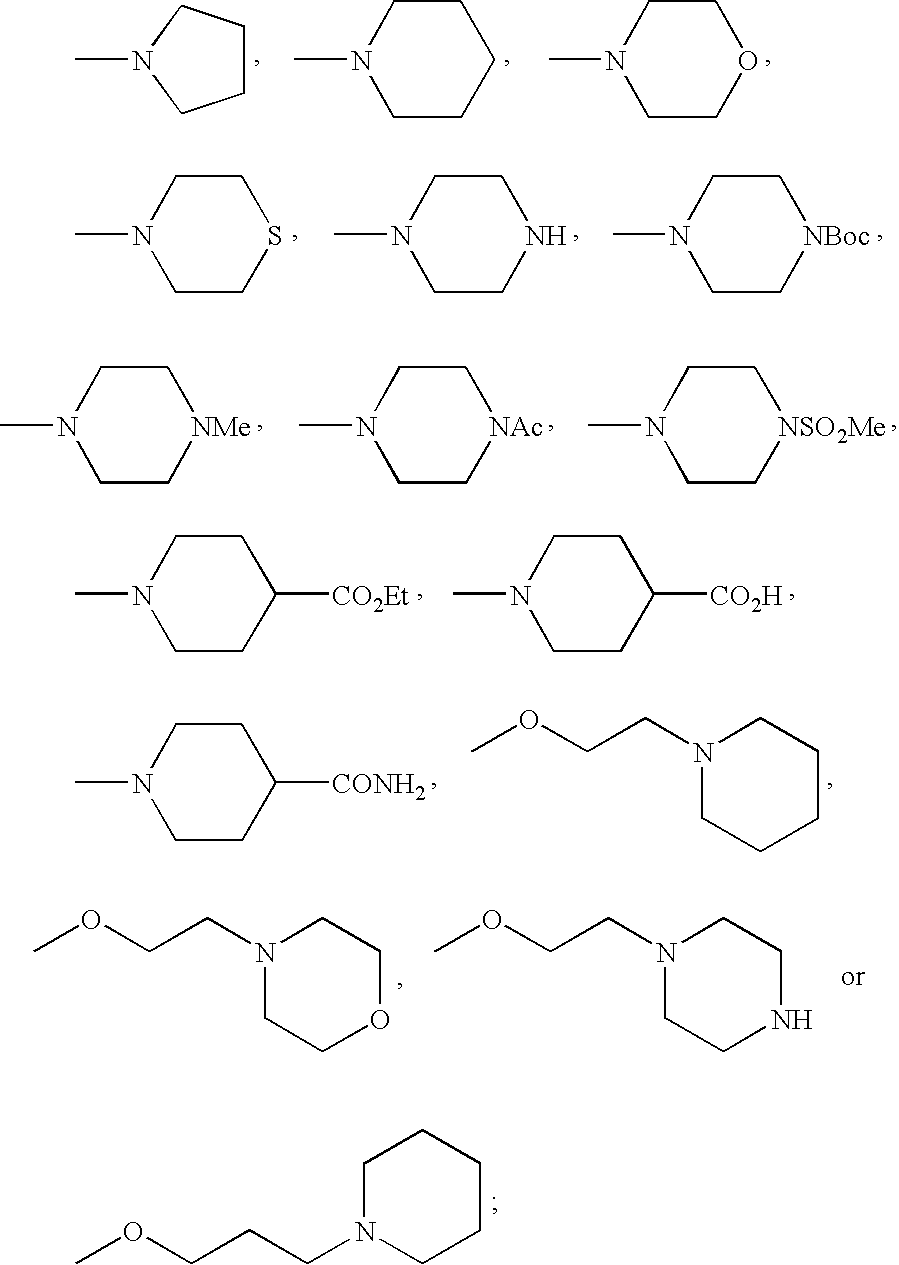
- J is a direct link, —N(C 1-4alkyl)-CO—, —CO—N(C1-4alkyl)-, —O—, —S—, —SO—, —SO2—, —CH2—, —N(C1-4alkyl)- or —N(C1-4alkyl)-SO2—;
- Z is (a) phenyl or naphthyl substituted with 0-3 R groups; (b) a 5- to 6-membered aromatic hetero ring system containing 1-3 N, O or S atoms and having 0-3 ring atoms substituted with 0-3 R groups; or (c) an 8-10 membered fused bicyclic system containing 1-4 heteroatoms selected from N, O and S and 0-3 ring atoms are substituted with 0-3 R groups;
- R is a H, —Cl, —Br, —I, —F, —C 1-6alkyl, —OC1-6alkyl, —OH, —NRaRb, guanidino or amidino, where Ra and Rb are each as set forth above;
- and all pharmaceutically acceptable isomers, salts, hydrates, solvates and prodrug derivatives thereof.
- Definitions
- In accordance with the present invention and as used herein, the following terms are defined with the following meanings, unless explicitly stated otherwise.
- The term “alkenyl” refers to a trivalent straight chain or branched chain unsaturated aliphatic radical. The term “alkinyl” (or “alkynyl”) refers to a straight or branched chain aliphatic radical that includes at least two carbons joined by a triple bond. If no number of carbons is specified alkenyl and alkinyl each refer to radicals having from 2-12 carbon atoms.
- The term “alkyl” refers to saturated aliphatic groups including straight-chain, branched-chain and cyclic groups having the number of carbon atoms specified, or if no number is specified, having up to 12 carbon atoms. The term “cycloalkyl” as used herein refers to a mono-, bi-, or tricyclic aliphatic ring having 3 to 14 carbon atoms and preferably 3 to 7 carbon atoms.
- As used herein, the terms “carbocyclic ring structure” and “C 3-16 carbocyclic mono, bicyclic or tricyclic ring structure” or the like are each intended to mean stable ring structures having only carbon atoms as ring atoms wherein the ring structure is a substituted or unsubstituted member selected from the group consisting of: a stable monocyclic ring which is aromatic ring (“aryl”) having six ring atoms; a stable monocyclic non-aromatic ring having from 3 to 7 ring atoms in the ring; a stable bicyclic ring structure having a total of from 7 to 12 ring atoms in the two rings wherein the bicyclic ring structure is selected from the group consisting of ring structures in which both of the rings are aromatic, ring structures in which one of the rings is aromatic and ring structures in which both of the rings are non-aromatic; and a stable tricyclic ring structure having a total of from 10 to 16 atoms in the three rings wherein the tricyclic ring structure is selected from the group consisting of: ring structures in which three of the rings are aromatic, ring structures in which two of the rings are aromatic and ring structures in which three of the rings are non-aromatic. In each case, the non-aromatic rings when present in the monocyclic, bicyclic or tricyclic ring structure may independently be saturated, partially saturated or fully saturated. Examples of such carbocyclic ring structures include, but are not limited to, cyclopropyl, cyclobutyl, cyclopentyl, cyclohexyl, adamantyl, cyclooctyl, [3.3.0]bicyclooctane, [4.3.0]bicyclononane, [4.4.0]bicyclodecane (decalin), 2.2.2]bicyclooctane, fluorenyl, phenyl, naphthyl, indanyl, adamantyl, or tetrahydronaphthyl (tetralin). Moreover, the ring structures described herein may be attached to one or more indicated pendant groups via any carbon atom which results in a stable structure. The term “substituted” as used in conjunction with carbocyclic ring structures means that hydrogen atoms attached to the ring carbon atoms of ring structures described herein may be substituted by one or more of the substituents indicated for that structure if such substitution(s) would result in a stable compound.
- The term “aryl” which is included with the term “carbocyclic ring structure” refers to an unsubstituted or substituted aromatic ring, substituted with one, two or three substituents selected from loweralkoxy, loweralkyl, loweralkylamino, hydroxy, halogen, cyano, hydroxyl, mercapto, nitro, thioalkoxy, carboxaldehyde, carboxyl, carboalkoxy and carboxamide, including but not limited to carbocyclic aryl, heterocyclic aryl, and biaryl groups and the like, all of which may be optionally substituted. Preferred aryl groups include phenyl, halophenyl, loweralkylphenyl, naphthyl, biphenyl, phenanthrenyl and naphthacenyl.
- The term “arylalkyl” which is included with the term “carbocyclic aryl” refers to one, two, or three aryl groups having the number of carbon atoms designated, appended to an alkyl group having the number of carbon atoms designated. Suitable arylalkyl groups include, but are not limited to, benzyl, picolyl, naphthylmethyl, phenethyl, benzyhydryl, trityl, and the like, all of which may be optionally substituted.
- As used herein, the term “heterocyclic ring” or “heterocyclic ring system” is intended to mean a substituted or unsubstituted member selected from the group consisting of stable monocyclic ring having from 5-7 members in the ring itself and having from 1 to 4 hetero ring atoms selected from the group consisting of N, O and S; a stable bicyclic ring structure having a total of from 7 to 12 atoms in the two rings wherein at least one of the two rings has from 1 to 4 hetero atoms selected from N, O and S, including bicyclic ring structures wherein any of the described stable monocyclic heterocyclic rings is fused to a hexane or benzene ring; and a stable tricyclic heterocyclic ring structure having a total of from 10 to 16 atoms in the three rings wherein at least one of the three rings has from 1 to 4 hetero atoms selected from the group consisting of N, O and S. Any nitrogen and sulfur atoms present in a heterocyclic ring of such a heterocyclic ring structure may be oxidized. Unless indicated otherwise the terms “heterocyclic ring” or “heterocyclic ring system” include aromatic rings, as well as non-aromatic rings which can be saturated, partially saturated or fully saturated non-aromatic rings. Also, unless indicated otherwise the term “heterocyclic ring system” includes ring structures wherein all of the rings contain at least one hetero atom as well as structures having less than all of the rings in the ring structure containing at least one hetero atom, for example bicyclic ring structures wherein one ring is a benzene ring and one of the rings has one or more hetero atoms are included within the term “heterocyclic ring systems” as well as bicyclic ring structures wherein each of the two rings has at least one hetero atom. Moreover, the ring structures described herein may be attached to one or more indicated pendant groups via any hetero atom or carbon atom which results in a stable structure. Further, the term “substituted” means that one or more of the hydrogen atoms on the ring carbon atom(s) or nitrogen atom(s) of the each of the rings in the ring structures described herein may be replaced by one or more of the indicated substituents if such replacement(s) would result in a stable compound. Nitrogen atoms in a ring structure may be quaternized, but such compounds are specifically indicated or are included within the term “a pharmaceutically acceptable salt” for a particular compound. When the total number of O and S atoms in a single heterocyclic ring is greater than 1, it is preferred that such atoms not be adjacent to one another. Preferably, there are no more that 1 O or S ring atoms in the same ring of a given heterocyclic ring structure.
- Examples of monocyclic and bicyclic heterocyclic ring systems, in alphabetical order, are acridinyl, azocinyl, benzimidazolyl, benzofuranyl, benzothiofuranyl, benzothiophenyl, benzoxazolyl, benzthiazolyl, benztriazolyl, benztetrazolyl, benzisoxazolyl, benzisothiazolyl, benzimidazalinyl, carbazolyl, 4aH-carbazolyl, carbolinyl, chromanyl, chromenyl, cinnolinyl, decahydroquinolinyl, 2H,6H-1,5,2-dithiazinyl, dihydrofuro[2,3-b]tetrahydrofuran, furanyl, furazanyl, imidazolidinyl, imidazolinyl, imidazolyl, 1H-indazolyl, indolinyl, indolizinyl, indolyl, 3H-indolyl, isobenzofuranyl, isochromanyl, isoindazolyl, isoindolinyl, isoindolyl, isoquinolinyl (benzimidazolyl), isothiazolyl, isoxazolyl, morpholinyl, naphthyridinyl, octahydroisoquinolinyl, oxadiazolyl, 1,2,3-oxadiazolyl, 1,2,4-oxadiazolyl, 1,2,5-oxadiazolyl, 1,3,4-oxadiazolyl, oxazolidinyl, oxazolyl, oxazolidinyl, pyrimidinyl, phenanthridinyl, phenanthrolinyl, phenazinyl, phenothiazinyl, phenoxathiinyl, phenoxazinyl, phthalazinyl, piperazinyl, piperidinyl, pteridinyl, purinyl, pyranyl, pyrazinyl, pyroazolidinyl, pyrazolinyl, pyrazolyl, pyridazinyl, pryidooxazole, pyridoimidazole, pyridothiazole, pyridinyl, pyridyl, pyrimidinyl, pyrrolidinyl, pyrrolinyl, 2H-pyrrolyl, pyrrolyl, quinazolinyl, quinolinyl, 4H-quinolizinyl, quinoxalinyl, quinuclidinyl, tetrahydrofuranyl, tetrahydroisoquinolinyl, tetrahydroquinolinyl, 6H-1,2,5-thiadazinyl, 1,2,3-thiadiazolyl, 1,2,4-thiadiazolyl, 1,2,5-thiadiazolyl, 1,3,4-thiadiazolyl, thianthrenyl, thiazolyl, thienyl, thienothiazolyl, thienooxazolyl, thienoimidazolyl, thiophenyl, triazinyl, 1,2,3-triazolyl, 1,2,4-triazolyl, 1,2,5-triazolyl, 1,3,4-triazolyl and xanthenyl. Preferred heterocyclic ring structures include, but are not limited to, pyridinyl, furanyl, thienyl, pyrrolyl, pyrazolyl, pyrrolidinyl, imidazolyl, indolyl, benzimidazolyl, 1H-indazolyl, oxazolinyl, or isatinoyl. Also included are fused ring and spiro compounds containing, for example, the above heterocyclic ring structures.
- As used herein the term “aromatic heterocyclic ring system” has essentially the same definition as for the monocyclic and bicyclic ring systems except that at least one ring of the ring system is an aromatic heterocyclic ring or the bicyclic ring has an aromatic or non-aromatic heterocyclic ring fused to an aromatic carbocyclic ring structure.
- The terms “halo” or “halogen” as used herein refer to Cl, Br, F or I substituents. The term “haloalkyl”, and the like, refer to an aliphatic carbon radicals having at least one hydrogen atom replaced by a Cl, Br, F or I atom, including mixtures of different halo atoms. Trihaloalkyl includes trifluoromethyl and the like as preferred radicals, for example.
- The term “methylene” refers to —CH 2—.
- The term “pharmaceutically acceptable salts” includes salts of compounds derived from the combination of a compound and an organic or inorganic acid. These compounds are useful in both free base and salt form. In practice, the use of the salt form amounts to use of the base form; both acid and base addition salts are within the scope of the present invention.
- “Pharmaceutically acceptable acid addition salt” refers to salts retaining the biological effectiveness and properties of the free bases and which are not biologically or otherwise undesirable, formed with inorganic acids such as hydrochloric acid, hydrobromic acid, sulfuric acid, nitric acid, phosphoric acid and the like, and organic acids such as acetic acid, propionic acid, glycolic acid, pyruvic acid, oxalic acid, maleic acid, malonic acid, succinic acid, fumaric acid, tartaric acid, citric acid, benzoic acid, cinnamic acid, mandelic acid, methanesulfonic acid, ethanesulfonic acid, p-toluenesulfonic acid, salicyclic acid and the like.
- “Pharmaceutically acceptable base addition salts” include those derived from inorganic bases such as sodium, potassium, lithium, ammonium, calcium, magnesium, iron, zinc, copper, manganese, aluminum salts and the like. Particularly preferred are the ammonium, potassium, sodium, calcium and magnesium salts. Salts derived from pharmaceutically acceptable organic nontoxic bases include salts of primary, secondary, and tertiary amines, substituted amines including naturally occurring substituted amines, cyclic amines and basic ion exchange resins, such as isopropylamine, trimethylamine, diethylamine, triethylamine, tripropylamine, ethanolamine, 2-diethylaminoethanol, trimethamine, dicyclohexylamine, lysine, arginine, histidine, caffeine, procaine, hydrabamine, choline, betaine, ethylenediamine, glucosamine, methylglucamine, theobromine, purines, piperizine, piperidine, N-ethylpiperidine, polyamine resins and the like. Particularly preferred organic nontoxic bases are isopropylamine, diethylamnine, ethanolamine, trimethamine, dicyclohexylamine, choline, and caffeine.
- “Biological property” for the purposes herein means an in vivo effector or antigenic function or activity that is directly or indirectly performed by a compound of this invention that are often shown by in vitro assays. Effector functions include receptor or ligand binding, any enzyme activity or enzyme modulatory activity, any carrier binding activity, any hormonal activity, any activity in promoting or inhibiting adhesion of cells to an extracellular matrix or cell surface molecules, or any structural role. Antigenic functions include possession of an epitope or antigenic site that is capable of reacting with antibodies raised against it.
- In the compounds of this invention, carbon atoms bonded to four non-identical substituents are asymmetric. Accordingly, the compounds may exist as diastereoisomers, enantiomers or mixtures thereof. The syntheses described herein may employ racemates, enantiomers or diastereomers as starting materials or intermediates. Diastereomeric products resulting from such syntheses may be separated by chromatographic or crystallization methods, or by other methods known in the art. Likewise, enantiomeric product mixtures may be separated using the same techniques or by other methods known in the art. Each of the asymmetric carbon atoms, when present in the compounds of this invention, maybe in one of two configurations (R or S) and both are within the scope of the present invention.
- Compounds
- The invention provides a compound of general formula (I):
- A—Q—D—E—G—J—Z (I)
- wherein:
- A is (R 1a, R1b, R1c)N⊕—;
- R 1a, R1b and R1c are independently C1-6alkyl, haloC1-6alkyl, C3-8cycloalkyl, C1-6alkylhydroxy, C1-6alkylalkoxy, C1-6alkylamine, C1-6alkylcarboxyl, C1-6alkylester or C1-6alkylamide; or R1a and R1b taken together with the nitrogen atom to which they are attached form a substituted or unsubstituted 3 to 8 membered heterocyclic or heteroaromatic quaternary amidino group, which optionally contains heteroatoms of N, O or S; R1a or R1b is optionally substituted with halo, alkyl, hydroxy, alkoxy, amide, ester, acid, alkylalkoxy, amino, alkenyl, alkynyl, nitro and cyano;
- Q is a direct link or —CH 2—;
- D is (a) phenyl or naphthyl substituted with 0-4 R 1 substituents; or (b) monocyclic or bicyclic hetero ring system having from 5 to 10 ring atoms, wherein 1-4 ring atoms of the ring system are selected from N, O and S, and wherein the ring system may be substituted from 0-3 R1 substituents; the N atom of the ring may be quaternized by oxidation or alkylation with R1a;
- R 1 is a H, —Cl, —Br, —I, —F, —C1-6alkyl, haloC1-6alkyl, —OH, —OC1-6alkyl, —OhaloC1-6alkyl, —NO2, —CN, —COOH, —COOC1-6alkyl, —CONH2, —CONHC1-6alkyl, —CONC1-6alkylC1-6alkyl, —OC1-6alkylCOOH, —OC1-6alkylCOOC1-6alkyl, —OC1-6alkylCONRaRb, —NRaC1-6alkylCOOH, —NRaC1-6alkylCOOC1-6alkyl, —NRaC1-6alkylCONRaRb, —NRaRb, —NHSO2C1-6alkyl, —NHCOC1-6alkyl, —NHCOC1-6alkylNRaRb, —SC1-6alkyl, —SO2C1-6alkyl, SOC1-6alkyl or —SO2NRaRb;
- R a and Rb are independently H, —C1-6alkyl, haloC1-6alkyl, —C2-6alkenyl, —C2-6alkynyl C3-8cycloalkyl, C1-6alkylhydroxy, C1-6alkylalkoxy, C1-6alkylamine, C1-6alkylcarboxyl, C1-6alkylester or C1-6alkylamide; or Ra and Rb taken together with the nitrogen to which they are attached forms a heterocyclic or heteroaromatic amine group and which optionally contains heteroatoms of N, O or S and which is optionally substituted with —BOC, alkyl, acyl, —SO2C1-6alkyl, —CO2C1-6alkyl, —COOH, or —CONRaRb;
- E is a direct link, —CH 2—, —O—, —N(C1-4alkyl)-, —N(C1-4alkyl)CH2—, —CH2N(C1-4alkyl)-, —CO—N(C1-4alkyl)-, —N(C1-4alkyl)-CO—, —CH2CO—NC1-4alkyl-, —OCO—NC1-4alkyl- or —NHCO—NC1-4alkyl-;
- G is (a) a phenylene group wherein the ring carbon atoms of the phenylene group are independently substituted with R 2, R3, R4 and R5 groups; (b) a 3-8 membered saturated, partially unsaturated or aromatic monocyclic- hetero ring system containing 1-4 heteroatoms selected from N, O and S, wherein 0-4 ring atoms may be substituted with R2, R3, R4 and R5 groups; or (c) an 8-10 membered fused bicyclic ring system, containing 1-4 heteroatoms selected from N, O and S, wherein 0-4 ring atoms may be substituted with R2, R3, R4 and R5 groups;
- R 2, R3, R4 and R5 groups are independently a H, —F, —Cl, —Br, —CH3, —CF3, —OH, —OMe, —OCF3, —NH2, —NHMe, —NMe2, —OCH2CH2OH, —OCH2CH2OMe, —OCH2CH2NH2, —OCH2CH2NHMe, —OCH2CH2NMe2, —OCH2CH2CH2OMe, —OCH2CH2CH2NMe2, —OCH2COOH, —OCH2COOEt, —OCH2CH2COOH, —OCH2CH2COOEt, —NHCH2COOH, —NHCH2COOEt, —NMeCH2COOH, —NMeCH2COOEt, NMeCH2CH2COOH, —NMeCH2CH2COOEt, —NMeEt, —NMeCH2CH2OH, —NMeCH2CH2OMe, —NO2, —NHAc, —NHSO2Me, —SMe, —SO2Me, —SOMe, —SO2NH2,
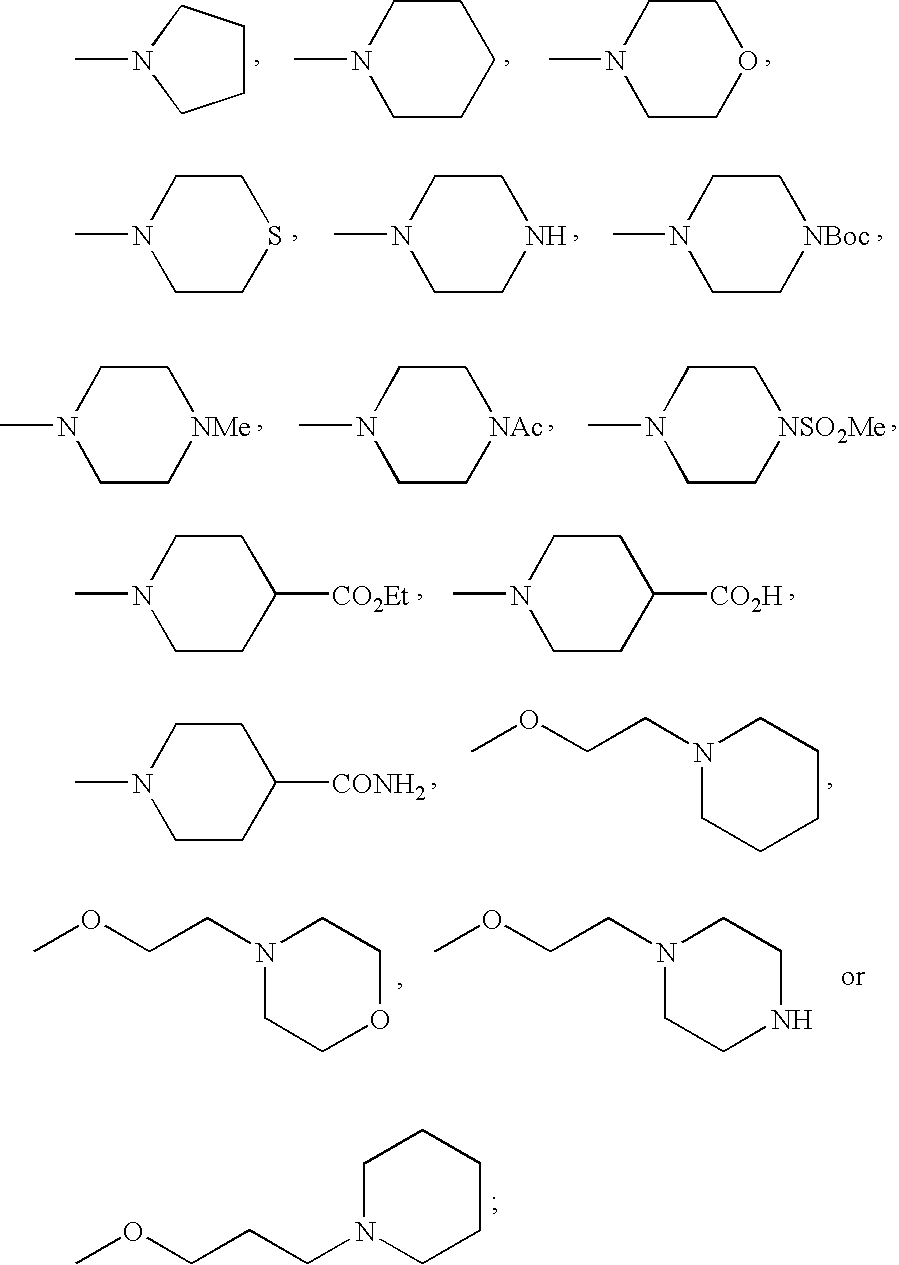
- J is a direct link, —N(C 1-4alkyl)-CO—, —CO—N(C1-4alkyl)-, —O—, —S—, —SO—, —SO2—, —CH2—, —N(C1-4alkyl)- or —N(C1-4alkyl)-SO2—;
- Z is (a)phenyl or naphthyl substituted with 0-3 R groups; (b) a 5- to 6-membered aromatic hetero ring system containing 1-3 N, O or S atoms and having 0-3 ring atoms substituted with 0-3 R groups; or (c) an 8-10 membered fused bicyclic system containing 1-4 heteroatoms selected from N, O and S and 0-3 ring atoms are substituted with 0-3 R groups;
- R is a H, —Cl, —Br, —I, —F, —C 1-6alkyl, —OC1-6alkyl, —OH, —NRaRb, guanidino or amidino, where Ra and Rb are each as set forth above;
- and all pharmaceutically acceptable isomers, salts, hydrates, solvates and prodrug derivatives thereof.
- The invention further provides a compound of formula I as follows:
- A—Q—D—E—G—J—Z (I)
- wherein:
- A is: (R 1a, R1b, R1c)N⊕—;
- R 1a, R1b and R1c are independently —Me, —Et, —(CH2)2OH, —(CH2)2OMe, —(CH2)2NH2, —(CH2)2NHMe, —(CH2)2NMe2, —(CH2)2CO2H, —(CH2)2CO2Me, —(CH2)2CONMe2, —(CH2)2CONHMe, —(CH2)2CONH2, —CH2CO2H, —CH2CO2Me, —CH2CONMe2, —CH2CONHMe or —CH2CONH2; or R1a and R1b together with the N atom to which they are attached can form a 3-6 membered saturated ring, including:
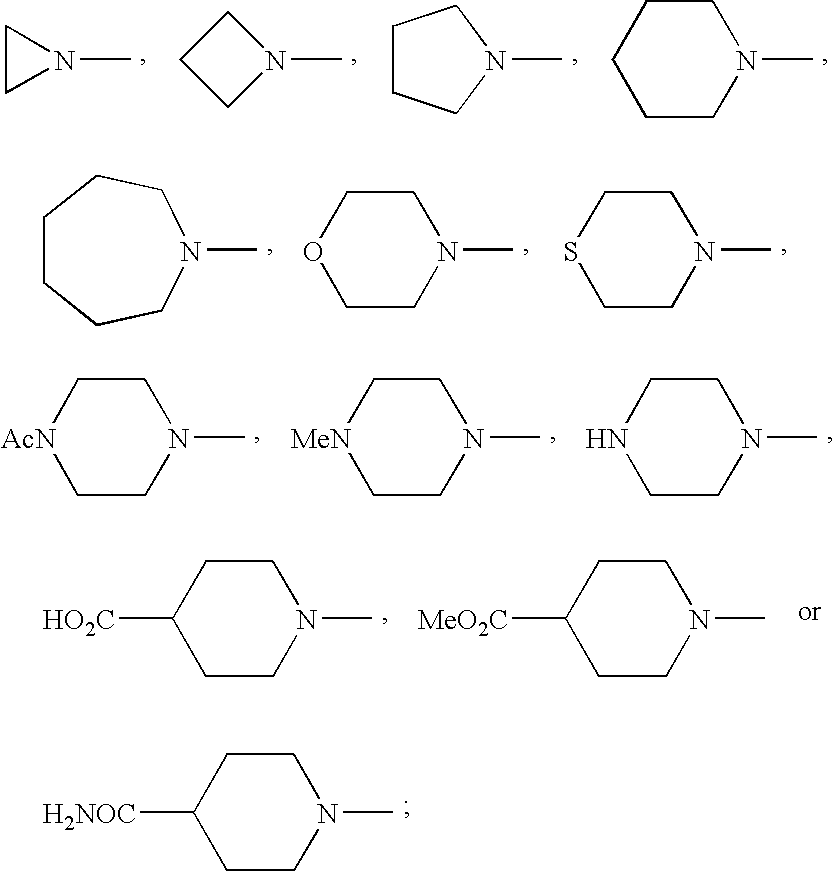
- the ring system may be optionally substituted with halo, alkyl, OH, amino, nitro, cyano, alkoxy, alkyl-acid, alkyl-ester or alkyl-amide groups;
- Q is a direct link or —CH 2—;

- wherein the N atom of the ring may be quaternized by oxidation or alkylation with R 1a; the ring atoms of D may be substituted with 0-4 R1 groups;
- R 1 groups are independently a H, —F, —Cl, —Br, —Me, —CF3, —OH, —OMe, —OCF3, —OEt, —OPrn, —OPri, —OBut, —NO2, —CN, —CO2H, —CO2Me, —CONH2, —CONHMe, —CONMe2, —OCH2CO2H, —OCH2CO2Me, —NH2, —NHMe, —NMe2, —NHSO2Me, —NHCOMe, —NHCO(CH2)2NH2, —SMe, —SO2Me, —SOMe, or —SO2NH2;
- E is —CH 2NH—, —CONH—, —NHCO—, —CONMe— or —NMeCO—;
- G is

- G may be optionally substituted by R 2, R3, R4 and R5 groups, which are independently a H, —F, —Cl, —Br, —CH3, —CF3, —OH, —OMe, —OCF3, —NH2, —NHMe, —NMe2, —OCH2CH2OH, —OCH2CH2OMe, —OCH2CH2NH2, —OCH2CH2NHMe, —OCH2CH2NMe2, —OCH2CH2CH2OMe, —OCH2CH2CH2NMe2, —OCH2COOH, —OCH2COOEt, —OCH2CH2COOH, —OCH2CH2COOEt, —NHCH2COOH, —NHCH2COOEt, —NMeCH2COOH, —NMeCH2COOEt, NMeCH2CH2COOH, —NMeCH2CH2COOEt, —NMeEt, —NMeCH2CH2OH, —NMeCH2CH2OMe, —NO2, —NHAc, —NHSO2Me, —SMe, —SO2Me, —SOMe, —SO2NH2,

- J is —CONH— or —NHCO—;
- Z is (a) phenyl substituted with 0-3 R groups; or (b) a 5 or 6-membered aromatic heterocyclic ring system containing 1-3 N atoms and having 0-3 ring atoms substituted with 0-3 R groups;
- R is independently H, halo, Me, —OMe, —Et, —OH, —NH 2, —CH2NH2, —OCH2CO2Me, —OCH2CO2H, —OCH2CONH2, —SO2Me, —SO2NH2, —NO2, —CN, —OCH2CONMe2, —CH2NMe2, —C(═NH)NH2 or —C(═NH)NHOH;
- and all pharmaceutically acceptable isomers, salts, hydrates, solvates and prodrug derivatives thereof.
- The invention further provides a compound of formula I having the following structure:

- wherein:
- A is

- R 1′, R1″, and R1′″ are independently a H, —F, —Cl, —Br, —Me, —CF3, —OH, —OMe, —OCF3, —OEt, —OPrn, —OPri, —OBut, —NO2, —CN, —CO2H, —CO2Me, —CONH2, —CONHMe, —CONMe2, —OCH2CO2H, —OCH2CO2Me, —NH2, —NHMe, —NMe2, —NHSO2Me, —NHCOMe, —NHCO(CH2)2NH2, —SMe, —SO2Me, —SOMe or —SO2NH2;
- R 2, R3, and R4 are independently a H, —F, —Cl, —Br, —CH3, —CF3, —OH, —OMe, —OCF3, NH2, —NHMe, —NMe2, —OCH2CH2OH, —OCH2CH2OMe, —OCH2CH2NH2, —OCH2CH2NHMe, —OCH2CH2NMe2, —OCH2CH2CH2OMe, —OCH2CH2CH2NMe2, —OCH2COOH, —OCH2COOEt, —OCH2CH2COOH, —OCH2CH2COOEt, —NHCH2COOH, —NHCH2COOEt, —NMeCH2COOH, —NMeCH2COOEt, NMeCH2CH2COOH, —NMeCH2CH2COOEt, —NMeEt, —NMeCH2CH2OH, —NMeCH2CH2OMe, —NO2, —NHAc, —NHSO2Me, —SMe, —SO2Me, —SOMe, —SO2NH2,

- R is a H, —F, —Cl, —Br, —OMe, —OH, —NH 2 or —Me,
- and all pharmaceutically acceptable isomers, salts, hydrates, solvates and prodrug derivatives thereof.
- The invention further provides a compound of formula I having the following structure:
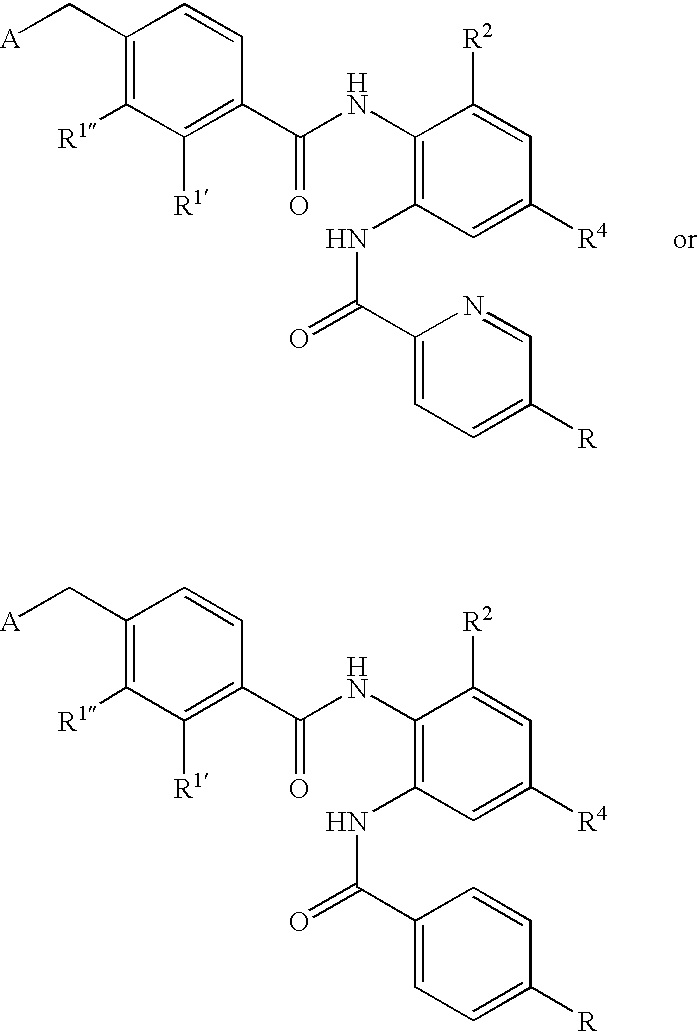
- wherein:
- A is

- R 1′ and R1″ are independently a H, —F, —Cl, —Br, —Me, —CF3, —OH, —OMe, —OCF3, —OEt, —OPrn, —OPri, —OBut, —NO2, —CN, —CO2H, —CO2Me, —CONH2, —CONHMe, —CONMe2, —OCH2CO2H, —OCH2CO2Me, —NH2, —NHMe, —NMe2, —NHSO2Me, —NHCOMe, —NHCO(CH2)2NH2, —SMe, —SO2Me, —SOMe or —SO2NH2;
- R 2 and R4 are independently a H, —F, —Cl, —Br, —CH3, —CF3, —OH, —OMe, —OCF3, —NH2, —NHMe, —NMe2, —OCH2CH2OH, —OCH2CH2OMe, —OCH2CH2NH2, —OCH2CH2NHMe, —OCH2CH2NMe2, —OCH2CH2CH2OMe, —OCH2CH2CH2NMe2—OCH2COOH, —OCH2COOEt, —OCH2CH2COOH, —OCH2CH2COOEt, —NHCH2COOH, —NHCH2COOEt, —NMeCH2COOH, —NMeCH2COOEt, NMeCH2CH2COOH, —NMeCH2CH2COOEt, —NMeEt, —NMeCH2CH2OH, —NMeCH2CH2OMe, —NO2, —NHAc, —NHSO2Me, —SMe, —SO2Me, —SOMe, —SO2NH2,
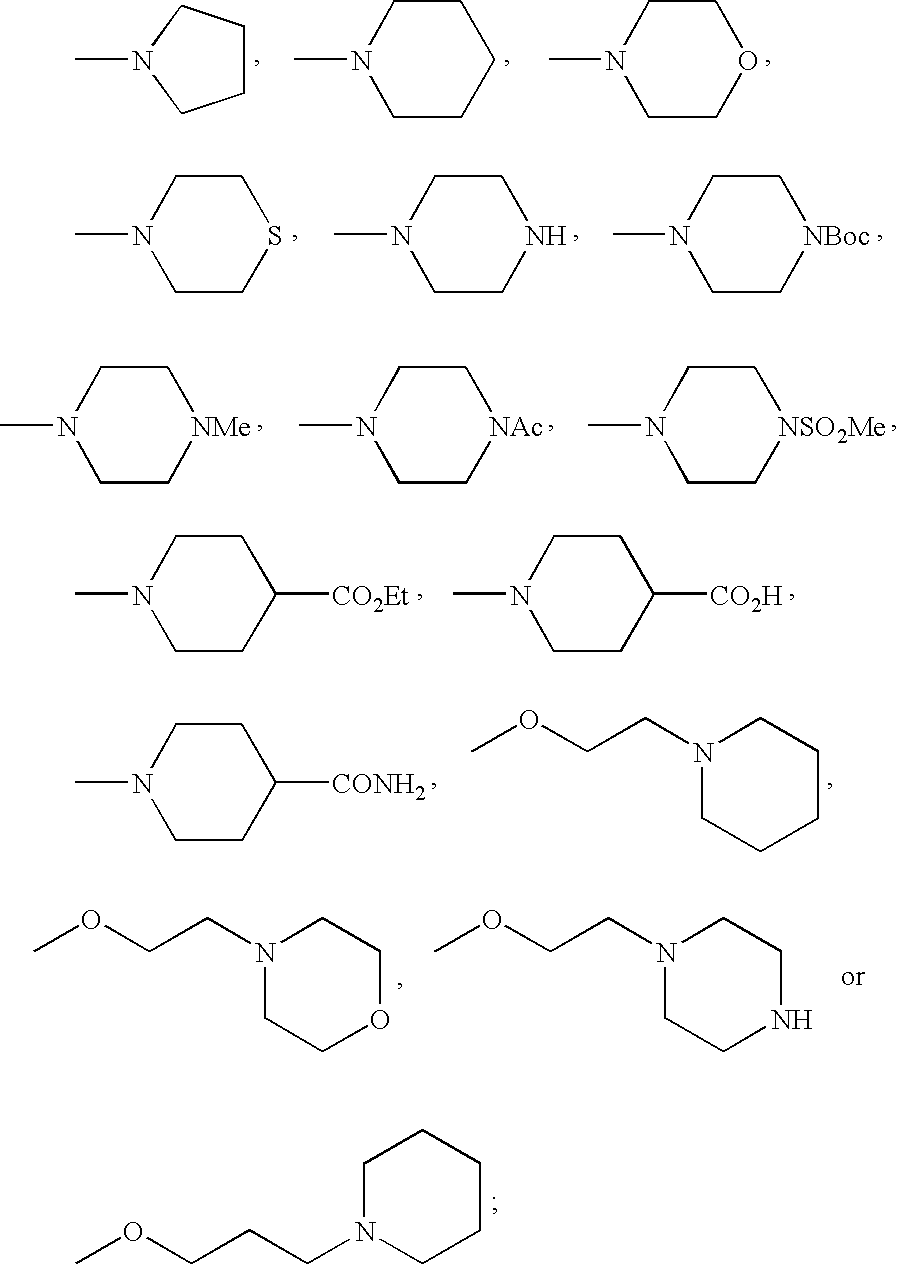
- R is a H, —F, —Cl or —Br,
- and all pharmaceutically acceptable isomers, salts, hydrates, solvates and prodrug derivatives thereof
- The invention further provides a compound of formula I having the following structure:
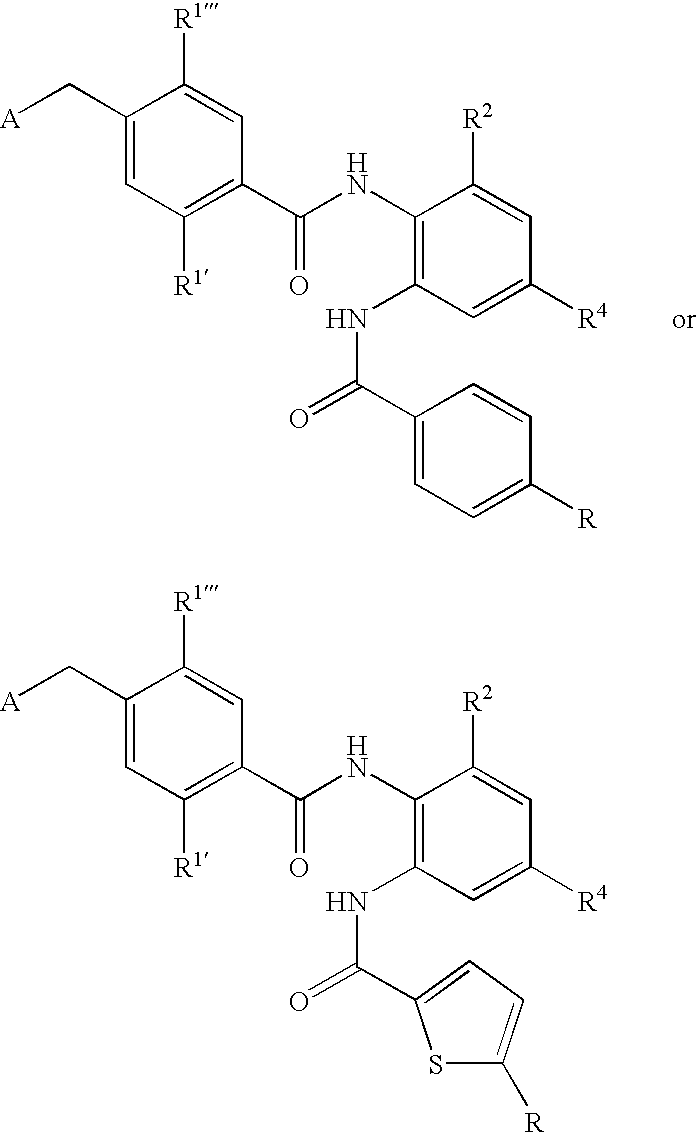
- wherein:
- A is

- R 1′ and R1″ are independently a H, —F, —Cl, —Br, —Me, —CF3, —OH, —OMe, —OCF3, —OEt, —OPrn, —OPri, —OBut, —NO2, —CN, —CO2H, —CO2Me, —CONH2, —CONHMe, —CONMe2, —OCH2CO2H, —OCH2CO2Me, —NH2, —NHMe, —NMe2, —NHSO2Me, —NHCOMe, —NHCO(CH2)2NH2, —SMe, —SO2Me, —SOMe or —SO2NH2;
- R 2 and R4 are independently a H, —F, —Cl, —Br, —CH3, —CF3, —OH, —OMe, —OCF3, —NH2, —NHMe, —NMe2, —OCH2CH2OH, —OCH2CH2OMe, —OCH2CH2NH2, —OCH2CH2NHMe, —OCH2CH2NMe2, —OCH2CH2CH2OMe, —OCH2CH2CH2NMe2, —OCH2COOH, —OCH2COOEt, —OCH2CH2COOH, —OCH2CH2COOEt, —NHCH2COOH, —NHCH2COOEt, —NMeCH2COOH, —NMeCH2COOEt, NMeCH2CH2COOH, —NMeCH2CH2COOEt, —NMeEt, —NMeCH2CH2OH, —NMeCH2CH2OMe, —NO2, —NHAc, —NHSO2Me, —SMe, —SO2Me, —SOMe, —SO2NH2,

- R is H, —F, —Cl, or —Br,
- and all pharmaceutically acceptable isomers, salts, hydrates, solvates and prodrug derivatives thereof.
- The invention further provides a compound of formula I having the following structure:
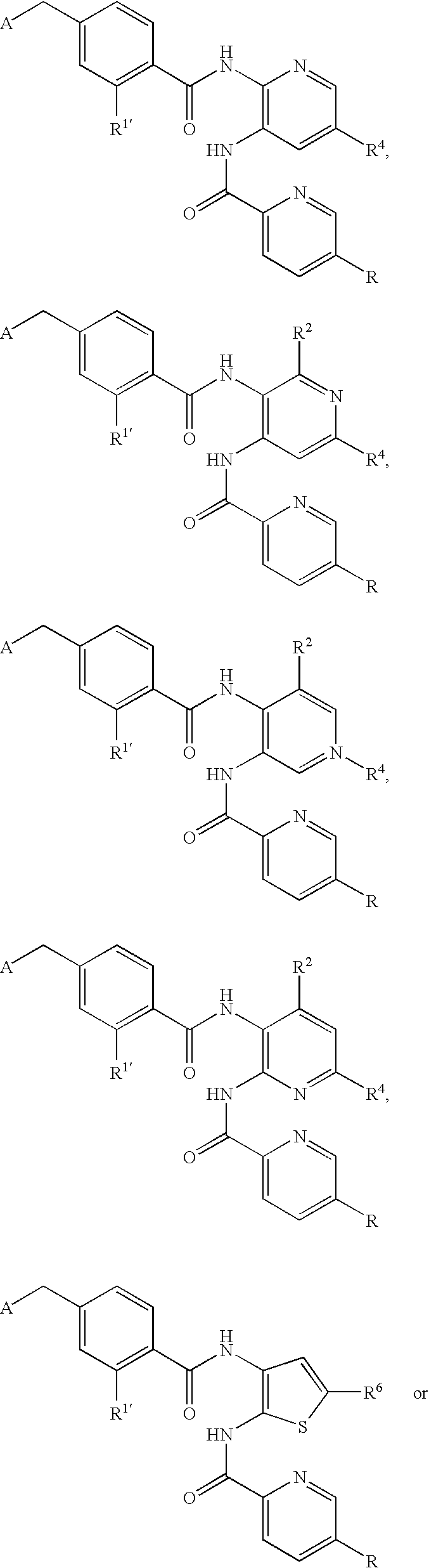

- wherein:
- A is

- R 1′ is a H, —F, —Cl, —Br, —Me, —CF3, —OH, —OMe, —OCF3, —OEt, —OPrn, —OPri, —OBu, —NO2, —CN, —CO2H, —CO2Me, —CONH2, —CONHMe, —CONMe2, —OCH2CO2H, —OCH2CO2Me, —NH2, —NHMe, —NMe2, —NHSO2Me, —NHCOMe, —NHCO(CH)2NH2, —SMe, —SO2Me, —SOMe or —SO2NH2;
- R 2, R4 and R6 are independently a H, —F, —Cl, —Br, —CH3, —CF3, —OH, —OMe, —OCF3, —NH2, —NHMe, —NMe2, —OCH2CH2OH, —OCH2CH2OMe, —OCH2CH2NH2, —OCH2CH2NHMe, —OCH2CH2NMe2, —OCH2CH2CH2OMe, —OCH2CH2CH2NMe2, —OCH2COOH, —OCH2COOEt, —OCH2CH2COOH, —OCH2CH2COOEt, —NHCH2COOH, —NHCH2COOEt, —NMeCH2COOH, —NMeCH2COOEt, NMeCH2CH2COOH, —NMeCH2CH2COOEt, —NMeEt, —NMeCH2CH2OH, —NMeCH2CH2OMe, —NO2, —NHAc, —NHSO2Me, —SMe, —SO2Me, —SOMe, —SO2NH2,

- R is a H, —F, —Cl or —Br,
- and all pharmaceutically acceptable isomers, salts, hydrates, solvates and prodrug derivatives thereof.
- The invention further provides a compound of formula I having the following structure:
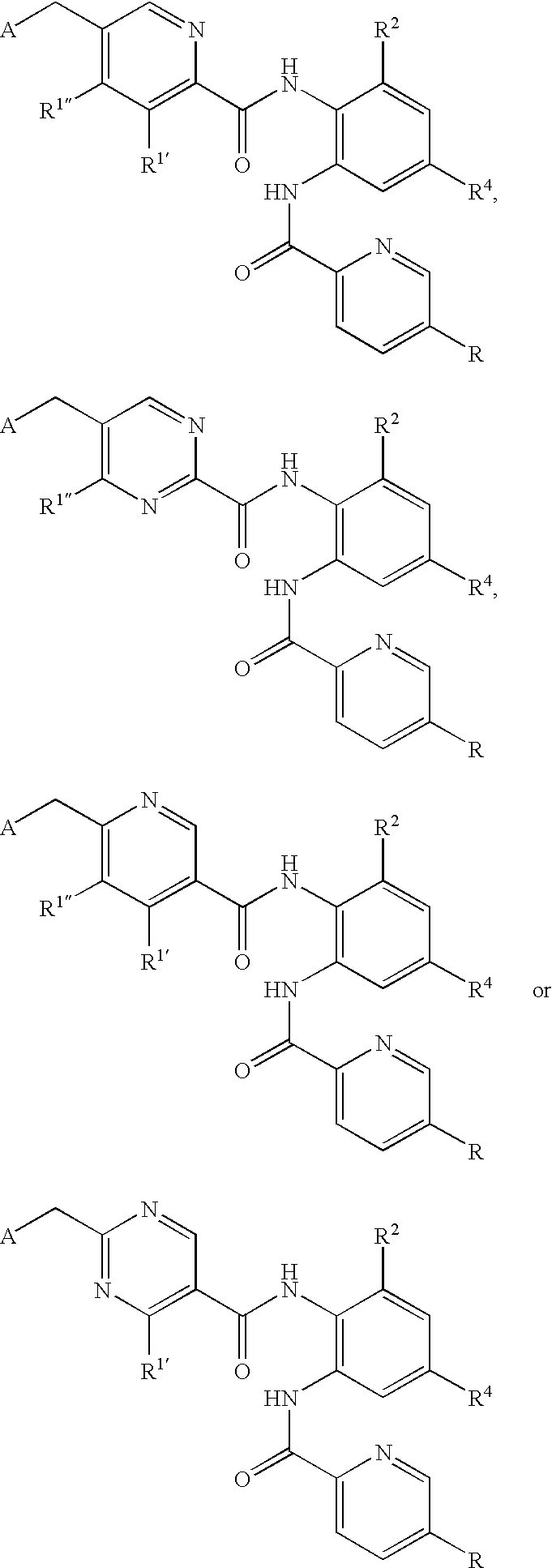
- wherein:
- A is

- R 1′ and R1″ are independently a H, —F, —Cl, —Br, —Me, —CF3, —OH, —OMe, —OCF3, —OEt, —OPrn, —OPri, —OBut, —NO2, —CN, —CO2H, —CO2Me, —CONH2, —CONHMe, —CONMe2, —OCH2CO2H, —OCH2CO2Me, —NH2, —NHMe, —NMe2, —NHSO2Me, —NHCOMe, —NHCO(CH2)2NH2, —SMe, —SO2Me, —SOMe or —SO2NH2;
- R 2 and R4 are independently a H, —F, —Cl, —Br, —CH3, —CF3, —OH, —OMe, —OCF3, —NH2, —NHMe, —NMe2, —OCH2CH2OH, —OCH2CH2OMe, —OCH2CH2NH2, —OCH2CH2NHMe, —OCH2CH2NMe2, —OCH2CH2CH2OMe, —OCH2CH2CH2NMe2, —OCH2COOH, —OCH2COOEt, —OCH2CH2COOH, —OCH2CH2COOEt, —NHCH2COOH, —NHCH2COOEt, —NMeCH2COOH, —NMeCH2COOEt, NMeCH2CH2COOH, —NMeCH2CH2COOEt, —NMeEt, —NMeCH2CH2OH, —NMeCH2CH2OMe, —NO2, —NHAc, —NHSO2Me, —SMe, —SO2Me, —SOMe, —SO2NH2,
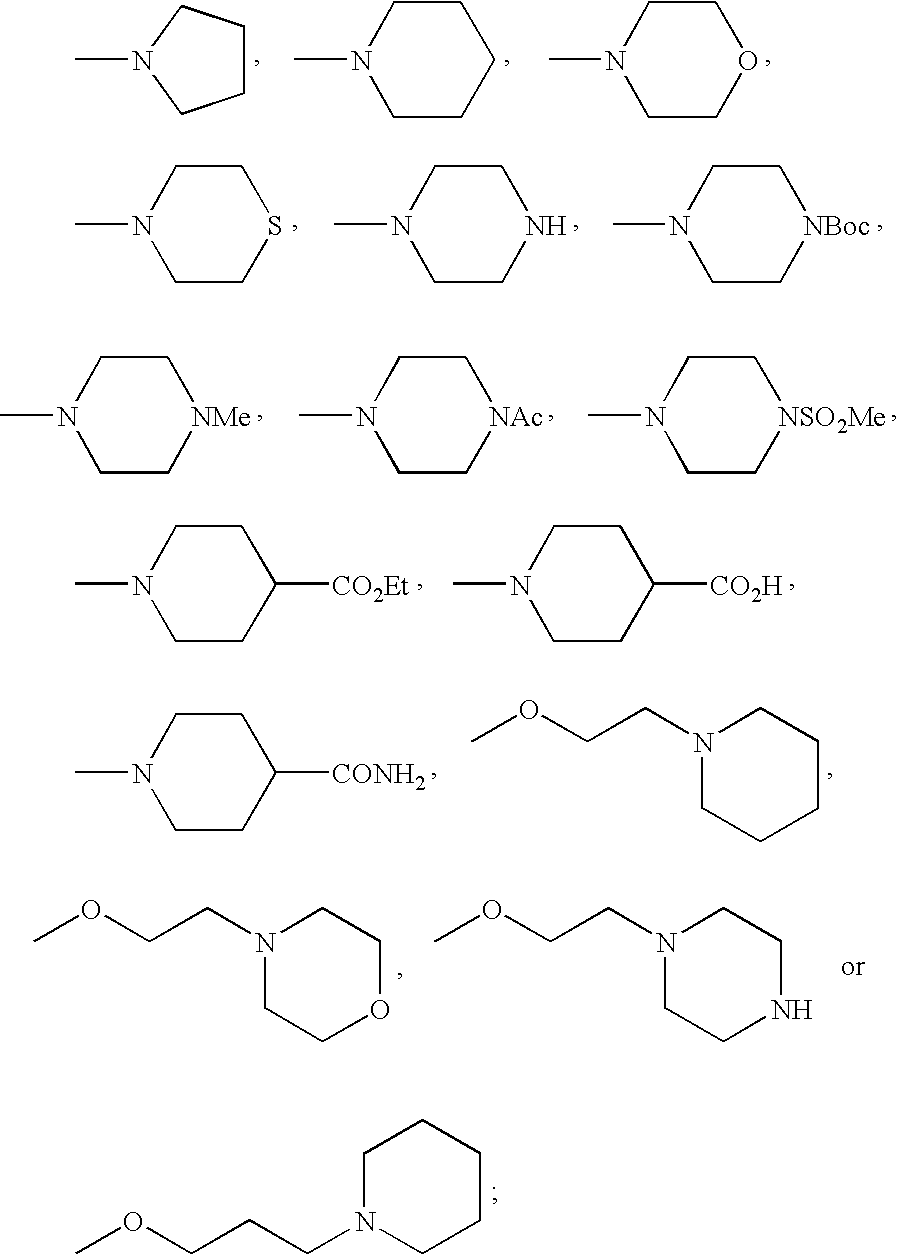
- R is a H, —F, —Cl or —Br,
- and all pharmaceutically acceptable isomers, salts, hydrates, solvates and prodrug derivatives thereof.
- The invention further provides a compound of formula I having the following structure:

- wherein:
- A is
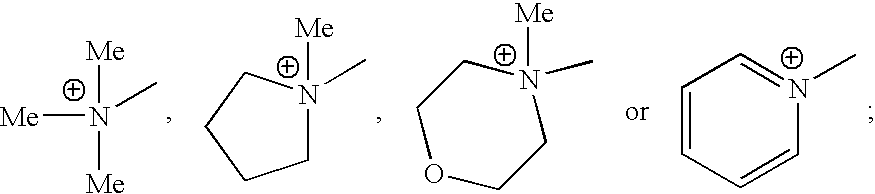
- R 1′ is a H, —F, —Cl, —Br, —Me, —CF3, —OH, —OMe, —OCF3, —OEt, —OPrn, —OPri, —OBut, —NO2, —CN, —CO2H, —CO2Me, —CONH2, —CONHMe, —CONMe2, —OCH2CO2H, —OCH2CO2Me, —NH2, —NHMe, —NMe2, —NHSO2Me, —NHCOMe, —NHCO(CH2)2NH2, —SMe, —SO2Me, —SOMe or —SO2NH2;
- R 4 is a H, —F, —Cl, —Br, —Me, —OH, —OMe, —OCF3, —OCH2COOH, —OCH2COOEt, —NO2, —NHAc, —NHSO2Me, —SMe, —SO2Me, —SOMe or —SO2NH2,
- and all pharmaceutically acceptable isomers, salts, hydrates, solvates and prodrug derivatives thereof
- The invention further provides a compound of formula I having the following structure:
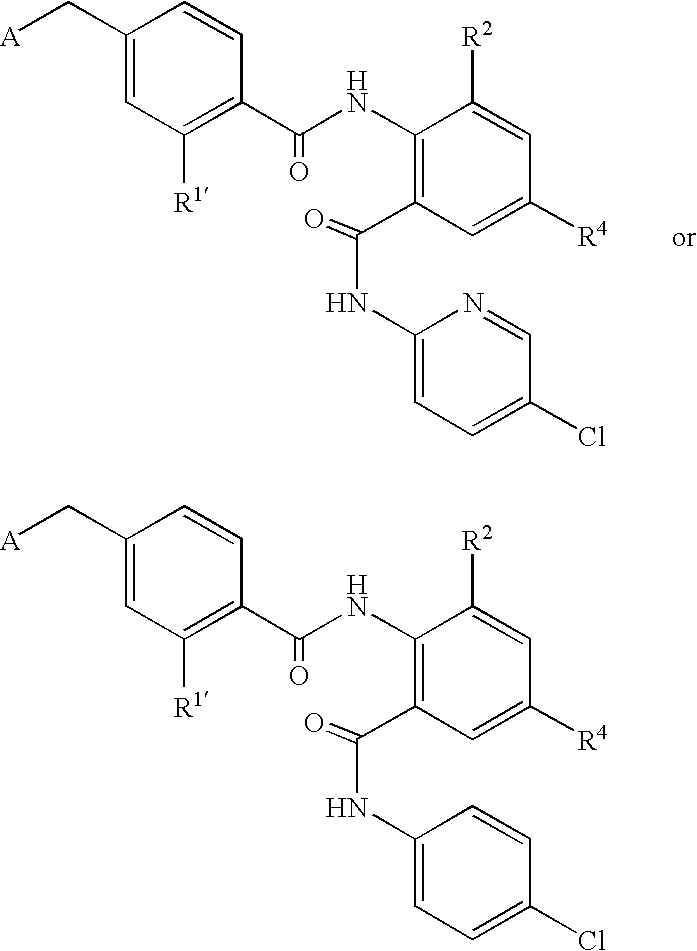
- wherein:
- A is

- R 1′ is a H, —F, —Cl, —Br, —Me, —CF3, —OH, —OMe, —OCF3, —OEt, —OPrn, —OPri, —OBut, —NO2, —CN, —CO2H, —CO2Me, —CONH2, —CONHMe, —CONMe2, —OCH2CO2H, —OCH2CO2Me, —NH2, —NHMe, —NMe2, —NHSO2Me, —NHCOMe, —NHCO(CH2)2NH2, —SMe, —SO2Me, —SOMe or —SO2NH2;
- R 2, and R4 are independently a H, —F, —Cl, —Br, —CH3, —CF3, —OH, —OMe, —OCF3, —NH2, —NHMe, —NMe2, —OCH2CH2OH, —OCH2CH2OMe, —OCH2CH2NH2, —OCH2CH2NHMe, —OCH2CH2NMe2, —OCH2CH2CH2OMe, —OCH2CH2CH2NMe2, —OCH2COOH, —OCH2COOEt, —OCH2CH2COOH, —OCH2CH2COOEt, —NHCH2COOH, —NHCH2COOEt, —NMeCH2COOH, —NMeCH2COOEt, NMeCH2CH2COOH, —NMeCH2CH2COOEt, —NMeEt, —NMeCH2CH2OH, —NMeCH2CH2OMe, —NO2, —NHAc, —NHSO2Me, —SMe, —SO2Me, —SOMe, —SO2NH2,
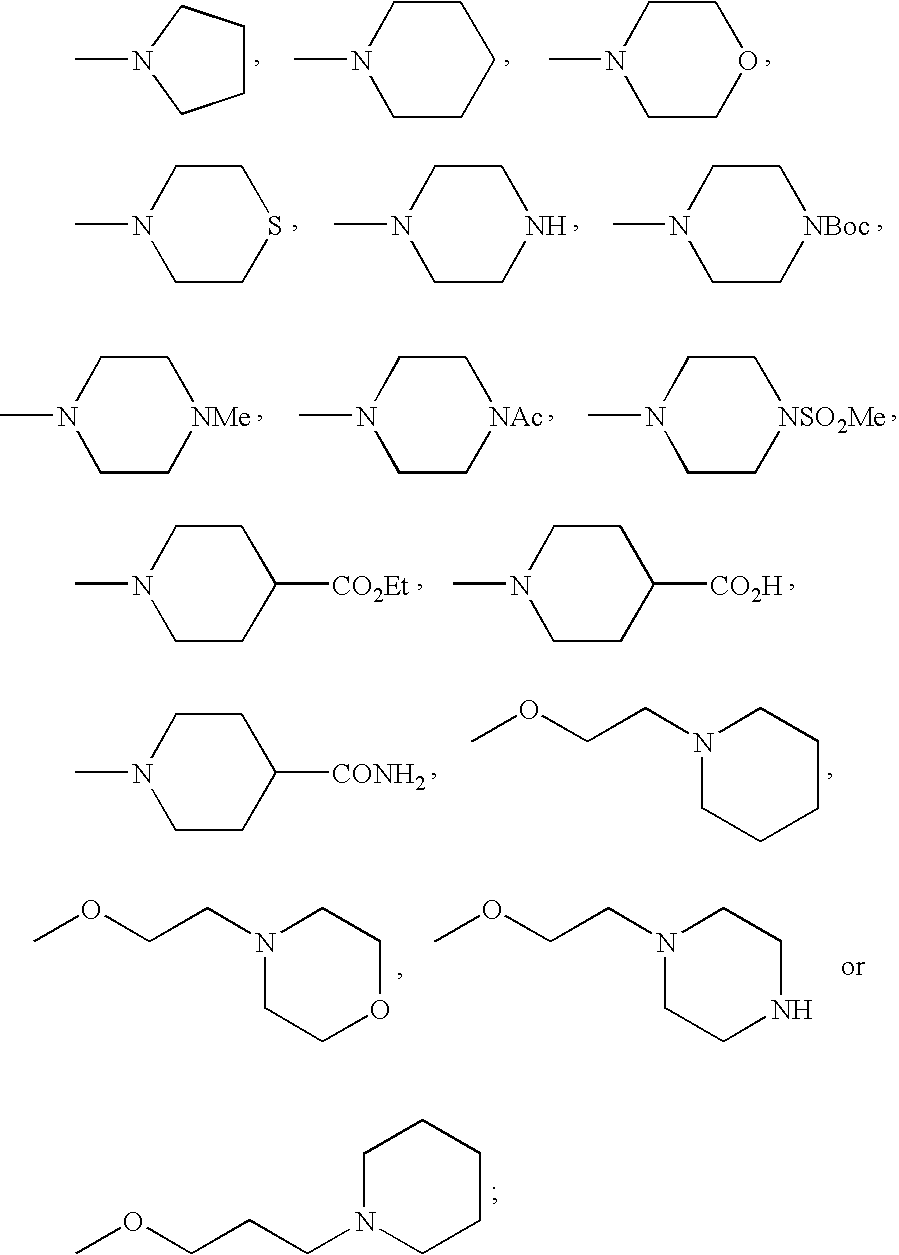
- and all pharmaceutically acceptable isomers, salts, hydrates, solvates and prodrug derivatives thereof.
- The invention further provides a compound of formula I having the following structure:

- wherein:
- A is
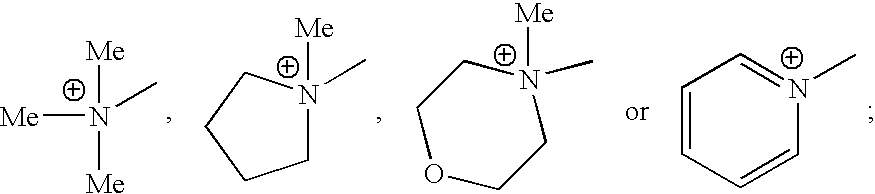
- R 1′ is a H, —F, —Cl, —Br, —Me, —CF3, —OH, —OMe, —OCF3, —OEt, —OPrn, —OPri, —OBut, —NO2, —CN, —CO2H, —CO2Me, —CONH2, —CONHMe, —CONMe2, —OCH2CO2H, —OCH2CO2Me, —NH2, —NHMe, —NMe2, —NHSO2Me, —NHCOMe, —NHCO(CH2)2NH2, —SMe, —SO2Me, —SOMe or —SO2NH2;
- R 3 and R4 is a H, —F, —Cl, —Br, —Me, —OH, —OMe, —OCF3, —OCH2COOH, —OCH2COOEt, —NO2, —NHAc, —NHSO2Me, —SMe, —SO2Me, —SOMe or —SO2NH2,
- and all pharmaceutically acceptable isomers, salts, hydrates, solvates and prodrug derivatives thereof.
- The invention further provides a compound of formula I having the following structure:

- wherein:
- A—Q—D together is selected from:

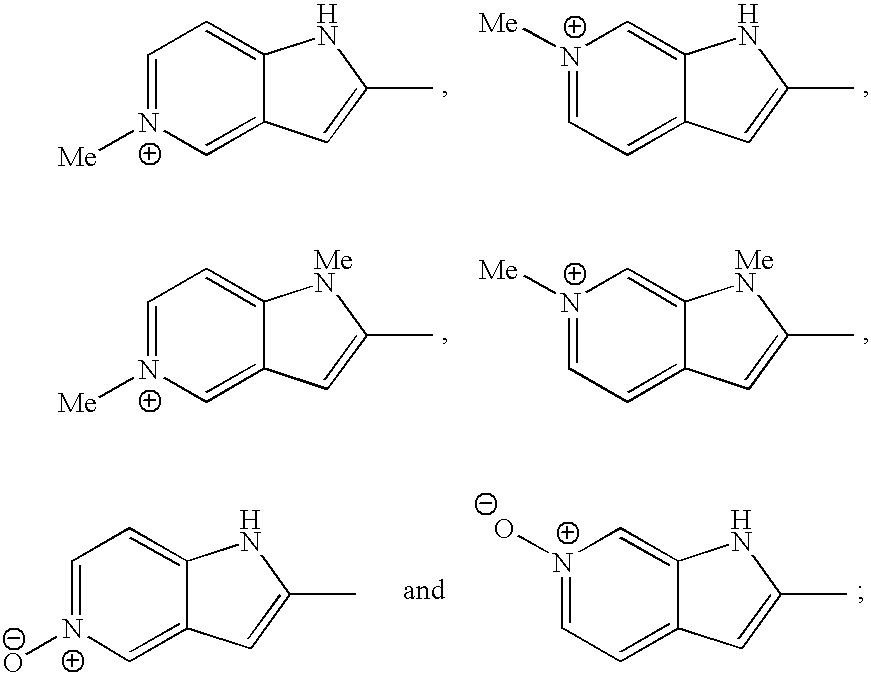
- R 2, R3 and R4 are independently a H, —F, —Cl, —Br, —CH3, —CF3, —OH, —OMe, —OCF3, —NH2, —NHMe, —NMe2, —OCH2CH2OH, —OCH2CH2OMe, —OCH2CH2NH2, —OCH2CH2NHMe, —OCH2CH2NMe2, —OCH2CH2CH2OMe, —OCH2CH2CH2NMe2, —OCH2COOH, —OCH2COOEt, —OCH2CH2COOH, —OCH2CH2COOEt, —NHCH2COOH, —NHCH2COOEt, —NMeCH2COOH, —NMeCH2COOt, NMeCH2CH2COOH, —NMeCH2CH2COOEt, —NMeEt, —NMeCH2CH2OH, —NMeCH2CH2OMe, —NO2, —NHAc, —NHSO2Me, —SMe, —SO2Me, —SOMe, —SO2NH2,

- R is a H, —F, —Cl or —Br,
- and all pharmaceutically acceptable isomers, salts, hydrates, solvates and prodrug derivatives thereof.
- This invention also encompasses all pharmaceutically acceptable isomers, salts, hydrates and solvates of the compounds of the invention, as set forth herein. In addition, the compounds of the invention can exist in various isomeric and tautomeric forms, and all such forms are meant to be included in the invention, along with pharmaceutically acceptable salts, hydrates and solvates of such isomers and tautomers.
- The compounds of this invention may be isolated as the free acid or base or converted to salts of various inorganic and organic acids and bases. Such salts are within the scope of this invention. Non-toxic and physiologically compatible salts are particularly useful although other less desirable salts may have use in the processes of isolation and purification.
- A number of methods are useful for the preparation of the salts described above and are known to those skilled in the art. For example, the free acid or free base form of a compound of one of the formulas above can be reacted with one or more molar equivalents of the desired acid or base in a solvent or solvent mixture in which the salt is insoluble, or in a solvent like water after which the solvent is removed by evaporation, distillation or freeze drying. Alternatively, the free acid or base form of the product may be passed over an ion exchange resin to form the desired salt or one salt form of the product may be converted to another using the same general process.
- The invention also encompasses prodrug derivatives of the compounds contained herein. The term “prodrug” refers to a pharmacologically inactive derivative of a parent drug molecule that requires biotransformation, either spontaneous or enzymatic, within the organism to release the active drug. Prodrugs are variations or derivatives of the compounds of the invention which have groups cleavable under metabolic conditions. Prodrugs become the compounds of the invention which are pharmaceutically active in vivo, when they undergo solvolysis under physiological conditions or undergo enzymatic degradation. Prodrug compounds of the invention may be called single, double, triple etc., depending on the number of biotransformation steps required to release the active drug within the organism, and indicating the number of functionalities present in a precursor-type form. Prodrug forms often offer advantages of solubility, tissue compatibility, or delayed release in the mammalian organism (see, Bundgard, Design of Prodrugs, pp. 7-9, 21-24, Elsevier, Amsterdam 1985 and Silverman, The Organic Chemistry of Drug Design and Drug Action, pp. 352-401, Academic Press, San Diego, Calif., 1992). Prodrugs commonly known in the art include acid derivatives well known to practitioners of the art, such as, for example, esters prepared by reaction of the parent acids with a suitable alcohol, or amides prepared by reaction of the parent acid compound with an amine, or basic groups reacted to form an acylated base derivative. Moreover, the prodrug derivatives of the invention may be combined with other features herein taught to enhance bioavailability.
- The compounds of the present invention may also be used alone or in combination or in combination with other therapeutic or diagnostic agents. In certain preferred embodiments, the compounds of the invention may be coadministered along with other compounds typically prescribed for these conditions according to generally accepted medical practice such as anticoagulant agents, thrombolytic agents, or other antithrombotics, including platelet aggregation inhibitors, tissue plasminogen activators, urokinase, prourokinase, streptokinase, heparin, aspirin, or warfarin. The compounds of the present invention may act in a synergistic fashion to prevent reocclusion following a successful thrombolytic therapy and/or reduce the time to reperfusion. These compounds may also allow for reduced doses of the thrombolytic agents to be used and therefore minimize potential hemorrhagic side-effects. The compounds of the invention can be utilized in vivo, ordinarily in mammals such as primates, (e.g. humans), sheep, horses, cattle, pigs, dogs, cats, rats and mice, or in vitro.
- The biological properties of the compounds of the present invention can be readily characterized by methods that are well known in the art, for example by the in vitro protease activity assays and in vivo studies to evaluate antithrombotic efficacy, and effects on hemostasis and hematological parameters, such as are illustrated in the examples.
- Diagnostic applications of the compounds of the invention will typically utilize formulations in the form of solutions or suspensions. In the management of thrombotic disorders the compounds of the invention may be utilized in compositions such as tablets, capsules or elixirs for oral administration, suppositories, sterile solutions or suspensions or injectable administration, and the like, or incorporated into shaped articles. Subjects in need of treatment (typically mammalian) using the compounds of the invention can be administered dosages that will provide optimal efficacy. The dose and method of administration will vary from subject to subject and be dependent upon such factors as the type of mammal being treated, its sex, weight, diet, concurrent medication, overall clinical condition, the particular compounds employed, the specific use for which these compounds are employed, and other factors which those skilled in the medical arts will recognize.
- Preparation of Compounds
- The compounds of the present invention may be synthesized by either solid or liquid phase methods described and referenced in standard textbooks, or by a combination of both methods. These methods are well known in the art. See, Bodanszky, “The Principles of Peptide Synthesis”, Hafner, et al., Eds., Springer-Verlag, Berlin, 1984.
- Starting materials used in any of these methods are commercially available from chemical vendors such as Aldrich, Sigma, Nova Biochemicals, Bachem Biosciences, and the like, or may be readily synthesized by known procedures.
- Reactions are carried out in standard laboratory glassware and reaction vessels under reaction conditions of standard temperature and pressure, except where otherwise indicated.
- During the synthesis of these compounds, the functional groups of the amino acid derivatives used in these methods are protected by blocking groups to prevent cross reaction during the coupling procedure. Examples of suitable blocking groups and their use are described in “The Peptides: Analysis, Synthesis, Biology”, Academic Press, Vol. 3 (Gross, et al., Eds., 1981) and Vol. 9 (1987), the disclosures of which are incorporated herein by reference.
- In producing the compounds according to the invention, the reaction products are isolated and purified by conventional methods, typically by solvent extraction into a compatible solvent. The products may be further purified by column chromatography or other appropriate methods.
- Non-limiting examples for synthesizing the compounds according to the invention are set forth below.


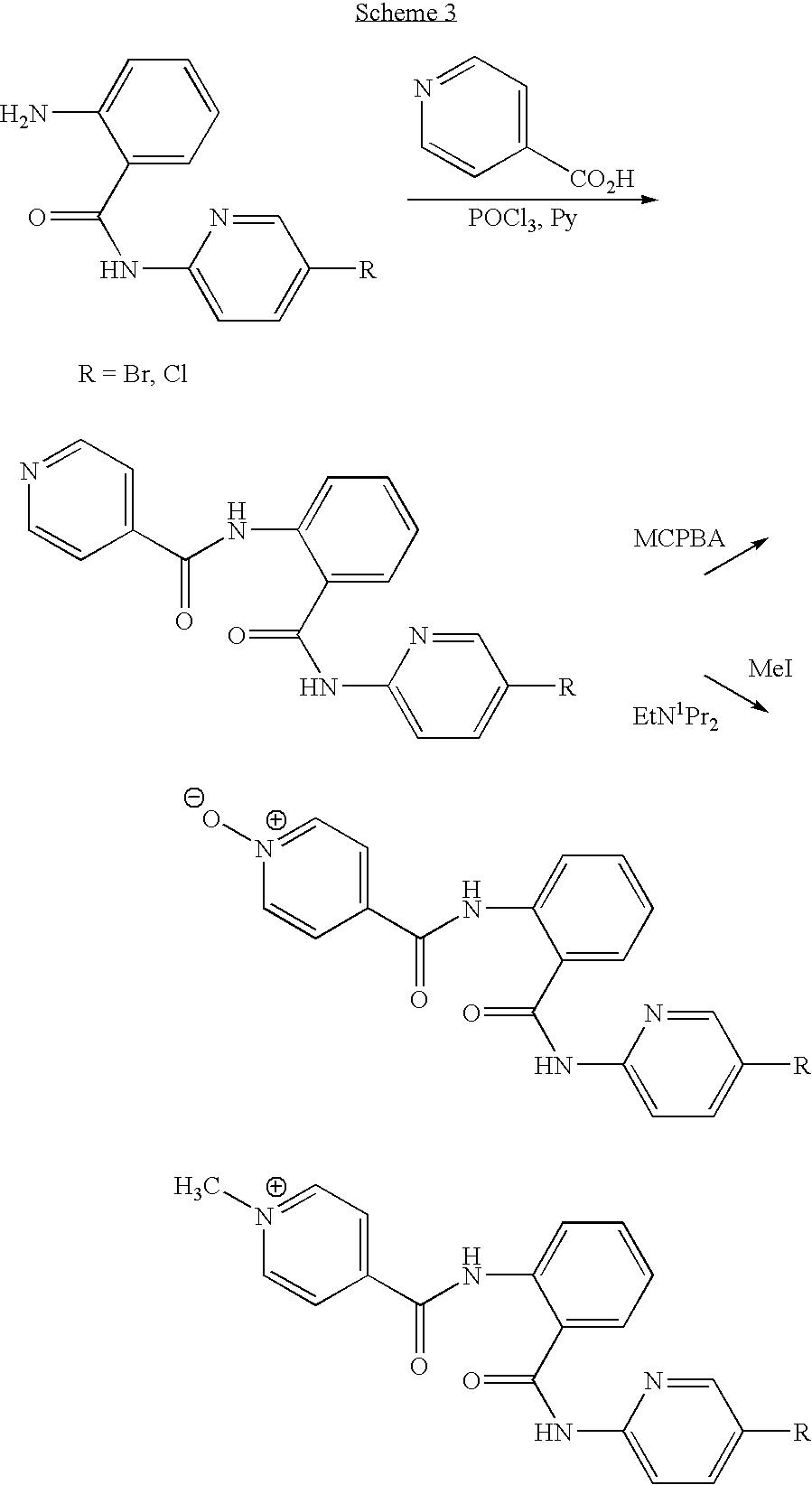


-
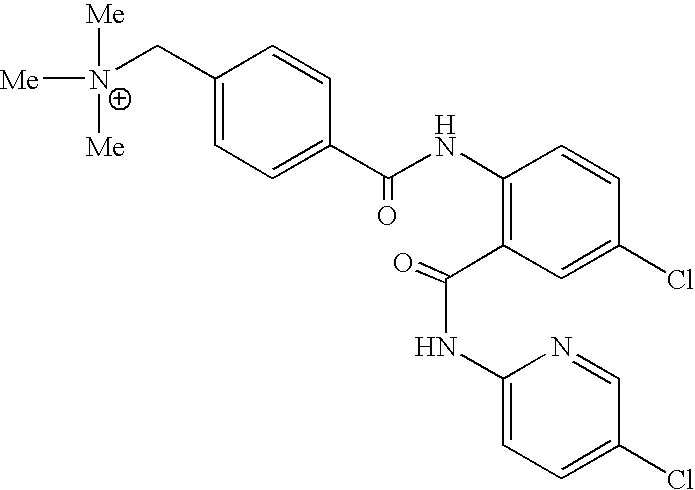
- Step 1: A mixture of 4-chloromethyl benzoyl chloride (335 mg, 1.77 mmol, 1 equiv) and 4-chloro-2-(5-chloro-2-pyridinyl)amino-carbonyl aniline (500 mg, 1.77 mmol, 1 equiv) in anhydrous tetrahydrofuran (30 mL) was stirred at rt overnight. The volatile was evaporated and the crude residue was triturated by ethyl acetate to give N-(5-chloro-2-pyridinyl)-2-(4-chloromethylphenylcarbonyl)amino-5-chlorophenylcarboxamide (630 mg, 91%).
- Step 2: A mixture of N-(5-chloro-2-pyridinyl)-2-(4-chloromethylphenylcarbonyl)amino-5-chlorophenylcarboxamide (30mg) and trimethylamine (10 eq) was stirred in isopropyl alcohol (1 mL) and H 2O (1 mL) at r.t. overnight. After concentration, the crude residue was purified by RP_HPLC to give the target compound (21 mg, 68%) as a TFA salt. MS found C23H23Cl2N4O2, M+=457.
-
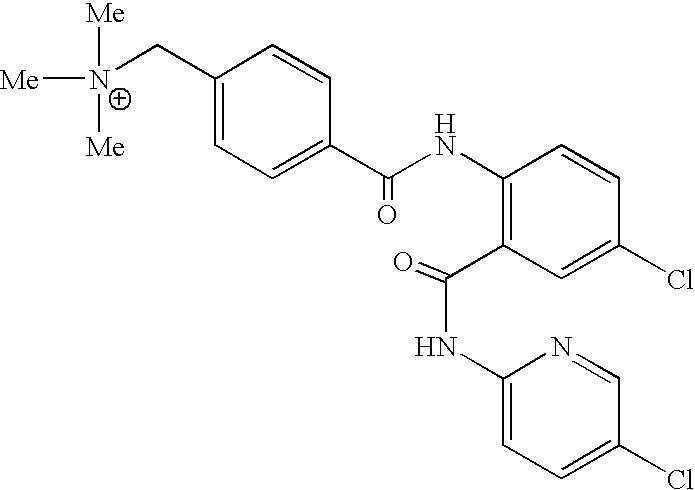
- A mixture of N-(5-chloro-2-pyridinyl)-2-(4-chloromethylphenylcarbonyl)aminophenyl carboxamide (30 mg) and trimethylamine (10 eq) was stirred in isopropyl alcohol (1 mL) and H 2O (1 mL) at r.t. overnight. After concentration, the crude residue was purified by RP_HPLC to give the target compound (27 mg, 86%) as a TFA salt. MS found C23H23Cl2N4O2, M+=423.
-
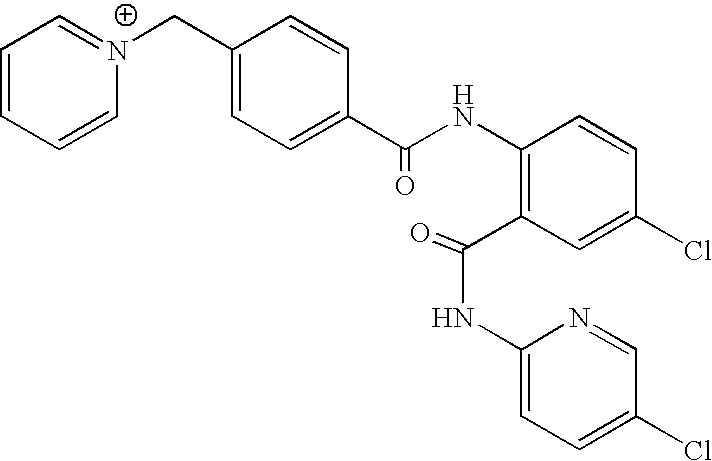
- A mixture of N-(5-chloro-2-pyridinyl)-2-(4-chloromethylphenylcarbonyl)amino-5-chlorophenylcarboxamide (30 mg) was stirred in pyridine (1 mL) at r.t. overnight. After concentration, the crude residue was purified by RP_HPLC to give the target compound (25 mg, 76%) as a TFA salt. MS found C 25H19Cl2N4O2, M+=477.
-
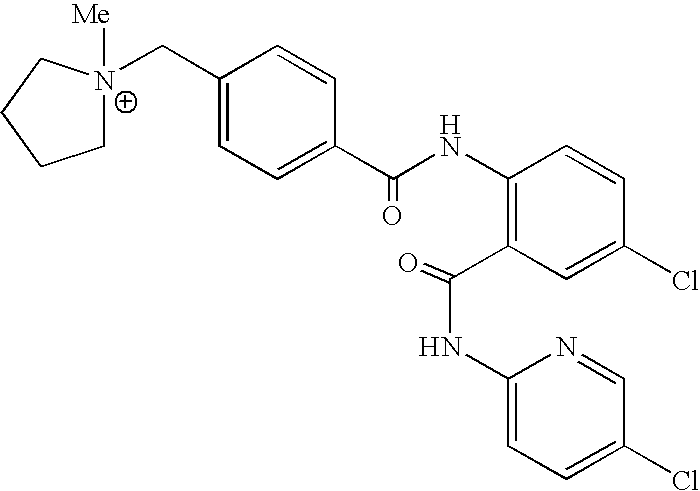
- A mixture of N-(5-chloro-2-pyridinyl)-2-(4-chloromethylphenylcarbonyl)amino-5-chlorophenylcarboxamide (30 mg) was stirred in pyrrolidine (1 mL) at r.t. overnight. After concentration, the crude residue was purified by RP_HPLC to give N-(5chloro-2-pyridinyl)-2-(4-(pyrrolin-1-yl)methylphenylcarbonyl)amino-5-chlorophenylcarboxamide (25 mg), which was then treated with 1 mL of MeI at rt overnight. After the volatile was removed, the residue was purified by RP_HPLC to give the target compound as a TFA salt. MS found C 25H25Cl2N4O2, M+=483.
- Compositions and Formulations
- Compositions or formulations of the compounds of the invention are prepared for storage or administration by mixing the compound having a desired degree of purity with physiologically acceptable carriers, excipients, stabilizers etc., and may be provided in sustained release or timed release formulations. Acceptable carriers or diluents for therapeutic use are well known in the pharmaceutical field, and are described, for example, in Remington's Pharmaceutical Sciences, Mack Publishing Co., (A. R. Gennaro edit. 1985). Such materials are nontoxic to the recipients at the dosages and concentrations employed, and include buffers such as phosphate, citrate, acetate and other organic acid salts, antioxidants such as ascorbic acid, low molecular weight (less than about ten residues) peptides such as polyarginine, proteins, such as serum albumin, gelatin, or immunoglobulins, hydrophilic polymers such as polyvinylpyrrolidinone, amino acids such as glycine, glutamic acid, aspartic acid, or arginine, monosaccharides, disaccharides, and other carbohydrates including cellulose or its derivatives, glucose, mannose or dextrins, chelating agents such as EDTA, sugar alcohols such as mannitol or sorbitol, counterions such as sodium and/or nonionic surfactants such as TWEEN®, PLURONICS® or polyethyleneglycol.
- Dosage formulations of the compounds of the invention to be used for therapeutic administration must be sterile. Sterility is readily accomplished by filtration through sterile membranes such as 0.2 micron membranes, or by other conventional methods. Formulations typically will be stored in lyophilized form or as an aqueous solution. The pH of the preparations of the invention typically will be about 3-11, more preferably about 5-9 and most preferably about 7-8. It will be understood that use of certain of the foregoing excipients, carriers, or stabilizers will result in the formation of cyclic polypeptide salts. While the preferred route of administration is by injection, other methods of administration are also anticipated such as orally, intravenously (bolus and/or infusion), subcutaneously, intramuscularly, colonically, rectally, nasally, transdermally or intraperitoneally, employing a variety of dosage forms such as suppositories, implanted pellets or small cylinders, aerosols, oral dosage formulations and topical formulations such as ointments, drops and dermal patches. The compounds of the invention are desirably incorporated into shaped articles such as implants which may employ inert materials such as biodegradable polymers or synthetic silicones, for example, Silastic, silicone rubber or other polymers commercially available.
- The compounds of the invention may also be administered in the form of liposome delivery systems, such as small unilamellar vesicles, large unilamellar vesicles and multilamellar vesicles. Liposomes can be formed from a variety of lipids, such as cholesterol, stearylamine or phosphatidylcholines.
- The compounds of the invention may also be delivered by the use of antibodies, antibody fragments, growth factors, hormones, or other targeting moieties, to which the compound molecules are coupled. The compounds of the invention may also be coupled with suitable polymers as targetable drug carriers. Such polymers can include polyvinylpyrrolidinone, pyran copolymer, polyhydroxy-propyl-methacrylamide-phenol, polyhydroxyethyl-aspartamide-phenol, or polyethyleneoxide-polylysine substituted with palmitoyl residues. Furthermore, compounds of the invention may be coupled to a class of biodegradable polymers useful in achieving controlled release of a drug, for example polylactic acid, polyglycolic acid, copolymers of polylactic and polyglycolic acid, polyepsilon caprolactone, polyhydroxy butyric acid, polyorthoesters, polyacetals, polydihydropyrans, polycyanoacrylates and cross linked or amphipathic block copolymers of hydrogels. Polymers and semipermeable polymer matrices may be formed into shaped articles, such as valves, stents, tubing, prostheses and the like.
- Therapeutic compound liquid formulations generally are placed into a container having a sterile access port, for example, an intravenous solution bag or vial having a stopper pierceable by hypodermic injection needle.
- Therapeutically effective dosages may be determined by either in vitro or in vivo methods. For each particular compound of the present invention, individual determinations may be made to determine the optimal dosage required. The range of therapeutically effective dosages will be influenced by the route of administration, the therapeutic objectives and the condition of the patient. For injection by hypodermic needle, it may be assumed the dosage is delivered into the body's fluids. For other routes of administration, the absorption efficiency must be individually determined for each compound by methods well known in pharmacology. Accordingly, it may be necessary for the therapist to titer the dosage and modify the route of administration as required to obtain the optimal therapeutic effect. The determination of effective dosage levels, that is, the dosage levels necessary to achieve the desired result, will be readily determined by one skilled in the art. Typically, applications of compound are commenced at lower dosage levels, with dosage levels being increased until the desired effect is achieved.
- The compounds and compositions of the invention can be administered orally or parenterally in an effective amount within the dosage range of about 0.001 to about 1000 mg/kg, preferably about 0.01 to about 100 mg/kg and more preferably about 0.1 to about 20 mg/kg. Advantageously, the compounds and composition of the invention may be administered several times daily. Other dosage regimens may also be useful (e.g. single daily dose and/or continuous infusion). Typically, about 0.5 to about 500 mg of a compound or mixture of compounds of the invention, as the free acid or base form or as a pharmaceutically acceptable salt, is compounded with a physiologically acceptable vehicle, carrier, excipient, binder, preservative, stabilizer, dye, flavor etc., as called for by accepted pharmaceutical practice. The amount of active ingredient in these compositions is such that a suitable dosage in the range indicated is obtained. Typical adjuvants which may be incorporated into tablets, capsules and the like are binders such as acacia, corn starch or gelatin, and excipients such as microcrystalline cellulose, disintegrating agents like corn starch or alginic acid, lubricants such as magnesium stearate, sweetening agents such as sucrose or lactose, or flavoring agents. When a dosage form is a capsule, in addition to the above materials it may also contain liquid carriers such as water, saline, or a fatty oil. Other materials of various types may be used as coatings or as modifiers of the physical form of the dosage unit. Sterile compositions for injection can be formulated according to conventional pharmaceutical practice. For example, dissolution or suspension of the active compound in a vehicle such as an oil or a synthetic fatty vehicle like ethyl oleate, or into a liposome may be desired. Buffers, preservatives, antioxidants and the like can be incorporated according to accepted pharmaceutical practice.
- The preferred compounds of the present invention are characterized by their ability to inhibit thrombus formation with acceptable effects on classical measures of coagulation parameters, platelets and platelet function, and acceptable levels of bleeding complications associated with their use. Conditions characterized by undesired thrombosis would include those involving the arterial and venous vasculature.
- With respect to the coronary arterial vasculature, abnormal thrombus formation characterizes the rupture of an established atherosclerotic plaque which is the major cause of acute myocardial infarction and unstable angina, as well as also characterizing the occlusive coronary thrombus formation resulting from either thrombolytic therapy or percutaneous transluminal coronary angioplasty (PTCA).
- With respect to the venous vasculature, abnormal thrombus formation characterizes the condition observed in patients undergoing major surgery in the lower extremities or the abdominal area who often suffer from thrombus formation in the venous vasculature resulting in reduced blood flow to the affected extremity and a predisposition to pulmonary embolism. Abnormal thrombus formation further characterizes disseminated intravascular coagulopathy commonly occurs within both vascular systems during septic shock, certain viral infections and cancer, a condition wherein there is rapid consumption of coagulation factors and systemic coagulation which results in the formation of life-threatening thrombi occurring throughout the microvasculature leading to widespread organ failure.
- The compounds of the invention are useful for the treatment or prophylaxis of those diseases which involve the production and/or action of factor Xa/prothrombinase complex. The compounds of this present invention, selected and used as disclosed herein, find utility as a diagnostic or therapeutic agent for preventing or treating a condition in a mammal characterized by undesired thrombosis or a disorder of coagulation. Disease states treatable or preventable by the administration of compounds of the invention include, without limitation, occlusive coronary thrombus formation resulting from either thrombolytic therapy or percutaneous transluminal coronary angioplasty, thrombus formation in the venous asculature, disseminated intravascular coagulopathy, the treatment of reocclusion or restenosis of reperfused coronary arteries, thromboembolic complications of surgery and peripheral arterial occlusion, a condition wherein there is rapid consumption of coagulation factors and systemic coagulation which results in the formation of life-threatening thrombi occurring throughout the microvasculature leading to widespread organ failure, hemorrhagic stroke, renal dialysis, blood oxygenation, and cardiac catheterization.
- Accordingly, the invention provides a method for preventing or treating a condition in a mammal characterized by undesired thrombosis which administers to a mammal a therapeutically effective amount of a compound of the invention, as described herein. Conditions for prevention or treatment include, for example, (a) the treatment or prevention of any thrombotically mediated acute coronary syndrome including myocardial infarction, unstable angina, refractory angina, occlusive coronary thrombus occurring post-thrombolytic therapy or post-coronary angioplasty, (b) the treatment or prevention of any thrombotically mediated cerebrovascular syndrome including embolic stroke, thrombotic stroke or transient ischemic attacks, (c) the treatment or prevention of any thrombotic syndrome occurring in the venous system including deep venous thrombosis or pulmonary embolus occurring either spontaneously or in the setting of malignancy, surgery or trauma, (d) the treatment or prevention of any coagulopathy including disseminated intravascular coagulation (including the setting of septic shock or other infection, surgery, pregnancy, trauma or malignancy and whether associated with multi-organ failure or not), thrombotic thrombocytopenic purpura, thromboangiitis obliterans, or thrombotic disease associated with heparin induced thrombocytopenia, (e) the treatment or prevention of thrombotic complications associated with extracorporeal circulation (e.g. renal dialysis, cardiopulmonary bypass or other oxygenation procedure, plasmapheresis), (f) the treatment or prevention of thrombotic complications associated with instrumentation (e.g. cardiac or other intravascular catheterization, intra-aortic balloon pump, coronary stent or cardiac valve), and (g) those involved with the fitting of prosthetic devices.
- Anticoagulant therapy is also useful to prevent coagulation of stored whole blood and to prevent coagulation in other biological samples for testing or storage. Thus the compounds of the invention can be added to or contacted with any medium containing or suspected to contain factor Xa and in which it is desired that blood coagulation be inhibited, e.g., when contacting the mammal's blood with material such as vascular grafts, stents, orthopedic prostheses, cardiac stents, valves and prostheses, extra corporeal circulation systems and the like. Thus, the compounds of the invention also find utility in a method for inhibiting the coagulation of biological samples by administration of a compound of the invention.
- Evaluation of the compounds of the invention is guided by in vitro protease activity assays (see below) and in vivo studies to evaluate antithrombotic efficacy, and effects on hemostasis and hematological parameters.
- The compounds of the present invention are dissolved in buffer to give solutions containing concentrations such that assay concentrations range from about 0 to about 100 μM. In the assays for thrombin, prothrombinase and factor Xa, a synthetic chromogenic substrate is added to a solution containing test compound and the enzyme of interest and the residual catalytic activity of that enzyme is determined spectrophotometrically. The IC 50 of a compound is determined from the substrate turnover. The IC50 is the concentration of test compound giving about 50% inhibition of the substrate turnover. The compounds of the present invention desirably have an IC50 of less than about 500 nM in the factor Xa assay, preferably less than about 200 nM, and more preferred compounds have an IC50 of about 100 nM or less in the factor Xa assay. The compounds of the present invention desirably have an IC50 of less than about 4.0 μM in the prothrombinase assay, preferably less than about 200 nM, and more preferred compounds have an IC50 of about 10 nM or less in the prothrombinase assay. The compounds of the present invention desirably have an IC50 of greater than about 1.0 μM in the thrombin assay, preferably greater than about 10.0 μM, and more preferred compounds have an IC50 of greater than about 100.0 μM in the thrombin assay.
- Amidolytic Assays for Determining Protease Inhibition Activity
- The factor Xa and thrombin assays were performed at room temperature, in 0.02 M Tris.HCl buffer, pH 7.5, containing 0.15 M NaCl. The rates of hydrolysis of the para-nitroanilide substrate S-2765 (Chromogenix) for factor Xa, and the substrate Chromozyrn TH (Boehringer Mannheim) for thrombin following preincubation of the enzyme with inhibitor for 5 minutes at room temperature, and were determined using the Softmax 96-well plate reader (Molecular Devices), monitored at 405 nm to measure the time dependent appearance of p-nitroaniline.
- The prothrombinase inhibition assay was performed in a plasma free system with modifications to the method described by Sinha, U. et al., Thromb. Res., 75, 427-436 (1994). Specifically, the activity of the prothrombinase complex was determined by measuring the time course of thrombin generation using the p-nitroanilide substrate Chromozym TH. The assay consists of preincubation (5 minutes) of selected compounds to be tested as inhibitors with the complex formed from factor Xa (0.5 nM), factor Va (2 nM), phosphatidyl serine:phosphatidyl choline (25:75, 20 μM) in 20 mM Tris.HCl buffer, pH 7.5, containing 0.15 M NaCl, 5 mM CaCl 2 and 0.1% bovine serum albumin. Aliquots from the complex-inhibitor mixture were added to prothrombin (1 nM) and Chromozym TH (0.1 mM). The rate of substrate cleavage was monitored at 405 nm for two minutes. Eight different concentrations of inhibitor were assayed in duplicate. A standard curve of thrombin generation by an equivalent amount of untreated complex was used for determination of percent inhibition.
- Antithrombotic Efficacy in a Rabbit Model of Venous Thrombosis
- A rabbit deep vein thrombosis model as described by Hollenbach, S. et al., Thromb. Haemost. 71, 357-362 (1994), is used to determine the in-vivo antithrombotic activity of the test compounds. Rabbits are anesthetized with I.M. injections of Ketamine, Xylazine, and Acepromazine cocktail. A standardized protocol consists of insertion of a thrombogenic cotton thread and copper wire apparatus into the abdominal vena cava of the anesthetized rabbit. A non-occlusive thrombus is allowed to develop in the central venous circulation and inhibition of thrombus growth is used as a measure of the antithrombotic activity of the studied compounds. Test agents or control saline are administered through a marginal ear vein catheter. A femoral vein catheter is used for blood sampling prior to and during steady state infusion of test compound. Initiation of thrombus formation begins immediately after advancement of the cotton thread apparatus into the central venous circulation. Test compounds are administered from time=30 min to time=150 min at which the experiment is terminated. The rabbits are euthanized and the thrombus excised by surgical dissection and characterized by weight and histology. Blood samples are analyzed for changes in hematological and coagulation parameters.
- Effects of Compounds in Rabbit Venous Thrombosis Model
- Administration of compound according to the invention in the rabbit venous thrombosis model demonstrates antithrombotic efficacy at the higher doses evaluated. There are no significant effects of the compound on the aPTT and PT prolongation with the highest dose (100 μg/kg+2.57 μg/kg/min). The compounds have no significant effects on hematological parameters as compared to saline controls. All measurements are an average of all samples after steady state administration of vehicle or (D)-Arg-Gly-Arg-thiazole. Values are expressed as mean±SD. Without further description, it is believed that one of ordinary skill in the art can, using the preceding description and the following illustrative examples, make and utilize the compounds of the present invention and practice the claimed methods. It should be understood that the foregoing discussion and examples merely present a detailed description of certain preferred embodiments. It will be apparent to those of ordinary skill in the art that various modifications and equivalents can be made without departing from the spirit and scope of the invention. All the patents, journal articles and other documents discussed or cited above are herein incorporated by reference.
Claims (15)
1. A compound of the formula (I):
A—Q—D—E—G—J—Z (I)
wherein:

A is (R1a, R1b, R1c)N⊕—,
R1a, R1b and R1c are independently C1-6 alkyl, haloC1-6 alkyl, C3-8 cycloalkyl, C1-6alkylhydroxy, C1-6alkylalkoxy, C1-6alkylamine, C1-6alkylcarboxyl, C1-6alkylester or C1-6alkylamide; or R1a and R1b taken together with the nitrogen atom to which they are attached form a substituted or unsubstituted 3 to 8 membered heterocyclic or heteroaromatic quaternary amidino group, which optionally contains heteroatoms of N, O or S; R1a or R1b is optionally substituted with halo, alkyl, hydroxy, alkoxy, amide, ester, acid, alkylalkoxy, amino, alkenyl, alkynyl, nitro and cyano;
Q is a direct link or —CH2—;
D is (a) phenyl or naphthyl substituted with 0-4 R1 substituents; or (b) monocyclic or bicyclic hetero ring system having from 5 to 10 ring atoms, wherein 1-4 ring atoms of the ring system are selected from N, O and S, and wherein the ring system may be substituted from 0-3 R1 substituents; the N atom of the ring may be quaternized by oxidation or alkylation with R1a;
R1 is a H, —Cl, —Br, —I, —F, —C1-6alkyl, haloC1-6alkyl, —OH, —OC1-6alkyl, —OhaloC1-6alkyl,—NO2, —CN, —COOH, —COOC1-6alkyl, —CONH2, —CONHC1-6alkyl, —CONC1-6alkylC1-6alkyl, —OC1-6alkylCOOH, —OC1-6alkylCOOC1-6alkyl, —OC1-6alkylCONRaRb, —NRaC1-6alkylCOOH, —NRaC1-6alkylCOOC1-6alkyl, —NRaC1-6alkylCONRaRb, —NRaRb, —NHSO2C1-6alkyl, —NHCOC1-6alkyl, —NHCOC1-6alkyRaRb, —SC1-6alkyl, —SO2C1-6alkyl, SOC1-6alkyl or —SO2NRaRb;
Ra and Rb are independently H, —C1-6alkyl, haloC1-6alkyl, —C2-6alkenyl, —C2-6alkynyl C3-8cycloalkyl, C1-6alkylhydroxy, C1-6alkylalkoxy, C1-6alkylamine, C1-6alkylcarboxyl, C1-6alkylester or C1-6alkylamide; or Ra and Rb taken together with the nitrogen to which they are attached form a heterocyclic or heteroaromatic amine group and which optionally contains heteroatoms of N, O or S and which is optionally substituted with —BOC, alkyl, acyl, —SO2C1-6alkyl, —CO2C1-6alkyl, —COOH or —CONRaRb;
E is a direct link —CH2—, —O—, —N(C1-4alkyl)-, —N(C1-4alkyl)CH2—, —CH2N(C1-4alkyl)-, —CO—N(C1-4alkyl)-, —N(C1-4alkyl)-CO—, —CH2CO—NC1-4alkyl-, —OCO—NC1-4alkyl- or —NHCO—NC1-4alkyl-;
G is (a) a phenylene group wherein the ring carbon atoms of the phenylene group are independently substituted with R2, R3, R4 and R5 groups; (b) a 3-8 membered saturated, partially unsaturated or aromatic monocyclic- hetero ring system containing 1-4 heteroatoms selected from N, O and S, wherein 0-4 ring atoms may be substituted with R2, R3, R4 and R5 groups; or (c) an 8-10 membered fused bicyclic ring system, containing 1-4 heteroatoms selected from N, O and S, wherein 0-4 ring atoms may be substituted with R2, R3, R4 and R5 groups;
R2, R3, R4 and R5 groups are independently a H, —F, —Cl, —Br, —CH3, —CF3, —OH, —OMe, —OCF3, —NH2, —NHMe, —NMe2, —OCH2CH2OH, —OCH2CH2OMe, —OCH2CH2NH2, —OCH2CH2NHMe, —OCH2CH2NMe2, —OCH2CH2CH2OMe, —OCH2CH2CH2NMe2, —OCH2COOH, —OCH2COOEt, —OCH2CH2COOH, —OCH2CH2COOEt, —NHCH2COOH, —NHCH2COOEt, —NMeCH2COOH, —NMeCH2COOEt, NMeCH2CH2COOH, —NMeCH2CH2COOEt, —NMeEt, —NMeCH2CH2OH, —NMeCH2CH2OMe, —NO2, —NHAc, —NHSO2Me, —SMe, —SO2Me, —SOMe, —SO2NH2,
J is a direct link, —N(C1-4alkyl)-CO—, —CO—N(C1-4alkyl)-, —O—, —S—, —SO—, —SO2—, —CH2—, —N(C1-4alkyl)- or —N(C1-4alkyl)-SO2—;
Z is (a) phenyl or naphthyl substituted with 0-3 R groups; (b) a 5- to 6-membered aromatic hetero ring system containing 1-3 N, O or S atoms and having 0-3 ring atoms substituted with 0-3 R groups; or (c) an 8-10 membered fused bicyclic system containing 1-4 heteroatoms selected from N, O and S and 0-3 ring atoms are substituted with 0-3 R groups;
R is a H, —Cl, —Br, —I, —F, —C1-6alkyl, —OC1-6alkyl, —OH, —NRaRb, guanidino or amidino, where Ra and Rb are each as set forth above;
and all pharmaceutically acceptable isomers, salts, hydrates, solvates and prodrug derivatives thereof.
2. A compound of the formula (I):
A—Q—D—E—G—J—Z (I)
wherein:


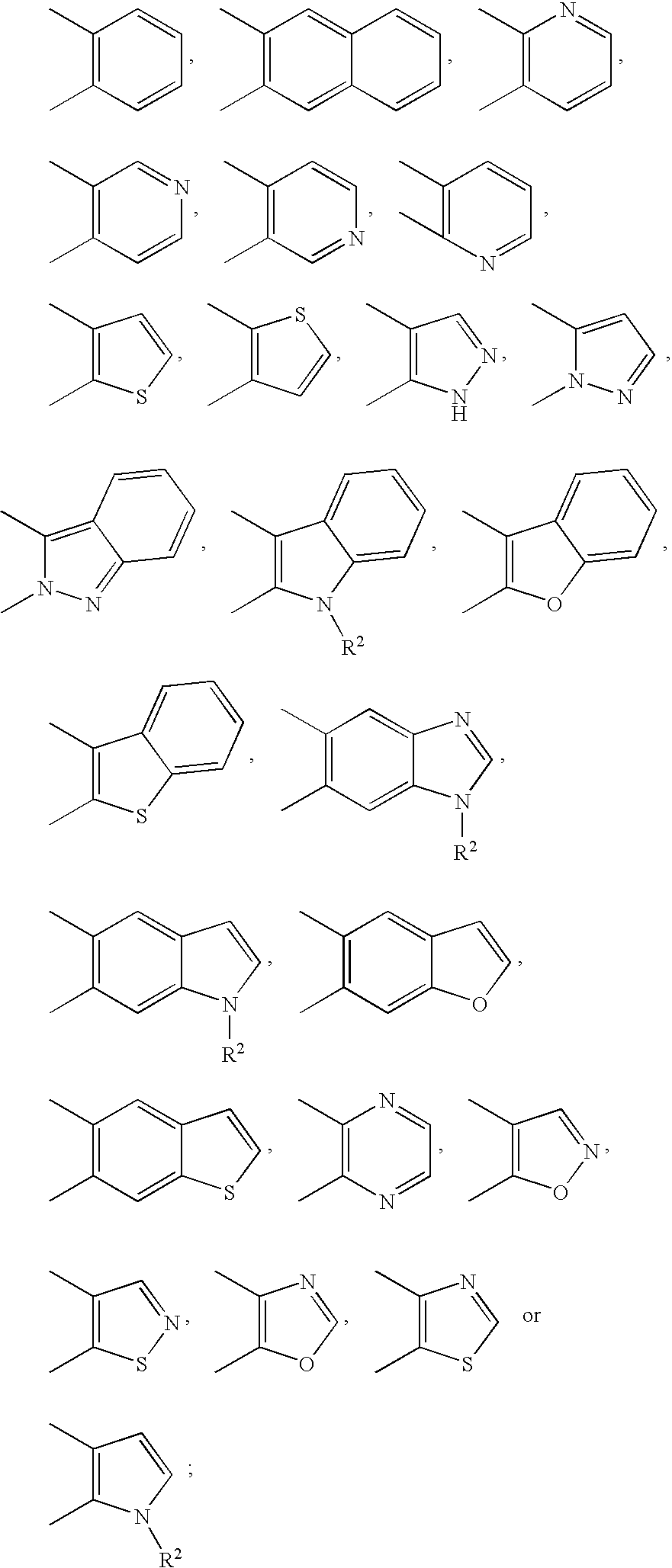

A is: (R1a, R1b, R1c)N⊕—;
R1a, R1b and R1c are independently —Me, —Et, —(CH2)2OH, —(CH2)2OMe, —(CH2)2NH2, —(CH2)2NHMe, —(CH2)2NMe2, —(CH2)2CO2H, —(CH2)2CO2Me, —(CH2)2CONMe2, —(CH2)2CONHMe, —(CH2)2CONH2, —CH2CO2H, —CH2CO2Me, —CH2CONMe2, —CH2CONHMe or —CH2CONH2; or R1a and R1b together with the N atom to which they are attached can form a 3-6 membered saturated ring, including:
the ring system may be optionally substituted with halo, alkyl, OH, amino, nitro, cyano, alkoxy, alkyl-acid, alkyl-ester or alkyl-amide groups;
Q is a direct link or —CH2—;
D is
wherein the N atom of the ring may be quaternized by oxidation or alkylation with R1a; the ring atoms of D may be substituted with 0-4 R1 groups;
R1 groups are independently a H, —F, —Cl, —Br, —Me, —CF3, —OH, —OMe, —OCF3, —OEt, —OPrn, —OPri, —OBut, —NO2, —CN, —CO2H, —CO2Me, —CONH2, —CONHMe, —CONMe2, —OCH2CO2H, —OCH2CO2Me, —NH2, —NHMe, —NMe2, —NHSO2Me, —NHCOMe, —NHCO(CH2)2NH2, —SMe, —SO2Me, —SOMe or —SO2NH2;
E is —CH2NH—, —CONH—, —NHCO—, —CONMe— or —NMeCO—;
G is
G may be optionally substituted by R2, R3, R4 and R5 groups, which are independently a H, —F, —Cl, —Br, —CH3, —CF3, —OH, —OMe, —OCF3, —NH2, —NHMe, —NMe2, —OCH2CH2OH, —OCH2CH2OMe, —OCH2CH2NH2, —OCH2CH2NHMe, —OCH2CH2NMe2, —OCH2CH2CH2OMe, —OCH2CH2CH2NMe2, —OCH2COOH, —OCH2COOEt, —OCH2CH2COOH, —OCH2CH2COOEt, —NHCH2COOH, —NHCH2COOEt, —NMeCH2COOH, —NMeCH2COOEt, NMeCH2CH2COOH, —NMeCH2CH2COOEt, —NMeEt, —NMeCH2CH2OH, —NMeCH2CH2OMe, —NO2, —NHAc, —NHSO2Me, —SMe, —SO2Me, —SOMe, —SO2NH2,
J is —CONH— or —NHCO—;
Z is (a) phenyl substituted with 0-3 R groups; or (b) a 5 or 6-membered aromatic heterocyclic ring system containing 1-3 N atoms and having 0-3 ring atoms substituted with 0-3 R groups;
R is independently H, halo, Me, —OMe, —Et, —OH, —NH2, —CH2NH2, —OCH2CO2Me, —OCH2CO2H, —OCH2CONH2, —SO2Me, —SO2NH2, —NO2, —CN, —OCH2CONMe2, —CH2NMe2, —C(═NH)NH2 or —C(═NH)NHOH;
and all pharmaceutically acceptable isomers, salts, hydrates, solvates and prodrug derivatives thereof.
3. A compound of claim 1 having the following structure:
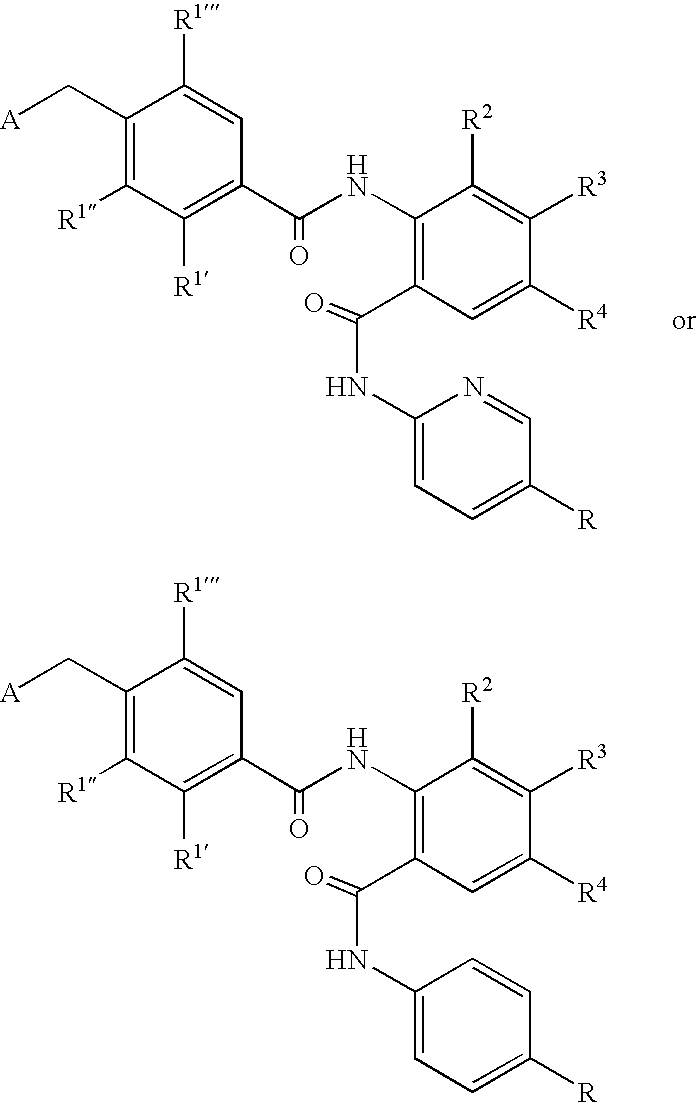
wherein:


A is
R1′, R1″ and R1′″ are independently a H, —F, —Cl, —Br, —Me, —CF3, —OH, —OMe, —OCF3, —OEt, —OPrn, —OPri, —OBut, —NO2, —CN, —CO2H, —CO2Me, —CONH2, —CONHMe, —CONMe2, —OCH2CO2H, —OCH2CO2Me, —NH2, —NHMe, —NMe2, —NHSO2Me, —NHCOMe, —NHCO(CH2)2NH2, —SMe, —SO2Me, —SOMe or —SO2NH2;
R2, R3 and R4 are independently a H, —F, —Cl, —Br, —CH3, —CF3, —OH, —OMe, —OCF3, —NH2, —NHMe, —NMe2, —OCH2CH2OH, —OCH2CH2OMe, —OCH2CH2NH2, —OCH2CH2NHMe, —OCH2CH2NMe2, —OCH2CH2CH2OMe, —OCH2CH2CH2NMe2, —OCH2COOH, —OCH2COOEt, —OCH2CH2COOH, —OCH2CH2COOEt, —NHCH2COOH, —NHCH2COOEt, —NMeCH2COOH, —NMeCH2COOEt, NMeCH2CH2COOH, —NMeCH2CH2COOEt, —NMeEt, —NMeCH2CH2OH, —NMeCH2CH2OMe, —NO2, —NHAc, —NHSO2Me, —SMe, —SO2Me, —SOMe, —SO2NH2,
R is a H, —F, —Cl, —Br, —OMe, —OH, —NH2 or —Me.
4. A compound of claim 1 having the following structure:
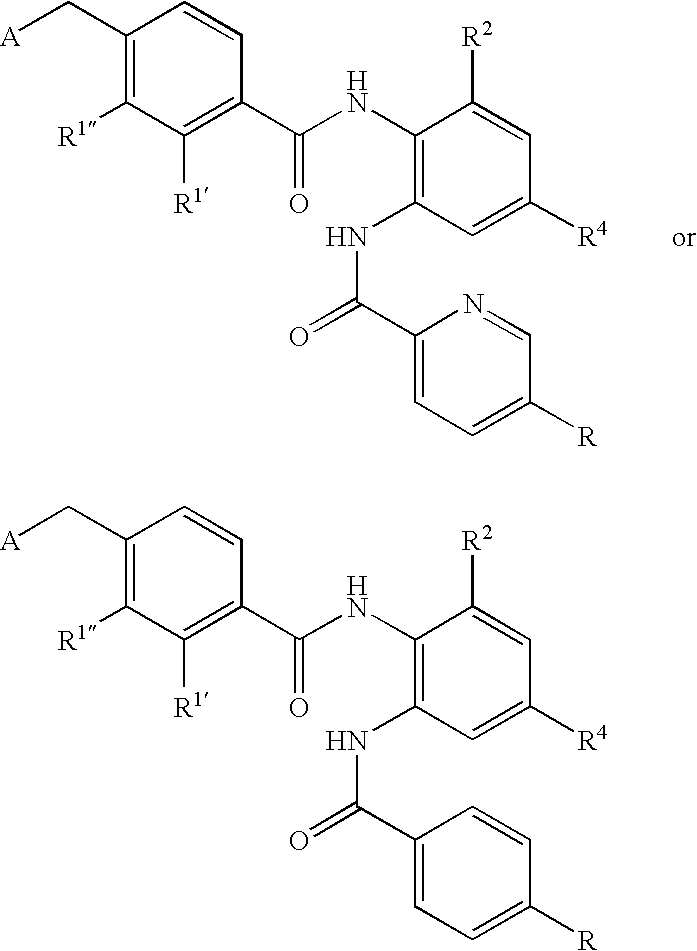
wherein:
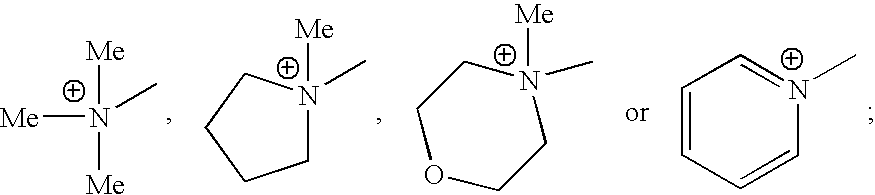
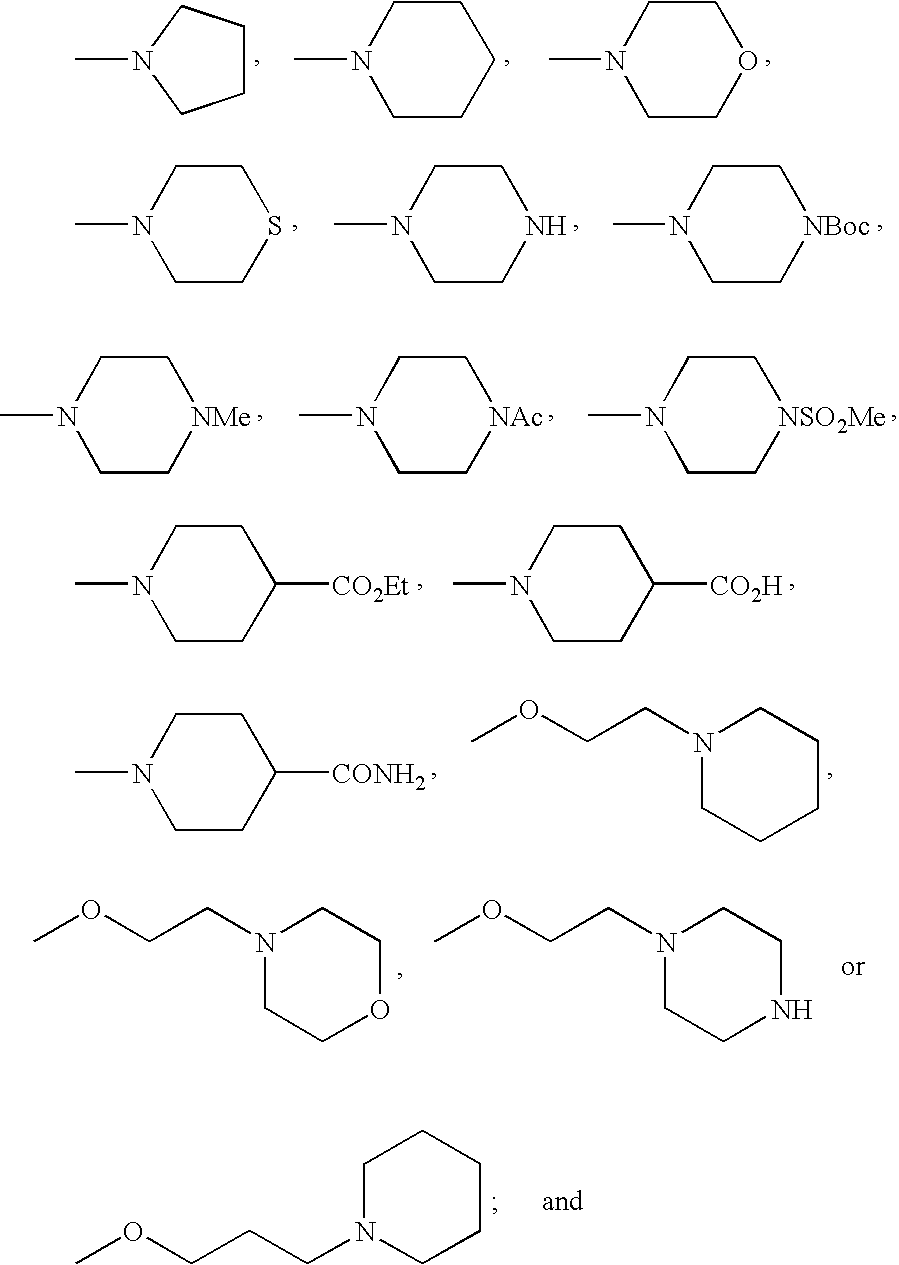
A is
R1′ and R1″ are independently a H, —F, —Cl, —Br, —Me, —CF3, —OH, —OMe, —OCF3, —OEt, —OPrn, —OPri, —OBut, —NO2, —CN, —CO2H, —CO2Me, —CONH2, —CONHMe, —CONMe2, —OCH2CO2H, —OCH2CO2Me, —NH2, —NHMe, —NMe2, —NHSO2Me, —NHCOMe, —NHCO(CH2)2NH2, —SMe, —SO2Me, —SOMe or —SO2NH2;
R2 and R4 are independently a H, —F, —Cl, —Br, —CH3, —CF3, —OH, —OMe, —OCF3, —NH2, —NHMe, —NMe2, —OCH2CH2OH, —OCH2CH2OMe, —OCH2CH2NH2, —OCH2CH2NHMe, —OCH2CH2NMe2, —OCH2CH2CH2OMe, —OCH2CH2CH2NMe2, —OCH2COOH, —OCH2COOEt, —OCH2CH2COOH, —OCH2CH2COOEt, —NHCH2COOH, —NHCH2COOEt, —NMeCH2COOH, —NMeCH2COOEt, NMeCH2CH2COOH, —NMeCH2CH2COOEt, —NMeEt, —NMeCH2CH2OH, —NMeCH2CH2OMe, —NO2, —NHAc, —NHSO2Me, —SMe, —SO2Me, —SOMe, —SO2NH2,
R is a H, —F —Cl, or —Br.
5. A compound of claim 1 having the following structure:

wherein:

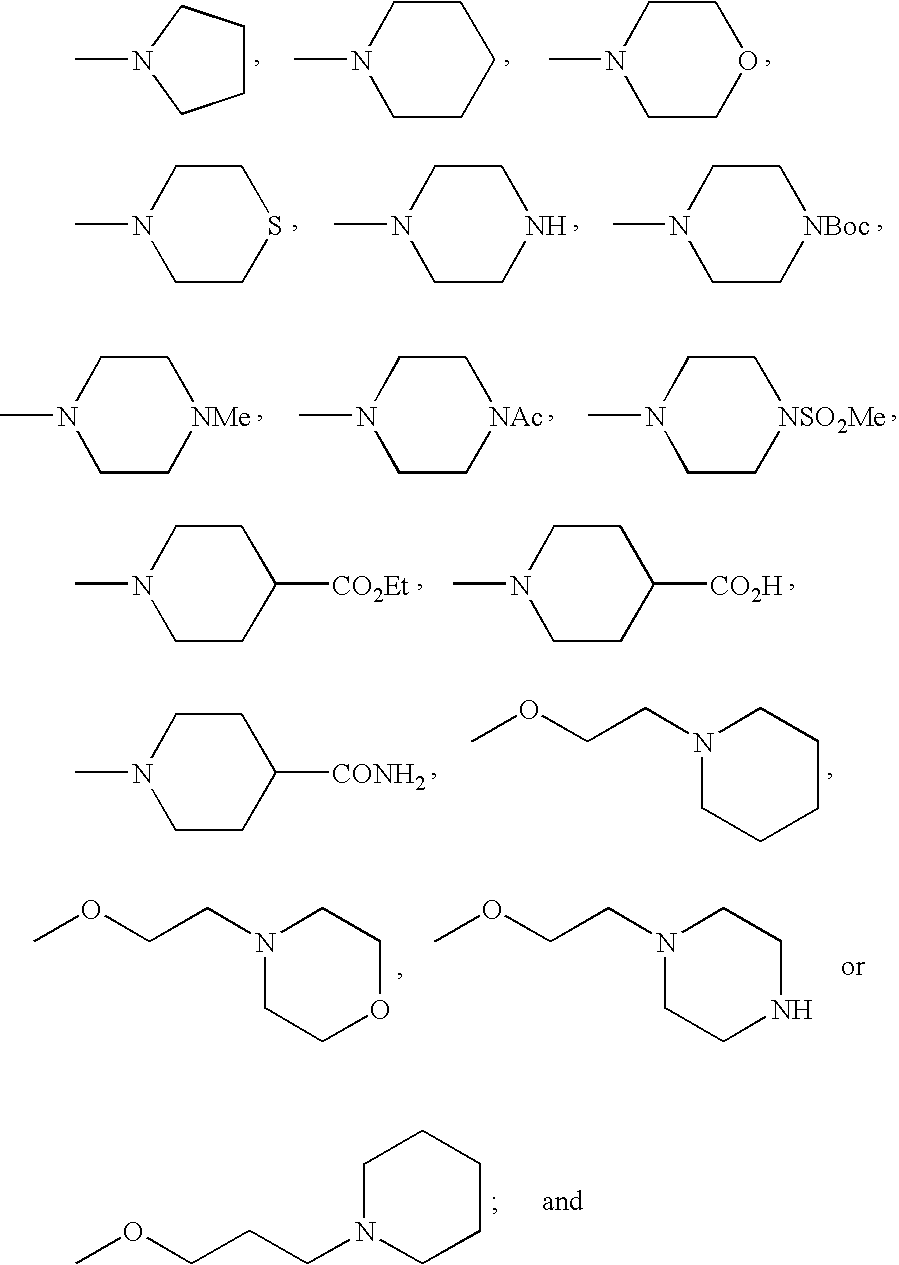
A is
R1′ and R1″ are independently a H, —F, —Cl, —Br, —Me, —CF3, —OH, —OMe, —OCF3, —OEt, —OPrn, —OPri, —OBut, —NO2, —CN, —CO2H, —CO2Me, —CONH2, —CONHMe, —CONMe2, —OCH2CO2H, —OCH2CO2Me, —NH2, —NHMe, —NMe2, —NHSO2Me, —NHCOMe, —NHCO(CH2)2NH2, —SMe, —SO2Me, —SOMe or —SO2NH2;
R2 and R4 are independently a H, —F, —Cl, —Br, —CH3, —CF3, —OH, —OMe, —OCF3, —NH2, —NHMe, —NMe2, —OCH2CH2OH, —OCH2CH2OMe, —OCH2CH2NH2, —OCH2CH2NHMe, —OCH2CH2NMe2, —OCH2CH2CH2OMe, —OCH2CH2CH2NMe2, —OCH2COOH, —OCH2COOEt, —OCH2CH2COOH, —OCH2CH2COOEt, —NHCH2COOH, —NHCH2COOEt, —NMeCH2COOH, —NMeCH2COOEt, NMeCH2CH2COOH, —NMeCH2CH2COOEt, —NMeEt, —NMeCH2CH2OH, —NMeCH2CH2OMe, —NO2, —NHAc, —NHSO2Me, —SMe, —SO2Me, —SOMe, —SO2NH2,
R is H, —F, —Cl or —Br.
6. A compound of claim 1 having the following structure:
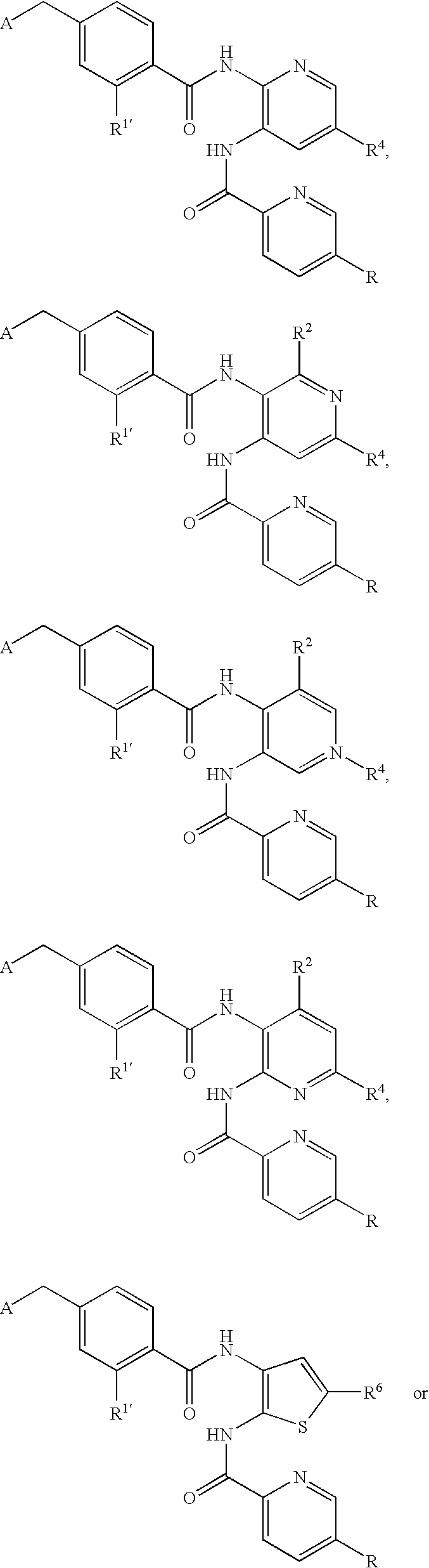

wherein:

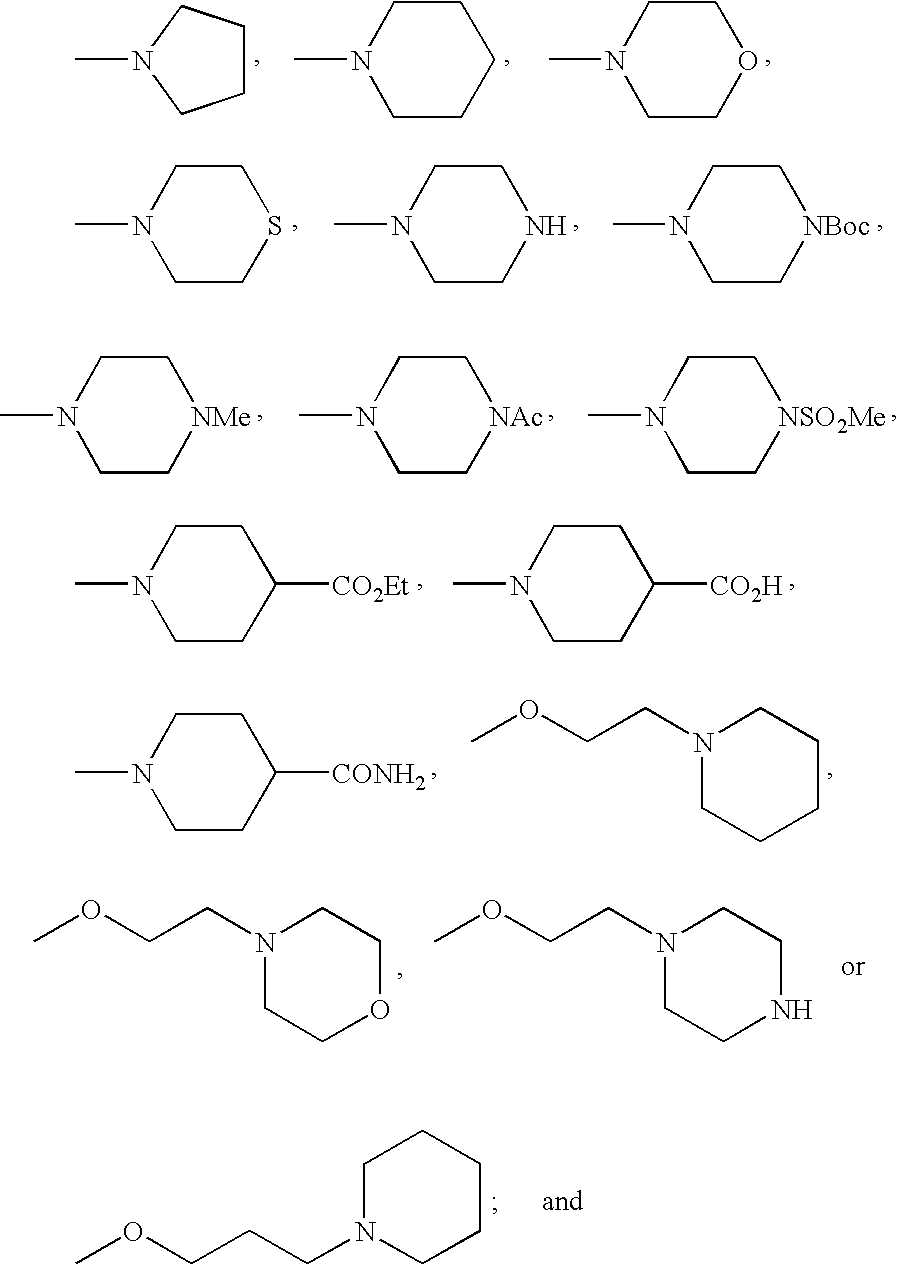
A is
R1′ is a H, —F, —Cl, —Br, —Me, —CF3, —OH, —OMe, —OCF3, —OEt, —OPrn, —OPri, —OBut, —NO2, —CN, —CO2H, —CO2Me, —CONH2, —CONHMe, —CONMe2, —OCH2CO2H, —OCH2CO2Me, —NH2, —NHMe, —NMe2, —NHSO2Me, —NHCOMe, —NHCO(CH2)2NH2, —SMe, —SO2Me, —SOMe or —SO2NH2;
R2, R4 and R6 are independently a H, —F, —Cl, —Br, —CH3, —CF3, —OH, —OMe, —OCF3, —NH2, —NHMe, —NMe2, —OCH2CH2OH, —OCH2CH2OMe, —OCH2CH2NH2, —OCH2CH2NHMe, —OCH2CH2NMe2, —OCH2CH2CH2OMe, —OCH2CH2CH2NMe2, —OCH2COOH, —OCH2COOEt, —OCH2CH2COOH, —OCH2CH2COOEt, —NHCH2COOH, —NHCH2COOEt, —NMeCH2COOH, —NMeCH2COOEt, NMeCH2CH2COOH, —NMeCH2CH2COOEt, —NMeEt, —NMeCH2CH2OH, —NMeCH2CH2OMe, —NO2, —NHAc, —NHSO2Me, —SMe, —SO2Me, —SOMe, —SO2NH2,
R is a H, —F, —Cl or —Br.
7. A compound of claim 1 having the following structure:

wherein:


A is
R1′ and R1″ are independently a H, —F, —Cl, —Br, —Me, —CF3, —OH, —OMe, —OCF3, —OEt, —OPrn, —OPri, —OBut, —NO2, —CN, —CO2H, —CO2Me, —CONH2, —CONHMe, —CONMe2, —OCH2CO2H, —OCH2CO2Me, —NH2, —NHMe, —NMe2, —NHSO2Me, —NHCOMe, —NHCO(CH2)2NH2, —SMe, —SO2Me, —SOMe or —SO2NH2;
R2 and R4 are independently a H, —F, —Cl, —Br, —CH3, —CF3, —OH, —OMe, —OCF3, —NH2, —NHMe, —NMe2, —OCH2CH2OH, —OCH2CH2OMe, —OCH2CH2NH2, —OCH2CH2NHMe, —OCH2CH2NMe2, —OCH2CH2CH2OMe, —OCH2CH2CH2NMe2, —OCH2COOH, —OCH2COOEt, —OCH2CH2COOH, —OCH2CH2COOEt, —NHCH2COOH, —NHCH2COOEt, —NMeCH2COOH, —NMeCH2COOEt, NMeCH2CH2COOH, —NMeCH2CH2COOEt, —NMeEt, —NMeCH2CH2OH, —MeCH2CH2OMe, —NO2, —NHAc, —NHSO2Me, —SMe, —SO2Me, —SOMe, —SO2NH2,
R is a H, —F, —Cl or —Br.
8. A compound of claim 1 having the following structure:
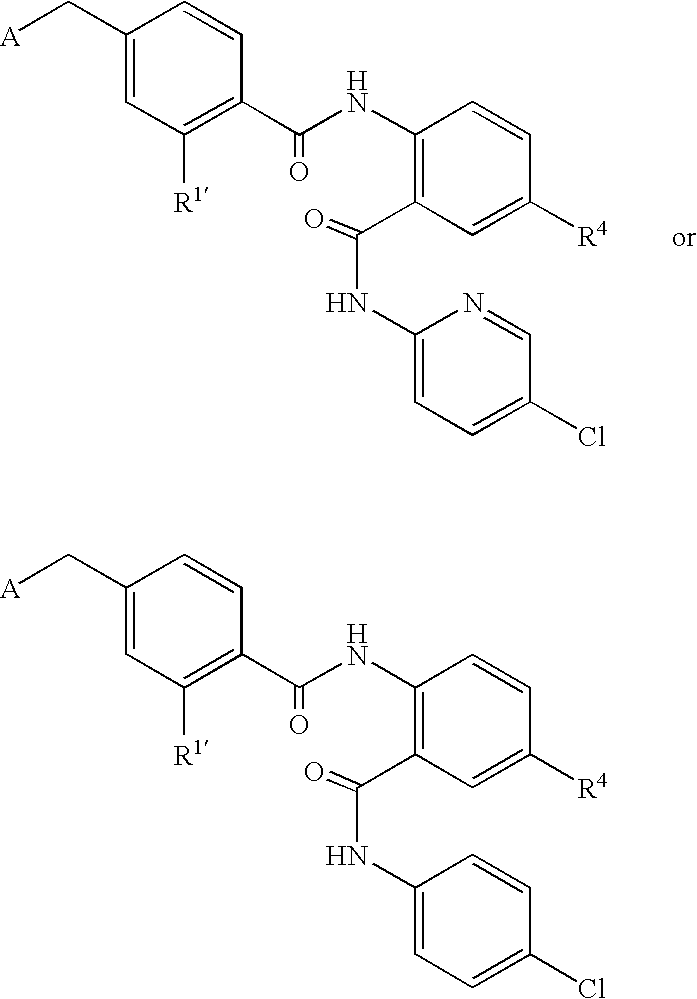
wherein:

A is
R1′ is a H, —F, —Cl, —Br, —Me, —CF3, —OH, —OMe, —OCF3, —OEt, —OPrn, —OPri, —OBut, —NO2, —CN, —CO2H, —CO2Me, —CONH2, —CONHMe, —CONMe2, —OCH2CO2H, —OCH2CO2Me, —NH2, —NHMe, —NMe2, —NHSO2Me, —NHCOMe, —NHCO(CH2)2NH2, —SMe, —SO2Me, —SOMe or —SO2NH2; and
R4 is a H, —F, —Cl, —Br, —Me, —OH, —OMe, —OCF3, —OCH2COOH, —OCH2COOEt, —NO2, —NHAc, —NHSO2Me, —SMe, —SO2Me, —SOMe or —SO2NH2.
9. A compound of claim 1 having the following structure:

wherein:


A is
R1′ is a H, —F, —Cl, —Br, —Me, —CF3, —OH, —OMe, —OCF3, —OEt, —OPrn, —OPri, —OBut, —NO2, —CN, —CO2H, —CO2Me, —CONH2, —CONHMe, —CONMe2, —OCH2CO2H, —OCH2CO2Me, —NH2, —NHMe, —NMe2, —NHSO2Me, —NHCOMe, —NHCO(CH2)2NH2, —SMe, —SO2Me, —SOMe or —SO2NH2; and
R2, and R4 are independently a H, —F, —Cl, —Br, —CH3, —CF3, —OH, —OMe, —OCF3, —NH2, —NHMe, —NMe2, —OCH2CH2OH, —OCH2CH2OMe, —OCH2CH2NH2, —OCH2CH2NHMe, —OCH2CH2NMe2, —OCH2CH2CH2OMe, —OCH2CH2CH2NMe2, —OCH2COOH, —OCH2COOEt, —OCH2CH2COOH, —OCH2CH2COOEt, —NHCH2COOH, —NHCH2COOEt, —NMeCH2COOH, —NMeCH2COOEt, NMeCH2CH2COOH, —NMeCH2CH2COOEt, —NMeEt, —NMeCH2CH2OH, —NMeCH2CH2OMe, —NO2, —NHAc, —NHSO2Me, —SMe, —SO2Me, —SOMe, —SO2NH2,
10. A compound of claim 1 having the following structure:
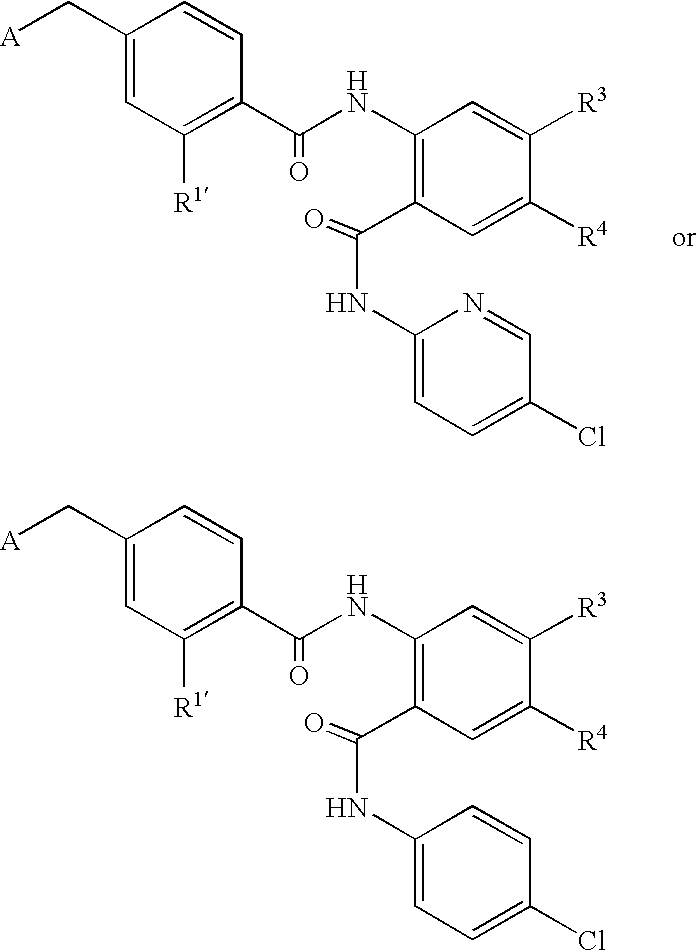
wherein:

A is
R1′ is a H, —F, —Cl, —Br, —Me, —CF3, —OH, —OMe, —OCF3, —OEt, —OPrn, —OPri, —OBut, —NO2, —CN, —CO2H, —CO2Me, —CONH2, —CONHMe, —CONMe2, —OCH2CO2H, —OCH2CO2Me, —NH2, —NHMe, —NMe2, —NHSO2Me, —NHCOMe, —NHCO(CH2)2NH2, —SMe, —SO2Me, —SOMe or —SO2NH2; and
R3 and R4 are a H, —F, —Cl, —Br, —Me, —OH, —OMe, —OCF3, —OCH2COOH, —OCH2COOEt, —NO2, —NHAc, —NHSO2Me, —SMe, —SO2Me, —SOMe or —SO2NH2.
11. A compound of claim 1 having one of the following structures:

wherein:
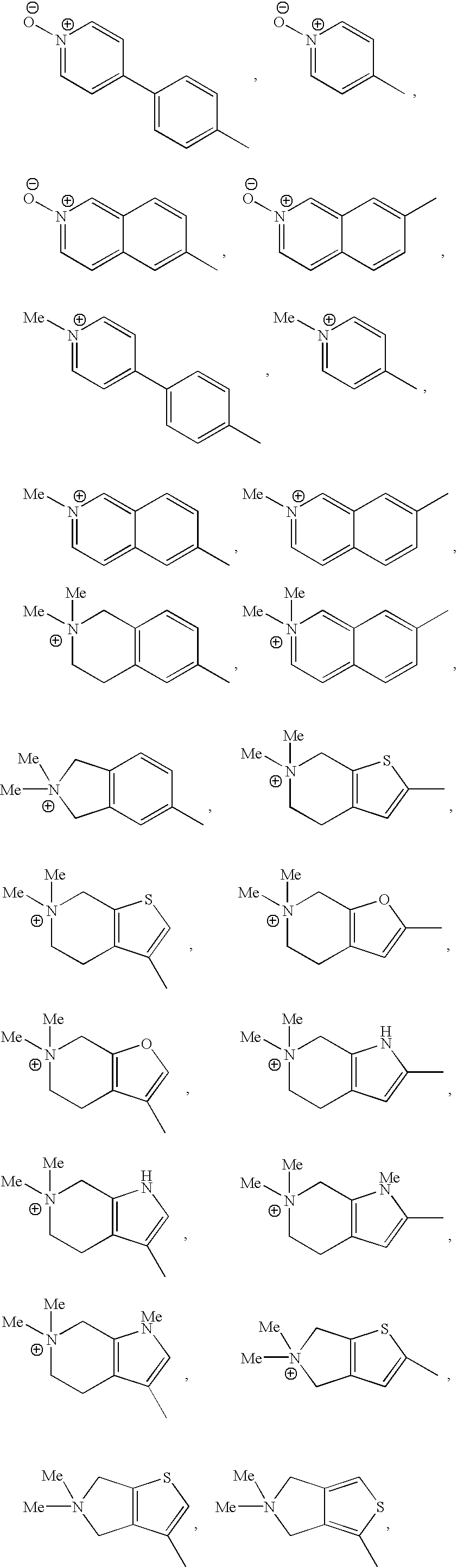


A—Q—D together is selected from:
R2, R3 and R4 are independently a H, —F, —Cl, —Br, —CH3, —CF3, —OH, —OMe, —OCF3, —NH2, —NHMe, —NMe2, —OCH2CH2OH, —OCH2CH2OMe, —OCH2CH2NH2, —OCH2CH2NHMe, —OCH2CH2NMe2, —OCH2CH2CH2OMe, —OCH2CH2CH2NMe2, —OCH2COOH, —OCH2COOEt, —OCH2CH2COOH, —OCH2CH2COOEt, —NHCH2COOH, —NHCH2COOEt, —NMeCH2COOH, —NMeCH2COOEt, NMeCH2CH2COOH, —NMeCH2CH2COOEt, —NMeEt, —NMeCH2CH2OH, —NMeCH2CH2OMe, —NO2, —NHAc, —NHSO2Me, —SMe, —SO2Me, —SOMe, —SO2NH2,
R is a H, —F, —Cl or —Br.
12. A pharmaceutical composition for preventing or treating a condition in a mammal characterized by undesired thrombosis comprising a pharmaceutically acceptable carrier and a therapeutically effective amount of a compound of one of claims 1-11.
13. A method for preventing or treating a condition in a mammal characterized by undesired throumbosis comprising administering to said mammal a therapeutically effective amount of a compound of one of claims 1-11.
14. The method of claim 13 , wherein the condition is selected from the group consisting of: acute coronary syndrome, myocardial infarction, unstable angina, refractory angina, occlusive coronary thrombus occurring post-thrombolytic therapy or post-coronary angioplasty, a thrombotically mediated cerebrovascular syndrome, emobolic stroke, thrombotic stroke, transient ischemic attacks, venous thrombosis, deep venous thrombosis, pulmonary embolus, coagulopathy, disseminated intravascular coagulation, thrombotic thrombocytopenic purpura, thromboangiitis obliterans, thrombotic disease associated with extracorporeal circulation, thrombotic complications associated with extracorporeal circulation, thrombotic complications associated with instrumentation such as cardiac or other intravascular catheterization, intra-aortic balloon pump, coronary stent or cardiac valve, and conditions requiring the fitting of prosthetic devices.
15. A method for inhibiting the coagulation of biological samples comprising the administration of a compound of one of claims 1-11.
Priority Applications (1)
| Application Number | Priority Date | Filing Date | Title |
|---|---|---|---|
| US10/381,925 US20040067938A1 (en) | 2000-09-29 | 2001-10-01 | Quaternary amines and related inhibitors of factor xa |
Applications Claiming Priority (3)
| Application Number | Priority Date | Filing Date | Title |
|---|---|---|---|
| US23633000P | 2000-09-29 | 2000-09-29 | |
| PCT/US2001/042352 WO2002026712A2 (en) | 2000-09-29 | 2001-10-01 | Quaternary amines and related inhibitors of factor xa |
| US10/381,925 US20040067938A1 (en) | 2000-09-29 | 2001-10-01 | Quaternary amines and related inhibitors of factor xa |
Publications (1)
| Publication Number | Publication Date |
|---|---|
| US20040067938A1 true US20040067938A1 (en) | 2004-04-08 |
Family
ID=22889060
Family Applications (1)
| Application Number | Title | Priority Date | Filing Date |
|---|---|---|---|
| US10/381,925 Abandoned US20040067938A1 (en) | 2000-09-29 | 2001-10-01 | Quaternary amines and related inhibitors of factor xa |
Country Status (3)
| Country | Link |
|---|---|
| US (1) | US20040067938A1 (en) |
| AU (1) | AU2002214626A1 (en) |
| WO (1) | WO2002026712A2 (en) |
Cited By (12)
| Publication number | Priority date | Publication date | Assignee | Title |
|---|---|---|---|---|
| US8440662B2 (en) | 2010-10-31 | 2013-05-14 | Endo Pharmaceuticals, Inc. | Substituted quinazoline and pyrido-pyrimidine derivatives |
| US9604965B2 (en) | 2010-04-23 | 2017-03-28 | Cytokinetics, Inc. | Substituted pyridazines as skeletal muscle modulators |
| US9730886B2 (en) | 2010-04-23 | 2017-08-15 | Cytokinetics, Inc. | Amino-pyrimidine skeletal muscle modulators |
| US9994528B2 (en) | 2010-04-23 | 2018-06-12 | Cytokinetics, Inc. | Certain amino-pyridines and amino-triazines, compositions thereof, and methods for their use |
| US10966966B2 (en) | 2019-08-12 | 2021-04-06 | Deciphera Pharmaceuticals, Llc | Methods of treating gastrointestinal stromal tumors |
| US11185535B2 (en) | 2019-12-30 | 2021-11-30 | Deciphera Pharmaceuticals, Llc | Amorphous kinase inhibitor formulations and methods of use thereof |
| US11266635B2 (en) | 2019-08-12 | 2022-03-08 | Deciphera Pharmaceuticals, Llc | Methods of treating gastrointestinal stromal tumors |
| US11395818B2 (en) | 2019-12-30 | 2022-07-26 | Deciphera Pharmaceuticals, Llc | Compositions of 1-(4-bromo-5-(1-ethyl-7-(methylamino)-2-oxo-1,2-dihydro-1,6-naphthyridin-3-yl)-2-fluorophenyl)-3-phenylurea |
| US11779572B1 (en) | 2022-09-02 | 2023-10-10 | Deciphera Pharmaceuticals, Llc | Methods of treating gastrointestinal stromal tumors |
| US11986463B2 (en) | 2018-01-31 | 2024-05-21 | Deciphera Pharmaceuticals, Llc | Combination therapy for the treatment of gastrointestinal stromal tumor |
| US12102620B2 (en) | 2018-01-31 | 2024-10-01 | Deciphera Pharmaceuticals, Llc | Combination therapy for the treatment of mastocytosis |
| US12509456B2 (en) | 2019-03-11 | 2025-12-30 | Deciphera Pharmaceuticals, Llc | Solid state forms of ripretinib |
Families Citing this family (29)
| Publication number | Priority date | Publication date | Assignee | Title |
|---|---|---|---|---|
| TWI288745B (en) | 2000-04-05 | 2007-10-21 | Daiichi Seiyaku Co | Ethylenediamine derivatives |
| WO2003000657A1 (en) | 2001-06-20 | 2003-01-03 | Daiichi Pharmaceutical Co., Ltd. | Diamine derivatives |
| MXPA04011472A (en) | 2002-05-22 | 2005-02-14 | Amgen Inc | Amino-pyridine, -pyridine and pyridazine derivatives for use as vanilloid receptor ligands for the treatment of pain. |
| EP1546116A1 (en) | 2002-08-08 | 2005-06-29 | Amgen Inc. | Vanilloid receptor ligands and their use in treatments |
| EP1678161B1 (en) * | 2003-10-09 | 2009-12-30 | Millennium Pharmaceuticals, Inc. | Thioether-substituted benzamides as inhibitors of factor xa |
| US7534798B2 (en) | 2004-02-11 | 2009-05-19 | Amgen Inc. | Vanilloid receptor ligands and their use in treatments |
| MY139645A (en) | 2004-02-11 | 2009-10-30 | Amgen Inc | Vanilloid receptor ligands and their use in treatments |
| WO2006089311A1 (en) | 2005-02-15 | 2006-08-24 | Amgen Inc. | Vanilloid receptor ligands and their use in treatments |
| UA103319C2 (en) | 2008-05-06 | 2013-10-10 | Глаксосмитклайн Ллк | Thiazole- and oxazole-benzene sulfonamide compounds |
| WO2010009166A1 (en) | 2008-07-14 | 2010-01-21 | Gilead Colorado, Inc. | Oxindolyl inhibitor compounds |
| CA2729909A1 (en) | 2008-07-14 | 2010-01-21 | Gilead Sciences, Inc. | Imidazolyl pyrimidine inhibitor compounds |
| US8124764B2 (en) | 2008-07-14 | 2012-02-28 | Gilead Sciences, Inc. | Fused heterocyclyc inhibitor compounds |
| BRPI0916713A2 (en) | 2008-07-28 | 2015-11-10 | Gilead Science Inc | cycloalkylidene and heterocycloalkylidene histone deacetylase inhibiting compounds |
| FR2942456B1 (en) | 2009-02-25 | 2012-12-07 | Sicma Aero Seat | MODULE FOR AIRCRAFT CABIN AND ASSOCIATED AIRCRAFT CABIN. |
| US8258316B2 (en) | 2009-06-08 | 2012-09-04 | Gilead Sciences, Inc. | Alkanoylamino benzamide aniline HDAC inhibitor compounds |
| KR20120024722A (en) | 2009-06-08 | 2012-03-14 | 길리애드 사이언시즈, 인코포레이티드 | Cycloalkylcarbamate benzamide aniline hdac inhibitor compounds |
| GB201007203D0 (en) | 2010-04-29 | 2010-06-16 | Glaxo Group Ltd | Novel compounds |
| EP2683710B1 (en) | 2011-03-10 | 2017-07-19 | Boehringer Ingelheim International GmbH | Soluble guanylate cyclase activators |
| JP5826393B2 (en) | 2011-08-12 | 2015-12-02 | ベーリンガー インゲルハイム インターナショナル ゲゼルシャフト ミット ベシュレンクテル ハフツング | Soluble guanylate cyclase activator |
| SI2892891T1 (en) | 2012-09-07 | 2019-11-29 | Boehringer Ingelheim Int | Alkoxy pyrazoles as soluble guanylate cyclase activators |
| SG10201806565SA (en) | 2014-07-22 | 2018-08-30 | Boehringer Ingelheim Int | Heterocyclic carboxylic acids as activators of soluble guanylate cyclase |
| MA55307A (en) | 2019-03-11 | 2022-01-19 | Nocion Therapeutics Inc | CHARGED ION CHANNEL BLOCKERS AND METHODS OF USE |
| US10828287B2 (en) | 2019-03-11 | 2020-11-10 | Nocion Therapeutics, Inc. | Charged ion channel blockers and methods for use |
| KR102887727B1 (en) * | 2019-03-11 | 2025-11-18 | 녹시온 테라퓨틱스 인코포레이티드 | Ester-substituted ion channel blockers and methods of use |
| JP7692834B2 (en) | 2019-03-11 | 2025-06-16 | ノシオン セラピューティクス,インコーポレイテッド | Charged ion channel blockers and methods of use - Patents.com |
| AU2020380118A1 (en) | 2019-11-06 | 2022-05-19 | Nocion Therapeutics, Inc. | Charged ion channel blockers and methods for use |
| US10933055B1 (en) | 2019-11-06 | 2021-03-02 | Nocion Therapeutics, Inc. | Charged ion channel blockers and methods for use |
| US12162851B2 (en) | 2020-03-11 | 2024-12-10 | Nocion Therapeutics, Inc. | Charged ion channel blockers and methods for use |
| EP4118070A4 (en) | 2020-03-11 | 2024-04-10 | Nocion Therapeutics, Inc. | CHARGED ION CHANNEL BLOCKERS AND METHODS OF USE |
Family Cites Families (2)
| Publication number | Priority date | Publication date | Assignee | Title |
|---|---|---|---|---|
| IL135536A0 (en) * | 1997-12-19 | 2001-05-20 | Schering Ag | Ortho-anthranilamide derivatives and pharmaceutical compositions containing the same |
| KR100608472B1 (en) * | 1997-12-24 | 2006-08-09 | 사노피-아벤티스 도이칠란트 게엠베하 | Indole derivatives as inhibitors of factor VI and pharmaceutical compositions containing them |
-
2001
- 2001-10-01 US US10/381,925 patent/US20040067938A1/en not_active Abandoned
- 2001-10-01 WO PCT/US2001/042352 patent/WO2002026712A2/en not_active Ceased
- 2001-10-01 AU AU2002214626A patent/AU2002214626A1/en not_active Abandoned
Cited By (50)
| Publication number | Priority date | Publication date | Assignee | Title |
|---|---|---|---|---|
| US11369565B2 (en) | 2010-04-23 | 2022-06-28 | Cytokinetics, Inc. | Amino-pyrimidine skeletal muscle modulators |
| US9604965B2 (en) | 2010-04-23 | 2017-03-28 | Cytokinetics, Inc. | Substituted pyridazines as skeletal muscle modulators |
| US9730886B2 (en) | 2010-04-23 | 2017-08-15 | Cytokinetics, Inc. | Amino-pyrimidine skeletal muscle modulators |
| US9994528B2 (en) | 2010-04-23 | 2018-06-12 | Cytokinetics, Inc. | Certain amino-pyridines and amino-triazines, compositions thereof, and methods for their use |
| US10076519B2 (en) | 2010-04-23 | 2018-09-18 | Cytokinetics, Inc. | Substituted pyridazines as skeletal muscle modulators |
| US10272030B2 (en) | 2010-04-23 | 2019-04-30 | Cytokinetics, Inc. | Amino-pyrimidine skeletal muscle modulators |
| US10765624B2 (en) | 2010-04-23 | 2020-09-08 | Cytokinetics, Inc. | Amino-pyrimidine skeletal muscle modulators |
| US9115092B2 (en) | 2010-10-31 | 2015-08-25 | Asana Biosciences, Llc | Substituted quinazoline and pyrido-pyrimidine derivatives |
| US8440662B2 (en) | 2010-10-31 | 2013-05-14 | Endo Pharmaceuticals, Inc. | Substituted quinazoline and pyrido-pyrimidine derivatives |
| US12102620B2 (en) | 2018-01-31 | 2024-10-01 | Deciphera Pharmaceuticals, Llc | Combination therapy for the treatment of mastocytosis |
| US11986463B2 (en) | 2018-01-31 | 2024-05-21 | Deciphera Pharmaceuticals, Llc | Combination therapy for the treatment of gastrointestinal stromal tumor |
| US12509456B2 (en) | 2019-03-11 | 2025-12-30 | Deciphera Pharmaceuticals, Llc | Solid state forms of ripretinib |
| US12023326B2 (en) | 2019-08-12 | 2024-07-02 | Deciphera Pharmaceuticals, Llc | Methods of treating gastrointestinal stromal tumors |
| US11969414B2 (en) | 2019-08-12 | 2024-04-30 | Deciphera Pharmaceuticals, Llc | Methods of treating gastrointestinal stromal tumors |
| US11426390B2 (en) | 2019-08-12 | 2022-08-30 | Deciphera Pharmaceuticals, Llc | Methods of treating gastrointestinal stromal tumors |
| US11433056B1 (en) | 2019-08-12 | 2022-09-06 | Deciphera Pharmaceuticals, Llc | Methods of treating gastrointestinal stromal tumors |
| US11529336B2 (en) | 2019-08-12 | 2022-12-20 | Deciphera Pharmaceuticals, Llc | Methods of treating gastrointestinal stromal tumors |
| US11534432B2 (en) | 2019-08-12 | 2022-12-27 | Deciphera Pharmaceuticals, Llc | Methods of treating gastrointestinal stromal tumors |
| US11576904B2 (en) | 2019-08-12 | 2023-02-14 | Deciphera Pharmaceuticals, Llc | Methods of treating gastrointestinal stromal tumors |
| US10966966B2 (en) | 2019-08-12 | 2021-04-06 | Deciphera Pharmaceuticals, Llc | Methods of treating gastrointestinal stromal tumors |
| US12318373B2 (en) | 2019-08-12 | 2025-06-03 | Deciphera Pharmaceuticals, Llc | Methods of treating gastrointestinal stromal tumors |
| US12295944B2 (en) | 2019-08-12 | 2025-05-13 | Deciphera Pharmaceuticals, Llc | Methods of treating gastrointestinal stromal tumors |
| US12059411B2 (en) | 2019-08-12 | 2024-08-13 | Deciphera Pharmaceuticals, Llc | Methods of treating gastrointestinal stromal tumors |
| US12059410B2 (en) | 2019-08-12 | 2024-08-13 | Deciphera Pharmaceuticals, Llc | Methods of treating gastrointestinal stromal tumors |
| US11813251B2 (en) | 2019-08-12 | 2023-11-14 | Deciphera Pharmaceuticals, Llc | Methods of treating gastrointestinal stromal tumors |
| US12023325B2 (en) | 2019-08-12 | 2024-07-02 | Deciphera Pharmaceuticals, Llc | Methods of treating gastrointestinal stromal tumors |
| US11266635B2 (en) | 2019-08-12 | 2022-03-08 | Deciphera Pharmaceuticals, Llc | Methods of treating gastrointestinal stromal tumors |
| US12023327B2 (en) | 2019-08-12 | 2024-07-02 | Deciphera Pharmaceuticals, Llc | Methods of treating gastrointestinal stromal tumors |
| US11344536B1 (en) | 2019-08-12 | 2022-05-31 | Deciphera Pharmaceuticals, Llc | Methods of treating gastrointestinal stromal tumors |
| US11793795B2 (en) | 2019-12-30 | 2023-10-24 | Deciphera Pharmaceuticals, Llc | Compositions of 1-(4-bromo-5-(1-ethyl-7-(methylamino)-2-oxo-1,2-dihydro-1,6-naphthyridin-3-yl)-2-fluorophenyl)-3-phenylurea |
| US11395818B2 (en) | 2019-12-30 | 2022-07-26 | Deciphera Pharmaceuticals, Llc | Compositions of 1-(4-bromo-5-(1-ethyl-7-(methylamino)-2-oxo-1,2-dihydro-1,6-naphthyridin-3-yl)-2-fluorophenyl)-3-phenylurea |
| US11918564B1 (en) | 2019-12-30 | 2024-03-05 | Deciphera Pharmaceuticals, Llc | Compositions of 1-(4-bromo-5-(1-ethyl-7-(methylamino)-2-oxo-1,2-dihydro-1,6-naphthyridin-3-yl)-2-fluoropheyl)-3-phenylurea |
| US11969415B1 (en) | 2019-12-30 | 2024-04-30 | Deciphera Pharmaceuticals, Llc | (methylamino)-2-oxo-1,2-dihydro-1,6-naphthyridin-3-yl)-2-fluoropheyl)-3-phenylurea |
| US11903933B2 (en) | 2019-12-30 | 2024-02-20 | Deciphera Pharmaceuticals, Llc | Compositions of 1-(4-bromo-5-(1-ethyl-7-(methylamino)-2-oxo-1,2-dihydro-1,6-naphthyridin-3-yl)-2-fluoropheyl)-3-phenylurea |
| US11896585B2 (en) | 2019-12-30 | 2024-02-13 | Deciphera Pharmaceuticals, Llc | Compositions of 1-(4-bromo-5-(1-ethyl-7-(methylamino)-2-oxo-1,2-dihydro-1,6-naphthyridin-3-yl)-2-fluorophenyl)-3-phenylurea |
| US11850241B1 (en) | 2019-12-30 | 2023-12-26 | Deciphera Pharmaceuticals, Llc | Compositions of 1-(4-bromo-5-(1-ethyl-7-(methylamino)-2-oxo-1,2-dihydro-1,6-naphthyridin-3-yl)-2-fluoropheyl)-3-phenylurea |
| US12023328B2 (en) | 2019-12-30 | 2024-07-02 | Deciphera Pharmaceuticals, Llc | Compositions of 1-(4-bromo-5-(1-ethyl-7-(methylamino)-2-oxo-1,2-dihydro-1,6-naphthyridin-3-yl)-2-fluoropheyl)-3-phenylurea |
| US11850240B1 (en) | 2019-12-30 | 2023-12-26 | Deciphera Pharmaceuticals, Llc | Compositions of 1-(4-bromo-5-(1-ethyl-7-(methylamino)-2-oxo-1,2-dihydro-1,6-naphthyridin-3-yl)-2-fluoropheyl)-3-phenylurea |
| US11844788B1 (en) | 2019-12-30 | 2023-12-19 | Deciphera Pharmaceuticals, Llc | Compositions of 1-(4-bromo-5-(1-ethyl-7-(methylamino)-2-oxo-1,2-dihydro-1,6-naphthyridin-3-yl)-2-fluoropheyl)-3-phenylurea |
| US11801237B2 (en) | 2019-12-30 | 2023-10-31 | Deciphera Pharmaceuticals, Llc | Amorphous kinase inhibitor formulations and methods of use thereof |
| US11911370B1 (en) | 2019-12-30 | 2024-02-27 | Deciphera Pharmaceuticals, Llc | Compositions of 1-(4-bromo-5-(1-ethyl-7-(methylamino)-2-oxo-1,2-dihydro-1,6-naphthyridin-3-yl)-2-fluoropheyl)-3-phenylurea |
| US12064422B2 (en) | 2019-12-30 | 2024-08-20 | Deciphera Pharmaceuticals, Llc | Compositions of 1-(4-bromo-5-(1-ethyl-7-(methylamino)-2-oxo-1,2-dihydro-1,6-naphthyridin-3-yl)-2-fluoropheyl)-3-phenylurea |
| US11185535B2 (en) | 2019-12-30 | 2021-11-30 | Deciphera Pharmaceuticals, Llc | Amorphous kinase inhibitor formulations and methods of use thereof |
| US12213967B2 (en) | 2019-12-30 | 2025-02-04 | Deciphera Pharmaceuticals, Llc | Compositions of 1-(4-bromo-5-(1-ethyl-7-(methylamino)-2-oxo-1,2-dihydro-1,6-naphthyridin-3-yl)-2-fluoropheyl)-3-phenylurea |
| US12213968B2 (en) | 2019-12-30 | 2025-02-04 | Deciphera Pharmaceuticals, Llc | Compositions of 1-(4-bromo-5-(1-ethyl-7-(methylamino)-2-oxo-1,2-dihydro-1,6-naphthyridin-3-yl)-2-fluoropheyl)-3-phenylurea |
| US12226406B2 (en) | 2019-12-30 | 2025-02-18 | Deciphera Pharmaceuticals, Llc | Compositions of 1-(4-bromo-5-(1-ethyl-7-(methylamino)-2-oxo-1,2-dihydro-1,6-naphthyridin-3-yl)-2-fluoropheyl)-3-phenylurea |
| US11576903B2 (en) | 2019-12-30 | 2023-02-14 | Deciphera Pharmaceuticals, Llc | Amorphous kinase inhibitor formulations and methods of use thereof |
| US11612591B2 (en) | 2019-12-30 | 2023-03-28 | Deciphera Pharmaceuticals, Llc | Compositions of 1-(4-bromo-5-(1-ethyl-7-(methylamino)-2-oxo-1,2-dihydro-1,6-naphthyridin-3-yl)-2-fluorophenyl)-3-phenylurea |
| US12318374B2 (en) | 2019-12-30 | 2025-06-03 | Deciphera Pharmaceuticals, Llc | Compositions of 1-(4-bromo-5-(1-ethyl-7-(methylamino)-2-oxo-1,2-dihydro-1,6-naphthyridin-3-yl)-2-fluoropheyl)-3-phenylurea |
| US11779572B1 (en) | 2022-09-02 | 2023-10-10 | Deciphera Pharmaceuticals, Llc | Methods of treating gastrointestinal stromal tumors |
Also Published As
| Publication number | Publication date |
|---|---|
| AU2002214626A1 (en) | 2002-04-08 |
| WO2002026712A3 (en) | 2002-10-17 |
| WO2002026712A2 (en) | 2002-04-04 |
Similar Documents
| Publication | Publication Date | Title |
|---|---|---|
| US6469026B2 (en) | Isoquinolone inhibitors of factor Xa | |
| US20040067938A1 (en) | Quaternary amines and related inhibitors of factor xa | |
| US20020065303A1 (en) | Bivalent phenylene inhibitors of factor Xa | |
| US20020019395A1 (en) | Indalone and benzimidazolone inhibitors of factor Xa | |
| US6548517B2 (en) | Oxindole inhibitors of factor Xa | |
| US20020013314A1 (en) | 3,4-dihydro-2H-benzo[1,4]oxazine inhibitors of factor Xa | |
| US20020072530A1 (en) | Indole and benzimidazole inhibitors of factor Xa | |
| US6638980B1 (en) | Inhibitors of factor Xa | |
| US6545055B1 (en) | Inhibitors of factor Xa | |
| US20030114448A1 (en) | Inhibitors of factor Xa | |
| US6777413B2 (en) | 2-[1H]-quinolone and 2-[1H]-quinoxalone inhibitors of factor Xa | |
| US20030069250A1 (en) | Benzamide inhibitors of factor Xa | |
| WO2000071516A2 (en) | INHIBITORS OF FACTOR Xa | |
| US20040082786A1 (en) | Piperazine based inhibitors of factor xa | |
| US20020019394A1 (en) | Bicyclic sulfonyl amino inhibitors of factor Xa | |
| US20040077690A1 (en) | Quaternary amidino based inhibitors of factor xa | |
| WO2002006280A2 (en) | INHIBITORS OF FACTOR Xa | |
| US20040072860A1 (en) | Piperazin-2-one amides as inhibitors of factor xa | |
| US20030186972A1 (en) | Isoquinolone inhibitors of factor Xa |
Legal Events
| Date | Code | Title | Description |
|---|---|---|---|
| AS | Assignment |
Owner name: MILLENNIUM PHARMACEUTICALS, INC., MASSACHUSETTS Free format text: ASSIGNMENT OF ASSIGNORS INTEREST;ASSIGNORS:ZHANG, PENGLIE;ZUCKETT, JINGMEI FAN;BAO, LIANG;AND OTHERS;REEL/FRAME:014660/0764;SIGNING DATES FROM 20030711 TO 20030716 |
|
| STCB | Information on status: application discontinuation |
Free format text: ABANDONED -- FAILURE TO RESPOND TO AN OFFICE ACTION |