WO2005056628A2 - Methods and devices comprising soluble conjugated polymers - Google Patents
Methods and devices comprising soluble conjugated polymers Download PDFInfo
- Publication number
- WO2005056628A2 WO2005056628A2 PCT/US2004/030566 US2004030566W WO2005056628A2 WO 2005056628 A2 WO2005056628 A2 WO 2005056628A2 US 2004030566 W US2004030566 W US 2004030566W WO 2005056628 A2 WO2005056628 A2 WO 2005056628A2
- Authority
- WO
- WIPO (PCT)
- Prior art keywords
- polymer
- substrate
- soluble
- polymers
- mol
- Prior art date
- Legal status (The legal status is an assumption and is not a legal conclusion. Google has not performed a legal analysis and makes no representation as to the accuracy of the status listed.)
- Ceased
Links
- 0 CCC(C(**)=C(C(C)=CC=C(*(C)C)C=C)c1ccccc1)=CC=C(C(C)(C)C)C=C Chemical compound CCC(C(**)=C(C(C)=CC=C(*(C)C)C=C)c1ccccc1)=CC=C(C(C)(C)C)C=C 0.000 description 4
Classifications
-
- C—CHEMISTRY; METALLURGY
- C08—ORGANIC MACROMOLECULAR COMPOUNDS; THEIR PREPARATION OR CHEMICAL WORKING-UP; COMPOSITIONS BASED THEREON
- C08G—MACROMOLECULAR COMPOUNDS OBTAINED OTHERWISE THAN BY REACTIONS ONLY INVOLVING UNSATURATED CARBON-TO-CARBON BONDS
- C08G61/00—Macromolecular compounds obtained by reactions forming a carbon-to-carbon link in the main chain of the macromolecule
- C08G61/02—Macromolecular compounds containing only carbon atoms in the main chain of the macromolecule, e.g. polyxylylenes
-
- C—CHEMISTRY; METALLURGY
- C08—ORGANIC MACROMOLECULAR COMPOUNDS; THEIR PREPARATION OR CHEMICAL WORKING-UP; COMPOSITIONS BASED THEREON
- C08G—MACROMOLECULAR COMPOUNDS OBTAINED OTHERWISE THAN BY REACTIONS ONLY INVOLVING UNSATURATED CARBON-TO-CARBON BONDS
- C08G61/00—Macromolecular compounds obtained by reactions forming a carbon-to-carbon link in the main chain of the macromolecule
- C08G61/02—Macromolecular compounds containing only carbon atoms in the main chain of the macromolecule, e.g. polyxylylenes
- C08G61/10—Macromolecular compounds containing only carbon atoms in the main chain of the macromolecule, e.g. polyxylylenes only aromatic carbon atoms, e.g. polyphenylenes
-
- C—CHEMISTRY; METALLURGY
- C08—ORGANIC MACROMOLECULAR COMPOUNDS; THEIR PREPARATION OR CHEMICAL WORKING-UP; COMPOSITIONS BASED THEREON
- C08G—MACROMOLECULAR COMPOUNDS OBTAINED OTHERWISE THAN BY REACTIONS ONLY INVOLVING UNSATURATED CARBON-TO-CARBON BONDS
- C08G61/00—Macromolecular compounds obtained by reactions forming a carbon-to-carbon link in the main chain of the macromolecule
- C08G61/12—Macromolecular compounds containing atoms other than carbon in the main chain of the macromolecule
- C08G61/122—Macromolecular compounds containing atoms other than carbon in the main chain of the macromolecule derived from five- or six-membered heterocyclic compounds, other than imides
- C08G61/123—Macromolecular compounds containing atoms other than carbon in the main chain of the macromolecule derived from five- or six-membered heterocyclic compounds, other than imides derived from five-membered heterocyclic compounds
-
- C—CHEMISTRY; METALLURGY
- C08—ORGANIC MACROMOLECULAR COMPOUNDS; THEIR PREPARATION OR CHEMICAL WORKING-UP; COMPOSITIONS BASED THEREON
- C08G—MACROMOLECULAR COMPOUNDS OBTAINED OTHERWISE THAN BY REACTIONS ONLY INVOLVING UNSATURATED CARBON-TO-CARBON BONDS
- C08G61/00—Macromolecular compounds obtained by reactions forming a carbon-to-carbon link in the main chain of the macromolecule
- C08G61/12—Macromolecular compounds containing atoms other than carbon in the main chain of the macromolecule
- C08G61/122—Macromolecular compounds containing atoms other than carbon in the main chain of the macromolecule derived from five- or six-membered heterocyclic compounds, other than imides
- C08G61/123—Macromolecular compounds containing atoms other than carbon in the main chain of the macromolecule derived from five- or six-membered heterocyclic compounds, other than imides derived from five-membered heterocyclic compounds
- C08G61/126—Macromolecular compounds containing atoms other than carbon in the main chain of the macromolecule derived from five- or six-membered heterocyclic compounds, other than imides derived from five-membered heterocyclic compounds with a five-membered ring containing one sulfur atom in the ring
-
- C—CHEMISTRY; METALLURGY
- C08—ORGANIC MACROMOLECULAR COMPOUNDS; THEIR PREPARATION OR CHEMICAL WORKING-UP; COMPOSITIONS BASED THEREON
- C08G—MACROMOLECULAR COMPOUNDS OBTAINED OTHERWISE THAN BY REACTIONS ONLY INVOLVING UNSATURATED CARBON-TO-CARBON BONDS
- C08G73/00—Macromolecular compounds obtained by reactions forming a linkage containing nitrogen with or without oxygen or carbon in the main chain of the macromolecule, not provided for in groups C08G12/00 - C08G71/00
- C08G73/02—Polyamines
-
- C—CHEMISTRY; METALLURGY
- C08—ORGANIC MACROMOLECULAR COMPOUNDS; THEIR PREPARATION OR CHEMICAL WORKING-UP; COMPOSITIONS BASED THEREON
- C08G—MACROMOLECULAR COMPOUNDS OBTAINED OTHERWISE THAN BY REACTIONS ONLY INVOLVING UNSATURATED CARBON-TO-CARBON BONDS
- C08G73/00—Macromolecular compounds obtained by reactions forming a linkage containing nitrogen with or without oxygen or carbon in the main chain of the macromolecule, not provided for in groups C08G12/00 - C08G71/00
- C08G73/06—Polycondensates having nitrogen-containing heterocyclic rings in the main chain of the macromolecule
- C08G73/08—Polyhydrazides; Polytriazoles; Polyaminotriazoles; Polyoxadiazoles
-
- H—ELECTRICITY
- H01—ELECTRIC ELEMENTS
- H01B—CABLES; CONDUCTORS; INSULATORS; SELECTION OF MATERIALS FOR THEIR CONDUCTIVE, INSULATING OR DIELECTRIC PROPERTIES
- H01B1/00—Conductors or conductive bodies characterised by the conductive materials; Selection of materials as conductors
- H01B1/06—Conductors or conductive bodies characterised by the conductive materials; Selection of materials as conductors mainly consisting of other non-metallic substances
- H01B1/12—Conductors or conductive bodies characterised by the conductive materials; Selection of materials as conductors mainly consisting of other non-metallic substances organic substances
- H01B1/124—Intrinsically conductive polymers
- H01B1/127—Intrinsically conductive polymers comprising five-membered aromatic rings in the main chain, e.g. polypyrroles, polythiophenes
-
- H—ELECTRICITY
- H01—ELECTRIC ELEMENTS
- H01B—CABLES; CONDUCTORS; INSULATORS; SELECTION OF MATERIALS FOR THEIR CONDUCTIVE, INSULATING OR DIELECTRIC PROPERTIES
- H01B1/00—Conductors or conductive bodies characterised by the conductive materials; Selection of materials as conductors
- H01B1/06—Conductors or conductive bodies characterised by the conductive materials; Selection of materials as conductors mainly consisting of other non-metallic substances
- H01B1/12—Conductors or conductive bodies characterised by the conductive materials; Selection of materials as conductors mainly consisting of other non-metallic substances organic substances
- H01B1/124—Intrinsically conductive polymers
- H01B1/128—Intrinsically conductive polymers comprising six-membered aromatic rings in the main chain, e.g. polyanilines, polyphenylenes
-
- H—ELECTRICITY
- H10—SEMICONDUCTOR DEVICES; ELECTRIC SOLID-STATE DEVICES NOT OTHERWISE PROVIDED FOR
- H10K—ORGANIC ELECTRIC SOLID-STATE DEVICES
- H10K71/00—Manufacture or treatment specially adapted for the organic devices covered by this subclass
- H10K71/10—Deposition of organic active material
- H10K71/12—Deposition of organic active material using liquid deposition, e.g. spin coating
-
- H—ELECTRICITY
- H10—SEMICONDUCTOR DEVICES; ELECTRIC SOLID-STATE DEVICES NOT OTHERWISE PROVIDED FOR
- H10K—ORGANIC ELECTRIC SOLID-STATE DEVICES
- H10K71/00—Manufacture or treatment specially adapted for the organic devices covered by this subclass
- H10K71/10—Deposition of organic active material
- H10K71/12—Deposition of organic active material using liquid deposition, e.g. spin coating
- H10K71/15—Deposition of organic active material using liquid deposition, e.g. spin coating characterised by the solvent used
-
- H—ELECTRICITY
- H10—SEMICONDUCTOR DEVICES; ELECTRIC SOLID-STATE DEVICES NOT OTHERWISE PROVIDED FOR
- H10K—ORGANIC ELECTRIC SOLID-STATE DEVICES
- H10K71/00—Manufacture or treatment specially adapted for the organic devices covered by this subclass
- H10K71/40—Thermal treatment, e.g. annealing in the presence of a solvent vapour
- H10K71/441—Thermal treatment, e.g. annealing in the presence of a solvent vapour in the presence of solvent vapors, e.g. solvent vapour annealing
-
- H—ELECTRICITY
- H01—ELECTRIC ELEMENTS
- H01S—DEVICES USING THE PROCESS OF LIGHT AMPLIFICATION BY STIMULATED EMISSION OF RADIATION [LASER] TO AMPLIFY OR GENERATE LIGHT; DEVICES USING STIMULATED EMISSION OF ELECTROMAGNETIC RADIATION IN WAVE RANGES OTHER THAN OPTICAL
- H01S3/00—Lasers, i.e. devices using stimulated emission of electromagnetic radiation in the infrared, visible or ultraviolet wave range
- H01S3/14—Lasers, i.e. devices using stimulated emission of electromagnetic radiation in the infrared, visible or ultraviolet wave range characterised by the material used as the active medium
- H01S3/16—Solid materials
- H01S3/168—Solid materials using an organic dye dispersed in a solid matrix
-
- H—ELECTRICITY
- H10—SEMICONDUCTOR DEVICES; ELECTRIC SOLID-STATE DEVICES NOT OTHERWISE PROVIDED FOR
- H10K—ORGANIC ELECTRIC SOLID-STATE DEVICES
- H10K71/00—Manufacture or treatment specially adapted for the organic devices covered by this subclass
-
- H—ELECTRICITY
- H10—SEMICONDUCTOR DEVICES; ELECTRIC SOLID-STATE DEVICES NOT OTHERWISE PROVIDED FOR
- H10K—ORGANIC ELECTRIC SOLID-STATE DEVICES
- H10K85/00—Organic materials used in the body or electrodes of devices covered by this subclass
- H10K85/10—Organic polymers or oligomers
- H10K85/111—Organic polymers or oligomers comprising aromatic, heteroaromatic, or aryl chains, e.g. polyaniline, polyphenylene or polyphenylene vinylene
- H10K85/113—Heteroaromatic compounds comprising sulfur or selene, e.g. polythiophene
-
- H—ELECTRICITY
- H10—SEMICONDUCTOR DEVICES; ELECTRIC SOLID-STATE DEVICES NOT OTHERWISE PROVIDED FOR
- H10K—ORGANIC ELECTRIC SOLID-STATE DEVICES
- H10K85/00—Organic materials used in the body or electrodes of devices covered by this subclass
- H10K85/10—Organic polymers or oligomers
- H10K85/111—Organic polymers or oligomers comprising aromatic, heteroaromatic, or aryl chains, e.g. polyaniline, polyphenylene or polyphenylene vinylene
- H10K85/114—Poly-phenylenevinylene; Derivatives thereof
-
- H—ELECTRICITY
- H10—SEMICONDUCTOR DEVICES; ELECTRIC SOLID-STATE DEVICES NOT OTHERWISE PROVIDED FOR
- H10K—ORGANIC ELECTRIC SOLID-STATE DEVICES
- H10K85/00—Organic materials used in the body or electrodes of devices covered by this subclass
- H10K85/10—Organic polymers or oligomers
- H10K85/111—Organic polymers or oligomers comprising aromatic, heteroaromatic, or aryl chains, e.g. polyaniline, polyphenylene or polyphenylene vinylene
- H10K85/115—Polyfluorene; Derivatives thereof
-
- H—ELECTRICITY
- H10—SEMICONDUCTOR DEVICES; ELECTRIC SOLID-STATE DEVICES NOT OTHERWISE PROVIDED FOR
- H10K—ORGANIC ELECTRIC SOLID-STATE DEVICES
- H10K85/00—Organic materials used in the body or electrodes of devices covered by this subclass
- H10K85/10—Organic polymers or oligomers
- H10K85/151—Copolymers
-
- Y—GENERAL TAGGING OF NEW TECHNOLOGICAL DEVELOPMENTS; GENERAL TAGGING OF CROSS-SECTIONAL TECHNOLOGIES SPANNING OVER SEVERAL SECTIONS OF THE IPC; TECHNICAL SUBJECTS COVERED BY FORMER USPC CROSS-REFERENCE ART COLLECTIONS [XRACs] AND DIGESTS
- Y10—TECHNICAL SUBJECTS COVERED BY FORMER USPC
- Y10T—TECHNICAL SUBJECTS COVERED BY FORMER US CLASSIFICATION
- Y10T428/00—Stock material or miscellaneous articles
- Y10T428/31504—Composite [nonstructural laminate]
Definitions
- TECHNICAL FIELD This invention relates to soluble conjugated polymers.
- Polymeric semiconductors have been incorporated into a wide array of electronic, optical and optoelectronic materials and devices.
- One limitation on manufacturing processes involving semiconducting polymers is the difficulties in preparing multilayer materials.
- Solution processing is one of the simplest, most economical, and most controllable methods for depositing layers of a conjugated polymer of interest.
- most conjugated polymers are soluble in organic and/or nonpolar media, depositing a solution of one conjugated polymer onto a previously deposited layer of another conjugated polymer can solubilize it and result in interfacial mixing.
- the conjugated polymers have a sufficient density of polar substituents to render them soluble in a polar medium, for example water and/or methanol.
- the conjugated polymer may desirably comprise monomers which alter its conductivity properties.
- the inventors have provided cationic conjugated polymers (CCPs) comprising both solubilizing groups and conductive groups, resulting in conductive conjugated polymers soluble in polar media.
- CCPs cationic conjugated polymers
- the different solubility properties of these polymers allow their deposition in solution in multilayer formats with other conjugated polymers.
- articles of manufacture comprising multiple layers of conjugated polymers having differing solubility characteristics. Embodiments of the invention are described further herein.
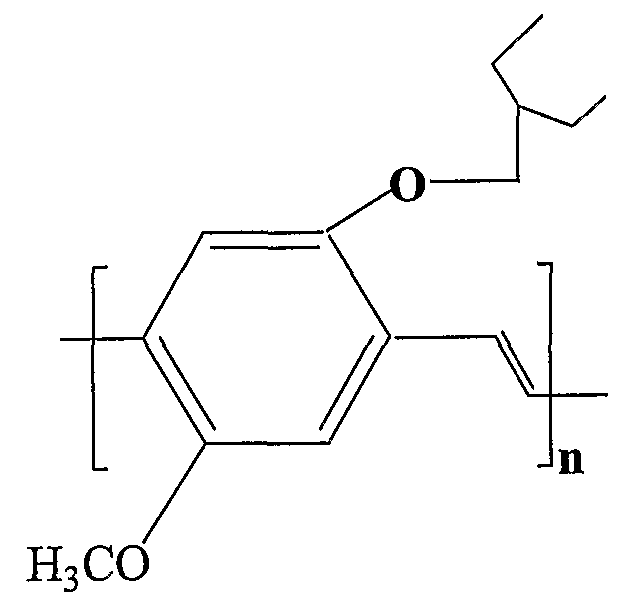
- Figure 1 depicts the HOMO (highest occupied molecular orbital) and LUMO (lowest unoccupied molecular orbital) energy levels of poly(9,9-dioctylfluorenyl-2,7- diyl ("PFO”), poly(9,9-dihexyl-fluorene-co-benzothiadiazole) (“PFO-BT”), poly[2- methoxy-5-(2-ethyl-hexyloxy)-l,4-phenylene vinylene] (“MEH-PPV”) and poly ⁇ [9,9- bis(6'-(N,N,N- trimethylammonium)hexyl)-fluorine-2,7-diyl]-alt-[2,5-bis(p- phenylene)-l,3,4-oxadiazole] ⁇ ("PFON + (CH3) 3 I " -PBD”) compared to the work function of Ba (all reference
- Figure 2 shows the current density (niA/cm 2 ) vs. applied voltage (V) and luminance (cd/m 2 ) vs. applied voltage (V) for devices made using blue-emitting PFO with and without PFON + (CH 3 ) 3 1 " -PBD as an electron-transport layer (ETL).
- Figure 3 shows the luminous efficiency (cd A) as a function of current density (mA/cm 2 ) for devices made with (a) PFO, (b) PFO-BT and (c) MEH-PPV with and without ETL.
- the conjugated polymers have a sufficient density of polar substituents to render them soluble in a polar medium.
- the polymers thus have desirable solubility properties allowing for their use with polymers of differing solubilities in methods involving multiple solution processing steps.
- the different solubility properties of these polymers allow their deposition in solution in multilayer formats with other conjugated polymers.
- the polar substituents can be charged groups, for example cationic or anionic groups.
- the conjugated polymers may have a sufficient density of solubilizing polar groups to render them soluble in a highly polar solvent such as water and/or methanol. This can be particularly advantageous for preparing multilayer polymeric devices via novel solution processing methods, also provided.
- the conjugated polymer may desirably comprise monomers which alter its conductivity properties.
- the conjugated polymer can comprise monomers which improve its ability to inject and/or transport electrons.
- the conjugated polymer can comprise monomers which improve its ability to inject and/or transport holes.
- the conductivity of such polymers can be controlled through the type and/or amount of monomer(s) used, which may be selected to match with other materials of interest in electronic devices.
- the composition of the polymer may also be chosen to prevent conductivity of certain species.
- the composition of the polymer may be chosen so that it has hole-blocking properties, which can be desirable in certain device configurations, for example in polymer light-emitting diodes (PLEDs).
- PLEDs polymer light-emitting diodes
- the inventors have provided cationic conjugated polymers (CCPs) comprising both solubilizing groups and conductive groups, resulting in conductive conjugated polymers soluble in polar media.
- CCPs cationic conjugated polymers
- These conductive polymers are desirably soluble in water and/or lower alcohols, particularly methanol.
- the CCPs can comprising monomers which perturb the polymer's ability to form rigid-rod structures, allowing them to form a greater range of three-dimensional structures.
- the monomers are aromatic molecules having attachment points to the adjacent subunits of the polymer which form an angle of greater than about 25° from linear.
- the monomers may introduce a torsional twist in the conjugated polymer, thereby further disrupting the ability of the polymer to form a rigid-rod structure.
- articles of manufacture comprising multiple layers of conjugated polymers having differing solubility characteristics.
- Multiple polymer layers produced by methods described herein can be incorporated in any of a variety of articles and machines.
- Embodiments of the invention can comprise multiplex formats. For example, a plurality of different LEDs can be used simultaneously in a display format.
- Multiplex embodiments may employ 2, 3, 4, 5, 10, 15, 20, 25, 50, 100, 200, 400, 1000, 5000, 10000, 50000, 200000, one million or more distinct articles provided by one or more embodiments described herein. Other aspects of the invention are discussed further herein.
- this invention is not limited to the particular methodology, articles, compositions or apparatuses described, as such methods, articles, compositions or apparatuses can, of course, vary. It is also to be understood that the terminology used herein is for the purpose of describing particular embodiments only, and is not intended to limit the scope of the present invention. Use of the singular forms "a,” “an,” and “the” include plural references unless the context clearly dictates otherwise.
- a conjugated polymer includes a plurality of conjugated polymers
- reference to “a solvent” includes a plurality of such solvents
- reference to “an LED” includes a plurality of LEDs, and the like.
- the term “or” when used herein as the sole conjunction means “and/or” unless stated otherwise.
- the term “including” and related terms such as “includes” as used herein are not limiting and allow for the presence of elements in addition to those specifically recited.
- Alkyl refers to a branched, unbranched or cyclic saturated hydrocarbon group of 1 to 24 carbon atoms optionally substituted at one or more positions, and includes polycyclic compounds.
- alkyl groups include optionally substituted methyl, ethyl, n-propyl, isopropyl, n-butyl, s-butyl, t-butyl, n-pentyl, isopentyl, neopentyl, n-hexyl, n-heptyl, n-octyl, n-decyl, hexyloctyl, tetradecyl, hexadecyl, eicosyl, tetracosyl and the like, as well as cycloalkyl groups such as cyclopropyl, cyclobutyl, cyclopentyl, cyclohexyl, cycloheptyl, cyclooctyl, adamantyl, and norbornyl.
- lower alkyl refers to an alkyl group of 1 to 6 carbon atoms, preferably 1 to 4 carbon atoms.
- Alkoxy refers to an "-Oalkyl” group, where alkyl is as defined above.
- a “lower alkoxy” group intends an alkoxy group containing one to six, more preferably one to four, carbon atoms.
- alkenyl refers to an unsaturated branched, unbranched or cyclic hydrocarbon group of 2 to 24 carbon atoms containing at least one carbon-carbon double bond and optionally substituted at one or more positions.
- alkenyl groups include ethenyl, 1-propenyl, 2-propenyl (allyl), 1-methylvinyl, cyclopropenyl, 1-butenyl, 2-butenyl, isobutenyl, 1,4-butadienyl, cyclobutenyl, l-methylbut-2-enyl, 2- methylbut-2-en-4-yl, prenyl, pent-1-enyl, pent-3-enyl, 1,1-dimethylallyl, cyclopentenyl, hex-2-enyl, 1 -methyl- 1-ethylallyl, cyclohexenyl, heptenyl, cycloheptenyl, octenyl, cyclo
- alkenyl groups herein contain 2 to 12 carbon atoms.
- the term “lower alkenyl” intends an alkenyl group of 2 to 6 carbon atoms, preferably 2 to 4 carbon atoms.
- the term “cycloalkenyl” intends a cyclic alkenyl group of 3 to 8, preferably 5 or 6, carbon atoms.
- Alkenyloxy refers to an "-Oalkenyl” group, wherein alkenyl is as defined above.
- Alkylaryl refers to an alkyl group that is covalently joined to an aryl group.
- the alkyl is a lower alkyl.
- alkylaryl groups include benzyl, phenethyl, phenopropyl, 1-benzylethyl, phenobutyl, 2-benzylpropyl and the like.
- Alkylaryloxy refers to an "-Oalkylaryl” group, where alkylaryl is as defined above.
- Alkynyl refers to an unsaturated branched or unbranched hydrocarbon group of 2 to 24 carbon atoms containing at least one -C ⁇ € ⁇ triple bond, optionally substituted at one or more positions.
- alkynyl groups examples include ethynyl, n- propynyl, isopropynyl, propargyl, but-2-ynyl, 3-methylbut-l-ynyl, octynyl, decynyl and the like.
- Preferred alkynyl groups herein contain 2 to 12 carbon atoms.
- the term "lower alkynyl” intends an alkynyl group of 2 to 6, preferably 2 to 4, carbon atoms, and one -C ⁇ €- triple bond.
- Amide refers to -C(O)NR'R", where R' and R" are independently selected from hydrogen, alkyl, aryl, and alkylaryl.
- Amide refers to an -N(R')R" group, where R' and R" are independently selected from hydrogen, alkyl, aryl, and alkylaryl.
- Aryl refers to an aromatic group that has at least one ring having a conjugated pi electron system and includes carbocyclic, heterocyclic, bridged and/or polycyclic aryl groups, and can be optionally substituted at one or more positions. Typical aryl groups contain 1 to 5 aromatic rings, which may be fused and/or linked.
- Exemplary aryl groups include phenyl, furanyl, azolyl, thiofuranyl, pyridyl, pyrimidyl, pyrazinyl, triazinyl, biphenyl, indenyl, benzofuranyl, indolyl, naphthyl, quinolinyl, isoquinolinyl, quinazolinyl, pyridopyridinyl, pyrrolopyridinyl, purinyl, tetralinyl and the like.
- substituents on optionally substituted aryl groups include alkyl, alkoxy, alkylcarboxy, alkenyl, alkenyloxy, alkenylcarboxy, aryl, aryloxy, alkylaryl, alkylaryloxy, fused saturated or unsaturated optionally substituted rings, halogen, haloalkyl, heteroalkyl, -S(O)R, sulfonyl, -SO 3 R, -SR, -NO 2 , -NRR', - OH, -CN, -C(O)R, -OC(O)R, -NHC(O)R, -(CH 2 ) n CO 2 R or -(CH 2 ) n CONRR' where n is 0-4, and wherein R and R' are independently H, alkyl, aryl or alkylaryl.
- Aryloxy refers to an "-Oaryl” group, where aryl is as defined above.
- Carbocyclic refers to an optionally substituted compound containing at least one ring and wherein all ring atoms are carbon, and can be saturated or unsaturated.
- Carbocyclic aryl refers to an optionally substituted aryl group wherein the ring atoms are carbon.
- Halo or “halogen” refers to fluoro, chloro, bromo or iodo.
- Halide refers to the anionic form of the halogens.
- Haloalkyl refers to an alkyl group substituted at one or more positions with a halogen, and includes alkyl groups substituted with only one type of halogen atom as well as alkyl groups substituted with a mixture of different types of halogen atoms. Exemplary haloalkyl groups include trihalomethyl groups, for example trifluoromethyl.
- Heteroalkyl refers to an alkyl group wherein one or more carbon atoms and associated hydrogen atom(s) are replaced by an optionally substituted heteroatom, and includes alkyl groups substituted with only one type of heteroatom as well as alkyl groups substituted with a mixture of different types of heteroatoms. Heteroatoms include oxygen, sulfur, and nitrogen.
- nitrogen heteroatoms and sulfur heteroatoms include any oxidized form of nitrogen and sulfur, and any form of nitrogen having four covalent bonds including protonated and alkylated forms.
- An optionally substituted heteroatom refers to a heteroatom having one or more attached hydrogens optionally replaced with alkyl, aryl, alkylaryl and/or hydroxyl.
- Heterocyclic refers to a compound containing at least one saturated or unsaturated ring having at least one heteroatom and optionally substituted at one or more positions. Typical heterocyclic groups contain 1 to 5 rings, which may be fused and/or linked, where the rings each contain five or six atoms.
- heterocyclic groups include piperidinyl, morpholinyl and pyrrolidinyl.
- exemplary substituents for optionally substituted heterocyclic groups are as for alkyl and aryl at ring carbons and as for heteroalkyl at heteroatoms.
- Heterocyclic aryl refers to an aryl group having at least 1 heteroatom in at least one aromatic ring.
- heterocyclic aryl groups include furanyl, thienyl, pyridyl, pyridazinyl, pyrrolyl, N-lower alkyl-pyrrolo, pyrimidyl, pyrazinyl, triazinyl, tetrazinyl, triazolyl, tetrazolyl, imidazolyl, bipyridyl, tripyridyl, tetrapyridyl, phenazinyl, phenanthrolinyl, purinyl and the like.
- Hydrocarbyl refers to hydrocarbyl substituents containing 1 to about 20 carbon atoms, including branched, unbranched and cyclic species as well as saturated and unsaturated species, for example alkyl groups, alkyhdenyl groups, alkenyl groups, alkylaryl groups, aryl groups, and the like.
- the term “lower hydrocarbyl” intends a hydrocarbyl group of one to six carbon atoms, preferably one to four carbon atoms.
- a “substituent” refers to a group that replaces one or more hydrogens attached to a carbon or nitrogen.
- (CH ) n CONRR' where n is 0-4, and wherein R and R' are independently H, alkyl, aryl or alkylaryl. Substituents also include replacement of a carbon atom and one or more associated hydrogen atoms with an optionally substituted heteroatom.
- Thioamide refers to -C(S)NR'R", where R' and R" are independently selected from hydrogen, alkyl, aryl, and alkylaryl.
- Thioether refers to -SR, where R is alkyl, aryl, or alkylaryl.
- Multiplexing herein refers to an assay or other analytical method in which multiple analytes can be assayed simultaneously.
- Optional or “optionally” means that the subsequently described event or circumstance may or may not occur, and that the description includes instances where said event or circumstance occurs singly or multiply and instances where it does not occur at all.
- the phrase “optionally substituted alkyl” means an alkyl moiety that may or may not be substituted and the description includes both unsubstituted, monosubstituted, and polysubstituted alkyls.
- CPs CONJUGATED POLYMER SOLUBLE IN POLAR MEDIA Conjugated polymers (CPs) soluble in polar media are provided and can be used in embodiments described herein.
- the CPs comprise polar groups as solubilizing functionalities linked to polymer subunits to increase polymer solubility in polar media. Any or all of the subunits of the CP may comprise one or more pendant solubilizing groups.
- Exemplary polar groups include those introducing one or more dipole moments to the CP, for example halides, hydroxyls, amines, amides, cyano, carboxylic acids, and thiols.
- the polar groups are charged groups, more preferably cationic groups.
- Any suitable cationic groups may be incorporated into CCPs.
- Exemplary cationic groups which may be incorporated include ammonium groups, guanidinium groups, histidines, polyamines, pyridinium groups, and sulfonium groups.
- the solubilizing functionality may be linked to the conjugated polymer backbone by a linker, preferably an unconjugated linker, for example alkyl groups, polyethers, alkylamines, and/or polyamines.
- a linker preferably an unconjugated linker, for example alkyl groups, polyethers, alkylamines, and/or polyamines.
- a neutral polymer is first formed by the Suzuki coupling of one or more bis- (or tris- etc.) boronic acid-substituted monomer(s) with one or more monomers that have at least two bromine substitutions on aromatic ring positions. Bromine groups are attached to any or all of the monomers via linkers. Conversion to cationic water-soluble polymers is accomplished by addition of condensed trimethylamine, which replaces the pendant bromines with ammonium groups.
- the conjugated polymer may desirably comprise conductive monomers which alter the conductivity of the overall polymer, increasing its ability to transport an electrical species.
- the conjugated polymer can comprise monomer(s) which improve its ability to inject and/or transport electrons.
- the conjugated polymer can comprise monomer(s) which improve its ability to inject and/or transport holes. More than one type of conductive monomer can be incorporated in the conjugated polymer. The conductivity of such polymers can be controlled through the type and/or amount of monomer(s) used, which can be selected to provide an electronic configuration compatible with other materials of interest in a given electronic device.
- the conductive monomers may be electron-deficient monomers or electron- rich monomers. Electron-deficient monomers can be used to increase the ability of the polymer to inject and/or transport electrons, and to improve its ability to serve as an electron-transport layer. Electron-deficient monomers include unsaturated and/or aromatic groups appropriately substituted with electron-withdrawing groups.
- Electron-deficient monomers include benzothiadiazole, oxadiazole, quinoxaline, cyano- substituted olefins, squaric acid, and maleimide.
- Electron-rich monomers can be used to increase the ability of the polymer to inject and/or transport holes, and to improve its ability to serve as a hole-transport layer.
- Electron-rich monomers include unsaturated and/or aromatic groups appropriately substituted with electron-donating groups, for example alkyl groups.
- a number of electron-rich monomers are known in the art.
- Exemplary electron-rich monomers include 9,9-dialkylfluorenes, 2,5-dimethyl-l,4-phenylidene, 2,5- dioctyloxy- 1 ,4-phenylidene, and terthiophenes .
- the composition of the polymer can also be chosen to prevent conductivity of certain species.
- the composition of the polymer can be chosen so that it has hole-blocking properties, which can be desirable in certain device configurations, for example in polymer light-emitting diodes (PLEDs).
- the polymers can comprise angled linkers with a substitution pattern (or regiochemistry) capable of perturbing the polymers' ability to form rigid-rod structures, allowing them to have a greater range of three-dimensional structures.
- the polymers can comprise at least three subunits with at least one angled linker, which may be internal and/or an end unit, and may comprise at least 4, 5, 6, 8, 10, 15, 20, 25 or more subunits.
- the polymers may comprise up to about 100, 200, 300, 500, 1000, 2000, 5000, 10000, 20000, 50000 or more subunits.
- the angled linker(s) are optionally substituted aromatic molecules having at least two separate bonds to other polymer components (e.g., monomers, block polymers, end groups) that are capable of forming angles relative to one another which disrupt the overall ability of the polymer to form an extended rigid-rod structure (although significant regions exhibiting such structure may remain.)
- the angled linkers may be bivalent or polyvalent.
- the angle which the angled linkers are capable of imparting to the polymeric structure is determined as follows. Where the two bonds to other polymeric components are coplanar, the angle can be determined by extending lines representing those bonds to the point at which they intersect, and then measuring the angle between them.
- the angle can be determined as follows: a first line is drawn between the two ring atoms to which the bonds attach; two bond lines are drawn, one extending from each ring atom in the direction of its respective bond to the other polymeric component to which it is joined; the angle between each bond line and the first line is fixed; and the two ring atoms are then merged into a single point by shrinking the first line to a zero length; the angle then resulting between the two bond lines is the angle the angled linker imparts to the polymer.
- the angle which an angled linker is capable of imparting to the polymer is typically less than about 155°, and may be less than about 150°, less than about 145°, less than about 140°, less than about 135°, less than about 130°, less than about 125°, less than about 120°, less than about 115°, less than about 110°, less than about 105°, less than about 100°, less than about 95°, less than about 90°, less than about 85°, less than about 80°, less than about 75°, less than about 70°, less than about 65°, less than about 60°, less than about 55°, or less than about 50°.
- the angled linker may form an angle to its adjacent polymeric units of about 25°, 30°, 35°, 40°, 45°, 50°, 60° or more.
- the angled linker may introduce a torsional twist in the conjugated polymer, thereby further disrupting the ability of the polymer to form a rigid-rod structure.
- the angled linker must be capable of imparting an angle of less than about 155° in at least one orientation.
- six-membered rings such angles can be achieved through ortho or meta linkages to the rest of the polymer. For five-membered rings, adjacent linkages fall within this range.
- linkages extending from adjacent ring atoms, from alternate ring atoms (separated by one ring atom), and from ring atoms separated by two other ring atoms fall within this range. Ring systems with more than eight ring atoms may be used. For polycyclic structures, even more diverse linkage angles can be achieved.
- linking units which meet these limitations include benzene derivatives incorporated into the polymer in the 1,2 or 1,3-positions; naphthalene derivatives incorporated into the polymer in the 1,2-, 1,3-, 1,6-, 1,7-, 1,8-positions; anthracene derivatives incorporated into the polymer in the 1,2-, 1,3-, 1,6-, 1,7-, 1,8-, and 1,9-positions; biphenyl derivatives incorporated into the polymer in the 2,3-, 2,4-, 2,6-, 3,3'-, 3,4-, 3,5-, 2,2'-, 2,3'-, 2,4'-, and 3,4'- positions; and corresponding heterocycles.
- the position numbers are given with reference to unsubstituted carbon- based rings, but the same relative positions of incorporation in the polymer are encompassed in substituted rings and/or heterocycles should their distribution of substituents change the ring numbering.
- the CP can be a copolymer, and may be a block copolymer, a graft copolymer, or both.
- the solubilizing functionalities, the conductive subunits and/or the angled linkers may be incorporated into the CP randomly, alternately, periodically and/or in blocks.
- Exemplary polymers which may form the backbone of the compounds of the present invention include, for example, polypyrroles, polyfluorenes, polyphenylene- vinylenes, polythiophenes, polyisothianaphthenes, polyanilines, poly-p-phenylenes and copolymers thereof.
- Other exemplary polymeric subunits and repeating units are shown in the accompanying tables. Table 1. Typical aromatic repeat units for the construction of conjugated segments and oligomeric structures.
- the CP contains a sufficient density of solubilizing functionalities to render the overall polymer soluble in a polar medium.
- the CP preferably contains at least about 0.01 mol % of the monomers substituted with at least one solubilizing functionality, and may contain at least about 0.02 mol %, at least about 0.05 mol %, at least about 0.1 mol %, at least about 0.2 mol %, at least about 0.5 mol %, at least about 1 mol %, at least about 2 mol %, at least about 5 mol %, at least about 10 mol %, at least about 20 mol %, or at least about 30 mol %.
- the CP may contain up to 100 mol % of the solubilizing functionality, and may contain about 99 mol % or less, about 90 mol % or less, about 80 mol % or less, about 70 mol % or less, about 60 mol % or less, about 50 mol % or less, or about 40 mol % or less.
- the CP preferably contains at least about 0.01 mol % of the conductive monomers, and may contain at least about 0.02 mol %, at least about 0.05 mol %, at least about 0.1 mol %, at least about 0.2 mol %, at least about 0.5 mol %, at least about 1 mol %, at least about 2 mol %, at least about 5 mol %, at least about 10 mol %, at least about 20 mol %, or at least about 30 mol %.
- the CP may contain up to 100 mol % of the conductive monomers, and may contain about 99 mol % or less, about 90 mol % or less, about 80 mol % or less, about 70 mol % or less, about 60 mol % or less, about 50 mol % or less, or about 40 mol % or less.
- the polymer may contain at least about 0.01 mol % of the angled linker, and may contain at least about 0.02 mol %, at least about 0.05 mol %, at least about 0.1 mol %, at least about 0.2 mol %, at least about 0.5 mol %, at least about 1 mol %, at least about 2 mol %, at least about 5 mol %, at least about 10 mol %, at least about 20 mol %, or at least about 30 mol %.
- the polymer may contain up to 100 mol % of the angled linker, and may contain about 99 mol % or less, about 90 mol % or less, about 80 mol % or less, about 70 mol % or less, about 60 mol % or less, about 50 mol % or less, or about 40 mol % or less.
- the CPs described herein are soluble in aqueous solutions and other highly polar solvents, and preferably are soluble in water.
- water-soluble is meant that the material exhibits solubility in a predominantly aqueous solution, which, although comprising more than 50% by volume of water, does not exclude other substances from that solution, including without limitation buffers, blocking agents, cosolvents, salts, metal ions and detergents.
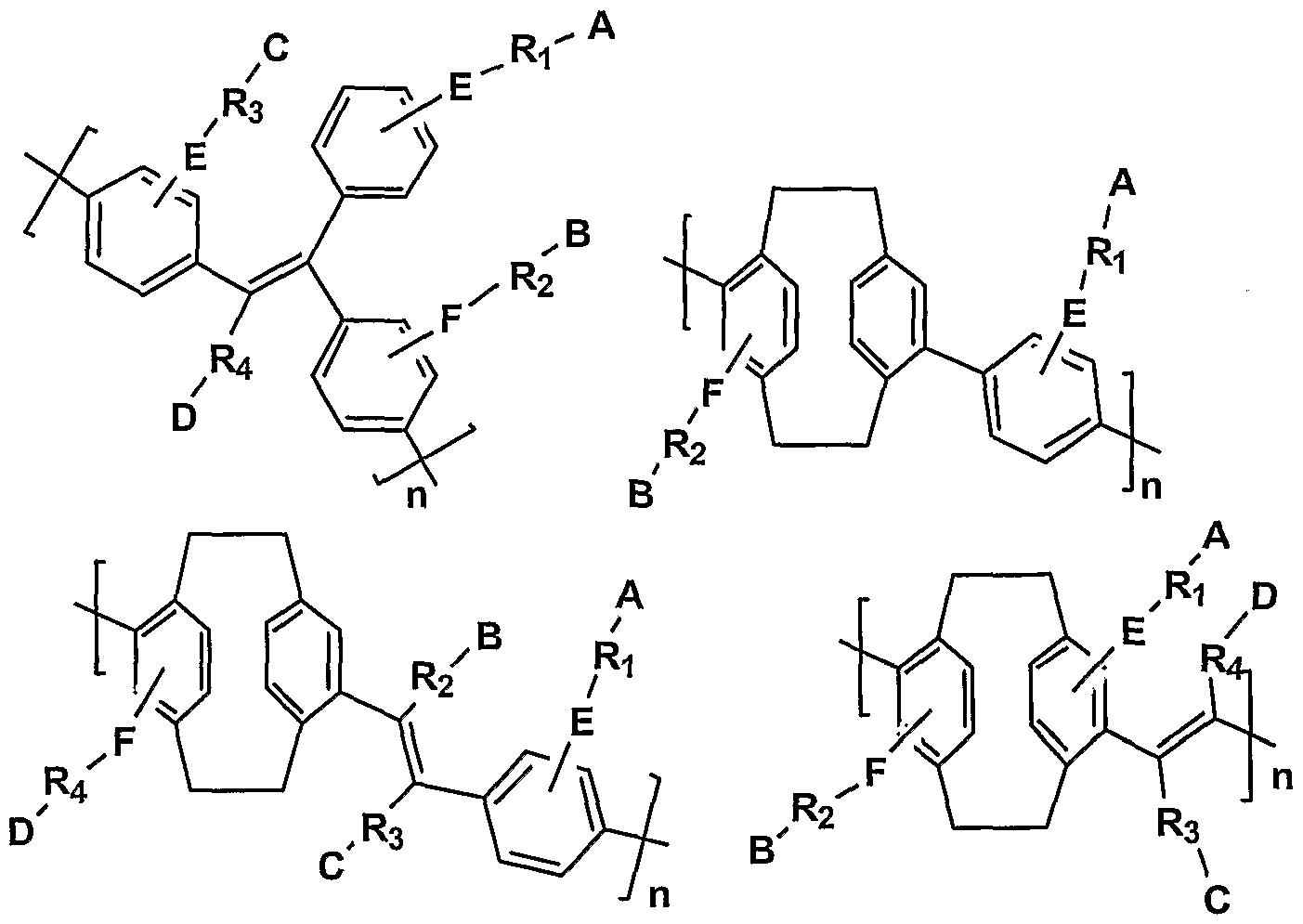
- an exemplary CCP is represented by Formula A:
- CPi, CP 2 , CP 3 , and CP 4 are optionally substituted conjugated polymer segments or oligomeric structures, and may be the same or different from one another.
- CP 1 ⁇ CP 2 , CP , and CP 4 may be aromatic repeat units, and may be selected from the group consisting of benzene, naphthalene, anthracene, fluorene, thiophene, furan, pyridine, and oxadiazole, each optionally substituted.
- Typical aromatic repeat units are shown in Table 1 below, and representative polymeric segments and oligomeric structures are shown in Table 2.
- CP 1-4 may be conductive monomers comprising electron-injecting and/or transporting properties or hole-injecting and/or transporting properties.
- the conductive monomers may be evenly or randomly distributed along the polymer main chain.
- CP l3 CP 2 , CP 3 and CP 4 are each optionally substituted at one or more positions with one or more groups selected from -R ⁇ . -A s -R 2 -B, -R 3 -C and -I rD, which may be attached through bridging functional groups -E- and -F-, with the proviso that the polymer as a whole must be substituted with a plurality of cationic groups.
- R l5 R 2 , R and R t are independently selected from alkyl, alkenyl, alkoxy, alkynyl, and aryl, alkylaryl, arylalkyl, and polyalkylene oxide, each optionally substituted, which may contain one or more heteroatoms, or may be not present.
- R ls R 2 , R 3 and R 4 can be independently selected from C 1- 2 alkyl, C 1-2 alkoxy, C ⁇ -22 ester, polyalkylene oxide having from 1 to about 22 carbon atoms, cyclic crown ether having from 1 to about 22 carbon atoms, or not present.
- Ri , R , R 3 and R may be selected from straight or branched alkyl groups having 1 to about 12 carbon atoms, or alkoxy groups with 1 to about 12 carbon atoms. It is to be understood that more than one functional group may be appended to the rings as indicated in the formulas at one or more positions.
- A, B, C and D are independently selected from H, -SiR'R"R" ⁇ -N + R'R"R"', a guanidinium group, histidine, a polyamine, a pyridinium group, and a sulfonium group.
- R', R" and R"' are independently selected from the group consisting of hydrogen, C 1-12 alkyl and C 1-12 alkoxy and C 3-10 cycloalkyl. It is preferred that R', R" and R' ' ' are lower alkyl or lower alkoxy groups. E and F are independently selected from not present, -O-, -S-, -C(O)-, -C(O)O- , -C(R)(R')-, -N(R')-, and -Si(R')(R"), wherein R' and R" are as defined above.
- m and n are independently 0 to about 10,000, wherein m + n > 1.
- Preferably m and n are each independently 0 to about 20 and more preferably from 0 to about 10.
- Each repeat of m and n may be the same as or different than the other repeats.
- a, b, c and d are independently 0 to about 250. At least one of a, b, c and d must be greater than or equal to one.
- G and Gl are capping units and may be the same or different.
- the capping units may be activated units that allow further chemical reaction to extend the polymer chain, or may be nonactivated termination units.
- G and Gl can be independently selected from hydrogen, optionally substituted aryl, halogen substituted aryl, boronic acid substituted aryl, and boronate radical substituted aryl.
- Conjugated polymers may also be provided in purified form. Any available method or combination of methods may be used for purification. Exemplary methods include precipitation, extraction, and sublimation. Solutions of the CP are also provided. Solutions may be provided in a container of any suitable form. Solutions may be packaged in a container designed for incorporation into a solution processing apparatus, for example a printer. In some embodiments, the solution may be provided in an inkjet cartridge designed to be used with an inkjet printer.
- the conjugated polymer is soluble in a polar medium, a medium comprising at least one polar solvent.
- polar is meant having a net dipole moment.
- exemplary polar solvents include dimethylsulfoxide, dimethylformamide, formic acid, acetic acid, ethyl acetate, water, alcohols and polyalcohols, particularly lower alcohols (Ci- 4 ), particularly methanol.
- the polar solvent has a polarity of at least that of ethanol or ethyl acetate.
- the polar solvent used to dissolve the CP is selected based on its inability to dissolve a second conjugated polymer onto which the CP is to be deposited.
- the polar solvent in certain embodiments and solution formed therefrom in some embodiments is wettable on the surface to which it is to be applied, such that when it is deposited it flows generally uniformly and evenly over the surface, and preferably is controllable in thickness. Combinations of solvents may also be used. Preferably the solvent is sufficiently wettable on the substrate that the solution spreads appropriately when deposited thereon.
- One or more wetting agents may be included in the solution to improve its ability to wet a surface and or lowers its surface tension.
- a solution comprising water may have an alcohol, a surfactant, or a combination of materials added thereto serving as wetting agents.
- the CPs described herein can be used in a variety of methods. Methods of particular interest include deposition of the CPs into electronic devices, particularly in devices comprising multiple layers of conjugated polymers. Any of a variety of deposition methods can be used in a given device, including without limitation vacuum sputtering (RF or Magnetron), electron beam evaporation, thermal vapor deposition, chemical deposition, sublimation, and solution processing methods. Any deposition method known or discoverable in the art can be used to deposit the soluble polar polymers provided herein, although solution methods are currently preferred.
- one or more of these layers may comprise nonpolar conjugated polymers which may not be soluble in a polar medium of interest.
- nonpolar conjugated polymers include, for example, MEH-PPV, P3ATs [poly(3-alkylthio ⁇ henes), where alkyl is from 6 to 16 carbons], such as poly(2,5-dimethoxy-p-phenylene vinylene)-"PDMPV", and poly(2,5-thienylenevinylene); poly(phenylenevinylene) or "PPV” and alkoxy derivatives thereof; PFO, PFO-BT, and polyanilines.
- the nonpolar conjugated polymer can be deposited by any suitable technique; in some embodiments it is deposited or cast directly from solution.
- organic solvents are used, typically with low polarity.
- exemplary organic solvents include: halohydrocarbons such as methylene chloride, chloroform, and carbon tetrachloride; aromatic hydrocarbons such as xylene, benzene, toluene; and other hydrocarbons including decaline. Mixed solvents can also be used.
- halohydrocarbons such as methylene chloride, chloroform, and carbon tetrachloride
- aromatic hydrocarbons such as xylene, benzene, toluene
- decaline hydrocarbons including decaline.
- Mixed solvents can also be used.
- the differing solubility properties of nonpolar and polar polymers allow for deposition of multiple polymeric layers via solution processing methods, which can simplify manufacturing and reduce costs.
- the water-soluble polymers described herein allow for the solution deposition of alternating layers of polymers of differing solubilities to form bilayer or multilayer devices.
- the solution can be relatively dilute, such as from 0.1 to 20% w/w in concentration, especially 0.2 to 5% w.
- film thicknesses may be at least about 50, 100, or 200 nm. In some embodiments, film thicknesses of less than about 400, 200, or 100 nm can be used.
- the polymer solution can be formed into a selected shape if desired, e.g. a fiber, film or the like by any suitable method, for example extrusion.
- the solvent is removed. Any available method or combination of methods may be used for removing the solvent. Exemplary solvent removal methods include evaporation, heating, extraction, and subjecting the solution to a vacuum.
- the conjugated polymer may be deposited on a substrate.
- the substrate can comprise a wide range of material, either biological, nonbiological, organic, inorganic, or a combination of any of these.
- the substrate can be transparent.
- the substrate can be a rigid material, for example a rigid plastic or a rigid inorganic oxide.
- the substrate can be a flexible material, for example a transparent organic polymer such as polyethyleneterephthalate or a flexible polycarbonate.
- the substrate can be conductive or nonconductive.
- the CPs can be deposited on a substrate in any of a variety of formats.
- the substrate may be a polymerized Langmuir Blodgett film, functionalized glass, Si, Ge, GaAs, indium doped GaN, GaP, SiC (Nature 430:1009, 2004), SiO2, SiN4, semiconductor nanocrystals, modified silicon, or any of a wide variety of gels or polymers such as (poly)tetrafluoroethylene, ( ⁇ oly)vinylidenedifluoride, polystyrene, cross-linked polystyrene, polyacrylic, polylactic acid, polyglycolic acid, poly(lactide coglycolide), polyanhydrides, poly(methyl methacrylate), poly(ethylene- co-vinyl acetate), polyethyleneterephthalate, polysiloxanes, polymeric silica, latexes, dextran polymers, epoxies, polycarbonates, agarose, poly(acryl
- the substrate can take the form of a photodiode, an optoelectronic sensor such as an optoelectronic semiconductor chip or optoelectronic thin-film semiconductor, or a biochip.
- the CPs may be used in methods which screen the CPs for any property of interest. For example, the CPs may be tested for binding to a target, for energy transfer to a chromophore, for increased fluorescent efficiency, for decreased self- quenching, for absorbance wavelength, emission wavelength, conductive properties, ability to inject and/or transport electrons, ability to block holes, ability to inject and/or transport holes, and/or work function, etc.
- the CPs can be incorporated into any of various articles of manufacture including optoelectronic or electronic devices, biosensors, diodes, including photodiodes and light-emitting diodes ("LEDs"), optoelectronic semiconductor chips, semiconductor thin-films, and chips, and can be used in array or microarray form.
- the polymer can be incorporated into a polymeric photoswitch.
- the polymer can be incorporated into an optical interconnect or a transducer to convert a light signal to an electrical impulse.
- the CPs can serve as liquid crystal materials.
- the CPs may be used as electrodes in electrochemical cells, as conductive layers in elecfrochromic displays, as field effective transistors, and as Schottky diodes.
- the CPs can be used as lasing materials.
- Optically pumped laser emission has been reported from MEH-PPV in dilute solution in an appropriate solvent, in direct analogy with conventional dye lasers [D. Moses, Appl. Phys. Lett. 60, 3215 (1992); U.S. Pat. No. 5,237,582].
- Semiconducting polymers in the form of neat undiluted films have been demonstrated as active luminescent materials in solid state lasers [F. Hide, M. A. Diaz-Garcia, B. J. Schwartz, M. R. Andersson, Q.
- Light-emitting diodes can be fabricated incorporating one or more layers of CPs, which may serve as conductive layers. Light can be emitted in various ways, e.g., by using one or more transparent or semitransparent electrodes, thereby allowing generated light to exit from the device.
- the mechanism of operation of a polymer LED requires that carrier injection be optimized and balanced by matching the electrodes to the electronic structure of the semiconducting polymer.
- LED embodiments include hole-injecting and electron-injecting electrodes.
- a conductive layer made of a high work function material (above 4.5 eV) may be used as the hole-injecting electrode.
- Exemplary high work function materials include electronegative metals such as gold or silver, and metal-metal oxide mixtures such as indium-tin oxide.
- An electron-injecting electrode can be fabricated from a low work function metal or alloy, typically having a work function below 4.3.
- Exemplary low work function materials include indium, calcium, barium and magnesium.
- the electrodes can be applied by any suitable method; a number of methods are known to the art (e.g. evaporated, sputtered, or electron-beam evaporation).
- polymer light-emitting diodes have been fabricated using a semiconducting polymer cast from solution in an organic solvent as an emissive layer and a water-soluble (or methanol-soluble) conjugated copolymer as an electron-transport layer (ETL) in the device configuration: ITO(indium tin oxide)/PEDOT(poly(3,4-ethylene dioxythiophene)/emissive polymer/ETL/Ba/Al.
- ITO indium tin oxide
- PEDOT poly(3,4-ethylene dioxythiophene)/emissive polymer/ETL/Ba/Al.
- the inventors have successfully fabricated multi-layer PLEDs using a semiconducting polymer (red, green or blue emitting), cast from solution in an organic solvent, as the emissive layer and a water-soluble (or methanol-soluble) cationic conjugated copolymer as electron-transport layer.
- the results demonstrate that devices with the ETL have significantly lower turn-on voltage, higher brightness and improved luminous efficiency.
- the examples demonstrate the use of an electron-transport layer formed from the soluble conductive polymer, any form of conducting layer can be used.
- judicious choice of monomers as described herein can result in polymers with hole- injecting and/or transporting properties, as well as polymers with electron-injecting and/or transporting properties.
- the device geometry and deposition order can be selected based on the type of conductive polymer being used. More than one type of conductive polymer can be used in the same multilayer device.
- a multilayer device may include more than one layer of electron-injecting conjugated polymers, more than one layer of hole-injecting conjugated polymers, or at least one layer of a hole-injecting polymer and at least one layer of an electron-injecting conjugated polymer.
- the device efficiency is reduced by cathode quenching since the recombination zone is typically located near the cathode. [20J
- the addition of an ETL moves the recombination zone away from the cathode and thereby eliminates cathode quenching.
- the ETL can serve to block the diffiision of metal atoms, such as barium and calcium, and thereby prevents the generation of quenching centers '- 20 ' 1 during the cathode deposition process.
- the principal criteria when a soluble conjugated polymer is used as an electron transport layer (ETL) in polymer light-emitting diodes (PLEDs) are the following: (1) The lowest unoccupied molecular orbital (LUMO) of the ETL must be at an energy close to, or even within the ⁇ *-band of the emissive semiconducting polymer (so electrons can be injected); and (2) The solvent used for casting the electron injection material must not dissolve the underlying emissive polymer.
- LUMO lowest unoccupied molecular orbital
- HTL hole transport layer
- PLEDs polymer light-emitting diodes
- HOMO highest occupied molecular orbital
- Solubility considerations can dictate the deposition order of the particular CPs ans solvents used to produce a desired device configuration. Any number of layers of CPs with different solubilities may be deposited via solution processing by employing these techniques.
- the PLEDs comprising CPs described herein can be incorporated in any available display device, including a full color LED display, a cell phone display, a PDA (personal digital assistant), portable combination devices performing multiple functions (phone/PDA/camera/etc.), a flat panel display including a television or a monitor, a computer monitor, a laptop computer, a computer notepad, and an integrated computer-monitor systems.
- the PLEDs may be incorporated in active or passive matrices.
- PLEDs polymer light-emitting diodes
- ETL electron-transport layer
- Example 1 Fabrication of PLEDs
- the water soluble conjugated copolymer, poly ⁇ [9,9-bis(6'-(N,N,N- trimethylammonium)hexyl)-fluorine-2,7-diyl]- /t-[2,5-bis(p-phenylene)-l,3,4- oxadiazole] ⁇ (PFON + (CH 3 ) 3 T-PBD) was synthesized using the palladium catalyzed Suzuki coupling reaction [13 ' 14] and used as an electron transport layer (ETL).
- ETL electron transport layer
- PFO-BT Poly(9,9- dihexyl-fluorene-co-benzothiadiazole)
- PFO Poly(9,9-dioctyfiuorenyl-2,7-diyl)
- MEH-PPV poly[2-methoxy-5- (2-ethyl-hexyloxy)-l,4-phenylene vinylene]
- MEH-PPV The HOMO (highest occupied molecular orbital) and LUMO energy levels are shown in Figure 1 (the work functions of ⁇ oly(3,4-ethylene dioxythiophene):poly(styrene sulfonic acid) (PEDOT:PSS) and barium are also shown for comparison).
- PEDOT:PSS on indium tin oxide (ITO) was used as the hole-injecting bilayer electrode.
- PLEDS were fabricated with and without the ETL layer in the following device structures: (ITO)/PEDOT:PSS/Emissive polymer/Ba/Al and (ITO)/PEDOT:PSS/Emissive Polymer/ETL/Ba/Al.
- the ETL was deposited on top of the emissive layer by spin-casting from solution in methanol (0.6% wt.-%) to form a PFON + (CH 3 ) 3 f-PBD layer with thickness of approximately 30 nm and then annealed at 90°C for 2 hours to remove residual solvent. Hydrophilic methanol was used as the solvent (rather than water) to achieve better inter-layer wetting while maintaining well-defined multi-layers.
- emissive polymer/ETL is used to designate devices with an ETL.
- Example 2 Characterization of PLEDs Comprising a Water-Soluble CCP
- Figure 2 shows the current density vs. voltage and brightness vs. voltage characteristics of devices made using PFO with and without the ETL.
- the PFO/ETL devices turned on at ⁇ 3 V (the turn-on voltage is defined as the voltage at the brightness of 0.1 cd/m 2 ), whereas the turn-on voltage is at ⁇ 5V for PFO devices made without the ETL.
Landscapes
- Chemical & Material Sciences (AREA)
- Health & Medical Sciences (AREA)
- Chemical Kinetics & Catalysis (AREA)
- Medicinal Chemistry (AREA)
- Polymers & Plastics (AREA)
- Organic Chemistry (AREA)
- Engineering & Computer Science (AREA)
- Manufacturing & Machinery (AREA)
- Physics & Mathematics (AREA)
- Spectroscopy & Molecular Physics (AREA)
- Polyoxymethylene Polymers And Polymers With Carbon-To-Carbon Bonds (AREA)
- Compositions Of Macromolecular Compounds (AREA)
Abstract
Description




Claims
Priority Applications (3)
| Application Number | Priority Date | Filing Date | Title |
|---|---|---|---|
| JP2006527071A JP5219371B2 (en) | 2003-09-17 | 2004-09-17 | Methods and devices comprising soluble conjugated polymers |
| DE112004001737.8T DE112004001737B4 (en) | 2003-09-17 | 2004-09-17 | A process comprising soluble, conjugated polymers for forming adjacent layers on a substrate or adding a polymer layer to a substrate, a multilayer electronic device and use in electronic components |
| US10/595,179 US9017766B2 (en) | 2003-09-17 | 2004-09-17 | Methods and devices comprising soluble conjugated polymers |
Applications Claiming Priority (4)
| Application Number | Priority Date | Filing Date | Title |
|---|---|---|---|
| US10/666,333 | 2003-09-17 | ||
| US10/666,333 US7144950B2 (en) | 2003-09-17 | 2003-09-17 | Conformationally flexible cationic conjugated polymers |
| US60733504P | 2004-09-03 | 2004-09-03 | |
| US60/607,335 | 2004-09-03 |
Publications (2)
| Publication Number | Publication Date |
|---|---|
| WO2005056628A2 true WO2005056628A2 (en) | 2005-06-23 |
| WO2005056628A3 WO2005056628A3 (en) | 2006-03-09 |
Family
ID=34681712
Family Applications (1)
| Application Number | Title | Priority Date | Filing Date |
|---|---|---|---|
| PCT/US2004/030566 Ceased WO2005056628A2 (en) | 2003-09-17 | 2004-09-17 | Methods and devices comprising soluble conjugated polymers |
Country Status (4)
| Country | Link |
|---|---|
| US (1) | US9017766B2 (en) |
| JP (1) | JP5219371B2 (en) |
| DE (1) | DE112004001737B4 (en) |
| WO (1) | WO2005056628A2 (en) |
Cited By (13)
| Publication number | Priority date | Publication date | Assignee | Title |
|---|---|---|---|---|
| WO2006029231A1 (en) * | 2004-09-03 | 2006-03-16 | The Regents Of The University Of California | Soluble conjugated polymers |
| WO2006029226A1 (en) * | 2004-09-03 | 2006-03-16 | The Regents Of The University Of California | Methods and devices utilizing soluble conjugated polymers |
| EP1673410A4 (en) * | 2003-09-17 | 2008-06-04 | Univ California | Conformationally flexible cationic conjugated polymers |
| US7666594B2 (en) | 2005-01-31 | 2010-02-23 | The Regents Of The University Of California | Methods for assaying a sample for an aggregant |
| US7811755B2 (en) | 2005-01-10 | 2010-10-12 | The Regents Of The University Of California | Methods and articles for strand-specific polynucleotide detection with cationic multichromophores |
| US8076842B2 (en) | 2005-03-01 | 2011-12-13 | The Regents Of The University Of California | Multilayer polymer light-emitting diodes for solid state lighting applications |
| US8569752B2 (en) | 2004-10-11 | 2013-10-29 | Cambridge Display Technology Limited | Polar semiconductor hole transporting material |
| US8759444B2 (en) | 2005-01-10 | 2014-06-24 | The Regents Of The University Of California | Conjugated polymers for use in homogeneous and solid state assays |
| US8993335B2 (en) | 2003-02-13 | 2015-03-31 | The Regents Of The University Of California | Methods for detection and analysis of polynucleotide-binding protein interactions |
| US9017766B2 (en) | 2003-09-17 | 2015-04-28 | The Regents Of The University Of California | Methods and devices comprising soluble conjugated polymers |
| US9371559B2 (en) | 2002-06-20 | 2016-06-21 | The Regents Of The University Of California | Compositions for detection and analysis of polynucleotides using light harvesting multichromophores |
| US10001475B2 (en) | 2002-06-20 | 2018-06-19 | The Regents Of The University Of California | Light harvesting multichromophore compositions and methods of using the same |
| USRE47874E1 (en) | 2002-08-26 | 2020-02-25 | The Regents Of The University Of California | Methods and compositions for detection and analysis of polynucleotides using light harvesting multichromophores |
Families Citing this family (10)
| Publication number | Priority date | Publication date | Assignee | Title |
|---|---|---|---|---|
| SG111090A1 (en) * | 2002-10-25 | 2005-05-30 | Agency Science Tech & Res | Cationic water-soluble conjugated polymers and their precursors |
| US20090230362A1 (en) * | 2008-01-25 | 2009-09-17 | Bazan Guillermo C | Conjugated oligoelectrolyte electron transporting layers |
| JP2013533918A (en) * | 2010-07-12 | 2013-08-29 | ウェイク フォレスト ユニバーシティ | Conjugated polymer systems and their applications |
| US9761449B2 (en) * | 2013-12-30 | 2017-09-12 | Taiwan Semiconductor Manufacturing Company, Ltd. | Gap filling materials and methods |
| US9896538B2 (en) | 2016-03-28 | 2018-02-20 | Aat Bioquest, Inc. | Polyfluoreno[4,5-cde]oxepine polymers and conjugates thereof |
| CN106981588A (en) * | 2017-05-02 | 2017-07-25 | 深圳市华星光电技术有限公司 | A kind of organic luminescent device and its manufacture method |
| KR102584549B1 (en) | 2017-06-16 | 2023-10-05 | 듀크 유니버시티 | Resonator networks for improved label detection, counting, analyte detection, and tunable random number generation |
| US10297510B1 (en) * | 2018-04-25 | 2019-05-21 | Internationel Business Machines Corporation | Sidewall image transfer process for multiple gate width patterning |
| CN109320693B (en) * | 2018-09-13 | 2021-03-30 | 南方科技大学 | Conjugated polymer dots, preparation method and application thereof, saturable absorber, preparation method and application thereof |
| US11837842B2 (en) * | 2019-12-29 | 2023-12-05 | Hong Kong Baptist University | Tunable laser materials comprising solid-state blended polymers |
Family Cites Families (57)
| Publication number | Priority date | Publication date | Assignee | Title |
|---|---|---|---|---|
| US4950587A (en) | 1988-09-02 | 1990-08-21 | Eastman Kodak Company | J-aggregating dye polymers as spectral sensitizers for silver halide photographic compositions |
| US4948843A (en) | 1989-05-30 | 1990-08-14 | Eastman Kodak Company | Dye polymer/sol-gel composites |
| US5763162A (en) | 1990-03-14 | 1998-06-09 | The Regents Of University Of California | Multichromophore fluorescent DNA intercalation complexes |
| US5189136A (en) * | 1990-12-12 | 1993-02-23 | The Regents Of The University Of California | Conducting polymer formed of poly(2-methoxy,5-(2'-ethyl-hexyloxy)-p-phenylenevinylene) |
| US5408109A (en) | 1991-02-27 | 1995-04-18 | The Regents Of The University Of California | Visible light emitting diodes fabricated from soluble semiconducting polymers |
| US5536820A (en) | 1993-02-26 | 1996-07-16 | E. I. Du Pont De Nemours And Company | Avidin-binding azo reagents |
| DE19507413A1 (en) * | 1994-05-06 | 1995-11-09 | Bayer Ag | Conductive coatings |
| JP4112007B2 (en) | 1996-03-04 | 2008-07-02 | デュポン ディスプレイズ, インコーポレイテッド | Polyfluorene as a material for photoluminescence and electroluminescence |
| US5881083A (en) | 1997-07-03 | 1999-03-09 | The Regents Of The University Of California | Conjugated polymers as materials for solid state laser |
| DE19748814A1 (en) | 1997-11-05 | 1999-05-06 | Hoechst Ag | Substituted poly (arylenevinylene), process for its preparation and its use in electroluminescence |
| US5990479A (en) | 1997-11-25 | 1999-11-23 | Regents Of The University Of California | Organo Luminescent semiconductor nanocrystal probes for biological applications and process for making and using such probes |
| EP1045925A1 (en) | 1998-01-09 | 2000-10-25 | Minnesota Mining And Manufacturing Company | Enzyme-specific cleavable polynucleotide substrate and assay method |
| WO1999048337A1 (en) * | 1998-03-13 | 1999-09-23 | Cambridge Display Technology Ltd. | Electroluminescent devices |
| US5968762A (en) | 1998-03-19 | 1999-10-19 | The University Of Connecticut | Method for detecting bacteria in a sample |
| DE19840195C1 (en) | 1998-09-03 | 2000-06-15 | Fraunhofer Ges Forschung | Aromatic poly (1,3,4-heterodiazoles), process for their preparation and their use in optical devices, in particular electroluminescent components |
| GB9819417D0 (en) | 1998-09-07 | 1998-10-28 | Secr Defence | Reaction method |
| WO2000066790A1 (en) | 1999-05-05 | 2000-11-09 | The Regents Of The University Of California | Method for detecting biological agents |
| US6849869B1 (en) * | 1999-07-19 | 2005-02-01 | Dupont Displays, Inc. | Long lifetime polymer light-emitting devices with improved luminous efficiency and improved radiance |
| CN100483774C (en) * | 1999-12-21 | 2009-04-29 | 造型逻辑有限公司 | Solution processed devices |
| AU2001236491A1 (en) | 2000-01-18 | 2003-09-16 | Quantom Dot Corporation | Oligonucleotide-tagged semiconductor nanocrystals for microarray and fluorescence in situ hybridization |
| WO2001071044A1 (en) | 2000-03-22 | 2001-09-27 | Quantum Dot Corporation | Methods of using semiconductor nanocrystals in bead-based nucleic acid assays |
| GB2360489A (en) * | 2000-03-23 | 2001-09-26 | Seiko Epson Corp | Deposition of soluble materials |
| ATE262551T1 (en) * | 2000-04-11 | 2004-04-15 | Dupont Displays Inc | SOLUBLE POLY(ARYL-OXADIAZOLE) CONJUGATED POLYMERS |
| EP1301626A4 (en) | 2000-05-08 | 2004-06-02 | Qtl Biosystems Llc | Improvements to the fluorescent polymer-qtl approach to biosensing |
| WO2002014400A1 (en) * | 2000-08-14 | 2002-02-21 | Pharmacia Corporation | Process for the preparation of water soluble polypyrrole |
| US20020177136A1 (en) | 2000-08-23 | 2002-11-28 | Mcbranch Duncan W. | Peptide nucleic acid based molecular sensors for nucleic acids |
| JP4112800B2 (en) * | 2000-12-05 | 2008-07-02 | 富士フイルム株式会社 | Light emitting device and manufacturing method thereof |
| US6692663B2 (en) * | 2001-02-16 | 2004-02-17 | Elecon, Inc. | Compositions produced by solvent exchange methods and uses thereof |
| CA2441279A1 (en) | 2001-03-16 | 2002-09-26 | Qtl Biosystems, Llc | Fluorescent polymer superquenching-based bioassays |
| AU2002252868C1 (en) | 2001-04-05 | 2008-04-17 | Infectio Diagnostic (I.D.I.), Inc. | Detection of negatively charged polymers using water-soluble, cationic, polythiophene derivatives |
| CN1302565C (en) * | 2001-05-16 | 2007-02-28 | 普林斯顿大学理事会 | High Efficiency Multicolor Electrophosphorescent OLED |
| JP2003077673A (en) | 2001-06-19 | 2003-03-14 | Honda Motor Co Ltd | Organic electroluminescence device |
| KR100414394B1 (en) * | 2001-08-16 | 2004-01-07 | 일진다이아몬드(주) | Novel Light-emitting Fluorene-based Copolymers, EL Devices Comprising Said Copolymers, and Synthetic Method thereof |
| JP2003347061A (en) | 2001-08-20 | 2003-12-05 | Tdk Corp | Organic el device and manufacturing method therefor |
| EP1425581A4 (en) | 2001-08-23 | 2005-03-09 | Qtl Biosystems Llc | Bio-sensing platforms for detection and quantitation of biological molecules |
| EP1481014A4 (en) * | 2001-08-31 | 2005-08-03 | Tda Research Inc | Poly(heteroaromatic) block copolymers with electrical conductivity |
| TW200300154A (en) * | 2001-11-09 | 2003-05-16 | Jsr Corp | Light emitting polymer composition, and organic electroluminescene device and production process thereof |
| JP2003226743A (en) * | 2001-11-30 | 2003-08-12 | Sanyo Chem Ind Ltd | Method of producing conductive polymer |
| US6869695B2 (en) * | 2001-12-28 | 2005-03-22 | The Trustees Of Princeton University | White light emitting OLEDs from combined monomer and aggregate emission |
| JP2003249278A (en) * | 2002-02-25 | 2003-09-05 | Fuji Photo Film Co Ltd | Semiconductor fine particle, photoelectric sensing element, and photoelectric cell |
| US6955773B2 (en) * | 2002-02-28 | 2005-10-18 | E.I. Du Pont De Nemours And Company | Polymer buffer layers and their use in light-emitting diodes |
| JP4007020B2 (en) * | 2002-03-04 | 2007-11-14 | セイコーエプソン株式会社 | Droplet discharge device and driving method thereof, film forming device and film forming method, color filter manufacturing method, organic EL device manufacturing method, and electronic apparatus |
| JP2003257647A (en) * | 2002-03-05 | 2003-09-12 | Seiko Epson Corp | Organic EL device manufacturing device, organic EL device, electronic equipment |
| JP2004002703A (en) | 2002-03-15 | 2004-01-08 | Sumitomo Chem Co Ltd | Polymer compound and polymer light emitting device using the same |
| US20030205696A1 (en) * | 2002-04-25 | 2003-11-06 | Canon Kabushiki Kaisha | Carbazole-based materials for guest-host electroluminescent systems |
| US7144950B2 (en) * | 2003-09-17 | 2006-12-05 | The Regents Of The University Of California | Conformationally flexible cationic conjugated polymers |
| EP1534857B1 (en) | 2002-06-20 | 2010-08-04 | The Regents of The University of California | Methods and compositions for detection and analysis of polynucleotides using light harvesting multichromophores |
| EP1375609B1 (en) * | 2002-06-25 | 2008-11-05 | Kao Corporation | Water-based ink |
| US7098060B2 (en) * | 2002-09-06 | 2006-08-29 | E.I. Du Pont De Nemours And Company | Methods for producing full-color organic electroluminescent devices |
| SG111090A1 (en) * | 2002-10-25 | 2005-05-30 | Agency Science Tech & Res | Cationic water-soluble conjugated polymers and their precursors |
| JP4707082B2 (en) * | 2002-11-26 | 2011-06-22 | コニカミノルタホールディングス株式会社 | Organic electroluminescence element and display device |
| US6999222B2 (en) * | 2003-08-13 | 2006-02-14 | The Regents Of The University Of California | Plasmon assisted enhancement of organic optoelectronic devices |
| WO2005056628A2 (en) | 2003-09-17 | 2005-06-23 | The Regents Of The University Of California | Methods and devices comprising soluble conjugated polymers |
| US7830085B2 (en) * | 2003-10-06 | 2010-11-09 | The Regents Of The University Of California | White electrophosphorescence from semiconducting polymer blends |
| US8795781B2 (en) * | 2004-09-03 | 2014-08-05 | The Regents Of The University Of California | Methods and devices utilizing soluble conjugated polymers |
| DE112005002132T5 (en) * | 2004-09-03 | 2008-03-06 | The Regents Of The University Of California, Oakland | Soluble conjugated polymers |
| DE112006000495B4 (en) * | 2005-03-01 | 2017-11-09 | The Regents Of The University Of California | Multilayer light emitting polymer diode for solid state lighting applications |
-
2004
- 2004-09-17 WO PCT/US2004/030566 patent/WO2005056628A2/en not_active Ceased
- 2004-09-17 DE DE112004001737.8T patent/DE112004001737B4/en not_active Expired - Fee Related
- 2004-09-17 JP JP2006527071A patent/JP5219371B2/en not_active Expired - Fee Related
- 2004-09-17 US US10/595,179 patent/US9017766B2/en not_active Expired - Fee Related
Cited By (26)
| Publication number | Priority date | Publication date | Assignee | Title |
|---|---|---|---|---|
| US11719691B2 (en) | 2002-06-20 | 2023-08-08 | The Regents Of The University Of California | Light harvesting multichromophore compositions and methods of using the same |
| US11215612B2 (en) | 2002-06-20 | 2022-01-04 | The Regents Of The University Of California | Light harvesting multichromophore compositions and methods of using the same |
| US10948485B2 (en) | 2002-06-20 | 2021-03-16 | The Regents Of The University Of California | Light harvesting multichromophore compositions and methods of using the same |
| US10365271B2 (en) | 2002-06-20 | 2019-07-30 | The Regents Of The University Of California | Light harvesting multichromophore compositions and methods of using the same |
| US10001473B2 (en) | 2002-06-20 | 2018-06-19 | The Regents Of The University Of California | Light harvesting multichromophore compositions and methods of using the same |
| US10001475B2 (en) | 2002-06-20 | 2018-06-19 | The Regents Of The University Of California | Light harvesting multichromophore compositions and methods of using the same |
| US9371559B2 (en) | 2002-06-20 | 2016-06-21 | The Regents Of The University Of California | Compositions for detection and analysis of polynucleotides using light harvesting multichromophores |
| USRE48811E1 (en) | 2002-08-26 | 2021-11-09 | The Regents Of The University Of California | Methods and compositions for detection and analysis of polynucleotides using light harvesting multichromophores |
| USRE47874E1 (en) | 2002-08-26 | 2020-02-25 | The Regents Of The University Of California | Methods and compositions for detection and analysis of polynucleotides using light harvesting multichromophores |
| US8993335B2 (en) | 2003-02-13 | 2015-03-31 | The Regents Of The University Of California | Methods for detection and analysis of polynucleotide-binding protein interactions |
| EP2325253A3 (en) * | 2003-09-17 | 2011-06-01 | The Regents Of The University Of California | Conformationally flexible cationic conjugated polymers |
| EP1673410A4 (en) * | 2003-09-17 | 2008-06-04 | Univ California | Conformationally flexible cationic conjugated polymers |
| US9017766B2 (en) | 2003-09-17 | 2015-04-28 | The Regents Of The University Of California | Methods and devices comprising soluble conjugated polymers |
| US9159465B2 (en) | 2003-09-17 | 2015-10-13 | The Regents Of The University Of California | Structures incorporating conformationally flexible conjugated polymers and methods of use |
| US7914984B2 (en) | 2003-09-17 | 2011-03-29 | The Regents Of The University Of California | Conformationally flexible cationic conjugated polymers |
| WO2006029231A1 (en) * | 2004-09-03 | 2006-03-16 | The Regents Of The University Of California | Soluble conjugated polymers |
| US8795781B2 (en) | 2004-09-03 | 2014-08-05 | The Regents Of The University Of California | Methods and devices utilizing soluble conjugated polymers |
| WO2006029226A1 (en) * | 2004-09-03 | 2006-03-16 | The Regents Of The University Of California | Methods and devices utilizing soluble conjugated polymers |
| US8309672B2 (en) | 2004-09-03 | 2012-11-13 | The Regents Of The University Of California | Soluble conjugated polymers |
| US8569752B2 (en) | 2004-10-11 | 2013-10-29 | Cambridge Display Technology Limited | Polar semiconductor hole transporting material |
| US8759444B2 (en) | 2005-01-10 | 2014-06-24 | The Regents Of The University Of California | Conjugated polymers for use in homogeneous and solid state assays |
| US7811755B2 (en) | 2005-01-10 | 2010-10-12 | The Regents Of The University Of California | Methods and articles for strand-specific polynucleotide detection with cationic multichromophores |
| US8669055B2 (en) | 2005-01-10 | 2014-03-11 | The Regents Of The University Of California | Methods and articles for strand-specific polynucleotide detection with conjugated polymers |
| US7666594B2 (en) | 2005-01-31 | 2010-02-23 | The Regents Of The University Of California | Methods for assaying a sample for an aggregant |
| US8835113B2 (en) | 2005-01-31 | 2014-09-16 | The Regents Of The University Of California | Methods and compositions for assaying a sample for an aggregant |
| US8076842B2 (en) | 2005-03-01 | 2011-12-13 | The Regents Of The University Of California | Multilayer polymer light-emitting diodes for solid state lighting applications |
Also Published As
| Publication number | Publication date |
|---|---|
| DE112004001737B4 (en) | 2016-08-11 |
| JP5219371B2 (en) | 2013-06-26 |
| WO2005056628A3 (en) | 2006-03-09 |
| US9017766B2 (en) | 2015-04-28 |
| JP2007506283A (en) | 2007-03-15 |
| DE112004001737T5 (en) | 2006-12-28 |
| US20070274357A1 (en) | 2007-11-29 |
Similar Documents
| Publication | Publication Date | Title |
|---|---|---|
| US9017766B2 (en) | Methods and devices comprising soluble conjugated polymers | |
| US8795781B2 (en) | Methods and devices utilizing soluble conjugated polymers | |
| CN101371376B (en) | Electronic devices with aryl amine polymers | |
| Alam et al. | Polybenzobisazoles are efficient electron transport materials for improving the performance and stability of polymer light-emitting diodes | |
| Perepichka et al. | Light‐emitting polythiophenes | |
| Greiner | Design and synthesis of polymers for light‐emitting diodes | |
| KR101516813B1 (en) | Organic electronic device | |
| CN102217110B (en) | Derivatized fullerene-based dopants for organic semiconductors | |
| Chen et al. | Improved electroluminescence performance of poly (3-alkylthiophenes) having a high head-to-tail (HT) ratio | |
| JP5068558B2 (en) | Organic light emitting device | |
| Karastatiris et al. | Synthesis, photophysics, and electroluminescence of new quinoxaline-containing poly (p-phenylenevinylene) s | |
| WO2007126929A2 (en) | Hybrid polymer light-emitting devices | |
| US8309672B2 (en) | Soluble conjugated polymers | |
| CN102037579B (en) | Optoelectronic devices | |
| KR101564129B1 (en) | Electroactive materials | |
| CN101836306A (en) | Optoelectronic devices | |
| CN101384639B (en) | arylamine polymer | |
| Ravindranath et al. | Ultrathin conjugated polymer network films of carbazole functionalized poly (p-phenylenes) via electropolymerization | |
| US20090036623A1 (en) | Process for producing conjugated polymer | |
| Lim et al. | Improved EL efficiency of fluorene‐thieno [3, 2‐b] thiophene‐based conjugated copolymers with hole‐transporting or electron‐transporting units in the main chain | |
| Cardone | Synthesis of substituted conjugated polymers: Tuning properties by functionalization | |
| Vellis et al. | Carbazolevinylene‐based polymers and model compounds with oxadiazole and triphenylamine segments: Synthesis, photophysics, and electroluminescence | |
| Lee et al. | Hole-limiting conductive vinyl copolymers for AlQ3-based OLED applications | |
| JP2001226469A (en) | New polymer, luminescent element material and luminescent element using the same | |
| Lin et al. | Polyazomethines based on oxadiazolyl or 1, 2, 4-triazolyl groups: synthesis and hole-buffering application in polymer light-emitting diodes |
Legal Events
| Date | Code | Title | Description |
|---|---|---|---|
| AK | Designated states |
Kind code of ref document: A2 Designated state(s): AE AG AL AM AT AU AZ BA BB BG BR BW BY BZ CA CH CN CO CR CU CZ DE DK DM DZ EC EE EG ES FI GB GD GE GH GM HR HU ID IL IN IS JP KE KG KP KR KZ LC LK LR LS LT LU LV MA MD MG MK MN MW MX MZ NA NI NO NZ OM PG PH PL PT RO RU SC SD SE SG SK SL SY TJ TM TN TR TT TZ UA UG US UZ VC VN YU ZA ZM ZW |
|
| AL | Designated countries for regional patents |
Kind code of ref document: A2 Designated state(s): GM KE LS MW MZ NA SD SL SZ TZ UG ZM ZW AM AZ BY KG KZ MD RU TJ TM AT BE BG CH CY CZ DE DK EE ES FI FR GB GR HU IE IT LU MC NL PL PT RO SE SI SK TR BF BJ CF CG CI CM GA GN GQ GW ML MR NE SN TD TG |
|
| 121 | Ep: the epo has been informed by wipo that ep was designated in this application | ||
| WWE | Wipo information: entry into national phase |
Ref document number: 2006527071 Country of ref document: JP |
|
| WWE | Wipo information: entry into national phase |
Ref document number: 1120040017378 Country of ref document: DE |
|
| WWE | Wipo information: entry into national phase |
Ref document number: 10595179 Country of ref document: US |
|
| 122 | Ep: pct application non-entry in european phase | ||
| WWP | Wipo information: published in national office |
Ref document number: 10595179 Country of ref document: US |