WO2005019294A1 - Suspension of inorganic fillers in a polyesterpolyol and production method thereof - Google Patents
Suspension of inorganic fillers in a polyesterpolyol and production method thereof Download PDFInfo
- Publication number
- WO2005019294A1 WO2005019294A1 PCT/FR2004/002053 FR2004002053W WO2005019294A1 WO 2005019294 A1 WO2005019294 A1 WO 2005019294A1 FR 2004002053 W FR2004002053 W FR 2004002053W WO 2005019294 A1 WO2005019294 A1 WO 2005019294A1
- Authority
- WO
- WIPO (PCT)
- Prior art keywords
- acid
- inorganic filler
- suspension
- polyesterdiol
- diacids
- Prior art date
- Legal status (The legal status is an assumption and is not a legal conclusion. Google has not performed a legal analysis and makes no representation as to the accuracy of the status listed.)
- Ceased
Links
Classifications
-
- C—CHEMISTRY; METALLURGY
- C08—ORGANIC MACROMOLECULAR COMPOUNDS; THEIR PREPARATION OR CHEMICAL WORKING-UP; COMPOSITIONS BASED THEREON
- C08G—MACROMOLECULAR COMPOUNDS OBTAINED OTHERWISE THAN BY REACTIONS ONLY INVOLVING UNSATURATED CARBON-TO-CARBON BONDS
- C08G18/00—Polymeric products of isocyanates or isothiocyanates
- C08G18/06—Polymeric products of isocyanates or isothiocyanates with compounds having active hydrogen
- C08G18/28—Polymeric products of isocyanates or isothiocyanates with compounds having active hydrogen characterised by the compounds used containing active hydrogen
- C08G18/65—Low-molecular-weight compounds having active hydrogen with high-molecular-weight compounds having active hydrogen
- C08G18/66—Compounds of groups C08G18/42, C08G18/48, or C08G18/52
-
- A—HUMAN NECESSITIES
- A43—FOOTWEAR
- A43B—CHARACTERISTIC FEATURES OF FOOTWEAR; PARTS OF FOOTWEAR
- A43B13/00—Soles; Sole-and-heel integral units
- A43B13/02—Soles; Sole-and-heel integral units characterised by the material
- A43B13/04—Plastics, rubber or vulcanised fibre
-
- A—HUMAN NECESSITIES
- A43—FOOTWEAR
- A43B—CHARACTERISTIC FEATURES OF FOOTWEAR; PARTS OF FOOTWEAR
- A43B13/00—Soles; Sole-and-heel integral units
- A43B13/02—Soles; Sole-and-heel integral units characterised by the material
- A43B13/12—Soles with several layers of different materials
- A43B13/125—Soles with several layers of different materials characterised by the midsole or middle layer
-
- C—CHEMISTRY; METALLURGY
- C08—ORGANIC MACROMOLECULAR COMPOUNDS; THEIR PREPARATION OR CHEMICAL WORKING-UP; COMPOSITIONS BASED THEREON
- C08G—MACROMOLECULAR COMPOUNDS OBTAINED OTHERWISE THAN BY REACTIONS ONLY INVOLVING UNSATURATED CARBON-TO-CARBON BONDS
- C08G18/00—Polymeric products of isocyanates or isothiocyanates
- C08G18/06—Polymeric products of isocyanates or isothiocyanates with compounds having active hydrogen
- C08G18/08—Processes
- C08G18/10—Prepolymer processes involving reaction of isocyanates or isothiocyanates with compounds having active hydrogen in a first reaction step
-
- C—CHEMISTRY; METALLURGY
- C08—ORGANIC MACROMOLECULAR COMPOUNDS; THEIR PREPARATION OR CHEMICAL WORKING-UP; COMPOSITIONS BASED THEREON
- C08G—MACROMOLECULAR COMPOUNDS OBTAINED OTHERWISE THAN BY REACTIONS ONLY INVOLVING UNSATURATED CARBON-TO-CARBON BONDS
- C08G18/00—Polymeric products of isocyanates or isothiocyanates
- C08G18/06—Polymeric products of isocyanates or isothiocyanates with compounds having active hydrogen
- C08G18/28—Polymeric products of isocyanates or isothiocyanates with compounds having active hydrogen characterised by the compounds used containing active hydrogen
- C08G18/65—Low-molecular-weight compounds having active hydrogen with high-molecular-weight compounds having active hydrogen
-
- C—CHEMISTRY; METALLURGY
- C08—ORGANIC MACROMOLECULAR COMPOUNDS; THEIR PREPARATION OR CHEMICAL WORKING-UP; COMPOSITIONS BASED THEREON
- C08J—WORKING-UP; GENERAL PROCESSES OF COMPOUNDING; AFTER-TREATMENT NOT COVERED BY SUBCLASSES C08B, C08C, C08F, C08G or C08H
- C08J9/00—Working-up of macromolecular substances to porous or cellular articles or materials; After-treatment thereof
- C08J9/009—Use of pretreated compounding ingredients
-
- C—CHEMISTRY; METALLURGY
- C08—ORGANIC MACROMOLECULAR COMPOUNDS; THEIR PREPARATION OR CHEMICAL WORKING-UP; COMPOSITIONS BASED THEREON
- C08K—Use of inorganic or non-macromolecular organic substances as compounding ingredients
- C08K3/00—Use of inorganic substances as compounding ingredients
-
- C—CHEMISTRY; METALLURGY
- C08—ORGANIC MACROMOLECULAR COMPOUNDS; THEIR PREPARATION OR CHEMICAL WORKING-UP; COMPOSITIONS BASED THEREON
- C08L—COMPOSITIONS OF MACROMOLECULAR COMPOUNDS
- C08L67/00—Compositions of polyesters obtained by reactions forming a carboxylic ester link in the main chain; Compositions of derivatives of such polymers
- C08L67/02—Polyesters derived from dicarboxylic acids and dihydroxy compounds
-
- C—CHEMISTRY; METALLURGY
- C08—ORGANIC MACROMOLECULAR COMPOUNDS; THEIR PREPARATION OR CHEMICAL WORKING-UP; COMPOSITIONS BASED THEREON
- C08G—MACROMOLECULAR COMPOUNDS OBTAINED OTHERWISE THAN BY REACTIONS ONLY INVOLVING UNSATURATED CARBON-TO-CARBON BONDS
- C08G2110/00—Foam properties
- C08G2110/0008—Foam properties flexible
-
- C—CHEMISTRY; METALLURGY
- C08—ORGANIC MACROMOLECULAR COMPOUNDS; THEIR PREPARATION OR CHEMICAL WORKING-UP; COMPOSITIONS BASED THEREON
- C08G—MACROMOLECULAR COMPOUNDS OBTAINED OTHERWISE THAN BY REACTIONS ONLY INVOLVING UNSATURATED CARBON-TO-CARBON BONDS
- C08G2110/00—Foam properties
- C08G2110/0041—Foam properties having specified density
- C08G2110/0066—≥ 150kg/m3
-
- C—CHEMISTRY; METALLURGY
- C08—ORGANIC MACROMOLECULAR COMPOUNDS; THEIR PREPARATION OR CHEMICAL WORKING-UP; COMPOSITIONS BASED THEREON
- C08G—MACROMOLECULAR COMPOUNDS OBTAINED OTHERWISE THAN BY REACTIONS ONLY INVOLVING UNSATURATED CARBON-TO-CARBON BONDS
- C08G2410/00—Soles
Definitions
- the present invention relates to an inorganic filler suspension in polyester polyol and to the process for manufacturing this suspension.
- polyesters polyols in particular the polyesterdiols are raw materials used in the field of the manufacture of polyurethanes. Indeed, these are obtained by reaction with a compound comprising isocyanate functions and compounds comprising hydroxyl functions such as polyesterdiols. These polyesterdiols are obtained by reaction between a diol compound such as a glycol or a polyesterdiol with one or more diacids according to a conventional process for the manufacture of polyester. Such a process generally comprises an esterification step followed by a polycondensation step.
- reinforcing fillers such as inorganic particulate compounds. It is generally described that these fillers are added to the polyesterdiol or the isocyanate compound before carrying out the reaction leading to the polyurethane.
- One of the aims of the present invention is to provide stable suspensions of inorganic fillers in a polyesterdiol making it possible to manufacture polyurethane articles in which the inorganic filler is dispersed in a homogeneous manner making it possible to obtain good properties and a good appearance.
- the invention provides a stable suspension comprising as liquid medium a polyesterdiol compound and as dispersed particles, an inorganic particulate filler at a weight concentration of between 0.8 and 8%.
- the stable dispersion is obtained by addition of said particles in the polyester polyol esterification reaction medium or in the reaction medium at the start of the polycondensation step.
- the inorganic filler can be added directly to the medium, either in the form of a premix with the diol or, according to the preferred embodiment of the invention, in the form of a premix with at least part of the diacids.
- a very good dispersion and suspension of the inorganic filler particles in the polyesterdiol is obtained and therefore a very good dispersion in the polyurethane foam which will be obtained with this suspension.
- the process of the invention in particular the process for introducing the inorganic filler in the form of a mixture with the diacids, makes it possible to obtain a stable suspension. It is therefore possible with the process of the invention, to prepare suspensions based on polyesterdiol and to store them before their use for the manufacture of polyurethanes.
- This process also makes it possible to obtain stable dispersions at higher concentrations of inorganic fillers.
- the mixture of the filler with the diacids can be obtained by mixing the granules or powders of diacids with the particles of inorganic filler, at ambient temperature, for example, or at a temperature between room temperature and 120 ° C. It is also possible to coat the particles of inorganic filler with part of the diacids. This coating is obtained by heating the mixture to a temperature above the melting or softening temperature of the diacids.
- the coating of the particles of inorganic filler is advantageously carried out with a diacid comprising a number of carbon atoms less than or equal to 5 such as glutaric acid or a mixture of diacids containing a diacid comprising 5 atoms of carbon or less such as the mixture of diacids called AGS,
- glycols suitable for the invention mention may be made of glycols comprising from 2 to 10 carbon atoms, preferably from 2 to 6 atoms such as ethylene glycol, diethylene glycol, 1, 4 - butanediol, 1, 5-pentanediol, 1, 6-hexanediol, 1, 10 decanediol, 2, 2-dimethyl-1, 3-propanediol, 1, 3-propanediol, dipropylene glycol, trimethylolpropane, glycerol, pentaerythritol, diglycerol, dixtrose, sorbitol, bisphenol, hexyleneglycol or the like. These diols can also be used as a mixture.
- dicarboxylic acids As an example of dicarboxylic acids, mention may be made of aliphatic diacids such as adipic acid, succinic acid, glutaric acid, suberic acid, azelaic acid, sebacic acid, penelic acid, the acids aromatics such as phthalic, isophthalic, terephthalic, naphthenic acids. Unsaturated aliphatic acids such as maleic acid, fumaric acid, itaconic acid. These diacids can be used individually or as a mixture.
- aliphatic diacids such as adipic acid, succinic acid, glutaric acid, suberic acid, azelaic acid, sebacic acid, penelic acid, the acids aromatics such as phthalic, isophthalic, terephthalic, naphthenic acids.
- Unsaturated aliphatic acids such as maleic acid, fumaric acid, itaconic acid.
- the diacids used for the formation of polyesterdiol are advantageously constituted by a mixture of adipic acid and mixture of diacids called AGS obtained as a by-product in the process for the manufacture of adipic acid by oxidation of cyclohexanol and / or cyclohexanone and which comprises adipic acid, succinic acid and glutaric acid.
- the dispersions of polyesterdiols containing an inorganic filler are obtained according to a process comprising two stages, a first esterification stage and a second of polycondensation.
- the esterification step is carried out by mixing the diacids with diols, for example a mixture of ethylene glycol and diethylene glycol with a diol / diacid molar ratio of between 1.2 and 1.5.
- the reaction temperature in this first step is gradually increased during the progress of the reaction.
- the start of the reaction is carried out at a temperature of 160 ° C. to arrive at a temperature of 220 ° C. at the end of the reaction.
- the diacids are advantageously added as a mixture with the inorganic filler, as described above.
- the second polycondensation step is carried out with the addition of a catalyst such as tetrabutyl titanate (TBT), for example, with a weight concentration of between 0.001% and 0.010% relative to the weight of diacids used.
- TBT tetrabutyl titanate
- the polymerization temperature is 200 ° C under a pressure between 10 and 20 mbar.
- polyesterdiol obtained is characterized by the hydroxyl number (I 0 H) corresponding to the number of mg of potassium hydroxide per gram of polyol to convert the hydroxyl functions into alcoholate and the acid number (l A ) which represents the number mg of KOH necessary to neutralize 1 g of polyol.
- Polyesterdiol is also characterized by viscosity as well as by its molecular weight.
- the polyester polyol advantageously has a number molecular weight of between 5000 and 8000, preferably between 6000 and 7000.
- a number molecular weight of between 5000 and 8000, preferably between 6000 and 7000.
- Table 1 Suspensions of silica sold by the company RHODIA under the trade names indicated in Table 1 below and having the main properties indicated, are prepared by addition of silica in a polyesterdiol of molecular weight of approximately 7000. The dispersion of the silica is obtained using a mechanical mixer of the ULTRA-TURRAX type for approximately 5 minutes. Table 1
- suspensions 1a and 1b are used to manufacture polyurethane foams according to the formulation described in table 3 below: Table 3.
- the foams obtained with these suspensions are not suitable because the silica forms aggregates deteriorating the properties of the foam.
- a suspension of silica in a polyesterdiol in accordance with the invention is obtained according to the following procedure:
- adipic acid mixed with 6% silica sold by the company RHODIA under the trade name TIXOSIL T365 is added to a mixture of ethylene glycol (MEG) and diethylene glycol (DEG) containing 70% by weight of MEG.
- the molar ratio between the alcohols and the diacid is between 1, 2 and 1, 5.
- the reaction is carried out by heating the mixture at 160 ° C for 1 hour and then raising the temperature in steps from 15 ° C to 215 ° C. This reaction is carried out under an inert atmosphere, for example nitrogen.
- the esterifiat obtained is polycondensed in a second step after addition of tetrabutyl titanate (TBT) at a concentration by weight of 0.003% relative to the amount of diacids added.
- TBT tetrabutyl titanate
- the polymerization is carried out at 200 ° C under reduced pressure of 15-18 mbar.
- the polyester polyol obtained is characterized by the OH index (I 0 H) > the acid index (l A ) and the viscosity as indicated below:> ADOH / SiO (mass ratio): 94/06> MEG / DEG (molar ratio): 70/30> IQH of 55.86 mg of KOH / g of polyol,> 1 A of 0.43 mg of KOH / g of polyol> A viscosity of 6500 mPa.s at 34 ° C.
- the suspension thus obtained is stable and shows no settling after 5 days of storage at 70 ° C. It can be used as components for the manufacture of polyurethane according to the usual processes for the manufacture of polyurethane.
- this suspension for the production of a low density polyurethane foam is described below.
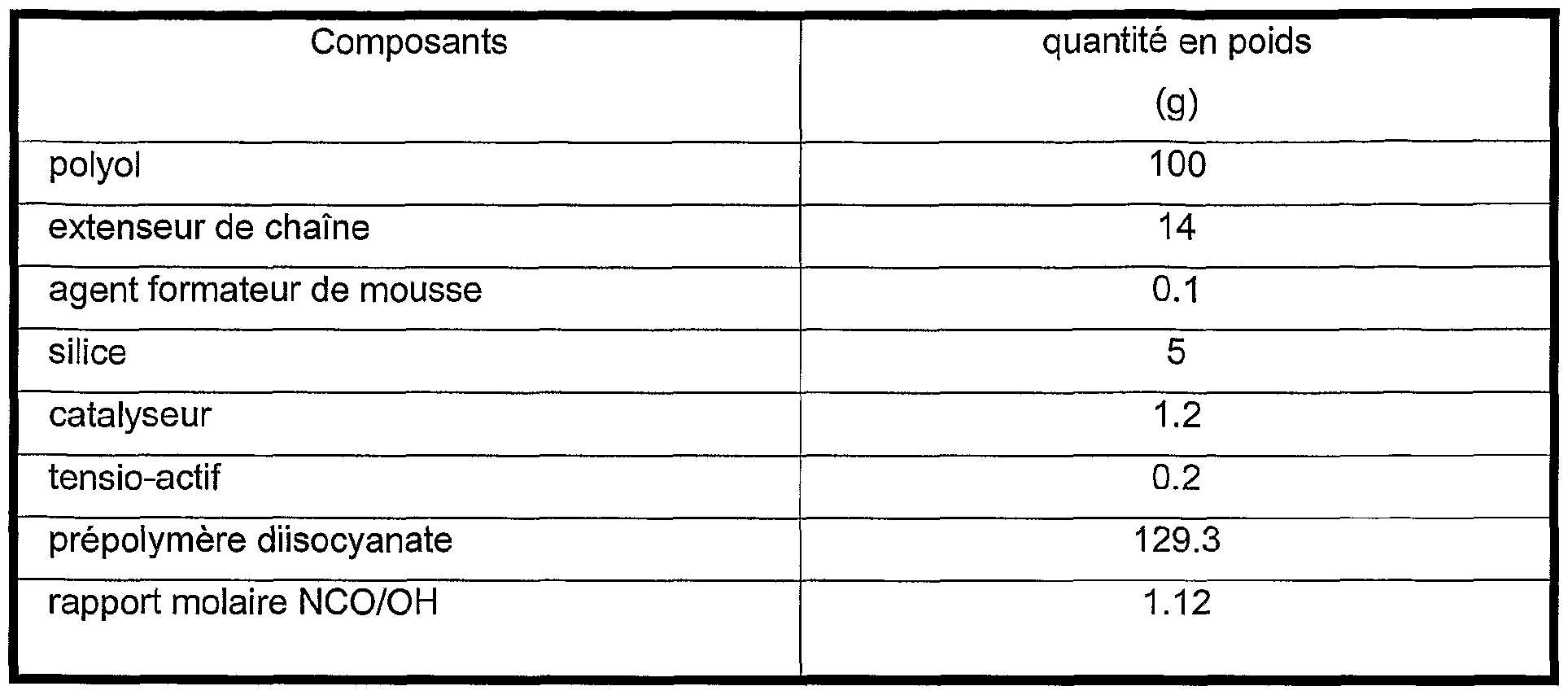
- the polyurethane foams were obtained by using the compounds and proportions indicated in table 4 below.
- the properties of the foams obtained are:> Density: 0.21 ⁇ 0.01g / cm 3 > Hardness (Ascher C): 49 ⁇ 1> Tensile strength at break: 26.6 ⁇ 1.1 kg / cm 2 > Elongation at break: 280 ⁇ 8%
- the properties of the foam are determined according to the methods indicated below:
- the density also called apparent density is determined according to standard ASTM D3574 (A), (Cellular plastics and rubbers - Determination of apparent density corresponding to standard ISO 845).
- the hardness is determined according to standard NBR 14455 (Ascher C) (Cellular materials, materials for soles and parts of shoes corresponding to standard DIN 53543).
- the shrinkage during molding is measured according to the SATRA TM 70 standard (Heat shrinkage of cellular soiling).
- Compression set Permanent deformation under load (Compression set) is determined according to standard ASTM D 395 (B) (Flexible cellular polymeric materials corresponding to standard ISO 1856).
- Example 2 is repeated but using a diacid / silica mixture containing adipic acid, 6% by weight of a mixture of diacids called AGS and 6% by weight of silica.
- the mixture used in Example 3 is obtained by mechanical mixing of the three components.
- the characteristics of the polyesterdiol suspension obtained are:
- Example 2 Viscosity: 10850 mPa.s at 34 ° C This suspension is stable and does not settle after 5 days of storage at a temperature of 70 ° C.
- a low density polyurethane foam was manufactured according to the procedure and the proportions given in Example 2. The foam obtained has the following characteristics: Density: 0.20 ⁇ 0.01 g / cm 3 Hardness (Ascher C): 56 ⁇ 2 (Manual) / 52 ⁇ 2 (Norm)
Landscapes
- Chemical & Material Sciences (AREA)
- Polymers & Plastics (AREA)
- Health & Medical Sciences (AREA)
- Chemical Kinetics & Catalysis (AREA)
- Medicinal Chemistry (AREA)
- Organic Chemistry (AREA)
- Materials Engineering (AREA)
- Engineering & Computer Science (AREA)
- Polyurethanes Or Polyureas (AREA)
- Compositions Of Macromolecular Compounds (AREA)
- Manufacture Of Porous Articles, And Recovery And Treatment Of Waste Products (AREA)
- Footwear And Its Accessory, Manufacturing Method And Apparatuses (AREA)
- Polyesters Or Polycarbonates (AREA)
Abstract
Description
SUSPENSION DE CHARGES INORGANIQUES DANS UN POLYESTERPOLYOL ET PROCEDE DE FABRICATION. SUSPENSION OF INORGANIC FILLERS IN A POLYESTERPOLYOL AND METHOD OF MANUFACTURE.
La présente invention concerne une suspension de charge inorganique dans du polyesterpolyol et le procédé de fabrication de cette suspension.The present invention relates to an inorganic filler suspension in polyester polyol and to the process for manufacturing this suspension.
Les polyesters polyols notamment les polyesterdiols sont des matières premières utilisées dans le domaine de la fabrication des polyuréthannes. En effet, ceux-ci sont obtenus par réaction avec un composé comprenant des fonctions isocyanates et des composés comprenant des fonctions hydroxyles tels que les polyesterdiols. Ces polyesterdiols sont obtenus par réaction entre un composé diol tel qu'un glycol ou un polyesterdiol avec un ou plusieurs diacides selon un procédé classique de fabrication de polyester. Un tel procédé comprend généralement une étape d'estérification suivie d'une étape de polycondensation.The polyesters polyols in particular the polyesterdiols are raw materials used in the field of the manufacture of polyurethanes. Indeed, these are obtained by reaction with a compound comprising isocyanate functions and compounds comprising hydroxyl functions such as polyesterdiols. These polyesterdiols are obtained by reaction between a diol compound such as a glycol or a polyesterdiol with one or more diacids according to a conventional process for the manufacture of polyester. Such a process generally comprises an esterification step followed by a polycondensation step.
Il est connu que pour modifier certaines propriétés des polyuréthannes, il peut être intéressant d'ajouter des charges de renfort tels que des composés particulaires inorganiques. Il est généralement décrit que ces charges sont ajoutées dans le polyesterdiol ou le composé isocyanate avant de réaliser la réaction conduisant au polyuréthanne.It is known that to modify certain properties of polyurethanes, it may be advantageous to add reinforcing fillers such as inorganic particulate compounds. It is generally described that these fillers are added to the polyesterdiol or the isocyanate compound before carrying out the reaction leading to the polyurethane.
Toutefois, la dispersion des charges dans ces composés qui présente une viscosité relativement élevée est très difficile. Un des buts de la présente invention est de proposer des suspensions stables de charges inorganiques dans un polyesterdiol permettant de fabriquer des articles polyuréthanne dans lesquels la charge inorganique est dispersée de manière homogène permettant d'obtenir de bonnes propriétés et un bon aspect. A cet effet, l'invention propose une suspension stable comprenant comme milieu liquide un composé polyesterdiol et comme particules dispersées, une charge particulaire inorganique à une concentration pondérale comprise entre 0.8 et 8 %.However, the dispersion of the charges in these compounds which has a relatively high viscosity is very difficult. One of the aims of the present invention is to provide stable suspensions of inorganic fillers in a polyesterdiol making it possible to manufacture polyurethane articles in which the inorganic filler is dispersed in a homogeneous manner making it possible to obtain good properties and a good appearance. To this end, the invention provides a stable suspension comprising as liquid medium a polyesterdiol compound and as dispersed particles, an inorganic particulate filler at a weight concentration of between 0.8 and 8%.
Selon un autre objet de l'invention, la dispersion stable est obtenue par addition des dites particules dans le milieu réactionnel d'estérification du polyesterpolyol ou dans le milieu réactionnel en début de l'étape de polycondensation. Ainsi, la charge inorganique peut être ajoutée directement dans le milieu, soit sous forme d'un prémélange avec le diol ou, selon le mode de réalisation préféré de l'invention, sous forme d'un prémélange avec au moins une partie des diacides. Ainsi, par la mise en oeuvre de ce procédé, on obtient une très bonne dispersion et suspension des particules de charge inorganique dans le polyesterdiol et donc une très bonne dispersion dans la mousse polyuréthanne qui sera obtenue avec cette suspension.According to another object of the invention, the stable dispersion is obtained by addition of said particles in the polyester polyol esterification reaction medium or in the reaction medium at the start of the polycondensation step. Thus, the inorganic filler can be added directly to the medium, either in the form of a premix with the diol or, according to the preferred embodiment of the invention, in the form of a premix with at least part of the diacids. Thus, by the implementation of this process, a very good dispersion and suspension of the inorganic filler particles in the polyesterdiol is obtained and therefore a very good dispersion in the polyurethane foam which will be obtained with this suspension.
De plus, le procédé de l'invention, notamment le procédé d'introduction de la charge inorganique sous forme de mélange avec les diacides permet d'obtenir une suspension stable. Il est donc possible avec le procédé de l'invention, de préparer des suspensions à base de polyesterdiol et de les stocker avant leur utilisation pour la fabrication des polyuréthannes.In addition, the process of the invention, in particular the process for introducing the inorganic filler in the form of a mixture with the diacids, makes it possible to obtain a stable suspension. It is therefore possible with the process of the invention, to prepare suspensions based on polyesterdiol and to store them before their use for the manufacture of polyurethanes.
Ce procédé permet également d'obtenir des dispersions stables à des concentrations en charges inorganiques plus élevées.This process also makes it possible to obtain stable dispersions at higher concentrations of inorganic fillers.
Dans le mode de réalisation préféré de l'invention, le mélange de la charge avec les diacides peut être obtenu par mélange des granulés ou poudres de diacides avec les particules de charge inorganique, à température ambiante, par exemple, ou à une température comprise entre la température ambiante et 120°C. II est également possible de réaliser un enrobage des particules de charge inorganique avec une partie des diacides. Cet enrobage est obtenu par chauffage du mélange à une température supérieure à la température de fusion ou de ramollissement des diacides.In the preferred embodiment of the invention, the mixture of the filler with the diacids can be obtained by mixing the granules or powders of diacids with the particles of inorganic filler, at ambient temperature, for example, or at a temperature between room temperature and 120 ° C. It is also possible to coat the particles of inorganic filler with part of the diacids. This coating is obtained by heating the mixture to a temperature above the melting or softening temperature of the diacids.
Dans ce mode de réalisation, l'enrobage des particules de charge inorganique est avantageusement réalisé avec un diacide comprenant un nombre d'atomes de carbone inférieur ou égal à 5 comme l'acide glutarique ou un mélange de diacides contenant un diacide comprenant 5 atomes de carbone ou moins tel que le mélange de diacides appelé AGS,In this embodiment, the coating of the particles of inorganic filler is advantageously carried out with a diacid comprising a number of carbon atoms less than or equal to 5 such as glutaric acid or a mixture of diacids containing a diacid comprising 5 atoms of carbon or less such as the mixture of diacids called AGS,
Comme diols convenables pour l'invention, on peut citer les glycols comprenant de 2 à 10 atomes de carbone, de préférence de 2 à 6 atomes tels que l'éthylène glycol, le diéthylène glycol, le 1 , 4 - butanediol, le 1 , 5-pentanediol, le 1 , 6-hexanediol, le 1 , 10 décanediol, le 2, 2-diméthyl-1 , 3-propanediol, le 1 , 3-propanediol, le dipropylène glycol, le triméthylolpropane, le glycérol, le pentaérithritol, le diglycérol, la dixtrose, le sorbitol, le bisphenol, l'hexyleneglycol ou équivalents. Ces diols peuvent également être utilisés en mélange.As diols suitable for the invention, mention may be made of glycols comprising from 2 to 10 carbon atoms, preferably from 2 to 6 atoms such as ethylene glycol, diethylene glycol, 1, 4 - butanediol, 1, 5-pentanediol, 1, 6-hexanediol, 1, 10 decanediol, 2, 2-dimethyl-1, 3-propanediol, 1, 3-propanediol, dipropylene glycol, trimethylolpropane, glycerol, pentaerythritol, diglycerol, dixtrose, sorbitol, bisphenol, hexyleneglycol or the like. These diols can also be used as a mixture.
Comme exemple d'acides dicarboxyliques, on peut citer les diacides aliphatiques tels que l'acide adipique, l'acide succinique, l'acide glutarique, l'acide subérique, l'acide azélaique, l'acide sébacique, acide pénélique, les acides aromatiques tels que les acides phtaliques, isophtalique, téréphtalique, naphténique. Les acides aliphatiques insaturés tels que l'acide maléique, l'acide fumarique, l'acide itaconique. Ces diacides peuvent être utilisés individuellement ou en mélange. Selon encore un mode de réalisation préféré de l'invention, les diacides utilisés pour la formation du polyesterdiol sont, avantageusement, constitués par un mélange d'acide adipique et de mélange de diacides appelés AGS obtenu comme sous-produit dans le procédé de fabrication de l'acide adipique par oxydation du cyclohexanol et/ou de la cyclohexanone et qui comprend de l'acide adipique, de l'acide succinique et de l'acide glutarique.As an example of dicarboxylic acids, mention may be made of aliphatic diacids such as adipic acid, succinic acid, glutaric acid, suberic acid, azelaic acid, sebacic acid, penelic acid, the acids aromatics such as phthalic, isophthalic, terephthalic, naphthenic acids. Unsaturated aliphatic acids such as maleic acid, fumaric acid, itaconic acid. These diacids can be used individually or as a mixture. According to yet a preferred embodiment of the invention, the diacids used for the formation of polyesterdiol are advantageously constituted by a mixture of adipic acid and mixture of diacids called AGS obtained as a by-product in the process for the manufacture of adipic acid by oxidation of cyclohexanol and / or cyclohexanone and which comprises adipic acid, succinic acid and glutaric acid.
On peut également utiliser des dérivés de ces diacides tels que les diesters comprenant de 1 à 4 atomes de carbone pour le reste provenant de l'alcool, les anhydrides d'acide, les chlorures d'acide. Selon l'invention, les dispersions de polyesterdiols contenant une charge inorganique sont obtenues selon un procédé comprenant deux étapes, une première étape d'estérification et une seconde de polycondensation.It is also possible to use derivatives of these diacids such as diesters comprising from 1 to 4 carbon atoms for the remainder originating from alcohol, acid anhydrides, acid chlorides. According to the invention, the dispersions of polyesterdiols containing an inorganic filler are obtained according to a process comprising two stages, a first esterification stage and a second of polycondensation.
L'étape d'estérification est réalisée en mélangeant les diacides avec des diols, par exemple un mélange d'éthylène glycol et diéthylène glycol avec un rapport molaire diol/diacide compris entre 1 ,2 et 1 ,5.The esterification step is carried out by mixing the diacids with diols, for example a mixture of ethylene glycol and diethylene glycol with a diol / diacid molar ratio of between 1.2 and 1.5.
La température de réaction dans cette première étape est augmentée progressivement au cours de l'avancement de la réaction. A titre d'exemple, le début de la réaction est effectué à une température de 160 °C pour arriver à une température de 220°C en fin de réaction.The reaction temperature in this first step is gradually increased during the progress of the reaction. By way of example, the start of the reaction is carried out at a temperature of 160 ° C. to arrive at a temperature of 220 ° C. at the end of the reaction.
Selon l'invention, les diacides sont avantageusement ajoutés en mélange avec la charge inorganique, comme décrit précédemment.According to the invention, the diacids are advantageously added as a mixture with the inorganic filler, as described above.
La seconde étape de polycondensation est mise en œuvre avec addition d'un catalyseur tel que le titanate de tétrabutyle (TBT), par exemple, avec une concentration pondérale comprise entre 0,001 % et 0,010 % par rapport au poids de diacides engagés. La température de polymérisation est de 200 °C sous une pression comprise entre 10 et 20 mbar.The second polycondensation step is carried out with the addition of a catalyst such as tetrabutyl titanate (TBT), for example, with a weight concentration of between 0.001% and 0.010% relative to the weight of diacids used. The polymerization temperature is 200 ° C under a pressure between 10 and 20 mbar.
Le polyesterdiol obtenu est caractérisé par l'indice d'hydroxyle (I0H) correspondant au nombre de mg de potasse par gramme de polyol pour transformer les fonctions hydroxyles en alcoolate et l'indice d'acide (lA) qui représente le nombre de mg de KOH nécessaire pour neutraliser 1 g de polyol. Le polyesterdiol est également caractérisé par la viscosité ainsi que par son poids moléculaire.The polyesterdiol obtained is characterized by the hydroxyl number (I 0 H) corresponding to the number of mg of potassium hydroxide per gram of polyol to convert the hydroxyl functions into alcoholate and the acid number (l A ) which represents the number mg of KOH necessary to neutralize 1 g of polyol. Polyesterdiol is also characterized by viscosity as well as by its molecular weight.
Ainsi, la polyesterpolyol a avantageusement un poids moléculaire en nombre compris entre 5000 et 8000, de préférence entre 6000 et 7000. D'autres avantages, détails de l'invention apparaîtront plus clairement au vu des exemples donnés uniquement à titre indicatif. Exemple comparatif 1 Des suspensions de silices commercialisées par la société RHODIA sous les noms commerciaux indiqués dans le tableau 1 ci-dessous et présentant les propriétés principales indiquées, sont préparées par addition de la silice dans un polyesterdiol de poids moléculaire de 7000 environ. La dispersion de la silice est obtenue à l'aide d'un mélangeur mécanique de type ULTRA-TURRAX pendant environ 5 minutes. Tableau 1Thus, the polyester polyol advantageously has a number molecular weight of between 5000 and 8000, preferably between 6000 and 7000. Other advantages, details of the invention will appear more clearly in the light of the examples given only for information. Comparative Example 1 Suspensions of silica sold by the company RHODIA under the trade names indicated in Table 1 below and having the main properties indicated, are prepared by addition of silica in a polyesterdiol of molecular weight of approximately 7000. The dispersion of the silica is obtained using a mechanical mixer of the ULTRA-TURRAX type for approximately 5 minutes. Table 1
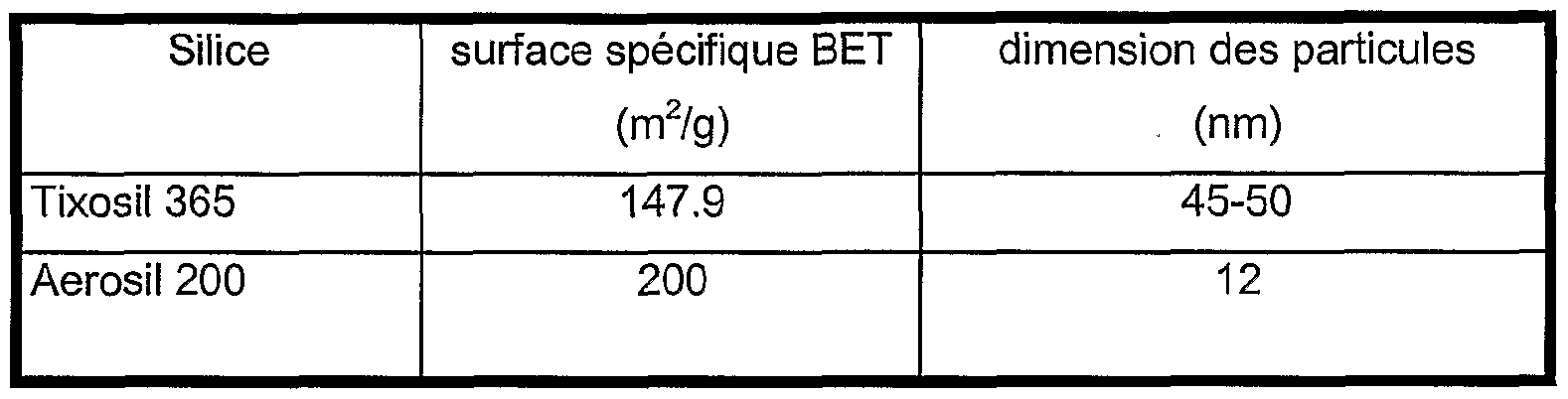
Les caractéristiques des suspensions obtenues sont rassemblées dans le tableau 2 ci- dessous Table 2The characteristics of the suspensions obtained are collated in Table 2 below Table 2
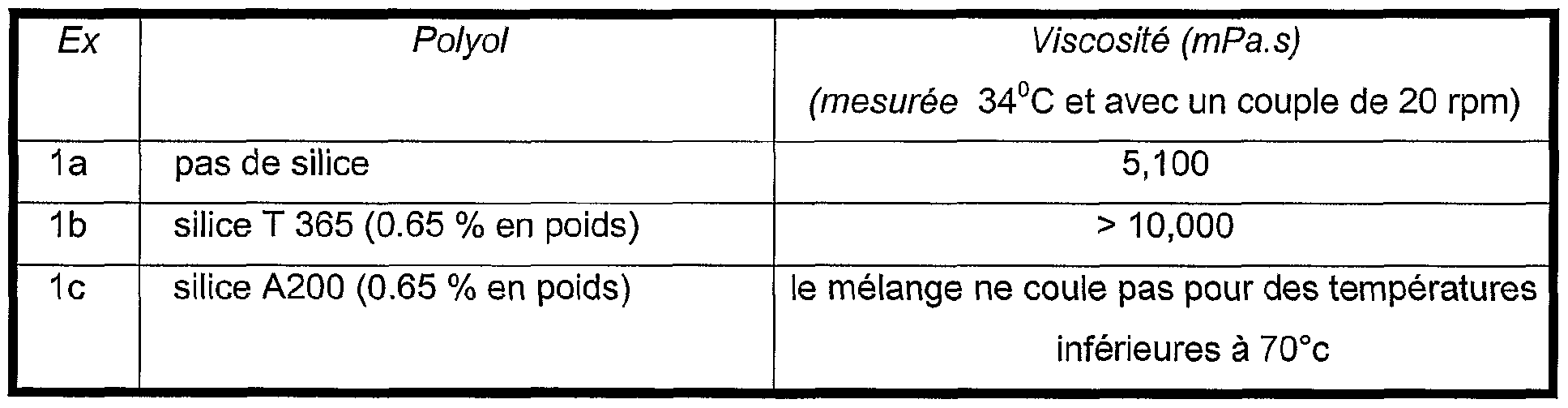
Les mousses obtenues avec ces suspensions ne sont pas convenables car la silice forme des agrégats détériorant les propriétés de la mousse.The foams obtained with these suspensions are not suitable because the silica forms aggregates deteriorating the properties of the foam.
Exemple 2 :Example 2:
Une suspension de silice dans un polyesterdiol conforme à l'invention est obtenue selon le mode opératoire suivant : Dans une première étape de l'acide adipique mélangé avec 6 % de silice commercialisée par la société RHODIA sous la dénomination commerciale TIXOSIL T365 est ajouté à un mélange d'ethylène glycol (MEG) et de diéthylène glycol (DEG) contenant 70% en poids de MEG. Le rapport molaire entre les alcools et le diacide est compris entre 1 ,2 et 1 ,5. La réaction est réalisée en chauffant le mélange à 160°C pendant 1 heure puis en élevant la température par pallier de 15°C jusqu'à 215°C. Cette réaction est réalisée sous atmosphère inerte, par exemple d'azote. L'esterifiat obtenu est polycondensé dans une seconde étape après addition de titanate de tétrabutyle (TBT) à une concentration en poids de 0,003% par rapport à la quantité de diacides ajoutée. La polymérisation est réalisée à 200 °C sous pression réduite de 15-18 mbar. Le polyesterpolyol obtenu est caractérisé par l'indice OH (I0H)> l'indice d'acide (lA) et la viscosité comme indiqué ci-dessous : > ADOH/SiO (rapport massique): 94/06 > MEG/DEG (rapport molaire): 70/30 > IQH de 55.86 mg de KOH/g de polyol, > lA de 0.43 mg de KOH/g de polyol > Une viscosité de 6500 mPa.s à 34°C.A suspension of silica in a polyesterdiol in accordance with the invention is obtained according to the following procedure: In a first step, adipic acid mixed with 6% silica sold by the company RHODIA under the trade name TIXOSIL T365 is added to a mixture of ethylene glycol (MEG) and diethylene glycol (DEG) containing 70% by weight of MEG. The molar ratio between the alcohols and the diacid is between 1, 2 and 1, 5. The reaction is carried out by heating the mixture at 160 ° C for 1 hour and then raising the temperature in steps from 15 ° C to 215 ° C. This reaction is carried out under an inert atmosphere, for example nitrogen. The esterifiat obtained is polycondensed in a second step after addition of tetrabutyl titanate (TBT) at a concentration by weight of 0.003% relative to the amount of diacids added. The polymerization is carried out at 200 ° C under reduced pressure of 15-18 mbar. The polyester polyol obtained is characterized by the OH index (I 0 H) > the acid index (l A ) and the viscosity as indicated below:> ADOH / SiO (mass ratio): 94/06> MEG / DEG (molar ratio): 70/30> IQH of 55.86 mg of KOH / g of polyol,> 1 A of 0.43 mg of KOH / g of polyol> A viscosity of 6500 mPa.s at 34 ° C.
La suspension ainsi obtenue est stable et ne présente aucune décantation après 5 jours de stockage à 70°C. Elle peut être utilisée comme composants pour la fabrication de polyuréthanne selon les procédés habituels de fabrication de polyuréthanne. A titre d'exemple, on décrit ci-dessous l'utilisation de cette suspension pour la réalisation d'une mousse polyuréthanne de faible densité. Les mousses polyuréthanne ont été obtenues en mettant en oeuvre les composés et proportions indiqués dans le tableau 4 ci-dessous.The suspension thus obtained is stable and shows no settling after 5 days of storage at 70 ° C. It can be used as components for the manufacture of polyurethane according to the usual processes for the manufacture of polyurethane. By way of example, the use of this suspension for the production of a low density polyurethane foam is described below. The polyurethane foams were obtained by using the compounds and proportions indicated in table 4 below.
TABLEAU 4TABLE 4

> Résistance à la propagation de la déchirure :2.34 ± 0.17 kg/cm> Resistance to tear propagation: 2.34 ± 0.17 kg / cm
> Résistance à la déchirure : 9.9 ± 0.5 kg/cm> Tear resistance: 9.9 ± 0.5 kg / cm
> Résistance à la déformation (compression set) : 3.8 ± 0.4%> Resistance to deformation (compression set): 3.8 ± 0.4%
Les propriétés de la mousse sont déterminées selon les méthodes indiquées ci-dessous :The properties of the foam are determined according to the methods indicated below:
> La densité appelée également densité apparente est déterminée selon la norme ASTM D3574(A), (Cellular plastics and rubbers - Détermination of apparent density correspondant à la norme ISO 845).> The density also called apparent density is determined according to standard ASTM D3574 (A), (Cellular plastics and rubbers - Determination of apparent density corresponding to standard ISO 845).
> La dureté est déterminée selon la norme NBR 14455 (Ascher C) ( Cellular materials, materials for soles and parts of shoes correspondant à la norme DIN 53543).> The hardness is determined according to standard NBR 14455 (Ascher C) (Cellular materials, materials for soles and parts of shoes corresponding to standard DIN 53543).
> La résistance à la déchirure de la mousse est déterminée selon la norme ASTM D 3574 (F). > L'allongement à la rupture est déterminée selon la norme ASTM D 412 (C) .> The tear resistance of the foam is determined according to standard ASTM D 3574 (F). > The elongation at break is determined according to standard ASTM D 412 (C).
> La contrainte à la rupture en traction est déterminée selon la norme ASTM D 412> The tensile breaking stress is determined according to standard ASTM D 412
> Le retrait au cours du moulage est mesuré selon la norme SATRA TM 70 ( Heat shrinkage of cellular soiling).> The shrinkage during molding is measured according to the SATRA TM 70 standard (Heat shrinkage of cellular soiling).
> Déformation permanente sous charge (Compression set) est déterminée selon la norme ASTM D 395 (B) ( Flexible cellular polymeric materials correspondant à la norme ISO 1856).> Permanent deformation under load (Compression set) is determined according to standard ASTM D 395 (B) (Flexible cellular polymeric materials corresponding to standard ISO 1856).
Exemple 3 :Example 3:
L'exemple 2 est répété mais en utilisant un mélange diacides/silice contenant de l'acide adipique, 6 % en poids d'un mélange de diacides dénommés AGS et 6 % en poids de silice. Le mélange utilisé dans l'exemple 3 est obtenu par mélange mécanique des trois composants. Les caractéristiques de la suspension de polyesterdiol obtenue sont :Example 2 is repeated but using a diacid / silica mixture containing adipic acid, 6% by weight of a mixture of diacids called AGS and 6% by weight of silica. The mixture used in Example 3 is obtained by mechanical mixing of the three components. The characteristics of the polyesterdiol suspension obtained are:
> ADOH/SiO2/AGS (rapport massique): 88/06/06> ADOH / SiO 2 / AGS (mass report): 88/06/06
> MEG/DEG (rapport molaire): 70/30> MEG / DEG (molar ratio): 70/30
> IOH : 51.8 mg de KOH/g polyol> IOH: 51.8 mg KOH / g polyol
> lA : 0.70mg de KOH/g polyol> l A : 0.70mg of KOH / g polyol
> Viscosité : 10850 mPa.s à 34°C Cette suspension est stable et ne présente pas de décantation après 5 jours de stockage à une température de 70°C. Comme pour l'exemple 2, une mousse polyuréthanne de faible densité a été fabriquée selon le mode opératoire et les proportions donnés dans l'exemple 2. la mousse obtenue présente les caractéristiques suivantes : Densité : 0,20 ± 0.01 g/cm3 Dureté (Ascher C) : 56 ± 2 (Manual)/52 ± 2(Norm)> Viscosity: 10850 mPa.s at 34 ° C This suspension is stable and does not settle after 5 days of storage at a temperature of 70 ° C. As in Example 2, a low density polyurethane foam was manufactured according to the procedure and the proportions given in Example 2. The foam obtained has the following characteristics: Density: 0.20 ± 0.01 g / cm 3 Hardness (Ascher C): 56 ± 2 (Manual) / 52 ± 2 (Norm)
Contrainte à la rupture en traction : 23.00 ± 1.70kg/cm2 Tensile breaking stress: 23.00 ± 1.70kg / cm 2
Allongement à la rupture : 293 ± 23%Elongation at break: 293 ± 23%
Résistance à la propagation de la déchirure : 2.83 ± 0.34Kg/cm Résistance à la déchirure : 10,1 ± 0.7 kg/cm Résistance à la déformation (compression set) : 5.6 ± 0.8% Resistance to tear propagation: 2.83 ± 0.34Kg / cm Tear resistance: 10.1 ± 0.7 kg / cm Resistance to deformation (compression set): 5.6 ± 0.8%
Claims
Priority Applications (5)
| Application Number | Priority Date | Filing Date | Title |
|---|---|---|---|
| BRPI0412951-2A BRPI0412951A (en) | 2003-08-08 | 2004-07-30 | stable suspension, process for manufacturing a suspension and use of inorganic filler suspension in a polyesterdiol |
| JP2006522371A JP2007501872A (en) | 2003-08-08 | 2004-07-30 | Suspension of inorganic filler in polyester polyol and production method |
| MXPA06001549A MXPA06001549A (en) | 2003-08-08 | 2004-07-30 | Suspension of inorganic fillers in a polyesterpolyol and production method thereof. |
| EP04767823A EP1651696A1 (en) | 2003-08-08 | 2004-07-30 | Suspension of inorganic fillers in a polyesterpolyol and production method thereof |
| US10/569,811 US20070161731A1 (en) | 2003-08-08 | 2004-07-30 | Suspension of inorganic fillers in a polyesterpolyol and production method |
Applications Claiming Priority (4)
| Application Number | Priority Date | Filing Date | Title |
|---|---|---|---|
| FR0309781A FR2858622B1 (en) | 2003-08-08 | 2003-08-08 | POLYURETHANE FOAMS, POLYESTER POLYOLS FOR THE PRODUCTION OF FOAMS AND THE USE THEREOF |
| FR0309781 | 2003-08-08 | ||
| FR0311115 | 2003-09-23 | ||
| FR0311115A FR2858623B1 (en) | 2003-08-08 | 2003-09-23 | POLYURETHANE FOAMS, MANUFACTURING METHOD AND USE THEREOF |
Publications (1)
| Publication Number | Publication Date |
|---|---|
| WO2005019294A1 true WO2005019294A1 (en) | 2005-03-03 |
Family
ID=34081988
Family Applications (2)
| Application Number | Title | Priority Date | Filing Date |
|---|---|---|---|
| PCT/FR2004/002053 Ceased WO2005019294A1 (en) | 2003-08-08 | 2004-07-30 | Suspension of inorganic fillers in a polyesterpolyol and production method thereof |
| PCT/FR2004/002055 Ceased WO2005019295A1 (en) | 2003-08-08 | 2004-07-30 | Polyurethane foam, production methods thereof and use of same |
Family Applications After (1)
| Application Number | Title | Priority Date | Filing Date |
|---|---|---|---|
| PCT/FR2004/002055 Ceased WO2005019295A1 (en) | 2003-08-08 | 2004-07-30 | Polyurethane foam, production methods thereof and use of same |
Country Status (9)
| Country | Link |
|---|---|
| US (2) | US20070161731A1 (en) |
| EP (2) | EP1651696A1 (en) |
| JP (2) | JP2007501872A (en) |
| KR (1) | KR100796545B1 (en) |
| BR (2) | BRPI0412938A (en) |
| FR (1) | FR2858623B1 (en) |
| MX (2) | MXPA06001549A (en) |
| TW (2) | TWI254721B (en) |
| WO (2) | WO2005019294A1 (en) |
Families Citing this family (16)
| Publication number | Priority date | Publication date | Assignee | Title |
|---|---|---|---|---|
| US7941938B2 (en) | 2006-05-26 | 2011-05-17 | Nike, Inc. | Article of footwear with lightweight sole assembly |
| JP5409365B2 (en) | 2006-09-13 | 2014-02-05 | コーロン インダストリーズ インク | Method for producing polyurethane fine particles and polyurethane fine particles |
| WO2009063004A2 (en) * | 2007-11-14 | 2009-05-22 | Basf Se | Foamed polyurethanes having improved flexural endurance properties |
| FR2927081B1 (en) * | 2008-02-01 | 2012-09-14 | Rhodia Operations | POLYURETHANE FOAM |
| EP2254925B1 (en) * | 2008-03-14 | 2014-08-27 | Basf Se | Coarse-cell polyurethane elastomers |
| BRPI0919216A2 (en) * | 2008-09-18 | 2015-12-08 | Basf Se | polyurethane and use of a polyurethane |
| JP5553142B2 (en) * | 2009-11-20 | 2014-07-16 | Dic株式会社 | Heat resistant polyurethane resin |
| BR112012031742A2 (en) | 2010-06-15 | 2017-12-05 | Basf Se | process for producing mixtures made of thermoplastic polylactides and polyurethanes, blend made of thermoplastic polylactides and polyurethanes, use of blends, sheet product or molding, reinforced fiber composite material, and, sheet product, molding or semi-finished product |
| US8633283B2 (en) | 2010-06-15 | 2014-01-21 | Basf Se | Process for producing blends made of polylactides (PLAS) and of thermoplastic polyurethanes (TPUS) |
| CN102786792B (en) * | 2012-08-07 | 2014-05-07 | 深圳市新纶科技股份有限公司 | Anti-yellowing polyurethane shoe material and preparation method thereof |
| US9282784B2 (en) | 2012-09-06 | 2016-03-15 | Nike, Inc. | Sole structures and articles of footwear having a lightweight midsole with segmented protective elements |
| KR102262204B1 (en) | 2013-07-02 | 2021-06-09 | 바스프 에스이 | Polyurethane based on renewable raw materials |
| CN104530359A (en) * | 2014-12-15 | 2015-04-22 | 航天特种材料及工艺技术研究所 | Artificial medium and preparation method thereof |
| KR20210019061A (en) | 2018-06-06 | 2021-02-19 | 바스프 에스이 | Method for preparing dispersion of inorganic oxide particles in polyester polyol |
| CN115209761A (en) * | 2020-03-06 | 2022-10-18 | 株式会社爱世克私 | Sole and shoe |
| WO2022043428A1 (en) | 2020-08-28 | 2022-03-03 | Basf Se | Foamed granules made of thermoplastic polyurethane |
Citations (5)
| Publication number | Priority date | Publication date | Assignee | Title |
|---|---|---|---|---|
| US4960915A (en) * | 1988-04-26 | 1990-10-02 | Davy Mckee, Ag | Process for the production of linear polyesters, particularly for films and foils |
| EP0506033A1 (en) * | 1991-03-28 | 1992-09-30 | Diafoil Hoechst Co., Ltd. | Polyester film |
| US5210127A (en) * | 1991-10-28 | 1993-05-11 | Bayer Aktiengesellschaft | Free-flowing, thermoplastically processible and post-crosslinkable polyurethane powders |
| EP1186628A2 (en) * | 2000-09-05 | 2002-03-13 | Degussa AG | Raw material dispersion for the manufacture of polyester, process for the preparation thereof, and process for the preparation of polyester products using the dispersion |
| DE10138568A1 (en) * | 2001-08-06 | 2003-03-06 | Arteva Tech Sarl | Preparation of an antimicrobial polyester used for objects, building material and metal protectants by reacting aromatic dicarboxylic acid aliphatic esters with aliphatic diols and polycondensing with an antimicrobial agent |
Family Cites Families (12)
| Publication number | Priority date | Publication date | Assignee | Title |
|---|---|---|---|---|
| US4497918A (en) * | 1982-01-25 | 1985-02-05 | J. M. Huber Corporation | Thixotropic unsaturated polyester compositions and methods |
| US4439550A (en) * | 1982-11-22 | 1984-03-27 | Texaco Inc. | Aromatic polyols made from recycled polyethylene terephthalate waste streams, alkylene glycol and dibasic acid waste streams |
| DE3305006A1 (en) * | 1983-02-14 | 1984-10-31 | Robert Bosch Gmbh, 7000 Stuttgart | ELECTRIC GENERATOR FOR A MOTOR VEHICLE |
| US4822827A (en) * | 1987-12-17 | 1989-04-18 | The Dow Chemical Company | Thermoplastic polyurethanes with high glass transition temperatures |
| CA2015488C (en) * | 1989-04-30 | 1997-07-08 | Tomoyasu Tsuda | Polyurethane, process for its production and polyester diol used for its production |
| CN1100805C (en) * | 1996-03-12 | 2003-02-05 | 花王株式会社 | Method of making polyurethane foam |
| FR2773163B1 (en) * | 1997-12-26 | 2000-03-31 | Witco | POLYURETHANE MOLDING PROCESS USING AN INTERNAL RELEASE AGENT |
| US6268464B1 (en) * | 1998-10-19 | 2001-07-31 | Neste Chemicals Oy | Unsaturated polyester resins |
| AR024533A1 (en) * | 1999-02-23 | 2002-10-16 | Huntsman Ici Chem Llc | ELASTOMEROS DE POLIURETANO PROVIDED WITH AN IMPROVED RESISTANCE TO HYDROLYSIS. |
| EP1125959A1 (en) * | 2000-02-17 | 2001-08-22 | Mitsui Chemicals, Inc. | Microcellular polyurethane elastomer, and method of producing the same |
| CN1406258A (en) * | 2000-12-27 | 2003-03-26 | 世界财产股份有限公司 | Polyurethane foams and method of manu facture thereof |
| US6458861B1 (en) * | 2001-01-18 | 2002-10-01 | Bayer Antwerp N.V. | Carbon dioxide blown low density, flexible microcellular elastomers suitable for preparing shoe components |
-
2003
- 2003-09-23 FR FR0311115A patent/FR2858623B1/en not_active Expired - Fee Related
-
2004
- 2004-07-30 KR KR1020067002730A patent/KR100796545B1/en not_active Expired - Fee Related
- 2004-07-30 BR BRPI0412938-5A patent/BRPI0412938A/en not_active IP Right Cessation
- 2004-07-30 US US10/569,811 patent/US20070161731A1/en not_active Abandoned
- 2004-07-30 WO PCT/FR2004/002053 patent/WO2005019294A1/en not_active Ceased
- 2004-07-30 WO PCT/FR2004/002055 patent/WO2005019295A1/en not_active Ceased
- 2004-07-30 MX MXPA06001549A patent/MXPA06001549A/en unknown
- 2004-07-30 JP JP2006522371A patent/JP2007501872A/en active Pending
- 2004-07-30 BR BRPI0412951-2A patent/BRPI0412951A/en not_active IP Right Cessation
- 2004-07-30 EP EP04767823A patent/EP1651696A1/en not_active Withdrawn
- 2004-07-30 JP JP2006522372A patent/JP2007501873A/en active Pending
- 2004-07-30 MX MXPA06001553A patent/MXPA06001553A/en unknown
- 2004-07-30 US US10/567,704 patent/US20070043133A1/en not_active Abandoned
- 2004-07-30 EP EP04786016A patent/EP1651697A1/en not_active Withdrawn
- 2004-08-06 TW TW093123714A patent/TWI254721B/en not_active IP Right Cessation
- 2004-08-06 TW TW093123715A patent/TWI294433B/en active
Patent Citations (5)
| Publication number | Priority date | Publication date | Assignee | Title |
|---|---|---|---|---|
| US4960915A (en) * | 1988-04-26 | 1990-10-02 | Davy Mckee, Ag | Process for the production of linear polyesters, particularly for films and foils |
| EP0506033A1 (en) * | 1991-03-28 | 1992-09-30 | Diafoil Hoechst Co., Ltd. | Polyester film |
| US5210127A (en) * | 1991-10-28 | 1993-05-11 | Bayer Aktiengesellschaft | Free-flowing, thermoplastically processible and post-crosslinkable polyurethane powders |
| EP1186628A2 (en) * | 2000-09-05 | 2002-03-13 | Degussa AG | Raw material dispersion for the manufacture of polyester, process for the preparation thereof, and process for the preparation of polyester products using the dispersion |
| DE10138568A1 (en) * | 2001-08-06 | 2003-03-06 | Arteva Tech Sarl | Preparation of an antimicrobial polyester used for objects, building material and metal protectants by reacting aromatic dicarboxylic acid aliphatic esters with aliphatic diols and polycondensing with an antimicrobial agent |
Also Published As
| Publication number | Publication date |
|---|---|
| BRPI0412951A (en) | 2006-09-26 |
| TWI254721B (en) | 2006-05-11 |
| TWI294433B (en) | 2008-03-11 |
| TW200519134A (en) | 2005-06-16 |
| WO2005019295A1 (en) | 2005-03-03 |
| JP2007501873A (en) | 2007-02-01 |
| KR100796545B1 (en) | 2008-01-21 |
| US20070043133A1 (en) | 2007-02-22 |
| BRPI0412938A (en) | 2006-09-26 |
| EP1651696A1 (en) | 2006-05-03 |
| MXPA06001553A (en) | 2006-05-15 |
| FR2858623B1 (en) | 2006-01-13 |
| FR2858623A1 (en) | 2005-02-11 |
| EP1651697A1 (en) | 2006-05-03 |
| US20070161731A1 (en) | 2007-07-12 |
| TW200523283A (en) | 2005-07-16 |
| MXPA06001549A (en) | 2006-05-15 |
| JP2007501872A (en) | 2007-02-01 |
| KR20060029697A (en) | 2006-04-06 |
Similar Documents
| Publication | Publication Date | Title |
|---|---|---|
| EP1651696A1 (en) | Suspension of inorganic fillers in a polyesterpolyol and production method thereof | |
| JP2802657B2 (en) | Hot melt composition | |
| CN1170418A (en) | Biodegradable polymers, process for their production and their use in producing biodegradable mouldings | |
| CN1668668A (en) | Aromatic polyester polyols | |
| JPH04189822A (en) | Production of aliphatic polyester | |
| CN1122057C (en) | Low viscosity polyester polyols and polyurethane foams prepared therefrom | |
| JPH07304839A (en) | Method for producing biodegradable aliphatic polyester | |
| CN101970522B (en) | polyurethane foam | |
| CN1637032A (en) | polymer dispersions in polyester polyols | |
| FR2858622A1 (en) | New flexible polyurethane foams based on polyester polyols containing particulate inorganic filler, having low density and shrinkage and useful for producing moldings, especially shoe mid soles | |
| JP3069196B2 (en) | Polyester resin composition | |
| JP3275056B2 (en) | Urethane resin composition | |
| JP2004307784A (en) | Dimer acid-based polyester polyurethane resin | |
| JPH07330954A (en) | Biodegradable aliphatic polyester composition | |
| CN1896115A (en) | Preparation method and application of sedimentation-stable NCO prepolymer | |
| WO2026020341A1 (en) | A bio-based polyester polyol, process of preparing the same and polyurethane foam | |
| KR20250150513A (en) | Biodegradable polyester resin composition, method of fabricating the same, biodegradable polyester film comprising same and biodegradable polyester molded product | |
| JPH05178956A (en) | Production of high-molecular aliphatic polyester | |
| FR2458563A1 (en) | Unsatd. polyester prodn. from glycol (terephthalate oligomers) - formed as waste prods. in polyethylene terephthalate prodn. | |
| KR20230081448A (en) | Organic-Inorganic Hybrid Polyol Composition and Method for Preparing the Same | |
| JP3396296B2 (en) | Method for producing biodegradable aliphatic polyester | |
| KR20210117098A (en) | Biodegradable resin composition having improved mechanical property, formability, and weatherproof and method for manufacturing the same | |
| JPH06316618A (en) | Two-liquid casting urethane elastomer composition | |
| JPH07109341A (en) | Production of high-molecular aliphatic polyester | |
| JP2010053244A (en) | Polyethylene terephthalate resin composition |
Legal Events
| Date | Code | Title | Description |
|---|---|---|---|
| WWE | Wipo information: entry into national phase |
Ref document number: 200480025970.1 Country of ref document: CN |
|
| AK | Designated states |
Kind code of ref document: A1 Designated state(s): AE AG AL AM AT AU AZ BA BB BG BR BW BY BZ CA CH CN CO CR CU CZ DE DK DM DZ EC EE EG ES FI GB GD GE GH GM HR HU ID IL IN IS JP KE KG KP KR KZ LC LK LR LS LT LU LV MA MD MG MK MN MW MX MZ NA NI NO NZ OM PG PH PL PT RO RU SC SD SE SG SK SL SY TJ TM TN TR TT TZ UA UG US UZ VC VN YU ZA ZM ZW |
|
| AL | Designated countries for regional patents |
Kind code of ref document: A1 Designated state(s): BW GH GM KE LS MW MZ NA SD SL SZ TZ UG ZM ZW AM AZ BY KG KZ MD RU TJ TM AT BE BG CH CY CZ DE DK EE ES FI FR GB GR HU IE IT LU MC NL PL PT RO SE SI SK TR BF BJ CF CG CI CM GA GN GQ GW ML MR NE SN TD TG |
|
| 121 | Ep: the epo has been informed by wipo that ep was designated in this application | ||
| WWE | Wipo information: entry into national phase |
Ref document number: 2004767823 Country of ref document: EP |
|
| WWE | Wipo information: entry into national phase |
Ref document number: 2006522371 Country of ref document: JP |
|
| WWE | Wipo information: entry into national phase |
Ref document number: PA/a/2006/001549 Country of ref document: MX Ref document number: 1020067002730 Country of ref document: KR |
|
| WWP | Wipo information: published in national office |
Ref document number: 1020067002730 Country of ref document: KR |
|
| WWP | Wipo information: published in national office |
Ref document number: 2004767823 Country of ref document: EP |
|
| ENP | Entry into the national phase |
Ref document number: PI0412951 Country of ref document: BR |
|
| WWE | Wipo information: entry into national phase |
Ref document number: 2007161731 Country of ref document: US Ref document number: 10569811 Country of ref document: US |
|
| WWP | Wipo information: published in national office |
Ref document number: 10569811 Country of ref document: US |