WO2005010087A1 - Powdery composition of a polymer and a flameproofing agent containing ammonium polyphosphate, method for the production thereof, and moulded body produced from said powder - Google Patents
Powdery composition of a polymer and a flameproofing agent containing ammonium polyphosphate, method for the production thereof, and moulded body produced from said powder Download PDFInfo
- Publication number
- WO2005010087A1 WO2005010087A1 PCT/EP2004/051009 EP2004051009W WO2005010087A1 WO 2005010087 A1 WO2005010087 A1 WO 2005010087A1 EP 2004051009 W EP2004051009 W EP 2004051009W WO 2005010087 A1 WO2005010087 A1 WO 2005010087A1
- Authority
- WO
- WIPO (PCT)
- Prior art keywords
- powder
- flame retardant
- polymer
- polyamide
- shaped body
- Prior art date
- Legal status (The legal status is an assumption and is not a legal conclusion. Google has not performed a legal analysis and makes no representation as to the accuracy of the status listed.)
- Ceased
Links
Classifications
-
- C—CHEMISTRY; METALLURGY
- C08—ORGANIC MACROMOLECULAR COMPOUNDS; THEIR PREPARATION OR CHEMICAL WORKING-UP; COMPOSITIONS BASED THEREON
- C08K—Use of inorganic or non-macromolecular organic substances as compounding ingredients
- C08K3/00—Use of inorganic substances as compounding ingredients
- C08K3/32—Phosphorus-containing compounds
-
- B—PERFORMING OPERATIONS; TRANSPORTING
- B33—ADDITIVE MANUFACTURING TECHNOLOGY
- B33Y—ADDITIVE MANUFACTURING, i.e. MANUFACTURING OF THREE-DIMENSIONAL [3-D] OBJECTS BY ADDITIVE DEPOSITION, ADDITIVE AGGLOMERATION OR ADDITIVE LAYERING, e.g. BY 3-D PRINTING, STEREOLITHOGRAPHY OR SELECTIVE LASER SINTERING
- B33Y70/00—Materials specially adapted for additive manufacturing
- B33Y70/10—Composites of different types of material, e.g. mixtures of ceramics and polymers or mixtures of metals and biomaterials
-
- C—CHEMISTRY; METALLURGY
- C08—ORGANIC MACROMOLECULAR COMPOUNDS; THEIR PREPARATION OR CHEMICAL WORKING-UP; COMPOSITIONS BASED THEREON
- C08K—Use of inorganic or non-macromolecular organic substances as compounding ingredients
- C08K3/00—Use of inorganic substances as compounding ingredients
-
- C—CHEMISTRY; METALLURGY
- C08—ORGANIC MACROMOLECULAR COMPOUNDS; THEIR PREPARATION OR CHEMICAL WORKING-UP; COMPOSITIONS BASED THEREON
- C08K—Use of inorganic or non-macromolecular organic substances as compounding ingredients
- C08K3/00—Use of inorganic substances as compounding ingredients
- C08K3/28—Nitrogen-containing compounds
-
- C—CHEMISTRY; METALLURGY
- C08—ORGANIC MACROMOLECULAR COMPOUNDS; THEIR PREPARATION OR CHEMICAL WORKING-UP; COMPOSITIONS BASED THEREON
- C08K—Use of inorganic or non-macromolecular organic substances as compounding ingredients
- C08K5/00—Use of organic ingredients
- C08K5/04—Oxygen-containing compounds
- C08K5/09—Carboxylic acids; Metal salts thereof; Anhydrides thereof
- C08K5/098—Metal salts of carboxylic acids
-
- B—PERFORMING OPERATIONS; TRANSPORTING
- B33—ADDITIVE MANUFACTURING TECHNOLOGY
- B33Y—ADDITIVE MANUFACTURING, i.e. MANUFACTURING OF THREE-DIMENSIONAL [3-D] OBJECTS BY ADDITIVE DEPOSITION, ADDITIVE AGGLOMERATION OR ADDITIVE LAYERING, e.g. BY 3-D PRINTING, STEREOLITHOGRAPHY OR SELECTIVE LASER SINTERING
- B33Y80/00—Products made by additive manufacturing
-
- C—CHEMISTRY; METALLURGY
- C08—ORGANIC MACROMOLECULAR COMPOUNDS; THEIR PREPARATION OR CHEMICAL WORKING-UP; COMPOSITIONS BASED THEREON
- C08K—Use of inorganic or non-macromolecular organic substances as compounding ingredients
- C08K3/00—Use of inorganic substances as compounding ingredients
- C08K3/32—Phosphorus-containing compounds
- C08K2003/321—Phosphates
- C08K2003/322—Ammonium phosphate
- C08K2003/323—Ammonium polyphosphate
Definitions
- Powdered composition of polymer and ammonium polyphosphate flame retardant Process for its preparation and shaped body. made of this powder
- the invention relates to a polymer powder, which comprises at least one polymer and at least one flame retardant containing ammonium polyphosphate, a process for the preparation of this powder, as well as molded bodies produced by coating and fusing this powder in layers.
- One method which is particularly well suited for the purpose of rapid prototyping is selective laser sintering.
- plastic powders in a chamber are selectively exposed to a short laser beam, thereby melting the powder particles that are hit by the laser beam.
- the molten particles run into each other and solidify quickly back to a solid mass.
- PA 12 polyamide 12 powder
- the parts made of P ⁇ -12 powder meet the high demands that are placed on the mechanical stress and thus come in their properties particularly close to the later series parts, created by extrusion or injection molding become.
- a PA 12 powder having a mean particle size (dsn) of 50 to 150 microns, as obtained for example according to DE 197 08 946 or DE 44 21 454.
- a polyamide 12 powder having a melting temperature of 185 to 189 ° C, a melting enthalpy of 112 ⁇ 17 J / g and a solidification temperature of 138 to 143 ° C, as described in EP 0 911 142 used.
- pulverulent substrates in particular polymers or copolymers, preferably selected from polyester, polyvinyl chloride, polyacetal, polypropylene, polyethylene, polystyrene, polycarbonate, polypropylene, ( ⁇ -methylmethacrylimide) (PMMI), polymethyl methacrylate (PMM ⁇ ), ionomer, polyamide, copolyesters, copolyamides, terpolymers, acrylonitrile-butadiene-styrene copolymers (ABS) or mixtures thereof.
- polymers or copolymers preferably selected from polyester, polyvinyl chloride, polyacetal, polypropylene, polyethylene, polystyrene, polycarbonate, polypropylene, ( ⁇ -methylmethacrylimide) (PMMI), polymethyl methacrylate (PMM ⁇ ), ionomer, polyamide, copolyesters, copolyamides, terpolymers, acrylonitrile-butadiene-sty
- a disadvantage of the polymer powders currently used are in particular their ease of ignition and flammability. This currently prevents the use of the above-described methods for use in small batches, for example in aircraft construction.
- the object of the present invention was therefore to provide a polymer powder, which allows for less flammability of the parts made therefrom with any of the methods described above.
- pulverulent compositions can be prepared by adding ammoniumpolyphosphate flame retardants to polymers or copolymers, from which moldings are melted by a layer-by-layer process in which areas are selectively melted or bonded together , can produce, which are significantly less flammable and combustible than molded articles from conventional polymer powders.
- the present invention is therefore a powdered composition, in particular building powder or rapid prototyping and rapid-manufacturing powder (RP / RM powder) for rapid prototyping or rapid-manufacturing applications, for processing in a process for layered construction of three-dimensional objects, in which parts of the powder are selectively joined together, which is characterized in that the powder comprises at least one polymer and at least one ⁇ mmoniumpolyphosphat having flame retardant and a maximum particle size of ⁇ 150 microns.
- RP / RM powder rapid prototyping and rapid-manufacturing powder
- pulverulent composition which is characterized in that a pulverulent mixture of a polymer and a flame retardant containing ammonium polyphosphate is prepared.
- the present invention furthermore relates to the use of a powder according to the invention for the production of moldings by layered and selectively bonding the method and moldings produced by a process for the layered construction of three-dimensional objects, in which parts of a powder are selectively joined together, and which are characterized in that they have at least one ⁇ mmoniumpolyphosphat having flame retardant and at least one polymer.
- the powder according to the invention has the advantage that from it by a RP or RM method as described above for the layered construction of three-dimensional objects, in which parts of the powder used are selectively connected to each other, moldings can be produced which have a worse flammability and flammability exhibit. At the same time, the mechanical properties of the moldings are substantially retained.
- molded articles produced from the powder according to the invention have consistently good or even improved mechanical properties, in particular with regard to increased modulus of elasticity, tensile strength and density.
- the appearance of the moldings shows a good quality, for example, a good dimensional stability and surface quality.
- the building powder according to the invention or the powdery composition according to the invention for processing in a layered construction of three-dimensional objects, in which parts of the powder are selectively joined together is characterized in that the powder comprises at least one polymer and at least one flame retardant having ammonium polyphosphate maximum particle size of ⁇ 150 microns, preferably from 20 to 100 microns.
- the powder is preferably connected by introduction of energy, more preferably by the action of heat, whereby the particles are joined to one another by fusing or sintering.
- the powder can be used in processes in which the particles are connected by chemical reaction with one another or with a binder or by physical measures, preferably drying or adhesive bonding. Details of each procedure can be taken from the above-mentioned documents.
- the polymer and also the flame retardant may be present in the powder according to the invention as a mixture of the respective powders, or as powders in which the majority of grains or grains have both polymer and flame retardant.
- the flame retardant can be homogeneously distributed in the particles or be enriched in the middle of the particle or on the surface of the particle.
- the powder preferably has as polymer a homo- or copolymer selected from polyester, polyvinyl chloride, polyacetab polypropylene, polyethylene, polystyrene, polycarbonate, poly (N-methylmethacrylimide) (PMMI), polymethyl methacrylate (PMM ⁇ ), ionomer, polyamide, copolyester, copolyamides, Terpolymers, acrylonitrile-butadiene-styrene copolymers (ABS) or mixtures thereof.
- the powder according to the invention particularly preferably has a polymer which has a melting point of from 50 to 350.degree. C., preferably from 70 to 200.degree.
- the polymers present in the powder according to the invention can be prepared in particular by grinding, precipitation and / or anionic polymerization or a combination thereof or by subsequent fractionation.
- the powder according to the invention preferably has, especially when the powder is to be used for selective laser sintering, at least one polyamide.
- the powder according to the invention preferably has a polyamide which has at least 8 carbon atoms per carbonamide group.
- the powder according to the invention preferably has at least one polyamide which has 9 or more carbon atoms per carbonamide group.
- the powder comprises at least one polyamide selected from polyamide 612 (PA 612), polyamide 11 (PA 11) and polyamide 12 (PA 12) or copolyamides based on the aforementioned polyamides.
- the powder according to the invention preferably has an unregulated polyamide.
- a polyamide 12 sintered powder is suitable, which is a Melting temperature of 185 to 189 ° C, preferably from 186 to 188 ° C, a melting enthalpy of 112 ⁇ 17 J / g, preferably from 100 to 125 J / g and a solidification temperature of 133 to 148 ° C, preferably from 139 to 143 ° C has.
- the process for the preparation of the sintered powders according to the invention underlying polyamide powder is well known and can in the case of PA 12, for example, the documents DE 29 06 647, DE 35 10 687, DE 35 10 691 and DE 44 21 454, the content of the disclosure of the present invention.
- the required polyamide granules can be obtained from various manufacturers, for example, polyamide 12 granules is offered by Degussa AG under the trade name VESTAMID.
- polyamide 12 which has a melting temperature of 185 to 189 ° C, preferably from 186 to 188 ° C, a melting enthalpy of 120 ⁇ 17 J / g, preferably from 110 to 130 J / g and a solidification temperature of 130 to 140 ° C, preferably from 135 to 138 ° C and preferably also has a crystallization temperature after aging of 135 to 140 ° C.
- the determination of these measured values was carried out as described in EP 0 911 142 by means of DSC.
- a powder which comprises a copolymer, in particular a copolyamide is particularly suitable.
- the powder according to the invention preferably has from 5 to 50% by mass, based on the sum of the polymers present in the powder, of an ammonium polyphosphate flame retardant b of from 10 to 40% by mass of an ammonium polyphosphate flame retardant, particularly preferably from 20 to 35% by mass ammonium polyphosphate flame retardant and most preferably from 23 to 34% by mass of an ammonium polyphosphate flame retardant on.
- the ranges given here are based on the total content of an ammonium polyphosphate flame retardant in the powder, where powder is the total amount of components.
- the powder according to the invention may comprise a mixture of a flame retardant containing ammonium polyphosphate and polymer particles, or else polymer particles or powder having incorporated ammonium polyphosphate flame retardant.
- the polymer particles have a maximum particle size of 150 ⁇ m, preferably an average particle size of 20 to 100 ⁇ m and more preferably of 45 to 80 ⁇ m.
- the ammoniumpolyphosphat Vietnamese flame retardant preferably has a particle size that the average grain size d 5 o of the polymer particles or powder, preferably by more than 50% and most preferably below at least 20% to more than 70%.
- the flame retardant component has an average particle size of from 1 to 50 ⁇ m, preferably from 5 to 15 ⁇ m. Due to the small particle size, there is a good distribution of the powdered flame retardant in the powdery polymer powder.
- the flame retardants contained in the powder according to the invention comprise oniummmonium polyphosphate as the main component.
- the phosphorus content in the ammonium polyphosphate is preferably from 10 to 35% by mass, preferably from 15 to 32% by mass and very particularly preferably from 20 to 32% by mass.
- the flame retardant is preferably halogen-free. However, it may have synergists, for example carbon formers such as polyalcohols or pentaerythritol, and / or for example an intumescent (intumescent) component such as melamine.
- sulfur can be included in the composition.
- the flame retardant can, if it is present as a powder, furthermore a coating, for compatibilization or to reduce the susceptibility to moisture of the ammonium polyphosphate have.
- Such coated flame retardants are available, for example, from Budenheim Iberica under the name Budit.
- flame retardants containing ammonium polyphosphate are generally Budit 3076 DCD or Budit 3076 DCD-2000 from Budenheim Iberica, or products from the Exolit AP series, for example Exolit AP 750 or Exolit AP 422 from Clariant.
- Powder according to the invention may also comprise at least one adjuvant, at least one filler and / or at least one pigment.
- auxiliaries may be, for example, flow aids, such as, for example, fumed silica or precipitated silica. Pyrogenic silica (fumed silica) is offered, for example, under the product name Aerosil ®, with various specifications by Degussa AG.
- the flow aids may be hydrophobic flow aids.
- powder according to the invention has less than 3% by mass, preferably from 0.001 to 2% by mass and very particularly preferably from 0.05 to 1% by mass of such auxiliaries, based on the total sum of the components, ie the sum of polymers and flame retardants.
- the fillers may be, for example, glass, metal, in particular aluminum or ceramic particles such as, for example, solid or hollow glass spheres, steel spheres, aluminum spheres or metal semolina or else colored pigments, such as, for example, transition metal oxides.
- the filler particles preferably have a smaller or approximately the same size as the particle size of the polymers.
- the average particle size dso of the fillers should not exceed the average particle size d 50 of the polymers by more than 20%, preferably by not more than 15% and most preferably by not more than 5%.
- the particle size is limited in particular by the permissible height or
- powder according to the invention has less than 70% by mass, preferably from 0.001 to 60% by mass, particularly preferably from 0.05 to 50% by mass and very particularly preferably from 0.5 to 25% by mass of such fillers, based on the total of the Components so that the volume fraction of the polymers in each case is greater than 50%.
- the preparation of the powders according to the invention is easily possible and is preferably carried out according to the process according to the invention for producing powder according to the invention, which is characterized in that at least one polymer is mixed with at least one flame retardant comprising ammonium polyphosphate.
- Mixing can be done dry in the dry blend.
- a e.g. obtained by reprecipitation and / or grinding polymer powder which can be fractionated even later, mixed with the ⁇ mmoniumpolyphosphat having flame retardant.
- the flame retardant containing oniummmoniumpolyphosphat can be e.incompoundiert in a melt of at least one polymer and the mixture obtained by grinding to powder processed.
- the processing of aufmmoniumpolyphosphat based flame retardants in compounding is described for example in Plastics Additives & Compounding, April 2002, Elsevier Advanced Technology, page 28 to 33.
- finely divided mixing can be carried out, for example, by mixing finely powdered flame retardant onto the dry powder in high-speed mechanical mixers.
- the powder can be a polymer powder which is already suitable for the layer-wise rapid prototyping process and to which finely divided particles of the flame retardant are simply added.
- the particles preferably have a smaller to at most approximately equal size average particle size as the particles of the polymers.
- the middle should Grain size d 50 of the flame retardant particles, the average particle size dso of the polymer powder by more than 20%, preferably by more than 50% and most preferably by more than 70%.
- the grain size is limited to the top in particular by the allowable height or layer thickness in the rapid prototyping system.
- the flame retardant is mixed with a, preferably molten polymer by compounding and the resulting flame retardant-containing polymer is processed by (cold) grinding and optionally fractionation to powder according to the invention.
- a granulate is obtained, which is subsequently processed into powder. This reworking can e.g. done by grinding.
- the process variant in which the flame retardant is compounded has the advantage over the pure mixing process that a more homogeneous distribution of the flame retardant in the powder is achieved.
- a suitable flow aid such as pyrogenic aluminum oxide, pyrogenic silicon dioxide or pyrogenic titanium dioxide, may be externally added to the powder according to the invention, to the precipitated or cold-ground powder.
- a leveling agent such as, for example, metal soaps, preferably oil or alkaline earth salts of the underlying alkanemonocarboxylic acids or dimer acids, to the precipitated or cold-ground powder.
- a flame retardant commercially available products that can be obtained for example at the company. Budenheim Iberica or Clariant under the trade name Exolit ® AP or Budit ®, or the above-described can be used.
- the metal soaps were used in amounts of from 0.01 to 30% by weight, preferably 0.5 to 15% by weight, based on the sum of the polyamides present in the powder.
- metal soaps it is preferred to use the sodium or calcium salts of the basic alkane monocarboxylic acids or dimer acids.
- Examples of commercially available products are Licomont NaV or Licomont CaV from Clariant.
- the metal soap particles can be incorporated into the polyamide particles, but there may also be mixtures of finely divided metal soap particles and polyamide particles.
- inorganic pigments in particular colored pigments, such as e.g. Transition metal oxides, stabilizers, e.g. Phenols, in particular sterically hindered phenols, leveling and flow control agents, e.g. fumed silicas and filler particles are added.
- colored pigments such as e.g. Transition metal oxides, stabilizers, e.g. Phenols, in particular sterically hindered phenols
- leveling and flow control agents e.g. fumed silicas and filler particles are added.
- concentrations for fillers and / or auxiliaries stated for the powder according to the invention are maintained.
- the present invention also provides for the use of powder according to claim 1 for the production of molded articles in a layer-wise and selectively powder-joining (rapid-prototyping or rapid-manufacturing) process, in which powders according to the invention, the polymer and a flameproofing agent having a ammonium polyphosphate , preferably in each case in particulate form, are used.
- the present invention relates to the use of the powder for the manufacture of molded articles by selective laser sintering of a flame retardant Mahllpulvers based on a polyamide 12, which has a melting temperature of 185 to 189 ° C, a melting enthalpy of 112 ⁇ 17 J / g and a solidification temperature of 136 to 145 ° C and its use is described in US 6,245,281.
- the laser-sintering processes are well known and rely on the selective sintering of polymer particles whereby layers of polymer particles are briefly exposed to laser light, thus bonding the polymer particles exposed to the laser light.
- the successive sintering of layers of polymer particles produces three-dimensional objects.
- the powder according to the invention can also be used in other rapid prototyping or rapid manufacturing processes of the prior art, in particular those described above.
- the powder according to the invention can be used in particular for the production of shaped articles from powders by the SLS process (selective laser sintering), as described in US Pat. No.
- the sensitivity of the flame retardant to air Because of the sensitivity of the flame retardant to air, careful handling of the powders according to the invention is recommended. In particular, the prolonged contact of the powder according to the invention with air or atmospheric moisture is to be avoided. Through the use of hydrophobic flow aid, the sensitivity of the powder according to the invention can be reduced, so that a reduction of the modulus of elasticity, which is possibly caused by the decomposition products of oniummmoniumpolyphosphat, can be avoided.
- the moldings according to the invention produced by a process for the layered construction of three-dimensional objects, in which parts of a powder, in particular of the powder according to the invention are selectively connected to each other, such as selective laser sintering, are characterized in that they contain at least one ammonium polyphosphate flame retardant and at least one polymer or consist of at least one ammonium polyphosphate flame retardant and at least one polymer.
- the shaped bodies according to the invention preferably have at least one polyamide which has at least 8 carbon atoms per carbonamide group.
- moldings according to the invention comprising at least one polyamide 612, polyamide 11 and / or a polyamide 12 or copolyamides based on these polyamides and at least one flame retardant containing ⁇ mmonium polyphosphate.
- the flame retardant present in the molding according to the invention is based on ammonium polyphosphate.
- the inventive molding based on the sum of the components present in the molding, of from 5 to 50% by mass of ammoniumpolyphosphat Vietnamese Seammtikmitteb preferably from 10 to 40 mass%, particularly preferably from 20 to 35 mass% and most preferably from 23 up to 34% by mass to the maximum, the proportion of ammonium polyphosphate flame retardant is preferably 50% by mass, based on the sum of the components present in the molding.
- the molding has, based on the sum of the existing polymers on 30- 35 wt .-% ammonium polyphosphate having flame retardants.
- the shaped articles may also contain fillers and / or auxiliaries and / or pigments, such as e.g. thermal stabilizers and / or oxidation stabilizers such as e.g. have sterically hindered phenol derivatives.
- Fillers may e.g. Glass, ceramic particles and metal particles such as ice balls, or corresponding hollow balls.
- the shaped bodies according to the invention preferably have glass particles preferably glass spheres.
- moldings according to the invention have less than 3% by weight, preferably from 0.001 to 2% by mass and very particularly preferably from 0.05 to 1% by mass, of such auxiliaries, based on the sum of the components present.
- shaped articles according to the invention less than 75% by mass, preferably from 0.001 to 70% by mass, more preferably from 0.05 to 50% by mass and most preferably from 0.5 to 25% by mass of such fillers, based on the Sum of existing components.
- the following examples are intended to describe the powdery composition according to the invention and its use, without restricting the invention to the examples.
- the determination of the BET surface area carried out in the following examples was carried out according to DIN 66 131.
- the bulk density was determined using an apparatus according to DIN 53 466.
- the laser diffraction measurements were taken on a Malvern Mastersizer S, Ver. 2.18 received.
- Example 1 Comparative Example (not according to the invention):
- the jacket temperature is reduced to 120 ° C and brought at a cooling rate of 45 K / h at the same stirrer speed, the internal temperature to 120 ° C.
- the jacket temperature 2 K - 3 K is kept below the internal temperature.
- the internal temperature is brought to 1 17 ° C with the same cooling rate and then kept constant for 60 minutes.
- the internal temperature is brought to 111 ° C at a cooling rate of 40 K / h.
- the precipitation begins, recognizable by the development of heat.
- the internal temperature drops, indicating the end of the precipitation.
- the suspension is transferred to a paddle dryer.
- the ethanol is distilled off therefrom while the agitator is running at 70 ° C./400 mbar, and the residue is subsequently dried at 20 mbar / 85 ° C. for 3 hours.
- BET 6.9 m 2 / g
- Flame retardant (Budit 3076 DCD, Budenheim Iberica) at 220 ° C in a twin-shaft Compounding (Bersttorf ZE25) extruded and granulated as a strand. The granules are then ground at low temperatures (-40 ° C) in an impact mill to a particle size distribution between 0 and 120 microns. Subsequently, 40 g of Aerosil 200 (0.1 part) were mixed in at room temperature and 500 rpm for 3 minutes.
- Example 3 Incorporation of Budit 3076 DCD-2000 in Dry Blcnd To 1900 g (65 parts) of polyamide 12 powder, prepared according to DE 29 06 647, Example 1 with a mean grain diameter d 50 of 56 microns (laser diffraction) and a bulk density according to DIN 53 466 of 459 g / l, 1023 g (35 parts) of Budit 3076 DCD-2000 are mixed in a dry-blend process using a Henschel mixer FML10 / KM23 at 700 rpm at 50 ° C. in 3 minutes. Subsequently, 1.5 g of Aerosil R 812 (0.05 part) were mixed in at room temperature and 500 rpm in 3 minutes.
- Example 1 To 1900 g (70 parts) of polyamide 12 powder, prepared according to DE 29 06 647, Example 1 with a mean grain diameter d 5 o of 56 microns (laser diffraction) and a bulk density according to DIN 53 466 of 459 g / 1 is 814 g ( 30 parts) Budit 3076 DCD by dry blending using a Henschel mixer FML10 / KM23 at 700 rpm at 50 ° C for 3 minutes. Subsequently, 54 g (2 parts) of Licomont NaV and 2 g of Aerosil 200 (0.1 part) were mixed in at room temperature and 500 rpm for 3 minutes.
- Example 5 Incorporation of Exolit AP 422 in Dry Blcnd To 1900 g (80 parts) of polyamide 12 powder, prepared according to DE 29 06 647, Example 1 with a mean grain diameter dso of 56 microns (laser diffraction) and a bulk density according to DIN 53 466 of 459 g / l, 475 g (20 parts) of Exolit AP 422 are dry-blended using a Henschel mixer FML10 / KM23 at 700 rpm at 50 ° C for 3 minutes. Subsequently, 2.4 g of Aerosil 200 (0.1 parts) were mixed in at room temperature and 500 rpm for 3 minutes. Under the same conditions, further powders were produced which have 10, 25, 30 and 35 parts of the flame retardant Exolit AP 422.
- the powders of Examples 1 to 4 were installed on a laser sintering machine to bars for the fire test UL94V and multi-purpose bars according to ISO 3167. Mechanical values were determined on the latter components by means of a tensile test according to EN ISO 527 (Table 1). The UL bars were used for the UL94V vertical burn test (Underwriters Laboratories Inc.). The bars have the nominal dimensions 3.2 * 10 * 80 mm. The production took place in each case on a laser sintering machine EOSINT P360 of the company EOS GmbH.
- Table 1 Test results of the samples according to Examples 1 to 3
- the target strength which on the one hand on the z-compensation (the laser beam reaches more than one layer thickness, since he also has to reach the layer boundary, which is a bit too much in the first layer) and on the other hand to the slightly intumescent (foaming ) Effect of some flame retardants is.
Landscapes
- Chemical & Material Sciences (AREA)
- Health & Medical Sciences (AREA)
- Chemical Kinetics & Catalysis (AREA)
- Medicinal Chemistry (AREA)
- Polymers & Plastics (AREA)
- Organic Chemistry (AREA)
- Engineering & Computer Science (AREA)
- Civil Engineering (AREA)
- Ceramic Engineering (AREA)
- Composite Materials (AREA)
- Structural Engineering (AREA)
- Manufacturing & Machinery (AREA)
- Materials Engineering (AREA)
- Compositions Of Macromolecular Compounds (AREA)
- Fireproofing Substances (AREA)
- Processes Of Treating Macromolecular Substances (AREA)
- Polymers With Sulfur, Phosphorus Or Metals In The Main Chain (AREA)
- Manufacture Of Macromolecular Shaped Articles (AREA)
Abstract
Description
Pulverformige Komposition von Polymer und ammoniumpolyphosphathaltigcm Flammschutzmittel. Verfahren zu dessen Herstellung und Formkorper. hergestellt aus diesem PulverPowdered composition of polymer and ammonium polyphosphate flame retardant. Process for its preparation and shaped body. made of this powder
Die Erfindung betrifft ein Polyrnerpulver, welches zumindest ein Polymer und zumindest ein ammoniumpolyphosphathaltiges Flammschutzmittel aufweist, ein Verfahren zur Herstellung dieses Pulvers sowie Forrnkörper, hergestellt durch schichtweise Auftragung und Verschmelzung dieses Pulvers.The invention relates to a polymer powder, which comprises at least one polymer and at least one flame retardant containing ammonium polyphosphate, a process for the preparation of this powder, as well as molded bodies produced by coating and fusing this powder in layers.
Die zügige Bereitstellung von Prototypen ist eine in der jüngsten Zeit häufig gestellte Aufgabe. Dabei sind aufgrund ihrer Flexibilität besonders die Verfahren im Fokus, die ein pulverförmiges Material schichtweise auftragen und selektiv schmelzen oder verbinden.The speedy provision of prototypes is a common task in recent times. Due to their flexibility, the focus is particularly on the processes which apply a powdered material in layers and selectively melt or join.
Ein Verfahren, welches besonders gut für den Zweck des Rapid Prototypings geeignet ist, ist das selektive Laser-Sintern. Bei diesem Verfahren werden Kunststoffpulver in einer Kammer selektiv kurz mit einem Laserstrahl belichtet, wodurch die Pulver-Partikel, die von dem Laserstrahl getroffen werden, schmelzen. Die geschmolzenen Partikel verlaufen ineinander und erstarren schnell wieder zu einer festen Masse. Durch wiederholtes Belichten von immer neu aufgebrachten Schichten können mit diesem Verfahren dreidimensionale Körper auch komplexer Geometrie einfach und schnell hergestellt werden.One method which is particularly well suited for the purpose of rapid prototyping is selective laser sintering. In this method, plastic powders in a chamber are selectively exposed to a short laser beam, thereby melting the powder particles that are hit by the laser beam. The molten particles run into each other and solidify quickly back to a solid mass. By repeatedly exposing layers that are always newly applied, three-dimensional bodies of even complex geometry can be produced easily and quickly with this method.
Das Verfahren des Laser-Sinterns (Rapid Prototyping) zur Darstellung von Formkörpern aus pulverfδrmigen Polymeren wird ausführlich in den Schriften US 6,136,948 und WO 96/06881 (beide DTM Corporation) beschrieben. Eine Vielzahl von Polymeren und Copolymeren kann für diese Anwendung eingesetzt werden, wie z.B. Polyacetat, Polypropylen, Polyethylen, Ionomere und Polyamid.The process of laser sintering (rapid prototyping) for the preparation of moldings from powdery polymers is described in detail in US Pat. No. 6,136,948 and WO 96/06881 (both DTM Corporation). A variety of polymers and copolymers can be used for this application, e.g. Polyacetate, polypropylene, polyethylene, ionomers and polyamide.
In der Praxis hat sich beim Laser-Sintern vor allem Polyamid 12-Pulver (PA 12) für die Herstellung von Formkorpern, insbesondere von technischen Bauteilen bewährt. Die aus PΛ- 12 Pulver gefertigten Teile genügen den hohen Anforderungen, die bezüglich der mechanischen Beanspruchung gestellt werden und kommen damit in ihren Eigenschaften besonders nahe an die späteren Serienteile, die durch Extrusion oder Spritzgießen erstellt werden.In practice, especially polyamide 12 powder (PA 12) has proven itself in the laser sintering for the production of moldings, in particular of technical components. The parts made of PΛ-12 powder meet the high demands that are placed on the mechanical stress and thus come in their properties particularly close to the later series parts, created by extrusion or injection molding become.
Gut geeignet ist dabei ein PA 12-Pulver mit einer mittleren Korngröße (dsn) von 50 bis 150 μm, wie man es beispielsweise gemäß DE 197 08 946 oder auch DE 44 21 454 erhält. Vorzugsweise wird dabei ein Polyamid 12 Pulver mit einer Schmelztemperatur von 185 bis 189 °C, einer Schmelzenthalpie von 112 ± 17 J/g und einer Erstarrungstemperatur von 138 bis 143 °C, wie es in EP 0 911 142 beschrieben wird, verwendet.Well suited is a PA 12 powder having a mean particle size (dsn) of 50 to 150 microns, as obtained for example according to DE 197 08 946 or DE 44 21 454. Preferably, a polyamide 12 powder having a melting temperature of 185 to 189 ° C, a melting enthalpy of 112 ± 17 J / g and a solidification temperature of 138 to 143 ° C, as described in EP 0 911 142 used.
Andere gut geeignete Verfahren sind das SIN-Verfahren, wie es in WO 01/38061 oder EP 1 015 214 beschrieben wird. Beide Verfahren arbeiten mit einer flächigen Infrarotheizung zum Aufschmelzen des Pulvers. Die Selektivität des Λufschmelzens wird bei ersterem durch die Auftragung eines Inhibitors, beim zweiten Verfahren durch eine Maske erreicht. Ein weiteres Verfahren, welches große Akzeptanz im Markt gefunden hat, ist das 3D-Printing nach EP 0431 924; dort entstehen die Formkörper durch Aushärten eines selektiv auf die Pulverschicht aufgetragenen Binders. Ein weiteres Verfahren ist in DE 103 11 438 beschrieben. Bei diesem wird die zum Verschmelzen benötigte Energie durch einen Mikrowellengenerator eingebracht und die Selektivität wird durch Auftragen eines Suszeptors erreicht.Other well-suited methods are the SIN method, as described in WO 01/38061 or EP 1 015 214. Both methods use a flat infrared heater to melt the powder. The selectivity of Λufschmelzens is achieved in the former by the application of an inhibitor, the second method by a mask. Another method, which has found great acceptance in the market, is 3D printing according to EP 0431 924; There, the moldings are formed by curing a binder applied selectively to the powder layer. Another method is described in DE 103 11 438. In this, the energy required for fusing is introduced by a microwave generator and the selectivity is achieved by applying a susceptor.
Für die genannten Rapid-Prototyping- bzw. Rapid-Manufacturing- Verfahren (RP- oder RM- Verfahren) können pulverförmige Substrate, insbesondere Polymere oder Copolymere, vorzugsweise ausgewählt aus Polyester, Polyvinylchlorid, Polyacetal, Polypropylen, Polyethylen, Polystyrol, Polycarbonat, Poly-(Ν-methylmethacrylimide) (PMMI), Polymethyl- methacrylat (PMMΛ), Ionomer, Polyamid, Copolyester, Copolyamide, Terpolymere, Acrylnitril-Butadien-Styrol-Copolymere (ABS) oder Gemische davon eingesetzt werden.For the abovementioned rapid prototyping or rapid manufacturing processes (RP or RM processes) it is possible to use pulverulent substrates, in particular polymers or copolymers, preferably selected from polyester, polyvinyl chloride, polyacetal, polypropylene, polyethylene, polystyrene, polycarbonate, polypropylene, (Ν-methylmethacrylimide) (PMMI), polymethyl methacrylate (PMMΛ), ionomer, polyamide, copolyesters, copolyamides, terpolymers, acrylonitrile-butadiene-styrene copolymers (ABS) or mixtures thereof.
Trotz der bereits guten Eigenschaften der bekannten Polymerpulver weisen mit solchen Pulvern hergestellte Formkörper noch immer einige Nachteile auf. Nachteilig bei den derzeit eingesetzten Polymerpulvern sind insbesondere ihre leichte Entflamm- und Brennbarkeit. Das verhindert derzeit den Einsatz oben beschriebener Verfahren für den Einsatz in Kleinserien beispielsweise im Flugzeugbau.Despite the already good properties of the known polymer powders, molded articles produced with such powders still have some disadvantages. A disadvantage of the polymer powders currently used are in particular their ease of ignition and flammability. This currently prevents the use of the above-described methods for use in small batches, for example in aircraft construction.
Aufgabe der vorliegenden Erfindung war es deshalb, ein Polymerpulver bereitzustellen, welches eine schlechtere Entflammbarkeit der daraus mit einem der oben beschriebenen Verfahren hergestellten Teile ermöglicht.The object of the present invention was therefore to provide a polymer powder, which allows for less flammability of the parts made therefrom with any of the methods described above.
Überraschenderweise wurde nun, wie in den Ansprüchen beschrieben, gefunden, dass sich durch Zugabe von ammoniumpolyphosphathaltigen Flammschutzmitteln zu Polymeren oder Copolymeren pulverförmige Kompositionen (Pulver) herstellen lassen, aus denen sich Formkörper durch ein schichtweise arbeitendes Verfahren, bei dem selektiv Bereiche aufgeschmolzen oder miteinander verbunden werden, produzieren lassen, die deutlich schlechter entflammbar und brennbar sind als Formkörper aus herkömmlichen Polymerpulvern.Surprisingly, it has now been found, as described in the claims, that pulverulent compositions (powders) can be prepared by adding ammoniumpolyphosphate flame retardants to polymers or copolymers, from which moldings are melted by a layer-by-layer process in which areas are selectively melted or bonded together , can produce, which are significantly less flammable and combustible than molded articles from conventional polymer powders.
Gegenstand der vorliegenden Erfindung ist deshalb eine pulverförmige Zusammensetzung, insbesondere Baupulver bzw. Rapid-Prototyping- und Rapid-Manufacturing-Pulver (RP-/RM- Pulver) für Rapid-Prototyping- oder Rapid-Manufacturing-Anwendungen, zur Verarbeitung in einem Verfahren zum schichtweisen Aufbau von dreidimensionalen Gegenständen, bei dem selektiv Teile des Pulvers miteinander verbunden werden, die dadurch gekennzeichnet ist, dass das Pulver zumindest ein Polymer und zumindest ein Λmmoniumpolyphosphat aufweisendes Flammschutzmittel und eine maximale Partikelgröße von < 150 μm aufweist.The present invention is therefore a powdered composition, in particular building powder or rapid prototyping and rapid-manufacturing powder (RP / RM powder) for rapid prototyping or rapid-manufacturing applications, for processing in a process for layered construction of three-dimensional objects, in which parts of the powder are selectively joined together, which is characterized in that the powder comprises at least one polymer and at least one Λmmoniumpolyphosphat having flame retardant and a maximum particle size of <150 microns.
Ebenso ist Gegenstand der vorliegenden Erfindung ein Verfahren zur Herstellung von erfindungsgemäßem Pulver (pulverförmiger Komposition), welches dadurch gekennzeichnet ist, dass eine pulverförmige Mischung eines Polymeren und eines Λmmoniumpolyphosphat aufweisenden Flammschutzmittels hergestellt wird.Likewise provided by the present invention is a process for producing powder according to the invention (pulverulent composition), which is characterized in that a pulverulent mixture of a polymer and a flame retardant containing ammonium polyphosphate is prepared.
Außerdem ist Gegenstand der vorliegenden Erfindung die Verwendung von erfindungs- gemäßem Pulver zur Herstellung von Formkörpern durch schichtweise arbeitende und selektiv das Pulver verbindende Verfahren sowie Formkörper, hergestellt durch ein Verfahren zum schichtweisen Aufbau von dreidimensionalen Gegenständen, bei dem selektiv Teile eines Pulvers miteinander verbunden werden, und welche dadurch gekennzeichnet sind, dass sie zumindest ein Λmmoniumpolyphosphat aufweisendes Flammschutzmittel und zumindest ein Polymer aufweisen. Das erfindungsgemäße Pulver hat den Vorteil, dass aus ihm durch ein wie oben beschriebenes RP- oder RM- Verfahren zum schichtweisen Aufbau von dreidimensionalen Gegenständen, bei dem selektiv Teile des eingesetzten Pulvers miteinander verbunden werden, Formkörper hergestellt werden können, die eine schlechtere Brennbarkeit und Entflammbarkeit aufweisen. Gleichzeitig werden die mechanischen Eigenschaften der Formkörper im wesentlichen beibehalten. Damit eröffnen sich Anwendungsbereiche, die bisher aufgrund der schlechten Einstufung, was die Brennbarkeit angeht, nicht möglich waren. Besonders überraschend war, dass bei Einhaltung von Mindestgehalten an Ammoniumpolyphosphat aufweisendem Flammschutzmittel in den Pulvern, sogar eine Einstufung des fertigen Formkörpers in die Stufe V0 gemäß UL94 (Underwriters Laboratories Ine, Testverfahren 94V) erreicht werden kann.The present invention furthermore relates to the use of a powder according to the invention for the production of moldings by layered and selectively bonding the method and moldings produced by a process for the layered construction of three-dimensional objects, in which parts of a powder are selectively joined together, and which are characterized in that they have at least one Λmmoniumpolyphosphat having flame retardant and at least one polymer. The powder according to the invention has the advantage that from it by a RP or RM method as described above for the layered construction of three-dimensional objects, in which parts of the powder used are selectively connected to each other, moldings can be produced which have a worse flammability and flammability exhibit. At the same time, the mechanical properties of the moldings are substantially retained. This opens up areas of application that were previously not possible due to the poor classification of flammability. It was particularly surprising that compliance with minimum levels of ammonium polyphosphate flame retardant in the powders, even a classification of the finished molded article in the V0 level according to UL94 (Underwriters Laboratories Ine, test method 94V) can be achieved.
Außerdem konnte überraschenderweise festgestellt werden, dass Formkörper, hergestellt aus dem erfindungsgemäßen Pulver, gleichbleibend gute oder sogar verbesserte mechanische Eigenschaften aufweisen, insbesondere hinsichtlich erhöhtem Elastizitätsmodul, Zugfestigkeit und Dichte. Auch das Aussehen der Formkörper zeigt eine gute Qualität, beispielsweise eine gute Maßhaltigkeit und Oberflächengüte.In addition, it has surprisingly been found that molded articles produced from the powder according to the invention have consistently good or even improved mechanical properties, in particular with regard to increased modulus of elasticity, tensile strength and density. The appearance of the moldings shows a good quality, for example, a good dimensional stability and surface quality.
Das erfindungsgemäße Pulver sowie ein Verfahren zu dessen Herstellung wird nachfolgend beschrieben, ohne dass die Erfindung darauf beschränkt sein soll.The powder according to the invention and a process for its preparation is described below, without the invention being restricted thereto.
Das erfindungsgemäße Baupulver bzw. die erfindungsgemäße pulverförmige Zusammensetzung zur Verarbeitung in einem Verfahren zum schichtweisen Aufbau von dreidimensionalen Gegenständen, bei dem selektiv Teile des Pulvers miteinander verbunden werden, zeichnet sich dadurch aus, dass das Pulver zumindest ein Polymer und zumindest ein Λmmoniumpolyphosphat aufweisendes Flammschutzmittel und eine maximale Partikelgröße von < 150 μm, vorzugsweise von 20 bis 100 μm aufweist. Das Pulver wird in diesen Verfahren vorzugsweise durch Energieeintrag, besonders bevorzugt durch Wärmeeinwirkung, verbunden, wobei die Partikel untereinander durch verschmelzen oder versintern verbunden werden. Ebenso ist das Pulver einsetzbar in Verfahren, bei denen die Partikel durch chemische Reaktion untereinander oder mit einem Binder oder durch physikalische Maßnahmen, bevorzugt Trocknung oder Verklebung verbunden werden. Details zu den einzelnen Verfahren können den oben genannten Schriften entnommen werden.The building powder according to the invention or the powdery composition according to the invention for processing in a layered construction of three-dimensional objects, in which parts of the powder are selectively joined together, is characterized in that the powder comprises at least one polymer and at least one flame retardant having ammonium polyphosphate maximum particle size of <150 microns, preferably from 20 to 100 microns. In this process, the powder is preferably connected by introduction of energy, more preferably by the action of heat, whereby the particles are joined to one another by fusing or sintering. Likewise, the powder can be used in processes in which the particles are connected by chemical reaction with one another or with a binder or by physical measures, preferably drying or adhesive bonding. Details of each procedure can be taken from the above-mentioned documents.
Das Polymer und auch das Flammschutzmittel können in dem erfindungsgemäßen Pulver als Mischung der jeweiligen Pulver vorliegen, oder als Pulver, in denen die überwiegende Anzahl der Kömer oder jedes Korn sowohl Polymer als auch Flammschutzmittel aufweist. Bei solchen Pulvern kann das Flammschutzmittel homogen in den Partikeln verteilt sein oder aber in der Mitte des Partikels oder an der Oberfläche des Partikels angereichert sein.The polymer and also the flame retardant may be present in the powder according to the invention as a mixture of the respective powders, or as powders in which the majority of grains or grains have both polymer and flame retardant. In such powders, the flame retardant can be homogeneously distributed in the particles or be enriched in the middle of the particle or on the surface of the particle.
Das Pulver weist als Polymer vorzugsweise ein Homo- oder Copolymer ausgewählt aus Polyester, Polyvinylchlorid, Polyacetab Polypropylen, Polyethylen, Polystyrol, Polycarbonat, Poly-(N-methylmethacrylimide) (PMMI), Polymethylmethacrylat (PMMΛ), Ionomer, Polyamid, Copolyester, Copolyamide, Terpolymere, Λcrylnitril-Butadien-Styrol-Copolymere (ABS) oder Gemischen davon aus. Besonders bevorzugt weist das erfindungsgemäße Pulver ein Polymer auf, welches eine Schmelztemperatur von 50 bis 350 °C, vorzugsweise von 70 bis 200 °C aufweist.The powder preferably has as polymer a homo- or copolymer selected from polyester, polyvinyl chloride, polyacetab polypropylene, polyethylene, polystyrene, polycarbonate, poly (N-methylmethacrylimide) (PMMI), polymethyl methacrylate (PMMΛ), ionomer, polyamide, copolyester, copolyamides, Terpolymers, acrylonitrile-butadiene-styrene copolymers (ABS) or mixtures thereof. The powder according to the invention particularly preferably has a polymer which has a melting point of from 50 to 350.degree. C., preferably from 70 to 200.degree.
Die im erfindungsgemäßen Pulver vorhandenen Polymere können insbesondere durch Vermählen, Fällen und/oder anionische Polymerisation oder einer Kombination daraus oder durch anschließende Fraktionierung hergestellt werden.The polymers present in the powder according to the invention can be prepared in particular by grinding, precipitation and / or anionic polymerization or a combination thereof or by subsequent fractionation.
Das erfindungsgemäße Pulver weist vorzugsweise, insbesondere wenn das Pulver zum selektiven Laser-Sintern eingesetzt werden soll, zumindest ein Polyamid auf. Als Polyamid weist das erfindungsgemäße Pulver vorzugsweise ein Polyamid auf, welches pro Carbonamid- Gruppe mindestens 8 Kohlenstoffatome aufweist. Bevorzugt weist das erfindungsgemäße Pulver mindestens ein Polyamid auf, welches 9 oder mehr Kohlenstoffatome pro Carbonamid- Gruppe aufweist. Ganz besonders bevorzugt weist das Pulver zumindest ein Polyamid, ausgewählt aus Polyamid 612 (PA 612), Polyamid 11 (PA 11) und Polyamid 12 (PA 12) oder Copolyamide, basierend auf den vorgenannten Polyamiden, auf. Das erfindungsgemäße Pulver weist vorzugsweise ein ungeregeltes Polyamid auf.The powder according to the invention preferably has, especially when the powder is to be used for selective laser sintering, at least one polyamide. As a polyamide, the powder according to the invention preferably has a polyamide which has at least 8 carbon atoms per carbonamide group. The powder according to the invention preferably has at least one polyamide which has 9 or more carbon atoms per carbonamide group. Most preferably, the powder comprises at least one polyamide selected from polyamide 612 (PA 612), polyamide 11 (PA 11) and polyamide 12 (PA 12) or copolyamides based on the aforementioned polyamides. The powder according to the invention preferably has an unregulated polyamide.
Für das Lasersintern ist insbesondere ein Polyamid 12 Sinterpulver geeignet, welches eine Schmelztemperatur von 185 bis 189 °C, vorzugsweise von 186 bis 188 °C, eine Schmelzenthalpie von 112 ± 17 J/g, vorzugsweise von 100 bis 125 J/g und eine Erstarrungstemperatur von 133 bis 148 °C, vorzugsweise von 139 bis 143 °C aufweist. Der Prozess für die Herstellung für die den erfindungsgemäßen Sinterpulvern zugrunde liegenden Polyamidpulver ist allgemein bekannt und kann im Fall von PA 12 z.B. den Schriften DE 29 06 647, DE 35 10 687, DE 35 10 691 und DE 44 21 454, deren Inhalt zum Offenbarungsgehalt der vorliegenden Erfindung gehören sollen, entnommen werden. Das benötigte Polyamidgranulat kann von verschiedenen Herstellern bezogen werden, beispielsweise wird Polyamid 12 Granulat von der Degussa AG unter dem Handelsnamen VESTAMID angeboten.For laser sintering in particular a polyamide 12 sintered powder is suitable, which is a Melting temperature of 185 to 189 ° C, preferably from 186 to 188 ° C, a melting enthalpy of 112 ± 17 J / g, preferably from 100 to 125 J / g and a solidification temperature of 133 to 148 ° C, preferably from 139 to 143 ° C has. The process for the preparation of the sintered powders according to the invention underlying polyamide powder is well known and can in the case of PA 12, for example, the documents DE 29 06 647, DE 35 10 687, DE 35 10 691 and DE 44 21 454, the content of the disclosure of the present invention. The required polyamide granules can be obtained from various manufacturers, for example, polyamide 12 granules is offered by Degussa AG under the trade name VESTAMID.
Ebenfalls besonders gut geeignet ist Polyamid 12, welches eine Schmelztemperatur von 185 bis 189 °C, vorzugsweise von 186 bis 188 °C, eine Schmelzenthalpie von 120 ± 17 J/g, vorzugsweise von 110 bis 130 J/g und eine Erstarrungstemperatur von 130 bis 140 °C, vorzugsweise von 135 bis 138 °C und vorzugsweise auch eine Kristallisationstemperatur nach einer Alterung von 135 bis 140 °C aufweist. Die Ermittlung dieser Messwerte erfolgte wie in EP 0 911 142 beschrieben mittels DSC.Also particularly suitable is polyamide 12, which has a melting temperature of 185 to 189 ° C, preferably from 186 to 188 ° C, a melting enthalpy of 120 ± 17 J / g, preferably from 110 to 130 J / g and a solidification temperature of 130 to 140 ° C, preferably from 135 to 138 ° C and preferably also has a crystallization temperature after aging of 135 to 140 ° C. The determination of these measured values was carried out as described in EP 0 911 142 by means of DSC.
Für die nicht mit einem Laser arbeitenden Verfahren zur Herstellung von dreidimensionalen Objekten ist ein Pulver, welches ein Copolymer, insbesondere ein Copolyamid aufweist, besonders gut geeignet.For the non-laser process for producing three-dimensional objects, a powder which comprises a copolymer, in particular a copolyamide, is particularly suitable.
Das erfindungsgemäße Pulver weist bezogen auf die Summe der im Pulver vorhandenen Polymere vorzugsweise von 5 bis 50 Massen-% an einem Ammoniumpolyphosphat aufweisenden Flammschutzmitteb bevorzugt von 10 bis 40 Massen-% eines ammoniumpoly- phosphathaltigen Flammschutzmittels, besonders bevorzugt von 20 bis 35 Massen-% eines ammoniumpolyphosphathaltigen Flammschutzmittels und ganz besonders bevorzugt von 23 bis 34 Massen-% eines ammoniumpolyphosphathaltigen Flammschutzmittels, auf. Die angegebenen Bereiche beziehen sich dabei auf den Gesamtgehalt eines ammoniumpoly- phosphathaltigen Flammschutzmittels im Pulver, wobei mit Pulver die gesamte aus Komponenten bestehende Menge gemeint ist. Das erfindungsgemäße Pulver kann eine Mischung eines ammoniumpolyphosphathaltigen Flammschutzmittels und Polymerpartikeln aufweisen oder aber Polymerpartikel bzw. -pulver, welche eingearbeitetes ammoniumpolyphosphathaltiges Flammschutzmittel aufweisen. Bei einem Anteil eines ammoniumpolyphosphathaltigen Flammschutzmittels von unter 5 Massen-% bezogen auf die gesamte aus Komponenten bestehende Menge nimmt der gewünschte Effekt der Schwereentflammbarkeit und Nichtbrennbarkeit deutlich ab. Bei einem Anteil eines ammoniumpolyphosphathaltigen Flammschutzmittels von über 50 Massen-% bezogen auf die gesamte aus Komponenten bestehende Menge verschlechtern sich die mechanischen Eigenschaften wie z.B. die Reißdehnung der aus solchen Pulvern hergestellten Formkörper deutlich.The powder according to the invention preferably has from 5 to 50% by mass, based on the sum of the polymers present in the powder, of an ammonium polyphosphate flame retardant b of from 10 to 40% by mass of an ammonium polyphosphate flame retardant, particularly preferably from 20 to 35% by mass ammonium polyphosphate flame retardant and most preferably from 23 to 34% by mass of an ammonium polyphosphate flame retardant on. The ranges given here are based on the total content of an ammonium polyphosphate flame retardant in the powder, where powder is the total amount of components. The powder according to the invention may comprise a mixture of a flame retardant containing ammonium polyphosphate and polymer particles, or else polymer particles or powder having incorporated ammonium polyphosphate flame retardant. With a content of ammonium polyphosphate flame retardant of less than 5 mass% based on the total amount of components, the desired effect of the flame retardancy and non-combustibility decreases significantly. With a proportion of a ammoniumpolyphosphathaltigen flame retardant of over 50% by mass based on the total amount of components, the mechanical properties such as the elongation at break of the molded articles produced from such powders deteriorate significantly.
Weist das Pulver eine Mischung von Polymerpartikeln und einem ammoniumpolyphosphathaltigen Flammschutzmittel auf, so weisen die Polymerpartikel eine maximale Partikelgröße von 150 μm, vorzugsweise eine mittlere Partikelgröße von 20 bis 100 μm und besonders bevorzugt von 45 bis 80 μm auf. Das ammoniumpolyphosphathaltige Flammschutzmittel weist vorzugsweise eine Partikelgröße auf, die die mittlere Korngröße d5o der Polymerpartikel bzw. -pulver um mindestens 20 %, vorzugsweise um mehr als 50 % und ganz besonders bevorzugt um mehr als 70 % unterschreiten. Insbesondere weist die Flammschutzkomponente eine mittlere Partikelgröße von 1 bis 50 μm, bevorzugt von 5 bis 15 μm auf. Durch die geringe Partikelgröße kommt es zu einer guten Verteilung des pulverförmigen Flammschutzmittels in dem pulverförmigen Polymerpulver.If the powder has a mixture of polymer particles and an ammonium polyphosphate-containing flame retardant, the polymer particles have a maximum particle size of 150 μm, preferably an average particle size of 20 to 100 μm and more preferably of 45 to 80 μm. The ammoniumpolyphosphathaltige flame retardant preferably has a particle size that the average grain size d 5 o of the polymer particles or powder, preferably by more than 50% and most preferably below at least 20% to more than 70%. In particular, the flame retardant component has an average particle size of from 1 to 50 μm, preferably from 5 to 15 μm. Due to the small particle size, there is a good distribution of the powdered flame retardant in the powdery polymer powder.
Die im erfindungsgemäßen Pulver enthaltenen Flammschutzmittel weisen Λmmonium- polyphosphat als Hauptkomponente auf. Der Phosphorgehalt im Λmmoniumpolyphosphat beträgt dabei bevorzugt von 10 bis 35 Massen-%, bevorzugt 15 bis 32 Massen-% und ganz besonders bevorzugt 20 bis 32 Massen-%. Das Flammschutzmittel ist vorzugsweise halogenfrei. Es kann jedoch Synergisten aufweisen, beispielsweise Kohlenstoffbildner wie Polyalkohole oder Pentaerythrit, und/oder beispielsweise eine intumeszierende (aufschäumende) Komponente wie Melamin. Außerdem kann Schwefel in der Komposition enthalten sein. Das Flammschutzmittel kann, wenn es als Pulver vorliegt, femer ein Coating, zur Verträglichkeitsvermittlung oder um die Feuchtigkeitsanfälligkeit des Ammoniumpolyphosphates zu reduzieren, aufweisen. Solche gecoateten Flarnmschutzmittel sind beispielsweise bei Budenheim Iberica unter dem Namen Budit erhältlich.The flame retardants contained in the powder according to the invention comprise oniummmonium polyphosphate as the main component. The phosphorus content in the ammonium polyphosphate is preferably from 10 to 35% by mass, preferably from 15 to 32% by mass and very particularly preferably from 20 to 32% by mass. The flame retardant is preferably halogen-free. However, it may have synergists, for example carbon formers such as polyalcohols or pentaerythritol, and / or for example an intumescent (intumescent) component such as melamine. In addition, sulfur can be included in the composition. The flame retardant can, if it is present as a powder, furthermore a coating, for compatibilization or to reduce the susceptibility to moisture of the ammonium polyphosphate have. Such coated flame retardants are available, for example, from Budenheim Iberica under the name Budit.
Kommerziell erhältliche Beispiele für Λmmoniumpolyphosphat aufweisende Flammschutzmittel im allgemeinen sind Budit 3076 DCD bzw. Budit 3076 DCD-2000 der Firma Budenheim Iberica, oder Produkte der Exolit AP-Reihe, beispielsweise Exolit AP 750 oder Exolit AP 422 von der Firma Clariant.Commercially available examples of flame retardants containing ammonium polyphosphate are generally Budit 3076 DCD or Budit 3076 DCD-2000 from Budenheim Iberica, or products from the Exolit AP series, for example Exolit AP 750 or Exolit AP 422 from Clariant.
Erfindungsgemäßes Pulver kann außerdem zumindest einen Hilfsstoff, zumindest einen Füllstoff und/oder zumindest ein Pigment aufweisen. Solche Hilfsstoffe können z.B. Rieselhilfsmittel, wie z.B. pyrogenes Siliziumdioxid oder auch gefällte Kieselsäure sein. Pyrogenes Siliziumdioxid (pyrogene Kieselsäure) wird zum Beispiel unter dem Produktnamen Aerosil®, mit unterschiedlichen Spezifikationen, durch die Degussa AG angeboten. Insbesondere können die Rieselhilfsmittel hydrophobe Rieselhilfen sein. Vorzugsweise weist erfindungsgemäßes Pulver weniger als 3 Massen-%, vorzugsweise von 0,001 bis 2 Massen-% und ganz besonders bevorzugt von 0,05 bis 1 Massen-% solcher Hilfsstoffe bezogen auf Gesamtsumme der Komponenten, also der Summe aus Polymeren und Flammschutzmittel auf. Die Füllstoffe können z.B. Glas-, Metall-, insbesondere Aluminium- oder Kcramikpartikeb wie z.B. massive oder hohle Glaskugeln, Stahlkugeln, Aluminiumkugeln oder Metallgrieß oder auch Buntpigmente, wie z.B. Übergangsmetalloxide sein.Powder according to the invention may also comprise at least one adjuvant, at least one filler and / or at least one pigment. Such auxiliaries may be, for example, flow aids, such as, for example, fumed silica or precipitated silica. Pyrogenic silica (fumed silica) is offered, for example, under the product name Aerosil ®, with various specifications by Degussa AG. In particular, the flow aids may be hydrophobic flow aids. Preferably, powder according to the invention has less than 3% by mass, preferably from 0.001 to 2% by mass and very particularly preferably from 0.05 to 1% by mass of such auxiliaries, based on the total sum of the components, ie the sum of polymers and flame retardants. The fillers may be, for example, glass, metal, in particular aluminum or ceramic particles such as, for example, solid or hollow glass spheres, steel spheres, aluminum spheres or metal semolina or else colored pigments, such as, for example, transition metal oxides.
Die Füllstoffpartikel weisen dabei vorzugsweise eine kleinere oder ungefähr gleich große mittlere Korngröße wie die Partikel der Polymere auf. Vorzugsweise sollte die mittlere Korngröße dso der Füllstoffe die mittlere Korngröße d50 der Polymere um nicht mehr als 20 %, vorzugsweise um nicht mehr als 15 % und ganz besonders bevorzugt um nicht mehr als 5 % überschreiten. Die Partikelgröße ist insbesondere limitiert durch die zulässige Bauhöhe bzw.The filler particles preferably have a smaller or approximately the same size as the particle size of the polymers. Preferably, the average particle size dso of the fillers should not exceed the average particle size d 50 of the polymers by more than 20%, preferably by not more than 15% and most preferably by not more than 5%. The particle size is limited in particular by the permissible height or
Schichtdicke in der jeweils verwendeten schichtweise arbeitenden Apparatur.Layer thickness in the particular layered apparatus used.
Vorzugsweise weist erfindungsgemäßes Pulver weniger als 70 Massen-%, bevorzugt von 0,001 bis 60 Massen-%, besonders bevorzugt von 0,05 bis 50 Massen-% und ganz besonders bevorzugt von 0,5 bis 25 Massen-% solcher Füllstoffe bezogen auf die Gesamtsumme der Komponenten auf, so dass der Volumenanteil der Polymere in jedem Fall größer 50 % beträgt.Preferably, powder according to the invention has less than 70% by mass, preferably from 0.001 to 60% by mass, particularly preferably from 0.05 to 50% by mass and very particularly preferably from 0.5 to 25% by mass of such fillers, based on the total of the Components so that the volume fraction of the polymers in each case is greater than 50%.
Beim Überschreiten der angegebenen Höchstgrenzen für Hilfs- und/oder Füllstoffe kann es, je nach eingesetztem Füll- oder Hilfsstoff zu deutlichen Verschlechterungen der mechanischen Eigenschaften von Formkörpern kommen, die mittels solcher Pulver hergestellt wurden.Exceeding the specified maximum limits for auxiliaries and / or fillers, depending on the filler or auxiliary used, can lead to significant deterioration of the mechanical properties of moldings produced by means of such powders.
Die Herstellung der erfindungsgemäßen Pulver ist einfach möglich und erfolgt bevorzugt gemäß dem erfindungsgemäßen Verfahren zur Herstellung von erfindungsgemäßem Pulver, welches sich dadurch auszeichnet, dass zumindest ein Polymer mit zumindest einem Ammoniumpolyphosphat aufweisendem Flammschutzmittel vermischt wird. Das Mischen kann trocken im Dry Blend erfolgen. Vorzugsweise wird ein z.B. durch Umfällung und/oder Vermahlung erhaltenes Polymerpulver, welches auch noch anschließend fraktioniert werden kann, mit dem Λmmoniumpolyphosphat aufweisenden Flammschutzmittel vermischt. Dabei kann es von Vorteil sein, das pulverförmige Flammschutzmittel zunächst allein oder aber auch die fertige Mischung mit einer Rieselhilfe zu versehen, beispielsweise aus der Λerosil-R-Reihe von Degussa, z. B. Λerosil R972 oder R812. In einer anderen Verfahrensvariante kann das Λmmoniumpolyphosphat aufweisende Flammschutzmittel in eine Schmelze von zumindest einem Polymer e.incompoundiert werden und das erhaltene Gemisch durch Vermahlung zu Pulver verarbeitet werden. Die Verarbeitung von auf Λmmoniumpolyphosphat basierenden Flammschutzmitteln beim Compoundieren wird beispielsweise in Plastics Additives & Compounding, April 2002, Elsevier Advanced Technology, Seite 28 bis 33 beschrieben.The preparation of the powders according to the invention is easily possible and is preferably carried out according to the process according to the invention for producing powder according to the invention, which is characterized in that at least one polymer is mixed with at least one flame retardant comprising ammonium polyphosphate. Mixing can be done dry in the dry blend. Preferably, a e.g. obtained by reprecipitation and / or grinding polymer powder, which can be fractionated even later, mixed with the Λmmoniumpolyphosphat having flame retardant. It may be advantageous to provide the powdered flame retardant alone or else the finished mixture with a flow aid, for example from the Λerosil R series of Degussa, z. Eg osilerosil R972 or R812. In another variant of the method, the flame retardant containing oniummmoniumpolyphosphat can be e.incompoundiert in a melt of at least one polymer and the mixture obtained by grinding to powder processed. The processing of aufmmoniumpolyphosphat based flame retardants in compounding is described for example in Plastics Additives & Compounding, April 2002, Elsevier Advanced Technology, page 28 to 33.
Eine feinteilige Vermischung kann in der einfachsten Λusführungsart des erfindungsgemäßen Verfahrens beispielsweise durch Λufmischcn fein gepulverten Flammschutzmittels auf das trockene Pulver in schnelllaufenden mechanischen Mischern erfolgen.In the simplest manner of carrying out the process according to the invention, finely divided mixing can be carried out, for example, by mixing finely powdered flame retardant onto the dry powder in high-speed mechanical mixers.
Das Pulver kann bei einer dieser ersten Varianten des erfindungsgemäßen Verfahrens ein bereits für die schichtweise arbeitenden Rapid-Prototyping Verfahren geeignetes Polymerpulver sein, dem einfach feinteilige Partikel des Flammschutzmittels zugemischt werden. Die Partikel weisen dabei vorzugsweise eine kleinere bis maximal ungefähr gleich große mittlere Korngröße wie die Partikel der Polymere auf. Vorzugsweise sollte die mittlere Korngröße d50 der Flammschutzpartikel die mittlere Korngröße dso der Polymerpulver um mehr als 20 %, vorzugsweise um mehr als 50 % und ganz besonders bevorzugt um mehr als 70 % unterschreiten. Die Korngröße ist nach oben hin insbesondere limitiert durch die zulässige Bauhöhe bzw. Schichtdicke in der Rapid-Prototyping-Anlage.In one of these first variants of the process according to the invention, the powder can be a polymer powder which is already suitable for the layer-wise rapid prototyping process and to which finely divided particles of the flame retardant are simply added. The particles preferably have a smaller to at most approximately equal size average particle size as the particles of the polymers. Preferably, the middle should Grain size d 50 of the flame retardant particles, the average particle size dso of the polymer powder by more than 20%, preferably by more than 50% and most preferably by more than 70%. The grain size is limited to the top in particular by the allowable height or layer thickness in the rapid prototyping system.
Es ist ebenso möglich, herkömmliche Polymerpulver mit erfindungsgemäßen Pulvern zu mischen. Auf diese Weise lassen sich Pulver mit einer optimalen Kombination von mechanischen und flammhemmenden Eigenschaften herstellen. Das Verfahren zur Herstellung solcher Mischungen kann z.B. DE 3441 708 entnommen werden.It is also possible to mix conventional polymer powders with powders of the invention. In this way, powders can be produced with an optimum combination of mechanical and flame retardant properties. The process for preparing such mixtures may be e.g. DE 3441 708 are taken.
In einer weiteren Verfahrensvariante wird das Flammschutzmittel mit einem, vorzugsweise geschmolzenem Polymer durch Eincompoundieren gemischt und das erhaltene flammschutzmittel-haltige Polymer wird durch (Kalt-)-Mahlung und gegebenenfalls Fraktionierung zu erfindungsgemäßen Pulver verarbeitet. Üblicherweise wird bei der Compoundierung ein Granulat erhalten, welches anschließend zu Pulver verarbeitet wird. Diese Umarbeitung kann z.B. durch Vermählen erfolgen. Die Verfahrensvariante, bei welcher das Flammschutzmittel eincompoundiert wird, hat gegenüber dem reinen Mischungsverfahren den Vorteil, dass eine homogenere Verteilung des Flammschutzmittels in dem Pulver erzielt wird.In a further process variant, the flame retardant is mixed with a, preferably molten polymer by compounding and the resulting flame retardant-containing polymer is processed by (cold) grinding and optionally fractionation to powder according to the invention. Usually, in the compounding, a granulate is obtained, which is subsequently processed into powder. This reworking can e.g. done by grinding. The process variant in which the flame retardant is compounded has the advantage over the pure mixing process that a more homogeneous distribution of the flame retardant in the powder is achieved.
Gegebenenfalls kann zur Verbesserung des Rieselverhaltens dem erfindungsgemäßen Pulver eine geeignete Rieselhilfe, wie pyrogenes Λluminiumoxid, pyrogenes Siliziumdioxid oder pyrogenes Titandioxid, dem gefällten oder kaltgemahlenen Pulver äußerlich zugesetzt werden.Optionally, in order to improve the trickling behavior, a suitable flow aid, such as pyrogenic aluminum oxide, pyrogenic silicon dioxide or pyrogenic titanium dioxide, may be externally added to the powder according to the invention, to the precipitated or cold-ground powder.
Zur Verbesserung des Schmelzeverlaufs bei der Herstellung der Formkorper kann ein Verlaufsmittel wie beispielsweise Metallseifen, bevorzugt Λlkali- oder Erdalkalisalze der zugrunde liegenden Alkanmonocarbonsäuren oder Dimersäuren, dem gefällten oder kalt gemahlenen Pulver zugesetzt werden.To improve the melt flow during the production of the shaped bodies, it is possible to add a leveling agent, such as, for example, metal soaps, preferably oil or alkaline earth salts of the underlying alkanemonocarboxylic acids or dimer acids, to the precipitated or cold-ground powder.
Als Flammschutzmittel können handelsübliche Produkte, die beispielsweise bei der Fa. Budenheim Iberica oder Clariant unter dem Handelsnamen Exolit AP® oder Budit® bezogen werden können, bzw. die oben beschriebenen eingesetzt werden. Die Metallseifen wurden in Mengen von 0,01 bis 30 Gew.-%, vorzugsweise 0,5 bis 15 Gew.- %, bezogen auf die Summe der im Pulver vorhandenen Polyamide, eingesetzt. Bevorzugt wurden als Metallseifen die Natrium- oder Calciumsalze der zugrundeliegenden Alkanmonocarbonsäuren oder Dimersäuren eingesetzt. Beispiele für kommerziell verfügbare Produkte sind Licomont NaV oder Licomont CaV der Firma Clariant.As a flame retardant, commercially available products that can be obtained for example at the company. Budenheim Iberica or Clariant under the trade name Exolit ® AP or Budit ®, or the above-described can be used. The metal soaps were used in amounts of from 0.01 to 30% by weight, preferably 0.5 to 15% by weight, based on the sum of the polyamides present in the powder. As metal soaps it is preferred to use the sodium or calcium salts of the basic alkane monocarboxylic acids or dimer acids. Examples of commercially available products are Licomont NaV or Licomont CaV from Clariant.
Die Metallseifenpartikel können in die Polyamidpartikel eingearbeitet werden, es können aber auch Mischungen von feinteiligen Metallseifenpartikeln und Polyamidpartikeln vorliegen.The metal soap particles can be incorporated into the polyamide particles, but there may also be mixtures of finely divided metal soap particles and polyamide particles.
Zur Verbesserung der Verarbeitungsfähigkeit oder zur weiteren Modifikation des Pulvers können diesem anorganische Pigmente, insbesondere Buntpigmente, wie z.B. Übergangsmetalloxide, Stabilisatoren, wie z.B. Phenole, insbesondere sterisch gehinderte Phenole, Verlaufs- und Rieselhilfsmitteb wie z.B. pyrogene Kieselsäuren sowie Füllstoffpartikel zugegeben werden. Vorzugsweise wird, bezogen auf das Gesamtgewicht an Komponenten im Pulver, soviel dieser Stoffe den Pulvern zugegeben, dass die für das erfindungsgemäße Pulver angegeben Konzentrationen für Füll- und/oder Hilfsstoffe eingehalten werden.To improve the processability or to further modify the powder, inorganic pigments, in particular colored pigments, such as e.g. Transition metal oxides, stabilizers, e.g. Phenols, in particular sterically hindered phenols, leveling and flow control agents, e.g. fumed silicas and filler particles are added. Preferably, based on the total weight of components in the powder, so much of these substances are added to the powders that the concentrations for fillers and / or auxiliaries stated for the powder according to the invention are maintained.
Gegenstand der vorliegenden Erfindung ist auch die Verwendung von erftndungs gemäßem Pulver zur Herstellung von Formkorpern in einem schichtweise arbeitenden und selektiv das Pulver verbindenden (Rapid-Prototyping- oder Rapid-Manufacturing-) Verfahren, bei denen erfindungsgemäße Pulver, die Polymer und ein Λmmoniumpolyphosphat aufweisendes Flammschutzmittcl, vorzugsweise jeweils in partikulärer Form aufweisen, eingesetzt werden.The present invention also provides for the use of powder according to claim 1 for the production of molded articles in a layer-wise and selectively powder-joining (rapid-prototyping or rapid-manufacturing) process, in which powders according to the invention, the polymer and a flameproofing agent having a ammonium polyphosphate , preferably in each case in particulate form, are used.
Insbesondere ist Gegenstand der vorliegenden Erfindung die Verwendung des Pulvers zur Fferstellung von Formkorpern durch selektives Lasersintern eines flammschutzmittelhaltigen Fällpulvers auf Basis eines Polyamid 12, welches eine Schmelztemperatur von 185 bis 189 °C, eine Schmelzenthalpie von 112 ± 17 J/g und eine Erstarrungstemperatur von 136 bis 145 °C aufweist und dessen Verwendung in US 6,245,281 beschrieben wird. Die Laser-Sinter- Verfahren sind hinlänglich bekannt und beruhen auf dem selektiven Sintern von Polymerpartikeln, wobei Schichten von Polymerpartikeln kurz einem Laserlicht ausgesetzt werden und so die Polymerpartikeb die dem Laserlicht ausgesetzt waren, miteinander verbunden werden. Durch die aufeinanderfolgende Versinterung von Schichten von Polymerpartikeln werden dreidimensionale Objekte hergestellt. Einzelheiten zum Verfahren des selektiven Laser-Sinterns sind z.B. den Schriften US 6,136,948 und WO 96/06881 zu entnehmen. Das erfindungsgemäße Pulver kann aber auch in anderen Rapid-Prototyping- oder Rapid-Manufacturing-Verfahren des Standes der Technik, insbesondere in den oben beschriebenen eingesetzt werden. So kann das erfϊndungsgemäße Pulver insbesondere zur Herstellung von Formkörpern aus Pulvern durch das SLS-Verfahren (selektives Lasersintern), wie in US 6,136,948 oder WO 96/06881 beschrieben, durch das SlV-Verfahren (selektives Inhibieren des Verbindens von Pulver), wie in WO 01/38061 beschrieben, durch 3D-Drucken, wie in EP 0 431 924 beschrieben, oder durch ein Mikrowellenverfahren, wie in DE 103 11 438 beschrieben, verwendet werden. Die zitierten Schriften, insbesondere die dort beschriebenen Verfahren, gehören ausdrücklich zum OfFenbarungsgehalt der vorliegenden Beschreibung der Erfindung.In particular, the present invention relates to the use of the powder for the manufacture of molded articles by selective laser sintering of a flame retardant Fällpulvers based on a polyamide 12, which has a melting temperature of 185 to 189 ° C, a melting enthalpy of 112 ± 17 J / g and a solidification temperature of 136 to 145 ° C and its use is described in US 6,245,281. The laser-sintering processes are well known and rely on the selective sintering of polymer particles whereby layers of polymer particles are briefly exposed to laser light, thus bonding the polymer particles exposed to the laser light. The successive sintering of layers of polymer particles produces three-dimensional objects. Details of the method of selective laser sintering can be found, for example, in the specifications US Pat. No. 6,136,948 and WO 96/06881. However, the powder according to the invention can also be used in other rapid prototyping or rapid manufacturing processes of the prior art, in particular those described above. Thus, the powder according to the invention can be used in particular for the production of shaped articles from powders by the SLS process (selective laser sintering), as described in US Pat. No. 6,136,948 or WO 96/06881, by the SlV process (selective inhibition of the bonding of powder), as in WO 01/38061, by 3D printing as described in EP 0 431 924, or by a microwave method as described in DE 103 11 438. The cited documents, in particular the methods described therein, are expressly within the scope of the present description of the invention.
Wegen der Empfindlichkeit der Flammschutzmittel gegenüber Luft ist ein sorgfältiger Umgang bei der Handhabung der erfindungsgemäßen Pulver zu empfehlen. Insbesondere ist der längere Kontakt des erfindungsgemäßen Pulvers mit Luft bzw. Luftfeuchtigkeit zu vermeiden. Durch die Verwendung von hydrophober Rieselhilfe kann die Empfindlichkeit des erfindungsgemäßen Pulvers verringert werden, so dass eine Verringerung des E-Moduls, die gegebenenfalls durch die Zersetzungsprodukte von Λmmoniumpolyphosphat bewirkt wird, vermieden werden kann.Because of the sensitivity of the flame retardant to air, careful handling of the powders according to the invention is recommended. In particular, the prolonged contact of the powder according to the invention with air or atmospheric moisture is to be avoided. Through the use of hydrophobic flow aid, the sensitivity of the powder according to the invention can be reduced, so that a reduction of the modulus of elasticity, which is possibly caused by the decomposition products of oniummmoniumpolyphosphat, can be avoided.
Die erfindungsgemäßen Formkorper, hergestellt durch ein Verfahren zum schichtweisen Aufbau von dreidimensionalen Gegenständen, bei dem selektiv Teile eines Pulvers, insbesondere des erfindungsgemäßen Pulvers, miteinander verbunden werden, wie z.B. dem selektiven Laser-Sintern, zeichnen sich dadurch aus, dass sie zumindest ein ammoniumpolyphosphathaltiges Flammschutzmittel und zumindest ein Polymer aufweisen oder aus zumindest einem ammoniumpolyphosphathaltiges Flammschutzmittel und zumindest einem Polymer bestehen. Vorzugsweise weisen die erfindungsgemäßen Formkörper zumindest ein Polyamid auf, welches pro Carbonamid-Gruppe mindestens 8 Kohlenstoffatome aufweist. Ganz besonders bevorzugt weisen erfindungsgemäße Formkörper zumindest ein Polyamid 612, Polyamid 11 und/oder ein Polyamid 12 oder Copolyamide, basierend auf diesen Polyamiden und zumindest ein Λmmoniumpolyphosphat aufweisendes Flammschutzmittel auf.The moldings according to the invention, produced by a process for the layered construction of three-dimensional objects, in which parts of a powder, in particular of the powder according to the invention are selectively connected to each other, such as selective laser sintering, are characterized in that they contain at least one ammonium polyphosphate flame retardant and at least one polymer or consist of at least one ammonium polyphosphate flame retardant and at least one polymer. The shaped bodies according to the invention preferably have at least one polyamide which has at least 8 carbon atoms per carbonamide group. Very particular preference is given to moldings according to the invention comprising at least one polyamide 612, polyamide 11 and / or a polyamide 12 or copolyamides based on these polyamides and at least one flame retardant containing Λmmonium polyphosphate.
Das in dem erfindungsgemäßen Formkörper vorhandene Flammschutzmittel basiert auf Ammoniumpolyphosphat. Vorzugsweise weist der erfϊndungsgemäße Formkörper, bezogen auf die Summe der im Formkörper vorhandenen Komponenten, von 5 bis 50 Massen-% an ammoniumpolyphosphathaltigem Flammschutzmitteb bevorzugt von 10 bis 40 Massen-%, besonders bevorzugt von 20 bis 35 Massen-% und ganz besonders bevorzugt von 23 bis 34 Massen-% auf Maximal beträgt der Anteil an ammoniumpolyphosphathaltigem Flammschutzmittel bevorzugt 50 Massen-% bezogen auf die Summe der im Formkörper vorhandenen Komponenten. Der Formkörper weist, bezogen auf die Summe der vorhandenen Polymere 30 - 35 Gew.-% Ammoniumpolyphosphat aufweisende Flammschutzmittel auf.The flame retardant present in the molding according to the invention is based on ammonium polyphosphate. Preferably, the inventive molding, based on the sum of the components present in the molding, of from 5 to 50% by mass of ammoniumpolyphosphathaltigem Flammschutzmitteb preferably from 10 to 40 mass%, particularly preferably from 20 to 35 mass% and most preferably from 23 up to 34% by mass to the maximum, the proportion of ammonium polyphosphate flame retardant is preferably 50% by mass, based on the sum of the components present in the molding. The molding has, based on the sum of the existing polymers on 30- 35 wt .-% ammonium polyphosphate having flame retardants.
Die Formkörper können neben Polymer und Flammschutzmittel außerdem Füllstoffe und/oder Hilfsstoffe und/oder Pigmente, wie z.B. thermische Stabilisatoren und/oder Oxidationsstabili- satoren wie z.B. sterisch gehinderte Phenolderivate aufweisen. Füllstoffe können z.B. Glas-, Keramikpartikel und auch Metallpartikel wie zum Beispiel Eiscnkugeln, bzw. entsprechende Hohlkugeln sein. Bevorzugt weisen die erfindungsgemäßen Formkörper Glaspartikeb ganz besonders bevorzugt Glaskugeln auf. Vorzugsweise weisen erfindungsgemäße Formkorper weniger als 3 Gew.-%, vorzugsweise von 0,001 bis 2 Massen-% und ganz besonders bevorzugt von 0,05 bis 1 Massen-% solcher Hilfsstoffe bezogen auf die Summe der vorhandenen Komponenten auf. Ebenso bevorzugt weisen erfindungsgemäße Formkorper weniger als 75 Massen-%, bevorzugt von 0,001 bis 70 Massen-%, besonders bevorzugt von 0,05 bis 50 Massen-% und ganz besonders bevorzugt von 0,5 bis 25 Massen-% solcher Füllstoffe bezogen auf die Summe der vorhandenen Komponenten auf.In addition to polymers and flameproofing agents, the shaped articles may also contain fillers and / or auxiliaries and / or pigments, such as e.g. thermal stabilizers and / or oxidation stabilizers such as e.g. have sterically hindered phenol derivatives. Fillers may e.g. Glass, ceramic particles and metal particles such as ice balls, or corresponding hollow balls. The shaped bodies according to the invention preferably have glass particles preferably glass spheres. Preferably, moldings according to the invention have less than 3% by weight, preferably from 0.001 to 2% by mass and very particularly preferably from 0.05 to 1% by mass, of such auxiliaries, based on the sum of the components present. Likewise preferred are shaped articles according to the invention less than 75% by mass, preferably from 0.001 to 70% by mass, more preferably from 0.05 to 50% by mass and most preferably from 0.5 to 25% by mass of such fillers, based on the Sum of existing components.
Die folgenden Beispiele sollen die erfindungsgemäße pulverförmige Komposition sowie deren Verwendung beschreiben, ohne die Erfindung auf die Beispiele einzuschränken. Die in den nachfolgenden Beispielen durchgeführte Bestimmung der BET-Oberfläche erfolgte nach DIN 66 131. Die Schüttdichte wurde mit einer Apparatur gemäß DIN 53 466 ermittelt. Die Messwerte der Laserbeugung wurden an einem Malvern Mastersizer S, Ver. 2.18 erhalten.The following examples are intended to describe the powdery composition according to the invention and its use, without restricting the invention to the examples. The determination of the BET surface area carried out in the following examples was carried out according to DIN 66 131. The bulk density was determined using an apparatus according to DIN 53 466. The laser diffraction measurements were taken on a Malvern Mastersizer S, Ver. 2.18 received.
Bespiel 1: Vcrglcichsbcispicl (nicht erfindungsgemäß):Example 1: Comparative Example (not according to the invention):
40 kg ungeregeltes, durch hydrolytische Polymerisation hergestelltes PA 12 hergestellt in Anlehnung an DE 35 10 691, Beispiel 1 mit einer relativen Lösungsviskosität ηreι von 1.61 (in angesäuertem m-Kresol) und einem Endgruppengehalt von 72 mmol/kg COOH bzw. 68 mmol/kg NH2 werden mit 0,3 kg IRGANOX8 1098 in 350 1 Ethanol, vergällt mit 2- Butanon und 1 % Wassergehalt, innerhalb von 5 Stunden in einem 0,8 m3-Rührkessel (D = 90 cm, h = 170 cm) auf 145 °C gebracht und unter Rühren (Blattrührer, d = 42 cm, Drehzahl = 91 Upm) 1 Stunde bei dieser Temperatur belassen. Anschließend wird die Manteltemperatur auf 120 °C reduziert und mit einer Kühlrate von 45 K/h bei der derselben Rührerdrehzahl die Innentemperatur auf 120 °C gebracht. Von jetzt an wird bei gleicher Kühlrate die Manteltemperatur 2 K - 3 K unter der Innentemperatur gehalten. Die Innentemperatur wird mit gleicher Kühlrate auf 1 17 °C gebracht und dann 60 Minuten konstant gehalten. Danach wird mit einer Kühlrate von 40 K/h die Innentemperatur auf 111 °C gebracht. Bei dieser Temperatur setzt die Fällung ein, erkennbar an der Wärmeentwicklung. Nach 25 Minuten fällt die Innentemperatur ab, was das Ende der Fällung anzeigt. Nach Abkühlen der Suspension auf 75 °C wird die Suspension in einen Schaufeltrockner überführt. Das Ethanol wird daraus bei laufendem Rührwerk bei 70 °C/400 mbar abdestilliert, und der Rückstand anschließend bei 20 mbar/ 85 °C 3 Stunden nachgetrocknet. BET: 6,9 m2/g40 kg unregulated, produced by hydrolytic polymerization PA 12 prepared in accordance with DE 35 10 691, Example 1 with a relative solution viscosity η re ι of 1.61 (in acidified m-cresol) and a final group content of 72 mmol / kg COOH or 68 mmol / kg of NH 2 with 0.3 kg of IRGANOX 8 1098 in 350 l of ethanol, denatured with 2-butanone and 1% water content, within 5 hours in a 0.8 m 3 stirred tank (D = 90 cm, h = 170 cm ) Was brought to 145 ° C and left under stirring (blade stirrer, d = 42 cm, speed = 91 rpm) for 1 hour at this temperature. Subsequently, the jacket temperature is reduced to 120 ° C and brought at a cooling rate of 45 K / h at the same stirrer speed, the internal temperature to 120 ° C. From now on, with the same cooling rate, the jacket temperature 2 K - 3 K is kept below the internal temperature. The internal temperature is brought to 1 17 ° C with the same cooling rate and then kept constant for 60 minutes. Thereafter, the internal temperature is brought to 111 ° C at a cooling rate of 40 K / h. At this temperature, the precipitation begins, recognizable by the development of heat. After 25 minutes, the internal temperature drops, indicating the end of the precipitation. After cooling the suspension to 75 ° C, the suspension is transferred to a paddle dryer. The ethanol is distilled off therefrom while the agitator is running at 70 ° C./400 mbar, and the residue is subsequently dried at 20 mbar / 85 ° C. for 3 hours. BET: 6.9 m 2 / g
Schüttdichte: 429 g/1 Laserbeugung: d(10 %): 42 μm, d(50 %): 69 μm, d(90 %): 91 μmBulk density: 429 g / 1 Laser diffraction: d (10%): 42 μm, d (50%): 69 μm, d (90%): 91 μm
Beispiel 2: Einarbeitung von Budit 3076 DCD durch Compoundierung und anschließende VermahlungExample 2: Incorporation of Budit 3076 DCD by compounding and subsequent grinding
40 kg geregeltes, durch hydrolytische Polymerisation hergestelltes PA 12, Typ Vestamid L1600 der Degussa AG, werden mit 0,3 kg IRGANOX ® 245 und 12 kg (30 Teile)40 kg regulated, produced by hydrolytic polymerization PA 12, type Vestamid L1600 Degussa AG, with 0.3 kg IRGANOX ® 245 and 12 kg (30 parts)
Flammschutzmittel (Budit 3076 DCD, Budenheim Iberica) bei 220 °C in einer Zweiwellen- Compoundiermaschine (Bersttorf ZE25) extrudiert und als Strang granuliert. Das Granulat wird anschließend bei tiefen Temperaturen (-40 °C) in einer Prallmühle auf eine Korngrößenverteilung zwischen 0 und 120 μm vermählen. Anschließend wurden 40 g Aerosil 200 (0,1 Teile) bei Raumtemperatur und 500 U/min 3 Minuten untergemischt.Flame retardant (Budit 3076 DCD, Budenheim Iberica) at 220 ° C in a twin-shaft Compounding (Bersttorf ZE25) extruded and granulated as a strand. The granules are then ground at low temperatures (-40 ° C) in an impact mill to a particle size distribution between 0 and 120 microns. Subsequently, 40 g of Aerosil 200 (0.1 part) were mixed in at room temperature and 500 rpm for 3 minutes.
Beispiel 3: Einarbeitung von Budit 3076 DCD-2000 im Dry Blcnd Zu 1900 g (65 Teile) Polyamid 12-Pulver, hergestellt gemäß DE 29 06 647, Beispiel 1 mit einem mittleren Korndurchmesser d50 von 56 μm (Laserbeugung) und einer Schüttdichte gemäß DIN 53 466 von 459 g/1 wird 1023 g (35 Teile) Budit 3076 DCD-2000 im Dry-Blend- Verfahren unter Benutzung eines Henschelmischers FML10/KM23 bei 700 U/min bei 50 °C in 3 Minuten gemischt. Anschließend wurden 1,5 g Aerosil R 812 (0,05 Teile) bei Raumtemperatur und 500 U/min in 3 Minuten untergemischt.Example 3: Incorporation of Budit 3076 DCD-2000 in Dry Blcnd To 1900 g (65 parts) of polyamide 12 powder, prepared according to DE 29 06 647, Example 1 with a mean grain diameter d 50 of 56 microns (laser diffraction) and a bulk density according to DIN 53 466 of 459 g / l, 1023 g (35 parts) of Budit 3076 DCD-2000 are mixed in a dry-blend process using a Henschel mixer FML10 / KM23 at 700 rpm at 50 ° C. in 3 minutes. Subsequently, 1.5 g of Aerosil R 812 (0.05 part) were mixed in at room temperature and 500 rpm in 3 minutes.
Unter den selben Bedingungen wurden weitere Pulver hergestellt, die 10, 20, 25, 30 und 35 Teile des Flammschutzmittels Budit 3076 DCD-2000 aufweisen.Under the same conditions, further powders were made comprising 10, 20, 25, 30 and 35 parts of the flame retardant Budit 3076 DCD-2000.
Beispiel 4: Einarbeitung von Budit 3076 DCD und Mctallscife im Dry BlcndExample 4: Incorporation of Budit 3076 DCD and Mctallscife in Dry Blcnd
Zu 1900 g (70 Teile) Polyamid 12-Pulver, hergestellt gemäß DE 29 06 647, Beispiel 1 mit einem mittleren Korndurchmesser d5o von 56 μm (Laserbeugung) und einer Schüttdichte gemäß DIN 53 466 von 459 g/1 wird 814 g (30 Teile) Budit 3076 DCD im Dry-Blcnd- Verfahren unter Benutzung eines Henschelmischers FML10/KM23 bei 700 U/min bei 50 °C in 3 Minuten gemischt. Anschließend wurden 54 g (2 Teile) Licomont NaV und 2 g Aerosil 200 (0,1 Teile) bei Raumtemperatur und 500 U/min in 3 Minuten untergemischt. Beispiel 5: Einarbeitung von Exolit AP 422 im Dry Blcnd Zu 1900 g (80 Teile) Polyamid 12-Pulver, hergestellt gemäß DE 29 06 647, Beispiel 1 mit einem mittleren Korndurchmesser dso von 56 μm (Laserbeugung) und einer Schüttdichte gemäß DIN 53 466 von 459 g/1 wird 475 g (20 Teile) Exolit AP 422 im Dry-Blend- Verfahren unter Benutzung eines Henschelmischers FML10/KM23 bei 700 U/min bei 50 °C in 3 Minuten gemischt. Anschließend wurden 2,4 g Aerosil 200 (0, 1 Teile) bei Raumtemperatur und 500 U/min in 3 Minuten untergemischt. Unter den selben Bedingungen wurden weitere Pulver hergestellt, die 10, 25, 30 und 35 Teile des Flammschutzmittels Exolit AP 422 aufweisen.To 1900 g (70 parts) of polyamide 12 powder, prepared according to DE 29 06 647, Example 1 with a mean grain diameter d 5 o of 56 microns (laser diffraction) and a bulk density according to DIN 53 466 of 459 g / 1 is 814 g ( 30 parts) Budit 3076 DCD by dry blending using a Henschel mixer FML10 / KM23 at 700 rpm at 50 ° C for 3 minutes. Subsequently, 54 g (2 parts) of Licomont NaV and 2 g of Aerosil 200 (0.1 part) were mixed in at room temperature and 500 rpm for 3 minutes. Example 5: Incorporation of Exolit AP 422 in Dry Blcnd To 1900 g (80 parts) of polyamide 12 powder, prepared according to DE 29 06 647, Example 1 with a mean grain diameter dso of 56 microns (laser diffraction) and a bulk density according to DIN 53 466 of 459 g / l, 475 g (20 parts) of Exolit AP 422 are dry-blended using a Henschel mixer FML10 / KM23 at 700 rpm at 50 ° C for 3 minutes. Subsequently, 2.4 g of Aerosil 200 (0.1 parts) were mixed in at room temperature and 500 rpm for 3 minutes. Under the same conditions, further powders were produced which have 10, 25, 30 and 35 parts of the flame retardant Exolit AP 422.
Weiterverarbeitung und TestFurther processing and test
Die Pulver aus den Beispielen 1 bis 4 wurden auf einer Laser-Sinter-Maschine zu Stäben für den Brandschutztest gemäß UL94V sowie zu Mehrzweckstäben nach ISO 3167 verbaut. An letzteren Bauteilen wurden mechanische Werte mittels Zugversuch nach EN ISO 527 ermittelt (Tabelle 1). Die UL-Stäbe wurden für den vertikalen Brenntest nach UL94V (Underwriters Laboratories Inc.) verwendet. Die Stäbe haben die Sollabmessungen 3,2*10*80 mm. Die Herstellung erfolgte jeweils auf einer Laser-Sinter-Maschine EOSINT P360 der Firma EOS GmbH.The powders of Examples 1 to 4 were installed on a laser sintering machine to bars for the fire test UL94V and multi-purpose bars according to ISO 3167. Mechanical values were determined on the latter components by means of a tensile test according to EN ISO 527 (Table 1). The UL bars were used for the UL94V vertical burn test (Underwriters Laboratories Inc.). The bars have the nominal dimensions 3.2 * 10 * 80 mm. The production took place in each case on a laser sintering machine EOSINT P360 of the company EOS GmbH.
Tabelle 1 : Testergebnisse der Proben gemäß der Beispiele 1 bis 3Table 1: Test results of the samples according to Examples 1 to 3
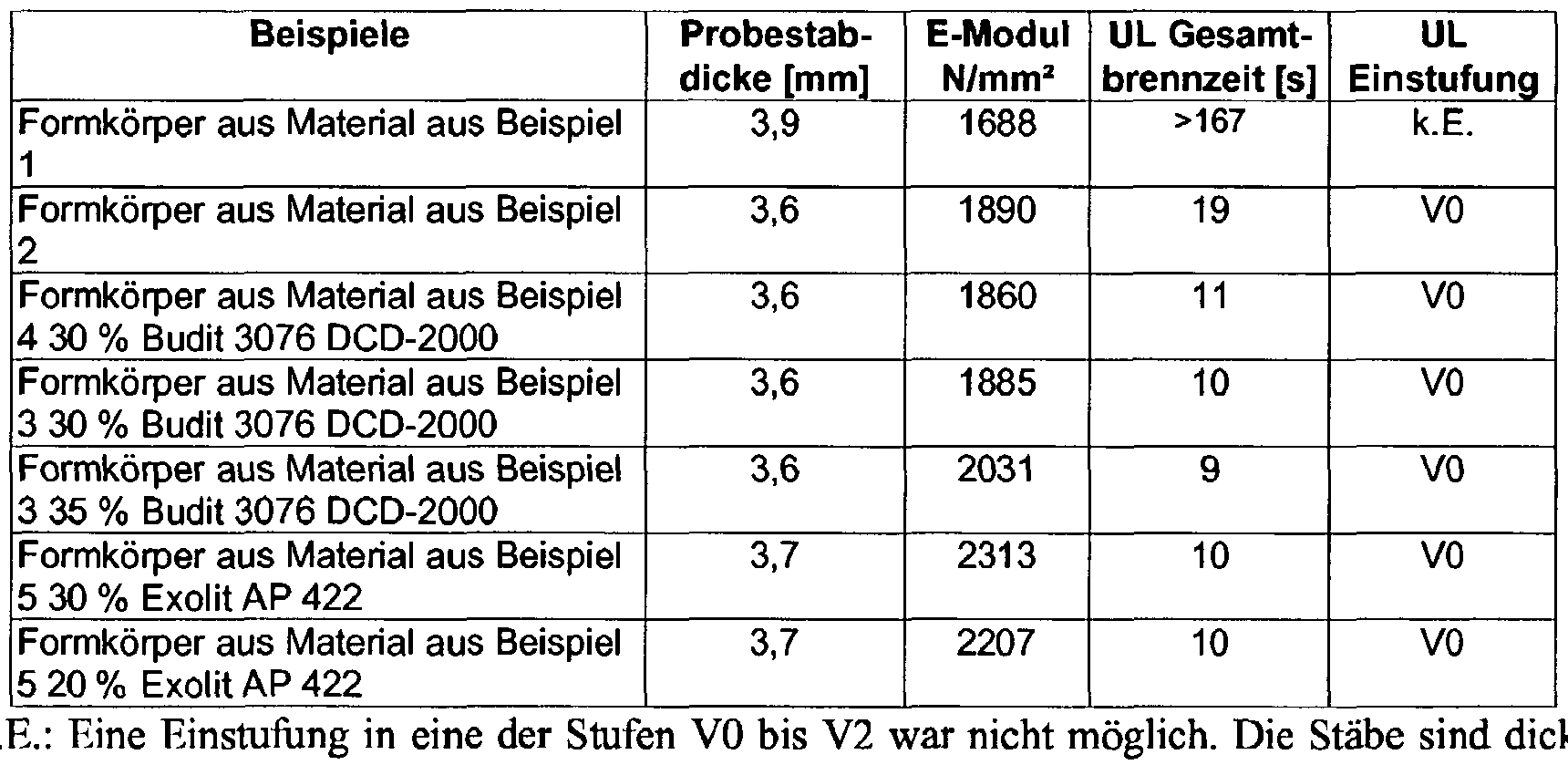

Es ist deutlich zu erkennen, dass durch die Zugabe von auf Λmmoniumpolyphosphat basierendem Flammschutzmittel zum Polymerpulver Formkörper hergestellt werden können, die eine deutlich bessere Einstufung nach UL aufweisen. Durch die Zugabe des Flammschutz- mittels wird außerdem eine Erhöhung des Elastizitätsmoduls und der Zugfestigkeit erzielt, wobei allerdings gleichzeitig die Reißdehnung verringert wird. It can be clearly seen that by adding flame retardant based on ammonium polyphosphate to the polymer powder it is possible to produce moldings which have a significantly better UL classification. By adding the flame retardant By means of an increase in the modulus of elasticity and the tensile strength is also achieved, but at the same time the elongation at break is reduced.
Claims
Priority Applications (11)
| Application Number | Priority Date | Filing Date | Title |
|---|---|---|---|
| US10/565,779 US20060223928A1 (en) | 2003-07-25 | 2004-06-03 | Powdery composition of a polymer and a flameproofing agent containing ammonium polyphosphate, method for the production thereof, and moulded body produced from said powder |
| CN2004800278399A CN1856534B (en) | 2003-07-25 | 2004-06-03 | Powder composition used in the layerwise buildup of three-dimensional articles comprises a polymer and an ammonium polyphosphate flame retardant |
| JP2006521562A JP4589321B2 (en) | 2003-07-25 | 2004-06-03 | Powdered composition of polymer and ammonium polyphosphate-containing flameproofing agent, method for producing the same, and molded product produced from this powder |
| AU2004259091A AU2004259091A1 (en) | 2003-07-25 | 2004-06-03 | Powdery composition of a polymer and a flameproofing agent containing ammonium polyphosphate, method for the production thereof, and moulded body produced from said powder |
| DE502004004522T DE502004004522D1 (en) | 2003-07-25 | 2004-06-03 | POWDERY COMPOSITION OF POLYMER AND AMMONIUM POLYPHOSPHATE-BASED FLAME PROTECTION AGENT, METHOD FOR THE PRODUCTION THEREOF AND FORM BODY MADE FROM THIS POWDER |
| EP04766029A EP1648958B1 (en) | 2003-07-25 | 2004-06-03 | Powdery composition of a polymer and a flameproofing agent containing ammonium polyphosphate, method for the production thereof, and moulded body produced from said powder |
| CA002533419A CA2533419A1 (en) | 2003-07-25 | 2004-06-03 | Powdery composition of a polymer and a flameproofing agent containing ammonium polyphosphate, method for the production thereof, and moulded body produced from said powder |
| PL04766029T PL1648958T3 (en) | 2003-07-25 | 2004-06-03 | Powdery composition of a polymer and a flameproofing agent containing ammonium polyphosphate, method for the production thereof, and moulded body produced from said powder |
| NO20060872A NO20060872L (en) | 2003-07-25 | 2006-02-22 | Powdered mixture of a polymer and a flame retardant containing ammonium polyphosphate, process for its preparation and mold body made from the powder |
| US12/332,607 US7795339B2 (en) | 2003-07-25 | 2008-12-11 | Powdery composition of a polymer and a flameproofing agent containing ammonium polyphosphate, method for the production thereof, and moulded body produced from said powder |
| US12/853,632 US8119715B2 (en) | 2003-07-25 | 2010-08-10 | Powdery composition of a polymer and a flameproofing agent containing ammonium polyphosphate, method for the production thereof, and moulded body produced from said powder |
Applications Claiming Priority (4)
| Application Number | Priority Date | Filing Date | Title |
|---|---|---|---|
| DE10333936.1 | 2003-07-25 | ||
| DE10333936 | 2003-07-25 | ||
| DE102004001324A DE102004001324A1 (en) | 2003-07-25 | 2004-01-08 | Powder composition used in the layerwise buildup of three-dimensional articles comprises a polymer and an ammonium polyphosphate flame retardant |
| DE102004001324.1 | 2004-01-08 |
Related Child Applications (2)
| Application Number | Title | Priority Date | Filing Date |
|---|---|---|---|
| US10/565,779 A-371-Of-International US20060223928A1 (en) | 2003-07-25 | 2004-06-03 | Powdery composition of a polymer and a flameproofing agent containing ammonium polyphosphate, method for the production thereof, and moulded body produced from said powder |
| US12/332,607 Continuation US7795339B2 (en) | 2003-07-25 | 2008-12-11 | Powdery composition of a polymer and a flameproofing agent containing ammonium polyphosphate, method for the production thereof, and moulded body produced from said powder |
Publications (1)
| Publication Number | Publication Date |
|---|---|
| WO2005010087A1 true WO2005010087A1 (en) | 2005-02-03 |
Family
ID=34105477
Family Applications (1)
| Application Number | Title | Priority Date | Filing Date |
|---|---|---|---|
| PCT/EP2004/051009 Ceased WO2005010087A1 (en) | 2003-07-25 | 2004-06-03 | Powdery composition of a polymer and a flameproofing agent containing ammonium polyphosphate, method for the production thereof, and moulded body produced from said powder |
Country Status (14)
| Country | Link |
|---|---|
| US (3) | US20060223928A1 (en) |
| EP (1) | EP1648958B1 (en) |
| JP (1) | JP4589321B2 (en) |
| KR (1) | KR20060066712A (en) |
| CN (1) | CN1856534B (en) |
| AT (1) | ATE368705T1 (en) |
| AU (1) | AU2004259091A1 (en) |
| CA (1) | CA2533419A1 (en) |
| DE (2) | DE102004001324A1 (en) |
| ES (1) | ES2290753T3 (en) |
| NO (1) | NO20060872L (en) |
| PL (1) | PL1648958T3 (en) |
| TW (1) | TW200505978A (en) |
| WO (1) | WO2005010087A1 (en) |
Cited By (12)
| Publication number | Priority date | Publication date | Assignee | Title |
|---|---|---|---|---|
| JP2010514855A (en) * | 2006-12-21 | 2010-05-06 | ザ・ボーイング・カンパニー | Method and system for processing flame retardant materials |
| US8669307B2 (en) | 2004-07-20 | 2014-03-11 | Arkema France | Fireproofing polyamide powders and their use in a sintering process |
| US10406745B2 (en) | 2010-04-09 | 2019-09-10 | Evonik Degussa Gmbh | Polyamide-based polymer powder, use thereof in a molding method, and molded articles made from said polymer powder |
| EP1765915B1 (en) * | 2004-07-20 | 2020-03-04 | Arkema France | Flame-retardant polyamide powders and use thereof in a fusion agglomeration process |
| EP3341184B1 (en) * | 2015-08-26 | 2020-09-23 | SABIC Global Technologies B.V. | Method of producing crystalline polycarbonate powders |
| CN111909509A (en) * | 2020-07-06 | 2020-11-10 | 金发科技股份有限公司 | 3D printing powder and preparation method thereof |
| CN111961335A (en) * | 2020-07-06 | 2020-11-20 | 金发科技股份有限公司 | 3D printing powder and preparation method thereof |
| CN111995862A (en) * | 2020-07-06 | 2020-11-27 | 金发科技股份有限公司 | 3D printing powder and preparation method thereof |
| US10968314B2 (en) | 2015-12-14 | 2021-04-06 | Evonik Operations Gmbh | Polymer powder for powder bed fusion methods |
| US20210129383A1 (en) * | 2018-04-23 | 2021-05-06 | Eos Gmbh Electro Optical Systems | Method for producing a powder comprising at least one polymer and such a type of powder |
| US11577458B2 (en) | 2018-06-29 | 2023-02-14 | 3M Innovative Properties Company | Additive layer manufacturing method and articles |
| EP4512846A1 (en) | 2023-08-21 | 2025-02-26 | Ems-Chemie Ag | Flame resistant materials for powder bed fusion technologies and using such materials in a layer-by-layer process |
Families Citing this family (61)
| Publication number | Priority date | Publication date | Assignee | Title |
|---|---|---|---|---|
| EP1400340B1 (en) * | 2002-09-21 | 2008-01-16 | Evonik Degussa GmbH | Method for manufacturing a three dimensional object |
| DE10245355A1 (en) * | 2002-09-27 | 2004-04-08 | Degussa Ag | pipe connection |
| DE10330591A1 (en) * | 2002-11-28 | 2004-06-09 | Degussa Ag | Sinter powder useful in selective laser sintering to produce moldings comprises polyamide and fatty acid salt, montanic acid salt or dimer acid salt |
| EP1459871B1 (en) * | 2003-03-15 | 2011-04-06 | Evonik Degussa GmbH | Method and apparatus for manufacturing three dimensional objects using microwave radiation and shaped body produced according to this method |
| DE102004001324A1 (en) * | 2003-07-25 | 2005-02-10 | Degussa Ag | Powder composition used in the layerwise buildup of three-dimensional articles comprises a polymer and an ammonium polyphosphate flame retardant |
| JP4186110B2 (en) * | 2003-07-31 | 2008-11-26 | 株式会社ジェイテクト | Steering device |
| DE10337707A1 (en) * | 2003-08-16 | 2005-04-07 | Degussa Ag | Process for increasing the molecular weight of polyamides |
| DE10347628A1 (en) * | 2003-10-09 | 2005-05-19 | Degussa Ag | Crosslinkable base layer for fixation inserts according to the double-point method |
| DE10347665A1 (en) * | 2003-10-09 | 2005-05-19 | Degussa Ag | Crosslinkable base layer for fixation inserts according to the double-point method |
| DE102004010162A1 (en) | 2004-02-27 | 2005-09-15 | Degussa Ag | Polymer powder with copolymer, use in a shaping process with unfocused energy input and molding, made from this polymer powder |
| DE102004012682A1 (en) | 2004-03-16 | 2005-10-06 | Degussa Ag | Process for the production of three-dimensional objects by means of laser technology and application of an absorber by inkjet method |
| DE102004020452A1 (en) * | 2004-04-27 | 2005-12-01 | Degussa Ag | Method for producing three-dimensional objects by means of electromagnetic radiation and applying an absorber by inkjet method |
| DE102004020453A1 (en) * | 2004-04-27 | 2005-11-24 | Degussa Ag | Polymer powder with polyamide, use in a molding process and molding, made from this polymer powder |
| DE102004024440B4 (en) * | 2004-05-14 | 2020-06-25 | Evonik Operations Gmbh | Polymer powder with polyamide, use in a shaping process and molded body made from this polymer powder |
| DE102004029217A1 (en) * | 2004-06-16 | 2006-01-05 | Degussa Ag | Multilayer film |
| DE102004047876A1 (en) | 2004-10-01 | 2006-04-06 | Degussa Ag | Powder with improved recycling properties, process for its preparation and use of the powder in a process for producing three-dimensional objects |
| DE102004062761A1 (en) * | 2004-12-21 | 2006-06-22 | Degussa Ag | Use of polyarylene ether ketone powder in a three-dimensional powder-based tool-less production process, and moldings produced therefrom |
| DE102004063220A1 (en) * | 2004-12-29 | 2006-07-13 | Degussa Ag | Transparent molding compounds |
| DE102005002930A1 (en) | 2005-01-21 | 2006-07-27 | Degussa Ag | Polymer powder with polyamide, use in a molding process and molding, made from this polymer powder |
| DE102005007034A1 (en) | 2005-02-15 | 2006-08-17 | Degussa Ag | Process for the production of molded parts while increasing the melt stiffness |
| DE102005007035A1 (en) | 2005-02-15 | 2006-08-17 | Degussa Ag | Process for the production of molded parts while increasing the melt stiffness |
| DE102005007665A1 (en) * | 2005-02-19 | 2006-08-31 | Degussa Ag | Foil based on a polyamide blend |
| DE102005007663A1 (en) | 2005-02-19 | 2006-08-24 | Degussa Ag | Transparent, decorable multilayer film |
| DE102005007664A1 (en) * | 2005-02-19 | 2006-08-31 | Degussa Ag | Transparent molding compound |
| DE102005026264A1 (en) * | 2005-06-08 | 2006-12-14 | Degussa Ag | Transparent molding compound |
| DE102005033379A1 (en) * | 2005-07-16 | 2007-01-18 | Degussa Ag | Use of cyclic oligomers in a molding process and molding made by this process |
| DE102005049718A1 (en) * | 2005-10-14 | 2007-04-19 | Degussa Gmbh | By welding in electromagnetic alternating field available plastic composite molding |
| DE102005053071A1 (en) * | 2005-11-04 | 2007-05-16 | Degussa | Process for the preparation of ultrafine powders based on polymaiden, ultrafine polyamide powder and their use |
| DE102005054723A1 (en) * | 2005-11-17 | 2007-05-24 | Degussa Gmbh | Use of polyester powder in a molding process and molding made from this polyester powder |
| DE102006015791A1 (en) * | 2006-04-01 | 2007-10-04 | Degussa Gmbh | Polymer powder, process for the preparation and use of such a powder and molded articles thereof |
| US7717410B2 (en) * | 2006-10-24 | 2010-05-18 | Wieslaw Julian Oledzki | Smooth non-linear springs, particularly smooth progressive rate steel springs, progressive rate vehicle suspensions and method |
| DE102007019133A1 (en) * | 2007-04-20 | 2008-10-23 | Evonik Degussa Gmbh | Composite powder, use in a molding process and molding made from this powder |
| DE102007038578A1 (en) * | 2007-08-16 | 2009-02-19 | Evonik Degussa Gmbh | Method of decorating surfaces |
| DE102008000755B4 (en) | 2008-03-19 | 2019-12-12 | Evonik Degussa Gmbh | Copolyamide powder and its preparation, use of copolyamide powder in a molding process and molding, made from this copolyamide powder |
| DE102008002599A1 (en) * | 2008-06-24 | 2009-12-31 | Evonik Degussa Gmbh | Component with cover layer of a PA613 molding compound |
| EP2352635A2 (en) * | 2008-10-31 | 2011-08-10 | Basf Se | Ion exchanger moulded body and method for producing same |
| DE102010056126B4 (en) | 2010-02-09 | 2016-09-01 | Vladimir Volchkov | Boxer engine |
| DE102010056125B4 (en) | 2010-03-01 | 2015-07-23 | Vladimir Volchkov | Opposed piston engine |
| DE102011078720A1 (en) * | 2011-07-06 | 2013-01-10 | Evonik Degussa Gmbh | Powder comprising polymer-coated core particles containing metals, metal oxides, metal or metalloid nitrides |
| CH710441A2 (en) | 2014-12-02 | 2016-06-15 | Rowak Ag | Powdered compositions of thermoplastics and use of the compositions. |
| WO2016147681A1 (en) | 2015-03-16 | 2016-09-22 | 株式会社リコー | Powder material for three-dimensional modeling, three-dimensional modeling material set, method for producing three-dimensional model, apparatus for producing three-dimensional model, and three-dimensional model |
| EP3313648B1 (en) | 2015-06-23 | 2023-08-02 | SHPP Global Technologies B.V. | Improved manufacturability of amorphous polymers in powder bed fusion processes |
| WO2017040897A1 (en) * | 2015-09-04 | 2017-03-09 | Sabic Global Technologies B.V. | Powder compositions, method of preparing articles and coatings from the powder compositions, and articles prepared therefrom |
| US20180273720A1 (en) * | 2015-10-09 | 2018-09-27 | Hewlett-Packard Development Company, L.P. | Particulate mixtures |
| CN106589860B (en) | 2015-10-13 | 2018-10-16 | 中国石油化工股份有限公司 | Polylactic resin powder and its preparation method and application for selective laser sintering |
| EP3181615A1 (en) * | 2015-12-14 | 2017-06-21 | Evonik Degussa GmbH | Polymer powder for powder bed fusion method |
| US10786950B2 (en) * | 2016-01-29 | 2020-09-29 | Hewlett-Packard Development Company, L.P. | Three-dimensional (3D) printing composite build material composition |
| JP6666770B2 (en) * | 2016-03-30 | 2020-03-18 | リンテック株式会社 | Decorative sheet and method for manufacturing decorative sheet |
| DE102016219080A1 (en) | 2016-09-30 | 2018-04-05 | Evonik Degussa Gmbh | Polyamide powder for selective sintering |
| CN106832900A (en) * | 2017-01-06 | 2017-06-13 | 北京增材制造技术研究院有限公司 | Inexpensive selective laser sintering modification of nylon composite powder and its application method |
| CN106987116A (en) * | 2017-04-28 | 2017-07-28 | 湖南华曙高科技有限责任公司 | Halogen-free flame-retardant nylon material for selective laser sintering and preparation method thereof |
| US11407034B2 (en) | 2017-07-06 | 2022-08-09 | OmniTek Technology Ltda. | Selective laser melting system and method of using same |
| CN111133036B (en) | 2017-09-22 | 2021-07-06 | 沙特基础工业全球技术有限公司 | Process for making flame retardant polycarbonate particles and flame retardant polycarbonate particles prepared therefrom |
| WO2019060657A1 (en) * | 2017-09-22 | 2019-03-28 | Sabic Global Technologies B.V. | Method of producing semicrystalline polycarbonate powder with added flame retardant for powder be fusing and composites applications |
| EP3724255A1 (en) * | 2017-12-15 | 2020-10-21 | SABIC Global Technologies B.V. | Polymer composition for selective sintering |
| CN108892930A (en) * | 2018-06-08 | 2018-11-27 | 吕龙芳 | A kind of biodegradable modified plastic agglomerate and preparation method thereof |
| DE102018121230A1 (en) * | 2018-08-30 | 2020-03-05 | Airbus Operations Gmbh | Process for additive manufacturing of workpieces from a flame-retardant polyamide material, thereby obtainable workpieces and use of the polyamide material |
| FR3093945B1 (en) | 2019-03-18 | 2023-10-27 | Arkema France | FLAME-RETARDANT POLYAMIDES AND COPOLYAMIDES FOR 3D PRINTING |
| WO2022106402A1 (en) * | 2020-11-19 | 2022-05-27 | Basf Se | Flame-retardant pulverulent composition and 3d-printed object obtained from the same |
| CN112409784B (en) * | 2020-11-27 | 2023-04-11 | 湖南华曙高科技股份有限公司 | Anti-dripping nylon material for selective laser sintering and preparation method thereof |
| DE102022129476A1 (en) * | 2022-11-08 | 2024-05-08 | Eos Gmbh Electro Optical Systems | Coarse flame retardant |
Citations (4)
| Publication number | Priority date | Publication date | Assignee | Title |
|---|---|---|---|---|
| EP0686661A1 (en) * | 1993-12-28 | 1995-12-13 | Chisso Corporation | Flame-retardant thermoplastic polymer composition, water-insoluble ammonium polyphosphate powder as the component thereof, and process for producing the same |
| US6136948A (en) * | 1992-11-23 | 2000-10-24 | Dtm Corporation | Sinterable semi-crystalline powder and near-fully dense article formed therewith |
| US6245281B1 (en) * | 1997-10-27 | 2001-06-12 | Huels Aktiengesellschaft | Use of a nylon-12 for selective laser sintering |
| EP1179568A1 (en) * | 2000-02-16 | 2002-02-13 | Asahi Kasei Kabushiki Kaisha | Polyamide resin composition |
Family Cites Families (53)
| Publication number | Priority date | Publication date | Assignee | Title |
|---|---|---|---|---|
| US3817888A (en) * | 1972-04-03 | 1974-06-18 | Phillips Petroleum Co | Abs polymer compositions |
| US3847888A (en) * | 1972-12-01 | 1974-11-12 | Allied Chem | Ultra-high molecular weight polyethylene molding powder and molding process |
| US4373887A (en) * | 1980-02-11 | 1983-02-15 | Teledyne Industries, Inc. | Apparatus for producing porous shaped products |
| US4570055A (en) * | 1984-05-07 | 1986-02-11 | Raychem Corporation | Electrically heat-recoverable assembly |
| US4568412A (en) * | 1984-11-01 | 1986-02-04 | E. I. Dupont De Nemours And Company | Surface conductive polyimide |
| DE3507562A1 (en) * | 1985-03-04 | 1986-09-04 | Hoechst Ag, 6230 Frankfurt | SELF-DELETING POLYMERS |
| CA2023352A1 (en) * | 1989-08-21 | 1991-02-22 | Raymond Charles Srail | Compression molded flame retardant and high impact strength ultra high molecular weight polyethylene composition |
| DE4137430A1 (en) | 1991-11-14 | 1993-05-19 | Huels Chemische Werke Ag | MULTILAYER PLASTIC PIPE |
| DE4303653A1 (en) * | 1993-02-09 | 1994-08-11 | Hoechst Ag | Halogen-free, flame-retardant polymer compositions |
| US5759678A (en) * | 1995-10-05 | 1998-06-02 | Mitsubishi Chemical Corporation | High-strength porous film and process for producing the same |
| US6110411A (en) * | 1997-03-18 | 2000-08-29 | Clausen; Christian Henning | Laser sinterable thermoplastic powder |
| JP2000119515A (en) * | 1998-10-14 | 2000-04-25 | Mitsubishi Engineering Plastics Corp | Polyamide resin composition |
| DE19734437A1 (en) * | 1997-08-08 | 1999-02-11 | Clariant Gmbh | Synergistic combination of flame retardants for polymers |
| JPH11228813A (en) * | 1998-02-09 | 1999-08-24 | Mitsubishi Eng Plast Corp | Polyamide resin composition for laser marking |
| US8061006B2 (en) * | 2001-07-26 | 2011-11-22 | Powderject Research Limited | Particle cassette, method and kit therefor |
| DE10201903A1 (en) | 2002-01-19 | 2003-07-31 | Degussa | Molding compound based on polyether amides |
| DE10228439A1 (en) | 2002-06-26 | 2004-01-22 | Degussa Ag | Plastic optical fiber |
| EP1400340B1 (en) | 2002-09-21 | 2008-01-16 | Evonik Degussa GmbH | Method for manufacturing a three dimensional object |
| US7087109B2 (en) * | 2002-09-25 | 2006-08-08 | Z Corporation | Three dimensional printing material system and method |
| DE10245355A1 (en) * | 2002-09-27 | 2004-04-08 | Degussa Ag | pipe connection |
| EP1413594A2 (en) | 2002-10-17 | 2004-04-28 | Degussa AG | Laser-sintering powder with better recycling properties, process for its preparation and use thereof. |
| DE10248406A1 (en) | 2002-10-17 | 2004-04-29 | Degussa Ag | Laser sinter powder with titanium dioxide particles, process for its production and moldings made from this laser sinter powder |
| DE10251790A1 (en) | 2002-11-07 | 2004-05-19 | Degussa Ag | Composition for fluidized bed-, rotational-, electrostatic-, tribo-, or minicoating in the preparation of cosmetics and paint, comprises polyamide, polyamide derivatives, and flow aid |
| DE50302649D1 (en) | 2002-11-28 | 2006-05-11 | Degussa | Laser sintering powder with metal soaps, process for its preparation and molded articles made from this laser-sintered powder |
| DE10330591A1 (en) | 2002-11-28 | 2004-06-09 | Degussa Ag | Sinter powder useful in selective laser sintering to produce moldings comprises polyamide and fatty acid salt, montanic acid salt or dimer acid salt |
| JP2004250621A (en) * | 2003-02-21 | 2004-09-09 | Toray Ind Inc | Laser welding resin material and composite molded article using the same |
| DE10311437A1 (en) | 2003-03-15 | 2004-09-23 | Degussa Ag | Laser sinter powder with PMMI, PMMA and / or PMMI-PMMA copolymers, process for its production and moldings made from this laser sinter powder |
| EP1459871B1 (en) | 2003-03-15 | 2011-04-06 | Evonik Degussa GmbH | Method and apparatus for manufacturing three dimensional objects using microwave radiation and shaped body produced according to this method |
| DE10333005A1 (en) | 2003-07-18 | 2005-02-03 | Degussa Ag | Molding composition based on polyetheramides |
| DE102004001324A1 (en) | 2003-07-25 | 2005-02-10 | Degussa Ag | Powder composition used in the layerwise buildup of three-dimensional articles comprises a polymer and an ammonium polyphosphate flame retardant |
| DE10334497A1 (en) | 2003-07-29 | 2005-02-24 | Degussa Ag | Polymer powder with phosphonate-based flame retardant, process for its preparation and moldings, made from this polymer powder |
| DE10334496A1 (en) | 2003-07-29 | 2005-02-24 | Degussa Ag | Laser sintering powder with a metal salt and a fatty acid derivative, process for the production thereof and moldings produced from this laser sinter powder |
| DE10337707A1 (en) * | 2003-08-16 | 2005-04-07 | Degussa Ag | Process for increasing the molecular weight of polyamides |
| DE10347628A1 (en) | 2003-10-09 | 2005-05-19 | Degussa Ag | Crosslinkable base layer for fixation inserts according to the double-point method |
| DE10347665A1 (en) | 2003-10-09 | 2005-05-19 | Degussa Ag | Crosslinkable base layer for fixation inserts according to the double-point method |
| DE102004010162A1 (en) | 2004-02-27 | 2005-09-15 | Degussa Ag | Polymer powder with copolymer, use in a shaping process with unfocused energy input and molding, made from this polymer powder |
| DE102004012682A1 (en) | 2004-03-16 | 2005-10-06 | Degussa Ag | Process for the production of three-dimensional objects by means of laser technology and application of an absorber by inkjet method |
| DE102004020453A1 (en) | 2004-04-27 | 2005-11-24 | Degussa Ag | Polymer powder with polyamide, use in a molding process and molding, made from this polymer powder |
| DE102004020452A1 (en) | 2004-04-27 | 2005-12-01 | Degussa Ag | Method for producing three-dimensional objects by means of electromagnetic radiation and applying an absorber by inkjet method |
| DE102004024440B4 (en) | 2004-05-14 | 2020-06-25 | Evonik Operations Gmbh | Polymer powder with polyamide, use in a shaping process and molded body made from this polymer powder |
| US20060041041A1 (en) * | 2004-07-20 | 2006-02-23 | Patrick Douais | Fireproofing polyamide powders and their use in a sintering process |
| DE102004047876A1 (en) | 2004-10-01 | 2006-04-06 | Degussa Ag | Powder with improved recycling properties, process for its preparation and use of the powder in a process for producing three-dimensional objects |
| DE102004062761A1 (en) | 2004-12-21 | 2006-06-22 | Degussa Ag | Use of polyarylene ether ketone powder in a three-dimensional powder-based tool-less production process, and moldings produced therefrom |
| DE102004063220A1 (en) | 2004-12-29 | 2006-07-13 | Degussa Ag | Transparent molding compounds |
| DE102005002930A1 (en) | 2005-01-21 | 2006-07-27 | Degussa Ag | Polymer powder with polyamide, use in a molding process and molding, made from this polymer powder |
| DE102005007034A1 (en) * | 2005-02-15 | 2006-08-17 | Degussa Ag | Process for the production of molded parts while increasing the melt stiffness |
| DE102005007035A1 (en) * | 2005-02-15 | 2006-08-17 | Degussa Ag | Process for the production of molded parts while increasing the melt stiffness |
| DE102005008044A1 (en) | 2005-02-19 | 2006-08-31 | Degussa Ag | Polymer powder with Blockpolyetheramid, use in a molding process and molding, made from this polymer powder |
| EP1860154B1 (en) * | 2005-03-16 | 2010-10-20 | Riken Vitamin Co., Ltd. | Aliphatic polyester resin composition and sheet, film and molded article formed from the same |
| DE102005054723A1 (en) | 2005-11-17 | 2007-05-24 | Degussa Gmbh | Use of polyester powder in a molding process and molding made from this polyester powder |
| DE102006005500A1 (en) | 2006-02-07 | 2007-08-09 | Degussa Gmbh | Use of polymer powder, prepared from a dispersion, in a molding process and molding, made from this polymer powder |
| DE102007021199B4 (en) | 2006-07-17 | 2016-02-11 | Evonik Degussa Gmbh | Compositions of organic polymer as matrix and inorganic particles as filler, process for their preparation and their use and moldings produced therewith |
| DE102007019133A1 (en) | 2007-04-20 | 2008-10-23 | Evonik Degussa Gmbh | Composite powder, use in a molding process and molding made from this powder |
-
2004
- 2004-01-08 DE DE102004001324A patent/DE102004001324A1/en not_active Withdrawn
- 2004-06-03 AT AT04766029T patent/ATE368705T1/en not_active IP Right Cessation
- 2004-06-03 WO PCT/EP2004/051009 patent/WO2005010087A1/en not_active Ceased
- 2004-06-03 JP JP2006521562A patent/JP4589321B2/en not_active Expired - Fee Related
- 2004-06-03 AU AU2004259091A patent/AU2004259091A1/en not_active Abandoned
- 2004-06-03 PL PL04766029T patent/PL1648958T3/en unknown
- 2004-06-03 ES ES04766029T patent/ES2290753T3/en not_active Expired - Lifetime
- 2004-06-03 CA CA002533419A patent/CA2533419A1/en not_active Abandoned
- 2004-06-03 CN CN2004800278399A patent/CN1856534B/en not_active Expired - Lifetime
- 2004-06-03 US US10/565,779 patent/US20060223928A1/en not_active Abandoned
- 2004-06-03 KR KR1020067001716A patent/KR20060066712A/en not_active Withdrawn
- 2004-06-03 EP EP04766029A patent/EP1648958B1/en not_active Expired - Lifetime
- 2004-06-03 DE DE502004004522T patent/DE502004004522D1/en not_active Expired - Lifetime
- 2004-07-19 TW TW093121515A patent/TW200505978A/en unknown
-
2006
- 2006-02-22 NO NO20060872A patent/NO20060872L/en not_active Application Discontinuation
-
2008
- 2008-12-11 US US12/332,607 patent/US7795339B2/en not_active Expired - Lifetime
-
2010
- 2010-08-10 US US12/853,632 patent/US8119715B2/en not_active Expired - Lifetime
Patent Citations (4)
| Publication number | Priority date | Publication date | Assignee | Title |
|---|---|---|---|---|
| US6136948A (en) * | 1992-11-23 | 2000-10-24 | Dtm Corporation | Sinterable semi-crystalline powder and near-fully dense article formed therewith |
| EP0686661A1 (en) * | 1993-12-28 | 1995-12-13 | Chisso Corporation | Flame-retardant thermoplastic polymer composition, water-insoluble ammonium polyphosphate powder as the component thereof, and process for producing the same |
| US6245281B1 (en) * | 1997-10-27 | 2001-06-12 | Huels Aktiengesellschaft | Use of a nylon-12 for selective laser sintering |
| EP1179568A1 (en) * | 2000-02-16 | 2002-02-13 | Asahi Kasei Kabushiki Kaisha | Polyamide resin composition |
Cited By (17)
| Publication number | Priority date | Publication date | Assignee | Title |
|---|---|---|---|---|
| US8669307B2 (en) | 2004-07-20 | 2014-03-11 | Arkema France | Fireproofing polyamide powders and their use in a sintering process |
| EP1765915B1 (en) * | 2004-07-20 | 2020-03-04 | Arkema France | Flame-retardant polyamide powders and use thereof in a fusion agglomeration process |
| JP2010514855A (en) * | 2006-12-21 | 2010-05-06 | ザ・ボーイング・カンパニー | Method and system for processing flame retardant materials |
| US10406745B2 (en) | 2010-04-09 | 2019-09-10 | Evonik Degussa Gmbh | Polyamide-based polymer powder, use thereof in a molding method, and molded articles made from said polymer powder |
| EP3341184B1 (en) * | 2015-08-26 | 2020-09-23 | SABIC Global Technologies B.V. | Method of producing crystalline polycarbonate powders |
| US10968314B2 (en) | 2015-12-14 | 2021-04-06 | Evonik Operations Gmbh | Polymer powder for powder bed fusion methods |
| US20210129383A1 (en) * | 2018-04-23 | 2021-05-06 | Eos Gmbh Electro Optical Systems | Method for producing a powder comprising at least one polymer and such a type of powder |
| US12365115B2 (en) * | 2018-04-23 | 2025-07-22 | Eos Gmbh Electro Optical Systems | Method for producing a powder comprising at least one polymer and such a type of powder |
| US11577458B2 (en) | 2018-06-29 | 2023-02-14 | 3M Innovative Properties Company | Additive layer manufacturing method and articles |
| CN111961335A (en) * | 2020-07-06 | 2020-11-20 | 金发科技股份有限公司 | 3D printing powder and preparation method thereof |
| CN111995862A (en) * | 2020-07-06 | 2020-11-27 | 金发科技股份有限公司 | 3D printing powder and preparation method thereof |
| CN111909509A (en) * | 2020-07-06 | 2020-11-10 | 金发科技股份有限公司 | 3D printing powder and preparation method thereof |
| WO2022007361A1 (en) * | 2020-07-06 | 2022-01-13 | 金发科技股份有限公司 | 3d printing powder and preparation method therefor |
| CN111995862B (en) * | 2020-07-06 | 2022-02-18 | 金发科技股份有限公司 | 3D printing powder and preparation method thereof |
| CN111909509B (en) * | 2020-07-06 | 2022-02-18 | 金发科技股份有限公司 | 3D printing powder and preparation method thereof |
| CN111961335B (en) * | 2020-07-06 | 2022-02-18 | 金发科技股份有限公司 | 3D printing powder and preparation method thereof |
| EP4512846A1 (en) | 2023-08-21 | 2025-02-26 | Ems-Chemie Ag | Flame resistant materials for powder bed fusion technologies and using such materials in a layer-by-layer process |
Also Published As
| Publication number | Publication date |
|---|---|
| CN1856534B (en) | 2012-11-14 |
| US8119715B2 (en) | 2012-02-21 |
| US20060223928A1 (en) | 2006-10-05 |
| DE502004004522D1 (en) | 2007-09-13 |
| EP1648958A1 (en) | 2006-04-26 |
| AU2004259091A1 (en) | 2005-02-03 |
| US20100324190A1 (en) | 2010-12-23 |
| JP2006528717A (en) | 2006-12-21 |
| TW200505978A (en) | 2005-02-16 |
| ES2290753T3 (en) | 2008-02-16 |
| DE102004001324A1 (en) | 2005-02-10 |
| NO20060872L (en) | 2006-02-22 |
| CN1856534A (en) | 2006-11-01 |
| JP4589321B2 (en) | 2010-12-01 |
| EP1648958B1 (en) | 2007-08-01 |
| US20090088508A1 (en) | 2009-04-02 |
| KR20060066712A (en) | 2006-06-16 |
| PL1648958T3 (en) | 2007-12-31 |
| ATE368705T1 (en) | 2007-08-15 |
| CA2533419A1 (en) | 2005-02-03 |
| US7795339B2 (en) | 2010-09-14 |
Similar Documents
| Publication | Publication Date | Title |
|---|---|---|
| EP1648958B1 (en) | Powdery composition of a polymer and a flameproofing agent containing ammonium polyphosphate, method for the production thereof, and moulded body produced from said powder | |
| EP1505111B1 (en) | Polyamide powder containing phosphonate based fire retardant, production process thereof and molded objects therefrom | |
| EP1505108B1 (en) | Laser-sinterable polyamide powder containing a metal salt and a fat acid derivative, process of preparation and molded articles therefrom | |
| DE602005004126T2 (en) | FLAME PREPARATION COMPOSITION WITH IMPROVED FLUIDITY, FLAME RESISTANT RESIN COMPOSITION AND FORM BODY THEREOF | |
| WO2005090056A1 (en) | Laser sintering with lasers having a wavelength ranging from 100 to 3,000 nm | |
| DE10251790A1 (en) | Composition for fluidized bed-, rotational-, electrostatic-, tribo-, or minicoating in the preparation of cosmetics and paint, comprises polyamide, polyamide derivatives, and flow aid | |
| EP3679090B1 (en) | Flame-retardant polyester compositions and use thereof | |
| WO2004063264A1 (en) | Master batches based on pre-exfoliated nanoclays and the use of the same | |
| EP3665219A1 (en) | Flame-retardant polyamide compositions and use thereof | |
| EP0013872B1 (en) | A process for the production of particulate polyolefinic moulding materials containing conductive carbon black, and their use in the production of mouldings | |
| WO2002060990A2 (en) | Environmentally friendly composition | |
| EP3679093A1 (en) | Flame retardant combinations for polymer compositions and use thereof | |
| DE102004009234A1 (en) | Carbon black-containing polymer powder, e.g. polyamide 12, for use in layer processes in which parts of each layer are selectively melted, e.g. for production of prototypes by laser sintering | |
| DE4235693C1 (en) | Process for flame retardant treatment of polyolefin particle foams | |
| WO2018162354A1 (en) | Material for processing in selective laser sintering method, moulded body produced therefrom, and use in sls method | |
| JP3774931B2 (en) | Resin-coated ethylenediaminephosphate, method for producing the same, and flame-retardant resin composition comprising the same | |
| JP2005139465A (en) | Resin-coated ethylenediamine phosphate and flame-retardant resin composition comprising the same | |
| KR20170044807A (en) | shell powder filled polypropylene composite and manufacturing method the composite | |
| EP0013752A1 (en) | Process for preparing finely divided polyolefine compositions with enhanced properties and their use in producing formed articles | |
| JPH08311255A (en) | Flame-retardant polyolefin resin composition |
Legal Events
| Date | Code | Title | Description |
|---|---|---|---|
| WWE | Wipo information: entry into national phase |
Ref document number: 200480027839.9 Country of ref document: CN |
|
| AK | Designated states |
Kind code of ref document: A1 Designated state(s): AE AG AL AM AT AU AZ BA BB BG BR BW BY BZ CA CH CN CO CR CU CZ DE DK DM DZ EC EE EG ES FI GB GD GE GH GM HR HU ID IL IN IS JP KE KG KP KR KZ LC LK LR LS LT LU LV MA MD MG MK MN MW MX MZ NA NI NO NZ OM PG PH PL PT RO RU SC SD SE SG SK SL SY TJ TM TN TR TT TZ UA UG US UZ VC VN YU ZA ZM ZW |
|
| AL | Designated countries for regional patents |
Kind code of ref document: A1 Designated state(s): GM KE LS MW MZ NA SD SL SZ TZ UG ZM ZW AM AZ BY KG KZ MD RU TJ TM AT BE BG CH CY CZ DE DK EE ES FI FR GB GR HU IE IT LU MC NL PL PT RO SE SI SK TR BF BJ CF CG CI CM GA GN GQ GW ML MR NE SN TD TG |
|
| DPEN | Request for preliminary examination filed prior to expiration of 19th month from priority date (pct application filed from 20040101) | ||
| 121 | Ep: the epo has been informed by wipo that ep was designated in this application | ||
| WWE | Wipo information: entry into national phase |
Ref document number: 2004766029 Country of ref document: EP |
|
| ENP | Entry into the national phase |
Ref document number: 2533419 Country of ref document: CA |
|
| WWE | Wipo information: entry into national phase |
Ref document number: 294/CHENP/2006 Country of ref document: IN |
|
| WWE | Wipo information: entry into national phase |
Ref document number: 2006223928 Country of ref document: US Ref document number: 2006521562 Country of ref document: JP Ref document number: 10565779 Country of ref document: US Ref document number: 1020067001716 Country of ref document: KR |
|
| WWE | Wipo information: entry into national phase |
Ref document number: 2004259091 Country of ref document: AU |
|
| WWE | Wipo information: entry into national phase |
Ref document number: 545267 Country of ref document: NZ |
|
| ENP | Entry into the national phase |
Ref document number: 2004259091 Country of ref document: AU Date of ref document: 20040603 Kind code of ref document: A |
|
| WWP | Wipo information: published in national office |
Ref document number: 2004259091 Country of ref document: AU |
|
| WWP | Wipo information: published in national office |
Ref document number: 2004766029 Country of ref document: EP |
|
| WWP | Wipo information: published in national office |
Ref document number: 10565779 Country of ref document: US |
|
| WWG | Wipo information: grant in national office |
Ref document number: 2004766029 Country of ref document: EP |