DE102004020453A1 - Polymer powder with polyamide, use in a molding process and molding, made from this polymer powder - Google Patents
Polymer powder with polyamide, use in a molding process and molding, made from this polymer powder Download PDFInfo
- Publication number
- DE102004020453A1 DE102004020453A1 DE102004020453A DE102004020453A DE102004020453A1 DE 102004020453 A1 DE102004020453 A1 DE 102004020453A1 DE 102004020453 A DE102004020453 A DE 102004020453A DE 102004020453 A DE102004020453 A DE 102004020453A DE 102004020453 A1 DE102004020453 A1 DE 102004020453A1
- Authority
- DE
- Germany
- Prior art keywords
- powder
- polymer powder
- homopolyamide
- polycondensation
- moldings
- Prior art date
- Legal status (The legal status is an assumption and is not a legal conclusion. Google has not performed a legal analysis and makes no representation as to the accuracy of the status listed.)
- Withdrawn
Links
- 239000000843 powder Substances 0.000 title claims abstract description 137
- 229920000642 polymer Polymers 0.000 title claims abstract description 76
- 238000000034 method Methods 0.000 title claims abstract description 60
- 239000004952 Polyamide Substances 0.000 title claims abstract description 57
- 229920002647 polyamide Polymers 0.000 title claims abstract description 57
- 238000000465 moulding Methods 0.000 title claims abstract description 44
- 230000008569 process Effects 0.000 title claims abstract description 26
- 239000003112 inhibitor Substances 0.000 claims abstract description 7
- 239000006096 absorbing agent Substances 0.000 claims abstract description 5
- 238000006068 polycondensation reaction Methods 0.000 claims description 35
- 239000002245 particle Substances 0.000 claims description 27
- NAQMVNRVTILPCV-UHFFFAOYSA-N hexane-1,6-diamine Chemical compound NCCCCCCN NAQMVNRVTILPCV-UHFFFAOYSA-N 0.000 claims description 26
- 150000004985 diamines Chemical class 0.000 claims description 23
- TVIDDXQYHWJXFK-UHFFFAOYSA-N dodecanedioic acid Chemical compound OC(=O)CCCCCCCCCCC(O)=O TVIDDXQYHWJXFK-UHFFFAOYSA-N 0.000 claims description 22
- CXMXRPHRNRROMY-UHFFFAOYSA-N sebacic acid Chemical compound OC(=O)CCCCCCCCC(O)=O CXMXRPHRNRROMY-UHFFFAOYSA-N 0.000 claims description 20
- -1 decanediamine Chemical compound 0.000 claims description 18
- 150000001991 dicarboxylic acids Chemical class 0.000 claims description 16
- 238000001953 recrystallisation Methods 0.000 claims description 16
- WNLRTRBMVRJNCN-UHFFFAOYSA-N adipic acid Chemical compound OC(=O)CCCCC(O)=O WNLRTRBMVRJNCN-UHFFFAOYSA-N 0.000 claims description 14
- 239000000945 filler Substances 0.000 claims description 14
- 238000002844 melting Methods 0.000 claims description 14
- 230000008018 melting Effects 0.000 claims description 14
- BDJRBEYXGGNYIS-UHFFFAOYSA-N nonanedioic acid Chemical compound OC(=O)CCCCCCCC(O)=O BDJRBEYXGGNYIS-UHFFFAOYSA-N 0.000 claims description 12
- HQHCYKULIHKCEB-UHFFFAOYSA-N tetradecanedioic acid Chemical compound OC(=O)CCCCCCCCCCCCC(O)=O HQHCYKULIHKCEB-UHFFFAOYSA-N 0.000 claims description 10
- 238000004519 manufacturing process Methods 0.000 claims description 9
- 229910052751 metal Inorganic materials 0.000 claims description 9
- 239000002184 metal Substances 0.000 claims description 9
- DPUOLQHDNGRHBS-UHFFFAOYSA-N Brassidinsaeure Natural products CCCCCCCCC=CCCCCCCCCCCCC(O)=O DPUOLQHDNGRHBS-UHFFFAOYSA-N 0.000 claims description 8
- BTZVDPWKGXMQFW-UHFFFAOYSA-N Pentadecanedioic acid Chemical compound OC(=O)CCCCCCCCCCCCCC(O)=O BTZVDPWKGXMQFW-UHFFFAOYSA-N 0.000 claims description 8
- GWEVSGVZZGPLCZ-UHFFFAOYSA-N Titan oxide Chemical compound O=[Ti]=O GWEVSGVZZGPLCZ-UHFFFAOYSA-N 0.000 claims description 8
- BNJOQKFENDDGSC-UHFFFAOYSA-N octadecanedioic acid Chemical compound OC(=O)CCCCCCCCCCCCCCCCC(O)=O BNJOQKFENDDGSC-UHFFFAOYSA-N 0.000 claims description 8
- DXNCZXXFRKPEPY-UHFFFAOYSA-N tridecanedioic acid Chemical compound OC(=O)CCCCCCCCCCCC(O)=O DXNCZXXFRKPEPY-UHFFFAOYSA-N 0.000 claims description 8
- 235000011037 adipic acid Nutrition 0.000 claims description 7
- 239000011521 glass Substances 0.000 claims description 7
- 239000000344 soap Substances 0.000 claims description 7
- OFOBLEOULBTSOW-UHFFFAOYSA-N Malonic acid Chemical compound OC(=O)CC(O)=O OFOBLEOULBTSOW-UHFFFAOYSA-N 0.000 claims description 5
- 239000001361 adipic acid Substances 0.000 claims description 5
- QVYARBLCAHCSFJ-UHFFFAOYSA-N butane-1,1-diamine Chemical compound CCCC(N)N QVYARBLCAHCSFJ-UHFFFAOYSA-N 0.000 claims description 5
- QFTYSVGGYOXFRQ-UHFFFAOYSA-N dodecane-1,12-diamine Chemical compound NCCCCCCCCCCCCN QFTYSVGGYOXFRQ-UHFFFAOYSA-N 0.000 claims description 5
- 239000000049 pigment Substances 0.000 claims description 5
- 239000002671 adjuvant Substances 0.000 claims description 4
- 239000000546 pharmaceutical excipient Substances 0.000 claims description 4
- 238000005185 salting out Methods 0.000 claims description 3
- 239000004408 titanium dioxide Substances 0.000 claims description 3
- 239000004071 soot Substances 0.000 claims description 2
- 229920006017 homo-polyamide Polymers 0.000 claims 21
- QFGCFKJIPBRJGM-UHFFFAOYSA-N 12-[(2-methylpropan-2-yl)oxy]-12-oxododecanoic acid Chemical compound CC(C)(C)OC(=O)CCCCCCCCCCC(O)=O QFGCFKJIPBRJGM-UHFFFAOYSA-N 0.000 claims 1
- 239000006229 carbon black Substances 0.000 claims 1
- 238000001816 cooling Methods 0.000 abstract description 15
- 238000012545 processing Methods 0.000 abstract description 8
- 230000008901 benefit Effects 0.000 abstract description 4
- 230000000670 limiting effect Effects 0.000 abstract description 3
- 230000002411 adverse Effects 0.000 abstract description 2
- 238000001556 precipitation Methods 0.000 description 26
- 238000001226 reprecipitation Methods 0.000 description 14
- 229920006152 PA1010 Polymers 0.000 description 13
- LFQSCWFLJHTTHZ-UHFFFAOYSA-N Ethanol Chemical compound CCO LFQSCWFLJHTTHZ-UHFFFAOYSA-N 0.000 description 12
- 238000005029 sieve analysis Methods 0.000 description 10
- 238000000113 differential scanning calorimetry Methods 0.000 description 9
- 125000000896 monocarboxylic acid group Chemical group 0.000 description 9
- 239000000155 melt Substances 0.000 description 8
- 229920006396 polyamide 1012 Polymers 0.000 description 8
- 238000010899 nucleation Methods 0.000 description 7
- 230000006911 nucleation Effects 0.000 description 7
- 229920000305 Nylon 6,10 Polymers 0.000 description 6
- 229920000572 Nylon 6/12 Polymers 0.000 description 6
- 125000004432 carbon atom Chemical group C* 0.000 description 6
- YQLZOAVZWJBZSY-UHFFFAOYSA-N decane-1,10-diamine Chemical compound NCCCCCCCCCCN YQLZOAVZWJBZSY-UHFFFAOYSA-N 0.000 description 6
- 238000004090 dissolution Methods 0.000 description 6
- 230000004927 fusion Effects 0.000 description 6
- 239000000178 monomer Substances 0.000 description 6
- 229960000250 adipic acid Drugs 0.000 description 5
- 239000008187 granular material Substances 0.000 description 5
- 229920000299 Nylon 12 Polymers 0.000 description 4
- 229920002302 Nylon 6,6 Polymers 0.000 description 4
- 229960002255 azelaic acid Drugs 0.000 description 4
- 239000000725 suspension Substances 0.000 description 4
- 238000000149 argon plasma sintering Methods 0.000 description 3
- 239000000203 mixture Substances 0.000 description 3
- 150000002989 phenols Chemical class 0.000 description 3
- 238000005245 sintering Methods 0.000 description 3
- ZWEHNKRNPOVVGH-UHFFFAOYSA-N 2-Butanone Chemical compound CCC(C)=O ZWEHNKRNPOVVGH-UHFFFAOYSA-N 0.000 description 2
- WTKWFNIIIXNTDO-UHFFFAOYSA-N 3-isocyanato-5-methyl-2-(trifluoromethyl)furan Chemical compound CC1=CC(N=C=O)=C(C(F)(F)F)O1 WTKWFNIIIXNTDO-UHFFFAOYSA-N 0.000 description 2
- IJGRMHOSHXDMSA-UHFFFAOYSA-N Atomic nitrogen Chemical compound N#N IJGRMHOSHXDMSA-UHFFFAOYSA-N 0.000 description 2
- OKTJSMMVPCPJKN-UHFFFAOYSA-N Carbon Chemical compound [C] OKTJSMMVPCPJKN-UHFFFAOYSA-N 0.000 description 2
- XEEYBQQBJWHFJM-UHFFFAOYSA-N Iron Chemical compound [Fe] XEEYBQQBJWHFJM-UHFFFAOYSA-N 0.000 description 2
- 239000004698 Polyethylene Substances 0.000 description 2
- 239000004743 Polypropylene Substances 0.000 description 2
- 239000002253 acid Substances 0.000 description 2
- 150000007513 acids Chemical class 0.000 description 2
- 125000001931 aliphatic group Chemical group 0.000 description 2
- 239000000919 ceramic Substances 0.000 description 2
- 239000003795 chemical substances by application Substances 0.000 description 2
- 239000000539 dimer Chemical class 0.000 description 2
- 238000004821 distillation Methods 0.000 description 2
- 230000005670 electromagnetic radiation Effects 0.000 description 2
- 238000011049 filling Methods 0.000 description 2
- 239000001257 hydrogen Substances 0.000 description 2
- 229910052739 hydrogen Inorganic materials 0.000 description 2
- 230000006872 improvement Effects 0.000 description 2
- 229920000554 ionomer Polymers 0.000 description 2
- RLSSMJSEOOYNOY-UHFFFAOYSA-N m-cresol Chemical compound CC1=CC=CC(O)=C1 RLSSMJSEOOYNOY-UHFFFAOYSA-N 0.000 description 2
- 239000000463 material Substances 0.000 description 2
- 238000005259 measurement Methods 0.000 description 2
- 229920003229 poly(methyl methacrylate) Polymers 0.000 description 2
- 229920000573 polyethylene Polymers 0.000 description 2
- 239000004926 polymethyl methacrylate Substances 0.000 description 2
- 229920001155 polypropylene Polymers 0.000 description 2
- 230000005855 radiation Effects 0.000 description 2
- 230000002829 reductive effect Effects 0.000 description 2
- 238000000110 selective laser sintering Methods 0.000 description 2
- 238000003756 stirring Methods 0.000 description 2
- 229910000314 transition metal oxide Inorganic materials 0.000 description 2
- XLYOFNOQVPJJNP-UHFFFAOYSA-N water Substances O XLYOFNOQVPJJNP-UHFFFAOYSA-N 0.000 description 2
- 229910002012 Aerosil® Inorganic materials 0.000 description 1
- 101001094545 Homo sapiens Retrotransposon-like protein 1 Proteins 0.000 description 1
- DGAQECJNVWCQMB-PUAWFVPOSA-M Ilexoside XXIX Chemical compound C[C@@H]1CC[C@@]2(CC[C@@]3(C(=CC[C@H]4[C@]3(CC[C@@H]5[C@@]4(CC[C@@H](C5(C)C)OS(=O)(=O)[O-])C)C)[C@@H]2[C@]1(C)O)C)C(=O)O[C@H]6[C@@H]([C@H]([C@@H]([C@H](O6)CO)O)O)O.[Na+] DGAQECJNVWCQMB-PUAWFVPOSA-M 0.000 description 1
- JHWNWJKBPDFINM-UHFFFAOYSA-N Laurolactam Chemical compound O=C1CCCCCCCCCCCN1 JHWNWJKBPDFINM-UHFFFAOYSA-N 0.000 description 1
- 229930182556 Polyacetal Natural products 0.000 description 1
- 239000004793 Polystyrene Substances 0.000 description 1
- 102100035123 Retrotransposon-like protein 1 Human genes 0.000 description 1
- VYPSYNLAJGMNEJ-UHFFFAOYSA-N Silicium dioxide Chemical compound O=[Si]=O VYPSYNLAJGMNEJ-UHFFFAOYSA-N 0.000 description 1
- 229910000831 Steel Inorganic materials 0.000 description 1
- 239000004958 Technyl Substances 0.000 description 1
- 229920006096 Technyl® Polymers 0.000 description 1
- 229920003789 Vestamid® D Polymers 0.000 description 1
- 150000001335 aliphatic alkanes Chemical class 0.000 description 1
- 229910052783 alkali metal Inorganic materials 0.000 description 1
- 150000001340 alkali metals Chemical class 0.000 description 1
- 239000011324 bead Substances 0.000 description 1
- 159000000007 calcium salts Chemical class 0.000 description 1
- 125000005521 carbonamide group Chemical group 0.000 description 1
- 238000010276 construction Methods 0.000 description 1
- 229920001577 copolymer Polymers 0.000 description 1
- 230000006866 deterioration Effects 0.000 description 1
- 238000011161 development Methods 0.000 description 1
- 238000002474 experimental method Methods 0.000 description 1
- 230000002349 favourable effect Effects 0.000 description 1
- 125000000524 functional group Chemical group 0.000 description 1
- 239000007789 gas Substances 0.000 description 1
- 239000003365 glass fiber Substances 0.000 description 1
- 238000000227 grinding Methods 0.000 description 1
- 238000010438 heat treatment Methods 0.000 description 1
- 229920001519 homopolymer Polymers 0.000 description 1
- 230000003301 hydrolyzing effect Effects 0.000 description 1
- 239000001023 inorganic pigment Substances 0.000 description 1
- 238000009434 installation Methods 0.000 description 1
- 229910052742 iron Inorganic materials 0.000 description 1
- 238000002372 labelling Methods 0.000 description 1
- 230000000873 masking effect Effects 0.000 description 1
- 239000002923 metal particle Substances 0.000 description 1
- 238000012986 modification Methods 0.000 description 1
- 230000004048 modification Effects 0.000 description 1
- 229910052757 nitrogen Inorganic materials 0.000 description 1
- 239000012860 organic pigment Substances 0.000 description 1
- 229920003023 plastic Polymers 0.000 description 1
- 239000004033 plastic Substances 0.000 description 1
- 229920000515 polycarbonate Polymers 0.000 description 1
- 239000004417 polycarbonate Substances 0.000 description 1
- 229920000728 polyester Polymers 0.000 description 1
- 238000006116 polymerization reaction Methods 0.000 description 1
- 229920006324 polyoxymethylene Polymers 0.000 description 1
- 229920002223 polystyrene Polymers 0.000 description 1
- 229920000915 polyvinyl chloride Polymers 0.000 description 1
- 239000004800 polyvinyl chloride Substances 0.000 description 1
- 238000002360 preparation method Methods 0.000 description 1
- 238000003672 processing method Methods 0.000 description 1
- 230000001681 protective effect Effects 0.000 description 1
- 238000010926 purge Methods 0.000 description 1
- 230000001698 pyrogenic effect Effects 0.000 description 1
- 230000001105 regulatory effect Effects 0.000 description 1
- 238000007142 ring opening reaction Methods 0.000 description 1
- 150000003839 salts Chemical class 0.000 description 1
- 238000012216 screening Methods 0.000 description 1
- 238000000926 separation method Methods 0.000 description 1
- 238000007493 shaping process Methods 0.000 description 1
- 125000005624 silicic acid group Chemical class 0.000 description 1
- 235000012239 silicon dioxide Nutrition 0.000 description 1
- 229910052708 sodium Inorganic materials 0.000 description 1
- 239000011734 sodium Substances 0.000 description 1
- 239000007787 solid Substances 0.000 description 1
- 239000003381 stabilizer Substances 0.000 description 1
- 239000007858 starting material Substances 0.000 description 1
- 239000010959 steel Substances 0.000 description 1
- 239000000126 substance Substances 0.000 description 1
- 239000000758 substrate Substances 0.000 description 1
- 239000003017 thermal stabilizer Substances 0.000 description 1
- 239000008207 working material Substances 0.000 description 1
Classifications
-
- C—CHEMISTRY; METALLURGY
- C08—ORGANIC MACROMOLECULAR COMPOUNDS; THEIR PREPARATION OR CHEMICAL WORKING-UP; COMPOSITIONS BASED THEREON
- C08J—WORKING-UP; GENERAL PROCESSES OF COMPOUNDING; AFTER-TREATMENT NOT COVERED BY SUBCLASSES C08B, C08C, C08F, C08G or C08H
- C08J3/00—Processes of treating or compounding macromolecular substances
- C08J3/12—Powdering or granulating
-
- C—CHEMISTRY; METALLURGY
- C08—ORGANIC MACROMOLECULAR COMPOUNDS; THEIR PREPARATION OR CHEMICAL WORKING-UP; COMPOSITIONS BASED THEREON
- C08L—COMPOSITIONS OF MACROMOLECULAR COMPOUNDS
- C08L77/00—Compositions of polyamides obtained by reactions forming a carboxylic amide link in the main chain; Compositions of derivatives of such polymers
- C08L77/06—Polyamides derived from polyamines and polycarboxylic acids
-
- B—PERFORMING OPERATIONS; TRANSPORTING
- B29—WORKING OF PLASTICS; WORKING OF SUBSTANCES IN A PLASTIC STATE IN GENERAL
- B29C—SHAPING OR JOINING OF PLASTICS; SHAPING OF MATERIAL IN A PLASTIC STATE, NOT OTHERWISE PROVIDED FOR; AFTER-TREATMENT OF THE SHAPED PRODUCTS, e.g. REPAIRING
- B29C64/00—Additive manufacturing, i.e. manufacturing of three-dimensional [3D] objects by additive deposition, additive agglomeration or additive layering, e.g. by 3D printing, stereolithography or selective laser sintering
- B29C64/10—Processes of additive manufacturing
- B29C64/141—Processes of additive manufacturing using only solid materials
- B29C64/153—Processes of additive manufacturing using only solid materials using layers of powder being selectively joined, e.g. by selective laser sintering or melting
-
- B—PERFORMING OPERATIONS; TRANSPORTING
- B33—ADDITIVE MANUFACTURING TECHNOLOGY
- B33Y—ADDITIVE MANUFACTURING, i.e. MANUFACTURING OF THREE-DIMENSIONAL [3-D] OBJECTS BY ADDITIVE DEPOSITION, ADDITIVE AGGLOMERATION OR ADDITIVE LAYERING, e.g. BY 3-D PRINTING, STEREOLITHOGRAPHY OR SELECTIVE LASER SINTERING
- B33Y70/00—Materials specially adapted for additive manufacturing
- B33Y70/10—Composites of different types of material, e.g. mixtures of ceramics and polymers or mixtures of metals and biomaterials
-
- C—CHEMISTRY; METALLURGY
- C08—ORGANIC MACROMOLECULAR COMPOUNDS; THEIR PREPARATION OR CHEMICAL WORKING-UP; COMPOSITIONS BASED THEREON
- C08G—MACROMOLECULAR COMPOUNDS OBTAINED OTHERWISE THAN BY REACTIONS ONLY INVOLVING UNSATURATED CARBON-TO-CARBON BONDS
- C08G69/00—Macromolecular compounds obtained by reactions forming a carboxylic amide link in the main chain of the macromolecule
-
- C—CHEMISTRY; METALLURGY
- C08—ORGANIC MACROMOLECULAR COMPOUNDS; THEIR PREPARATION OR CHEMICAL WORKING-UP; COMPOSITIONS BASED THEREON
- C08G—MACROMOLECULAR COMPOUNDS OBTAINED OTHERWISE THAN BY REACTIONS ONLY INVOLVING UNSATURATED CARBON-TO-CARBON BONDS
- C08G69/00—Macromolecular compounds obtained by reactions forming a carboxylic amide link in the main chain of the macromolecule
- C08G69/02—Polyamides derived from amino-carboxylic acids or from polyamines and polycarboxylic acids
-
- C—CHEMISTRY; METALLURGY
- C09—DYES; PAINTS; POLISHES; NATURAL RESINS; ADHESIVES; COMPOSITIONS NOT OTHERWISE PROVIDED FOR; APPLICATIONS OF MATERIALS NOT OTHERWISE PROVIDED FOR
- C09D—COATING COMPOSITIONS, e.g. PAINTS, VARNISHES OR LACQUERS; FILLING PASTES; CHEMICAL PAINT OR INK REMOVERS; INKS; CORRECTING FLUIDS; WOODSTAINS; PASTES OR SOLIDS FOR COLOURING OR PRINTING; USE OF MATERIALS THEREFOR
- C09D177/00—Coating compositions based on polyamides obtained by reactions forming a carboxylic amide link in the main chain; Coating compositions based on derivatives of such polymers
Landscapes
- Chemical & Material Sciences (AREA)
- Engineering & Computer Science (AREA)
- Materials Engineering (AREA)
- Chemical Kinetics & Catalysis (AREA)
- Organic Chemistry (AREA)
- Manufacturing & Machinery (AREA)
- Medicinal Chemistry (AREA)
- Polymers & Plastics (AREA)
- Health & Medical Sciences (AREA)
- Optics & Photonics (AREA)
- Physics & Mathematics (AREA)
- Structural Engineering (AREA)
- Composite Materials (AREA)
- Civil Engineering (AREA)
- Ceramic Engineering (AREA)
- Mechanical Engineering (AREA)
- Life Sciences & Earth Sciences (AREA)
- Wood Science & Technology (AREA)
- Compositions Of Macromolecular Compounds (AREA)
- Polyamides (AREA)
- Processes Of Treating Macromolecular Substances (AREA)
- Processing And Handling Of Plastics And Other Materials For Molding In General (AREA)
Abstract
Die vorliegende Erfindung betrifft ein Polymerpulver, welches Polyamid aufweist, und die Verwendung dieses Pulvers für formgebende Verfahren sowie Formkörper, hergestellt aus diesem Polymerpulver. DOLLAR A Die formgebenden Verfahren sind schichtweise arbeitende Verfahren, die Pulver verwenden, wobei selektiv Bereiche der jeweiligen Schicht durch Einbringen elektromagnetischer Energie aufgeschmolzen werden. Die Selektivität kann - ohne die Erfindung darauf beschränken zu wollen - durch Masken, Auftragung von Inhibitoren, Absorbern oder Suszeptoren oder durch Fokussierung des Energieeintrages erreicht werden. Nach dem Abkühlen können die dann erstarrten Bereiche als Formkörper dem Pulverbett entnommen werden. DOLLAR A Die mit dem erfindungsgemäßen Pulver nach einem der erfindungsgemäßen Verfahren gebauten Formkörper zeigen gegenüber Formkörpern aus herkömmlichen Pulvern bezüglich der Bauteileigenschaften, besonders der Oberflächenbeschaffenheit, deutliche Vorteile. DOLLAR A Ein weiterer Vorteil ist, dass die verbesserte Oberflächenbeschaffenheit sich nicht negativ auf andere Eigenschaften auswirkt; so ist die Verarbeitungsmöglichkeit unverändert gut, und die mechanischen Eigenschaften sind ebenfalls nicht schlechter als die von Bauteilen aus herkömmlichem Polymerpulver.The present invention relates to a polymer powder comprising polyamide, and the use of this powder for molding processes and molded articles made from this polymer powder. DOLLAR A The forming processes are layered processes that use powder, wherein selectively areas of the respective layer are melted by introducing electromagnetic energy. The selectivity can be achieved without limiting the invention to it by masks, application of inhibitors, absorbers or susceptors or by focusing the energy input. After cooling, the then solidified areas can be removed as a shaped body of the powder bed. DOLLAR A The molded body according to the invention with the powder according to one of the inventive moldings show significant advantages over moldings of conventional powders with respect to the component properties, especially the surface finish. DOLLAR A Another advantage is that the improved surface finish does not adversely affect other properties; so the processing capability is still good, and the mechanical properties are also no worse than those of conventional polymer powder components.
Description
Die zügige Bereitstellung von Prototypen ist eine in der jüngsten Zeit häufig gestellte Aufgabe. Besonders geeignet sind Verfahren, die auf der Basis von pulverförmigen Werkstoffen arbeiten, und bei denen schichtweise durch selektives Aufschmelzen und Verfestigen die gewünschten Strukturen hergestellt werden. Auf Stützkonstruktionen bei Überhängen und Hinterschnitten kann dabei verzichtet werden, da das die aufgeschmolzenen Bereiche umgebende Pulverbett ausreichende Stützwirkung bietet. Ebenso entfällt die Nacharbeit, Stützen zu entfernen. Die Verfahren sind auch für die Herstellung von Kleinserien geeignet.The speedy Provisioning of prototypes has been a common feature in recent times Task. Particularly suitable are methods based on powdery Working materials, and in which layers by selective Melting and solidifying the desired structures produced become. On support structures in overhangs and Undercuts can be omitted, since the melted Areas surrounding powder bed provides sufficient support. Likewise, the deleted Rework, supports to remove. The procedures are also for the production of small series suitable.
Die Erfindung betrifft ein Polymerpulver auf Basis eines Polyamides des XY-Types, bevorzugt ein Polyamid des XY-Types hergestellt durch Polykondensation von Diaminen mit Dicarbonsäuren, die Verwendung dieses Pulvers in formgebenden Verfahren, sowie Formkörper, hergestellt durch ein schichtweise arbeitendes Verfahren, mit welchem selektiv Bereiche einer Pulverschicht aufgeschmolzen werden, unter Verwendung dieses Pulvers. Nach Abkühlen und Verfestigen der zuvor Schicht für Schicht aufgeschmolzenen Bereiche kann der Formkörper dem Pulverbett entnommen werden.The The invention relates to a polymer powder based on a polyamide of the XY-type, preferably a polyamide of the XY-type produced by Polycondensation of diamines with dicarboxylic acids, the use of this Powders in molding processes, as well as moldings, produced by a layered process, with which selective areas a powder layer are melted using this Powder. After cooling and solidifying the previously melted layer by layer Areas can be the shaped body be removed from the powder bed.
Die Selektivität der schichtweise arbeitenden Verfahren kann dabei beispielsweise über Suszeptoren, Absorber, Inhibitoren, Masken, oder über fokussierte Energieeinbringung, wie beispielsweise durch einen Laserstrahl oder über Glasfasern erfolgen. Der Energieeintrag wird über elektromagnetische Strahlung erreicht.The selectivity the layered method can be used, for example, via susceptors, absorbers, Inhibitors, masks, or over focused energy input, such as by a laser beam or over Glass fibers take place. The energy input is via electromagnetic radiation reached.
Im Folgenden werden einige Verfahren beschrieben, mit denen aus dem erfindungsgemäßen Pulver erfindungsgemäße Formteile hergestellt werden können, ohne dass die Erfindung darauf beschränkt werden soll.in the Some methods are described below with which the Inventive powder according to the invention moldings can be produced without the invention being limited thereto.
Ein Verfahren, welches besonders gut für den Zweck des Rapid Prototypings geeignet ist, ist das selektive Laser-Sintern. Bei diesem Verfahren werden Kunststoffpulver in einer Kammer selektiv kurz mit einem Laserstrahl belichtet, wodurch die Pulver-Partikel, die von dem Laserstrahl getroffen werden, schmelzen. Die geschmolzenen Partikel laufen ineinander und erstarren schnell wieder zu einer festen Masse. Durch wiederholtes Belichten von immer neu aufgebrachten Schichten können mit diesem Verfahren dreidimensionale Körper einfach und schnell hergestellt werden.One Method, which is especially good for the purpose of rapid prototyping is suitable, is the selective laser sintering. In this process For example, plastic powders in a chamber become selectively short with a laser beam which exposes the powder particles emitted by the laser beam be met, melt. The molten particles run into each other and solidify quickly back to a solid mass. By repeated Exposing of newly applied layers can be done with This process made three-dimensional bodies easily and quickly become.
Das
Verfahren des Laser-Sinterns (Rapid Prototyping) zur Darstellung
von Formkörpern
aus pulverförmigen
Polymeren wird ausführlich
in der Patentschriften
Andere
gut geeignete Verfahren sind das SIV-Verfahren wie in WO 01/38061
beschrieben, oder ein Verfahren wie in
Für die genannten Rapid-Prototyping- bzw. Rapid-Manufacturing-Verfahren (RP- oder RM-Verfahren) können pulverförmige Substrate, insbesondere Polymere, vorzugsweise ausgewählt aus Polyester, Polyvinylchlorid, Polyacetal, Polypropylen, Polyethylen, Polystyrol, Polycarbonat, Poly-(N-methylmethacrylimide) (PMMI), Polymethylmethacrylat (PMMA), Ionomer, Polyamid, oder Gemische davon, eingesetzt werden.For the mentioned Rapid Prototyping or Rapid Manufacturing (RP or RM process) can be powdered substrates, in particular polymers, preferably selected from polyester, polyvinyl chloride, Polyacetal, polypropylene, polyethylene, polystyrene, polycarbonate, Poly (N-methylmethacrylimide) (PMMI), polymethyl methacrylate (PMMA), Ionomer, polyamide, or mixtures thereof.
In WO 95/11006 wird ein für das Lasersintern geeignetes Polymerpulver beschrieben, das bei der Bestimmung des Schmelzverhaltens durch Differential Scanning Calorimetry bei einer Scanning rate von 10-20 C/min keine Überlappung des Schmelze- und Rekristallisationspeaks zeigt, einen ebenfalls durch DSC bestimmten Kristallinitätsgrad von 10-90% aufweist, ein zahlenmäßiges Mittel des Molekulargewichtes Mn von 30.000-500.000 hat und dessen Quotient Mw/Mn im Bereich von 1 bis 5 liegt.In WO 95/11006 will be a for the laser sintering suitable polymer powder described in the Determination of melting behavior by differential scanning calorimetry at a scanning rate of 10-20 C / min no overlap of the melt and Shows recrystallization peaks, one also determined by DSC crystallinity 10-90%, a numerical average of molecular weight Mn of 30,000-500,000 and its quotient Mw / Mn ranges from 1 to 5.
Nachteilig ist bei der Verarbeitung mittels einem der oben beschriebenen formgebenden Verfahren, dass zur Vermeidung des sogenannten Curls die Temperatur in dem Bauraum möglichst gleichmäßig auf einem Niveau knapp unterhalb des Schmelzpunktes des polymeren Werkstoffes gehalten werden muss. Mit Curl ist ein Verzug des bereits aufgeschmolzenen Bereiches gemeint, der ein zumindest teilweises Herausragen aus der Bauebene bewirkt. Es besteht damit die Gefahr, dass beim Legen der nächsten Pulverschicht die herausragenden Bereiche verschoben oder sogar ganz herausgerissen werden. Das hat für den Prozess zur Folge, dass die Bauraumtemperatur insgesamt auf einem relativ hohen Niveau gehalten werden muss. Damit eine scharfe Trennung der Bereiche, in die elektromagnetische Energie eingebracht wurde, zu denen, die nicht aufgeschmolzen werden sollen, gegeben ist, ist eine möglichst hohe Schmelzenthalpie wünschenswert, die als scharfer Peak im DSC (Differential Scanning Calorimetry nach DIN 53765) ausgebildet ist. Auch Wärmeleitung und Wärmestrahlung aus dem aufgeschmolzenen Bereich, die ja nicht verhindert werden kann, hat zur Folge, dass der Formkörper mehr oder weniger stark von der Sollkontur abweicht. Eine möglichst hohe Schmelzenthalpie des Pulvers verhindert das Ansintern des Pulverbettes an den aufgeschmolzenen Bereich.adversely is in the processing by means of one of the above-described shaping Method that to avoid the so-called curls the temperature in the space as possible evenly a level just below the melting point of the polymeric material must be kept. With curl is a delay of the already melted Meant area, which at least partially protrude from the construction level causes. There is thus a risk that when laying the next Powder layer shifted or even protruding areas be completely torn out. This has the consequence for the process that Overall, the installation space temperature is kept at a relatively high level must become. Thus a sharp separation of the areas, in the electromagnetic Energy was introduced to those who are not melted should, is given, is one possible high enthalpy of fusion is desirable, as a sharp peak in DSC (Differential Scanning Calorimetry according to DIN 53765) is formed. Also heat conduction and heat radiation from the molten area, which are not prevented can, as a result, that the shaped body more or less strong deviates from the nominal contour. The highest possible enthalpy of fusion of powder prevents the sintering of the powder bed to the melted Area.
Aufgabe der vorliegenden Erfindung war es deshalb, ein Polymerpulver bereitzustellen, welches die Erzeugung möglichst formtreuer Formkörper mit möglichst hoher Oberflächengüte ermöglicht. Das Verarbeitungsverfahren ist dabei ein schichtweise arbeitendes Verfahren, bei dem selektiv Bereiche der jeweiligen Pulverschicht mittels elektromagnetischer Energie aufgeschmolzen werden und sich nach dem Abkühlen zu dem gewünschten Formkörper verbunden haben.task The present invention was therefore to provide a polymer powder, which the generation possible form-true shaped body with as possible high surface quality allows. The processing method is a layered working Method in which selectively areas of the respective powder layer be melted by electromagnetic energy and yourself after cooling to the desired moldings have connected.
Überraschenderweise
wurde nun gemäß den Ansprüchen gefunden,
dass sich durch die Verwendung von speziellen Polyamiden durch Fällungskristallisation
Polymerpulver herstellen lassen, aus denen sich Formkörper durch
ein schichtweise arbeitendes Verfahren, bei welchem selektiv Bereiche
der jeweiligen Pulverschicht aufgeschmolzen werden, produzieren
lassen, die Vorteile bezüglich
der Oberflächengüte und Formtreue
aufweisen und dabei vergleichbar gute Eigenschaften bezüglich Verarbeitung
und mechanischer Kennwerte aufweisen wie aus einem Polymerpulver
nach dem Stand der Technik, beispielsweise nach
Gegenstand der vorliegenden Erfindung ist deshalb ein Polymerpulver zum Verarbeiten in einem schichtweise arbeitenden Verfahren, bei welchem selektiv Bereiche der jeweiligen Schicht aufgeschmolzen werden, welches dadurch gekennzeichnet ist, dass das Pulver zumindest ein Polyamid des XY-Types, hergestellt aus der Polykondensation von Diaminen und Dicarbonsäuren, bevorzugt ein Polyamid des XY-Types aus der Gruppe PA610, PA612, PA613, PA1010, PA1012, PA1212, aufweist. Besonders bevorzugt wird ein Polyamid des XY-Types PA1010, PA1012 oder PA1212 verwendet. Dabei weist das erfindungsgemäße Polymerpulver eine mittels DSC ermittelte Schmelzeenthalpie von mindestens 125 J/g auf sowie einen Rekristallisationspeak von mindestens 148°C, bevorzugt eine Schmelzenthalpie von mindestens 130 J/g auf sowie einen Rekristallisationspeak von mindestens 150°C, und besonders bevorzugt eine Schmelzenthalpie von mindestens 130 J/g auf sowie einen Rekristallisationspeak von mindestens 155°C.object The present invention is therefore a polymer powder for processing in a layered process in which selective Areas of the respective layer are melted, which thereby characterized in that the powder comprises at least one polyamide of the XY type, prepared from the polycondensation of diamines and dicarboxylic acids, preferred a polyamide of the XY type from the group PA610, PA612, PA613, PA1010, PA1012, PA1212. Particularly preferred is a polyamide of the XY-type PA1010, PA1012 or PA1212. This shows that inventive polymer powder a melt enthalpy of at least 125 determined by means of DSC Y / g on and a recrystallization peak of at least 148 ° C, preferably a melting enthalpy of at least 130 J / g and a recrystallization peak of at least 150 ° C, and particularly preferably a melting enthalpy of at least 130 Y / g and a recrystallization peak of at least 155 ° C.
Außerdem sind Gegenstand vorliegenden Erfindung Formkörper, hergestellt durch ein schichtweise arbeitendes Verfahren, welches selektiv Bereiche der jeweiligen Schicht aufschmilzt, welche dadurch gekennzeichnet sind, dass sie zumindest ein Polyamid des XY-Types, hergestellt aus der Polykondensation von Diaminen und Dicarbonsäuren, bevorzugt ein Polyamid des XY-Types aus der Gruppe PA610, PA612, PA613, PA1010, PA1012, PA1212, aufweist. Besonders bevorzugt weist der Formkörper ein Polyamid des XY-Types aus der Gruppe aus PA1010, PA1012 oder PA1212 auf.Besides, they are The subject of the present invention is a molded article produced by Layer-by-layer method which selectively selects areas of the melts respective layer, which are characterized that they are at least one polyamide of the XY type, prepared from the polycondensation of diamines and dicarboxylic acids, preferably a polyamide of the XY-type from the group PA610, PA612, PA613, PA1010, PA1012, PA1212. Particularly preferred the molded body a polyamide of the XY-type from the group of PA1010, PA1012 or PA1212 on.
Das erfindungsgemäße Polymerpulver hat den Vorteil, dass aus ihm durch ein schichtweise arbeitendes Verfahren, bei dem selektiv Bereiche der jeweiligen Schicht aufgeschmolzen werden, hergestellte Formkörper eine bessere Formtreue und eine bessere Oberflächenqualität gegenüber Formkörpern aus herkömmlichen Polyamidpulvern haben.The inventive polymer powder has the advantage that out of it by working in layers Method in which selectively melted areas of the respective layer become, produced moldings a better dimensional accuracy and a better surface quality compared to moldings from conventional Polyamide powders have.
Die aus dem erfindungsgemäßen Pulver hergestellten Formkörper weisen dabei ähnlich gute mechanische Eigenschaften auf wie die aus herkömmlichen Pulver hergestellten Formkörper. Auch die Verarbeitungsfähigkeit des erfindungsgemäßen Pulvers ist vergleichbar mit der von herkömmlichen Polyamidpulvern.The from the powder according to the invention produced moldings are similar good mechanical properties like those of conventional ones Powder produced moldings. Also the processing ability of the powder according to the invention is comparable to that of conventional polyamide powders.
Das erfindungsgemäße Polymerpulver wird nachfolgend beschrieben, ohne dass die Erfindung darauf beschränkt sein soll.The inventive polymer powder is described below, without the invention being limited thereto should.
Das
erfindungsgemäße Polymerpulver
zum Verarbeiten in einem schichtweise arbeitenden Verfahren, bei
welchem selektiv Bereiche der jeweiligen Schicht aufgeschmolzen
werden, zeichnet sich dadurch aus, dass das Pulver zumindest XY-Polyamid
aufweist. Es handelt sich dabei um Homopolymere mit der allgemeinen
Formel:
Die Nomenklatur der Polyamide wird in der ISO 1874-1 geregelt. Insbesondere im Anhang A wird die Definition und Kennzeichnung aliphatischer linearer Polyamide beschrieben. Polyamide des Typs XY, deren Verwendung erfindungsgemäß ist, werden aus Polykondensation von Diaminen mit Dicarbonsäuren erhalten. Mit x ist die Anzahl der C-Atome im Diamin, mit y die Anzahl der C-Atome in der Dicarbonsäure gemeint. Das bevorzugte Pulver weist sowohl Diamine als auch Dicarbonsäuren aliphatischer (linearer) Natur auf. Dabei finden beispielsweise als Monomerbausteine Diamine der folgenden Gruppe Verwendung: Butandiamin, Hexamethylendiamin, Decandiamin, 1,12-Diaminododecan. Monomere für die Dicarbonsäuren sind beispielsweise Adipinsäure (Hexandisäure, b=4), Azelainsäure (Nonandisäure, b=7), Sebazinsäure (Decandisäure, b=8), Dodecandisäure (b=10), Brassylsäure (b=11), Tetradecandisäure (b=14), Pentadecandisäure (b=15), Octadecandisäure (b=18).The Nomenclature of polyamides is regulated in ISO 1874-1. Especially in Annex A, the definition and labeling of aliphatic described linear polyamides. Polyamides of type XY, their use is according to the invention are obtained from polycondensation of diamines with dicarboxylic acids. With x is the Number of carbon atoms in the diamine, with y meant the number of carbon atoms in the dicarboxylic acid. The preferred powder has both diamines and dicarboxylic acids aliphatic (linear) nature. In this case, for example, as monomer building blocks Diamines of the following group: butanediamine, hexamethylenediamine, Decanediamine, 1,12-diaminododecane. Monomers for the dicarboxylic acids are for example adipic acid (Hexanedioic, b = 4), azelaic acid (Nonanedioic, b = 7), sebacic acid (Decanoic, b = 8), dodecanedioic acid (b = 10), brassylic acid (b = 11), tetradecanedioic acid (b = 14), pentadecanedioic acid (b = 15), octadecanedioic acid (B = 18).
Erfindungsgemäßes Pulver
erhält
man beispielsweise durch ein Verfahren nach
Überraschenderweise
wurde festgestellt, dass die in
Eine
hohe Rekristallisationstemperatur ist, anders als in
Die Lösungsviskosität in 0,5%iger m-Kresollösung nach DIN 53727 beträgt bei den erfindungsgemäßen Polyamidpulvern bevorzugt 1,4 bis 2,1, besonders bevorzugt 1,5 bis 1,9, und ganz besonders bevorzugt zwischen 1,6 und 1,7.The Solution viscosity in 0.5% m-cresol according to DIN 53727 in the polyamide powders according to the invention preferably 1.4 to 2.1, more preferably 1.5 to 1.9, and all more preferably between 1.6 and 1.7.
Das erfindungsgemäße Polymerpulver weist vorzugsweise Polyamidpulver des XY-Types mit einer mittleren Partikelgröße von 10 bis 250 μm, vorzugsweise von 45 bis 150 μm und besonders bevorzugt von 50 bis 125 μm auf.The inventive polymer powder preferably has polyamide powder of the XY-type with a middle Particle size of 10 up to 250 μm, preferably from 45 to 150 microns and more preferably from 50 to 125 μm.
Die Ausgangsgranulate zur Verarbeitung zu erfindungsgemäßen Pulvern werden kommerziell beispielsweise von der Degussa, Mar1, Deutschland (Polyamid 612, Handelsnamen Vestamid D-Reihe) oder von der EMS Chemie, Donat, Schweiz (Technyl D, Polyamid 610) vertrieben.The Starting granules for processing into powders according to the invention are commercially available, for example, from Degussa, Mar1, Germany (Polyamide 612, trade name Vestamid D series) or from EMS Chemie, Donat, Switzerland (Technyl D, Polyamide 610).
Erfindungsgemäßes Polymerpulver kann außerdem Hilfsstoffe und/oder Füllstoff und/oder weitere organische oder anorganische Pigmente aufweisen. Solche Hilfsstoffe können z.B. Rieselhilfsmittel, wie z.B. gefällte und/oder pyrogene Kieselsäuren sein. Gefällte Kieselsäuren werden zum Beispiel unter dem Produktnamen Aerosil, mit unterschiedlichen Spezifikationen, durch die Degussa AG angeboten. Vorzugsweise weist erfindungsgemäßes Polymerpulver weniger als 3 Gew.-%, vorzugsweise von 0,001 bis 2 Gew.-% und ganz besonders bevorzugt von 0,05 bis 1 Gew.-% solcher Hilfsstoffe bezogen auf die Summe der vorhandenen Polymere auf. Die Füllstoffe können z.B. Glas-, Metall- oder Keramikpartikel, wie z.B. Glaskugeln, Stahlkugeln oder Metallgrieß oder Fremdpigmente, wie z.B. Übergangsmetalloxide sein. Die Pigmente können beispielsweise Titandioxidpartikel basierend auf Rutil oder Anatas sein, oder Russpartikel.Inventive polymer powder can also Auxiliaries and / or filler and / or further organic or inorganic pigments. Such adjuvants can e.g. Flow aids, such as be precipitated and / or pyrogenic silicic acids. felled silicas For example, under the product name Aerosil, with different Specifications offered by Degussa AG. Preferably Inventive polymer powder less than 3% by weight, preferably from 0.001 to 2% by weight and completely particularly preferably from 0.05 to 1 wt .-% of such excipients on the sum of the existing polymers. The fillers can e.g. Glass, metal or ceramic particles, e.g. Glass balls, steel balls or metal semolina or Foreign pigments, such as e.g. Transition metal oxides be. The pigments can For example, titanium dioxide particles based on rutile or anatase be, or soot particles.
Die Füllstoffpartikel weisen dabei vorzugsweise eine kleinere oder ungefähr gleich große mittlere Partikelgröße wie die Partikel der Polyamide auf. Vorzugsweise sollte die mittlere Partikelgröße d50 der Füllstoffe die mittlere Partikelgröße d50 der Polyamide um nicht mehr als 20 %, vorzugsweise um nicht mehr als 15 % und ganz besonders bevorzugt um nicht mehr als 5 % überschreiten. Die Partikelgröße ist insbesondere limitiert durch die zulässige Bauhöhe bzw. Schichtdicke in der Rapid-Prototyping/Rapid Manufacturing-Anlage.The filler particles preferably have a smaller or approximately the same size as the particle size of the polyamides. Preferably, the average particle size d 50 of the fillers should not exceed the average particle size d 50 of the polyamides by more than 20%, preferably not more than 15% and most preferably not more than 5%. The particle size is limited in particular by the permissible structural height or layer thickness in the rapid prototyping / rapid manufacturing plant.
Vorzugsweise weist erfindungsgemäßes Polymerpulver weniger als 75 Gew.-%, bevorzugt von 0,001 bis 70 Gew.-%, besonders bevorzugt von 0,05 bis 50 Gew.-% und ganz besonders bevorzugt von 0,5 bis 25 Gew.-% solcher Füllstoffe bezogen auf die Summe der vorhandenen Polyamide auf.Preferably has inventive polymer powder less than 75% by weight, preferably from 0.001 to 70% by weight, especially preferably from 0.05 to 50% by weight and most preferably from 0.5 to 25 wt .-% of such fillers based on the sum of the existing polyamides.
Beim Überschreiten der angegebenen Höchstgrenzen für Hilfs- und/oder Füllstoffe kann es, je nach eingesetztem Füll- oder Hilfsstoff zu deutlichen Verschlechterungen der mechanischen Eigenschaften von Formkörpern kommen, die mittels solcher Polymerpulver hergestellt wurden.When passing the maximum limits for auxiliary and / or fillers it can, depending on the filling or excipient to significant deterioration of the mechanical Properties of moldings come made by means of such polymer powder.
Es
ist ebenso möglich,
herkömmliche
Polymerpulver mit erfindungsgemäßen Polymerpulvern
zu mischen. Auf diese Weise lassen sich Polymerpulver mit einer
weiteren Kombination von Oberflächeneigenschaften
herstellen. Das Verfahren zur Herstellung solcher Mischungen kann
z.B.
Zur Verbesserung des Schmelzeverlaufs bei der Herstellung der Formkörper kann ein Verlaufsmittel wie beispielsweise Metallseifen, bevorzugt Alkali- oder Erdalkalisalze der zugrunde liegenden Alkanmonocarbonsäuren oder Dimersäuren, dem gefällten Polyamidpulver zugesetzt werden. Die Metallseifenpartikel können in die Polymerpartikel eingearbeitet werden, es können aber auch Mischungen von feinteiligen Metallseifenpartikeln und Polymerpartikeln vorliegen.to Improvement of the melt flow during the production of the moldings can a leveling agent such as metal soaps, preferably alkali metal or alkaline earth salts of the underlying alkane monocarboxylic acids or dimer acids, the precipitated Polyamide powder are added. The metal soap particles can in The polymer particles are incorporated, but it can also be mixtures of finely divided metal soap particles and polymer particles are present.
Die Metallseifen werden in Mengen von 0,01 bis 30 Gew.-%, vorzugsweise 0,5 bis 15 Gew.-%, bezogen auf die Summe der im Pulver vorhandenen Polyamide eingesetzt. Bevorzugt wurden als Metallseifen die Natrium- oder Calciumsalze der zugrundeliegenden Alkanmonocarbonsäuren oder Dimersäuren eingesetzt. Beispiele für kommerziell verfügbare Produkte sind Licomont NaV 101 oder Licomont CaV 102 der Firma Clariant.The Metal soaps are used in amounts of from 0.01 to 30% by weight, preferably From 0.5 to 15% by weight, based on the sum of the polyamides present in the powder used. Preferred metal soaps were the sodium or calcium salts the underlying alkane monocarboxylic or dimer acids used. Examples for commercial available products are Licomont NaV 101 or Licomont CaV 102 from Clariant.
Zur Verbesserung der Verarbeitungsfähigkeit oder zur weiteren Modifikation des Polymerpulvers können diesem anorganische Fremdpigmente, wie z.B. Übergangsmetalloxide, Stabilisatoren, wie z.B. Phenole, insbesondere sterisch gehinderte Phenole, Verlaufs- und Rieselhilfsmittel, wie z.B. pyrogene Kieselsäuren sowie Füllstoffpartikel zugegeben werden. Vorzugsweise wird, bezogen auf das Gesamtgewicht an Polymeren im Polymerpulver, soviel dieser Stoffe den Polymeren zugegeben, dass die für das erfindungsgemäße Polymerpulver angegeben Konzentrationen für Füll- und/oder Hilfsstoffe eingehalten werden.to Improvement of processability or for further modification of the polymer powder can this inorganic foreign pigments, such as e.g. Transition metal oxides, stabilizers, such as. Phenols, in particular sterically hindered phenols, and flow aids, e.g. fumed silicas and filler particles be added. Preferably, based on the total weight on polymers in the polymer powder, as much of these substances as the polymers admitted that for the polymer powder according to the invention indicated concentrations for Filling and / or Adjuvants are respected.
Gegenstand der vorliegenden Erfindung sind auch Verfahren zur Herstellung von Formkörpern durch schichtweise arbeitende Verfahren, bei denen selektiv Bereiche aufgeschmolzen werden, bei denen erfindungsgemäße Polymerpulver, welche dadurch gekennzeichnet sind, dass sie zumindest ein Polyamid des XY-Types, hergestellt durch Polykondensation von Diaminen und Dicarbonsäuren, bevorzugt ein Polyamid des XY-Types aus der Gruppe aus PA66, PA610, PA612, PA1010, PA1012, PA1212, PA613, aufweisen. Besonders bevorzugt weisen die erfindungsgemäßen Formkörper ein Polyamid des XY-Types PA1010, PA1012 oder PA1212 auf. Polyamide des Typs XY, dessen Verwendung erfindungsgemäß ist, werden aus Polykondensation von Diaminen mit Dicarbonsäuren erhalten. Mit x ist die Anzahl der C-Atome im Diamin, mit y die Anzahl der C-Atome in der Dicarbonsäure gemeint. Das bevorzugte Pulver weist sowohl Diamine als auch Dicarbonsäuren aliphatischer (linearer) Natur auf. Dabei finden beispielsweise als Monomerbausteine Diamine der folgenden Gruppe Verwendung: Butandiamin, Hexamethylendiamin, Decandiamin, 1,12-Diaminododecan. Monomere für die Dicarbonsäuren sind beispielsweise Adipinsäure (Hexandisäure, b=4), Azelainsäure (Nonandisäure, b=7), Sebazinsäure (Decandisäure, b=8), Dodecandisäure (b=10), Brassylsäure (b=11), Tetradecandisäure (b=14), Pentadecandisäure (b=15), Octadecandisäure (b=18).The present invention also provides processes for the production of moldings by layer-by-layer processes in which areas are selectively melted, in which inventive polymer powder, which are characterized in that they at least one polyamide of the XY type, prepared by polycondensation of diamines and dicarboxylic acids , preferably a polyamide of the XY type from the group consisting of PA66, PA610, PA612, PA1010, PA1012, PA1212, PA613. The novel moldings particularly preferably have a polyamide of the XY-type PA1010, PA1012 or PA1212. Polyamides of the type XY, whose use according to the invention is obtained from polycondensation of diamines with dicarboxylic acids. By x is meant the number of C atoms in the diamine, y denotes the number of C atoms in the dicarboxylic acid. The preferred powder has both diamines and dicarboxylic acids of aliphatic (linear) nature. For example, diamines of the following group are used as monomer building blocks: butanediamine, hexamethylenediamine, decanediamine, 1,12-diaminododecane. Monomers for the dicarboxylic acids are, for example, adipic acid (hexanedioic acid, b = 4), azelaic acid (nonanedioic acid, b = 7), sebacic acid (decanedioic acid, b = 8), dodecanedioic acid (b = 10), brassylic acid (b = 11), tetradecanedioic acid (b = 14), pentadecanedioic acid (b = 15), octadecanedioic acid (b = 18).
Die Energie wird durch elektromagnetische Strahlung eingebracht, und die Selektivität wird beispielsweise durch Masken, Auftragung von Inhibitoren, Absorbern, Suszeptoren, oder aber durch eine Fokussierung der Strahlung eingebracht. Nach dem Abkühlen aller Schichten kann der erfindungsgemäße Formkörper entnommen werden.The Energy is introduced by electromagnetic radiation, and the selectivity For example, masking, application of inhibitors, absorbers, Susceptors, or introduced by focusing the radiation. After cooling all layers of the inventive molding can be removed.
Die nachfolgenden Beispiele für solche Verfahren dienen der Erläuterung, ohne die Erfindung darauf beschränken zu wollen.The following examples for such methods are illustrative, without limiting it to the invention to want.
Die
Lasersinterverfahren sind hinlänglich
bekannt und beruhen auf dem selektiven Sintern von Polymerpartikeln,
wobei Schichten von Polymerpartikeln kurz einem Laserlicht ausgesetzt
werden und so die Polymerpartikel, die dem Laserlicht ausgesetzt
waren, miteinander verbunden werden. Durch die aufeinanderfolgende
Versinterung von Schichten von Polymerpartikeln werden dreidimensionale
Objekte hergestellt. Einzelheiten zum Verfahren des selektiven Laser-Sinterns
sind z.B. den Schriften
Andere
gut geeignete Verfahren sind das SIV-Verfahren wie es in WO 01/38061
beschrieben, oder ein Verfahren wie in
Die erfindungsgemäßen Formkörper, die durch ein schichtweise arbeitendes Verfahren, bei dem selektiv Bereiche aufgeschmolzen werden, hergestellt werden, zeichnen sich dadurch aus, dass sie zumindest ein Polyamid des XY-Types, hergestellt durch Polykondensation von Diaminen und Dicarbonsäuren, bevorzugt ein Polyamid des XY-Types aus der Gruppe aus PA66, PA610, PA612, PA613, PA1010, PA1012, PA1212, aufweisen. Besonders bevorzugt weisen die erfindungsgemäßen Formkörper ein Polyamid des XY-Types PA1010, PA1012, oder PA1212, auf. Polyamide des Typs XY, dessen Verwendung erfindungsgemäß ist, werden aus Polykondensation von Diaminen mit Dicarbonsäuren erhalten. Mit x ist die Anzahl der C-Atome im Diamin, mit y die Anzahl der C-Atome in der Dicarbonsäure gemeint. Das bevorzugte Pulver weist sowohl Diamine als auch Dicarbonsäuren aliphatischer (linearer) Natur auf. Dabei finden beispielsweise als Monomerbausteine Diamine der folgenden Gruppe Verwendung: Butandiamin, Hexamethylendiamin, Decandiamin, 1,12-Diaminododecan. Monomere für die Dicarbonsäuren sind beispielsweise Adipinsäure (Hexandisäure, b=4), Azelainsäure (Nonandisäure, b=7), Sebazinsäure (Decandisäure, b=8), Dodecandisäure (b=10), Brassylsäure (b=11), Tetradecandisäure (b=14), Pentadecandisäure (b=15), Octadecandisäure (b=18).The Moldings according to the invention, the through a layer-by-layer process that selectively uses areas be melted, are produced, characterized by from that at least one polyamide of the XY type, made by Polycondensation of diamines and dicarboxylic acids, preferably a polyamide of the XY-type from the group of PA66, PA610, PA612, PA613, PA1010, PA1012, PA1212. Particular preference is given to the shaped bodies according to the invention Polyamide of the XY-type PA1010, PA1012, or PA1212. polyamides of the type XY, whose use according to the invention, are made of polycondensation of diamines with dicarboxylic acids receive. With x, the number of carbon atoms in the diamine, with y the number of C atoms in the dicarboxylic acid meant. The preferred powder has both diamines and dicarboxylic acids aliphatic (linear) nature. In this case, for example, as monomer building blocks Diamines of the following group: butanediamine, hexamethylenediamine, Decanediamine, 1,12-diaminododecane. Monomers for the dicarboxylic acids are for example adipic acid (Hexanedioic acid, b = 4), azelaic acid (Nonanedioic, b = 7), sebacic acid (Decanoic, b = 8), dodecanedioic acid (b = 10), brassylic acid (b = 11), tetradecanedioic acid (b = 14), pentadecanedioic acid (b = 15), octadecanedioic acid (B = 18).
Die Formkörper können außerdem Füllstoffe und/oder Hilfsstoffe, wie z.B. thermische Stabilisatoren wie z.B. sterisch gehinderte Phenolderivate aufweisen. Füllstoffe können z.B. Glas-, Keramikpartikel und auch Metallpartikel wie zum Beispiel Eisenkugeln, bzw. entsprechende Hohlkugeln sein. Bevorzugt weisen die erfindungsgemäßen Formkörper Glaspartikel, ganz besonders bevorzugt Glaskugeln auf. Vorzugsweise weisen erfindungsgemäße Formkörper weniger als 3 Gew.-%, vorzugsweise von 0,001 bis 2 Gew.-% und ganz besonders bevorzugt von 0,05 bis 1 Gew.-% solcher Hilfsstoffe bezogen auf die Summe der vorhandenen Polymere auf. Ebenso bevorzugt weisen erfindungsgemäße Formkörper weniger als 75 Gew.-%, bevorzugt von 0,001 bis 70 Gew.-%, besonders bevorzugt von 0,05 bis 50 Gew.-% und ganz besonders bevorzugt von 0,5 bis 25 Gew.-% solcher Füllstoffe bezogen auf die Summe der vorhandenen Polymere auf.The moldings can Furthermore fillers and / or adjuvants, e.g. thermal stabilizers such as e.g. have sterically hindered phenol derivatives. Fillers may e.g. Glass, ceramic particles and also metal particles such as iron balls, or equivalent Be hollow spheres. The shaped bodies according to the invention preferably have glass particles, most preferably glass beads on. Preferably, moldings according to the invention have fewer as 3% by weight, preferably from 0.001 to 2% by weight and most especially preferably from 0.05 to 1 wt .-% of such auxiliaries based on the sum of the available polymers. Likewise preferred Moldings according to the invention less as 75% by weight, preferably from 0.001 to 70% by weight, more preferably from 0.05 to 50% by weight and most preferably from 0.5 to 25% by weight of such fillers based on the sum of the existing polymers.
Die folgenden Beispiele sollen das erfindungsgemäße Polymerpulver sowie dessen Verwendung beschreiben, ohne die Erfindung auf die Beispiele einzuschränken.The following examples are the polymer powder according to the invention and its Use without limiting the invention to the examples.
Die Messwerte der Laserbeugung wurden mit dem Malvern Mastersizer S, Ver. 2.18, erhalten.The Measurements of laser diffraction were taken with the Malvern Mastersizer S, Ver. 2.18, received.
Beispiel 1: Umfällung von Polyamid 12 (PA 12) (nicht erfindungsgemäß)Example 1: Reprecipitation of Polyamide 12 (PA 12) (not according to the invention)
400 kg ungeregeltes, durch hydrolytische Polymerisation hergestelltes PA 12 mit einer relativen Lösungsviskosität von 1.62 und einem Endgruppengehalt von 75 mmol/kg COOH bzw. 69 mmol/kg NH2 werden mit 2500 1 Ethanol, vergällt mit 2-Butanon und 1 % Wassergehalt, innerhalb von 5 Stunden in einem 3 m3-Rührkessel (a = 160 cm) auf 145°C gebracht und unter Rühren (Blattrührer, x = 80 cm, Drehzahl = 49 Upm) 1 Stunde bei dieser Temperatur belassen. Anschließend wird die Manteltemperatur auf 124°C reduziert und unter kontinuierlichem Abdestillieren des Ethanols mit einer Kühlrate von 25 K/h bei der derselben Rührerdrehzahl die Innentemperatur auf 125°C gebracht. Von jetzt an wird bei gleicher Kühlrate die Manteltemperatur 2K – 3K unter der Innentemperatur gehalten. Die Innentemperatur wird mit gleicher Kühlrate auf 117°C gebracht und dann 60 Minuten konstant gehalten. Danach wird weiter bei einer Kühlrate von 40 K/h abdestilliert und so die Innentemperatur auf 111°C gebracht. Bei dieser Temperatur setzt die Fällung, erkennbar an der Wärmeentwicklung, ein. Die Destillationsgeschwindigkeit wird soweit erhöht, dass die Innentemperatur nicht über 111.3°C ansteigt. Nach 25 Minuten fällt die Innentemperatur ab, was das Ende der Fällung anzeigt. Durch weiteres Abdestillieren und Kühlung über den Mantel wird die Temperatur der Suspension auf 45°C gebracht und die Suspension danach in einen Schaufeltrockner überführt. Das Ethanol wird bei 70°C/ 400 mbar abdestilliert und der Rückstand anschließend bei 20 mbar/86°C 3 Stunden nachgetrocknet.400 kg of unregulated, produced by hydrolytic polymerization PA 12 having a relative solution viscosity of 1.62 and an end group content of 75 mmol / kg COOH or 69 mmol / kg NH2 with 2500 1 of ethanol, denatured with 2-butanone and 1% water content, brought within 5 hours in a 3 m3 stirred tank (a = 160 cm) to 145 ° C and with stirring (blade stirrer, x = 80 cm, speed = 49 Rpm) for 1 hour at this temperature. Subsequently, the jacket temperature is reduced to 124 ° C and the internal temperature is brought to 125 ° C while continuously distilling off the ethanol at a cooling rate of 25 K / h at the same stirrer speed. From now on, with the same cooling rate, the jacket temperature 2K - 3K is kept below the internal temperature. The internal temperature is brought to 117 ° C. at the same cooling rate and then kept constant for 60 minutes. Thereafter, it is distilled off further at a cooling rate of 40 K / h, bringing the internal temperature to 111 ° C. At this temperature, the precipitation begins, recognizable by the development of heat. The distillation rate is increased to such an extent that the internal temperature does not rise above 111.3 ° C. After 25 minutes, the internal temperature drops, indicating the end of the precipitation. By further distilling off and cooling over the jacket, the temperature of the suspension is brought to 45 ° C and the suspension is then transferred to a paddle dryer. The ethanol is distilled off at 70 ° C./400 mbar and the residue is subsequently dried at 20 mbar / 86 ° C. for 3 hours.
Man erhält ein gefälltes PA 12 mit einem mittleren Korndurchmesser von 55 μm. Die Schüttdichte betrug 435 g/l.you receives a felled PA 12 with a mean grain diameter of 55 μm. Bulk density was 435 g / l.
Analog
dem in Beispiel 1 gezeigten Vorgehen oder nach
Beispiel 2: Einstufige Umfällung von PA 1010 (erfindungsgemäß)Example 2: One-stage reprecipitation of PA 1010 (according to the invention)
Man fällt entsprechend Beispiel 1 400 kg eines durch Polykondensation von 1,10-Decandiamin und Sebacinsäure erhaltenen PA 1010-Musters mit folgenden Kenndaten um: ηrel = 1.84, [COOH] = 62 mmol/kg, [NH2] = 55 mmol/kg.400 kg of a PA 1010 sample obtained by polycondensation of 1,10-decanediamine and sebacic acid are reacted in accordance with Example 1 with the following characteristics: η rel = 1.84, [COOH] = 62 mmol / kg, [NH 2 ] = 55 mmol / kg.
Die
Fällbedingungen
werden gegenüber
Beispiel 1 folgendermaßen
abgeändert:
Fälltemperatur:
120°C, Fällungszeit:
2 Stunden, Rührerdrehzahl:
90 Upm
Schüttdichte:
417 g/l
Siebanalyse:
Precipitation temperature: 120 ° C, precipitation time: 2 hours, stirrer speed: 90 rpm
Bulk density: 417 g / l
Sieve analysis:
Beispiel 3: Einstufige Umfällung von PA 1012 (erfindungsgemäß)Example 3: One-stage reprecipitation of PA 1012 (according to the invention)
Man fällt entsprechend Beispiel 1 400 kg eines durch Polykondensation von 1,10-Decandiamin und Dodecandisäure erhaltenen PA 1012-Granulatmusters mit folgenden Daten um: ηrel = 1.76, [COOH] = 46 mmol/kg, [NH2] = 65 mmol/kg.400 kg of a PA 1012 granule sample obtained by polycondensation of 1,10-decanediamine and dodecanedioic acid are reacted according to Example 1 with the following data: η rel = 1.76, [COOH] = 46 mmol / kg, [NH 2 ] = 65 mmol / kg.
Fällbedingungen
werden gegenüber
Beispiel 1 folgendermaßen
abgeändert:
Lösetemperatur:
155°C, Fälltemperatur:
123°C, Fällungszeit:
40 Minuten,
Rührerdrehzahl:
110 Upm
Schüttdichte:
510 g/l
Siebanalyse:
Dissolution temperature: 155 ° C, precipitation temperature: 123 ° C, precipitation time: 40 minutes,
Stirrer speed: 110 rpm
Bulk density: 510 g / l
Sieve analysis:
Beispiel 4: Einstufige Umfällung von PA 1012 (erfindungsgemäß)Example 4: One-stage reprecipitation of PA 1012 (according to the invention)
Man
wiederholt Beispiel 3 mit folgenden Änderungen:
Fälltemperatur:
125°C, Fällungszeit:
60 Minuten
Schüttdichte:
480 g/l
Siebanalyse:
Precipitation temperature: 125 ° C, precipitation time: 60 minutes
Bulk density: 480 g / l
Sieve analysis:
Beispiel 5: Einstufige Umfällung von PA 1012 (erfindungsgemäß)Example 5: One-stage reprecipitation of PA 1012 (according to the invention)
Man
wiederholt Beispiel 4 mit folgenden Änderungen:
Fälltemperatur:
128°C, Fällungszeit:
90 Minuten
Schüttdichte:
320 g/l
Siebanalyse:
Precipitation temperature: 128 ° C, precipitation time: 90 minutes
Bulk density: 320 g / l
Sieve analysis:
Beispiel 6: Einstufige Umfällung von PA 1212 (erfindungsgemäß)Example 6: One-stage reprecipitation of PA 1212 (according to the invention)
Man fällt entsprechend Beispiel 1 400 kg eines durch Polykondensation von 1,10-Decandiamin und 1,12-Dodecandisäure erhaltenen PA 1212-Granulatmusters mit folgenden Daten um: ηrel = 1.80, [COOH] = 3 mmol/kg, [NH2] = 107 mmol/kg.400 kg of a PA 1212 granule sample obtained by polycondensation of 1,10-decanediamine and 1,12-dodecanedioic acid are reacted according to Example 1 with the following data: η rel = 1.80, [COOH] = 3 mmol / kg, [NH 2 ] = 107 mmol / kg.
Die
Fällbedingungen
werden gegenüber
Beispiel 1 folgendermaßen
abgeändert:
Lösetemperatur:
155°C, Fälltemperatur:
117°C, Fällungszeit:
60 Minuten,
Rührerdrehzahl:
110 Upm
Schüttdichte:
450 g/l
Siebanalyse:
Dissolution temperature: 155 ° C, precipitation temperature: 117 ° C, precipitation time: 60 minutes,
Stirrer speed: 110 rpm
Bulk density: 450 g / l
Sieve analysis:
Beispiel 7: Zweistufige Umfällung von PA1010 (erfindungsgemäß)Example 7: Two-Stage reprecipitation of PA1010 (according to the invention)
400
kg ungeregeltes, eines durch Polykondensation von 1,10-Decandiamin
und Sebacinsäure
erhaltenen PA 1010-Musters – mit
folgenden Kennwerten: ηrel = 1.84, [COOH] = 62 mmol/kg, [NH2] = 55 mmol/kg – werden mit 25001 Ethanol,
vergällt
mit 2-Butanon und 1 % Wassergehalt, innerhalb von 5 Stunden in einem
3 m3-Rührkessel
(a = 160 cm) auf 155°C
gebracht und unter Rühren
(Blattrührer,
d = 80 cm, Drehzahl = 90 Upm) 1 Stunde bei dieser Temperatur belassen.
Anschließend
wird die Manteltemperatur auf 135°C
reduziert und unter kontinuierlichem Abdestillieren des Ethanols
mit einer Kühlrate
von 25 K/h bei der derselben Rührerdrehzahl
die Innentemperatur auf 138°C
gebracht. Von jetzt an wird bei gleicher Kühlrate die Manteltemperatur
2K – 3K
unter der Innentemperatur gehalten. Die Innentemperatur wird mit
gleicher Kühlrate
auf 128°C
gebracht und dann 60 Minuten konstant gehalten. Danach wird weiter
bei einer Kühlrate
von 40 K/h abdestilliert und so die Innentemperatur auf 120°C gebracht.
Bei dieser Temperatur setzt die Fällung, erkennbar an der Wärmeentwicklung.
Die Destillationsgeschwindigkeit wird soweit erhöht, dass die Innentemperatur
nicht über
121.3°C ansteigt.
Nach 25 Minuten fällt
die Innentemperatur ab, was das Ende der Fällung anzeigt. Man belässt die Innentemperatur
noch weitere 35 Minuten bei 120°C.
Durch weiteres Abdestillieren und Kühlung über den Mantel wird die Temperatur
der Suspension auf 75°C
gebracht und die Suspension danach in einen Schaufeltrockner überführt. Das
Ethanol wird bei 70°C/
400 mbar abdestilliert und der Rückstand
anschließend
bei 20 mbar/86°C
3 Stunden nachgetrocknet.
Schüttdichte: 440 g/l
Siebanalyse:
Bulk density: 440 g / l
Sieve analysis:
Beispiel 8: Zweistufige Umfällung von PA 1012 (erfindungsgemäß)Example 8: Two-Stage reprecipitation of PA 1012 (according to the invention)
Man fällt entsprechend Beispiel 7 400 kg eines durch Polykondensation von 1,10-Decandiamin und Dodecandisäure erhaltenen PA 1012-Granulatmusters mit folgenden Daten um: ηrel = 1.76, [COOH] = 46 mmol/kg, [NH2] = 65 mmol/kg ( wie in Beispiel 3).One falls according to Example 7 400 kg of a by polycondensation of 1,10-decanediamine and Dodecanedioic acid obtained PA 1012 granule pattern with the following data: η rel = 1.76, [COOH] = 46 mmol / kg, [NH 2 ] = 65 mmol / kg (as in Example 3).
Die
Fällbedingungen
werden gegenüber
Beispiel 7 folgendermaßen
abgeändert:
Lösetemperatur:
155°C, Keimbildungstemperatur:
141°C, Fälltemperatur:
123°C,
Fällungszeit:
40 Minuten, Rührerdrehzahl:
110 Upm
Schüttdichte:
530 g/l
Siebanalyse:
Dissolution temperature: 155 ° C, nucleation temperature: 141 ° C, precipitation temperature: 123 ° C,
Precipitation time: 40 minutes, stirrer speed: 110 rpm
Bulk density: 530 g / l
Sieve analysis:
Beispiel 9: Zweistufige Umfällung von PA 1012 (erfindungsgemäß)Example 9: Two-Stage reprecipitation of PA 1012 (according to the invention)
Man
wiederholt Beispiel 7 mit folgenden Änderungen:
Keimbildungszeit:
90 Minuten
Schüttdichte:
530 g/l
Siebanalyse:
Nucleation time: 90 minutes
Bulk density: 530 g / l
Sieve analysis:
Beispiel 10: Zweistufige Umfällung von PA 1012Example 10: Two-Stage reprecipitation from PA 1012
Man
wiederholt Beispiel 7 mit folgenden Änderungen:
Keimbildungszeit:
120 Minuten
Schüttdichte:
530 g/l
Siebanalyse
Nucleation time: 120 minutes
Bulk density: 530 g / l
Sieve Analysis
Beispiel 11: Zweistufige Umfällung von PA 1212 (erfindungsgemäß)Example 11: Two-stage reprecipitation of PA 1212 (according to the invention)
Man fällt entsprechend Beispiel 7 400 kg eines durch Polykondensation von 1,10-Decandiamin und 1,12-Dodecandisäure erhaltenen PA 1212-Granulatmusters mit folgenden Daten um: ηrel = 1.80, [COOH] = 3 mmol/kg, [NH2] = 107 mmol/kg.400 kg of a PA 1212 granule sample obtained by polycondensation of 1,10-decanediamine and 1,12-dodecanedioic acid are reacted according to Example 7 with the following data: η rel = 1.80, [COOH] = 3 mmol / kg, [NH 2 ] = 107 mmol / kg.
Die
Fällbedingungen
werden gegenüber
Beispiel 1 folgendermaßen
abgeändert:
Lösetemperatur:
155°C, Keimbildungstemperatur:
123°C, Keimbildungszeit:
60 min
Fälltemperatur:
117°C, Fällungszeit:
60 Minuten, Rührerdrehzahl:
110 Upm
Schüttdichte:
480 g/l
Siebanalyse:
Dissolution temperature: 155 ° C, nucleation temperature: 123 ° C, nucleation time: 60 min
Precipitation temperature: 117 ° C, precipitation time: 60 minutes, stirrer speed: 110 rpm
Bulk density: 480 g / l
Sieve analysis:
Beispiel 12: Zweistufige Umfällung von PA 613 (erfindungsgemäß)Example 12: Two-Stage reprecipitation of PA 613 (according to the invention)
Man
wiederholt Beispiel 7 unter Einsatz eines durch Polykondensation
von Hexamethylendiamin und Brassylsäure erhalteten PA613 – Lösungsviskosität ηrel = 1.83, [COOH] = 17 mmol/kg, [NH2] = 95 mmol/kg – mit folgenden Änderungen:
Lösetemperatur:
152°C, Keimbildungstemperatur:
125°C, Keimbildungszeit:
45 Minuten
Fälltemperatur:
114°C, Fällungszeit:
120 Minuten, Rührerdrehzahl:
110 Upm
Schüttdichte:
Dissolution temperature: 152 ° C, nucleation temperature: 125 ° C, nucleation time: 45 minutes
Precipitation temperature: 114 ° C, precipitation time: 120 minutes, stirrer speed: 110 rpm
Bulk density:
Beispiel 13: Einstufige Umfällung von PA 613 (erfindungsgemäß)Example 13: One-stage reprecipitation of PA 613 (according to the invention)
Man
wiederholt Beispiel 1 unter Einsatz eines durch Polykondensation
von Hexamethylendiamin und Brassylsäure erhalteten PA613 – Lösungsviskosität ηrel = 1.65, [COOH] = 33 mmol/kg, [NH2] = 130 mmol/kg – mit folgenden Änderungen:
Lösetemperatur:
152°C, Fälltemperatur:
119°C, Fällungszeit:
150 Minuten, Rührerdrehzahl:
110 Upm
Schüttdichte:
Dissolution temperature: 152 ° C, precipitation temperature: 119 ° C, precipitation time: 150 minutes, stirrer speed: 110 rpm
Bulk density:
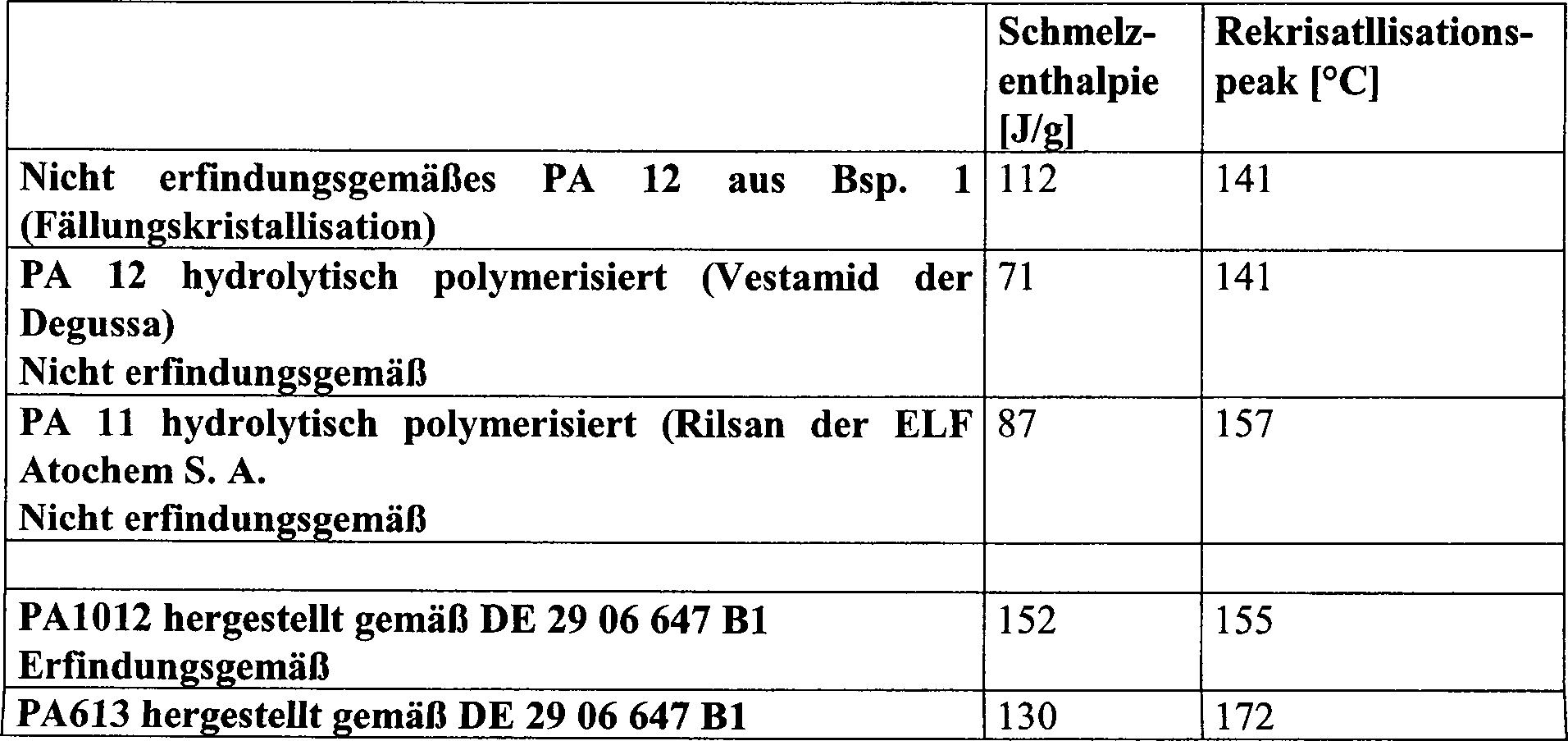
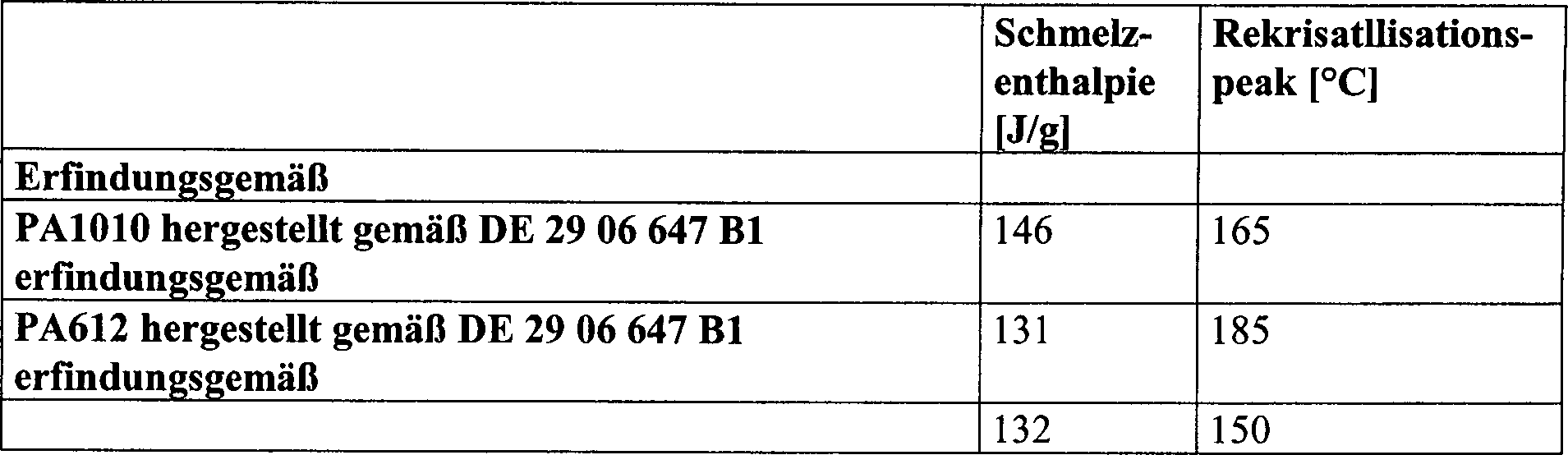
Anhand der Beispiele kann sehr gut erkannt werden, dass die erfindungsgemäßen Polyamidpulver eine deutlich erhöhte Schmelzenthalpie und auch eine höhere Rekristallisationstemperatur aufweisen als herkömmliche Polymerpulver. Dementsprechend lassen sich Bauteile mit höherer Oberflächenqualität herstellen, da weniger Pulver an den aufgeschmolzenen Bereichen anhaftet. Die Recyclingfähigkeit des erfindungsgemäßen Pulvers ist damit ebenfalls verbessert gegenüber herkömmlichen Polyamidpulvern.Based The examples can be very well recognized that the polyamide powder according to the invention a significantly increased Enthalpy of fusion and also a higher one Recrystallization temperature than conventional polymer powder. Accordingly can components with higher Produce surface quality because less powder adheres to the molten areas. The recyclability of the powder according to the invention is thus also improved over conventional polyamide powders.
Claims (52)
Priority Applications (16)
| Application Number | Priority Date | Filing Date | Title |
|---|---|---|---|
| DE102004020453A DE102004020453A1 (en) | 2004-04-27 | 2004-04-27 | Polymer powder with polyamide, use in a molding process and molding, made from this polymer powder |
| ES05729672T ES2325592T3 (en) | 2004-04-27 | 2005-03-03 | POLYMER POWDER CONTAINING POLYAMIDE, USE IN A CONFORMATION PROCESS AND CONFORMED BODIES PRODUCED FROM THIS POLYMER POWDER. |
| US11/587,795 US8066933B2 (en) | 2004-04-27 | 2005-03-03 | Polymer powder comprising polyamide use thereof in a moulding method and moulded body made from said polymer powder |
| AT05729672T ATE430173T1 (en) | 2004-04-27 | 2005-03-03 | POLYMER POWDER CONTAINING POLYAMIDE, USE IN A MOLDING PROCESS AND MOLDED ARTICLE MADE FROM THIS POLYMER POWDER |
| CA002564969A CA2564969A1 (en) | 2004-04-27 | 2005-03-03 | Polymer powder with polyamide, use in a shaping process, and moldings produced from this polymer powder |
| DE502005007192T DE502005007192D1 (en) | 2004-04-27 | 2005-03-03 | POLYMER POWDER WITH POLYAMIDE, USE IN A FORMING METHOD AND MOLDED BODY MADE FROM THIS POLYMER POWDER |
| AU2005238207A AU2005238207A1 (en) | 2004-04-27 | 2005-03-03 | Polymer powder comprising polyamide use thereof in a moulding method and moulded body made from said polymer powder |
| JP2007510004A JP4518428B2 (en) | 2004-04-27 | 2005-03-03 | POLYMER POWDER HAVING POLYAMIDE, USE IN FORMING METHOD, AND MOLDED BODY MADE FROM THE POLYMER POWDER |
| PL05729672T PL1742986T3 (en) | 2004-04-27 | 2005-03-03 | Polymer powder with polyamide, use in shaping method, and shaping article made from this polymer powder |
| PCT/EP2005/050948 WO2005105891A1 (en) | 2004-04-27 | 2005-03-03 | Polymer powder comprising polyamide use thereof in a moulding method and moulded body made from said polymer powder |
| CN2005800214565A CN101076550B (en) | 2004-04-27 | 2005-03-03 | Polymer powders containing polyamides, their use in shaping processes and shaped bodies produced from such polymer powders |
| KR1020067024675A KR20070010185A (en) | 2004-04-27 | 2005-03-03 | Polymer powders comprising polyamide, their use in molding processes and moldings made from said polymer powders |
| EP05729672A EP1742986B1 (en) | 2004-04-27 | 2005-03-03 | Polymer powder comprising polyamide use thereof in a moulding method and moulded body made from said polymer powder |
| NO20065446A NO20065446L (en) | 2004-04-27 | 2006-11-27 | Polymer powder with polyamide, use in a shaping process and molds made from this polymer powder |
| JP2010028520A JP5550376B2 (en) | 2004-04-27 | 2010-02-12 | POLYMER POWDER HAVING POLYAMIDE, USE IN FORMING METHOD, AND MOLDED BODY MADE FROM THE POLYMER POWDER |
| US13/281,000 US8449809B2 (en) | 2004-04-27 | 2011-10-25 | Polymer powder comprising polyamide use thereof in a moulding method and moulded body made from said polymer powder |
Applications Claiming Priority (1)
| Application Number | Priority Date | Filing Date | Title |
|---|---|---|---|
| DE102004020453A DE102004020453A1 (en) | 2004-04-27 | 2004-04-27 | Polymer powder with polyamide, use in a molding process and molding, made from this polymer powder |
Publications (1)
| Publication Number | Publication Date |
|---|---|
| DE102004020453A1 true DE102004020453A1 (en) | 2005-11-24 |
Family
ID=34962644
Family Applications (2)
| Application Number | Title | Priority Date | Filing Date |
|---|---|---|---|
| DE102004020453A Withdrawn DE102004020453A1 (en) | 2004-04-27 | 2004-04-27 | Polymer powder with polyamide, use in a molding process and molding, made from this polymer powder |
| DE502005007192T Expired - Lifetime DE502005007192D1 (en) | 2004-04-27 | 2005-03-03 | POLYMER POWDER WITH POLYAMIDE, USE IN A FORMING METHOD AND MOLDED BODY MADE FROM THIS POLYMER POWDER |
Family Applications After (1)
| Application Number | Title | Priority Date | Filing Date |
|---|---|---|---|
| DE502005007192T Expired - Lifetime DE502005007192D1 (en) | 2004-04-27 | 2005-03-03 | POLYMER POWDER WITH POLYAMIDE, USE IN A FORMING METHOD AND MOLDED BODY MADE FROM THIS POLYMER POWDER |
Country Status (13)
| Country | Link |
|---|---|
| US (2) | US8066933B2 (en) |
| EP (1) | EP1742986B1 (en) |
| JP (2) | JP4518428B2 (en) |
| KR (1) | KR20070010185A (en) |
| CN (1) | CN101076550B (en) |
| AT (1) | ATE430173T1 (en) |
| AU (1) | AU2005238207A1 (en) |
| CA (1) | CA2564969A1 (en) |
| DE (2) | DE102004020453A1 (en) |
| ES (1) | ES2325592T3 (en) |
| NO (1) | NO20065446L (en) |
| PL (1) | PL1742986T3 (en) |
| WO (1) | WO2005105891A1 (en) |
Cited By (8)
| Publication number | Priority date | Publication date | Assignee | Title |
|---|---|---|---|---|
| DE102006034333A1 (en) * | 2006-07-19 | 2008-01-31 | Leibniz-Institut Für Polymerforschung Dresden E.V. | Radiation cross-linking of polyamide comprises heating the polyamide at a temperature between the reaching of completely amorphous structure condition (melt), and thermally decomposing at this temperature using high-energy radiation |
| EP2103643A1 (en) * | 2008-03-19 | 2009-09-23 | Evonik Degussa GmbH | Copolyamide powder and its production, its use in a moulding method and object made of this copolyamide powder |
| WO2011124588A1 (en) | 2010-04-09 | 2011-10-13 | Evonik Degussa Gmbh | Polyamide-based polymer powder, use thereof in a molding method, and molded articles made from said polymer powder |
| WO2011124278A1 (en) | 2010-04-09 | 2011-10-13 | Evonik Degussa Gmbh | Polyamide-based polymer powder, use thereof in a molding method, and molded articles made from said polymer powder |
| EP2650106A1 (en) | 2012-04-11 | 2013-10-16 | Evonik Industries AG | Polymer powder with adapted melt behaviour |
| EP3181332A1 (en) | 2015-12-14 | 2017-06-21 | Evonik Degussa GmbH | Polymer powder for powder bed fusion method |
| EP3181615A1 (en) | 2015-12-14 | 2017-06-21 | Evonik Degussa GmbH | Polymer powder for powder bed fusion method |
| EP4417641A1 (en) | 2023-02-16 | 2024-08-21 | Evonik Operations GmbH | Powder, in particular for the layered production of three-dimensional objects |
Families Citing this family (66)
| Publication number | Priority date | Publication date | Assignee | Title |
|---|---|---|---|---|
| DE102004001324A1 (en) * | 2003-07-25 | 2005-02-10 | Degussa Ag | Powder composition used in the layerwise buildup of three-dimensional articles comprises a polymer and an ammonium polyphosphate flame retardant |
| DE10347665A1 (en) * | 2003-10-09 | 2005-05-19 | Degussa Ag | Crosslinkable base layer for fixation inserts according to the double-point method |
| DE10347628A1 (en) * | 2003-10-09 | 2005-05-19 | Degussa Ag | Crosslinkable base layer for fixation inserts according to the double-point method |
| DE102004020453A1 (en) | 2004-04-27 | 2005-11-24 | Degussa Ag | Polymer powder with polyamide, use in a molding process and molding, made from this polymer powder |
| DE102004024440B4 (en) * | 2004-05-14 | 2020-06-25 | Evonik Operations Gmbh | Polymer powder with polyamide, use in a shaping process and molded body made from this polymer powder |
| DE102004029217A1 (en) * | 2004-06-16 | 2006-01-05 | Degussa Ag | Multilayer film |
| DE102004063220A1 (en) * | 2004-12-29 | 2006-07-13 | Degussa Ag | Transparent molding compounds |
| DE102005002930A1 (en) * | 2005-01-21 | 2006-07-27 | Degussa Ag | Polymer powder with polyamide, use in a molding process and molding, made from this polymer powder |
| DE102005007034A1 (en) * | 2005-02-15 | 2006-08-17 | Degussa Ag | Process for the production of molded parts while increasing the melt stiffness |
| DE102005007035A1 (en) * | 2005-02-15 | 2006-08-17 | Degussa Ag | Process for the production of molded parts while increasing the melt stiffness |
| DE102005007664A1 (en) * | 2005-02-19 | 2006-08-31 | Degussa Ag | Transparent molding compound |
| DE102005007665A1 (en) * | 2005-02-19 | 2006-08-31 | Degussa Ag | Foil based on a polyamide blend |
| DE102005007663A1 (en) | 2005-02-19 | 2006-08-24 | Degussa Ag | Transparent, decorable multilayer film |
| DE102005026264A1 (en) * | 2005-06-08 | 2006-12-14 | Degussa Ag | Transparent molding compound |
| DE102005049718A1 (en) * | 2005-10-14 | 2007-04-19 | Degussa Gmbh | By welding in electromagnetic alternating field available plastic composite molding |
| DE102005053071A1 (en) * | 2005-11-04 | 2007-05-16 | Degussa | Process for the preparation of ultrafine powders based on polymaiden, ultrafine polyamide powder and their use |
| DE102007038578A1 (en) * | 2007-08-16 | 2009-02-19 | Evonik Degussa Gmbh | Method of decorating surfaces |
| DE102008002599A1 (en) * | 2008-06-24 | 2009-12-31 | Evonik Degussa Gmbh | Component with cover layer of a PA613 molding compound |
| EP2374835B1 (en) * | 2010-04-07 | 2013-12-25 | Evonik Degussa GmbH | Polyamide 1010 powder and its use in personal care products |
| US8879957B2 (en) | 2011-09-23 | 2014-11-04 | Stratasys, Inc. | Electrophotography-based additive manufacturing system with reciprocating operation |
| US20130186558A1 (en) | 2011-09-23 | 2013-07-25 | Stratasys, Inc. | Layer transfusion with heat capacitor belt for additive manufacturing |
| CN203811991U (en) | 2011-09-23 | 2014-09-03 | 斯特拉塔西斯公司 | Additive manufacturing system for printing three-dimensional parts |
| US8488994B2 (en) | 2011-09-23 | 2013-07-16 | Stratasys, Inc. | Electrophotography-based additive manufacturing system with transfer-medium service loops |
| JP5541586B2 (en) | 2011-09-27 | 2014-07-09 | 東レ株式会社 | Polyamide 1010 resin particles and production method thereof |
| DE102012207609A1 (en) * | 2012-05-08 | 2013-11-14 | Evonik Industries Ag | METHOD FOR THE LAYERED MANUFACTURE OF THREE-DIMENSIONAL OBJECTS |
| US9312047B2 (en) | 2012-06-22 | 2016-04-12 | Honeywell International Inc. | Method and compositions for producing polymer blends |
| US9527242B2 (en) | 2012-11-21 | 2016-12-27 | Stratasys, Inc. | Method for printing three-dimensional parts wtih crystallization kinetics control |
| US9744722B2 (en) | 2012-11-21 | 2017-08-29 | Stratasys, Inc. | Additive manufacturing with polyamide consumable materials |
| US9592530B2 (en) | 2012-11-21 | 2017-03-14 | Stratasys, Inc. | Additive manufacturing with polyamide consumable materials |
| US12064917B2 (en) | 2012-11-21 | 2024-08-20 | Stratasys, Inc. | Method for printing three-dimensional parts with cyrstallization kinetics control |
| US9144940B2 (en) | 2013-07-17 | 2015-09-29 | Stratasys, Inc. | Method for printing 3D parts and support structures with electrophotography-based additive manufacturing |
| US9029058B2 (en) | 2013-07-17 | 2015-05-12 | Stratasys, Inc. | Soluble support material for electrophotography-based additive manufacturing |
| US9023566B2 (en) | 2013-07-17 | 2015-05-05 | Stratasys, Inc. | ABS part material for electrophotography-based additive manufacturing |
| US9523934B2 (en) | 2013-07-17 | 2016-12-20 | Stratasys, Inc. | Engineering-grade consumable materials for electrophotography-based additive manufacturing |
| JP6570542B2 (en) | 2014-01-16 | 2019-09-04 | ヒューレット−パッカード デベロップメント カンパニー エル.ピー.Hewlett‐Packard Development Company, L.P. | 3D object generation |
| BR112016016402B1 (en) | 2014-01-16 | 2021-01-26 | Hewlett-Packard Development Company, L.P. | apparatus and methods for generating three-dimensional objects |
| KR101971413B1 (en) | 2014-01-16 | 2019-04-22 | 휴렛-팩커드 디벨롭먼트 컴퍼니, 엘.피. | Generating a three-dimensional object |
| US10144175B2 (en) | 2014-03-18 | 2018-12-04 | Evolve Additive Solutions, Inc. | Electrophotography-based additive manufacturing with solvent-assisted planarization |
| US9770869B2 (en) | 2014-03-18 | 2017-09-26 | Stratasys, Inc. | Additive manufacturing with virtual planarization control |
| US10011071B2 (en) | 2014-03-18 | 2018-07-03 | Evolve Additive Solutions, Inc. | Additive manufacturing using density feedback control |
| US9643357B2 (en) | 2014-03-18 | 2017-05-09 | Stratasys, Inc. | Electrophotography-based additive manufacturing with powder density detection and utilization |
| US9868255B2 (en) | 2014-03-18 | 2018-01-16 | Stratasys, Inc. | Electrophotography-based additive manufacturing with pre-sintering |
| US9688027B2 (en) | 2014-04-01 | 2017-06-27 | Stratasys, Inc. | Electrophotography-based additive manufacturing with overlay control |
| US9919479B2 (en) | 2014-04-01 | 2018-03-20 | Stratasys, Inc. | Registration and overlay error correction of electrophotographically formed elements in an additive manufacturing system |
| WO2016053305A1 (en) | 2014-09-30 | 2016-04-07 | Hewlett-Packard Development Company, L.P. | Particle compositions for three-dimensional printing |
| EP3239214A4 (en) * | 2014-12-24 | 2018-07-25 | Toray Industries, Inc. | Polyamide microparticles |
| WO2016112283A1 (en) * | 2015-01-09 | 2016-07-14 | Shakespeare Company Llc | Powder compositions for laser sintering |
| JP6519274B2 (en) * | 2015-03-30 | 2019-05-29 | 株式会社リコー | Powder material for three-dimensional modeling, three-dimensional modeling material set, three-dimensional model manufacturing apparatus, and method for manufacturing three-dimensional model |
| JP6592291B2 (en) * | 2015-07-29 | 2019-10-16 | 東洋インキScホールディングス株式会社 | 3D modeling apparatus cleaning resin composition and method for manufacturing the same, and 3D modeling apparatus cleaning resin filament |
| US10786950B2 (en) | 2016-01-29 | 2020-09-29 | Hewlett-Packard Development Company, L.P. | Three-dimensional (3D) printing composite build material composition |
| EP3455056B1 (en) | 2016-05-13 | 2021-09-22 | Hewlett-Packard Development Company, L.P. | Material sets |
| WO2017196358A1 (en) | 2016-05-13 | 2017-11-16 | Hewlett-Packard Development Company, L.P. | Material sets |
| DE102016219080A1 (en) | 2016-09-30 | 2018-04-05 | Evonik Degussa Gmbh | Polyamide powder for selective sintering |
| JP6958217B2 (en) * | 2017-01-12 | 2021-11-02 | 株式会社リコー | Manufacturing method of resin powder for three-dimensional modeling and three-dimensional modeling |
| WO2019245534A1 (en) | 2018-06-19 | 2019-12-26 | Hewlett-Packard Development Company, L.P. | Three-dimensional printing |
| WO2019245535A1 (en) | 2018-06-19 | 2019-12-26 | Hewlett-Packard Development Company, L.P. | Three-dimensional printing |
| US11426931B2 (en) | 2018-06-19 | 2022-08-30 | Hewlett-Packard Development Company, L.P. | Three-dimensional printing |
| FR3089999B1 (en) * | 2018-12-13 | 2021-08-20 | Arkema France | Polyamide block and polyether block copolymer powder |
| EP3917448A4 (en) | 2019-01-28 | 2022-10-19 | Impossible Objects, LLC | Three-dimensional printed composites using substrates with sodium silicate binder |
| US11634546B2 (en) | 2020-03-03 | 2023-04-25 | Jabil Inc. | Producing semi-crystalline pulverulent polycarbonate and use thereof in additive manufacturing |
| US20230272162A1 (en) | 2020-03-03 | 2023-08-31 | Jabil, Inc. | Producing semi-crystalline pulverulent polycarbonate and use thereof in additive manufacturing |
| US11643503B2 (en) | 2020-07-10 | 2023-05-09 | Xerox Corporation | Highly spherical polyamide microparticles and synthesis methods related thereto |
| US12351538B2 (en) | 2020-09-16 | 2025-07-08 | Evonik Operations Gmbh | Process for acid hydrolysis of pure polylaurolactam |
| FR3128959B1 (en) | 2021-11-09 | 2025-05-23 | Arkema France | Polymer powder for the manufacture of high definition and low roughness parts |
| EP4438654A1 (en) | 2023-03-29 | 2024-10-02 | Ems-Chemie Ag | Materials for powder bed fusion technologies and using such materials in a layer-by-layer process |
| EP4512846A1 (en) | 2023-08-21 | 2025-02-26 | Ems-Chemie Ag | Flame resistant materials for powder bed fusion technologies and using such materials in a layer-by-layer process |
Family Cites Families (57)
| Publication number | Priority date | Publication date | Assignee | Title |
|---|---|---|---|---|
| US4065519A (en) * | 1975-07-03 | 1977-12-27 | Rilsan Corporation | Process for coating fine powders with a nylon and products made therewith |
| DE2906647C2 (en) * | 1979-02-21 | 1980-12-11 | Chemische Werke Huels Ag, 4370 Marl | Process for the production of powdery coating agents !! based on polyamides with at least 10 aliphatically bonded carbon atoms per carbonamide group |
| US5132394A (en) * | 1989-08-14 | 1992-07-21 | Amoco Corporation | Fiber-reinforced composites comprising amide-imide copolymer matrix resin |
| DE4137430A1 (en) | 1991-11-14 | 1993-05-19 | Huels Chemische Werke Ag | MULTILAYER PLASTIC PIPE |
| US5527877A (en) * | 1992-11-23 | 1996-06-18 | Dtm Corporation | Sinterable semi-crystalline powder and near-fully dense article formed therewith |
| US5648450A (en) * | 1992-11-23 | 1997-07-15 | Dtm Corporation | Sinterable semi-crystalline powder and near-fully dense article formed therein |
| US6399708B2 (en) * | 1993-07-19 | 2002-06-04 | Visteon Systemes Interieurs S.A.S. | Grafted and crosslinkable pulverulent thermoplastic polyolefin composition which has elasticity and flexibility properties |
| US5876647A (en) * | 1994-04-21 | 1999-03-02 | Lion Corporation | Method for preparing conductive thermoplastic resin compositions |
| US5733497A (en) * | 1995-03-31 | 1998-03-31 | Dtm Corporation | Selective laser sintering with composite plastic material |
| US6110411A (en) * | 1997-03-18 | 2000-08-29 | Clausen; Christian Henning | Laser sinterable thermoplastic powder |
| DE19718504A1 (en) * | 1997-05-02 | 1998-11-05 | Huels Chemische Werke Ag | Composite of a molding compound based on polyamide on the one hand and vulcanizable fluorine elastomers on the other |
| DE19727677A1 (en) * | 1997-06-30 | 1999-01-07 | Huels Chemische Werke Ag | Method and device for producing three-dimensional objects |
| DE19747309B4 (en) * | 1997-10-27 | 2007-11-15 | Degussa Gmbh | Use of a polyamide 12 for selective laser sintering |
| EP1065048B1 (en) * | 1999-06-29 | 2004-08-04 | Degussa AG | Composite multilayer structure |
| DE19937260B4 (en) * | 1999-08-06 | 2006-07-27 | Eos Gmbh Electro Optical Systems | Method and device for producing a three-dimensional object |
| AU4301501A (en) * | 1999-10-26 | 2001-06-04 | University Of Southern California | Process of making a three-dimensional object |
| DE10064333A1 (en) * | 2000-12-21 | 2002-06-27 | Degussa | Multi-layer composite with an EVOH layer |
| EP1227131B1 (en) * | 2001-01-26 | 2006-03-15 | Arkema | Transparent polyamide containing composition |
| US7282551B2 (en) * | 2001-02-23 | 2007-10-16 | Ems-Chemie Ag | Thermoplastic block copolymers consisting of polyalkyl(meth)acrylate and polyamide segments and the use thereof |
| MXPA04000183A (en) * | 2001-07-09 | 2004-03-18 | Dms Ip Assets B V | Process for the manufacture of homopolyamide-4,6 fibers. |
| JP2003159756A (en) * | 2001-11-29 | 2003-06-03 | Dainippon Ink & Chem Inc | Polyallylate three-dimensional molded article and method for producing the same |
| DE10201903A1 (en) | 2002-01-19 | 2003-07-31 | Degussa | Molding compound based on polyether amides |
| DE10225338A1 (en) * | 2002-06-06 | 2003-12-18 | Basf Ag | Method for producing a compound element with two metal, plastic or wooden cover layers bracketing a plastic core layer involves introduction of the latter in liquid state in at least two steps |
| DE10233344A1 (en) * | 2002-07-23 | 2004-02-12 | Degussa Ag | Polyamide powder for coating metal surfaces in a fluidized bed sinter process useful in metal coating, e.g. of clips for corsetry, as minicoat powders of mean grain size 20-70 micron, and for coating tubes in the automobile industry |
| EP1400340B1 (en) * | 2002-09-21 | 2008-01-16 | Evonik Degussa GmbH | Method for manufacturing a three dimensional object |
| EP1413594A2 (en) * | 2002-10-17 | 2004-04-28 | Degussa AG | Laser-sintering powder with better recycling properties, process for its preparation and use thereof. |
| DE10248406A1 (en) * | 2002-10-17 | 2004-04-29 | Degussa Ag | Laser sinter powder with titanium dioxide particles, process for its production and moldings made from this laser sinter powder |
| DE10251790A1 (en) * | 2002-11-07 | 2004-05-19 | Degussa Ag | Composition for fluidized bed-, rotational-, electrostatic-, tribo-, or minicoating in the preparation of cosmetics and paint, comprises polyamide, polyamide derivatives, and flow aid |
| DE50302649D1 (en) * | 2002-11-28 | 2006-05-11 | Degussa | Laser sintering powder with metal soaps, process for its preparation and molded articles made from this laser-sintered powder |
| EP1459871B1 (en) * | 2003-03-15 | 2011-04-06 | Evonik Degussa GmbH | Method and apparatus for manufacturing three dimensional objects using microwave radiation and shaped body produced according to this method |
| DE10311437A1 (en) * | 2003-03-15 | 2004-09-23 | Degussa Ag | Laser sinter powder with PMMI, PMMA and / or PMMI-PMMA copolymers, process for its production and moldings made from this laser sinter powder |
| DE10333005A1 (en) | 2003-07-18 | 2005-02-03 | Degussa Ag | Molding composition based on polyetheramides |
| DE102004001324A1 (en) | 2003-07-25 | 2005-02-10 | Degussa Ag | Powder composition used in the layerwise buildup of three-dimensional articles comprises a polymer and an ammonium polyphosphate flame retardant |
| DE10334496A1 (en) * | 2003-07-29 | 2005-02-24 | Degussa Ag | Laser sintering powder with a metal salt and a fatty acid derivative, process for the production thereof and moldings produced from this laser sinter powder |
| DE10334497A1 (en) * | 2003-07-29 | 2005-02-24 | Degussa Ag | Polymer powder with phosphonate-based flame retardant, process for its preparation and moldings, made from this polymer powder |
| DE10337707A1 (en) * | 2003-08-16 | 2005-04-07 | Degussa Ag | Process for increasing the molecular weight of polyamides |
| DE10347628A1 (en) | 2003-10-09 | 2005-05-19 | Degussa Ag | Crosslinkable base layer for fixation inserts according to the double-point method |
| DE10347665A1 (en) | 2003-10-09 | 2005-05-19 | Degussa Ag | Crosslinkable base layer for fixation inserts according to the double-point method |
| DE102004010162A1 (en) | 2004-02-27 | 2005-09-15 | Degussa Ag | Polymer powder with copolymer, use in a shaping process with unfocused energy input and molding, made from this polymer powder |
| DE102004020453A1 (en) | 2004-04-27 | 2005-11-24 | Degussa Ag | Polymer powder with polyamide, use in a molding process and molding, made from this polymer powder |
| DE102004024440B4 (en) | 2004-05-14 | 2020-06-25 | Evonik Operations Gmbh | Polymer powder with polyamide, use in a shaping process and molded body made from this polymer powder |
| DE102004029217A1 (en) * | 2004-06-16 | 2006-01-05 | Degussa Ag | Multilayer film |
| DE102004047876A1 (en) * | 2004-10-01 | 2006-04-06 | Degussa Ag | Powder with improved recycling properties, process for its preparation and use of the powder in a process for producing three-dimensional objects |
| DE102004062761A1 (en) * | 2004-12-21 | 2006-06-22 | Degussa Ag | Use of polyarylene ether ketone powder in a three-dimensional powder-based tool-less production process, and moldings produced therefrom |
| DE102004063220A1 (en) * | 2004-12-29 | 2006-07-13 | Degussa Ag | Transparent molding compounds |
| DE102005002930A1 (en) * | 2005-01-21 | 2006-07-27 | Degussa Ag | Polymer powder with polyamide, use in a molding process and molding, made from this polymer powder |
| DE102005007034A1 (en) | 2005-02-15 | 2006-08-17 | Degussa Ag | Process for the production of molded parts while increasing the melt stiffness |
| DE102005007035A1 (en) | 2005-02-15 | 2006-08-17 | Degussa Ag | Process for the production of molded parts while increasing the melt stiffness |
| DE102005008044A1 (en) * | 2005-02-19 | 2006-08-31 | Degussa Ag | Polymer powder with Blockpolyetheramid, use in a molding process and molding, made from this polymer powder |
| DE102005007664A1 (en) * | 2005-02-19 | 2006-08-31 | Degussa Ag | Transparent molding compound |
| DE102005007663A1 (en) * | 2005-02-19 | 2006-08-24 | Degussa Ag | Transparent, decorable multilayer film |
| DE102005026264A1 (en) * | 2005-06-08 | 2006-12-14 | Degussa Ag | Transparent molding compound |
| DE102005051126A1 (en) * | 2005-10-26 | 2007-05-03 | Degussa Gmbh | Decorative foil, useful as e.g. a protection foil against e.g. chemicals, comprises a coating layer comprising polyamide composition |
| DE102005053071A1 (en) * | 2005-11-04 | 2007-05-16 | Degussa | Process for the preparation of ultrafine powders based on polymaiden, ultrafine polyamide powder and their use |
| DE102005056286A1 (en) * | 2005-11-24 | 2007-05-31 | Degussa Gmbh | Producing a composite part from plastic parts that cannot be directly welded together comprises using an intermediate film with surfaces compatible with each part |
| DE102007021199B4 (en) | 2006-07-17 | 2016-02-11 | Evonik Degussa Gmbh | Compositions of organic polymer as matrix and inorganic particles as filler, process for their preparation and their use and moldings produced therewith |
| DE102008000755B4 (en) | 2008-03-19 | 2019-12-12 | Evonik Degussa Gmbh | Copolyamide powder and its preparation, use of copolyamide powder in a molding process and molding, made from this copolyamide powder |
-
2004
- 2004-04-27 DE DE102004020453A patent/DE102004020453A1/en not_active Withdrawn
-
2005
- 2005-03-03 AU AU2005238207A patent/AU2005238207A1/en not_active Abandoned
- 2005-03-03 US US11/587,795 patent/US8066933B2/en active Active
- 2005-03-03 AT AT05729672T patent/ATE430173T1/en not_active IP Right Cessation
- 2005-03-03 KR KR1020067024675A patent/KR20070010185A/en not_active Abandoned
- 2005-03-03 CN CN2005800214565A patent/CN101076550B/en not_active Expired - Lifetime
- 2005-03-03 DE DE502005007192T patent/DE502005007192D1/en not_active Expired - Lifetime
- 2005-03-03 PL PL05729672T patent/PL1742986T3/en unknown
- 2005-03-03 JP JP2007510004A patent/JP4518428B2/en not_active Expired - Lifetime
- 2005-03-03 ES ES05729672T patent/ES2325592T3/en not_active Expired - Lifetime
- 2005-03-03 WO PCT/EP2005/050948 patent/WO2005105891A1/en not_active Ceased
- 2005-03-03 EP EP05729672A patent/EP1742986B1/en not_active Expired - Lifetime
- 2005-03-03 CA CA002564969A patent/CA2564969A1/en not_active Abandoned
-
2006
- 2006-11-27 NO NO20065446A patent/NO20065446L/en not_active Application Discontinuation
-
2010
- 2010-02-12 JP JP2010028520A patent/JP5550376B2/en not_active Expired - Lifetime
-
2011
- 2011-10-25 US US13/281,000 patent/US8449809B2/en not_active Expired - Fee Related
Cited By (15)
| Publication number | Priority date | Publication date | Assignee | Title |
|---|---|---|---|---|
| DE102006034333A1 (en) * | 2006-07-19 | 2008-01-31 | Leibniz-Institut Für Polymerforschung Dresden E.V. | Radiation cross-linking of polyamide comprises heating the polyamide at a temperature between the reaching of completely amorphous structure condition (melt), and thermally decomposing at this temperature using high-energy radiation |
| US8591797B2 (en) | 2008-03-19 | 2013-11-26 | Evonik Degussa Gmbh | Copolyamide powder and its preparation, use of copolyamide powder in a shaping process and mouldings produced from this copolyamide powder |
| EP2103643A1 (en) * | 2008-03-19 | 2009-09-23 | Evonik Degussa GmbH | Copolyamide powder and its production, its use in a moulding method and object made of this copolyamide powder |
| WO2011124588A1 (en) | 2010-04-09 | 2011-10-13 | Evonik Degussa Gmbh | Polyamide-based polymer powder, use thereof in a molding method, and molded articles made from said polymer powder |
| WO2011124278A1 (en) | 2010-04-09 | 2011-10-13 | Evonik Degussa Gmbh | Polyamide-based polymer powder, use thereof in a molding method, and molded articles made from said polymer powder |
| DE102010062347A1 (en) | 2010-04-09 | 2011-12-01 | Evonik Degussa Gmbh | Polymer powder based on polyamides, use in a molding process and molding, made from this polymer powder |
| US10406745B2 (en) | 2010-04-09 | 2019-09-10 | Evonik Degussa Gmbh | Polyamide-based polymer powder, use thereof in a molding method, and molded articles made from said polymer powder |
| DE102012205908A1 (en) | 2012-04-11 | 2013-10-17 | Evonik Industries Ag | Polymer powder with adapted melting behavior |
| EP2650106A1 (en) | 2012-04-11 | 2013-10-16 | Evonik Industries AG | Polymer powder with adapted melt behaviour |
| EP3181332A1 (en) | 2015-12-14 | 2017-06-21 | Evonik Degussa GmbH | Polymer powder for powder bed fusion method |
| EP3181615A1 (en) | 2015-12-14 | 2017-06-21 | Evonik Degussa GmbH | Polymer powder for powder bed fusion method |
| EP3181641A1 (en) | 2015-12-14 | 2017-06-21 | Evonik Degussa GmbH | Polymer powder for powder bed fusion method |
| EP3181617A1 (en) | 2015-12-14 | 2017-06-21 | Evonik Degussa GmbH | Polymer powder for powder bed fusion method |
| EP4417641A1 (en) | 2023-02-16 | 2024-08-21 | Evonik Operations GmbH | Powder, in particular for the layered production of three-dimensional objects |
| WO2024170315A1 (en) | 2023-02-16 | 2024-08-22 | Evonik Operations Gmbh | Powder, especially for layer-by-layer production of three-dimensional objects |
Also Published As
| Publication number | Publication date |
|---|---|
| EP1742986B1 (en) | 2009-04-29 |
| JP5550376B2 (en) | 2014-07-16 |
| US20080116616A1 (en) | 2008-05-22 |
| NO20065446L (en) | 2006-11-27 |
| US20120041132A1 (en) | 2012-02-16 |
| ES2325592T3 (en) | 2009-09-09 |
| JP2010163618A (en) | 2010-07-29 |
| CN101076550A (en) | 2007-11-21 |
| ATE430173T1 (en) | 2009-05-15 |
| EP1742986A1 (en) | 2007-01-17 |
| CN101076550B (en) | 2010-12-29 |
| AU2005238207A1 (en) | 2005-11-10 |
| US8449809B2 (en) | 2013-05-28 |
| JP2007534818A (en) | 2007-11-29 |
| WO2005105891A1 (en) | 2005-11-10 |
| JP4518428B2 (en) | 2010-08-04 |
| KR20070010185A (en) | 2007-01-22 |
| CA2564969A1 (en) | 2005-11-10 |
| DE502005007192D1 (en) | 2009-06-10 |
| US8066933B2 (en) | 2011-11-29 |
| PL1742986T3 (en) | 2009-10-30 |
Similar Documents
| Publication | Publication Date | Title |
|---|---|---|
| EP1742986B1 (en) | Polymer powder comprising polyamide use thereof in a moulding method and moulded body made from said polymer powder | |
| EP1683820B1 (en) | Polymer powder containing polyamide, use in a shaping method and shaped body produced from this polymer powder | |
| EP2103643B1 (en) | Copolyamide powder and its production, its use in a moulding method and object made of this copolyamide powder | |
| EP1720930B1 (en) | Shaping method which uses a non-focussed application of energy and moulded body that is produced from copolymer powder | |
| EP1745090B1 (en) | Polymer powder containing polyamide, use of said powder in a moulding method and moulded body produced from the same | |
| EP2556115B1 (en) | Polyamide-based polymer powder, use thereof in a molding method, and molded articles made from said polymer powder | |
| EP1787789B1 (en) | Stereolithographic process for the fabrication of three-dimensional articles by using polyester powder and article obtained by said process | |
| EP2543700B1 (en) | Powder containing particles coated with polymer | |
| EP1642923B1 (en) | Powder with improved recycling properties, process for its preparation and use thereof in a process for manufacturing tridimensional objects | |
| WO2011124278A1 (en) | Polyamide-based polymer powder, use thereof in a molding method, and molded articles made from said polymer powder | |
| DE102006015791A1 (en) | Polymer powder, process for the preparation and use of such a powder and molded articles thereof | |
| DE102005008044A9 (en) | Polymer powder with Blockpolyetheramid, use in a molding process and molding, made from this polymer powder | |
| DE102006005500A1 (en) | Use of polymer powder, prepared from a dispersion, in a molding process and molding, made from this polymer powder | |
| EP2543701A1 (en) | Powder containing inorganic particles coated with polymer | |
| EP2543696B1 (en) | Powder containing core particles coated with polymer | |
| EP3028842A1 (en) | Powder compositions made of thermoplastics and use of the compositions | |
| DE102004010160A1 (en) | Polymer powder with copolymer, use in a shaping process with focused energy input and molding, made from this polymer powder |
Legal Events
| Date | Code | Title | Description |
|---|---|---|---|
| 8127 | New person/name/address of the applicant |
Owner name: DEGUSSA GMBH, 40474 DUESSELDORF, DE |
|
| 8127 | New person/name/address of the applicant |
Owner name: EVONIK DEGUSSA GMBH, 40474 DUESSELDORF, DE |
|
| 8139 | Disposal/non-payment of the annual fee |