WO2004018584A1 - Adhesive film - Google Patents
Adhesive film Download PDFInfo
- Publication number
- WO2004018584A1 WO2004018584A1 PCT/JP2003/010479 JP0310479W WO2004018584A1 WO 2004018584 A1 WO2004018584 A1 WO 2004018584A1 JP 0310479 W JP0310479 W JP 0310479W WO 2004018584 A1 WO2004018584 A1 WO 2004018584A1
- Authority
- WO
- WIPO (PCT)
- Prior art keywords
- adhesive film
- component
- adhesive
- ethylene
- film
- Prior art date
- Legal status (The legal status is an assumption and is not a legal conclusion. Google has not performed a legal analysis and makes no representation as to the accuracy of the status listed.)
- Ceased
Links
Classifications
-
- C—CHEMISTRY; METALLURGY
- C09—DYES; PAINTS; POLISHES; NATURAL RESINS; ADHESIVES; COMPOSITIONS NOT OTHERWISE PROVIDED FOR; APPLICATIONS OF MATERIALS NOT OTHERWISE PROVIDED FOR
- C09J—ADHESIVES; NON-MECHANICAL ASPECTS OF ADHESIVE PROCESSES IN GENERAL; ADHESIVE PROCESSES NOT PROVIDED FOR ELSEWHERE; USE OF MATERIALS AS ADHESIVES
- C09J123/00—Adhesives based on homopolymers or copolymers of unsaturated aliphatic hydrocarbons having only one carbon-to-carbon double bond; Adhesives based on derivatives of such polymers
- C09J123/02—Adhesives based on homopolymers or copolymers of unsaturated aliphatic hydrocarbons having only one carbon-to-carbon double bond; Adhesives based on derivatives of such polymers not modified by chemical after-treatment
- C09J123/04—Homopolymers or copolymers of ethene
- C09J123/08—Copolymers of ethene
- C09J123/0846—Copolymers of ethene with unsaturated hydrocarbons containing other atoms than carbon or hydrogen atoms
- C09J123/0869—Acids or derivatives thereof
- C09J123/0884—Epoxide containing esters
-
- B—PERFORMING OPERATIONS; TRANSPORTING
- B29—WORKING OF PLASTICS; WORKING OF SUBSTANCES IN A PLASTIC STATE IN GENERAL
- B29C—SHAPING OR JOINING OF PLASTICS; SHAPING OF MATERIAL IN A PLASTIC STATE, NOT OTHERWISE PROVIDED FOR; AFTER-TREATMENT OF THE SHAPED PRODUCTS, e.g. REPAIRING
- B29C48/00—Extrusion moulding, i.e. expressing the moulding material through a die or nozzle which imparts the desired form; Apparatus therefor
-
- B—PERFORMING OPERATIONS; TRANSPORTING
- B32—LAYERED PRODUCTS
- B32B—LAYERED PRODUCTS, i.e. PRODUCTS BUILT-UP OF STRATA OF FLAT OR NON-FLAT, e.g. CELLULAR OR HONEYCOMB, FORM
- B32B27/00—Layered products comprising a layer of synthetic resin
- B32B27/32—Layered products comprising a layer of synthetic resin comprising polyolefins
-
- C—CHEMISTRY; METALLURGY
- C09—DYES; PAINTS; POLISHES; NATURAL RESINS; ADHESIVES; COMPOSITIONS NOT OTHERWISE PROVIDED FOR; APPLICATIONS OF MATERIALS NOT OTHERWISE PROVIDED FOR
- C09J—ADHESIVES; NON-MECHANICAL ASPECTS OF ADHESIVE PROCESSES IN GENERAL; ADHESIVE PROCESSES NOT PROVIDED FOR ELSEWHERE; USE OF MATERIALS AS ADHESIVES
- C09J11/00—Features of adhesives not provided for in group C09J9/00, e.g. additives
-
- C—CHEMISTRY; METALLURGY
- C09—DYES; PAINTS; POLISHES; NATURAL RESINS; ADHESIVES; COMPOSITIONS NOT OTHERWISE PROVIDED FOR; APPLICATIONS OF MATERIALS NOT OTHERWISE PROVIDED FOR
- C09J—ADHESIVES; NON-MECHANICAL ASPECTS OF ADHESIVE PROCESSES IN GENERAL; ADHESIVE PROCESSES NOT PROVIDED FOR ELSEWHERE; USE OF MATERIALS AS ADHESIVES
- C09J7/00—Adhesives in the form of films or foils
- C09J7/10—Adhesives in the form of films or foils without carriers
-
- C—CHEMISTRY; METALLURGY
- C09—DYES; PAINTS; POLISHES; NATURAL RESINS; ADHESIVES; COMPOSITIONS NOT OTHERWISE PROVIDED FOR; APPLICATIONS OF MATERIALS NOT OTHERWISE PROVIDED FOR
- C09J—ADHESIVES; NON-MECHANICAL ASPECTS OF ADHESIVE PROCESSES IN GENERAL; ADHESIVE PROCESSES NOT PROVIDED FOR ELSEWHERE; USE OF MATERIALS AS ADHESIVES
- C09J7/00—Adhesives in the form of films or foils
- C09J7/20—Adhesives in the form of films or foils characterised by their carriers
- C09J7/29—Laminated material
-
- C—CHEMISTRY; METALLURGY
- C09—DYES; PAINTS; POLISHES; NATURAL RESINS; ADHESIVES; COMPOSITIONS NOT OTHERWISE PROVIDED FOR; APPLICATIONS OF MATERIALS NOT OTHERWISE PROVIDED FOR
- C09J—ADHESIVES; NON-MECHANICAL ASPECTS OF ADHESIVE PROCESSES IN GENERAL; ADHESIVE PROCESSES NOT PROVIDED FOR ELSEWHERE; USE OF MATERIALS AS ADHESIVES
- C09J7/00—Adhesives in the form of films or foils
- C09J7/30—Adhesives in the form of films or foils characterised by the adhesive composition
-
- C—CHEMISTRY; METALLURGY
- C08—ORGANIC MACROMOLECULAR COMPOUNDS; THEIR PREPARATION OR CHEMICAL WORKING-UP; COMPOSITIONS BASED THEREON
- C08L—COMPOSITIONS OF MACROMOLECULAR COMPOUNDS
- C08L23/00—Compositions of homopolymers or copolymers of unsaturated aliphatic hydrocarbons having only one carbon-to-carbon double bond; Compositions of derivatives of such polymers
- C08L23/02—Compositions of homopolymers or copolymers of unsaturated aliphatic hydrocarbons having only one carbon-to-carbon double bond; Compositions of derivatives of such polymers not modified by chemical after-treatment
- C08L23/04—Homopolymers or copolymers of ethene
- C08L23/08—Copolymers of ethene
- C08L23/0846—Copolymers of ethene with unsaturated hydrocarbons containing atoms other than carbon or hydrogen
- C08L23/0869—Copolymers of ethene with unsaturated hydrocarbons containing atoms other than carbon or hydrogen with unsaturated acids, e.g. [meth]acrylic acid; with unsaturated esters, e.g. [meth]acrylic acid esters
-
- C—CHEMISTRY; METALLURGY
- C08—ORGANIC MACROMOLECULAR COMPOUNDS; THEIR PREPARATION OR CHEMICAL WORKING-UP; COMPOSITIONS BASED THEREON
- C08L—COMPOSITIONS OF MACROMOLECULAR COMPOUNDS
- C08L2666/00—Composition of polymers characterized by a further compound in the blend, being organic macromolecular compounds, natural resins, waxes or and bituminous materials, non-macromolecular organic substances, inorganic substances or characterized by their function in the composition
- C08L2666/02—Organic macromolecular compounds, natural resins, waxes or and bituminous materials
- C08L2666/04—Macromolecular compounds according to groups C08L7/00 - C08L49/00, or C08L55/00 - C08L57/00; Derivatives thereof
- C08L2666/06—Homopolymers or copolymers of unsaturated hydrocarbons; Derivatives thereof
-
- C—CHEMISTRY; METALLURGY
- C09—DYES; PAINTS; POLISHES; NATURAL RESINS; ADHESIVES; COMPOSITIONS NOT OTHERWISE PROVIDED FOR; APPLICATIONS OF MATERIALS NOT OTHERWISE PROVIDED FOR
- C09J—ADHESIVES; NON-MECHANICAL ASPECTS OF ADHESIVE PROCESSES IN GENERAL; ADHESIVE PROCESSES NOT PROVIDED FOR ELSEWHERE; USE OF MATERIALS AS ADHESIVES
- C09J2423/00—Presence of polyolefin
Definitions
- the present invention relates to an adhesive film obtainable by molding a resin composition containing an epoxy group-containing copolymer and an ethylene / O!,] 3-unsaturated carboxylic anhydride copolymer.
- the adhesive before curing be in the form of a dry film, and an adhesive mainly composed of epoxy resin and curing agent Adhesive films in which the composition is formed into a film and the film is partially hardened (B-staged) by heating or the like are also commercially available.
- the present inventors studied the case where a B-staged epoxy resin adhesive film was used as an interlayer insulating layer on a printed wiring board (adherend) having copper wiring on a substrate. Specifically, when the adherend and the adhesive film are laminated and then heated and pressed to adhere, the resin component of the adhesive film flows out and protrudes from the adherend. Was revealed. If the adhesive film is further hardened and used to prevent the resin component from flowing out, the adhesive film cannot be adhered well in a state of being embedded in the unevenness between the copper wirings. However, it became clear that air bubbles were generated between the cured film and the adherend, resulting in poor adhesion.
- An object of the present invention is to provide an epoxy resin-containing adhesive film that has properties of being strong even when formed into a thin film, excellent in film processability, and excellent in storage stability before bonding, and a resin component in a bonding process.
- An object of the present invention is to provide an adhesive film which can adhere to an adherend without flowing out and can coat the adherend. It is still another object of the present invention to provide a method for storing the adhesive film and a laminate comprising the adhesive film and an adherend.
- the present invention relates to the following inventions.
- R represents an aliphatic hydrocarbon group having 2 to 18 carbon atoms having a carbon-carbon double bond, and at least one hydrogen atom of the aliphatic hydrocarbon group is a halogen atom, a hydroxyl group, Or X may represent a single bond or a carboxy group.
- Adhesive film A copolymer obtained by polymerizing component (b) with (b 1 ), (b 2 ), and at least one member selected from the group consisting of butyl ester and ⁇ -unsaturated carboxylic acid ester The adhesive film according to any one of ⁇ 1> to ⁇ 3>.
- ⁇ 8> The adhesive film according to any one of ⁇ 1> to ⁇ 7>, wherein the acceleration voltage of the electron beam is 50 to 300 kV.
- a method for storing an adhesive film comprising storing the adhesive film according to any one of ⁇ 1> to ⁇ 9> at a temperature of ⁇ 10 ° C. or lower.
- ⁇ 11> A laminate obtained by laminating the adhesive film according to any one of ⁇ 1> to ⁇ 9> and an adherend, and thermosetting the adhesive film.
- the resin composition of the present invention (hereinafter, referred to as the present composition) is characterized by containing the above-mentioned component (A) and component (B).
- the component (A) used in the present invention comprises (a,) ethylene and / or propylene (hereinafter referred to as propylene).
- R represents an aliphatic hydrocarbon group having 2 to 18 carbon atoms having a carbon-carbon double bond, and at least one hydrogen atom of the aliphatic hydrocarbon group is a halogen atom, a hydroxyl group, Or a carboxyl group.
- X represents a single bond or a carbonyl group.
- ethylene is particularly preferred.
- Examples of the substituent R in the general formula (1) include substituents represented by the following formulas (2) and (8).
- X in the formula (1) represents a single bond in which an oxygen atom and a substituent R in the formula (1) are directly bonded, or a carboxy group.
- (a 2) component Ryo Li glycidyl ether, 2-Mechiruariru glycidyl ether and styrene, - p - glycidyl ethers of unsaturated glycidyl ether and glycidyl ⁇ Tari rate, glycidyl methacrylate, and I itaconic acid glycidyl And unsaturated glycidyl esters such as esters.
- the content of the structural unit derived from the component (a 2 ) is as follows based on 100 parts by weight of the component (A). Usually, it is about 1 to 30 parts by weight. When the structural unit derived from the component (a 2 ) is at least 1 part by weight, the adhesiveness of the resulting adhesive film tends to be improved. It is preferable because the mechanical strength of the film tends to be improved.
- the component (A), (ai) component and (a 2) from component a different monomer may be polymerized with E styrene and copolymerizable monomer.
- the “monomer copolymerizable with ethylene” does not contain a functional group or an epoxy group that can react with an epoxy group such as a carboxy group or an acid anhydride group.
- the “monomer copolymerizable with ethylene” include methyl acrylate, ethyl acrylate, n-propyl acrylate, isopropyl acrylate, n-butyl acrylate, t-butyl acrylate, and attaryl Alkyl groups having about 3 to 8 carbon atoms, such as isoptyl acid, methyl methacrylate, ethyl methacrylate, n-propyl methacrylate, isopropyl methacrylate, n-butyl methacrylate, t-butyl methacrylate, and isobutyl methacrylate Alkyl esters of ⁇ -unsaturated carboxylate; carboxylic acids having about 2 to 8 carbon atoms, such as vinyl acetate, vinyl butyrate, vinyl propionate, vinyl piperate, vinyl laurate, vinyl isononanoate, and vinyl versatate Butyl ester having carbon; 1-butene, isoto
- ⁇ -olefins of about 4 to 20; diene compounds such as butadiene, isoprene and cyclopentadiene; and bur compounds such as vinyl chloride, styrene, acrylonitrile, methacrylonitrile, acrylamide and methacrylamide.
- diene compounds such as butadiene, isoprene and cyclopentadiene
- bur compounds such as vinyl chloride, styrene, acrylonitrile, methacrylonitrile, acrylamide and methacrylamide.
- the “monomer copolymerizable with ethylene” among them, butyl acetate, methyl acrylate, ethyl acrylate, ⁇ -butyl acrylate and methyl methacrylate are preferred.
- the content of the structural unit derived from the “monomer copolymerizable with ethylene” in the component ( ⁇ ) is usually about 0 to 70 parts by weight based on 100 parts by weight of the component ( ⁇ ). In particular, about 5 to 60 parts by weight is preferable. When the content is 70 parts by weight or less, component (II) tends to be easily produced by a high-pressure radical method or the like, which is preferable.
- the component ( ⁇ ) is a block copolymer, a graft copolymer, or a random copolymer. Any of a copolymer and an alternating copolymer may be used. For example, a copolymer obtained by grafting (a 2 ) to a propylene / ethylene block copolymer described in Japanese Patent No. 2632980 And copolymers obtained by grafting an ⁇ , ⁇ monounsaturated carboxylic acid ester to an ethylene / epoxy group-containing monomer copolymer described in Japanese Patent No. 26020048.
- a monomer as a raw material is prepared by adding ethylene and a radical generator to a pressure of about 500 to 400 atm, 100 to 300 atm.
- a method of performing melt graft copolymerization in a machine is exemplified.
- the polyethylene resin is a homopolymer of ( ai ) or a copolymer of a monomer copolymerizable with ethylene and ( ai ).
- an MFR Melt-off rate
- the MFR is 30 or more, the flowability of the obtained adhesive film is improved, and even if there are four convex portions on the surface of the adherend, they tend to be easily embedded.
- a value of 100 or less is preferable because the solder heat resistance of a cured product of the obtained adhesive film tends to be improved.
- the component (B) used in the present invention includes (b x ) ethylene and / or propylene (hereinafter, referred to as (b a )), and (b 2 ) mono-unsaturated carboxylic anhydride (hereinafter, (b) 2 ) This is a copolymer obtained by polymerizing).
- ethylene is particularly preferable.
- Examples of (b 2 ) include maleic anhydride, itaconic anhydride, citraconic anhydride and the like.
- maleic anhydride is particularly preferable.
- a monomer used in the component (B) and in addition to (b 2) may create additional polymerized "ethylene monomer copolymerizable", as described in Ingredient (A).
- ethylene monomer copolymerizable as described in Ingredient (A).
- the "monomers copolymerizable with ethylene” butyl acetate, methyl acrylate, ethyl acrylate, n-butyl acrylate, and methyl methacrylate are preferred.
- the content of the structural unit derived from (b 2 ) and the content of the structural unit derived from the “monomer copolymerizable with ethylene” are usually:
- the structural unit derived from (b 2 ) is about 0.1 to 20 parts by weight, and the structural unit derived from “a monomer copolymerizable with ethylene” is about 0 to 50 parts by weight.
- the ring opening ratio of the acid anhydride group (-0-C0-0-) in the component (B) is usually about 1 to 50%, preferably about 10 to 40%. If the ring opening ratio is 50% or less, the storage stability of the resin composition comprising the component (B), the components (A) and (B), and the adhesive film of the present invention tends to be improved. It is more preferable because the film processability when processing the adhesive film from the resin composition tends to be improved. When the ring opening ratio is 1% or more, the curing speed of the adhesive film when the resin composition is irradiated with an electron beam and the curing speed when the adhesive film is heated and pressed tend to be improved. Is preferred. '
- the ring opening ratio in the present invention will be described.
- a steel plate (2 mm thickness) Z aluminum plate (200 ⁇ thickness) / fluororesin sheet (200 ⁇ thickness) / ( ⁇ ) component + polyethylene terephthalate sheet Formwork (500 ⁇ ) Prepare a laminate system consisting of fluororesin sheet (200 m thickness) / aluminum plate (200 ⁇ m thickness) / steel plate (2 mm thickness). After heating this laminated system at 150 ° C. and normal pressure for 2 minutes, it is heated at the same temperature under a pressure of 50 kg / cm 2 for 2 minutes.
- the absorbance [1] at 185 cm- 1 of the sample (1) derived from the component ( ⁇ ) having a thickness of 50 ⁇ recovered from the laminated system is measured.
- the component (B) + polyethylene terephthalate sheet mold (50 ⁇ m) means a state where the component (B) is placed in the hollow portion of the polyethylene terephthalate mold.
- the thickness of the sample (1) derived from the component (B) obtained after heating and pressurization is 50 ⁇ , which is the same as the thickness of the mold.
- the component ( ⁇ ) was heated at 230 ° C and normal pressure for 2 minutes in a laminated system having the same composition, and then 50 kg / cm 2 at the same temperature.
- the absorbance [2] is measured at 1850 cm- 1 for the sample (2) with a thickness of 50 ⁇ obtained by heating under pressure for 2 minutes.
- the ring opening ratio in the present invention is a value represented by [1] / [2] ⁇ 100 (%).
- the acid anhydride group was defined as described above because it absorbs light at a wavelength of 1850 cm- 1 .
- Examples of the method for producing the component (B) include a method in which (b 2 ) is subjected to daft polymerization on a polyethylene resin.
- the polyethylene resin used for the component (B) generally contains at least 50 mol% of a structural unit derived from (). Specific examples thereof include ethylene alone and ethylene / propylene copolymer. Copolymer, ethylene / 1-butene copolymer, ethylene • isobutylene copolymer, ethylene • butadiene copolymer, ethylene • 4-methyl-1-pentene copolymer, ethylene • isoprene copolymer, ethylene • butyl acetate Polymers, ethylene acrylate copolymers and the like.
- the MFR (melt flow rate) force S measured in accordance with JIS K7210 is usually 30 ° C. at 190 ° C. and 2.16 kg load, and is about L 000 g / 10 min. Those having a content of about 50 to 50 OgZlO are preferable.
- the MFR is 30 or more, the kneading temperature at the time of processing the adhesive film tends to decrease, and the fluidity of the obtained adhesive film is improved; Even if there is, it is preferable because it can be easily embedded. A value of 1000 or less is preferable because the solder heat resistance of the obtained adhesive film tends to be improved.
- component (B) It is generally recommended to use component (B) immediately after production or stored for up to about two weeks after the container storing component (B) has been opened to absorb moisture. If the component (B) is stored for 2 weeks or less after it has absorbed moisture, the ring-opening ratio of the component (B) is usually 1 to 50%, and the thermosetting resin composition is used as a filler. It is preferable because the fluidity (film processability) and storage stability during the lumber processing tend to be improved.
- the film processability can be improved.
- the storage stability of the adhesive film is improved.
- production The subsequent component (B) may be heat-treated.
- the component (B) is usually heated to 200 ° C. to 250 ° C. using a single-screw or twin-screw screw extruder, a bread pallet mixer, a roll, various kneaders, or the like. A method of melting and kneading at about ° C is fisted.
- the component (B) is commercially available and includes, for example, “Bondane (registered trademark)” series (manufactured by Sumika Atofina), “Letasupanore ET” series (manufactured by Nippon Polio Refin Co., Ltd.) and the like. Commercially available ones can be used.
- the present composition contains the component (A) and the component (B) thus obtained. Among them, those obtained by melt-kneading the component (A) and those containing the component (B) are preferable. Particularly, those obtained by melt-kneading the component (A) and the component (B) are mixed. Those obtained by kneading are preferred.
- the component (B) is usually used in an amount of about 20 to 50 parts by weight based on 100 parts by weight of the component (A). If the component (B) is more than 20 parts by weight, the solder heat resistance tends to be improved, and if it is less than 50 parts by weight, the strength of the film can be improved or the thickness of the film can be reduced. Workability tends to be improved. Further, it is preferable that the component (B) is 50 parts by weight or less, since the storage stability of the film tends to be improved.
- the composition contains (C) an antioxidant (hereinafter, referred to as a (C) component) in addition to the (A) and (B) components, thereby suppressing the occurrence of "fish eyes".
- a (C) component an antioxidant
- the component (C) examples include a phenolic antioxidant, a phosphorus-based antioxidant, a zeolite antioxidant, and an amine-based antioxidant. Two or more antioxidants may be used in combination as the antioxidant. Particularly, from the viewpoints of the gel prevention effect and the coloring, a phenol antioxidant, a phosphorus antioxidant, and an iodine antioxidant. It is preferred to use any of the agents.
- phenol-based antioxidants examples include 2,6-dibutyne 4-butyrene Noref eno nore, 2, 6—Gee t—Puchinore 1
- Tris (4-t-butyl-2,6-dimethyl-13-hydroxybenzyl) isocyanurate, 2,4-bis (n-octylthio) -6- (4-hydroxy-1,3,5-di-t —Putinoleanilino) _ 1,3,5-Triazine, tetrakis [methylene-13- (3,5-di-t-butyl-4-hydroxyphenyl) propionate] methane ⁇ 2,2, -methylenebis (4-methyl-1-6-t 1,3-, 5-trimethylino 1,2,4,6-tris (3, '5-di-tert-butyl' 4-hydroxybenzyl) benzene, 3,9-bis [1, 1-Dimethyl-2- ⁇ - (3-t-butynole-1-hydroxy-5-methynolephenyl) propionyloxy ⁇ ethyl] -2,4,8,10-Tetraoxaspiro [5,5] pentade
- phenolic antioxidant a commercially available phenolic antioxidant may be used.
- examples of such a commercially available phenolic antioxidant include Irganox 1010 (manufactured by Chipa Specialty Chemical Chemicals). ), Irganox 1076 (Irganox 1076, manufactured by Ciba Specialty Chemicals), Ilga Knox 1330 (Irganox 1330, manufactured by Chipa Specialty Chemicals), Irganox 3114 (Irganox 3114, manufactured by Chipa Specialty Chemicals) , Irganox 3125 (Irganox 3125, manufactured by Chipa Specialty Chemicals), Sumilizer BHT (Sumilizer BHT, manufactured by Sumitomo Chemical), Xianox 1790 (Cyanox 1790, manufactured by Scitech), Sumilizer-1 GA—80 (Sumilizer GA-80, Tomo Chemical Co., Ltd.) and Vitamin E (Eisai Co., Ltd.).
- Irganox 1010 manufactured by
- phenolic acid inhibitor two or more phenolic antioxidants may be used.
- phosphorus antioxidants include trioctyl phosphite, trilauryl phosphite, tridecyl phosphite, (octyl) diphenyl phosphite, and tris (2,4-di-t-butylphenyl) phosphite Tris (nonylphenyl) phosphite, tris (nonylphenyl) phosphite, distearylpentaerythritol diphosphite, tetra (tridecinole) —1,1,3—tris (2-methylenolate) 5-t-butyl-14-hydroxypheninole) butanediphosphite, tetra- 2 -C5 mixed alkyl) 1.4,4,1-isopropylidenediphenyldiphosphite, tetra (tridecyl) 14, 4, monobutylidenebis (3-methyl-6_t-butyl
- bis (dianolequinolephenyl) pentaerythritol diphosphite ester is represented by the following general formula (9)
- RR 2 and R 3 each independently represent a hydrogen atom or an alkynole group having about 1 to 9 carbon atoms.
- R 4 , R 5 , and R 6 each independently represent a hydrogen atom or an alkyl group having about 1 to 9 carbon atoms.
- 1 to! ⁇ Is an alkyl group a branched alkyl group is preferable, and a t-butyl group is particularly preferable.
- the substitution position of 1 to! ⁇ 6 in the feninole group is preferably at the 2, 4, and 6 positions.
- phosphite esters include bis (2,4-di-t-butylphenyl) pentaerythritol / resin phosphite, and bis (2,6-di-t-butyltin) 4-bis (2,6-di-t-butylphenyl) (Methinolepheninole) pentaerythritol noresiphosphite, bis (noyulphenyl) pentaerythritol diphosphite, and the like.
- Examples of phosphonites having a structure in which carbon and phosphorus are directly bonded include tetrakis (2, 4-g-t-butylphenyl) -4,4, -biphenylenediphosphonate and other compounds.
- Irgafos 168 Irgafos 168, Chipa 'Specialty Chemicals
- Irgafos 12 Irgafos 12, Chipa Specialty Chemicals
- Irgafos 38 Irgafos 38, Ciba Specialty Chemicals
- ADK STAB 329K ADK STAB 329K, Asahi Denka
- ADK STAB PEP 36 ADK STAB PEP36, Asahi Denka
- ADK STAB PEP-8 ADK STAB PEP-8, Asahi Denka
- S andstab P-EPQ Clariant
- Weston 618 Weston 618, GE
- Weston 619G Weston 619G
- GE Ultranox 626
- Sumilizer GP Sumitomo Chemical
- phosphorus-based antioxidant two or more kinds of phosphorus-based antioxidants may be used.
- the phosphorus antioxidants tris (2,4-di-t-butylphenylphosphite), tetrakis (2,4-di-tert-butylphenyl) -4,4, -biphenylene diphosphonite, distearyl pentaerythr Ritonoresiphosphite, bis (2,4-di-t-butylphenyl) pentaerythritol diphosphite, 2-[ ⁇ 2,4,8,10-tetra-t-butyldibenz [d, f] [1 3.2.]-Dioxaphosphepin-1-6-yl ⁇ oxy] 1-N, N-bis [2-[ ⁇ 2,4,8,10-tetra-t-butyldibenz [d, f] [1 3.2.2] -Dioxaphosphophine-1-yl ⁇ eth
- zirconium-based antioxidants examples include dialkyl thiodipropionates such as dilaurinolate, dimyristyl, and distearyl, and butyl, octyl, and lactyl.
- Esters of polyhydric alcohols of alkylthiopropionic acids such as peryl- and stearyl (eg, glycerin, trimethicone-monoluethane, trimethicone-one-propane, pentaerythritol, 1, lishydroxicetyl isocyanurate) (eg, pentaerythryltetrakis) 1-3-laurylthiopropionate).
- dilaurylthiodipropionate dimyristylthiodipropionate, distearylthiodipropionate, laurylstearylthiodipropionate, distearylthiodibutyrate, and the like can be mentioned.
- pentaerythryltetrakis-3-laurylthiopropionate is preferred.
- zeo-based antioxidants for example, Sumilizer TPS (manufactured by Sumitomo Chemical), Sumilizer TPL-R (Surailizer TPL-R, manufactured by Sumitomo Chemical) And Sumilizer-TPM (Suniilizer TPM, manufactured by Sumitomo Chemical) and Sumilizer-TP-D (Surailizer TP-D, manufactured by Sumitomo Chemical).
- Two or more zeotype antioxidants may be used as zeotype antioxidants.
- amine type antioxidants include, for example, a polymer of 2,2,4-trimethyl-1,1,2-dihydroquinoline. , 6-ethoxy-2,2,4-trimethyl-1-1,2-dihydroquinoline, N— (1,3-dimethinolevbutinole) -1N, 1-Fe2,1,4-Fenylenediamine, N— Isopropyl-1-N, -phenyl-1,4-phenylenediamine and the like.
- the amount of the component (C) in the composition is usually about 0.05 to 2 parts by weight, preferably about 0.01 to 1 part by weight, based on 100 parts by weight of the component (A). More preferably, it is about 0.05 to 0.5 parts by weight.
- the component (A) is usually used at a temperature of 120 ° C. to 200 ° C. using a single-screw or twin-screw extruder, a bread pallet mixer, a roll, various kneaders, or the like. Melting and kneading at about C and mixing the component (B).
- the melt-kneading temperature is in the range of 120 to 200 ° C., since the “fisheye” of the adhesive film tends to be reduced.
- the component (C) is melt-kneaded together with the component (A).
- thermosetting resin of the present invention additives such as coloring agents, inorganic fillers, processing stabilizers, weathering agents, heat stabilizers, light stabilizers, nucleating agents, lubricants, mold release agents, flame retardants, and antistatic agents are added to the thermosetting resin of the present invention. It may be included in the composition.
- the adhesive film of the present invention is a film obtained by extruding the thus obtained present composition and then irradiating the composition with an electron beam.
- the method will be described. For example, a method of melt-kneading a film of a resin composition using an extruder equipped with a T-die or the like may be used.
- the distance (air gap) between the T-die and the chill roll is usually about 10 cm or less, preferably about 8 cm or less, and particularly preferably about 6 cm or less.
- An air gap of 10 cm or less is preferable because the state of film breakage and a state in which the thickness of the film generally called “single-walled” varies tends to be suppressed.
- the melt-kneading temperature in the extrusion molding method is preferably equal to or higher than the melting temperature of the resin to be used and is equal to or lower than about 120 ° C, and more preferably, about 90 ° C to 110 ° C. It is suitable. It is preferable that the melt-kneading temperature be 120 ° C. or lower, since the “fish eye” of the obtained adhesive film tends to be reduced.
- the thickness of the adhesive film is generally about 5 ⁇ to 2 ⁇ , preferably 8 ⁇ ! ⁇ 1 mm.
- the resin composition may be laminated on the support base material or co-extruded with the support base material and the resin composition.
- the supporting substrate is preferably one that allows the adhesive film to be easily peeled off even after curing.
- a film composed of a 4-methyl-11-pentene copolymer, a film composed of cellulose acetate, and a layer composed of a luster composition Polyethylene terephthalate film coated with a silicone release agent on the surface in contact with.
- the electron beam used in the present invention is a bundle of electrons accelerated by a voltage
- the present invention is classified into a low energy type that accelerates with a voltage of about 00 kV, a medium energy type that accelerates with a voltage of about 300 to 5000 kV, and a high energy type that accelerates with a voltage of about 5000 to 10,000 kV.
- a low energy type electron beam is used.
- Examples of the electron accelerator include a linear force sword type, a module force sword type, a thin plate force sword type, and a low energy scanning type.
- the method for producing the present adhesive film includes, for example, irradiating only one side of the film obtained by extrusion molding with an electron beam under an atmosphere of an inert gas such as nitrogen, which is not covered with a supporting substrate.
- an inert gas such as nitrogen
- the surface covered with the supporting substrate may be irradiated with an electron beam.
- a method of irradiating one or both surfaces with an electron beam by peeling the supporting substrate, and a method of peeling the supporting substrate and preliminarily laminating on an adherend to be described later and then irradiating with an electron beam, etc. Examples are shown.
- the irradiation dose of the electron beam is usually about 10 to 300 kGy, preferably about 50 to 100 kGy.
- the irradiation dose is at least 10 kGy, the effect of concealing the adherend surface when the film is rolled at the time of heat bonding and thermosetting tends to be improved.
- the case of y or less is preferable because the adhesive film is embedded in the four convexes of the adherend and the adhesiveness tends to be improved.
- the adhesive film thus obtained has very little wrinkling even when it is stored at about room temperature and then adhered to the adherend with the film. In other words, the storage stability is excellent, even after storage at room temperature. Further, when the storage temperature is lower than ⁇ 10 ° C., the storage stability is further improved.
- the laminate of the present invention (hereinafter referred to as the present laminate) is obtained by laminating an adherend on a layer composed of the present adhesive film and curing the present adhesive film.
- the production methods include: 1) a method of laminating an adherend on the present adhesive film and thermosetting; 2) laminating the adherend on the present adhesive film, And a method of laminating adherends different from those described above and thermally curing the adherends.
- the production method is as follows: 3) a method of laminating an adherend on the present adhesive film, thermosetting, and then removing the supporting substrate; 4) the present adhesive film To the adherend Laminating, peeling off the supporting substrate, and thermosetting; 5) Laminating the adherend on the adhesive film, peeling off the supporting substrate, and bonding an adherend different from the adherend And a method of thermosetting.
- thermosetting conditions for producing the laminate are usually about 140 ° C. to 300 ° C., preferably about 160 ° C. to 200 ° C. for about 10 minutes to 3 minutes. Heat cures for about an hour. It is preferable that the temperature of the thermosetting resin be 140 ° C. or higher, since the thermosetting time until the solder heat resistance is obtained tends to be shortened, and the adhesive film is 300 ° C. or lower. This is preferable since the decomposition of the compound tends to be suppressed.
- thermosetting it may be heated and pressurized at 0 to 3 MPa using a press machine.
- the material of the adherend used in the present laminate is, for example, a material that can adhere to the adhesive film of the present invention.
- metals such as gold, silver, copper, iron, tin, lead, aluminum, and silicon; inorganic materials such as glass and ceramics; cellulose-based polymer materials such as paper and cloth; melamine-based resins; Acrylic 'urethane resin, urethane resin, (meth) acrylic resin, styrene' Atallonitrile copolymer, polycarbonate resin, phenol resin, alkyd resin, epoxy resin, silicone resin, etc. Materials and the like.
- the materials forming the two adherends may be different types of materials of the same type. Any of the materials may be used.
- the properties of the adherend are not particularly limited, and examples thereof include a film, a sheet, a plate, and a fiber.
- the adherend may be, if necessary, coated with a release agent, paint, etc., coated with a paint made of a resin composition other than this composition, surface modified with plasma or laser, surface oxidation, Surface treatment such as etching may be performed.
- the MFR (melt flow rate) is a value measured under the conditions of 190 ° C and a load of 2160 g according to JIS-K7210.
- the following copolymer was mixed and used as the component (A).
- A-1 Ethylene 'methacrylic acid', lithi, alcopolymer (E 'manufactured by Sumitomo Chemical Co., Ltd.
- A-2 In addition to the same weight of ethylene-methacrylic acid “Rishishi,” copolymer of C-1 to C-13, carbon black (MA 600 (manufactured by Mitsubishi Chemical Corporation) 5. 3 parts dry-blended and melt-kneaded in the same manner as A-1
- the following copolymer was mixed and used as the component (B).
- the temperature of the extruder cylinder, the temperature of the die were set to 100 ° C, and the air gap was set to 2 cm using a Raho, manufactured by Toyo Seiki Co., Ltd., 'Last Mill', 20 extruder, and a single die. Subsequently, the resin composition obtained by dry blending at the weight ratio shown in Table 1 was released from the extruder using a PET film (“Emblet SC-38” manufactured by Unitika Ltd.) A two-layer film consisting of an adhesive film (thickness: 50 zm) and a release PET film (thickness: 38 ⁇ ) was prepared by melt extrusion on a release surface of 38 ⁇ ).
- the adhesive film having a thickness of about 50 ⁇ obtained in Production Example 1 above at 100 ° C, 3 MPa, After thermocompression bonding under the conditions of 10 minutes, thermosetting was performed under the conditions of 180 ° C, 3 MPa, and 60 minutes. During thermocompression bonding and thermosetting, the resin component of the adhesive film did not flow out of the adherend. Next, the laminate was obtained by peeling off the release PET film. The laminate was subjected to a copper wiring pattern embedding test shown below. The results are summarized in Table 1. ⁇ Wiring pattern embedding test>
- Production example 2 of adhesive film thickness 15 ⁇
- An adhesive film having a thickness of about 15 ⁇ was prepared according to Production Example 1, except that the resin composition obtained by dry blending at the weight ratios shown in Table 2 was used.
- a laminate was obtained in the same manner as in Production Example 1 except that an adhesive film having a thickness of about 15 ⁇ was used. During thermocompression bonding and thermosetting, the resin component of the adhesive film did not flow out of the adherend. The laminate was subjected to the following copper wiring concealment test.
- the adhesive film having a thickness of about 50 ⁇ obtained in Production Examples 1 and 2 described above was stored in an atmosphere at a temperature of 23 ° C and a humidity of 50%, and the production example of the laminate was obtained every week. Similarly, a laminated body was manufactured, and the state of the film on the surface of the obtained laminated body was visually checked.
- the film has less than 10% wrinkles after heat curing
- the resin component of the adhesive film does not flow out when the adhesive film is bonded to the adherend to produce a laminate. It also has excellent storage stability and excellent film processing properties such as no fish eyes. Furthermore, the obtained laminate is excellent in solder heat resistance and adhesiveness. Even if the adherend has irregularities, the adherend adheres to the adherend and the adherent film is adhered to the adherend. A completely coated laminate can be obtained.
- Laminates having such excellent properties include, for example, semiconductor sealing materials, solar cells,
- the adhesive film can be used as a solder resist for protecting the substrate from solder, a protective sheet or the like in a process of manufacturing an electronic component.
Landscapes
- Chemical & Material Sciences (AREA)
- Organic Chemistry (AREA)
- Medicinal Chemistry (AREA)
- Mechanical Engineering (AREA)
- Health & Medical Sciences (AREA)
- Chemical Kinetics & Catalysis (AREA)
- Engineering & Computer Science (AREA)
- Polymers & Plastics (AREA)
- Laminated Bodies (AREA)
- Adhesive Tapes (AREA)
- Adhesives Or Adhesive Processes (AREA)
- Compositions Of Macromolecular Compounds (AREA)
- Epoxy Resins (AREA)
- Treatments Of Macromolecular Shaped Articles (AREA)
- Extrusion Moulding Of Plastics Or The Like (AREA)
Abstract
Description
明 細 書 Specification
接着性フィルム 技術分野 Adhesive film technical field
本発明は、 エポキシ基含有共重合体とエチレン · O! , ]3—不飽和カルボン酸無水 物共重合体とを含有する樹脂組成物を成形して得られうる接着性フィルムに関する The present invention relates to an adhesive film obtainable by molding a resin composition containing an epoxy group-containing copolymer and an ethylene / O!,] 3-unsaturated carboxylic anhydride copolymer.
背景技術 Background art
電気 ·電子部品の分野では、 軽薄、 短小化が進められており、 半導体封止材料、 太陽電池や E L (エレク トロルミネセンス) ランプなどの電子部品封止材料、 集積 回路 Z基板間のダイボンディンダシート、 基板間の層間絶縁層などの電気 ·電子部 品用接着剤としては、 エポキシ樹脂などの絶縁ワニスがハンダ耐熱性および接着性 に優れていることから汎用されている。 In the field of electrical and electronic components, lighter, thinner and shorter are being promoted. Semiconductor sealing materials, electronic component sealing materials such as solar cells and EL (electroluminescence) lamps, die bonding between integrated circuit Z substrates As an adhesive for electrical and electronic components such as a solder sheet and an interlayer insulating layer between substrates, an insulating varnish such as an epoxy resin is widely used because of its excellent solder heat resistance and adhesiveness.
最近、 電気 ·電子部品の製造工程を簡略化するために、 接着剤の硬化前の形態と しては、 ドライフィルム状であることが求められ、 エポキシ樹脂および硬化剤を主 成分とする接着剤組成物をフィルム化し、 さらに該フィルムを加熱等により部分硬 化 (Bステージ化) させた接着性フィルムも市販されている。 Recently, in order to simplify the manufacturing process of electrical and electronic parts, it is required that the adhesive before curing be in the form of a dry film, and an adhesive mainly composed of epoxy resin and curing agent Adhesive films in which the composition is formed into a film and the film is partially hardened (B-staged) by heating or the like are also commercially available.
そこで、 本発明者らは、 基板上に銅配線があるプリント配線板 (被着体) に、 B ステージ化したエポキシ樹脂の接着性フィルムを層間絶縁層として用いた場合につ いて検討した。 具体的には、 被着体と当該接着性フィルムとを積層したのち、 加熱 •加圧して接着したところ、 当該接着性フィルムの樹脂成分が流出して、 被着体か らはみ出してしまうという問題が明らかになった。 樹脂成分の流出を防止するため に、 当該接着性フィルムをさらに硬化させて用いると、 当該接着性フィルムが銅配 線の間の凹凸に埋め込まれた状態で上手く密着させることができず、 結果として、 硬化後のフィルムと被着体との間に気泡が生じ、 密着性に劣ることが明らかになつ た。 発明の開示 本発明の目的は、 エポキシ樹脂含有接着性フィルムにおいて、 薄膜に成形しても 強度があり、 かつフィルム加工性に優れ、 接着前の保管安定性に優れる特性を具備 するとともに、 接着工程において樹脂成分が流出することなく被着体と密着し、 被 着体を被覆することのできる接着性フィルムを提供することである。 さらに、 該接 着性フイルムの保管方法及び該接着性フイルムと被着体とからなる積層体を提供す ることである。 Therefore, the present inventors studied the case where a B-staged epoxy resin adhesive film was used as an interlayer insulating layer on a printed wiring board (adherend) having copper wiring on a substrate. Specifically, when the adherend and the adhesive film are laminated and then heated and pressed to adhere, the resin component of the adhesive film flows out and protrudes from the adherend. Was revealed. If the adhesive film is further hardened and used to prevent the resin component from flowing out, the adhesive film cannot be adhered well in a state of being embedded in the unevenness between the copper wirings. However, it became clear that air bubbles were generated between the cured film and the adherend, resulting in poor adhesion. Disclosure of the invention An object of the present invention is to provide an epoxy resin-containing adhesive film that has properties of being strong even when formed into a thin film, excellent in film processability, and excellent in storage stability before bonding, and a resin component in a bonding process. An object of the present invention is to provide an adhesive film which can adhere to an adherend without flowing out and can coat the adherend. It is still another object of the present invention to provide a method for storing the adhesive film and a laminate comprising the adhesive film and an adherend.
すなわち、 本発明は以下の発明に関する。 That is, the present invention relates to the following inventions.
< 1 > 下記 (A) 成分と (B) 成分とを含有する樹脂組成物を成形して得られう る成形物を電子線で照射してなる接着性フィルム。 <1> An adhesive film obtained by irradiating a molded product obtained by molding a resin composition containing the following components (A) and (B) with an electron beam.
(A) :下記 (ai ) と (a2 ) とを重合して得られるエポキシ基含有共重合体(A): the following (ai) and (a 2) and a polymerized epoxy group-containing copolymer obtained by
(a1 ) エチレン及ぴ Z又はプロピレン (a 1 ) Ethylene and Z or propylene
(a2 ) 下記式 (1) で表される単量体 (1)(a 2 ) Monomer (1) represented by the following formula (1)

(式中、 Rは炭素一炭素二重結合を有する炭素数 2〜1 8の脂肪族炭化水素基を表 し、 該脂肪族炭化水素基の水素原子の少なくとも 1個は、 ハロゲン原子、 水酸基ま たはカルボキシル基で置換されていてもよい。 Xは単結合またはカルボ-ル基を表 す。 ) (In the formula, R represents an aliphatic hydrocarbon group having 2 to 18 carbon atoms having a carbon-carbon double bond, and at least one hydrogen atom of the aliphatic hydrocarbon group is a halogen atom, a hydroxyl group, Or X may represent a single bond or a carboxy group.)
(Β) :下記 ( ) と (b2 ) とを重合して得られる共重合体 (Β): a copolymer obtained by polymerizing the following () and (b 2 )
(b1 ) エチレン及び Z又はプロピレン (b 1) of ethylene and Z or propylene
(b2 ) α, β—不飽和力ルボン酸無水物 (b 2 ) α, β-unsaturated rubonic anhydride
< 2 > (Α) 成分のエポキシ基含有共重合体が溶融混練物である < 1 >に記載の 接着性フィルム。 <2> The adhesive film according to <1>, wherein the epoxy group-containing copolymer (ii) is a melt-kneaded product.
< 3 > 樹脂組成物における (Α) 成分と (Β) 成分との重量比率が、 (Α) / ( Β) = 1 0 0/2 0〜5 0であるく 1 >またはく 2〉に記載の接着性フィルム。 < 4 > (Β) 成分が、 (b1 ) と、 (b2 ) と、 ビュルエステル及びひ, β—不飽 和カルボン酸エステルから選ばれる少なくとも 1種とを重合して得られる共重合体 であるく 1 >〜< 3 >のいずれかに記載の接着性フィルム。 <3> The weight ratio of the (Α) component to the (Β) component in the resin composition is (Α) / (Β) = 100/20 0 to 50 <1> or <2>. Adhesive film. <4> A copolymer obtained by polymerizing component (b) with (b 1 ), (b 2 ), and at least one member selected from the group consisting of butyl ester and β-unsaturated carboxylic acid ester The adhesive film according to any one of <1> to <3>.
< 5 > (Β) 成分における (b2 ) に由来する酸無水物基の開環率が 1〜5 0%で あるく 1 >〜< 4 >のいずれかに記载の接着性フィルム。 (ここで、 酸無水物基の開環率とは、 (B) 成分を 150°C、 常圧にて 2分間加熱 したのち、 同温度にて 5 0 kgん m2 加圧下にて 2分間加熱して得られた厚さ 5 0 μ mのサンプル (1) について 1 8 5 0 c m— 1 での吸光度 [1] を測定し、 別に ( B) 成分を 2 3 0°C、 常圧にて 2分間加熱したのち、 同温度にて 5 0 kgん m2 加圧 下にて 2分間加熱して得られた 5 0 μπιのサンプル (2) について 18 5 0 c m一 1 で吸光度 [2] を測定することにより求められる、 [1] /[2]X 100 (%) で表される値である。 ) <5> (beta) adhesive film to one of Ki载in component 1 walking ring opening ratio of the acid anhydride group derived from (b 2) is from 1 to 5 0%> to <4>. (Here, the ring opening rate of the acid anhydride group, (B) component 150 ° C, the after heating for 2 minutes at atmospheric pressure, for 2 minutes at 5 0 kg N m 2 under pressure at the same temperature Measure the absorbance [1] at 850 cm- 1 of the 50 μm thick sample (1) obtained by heating. Separate the component (B) to 230 ° C and normal pressure. And then heated for 2 minutes at the same temperature under a pressure of 50 kg m 2 for 2 minutes. A 50 μπι sample (2) obtained by absorbance at 1850 cm- 1 [2] Is a value expressed by [1] / [2] X 100 (%), which is obtained by measuring
< 6 > 樹脂組成物が、 さらに酸化防止剤 (C) を含有するく 1 >〜< 5〉のいず れかに記載の接着性フィルム。 <6> The adhesive film according to any one of <1> to <5>, wherein the resin composition further contains an antioxidant (C).
< 7 > 成形物が、 押出成形して得られうるものであるく 1〉〜< 6 >のいずれか に記載の接着性フィルム。 <7> The adhesive film according to any one of <1> to <6>, wherein the molded product can be obtained by extrusion molding.
< 8 > 電子線の加速電圧が 5 0〜 3 0 0 kV であるく 1〉〜く 7 >のいずれかに 記載の接着性フィルム。 <8> The adhesive film according to any one of <1> to <7>, wherein the acceleration voltage of the electron beam is 50 to 300 kV.
< 9 > 電子線の照射線量が 1 0〜 3 0 0 kGyであるく 1〉からく 8〉のいずれか に記載の接着性フィルム。 <9> The adhesive film according to any one of <1> to <8>, wherein the irradiation dose of the electron beam is 10 to 300 kGy.
く 1 0〉 く 1〉〜く 9 >のいずれかに記載の接着性フィルムを— 1 0°C以下の温 度で保存することを特徴とする接着性フィルムの保管方法。 10. A method for storing an adhesive film, comprising storing the adhesive film according to any one of <1> to <9> at a temperature of −10 ° C. or lower.
< 11 > < 1〉〜< 9〉のいずれかに記載の接着性フィルムと被着体とを積層し 、 該接着性フィルムを熱硬化してなる積層体。 発明を実施するための最良の形態 <11> A laminate obtained by laminating the adhesive film according to any one of <1> to <9> and an adherend, and thermosetting the adhesive film. BEST MODE FOR CARRYING OUT THE INVENTION
以下、 本発明を詳細に説明する。 Hereinafter, the present invention will be described in detail.
本発明における樹脂組成物 (以下、 本組成物と記す。 ) は、 前記した (A) 成分 及び (B) 成分を含有することを特徴とする。 The resin composition of the present invention (hereinafter, referred to as the present composition) is characterized by containing the above-mentioned component (A) and component (B).
本発明に用いられる (A) 成分は、 (a, ) エチレン及び/又はプロピレン (以下 The component (A) used in the present invention comprises (a,) ethylene and / or propylene (hereinafter referred to as propylene).
(a i) 単量体と記す。 ) と、 ( . ) 一般式 (1) ( ai ) Monomer. ) And (.)
(1)(1)

(式中、 Rは炭素一炭素二重結合を有する炭素数 2〜18の脂肪族炭化水素基を表 し、 該脂肪族炭化水素基の水素原子の少なくとも 1個は、 ハロゲン原子、 水酸基ま たはカルポキシル基で置換されていてもよい。 Xは単結合またはカルボニル基を表 す。 ) (Wherein, R represents an aliphatic hydrocarbon group having 2 to 18 carbon atoms having a carbon-carbon double bond, and at least one hydrogen atom of the aliphatic hydrocarbon group is a halogen atom, a hydroxyl group, Or a carboxyl group. X represents a single bond or a carbonyl group. )
で表される単量体 (以下、 (b 2) 単量体と記す。 ) とを重合して得られるエポキシ 基含有共重合体である。 (Hereinafter, referred to as (b 2 ) monomer).
(ax ) 単量体としては中でもエチレンが好ましい。 As the (a x ) monomer, ethylene is particularly preferred.
一般式 (1 ) における置換基 Rとしては、 例えば、 下記式 (2 ) (8 ) などの 置換基が挙げられる。 Examples of the substituent R in the general formula (1) include substituents represented by the following formulas (2) and (8).
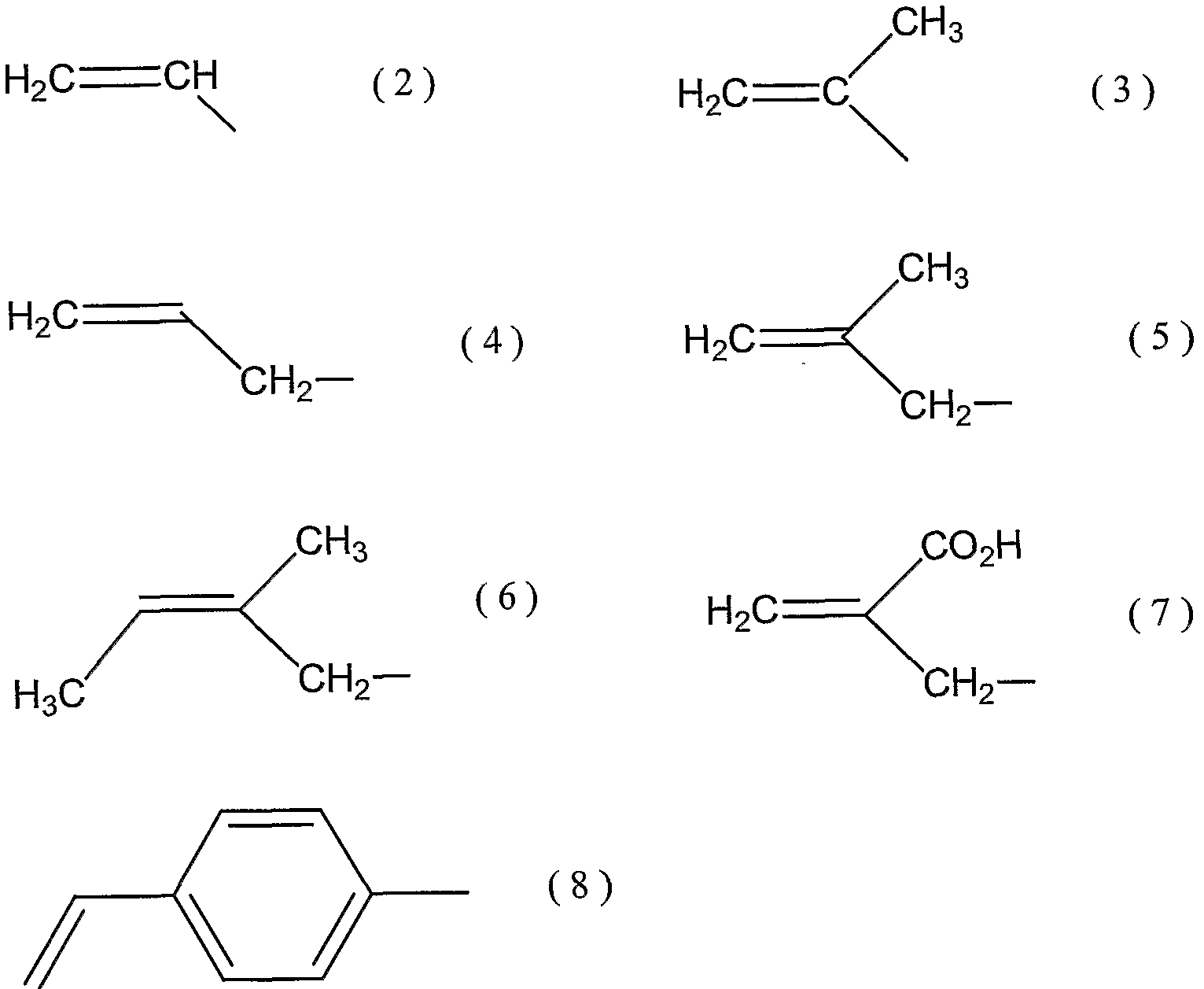
(a 2 ) 成分を具体的に例示すれば、 了リルグリシジルエーテル、 2-メチルァリル グリシジルエーテル、 およびスチレン- p -グリシジルエーテル等の不飽和グリシジ ルエーテルならびにグリシジルァタリレート、 グリシジルメタクリレートおよびィ タコン酸グリシジルエステル等の不飽和グリシジルエステル等が挙げられる。 If Specific examples of the (a 2) component, Ryo Li glycidyl ether, 2-Mechiruariru glycidyl ether and styrene, - p - glycidyl ethers of unsaturated glycidyl ether and glycidyl § Tari rate, glycidyl methacrylate, and I itaconic acid glycidyl And unsaturated glycidyl esters such as esters.
(a2 ) 成分に由来する構造単位の含有量は, (A) 成分 1 0 0重量部に対して、 通常、 1〜3 0重量部程度である。 (a2 ) 成分に由来する構造単位が 1重量部以上 であると、 得られる接着性フィルムの接着性が向上する傾向にあることから好まし く、 3 0重量部以下であると、 接着性フィルムの機械的強度が向上する傾向にある ことから好ましい。 The content of the structural unit derived from the component (a 2 ) is as follows based on 100 parts by weight of the component (A). Usually, it is about 1 to 30 parts by weight. When the structural unit derived from the component (a 2 ) is at least 1 part by weight, the adhesiveness of the resulting adhesive film tends to be improved. It is preferable because the mechanical strength of the film tends to be improved.
(A) 成分には、 (a i ) 成分および (a2 ) 成分とは異なる単量体であって、 ェ チレンと共重合可能な単量体を重合させてもよい。 尚、 該 「エチレンと共重合可能 な単量体」 は、 カルボキシ基や酸無水物基などのエポキシ基と反応し得る官能基や エポキシ基を含有しない。 The component (A), (ai) component and (a 2) from component a different monomer may be polymerized with E styrene and copolymerizable monomer. The “monomer copolymerizable with ethylene” does not contain a functional group or an epoxy group that can react with an epoxy group such as a carboxy group or an acid anhydride group.
「エチレンと共重合可能な単量体」 の具体例としては、 アクリル酸メチル、 ァク リル酸ェチル、 アクリル酸 n—プロピル、 アクリル酸イソプロピル、 アクリル酸 n 一プチル、 アタリル酸 t -プチル、 アタリル酸ィソプチル、 メタクリル酸メチル、 メタクリル酸ェチル、 メタクリル酸 n—プロピル、 メタクリル酸ィソプロピル、 メ タクリル酸 n一ブチル、 メタクリル酸 t一ブチル及びメタクリル酸ィソブチル等の 炭素数が 3〜 8程度のアルキル基を有するひ, β—不飽和カルボン酸アルキルエス テル;酢酸ビュル、 酪酸ビュル、 プロピオン酸ビュル、 ピパリン酸ビニル、 ラウリ ン酸ビニル、 イソノナン酸ビュル、 バーサチック酸ビニル等の炭素数 2〜 8程度の カルボン酸を有するビュルエステル; 1ーブテン、 ィソブテンなどの炭素数 4〜 2 0程度の α—ォレフィン;ブタジエン、 ィソプレン、 シクロペンタジェンなどのジ ェン化合物;塩化ビニル、 スチレン、 アクリロニトリル、 メタタリロニトリル、 ァ クリルアミ ド、 メタクリルァミ ドなどのビュル化合物などが挙げられる。 Specific examples of the “monomer copolymerizable with ethylene” include methyl acrylate, ethyl acrylate, n-propyl acrylate, isopropyl acrylate, n-butyl acrylate, t-butyl acrylate, and attaryl Alkyl groups having about 3 to 8 carbon atoms, such as isoptyl acid, methyl methacrylate, ethyl methacrylate, n-propyl methacrylate, isopropyl methacrylate, n-butyl methacrylate, t-butyl methacrylate, and isobutyl methacrylate Alkyl esters of β-unsaturated carboxylate; carboxylic acids having about 2 to 8 carbon atoms, such as vinyl acetate, vinyl butyrate, vinyl propionate, vinyl piperate, vinyl laurate, vinyl isononanoate, and vinyl versatate Butyl ester having carbon; 1-butene, isotobutene, etc. Α-olefins of about 4 to 20; diene compounds such as butadiene, isoprene and cyclopentadiene; and bur compounds such as vinyl chloride, styrene, acrylonitrile, methacrylonitrile, acrylamide and methacrylamide. Can be
「エチレンと共重合可能な単量体」 としては、 中でも、 酢酸ビュル、 アクリル酸 メチル、 アタリル酸ェチル、 アタリル酸 η -ブチル、 メタクリル酸メチルが好適で ある。 As the “monomer copolymerizable with ethylene”, among them, butyl acetate, methyl acrylate, ethyl acrylate, η-butyl acrylate and methyl methacrylate are preferred.
(Α) 成分における 「エチレンと共重合可能な単量体」 に由来する構造単位の含 有量としては、 (Α) 成分 1 0 0重量部に対して、 通常、 0〜7 0重量部程度であ り、 中でも、 5〜6 0重量部程度が好ましい。 この含有量が、 7 0重量部以下であ ると、 高圧ラジカル法等により (Α) 成分を容易に製造し得る傾向にあることから 好ましい。 The content of the structural unit derived from the “monomer copolymerizable with ethylene” in the component (Α) is usually about 0 to 70 parts by weight based on 100 parts by weight of the component (Α). In particular, about 5 to 60 parts by weight is preferable. When the content is 70 parts by weight or less, component (II) tends to be easily produced by a high-pressure radical method or the like, which is preferable.
本発明における (Α) 成分は、 ブロック共重合体、 グラフト共重合体、 ランダム 共重合体、 交互共重合体のいずれであってもよく、 例えば、 特許第 2 6 3 2 9 8 0 号公報記載のプロピレン ·エチレンプロック共重合体に (a2 ) をグラフトさせた共 重合体、 特許第 2 6 0 0 2 4 8号公報記載のエチレン ·エポキシ基含有モノマー共 重合体に α, β一不飽和カルボン酸エステルをグラフトさせた共重合体等が挙げら れる。 In the present invention, the component (は) is a block copolymer, a graft copolymer, or a random copolymer. Any of a copolymer and an alternating copolymer may be used. For example, a copolymer obtained by grafting (a 2 ) to a propylene / ethylene block copolymer described in Japanese Patent No. 2632980 And copolymers obtained by grafting an α, β monounsaturated carboxylic acid ester to an ethylene / epoxy group-containing monomer copolymer described in Japanese Patent No. 26020048.
本発明における (Α) 成分の製造方法としては、 例えば、 原料となる単量体を、 エチレンおよびラジカル発生剤の存在下に、 5 0 0〜4 0 0 0気圧程度、 1 0 0〜 3 0 0 °C程度、 適当な溶媒や連鎖移動剤の存在下又は不存在下に共重合させる方法 ; ポリエチレン系樹脂に (a2 ) などの原料となる単量体をラジカノレ発生剤とともに 混合し、 押出機中で溶融グラフト共重合させる方法などが挙げられる。 ここで、 ポ リエチレン系樹脂とは、 (a i ) の単独重合体、 あるいはエチレンと共重合可能な単 量体と (a i ) とからなる共重合体などである。 As a method for producing the component (Α) in the present invention, for example, a monomer as a raw material is prepared by adding ethylene and a radical generator to a pressure of about 500 to 400 atm, 100 to 300 atm. A method of copolymerizing at about 0 ° C in the presence or absence of a suitable solvent or chain transfer agent; Mixing a monomer such as (a 2 ) with a polyethylene resin together with a radical cane generator and extrusion A method of performing melt graft copolymerization in a machine is exemplified. Here, the polyethylene resin is a homopolymer of ( ai ) or a copolymer of a monomer copolymerizable with ethylene and ( ai ).
本発明の (A) 成分としては、 JIS K7210に準拠して測定した MF R (メルトフ 口一レート) 力 s、 通常、 1 9 0 °C、 2 . 1 6 k g荷重で 3 0〜: I 0 0 O g/10分程度 であり、 とりわけ 5 0〜5 0 O g/10分程度であることが好ましい。 MF Rが 3 0以 上の場合は得られる接着性フィルムの流動性が向上し、 被着体の表面に四凸部があ つてもそれを容易に埋め込む傾向にあることから好ましい。 また、 1 0 0 0以下の 場合には、 得られる接着性フィルムの硬化物のハンダ耐熱性が向上する傾向にある ことから好ましい。 As the component (A) of the present invention, an MFR (melt-off rate) s measured according to JIS K7210, usually at 190 ° C. and at a load of 2.16 kg, from 30 to: I 0 It is about 0 Og / 10 minutes, and particularly preferably about 50 to 50 Og / 10 minutes. When the MFR is 30 or more, the flowability of the obtained adhesive film is improved, and even if there are four convex portions on the surface of the adherend, they tend to be easily embedded. A value of 100 or less is preferable because the solder heat resistance of a cured product of the obtained adhesive film tends to be improved.
(A) 成分は商業的に入手可能であり、 例えば、 「ポンドファース ト (登録商標 (A) Ingredients are commercially available, for example, "Pondfast (registered trademark)".
) J シリーズ (住友化学工業 (株) 製) 、 「レタスパール R A」 シリーズ (日本ポ リオレフイン (株) 製) などの商業的に入手可能なものを使用することができる。 本発明に用いられる (B ) 成分は (bx ) エチレン及び/又はプロピレン (以下、 ( b a) と記す。 ) と、 (b2 ) ひ, 一不飽和カルボン酸無水物 (以下、 (b 2) と 記す。 ) とを重合して得られる共重合体である。 ( ) としては、 中でも、 ェチレ ンが好適である。 ) Commercially available ones such as J series (manufactured by Sumitomo Chemical Co., Ltd.) and "Let's Pearl RA" series (manufactured by Nippon Polyolefin Co., Ltd.) can be used. The component (B) used in the present invention includes (b x ) ethylene and / or propylene (hereinafter, referred to as (b a )), and (b 2 ) mono-unsaturated carboxylic anhydride (hereinafter, (b) 2 ) This is a copolymer obtained by polymerizing). As (), ethylene is particularly preferable.
(b2 ) としては、 例えば、 無水マレイン酸、 無水ィタコン酸、 無水シトラコン酸 などが挙げられる。 (b2 ) 成分としては、 中でも、 無水マレイン酸が好適である。 Examples of (b 2 ) include maleic anhydride, itaconic anhydride, citraconic anhydride and the like. As the component (b 2 ), maleic anhydride is particularly preferable.
(B) 成分に用いられる単量体として、 ( ) 及び (b2 ) に加えて、 (A) 成 分において記載した 「エチレンと共重合可能な単量体」 をさらに重合させてもよい 。 「エチレンと共重合可能な単量体」 の中でも、 酢酸ビュル、 アクリル酸メチル、 ァクリル酸ェチル、 ァクリル酸 n—プチル、 メタクリル酸メチルが好適である。 As a monomer used in the component (B), () and in addition to (b 2), may create additional polymerized "ethylene monomer copolymerizable", as described in Ingredient (A). Among the "monomers copolymerizable with ethylene", butyl acetate, methyl acrylate, ethyl acrylate, n-butyl acrylate, and methyl methacrylate are preferred.
(B) 成分における (b2 ) に由来する構造単位および 「エチレンと共重合可能な 単量体」 に由来する構造単位の含有量としては, (B) 1 0 0重量部に対し、 通常 、 (b2 ) に由来する構造単位が 0 . 1〜2 0重量部程度、 「エチレンと共重合可能 な単量体」 に由来する構造単位が 0〜5 0重量部程度である。 In the component (B), the content of the structural unit derived from (b 2 ) and the content of the structural unit derived from the “monomer copolymerizable with ethylene” are usually: The structural unit derived from (b 2 ) is about 0.1 to 20 parts by weight, and the structural unit derived from “a monomer copolymerizable with ethylene” is about 0 to 50 parts by weight.
(B) 成分における酸無水物基 (- 0- C O- 0-) の開環率は、 通常、 1〜5 0 % 程度であり、 好ましくは、 1 0〜4 0 %程度である。 開環率が 5 0 %以下であると 、 (B ) 成分、 (A) 及び (B) 成分からなる樹脂組成物、 及び本発明の接着性フ イルムの保管安定性が向上する傾向があるので好ましく、 さらに樹脂組成物から接 着性フィルムを加工する際のフィルム加工性が向上する傾向があるので好ましい。 また、 開環率が 1 %以上であると、 樹脂組成物に電子線を照射した際の接着性フィ ルムの硬化速度や、 接着性フィルムに加熱 ·加圧した際の硬化速度が向上する傾向 にあることから好ましい。 ' The ring opening ratio of the acid anhydride group (-0-C0-0-) in the component (B) is usually about 1 to 50%, preferably about 10 to 40%. If the ring opening ratio is 50% or less, the storage stability of the resin composition comprising the component (B), the components (A) and (B), and the adhesive film of the present invention tends to be improved. It is more preferable because the film processability when processing the adhesive film from the resin composition tends to be improved. When the ring opening ratio is 1% or more, the curing speed of the adhesive film when the resin composition is irradiated with an electron beam and the curing speed when the adhesive film is heated and pressed tend to be improved. Is preferred. '
本発明における開環率について説明する。 まず、 (B ) 成分を用いて、 鋼板 (2 mm厚み) Zアルミ板 (2 0 0 μ πι厚み) /フッ素樹脂シート (2 0 0 μ πι厚み) / (Β) 成分 +ポリエチレンテレフタレートシ一ト型枠 ( 5 0 μ πι) Ζフッ素樹脂 シート (2 0 0 m厚み) /アルミ板 ( 2 0 0 μ m厚み) /鋼板 (2 mm厚み) か らなる積層系を準備する。 この積層系を 1 5 0 °C、 常圧にて 2分間加熱したのち、 同温度にて 5 0 kg/cm2 加圧下にて 2分間加熱する。 その後この積層系から回収さ れる厚さ 5 0 μ ιηの (Β) 成分由来サンプル (1 ) について、 1 8 5 0 c m— 1 で の吸光度 [ 1 ] を測定する。 ここで、 (B) 成分 +ポリエチレンテレフタレートシ 一ト型枠 ( 5 0 μ m) とは、 ポリエチレンテレフタレ一ト型枠の中空部に (B) 成 分に置いた状態を意味する。 また、 加熱、 加圧後に得られる (B) 成分由来サンプ ル (1 ) の厚さは該型枠の厚さと同じ 5 0 μ ηιとなる。 次に、 (Β) 成分を同じ構 成の積層系にて 2 3 0 °C、 常圧にて 2分間加熱したのち、 同温度にて 5 0 kg/cm2 加圧下にて 2分間加熱して得られた厚さ 50 μπιの (Β) 成分由来サンプル (2) について、 1850 cm— 1 で吸光度 [2] を測定する。 本発明における開環率は 、 [1] /[2] X 100 (%) で表される値である。 The ring opening ratio in the present invention will be described. First, using the component (B), a steel plate (2 mm thickness) Z aluminum plate (200 μππι thickness) / fluororesin sheet (200 μππι thickness) / (Β) component + polyethylene terephthalate sheet Formwork (500 μπι) ΖPrepare a laminate system consisting of fluororesin sheet (200 m thickness) / aluminum plate (200 μm thickness) / steel plate (2 mm thickness). After heating this laminated system at 150 ° C. and normal pressure for 2 minutes, it is heated at the same temperature under a pressure of 50 kg / cm 2 for 2 minutes. Thereafter, the absorbance [1] at 185 cm- 1 of the sample (1) derived from the component (Β) having a thickness of 50 μιη recovered from the laminated system is measured. Here, the component (B) + polyethylene terephthalate sheet mold (50 μm) means a state where the component (B) is placed in the hollow portion of the polyethylene terephthalate mold. The thickness of the sample (1) derived from the component (B) obtained after heating and pressurization is 50 μηι, which is the same as the thickness of the mold. Next, the component (Β) was heated at 230 ° C and normal pressure for 2 minutes in a laminated system having the same composition, and then 50 kg / cm 2 at the same temperature. The absorbance [2] is measured at 1850 cm- 1 for the sample (2) with a thickness of 50 µπι obtained by heating under pressure for 2 minutes. The ring opening ratio in the present invention is a value represented by [1] / [2] × 100 (%).
尚、 酸無水物基は、 波長 1850 c m- 1 で吸光することから、 前記のとおり定 義した。 The acid anhydride group was defined as described above because it absorbs light at a wavelength of 1850 cm- 1 .
(B) 成分の製造方法としては、 例えば、 ポリエチレン系樹脂に、 (b2 ) をダラ フト重合させる方法などが挙げられる。 Examples of the method for producing the component (B) include a method in which (b 2 ) is subjected to daft polymerization on a polyethylene resin.
(B) 成分に用いられるポリエチレン系樹脂としては、 通常、 ( ) に由来する 構造単位を 50モル%以上含有するものであり、 具体例とレては、 ェチレン単独重 合体、 エチレン ·プロピレン共重合体、 エチレン · 1一ブテン共重合体、 エチレン •ィソブチレン共重合体、 エチレン ·ブタジエン共重合体、 エチレン · 4一メチル - 1—ペンテン共重合体、 ェチレン 'イソプレン共重合体、 エチレン '酢酸ビュル 共重合体、 エチレン 'ァクリル酸エステル共重合体などが挙げられる。 The polyethylene resin used for the component (B) generally contains at least 50 mol% of a structural unit derived from (). Specific examples thereof include ethylene alone and ethylene / propylene copolymer. Copolymer, ethylene / 1-butene copolymer, ethylene • isobutylene copolymer, ethylene • butadiene copolymer, ethylene • 4-methyl-1-pentene copolymer, ethylene • isoprene copolymer, ethylene • butyl acetate Polymers, ethylene acrylate copolymers and the like.
本発明の (B) 成分としては、 JIS K7210に準拠して測定した MFR (メルトフ ローレート) 力 S、 通常、 190°C、 2. 16 k g荷重で 30〜: L 000g/10分程度 であり、 50〜50 OgZlO分程度のものが好ましい。 MFRが 30以上の場合、'接 着性フィルム加工時の混練温度が低下する傾向があり、 さらに、 得られる接着性フ イルムの流動性が向上して、 ;被着体の表面に凹凸部があってもそれを容易に埋め込 みやすくなることから好ましい。 また 1000以下の場合には得られる接着性フィ ルムのハンダ耐熱性が向上する傾向にあることから好ましい。 As the component (B) of the present invention, the MFR (melt flow rate) force S measured in accordance with JIS K7210 is usually 30 ° C. at 190 ° C. and 2.16 kg load, and is about L 000 g / 10 min. Those having a content of about 50 to 50 OgZlO are preferable. When the MFR is 30 or more, the kneading temperature at the time of processing the adhesive film tends to decrease, and the fluidity of the obtained adhesive film is improved; Even if there is, it is preferable because it can be easily embedded. A value of 1000 or less is preferable because the solder heat resistance of the obtained adhesive film tends to be improved.
(B) 成分としては、 通常、 製造直後、 または (B) 成分を保存する容器を開封 して吸湿されるようになってから 2週間程度まで保存したものを使用することが推 奨される。 (B) 成分が吸湿されるようになってから 2週間以下保存したものであ ると (B) 成分の開環率が、 通常、 1〜50%であり、 熱硬化性樹脂組成物をフィ ルム加工する際の流動性 (フィルム加工性) および保管安定性が向上する傾向にあ るので好ましい。 It is generally recommended to use component (B) immediately after production or stored for up to about two weeks after the container storing component (B) has been opened to absorb moisture. If the component (B) is stored for 2 weeks or less after it has absorbed moisture, the ring-opening ratio of the component (B) is usually 1 to 50%, and the thermosetting resin composition is used as a filler. It is preferable because the fluidity (film processability) and storage stability during the lumber processing tend to be improved.
また、 (B) 成分が吸湿されるようになってから 2週間程度以上の長期保存した 場合でも、 (B) 成分を熱処理により開環率を 1〜50%に調整することにより、 フィルム加工性および接着性フィルムの保管安定性が向上する。 もちろん、 製造直 後の (B ) 成分を熱処理してもよい。 Even when the component (B) is stored for a long period of about 2 weeks or more after the component (B) has been absorbed, by adjusting the ring opening ratio of the component (B) to 1 to 50% by heat treatment, the film processability can be improved. And the storage stability of the adhesive film is improved. Of course, production The subsequent component (B) may be heat-treated.
(B) 成分の熱処理方法としては、 例えば、 (B ) 成分を一軸もしくは二軸のス クリュー押出し機、 パンパリーミキサー、 ロール、 各種ニーダ一等で、 通常、 2 0 0 °C〜2 5 0 °C程度で溶融混練する方法などが拳げられる。 As the heat treatment method of the component (B), for example, the component (B) is usually heated to 200 ° C. to 250 ° C. using a single-screw or twin-screw screw extruder, a bread pallet mixer, a roll, various kneaders, or the like. A method of melting and kneading at about ° C is fisted.
(B) 成分は商業的に入手可能であり、 例えば、 「ボンダイン (登録商標) 」 シ リーズ ( (有) 住化ァトフイナ製) 、 「レタスパーノレ E T」 シリーズ (日本ポリオ レフイン (株) 製) などの商業的に入手可能なものを使用することができる。 本組成物とは、 かくして得られた (A) 成分と (B ) 成分とを含有するものであ る。 中でも、 (A) 成分を溶融混練してなるものと、 (B) 成分とを含有するもの が好ましく、 とりわけ、 (A) 成分を溶融混練したものと (B ) 成分とを混合した のち、 溶融混練してなるものが好適である。 The component (B) is commercially available and includes, for example, “Bondane (registered trademark)” series (manufactured by Sumika Atofina), “Letasupanore ET” series (manufactured by Nippon Polio Refin Co., Ltd.) and the like. Commercially available ones can be used. The present composition contains the component (A) and the component (B) thus obtained. Among them, those obtained by melt-kneading the component (A) and those containing the component (B) are preferable. Particularly, those obtained by melt-kneading the component (A) and the component (B) are mixed. Those obtained by kneading are preferred.
溶融混練することにより、 本発明の接着性フィルムに 「フィッシュアイ」 の発生 が低減される。 By melting and kneading, the generation of “fish eyes” in the adhesive film of the present invention is reduced.
本組成物は、 (A) 成分 1 0 0重量部に対して、 (B) 成分を通常、 2 0〜5 0 重量部程度使用する。 (B) 成分が 2 0重量部以上であるとハンダ耐熱性が向上す る傾向があり、 5 0重量部以下であるとフィルムの強度が向上したり、 フィルムの 厚みを薄くできる、 すなわち、 フィルム加工性が向上する傾向がある。 また、 (B ) 成分が 5 0重量部以下であるとフィルムの保管安定性が向上する傾向にあるので 好ましい。 In the present composition, the component (B) is usually used in an amount of about 20 to 50 parts by weight based on 100 parts by weight of the component (A). If the component (B) is more than 20 parts by weight, the solder heat resistance tends to be improved, and if it is less than 50 parts by weight, the strength of the film can be improved or the thickness of the film can be reduced. Workability tends to be improved. Further, it is preferable that the component (B) is 50 parts by weight or less, since the storage stability of the film tends to be improved.
本組成物は (A) 成分、 (B ) 成分に加えて ( C) 酸化防止剤 (以下、 (C) 成 分と記す。 ) を含有させることにより、 「フィッシュアイ」 の発生を抑制したり、 本組成物や得られる接着性フィルムの保管安定性が向上する傾向にあることから好 ましい。 The composition contains (C) an antioxidant (hereinafter, referred to as a (C) component) in addition to the (A) and (B) components, thereby suppressing the occurrence of "fish eyes". However, it is preferable because the storage stability of the composition and the obtained adhesive film tends to be improved.
( C) 成分としては、 例えば、 フエノール系酸化防止剤、 リン系酸化防止剤、 ィ ォゥ系酸化防止剤、 アミン系酸ィ匕防止剤等が挙げられる。 酸化防止剤として 2種類 以上の酸ィ匕防止剤を組み合わせて使用してもよく、 とりわけ、 ゲル防止効果および 着色の観点からフ ノール系酸化防止剤、 リン系酸化防止剤およびィォゥ系酸化防 止剤のいずれも使用することが好適である。 Examples of the component (C) include a phenolic antioxidant, a phosphorus-based antioxidant, a zeolite antioxidant, and an amine-based antioxidant. Two or more antioxidants may be used in combination as the antioxidant. Particularly, from the viewpoints of the gel prevention effect and the coloring, a phenol antioxidant, a phosphorus antioxidant, and an iodine antioxidant. It is preferred to use any of the agents.
フエノール系酸ィ匕防止剤としては、 例えば、 2 , 6—ジ一 tーブチノレー 4—メチ ノレフエノーノレ、 2, 6—ジー t—プチノレ一 4ーェチノレフエノーノレ、 Examples of phenol-based antioxidants include 2,6-dibutyne 4-butyrene Noref eno nore, 2, 6—Gee t—Puchinore 1
2, 6—ジシク口へキシルー 4一メチルフエノール、 2, 6—ジー t一アミノレ一 4 一メチルフエノーノレ、 2, 6—ジー t—ォクチノレ一 4一 n—プロピノレフエノーノレ、 2, 6—ジシク口へキシノレ _ 4一 n—ォクチノレフエノーノレ、 2—イソプロピル一 4 —メチル一 6 - t一ブチルフエノール、 2 - tーブチルー 2—ェチルー 6一 tーォ クチノレフエノーノレ、 2ーィソブチノレ一 4ーェチノレー 6― t 一へキシノレフエノーノレ、 2—シクロへキシノレ一 4一 n _ブチル一6—ィソプロピノレフエノール、 d 1 — α— トコフェローノレ、 t一ブチルヒ ドロキノン、 2, 2 ' 一メチレンビス (4ーメチノレ _ 6— t—ブチルフエノール) 、 4, 4, ーブチリデンビス (3—メチルー 6— t —プチルフエノール) 、 4, 4, ーチォビス (3—メチルー 6— t—ブチルフエノ ール) 、 2, 2, ーチォビス ( 4ーメチルー 6— t一ブチルフエノ一ル) 、 4, 4 , ーメチレンビス (2, 6—ジー t一ブチルフエノール) 、 2, 2, —メチレンビ ス [6— ( 1ーメチルシク口へキシル) 一 p—クレゾール] 、 2, 2, ーェチリデ ンビス (4, 6—ジー t一ブチノレフェノ一ル) 、 2,6-dihexyl hexyl 4-methylphenol, 2,6-di-amino-1,4-methylphenol, 2,6-di-t-octynole 41-n-propynolephenol, 2, 6-Dihexyl hexinole _ 4-n-octynolephenol, 2-isopropyl-14-methyl-6-t-butylphenol, 2-t-butyl-2-ethyl-6-t-octynolephenole 2-isobutynole 4-ethynole 6-t-hexynolephenol, 2-cyclohexynole 4-n-butyl-6-isopropinolephenol, d 1-α-tocopherolone, t-butylhydroquinone, 2,2'-methylenebis (4-methynole-6-t-butylphenol), 4,4, butylidenebis (3-methyl-6-t-butylphenyl), 4,4, -thiobis (3-methyl-6-t-butylphenol) ), 2,2, -thiobis (4-methyl-6-t-butylphenol), 4,4, -methylenebis (2,6-di-t-butylphenol), 2,2, -methylenebis [6- (1-methylcyclyl) Hexyl) -p-cresol], 2,2, -ethylidenebis (4,6-di-t-butynolefenol),
2, 2, ーブチリデンビス (2— tーブチルー 4一メチルフエノール) 、 2— t — プチルー 6 - (3— t—プチノレ一 2—ヒ ドロキシー 5—メチノレべンジノレ) — 4—メ チルフエニルアタ リ レート、 2 - [1 - (2—ヒ ドロキシ _ 3, 5—ジー t一ペン チルフエニル) ェチル] 一 4, 6—ジ一 t—ペンチノレフエニノレアクリ レート、 1, 1 , 3—トリス (2—メチルー 4ーヒ ドロキシ一 5— t—ブチルフエニル) ブタン 、 トリェチレングリコ一ノレビス [3— (3— t—ブチル一5—メチル一4—ヒ ドロ キシフエニル) プロピオネート] 、 1, 6—へキサンジオールビス [3— (3, 5 ージー tーブチノレー 4ーヒ ドロキシフエニル) プロピオネート] 、 2, 2—チォジ エチレンビス [3— (3, 5—ジー t—ブチル一 4ーヒ ドロキシフエニル) プロピ ォネート] 、 N, N' 一へキサメチレンビス (3, 5—ジー tーブチルー 4ーヒ ド ロキシーヒ ドロシンナミ ド) 、 3, 5—ジー t _プチノレ一 4ーヒ ドロキシベンジノレ ホスホネートジェチノレエステノレ、 トリス (2, 6—ジメチノレー 3—ヒ ドロキシー 4 一 t一ブチル 'ベンジノレ) イソシァヌレート、 トリス (3, 5—ジー t一プチルー 4 ーヒ ドロキシベンジノレ) ィソシァヌレート、 トリス [ (3, 5—ジー tーブチノレー 4—ヒ ドロキシフエニル) プロピオニルォキシェチル] イソシァヌレート. トリス (4- t一ブチル— 2, 6—ジメチル一 3—ヒ ドロキシベンジル) イソシァ ヌレート、 2, 4—ビス (n—ォクチルチオ) - 6 - (4ーヒ ドロキシ一 3, 5— ジ一 t—プチノレァニリノ) _ 1, 3, 5—トリアジン、 テトラキス [メチレン一 3 一 (3, 5—ジ一 t—ブチルー 4ーヒドロキシフエニル) プロピオネート] メタン ヽ 2, 2, ーメチレンビス (4ーメチル一 6 - t一ブチルフエノール) テレフタレ ート、 1, 3, 5_ト リメチノレ一 2, 4, 6— トリス (3, '5—ジー t一プチルー ' 4—ヒドロキシベンジル) ベンゼン、 3, 9―ビス [1, 1一ジメチルー 2 - { β - (3 - tーブチノレ一 4—ヒ ドロキシ一 5—メチノレフエ二ル) プロピオニルォキシ } ェチル] -2, 4, 8, 10—テトラォキサスピロ [5, 5] ゥンデカン、 2, 2—ビス [4— (2 - (3, 5—ジー t一プチル一 4ーヒドロキシヒドロシンナモ ィルォキシ) ) エトキシフエニル] プロパン、 β— (3, 5—ジー t一ブチル _ 4 —ヒドロキシフエニル) プロピオン酸ステアリルエステルなどが挙げられる。 2,2, butylidenebis (2-t-butyl-4-methylphenol), 2-t-butyl-6- (3-t-butynole-1-hydroxy-5-methynolebenzinole) —4-methylphenylenyl acrylate, 2- [1-(2-Hydroxy_3,5-di-t-pentylphenyl) ethyl] 1,4,6-di-t-pentynolepheninoleacrylate, 1,1,3-tris (2-methyl-4-) Hydroxy-5-t-butylphenyl) butane, triethyleneglycol-monolevis [3- (3-t-butyl-5-methyl-14-hydroxyphenyl) propionate], 1,6-hexanediolbis [3- (3,5-Gt-butynole 4-Hydroxyphenyl) propionate], 2,2-thiodiethylenebis [3-((3,5-Gt-butyl-14-hydroxy-4-phenyl) propionate], N, N ' Samethylene bis (3,5-di-tert-butyl-4-hydroxy-drosin amide), 3,5-di-t-butylinole-1-hydroxybenzinole phosphonate getinoleestenole, tris (2,6-dimethinolelate 3— Hydroxy 4 1-t-butyl 'benzinole) isocyanurate, tris (3,5-di-butyl-1 4-hydroxybenzinole) isocyanurate, tris [(3,5-di-butynole 4 4-hydroxyphenyl) propionyloxy Shechill] Isocyanurate. Tris (4-t-butyl-2,6-dimethyl-13-hydroxybenzyl) isocyanurate, 2,4-bis (n-octylthio) -6- (4-hydroxy-1,3,5-di-t —Putinoleanilino) _ 1,3,5-Triazine, tetrakis [methylene-13- (3,5-di-t-butyl-4-hydroxyphenyl) propionate] methane ヽ 2,2, -methylenebis (4-methyl-1-6-t 1,3-, 5-trimethylino 1,2,4,6-tris (3, '5-di-tert-butyl' 4-hydroxybenzyl) benzene, 3,9-bis [1, 1-Dimethyl-2- {β- (3-t-butynole-1-hydroxy-5-methynolephenyl) propionyloxy} ethyl] -2,4,8,10-Tetraoxaspiro [5,5] pentadecane , 2,2-bis [4- (2-(3,5-di-t-butyl-1-4-hydro Shihidoroshin'namo Iruokishi)) ethoxy-phenylalanine] propane, β- (3, 5- di t one-butyl _ 4 - like hydroxyphenyl) propionic acid stearyl ester.
これらの中では、 β一 (3, 5—ジー t一ブチル _ 4ーヒ ドロキシフエニル) プ 口ピオン酸ステアリルエステル、 テトラキス [メチレン一 3— (3, 5—ジ一 t一 ブチル一4—ヒ ドロキシフエニル) プロピオネート] メタン、 トリス (3, 5—ジ 一 t一プチルー 4ーヒ ドロキシベンジル) イソシァヌレート、 1, 3, 5—トリメ チルー 2 , 4, 6—トリス (3, 5—ジ一 tーブチルー 4—ヒ ドロキシベンジノレ) ベンゼン、 d 1—ひ一トコフエロール、 トリス (2, 6—ジメチノレー 3—ヒドロキ シ一 4— t一ブチルベンジノレ) イソシァヌレート、 トリス [ (3, 5—ジー t—ブ チルー 4ーヒ ドロキシフエニル) プロピオニノレオキシェチル] ィソシァヌレート、 ' 3, 9 -ビス [ 1, 1ージメチノレー 2— { β― (3 - t -プチルー 4ーヒ ドロキシ 一 5—メチルフエニル) プロピオ二ルォキシ} ェチル] -2, 4, 8, 10—テト ラオキサスピロ [5, 5] ゥンデカンが好ましい。 Among these, β- (3,5-di-tert-butyl -4-hydroxyhydroxyphenyl) -p-pionate stearyl ester, tetrakis [methylene-1- (3-, 3,5-di-t-butyl-14-hydroxy-4-phenyl) ) Propionate] methane, tris (3,5-di-tert-butyl-4-hydroxybenzyl) isocyanurate, 1,3,5-trimethyl-2,4,6-tris (3,5-di-tert-butyl-4) —Hydroxybenzinole) benzene, d 1—Hitocopherol, Tris (2,6-dimethinole 3-hydroxy-1 4-t-butylbenzinole) isocyanurate, Tris [(3,5-di-t-butyl 4-) (Hydroxyphenyl) propioninoleoxyethyl) isocyanurate, '3,9-bis [1,1 dimethinoleic 2-—β- (3-t-butyl 4--4-hydroxy-l-5-methylphenyl) Pio two Ruokishi} Echiru] -2, 4, 8, 10 Tet Raokisasupiro [5, 5] Undekan are preferred.
フエノール系酸化防止剤として、 商業的に入手可能なフエノール系酸化防止剤を 使用してもよく、 かかる商業的に入手可能なものとしては、 例えばィルガノックス 1010 (Irganox 1010、 チパ ·スペシャルティー ·ケミカノレズ製) 、 ィルガノッ タス 1076 (Irganox 1076、 チバ ·スペシャルティー ·ケミカルズ製) 、 ィルガ ノックス 1330 (Irganox 1330、 チパ ·スペシャルティー ·ケミカルズ製) 、 ィ ルガノックス 31 14 (Irganox 3114、 チパ ·スペシャルティ一 ·ケミカルズ製) 、 ィルガノックス 3125 (Irganox 3125、 チパ ·スペシャルティー ·ケミカルズ 製) 、 スミライザ一 BHT (Sumilizer BHT、 住友化学製) 、 シァノックス 1790 (Cyanox 1790、 サイテック製) 、 スミライザ一 GA— 80 (Sumilizer GA- 80、 住 友化学製) 、 ビタミン E (エーザィ製) などが挙げられる。 As the phenolic antioxidant, a commercially available phenolic antioxidant may be used. Examples of such a commercially available phenolic antioxidant include Irganox 1010 (manufactured by Chipa Specialty Chemical Chemicals). ), Irganox 1076 (Irganox 1076, manufactured by Ciba Specialty Chemicals), Ilga Knox 1330 (Irganox 1330, manufactured by Chipa Specialty Chemicals), Irganox 3114 (Irganox 3114, manufactured by Chipa Specialty Chemicals) , Irganox 3125 (Irganox 3125, manufactured by Chipa Specialty Chemicals), Sumilizer BHT (Sumilizer BHT, manufactured by Sumitomo Chemical), Xianox 1790 (Cyanox 1790, manufactured by Scitech), Sumilizer-1 GA—80 (Sumilizer GA-80, Tomo Chemical Co., Ltd.) and Vitamin E (Eisai Co., Ltd.).
フエノール系酸ィヒ防止剤として、 2種類以上のフエノール系酸化防止剤を使用し てもよい。 As the phenolic acid inhibitor, two or more phenolic antioxidants may be used.
リン系酸化防止剤としては、 例えばトリオクチルホスフアイ ト、 トリラウリルホ スフアイ ト、 トリデシルホスフアイ ト、 (ォクチル) ジフエニルホスファイ ト、 ト リス (2, 4—ジ一 t一ブチルフェニル) ホスファイ ト、 トリフエニルホスフアイ ト、 トリス (ブトキシェチノレ) ホスファイ ト、 トリス (ノニルフエニル) ホスファ イ ト、 ジステアリルペンタエリスリ トールジホスファイ ト、 テトラ (トリデシノレ) —1, 1, 3— ト リス (2—メチノレー 5— t—ブチル一 4ーヒ ドロキシフエ二ノレ) ブタンジホスファイ ト、 テトラ 2 〜C 5 混合アルキル) 一 4, 4, 一イソ プロピリデンジフエニルジホスファイ ト、 テトラ (トリデシル) 一 4, 4, 一プチ リデンビス ( 3—メチルー 6 _ t—プチルフエノール) ジホスファイ ト、 トリス ( 3, 5—ジ _ t _プチルー 4ーヒ ドロキシフエニル) ホスファイ ト、 トリス (モノ 'ジ混合ノニルフエニル) ホスファイ ト、 Examples of phosphorus antioxidants include trioctyl phosphite, trilauryl phosphite, tridecyl phosphite, (octyl) diphenyl phosphite, and tris (2,4-di-t-butylphenyl) phosphite Tris (nonylphenyl) phosphite, tris (nonylphenyl) phosphite, distearylpentaerythritol diphosphite, tetra (tridecinole) —1,1,3—tris (2-methylenolate) 5-t-butyl-14-hydroxypheninole) butanediphosphite, tetra- 2 -C5 mixed alkyl) 1.4,4,1-isopropylidenediphenyldiphosphite, tetra (tridecyl) 14, 4, monobutylidenebis (3-methyl-6_t-butylphenol) diphosphite, tris 3, 5-di _ t _ Puchiru 4-arsenide Dorokishifueniru) Hosufai, tris (mono 'di mixing Nonirufueniru) Hosufai door,
水素化一 4, 4, —イソプロピリデンジフエノールポリホスファイ ト、 ビス (オタ チルフエニル) ビス [4, 4, 一ブチリデンビス (3—メチノレー 6— t—ブチノレフ エノーノレ) ] 一 1, 6—へキサンジオースレジホスファイ ト、 フエ二ノレ (4, 4, ― ィソプロピリデンジフエノール) ペンタエリスリ トーノレジホスフアイ ト、 ジステア リルペンタエリスリ トールジホスファイ ト、 トリス [4, 4' —イソプロピリデン ビス (2 - t -ブチルフエノール) ] ホスファイ ト、 ジ (ィソデシル) フエニルホ スフアイ ト、 4, 4, 一イソプロピリデンビス (2 - t -ブチルフェノール) ビス (ノユルフェニル) ホスファイ ト、 9, 10—ジヒ ドロ一9—ォキサ _10—ホス ファフェナンスレン一 10—ォキサイ ド、 ビス (2, 4—ジ一 t—プチルー 6—メ チルフエニル) ェチルフォスファイ ト、 2— [ {2, 4, 8, 10—テトラー t— プチルジベンズ [d, f ] [1. 3. 2] ージォキサホスフエピン一 6—ィル } ォ キシ] 一 N, N—ビス 〔2_ [ {2, 4, 8, 10—テトラ一 tーブチルジベンズ [d, f ] [1. 3. 2] —ジォキサホスフエピン一 6—ィル } 才キシ] ェチル〕 エタンァミン、 6— [3— (3— tーブチルー 4ーヒドロキシ一 5—メチルフエ二 ル) プロボキシ] 一 2, 4, 8, 10—テトラー tーブチルジベンズ [d, f ] [ 1. 3. 2] ージォキサホスフエピンなどが挙げられる。 Hydrogenated 4,4, -isopropylidenediphenol polyphosphite, bis (otatylphenyl) bis [4,4,1-butylidenebis (3-methynoleic 6-t-butynolenoenol)] 1,1,6-hexanedi Aus-resin phosphite, feninole (4,4, -isopropylidene diphenol) pentaerythritol tonoresiphosphite, distealyl pentaerythritol diphosphite, tris [4,4'-isopropylidene bis (2-t-butylphenol)] phosphite, di (isodecyl) phenylphosphite, 4,4,1-isopropylidenebis (2-t-butylphenol) bis (noylphenyl) phosphite, 9,10-dihydro-9 —Oxa _10—Phosphafenanthrene 1-10—Oxide, bis (2,4-di-t-butyl-6-methylfureni ) Ethylphosphite, 2-[{2,4,8,10-tetra-t-butyldibenz [d, f] [1.3.2] dioxaphosphefin-1-yl} oxy ] 1 N, N-bis [2_ [{2, 4, 8, 10-tetra-t-butyldibenz [d, f] [1.3.2] —dioxaphosphepin-1-yl} ethyl] ethyl] ethaneamine, 6— [3— (3-t-butyl-4-hydroxy-15-methylphenyl) ) Proboxy] 1,2,4,8,10-tetra-t-butyldibenz [d, f] [1.3.2] dioxaphosphepine and the like.
また、 ビス(ジァノレキノレフェニル)ペンタエリスリ トールジホスフアイ トエステル としては、 下記一般式 (9) In addition, bis (dianolequinolephenyl) pentaerythritol diphosphite ester is represented by the following general formula (9)
(9)(9)

(式中、 R R2、 および R3は、 それぞれ独立に、 水素原子又は炭素数 1〜 9程度 のアルキノレ基等を表す。 ) (In the formula, RR 2 and R 3 each independently represent a hydrogen atom or an alkynole group having about 1 to 9 carbon atoms.)
で示されるスピロ型、 または、 下記一般式 (10) Spiro type represented by the following, or the following general formula (10)

(式中、 R4、 R5 、 および R6 は、 それぞれ独立に、 水素原子又は炭素数 1〜9 程度のアルキル基等を表す。 ) (In the formula, R 4 , R 5 , and R 6 each independently represent a hydrogen atom or an alkyl group having about 1 to 9 carbon atoms.)
で示されるケージ形のものなどが挙げられる。 And cage-shaped ones indicated by.
このようなホスファイ トエステルは、 通常、 一般式 (9) と (10) の混合物が 使用される。 As such a phosphite ester, a mixture of the general formulas (9) and (10) is usually used.
ここで、 1〜!^ がアルキル基の場合、 分枝のあるアルキル基が好ましく、 中で も t一プチル基が好適である。 Here, when 1 to! ^ Is an alkyl group, a branched alkyl group is preferable, and a t-butyl group is particularly preferable.
また、 フエ二ノレ基における 1〜!^6 の置換位置は、 2, 4, 6位が好ましい。 ホスフアイ トエステルの具体例としては、 ビス (2, 4—ジ一 t一ブチルフエ二 ル) ペンタエリスリ トー/レジホスフアイ ト、 ビス (2, 6—ジー t—ブチノレ一 4一 メチノレフエ二ノレ) ペンタエリスリ トーノレジホスフアイ ト、 ビス (ノユルフェニル) ペンタエリスリ トールジホスファイ ト等が挙げられ、 また、 炭素とリンとが直接結 合した構造を持つホスフォナイトとしては、 例えば、 テトラキス (2, 4—ジー t —ブチルフエ二ル) -4, 4, ービフエ二レンジホスフォナイ トなどの化合物が挙 げられる。 The substitution position of 1 to! ^ 6 in the feninole group is preferably at the 2, 4, and 6 positions. Specific examples of phosphite esters include bis (2,4-di-t-butylphenyl) pentaerythritol / resin phosphite, and bis (2,6-di-t-butyltin) 4-bis (2,6-di-t-butylphenyl) (Methinolepheninole) pentaerythritol noresiphosphite, bis (noyulphenyl) pentaerythritol diphosphite, and the like. Examples of phosphonites having a structure in which carbon and phosphorus are directly bonded include tetrakis (2, 4-g-t-butylphenyl) -4,4, -biphenylenediphosphonate and other compounds.
リン系酸ィ匕防止剤として、 商業的に入手可能なものを使用することもでき、 例え ばィルガフォス 168 (Irgafos 168、 チパ 'スペシャルティー ·ケミカルズ製) 、 ィルガフォス 12 (Irgafos 12、 チパ · スペシャルティー ·ケミカルズ製) 、 ィル ガフォス 38 (Irgafos 38、 チバ ·スペシャルティー · ケミカルズ製) 、 アデカス タブ 329K (ADK STAB 329K、 旭電化製) 、 アデカスタブ PEP 36 (ADK STAB P EP36、 旭電化製) 、 アデカスタブ PEP— 8 (ADK STAB PEP- 8、 旭電化製) 、 S a n d s t a b P-EPQ (クラリアント製) 、 ウェストン 618 (Weston 618、 GE製) 、 ウェストン 619G (Weston 619G, GE製) 、 ウルトラノックス 626 (Ultranox 626, GE製) 、 スミライザ一 GP (Sumilizer GP、 住友化学製) など が挙げられる。 Commercially available ones can also be used as the phosphorus-based antioxidant, for example, Irgafos 168 (Irgafos 168, Chipa 'Specialty Chemicals), Irgafos 12 (Irgafos 12, Chipa Specialty) Chemicals), Irgafos 38 (Irgafos 38, Ciba Specialty Chemicals), ADK STAB 329K (ADK STAB 329K, Asahi Denka), ADK STAB PEP 36 (ADK STAB PEP36, Asahi Denka), ADK STAB PEP-8 (ADK STAB PEP-8, Asahi Denka), S andstab P-EPQ (Clariant), Weston 618 (Weston 618, GE), Weston 619G (Weston 619G, GE), Ultranox 626 (Ultranox) 626, manufactured by GE) and Sumilizer GP (Sumilizer GP, manufactured by Sumitomo Chemical).
リン系酸化防止剤として、 2種類以上のリン系酸ィ匕防止剤を使用してもよい。 リン系酸化防止剤の中では、 トリス (2, 4ージ一 t一ブチルフェニ^ ホスフ アイ ト、 テトラキス (2, 4—ジー t—ブチルフエニル) -4, 4, —ビフエニレ ンジホスフォナイ ト、 ジステアリルペンタエリスリ トーノレジホスフアイ ト、 ビス ( 2 , 4—ジ一 t—ブチルフエニル) ペンタエリスリ トールジホスファイ ト、 2 - [ {2, 4, 8, 10—テトラ— t—ブチルジベンズ [d, f ] [1. 3. 2] —ジ ォキサホスフエピン一 6—ィル } ォキシ] 一 N, N—ビス 〔2— [ {2, 4, 8, 10—テトラー t—ブチルジベンズ [d, f ] [1. 3. 2] ージォキサホスフエ ピン一 6—ィル } 才キシ] ェチル〕 エタンァミン、 6— [3— (3— t—ブチルー 4—ヒ ドロキシー 5—メチルフエニル) プロポキシ] -2, 4, 8, 10—テトラ 一 tーブチルジベンズ [d, f ] [1. 3. 2] —ジォキサホスフエピンが好まし い。 As the phosphorus-based antioxidant, two or more kinds of phosphorus-based antioxidants may be used. Among the phosphorus antioxidants, tris (2,4-di-t-butylphenylphosphite), tetrakis (2,4-di-tert-butylphenyl) -4,4, -biphenylene diphosphonite, distearyl pentaerythr Ritonoresiphosphite, bis (2,4-di-t-butylphenyl) pentaerythritol diphosphite, 2-[{2,4,8,10-tetra-t-butyldibenz [d, f] [1 3.2.]-Dioxaphosphepin-1-6-yl} oxy] 1-N, N-bis [2-[{2,4,8,10-tetra-t-butyldibenz [d, f] [1 3.2.2] -Dioxaphosphophine-1-yl} ethyl] ethaneamine, 6- [3- (3-t-butyl-4-hydroxy-5-methylphenyl) propoxy] -2, 4 , 8, 10-tetra-t-butyldibenz [d, f] [1.3.2]-dioxaphosphuepine is preferred .
ィォゥ系酸化防止剤としては、 例えば、 ジラウリノレー、 ジミリスチルー、 ジステ ァリル一などのジアルキルチオジプロピオネートおよびプチルー、 ォクチルー、 ラ ゥリル—、 ステアリル一などのアルキルチオプロピオン酸の多価アルコール (例え ばグリセリン、 トリメチ口一ルェタン、 トリメチ口一ノレプロパン、 ペンタエリスリ トール、 1、リスヒ ドロキシェチルイソシァヌレート) のエステル (例えばペンタエ リスリルテトラキス一 3—ラウリルチオプロピオネート) などが挙げられる。 Examples of the zirconium-based antioxidants include dialkyl thiodipropionates such as dilaurinolate, dimyristyl, and distearyl, and butyl, octyl, and lactyl. Esters of polyhydric alcohols of alkylthiopropionic acids such as peryl- and stearyl (eg, glycerin, trimethicone-monoluethane, trimethicone-one-propane, pentaerythritol, 1, lishydroxicetyl isocyanurate) (eg, pentaerythryltetrakis) 1-3-laurylthiopropionate).
さらに具体的には、 ジラウリルチォジプロピオネート、 ジミリスチルチオジプロ ピオネート、 ジステアリルチォジプロピオネート、 ラウリルステアリルチォジプロ ピオネート、 ジステアリルチオジブチレ一ト、 などが挙げられる。 More specifically, dilaurylthiodipropionate, dimyristylthiodipropionate, distearylthiodipropionate, laurylstearylthiodipropionate, distearylthiodibutyrate, and the like can be mentioned.
これらの中では、 ペンタエリスリルテトラキスー 3—ラウリルチオプロピオネート が好ましい。 Of these, pentaerythryltetrakis-3-laurylthiopropionate is preferred.
ィォゥ系酸化防止剤としては、 商業的に入手可能なものを使用することもでき、 例えばスミライザ一 T P S (Suniilizer TPS, 住友化学製) 、 スミライザ一 T P L— R (Surailizer TPL - R、 住友化学製) 、 スミライザ一 T P M (Suniilizer TPM、 住友 化学製) 、 スミライザ一 T P—D (Surailizer TP- D、 住友化学製) などが挙げられ る。 Commercially available ones can also be used as the zeo-based antioxidants, for example, Sumilizer TPS (manufactured by Sumitomo Chemical), Sumilizer TPL-R (Surailizer TPL-R, manufactured by Sumitomo Chemical) And Sumilizer-TPM (Suniilizer TPM, manufactured by Sumitomo Chemical) and Sumilizer-TP-D (Surailizer TP-D, manufactured by Sumitomo Chemical).
ィォゥ系酸化防止剤として、 2種類以上のィォゥ系酸化防止剤を使用してもよい ァミン系酸化防止剤としては、 例えば、 2 , 2 , 4—トリメチル一 1, 2—ジヒ ドロキノ リンの重合物、 6—エトキシー 2, 2 , 4—トリメチル一 1 , 2—ジヒ ド 口キノリン、 N— ( 1, 3—ジメチノレブチノレ) 一 N, 一フエ二ルー 1, 4 _フエ二 レンジァミン、 N—イソプロピル一 N, —フエニル一 1, 4—フエ二レンジァミン などが挙げられる。 Two or more zeotype antioxidants may be used as zeotype antioxidants. Examples of amine type antioxidants include, for example, a polymer of 2,2,4-trimethyl-1,1,2-dihydroquinoline. , 6-ethoxy-2,2,4-trimethyl-1-1,2-dihydroquinoline, N— (1,3-dimethinolevbutinole) -1N, 1-Fe2,1,4-Fenylenediamine, N— Isopropyl-1-N, -phenyl-1,4-phenylenediamine and the like.
本組成物における (C) 成分の配合量は、 (A) 成分 1 0 0重量部に対して、 通 常 0 . 0 0 5〜2重量部程度、 好ましくは 0 . 0 1〜1重量部程度、 さらに好まし くは 0 . 0 5〜0 . 5重量部程度である。 The amount of the component (C) in the composition is usually about 0.05 to 2 parts by weight, preferably about 0.01 to 1 part by weight, based on 100 parts by weight of the component (A). More preferably, it is about 0.05 to 0.5 parts by weight.
本組成物の製造方法としては、 例えば、 (A) 成分を一軸もしくは二軸のスクリ ユー押出し機、 パンパリーミキサー、 ロール、 各種ニーダ一等で、 通常、 1 2 0 °C 〜2 0 0 °C程度で溶融混練し、 (B) 成分を混合する方法などが挙げられる。 ここ で溶融混練温度が 1 2 0〜2 0 0 °Cの範囲であると、 接着性フィルムの 「フィッシ ュアイ」 が低減される傾向にあることから、 好ましい。 また、 前記 (C) 成分を (A) 成分とともに溶融混練することが好ましい。 As a method for producing the present composition, for example, the component (A) is usually used at a temperature of 120 ° C. to 200 ° C. using a single-screw or twin-screw extruder, a bread pallet mixer, a roll, various kneaders, or the like. Melting and kneading at about C and mixing the component (B). Here, it is preferable that the melt-kneading temperature is in the range of 120 to 200 ° C., since the “fisheye” of the adhesive film tends to be reduced. It is preferable that the component (C) is melt-kneaded together with the component (A).
さらに、 着色剤、 無機フィラー、 加工安定剤、 耐候剤、 熱安定剤、 光安定剤、 核 剤、 滑剤、 離型剤、 難燃剤、 帯電防止剤等の添加剤を本発明の熱硬化性樹脂組成物 に含有させてもよい。 Further, additives such as coloring agents, inorganic fillers, processing stabilizers, weathering agents, heat stabilizers, light stabilizers, nucleating agents, lubricants, mold release agents, flame retardants, and antistatic agents are added to the thermosetting resin of the present invention. It may be included in the composition.
接着性フィルムをソルダーレジストに供する場合、 プリント配線板の表面の導体 回路をマスクするために、 着色剤として、 フタロシアニングリーン、 カーボンブラ ックなどの色素、 顔料等を通常、 使用する。 本発明の接着性フィルム (以下、 本接着性フィルムと記す。 ) は、 かく して得ら れた本組成物を押出成形したのち、 電子線を照射してなるフィルムであり、 その押 出成形方法について説明すると、 例えば、 T一ダイ付の押出し機などにて樹脂組成 物を溶融混練'成膜する方法などが挙げられる。 この時、 T—ダイとチルロール間 の距離 (エアギャップ) は、 通常、 約 1 0 c m以下であり好ましくは約 8 c m以下 、 特に好ましくは約 6 c m以下である。 エアギャップが 1 0 c m以下であるとフィ ルム切れや、 一般に 「片肉」 と呼ばれるフィルムの厚みがばらつく状態が抑制され る傾向にあることから好ましい。 When the adhesive film is used as a solder resist, a coloring agent such as phthalocyanine green or carbon black is usually used as a coloring agent to mask the conductive circuit on the surface of the printed wiring board. The adhesive film of the present invention (hereinafter referred to as the present adhesive film) is a film obtained by extruding the thus obtained present composition and then irradiating the composition with an electron beam. The method will be described. For example, a method of melt-kneading a film of a resin composition using an extruder equipped with a T-die or the like may be used. At this time, the distance (air gap) between the T-die and the chill roll is usually about 10 cm or less, preferably about 8 cm or less, and particularly preferably about 6 cm or less. An air gap of 10 cm or less is preferable because the state of film breakage and a state in which the thickness of the film generally called “single-walled” varies tends to be suppressed.
押出成形方法における溶融混練温度としては使用する樹脂の溶融温度以上で、 1 2 0 °C程度以下であることが好ましく、 とりわけ、 9 0 °C〜1 1 0 °C程度の溶融混 練温度が好適である。 該溶融混練温度が 1 2 0 °C以下であると、 得られる接着性フ イルムの 「フィッシュアイ」 が低減される傾向にあることから、 好ましい。 The melt-kneading temperature in the extrusion molding method is preferably equal to or higher than the melting temperature of the resin to be used and is equal to or lower than about 120 ° C, and more preferably, about 90 ° C to 110 ° C. It is suitable. It is preferable that the melt-kneading temperature be 120 ° C. or lower, since the “fish eye” of the obtained adhesive film tends to be reduced.
接着性フィルムの厚みとしては、 通常、 5 μ ηι〜2 πιιη程度であり、 好ましくは 8 μ π!〜 1 mmであ 。 The thickness of the adhesive film is generally about 5 μηι to 2πιιη, preferably 8 μπ! ~ 1 mm.
押出成形する際には、 取扱いや保管を容易にするために、 支持基材の上に積層し たり、 支持基材と樹脂組成物を共押出成形してもよい。 支持基材としては、 接着性 フィルムが硬化後でも剥離しやすいようなものが好ましく、 例えば、 4ーメチルー 1一ペンテン共重合体からなるフィルム、 酢酸セルロースからなるフィルム、 樹月旨 組成物からなる層に接する面にシリコン系離型剤が塗布されたポリエチレンテレフ タレートフイルムなどが挙げられる。 In the case of extrusion molding, in order to facilitate handling and storage, the resin composition may be laminated on the support base material or co-extruded with the support base material and the resin composition. The supporting substrate is preferably one that allows the adhesive film to be easily peeled off even after curing.For example, a film composed of a 4-methyl-11-pentene copolymer, a film composed of cellulose acetate, and a layer composed of a luster composition Polyethylene terephthalate film coated with a silicone release agent on the surface in contact with.
本発明で用いられる電子線とは、 電圧によって加速された電子の束であり、 50〜3 00 kV程度の電圧で加速させる低エネルギー型、 300〜5000 kV程度の電圧で加速さ せる中エネルギー型、 5000〜10000 kV程度の電圧で加速させる高エネルギー型に分 類されるが、 本発明は、 通常、 低エネルギー型の電子線を用いる。 The electron beam used in the present invention is a bundle of electrons accelerated by a voltage, The present invention is classified into a low energy type that accelerates with a voltage of about 00 kV, a medium energy type that accelerates with a voltage of about 300 to 5000 kV, and a high energy type that accelerates with a voltage of about 5000 to 10,000 kV. Usually, a low energy type electron beam is used.
電子加速器としては、 例えば、 リニア力ソード型、 モジュール力ソード型、 薄板 力ソード型、 低エネルギー走査型などが挙げられる。 Examples of the electron accelerator include a linear force sword type, a module force sword type, a thin plate force sword type, and a low energy scanning type.
本接着性フィルムの製造方法としては、 例えば、 窒素などの不活性ガス雰囲気下 にて、 押出成形して得られたフィルムの支持基材で覆われていな V、片面のみに電子 線を照射する方法であるが、 支持基材で覆われた面に電子線を照射してもよい。 ま た、 支持基材を剥離して、 片面又は両面に電子線を照射する方法や、 支持基材を剥 離して、 後述する被着体に予め積層したのち、 電子線を照射する方法などが例示さ れる。 The method for producing the present adhesive film includes, for example, irradiating only one side of the film obtained by extrusion molding with an electron beam under an atmosphere of an inert gas such as nitrogen, which is not covered with a supporting substrate. Although it is a method, the surface covered with the supporting substrate may be irradiated with an electron beam. Further, a method of irradiating one or both surfaces with an electron beam by peeling the supporting substrate, and a method of peeling the supporting substrate and preliminarily laminating on an adherend to be described later and then irradiating with an electron beam, etc. Examples are shown.
電子線の照射線量は、 通常、 1 0〜3 0 0 k G y程度、 好ましくは、 5 0〜 1 0 O k G y程度である。 照射線量が 1 0 k G y以上であると、 加熱接着時および熱硬 化時にフィルムを圧延した際の被着体表面の隠蔽効果が向上する傾向があることか ら好ましく、 3 0 0 k G y以下の場合には、 被着体の四凸に、 接着性フィルムが埋 め込まれ、 密着性が向上する傾向にあることから好ましい。 かくして得られた本接着性フィルムは、 室温程度にて保管したのち、 該フィルム と被着体と接着させても該フィルムに皺が生じることが著しく少ない。 換言すれば 、 室温保管後でも接着性に優れるという保管安定性に優れる。 また、 保管温度が— 1 0 °C以下であると、 一層、 保管安定性に優れる。 本発明の積層体 (以下、 本積層体と記す。 ) は、 本接着性フィルムからなる層に 被着体を積層し、 本接着性フィルムを硬化せしめたものであり、 接着性フィルムが 支持基材を含まない場合の製造方法としては、 1 ) 本接着性フィルムに被着体を積 層し、 熱硬化する方法; 2 ) 本接着性フィルムに被着体を積層したのち、 該被着体 とは異なる被着体を積層し、 熱硬化する方法などが挙げられる。 本接着性フィルム が支持基材を含む場合の製造方法としては、 3 ) 本接着性フィルムに被着体を積層 し、 熱硬化したのち、 支持基材を剥離する方法; 4 ) 本接着性フィルムに被着体を 積層し、 支持基材を剥離したのち、 熱硬化する方法; 5 ) 本接着性フィルムに被着 体を積層し、 支持基材を剥離したのち、 該被着体とは異なる被着体を接着し、 熱硬 化する方法などが挙げられる。 The irradiation dose of the electron beam is usually about 10 to 300 kGy, preferably about 50 to 100 kGy. When the irradiation dose is at least 10 kGy, the effect of concealing the adherend surface when the film is rolled at the time of heat bonding and thermosetting tends to be improved. The case of y or less is preferable because the adhesive film is embedded in the four convexes of the adherend and the adhesiveness tends to be improved. The adhesive film thus obtained has very little wrinkling even when it is stored at about room temperature and then adhered to the adherend with the film. In other words, the storage stability is excellent, even after storage at room temperature. Further, when the storage temperature is lower than −10 ° C., the storage stability is further improved. The laminate of the present invention (hereinafter referred to as the present laminate) is obtained by laminating an adherend on a layer composed of the present adhesive film and curing the present adhesive film. In the case where the adhesive is not contained, the production methods include: 1) a method of laminating an adherend on the present adhesive film and thermosetting; 2) laminating the adherend on the present adhesive film, And a method of laminating adherends different from those described above and thermally curing the adherends. When the present adhesive film includes a supporting substrate, the production method is as follows: 3) a method of laminating an adherend on the present adhesive film, thermosetting, and then removing the supporting substrate; 4) the present adhesive film To the adherend Laminating, peeling off the supporting substrate, and thermosetting; 5) Laminating the adherend on the adhesive film, peeling off the supporting substrate, and bonding an adherend different from the adherend And a method of thermosetting.
本積層体を製造する際の熱硬化条件としては、 通常、 1 4 0 °C〜3 0 0 °C程度、 好ましくは 1 6 0〜 2 0 0 °C程度にて、 約 1 0分〜 3時間程度熱硬化する。 熱硬ィ匕 の温度が 1 4 0 °C以上であるとハンダ耐熱性を得るまでの熱硬化時間が短縮される 傾向にあるので好ましく、 また、 3 0 0 °C以下であると接着性フィルムの分解が抑 制される傾向にあるので好ましい。 The thermosetting conditions for producing the laminate are usually about 140 ° C. to 300 ° C., preferably about 160 ° C. to 200 ° C. for about 10 minutes to 3 minutes. Heat cures for about an hour. It is preferable that the temperature of the thermosetting resin be 140 ° C. or higher, since the thermosetting time until the solder heat resistance is obtained tends to be shortened, and the adhesive film is 300 ° C. or lower. This is preferable since the decomposition of the compound tends to be suppressed.
また、 熱硬化する際に、 加熱されプレス機を用いて、 0〜3 MPa で加圧してもよ い。 In addition, at the time of thermosetting, it may be heated and pressurized at 0 to 3 MPa using a press machine.
本積層体に用いられる被着体の材料としては、 例えば、 本発明の接着性フィルム と接着し得る材料である。 具体的には、 例えば、 金、 銀、 銅、 鉄、 錫、 鉛、 アルミ ユウム、 シリコンなどの金属、 ガラス、 セラミックスなどの無機材料;紙、 布など のセルロース系高分子材料、 メラミン系樹脂、 アクリル 'ウレタン系樹脂、 ウレタ ン系樹脂、 (メタ) アクリル系樹脂、 スチレン 'アタリロニトリル系共重合体、 ポ リカーポネート系樹脂、 フエノール樹脂、 アルキッド樹脂、 エポキシ樹脂、 シリコ 一ン樹脂などの高分子材料等が挙げられる。 The material of the adherend used in the present laminate is, for example, a material that can adhere to the adhesive film of the present invention. Specifically, for example, metals such as gold, silver, copper, iron, tin, lead, aluminum, and silicon; inorganic materials such as glass and ceramics; cellulose-based polymer materials such as paper and cloth; melamine-based resins; Acrylic 'urethane resin, urethane resin, (meth) acrylic resin, styrene' Atallonitrile copolymer, polycarbonate resin, phenol resin, alkyd resin, epoxy resin, silicone resin, etc. Materials and the like.
被着体の材料として、 異なる 2種類以上の材料を混合、 複合してもよい。 また、 積層体が本発明の接着性フィルムを介して、 異なる 2つの被着体が接着してなるも のである場合、 2つの被着体を構成する材料は、 同じ種類の材料でも異なる種類の 材料のいずれでもよい。 As the material of the adherend, two or more different materials may be mixed and compounded. Further, when the laminate is formed by bonding two different adherends via the adhesive film of the present invention, the materials forming the two adherends may be different types of materials of the same type. Any of the materials may be used.
被着体の性状としては特に限定されないが、 例えば、 フィルム状、 シート状、 板 状、 繊維状などが上げられる。 The properties of the adherend are not particularly limited, and examples thereof include a film, a sheet, a plate, and a fiber.
また、 被着体には、 必要に応じて、 離型剤、 メツキなどの被膜、 本組成物以外の 樹脂組成物からなる塗料による塗膜、 プラズマやレーザーなどによる表面改質、 表 面酸化、 エッチングなどの表面処理等を実施してもよい。 In addition, the adherend may be, if necessary, coated with a release agent, paint, etc., coated with a paint made of a resin composition other than this composition, surface modified with plasma or laser, surface oxidation, Surface treatment such as etching may be performed.
被着体として、 極性基含有合成高分子材料および金属の複合材料である集積回路 、 プリント配線板などの電子 ·電気部品等が好ましく用いられる。 以下に実施例を示して、 本発明をさらに詳細に説明するが、 本発明はこれらによ つて限定されるものではない。 尚、 以下の例中、 °/。および部は特に断りのない限り 、 重量基準である。 As the adherend, electronic and electrical components such as integrated circuits and printed wiring boards, which are composite materials of a polar group-containing synthetic polymer material and a metal, are preferably used. Hereinafter, the present invention will be described in more detail with reference to Examples, but the present invention is not limited thereto. In the following examples, ° /. Parts and parts are by weight unless otherwise specified.
(A) および (B) 成分は以下を使用した。 尚、 MFR (メルトフローレート) は J I S— K7210に準拠し、 190°C、 2160 g荷重の条件下で測定した値 を示した。 The following (A) and (B) components were used. The MFR (melt flow rate) is a value measured under the conditions of 190 ° C and a load of 2160 g according to JIS-K7210.
< (A) 成分 > <(A) component>
(A) 成分として下記共重合体を混合して使用した。 The following copolymer was mixed and used as the component (A).
A-1 :エチレン 'メタクリル酸ク'、リシ、アル共重合体 (住友化学工業 (株) 製 ホ'、ンドファ スト A-1: Ethylene 'methacrylic acid', lithi, alcopolymer (E 'manufactured by Sumitomo Chemical Co., Ltd.
CG5001、 エチレン単位 =82%、 メタクリル酸ク Ίシ ル単位 =18 %、 CG5001, ethylene units = 82%, methacrylic acid units = 18%,
MFR= 35◦ g/ 10分) を 1◦ 0部、 MFR = 35◦g / 10min)
下記 C— 1 0. 1部、 下記 C一 2 0. 1部、 および C-10.1 parts below, C-10.1 parts below, and
下記 C—3 0. 05部をドライブレンドし、 Φ 3 Ommの同方向二軸 押出し機 (LZD=42) に供給し、 120°Cの温度下、 200 r p m のスクリユー回転数、 18 K g 時間の供給速度にて溶融混練して得ら れたもの。 The following C-3 0. 05 parts by dry blending, [Phi 3 is supplied to Omm in the same direction twin screw extruder (LZD = 42), a temperature of 120 ° C, Sukuriyu rotational speed of 200 rpm, 18 K g Time Obtained by melt-kneading at a supply speed of.
A— 2 : A— 1と同重量のエチレン ·メタクリル酸ク"リシシ、'ル共重合体、 C—1〜C一 3に 加え、 カーボンブラック (MA 600 (三菱化学 (株) 製) 5. 3部を ドライブレンドし、 A— 1と同様にして得た溶融混練して得られたもの A-2: In addition to the same weight of ethylene-methacrylic acid "Rishishi," copolymer of C-1 to C-13, carbon black (MA 600 (manufactured by Mitsubishi Chemical Corporation) 5. 3 parts dry-blended and melt-kneaded in the same manner as A-1
< (B) 成分〉 <(B) component>
(B) 成分として下記共重合体を混合して使用した。 The following copolymer was mixed and used as the component (B).
B— 1 : エチレン ·無水マレイン酸 ·アクリル酸: tチル共重合体 B-1: Ethylene · Maleic anhydride · Acrylic acid: t-tyl copolymer
(住化ア トフィナ製 ホ"ン イン HX8210, ヱチレン単位 = 91%、 (Sumika Atofina's "Hon Inn HX8210, polyethylene unit = 91%,
無水マレイン酸単位 = 3 %、 アクリル酸ヱチル単位 = 6 °/。、 MFR= 200 g, 0分 開環率は 33%であった。 ) Maleic anhydride units = 3%, ethyl acrylate units = 6 ° /. MFR = 200 g, 0 minute The rate of ring opening was 33%. )
< (B) 成分 (B— 1) の開環率の測定例〉 (1) :鋼板 (2 mm厚み) /アルミ板 (200 in厚み) ノフッ素樹脂シート ( 200 m厚み) /B— 1の共重合体 +ポリエチレンテレフタレ一ト型枠 (50 μ m) /フッ素樹脂シート/アルミ板 Z鋼板の順で積層したのち、 150°Cの条件で 予熱 2分、 加圧 (5 OKg/cm2 ) 、 2分の条件にてプレスし、 厚さ 50 μπιの Β— 1の共重合体フィルムを得た。 得られたフィルムをただちに赤外分光光度計に て測定し、 1850 cm— 1 の吸光度 [1] を求めた。 <Example of measurement of ring opening ratio of component (B) (B-1)> (1): Steel plate (2 mm thickness) / Aluminum plate (200 in thickness) Fluorocarbon resin sheet (200 m thickness) / B-1 copolymer + polyethylene terephthalate formwork (50 μm) / Fluorine After laminating resin sheet / aluminum plate and Z steel plate in this order, press at 150 ° C for 2 minutes, pressurize (5 OKg / cm 2 ), and press for 2 minutes. Thus, a copolymer film of No. 1 was obtained. The resulting film was immediately measured with an infrared spectrophotometer, and the absorbance at 1850 cm- 1 was determined [1].
(2) : (1) と同様に積層したのち、 230°Cの条件で予熱 2分, 加圧 (50K g/cm2 ) 、 10分の条件にてプレスし、 厚さ 50 μπιの B— 1の共重合体フィ ルムを得た。 得られたフィルムをただちに赤外分光光度計にて測定し、 1850 c m一 1 の吸光度 [2] を求めた。 (2): After lamination in the same manner as (1), press at 230 ° C for 2 minutes, pressurize (50Kg / cm 2 ) and 10 minutes to obtain a 50 μπι thick B— Thus, a copolymer film of No. 1 was obtained. The resulting film was immediately measured with an infrared spectrophotometer, and the absorbance at 1850 cm- 1 [2] was determined.
[1] / [2] X 100 = 33であったことから、 B— 1の無水マレイン酸基開 環率は 33%であった。 く成分 (C) > Since [1] / [2] X 100 was 33, the maleic anhydride group opening ratio of B-1 was 33%. Ingredient (C)>
下記の酸ィ匕防止剤を使用した。 The following acid-proofing agents were used.
C— 1 : β— (3, 5—ジ一 t—プチルー 4—ヒ ドロキシフエニル) プロピオン C—1: β— (3,5-di-t-butyl-4—hydroxyphenyl) propion
(フエノール系酸化防止剤、 チパ ·スペシャルティー 'ケミカルズ製 Irganox 107ο; (Phenolic antioxidant, Chipa Specialty 'Irganox 107ο; Chemicals
C一 2 : トリス (2, 4ージ _ t—ブチルフエニル) ホスファイ ト C-1: Tris (2,4-di-t-butylphenyl) phosphite
(リン系酸化防止剤、 チバ ·スペシャルティー ·ケミカルズ製 (Phosphorus antioxidant, Ciba Specialty Chemicals
丄 rgafos 168) (丄 rgafos 168)
C一 3 :ペンタエリスリルテトラキス-一 3—ラウリルチオプロピオネート C-13: pentaerythryltetrakis-13-laurylthiopropionate
(ィォゥ系酸化防止剤、 住友化学製 Sumilizer TP- D) く樹脂組成物の製造例 > (Yo-based antioxidant, Sumilizer TP-D manufactured by Sumitomo Chemical) Production example of resin composition>
(A— 1) と (B— 1) を表 1に記載の重量比率でドライブレンドして、 実施例 :!〜 3に供する樹脂組成物を得、 (A— 2) と (B— 1) を表 2に記載の重量比率 でドライプレンドして、 実施例 4〜6に供する樹脂組成物を得た。 く接着性フィルムの製造例 1 :厚さ 5 0 μηι> (A-1) and (B-1) were dry-blended at the weight ratios shown in Table 1 to obtain a resin composition to be used in Examples:! To 3, wherein (A-2) and (B-1) Was dry blended at the weight ratios shown in Table 2 to obtain resin compositions used in Examples 4 to 6. Production example 1 of adhesive film: thickness 50 μηι>
(株) 東洋精機製ラホ、' ラストミル Ψ 20醒押出し機 Τ一ダイ付を用いて、 押出し機シリ ンダー温度、 Τ—ダイ温度を 1 0 0 °C、 およびエアギャップは 2 c mに設定した。 続いて、 表 1に記載の重量比率でドライプレンドして得られた樹脂組成物を上記押 出し機を用いて離型 P E Tフィルム (ュニチカ (株) 製 「ェンブレット S C— 3 8 」 、 フィルム厚さ 3 8 μιη) の離型処理面上に溶融押出することで、 接着性フィル ム (厚さ 5 0 zm) ノ離型 P E Tフィルム (厚さ 3 8 μ πι) の 2層フィルムを作成し た。 The temperature of the extruder cylinder, the temperature of the die were set to 100 ° C, and the air gap was set to 2 cm using a Raho, manufactured by Toyo Seiki Co., Ltd., 'Last Mill', 20 extruder, and a single die. Subsequently, the resin composition obtained by dry blending at the weight ratio shown in Table 1 was released from the extruder using a PET film (“Emblet SC-38” manufactured by Unitika Ltd.) A two-layer film consisting of an adhesive film (thickness: 50 zm) and a release PET film (thickness: 38 μππ) was prepared by melt extrusion on a release surface of 38 μιη).
続いて、 岩崎電気 (株) 製、 加速電圧 1 5 0 k V、 照射線幅 6 0 O mmの電子線 照射装置を用い、 前記 2層フィルムの接着性フィルム側から表 1に示した線量の電 子線を照射し、 接着性フィルムを得た。 得られたフィルムは積層体の製造に供した 得られたフィルムを目視で観察し、 いずれも 「フィッシュアイ」 と呼ばれるブッ の発生が殆ど確認されなかった。 く積層体の製造例 1 > Then, using an electron beam irradiator with an acceleration voltage of 150 kV and an irradiation line width of 60 Omm manufactured by Iwasaki Electric Co., Ltd., the doses shown in Table 1 were measured from the adhesive film side of the two-layer film. Irradiation with an electron beam yielded an adhesive film. The obtained film was subjected to the production of a laminate. The obtained film was visually observed, and almost no occurrence of a bud called “fish eye” was observed. Laminate Production Example 1>
被着体としてプリント配線板 (松下電工製 両面銅張り積層板 R-1705) を用い 、 上記の製造例 1で得られた、 厚さ約 5 0 μιιιの接着性フィルムを 100°C、 3MPa、 10 分の条件で熱圧着したのち、 180°C、 3MPa、 60分の条件で熱硬ィヒさせた。 熱圧着及び 熱硬化の際に、 接着性フィルムの樹脂成分が、 被着体から流出することはなかった 。 次いで離型 P E Tフィルムを剥離することで積層体を得た。 積層体は、 次に示す 銅配線パターン埋め込み性試験に供した。 結果は表 1にまとめた。 <鲖配線パターン埋め込み性試験〉 Using a printed wiring board (double-sided copper-clad laminate R-1705 manufactured by Matsushita Electric Works) as the adherend, the adhesive film having a thickness of about 50 μιι obtained in Production Example 1 above at 100 ° C, 3 MPa, After thermocompression bonding under the conditions of 10 minutes, thermosetting was performed under the conditions of 180 ° C, 3 MPa, and 60 minutes. During thermocompression bonding and thermosetting, the resin component of the adhesive film did not flow out of the adherend. Next, the laminate was obtained by peeling off the release PET film. The laminate was subjected to a copper wiring pattern embedding test shown below. The results are summarized in Table 1. <鲖 Wiring pattern embedding test>
表 1に記載の積層体は、 カーポンプラックを含まない接着性フィルムを用いてい ることから、 接着性フィルムの側から、 接着性フィルム/プリント配線板間の気泡 の有無を光学顕微鏡にて観察することができた。 いずれの積層体についても気泡が 全く認められず、 接着性フィルムと被着体との密着性に優れることが確認された。 m i ) Since the laminates shown in Table 1 use an adhesive film that does not include a car pump rack, observe the presence or absence of air bubbles between the adhesive film and the printed wiring board with an optical microscope from the adhesive film side. We were able to. No air bubbles were observed in any of the laminates, and it was confirmed that the adhesiveness between the adhesive film and the adherend was excellent. mi)

表 2に記載の重量比率でドライブレンドして得られた樹脂組成物を用いる以外は 、 製造例 1に準じて、 約 1 5 μηι厚みの接着性フィルムを作成した。 An adhesive film having a thickness of about 15 μηι was prepared according to Production Example 1, except that the resin composition obtained by dry blending at the weight ratios shown in Table 2 was used.
得られたフィルムを目視で観察し、 いずれも 「フィッシュアイ」 が殆ど確認され なかった。 く積層体の製造例 2 > The resulting films were visually observed, and in each case, almost no “fish eye” was confirmed. Laminate Production Example 2>
厚さ約 1 5 μηιの接着性フィルムを用いる以外は、 上記の製造例 1と同様にして積 層体を得た。 熱圧着及び熱硬化の際に、 接着性フィルムの樹脂成分が、 被着体から 流出することはなかった。 積層体は、 次に示す銅配線隠蔽性試験に供した。 A laminate was obtained in the same manner as in Production Example 1 except that an adhesive film having a thickness of about 15 μηι was used. During thermocompression bonding and thermosetting, the resin component of the adhesive film did not flow out of the adherend. The laminate was subjected to the following copper wiring concealment test.
<銅配線隠蔽性試験 > <Copper wiring concealment test>
表 2の実施例 4〜 6に記載のように、 いずれの積層体についても銅配線パターン が全く認められず、 カーボンブラックを含む接着性フィルムによって、 被着体が被 覆されていることを確認した。 As described in Examples 4 to 6 in Table 2, no copper wiring pattern was observed in any of the laminates, and it was confirmed that the adherend was covered with the adhesive film containing carbon black. did.
また、 銅配線のある断面を切断して、 銅配線上のある硬化後の接着性フィルムの 厚みを観察し、 被着体が完全に被覆されていることを確認した。 (表 2 ) In addition, a cross section of the copper wiring was cut, and the thickness of the cured adhesive film on the copper wiring was observed to confirm that the adherend was completely covered. (Table 2)

製造例 1および 2で得られた積層体を、 タパイエスペック製 SOLDERABILITY TESTER EST- 11を用い、 260°Cのハンダ浴へ 10秒浸溃した。 これを 1サイクルとして 6サイクル繰返し後、 表面外観を目視観察した。 結果を表 1および表 2にまとめた 尚、 判定は下記'の基準に従った。 The laminates obtained in Production Examples 1 and 2 were immersed in a solder bath at 260 ° C. for 10 seconds using SOLDERABILITY TESTER EST-11 manufactured by Tapay Espec. After repeating this cycle as one cycle, the surface appearance was visually observed. The results are summarized in Tables 1 and 2. The judgment was made according to the following criteria.
〇: フィルム外観に異常 (剥離、 膨れ) がなく、 ハンダもぐりがないもの 〇: No abnormalities in film appearance (peeling, blistering) and no solder
X : フィルム外観に異常 (剥離、 膨れ) がある、 またはハンダもぐりがあるもの X: Film appearance is abnormal (peeling, swelling) or solder
<保管安定性 > <Storage stability>
上記の製造例 1および 2で得られた、 厚さ約 5 0 μηιの接着性フィルムを温度 2 3 °C、 湿度 5 0 %の雰囲気で保存し、 一週間毎に前記積層体の製造例と同様にして積 層体を製造し、 得られた積層体表面のフィルムの状態を目視で確認した。 結果を表 1および表 2にまとめた。 尚、 判定は下記の基準に従った。 The adhesive film having a thickness of about 50 μηι obtained in Production Examples 1 and 2 described above was stored in an atmosphere at a temperature of 23 ° C and a humidity of 50%, and the production example of the laminate was obtained every week. Similarly, a laminated body was manufactured, and the state of the film on the surface of the obtained laminated body was visually checked. The results are summarized in Tables 1 and 2. The judgment was based on the following criteria.
〇 熱硬化後にフィルムに皺がないもの も の Film without wrinkles after heat curing
Δ 熱硬化後にフィルムに皺が 1 0 %未満の面積であるもの Δ The film has less than 10% wrinkles after heat curing
X 熱硬化後にフィルムに皺が 1 0 %以上の面積であるもの X Film with wrinkles of 10% or more after heat curing
結果は表 1にまとめた。 本発明の接着性フィルムは、 接着性フィルムを被着体に接着して積層体を製造す る際に、 接着性フィルムの樹脂成分が流出することもない。 また、 保管安定性に優 れ、 フィッシュアイが見られないなどのフィルム加工性にも優れる。 さらに、 得ら れた積層体は、 ハンダ耐熱性および接着性に優れ、 被着体に凹凸部があっても、 被 着体と接着性フィルムとの密着し、 被着体を接着性フィルムが完全に被覆した積層 体を得ることができる。 The results are summarized in Table 1. In the adhesive film of the present invention, the resin component of the adhesive film does not flow out when the adhesive film is bonded to the adherend to produce a laminate. It also has excellent storage stability and excellent film processing properties such as no fish eyes. Furthermore, the obtained laminate is excellent in solder heat resistance and adhesiveness. Even if the adherend has irregularities, the adherend adheres to the adherend and the adherent film is adhered to the adherend. A completely coated laminate can be obtained.
このような優れた特性を有する積層体は、 例えば、 半導体封止材料、 太陽電池や Laminates having such excellent properties include, for example, semiconductor sealing materials, solar cells,
E L (エレク トロルミネセンス) ランプなどの電子部品封止材料、 集積回路/基板 間のダイボンディンダシートおよび基板間の層間絶縁材料として使用し得る。 また 、 接着性フィルムは基板をハンダから保護するソルダーレジスト、 電子部品の製造 工程で保護シートなどに供することができる。 It can be used as a sealing material for electronic components such as EL (Electroluminescence) lamps, a die bonder sheet between integrated circuits / substrates, and an interlayer insulating material between substrates. Further, the adhesive film can be used as a solder resist for protecting the substrate from solder, a protective sheet or the like in a process of manufacturing an electronic component.
Claims

Priority Applications (2)
| Application Number | Priority Date | Filing Date | Title |
|---|---|---|---|
| US10/525,067 US20050247402A1 (en) | 2002-08-23 | 2003-08-20 | Adhesive film |
| AU2003257584A AU2003257584A1 (en) | 2002-08-23 | 2003-08-20 | Adhesive film |
Applications Claiming Priority (2)
| Application Number | Priority Date | Filing Date | Title |
|---|---|---|---|
| JP2002-243127 | 2002-08-23 | ||
| JP2002243127A JP4211321B2 (en) | 2002-08-23 | 2002-08-23 | Adhesive film |
Publications (1)
| Publication Number | Publication Date |
|---|---|
| WO2004018584A1 true WO2004018584A1 (en) | 2004-03-04 |
Family
ID=31944086
Family Applications (1)
| Application Number | Title | Priority Date | Filing Date |
|---|---|---|---|
| PCT/JP2003/010479 Ceased WO2004018584A1 (en) | 2002-08-23 | 2003-08-20 | Adhesive film |
Country Status (7)
| Country | Link |
|---|---|
| US (1) | US20050247402A1 (en) |
| JP (1) | JP4211321B2 (en) |
| KR (1) | KR20050038022A (en) |
| CN (1) | CN1675328A (en) |
| AU (1) | AU2003257584A1 (en) |
| TW (1) | TW200413490A (en) |
| WO (1) | WO2004018584A1 (en) |
Cited By (12)
| Publication number | Priority date | Publication date | Assignee | Title |
|---|---|---|---|---|
| US11787754B2 (en) | 2019-10-31 | 2023-10-17 | Eastman Chemical Company | Processes and systems for making recycle content hydrocarbons |
| US11939534B2 (en) | 2019-11-07 | 2024-03-26 | Eastman Chemical Company | Recycle content alpha olefins and fatty alcohols |
| US11945998B2 (en) | 2019-10-31 | 2024-04-02 | Eastman Chemical Company | Processes and systems for making recycle content hydrocarbons |
| US11946000B2 (en) | 2019-05-24 | 2024-04-02 | Eastman Chemical Company | Blend small amounts of pyoil into a liquid stream processed into a gas cracker |
| US12031091B2 (en) | 2019-05-24 | 2024-07-09 | Eastman Chemical Company | Recycle content cracked effluent |
| US12195674B2 (en) | 2021-09-21 | 2025-01-14 | Eastman Chemical Company | Using spent caustic solution from pygas treatment to neutralize halogens from liquified waste plastic |
| US12312540B2 (en) | 2019-10-31 | 2025-05-27 | Eastman Chemical Company | Pyrolysis method and system for recycled waste |
| US12338211B2 (en) | 2019-07-29 | 2025-06-24 | Eastman Chemical Company | Recycle content (C4)alkanal |
| US12497467B2 (en) | 2019-05-24 | 2025-12-16 | Exxon Mobil Product Solutions Company | Recycle content cellulose ester |
| US12516006B2 (en) | 2019-11-07 | 2026-01-06 | ExxonMobil Product Solutions Company | Recycle content propanol |
| US12522548B2 (en) | 2019-11-07 | 2026-01-13 | ExxonMobil Product Solutions Company | Recycle content oxo alcohols and oxo plasticizers |
| US12534590B2 (en) | 2019-07-29 | 2026-01-27 | Eastman Chemical Company | Recycle content cyclobutane diol polyester |
Families Citing this family (15)
| Publication number | Priority date | Publication date | Assignee | Title |
|---|---|---|---|---|
| JP2005036077A (en) * | 2003-07-18 | 2005-02-10 | Sumitomo Chemical Co Ltd | Adhesive film |
| JP2009120787A (en) * | 2007-11-19 | 2009-06-04 | Kaneka Corp | Modified polyolefin-based resin composition and method for producing the same |
| US8080727B2 (en) | 2008-11-24 | 2011-12-20 | E. I. Du Pont De Nemours And Company | Solar cell modules comprising an encapsulant sheet of a blend of ethylene copolymers |
| US8084129B2 (en) * | 2008-11-24 | 2011-12-27 | E. I. Du Pont De Nemours And Company | Laminated articles comprising a sheet of a blend of ethylene copolymers |
| FR2941888B1 (en) * | 2009-02-06 | 2011-03-25 | Arkema France | USE OF A FILM COMPOSED OF POLYOLEFIN IN A PHOTOVOLTAIC MODULE |
| FR2941887B1 (en) | 2009-02-06 | 2011-03-25 | Arkema France | USE OF A POLYOLEFIN FILM IN A PHOTOVOLTAIC MODULE |
| CN102422437B (en) * | 2009-05-13 | 2016-05-04 | 三井-杜邦聚合化学株式会社 | Sheet for solar cell sealing material and solar cell module |
| WO2010135460A1 (en) * | 2009-05-19 | 2010-11-25 | Specialized Technology Resources, Inc | Encapsulant compositions, methods of manufacture and uses thereof |
| KR20120052360A (en) * | 2009-07-31 | 2012-05-23 | 이 아이 듀폰 디 네모아 앤드 캄파니 | Cross-linkable encapsulants for photovoltaic cells |
| JP5295922B2 (en) * | 2009-09-30 | 2013-09-18 | 旭化成イーマテリアルズ株式会社 | Resin sealing sheet |
| US8609980B2 (en) | 2010-07-30 | 2013-12-17 | E I Du Pont De Nemours And Company | Cross-linkable ionomeric encapsulants for photovoltaic cells |
| JP2012057041A (en) * | 2010-09-08 | 2012-03-22 | Nitto Denko Corp | Self-adhesive sheet and method for producing the same |
| JP2012057040A (en) * | 2010-09-08 | 2012-03-22 | Nitto Denko Corp | Self-adhesive sheet and method for producing the same |
| JP5773198B2 (en) * | 2011-07-22 | 2015-09-02 | Dic株式会社 | Battery-sealed electrolyte-sealed heat-sensitive adhesive sheet |
| CN108138000B (en) * | 2015-09-30 | 2021-04-16 | 三井—杜邦聚合化学株式会社 | Insulating multilayer sheet and solar cell module |
Citations (4)
| Publication number | Priority date | Publication date | Assignee | Title |
|---|---|---|---|---|
| JPH08225778A (en) * | 1995-02-20 | 1996-09-03 | Nippon Oil & Fats Co Ltd | Hot-melt type adhesive composition |
| JPH10273540A (en) * | 1997-03-27 | 1998-10-13 | Bridgestone Corp | Anisotropic, electrically conductive film |
| JPH1180682A (en) * | 1997-09-11 | 1999-03-26 | Bridgestone Corp | Cross-linked conductive adhesive tape |
| US5932339A (en) * | 1995-08-22 | 1999-08-03 | Bridgestone Corporation | Anisotropically electricity conductive film comprising thermosetting adhesive agent and electrically conductive particles |
Family Cites Families (2)
| Publication number | Priority date | Publication date | Assignee | Title |
|---|---|---|---|---|
| JP2836161B2 (en) * | 1990-01-30 | 1998-12-14 | 住友化学工業株式会社 | Thermoplastic resin composition |
| US6051652A (en) * | 1995-10-31 | 2000-04-18 | 3M Innovative Properties Company | Reactive hot melt composition, composition for preparation of reactive hot melt composition, and film-form hot melt adhesive |
-
2002
- 2002-08-23 JP JP2002243127A patent/JP4211321B2/en not_active Expired - Fee Related
-
2003
- 2003-08-20 US US10/525,067 patent/US20050247402A1/en not_active Abandoned
- 2003-08-20 AU AU2003257584A patent/AU2003257584A1/en not_active Abandoned
- 2003-08-20 TW TW092122877A patent/TW200413490A/en unknown
- 2003-08-20 WO PCT/JP2003/010479 patent/WO2004018584A1/en not_active Ceased
- 2003-08-20 KR KR1020057002938A patent/KR20050038022A/en not_active Withdrawn
- 2003-08-20 CN CNA038195755A patent/CN1675328A/en active Pending
Patent Citations (4)
| Publication number | Priority date | Publication date | Assignee | Title |
|---|---|---|---|---|
| JPH08225778A (en) * | 1995-02-20 | 1996-09-03 | Nippon Oil & Fats Co Ltd | Hot-melt type adhesive composition |
| US5932339A (en) * | 1995-08-22 | 1999-08-03 | Bridgestone Corporation | Anisotropically electricity conductive film comprising thermosetting adhesive agent and electrically conductive particles |
| JPH10273540A (en) * | 1997-03-27 | 1998-10-13 | Bridgestone Corp | Anisotropic, electrically conductive film |
| JPH1180682A (en) * | 1997-09-11 | 1999-03-26 | Bridgestone Corp | Cross-linked conductive adhesive tape |
Cited By (12)
| Publication number | Priority date | Publication date | Assignee | Title |
|---|---|---|---|---|
| US11946000B2 (en) | 2019-05-24 | 2024-04-02 | Eastman Chemical Company | Blend small amounts of pyoil into a liquid stream processed into a gas cracker |
| US12031091B2 (en) | 2019-05-24 | 2024-07-09 | Eastman Chemical Company | Recycle content cracked effluent |
| US12497467B2 (en) | 2019-05-24 | 2025-12-16 | Exxon Mobil Product Solutions Company | Recycle content cellulose ester |
| US12338211B2 (en) | 2019-07-29 | 2025-06-24 | Eastman Chemical Company | Recycle content (C4)alkanal |
| US12534590B2 (en) | 2019-07-29 | 2026-01-27 | Eastman Chemical Company | Recycle content cyclobutane diol polyester |
| US11787754B2 (en) | 2019-10-31 | 2023-10-17 | Eastman Chemical Company | Processes and systems for making recycle content hydrocarbons |
| US11945998B2 (en) | 2019-10-31 | 2024-04-02 | Eastman Chemical Company | Processes and systems for making recycle content hydrocarbons |
| US12312540B2 (en) | 2019-10-31 | 2025-05-27 | Eastman Chemical Company | Pyrolysis method and system for recycled waste |
| US11939534B2 (en) | 2019-11-07 | 2024-03-26 | Eastman Chemical Company | Recycle content alpha olefins and fatty alcohols |
| US12516006B2 (en) | 2019-11-07 | 2026-01-06 | ExxonMobil Product Solutions Company | Recycle content propanol |
| US12522548B2 (en) | 2019-11-07 | 2026-01-13 | ExxonMobil Product Solutions Company | Recycle content oxo alcohols and oxo plasticizers |
| US12195674B2 (en) | 2021-09-21 | 2025-01-14 | Eastman Chemical Company | Using spent caustic solution from pygas treatment to neutralize halogens from liquified waste plastic |
Also Published As
| Publication number | Publication date |
|---|---|
| CN1675328A (en) | 2005-09-28 |
| KR20050038022A (en) | 2005-04-25 |
| JP2004083636A (en) | 2004-03-18 |
| JP4211321B2 (en) | 2009-01-21 |
| TW200413490A (en) | 2004-08-01 |
| AU2003257584A1 (en) | 2004-03-11 |
| US20050247402A1 (en) | 2005-11-10 |
Similar Documents
| Publication | Publication Date | Title |
|---|---|---|
| WO2004018584A1 (en) | Adhesive film | |
| JP6561153B2 (en) | Resin composition, adhesive film, coverlay film, laminate, copper foil with resin and copper clad laminate with resin | |
| JP4380127B2 (en) | Thermosetting resin composition and adhesive film | |
| WO2004011521A1 (en) | Thermosetting resin composition and adhesive film | |
| TW201412864A (en) | Thermosetting resin compositions, resin films in B-stage, metal foils, copper clad boards and multi-layer build-up boards | |
| JPWO2018155311A1 (en) | Resin film for electronic device and electronic device | |
| KR101540740B1 (en) | Adhesive resin composition and aluminum composite panel | |
| JP2003277481A (en) | Thermosetting resin composition for adhesive film | |
| JP4965216B2 (en) | 4-methyl-1-pentene polymer release film | |
| JP2005036077A (en) | Adhesive film | |
| JP2004059718A (en) | Thermosetting resin composition, and adhesive film obtained by molding the composition | |
| JP5277865B2 (en) | Thermosetting resin composition and adhesive film | |
| JP2004091594A (en) | Thermosetting resin composition, and adhesive film comprising the composition | |
| KR20180065975A (en) | Polyvinyl acetal resin composition, adhesive sheet, and method for producing adhesive sheet | |
| TW201619282A (en) | Resin film and laminated film | |
| JP4935018B2 (en) | Thermoplastic liquid crystal polyester film laminate | |
| JP2007053187A (en) | Metal-clad laminate for flexible printed wiring board and flexible printed wiring board | |
| JP5072755B2 (en) | Olefin polymer composition, film and laminate obtained using the composition, and release film comprising the film or laminate | |
| JP7333766B2 (en) | Resin composition for bonding electrolyte membrane, resin film for bonding electrolyte membrane, and method for producing resin film for bonding electrolyte membrane | |
| CN115151419B (en) | Multilayer release film | |
| KR20050058206A (en) | Process for producing adhesive film | |
| TW202136326A (en) | Modified hydrogenated block copolymer | |
| JP2020147658A (en) | Release film |
Legal Events
| Date | Code | Title | Description |
|---|---|---|---|
| AK | Designated states |
Kind code of ref document: A1 Designated state(s): AE AG AL AM AT AU AZ BA BB BG BR BY BZ CA CH CN CO CR CU CZ DE DK DM DZ EC EE ES FI GB GD GE GH GM HR HU ID IL IN IS KE KG KR KZ LC LK LR LS LT LU LV MA MD MG MK MN MW MX MZ NI NO NZ OM PG PH PL PT RO RU SC SD SE SG SK SL SY TJ TM TN TR TT TZ UA UG US UZ VC VN YU ZA ZM ZW |
|
| AL | Designated countries for regional patents |
Kind code of ref document: A1 Designated state(s): GH GM KE LS MW MZ SD SL SZ TZ UG ZM ZW AM AZ BY KG KZ MD RU TJ TM AT BE BG CH CY CZ DE DK EE ES FI FR GB GR HU IE IT LU MC NL PT RO SE SI SK TR BF BJ CF CG CI CM GA GN GQ GW ML MR NE SN TD TG |
|
| 121 | Ep: the epo has been informed by wipo that ep was designated in this application | ||
| WWE | Wipo information: entry into national phase |
Ref document number: 10525067 Country of ref document: US Ref document number: 20038195755 Country of ref document: CN |
|
| WWE | Wipo information: entry into national phase |
Ref document number: 1020057002938 Country of ref document: KR |
|
| WWP | Wipo information: published in national office |
Ref document number: 1020057002938 Country of ref document: KR |
|
| 122 | Ep: pct application non-entry in european phase |