WO2003051933A1 - Photocurable organic polymer composition - Google Patents
Photocurable organic polymer composition Download PDFInfo
- Publication number
- WO2003051933A1 WO2003051933A1 PCT/JP2002/013200 JP0213200W WO03051933A1 WO 2003051933 A1 WO2003051933 A1 WO 2003051933A1 JP 0213200 W JP0213200 W JP 0213200W WO 03051933 A1 WO03051933 A1 WO 03051933A1
- Authority
- WO
- WIPO (PCT)
- Prior art keywords
- organic polymer
- component
- group
- composition
- polymer composition
- Prior art date
- Legal status (The legal status is an assumption and is not a legal conclusion. Google has not performed a legal analysis and makes no representation as to the accuracy of the status listed.)
- Ceased
Links
Classifications
-
- C—CHEMISTRY; METALLURGY
- C08—ORGANIC MACROMOLECULAR COMPOUNDS; THEIR PREPARATION OR CHEMICAL WORKING-UP; COMPOSITIONS BASED THEREON
- C08F—MACROMOLECULAR COMPOUNDS OBTAINED BY REACTIONS ONLY INVOLVING CARBON-TO-CARBON UNSATURATED BONDS
- C08F8/00—Chemical modification by after-treatment
- C08F8/42—Introducing metal atoms or metal-containing groups
-
- C—CHEMISTRY; METALLURGY
- C08—ORGANIC MACROMOLECULAR COMPOUNDS; THEIR PREPARATION OR CHEMICAL WORKING-UP; COMPOSITIONS BASED THEREON
- C08C—TREATMENT OR CHEMICAL MODIFICATION OF RUBBERS
- C08C19/00—Chemical modification of rubber
- C08C19/25—Incorporating silicon atoms into the molecule
-
- C—CHEMISTRY; METALLURGY
- C08—ORGANIC MACROMOLECULAR COMPOUNDS; THEIR PREPARATION OR CHEMICAL WORKING-UP; COMPOSITIONS BASED THEREON
- C08F—MACROMOLECULAR COMPOUNDS OBTAINED BY REACTIONS ONLY INVOLVING CARBON-TO-CARBON UNSATURATED BONDS
- C08F8/00—Chemical modification by after-treatment
- C08F8/06—Oxidation
-
- C—CHEMISTRY; METALLURGY
- C08—ORGANIC MACROMOLECULAR COMPOUNDS; THEIR PREPARATION OR CHEMICAL WORKING-UP; COMPOSITIONS BASED THEREON
- C08K—Use of inorganic or non-macromolecular organic substances as compounding ingredients
- C08K5/00—Use of organic ingredients
- C08K5/54—Silicon-containing compounds
-
- C—CHEMISTRY; METALLURGY
- C08—ORGANIC MACROMOLECULAR COMPOUNDS; THEIR PREPARATION OR CHEMICAL WORKING-UP; COMPOSITIONS BASED THEREON
- C08K—Use of inorganic or non-macromolecular organic substances as compounding ingredients
- C08K5/00—Use of organic ingredients
- C08K5/54—Silicon-containing compounds
- C08K5/549—Silicon-containing compounds containing silicon in a ring
Definitions
- the present invention relates to a photocurable organic polymer composition, and more particularly, to a photocurable organic polymer composition that can be quickly cured under the effect of irradiation with light energy, such as infrared rays, electronic beam, or the like, to form a moisture-resistant cured body, which after aging develops adhesiveness.
- light energy such as infrared rays, electronic beam, or the like
- photocurable organic polymer compositions can be quickly cured under the effect of light radiation such as infrared rays or electron beams, they find wide application as coating agents for parts of electronic devices.
- Japanese Laid-Open Patent Application Publication hereinafter referred to as "Kokai" S61-127718 (U.S. Pat. No. 4,528,081) describes a curable moisture-penetration-resistant polyorganosiloxane composition which consists of a silicone oil having a trimethylsilyl terminal group, a photosensitizer, and a reactive polyorganosiloxane which contains a condensation-reaction catalyst.
- the aforementioned reactive polyorganosiloxane is obtained as a result of a reaction between a silanol-capped polyorganosiloxane and an acryl-trialkoxysilane or an acryl-triallyloxysilane in the presence of said catalyst.
- the aforementioned reaction results in the formation of acryldialkoxysilyl or acryldiallyloxysilyl terminal groups.
- Kokai H6-32985 U.S. Pat. No.
- the photocurable organic polymer composition of the present invention comprises at least the following components:
- the photocurable organic polymer composition of the invention comprises at least the following components:
- the liquid organic polymer (A), which has at least one hydroxy group per molecule, is the main component of the composition of the invention.
- the viscosity of component (A) at 25 °C it is recommended that the viscosity be within the range of 10 to 1,000,000 milliPascal seconds (mPa-s), preferably from 50 to 100,000 mPa-s.
- mPa-s milliPascal seconds
- the type of the aforementioned liquid organic polymer (A) provided that it has at least one hydroxy group per molecule.
- it can be a polybutadiene, polyisoprene, polyisobutylene, polybutylene glycol, polypropylene glycol, polyethylene glycol-polypropylene glycol copolymers, polyethylene glycol-polybutylene glycol copolymers, or a hydrolyzate of the above.
- component (A) is used for imparting to the composition of the invention photocuring and moisture-resistant properties.
- Component (B) is a radiation curable alkoxysilane containing at least one radiation curable group.
- the alkoxysilane is represented by the following general formula:
- x is 1 or 2.
- x has a value of 1.
- R' is independently selected from the group consisting of a monovalent hydrocarbon group and radiation curable group selected from the group consisting of an acryloxy group, methacryloxy group, and epoxy group with the proviso that at least one R' is the radiation curable group.
- the monovalent hydrocarbon group of R is exemplified by methyl, ethyl, propyl, butyl, pentyl, hexyl, heptyl, or a similar alkyl; phenyl, tolyl, xylyl, naphthyl, or a similar aryl; benzyl, phenethyl, or a similar aralkyl; chloromethyl, 3-chloropropyl, 3,3,3- trifluoropropyl, or a similar halogenated alkyl.
- the acryloxy group of R is exemplified by gamma-acryloxymethyl, gamma-acryloxyethyl, and gamma-acryloxypropyl.
- the methacryloxy group of R' is exemplified by gamma-methacryloxymethyl, garnma- methacryloxyethyl, and gamma-methacryloxypropyl, with gamma-acryloxypropyl and gamma-methacryloxypropyl being preferred.
- the epoxy group of R is exemplified by 1,2- epoxyethyl, 2,3-epoxypropyl, 3,4-epoxybutyl, 5,6-epoxyhexyl, 9,10-epoxydecyl, glycidoxymethyl, alpha-glycidoxyethyl, beta-glycidoxyethyl, alpha-glycidoxypropyl, beta- glycidoxypropyl, gamma-glycidoxypropyl, 2-(3,4-epoxycyclohexyl)ethyl, 3-(3,4- epoxycyclohexyl)propyl, and 3,4-epoxycyclohexylbutyl.
- R" is an alkyl group.
- the alkyl group of R" is exemplified by methyl, ethyl, propyl, butyl, pentyl, and hexyl, with methyl or ethyl being preferred. Because of availability, cost and reactivity, methoxy silanes and ethoxy silanes are the most preferred.
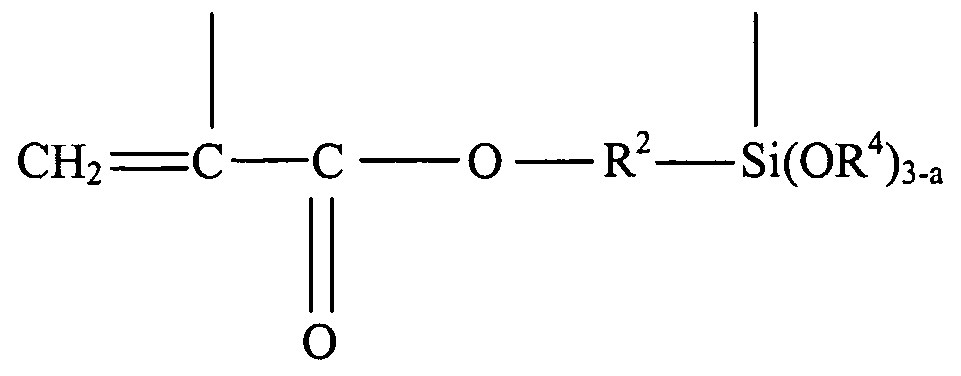
- the acryloxy group- or methacryloxy group-containing alkoxysilane of Component (B) is represented by the following general formula:
- R 1 is a hydrogen atom or methyl.
- a hydrogen atom is preferable.
- R 2 is a divalent hydrocarbon group with 1 to 10 carbon atoms. The following are examples of such divalent hydrocarbon groups: methylene, ethylene, propylene, propylene, butylene, pentylene, hexylene, heptylene, or a similar alkylene; phenylene, tolylene, xylylene, naphthylene, or a similar arylene; and benzylene, phenethylene, or a similar arylenealkylene.
- the most preferable group for R is methylene, ethylene, or propylene.
- R 3 designates a monovalent hydrocarbon group, such as methyl, ethyl, propyl, butyl, pentyl, hexyl, heptyl, or a similar alkyl; phenyl, tolyl, xylyl, naphthyl, or a similar aryl; benzyl, phenethyl, or a similar aralkyl; chloromethyl, 3-chloropropyl, 3,3,3- trifluoropropyl, or a similar halogenated alkyl.
- the aforementioned monovalent hydrocarbon groups can be substituted or unsubstituted.
- R 4 is an alkyl group, such as a methyl group, ethyl group, propyl group, butyl group, pentyl group, hexyl group, or heptyl group.
- a is 0 or 1.
- the epoxy group-containing alkoxysilane of component (B) is exemplified by glycidoxymethyltriethoxysilane, alpha-glycidoxyethyl trimethoxysilane, alpha- glycidoxyethyltriethoxysilane, beta-glycidoxyethyltrimethoxysilane, beta- glycidoxyethyltriethoxysi lane, alpha-glycidoxypropyl trimethoxysilane, alpha- glycidoxypropyltriethoxysilane, beta-glycidoxypropyltrimethoxysilane, beta- glycidoxypropyltriethoxysilane, gamma-glycidoxypropyltrimethoxysilane, gamma- glycidoxypropylmethyldimethoxysilane, gamma-glycidoxypropyldimethylethoxysilane, and
- component (B) Although there are no special restrictions with regard to the amount in which component (B) can be used, it is recommended to use this component in the amount from 1 to 50 wt.%, preferably from 5 to 30 wt.%. If component (B) is used in an amount below the lower limit of the recommended range, the obtained composition will show a tendency to decrease in curability. If component (B) is used in the amount exceeding the upper limit of the recommended range, a cured body obtained from the composition will have low mechanical strength.
- Condensation reaction catalyst (C) either accelerates a condensation reaction between hydroxy groups of aforementioned component (A) and silicon-bonded alkoxy groups of aforementioned component (B), or imparts adhesiveness to the cured body obtained from the composition.
- component (C) dibutyltin dilaurate, dibutyltin dioctoate, dioctyltin dilaurate, dibutyltin maleate ester, stannous octoate, or a similar tin compound; tetrabutyltitanate, diisopropoxy-bis(acetylacetonate) titanium, diisopropoxy-bis(ethylacetoacetate) titanium, or a similar titanium compound.
- component (C) Although there are no special restrictions with regard to the amount in which component (C) should be used, it is recommended to use this component in the amount from 0.001 to 10 wt.%), preferably from 0.01 to 2 wt.%>. If component (C) is used in an amount below the lower limit of the recommended range, the obtained composition will show either a tendency to decrease in curability, or a tendency to decrease in adhesiveness after curing. If component (C) is used in the amount exceeding the upper limit of the recommended range, the composition will have low storage stability.
- Photoinitiator (D) is a component used for accelerating a photopolymerization reaction of the composition.
- This component can be represented by a radical photoinitiator, cationic photoinitiator, or mixture thereof.
- the radical photoinitiator is exemplified by benzophenone, acetophenone, benzyl ⁇ -hydroxyketone, -aminoketone, bis-acylphosphine oxide, or derivatives of the above.
- the cationic photoinitiator is exemplified by onium salts, diaryliodonium salts of sulfonic acids, triarylsulfonium salts of sulfonic acids, diaryliodonium salts of boronic acids, and triarylsulfonium salts of boronic acids.
- the aforementioned photoinitiators can be used in a combination of two or more.
- component (D) it is recommended to use this component in the amount from 0.01 to 20 wt.%), preferably from 0.1 to 10 wt.%. If component (D) is used in an amount below the lower limit of the recommended range, the obtained composition will show a tendency to decrease in photocurability. If component (D) is used in the amount exceeding the upper limit of the recommended range, a cured body obtained from the composition will have low mechanical strength.
- the composition of the invention is prepared from components comprising (A), (B), (C), and (D). If necessary, an adhesion-promoting agent can be added as optional component (E).
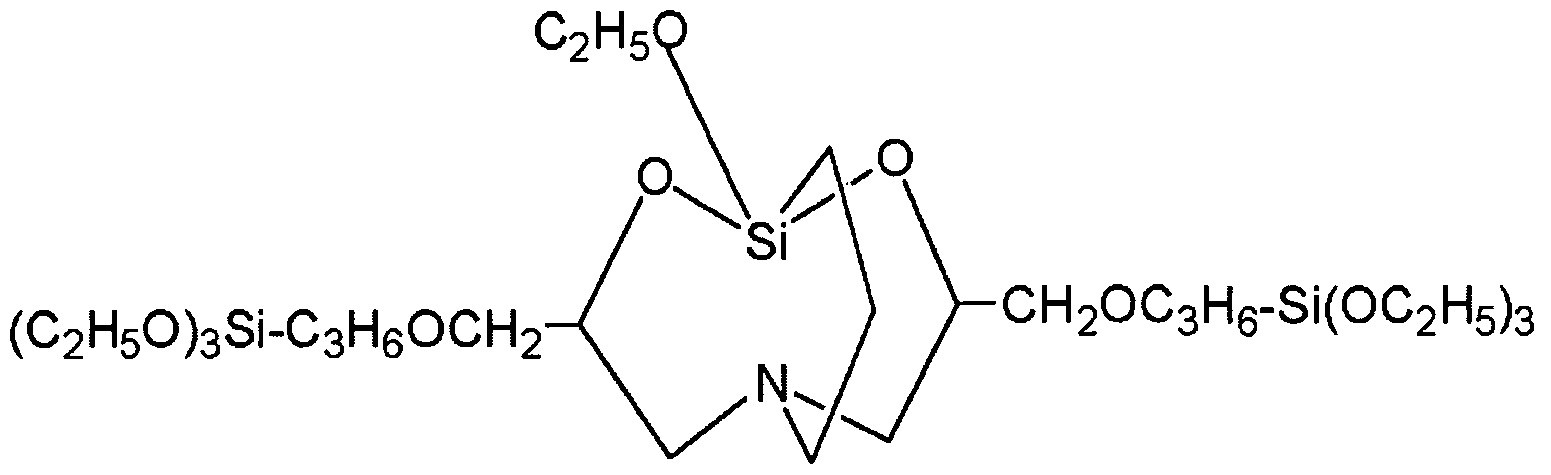
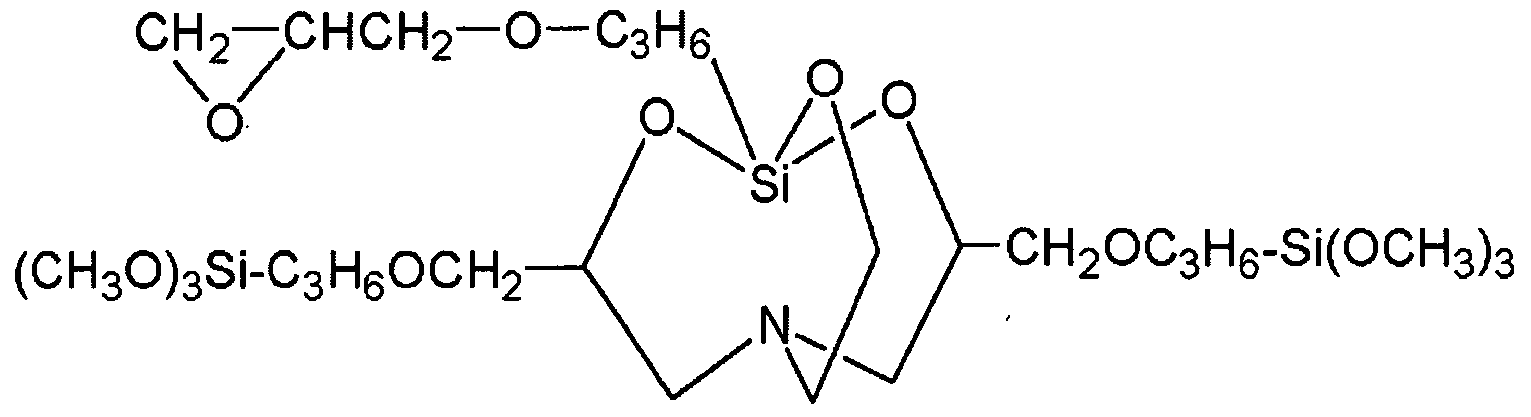
- component (E) methyltrimethoxysilane, methyltriethoxysilane, or a similar alkoxysilane; 3- glycidoxypropyl-trimethoxysilane, 2-(3,4-epoxycyclohexyl) ethyltrimethoxysilane, or a similar epoxy-containing alkoxysilane; a carbasilatrane derivative; or a silatrane derivative.
- Carbasilatrane derivatives are exemplified by, but not limited to, the following formulae:
- Silatrane derivatives are exemplified by, but not limited to the following formulae:
- the aforementioned carbasilatrane derivatives can be prepared by causing a reaction between an alkoxy silane that contains an alkoxy group and an alkoxy silane that contains an epoxy group, the reaction being carried out in the present of an alcohol.
- Kokai HlO-182669 Kokai HI 1-116584 (U.S. Pat. No. 5,936,110), and Kokai HI 1-279182 (U.S. Pat. No.
- the aforementioned carbasilatrane derivatives can be prepared by causing a reaction either between an epoxy-containing alkoxysilane compound and a hydroxy-amine compound or an ammonia, or between an epoxy compound, alkoxysilane and an ammonia or amine compound.
- component (E) Although there are no special restrictions with regard to the amount in which component (E) should be used, it is recommended to use this component in the amount not exceeding 15 wt.%>, preferably within the range from 0.5 to 10 wt.%>. If component (E) is used in an amount exceeding the upper limit of the recommended range, a cured body obtained from the composition will have low mechanical strength. [0023] To control flowability of the composition, or for improving mechanical strength and heat-resistant properties of a cured article produced from the aforementioned composition, the composition can be combined with a filler, provided that the filler is added in an amount not conflicting with the objects of the present invention.
- fillers dry-process silica, wet-process silica, quartz fine powder, diatomaceous earth, or a similar silica; a solid silicone resin; titanium oxide, zinc oxide, iron oxide, cerium oxide, alumina, or a similar metal oxide; rare-earth hydroxide compound, aluminum hydroxide, carbon black, graphite, silicon carbonate, mica, talc, pigment, anti-corrosion agent, and antibacterial agent.
- the alkoxysiloxy group is represented by the following general formula: R' x SiCOR'V x rO-
- x is 1 or 2.
- x has a value of 1.
- R' is independently selected from the group consisting of a monovalent hydrocarbon group and radiation curable group selected from the group consisting of an acryloxy group, methacryloxy group, and epoxy group with the proviso that at least one R is the radiation curable group.
- Examples of the monovalent hydrocarbon group are the same as given above.
- Examples of the acryloxy group are the same as given above.
- methacryloxy group are the same as given above.
- Examples of the epoxy group are the same as given above.
- R" is an alkyl group.
- Example of the alkyl group are the same as given above.
- R" is methyl. Because of availability, cost and reactivity, methoxy silanes and ethoxy silanes are the most preferred.
- R is an acryloxy group or methacryloxy group.
- the acryloxy group- or methacryloxy group-containing alkoxysiloxy group is represented by the following general formula:
- R 1 is a hydrogen atom or a methyl group, a hydrogen atom being preferable.
- R 2 is a divalent hydrocarbon group with 1 to 10 carbon atoms. Examples of this group are the same as given above. Preferably, this should be an alkylene group.
- R is a monovalent hydrocarbon group of the same type as defined earlier.
- R 4 is an alkyl group of the same type as defined earlier, and a is 0 or 1.
- Liquid organic polymers suitable for use as raw materials for aforementioned component (F) can be represented by polybutadiene, polyisoprene, polyisobutylene, polybutylene glycol, polypropylene glycol, polyethylene glycol-polypropylene glycol copolymers, polyethylene glycol-polybutylene glycol copolymers, or products of their hydrogenates, but these examples are not limiting and other similar compounds can be used, provided that at least one hydroxy group is contained per molecule.
- component (F) Although there are no special restrictions with regard to a method used for the preparation of aforementioned component (F), it is recommended to prepare this component by causing a condensation reaction between a liquid organic polymer having at least one hydroxy group per molecule of component (A) and a radiation curable alkoxysilane of component (B), the reaction being carried out in the presence of a condensation reaction catalyst of component (C).
- components (A), (B), and (C) are the same as defined above.
- reaction conditions it is recommended that the reaction be carried out at a temperature between room temperature and 50°C.
- component (A) be added in an amount of 50 to 95 wt.%, preferably 70 to 90 wt.%> of total weights of all components. It is recommended that the weight of component (B) constitute 1 to 50 wt.%, preferably 5 to 30 wt.%> of total weights of all components. It is recommended that component (C) be added in the amount of 0.001 to 10 wt.%, preferably 0.01 to 2 wt.%) of total weights of all components. If component (A) is added in an amount smaller than the lower recommended limit of the above range, a cured body obtained from the photocurable organic polymer composition that contains the obtained organic polymer will have low mechanical strength.
- component (A) is used in excess of the recommended upper limit, the obtained organic polymer will have decreased photocurability. If component (B) is added in an amount smaller than the lower recommended limit of the above range, the obtained organic polymer will have decreased photocurability. If component (B) is used in excess of the recommended upper limit, a cured body obtained from the photocurable organic polymer composition that contains the obtained organic polymer will have low mechanical strength. If component (C) is added in an amount smaller than the lower recommended limit of the above range, it would be impossible to ensure sufficient acceleration of the condensation reaction. If component (C) is used in excess of the recommended upper limit, the obtained organic polymer will show a tendency to a decrease in stability.
- Component (F) prepared by the aforementioned method may contain non-reacted components (A), (B), and component (C).
- component (F) it is recommended to use this component in the amount of 80 to 99.99, preferably 90 to 99.9 wt.%> of the composition. If component (F) is used in an amount smaller than the lower recommended limit of the above range, a cured article formed from the composition will have a reduced mechanical strength. If this component is used in an amount exceeding the upper recommended limit of the range, the obtained composition will have reduced photocurability.
- the photoinitiator which is component (D)
- component (D) is used for accelerating photopolymerization of the composition.
- component (D) are the same as those given above for photoinitiators.
- These photoinitiators can be used in a combination of two or more.
- component (D) Although there are no special limitations with regard to the amount in which component (D) should be used, it is recommended to use this component in the amount of 0.01 to 20 wt.%), preferably 0.1 to 10 wt.%> of the composition. If component (D) is used in an amount smaller than the lower recommended limit of the above range, the obtained composition will have reduced photocurability. If this component is used in an amount exceeding the upper recommended limit of the range, a cured article formed from the composition will have a reduced mechanical strength. [0033]
- the composition of the invention can be prepared from components comprising (F) and (D). If necessary, optional component (E) can be used as an adhesion-promoting agent.
- component (E) are the same as those given above for an adhesion- promoting agent. Although there are no special limitations with regard to the amount in which component (E) should be used, it is recommended that its content does not exceed 15 wt.% and it be used preferably in the amount of 0.5 to 10 wt.%. If this component is used in an amount exceeding the upper recommended limit of the range, a cured article formed from the composition will have a reduced mechanical strength. [0034] To control flowability of the composition, or for improving mechanical strength and heat-resistant properties of a cured article produced from the aforementioned composition, the composition can be combined with a filler, provided that the filler is added in an amount not conflicting with the objects of the present invention. Examples of the fillers are the same as given above.
- the photocurable liquid polymer composition of the present invention can be quickly cured into a moisture-resistant solid body by irradiating the composition with ultraviolet rays, electron beams, or the like. After subsequent aging, the cured body develops adhesiveness. There are no special restrictions with regard to the aging process, but in general it can be carried out by heating or retaining the body at room temperature.
- a photocurable polybutadiene composition was prepared by mixing 100 parts by weight of a 6000 mPa-s viscosity liquid polybutadiene having both molecular terminals capped with hydroxy groups (the product of Idemitsu Petrochemical Co., Ltd, trademark "Poly bd R-45HT); 15 parts by weight of an organic silicon compound represented by the following formula:
- the aforementioned photocurable polybutadiene composition was applied onto the surfaces of an aluminum plate, glass plate, or a copper plate and cured by infrared irradiation at 3 Joules per square centimeter (J/cm ) from a high-pressure mercury lamp.
- the coated plates were then retained intact for 1 week at a temperature of 23 °C and relative humidity (RH) 55%>, and adhesiveness of the cured polybutadiene body to the aforementioned adherend was observed.
- RH relative humidity
- the aforementioned photocurable polybutadiene composition was applied also onto the surface of a fluororesin plate, and the coating was cured by infrared irradiation (3 J/cm 2 ) from a high-pressure mercury lamp. The coated plate was then retained intact for 1 week at a temperature of 23°C and RH 55%. The hardness of the obtained 1 millimeter-thick cured polybutadiene sheet was then measured in accordance with JIS 6253 in units of a E-type durometer. Moisture permeability was measured by a moisture permeation cup method in accordance with JIS Z 0208 at a temperature of 40°C and RH 90%. The results are shown in Table 1. Practical Example 2
- a photocurable polybutadiene composition was prepared by mixing 100 parts by weight of a 6000 mPa-s viscosity liquid polybutadiene having both molecular terminals capped with hydroxy groups (the product of Idemitsu Petrochemical Co., Ltd, trademark "Poly bd R-45HT); 15 parts by weight of an organic silicon compound represented by the following formula:
- a photocurable polybutadiene composition was prepared by additionally mixing the composition of Practical Example 2 with 2 parts by weight of a methyltrimethoxysilane and 2 parts by weight of a carbasilatrane derivative of the following formula:
- a photocurable polyisoprene composition was prepared by the same method as in Practical Example 3, with the exception that a 8000 mPa-s viscosity liquid polyisoprene (the product of Idemitsu Petrochemical Co., Ltd.; Poly ip) was used instead of the polybutadiene of Practical Example 3.
- the obtained photocurable polyisoprene composition was tested with regard to adhesiveness of the composition, hardness of a polyisoprene cured body, and moisture penetration therethrough. These tests and measurements were carried out by the same methods as in Practical Example 1. The results are shown in Table 1. Comparative Example 1
- a photocurable polydimethylsiloxane composition was prepared by mixing 100 parts by weight of a 2000 mPa-s viscosity polydimethylsiloxane; 2 parts by weight of an organic silicon compound represented by the following formula:
- a photocurable polybutadiene composition was prepared by mixing 100 parts by weight of a 4000 mPa-s viscosity liquid polybutadiene having both molecular terminals capped with hydroxy groups and esterified with an acrylic acid (the product of Osaka Yuki Kagaku Co., Ltd, trademark BAC-45); 0.2 parts by weight of a diisopropoxy bis(ethylacetoacetate) titanium, 2 parts by weight of 1-hydroxy-cyclohexyl- phenylketone,2 parts by weight of a methyltrimethoxysilane, and 2 parts by weight of a carbasilatrane derivative represented by the following formula:
- the photocurable polymer of the present invention is efficient in that it can be quickly cured into a moisture-penetration-resistant solid body by irradiation with ultraviolet rays, electron beams, and the like, and in that after aging the cured body acquires adhesiveness.
- the composition of the invention can be used for manufacturing various parts or coating agents for various parts, potting agents, etc.
- the composition is suitable for use as potting agents or coating agents for protecting electric circuits. Since the composition is rapidly cured by irradiation with ultraviolet rays and electron beams, they are also suitable for use as adhesives and coating agents for electrical parts with low thermal resistance, such as liquid-crystal panels, or the like.
Landscapes
- Chemical & Material Sciences (AREA)
- Health & Medical Sciences (AREA)
- Chemical Kinetics & Catalysis (AREA)
- Medicinal Chemistry (AREA)
- Polymers & Plastics (AREA)
- Organic Chemistry (AREA)
- General Chemical & Material Sciences (AREA)
- Paints Or Removers (AREA)
- Compositions Of Macromolecular Compounds (AREA)
- Macromonomer-Based Addition Polymer (AREA)
- Adhesives Or Adhesive Processes (AREA)
- Sealing Material Composition (AREA)
- Addition Polymer Or Copolymer, Post-Treatments, Or Chemical Modifications (AREA)
- Silicon Polymers (AREA)
- Polymerisation Methods In General (AREA)
- Polymers With Sulfur, Phosphorus Or Metals In The Main Chain (AREA)
Abstract
Description







Claims


Priority Applications (6)
| Application Number | Priority Date | Filing Date | Title |
|---|---|---|---|
| JP2003561312A JP4469178B2 (en) | 2001-12-18 | 2002-12-17 | Photo-curable organic polymer composition |
| KR1020047009425A KR100938989B1 (en) | 2001-12-18 | 2002-12-17 | Photocurable organic polymer composition |
| US10/498,396 US7094306B2 (en) | 2001-12-18 | 2002-12-17 | Photocurable organic polymer composition |
| AU2002366311A AU2002366311A1 (en) | 2001-12-18 | 2002-12-17 | Photocurable organic polymer composition |
| DE60213858T DE60213858T2 (en) | 2001-12-18 | 2002-12-17 | PHOTOHÄRTBARE ORGANISCHE POLYMERZUSAMMENSZEZZUNG |
| EP02790791A EP1456251B1 (en) | 2001-12-18 | 2002-12-17 | Photocurable organic polymer composition |
Applications Claiming Priority (2)
| Application Number | Priority Date | Filing Date | Title |
|---|---|---|---|
| JPNO.2001-384097 | 2001-12-18 | ||
| JP2001384097 | 2001-12-18 |
Publications (1)
| Publication Number | Publication Date |
|---|---|
| WO2003051933A1 true WO2003051933A1 (en) | 2003-06-26 |
Family
ID=19187696
Family Applications (1)
| Application Number | Title | Priority Date | Filing Date |
|---|---|---|---|
| PCT/JP2002/013200 Ceased WO2003051933A1 (en) | 2001-12-18 | 2002-12-17 | Photocurable organic polymer composition |
Country Status (9)
| Country | Link |
|---|---|
| US (1) | US7094306B2 (en) |
| EP (1) | EP1456251B1 (en) |
| JP (1) | JP4469178B2 (en) |
| KR (1) | KR100938989B1 (en) |
| AT (1) | ATE335770T1 (en) |
| AU (1) | AU2002366311A1 (en) |
| DE (1) | DE60213858T2 (en) |
| TW (1) | TWI275605B (en) |
| WO (1) | WO2003051933A1 (en) |
Cited By (6)
| Publication number | Priority date | Publication date | Assignee | Title |
|---|---|---|---|---|
| US9926362B2 (en) | 2007-06-01 | 2018-03-27 | Gliknik Inc. | Immunoglobulin constant region Fc receptor binding agents |
| US11034775B2 (en) | 2016-06-07 | 2021-06-15 | Gliknik Inc. | Cysteine-optimized stradomers |
| US11117940B2 (en) | 2010-07-28 | 2021-09-14 | Gliknik Inc. | Fusion proteins of natural human protein fragments to create orderly multimerized immunoglobulin Fc compositions |
| US11795193B2 (en) | 2016-12-09 | 2023-10-24 | Gliknik Inc. | Manufacturing optimization of GL-2045, a multimerizing stradomer |
| US12122836B2 (en) | 2015-07-24 | 2024-10-22 | Gliknik Inc. | Fusion proteins of human protein fragments to create orderly multimerized immunoglobulin Fc compositions with enhanced complement binding |
| US12337026B2 (en) | 2016-12-09 | 2025-06-24 | Gliknik Inc. | Methods of treating inflammatory disorders with multivalent Fc compounds |
Families Citing this family (5)
| Publication number | Priority date | Publication date | Assignee | Title |
|---|---|---|---|---|
| WO2006069376A2 (en) * | 2004-12-22 | 2006-06-29 | University Of Cincinnati | Improved superprimer |
| US7791788B2 (en) * | 2006-02-21 | 2010-09-07 | Research Frontiers Incorporated | SPD light valves incorporating films comprising improved matrix polymers and methods for making such matrix polymers |
| CN102898958B (en) * | 2011-07-25 | 2016-11-02 | 汉高股份有限公司 | A kind of adhesive composition |
| JP5884647B2 (en) * | 2012-06-01 | 2016-03-15 | 信越化学工業株式会社 | CURABLE COMPOSITION AND CURED MOLDED ARTICLE OF THE SAME |
| ES2881471T3 (en) | 2017-07-21 | 2021-11-29 | Henkel Ag & Co Kgaa | Silylated polyurethanes and methods for their preparation |
Citations (9)
| Publication number | Priority date | Publication date | Assignee | Title |
|---|---|---|---|---|
| GB2089826A (en) * | 1980-12-18 | 1982-06-30 | Gen Electric | Abrasion resistant ultraviolet light curable hard coating compositions |
| EP0134678A2 (en) * | 1983-07-20 | 1985-03-20 | Loctite Corporation | Polymers with graft alpha-alkylarylate functionality |
| US4528081A (en) * | 1983-10-03 | 1985-07-09 | Loctite Corporation | Dual curing silicone, method of preparing same and dielectric soft-gel compositions thereof |
| EP0336474A1 (en) * | 1988-03-25 | 1989-10-11 | Dsm N.V. | Composition containing UV curable unsaturated monomers and/or oligomers, a photoinitiator and colloidal silica with an organosilane compound, and the application of this composition in coatings |
| US5665823A (en) * | 1996-08-30 | 1997-09-09 | Dow Corning Corporation | Polyisobutylene polymers having acrylic functionality |
| US5700874A (en) * | 1994-08-25 | 1997-12-23 | Bridgestone Corporation | Alkoxysilane-modified polymer and adhesive composition using said polymer |
| EP0839864A2 (en) * | 1996-10-31 | 1998-05-06 | Kaneka Corporation | Curable resin composition |
| EP0844257A2 (en) * | 1996-11-25 | 1998-05-27 | Kaneka Corporation | Curable composition |
| EP0850961A1 (en) * | 1996-12-31 | 1998-07-01 | Lucent Technologies Inc. | Curable coatings with improved adhesion to glass |
Family Cites Families (5)
| Publication number | Priority date | Publication date | Assignee | Title |
|---|---|---|---|---|
| JP2639286B2 (en) * | 1992-07-14 | 1997-08-06 | 信越化学工業株式会社 | Curable organopolysiloxane composition |
| JP3831481B2 (en) | 1996-11-18 | 2006-10-11 | 東レ・ダウコーニング株式会社 | Carbacyltolan derivative, method for producing the same, adhesion promoter, and curable silicone composition |
| JP4148544B2 (en) | 1996-12-25 | 2008-09-10 | 東レ・ダウコーニング株式会社 | Silatrane derivative and method for producing the same |
| DE69816395T2 (en) * | 1997-10-13 | 2004-05-13 | Dow Corning Toray Silicone Company, Ltd. | Silatran derivatives and curable silicone compositions containing them |
| US5945555A (en) * | 1997-11-28 | 1999-08-31 | Dow Corning Toray Silicone Co., Ltd. | Silatrane derivative, method for manufacturing same, adhesion promoter, and curable silicone composition |
-
2002
- 2002-12-17 AT AT02790791T patent/ATE335770T1/en not_active IP Right Cessation
- 2002-12-17 AU AU2002366311A patent/AU2002366311A1/en not_active Abandoned
- 2002-12-17 WO PCT/JP2002/013200 patent/WO2003051933A1/en not_active Ceased
- 2002-12-17 KR KR1020047009425A patent/KR100938989B1/en not_active Expired - Fee Related
- 2002-12-17 JP JP2003561312A patent/JP4469178B2/en not_active Expired - Fee Related
- 2002-12-17 US US10/498,396 patent/US7094306B2/en not_active Expired - Fee Related
- 2002-12-17 DE DE60213858T patent/DE60213858T2/en not_active Expired - Lifetime
- 2002-12-17 EP EP02790791A patent/EP1456251B1/en not_active Expired - Lifetime
- 2002-12-18 TW TW091136512A patent/TWI275605B/en not_active IP Right Cessation
Patent Citations (9)
| Publication number | Priority date | Publication date | Assignee | Title |
|---|---|---|---|---|
| GB2089826A (en) * | 1980-12-18 | 1982-06-30 | Gen Electric | Abrasion resistant ultraviolet light curable hard coating compositions |
| EP0134678A2 (en) * | 1983-07-20 | 1985-03-20 | Loctite Corporation | Polymers with graft alpha-alkylarylate functionality |
| US4528081A (en) * | 1983-10-03 | 1985-07-09 | Loctite Corporation | Dual curing silicone, method of preparing same and dielectric soft-gel compositions thereof |
| EP0336474A1 (en) * | 1988-03-25 | 1989-10-11 | Dsm N.V. | Composition containing UV curable unsaturated monomers and/or oligomers, a photoinitiator and colloidal silica with an organosilane compound, and the application of this composition in coatings |
| US5700874A (en) * | 1994-08-25 | 1997-12-23 | Bridgestone Corporation | Alkoxysilane-modified polymer and adhesive composition using said polymer |
| US5665823A (en) * | 1996-08-30 | 1997-09-09 | Dow Corning Corporation | Polyisobutylene polymers having acrylic functionality |
| EP0839864A2 (en) * | 1996-10-31 | 1998-05-06 | Kaneka Corporation | Curable resin composition |
| EP0844257A2 (en) * | 1996-11-25 | 1998-05-27 | Kaneka Corporation | Curable composition |
| EP0850961A1 (en) * | 1996-12-31 | 1998-07-01 | Lucent Technologies Inc. | Curable coatings with improved adhesion to glass |
Cited By (11)
| Publication number | Priority date | Publication date | Assignee | Title |
|---|---|---|---|---|
| US9926362B2 (en) | 2007-06-01 | 2018-03-27 | Gliknik Inc. | Immunoglobulin constant region Fc receptor binding agents |
| US10208105B2 (en) | 2007-06-01 | 2019-02-19 | Gliknik Inc. | Immunoglobulin constant region Fc receptor binding agents |
| US10851154B2 (en) | 2007-06-01 | 2020-12-01 | Gliknik Inc. | Immunoglobulin constant region Fc receptor binding agents |
| US10941191B2 (en) | 2007-06-01 | 2021-03-09 | University Of Maryland, Baltimore | Immunoglobulin constant region Fc receptor binding agents |
| US11117940B2 (en) | 2010-07-28 | 2021-09-14 | Gliknik Inc. | Fusion proteins of natural human protein fragments to create orderly multimerized immunoglobulin Fc compositions |
| US12084482B2 (en) | 2010-07-28 | 2024-09-10 | Gliknik Inc. | Fusion proteins of natural human protein fragments to create orderly multimerized immunoglobulin Fc compositions |
| US12122836B2 (en) | 2015-07-24 | 2024-10-22 | Gliknik Inc. | Fusion proteins of human protein fragments to create orderly multimerized immunoglobulin Fc compositions with enhanced complement binding |
| US11034775B2 (en) | 2016-06-07 | 2021-06-15 | Gliknik Inc. | Cysteine-optimized stradomers |
| US11795193B2 (en) | 2016-12-09 | 2023-10-24 | Gliknik Inc. | Manufacturing optimization of GL-2045, a multimerizing stradomer |
| US12195499B2 (en) | 2016-12-09 | 2025-01-14 | Gliknik Inc. | Manufacturing optimization of GL-2045, a multimerizing stradomer |
| US12337026B2 (en) | 2016-12-09 | 2025-06-24 | Gliknik Inc. | Methods of treating inflammatory disorders with multivalent Fc compounds |
Also Published As
| Publication number | Publication date |
|---|---|
| KR20040068262A (en) | 2004-07-30 |
| EP1456251A1 (en) | 2004-09-15 |
| EP1456251B1 (en) | 2006-08-09 |
| AU2002366311A1 (en) | 2003-06-30 |
| DE60213858T2 (en) | 2007-08-30 |
| DE60213858D1 (en) | 2006-09-21 |
| US20050090574A1 (en) | 2005-04-28 |
| KR100938989B1 (en) | 2010-01-28 |
| JP2005515274A (en) | 2005-05-26 |
| TWI275605B (en) | 2007-03-11 |
| ATE335770T1 (en) | 2006-09-15 |
| US7094306B2 (en) | 2006-08-22 |
| TW200301277A (en) | 2003-07-01 |
| JP4469178B2 (en) | 2010-05-26 |
Similar Documents
| Publication | Publication Date | Title |
|---|---|---|
| US5516812A (en) | UV-moisture dual cure silicone conformal coating compositions with improved surface tack | |
| US6451870B1 (en) | Dual curing silicone compositions | |
| EP2141188B1 (en) | Silicon-containing compound, curable composition and cured product | |
| EP2878632B1 (en) | Room-temperature-curable polyorganosiloxane composition and electric/electronic apparatus | |
| JPH02103264A (en) | Adhesion accelerator for ultraviolet-curing siloxane composition, and composition containing said accelerator | |
| JPH09208829A (en) | Curable organopolysiloxane composition and method for bonding substrate to adherend using the same | |
| EP0781813A2 (en) | Curable organopolysiloxane composition and method for bonding objects using said composition | |
| EP1456251B1 (en) | Photocurable organic polymer composition | |
| TWI809542B (en) | Silicone-based composition, cured product thereof, and device | |
| JPH0710953B2 (en) | Curable organopolysiloxane composition | |
| JP7552688B2 (en) | Room temperature curable organopolysiloxane compositions and articles | |
| CN101827905B (en) | Room-temperature curable organopolysiloxane composition | |
| US4975472A (en) | Curable organopolysiloxane composition | |
| EP0626426A2 (en) | Room-temperature-curable organopolysiloxane composition | |
| JP7485049B2 (en) | Thermally radically curable organopolysiloxane composition, articles bonded, coated or potted with said composition, and method for producing a cured product of said composition | |
| KR20240089740A (en) | Room temperature curable organopolysiloxane compositions, adhesives, sealants and coatings | |
| US20150225577A1 (en) | Silicone mist inhibitor | |
| JP6762188B2 (en) | Curable polyorganosiloxane composition and electrical / electronic equipment | |
| JP6762189B2 (en) | Curable polyorganosiloxane composition and electrical / electronic equipment | |
| CN1984964A (en) | Room-temperature curable organopolysiloxane composition and electrical or electronic devices | |
| KR102298513B1 (en) | Moisture-curable siloxanes composition | |
| JP7647879B2 (en) | Room temperature curable silicone coating composition and article | |
| KR102630658B1 (en) | Moisture-curable siloxanes composition | |
| JP2024164924A (en) | Color-developing ultraviolet-curable silicone coating composition and method of using said composition |
Legal Events
| Date | Code | Title | Description |
|---|---|---|---|
| AK | Designated states |
Kind code of ref document: A1 Designated state(s): AE AG AL AM AT AU AZ BA BB BG BR BY BZ CA CH CN CO CR CU CZ DE DK DM DZ EC EE ES FI GB GD GE GH GM HR HU ID IL IN IS JP KE KG KP KR KZ LC LK LR LS LT LU LV MA MD MG MK MN MW MX MZ NO NZ OM PH PL PT RO RU SC SD SE SG SK SL TJ TM TN TR TT TZ UA UG US UZ VC VN YU ZA ZM ZW |
|
| AL | Designated countries for regional patents |
Kind code of ref document: A1 Designated state(s): GH GM KE LS MW MZ SD SL SZ TZ UG ZM ZW AM AZ BY KG KZ MD RU TJ TM AT BE BG CH CY CZ DE DK EE ES FI FR GB GR IE IT LU MC NL PT SE SI SK TR BF BJ CF CG CI CM GA GN GQ GW ML MR NE SN TD TG |
|
| 121 | Ep: the epo has been informed by wipo that ep was designated in this application | ||
| DFPE | Request for preliminary examination filed prior to expiration of 19th month from priority date (pct application filed before 20040101) | ||
| WWE | Wipo information: entry into national phase |
Ref document number: 2003561312 Country of ref document: JP Ref document number: 10498396 Country of ref document: US |
|
| WWE | Wipo information: entry into national phase |
Ref document number: 1020047009425 Country of ref document: KR |
|
| WWE | Wipo information: entry into national phase |
Ref document number: 2002790791 Country of ref document: EP |
|
| WWP | Wipo information: published in national office |
Ref document number: 2002790791 Country of ref document: EP |
|
| WWG | Wipo information: grant in national office |
Ref document number: 2002790791 Country of ref document: EP |