TWI809542B - Silicone-based composition, cured product thereof, and device - Google Patents
Silicone-based composition, cured product thereof, and device Download PDFInfo
- Publication number
- TWI809542B TWI809542B TW110140107A TW110140107A TWI809542B TW I809542 B TWI809542 B TW I809542B TW 110140107 A TW110140107 A TW 110140107A TW 110140107 A TW110140107 A TW 110140107A TW I809542 B TWI809542 B TW I809542B
- Authority
- TW
- Taiwan
- Prior art keywords
- silicone
- weight
- polyorganosiloxane
- chemical formula
- based composition
- Prior art date
Links
Classifications
-
- C—CHEMISTRY; METALLURGY
- C08—ORGANIC MACROMOLECULAR COMPOUNDS; THEIR PREPARATION OR CHEMICAL WORKING-UP; COMPOSITIONS BASED THEREON
- C08L—COMPOSITIONS OF MACROMOLECULAR COMPOUNDS
- C08L51/00—Compositions of graft polymers in which the grafted component is obtained by reactions only involving carbon-to-carbon unsaturated bonds; Compositions of derivatives of such polymers
- C08L51/08—Compositions of graft polymers in which the grafted component is obtained by reactions only involving carbon-to-carbon unsaturated bonds; Compositions of derivatives of such polymers grafted on to macromolecular compounds obtained otherwise than by reactions only involving unsaturated carbon-to-carbon bonds
- C08L51/085—Compositions of graft polymers in which the grafted component is obtained by reactions only involving carbon-to-carbon unsaturated bonds; Compositions of derivatives of such polymers grafted on to macromolecular compounds obtained otherwise than by reactions only involving unsaturated carbon-to-carbon bonds on to polysiloxanes
-
- C—CHEMISTRY; METALLURGY
- C09—DYES; PAINTS; POLISHES; NATURAL RESINS; ADHESIVES; COMPOSITIONS NOT OTHERWISE PROVIDED FOR; APPLICATIONS OF MATERIALS NOT OTHERWISE PROVIDED FOR
- C09D—COATING COMPOSITIONS, e.g. PAINTS, VARNISHES OR LACQUERS; FILLING PASTES; CHEMICAL PAINT OR INK REMOVERS; INKS; CORRECTING FLUIDS; WOODSTAINS; PASTES OR SOLIDS FOR COLOURING OR PRINTING; USE OF MATERIALS THEREFOR
- C09D4/00—Coating compositions, e.g. paints, varnishes or lacquers, based on organic non-macromolecular compounds having at least one polymerisable carbon-to-carbon unsaturated bond ; Coating compositions, based on monomers of macromolecular compounds of groups C09D183/00 - C09D183/16
- C09D4/06—Organic non-macromolecular compounds having at least one polymerisable carbon-to-carbon unsaturated bond in combination with a macromolecular compound other than an unsaturated polymer of groups C09D159/00 - C09D187/00
-
- C—CHEMISTRY; METALLURGY
- C08—ORGANIC MACROMOLECULAR COMPOUNDS; THEIR PREPARATION OR CHEMICAL WORKING-UP; COMPOSITIONS BASED THEREON
- C08F—MACROMOLECULAR COMPOUNDS OBTAINED BY REACTIONS ONLY INVOLVING CARBON-TO-CARBON UNSATURATED BONDS
- C08F2/00—Processes of polymerisation
- C08F2/46—Polymerisation initiated by wave energy or particle radiation
- C08F2/48—Polymerisation initiated by wave energy or particle radiation by ultraviolet or visible light
- C08F2/50—Polymerisation initiated by wave energy or particle radiation by ultraviolet or visible light with sensitising agents
-
- C—CHEMISTRY; METALLURGY
- C08—ORGANIC MACROMOLECULAR COMPOUNDS; THEIR PREPARATION OR CHEMICAL WORKING-UP; COMPOSITIONS BASED THEREON
- C08F—MACROMOLECULAR COMPOUNDS OBTAINED BY REACTIONS ONLY INVOLVING CARBON-TO-CARBON UNSATURATED BONDS
- C08F290/00—Macromolecular compounds obtained by polymerising monomers on to polymers modified by introduction of aliphatic unsaturated end or side groups
- C08F290/02—Macromolecular compounds obtained by polymerising monomers on to polymers modified by introduction of aliphatic unsaturated end or side groups on to polymers modified by introduction of unsaturated end groups
- C08F290/06—Polymers provided for in subclass C08G
- C08F290/068—Polysiloxanes
-
- C—CHEMISTRY; METALLURGY
- C08—ORGANIC MACROMOLECULAR COMPOUNDS; THEIR PREPARATION OR CHEMICAL WORKING-UP; COMPOSITIONS BASED THEREON
- C08K—Use of inorganic or non-macromolecular organic substances as compounding ingredients
- C08K3/00—Use of inorganic substances as compounding ingredients
- C08K3/34—Silicon-containing compounds
- C08K3/36—Silica
-
- C—CHEMISTRY; METALLURGY
- C08—ORGANIC MACROMOLECULAR COMPOUNDS; THEIR PREPARATION OR CHEMICAL WORKING-UP; COMPOSITIONS BASED THEREON
- C08K—Use of inorganic or non-macromolecular organic substances as compounding ingredients
- C08K5/00—Use of organic ingredients
- C08K5/54—Silicon-containing compounds
- C08K5/549—Silicon-containing compounds containing silicon in a ring
-
- C—CHEMISTRY; METALLURGY
- C08—ORGANIC MACROMOLECULAR COMPOUNDS; THEIR PREPARATION OR CHEMICAL WORKING-UP; COMPOSITIONS BASED THEREON
- C08L—COMPOSITIONS OF MACROMOLECULAR COMPOUNDS
- C08L83/00—Compositions of macromolecular compounds obtained by reactions forming in the main chain of the macromolecule a linkage containing silicon with or without sulfur, nitrogen, oxygen or carbon only; Compositions of derivatives of such polymers
- C08L83/04—Polysiloxanes
- C08L83/06—Polysiloxanes containing silicon bound to oxygen-containing groups
-
- C—CHEMISTRY; METALLURGY
- C08—ORGANIC MACROMOLECULAR COMPOUNDS; THEIR PREPARATION OR CHEMICAL WORKING-UP; COMPOSITIONS BASED THEREON
- C08G—MACROMOLECULAR COMPOUNDS OBTAINED OTHERWISE THAN BY REACTIONS ONLY INVOLVING UNSATURATED CARBON-TO-CARBON BONDS
- C08G77/00—Macromolecular compounds obtained by reactions forming a linkage containing silicon with or without sulfur, nitrogen, oxygen or carbon in the main chain of the macromolecule
- C08G77/04—Polysiloxanes
- C08G77/14—Polysiloxanes containing silicon bound to oxygen-containing groups
-
- C—CHEMISTRY; METALLURGY
- C08—ORGANIC MACROMOLECULAR COMPOUNDS; THEIR PREPARATION OR CHEMICAL WORKING-UP; COMPOSITIONS BASED THEREON
- C08G—MACROMOLECULAR COMPOUNDS OBTAINED OTHERWISE THAN BY REACTIONS ONLY INVOLVING UNSATURATED CARBON-TO-CARBON BONDS
- C08G77/00—Macromolecular compounds obtained by reactions forming a linkage containing silicon with or without sulfur, nitrogen, oxygen or carbon in the main chain of the macromolecule
- C08G77/04—Polysiloxanes
- C08G77/20—Polysiloxanes containing silicon bound to unsaturated aliphatic groups
-
- C—CHEMISTRY; METALLURGY
- C08—ORGANIC MACROMOLECULAR COMPOUNDS; THEIR PREPARATION OR CHEMICAL WORKING-UP; COMPOSITIONS BASED THEREON
- C08K—Use of inorganic or non-macromolecular organic substances as compounding ingredients
- C08K2201/00—Specific properties of additives
- C08K2201/012—Additives improving oxygen scavenging properties
-
- C—CHEMISTRY; METALLURGY
- C08—ORGANIC MACROMOLECULAR COMPOUNDS; THEIR PREPARATION OR CHEMICAL WORKING-UP; COMPOSITIONS BASED THEREON
- C08L—COMPOSITIONS OF MACROMOLECULAR COMPOUNDS
- C08L2205/00—Polymer mixtures characterised by other features
- C08L2205/02—Polymer mixtures characterised by other features containing two or more polymers of the same C08L -group
- C08L2205/025—Polymer mixtures characterised by other features containing two or more polymers of the same C08L -group containing two or more polymers of the same hierarchy C08L, and differing only in parameters such as density, comonomer content, molecular weight, structure
Landscapes
- Chemical & Material Sciences (AREA)
- Organic Chemistry (AREA)
- Polymers & Plastics (AREA)
- Health & Medical Sciences (AREA)
- Chemical Kinetics & Catalysis (AREA)
- Medicinal Chemistry (AREA)
- Materials Engineering (AREA)
- Wood Science & Technology (AREA)
- Engineering & Computer Science (AREA)
- Life Sciences & Earth Sciences (AREA)
- Macromonomer-Based Addition Polymer (AREA)
- Paints Or Removers (AREA)
- Adhesives Or Adhesive Processes (AREA)
- Compositions Of Macromolecular Compounds (AREA)
- Polymerisation Methods In General (AREA)
Abstract
Description
本申請案主張2021年3月16日在韓國智慧財產局申請的韓國專利申請第10-2021-0034102號的優先權以及權益,所述申請的整個內容以引用的方式併入本文中。 This application claims priority and benefit from Korean Patent Application No. 10-2021-0034102 filed with the Korea Intellectual Property Office on March 16, 2021, the entire contents of which are incorporated herein by reference.
本申請案是關於能夠藉由紫外(ultraviolet;UV)照射及濕度(moisture)雙重固化的矽酮類組成物及其固化產物。 This application relates to a silicone-based composition capable of dual curing by ultraviolet (ultraviolet; UV) irradiation and humidity (moisture) and its cured product.
本揭露內容是關於經由藉由紫外區(UV)中光的照射的進行光固化及藉由存在於空氣中的濕度進行冷凝固化的雙重固化製程來固化矽酮的組成物及其應用。 The present disclosure relates to compositions and applications for curing silicone through a dual curing process of photocuring by irradiation of light in the ultraviolet region (UV) and condensation curing by humidity present in the air.
在現存經由UV照射的固化中,未由UV覆蓋的區域並未獲得光固化。鑒於上文,已在不同角度處進行若干次照射UV的製程,然而儘管UV在製程操作中可迅速固化性,但由於UV需要在不同角度處照射且UV照射器針對角度控制變得複雜,因此製程時間相對增加。然而,儘管此類製程,存在由於仍存在未經UV照射的區域因此並未充分完成固化的問題。此外,由於矽酮較低表面張力及較低折射率的性質,因此廣泛地用於領域中的光起始劑的 使用勢必已受限制,且藉由UV固化的方法已受限制。 In existing curing via UV irradiation, the areas not covered by UV are not photocured. In view of the above, the process of irradiating UV at different angles has been carried out several times. However, although UV can be quickly cured in the process operation, because UV needs to be irradiated at different angles and the control of the UV irradiator for the angle becomes complicated, so The process time is relatively increased. However, despite such a process, there is a problem that curing is not sufficiently completed because there are still areas not irradiated by UV. In addition, silicone is widely used as a photoinitiator in the field due to its low surface tension and low refractive index properties. Use has necessarily been limited, and methods of curing by UV have been limited.
本申請案是關於提供能夠使用紫外光(UV)迅速進行固化,且即使針對未用紫外光照射的區域亦能夠使用濕度固化方法進行固化的矽酮類組成物,及其固化產物。 The present application is about providing a silicone-based composition that can be cured quickly by ultraviolet (UV) light, and can be cured by a moisture curing method even for areas that are not irradiated with ultraviolet light, and its cured product.
本申請案的一個實施例提供一種矽酮類組成物,包括,40重量%或大於40重量%的聚有機矽氧烷,具有由丙烯酸酯基形成的兩端且包括至少一個烷氧基;至少一種類型的0.1重量%至50重量%的丙烯酸類單體;至少一種類型的0.1重量%至5重量%的光起始劑;以及觸媒,用於濕度固化,以矽酮類組成物的總重量計。 An embodiment of the present application provides a silicone-based composition, including 40% by weight or more than 40% by weight of polyorganosiloxane, having two ends formed by acrylate groups and including at least one alkoxy group; at least 0.1% to 50% by weight of one type of acrylic monomer; 0.1% to 5% by weight of at least one type of photoinitiator; weighing scale.
本申請案另一實施例提供一種藉由固化矽酮類組成物來製備的固化產物。 Another embodiment of the present application provides a cured product prepared by curing a silicone composition.
本申請案的另一實施例提供一種包括固化產物的裝置。 Another embodiment of the present application provides a device including a cured product.
根據本申請案的一個實施例的矽酮類組成物能夠使用紫外光(UV)迅速進行固化,且即使針對未用紫外光照射的區域亦能夠使用濕度固化方法進行固化。 The silicone-based composition according to an embodiment of the present application can be rapidly cured by ultraviolet (UV) light, and can be cured by a moisture curing method even for areas not irradiated by ultraviolet light.
此外,藉由包括具有由丙烯酸酯基形成的兩端且包括至少一個烷氧基的聚有機矽氧烷;以及至少一種類型的丙烯酸類單 體二者,根據本申請案的一個實施例的矽酮類組成物可具有矽酮橡膠的性質,控制不同地黏著強度,且可僅藉由濕度固化在表面上提供迅速的無黏性時間(tack free time)。 In addition, by including polyorganosiloxane having both ends formed of acrylate groups and including at least one alkoxy group; and at least one type of acrylic mono Both, the silicone-based composition according to an embodiment of the present application can have the properties of silicone rubber, control different adhesive strengths, and can provide a rapid tack-free time on the surface only by humidity curing ( tack free time).
在下文中,將詳細地描述本申請案。 Hereinafter, the present application will be described in detail.
在可僅藉由紫外照射可固化矽酮材料的情況下,未由紫外光覆蓋的區域尚未獲得固化。鑒於上文,紫外光需要在不同角度處照射若干次,且快速進行固化製程已為不可能的。此外,光起始劑的使用已受限制歸因於矽酮材料的較低表面張力及折射率,且因此紫外光的可固化性同樣為不利的。 In the case of silicone materials that are curable only by UV radiation, the areas not covered by UV light have not yet been cured. In view of the above, the ultraviolet light needs to be irradiated several times at different angles, and it is impossible to quickly perform the curing process. Furthermore, the use of photoinitiators has been limited due to the lower surface tension and refractive index of silicone materials, and thus UV curability is also disadvantageous.
為了在實際領域中快速進行製程,組成物需要在紫外照射之後迅速具有非流動性性質,且除此以外,即使針對未由光覆蓋的區域亦需要快速進行固化。 For fast processing in the practical field, the composition needs to have a non-flowing property quickly after UV irradiation, and besides, it needs to be cured quickly even for areas not covered by light.
因此,本申請案是關於提供能夠使用紫外光(UV)迅速進行固化,且即使針對未用紫外光照射的區域亦能夠使用濕度固化方法進行固化的矽酮類組成物,及其固化產物。 Therefore, the present application is directed to providing a silicone-based composition that can be cured quickly by ultraviolet (UV) light, and can be cured by a moisture curing method even for areas that are not irradiated with ultraviolet light, and cured products thereof.
根據本申請案的一個實施例的矽酮類組成物包括具有由丙烯酸酯基形成的兩端且包括至少一個烷氧基的聚有機矽氧烷;至少一種類型的丙烯酸類單體;至少一種類型的光起始劑;以及用於濕度固化的觸媒。 A silicone-based composition according to an embodiment of the present application includes polyorganosiloxane having both ends formed by acrylate groups and including at least one alkoxy group; at least one type of acrylic monomer; at least one type photoinitiators; and catalysts for humidity curing.
根據本申請案的一個實施例的矽酮類組成物主要首先經由紫外光固化,且可用濕度固化機制完成固化。換言之,矽酮類組成物藉由紫外照射且在在紫外照射之後迅速具有非流動性性質,在室溫下可藉由濕度迅速完成固化。因此,在實際領域中可藉由輻射紫外光快速切換至下一製程,且完全不需要諸如額外加熱及紫外再輻射的製程以完全地固化組成物。 The silicone-based composition according to an embodiment of the present application is mainly firstly cured by ultraviolet light, and can be cured by a humidity curing mechanism. In other words, the silicone-based composition is irradiated by ultraviolet rays and has a non-fluid property immediately after the ultraviolet irradiation, and can be cured rapidly by humidity at room temperature. Therefore, in the practical field, it is possible to quickly switch to the next process by irradiating ultraviolet light, and no process such as additional heating and ultraviolet re-irradiation is required to completely cure the composition.
此外,根據本申請案的一個實施例,在不使用濕度固化機制的額外紫外照射製程的情況下,即使針對未由紫外光覆蓋的區域亦可達成固化。此外,亦可在快速無黏性時間(tack free time)的情況下單獨進行濕度固化機制。 Furthermore, according to an embodiment of the present application, curing can be achieved even for areas not covered by UV light without an additional UV irradiation process using a humidity curing mechanism. In addition, the moisture curing mechanism alone can also be performed with a fast tack free time.
在本申請案的一個實施例中,具有由丙烯酸酯基形成的兩端且包括至少一個烷氧基的聚有機矽氧烷為同時包括紫外可固化官能基及濕度可固化官能基的聚有機矽氧烷。更具體而言,聚有機矽氧烷具有由丙烯酸酯基作為紫外可固化官能基形成的兩端,且包括至少一個在聚有機矽氧烷中作為濕度可固化官能基的烷氧基。 In one embodiment of the present application, the polyorganosiloxane having both ends formed by acrylate groups and including at least one alkoxy group is a polyorganosiloxane including both UV-curable functional groups and moisture-curable functional groups. oxane. More specifically, the polyorganosiloxane has both ends formed of an acrylate group as a UV-curable functional group, and includes at least one alkoxy group in the polyorganosiloxane as a moisture-curable functional group.
特定言之,根據本申請案的一個實施例的聚有機矽氧烷與具有由甲基丙烯酸脂基而不是丙烯酸酯基形成的兩端的聚有機矽氧烷相比,具有由丙烯酸酯基形成的兩端且可獲得更堅固的硬度性質水平。此外,當聚有機矽氧烷具有一端形成有丙烯酸酯基且另一端形成有環氧基時,需要較高紫外強度,且在未用紫外光照射的區域中的無黏性時間(tack free time)變得緩慢,使得難以期望製程改良的效應。 Specifically, the polyorganosiloxane according to one embodiment of the present application has a polyorganosiloxane formed of an acrylate group as compared with a polyorganosiloxane having both ends formed of a methacrylate group instead of an acrylate group. Both ends and for a firmer level of hardness properties. In addition, when polyorganosiloxane has an acrylate group formed at one end and an epoxy group formed at the other end, higher ultraviolet intensity is required, and tack free time in a region not irradiated with ultraviolet light is required. ) becomes slow, making it difficult to expect the effect of process improvement.
換言之,藉由包括具有由丙烯酸酯基形成的兩端且包括 至少一個烷氧基的聚有機矽氧烷,根據本申請案的一個實施例的矽酮類組成物可使用紫外(UV)光快速固化,且即使針對未用紫外光照射的區域亦可使用濕度固化方法充分固化。 In other words, by including both ends formed by acrylate groups and including A polyorganosiloxane with at least one alkoxy group, a silicone-based composition according to an embodiment of the present application can be cured quickly using ultraviolet (UV) light and can be used even for areas not irradiated with UV light. The curing method is fully cured.
在本申請案的一個實施例中,聚有機矽氧烷可由以下化學式1表示。 In one embodiment of the present application, polyorganosiloxane may be represented by Chemical Formula 1 below.
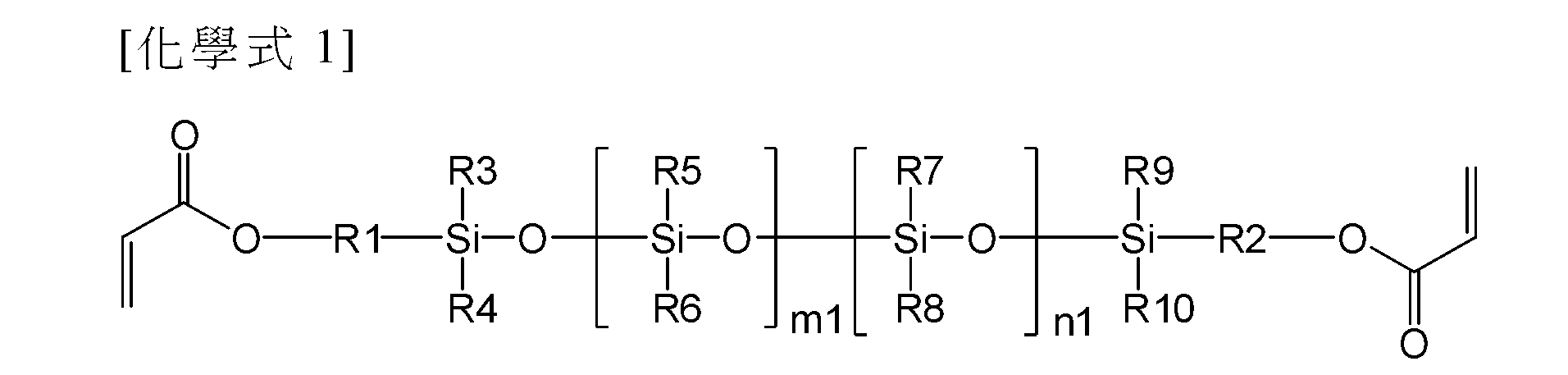
在化學式1中,R1與R2彼此相同或不同,且各自獨立地經取代或未經取代的具有1個至10個碳原子的伸烷基,R5與R6彼此相同或不同,且各自獨立地為具有1個至10個碳原子的烷基,R3、R4、R9以及R10中的至少一個為具有1個至10個碳原子的烷氧基,且其餘部分彼此相同或不同,且各自獨立地為具有1個至10個碳原子的烷基或具有1個至10個碳原子的烷氧基,R7與R8彼此相同或不同,且各自獨立地為具有6個至20個碳原子的芳基,以及m1及n1各自獨立地為0或大於0的實數。 In Chemical Formula 1, R1 and R2 are the same or different from each other, and each independently substituted or unsubstituted alkylene group having 1 to 10 carbon atoms, R5 and R6 are the same or different from each other, and each independently is An alkyl group having 1 to 10 carbon atoms, at least one of R3, R4, R9 and R10 is an alkoxy group having 1 to 10 carbon atoms, and the rest are the same or different from each other, and each independently is An alkyl group having 1 to 10 carbon atoms or an alkoxy group having 1 to 10 carbon atoms, R7 and R8 are the same or different from each other, and each independently is an aryl group having 6 to 20 carbon atoms, And m1 and n1 are each independently 0 or a real number greater than 0.
本申請案中的取代基的實例描述於下文中,然而,取代基不限於此。 Examples of the substituent in the present application are described below, however, the substituent is not limited thereto.
術語「取代」意謂鍵結至化合物的碳原子的氫原子改變為另一取代基,且取代的位置不受限制,只要所述位置為氫原子經取 代的位置,亦即取代基可取代的位置即可,且當兩個或兩個以上取代基取代時,兩個或兩個以上取代基可彼此相同或不同。 The term "substitution" means that a hydrogen atom bonded to a carbon atom of a compound is changed to another substituent, and the position of substitution is not limited as long as the position is a hydrogen atom replaced The substituent position, that is, the substitutable position of the substituent is sufficient, and when two or more substituents are substituted, the two or more substituents may be the same or different from each other.
在本申請案中,術語「經取代或未經取代」意謂由以下述者所組成的族群中選出的一個、兩個或兩個以上的取代基取代:鹵素基;腈基;羥基;烷氧基;烷基;環烷基;芳基;以及雜環基,或由連接兩個或兩個以上上文所示出的取代基的取代基取代,或不具有取代基。 In this application, the term "substituted or unsubstituted" means to be substituted by one, two or more substituents selected from the group consisting of: halo; nitrile; hydroxy; alkane An oxy group; an alkyl group; a cycloalkyl group; an aryl group;
在本申請案的一個實施例中,烷基可為直鏈、分支鏈或環狀,且較佳為具有1個至10個碳原子。其特定實例可包括甲基、乙基、丙基、正丙基、異丙基、丁基、正丁基、異丁基、三級丁基、二級丁基、1-甲基-丁基、1-乙基-丁基、戊基、正戊基、環戊基、異戊基、新戊基、三級戊基、己基、正己基、環己基、1-甲基戊基、2-甲基戊基、4-甲基-2-戊基、3,3-二甲基丁基、2-乙基丁基、庚基、正庚基、1-甲基己基、環戊基甲基、環己基甲基、辛基、正辛基、三級辛基、1-甲基庚基、2-乙基己基、2-丙基戊基、正壬基、2,2-二甲基庚基、1-乙基-丙基、1,1-二甲基-丙基、異己基、2-甲基戊基、4-甲基己基、5-甲基己基以及類似者,但不限於此。 In one embodiment of the present application, the alkyl group can be linear, branched or cyclic, and preferably has 1 to 10 carbon atoms. Specific examples thereof may include methyl, ethyl, propyl, n-propyl, isopropyl, butyl, n-butyl, isobutyl, tertiary butyl, secondary butyl, 1-methyl-butyl , 1-ethyl-butyl, pentyl, n-pentyl, cyclopentyl, isopentyl, neopentyl, tertiary pentyl, hexyl, n-hexyl, cyclohexyl, 1-methylpentyl, 2- Methylpentyl, 4-methyl-2-pentyl, 3,3-dimethylbutyl, 2-ethylbutyl, heptyl, n-heptyl, 1-methylhexyl, cyclopentylmethyl , cyclohexylmethyl, octyl, n-octyl, tertiary octyl, 1-methylheptyl, 2-ethylhexyl, 2-propylpentyl, n-nonyl, 2,2-dimethylheptyl 1-ethyl-propyl, 1,1-dimethyl-propyl, isohexyl, 2-methylpentyl, 4-methylhexyl, 5-methylhexyl and the like, but not limited thereto .
在本申請案的一個實施例中,烷氧基可為直鏈、分支鏈或環狀,且較佳為具有1個至10個碳原子。其特定實例可包括甲氧基、乙氧基、正丙氧基、異丙氧基、正丁氧基、異丁氧基、三級丁氧基、二級丁氧基、正戊氧基、新戊氧基、異戊氧基、正己氧基、3,3-二甲基丁氧基、2-乙基丁氧基、正辛氧基、正壬氧基、正癸氧基、苯甲氧基、對甲基苯甲氧基以及類似者,但不限於此。 In one embodiment of the present application, the alkoxy group can be linear, branched or cyclic, and preferably has 1 to 10 carbon atoms. Specific examples thereof may include methoxy, ethoxy, n-propoxy, isopropoxy, n-butoxy, isobutoxy, tertiary butoxy, secondary butoxy, n-pentoxy, Neopentyloxy, isopentyloxy, n-hexyloxy, 3,3-dimethylbutoxy, 2-ethylbutoxy, n-octyloxy, n-nonyloxy, n-decyloxy, benzyl Oxy, p-methylbenzyloxy and the like, but not limited thereto.
在本申請案的一個實施例中,芳基可為單環或多環,且較 佳為具有6個至20個碳原子。其特定實例可包括苯基、聯苯基(biphenyl group)、聯三苯基(terphenyl group)、萘基(naphthyl group)、聯伸三苯基(triphenylenyl group)、蒽基(anthracenyl group)、菲基(phenanthrenyl group)、芘基(pyrenyl group)、苝基(perylenyl group)、屈基(chrysenyl group)、芴基(fluorenyl group)以及類似者,但不限於此。 In one embodiment of the application, the aryl group can be monocyclic or polycyclic, and more Preferably it has 6 to 20 carbon atoms. Specific examples thereof may include phenyl, biphenyl group, terphenyl group, naphthyl group, triphenylenyl group, anthracenyl group, phenanthrenyl group (phenanthrenyl group), pyrenyl group, perylenyl group, chrysenyl group, fluorenyl group and the like, but not limited thereto.
在本申請案的一個實施例中,除二價基團以外上述烷基可應用於伸烷基。 In one embodiment of the present application, the above-mentioned alkyl group can be applied to an alkylene group other than a divalent group.
在本申請案的一個實施例中,在化學式1中,m1可為1或大於1的實數,且n1為0或1或大於1的實數。 In one embodiment of the present application, in Chemical Formula 1, m1 may be a real number of 1 or greater, and n1 may be 0 or a real number of 1 or greater.
在本申請案的一個實施例中,化學式1可由以下化學式2或化學式3表示。 In one embodiment of the present application, Chemical Formula 1 may be represented by Chemical Formula 2 or Chemical Formula 3 below.


在化學式2及化學式3中, m2、m3以及n2各自獨立地為1或大於1的實數。 In chemical formula 2 and chemical formula 3, m2, m3, and n2 are each independently a real number of 1 or greater.
在本申請案的一個實施例中,聚有機矽氧烷的黏度基於23℃可為自10厘泊(cps)至100,000厘泊或自100厘泊至80,000厘泊。 In one embodiment of the present application, the polyorganosiloxane may have a viscosity of from 10 centipoise (cps) to 100,000 cps or from 100 cps to 80,000 cps based on 23°C.
可使用任何恰當方法量測黏度,包括使用流變儀的方法。舉例而言,可在使用Anton-Paar流變儀的主軸PP-25設定間隙為0.5毫米(mm)之後在23℃條件下以20轉/分鐘(rpm)量測黏度。 Viscosity may be measured using any suitable method, including methods using a rheometer. For example, the viscosity can be measured at 20 revolutions per minute (rpm) at 23° C. after using the spindle PP-25 of the Anton-Paar rheometer to set the gap to 0.5 millimeters (mm).
在本申請案的一個實施例中,化學式1至化學式3的m1、m2、m3、n1以及n2為化學式1至化學式3的聚有機矽氧烷具有所需黏度的值。更具體而言,化學式1至化學式3的m1、m2、m3、n1以及n2為化學式1至化學式3的聚有機矽氧烷基於23℃具有10厘泊至100,000厘泊的黏度的值。 In an embodiment of the present application, m1, m2, m3, n1 and n2 of Chemical Formula 1 to Chemical Formula 3 are values of the polyorganosiloxane of Chemical Formula 1 to Chemical Formula 3 having a desired viscosity. More specifically, m1, m2, m3, n1, and n2 of Chemical Formulas 1 to 3 are values in which the polyorganosiloxane groups of Chemical Formulas 1 to 3 have a viscosity of 10 cps to 100,000 cps at 23° C.
在本申請案的一個實施例中,以矽酮類組成物的總重量計,聚有機矽氧烷的含量可為自40重量%至98重量%,或自50重量%至95重量%。當符合此類聚有機矽氧烷的含量範圍時,本申請案的矽酮類組成物可具有矽酮橡膠的性質,可多樣地控制黏著強度,且可在僅藉由濕度固化的表面上提供快速無黏性時間(tack free time)。此外,由於矽酮類組成物的固化產物變硬導致變為極容易破裂的問題且從而導致開裂(crack)問題且失去矽酮的橡膠性質,因此以矽酮類組成物的總重量計聚有機矽氧烷含量小於40重量%為不佳的。 In an embodiment of the present application, based on the total weight of the silicone-based composition, the content of polyorganosiloxane may be from 40 wt % to 98 wt %, or from 50 wt % to 95 wt %. When the content range of such polyorganosiloxane is met, the silicone-based composition of the present application can have the properties of silicone rubber, can control the adhesive strength in various ways, and can provide fast curing on surfaces that are only cured by humidity. Tack free time. In addition, since the cured product of the silicone-based composition becomes hard to cause a problem of being extremely easy to crack and thus causes a crack problem and loses the rubber properties of silicone, the polyorganic composition is based on the total weight of the silicone-based composition. A siloxane content of less than 40% by weight is unfavorable.
如上文所描述,光起始劑的使用已受限制歸因於矽酮材料的較低表面張力及折射率,且紫外光的可固化性同樣不佳。鑒於上文,為稀釋劑的丙烯酸類單體為包括於本申請案的一個實施例 中以便順利混合聚有機矽氧烷及光起始劑。在本申請案的一個實施例中,丙烯酸類單體不僅充當稀釋劑,並且用以增加紫外光的可固化性。 As described above, the use of photoinitiators has been limited due to the low surface tension and refractive index of silicone materials, and also poor UV curability. In view of the above, acrylic monomers that are diluents are included in this application as an example Medium for smooth mixing of polyorganosiloxane and photoinitiator. In one embodiment of the present application, the acrylic monomer not only acts as a diluent, but also serves to increase the curability of the UV light.
作為丙烯酸類單體,亦可使用本領域中已知的丙烯酸類單體,只要他們為可與聚有機矽氧烷充分混合的材料。特定言之,作為丙烯酸類單體,較佳包括丙烯酸異冰片酯(isobornyl acrylate)、丙烯酸月桂酯(lauryl acrylate)以及1,6-己二醇二丙烯酸酯(1,6-hexanediol diacrylate)中的至少一種類型,然而丙烯酸類單體不限於此。上述丙烯酸類單體因具有較低分子量及表面張力且不具有較高折射率故有利於與聚有機矽氧烷混合,且有利於揭露矽酮的橡膠性質。此外,藉由調整在矽酮類組成物中的丙烯酸類單體的含量,可獲得在矽酮類組成物的不同性質中的變化。 As the acrylic monomer, acrylic monomers known in the art can also be used as long as they are materials that can be mixed well with polyorganosiloxane. Specifically, the acrylic monomer preferably includes isobornyl acrylate, lauryl acrylate, and 1,6-hexanediol diacrylate. At least one type, however, the acrylic monomer is not limited thereto. The above-mentioned acrylic monomers are favorable for mixing with polyorganosiloxane due to their low molecular weight and surface tension and no high refractive index, and are favorable for exposing the rubber properties of silicone. Furthermore, by adjusting the content of acrylic monomers in the silicone-based composition, variations in the different properties of the silicone-based composition can be obtained.
在本申請案的一個實施例中,以矽酮類組成物的總重量計丙烯酸類單體的含量可為自0.1重量%至50重量%,且更佳地自1重量%至46重量%。 In one embodiment of the present application, based on the total weight of the silicone composition, the content of the acrylic monomer may be from 0.1% to 50% by weight, and more preferably from 1% to 46% by weight.
當符合此類丙烯酸類單體的含量範圍時,本申請案的矽酮類組成物可具有矽酮橡膠的性質,可多樣地控制黏著強度,且可在僅藉由濕度固化的表面上提供快速無黏性時間(tack free time)。此外,由於聚有機矽氧烷含量相對減小且矽酮類組成物的固化產物變硬導致變為極容易破裂的問題且從而導致開裂(crack)問題,且失去矽酮的橡膠性質,因此以矽酮類組成物總重量計丙烯酸類單體含量大於50重量%為不佳的。 When the content range of such acrylic monomer is met, the silicone composition of the present application can have the properties of silicone rubber, can control the adhesive strength in various ways, and can provide fast curing on the surface cured only by humidity. Tack free time. In addition, since the polyorganosiloxane content is relatively reduced and the cured product of the silicone-based composition is hardened causing a problem of becoming extremely easy to crack and thus causing a problem of cracking and losing the rubber properties of silicone, it is used as An acrylic monomer content greater than 50% by weight based on the total weight of the silicone composition is unfavorable.
在本申請案的一個實施例中,光起始劑為熱惰性但藉由接收光以產生自由基來激發,且此等自由基提供激發能量至矽氧 烷以藉由紫外固化開始固化反應。出於反應性的觀點,光起始劑可包括芳香族烴(aromatic hydrocarbon)、苯乙酮(acetophenone)及其衍生物、二苯基酮(benzophenone)及其衍生物、鄰-苯甲酸苄醯基酯(o-benzoyl benzoic acid ester)、安息香、安息香乙醚及其衍生物、氧蔥酮(xanthone)及其衍生物,醌化合物、鹵化烴及胺基、有機過氧化物以及類似者,且出於與矽酮的相容性及穩定性的觀點,含有經苄醯基或有機過氧化物取代或未經取代的複合物為更佳。其實例可包括苯乙酮、苯丙酮、2-羥基-2-甲基苯丙酮、2,2-二甲氧基-1,2-二苯基乙-1-酮、2-羥基-2-甲基-1-苯基-丙-1-酮、1-羥基-環己基-苯基-丙酮、乙基(2,4,6-三甲基苯甲醯基)苯基亞膦酸酯、1-[4-(2-羥乙氧基)-苯基]-2-羥基-2-甲基-1-丙烷-1-酮、2-羥基-1-{4-[4-(2-羥基-2-甲基-丙醯基)-苯甲基]苯基}-2-甲基-丙烷-1-酮、2-甲基-1-(4-甲基苯硫基)-2-N-嗎啉基丙-1-酮、2-苯甲基-2-二甲胺基-(4-N-嗎啉基苯基)-丁酮-1,2-(二甲胺基)-2-[(4-甲基苯基)甲基]-1-[4-(4-嗎啉基)苯基]-1-丁酮、2,4,6-三甲基苯甲醯基-二苯基-膦氧化物、雙(2,4,6-三甲基苯甲醯基)-苯膦氧化物、1,2-辛二酮、1[4-(苯硫基)-2-(O-苯甲醯基肟)]、乙酮、1-[9-乙基-6-(2-甲基苯甲醯基)-9H-咔唑-3-基]-1-(O-乙醯肟)、氧基苯乙酸(oxyphenylacetic acid)、2-[2-側氧基-2-苯乙醯氧基乙氧基]乙酯(2-[2-oxo-2-phenylacetoxyethoxy]ethyl ester)及氧基苯乙酸,2-(2-羥乙氧基)乙酯混合物、乙基-4-二甲基胺基苯甲酸酯、2-乙基己基-4-二甲基胺基苯甲酸酯、雙(2,6-二甲氧基苯甲醯基)-2,4,4-三甲基-戊膦氧化物、過氧化苯甲醯以及類似者,但不限於此。 In one embodiment of the present application, the photoinitiator is thermally inert but excited by receiving light to generate free radicals, and these free radicals provide excitation energy to the silicon oxide alkanes to initiate the curing reaction by UV curing. From the viewpoint of reactivity, photoinitiators may include aromatic hydrocarbons (aromatic hydrocarbon), acetophenone (acetophenone) and its derivatives, benzophenone (benzophenone) and its derivatives, o-benzoic acid benzyl o-benzoyl benzoic acid ester, benzoin, benzoin ethyl ether and its derivatives, xanthone and its derivatives, quinone compounds, halogenated hydrocarbons and amine groups, organic peroxides and the like, and From the viewpoint of compatibility with silicone and stability, it is more preferable to contain a compound substituted or unsubstituted by benzyl group or organic peroxide. Examples thereof may include acetophenone, propiophenone, 2-hydroxy-2-methylpropiophenone, 2,2-dimethoxy-1,2-diphenylethan-1-one, 2-hydroxy-2- Methyl-1-phenyl-propan-1-one, 1-hydroxy-cyclohexyl-phenyl-acetone, ethyl(2,4,6-trimethylbenzoyl)phenylphosphonite, 1-[4-(2-hydroxyethoxy)-phenyl]-2-hydroxy-2-methyl-1-propan-1-one, 2-hydroxy-1-{4-[4-(2- Hydroxy-2-methyl-propionyl)-benzyl]phenyl}-2-methyl-propan-1-one, 2-methyl-1-(4-methylphenylthio)-2- N-morpholinopropan-1-one, 2-benzyl-2-dimethylamino-(4-N-morpholinophenyl)-butanone-1,2-(dimethylamino)- 2-[(4-methylphenyl)methyl]-1-[4-(4-morpholinyl)phenyl]-1-butanone, 2,4,6-trimethylbenzoyl- Diphenyl-phosphine oxide, bis(2,4,6-trimethylbenzoyl)-phenylphosphine oxide, 1,2-octanedione, 1[4-(phenylthio)-2- (O-benzoyl oxime)], ethyl ketone, 1-[9-ethyl-6-(2-methylbenzoyl)-9H-carbazol-3-yl]-1-(O- Acetyl oxime), oxyphenylacetic acid (oxyphenylacetic acid), 2-[2-oxo-2-phenylacetoxyethoxy]ethyl ester (2-[2-oxo-2-phenylacetoxyethoxy]ethyl ester ) and oxyphenylacetic acid, 2-(2-hydroxyethoxy) ethyl ester mixture, ethyl-4-dimethylaminobenzoate, 2-ethylhexyl-4-dimethylaminobenzene Formate, bis(2,6-dimethoxybenzoyl)-2,4,4-trimethyl-pentylphosphine oxide, benzoyl peroxide, and the like, but not limited thereto.
此外,就與聚有機矽氧烷的相容性而言,光起始劑可以溶 解於上述丙烯酸類單體中的混合物的形式使用。 Furthermore, in terms of compatibility with polyorganosiloxanes, photoinitiators can dissolve It is used in the form of a mixture dissolved in the above-mentioned acrylic monomer.
在本申請案的一個實施例中,以矽酮類組成物的總重量計光起始劑的含量可為自0.1重量%至5重量%,且更佳地自0.3重量%至3重量%。 In one embodiment of the present application, based on the total weight of the silicone-based composition, the content of the photoinitiator may be from 0.1% to 5% by weight, and more preferably from 0.3% to 3% by weight.
當符合此類光起始劑的含量範圍時,本申請案的矽酮類組成物可能實現快速紫外固化。 When the content range of such photoinitiator is met, the silicone composition of the present application may realize rapid UV curing.
根據本申請案的一個實施例,矽酮類組成物包括用於濕度固化的觸媒以在表面上提供快速無黏性時間(tack free time)。特定言之,根據本申請案的一個實施例,無黏性時間(tack free time)可為60分鐘或短於60分鐘、55分鐘或短於55分鐘或5分鐘或長於5分鐘。當無黏性時間(tack free time)長於60分鐘時,難以獲得本申請案旨在實現快速固化製程的目標。量測無黏性時間(tack free time)的方法在稍後描述的實驗實例中具體地描述。 According to one embodiment of the present application, the silicone-based composition includes a catalyst for moisture curing to provide a fast tack free time on the surface. Specifically, according to an embodiment of the present application, the tack free time may be 60 minutes or shorter, 55 minutes or shorter, or 5 minutes or longer. When the tack free time is longer than 60 minutes, it is difficult to achieve the goal of the present application to achieve a fast curing process. A method of measuring the tack free time is specifically described in Experimental Examples described later.
在本申請案的一個實施例中,用於濕度固化的觸媒可包括錫類化合物及鈦酸酯類化合物中的至少一種。 In one embodiment of the present application, the catalyst for moisture curing may include at least one of tin-based compounds and titanate-based compounds.
用作用於濕度固化的觸媒的錫類化合物可包括二月桂酸二丁基錫(dibutyltin dilaurate)、二乙酸二丁基錫(dibutyltin diacetate)、二丁基錫二甲醇酯、二甲基錫二新癸酸酯、辛酸錫酯、氧化二丁基錫、二有機-錫雙β-二酮以及二丁基錫雙乙醯基丙酮酸酯中的至少一種類型,但不限於此。 Tin-based compounds used as catalysts for moisture curing may include dibutyltin dilaurate, dibutyltin diacetate, dibutyltin dimethanol ester, dimethyltin dineodecanoate, caprylic acid At least one type of tin ester, dibutyltin oxide, diorgano-tin bis-β-diketone, and dibutyltin bisacetylpyruvate, but not limited thereto.
用作用於濕度固化的觸媒的鈦酸酯類化合物可包括正鈦酸四-三級丁酯(tetra-tert-butyl orthotitanate)、鈦酸四正丁酯(tetra-n-butyl titanate)、鈦酸四-異丙基酯(tetra-isopropyl titanate)、鈦酸四-2-乙基己基酯(tetra-2-ethylhexyl titanate)、鈦酸四三級丁酯 (tertra tert-butyl titanate)、鈦酸聚丁基酯(poly butyl titanate)、鈦酸-丁基酯二聚體(butyl-titanate dimer)、鈦乙醯基丙酮酸酯(titanium acetylacetonate)、鈦四-乙醯基丙酮酸酯(titanium tetra-acetylacetonate)、鈦酸乙醯乙酸乙酯酯ethyl acetoacetate titanate)、鈦十二烷基苯磺酸酯(titanium dodecylbenzene sulfonate)、鈦磷酸酯錯合物(titanium phosphate complex)、鈦辛二醇羥乙酸酯(titanium octyleneglycolate)、鈦乳酸酯胺酯(titanium lactate ammonium salt)、鈦乳酸酯(titanium lactate)、三乙醇胺鈦酸酯(titanium triethanolaminate)、鈦酸四十八烷醯酯(tetra stearyl titanate)、異硬脂鈦酸酯(titanium isostearate)以及胺基乙基胺基乙醇酸鈦(titanium aminoethylaminoethanolate)中的至少一種類型,但不限於此。 The titanate compounds used as catalysts for moisture curing may include tetra-tert-butyl orthotitanate, tetra-n-butyl titanate, titanium Tetra-isopropyl titanate, tetra-2-ethylhexyl titanate, tetra-tertiary butyl titanate (tertra tert-butyl titanate), polybutyl titanate, butyl-titanate dimer, titanium acetylacetonate, titanium tetra -Titanium tetra-acetylacetonate, ethyl acetoacetate titanate, titanium dodecylbenzene sulfonate, titanium phosphate complex (titanium phosphate complex), titanium octaneglycolate, titanium lactate ammonium salt, titanium lactate, titanium triethanolaminate, titanium At least one type of tetra stearyl titanate, titanium isostearate and titanium aminoethylaminoethanolate, but not limited thereto.
在本申請案的一個實施例中,用於濕度固化的觸媒包括錫類化合物,且以矽酮類組成物的總重量計錫類化合物的含量可為自0.05重量%至0.5重量%,且更佳地自0.07重量%至0.35重量%。 In one embodiment of the present application, the catalyst used for moisture curing includes a tin compound, and the content of the tin compound may be from 0.05% to 0.5% by weight based on the total weight of the silicone composition, and More preferably from 0.07% to 0.35% by weight.
在本申請案的一個實施例中,用於濕度固化的觸媒包括鈦酯酯類化合物,以矽酮類組成物的總重量計鈦酸酯類化合物的含量可為自0.1重量%至5.0重量%。 In one embodiment of the present application, the catalyst used for moisture curing includes titanate ester compounds, and the content of titanate ester compounds can be from 0.1% by weight to 5.0% by weight based on the total weight of the silicone composition. %.
當符合此類用於濕度固化的觸媒的含量範圍時,根據本申請案的一個實施例的矽酮類組成物可使用濕度固化方法充分固化即使針對未用紫外光照射的區域。 When the content range of such catalyst for humidity curing is met, the silicone-based composition according to an embodiment of the present application can be sufficiently cured using the humidity curing method even for areas not irradiated with ultraviolet light.
在本申請案的一個實施例中,矽酮類組成物可更包括包含清除劑(scavenger)及助黏劑(adhesion promoter)中的至少一 個的添加劑。 In one embodiment of the present application, the silicone-based composition may further include at least one of a scavenger (scavenger) and an adhesion promoter (adhesion promoter). additives.
在本申請案的一個實施例中,在歐洲專利申請案特許公開出版物第0905195號中描述的清除劑可用作清除劑(scavenger)。更具體而言,清除劑可為由以下化學式4表示的具有1,1,1-三甲基-N-(三甲矽)矽烷胺的3-(三甲氧基矽基)-1-丙烷胺聚合物(3-(Trimethoxysilyl)-1-propanamine polymer with 1,1,1-trimethyl-N-(trimethylsilyl)silanamine),但不限於此。 In one embodiment of the present application, the scavenger described in European Patent Application Laid-Open Publication No. 0905195 may be used as a scavenger. More specifically, the scavenger may be polymerized with 3-(trimethoxysilyl)-1-propanamine having 1,1,1-trimethyl-N-(trimethylsilyl)silylamine represented by the following chemical formula 4 (3-(Trimethoxysilyl)-1-propanamine polymer with 1,1,1-trimethyl-N-(trimethylsilyl)silanamine), but not limited thereto.
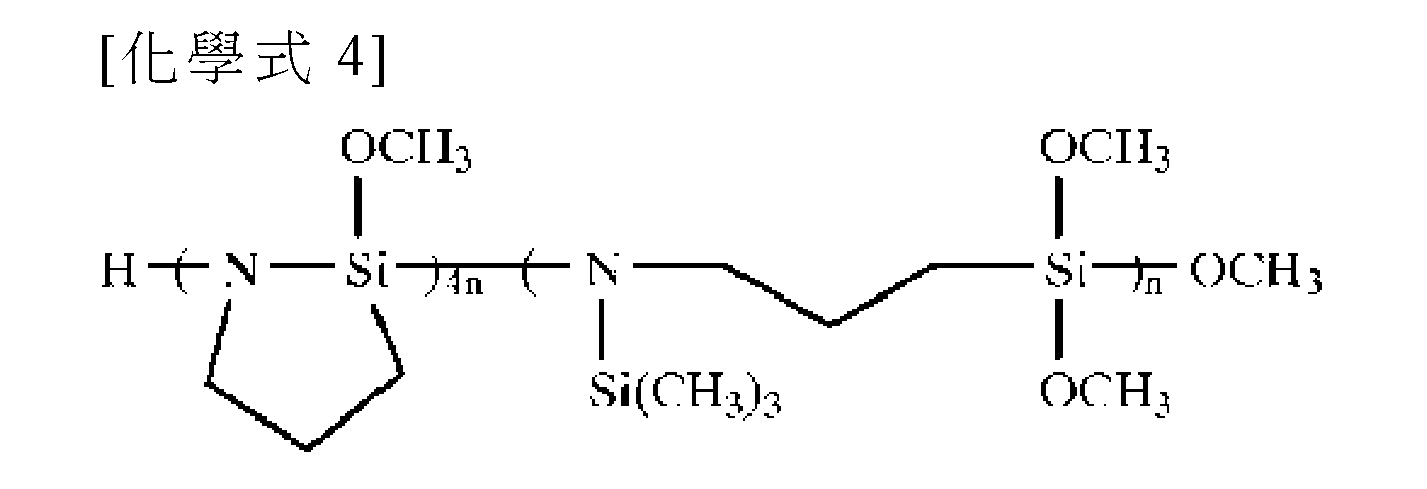
在化學式4中,n為1至20的實數。 In Chemical Formula 4, n is a real number of 1 to 20.
在本申請案的一個實施例中,以矽酮類組成物的總重量計清除劑的含量可為自0.1重量%至5重量%,且更佳地自0.7重量%至5重量%。 In one embodiment of the present application, the content of the scavenger may be from 0.1% to 5% by weight, and more preferably from 0.7% to 5% by weight, based on the total weight of the silicone-based composition.
在本申請案的一個實施例中,可使用包括至少一個諸如甲氧基或乙氧基的可水解(hydrolysable)官能基的矽酮類化合物或矽烷類化合物作為助黏劑。 In one embodiment of the present application, a silicone compound or a silane compound including at least one hydrolysable functional group such as methoxy or ethoxy may be used as an adhesion promoter.
助黏劑可包括(胺基烷基)三烷氧基矽烷、(胺基烷基)烷基二烷氧基矽烷、雙(三烷氧基矽烷基烷基)胺、三(三烷氧基矽烷基烷基)胺、三(三烷氧基矽烷基烷基)氰尿酸酯、三(三烷氧基矽烷基烷基)異氰尿酸酯、(環氧烷基)三烷基氧基矽烷以及(環氧烷基乙醚)三烷氧基矽烷中的至少一種類型,但不限於此。 Adhesion promoters may include (aminoalkyl)trialkoxysilanes, (aminoalkyl)alkyldialkoxysilanes, bis(trialkoxysilylalkyl)amines, tris(trialkoxy silylalkyl)amine, tris(trialkoxysilylalkyl)cyanurate, tris(trialkoxysilylalkyl)isocyanurate, (epoxyalkyl)trialkyloxy At least one type of base silane and (epoxide alkyl ether) trialkoxy silane, but not limited thereto.
更具體而言,助黏劑可包括N-(2-胺基乙基)胺基丙基三甲氧基矽烷(N-(2-aminoethyl)aminopropyltrimethoxysilane)、γ-胺基丙基三乙氧基矽烷(gamma-aminopropyltriethoxysilane)、γ-胺基丙基三甲氧基矽烷(gamma-aminopropyltrimethoxysilane)、雙(3-三甲氧基矽烷基丙基)胺(bis(3-trimethoxysilylpropyl)amine)、N-苯基-γ-胺基丙基三甲氧基矽烷(N-phenyl-gamma-aminopropyltrimethoxysilane)、三胺基官能三甲氧基矽烷(triaminofunctionaltrimethoxysilane)、γ-胺基丙基甲基二甲氧基矽烷(gamma-aminopropylmethyldimethoxysilane)、γ-胺基丙基甲基二乙氧基矽烷(gamma-aminopropylmethyldiethoxysilane)、甲基丙烯醯氧基丙基三甲氧基矽烷(methacryloxypropyltrimethoxysilane)、甲基胺丙基三甲氧基矽烷(methylaminopropyltrimethoxysilane)、γ-縮水甘油氧基丙基乙基二甲氧基矽烷(gamma-glycidoxypropylethyldimethoxysilane)、γ-縮水甘油氧基丙基三甲氧基矽烷(gamma-glycidoxypropyltrimethoxysilane)、γ-縮水甘油氧基乙基三甲氧基矽烷(gamma-glycidoxyethyltrimethoxysilane)、γ-縮水甘油氧基丙基甲基二甲氧基矽烷(gamma-glycidoxypropylmethyldimethoxysilane)、γ-縮水甘油氧基丙基甲基二乙氧基矽烷(gamma-glycidoxypropylmethyldiethoxysilane)、β-(3,4-環氧環己基)乙基三甲氧基矽烷(beta-(3,4-epoxycyclohexyl)ethyltrimethoxysilane)、β-(3,4-環氧環己基)乙基甲基二甲氧基矽烷(beta-(3,4-epoxycyclohexyl)ethylmethyldimethoxysilane)、β-(3,4-環氧環己基) 乙基三乙氧基矽烷(beta-(3,4-epoxycyclohexyl)ethyltriethoxysilane)、β-(3,4-環氧環己基)乙基甲基二乙氧基矽烷(beta-(3,4-epoxycyclohexyl)ethylmethyldiethoxysilane)、環氧檸檬基三甲氧基矽烷(epoxylimonyltrimethoxysilane)、異氰酸基丙基三乙氧基矽烷(isocyanatopropyltriethoxysilane)、異氰酸基丙基三甲氧基矽烷(isocyanatopropyltrimethoxysilane)、異氰酸基丙基甲基二甲氧基矽烷(isocyanatopropylmethyldimethoxysilane)、β-氰乙基三甲氧基矽烷(beta-cyanoethyltrimethoxysilane)、γ-丙烯醯氧基丙基三甲氧基矽烷(gamma-acryloxypropyltrimethoxysilane)、γ-甲基丙烯醯氧基丙基甲基二薄荷氧基矽烷(gamma-methacryloxypropylmethyldimethoxysilane)、α、Ω-雙(胺基烷基二乙氧基甲矽烷基)聚二甲基矽氧烷(omega-bis(aminoalkyldiethoxysilyl)polydimethylsiloxane)(Pn=1至7)、α、Ω-雙(胺基烷基二乙氧基甲矽烷基)(omega-bis(aminoalkyldiethoxysilyl)octamethyltetrasiloxane)、4-胺基-3,3-二甲基丁基三甲氧基矽烷(4-amino-3,3-dimethylbutyltrimethoxysilane)、N-乙基-3-三甲氧基矽烷基-2-甲基丙胺(N-ethyl-3-trimethoxysilyl-2-methylpropanamine)、3-(N,N-二乙基胺基丙基)三甲氧基矽烷(3-(N,N-diethylaminopropyl)trimethoxysilane)、三[3-(三甲氧基矽烷基)丙基]異氰尿酸酯(tris[3-(trimethoxysilyl)propyl]isocyanurate)、甲基三甲氧基矽烷、乙烯基三甲氧基矽烷中的至少一種類型以及類似者。 More specifically, the adhesion promoter may include N-(2-aminoethyl)aminopropyltrimethoxysilane (N-(2-aminoethyl)aminopropyltrimethoxysilane), γ-aminopropyltriethoxysilane (gamma-aminopropyltriethoxysilane), γ-aminopropyltrimethoxysilane (gamma-aminopropyltrimethoxysilane), bis(3-trimethoxysilylpropyl)amine (bis(3-trimethoxysilylpropyl)amine), N-phenyl- γ-aminopropyltrimethoxysilane (N-phenyl-gamma-aminopropyltrimethoxysilane), triaminofunctional trimethoxysilane (triaminofunctionaltrimethoxysilane), γ-aminopropylmethyldimethoxysilane (gamma-aminopropylmethyldimethoxysilane) , γ-aminopropylmethyldiethoxysilane (gamma-aminopropylmethyldiethoxysilane), methacryloxypropyltrimethoxysilane (methacryloxypropyltrimethoxysilane), methylaminopropyltrimethoxysilane (methylaminopropyltrimethoxysilane), γ -Gamma-glycidoxypropylethyldimethoxysilane, γ-glycidoxypropyltrimethoxysilane, γ-glycidoxypropyltrimethoxysilane (gamma-glycidoxyethyltrimethoxysilane), γ-glycidoxypropylmethyldimethoxysilane (gamma-glycidoxypropylmethyldimethoxysilane), γ-glycidoxypropylmethyldiethoxysilane (gamma-glycidoxypropylmethyldiethoxysilane), β- (3,4-epoxycyclohexyl)ethyltrimethoxysilane (beta-(3,4-epoxycyclohexyl)ethyltrimethoxysilane), β-(3,4-epoxycyclohexyl)ethylmethyldimethoxysilane (beta-(3,4-epoxycyclohexyl)ethylmethyldimethoxysilane), β-(3,4-epoxycyclohexyl) Ethyltriethoxysilane (beta-(3,4-epoxycyclohexyl)ethyltriethoxysilane), β-(3,4-epoxycyclohexyl)ethylmethyldiethoxysilane (beta-(3,4-epoxycyclohexyl) )ethylmethyldiethoxysilane), epoxylimonyltrimethoxysilane (epoxylimonyltrimethoxysilane), isocyanatopropyltrimethoxysilane (isocyanatopropyltrimethoxysilane), isocyanatopropyltrimethoxysilane (isocyanatopropyltrimethoxysilane), isocyanatopropyltrimethoxysilane Isocyanatopropylmethyldimethoxysilane, β-cyanoethyltrimethoxysilane, γ-acryloxypropyltrimethoxysilane, γ-methacrylic Acyloxypropylmethyldimenthoxysilane (gamma-methacryloxypropylmethyldimethoxysilane), α, Ω-bis(aminoalkyldiethoxysilyl) polydimethylsiloxane (omega-bis(aminoalkyldiethoxysilyl) polydimethylsiloxane)(Pn=1 to 7), α,Ω-bis(aminoalkyldiethoxysilyl)(omega-bis(aminoalkyldiethoxysilyl)octamethyltetrasiloxane), 4-amino-3,3-dimethyl Butyltrimethoxysilane (4-amino-3,3-dimethylbutyltrimethoxysilane), N-ethyl-3-trimethoxysilyl-2-methylpropanamine (N-ethyl-3-trimethoxysilyl-2-methylpropanamine), 3-(N,N-diethylaminopropyl)trimethoxysilane (3-(N,N-diethylaminopropyl)trimethoxysilane), tris[3-(trimethoxysilyl)propyl]isocyanuric acid At least one type of ester (tris[3-(trimethoxysilyl)propyl]isocyanurate), methyltrimethoxysilane, vinyltrimethoxysilane, and the like.
在本申請案的一個實施例中,以矽酮類組成物的總重量 計助黏劑的含量可為自0.1重量%至5重量%,且更佳地自0.7重量%至3重量%。當符合此類助黏劑的含量範圍時,可獲得更優良的黏著強度。當以矽酮類組成物總重量計助黏劑的含量為小於0.1重量%時,由於矽酮類組成物的黏度減小改變自身流變性且不再增加黏結強度,因此難以獲得黏著強度,且含量大於5重量%為不佳的。 In one embodiment of the present application, the total weight of the silicone composition The content of the adhesion promoter may be from 0.1% to 5% by weight, and more preferably from 0.7% to 3% by weight. When the content range of this type of adhesion promoter is met, better adhesion strength can be obtained. When the content of the adhesion promoter is less than 0.1% by weight based on the total weight of the silicone-based composition, it is difficult to obtain adhesive strength because the viscosity of the silicone-based composition changes its own rheology and no longer increases the adhesive strength, and A content of more than 5% by weight is unfavorable.
在本申請案的一個實施例中,矽酮類組成物可更包括煙霧狀二氧化矽(fumed silica)、其他添加劑以及類似者。 In an embodiment of the present application, the silicone-based composition may further include fumed silica, other additives, and the like.
在本申請案的一個實施例中,以矽酮類組成物的總重量計煙霧狀二氧化矽的含量可為自0重量%至15重量%,且更佳地自1重量%至10重量%。包括在此類含量範圍中的煙霧狀二氧化矽可有效控制矽酮類組成物的黏度及黏流性。然而,當以矽酮類組成物的總重量計煙霧狀二氧化矽含量大於15重量%時,黏度增加變得更大,其可能不利於分配排氣可工作性,且此可能在需要恰當黏度及黏流性的塗佈材料及類似者中使用組成物時為不利的。此外,以矽酮類組成物的總重量計煙霧狀二氧化矽含量大於1重量%的可有利於需要維持形狀的封裝,此是由於可避免在分配排氣之後組成物在塗佈表面上分散的現象。 In one embodiment of the present application, the content of fumed silica may be from 0% to 15% by weight, and more preferably from 1% to 10% by weight, based on the total weight of the silicone composition . The fumed silica included in this content range can effectively control the viscosity and flowability of the silicone composition. However, when the content of fumed silica is greater than 15% by weight based on the total weight of the silicone-based composition, the viscosity increase becomes greater, which may be detrimental to the distribution of exhaust workability, and this may be necessary when the proper viscosity It is unfavorable when using the composition in viscous coating materials and the like. In addition, a fumed silica content of greater than 1% by weight based on the total weight of the silicone-based composition can be advantageous for packaging that requires shape maintenance because dispersion of the composition on the coated surface after dispensing of the exhaust gas can be avoided. The phenomenon.
作為煙霧狀二氧化矽,使用具有疏水性二氧化矽表面的疏水性煙霧狀二氧化矽為更佳的。更具體而言,疏水性煙霧狀二氧化矽可用作煙霧狀二氧化矽使用,然而煙霧狀二氧化矽不限於此。 As the fumed silica, it is more preferable to use hydrophobic fumed silica having a hydrophobic silica surface. More specifically, hydrophobic fumed silica can be used as the fumed silica, but the fumed silica is not limited thereto.
在本申請案的一個實施例中,矽酮類組成物可更包括除了上述具有由丙烯酸酯基形成的兩端且包括至少一個烷氧基的聚有機矽氧烷以外本領域中已知的第二聚有機矽氧烷。第二聚有機 矽氧烷可不同時包括紫外可固化官能基及濕度可固化官能基兩者而具有一般矽氧烷結構,且可包括紫外可固化官能基及濕度可固化官能基的任一個官能基。第二聚有機矽氧烷可發揮控制矽酮類組成物的機械性質的作用。 In one embodiment of the present application, the silicone composition may further include the first polyorganosiloxane known in the art besides the above-mentioned polyorganosiloxane having both ends formed by acrylate groups and including at least one alkoxy group. Dipolyorganosiloxane. Second polyorganic The siloxane may not include both the UV curable functional group and the moisture curable functional group but has a general siloxane structure, and may include any one of the UV curable functional group and the moisture curable functional group. The second polyorganosiloxane can control the mechanical properties of the silicone composition.
作為第二聚有機矽氧烷,可使用在兩端上包括乙烯基的聚有機矽氧烷;聚有機矽氧烷自下述者中選出:MQ樹脂、MTQ樹脂、MDQ樹脂及包括M單元(Me3SiO)的MDTQ樹脂、D單元(Me2SiO2)、T單元(MeSiO3)、Q單元(SiO4)以及不具有包括紫外可固化官能基及濕度可固化官能基兩者的類似者;無反應性聚有機矽氧烷(M-Dn-M)以及類似者,然而第二聚有機矽氧烷不限於此。 As the second polyorganosiloxane, a polyorganosiloxane including a vinyl group at both ends can be used; the polyorganosiloxane is selected from the group consisting of MQ resins, MTQ resins, MDQ resins, and polyorganosiloxanes containing M units ( MDTQ resins of Me 3 SiO), D units (Me 2 SiO 2 ), T units (MeSiO 3 ), Q units (SiO 4 ) and the like without including both UV curable functional groups and moisture curable functional groups ; non-reactive polyorganosiloxane (M-Dn-M) and the like, however the second polyorganosiloxane is not limited thereto.
在本申請案的一個實施例中,以矽酮類組成物的總重量計第二聚有機矽氧烷的含量可為自0重量%至45重量%,且更佳地自0重量%至40重量%。當符合此類第二聚有機矽氧烷的含量範圍時,可恰當地控制黏著強度。此外,當第二聚有機矽氧烷含量大於45重量%時,具有由丙烯酸酯基形成的兩端且包括至少一個烷氧基的聚有機矽氧烷(同時包括紫外可固化官能基及濕度可固化官能基的聚有機矽氧烷)的含量相對較少。此不符合本申請案應用同時包括紫外可固化官能基及濕度可固化官能基的聚有機矽氧烷的目的。 In one embodiment of the present application, the content of the second polyorganosiloxane based on the total weight of the silicone composition may be from 0% to 45% by weight, and more preferably from 0% to 40% by weight. weight%. When the content range of the second polyorganosiloxane is met, the adhesive strength can be properly controlled. In addition, when the content of the second polyorganosiloxane is greater than 45% by weight, the polyorganosiloxane having both ends formed by acrylate groups and including at least one alkoxy group (including both UV-curable functional groups and moisture-resistant The content of polyorganosiloxane with curing functional group) is relatively small. This is not in line with the purpose of the present application to apply polyorganosiloxanes that include both UV-curable functional groups and moisture-curable functional groups.
此外,根據本申請案的一個實施例的固化產物藉由固化矽酮類組成物來製備。更具體而言,根據本申請案的一個實施例的固化產物可包括具有由丙烯酸酯基形成的兩端且包括至少一個烷氧基的聚有機矽氧烷;至少一種類型的丙烯酸類單體;至少一種類 型的光起始劑;以及用於濕度固化的觸媒。 In addition, a cured product according to an embodiment of the present application is prepared by curing a silicone-based composition. More specifically, the cured product according to an embodiment of the present application may include polyorganosiloxane having both ends formed of acrylate groups and including at least one alkoxy group; at least one type of acrylic monomer; at least one type type photoinitiator; and catalyst for humidity curing.
根據本申請案的一個實施例的固化產物可使用除固化上述矽酮類組成物以外的本領域中已知的方法形成。更具體而言,可使用諸如在基底上施加、塗佈或印刷矽酮類組成物的方法以及固化方法形成固化產物,然而方法不限於此。 A cured product according to an embodiment of the present application may be formed using methods known in the art other than curing the silicone-based composition described above. More specifically, a method such as applying, coating or printing a silicone-based composition on a substrate and a curing method may be used to form a cured product, but the method is not limited thereto.
本申請案的另一實施例提供一種包括固化產物的裝置。 Another embodiment of the present application provides a device including a cured product.
根據本申請案的一個實施例的固化產物可在塗佈及保護不同物件的應用中使用。特定言之,固化產物可有效保護包括對諸如濕度或潮濕度的外部組件敏感的裝置的物件。可使用包括固化產物的塗佈材料的物件的實例可包括光伏打裝置(photovoltaic device)、整流器(rectifier)、傳輸器(transmitter)、有機發光二極體(organic light emitting diode;OLED)、用於印製電路板的濕度保護器、太陽能電池、蓄電池、車用組件或類似者,但不限於此。 The cured product according to one embodiment of the present application can be used in applications of coating and protecting various objects. In particular, the cured product is effective in protecting articles including devices sensitive to external components such as humidity or humidity. Examples of articles that can use the coating material including the cured product may include photovoltaic devices, rectifiers, transmitters, organic light emitting diodes (OLEDs), for Humidity protectors for printed circuit boards, solar cells, storage batteries, automotive components or the like, but not limited thereto.
在下文中,將參考實例更詳細地描述本說明書。然而,以下實例僅出於說明之目的,且本說明書不限於此。 Hereinafter, the specification will be described in more detail with reference to Examples. However, the following examples are for illustration purposes only, and the description is not limited thereto.
<實例><instance>
<製備實例1>製備由化學式2表示的聚有機矽氧烷<Preparation Example 1> Preparation of Polyorganosiloxane Represented by Chemical Formula 2
將雙矽烷醇-端聚二甲基矽氧烷(5,000厘泊,1,000g公克)、丙烯醯氧基丙基三甲氧基矽烷(30公克)、二異丁胺(1.6公克)、甲酸(0.57公克)以及丁基羥基甲苯(1.0公克)的混合物在80℃下在氮氣下攪拌5個小時。隨後,將混合物在110℃下攪拌2小時,且隨後減壓以移除副產物。隨後,將其冷卻以製備由化學式2表示的聚有機矽氧烷。製備的聚有機矽氧烷基於23℃具有大約6,000厘泊的黏度。 Disilanol-terminated polydimethylsiloxane (5,000 centipoise, 1,000 g), acryloxypropyltrimethoxysilane (30 g), diisobutylamine (1.6 g), formic acid (0.57 g) and butylated hydroxytoluene (1.0 g) were stirred at 80° C. under nitrogen for 5 h. Subsequently, the mixture was stirred at 110° C. for 2 hours, and then depressurized to remove by-products. Subsequently, it was cooled to prepare polyorganosiloxane represented by Chemical Formula 2. The prepared polyorganosiloxane had a viscosity of about 6,000 centipoise at 23°C.
<製備實例2>製備由化學式3表示的聚有機矽氧烷<Preparation Example 2> Preparation of Polyorganosiloxane Represented by Chemical Formula 3
除了使用雙矽烷醇-端聚二甲基二苯基矽氧烷(bis silanol-end polydimethyldiphenylsiloxane)替代雙矽烷醇-端聚二甲基矽氧烷(bis silanol-end polydimethylsiloxane)以外,由化學式3表示的聚有機矽氧烷的以與製備實例1中相同的方式製備。製備的聚有機矽氧烷基於23℃具有大約13,000厘泊的黏度。 In addition to using bis silanol-end polydimethyldiphenylsiloxane (bis silanol-end polydimethyldiphenylsiloxane) instead of bis silanol-end polydimethylsiloxane (bis silanol-end polydimethylsiloxane), represented by chemical formula 3 The polyorganosiloxane was prepared in the same manner as in Preparation Example 1. The prepared polyorganosiloxane had a viscosity of about 13,000 centipoise at 23°C.
<製備實例3>製備由化學式2表示的聚有機矽氧烷<Preparation Example 3> Preparation of Polyorganosiloxane Represented by Chemical Formula 2
將雙矽烷醇-端聚二甲基矽氧烷(700厘泊,1,000g公克)、丙烯醯氧基丙基三甲氧基矽烷(60公克)、二異丁胺(3.2公克)、甲酸(1.14公克)以及丁基羥基甲苯(1.0公克)的混合物在80℃下在氮氣下攪拌5個小時。隨後,將混合物在110℃下攪拌2小時,且隨後減壓以移除副產物。隨後,將其冷卻以製備由化學式2表示的聚有機矽氧烷。製備的聚有機矽氧烷基於23℃具有大約1,000厘泊的黏度。 Disilanol-terminated polydimethylsiloxane (700 centipoise, 1,000 g grams), acryloxypropyltrimethoxysilane (60 grams), diisobutylamine (3.2 grams), formic acid (1.14 g) and butylated hydroxytoluene (1.0 g) were stirred at 80° C. under nitrogen for 5 h. Subsequently, the mixture was stirred at 110° C. for 2 hours, and then depressurized to remove by-products. Subsequently, it was cooled to prepare polyorganosiloxane represented by Chemical Formula 2. The prepared polyorganosiloxane had a viscosity of about 1,000 centipoise at 23°C.
<比較製備實例1>製備具有由甲基丙烯酸脂基形成的兩端的聚有機矽氧烷<Comparative Preparation Example 1> Preparation of polyorganosiloxane having both ends formed of methacrylate groups
除了使用甲基丙烯醯氧基丙基三甲氧基矽烷替代丙烯醯氧基丙基三甲氧基矽烷以外,在兩端上包括甲基丙烯酸脂基的聚有機矽氧烷以與製備實例1中的相同方式製備。製備的聚有機矽氧烷基於23℃具有大約15,000厘泊的黏度。 Include methacrylate-based polyorganosiloxanes at both ends in the same manner as in Preparation Example 1, except that methacryloxypropyltrimethoxysilane is used instead of acryloxypropyltrimethoxysilane. Prepared in the same way. The prepared polyorganosiloxane had a viscosity of about 15,000 centipoise at 23°C.
<比較製備實例2><Comparative Preparation Example 2>
製備丙烯酸酯-端聚二甲基矽氧烷(購自默曼堤效能材料股份有限公司(Momentive Performance Materials Inc.))。丙烯酸酯-端聚二甲基矽氧烷基於23℃具有大約7,500厘泊的黏度。 Acrylate-terminated polydimethylsiloxane (available from Momentive Performance Materials Inc.) was prepared. Acrylate-terminated dimethicone has a viscosity of approximately 7,500 centipoise at 23°C.
<實例1至實例36及比較實例1至比較實例9><Example 1 to Example 36 and Comparative Example 1 to Comparative Example 9>
矽酮類組成物各自藉由混合以下表1至表10中描述的丙烯酸類單體與光起始劑來製備,且隨後進一步混合以下表1至表10中描述的組分。 The silicone-based compositions were each prepared by mixing acrylic monomers described in Tables 1 to 10 below with a photoinitiator, and then further mixing components described in Tables 1 to 10 below.


表1至表10中的組分的類型如下。 The types of components in Tables 1 to 10 are as follows.
丙烯酸類單體B-1:丙烯酸異冰片酯(Isobornyl acrylate) Acrylic monomer B-1: Isobornyl acrylate
丙烯酸類單體B-2:丙烯酸月桂酯(Lauryl Acrylate) Acrylic monomer B-2: Lauryl Acrylate
丙烯酸類單體B-3:1,6-己二醇二丙烯酸酯(1,6-Hexanediol Diacrylate) Acrylic monomer B-3: 1,6-Hexanediol Diacrylate (1,6-Hexanediol Diacrylate)
光起始劑C-1:Omnirad BDK(2,2-二甲氧基-2-苯基苯乙酮(2,2-Dimethoxy-2-phenylacetophenone)) Photoinitiator C-1: Omnirad BDK (2,2-Dimethoxy-2-phenylacetophenone (2,2-Dimethoxy-2-phenylacetophenone))
光起始劑C-2:Omnirad 1173(2-羥基-2-甲基-1-苯基丙酮(2-Hydroxy-2-methyl-1-phenylpropanone)) Photoinitiator C-2: Omnirad 1173 (2-Hydroxy-2-methyl-1-phenylpropanone (2-Hydroxy-2-methyl-1-phenylpropanone))
光起始劑C-3:Omnirad TPO-L(亞膦酸乙基(2,4,6-三甲基苯甲醯基)苯基酯(Ethyl(2,4,6-trimethylbenzoyl)phenyl phosphinate)) Photoinitiator C-3: Omnirad TPO-L (Ethyl(2,4,6-trimethylbenzoyl)phenyl phosphinate) )
光起始劑C-4:Omnirad 184(1-羥基環己基-苯基酮(1-Hydroxycyclohexyl-phenylketone)) Photoinitiator C-4: Omnirad 184 (1-Hydroxycyclohexyl-phenylketone (1-Hydroxycyclohexyl-phenylketone))
光起始劑C-5:Omnirad 819(雙(2,4,6-三甲基苯甲醯基)苯膦氧化物(bis(2,4,6-trimethylbenzoyl)phenylphosphine oxide)) Photoinitiator C-5: Omnirad 819 (bis(2,4,6-trimethylbenzoyl)phenylphosphine oxide (bis(2,4,6-trimethylbenzoyl)phenylphosphine oxide))
用於濕度固化的觸媒D-1:二丁基錫雙(乙醯基丙酮酸酯)用於濕度固化的觸媒D-2:鈦酸四正丁酯(tetra-n-butyl titanate) Catalyst D-1 for humidity curing: dibutyltin bis(acetylpyruvate) Catalyst D-2 for humidity curing: tetra-n-butyl titanate
用於濕度固化的觸媒D-3:正鈦酸四-三級丁酯(tetra-tert-butyl orthotitanate) Catalyst D-3 for moisture curing: tetra-tert-butyl orthotitanate
清除劑E:具有1,1,1-三甲基-N-(三甲矽)矽烷胺的3-(三甲氧基矽烷基)-1-丙烷胺聚合物(3-(Trimethoxysilyl)-1-propanamine polymer with 1,1,1-trimethyl-N-(trimethylsilyl)silanamine) Scavenger E: 3-(trimethoxysilyl)-1-propanamine polymer with 1,1,1-trimethyl-N-(trimethylsilyl)silylamine (3-(Trimethoxysilyl)-1-propanamine polymer with 1,1,1-trimethyl-N-(trimethylsilyl)silanamine)
助黏劑F-1:三[3-(三甲氧基矽烷基)丙基]異氰尿酸酯(Tris[3-(trimethoxysilyl)propyl]isocyanurate) Adhesion Promoter F-1: Tris[3-(trimethoxysilyl)propyl]isocyanurate (Tris[3-(trimethoxysilyl)propyl]isocyanurate)
助黏劑F-2:甲基三甲氧基矽烷 Adhesion Promoter F-2: Methyltrimethoxysilane
助黏劑F-3:乙烯基三甲氧基矽烷 Adhesion Promoter F-3: Vinyltrimethoxysilane
煙霧狀二氧化矽G:贏創RX200(Evonik RX200) Fumed silica G: Evonik RX200 (Evonik RX200)
第二聚有機矽氧烷H-1:在兩端及側鏈上包括乙烯基的聚二甲基矽氧烷(基於23℃黏度為1,000,000厘泊) Second polyorganosiloxane H-1: polydimethylsiloxane containing vinyl groups at both ends and side chains (viscosity of 1,000,000 centipoise based on 23°C)
第二聚有機矽氧烷H-2:在兩端上包括乙烯基的聚二甲基矽氧烷(基於23℃黏度為100,000厘泊) Second polyorganosiloxane H-2: polydimethylsiloxane including vinyl groups at both ends (based on a viscosity of 100,000 centipoise at 23°C)
第二聚有機矽氧烷H-3:在兩端上包括乙烯基且具有10%的苯基含量的聚二甲基矽氧烷(基於23℃黏度為1,000厘泊) Second polyorganosiloxane H-3: polydimethylsiloxane including vinyl groups on both ends and having a phenyl content of 10% (viscosity of 1,000 cps based on 23° C.)
第二聚有機矽氧烷H-4:由具有烷氧基封端MQ結構的50重量%的樹脂及50重量%的聚合物(黏度為200厘泊)組成的在兩端處含有烷氧基的聚有機矽氧烷 The second polyorganosiloxane H-4: composed of 50% by weight resin and 50% by weight polymer (viscosity of 200 centipoise) with an alkoxy-terminated MQ structure containing alkoxy groups at both ends polyorganosiloxane
<實驗實例><Experimental example>
評估實例及比較例中所製備的矽酮類組成物中的每一個的性質,且結果繪示於以下表11中。 Properties of each of the silicone-based compositions prepared in Examples and Comparative Examples were evaluated, and the results are shown in Table 11 below.


在表11中,評估結果「X」意謂由於固化失敗因此不能夠量測性質評估結果或範圍超出量測範圍。 In Table 11, the evaluation result "X" means that the property evaluation result could not be measured or the range exceeded the measurement range due to curing failure.
如結果所繪示,識別出當含量範圍超出用於濕度固化包括本申請案的錫類化合物的觸媒的範圍時,不提供快速無黏性時間(比較實例1及比較實例2)。 As shown by the results, it was identified that when the content range is outside the range for moisture curing the catalyst comprising the tin-based compound of the present application, it does not provide fast tack-free time (Comparative Example 1 and Comparative Example 2).
在比較實例3及比較實例4中,藉由紫外照射獲得固化,然而其後未進行濕度固化,且產物以凝膠水平製備而不具有橡膠性質。此為由於含量範圍超出用於濕度固化包括本申請案的鈦酸酯類化合物的觸媒的範圍的結果。 In Comparative Example 3 and Comparative Example 4, curing was obtained by UV irradiation, however humidity curing was not performed thereafter, and the product was prepared at a gel level without rubber properties. This is a result of the content range being outside the range for humidity curing catalysts including titanate compounds of the present application.
在比較實例5及比較實例6中,聚有機矽氧烷並不包括濕度可固化官能基,且產物以凝膠水平製備而不經橡膠處理。 In Comparative Example 5 and Comparative Example 6, the polyorganosiloxane did not include moisture curable functional groups, and the products were prepared at gel level without rubber treatment.
在比較實例7至比較實例9中,如本申請案的具有由甲基丙烯酸酯基而不是丙烯酸酯基形成的兩端的聚有機矽氧烷產生長於60分鐘的無黏性時間(tack free time),且在此情況下,本申請案旨在達成快速製程發展的目標並未實現。 In Comparative Example 7 to Comparative Example 9, polyorganosiloxanes having both ends formed of methacrylate groups instead of acrylate groups as in the present application produced a tack free time longer than 60 minutes , and in this case, the goal of the present application to achieve rapid process development has not been achieved.
因此,識別出根據本申請案的一個實施例的矽酮類組成物能夠使用紫外(UV)光迅速固化,且即使針對未用紫外光照射的區域亦使用濕度固化方法充分固化。 Therefore, it was recognized that the silicone-based composition according to an embodiment of the present application can be rapidly cured using ultraviolet (UV) light, and sufficiently cured using a humidity curing method even for an area not irradiated with ultraviolet light.
此外,藉由同時包括具有由丙烯酸酯基形成的兩端且包括至少一個烷氧基兩者的聚有機矽氧烷;及至少一種類型的丙烯酸類單體,根據本申請案的一個實施例的矽酮類組成物可具有聚矽氧橡膠的性質,可不同地控制黏著強度且可在僅藉由濕度固化的表面上提供迅速無黏性時間。 In addition, by simultaneously including polyorganosiloxane having both ends formed of acrylate groups and including at least one alkoxy group; and at least one type of acrylic monomer, according to an embodiment of the present application Silicone-based compositions can have the properties of polysiloxane rubber, can control adhesive strength differently, and can provide rapid tack-free time on surfaces that are cured by moisture alone.
表11中的性質的類型及量測方法如下。 The types and measurement methods of the properties in Table 11 are as follows.
<性質(1):表面無黏性時間(surface tack free time)(分鐘)><Property (1): surface tack free time (minutes)>
在排氣之後,樣本溢出至50毫米的寬度、50毫米的長度以及2毫米的深度,藉由使用刮鏟切斷頂部表面來調整深度。緊接著啟動計時器,且藉由用指尖每5分鐘觸摸表面,量測樣本未塗抹的時間。在25℃及50相對濕度%的條件下進行實驗。 After venting, the sample spilled to a width of 50 mm, a length of 50 mm and a depth of 2 mm, the depth being adjusted by cutting off the top surface with a spatula. The timer was then started and the time the sample was unsmeared was measured by touching the surface with a fingertip every 5 minutes. Experiments were carried out at 25°C and 50% relative humidity.
<性質(2):黏度(viscosity)(帕斯卡秒)><Property (2): Viscosity (Pascal seconds)>
在使用Anton-Paar流變儀的主軸PP-25設定間隙為0.5毫米之後在23℃條件下以20轉/分鐘量測黏度。 Viscosity was measured at 23° C. at 20 rpm after setting the gap to 0.5 mm using an Anton-Paar rheometer spindle PP-25.
<特性(3):黏流性(thixotropy)><Characteristic (3): Thixotropy>
使用流變儀在以10轉/分鐘量測值與以20轉/分鐘量測值之間的比率獲得黏流性。 Viscoflow was obtained using the rheometer as a ratio between the value measured at 10 revolutions per minute and the value measured at 20 revolutions per minute.
<性質(4):UV固化深度(毫米)><Property (4): UV curing depth (mm)>
在排氣之後,樣本溢出至20毫米的寬度、20毫米的長度以及10毫米的深度,藉由使用刮鏟切斷頂部表面來調整深度。使用LED 365奈米(nm)的UV燈,藉由暴露於5,000毫焦/平方公分(RH%)來UV固化樣本。 After venting, the sample spilled to a width of 20 mm, a length of 20 mm and a depth of 10 mm, the depth being adjusted by cutting off the top surface with a spatula. The samples were UV cured by exposure to 5,000 mJ/cm2 (RH%) using an LED 365 nanometer (nm) UV lamp.
在UV照射之後,拆卸間隔片,且在擦拭未固化下部分之後,所得物在25℃及50相對濕度%下保持3天。藉由用微米量測獲得固化產物的厚度。 After UV irradiation, the spacer was disassembled, and after wiping the uncured lower part, the result was kept at 25°C and 50% relative humidity for 3 days. The thickness of the cured product was obtained by measuring in microns.
<性質(5):張力(兆帕)><Property (5): Tension (MPa)>
製備固化至2毫米厚度的樣品。本文中,在UV5,000毫焦/平方公分(mJ/cm2)的固化條件下固化樣品,且在25℃及50相對濕度%下保持3天。 Samples were prepared cured to a thickness of 2 mm. Herein, the samples were cured under the curing condition of UV5,000 millijoules/cm2 (mJ/cm 2 ), and kept at 25°C and 50% relative humidity for 3 days.
將樣品切割至狗骨式(dog-bone),且鎖定在英斯特朗(Instron)測試儀上以量測張力。 Samples were cut to dog-bone and locked onto an Instron tester to measure tension.
<性質(6):伸長率(%)><Property (6): Elongation (%)>
製備固化至2毫米厚度的樣品。本文中,在UV 5,000毫焦/平方公分的固化條件下固化樣品,且在25℃及50相對濕度%下保持3天。 Samples were prepared cured to a thickness of 2 mm. Herein, the samples were cured under the curing condition of UV 5,000 mJ/cm2, and kept at 25°C and 50% relative humidity for 3 days.
將樣品切割至狗骨式,且鎖定在英斯特朗測試儀上以量測伸長率。 Samples were cut to dogbone and locked onto an Instron tester to measure elongation.
<性質(7):黏著強度(兆帕)><Property (7): Adhesive strength (MPa)>
使用搭接剪切量測方法來量測黏著強度,且本文中採用FR4、玻璃作為材料。採用樣本厚度為1T。本文中,在UV 5,000毫焦/平方公分的固化條件下固化樣品,且在25℃及50相對濕度%下保持3天。 The adhesive strength was measured using the lap shear measurement method, and FR4 and glass were used as materials in this paper. The sample thickness is 1T. Herein, the samples were cured under the curing condition of UV 5,000 mJ/cm2, and kept at 25°C and 50% relative humidity for 3 days.
<性質(8):硬度(肖氏A(Shore A))><Property (8): Hardness (Shore A (Shore A))>
製備固化至2毫米厚度的樣品。本文中,在UV 5,000毫焦/平方公分的固化條件下固化樣品,且在25℃及50相對濕度%下保持3天。堆疊三個2毫米樣品以形成總共6毫米,且利用硬度計(Durometer)肖氏A量測硬度。 Samples were prepared cured to a thickness of 2 mm. Herein, the samples were cured under the curing condition of UV 5,000 mJ/cm2, and kept at 25°C and 50% relative humidity for 3 days. Three 2 mm samples were stacked to form a total of 6 mm, and hardness was measured using a Durometer Shore A.
Claims (15)


Applications Claiming Priority (2)
| Application Number | Priority Date | Filing Date | Title |
|---|---|---|---|
| KR10-2021-0034102 | 2021-03-16 | ||
| KR1020210034102A KR102315376B1 (en) | 2021-03-16 | 2021-03-16 | Silicone-based composition and cured product thereof |
Publications (2)
| Publication Number | Publication Date |
|---|---|
| TW202237677A TW202237677A (en) | 2022-10-01 |
| TWI809542B true TWI809542B (en) | 2023-07-21 |
Family
ID=78267951
Family Applications (1)
| Application Number | Title | Priority Date | Filing Date |
|---|---|---|---|
| TW110140107A TWI809542B (en) | 2021-03-16 | 2021-10-28 | Silicone-based composition, cured product thereof, and device |
Country Status (9)
| Country | Link |
|---|---|
| US (1) | US20240174850A1 (en) |
| EP (1) | EP4310119A4 (en) |
| JP (1) | JP7408807B2 (en) |
| KR (1) | KR102315376B1 (en) |
| CN (1) | CN115348980A (en) |
| MX (1) | MX2022007657A (en) |
| MY (1) | MY209926A (en) |
| TW (1) | TWI809542B (en) |
| WO (1) | WO2022196878A1 (en) |
Families Citing this family (3)
| Publication number | Priority date | Publication date | Assignee | Title |
|---|---|---|---|---|
| KR102613806B1 (en) * | 2021-07-02 | 2023-12-15 | 주식회사 케이비지 | UV moisture hybrid curable polysiloxane composition, polysiloxane cured film prepared therefrom, and uses thereof |
| EP4306595A1 (en) * | 2022-06-30 | 2024-01-17 | Sika Technology AG | Moisture and radically curable silicone acrylate composition for cured-in-place gasketing |
| KR102619618B1 (en) * | 2022-12-22 | 2024-01-04 | 모멘티브 퍼포먼스 머티리얼즈 인크. | Silicone-based composition and cured product thereof |
Citations (1)
| Publication number | Priority date | Publication date | Assignee | Title |
|---|---|---|---|---|
| CN1370204A (en) * | 1999-09-09 | 2002-09-18 | 洛克泰特公司 | Flame-retardant UV and UV/moisture curable silicone compsns. |
Family Cites Families (17)
| Publication number | Priority date | Publication date | Assignee | Title |
|---|---|---|---|---|
| JP2587340B2 (en) * | 1991-12-27 | 1997-03-05 | 信越化学工業株式会社 | Method for producing acrylic organopolysiloxane |
| JP3261592B2 (en) * | 1992-04-20 | 2002-03-04 | 株式会社スリーボンド | Moisture-curable and photocurable silicone compositions |
| JP3500168B2 (en) * | 1992-07-02 | 2004-02-23 | ジーイー東芝シリコーン株式会社 | Room temperature curable polyorganosiloxane composition |
| US5962559A (en) * | 1997-09-30 | 1999-10-05 | General Electric Company | Neutral cure one component room temperature vulcanizable silicone compositions |
| US20080064815A1 (en) * | 2006-09-12 | 2008-03-13 | Henkel Corporation | Reinforcement and Cure Enhancement of Curable Resins |
| JPWO2012050201A1 (en) * | 2010-10-14 | 2014-02-24 | 旭化成イーマテリアルズ株式会社 | Photosensitive resin composition and method for producing the same |
| CN107454409B (en) | 2011-04-22 | 2020-09-15 | 杜比国际公司 | Lossy compression coding data method and device and corresponding data reconstruction method and device |
| AU2014226853A1 (en) * | 2013-03-04 | 2015-08-27 | Tokuyama Corporation | Photochromic curable composition |
| WO2014141819A1 (en) * | 2013-03-15 | 2014-09-18 | 横浜ゴム株式会社 | Curable resin composition |
| WO2016026205A1 (en) | 2014-08-21 | 2016-02-25 | 烟台德邦先进硅材料有限公司 | Uv/moisture dual curable organic silicon glue |
| ES2807252T3 (en) * | 2015-03-10 | 2021-02-22 | Henkel IP & Holding GmbH | A moisture and radiation curable adhesive composition and the use thereof |
| US10035911B2 (en) * | 2016-05-19 | 2018-07-31 | Momentive Performance Materials Inc. | Curable, dual cure, one part silicone composition |
| JP6800522B2 (en) * | 2016-10-03 | 2020-12-16 | モメンティブ・パフォーマンス・マテリアルズ・ジャパン合同会社 | UV curable silicone resin composition |
| JP6893721B2 (en) * | 2016-10-03 | 2021-06-23 | モメンティブ・パフォーマンス・マテリアルズ・ジャパン合同会社 | Ultraviolet curable silicone resin composition and articles using it |
| CN110621724A (en) * | 2017-05-16 | 2019-12-27 | 莫门蒂夫性能材料韩国株式会社 | Optically transparent resin and electronic component formed using the same |
| CN111234234A (en) * | 2018-11-28 | 2020-06-05 | 万华化学集团股份有限公司 | UV/moisture dual-curing polysiloxane and preparation method and application thereof |
| US11970580B2 (en) * | 2019-04-10 | 2024-04-30 | Shin-Etsu Chemical Co., Ltd. | Room-temperature-curable organopolysiloxane composition for oil seal, and automotive part |
-
2021
- 2021-03-16 KR KR1020210034102A patent/KR102315376B1/en active Active
- 2021-10-20 US US17/778,806 patent/US20240174850A1/en active Pending
- 2021-10-20 EP EP21890367.2A patent/EP4310119A4/en active Pending
- 2021-10-20 WO PCT/KR2021/014729 patent/WO2022196878A1/en not_active Ceased
- 2021-10-20 MY MYPI2022002905A patent/MY209926A/en unknown
- 2021-10-20 CN CN202180007072.7A patent/CN115348980A/en active Pending
- 2021-10-20 JP JP2022533170A patent/JP7408807B2/en active Active
- 2021-10-20 MX MX2022007657A patent/MX2022007657A/en unknown
- 2021-10-28 TW TW110140107A patent/TWI809542B/en active
Patent Citations (1)
| Publication number | Priority date | Publication date | Assignee | Title |
|---|---|---|---|---|
| CN1370204A (en) * | 1999-09-09 | 2002-09-18 | 洛克泰特公司 | Flame-retardant UV and UV/moisture curable silicone compsns. |
Also Published As
| Publication number | Publication date |
|---|---|
| JP7408807B2 (en) | 2024-01-05 |
| WO2022196878A1 (en) | 2022-09-22 |
| CN115348980A (en) | 2022-11-15 |
| EP4310119A1 (en) | 2024-01-24 |
| EP4310119A4 (en) | 2025-02-26 |
| TW202237677A (en) | 2022-10-01 |
| MY209926A (en) | 2025-08-12 |
| US20240174850A1 (en) | 2024-05-30 |
| MX2022007657A (en) | 2022-10-07 |
| BR112022011085A2 (en) | 2023-10-03 |
| KR102315376B1 (en) | 2021-10-20 |
| JP2023521261A (en) | 2023-05-24 |
Similar Documents
| Publication | Publication Date | Title |
|---|---|---|
| TWI809542B (en) | Silicone-based composition, cured product thereof, and device | |
| CN102597065B (en) | Process for preparing clustered functional polyorganosiloxanes, and methods for their use | |
| US6451870B1 (en) | Dual curing silicone compositions | |
| US9593209B2 (en) | Process for preparing clustered functional polyorganosiloxanes, and methods for their use | |
| US6187834B1 (en) | Radiation curable silicone compositions | |
| TWI861103B (en) | Radiation-curable organopolysiloxane composition, cured product, and release sheet | |
| KR102221378B1 (en) | Organosilicon compound-containing thermosetting composition and cured product thereof | |
| JP3123351B2 (en) | Curable silicone composition | |
| TWI776851B (en) | Room-temperature-curable silicone composition and electric/electronic apparatus | |
| JP2003528198A (en) | Silicone amino-epoxy crosslinkable system | |
| CN116096827B (en) | UV/moisture dual cure composition with enhanced substrate adhesion | |
| US10100156B2 (en) | Curable resin composition | |
| US20050090574A1 (en) | Photocurable organic polymer composition | |
| US10870760B2 (en) | Epoxy group-containing organopolysiloxane, ultraviolet curable silicone composition, and method of forming a cured film | |
| JP4399764B2 (en) | Epoxy resin having no silane-modified unsaturated bond, and semi-cured product and cured product obtained from the resin-containing composition | |
| KR102619618B1 (en) | Silicone-based composition and cured product thereof | |
| JPH0797518A (en) | Single-component polysiloxane compound | |
| BR112022011085B1 (en) | SILICONE BASED COMPOSITION AND CURED PRODUCT OF SUCH | |
| CN118804962A (en) | Silicone adhesive composition, adhesive tape and adhesive film | |
| CN119866355A (en) | UV curable resin-linear polysiloxane hot melt composition | |
| TW202424114A (en) | UV-curable polysilicone composition, cured product, and silicon wafer coating agent | |
| TW202323441A (en) | Low temperature fast cure dual cure silicones | |
| WO2022224885A1 (en) | Room-temperature-curable silicone coating composition and article |